US10806737B2 - Compounds and methods for the targeted degradation of fetal liver kinase polypeptides - Google Patents
Compounds and methods for the targeted degradation of fetal liver kinase polypeptides Download PDFInfo
- Publication number
- US10806737B2 US10806737B2 US15/840,950 US201715840950A US10806737B2 US 10806737 B2 US10806737 B2 US 10806737B2 US 201715840950 A US201715840950 A US 201715840950A US 10806737 B2 US10806737 B2 US 10806737B2
- Authority
- US
- United States
- Prior art keywords
- alkyl
- optionally substituted
- group
- substituted
- vlm
- Prior art date
- Legal status (The legal status is an assumption and is not a legal conclusion. Google has not performed a legal analysis and makes no representation as to the accuracy of the status listed.)
- Active
Links
- 0 *C([7*])N([5*])C(=O)C([3*])NC(=O)C([2*])C.*NC(=O)C1CC2=C(C=CC=C2)CN1C(=O)C([3*])NC(=O)C([2*])C.*NC(=O)C1CCC2CCCC(NC(=O)C([2*])C)C(=O)N21.*NC(=O)C1CCCN1C(=O)C([3*])NC(=O)C([2*])C.P.PP.PP(P)P.PPP.[1*].[1*].[1*].[1*].[1*].[2*]C(C)C(=O)NC([3*])C(=O)N([5*])C([6*])C(=O)N[4*] Chemical compound *C([7*])N([5*])C(=O)C([3*])NC(=O)C([2*])C.*NC(=O)C1CC2=C(C=CC=C2)CN1C(=O)C([3*])NC(=O)C([2*])C.*NC(=O)C1CCC2CCCC(NC(=O)C([2*])C)C(=O)N21.*NC(=O)C1CCCN1C(=O)C([3*])NC(=O)C([2*])C.P.PP.PP(P)P.PPP.[1*].[1*].[1*].[1*].[1*].[2*]C(C)C(=O)NC([3*])C(=O)N([5*])C([6*])C(=O)N[4*] 0.000 description 203
- NNPPMTNAJDCUHE-UHFFFAOYSA-N CC(C)C Chemical compound CC(C)C NNPPMTNAJDCUHE-UHFFFAOYSA-N 0.000 description 11
- CRSOQBOWXPBRES-UHFFFAOYSA-N CC(C)(C)C Chemical compound CC(C)(C)C CRSOQBOWXPBRES-UHFFFAOYSA-N 0.000 description 4
- VEBTWSWFXSKUEP-UHFFFAOYSA-N CC.CC.CC.CC.CC(=O)C(C)C.CC(=O)C(C)C.CC(C)C(=O)C1=CC=CC=C1.CC(C)CC1=CC=CC=C1.CC(C)CC1=CC=CC=C1.CC(C)S(=O)(=O)C1=CC=CC=C1.CC(C)S(C)(=O)=O.CCC(C)C Chemical compound CC.CC.CC.CC.CC(=O)C(C)C.CC(=O)C(C)C.CC(C)C(=O)C1=CC=CC=C1.CC(C)CC1=CC=CC=C1.CC(C)CC1=CC=CC=C1.CC(C)S(=O)(=O)C1=CC=CC=C1.CC(C)S(C)(=O)=O.CCC(C)C VEBTWSWFXSKUEP-UHFFFAOYSA-N 0.000 description 4
- PCLKZOVKJMQHPY-UHFFFAOYSA-N C1=CC2=C(C=C1)CCC2.CC.CC.CC.CC.CC.CC.CC(C)(C)C.CC(C)(C)C.CC(C)(C)C.CC(C)(C)N1C=NC2=CC=CC=C2C1=O.CC(C)(C)N1CC2=CC=CC=C2C1=O.CC(C)(C)N1CCC2=CC=CC=C21.CN1C(=O)[SH](C)C2=CC=CC=C21.CN1CCOC2=C1C=CC=C2.C[Y]1=CN(C(C)(C)C)C(=O)C=C1 Chemical compound C1=CC2=C(C=C1)CCC2.CC.CC.CC.CC.CC.CC.CC(C)(C)C.CC(C)(C)C.CC(C)(C)C.CC(C)(C)N1C=NC2=CC=CC=C2C1=O.CC(C)(C)N1CC2=CC=CC=C2C1=O.CC(C)(C)N1CCC2=CC=CC=C21.CN1C(=O)[SH](C)C2=CC=CC=C21.CN1CCOC2=C1C=CC=C2.C[Y]1=CN(C(C)(C)C)C(=O)C=C1 PCLKZOVKJMQHPY-UHFFFAOYSA-N 0.000 description 3
- CXPDKBYCUAQHOG-UHFFFAOYSA-N CC(C)C(=O)C1CC2(C1)CC(C(=O)C(C)C)C2 Chemical compound CC(C)C(=O)C1CC2(C1)CC(C(=O)C(C)C)C2 CXPDKBYCUAQHOG-UHFFFAOYSA-N 0.000 description 3
- DRYDYFMRPDKZNT-UHFFFAOYSA-N CC(C)C(=O)C1CCC(C(=O)C(C)C)CC1 Chemical compound CC(C)C(=O)C1CCC(C(=O)C(C)C)CC1 DRYDYFMRPDKZNT-UHFFFAOYSA-N 0.000 description 3
- VOJXWVNLAGSXBL-UHFFFAOYSA-N CC(C)C1=CN(C(C)C)N=N1 Chemical compound CC(C)C1=CN(C(C)C)N=N1 VOJXWVNLAGSXBL-UHFFFAOYSA-N 0.000 description 3
- NDXDBMAJCSCLFI-VNNWIGHZSA-N C.CC(C)(C)C.CC/C=C/C(C)(C)C.CC/C=C\C(C)(C)C.CCC#CC(C)(C)C.CCC(C)C Chemical compound C.CC(C)(C)C.CC/C=C/C(C)(C)C.CC/C=C\C(C)(C)C.CCC#CC(C)(C)C.CCC(C)C NDXDBMAJCSCLFI-VNNWIGHZSA-N 0.000 description 2
- GTZBWJYUNPNDMJ-OWOJBTEDSA-N C1=CC2=CC(=C1)COC/C=C/COCC1=CC(=CC=C1OCCN1CCNCC1)NC1=NC=CC2=N1 Chemical compound C1=CC2=CC(=C1)COC/C=C/COCC1=CC(=CC=C1OCCN1CCNCC1)NC1=NC=CC2=N1 GTZBWJYUNPNDMJ-OWOJBTEDSA-N 0.000 description 2
- KCTSPEWKOWVEQS-MPKLQGIDSA-N CC(C)(C)C.CC/C=C/C(C)(C)C.CC/C=C\C(C)(C)C.CCC#CC(C)(C)C.CCC(C)C Chemical compound CC(C)(C)C.CC/C=C/C(C)(C)C.CC/C=C\C(C)(C)C.CCC#CC(C)(C)C.CCC(C)C KCTSPEWKOWVEQS-MPKLQGIDSA-N 0.000 description 2
- XMEGJEUFOYWNFI-UHFFFAOYSA-N CC(C)(C)C1=CC(C(C)(C)C)=NO1.CC1=C(Cl)C=CC(C(C)(C)C)=C1 Chemical compound CC(C)(C)C1=CC(C(C)(C)C)=NO1.CC1=C(Cl)C=CC(C(C)(C)C)=C1 XMEGJEUFOYWNFI-UHFFFAOYSA-N 0.000 description 2
- WBBRXHDKLPYYMR-UHFFFAOYSA-N CC(C)C(N)(N=C)N=C Chemical compound CC(C)C(N)(N=C)N=C WBBRXHDKLPYYMR-UHFFFAOYSA-N 0.000 description 2
- JSSLNEAEZRGSKN-UHFFFAOYSA-N CC(C)C.CC(C)C Chemical compound CC(C)C.CC(C)C JSSLNEAEZRGSKN-UHFFFAOYSA-N 0.000 description 2
- UJDHLBUJQDGHCD-BGRRMDFBSA-N CC(C)C.CC(C)f1[3h]cc(C(C)(C)C)pn1 Chemical compound CC(C)C.CC(C)f1[3h]cc(C(C)(C)C)pn1 UJDHLBUJQDGHCD-BGRRMDFBSA-N 0.000 description 2
- QAATXMSFNRAPDW-UHFFFAOYSA-N CC(C)N1CCCC1.CC(C)N1CCCCC1.CC(C)N1CCCCC1.CC(C)N1CCCCC1.CC(C)N1CCCCC1.CC(C)N1CCCCC1 Chemical compound CC(C)N1CCCC1.CC(C)N1CCCCC1.CC(C)N1CCCCC1.CC(C)N1CCCCC1.CC(C)N1CCCCC1.CC(C)N1CCCCC1 QAATXMSFNRAPDW-UHFFFAOYSA-N 0.000 description 2
- KOWXKIHEBFTVRU-UHFFFAOYSA-N CC.CC Chemical compound CC.CC KOWXKIHEBFTVRU-UHFFFAOYSA-N 0.000 description 2
- DFBNDJYPQSTEQV-UHFFFAOYSA-N CC.CC.CC.CC.CC.CC(=O)C(C)C.CC(=O)C(C)C.CC(=O)C(C)C.CC(C)C#CC1=CC=CC=C1.CC(C)C(=O)C1=CC=CC=C1.CC(C)CC1=CC=CC=C1.CC(C)CC1=CC=CC=C1.CC(C)S(=O)(=O)C1=CC=CC=C1.CC(C)S(C)(=O)=O.CCC(C)C Chemical compound CC.CC.CC.CC.CC.CC(=O)C(C)C.CC(=O)C(C)C.CC(=O)C(C)C.CC(C)C#CC1=CC=CC=C1.CC(C)C(=O)C1=CC=CC=C1.CC(C)CC1=CC=CC=C1.CC(C)CC1=CC=CC=C1.CC(C)S(=O)(=O)C1=CC=CC=C1.CC(C)S(C)(=O)=O.CCC(C)C DFBNDJYPQSTEQV-UHFFFAOYSA-N 0.000 description 2
- UETFHUKXGCCOSY-UHFFFAOYSA-N CC.CC.CCC1CCCN1CC Chemical compound CC.CC.CCC1CCCN1CC UETFHUKXGCCOSY-UHFFFAOYSA-N 0.000 description 2
- PTUSMXUSSKZXCB-AFESJLNVSA-N CC1=CC(C2=C(C)N=CS2)=CC=C1CNC(=O)[C@@H]1C[C@@H](O)CN1C(=O)[C@H](C(C)C)N1CC2=C(C=CC=C2)C1=O Chemical compound CC1=CC(C2=C(C)N=CS2)=CC=C1CNC(=O)[C@@H]1C[C@@H](O)CN1C(=O)[C@H](C(C)C)N1CC2=C(C=CC=C2)C1=O PTUSMXUSSKZXCB-AFESJLNVSA-N 0.000 description 2
- PKDQMOKKIZEPQO-UHFFFAOYSA-N CCCCN1CCN(C)CC1 Chemical compound CCCCN1CCN(C)CC1 PKDQMOKKIZEPQO-UHFFFAOYSA-N 0.000 description 2
- YZPWHUAOAZSFTB-BWSGXRDBSA-N CCCNC1=NC(NC2=CC=C(C)C=C2)=NC=C1C#CCCCNC(=O)[C@H](C)N(C)C(=O)/C=C/CN(C)C Chemical compound CCCNC1=NC(NC2=CC=C(C)C=C2)=NC=C1C#CCCCNC(=O)[C@H](C)N(C)C(=O)/C=C/CN(C)C YZPWHUAOAZSFTB-BWSGXRDBSA-N 0.000 description 2
- LYDJPXPTGUILMM-ZBTCPGLISA-N *.*.C=C(C(C)C)[C@@H]1CN(CCC(C)C)CCN1C(C)C.C=C(C(C)C)[C@@H]1C[C@@H](OCCC(C)C)CN1C(C)C.C=C(C(C)C)[C@@H]1C[C@H](OCC(C)C)CN1C(C)C.CC(C)C(=O)[C@@H]1C[C@H](C(C)C)CN1C(C)C.CC(C)CCC(=O)NC1=CC=C(C[C@H](CC(C)C)C(=O)C(C)C)C=C1.CC(C)CCC[C@H](CC(C)C)C(=O)C(C)C.CC(C)CCN(CC(=O)C(C)C)C(C)C.CC(C)CCOC1=CC=C(C[C@H](CC(C)C)C(=O)C(C)C)C=C1.CC(C)CC[C@H](CC(C)C)C(=O)C(C)C.CC(C)CN(CC(=O)C(C)C)C(C)C.CC(C)CO[C@@H]1CCN(C(C)C)[C@@H]1C(=O)C(C)C.S.S.S.S.S.S.S.S.S.S.S Chemical compound *.*.C=C(C(C)C)[C@@H]1CN(CCC(C)C)CCN1C(C)C.C=C(C(C)C)[C@@H]1C[C@@H](OCCC(C)C)CN1C(C)C.C=C(C(C)C)[C@@H]1C[C@H](OCC(C)C)CN1C(C)C.CC(C)C(=O)[C@@H]1C[C@H](C(C)C)CN1C(C)C.CC(C)CCC(=O)NC1=CC=C(C[C@H](CC(C)C)C(=O)C(C)C)C=C1.CC(C)CCC[C@H](CC(C)C)C(=O)C(C)C.CC(C)CCN(CC(=O)C(C)C)C(C)C.CC(C)CCOC1=CC=C(C[C@H](CC(C)C)C(=O)C(C)C)C=C1.CC(C)CC[C@H](CC(C)C)C(=O)C(C)C.CC(C)CN(CC(=O)C(C)C)C(C)C.CC(C)CO[C@@H]1CCN(C(C)C)[C@@H]1C(=O)C(C)C.S.S.S.S.S.S.S.S.S.S.S LYDJPXPTGUILMM-ZBTCPGLISA-N 0.000 description 1
- GRWCTRFIMNOPCX-VWVKFROPSA-N *.C.C.CC(C)CCN(CC(=O)C(C)C)C(C)C.CC(C)CCOC1=CC=C(C[C@H](CC(C)C)C(=O)C(C)C)C=C1.CC(C)CC[C@H](CC(C)C)C(=O)C(C)C.CC(C)CN(CC(=O)C(C)C)C(C)C.CC(C)COC1=CC=C(C[C@H](CC(C)C)C(=O)C(C)C)C=C1.CC(C)COC1=CC=C(C[C@H](CC(C)C)C(=O)C(C)C)C=C1.S.S.S Chemical compound *.C.C.CC(C)CCN(CC(=O)C(C)C)C(C)C.CC(C)CCOC1=CC=C(C[C@H](CC(C)C)C(=O)C(C)C)C=C1.CC(C)CC[C@H](CC(C)C)C(=O)C(C)C.CC(C)CN(CC(=O)C(C)C)C(C)C.CC(C)COC1=CC=C(C[C@H](CC(C)C)C(=O)C(C)C)C=C1.CC(C)COC1=CC=C(C[C@H](CC(C)C)C(=O)C(C)C)C=C1.S.S.S GRWCTRFIMNOPCX-VWVKFROPSA-N 0.000 description 1
- YBUMWXDHDBSGQZ-UHFFFAOYSA-N C.C.C.C.C.C.C.C.C.C.C.C.CC(C)(C)C1=CC=C(C2CCN(C3CN(C(C)(C)C)C3)CC2)C=C1.CC(C)(C)C1=CC=C(N2CCC(CN3CCN(C(C)(C)C)CC3)CC2)C=C1.CC(C)(C)C1=CC=C(N2CCN(CC3CN(C(C)(C)C)C3)CC2)C=C1.CC(C)(C)C1=CC=C(OCCCN2CCN(C(C)(C)C)CC2)C=C1.CC(C)(C)C1=CC=C(OCCN2CC(C3CCN(C(C)(C)C)CC3)C2)C=C1.CC(C)(C)C1=CC=C(OCCN2CC3(C2)CN(C(C)(C)C)C3)C=C1.CC(C)(C)C1=CC=CC(OCCCN2CCN(C(C)(C)C)CC2)=C1.CC(C)(C)CC1CCN(C2=CC=C(C(C)(C)C)C=C2)CC1.CC(C)(C)CCCOC1=CC(C(C)(C)C)=CC=C1.CC(C)(C)CCCOC1=CC=C(C(C)(C)C)C=C1.CC(C)(C)OC1CCN(CCOC2=CC=C(C(C)(C)C)C=C2)CC1.CC(C)(C)OCCN1CCN(C2=CC=C(C(C)(C)C)C=C2)CC1.CC(C)(C)OCCN1CCN(CCOC2=CC=C(C(C)(C)C)C=C2)CC1.COCCN1CC2(CN(C)C2)C1 Chemical compound C.C.C.C.C.C.C.C.C.C.C.C.CC(C)(C)C1=CC=C(C2CCN(C3CN(C(C)(C)C)C3)CC2)C=C1.CC(C)(C)C1=CC=C(N2CCC(CN3CCN(C(C)(C)C)CC3)CC2)C=C1.CC(C)(C)C1=CC=C(N2CCN(CC3CN(C(C)(C)C)C3)CC2)C=C1.CC(C)(C)C1=CC=C(OCCCN2CCN(C(C)(C)C)CC2)C=C1.CC(C)(C)C1=CC=C(OCCN2CC(C3CCN(C(C)(C)C)CC3)C2)C=C1.CC(C)(C)C1=CC=C(OCCN2CC3(C2)CN(C(C)(C)C)C3)C=C1.CC(C)(C)C1=CC=CC(OCCCN2CCN(C(C)(C)C)CC2)=C1.CC(C)(C)CC1CCN(C2=CC=C(C(C)(C)C)C=C2)CC1.CC(C)(C)CCCOC1=CC(C(C)(C)C)=CC=C1.CC(C)(C)CCCOC1=CC=C(C(C)(C)C)C=C1.CC(C)(C)OC1CCN(CCOC2=CC=C(C(C)(C)C)C=C2)CC1.CC(C)(C)OCCN1CCN(C2=CC=C(C(C)(C)C)C=C2)CC1.CC(C)(C)OCCN1CCN(CCOC2=CC=C(C(C)(C)C)C=C2)CC1.COCCN1CC2(CN(C)C2)C1 YBUMWXDHDBSGQZ-UHFFFAOYSA-N 0.000 description 1
- KQHGRPAJRAGZBM-UHFFFAOYSA-N C.C.C.C.C.C.CC.CC.CC.CC.CC(C)C.CC(C)C.CCC.CCC.CCC(=O)C(C)C.CCC(C)C Chemical compound C.C.C.C.C.C.CC.CC.CC.CC.CC(C)C.CC(C)C.CCC.CCC.CCC(=O)C(C)C.CCC(C)C KQHGRPAJRAGZBM-UHFFFAOYSA-N 0.000 description 1
- KTFSDIJLMWSBAW-UHFFFAOYSA-N C.C.C.C.CC(C)C.CC(C)C.CCC.CCC.CCC(=O)C(C)C.CCC(C)C Chemical compound C.C.C.C.CC(C)C.CC(C)C.CCC.CCC.CCC(=O)C(C)C.CCC(C)C KTFSDIJLMWSBAW-UHFFFAOYSA-N 0.000 description 1
- DTAINBPSLSLKOA-FJNTUSGQSA-N C.C.C.CC(C)(C)C1=CC=C(C2CCCN(C(C)(C)C)C2)C=C1.CC(C)(C)C1=CC=C(CC2CCCN(C(C)(C)C)C2)C=C1.CC(C)(C)C1=CC=C(CC2CCCN(C(C)(C)C)CC2)C=C1.CC(C)(C)C1=CC=C(CC2CCN(C(C)(C)C)CC2)C=C1.CC(C)(C)C1=CC=C(CN2CCN(C(C)(C)C)CC2)C=C1.CC(C)(C)C1=CC=C(N2CCN(C3CCN(C(C)(C)C)C3)CC2)C=C1.CC(C)(C)C1=CC=C(N2C[C@@H]3C[C@H]2CN3C(C)(C)C)C=C1.CC(C)(C)C1=CC=C(N2C[C@H]3C[C@@H]2CN3C(C)(C)C)C=C1.CC(C)(C)C1=CC=CC(CN2CCN(C(C)(C)C)CC2)=C1.CC(C)(C)CC1=CC(C(C)(C)C)=CC=C1.CC(C)(C)CC1=CC(CC2=CC(C(C)(C)C)=CC=C2)=CC=C1.CC1CN(C(C)(C)C)CC(C)N1C1=CC=C(C(C)(C)C)C=C1.CN(C1CC(OC2=CC=C(C(C)(C)C)C=C2)C1)C(C)(C)C.CN(CCOC1=CC=C(C(C)(C)C)C=C1)CCOC(C)(C)C.CN(COC1=CC=C(C(C)(C)C)C=C1)C(C)(C)C Chemical compound C.C.C.CC(C)(C)C1=CC=C(C2CCCN(C(C)(C)C)C2)C=C1.CC(C)(C)C1=CC=C(CC2CCCN(C(C)(C)C)C2)C=C1.CC(C)(C)C1=CC=C(CC2CCCN(C(C)(C)C)CC2)C=C1.CC(C)(C)C1=CC=C(CC2CCN(C(C)(C)C)CC2)C=C1.CC(C)(C)C1=CC=C(CN2CCN(C(C)(C)C)CC2)C=C1.CC(C)(C)C1=CC=C(N2CCN(C3CCN(C(C)(C)C)C3)CC2)C=C1.CC(C)(C)C1=CC=C(N2C[C@@H]3C[C@H]2CN3C(C)(C)C)C=C1.CC(C)(C)C1=CC=C(N2C[C@H]3C[C@@H]2CN3C(C)(C)C)C=C1.CC(C)(C)C1=CC=CC(CN2CCN(C(C)(C)C)CC2)=C1.CC(C)(C)CC1=CC(C(C)(C)C)=CC=C1.CC(C)(C)CC1=CC(CC2=CC(C(C)(C)C)=CC=C2)=CC=C1.CC1CN(C(C)(C)C)CC(C)N1C1=CC=C(C(C)(C)C)C=C1.CN(C1CC(OC2=CC=C(C(C)(C)C)C=C2)C1)C(C)(C)C.CN(CCOC1=CC=C(C(C)(C)C)C=C1)CCOC(C)(C)C.CN(COC1=CC=C(C(C)(C)C)C=C1)C(C)(C)C DTAINBPSLSLKOA-FJNTUSGQSA-N 0.000 description 1
- XGMDHTDEJLGPNI-HIYHMLLISA-N C.C.C=C(C(C)C)[C@@H]1CN(C(=O)CC(C)C)CCN1C(C)C.C=C(C(C)C)[C@@H]1CN(CCC(C)C)CCN1C(C)C.CC(C)C(=O)[C@@H]1C[C@H](C(C)C)CN1C(C)C.CC(C)CO[C@@H]1C[C@@H](C(=O)C(C)C)N(C(C)C)C1.CC(C)CO[C@H]1CCN(C(C)C)[C@@H]1C(=O)C(C)C.CC(C)CO[C@H]1CCN(C(C)C)[C@@H]1C(=O)C(C)C.CC(C)CO[C@H]1C[C@@H](C(=O)C(C)C)N(C(C)C)C1.CC(C)C[C@@H]1C[C@@H](C(=O)C(C)C)N(C(C)C)C1.CC(C)C[C@H](NC(C)C)C(=O)C(C)C.CC(C)C[C@H]1C[C@@H](C(=O)C(C)C)N(C(C)C)C1 Chemical compound C.C.C=C(C(C)C)[C@@H]1CN(C(=O)CC(C)C)CCN1C(C)C.C=C(C(C)C)[C@@H]1CN(CCC(C)C)CCN1C(C)C.CC(C)C(=O)[C@@H]1C[C@H](C(C)C)CN1C(C)C.CC(C)CO[C@@H]1C[C@@H](C(=O)C(C)C)N(C(C)C)C1.CC(C)CO[C@H]1CCN(C(C)C)[C@@H]1C(=O)C(C)C.CC(C)CO[C@H]1CCN(C(C)C)[C@@H]1C(=O)C(C)C.CC(C)CO[C@H]1C[C@@H](C(=O)C(C)C)N(C(C)C)C1.CC(C)C[C@@H]1C[C@@H](C(=O)C(C)C)N(C(C)C)C1.CC(C)C[C@H](NC(C)C)C(=O)C(C)C.CC(C)C[C@H]1C[C@@H](C(=O)C(C)C)N(C(C)C)C1 XGMDHTDEJLGPNI-HIYHMLLISA-N 0.000 description 1
- YPMQRMZUUNEOJI-UHFFFAOYSA-N C.CC(C)(C)C.CCC(C)C Chemical compound C.CC(C)(C)C.CCC(C)C YPMQRMZUUNEOJI-UHFFFAOYSA-N 0.000 description 1
- UHOPLVZFRTUIRL-KATBQXQUSA-N C.CC(C)(C)C1=CC=C(N2CCN(CCN3CCN(C(C)(C)C)CC3)CC2)C=C1.CC(C)(C)C1=CC=C(OCCCOC2=CC=C(C(C)(C)C)C=C2)C=C1.CC(C)(C)CC1=CC=C(N2CC[C@H](NC(C)(C)C)C2)C=C1.CC(C)(C)OCCCN1CCN(C2=CC=C(C(C)(C)C)C=C2)CC1.CC(C)(C)OCCCOC1=CC(C2=CC=C(C(C)(C)C)C=C2)=CC=C1.CC(C)(C)OCCCOC1=CC=C(C2=CC=C(C(C)(C)C)C=C2)C=C1.CC(C)(C)OCCOCCN1CCN(C2=CC=C(C(C)(C)C)C=C2)CC1.CC(C)(C)OCCOCCOC1=CC(OCCOC2=CC=C(C(C)(C)C)C=C2)=CC=C1 Chemical compound C.CC(C)(C)C1=CC=C(N2CCN(CCN3CCN(C(C)(C)C)CC3)CC2)C=C1.CC(C)(C)C1=CC=C(OCCCOC2=CC=C(C(C)(C)C)C=C2)C=C1.CC(C)(C)CC1=CC=C(N2CC[C@H](NC(C)(C)C)C2)C=C1.CC(C)(C)OCCCN1CCN(C2=CC=C(C(C)(C)C)C=C2)CC1.CC(C)(C)OCCCOC1=CC(C2=CC=C(C(C)(C)C)C=C2)=CC=C1.CC(C)(C)OCCCOC1=CC=C(C2=CC=C(C(C)(C)C)C=C2)C=C1.CC(C)(C)OCCOCCN1CCN(C2=CC=C(C(C)(C)C)C=C2)CC1.CC(C)(C)OCCOCCOC1=CC(OCCOC2=CC=C(C(C)(C)C)C=C2)=CC=C1 UHOPLVZFRTUIRL-KATBQXQUSA-N 0.000 description 1
- MOPSJPUMCDMPEY-UHFFFAOYSA-N C.CC(C)(C)NCCOCCCN1CCN(CCCN2CCN(CCCOC(C)(C)C)CC2)CC1.CC(C)(C)OC1CC(OC2CCN(C(=O)CCCC3CN(C(C)(C)C)C3)CC2)C1.CC(C)(C)OC1CC(OC2CCN(C(=O)CCN3CC(OC(C)(C)C)C3)CC2)C1.CC(C)(C)OCC#CCCCN1CCC(OC2CC(OC(C)(C)C)C2)CC1.CC(C)(C)OCC#CCN1CCOC2(CCN(CC3(O)CC(O)C3)CC2)C1.CC(C)(C)OCCCN1CCN(CCCN2CCN(C(C)(C)C)CC2)CC1.CC(C)(C)OCCCN1CCN(CCCN2CCN(CCCOCCOC(C)(C)C)CC2)CC1.CC(C)(C)OCCCOC1CCN(C(=O)C2CC(OC(C)(C)C)C2)CC1.CC(C)(C)OCCN1CCOC2(CCN(CCOC3CC(OC(C)(C)C)C3)CC2)C1 Chemical compound C.CC(C)(C)NCCOCCCN1CCN(CCCN2CCN(CCCOC(C)(C)C)CC2)CC1.CC(C)(C)OC1CC(OC2CCN(C(=O)CCCC3CN(C(C)(C)C)C3)CC2)C1.CC(C)(C)OC1CC(OC2CCN(C(=O)CCN3CC(OC(C)(C)C)C3)CC2)C1.CC(C)(C)OCC#CCCCN1CCC(OC2CC(OC(C)(C)C)C2)CC1.CC(C)(C)OCC#CCN1CCOC2(CCN(CC3(O)CC(O)C3)CC2)C1.CC(C)(C)OCCCN1CCN(CCCN2CCN(C(C)(C)C)CC2)CC1.CC(C)(C)OCCCN1CCN(CCCN2CCN(CCCOCCOC(C)(C)C)CC2)CC1.CC(C)(C)OCCCOC1CCN(C(=O)C2CC(OC(C)(C)C)C2)CC1.CC(C)(C)OCCN1CCOC2(CCN(CCOC3CC(OC(C)(C)C)C3)CC2)C1 MOPSJPUMCDMPEY-UHFFFAOYSA-N 0.000 description 1
- NJCAEJOMQORXQT-UHFFFAOYSA-N C.CC(C)N1CC2=C(C1=O)C(C#N)=CC=C2.CC(C)N1CC2=C(C1=O)C(F)=CC=C2.CC(C)N1CC2=C(C=C(C#N)C=C2)C1=O.CC(C)N1CC2=C(C=CC=C2)C1=O.CC(C)N1CC2=C(C=CC=C2Br)C1=O.CC(C)N1CC2=C(C=CC=C2C#N)C1=O.CC(C)N1CC2=C(C=CC=C2Cl)C1=O.CC(C)N1CC2=C(C=CC=C2F)C1=O.CC(C)N1CC2=C(C=CC=N2)C1=O.CC1=CC2=C(C=C1)C(=O)N(C(C)C)C2.CC1=CC2=C(C=C1)C(=O)N(C(C)C)C2.CC1=CC2=C(C=C1)C(=O)N(C(C)C)C2.CC1=CC2=C(C=C1)CN(C(C)C)C2=O.CC1=CC2=C(C=C1)CN(C(C)C)C2=O.CC1=CC2=C(C=C1)CN(C(C)C)C2=O.CCC#CC1=CC2=C(C=C1)C(=O)N(C(C)C)C2.CCCCC1=CC2=C(C=C1)C(=O)N(C(C)C)C2.COC1=CC=CC2=C1CN(C(C)C)C2=O Chemical compound C.CC(C)N1CC2=C(C1=O)C(C#N)=CC=C2.CC(C)N1CC2=C(C1=O)C(F)=CC=C2.CC(C)N1CC2=C(C=C(C#N)C=C2)C1=O.CC(C)N1CC2=C(C=CC=C2)C1=O.CC(C)N1CC2=C(C=CC=C2Br)C1=O.CC(C)N1CC2=C(C=CC=C2C#N)C1=O.CC(C)N1CC2=C(C=CC=C2Cl)C1=O.CC(C)N1CC2=C(C=CC=C2F)C1=O.CC(C)N1CC2=C(C=CC=N2)C1=O.CC1=CC2=C(C=C1)C(=O)N(C(C)C)C2.CC1=CC2=C(C=C1)C(=O)N(C(C)C)C2.CC1=CC2=C(C=C1)C(=O)N(C(C)C)C2.CC1=CC2=C(C=C1)CN(C(C)C)C2=O.CC1=CC2=C(C=C1)CN(C(C)C)C2=O.CC1=CC2=C(C=C1)CN(C(C)C)C2=O.CCC#CC1=CC2=C(C=C1)C(=O)N(C(C)C)C2.CCCCC1=CC2=C(C=C1)C(=O)N(C(C)C)C2.COC1=CC=CC2=C1CN(C(C)C)C2=O NJCAEJOMQORXQT-UHFFFAOYSA-N 0.000 description 1
- SBAILQZLECWMSY-UHFFFAOYSA-N C.CC.CC.CC(C)(C)C1=CC=CO1.CC(C)(C)N1C=CC=C1.CC(C)N1CC2=C(C=CC=C2)C1=O.CC(C)N1CC2=C(C=CC=N2)C1=O Chemical compound C.CC.CC.CC(C)(C)C1=CC=CO1.CC(C)(C)N1C=CC=C1.CC(C)N1CC2=C(C=CC=C2)C1=O.CC(C)N1CC2=C(C=CC=N2)C1=O SBAILQZLECWMSY-UHFFFAOYSA-N 0.000 description 1
- CMJRLVLVWUDDCE-UHFFFAOYSA-N C.CC.CC.CC(C)(C)C1=CC=NO1.CC(C)(C)N1C=CC=N1.CC(C)N1CC2=C(C=CC=C2)C1=O.CC(C)N1CC2=C(C=CC=N2)C1=O Chemical compound C.CC.CC.CC(C)(C)C1=CC=NO1.CC(C)(C)N1C=CC=N1.CC(C)N1CC2=C(C=CC=C2)C1=O.CC(C)N1CC2=C(C=CC=N2)C1=O CMJRLVLVWUDDCE-UHFFFAOYSA-N 0.000 description 1
- ZDTKKRKFYZNDPA-UHFFFAOYSA-N C/C1=N/C2=CC=CC=C2C(=O)N1C1CCC(=O)NC1=O.CC.CC.CC.CC1=NC2=CC=CC=C2C(=O)N1C1CCC(=O)NC1=O.CNC1=C2C(=O)N(C3CCC(=O)NC3=O)C(C)=NC2=CC=C1.CNC1=CC=CC2=C1C(=O)N(C1CCC(=O)NC1=O)C2=O.CNC1=CC=CC2=C1CN(C1CCC(=O)NC1=O)C2=O.COC1=CC2=C(C=C1)C(=O)N(C1CCC(=O)NC1=O)C2.COC1=CC=CC2=C1C(=O)N(C1CCC(=O)NC1=O)C2=O.COC1=CC=CC2=C1CN(C1CCC(=O)NC1=O)C2=O Chemical compound C/C1=N/C2=CC=CC=C2C(=O)N1C1CCC(=O)NC1=O.CC.CC.CC.CC1=NC2=CC=CC=C2C(=O)N1C1CCC(=O)NC1=O.CNC1=C2C(=O)N(C3CCC(=O)NC3=O)C(C)=NC2=CC=C1.CNC1=CC=CC2=C1C(=O)N(C1CCC(=O)NC1=O)C2=O.CNC1=CC=CC2=C1CN(C1CCC(=O)NC1=O)C2=O.COC1=CC2=C(C=C1)C(=O)N(C1CCC(=O)NC1=O)C2.COC1=CC=CC2=C1C(=O)N(C1CCC(=O)NC1=O)C2=O.COC1=CC=CC2=C1CN(C1CCC(=O)NC1=O)C2=O ZDTKKRKFYZNDPA-UHFFFAOYSA-N 0.000 description 1
- WPDQLYIBYKQXTL-INDRAVNLSA-N C/N=C(/NCC1=CC=C(C2=C(C)N=CS2)C=C1)[C@@H]1C[C@@H](O)CN1C(=O)[C@H](C(C)C)N1CC2=C(C=CC=C2)C1=O.CC(=O)NC(C(=O)N1C[C@H](O)CC1C(=O)CCC1=CC=C(C2=C(C)N=CS2)C=C1)C(F)(F)F.CC(C)[C@@H](C(=O)N1C[C@](C)(O)C[C@H]1C(=O)O)N1CC2=C(C=CC=C2)C1=O.CC1=C(C2=CC=C(CCC(=O)C3C[C@@H](O)CN3C(=O)C(N)C(F)(F)F)C=C2)SC=N1.CC1=C(C2=CC=C(CNC(=O)[C@@H]3C[C@@H](S)CN3C(=O)[C@H](C(C)C)N3CC4=C(C=CC=C4)C3=O)C=C2)SC=N1.CC1=C(C2=CC=C(CNC[C@@H]3C[C@@H](O)CN3C(=O)[C@H](C(C)C)N3CC4=C(C=CC=C4)C3=O)C=C2)SC=N1.CCC1(C(=O)CCC2=CC=C(C3=C(C)N=CS3)C=C2)C[C@@H](O)CN1C(=O)C1=CC(C)=CC=C1.[C-]#[N+]/N=C(/NCC1=CC=C(C2=C(C)N=CS2)C=C1)[C@@H]1C[C@@H](O)CN1C(=O)[C@H](C(C)C)N1CC2=C(C=CC=C2)C1=O Chemical compound C/N=C(/NCC1=CC=C(C2=C(C)N=CS2)C=C1)[C@@H]1C[C@@H](O)CN1C(=O)[C@H](C(C)C)N1CC2=C(C=CC=C2)C1=O.CC(=O)NC(C(=O)N1C[C@H](O)CC1C(=O)CCC1=CC=C(C2=C(C)N=CS2)C=C1)C(F)(F)F.CC(C)[C@@H](C(=O)N1C[C@](C)(O)C[C@H]1C(=O)O)N1CC2=C(C=CC=C2)C1=O.CC1=C(C2=CC=C(CCC(=O)C3C[C@@H](O)CN3C(=O)C(N)C(F)(F)F)C=C2)SC=N1.CC1=C(C2=CC=C(CNC(=O)[C@@H]3C[C@@H](S)CN3C(=O)[C@H](C(C)C)N3CC4=C(C=CC=C4)C3=O)C=C2)SC=N1.CC1=C(C2=CC=C(CNC[C@@H]3C[C@@H](O)CN3C(=O)[C@H](C(C)C)N3CC4=C(C=CC=C4)C3=O)C=C2)SC=N1.CCC1(C(=O)CCC2=CC=C(C3=C(C)N=CS3)C=C2)C[C@@H](O)CN1C(=O)C1=CC(C)=CC=C1.[C-]#[N+]/N=C(/NCC1=CC=C(C2=C(C)N=CS2)C=C1)[C@@H]1C[C@@H](O)CN1C(=O)[C@H](C(C)C)N1CC2=C(C=CC=C2)C1=O WPDQLYIBYKQXTL-INDRAVNLSA-N 0.000 description 1
- KFVCTOBSJFIPBS-BNJCGVFOSA-N C/N=C(/NCC1=CC=C(C2=C(C)N=CS2)C=C1)[C@@H]1C[C@@H](O)CN1C(=O)[C@H](C(C)C)N1CC2=C(C=CC=C2)C1=O.CC(C)[C@@H](C(=O)N1C[C@H](O)C[C@H]1C(=O)CCC1=CC=C(C2CCC2)C=C1)N1CC2=C(C=CC=C2)C1=O.CC(C)[C@@H](C(=O)N1C[C@H](O)C[C@H]1C(=O)CCC1=CC=C(C2CCCC2)C=C1)N1CC2=C(C=CC=C2)C1=O.CC(C)[C@@H](C(=O)N1C[C@H](O)C[C@H]1C(=O)CCC1=CC=C(C2CCOCC2)C=C1)N1CC2=C(C=CC=C2)C1=O.CC1=C(C2=CC=C(CCC(=O)[C@@H]3C[C@@H](O)CN3C(=O)[C@H](C(C)C)N3CC4=C(C=CC=C4)C3=O)C=C2)SC=N1.CC1=C(C2=CC=C(CCC(=O)[C@@H]3C[C@@H](O)CN3C3=CC(OC4=CC=CC=C4)=CC=C3)C=C2)SC=N1.CC1=C(C2=CC=C(CNC(=O)[C@@H]3C[C@@H](S)CN3C(=O)[C@H](C(C)C)N3CC4=C(C=CC=C4)C3=O)C=C2)SC=N1.CC1=C(C2=CC=C(CNC[C@@H]3C[C@@H](O)CN3C(=O)[C@H](C(C)C)N3CC4=C(C=CC=C4)C3=O)C=C2)SC=N1 Chemical compound C/N=C(/NCC1=CC=C(C2=C(C)N=CS2)C=C1)[C@@H]1C[C@@H](O)CN1C(=O)[C@H](C(C)C)N1CC2=C(C=CC=C2)C1=O.CC(C)[C@@H](C(=O)N1C[C@H](O)C[C@H]1C(=O)CCC1=CC=C(C2CCC2)C=C1)N1CC2=C(C=CC=C2)C1=O.CC(C)[C@@H](C(=O)N1C[C@H](O)C[C@H]1C(=O)CCC1=CC=C(C2CCCC2)C=C1)N1CC2=C(C=CC=C2)C1=O.CC(C)[C@@H](C(=O)N1C[C@H](O)C[C@H]1C(=O)CCC1=CC=C(C2CCOCC2)C=C1)N1CC2=C(C=CC=C2)C1=O.CC1=C(C2=CC=C(CCC(=O)[C@@H]3C[C@@H](O)CN3C(=O)[C@H](C(C)C)N3CC4=C(C=CC=C4)C3=O)C=C2)SC=N1.CC1=C(C2=CC=C(CCC(=O)[C@@H]3C[C@@H](O)CN3C3=CC(OC4=CC=CC=C4)=CC=C3)C=C2)SC=N1.CC1=C(C2=CC=C(CNC(=O)[C@@H]3C[C@@H](S)CN3C(=O)[C@H](C(C)C)N3CC4=C(C=CC=C4)C3=O)C=C2)SC=N1.CC1=C(C2=CC=C(CNC[C@@H]3C[C@@H](O)CN3C(=O)[C@H](C(C)C)N3CC4=C(C=CC=C4)C3=O)C=C2)SC=N1 KFVCTOBSJFIPBS-BNJCGVFOSA-N 0.000 description 1
- NEVCPIGILYXYPX-UHFFFAOYSA-N C1=CC2=C(C=C1)CCC2.CC.CC.CC.CC.CC.CC(C)(C)C.CC(C)(C)C.CC(C)(C)C.CC(C)(C)C.CC(C)(C)N1C=NC2=CC=CC=C2C1=O.CC(C)(C)N1CC2=CC=CC=C2C1=O.CC(C)(C)N1CCC2=CC=CC=C21.CCN1C(=O)ccC1(C)C.CN1C(=O)[SH](C)C2=CC=CC=C21.CN1CCOC2=C1C=CC=C2 Chemical compound C1=CC2=C(C=C1)CCC2.CC.CC.CC.CC.CC.CC(C)(C)C.CC(C)(C)C.CC(C)(C)C.CC(C)(C)C.CC(C)(C)N1C=NC2=CC=CC=C2C1=O.CC(C)(C)N1CC2=CC=CC=C2C1=O.CC(C)(C)N1CCC2=CC=CC=C21.CCN1C(=O)ccC1(C)C.CN1C(=O)[SH](C)C2=CC=CC=C21.CN1CCOC2=C1C=CC=C2 NEVCPIGILYXYPX-UHFFFAOYSA-N 0.000 description 1
- SMWILMZSOQZUDK-UDWUDXARSA-N C1=CC2=CC(=C1)NC1=NC=CC(=N1)C1=CC(=CC=C1)COC/C=C/COC2.CC.CC1=CC=C2C=C1COC/C=C/COCC1=CC=CC(=C1)C1=NC(=NC=C1)N2 Chemical compound C1=CC2=CC(=C1)NC1=NC=CC(=N1)C1=CC(=CC=C1)COC/C=C/COC2.CC.CC1=CC=C2C=C1COC/C=C/COCC1=CC=CC(=C1)C1=NC(=NC=C1)N2 SMWILMZSOQZUDK-UDWUDXARSA-N 0.000 description 1
- KGIFOMHDLNRYAX-DVWFTZDVSA-N C1=CC=C(C2=NNC3=C2OC2=CC=CC=C23)C=C1.CC(C)OC1=CC=C(CC(=O)N2CCN(C3=NC=NC4=CC(OCCCN5CCCCC5)=C(CO)C=C43)CC2)C=C1.CN1CCN(C2=CC=C3/N=C(/C4=C(N)C5=C(F)C=CC=C5NC4=O)NC3=C2)CC1.CO[C@@H]1N(C(C)C(=O)C2=CC=CC=C2)C[C@@]2(C)O[C@]1(C)N1C3=C(C=CC=C3)C3=C1C1=C(C4=CC=CC=C4N12)C1=C3CCC1=O Chemical compound C1=CC=C(C2=NNC3=C2OC2=CC=CC=C23)C=C1.CC(C)OC1=CC=C(CC(=O)N2CCN(C3=NC=NC4=CC(OCCCN5CCCCC5)=C(CO)C=C43)CC2)C=C1.CN1CCN(C2=CC=C3/N=C(/C4=C(N)C5=C(F)C=CC=C5NC4=O)NC3=C2)CC1.CO[C@@H]1N(C(C)C(=O)C2=CC=CC=C2)C[C@@]2(C)O[C@]1(C)N1C3=C(C=CC=C3)C3=C1C1=C(C4=CC=CC=C4N12)C1=C3CCC1=O KGIFOMHDLNRYAX-DVWFTZDVSA-N 0.000 description 1
- WFDZOFLXVQHYQT-UHFFFAOYSA-N C1=CC=CC=C1.C=O.CC.CC(C)(C)C Chemical compound C1=CC=CC=C1.C=O.CC.CC(C)(C)C WFDZOFLXVQHYQT-UHFFFAOYSA-N 0.000 description 1
- UHOVQNZJYSORNB-UHFFFAOYSA-N C1=CC=CC=C1.N Chemical compound C1=CC=CC=C1.N UHOVQNZJYSORNB-UHFFFAOYSA-N 0.000 description 1
- LVOSANGHYJOKAA-UHFFFAOYSA-N C=C(CC1CCN(CCOC)CC1)NC.C=C(CN1CCN(CCOC)CC1)NC.CNC(=O)CC1CCN(CCOCCOC)CC1.CNC(=O)CN1CCN(CCCCCOC)CC1.CNC(=O)CN1CCN(CCCCOC)CC1.CNC(=O)CN1CCN(CCCOC)CC1.CNC(=O)CN1CCN(CCN2CCN(C)CC2)CC1.CNC(=O)CN1CCN(CCOCCOC)CC1.CNC(=O)COCCCCCOCCN1CCN(C)CC1.CNC(=O)COCCCCOCCN1CCN(C)CC1.CNC(=O)COCCOCCOCCN1CCN(C)CC1 Chemical compound C=C(CC1CCN(CCOC)CC1)NC.C=C(CN1CCN(CCOC)CC1)NC.CNC(=O)CC1CCN(CCOCCOC)CC1.CNC(=O)CN1CCN(CCCCCOC)CC1.CNC(=O)CN1CCN(CCCCOC)CC1.CNC(=O)CN1CCN(CCCOC)CC1.CNC(=O)CN1CCN(CCN2CCN(C)CC2)CC1.CNC(=O)CN1CCN(CCOCCOC)CC1.CNC(=O)COCCCCCOCCN1CCN(C)CC1.CNC(=O)COCCCCOCCN1CCN(C)CC1.CNC(=O)COCCOCCOCCN1CCN(C)CC1 LVOSANGHYJOKAA-UHFFFAOYSA-N 0.000 description 1
- HFTMVJGIHRCKGY-UHFFFAOYSA-N C=C(CC1CCN(CCOC)CC1)NC.CCC(=O)CN1CCN(CCCCOC)CC1.CNC(=O)CC1CCN(CCN2CCN(C)CC2)CC1.CNC(=O)CC1CCN(CCOCCOC)CC1.CNC(=O)CCCCCCCOCCOC.CNC(=O)CCCCCCOCCCOC.CNC(=O)CCCCCOCCCCOC.CNC(=O)CCCCOCCCCCOC.CNC(=O)CN1CCC(CCN2CCN(C)CC2)CC1.CNC(=O)CN1CCC(CN2CCN(C)CC2)CC1.CNC(=O)CN1CCC(N2CCN(C)CC2)CC1.CNC(=O)CN1CCN(CCCCCOC)CC1.CNC(=O)CN1CCN(CCCOC)CC1.CNC(=O)CN1CCN(CCN2CCN(C)CC2)CC1.CNC(=O)CN1CCN(CCOC)CC1.CNC(=O)CN1CCN(CCOCCOC)CC1.CNC(=O)COCCCCCN1CCN(C)CC1.CNC(=O)COCCCCCOCCN1CCN(C)CC1.CNC(=O)COCCCCN1CCN(C)CC1.CNC(=O)COCCCCOCCN1CCN(C)CC1.CNC(=O)COCCCN1CCN(C)CC1.CNC(=O)COCCCOCCN1CCN(C)CC1.CNC(=O)COCCN1CCN(C)CC1.CNC(=O)COCCOCCN1CCN(C)CC1.CNC(=O)COCCOCCOCCN1CCN(C)CC1.COCC1=NOC(C)=C1.COCCC1=NOC(C)=C1 Chemical compound C=C(CC1CCN(CCOC)CC1)NC.CCC(=O)CN1CCN(CCCCOC)CC1.CNC(=O)CC1CCN(CCN2CCN(C)CC2)CC1.CNC(=O)CC1CCN(CCOCCOC)CC1.CNC(=O)CCCCCCCOCCOC.CNC(=O)CCCCCCOCCCOC.CNC(=O)CCCCCOCCCCOC.CNC(=O)CCCCOCCCCCOC.CNC(=O)CN1CCC(CCN2CCN(C)CC2)CC1.CNC(=O)CN1CCC(CN2CCN(C)CC2)CC1.CNC(=O)CN1CCC(N2CCN(C)CC2)CC1.CNC(=O)CN1CCN(CCCCCOC)CC1.CNC(=O)CN1CCN(CCCOC)CC1.CNC(=O)CN1CCN(CCN2CCN(C)CC2)CC1.CNC(=O)CN1CCN(CCOC)CC1.CNC(=O)CN1CCN(CCOCCOC)CC1.CNC(=O)COCCCCCN1CCN(C)CC1.CNC(=O)COCCCCCOCCN1CCN(C)CC1.CNC(=O)COCCCCN1CCN(C)CC1.CNC(=O)COCCCCOCCN1CCN(C)CC1.CNC(=O)COCCCN1CCN(C)CC1.CNC(=O)COCCCOCCN1CCN(C)CC1.CNC(=O)COCCN1CCN(C)CC1.CNC(=O)COCCOCCN1CCN(C)CC1.CNC(=O)COCCOCCOCCN1CCN(C)CC1.COCC1=NOC(C)=C1.COCCC1=NOC(C)=C1 HFTMVJGIHRCKGY-UHFFFAOYSA-N 0.000 description 1
- XIDZSXVBTYJLOL-UHFFFAOYSA-N C=C(CN1CCC(CN2CCC(C)CC2)CC1)NC.CNC(=O)CC1=CC=C(C)C=C1.CNC(=O)CC1CCN(CCN2CCC(C)CC2)CC1.CNC(=O)CC1CCN(CCOCCOC2=CC=C(C)C=C2)CC1.CNC(=O)CN1CCC(CCN2CCC(C)CC2)CC1.CNC(=O)CN1CCC(N2CCC(C)CC2)CC1.CNC(=O)CN1CCN(CCCCCOC2=CC=C(C)C=C2)CC1.CNC(=O)CN1CCN(CCCCOC2=CC=C(C)C=C2)CC1.CNC(=O)CN1CCN(CCCOC2=CC=C(C)C=C2)CC1.CNC(=O)CN1CCN(CCN2CCC(C)CC2)CC1.CNC(=O)CN1CCN(CCOCCOC2=CC=C(C)C=C2)CC1 Chemical compound C=C(CN1CCC(CN2CCC(C)CC2)CC1)NC.CNC(=O)CC1=CC=C(C)C=C1.CNC(=O)CC1CCN(CCN2CCC(C)CC2)CC1.CNC(=O)CC1CCN(CCOCCOC2=CC=C(C)C=C2)CC1.CNC(=O)CN1CCC(CCN2CCC(C)CC2)CC1.CNC(=O)CN1CCC(N2CCC(C)CC2)CC1.CNC(=O)CN1CCN(CCCCCOC2=CC=C(C)C=C2)CC1.CNC(=O)CN1CCN(CCCCOC2=CC=C(C)C=C2)CC1.CNC(=O)CN1CCN(CCCOC2=CC=C(C)C=C2)CC1.CNC(=O)CN1CCN(CCN2CCC(C)CC2)CC1.CNC(=O)CN1CCN(CCOCCOC2=CC=C(C)C=C2)CC1 XIDZSXVBTYJLOL-UHFFFAOYSA-N 0.000 description 1
- HLMGANFBPGWBQA-UHFFFAOYSA-N C=C(CN1CCC(CN2CCN(C)CC2)CC1)NC.CNC(=O)CC1CCN(CCN2CCN(C)CC2)CC1.CNC(=O)CN1CCC(CCN2CCN(C)CC2)CC1.CNC(=O)CN1CCC(N2CCN(C)CC2)CC1.COCC1=NOC(C)=C1.COCCC1=NOC(C)=C1.COCCCC1=NOC(C)=C1.COCCCCC1=NOC(C)=C1.COCCCCCC1=NOC(C)=C1.COCCCCOCC1=NOC(C)=C1.COCCCOCC1=NOC(C)=C1.COCCCOCCC1=NOC(C)=C1.COCCOCC1=NOC(C)=C1.COCCOCCC1=NOC(C)=C1.COCCOCCCC1=NOC(C)=C1.COCCOCCCCC1=NOC(C)=C1 Chemical compound C=C(CN1CCC(CN2CCN(C)CC2)CC1)NC.CNC(=O)CC1CCN(CCN2CCN(C)CC2)CC1.CNC(=O)CN1CCC(CCN2CCN(C)CC2)CC1.CNC(=O)CN1CCC(N2CCN(C)CC2)CC1.COCC1=NOC(C)=C1.COCCC1=NOC(C)=C1.COCCCC1=NOC(C)=C1.COCCCCC1=NOC(C)=C1.COCCCCCC1=NOC(C)=C1.COCCCCOCC1=NOC(C)=C1.COCCCOCC1=NOC(C)=C1.COCCCOCCC1=NOC(C)=C1.COCCOCC1=NOC(C)=C1.COCCOCCC1=NOC(C)=C1.COCCOCCCC1=NOC(C)=C1.COCCOCCCCC1=NOC(C)=C1 HLMGANFBPGWBQA-UHFFFAOYSA-N 0.000 description 1
- ZWAIHRNVDHRVFO-HHYDENGYSA-N C=C(NCC1=CC=C(C2=C(C)N=CS2)C=C1)[C@@H]1C[C@@H](O)CN1C(=O)[C@@H](CC(=O)COCCCCCOCCCCCOC1=CC2=C(C=C1)N1/C=C(C3=CC=C(CC(=O)CC4=NOC(C(C)(C)C)=C4)C=C3)\N=C/1S2)C(C)(C)C Chemical compound C=C(NCC1=CC=C(C2=C(C)N=CS2)C=C1)[C@@H]1C[C@@H](O)CN1C(=O)[C@@H](CC(=O)COCCCCCOCCCCCOC1=CC2=C(C=C1)N1/C=C(C3=CC=C(CC(=O)CC4=NOC(C(C)(C)C)=C4)C=C3)\N=C/1S2)C(C)(C)C ZWAIHRNVDHRVFO-HHYDENGYSA-N 0.000 description 1
- DDRLWTGMUXBUSC-RGLPYWECSA-N C=C(NCC1=CC=C(C2=C(C)N=CS2)C=C1)[C@@H]1C[C@@H](O)CN1C(=O)[C@@H](CC(=O)COCCCCCOCCCCCOC1=CC2=C(C=C1)N1C=C(C3=CC=C(CC(=O)CC4=NOC(C(C)(C)C)=C4)C=C3)N=C1S2)C(C)(C)C.C=C(NCC1=CC=C(C2=C(C)N=CS2)C=C1)[C@@H]1C[C@@H](O)CN1C(=O)[C@@H](NC(=O)CCOCCCCOC1=CC2=C(C=C1)N1C=C(C3=CC=C(CC(=O)CC4=NOC(C(C)(C)C)=C4)C=C3)N=C1S2)C(C)(C)C Chemical compound C=C(NCC1=CC=C(C2=C(C)N=CS2)C=C1)[C@@H]1C[C@@H](O)CN1C(=O)[C@@H](CC(=O)COCCCCCOCCCCCOC1=CC2=C(C=C1)N1C=C(C3=CC=C(CC(=O)CC4=NOC(C(C)(C)C)=C4)C=C3)N=C1S2)C(C)(C)C.C=C(NCC1=CC=C(C2=C(C)N=CS2)C=C1)[C@@H]1C[C@@H](O)CN1C(=O)[C@@H](NC(=O)CCOCCCCOC1=CC2=C(C=C1)N1C=C(C3=CC=C(CC(=O)CC4=NOC(C(C)(C)C)=C4)C=C3)N=C1S2)C(C)(C)C DDRLWTGMUXBUSC-RGLPYWECSA-N 0.000 description 1
- JKSBXMFIUUQMMH-FEAKXJCKSA-N C=C(NCC1=CC=C(C2=C(C)N=CS2)C=C1)[C@@H]1C[C@@H](O)CN1C(=O)[C@@H](NC(=O)CCOCCCCOC1=CC2=C(C=C1)N1/C=C(C3=CC=C(CC(=O)CC4=NOC(C(C)(C)C)=C4)C=C3)\N=C/1S2)C(C)(C)C.C=C(NCC1=CC=C(C2=C(C)N=CS2)C=C1)[C@@H]1C[C@@H](O)CN1C(=O)[C@@H](NC(=O)CCOCCOCCOC1=CC2=C(C=C1)N1/C=C(C3=CC=C(CC(=O)CC4=NOC(C(C)(C)C)=C4)C=C3)\N=C/1S2)C(C)(C)C.C=C(NCC1=CC=C(C2=C(C)N=CS2)C=C1)[C@@H]1C[C@@H](O)CN1C(=O)[C@@H](NC(=O)COCCOC1=CC2=C(C=C1)N1/C=C(C3=CC=C(CC(=O)CC4=NOC(C(C)(C)C)=C4)C=C3)\N=C/1S2)C(C)(C)C Chemical compound C=C(NCC1=CC=C(C2=C(C)N=CS2)C=C1)[C@@H]1C[C@@H](O)CN1C(=O)[C@@H](NC(=O)CCOCCCCOC1=CC2=C(C=C1)N1/C=C(C3=CC=C(CC(=O)CC4=NOC(C(C)(C)C)=C4)C=C3)\N=C/1S2)C(C)(C)C.C=C(NCC1=CC=C(C2=C(C)N=CS2)C=C1)[C@@H]1C[C@@H](O)CN1C(=O)[C@@H](NC(=O)CCOCCOCCOC1=CC2=C(C=C1)N1/C=C(C3=CC=C(CC(=O)CC4=NOC(C(C)(C)C)=C4)C=C3)\N=C/1S2)C(C)(C)C.C=C(NCC1=CC=C(C2=C(C)N=CS2)C=C1)[C@@H]1C[C@@H](O)CN1C(=O)[C@@H](NC(=O)COCCOC1=CC2=C(C=C1)N1/C=C(C3=CC=C(CC(=O)CC4=NOC(C(C)(C)C)=C4)C=C3)\N=C/1S2)C(C)(C)C JKSBXMFIUUQMMH-FEAKXJCKSA-N 0.000 description 1
- UIOWEQQCYBKGPG-PUYJRDQSSA-N C=C(NCC1=CC=C(C2=C(C)N=CS2)C=C1)[C@@H]1C[C@@H](O)CN1C(=O)[C@@H](NC(=O)CCOCCOCCOC1=CC2=C(C=C1)N1C=C(C3=CC=C(CC(=O)CC4=NOC(C(C)(C)C)=C4)C=C3)N=C1S2)C(C)(C)C.C=C(NCC1=CC=C(C2=C(C)N=CS2)C=C1)[C@@H]1C[C@@H](O)CN1C(=O)[C@@H](NC(=O)COCCOC1=C/C2=C(\C=C/1)N1C=C(C3=CC=C(CC(=O)CC4=NOC(C(C)(C)C)=C4)C=C3)N=C1S2)C(C)(C)C.C=C1CCC(N2C(=O)C3=CC=C(NCCCC(=O)CCOCCCCOC4=CC5=C(C=C4)N4C=C(C6=CC=C(CC(=O)CC7=NOC(C(C)(C)C)=C7)C=C6)N=C4S5)C=C3C2=O)C(=O)N1 Chemical compound C=C(NCC1=CC=C(C2=C(C)N=CS2)C=C1)[C@@H]1C[C@@H](O)CN1C(=O)[C@@H](NC(=O)CCOCCOCCOC1=CC2=C(C=C1)N1C=C(C3=CC=C(CC(=O)CC4=NOC(C(C)(C)C)=C4)C=C3)N=C1S2)C(C)(C)C.C=C(NCC1=CC=C(C2=C(C)N=CS2)C=C1)[C@@H]1C[C@@H](O)CN1C(=O)[C@@H](NC(=O)COCCOC1=C/C2=C(\C=C/1)N1C=C(C3=CC=C(CC(=O)CC4=NOC(C(C)(C)C)=C4)C=C3)N=C1S2)C(C)(C)C.C=C1CCC(N2C(=O)C3=CC=C(NCCCC(=O)CCOCCCCOC4=CC5=C(C=C4)N4C=C(C6=CC=C(CC(=O)CC7=NOC(C(C)(C)C)=C7)C=C6)N=C4S5)C=C3C2=O)C(=O)N1 UIOWEQQCYBKGPG-PUYJRDQSSA-N 0.000 description 1
- NCMMHUCQXJPOHD-GAFKADDLSA-N C=C(NCC1=CC=C(C2=C(C)N=CS2)C=C1)[C@@H]1C[C@@H](O)CN1C(=O)[C@@H](NC(=O)COCCCCCN1CCN(CCOC2=CC=C3C=C2COC/C=C/COCC2=CC=CC(=C2)C2=NC(=NC=C2)N3)CC1)C(C)(C)C.C=C(NCC1=CC=C(C2=C(C)N=CS2)C=C1)[C@@H]1C[C@@H](O)CN1C(=O)[C@@H](NC(=O)COCCN1CCC(O[C@H]2C[C@H](NC(=O)CN3CCN(CCOC4=CC=C5C=C4COC/C=C/COCC4=CC=CC(=C4)C4=NC(=NC=C4)N5)CC3)C2)CC1)C(C)(C)C.C=C(NCC1=CC=C(C2=C(C)N=CS2)C=C1)[C@@H]1C[C@@H](O)CN1C(=O)[C@@H](NC(=O)COCCOCCOCCOCCN1CCN(CCOC2=CC=C3C=C2COC/C=C/COCC2=CC=CC(=C2)C2=NC(=NC=C2)N3)CC1)C(C)(C)C Chemical compound C=C(NCC1=CC=C(C2=C(C)N=CS2)C=C1)[C@@H]1C[C@@H](O)CN1C(=O)[C@@H](NC(=O)COCCCCCN1CCN(CCOC2=CC=C3C=C2COC/C=C/COCC2=CC=CC(=C2)C2=NC(=NC=C2)N3)CC1)C(C)(C)C.C=C(NCC1=CC=C(C2=C(C)N=CS2)C=C1)[C@@H]1C[C@@H](O)CN1C(=O)[C@@H](NC(=O)COCCN1CCC(O[C@H]2C[C@H](NC(=O)CN3CCN(CCOC4=CC=C5C=C4COC/C=C/COCC4=CC=CC(=C4)C4=NC(=NC=C4)N5)CC3)C2)CC1)C(C)(C)C.C=C(NCC1=CC=C(C2=C(C)N=CS2)C=C1)[C@@H]1C[C@@H](O)CN1C(=O)[C@@H](NC(=O)COCCOCCOCCOCCN1CCN(CCOC2=CC=C3C=C2COC/C=C/COCC2=CC=CC(=C2)C2=NC(=NC=C2)N3)CC1)C(C)(C)C NCMMHUCQXJPOHD-GAFKADDLSA-N 0.000 description 1
- IFMNHFGPBUJJRY-WZYWZFQOSA-N C=C(NCC1=CC=C(C2=C(C)N=CS2)C=C1)[C@@H]1C[C@@H](O)CN1C(=O)[C@@H](NC(=O)COCCN1CCN(CCCN2CCN(CCOC3=CC=C4C=C3COC/C=C/COCC3=CC=CC(=C3)C3=NC(=NC=C3)N4)CC2)CC1)C(C)(C)C.C=C(NCC1=CC=C(C2=C(C)N=CS2)C=C1)[C@@H]1C[C@@H](O)CN1C(=O)[C@@H](NC(=O)COCCN1CCN(CCN2CCN(CCOC3=CC=C4C=C3COC/C=C/COCC3=CC=CC(=C3)C3=NC(=NC=C3)N4)CC2)CC1)C(C)(C)C.C=C(NCC1=CC=C(C2=C(C)N=CS2)C=C1)[C@@H]1C[C@@H](O)CN1C(=O)[C@@H](NC(=O)COCCN1C[C@@H]2C[C@H]1CN2CCOCCN1CCN(CCOC2=CC=C3C=C2COC/C=C/COCC2=CC=CC(=C2)C2=NC(=NC=C2)N3)CC1)C(C)(C)C Chemical compound C=C(NCC1=CC=C(C2=C(C)N=CS2)C=C1)[C@@H]1C[C@@H](O)CN1C(=O)[C@@H](NC(=O)COCCN1CCN(CCCN2CCN(CCOC3=CC=C4C=C3COC/C=C/COCC3=CC=CC(=C3)C3=NC(=NC=C3)N4)CC2)CC1)C(C)(C)C.C=C(NCC1=CC=C(C2=C(C)N=CS2)C=C1)[C@@H]1C[C@@H](O)CN1C(=O)[C@@H](NC(=O)COCCN1CCN(CCN2CCN(CCOC3=CC=C4C=C3COC/C=C/COCC3=CC=CC(=C3)C3=NC(=NC=C3)N4)CC2)CC1)C(C)(C)C.C=C(NCC1=CC=C(C2=C(C)N=CS2)C=C1)[C@@H]1C[C@@H](O)CN1C(=O)[C@@H](NC(=O)COCCN1C[C@@H]2C[C@H]1CN2CCOCCN1CCN(CCOC2=CC=C3C=C2COC/C=C/COCC2=CC=CC(=C2)C2=NC(=NC=C2)N3)CC1)C(C)(C)C IFMNHFGPBUJJRY-WZYWZFQOSA-N 0.000 description 1
- PKBORGULJRLXFE-CIEKEROSSA-N C=C(NCC1=CC=C(C2=C(C)N=CS2)C=C1)[C@@H]1C[C@@H](O)CN1C(=O)[C@@H](NC(=O)COCCN1CCN(CCOC2=CC=C3C=C2COC/C=C/COCC2=CC=CC(=C2)C2=NC(=NC=C2)N3)CC1)C(C)(C)C.C=C1CCC(N2C(=O)C3=C\C(OCCOCCN4CCN(CCOC5=CC=C6C=C5COC/C=C/COCC5=CC=CC(=C5)C5=NC(=NC=C5)N6)CC4)=C/C=C\3C2=O)C(=O)N1.C=C1CCC(N2C(=O)C3=C\C=C(OCCOCCOCCN4CCN(CCOC5=CC=C6C=C5COC/C=C/COCC5=CC=CC(=C5)C5=NC(=NC=C5)N6)CC4)/C=C\3C2=O)C(=O)N1 Chemical compound C=C(NCC1=CC=C(C2=C(C)N=CS2)C=C1)[C@@H]1C[C@@H](O)CN1C(=O)[C@@H](NC(=O)COCCN1CCN(CCOC2=CC=C3C=C2COC/C=C/COCC2=CC=CC(=C2)C2=NC(=NC=C2)N3)CC1)C(C)(C)C.C=C1CCC(N2C(=O)C3=C\C(OCCOCCN4CCN(CCOC5=CC=C6C=C5COC/C=C/COCC5=CC=CC(=C5)C5=NC(=NC=C5)N6)CC4)=C/C=C\3C2=O)C(=O)N1.C=C1CCC(N2C(=O)C3=C\C=C(OCCOCCOCCN4CCN(CCOC5=CC=C6C=C5COC/C=C/COCC5=CC=CC(=C5)C5=NC(=NC=C5)N6)CC4)/C=C\3C2=O)C(=O)N1 PKBORGULJRLXFE-CIEKEROSSA-N 0.000 description 1
- LKXNTAUHOIFGIF-RKNULDIMSA-N C=C(NCC1=CC=C(C2=C(C)N=CS2)C=C1)[C@@H]1C[C@@H](O)CN1C(=O)[C@@H](NC(=O)COCCOCCN1CCN(CCOC2=CC=C3C=C2COC/C=C/COCC2=CC=CC(=C2)C2=NC(=NC=C2)N3)CC1)C(C)(C)C.C=C(NCC1=CC=C(C2=C(C)N=CS2)C=C1)[C@@H]1C[C@@H](O)CN1C(=O)[C@@H](NC(=O)COCCOCCOCCN1CCN(CCOC2=CC=C3C=C2COC/C=C/COCC2=CC=CC(=C2)C2=NC(=NC=C2)N3)CC1)C(C)(C)C.C=C1CCC(N2C(=O)C3=C\C=C/C(NCCOCCOCCOCCN4CCN(CCOC5=CC=C6C=C5COC/C=C/COCC5=CC=CC(=C5)C5=NC(=NC=C5)N6)CC4)=C\3C2=O)C(=O)N1 Chemical compound C=C(NCC1=CC=C(C2=C(C)N=CS2)C=C1)[C@@H]1C[C@@H](O)CN1C(=O)[C@@H](NC(=O)COCCOCCN1CCN(CCOC2=CC=C3C=C2COC/C=C/COCC2=CC=CC(=C2)C2=NC(=NC=C2)N3)CC1)C(C)(C)C.C=C(NCC1=CC=C(C2=C(C)N=CS2)C=C1)[C@@H]1C[C@@H](O)CN1C(=O)[C@@H](NC(=O)COCCOCCOCCN1CCN(CCOC2=CC=C3C=C2COC/C=C/COCC2=CC=CC(=C2)C2=NC(=NC=C2)N3)CC1)C(C)(C)C.C=C1CCC(N2C(=O)C3=C\C=C/C(NCCOCCOCCOCCN4CCN(CCOC5=CC=C6C=C5COC/C=C/COCC5=CC=CC(=C5)C5=NC(=NC=C5)N6)CC4)=C\3C2=O)C(=O)N1 LKXNTAUHOIFGIF-RKNULDIMSA-N 0.000 description 1
- ZUHZANMREQJJFS-CTJXVZAKSA-N C=C1C2=C(C=CC=C2)CN1[C@H](C(=O)N1C[C@H](O)C[C@H]1C(=O)NCC1=CC=C(C2=C(C)N=CS2)C=C1C)C(C)C.CCC(=O)N[C@H](C(=O)N1C[C@H](O)C[C@H]1C(=O)NCC1=CC=C(C2=C(C)N=CS2)C=C1)C(C)(C)C Chemical compound C=C1C2=C(C=CC=C2)CN1[C@H](C(=O)N1C[C@H](O)C[C@H]1C(=O)NCC1=CC=C(C2=C(C)N=CS2)C=C1C)C(C)C.CCC(=O)N[C@H](C(=O)N1C[C@H](O)C[C@H]1C(=O)NCC1=CC=C(C2=C(C)N=CS2)C=C1)C(C)(C)C ZUHZANMREQJJFS-CTJXVZAKSA-N 0.000 description 1
- NEIWSSBBEYEACF-UKVCPHQFSA-N C=C1C2=C(C=CC=C2)CN1[C@H](C(=O)N1C[C@H](O)C[C@H]1C(=O)NCC1=CC=C(C2=C(C)N=CS2)C=C1OCCCCCN1CCN(CCOC2=CC=C3C=C2COC/C=C/COCC2=CC=CC(=C2)C2=NC(=NC=C2)N3)CC1)C(C)C.C=C1C2=C(C=CC=C2)CN1[C@H](C(=O)N1C[C@H](O)C[C@H]1C(=O)NCC1=CC=C(C2=C(C)N=CS2)C=C1OCCN1CCC(O[C@H]2C[C@H](NC(=O)CN3CCN(CCOC4=C/C=C5/C=C\4COC/C=C/COCC4=CC=CC(=C4)C4=NC(=NC=C4)N5)CC3)C2)CC1)C(C)C.C=C1C2=C(C=CC=C2)CN1[C@H](C(=O)N1C[C@H](O)C[C@H]1C(=O)NCC1=CC=C(C2=C(C)N=CS2)C=C1OCCOCCOCCOCCN1CCN(CCOC2=CC=C3C=C2COC/C=C/COCC2=CC=CC(=C2)C2=NC(=NC=C2)N3)CC1)C(C)C Chemical compound C=C1C2=C(C=CC=C2)CN1[C@H](C(=O)N1C[C@H](O)C[C@H]1C(=O)NCC1=CC=C(C2=C(C)N=CS2)C=C1OCCCCCN1CCN(CCOC2=CC=C3C=C2COC/C=C/COCC2=CC=CC(=C2)C2=NC(=NC=C2)N3)CC1)C(C)C.C=C1C2=C(C=CC=C2)CN1[C@H](C(=O)N1C[C@H](O)C[C@H]1C(=O)NCC1=CC=C(C2=C(C)N=CS2)C=C1OCCN1CCC(O[C@H]2C[C@H](NC(=O)CN3CCN(CCOC4=C/C=C5/C=C\4COC/C=C/COCC4=CC=CC(=C4)C4=NC(=NC=C4)N5)CC3)C2)CC1)C(C)C.C=C1C2=C(C=CC=C2)CN1[C@H](C(=O)N1C[C@H](O)C[C@H]1C(=O)NCC1=CC=C(C2=C(C)N=CS2)C=C1OCCOCCOCCOCCN1CCN(CCOC2=CC=C3C=C2COC/C=C/COCC2=CC=CC(=C2)C2=NC(=NC=C2)N3)CC1)C(C)C NEIWSSBBEYEACF-UKVCPHQFSA-N 0.000 description 1
- LSKHLEJPDWVUHB-AGCWBAQUSA-N C=C1C2=C(C=CC=C2)CN1[C@H](C(=O)N1C[C@H](O)C[C@H]1C(=O)NCC1=CC=C(C2=C(C)N=CS2)C=C1OCCN1CCN(CCCN2CCN(CCOC3=CC=C4C=C3COC/C=C/COCC3=CC=CC(=C3)C3=NC(=NC=C3)N4)CC2)CC1)C(C)C.C=C1C2=C(C=CC=C2)CN1[C@H](C(=O)N1C[C@H](O)C[C@H]1C(=O)NCC1=CC=C(C2=C(C)N=CS2)C=C1OCCN1CCN(CCN2CCN(CCOC3=CC=C4C=C3COC/C=C/COCC3=CC=CC(=C3)C3=NC(=NC=C3)N4)CC2)CC1)C(C)C.C=C1C2=C(C=CC=C2)CN1[C@H](C(=O)N1C[C@H](O)C[C@H]1C(=O)NCC1=CC=C(C2=C(C)N=CS2)C=C1OCCN1C[C@@H]2C[C@H]1CN2CCOCCN1CCN(CCOC2=C/C=C3/C=C\2COC/C=C/COCC2=CC=CC(=C2)C2=NC(=NC=C2)N3)CC1)C(C)C Chemical compound C=C1C2=C(C=CC=C2)CN1[C@H](C(=O)N1C[C@H](O)C[C@H]1C(=O)NCC1=CC=C(C2=C(C)N=CS2)C=C1OCCN1CCN(CCCN2CCN(CCOC3=CC=C4C=C3COC/C=C/COCC3=CC=CC(=C3)C3=NC(=NC=C3)N4)CC2)CC1)C(C)C.C=C1C2=C(C=CC=C2)CN1[C@H](C(=O)N1C[C@H](O)C[C@H]1C(=O)NCC1=CC=C(C2=C(C)N=CS2)C=C1OCCN1CCN(CCN2CCN(CCOC3=CC=C4C=C3COC/C=C/COCC3=CC=CC(=C3)C3=NC(=NC=C3)N4)CC2)CC1)C(C)C.C=C1C2=C(C=CC=C2)CN1[C@H](C(=O)N1C[C@H](O)C[C@H]1C(=O)NCC1=CC=C(C2=C(C)N=CS2)C=C1OCCN1C[C@@H]2C[C@H]1CN2CCOCCN1CCN(CCOC2=C/C=C3/C=C\2COC/C=C/COCC2=CC=CC(=C2)C2=NC(=NC=C2)N3)CC1)C(C)C LSKHLEJPDWVUHB-AGCWBAQUSA-N 0.000 description 1
- GEWIJIJZAOELAI-UHFFFAOYSA-N C=C1CCC(N2C(=O)C3=C(C=CC=C3)S2(=O)=O)C(=O)N1.CC.CC.CC.CN1CCN(C2=CC3=C(C=C2)C(=O)N(C2CCC(=O)NC2=O)C3)CC1.O=C1CCC(N2C(=O)C3=C(C=CC=C3)S2(=O)=O)C(=O)N1 Chemical compound C=C1CCC(N2C(=O)C3=C(C=CC=C3)S2(=O)=O)C(=O)N1.CC.CC.CC.CN1CCN(C2=CC3=C(C=C2)C(=O)N(C2CCC(=O)NC2=O)C3)CC1.O=C1CCC(N2C(=O)C3=C(C=CC=C3)S2(=O)=O)C(=O)N1 GEWIJIJZAOELAI-UHFFFAOYSA-N 0.000 description 1
- RCWVHDBVFQOCHE-LGFQVQCWSA-N C=C1CCC(N2C(=O)C3=C\C(N4CCN(CCCN5CCN(CCOC6=CC=C7C=C6COC/C=C/COCC6=CC=CC(=C6)C6=NC(=NC=C6)N7)CC5)CC4)=C/C=C\3C2=O)C(=O)N1.C=C1CCC(N2C(=O)C3=C\C(OCCCCCN4CCN(CCOC5=CC=C6C=C5COC/C=C/COCC5=CC=CC(=C5)C5=NC(=NC=C5)N6)CC4)=C/C=C\3C2=O)C(=O)N1.C=C1CCC(N2C(=O)C3=C\C(OCCN4CCN(CCN5CCN(CCOC6=CC=C7C=C6COC/C=C/COCC6=CC=CC(=C6)C6=NC(=NC=C6)N7)CC5)CC4)=C/C=C\3C2=O)C(=O)N1.C=C1CCC(N2C(=O)C3=C\C=C(OCCN4C[C@@H]5C[C@H]4CN5CCOCCN4CCN(CCOC5=CC=C6C=C5COC/C=C/COCC5=CC=CC(=C5)C5=NC(=NC=C5)N6)CC4)/C=C\3C2=O)C(=O)N1 Chemical compound C=C1CCC(N2C(=O)C3=C\C(N4CCN(CCCN5CCN(CCOC6=CC=C7C=C6COC/C=C/COCC6=CC=CC(=C6)C6=NC(=NC=C6)N7)CC5)CC4)=C/C=C\3C2=O)C(=O)N1.C=C1CCC(N2C(=O)C3=C\C(OCCCCCN4CCN(CCOC5=CC=C6C=C5COC/C=C/COCC5=CC=CC(=C5)C5=NC(=NC=C5)N6)CC4)=C/C=C\3C2=O)C(=O)N1.C=C1CCC(N2C(=O)C3=C\C(OCCN4CCN(CCN5CCN(CCOC6=CC=C7C=C6COC/C=C/COCC6=CC=CC(=C6)C6=NC(=NC=C6)N7)CC5)CC4)=C/C=C\3C2=O)C(=O)N1.C=C1CCC(N2C(=O)C3=C\C=C(OCCN4C[C@@H]5C[C@H]4CN5CCOCCN4CCN(CCOC5=CC=C6C=C5COC/C=C/COCC5=CC=CC(=C5)C5=NC(=NC=C5)N6)CC4)/C=C\3C2=O)C(=O)N1 RCWVHDBVFQOCHE-LGFQVQCWSA-N 0.000 description 1
- IATAJQJFRIGHRK-VZCNDVSDSA-N C=C1CCC(N2C(=O)C3=C\C=C(OCCN4CCC(O[C@H]5C[C@H](NC(=O)CN6CCN(CCOC7=CC=C8C=C7COC/C=C/COCC7=CC=CC(=C7)C7=NC(=NC=C7)N8)CC6)C5)CC4)/C=C\3C2=O)C(=O)N1.C=C1CCC(N2C(=O)C3=C\C=C(OCCOCCOCCOCCN4CCN(CCOC5=CC=C6C=C5COC/C=C/COCC5=CC=CC(=C5)C5=NC(=NC=C5)N6)CC4)/C=C\3C2=O)C(=O)N1.C=C1CCC(N2C(=O)C3=C\C=C/C(NCCN4CCN(CCCN5CCN(CCOC6=CC=C7C=C6COC/C=C/COCC6=CC=CC(=C6)C6=NC(=NC=C6)N7)CC5)CC4)=C\3C2=O)C(=O)N1.C=C1CCC(N2C(=O)C3=C\C=C/C(NCCOCCN4C[C@@H]5C[C@H]4CN5CCOCCN4CCN(CCOC5=CC=C6C=C5COC/C=C/COCC5=CC=CC(=C5)C5=NC(=NC=C5)N6)CC4)=C\3C2=O)C(=O)N1 Chemical compound C=C1CCC(N2C(=O)C3=C\C=C(OCCN4CCC(O[C@H]5C[C@H](NC(=O)CN6CCN(CCOC7=CC=C8C=C7COC/C=C/COCC7=CC=CC(=C7)C7=NC(=NC=C7)N8)CC6)C5)CC4)/C=C\3C2=O)C(=O)N1.C=C1CCC(N2C(=O)C3=C\C=C(OCCOCCOCCOCCN4CCN(CCOC5=CC=C6C=C5COC/C=C/COCC5=CC=CC(=C5)C5=NC(=NC=C5)N6)CC4)/C=C\3C2=O)C(=O)N1.C=C1CCC(N2C(=O)C3=C\C=C/C(NCCN4CCN(CCCN5CCN(CCOC6=CC=C7C=C6COC/C=C/COCC6=CC=CC(=C6)C6=NC(=NC=C6)N7)CC5)CC4)=C\3C2=O)C(=O)N1.C=C1CCC(N2C(=O)C3=C\C=C/C(NCCOCCN4C[C@@H]5C[C@H]4CN5CCOCCN4CCN(CCOC5=CC=C6C=C5COC/C=C/COCC5=CC=CC(=C5)C5=NC(=NC=C5)N6)CC4)=C\3C2=O)C(=O)N1 IATAJQJFRIGHRK-VZCNDVSDSA-N 0.000 description 1
- BXVDFBFXXOOZJL-YHACPVHJSA-N C=C1CCC(N2C(=O)C3=C\C=C(OCCN4CCN(CCOC5=CC=C6C=C5COC/C=C/COCC5=CC=CC(=C5)C5=NC(=NC=C5)N6)CC4)/C=C\3C2=O)C(=O)N1.C=C1CCC(N2C(=O)C3=C\C=C/C(OCCN4CCN(CCOC5=CC=C6C=C5COC/C=C/COCC5=CC=CC(=C5)C5=NC(=NC=C5)N6)CC4)=C\3C2=O)C(=O)N1.C=C1CCC(N2C(=O)C3=C\C=C/C(OCCOCCN4CCN(CCOC5=CC=C6C=C5COC/C=C/COCC5=CC=CC(=C5)C5=NC(=NC=C5)N6)CC4)=C\3C2=O)C(=O)N1.C=C1CCC(N2C(=O)C3=C\C=C/C(OCCOCCOCCN4CCN(CCOC5=CC=C6C=C5COC/C=C/COCC5=CC=CC(=C5)C5=NC(=NC=C5)N6)CC4)=C\3C2=O)C(=O)N1 Chemical compound C=C1CCC(N2C(=O)C3=C\C=C(OCCN4CCN(CCOC5=CC=C6C=C5COC/C=C/COCC5=CC=CC(=C5)C5=NC(=NC=C5)N6)CC4)/C=C\3C2=O)C(=O)N1.C=C1CCC(N2C(=O)C3=C\C=C/C(OCCN4CCN(CCOC5=CC=C6C=C5COC/C=C/COCC5=CC=CC(=C5)C5=NC(=NC=C5)N6)CC4)=C\3C2=O)C(=O)N1.C=C1CCC(N2C(=O)C3=C\C=C/C(OCCOCCN4CCN(CCOC5=CC=C6C=C5COC/C=C/COCC5=CC=CC(=C5)C5=NC(=NC=C5)N6)CC4)=C\3C2=O)C(=O)N1.C=C1CCC(N2C(=O)C3=C\C=C/C(OCCOCCOCCN4CCN(CCOC5=CC=C6C=C5COC/C=C/COCC5=CC=CC(=C5)C5=NC(=NC=C5)N6)CC4)=C\3C2=O)C(=O)N1 BXVDFBFXXOOZJL-YHACPVHJSA-N 0.000 description 1
- OYBLPKRUZMJYTQ-RYDQBJEGSA-N C=C1CCC(N2C(=O)C3=C\C=C/C(NCCN4CCC(O[C@H]5C[C@H](NC(=O)CN6CCN(CCOC7=CC=C8C=C7COC/C=C/COCC7=CC=CC(=C7)C7=NC(=NC=C7)N8)CC6)C5)CC4)=C\3C2=O)C(=O)N1.C=C1CCC(N2C(=O)C3=C\C=C/C(NCCN4CCN(CCN5CCN(CCOC6=CC=C7C=C6COC/C=C/COCC6=CC=CC(=C6)C6=NC(=NC=C6)N7)CC5)CC4)=C\3C2=O)C(=O)N1.C=C1CCC(N2C(=O)C3=C\C=C/C(NCCOCCCCCN4CCN(CCOC5=CC=C6C=C5COC/C=C/COCC5=CC=CC(=C5)C5=NC(=NC=C5)N6)CC4)=C\3C2=O)C(=O)N1 Chemical compound C=C1CCC(N2C(=O)C3=C\C=C/C(NCCN4CCC(O[C@H]5C[C@H](NC(=O)CN6CCN(CCOC7=CC=C8C=C7COC/C=C/COCC7=CC=CC(=C7)C7=NC(=NC=C7)N8)CC6)C5)CC4)=C\3C2=O)C(=O)N1.C=C1CCC(N2C(=O)C3=C\C=C/C(NCCN4CCN(CCN5CCN(CCOC6=CC=C7C=C6COC/C=C/COCC6=CC=CC(=C6)C6=NC(=NC=C6)N7)CC5)CC4)=C\3C2=O)C(=O)N1.C=C1CCC(N2C(=O)C3=C\C=C/C(NCCOCCCCCN4CCN(CCOC5=CC=C6C=C5COC/C=C/COCC5=CC=CC(=C5)C5=NC(=NC=C5)N6)CC4)=C\3C2=O)C(=O)N1 OYBLPKRUZMJYTQ-RYDQBJEGSA-N 0.000 description 1
- CCEOBIDFJJATDR-UHFFFAOYSA-N C=C1CCC(N2CC3=C(C=CC(N4CCN(C)CC4)=C3)C2=O)C(=O)N1.CN1CCN(C2=CC3=C(C=C2)C(=O)N(C2CCC(=O)NC2=O)C3=O)CC1 Chemical compound C=C1CCC(N2CC3=C(C=CC(N4CCN(C)CC4)=C3)C2=O)C(=O)N1.CN1CCN(C2=CC3=C(C=C2)C(=O)N(C2CCC(=O)NC2=O)C3=O)CC1 CCEOBIDFJJATDR-UHFFFAOYSA-N 0.000 description 1
- SCZWXLSPWNDLIX-UHFFFAOYSA-N C=C1CCC(NC(=O)C2=CC=CN=N2)C(=O)N1.C[Rn].C[Rn].C[Rn].C[Rn].C[Rn].C[Rn].C[Rn].C[Rn].C[Rn].O=C1CCC(C2CCC3=CC=CC=C3C2=O)C(=O)C1.O=C1CCC(N2CCC3=CC=CC=C3C2=O)C(=O)N1CC1=CC=CC=C1.O=C1CCC(N2CCC3=CC=CC=C3C2=O)CC1.O=C1CCC(NC(=O)C2=CC=CC=N2)C(=O)N1.O=C1CCC(NC(=O)C2=CC=NC=N2)C(=O)N1.O=C1CCC(NC(=O)C2=CN=CC=N2)C(=O)N1.O=C1CCC(NC(=O)C2=NC=CC=N2)C(=O)N1.O=C1CCCCC1N1CCC2=CC=CC=C2C1=O Chemical compound C=C1CCC(NC(=O)C2=CC=CN=N2)C(=O)N1.C[Rn].C[Rn].C[Rn].C[Rn].C[Rn].C[Rn].C[Rn].C[Rn].C[Rn].O=C1CCC(C2CCC3=CC=CC=C3C2=O)C(=O)C1.O=C1CCC(N2CCC3=CC=CC=C3C2=O)C(=O)N1CC1=CC=CC=C1.O=C1CCC(N2CCC3=CC=CC=C3C2=O)CC1.O=C1CCC(NC(=O)C2=CC=CC=N2)C(=O)N1.O=C1CCC(NC(=O)C2=CC=NC=N2)C(=O)N1.O=C1CCC(NC(=O)C2=CN=CC=N2)C(=O)N1.O=C1CCC(NC(=O)C2=NC=CC=N2)C(=O)N1.O=C1CCCCC1N1CCC2=CC=CC=C2C1=O SCZWXLSPWNDLIX-UHFFFAOYSA-N 0.000 description 1
- PXZCAJAZPBIESV-UHFFFAOYSA-N C=C1NC(C(C)C)=NO1.C=C1NN=C(C(C)C)N1.C=C1ON=C(C(C)C)O1.CC(C)C1=NNC=N1.CC(C)C1C(=O)C(=O)C1O.CC1=CC(C(C)C)=NO1.CC1=CC=C(C(C)C)C(F)=C1O Chemical compound C=C1NC(C(C)C)=NO1.C=C1NN=C(C(C)C)N1.C=C1ON=C(C(C)C)O1.CC(C)C1=NNC=N1.CC(C)C1C(=O)C(=O)C1O.CC1=CC(C(C)C)=NO1.CC1=CC=C(C(C)C)C(F)=C1O PXZCAJAZPBIESV-UHFFFAOYSA-N 0.000 description 1
- SYHBWLLAEUHIMT-UHFFFAOYSA-N C=CC1=C(C(C)C)SC=C1.CC(C)(C)C1=C(CO)N=CS1.CC(C)C1=C(Br)N=CS1.CC(C)C1=C(C(C)C)SC=N1.CC(C)C1=C(C2CC2)C=CS1.CC(C)C1=C(Cl)C=CS1.CC(C)C1=C(F)C=CS1.CC(C)C1=CC=CN1.CC(C)C1=CC=CN1C.CC(C)C1=CC=CN1C.CC(C)C1=CC=CO1.CC(C)C1=CC=CS1.CC(C)C1=CC=NO1.CC(C)C1=CN=CN1.CC(C)C1=COC=C1.CC(C)C1=NOC=N1.CC1=C(C(C)(C)C)OC=N1.CC1=C(C(C)(C)C)SC=N1.CC1=C(C(C)C)N(C)=CN1C.CC1=C(C(C)C)N(C)C=C1.CC1=C(C(C)C)OC=C1.CC1=C(C(C)C)SC=C1.CC1=CC=CC=C1C(C)C.CC1=NC=CN1C(C)(C)C.CC1=NOC=C1C(C)(C)C.CCC1=C(C(C)C)SC=C1 Chemical compound C=CC1=C(C(C)C)SC=C1.CC(C)(C)C1=C(CO)N=CS1.CC(C)C1=C(Br)N=CS1.CC(C)C1=C(C(C)C)SC=N1.CC(C)C1=C(C2CC2)C=CS1.CC(C)C1=C(Cl)C=CS1.CC(C)C1=C(F)C=CS1.CC(C)C1=CC=CN1.CC(C)C1=CC=CN1C.CC(C)C1=CC=CN1C.CC(C)C1=CC=CO1.CC(C)C1=CC=CS1.CC(C)C1=CC=NO1.CC(C)C1=CN=CN1.CC(C)C1=COC=C1.CC(C)C1=NOC=N1.CC1=C(C(C)(C)C)OC=N1.CC1=C(C(C)(C)C)SC=N1.CC1=C(C(C)C)N(C)=CN1C.CC1=C(C(C)C)N(C)C=C1.CC1=C(C(C)C)OC=C1.CC1=C(C(C)C)SC=C1.CC1=CC=CC=C1C(C)C.CC1=NC=CN1C(C)(C)C.CC1=NOC=C1C(C)(C)C.CCC1=C(C(C)C)SC=C1 SYHBWLLAEUHIMT-UHFFFAOYSA-N 0.000 description 1
- YMSHIMGFABVDMC-QHHWVUNCSA-N C=CC1=C(C2=CC=C(CCC(=O)[C@@H]3C[C@@H](O)CN3C(=O)[C@H](C(C)C)N3CC4=C(C=CC=C4)C3=O)C=C2)SC=N1.CC1=C(C2=CC=C(CCC(=O)[C@@H]3C[C@@H](O)CN3C(=O)[C@@H](NC(=O)C(C)(C)C)C(C)(C)C)C=C2)SC=N1.CC1=C(C2=CC=C(CCC(=O)[C@@H]3C[C@@H](O)CN3C(=O)[C@@H](NC(=O)CC3CCCCC3)C(C)(C)C)C=C2)SC=N1.CC1=C(C2=CC=C(CCC(=O)[C@@H]3C[C@@H](O)CN3C(=O)[C@H](C(C)C)N3CC4=C(C=C(F)C=C4)C3=O)C=C2)SC=N1.CCC(=O)N[C@H](C(=O)N1C[C@H](O)C[C@H]1C(=O)CCC1=CC=C(C2=C(C)N=CS2)C=C1)C(C)(C)C.CCC1=C(C2=CC=C(CCC(=O)[C@@H]3C[C@@H](O)CN3C(=O)[C@H](C(C)C)N3CC4=C(C=CC=C4)C3=O)C=C2)SC=N1.CCCC(=O)N[C@H](C(=O)N1C[C@H](O)C[C@H]1C(=O)CCC1=CC=C(C2=C(C)N=CS2)C=C1)C(C)(C)C.COC1=CC=CC2=C1C(=O)N([C@H](C(=O)N1C[C@H](O)C[C@H]1C(=O)CCC1=CC=C(C3=C(C)N=CS3)C=C1)C(C)C)C2 Chemical compound C=CC1=C(C2=CC=C(CCC(=O)[C@@H]3C[C@@H](O)CN3C(=O)[C@H](C(C)C)N3CC4=C(C=CC=C4)C3=O)C=C2)SC=N1.CC1=C(C2=CC=C(CCC(=O)[C@@H]3C[C@@H](O)CN3C(=O)[C@@H](NC(=O)C(C)(C)C)C(C)(C)C)C=C2)SC=N1.CC1=C(C2=CC=C(CCC(=O)[C@@H]3C[C@@H](O)CN3C(=O)[C@@H](NC(=O)CC3CCCCC3)C(C)(C)C)C=C2)SC=N1.CC1=C(C2=CC=C(CCC(=O)[C@@H]3C[C@@H](O)CN3C(=O)[C@H](C(C)C)N3CC4=C(C=C(F)C=C4)C3=O)C=C2)SC=N1.CCC(=O)N[C@H](C(=O)N1C[C@H](O)C[C@H]1C(=O)CCC1=CC=C(C2=C(C)N=CS2)C=C1)C(C)(C)C.CCC1=C(C2=CC=C(CCC(=O)[C@@H]3C[C@@H](O)CN3C(=O)[C@H](C(C)C)N3CC4=C(C=CC=C4)C3=O)C=C2)SC=N1.CCCC(=O)N[C@H](C(=O)N1C[C@H](O)C[C@H]1C(=O)CCC1=CC=C(C2=C(C)N=CS2)C=C1)C(C)(C)C.COC1=CC=CC2=C1C(=O)N([C@H](C(=O)N1C[C@H](O)C[C@H]1C(=O)CCC1=CC=C(C3=C(C)N=CS3)C=C1)C(C)C)C2 YMSHIMGFABVDMC-QHHWVUNCSA-N 0.000 description 1
- BBDFWPCOLQBDBW-UHFFFAOYSA-N C=S1(=O)CC=CCC1 Chemical compound C=S1(=O)CC=CCC1 BBDFWPCOLQBDBW-UHFFFAOYSA-N 0.000 description 1
- OTMSDBZUPAUEDD-UHFFFAOYSA-N CC Chemical compound CC OTMSDBZUPAUEDD-UHFFFAOYSA-N 0.000 description 1
- CKVHSTVEVMSLOR-UHFFFAOYSA-N CC(=O)CC1(CN(C)C2=NC3=C(C=C2)N2C=C(C4=CC=C(CC(=O)CC5=NOC(C(C)(C)C)=C5)C=C4)N=C2S3)CC1.CC(=O)CC1(CNC2=NC3=C(C=C2)N2C=C(C4=CC=C(CC(=O)CC5=NOC(C(C)(C)C)=C5)C=C4)N=C2S3)CC1.CC(C)(C)C1=CC(CC(=O)CC2=CC=C(C3=CN4C(=N3)SC3=C4C=CC(NCC4(N)CC4)=N3)C=C2)=NO1.CCC1(CN(C)C2=NC3=C(C=C2)N2C=C(C4=CC=C(CC(=O)CC5=NOC(C(C)(C)C)=C5)C=C4)N=C2S3)CC1.CCC1(CNC2=NC3=C(C=C2)N2C=C(C4=CC=C(CC(=O)CC5=NOC(C(C)(C)C)=C5)C=C4)N=C2S3)CC1.CCN(CC)CCN(C)C1=NC2=C(C=C1)N1C=C(C3=CC=C(CC(=O)CC4=NOC(C(C)(C)C)=C4)C=C3)N=C1S2.CN(C)C1(CNC2=NC3=C(C=C2)N2C=C(C4=CC=C(CC(=O)CC5=NOC(C(C)(C)C)=C5)C=C4)N=C2S3)CC1.CN(C)CCNC1=NC2=C(C=C1)N1C=C(C3=CC=C(CC(=O)CC4=NOC(C(C)(C)C)=C4)C=C3)N=C1S2 Chemical compound CC(=O)CC1(CN(C)C2=NC3=C(C=C2)N2C=C(C4=CC=C(CC(=O)CC5=NOC(C(C)(C)C)=C5)C=C4)N=C2S3)CC1.CC(=O)CC1(CNC2=NC3=C(C=C2)N2C=C(C4=CC=C(CC(=O)CC5=NOC(C(C)(C)C)=C5)C=C4)N=C2S3)CC1.CC(C)(C)C1=CC(CC(=O)CC2=CC=C(C3=CN4C(=N3)SC3=C4C=CC(NCC4(N)CC4)=N3)C=C2)=NO1.CCC1(CN(C)C2=NC3=C(C=C2)N2C=C(C4=CC=C(CC(=O)CC5=NOC(C(C)(C)C)=C5)C=C4)N=C2S3)CC1.CCC1(CNC2=NC3=C(C=C2)N2C=C(C4=CC=C(CC(=O)CC5=NOC(C(C)(C)C)=C5)C=C4)N=C2S3)CC1.CCN(CC)CCN(C)C1=NC2=C(C=C1)N1C=C(C3=CC=C(CC(=O)CC4=NOC(C(C)(C)C)=C4)C=C3)N=C1S2.CN(C)C1(CNC2=NC3=C(C=C2)N2C=C(C4=CC=C(CC(=O)CC5=NOC(C(C)(C)C)=C5)C=C4)N=C2S3)CC1.CN(C)CCNC1=NC2=C(C=C1)N1C=C(C3=CC=C(CC(=O)CC4=NOC(C(C)(C)C)=C4)C=C3)N=C1S2 CKVHSTVEVMSLOR-UHFFFAOYSA-N 0.000 description 1
- MQIYSTXFDCFMQG-UHFFFAOYSA-N CC(=O)CCC1=CSC(C2=CC=CS2)=N1 Chemical compound CC(=O)CCC1=CSC(C2=CC=CS2)=N1 MQIYSTXFDCFMQG-UHFFFAOYSA-N 0.000 description 1
- PVLYWGYIDZMNCQ-UHFFFAOYSA-N CC(=O)N(C)C(C)C.CC(C)N1CC2=C(C=CC=C2)C1=O.CC(C)NC(=O)C(C)C.CC(C)NC(=O)C(C)NC(=O)OC(C)(C)C.CC(C)NC(=O)C1=CC=CC=N1.CC(C)NC(=O)C1=CC=CN=C1.CC(C)NC(=O)C1CCCCC1.CC(C)NC(=O)C1CCN(C)CC1.CC(C)NC(=O)CN.CC(C)NC(=O)CNC(=O)OC(C)(C)C.CC(C)NC(C)C1=CC=CC=C1.CC(C)NCC1=CC=CC=C1.CC(C)NCCC1=CC=CC=C1.CC1=CC(CCC(=O)NC(C)C)=CC=C1.CC1=CC=CC=C1CCC(=O)NC(C)C.CC1=NOC(C(C)C)=C1 Chemical compound CC(=O)N(C)C(C)C.CC(C)N1CC2=C(C=CC=C2)C1=O.CC(C)NC(=O)C(C)C.CC(C)NC(=O)C(C)NC(=O)OC(C)(C)C.CC(C)NC(=O)C1=CC=CC=N1.CC(C)NC(=O)C1=CC=CN=C1.CC(C)NC(=O)C1CCCCC1.CC(C)NC(=O)C1CCN(C)CC1.CC(C)NC(=O)CN.CC(C)NC(=O)CNC(=O)OC(C)(C)C.CC(C)NC(C)C1=CC=CC=C1.CC(C)NCC1=CC=CC=C1.CC(C)NCCC1=CC=CC=C1.CC1=CC(CCC(=O)NC(C)C)=CC=C1.CC1=CC=CC=C1CCC(=O)NC(C)C.CC1=NOC(C(C)C)=C1 PVLYWGYIDZMNCQ-UHFFFAOYSA-N 0.000 description 1
- HDZUXZBVSFHKKQ-FHXXPQSRSA-N CC(=O)N(C)[C@H](C(=O)N1C[C@H](O)C[C@H]1C(=O)CCC1=CC=C(C2=C(C)N=CS2)C=C1)C(C)(C)C.CC(C)[C@@H](C(=O)N1C[C@H](O)C[C@H]1C(=O)CCC1=CC=C(C2=CCCC2)C=C1)N1CC2=C(C=CC=C2)C1=O.CC(C)[C@@H](C(=O)N1C[C@H](O)C[C@H]1C(=O)CCC1=CC=C(C2CC2)C=C1)N1CC2=C(C=CC=C2)C1=O.CC(C)[C@@H](C(=O)N1C[C@H](O)C[C@H]1C(=O)CCC1=CC=C(C2CCCCC2)C=C1)N1CC2=C(C=CC=C2)C1=O.CC1=C(C2=CC=C(CCC(=O)[C@@H]3C[C@@H](O)CN3C(=O)[C@H](C(C)C)N3CC4=C(C=CC=C4)C3=O)C=C2)N=CN1C.CC[C@H](NC(C)=O)C(=O)N1C[C@H](O)C[C@H]1C(=O)CCC1=CC=C(C2=C(C)N=CS2)C=C1.COC1=CC(=O)N([C@H](C(=O)N2C[C@H](O)C[C@H]2C(=O)CCC2=CC=C(C3=C(C)N=CS3)C=C2)C(C)C)C1.[C-]#[N+]/N=C(/NCC1=CC=C(C2=C(C)N=CS2)C=C1)[C@@H]1C[C@@H](O)CN1C(=O)[C@H](C(C)C)N1CC2=C(C=CC=C2)C1=O Chemical compound CC(=O)N(C)[C@H](C(=O)N1C[C@H](O)C[C@H]1C(=O)CCC1=CC=C(C2=C(C)N=CS2)C=C1)C(C)(C)C.CC(C)[C@@H](C(=O)N1C[C@H](O)C[C@H]1C(=O)CCC1=CC=C(C2=CCCC2)C=C1)N1CC2=C(C=CC=C2)C1=O.CC(C)[C@@H](C(=O)N1C[C@H](O)C[C@H]1C(=O)CCC1=CC=C(C2CC2)C=C1)N1CC2=C(C=CC=C2)C1=O.CC(C)[C@@H](C(=O)N1C[C@H](O)C[C@H]1C(=O)CCC1=CC=C(C2CCCCC2)C=C1)N1CC2=C(C=CC=C2)C1=O.CC1=C(C2=CC=C(CCC(=O)[C@@H]3C[C@@H](O)CN3C(=O)[C@H](C(C)C)N3CC4=C(C=CC=C4)C3=O)C=C2)N=CN1C.CC[C@H](NC(C)=O)C(=O)N1C[C@H](O)C[C@H]1C(=O)CCC1=CC=C(C2=C(C)N=CS2)C=C1.COC1=CC(=O)N([C@H](C(=O)N2C[C@H](O)C[C@H]2C(=O)CCC2=CC=C(C3=C(C)N=CS3)C=C2)C(C)C)C1.[C-]#[N+]/N=C(/NCC1=CC=C(C2=C(C)N=CS2)C=C1)[C@@H]1C[C@@H](O)CN1C(=O)[C@H](C(C)C)N1CC2=C(C=CC=C2)C1=O HDZUXZBVSFHKKQ-FHXXPQSRSA-N 0.000 description 1
- OYHWNTZNEINNNB-RETOFKKSSA-N CC(=O)N(C)[C@H](C(=O)N1C[C@H](O)C[C@H]1C(=O)CCC1=CC=C(C2=C(C)N=CS2)C=C1)C(C)C.CC(=O)N[C@H](C(=S)N1C[C@H](O)C[C@H]1C(=O)CCC1=CC=C(C2=C(C)N=CS2)C=C1)C(C)C.CC(C)[C@@H](C(=O)N1C[C@H](O)C[C@H]1C(=O)NCC1=CC=C(C2=CC=NO2)C=C1)N1CC2=C(C=CC=C2)C1=O.CC1=C(C2=CC=C(CCC(=O)C3(C)C[C@@H](O)CN3C(=O)[C@H](C(C)C)N3CC4=C(C=CC=C4)C3=O)C=C2)SC=N1.CC1=C(C2=CC=C(CCC(=O)[C@@H]3C[C@@H](O)CN3C(=O)[C@@H](NC(=O)CN)C(C)(C)C)C=C2)SC=N1.CC1=C(C2=CC=C(CCC(=O)[C@@H]3C[C@@H](O)CN3C(=O)[C@@H](NC(=O)CNC(=O)OC(C)(C)C)C(C)(C)C)C=C2)SC=N1.CC1=NOC(C(C(=O)N2C[C@H](O)C[C@H]2C(=O)CCC2=CC=C(C3=C(C)N=CS3)C=C2)C(C)C)=C1.CC1=NOC(CC(=O)N2C[C@H](O)C[C@H]2C(=O)CCC2=CC=C(C3=C(C)N=CS3)C=C2)=C1 Chemical compound CC(=O)N(C)[C@H](C(=O)N1C[C@H](O)C[C@H]1C(=O)CCC1=CC=C(C2=C(C)N=CS2)C=C1)C(C)C.CC(=O)N[C@H](C(=S)N1C[C@H](O)C[C@H]1C(=O)CCC1=CC=C(C2=C(C)N=CS2)C=C1)C(C)C.CC(C)[C@@H](C(=O)N1C[C@H](O)C[C@H]1C(=O)NCC1=CC=C(C2=CC=NO2)C=C1)N1CC2=C(C=CC=C2)C1=O.CC1=C(C2=CC=C(CCC(=O)C3(C)C[C@@H](O)CN3C(=O)[C@H](C(C)C)N3CC4=C(C=CC=C4)C3=O)C=C2)SC=N1.CC1=C(C2=CC=C(CCC(=O)[C@@H]3C[C@@H](O)CN3C(=O)[C@@H](NC(=O)CN)C(C)(C)C)C=C2)SC=N1.CC1=C(C2=CC=C(CCC(=O)[C@@H]3C[C@@H](O)CN3C(=O)[C@@H](NC(=O)CNC(=O)OC(C)(C)C)C(C)(C)C)C=C2)SC=N1.CC1=NOC(C(C(=O)N2C[C@H](O)C[C@H]2C(=O)CCC2=CC=C(C3=C(C)N=CS3)C=C2)C(C)C)=C1.CC1=NOC(CC(=O)N2C[C@H](O)C[C@H]2C(=O)CCC2=CC=C(C3=C(C)N=CS3)C=C2)=C1 OYHWNTZNEINNNB-RETOFKKSSA-N 0.000 description 1
- VSFDXORZDLZVJS-ZEMCJTAVSA-N CC(=O)N1C[C@@H]2C[C@H]1CN2CCOC1=NC2=C(C=C1)N1C=C(C3=CC=C(CC(=O)CC4=NOC(C(C)(C)C)=C4)C=C3)N=C1S2.CC(=O)NC1(COC2=NC3=C(C=C2)N2C=C(C4=CC=C(CC(=O)CC5=NOC(C(C)(C)C)=C5)C=C4)N=C2S3)CC1.CC(C)(C)C1=CC(CC(=O)CC2=CC=C(C3=CN4C(=N3)SC3=C4C=CC(OCC4(NC(=O)C5CC5)CC4)=N3)C=C2)=NO1.CC(C)(C)C1=CC(CC(=O)CC2=CC=C(C3=CN4C(=N3)SC3=C4C=CC(OCC4(NS(C)(=O)=O)CC4)=N3)C=C2)=NO1.CC(C)(C)C1=CC(CC(=O)CC2=CC=C(C3=CN4C(=N3)SC3=C4C=CC(OCCN4CCNCC4)=N3)C=C2)=NO1.CC(C)(C)C1=CC(CC(=O)CC2=CC=C(C3=CN4C(=N3)SC3=C4C=CC(OCCN4C[C@@H]5C[C@H]4CN5)=N3)C=C2)=NO1.CN(C)C1(COC2=NC3=C(C=C2)N2C=C(C4=CC=C(CC(=O)CC5=NOC(C(C)(C)C)=C5)C=C4)N=C2S3)CC1.CN1CCN(CCOC2=NC3=C(C=C2)N2C=C(C4=CC=C(CC(=O)CC5=NOC(C(C)(C)C)=C5)C=C4)N=C2S3)CC1.CN1C[C@@H]2C[C@H]1CN2CCOC1=NC2=C(C=C1)N1C=C(C3=CC=C(CC(=O)CC4=NOC(C(C)(C)C)=C4)C=C3)N=C1S2 Chemical compound CC(=O)N1C[C@@H]2C[C@H]1CN2CCOC1=NC2=C(C=C1)N1C=C(C3=CC=C(CC(=O)CC4=NOC(C(C)(C)C)=C4)C=C3)N=C1S2.CC(=O)NC1(COC2=NC3=C(C=C2)N2C=C(C4=CC=C(CC(=O)CC5=NOC(C(C)(C)C)=C5)C=C4)N=C2S3)CC1.CC(C)(C)C1=CC(CC(=O)CC2=CC=C(C3=CN4C(=N3)SC3=C4C=CC(OCC4(NC(=O)C5CC5)CC4)=N3)C=C2)=NO1.CC(C)(C)C1=CC(CC(=O)CC2=CC=C(C3=CN4C(=N3)SC3=C4C=CC(OCC4(NS(C)(=O)=O)CC4)=N3)C=C2)=NO1.CC(C)(C)C1=CC(CC(=O)CC2=CC=C(C3=CN4C(=N3)SC3=C4C=CC(OCCN4CCNCC4)=N3)C=C2)=NO1.CC(C)(C)C1=CC(CC(=O)CC2=CC=C(C3=CN4C(=N3)SC3=C4C=CC(OCCN4C[C@@H]5C[C@H]4CN5)=N3)C=C2)=NO1.CN(C)C1(COC2=NC3=C(C=C2)N2C=C(C4=CC=C(CC(=O)CC5=NOC(C(C)(C)C)=C5)C=C4)N=C2S3)CC1.CN1CCN(CCOC2=NC3=C(C=C2)N2C=C(C4=CC=C(CC(=O)CC5=NOC(C(C)(C)C)=C5)C=C4)N=C2S3)CC1.CN1C[C@@H]2C[C@H]1CN2CCOC1=NC2=C(C=C1)N1C=C(C3=CC=C(CC(=O)CC4=NOC(C(C)(C)C)=C4)C=C3)N=C1S2 VSFDXORZDLZVJS-ZEMCJTAVSA-N 0.000 description 1
- PLPBWNBESUGDGP-UHFFFAOYSA-N CC(=O)NC(C(=O)N1CC(O)CC1C(=O)NCC1=CC=C(C2=C(C)N=CS2)C=C1C(C)(C)C)C(C)(C)C.CC1=C(C2=CC=C(CNC(=O)C3CC(O)CN3C(=O)C(C(C)C)N3CC4=C(C3=O)C(F)=CC=C4)C(C(C)(C)C)=C2)SC=N1.CC1=C(C2=CC=C(CNC(=O)C3CC(O)CN3C(=O)C(C(C)C)N3CC4=C(C=CC=C4)C3=O)C(C(C)(C)C)=C2)OC=N1.CC1=C(C2=CC=C(CNC(=O)C3CC(O)CN3C(=O)C(C(C)C)N3CC4=C(C=CC=C4)C3=O)C(C(C)(C)C)=C2)SC=N1 Chemical compound CC(=O)NC(C(=O)N1CC(O)CC1C(=O)NCC1=CC=C(C2=C(C)N=CS2)C=C1C(C)(C)C)C(C)(C)C.CC1=C(C2=CC=C(CNC(=O)C3CC(O)CN3C(=O)C(C(C)C)N3CC4=C(C3=O)C(F)=CC=C4)C(C(C)(C)C)=C2)SC=N1.CC1=C(C2=CC=C(CNC(=O)C3CC(O)CN3C(=O)C(C(C)C)N3CC4=C(C=CC=C4)C3=O)C(C(C)(C)C)=C2)OC=N1.CC1=C(C2=CC=C(CNC(=O)C3CC(O)CN3C(=O)C(C(C)C)N3CC4=C(C=CC=C4)C3=O)C(C(C)(C)C)=C2)SC=N1 PLPBWNBESUGDGP-UHFFFAOYSA-N 0.000 description 1
- KLKIEBSPXHLUTO-IIIHJWMTSA-N CC(=O)NC(C(=O)N1C[C@H](O)C[C@H]1C(=O)CCC1=CC=C(C2=C(C)N=CS2)C=C1)C(F)(F)F.CC(=O)N[C@@H](C)C(=O)N1C[C@H](O)C[C@H]1C(=O)CCC1=CC=C(C2=C(C)N=CS2)C=C1.CC1=C(C2=CC=C(CCC(=O)[C@@H]3C[C@@H](O)CN3C(=O)C(N)C(F)(F)F)C=C2)SC=N1.CC1=C(C2=CC=C(CCC(=O)[C@@H]3C[C@@H](O)CN3C(=O)[C@@H](NC(=O)C3=CN=CC=C3)C(C)(C)C)C=C2)SC=N1.CC1=C(C2=CC=C(CCC(=O)[C@@H]3C[C@@H](O)CN3C(=O)[C@H](C(C)C)N3CC4=C(C=CC=C4)C3=O)C(F)=C2)SC=N1.CC1=CC(C)=C(C(=O)N2C[C@H](O)C[C@H]2C(=O)CCC2=CC=C(C3=C(C)N=CS3)C=C2)C=C1.CC1=CN=CC=C1C1=CC=C(CCC(=O)[C@@H]2C[C@@H](O)CN2C(=O)[C@H](C(C)C)N2CC3=C(C=CC=C3)C2=O)C=C1.COC1=CC=C(CCC(=O)[C@@H]2C[C@@H](O)CN2C(=O)[C@H](C(C)C)N2CC3=C(C=CC=C3)C2=O)C=C1 Chemical compound CC(=O)NC(C(=O)N1C[C@H](O)C[C@H]1C(=O)CCC1=CC=C(C2=C(C)N=CS2)C=C1)C(F)(F)F.CC(=O)N[C@@H](C)C(=O)N1C[C@H](O)C[C@H]1C(=O)CCC1=CC=C(C2=C(C)N=CS2)C=C1.CC1=C(C2=CC=C(CCC(=O)[C@@H]3C[C@@H](O)CN3C(=O)C(N)C(F)(F)F)C=C2)SC=N1.CC1=C(C2=CC=C(CCC(=O)[C@@H]3C[C@@H](O)CN3C(=O)[C@@H](NC(=O)C3=CN=CC=C3)C(C)(C)C)C=C2)SC=N1.CC1=C(C2=CC=C(CCC(=O)[C@@H]3C[C@@H](O)CN3C(=O)[C@H](C(C)C)N3CC4=C(C=CC=C4)C3=O)C(F)=C2)SC=N1.CC1=CC(C)=C(C(=O)N2C[C@H](O)C[C@H]2C(=O)CCC2=CC=C(C3=C(C)N=CS3)C=C2)C=C1.CC1=CN=CC=C1C1=CC=C(CCC(=O)[C@@H]2C[C@@H](O)CN2C(=O)[C@H](C(C)C)N2CC3=C(C=CC=C3)C2=O)C=C1.COC1=CC=C(CCC(=O)[C@@H]2C[C@@H](O)CN2C(=O)[C@H](C(C)C)N2CC3=C(C=CC=C3)C2=O)C=C1 KLKIEBSPXHLUTO-IIIHJWMTSA-N 0.000 description 1
- QALQXVYIXJFOJA-UHFFFAOYSA-N CC(=O)NC(C)C.CC(C)CC(=O)NC(C)C.CC(C)CCC(=O)NC(C)C.CC(C)NC(=O)C(C)(C)C.CC(C)NC(=O)C(C)C.CC(C)NC(=O)C1=CC=CC=C1.CC(C)NC(=O)CC1=CC=CC=C1.CC(C)NC(=O)CC1CCCCC1.CC(C)NC(=O)CCC1=CC=CC=C1.CC(C)NC(=O)CCC1CCCCC1.CC1=CC(C(=O)NC(C)C)=CC=C1.CC1=CC=C(C(=O)NC(C)C)C=C1.CC1=CC=C(CCC(=O)NC(C)C)C=C1.CCC(=O)NC(C)C.CCCC(=O)NC(C)C.[C-]#[N+]C1=CC=CC=C1C(=O)NC(C)C Chemical compound CC(=O)NC(C)C.CC(C)CC(=O)NC(C)C.CC(C)CCC(=O)NC(C)C.CC(C)NC(=O)C(C)(C)C.CC(C)NC(=O)C(C)C.CC(C)NC(=O)C1=CC=CC=C1.CC(C)NC(=O)CC1=CC=CC=C1.CC(C)NC(=O)CC1CCCCC1.CC(C)NC(=O)CCC1=CC=CC=C1.CC(C)NC(=O)CCC1CCCCC1.CC1=CC(C(=O)NC(C)C)=CC=C1.CC1=CC=C(C(=O)NC(C)C)C=C1.CC1=CC=C(CCC(=O)NC(C)C)C=C1.CCC(=O)NC(C)C.CCCC(=O)NC(C)C.[C-]#[N+]C1=CC=CC=C1C(=O)NC(C)C QALQXVYIXJFOJA-UHFFFAOYSA-N 0.000 description 1
- WIVLDHFQBZKVNC-UHFFFAOYSA-N CC(=O)NC(C)C.CC(C)N1CC2=C(C1=O)C(C#N)=CC=C2.CC(C)N1CC2=C(C1=O)C(F)=CC=C2.CC(C)N1CC2=C(C=C(C#N)C=C2)C1=O.CC(C)N1CC2=C(C=C(Cl)C=C2)C1=O.CC(C)N1CC2=C(C=C(F)C=C2)C1=O.CC(C)N1CC2=C(C=CC=C2)C1=O.CC(C)N1CC2=C(C=CC=C2Br)C1=O.CC(C)N1CC2=C(C=CC=C2C#N)C1=O.CC(C)N1CC2=C(C=CC=C2Cl)C1=O.CC(C)N1CC2=C(C=CC=C2F)C1=O.CC1=CC2=C(C=C1)C(=O)N(C(C)C)C2.CC1=CC2=C(C=C1)C(=O)N(C(C)C)C2.CC1=CC2=C(C=C1)C(=O)N(C(C)C)C2.CC1=CC2=C(C=C1)CN(C(C)C)C2=O.COC1=CC=CC2=C1CN(C(C)C)C2=O Chemical compound CC(=O)NC(C)C.CC(C)N1CC2=C(C1=O)C(C#N)=CC=C2.CC(C)N1CC2=C(C1=O)C(F)=CC=C2.CC(C)N1CC2=C(C=C(C#N)C=C2)C1=O.CC(C)N1CC2=C(C=C(Cl)C=C2)C1=O.CC(C)N1CC2=C(C=C(F)C=C2)C1=O.CC(C)N1CC2=C(C=CC=C2)C1=O.CC(C)N1CC2=C(C=CC=C2Br)C1=O.CC(C)N1CC2=C(C=CC=C2C#N)C1=O.CC(C)N1CC2=C(C=CC=C2Cl)C1=O.CC(C)N1CC2=C(C=CC=C2F)C1=O.CC1=CC2=C(C=C1)C(=O)N(C(C)C)C2.CC1=CC2=C(C=C1)C(=O)N(C(C)C)C2.CC1=CC2=C(C=C1)C(=O)N(C(C)C)C2.CC1=CC2=C(C=C1)CN(C(C)C)C2=O.COC1=CC=CC2=C1CN(C(C)C)C2=O WIVLDHFQBZKVNC-UHFFFAOYSA-N 0.000 description 1
- RQUBLAXQPTYPSI-VECZUCJBSA-N CC(=O)NCC(=O)N1C[C@H](O)C[C@H]1C(=O)CCC1=CC=C(C2=C(C)N=CS2)C=C1.CC(=O)O[C@@H](C)C(=O)N1C[C@H](O)C[C@H]1C(=O)CCC1=CC=C(C2=C(C)N=CS2)C=C1.CC(C)[C@@H](C(=O)N1C[C@H](O)C[C@H]1C(=O)CCC1=CC=C(C2=C(C(F)(F)F)N=CS2)C=C1)N1CC2=C(C=CC=C2)C1=O.CC(C)[C@@H](C(=O)N1C[C@H](O)C[C@H]1C(=O)CCC1=CC=C(C2=CC=NN2C)C=C1)N1CC2=C(C=CC=C2)C1=O.CC(C)[C@@H](C(=O)N1C[C@H](O)C[C@H]1C(=O)CCC1=CC=C(C2=CN=CS2)C=C1)N1CC2=C(C=CC=C2)C1=O.CC(C)[C@@H](C(=O)N1C[C@H](O)C[C@H]1C(=O)CCC1=CC=C(N2CCOCC2)C=C1)N1CC2=C(C=CC=C2)C1=O.CC1=C(C2=CC=C(CCC(=O)[C@@H]3C[C@@H](O)CN3C(=O)[C@H](C(C)C)N3CC4=C(C=CC=C4)C3=O)C=C2F)SC=N1.CC[C@H](C)[C@@H](C(=O)N1C[C@H](O)C[C@H]1C(=O)CCC1=CC=C(C2=C(C)N=CS2)C=C1)N1CC2=C(C=C(F)C=C2)C1=O Chemical compound CC(=O)NCC(=O)N1C[C@H](O)C[C@H]1C(=O)CCC1=CC=C(C2=C(C)N=CS2)C=C1.CC(=O)O[C@@H](C)C(=O)N1C[C@H](O)C[C@H]1C(=O)CCC1=CC=C(C2=C(C)N=CS2)C=C1.CC(C)[C@@H](C(=O)N1C[C@H](O)C[C@H]1C(=O)CCC1=CC=C(C2=C(C(F)(F)F)N=CS2)C=C1)N1CC2=C(C=CC=C2)C1=O.CC(C)[C@@H](C(=O)N1C[C@H](O)C[C@H]1C(=O)CCC1=CC=C(C2=CC=NN2C)C=C1)N1CC2=C(C=CC=C2)C1=O.CC(C)[C@@H](C(=O)N1C[C@H](O)C[C@H]1C(=O)CCC1=CC=C(C2=CN=CS2)C=C1)N1CC2=C(C=CC=C2)C1=O.CC(C)[C@@H](C(=O)N1C[C@H](O)C[C@H]1C(=O)CCC1=CC=C(N2CCOCC2)C=C1)N1CC2=C(C=CC=C2)C1=O.CC1=C(C2=CC=C(CCC(=O)[C@@H]3C[C@@H](O)CN3C(=O)[C@H](C(C)C)N3CC4=C(C=CC=C4)C3=O)C=C2F)SC=N1.CC[C@H](C)[C@@H](C(=O)N1C[C@H](O)C[C@H]1C(=O)CCC1=CC=C(C2=C(C)N=CS2)C=C1)N1CC2=C(C=C(F)C=C2)C1=O RQUBLAXQPTYPSI-VECZUCJBSA-N 0.000 description 1
- QUANTRMJIQRCGU-RQJAQGFQSA-N CC(=O)N[C@@H]1C(=O)N2/C(=O\C1(C)C)[C@H](O)C[C@H]2C(=O)NCC1=CC=C(C2=C(C)N=CS2)C=C1.CC1=C(C2=CC=C(CCC(=O)[C@@H]3C[C@@H](O)CN3C(=O)[C@@H](C3=CC=CC=N3)C(C)C)C=C2)SC=N1.CC1=C(C2=CC=C(CCC(=O)[C@@H]3C[C@@H](O)CN3C(=O)[C@@H](NC(=O)CCC(C)C)[C@H](C)O)C=C2)SC=N1.CC1=C(C2=CC=C(CCC(=O)[C@@H]3C[C@@H](O)CN3C(=O)[C@H](CS)N3CC4=C(C=CC=C4)C3=O)C=C2)SC=N1.CC1=C(C2=CC=C(CCC(=O)[C@@H]3C[C@@H](O)CN3C(=O)[C@H]([C@H](C)O)N3CC4=C(C=CC=C4)C3=O)C=C2)SC=N1.CC1=NOC([C@@H]2C(=O)N3/C(=O\C2C)[C@H](O)C[C@H]3C(=O)NCC2=CC=C(C3=C(C)N=CS3)C=C2)=C1.CSC[C@@H](C(=O)N1C[C@H](O)C[C@H]1C(=O)CCC1=CC=C(C2=C(C)N=CS2)C=C1)N1CC2=C(C=CC=C2)C1=O.CSC[C@H](NC(=O)CCC(C)C)C(=O)N1C[C@H](O)C[C@H]1C(=O)CCC1=CC=C(C2=C(C)N=CS2)C=C1 Chemical compound CC(=O)N[C@@H]1C(=O)N2/C(=O\C1(C)C)[C@H](O)C[C@H]2C(=O)NCC1=CC=C(C2=C(C)N=CS2)C=C1.CC1=C(C2=CC=C(CCC(=O)[C@@H]3C[C@@H](O)CN3C(=O)[C@@H](C3=CC=CC=N3)C(C)C)C=C2)SC=N1.CC1=C(C2=CC=C(CCC(=O)[C@@H]3C[C@@H](O)CN3C(=O)[C@@H](NC(=O)CCC(C)C)[C@H](C)O)C=C2)SC=N1.CC1=C(C2=CC=C(CCC(=O)[C@@H]3C[C@@H](O)CN3C(=O)[C@H](CS)N3CC4=C(C=CC=C4)C3=O)C=C2)SC=N1.CC1=C(C2=CC=C(CCC(=O)[C@@H]3C[C@@H](O)CN3C(=O)[C@H]([C@H](C)O)N3CC4=C(C=CC=C4)C3=O)C=C2)SC=N1.CC1=NOC([C@@H]2C(=O)N3/C(=O\C2C)[C@H](O)C[C@H]3C(=O)NCC2=CC=C(C3=C(C)N=CS3)C=C2)=C1.CSC[C@@H](C(=O)N1C[C@H](O)C[C@H]1C(=O)CCC1=CC=C(C2=C(C)N=CS2)C=C1)N1CC2=C(C=CC=C2)C1=O.CSC[C@H](NC(=O)CCC(C)C)C(=O)N1C[C@H](O)C[C@H]1C(=O)CCC1=CC=C(C2=C(C)N=CS2)C=C1 QUANTRMJIQRCGU-RQJAQGFQSA-N 0.000 description 1
- LOSOMYFRFSCSKE-PXHPLROFSA-N CC(=O)N[C@H](C(=O)N1C[C@H](O)C[C@H]1C(=O)CCC1=CC=C(C2=C(C)N=CS2)C=C1)C(C)(C)C.CC(C)[C@@H](C(=O)N1C[C@H](O)C[C@H]1C(=O)CCC1=CC=C(C2=C(Br)N=CS2)C=C1)N1CC2=C(C=CC=C2)C1=O.CC(C)[C@@H](C(=O)N1C[C@H](O)C[C@H]1C(=O)CCC1=CC=C(C2=C(C3CC3)N=CS2)C=C1)N1CC2=C(C=CC=C2)C1=O.CC1=C(C2=CC=C(CCC(=O)[C@@H]3C[C@@H](O)CN3C(=O)[C@@H](C(C)C)N3CC4=C(C=C(F)C=C4)C3=O)C=C2)SC=N1.CC1=C(C2=CC=C(CCC(=O)[C@@H]3C[C@@H](O)CN3C(=O)[C@H](C(C)C)N3CC4=C(C3=O)C(Cl)=CC=C4)C=C2)SC=N1.CC1=C(C2=CC=C(CCC(=O)[C@@H]3C[C@@H](O)CN3C(=O)[C@H](C(C)C)N3CC4=C(C3=O)C(F)=CC=C4)C=C2)SC=N1.CC1=C(C2=CC=C(CCC(=O)[C@@H]3C[C@@H](O)CN3C(=O)[C@H](C(C)C)N3CC4=C(C=C(Br)C=C4)C3=O)C=C2)SC=N1.CC1=C(C2=CC=C(CCC(=O)[C@@H]3C[C@@H](O)CN3C(=O)[C@H](C(C)C)N3CC4=C(C=CC=C4)C3=O)C=C2)SC=N1 Chemical compound CC(=O)N[C@H](C(=O)N1C[C@H](O)C[C@H]1C(=O)CCC1=CC=C(C2=C(C)N=CS2)C=C1)C(C)(C)C.CC(C)[C@@H](C(=O)N1C[C@H](O)C[C@H]1C(=O)CCC1=CC=C(C2=C(Br)N=CS2)C=C1)N1CC2=C(C=CC=C2)C1=O.CC(C)[C@@H](C(=O)N1C[C@H](O)C[C@H]1C(=O)CCC1=CC=C(C2=C(C3CC3)N=CS2)C=C1)N1CC2=C(C=CC=C2)C1=O.CC1=C(C2=CC=C(CCC(=O)[C@@H]3C[C@@H](O)CN3C(=O)[C@@H](C(C)C)N3CC4=C(C=C(F)C=C4)C3=O)C=C2)SC=N1.CC1=C(C2=CC=C(CCC(=O)[C@@H]3C[C@@H](O)CN3C(=O)[C@H](C(C)C)N3CC4=C(C3=O)C(Cl)=CC=C4)C=C2)SC=N1.CC1=C(C2=CC=C(CCC(=O)[C@@H]3C[C@@H](O)CN3C(=O)[C@H](C(C)C)N3CC4=C(C3=O)C(F)=CC=C4)C=C2)SC=N1.CC1=C(C2=CC=C(CCC(=O)[C@@H]3C[C@@H](O)CN3C(=O)[C@H](C(C)C)N3CC4=C(C=C(Br)C=C4)C3=O)C=C2)SC=N1.CC1=C(C2=CC=C(CCC(=O)[C@@H]3C[C@@H](O)CN3C(=O)[C@H](C(C)C)N3CC4=C(C=CC=C4)C3=O)C=C2)SC=N1 LOSOMYFRFSCSKE-PXHPLROFSA-N 0.000 description 1
- FDLAGHYLKUJHEM-RRPYXSDASA-N CC(=O)N[C@H](C(=O)N1C[C@H](O)C[C@H]1C(=O)CCC1=CC=C(C2=C(C)N=CS2)C=C1)C(C)C.CC(C)[C@@H](C(=O)N1C[C@](C)(O)C[C@H]1C(=O)O)N1CC2=C(C=CC=C2)C1=O.CC1=C(C2=CC=C(CCC(=O)[C@@H]3C[C@@H](O)CN3C(=O)[C@@H](NC(=O)C3=NC=CC=C3)C(C)C)C=C2)SC=N1.CC1=C(C2=CC=C(CCC(=O)[C@@H]3C[C@@H](O)CN3C(=O)[C@H](C(C)C)N3CC4=C(C=C(Cl)C=C4)C3=O)C=C2)SC=N1.CC1=C(C2=CC=C(CCC(=O)[C@@H]3C[C@@H](O)CN3C(=O)[C@H](C(C)C)N3CC4=C(C=CC(Cl)=C4)C3=O)C=C2)SC=N1.CC1=C(CCC(=O)N[C@H](C(=O)N2C[C@H](O)C[C@H]2C(=O)CCC2=CC=C(C3=C(C)N=CS3)C=C2)C(C)(C)C)C=CC=C1.CC1=CC=CC(CCC(=O)N[C@H](C(=O)N2C[C@H](O)C[C@H]2C(=O)CCC2=CC=C(C3=C(C)N=CS3)C=C2)C(C)(C)C)=C1.CCC1(C(=O)CCC2=CC=C(C3=C(C)N=CS3)C=C2)C[C@@H](O)CN1C(=O)C1=CC(C)=CC=C1 Chemical compound CC(=O)N[C@H](C(=O)N1C[C@H](O)C[C@H]1C(=O)CCC1=CC=C(C2=C(C)N=CS2)C=C1)C(C)C.CC(C)[C@@H](C(=O)N1C[C@](C)(O)C[C@H]1C(=O)O)N1CC2=C(C=CC=C2)C1=O.CC1=C(C2=CC=C(CCC(=O)[C@@H]3C[C@@H](O)CN3C(=O)[C@@H](NC(=O)C3=NC=CC=C3)C(C)C)C=C2)SC=N1.CC1=C(C2=CC=C(CCC(=O)[C@@H]3C[C@@H](O)CN3C(=O)[C@H](C(C)C)N3CC4=C(C=C(Cl)C=C4)C3=O)C=C2)SC=N1.CC1=C(C2=CC=C(CCC(=O)[C@@H]3C[C@@H](O)CN3C(=O)[C@H](C(C)C)N3CC4=C(C=CC(Cl)=C4)C3=O)C=C2)SC=N1.CC1=C(CCC(=O)N[C@H](C(=O)N2C[C@H](O)C[C@H]2C(=O)CCC2=CC=C(C3=C(C)N=CS3)C=C2)C(C)(C)C)C=CC=C1.CC1=CC=CC(CCC(=O)N[C@H](C(=O)N2C[C@H](O)C[C@H]2C(=O)CCC2=CC=C(C3=C(C)N=CS3)C=C2)C(C)(C)C)=C1.CCC1(C(=O)CCC2=CC=C(C3=C(C)N=CS3)C=C2)C[C@@H](O)CN1C(=O)C1=CC(C)=CC=C1 FDLAGHYLKUJHEM-RRPYXSDASA-N 0.000 description 1
- HKOXOAUBLNRPHB-FIJCKQSOSA-N CC(=O)N[C@H](C(=O)N1C[C@H](O)C[C@H]1C(=O)C[C@@H](C)C1=CC=C(C2=C(C)N=CS2)C=C1)C(C)(C)C.CC1=C(C2=CC=C(CCC(=O)[C@@H]3C[C@@H](O)CN3C(=O)[C@@H](C3=CC=CC=C3)C(C)C)C=C2)SC=N1.CC1=C(C2=CC=C(CCC(=O)[C@@H]3C[C@@H](O)CN3C(=O)[C@@H](C3=CC=CC=N3)C(C)C)C=C2)SC=N1.CC1=C(C2=CC=C(CCC(=O)[C@@H]3C[C@@H](O)CN3C(=O)[C@@H](C3=CC=CN=C3)C(C)C)C=C2)SC=N1.CC1=C(C2=CC=C(CCC(=O)[C@@H]3C[C@@H](O)CN3C(=O)[C@@H](C3=CC=CN=N3)C(C)C)C=C2)SC=N1.CC1=C(C2=CC=C(CCC(=O)[C@@H]3C[C@@H](O)CN3C(=O)[C@@H](C3=NC=CN=C3)C(C)C)C=C2)SC=N1.CC1=C(C2=CC=C(CCC(=O)[C@@H]3C[C@@H](O)CN3C(=O)[C@@H](C3=NC=CN=N3)C(C)C)C=C2)SC=N1.CC1=CN([C@H](C(=O)N2C[C@H](O)C[C@H]2C(=O)C[C@@H](C)C2=CC=C(C3=C(CO)N=NS3)C=C2)C(C)C)C=N1 Chemical compound CC(=O)N[C@H](C(=O)N1C[C@H](O)C[C@H]1C(=O)C[C@@H](C)C1=CC=C(C2=C(C)N=CS2)C=C1)C(C)(C)C.CC1=C(C2=CC=C(CCC(=O)[C@@H]3C[C@@H](O)CN3C(=O)[C@@H](C3=CC=CC=C3)C(C)C)C=C2)SC=N1.CC1=C(C2=CC=C(CCC(=O)[C@@H]3C[C@@H](O)CN3C(=O)[C@@H](C3=CC=CC=N3)C(C)C)C=C2)SC=N1.CC1=C(C2=CC=C(CCC(=O)[C@@H]3C[C@@H](O)CN3C(=O)[C@@H](C3=CC=CN=C3)C(C)C)C=C2)SC=N1.CC1=C(C2=CC=C(CCC(=O)[C@@H]3C[C@@H](O)CN3C(=O)[C@@H](C3=CC=CN=N3)C(C)C)C=C2)SC=N1.CC1=C(C2=CC=C(CCC(=O)[C@@H]3C[C@@H](O)CN3C(=O)[C@@H](C3=NC=CN=C3)C(C)C)C=C2)SC=N1.CC1=C(C2=CC=C(CCC(=O)[C@@H]3C[C@@H](O)CN3C(=O)[C@@H](C3=NC=CN=N3)C(C)C)C=C2)SC=N1.CC1=CN([C@H](C(=O)N2C[C@H](O)C[C@H]2C(=O)C[C@@H](C)C2=CC=C(C3=C(CO)N=NS3)C=C2)C(C)C)C=N1 HKOXOAUBLNRPHB-FIJCKQSOSA-N 0.000 description 1
- LLNFOKUUJHBCNP-AJHYCGLBSA-N CC(=O)N[C@H](C(=O)N1C[C@H](O)C[C@H]1C(=O)N[C@@H](C)C1=CC=C(C2=C(C)N=CS2)C=C1)C(C)(C)C.CC1=C(C2=CC=C(CCC(=O)[C@@H]3C[C@@H](O)CN3C(=O)[C@@H](NC(=O)[C@H](C)NC(=O)OC(C)(C)C)C(C)(C)C)C=C2)SC=N1.CC1=C(C2=CC=C(CCC(=O)[C@@H]3C[C@@H](O)CN3C(=O)[C@H](C(C)C)N3CC4=C(C=CC=C4)C3=O)C=C2)SC=N1.CC1=C(C2=CC=C([C@H](C)CC(=O)[C@@H]3C[C@@H](O)CN3C(=O)[C@H](C(C)C)N3C=C(C4=CC=CC=C4)C=N3)C=C2)SC=N1.CC1=C(C2=CC=C([C@H](C)CC(=O)[C@@H]3C[C@@H](O)CN3C(=O)[C@H](C(C)C)N3C=C(C4=CC=CN=C4)C=N3)C=C2)SC=N1.CC1=C(C2=CC=C([C@H](C)CC(=O)[C@@H]3C[C@@H](O)CN3C(=O)[C@H](C(C)C)N3C=C(C4=CC=NC=C4)C=N3)C=C2)SC=N1.CC1=CN([C@H](C(=O)N2C[C@H](O)C[C@H]2C(=O)C[C@@H](C)C2=CC=C(C3=C(C)N=CS3)C=C2)C(C)C)N=C1.COC1=CN([C@H](C(=O)N2C[C@H](O)C[C@H]2C(=O)C[C@@H](C)C2=CC=C(C3=C(C)N=CS3)C=C2)C(C)C)N=C1 Chemical compound CC(=O)N[C@H](C(=O)N1C[C@H](O)C[C@H]1C(=O)N[C@@H](C)C1=CC=C(C2=C(C)N=CS2)C=C1)C(C)(C)C.CC1=C(C2=CC=C(CCC(=O)[C@@H]3C[C@@H](O)CN3C(=O)[C@@H](NC(=O)[C@H](C)NC(=O)OC(C)(C)C)C(C)(C)C)C=C2)SC=N1.CC1=C(C2=CC=C(CCC(=O)[C@@H]3C[C@@H](O)CN3C(=O)[C@H](C(C)C)N3CC4=C(C=CC=C4)C3=O)C=C2)SC=N1.CC1=C(C2=CC=C([C@H](C)CC(=O)[C@@H]3C[C@@H](O)CN3C(=O)[C@H](C(C)C)N3C=C(C4=CC=CC=C4)C=N3)C=C2)SC=N1.CC1=C(C2=CC=C([C@H](C)CC(=O)[C@@H]3C[C@@H](O)CN3C(=O)[C@H](C(C)C)N3C=C(C4=CC=CN=C4)C=N3)C=C2)SC=N1.CC1=C(C2=CC=C([C@H](C)CC(=O)[C@@H]3C[C@@H](O)CN3C(=O)[C@H](C(C)C)N3C=C(C4=CC=NC=C4)C=N3)C=C2)SC=N1.CC1=CN([C@H](C(=O)N2C[C@H](O)C[C@H]2C(=O)C[C@@H](C)C2=CC=C(C3=C(C)N=CS3)C=C2)C(C)C)N=C1.COC1=CN([C@H](C(=O)N2C[C@H](O)C[C@H]2C(=O)C[C@@H](C)C2=CC=C(C3=C(C)N=CS3)C=C2)C(C)C)N=C1 LLNFOKUUJHBCNP-AJHYCGLBSA-N 0.000 description 1
- JPXAYCCKIBBPSW-UHFFFAOYSA-N CC(C#CC1=NC=C(OC2CC(OC(C)(C)C)C2)C=C1)OCCOC(C)(C)C.CC(C)(C)COCCC#CC1=NC=C(OC2CC(OC(C)(C)C)C2)C=C1.CC(C)(C)OC1CC(OC2=CN=C(C#CCCOC3CCN(C(C)(C)C)CC3)C=C2)C1.CC(C)(C)OCCOC(C)(C)C#CC1=NC=C(OC2CC(OC(C)(C)C)C2)C=C1.CC(C)(C)OCCOC(F)(F)C#CC1=NC=C(OC2CC(OC(C)(C)C)C2)C=C1.CC(C)(C)OCCOC1(C#CC2=NC=C(OC3CC(OC(C)(C)C)C3)C=C2)CC1.CC1=C(OC2CC(OC(C)(C)C)C2)C=CC(C#CCCOCCCOC(C)(C)C)=N1.CC1=C(OC2CC(OC(C)(C)C)C2)C=CC(C#CCCOCCCOC(C)(C)C)=N1.[C-]#[N+]C1=C(OC2CC(OC(C)(C)C)C2)C=CC(C#CCCOCCCOC(C)(C)C)=N1 Chemical compound CC(C#CC1=NC=C(OC2CC(OC(C)(C)C)C2)C=C1)OCCOC(C)(C)C.CC(C)(C)COCCC#CC1=NC=C(OC2CC(OC(C)(C)C)C2)C=C1.CC(C)(C)OC1CC(OC2=CN=C(C#CCCOC3CCN(C(C)(C)C)CC3)C=C2)C1.CC(C)(C)OCCOC(C)(C)C#CC1=NC=C(OC2CC(OC(C)(C)C)C2)C=C1.CC(C)(C)OCCOC(F)(F)C#CC1=NC=C(OC2CC(OC(C)(C)C)C2)C=C1.CC(C)(C)OCCOC1(C#CC2=NC=C(OC3CC(OC(C)(C)C)C3)C=C2)CC1.CC1=C(OC2CC(OC(C)(C)C)C2)C=CC(C#CCCOCCCOC(C)(C)C)=N1.CC1=C(OC2CC(OC(C)(C)C)C2)C=CC(C#CCCOCCCOC(C)(C)C)=N1.[C-]#[N+]C1=C(OC2CC(OC(C)(C)C)C2)C=CC(C#CCCOCCCOC(C)(C)C)=N1 JPXAYCCKIBBPSW-UHFFFAOYSA-N 0.000 description 1
- UCRKHTWFQUQWAT-UHFFFAOYSA-N CC(C#CC1=NC=C(OC2CC(OC(C)(C)C)C2)C=C1)OCCOC(C)(C)C.CC(C)(C)OC1CC(OC2=CN=C(C#CCCOC3CN(C(C)(C)C)C3)C=N2)C1.CC(C)(C)OCCC#CC1=NC=C(OC2CC(OC(C)(C)C)C2)N=C1.CC(COC(C)(C)C)OCC#CC1=NC=C(OC2CC(OC(C)(C)C)C2)C=C1.CC1=C(OC2CC(OC(C)(C)C)C2)C=CC(C#CCCOCCCOC(C)(C)C)=N1.CC1=CC(C#CCCOCCCOC(C)(C)C)=NC=C1OC1CC(OC(C)(C)C)C1.CC1=CC(C#CCCOCCCOC(C)(C)C)=NC=C1OC1CC(OC(C)(C)C)C1.[C-]#[N+]C1=C(OC2CC(OC(C)(C)C)C2)C=CC(C#CCCOCCCOC(C)(C)C)=N1 Chemical compound CC(C#CC1=NC=C(OC2CC(OC(C)(C)C)C2)C=C1)OCCOC(C)(C)C.CC(C)(C)OC1CC(OC2=CN=C(C#CCCOC3CN(C(C)(C)C)C3)C=N2)C1.CC(C)(C)OCCC#CC1=NC=C(OC2CC(OC(C)(C)C)C2)N=C1.CC(COC(C)(C)C)OCC#CC1=NC=C(OC2CC(OC(C)(C)C)C2)C=C1.CC1=C(OC2CC(OC(C)(C)C)C2)C=CC(C#CCCOCCCOC(C)(C)C)=N1.CC1=CC(C#CCCOCCCOC(C)(C)C)=NC=C1OC1CC(OC(C)(C)C)C1.CC1=CC(C#CCCOCCCOC(C)(C)C)=NC=C1OC1CC(OC(C)(C)C)C1.[C-]#[N+]C1=C(OC2CC(OC(C)(C)C)C2)C=CC(C#CCCOCCCOC(C)(C)C)=N1 UCRKHTWFQUQWAT-UHFFFAOYSA-N 0.000 description 1
- HMMGQBXCGYRXTE-UHFFFAOYSA-N CC(C)(C)C#CCN1CCN(CCCCC2CN(C(C)(C)C)C2)CC1.CC(C)(C)C#COCCCC#CC1=NC=C(OC2CC(OC(C)(C)C)C2)C=C1.CC(C)(C)OC1CC(OC2=CN=C(CCCN3CCN(C(C)(C)C)CC3)C=C2)C1.CC(C)(C)OC1CC(OCCC(F)(F)CON2CC3(CC(C(C)(C)C)C3)C2)C1.CC(C)(C)OC1CC(OCCCC(F)(F)CN2CC3(CC(C(C)(C)C)C3)C2)C1.CC(C)(C)OCCCC(F)(F)CN1CCC(OC2CC(OC(C)(C)C)C2)CC1.CC(C)(C)OCCCCCOCCCCCC1CCN(C(C)(C)C)CC1.CC(C)(C)OCCCOCCCOCC(F)(F)C(C)(C)C.CC(C)(C)OCCOCC#CC1CC(COC2CC(OC(C)(C)C)C2)C1.CC(C)(C)OCCOCC(F)(F)CN1CCC(OC2CC(OC(C)(C)C)C2)CC1.CC(C)(C)OCCOCCOC(CC1CCN(C(C)(C)C)CC1)C(F)(F)F.CC(CC1CN(C(C)(C)C)C1)OCCOC1CC(OC(C)(C)C)C1.[C-]#[N+]C1=CC(C#CC(C)(C)OCCOC(C)(C)C)=NC=C1OC1CC(OC(C)(C)C)C1 Chemical compound CC(C)(C)C#CCN1CCN(CCCCC2CN(C(C)(C)C)C2)CC1.CC(C)(C)C#COCCCC#CC1=NC=C(OC2CC(OC(C)(C)C)C2)C=C1.CC(C)(C)OC1CC(OC2=CN=C(CCCN3CCN(C(C)(C)C)CC3)C=C2)C1.CC(C)(C)OC1CC(OCCC(F)(F)CON2CC3(CC(C(C)(C)C)C3)C2)C1.CC(C)(C)OC1CC(OCCCC(F)(F)CN2CC3(CC(C(C)(C)C)C3)C2)C1.CC(C)(C)OCCCC(F)(F)CN1CCC(OC2CC(OC(C)(C)C)C2)CC1.CC(C)(C)OCCCCCOCCCCCC1CCN(C(C)(C)C)CC1.CC(C)(C)OCCCOCCCOCC(F)(F)C(C)(C)C.CC(C)(C)OCCOCC#CC1CC(COC2CC(OC(C)(C)C)C2)C1.CC(C)(C)OCCOCC(F)(F)CN1CCC(OC2CC(OC(C)(C)C)C2)CC1.CC(C)(C)OCCOCCOC(CC1CCN(C(C)(C)C)CC1)C(F)(F)F.CC(CC1CN(C(C)(C)C)C1)OCCOC1CC(OC(C)(C)C)C1.[C-]#[N+]C1=CC(C#CC(C)(C)OCCOC(C)(C)C)=NC=C1OC1CC(OC(C)(C)C)C1 HMMGQBXCGYRXTE-UHFFFAOYSA-N 0.000 description 1
- ZHJFIDIUTPTXNZ-UHFFFAOYSA-N CC(C)(C)C#CCN1CCN(CCCOC2CN(C(C)(C)C)C2)CC1.CC(C)(C)C1CC(OCC(F)(F)COCCCOC2CN(C(C)(C)C)C2)C1.CC(C)(C)CC1CC(OCCCOCC(F)(F)COC2CN(C(C)(C)C)C2)C1.CC(C)(C)OC1CC(OCC2(COCCCOC3CN(C(C)(C)C)C3)COC2)C1.CC(C)(C)OC1CC(OCC2CC(OCCOC3CN(C(C)(C)C)C3)C2)C1.CC(C)(C)OC1CC(OCCC2CC(CCOC3CN(C(C)(C)C)C3)C2)C1.CC(C)(C)OCCCCCOCCCCCC1CCN(C(C)(C)C)CC1.CC(C)(C)OCCCOC1=CC=C(CCCOC2CN(C(C)(C)C)C2)N=C1.CC(C)(C)OCCOCCOC1CN(C(C)(C)C)C1 Chemical compound CC(C)(C)C#CCN1CCN(CCCOC2CN(C(C)(C)C)C2)CC1.CC(C)(C)C1CC(OCC(F)(F)COCCCOC2CN(C(C)(C)C)C2)C1.CC(C)(C)CC1CC(OCCCOCC(F)(F)COC2CN(C(C)(C)C)C2)C1.CC(C)(C)OC1CC(OCC2(COCCCOC3CN(C(C)(C)C)C3)COC2)C1.CC(C)(C)OC1CC(OCC2CC(OCCOC3CN(C(C)(C)C)C3)C2)C1.CC(C)(C)OC1CC(OCCC2CC(CCOC3CN(C(C)(C)C)C3)C2)C1.CC(C)(C)OCCCCCOCCCCCC1CCN(C(C)(C)C)CC1.CC(C)(C)OCCCOC1=CC=C(CCCOC2CN(C(C)(C)C)C2)N=C1.CC(C)(C)OCCOCCOC1CN(C(C)(C)C)C1 ZHJFIDIUTPTXNZ-UHFFFAOYSA-N 0.000 description 1
- NBZAJWFDYBHUCA-UHFFFAOYSA-N CC(C)(C)C#CCOCCOCCOC(C)(C)C.CC(C)(C)C1CC(OCC(F)(F)COCCCOC2CN(C(C)(C)C)C2)C1.CC(C)(C)OC1CC(O)(COCCCOCCCOC2CN(C(C)(C)C)C2)C1.CC(C)(C)OC1CC(OCC2(COCCCOC3CN(C(C)(C)C)C3)COC2)C1.CC(C)(C)OC1CC(OCC2CC(OCCOC3CN(C(C)(C)C)C3)C2)C1.CC(C)(C)OC1CC(OCCC2CC(CCOC3CN(C(C)(C)C)C3)C2)C1.CC(C)(C)OC1CC(OCCCOCC(F)(F)COC2CN(C(C)(C)C)C2)C1.CC(C)(C)OCC#CCOCCOCCOC(C)(C)C.CC(C)(C)OCCCOC1=CC=C(CCCOC2CN(C(C)(C)C)C2)N=C1.CC(C)(C)OCCCOCCCOC1CN(C(C)(C)C)C1.CC(C)(C)OCCCOCCCOCC1(O)CC(OC(C)(C)C)C1.CC(C)(C)OCCOCCOCCC(OC(C)(C)C)C(F)(F)F Chemical compound CC(C)(C)C#CCOCCOCCOC(C)(C)C.CC(C)(C)C1CC(OCC(F)(F)COCCCOC2CN(C(C)(C)C)C2)C1.CC(C)(C)OC1CC(O)(COCCCOCCCOC2CN(C(C)(C)C)C2)C1.CC(C)(C)OC1CC(OCC2(COCCCOC3CN(C(C)(C)C)C3)COC2)C1.CC(C)(C)OC1CC(OCC2CC(OCCOC3CN(C(C)(C)C)C3)C2)C1.CC(C)(C)OC1CC(OCCC2CC(CCOC3CN(C(C)(C)C)C3)C2)C1.CC(C)(C)OC1CC(OCCCOCC(F)(F)COC2CN(C(C)(C)C)C2)C1.CC(C)(C)OCC#CCOCCOCCOC(C)(C)C.CC(C)(C)OCCCOC1=CC=C(CCCOC2CN(C(C)(C)C)C2)N=C1.CC(C)(C)OCCCOCCCOC1CN(C(C)(C)C)C1.CC(C)(C)OCCCOCCCOCC1(O)CC(OC(C)(C)C)C1.CC(C)(C)OCCOCCOCCC(OC(C)(C)C)C(F)(F)F NBZAJWFDYBHUCA-UHFFFAOYSA-N 0.000 description 1
- GOOFYLYXZRHREF-UHFFFAOYSA-N CC(C)(C)C#CCOCCOCCOC(C)(C)C.CC(C)(C)OC1CC(C2CC2COCCCCOC2CN(C(C)(C)C)C2)C1.CC(C)(C)OC1CC(C2CC2COCCOCCOC2CN(C(C)(C)C)C2)C1.CC(C)(C)OC1CC(O)(COCCCOCCCOC2CN(C(C)(C)C)C2)C1.CC(C)(C)OC1CC(OCC2CC(OCCOC3CN(C(C)(C)C)C3)C2)C1.CC(C)(C)OC1CC(OCCCCOCC2CC2C2CN(C(C)(C)C)C2)C1.CC(C)(C)OCC#CCOCCOCCOC(C)(C)C.CC(C)(C)OCCCOCCCOCC1(O)CC(C(C)(C)C)C1.CC(C)(C)OCCCOCCCOCC1(O)CC(OC(C)(C)C)C1.CC(C)(C)OCCOCCOCCC(OC(C)(C)C)C(F)(F)F Chemical compound CC(C)(C)C#CCOCCOCCOC(C)(C)C.CC(C)(C)OC1CC(C2CC2COCCCCOC2CN(C(C)(C)C)C2)C1.CC(C)(C)OC1CC(C2CC2COCCOCCOC2CN(C(C)(C)C)C2)C1.CC(C)(C)OC1CC(O)(COCCCOCCCOC2CN(C(C)(C)C)C2)C1.CC(C)(C)OC1CC(OCC2CC(OCCOC3CN(C(C)(C)C)C3)C2)C1.CC(C)(C)OC1CC(OCCCCOCC2CC2C2CN(C(C)(C)C)C2)C1.CC(C)(C)OCC#CCOCCOCCOC(C)(C)C.CC(C)(C)OCCCOCCCOCC1(O)CC(C(C)(C)C)C1.CC(C)(C)OCCCOCCCOCC1(O)CC(OC(C)(C)C)C1.CC(C)(C)OCCOCCOCCC(OC(C)(C)C)C(F)(F)F GOOFYLYXZRHREF-UHFFFAOYSA-N 0.000 description 1
- WASPSOGWVINILV-UHFFFAOYSA-N CC(C)(C)C#COCCCC1=NC=C(OC2CC(OC(C)(C)C)C2)C=C1.CC(C)(C)OC1CC(OC2=CN=C(CCCN3CCN(C(C)(C)C)CC3)C=C2)C1.CC(C)(C)OC1CC(OCCC(F)(F)COC2CC3(C2)CN(C(C)(C)C)C3)C1.CC(C)(C)OC1CC(OCCCC(F)(F)CN2CC3(C2)CN(C(C)(C)C)C3)C1.CC(C)(C)OCCCC(F)(F)CN1CCC(OC2CC(OC(C)(C)C)C2)CC1.CC(C)(C)OCCCOCCCOCC(F)(F)C(C)(C)C.CC(C)(C)OCCOCC#CC1CC(COC2CC(OC(C)(C)C)C2)C1.CC(C)(C)OCCOCC(F)(F)CN1CCC(OC2CC(OC(C)(C)C)C2)CC1.CC(C)(C)OCCOCCOC(CC1CCC(C(C)(C)C)CC1)C(F)(F)F.CC(CC1CN(C(C)(C)C)C1)OCCOC1CC(OC(C)(C)C)C1 Chemical compound CC(C)(C)C#COCCCC1=NC=C(OC2CC(OC(C)(C)C)C2)C=C1.CC(C)(C)OC1CC(OC2=CN=C(CCCN3CCN(C(C)(C)C)CC3)C=C2)C1.CC(C)(C)OC1CC(OCCC(F)(F)COC2CC3(C2)CN(C(C)(C)C)C3)C1.CC(C)(C)OC1CC(OCCCC(F)(F)CN2CC3(C2)CN(C(C)(C)C)C3)C1.CC(C)(C)OCCCC(F)(F)CN1CCC(OC2CC(OC(C)(C)C)C2)CC1.CC(C)(C)OCCCOCCCOCC(F)(F)C(C)(C)C.CC(C)(C)OCCOCC#CC1CC(COC2CC(OC(C)(C)C)C2)C1.CC(C)(C)OCCOCC(F)(F)CN1CCC(OC2CC(OC(C)(C)C)C2)CC1.CC(C)(C)OCCOCCOC(CC1CCC(C(C)(C)C)CC1)C(F)(F)F.CC(CC1CN(C(C)(C)C)C1)OCCOC1CC(OC(C)(C)C)C1 WASPSOGWVINILV-UHFFFAOYSA-N 0.000 description 1
- RIQGPDWOVRUMDL-OIYWFJHXSA-N CC(C)(C)C(=O)C1=CC=C(N2CCN(CCC3=NOC(C(C)(C)C)=C3)CC2)N=C1.CC(C)(C)C(=O)CN1C2CCC1CN(CCCCC1=CC=C(C(=O)C(C)(C)C)C=C1)C2.CC(C)(C)C(=O)CN1CCN(CCC2CCN(C3=CC=C(C(=O)C(C)(C)C)C=N3)C2)CC1.CC(C)(C)C(=O)CN1CCN(CCCC2=CC=C(C(=O)C(C)(C)C)C=C2)[C@@H](CO)C1.CC(C)(C)CN1CC(N2CCN(C(C)(C)C)CC2)C1.CC(C)(C)COC1=CC(OCCNC(C)(C)C)=CC=C1.CC(C)(C)COCCN1CCN(C(C)(C)C)CC1.CC(C)(C)COCCN1CCN(C(C)(C)C)CC1.CC(C)(C)N1CCN(C2CN(C(C)(C)C)C2)CC1.C[C@H]1CN(CCOCC(=O)C(C)(C)C)C[C@@H](C)N1C1=CC=C(C(=O)C(C)(C)C)C=N1 Chemical compound CC(C)(C)C(=O)C1=CC=C(N2CCN(CCC3=NOC(C(C)(C)C)=C3)CC2)N=C1.CC(C)(C)C(=O)CN1C2CCC1CN(CCCCC1=CC=C(C(=O)C(C)(C)C)C=C1)C2.CC(C)(C)C(=O)CN1CCN(CCC2CCN(C3=CC=C(C(=O)C(C)(C)C)C=N3)C2)CC1.CC(C)(C)C(=O)CN1CCN(CCCC2=CC=C(C(=O)C(C)(C)C)C=C2)[C@@H](CO)C1.CC(C)(C)CN1CC(N2CCN(C(C)(C)C)CC2)C1.CC(C)(C)COC1=CC(OCCNC(C)(C)C)=CC=C1.CC(C)(C)COCCN1CCN(C(C)(C)C)CC1.CC(C)(C)COCCN1CCN(C(C)(C)C)CC1.CC(C)(C)N1CCN(C2CN(C(C)(C)C)C2)CC1.C[C@H]1CN(CCOCC(=O)C(C)(C)C)C[C@@H](C)N1C1=CC=C(C(=O)C(C)(C)C)C=N1 RIQGPDWOVRUMDL-OIYWFJHXSA-N 0.000 description 1
- YIFOYHRDOUNIBI-SFHQANLWSA-N CC(C)(C)C(=O)C1=CC=C(N2CCN(CCC3=NOC(C(C)(C)C)=C3)CC2)N=C1.CC(C)(C)C(=O)CN1C2CCC1CN(CCCCC1=CC=C(C(=O)C(C)(C)C)C=C1)C2.CC(C)(C)C(=O)CN1CCN(CCC2CCN(C3=CC=C(C(=O)C(C)(C)C)C=N3)C2)CC1.CC(C)(C)C(=O)CN1CCN(CCCC2=CC=C(C(=O)C(C)(C)C)C=C2)[C@@H](CO)C1.CC(C)(C)CN1CC(N2CCN(C(C)(C)C)CC2)C1.CC(C)(C)COCCN1CCN(C(C)(C)C)CC1.CC(C)(C)N1CCN(C2CN(C(C)(C)C)C2)CC1.CC(C)(C)OCCN1CCN(C(C)(C)C)CC1.C[C@H]1CN(CCOCC(=O)C(C)(C)C)C[C@@H](C)N1C1=CC=C(C(=O)C(C)(C)C)C=N1 Chemical compound CC(C)(C)C(=O)C1=CC=C(N2CCN(CCC3=NOC(C(C)(C)C)=C3)CC2)N=C1.CC(C)(C)C(=O)CN1C2CCC1CN(CCCCC1=CC=C(C(=O)C(C)(C)C)C=C1)C2.CC(C)(C)C(=O)CN1CCN(CCC2CCN(C3=CC=C(C(=O)C(C)(C)C)C=N3)C2)CC1.CC(C)(C)C(=O)CN1CCN(CCCC2=CC=C(C(=O)C(C)(C)C)C=C2)[C@@H](CO)C1.CC(C)(C)CN1CC(N2CCN(C(C)(C)C)CC2)C1.CC(C)(C)COCCN1CCN(C(C)(C)C)CC1.CC(C)(C)N1CCN(C2CN(C(C)(C)C)C2)CC1.CC(C)(C)OCCN1CCN(C(C)(C)C)CC1.C[C@H]1CN(CCOCC(=O)C(C)(C)C)C[C@@H](C)N1C1=CC=C(C(=O)C(C)(C)C)C=N1 YIFOYHRDOUNIBI-SFHQANLWSA-N 0.000 description 1
- XITGFWATXRTAHC-OTOORUFQSA-N CC(C)(C)C(=O)C1=CC=C(N2CCN(CCC3=NOC(C(C)(C)C)=C3)CC2)N=C1.CC(C)(C)C(=O)CN1CCC(CN2CCN(C3=CC=C(C(=O)C(C)(C)C)C=N3)CC2)CC1.CC(C)(C)C(=O)CN1CCN(CCC2CCN(C3=CC=C(C(=O)C(C)(C)C)C=N3)C2)CC1.CC(C)(C)C(=O)CN1CCN(CCCC2=CC=C(C(=O)C(C)(C)C)C=C2)[C@@H](CO)C1.CC(C)C(=O)C1=CC=C(CCCCN2CC3CCC(C2)N3CC(=O)C(C)(C)C)C=C1.CC(C)C(=O)C1=CC=C(N2CC(OC3=NC=CC(C4=CNN(C(C)C)=C4)=C3)C2)N=C1.C[C@H]1CN(CCOCC(=O)C(C)(C)C)C[C@@H](C)N1C1=CC=C(C(=O)C(C)(C)C)C=N1 Chemical compound CC(C)(C)C(=O)C1=CC=C(N2CCN(CCC3=NOC(C(C)(C)C)=C3)CC2)N=C1.CC(C)(C)C(=O)CN1CCC(CN2CCN(C3=CC=C(C(=O)C(C)(C)C)C=N3)CC2)CC1.CC(C)(C)C(=O)CN1CCN(CCC2CCN(C3=CC=C(C(=O)C(C)(C)C)C=N3)C2)CC1.CC(C)(C)C(=O)CN1CCN(CCCC2=CC=C(C(=O)C(C)(C)C)C=C2)[C@@H](CO)C1.CC(C)C(=O)C1=CC=C(CCCCN2CC3CCC(C2)N3CC(=O)C(C)(C)C)C=C1.CC(C)C(=O)C1=CC=C(N2CC(OC3=NC=CC(C4=CNN(C(C)C)=C4)=C3)C2)N=C1.C[C@H]1CN(CCOCC(=O)C(C)(C)C)C[C@@H](C)N1C1=CC=C(C(=O)C(C)(C)C)C=N1 XITGFWATXRTAHC-OTOORUFQSA-N 0.000 description 1
- BGTDVBDHSFDJFB-KKSWAPLBSA-N CC(C)(C)C(=O)CN1CCC(CN2CCN(C3=CC=C(C(=O)C(C)(C)C)C=N3)CC2)CC1.CC(C)C(=O)C1=CC=C(N2CC(OC3=NC=CC(C4=CNN(C(C)C)=C4)=C3)C2)N=C1.CC(C)C(=O)C1=CC=C(N2CC(OC3=NC=CC(C4=CNN(C(C)C)=C4)=C3)C2)N=C1.CC(C)C(=O)CN1C[C@@H]2C[C@H]1CN2CCCC1=CC(C(=O)C(C)C)=CC=C1.CC(C)C(=O)COCC1=CC=C(OC2=CC=CC=C2)C=C1.CC(C)C(=O)COCCOC1=CC=C(C2=CC=CC=C2)C=N1.CC(C)C(=O)COCCOC1=CC=C(C2=CC=CC=C2)N=C1.CC(C)C(=O)COCCOC1=NC=C(C2=CC=CC=C2)C=C1.CC(C)OCCN1C=C(C2=CC(CC(=O)C(C)C)CC=C2)C=N1 Chemical compound CC(C)(C)C(=O)CN1CCC(CN2CCN(C3=CC=C(C(=O)C(C)(C)C)C=N3)CC2)CC1.CC(C)C(=O)C1=CC=C(N2CC(OC3=NC=CC(C4=CNN(C(C)C)=C4)=C3)C2)N=C1.CC(C)C(=O)C1=CC=C(N2CC(OC3=NC=CC(C4=CNN(C(C)C)=C4)=C3)C2)N=C1.CC(C)C(=O)CN1C[C@@H]2C[C@H]1CN2CCCC1=CC(C(=O)C(C)C)=CC=C1.CC(C)C(=O)COCC1=CC=C(OC2=CC=CC=C2)C=C1.CC(C)C(=O)COCCOC1=CC=C(C2=CC=CC=C2)C=N1.CC(C)C(=O)COCCOC1=CC=C(C2=CC=CC=C2)N=C1.CC(C)C(=O)COCCOC1=NC=C(C2=CC=CC=C2)C=C1.CC(C)OCCN1C=C(C2=CC(CC(=O)C(C)C)CC=C2)C=N1 BGTDVBDHSFDJFB-KKSWAPLBSA-N 0.000 description 1
- PKFYQDCOZWIRLG-TWOSEPISSA-N CC(C)(C)C.CC(C)(C)C1CCN(CN2CCNCC2)CC1.CC(C)(C)CC1CC1CC(C)(C)C.CC(C)(C)CC1CC1COC(C)(C)C.CC(C)(C)CCCC1CCN(C(C)(C)C)CC1.CC(C)(C)CCCN1CCC(C(C)(C)C)CC1.CC(C)(C)CCCN1CCN(C(C)(C)C)CC1.CC(C)(C)CN1CCC(C(C)(C)C)CC1.CC(C)(C)CN1CCC2(CC1)CN(C(C)(C)C)CCO2.CC(C)(C)COCCN1CCN(CCOC(C)(C)C)CC1.CC(C)(C)N1CCC(CCN2CCNCC2)C1.CC(C)(C)N1CCC(CCO)CC1.CC(C)(C)N1CCC(CN2CCNCC2)CC1.CC(C)(C)N1CCC(CN2CCNCC2)CC1.CC(C)(C)N1CCC2(CC1)CNCCO2.CC(C)(C)N1CCN(CCO)CC1.CC(C)(C)N1CCN(CCS)CC1.CC(C)(C)N1CCN(CN2CCNCC2)CC1.CC(C)(C)OC1CCC(CN2CCNCC2)CC1.CC(C)(C)OCCCN1C[C@@]2(C)CN(C(C)(C)C)C[C@@]2(C)C1.CC(C)(C)OCCN1CCN(CCOC(C)(C)C)CC1.CC(C)C.CC(C)C.CC(C)C.CC(C)C.CC(C)C.CC(C)C.CC(C)C.CC(C)C.CC(C)C.CC(C)C.CC(C)N1CCN(C)CC1.CC(C)S(=O)(=O)CCN1CCN(C(C)(C)C)CC1.CC1CCN(CC(C)(C)C)C1.CCCC1CCN(C(C)(C)C)CC1.CN1CCCN(CC(C)(C)C)CC1 Chemical compound CC(C)(C)C.CC(C)(C)C1CCN(CN2CCNCC2)CC1.CC(C)(C)CC1CC1CC(C)(C)C.CC(C)(C)CC1CC1COC(C)(C)C.CC(C)(C)CCCC1CCN(C(C)(C)C)CC1.CC(C)(C)CCCN1CCC(C(C)(C)C)CC1.CC(C)(C)CCCN1CCN(C(C)(C)C)CC1.CC(C)(C)CN1CCC(C(C)(C)C)CC1.CC(C)(C)CN1CCC2(CC1)CN(C(C)(C)C)CCO2.CC(C)(C)COCCN1CCN(CCOC(C)(C)C)CC1.CC(C)(C)N1CCC(CCN2CCNCC2)C1.CC(C)(C)N1CCC(CCO)CC1.CC(C)(C)N1CCC(CN2CCNCC2)CC1.CC(C)(C)N1CCC(CN2CCNCC2)CC1.CC(C)(C)N1CCC2(CC1)CNCCO2.CC(C)(C)N1CCN(CCO)CC1.CC(C)(C)N1CCN(CCS)CC1.CC(C)(C)N1CCN(CN2CCNCC2)CC1.CC(C)(C)OC1CCC(CN2CCNCC2)CC1.CC(C)(C)OCCCN1C[C@@]2(C)CN(C(C)(C)C)C[C@@]2(C)C1.CC(C)(C)OCCN1CCN(CCOC(C)(C)C)CC1.CC(C)C.CC(C)C.CC(C)C.CC(C)C.CC(C)C.CC(C)C.CC(C)C.CC(C)C.CC(C)C.CC(C)C.CC(C)N1CCN(C)CC1.CC(C)S(=O)(=O)CCN1CCN(C(C)(C)C)CC1.CC1CCN(CC(C)(C)C)C1.CCCC1CCN(C(C)(C)C)CC1.CN1CCCN(CC(C)(C)C)CC1 PKFYQDCOZWIRLG-TWOSEPISSA-N 0.000 description 1
- ACIIEBIQONGTPV-LVDLCURHSA-N CC(C)(C)C.CC(C)(C)CC1CC1CC(C)(C)C.CC(C)(C)CC1CC1COC(C)(C)C.CC(C)(C)CN1CCC(C(C)(C)C)CC1.CC(C)(C)CN1CCC2(CCCN(C(C)(C)C)C2)CC1.CC(C)(C)CN1CCN(CNC(C)(C)C)CC1.CC(C)(C)CN1CCN(CNC(C)(C)C)CC1.CC(C)(C)CN1CCN(COC(C)(C)C)CC1.CC(C)(C)CN1CCN(COC(C)(C)C)CC1.CC(C)(C)CN1C[C@@H]2C[C@H]1CN2CNC(C)(C)C.CC(C)(C)CN1C[C@@H]2C[C@H]1CN2COC(C)(C)C.CC(C)(C)N1CCC2(CC1)CNCCO2.CC1CCN(CC(C)(C)C)C1.CCN1CCN(CC)CC1.CN1CCCN(CC(C)(C)C)CC1 Chemical compound CC(C)(C)C.CC(C)(C)CC1CC1CC(C)(C)C.CC(C)(C)CC1CC1COC(C)(C)C.CC(C)(C)CN1CCC(C(C)(C)C)CC1.CC(C)(C)CN1CCC2(CCCN(C(C)(C)C)C2)CC1.CC(C)(C)CN1CCN(CNC(C)(C)C)CC1.CC(C)(C)CN1CCN(CNC(C)(C)C)CC1.CC(C)(C)CN1CCN(COC(C)(C)C)CC1.CC(C)(C)CN1CCN(COC(C)(C)C)CC1.CC(C)(C)CN1C[C@@H]2C[C@H]1CN2CNC(C)(C)C.CC(C)(C)CN1C[C@@H]2C[C@H]1CN2COC(C)(C)C.CC(C)(C)N1CCC2(CC1)CNCCO2.CC1CCN(CC(C)(C)C)C1.CCN1CCN(CC)CC1.CN1CCCN(CC(C)(C)C)CC1 ACIIEBIQONGTPV-LVDLCURHSA-N 0.000 description 1
- KIMFRQDLYXMMHS-OBYFUVDESA-N CC(C)(C)C.CC(C)(C)CCCOCCOCCOC(C)(C)C.CC(C)(C)CCCOCCOCCOCC(=O)C(C)(C)C.CC(C)(C)CN1CCC(C(C)(C)C)CC1.CC(C)(C)CN1CCC2(CC1)CN(C(C)(C)C)CCO2.CC(C)(C)CN1CCN(CNC(C)(C)C)CC1.CC(C)(C)CN1CCN(CNC(C)(C)C)CC1.CC(C)(C)CN1CCN(COC(C)(C)C)CC1.CC(C)(C)CN1CCN(COC(C)(C)C)CC1.CC(C)(C)CN1C[C@@H]2C[C@H]1CN2CNC(C)(C)C.CC(C)(C)CN1C[C@@H]2C[C@H]1CN2COC(C)(C)C.CC(C)(C)N1CCC2(CC1)CNCCO2.CC(C)(C)NC(=O)COCCOCCOC(C)(C)C.CC(C)(C)NCCOCCOCCOC(C)(C)C.CC(C)(C)NCCOCCOCCOCCOC(C)(C)C.CC(C)(C)OCCOCCOC(C)(C)C.CC(C)(C)OCCOCCOCC(=O)C(C)(C)C.CC(C)(C)OCCOCCOCCOC(C)(C)C.CC(C)OCCCCCOC(C)(C)C.CC(C)OCCCCCOCC(=O)NC(C)(C)C.CC(C)OCCCOCCCOCC(=O)NC(C)(C)C.CC(C)OCCCOCCOCCOCCOC(C)(C)C.CC(C)OCCCOCCOCCOCCOCC(=O)NC(C)(C)C.CC(C)OCCOCCOCCOCCNC(C)(C)C.CC(C)OCCOCCOCCOCCOC(C)(C)C.CC(C)OCCOCCOCCOCCOCC(=O)NC(C)(C)C Chemical compound CC(C)(C)C.CC(C)(C)CCCOCCOCCOC(C)(C)C.CC(C)(C)CCCOCCOCCOCC(=O)C(C)(C)C.CC(C)(C)CN1CCC(C(C)(C)C)CC1.CC(C)(C)CN1CCC2(CC1)CN(C(C)(C)C)CCO2.CC(C)(C)CN1CCN(CNC(C)(C)C)CC1.CC(C)(C)CN1CCN(CNC(C)(C)C)CC1.CC(C)(C)CN1CCN(COC(C)(C)C)CC1.CC(C)(C)CN1CCN(COC(C)(C)C)CC1.CC(C)(C)CN1C[C@@H]2C[C@H]1CN2CNC(C)(C)C.CC(C)(C)CN1C[C@@H]2C[C@H]1CN2COC(C)(C)C.CC(C)(C)N1CCC2(CC1)CNCCO2.CC(C)(C)NC(=O)COCCOCCOC(C)(C)C.CC(C)(C)NCCOCCOCCOC(C)(C)C.CC(C)(C)NCCOCCOCCOCCOC(C)(C)C.CC(C)(C)OCCOCCOC(C)(C)C.CC(C)(C)OCCOCCOCC(=O)C(C)(C)C.CC(C)(C)OCCOCCOCCOC(C)(C)C.CC(C)OCCCCCOC(C)(C)C.CC(C)OCCCCCOCC(=O)NC(C)(C)C.CC(C)OCCCOCCCOCC(=O)NC(C)(C)C.CC(C)OCCCOCCOCCOCCOC(C)(C)C.CC(C)OCCCOCCOCCOCCOCC(=O)NC(C)(C)C.CC(C)OCCOCCOCCOCCNC(C)(C)C.CC(C)OCCOCCOCCOCCOC(C)(C)C.CC(C)OCCOCCOCCOCCOCC(=O)NC(C)(C)C KIMFRQDLYXMMHS-OBYFUVDESA-N 0.000 description 1
- BVBNALDAXIGPHQ-BEJNUMCWSA-N CC(C)(C)C.CC(C)(C)CN1CCC2(CC1)CN(C(C)(C)C)CCO2.CC(C)(C)CN1CCN(CNC(C)(C)C)CC1.CC(C)(C)CN1CCN(CNC(C)(C)C)CC1.CC(C)(C)CN1CCN(COC(C)(C)C)CC1.CC(C)(C)CN1CCN(COC(C)(C)C)CC1.CC(C)(C)CN1C[C@@H]2C[C@H]1CN2CNC(C)(C)C.CC(C)(C)CN1C[C@@H]2C[C@H]1CN2COC(C)(C)C.CC(C)(C)N1CCC2(CC1)CNCCO2.CCN1CCN(CC)CC1 Chemical compound CC(C)(C)C.CC(C)(C)CN1CCC2(CC1)CN(C(C)(C)C)CCO2.CC(C)(C)CN1CCN(CNC(C)(C)C)CC1.CC(C)(C)CN1CCN(CNC(C)(C)C)CC1.CC(C)(C)CN1CCN(COC(C)(C)C)CC1.CC(C)(C)CN1CCN(COC(C)(C)C)CC1.CC(C)(C)CN1C[C@@H]2C[C@H]1CN2CNC(C)(C)C.CC(C)(C)CN1C[C@@H]2C[C@H]1CN2COC(C)(C)C.CC(C)(C)N1CCC2(CC1)CNCCO2.CCN1CCN(CC)CC1 BVBNALDAXIGPHQ-BEJNUMCWSA-N 0.000 description 1
- PTUKBVUZVIFCDG-UHFFFAOYSA-N CC(C)(C)C1=C(CO)N=CS1.CC1=C(C(C)(C)C)OC=N1.CC1=C(C(C)(C)C)SC=N1.CC1=NC=CN1C(C)(C)C.CC1=NOC=C1C(C)(C)C Chemical compound CC(C)(C)C1=C(CO)N=CS1.CC1=C(C(C)(C)C)OC=N1.CC1=C(C(C)(C)C)SC=N1.CC1=NC=CN1C(C)(C)C.CC1=NOC=C1C(C)(C)C PTUKBVUZVIFCDG-UHFFFAOYSA-N 0.000 description 1
- NDJFLSPABCMTPG-UHFFFAOYSA-N CC(C)(C)C1=CC(CC(=O)CC2=CC=C(C3=CN4C(=C3)SC3=C4C=CC(NCC4(N)CC4)=N3)C=C2)=NO1.CC(C)(C)C1=CC(CC(=O)CC2=CC=C(C3=CN4C(=C3)SC3=C4C=CC(OCC4(N)CC4)=N3)C=C2)=NO1.CC(C)(C)C1=CC(CC(=O)CC2=CC=C(C3=CN4C(=N3)SC3=C4C=CC(NCC4(NS(=O)(=O)C5=CC=CC=C5)CC4)=N3)C=C2)=NO1.CCCC1(CNC2=NC3=C(C=C2)N2C=C(C4=CC=C(CC(=O)CC5=NOC(C(C)(C)C)=C5)C=C4)N=C2S3)CC1.CN(C1(CNC2=NC3=C(C=C2)N2C=C(C4=CC=C(CC(=O)CC5=NOC(C(C)(C)C)=C5)C=C4)N=C2S3)CC1)S(C)(=O)=O.CN(CC1(N(C)S(C)(=O)=O)CC1)C1=NC2=C(C=C1)N1C=C(C3=CC=C(CC(=O)CC4=NOC(C(C)(C)C)=C4)C=C3)N=C1S2.CNC1(CNC2=NC3=C(C=C2)N2C=C(C4=CC=C(CC(=O)CC5=NOC(C(C)(C)C)=C5)C=C4)C=C2S3)CC1.CNC1(COC2=NC3=C(C=C2)N2C=C(C4=CC=C(CC(=O)CC5=NOC(C(C)(C)C)=C5)C=C4)C=C2S3)CC1 Chemical compound CC(C)(C)C1=CC(CC(=O)CC2=CC=C(C3=CN4C(=C3)SC3=C4C=CC(NCC4(N)CC4)=N3)C=C2)=NO1.CC(C)(C)C1=CC(CC(=O)CC2=CC=C(C3=CN4C(=C3)SC3=C4C=CC(OCC4(N)CC4)=N3)C=C2)=NO1.CC(C)(C)C1=CC(CC(=O)CC2=CC=C(C3=CN4C(=N3)SC3=C4C=CC(NCC4(NS(=O)(=O)C5=CC=CC=C5)CC4)=N3)C=C2)=NO1.CCCC1(CNC2=NC3=C(C=C2)N2C=C(C4=CC=C(CC(=O)CC5=NOC(C(C)(C)C)=C5)C=C4)N=C2S3)CC1.CN(C1(CNC2=NC3=C(C=C2)N2C=C(C4=CC=C(CC(=O)CC5=NOC(C(C)(C)C)=C5)C=C4)N=C2S3)CC1)S(C)(=O)=O.CN(CC1(N(C)S(C)(=O)=O)CC1)C1=NC2=C(C=C1)N1C=C(C3=CC=C(CC(=O)CC4=NOC(C(C)(C)C)=C4)C=C3)N=C1S2.CNC1(CNC2=NC3=C(C=C2)N2C=C(C4=CC=C(CC(=O)CC5=NOC(C(C)(C)C)=C5)C=C4)C=C2S3)CC1.CNC1(COC2=NC3=C(C=C2)N2C=C(C4=CC=C(CC(=O)CC5=NOC(C(C)(C)C)=C5)C=C4)C=C2S3)CC1 NDJFLSPABCMTPG-UHFFFAOYSA-N 0.000 description 1
- HMCAYRMOECPRBU-UHFFFAOYSA-N CC(C)(C)C1=CC(CC(=O)CC2=CC=C(C3=CN4C(=C3)SC3=C4C=CC(OCCN4CCOCC4)=N3)C=C2)=NO1.CC(C)(C)C1=CC(CC(=O)CC2=CC=C(C3=CN4C(=C3)SC3=C4N=CC(OCCN4CCOCC4)=C3)C=C2)=NO1.CC(C)(C)C1=CC(CC(=O)CC2=CC=C(C3=CN4C(=N3)SC3=C4C=CC(NCC4(CCC5=CC=CC=C5)CC4)=N3)C=C2)=NO1.CC(C)(C)C1=CC(CC(=O)CC2=CC=C(C3=CN4C(=N3)SC3=C4C=CC(NCC4(CCC5=NC=CC=C5)CC4)=N3)C=C2)=NO1.CC(C)(C)C1=CC(CC(=O)CC2=CC=C(C3=CN4C(=N3)SC3=C4C=CC(NCC4(CCCO)CC4)=N3)C=C2)=NO1.CC(C)(C)C1=CC(CC(=O)CC2=CC=C(C3=CN4C(=N3)SC3=C4C=CC(OCC4(CC5=NC=CC=C5)CC4)=N3)C=C2)=NO1.CC(C)(C)C1=CC(CC(=O)CC2=CC=C(C3=CN4C(=N3)SC3=C4C=CC(OCC4(CCC5=NC=CC=C5)CC4)=N3)C=C2)=NO1.COCCCC1(CNC2=NC3=C(C=C2)N2C=C(C4=CC=C(CC(=O)CC5=NOC(C(C)(C)C)=C5)C=C4)N=C2S3)CC1 Chemical compound CC(C)(C)C1=CC(CC(=O)CC2=CC=C(C3=CN4C(=C3)SC3=C4C=CC(OCCN4CCOCC4)=N3)C=C2)=NO1.CC(C)(C)C1=CC(CC(=O)CC2=CC=C(C3=CN4C(=C3)SC3=C4N=CC(OCCN4CCOCC4)=C3)C=C2)=NO1.CC(C)(C)C1=CC(CC(=O)CC2=CC=C(C3=CN4C(=N3)SC3=C4C=CC(NCC4(CCC5=CC=CC=C5)CC4)=N3)C=C2)=NO1.CC(C)(C)C1=CC(CC(=O)CC2=CC=C(C3=CN4C(=N3)SC3=C4C=CC(NCC4(CCC5=NC=CC=C5)CC4)=N3)C=C2)=NO1.CC(C)(C)C1=CC(CC(=O)CC2=CC=C(C3=CN4C(=N3)SC3=C4C=CC(NCC4(CCCO)CC4)=N3)C=C2)=NO1.CC(C)(C)C1=CC(CC(=O)CC2=CC=C(C3=CN4C(=N3)SC3=C4C=CC(OCC4(CC5=NC=CC=C5)CC4)=N3)C=C2)=NO1.CC(C)(C)C1=CC(CC(=O)CC2=CC=C(C3=CN4C(=N3)SC3=C4C=CC(OCC4(CCC5=NC=CC=C5)CC4)=N3)C=C2)=NO1.COCCCC1(CNC2=NC3=C(C=C2)N2C=C(C4=CC=C(CC(=O)CC5=NOC(C(C)(C)C)=C5)C=C4)N=C2S3)CC1 HMCAYRMOECPRBU-UHFFFAOYSA-N 0.000 description 1
- WRWFCWMKUMJIIL-HAOORYSYSA-N CC(C)(C)C1=CC(CC(=O)CC2=CC=C(C3=CN4C(=N3)SC3=C4C=CC(C4=CN(CCO)N=C4)=N3)C=C2)=NO1.CC(C)(C)C1=CC(CC(=O)CC2=CC=C(C3=CN4C(=N3)SC3=C4C=CC(NCCN4CCOCC4)=N3)C=C2)=NO1.CC(C)(C)C1=CC(CC(=O)CC2=CC=C(C3=CN4C(=N3)SC3=C4C=CC(OCC4(N)CC4)=N3)C=C2)=NO1.CC(C)(C)C1=CC(CC(=O)CC2=CC=C(C3=CN4C(=N3)SC3=C4C=CC(OCC4(O)CC4)=N3)C=C2)=NO1.CN(CCN1CCOCC1)C1=NC2=C(C=C1)N1C=C(C3=CC=C(CC(=O)CC4=NOC(C(C)(C)C)=C4)C=C3)N=C1S2.CN1CCO[C@@H](COC2=NC3=C(C=C2)N2C=C(C4=CC=C(CC(=O)CC5=NOC(C(C)(C)C)=C5)C=C4)N=C2S3)C1.CNC1(COC2=NC3=C(C=C2)N2C=C(C4=CC=C(CC(=O)CC5=NOC(C(C)(C)C)=C5)C=C4)N=C2S3)CC1.C[C@H]1CN(CCOC2=NC3=C(C=C2)N2C=C(C4=CC=C(CC(=O)CC5=NOC(C(C)(C)C)=C5)C=C4)N=C2S3)CCN1 Chemical compound CC(C)(C)C1=CC(CC(=O)CC2=CC=C(C3=CN4C(=N3)SC3=C4C=CC(C4=CN(CCO)N=C4)=N3)C=C2)=NO1.CC(C)(C)C1=CC(CC(=O)CC2=CC=C(C3=CN4C(=N3)SC3=C4C=CC(NCCN4CCOCC4)=N3)C=C2)=NO1.CC(C)(C)C1=CC(CC(=O)CC2=CC=C(C3=CN4C(=N3)SC3=C4C=CC(OCC4(N)CC4)=N3)C=C2)=NO1.CC(C)(C)C1=CC(CC(=O)CC2=CC=C(C3=CN4C(=N3)SC3=C4C=CC(OCC4(O)CC4)=N3)C=C2)=NO1.CN(CCN1CCOCC1)C1=NC2=C(C=C1)N1C=C(C3=CC=C(CC(=O)CC4=NOC(C(C)(C)C)=C4)C=C3)N=C1S2.CN1CCO[C@@H](COC2=NC3=C(C=C2)N2C=C(C4=CC=C(CC(=O)CC5=NOC(C(C)(C)C)=C5)C=C4)N=C2S3)C1.CNC1(COC2=NC3=C(C=C2)N2C=C(C4=CC=C(CC(=O)CC5=NOC(C(C)(C)C)=C5)C=C4)N=C2S3)CC1.C[C@H]1CN(CCOC2=NC3=C(C=C2)N2C=C(C4=CC=C(CC(=O)CC5=NOC(C(C)(C)C)=C5)C=C4)N=C2S3)CCN1 WRWFCWMKUMJIIL-HAOORYSYSA-N 0.000 description 1
- UDPOEEDEKUQVLF-WLGFUWIVSA-N CC(C)(C)C1=CC(CC(=O)CC2=CC=C(C3=CN4C(=N3)SC3=C4C=CC(C4CCC(N5CCOCC5)CC4)=N3)C=C2)=NO1.CC(C)(C)C1=CC(CC(=O)CC2=CC=C(C3=CN4C(=N3)SC3=C4C=NC(C4CCC(N5CCOCC5)CC4)=N3)C=C2)=NO1.CC(C)(C)C1=CC(CC(=O)CC2=CC=C(C3=CN4C(=N3)SC3=C4C=NC([C@H]4CC[C@H](N5CCOCC5)CC4)=N3)C=C2)=NO1.CC(C)(C)C1=CC(CC(=O)CC2=CC=C(C3=CN4C(=N3)SC3=C4C=NC([C@H]4CC[C@H](N5CCOCC5)CC4)=N3)C=C2)=NO1.C[C@@H]1COCCN1CCN(C)C1=NC2=C(C=C1)N1C=C(C3=CC=C(CC(=O)CC4=NOC(C(C)(C)C)=C4)C=C3)N=C1S2.C[C@@H]1COCCN1CCOC1=NC2=C(C=C1)N1C=C(C3=CC=C(CC(=O)CC4=NOC(C(C)(C)C)=C4)C=C3)N=C1S2.C[C@H]1COCCN1CCOC1=NC2=C(C=C1)N1C=C(C3=CC=C(CC(=O)CC4=NOC(C(C)(C)C)=C4)C=C3)N=C1S2 Chemical compound CC(C)(C)C1=CC(CC(=O)CC2=CC=C(C3=CN4C(=N3)SC3=C4C=CC(C4CCC(N5CCOCC5)CC4)=N3)C=C2)=NO1.CC(C)(C)C1=CC(CC(=O)CC2=CC=C(C3=CN4C(=N3)SC3=C4C=NC(C4CCC(N5CCOCC5)CC4)=N3)C=C2)=NO1.CC(C)(C)C1=CC(CC(=O)CC2=CC=C(C3=CN4C(=N3)SC3=C4C=NC([C@H]4CC[C@H](N5CCOCC5)CC4)=N3)C=C2)=NO1.CC(C)(C)C1=CC(CC(=O)CC2=CC=C(C3=CN4C(=N3)SC3=C4C=NC([C@H]4CC[C@H](N5CCOCC5)CC4)=N3)C=C2)=NO1.C[C@@H]1COCCN1CCN(C)C1=NC2=C(C=C1)N1C=C(C3=CC=C(CC(=O)CC4=NOC(C(C)(C)C)=C4)C=C3)N=C1S2.C[C@@H]1COCCN1CCOC1=NC2=C(C=C1)N1C=C(C3=CC=C(CC(=O)CC4=NOC(C(C)(C)C)=C4)C=C3)N=C1S2.C[C@H]1COCCN1CCOC1=NC2=C(C=C1)N1C=C(C3=CC=C(CC(=O)CC4=NOC(C(C)(C)C)=C4)C=C3)N=C1S2 UDPOEEDEKUQVLF-WLGFUWIVSA-N 0.000 description 1
- FYBVRYPRQPOJBF-UHFFFAOYSA-N CC(C)(C)C1=CC(CC(=O)CC2=CC=C(C3=CN4C(=N3)SC3=C4C=CC(N)=N3)C=C2)=NO1.CC(C)(C)C1=CC(CC(=O)CC2=CC=C(C3=CN4C(=N3)SC3=C4C=CC(NCC4(NS(C)(=O)=O)CC4)=N3)C=C2)=NO1.CC(C)(C)C1=CC(CC(=O)CC2=CC=C(C3=CN4C(=N3)SC3=C4C=CC(NS(C)(=O)=O)=N3)C=C2)=NO1.CC(C)(C)C1=CC(CC(=O)CC2=CC=C(C3=CN4C(=N3)SC3=C4C=NC(N)=N3)C=C2)=NO1.CN(C)C1=NC2=C(C=C1)N1C=C(C3=CC=C(CC(=O)CC4=NOC(C(C)(C)C)=C4)C=C3)N=C1S2.CN(C1=NC2=C(C=C1)N1C=C(C3=CC=C(CC(=O)CC4=NOC(C(C)(C)C)=C4)C=C3)N=C1S2)S(C)(=O)=O.CN(CC1(NS(C)(=O)=O)CC1)C1=NC2=C(C=C1)N1C=C(C3=CC=C(CC(=O)CC4=NOC(C(C)(C)C)=C4)C=C3)N=C1S2.CNC1=NC2=C(C=C1)N1C=C(C3=CC=C(CC(=O)CC4=NOC(C(C)(C)C)=C4)C=C3)N=C1S2.CNC1=NC2=C(C=N1)N1C=C(C3=CC=C(CC(=O)CC4=NOC(C(C)(C)C)=C4)C=C3)N=C1S2 Chemical compound CC(C)(C)C1=CC(CC(=O)CC2=CC=C(C3=CN4C(=N3)SC3=C4C=CC(N)=N3)C=C2)=NO1.CC(C)(C)C1=CC(CC(=O)CC2=CC=C(C3=CN4C(=N3)SC3=C4C=CC(NCC4(NS(C)(=O)=O)CC4)=N3)C=C2)=NO1.CC(C)(C)C1=CC(CC(=O)CC2=CC=C(C3=CN4C(=N3)SC3=C4C=CC(NS(C)(=O)=O)=N3)C=C2)=NO1.CC(C)(C)C1=CC(CC(=O)CC2=CC=C(C3=CN4C(=N3)SC3=C4C=NC(N)=N3)C=C2)=NO1.CN(C)C1=NC2=C(C=C1)N1C=C(C3=CC=C(CC(=O)CC4=NOC(C(C)(C)C)=C4)C=C3)N=C1S2.CN(C1=NC2=C(C=C1)N1C=C(C3=CC=C(CC(=O)CC4=NOC(C(C)(C)C)=C4)C=C3)N=C1S2)S(C)(=O)=O.CN(CC1(NS(C)(=O)=O)CC1)C1=NC2=C(C=C1)N1C=C(C3=CC=C(CC(=O)CC4=NOC(C(C)(C)C)=C4)C=C3)N=C1S2.CNC1=NC2=C(C=C1)N1C=C(C3=CC=C(CC(=O)CC4=NOC(C(C)(C)C)=C4)C=C3)N=C1S2.CNC1=NC2=C(C=N1)N1C=C(C3=CC=C(CC(=O)CC4=NOC(C(C)(C)C)=C4)C=C3)N=C1S2 FYBVRYPRQPOJBF-UHFFFAOYSA-N 0.000 description 1
- NEXPLGSWSZDSGT-KHSZLSDISA-N CC(C)(C)C1=CC(CC(=O)CC2=CC=C(C3=CN4C(=N3)SC3=C4C=CC(N4CCC(N5CCOCC5)CC4)=N3)C=C2)=NO1.CC(C)(C)C1=CC(CC(=O)CC2=CC=C(C3=CN4C(=N3)SC3=C4C=CC(OC[C@@H]4CCNC4)=N3)C=C2)=NO1.CC(C)(C)C1=CC(CC(=O)CC2=CC=C(C3=CN4C(=N3)SC3=C4C=CC(OC[C@H]4CCNC4)=N3)C=C2)=NO1.CC(C)(C)C1=CC(CC(=O)CC2=CC=C(C3=CN4C(=N3)SC3=C4C=NC(N4CCC(N5CCOCC5)CC4)=N3)C=C2)=NO1.CC1=CC2=C(C=C1)N1C=C(C3=CC=C(CC(=O)CC4=NOC(C(C)(C)C)=C4)C=C3)N=C1S2 Chemical compound CC(C)(C)C1=CC(CC(=O)CC2=CC=C(C3=CN4C(=N3)SC3=C4C=CC(N4CCC(N5CCOCC5)CC4)=N3)C=C2)=NO1.CC(C)(C)C1=CC(CC(=O)CC2=CC=C(C3=CN4C(=N3)SC3=C4C=CC(OC[C@@H]4CCNC4)=N3)C=C2)=NO1.CC(C)(C)C1=CC(CC(=O)CC2=CC=C(C3=CN4C(=N3)SC3=C4C=CC(OC[C@H]4CCNC4)=N3)C=C2)=NO1.CC(C)(C)C1=CC(CC(=O)CC2=CC=C(C3=CN4C(=N3)SC3=C4C=NC(N4CCC(N5CCOCC5)CC4)=N3)C=C2)=NO1.CC1=CC2=C(C=C1)N1C=C(C3=CC=C(CC(=O)CC4=NOC(C(C)(C)C)=C4)C=C3)N=C1S2 NEXPLGSWSZDSGT-KHSZLSDISA-N 0.000 description 1
- OFHGVERYPFZROL-UHFFFAOYSA-N CC(C)(C)C1=CC(CC(=O)CC2=CC=C(C3=CN4C(=N3)SC3=C4C=CC(NCC4(CC(=O)C5CC5)CC4)=N3)C=C2)=NO1.CC(C)(C)C1=CC(CC(=O)CC2=CC=C(C3=CN4C(=N3)SC3=C4C=CC(OCC4(N)CC4)=N3)C=C2)=NO1.CC(C)CC1(COC2=NC3=C(C=C2)N2C=C(C4=CC=C(CC(=O)CC5=NOC(C(C)(C)C)=C5)C=C4)N=C2S3)CC1.CCCC1(COC2=NC3=C(C=C2)N2C=C(C4=CC=C(CC(=O)CC5=NOC(C(C)(C)C)=C5)C=C4)N=C2S3)CC1.CCCCC1(COC2=NC3=C(C=C2)N2C=C(C4=CC=C(CC(=O)CC5=NOC(C(C)(C)C)=C5)C=C4)N=C2S3)CC1.CN(CC1(N(C)C)CC1)C1=NC2=C(C=C1)N1C=C(C3=CC=C(CC(=O)CC4=NOC(C(C)(C)C)=C4)C=C3)N=C1S2.CN(CC1(N)CC1)C1=NC2=C(C=C1)N1C=C(C3=CC=C(CC(=O)CC4=NOC(C(C)(C)C)=C4)C=C3)N=C1S2.CNC1(COC2=NC3=C(C=C2)N2C=C(C4=CC=C(CC(=O)CC5=NOC(C(C)(C)C)=C5)C=C4)N=C2S3)CC1 Chemical compound CC(C)(C)C1=CC(CC(=O)CC2=CC=C(C3=CN4C(=N3)SC3=C4C=CC(NCC4(CC(=O)C5CC5)CC4)=N3)C=C2)=NO1.CC(C)(C)C1=CC(CC(=O)CC2=CC=C(C3=CN4C(=N3)SC3=C4C=CC(OCC4(N)CC4)=N3)C=C2)=NO1.CC(C)CC1(COC2=NC3=C(C=C2)N2C=C(C4=CC=C(CC(=O)CC5=NOC(C(C)(C)C)=C5)C=C4)N=C2S3)CC1.CCCC1(COC2=NC3=C(C=C2)N2C=C(C4=CC=C(CC(=O)CC5=NOC(C(C)(C)C)=C5)C=C4)N=C2S3)CC1.CCCCC1(COC2=NC3=C(C=C2)N2C=C(C4=CC=C(CC(=O)CC5=NOC(C(C)(C)C)=C5)C=C4)N=C2S3)CC1.CN(CC1(N(C)C)CC1)C1=NC2=C(C=C1)N1C=C(C3=CC=C(CC(=O)CC4=NOC(C(C)(C)C)=C4)C=C3)N=C1S2.CN(CC1(N)CC1)C1=NC2=C(C=C1)N1C=C(C3=CC=C(CC(=O)CC4=NOC(C(C)(C)C)=C4)C=C3)N=C1S2.CNC1(COC2=NC3=C(C=C2)N2C=C(C4=CC=C(CC(=O)CC5=NOC(C(C)(C)C)=C5)C=C4)N=C2S3)CC1 OFHGVERYPFZROL-UHFFFAOYSA-N 0.000 description 1
- YPBBBUNRTZVMLI-OYPUTIBCSA-N CC(C)(C)C1=CC(CC(=O)CC2=CC=C(C3=CN4C(=N3)SC3=C4C=CC(NCC4(CCC5CC5)CC4)=N3)C=C2)=NO1.CC(C)CC1(CN(C)C2=NC3=C(C=C2)N2C=C(C4=CC=C(CC(=O)CC5=NOC(C(C)(C)C)=C5)C=C4)N=C2S3)CC1.CC(C)CC1(CNC2=NC3=C(C=C2)N2C=C(C4=CC=C(CC(=O)CC5=NOC(C(C)(C)C)=C5)C=C4)N=C2S3)CC1.CC1=C(Cl)C=CC(NC(=O)CC2=CC=C(C3=CN4C(=N3)SC3=C4C=CC(OCCN4CCOCC4)=N3)C=C2)=C1.CCCC1(CN(C)C2=NC3=C(C=C2)N2C=C(C4=CC=C(CC(=O)CC5=NOC(C(C)(C)C)=C5)C=C4)N=C2S3)CC1.CN(C)CCOC1=NC2=C(C=C1)N1C=C(C3=CC=C(CC(=O)CC4=NOC(C(C)(C)C)=C4)C=C3)N=C1S2.CN(CC1(CCC2CC2)CC1)C1=NC2=C(C=C1)N1C=C(C3=CC=C(CC(=O)CC4=NOC(C(C)(C)C)=C4)C=C3)N=C1S2.C[C@@H]1CN(CCOC2=NC3=C(C=C2)N2C=C(C4=CC=C(CC(=O)CC5=NOC(C(C)(C)C)=C5)C=C4)N=C2S3)CCN1 Chemical compound CC(C)(C)C1=CC(CC(=O)CC2=CC=C(C3=CN4C(=N3)SC3=C4C=CC(NCC4(CCC5CC5)CC4)=N3)C=C2)=NO1.CC(C)CC1(CN(C)C2=NC3=C(C=C2)N2C=C(C4=CC=C(CC(=O)CC5=NOC(C(C)(C)C)=C5)C=C4)N=C2S3)CC1.CC(C)CC1(CNC2=NC3=C(C=C2)N2C=C(C4=CC=C(CC(=O)CC5=NOC(C(C)(C)C)=C5)C=C4)N=C2S3)CC1.CC1=C(Cl)C=CC(NC(=O)CC2=CC=C(C3=CN4C(=N3)SC3=C4C=CC(OCCN4CCOCC4)=N3)C=C2)=C1.CCCC1(CN(C)C2=NC3=C(C=C2)N2C=C(C4=CC=C(CC(=O)CC5=NOC(C(C)(C)C)=C5)C=C4)N=C2S3)CC1.CN(C)CCOC1=NC2=C(C=C1)N1C=C(C3=CC=C(CC(=O)CC4=NOC(C(C)(C)C)=C4)C=C3)N=C1S2.CN(CC1(CCC2CC2)CC1)C1=NC2=C(C=C1)N1C=C(C3=CC=C(CC(=O)CC4=NOC(C(C)(C)C)=C4)C=C3)N=C1S2.C[C@@H]1CN(CCOC2=NC3=C(C=C2)N2C=C(C4=CC=C(CC(=O)CC5=NOC(C(C)(C)C)=C5)C=C4)N=C2S3)CCN1 YPBBBUNRTZVMLI-OYPUTIBCSA-N 0.000 description 1
- STSAQMVKJVZLLU-IGVYIJPUSA-N CC(C)(C)C1=CC(CC(=O)CC2=CC=C(C3=CN4C(=N3)SC3=C4C=CC(NCCN4C[C@@H]5C[C@H]4CO5)=N3)C=C2)=NO1.CC(C)(C)C1=CC(CC(=O)CC2=CC=C(C3=CN4C(=N3)SC3=C4C=CC(OCCN4C[C@@H]5C[C@H]4CO5)=N3)C=C2)=NO1.CC(C)(C)C1=CC(CC(=O)CC2=CC=C(C3=CN4C(=N3)SC3=C4C=NC(NCCN4C[C@@H]5C[C@H]4CO5)=N3)C=C2)=NO1.CC(C)(C)OC(=O)N1CCN(C2=NC3=C(C=N2)N2C=C(C4=CC=C(CC(=O)CC5=NOC(C(C)(C)C)=C5)C=C4)N=C2S3)CC1.CCCCOC1=NC2=C(C=C1)N1C=C(C3=CC=C(CC(=O)CC4=NOC(C(C)(C)C)=C4)C=C3)N=C1S2.CCN(CC)CCN(C)C1=NC2=C(C=C1)N1C=C(C3=CC=C(CC(=O)CC4=NOC(C(C)(C)C)=C4)C=C3)N=C1S2.CCN(CC)CCNC1=NC2=C(C=C1)N1C=C(C3=CC=C(CC(=O)CC4=NOC(C(C)(C)C)=C4)C=C3)N=C1S2.CN(CCN1C[C@@H]2C[C@H]1CO2)C1=NC2=C(C=C1)N1C=C(C3=CC=C(CC(=O)CC4=NOC(C(C)(C)C)=C4)C=C3)N=C1S2 Chemical compound CC(C)(C)C1=CC(CC(=O)CC2=CC=C(C3=CN4C(=N3)SC3=C4C=CC(NCCN4C[C@@H]5C[C@H]4CO5)=N3)C=C2)=NO1.CC(C)(C)C1=CC(CC(=O)CC2=CC=C(C3=CN4C(=N3)SC3=C4C=CC(OCCN4C[C@@H]5C[C@H]4CO5)=N3)C=C2)=NO1.CC(C)(C)C1=CC(CC(=O)CC2=CC=C(C3=CN4C(=N3)SC3=C4C=NC(NCCN4C[C@@H]5C[C@H]4CO5)=N3)C=C2)=NO1.CC(C)(C)OC(=O)N1CCN(C2=NC3=C(C=N2)N2C=C(C4=CC=C(CC(=O)CC5=NOC(C(C)(C)C)=C5)C=C4)N=C2S3)CC1.CCCCOC1=NC2=C(C=C1)N1C=C(C3=CC=C(CC(=O)CC4=NOC(C(C)(C)C)=C4)C=C3)N=C1S2.CCN(CC)CCN(C)C1=NC2=C(C=C1)N1C=C(C3=CC=C(CC(=O)CC4=NOC(C(C)(C)C)=C4)C=C3)N=C1S2.CCN(CC)CCNC1=NC2=C(C=C1)N1C=C(C3=CC=C(CC(=O)CC4=NOC(C(C)(C)C)=C4)C=C3)N=C1S2.CN(CCN1C[C@@H]2C[C@H]1CO2)C1=NC2=C(C=C1)N1C=C(C3=CC=C(CC(=O)CC4=NOC(C(C)(C)C)=C4)C=C3)N=C1S2 STSAQMVKJVZLLU-IGVYIJPUSA-N 0.000 description 1
- XPWFGVAZJBTTRD-BBYZDDLNSA-N CC(C)(C)C1=CC(CC(=O)CC2=CC=C(C3=CN4C(=N3)SC3=C4C=CC(OC4CNC4)=N3)C=C2)=NO1.CC(C)(C)C1=CC(CC(=O)CC2=CC=C(C3=CN4C(=N3)SC3=C4C=CC(OCC4CCC4)=N3)C=C2)=NO1.CC(C)(C)C1=CC(CC(=O)CC2=CC=C(C3=CN4C(=N3)SC3=C4C=CC(OCC4CCNCC4)=N3)C=C2)=NO1.CC(C)(C)C1=CC(CC(=O)CC2=CC=C(C3=CN4C(=N3)SC3=C4C=CC(OCCN4C[C@@H]5C[C@H]4CN5C(=O)C4CC4)=N3)C=C2)=NO1.CC(C)(C)C1=CC(CC(=O)CC2=CC=C(C3=CN4C(=N3)SC3=C4C=CC(OCCN4C[C@@H]5C[C@H]4CN5C(N)=O)=N3)C=C2)=NO1.CC(C)(C)C1=CC(CC(=O)CC2=CC=C(C3=CN4C(=N3)SC3=C4C=CC(OCCN4C[C@@H]5C[C@H]4CN5S(C)(=O)=O)=N3)C=C2)=NO1.CC(C)(C)C1=CC(CC(=O)CC2=CC=C(C3=CN4C(=N3)SC3=C4C=CC(OC[C@H]4CCCCO4)=N3)C=C2)=NO1.CN1CC(COC2=NC3=C(C=C2)N2C=C(C4=CC=C(CC(=O)CC5=NOC(C(C)(C)C)=C5)C=C4)N=C2S3)C1.CN1CCC(COC2=NC3=C(C=C2)N2C=C(C4=CC=C(CC(=O)CC5=NOC(C(C)(C)C)=C5)C=C4)N=C2S3)CC1 Chemical compound CC(C)(C)C1=CC(CC(=O)CC2=CC=C(C3=CN4C(=N3)SC3=C4C=CC(OC4CNC4)=N3)C=C2)=NO1.CC(C)(C)C1=CC(CC(=O)CC2=CC=C(C3=CN4C(=N3)SC3=C4C=CC(OCC4CCC4)=N3)C=C2)=NO1.CC(C)(C)C1=CC(CC(=O)CC2=CC=C(C3=CN4C(=N3)SC3=C4C=CC(OCC4CCNCC4)=N3)C=C2)=NO1.CC(C)(C)C1=CC(CC(=O)CC2=CC=C(C3=CN4C(=N3)SC3=C4C=CC(OCCN4C[C@@H]5C[C@H]4CN5C(=O)C4CC4)=N3)C=C2)=NO1.CC(C)(C)C1=CC(CC(=O)CC2=CC=C(C3=CN4C(=N3)SC3=C4C=CC(OCCN4C[C@@H]5C[C@H]4CN5C(N)=O)=N3)C=C2)=NO1.CC(C)(C)C1=CC(CC(=O)CC2=CC=C(C3=CN4C(=N3)SC3=C4C=CC(OCCN4C[C@@H]5C[C@H]4CN5S(C)(=O)=O)=N3)C=C2)=NO1.CC(C)(C)C1=CC(CC(=O)CC2=CC=C(C3=CN4C(=N3)SC3=C4C=CC(OC[C@H]4CCCCO4)=N3)C=C2)=NO1.CN1CC(COC2=NC3=C(C=C2)N2C=C(C4=CC=C(CC(=O)CC5=NOC(C(C)(C)C)=C5)C=C4)N=C2S3)C1.CN1CCC(COC2=NC3=C(C=C2)N2C=C(C4=CC=C(CC(=O)CC5=NOC(C(C)(C)C)=C5)C=C4)N=C2S3)CC1 XPWFGVAZJBTTRD-BBYZDDLNSA-N 0.000 description 1
- LJHOQQSJLAYABO-LZYQRPNYSA-N CC(C)(C)C1=CC(CC(=O)CC2=CC=C(C3=CN4C(=N3)SC3=C4C=CC(OCC(O)CN4CCOCC4)=N3)C=C2)=NO1.CC(C)N(C)CC(O)COC1=NC2=C(C=C1)N1C=C(C3=CC=C(CC(=O)CC4=NOC(C(C)(C)C)=C4)C=C3)N=C1S2.CC(C)NCC(O)COC1=NC2=C(C=C1)N1C=C(C3=CC=C(CC(=O)CC4=NOC(C(C)(C)C)=C4)C=C3)N=C1S2.CCN(CC)CC(O)COC1=NC2=C(C=C1)N1C=C(C3=CC=C(CC(=O)CC4=NOC(C(C)(C)C)=C4)C=C3)N=C1S2.CCNCC(O)COC1=NC2=C(C=C1)N1C=C(C3=CC=C(CC(=O)CC4=NOC(C(C)(C)C)=C4)C=C3)N=C1S2.CN(C)CC(O)COC1=NC2=C(C=C1)N1C=C(C3=CC=C(CC(=O)CC4=NOC(C(C)(C)C)=C4)C=C3)N=C1S2.CN(C)CCNC1=NC2=C(C=N1)N1C=C(C3=CC=C(CC(=O)CC4=NOC(C(C)(C)C)=C4)C=C3)N=C1S2.CN(CCN1C[C@@H]2C[C@H]1CO2)C1=NC2=C(C=C1)N1C=C(C3=CC=C(CC(=O)CC4=NOC(C(C)(C)C)=C4)C=C3)N=C1S2 Chemical compound CC(C)(C)C1=CC(CC(=O)CC2=CC=C(C3=CN4C(=N3)SC3=C4C=CC(OCC(O)CN4CCOCC4)=N3)C=C2)=NO1.CC(C)N(C)CC(O)COC1=NC2=C(C=C1)N1C=C(C3=CC=C(CC(=O)CC4=NOC(C(C)(C)C)=C4)C=C3)N=C1S2.CC(C)NCC(O)COC1=NC2=C(C=C1)N1C=C(C3=CC=C(CC(=O)CC4=NOC(C(C)(C)C)=C4)C=C3)N=C1S2.CCN(CC)CC(O)COC1=NC2=C(C=C1)N1C=C(C3=CC=C(CC(=O)CC4=NOC(C(C)(C)C)=C4)C=C3)N=C1S2.CCNCC(O)COC1=NC2=C(C=C1)N1C=C(C3=CC=C(CC(=O)CC4=NOC(C(C)(C)C)=C4)C=C3)N=C1S2.CN(C)CC(O)COC1=NC2=C(C=C1)N1C=C(C3=CC=C(CC(=O)CC4=NOC(C(C)(C)C)=C4)C=C3)N=C1S2.CN(C)CCNC1=NC2=C(C=N1)N1C=C(C3=CC=C(CC(=O)CC4=NOC(C(C)(C)C)=C4)C=C3)N=C1S2.CN(CCN1C[C@@H]2C[C@H]1CO2)C1=NC2=C(C=C1)N1C=C(C3=CC=C(CC(=O)CC4=NOC(C(C)(C)C)=C4)C=C3)N=C1S2 LJHOQQSJLAYABO-LZYQRPNYSA-N 0.000 description 1
- BHGGDWFVYPCOBT-QWBPRPAZSA-N CC(C)(C)C1=CC(CC(=O)CC2=CC=C(C3=CN4C(=N3)SC3=C4C=CC(OCC(O)CN4C[C@@H]5C[C@H]4CO5)=N3)C=C2)=NO1.C[C@@H]1COCCN1CCN(C)C1=NC2=C(C=N1)N1C=C(C3=CC=C(CC(=O)CC4=NOC(C(C)(C)C)=C4)C=C3)N=C1S2.C[C@@H]1COCCN1CCNC1=NC2=C(C=C1)N1C=C(C3=CC=C(CC(=O)CC4=NOC(C(C)(C)C)=C4)C=C3)N=C1S2.C[C@@H]1COCCN1CCNC1=NC2=C(C=N1)N1C=C(C3=CC=C(CC(=O)CC4=NOC(C(C)(C)C)=C4)C=C3)N=C1S2.C[C@H]1COCCN1CCN(C)C1=NC2=C(C=C1)N1C=C(C3=CC=C(CC(=O)CC4=NOC(C(C)(C)C)=C4)C=C3)N=C1S2.C[C@H]1COCCN1CCN(C)C1=NC2=C(C=N1)N1C=C(C3=CC=C(CC(=O)CC4=NOC(C(C)(C)C)=C4)C=C3)N=C1S2.C[C@H]1COCCN1CCNC1=NC2=C(C=C1)N1C=C(C3=CC=C(CC(=O)CC4=NOC(C(C)(C)C)=C4)C=C3)N=C1S2.C[C@H]1COCCN1CCNC1=NC2=C(C=N1)N1C=C(C3=CC=C(CC(=O)CC4=NOC(C(C)(C)C)=C4)C=C3)N=C1S2 Chemical compound CC(C)(C)C1=CC(CC(=O)CC2=CC=C(C3=CN4C(=N3)SC3=C4C=CC(OCC(O)CN4C[C@@H]5C[C@H]4CO5)=N3)C=C2)=NO1.C[C@@H]1COCCN1CCN(C)C1=NC2=C(C=N1)N1C=C(C3=CC=C(CC(=O)CC4=NOC(C(C)(C)C)=C4)C=C3)N=C1S2.C[C@@H]1COCCN1CCNC1=NC2=C(C=C1)N1C=C(C3=CC=C(CC(=O)CC4=NOC(C(C)(C)C)=C4)C=C3)N=C1S2.C[C@@H]1COCCN1CCNC1=NC2=C(C=N1)N1C=C(C3=CC=C(CC(=O)CC4=NOC(C(C)(C)C)=C4)C=C3)N=C1S2.C[C@H]1COCCN1CCN(C)C1=NC2=C(C=C1)N1C=C(C3=CC=C(CC(=O)CC4=NOC(C(C)(C)C)=C4)C=C3)N=C1S2.C[C@H]1COCCN1CCN(C)C1=NC2=C(C=N1)N1C=C(C3=CC=C(CC(=O)CC4=NOC(C(C)(C)C)=C4)C=C3)N=C1S2.C[C@H]1COCCN1CCNC1=NC2=C(C=C1)N1C=C(C3=CC=C(CC(=O)CC4=NOC(C(C)(C)C)=C4)C=C3)N=C1S2.C[C@H]1COCCN1CCNC1=NC2=C(C=N1)N1C=C(C3=CC=C(CC(=O)CC4=NOC(C(C)(C)C)=C4)C=C3)N=C1S2 BHGGDWFVYPCOBT-QWBPRPAZSA-N 0.000 description 1
- FJDTVRYKANRTJU-UHFFFAOYSA-N CC(C)(C)C1=CC(CC(=O)CC2=CC=C(C3=CN4C(=N3)SC3=C4C=CC(OCC4(C(=O)N5CCOCC5)CC4)=N3)C=C2)=NO1.CC(C)(C)C1=CC(CC(=O)CC2=CC=C(C3=CN4C(=N3)SC3=C4C=CC(OCC4(C(N)=O)CC4)=N3)C=C2)=NO1.CC(C)(C)C1=CC(CC(=O)CC2=CC=C(C3=CN4C(=N3)SC3=C4C=CC(OCC4(CN)CC4)=N3)C=C2)=NO1.CC(C)(C)C1=CC(CC(=O)CC2=CC=C(C3=CN4C(=N3)SC3=C4C=CC(OCC4(CO)CC4)=N3)C=C2)=NO1.CN(C)C(=O)C1(COC2=NC3=C(C=C2)N2C=C(C4=CC=C(CC(=O)CC5=NOC(C(C)(C)C)=C5)C=C4)N=C2S3)CC1.CN(C)CC1(COC2=NC3=C(C=C2)N2C=C(C4=CC=C(CC(=O)CC5=NOC(C(C)(C)C)=C5)C=C4)N=C2S3)CC1.CNC(=O)C1(COC2=NC3=C(C=C2)N2C=C(C4=CC=C(CC(=O)CC5=NOC(C(C)(C)C)=C5)C=C4)N=C2S3)CC1.CNCC1(COC2=NC3=C(C=C2)N2C=C(C4=CC=C(CC(=O)CC5=NOC(C(C)(C)C)=C5)C=C4)N=C2S3)CC1 Chemical compound CC(C)(C)C1=CC(CC(=O)CC2=CC=C(C3=CN4C(=N3)SC3=C4C=CC(OCC4(C(=O)N5CCOCC5)CC4)=N3)C=C2)=NO1.CC(C)(C)C1=CC(CC(=O)CC2=CC=C(C3=CN4C(=N3)SC3=C4C=CC(OCC4(C(N)=O)CC4)=N3)C=C2)=NO1.CC(C)(C)C1=CC(CC(=O)CC2=CC=C(C3=CN4C(=N3)SC3=C4C=CC(OCC4(CN)CC4)=N3)C=C2)=NO1.CC(C)(C)C1=CC(CC(=O)CC2=CC=C(C3=CN4C(=N3)SC3=C4C=CC(OCC4(CO)CC4)=N3)C=C2)=NO1.CN(C)C(=O)C1(COC2=NC3=C(C=C2)N2C=C(C4=CC=C(CC(=O)CC5=NOC(C(C)(C)C)=C5)C=C4)N=C2S3)CC1.CN(C)CC1(COC2=NC3=C(C=C2)N2C=C(C4=CC=C(CC(=O)CC5=NOC(C(C)(C)C)=C5)C=C4)N=C2S3)CC1.CNC(=O)C1(COC2=NC3=C(C=C2)N2C=C(C4=CC=C(CC(=O)CC5=NOC(C(C)(C)C)=C5)C=C4)N=C2S3)CC1.CNCC1(COC2=NC3=C(C=C2)N2C=C(C4=CC=C(CC(=O)CC5=NOC(C(C)(C)C)=C5)C=C4)N=C2S3)CC1 FJDTVRYKANRTJU-UHFFFAOYSA-N 0.000 description 1
- QQZNRXLWSZSIES-RWUNUBKYSA-N CC(C)(C)C1=CC(CC(=O)CC2=CC=C(C3=CN4C(=N3)SC3=C4C=CC(OCC4(CC5=CC=CC=C5)CC4)=N3)C=C2)=NO1.CC(C)(C)C1=CC(CC(=O)CC2=CC=C(C3=CN4C(=N3)SC3=C4C=CC(OCC4(CCC5CC5)CC4)=N3)C=C2)=NO1.CC(C)(C)C1=CC(CC(=O)CC2=CC=C(C3=CN4C(=N3)SC3=C4C=CC(OCC4(CCCO)CC4)=N3)C=C2)=NO1.CC(C)(C)C1=CC(CC(=O)CC2=CC=C(C3=CN4C(=N3)SC3=C4C=CC(OCC4(CC[C@@H](O)CO)CC4)=N3)C=C2)=NO1.CC(C)(C)C1=CC(CC(=O)CC2=CC=C(C3=CN4C(=N3)SC3=C4C=CC(OCC4(CC[C@H](O)CO)CC4)=N3)C=C2)=NO1.COCCCC1(COC2=NC3=C(C=C2)N2C=C(C4=CC=C(CC(=O)CC5=NOC(C(C)(C)C)=C5)C=C4)N=C2S3)CC1.COC[C@@H](O)CCC1(COC2=NC3=C(C=C2)N2C=C(C4=CC=C(CC(=O)CC5=NOC(C(C)(C)C)=C5)C=C4)N=C2S3)CC1.COC[C@H](O)CCC1(COC2=NC3=C(C=C2)N2C=C(C4=CC=C(CC(=O)CC5=NOC(C(C)(C)C)=C5)C=C4)N=C2S3)CC1 Chemical compound CC(C)(C)C1=CC(CC(=O)CC2=CC=C(C3=CN4C(=N3)SC3=C4C=CC(OCC4(CC5=CC=CC=C5)CC4)=N3)C=C2)=NO1.CC(C)(C)C1=CC(CC(=O)CC2=CC=C(C3=CN4C(=N3)SC3=C4C=CC(OCC4(CCC5CC5)CC4)=N3)C=C2)=NO1.CC(C)(C)C1=CC(CC(=O)CC2=CC=C(C3=CN4C(=N3)SC3=C4C=CC(OCC4(CCCO)CC4)=N3)C=C2)=NO1.CC(C)(C)C1=CC(CC(=O)CC2=CC=C(C3=CN4C(=N3)SC3=C4C=CC(OCC4(CC[C@@H](O)CO)CC4)=N3)C=C2)=NO1.CC(C)(C)C1=CC(CC(=O)CC2=CC=C(C3=CN4C(=N3)SC3=C4C=CC(OCC4(CC[C@H](O)CO)CC4)=N3)C=C2)=NO1.COCCCC1(COC2=NC3=C(C=C2)N2C=C(C4=CC=C(CC(=O)CC5=NOC(C(C)(C)C)=C5)C=C4)N=C2S3)CC1.COC[C@@H](O)CCC1(COC2=NC3=C(C=C2)N2C=C(C4=CC=C(CC(=O)CC5=NOC(C(C)(C)C)=C5)C=C4)N=C2S3)CC1.COC[C@H](O)CCC1(COC2=NC3=C(C=C2)N2C=C(C4=CC=C(CC(=O)CC5=NOC(C(C)(C)C)=C5)C=C4)N=C2S3)CC1 QQZNRXLWSZSIES-RWUNUBKYSA-N 0.000 description 1
- UNODELXJUXYWDC-LJWMGKNYSA-N CC(C)(C)C1=CC(CC(=O)CC2=CC=C(C3=CN4C(=N3)SC3=C4C=CC(OCC4CCCC4)=N3)C=C2)=NO1.CC(C)(C)C1=CC(CC(=O)CC2=CC=C(C3=CN4C(=N3)SC3=C4C=CC(OCC4CCCC4)=N3)C=C2)=NO1.CC(C)(C)C1=CC(CC(=O)CC2=CC=C(C3=CN4C(=N3)SC3=C4C=CC(OCC4CCCCC4)=N3)C=C2)=NO1.CC(C)(C)C1=CC(CC(=O)CC2=CC=C(C3=CN4C(=N3)SC3=C4C=CC(OCC4CCCCC4)=N3)C=C2)=NO1.CC(C)(C)C1=CC(CC(=O)CC2=CC=C(C3=CN4C(=N3)SC3=C4C=CC(O[C@@H]4CCNC45CC5)=N3)C=C2)=NO1.CC(C)(C)C1=CC(CC(=O)CC2=CC=C(C3=CN4C(=N3)SC3=C4C=CC(O[C@H]4CCNC45CC5)=N3)C=C2)=NO1.CC(C)(C)C1=CC(CC(=O)CC2=CC=C(C3=CN4C(=N3)SC3=C4C=CC([C@H]4CC[C@H](N5CCOCC5)CC4)=N3)C=C2)=NO1.CC(C)(C)C1=CC(CC(=O)CC2=CC=C(C3=CN4C(=N3)SC3=C4C=CC([C@H]4CC[C@H](N5CCOCC5)CC4)=N3)C=C2)=NO1 Chemical compound CC(C)(C)C1=CC(CC(=O)CC2=CC=C(C3=CN4C(=N3)SC3=C4C=CC(OCC4CCCC4)=N3)C=C2)=NO1.CC(C)(C)C1=CC(CC(=O)CC2=CC=C(C3=CN4C(=N3)SC3=C4C=CC(OCC4CCCC4)=N3)C=C2)=NO1.CC(C)(C)C1=CC(CC(=O)CC2=CC=C(C3=CN4C(=N3)SC3=C4C=CC(OCC4CCCCC4)=N3)C=C2)=NO1.CC(C)(C)C1=CC(CC(=O)CC2=CC=C(C3=CN4C(=N3)SC3=C4C=CC(OCC4CCCCC4)=N3)C=C2)=NO1.CC(C)(C)C1=CC(CC(=O)CC2=CC=C(C3=CN4C(=N3)SC3=C4C=CC(O[C@@H]4CCNC45CC5)=N3)C=C2)=NO1.CC(C)(C)C1=CC(CC(=O)CC2=CC=C(C3=CN4C(=N3)SC3=C4C=CC(O[C@H]4CCNC45CC5)=N3)C=C2)=NO1.CC(C)(C)C1=CC(CC(=O)CC2=CC=C(C3=CN4C(=N3)SC3=C4C=CC([C@H]4CC[C@H](N5CCOCC5)CC4)=N3)C=C2)=NO1.CC(C)(C)C1=CC(CC(=O)CC2=CC=C(C3=CN4C(=N3)SC3=C4C=CC([C@H]4CC[C@H](N5CCOCC5)CC4)=N3)C=C2)=NO1 UNODELXJUXYWDC-LJWMGKNYSA-N 0.000 description 1
- PMPFDTGMZMBHEE-UHFFFAOYSA-N CC(C)(C)C1=CC(CC(=O)CC2=CC=C(C3=CN4C(=N3)SC3=C4C=CC(OCCCN4CCOCC4)=N3)C=C2)=NO1.CC(C)(C)C1=CC(CC(=O)CC2=CC=C(C3=CN4C(=N3)SC3=C4C=CC(OCCN4CCOCC4)=C3)C=C2)=NO1.CC(C)(C)C1=CC(CC(=O)CC2=CC=C(C3=CN4C(=N3)SC3=C4C=NC(N4C=CC=N4)=N3)C=C2)=NO1.CC(C)(C)C1=CC(CC(=O)CC2=CC=C(C3=CN4C(=N3)SC3=C4C=NC(N4CCNCC4)=N3)C=C2)=NO1.CC(C)(C)C1=CC(CC(=O)CC2=CC=C(C3=CN4C(=N3)SC3=C4C=NC(N4CCOCC4)=N3)C=C2)=NO1.CC(C)(C)C1=CC(CC(=O)CC2=CC=C(C3=CN4C(=N3)SC3=C4C=NC(OCCN4CCOCC4)=C3)C=C2)=NO1.CN(C)C1=NC2=C(C=N1)N1C=C(C3=CC=C(CC(=O)CC4=NOC(C(C)(C)C)=C4)C=C3)N=C1S2.CN1CCN(C2=NC3=C(C=N2)N2C=C(C4=CC=C(CC(=O)CC5=NOC(C(C)(C)C)=C5)C=C4)N=C2S3)CC1 Chemical compound CC(C)(C)C1=CC(CC(=O)CC2=CC=C(C3=CN4C(=N3)SC3=C4C=CC(OCCCN4CCOCC4)=N3)C=C2)=NO1.CC(C)(C)C1=CC(CC(=O)CC2=CC=C(C3=CN4C(=N3)SC3=C4C=CC(OCCN4CCOCC4)=C3)C=C2)=NO1.CC(C)(C)C1=CC(CC(=O)CC2=CC=C(C3=CN4C(=N3)SC3=C4C=NC(N4C=CC=N4)=N3)C=C2)=NO1.CC(C)(C)C1=CC(CC(=O)CC2=CC=C(C3=CN4C(=N3)SC3=C4C=NC(N4CCNCC4)=N3)C=C2)=NO1.CC(C)(C)C1=CC(CC(=O)CC2=CC=C(C3=CN4C(=N3)SC3=C4C=NC(N4CCOCC4)=N3)C=C2)=NO1.CC(C)(C)C1=CC(CC(=O)CC2=CC=C(C3=CN4C(=N3)SC3=C4C=NC(OCCN4CCOCC4)=C3)C=C2)=NO1.CN(C)C1=NC2=C(C=N1)N1C=C(C3=CC=C(CC(=O)CC4=NOC(C(C)(C)C)=C4)C=C3)N=C1S2.CN1CCN(C2=NC3=C(C=N2)N2C=C(C4=CC=C(CC(=O)CC5=NOC(C(C)(C)C)=C5)C=C4)N=C2S3)CC1 PMPFDTGMZMBHEE-UHFFFAOYSA-N 0.000 description 1
- JYJGVDOCQOYXFV-UHFFFAOYSA-N CC(C)(C)C1=CC(CC(=O)CC2=CC=C(C3=CN4C(=N3)SC3=C4C=CC(OCCN4CCC5(CC5)C4)=N3)C=C2)=NO1.CC(C)(C)C1=CC(CC(=O)CC2=CC=C(C3=CN4C(=N3)SC3=C4C=CC(OCCN4CCNC5(CC5)C4)=N3)C=C2)=NO1.CC(C)(C)C1=CC(CC(=O)CC2=CC=C(C3=CN4C(=N3)SC3=C4C=CC(OCCN4CCNCC45CC5)=N3)C=C2)=NO1.CC(C)(C)C1=CC(CC(=O)CC2=CC=C(C3=CN4C(=N3)SC3=C4C=NC(N4CCOCC4)=N3)C=C2)=NO1.CC(C)(C)C1=CC(CC(=O)CC2=CC=C(C3=CN4C(=N3)SC3=C4C=NC(NCCN)=N3)C=C2)=NO1.CCC1(CNC2=NC3=C(C=N2)N2C=C(C4=CC=C(CC(=O)CC5=NOC(C(C)(C)C)=C5)C=C4)N=C2S3)CC1.CN1CCN(CCOC2=NC3=C(C=C2)N2C=C(C4=CC=C(CC(=O)CC5=NOC(C(C)(C)C)=C5)C=C4)N=C2S3)C2(CC2)C1.CN1CCN(CCOC2=NC3=C(C=C2)N2C=C(C4=CC=C(CC(=O)CC5=NOC(C(C)(C)C)=C5)C=C4)N=C2S3)CC12CC2.COC1(COC2=NC3=C(C=C2)N2C=C(C4=CC=C(CC(=O)CC5=NOC(C(C)(C)C)=C5)C=C4)N=C2S3)CC1 Chemical compound CC(C)(C)C1=CC(CC(=O)CC2=CC=C(C3=CN4C(=N3)SC3=C4C=CC(OCCN4CCC5(CC5)C4)=N3)C=C2)=NO1.CC(C)(C)C1=CC(CC(=O)CC2=CC=C(C3=CN4C(=N3)SC3=C4C=CC(OCCN4CCNC5(CC5)C4)=N3)C=C2)=NO1.CC(C)(C)C1=CC(CC(=O)CC2=CC=C(C3=CN4C(=N3)SC3=C4C=CC(OCCN4CCNCC45CC5)=N3)C=C2)=NO1.CC(C)(C)C1=CC(CC(=O)CC2=CC=C(C3=CN4C(=N3)SC3=C4C=NC(N4CCOCC4)=N3)C=C2)=NO1.CC(C)(C)C1=CC(CC(=O)CC2=CC=C(C3=CN4C(=N3)SC3=C4C=NC(NCCN)=N3)C=C2)=NO1.CCC1(CNC2=NC3=C(C=N2)N2C=C(C4=CC=C(CC(=O)CC5=NOC(C(C)(C)C)=C5)C=C4)N=C2S3)CC1.CN1CCN(CCOC2=NC3=C(C=C2)N2C=C(C4=CC=C(CC(=O)CC5=NOC(C(C)(C)C)=C5)C=C4)N=C2S3)C2(CC2)C1.CN1CCN(CCOC2=NC3=C(C=C2)N2C=C(C4=CC=C(CC(=O)CC5=NOC(C(C)(C)C)=C5)C=C4)N=C2S3)CC12CC2.COC1(COC2=NC3=C(C=C2)N2C=C(C4=CC=C(CC(=O)CC5=NOC(C(C)(C)C)=C5)C=C4)N=C2S3)CC1 JYJGVDOCQOYXFV-UHFFFAOYSA-N 0.000 description 1
- IFPBHDCODJKEBO-UHFFFAOYSA-N CC(C)(C)C1=CC(N)=NO1.CC(C)(C)C1=CC(NC(=O)NC2=CC=C(C3=C/N4C5=C(C=C(O)C=C5)S\C4=N\3)C=C2)=NO1.CC(C)(C)C1=CC(NC(=O)OC2=CC=CC=C2)=NO1.CC(C)(C)OC(=O)COC1=CC2=C(C=C1)N1/C=C(C3=CC=C(NC(=O)NC4=NOC(C(C)(C)C)=C4)C=C3)\N=C/1S2.CNC(=O)COC1=CC2=C(C=C1)N1/C=C(C3=CC=C(NC(=O)NC4=NOC(C(C)(C)C)=C4)C=C3)\N=C/1S2.Cl.NC(N)=S.NC1=CC=C(C2=C/N3C4=C(C=C(O)C=C4)S\C3=N\2)C=C1.NC1=NC2=C(C=C(O)C=C2)S1.O=C(CBr)C1=CC=C([N+](=O)[O-])C=C1.O=C(Cl)OC1=CC=CC=C1.O=C1C=CC(=O)C=C1.O=[N+]([O-])C1=CC=C(C2=C/N3C4=C(C=C(O)C=C4)S\C3=N\2)C=C1 Chemical compound CC(C)(C)C1=CC(N)=NO1.CC(C)(C)C1=CC(NC(=O)NC2=CC=C(C3=C/N4C5=C(C=C(O)C=C5)S\C4=N\3)C=C2)=NO1.CC(C)(C)C1=CC(NC(=O)OC2=CC=CC=C2)=NO1.CC(C)(C)OC(=O)COC1=CC2=C(C=C1)N1/C=C(C3=CC=C(NC(=O)NC4=NOC(C(C)(C)C)=C4)C=C3)\N=C/1S2.CNC(=O)COC1=CC2=C(C=C1)N1/C=C(C3=CC=C(NC(=O)NC4=NOC(C(C)(C)C)=C4)C=C3)\N=C/1S2.Cl.NC(N)=S.NC1=CC=C(C2=C/N3C4=C(C=C(O)C=C4)S\C3=N\2)C=C1.NC1=NC2=C(C=C(O)C=C2)S1.O=C(CBr)C1=CC=C([N+](=O)[O-])C=C1.O=C(Cl)OC1=CC=CC=C1.O=C1C=CC(=O)C=C1.O=[N+]([O-])C1=CC=C(C2=C/N3C4=C(C=C(O)C=C4)S\C3=N\2)C=C1 IFPBHDCODJKEBO-UHFFFAOYSA-N 0.000 description 1
- ZCPMAMCASPIOEH-AFJIYWSYSA-N CC(C)(C)C1=CC(N2CC(N)C2)=NC=C1.CC(C)(C)C1=CN=C(N2CC(N)C2)C=C1.CC(C)(C)CCCC(F)(F)CCOC(C)(C)C.CC(C)(C)COC1=CN=C(N2CC(N)C2)C=C1.CC(C)(C)COC1=CN=C(O[C@H]2C[C@@H](NC(C)(C)C)C2)C=C1.CC(C)(C)COCCO[C@H]1C[C@H](OCCNC(C)(C)C)C1.CC(C)(C)NC1CCN(C2=NC=CC(C(C)(C)C)=C2)C1.CC(C)(C)NC1CCN(CCOC(C)(C)C)CC1.CC(C)(C)N[C@H]1C[C@@H](OC2=CC=NC(C(C)(C)C)=C2)C1.CC(C)(C)N[C@H]1C[C@H](OC2=NC=C(C(C)(C)C)N=C2)C1.CC(C)C.CC(C)C.CC(C)C Chemical compound CC(C)(C)C1=CC(N2CC(N)C2)=NC=C1.CC(C)(C)C1=CN=C(N2CC(N)C2)C=C1.CC(C)(C)CCCC(F)(F)CCOC(C)(C)C.CC(C)(C)COC1=CN=C(N2CC(N)C2)C=C1.CC(C)(C)COC1=CN=C(O[C@H]2C[C@@H](NC(C)(C)C)C2)C=C1.CC(C)(C)COCCO[C@H]1C[C@H](OCCNC(C)(C)C)C1.CC(C)(C)NC1CCN(C2=NC=CC(C(C)(C)C)=C2)C1.CC(C)(C)NC1CCN(CCOC(C)(C)C)CC1.CC(C)(C)N[C@H]1C[C@@H](OC2=CC=NC(C(C)(C)C)=C2)C1.CC(C)(C)N[C@H]1C[C@H](OC2=NC=C(C(C)(C)C)N=C2)C1.CC(C)C.CC(C)C.CC(C)C ZCPMAMCASPIOEH-AFJIYWSYSA-N 0.000 description 1
- LJVNOUCNMBFBJN-AHMFFZRHSA-N CC(C)(C)C1=CC(N2CCN(C(C)(C)C)CC2)=NC=C1.CC(C)(C)CC1=CC=CC(C(=N)N2CCN(C(C)(C)C)CC2)=C1.CC(C)(C)CCCCC(=O)N1CCN(C(C)(C)C)CC1.CC(C)(C)CCOCCN1CCN(C(C)(C)C)CC1.CC(C)(C)CN1CCC(N2CCN(C(C)(C)C)CC2)CC1.CC(C)(C)COC1=CC(N2CCN(C(C)(C)C)CC2)=NC=C1.CC(C)(C)COC1=NC(N2CCN(C(C)(C)C)CC2)=NC=C1.CC(C)(C)COC[C@@H](O)CN1CCN(C(C)(C)C)CC1.CC(C)(C)COC[C@H](O)CN1CCN(C(C)(C)C)CC1.CC(C)(C)N[C@H]1C[C@@H](OC2=NC=C(OC(C)(C)C)C=C2)C1.CC(C)(C)OCCO[C@H]1C[C@@H](N)C1.CC(C)C.C[C@@H]1CC(N2CC3(C2)CN(C(C)(C)C)C3)CCN1CC(C)(C)C.C[C@@H]1CN(CC(C)(C)C)CCC1N1CC2(C1)CN(C(C)(C)C)C2.C[C@H]1CC(N2CC3(C2)CN(C(C)(C)C)C3)CCN1CC(C)(C)C.C[C@H]1CN(CC(C)(C)C)CCC1N1CC2(C1)CN(C(C)(C)C)C2.C[C@H]1CN(CC(C)(C)C)[C@H](C)CC1N1CC2(C1)CN(C(C)(C)C)C2 Chemical compound CC(C)(C)C1=CC(N2CCN(C(C)(C)C)CC2)=NC=C1.CC(C)(C)CC1=CC=CC(C(=N)N2CCN(C(C)(C)C)CC2)=C1.CC(C)(C)CCCCC(=O)N1CCN(C(C)(C)C)CC1.CC(C)(C)CCOCCN1CCN(C(C)(C)C)CC1.CC(C)(C)CN1CCC(N2CCN(C(C)(C)C)CC2)CC1.CC(C)(C)COC1=CC(N2CCN(C(C)(C)C)CC2)=NC=C1.CC(C)(C)COC1=NC(N2CCN(C(C)(C)C)CC2)=NC=C1.CC(C)(C)COC[C@@H](O)CN1CCN(C(C)(C)C)CC1.CC(C)(C)COC[C@H](O)CN1CCN(C(C)(C)C)CC1.CC(C)(C)N[C@H]1C[C@@H](OC2=NC=C(OC(C)(C)C)C=C2)C1.CC(C)(C)OCCO[C@H]1C[C@@H](N)C1.CC(C)C.C[C@@H]1CC(N2CC3(C2)CN(C(C)(C)C)C3)CCN1CC(C)(C)C.C[C@@H]1CN(CC(C)(C)C)CCC1N1CC2(C1)CN(C(C)(C)C)C2.C[C@H]1CC(N2CC3(C2)CN(C(C)(C)C)C3)CCN1CC(C)(C)C.C[C@H]1CN(CC(C)(C)C)CCC1N1CC2(C1)CN(C(C)(C)C)C2.C[C@H]1CN(CC(C)(C)C)[C@H](C)CC1N1CC2(C1)CN(C(C)(C)C)C2 LJVNOUCNMBFBJN-AHMFFZRHSA-N 0.000 description 1
- AYXLRSXSGDMZSG-JRBOJUAGSA-N CC(C)(C)C1=CC(N2CCN(C(C)(C)C)CC2)=NC=C1.CC(C)(C)CCCC(F)(F)CCOC(C)(C)C.CC(C)(C)CCCCC(=O)N1CCN(C(C)(C)C)CC1.CC(C)(C)CCOCCN1CCN(C(C)(C)C)CC1.CC(C)(C)COC1=CN=C(N2CC(NC(C)(C)C)C2)C=C1.CC(C)(C)COC1=CN=C(O[C@H]2C[C@@H](NC(C)(C)C)C2)C=C1.CC(C)(C)COCCO[C@H]1C[C@H](OCCNC(C)(C)C)C1.CC(C)(C)NC1CCN(C2=NC=CC(C(C)(C)C)=C2)C1.CC(C)(C)NC1CN(C2=NC=C(C(C)(C)C)C=C2)C1.CC(C)(C)NC1CN(C2=NC=CC(C(C)(C)C)=C2)C1.CC(C)(C)NN1CCN(CCOC(C)(C)C)CC1.CC(C)(C)N[C@H]1C[C@@H](OC2=CC=NC(C(C)(C)C)=C2)C1.CC(C)(C)N[C@H]1C[C@@H](OC2=NC=C(C(C)(C)C)N=C2)C1.CC(C)(C)N[C@H]1C[C@@H](OCCOC(C)(C)C)C1.CC(C)CC#CC#CCOCC(=O)C(C)C.CC(C)CC#CC#CCOCCC(=O)C(C)C.CC(C)CC#CC#CCOCCCC(=O)C(C)C.CC(C)CCC(C)(C)CCOCCCOCC(=O)C(C)C.CC(C)CCC(O)CCOCCCOCC(=O)C(C)C.CC(C)CCCCCOCCCOCC(=O)C(C)C.CC(C)CCCCOCCCCOCC(=O)C(C)C.CC(C)CCCCOCCCOCC(=O)C(C)C.CC(C)CCCOCCCCOCC(=O)C(C)C.CC(C)CCOCCOCCOCC(=O)C(C)C.CC(C)CCO[C@@H](C)[C@H](C)OCCOCC(=O)C(C)C.CC(C)CCO[C@H](C)[C@@H](C)OCCOCC(=O)C(C)C Chemical compound CC(C)(C)C1=CC(N2CCN(C(C)(C)C)CC2)=NC=C1.CC(C)(C)CCCC(F)(F)CCOC(C)(C)C.CC(C)(C)CCCCC(=O)N1CCN(C(C)(C)C)CC1.CC(C)(C)CCOCCN1CCN(C(C)(C)C)CC1.CC(C)(C)COC1=CN=C(N2CC(NC(C)(C)C)C2)C=C1.CC(C)(C)COC1=CN=C(O[C@H]2C[C@@H](NC(C)(C)C)C2)C=C1.CC(C)(C)COCCO[C@H]1C[C@H](OCCNC(C)(C)C)C1.CC(C)(C)NC1CCN(C2=NC=CC(C(C)(C)C)=C2)C1.CC(C)(C)NC1CN(C2=NC=C(C(C)(C)C)C=C2)C1.CC(C)(C)NC1CN(C2=NC=CC(C(C)(C)C)=C2)C1.CC(C)(C)NN1CCN(CCOC(C)(C)C)CC1.CC(C)(C)N[C@H]1C[C@@H](OC2=CC=NC(C(C)(C)C)=C2)C1.CC(C)(C)N[C@H]1C[C@@H](OC2=NC=C(C(C)(C)C)N=C2)C1.CC(C)(C)N[C@H]1C[C@@H](OCCOC(C)(C)C)C1.CC(C)CC#CC#CCOCC(=O)C(C)C.CC(C)CC#CC#CCOCCC(=O)C(C)C.CC(C)CC#CC#CCOCCCC(=O)C(C)C.CC(C)CCC(C)(C)CCOCCCOCC(=O)C(C)C.CC(C)CCC(O)CCOCCCOCC(=O)C(C)C.CC(C)CCCCCOCCCOCC(=O)C(C)C.CC(C)CCCCOCCCCOCC(=O)C(C)C.CC(C)CCCCOCCCOCC(=O)C(C)C.CC(C)CCCOCCCCOCC(=O)C(C)C.CC(C)CCOCCOCCOCC(=O)C(C)C.CC(C)CCO[C@@H](C)[C@H](C)OCCOCC(=O)C(C)C.CC(C)CCO[C@H](C)[C@@H](C)OCCOCC(=O)C(C)C AYXLRSXSGDMZSG-JRBOJUAGSA-N 0.000 description 1
- JQACYRZSDPRXBM-UHFFFAOYSA-N CC(C)(C)C1=CC(NC(=O)NC2=CC=C(C3=C/N4C5=CC=C(OCCN6CCCCC6)C=C5S\C4=N\3)C=C2)=NO1.CC1=CC=C2C(=C1)S/C1=N/C(C3=CC=C(NC(=O)NC4=NOC(C(C)(C)C)=C4)C=C3)=C\N21.CC1CCN(CCOC2=CC=C3C(=C2)S/C2=N/C(C4=CC=C(NC(=O)NC5=NOC(C(C)(C)C)=C5)C=C4)=C\N32)CC1.COC1=CC=C2C(=C1)S/C1=N/C(C3=CC=C(NC(=O)NC4=NOC(C(C)(C)C)=C4)C=C3)=C\N21 Chemical compound CC(C)(C)C1=CC(NC(=O)NC2=CC=C(C3=C/N4C5=CC=C(OCCN6CCCCC6)C=C5S\C4=N\3)C=C2)=NO1.CC1=CC=C2C(=C1)S/C1=N/C(C3=CC=C(NC(=O)NC4=NOC(C(C)(C)C)=C4)C=C3)=C\N21.CC1CCN(CCOC2=CC=C3C(=C2)S/C2=N/C(C4=CC=C(NC(=O)NC5=NOC(C(C)(C)C)=C5)C=C4)=C\N32)CC1.COC1=CC=C2C(=C1)S/C1=N/C(C3=CC=C(NC(=O)NC4=NOC(C(C)(C)C)=C4)C=C3)=C\N21 JQACYRZSDPRXBM-UHFFFAOYSA-N 0.000 description 1
- HRTFJSPOQWWRIM-UHFFFAOYSA-N CC(C)(C)C1=CC(NC(=O)NC2=CC=C(C3=CN4C5=CC=C(OCCN6CCCCC6)C=C5SC4=N3)C=C2)=NO1 Chemical compound CC(C)(C)C1=CC(NC(=O)NC2=CC=C(C3=CN4C5=CC=C(OCCN6CCCCC6)C=C5SC4=N3)C=C2)=NO1 HRTFJSPOQWWRIM-UHFFFAOYSA-N 0.000 description 1
- LXULHZMNJIWKSH-UHFFFAOYSA-N CC(C)(C)C1=CC(NC(=O)NC2=CC=C(C3=CN4C5=CC=C(OCCN6CCCCC6)C=C5SC4=N3)C=C2)=NO1.CC(C)(C)C1=CC(NC(=O)NC2=CC=C(C3=CN4C5=CC=CC=C5SC4=N3)C=C2)=NO1.CC1=CC=C2C(=C1)SC1=NC(C3=CC=C(NC(=O)NC4=NOC(C(C)(C)C)=C4)C=C3)=CN21 Chemical compound CC(C)(C)C1=CC(NC(=O)NC2=CC=C(C3=CN4C5=CC=C(OCCN6CCCCC6)C=C5SC4=N3)C=C2)=NO1.CC(C)(C)C1=CC(NC(=O)NC2=CC=C(C3=CN4C5=CC=CC=C5SC4=N3)C=C2)=NO1.CC1=CC=C2C(=C1)SC1=NC(C3=CC=C(NC(=O)NC4=NOC(C(C)(C)C)=C4)C=C3)=CN21 LXULHZMNJIWKSH-UHFFFAOYSA-N 0.000 description 1
- ITQHCABYUURHOX-XDEYCFEISA-N CC(C)(C)C1=CC=C(C2CCCN(C(C)(C)C)C2)C=C1.CC(C)(C)C1=CC=C(CC2CCCN(C(C)(C)C)C2)C=C1.CC(C)(C)C1=CC=C(N2CCN(C3CCN(C(C)(C)C)C3)CC2)C=C1.CC(C)(C)C1=CC=C(N2C[C@H]3C[C@@H]2CN3C(C)(C)C)C=C1.CC(C)(C)CC1=CC=C(CC2CCN(CC(C)(C)C)C2)C=C1.CC(C)(C)CC1=CC=C(CC2CN(CC(C)(C)C)C2)C=C1.CC(C)(C)CC1=CC=C(CC2CN(CN3CCN(C(C)(C)C)CC3)C2)C=C1.CC(C)(C)CC1=CC=C(COCC2CCN(CC(C)(C)C)C2)C=C1.CC(C)(C)CC1=CC=C(COCC2CCN(CC(C)(C)C)C2)C=C1.CC(C)(C)CC1=CC=C(COCC2CN(CC(C)(C)C)C2)C=C1.CC(C)(C)CC1=CC=C(COCC2CN(CC(C)(C)C)C2)C=C1.CC(C)(C)CCOC1CCN(CCOC(C)(C)C)CC1.CC(C)(C)CNC(=O)CC1CCN(CCOC(C)(C)C)CC1.CC(C)(C)CNC(=O)CN1CCN(CCOC(C)(C)C)CC1.CC(C)(C)CON1CCN(CCOC(C)(C)C)CC1.CC(C)(C)NCCOCCN1CCN(CCOC(C)(C)C)CC1.CC(C)(C)OCC#CC#CCOC(C)(C)C.CC1CN(C(C)(C)C)CCN1CCOC(C)(C)C.CC1CN(CCOC(C)(C)C)CC(C)N1CCOC(C)(C)C.CN(C1CC(OC2=CC=C(C(C)(C)C)C=C2)C1)C(C)(C)C Chemical compound CC(C)(C)C1=CC=C(C2CCCN(C(C)(C)C)C2)C=C1.CC(C)(C)C1=CC=C(CC2CCCN(C(C)(C)C)C2)C=C1.CC(C)(C)C1=CC=C(N2CCN(C3CCN(C(C)(C)C)C3)CC2)C=C1.CC(C)(C)C1=CC=C(N2C[C@H]3C[C@@H]2CN3C(C)(C)C)C=C1.CC(C)(C)CC1=CC=C(CC2CCN(CC(C)(C)C)C2)C=C1.CC(C)(C)CC1=CC=C(CC2CN(CC(C)(C)C)C2)C=C1.CC(C)(C)CC1=CC=C(CC2CN(CN3CCN(C(C)(C)C)CC3)C2)C=C1.CC(C)(C)CC1=CC=C(COCC2CCN(CC(C)(C)C)C2)C=C1.CC(C)(C)CC1=CC=C(COCC2CCN(CC(C)(C)C)C2)C=C1.CC(C)(C)CC1=CC=C(COCC2CN(CC(C)(C)C)C2)C=C1.CC(C)(C)CC1=CC=C(COCC2CN(CC(C)(C)C)C2)C=C1.CC(C)(C)CCOC1CCN(CCOC(C)(C)C)CC1.CC(C)(C)CNC(=O)CC1CCN(CCOC(C)(C)C)CC1.CC(C)(C)CNC(=O)CN1CCN(CCOC(C)(C)C)CC1.CC(C)(C)CON1CCN(CCOC(C)(C)C)CC1.CC(C)(C)NCCOCCN1CCN(CCOC(C)(C)C)CC1.CC(C)(C)OCC#CC#CCOC(C)(C)C.CC1CN(C(C)(C)C)CCN1CCOC(C)(C)C.CC1CN(CCOC(C)(C)C)CC(C)N1CCOC(C)(C)C.CN(C1CC(OC2=CC=C(C(C)(C)C)C=C2)C1)C(C)(C)C ITQHCABYUURHOX-XDEYCFEISA-N 0.000 description 1
- ZEIWWUOPMWMPJN-FBEZVCCGSA-N CC(C)(C)C1=CC=C(C2CCCN(C(C)(C)C)C2)C=C1.CC(C)(C)C1=CC=C(CC2CCN(C(C)(C)C)CC2)C=C1.CC(C)(C)C1=CC=C(CN2CCCN(C(C)(C)C)C2)C=C1.CC(C)(C)C1=CC=C(CN2CCCN(C(C)(C)C)CC2)C=C1.CC(C)(C)C1=CC=C(CN2CCN(C(C)(C)C)CC2)C=C1.CC(C)(C)C1=CC=C(N2C[C@@H]3C[C@H]2CN3C(C)(C)C)C=C1.CC(C)(C)C1=CC=C(N2C[C@H]3C[C@@H]2CN3C(C)(C)C)C=C1.CC1CN(C(C)(C)C)CC(C)N1C1=CC=C(C(C)(C)C)C=C1.CN(COC1=CC=C(C(C)(C)C)C=C1)C(C)(C)C Chemical compound CC(C)(C)C1=CC=C(C2CCCN(C(C)(C)C)C2)C=C1.CC(C)(C)C1=CC=C(CC2CCN(C(C)(C)C)CC2)C=C1.CC(C)(C)C1=CC=C(CN2CCCN(C(C)(C)C)C2)C=C1.CC(C)(C)C1=CC=C(CN2CCCN(C(C)(C)C)CC2)C=C1.CC(C)(C)C1=CC=C(CN2CCN(C(C)(C)C)CC2)C=C1.CC(C)(C)C1=CC=C(N2C[C@@H]3C[C@H]2CN3C(C)(C)C)C=C1.CC(C)(C)C1=CC=C(N2C[C@H]3C[C@@H]2CN3C(C)(C)C)C=C1.CC1CN(C(C)(C)C)CC(C)N1C1=CC=C(C(C)(C)C)C=C1.CN(COC1=CC=C(C(C)(C)C)C=C1)C(C)(C)C ZEIWWUOPMWMPJN-FBEZVCCGSA-N 0.000 description 1
- ATMJNTDSYWXION-UHFFFAOYSA-N CC(C)(C)C1=CC=C(C2CCN(C3CN(C(C)(C)C)C3)CC2)C=C1.CC(C)(C)C1=CC=C(C2CN(CC3CN(C(C)(C)C)C3)C2)C=C1.CC(C)(C)C1=CC=C(N2CCN(C3CN(C(C)(C)C)C3)CC2)C=C1.CC(C)(C)C1=CC=C(N2CCN(CC3CN(C(C)(C)C)C3)CC2)C=C1.CC(C)(C)C1=CC=C(N2CCN(CCN3CCN(C(C)(C)C)CC3)CC2)C=C1.CC(C)(C)C1=CC=C(OCCCOC2=CC=C(C(C)(C)C)C=C2)C=C1.CC(C)(C)C1CCCC(OC2CCN(C(C)(C)C)CC2)C1.CC(C)(C)OC1CCN(CCOC2=CC=C(C(C)(C)C)C=C2)CC1.CC(C)(C)OCCCN1CC(C2=CC=C(C(C)(C)C)C=C2)C1.CC(C)(C)OCCCN1CCN(C2=CC=C(C(C)(C)C)C=C2)CC1.CC(C)(C)OCCCOC1=CC(C2=CC=C(C(C)(C)C)C=C2)=CC=C1.CC(C)(C)OCCCOCCOC1=CC=CC=C1COC1=CC=C(C(C)(C)C)C=C1.CC(C)(C)OCCN1CCN(CCOC2=CC=C(C(C)(C)C)C=C2)CC1.CC(C)(C)OCCOC1=CC(C(C)(C)C)=CC=C1.CC(C)(C)OCCOCCC1=CC=C(C2=CC=C(C(C)(C)C)C=C2)C=C1.CC(C)(C)OCCOCCN1CCN(C2=CC=C(C(C)(C)C)C=C2)CC1.CC(C)(C)OCCOCCOC1=CC(OCCOC2=CC=C(C(C)(C)C)C=C2)=CC=C1 Chemical compound CC(C)(C)C1=CC=C(C2CCN(C3CN(C(C)(C)C)C3)CC2)C=C1.CC(C)(C)C1=CC=C(C2CN(CC3CN(C(C)(C)C)C3)C2)C=C1.CC(C)(C)C1=CC=C(N2CCN(C3CN(C(C)(C)C)C3)CC2)C=C1.CC(C)(C)C1=CC=C(N2CCN(CC3CN(C(C)(C)C)C3)CC2)C=C1.CC(C)(C)C1=CC=C(N2CCN(CCN3CCN(C(C)(C)C)CC3)CC2)C=C1.CC(C)(C)C1=CC=C(OCCCOC2=CC=C(C(C)(C)C)C=C2)C=C1.CC(C)(C)C1CCCC(OC2CCN(C(C)(C)C)CC2)C1.CC(C)(C)OC1CCN(CCOC2=CC=C(C(C)(C)C)C=C2)CC1.CC(C)(C)OCCCN1CC(C2=CC=C(C(C)(C)C)C=C2)C1.CC(C)(C)OCCCN1CCN(C2=CC=C(C(C)(C)C)C=C2)CC1.CC(C)(C)OCCCOC1=CC(C2=CC=C(C(C)(C)C)C=C2)=CC=C1.CC(C)(C)OCCCOCCOC1=CC=CC=C1COC1=CC=C(C(C)(C)C)C=C1.CC(C)(C)OCCN1CCN(CCOC2=CC=C(C(C)(C)C)C=C2)CC1.CC(C)(C)OCCOC1=CC(C(C)(C)C)=CC=C1.CC(C)(C)OCCOCCC1=CC=C(C2=CC=C(C(C)(C)C)C=C2)C=C1.CC(C)(C)OCCOCCN1CCN(C2=CC=C(C(C)(C)C)C=C2)CC1.CC(C)(C)OCCOCCOC1=CC(OCCOC2=CC=C(C(C)(C)C)C=C2)=CC=C1 ATMJNTDSYWXION-UHFFFAOYSA-N 0.000 description 1
- MIRKMVZMNUFGDH-UHFFFAOYSA-N CC(C)(C)C1=CC=C(C2CCN(C3CN(C(C)(C)C)C3)CC2)C=C1.CC(C)(C)C1=CC=C(C2CN(CC3CN(C(C)(C)C)C3)C2)C=C1.CC(C)(C)C1=CC=C(N2CCN(C3CN(C(C)(C)C)C3)CC2)C=C1.CC(C)(C)C1=CC=C(N2CCN(CC3CN(C(C)(C)C)C3)CC2)C=C1.CC(C)(C)C1=CC=C(OCCN2CC(C3CCN(C(C)(C)C)CC3)C2)C=C1.CC(C)(C)OC1CCN(CCOC2=CC=C(C(C)(C)C)C=C2)CC1.CC(C)(C)OCCCN1CC(C2=CC=C(C(C)(C)C)C=C2)C1.CC(C)(C)OCCN1CCN(CCOC2=CC=C(C(C)(C)C)C=C2)CC1 Chemical compound CC(C)(C)C1=CC=C(C2CCN(C3CN(C(C)(C)C)C3)CC2)C=C1.CC(C)(C)C1=CC=C(C2CN(CC3CN(C(C)(C)C)C3)C2)C=C1.CC(C)(C)C1=CC=C(N2CCN(C3CN(C(C)(C)C)C3)CC2)C=C1.CC(C)(C)C1=CC=C(N2CCN(CC3CN(C(C)(C)C)C3)CC2)C=C1.CC(C)(C)C1=CC=C(OCCN2CC(C3CCN(C(C)(C)C)CC3)C2)C=C1.CC(C)(C)OC1CCN(CCOC2=CC=C(C(C)(C)C)C=C2)CC1.CC(C)(C)OCCCN1CC(C2=CC=C(C(C)(C)C)C=C2)C1.CC(C)(C)OCCN1CCN(CCOC2=CC=C(C(C)(C)C)C=C2)CC1 MIRKMVZMNUFGDH-UHFFFAOYSA-N 0.000 description 1
- WIUIRBMZFURYFB-UHFFFAOYSA-N CC(C)(C)C1=CC=C(C2CN(CC3CN(C(C)(C)C)C3)C2)C=C1.CC(C)(C)C1=CC=C(N2CCN(C3CN(C(C)(C)C)C3)CC2)C=C1.CC(C)(C)C1=CC=C(N2CCN(CCN3CCN(C(C)(C)C)CC3)CC2)C=C1.CC(C)(C)C1=CC=C(OCCCOC2=CC=C(C(C)(C)C)C=C2)C=C1.CC(C)(C)C1CCCC(OC2CCN(C(C)(C)C)CC2)C1.CC(C)(C)OCCCN1CC(C2=CC=C(C(C)(C)C)C=C2)C1.CC(C)(C)OCCCN1CCN(C2=CC=C(C(C)(C)C)C=C2)CC1.CC(C)(C)OCCCOC1=CC(C2=CC=C(C(C)(C)C)C=C2)=CC=C1.CC(C)(C)OCCCOC1=CC=C(C2=CC=C(C(C)(C)C)C=C2)C=C1.CC(C)(C)OCCCOCCOC1=CC=CC=C1COC1=CC=C(C(C)(C)C)C=C1.CC(C)(C)OCCOC1=CC(C(C)(C)C)=CC=C1.CC(C)(C)OCCOCCN1CCN(C2=CC=C(C(C)(C)C)C=C2)CC1.CC(C)(C)OCCOCCOC1=CC(OCCOC2=CC=C(C(C)(C)C)C=C2)=CC=C1 Chemical compound CC(C)(C)C1=CC=C(C2CN(CC3CN(C(C)(C)C)C3)C2)C=C1.CC(C)(C)C1=CC=C(N2CCN(C3CN(C(C)(C)C)C3)CC2)C=C1.CC(C)(C)C1=CC=C(N2CCN(CCN3CCN(C(C)(C)C)CC3)CC2)C=C1.CC(C)(C)C1=CC=C(OCCCOC2=CC=C(C(C)(C)C)C=C2)C=C1.CC(C)(C)C1CCCC(OC2CCN(C(C)(C)C)CC2)C1.CC(C)(C)OCCCN1CC(C2=CC=C(C(C)(C)C)C=C2)C1.CC(C)(C)OCCCN1CCN(C2=CC=C(C(C)(C)C)C=C2)CC1.CC(C)(C)OCCCOC1=CC(C2=CC=C(C(C)(C)C)C=C2)=CC=C1.CC(C)(C)OCCCOC1=CC=C(C2=CC=C(C(C)(C)C)C=C2)C=C1.CC(C)(C)OCCCOCCOC1=CC=CC=C1COC1=CC=C(C(C)(C)C)C=C1.CC(C)(C)OCCOC1=CC(C(C)(C)C)=CC=C1.CC(C)(C)OCCOCCN1CCN(C2=CC=C(C(C)(C)C)C=C2)CC1.CC(C)(C)OCCOCCOC1=CC(OCCOC2=CC=C(C(C)(C)C)C=C2)=CC=C1 WIUIRBMZFURYFB-UHFFFAOYSA-N 0.000 description 1
- WDOGAQLVBPQBAY-WLTWLBOJSA-N CC(C)(C)C1=CC=C(CC2CCCN(C(C)(C)C)CC2)C=C1.CC(C)(C)C1=CC=C(CC2CCN(C(C)(C)C)CC2)C=C1.CC(C)(C)C1=CC=C(CN2CCN(C(C)(C)C)CC2)C=C1.CC(C)(C)C1=CC=C(N2CCC(CN3CCN(C(C)(C)C)CC3)CC2)C=C1.CC(C)(C)C1=CC=C(N2C[C@@H]3C[C@H]2CN3C(C)(C)C)C=C1.CC(C)(C)C1=CC=C(OCCCN2CCN(C(C)(C)C)CC2)C=C1.CC(C)(C)C1=CC=C(OCCN2CC(C3CCN(C(C)(C)C)CC3)C2)C=C1.CC(C)(C)C1=CC=C(OCCN2CC3(C2)CN(C(C)(C)C)C3)C=C1.CC(C)(C)C1=CC=CC(CN2CCN(C(C)(C)C)CC2)=C1.CC(C)(C)C1=CC=CC(OCCCN2CCN(C(C)(C)C)CC2)=C1.CC(C)(C)CC1=CC(C(C)(C)C)=CC=C1.CC(C)(C)CC1=CC(CC2=CC(C(C)(C)C)=CC=C2)=CC=C1.CC(C)(C)CC1CCN(C2=CC=C(C(C)(C)C)C=C2)CC1.CC(C)(C)CCCOC1=CC(C(C)(C)C)=CC=C1.CC(C)(C)CCCOC1=CC=C(C(C)(C)C)C=C1.CC(C)(C)OCCN1CCN(C2=CC=C(C(C)(C)C)C=C2)CC1.CC1CN(C(C)(C)C)CC(C)N1C1=CC=C(C(C)(C)C)C=C1.CN(CCOC1=CC=C(C(C)(C)C)C=C1)CCOC(C)(C)C.CN(COC1=CC=C(C(C)(C)C)C=C1)C(C)(C)C.COCCN1CC2(CN(C)C2)C1 Chemical compound CC(C)(C)C1=CC=C(CC2CCCN(C(C)(C)C)CC2)C=C1.CC(C)(C)C1=CC=C(CC2CCN(C(C)(C)C)CC2)C=C1.CC(C)(C)C1=CC=C(CN2CCN(C(C)(C)C)CC2)C=C1.CC(C)(C)C1=CC=C(N2CCC(CN3CCN(C(C)(C)C)CC3)CC2)C=C1.CC(C)(C)C1=CC=C(N2C[C@@H]3C[C@H]2CN3C(C)(C)C)C=C1.CC(C)(C)C1=CC=C(OCCCN2CCN(C(C)(C)C)CC2)C=C1.CC(C)(C)C1=CC=C(OCCN2CC(C3CCN(C(C)(C)C)CC3)C2)C=C1.CC(C)(C)C1=CC=C(OCCN2CC3(C2)CN(C(C)(C)C)C3)C=C1.CC(C)(C)C1=CC=CC(CN2CCN(C(C)(C)C)CC2)=C1.CC(C)(C)C1=CC=CC(OCCCN2CCN(C(C)(C)C)CC2)=C1.CC(C)(C)CC1=CC(C(C)(C)C)=CC=C1.CC(C)(C)CC1=CC(CC2=CC(C(C)(C)C)=CC=C2)=CC=C1.CC(C)(C)CC1CCN(C2=CC=C(C(C)(C)C)C=C2)CC1.CC(C)(C)CCCOC1=CC(C(C)(C)C)=CC=C1.CC(C)(C)CCCOC1=CC=C(C(C)(C)C)C=C1.CC(C)(C)OCCN1CCN(C2=CC=C(C(C)(C)C)C=C2)CC1.CC1CN(C(C)(C)C)CC(C)N1C1=CC=C(C(C)(C)C)C=C1.CN(CCOC1=CC=C(C(C)(C)C)C=C1)CCOC(C)(C)C.CN(COC1=CC=C(C(C)(C)C)C=C1)C(C)(C)C.COCCN1CC2(CN(C)C2)C1 WDOGAQLVBPQBAY-WLTWLBOJSA-N 0.000 description 1
- GOAKHQRXZZYDSR-GEXRRUNUSA-N CC(C)(C)C1=CC=C(N2CCC(CN3CCN(C(C)(C)C)CC3)CC2)C=C1.CC(C)(C)C1=CN(CCCN2CCN(C(C)(C)C)CC2)N=C1.CC(C)(C)CC1CCN(C2=CC=C(C(C)(C)C)C=C2)CC1.CC(C)(C)CCCCN1C[C@@H]2C[C@H]1CN2C(C)(C)C.CC(C)(C)CCCCN1C[C@H]2C[C@@H]1CN2C(C)(C)C.CC(C)(C)OCC1=CC=C(CN2CCN(C(C)(C)C)CC2)N=N1.CC(C)(C)OCCN1CCN(C2=NC=C(C(C)(C)C)C=C2)CC1.COCCN1CC2(C1)CN(C(C)(C)C)C2 Chemical compound CC(C)(C)C1=CC=C(N2CCC(CN3CCN(C(C)(C)C)CC3)CC2)C=C1.CC(C)(C)C1=CN(CCCN2CCN(C(C)(C)C)CC2)N=C1.CC(C)(C)CC1CCN(C2=CC=C(C(C)(C)C)C=C2)CC1.CC(C)(C)CCCCN1C[C@@H]2C[C@H]1CN2C(C)(C)C.CC(C)(C)CCCCN1C[C@H]2C[C@@H]1CN2C(C)(C)C.CC(C)(C)OCC1=CC=C(CN2CCN(C(C)(C)C)CC2)N=N1.CC(C)(C)OCCN1CCN(C2=NC=C(C(C)(C)C)C=C2)CC1.COCCN1CC2(C1)CN(C(C)(C)C)C2 GOAKHQRXZZYDSR-GEXRRUNUSA-N 0.000 description 1
- WFULYKORJKPWTK-UHFFFAOYSA-N CC(C)(C)C1=CC=C(N2CCN(C3CCN(C(C)(C)C)C3)CC2)C=C1.CC(C)(C)CC1=CC=C(CC2CCN(CC(C)(C)C)C2)C=C1.CC(C)(C)CC1=CC=C(CC2CN(CC(C)(C)C)C2)C=C1.CC(C)(C)CC1=CC=C(CN2CC(CN3CCN(C(C)(C)C)CC3)C2)C=C1.CC(C)(C)CC1=CC=C(COCC2CCN(CC(C)(C)C)C2)C=C1.CC(C)(C)CC1=CC=C(COCC2CCN(CC(C)(C)C)C2)C=C1.CC(C)(C)CC1=CC=C(COCC2CN(CC(C)(C)C)C2)C=C1.CC(C)(C)CC1=CC=C(COCC2CN(CC(C)(C)C)C2)C=C1.CN(C1CC(OC2=CC=C(C(C)(C)C)C=C2)C1)C(C)(C)C Chemical compound CC(C)(C)C1=CC=C(N2CCN(C3CCN(C(C)(C)C)C3)CC2)C=C1.CC(C)(C)CC1=CC=C(CC2CCN(CC(C)(C)C)C2)C=C1.CC(C)(C)CC1=CC=C(CC2CN(CC(C)(C)C)C2)C=C1.CC(C)(C)CC1=CC=C(CN2CC(CN3CCN(C(C)(C)C)CC3)C2)C=C1.CC(C)(C)CC1=CC=C(COCC2CCN(CC(C)(C)C)C2)C=C1.CC(C)(C)CC1=CC=C(COCC2CCN(CC(C)(C)C)C2)C=C1.CC(C)(C)CC1=CC=C(COCC2CN(CC(C)(C)C)C2)C=C1.CC(C)(C)CC1=CC=C(COCC2CN(CC(C)(C)C)C2)C=C1.CN(C1CC(OC2=CC=C(C(C)(C)C)C=C2)C1)C(C)(C)C WFULYKORJKPWTK-UHFFFAOYSA-N 0.000 description 1
- OIMGIAZSVLXTCK-UHFFFAOYSA-N CC(C)(C)C1=CC=C(OCCCN2CCN(C(C)(C)C)CC2)C=C1.CC(C)(C)C1=CC=C(OCCN2CC3(C2)CN(C(C)(C)C)C3)C=C1.CC(C)(C)C1=CC=CC(CN2CCN(C(C)(C)C)CC2)=C1.CC(C)(C)C1=CC=CC(OCCCN2CCN(C(C)(C)C)CC2)=C1.CC(C)(C)CC1=CC(C(C)(C)C)=CC=C1.CC(C)(C)CC1=CC(CC2=CC(C(C)(C)C)=CC=C2)=CC=C1.CC(C)(C)CCCOC1=CC(C(C)(C)C)=CC=C1.CC(C)(C)CCCOC1=CC=C(C(C)(C)C)C=C1.CN(CCOC1=CC=C(C(C)(C)C)C=C1)CCOC(C)(C)C Chemical compound CC(C)(C)C1=CC=C(OCCCN2CCN(C(C)(C)C)CC2)C=C1.CC(C)(C)C1=CC=C(OCCN2CC3(C2)CN(C(C)(C)C)C3)C=C1.CC(C)(C)C1=CC=CC(CN2CCN(C(C)(C)C)CC2)=C1.CC(C)(C)C1=CC=CC(OCCCN2CCN(C(C)(C)C)CC2)=C1.CC(C)(C)CC1=CC(C(C)(C)C)=CC=C1.CC(C)(C)CC1=CC(CC2=CC(C(C)(C)C)=CC=C2)=CC=C1.CC(C)(C)CCCOC1=CC(C(C)(C)C)=CC=C1.CC(C)(C)CCCOC1=CC=C(C(C)(C)C)C=C1.CN(CCOC1=CC=C(C(C)(C)C)C=C1)CCOC(C)(C)C OIMGIAZSVLXTCK-UHFFFAOYSA-N 0.000 description 1
- OIUYYLYUFCFECA-UHFFFAOYSA-N CC(C)(C)C1=CN(C2CN(CC3CCN(C(C)(C)C)C3)C2)N=C1.CC(C)(C)C1=CN(CCC2CCN(C(C)(C)C)CC2)N=C1.CC(C)(C)C1CCN(CN2CCNCC2)CC1.CC(C)(C)CCC(=O)N1CCN(CCOC(C)(C)C)CC1.CC(C)(C)CCCC1CCN(C(C)(C)C)CC1.CC(C)(C)CCCN1CCC(C(C)(C)C)CC1.CC(C)(C)CCCN1CCN(C(C)(C)C)CC1.CC(C)(C)COCCN1CC2(C1)CN(CCOC(C)(C)C)C2.CC(C)(C)COCCN1CC2(C1)CN(CCOC(C)(C)C)C2.CC(C)(C)N1CCC(CCN2CCNCC2)C1.CC(C)(C)N1CCC(CCO)CC1.CC(C)(C)N1CCC(CN2CCNCC2)CC1.CC(C)(C)N1CCC(CN2CCNCC2)CC1.CC(C)(C)N1CCN(CCO)CC1.CC(C)(C)N1CCN(CN2CCNCC2)CC1.CC(C)(C)OC1CCC(CN2CCNCC2)CC1.CC(C)(C)OCCNC1=CC=C(C(C)(C)C)C=C1.CC(C)(C)OCCOC1=C(N)C=CC(C(C)(C)C)=C1.CC(C)(C)OCCOC1CC2(C1)CN(CCOC(C)(C)C)C2.CC(C)C.CC(C)C.CC(C)C.CC(C)C.CC(C)C.CC(C)C.CC(C)C.CC(C)C.CC(C)C.CCCC1CCN(C(C)(C)C)CC1 Chemical compound CC(C)(C)C1=CN(C2CN(CC3CCN(C(C)(C)C)C3)C2)N=C1.CC(C)(C)C1=CN(CCC2CCN(C(C)(C)C)CC2)N=C1.CC(C)(C)C1CCN(CN2CCNCC2)CC1.CC(C)(C)CCC(=O)N1CCN(CCOC(C)(C)C)CC1.CC(C)(C)CCCC1CCN(C(C)(C)C)CC1.CC(C)(C)CCCN1CCC(C(C)(C)C)CC1.CC(C)(C)CCCN1CCN(C(C)(C)C)CC1.CC(C)(C)COCCN1CC2(C1)CN(CCOC(C)(C)C)C2.CC(C)(C)COCCN1CC2(C1)CN(CCOC(C)(C)C)C2.CC(C)(C)N1CCC(CCN2CCNCC2)C1.CC(C)(C)N1CCC(CCO)CC1.CC(C)(C)N1CCC(CN2CCNCC2)CC1.CC(C)(C)N1CCC(CN2CCNCC2)CC1.CC(C)(C)N1CCN(CCO)CC1.CC(C)(C)N1CCN(CN2CCNCC2)CC1.CC(C)(C)OC1CCC(CN2CCNCC2)CC1.CC(C)(C)OCCNC1=CC=C(C(C)(C)C)C=C1.CC(C)(C)OCCOC1=C(N)C=CC(C(C)(C)C)=C1.CC(C)(C)OCCOC1CC2(C1)CN(CCOC(C)(C)C)C2.CC(C)C.CC(C)C.CC(C)C.CC(C)C.CC(C)C.CC(C)C.CC(C)C.CC(C)C.CC(C)C.CCCC1CCN(C(C)(C)C)CC1 OIUYYLYUFCFECA-UHFFFAOYSA-N 0.000 description 1
- VZMQYVCFHCOVIH-UHFFFAOYSA-N CC(C)(C)C1=CN(C2CN(CC3CCN(C(C)(C)C)C3)C2)N=C1.CC(C)(C)C1=CN(CCC2CCN(C(C)(C)C)CC2)N=C1.CC(C)(C)OCC1CCC(CN2CCN(C(C)(C)C)CC2)C1.CC(C)(C)OCCN1CCN(C2=NC=C(C(C)(C)C)C=C2)CC1.CC(C)(C)OCCN1CCN(C2=NC=C(C(C)(C)C)C=N2)CC1.CC(C)(C)OCCN1CCN(C2=NC=C(C(C)(C)C)N=C2)CC1.CC(C)(C)OCCN1CCN(C2=NC=C(OC(C)(C)C)C=N2)CC1 Chemical compound CC(C)(C)C1=CN(C2CN(CC3CCN(C(C)(C)C)C3)C2)N=C1.CC(C)(C)C1=CN(CCC2CCN(C(C)(C)C)CC2)N=C1.CC(C)(C)OCC1CCC(CN2CCN(C(C)(C)C)CC2)C1.CC(C)(C)OCCN1CCN(C2=NC=C(C(C)(C)C)C=C2)CC1.CC(C)(C)OCCN1CCN(C2=NC=C(C(C)(C)C)C=N2)CC1.CC(C)(C)OCCN1CCN(C2=NC=C(C(C)(C)C)N=C2)CC1.CC(C)(C)OCCN1CCN(C2=NC=C(OC(C)(C)C)C=N2)CC1 VZMQYVCFHCOVIH-UHFFFAOYSA-N 0.000 description 1
- DCIGFRKSEUCVSH-KYKARHIQSA-N CC(C)(C)C1=CN(CCCN2CCN(C(C)(C)C)CC2)N=C1.CC(C)(C)C1=NN(CCCN2CCN(C(C)(C)C)CC2)N=N1.CC(C)(C)CCCN1CC(CCN2CCN(C(C)(C)C)CC2)C1.CC(C)(C)CCCN1CC(N2CCN(C(C)(C)C)CC2)C1.CC(C)(C)CCCN1CCC(N2CCN(C(C)(C)C)CC2)C1.CC(C)(C)CCCN1CCN(C2=NC=C(OC(C)(C)C)C=C2)CC1.CC(C)(C)CCCN1CCN(C2=NC=C(OC(C)(C)C)C=N2)CC1.CC(C)(C)OC1CCN(CC2CCN(C(C)(C)C)CC2)CC1.CC(C)(C)OC1CCN(CCN2CCN(C(C)(C)C)CC2)CC1.CC(C)(C)OC1CN(CCCN2CCN(C(C)(C)C)CC2)C1.CC(C)(C)OCCCN1CC2(C1)CN(C(C)(C)C)C2.CC(C)(C)OCCCN1CCC2(CC1)CN(C(C)(C)C)C2.CC(C)(C)OCCCN1CCOC2(CCN(C(C)(C)C)CC2)C1.CC(C)(C)OCCN1CC(CN2CCN(C(C)(C)C)CC2)C1.CC(C)(C)OCCN1CCC(CN2CCN(C(C)(C)C)CC2)CC1.CC(C)(C)OCCN1CCC(N2CCN(C(C)(C)C)CC2)CC1.CC(C)(C)OCCN1CCCN(CC2C=C(C(C)(C)C)C2)CC1.CC(C)(C)OCCN1CCN(C2=CC=C(OC(C)(C)C)N=C2)CC1.CC(C)(C)OCCN1CCN(CC2CCN(C(C)(C)C)CC2)CC1.CC(C)(C)OCCN1CCN(CC2CN(C(C)(C)C)C2)CC1.CC(C)(C)OCCN1CC[C@@H](CN2CCN(C(C)(C)C)CC2)C1.CC(C)(C)OCCN1CC[C@@H](OC2=NC=C(C(C)(C)C)N=C2)C1.CC(C)(C)OCCN1CC[C@H](CN2CCN(C(C)(C)C)CC2)C1.CC(C)(C)OCCN1CC[C@H](OC2=NC=C(C(C)(C)C)N=C2)C1 Chemical compound CC(C)(C)C1=CN(CCCN2CCN(C(C)(C)C)CC2)N=C1.CC(C)(C)C1=NN(CCCN2CCN(C(C)(C)C)CC2)N=N1.CC(C)(C)CCCN1CC(CCN2CCN(C(C)(C)C)CC2)C1.CC(C)(C)CCCN1CC(N2CCN(C(C)(C)C)CC2)C1.CC(C)(C)CCCN1CCC(N2CCN(C(C)(C)C)CC2)C1.CC(C)(C)CCCN1CCN(C2=NC=C(OC(C)(C)C)C=C2)CC1.CC(C)(C)CCCN1CCN(C2=NC=C(OC(C)(C)C)C=N2)CC1.CC(C)(C)OC1CCN(CC2CCN(C(C)(C)C)CC2)CC1.CC(C)(C)OC1CCN(CCN2CCN(C(C)(C)C)CC2)CC1.CC(C)(C)OC1CN(CCCN2CCN(C(C)(C)C)CC2)C1.CC(C)(C)OCCCN1CC2(C1)CN(C(C)(C)C)C2.CC(C)(C)OCCCN1CCC2(CC1)CN(C(C)(C)C)C2.CC(C)(C)OCCCN1CCOC2(CCN(C(C)(C)C)CC2)C1.CC(C)(C)OCCN1CC(CN2CCN(C(C)(C)C)CC2)C1.CC(C)(C)OCCN1CCC(CN2CCN(C(C)(C)C)CC2)CC1.CC(C)(C)OCCN1CCC(N2CCN(C(C)(C)C)CC2)CC1.CC(C)(C)OCCN1CCCN(CC2C=C(C(C)(C)C)C2)CC1.CC(C)(C)OCCN1CCN(C2=CC=C(OC(C)(C)C)N=C2)CC1.CC(C)(C)OCCN1CCN(CC2CCN(C(C)(C)C)CC2)CC1.CC(C)(C)OCCN1CCN(CC2CN(C(C)(C)C)C2)CC1.CC(C)(C)OCCN1CC[C@@H](CN2CCN(C(C)(C)C)CC2)C1.CC(C)(C)OCCN1CC[C@@H](OC2=NC=C(C(C)(C)C)N=C2)C1.CC(C)(C)OCCN1CC[C@H](CN2CCN(C(C)(C)C)CC2)C1.CC(C)(C)OCCN1CC[C@H](OC2=NC=C(C(C)(C)C)N=C2)C1 DCIGFRKSEUCVSH-KYKARHIQSA-N 0.000 description 1
- TWQHHIOYRJKHEF-NEYHEYPCSA-N CC(C)(C)C1=CN(CCCN2CCN(C(C)(C)C)CC2)N=C1.CC(C)(C)CCCCN1C[C@@H]2C[C@H]1CN2C(C)(C)C.CC(C)(C)CCCCN1C[C@H]2C[C@@H]1CN2C(C)(C)C.CC(C)(C)N1CC2(CCN(CC3CCNCC3)CC2)C1.CC(C)(C)N1CCN(CCS)CC1.CC(C)(C)OCC1CC2CC(CN3CCN(C(C)(C)C)CC3)CC2C1.CC(C)(C)OCCCN1CC2(CC(N3CCN(C(C)(C)C)CC3)C2)C1.CC(C)(C)OCCCN1CCOC2(CCN(C(C)(C)C)CC2)C1.CC(C)(C)OCCCN1C[C@@]2(C)CN(C(C)(C)C)C[C@@]2(C)C1.CC(C)(C)OCCN1CCN(C2=NC=C(C(C)(C)C)C=C2)CC1.CC(C)(C)OCCN1CCN(C2=NC=C(C(C)(C)C)N=C2)CC1.CC(C)(C)OCCN1CCN(C2=NC=C(OC(C)(C)C)C=N2)CC1.CC(C)(C)OCN1CCC(CN2CCNCC2)CC1.CC(C)C.CC(C)C.CC(C)C.CC(C)S(=O)(=O)CCN1CCN(C(C)(C)C)CC1.CC1=CN=C(N2CCN(CCOC(C)(C)C)CC2)N=C1 Chemical compound CC(C)(C)C1=CN(CCCN2CCN(C(C)(C)C)CC2)N=C1.CC(C)(C)CCCCN1C[C@@H]2C[C@H]1CN2C(C)(C)C.CC(C)(C)CCCCN1C[C@H]2C[C@@H]1CN2C(C)(C)C.CC(C)(C)N1CC2(CCN(CC3CCNCC3)CC2)C1.CC(C)(C)N1CCN(CCS)CC1.CC(C)(C)OCC1CC2CC(CN3CCN(C(C)(C)C)CC3)CC2C1.CC(C)(C)OCCCN1CC2(CC(N3CCN(C(C)(C)C)CC3)C2)C1.CC(C)(C)OCCCN1CCOC2(CCN(C(C)(C)C)CC2)C1.CC(C)(C)OCCCN1C[C@@]2(C)CN(C(C)(C)C)C[C@@]2(C)C1.CC(C)(C)OCCN1CCN(C2=NC=C(C(C)(C)C)C=C2)CC1.CC(C)(C)OCCN1CCN(C2=NC=C(C(C)(C)C)N=C2)CC1.CC(C)(C)OCCN1CCN(C2=NC=C(OC(C)(C)C)C=N2)CC1.CC(C)(C)OCN1CCC(CN2CCNCC2)CC1.CC(C)C.CC(C)C.CC(C)C.CC(C)S(=O)(=O)CCN1CCN(C(C)(C)C)CC1.CC1=CN=C(N2CCN(CCOC(C)(C)C)CC2)N=C1 TWQHHIOYRJKHEF-NEYHEYPCSA-N 0.000 description 1
- PTDBHQRZEQTCRM-FMQYWSHESA-N CC(C)(C)C1=CN(CCCN2CCNCC2)N=C1.CC(C)(C)OC1CCN(CC2CCN(C(C)(C)C)CC2)CC1.CC(C)(C)OC1CN(CCCN2CCN(C(C)(C)C)CC2)C1.CC(C)(C)OCCN1CC(CCN2CCN(C(C)(C)C)CC2)C1.CC(C)(C)OCCN1CCC(CN2CCN(C(C)(C)C)CC2)CC1.CC(C)(C)OCCN1CCCN(CC2CN(C(C)(C)C)C2)CC1.CC(C)(C)OCCN1CCN(CC2CCN(C(C)(C)C)CC2)CC1.CC(C)(C)OCCN1CCN(CC2CN(C(C)(C)C)C2)CC1.CC(C)(C)OCCN1CC[C@@H](OC2=NC=C(C(C)(C)C)N=C2)C1.CC(C)(C)OCCN1CC[C@H](CN2CCN(C(C)(C)C)CC2)C1.CC(C)C.CC(C)NC1=CC=C(OCCOCCOCC(=O)C(C)C)C=C1.CC(C)NC1=CC=C(OCCOCCOCCOCC(=O)C(C)C)C=C1.CC(C)NC1=CC=C(OCCOCCOCCOCCOCC(=O)C(C)C)C=C1 Chemical compound CC(C)(C)C1=CN(CCCN2CCNCC2)N=C1.CC(C)(C)OC1CCN(CC2CCN(C(C)(C)C)CC2)CC1.CC(C)(C)OC1CN(CCCN2CCN(C(C)(C)C)CC2)C1.CC(C)(C)OCCN1CC(CCN2CCN(C(C)(C)C)CC2)C1.CC(C)(C)OCCN1CCC(CN2CCN(C(C)(C)C)CC2)CC1.CC(C)(C)OCCN1CCCN(CC2CN(C(C)(C)C)C2)CC1.CC(C)(C)OCCN1CCN(CC2CCN(C(C)(C)C)CC2)CC1.CC(C)(C)OCCN1CCN(CC2CN(C(C)(C)C)C2)CC1.CC(C)(C)OCCN1CC[C@@H](OC2=NC=C(C(C)(C)C)N=C2)C1.CC(C)(C)OCCN1CC[C@H](CN2CCN(C(C)(C)C)CC2)C1.CC(C)C.CC(C)NC1=CC=C(OCCOCCOCC(=O)C(C)C)C=C1.CC(C)NC1=CC=C(OCCOCCOCCOCC(=O)C(C)C)C=C1.CC(C)NC1=CC=C(OCCOCCOCCOCCOCC(=O)C(C)C)C=C1 PTDBHQRZEQTCRM-FMQYWSHESA-N 0.000 description 1
- DQTUDMGIHLKRQZ-PWAFXIGOSA-N CC(C)(C)C1=NN(CCCN2CCNCC2)N=N1.CC(C)(C)CCCN1CC(N2CCNCC2)C1.CC(C)(C)CCCN1CCC(N2CCN(C(C)(C)C)CC2)C1.CC(C)(C)OC1CCN(CCN2CCN(C(C)(C)C)CC2)CC1.CC(C)(C)OCCCN1CC2(C1)CN(C(C)(C)C)C2.CC(C)(C)OCCCN1CCC2(CC1)CN(C(C)(C)C)C2.CC(C)(C)OCCCN1CCOC2(CCN(C(C)(C)C)CC2)C1.CC(C)(C)OCCN1CC(CN2CCNCC2)C1.CC(C)(C)OCCN1CCC(N2CCN(C(C)(C)C)CC2)CC1.CC(C)(C)OCCN1CCN(C2=CC=C(OC(C)(C)C)N=C2)CC1.CC(C)(C)OCCN1CCN(C2=NC=C(OC(C)(C)C)C=C2)CC1.CC(C)(C)OCCN1CCN(C2=NC=C(OC(C)(C)C)C=N2)CC1.CC(C)(C)OCCN1CC[C@@H](CN2CCN(C(C)(C)C)CC2)C1.CC(C)(C)OCCN1CC[C@H](OC2=NC=C(C(C)(C)C)N=C2)C1.CC(C)C.CC(C)C.CC(C)C Chemical compound CC(C)(C)C1=NN(CCCN2CCNCC2)N=N1.CC(C)(C)CCCN1CC(N2CCNCC2)C1.CC(C)(C)CCCN1CCC(N2CCN(C(C)(C)C)CC2)C1.CC(C)(C)OC1CCN(CCN2CCN(C(C)(C)C)CC2)CC1.CC(C)(C)OCCCN1CC2(C1)CN(C(C)(C)C)C2.CC(C)(C)OCCCN1CCC2(CC1)CN(C(C)(C)C)C2.CC(C)(C)OCCCN1CCOC2(CCN(C(C)(C)C)CC2)C1.CC(C)(C)OCCN1CC(CN2CCNCC2)C1.CC(C)(C)OCCN1CCC(N2CCN(C(C)(C)C)CC2)CC1.CC(C)(C)OCCN1CCN(C2=CC=C(OC(C)(C)C)N=C2)CC1.CC(C)(C)OCCN1CCN(C2=NC=C(OC(C)(C)C)C=C2)CC1.CC(C)(C)OCCN1CCN(C2=NC=C(OC(C)(C)C)C=N2)CC1.CC(C)(C)OCCN1CC[C@@H](CN2CCN(C(C)(C)C)CC2)C1.CC(C)(C)OCCN1CC[C@H](OC2=NC=C(C(C)(C)C)N=C2)C1.CC(C)C.CC(C)C.CC(C)C DQTUDMGIHLKRQZ-PWAFXIGOSA-N 0.000 description 1
- SRMAZKRHBXLTRG-UHFFFAOYSA-N CC(C)(C)C1CC(OCCCCC2=NC=C(OC3CN(C(C)(C)C)C3)C=C2)C1.CC(C)(C)OC1CC(OC2=NC=C(C#CCCOC3CN(C(C)(C)C)C3)C=C2)C1.CC(C)(C)OC1CC(OCCCOC2=CN=C(OC3CN(C(C)(C)C)C3)C=C2)C1.CC(C)(C)OCCC#CC1=CC=C(OC2CC(OC(C)(C)C)C2)C=C1.CC(C)(C)OCCC#CC1=CN=C(OC2CC(OC(C)(C)C)C2)C=C1.CC(C)(C)OCCCC1=CC=C(OC2CC(OC(C)(C)C)C2)C=C1.CC(C)(C)OCCCC1=CC=C(OC2CC(OC(C)(C)C)C2)N=C1.CC(C)(C)OCCCC1=NC=C(OC2CC(OC(C)(C)C)C2)C=C1.CC(C)(C)OCCCC1=NC=C(OC2CC(OC(C)(C)C)C2)C=N1.CC(C)(C)OCCCC1=NN=C(OC2CC(OC(C)(C)C)C2)C=C1.CC(C)OCCCOCCC#CC1=CC=C(OC2CC(OC(C)(C)C)C2)C=C1.CC(C)OCCCOCCC#CC1=NC=C(OC2CC(OC(C)(C)C)C2)C=C1 Chemical compound CC(C)(C)C1CC(OCCCCC2=NC=C(OC3CN(C(C)(C)C)C3)C=C2)C1.CC(C)(C)OC1CC(OC2=NC=C(C#CCCOC3CN(C(C)(C)C)C3)C=C2)C1.CC(C)(C)OC1CC(OCCCOC2=CN=C(OC3CN(C(C)(C)C)C3)C=C2)C1.CC(C)(C)OCCC#CC1=CC=C(OC2CC(OC(C)(C)C)C2)C=C1.CC(C)(C)OCCC#CC1=CN=C(OC2CC(OC(C)(C)C)C2)C=C1.CC(C)(C)OCCCC1=CC=C(OC2CC(OC(C)(C)C)C2)C=C1.CC(C)(C)OCCCC1=CC=C(OC2CC(OC(C)(C)C)C2)N=C1.CC(C)(C)OCCCC1=NC=C(OC2CC(OC(C)(C)C)C2)C=C1.CC(C)(C)OCCCC1=NC=C(OC2CC(OC(C)(C)C)C2)C=N1.CC(C)(C)OCCCC1=NN=C(OC2CC(OC(C)(C)C)C2)C=C1.CC(C)OCCCOCCC#CC1=CC=C(OC2CC(OC(C)(C)C)C2)C=C1.CC(C)OCCCOCCC#CC1=NC=C(OC2CC(OC(C)(C)C)C2)C=C1 SRMAZKRHBXLTRG-UHFFFAOYSA-N 0.000 description 1
- GEFXCUYIQMCPSL-UHFFFAOYSA-N CC(C)(C)C1CC2(C1)CN(C(=O)COCCCOC1CN(C(C)(C)C)C1)C2.CC(C)(C)OC1CC(NCCOCCCOC2CC(OC(C)(C)C)C2)C1.CC(C)(C)OC1CC(OCC#CCOCCOC2CN(C(C)(C)C)C2)C1.CC(C)(C)OC1CC(OCCCOCCCC2CN(C(C)(C)C)C2)C1.CC(C)(C)OC1CC(OCCCOCCCOC2CC3(C2)CN(C(C)(C)C)C3)C1.CC(C)(C)OC1CC2(C1)CN(CCCOCCCCOC1CN(C(C)(C)C)C1)C2.CC(C)(C)OCCCCOCCCCN1CC2(CC(OC(C)(C)C)C2)C1.CC(C)(C)OCCCCOCCCCOC1CC2(C1)CN(C(C)(C)C)C2.CC(C)(C)OCCCOCCN1CC(OC(C)(C)C)C1.CC(C)N(CCOCCCOC1CC(OC(C)(C)C)C1)C1CC(OC(C)(C)C)C1.CN(CCCOC1CC(OC(C)(C)C)C1)C(=O)CCOC1CN(C(C)(C)C)C1 Chemical compound CC(C)(C)C1CC2(C1)CN(C(=O)COCCCOC1CN(C(C)(C)C)C1)C2.CC(C)(C)OC1CC(NCCOCCCOC2CC(OC(C)(C)C)C2)C1.CC(C)(C)OC1CC(OCC#CCOCCOC2CN(C(C)(C)C)C2)C1.CC(C)(C)OC1CC(OCCCOCCCC2CN(C(C)(C)C)C2)C1.CC(C)(C)OC1CC(OCCCOCCCOC2CC3(C2)CN(C(C)(C)C)C3)C1.CC(C)(C)OC1CC2(C1)CN(CCCOCCCCOC1CN(C(C)(C)C)C1)C2.CC(C)(C)OCCCCOCCCCN1CC2(CC(OC(C)(C)C)C2)C1.CC(C)(C)OCCCCOCCCCOC1CC2(C1)CN(C(C)(C)C)C2.CC(C)(C)OCCCOCCN1CC(OC(C)(C)C)C1.CC(C)N(CCOCCCOC1CC(OC(C)(C)C)C1)C1CC(OC(C)(C)C)C1.CN(CCCOC1CC(OC(C)(C)C)C1)C(=O)CCOC1CN(C(C)(C)C)C1 GEFXCUYIQMCPSL-UHFFFAOYSA-N 0.000 description 1
- IBVSYLABJQPKNZ-UHFFFAOYSA-N CC(C)(C)C1CC2(C1)CN(C(=O)COCCCOC1CN(C(C)(C)C)C1)C2.CC(C)(C)OC1CC(OCCCOCCCC2CN(C(C)(C)C)C2)C1.CC(C)(C)OC1CC(OCCCOCCCN2CC(OC(C)(C)C)C2)C1.CC(C)(C)OC1CC(OCCCOCCCOC2CC3(C2)CN(C(C)(C)C)C3)C1.CC(C)(C)OC1CC2(C1)CN(CCCOCCCCOC1CN(C(C)(C)C)C1)C2.CC(C)(C)OCCCCOCCCCN1CC2(CC(OC(C)(C)C)C2)C1.CC(C)(C)OCCCCOCCCCOC1CC2(C1)CN(C(C)(C)C)C2.CN(CCCOC1CC(OC(C)(C)C)C1)C(=O)COCC1CN(C(C)(C)C)C1 Chemical compound CC(C)(C)C1CC2(C1)CN(C(=O)COCCCOC1CN(C(C)(C)C)C1)C2.CC(C)(C)OC1CC(OCCCOCCCC2CN(C(C)(C)C)C2)C1.CC(C)(C)OC1CC(OCCCOCCCN2CC(OC(C)(C)C)C2)C1.CC(C)(C)OC1CC(OCCCOCCCOC2CC3(C2)CN(C(C)(C)C)C3)C1.CC(C)(C)OC1CC2(C1)CN(CCCOCCCCOC1CN(C(C)(C)C)C1)C2.CC(C)(C)OCCCCOCCCCN1CC2(CC(OC(C)(C)C)C2)C1.CC(C)(C)OCCCCOCCCCOC1CC2(C1)CN(C(C)(C)C)C2.CN(CCCOC1CC(OC(C)(C)C)C1)C(=O)COCC1CN(C(C)(C)C)C1 IBVSYLABJQPKNZ-UHFFFAOYSA-N 0.000 description 1
- QDAFGMCGLIFQHJ-HTBFYFAGSA-N CC(C)(C)C1CCC(CCCN2CCN(C(C)(C)C)CC2)C1.CC(C)(C)CCC1CN(CC2CCN(C(C)(C)C)CC2)C1.CC(C)(C)CN1CCC(C)(CN2CCN(C(C)(C)C)CC2)CC1.CC(C)(C)CN1CCC(CCCN2CCN(CC(C)(C)C)CC2)CC1.CC(C)(C)CN1CCC(F)(CN2CCN(C(C)(C)C)CC2)CC1.CC(C)(C)CN1CCC(O)(CN2CCN(C(C)(C)C)CC2)CC1.CC(C)(C)CN1CCN(CC2=CC=C(CCOC(C)(C)C)C=N2)CC1.CC(C)(C)CN1CCN(CC2CC3(CCN(CC(C)(C)C)C3)C2)CC1.CC(C)(C)N1CCC(NC2CCN(C(C)(C)C)CC2)CC1.CC(C)(C)N1CCN(CCCC2CCN(C(C)(C)C)C2)CC1.CC(C)(C)OCC1(F)CC2CC(CN3CCN(C(C)(C)C)CC3)CC2C1.CC(C)(C)OCC1CCC(CN2CCN(C(C)(C)C)CC2)O1.CC(C)(C)OCCCN1C[C@@]2(C)CN(C(C)(C)C)C[C@@]2(C)C1.CC(C)(C)OCCN1CC(CC2CCN(C(C)(C)C)CC2)C1.CC(C)N(CC1CCN(C(C)(C)C)CC1)CC1CC(OC(C)(C)C)C1.CC(CC1CCC(OC(C)(C)C)C1)CN1CCN(C(C)(C)C)CC1 Chemical compound CC(C)(C)C1CCC(CCCN2CCN(C(C)(C)C)CC2)C1.CC(C)(C)CCC1CN(CC2CCN(C(C)(C)C)CC2)C1.CC(C)(C)CN1CCC(C)(CN2CCN(C(C)(C)C)CC2)CC1.CC(C)(C)CN1CCC(CCCN2CCN(CC(C)(C)C)CC2)CC1.CC(C)(C)CN1CCC(F)(CN2CCN(C(C)(C)C)CC2)CC1.CC(C)(C)CN1CCC(O)(CN2CCN(C(C)(C)C)CC2)CC1.CC(C)(C)CN1CCN(CC2=CC=C(CCOC(C)(C)C)C=N2)CC1.CC(C)(C)CN1CCN(CC2CC3(CCN(CC(C)(C)C)C3)C2)CC1.CC(C)(C)N1CCC(NC2CCN(C(C)(C)C)CC2)CC1.CC(C)(C)N1CCN(CCCC2CCN(C(C)(C)C)C2)CC1.CC(C)(C)OCC1(F)CC2CC(CN3CCN(C(C)(C)C)CC3)CC2C1.CC(C)(C)OCC1CCC(CN2CCN(C(C)(C)C)CC2)O1.CC(C)(C)OCCCN1C[C@@]2(C)CN(C(C)(C)C)C[C@@]2(C)C1.CC(C)(C)OCCN1CC(CC2CCN(C(C)(C)C)CC2)C1.CC(C)N(CC1CCN(C(C)(C)C)CC1)CC1CC(OC(C)(C)C)C1.CC(CC1CCC(OC(C)(C)C)C1)CN1CCN(C(C)(C)C)CC1 QDAFGMCGLIFQHJ-HTBFYFAGSA-N 0.000 description 1
- YVSHUAFKNFAQQK-ZQIZXGIVSA-N CC(C)(C)C1CCC(CCCN2CCN(C(C)(C)C)CC2)C1.CC(C)(C)CCN1CCCN(CC2CCN(C(C)(C)C)CC2)CC1.CC(C)(C)CN1CCC(C)(CN2CCN(C(C)(C)C)CC2)CC1.CC(C)(C)CN1CCC(O)(CN2CCN(C(C)(C)C)CC2)CC1.CC(C)(C)OCC1CCC(CN2CCN(C(C)(C)C)CC2)O1.CC(C)(C)OCCCN1C[C@@]2(C)CN(C(C)(C)C)C[C@@]2(C)C1.CC(C)(C)OCCN1CCOC2(CCN(C(C)(C)C)CC2)C1.CC(CC1CCC(OC(C)(C)C)C1)CN1CCN(C(C)(C)C)CC1 Chemical compound CC(C)(C)C1CCC(CCCN2CCN(C(C)(C)C)CC2)C1.CC(C)(C)CCN1CCCN(CC2CCN(C(C)(C)C)CC2)CC1.CC(C)(C)CN1CCC(C)(CN2CCN(C(C)(C)C)CC2)CC1.CC(C)(C)CN1CCC(O)(CN2CCN(C(C)(C)C)CC2)CC1.CC(C)(C)OCC1CCC(CN2CCN(C(C)(C)C)CC2)O1.CC(C)(C)OCCCN1C[C@@]2(C)CN(C(C)(C)C)C[C@@]2(C)C1.CC(C)(C)OCCN1CCOC2(CCN(C(C)(C)C)CC2)C1.CC(CC1CCC(OC(C)(C)C)C1)CN1CCN(C(C)(C)C)CC1 YVSHUAFKNFAQQK-ZQIZXGIVSA-N 0.000 description 1
- RIDPWYDOOILQFH-AHAPWJJLSA-N CC(C)(C)C1CCCC(OC2CCN(C(C)(C)C)CC2)C1.CC(C)(C)CCC1CN(CC2CCN(C(C)(C)C)CC2)C1.CC(C)(C)CCOCCN1CCN(C(C)(C)C)CC1.CC(C)(C)CN1CC(N2CCN(C(C)(C)C)CC2)C1.CC(C)(C)CN1CCN(CNC(C)(C)C)CC1.CC(C)(C)CN1CCN(CNC(C)(C)C)CC1.CC(C)(C)CN1CCN(COC(C)(C)C)CC1.CC(C)(C)CN1CCN(COC(C)(C)C)CC1.CC(C)(C)CN1C[C@@H]2C[C@H]1CN2CNC(C)(C)C.CC(C)(C)CN1C[C@@H]2C[C@H]1CN2COC(C)(C)C.CC(C)(C)COCCN1CC2(C1)CN(CCOC(C)(C)C)C2.CC(C)(C)COCCN1CC2(C1)CN(CCOC(C)(C)C)C2.CC(C)(C)COCCN1CCN(C(C)(C)C)CC1.CC(C)(C)N1CCN(C2CN(C(C)(C)C)C2)CC1.CC(C)(C)N1C[C@@H]2C[C@H]1CN2C(C)(C)C.CC(C)(C)N1C[C@H]2C[C@@H]1CN2C(C)(C)C.CC(C)(C)N[C@H]1CCN(CCOC(C)(C)C)C1.CC(C)(C)N[C@H]1CCN(CCOC(C)(C)C)C1.CC(C)(C)OCCCN1CCOC2(CCN(C(C)(C)C)CC2)C1.CC(C)(C)OCCN1CC2(C1)CN(CCOC(C)(C)C)C2.CC(C)(C)OCCN1CCN(C(C)(C)C)CC1.CC(C)(C)OCCOC1CC2(C1)CN(CCOC(C)(C)C)C2.CCN1CCN(C)CC1 Chemical compound CC(C)(C)C1CCCC(OC2CCN(C(C)(C)C)CC2)C1.CC(C)(C)CCC1CN(CC2CCN(C(C)(C)C)CC2)C1.CC(C)(C)CCOCCN1CCN(C(C)(C)C)CC1.CC(C)(C)CN1CC(N2CCN(C(C)(C)C)CC2)C1.CC(C)(C)CN1CCN(CNC(C)(C)C)CC1.CC(C)(C)CN1CCN(CNC(C)(C)C)CC1.CC(C)(C)CN1CCN(COC(C)(C)C)CC1.CC(C)(C)CN1CCN(COC(C)(C)C)CC1.CC(C)(C)CN1C[C@@H]2C[C@H]1CN2CNC(C)(C)C.CC(C)(C)CN1C[C@@H]2C[C@H]1CN2COC(C)(C)C.CC(C)(C)COCCN1CC2(C1)CN(CCOC(C)(C)C)C2.CC(C)(C)COCCN1CC2(C1)CN(CCOC(C)(C)C)C2.CC(C)(C)COCCN1CCN(C(C)(C)C)CC1.CC(C)(C)N1CCN(C2CN(C(C)(C)C)C2)CC1.CC(C)(C)N1C[C@@H]2C[C@H]1CN2C(C)(C)C.CC(C)(C)N1C[C@H]2C[C@@H]1CN2C(C)(C)C.CC(C)(C)N[C@H]1CCN(CCOC(C)(C)C)C1.CC(C)(C)N[C@H]1CCN(CCOC(C)(C)C)C1.CC(C)(C)OCCCN1CCOC2(CCN(C(C)(C)C)CC2)C1.CC(C)(C)OCCN1CC2(C1)CN(CCOC(C)(C)C)C2.CC(C)(C)OCCN1CCN(C(C)(C)C)CC1.CC(C)(C)OCCOC1CC2(C1)CN(CCOC(C)(C)C)C2.CCN1CCN(C)CC1 RIDPWYDOOILQFH-AHAPWJJLSA-N 0.000 description 1
- YIHVAJMPQBOLID-UHFFFAOYSA-N CC(C)(C)C1CCN(C(C)(C)C)CC1.CC(C)(C)CC(=O)C(C)(C)C.CC(C)(C)CC(=O)NC(C)(C)C.CC(C)(C)CCCC1CCN(C(C)(C)C)CC1.CC(C)(C)CCCN1CCC(C(C)(C)C)CC1.CC(C)(C)CCCN1CCN(C(C)(C)C)CC1.CC(C)(C)CCN1CCC(C(C)(C)C)CC1.CC(C)(C)CCN1CCN(C(C)(C)C)CC1.CC(C)(C)CNCCN1CCN(CCOC(C)(C)C)CC1.CC(C)(C)COCCC(=O)NC(C)(C)C.CC(C)(C)COCCN1CCN(CCOC(C)(C)C)CC1.CC(C)(C)N1CCC(CCN2CCNCC2)C1.CC(C)(C)N1CCC(CCO)CC1.CC(C)(C)N1CCC(CN2CCNCC2)CC1.CC(C)(C)N1CCN(C(C)(C)C)CC1.CC(C)(C)N1CCN(CN2CCNCC2)CC1.CC(C)(C)NCCN1CCC(C(C)(C)C)CC1.CC(C)(C)NCCN1CCN(C(C)(C)C)CC1.CC(C)(C)OCCN1CCC(C(C)(C)C)CC1.CC(C)(C)OCCN1CCN(C(C)(C)C)CC1.CC(C)C.CC(C)C.CC(C)C.CC(C)C.CC(C)C.CCCC1CCN(C(C)(C)C)CC1 Chemical compound CC(C)(C)C1CCN(C(C)(C)C)CC1.CC(C)(C)CC(=O)C(C)(C)C.CC(C)(C)CC(=O)NC(C)(C)C.CC(C)(C)CCCC1CCN(C(C)(C)C)CC1.CC(C)(C)CCCN1CCC(C(C)(C)C)CC1.CC(C)(C)CCCN1CCN(C(C)(C)C)CC1.CC(C)(C)CCN1CCC(C(C)(C)C)CC1.CC(C)(C)CCN1CCN(C(C)(C)C)CC1.CC(C)(C)CNCCN1CCN(CCOC(C)(C)C)CC1.CC(C)(C)COCCC(=O)NC(C)(C)C.CC(C)(C)COCCN1CCN(CCOC(C)(C)C)CC1.CC(C)(C)N1CCC(CCN2CCNCC2)C1.CC(C)(C)N1CCC(CCO)CC1.CC(C)(C)N1CCC(CN2CCNCC2)CC1.CC(C)(C)N1CCN(C(C)(C)C)CC1.CC(C)(C)N1CCN(CN2CCNCC2)CC1.CC(C)(C)NCCN1CCC(C(C)(C)C)CC1.CC(C)(C)NCCN1CCN(C(C)(C)C)CC1.CC(C)(C)OCCN1CCC(C(C)(C)C)CC1.CC(C)(C)OCCN1CCN(C(C)(C)C)CC1.CC(C)C.CC(C)C.CC(C)C.CC(C)C.CC(C)C.CCCC1CCN(C(C)(C)C)CC1 YIHVAJMPQBOLID-UHFFFAOYSA-N 0.000 description 1
- PVMJOZFSLOLWGY-UHFFFAOYSA-N CC(C)(C)C1CCN(C(C)(C)C)CC1.CC(C)(C)CC1CCN(C2CN(CC(C)(C)C)C2)CC1.CC(C)(C)CCN1CCN(C(C)(C)C)CC1.CC(C)(C)COCCN1CCN(C(C)(C)C)CC1.CC(C)(C)COCCN1CCN(CCOC(C)(C)C)CC1.CC(C)(C)N1CCN(C(C)(C)C)CC1.CC(C)(C)NCCN1CCC(C(C)(C)C)CC1.CC(C)(C)NCCN1CCN(C(C)(C)C)CC1.CC(C)(C)OCCN1CCC(C(C)(C)C)CC1.CC(C)(C)OCCN1CCN(C(C)(C)C)CC1 Chemical compound CC(C)(C)C1CCN(C(C)(C)C)CC1.CC(C)(C)CC1CCN(C2CN(CC(C)(C)C)C2)CC1.CC(C)(C)CCN1CCN(C(C)(C)C)CC1.CC(C)(C)COCCN1CCN(C(C)(C)C)CC1.CC(C)(C)COCCN1CCN(CCOC(C)(C)C)CC1.CC(C)(C)N1CCN(C(C)(C)C)CC1.CC(C)(C)NCCN1CCC(C(C)(C)C)CC1.CC(C)(C)NCCN1CCN(C(C)(C)C)CC1.CC(C)(C)OCCN1CCC(C(C)(C)C)CC1.CC(C)(C)OCCN1CCN(C(C)(C)C)CC1 PVMJOZFSLOLWGY-UHFFFAOYSA-N 0.000 description 1
- XSEOTHJMFPWAGV-JDYNKGROSA-N CC(C)(C)C1CCN(C(C)(C)C)CC1.CC(C)(C)CCCC1CCN(C(C)(C)C)CC1.CC(C)(C)CCCC1CCN(C(C)(C)C)CC1.CC(C)(C)CCCN1CCC(C(C)(C)C)CC1.CC(C)(C)CCCN1CCN(C(C)(C)C)CC1.CC(C)(C)CCN1CCC(C(C)(C)C)CC1.CC(C)(C)CCN1CCN(C(C)(C)C)CC1.CC(C)(C)CCOC(C)(C)C.CC(C)(C)N1CCN(C(C)(C)C)CC1.CC(C)(C)N1CCN(CN2CCN(C(C)(C)C)CC2)CC1.CC(C)(C)N1C[C@@H]2C[C@H]1CN2C(C)(C)C.CC(C)(C)N1C[C@H]2C[C@@H]1CN2C(C)(C)C.CC(C)(C)NCCCOC(C)(C)C.CC(C)(C)NCCN1CCC(C(C)(C)C)CC1.CC(C)(C)NCCN1CCN(C(C)(C)C)CC1.CC(C)(C)NCN1CCN(CCOC(C)(C)C)CC1.CC(C)(C)NN1CCN(CCOC(C)(C)C)CC1.CC(C)(C)OCCC1CCN(C(C)(C)C)CC1.CC(C)(C)OCCN1CCC(C(C)(C)C)CC1.CC(C)(C)OCCN1CCCN(CCOC(C)(C)C)CC1.CC(C)(C)OCCN1CCN(C(C)(C)C)CC1.CC(C)(C)OCCN1CCN(CCOC(C)(C)C)CC1.CC(C)(C)OCCN1CCN(CCOC(C)(C)C)CC1.CC(C)(C)OCCN1C[C@@H]2C[C@H]1CN2CCOC(C)(C)C.CC(C)(C)OCCN1C[C@H]2C[C@@H]1CN2CCOC(C)(C)C.CC(C)(C)OCCOC(C)(C)C.CC(C)(C)OCCOC(C)(C)C.CC(C)(C)OCN1CC2(C1)CN(COC(C)(C)C)C2.CC(C)(C)OCN1CC2(C1)CN(COC(C)(C)C)C2 Chemical compound CC(C)(C)C1CCN(C(C)(C)C)CC1.CC(C)(C)CCCC1CCN(C(C)(C)C)CC1.CC(C)(C)CCCC1CCN(C(C)(C)C)CC1.CC(C)(C)CCCN1CCC(C(C)(C)C)CC1.CC(C)(C)CCCN1CCN(C(C)(C)C)CC1.CC(C)(C)CCN1CCC(C(C)(C)C)CC1.CC(C)(C)CCN1CCN(C(C)(C)C)CC1.CC(C)(C)CCOC(C)(C)C.CC(C)(C)N1CCN(C(C)(C)C)CC1.CC(C)(C)N1CCN(CN2CCN(C(C)(C)C)CC2)CC1.CC(C)(C)N1C[C@@H]2C[C@H]1CN2C(C)(C)C.CC(C)(C)N1C[C@H]2C[C@@H]1CN2C(C)(C)C.CC(C)(C)NCCCOC(C)(C)C.CC(C)(C)NCCN1CCC(C(C)(C)C)CC1.CC(C)(C)NCCN1CCN(C(C)(C)C)CC1.CC(C)(C)NCN1CCN(CCOC(C)(C)C)CC1.CC(C)(C)NN1CCN(CCOC(C)(C)C)CC1.CC(C)(C)OCCC1CCN(C(C)(C)C)CC1.CC(C)(C)OCCN1CCC(C(C)(C)C)CC1.CC(C)(C)OCCN1CCCN(CCOC(C)(C)C)CC1.CC(C)(C)OCCN1CCN(C(C)(C)C)CC1.CC(C)(C)OCCN1CCN(CCOC(C)(C)C)CC1.CC(C)(C)OCCN1CCN(CCOC(C)(C)C)CC1.CC(C)(C)OCCN1C[C@@H]2C[C@H]1CN2CCOC(C)(C)C.CC(C)(C)OCCN1C[C@H]2C[C@@H]1CN2CCOC(C)(C)C.CC(C)(C)OCCOC(C)(C)C.CC(C)(C)OCCOC(C)(C)C.CC(C)(C)OCN1CC2(C1)CN(COC(C)(C)C)C2.CC(C)(C)OCN1CC2(C1)CN(COC(C)(C)C)C2 XSEOTHJMFPWAGV-JDYNKGROSA-N 0.000 description 1
- ZFVUYTIYVWOMLK-UHFFFAOYSA-N CC(C)(C)CC(=O)C(C)(C)C.CC(C)(C)CC(=O)CCOCCCCOC(C)(C)C.CC(C)(C)CC(=O)NC(C)(C)C.CC(C)(C)CC1CC1CC(C)(C)C.CC(C)(C)CC1CC1COC(C)(C)C.CC(C)(C)CC1CCN(C2CN(CC(C)(C)C)C2)CC1.CC(C)(C)CC1CN(CC(C)(C)C)C1.CC(C)(C)CCCC(=O)CCOCCCCOC(C)(C)C.CC(C)(C)CCCCOCCC(=O)CC(C)(C)C.CC(C)(C)CCCCOCCC(=O)CCCC(C)(C)C.CC(C)(C)CCCOCC(C)(C)C.CC(C)(C)CCN1CCC(CCOC(C)(C)C)CC1.CC(C)(C)CN1CC(N2CCN(C(C)(C)C)CC2)C1.CC(C)(C)CN1CCN(C2CN(CC(C)(C)C)C2)CC1.CC(C)(C)CN1CCN(CC(C)(C)C)CC1.CC(C)(C)COCCC(=O)NC(C)(C)C.CC(C)(C)COCCN1CCN(C(C)(C)C)CC1.CC(C)(C)COCCN1CCN(CC(C)(C)C)CC1.CC(C)(C)COCCN1CCN(CCOC(C)(C)C)CC1.CC(C)(C)COCCNC(C)(C)C.CC(C)(C)COCCOC(=O)C(C)(C)C.CC(C)(C)COCCOC(C)(C)C.CC(C)(C)COCCOCC(C)(C)C.CC(C)(C)COCOCC(C)(C)C.CC(C)(C)COCOCCN1CCN(C(C)(C)C)CC1.CC(C)(C)N1CCC(CN2CCN(C(C)(C)C)CC2)CC1.CC(C)(C)N1CCN(CCC2CCN(C(C)(C)C)C2)CC1.CC(C)(C)NCCOC(C)(C)C.CC(C)(C)OCCN1CCN(C(C)(C)C)CC1.CC(C)(C)OCCN1CCN(CCOC(C)(C)C)CC1.CC(C)(C)OCOC(C)(C)C.CC(C)OCCC(=O)NC(C)(C)C.CC1CCN(CC(C)(C)C)C1.CN1CCCN(CC(C)(C)C)CC1 Chemical compound CC(C)(C)CC(=O)C(C)(C)C.CC(C)(C)CC(=O)CCOCCCCOC(C)(C)C.CC(C)(C)CC(=O)NC(C)(C)C.CC(C)(C)CC1CC1CC(C)(C)C.CC(C)(C)CC1CC1COC(C)(C)C.CC(C)(C)CC1CCN(C2CN(CC(C)(C)C)C2)CC1.CC(C)(C)CC1CN(CC(C)(C)C)C1.CC(C)(C)CCCC(=O)CCOCCCCOC(C)(C)C.CC(C)(C)CCCCOCCC(=O)CC(C)(C)C.CC(C)(C)CCCCOCCC(=O)CCCC(C)(C)C.CC(C)(C)CCCOCC(C)(C)C.CC(C)(C)CCN1CCC(CCOC(C)(C)C)CC1.CC(C)(C)CN1CC(N2CCN(C(C)(C)C)CC2)C1.CC(C)(C)CN1CCN(C2CN(CC(C)(C)C)C2)CC1.CC(C)(C)CN1CCN(CC(C)(C)C)CC1.CC(C)(C)COCCC(=O)NC(C)(C)C.CC(C)(C)COCCN1CCN(C(C)(C)C)CC1.CC(C)(C)COCCN1CCN(CC(C)(C)C)CC1.CC(C)(C)COCCN1CCN(CCOC(C)(C)C)CC1.CC(C)(C)COCCNC(C)(C)C.CC(C)(C)COCCOC(=O)C(C)(C)C.CC(C)(C)COCCOC(C)(C)C.CC(C)(C)COCCOCC(C)(C)C.CC(C)(C)COCOCC(C)(C)C.CC(C)(C)COCOCCN1CCN(C(C)(C)C)CC1.CC(C)(C)N1CCC(CN2CCN(C(C)(C)C)CC2)CC1.CC(C)(C)N1CCN(CCC2CCN(C(C)(C)C)C2)CC1.CC(C)(C)NCCOC(C)(C)C.CC(C)(C)OCCN1CCN(C(C)(C)C)CC1.CC(C)(C)OCCN1CCN(CCOC(C)(C)C)CC1.CC(C)(C)OCOC(C)(C)C.CC(C)OCCC(=O)NC(C)(C)C.CC1CCN(CC(C)(C)C)C1.CN1CCCN(CC(C)(C)C)CC1 ZFVUYTIYVWOMLK-UHFFFAOYSA-N 0.000 description 1
- NQISBAMKHXAIDM-UHFFFAOYSA-N CC(C)(C)CC(=O)CCOCCCCOC(C)(C)C.CC(C)(C)CCCC(=O)CCOCCCCOC(C)(C)C.CC(C)(C)CCCCCCCCNC(C)(C)C.CC(C)(C)CCCCCCNC(C)(C)C.CC(C)(C)CCCCOCCC(=O)CC(C)(C)C.CC(C)(C)CCCCOCCC(=O)CCCC(C)(C)C.CC(C)(C)COCCCCNC(C)(C)C.CC(C)(C)COCCCNC(C)(C)C.CC(C)(C)COCCCOCCCCCNC(C)(C)C.CC(C)(C)COCCCOCCCNC(C)(C)C.CC(C)(C)COCCCOCCCOC(C)(C)C.CC(C)(C)COCCCOCCNC(C)(C)C.CC(C)(C)COCCCS(=O)(=O)CCNC(C)(C)C.CC(C)(C)COCCCS(=O)CCNC(C)(C)C.CC(C)(C)COCCCSCCNC(C)(C)C.CC(C)(C)COCCOCCOCCCCNC(C)(C)C.CC(C)(C)COCCOCCOCCNC(C)(C)C.CC(C)(C)COCCOCCOCCNC(C)(C)C.CC(C)(C)COCCOCCOCCOCCNC(C)(C)C.CC(C)(C)NCCCC(=O)CCOCCCCOC(C)(C)C.CC(C)(C)NCCCCCOC(C)(C)C.CC(C)(C)NCCOC(C)(C)C.CC(C)(C)NCCOCCOC(C)(C)C.CC(C)(C)NCCOCCOCCCCOCCOCCOC(C)(C)C.CC(C)(C)NCCOCCOCCCOCCOCCOC(C)(C)C.CC(C)(C)NCCOCCOCCOC(C)(C)C.CC(C)(C)NCCOCCOCCOCCOC(C)(C)C.CC(C)(C)NCCOCCOCCOCCOCCOC(C)(C)C.CC(C)(C)NCCOCCOCCOCCOCCOCCOC(C)(C)C Chemical compound CC(C)(C)CC(=O)CCOCCCCOC(C)(C)C.CC(C)(C)CCCC(=O)CCOCCCCOC(C)(C)C.CC(C)(C)CCCCCCCCNC(C)(C)C.CC(C)(C)CCCCCCNC(C)(C)C.CC(C)(C)CCCCOCCC(=O)CC(C)(C)C.CC(C)(C)CCCCOCCC(=O)CCCC(C)(C)C.CC(C)(C)COCCCCNC(C)(C)C.CC(C)(C)COCCCNC(C)(C)C.CC(C)(C)COCCCOCCCCCNC(C)(C)C.CC(C)(C)COCCCOCCCNC(C)(C)C.CC(C)(C)COCCCOCCCOC(C)(C)C.CC(C)(C)COCCCOCCNC(C)(C)C.CC(C)(C)COCCCS(=O)(=O)CCNC(C)(C)C.CC(C)(C)COCCCS(=O)CCNC(C)(C)C.CC(C)(C)COCCCSCCNC(C)(C)C.CC(C)(C)COCCOCCOCCCCNC(C)(C)C.CC(C)(C)COCCOCCOCCNC(C)(C)C.CC(C)(C)COCCOCCOCCNC(C)(C)C.CC(C)(C)COCCOCCOCCOCCNC(C)(C)C.CC(C)(C)NCCCC(=O)CCOCCCCOC(C)(C)C.CC(C)(C)NCCCCCOC(C)(C)C.CC(C)(C)NCCOC(C)(C)C.CC(C)(C)NCCOCCOC(C)(C)C.CC(C)(C)NCCOCCOCCCCOCCOCCOC(C)(C)C.CC(C)(C)NCCOCCOCCCOCCOCCOC(C)(C)C.CC(C)(C)NCCOCCOCCOC(C)(C)C.CC(C)(C)NCCOCCOCCOCCOC(C)(C)C.CC(C)(C)NCCOCCOCCOCCOCCOC(C)(C)C.CC(C)(C)NCCOCCOCCOCCOCCOCCOC(C)(C)C NQISBAMKHXAIDM-UHFFFAOYSA-N 0.000 description 1
- BWDCMXDSRCLOQG-UHFFFAOYSA-N CC(C)(C)CC(=O)CCOCCCCOC(C)(C)C.CC(C)(C)CCCC(=O)CCOCCCCOC(C)(C)C.CC(C)(C)CCCCOCCC(=O)CC(C)(C)C.CC(C)(C)CCCCOCCC(=O)CCCC(C)(C)C.CC(C)(C)NCCCC(=O)CCOCCCCOC(C)(C)C.CC(C)(C)NCCCCCOC(C)(C)C.CC(C)(C)OCCN.CC(C)(C)OCCOCCN.CC(C)(C)OCCOCCOCCCCOCCOCCN.CC(C)(C)OCCOCCOCCCOCCOCCN.CC(C)(C)OCCOCCOCCN.CC(C)(C)OCCOCCOCCOCCN.CC(C)(C)OCCOCCOCCOCCOCCN.CC(C)(C)OCCOCCOCCOCCOCCOCCN.CC(C)C.CC(C)C.CC(C)C.CC(C)C.CC(C)C.CC(C)C.CC(C)C.CC(C)C Chemical compound CC(C)(C)CC(=O)CCOCCCCOC(C)(C)C.CC(C)(C)CCCC(=O)CCOCCCCOC(C)(C)C.CC(C)(C)CCCCOCCC(=O)CC(C)(C)C.CC(C)(C)CCCCOCCC(=O)CCCC(C)(C)C.CC(C)(C)NCCCC(=O)CCOCCCCOC(C)(C)C.CC(C)(C)NCCCCCOC(C)(C)C.CC(C)(C)OCCN.CC(C)(C)OCCOCCN.CC(C)(C)OCCOCCOCCCCOCCOCCN.CC(C)(C)OCCOCCOCCCOCCOCCN.CC(C)(C)OCCOCCOCCN.CC(C)(C)OCCOCCOCCOCCN.CC(C)(C)OCCOCCOCCOCCOCCN.CC(C)(C)OCCOCCOCCOCCOCCOCCN.CC(C)C.CC(C)C.CC(C)C.CC(C)C.CC(C)C.CC(C)C.CC(C)C.CC(C)C BWDCMXDSRCLOQG-UHFFFAOYSA-N 0.000 description 1
- IEYYVGSCVSGQGA-HBXULZACSA-N CC(C)(C)CC1=CC(COCCCNC(C)(C)C)=CC=C1.CC(C)(C)CC1=CC=C(OCCNC(C)(C)C)C=C1.CC(C)(C)CCCCOCCCN.CC(C)(C)CCCOC1=CC(CCC(C)(C)C)=CC=C1.CC(C)(C)CCN1CCN(CCCNC(C)(C)C)CC1.CC(C)(C)CCN1CCN(CCN)CC1.CC(C)(C)CCOCCOCCOCCNC(C)(C)C.CC(C)(C)COC1=C(C(=O)N2CC[C@@H](NC(C)(C)C)C2)C=CC=C1.CC(C)(C)COCCCOC1CN(C(C)(C)C)C1.CC(C)(C)COCCO[C@H]1C[C@@H](NC(C)(C)C)C1.CC(C)(C)COCCO[C@H]1C[C@H](NC(C)(C)C)C1.CC(C)(C)NCCOCCN1C=CC(C(C)(C)C)=N1.CC(C)C.CC(C)C.CC(C)C.CC(C)C.CC(NC(C)(C)C)C1=CC=C(N2CC[C@@H](OCC(C)(C)C)C2)C=C1.CC(NC(C)(C)C)C1=CC=C(N2CC[C@H](OCC(C)(C)C)C2)C=C1.C[C@@H](OCCCOCCN)C(C)(C)C.C[C@H](OCCCOCCN)C(C)(C)C Chemical compound CC(C)(C)CC1=CC(COCCCNC(C)(C)C)=CC=C1.CC(C)(C)CC1=CC=C(OCCNC(C)(C)C)C=C1.CC(C)(C)CCCCOCCCN.CC(C)(C)CCCOC1=CC(CCC(C)(C)C)=CC=C1.CC(C)(C)CCN1CCN(CCCNC(C)(C)C)CC1.CC(C)(C)CCN1CCN(CCN)CC1.CC(C)(C)CCOCCOCCOCCNC(C)(C)C.CC(C)(C)COC1=C(C(=O)N2CC[C@@H](NC(C)(C)C)C2)C=CC=C1.CC(C)(C)COCCCOC1CN(C(C)(C)C)C1.CC(C)(C)COCCO[C@H]1C[C@@H](NC(C)(C)C)C1.CC(C)(C)COCCO[C@H]1C[C@H](NC(C)(C)C)C1.CC(C)(C)NCCOCCN1C=CC(C(C)(C)C)=N1.CC(C)C.CC(C)C.CC(C)C.CC(C)C.CC(NC(C)(C)C)C1=CC=C(N2CC[C@@H](OCC(C)(C)C)C2)C=C1.CC(NC(C)(C)C)C1=CC=C(N2CC[C@H](OCC(C)(C)C)C2)C=C1.C[C@@H](OCCCOCCN)C(C)(C)C.C[C@H](OCCCOCCN)C(C)(C)C IEYYVGSCVSGQGA-HBXULZACSA-N 0.000 description 1
- HWBYXEUYNIAWNR-UHFFFAOYSA-N CC(C)(C)CC1=CC=C(CC2CCN(CC(C)(C)C)C2)C=C1.CC(C)(C)CC1=CC=C(CC2CN(CC(C)(C)C)C2)C=C1.CC(C)(C)CC1=CC=C(CN2CC(CN3CCN(C(C)(C)C)CC3)C2)C=C1.CC(C)(C)CC1=CC=C(COCC2CCC(CC(C)(C)C)C2)C=C1.CC(C)(C)CC1=CC=C(COCC2CCC(CC(C)(C)C)C2)C=C1.CC(C)(C)CC1=CC=C(COCC2CN(CC(C)(C)C)C2)C=C1.CC(C)(C)CC1=CC=C(COCC2CN(CC(C)(C)C)C2)C=C1.CC(C)(C)CCCCCOC(C)(C)C.CC(C)(C)CCCCCOCCCOC(C)(C)C.CC(C)(C)CCCCCOCCCOCCCOC(C)(C)C.CC(C)(C)CCCCCOCCCOCCCOCCCOC(C)(C)C.CC(C)(C)COCCCOC(C)(C)C.CC(C)(C)COCCCOCCCOC(C)(C)C.CC(C)(C)COCCCOCCCOCCCOC(C)(C)C.CC(C)(C)COCCCOCCCOCCCOCCCOC(C)(C)C.CN(CCCOCCCOCC(C)(C)C)CCCOC(C)(C)C Chemical compound CC(C)(C)CC1=CC=C(CC2CCN(CC(C)(C)C)C2)C=C1.CC(C)(C)CC1=CC=C(CC2CN(CC(C)(C)C)C2)C=C1.CC(C)(C)CC1=CC=C(CN2CC(CN3CCN(C(C)(C)C)CC3)C2)C=C1.CC(C)(C)CC1=CC=C(COCC2CCC(CC(C)(C)C)C2)C=C1.CC(C)(C)CC1=CC=C(COCC2CCC(CC(C)(C)C)C2)C=C1.CC(C)(C)CC1=CC=C(COCC2CN(CC(C)(C)C)C2)C=C1.CC(C)(C)CC1=CC=C(COCC2CN(CC(C)(C)C)C2)C=C1.CC(C)(C)CCCCCOC(C)(C)C.CC(C)(C)CCCCCOCCCOC(C)(C)C.CC(C)(C)CCCCCOCCCOCCCOC(C)(C)C.CC(C)(C)CCCCCOCCCOCCCOCCCOC(C)(C)C.CC(C)(C)COCCCOC(C)(C)C.CC(C)(C)COCCCOCCCOC(C)(C)C.CC(C)(C)COCCCOCCCOCCCOC(C)(C)C.CC(C)(C)COCCCOCCCOCCCOCCCOC(C)(C)C.CN(CCCOCCCOCC(C)(C)C)CCCOC(C)(C)C HWBYXEUYNIAWNR-UHFFFAOYSA-N 0.000 description 1
- PNRSANOZGRNSCN-YDHCDIJFSA-N CC(C)(C)CC1=CC=C(CCCCNC(C)(C)C)C=C1.CC(C)(C)CCN1CCN(C(C)(C)C)CC1.CC(C)(C)COCCC(=O)N1CC[C@@H](NC(C)(C)C)C1.CC(C)(C)COCCC1=CC=C(CNC(C)(C)C)C=C1.CC(C)(C)COCCN1CCC(NC(C)(C)C)CC1.CC(C)CC#CC#CCOCC(=O)C(C)C.CC(C)CC#CC#CCOCCCC(=O)C(C)C.CC(C)CCC(C)(C)CCOCCCOCC(=O)C(C)C.CC(C)CCC(O)CCOCCCOCC(=O)C(C)C.CC(C)CCCCCOCCCOCC(=O)C(C)C.CC(C)CCCCOCCCCOCC(=O)C(C)C.CC(C)CCCCOCCCOCC(=O)C(C)C.CC(C)CCCOCCCCOCC(=O)C(C)C.CC(C)CCOCCOCCOCC(=O)C(C)C.CC(C)CCO[C@@H](C)[C@H](C)OCCOCC(=O)C(C)C.CC(C)CCO[C@H](C)[C@@H](C)OCCOCC(=O)C(C)C Chemical compound CC(C)(C)CC1=CC=C(CCCCNC(C)(C)C)C=C1.CC(C)(C)CCN1CCN(C(C)(C)C)CC1.CC(C)(C)COCCC(=O)N1CC[C@@H](NC(C)(C)C)C1.CC(C)(C)COCCC1=CC=C(CNC(C)(C)C)C=C1.CC(C)(C)COCCN1CCC(NC(C)(C)C)CC1.CC(C)CC#CC#CCOCC(=O)C(C)C.CC(C)CC#CC#CCOCCCC(=O)C(C)C.CC(C)CCC(C)(C)CCOCCCOCC(=O)C(C)C.CC(C)CCC(O)CCOCCCOCC(=O)C(C)C.CC(C)CCCCCOCCCOCC(=O)C(C)C.CC(C)CCCCOCCCCOCC(=O)C(C)C.CC(C)CCCCOCCCOCC(=O)C(C)C.CC(C)CCCOCCCCOCC(=O)C(C)C.CC(C)CCOCCOCCOCC(=O)C(C)C.CC(C)CCO[C@@H](C)[C@H](C)OCCOCC(=O)C(C)C.CC(C)CCO[C@H](C)[C@@H](C)OCCOCC(=O)C(C)C PNRSANOZGRNSCN-YDHCDIJFSA-N 0.000 description 1
- RKPJJUUZHOFAPK-LHLKMUCMSA-N CC(C)(C)CC1=CC=C(N2CC[C@@H](NC(C)(C)C)C2)C=C1.CC(C)(C)CC1=CC=C(N2CC[C@H](NC(C)(C)C)C2)C=C1.CC(C)(C)CC1=CC=CC(C(=O)N2CCN(C(C)(C)C)CC2)=C1.CC(C)(C)CN1CCC(C(=O)N2CCN(C(C)(C)C)CC2)CC1.CC(C)(C)CN1CCC(N2CCN(C(C)(C)C)CC2)CC1.CC(C)(C)CN1CCC(O[C@H]2C[C@@H](NC(C)(C)C)C2)CC1.CC(C)(C)CN1CCC(O[C@H]2C[C@H](NC(C)(C)C)C2)CC1.CC(C)(C)COC1=CC(N2CCN(C(C)(C)C)CC2)=NC=C1.CC(C)(C)COC1=CC(O[C@H]2C[C@@H](NC(C)(C)C)C2)=CC=C1.CC(C)(C)COC1=NC(N2CCN(C(C)(C)C)CC2)=NC=C1.CC(C)(C)COC[C@@H](O)CN1CCN(C(C)(C)C)CC1.CC(C)(C)COC[C@H](O)CN1CCN(C(C)(C)C)CC1.CC(C)(C)NC1CC(OC2=NC=C(OC(C)(C)C)C=C2)C1.CC(C)(C)N[C@H]1C[C@H](OC2=NC=CC(C(C)(C)C)=C2)C1.CC(CCC(C)(C)C)OC1=CC=C2C=C(C(C)(C)C)OC2=C1.C[C@@H](CNC(C)(C)C)N1C=NC(C2=CC=C(CC(C)(C)C)C=C2)=C1.C[C@@H]1CC(N2CC3(C2)CN(C(C)(C)C)C3)CCN1CC(C)(C)C.C[C@@H]1CN(CC(C)(C)C)CCC1N1CC2(C1)CN(C(C)(C)C)C2.C[C@H](CNC(C)(C)C)N1C=NC(C2=CC=C(CC(C)(C)C)C=C2)=C1.C[C@H]1CC(N2CC3(C2)CN(C(C)(C)C)C3)CCN1CC(C)(C)C.C[C@H]1CN(CC(C)(C)C)CCC1N1CC2(C1)CN(C(C)(C)C)C2.C[C@H]1CN(CC(C)(C)C)[C@H](C)CC1N1CC2(C1)CN(C(C)(C)C)C2 Chemical compound CC(C)(C)CC1=CC=C(N2CC[C@@H](NC(C)(C)C)C2)C=C1.CC(C)(C)CC1=CC=C(N2CC[C@H](NC(C)(C)C)C2)C=C1.CC(C)(C)CC1=CC=CC(C(=O)N2CCN(C(C)(C)C)CC2)=C1.CC(C)(C)CN1CCC(C(=O)N2CCN(C(C)(C)C)CC2)CC1.CC(C)(C)CN1CCC(N2CCN(C(C)(C)C)CC2)CC1.CC(C)(C)CN1CCC(O[C@H]2C[C@@H](NC(C)(C)C)C2)CC1.CC(C)(C)CN1CCC(O[C@H]2C[C@H](NC(C)(C)C)C2)CC1.CC(C)(C)COC1=CC(N2CCN(C(C)(C)C)CC2)=NC=C1.CC(C)(C)COC1=CC(O[C@H]2C[C@@H](NC(C)(C)C)C2)=CC=C1.CC(C)(C)COC1=NC(N2CCN(C(C)(C)C)CC2)=NC=C1.CC(C)(C)COC[C@@H](O)CN1CCN(C(C)(C)C)CC1.CC(C)(C)COC[C@H](O)CN1CCN(C(C)(C)C)CC1.CC(C)(C)NC1CC(OC2=NC=C(OC(C)(C)C)C=C2)C1.CC(C)(C)N[C@H]1C[C@H](OC2=NC=CC(C(C)(C)C)=C2)C1.CC(CCC(C)(C)C)OC1=CC=C2C=C(C(C)(C)C)OC2=C1.C[C@@H](CNC(C)(C)C)N1C=NC(C2=CC=C(CC(C)(C)C)C=C2)=C1.C[C@@H]1CC(N2CC3(C2)CN(C(C)(C)C)C3)CCN1CC(C)(C)C.C[C@@H]1CN(CC(C)(C)C)CCC1N1CC2(C1)CN(C(C)(C)C)C2.C[C@H](CNC(C)(C)C)N1C=NC(C2=CC=C(CC(C)(C)C)C=C2)=C1.C[C@H]1CC(N2CC3(C2)CN(C(C)(C)C)C3)CCN1CC(C)(C)C.C[C@H]1CN(CC(C)(C)C)CCC1N1CC2(C1)CN(C(C)(C)C)C2.C[C@H]1CN(CC(C)(C)C)[C@H](C)CC1N1CC2(C1)CN(C(C)(C)C)C2 RKPJJUUZHOFAPK-LHLKMUCMSA-N 0.000 description 1
- GDOGSIZCXWQDHL-VZEKOINHSA-N CC(C)(C)CC1=CC=C(N2CC[C@@H](NC(C)(C)C)C2)C=C1.CC(C)(C)CC1=CC=C(N2CC[C@H](NC(C)(C)C)C2)C=C1.CC(C)(C)CN1CCC(C(=O)N2CCN(C(C)(C)C)CC2)CC1.CC(C)(C)CN1CCC(O[C@H]2C[C@@H](NC(C)(C)C)C2)CC1.CC(C)(C)CN1CCC(O[C@H]2C[C@H](NC(C)(C)C)C2)CC1.CC(C)(C)COC1=CC(O[C@H]2C[C@@H](NC(C)(C)C)C2)=CC=C1.CC(C)(C)C[C@H]1C[C@@H](OC2=CC=C3C=C(C(C)(C)C)OC3=C2)C1.CC(C)(C)C[C@H]1C[C@H](OC2=CC=C3C=C(C(C)(C)C)OC3=C2)C1.CC(C)(C)N[C@H]1C[C@@H](OC2=C/C=C3\OC(C(C)(C)C)=C\C3=C\2)C1.CC(C)(C)N[C@H]1C[C@H](OC2=C/C=C3\OC(C(C)(C)C)=C\C3=C\2)C1.CC(C)(C)N[C@H]1C[C@H](OC2=NC=CC(C(C)(C)C)=C2)C1.CC(CCC(C)(C)C)OC1=CC=C2C=C(C(C)(C)C)OC2=C1.C[C@@H](CNC(C)(C)C)N1C=NC(C2=CC=C(CC(C)(C)C)C=C2)=C1.C[C@H](CNC(C)(C)C)N1C=NC(C2=CC=C(CC(C)(C)C)C=C2)=C1 Chemical compound CC(C)(C)CC1=CC=C(N2CC[C@@H](NC(C)(C)C)C2)C=C1.CC(C)(C)CC1=CC=C(N2CC[C@H](NC(C)(C)C)C2)C=C1.CC(C)(C)CN1CCC(C(=O)N2CCN(C(C)(C)C)CC2)CC1.CC(C)(C)CN1CCC(O[C@H]2C[C@@H](NC(C)(C)C)C2)CC1.CC(C)(C)CN1CCC(O[C@H]2C[C@H](NC(C)(C)C)C2)CC1.CC(C)(C)COC1=CC(O[C@H]2C[C@@H](NC(C)(C)C)C2)=CC=C1.CC(C)(C)C[C@H]1C[C@@H](OC2=CC=C3C=C(C(C)(C)C)OC3=C2)C1.CC(C)(C)C[C@H]1C[C@H](OC2=CC=C3C=C(C(C)(C)C)OC3=C2)C1.CC(C)(C)N[C@H]1C[C@@H](OC2=C/C=C3\OC(C(C)(C)C)=C\C3=C\2)C1.CC(C)(C)N[C@H]1C[C@H](OC2=C/C=C3\OC(C(C)(C)C)=C\C3=C\2)C1.CC(C)(C)N[C@H]1C[C@H](OC2=NC=CC(C(C)(C)C)=C2)C1.CC(CCC(C)(C)C)OC1=CC=C2C=C(C(C)(C)C)OC2=C1.C[C@@H](CNC(C)(C)C)N1C=NC(C2=CC=C(CC(C)(C)C)C=C2)=C1.C[C@H](CNC(C)(C)C)N1C=NC(C2=CC=C(CC(C)(C)C)C=C2)=C1 GDOGSIZCXWQDHL-VZEKOINHSA-N 0.000 description 1
- KPNKMGQRBJARNU-UHFFFAOYSA-N CC(C)(C)CC1CC(OCCCOC2=CN=C(OC3CC(OC(C)(C)C)C3)C=C2)C1.CC(C)(C)OC1CC(OC2=CN=C(OCCCOC3CN(C(C)(C)C)C3)C=C2)C1.CC(C)(C)OC1CC(OC2=NC=C(C#CCCOC3CN(C(C)(C)C)C3)C=C2)C1.CC(C)(C)OCCCC1=CC=C(OC2CC(OC(C)(C)C)C2)C=C1.CC(C)(C)OCCCC1=CC=C(OC2CC(OC(C)(C)C)C2)N=C1.CC(C)(C)OCCCC1=NC=C(OC2CC(OC(C)(C)C)C2)C=C1.CC(C)(C)OCCCC1=NC=C(OC2CC(OC(C)(C)C)C2)C=N1.CC(C)(C)OCCCC1=NN=C(OC2CC(OC(C)(C)C)C2)C=C1.CC(C)OCCCOCCC#CC1=NC=C(OC2CC(OC(C)(C)C)C2)C=C1 Chemical compound CC(C)(C)CC1CC(OCCCOC2=CN=C(OC3CC(OC(C)(C)C)C3)C=C2)C1.CC(C)(C)OC1CC(OC2=CN=C(OCCCOC3CN(C(C)(C)C)C3)C=C2)C1.CC(C)(C)OC1CC(OC2=NC=C(C#CCCOC3CN(C(C)(C)C)C3)C=C2)C1.CC(C)(C)OCCCC1=CC=C(OC2CC(OC(C)(C)C)C2)C=C1.CC(C)(C)OCCCC1=CC=C(OC2CC(OC(C)(C)C)C2)N=C1.CC(C)(C)OCCCC1=NC=C(OC2CC(OC(C)(C)C)C2)C=C1.CC(C)(C)OCCCC1=NC=C(OC2CC(OC(C)(C)C)C2)C=N1.CC(C)(C)OCCCC1=NN=C(OC2CC(OC(C)(C)C)C2)C=C1.CC(C)OCCCOCCC#CC1=NC=C(OC2CC(OC(C)(C)C)C2)C=C1 KPNKMGQRBJARNU-UHFFFAOYSA-N 0.000 description 1
- KVSBOFMDWLNNCB-UHFFFAOYSA-N CC(C)(C)CC1CC1CC(C)(C)C.CC(C)(C)CC1CC1COC(C)(C)C.CC(C)(C)CN1CCC(C(C)(C)C)CC1.CC(C)(C)CNCCN1CCN(CCOC(C)(C)C)CC1.CC(C)(C)COCCN1CCN(CCOC(C)(C)C)CC1.CC(C)(C)NCCN1CCN(CCOC(C)(C)C)CC1.CC(C)(C)OCCN1CCN(CCOC(C)(C)C)CC1.CC1CCN(CC(C)(C)C)C1.CN1CCCN(CC(C)(C)C)CC1 Chemical compound CC(C)(C)CC1CC1CC(C)(C)C.CC(C)(C)CC1CC1COC(C)(C)C.CC(C)(C)CN1CCC(C(C)(C)C)CC1.CC(C)(C)CNCCN1CCN(CCOC(C)(C)C)CC1.CC(C)(C)COCCN1CCN(CCOC(C)(C)C)CC1.CC(C)(C)NCCN1CCN(CCOC(C)(C)C)CC1.CC(C)(C)OCCN1CCN(CCOC(C)(C)C)CC1.CC1CCN(CC(C)(C)C)C1.CN1CCCN(CC(C)(C)C)CC1 KVSBOFMDWLNNCB-UHFFFAOYSA-N 0.000 description 1
- RZVKBLUSVZSHIP-SLQIZUOQSA-N CC(C)(C)CC1CCCN(CCOC(C)(C)C)C1.CC(C)(C)CN1CCCN(CCOC(C)(C)C)C1.CC(C)(C)CNCCCN1CCC(OC2CC(CC(=O)CN3CCN(CCOC(C)(C)C)CC3)C2)CC1.CC(C)(C)COCCOCCCN1CCN(CCCN2CCN(CCCOC(C)(C)C)CC2)CC1.CC(C)(C)NCCCN1CCC(OC2CC(CC(=O)CN3CCN(CCOC(C)(C)C)CC3)C2)CC1.CC(C)(C)OCCC1CCCN(CCOC(C)(C)C)C1.CC(C)(C)OCCCCCOC1=C(N)C=CC(C(C)(C)C)=C1.CC(C)(C)OCCCN1CCC(OC2CC(CC(=O)CN3CCN(CCOC(C)(C)C)CC3)C2)CC1.CC(C)(C)OCCNC1=CC=C(C(C)(C)C)C=C1.CC(C)(C)OCC[C@@H]1CCCN(CCOC(C)(C)C)C1.CC(C)(C)OCC[C@H]1CCCN(CCOC(C)(C)C)C1 Chemical compound CC(C)(C)CC1CCCN(CCOC(C)(C)C)C1.CC(C)(C)CN1CCCN(CCOC(C)(C)C)C1.CC(C)(C)CNCCCN1CCC(OC2CC(CC(=O)CN3CCN(CCOC(C)(C)C)CC3)C2)CC1.CC(C)(C)COCCOCCCN1CCN(CCCN2CCN(CCCOC(C)(C)C)CC2)CC1.CC(C)(C)NCCCN1CCC(OC2CC(CC(=O)CN3CCN(CCOC(C)(C)C)CC3)C2)CC1.CC(C)(C)OCCC1CCCN(CCOC(C)(C)C)C1.CC(C)(C)OCCCCCOC1=C(N)C=CC(C(C)(C)C)=C1.CC(C)(C)OCCCN1CCC(OC2CC(CC(=O)CN3CCN(CCOC(C)(C)C)CC3)C2)CC1.CC(C)(C)OCCNC1=CC=C(C(C)(C)C)C=C1.CC(C)(C)OCC[C@@H]1CCCN(CCOC(C)(C)C)C1.CC(C)(C)OCC[C@H]1CCCN(CCOC(C)(C)C)C1 RZVKBLUSVZSHIP-SLQIZUOQSA-N 0.000 description 1
- HEUMPAKTJSKNDT-UHFFFAOYSA-N CC(C)(C)CC1CCN(C2CN(CC(C)(C)C)C2)CC1.CC(C)(C)CC1CN(CC(C)(C)C)C1.CC(C)(C)CCCOCC(C)(C)C.CC(C)(C)CCN1CCC(CCOC(C)(C)C)CC1.CC(C)(C)CN1CC(N2CCN(C(C)(C)C)CC2)C1.CC(C)(C)CN1CCN(C2CN(CC(C)(C)C)C2)CC1.CC(C)(C)CN1CCN(CC(C)(C)C)CC1.CC(C)(C)COCCN1CCN(C(C)(C)C)CC1.CC(C)(C)COCCN1CCN(CC(C)(C)C)CC1.CC(C)(C)COCCN1CCN(CCOC(C)(C)C)CC1.CC(C)(C)COCCNC(C)(C)C.CC(C)(C)COCCOC(=O)C(C)(C)C.CC(C)(C)COCCOC(C)(C)C.CC(C)(C)COCCOCC(C)(C)C.CC(C)(C)COCOCCN1CCN(C(C)(C)C)CC1.CC(C)(C)NC(=O)OCOC(C)(C)C.CC(C)(C)NCCOC(C)(C)C.CC(C)(C)OCCN1CCC(NCOC(C)(C)C)CC1.CC(C)(C)OCCN1CCN(C(C)(C)C)CC1.CC(C)(C)OCOC(C)(C)C Chemical compound CC(C)(C)CC1CCN(C2CN(CC(C)(C)C)C2)CC1.CC(C)(C)CC1CN(CC(C)(C)C)C1.CC(C)(C)CCCOCC(C)(C)C.CC(C)(C)CCN1CCC(CCOC(C)(C)C)CC1.CC(C)(C)CN1CC(N2CCN(C(C)(C)C)CC2)C1.CC(C)(C)CN1CCN(C2CN(CC(C)(C)C)C2)CC1.CC(C)(C)CN1CCN(CC(C)(C)C)CC1.CC(C)(C)COCCN1CCN(C(C)(C)C)CC1.CC(C)(C)COCCN1CCN(CC(C)(C)C)CC1.CC(C)(C)COCCN1CCN(CCOC(C)(C)C)CC1.CC(C)(C)COCCNC(C)(C)C.CC(C)(C)COCCOC(=O)C(C)(C)C.CC(C)(C)COCCOC(C)(C)C.CC(C)(C)COCCOCC(C)(C)C.CC(C)(C)COCOCCN1CCN(C(C)(C)C)CC1.CC(C)(C)NC(=O)OCOC(C)(C)C.CC(C)(C)NCCOC(C)(C)C.CC(C)(C)OCCN1CCC(NCOC(C)(C)C)CC1.CC(C)(C)OCCN1CCN(C(C)(C)C)CC1.CC(C)(C)OCOC(C)(C)C HEUMPAKTJSKNDT-UHFFFAOYSA-N 0.000 description 1
- PSYMNACWCIMJTA-UHFFFAOYSA-N CC(C)(C)CC1CN(CC(C)(C)C)C1.CC(C)(C)CCN1CCC(CCOC(C)(C)C)CC1.CC(C)(C)CN1CC(N2CCN(C(C)(C)C)CC2)C1.CC(C)(C)CN1CCN(C2CN(CC(C)(C)C)C2)CC1.CC(C)(C)CN1CCN(CC(C)(C)C)CC1.CC(C)(C)COCCN1CCN(CC(C)(C)C)CC1.CC(C)(C)COCOCCN1CCN(C(C)(C)C)CC1.CC(C)(C)OCCN1CCN(C(C)(C)C)CC1.CC(C)(C)OCCN1CCN(CCOC(C)(C)C)CC1 Chemical compound CC(C)(C)CC1CN(CC(C)(C)C)C1.CC(C)(C)CCN1CCC(CCOC(C)(C)C)CC1.CC(C)(C)CN1CC(N2CCN(C(C)(C)C)CC2)C1.CC(C)(C)CN1CCN(C2CN(CC(C)(C)C)C2)CC1.CC(C)(C)CN1CCN(CC(C)(C)C)CC1.CC(C)(C)COCCN1CCN(CC(C)(C)C)CC1.CC(C)(C)COCOCCN1CCN(C(C)(C)C)CC1.CC(C)(C)OCCN1CCN(C(C)(C)C)CC1.CC(C)(C)OCCN1CCN(CCOC(C)(C)C)CC1 PSYMNACWCIMJTA-UHFFFAOYSA-N 0.000 description 1
- WCSFTYPPBOSERP-UHFFFAOYSA-N CC(C)(C)CCC(=O)C(C)(C)C.CC(C)(C)CCCCCCCOCCCCOCCCCCOC(C)(C)C.CC(C)(C)CCCCCCOCCCCOCCCCOCCCCCOC(C)(C)C.CC(C)(C)CCCCOCC(C)(C)C.CC(C)(C)COCCCCC(=O)CC(C)(C)C.CC(C)(C)COCCCCC(=O)NC(C)(C)C.CC(C)(C)COCCCCOC(C)(C)C.CC(C)(C)COCCCCOCC(C)(C)C.CC(C)(C)COCCCNC(C)(C)C.CC(C)(C)COCCOCC(C)(C)C.CC(C)(C)NCCCCOC(C)(C)C.CC(C)(C)OCOC(C)(C)C.CC(C)CCC(=O)CC(C)(C)C.CC(C)CCC(=O)NC(C)(C)C.CC(C)OCCCCC(=O)CC(C)(C)C.CN(CCCCCOC(C)(C)C)CCCCOCCCCOCCC(C)(C)C Chemical compound CC(C)(C)CCC(=O)C(C)(C)C.CC(C)(C)CCCCCCCOCCCCOCCCCCOC(C)(C)C.CC(C)(C)CCCCCCOCCCCOCCCCOCCCCCOC(C)(C)C.CC(C)(C)CCCCOCC(C)(C)C.CC(C)(C)COCCCCC(=O)CC(C)(C)C.CC(C)(C)COCCCCC(=O)NC(C)(C)C.CC(C)(C)COCCCCOC(C)(C)C.CC(C)(C)COCCCCOCC(C)(C)C.CC(C)(C)COCCCNC(C)(C)C.CC(C)(C)COCCOCC(C)(C)C.CC(C)(C)NCCCCOC(C)(C)C.CC(C)(C)OCOC(C)(C)C.CC(C)CCC(=O)CC(C)(C)C.CC(C)CCC(=O)NC(C)(C)C.CC(C)OCCCCC(=O)CC(C)(C)C.CN(CCCCCOC(C)(C)C)CCCCOCCCCOCCC(C)(C)C WCSFTYPPBOSERP-UHFFFAOYSA-N 0.000 description 1
- GFLSHWVBYBTAEE-UHFFFAOYSA-N CC(C)(C)CCC(=O)N1CC2CN(CCCOC(C)(C)C)CC2C1.CC(C)(C)CCC(=O)N1CCN(CCOC(C)(C)C)CC1.CC(C)(C)CCCCOC(C)(C)C.CC(C)(C)CCCCOCCCOC(C)(C)C.CC(C)(C)CCCN1CCCN(CCNC(C)(C)C)CC1.CC(C)(C)CCCN1CCN(CCNC(C)(C)C)CC1.CC(C)(C)CCCOCC1CCN(CCCOC(C)(C)C)C1.CC(C)(C)CCN1CC2CN(CCCOC(C)(C)C)CC2C1.CC(C)(C)CCN1CCCN(CCC(C)(C)C)CC1.CC(C)(C)COC1CC2(CCN(CCCOC(C)(C)C)CC2)C1.CC(C)(C)COCCCOC1CN(CCCOC(C)(C)C)C1.CC(C)(C)NCCC1CCN(CCOC(C)(C)C)CC1.CC(C)(C)NCCN1CCCN(CCOC(C)(C)C)CC1.CC(C)(C)OCC1=CC=C(CN2CCN(COC(C)(C)C)CC2)N=C1.CC(C)(C)OCCCOC(C)(C)C.CC(C)(C)OCCCOCCCOC(C)(C)C.CC(C)(C)OCCCOCCCOCCCOC(C)(C)C.CC(C)(C)OCCCOCCCOCCCOCCCOC(C)(C)C.CC(C)(C)OCCN1CCN(C(=O)COC(C)(C)C)CC1.CC(C)(C)OCCN1CCN(CCOC(C)(C)C)CC1.CC(C)COCCCOC1CCN(CCCOC(C)(C)C)C1.CC(COC(C)(C)C)N1CCN(CC(=O)NC(C)(C)C)CC1.CC(COC(C)(C)C)N1CCN(CCC(C)(C)C)CC1.CC(COC(C)(C)C)N1CCN(CCOC(C)(C)C)CC1 Chemical compound CC(C)(C)CCC(=O)N1CC2CN(CCCOC(C)(C)C)CC2C1.CC(C)(C)CCC(=O)N1CCN(CCOC(C)(C)C)CC1.CC(C)(C)CCCCOC(C)(C)C.CC(C)(C)CCCCOCCCOC(C)(C)C.CC(C)(C)CCCN1CCCN(CCNC(C)(C)C)CC1.CC(C)(C)CCCN1CCN(CCNC(C)(C)C)CC1.CC(C)(C)CCCOCC1CCN(CCCOC(C)(C)C)C1.CC(C)(C)CCN1CC2CN(CCCOC(C)(C)C)CC2C1.CC(C)(C)CCN1CCCN(CCC(C)(C)C)CC1.CC(C)(C)COC1CC2(CCN(CCCOC(C)(C)C)CC2)C1.CC(C)(C)COCCCOC1CN(CCCOC(C)(C)C)C1.CC(C)(C)NCCC1CCN(CCOC(C)(C)C)CC1.CC(C)(C)NCCN1CCCN(CCOC(C)(C)C)CC1.CC(C)(C)OCC1=CC=C(CN2CCN(COC(C)(C)C)CC2)N=C1.CC(C)(C)OCCCOC(C)(C)C.CC(C)(C)OCCCOCCCOC(C)(C)C.CC(C)(C)OCCCOCCCOCCCOC(C)(C)C.CC(C)(C)OCCCOCCCOCCCOCCCOC(C)(C)C.CC(C)(C)OCCN1CCN(C(=O)COC(C)(C)C)CC1.CC(C)(C)OCCN1CCN(CCOC(C)(C)C)CC1.CC(C)COCCCOC1CCN(CCCOC(C)(C)C)C1.CC(COC(C)(C)C)N1CCN(CC(=O)NC(C)(C)C)CC1.CC(COC(C)(C)C)N1CCN(CCC(C)(C)C)CC1.CC(COC(C)(C)C)N1CCN(CCOC(C)(C)C)CC1 GFLSHWVBYBTAEE-UHFFFAOYSA-N 0.000 description 1
- USVUIBQDFVEWSB-UHFFFAOYSA-N CC(C)(C)CCC(=O)N1CCN(CCOC(C)(C)C)CC1.CC(C)(C)CCC1CCN(CCOC(C)(C)C)C1.CC(C)(C)CCCN1CCC(N2CCN(C(C)(C)C)CC2)C1.CC(C)(C)CCN1CCCN(CCNC(C)(C)C)CC1.CC(C)(C)CCN1CCCN(CCOC(C)(C)C)CC1.CC(C)(C)CCN1CCN(CCNC(C)(C)C)CC1.CC(C)(C)CCN1CCN(CCOC(C)(C)C)CC1.CC(C)(C)CNC(=O)CN1CCN(CCOC(C)(C)C)CC1.CC(C)(C)N1CCN(C2CC3(CCN(C(C)(C)C)CC3)C2)CC1.CC(C)(C)OC(CCN1CCN(C(C)(C)C)CC1)C(F)(F)F.CC(C)(C)OC1CCN(CCN2CCN(C(C)(C)C)CC2)CC1.CC(C)(C)OCCC(=O)N1CCN(CCOC(C)(C)C)CC1.CC(C)(C)OCCN1CCCN(C(C)(C)C)CC1.CC(C)(C)OCCN1CCN(C(C)(C)C)CC1.CC1CN(C(C)(C)C)C(C)CN1CCOC(C)(C)C.CC1CN(C(C)(C)C)CCN1CCOC(C)(C)C.CC1CN(CCOC(C)(C)C)CC(C)N1CCOC(C)(C)C Chemical compound CC(C)(C)CCC(=O)N1CCN(CCOC(C)(C)C)CC1.CC(C)(C)CCC1CCN(CCOC(C)(C)C)C1.CC(C)(C)CCCN1CCC(N2CCN(C(C)(C)C)CC2)C1.CC(C)(C)CCN1CCCN(CCNC(C)(C)C)CC1.CC(C)(C)CCN1CCCN(CCOC(C)(C)C)CC1.CC(C)(C)CCN1CCN(CCNC(C)(C)C)CC1.CC(C)(C)CCN1CCN(CCOC(C)(C)C)CC1.CC(C)(C)CNC(=O)CN1CCN(CCOC(C)(C)C)CC1.CC(C)(C)N1CCN(C2CC3(CCN(C(C)(C)C)CC3)C2)CC1.CC(C)(C)OC(CCN1CCN(C(C)(C)C)CC1)C(F)(F)F.CC(C)(C)OC1CCN(CCN2CCN(C(C)(C)C)CC2)CC1.CC(C)(C)OCCC(=O)N1CCN(CCOC(C)(C)C)CC1.CC(C)(C)OCCN1CCCN(C(C)(C)C)CC1.CC(C)(C)OCCN1CCN(C(C)(C)C)CC1.CC1CN(C(C)(C)C)C(C)CN1CCOC(C)(C)C.CC1CN(C(C)(C)C)CCN1CCOC(C)(C)C.CC1CN(CCOC(C)(C)C)CC(C)N1CCOC(C)(C)C USVUIBQDFVEWSB-UHFFFAOYSA-N 0.000 description 1
- AGAFTKQUSKFCGO-UHFFFAOYSA-N CC(C)(C)CCC(=O)N1CCN(CCOC(C)(C)C)CC1.CC(C)(C)CCCCCOC(C)(C)C.CC(C)(C)CCCCCOCCCOC(C)(C)C.CC(C)(C)CCCCCOCCCOCCCOC(C)(C)C.CC(C)(C)CCCCCOCCCOCCCOCCCOC(C)(C)C.CC(C)(C)CCCCOCCCOCCCOC(C)(C)C.CC(C)(C)CCCCOCCCOCCCOCCCOC(C)(C)C.CC(C)(C)CCN1CCCN(CCNC(C)(C)C)CC1.CC(C)(C)CCN1CCCN(CCOC(C)(C)C)CC1.CC(C)(C)CCN1CCN(CCOC(C)(C)C)CC1.CC(C)(C)CCN1CCN(CCOC(C)(C)C)CC1.CC(C)(C)COCCCOC(C)(C)C.CC(C)(C)COCCCOCCCOC(C)(C)C.CC(C)(C)COCCCOCCCOCCCOC(C)(C)C.CC(C)(C)COCCCOCCCOCCCOCCCOC(C)(C)C.CC(C)(C)OCCC(=O)N1CCN(CCOC(C)(C)C)CC1.CC(C)(C)OCCN1CCCN(C(C)(C)C)CC1.CC(C)(C)OCCN1CCN(C(C)(C)C)CC1.CC1CN(C(C)(C)C)C(C)CN1CCOC(C)(C)C.CN(CCCOCCCOCC(C)(C)C)CCCOC(C)(C)C Chemical compound CC(C)(C)CCC(=O)N1CCN(CCOC(C)(C)C)CC1.CC(C)(C)CCCCCOC(C)(C)C.CC(C)(C)CCCCCOCCCOC(C)(C)C.CC(C)(C)CCCCCOCCCOCCCOC(C)(C)C.CC(C)(C)CCCCCOCCCOCCCOCCCOC(C)(C)C.CC(C)(C)CCCCOCCCOCCCOC(C)(C)C.CC(C)(C)CCCCOCCCOCCCOCCCOC(C)(C)C.CC(C)(C)CCN1CCCN(CCNC(C)(C)C)CC1.CC(C)(C)CCN1CCCN(CCOC(C)(C)C)CC1.CC(C)(C)CCN1CCN(CCOC(C)(C)C)CC1.CC(C)(C)CCN1CCN(CCOC(C)(C)C)CC1.CC(C)(C)COCCCOC(C)(C)C.CC(C)(C)COCCCOCCCOC(C)(C)C.CC(C)(C)COCCCOCCCOCCCOC(C)(C)C.CC(C)(C)COCCCOCCCOCCCOCCCOC(C)(C)C.CC(C)(C)OCCC(=O)N1CCN(CCOC(C)(C)C)CC1.CC(C)(C)OCCN1CCCN(C(C)(C)C)CC1.CC(C)(C)OCCN1CCN(C(C)(C)C)CC1.CC1CN(C(C)(C)C)C(C)CN1CCOC(C)(C)C.CN(CCCOCCCOCC(C)(C)C)CCCOC(C)(C)C AGAFTKQUSKFCGO-UHFFFAOYSA-N 0.000 description 1
- CDUKGADRNRHPRW-UHFFFAOYSA-N CC(C)(C)CCC(=O)N1CCN(CCOC(C)(C)C)CC1.CC(C)(C)CCN1CCC(C(C)(C)C)CC1.CC(C)(C)CCN1CCCN(CCNC(C)(C)C)CC1.CC(C)(C)CCN1CCN(CCNC(C)(C)C)CC1.CC(C)(C)OCCC(=O)N1CCN(CCOC(C)(C)C)CC1.CC(C)(C)OCCN1CCCN(C(C)(C)C)CC1.CC(C)(C)OCCN1CCN(C(C)(C)C)CC1.CC1CN(C(C)(C)C)C(C)CN1CCOC(C)(C)C Chemical compound CC(C)(C)CCC(=O)N1CCN(CCOC(C)(C)C)CC1.CC(C)(C)CCN1CCC(C(C)(C)C)CC1.CC(C)(C)CCN1CCCN(CCNC(C)(C)C)CC1.CC(C)(C)CCN1CCN(CCNC(C)(C)C)CC1.CC(C)(C)OCCC(=O)N1CCN(CCOC(C)(C)C)CC1.CC(C)(C)OCCN1CCCN(C(C)(C)C)CC1.CC(C)(C)OCCN1CCN(C(C)(C)C)CC1.CC1CN(C(C)(C)C)C(C)CN1CCOC(C)(C)C CDUKGADRNRHPRW-UHFFFAOYSA-N 0.000 description 1
- MTCWGPBRWANIFS-LVGUANBWSA-N CC(C)(C)CCC(=O)N1CCN(CCOC(C)(C)C)CC1.CC(C)(C)CCN1CCCN(CCNC(C)(C)C)CC1.CC(C)(C)CCN1CCN(CCNC(C)(C)C)CC1.CC(C)(C)NCC1CCN(CCOC(C)(C)C)CC1.CC(C)(C)NCCC1CCN(CCOC(C)(C)C)CC1.CC(C)(C)NCCN1CCCN(CCOC(C)(C)C)CC1.CC(C)(C)NCCN1CCN(CCOC(C)(C)C)CC1.CC(C)(C)N[C@H]1CCN(CCOC(C)(C)C)C1.CC(C)(C)N[C@H]1C[C@H](OC2=CC=C(C(C)(C)C)C=N2)C1.CC(C)(C)OCCN1CCCN(C(C)(C)C)CC1.CC(C)(C)OCCN1CCCN(CCOC(C)(C)C)CC1.CC(C)(C)OCCN1CCN(C(C)(C)C)CC1.CC(C)(C)OCCN1C[C@H]2C[C@@H]1CN2CCOC(C)(C)C.CC1CN(C(C)(C)C)C(C)CN1CCOC(C)(C)C Chemical compound CC(C)(C)CCC(=O)N1CCN(CCOC(C)(C)C)CC1.CC(C)(C)CCN1CCCN(CCNC(C)(C)C)CC1.CC(C)(C)CCN1CCN(CCNC(C)(C)C)CC1.CC(C)(C)NCC1CCN(CCOC(C)(C)C)CC1.CC(C)(C)NCCC1CCN(CCOC(C)(C)C)CC1.CC(C)(C)NCCN1CCCN(CCOC(C)(C)C)CC1.CC(C)(C)NCCN1CCN(CCOC(C)(C)C)CC1.CC(C)(C)N[C@H]1CCN(CCOC(C)(C)C)C1.CC(C)(C)N[C@H]1C[C@H](OC2=CC=C(C(C)(C)C)C=N2)C1.CC(C)(C)OCCN1CCCN(C(C)(C)C)CC1.CC(C)(C)OCCN1CCCN(CCOC(C)(C)C)CC1.CC(C)(C)OCCN1CCN(C(C)(C)C)CC1.CC(C)(C)OCCN1C[C@H]2C[C@@H]1CN2CCOC(C)(C)C.CC1CN(C(C)(C)C)C(C)CN1CCOC(C)(C)C MTCWGPBRWANIFS-LVGUANBWSA-N 0.000 description 1
- BTSYWECKQSIIAH-OPVFAUAOSA-N CC(C)(C)CCC(=O)N1CCN(CCOC(C)(C)C)CC1.CC(C)(C)CN1CC(N2CCN(C(C)(C)C)CC2)C1.CC(C)(C)COCCN1CCN(C(C)(C)C)CC1.CC(C)(C)N1CCN(C2CN(C(C)(C)C)C2)CC1.CC(C)(C)NC1CCN(CCOC(C)(C)C)CC1.CC(C)(C)NCC1CCN(CCOC(C)(C)C)CC1.CC(C)(C)NCCN1CCCN(CCOC(C)(C)C)CC1.CC(C)(C)NCCN1CCN(CCOC(C)(C)C)CC1.CC(C)(C)OCCN1CCCN(CCOC(C)(C)C)CC1.CC(C)(C)OCCN1CCN(C(C)(C)C)CC1.CC(C)(C)OCCN1CCN(CCOC(C)(C)C)CC1.CC(C)(C)OCCN1CCN(CCOC(C)(C)C)CC1.CC(C)(C)OCCN1C[C@@H]2C[C@H]1CN2CCOC(C)(C)C.CC(C)(C)OCCN1C[C@H]2C[C@@H]1CN2CCOC(C)(C)C.CCN1CC(N2CCN(C)CC2)C1.CN1CCN(CCCCN2CCN(C)CC2)CC1.COCCCCN1CCN(CCOC)CC1.COCCCN1CCN(CCCOC)CC1 Chemical compound CC(C)(C)CCC(=O)N1CCN(CCOC(C)(C)C)CC1.CC(C)(C)CN1CC(N2CCN(C(C)(C)C)CC2)C1.CC(C)(C)COCCN1CCN(C(C)(C)C)CC1.CC(C)(C)N1CCN(C2CN(C(C)(C)C)C2)CC1.CC(C)(C)NC1CCN(CCOC(C)(C)C)CC1.CC(C)(C)NCC1CCN(CCOC(C)(C)C)CC1.CC(C)(C)NCCN1CCCN(CCOC(C)(C)C)CC1.CC(C)(C)NCCN1CCN(CCOC(C)(C)C)CC1.CC(C)(C)OCCN1CCCN(CCOC(C)(C)C)CC1.CC(C)(C)OCCN1CCN(C(C)(C)C)CC1.CC(C)(C)OCCN1CCN(CCOC(C)(C)C)CC1.CC(C)(C)OCCN1CCN(CCOC(C)(C)C)CC1.CC(C)(C)OCCN1C[C@@H]2C[C@H]1CN2CCOC(C)(C)C.CC(C)(C)OCCN1C[C@H]2C[C@@H]1CN2CCOC(C)(C)C.CCN1CC(N2CCN(C)CC2)C1.CN1CCN(CCCCN2CCN(C)CC2)CC1.COCCCCN1CCN(CCOC)CC1.COCCCN1CCN(CCCOC)CC1 BTSYWECKQSIIAH-OPVFAUAOSA-N 0.000 description 1
- PNEUGXKPMHXFNW-UHFFFAOYSA-N CC(C)(C)CCC1=CC=C(OC(C)(C)C)N=C1.CC(C)(C)CCC1=CC=C(OCCCN2CCN(C(C)(C)C)CC2)N=C1.CC(C)(C)CCC1=CC=C(OCCCN2CCN(C(C)(C)C)CC2)N=C1.CC(C)(C)NCC(F)(F)COC1=CC=C(C(C)(C)C)N=C1.CC(C)(C)NCC(F)(F)COC1=CC=C(N2CCN(C(C)(C)C)CC2)N=C1.CC(C)(C)NCCOCCOC(C)(C)C.CC(C)(C)NCCOCCOCCN1CCN(C(C)(C)C)CC1.CC(C)(C)NCCOCCOCCN1CCN(CCOC(C)(C)C)CC1.CC(C)(C)OCC(F)(F)COC(C)(C)C.CC(C)(C)OCC(F)(F)COC1=CC=C(C(C)(C)C)N=C1.CC(C)(C)OCC(F)(F)COC1=CC=C(N2CCN(C(C)(C)C)CC2)N=C1.CC(C)OC1=CC=C(CCC(C)(C)C)C=N1.CC(C)OCCN1CCN(C2=CC=C(OCC(F)(F)COC(C)(C)C)C=N2)CC1.CC(C)OCCOCCOC(C)(C)C.CC(C)OCCOCCOCCN1CCN(CCOC(C)(C)C)CC1 Chemical compound CC(C)(C)CCC1=CC=C(OC(C)(C)C)N=C1.CC(C)(C)CCC1=CC=C(OCCCN2CCN(C(C)(C)C)CC2)N=C1.CC(C)(C)CCC1=CC=C(OCCCN2CCN(C(C)(C)C)CC2)N=C1.CC(C)(C)NCC(F)(F)COC1=CC=C(C(C)(C)C)N=C1.CC(C)(C)NCC(F)(F)COC1=CC=C(N2CCN(C(C)(C)C)CC2)N=C1.CC(C)(C)NCCOCCOC(C)(C)C.CC(C)(C)NCCOCCOCCN1CCN(C(C)(C)C)CC1.CC(C)(C)NCCOCCOCCN1CCN(CCOC(C)(C)C)CC1.CC(C)(C)OCC(F)(F)COC(C)(C)C.CC(C)(C)OCC(F)(F)COC1=CC=C(C(C)(C)C)N=C1.CC(C)(C)OCC(F)(F)COC1=CC=C(N2CCN(C(C)(C)C)CC2)N=C1.CC(C)OC1=CC=C(CCC(C)(C)C)C=N1.CC(C)OCCN1CCN(C2=CC=C(OCC(F)(F)COC(C)(C)C)C=N2)CC1.CC(C)OCCOCCOC(C)(C)C.CC(C)OCCOCCOCCN1CCN(CCOC(C)(C)C)CC1 PNEUGXKPMHXFNW-UHFFFAOYSA-N 0.000 description 1
- GOPCIRAMLAWJHT-UHFFFAOYSA-N CC(C)(C)CCC1=CC=C(OCCCN2CCN(C(C)(C)C)CC2)N=C1.CC(C)(C)CCC1=CC=C(OCCCN2CCN(C(C)(C)C)CC2)N=C1.CC(C)(C)NCCOCCOCCN1CCN(CCOC(C)(C)C)CC1.CC(C)(C)OCC1=CC=C(O)N=C1.CC(C)(C)OCC1=CC=C(OCCCN2CCN(C(C)(C)C)CC2)N=C1.CC(C)(C)OCC1=CC=C(OCCCN2CCN(C(C)(C)C)CC2)N=C1.CC(C)(C)OCCN1CCN(CCCOC2=CC=C(COC(C)(C)C)C=N2)CC1.CC(C)C.CC(C)C.CC(C)C.CC(C)OCCOCCOCCN1CCN(CCOC(C)(C)C)CC1.CCC1=CC=C(OC(C)(C)C)N=C1.CCC1=CC=C(OC(C)(C)C)N=C1 Chemical compound CC(C)(C)CCC1=CC=C(OCCCN2CCN(C(C)(C)C)CC2)N=C1.CC(C)(C)CCC1=CC=C(OCCCN2CCN(C(C)(C)C)CC2)N=C1.CC(C)(C)NCCOCCOCCN1CCN(CCOC(C)(C)C)CC1.CC(C)(C)OCC1=CC=C(O)N=C1.CC(C)(C)OCC1=CC=C(OCCCN2CCN(C(C)(C)C)CC2)N=C1.CC(C)(C)OCC1=CC=C(OCCCN2CCN(C(C)(C)C)CC2)N=C1.CC(C)(C)OCCN1CCN(CCCOC2=CC=C(COC(C)(C)C)C=N2)CC1.CC(C)C.CC(C)C.CC(C)C.CC(C)OCCOCCOCCN1CCN(CCOC(C)(C)C)CC1.CCC1=CC=C(OC(C)(C)C)N=C1.CCC1=CC=C(OC(C)(C)C)N=C1 GOPCIRAMLAWJHT-UHFFFAOYSA-N 0.000 description 1
- ZJPVZAYJMZHJHW-UHFFFAOYSA-N CC(C)(C)CCC1CCN(CC(C)(C)C)CC1.CC(C)(C)CCC1CCN(CN2CCN(C(C)(C)C)CC2)CC1.CC(C)(C)CCN1CCC(CN2CCN(C(C)(C)C)CC2)CC1.CC(C)(C)CCN1CCN(CC2CCN(C(C)(C)C)CC2)CC1.CC(C)(C)OC1CCC(OCCN2CCN(C(C)(C)C)CC2)CC1 Chemical compound CC(C)(C)CCC1CCN(CC(C)(C)C)CC1.CC(C)(C)CCC1CCN(CN2CCN(C(C)(C)C)CC2)CC1.CC(C)(C)CCN1CCC(CN2CCN(C(C)(C)C)CC2)CC1.CC(C)(C)CCN1CCN(CC2CCN(C(C)(C)C)CC2)CC1.CC(C)(C)OC1CCC(OCCN2CCN(C(C)(C)C)CC2)CC1 ZJPVZAYJMZHJHW-UHFFFAOYSA-N 0.000 description 1
- LWHCWUKRAGKDTA-AOMUPNDHSA-N CC(C)(C)CCC1CCN(CC2CCN(C(C)(C)C)CC2)CC1.CC(C)(C)CCCN1CCN(CCOCCNC(C)(C)C)CC1.CC(C)(C)CCN1CCC(CN2CCC(C(C)(C)C)CC2)CC1.CC(C)(C)CCN1CCC(CN2C[C@@H]3C[C@H]2CN3C(C)(C)C)CC1.CC(C)(C)CCN1CCC(CN2C[C@H]3C[C@@H]2CN3C(C)(C)C)CC1.CC(C)(C)CNC(=O)CC1CCN(CCOC(C)(C)C)CC1.CC(C)(C)CNC(=O)CN1CCN(CCOC(C)(C)C)CC1.CC(C)(C)N1CCN(CCOC2CCN(C(C)(C)C)C2)CC1.CC(C)(C)OC1CCN(CC2CCN(C(C)(C)C)CC2)C1.CC(C)(C)OCCC1CCN(CC2CC(OC(C)(C)C)C2)CC1.CC(C)(C)OCCN1CCN(CC2CC(OC(C)(C)C)C2)CC1.CC(C)(C)OCN1CCC(CN2CCC(C(C)(C)C)CC2)CC1.CC(CC1CCN(CC2CC(OC(C)(C)C)C2)CC1)OC(C)(C)C.CC(CN1CCN(CC2CC(OC(C)(C)C)C2)CC1)OC(C)(C)C Chemical compound CC(C)(C)CCC1CCN(CC2CCN(C(C)(C)C)CC2)CC1.CC(C)(C)CCCN1CCN(CCOCCNC(C)(C)C)CC1.CC(C)(C)CCN1CCC(CN2CCC(C(C)(C)C)CC2)CC1.CC(C)(C)CCN1CCC(CN2C[C@@H]3C[C@H]2CN3C(C)(C)C)CC1.CC(C)(C)CCN1CCC(CN2C[C@H]3C[C@@H]2CN3C(C)(C)C)CC1.CC(C)(C)CNC(=O)CC1CCN(CCOC(C)(C)C)CC1.CC(C)(C)CNC(=O)CN1CCN(CCOC(C)(C)C)CC1.CC(C)(C)N1CCN(CCOC2CCN(C(C)(C)C)C2)CC1.CC(C)(C)OC1CCN(CC2CCN(C(C)(C)C)CC2)C1.CC(C)(C)OCCC1CCN(CC2CC(OC(C)(C)C)C2)CC1.CC(C)(C)OCCN1CCN(CC2CC(OC(C)(C)C)C2)CC1.CC(C)(C)OCN1CCC(CN2CCC(C(C)(C)C)CC2)CC1.CC(CC1CCN(CC2CC(OC(C)(C)C)C2)CC1)OC(C)(C)C.CC(CN1CCN(CC2CC(OC(C)(C)C)C2)CC1)OC(C)(C)C LWHCWUKRAGKDTA-AOMUPNDHSA-N 0.000 description 1
- KNHLBMZMQKRRSM-UHFFFAOYSA-N CC(C)(C)CCC1CCN(CC2CCNCC2)CC1.CC(C)(C)CCCN1CC(CN2CCN(C(C)(C)C)CC2)C1.CC(C)(C)CCN1CC(CN2CCN(C(C)(C)C)CC2)C1.CC(C)(C)CCN1CCCN(CC2CCN(C(C)(C)C)CC2)CC1.CC(C)(C)CCN1CCCN(CCOC(C)(C)C)CC1.CC(C)(C)N1CCC(CN2CCC3(CC2)CN(C(C)(C)C)C3)CC1.CC(C)(C)N1CCN(C2CCC(CCO)C2)CC1.CC(C)(C)OC1CC(OCN2CCN(C(C)(C)C)CC2)C1.CC(C)(C)OC1CCC2CCC(N3CCN(C(C)(C)C)CC3)CC2C1.CC(C)(C)OCC1CC2CC(CN3CCN(C(C)(C)C)CC3)CC2C1.CC(C)(C)OCCCC1=CC=C(OC(C)(C)C)C=N1.CC(C)(C)OCCCN1CC2(CC(N3CCN(C(C)(C)C)CC3)C2)C1.CC(C)(C)OCCCN1CCN2CCN(C(C)(C)C)CC2C1.CC(C)(C)OCCN1CC(COC2=CN=C(C(C)(C)C)C=N2)C1.CC(C)(C)OCCN1CCC(N2CCC(C(C)(C)C)CC2)CC1.CC(C)(C)OCCN1CCN(C2=CN=C(C(C)(C)C)C=N2)CC1.CC(C)(C)OCCN1CCN(C2=NC=C(OC(C)(C)C)C=C2)CC1.CC(C)(C)OCN1CCC(CN2CCNCC2)CC1.CC(C)C.CC(C)C.CC(C)C Chemical compound CC(C)(C)CCC1CCN(CC2CCNCC2)CC1.CC(C)(C)CCCN1CC(CN2CCN(C(C)(C)C)CC2)C1.CC(C)(C)CCN1CC(CN2CCN(C(C)(C)C)CC2)C1.CC(C)(C)CCN1CCCN(CC2CCN(C(C)(C)C)CC2)CC1.CC(C)(C)CCN1CCCN(CCOC(C)(C)C)CC1.CC(C)(C)N1CCC(CN2CCC3(CC2)CN(C(C)(C)C)C3)CC1.CC(C)(C)N1CCN(C2CCC(CCO)C2)CC1.CC(C)(C)OC1CC(OCN2CCN(C(C)(C)C)CC2)C1.CC(C)(C)OC1CCC2CCC(N3CCN(C(C)(C)C)CC3)CC2C1.CC(C)(C)OCC1CC2CC(CN3CCN(C(C)(C)C)CC3)CC2C1.CC(C)(C)OCCCC1=CC=C(OC(C)(C)C)C=N1.CC(C)(C)OCCCN1CC2(CC(N3CCN(C(C)(C)C)CC3)C2)C1.CC(C)(C)OCCCN1CCN2CCN(C(C)(C)C)CC2C1.CC(C)(C)OCCN1CC(COC2=CN=C(C(C)(C)C)C=N2)C1.CC(C)(C)OCCN1CCC(N2CCC(C(C)(C)C)CC2)CC1.CC(C)(C)OCCN1CCN(C2=CN=C(C(C)(C)C)C=N2)CC1.CC(C)(C)OCCN1CCN(C2=NC=C(OC(C)(C)C)C=C2)CC1.CC(C)(C)OCN1CCC(CN2CCNCC2)CC1.CC(C)C.CC(C)C.CC(C)C KNHLBMZMQKRRSM-UHFFFAOYSA-N 0.000 description 1
- NJUXNHOZUHZZLX-UHFFFAOYSA-N CC(C)(C)CCC1CCN(CCOC(C)(C)C)C1.CC(C)(C)CCCCOC(C)(C)C.CC(C)(C)CCCCOCCCOC(C)(C)C.CC(C)(C)CCCCOCCCOCCCOC(C)(C)C.CC(C)(C)CCCCOCCCOCCCOCCCOC(C)(C)C.CC(C)(C)CCN1CCCN(CCOC(C)(C)C)CC1.CC(C)(C)CNCC(C)(C)C.CC(C)(C)COCC(C)(C)C.CC(C)(C)COCOCC(C)(C)C.CC(C)(C)N1CCN(C2CC3(CCN(C(C)(C)C)CC3)C2)CC1.CC(C)(C)OC(CCN1CCN(C(C)(C)C)CC1)C(F)(F)F.CC(C)(C)OCC1=CC=C(CN2CCN(C(C)(C)C)CC2)N=N1.CC(C)(C)OCCCOC(C)(C)C.CC(C)(C)OCCCOCCCOC(C)(C)C.CC(C)(C)OCCCOCCCOCCCOC(C)(C)C.CC(C)(C)OCCCOCCCOCCCOCCCOC(C)(C)C Chemical compound CC(C)(C)CCC1CCN(CCOC(C)(C)C)C1.CC(C)(C)CCCCOC(C)(C)C.CC(C)(C)CCCCOCCCOC(C)(C)C.CC(C)(C)CCCCOCCCOCCCOC(C)(C)C.CC(C)(C)CCCCOCCCOCCCOCCCOC(C)(C)C.CC(C)(C)CCN1CCCN(CCOC(C)(C)C)CC1.CC(C)(C)CNCC(C)(C)C.CC(C)(C)COCC(C)(C)C.CC(C)(C)COCOCC(C)(C)C.CC(C)(C)N1CCN(C2CC3(CCN(C(C)(C)C)CC3)C2)CC1.CC(C)(C)OC(CCN1CCN(C(C)(C)C)CC1)C(F)(F)F.CC(C)(C)OCC1=CC=C(CN2CCN(C(C)(C)C)CC2)N=N1.CC(C)(C)OCCCOC(C)(C)C.CC(C)(C)OCCCOCCCOC(C)(C)C.CC(C)(C)OCCCOCCCOCCCOC(C)(C)C.CC(C)(C)OCCCOCCCOCCCOCCCOC(C)(C)C NJUXNHOZUHZZLX-UHFFFAOYSA-N 0.000 description 1
- AUSGDWGVTIUYHF-YTCZFHSHSA-N CC(C)(C)CCC1CCN(CN2CCN(C(C)(C)C)CC2)CC1.CC(C)(C)CCN1CCC(CN2CCC(C(C)(C)C)CC2)CC1.CC(C)(C)CCN1CCC(CN2CCN(C(C)(C)C)CC2)CC1.CC(C)(C)CCN1CCC(CN2C[C@H]3C[C@@H]2CN3C(C)(C)C)CC1.CC(C)(C)CCN1CCN(CC2CCN(C(C)(C)C)CC2)CC1.CC(C)(C)CN1CCC(CN2CCN(C(C)(C)C)CC2)C1.CC(C)(C)OC1CCC(OCCN2CCN(C(C)(C)C)CC2)CC1.CC(C)(C)OC1CCN(CC2CCN(C(C)(C)C)CC2)C1.CC(C)(C)OCN1CCC(CN2CCC(C(C)(C)C)CC2)CC1 Chemical compound CC(C)(C)CCC1CCN(CN2CCN(C(C)(C)C)CC2)CC1.CC(C)(C)CCN1CCC(CN2CCC(C(C)(C)C)CC2)CC1.CC(C)(C)CCN1CCC(CN2CCN(C(C)(C)C)CC2)CC1.CC(C)(C)CCN1CCC(CN2C[C@H]3C[C@@H]2CN3C(C)(C)C)CC1.CC(C)(C)CCN1CCN(CC2CCN(C(C)(C)C)CC2)CC1.CC(C)(C)CN1CCC(CN2CCN(C(C)(C)C)CC2)C1.CC(C)(C)OC1CCC(OCCN2CCN(C(C)(C)C)CC2)CC1.CC(C)(C)OC1CCN(CC2CCN(C(C)(C)C)CC2)C1.CC(C)(C)OCN1CCC(CN2CCC(C(C)(C)C)CC2)CC1 AUSGDWGVTIUYHF-YTCZFHSHSA-N 0.000 description 1
- ZLPYQWNGENCZGG-AYTUNTDCSA-N CC(C)(C)CCCCCCCCN.CC(C)(C)CCCCCCNC(C)(C)C.CC(C)(C)CCCOCCN.CC(C)(C)CCOCCOCCN.CC(C)(C)COC/C=C\COCCNC(C)(C)C.CC(C)(C)COCCCCNC(C)(C)C.CC(C)(C)COCCCNC(C)(C)C.CC(C)(C)COCCCOCCCCCN.CC(C)(C)COCCCOCCCN.CC(C)(C)COCCCOCCCOC(C)(C)C.CC(C)(C)COCCCOCCN.CC(C)(C)COCCCS(=O)(=O)CCN.CC(C)(C)COCCCS(=O)CCN.CC(C)(C)COCCCSCCN.CC(C)(C)COCCOCCCN.CC(C)(C)COCCOCCOCCCCN.CC(C)(C)COCCOCCOCCN.CC(C)(C)COCCOCCOCCNC(C)(C)C.CC(C)(C)COCCOCCOCCOCCN.CC(C)C.CC(C)C.CC(C)C.CC(C)C.CC(C)C.CC(C)C.CC(C)C.CC(C)C.CC(C)C.CC(C)C.CC(C)C.CC(C)C.CC(C)C Chemical compound CC(C)(C)CCCCCCCCN.CC(C)(C)CCCCCCNC(C)(C)C.CC(C)(C)CCCOCCN.CC(C)(C)CCOCCOCCN.CC(C)(C)COC/C=C\COCCNC(C)(C)C.CC(C)(C)COCCCCNC(C)(C)C.CC(C)(C)COCCCNC(C)(C)C.CC(C)(C)COCCCOCCCCCN.CC(C)(C)COCCCOCCCN.CC(C)(C)COCCCOCCCOC(C)(C)C.CC(C)(C)COCCCOCCN.CC(C)(C)COCCCS(=O)(=O)CCN.CC(C)(C)COCCCS(=O)CCN.CC(C)(C)COCCCSCCN.CC(C)(C)COCCOCCCN.CC(C)(C)COCCOCCOCCCCN.CC(C)(C)COCCOCCOCCN.CC(C)(C)COCCOCCOCCNC(C)(C)C.CC(C)(C)COCCOCCOCCOCCN.CC(C)C.CC(C)C.CC(C)C.CC(C)C.CC(C)C.CC(C)C.CC(C)C.CC(C)C.CC(C)C.CC(C)C.CC(C)C.CC(C)C.CC(C)C ZLPYQWNGENCZGG-AYTUNTDCSA-N 0.000 description 1
- JEBBJGVJINGXFE-UHFFFAOYSA-N CC(C)(C)CCCCCCCCNC(C)(C)C.CC(C)(C)CCCOCCNC(C)(C)C.CC(C)(C)CCOCCOCCNC(C)(C)C.CC(C)(C)COCCCOCCCOC(C)(C)C.CC(C)(C)COCCCS(=O)(=O)CCNC(C)(C)C.CC(C)(C)COCCCS(=O)CCNC(C)(C)C.CC(C)(C)COCCCSCCNC(C)(C)C.CC(C)(C)COCCOCCCNC(C)(C)C.CC(C)(C)COCCOCCOCCCCNC(C)(C)C.CC(C)(C)NCCCCCCOC(C)(C)C.CC(C)(C)NCCCCCOC(C)(C)C.CC(C)(C)NCCCOC(C)(C)C.CC(C)(C)NCCOCCOC(C)(C)C.CC(C)OCCOCCOC(C)(C)C Chemical compound CC(C)(C)CCCCCCCCNC(C)(C)C.CC(C)(C)CCCOCCNC(C)(C)C.CC(C)(C)CCOCCOCCNC(C)(C)C.CC(C)(C)COCCCOCCCOC(C)(C)C.CC(C)(C)COCCCS(=O)(=O)CCNC(C)(C)C.CC(C)(C)COCCCS(=O)CCNC(C)(C)C.CC(C)(C)COCCCSCCNC(C)(C)C.CC(C)(C)COCCOCCCNC(C)(C)C.CC(C)(C)COCCOCCOCCCCNC(C)(C)C.CC(C)(C)NCCCCCCOC(C)(C)C.CC(C)(C)NCCCCCOC(C)(C)C.CC(C)(C)NCCCOC(C)(C)C.CC(C)(C)NCCOCCOC(C)(C)C.CC(C)OCCOCCOC(C)(C)C JEBBJGVJINGXFE-UHFFFAOYSA-N 0.000 description 1
- LHCCOTYOSCNBFU-UHFFFAOYSA-N CC(C)(C)CCCCCCCCOC(C)(C)C.CC(C)(C)CCCCCCCOCCCCCOC(C)(C)C.CC(C)(C)CCCCCCOC(C)(C)C.CC(C)(C)CCCCCOCCCCCOC(C)(C)C.CC(C)(C)CCCCCOCCCCOCCCCCOC(C)(C)C.CC(C)(C)CCCCCOCCCCOCCCCOCCCCCOC(C)(C)C.CC(C)(C)CCNCCC(C)(C)C.CC(C)(C)CCOCCC(C)(C)C.CC(C)(C)CCOCCCCCOC(C)(C)C.CC(C)(C)CCOCCCCOCCCCCOC(C)(C)C.CC(C)(C)CCOCCCCOCCCCOCCCCCOC(C)(C)C.CC(C)(C)COCCCCOCCCCOCCCCOCCCCCOC(C)(C)C.CC(C)(C)OCCCCCOC(C)(C)C.CC(C)(C)OCCCCCOCCCCOC(C)(C)C.CC(C)(C)OCCCCCOCCCCOCCCCOC(C)(C)C.CC(C)(C)OCCCCCOCCCCOCCCCOCCCCOC(C)(C)C Chemical compound CC(C)(C)CCCCCCCCOC(C)(C)C.CC(C)(C)CCCCCCCOCCCCCOC(C)(C)C.CC(C)(C)CCCCCCOC(C)(C)C.CC(C)(C)CCCCCOCCCCCOC(C)(C)C.CC(C)(C)CCCCCOCCCCOCCCCCOC(C)(C)C.CC(C)(C)CCCCCOCCCCOCCCCOCCCCCOC(C)(C)C.CC(C)(C)CCNCCC(C)(C)C.CC(C)(C)CCOCCC(C)(C)C.CC(C)(C)CCOCCCCCOC(C)(C)C.CC(C)(C)CCOCCCCOCCCCCOC(C)(C)C.CC(C)(C)CCOCCCCOCCCCOCCCCCOC(C)(C)C.CC(C)(C)COCCCCOCCCCOCCCCOCCCCCOC(C)(C)C.CC(C)(C)OCCCCCOC(C)(C)C.CC(C)(C)OCCCCCOCCCCOC(C)(C)C.CC(C)(C)OCCCCCOCCCCOCCCCOC(C)(C)C.CC(C)(C)OCCCCCOCCCCOCCCCOCCCCOC(C)(C)C LHCCOTYOSCNBFU-UHFFFAOYSA-N 0.000 description 1
- AORYJWJXYRWQSO-UHFFFAOYSA-N CC(C)(C)CCCCCCNC(C)(C)C.CC(C)(C)COCCCCNC(C)(C)C.CC(C)(C)COCCCNC(C)(C)C.CC(C)(C)COCCCOCCCCCNC(C)(C)C.CC(C)(C)COCCCOCCCNC(C)(C)C.CC(C)(C)COCCCOCCNC(C)(C)C.CC(C)(C)COCCOCCOCCNC(C)(C)C.CC(C)(C)COCCOCCOCCNC(C)(C)C.CC(C)(C)COCCOCCOCCOCCNC(C)(C)C.CC(C)(C)NCCCCCOC(C)(C)C.CC(C)(C)NCCOCCOC(C)(C)C.CC(C)(C)NCCOCCOCCCCOCCOCCOC(C)(C)C.CC(C)(C)NCCOCCOCCCOCCOCCOC(C)(C)C.CC(C)(C)NCCOCCOCCOC(C)(C)C.CC(C)(C)NCCOCCOCCOCCOC(C)(C)C.CC(C)(C)NCCOCCOCCOCCOCCOC(C)(C)C.CC(C)(C)NCCOCCOCCOCCOCCOCCOC(C)(C)C Chemical compound CC(C)(C)CCCCCCNC(C)(C)C.CC(C)(C)COCCCCNC(C)(C)C.CC(C)(C)COCCCNC(C)(C)C.CC(C)(C)COCCCOCCCCCNC(C)(C)C.CC(C)(C)COCCCOCCCNC(C)(C)C.CC(C)(C)COCCCOCCNC(C)(C)C.CC(C)(C)COCCOCCOCCNC(C)(C)C.CC(C)(C)COCCOCCOCCNC(C)(C)C.CC(C)(C)COCCOCCOCCOCCNC(C)(C)C.CC(C)(C)NCCCCCOC(C)(C)C.CC(C)(C)NCCOCCOC(C)(C)C.CC(C)(C)NCCOCCOCCCCOCCOCCOC(C)(C)C.CC(C)(C)NCCOCCOCCCOCCOCCOC(C)(C)C.CC(C)(C)NCCOCCOCCOC(C)(C)C.CC(C)(C)NCCOCCOCCOCCOC(C)(C)C.CC(C)(C)NCCOCCOCCOCCOCCOC(C)(C)C.CC(C)(C)NCCOCCOCCOCCOCCOCCOC(C)(C)C AORYJWJXYRWQSO-UHFFFAOYSA-N 0.000 description 1
- KQMCEPIKLRCTHA-UHFFFAOYSA-N CC(C)(C)CCCN1CC(CN2CCN(C(C)(C)C)CC2)C1.CC(C)(C)CCN1CC(CN2CCN(C(C)(C)C)CC2)C1.CC(C)(C)CCN1CCCN(CC2CCN(C(C)(C)C)CC2)CC1.CC(C)(C)N1CCN(C2CCC(CCO)C2)CC1.CC(C)(C)OC1CC(OCC2CCN(C(C)(C)C)CC2)C1.CC(C)(C)OC1CCC2CCC(N3CCN(C(C)(C)C)CC3)CC2C1.CC(C)(C)OCC1CCC(CN2CCNCC2)C1.CC(C)(C)OCC1CCN(CC2CCNCC2)CC1.CC(C)(C)OCCCC1=CC=C(OC(C)(C)C)C=N1.CC(C)(C)OCCCN1CCN2CCN(C(C)(C)C)CC2C1.CC(C)(C)OCCN1CC(OCC2=CN=C(C(C)(C)C)C=N2)C1.CC(C)(C)OCCN1CCC(N2CCC(C(C)(C)C)CC2)CC1.CC(C)(C)OCCN1CCN(C2=CN=C(C(C)(C)C)C=N2)CC1.CC(C)(C)OCCN1CCN(C2=NC=C(OC(C)(C)C)C=C2)CC1.CC(C)C.CC(C)C.CC(C)C Chemical compound CC(C)(C)CCCN1CC(CN2CCN(C(C)(C)C)CC2)C1.CC(C)(C)CCN1CC(CN2CCN(C(C)(C)C)CC2)C1.CC(C)(C)CCN1CCCN(CC2CCN(C(C)(C)C)CC2)CC1.CC(C)(C)N1CCN(C2CCC(CCO)C2)CC1.CC(C)(C)OC1CC(OCC2CCN(C(C)(C)C)CC2)C1.CC(C)(C)OC1CCC2CCC(N3CCN(C(C)(C)C)CC3)CC2C1.CC(C)(C)OCC1CCC(CN2CCNCC2)C1.CC(C)(C)OCC1CCN(CC2CCNCC2)CC1.CC(C)(C)OCCCC1=CC=C(OC(C)(C)C)C=N1.CC(C)(C)OCCCN1CCN2CCN(C(C)(C)C)CC2C1.CC(C)(C)OCCN1CC(OCC2=CN=C(C(C)(C)C)C=N2)C1.CC(C)(C)OCCN1CCC(N2CCC(C(C)(C)C)CC2)CC1.CC(C)(C)OCCN1CCN(C2=CN=C(C(C)(C)C)C=N2)CC1.CC(C)(C)OCCN1CCN(C2=NC=C(OC(C)(C)C)C=C2)CC1.CC(C)C.CC(C)C.CC(C)C KQMCEPIKLRCTHA-UHFFFAOYSA-N 0.000 description 1
- LKVBZNVTJQPYSP-ZXCCKGQTSA-N CC(C)(C)CCCN1CC(N2CCNCC2)C1.CC(C)(C)OC1CCN(CC2CCN(C(C)(C)C)CC2)CC1.CC(C)(C)OC1CN(CCCN2CCN(C(C)(C)C)CC2)C1.CC(C)(C)OCCCN1CC2(C1)CN(C(C)(C)C)C2.CC(C)(C)OCCCN1CCOC2(CCN(C(C)(C)C)CC2)C1.CC(C)(C)OCCN1CC(CCN2CCN(C(C)(C)C)CC2)C1.CC(C)(C)OCCN1CC(CN2CCNCC2)C1.CC(C)(C)OCCN1CCC(CN2CCN(C(C)(C)C)CC2)CC1.CC(C)(C)OCCN1CCC(N2CCN(C(C)(C)C)CC2)CC1.CC(C)(C)OCCN1CCCN(CC2CN(C(C)(C)C)C2)CC1.CC(C)(C)OCCN1CCN(CC2CCN(C(C)(C)C)CC2)CC1.CC(C)(C)OCCN1CCN(CC2CN(C(C)(C)C)C2)CC1.CC(C)(C)OCCN1CC[C@@H](CN2CCN(C(C)(C)C)CC2)C1.CC(C)(C)OCCN1CC[C@H](CN2CCN(C(C)(C)C)CC2)C1.CC(C)C.CC(C)C Chemical compound CC(C)(C)CCCN1CC(N2CCNCC2)C1.CC(C)(C)OC1CCN(CC2CCN(C(C)(C)C)CC2)CC1.CC(C)(C)OC1CN(CCCN2CCN(C(C)(C)C)CC2)C1.CC(C)(C)OCCCN1CC2(C1)CN(C(C)(C)C)C2.CC(C)(C)OCCCN1CCOC2(CCN(C(C)(C)C)CC2)C1.CC(C)(C)OCCN1CC(CCN2CCN(C(C)(C)C)CC2)C1.CC(C)(C)OCCN1CC(CN2CCNCC2)C1.CC(C)(C)OCCN1CCC(CN2CCN(C(C)(C)C)CC2)CC1.CC(C)(C)OCCN1CCC(N2CCN(C(C)(C)C)CC2)CC1.CC(C)(C)OCCN1CCCN(CC2CN(C(C)(C)C)C2)CC1.CC(C)(C)OCCN1CCN(CC2CCN(C(C)(C)C)CC2)CC1.CC(C)(C)OCCN1CCN(CC2CN(C(C)(C)C)C2)CC1.CC(C)(C)OCCN1CC[C@@H](CN2CCN(C(C)(C)C)CC2)C1.CC(C)(C)OCCN1CC[C@H](CN2CCN(C(C)(C)C)CC2)C1.CC(C)C.CC(C)C LKVBZNVTJQPYSP-ZXCCKGQTSA-N 0.000 description 1
- YJEMQFTVRFMAJN-RRSQXXEOSA-N CC(C)(C)CCCN1CCC(O[C@H]2C[C@H](CC(=O)CN3CCN(CCOC(C)(C)C)CC3)C2)CC1.CC(C)(C)CCCOCCN1C[C@@H]2C[C@H]1CN2CCOCCN1CCN(CCOC(C)(C)C)CC1.CC(C)(C)COCCCCOC(C)(C)C.CC(C)(C)NCCCC(=O)CCOCCCCOC(C)(C)C.CC(C)(C)NCCN1CCN(CCCN2CCN(CCOC(C)(C)C)CC2)CC1.CC(C)(C)OCCCCCOCCCCCOC(C)(C)C.CC(C)(C)OCCN1CCC(O[C@H]2C[C@H](CC(=O)CN3CCN(CCOC(C)(C)C)CC3)C2)CC1.CC(C)(C)OCCN1CCN(CCCN2CCN(C(C)(C)C)CC2)CC1.CC(C)(C)OCCN1CCN(CCCN2CCN(CCOC(C)(C)C)CC2)CC1.CC(C)(C)OCCN1CCN(CCOCCN2C[C@@H]3C[C@H]2CN3CCOC(C)(C)C)CC1.CC(C)(C)OCCOC(C)(C)C Chemical compound CC(C)(C)CCCN1CCC(O[C@H]2C[C@H](CC(=O)CN3CCN(CCOC(C)(C)C)CC3)C2)CC1.CC(C)(C)CCCOCCN1C[C@@H]2C[C@H]1CN2CCOCCN1CCN(CCOC(C)(C)C)CC1.CC(C)(C)COCCCCOC(C)(C)C.CC(C)(C)NCCCC(=O)CCOCCCCOC(C)(C)C.CC(C)(C)NCCN1CCN(CCCN2CCN(CCOC(C)(C)C)CC2)CC1.CC(C)(C)OCCCCCOCCCCCOC(C)(C)C.CC(C)(C)OCCN1CCC(O[C@H]2C[C@H](CC(=O)CN3CCN(CCOC(C)(C)C)CC3)C2)CC1.CC(C)(C)OCCN1CCN(CCCN2CCN(C(C)(C)C)CC2)CC1.CC(C)(C)OCCN1CCN(CCCN2CCN(CCOC(C)(C)C)CC2)CC1.CC(C)(C)OCCN1CCN(CCOCCN2C[C@@H]3C[C@H]2CN3CCOC(C)(C)C)CC1.CC(C)(C)OCCOC(C)(C)C YJEMQFTVRFMAJN-RRSQXXEOSA-N 0.000 description 1
- FRCSUNRHFZJSPI-UHFFFAOYSA-N CC(C)(C)CCCN1CCCN(CCNC(C)(C)C)CC1.CC(C)(C)CCCN1CCN(CCNC(C)(C)C)CC1.CC(C)(C)CCN1CCCN(CCC(C)(C)C)CC1.CC(C)(C)N1CCN(C(C)(C)C)CC1.CC(C)(C)NCCC1CCN(CCOC(C)(C)C)CC1.CC(C)(C)OC1CC(OC2CCN(CCN3CCN(C(C)(C)C)CC3)CC2)C1.CC(C)(C)OCC#CCN1CCOC2(CCN(CC3(O)CC(OC(C)(C)C)C3)CC2)C1.CC(C)(C)OCCCN1CCN(CCCN2CCN(CCCOCCOC(C)(C)C)CC2)CC1.CC(C)(C)OCCN1CCN(C(=O)COC(C)(C)C)CC1.CC(C)(C)OCCN1CCN(C(C)(C)C)CC1.CC(C)(C)OCCN1CCOC2(CCN(CCOC3CC(OC(C)(C)C)C3)CC2)C1.CC(COC(C)(C)C)N1CCN(CC(=O)NC(C)(C)C)CC1.CC(COC(C)(C)C)N1CCN(CCC(C)(C)C)CC1.CC(COC(C)(C)C)N1CCN(CCOC(C)(C)C)CC1 Chemical compound CC(C)(C)CCCN1CCCN(CCNC(C)(C)C)CC1.CC(C)(C)CCCN1CCN(CCNC(C)(C)C)CC1.CC(C)(C)CCN1CCCN(CCC(C)(C)C)CC1.CC(C)(C)N1CCN(C(C)(C)C)CC1.CC(C)(C)NCCC1CCN(CCOC(C)(C)C)CC1.CC(C)(C)OC1CC(OC2CCN(CCN3CCN(C(C)(C)C)CC3)CC2)C1.CC(C)(C)OCC#CCN1CCOC2(CCN(CC3(O)CC(OC(C)(C)C)C3)CC2)C1.CC(C)(C)OCCCN1CCN(CCCN2CCN(CCCOCCOC(C)(C)C)CC2)CC1.CC(C)(C)OCCN1CCN(C(=O)COC(C)(C)C)CC1.CC(C)(C)OCCN1CCN(C(C)(C)C)CC1.CC(C)(C)OCCN1CCOC2(CCN(CCOC3CC(OC(C)(C)C)C3)CC2)C1.CC(COC(C)(C)C)N1CCN(CC(=O)NC(C)(C)C)CC1.CC(COC(C)(C)C)N1CCN(CCC(C)(C)C)CC1.CC(COC(C)(C)C)N1CCN(CCOC(C)(C)C)CC1 FRCSUNRHFZJSPI-UHFFFAOYSA-N 0.000 description 1
- JBQOWJAESJOQMD-UHFFFAOYSA-N CC(C)(C)CCCN1CCN(C2=NC=C(CCCOC(C)(C)C)C=C2)CC1.CC(C)(C)CCCN1CCN(CCCCCOC(C)(C)C)CC1.CC(C)(C)CCCN1CCN(CCOCCCCCOC(C)(C)C)CC1.CC(C)(C)CCCOCCN1CCN(CCCCCOC(C)(C)C)CC1.CC(C)(C)N1CCC(CCN2CCN(C(C)(C)C)CC2)CC1.CC(C)(C)OC1CC(OC2CCN(CCN3CCN(C(C)(C)C)CC3)CC2)C1.CC(C)(C)OC1CC(OCCCN2CCN(C(C)(C)C)CC2)C1.CC(C)(C)OC1CC(OCCCOC2CCN(C(C)(C)C)CC2)C1.CC(C)(C)OCCCC(=O)N1CCC(OC2CC(OC(C)(C)C)C2)CC1.CC(C)(C)OCCCCCN1CCN(CCOC2CC(OC(C)(C)C)C2)CC1.CC(C)(C)OCCCN1CCC(OC2CC(OC(C)(C)C)C2)CC1.CC(C)(C)OCCCOC1CCN(C(=O)C2CC(OC(C)(C)C)C2)CC1.CC1CN(C(C)(C)C)CCN1CCCOC1CC(OC(C)(C)C)C1 Chemical compound CC(C)(C)CCCN1CCN(C2=NC=C(CCCOC(C)(C)C)C=C2)CC1.CC(C)(C)CCCN1CCN(CCCCCOC(C)(C)C)CC1.CC(C)(C)CCCN1CCN(CCOCCCCCOC(C)(C)C)CC1.CC(C)(C)CCCOCCN1CCN(CCCCCOC(C)(C)C)CC1.CC(C)(C)N1CCC(CCN2CCN(C(C)(C)C)CC2)CC1.CC(C)(C)OC1CC(OC2CCN(CCN3CCN(C(C)(C)C)CC3)CC2)C1.CC(C)(C)OC1CC(OCCCN2CCN(C(C)(C)C)CC2)C1.CC(C)(C)OC1CC(OCCCOC2CCN(C(C)(C)C)CC2)C1.CC(C)(C)OCCCC(=O)N1CCC(OC2CC(OC(C)(C)C)C2)CC1.CC(C)(C)OCCCCCN1CCN(CCOC2CC(OC(C)(C)C)C2)CC1.CC(C)(C)OCCCN1CCC(OC2CC(OC(C)(C)C)C2)CC1.CC(C)(C)OCCCOC1CCN(C(=O)C2CC(OC(C)(C)C)C2)CC1.CC1CN(C(C)(C)C)CCN1CCCOC1CC(OC(C)(C)C)C1 JBQOWJAESJOQMD-UHFFFAOYSA-N 0.000 description 1
- CBJGSXGAXUDURA-UHFFFAOYSA-N CC(C)(C)CCCN1CCN(C2=NC=C(CCCOC(C)(C)C)C=C2)CC1.CC(C)(C)CCCN1CCN(CCCCCOC(C)(C)C)CC1.CC(C)(C)CCCN1CCN(CCOCCCCCOC(C)(C)C)CC1.CC(C)(C)CCCOCCN1CCN(CCCCCOC(C)(C)C)CC1.CC(C)(C)N1CCC(CCN2CCN(C(C)(C)C)CC2)CC1.CC(C)(C)OC1CC(OC2CCN(CCN3CCN(C(C)(C)C)CC3)CC2)C1.CC(C)(C)OC1CC(OCCCOC2CCN(C(C)(C)C)CC2)C1.CC(C)(C)OCCCC(=O)N1CCC(OC2CC(OC(C)(C)C)C2)CC1.CC(C)(C)OCCCCCN1CCN(CCOC2CC(OC(C)(C)C)C2)CC1.CC(C)(C)OCCCN1CCC(OC2CC(OC(C)(C)C)C2)CC1.CC1CN(C(C)(C)C)CCN1CCCOC1CC(OC(C)(C)C)C1 Chemical compound CC(C)(C)CCCN1CCN(C2=NC=C(CCCOC(C)(C)C)C=C2)CC1.CC(C)(C)CCCN1CCN(CCCCCOC(C)(C)C)CC1.CC(C)(C)CCCN1CCN(CCOCCCCCOC(C)(C)C)CC1.CC(C)(C)CCCOCCN1CCN(CCCCCOC(C)(C)C)CC1.CC(C)(C)N1CCC(CCN2CCN(C(C)(C)C)CC2)CC1.CC(C)(C)OC1CC(OC2CCN(CCN3CCN(C(C)(C)C)CC3)CC2)C1.CC(C)(C)OC1CC(OCCCOC2CCN(C(C)(C)C)CC2)C1.CC(C)(C)OCCCC(=O)N1CCC(OC2CC(OC(C)(C)C)C2)CC1.CC(C)(C)OCCCCCN1CCN(CCOC2CC(OC(C)(C)C)C2)CC1.CC(C)(C)OCCCN1CCC(OC2CC(OC(C)(C)C)C2)CC1.CC1CN(C(C)(C)C)CCN1CCCOC1CC(OC(C)(C)C)C1 CBJGSXGAXUDURA-UHFFFAOYSA-N 0.000 description 1
- BOBBXQATOFHPJO-UHFFFAOYSA-N CC(C)(C)CCCN1CCN(CCN2CCN(CCOC(C)(C)C)CC2)CC1.CC(C)(C)CCCOCCCCCN1CCN(CCOC(C)(C)C)CC1.CC(C)(C)NCCOCCOCCOCCN1CCN(CCOC(C)(C)C)CC1.CC(C)(C)OCCCCCN1CCN(CCOC(C)(C)C)CC1.CC(C)(C)OCCN1CCN(CCN2CCN(CCOC(C)(C)C)CC2)CC1.CC(C)(C)OCCN1CCN(CCOC(C)(C)C)CC1.CC(C)(C)OCCOCCN1CCN(CCOC(C)(C)C)CC1.CC(C)(C)OCCOCCOCCN1CCN(CCOC(C)(C)C)CC1.CC(C)(C)OCCOCCOCCOCCN1CCN(CCOC(C)(C)C)CC1.COCCCCCN1CCC(C)CC1 Chemical compound CC(C)(C)CCCN1CCN(CCN2CCN(CCOC(C)(C)C)CC2)CC1.CC(C)(C)CCCOCCCCCN1CCN(CCOC(C)(C)C)CC1.CC(C)(C)NCCOCCOCCOCCN1CCN(CCOC(C)(C)C)CC1.CC(C)(C)OCCCCCN1CCN(CCOC(C)(C)C)CC1.CC(C)(C)OCCN1CCN(CCN2CCN(CCOC(C)(C)C)CC2)CC1.CC(C)(C)OCCN1CCN(CCOC(C)(C)C)CC1.CC(C)(C)OCCOCCN1CCN(CCOC(C)(C)C)CC1.CC(C)(C)OCCOCCOCCN1CCN(CCOC(C)(C)C)CC1.CC(C)(C)OCCOCCOCCOCCN1CCN(CCOC(C)(C)C)CC1.COCCCCCN1CCC(C)CC1 BOBBXQATOFHPJO-UHFFFAOYSA-N 0.000 description 1
- RSJSLXNBTMEQSK-UHFFFAOYSA-N CC(C)(C)CCCOCCOCCOC(C)(C)C.CC(C)(C)CCCOCCOCCOCC(=O)C(C)(C)C.CC(C)(C)NCCOCCOCCOCCOC(C)(C)C.CC(C)(C)NCCOCCOCCOCCOCC(=O)C(C)(C)C.CC(C)(C)OCCOCCOCC(=O)C(C)(C)C.CC(C)(C)OCCOCCOCCOCC(=O)C(C)(C)C.CC(C)(C)OCCOCCOCCOCC(O)COC(C)(C)C.CC(C)OCC(O)COCCOCCOCCOCCCC(C)(C)C Chemical compound CC(C)(C)CCCOCCOCCOC(C)(C)C.CC(C)(C)CCCOCCOCCOCC(=O)C(C)(C)C.CC(C)(C)NCCOCCOCCOCCOC(C)(C)C.CC(C)(C)NCCOCCOCCOCCOCC(=O)C(C)(C)C.CC(C)(C)OCCOCCOCC(=O)C(C)(C)C.CC(C)(C)OCCOCCOCCOCC(=O)C(C)(C)C.CC(C)(C)OCCOCCOCCOCC(O)COC(C)(C)C.CC(C)OCC(O)COCCOCCOCCOCCCC(C)(C)C RSJSLXNBTMEQSK-UHFFFAOYSA-N 0.000 description 1
- BUAYUDJDDCMQJY-UHFFFAOYSA-N CC(C)(C)CCCOCCOCCOC(C)(C)C.CC(C)(C)NCCOCCOCCOC(C)(C)C.CC(C)(C)OCCOCCOC(C)(C)C.CC(C)(C)OCCOCCOCC(=O)C(C)(C)C.CC(C)(C)OCCOCCOCCOC(C)(C)C.CC(C)OCCCCCOC(C)(C)C.CC(C)OCCCOCCOCCOCCOC(C)(C)C.CC(C)OCCOCCOCCOCCNC(C)(C)C.CC(C)OCCOCCOCCOCCOC(C)(C)C Chemical compound CC(C)(C)CCCOCCOCCOC(C)(C)C.CC(C)(C)NCCOCCOCCOC(C)(C)C.CC(C)(C)OCCOCCOC(C)(C)C.CC(C)(C)OCCOCCOCC(=O)C(C)(C)C.CC(C)(C)OCCOCCOCCOC(C)(C)C.CC(C)OCCCCCOC(C)(C)C.CC(C)OCCCOCCOCCOCCOC(C)(C)C.CC(C)OCCOCCOCCOCCNC(C)(C)C.CC(C)OCCOCCOCCOCCOC(C)(C)C BUAYUDJDDCMQJY-UHFFFAOYSA-N 0.000 description 1
- ZDZZLDUEYCEZKJ-UHFFFAOYSA-N CC(C)(C)CCCOCCOCCOCC(O)COC(C)(C)C.CC(C)(C)NCCOCCOCCOCCOC(C)(C)C.CC(C)(C)NCCOCCOCCOCCOCC(=O)C(C)(C)C.CC(C)(C)NCCOCCOCCOCCOCCOC(C)(C)C.CC(C)(C)OCCOCCOCC(O)COC(C)(C)C.CC(C)(C)OCCOCCOCCOCC(=O)C(C)(C)C.CC(C)(C)OCCOCCOCCOCC(O)COC(C)(C)C.CC(C)(C)OCCOCCOCCOCCOCCOC(C)(C)C.CC(C)OCC(O)COCCOCCOCCC(=O)NC(C)(C)C.CC(C)OCC(O)COCCOCCOCCOCCCC(C)(C)C Chemical compound CC(C)(C)CCCOCCOCCOCC(O)COC(C)(C)C.CC(C)(C)NCCOCCOCCOCCOC(C)(C)C.CC(C)(C)NCCOCCOCCOCCOCC(=O)C(C)(C)C.CC(C)(C)NCCOCCOCCOCCOCCOC(C)(C)C.CC(C)(C)OCCOCCOCC(O)COC(C)(C)C.CC(C)(C)OCCOCCOCCOCC(=O)C(C)(C)C.CC(C)(C)OCCOCCOCCOCC(O)COC(C)(C)C.CC(C)(C)OCCOCCOCCOCCOCCOC(C)(C)C.CC(C)OCC(O)COCCOCCOCCC(=O)NC(C)(C)C.CC(C)OCC(O)COCCOCCOCCOCCCC(C)(C)C ZDZZLDUEYCEZKJ-UHFFFAOYSA-N 0.000 description 1
- GOZANSCLQHVPEW-UHFFFAOYSA-N CC(C)(C)CCCOCCOCCOCCOCC(O)COC(C)(C)C.CC(C)(C)NCC(F)(F)COC(C)(C)C.CC(C)(C)NCC(F)(F)COCCCCN1CCN(CCOC(C)(C)C)CC1.CC(C)(C)NCCCOC(C)(C)C.CC(C)(C)NCCCOC1=CC=C(C(C)(C)C)N=C1.CC(C)(C)NCCCOC1=CC=C(N2CCN(C(C)(C)C)CC2)N=C1.CC(C)(C)NCCOCCOCCOCCOCC(=O)C(C)(C)C.CC(C)(C)NCCOCCOCCOCCOCCOC(C)(C)C.CC(C)(C)OCCN1CCN(CCCCOCC(F)(F)COC(C)(C)C)CC1.CC(C)(C)OCCOCCOCCOCC(=O)C(C)(C)C.CC(C)(C)OCCOCCOCCOCC(O)COC(C)(C)C.CC(C)(C)OCCOCCOCCOCCOCCOC(C)(C)C.CC(C)N1CCN(CCCCOCC(F)(F)CNC(C)(C)C)CC1.CC(C)N1CCN(CCCCOCC(F)(F)COC(C)(C)C)CC1.CC(C)OCC(O)COCCOCCOC(C)(C)C.CC(C)OCC(O)COCCOCCOCCC(=O)NC(C)(C)C.CC(C)OCC(O)COCCOCCOCCCC(C)(C)C Chemical compound CC(C)(C)CCCOCCOCCOCCOCC(O)COC(C)(C)C.CC(C)(C)NCC(F)(F)COC(C)(C)C.CC(C)(C)NCC(F)(F)COCCCCN1CCN(CCOC(C)(C)C)CC1.CC(C)(C)NCCCOC(C)(C)C.CC(C)(C)NCCCOC1=CC=C(C(C)(C)C)N=C1.CC(C)(C)NCCCOC1=CC=C(N2CCN(C(C)(C)C)CC2)N=C1.CC(C)(C)NCCOCCOCCOCCOCC(=O)C(C)(C)C.CC(C)(C)NCCOCCOCCOCCOCCOC(C)(C)C.CC(C)(C)OCCN1CCN(CCCCOCC(F)(F)COC(C)(C)C)CC1.CC(C)(C)OCCOCCOCCOCC(=O)C(C)(C)C.CC(C)(C)OCCOCCOCCOCC(O)COC(C)(C)C.CC(C)(C)OCCOCCOCCOCCOCCOC(C)(C)C.CC(C)N1CCN(CCCCOCC(F)(F)CNC(C)(C)C)CC1.CC(C)N1CCN(CCCCOCC(F)(F)COC(C)(C)C)CC1.CC(C)OCC(O)COCCOCCOC(C)(C)C.CC(C)OCC(O)COCCOCCOCCC(=O)NC(C)(C)C.CC(C)OCC(O)COCCOCCOCCCC(C)(C)C GOZANSCLQHVPEW-UHFFFAOYSA-N 0.000 description 1
- AIKAFMFOINTEPM-YNZOJIFYSA-N CC(C)(C)CCN1CCC(CN2C[C@@H]3C[C@H]2CN3C(C)(C)C)CC1.CC(C)(C)CNCCN1CCN(CCOC(C)(C)C)CC1.CC(C)(C)COCCN1CCN(CCOC(C)(C)C)CC1.CC(C)(C)NCCOCCN1CCN(CCOC(C)(C)C)CC1.CC(C)(C)OCCN1CCC(OCOC(C)(C)C)CC1.CC(CN1CCN(CC2CC(OC(C)(C)C)C2)CC1)OC(C)(C)C.CCN1CC(N2CCN(C)CC2)C1 Chemical compound CC(C)(C)CCN1CCC(CN2C[C@@H]3C[C@H]2CN3C(C)(C)C)CC1.CC(C)(C)CNCCN1CCN(CCOC(C)(C)C)CC1.CC(C)(C)COCCN1CCN(CCOC(C)(C)C)CC1.CC(C)(C)NCCOCCN1CCN(CCOC(C)(C)C)CC1.CC(C)(C)OCCN1CCC(OCOC(C)(C)C)CC1.CC(CN1CCN(CC2CC(OC(C)(C)C)C2)CC1)OC(C)(C)C.CCN1CC(N2CCN(C)CC2)C1 AIKAFMFOINTEPM-YNZOJIFYSA-N 0.000 description 1
- SCHFHRCJBIWZNP-UHFFFAOYSA-N CC(C)(C)CCN1CCCN(CC2CCN(C(C)(C)C)CC2)CC1.CC(C)(C)CCOC1CCCN(CCCOC(C)(C)C)C1.CC(C)(C)CN1CCC(CN2CCN(C(C)(C)C)CC2)C1.CC(C)(C)OC1CN(CCN2CCN(C(C)(C)C)CC2)C1.CC(C)(C)OCC(=O)CN1CCN(C(C)(C)C)CC1.CC(C)(C)OCC(CN1CCN(C(C)(C)C)CC1)C(F)(F)F.CC(C)(C)OCC(F)(F)CN1CCN(C(C)(C)C)CC1.CC(C)(C)OCC(O)CN1CCN(C(C)(C)C)CC1.CC(C)(C)OCC1CN(CCN2CCN(C(C)(C)C)CC2)C1.CC(C)(C)OCCCN1CCN(C(C)(C)C)CC1.CC(C)(C)OCCCN1CCN(C2=CN=C(OC(C)(C)C)C=C2)CC1.CC(C)(C)OCCN1CCOC2(CCN(C(C)(C)C)CC2)C1.CC(O)(COC(C)(C)C)CN1CCN(C(C)(C)C)CC1.CN(CCOCC(C)(C)C)C1CCC(C(C)(C)C)CC1 Chemical compound CC(C)(C)CCN1CCCN(CC2CCN(C(C)(C)C)CC2)CC1.CC(C)(C)CCOC1CCCN(CCCOC(C)(C)C)C1.CC(C)(C)CN1CCC(CN2CCN(C(C)(C)C)CC2)C1.CC(C)(C)OC1CN(CCN2CCN(C(C)(C)C)CC2)C1.CC(C)(C)OCC(=O)CN1CCN(C(C)(C)C)CC1.CC(C)(C)OCC(CN1CCN(C(C)(C)C)CC1)C(F)(F)F.CC(C)(C)OCC(F)(F)CN1CCN(C(C)(C)C)CC1.CC(C)(C)OCC(O)CN1CCN(C(C)(C)C)CC1.CC(C)(C)OCC1CN(CCN2CCN(C(C)(C)C)CC2)C1.CC(C)(C)OCCCN1CCN(C(C)(C)C)CC1.CC(C)(C)OCCCN1CCN(C2=CN=C(OC(C)(C)C)C=C2)CC1.CC(C)(C)OCCN1CCOC2(CCN(C(C)(C)C)CC2)C1.CC(O)(COC(C)(C)C)CN1CCN(C(C)(C)C)CC1.CN(CCOCC(C)(C)C)C1CCC(C(C)(C)C)CC1 SCHFHRCJBIWZNP-UHFFFAOYSA-N 0.000 description 1
- BESUWOIDYUTDQF-UHFFFAOYSA-N CC(C)(C)CCN1CCCN(CCOC(C)(C)C)CC1.CC(C)(C)CCN1CCN(CCOC(C)(C)C)CC1.CC(C)(C)CNC(=O)CC1CCN(CCOC(C)(C)C)CC1.CC(C)(C)CNC(=O)CN1CCN(CCOC(C)(C)C)CC1.CC(C)(C)COC1CCN(CCOC(C)(C)C)CC1.CC(C)(C)N1CCN(C(C)(C)C)CC1.CC(C)(C)NCCCOCCN1CCN(C(C)(C)C)CC1.CC(C)(C)OCC#CC#CCOC(C)(C)C.CC(C)(C)OCCC(=O)N1CCN(CCOC(C)(C)C)CC1.CC(C)(C)OCCCOCCCOC1CC(OC(C)(C)C)C1.CC(C)(C)OCCN1CCC(OCOC(C)(C)C)CC1.CC(C)(C)OCCN1CCN(C(C)(C)C)CC1.CC(C)(C)OCCN1CCN(C(C)(C)C)CC1.CC1CN(C(C)(C)C)CCN1CCOC(C)(C)C.CC1CN(CCOC(C)(C)C)CC(C)N1CCOC(C)(C)C Chemical compound CC(C)(C)CCN1CCCN(CCOC(C)(C)C)CC1.CC(C)(C)CCN1CCN(CCOC(C)(C)C)CC1.CC(C)(C)CNC(=O)CC1CCN(CCOC(C)(C)C)CC1.CC(C)(C)CNC(=O)CN1CCN(CCOC(C)(C)C)CC1.CC(C)(C)COC1CCN(CCOC(C)(C)C)CC1.CC(C)(C)N1CCN(C(C)(C)C)CC1.CC(C)(C)NCCCOCCN1CCN(C(C)(C)C)CC1.CC(C)(C)OCC#CC#CCOC(C)(C)C.CC(C)(C)OCCC(=O)N1CCN(CCOC(C)(C)C)CC1.CC(C)(C)OCCCOCCCOC1CC(OC(C)(C)C)C1.CC(C)(C)OCCN1CCC(OCOC(C)(C)C)CC1.CC(C)(C)OCCN1CCN(C(C)(C)C)CC1.CC(C)(C)OCCN1CCN(C(C)(C)C)CC1.CC1CN(C(C)(C)C)CCN1CCOC(C)(C)C.CC1CN(CCOC(C)(C)C)CC(C)N1CCOC(C)(C)C BESUWOIDYUTDQF-UHFFFAOYSA-N 0.000 description 1
- BXHPCVNCAKRYEG-UHFFFAOYSA-N CC(C)(C)CCN1CCCN(CCOC(C)(C)C)CC1.CC(C)(C)CCN1CCN(CCOC(C)(C)C)CC1.CC(C)(C)CNC(=O)CC1CCN(CCOC(C)(C)C)CC1.CC(C)(C)CNC(=O)CN1CCN(CCOC(C)(C)C)CC1.CC(C)(C)COC1CCN(CCOC(C)(C)C)CC1.CC(C)(C)OCC#CC#CCOC(C)(C)C.CC1CN(C(C)(C)C)CCN1CCOC(C)(C)C.CC1CN(CCOC(C)(C)C)CC(C)N1CCOC(C)(C)C Chemical compound CC(C)(C)CCN1CCCN(CCOC(C)(C)C)CC1.CC(C)(C)CCN1CCN(CCOC(C)(C)C)CC1.CC(C)(C)CNC(=O)CC1CCN(CCOC(C)(C)C)CC1.CC(C)(C)CNC(=O)CN1CCN(CCOC(C)(C)C)CC1.CC(C)(C)COC1CCN(CCOC(C)(C)C)CC1.CC(C)(C)OCC#CC#CCOC(C)(C)C.CC1CN(C(C)(C)C)CCN1CCOC(C)(C)C.CC1CN(CCOC(C)(C)C)CC(C)N1CCOC(C)(C)C BXHPCVNCAKRYEG-UHFFFAOYSA-N 0.000 description 1
- GOCDEYYMYXGOFW-MYEQQEOASA-N CC(C)(C)CCOC(C)(C)C.CC(C)(C)N1C[C@@H]2C[C@H]1CN2C(C)(C)C.CC(C)(C)N1C[C@H]2C[C@@H]1CN2C(C)(C)C.CC(C)(C)NC1CCN(CCOC(C)(C)C)CC1.CC(C)(C)NCCCOC(C)(C)C.CC(C)(C)OCCN1CC2(C1)CN(CCOC(C)(C)C)C2.CC(C)(C)OCCN1CC2(C1)CN(CCOC(C)(C)C)C2.CC(C)(C)OCCN1CCN(CCOC(C)(C)C)CC1.CC(C)(C)OCCN1CCN(CCOC(C)(C)C)CC1.CC(C)(C)OCCN1C[C@@H]2C[C@H]1CN2CCOC(C)(C)C.CC(C)(C)OCCOC(C)(C)C.CC(C)(C)OCCOC(C)(C)C.CCC(=O)COCCCN1CCN(C)CC1.CCCCC1CCN(CC)C1.CCN1CC(COC)C1.CCN1CC(N2CCN(C)CC2)C1 Chemical compound CC(C)(C)CCOC(C)(C)C.CC(C)(C)N1C[C@@H]2C[C@H]1CN2C(C)(C)C.CC(C)(C)N1C[C@H]2C[C@@H]1CN2C(C)(C)C.CC(C)(C)NC1CCN(CCOC(C)(C)C)CC1.CC(C)(C)NCCCOC(C)(C)C.CC(C)(C)OCCN1CC2(C1)CN(CCOC(C)(C)C)C2.CC(C)(C)OCCN1CC2(C1)CN(CCOC(C)(C)C)C2.CC(C)(C)OCCN1CCN(CCOC(C)(C)C)CC1.CC(C)(C)OCCN1CCN(CCOC(C)(C)C)CC1.CC(C)(C)OCCN1C[C@@H]2C[C@H]1CN2CCOC(C)(C)C.CC(C)(C)OCCOC(C)(C)C.CC(C)(C)OCCOC(C)(C)C.CCC(=O)COCCCN1CCN(C)CC1.CCCCC1CCN(CC)C1.CCN1CC(COC)C1.CCN1CC(N2CCN(C)CC2)C1 GOCDEYYMYXGOFW-MYEQQEOASA-N 0.000 description 1
- KHGBTDRXZNFHAX-HDVIZECSSA-N CC(C)(C)CCOCCOCCOCCOCCOC(C)(C)C.CC(C)(C)COCCCN1CCC(OC2CC(CC(=O)CN3CCN(CCOC(C)(C)C)CC3)C2)CC1.CC(C)(C)OCCCC#CC1=NC=C(O[C@H]2C[C@H](OC(C)(C)C)C2)C=C1.CC(C)(C)OCCCCCN1CCN(CCO[C@H]2C[C@H](OC(C)(C)C)C2)CC1.CC(C)(C)OCCCCCOCCCCCC1CCN(C(C)(C)C)CC1.CC(C)(C)OCCCCCOCCCCCN1CC(OC(C)(C)C)C1.CC(C)(C)OCCCCCOCCCCCOC1CN(C(C)(C)C)C1.CC(C)(C)OCCCCCOCCCCCO[C@H]1C[C@H](OC(C)(C)C)C1.CC(C)(C)OCCCCCOCCOC(CC1CCN(C(C)(C)C)CC1)C(F)(F)F.CC(C)(C)O[C@H]1C[C@H](OCCCCCCN2CCN(C(C)(C)C)CC2)C1.COCCN1CCN(CCOCCN2C[C@@H]3C[C@H]2CN3CCOC(C)(C)C)CC1.COCCN1CCN(CCOCCN2C[C@@H]3C[C@H]2CN3CCOCC(C)(C)C)CC1.COCCN1CCN(CCOCCN2C[C@@H]3C[C@H]2CN3CCOCCNC(C)(C)C)CC1.COCCN1CCN(CCOCCN2C[C@@H]3C[C@H]2CN3CCOCCNCC(C)(C)C)CC1 Chemical compound CC(C)(C)CCOCCOCCOCCOCCOC(C)(C)C.CC(C)(C)COCCCN1CCC(OC2CC(CC(=O)CN3CCN(CCOC(C)(C)C)CC3)C2)CC1.CC(C)(C)OCCCC#CC1=NC=C(O[C@H]2C[C@H](OC(C)(C)C)C2)C=C1.CC(C)(C)OCCCCCN1CCN(CCO[C@H]2C[C@H](OC(C)(C)C)C2)CC1.CC(C)(C)OCCCCCOCCCCCC1CCN(C(C)(C)C)CC1.CC(C)(C)OCCCCCOCCCCCN1CC(OC(C)(C)C)C1.CC(C)(C)OCCCCCOCCCCCOC1CN(C(C)(C)C)C1.CC(C)(C)OCCCCCOCCCCCO[C@H]1C[C@H](OC(C)(C)C)C1.CC(C)(C)OCCCCCOCCOC(CC1CCN(C(C)(C)C)CC1)C(F)(F)F.CC(C)(C)O[C@H]1C[C@H](OCCCCCCN2CCN(C(C)(C)C)CC2)C1.COCCN1CCN(CCOCCN2C[C@@H]3C[C@H]2CN3CCOC(C)(C)C)CC1.COCCN1CCN(CCOCCN2C[C@@H]3C[C@H]2CN3CCOCC(C)(C)C)CC1.COCCN1CCN(CCOCCN2C[C@@H]3C[C@H]2CN3CCOCCNC(C)(C)C)CC1.COCCN1CCN(CCOCCN2C[C@@H]3C[C@H]2CN3CCOCCNCC(C)(C)C)CC1 KHGBTDRXZNFHAX-HDVIZECSSA-N 0.000 description 1
- SCZKEORFVPLJJV-ZQAPAMAGSA-N CC(C)(C)CCOCCOCCOCCOCCOC(C)(C)C.CC(C)(C)COCCCN1CCC(OC2CC(CC(=O)CN3CCN(CCOC(C)(C)C)CC3)C2)CC1.CC(C)(C)OCCCCCN1CCN(CCO[C@H]2C[C@H](OC(C)(C)C)C2)CC1.CC(C)(C)OCCCCCOCCCCCC1CCN(C(C)(C)C)CC1.CC(C)(C)OCCCCCOCCCCCN1CC(OC(C)(C)C)C1.CC(C)(C)OCCCCCOCCCCCOC1CN(C(C)(C)C)C1.CC(C)(C)O[C@H]1C[C@H](OCCCCCCN2CCN(C(C)(C)C)CC2)C1.COCCN1CCN(CCOCCN2C[C@@H]3C[C@H]2CN3CCOC(C)(C)C)CC1.COCCN1CCN(CCOCCN2C[C@@H]3C[C@H]2CN3CCOCC(C)(C)C)CC1.COCCN1CCN(CCOCCN2C[C@@H]3C[C@H]2CN3CCOCCNC(C)(C)C)CC1.COCCN1CCN(CCOCCN2C[C@@H]3C[C@H]2CN3CCOCCNCC(C)(C)C)CC1 Chemical compound CC(C)(C)CCOCCOCCOCCOCCOC(C)(C)C.CC(C)(C)COCCCN1CCC(OC2CC(CC(=O)CN3CCN(CCOC(C)(C)C)CC3)C2)CC1.CC(C)(C)OCCCCCN1CCN(CCO[C@H]2C[C@H](OC(C)(C)C)C2)CC1.CC(C)(C)OCCCCCOCCCCCC1CCN(C(C)(C)C)CC1.CC(C)(C)OCCCCCOCCCCCN1CC(OC(C)(C)C)C1.CC(C)(C)OCCCCCOCCCCCOC1CN(C(C)(C)C)C1.CC(C)(C)O[C@H]1C[C@H](OCCCCCCN2CCN(C(C)(C)C)CC2)C1.COCCN1CCN(CCOCCN2C[C@@H]3C[C@H]2CN3CCOC(C)(C)C)CC1.COCCN1CCN(CCOCCN2C[C@@H]3C[C@H]2CN3CCOCC(C)(C)C)CC1.COCCN1CCN(CCOCCN2C[C@@H]3C[C@H]2CN3CCOCCNC(C)(C)C)CC1.COCCN1CCN(CCOCCN2C[C@@H]3C[C@H]2CN3CCOCCNCC(C)(C)C)CC1 SCZKEORFVPLJJV-ZQAPAMAGSA-N 0.000 description 1
- QIWBDXSIGJUMOW-UHFFFAOYSA-N CC(C)(C)CN1CC(N2CCN(C(C)(C)C)CC2)C1.CC(C)(C)COCCN1CCN(C(C)(C)C)CC1.CC(C)(C)N1CCN(C2CN(C(C)(C)C)C2)CC1.CC(C)(C)OCCN1CCN(C(C)(C)C)CC1 Chemical compound CC(C)(C)CN1CC(N2CCN(C(C)(C)C)CC2)C1.CC(C)(C)COCCN1CCN(C(C)(C)C)CC1.CC(C)(C)N1CCN(C2CN(C(C)(C)C)C2)CC1.CC(C)(C)OCCN1CCN(C(C)(C)C)CC1 QIWBDXSIGJUMOW-UHFFFAOYSA-N 0.000 description 1
- TZATZELWPNHFBX-UHFFFAOYSA-N CC(C)(C)CN1CCC(CCCN2CCN(CC(C)(C)C)CC2)CC1.CC(C)(C)CN1CCC(F)(CN2CCN(C(C)(C)C)CC2)CC1.CC(C)(C)CN1CCN(CC2=CC=C(CCOC(C)(C)C)C=C2)CC1.CC(C)(C)CN1CCN(CC2CC3(CCN(CC(C)(C)C)C3)C2)CC1.CC(C)(C)N1CCC(NC2CCN(C(C)(C)C)CC2)CC1.CC(C)(C)N1CCN(CCCC2CCN(C(C)(C)C)C2)CC1.CC(C)(C)OCC1(F)CC2CC(CN3CCN(C(C)(C)C)CC3)CC2C1.CC(C)(C)OCCN1CC(CC2CCN(C(C)(C)C)CC2)C1.CC(C)N(CC1CCN(C(C)(C)C)CC1)CC1CC(OC(C)(C)C)C1 Chemical compound CC(C)(C)CN1CCC(CCCN2CCN(CC(C)(C)C)CC2)CC1.CC(C)(C)CN1CCC(F)(CN2CCN(C(C)(C)C)CC2)CC1.CC(C)(C)CN1CCN(CC2=CC=C(CCOC(C)(C)C)C=C2)CC1.CC(C)(C)CN1CCN(CC2CC3(CCN(CC(C)(C)C)C3)C2)CC1.CC(C)(C)N1CCC(NC2CCN(C(C)(C)C)CC2)CC1.CC(C)(C)N1CCN(CCCC2CCN(C(C)(C)C)C2)CC1.CC(C)(C)OCC1(F)CC2CC(CN3CCN(C(C)(C)C)CC3)CC2C1.CC(C)(C)OCCN1CC(CC2CCN(C(C)(C)C)CC2)C1.CC(C)N(CC1CCN(C(C)(C)C)CC1)CC1CC(OC(C)(C)C)C1 TZATZELWPNHFBX-UHFFFAOYSA-N 0.000 description 1
- IMTJQBUHWXYPDC-ZIHNTBTJSA-N CC(C)(C)CN1CCN(CNC(C)(C)C)CC1.CC(C)(C)CN1CCN(CNC(C)(C)C)CC1.CC(C)(C)CN1CCN(COC(C)(C)C)CC1.CC(C)(C)CN1CCN(COC(C)(C)C)CC1.CC(C)(C)CN1C[C@@H]2C[C@H]1CN2CNC(C)(C)C.CC(C)(C)CN1C[C@@H]2C[C@H]1CN2COC(C)(C)C.CC(C)(C)NCC(F)(F)COCCCCN1CCN(CCOC(C)(C)C)CC1.CC(C)(C)NCCOCCOCCN1CCN(C(C)(C)C)CC1.CC(C)(C)NCCOCCOCCN1CCN(CCOC(C)(C)C)CC1.CC(C)(C)OCCN1CCN(CCCCOCC(F)(F)COC(C)(C)C)CC1.CC(C)N1CCN(CCCCOCC(F)(F)CNC(C)(C)C)CC1.CC(C)N1CCN(CCCCOCC(F)(F)COC(C)(C)C)CC1.CC(C)OCCOCCOCCN1CCN(CCOC(C)(C)C)CC1.COCCCCCN1CCC(C)CC1.COCCCCCOCCN1CCC(C)CC1.COCCCCN1CCC(C)CC1.COCCCCOCCN1CCC(C)CC1.COCCCN1CCC(C)CC1.COCCCOCCN1CCC(C)CC1.COCCN1CCC(C)CC1.COCCOCCCOCCN1CCC(C)CC1.COCCOCCN1CCC(C)CC1 Chemical compound CC(C)(C)CN1CCN(CNC(C)(C)C)CC1.CC(C)(C)CN1CCN(CNC(C)(C)C)CC1.CC(C)(C)CN1CCN(COC(C)(C)C)CC1.CC(C)(C)CN1CCN(COC(C)(C)C)CC1.CC(C)(C)CN1C[C@@H]2C[C@H]1CN2CNC(C)(C)C.CC(C)(C)CN1C[C@@H]2C[C@H]1CN2COC(C)(C)C.CC(C)(C)NCC(F)(F)COCCCCN1CCN(CCOC(C)(C)C)CC1.CC(C)(C)NCCOCCOCCN1CCN(C(C)(C)C)CC1.CC(C)(C)NCCOCCOCCN1CCN(CCOC(C)(C)C)CC1.CC(C)(C)OCCN1CCN(CCCCOCC(F)(F)COC(C)(C)C)CC1.CC(C)N1CCN(CCCCOCC(F)(F)CNC(C)(C)C)CC1.CC(C)N1CCN(CCCCOCC(F)(F)COC(C)(C)C)CC1.CC(C)OCCOCCOCCN1CCN(CCOC(C)(C)C)CC1.COCCCCCN1CCC(C)CC1.COCCCCCOCCN1CCC(C)CC1.COCCCCN1CCC(C)CC1.COCCCCOCCN1CCC(C)CC1.COCCCN1CCC(C)CC1.COCCCOCCN1CCC(C)CC1.COCCN1CCC(C)CC1.COCCOCCCOCCN1CCC(C)CC1.COCCOCCN1CCC(C)CC1 IMTJQBUHWXYPDC-ZIHNTBTJSA-N 0.000 description 1
- CVUHJFNNNKMQBE-UHFFFAOYSA-N CC(C)(C)CNCCCN1CCC(OC2CC(CC(=O)CN3CCN(CCOC(C)(C)C)CC3)C2)CC1.CC(C)(C)COCCOCCCN1CCN(CCCN2CCN(CCCOC(C)(C)C)CC2)CC1.CC(C)(C)NCCCN1CCC(OC2CC(CC(=O)CN3CCN(CCOC(C)(C)C)CC3)C2)CC1.CC(C)(C)NCCOCCCN1CCN(CCCN2CCN(CCCOC(C)(C)C)CC2)CC1.CC(C)(C)OC1CC(OC2CCN(C(=O)CCN3CC(C(C)(C)C)C3)CC2)C1.CC(C)(C)OC1CC(OC2CCN(C(=O)CCOC3CN(C(C)(C)C)C3)CC2)C1.CC(C)(C)OCC#CCCCN1CCC(OC2CC(OC(C)(C)C)C2)CC1.CC(C)(C)OCC#CCN1CCOC2(CCN(CC3(O)CC(O)C3)CC2)C1.CC(C)(C)OCCCN1CCC(OC2CC(CC(=O)CN3CCN(CCOC(C)(C)C)CC3)C2)CC1.CC(C)(C)OCCCN1CCN(CCCN2CCN(C(C)(C)C)CC2)CC1.CC(C)(C)OCCCN1CCN(CCCN2CCN(CCCOCCOC(C)(C)C)CC2)CC1.CC(C)(C)OCCN1CCOC2(CCN(CCOC3CC(OC(C)(C)C)C3)CC2)C1 Chemical compound CC(C)(C)CNCCCN1CCC(OC2CC(CC(=O)CN3CCN(CCOC(C)(C)C)CC3)C2)CC1.CC(C)(C)COCCOCCCN1CCN(CCCN2CCN(CCCOC(C)(C)C)CC2)CC1.CC(C)(C)NCCCN1CCC(OC2CC(CC(=O)CN3CCN(CCOC(C)(C)C)CC3)C2)CC1.CC(C)(C)NCCOCCCN1CCN(CCCN2CCN(CCCOC(C)(C)C)CC2)CC1.CC(C)(C)OC1CC(OC2CCN(C(=O)CCN3CC(C(C)(C)C)C3)CC2)C1.CC(C)(C)OC1CC(OC2CCN(C(=O)CCOC3CN(C(C)(C)C)C3)CC2)C1.CC(C)(C)OCC#CCCCN1CCC(OC2CC(OC(C)(C)C)C2)CC1.CC(C)(C)OCC#CCN1CCOC2(CCN(CC3(O)CC(O)C3)CC2)C1.CC(C)(C)OCCCN1CCC(OC2CC(CC(=O)CN3CCN(CCOC(C)(C)C)CC3)C2)CC1.CC(C)(C)OCCCN1CCN(CCCN2CCN(C(C)(C)C)CC2)CC1.CC(C)(C)OCCCN1CCN(CCCN2CCN(CCCOCCOC(C)(C)C)CC2)CC1.CC(C)(C)OCCN1CCOC2(CCN(CCOC3CC(OC(C)(C)C)C3)CC2)C1 CVUHJFNNNKMQBE-UHFFFAOYSA-N 0.000 description 1
- BEURBFIPNDFJCY-UHFFFAOYSA-N CC(C)(C)COCC#CC#CCNC(C)(C)C.CC(C)(C)COCCC(=O)N1CCN(C2=CC=C(CNC(C)(C)C)C=C2)CC1.CC(C)(C)COCCN1CCC(C2=CC=C(CNC(C)(C)C)C=C2)CC1.CC(C)(C)COCCN1CCN(C2=CC=C(CNC(C)(C)C)C=C2)CC1.CC(C)(C)COCCN1CCN(C2=CC=C(CNC(C)(C)C)C=C2)CC1.CC(C)(C)NCC#CC#CCOC(C)(C)C.CC(C)(C)NCCCOC1=CN=C(C(C)(C)C)C=C1.CC(C)C.CC(C)C.CC(NC(C)(C)C)C1=CC=C(C#CC#CCOCC(C)(C)C)C=C1.CC(NC(C)(C)C)C1=CC=C(C#CCOCCCOCC(C)(C)C)C=C1.CC(NC(C)(C)C)C1=CC=C(C2=CC(=O)N(CCOCC(C)(C)C)C=C2)C=C1.CC(NC(C)(C)C)C1=CC=C(C2=NC=C(CCOCC(C)(C)C)C=N2)C=C1.CCCCOC1=CN=C(C(C)(C)C)C=C1.CCCS(=O)(=O)C1=CC=C(OCC(C)(C)C)C=C1 Chemical compound CC(C)(C)COCC#CC#CCNC(C)(C)C.CC(C)(C)COCCC(=O)N1CCN(C2=CC=C(CNC(C)(C)C)C=C2)CC1.CC(C)(C)COCCN1CCC(C2=CC=C(CNC(C)(C)C)C=C2)CC1.CC(C)(C)COCCN1CCN(C2=CC=C(CNC(C)(C)C)C=C2)CC1.CC(C)(C)COCCN1CCN(C2=CC=C(CNC(C)(C)C)C=C2)CC1.CC(C)(C)NCC#CC#CCOC(C)(C)C.CC(C)(C)NCCCOC1=CN=C(C(C)(C)C)C=C1.CC(C)C.CC(C)C.CC(NC(C)(C)C)C1=CC=C(C#CC#CCOCC(C)(C)C)C=C1.CC(NC(C)(C)C)C1=CC=C(C#CCOCCCOCC(C)(C)C)C=C1.CC(NC(C)(C)C)C1=CC=C(C2=CC(=O)N(CCOCC(C)(C)C)C=C2)C=C1.CC(NC(C)(C)C)C1=CC=C(C2=NC=C(CCOCC(C)(C)C)C=N2)C=C1.CCCCOC1=CN=C(C(C)(C)C)C=C1.CCCS(=O)(=O)C1=CC=C(OCC(C)(C)C)C=C1 BEURBFIPNDFJCY-UHFFFAOYSA-N 0.000 description 1
- IRNYMISDMJGSPS-UHFFFAOYSA-N CC(C)(C)COCCC#CC1=NC=C(OC2CC(OC(C)(C)C)C2)C=C1.CC(C)(C)OC1CC(OC2=CN=C(C#CCCOC3CCN(C(C)(C)C)CC3)C=C2)C1.CC(C)(C)OCCOC(C)(C)C#CC1=NC=C(OC2CC(OC(C)(C)C)C2)C=C1.CC(C)(C)OCCOC(F)(F)C#CC1=NC=C(OC2CC(OC(C)(C)C)C2)C=C1.CC(C)(C)OCCOC1(C#CC2=NC=C(OC3CC(OC(C)(C)C)C3)C=C2)CC1.CC1=C(OC2CC(OC(C)(C)C)C2)C=CC(C#CCCOCCCOC(C)(C)C)=N1.[C-]#[N+]C1=CC(C#CC(C)(C)OCCOC(C)(C)C)=NC=C1OC1CC(OC(C)(C)C)C1 Chemical compound CC(C)(C)COCCC#CC1=NC=C(OC2CC(OC(C)(C)C)C2)C=C1.CC(C)(C)OC1CC(OC2=CN=C(C#CCCOC3CCN(C(C)(C)C)CC3)C=C2)C1.CC(C)(C)OCCOC(C)(C)C#CC1=NC=C(OC2CC(OC(C)(C)C)C2)C=C1.CC(C)(C)OCCOC(F)(F)C#CC1=NC=C(OC2CC(OC(C)(C)C)C2)C=C1.CC(C)(C)OCCOC1(C#CC2=NC=C(OC3CC(OC(C)(C)C)C3)C=C2)CC1.CC1=C(OC2CC(OC(C)(C)C)C2)C=CC(C#CCCOCCCOC(C)(C)C)=N1.[C-]#[N+]C1=CC(C#CC(C)(C)OCCOC(C)(C)C)=NC=C1OC1CC(OC(C)(C)C)C1 IRNYMISDMJGSPS-UHFFFAOYSA-N 0.000 description 1
- ZMSPBTYSJYUZHH-CNKJUFGSSA-N CC(C)(C)COCCCCOC(C)(C)C.CC(C)(C)COCCOCCOC(C)(C)C.CC(C)(C)NCCCC(=O)CCOCCCCOC(C)(C)C.CC(C)(C)NCCN1CCC(O[C@H]2C[C@H](NC(=O)CN3CCN(CCOC(C)(C)C)CC3)C2)CC1.CC(C)(C)NCCN1CCN(CCCN2CCN(CCOC(C)(C)C)CC2)CC1.CC(C)(C)OCCCCCOCCCCCOC(C)(C)C.CC(C)(C)OCCN1CCC(O[C@H]2C[C@H](NC(=O)CN3CCN(CCOC(C)(C)C)CC3)C2)CC1.CC(C)(C)OCCN1CCN(CCCN2CCN(C(C)(C)C)CC2)CC1.CC(C)(C)OCCN1CCN(CCCN2CCN(CCOC(C)(C)C)CC2)CC1.CC(C)(C)OCCN1CCN(CCOCCN2C[C@@H]3C[C@H]2CN3CCOC(C)(C)C)CC1.CC(C)(C)OCCOC(C)(C)C Chemical compound CC(C)(C)COCCCCOC(C)(C)C.CC(C)(C)COCCOCCOC(C)(C)C.CC(C)(C)NCCCC(=O)CCOCCCCOC(C)(C)C.CC(C)(C)NCCN1CCC(O[C@H]2C[C@H](NC(=O)CN3CCN(CCOC(C)(C)C)CC3)C2)CC1.CC(C)(C)NCCN1CCN(CCCN2CCN(CCOC(C)(C)C)CC2)CC1.CC(C)(C)OCCCCCOCCCCCOC(C)(C)C.CC(C)(C)OCCN1CCC(O[C@H]2C[C@H](NC(=O)CN3CCN(CCOC(C)(C)C)CC3)C2)CC1.CC(C)(C)OCCN1CCN(CCCN2CCN(C(C)(C)C)CC2)CC1.CC(C)(C)OCCN1CCN(CCCN2CCN(CCOC(C)(C)C)CC2)CC1.CC(C)(C)OCCN1CCN(CCOCCN2C[C@@H]3C[C@H]2CN3CCOC(C)(C)C)CC1.CC(C)(C)OCCOC(C)(C)C ZMSPBTYSJYUZHH-CNKJUFGSSA-N 0.000 description 1
- UXNSHHRJNHWSAZ-UHFFFAOYSA-N CC(C)(C)COCCOCCCN1CCN(CCCN2CCN(CCCOC(C)(C)C)CC2)CC1.CC(C)(C)NCCOCCCN1CCN(CCCN2CCN(CCCOC(C)(C)C)CC2)CC1.CC(C)(C)OCCCN1CCN(CCCN2CCN(C(C)(C)C)CC2)CC1 Chemical compound CC(C)(C)COCCOCCCN1CCN(CCCN2CCN(CCCOC(C)(C)C)CC2)CC1.CC(C)(C)NCCOCCCN1CCN(CCCN2CCN(CCCOC(C)(C)C)CC2)CC1.CC(C)(C)OCCCN1CCN(CCCN2CCN(C(C)(C)C)CC2)CC1 UXNSHHRJNHWSAZ-UHFFFAOYSA-N 0.000 description 1
- LEFFABNEPIANEF-UHFFFAOYSA-N CC(C)(C)N1C=C(C2=CC=CC=C2)C=N1.CC(C)(C)N1C=C(C2=CC=CC=C2)C=N1.CC(C)(C)N1C=C(C2=CC=CC=C2)C=N1.CC(C)(C)N1C=C(C2=CC=CC=N2)C=N1.CC(C)NC(=O)C(C)NC(=O)OC(C)(C)C.CC(C)NC(=O)CC1=CC=CC=C1.CC(C)NC(=O)CNC(=O)OC(C)(C)C.CC1=CC(=O)N(C(C)C)C1.CC1=CC=CC=C1CCC(=O)NC(C)C.CC1=CN(C(C)(C)C)N=C1.CC1=NOC(C(C)(C)C)=C1.CC1=NOC(C(C)C)=C1.COC1=CN(C(C)(C)C)N=C1.COC1=NOC(C(C)(C)C)=C1 Chemical compound CC(C)(C)N1C=C(C2=CC=CC=C2)C=N1.CC(C)(C)N1C=C(C2=CC=CC=C2)C=N1.CC(C)(C)N1C=C(C2=CC=CC=C2)C=N1.CC(C)(C)N1C=C(C2=CC=CC=N2)C=N1.CC(C)NC(=O)C(C)NC(=O)OC(C)(C)C.CC(C)NC(=O)CC1=CC=CC=C1.CC(C)NC(=O)CNC(=O)OC(C)(C)C.CC1=CC(=O)N(C(C)C)C1.CC1=CC=CC=C1CCC(=O)NC(C)C.CC1=CN(C(C)(C)C)N=C1.CC1=NOC(C(C)(C)C)=C1.CC1=NOC(C(C)C)=C1.COC1=CN(C(C)(C)C)N=C1.COC1=NOC(C(C)(C)C)=C1 LEFFABNEPIANEF-UHFFFAOYSA-N 0.000 description 1
- RVCDENFAJRBYBN-UHFFFAOYSA-N CC(C)(C)N1C=C(OC2=CC=CC=C2)C=N1 Chemical compound CC(C)(C)N1C=C(OC2=CC=CC=C2)C=N1 RVCDENFAJRBYBN-UHFFFAOYSA-N 0.000 description 1
- KRIJMCPIBLJSRS-HOQQKGAUSA-N CC(C)(C)NC1CCCN(CCOC2=CC(CCCCCOC(C)(C)C)=CC=C2)C1.CC(C)(C)NCC1=CC(CCCOC(C)(C)C)=CC=C1.CC(C)(C)NCC1=CC(CCCOCCCN2CCCC(OC(C)(C)C)C2)=CC=C1.CC(C)(C)NCC1CCCN(CCOCCCCOC(C)(C)C)C1.CC(C)(C)NCC1CCCN(CCOCCOCC#CCOC(C)(C)C)C1.CC(C)(C)NCCCCCCOC(C)(C)C.CC(C)(C)NCCCCCCOC1CCCC(OC(C)(C)C)C1.CC(C)(C)NCCCCCOC(C)(C)C.CC(C)(C)NCCCCCOC1=CC=CC(OC(C)(C)C)=C1.CC(C)(C)NCCCCCOC1=CC=CC(O[C@H]2CC[C@H](OC(C)(C)C)CC2)=C1.CC(C)(C)OCC1=CC=C(OC(C)(C)C)N=C1.CC(C)(C)OCC1=CC=C(OCCCN2CCN(C(C)(C)C)CC2)N=C1.CC(C)(C)OCC1=CC=C(OCCCN2CCN(C(C)(C)C)CC2)N=C1.CC(C)(C)OCC1=CC=C(OCCCN2CCN(C(C)(C)C)CC2)N=C1.CC(C)(C)OCCN1CCN(CCCOC2=CC=C(COC(C)(C)C)C=N2)CC1 Chemical compound CC(C)(C)NC1CCCN(CCOC2=CC(CCCCCOC(C)(C)C)=CC=C2)C1.CC(C)(C)NCC1=CC(CCCOC(C)(C)C)=CC=C1.CC(C)(C)NCC1=CC(CCCOCCCN2CCCC(OC(C)(C)C)C2)=CC=C1.CC(C)(C)NCC1CCCN(CCOCCCCOC(C)(C)C)C1.CC(C)(C)NCC1CCCN(CCOCCOCC#CCOC(C)(C)C)C1.CC(C)(C)NCCCCCCOC(C)(C)C.CC(C)(C)NCCCCCCOC1CCCC(OC(C)(C)C)C1.CC(C)(C)NCCCCCOC(C)(C)C.CC(C)(C)NCCCCCOC1=CC=CC(OC(C)(C)C)=C1.CC(C)(C)NCCCCCOC1=CC=CC(O[C@H]2CC[C@H](OC(C)(C)C)CC2)=C1.CC(C)(C)OCC1=CC=C(OC(C)(C)C)N=C1.CC(C)(C)OCC1=CC=C(OCCCN2CCN(C(C)(C)C)CC2)N=C1.CC(C)(C)OCC1=CC=C(OCCCN2CCN(C(C)(C)C)CC2)N=C1.CC(C)(C)OCC1=CC=C(OCCCN2CCN(C(C)(C)C)CC2)N=C1.CC(C)(C)OCCN1CCN(CCCOC2=CC=C(COC(C)(C)C)C=N2)CC1 KRIJMCPIBLJSRS-HOQQKGAUSA-N 0.000 description 1
- WCNSNBBBMRXACV-UHFFFAOYSA-N CC(C)(C)NCC(F)(F)COC(C)(C)C.CC(C)(C)NCC(F)(F)COC1=CC=C(C(C)(C)C)N=C1.CC(C)(C)NCC(F)(F)COC1=CC=C(N2CCN(C(C)(C)C)CC2)N=C1.CC(C)(C)NCCOCCOC(C)(C)C.CC(C)(C)NCCOCCOCCN1CCN(C(C)(C)C)CC1.CC(C)(C)OCC(F)(F)COC(C)(C)C.CC(C)(C)OCC(F)(F)COC1=CC=C(C(C)(C)C)N=C1.CC(C)(C)OCC(F)(F)COC1=CC=C(N2CCN(C(C)(C)C)CC2)N=C1.CC(C)(C)OCCN1CCN(CCCCOCC(F)(F)COC(C)(C)C)CC1.CC(C)OCCN1CCN(C2=CC=C(OCC(F)(F)CNC(C)(C)C)C=N2)CC1.CC(C)OCCOCCOC(C)(C)C Chemical compound CC(C)(C)NCC(F)(F)COC(C)(C)C.CC(C)(C)NCC(F)(F)COC1=CC=C(C(C)(C)C)N=C1.CC(C)(C)NCC(F)(F)COC1=CC=C(N2CCN(C(C)(C)C)CC2)N=C1.CC(C)(C)NCCOCCOC(C)(C)C.CC(C)(C)NCCOCCOCCN1CCN(C(C)(C)C)CC1.CC(C)(C)OCC(F)(F)COC(C)(C)C.CC(C)(C)OCC(F)(F)COC1=CC=C(C(C)(C)C)N=C1.CC(C)(C)OCC(F)(F)COC1=CC=C(N2CCN(C(C)(C)C)CC2)N=C1.CC(C)(C)OCCN1CCN(CCCCOCC(F)(F)COC(C)(C)C)CC1.CC(C)OCCN1CCN(C2=CC=C(OCC(F)(F)CNC(C)(C)C)C=N2)CC1.CC(C)OCCOCCOC(C)(C)C WCNSNBBBMRXACV-UHFFFAOYSA-N 0.000 description 1
- KSXXZGQBRMZQDR-UHFFFAOYSA-N CC(C)(C)NCC(F)(F)COCCCCN1CCN(CCOC(C)(C)C)CC1.CC(C)(C)NCCCOC(C)(C)C.CC(C)(C)NCCCOC1=CC=C(C(C)(C)C)N=C1.CC(C)(C)NCCCOC1=CC=C(N2CCN(C(C)(C)C)CC2)N=C1.CC(C)(C)NCCOCCOCCOCCOCCOC(C)(C)C.CC(C)(C)OCCOCCOCCOCCOCCOC(C)(C)C.CC(C)N1CCN(CCCCOCC(F)(F)CNC(C)(C)C)CC1.CC(C)N1CCN(CCCCOCC(F)(F)COC(C)(C)C)CC1.CC(C)OCC(O)COCCOCCOC(C)(C)C.CC(C)OCC(O)COCCOCCOCCC(=O)NC(C)(C)C.CC(C)OCC(O)COCCOCCOCCCC(C)(C)C Chemical compound CC(C)(C)NCC(F)(F)COCCCCN1CCN(CCOC(C)(C)C)CC1.CC(C)(C)NCCCOC(C)(C)C.CC(C)(C)NCCCOC1=CC=C(C(C)(C)C)N=C1.CC(C)(C)NCCCOC1=CC=C(N2CCN(C(C)(C)C)CC2)N=C1.CC(C)(C)NCCOCCOCCOCCOCCOC(C)(C)C.CC(C)(C)OCCOCCOCCOCCOCCOC(C)(C)C.CC(C)N1CCN(CCCCOCC(F)(F)CNC(C)(C)C)CC1.CC(C)N1CCN(CCCCOCC(F)(F)COC(C)(C)C)CC1.CC(C)OCC(O)COCCOCCOC(C)(C)C.CC(C)OCC(O)COCCOCCOCCC(=O)NC(C)(C)C.CC(C)OCC(O)COCCOCCOCCCC(C)(C)C KSXXZGQBRMZQDR-UHFFFAOYSA-N 0.000 description 1
- UYDJFTIEPLCAHI-RRMDQIFJSA-N CC(C)(C)NCC1=CC(CCCOC(C)(C)C)=CC=C1.CC(C)(C)NCC1=CC(CCCOCCCN2CCCC(OC(C)(C)C)C2)=CC=C1.CC(C)(C)NCC1CCCN(CCOCCCCOC(C)(C)C)C1.CC(C)(C)NCC1CCCN(CCOCCOCC#CCOC(C)(C)C)C1.CC(C)(C)NCCCCCCOC(C)(C)C.CC(C)(C)NCCCCCOC(C)(C)C.CC(C)(C)NCCCCCOC1=CC=CC(OC(C)(C)C)=C1.CC(C)(C)NCCCCCOC1=CC=CC(O[C@H]2CC[C@H](OC(C)(C)C)CC2)=C1.CC(C)(C)OC1CCCC(OCCCCCCN)C1.CC(C)(C)OCC1=CC=C(OCCCN2CCN(C(C)(C)C)CC2)N=C1.CC(C)C.CC(C)OCCCCCC1=CC=CC(OCCN2CCCC(NC(C)(C)C)C2)=C1 Chemical compound CC(C)(C)NCC1=CC(CCCOC(C)(C)C)=CC=C1.CC(C)(C)NCC1=CC(CCCOCCCN2CCCC(OC(C)(C)C)C2)=CC=C1.CC(C)(C)NCC1CCCN(CCOCCCCOC(C)(C)C)C1.CC(C)(C)NCC1CCCN(CCOCCOCC#CCOC(C)(C)C)C1.CC(C)(C)NCCCCCCOC(C)(C)C.CC(C)(C)NCCCCCOC(C)(C)C.CC(C)(C)NCCCCCOC1=CC=CC(OC(C)(C)C)=C1.CC(C)(C)NCCCCCOC1=CC=CC(O[C@H]2CC[C@H](OC(C)(C)C)CC2)=C1.CC(C)(C)OC1CCCC(OCCCCCCN)C1.CC(C)(C)OCC1=CC=C(OCCCN2CCN(C(C)(C)C)CC2)N=C1.CC(C)C.CC(C)OCCCCCC1=CC=CC(OCCN2CCCC(NC(C)(C)C)C2)=C1 UYDJFTIEPLCAHI-RRMDQIFJSA-N 0.000 description 1
- UKBJUVZLHXJTSU-HNYMMEBJSA-N CC(C)(C)NCCN1CCN(CCN2CCN(CCOC(C)(C)C)CC2)CC1.CC(C)(C)NCCOCCCCCN1CCN(CCOC(C)(C)C)CC1.CC(C)(C)NCCOCCN1C[C@@H]2C[C@H]1CN2CCOCCN1CCN(CCOC(C)(C)C)CC1.CC(C)(C)NCCOCCOCCOCCN1CCN(CCOC(C)(C)C)CC1.CC(C)(C)OCCCCCN1CCN(CCOC(C)(C)C)CC1.CC(C)(C)OCCN1CCN(CCN2CCN(CCOC(C)(C)C)CC2)CC1.CC(C)(C)OCCN1CCN(CCOC(C)(C)C)CC1.CC(C)(C)OCCOCCN1CCN(CCOC(C)(C)C)CC1.CC(C)(C)OCCOCCOCCN1CCN(CCOC(C)(C)C)CC1.CC(C)(C)OCCOCCOCCOCCN1CCN(CCOC(C)(C)C)CC1 Chemical compound CC(C)(C)NCCN1CCN(CCN2CCN(CCOC(C)(C)C)CC2)CC1.CC(C)(C)NCCOCCCCCN1CCN(CCOC(C)(C)C)CC1.CC(C)(C)NCCOCCN1C[C@@H]2C[C@H]1CN2CCOCCN1CCN(CCOC(C)(C)C)CC1.CC(C)(C)NCCOCCOCCOCCN1CCN(CCOC(C)(C)C)CC1.CC(C)(C)OCCCCCN1CCN(CCOC(C)(C)C)CC1.CC(C)(C)OCCN1CCN(CCN2CCN(CCOC(C)(C)C)CC2)CC1.CC(C)(C)OCCN1CCN(CCOC(C)(C)C)CC1.CC(C)(C)OCCOCCN1CCN(CCOC(C)(C)C)CC1.CC(C)(C)OCCOCCOCCN1CCN(CCOC(C)(C)C)CC1.CC(C)(C)OCCOCCOCCOCCN1CCN(CCOC(C)(C)C)CC1 UKBJUVZLHXJTSU-HNYMMEBJSA-N 0.000 description 1
- PPTDXVDQWZBCMX-UHFFFAOYSA-N CC(C)(C)OC1CC(C2CC2COCCCCOC2CN(C(C)(C)C)C2)C1.CC(C)(C)OC1CC(C2CC2COCCOCCOC2CN(C(C)(C)C)C2)C1.CC(C)(C)OC1CC(OCC2CC(OCCOC3CN(C(C)(C)C)C3)C2)C1.CC(C)(C)OC1CC(OCCCCOCC2CC2C2CN(C(C)(C)C)C2)C1.CC(C)(C)OCC#CC1=CC(N2CCC(OC3CC(OC(C)(C)C)C3)CC2)=CC=C1.CC(C)(C)OCC#CC1=CC(N2CCC(OC3CC(OC(C)(C)C)C3)CC2)=CC=N1.CC(C)(C)OCC#CC1=NC(N2CCC(OC3CC(OC(C)(C)C)C3)CC2)=CC=N1.CC(C)(C)OCCCC1=CC(N2CCC(OC3CC(OC(C)(C)C)C3)CC2)=CC=C1.CC(C)(C)OCCCOCCCOCC1(O)CN(C(C)(C)C)C1.[C-]#[N+]C1=C(N2CCC(OC3CC(OC(C)(C)C)C3)CC2)C=C(C#CCOC(C)(C)C)C=C1 Chemical compound CC(C)(C)OC1CC(C2CC2COCCCCOC2CN(C(C)(C)C)C2)C1.CC(C)(C)OC1CC(C2CC2COCCOCCOC2CN(C(C)(C)C)C2)C1.CC(C)(C)OC1CC(OCC2CC(OCCOC3CN(C(C)(C)C)C3)C2)C1.CC(C)(C)OC1CC(OCCCCOCC2CC2C2CN(C(C)(C)C)C2)C1.CC(C)(C)OCC#CC1=CC(N2CCC(OC3CC(OC(C)(C)C)C3)CC2)=CC=C1.CC(C)(C)OCC#CC1=CC(N2CCC(OC3CC(OC(C)(C)C)C3)CC2)=CC=N1.CC(C)(C)OCC#CC1=NC(N2CCC(OC3CC(OC(C)(C)C)C3)CC2)=CC=N1.CC(C)(C)OCCCC1=CC(N2CCC(OC3CC(OC(C)(C)C)C3)CC2)=CC=C1.CC(C)(C)OCCCOCCCOCC1(O)CN(C(C)(C)C)C1.[C-]#[N+]C1=C(N2CCC(OC3CC(OC(C)(C)C)C3)CC2)C=C(C#CCOC(C)(C)C)C=C1 PPTDXVDQWZBCMX-UHFFFAOYSA-N 0.000 description 1
- DTQGLQFUHADUNF-UHFFFAOYSA-N CC(C)(C)OC1CC(NCCOCCCOC2CC(OC(C)(C)C)C2)C1.CC(C)(C)OC1CC(OC2=CN=C(C#CCCOC3CN(C(C)(C)C)C3)N=C2)C1.CC(C)(C)OC1CC(OCC#CCOCCOC2CN(C(C)(C)C)C2)C1.CC(C)(C)OCCC#CC1=NC=C(OC2CC(OC(C)(C)C)C2)C=N1.CC(C)(C)OCCC#CC1=NN=C(OC2CC(OC(C)(C)C)C2)C=C1.CC(C)(C)OCCCOCCN1CC(OC(C)(C)C)C1.CC(C)N(CCOCCCOC1CC(OC(C)(C)C)C1)C1CC(OC(C)(C)C)C1.CN(CCOC1CN(C(C)(C)C)C1)C(=O)CCCOC1CC(OC(C)(C)C)C1 Chemical compound CC(C)(C)OC1CC(NCCOCCCOC2CC(OC(C)(C)C)C2)C1.CC(C)(C)OC1CC(OC2=CN=C(C#CCCOC3CN(C(C)(C)C)C3)N=C2)C1.CC(C)(C)OC1CC(OCC#CCOCCOC2CN(C(C)(C)C)C2)C1.CC(C)(C)OCCC#CC1=NC=C(OC2CC(OC(C)(C)C)C2)C=N1.CC(C)(C)OCCC#CC1=NN=C(OC2CC(OC(C)(C)C)C2)C=C1.CC(C)(C)OCCCOCCN1CC(OC(C)(C)C)C1.CC(C)N(CCOCCCOC1CC(OC(C)(C)C)C1)C1CC(OC(C)(C)C)C1.CN(CCOC1CN(C(C)(C)C)C1)C(=O)CCCOC1CC(OC(C)(C)C)C1 DTQGLQFUHADUNF-UHFFFAOYSA-N 0.000 description 1
- JBAJNQJATYAQOB-UHFFFAOYSA-N CC(C)(C)OC1CC(OC2=CN=C(C#CCCN3CC(OC(C)(C)C)C3)C=C2)C1.CC(C)(C)OC1CC(OC2=CN=C(C#CCCOC3CN(C(C)(C)C)C3)C=C2)C1.CC(C)(C)OC1CC(OC2=CN=C(C#CCCOC3CN(C(C)(C)C)C3)N=C2)C1.CC(C)(C)OC1CC(OC2=NN=C(C#CCCOC3CN(C(C)(C)C)C3)C=C2)C1.CC(C)(C)OCCC#CC1=NC=C(OC2CC(OC(C)(C)C)C2)C=C1.CC(C)(C)OCCC#CC1=NC=C(OC2CC(OC(C)(C)C)C2)C=N1.CC(C)(C)OCCC#CC1=NN=C(OC2CC(OC(C)(C)C)C2)C=C1.CC(C)(C)OCCCOC1=CC(OC2CC(OC(C)(C)C)C2)=CC=C1.CC(C)(C)OCCCOC1=CC(OC2CC(OC(C)(C)C)C2)=CC=N1.CC(C)(C)OCCCOC1=NC(OC2CC(OC(C)(C)C)C2)=CC=C1.CN(CCOC1CN(C(C)(C)C)C1)C(=O)CCCOC1CC(OC(C)(C)C)C1 Chemical compound CC(C)(C)OC1CC(OC2=CN=C(C#CCCN3CC(OC(C)(C)C)C3)C=C2)C1.CC(C)(C)OC1CC(OC2=CN=C(C#CCCOC3CN(C(C)(C)C)C3)C=C2)C1.CC(C)(C)OC1CC(OC2=CN=C(C#CCCOC3CN(C(C)(C)C)C3)N=C2)C1.CC(C)(C)OC1CC(OC2=NN=C(C#CCCOC3CN(C(C)(C)C)C3)C=C2)C1.CC(C)(C)OCCC#CC1=NC=C(OC2CC(OC(C)(C)C)C2)C=C1.CC(C)(C)OCCC#CC1=NC=C(OC2CC(OC(C)(C)C)C2)C=N1.CC(C)(C)OCCC#CC1=NN=C(OC2CC(OC(C)(C)C)C2)C=C1.CC(C)(C)OCCCOC1=CC(OC2CC(OC(C)(C)C)C2)=CC=C1.CC(C)(C)OCCCOC1=CC(OC2CC(OC(C)(C)C)C2)=CC=N1.CC(C)(C)OCCCOC1=NC(OC2CC(OC(C)(C)C)C2)=CC=C1.CN(CCOC1CN(C(C)(C)C)C1)C(=O)CCCOC1CC(OC(C)(C)C)C1 JBAJNQJATYAQOB-UHFFFAOYSA-N 0.000 description 1
- SYFWZTHPRVPISN-UHFFFAOYSA-N CC(C)(C)OC1CC(OC2=CN=C(C#CCCN3CC(OC(C)(C)C)C3)C=C2)C1.CC(C)(C)OC1CC(OC2=CN=C(C#CCCOC3CN(C(C)(C)C)C3)C=C2)C1.CC(C)(C)OC1CC(OC2=NN=C(C#CCCOC3CN(C(C)(C)C)C3)C=C2)C1.CC(C)(C)OCCC#CC1=CN=C(OC2CC(OC(C)(C)C)C2)C=C1.CC(C)(C)OCCC#CC1=NC=C(OC2CC(OC(C)(C)C)C2)C=C1.CC(C)(C)OCCCOC1=CC(OC2CC(OC(C)(C)C)C2)=CC=C1.CC(C)(C)OCCCOC1=CC(OC2CC(OC(C)(C)C)C2)=CC=N1.CC(C)(C)OCCCOC1=NC(OC2CC(OC(C)(C)C)C2)=CC=C1 Chemical compound CC(C)(C)OC1CC(OC2=CN=C(C#CCCN3CC(OC(C)(C)C)C3)C=C2)C1.CC(C)(C)OC1CC(OC2=CN=C(C#CCCOC3CN(C(C)(C)C)C3)C=C2)C1.CC(C)(C)OC1CC(OC2=NN=C(C#CCCOC3CN(C(C)(C)C)C3)C=C2)C1.CC(C)(C)OCCC#CC1=CN=C(OC2CC(OC(C)(C)C)C2)C=C1.CC(C)(C)OCCC#CC1=NC=C(OC2CC(OC(C)(C)C)C2)C=C1.CC(C)(C)OCCCOC1=CC(OC2CC(OC(C)(C)C)C2)=CC=C1.CC(C)(C)OCCCOC1=CC(OC2CC(OC(C)(C)C)C2)=CC=N1.CC(C)(C)OCCCOC1=NC(OC2CC(OC(C)(C)C)C2)=CC=C1 SYFWZTHPRVPISN-UHFFFAOYSA-N 0.000 description 1
- ZVGWKVPCXYJAEL-UHFFFAOYSA-N CC(C)(C)OC1CC(OC2=CN=C(C#CCCOC3CC(C(C)(C)C)C3)C=C2)C1.CC(C)(C)OC1CC(OC2=CN=C(C#CCN3CCN(C(C)(C)C)CC3)C=C2)C1.CC(C)(C)OC1CC(OCCC#CC2=NC=C(OC3CC(OC(C)(C)C)C3)C=C2)C1.CC(C)(C)OCCC#CC1=CC=C(OC2CC(OC(C)(C)C)C2)C=C1.CC(C)(C)OCCCOCCC#CC1=CC=C(OC2CC(OC(C)(C)C)C2)C=C1.CN(C(=O)COCC#CC1=CC=C(OC2CC(OC(C)(C)C)C2)C=C1)C(C)(C)C.[C-]#[N+]C1=CC(C#CCCOCCCOC(C)(C)C)=NC=C1OC1CC(OC(C)(C)C)C1 Chemical compound CC(C)(C)OC1CC(OC2=CN=C(C#CCCOC3CC(C(C)(C)C)C3)C=C2)C1.CC(C)(C)OC1CC(OC2=CN=C(C#CCN3CCN(C(C)(C)C)CC3)C=C2)C1.CC(C)(C)OC1CC(OCCC#CC2=NC=C(OC3CC(OC(C)(C)C)C3)C=C2)C1.CC(C)(C)OCCC#CC1=CC=C(OC2CC(OC(C)(C)C)C2)C=C1.CC(C)(C)OCCCOCCC#CC1=CC=C(OC2CC(OC(C)(C)C)C2)C=C1.CN(C(=O)COCC#CC1=CC=C(OC2CC(OC(C)(C)C)C2)C=C1)C(C)(C)C.[C-]#[N+]C1=CC(C#CCCOCCCOC(C)(C)C)=NC=C1OC1CC(OC(C)(C)C)C1 ZVGWKVPCXYJAEL-UHFFFAOYSA-N 0.000 description 1
- SRVYMFLFEPWDOK-UHFFFAOYSA-N CC(C)(C)OC1CC(OC2=CN=C(C#CCCOC3CN(C(C)(C)C)C3)C=C2)C1.CC(C)(C)OC1CC(OC2=CN=C(C#CCCOC3CN(C(C)(C)C)C3)C=C2)C1.CC(C)(C)OC1CC(OC2=CN=C(C#CCCOC3CN(C(C)(C)C)C3)C=N2)C1.CC(C)(C)OC1CC(OC2=CN=C(C#CCN3CCN(C(C)(C)C)CC3)C=C2)C1.CC(C)(C)OCCC#CC1=NC=C(OC2CC(OC(C)(C)C)C2)N=C1.CC(COC(C)(C)C)OCC#CC1=NC=C(OC2CC(OC(C)(C)C)C2)C=C1.CC1=CC(C#CCCOCCCOC(C)(C)C)=NC=C1OC1CC(OC(C)(C)C)C1.CC1=CC(C#CCCOCCCOC(C)(C)C)=NC=C1OC1CC(OC(C)(C)C)C1.CN(C(=O)COCC#CC1=CC=C(OC2CC(OC(C)(C)C)C2)C=C1)C(C)(C)C.[C-]#[N+]C1=CC(C#CCCOCCCOC(C)(C)C)=NC=C1OC1CC(OC(C)(C)C)C1 Chemical compound CC(C)(C)OC1CC(OC2=CN=C(C#CCCOC3CN(C(C)(C)C)C3)C=C2)C1.CC(C)(C)OC1CC(OC2=CN=C(C#CCCOC3CN(C(C)(C)C)C3)C=C2)C1.CC(C)(C)OC1CC(OC2=CN=C(C#CCCOC3CN(C(C)(C)C)C3)C=N2)C1.CC(C)(C)OC1CC(OC2=CN=C(C#CCN3CCN(C(C)(C)C)CC3)C=C2)C1.CC(C)(C)OCCC#CC1=NC=C(OC2CC(OC(C)(C)C)C2)N=C1.CC(COC(C)(C)C)OCC#CC1=NC=C(OC2CC(OC(C)(C)C)C2)C=C1.CC1=CC(C#CCCOCCCOC(C)(C)C)=NC=C1OC1CC(OC(C)(C)C)C1.CC1=CC(C#CCCOCCCOC(C)(C)C)=NC=C1OC1CC(OC(C)(C)C)C1.CN(C(=O)COCC#CC1=CC=C(OC2CC(OC(C)(C)C)C2)C=C1)C(C)(C)C.[C-]#[N+]C1=CC(C#CCCOCCCOC(C)(C)C)=NC=C1OC1CC(OC(C)(C)C)C1 SRVYMFLFEPWDOK-UHFFFAOYSA-N 0.000 description 1
- QLETVNKAYPYSGF-UHFFFAOYSA-N CC(C)(C)OC1CC(OC2CCN(C3=CC=CC(C#CC(C)(C)OC(C)(C)C)=C3)CC2)C1.CC(C)(C)OC1CC(OC2CCN(C3=CC=NC(C#CC(C)(C)OC(C)(C)C)=C3)CC2)C1.CC(C)(C)OC1CC(OC2CCN(C3=CC=NC(C#CC(C)(C)OC(C)(C)C)=N3)CC2)C1.CC(C)(C)OC1CC(OC2CCN(C3=CC=NC(C#CC(F)(F)OC(C)(C)C)=C3)CC2)C1.CC(C)(C)OC1CC(OCC23CC(COCCOC4CN(C(C)(C)C)C4)(C2)C3)C1.CC(C)(C)OC1CCN(CCCOCCCOC2CN(C(C)(C)C)C2)CC1.CC(C)(C)OCCCCCCCC12CC(C(=O)N3CC(OC(C)(C)C)C3)(C1)C2.CC(C)(C)OCCOCCOCC12CC(COC3CC(OC(C)(C)C)C3)(C1)C2.CN(C(=O)C12CC(COCCCCOC(C)(C)C)(C1)C2)C1CC(OC(C)(C)C)C1.[C-]#[N+]C1=C(N2CCC(OC3CC(OC(C)(C)C)C3)CC2)C=C(C#CC(C)(C)OC(C)(C)C)N=C1 Chemical compound CC(C)(C)OC1CC(OC2CCN(C3=CC=CC(C#CC(C)(C)OC(C)(C)C)=C3)CC2)C1.CC(C)(C)OC1CC(OC2CCN(C3=CC=NC(C#CC(C)(C)OC(C)(C)C)=C3)CC2)C1.CC(C)(C)OC1CC(OC2CCN(C3=CC=NC(C#CC(C)(C)OC(C)(C)C)=N3)CC2)C1.CC(C)(C)OC1CC(OC2CCN(C3=CC=NC(C#CC(F)(F)OC(C)(C)C)=C3)CC2)C1.CC(C)(C)OC1CC(OCC23CC(COCCOC4CN(C(C)(C)C)C4)(C2)C3)C1.CC(C)(C)OC1CCN(CCCOCCCOC2CN(C(C)(C)C)C2)CC1.CC(C)(C)OCCCCCCCC12CC(C(=O)N3CC(OC(C)(C)C)C3)(C1)C2.CC(C)(C)OCCOCCOCC12CC(COC3CC(OC(C)(C)C)C3)(C1)C2.CN(C(=O)C12CC(COCCCCOC(C)(C)C)(C1)C2)C1CC(OC(C)(C)C)C1.[C-]#[N+]C1=C(N2CCC(OC3CC(OC(C)(C)C)C3)CC2)C=C(C#CC(C)(C)OC(C)(C)C)N=C1 QLETVNKAYPYSGF-UHFFFAOYSA-N 0.000 description 1
- ORPQVTCWKXZCNR-UHFFFAOYSA-N CC(C)(C)OC1CC(OC2CCN(C3=CC=CC(C#CC(C)(C)OC(C)(C)C)=C3)CC2)C1.CC(C)(C)OCC#CC1=CC(N2CCC(OC3CC(OC(C)(C)C)C3)CC2)=CC(C(F)(F)F)=C1.CC(C)(C)OCC#CC1=CC(N2CCC(OC3CC(OC(C)(C)C)C3)CC2)=CC(C(F)(F)F)=N1.CC(C)(C)OCC#CC1=CC(N2CCC(OC3CC(OC(C)(C)C)C3)CC2)=NC(C(F)(F)F)=C1.CC(C)(C)OCCCCCCCC12CC(C(=O)N3CC(OC(C)(C)C)C3)(C1)C2.CC(C)(C)OCCCCCOCC12CC(C(=O)N3CC(OC(C)(C)C)C3)(C1)C2.CC(C)(C)OCCCCOCC12CC(COC3CC(OC(C)(C)C)C3)(C1)C2.CN(C(=O)C12CC(COCCCCOC(C)(C)C)(C1)C2)C1CC(OC(C)(C)C)C1 Chemical compound CC(C)(C)OC1CC(OC2CCN(C3=CC=CC(C#CC(C)(C)OC(C)(C)C)=C3)CC2)C1.CC(C)(C)OCC#CC1=CC(N2CCC(OC3CC(OC(C)(C)C)C3)CC2)=CC(C(F)(F)F)=C1.CC(C)(C)OCC#CC1=CC(N2CCC(OC3CC(OC(C)(C)C)C3)CC2)=CC(C(F)(F)F)=N1.CC(C)(C)OCC#CC1=CC(N2CCC(OC3CC(OC(C)(C)C)C3)CC2)=NC(C(F)(F)F)=C1.CC(C)(C)OCCCCCCCC12CC(C(=O)N3CC(OC(C)(C)C)C3)(C1)C2.CC(C)(C)OCCCCCOCC12CC(C(=O)N3CC(OC(C)(C)C)C3)(C1)C2.CC(C)(C)OCCCCOCC12CC(COC3CC(OC(C)(C)C)C3)(C1)C2.CN(C(=O)C12CC(COCCCCOC(C)(C)C)(C1)C2)C1CC(OC(C)(C)C)C1 ORPQVTCWKXZCNR-UHFFFAOYSA-N 0.000 description 1
- QVIQQZXUGZZXHH-UHFFFAOYSA-N CC(C)(C)OC1CC(OC2CCN(C3=CC=CC(OCC4CN(C(C)(C)C)C4)=C3)CC2)C1.CC(C)(C)OCC#CC1=CC(N2CCC(OC3CC(OC(C)(C)C)C3)CC2)=CC(C#N)=C1.CC(C)(C)OCC#CC1=CC(N2CCN(CC3(O)CC(OC(C)(C)C)C3)CC2)=CC=C1.CC(C)(C)OCC#CC1=CC(N2CCN(CC3CC(OC(C)(C)C)C3)CC2)=CC=C1.CC(C)(C)OCC#CC1=NC(N2CCC(OC3CC(OC(C)(C)C)C3)CC2)=NC=C1.CC(C)(C)OCCOC1=CC(N2CCC(OC3CC(OC(C)(C)C)C3)CC2)=NN=C1.CC1=C(N2CCC(OC3CC(OC(C)(C)C)C3)CC2)C=C(C#CCOC(C)(C)C)N=C1.CC1=CC(C#CCOC(C)(C)C)=CC(N2CCC(OC3CC(OC(C)(C)C)C3)CC2)=C1.[C-]#[N+]C1=C(N2CCC(OC3CC(OC(C)(C)C)C3)CC2)C=C(C#CCOC(C)(C)C)N=C1 Chemical compound CC(C)(C)OC1CC(OC2CCN(C3=CC=CC(OCC4CN(C(C)(C)C)C4)=C3)CC2)C1.CC(C)(C)OCC#CC1=CC(N2CCC(OC3CC(OC(C)(C)C)C3)CC2)=CC(C#N)=C1.CC(C)(C)OCC#CC1=CC(N2CCN(CC3(O)CC(OC(C)(C)C)C3)CC2)=CC=C1.CC(C)(C)OCC#CC1=CC(N2CCN(CC3CC(OC(C)(C)C)C3)CC2)=CC=C1.CC(C)(C)OCC#CC1=NC(N2CCC(OC3CC(OC(C)(C)C)C3)CC2)=NC=C1.CC(C)(C)OCCOC1=CC(N2CCC(OC3CC(OC(C)(C)C)C3)CC2)=NN=C1.CC1=C(N2CCC(OC3CC(OC(C)(C)C)C3)CC2)C=C(C#CCOC(C)(C)C)N=C1.CC1=CC(C#CCOC(C)(C)C)=CC(N2CCC(OC3CC(OC(C)(C)C)C3)CC2)=C1.[C-]#[N+]C1=C(N2CCC(OC3CC(OC(C)(C)C)C3)CC2)C=C(C#CCOC(C)(C)C)N=C1 QVIQQZXUGZZXHH-UHFFFAOYSA-N 0.000 description 1
- FPFWOLGFUWDQMB-UHFFFAOYSA-N CC(C)(C)OC1CC(OC2CCN(C3=CC=CC(OCC4CN(C(C)(C)C)C4)=C3)CC2)C1.CC(C)(C)OCC#CC1=CC(N2CCN(CC3(O)CC(OC(C)(C)C)C3)CC2)=CC=C1.CC(C)(C)OCC#CC1=CC(N2CCN(CC3CC(OC(C)(C)C)C3)CC2)=CC=C1.CC(C)(C)OCCCCC#CC1=CN=C(OCCCOC(C)(C)C)C=C1.CC(C)(C)OCCCOC1=CC=C(C#CCOC2CN(C(C)(C)C)C2)N=C1.CC1=C(N2CCC(OC3CC(OC(C)(C)C)C3)CC2)C=C(C#CCOC(C)(C)C)C=C1.CC1=C(N2CCC(OC3CC(OC(C)(C)C)C3)CC2)C=C(C#CCOC(C)(C)C)C=C1.CC1=C(N2CCC(OC3CC(OC(C)(C)C)C3)CC2)C=C(C#CCOC(C)(C)C)N=C1.[C-]#[N+]C1=C(N2CCC(OC3CC(OC(C)(C)C)C3)CC2)C=C(C#CCOC(C)(C)C)N=C1 Chemical compound CC(C)(C)OC1CC(OC2CCN(C3=CC=CC(OCC4CN(C(C)(C)C)C4)=C3)CC2)C1.CC(C)(C)OCC#CC1=CC(N2CCN(CC3(O)CC(OC(C)(C)C)C3)CC2)=CC=C1.CC(C)(C)OCC#CC1=CC(N2CCN(CC3CC(OC(C)(C)C)C3)CC2)=CC=C1.CC(C)(C)OCCCCC#CC1=CN=C(OCCCOC(C)(C)C)C=C1.CC(C)(C)OCCCOC1=CC=C(C#CCOC2CN(C(C)(C)C)C2)N=C1.CC1=C(N2CCC(OC3CC(OC(C)(C)C)C3)CC2)C=C(C#CCOC(C)(C)C)C=C1.CC1=C(N2CCC(OC3CC(OC(C)(C)C)C3)CC2)C=C(C#CCOC(C)(C)C)C=C1.CC1=C(N2CCC(OC3CC(OC(C)(C)C)C3)CC2)C=C(C#CCOC(C)(C)C)N=C1.[C-]#[N+]C1=C(N2CCC(OC3CC(OC(C)(C)C)C3)CC2)C=C(C#CCOC(C)(C)C)N=C1 FPFWOLGFUWDQMB-UHFFFAOYSA-N 0.000 description 1
- GGWVLMOIJXBMMZ-UHFFFAOYSA-N CC(C)(C)OC1CC(OC2CCN(C3=CC=NC(C#CC(C)(C)OC(C)(C)C)=C3)CC2)C1.CC(C)(C)OC1CC(OC2CCN(C3=CC=NC(C#CC(C)(C)OC(C)(C)C)=N3)CC2)C1.CC(C)(C)OC1CC(OC2CCN(C3=CC=NC(C#CC(F)(F)OC(C)(C)C)=C3)CC2)C1.CC(C)(C)OC1CC(OCC23CC(COCCOC4CN(C(C)(C)C)C4)(C2)C3)C1.CC(C)(C)OC1CC(OCCCN2CCN(C(C)(C)C)CC2)C1.CC(C)(C)OC1CCN(CCCOCCCOC2CN(C(C)(C)C)C2)CC1.CC(C)(C)OCCOCC#CC12CC(COC3CC(OC(C)(C)C)C3)(C1)C2.CC(C)(C)OCCOCCOCC12CC(COC3CC(OC(C)(C)C)C3)(C1)C2.[C-]#[N+]C1=C(N2CCC(OC3CC(OC(C)(C)C)C3)CC2)C=C(C#CC(C)(C)OC(C)(C)C)N=C1 Chemical compound CC(C)(C)OC1CC(OC2CCN(C3=CC=NC(C#CC(C)(C)OC(C)(C)C)=C3)CC2)C1.CC(C)(C)OC1CC(OC2CCN(C3=CC=NC(C#CC(C)(C)OC(C)(C)C)=N3)CC2)C1.CC(C)(C)OC1CC(OC2CCN(C3=CC=NC(C#CC(F)(F)OC(C)(C)C)=C3)CC2)C1.CC(C)(C)OC1CC(OCC23CC(COCCOC4CN(C(C)(C)C)C4)(C2)C3)C1.CC(C)(C)OC1CC(OCCCN2CCN(C(C)(C)C)CC2)C1.CC(C)(C)OC1CCN(CCCOCCCOC2CN(C(C)(C)C)C2)CC1.CC(C)(C)OCCOCC#CC12CC(COC3CC(OC(C)(C)C)C3)(C1)C2.CC(C)(C)OCCOCCOCC12CC(COC3CC(OC(C)(C)C)C3)(C1)C2.[C-]#[N+]C1=C(N2CCC(OC3CC(OC(C)(C)C)C3)CC2)C=C(C#CC(C)(C)OC(C)(C)C)N=C1 GGWVLMOIJXBMMZ-UHFFFAOYSA-N 0.000 description 1
- OBGRPWSEGXKNLV-UHFFFAOYSA-N CC(C)(C)OC1CC(OCCCOCCCN2CC(OC(C)(C)C)C2)C1.CC(C)(C)OC1CC(OCCCOCCCOC2CN(C(C)(C)C)C2)C1.CC(C)(C)OC1CC(OCCCOCCCOCCCOC2CN(C(C)(C)C)C2)C1.CC(C)(C)OCCCCOC1CC2(C1)CN(C(=O)C1CC(OC(C)(C)C)C1)C2.CC(C)(C)OCCCCOC1CC2(C1)CN(CC1CC(OC(C)(C)C)C1)C2.CC(C)(C)OCCCOCCCN1CC(OC(C)(C)C)C1.CC(C)(C)OCCCOCCCN1CC(OC(C)(C)C)C1.CC(C)(C)OCCCOCCCOC1CC(OC(C)(C)C)C1.CCC(=O)COCCCN1CCN(C)CC1.CCN1CC(COC)C1.CCN1CC(N2CCN(C)CC2)C1.CCOCC1CCN(CC)C1.CN(C1CC(OC(C)(C)C)C1)C1CC2(C1)CN(C(=O)CCCCOC(C)(C)C)C2.CN(C1CC(OC(C)(C)C)C1)C1CC2(C1)CN(CCCCCOC(C)(C)C)C2 Chemical compound CC(C)(C)OC1CC(OCCCOCCCN2CC(OC(C)(C)C)C2)C1.CC(C)(C)OC1CC(OCCCOCCCOC2CN(C(C)(C)C)C2)C1.CC(C)(C)OC1CC(OCCCOCCCOCCCOC2CN(C(C)(C)C)C2)C1.CC(C)(C)OCCCCOC1CC2(C1)CN(C(=O)C1CC(OC(C)(C)C)C1)C2.CC(C)(C)OCCCCOC1CC2(C1)CN(CC1CC(OC(C)(C)C)C1)C2.CC(C)(C)OCCCOCCCN1CC(OC(C)(C)C)C1.CC(C)(C)OCCCOCCCN1CC(OC(C)(C)C)C1.CC(C)(C)OCCCOCCCOC1CC(OC(C)(C)C)C1.CCC(=O)COCCCN1CCN(C)CC1.CCN1CC(COC)C1.CCN1CC(N2CCN(C)CC2)C1.CCOCC1CCN(CC)C1.CN(C1CC(OC(C)(C)C)C1)C1CC2(C1)CN(C(=O)CCCCOC(C)(C)C)C2.CN(C1CC(OC(C)(C)C)C1)C1CC2(C1)CN(CCCCCOC(C)(C)C)C2 OBGRPWSEGXKNLV-UHFFFAOYSA-N 0.000 description 1
- SXAUDKJWVSWKRA-UHFFFAOYSA-N CC(C)(C)OC1CC(OCCCOCCCOC2CN(C(C)(C)C)C2)C1.CC(C)(C)OC1CC(OCCCOCCCOCCC2CN(C(C)(C)C)C2)C1.CC(C)(C)OCCCCOC1CC2(C1)CN(C(=O)C1CC(OC(C)(C)C)C1)C2.CC(C)(C)OCCCCOC1CC2(C1)CN(CC1CC(OC(C)(C)C)C1)C2.CC(C)(C)OCCCOCCCC1CN(C(C)(C)C)C1.CC(C)(C)OCCCOCCCN1CC(OC(C)(C)C)C1.CN(C1CC(OC(C)(C)C)C1)C1CC2(C1)CN(C(=O)CCCCOC(C)(C)C)C2.CN(C1CC(OC(C)(C)C)C1)C1CC2(C1)CN(CCCCCOC(C)(C)C)C2 Chemical compound CC(C)(C)OC1CC(OCCCOCCCOC2CN(C(C)(C)C)C2)C1.CC(C)(C)OC1CC(OCCCOCCCOCCC2CN(C(C)(C)C)C2)C1.CC(C)(C)OCCCCOC1CC2(C1)CN(C(=O)C1CC(OC(C)(C)C)C1)C2.CC(C)(C)OCCCCOC1CC2(C1)CN(CC1CC(OC(C)(C)C)C1)C2.CC(C)(C)OCCCOCCCC1CN(C(C)(C)C)C1.CC(C)(C)OCCCOCCCN1CC(OC(C)(C)C)C1.CN(C1CC(OC(C)(C)C)C1)C1CC2(C1)CN(C(=O)CCCCOC(C)(C)C)C2.CN(C1CC(OC(C)(C)C)C1)C1CC2(C1)CN(CCCCCOC(C)(C)C)C2 SXAUDKJWVSWKRA-UHFFFAOYSA-N 0.000 description 1
- MJNUTENLVFSSSL-UHFFFAOYSA-N CC(C)(C)OC1CN(CCN2CCN(C(C)(C)C)CC2)C1.CC(C)(C)OCC(=O)CN1CCN(C(C)(C)C)CC1.CC(C)(C)OCC(CN1CCN(C(C)(C)C)CC1)C(F)(F)F.CC(C)(C)OCC(F)(F)CN1CCN(C(C)(C)C)CC1.CC(C)(C)OCC(O)CN1CCN(C(C)(C)C)CC1.CC(C)(C)OCCCN1CCN(C(C)(C)C)CC1.CC(C)(C)OCCCN1CCN(C2=CN=C(OC(C)(C)C)C=C2)CC1.CC(C)N1CCN(CCC2CC(COC(C)(C)C)C2)CC1.CC(O)(COC(C)(C)C)CN1CCN(C(C)(C)C)CC1 Chemical compound CC(C)(C)OC1CN(CCN2CCN(C(C)(C)C)CC2)C1.CC(C)(C)OCC(=O)CN1CCN(C(C)(C)C)CC1.CC(C)(C)OCC(CN1CCN(C(C)(C)C)CC1)C(F)(F)F.CC(C)(C)OCC(F)(F)CN1CCN(C(C)(C)C)CC1.CC(C)(C)OCC(O)CN1CCN(C(C)(C)C)CC1.CC(C)(C)OCCCN1CCN(C(C)(C)C)CC1.CC(C)(C)OCCCN1CCN(C2=CN=C(OC(C)(C)C)C=C2)CC1.CC(C)N1CCN(CCC2CC(COC(C)(C)C)C2)CC1.CC(O)(COC(C)(C)C)CN1CCN(C(C)(C)C)CC1 MJNUTENLVFSSSL-UHFFFAOYSA-N 0.000 description 1
- UPAFZZFRSWUJBD-UHFFFAOYSA-N CC(C)(C)OCC#CC1=CC(N2CCC(OC3CC(OC(C)(C)C)C3)CC2)=CC(C(F)(F)F)=C1.CC(C)(C)OCC#CC1=CC(N2CCC(OC3CC(OC(C)(C)C)C3)CC2)=CC(C(F)(F)F)=N1.CC(C)(C)OCC#CC1=CC(N2CCC(OC3CC(OC(C)(C)C)C3)CC2)=CC(O)=C1.CC(C)(C)OCC#CC1=CC(N2CCC(OC3CC(OC(C)(C)C)C3)CC2)=NC(C(F)(F)F)=C1.CC(C)(C)OCC#CC1=NC(N2CCC(OC3CC(OC(C)(C)C)C3)CC2)=NC=C1.CC(C)(C)OCCCCCOCC12CC(C(=O)N3CC(OC(C)(C)C)C3)(C1)C2.CC(C)(C)OCCCCOCC12CC(COC3CC(OC(C)(C)C)C3)(C1)C2.CC(C)(C)OCCOC1=CC(N2CCC(OC3CC(OC(C)(C)C)C3)CC2)=NN=C1.CC1=CC(C#CCOC(C)(C)C)=CC(N2CCC(OC3CC(OC(C)(C)C)C3)CC2)=C1 Chemical compound CC(C)(C)OCC#CC1=CC(N2CCC(OC3CC(OC(C)(C)C)C3)CC2)=CC(C(F)(F)F)=C1.CC(C)(C)OCC#CC1=CC(N2CCC(OC3CC(OC(C)(C)C)C3)CC2)=CC(C(F)(F)F)=N1.CC(C)(C)OCC#CC1=CC(N2CCC(OC3CC(OC(C)(C)C)C3)CC2)=CC(O)=C1.CC(C)(C)OCC#CC1=CC(N2CCC(OC3CC(OC(C)(C)C)C3)CC2)=NC(C(F)(F)F)=C1.CC(C)(C)OCC#CC1=NC(N2CCC(OC3CC(OC(C)(C)C)C3)CC2)=NC=C1.CC(C)(C)OCCCCCOCC12CC(C(=O)N3CC(OC(C)(C)C)C3)(C1)C2.CC(C)(C)OCCCCOCC12CC(COC3CC(OC(C)(C)C)C3)(C1)C2.CC(C)(C)OCCOC1=CC(N2CCC(OC3CC(OC(C)(C)C)C3)CC2)=NN=C1.CC1=CC(C#CCOC(C)(C)C)=CC(N2CCC(OC3CC(OC(C)(C)C)C3)CC2)=C1 UPAFZZFRSWUJBD-UHFFFAOYSA-N 0.000 description 1
- PCOFXOBYDWMBJA-UHFFFAOYSA-N CC(C)(C)OCC#CC1=CC(N2CCC(OC3CC(OC(C)(C)C)C3)CC2)=CC=C1.CC(C)(C)OCC#CC1=CC(N2CCC(OC3CC(OC(C)(C)C)C3)CC2)=CC=N1.CC(C)(C)OCC#CC1=NC(N2CCC(OC3CC(OC(C)(C)C)C3)CC2)=CC=N1.CC(C)(C)OCCCC1=CC(N2CCC(OC3CC(OC(C)(C)C)C3)CC2)=CC=C1.CC(C)(C)OCCCCC#CC1=CN=C(OCCCOC(C)(C)C)C=C1.CC(C)(C)OCCCOC1=CC=C(C#CCOC2CN(C(C)(C)C)C2)N=C1.CC1=C(N2CCC(OC3CC(OC(C)(C)C)C3)CC2)C=C(C#CCOC(C)(C)C)C=C1.CC1=C(N2CCC(OC3CC(OC(C)(C)C)C3)CC2)C=C(C#CCOC(C)(C)C)C=C1.[C-]#[N+]C1=C(N2CCC(OC3CC(OC(C)(C)C)C3)CC2)C=C(C#CCOC(C)(C)C)C=C1 Chemical compound CC(C)(C)OCC#CC1=CC(N2CCC(OC3CC(OC(C)(C)C)C3)CC2)=CC=C1.CC(C)(C)OCC#CC1=CC(N2CCC(OC3CC(OC(C)(C)C)C3)CC2)=CC=N1.CC(C)(C)OCC#CC1=NC(N2CCC(OC3CC(OC(C)(C)C)C3)CC2)=CC=N1.CC(C)(C)OCCCC1=CC(N2CCC(OC3CC(OC(C)(C)C)C3)CC2)=CC=C1.CC(C)(C)OCCCCC#CC1=CN=C(OCCCOC(C)(C)C)C=C1.CC(C)(C)OCCCOC1=CC=C(C#CCOC2CN(C(C)(C)C)C2)N=C1.CC1=C(N2CCC(OC3CC(OC(C)(C)C)C3)CC2)C=C(C#CCOC(C)(C)C)C=C1.CC1=C(N2CCC(OC3CC(OC(C)(C)C)C3)CC2)C=C(C#CCOC(C)(C)C)C=C1.[C-]#[N+]C1=C(N2CCC(OC3CC(OC(C)(C)C)C3)CC2)C=C(C#CCOC(C)(C)C)C=C1 PCOFXOBYDWMBJA-UHFFFAOYSA-N 0.000 description 1
- IXDVPELRAYOXDD-HWMWGNEXSA-N CC(C)(C)OCCCC#CC1=NC=C(O[C@H]2C[C@H](OC(C)(C)C)C2)C=C1.CC(C)(C)OCCCCCOCCCCCO[C@H]1C[C@H](OC(C)(C)C)C1.CC(C)(C)OCCCCCOCCOC(CC1CCN(C(C)(C)C)CC1)C(F)(F)F Chemical compound CC(C)(C)OCCCC#CC1=NC=C(O[C@H]2C[C@H](OC(C)(C)C)C2)C=C1.CC(C)(C)OCCCCCOCCCCCO[C@H]1C[C@H](OC(C)(C)C)C1.CC(C)(C)OCCCCCOCCOC(CC1CCN(C(C)(C)C)CC1)C(F)(F)F IXDVPELRAYOXDD-HWMWGNEXSA-N 0.000 description 1
- NWRNARAYVAUKJQ-UHFFFAOYSA-N CC(C)(C)OCCOCCOC(C)(C)C.CC(C)(C)OCCOCCOCCOC(C)(C)C.CC(C)OCCCCCOC(C)(C)C.CC(C)OCCCCCOCC(=O)N(C)C(C)(C)C.CC(C)OCCCOCCCOCC(=O)N(C)C(C)(C)C.CC(C)OCCCOCCOCCOCCOC(C)(C)C.CC(C)OCCCOCCOCCOCCOCC(=O)NC(C)(C)C.CC(C)OCCOCCOCCOCCN(C)C(C)(C)C.CC(C)OCCOCCOCCOCCOC(C)(C)C.CC(C)OCCOCCOCCOCCOCC(=O)N(C)C(C)(C)C.CN(C(=O)COCCOCCOC(C)(C)C)C(C)(C)C.CN(CCOCCOCCOC(C)(C)C)C(C)(C)C Chemical compound CC(C)(C)OCCOCCOC(C)(C)C.CC(C)(C)OCCOCCOCCOC(C)(C)C.CC(C)OCCCCCOC(C)(C)C.CC(C)OCCCCCOCC(=O)N(C)C(C)(C)C.CC(C)OCCCOCCCOCC(=O)N(C)C(C)(C)C.CC(C)OCCCOCCOCCOCCOC(C)(C)C.CC(C)OCCCOCCOCCOCCOCC(=O)NC(C)(C)C.CC(C)OCCOCCOCCOCCN(C)C(C)(C)C.CC(C)OCCOCCOCCOCCOC(C)(C)C.CC(C)OCCOCCOCCOCCOCC(=O)N(C)C(C)(C)C.CN(C(=O)COCCOCCOC(C)(C)C)C(C)(C)C.CN(CCOCCOCCOC(C)(C)C)C(C)(C)C NWRNARAYVAUKJQ-UHFFFAOYSA-N 0.000 description 1
- CCJDNRIRVNLBPZ-UHFFFAOYSA-N CC(C)(C)c(cc1)cc(C(F)(F)F)c1Cl Chemical compound CC(C)(C)c(cc1)cc(C(F)(F)F)c1Cl CCJDNRIRVNLBPZ-UHFFFAOYSA-N 0.000 description 1
- WZMQISFLTKGONC-UHFFFAOYSA-N CC(C)(C)c1n[o]c(C(C)(C)C)c1 Chemical compound CC(C)(C)c1n[o]c(C(C)(C)C)c1 WZMQISFLTKGONC-UHFFFAOYSA-N 0.000 description 1
- IMXANBJPLFDNQB-VMEQTFPJSA-N CC(C)/C=C/C(C)C.CC(C)/C=C\C(C)C.CC(C)C#CC(C)C.CC(C)C(=O)N(C)C(C)C.CC(C)C1=CN(C(C)C)N=N1.CC(C)CCC(C)C.CC(C)NC(=O)C(C)C.CC(C)OC(=O)C(C)C.CC(C)OC(C)C.CC(C)SC(C)C Chemical compound CC(C)/C=C/C(C)C.CC(C)/C=C\C(C)C.CC(C)C#CC(C)C.CC(C)C(=O)N(C)C(C)C.CC(C)C1=CN(C(C)C)N=N1.CC(C)CCC(C)C.CC(C)NC(=O)C(C)C.CC(C)OC(=O)C(C)C.CC(C)OC(C)C.CC(C)SC(C)C IMXANBJPLFDNQB-VMEQTFPJSA-N 0.000 description 1
- AIMQXFREYCFRJZ-RYPYUYQHSA-N CC(C)C(=O)C1=CC=C(N2CC(OC3=NC=CC(C4=CNN(C(C)C)=C4)=C3)C2)N=C1.CC(C)C(=O)C1=CC=C(N2CC(OC3=NC=CC(C4=CNN(C(C)C)=C4)=C3)C2)N=C1.CC(C)C(=O)C1=CC=C(N2CCN(CC3CCN(CC(=O)C(C)(C)C)CC3)CC2)N=C1.CC(C)C(=O)CN1C[C@@H]2C[C@H]1CN2CCCC1=CC(C(=O)C(C)C)=CC=C1.CC(C)C(=O)COCC1=CC=C(OC2=CC=CC=C2)C=C1.CC(C)C(=O)COCCOC1=CC=C(C2=CC=CC=C2)C=N1.CC(C)C(=O)COCCOC1=CC=C(C2=CC=CC=C2)N=C1.CC(C)C(=O)COCCOC1=CC=C(C2=NC=CC=C2)C=C1.CC(C)C(=O)COCCOC1=CN=C(C2=CC=CC=C2)C=C1.CC(C)C(=O)COCCOC1=NC=C(C2=CC=CC=C2)C=C1.CC(C)CC1=CC=C(C2=CN(CCOC(C)C)N=C2)C=C1.CC(C)CCC1=CC=CC(C2=CN(CCOC(C)C)N=C2)=C1.CC(C)OCCN1C=C(C2=CC(CC(=O)C(C)C)CC=C2)C=N1.CC(C)OCCN1C=C(C2=CC(CC(=O)C(C)C)CC=C2)C=N1 Chemical compound CC(C)C(=O)C1=CC=C(N2CC(OC3=NC=CC(C4=CNN(C(C)C)=C4)=C3)C2)N=C1.CC(C)C(=O)C1=CC=C(N2CC(OC3=NC=CC(C4=CNN(C(C)C)=C4)=C3)C2)N=C1.CC(C)C(=O)C1=CC=C(N2CCN(CC3CCN(CC(=O)C(C)(C)C)CC3)CC2)N=C1.CC(C)C(=O)CN1C[C@@H]2C[C@H]1CN2CCCC1=CC(C(=O)C(C)C)=CC=C1.CC(C)C(=O)COCC1=CC=C(OC2=CC=CC=C2)C=C1.CC(C)C(=O)COCCOC1=CC=C(C2=CC=CC=C2)C=N1.CC(C)C(=O)COCCOC1=CC=C(C2=CC=CC=C2)N=C1.CC(C)C(=O)COCCOC1=CC=C(C2=NC=CC=C2)C=C1.CC(C)C(=O)COCCOC1=CN=C(C2=CC=CC=C2)C=C1.CC(C)C(=O)COCCOC1=NC=C(C2=CC=CC=C2)C=C1.CC(C)CC1=CC=C(C2=CN(CCOC(C)C)N=C2)C=C1.CC(C)CCC1=CC=CC(C2=CN(CCOC(C)C)N=C2)=C1.CC(C)OCCN1C=C(C2=CC(CC(=O)C(C)C)CC=C2)C=N1.CC(C)OCCN1C=C(C2=CC(CC(=O)C(C)C)CC=C2)C=N1 AIMQXFREYCFRJZ-RYPYUYQHSA-N 0.000 description 1
- HKGVRAVMFAAJAO-CODXXHQPSA-N CC(C)C(=O)C1=CC=C(N2CC(OC3=NC=CC(C4=CNN(C(C)C)=C4)=C3)C2)N=C1.CC(C)C(=O)CN1C[C@@H]2C[C@H]1CC2CCCC1=CC(C(=O)C(C)C)=CC=C1.CC(C)C(=O)COCC1=CC=C(OC2=CC=CC=C2)C=C1.CC(C)C(=O)COCCOC1=CC=C(C2=CC=CC=C2)C=N1.CC(C)C(=O)COCCOC1=CC=C(C2=CC=CC=C2)N=C1.CC(C)C(=O)COCCOC1=CN=C(C2=CC=CC=C2)C=C1.CC(C)C(=O)COCCOC1=NC=C(C2=CC=CC=C2)C=C1.CC(C)OCCN1C=C(C2=CC(CC(=O)C(C)C)CC=C2)C=N1 Chemical compound CC(C)C(=O)C1=CC=C(N2CC(OC3=NC=CC(C4=CNN(C(C)C)=C4)=C3)C2)N=C1.CC(C)C(=O)CN1C[C@@H]2C[C@H]1CC2CCCC1=CC(C(=O)C(C)C)=CC=C1.CC(C)C(=O)COCC1=CC=C(OC2=CC=CC=C2)C=C1.CC(C)C(=O)COCCOC1=CC=C(C2=CC=CC=C2)C=N1.CC(C)C(=O)COCCOC1=CC=C(C2=CC=CC=C2)N=C1.CC(C)C(=O)COCCOC1=CN=C(C2=CC=CC=C2)C=C1.CC(C)C(=O)COCCOC1=NC=C(C2=CC=CC=C2)C=C1.CC(C)OCCN1C=C(C2=CC(CC(=O)C(C)C)CC=C2)C=N1 HKGVRAVMFAAJAO-CODXXHQPSA-N 0.000 description 1
- GUVRRBBXICMQTF-VDVQCTOLSA-N CC(C)C(=O)CN1CCC(O[C@H]2C[C@@H](NC(C)(C)C)C2)CC1.CC(C)CN1CCC(O[C@H]2C[C@H](NC(C)(C)C)C2)CC1.CC(C)NCCOC1=CC=C2C=C(C(=O)C(C)C)OC2=C1.CC(C)NC[C@@H](C)OC1=CC(F)=CC(/C=C/C(=O)C(C)C)=C1.CC(C)NC[C@@H](C)OC1=CC(F)=CC(C(C)C)=C1.CC(C)NC[C@@H](C)OC1=CC(F)=CC(CCC(=O)C(C)C)=C1.CC(C)NC[C@@H](C)OC1=CC=C2C=C(C(=O)C(C)C)OC2=C1.CC(C)NC[C@@H](C)OC1=CC=C2OC(C(=O)C(C)C)=CC2=C1.CC(C)NC[C@H](C)OC1=CC(F)=CC(C(C)C)=C1.CC(C)NC[C@H](C)OC1=CC(F)=CC(CCC(=O)C(C)C)=C1.CC(C)NC[C@H](C)OC1=CC=C(F)C(/C=C/C(=O)C(C)C)=C1.CC(C)NC[C@H](C)OC1=CC=C2OC(C(=O)C(C)C)=CC2=C1.CC(C)NC[C@H](C)OC1=NC=CC(C(C)C)=C1.CC(C)N[C@H]1C[C@@H](OC2=CC(F)=CC(C(C)C)=C2)C1.CC(C)N[C@H]1C[C@@H](OC2=CC(F)=CC(OCC(=O)C(C)C)=C2)C1.CC(C)N[C@H]1C[C@@H](OC2=CC(F)=CC(OCC(=O)C(C)C)=C2)C1.CC(C)N[C@H]1C[C@@H](OC2=CC=C3C=C(C(=O)C(C)C)OC3=C2)C1.CC(C)N[C@H]1C[C@H](OC2=CC=C3OC(C(=O)C(C)C)=CC3=C2)C1.CC(C)N[C@H]1C[C@H](OC2=CC=CC(C(C)C)=C2)C1.CC(C)N[C@H]1C[C@H](OC2=NC=CC(C(C)C)=C2)C1 Chemical compound CC(C)C(=O)CN1CCC(O[C@H]2C[C@@H](NC(C)(C)C)C2)CC1.CC(C)CN1CCC(O[C@H]2C[C@H](NC(C)(C)C)C2)CC1.CC(C)NCCOC1=CC=C2C=C(C(=O)C(C)C)OC2=C1.CC(C)NC[C@@H](C)OC1=CC(F)=CC(/C=C/C(=O)C(C)C)=C1.CC(C)NC[C@@H](C)OC1=CC(F)=CC(C(C)C)=C1.CC(C)NC[C@@H](C)OC1=CC(F)=CC(CCC(=O)C(C)C)=C1.CC(C)NC[C@@H](C)OC1=CC=C2C=C(C(=O)C(C)C)OC2=C1.CC(C)NC[C@@H](C)OC1=CC=C2OC(C(=O)C(C)C)=CC2=C1.CC(C)NC[C@H](C)OC1=CC(F)=CC(C(C)C)=C1.CC(C)NC[C@H](C)OC1=CC(F)=CC(CCC(=O)C(C)C)=C1.CC(C)NC[C@H](C)OC1=CC=C(F)C(/C=C/C(=O)C(C)C)=C1.CC(C)NC[C@H](C)OC1=CC=C2OC(C(=O)C(C)C)=CC2=C1.CC(C)NC[C@H](C)OC1=NC=CC(C(C)C)=C1.CC(C)N[C@H]1C[C@@H](OC2=CC(F)=CC(C(C)C)=C2)C1.CC(C)N[C@H]1C[C@@H](OC2=CC(F)=CC(OCC(=O)C(C)C)=C2)C1.CC(C)N[C@H]1C[C@@H](OC2=CC(F)=CC(OCC(=O)C(C)C)=C2)C1.CC(C)N[C@H]1C[C@@H](OC2=CC=C3C=C(C(=O)C(C)C)OC3=C2)C1.CC(C)N[C@H]1C[C@H](OC2=CC=C3OC(C(=O)C(C)C)=CC3=C2)C1.CC(C)N[C@H]1C[C@H](OC2=CC=CC(C(C)C)=C2)C1.CC(C)N[C@H]1C[C@H](OC2=NC=CC(C(C)C)=C2)C1 GUVRRBBXICMQTF-VDVQCTOLSA-N 0.000 description 1
- LJDFZKFENKPEKO-CHNSLRRFSA-N CC(C)C(=O)CN1CCC(O[C@H]2C[C@H](NC(C)(C)C)C2)CC1.CC(C)CN1CCC(O[C@H]2C[C@H](NC(C)(C)C)C2)CC1.CC(C)NCCOC1=CC=C2C=C(C(=O)C(C)C)OC2=C1.CC(C)NC[C@@H](C)OC1=CC(F)=CC(C(C)C)=C1.CC(C)NC[C@@H](C)OC1=CC=C2C=C(C(=O)C(C)C)OC2=C1.CC(C)NC[C@H](C)OC1=CC(F)=CC(C(C)C)=C1.CC(C)N[C@H]1C[C@@H](OC2=CC(F)=CC(C(C)C)=C2)C1.CC(C)N[C@H]1C[C@@H](OC2=CC(F)=CC(OCC(=O)C(C)C)=C2)C1.CC(C)N[C@H]1C[C@@H](OC2=CC(F)=CC(OCC(=O)C(C)C)=C2)C1.CC(C)N[C@H]1C[C@@H](OC2=CC=C3C=C(C(=O)C(C)C)OC3=C2)C1.CC(C)N[C@H]1C[C@H](OC2=CC=C3OC(C(=O)C(C)C)=CC3=C2)C1.CC(C)N[C@H]1C[C@H](OC2=CC=CC(C(C)C)=C2)C1.CC(C)N[C@H]1C[C@H](OC2=NC=CC(C(C)C)=C2)C1 Chemical compound CC(C)C(=O)CN1CCC(O[C@H]2C[C@H](NC(C)(C)C)C2)CC1.CC(C)CN1CCC(O[C@H]2C[C@H](NC(C)(C)C)C2)CC1.CC(C)NCCOC1=CC=C2C=C(C(=O)C(C)C)OC2=C1.CC(C)NC[C@@H](C)OC1=CC(F)=CC(C(C)C)=C1.CC(C)NC[C@@H](C)OC1=CC=C2C=C(C(=O)C(C)C)OC2=C1.CC(C)NC[C@H](C)OC1=CC(F)=CC(C(C)C)=C1.CC(C)N[C@H]1C[C@@H](OC2=CC(F)=CC(C(C)C)=C2)C1.CC(C)N[C@H]1C[C@@H](OC2=CC(F)=CC(OCC(=O)C(C)C)=C2)C1.CC(C)N[C@H]1C[C@@H](OC2=CC(F)=CC(OCC(=O)C(C)C)=C2)C1.CC(C)N[C@H]1C[C@@H](OC2=CC=C3C=C(C(=O)C(C)C)OC3=C2)C1.CC(C)N[C@H]1C[C@H](OC2=CC=C3OC(C(=O)C(C)C)=CC3=C2)C1.CC(C)N[C@H]1C[C@H](OC2=CC=CC(C(C)C)=C2)C1.CC(C)N[C@H]1C[C@H](OC2=NC=CC(C(C)C)=C2)C1 LJDFZKFENKPEKO-CHNSLRRFSA-N 0.000 description 1
- OEOXNNHKTVNGKL-LHAYDESVSA-N CC(C)C(=O)COCCCCCN(C)C(C)C.CC(C)C(=O)COCCN1CCN(C(C)C)CC1.CC(C)C(=O)COCCN1CCN(C2=NC=C(C(=O)C(C)C)C=C2)CC1.CC(C)C(=O)COCCOC1=CC=C(C2=CC=CC=C2)C=C1.CC(C)C(=O)COCCOC1=CC=C(C2=CC=CC=N2)C=C1.CC(C)C(=O)COCCOC1=CC=C(C2=CC=CN=C2)C=C1.CC(C)C(=O)COCCOC1=CC=C(C2=CC=NC=C2)C=C1.CC(C)C(=O)COCCOC1=CC=C(C2=CN=CC=C2)C=C1.CC(C)C(=O)COCCOCCN(C)C(C)C.CC(C)CCCCC(=O)C(C)C.CC(C)CCCCCCOCC(=O)C(C)C.CC(C)CCCCCOC(=O)C(C)C.CC(C)CCCCCOCC(=O)C(C)C.CC(C)CCCCCOCCC(=O)C(C)C.CC(C)CCCCOCC(=O)C(C)C.CC(C)CCCOCCOCC(=O)C(C)C.CC(C)CCOCCC(=O)C(C)C.CC(C)CCOCCCC(=O)C(C)C.CC(C)CCOCCCCOCC(=O)C(C)C.CC(C)CCOCCCOCC(=O)C(C)C.CC(C)CCOCCOC(=O)C(C)C.CC(C)CCOCCOCC(=O)C(C)C.CC(C)CCOCCOCCC(=O)C(C)C.CC(C)CCOCCOCCC(C)C.CC(C)CCO[C@H](C)[C@@H](C)OCCC(C)C.CC(C)OC1CC2(CC(OCC(=O)C(C)C)C2)C1 Chemical compound CC(C)C(=O)COCCCCCN(C)C(C)C.CC(C)C(=O)COCCN1CCN(C(C)C)CC1.CC(C)C(=O)COCCN1CCN(C2=NC=C(C(=O)C(C)C)C=C2)CC1.CC(C)C(=O)COCCOC1=CC=C(C2=CC=CC=C2)C=C1.CC(C)C(=O)COCCOC1=CC=C(C2=CC=CC=N2)C=C1.CC(C)C(=O)COCCOC1=CC=C(C2=CC=CN=C2)C=C1.CC(C)C(=O)COCCOC1=CC=C(C2=CC=NC=C2)C=C1.CC(C)C(=O)COCCOC1=CC=C(C2=CN=CC=C2)C=C1.CC(C)C(=O)COCCOCCN(C)C(C)C.CC(C)CCCCC(=O)C(C)C.CC(C)CCCCCCOCC(=O)C(C)C.CC(C)CCCCCOC(=O)C(C)C.CC(C)CCCCCOCC(=O)C(C)C.CC(C)CCCCCOCCC(=O)C(C)C.CC(C)CCCCOCC(=O)C(C)C.CC(C)CCCOCCOCC(=O)C(C)C.CC(C)CCOCCC(=O)C(C)C.CC(C)CCOCCCC(=O)C(C)C.CC(C)CCOCCCCOCC(=O)C(C)C.CC(C)CCOCCCOCC(=O)C(C)C.CC(C)CCOCCOC(=O)C(C)C.CC(C)CCOCCOCC(=O)C(C)C.CC(C)CCOCCOCCC(=O)C(C)C.CC(C)CCOCCOCCC(C)C.CC(C)CCO[C@H](C)[C@@H](C)OCCC(C)C.CC(C)OC1CC2(CC(OCC(=O)C(C)C)C2)C1 OEOXNNHKTVNGKL-LHAYDESVSA-N 0.000 description 1
- KPQPXXMHKWAWID-UHFFFAOYSA-N CC(C)C(=O)COCCCCCN(C)C(C)C.CC(C)C(=O)COCCOCCN(C)C(C)C.CC(C)CC#CC#CCOCCC(=O)C(C)C.CC(C)CCCCC(=O)C(C)C.CC(C)CCCCCCOCC(=O)C(C)C.CC(C)CCCCCOC(=O)C(C)C.CC(C)CCCCCOCC(=O)C(C)C.CC(C)CCCCCOCCC(=O)C(C)C.CC(C)CCCCOCC(=O)C(C)C.CC(C)CCCOCCOCC(=O)C(C)C.CC(C)CCOCC(=O)C(C)C.CC(C)CCOCCC(=O)C(C)C.CC(C)CCOCCCCOCC(=O)C(C)C.CC(C)CCOCCCOCC(=O)C(C)C.CC(C)CCOCCOC(=O)C(C)C.CC(C)CCOCCOCC(=O)C(C)C.CC(C)CCOCCOCCC(=O)C(C)C Chemical compound CC(C)C(=O)COCCCCCN(C)C(C)C.CC(C)C(=O)COCCOCCN(C)C(C)C.CC(C)CC#CC#CCOCCC(=O)C(C)C.CC(C)CCCCC(=O)C(C)C.CC(C)CCCCCCOCC(=O)C(C)C.CC(C)CCCCCOC(=O)C(C)C.CC(C)CCCCCOCC(=O)C(C)C.CC(C)CCCCCOCCC(=O)C(C)C.CC(C)CCCCOCC(=O)C(C)C.CC(C)CCCOCCOCC(=O)C(C)C.CC(C)CCOCC(=O)C(C)C.CC(C)CCOCCC(=O)C(C)C.CC(C)CCOCCCCOCC(=O)C(C)C.CC(C)CCOCCCOCC(=O)C(C)C.CC(C)CCOCCOC(=O)C(C)C.CC(C)CCOCCOCC(=O)C(C)C.CC(C)CCOCCOCCC(=O)C(C)C KPQPXXMHKWAWID-UHFFFAOYSA-N 0.000 description 1
- WBDYLRACURVUKO-UHFFFAOYSA-N CC(C)C(=O)COCCCCCN(C)C(C)C.CC(C)C(=O)COCCOCCN(C)C(C)C.CC(C)CC#CC#CCOCCC(=O)C(C)C.CC(C)CCCCC(=O)C(C)C.CC(C)CCCCCCOCC(=O)C(C)C.CC(C)CCCCCOCC(=O)C(C)C.CC(C)CCCOCCOCC(=O)C(C)C.CC(C)CCOCCC(=O)C(C)C.CC(C)CCOCCOC(=O)C(C)C.CC(C)CCOCCOCC(=O)C(C)C.CC(C)CCOCCOCCC(=O)C(C)C Chemical compound CC(C)C(=O)COCCCCCN(C)C(C)C.CC(C)C(=O)COCCOCCN(C)C(C)C.CC(C)CC#CC#CCOCCC(=O)C(C)C.CC(C)CCCCC(=O)C(C)C.CC(C)CCCCCCOCC(=O)C(C)C.CC(C)CCCCCOCC(=O)C(C)C.CC(C)CCCOCCOCC(=O)C(C)C.CC(C)CCOCCC(=O)C(C)C.CC(C)CCOCCOC(=O)C(C)C.CC(C)CCOCCOCC(=O)C(C)C.CC(C)CCOCCOCCC(=O)C(C)C WBDYLRACURVUKO-UHFFFAOYSA-N 0.000 description 1
- YNLFALNFKNIJIV-ZUFDMLMTSA-N CC(C)C(=O)COCCCOC1CN(C(C)C)C1.CC(C)CCNC(C)C.CC(C)NCC(C)OC1=CC(F)=CC(/C=C/C(=O)C(C)C)=C1.CC(C)NCCC(C)OC1=CN=C(C(=O)C(C)C)C=C1.CC(C)NCCCOC1=CC=C2C=C(C(=O)C(C)C)OC2=C1.CC(C)NCCCOCCCCC(=O)C(C)C.CC(C)NCCOC1=CC=C2OC(C(=O)C(C)C)=CC2=C1.CC(C)NC[C@@H](C)OC1=C(F)C=CC(/C=C/C(=O)C(C)C)=C1.CC(C)NC[C@@H](C)OC1=CC=C(F)C(/C=C/C(=O)C(C)C)=C1.CC(C)NC[C@@H](C)OC1=CC=CC(/C=C/C(=O)C(C)C)=C1.CC(C)NC[C@H](C)OC1=C(F)C=CC(/C=C/C(=O)C(C)C)=C1.CC(C)NC[C@H](C)OC1=CC=CC(/C=C/C(=O)C(C)C)=C1.CC(C)N[C@H]1C[C@@H](OC2=CC(F)=CC(CCC(=O)C(C)C)=C2)C1.CC(C)N[C@H]1C[C@@H](OC2=CC=C(CC(=O)C(C)C)C=C2)C1.CC(C)N[C@H]1C[C@@H](OC2=CC=C(CCC(=O)C(C)C)C=N2)C1.CC(C)N[C@H]1C[C@@H](OC2=CC=C3OC(C(=O)C(C)C)=CC3=C2)C1.CC(C)N[C@H]1C[C@@H](OC2=NC=CC(CCC(=O)C(C)C)=C2)C1.CC(C)N[C@H]1C[C@H](OC2=CC(F)=C(CCC(=O)C(C)C)C=C2)C1.CC(C)N[C@H]1C[C@H](OC2=CC=C(CC(=O)C(C)C)C=C2)C1.CC(C)N[C@H]1C[C@H](OC2=CC=C(CCC(=O)C(C)C)C=N2)C1.CC(C)N[C@H]1C[C@H](OC2=CC=CC(CC(=O)C(C)C)=C2)C1.CC(C)N[C@H]1C[C@H](OC2=NC=CC(CCC(=O)C(C)C)=C2)C1 Chemical compound CC(C)C(=O)COCCCOC1CN(C(C)C)C1.CC(C)CCNC(C)C.CC(C)NCC(C)OC1=CC(F)=CC(/C=C/C(=O)C(C)C)=C1.CC(C)NCCC(C)OC1=CN=C(C(=O)C(C)C)C=C1.CC(C)NCCCOC1=CC=C2C=C(C(=O)C(C)C)OC2=C1.CC(C)NCCCOCCCCC(=O)C(C)C.CC(C)NCCOC1=CC=C2OC(C(=O)C(C)C)=CC2=C1.CC(C)NC[C@@H](C)OC1=C(F)C=CC(/C=C/C(=O)C(C)C)=C1.CC(C)NC[C@@H](C)OC1=CC=C(F)C(/C=C/C(=O)C(C)C)=C1.CC(C)NC[C@@H](C)OC1=CC=CC(/C=C/C(=O)C(C)C)=C1.CC(C)NC[C@H](C)OC1=C(F)C=CC(/C=C/C(=O)C(C)C)=C1.CC(C)NC[C@H](C)OC1=CC=CC(/C=C/C(=O)C(C)C)=C1.CC(C)N[C@H]1C[C@@H](OC2=CC(F)=CC(CCC(=O)C(C)C)=C2)C1.CC(C)N[C@H]1C[C@@H](OC2=CC=C(CC(=O)C(C)C)C=C2)C1.CC(C)N[C@H]1C[C@@H](OC2=CC=C(CCC(=O)C(C)C)C=N2)C1.CC(C)N[C@H]1C[C@@H](OC2=CC=C3OC(C(=O)C(C)C)=CC3=C2)C1.CC(C)N[C@H]1C[C@@H](OC2=NC=CC(CCC(=O)C(C)C)=C2)C1.CC(C)N[C@H]1C[C@H](OC2=CC(F)=C(CCC(=O)C(C)C)C=C2)C1.CC(C)N[C@H]1C[C@H](OC2=CC=C(CC(=O)C(C)C)C=C2)C1.CC(C)N[C@H]1C[C@H](OC2=CC=C(CCC(=O)C(C)C)C=N2)C1.CC(C)N[C@H]1C[C@H](OC2=CC=CC(CC(=O)C(C)C)=C2)C1.CC(C)N[C@H]1C[C@H](OC2=NC=CC(CCC(=O)C(C)C)=C2)C1 YNLFALNFKNIJIV-ZUFDMLMTSA-N 0.000 description 1
- XXZVFAFHWACDDF-HKMNLYDRSA-N CC(C)C(=O)COCCCOC1CN(C(C)C)C1.CC(C)CCNC(C)C.CC(C)NCCC(C)OC1=CN=C(C(=O)C(C)C)C=C1.CC(C)NCCCOC1=CC2=C(C=C1)OC(C(=O)C(C)C)=C2.CC(C)NCCCOCCCCC(=O)C(C)C.CC(C)NCCOC1=CC=C2OC(C(=O)C(C)C)=CC2=C1.CC(C)NCCOCCCO[C@@H](C)C(=O)C(C)C.CC(C)NCCOCCCO[C@H](C)C(=O)C(C)C.CC(C)NC[C@@H](C)OC1=C(F)C=CC(/C=C/C(=O)C(C)C)=C1.CC(C)NC[C@@H](C)OC1=CC=CC(/C=C/C(=O)C(C)C)=C1.CC(C)NC[C@H](C)OC1=C(F)C=CC(/C=C/C(=O)C(C)C)=C1.CC(C)NC[C@H](C)OC1=CC=CC(/C=C/C(=O)C(C)C)=C1.CC(C)N[C@H]1C[C@@H](OC2=CC(F)=CC(CCC(=O)C(C)C)=C2)C1.CC(C)N[C@H]1C[C@@H](OC2=CC=C(CC(=O)C(C)C)C=C2)C1.CC(C)N[C@H]1C[C@@H](OC2=CC=C(CCC(=O)C(C)C)C=N2)C1.CC(C)N[C@H]1C[C@H](OC2=CC(F)=CC(CCC(=O)C(C)C)=C2)C1.CC(C)N[C@H]1C[C@H](OC2=CC=C(CCC(=O)C(C)C)C=N2)C1 Chemical compound CC(C)C(=O)COCCCOC1CN(C(C)C)C1.CC(C)CCNC(C)C.CC(C)NCCC(C)OC1=CN=C(C(=O)C(C)C)C=C1.CC(C)NCCCOC1=CC2=C(C=C1)OC(C(=O)C(C)C)=C2.CC(C)NCCCOCCCCC(=O)C(C)C.CC(C)NCCOC1=CC=C2OC(C(=O)C(C)C)=CC2=C1.CC(C)NCCOCCCO[C@@H](C)C(=O)C(C)C.CC(C)NCCOCCCO[C@H](C)C(=O)C(C)C.CC(C)NC[C@@H](C)OC1=C(F)C=CC(/C=C/C(=O)C(C)C)=C1.CC(C)NC[C@@H](C)OC1=CC=CC(/C=C/C(=O)C(C)C)=C1.CC(C)NC[C@H](C)OC1=C(F)C=CC(/C=C/C(=O)C(C)C)=C1.CC(C)NC[C@H](C)OC1=CC=CC(/C=C/C(=O)C(C)C)=C1.CC(C)N[C@H]1C[C@@H](OC2=CC(F)=CC(CCC(=O)C(C)C)=C2)C1.CC(C)N[C@H]1C[C@@H](OC2=CC=C(CC(=O)C(C)C)C=C2)C1.CC(C)N[C@H]1C[C@@H](OC2=CC=C(CCC(=O)C(C)C)C=N2)C1.CC(C)N[C@H]1C[C@H](OC2=CC(F)=CC(CCC(=O)C(C)C)=C2)C1.CC(C)N[C@H]1C[C@H](OC2=CC=C(CCC(=O)C(C)C)C=N2)C1 XXZVFAFHWACDDF-HKMNLYDRSA-N 0.000 description 1
- LVOPCJWXUFAAPL-HISAEWJXSA-N CC(C)C(=O)COCCN1CCN(C(C)C)CC1.CC(C)C(=O)COCCN1CCN(C2=NC=C(C(=O)C(C)C)C=C2)CC1.CC(C)C(=O)COCCOC1=CC=C(C2=CC=CC=C2)C=C1.CC(C)C(=O)COCCOC1=CC=C(C2=CC=CC=N2)C=C1.CC(C)C(=O)COCCOC1=CC=C(C2=CC=CN=C2)C=C1.CC(C)C(=O)COCCOC1=CC=C(C2=CC=NC=C2)C=C1.CC(C)C(=O)COCCOC1=CC=C(C2=CN=CC=C2)C=C1.CC(C)C(=O)COCCOC1=CC=C(C2=NC=CC=C2)C=C1.CC(C)C(=O)COCCOC1=CN=C(C2=CC=CC=C2)C=C1.CC(C)CCOCCOCCC(C)C.CC(C)CCO[C@H](C)[C@@H](C)OCCC(C)C.CC(C)OC1CC2(CC(OCC(=O)C(C)C)C2)C1 Chemical compound CC(C)C(=O)COCCN1CCN(C(C)C)CC1.CC(C)C(=O)COCCN1CCN(C2=NC=C(C(=O)C(C)C)C=C2)CC1.CC(C)C(=O)COCCOC1=CC=C(C2=CC=CC=C2)C=C1.CC(C)C(=O)COCCOC1=CC=C(C2=CC=CC=N2)C=C1.CC(C)C(=O)COCCOC1=CC=C(C2=CC=CN=C2)C=C1.CC(C)C(=O)COCCOC1=CC=C(C2=CC=NC=C2)C=C1.CC(C)C(=O)COCCOC1=CC=C(C2=CN=CC=C2)C=C1.CC(C)C(=O)COCCOC1=CC=C(C2=NC=CC=C2)C=C1.CC(C)C(=O)COCCOC1=CN=C(C2=CC=CC=C2)C=C1.CC(C)CCOCCOCCC(C)C.CC(C)CCO[C@H](C)[C@@H](C)OCCC(C)C.CC(C)OC1CC2(CC(OCC(=O)C(C)C)C2)C1 LVOPCJWXUFAAPL-HISAEWJXSA-N 0.000 description 1
- DTFCPPKYZHALMU-FDWAKAQKSA-N CC(C)C(=O)COCCN1CCN(C(C)C)CC1.CC(C)C(=O)COCCN1CCN(C2=NC=C(C(=O)C(C)C)C=C2)CC1.CC(C)CCCCCOC(=O)C(C)C.CC(C)CCCCCOCCC(=O)C(C)C.CC(C)CCCCOCC(=O)C(C)C.CC(C)CCOCC(=O)C(C)C.CC(C)CCOCCCCOCC(=O)C(C)C.CC(C)CCOCCCOCC(=O)C(C)C.CC(C)CCOCCOCCC(C)C.CC(C)CCO[C@H](C)[C@@H](C)OCCC(C)C Chemical compound CC(C)C(=O)COCCN1CCN(C(C)C)CC1.CC(C)C(=O)COCCN1CCN(C2=NC=C(C(=O)C(C)C)C=C2)CC1.CC(C)CCCCCOC(=O)C(C)C.CC(C)CCCCCOCCC(=O)C(C)C.CC(C)CCCCOCC(=O)C(C)C.CC(C)CCOCC(=O)C(C)C.CC(C)CCOCCCCOCC(=O)C(C)C.CC(C)CCOCCCOCC(=O)C(C)C.CC(C)CCOCCOCCC(C)C.CC(C)CCO[C@H](C)[C@@H](C)OCCC(C)C DTFCPPKYZHALMU-FDWAKAQKSA-N 0.000 description 1
- DNKPMSWORASYIH-UHFFFAOYSA-N CC(C)C(=O)COCCOC1=CC=C(C2=CC=CC=C2)C=C1.CC(C)C(=O)COCCOC1=CC=C(C2=CC=CC=N2)C=C1.CC(C)C(=O)COCCOC1=CC=C(C2=CC=CN=C2)C=C1.CC(C)C(=O)COCCOC1=CC=C(C2=CC=NC=C2)C=C1.CC(C)C(=O)COCCOC1=CC=C(C2=CN=CC=C2)C=C1.CC(C)C(=O)COCCOC1=CC=C(C2=NC=CC=C2)C=C1.CC(C)OC1CC2(CC(OCC(=O)C(C)C)C2)C1 Chemical compound CC(C)C(=O)COCCOC1=CC=C(C2=CC=CC=C2)C=C1.CC(C)C(=O)COCCOC1=CC=C(C2=CC=CC=N2)C=C1.CC(C)C(=O)COCCOC1=CC=C(C2=CC=CN=C2)C=C1.CC(C)C(=O)COCCOC1=CC=C(C2=CC=NC=C2)C=C1.CC(C)C(=O)COCCOC1=CC=C(C2=CN=CC=C2)C=C1.CC(C)C(=O)COCCOC1=CC=C(C2=NC=CC=C2)C=C1.CC(C)OC1CC2(CC(OCC(=O)C(C)C)C2)C1 DNKPMSWORASYIH-UHFFFAOYSA-N 0.000 description 1
- CIDVDXNFOVCASF-RFPGQITNSA-N CC(C)C(=O)COCCOCCCN(C)C(C)C.CC(C)CCCCCOCCCOCC(=O)C(C)C.CC(C)CCCCOCCCOCC(=O)C(C)C.CC(C)NC1=CC(OCCCCCOCC(=O)C(C)C)=CC=C1.CC(C)NC1=CC(OCCCCOCC(=O)C(C)C)=CC=C1.CC(C)NC1=CC(OCCOCCCOCC(=O)C(C)C)=C(F)C=C1.CC(C)NCC(C)OC1=CC=C(F)C(CCC(=O)C(C)C)=C1.CC(C)NCCCOC1=CC=C(C(=O)C(C)C)C=C1.CC(C)NCCCOCCOCC(=O)C(C)C.CC(C)NCCOC/C=C\COCC(=O)C(C)C.CC(C)NCCOC1=CC(F)=CC(CCC(=O)C(C)C)=C1.CC(C)NCCOC1=CC=C(CCC(=O)C(C)C)C=N1.CC(C)NCCOC1=CC=C(COC(=O)C(C)C)C=N1.CC(C)NCCOC1=CC=C(F)C(OCC(=O)C(C)C)=C1.CC(C)NCCOC1=CC=CC(/C=C/C(=O)C(C)C)=C1.CC(C)NCCOC1=CC=CC(OCC(=O)C(C)C)=C1.CC(C)NCCOCCCO[C@@H](C)C(=O)C(C)C.CC(C)NCCOCCCO[C@H](C)C(=O)C(C)C.CC(C)NC[C@@H](C)OC1=CC=C(COC(=O)C(C)C)C=N1.CC(C)NC[C@H](C)OC1=CC=C(COC(=O)C(C)C)C=N1.CC(C)N[C@H]1C[C@@H](OC2=CC=C(OCC(=O)C(C)C)C=N2)C1.CC(C)N[C@H]1C[C@H](OC2=CC=C(COC(=O)C(C)C)C=N2)C1 Chemical compound CC(C)C(=O)COCCOCCCN(C)C(C)C.CC(C)CCCCCOCCCOCC(=O)C(C)C.CC(C)CCCCOCCCOCC(=O)C(C)C.CC(C)NC1=CC(OCCCCCOCC(=O)C(C)C)=CC=C1.CC(C)NC1=CC(OCCCCOCC(=O)C(C)C)=CC=C1.CC(C)NC1=CC(OCCOCCCOCC(=O)C(C)C)=C(F)C=C1.CC(C)NCC(C)OC1=CC=C(F)C(CCC(=O)C(C)C)=C1.CC(C)NCCCOC1=CC=C(C(=O)C(C)C)C=C1.CC(C)NCCCOCCOCC(=O)C(C)C.CC(C)NCCOC/C=C\COCC(=O)C(C)C.CC(C)NCCOC1=CC(F)=CC(CCC(=O)C(C)C)=C1.CC(C)NCCOC1=CC=C(CCC(=O)C(C)C)C=N1.CC(C)NCCOC1=CC=C(COC(=O)C(C)C)C=N1.CC(C)NCCOC1=CC=C(F)C(OCC(=O)C(C)C)=C1.CC(C)NCCOC1=CC=CC(/C=C/C(=O)C(C)C)=C1.CC(C)NCCOC1=CC=CC(OCC(=O)C(C)C)=C1.CC(C)NCCOCCCO[C@@H](C)C(=O)C(C)C.CC(C)NCCOCCCO[C@H](C)C(=O)C(C)C.CC(C)NC[C@@H](C)OC1=CC=C(COC(=O)C(C)C)C=N1.CC(C)NC[C@H](C)OC1=CC=C(COC(=O)C(C)C)C=N1.CC(C)N[C@H]1C[C@@H](OC2=CC=C(OCC(=O)C(C)C)C=N2)C1.CC(C)N[C@H]1C[C@H](OC2=CC=C(COC(=O)C(C)C)C=N2)C1 CIDVDXNFOVCASF-RFPGQITNSA-N 0.000 description 1
- VJNGGOLQSQYCGK-JVROXLGYSA-N CC(C)C(=O)COCCOCCCN(C)C(C)C.CC(C)CCCCCOCCCOCC(=O)C(C)C.CC(C)NC1=CC(OCCCCOCC(=O)C(C)C)=CC=C1.CC(C)NC1=CC(OCCOCCCOCC(=O)C(C)C)=C(F)C=C1.CC(C)NCC(C)OC1=CC(F)=CC(CCC(=O)C(C)C)=C1.CC(C)NCC(C)OC1=CC=C(F)C(CCC(=O)C(C)C)=C1.CC(C)NCCCOC1=CC=C(C(=O)C(C)C)C=C1.CC(C)NCCCOCCOCC(=O)C(C)C.CC(C)NCCOC/C=C\COCC(=O)C(C)C.CC(C)NCCOC1=CC=C(F)C(CCC(=O)C(C)C)=C1.CC(C)NCCOC1=CC=C(OCC(=O)C(C)C)C=N1.CC(C)NCCOC1=CC=C(OCC(=O)C(C)C)C=N1.CC(C)NCCOC1=CC=CC(OCC(=O)C(C)C)=C1.CC(C)NC[C@@H](C)OC1=CC=C(OCC(=O)C(C)C)C=N1.CC(C)NC[C@H](C)OC1=CC=C(OCC(=O)C(C)C)C=N1.CC(C)N[C@H]1C[C@H](OC2=CC=C(OCC(=O)C(C)C)C=N2)C1 Chemical compound CC(C)C(=O)COCCOCCCN(C)C(C)C.CC(C)CCCCCOCCCOCC(=O)C(C)C.CC(C)NC1=CC(OCCCCOCC(=O)C(C)C)=CC=C1.CC(C)NC1=CC(OCCOCCCOCC(=O)C(C)C)=C(F)C=C1.CC(C)NCC(C)OC1=CC(F)=CC(CCC(=O)C(C)C)=C1.CC(C)NCC(C)OC1=CC=C(F)C(CCC(=O)C(C)C)=C1.CC(C)NCCCOC1=CC=C(C(=O)C(C)C)C=C1.CC(C)NCCCOCCOCC(=O)C(C)C.CC(C)NCCOC/C=C\COCC(=O)C(C)C.CC(C)NCCOC1=CC=C(F)C(CCC(=O)C(C)C)=C1.CC(C)NCCOC1=CC=C(OCC(=O)C(C)C)C=N1.CC(C)NCCOC1=CC=C(OCC(=O)C(C)C)C=N1.CC(C)NCCOC1=CC=CC(OCC(=O)C(C)C)=C1.CC(C)NC[C@@H](C)OC1=CC=C(OCC(=O)C(C)C)C=N1.CC(C)NC[C@H](C)OC1=CC=C(OCC(=O)C(C)C)C=N1.CC(C)N[C@H]1C[C@H](OC2=CC=C(OCC(=O)C(C)C)C=N2)C1 VJNGGOLQSQYCGK-JVROXLGYSA-N 0.000 description 1
- SRGRYUZGGMHQLT-UHFFFAOYSA-N CC(C)C(C(=O)N1CC(O)CC1C(=O)CCC1=CC=C(C#N)C=C1)C1=CC(C(C)(C)C)=NO1.CC(CC(=O)C1CC(O)CN1C(=O)C(C1=CC(C(C)(C)C)=NO1)C(C)C)C1=CC=C(C#N)C=C1.CC(CC(=O)C1CC(O)CN1C(=O)C(C1=CC(C(C)(C)C)=NO1)C(C)C)C1=CC=C(Cl)C=C1.CC1=C(C2=CC=C(CCC(=O)C3CC(O)CN3C(=O)C(C(C)C)N3C=C(C(C)(C)C)C=N3)C=C2)SC=N1 Chemical compound CC(C)C(C(=O)N1CC(O)CC1C(=O)CCC1=CC=C(C#N)C=C1)C1=CC(C(C)(C)C)=NO1.CC(CC(=O)C1CC(O)CN1C(=O)C(C1=CC(C(C)(C)C)=NO1)C(C)C)C1=CC=C(C#N)C=C1.CC(CC(=O)C1CC(O)CN1C(=O)C(C1=CC(C(C)(C)C)=NO1)C(C)C)C1=CC=C(Cl)C=C1.CC1=C(C2=CC=C(CCC(=O)C3CC(O)CN3C(=O)C(C(C)C)N3C=C(C(C)(C)C)C=N3)C=C2)SC=N1 SRGRYUZGGMHQLT-UHFFFAOYSA-N 0.000 description 1
- NNHOSMPKPFBTRG-UHFFFAOYSA-N CC(C)C(C(=O)N1CC(O)CC1C(=O)CCC1=CC=C(Cl)C=C1)C1=CC(C(C)(C)C)=NO1.CC(CC(=O)C1CC(O)CN1C(=O)C(C1=CC(C(C)(C)C)=NO1)C(C)C)C1=CC=C(C2=C(CO)N=CS2)C=C1.CC1=C(C2=CC=C(CCC(=O)C3CC(=O)CN3C(=O)C(C3=CC(C(C)(C)C)=NO3)C(C)C)C=C2)SC=N1.CC1=C(C2=CC=C(CCC(=O)C3CC(O)CN3C(=O)C(C3=CC(C(C)(C)C)=NO3)C(C)(C)C)C=C2)SC=N1 Chemical compound CC(C)C(C(=O)N1CC(O)CC1C(=O)CCC1=CC=C(Cl)C=C1)C1=CC(C(C)(C)C)=NO1.CC(CC(=O)C1CC(O)CN1C(=O)C(C1=CC(C(C)(C)C)=NO1)C(C)C)C1=CC=C(C2=C(CO)N=CS2)C=C1.CC1=C(C2=CC=C(CCC(=O)C3CC(=O)CN3C(=O)C(C3=CC(C(C)(C)C)=NO3)C(C)C)C=C2)SC=N1.CC1=C(C2=CC=C(CCC(=O)C3CC(O)CN3C(=O)C(C3=CC(C(C)(C)C)=NO3)C(C)(C)C)C=C2)SC=N1 NNHOSMPKPFBTRG-UHFFFAOYSA-N 0.000 description 1
- KWMWWPHIIAKUDA-UHFFFAOYSA-N CC(C)C(C(=O)N1CC(O)CC1C(=O)NCC1=CC=C(Cl)C=C1C(C)(C)C)N1CC2=C(C=CC=C2)C1=O.CC1=C(C2=CC=C(C(C)NC(=O)C3CC(O)CN3C(=O)C(C(C)C)N3CC4=C(C=CC=C4)C3=O)C(C(C)(C)C)=C2)SC=N1.CC1=C(C2=CC=C(C(C)NC(=O)C3CC(O)CN3C(=O)C(C(C)C)N3CC4=C(C=CC=C4)C3=O)C(C(C)(C)C)=C2)SC=N1.CC1=C(C2=CC=C(CNC(=O)C3CC(O)CN3C(=O)C(C(C)C)N3CC4=C(C3=O)C(F)=CC=C4)C(C(C)(C)C)=C2)SC=N1 Chemical compound CC(C)C(C(=O)N1CC(O)CC1C(=O)NCC1=CC=C(Cl)C=C1C(C)(C)C)N1CC2=C(C=CC=C2)C1=O.CC1=C(C2=CC=C(C(C)NC(=O)C3CC(O)CN3C(=O)C(C(C)C)N3CC4=C(C=CC=C4)C3=O)C(C(C)(C)C)=C2)SC=N1.CC1=C(C2=CC=C(C(C)NC(=O)C3CC(O)CN3C(=O)C(C(C)C)N3CC4=C(C=CC=C4)C3=O)C(C(C)(C)C)=C2)SC=N1.CC1=C(C2=CC=C(CNC(=O)C3CC(O)CN3C(=O)C(C(C)C)N3CC4=C(C3=O)C(F)=CC=C4)C(C(C)(C)C)=C2)SC=N1 KWMWWPHIIAKUDA-UHFFFAOYSA-N 0.000 description 1
- ZVXSZDDPSODQHI-UHFFFAOYSA-N CC(C)C(N)(N=C)N=[IH] Chemical compound CC(C)C(N)(N=C)N=[IH] ZVXSZDDPSODQHI-UHFFFAOYSA-N 0.000 description 1
- SXWBOFGTKFZPIR-UHFFFAOYSA-N CC(C)C.CC(C)C.CCC.CCC.CCC(=O)C(C)C.CCC(C)C Chemical compound CC(C)C.CC(C)C.CCC.CCC.CCC(=O)C(C)C.CCC(C)C SXWBOFGTKFZPIR-UHFFFAOYSA-N 0.000 description 1
- XOQMICNMNMMUJL-UHFFFAOYSA-N CC(C)C1=C(Br)C=CS1.CC(C)C1=C(C(C)C)SC=N1.CC(C)C1=C(C2CC2)C=CS1.CC(C)C1=C(Cl)N=CS1.CC(C)C1=C(F)N=CS1.CC(C)C1=CC=CN1.CC(C)C1=CC=CN1C.CC(C)C1=CC=CN1C.CC(C)C1=CC=CO1.CC(C)C1=CC=CS1.CC(C)C1=NOC=N1.CC1=C(C(C)(C)C)OC=N1.CC1=C(C(C)(C)C)SC=N1.CC1=C(C(C)C)N(C)C=C1.CC1=C(C(C)C)SC=C1.CC1=NC=CN1C(C)(C)C.CC1=NOC=C1C(C)(C)C.CCC1=C(C(C)(C)C)SC=N1.CCC1=C(C(C)C)SC=C1 Chemical compound CC(C)C1=C(Br)C=CS1.CC(C)C1=C(C(C)C)SC=N1.CC(C)C1=C(C2CC2)C=CS1.CC(C)C1=C(Cl)N=CS1.CC(C)C1=C(F)N=CS1.CC(C)C1=CC=CN1.CC(C)C1=CC=CN1C.CC(C)C1=CC=CN1C.CC(C)C1=CC=CO1.CC(C)C1=CC=CS1.CC(C)C1=NOC=N1.CC1=C(C(C)(C)C)OC=N1.CC1=C(C(C)(C)C)SC=N1.CC1=C(C(C)C)N(C)C=C1.CC1=C(C(C)C)SC=C1.CC1=NC=CN1C(C)(C)C.CC1=NOC=C1C(C)(C)C.CCC1=C(C(C)(C)C)SC=N1.CCC1=C(C(C)C)SC=C1 XOQMICNMNMMUJL-UHFFFAOYSA-N 0.000 description 1
- RLWVGUVMDDNUJL-UHFFFAOYSA-N CC(C)C1=CC=C(CC(=O)CC2CCN(C3=NC=NC4=C3C=CS4)C2)C=C1.CC(C)C1=CC=C(CC(=O)CC2CCN(C3=NC=NC4=C3SC=C4)C2)C=C1.CC(C)C1=CC=C(NC(=O)OC2CCN(C3=NC=NC4=C3SC=C4)CC2)C=C1.CC(C)OC1=CC=C(CC(=O)CC2CCN(C3=NC=NC4=C3C=CS4)C2)C=C1.CC(C)OC1=CC=C(CC(=O)CC2CCN(C3=NC=NC4=C3SC=C4)C2)C=C1.CC(C)OC1=CC=C(NC(=O)OC2CCN(C3=NC=NC4=C3SC=C4)CC2)C=C1 Chemical compound CC(C)C1=CC=C(CC(=O)CC2CCN(C3=NC=NC4=C3C=CS4)C2)C=C1.CC(C)C1=CC=C(CC(=O)CC2CCN(C3=NC=NC4=C3SC=C4)C2)C=C1.CC(C)C1=CC=C(NC(=O)OC2CCN(C3=NC=NC4=C3SC=C4)CC2)C=C1.CC(C)OC1=CC=C(CC(=O)CC2CCN(C3=NC=NC4=C3C=CS4)C2)C=C1.CC(C)OC1=CC=C(CC(=O)CC2CCN(C3=NC=NC4=C3SC=C4)C2)C=C1.CC(C)OC1=CC=C(NC(=O)OC2CCN(C3=NC=NC4=C3SC=C4)CC2)C=C1 RLWVGUVMDDNUJL-UHFFFAOYSA-N 0.000 description 1
- FGGQOQMDABTILX-UHFFFAOYSA-N CC(C)C1=CC=C(CC(=O)OC2CCN(C3=NC=NC4=C3C=CS4)C2)C=C1.CC(C)C1=CC=C(CC(=O)OC2CCN(C3=NC=NC4=C3SC=C4)C2)C=C1.CC(C)C1=CC=C(NC(=O)OC2CCN(C3=NC=NC4=C3C=CS4)CC2)C=C1.CC(C)OC1=CC=C(CC(=O)OC2CCN(C3=NC=NC4=C3C=CS4)C2)C=C1.CC(C)OC1=CC=C(CC(=O)OC2CCN(C3=NC=NC4=C3SC=C4)C2)C=C1.CC(C)OC1=CC=C(NC(=O)OC2CCN(C3=NC=NC4=C3C=CS4)CC2)C=C1 Chemical compound CC(C)C1=CC=C(CC(=O)OC2CCN(C3=NC=NC4=C3C=CS4)C2)C=C1.CC(C)C1=CC=C(CC(=O)OC2CCN(C3=NC=NC4=C3SC=C4)C2)C=C1.CC(C)C1=CC=C(NC(=O)OC2CCN(C3=NC=NC4=C3C=CS4)CC2)C=C1.CC(C)OC1=CC=C(CC(=O)OC2CCN(C3=NC=NC4=C3C=CS4)C2)C=C1.CC(C)OC1=CC=C(CC(=O)OC2CCN(C3=NC=NC4=C3SC=C4)C2)C=C1.CC(C)OC1=CC=C(NC(=O)OC2CCN(C3=NC=NC4=C3C=CS4)CC2)C=C1 FGGQOQMDABTILX-UHFFFAOYSA-N 0.000 description 1
- GMPHFRXONXPFKY-UHFFFAOYSA-N CC(C)C1=CC=C(NC(=O)NC2CCN(C3=NC=NC4=C3C=CS4)C2)C=C1 Chemical compound CC(C)C1=CC=C(NC(=O)NC2CCN(C3=NC=NC4=C3C=CS4)C2)C=C1 GMPHFRXONXPFKY-UHFFFAOYSA-N 0.000 description 1
- ZJTSYBNTJSMVSC-UHFFFAOYSA-N CC(C)C1=CC=C(NC(=O)NC2CCN(C3=NC=NC4=C3SC=C4)C2)C=C1 Chemical compound CC(C)C1=CC=C(NC(=O)NC2CCN(C3=NC=NC4=C3SC=C4)C2)C=C1 ZJTSYBNTJSMVSC-UHFFFAOYSA-N 0.000 description 1
- ZMUSRKRDCAHSRO-UHFFFAOYSA-N CC(C)C1=CC=CC=C1.CC(C)C1=CC=CC=N1.CC(C)C1=CC=CN=C1.CC(C)C1=CC=CN=N1.CC(C)C1=CN=CC=N1.CC(C)C1=NC=CN=N1.CC(C)N1CC2=C(C=CC=N2)C1=O.CC1=CN=C(C(C)C)S1.CC1=COC(C(C)C)=N1.CC1=CSC(C(C)C)=N1.CC1=NC(C(C)C)=CN1.CC1=NC(C(C)C)=CO1.CC1=NC(C(C)C)=CS1 Chemical compound CC(C)C1=CC=CC=C1.CC(C)C1=CC=CC=N1.CC(C)C1=CC=CN=C1.CC(C)C1=CC=CN=N1.CC(C)C1=CN=CC=N1.CC(C)C1=NC=CN=N1.CC(C)N1CC2=C(C=CC=N2)C1=O.CC1=CN=C(C(C)C)S1.CC1=COC(C(C)C)=N1.CC1=CSC(C(C)C)=N1.CC1=NC(C(C)C)=CN1.CC1=NC(C(C)C)=CO1.CC1=NC(C(C)C)=CS1 ZMUSRKRDCAHSRO-UHFFFAOYSA-N 0.000 description 1
- OEJSHTNGYGITKU-ZCCAEKAOSA-N CC(C)CC#CC#CCOCC(=O)C(C)C.CC(C)CC#CC#CCOCCCC(=O)C(C)C.CC(C)CCC(C)(C)CCOCCCOCC(=O)C(C)C.CC(C)CCC(O)CCOCCCOCC(=O)C(C)C.CC(C)CCCCCOCCCOCC(=O)C(C)C.CC(C)CCCCOCCCCOCC(=O)C(C)C.CC(C)CCCCOCCCOCC(=O)C(C)C.CC(C)CCCOCCCCOCC(=O)C(C)C.CC(C)CCOCCOCCOCC(=O)C(C)C.CC(C)CCO[C@@H](C)[C@H](C)OCCOCC(=O)C(C)C.CC(C)CCO[C@H](C)[C@@H](C)OCCOCC(=O)C(C)C Chemical compound CC(C)CC#CC#CCOCC(=O)C(C)C.CC(C)CC#CC#CCOCCCC(=O)C(C)C.CC(C)CCC(C)(C)CCOCCCOCC(=O)C(C)C.CC(C)CCC(O)CCOCCCOCC(=O)C(C)C.CC(C)CCCCCOCCCOCC(=O)C(C)C.CC(C)CCCCOCCCCOCC(=O)C(C)C.CC(C)CCCCOCCCOCC(=O)C(C)C.CC(C)CCCOCCCCOCC(=O)C(C)C.CC(C)CCOCCOCCOCC(=O)C(C)C.CC(C)CCO[C@@H](C)[C@H](C)OCCOCC(=O)C(C)C.CC(C)CCO[C@H](C)[C@@H](C)OCCOCC(=O)C(C)C OEJSHTNGYGITKU-ZCCAEKAOSA-N 0.000 description 1
- GTCUSZWDAAMBKU-UHFFFAOYSA-N CC(C)CC(=O)NC(C)C.CC(C)N1CC2=C(C=CC=N2)C1=O.CC(C)NC(=O)C1=CC=CC=C1.CC(C)NC(=O)CC1CCCCC1.CC(C)NC(=O)CCC1=CC=CC=C1.CC(C)NC(=O)CCC1CCCCC1.CC1=CC(CCC(=O)NC(C)C)=CC=C1.CC1=CC=C(C(=O)NC(C)C)C=C1.CC1=CC=C(CCC(=O)NC(C)C)C=C1.CCC#CC1=CC2=C(C=C1)C(=O)N(C(C)C)C2.CCCCC1=CC2=C(C=C1)C(=O)N(C(C)C)C2 Chemical compound CC(C)CC(=O)NC(C)C.CC(C)N1CC2=C(C=CC=N2)C1=O.CC(C)NC(=O)C1=CC=CC=C1.CC(C)NC(=O)CC1CCCCC1.CC(C)NC(=O)CCC1=CC=CC=C1.CC(C)NC(=O)CCC1CCCCC1.CC1=CC(CCC(=O)NC(C)C)=CC=C1.CC1=CC=C(C(=O)NC(C)C)C=C1.CC1=CC=C(CCC(=O)NC(C)C)C=C1.CCC#CC1=CC2=C(C=C1)C(=O)N(C(C)C)C2.CCCCC1=CC2=C(C=C1)C(=O)N(C(C)C)C2 GTCUSZWDAAMBKU-UHFFFAOYSA-N 0.000 description 1
- XKPDTSOWJBFRBX-HKCIEWPESA-N CC(C)CC(CC(C)C)C(=O)C(C)C.CC(C)CCC(=O)CCCCC[C@H](CC(C)C)C(=O)C(C)C.CC(C)CCC(=O)NC1=CC=C(C[C@H](CC(C)C)C(=O)C(C)C)C=C1.CC(C)CNC(=O)CC[C@H](CC(C)C)C(=O)C(C)C.CC(C)CNC(=O)C[C@H](CC(C)C)C(=O)C(C)C.CC(C)COC(=O)CCCCC[C@H](CC(C)C)C(=O)C(C)C.CC(C)COCC[C@H](CC(C)C)C(=O)C(C)C.CC(C)COC[C@H](CC(C)C)C(=O)C(C)C.CC(C)COC[C@H](CC(C)C)C(=O)C(C)C.S.S.S.S.S.S.S.S.S Chemical compound CC(C)CC(CC(C)C)C(=O)C(C)C.CC(C)CCC(=O)CCCCC[C@H](CC(C)C)C(=O)C(C)C.CC(C)CCC(=O)NC1=CC=C(C[C@H](CC(C)C)C(=O)C(C)C)C=C1.CC(C)CNC(=O)CC[C@H](CC(C)C)C(=O)C(C)C.CC(C)CNC(=O)C[C@H](CC(C)C)C(=O)C(C)C.CC(C)COC(=O)CCCCC[C@H](CC(C)C)C(=O)C(C)C.CC(C)COCC[C@H](CC(C)C)C(=O)C(C)C.CC(C)COC[C@H](CC(C)C)C(=O)C(C)C.CC(C)COC[C@H](CC(C)C)C(=O)C(C)C.S.S.S.S.S.S.S.S.S XKPDTSOWJBFRBX-HKCIEWPESA-N 0.000 description 1
- KOVWSAHXEZUAER-XPSKKYHISA-N CC(C)CC(CC(C)C)C(=O)C(C)C.CC(C)CCC(=O)CCCCC[C@H](CC(C)C)C(=O)C(C)C.CC(C)CN(CC(=O)C(C)C)C(C)C.CC(C)CNC(=O)CC(CC(C)C)C(=O)C(C)C.CC(C)CNC(=O)CC[C@H](CC(C)C)C(=O)C(C)C.CC(C)COC(=O)CCCCC[C@H](CC(C)C)C(=O)C(C)C.CC(C)COC1=CC=C(C[C@H](CC(C)C)C(=O)C(C)C)C=C1.CC(C)COCC[C@H](CC(C)C)C(=O)C(C)C.CC(C)COC[C@H](CC(C)C)C(=O)C(C)C.S.S.S.S.S.S.S.S Chemical compound CC(C)CC(CC(C)C)C(=O)C(C)C.CC(C)CCC(=O)CCCCC[C@H](CC(C)C)C(=O)C(C)C.CC(C)CN(CC(=O)C(C)C)C(C)C.CC(C)CNC(=O)CC(CC(C)C)C(=O)C(C)C.CC(C)CNC(=O)CC[C@H](CC(C)C)C(=O)C(C)C.CC(C)COC(=O)CCCCC[C@H](CC(C)C)C(=O)C(C)C.CC(C)COC1=CC=C(C[C@H](CC(C)C)C(=O)C(C)C)C=C1.CC(C)COCC[C@H](CC(C)C)C(=O)C(C)C.CC(C)COC[C@H](CC(C)C)C(=O)C(C)C.S.S.S.S.S.S.S.S KOVWSAHXEZUAER-XPSKKYHISA-N 0.000 description 1
- VQZQEFFFCIAFQB-XLOXYEPFSA-N CC(C)CCCCCNC(C)C.CC(C)CCCCOCCCOCC(=O)C(C)C.CC(C)NC1=CC(OC2=CC=C(COCC(=O)C(C)C)C=C2)=CC=C1.CC(C)NC1=CC(OCCCCCOCC(=O)C(C)C)=CC=C1.CC(C)NC1=CC(OCCOCC(=O)C(C)C)=CC=C1.CC(C)NC1=CC(OCCOCCCOCC(=O)C(C)C)=CC=C1.CC(C)NCC/C1=C/C2=C(C=C(CC(=O)C(C)C)C=C2)O1.CC(C)NCCCCOC1=CC=C(C(=O)C(C)C)N=C1.CC(C)NCCCCOCCOCCOCC(=O)C(C)C.CC(C)NCCCOC1=CN=C(C(=O)C(C)C)C=C1.CC(C)NCCOC1=CC=C(CC(=O)C(C)C)C=C1.CC(C)NCCOC1=CC=CC(/C=C/C(=O)C(C)C)=C1.CC(C)NCCOC1=CC=CC(CCC(=O)C(C)C)=C1.CC(C)N[C@H]1C[C@@H](OC2=CC=C(OCC(=O)C(C)C)C=N2)C1 Chemical compound CC(C)CCCCCNC(C)C.CC(C)CCCCOCCCOCC(=O)C(C)C.CC(C)NC1=CC(OC2=CC=C(COCC(=O)C(C)C)C=C2)=CC=C1.CC(C)NC1=CC(OCCCCCOCC(=O)C(C)C)=CC=C1.CC(C)NC1=CC(OCCOCC(=O)C(C)C)=CC=C1.CC(C)NC1=CC(OCCOCCCOCC(=O)C(C)C)=CC=C1.CC(C)NCC/C1=C/C2=C(C=C(CC(=O)C(C)C)C=C2)O1.CC(C)NCCCCOC1=CC=C(C(=O)C(C)C)N=C1.CC(C)NCCCCOCCOCCOCC(=O)C(C)C.CC(C)NCCCOC1=CN=C(C(=O)C(C)C)C=C1.CC(C)NCCOC1=CC=C(CC(=O)C(C)C)C=C1.CC(C)NCCOC1=CC=CC(/C=C/C(=O)C(C)C)=C1.CC(C)NCCOC1=CC=CC(CCC(=O)C(C)C)=C1.CC(C)N[C@H]1C[C@@H](OC2=CC=C(OCC(=O)C(C)C)C=N2)C1 VQZQEFFFCIAFQB-XLOXYEPFSA-N 0.000 description 1
- IYLNEXMPJZHZDD-BXSKDRJDSA-N CC(C)CCCCCNC(C)C.CC(C)NC1=CC(OC2=CC=C(COCC(=O)C(C)C)C=C2)=CC=C1.CC(C)NC1=CC(OCCOCC(=O)C(C)C)=CC=C1.CC(C)NC1=CC(OCCOCCCOCC(=O)C(C)C)=CC=C1.CC(C)NCC/C1=C/C2=C(C=C(CC(=O)C(C)C)C=C2)O1.CC(C)NCCCCCOCCCOCC(=O)C(C)C.CC(C)NCCCCOC1=CC=C(C(=O)C(C)C)N=C1.CC(C)NCCCCOCCOCCOCC(=O)C(C)C.CC(C)NCCCOC1=CN=C(C(=O)C(C)C)C=C1.CC(C)NCCOC1=CC=C(CC(=O)C(C)C)C=C1.CC(C)NCCOC1=CC=CC(CCC(=O)C(C)C)=C1.CC(C)NCCOCCCOCC(=O)C(C)C.CC(C)NCCOCCOCCOCC(=O)C(C)C.CC(C)N[C@@H](C)C1=CC=C(C#CCOCCCOCC(=O)C(C)C)C=C1.CC(C)N[C@H](C)C1=CC=C(C#CC#CCOCC(=O)C(C)C)C=C1.CC(C)N[C@H](C)C1=CC=C(C#CCOCCCOCC(=O)C(C)C)C=C1 Chemical compound CC(C)CCCCCNC(C)C.CC(C)NC1=CC(OC2=CC=C(COCC(=O)C(C)C)C=C2)=CC=C1.CC(C)NC1=CC(OCCOCC(=O)C(C)C)=CC=C1.CC(C)NC1=CC(OCCOCCCOCC(=O)C(C)C)=CC=C1.CC(C)NCC/C1=C/C2=C(C=C(CC(=O)C(C)C)C=C2)O1.CC(C)NCCCCCOCCCOCC(=O)C(C)C.CC(C)NCCCCOC1=CC=C(C(=O)C(C)C)N=C1.CC(C)NCCCCOCCOCCOCC(=O)C(C)C.CC(C)NCCCOC1=CN=C(C(=O)C(C)C)C=C1.CC(C)NCCOC1=CC=C(CC(=O)C(C)C)C=C1.CC(C)NCCOC1=CC=CC(CCC(=O)C(C)C)=C1.CC(C)NCCOCCCOCC(=O)C(C)C.CC(C)NCCOCCOCCOCC(=O)C(C)C.CC(C)N[C@@H](C)C1=CC=C(C#CCOCCCOCC(=O)C(C)C)C=C1.CC(C)N[C@H](C)C1=CC=C(C#CC#CCOCC(=O)C(C)C)C=C1.CC(C)N[C@H](C)C1=CC=C(C#CCOCCCOCC(=O)C(C)C)C=C1 IYLNEXMPJZHZDD-BXSKDRJDSA-N 0.000 description 1
- UOTJWQBLNVMVNC-ZTWVSLOGSA-O CC(C)CC[NH+](C)CCO/N=C1\C2=C(C=CC=C2)N\C1=C1/C(=O)NC2=C1C=C(Br)C=C2.CC(CCO/N=C1\C2=C(C=CC=C2)N\C1=C1/C(=O)NC2=C1C=C(Br)C=C2)CC1=NC=CC=C1.CC1CCC(C(C)CCO/N=C2\C3=C(C=CC=C3)N\C2=C2/C(=O)NC3=C2C=C(Br)C=C3)CC1.CN(C)CCN(C)CCO/N=C1\C2=C(C=CC=C2)N\C1=C1/C(=O)NC2=C1C=C(Br)C=C2.CN1CCC(N(C)CCO/N=C2\C3=C(C=CC=C3)N\C2=C2/C(=O)NC3=C2C=C(Br)C=C3)CC1 Chemical compound CC(C)CC[NH+](C)CCO/N=C1\C2=C(C=CC=C2)N\C1=C1/C(=O)NC2=C1C=C(Br)C=C2.CC(CCO/N=C1\C2=C(C=CC=C2)N\C1=C1/C(=O)NC2=C1C=C(Br)C=C2)CC1=NC=CC=C1.CC1CCC(C(C)CCO/N=C2\C3=C(C=CC=C3)N\C2=C2/C(=O)NC3=C2C=C(Br)C=C3)CC1.CN(C)CCN(C)CCO/N=C1\C2=C(C=CC=C2)N\C1=C1/C(=O)NC2=C1C=C(Br)C=C2.CN1CCC(N(C)CCO/N=C2\C3=C(C=CC=C3)N\C2=C2/C(=O)NC3=C2C=C(Br)C=C3)CC1 UOTJWQBLNVMVNC-ZTWVSLOGSA-O 0.000 description 1
- NRPCEBOCYHVVLI-UHFFFAOYSA-N CC(C)N1CC2=C(C1=O)C(Br)=CC=C2.CC(C)N1CC2=C(C1=O)C(Cl)=CC=C2.CC(C)N1CC2=C(C=CC=C2Cl)C1=O.CC(C)N1CCCC1=O.CC1=CC(=O)N(C(C)C)C1.CC1=CC(C(C)C)=NN1.CC1=CC(C(C)C)=NO1.CC1=CC(C(C)C)=NS1.CC1=CC2=C(C=C1)C(=O)N(C(C)C)C2.CC1=CC2=C(C=C1)C(=O)N(C(C)C)C2.CC1=CC2=C(C=C1)CN(C(C)C)C2=O.CC1=CN=C(C(C)C)C1.CC1=CN=C(C(C)C)O1.CC1=NC(C(C)C)=NO1.CC1=NC(C(C)C)=NS1.CC1=NN=C(C(C)C)O1.CC1=NN=C(C(C)C)S1.CC1=NNC(C(C)C)=N1.CC1=NOC(C(C)C)=N1.CC1=NSC(C(C)C)=C1.CC1=NSC(C(C)C)=N1.COC1=CC=CC2=C1C(=O)N(C(C)C)C2.COC1=CC=CC2=C1CN(C(C)C)C2=O Chemical compound CC(C)N1CC2=C(C1=O)C(Br)=CC=C2.CC(C)N1CC2=C(C1=O)C(Cl)=CC=C2.CC(C)N1CC2=C(C=CC=C2Cl)C1=O.CC(C)N1CCCC1=O.CC1=CC(=O)N(C(C)C)C1.CC1=CC(C(C)C)=NN1.CC1=CC(C(C)C)=NO1.CC1=CC(C(C)C)=NS1.CC1=CC2=C(C=C1)C(=O)N(C(C)C)C2.CC1=CC2=C(C=C1)C(=O)N(C(C)C)C2.CC1=CC2=C(C=C1)CN(C(C)C)C2=O.CC1=CN=C(C(C)C)C1.CC1=CN=C(C(C)C)O1.CC1=NC(C(C)C)=NO1.CC1=NC(C(C)C)=NS1.CC1=NN=C(C(C)C)O1.CC1=NN=C(C(C)C)S1.CC1=NNC(C(C)C)=N1.CC1=NOC(C(C)C)=N1.CC1=NSC(C(C)C)=C1.CC1=NSC(C(C)C)=N1.COC1=CC=CC2=C1C(=O)N(C(C)C)C2.COC1=CC=CC2=C1CN(C(C)C)C2=O NRPCEBOCYHVVLI-UHFFFAOYSA-N 0.000 description 1
- QHVTUSULSSGOQJ-UHFFFAOYSA-N CC(C)N1CC2=C(C1=O)C(C#N)=CC=C2.CC(C)N1CC2=C(C1=O)C(F)=CC=C2.CC(C)N1CC2=C(C=C(C#N)C=C2)C1=O.CC(C)N1CC2=C(C=CC(C#N)=C2)C1=O.CC(C)N1CC2=C(C=CC=C2)C1=O.CC(C)N1CC2=C(C=CC=C2Br)C1=O.CC(C)N1CC2=C(C=CC=C2C#N)C1=O.CC(C)N1CC2=C(C=CC=C2F)C1=O.CC1=CC2=C(C=C1)C(=O)N(C(C)C)C2.CC1=CC2=C(C=C1)C(=O)N(C(C)C)C2.CC1=CC2=C(C=C1)CN(C(C)C)C2=O.CC1=CC2=C(C=C1)CN(C(C)C)C2=O.CCC#CC1=CC2=C(C=C1)C(=O)N(C(C)C)C2.CCCCC1=CC2=C(C=C1)C(=O)N(C(C)C)C2 Chemical compound CC(C)N1CC2=C(C1=O)C(C#N)=CC=C2.CC(C)N1CC2=C(C1=O)C(F)=CC=C2.CC(C)N1CC2=C(C=C(C#N)C=C2)C1=O.CC(C)N1CC2=C(C=CC(C#N)=C2)C1=O.CC(C)N1CC2=C(C=CC=C2)C1=O.CC(C)N1CC2=C(C=CC=C2Br)C1=O.CC(C)N1CC2=C(C=CC=C2C#N)C1=O.CC(C)N1CC2=C(C=CC=C2F)C1=O.CC1=CC2=C(C=C1)C(=O)N(C(C)C)C2.CC1=CC2=C(C=C1)C(=O)N(C(C)C)C2.CC1=CC2=C(C=C1)CN(C(C)C)C2=O.CC1=CC2=C(C=C1)CN(C(C)C)C2=O.CCC#CC1=CC2=C(C=C1)C(=O)N(C(C)C)C2.CCCCC1=CC2=C(C=C1)C(=O)N(C(C)C)C2 QHVTUSULSSGOQJ-UHFFFAOYSA-N 0.000 description 1
- KABUFLZBJLZQIT-UHFFFAOYSA-N CC(C)N1CC2=C(C1=O)C(C#N)=CC=C2.CC(C)N1CC2=C(C1=O)C(F)=CC=C2.CC(C)N1CC2=C(C=C(F)C=C2)C1=O.CC(C)N1CC2=C(C=CC(Br)=C2)C1=O.CC(C)N1CC2=C(C=CC(F)=C2)C1=O.CC(C)N1CC2=C(C=CC=C2Br)C1=O.CC(C)N1CC2=C(C=CC=C2C#N)C1=O.CC(C)N1CC2=C(C=CC=C2F)C1=O.CC1=CC2=C(C=C1)C(=O)N(C(C)C)C2.CC1=CC2=C(C=C1)CN(C(C)C)C2=O.CC1=CC2=C(C=C1)CN(C(C)C)C2=O.CCC#CC1=CC2=C(C=C1)C(=O)N(C(C)C)C2.CCCCC1=CC2=C(C=C1)C(=O)N(C(C)C)C2 Chemical compound CC(C)N1CC2=C(C1=O)C(C#N)=CC=C2.CC(C)N1CC2=C(C1=O)C(F)=CC=C2.CC(C)N1CC2=C(C=C(F)C=C2)C1=O.CC(C)N1CC2=C(C=CC(Br)=C2)C1=O.CC(C)N1CC2=C(C=CC(F)=C2)C1=O.CC(C)N1CC2=C(C=CC=C2Br)C1=O.CC(C)N1CC2=C(C=CC=C2C#N)C1=O.CC(C)N1CC2=C(C=CC=C2F)C1=O.CC1=CC2=C(C=C1)C(=O)N(C(C)C)C2.CC1=CC2=C(C=C1)CN(C(C)C)C2=O.CC1=CC2=C(C=C1)CN(C(C)C)C2=O.CCC#CC1=CC2=C(C=C1)C(=O)N(C(C)C)C2.CCCCC1=CC2=C(C=C1)C(=O)N(C(C)C)C2 KABUFLZBJLZQIT-UHFFFAOYSA-N 0.000 description 1
- HXIOMHXFIZJZIO-UHFFFAOYSA-N CC(C)N1CC2=C(C=CC=C2Cl)C1=O.CC(C)N1CC2=C(C=CC=N2)C1=O.CC1=CC2=C(C=C1)CN(C(C)C)C2=O.COC1=CC=CC2=C1CN(C(C)C)C2=O Chemical compound CC(C)N1CC2=C(C=CC=C2Cl)C1=O.CC(C)N1CC2=C(C=CC=N2)C1=O.CC1=CC2=C(C=C1)CN(C(C)C)C2=O.COC1=CC=CC2=C1CN(C(C)C)C2=O HXIOMHXFIZJZIO-UHFFFAOYSA-N 0.000 description 1
- WHKWMTXTYKVFLK-UHFFFAOYSA-N CC(C)N1CCNCC1 Chemical compound CC(C)N1CCNCC1 WHKWMTXTYKVFLK-UHFFFAOYSA-N 0.000 description 1
- XLZMWNWNBXSZKF-UHFFFAOYSA-N CC(C)N1CCOCC1 Chemical compound CC(C)N1CCOCC1 XLZMWNWNBXSZKF-UHFFFAOYSA-N 0.000 description 1
- MYEAUCYDUJOQLQ-NGBRDQOJSA-N CC(C)NC1(C2=CC=C(OCCCOCCCOCC(=O)C(C)C)C=C2)CC1.CC(C)NC1=CC=C(OCCCOCCCCOCC(=O)C(C)C)C=C1.CC(C)NC1=CC=C(OCCCOCCCOCC(=O)C(C)C)C(F)=C1.CC(C)NC1=CC=C(OCCCOCCCOCC(=O)C(C)C)C=C1.CC(C)NC1=CC=C(OCCCOCCCOCC(=O)C(C)C)C=C1F.CC(C)NC1=CC=C(OCCCOCCCOCC(=O)C(C)C)C=N1.CC(C)NC1=CC=C(OCCOCCOCC(=O)C(C)C)C=C1.CC(C)NC1=CC=C(OCCOCCOCCOCC(=O)C(C)C)C=C1.CC(C)NC1=CC=C(OCCOCCOCCOCCOCC(=O)C(C)C)C=C1.CC(C)N[C@H](C)C1=CC=C(OCCCOCCCOCC(=O)C(C)C)C=C1 Chemical compound CC(C)NC1(C2=CC=C(OCCCOCCCOCC(=O)C(C)C)C=C2)CC1.CC(C)NC1=CC=C(OCCCOCCCCOCC(=O)C(C)C)C=C1.CC(C)NC1=CC=C(OCCCOCCCOCC(=O)C(C)C)C(F)=C1.CC(C)NC1=CC=C(OCCCOCCCOCC(=O)C(C)C)C=C1.CC(C)NC1=CC=C(OCCCOCCCOCC(=O)C(C)C)C=C1F.CC(C)NC1=CC=C(OCCCOCCCOCC(=O)C(C)C)C=N1.CC(C)NC1=CC=C(OCCOCCOCC(=O)C(C)C)C=C1.CC(C)NC1=CC=C(OCCOCCOCCOCC(=O)C(C)C)C=C1.CC(C)NC1=CC=C(OCCOCCOCCOCCOCC(=O)C(C)C)C=C1.CC(C)N[C@H](C)C1=CC=C(OCCCOCCCOCC(=O)C(C)C)C=C1 MYEAUCYDUJOQLQ-NGBRDQOJSA-N 0.000 description 1
- RDWGNWYJPKPXEE-NVFOVEFHSA-N CC(C)NC1(C2=CC=C(OCCCOCCCOCC(=O)C(C)C)C=C2)CC1.CC(C)NC1=CC=C(OCCCOCCCOCC(=O)C(C)C)C=N1.CC(C)NCCCCCOCCCOCC(=O)C(C)C.CC(C)NCCOCCCOCC(=O)C(C)C.CC(C)NCCOCCOCCOCC(=O)C(C)C.CC(C)N[C@@H](C)C1=CC=C(C#CCOCCCOCC(=O)C(C)C)C=C1.CC(C)N[C@H](C)C1=CC=C(C#CC#CCOCC(=O)C(C)C)C=C1.CC(C)N[C@H](C)C1=CC=C(C#CCOCCCOCC(=O)C(C)C)C=C1 Chemical compound CC(C)NC1(C2=CC=C(OCCCOCCCOCC(=O)C(C)C)C=C2)CC1.CC(C)NC1=CC=C(OCCCOCCCOCC(=O)C(C)C)C=N1.CC(C)NCCCCCOCCCOCC(=O)C(C)C.CC(C)NCCOCCCOCC(=O)C(C)C.CC(C)NCCOCCOCCOCC(=O)C(C)C.CC(C)N[C@@H](C)C1=CC=C(C#CCOCCCOCC(=O)C(C)C)C=C1.CC(C)N[C@H](C)C1=CC=C(C#CC#CCOCC(=O)C(C)C)C=C1.CC(C)N[C@H](C)C1=CC=C(C#CCOCCCOCC(=O)C(C)C)C=C1 RDWGNWYJPKPXEE-NVFOVEFHSA-N 0.000 description 1
- YEICPCXDAICRQK-QCIVYTKRSA-N CC(C)NC1=CC=C(OCCCCOCCOCCOCC(=O)C(C)C)C=C1.CC(C)NC1=CC=C(OCCCOCCCCOCC(=O)C(C)C)C=C1.CC(C)NC1=CC=C(OCCCOCCCCOCCCOCC(=O)C(C)C)C=C1.CC(C)NC1=CC=C(OCCCOCCCOCC(=O)C(C)C)C(F)=C1.CC(C)NC1=CC=C(OCCCOCCCOCC(=O)C(C)C)C=C1.CC(C)NC1=CC=C(OCCCOCCCOCC(=O)C(C)C)C=C1F.CC(C)N[C@H](C)C1=CC=C(OCCCOCCCOCC(=O)C(C)C)C=C1 Chemical compound CC(C)NC1=CC=C(OCCCCOCCOCCOCC(=O)C(C)C)C=C1.CC(C)NC1=CC=C(OCCCOCCCCOCC(=O)C(C)C)C=C1.CC(C)NC1=CC=C(OCCCOCCCCOCCCOCC(=O)C(C)C)C=C1.CC(C)NC1=CC=C(OCCCOCCCOCC(=O)C(C)C)C(F)=C1.CC(C)NC1=CC=C(OCCCOCCCOCC(=O)C(C)C)C=C1.CC(C)NC1=CC=C(OCCCOCCCOCC(=O)C(C)C)C=C1F.CC(C)N[C@H](C)C1=CC=C(OCCCOCCCOCC(=O)C(C)C)C=C1 YEICPCXDAICRQK-QCIVYTKRSA-N 0.000 description 1
- MJLRIMYCYSWYKX-HDCQQOTLSA-N CC(C)NCC(C)OC1=CC(F)=CC(/C=C/C(=O)C(C)C)=C1.CC(C)NC[C@@H](C)OC1=CC(F)=CC(/C=C/C(=O)C(C)C)=C1.CC(C)NC[C@@H](C)OC1=CC(F)=CC(CCC(=O)C(C)C)=C1.CC(C)NC[C@@H](C)OC1=CC=C(F)C(/C=C/C(=O)C(C)C)=C1.CC(C)NC[C@@H](C)OC1=CC=C2OC(C(=O)C(C)C)=CC2=C1.CC(C)NC[C@H](C)OC1=CC(F)=CC(/C=C/C(=O)C(C)C)=C1.CC(C)NC[C@H](C)OC1=CC=C(F)C(/C=C/C(=O)C(C)C)=C1.CC(C)NC[C@H](C)OC1=CC=C2OC(C(=O)C(C)C)=CC2=C1.CC(C)NC[C@H](C)OC1=NC=CC(C(C)C)=C1.CC(C)N[C@H]1C[C@@H](OC2=CC=C3OC(C(=O)C(C)C)=CC3=C2)C1.CC(C)N[C@H]1C[C@@H](OC2=NC=CC(CCC(=O)C(C)C)=C2)C1.CC(C)N[C@H]1C[C@H](OC2=CC=CC(CC(=O)C(C)C)=C2)C1.CC(C)N[C@H]1C[C@H](OC2=CC=CC(CCC(=O)C(C)C)=C2)C1.CC(C)N[C@H]1C[C@H](OC2=NC=CC(CCC(=O)C(C)C)=C2)C1 Chemical compound CC(C)NCC(C)OC1=CC(F)=CC(/C=C/C(=O)C(C)C)=C1.CC(C)NC[C@@H](C)OC1=CC(F)=CC(/C=C/C(=O)C(C)C)=C1.CC(C)NC[C@@H](C)OC1=CC(F)=CC(CCC(=O)C(C)C)=C1.CC(C)NC[C@@H](C)OC1=CC=C(F)C(/C=C/C(=O)C(C)C)=C1.CC(C)NC[C@@H](C)OC1=CC=C2OC(C(=O)C(C)C)=CC2=C1.CC(C)NC[C@H](C)OC1=CC(F)=CC(/C=C/C(=O)C(C)C)=C1.CC(C)NC[C@H](C)OC1=CC=C(F)C(/C=C/C(=O)C(C)C)=C1.CC(C)NC[C@H](C)OC1=CC=C2OC(C(=O)C(C)C)=CC2=C1.CC(C)NC[C@H](C)OC1=NC=CC(C(C)C)=C1.CC(C)N[C@H]1C[C@@H](OC2=CC=C3OC(C(=O)C(C)C)=CC3=C2)C1.CC(C)N[C@H]1C[C@@H](OC2=NC=CC(CCC(=O)C(C)C)=C2)C1.CC(C)N[C@H]1C[C@H](OC2=CC=CC(CC(=O)C(C)C)=C2)C1.CC(C)N[C@H]1C[C@H](OC2=CC=CC(CCC(=O)C(C)C)=C2)C1.CC(C)N[C@H]1C[C@H](OC2=NC=CC(CCC(=O)C(C)C)=C2)C1 MJLRIMYCYSWYKX-HDCQQOTLSA-N 0.000 description 1
- DEDMJNLAHHHSLB-BMCYJCOISA-N CC(C)[C@@H](C(=O)N1C[C@H](O)CC1C(=O)CCC1=CC=C(C2(O)COC2)C=C1)N1CC2=C(C=CC=C2)C1=O.CC1=C(C2=CC=C(CCC(=O)C3(C)C[C@@H](O)CN3C(=O)[C@H](C(C)C)N3CC4=C(C=CC=C4)C3=O)C=C2)SC=N1.CC1=C(C2=CC=C(CCC(=O)C3(C)C[C@@H](O)CN3C(=O)[C@H](C(C)C)N3CC4=C(C=CC=C4)C3=O)C=C2)SC=N1.CC1=C(C2=CC=C(CCC(=O)C3(C)C[C@@H](O)CN3C(=O)[C@H](C(C)C)N3CC4=C(C=CC=C4)C3=O)C=C2)SC=N1.CC1=C(C2=CC=C(CCC(=O)[C@@H]3C[C@@H](O)CN3C(=O)[C@@H](NC(=O)[C@H](C)N)C(C)(C)C)C=C2)SC=N1.CC1=C(C2=CC=C(CCC(=O)[C@@H]3C[C@@H](O)CN3C(=O)[C@@H](NC(=O)[C@H](C)NC(=O)OC(C)(C)C)C(C)(C)C)C=C2)SC=N1.CC1=C(C2=CC=C(CNC(=N)[C@@H]3C[C@@H](O)CN3C(=O)[C@H](C(C)C)N3CC4=C(C=CC=C4)C3=O)C=C2)SC=N1.CC1=C(C2=CC=C(CNC(=O)[C@@H]3C[C@@H](O)CN3C(=O)[C@H](C(C)C)N3CC4=C(C=CC=C4)C3=O)C=C2)OC=N1 Chemical compound CC(C)[C@@H](C(=O)N1C[C@H](O)CC1C(=O)CCC1=CC=C(C2(O)COC2)C=C1)N1CC2=C(C=CC=C2)C1=O.CC1=C(C2=CC=C(CCC(=O)C3(C)C[C@@H](O)CN3C(=O)[C@H](C(C)C)N3CC4=C(C=CC=C4)C3=O)C=C2)SC=N1.CC1=C(C2=CC=C(CCC(=O)C3(C)C[C@@H](O)CN3C(=O)[C@H](C(C)C)N3CC4=C(C=CC=C4)C3=O)C=C2)SC=N1.CC1=C(C2=CC=C(CCC(=O)C3(C)C[C@@H](O)CN3C(=O)[C@H](C(C)C)N3CC4=C(C=CC=C4)C3=O)C=C2)SC=N1.CC1=C(C2=CC=C(CCC(=O)[C@@H]3C[C@@H](O)CN3C(=O)[C@@H](NC(=O)[C@H](C)N)C(C)(C)C)C=C2)SC=N1.CC1=C(C2=CC=C(CCC(=O)[C@@H]3C[C@@H](O)CN3C(=O)[C@@H](NC(=O)[C@H](C)NC(=O)OC(C)(C)C)C(C)(C)C)C=C2)SC=N1.CC1=C(C2=CC=C(CNC(=N)[C@@H]3C[C@@H](O)CN3C(=O)[C@H](C(C)C)N3CC4=C(C=CC=C4)C3=O)C=C2)SC=N1.CC1=C(C2=CC=C(CNC(=O)[C@@H]3C[C@@H](O)CN3C(=O)[C@H](C(C)C)N3CC4=C(C=CC=C4)C3=O)C=C2)OC=N1 DEDMJNLAHHHSLB-BMCYJCOISA-N 0.000 description 1
- RFRMCDGHFCDAEL-VYQWLYHBSA-N CC(C)[C@@H](C(=O)N1C[C@H](O)C[C@H]1C(=O)CCC1=CC=C(Br)C=C1)N1CC2=C(C=CC=C2)C1=O.CC(C)[C@@H](C(=O)N1C[C@H](O)C[C@H]1C(=O)C[C@@H](C)C1=CC=C(Br)C=C1)N1CC2=C(C=CC=C2)C1=O.CC1=C(C2=CC=C(CCC(=O)[C@@H]3C[C@@H](O)CN3C(=O)[C@@H](NC(=O)CC(C)C)C(C)(C)C)C=C2)SC=N1.CC1=C(C2=CC=C(CCC(=O)[C@@H]3C[C@@H](O)CN3C(=O)[C@@H](NC(=O)CC3=CC=CC=C3)C(C)(C)C)C=C2)SC=N1.CC1=C(C2=CC=C(CCC(=O)[C@@H]3C[C@@H](O)CN3C(=O)[C@@H](NC(=O)CCC3CCCCC3)C(C)(C)C)C=C2)SC=N1.CC1=C(C2=CC=C(CCC(=O)[C@@H]3C[C@@H](O)CN3C(=O)[C@H](C(C)C)N3CC4=C(C=CC(Br)=C4)C3=O)C=C2)SC=N1.CC1=C(C2=CC=C(CCC(=O)[C@@H]3C[C@@H](O)CN3C(=O)[C@H](C(C)C)N3CC4=C(C=CC(F)=C4)C3=O)C=C2)SC=N1.[C-]#[N+]C1=CC2=C(C=C1)CN([C@H](C(=O)N1C[C@H](O)C[C@H]1C(=O)CCC1=CC=C(C3=C(C)N=CS3)C=C1)C(C)C)C2=O Chemical compound CC(C)[C@@H](C(=O)N1C[C@H](O)C[C@H]1C(=O)CCC1=CC=C(Br)C=C1)N1CC2=C(C=CC=C2)C1=O.CC(C)[C@@H](C(=O)N1C[C@H](O)C[C@H]1C(=O)C[C@@H](C)C1=CC=C(Br)C=C1)N1CC2=C(C=CC=C2)C1=O.CC1=C(C2=CC=C(CCC(=O)[C@@H]3C[C@@H](O)CN3C(=O)[C@@H](NC(=O)CC(C)C)C(C)(C)C)C=C2)SC=N1.CC1=C(C2=CC=C(CCC(=O)[C@@H]3C[C@@H](O)CN3C(=O)[C@@H](NC(=O)CC3=CC=CC=C3)C(C)(C)C)C=C2)SC=N1.CC1=C(C2=CC=C(CCC(=O)[C@@H]3C[C@@H](O)CN3C(=O)[C@@H](NC(=O)CCC3CCCCC3)C(C)(C)C)C=C2)SC=N1.CC1=C(C2=CC=C(CCC(=O)[C@@H]3C[C@@H](O)CN3C(=O)[C@H](C(C)C)N3CC4=C(C=CC(Br)=C4)C3=O)C=C2)SC=N1.CC1=C(C2=CC=C(CCC(=O)[C@@H]3C[C@@H](O)CN3C(=O)[C@H](C(C)C)N3CC4=C(C=CC(F)=C4)C3=O)C=C2)SC=N1.[C-]#[N+]C1=CC2=C(C=C1)CN([C@H](C(=O)N1C[C@H](O)C[C@H]1C(=O)CCC1=CC=C(C3=C(C)N=CS3)C=C1)C(C)C)C2=O RFRMCDGHFCDAEL-VYQWLYHBSA-N 0.000 description 1
- CZILKPBHDODKAD-QFZSMPQCSA-N CC(C)[C@@H](C(=O)N1C[C@H](O)C[C@H]1C(=O)CCC1=CC=C(C2=CC=NN2)C=C1)N1CC2=C(C=CC=C2)C1=O.CC1=C(C2=CC=C(CCC(=O)[C@@H]3C[C@@H](O)CN3C(=O)C(C)(C)N3CC4=C(C=CC=C4)C3=O)C=C2)SC=N1.CC1=C(C2=CC=C(CCC(=O)[C@@H]3C[C@@H](O)CN3C(=O)C3(N4CC5=C(C=CC=C5)C4=O)CC3)C=C2)SC=N1.CC1=C(C2=CC=C(CCC(=O)[C@@H]3C[C@@H](O)CN3C(=O)C3(N4CC5=C(C=CC=C5)C4=O)CCCC3)C=C2)SC=N1.CC1=C(C2=CC=C(CCC(=O)[C@@H]3C[C@@H](O)CN3C(=O)[C@@H](NC(=O)CCC3=CC=CC=C3)C(C)(C)C)C=C2)SC=N1.CC1=C(C2=CC=C(CCC(=O)[C@@H]3C[C@@H](O)CN3C(=O)[C@H](C(C)C)N3CC4=C(C3=O)C(Br)=CC=C4)C=C2)SC=N1.CC1=C(C2=CC=C(CCC(=O)[C@@H]3C[C@@H](O)CN3C(=O)[C@H](CS)N3CC4=C(C=CC=C4)C3=O)C=C2)SC=N1.CC1=C(C2=CC=C(CCC(=O)[C@@H]3C[C@@H](O)CN3C(=O)[C@H]([C@H](C)O)N3CC4=C(C=CC=C4)C3=O)C=C2)SC=N1 Chemical compound CC(C)[C@@H](C(=O)N1C[C@H](O)C[C@H]1C(=O)CCC1=CC=C(C2=CC=NN2)C=C1)N1CC2=C(C=CC=C2)C1=O.CC1=C(C2=CC=C(CCC(=O)[C@@H]3C[C@@H](O)CN3C(=O)C(C)(C)N3CC4=C(C=CC=C4)C3=O)C=C2)SC=N1.CC1=C(C2=CC=C(CCC(=O)[C@@H]3C[C@@H](O)CN3C(=O)C3(N4CC5=C(C=CC=C5)C4=O)CC3)C=C2)SC=N1.CC1=C(C2=CC=C(CCC(=O)[C@@H]3C[C@@H](O)CN3C(=O)C3(N4CC5=C(C=CC=C5)C4=O)CCCC3)C=C2)SC=N1.CC1=C(C2=CC=C(CCC(=O)[C@@H]3C[C@@H](O)CN3C(=O)[C@@H](NC(=O)CCC3=CC=CC=C3)C(C)(C)C)C=C2)SC=N1.CC1=C(C2=CC=C(CCC(=O)[C@@H]3C[C@@H](O)CN3C(=O)[C@H](C(C)C)N3CC4=C(C3=O)C(Br)=CC=C4)C=C2)SC=N1.CC1=C(C2=CC=C(CCC(=O)[C@@H]3C[C@@H](O)CN3C(=O)[C@H](CS)N3CC4=C(C=CC=C4)C3=O)C=C2)SC=N1.CC1=C(C2=CC=C(CCC(=O)[C@@H]3C[C@@H](O)CN3C(=O)[C@H]([C@H](C)O)N3CC4=C(C=CC=C4)C3=O)C=C2)SC=N1 CZILKPBHDODKAD-QFZSMPQCSA-N 0.000 description 1
- JASSXKYIAWPHDQ-RHQAQHSBSA-N CC(C)[C@@H](C(=O)N1C[C@H](O)C[C@H]1C(=O)CCC1=CC=C(C2=CN=CN2C)C=C1)N1CC2=C(C=CC=C2)C1=O.CC(C)[C@@H](C(=O)N1C[C@H](O)C[C@H]1C(=O)CCC1=CC=C(C2=CN=NN2)C=C1)N1CC2=C(C=CC=C2)C1=O.CC(C)[C@@H](C(=O)N1C[C@H](O)C[C@H]1C(=O)CCC1=CC=C(C2=NOC=N2)C=C1)N1CC2=C(C=CC=C2)C1=O.CC1=C(C2=CC=C(CCC(=O)[C@@H]3C[C@@H](O)CN3C(=O)[C@H](C(C)C)N3CC4=C(C=CC=C4)C3=O)C=C2)N(C)C=N1.CC1=C(C2=CC=C(CCC(=O)[C@@H]3C[C@@H](O)CN3C(=O)[C@H](C(C)C)N3CC4=C(C=CC=N4)C3=O)C=C2)SC=N1.CC1=C(C2=CC=C(CCC(=O)[C@@H]3C[C@@H](O)CN3C(=O)[C@H](C(C)C)N3CCCC3=O)C=C2)SC=N1.CC[C@H](C)[C@H](NC(C)C1=CC=CC=C1)C(=O)N1C[C@H](O)C[C@H]1C(=O)CCC1=CC=C(C2=C(C)N=CS2)C=C1.CC[C@H](C)[C@H](NCCC1=CC=CC=C1)C(=O)N1C[C@H](O)C[C@H]1C(=O)CCC1=CC=C(C2=C(C)N=CS2)C=C1.COC1=CC(C(=O)N2C[C@H](O)C[C@H]2C(=O)CCC2=CC=C(C3=C(C)N=CS3)C=C2)=C(C)C=C1 Chemical compound CC(C)[C@@H](C(=O)N1C[C@H](O)C[C@H]1C(=O)CCC1=CC=C(C2=CN=CN2C)C=C1)N1CC2=C(C=CC=C2)C1=O.CC(C)[C@@H](C(=O)N1C[C@H](O)C[C@H]1C(=O)CCC1=CC=C(C2=CN=NN2)C=C1)N1CC2=C(C=CC=C2)C1=O.CC(C)[C@@H](C(=O)N1C[C@H](O)C[C@H]1C(=O)CCC1=CC=C(C2=NOC=N2)C=C1)N1CC2=C(C=CC=C2)C1=O.CC1=C(C2=CC=C(CCC(=O)[C@@H]3C[C@@H](O)CN3C(=O)[C@H](C(C)C)N3CC4=C(C=CC=C4)C3=O)C=C2)N(C)C=N1.CC1=C(C2=CC=C(CCC(=O)[C@@H]3C[C@@H](O)CN3C(=O)[C@H](C(C)C)N3CC4=C(C=CC=N4)C3=O)C=C2)SC=N1.CC1=C(C2=CC=C(CCC(=O)[C@@H]3C[C@@H](O)CN3C(=O)[C@H](C(C)C)N3CCCC3=O)C=C2)SC=N1.CC[C@H](C)[C@H](NC(C)C1=CC=CC=C1)C(=O)N1C[C@H](O)C[C@H]1C(=O)CCC1=CC=C(C2=C(C)N=CS2)C=C1.CC[C@H](C)[C@H](NCCC1=CC=CC=C1)C(=O)N1C[C@H](O)C[C@H]1C(=O)CCC1=CC=C(C2=C(C)N=CS2)C=C1.COC1=CC(C(=O)N2C[C@H](O)C[C@H]2C(=O)CCC2=CC=C(C3=C(C)N=CS3)C=C2)=C(C)C=C1 JASSXKYIAWPHDQ-RHQAQHSBSA-N 0.000 description 1
- ABUXKLUIOUCGME-LTLIMGOYSA-N CC(C)[C@@H](C(=O)N1C[C@H](O)C[C@H]1C(=O)C[C@@H](C)C1=CC=C(C2=CC=CC=C2)C=C1)N1CC2=C(C=CC=C2)C1=O.CC1=C(C2=CC=C(CCC(=O)[C@@H]3C[C@@H](O)CN3C(=O)[C@@H](NC(=O)C3=CC=CC=C3)C(C)(C)C)C=C2)SC=N1.CC1=C(C2=CC=C(CCC(=O)[C@@H]3C[C@@H](O)CN3C(=O)[C@H](C(C)C)N3CC4=C(C=CC(C#N)=C4)C3=O)C=C2)SC=N1.CC1=C(C2=CC=C(CCC(=O)[C@@H]3C[C@@H](O)CN3C(=O)[C@H](C(C)C)N3CC4=C(C=CC=C4C#N)C3=O)C=C2)SC=N1.CC1=C(C2=CC=C(CCC(=O)[C@@H]3C[C@@H](O)CN3C(=O)[C@H](C3CCCC3)N3CC4=C(C=CC=C4)C3=O)C=C2)SC=N1.CC1=C(C2=CC=C([C@H](C)CC(=O)[C@@H]3C[C@@H](O)CN3C(=O)[C@H](C(C)C)N3CC4=C(C=CC=C4C#N)C3=O)C=C2)SC=N1.CC[C@H](C)[C@@H](C(=O)N1C[C@H](O)C[C@H]1C(=O)CCC1=CC=C(C2=C(C)N=CS2)C=C1)N1CC2=C(C=CC=C2)C1=O.CC[C@H](C)[C@H](NC(=O)CCC(C)C)C(=O)N1C[C@H](O)C[C@H]1C(=O)CCC1=CC=C(C2=C(C)N=CS2)C=C1 Chemical compound CC(C)[C@@H](C(=O)N1C[C@H](O)C[C@H]1C(=O)C[C@@H](C)C1=CC=C(C2=CC=CC=C2)C=C1)N1CC2=C(C=CC=C2)C1=O.CC1=C(C2=CC=C(CCC(=O)[C@@H]3C[C@@H](O)CN3C(=O)[C@@H](NC(=O)C3=CC=CC=C3)C(C)(C)C)C=C2)SC=N1.CC1=C(C2=CC=C(CCC(=O)[C@@H]3C[C@@H](O)CN3C(=O)[C@H](C(C)C)N3CC4=C(C=CC(C#N)=C4)C3=O)C=C2)SC=N1.CC1=C(C2=CC=C(CCC(=O)[C@@H]3C[C@@H](O)CN3C(=O)[C@H](C(C)C)N3CC4=C(C=CC=C4C#N)C3=O)C=C2)SC=N1.CC1=C(C2=CC=C(CCC(=O)[C@@H]3C[C@@H](O)CN3C(=O)[C@H](C3CCCC3)N3CC4=C(C=CC=C4)C3=O)C=C2)SC=N1.CC1=C(C2=CC=C([C@H](C)CC(=O)[C@@H]3C[C@@H](O)CN3C(=O)[C@H](C(C)C)N3CC4=C(C=CC=C4C#N)C3=O)C=C2)SC=N1.CC[C@H](C)[C@@H](C(=O)N1C[C@H](O)C[C@H]1C(=O)CCC1=CC=C(C2=C(C)N=CS2)C=C1)N1CC2=C(C=CC=C2)C1=O.CC[C@H](C)[C@H](NC(=O)CCC(C)C)C(=O)N1C[C@H](O)C[C@H]1C(=O)CCC1=CC=C(C2=C(C)N=CS2)C=C1 ABUXKLUIOUCGME-LTLIMGOYSA-N 0.000 description 1
- FXZHHRUEJJCUPA-YKUDZFISSA-N CC(C)[C@@H](C(=O)N1C[C@H](O)C[C@H]1C(=O)NCC1=CC=C(C2=CON=C2)C=C1)N1CC2=C(C=CC=C2)C1=O.CC1=C(C2=CC=C(CCC(=O)[C@@H]3C[C@@](C)(O)CN3C(=O)[C@H](C(C)C)N3CC4=C(C=CC=C4)C3=O)C=C2)SC=N1.CC1=C(C2=CC=C(CCC(=O)[C@@H]3[C@@H](O)[C@@H](O)CN3C(=O)[C@H](C(C)C)N3CC4=C(C=CC=C4)C3=O)C=C2)SC=N1.CC1=NOC([C@@H](C(=O)N2C[C@H](O)C[C@H]2C(=O)CCC2=CC=C(C3=C(C)N=CS3)C=C2)C(C)C)=C1.CC1=NOC([C@@H](C)C(=O)N2C[C@H](O)C[C@H]2C(=O)CCC2=CC=C(C3=C(C)N=CS3)C=C2)=C1.CC1=NOC([C@H](C)C(=O)N2C[C@H](O)C[C@H]2C(=O)CCC2=CC=C(C3=C(C)N=CS3)C=C2)=C1.CCC(C(=O)N1C[C@H](O)C[C@H]1C(=O)CCC1=CC=C(C2=C(C)N=CS2)C=C1)C1=CC(C)=NO1.CCC[C@H](NC(C)=O)C(=O)N1C[C@H](O)C[C@H]1C(=O)CCC1=CC=C(C2=C(C)N=CS2)C=C1 Chemical compound CC(C)[C@@H](C(=O)N1C[C@H](O)C[C@H]1C(=O)NCC1=CC=C(C2=CON=C2)C=C1)N1CC2=C(C=CC=C2)C1=O.CC1=C(C2=CC=C(CCC(=O)[C@@H]3C[C@@](C)(O)CN3C(=O)[C@H](C(C)C)N3CC4=C(C=CC=C4)C3=O)C=C2)SC=N1.CC1=C(C2=CC=C(CCC(=O)[C@@H]3[C@@H](O)[C@@H](O)CN3C(=O)[C@H](C(C)C)N3CC4=C(C=CC=C4)C3=O)C=C2)SC=N1.CC1=NOC([C@@H](C(=O)N2C[C@H](O)C[C@H]2C(=O)CCC2=CC=C(C3=C(C)N=CS3)C=C2)C(C)C)=C1.CC1=NOC([C@@H](C)C(=O)N2C[C@H](O)C[C@H]2C(=O)CCC2=CC=C(C3=C(C)N=CS3)C=C2)=C1.CC1=NOC([C@H](C)C(=O)N2C[C@H](O)C[C@H]2C(=O)CCC2=CC=C(C3=C(C)N=CS3)C=C2)=C1.CCC(C(=O)N1C[C@H](O)C[C@H]1C(=O)CCC1=CC=C(C2=C(C)N=CS2)C=C1)C1=CC(C)=NO1.CCC[C@H](NC(C)=O)C(=O)N1C[C@H](O)C[C@H]1C(=O)CCC1=CC=C(C2=C(C)N=CS2)C=C1 FXZHHRUEJJCUPA-YKUDZFISSA-N 0.000 description 1
- DSUVRLYGSKVSEN-UHFFFAOYSA-N CC(C1=CC=CC=C1)C1=CC=CC=C1.CC1=CC(C)=NN1C1=CC=CC=C1.CC1CCCC2=C1C=CC=C2.CCC1=CC=CC=C1 Chemical compound CC(C1=CC=CC=C1)C1=CC=CC=C1.CC1=CC(C)=NN1C1=CC=CC=C1.CC1CCCC2=C1C=CC=C2.CCC1=CC=CC=C1 DSUVRLYGSKVSEN-UHFFFAOYSA-N 0.000 description 1
- HCCYMOGLEXDURG-UHFFFAOYSA-N CC(CC(=O)C1CC(O)CN1C(=O)C(C(C)C)N1C=C(C(C)(C)C)C=N1)C1=CC=C(C2=C(CO)N=CS2)C=C1.CC1=C(C2=CC=C(C(C)CC(=O)C3CC(O)CN3C(=O)C(C(C)C)N3C=C(C(C)(C)C)C=N3)C=C2)OC=N1.CC1=C(C2=CC=C(CCC(=O)C3CC(O)CN3C(=O)C(C(C)C)N3C=C(C(C)(C)C)C=N3)C=C2)OC=N1.CC1=NOC=C1C1=CC=C(C(C)CC(=O)C2CC(O)CN2C(=O)C(C(C)C)N2C=C(C(C)(C)C)C=N2)C=C1 Chemical compound CC(CC(=O)C1CC(O)CN1C(=O)C(C(C)C)N1C=C(C(C)(C)C)C=N1)C1=CC=C(C2=C(CO)N=CS2)C=C1.CC1=C(C2=CC=C(C(C)CC(=O)C3CC(O)CN3C(=O)C(C(C)C)N3C=C(C(C)(C)C)C=N3)C=C2)OC=N1.CC1=C(C2=CC=C(CCC(=O)C3CC(O)CN3C(=O)C(C(C)C)N3C=C(C(C)(C)C)C=N3)C=C2)OC=N1.CC1=NOC=C1C1=CC=C(C(C)CC(=O)C2CC(O)CN2C(=O)C(C(C)C)N2C=C(C(C)(C)C)C=N2)C=C1 HCCYMOGLEXDURG-UHFFFAOYSA-N 0.000 description 1
- CYUWFRRFLRNCHI-UHFFFAOYSA-N CC(N1CCCC1)S Chemical compound CC(N1CCCC1)S CYUWFRRFLRNCHI-UHFFFAOYSA-N 0.000 description 1
- HBZCWWKSECPPGP-UHFFFAOYSA-N CC(NC(=O)C1CC(O)CN1C(=O)C(NC(=O)CC(C)(C)C)C(C)(C)C)C1=CC=C(C#N)C=C1.CC(NC(=O)C1CC(O)CN1C(=O)C(NC(=O)CC(C)(C)C)C(C)(C)C)C1=CC=C(Cl)C=C1.CC1=C(C2=CC=C(CNC(=O)C3CC(=O)CN3C(=O)C(NC(=O)CC(C)(C)C)C(C)(C)C)C=C2)SC=N1 Chemical compound CC(NC(=O)C1CC(O)CN1C(=O)C(NC(=O)CC(C)(C)C)C(C)(C)C)C1=CC=C(C#N)C=C1.CC(NC(=O)C1CC(O)CN1C(=O)C(NC(=O)CC(C)(C)C)C(C)(C)C)C1=CC=C(Cl)C=C1.CC1=C(C2=CC=C(CNC(=O)C3CC(=O)CN3C(=O)C(NC(=O)CC(C)(C)C)C(C)(C)C)C=C2)SC=N1 HBZCWWKSECPPGP-UHFFFAOYSA-N 0.000 description 1
- DVPXJFAGRHFMIA-UHFFFAOYSA-N CC(NC(=O)C1CC(O)CN1C(=O)C(NC(=O)CC(C)(C)C)C(C)(C)C)C1=CC=C(C2=C(CO)N=CS2)C=C1.CC1=C(C2=CC=C(C(CF)NC(=O)C3CC(O)CN3C(=O)C(NC(=O)CC(C)(C)C)C(C)(C)C)C=C2)SC=N1.CC1=NC=CN1C1=CC=C(C(C)NC(=O)C2CC(O)CN2C(=O)C(NC(=O)CC(C)(C)C)C(C)(C)C)C=C1.CC1=NOC=C1C1=CC=C(CNC(=O)C2CC(O)CN2C(=O)C(NC(=O)CC(C)(C)C)C(C)(C)C)C=C1 Chemical compound CC(NC(=O)C1CC(O)CN1C(=O)C(NC(=O)CC(C)(C)C)C(C)(C)C)C1=CC=C(C2=C(CO)N=CS2)C=C1.CC1=C(C2=CC=C(C(CF)NC(=O)C3CC(O)CN3C(=O)C(NC(=O)CC(C)(C)C)C(C)(C)C)C=C2)SC=N1.CC1=NC=CN1C1=CC=C(C(C)NC(=O)C2CC(O)CN2C(=O)C(NC(=O)CC(C)(C)C)C(C)(C)C)C=C1.CC1=NOC=C1C1=CC=C(CNC(=O)C2CC(O)CN2C(=O)C(NC(=O)CC(C)(C)C)C(C)(C)C)C=C1 DVPXJFAGRHFMIA-UHFFFAOYSA-N 0.000 description 1
- DQUQPVLULXUYSB-UHFFFAOYSA-N CC(NC(C)(C)C)C1=CC=C(C2=CN(C)N=C2)C=C1 Chemical compound CC(NC(C)(C)C)C1=CC=C(C2=CN(C)N=C2)C=C1 DQUQPVLULXUYSB-UHFFFAOYSA-N 0.000 description 1
- LVSZCCZWJCWUMI-UHFFFAOYSA-N CC(NCC1=CC=C(OCC2=CC=CC=C2)C=C1)C(O)C1=CC=CC=C1.OC1=C2N=CC=CC2=C(COCC2=CC=CC=C2)C=C1CN1CCCC1 Chemical compound CC(NCC1=CC=C(OCC2=CC=CC=C2)C=C1)C(O)C1=CC=CC=C1.OC1=C2N=CC=CC2=C(COCC2=CC=CC=C2)C=C1CN1CCCC1 LVSZCCZWJCWUMI-UHFFFAOYSA-N 0.000 description 1
- WIOLVNHOHVLCGB-YJBBJKOTSA-N CC(O)CN(C)CCO/N=C1\C2=C(C=CC=C2)N\C1=C1/C(=O)NC2=C1C=C(Br)C=C2.CCC(CC)CCO/N=C1\C2=C(C=CC=C2)N\C1=C1/C(=O)NC2=C1C=C(Br)C=C2.CCCN1CCN(CCO/N=C2\C3=C(C=CC=C3)N\C2=C2/C(=O)NC3=C2C=C(Br)C=C3)CC1.CCN(CC)CCO/N=C1\C2=C(C=CC=C2)N\C1=C1/C(=O)NC2=C1C=C(Br)C=C2.O=C1NC2=C(C=C(Br)C=C2)/C1=C1/NC2=C(C=CC=C2)/C1=N\OCCC1CCCC1 Chemical compound CC(O)CN(C)CCO/N=C1\C2=C(C=CC=C2)N\C1=C1/C(=O)NC2=C1C=C(Br)C=C2.CCC(CC)CCO/N=C1\C2=C(C=CC=C2)N\C1=C1/C(=O)NC2=C1C=C(Br)C=C2.CCCN1CCN(CCO/N=C2\C3=C(C=CC=C3)N\C2=C2/C(=O)NC3=C2C=C(Br)C=C3)CC1.CCN(CC)CCO/N=C1\C2=C(C=CC=C2)N\C1=C1/C(=O)NC2=C1C=C(Br)C=C2.O=C1NC2=C(C=C(Br)C=C2)/C1=C1/NC2=C(C=CC=C2)/C1=N\OCCC1CCCC1 WIOLVNHOHVLCGB-YJBBJKOTSA-N 0.000 description 1
- ZFASIPZPEDKQCU-JIXFEWMMSA-Q CC(O)C[NH+](C)CCO/N=C1\C2=C(C=CC=C2)N\C1=C1/C(=O)NC2=C1C=C(Br)C=C2.CCC[NH+]1CCC(CCO/N=C2\C3=C(C=CC=C3)N\C2=C2/C(=O)NC3=C2C=C(Br)C=C3)CC1.CN1CCN(CCO/N=C2\C3=C(C=CC=C3)N\C2=C2/C(=O)NC3=C2C=C(Br)C=C3)CC1.C[NH+]1CCC(CCO/N=C2\C3=C(C=CC=C3)N\C2=C2/C(=O)NC3=C2C=C(Br)C=C3)CC1.O=C1NC2=C(C=C(Br)C=C2)/C1=C1/NC2=C(C=CC=C2)/C1=N\OCCN1CCCC1 Chemical compound CC(O)C[NH+](C)CCO/N=C1\C2=C(C=CC=C2)N\C1=C1/C(=O)NC2=C1C=C(Br)C=C2.CCC[NH+]1CCC(CCO/N=C2\C3=C(C=CC=C3)N\C2=C2/C(=O)NC3=C2C=C(Br)C=C3)CC1.CN1CCN(CCO/N=C2\C3=C(C=CC=C3)N\C2=C2/C(=O)NC3=C2C=C(Br)C=C3)CC1.C[NH+]1CCC(CCO/N=C2\C3=C(C=CC=C3)N\C2=C2/C(=O)NC3=C2C=C(Br)C=C3)CC1.O=C1NC2=C(C=C(Br)C=C2)/C1=C1/NC2=C(C=CC=C2)/C1=N\OCCN1CCCC1 ZFASIPZPEDKQCU-JIXFEWMMSA-Q 0.000 description 1
- COPYNVHWRWDUFL-PNWASSMLSA-N CC.CC(C)(C)CC1=CC(COCCCNC(C)(C)C)=CC=C1.CC(C)(C)CC1=CC=C(CCCCNC(C)(C)C)C=C1.CC(C)(C)CC1=CC=C(OCCNC(C)(C)C)C=C1.CC(C)(C)CCCOC1=CC(CCC(C)(C)C)=CC=C1.CC(C)(C)CCCOCCNC(C)(C)C.CC(C)(C)CCN1CCN(CCCNC(C)(C)C)CC1.CC(C)(C)CCN1CCN(CCNC(C)(C)C)CC1.CC(C)(C)CCOCCOCCNC(C)(C)C.CC(C)(C)COC/C=C\COCCNC(C)(C)C.CC(C)(C)COC1=C(C(=O)N2CC[C@@H](NC(C)(C)C)C2)C=CC=C1.CC(C)(C)COCCC(=O)N1CC[C@@H](NC(C)(C)C)C1.CC(C)(C)COCCC1=CC=C(CNC(C)(C)C)C=C1.CC(C)(C)COCCCCCCNC(C)(C)C.CC(C)(C)COCCCOC1=CC=C(C2=NC=C(NC(C)(C)C)N=C2)C=C1.CC(C)(C)COCCCOC1CN(C(C)(C)C)C1.CC(C)(C)COCCN1CCC(NC(C)(C)C)CC1.CC(C)(C)COCCOCCCNC(C)(C)C.CC(C)(C)NCCOCCN1C=CC(C(C)(C)C)=N1.CC(C)(C)NN1CC(OCCOC(C)(C)C)C1.CC(C)(C)NN1CC(OCCOC(C)(C)C)C1.CC(NC(C)(C)C)C1=CC=C(N2CC[C@@H](OCC(C)(C)C)C2)C=C1.CC(NC(C)(C)C)C1=CC=C(N2CC[C@H](OCC(C)(C)C)C2)C=C1.C[C@@H](OCCCOCCNC(C)(C)C)C(C)(C)C.C[C@H](OCCCOCCNC(C)(C)C)C(C)(C)C Chemical compound CC.CC(C)(C)CC1=CC(COCCCNC(C)(C)C)=CC=C1.CC(C)(C)CC1=CC=C(CCCCNC(C)(C)C)C=C1.CC(C)(C)CC1=CC=C(OCCNC(C)(C)C)C=C1.CC(C)(C)CCCOC1=CC(CCC(C)(C)C)=CC=C1.CC(C)(C)CCCOCCNC(C)(C)C.CC(C)(C)CCN1CCN(CCCNC(C)(C)C)CC1.CC(C)(C)CCN1CCN(CCNC(C)(C)C)CC1.CC(C)(C)CCOCCOCCNC(C)(C)C.CC(C)(C)COC/C=C\COCCNC(C)(C)C.CC(C)(C)COC1=C(C(=O)N2CC[C@@H](NC(C)(C)C)C2)C=CC=C1.CC(C)(C)COCCC(=O)N1CC[C@@H](NC(C)(C)C)C1.CC(C)(C)COCCC1=CC=C(CNC(C)(C)C)C=C1.CC(C)(C)COCCCCCCNC(C)(C)C.CC(C)(C)COCCCOC1=CC=C(C2=NC=C(NC(C)(C)C)N=C2)C=C1.CC(C)(C)COCCCOC1CN(C(C)(C)C)C1.CC(C)(C)COCCN1CCC(NC(C)(C)C)CC1.CC(C)(C)COCCOCCCNC(C)(C)C.CC(C)(C)NCCOCCN1C=CC(C(C)(C)C)=N1.CC(C)(C)NN1CC(OCCOC(C)(C)C)C1.CC(C)(C)NN1CC(OCCOC(C)(C)C)C1.CC(NC(C)(C)C)C1=CC=C(N2CC[C@@H](OCC(C)(C)C)C2)C=C1.CC(NC(C)(C)C)C1=CC=C(N2CC[C@H](OCC(C)(C)C)C2)C=C1.C[C@@H](OCCCOCCNC(C)(C)C)C(C)(C)C.C[C@H](OCCCOCCNC(C)(C)C)C(C)(C)C COPYNVHWRWDUFL-PNWASSMLSA-N 0.000 description 1
- UCARQMMDJJBWTF-UHFFFAOYSA-N CC.CC(C)(C)N1CC2=CC=CC=C2C1=O Chemical compound CC.CC(C)(C)N1CC2=CC=CC=C2C1=O UCARQMMDJJBWTF-UHFFFAOYSA-N 0.000 description 1
- DNMVNASQYWZMEI-JSYXTVCOSA-N CC.CC.CC(C)(C)C1=CC(O[C@H]2C[C@@H](N)C2)=NC=C1.CC(C)(C)CC1=CN=C(O[C@H]2C[C@@H](NC(C)(C)C)C2)C=C1.CC(C)(C)CC1=CN=C(O[C@H]2C[C@H](NC(C)(C)C)C2)C=C1.CC(C)(C)CCC1=CC(O[C@H]2C[C@@H](N)C2)=CC=C1.CC(C)(C)CCC1=CC(O[C@H]2C[C@H](N)C2)=CC=C1.CC(C)(C)CCC1=CN=C(O[C@H]2C[C@@H](N)C2)C=C1.CC(C)(C)CCC1=CN=C(O[C@H]2C[C@H](NC(C)(C)C)C2)C=C1.CC(C)(C)COC1=CN=C(O[C@H]2C[C@@H](N)C2)C=C1.CC(C)(C)COC1=CN=C(O[C@H]2C[C@H](NC(C)(C)C)C2)C=C1.CC(C)(C)N[C@H]1CCN(CCOC(C)(C)C)C1.CC(C)(C)N[C@H]1C[C@H](OC2=CC=C(C(C)(C)C)C=N2)C1.CC(C)C.CC(C)C.CC(C)C.CC(C)C.CC(C)C.CC(C)C.CCCOC1CCN(CCC(C)(C)C)CC1.C[C@@H](CNC(C)(C)C)OC1=NC=CC(C(C)(C)C)=C1.C[C@H](CNC(C)(C)C)OC1=NC=CC(C(C)(C)C)=C1 Chemical compound CC.CC.CC(C)(C)C1=CC(O[C@H]2C[C@@H](N)C2)=NC=C1.CC(C)(C)CC1=CN=C(O[C@H]2C[C@@H](NC(C)(C)C)C2)C=C1.CC(C)(C)CC1=CN=C(O[C@H]2C[C@H](NC(C)(C)C)C2)C=C1.CC(C)(C)CCC1=CC(O[C@H]2C[C@@H](N)C2)=CC=C1.CC(C)(C)CCC1=CC(O[C@H]2C[C@H](N)C2)=CC=C1.CC(C)(C)CCC1=CN=C(O[C@H]2C[C@@H](N)C2)C=C1.CC(C)(C)CCC1=CN=C(O[C@H]2C[C@H](NC(C)(C)C)C2)C=C1.CC(C)(C)COC1=CN=C(O[C@H]2C[C@@H](N)C2)C=C1.CC(C)(C)COC1=CN=C(O[C@H]2C[C@H](NC(C)(C)C)C2)C=C1.CC(C)(C)N[C@H]1CCN(CCOC(C)(C)C)C1.CC(C)(C)N[C@H]1C[C@H](OC2=CC=C(C(C)(C)C)C=N2)C1.CC(C)C.CC(C)C.CC(C)C.CC(C)C.CC(C)C.CC(C)C.CCCOC1CCN(CCC(C)(C)C)CC1.C[C@@H](CNC(C)(C)C)OC1=NC=CC(C(C)(C)C)=C1.C[C@H](CNC(C)(C)C)OC1=NC=CC(C(C)(C)C)=C1 DNMVNASQYWZMEI-JSYXTVCOSA-N 0.000 description 1
- SYROMTXLHJBGNN-WYBGAACYSA-N CC.CC.CC(C)(C)CCC1=CC(O[C@H]2C[C@@H](NC(C)(C)C)C2)=CC=C1.CC(C)(C)CCC1=CC(O[C@H]2C[C@H](NC(C)(C)C)C2)=CC=C1.CC(C)(C)CCC1=CN=C(O[C@H]2C[C@@H](NC(C)(C)C)C2)C=C1.CC(C)(C)CCC1=CN=C(O[C@H]2C[C@H](NC(C)(C)C)C2)C=C1.CC(C)(C)CCCCCOC1=CN=C(C(C)(C)C)C=C1.CC(C)(C)CCCOC1CCN(CCC(C)(C)C)CC1.CC(C)(C)CCCS(=O)(=O)C1=CC=C(OCC(C)(C)C)C=C1.CC(C)(C)COC1=CN=C(O[C@H]2C[C@@H](NC(C)(C)C)C2)C=C1.CC(C)(C)COC1=CN=C(O[C@H]2C[C@H](NC(C)(C)C)C2)C=C1.CC(C)(C)COCC#CC#CCNC(C)(C)C.CC(C)(C)COCCN1CCC(C2=CC=C(CNC(C)(C)C)C=C2)CC1.CC(C)(C)NCC#CC#CCOC(C)(C)C.CC(C)(C)NCCCOC1=CN=C(C(C)(C)C)C=C1.CC(C)(C)N[C@H]1C[C@@H](OC2=NC=CC(C(C)(C)C)=C2)C1.CC(NC(C)(C)C)C1=CC=C(C#CC#CCOCC(C)(C)C)C=C1.CC(NC(C)(C)C)C1=CC=C(C#CCOCCCOCC(C)(C)C)C=C1.CC(NC(C)(C)C)C1=CC=C(C2=CC(=O)N(CCOCC(C)(C)C)C=C2)C=C1.C[C@@H](CNC(C)(C)C)OC1=NC=CC(C(C)(C)C)=C1.C[C@H](CNC(C)(C)C)OC1=NC=CC(C(C)(C)C)=C1 Chemical compound CC.CC.CC(C)(C)CCC1=CC(O[C@H]2C[C@@H](NC(C)(C)C)C2)=CC=C1.CC(C)(C)CCC1=CC(O[C@H]2C[C@H](NC(C)(C)C)C2)=CC=C1.CC(C)(C)CCC1=CN=C(O[C@H]2C[C@@H](NC(C)(C)C)C2)C=C1.CC(C)(C)CCC1=CN=C(O[C@H]2C[C@H](NC(C)(C)C)C2)C=C1.CC(C)(C)CCCCCOC1=CN=C(C(C)(C)C)C=C1.CC(C)(C)CCCOC1CCN(CCC(C)(C)C)CC1.CC(C)(C)CCCS(=O)(=O)C1=CC=C(OCC(C)(C)C)C=C1.CC(C)(C)COC1=CN=C(O[C@H]2C[C@@H](NC(C)(C)C)C2)C=C1.CC(C)(C)COC1=CN=C(O[C@H]2C[C@H](NC(C)(C)C)C2)C=C1.CC(C)(C)COCC#CC#CCNC(C)(C)C.CC(C)(C)COCCN1CCC(C2=CC=C(CNC(C)(C)C)C=C2)CC1.CC(C)(C)NCC#CC#CCOC(C)(C)C.CC(C)(C)NCCCOC1=CN=C(C(C)(C)C)C=C1.CC(C)(C)N[C@H]1C[C@@H](OC2=NC=CC(C(C)(C)C)=C2)C1.CC(NC(C)(C)C)C1=CC=C(C#CC#CCOCC(C)(C)C)C=C1.CC(NC(C)(C)C)C1=CC=C(C#CCOCCCOCC(C)(C)C)C=C1.CC(NC(C)(C)C)C1=CC=C(C2=CC(=O)N(CCOCC(C)(C)C)C=C2)C=C1.C[C@@H](CNC(C)(C)C)OC1=NC=CC(C(C)(C)C)=C1.C[C@H](CNC(C)(C)C)OC1=NC=CC(C(C)(C)C)=C1 SYROMTXLHJBGNN-WYBGAACYSA-N 0.000 description 1
- QAOJMRRKRYZPRR-CFSZKBQXSA-N CC.CC.CC(C)(C)COCCN1CCN(CCOC(C)(C)C)CC1.CC(C)(C)OCCN1CCN(CCOC(C)(C)C)CC1.CC(NC(C)(C)C)C1=CC=C(C2=CN(C)N=C2)C=C1.CC1=CC(NC(C)(C)C)=CC=C1.CC1=CC=C(C(C)(C)NC(C)(C)C)C=C1.CC1=CC=C(C2(NC(C)(C)C)CC2)C=C1.CC1=CC=C(NC(C)(C)C)C=C1.CC1=CC=C([C@@H](C)NC(C)(C)C)C=C1.CC1=CC=C([C@H](C)NC(C)(C)C)C=C1.CCN1CCN(C(C)C)CC1 Chemical compound CC.CC.CC(C)(C)COCCN1CCN(CCOC(C)(C)C)CC1.CC(C)(C)OCCN1CCN(CCOC(C)(C)C)CC1.CC(NC(C)(C)C)C1=CC=C(C2=CN(C)N=C2)C=C1.CC1=CC(NC(C)(C)C)=CC=C1.CC1=CC=C(C(C)(C)NC(C)(C)C)C=C1.CC1=CC=C(C2(NC(C)(C)C)CC2)C=C1.CC1=CC=C(NC(C)(C)C)C=C1.CC1=CC=C([C@@H](C)NC(C)(C)C)C=C1.CC1=CC=C([C@H](C)NC(C)(C)C)C=C1.CCN1CCN(C(C)C)CC1 QAOJMRRKRYZPRR-CFSZKBQXSA-N 0.000 description 1
- MQSMOGSGURACCR-UHFFFAOYSA-N CC.CC.CC(C)N1CC2=C(C=CC=C2)C1=O.CC(C)N1CC2=C(C=CC=N2)C1=O Chemical compound CC.CC.CC(C)N1CC2=C(C=CC=C2)C1=O.CC(C)N1CC2=C(C=CC=N2)C1=O MQSMOGSGURACCR-UHFFFAOYSA-N 0.000 description 1
- HPVHSAWOVNQYNS-UVQJRHNMSA-N CC.CC.CC(NC(C)(C)C)C1=CC=C(C2=CN(C)N=C2)C=C1.CC1=CC(NC(C)(C)C)=CC=C1.CC1=CC=C(C(C)(C)NC(C)(C)C)C=C1.CC1=CC=C(C2(NC(C)(C)C)CC2)C=C1.CC1=CC=C(NC(C)(C)C)C=C1.CC1=CC=C([C@@H](C)NC(C)(C)C)C=C1.CC1=CC=C([C@H](C)NC(C)(C)C)C=C1.CCN1CCN(C(C)C)CC1 Chemical compound CC.CC.CC(NC(C)(C)C)C1=CC=C(C2=CN(C)N=C2)C=C1.CC1=CC(NC(C)(C)C)=CC=C1.CC1=CC=C(C(C)(C)NC(C)(C)C)C=C1.CC1=CC=C(C2(NC(C)(C)C)CC2)C=C1.CC1=CC=C(NC(C)(C)C)C=C1.CC1=CC=C([C@@H](C)NC(C)(C)C)C=C1.CC1=CC=C([C@H](C)NC(C)(C)C)C=C1.CCN1CCN(C(C)C)CC1 HPVHSAWOVNQYNS-UVQJRHNMSA-N 0.000 description 1
- MMFLPGACGSXMFL-KYOINWNSSA-N CC.CC.CC.CC(C)(C)/C=C/C1=CC(OCCNC(C)(C)C)=CC=C1.CC(C)(C)CC1=C/C2=C(C=C(CCNC(C)(C)C)O2)/C=C\1.CC(C)(C)CC1=CC=C(C2CC[C@@H](CC(C)(C)C)C2)C=N1.CC(C)(C)CC1=CC=C(OCCNC(C)(C)C)C=N1.CC(C)(C)CCCCOC1=CC=C2OC(C(C)(C)C)=CC2=C1.CC(C)(C)CCCCOC1=CN2C=C(C(C)(C)C)N=C2C=C1.CC(C)(C)COC1=C(OCCCNC(C)(C)C)C=CC=C1.CC(C)(C)COCC1=CC=C(OC2=CC(CC(C)(C)C)=CC=C2)C=C1.CC(C)(C)NCCOC1=CC=C2OC(C(C)(C)C)=CC2=C1.CC(C)(C)NCCOC1=CC=CC(C(C)(C)C)=C1.CC(C)(C)NCCOC1=CC=CC(C(C)(C)C)=N1.CC(C)(C)NCCOC1=CN2C=C(C(C)(C)C)N=C2C=C1.C[C@@H](CNC(C)(C)C)OC1=CC=CC(/C=C/C(C)(C)C)=C1.C[C@H](CNC(C)(C)C)OC1=CC=CC(/C=C/C(C)(C)C)=C1 Chemical compound CC.CC.CC.CC(C)(C)/C=C/C1=CC(OCCNC(C)(C)C)=CC=C1.CC(C)(C)CC1=C/C2=C(C=C(CCNC(C)(C)C)O2)/C=C\1.CC(C)(C)CC1=CC=C(C2CC[C@@H](CC(C)(C)C)C2)C=N1.CC(C)(C)CC1=CC=C(OCCNC(C)(C)C)C=N1.CC(C)(C)CCCCOC1=CC=C2OC(C(C)(C)C)=CC2=C1.CC(C)(C)CCCCOC1=CN2C=C(C(C)(C)C)N=C2C=C1.CC(C)(C)COC1=C(OCCCNC(C)(C)C)C=CC=C1.CC(C)(C)COCC1=CC=C(OC2=CC(CC(C)(C)C)=CC=C2)C=C1.CC(C)(C)NCCOC1=CC=C2OC(C(C)(C)C)=CC2=C1.CC(C)(C)NCCOC1=CC=CC(C(C)(C)C)=C1.CC(C)(C)NCCOC1=CC=CC(C(C)(C)C)=N1.CC(C)(C)NCCOC1=CN2C=C(C(C)(C)C)N=C2C=C1.C[C@@H](CNC(C)(C)C)OC1=CC=CC(/C=C/C(C)(C)C)=C1.C[C@H](CNC(C)(C)C)OC1=CC=CC(/C=C/C(C)(C)C)=C1 MMFLPGACGSXMFL-KYOINWNSSA-N 0.000 description 1
- WXLUJANVUGFDJH-UHFFFAOYSA-N CC.CC.CC.CC.CC(=O)C(C)C.CC(=O)C(C)C.CC(=O)C(C)C.CC(C)C#CC1=CC=CC=C1.CC(C)C(=O)C1=CC=CC=C1.CC(C)CC1=CC=CC=C1.CC(C)CC1=CC=CC=C1.CCC(C)C Chemical compound CC.CC.CC.CC.CC(=O)C(C)C.CC(=O)C(C)C.CC(=O)C(C)C.CC(C)C#CC1=CC=CC=C1.CC(C)C(=O)C1=CC=CC=C1.CC(C)CC1=CC=CC=C1.CC(C)CC1=CC=CC=C1.CCC(C)C WXLUJANVUGFDJH-UHFFFAOYSA-N 0.000 description 1
- OJZIZHNQTJJNEL-ZIVWXPBWSA-N CC.CC.CC.CC.CC(C)(C)/C=C/C1=CC(OCCNC(C)(C)C)=CC=C1.CC(C)(C)CC1=CC2=C(C=C1)C=C(CCNC(C)(C)C)O2.CC(C)(C)CC1=CC=C(N2CC[C@@H](CC(C)(C)C)C2)C=N1.CC(C)(C)CC1=CC=C(OCCNC(C)(C)C)C=N1.CC(C)(C)CCCCOC1=CC=C2OC(C(C)(C)C)=CC2=C1.CC(C)(C)CCCCOC1=CN2C=C(C(C)(C)C)N=C2C=C1.CC(C)(C)CCOCCOCCOCCNC(C)(C)C.CC(C)(C)COC1=C(OCCCNC(C)(C)C)C=CC=C1.CC(C)(C)COC1=CC(OCCNC(C)(C)C)=CC=C1.CC(C)(C)COCC1=CC=C(OC2=CC(CC(C)(C)C)=CC=C2)C=C1.CC(C)(C)COCCCOC1=CC=C(C2=NC=C(NC(C)(C)C)C=C2)C=C1.CC(C)(C)NCCOC1=CC=C2OC(C(C)(C)C)=CC2=C1.CC(C)(C)NCCOC1=CC=CC(C(C)(C)C)=C1.CC(C)(C)NCCOC1=CC=CC(C(C)(C)C)=N1.CC(C)(C)NCCOC1=CN2C=C(C(C)(C)C)N=C2C=C1.CC(C)(C)N[C@H]1CCN(CCOC(C)(C)C)C1.CC(C)(C)N[C@H]1C[C@H](OC2=CC=C(C(C)(C)C)C=N2)C1.C[C@@H](CNC(C)(C)C)OC1=CC=C2OC(C(C)(C)C)=CC2=C1.C[C@@H](CNC(C)(C)C)OC1=CC=CC(/C=C/C(C)(C)C)=C1.C[C@H](CNC(C)(C)C)OC1=CC=C2OC(C(C)(C)C)=CC2=C1.C[C@H](CNC(C)(C)C)OC1=CC=CC(/C=C/C(C)(C)C)=C1.C[C@H](CNC(C)(C)C)OC1=NC=CC(C(C)(C)C)=C1 Chemical compound CC.CC.CC.CC.CC(C)(C)/C=C/C1=CC(OCCNC(C)(C)C)=CC=C1.CC(C)(C)CC1=CC2=C(C=C1)C=C(CCNC(C)(C)C)O2.CC(C)(C)CC1=CC=C(N2CC[C@@H](CC(C)(C)C)C2)C=N1.CC(C)(C)CC1=CC=C(OCCNC(C)(C)C)C=N1.CC(C)(C)CCCCOC1=CC=C2OC(C(C)(C)C)=CC2=C1.CC(C)(C)CCCCOC1=CN2C=C(C(C)(C)C)N=C2C=C1.CC(C)(C)CCOCCOCCOCCNC(C)(C)C.CC(C)(C)COC1=C(OCCCNC(C)(C)C)C=CC=C1.CC(C)(C)COC1=CC(OCCNC(C)(C)C)=CC=C1.CC(C)(C)COCC1=CC=C(OC2=CC(CC(C)(C)C)=CC=C2)C=C1.CC(C)(C)COCCCOC1=CC=C(C2=NC=C(NC(C)(C)C)C=C2)C=C1.CC(C)(C)NCCOC1=CC=C2OC(C(C)(C)C)=CC2=C1.CC(C)(C)NCCOC1=CC=CC(C(C)(C)C)=C1.CC(C)(C)NCCOC1=CC=CC(C(C)(C)C)=N1.CC(C)(C)NCCOC1=CN2C=C(C(C)(C)C)N=C2C=C1.CC(C)(C)N[C@H]1CCN(CCOC(C)(C)C)C1.CC(C)(C)N[C@H]1C[C@H](OC2=CC=C(C(C)(C)C)C=N2)C1.C[C@@H](CNC(C)(C)C)OC1=CC=C2OC(C(C)(C)C)=CC2=C1.C[C@@H](CNC(C)(C)C)OC1=CC=CC(/C=C/C(C)(C)C)=C1.C[C@H](CNC(C)(C)C)OC1=CC=C2OC(C(C)(C)C)=CC2=C1.C[C@H](CNC(C)(C)C)OC1=CC=CC(/C=C/C(C)(C)C)=C1.C[C@H](CNC(C)(C)C)OC1=NC=CC(C(C)(C)C)=C1 OJZIZHNQTJJNEL-ZIVWXPBWSA-N 0.000 description 1
- VLBOXPHVLCGTFT-HJDYUJDVSA-N CC.CC.CC.CC.CC(C)(C)CC1=CC(O[C@H]2C[C@@H](NC(C)(C)C)C2)=CC=C1.CC(C)(C)CC1=CC(O[C@H]2C[C@H](NC(C)(C)C)C2)=CC=C1.CC(C)(C)CCC1=CC(O[C@H]2C[C@@H](NC(C)(C)C)C2)=NC=C1.CC(C)(C)CCC1=CC(O[C@H]2C[C@H](NC(C)(C)C)C2)=NC=C1.CC(C)(C)CCC1=CC=C(O[C@H]2C[C@@H](NC(C)(C)C)C2)C=C1.CC(C)(C)CCCN1CC(CN2CCN(C(C)(C)C)CC2)C1.CC(C)(C)COC1=CC(O[C@H]2C[C@@H](NC(C)(C)C)C2)=CC=C1.CC(C)(C)COC1=CC(O[C@H]2C[C@@H](NC(C)(C)C)C2)=NC=C1.CC(C)(C)C[C@H]1C[C@@H](OC2=CC=C3C=C(C(C)(C)C)OC3=C2)C1.CC(C)(C)C[C@H]1C[C@H](OC2=CC=C3C=C(C(C)(C)C)OC3=C2)C1.CC(C)(C)N[C@H]1CCN(CCOC(C)(C)C)C1.CC(C)(C)N[C@H]1C[C@@H](OC2=C/C=C3\OC(C(C)(C)C)=C\C3=C\2)C1.CC(C)(C)N[C@H]1C[C@@H](OC2=CC=CC(C(C)(C)C)=C2)C1.CC(C)(C)N[C@H]1C[C@H](OC2=C/C=C3\OC(C(C)(C)C)=C\C3=C\2)C1.CC(C)(C)N[C@H]1C[C@H](OC2=CC=C(C(C)(C)C)C=N2)C1.CC(C)(C)N[C@H]1C[C@H](OC2=CC=CC(C(C)(C)C)=C2)C1.CC(C)(C)OCCN1CC(COC2=CN=C(C(C)(C)C)C=N2)C1.CC(C)(C)OCCN1CCN(C2=CN=C(C(C)(C)C)C=N2)CC1.C[C@@H](CNC(C)(C)C)OC1=CC=CC(C(C)(C)C)=C1.C[C@H](CNC(C)(C)C)OC1=CC=CC(C(C)(C)C)=C1 Chemical compound CC.CC.CC.CC.CC(C)(C)CC1=CC(O[C@H]2C[C@@H](NC(C)(C)C)C2)=CC=C1.CC(C)(C)CC1=CC(O[C@H]2C[C@H](NC(C)(C)C)C2)=CC=C1.CC(C)(C)CCC1=CC(O[C@H]2C[C@@H](NC(C)(C)C)C2)=NC=C1.CC(C)(C)CCC1=CC(O[C@H]2C[C@H](NC(C)(C)C)C2)=NC=C1.CC(C)(C)CCC1=CC=C(O[C@H]2C[C@@H](NC(C)(C)C)C2)C=C1.CC(C)(C)CCCN1CC(CN2CCN(C(C)(C)C)CC2)C1.CC(C)(C)COC1=CC(O[C@H]2C[C@@H](NC(C)(C)C)C2)=CC=C1.CC(C)(C)COC1=CC(O[C@H]2C[C@@H](NC(C)(C)C)C2)=NC=C1.CC(C)(C)C[C@H]1C[C@@H](OC2=CC=C3C=C(C(C)(C)C)OC3=C2)C1.CC(C)(C)C[C@H]1C[C@H](OC2=CC=C3C=C(C(C)(C)C)OC3=C2)C1.CC(C)(C)N[C@H]1CCN(CCOC(C)(C)C)C1.CC(C)(C)N[C@H]1C[C@@H](OC2=C/C=C3\OC(C(C)(C)C)=C\C3=C\2)C1.CC(C)(C)N[C@H]1C[C@@H](OC2=CC=CC(C(C)(C)C)=C2)C1.CC(C)(C)N[C@H]1C[C@H](OC2=C/C=C3\OC(C(C)(C)C)=C\C3=C\2)C1.CC(C)(C)N[C@H]1C[C@H](OC2=CC=C(C(C)(C)C)C=N2)C1.CC(C)(C)N[C@H]1C[C@H](OC2=CC=CC(C(C)(C)C)=C2)C1.CC(C)(C)OCCN1CC(COC2=CN=C(C(C)(C)C)C=N2)C1.CC(C)(C)OCCN1CCN(C2=CN=C(C(C)(C)C)C=N2)CC1.C[C@@H](CNC(C)(C)C)OC1=CC=CC(C(C)(C)C)=C1.C[C@H](CNC(C)(C)C)OC1=CC=CC(C(C)(C)C)=C1 VLBOXPHVLCGTFT-HJDYUJDVSA-N 0.000 description 1
- QUYUPVJPZFFMNC-IUUYSIGWSA-N CC.CC.CC.CC.CC(C)(C)CC1=CC(O[C@H]2C[C@@H](NC(C)(C)C)C2)=CC=C1.CC(C)(C)CCC1=CC(O[C@H]2C[C@@H](NC(C)(C)C)C2)=NC=C1.CC(C)(C)CCC1=CC(O[C@H]2C[C@H](NC(C)(C)C)C2)=CC=C1.CC(C)(C)CCC1=CC(O[C@H]2C[C@H](NC(C)(C)C)C2)=NC=C1.CC(C)(C)CCCN1CC(CN2CCN(C(C)(C)C)CC2)C1.CC(C)(C)COC1=CC(O[C@H]2C[C@@H](NC(C)(C)C)C2)=CC=C1.CC(C)(C)COC1=CC(O[C@H]2C[C@@H](NC(C)(C)C)C2)=NC=C1.CC(C)(C)N[C@H]1C[C@@H](OC2=CC=CC(C(C)(C)C)=C2)C1.CC(C)(C)N[C@H]1C[C@H](OC2=CC=CC(C(C)(C)C)=C2)C1.CC(C)(C)OCCN1CC(COC2=CN=C(C(C)(C)C)C=N2)C1.CC(C)(C)OCCN1CCC(N2CCC(C(C)(C)C)CC2)CC1.CC(C)(C)OCCN1CCN(C2=CN=C(C(C)(C)C)C=N2)CC1.C[C@@H](CNC(C)(C)C)OC1=CC=CC(C(C)(C)C)=C1.C[C@H](CNC(C)(C)C)OC1=CC=CC(C(C)(C)C)=C1 Chemical compound CC.CC.CC.CC.CC(C)(C)CC1=CC(O[C@H]2C[C@@H](NC(C)(C)C)C2)=CC=C1.CC(C)(C)CCC1=CC(O[C@H]2C[C@@H](NC(C)(C)C)C2)=NC=C1.CC(C)(C)CCC1=CC(O[C@H]2C[C@H](NC(C)(C)C)C2)=CC=C1.CC(C)(C)CCC1=CC(O[C@H]2C[C@H](NC(C)(C)C)C2)=NC=C1.CC(C)(C)CCCN1CC(CN2CCN(C(C)(C)C)CC2)C1.CC(C)(C)COC1=CC(O[C@H]2C[C@@H](NC(C)(C)C)C2)=CC=C1.CC(C)(C)COC1=CC(O[C@H]2C[C@@H](NC(C)(C)C)C2)=NC=C1.CC(C)(C)N[C@H]1C[C@@H](OC2=CC=CC(C(C)(C)C)=C2)C1.CC(C)(C)N[C@H]1C[C@H](OC2=CC=CC(C(C)(C)C)=C2)C1.CC(C)(C)OCCN1CC(COC2=CN=C(C(C)(C)C)C=N2)C1.CC(C)(C)OCCN1CCC(N2CCC(C(C)(C)C)CC2)CC1.CC(C)(C)OCCN1CCN(C2=CN=C(C(C)(C)C)C=N2)CC1.C[C@@H](CNC(C)(C)C)OC1=CC=CC(C(C)(C)C)=C1.C[C@H](CNC(C)(C)C)OC1=CC=CC(C(C)(C)C)=C1 QUYUPVJPZFFMNC-IUUYSIGWSA-N 0.000 description 1
- MZVRLMJLKIDPNP-UHFFFAOYSA-N CC.CC.CC.CC.CC(C)C.CC(C)C.CCC.CCC.CCC(=O)C(C)C.CCC(C)C Chemical compound CC.CC.CC.CC.CC(C)C.CC(C)C.CCC.CCC.CCC(=O)C(C)C.CCC(C)C MZVRLMJLKIDPNP-UHFFFAOYSA-N 0.000 description 1
- UNFZVKBHZVEMAP-VAMHWNOPSA-N CC.CC.CC.CC.CC.CC(C)(C)CCC1=CC(OCCNC(C)(C)C)=CC=C1.CC(C)(C)CCC1=CN=C(OCCNC(C)(C)C)C=C1.CC(C)(C)COC1=CN=C(OCCNC(C)(C)C)C=C1.CC(C)(C)COCCCOC1=CC=C(C2=NC=C(NC(C)(C)C)C=C2)C=C1.CC(C)(C)COCCCOC1=CC=C(C2=NC=C(NC(C)(C)C)N=C2)C=C1.CC(CCCC(C)(C)C)OC1=CC=NC(C(C)(C)C)=C1.C[C@@H](CNC(C)(C)C)OC1=CC=C2OC(C(C)(C)C)=CC2=C1.C[C@@H](CNC(C)(C)C)OC1=CC=CC(CCC(C)(C)C)=C1.C[C@@H](CNC(C)(C)C)OC1=NC=C(OCC(C)(C)C)C=C1.C[C@@H](CNC(C)(C)C)OC1=NC=CC(C(C)(C)C)=C1.C[C@H](CNC(C)(C)C)OC1=CC=C2OC(C(C)(C)C)=CC2=C1.C[C@H](CNC(C)(C)C)OC1=CC=CC(CCC(C)(C)C)=C1.C[C@H](CNC(C)(C)C)OC1=NC=C(OCC(C)(C)C)C=C1.C[C@H](CNC(C)(C)C)OC1=NC=CC(C(C)(C)C)=C1 Chemical compound CC.CC.CC.CC.CC.CC(C)(C)CCC1=CC(OCCNC(C)(C)C)=CC=C1.CC(C)(C)CCC1=CN=C(OCCNC(C)(C)C)C=C1.CC(C)(C)COC1=CN=C(OCCNC(C)(C)C)C=C1.CC(C)(C)COCCCOC1=CC=C(C2=NC=C(NC(C)(C)C)C=C2)C=C1.CC(C)(C)COCCCOC1=CC=C(C2=NC=C(NC(C)(C)C)N=C2)C=C1.CC(CCCC(C)(C)C)OC1=CC=NC(C(C)(C)C)=C1.C[C@@H](CNC(C)(C)C)OC1=CC=C2OC(C(C)(C)C)=CC2=C1.C[C@@H](CNC(C)(C)C)OC1=CC=CC(CCC(C)(C)C)=C1.C[C@@H](CNC(C)(C)C)OC1=NC=C(OCC(C)(C)C)C=C1.C[C@@H](CNC(C)(C)C)OC1=NC=CC(C(C)(C)C)=C1.C[C@H](CNC(C)(C)C)OC1=CC=C2OC(C(C)(C)C)=CC2=C1.C[C@H](CNC(C)(C)C)OC1=CC=CC(CCC(C)(C)C)=C1.C[C@H](CNC(C)(C)C)OC1=NC=C(OCC(C)(C)C)C=C1.C[C@H](CNC(C)(C)C)OC1=NC=CC(C(C)(C)C)=C1 UNFZVKBHZVEMAP-VAMHWNOPSA-N 0.000 description 1
- OICOWDNKUBHUEO-SJXBSKGJSA-N CC.CC.CC.CC.CC.CC.CC.CC(C)(C)CCC1=CC(OCCNC(C)(C)C)=CC=C1.CC(C)(C)CCC1=CN=C(OCCNC(C)(C)C)C=C1.CC(C)(C)COC1=CN=C(OCCNC(C)(C)C)C=C1.CC(C)(C)COCCC(=O)N1CCN(C2=CC=C(CNC(C)(C)C)C=C2)CC1.CC(C)(C)COCCCOC1=CC=C(C2=NC=C(NC(C)(C)C)C=C2)C=C1.CC(C)(C)COCCCOC1=CC=C(C2=NC=C(NC(C)(C)C)N=C2)C=C1.CC(C)(C)COCCN1CCN(C2=CC=C(CNC(C)(C)C)C=C2)CC1.CC(CCCC(C)(C)C)OC1=CC=NC(C(C)(C)C)=C1.CC(NC(C)(C)C)C1=CC=C(C2=NC=C(CCOCC(C)(C)C)C=N2)C=C1.CC(NC(C)(C)C)C1=CC=C(N2CCN(CCOCC(C)(C)C)CC2)C=C1.C[C@@H](CNC(C)(C)C)OC1=CC=C(OCC(C)(C)C)C=C1.C[C@@H](CNC(C)(C)C)OC1=CC=CC(CCC(C)(C)C)=C1.C[C@@H](CNC(C)(C)C)OC1=NC=CC(C(C)(C)C)=C1.C[C@H](CNC(C)(C)C)OC1=CC=C(OCC(C)(C)C)C=C1.C[C@H](CNC(C)(C)C)OC1=CC=CC(CCC(C)(C)C)=C1 Chemical compound CC.CC.CC.CC.CC.CC.CC.CC(C)(C)CCC1=CC(OCCNC(C)(C)C)=CC=C1.CC(C)(C)CCC1=CN=C(OCCNC(C)(C)C)C=C1.CC(C)(C)COC1=CN=C(OCCNC(C)(C)C)C=C1.CC(C)(C)COCCC(=O)N1CCN(C2=CC=C(CNC(C)(C)C)C=C2)CC1.CC(C)(C)COCCCOC1=CC=C(C2=NC=C(NC(C)(C)C)C=C2)C=C1.CC(C)(C)COCCCOC1=CC=C(C2=NC=C(NC(C)(C)C)N=C2)C=C1.CC(C)(C)COCCN1CCN(C2=CC=C(CNC(C)(C)C)C=C2)CC1.CC(CCCC(C)(C)C)OC1=CC=NC(C(C)(C)C)=C1.CC(NC(C)(C)C)C1=CC=C(C2=NC=C(CCOCC(C)(C)C)C=N2)C=C1.CC(NC(C)(C)C)C1=CC=C(N2CCN(CCOCC(C)(C)C)CC2)C=C1.C[C@@H](CNC(C)(C)C)OC1=CC=C(OCC(C)(C)C)C=C1.C[C@@H](CNC(C)(C)C)OC1=CC=CC(CCC(C)(C)C)=C1.C[C@@H](CNC(C)(C)C)OC1=NC=CC(C(C)(C)C)=C1.C[C@H](CNC(C)(C)C)OC1=CC=C(OCC(C)(C)C)C=C1.C[C@H](CNC(C)(C)C)OC1=CC=CC(CCC(C)(C)C)=C1 OICOWDNKUBHUEO-SJXBSKGJSA-N 0.000 description 1
- YMWCZFZBXMSNBI-BHRZPWMMSA-N CC.CCC(CC)C(=O)N[C@H](C(=O)N1CC2CC3=C(C=CC=C3)N2C[C@H]1C(=O)N[C@@H]1CCOC2=C1C=CC=C2)C1CCCCC1 Chemical compound CC.CCC(CC)C(=O)N[C@H](C(=O)N1CC2CC3=C(C=CC=C3)N2C[C@H]1C(=O)N[C@@H]1CCOC2=C1C=CC=C2)C1CCCCC1 YMWCZFZBXMSNBI-BHRZPWMMSA-N 0.000 description 1
- RRMVBXUPXFUEQZ-UHFFFAOYSA-N CC.CCC1CCCN1CC Chemical compound CC.CCC1CCCN1CC RRMVBXUPXFUEQZ-UHFFFAOYSA-N 0.000 description 1
- URERRRIFJFHXPE-KPUGCAQQSA-N CC.[H][C@@]12[C@@H](NC(=O)C3=C4C=CC=CC4=CC=C3)CC[C@]1([H])CCN2C(=O)[C@@H](NC(=O)[C@H](C)NC)C(C)(C)C.[H][C@@]12[C@@H](NC(C)=O)CC[C@]1([H])CCN2C(=O)[C@@H](NC(=O)[C@H](C)CC)C(C)(C)C Chemical compound CC.[H][C@@]12[C@@H](NC(=O)C3=C4C=CC=CC4=CC=C3)CC[C@]1([H])CCN2C(=O)[C@@H](NC(=O)[C@H](C)NC)C(C)(C)C.[H][C@@]12[C@@H](NC(C)=O)CC[C@]1([H])CCN2C(=O)[C@@H](NC(=O)[C@H](C)CC)C(C)(C)C URERRRIFJFHXPE-KPUGCAQQSA-N 0.000 description 1
- CUPIQKXKTMTVAO-GSTSTMRISA-N CC1(COC2=CC3=C(C=C2)N(C2=CC4=C(C=CC=C4N4CCC(N)CC4)C=C2)C=N3)COC1.COCCOC1=CC2=C(C=C1)N(C1=CC=C3C=CC=C(N4CCC(N)CC4)C3=N1)C=N2.C[C@]12O[C@H](C[C@]1(C)CO)N1C3=C(C=CC=C3)C3=C1C1=C(C4=C(C=CC=C4)N12)C1=C3C(=O)CC1.FC(F)(F)C1=CC=C(CCC2=NC=C(C/C3=C/NC4=NC=CC=C43)C=C2)C=N1.[H]N(C(=O)N([H])C1=NN=C(SC2=NC=NC3=C2C=CC(OCCCN2CCOCC2)=C3)S1)C1=CC=C(C)C=C1.[H]N1C=C(CC2=CN=C(N([H])CC3=CC=C(C(C)(F)F)C=C3)C=C2)C2=C1N=CC(Cl)=C2 Chemical compound CC1(COC2=CC3=C(C=C2)N(C2=CC4=C(C=CC=C4N4CCC(N)CC4)C=C2)C=N3)COC1.COCCOC1=CC2=C(C=C1)N(C1=CC=C3C=CC=C(N4CCC(N)CC4)C3=N1)C=N2.C[C@]12O[C@H](C[C@]1(C)CO)N1C3=C(C=CC=C3)C3=C1C1=C(C4=C(C=CC=C4)N12)C1=C3C(=O)CC1.FC(F)(F)C1=CC=C(CCC2=NC=C(C/C3=C/NC4=NC=CC=C43)C=C2)C=N1.[H]N(C(=O)N([H])C1=NN=C(SC2=NC=NC3=C2C=CC(OCCCN2CCOCC2)=C3)S1)C1=CC=C(C)C=C1.[H]N1C=C(CC2=CN=C(N([H])CC3=CC=C(C(C)(F)F)C=C3)C=C2)C2=C1N=CC(Cl)=C2 CUPIQKXKTMTVAO-GSTSTMRISA-N 0.000 description 1
- NBHZLWDNVVEPOS-UHFFFAOYSA-N CC1(COC2=CC3=C(C=C2)N(C2=NC4=C(C=CC=C4N4CCC(N)CC4)C=C2)/C=N\3)COC1.COCCOC1=CC2=C(C=C1)N(C1=CC=C3C=CC=C(N4CCC(N)CC4)C3=N1)C=N2 Chemical compound CC1(COC2=CC3=C(C=C2)N(C2=NC4=C(C=CC=C4N4CCC(N)CC4)C=C2)/C=N\3)COC1.COCCOC1=CC2=C(C=C1)N(C1=CC=C3C=CC=C(N4CCC(N)CC4)C3=N1)C=N2 NBHZLWDNVVEPOS-UHFFFAOYSA-N 0.000 description 1
- XFOZGKKZCXCYCE-UHFFFAOYSA-N CC1(N2C(=O)C3=CC=CC=C3C2=O)C(=O)NC(=O)NC1=O.CC1=C(N2C(=O)C3=CC=CC=C3C2=O)C(=O)NC(=S)N1.CN1C(=O)NC=C(N2CC3=CC=CC=C3C2=O)C1=O.C[Rn].C[Rn].C[Rn].C[Rn].C[Rn].C[Rn].C[Rn].C[Rn].C[Rn].C[Rn].O=C1NC(=O)C(N2C(=O)C3=CC=CC=C3C2=O)C(=O)N1.O=C1NC(=O)C(N2C(=O)C3=CC=CC=C3C2=O)C(=O)N1.O=C1NC(=O)C(N2C(=O)C3=CC=CC=C3C2=O)C(=S)N1.O=C1NC(=S)NC=C1C1C(=O)C2=CC=CC=C2C1=O.O=C1NC=C(N2C(=O)C3=CC=CC=C3C2=O)C(=O)N1CC1=CC=CC=C1.O=C1NC=C(N2C(=O)C3=CC=CC=C3C2=S)C(=O)N1O.O=C1NC=C(N2C(=O)C3=CC=CC=C3S2(=O)=O)C(=O)N1 Chemical compound CC1(N2C(=O)C3=CC=CC=C3C2=O)C(=O)NC(=O)NC1=O.CC1=C(N2C(=O)C3=CC=CC=C3C2=O)C(=O)NC(=S)N1.CN1C(=O)NC=C(N2CC3=CC=CC=C3C2=O)C1=O.C[Rn].C[Rn].C[Rn].C[Rn].C[Rn].C[Rn].C[Rn].C[Rn].C[Rn].C[Rn].O=C1NC(=O)C(N2C(=O)C3=CC=CC=C3C2=O)C(=O)N1.O=C1NC(=O)C(N2C(=O)C3=CC=CC=C3C2=O)C(=O)N1.O=C1NC(=O)C(N2C(=O)C3=CC=CC=C3C2=O)C(=S)N1.O=C1NC(=S)NC=C1C1C(=O)C2=CC=CC=C2C1=O.O=C1NC=C(N2C(=O)C3=CC=CC=C3C2=O)C(=O)N1CC1=CC=CC=C1.O=C1NC=C(N2C(=O)C3=CC=CC=C3C2=S)C(=O)N1O.O=C1NC=C(N2C(=O)C3=CC=CC=C3S2(=O)=O)C(=O)N1 XFOZGKKZCXCYCE-UHFFFAOYSA-N 0.000 description 1
- WRAKSKBQNLRHIL-UHFFFAOYSA-N CC1(N2C(=O)C3=CC=CC=C3C2=O)C(=O)NC(=O)NC1=O.C[Rn].C[Rn].C[Rn].C[Rn].C[Rn].C[Rn].C[Rn].C[Rn].C[Rn].C[Rn].O=C1NC(=O)C(N2C(=O)C3=CC=CC=C3C2=O)C(=S)N1.O=C1NC(=O)C(N2C(=O)C3=CC=CC=C3C2=S)C(=O)N1.O=C1NC(=O)C(N2C(=O)C3=CC=CN=C3C2=O)C(=O)N1.O=C1NC(=O)C(N2C(=O)C3=CC=NC=C3C2=O)C(=O)N1.O=C1NC(=O)C(N2C(=O)C3=CN=CN=C3C2=O)C(=O)N1.O=C1NC(=O)C(N2C(=O)C3=NC=CN=C3C2=O)C(=O)N1.O=C1NC(=O)C(N2C(=O)C3=NC=CN=C3C2=O)C(=O)N1.O=C1NC(=O)C(N2CC3=CC=CC=C3C2=O)C(=O)N1.O=C1NC(=S)NC(=O)C1N1C(=O)C2=CC=CC=C2C1=O Chemical compound CC1(N2C(=O)C3=CC=CC=C3C2=O)C(=O)NC(=O)NC1=O.C[Rn].C[Rn].C[Rn].C[Rn].C[Rn].C[Rn].C[Rn].C[Rn].C[Rn].C[Rn].O=C1NC(=O)C(N2C(=O)C3=CC=CC=C3C2=O)C(=S)N1.O=C1NC(=O)C(N2C(=O)C3=CC=CC=C3C2=S)C(=O)N1.O=C1NC(=O)C(N2C(=O)C3=CC=CN=C3C2=O)C(=O)N1.O=C1NC(=O)C(N2C(=O)C3=CC=NC=C3C2=O)C(=O)N1.O=C1NC(=O)C(N2C(=O)C3=CN=CN=C3C2=O)C(=O)N1.O=C1NC(=O)C(N2C(=O)C3=NC=CN=C3C2=O)C(=O)N1.O=C1NC(=O)C(N2C(=O)C3=NC=CN=C3C2=O)C(=O)N1.O=C1NC(=O)C(N2CC3=CC=CC=C3C2=O)C(=O)N1.O=C1NC(=S)NC(=O)C1N1C(=O)C2=CC=CC=C2C1=O WRAKSKBQNLRHIL-UHFFFAOYSA-N 0.000 description 1
- IJZGKAYRXPAUSU-UHFFFAOYSA-N CC1(N2CC3=CC=CC=C3C2=O)C(=O)NC(=O)NC1=O.CC1(N2CC3=CC=CC=C3C2=O)C(=O)NC(=O)NC1=O.C[Rn].C[Rn].C[Rn].C[Rn].C[Rn].C[Rn].C[Rn].C[Rn].C[Rn].C[Rn].O=C1NC(=O)C(N2CC3=CC=CC=C3C2=O)C(=O)N1.O=C1NC(=O)C(N2CC3=CC=CC=C3C2=O)C(=O)N1.O=C1NC(=O)C(N2CC3=CC=CC=C3C2=O)C(=O)N1.O=C1NC(=O)C(N2CC3=CC=CC=C3C2=O)C(=S)N1.O=C1NC(=O)C(N2CC3=CC=CC=C3C2=O)C(=S)N1.O=C1NC(=O)C(N2CC3=CC=CC=C3C2=S)C(=O)N1.O=C1NC(=O)C(N2CC3=CC=CN=C3C2=O)C(=O)N1.O=C1NC(=S)NC(=O)C1N1CC2=CC=CC=C2C1=O Chemical compound CC1(N2CC3=CC=CC=C3C2=O)C(=O)NC(=O)NC1=O.CC1(N2CC3=CC=CC=C3C2=O)C(=O)NC(=O)NC1=O.C[Rn].C[Rn].C[Rn].C[Rn].C[Rn].C[Rn].C[Rn].C[Rn].C[Rn].C[Rn].O=C1NC(=O)C(N2CC3=CC=CC=C3C2=O)C(=O)N1.O=C1NC(=O)C(N2CC3=CC=CC=C3C2=O)C(=O)N1.O=C1NC(=O)C(N2CC3=CC=CC=C3C2=O)C(=O)N1.O=C1NC(=O)C(N2CC3=CC=CC=C3C2=O)C(=S)N1.O=C1NC(=O)C(N2CC3=CC=CC=C3C2=O)C(=S)N1.O=C1NC(=O)C(N2CC3=CC=CC=C3C2=S)C(=O)N1.O=C1NC(=O)C(N2CC3=CC=CN=C3C2=O)C(=O)N1.O=C1NC(=S)NC(=O)C1N1CC2=CC=CC=C2C1=O IJZGKAYRXPAUSU-UHFFFAOYSA-N 0.000 description 1
- MDCDSRSIMOKTML-UHFFFAOYSA-N CC12CC3CC(CC(C3)C1)C2.CCCC1CCCCC1.COC1=CC=C(C)C=C1 Chemical compound CC12CC3CC(CC(C3)C1)C2.CCCC1CCCCC1.COC1=CC=C(C)C=C1 MDCDSRSIMOKTML-UHFFFAOYSA-N 0.000 description 1
- HPHUOXPIXARLDC-UHFFFAOYSA-N CC1=C(C(C)(C)C)OC=N1.CC1=C(C(C)(C)C)SC=N1.CC1=NC=CN1C(C)(C)C.CC1=NOC=C1C(C)(C)C.CCC1=C(C(C)(C)C)SC=N1 Chemical compound CC1=C(C(C)(C)C)OC=N1.CC1=C(C(C)(C)C)SC=N1.CC1=NC=CN1C(C)(C)C.CC1=NOC=C1C(C)(C)C.CCC1=C(C(C)(C)C)SC=N1 HPHUOXPIXARLDC-UHFFFAOYSA-N 0.000 description 1
- BRXZJDFOPIJQSJ-UHFFFAOYSA-N CC1=C(C2=CC=C(C(C)CC(=O)C3CC(O)CN3C(=O)C(C(C)C)N3C=C(C(C)(C)C)C=N3)C=C2)SC=N1.CC1=C(C2=CC=C(C(CO)CC(=O)C3CC(O)CN3C(=O)C(C(C)C)N3C=C(C(C)(C)C)C=N3)C=C2)SC=N1.CC1=C(C2=CC=C(CCC(=O)C3CC(O)CN3C(=O)C(C3CCC3)N3C=C(C(C)(C)C)C=N3)C=C2)SC=N1.CC1=C(C2=CC=C(CCC(=O)C3CC(O)CN3C(=O)C(N3C=C(C(C)(C)C)C=N3)C(C)(C)C)C=C2)SC=N1 Chemical compound CC1=C(C2=CC=C(C(C)CC(=O)C3CC(O)CN3C(=O)C(C(C)C)N3C=C(C(C)(C)C)C=N3)C=C2)SC=N1.CC1=C(C2=CC=C(C(CO)CC(=O)C3CC(O)CN3C(=O)C(C(C)C)N3C=C(C(C)(C)C)C=N3)C=C2)SC=N1.CC1=C(C2=CC=C(CCC(=O)C3CC(O)CN3C(=O)C(C3CCC3)N3C=C(C(C)(C)C)C=N3)C=C2)SC=N1.CC1=C(C2=CC=C(CCC(=O)C3CC(O)CN3C(=O)C(N3C=C(C(C)(C)C)C=N3)C(C)(C)C)C=C2)SC=N1 BRXZJDFOPIJQSJ-UHFFFAOYSA-N 0.000 description 1
- QTEDXKIMBFNZJM-UHFFFAOYSA-N CC1=C(C2=CC=C(C(C)CC(=O)C3CC(O)CN3C(=O)C(C3=CC(C(C)(C)C)=NO3)C(C)C)C=C2)SC=N1.CC1=C(C2=CC=C(C(CF)CC(=O)C3CC(O)CN3C(=O)C(C3=CC(C(C)(C)C)=NO3)C(C)C)C=C2)SC=N1.CC1=C(C2=CC=C(C(CO)CC(=O)C3CC(O)CN3C(=O)C(C3=CC(C(C)(C)C)=NO3)C(C)C)C=C2)SC=N1.CC1=NOC=C1C1=CC=C(CCC(=O)C2CC(O)CN2C(=O)C(C2=CC(C(C)(C)C)=NO2)C(C)C)C=C1 Chemical compound CC1=C(C2=CC=C(C(C)CC(=O)C3CC(O)CN3C(=O)C(C3=CC(C(C)(C)C)=NO3)C(C)C)C=C2)SC=N1.CC1=C(C2=CC=C(C(CF)CC(=O)C3CC(O)CN3C(=O)C(C3=CC(C(C)(C)C)=NO3)C(C)C)C=C2)SC=N1.CC1=C(C2=CC=C(C(CO)CC(=O)C3CC(O)CN3C(=O)C(C3=CC(C(C)(C)C)=NO3)C(C)C)C=C2)SC=N1.CC1=NOC=C1C1=CC=C(CCC(=O)C2CC(O)CN2C(=O)C(C2=CC(C(C)(C)C)=NO2)C(C)C)C=C1 QTEDXKIMBFNZJM-UHFFFAOYSA-N 0.000 description 1
- DIEFARCVBQIPSR-UHFFFAOYSA-N CC1=C(C2=CC=C(C(C)NC(=O)C3CC(O)CN3C(=O)C(NC(=O)CC(C)(C)C)C(C)(C)C)C=C2)OC=N1.CC1=C(C2=CC=C(C(C)NC(=O)C3CC(O)CN3C(=O)C(NC(=O)CC(C)(C)C)C3CCC3)C=C2)SC=N1.CC1=C(C2=CC=C(CNC(=O)C3CC(O)CN3C(=O)C(NC(=O)CC(C)(C)C)C(C)(C)F)C=C2)SC=N1.CC1=C(C2=CC=C(CNC(=O)C3CC(O)CN3C(=O)C(NC(=O)CC(C)(C)C)C(C)C)C=C2)SC=N1 Chemical compound CC1=C(C2=CC=C(C(C)NC(=O)C3CC(O)CN3C(=O)C(NC(=O)CC(C)(C)C)C(C)(C)C)C=C2)OC=N1.CC1=C(C2=CC=C(C(C)NC(=O)C3CC(O)CN3C(=O)C(NC(=O)CC(C)(C)C)C3CCC3)C=C2)SC=N1.CC1=C(C2=CC=C(CNC(=O)C3CC(O)CN3C(=O)C(NC(=O)CC(C)(C)C)C(C)(C)F)C=C2)SC=N1.CC1=C(C2=CC=C(CNC(=O)C3CC(O)CN3C(=O)C(NC(=O)CC(C)(C)C)C(C)C)C=C2)SC=N1 DIEFARCVBQIPSR-UHFFFAOYSA-N 0.000 description 1
- OARWTBZPUJYZHC-UHFFFAOYSA-N CC1=C(C2=CC=C(C(C)NC(=O)C3CC(O)CN3C(=O)C(NC(=O)CC(C)(C)C)C(C)(C)C)C=C2)SC=N1.CC1=C(C2=CC=C(C(CO)NC(=O)C3CC(O)CN3C(=O)C(NC(=O)CC(C)(C)C)C(C)(C)C)C=C2)SC=N1.CC1=C(C2=CC=C(CNC(=O)C3CC(O)CN3C(=O)C(NC(=O)CC(C)(C)C)C(C)(C)C)C=C2)OC=N1.CC1=C(C2=CC=C(CNC(=O)C3CC(O)CN3C(=O)C(NC(=O)CC(C)(C)C)C(C)(C)C)C=C2)SC=N1 Chemical compound CC1=C(C2=CC=C(C(C)NC(=O)C3CC(O)CN3C(=O)C(NC(=O)CC(C)(C)C)C(C)(C)C)C=C2)SC=N1.CC1=C(C2=CC=C(C(CO)NC(=O)C3CC(O)CN3C(=O)C(NC(=O)CC(C)(C)C)C(C)(C)C)C=C2)SC=N1.CC1=C(C2=CC=C(CNC(=O)C3CC(O)CN3C(=O)C(NC(=O)CC(C)(C)C)C(C)(C)C)C=C2)OC=N1.CC1=C(C2=CC=C(CNC(=O)C3CC(O)CN3C(=O)C(NC(=O)CC(C)(C)C)C(C)(C)C)C=C2)SC=N1 OARWTBZPUJYZHC-UHFFFAOYSA-N 0.000 description 1
- SYOINKNQVAFAEV-UKTQMJRKSA-N CC1=C(C2=CC=C(CCC(=O)C3(C)C[C@@H](O)CN3C(=O)[C@H](C(C)C)N3CC4=C(C=CC=C4)C3=O)C=C2)SC=N1.CC1=C(C2=CC=C(CCC(=O)C3(C)C[C@@H](O)CN3C(=O)[C@H](C(C)C)N3CC4=C(C=CC=C4)C3=O)C=C2)SC=N1.CC1=C(C2=CC=C(CCC(=O)C3(C)C[C@@H](O)CN3C(=O)[C@H](C(C)C)N3CC4=C(C=CC=C4)C3=O)C=C2)SC=N1.CC1=C(C2=CC=C(CCC(=O)C3(C)C[C@@H](O)CN3C(=O)[C@H](C(C)C)N3CC4=C(C=CC=C4)C3=O)C=C2)SC=N1.CC1=C(C2=CC=C(CCC(=O)[C@@H]3C[C@@H](O)CN3C(=O)[C@@H](NC(=O)CNC(=O)OC(C)(C)C)C(C)(C)C)C=C2)SC=N1.CC1=C(C2=CC=C(CNC(=N)[C@@H]3C[C@@H](O)CN3C(=O)[C@H](C(C)C)N3CC4=C(C=CC=C4)C3=O)C=C2)SC=N1.CC1=NOC([C@@H](C)C(=O)N2C[C@H](O)C[C@H]2C(=O)CCC2=CC=C(C3=C(C)N=CS3)C=C2)=C1.CC1=NOC([C@H](C)C(=O)N2C[C@H](O)C[C@H]2C(=O)CCC2=CC=C(C3=C(C)N=CS3)C=C2)=C1 Chemical compound CC1=C(C2=CC=C(CCC(=O)C3(C)C[C@@H](O)CN3C(=O)[C@H](C(C)C)N3CC4=C(C=CC=C4)C3=O)C=C2)SC=N1.CC1=C(C2=CC=C(CCC(=O)C3(C)C[C@@H](O)CN3C(=O)[C@H](C(C)C)N3CC4=C(C=CC=C4)C3=O)C=C2)SC=N1.CC1=C(C2=CC=C(CCC(=O)C3(C)C[C@@H](O)CN3C(=O)[C@H](C(C)C)N3CC4=C(C=CC=C4)C3=O)C=C2)SC=N1.CC1=C(C2=CC=C(CCC(=O)C3(C)C[C@@H](O)CN3C(=O)[C@H](C(C)C)N3CC4=C(C=CC=C4)C3=O)C=C2)SC=N1.CC1=C(C2=CC=C(CCC(=O)[C@@H]3C[C@@H](O)CN3C(=O)[C@@H](NC(=O)CNC(=O)OC(C)(C)C)C(C)(C)C)C=C2)SC=N1.CC1=C(C2=CC=C(CNC(=N)[C@@H]3C[C@@H](O)CN3C(=O)[C@H](C(C)C)N3CC4=C(C=CC=C4)C3=O)C=C2)SC=N1.CC1=NOC([C@@H](C)C(=O)N2C[C@H](O)C[C@H]2C(=O)CCC2=CC=C(C3=C(C)N=CS3)C=C2)=C1.CC1=NOC([C@H](C)C(=O)N2C[C@H](O)C[C@H]2C(=O)CCC2=CC=C(C3=C(C)N=CS3)C=C2)=C1 SYOINKNQVAFAEV-UKTQMJRKSA-N 0.000 description 1
- ICYDMIUHWDCETB-UHFFFAOYSA-N CC1=C(C2=CC=C(CCC(=O)C3CC(O)CN3C(=O)C(C3=CC(C(C)(C)C)=NO3)C(C)C)C=C2)OC=N1.CC1=C(C2=CC=C(CCC(=O)C3CC(O)CN3C(=O)C(C3=CC(C(C)(C)C)=NO3)C(C)C)C=C2)SC=N1.CC1=C(C2=CC=C(CCC(=O)C3CC(O)CN3C(=O)C(C3=CC(C(C)(C)C)=NO3)C3CCC3)C=C2)SC=N1.CCC(C(=O)N1CC(O)CC1C(=O)CCC1=CC=C(C2=C(C)N=CS2)C=C1)C1=CC(C(C)(C)C)=NO1 Chemical compound CC1=C(C2=CC=C(CCC(=O)C3CC(O)CN3C(=O)C(C3=CC(C(C)(C)C)=NO3)C(C)C)C=C2)OC=N1.CC1=C(C2=CC=C(CCC(=O)C3CC(O)CN3C(=O)C(C3=CC(C(C)(C)C)=NO3)C(C)C)C=C2)SC=N1.CC1=C(C2=CC=C(CCC(=O)C3CC(O)CN3C(=O)C(C3=CC(C(C)(C)C)=NO3)C3CCC3)C=C2)SC=N1.CCC(C(=O)N1CC(O)CC1C(=O)CCC1=CC=C(C2=C(C)N=CS2)C=C1)C1=CC(C(C)(C)C)=NO1 ICYDMIUHWDCETB-UHFFFAOYSA-N 0.000 description 1
- AWLLLGBJSWQBAG-IPLGEOEJSA-N CC1=C(C2=CC=C(CCC(=O)[C@@H]3CC(=O)CN3C(=O)[C@H](C(C)C)N3CC4=C(C=CC=C4)C3=O)C=C2)SC=N1.CC1=C(C2=CC=C(CCC(=O)[C@@H]3C[C@@H](O)CN3C(=O)C3(N4CC5=C(C=CC=C5)C4=O)CCC3)C=C2)SC=N1.CC1=C(C2=CC=C(CCC(=O)[C@@H]3C[C@@H](O)CN3C(=O)C3(N4CC5=C(C=CC=C5)C4=O)CCCCC3)C=C2)SC=N1.CC1=C(C2=CC=C(CCC(=O)[C@@H]3C[C@@H](O)CN3C(=O)[C@H](C3=CC=CS3)N3CC4=C(C=CC=C4)C3=O)C=C2)SC=N1.CC1=C(C2=CC=C(CCC(=O)[C@@H]3C[C@](C)(O)CN3C(=O)[C@H](C(C)C)N3CC4=C(C=CC=C4)C3=O)C=C2)SC=N1.CC1=CC=CC(C(=O)N2C[C@H](O)C[C@H]2C(=O)CCC2=CC=C(C3=C(C)N=CS3)C=C2)=C1.CCCCC1=CC2=C(C=C1)C(=O)N([C@H](C(=O)N1C[C@H](O)C[C@H]1C(=O)CCC1=CC=C(C3=C(C)N=CS3)C=C1)C(C)C)C2.COCC#CC1=CC2=C(C=C1)C(=O)N([C@H](C(=O)N1C[C@H](O)C[C@H]1C(=O)CCC1=CC=C(C3=C(C)N=CS3)C=C1)C(C)C)C2 Chemical compound CC1=C(C2=CC=C(CCC(=O)[C@@H]3CC(=O)CN3C(=O)[C@H](C(C)C)N3CC4=C(C=CC=C4)C3=O)C=C2)SC=N1.CC1=C(C2=CC=C(CCC(=O)[C@@H]3C[C@@H](O)CN3C(=O)C3(N4CC5=C(C=CC=C5)C4=O)CCC3)C=C2)SC=N1.CC1=C(C2=CC=C(CCC(=O)[C@@H]3C[C@@H](O)CN3C(=O)C3(N4CC5=C(C=CC=C5)C4=O)CCCCC3)C=C2)SC=N1.CC1=C(C2=CC=C(CCC(=O)[C@@H]3C[C@@H](O)CN3C(=O)[C@H](C3=CC=CS3)N3CC4=C(C=CC=C4)C3=O)C=C2)SC=N1.CC1=C(C2=CC=C(CCC(=O)[C@@H]3C[C@](C)(O)CN3C(=O)[C@H](C(C)C)N3CC4=C(C=CC=C4)C3=O)C=C2)SC=N1.CC1=CC=CC(C(=O)N2C[C@H](O)C[C@H]2C(=O)CCC2=CC=C(C3=C(C)N=CS3)C=C2)=C1.CCCCC1=CC2=C(C=C1)C(=O)N([C@H](C(=O)N1C[C@H](O)C[C@H]1C(=O)CCC1=CC=C(C3=C(C)N=CS3)C=C1)C(C)C)C2.COCC#CC1=CC2=C(C=C1)C(=O)N([C@H](C(=O)N1C[C@H](O)C[C@H]1C(=O)CCC1=CC=C(C3=C(C)N=CS3)C=C1)C(C)C)C2 AWLLLGBJSWQBAG-IPLGEOEJSA-N 0.000 description 1
- MHRRPDYSIXTSBT-AKKNYEMFSA-N CC1=C(C2=CC=C(CCC(=O)[C@@H]3CC(=O)CN3C(=O)[C@H](C(C)C)N3CC4=C(C=CC=C4)C3=O)C=C2)SC=N1.CC1=C(C2=CC=C(CCC(=O)[C@@H]3C[C@@H](O)CN3C(=O)[C@@H](NC(=O)CCC(C)C)C3=CC=CS3)C=C2)SC=N1.CC1=C(C2=CC=C(CCC(=O)[C@@H]3C[C@@H](O)CN3C(=O)[C@H](C3=CC=CS3)N3CC4=C(C=CC=C4)C3=O)C=C2)SC=N1.CC1=C(C2=CC=C(CCC(=O)[C@@H]3C[C@@H](O)CN3C(=O)[C@H](CS)NC(=O)CCC(C)C)C=C2)SC=N1.CC1=C(C2=CC=C(CCC(=O)[C@@H]3C[C@@H](O)CN3C(=O)[C@H](CSSC[C@@H](NC(=O)CCC(C)C)C(=O)N3C[C@@H](O)C[C@@H]3C(=O)CCC3=CC=C(C4=C(C)N=CS4)C=C3)NC(=O)CCC(C)C)C=C2)SC=N1.CC1=C(C2=CC=C(CCC(=O)[C@@H]3C[C@](C)(O)CN3C(=O)[C@H](C(C)C)N3CC4=C(C=CC=C4)C3=O)C=C2)SC=N1.CC1=CC=CC(C(=O)N2C[C@H](O)CC2(C)C(=O)CCC2=CC=C(C3=C(C)N=CS3)C=C2)=C1 Chemical compound CC1=C(C2=CC=C(CCC(=O)[C@@H]3CC(=O)CN3C(=O)[C@H](C(C)C)N3CC4=C(C=CC=C4)C3=O)C=C2)SC=N1.CC1=C(C2=CC=C(CCC(=O)[C@@H]3C[C@@H](O)CN3C(=O)[C@@H](NC(=O)CCC(C)C)C3=CC=CS3)C=C2)SC=N1.CC1=C(C2=CC=C(CCC(=O)[C@@H]3C[C@@H](O)CN3C(=O)[C@H](C3=CC=CS3)N3CC4=C(C=CC=C4)C3=O)C=C2)SC=N1.CC1=C(C2=CC=C(CCC(=O)[C@@H]3C[C@@H](O)CN3C(=O)[C@H](CS)NC(=O)CCC(C)C)C=C2)SC=N1.CC1=C(C2=CC=C(CCC(=O)[C@@H]3C[C@@H](O)CN3C(=O)[C@H](CSSC[C@@H](NC(=O)CCC(C)C)C(=O)N3C[C@@H](O)C[C@@H]3C(=O)CCC3=CC=C(C4=C(C)N=CS4)C=C3)NC(=O)CCC(C)C)C=C2)SC=N1.CC1=C(C2=CC=C(CCC(=O)[C@@H]3C[C@](C)(O)CN3C(=O)[C@H](C(C)C)N3CC4=C(C=CC=C4)C3=O)C=C2)SC=N1.CC1=CC=CC(C(=O)N2C[C@H](O)CC2(C)C(=O)CCC2=CC=C(C3=C(C)N=CS3)C=C2)=C1 MHRRPDYSIXTSBT-AKKNYEMFSA-N 0.000 description 1
- OFLIWFVZYULZTR-HOPYDWRISA-N CC1=C(C2=CC=C(CCC(=O)[C@@H]3C[C@@H](O)CN3C(=O)C3=CC=CC=C3)C=C2)SC=N1.CC1=C(C2=CC=C(CCC(=O)[C@@H]3C[C@@H](O)CN3C(=O)[C@@H](N3CC4=C(C=CC=C4)C3=O)C(C)(C)C)C=C2)SC=N1.CC1=C(C2=CC=C(CCC(=O)[C@@H]3C[C@@H](O)CN3C(=O)[C@@H](NC(=O)C3CCN(C)CC3)C(C)(C)C)C=C2)SC=N1.CC1=C(C2=CC=C(CCC(=O)[C@@H]3C[C@@H](O)CN3C(=O)[C@H](CS)NC(=O)CCC(C)C)C=C2)SC=N1.CC1=CC=CC(C(=O)N2C[C@H](O)CC2(C)C(=O)CCC2=CC=C(C3=C(C)N=CS3)C=C2)=C1.COC1=CC2=C(C=C1)C(=O)N([C@H](C(=O)N1C[C@H](O)C[C@H]1C(=O)CCC1=CC=C(C3=C(C)N=CS3)C=C1)C(C)C)C2.COC1=CC=C(CCC(=O)N[C@H](C(=O)N2C[C@H](O)C[C@H]2C(=O)CCC2=CC=C(C3=C(C)N=CS3)C=C2)C(C)(C)C)C=C1.[C-]#[N+]C1=C(C(=O)N[C@H](C(=O)N2C[C@H](O)C[C@H]2C(=O)CCC2=CC=C(C3=C(C)N=CS3)C=C2)C(C)(C)C)C=CC=C1 Chemical compound CC1=C(C2=CC=C(CCC(=O)[C@@H]3C[C@@H](O)CN3C(=O)C3=CC=CC=C3)C=C2)SC=N1.CC1=C(C2=CC=C(CCC(=O)[C@@H]3C[C@@H](O)CN3C(=O)[C@@H](N3CC4=C(C=CC=C4)C3=O)C(C)(C)C)C=C2)SC=N1.CC1=C(C2=CC=C(CCC(=O)[C@@H]3C[C@@H](O)CN3C(=O)[C@@H](NC(=O)C3CCN(C)CC3)C(C)(C)C)C=C2)SC=N1.CC1=C(C2=CC=C(CCC(=O)[C@@H]3C[C@@H](O)CN3C(=O)[C@H](CS)NC(=O)CCC(C)C)C=C2)SC=N1.CC1=CC=CC(C(=O)N2C[C@H](O)CC2(C)C(=O)CCC2=CC=C(C3=C(C)N=CS3)C=C2)=C1.COC1=CC2=C(C=C1)C(=O)N([C@H](C(=O)N1C[C@H](O)C[C@H]1C(=O)CCC1=CC=C(C3=C(C)N=CS3)C=C1)C(C)C)C2.COC1=CC=C(CCC(=O)N[C@H](C(=O)N2C[C@H](O)C[C@H]2C(=O)CCC2=CC=C(C3=C(C)N=CS3)C=C2)C(C)(C)C)C=C1.[C-]#[N+]C1=C(C(=O)N[C@H](C(=O)N2C[C@H](O)C[C@H]2C(=O)CCC2=CC=C(C3=C(C)N=CS3)C=C2)C(C)(C)C)C=CC=C1 OFLIWFVZYULZTR-HOPYDWRISA-N 0.000 description 1
- NTUFGJVUMQDCCP-MEHHEXFGSA-N CC1=C(C2=CC=C(CCC(=O)[C@@H]3C[C@@H](O)CN3C(=O)[C@@H](C3=CC=CC=C3)C(C)C)C=C2)SC=N1.CC1=C(C2=CC=C(CCC(=O)[C@@H]3C[C@@H](O)CN3C(=O)[C@@H](C3=CC=CN=C3)C(C)C)C=C2)SC=N1.CC1=C(C2=CC=C(CCC(=O)[C@@H]3C[C@@H](O)CN3C(=O)[C@@H](C3=NC=CN=C3)C(C)C)C=C2)SC=N1.CC1=C(C2=CC=C(CCC(=O)[C@@H]3C[C@@H](O)CN3C(=O)[C@@H](C3=NC=CN=N3)C(C)C)C=C2)SC=N1.CC1=CN=C([C@H](C(=O)N2C[C@H](O)C[C@H]2C(=O)CCC2=CC=C(C3=C(C)N=CS3)C=C2)C(C)C)S1.CC1=COC([C@H](C(=O)N2C[C@H](O)C[C@H]2C(=O)CCC2=CC=C(C3=C(C)N=CS3)C=C2)C(C)C)=N1.CC1=CSC([C@H](C(=O)N2C[C@H](O)C[C@H]2C(=O)CCC2=CC=C(C3=C(C)N=CS3)C=C2)C(C)C)=N1.CC1=NC=C([C@H](C(=O)N2C[C@H](O)C[C@H]2C(=O)CCC2=CC=C(C3=C(C)N=CS3)C=C2)C(C)C)N1 Chemical compound CC1=C(C2=CC=C(CCC(=O)[C@@H]3C[C@@H](O)CN3C(=O)[C@@H](C3=CC=CC=C3)C(C)C)C=C2)SC=N1.CC1=C(C2=CC=C(CCC(=O)[C@@H]3C[C@@H](O)CN3C(=O)[C@@H](C3=CC=CN=C3)C(C)C)C=C2)SC=N1.CC1=C(C2=CC=C(CCC(=O)[C@@H]3C[C@@H](O)CN3C(=O)[C@@H](C3=NC=CN=C3)C(C)C)C=C2)SC=N1.CC1=C(C2=CC=C(CCC(=O)[C@@H]3C[C@@H](O)CN3C(=O)[C@@H](C3=NC=CN=N3)C(C)C)C=C2)SC=N1.CC1=CN=C([C@H](C(=O)N2C[C@H](O)C[C@H]2C(=O)CCC2=CC=C(C3=C(C)N=CS3)C=C2)C(C)C)S1.CC1=COC([C@H](C(=O)N2C[C@H](O)C[C@H]2C(=O)CCC2=CC=C(C3=C(C)N=CS3)C=C2)C(C)C)=N1.CC1=CSC([C@H](C(=O)N2C[C@H](O)C[C@H]2C(=O)CCC2=CC=C(C3=C(C)N=CS3)C=C2)C(C)C)=N1.CC1=NC=C([C@H](C(=O)N2C[C@H](O)C[C@H]2C(=O)CCC2=CC=C(C3=C(C)N=CS3)C=C2)C(C)C)N1 NTUFGJVUMQDCCP-MEHHEXFGSA-N 0.000 description 1
- FEDCMWFNIIDUDW-NMQXCUODSA-N CC1=C(C2=CC=C(CCC(=O)[C@@H]3C[C@@H](O)CN3C(=O)[C@@H](C3=CC=CN=N3)C(C)C)C=C2)SC=N1.CC1=CC([C@H](C(=O)N2C[C@H](O)C[C@H]2C(=O)CCC2=CC=C(C3=C(C)N=CS3)C=C2)C(C)C)=NN1.CC1=CN=C([C@H](C(=O)N2C[C@H](O)C[C@H]2C(=O)CCC2=CC=C(C3=C(C)N=CS3)C=C2)C(C)C)N1.CC1=CN=C([C@H](C(=O)N2C[C@H](O)C[C@H]2C(=O)CCC2=CC=C(C3=C(C)N=CS3)C=C2)C(C)C)O1.CC1=NC([C@H](C(=O)N2C[C@H](O)C[C@H]2C(=O)CCC2=CC=C(C3=C(C)N=CS3)C=C2)C(C)C)=CO1.CC1=NC([C@H](C(=O)N2C[C@H](O)C[C@H]2C(=O)CCC2=CC=C(C3=C(C)N=CS3)C=C2)C(C)C)=CS1.CC1=NN=C([C@H](C(=O)N2C[C@H](O)C[C@H]2C(=O)CCC2=CC=C(C3=C(C)N=CS3)C=C2)C(C)C)S1.CC1=NSC([C@H](C(=O)N2C[C@H](O)C[C@H]2C(=O)CCC2=CC=C(C3=C(C)N=CS3)C=C2)C(C)C)=C1 Chemical compound CC1=C(C2=CC=C(CCC(=O)[C@@H]3C[C@@H](O)CN3C(=O)[C@@H](C3=CC=CN=N3)C(C)C)C=C2)SC=N1.CC1=CC([C@H](C(=O)N2C[C@H](O)C[C@H]2C(=O)CCC2=CC=C(C3=C(C)N=CS3)C=C2)C(C)C)=NN1.CC1=CN=C([C@H](C(=O)N2C[C@H](O)C[C@H]2C(=O)CCC2=CC=C(C3=C(C)N=CS3)C=C2)C(C)C)N1.CC1=CN=C([C@H](C(=O)N2C[C@H](O)C[C@H]2C(=O)CCC2=CC=C(C3=C(C)N=CS3)C=C2)C(C)C)O1.CC1=NC([C@H](C(=O)N2C[C@H](O)C[C@H]2C(=O)CCC2=CC=C(C3=C(C)N=CS3)C=C2)C(C)C)=CO1.CC1=NC([C@H](C(=O)N2C[C@H](O)C[C@H]2C(=O)CCC2=CC=C(C3=C(C)N=CS3)C=C2)C(C)C)=CS1.CC1=NN=C([C@H](C(=O)N2C[C@H](O)C[C@H]2C(=O)CCC2=CC=C(C3=C(C)N=CS3)C=C2)C(C)C)S1.CC1=NSC([C@H](C(=O)N2C[C@H](O)C[C@H]2C(=O)CCC2=CC=C(C3=C(C)N=CS3)C=C2)C(C)C)=C1 FEDCMWFNIIDUDW-NMQXCUODSA-N 0.000 description 1
- DTTNJGNKWVEKNI-GMUCZUBQSA-N CC1=C(C2=CC=C(CCC(=O)[C@@H]3C[C@@H](O)CN3C(=O)[C@@H](NC(=O)C(C)C)C(C)(C)C)C=C2)SC=N1.CC1=C(C2=CC=C(CCC(=O)[C@@H]3C[C@@H](O)CN3C(=O)[C@@H](NC(=O)C3CCCCC3)C(C)(C)C)C=C2)SC=N1.CC1=C(C2=CC=C(CCC(=O)[C@@H]3C[C@@H](O)CN3C(=O)[C@@H](NC(=O)CCC(C)C)C(C)(C)C)C=C2)SC=N1.CC1=C(C2=CC=C(CCC(=O)[C@@H]3C[C@@H](O)CN3C(=O)[C@@H](NCCC(C)C)C3CCCC3)C=C2)SC=N1.CC1=C(C2=CC=C(CCC(=O)[C@@H]3C[C@@H](O)CN3C(=O)[C@H](C(C)C)N3CC4=C(C=CC=C4Br)C3=O)C=C2)SC=N1.CC1=C(C2=CC=C(CCC(=O)[C@@H]3C[C@@H](O)CN3C(=O)[C@H](C(C)C)N3CC4=C(C=CC=C4F)C3=O)C=C2)SC=N1.CSC[C@@H](C(=O)N1C[C@H](O)C[C@H]1C(=O)CCC1=CC=C(C2=C(C)N=CS2)C=C1)N1CC2=C(C=CC=C2)C1=O.CSC[C@H](NC(=O)CCC(C)C)C(=O)N1C[C@H](O)C[C@H]1C(=O)CCC1=CC=C(C2=C(C)N=CS2)C=C1 Chemical compound CC1=C(C2=CC=C(CCC(=O)[C@@H]3C[C@@H](O)CN3C(=O)[C@@H](NC(=O)C(C)C)C(C)(C)C)C=C2)SC=N1.CC1=C(C2=CC=C(CCC(=O)[C@@H]3C[C@@H](O)CN3C(=O)[C@@H](NC(=O)C3CCCCC3)C(C)(C)C)C=C2)SC=N1.CC1=C(C2=CC=C(CCC(=O)[C@@H]3C[C@@H](O)CN3C(=O)[C@@H](NC(=O)CCC(C)C)C(C)(C)C)C=C2)SC=N1.CC1=C(C2=CC=C(CCC(=O)[C@@H]3C[C@@H](O)CN3C(=O)[C@@H](NCCC(C)C)C3CCCC3)C=C2)SC=N1.CC1=C(C2=CC=C(CCC(=O)[C@@H]3C[C@@H](O)CN3C(=O)[C@H](C(C)C)N3CC4=C(C=CC=C4Br)C3=O)C=C2)SC=N1.CC1=C(C2=CC=C(CCC(=O)[C@@H]3C[C@@H](O)CN3C(=O)[C@H](C(C)C)N3CC4=C(C=CC=C4F)C3=O)C=C2)SC=N1.CSC[C@@H](C(=O)N1C[C@H](O)C[C@H]1C(=O)CCC1=CC=C(C2=C(C)N=CS2)C=C1)N1CC2=C(C=CC=C2)C1=O.CSC[C@H](NC(=O)CCC(C)C)C(=O)N1C[C@H](O)C[C@H]1C(=O)CCC1=CC=C(C2=C(C)N=CS2)C=C1 DTTNJGNKWVEKNI-GMUCZUBQSA-N 0.000 description 1
- GXNWYSWSQFLZSH-CJOKPNCESA-N CC1=C(C2=CC=C(CCC(=O)[C@@H]3C[C@@H](O)CN3C(=O)[C@@H](NC(=O)C3=CC=C(C#N)C=C3)C(C)(C)C)C=C2)SC=N1.CC1=C(C2=CC=C(CCC(=O)[C@@H]3C[C@@H](O)CN3C(=O)[C@@H](NC(=O)CCC(C)C)C3=CC=CS3)C=C2)SC=N1.CC1=C(C2=CC=C(CCC(=O)[C@@H]3C[C@@H](O)CN3C(=O)[C@@H](NC(=O)CCC(C)C)C3CCCCC3)C=C2)SC=N1.CC1=C(C2=CC=C(CCC(=O)[C@@H]3C[C@@H](O)CN3C(=O)[C@@H](NC(=O)CCC(C)C)[C@H](C)O)C=C2)SC=N1.CC1=C(C2=CC=C(CCC(=O)[C@@H]3C[C@@H](O)CN3C(=O)[C@H](CSSC[C@@H](NC(=O)CCC(C)C)C(=O)N3C[C@@H](O)C[C@@H]3C(=O)CCC3=CC=C(C4=C(C)N=CS4)C=C3)NC(=O)CCC(C)C)C=C2)SC=N1.[C-]#[N+]C1=CC=CC2=C1C(=O)N([C@H](C(=O)N1C[C@H](O)C[C@H]1C(=O)CCC1=CC=C(C3=C(C)N=CS3)C=C1)C(C)C)C2 Chemical compound CC1=C(C2=CC=C(CCC(=O)[C@@H]3C[C@@H](O)CN3C(=O)[C@@H](NC(=O)C3=CC=C(C#N)C=C3)C(C)(C)C)C=C2)SC=N1.CC1=C(C2=CC=C(CCC(=O)[C@@H]3C[C@@H](O)CN3C(=O)[C@@H](NC(=O)CCC(C)C)C3=CC=CS3)C=C2)SC=N1.CC1=C(C2=CC=C(CCC(=O)[C@@H]3C[C@@H](O)CN3C(=O)[C@@H](NC(=O)CCC(C)C)C3CCCCC3)C=C2)SC=N1.CC1=C(C2=CC=C(CCC(=O)[C@@H]3C[C@@H](O)CN3C(=O)[C@@H](NC(=O)CCC(C)C)[C@H](C)O)C=C2)SC=N1.CC1=C(C2=CC=C(CCC(=O)[C@@H]3C[C@@H](O)CN3C(=O)[C@H](CSSC[C@@H](NC(=O)CCC(C)C)C(=O)N3C[C@@H](O)C[C@@H]3C(=O)CCC3=CC=C(C4=C(C)N=CS4)C=C3)NC(=O)CCC(C)C)C=C2)SC=N1.[C-]#[N+]C1=CC=CC2=C1C(=O)N([C@H](C(=O)N1C[C@H](O)C[C@H]1C(=O)CCC1=CC=C(C3=C(C)N=CS3)C=C1)C(C)C)C2 GXNWYSWSQFLZSH-CJOKPNCESA-N 0.000 description 1
- ONQQEGKSXYKXFB-KFYVHCGWSA-N CC1=C(C2=CC=C(CCC(=O)[C@@H]3C[C@@](C)(O)CN3C(=O)[C@H](C(C)C)N3CC4=C(C=CC=C4)C3=O)C=C2)SC=N1.CC1=C(C2=CC=C(CCC(=O)[C@@H]3C[C@@](O)(CO)CN3C(=O)[C@H](C(C)C)N3CC4=C(C=CC=C4)C3=O)C=C2)SC=N1.CC1=C(C2=CC=C(CCC(=O)[C@@H]3[C@@H](O)[C@@H](O)CN3C(=O)[C@H](C(C)C)N3CC4=C(C=CC=C4)C3=O)C=C2)SC=N1.CC1=NOC(C(C(=O)N2C[C@H](O)C[C@H]2C(=O)CCC2=CC=C(C3=C(C)N=CS3)C=C2)C(C)C)=C1.CC1=NOC(C(C)(C)C(=O)N2C[C@H](O)C[C@H]2C(=O)CCC2=CC=C(C3=C(C)N=CS3)C=C2)=C1.CC1=NOC([C@@H](C(=O)N2C[C@H](O)C[C@H]2C(=O)CCC2=CC=C(C3=C(C)N=CS3)C=C2)C(C)C)=C1.CC1=NOC([C@H](C(=O)N2C[C@H](O)C[C@H]2C(=O)CCC2=CC=C(C3=C(C)N=CS3)C=C2)C(C)C)=C1.CCC(C(=O)N1C[C@H](O)C[C@H]1C(=O)CCC1=CC=C(C2=C(C)N=CS2)C=C1)C1=CC(C)=NO1 Chemical compound CC1=C(C2=CC=C(CCC(=O)[C@@H]3C[C@@](C)(O)CN3C(=O)[C@H](C(C)C)N3CC4=C(C=CC=C4)C3=O)C=C2)SC=N1.CC1=C(C2=CC=C(CCC(=O)[C@@H]3C[C@@](O)(CO)CN3C(=O)[C@H](C(C)C)N3CC4=C(C=CC=C4)C3=O)C=C2)SC=N1.CC1=C(C2=CC=C(CCC(=O)[C@@H]3[C@@H](O)[C@@H](O)CN3C(=O)[C@H](C(C)C)N3CC4=C(C=CC=C4)C3=O)C=C2)SC=N1.CC1=NOC(C(C(=O)N2C[C@H](O)C[C@H]2C(=O)CCC2=CC=C(C3=C(C)N=CS3)C=C2)C(C)C)=C1.CC1=NOC(C(C)(C)C(=O)N2C[C@H](O)C[C@H]2C(=O)CCC2=CC=C(C3=C(C)N=CS3)C=C2)=C1.CC1=NOC([C@@H](C(=O)N2C[C@H](O)C[C@H]2C(=O)CCC2=CC=C(C3=C(C)N=CS3)C=C2)C(C)C)=C1.CC1=NOC([C@H](C(=O)N2C[C@H](O)C[C@H]2C(=O)CCC2=CC=C(C3=C(C)N=CS3)C=C2)C(C)C)=C1.CCC(C(=O)N1C[C@H](O)C[C@H]1C(=O)CCC1=CC=C(C2=C(C)N=CS2)C=C1)C1=CC(C)=NO1 ONQQEGKSXYKXFB-KFYVHCGWSA-N 0.000 description 1
- JMWUXIILRHRNGV-HBLSDYLOSA-N CC1=C(C2=CC=C(CCC(=O)[C@@H]3C[C@@](O)(CO)CN3C(=O)[C@H](C(C)C)N3CC4=C(C=CC=C4)C3=O)C=C2)SC=N1.CC1=NOC(C(C)(C)C(=O)N2C[C@H](O)C[C@H]2C(=O)CCC2=CC=C(C3=C(C)N=CS3)C=C2)=C1.CC1=NOC([C@H](C(=O)N2C[C@H](O)C[C@H]2C(=O)CCC2=CC=C(C3=C(C)N=CO3)C=C2)C(C)(C)C)=C1.CC1=NOC([C@H](C(=O)N2C[C@H](O)C[C@H]2C(=O)CCC2=CC=C(C3=C(C)N=CS3)C=C2)C(C)(C)C)=C1.CC1=NOC([C@H](C(=O)N2C[C@H](O)C[C@H]2C(=O)CCC2=CC=C(C3=C(C)N=CS3)C=C2)C(C)C)=C1.CC1=NOC([C@H](C(=O)N2C[C@H](O)C[C@H]2C(=O)CCC2=CC=C(C3=CN=CS3)C=C2)C(C)(C)C)=C1.CC1=NOC([C@H](C(=O)N2C[C@H](O)C[C@H]2C(=O)C[C@@H](C)C2=CC=C(C3=C(C)N=CS3)C=C2)C(C)(C)C)=C1.CC[C@@H](C(=O)N1C[C@H](O)C[C@H]1C(=O)CCC1=CC=C(C2=C(C)N=CS2)C=C1)C1=CC(C)=NO1 Chemical compound CC1=C(C2=CC=C(CCC(=O)[C@@H]3C[C@@](O)(CO)CN3C(=O)[C@H](C(C)C)N3CC4=C(C=CC=C4)C3=O)C=C2)SC=N1.CC1=NOC(C(C)(C)C(=O)N2C[C@H](O)C[C@H]2C(=O)CCC2=CC=C(C3=C(C)N=CS3)C=C2)=C1.CC1=NOC([C@H](C(=O)N2C[C@H](O)C[C@H]2C(=O)CCC2=CC=C(C3=C(C)N=CO3)C=C2)C(C)(C)C)=C1.CC1=NOC([C@H](C(=O)N2C[C@H](O)C[C@H]2C(=O)CCC2=CC=C(C3=C(C)N=CS3)C=C2)C(C)(C)C)=C1.CC1=NOC([C@H](C(=O)N2C[C@H](O)C[C@H]2C(=O)CCC2=CC=C(C3=C(C)N=CS3)C=C2)C(C)C)=C1.CC1=NOC([C@H](C(=O)N2C[C@H](O)C[C@H]2C(=O)CCC2=CC=C(C3=CN=CS3)C=C2)C(C)(C)C)=C1.CC1=NOC([C@H](C(=O)N2C[C@H](O)C[C@H]2C(=O)C[C@@H](C)C2=CC=C(C3=C(C)N=CS3)C=C2)C(C)(C)C)=C1.CC[C@@H](C(=O)N1C[C@H](O)C[C@H]1C(=O)CCC1=CC=C(C2=C(C)N=CS2)C=C1)C1=CC(C)=NO1 JMWUXIILRHRNGV-HBLSDYLOSA-N 0.000 description 1
- CBKCSKZGZRQRDO-UHFFFAOYSA-N CC1=C(C2=CC=C(CNC(=O)C3CC(O)CN3C(=O)C(C(C)C)N3CC4=C(C=CC=C4)C3=O)C(C(C)(C)C)=C2)C=NO1.CC1=NOC(C(C(=O)N2CC(O)CC2C(=O)NCC2=CC=C(Cl)C=C2C(C)(C)C)C(C)C)=C1.CC1=NOC=C1C1=CC=C(CNC(=O)C2CC(O)CN2C(=O)C(C(C)C)N2CC3=C(C=CC=C3)C2=O)C(C(C)(C)C)=C1.[C-]#[N+]C1=CC=C(CNC(=O)C2CC(O)CN2C(=O)C(C(C)C)N2CC3=C(C=CC=C3)C2=O)C(C(C)(C)C)=C1 Chemical compound CC1=C(C2=CC=C(CNC(=O)C3CC(O)CN3C(=O)C(C(C)C)N3CC4=C(C=CC=C4)C3=O)C(C(C)(C)C)=C2)C=NO1.CC1=NOC(C(C(=O)N2CC(O)CC2C(=O)NCC2=CC=C(Cl)C=C2C(C)(C)C)C(C)C)=C1.CC1=NOC=C1C1=CC=C(CNC(=O)C2CC(O)CN2C(=O)C(C(C)C)N2CC3=C(C=CC=C3)C2=O)C(C(C)(C)C)=C1.[C-]#[N+]C1=CC=C(CNC(=O)C2CC(O)CN2C(=O)C(C(C)C)N2CC3=C(C=CC=C3)C2=O)C(C(C)(C)C)=C1 CBKCSKZGZRQRDO-UHFFFAOYSA-N 0.000 description 1
- IRLWXPJAVJYKMV-VINRIKPSSA-N CC1=C(C2=CC=C(CNC(=O)[C@@H]3C[C@@H](O)CN3C(=O)[C@@H](NC(=O)CCOCCOCCOC3=CC4=C(C=C3)N3C=C(C5=CC=C(CC(=O)CC6=NOC(C(C)(C)C)=C6)C=C5)N=C3S4)C(C)(C)C)C=C2)SC=N1 Chemical compound CC1=C(C2=CC=C(CNC(=O)[C@@H]3C[C@@H](O)CN3C(=O)[C@@H](NC(=O)CCOCCOCCOC3=CC4=C(C=C3)N3C=C(C5=CC=C(CC(=O)CC6=NOC(C(C)(C)C)=C6)C=C5)N=C3S4)C(C)(C)C)C=C2)SC=N1 IRLWXPJAVJYKMV-VINRIKPSSA-N 0.000 description 1
- JGMOWIDVXUCNAU-GADQMBMQSA-N CC1=C(C2=CC=C([C@H](C)CC(=O)[C@@H]3C[C@@H](O)CN3C(=O)[C@H](C(C)C)N3C=C(C4=CC=CC=N4)C=N3)C=C2)SC=N1.CC1=C(C2=CC=C([C@H](C)CC(=O)[C@@H]3C[C@@H](O)CN3C(=O)[C@H](C(C)C)N3C=C(OC4=CC=CC=C4)C=N3)C=C2)SC=N1.CC1=NOC([C@H](C(=O)N2C[C@H](O)C[C@H]2C(=O)C[C@@H](C)C2=CC=C(C3=C(C)N=CS3)C=C2)C(C)C)=C1.CC[C@H](NC(=O)[C@@H]1C[C@@H](O)CN1C(=O)[C@@H](C1=CC(C)=NO1)C(C)C)C1=CC=C(C2=C(C)N=CS2)C=C1.COC1=NOC([C@H](C(=O)N2C[C@H](O)C[C@H]2C(=O)CCC2=CC=C(C3=C(C)N=CS3)C=C2)C(C)C)=C1 Chemical compound CC1=C(C2=CC=C([C@H](C)CC(=O)[C@@H]3C[C@@H](O)CN3C(=O)[C@H](C(C)C)N3C=C(C4=CC=CC=N4)C=N3)C=C2)SC=N1.CC1=C(C2=CC=C([C@H](C)CC(=O)[C@@H]3C[C@@H](O)CN3C(=O)[C@H](C(C)C)N3C=C(OC4=CC=CC=C4)C=N3)C=C2)SC=N1.CC1=NOC([C@H](C(=O)N2C[C@H](O)C[C@H]2C(=O)C[C@@H](C)C2=CC=C(C3=C(C)N=CS3)C=C2)C(C)C)=C1.CC[C@H](NC(=O)[C@@H]1C[C@@H](O)CN1C(=O)[C@@H](C1=CC(C)=NO1)C(C)C)C1=CC=C(C2=C(C)N=CS2)C=C1.COC1=NOC([C@H](C(=O)N2C[C@H](O)C[C@H]2C(=O)CCC2=CC=C(C3=C(C)N=CS3)C=C2)C(C)C)=C1 JGMOWIDVXUCNAU-GADQMBMQSA-N 0.000 description 1
- ZZKNAQLQSGNCTK-YGWUZGJUSA-N CC1=C(CCC(=O)N2CCNCC2)C(C)=C(/C=C2\C(=O)CC3=CC=CC=C32)C1.CC1=CC(C)=C(/C=C2\C(=O)CC3=CC=CC=C32)C1.CC1=NC2=C(C=C3N=CC(C4=CC=CC=C4)=NC3=C2)N1C.CCN(CC)CCNC(=O)C1=C(C)CC(/C=C2\C(=O)CC3=CC=C(F)C=C32)=C1C.C[C@]12OC(C[C@]1(O)CO)N1C3=C(C=CC=C3)C3=C1C1=C(C4=CC=CC=C4N12)C1=C3C(=O)CC1.O=C(C1=CC2=C(C=CC(O)=C2)N1)/C1=C/C2=C(C=CC=C2)N1.OCC1=C(CO)C=C2N=C(C3=CC=CC=C3)C=NC2=C1 Chemical compound CC1=C(CCC(=O)N2CCNCC2)C(C)=C(/C=C2\C(=O)CC3=CC=CC=C32)C1.CC1=CC(C)=C(/C=C2\C(=O)CC3=CC=CC=C32)C1.CC1=NC2=C(C=C3N=CC(C4=CC=CC=C4)=NC3=C2)N1C.CCN(CC)CCNC(=O)C1=C(C)CC(/C=C2\C(=O)CC3=CC=C(F)C=C32)=C1C.C[C@]12OC(C[C@]1(O)CO)N1C3=C(C=CC=C3)C3=C1C1=C(C4=CC=CC=C4N12)C1=C3C(=O)CC1.O=C(C1=CC2=C(C=CC(O)=C2)N1)/C1=C/C2=C(C=CC=C2)N1.OCC1=C(CO)C=C2N=C(C3=CC=CC=C3)C=NC2=C1 ZZKNAQLQSGNCTK-YGWUZGJUSA-N 0.000 description 1
- SHMNZRFLYVRUTE-UHFFFAOYSA-N CC1=C(N2CC3=CC=CC=C3C2=O)C(=O)NC(=S)N1.C[Rn].C[Rn].C[Rn].C[Rn].C[Rn].C[Rn].C[Rn].C[Rn].C[Rn].C[Rn].C[Rn].O=C1NC(=S)NC=C1C1CC2=CC=CC=C2C1=O.O=C1NC(=S)NC=C1N1CC2=CC=CC=C2C1=O.O=C1NC=C(N2C(=O)C3=CC=CC=C3S2(=O)=O)C(=O)N1.O=C1NC=C(N2CC3=CC=CC=C3C2=O)C(=O)N1CC1=CC=CC=C1.O=C1NC=C(N2CC3=CC=CN=C3C2=O)C(=O)N1.O=C1NC=C(N2CC3=CC=NC=C3C2=O)C(=O)N1.O=C1NC=C(N2CC3=CC=NN=C3C2=O)C(=O)N1.O=C1NC=C(N2CC3=CN=CN=C3C2=O)C(=O)N1.O=C1NC=C(N2CC3=NC=CN=C3C2=O)C(=O)N1.O=C1NC=C(N2CC3=NC=CN=C3C2=O)C(=O)N1 Chemical compound CC1=C(N2CC3=CC=CC=C3C2=O)C(=O)NC(=S)N1.C[Rn].C[Rn].C[Rn].C[Rn].C[Rn].C[Rn].C[Rn].C[Rn].C[Rn].C[Rn].C[Rn].O=C1NC(=S)NC=C1C1CC2=CC=CC=C2C1=O.O=C1NC(=S)NC=C1N1CC2=CC=CC=C2C1=O.O=C1NC=C(N2C(=O)C3=CC=CC=C3S2(=O)=O)C(=O)N1.O=C1NC=C(N2CC3=CC=CC=C3C2=O)C(=O)N1CC1=CC=CC=C1.O=C1NC=C(N2CC3=CC=CN=C3C2=O)C(=O)N1.O=C1NC=C(N2CC3=CC=NC=C3C2=O)C(=O)N1.O=C1NC=C(N2CC3=CC=NN=C3C2=O)C(=O)N1.O=C1NC=C(N2CC3=CN=CN=C3C2=O)C(=O)N1.O=C1NC=C(N2CC3=NC=CN=C3C2=O)C(=O)N1.O=C1NC=C(N2CC3=NC=CN=C3C2=O)C(=O)N1 SHMNZRFLYVRUTE-UHFFFAOYSA-N 0.000 description 1
- PUEJOCVNXNAMGP-UHFFFAOYSA-N CC1=C2C(=O)N(C3CCC(=O)NC3=O)C(=O)C2=CC=C1 Chemical compound CC1=C2C(=O)N(C3CCC(=O)NC3=O)C(=O)C2=CC=C1 PUEJOCVNXNAMGP-UHFFFAOYSA-N 0.000 description 1
- BMOHMMOTIMUSJR-UHFFFAOYSA-N CC1=C2CN(C3CCC(=O)NC3=O)C(=O)C2=CC=C1 Chemical compound CC1=C2CN(C3CCC(=O)NC3=O)C(=O)C2=CC=C1 BMOHMMOTIMUSJR-UHFFFAOYSA-N 0.000 description 1
- LIJXARKNCFLBEW-UHFFFAOYSA-N CC1=CC(CCCCCCN2CCN(C)CC2)=NO1.CC1=CC(CCCCCN2CCN(C)CC2)=NO1.CC1=CC(CCCCN2CCN(C)CC2)=NO1.CC1=CC(CCCN2CCN(C)CC2)=NO1.CC1=CC(CCCOCCN2CCN(C)CC2)=NO1.CC1=CC(CCOCCCN2CCN(C)CC2)=NO1.CC1=CC(CCOCCN2CCN(C)CC2)=NO1.CC1=CC(COCCCCN2CCN(C)CC2)=NO1.CC1=CC(COCCCN2CCN(C)CC2)=NO1.CC1=CC(COCCN2CCN(C)CC2)=NO1.CCN1CC(N2CCN(C)CC2)C1 Chemical compound CC1=CC(CCCCCCN2CCN(C)CC2)=NO1.CC1=CC(CCCCCN2CCN(C)CC2)=NO1.CC1=CC(CCCCN2CCN(C)CC2)=NO1.CC1=CC(CCCN2CCN(C)CC2)=NO1.CC1=CC(CCCOCCN2CCN(C)CC2)=NO1.CC1=CC(CCOCCCN2CCN(C)CC2)=NO1.CC1=CC(CCOCCN2CCN(C)CC2)=NO1.CC1=CC(COCCCCN2CCN(C)CC2)=NO1.CC1=CC(COCCCN2CCN(C)CC2)=NO1.CC1=CC(COCCN2CCN(C)CC2)=NO1.CCN1CC(N2CCN(C)CC2)C1 LIJXARKNCFLBEW-UHFFFAOYSA-N 0.000 description 1
- NVOYLFJMANUBRF-UHFFFAOYSA-N CC1=CC(CCCCCCN2CCN(C)CC2)=NO1.CC1=CC(CCCCCN2CCN(C)CC2)=NO1.CC1=CC(CCCCN2CCN(C)CC2)=NO1.CC1=CC(CCCOCCN2CCN(C)CC2)=NO1.CC1=CC(CCOCCCN2CCN(C)CC2)=NO1.CC1=CC(CCOCCN2CCN(C)CC2)=NO1.CC1=CC(COCCCCN2CCN(C)CC2)=NO1.CC1=CC(COCCCN2CCN(C)CC2)=NO1.CC1=CC(COCCN2CCN(C)CC2)=NO1 Chemical compound CC1=CC(CCCCCCN2CCN(C)CC2)=NO1.CC1=CC(CCCCCN2CCN(C)CC2)=NO1.CC1=CC(CCCCN2CCN(C)CC2)=NO1.CC1=CC(CCCOCCN2CCN(C)CC2)=NO1.CC1=CC(CCOCCCN2CCN(C)CC2)=NO1.CC1=CC(CCOCCN2CCN(C)CC2)=NO1.CC1=CC(COCCCCN2CCN(C)CC2)=NO1.CC1=CC(COCCCN2CCN(C)CC2)=NO1.CC1=CC(COCCN2CCN(C)CC2)=NO1 NVOYLFJMANUBRF-UHFFFAOYSA-N 0.000 description 1
- FYBIUJKOXBBZOQ-UHFFFAOYSA-N CC1=CC(CCCCCCN2CCN(C)CC2)=NO1.CC1=CC(CCCCCN2CCN(C)CC2)=NO1.CC1=CC(CCCOCCN2CCN(C)CC2)=NO1.CC1=CC(CCOCCCN2CCN(C)CC2)=NO1.CC1=CC(COCCCCN2CCN(C)CC2)=NO1.CCN1CC(N2CCN(C)CC2)C1 Chemical compound CC1=CC(CCCCCCN2CCN(C)CC2)=NO1.CC1=CC(CCCCCN2CCN(C)CC2)=NO1.CC1=CC(CCCOCCN2CCN(C)CC2)=NO1.CC1=CC(CCOCCCN2CCN(C)CC2)=NO1.CC1=CC(COCCCCN2CCN(C)CC2)=NO1.CCN1CC(N2CCN(C)CC2)C1 FYBIUJKOXBBZOQ-UHFFFAOYSA-N 0.000 description 1
- JULRBRCUHIUIRM-UHFFFAOYSA-N CC1=CC(CCCCN2CCN(C)CC2)=NO1.CC1=CC(CCCN2CCN(C)CC2)=NO1.CC1=CC(CCN2CCN(C)CC2)=NO1.CC1=CC(CCOCCN2CCN(C)CC2)=NO1.CC1=CC(CN2CCN(C)CC2)=NO1.CC1=CC(COCCCN2CCN(C)CC2)=NO1.CC1=CC(COCCN2CCN(C)CC2)=NO1.CC1=CC(N2CCN(C)CC2)=NO1.COCCCC1=NOC(C)=C1.COCCCCC1=NOC(C)=C1.COCCCCCC1=NOC(C)=C1.COCCCCCCOCC1=NOC(C)=C1.COCCCCCOCC1=NOC(C)=C1.COCCCCCOCCC1=NOC(C)=C1.COCCCCOCC1=NOC(C)=C1.COCCCCOCCC1=NOC(C)=C1.COCCCCOCCCC1=NOC(C)=C1.COCCCOCC1=NOC(C)=C1.COCCCOCCC1=NOC(C)=C1.COCCCOCCCC1=NOC(C)=C1.COCCCOCCCCC1=NOC(C)=C1.COCCCOCCOCC1=NOC(C)=C1.COCCOCC1=NOC(C)=C1.COCCOCCC1=NOC(C)=C1.COCCOCCCC1=NOC(C)=C1.COCCOCCCCC1=NOC(C)=C1.COCCOCCCCCC1=NOC(C)=C1.COCCOCCCOCC1=NOC(C)=C1.COCCOCCOCC1=NOC(C)=C1.COCCOCCOCCC1=NOC(C)=C1 Chemical compound CC1=CC(CCCCN2CCN(C)CC2)=NO1.CC1=CC(CCCN2CCN(C)CC2)=NO1.CC1=CC(CCN2CCN(C)CC2)=NO1.CC1=CC(CCOCCN2CCN(C)CC2)=NO1.CC1=CC(CN2CCN(C)CC2)=NO1.CC1=CC(COCCCN2CCN(C)CC2)=NO1.CC1=CC(COCCN2CCN(C)CC2)=NO1.CC1=CC(N2CCN(C)CC2)=NO1.COCCCC1=NOC(C)=C1.COCCCCC1=NOC(C)=C1.COCCCCCC1=NOC(C)=C1.COCCCCCCOCC1=NOC(C)=C1.COCCCCCOCC1=NOC(C)=C1.COCCCCCOCCC1=NOC(C)=C1.COCCCCOCC1=NOC(C)=C1.COCCCCOCCC1=NOC(C)=C1.COCCCCOCCCC1=NOC(C)=C1.COCCCOCC1=NOC(C)=C1.COCCCOCCC1=NOC(C)=C1.COCCCOCCCC1=NOC(C)=C1.COCCCOCCCCC1=NOC(C)=C1.COCCCOCCOCC1=NOC(C)=C1.COCCOCC1=NOC(C)=C1.COCCOCCC1=NOC(C)=C1.COCCOCCCC1=NOC(C)=C1.COCCOCCCCC1=NOC(C)=C1.COCCOCCCCCC1=NOC(C)=C1.COCCOCCCOCC1=NOC(C)=C1.COCCOCCOCC1=NOC(C)=C1.COCCOCCOCCC1=NOC(C)=C1 JULRBRCUHIUIRM-UHFFFAOYSA-N 0.000 description 1
- XZZXRMDHGXFEGW-UHFFFAOYSA-N CC1=CC(CCCN2CCN(C)CC2)=NO1.CC1=CC(CCN2CCN(C)CC2)=NO1.CC1=CC(CN2CCN(C)CC2)=NO1.CC1=CC(N2CCN(C)CC2)=NO1.CC1=CC=C(N2CCN(CCCCCC3=NOC(C)=C3)CC2)C=C1.CC1=CC=C(N2CCN(CCCCCCC3=NOC(C)=C3)CC2)C=C1.CC1=CC=C(N2CCN(CCCCOCC3=NOC(C)=C3)CC2)C=C1.CC1=CC=C(N2CCN(CCCOCCC3=NOC(C)=C3)CC2)C=C1.CC1=CC=C(N2CCN(CCOCCC3=NOC(C)=C3)CC2)C=C1.CC1=CC=C(N2CCN(CCOCCCC3=NOC(C)=C3)CC2)C=C1 Chemical compound CC1=CC(CCCN2CCN(C)CC2)=NO1.CC1=CC(CCN2CCN(C)CC2)=NO1.CC1=CC(CN2CCN(C)CC2)=NO1.CC1=CC(N2CCN(C)CC2)=NO1.CC1=CC=C(N2CCN(CCCCCC3=NOC(C)=C3)CC2)C=C1.CC1=CC=C(N2CCN(CCCCCCC3=NOC(C)=C3)CC2)C=C1.CC1=CC=C(N2CCN(CCCCOCC3=NOC(C)=C3)CC2)C=C1.CC1=CC=C(N2CCN(CCCOCCC3=NOC(C)=C3)CC2)C=C1.CC1=CC=C(N2CCN(CCOCCC3=NOC(C)=C3)CC2)C=C1.CC1=CC=C(N2CCN(CCOCCCC3=NOC(C)=C3)CC2)C=C1 XZZXRMDHGXFEGW-UHFFFAOYSA-N 0.000 description 1
- BTSQHBIFLFBNRT-UHFFFAOYSA-N CC1=CC(CCN2CCN(C)CC2)=NO1.CC1=CC(CN2CCN(C)CC2)=NO1.CC1=CC(N2CCN(C)CC2)=NO1.COCCCCCCOCC1=NOC(C)=C1.COCCCCCOCC1=NOC(C)=C1.COCCCCCOCCC1=NOC(C)=C1.COCCCCOCCC1=NOC(C)=C1.COCCCCOCCCC1=NOC(C)=C1.COCCCOCCCC1=NOC(C)=C1.COCCCOCCCCC1=NOC(C)=C1.COCCCOCCOCC1=NOC(C)=C1.COCCOCCCCCC1=NOC(C)=C1.COCCOCCCOCC1=NOC(C)=C1.COCCOCCOCC1=NOC(C)=C1.COCCOCCOCCC1=NOC(C)=C1 Chemical compound CC1=CC(CCN2CCN(C)CC2)=NO1.CC1=CC(CN2CCN(C)CC2)=NO1.CC1=CC(N2CCN(C)CC2)=NO1.COCCCCCCOCC1=NOC(C)=C1.COCCCCCOCC1=NOC(C)=C1.COCCCCCOCCC1=NOC(C)=C1.COCCCCOCCC1=NOC(C)=C1.COCCCCOCCCC1=NOC(C)=C1.COCCCOCCCC1=NOC(C)=C1.COCCCOCCCCC1=NOC(C)=C1.COCCCOCCOCC1=NOC(C)=C1.COCCOCCCCCC1=NOC(C)=C1.COCCOCCCOCC1=NOC(C)=C1.COCCOCCOCC1=NOC(C)=C1.COCCOCCOCCC1=NOC(C)=C1 BTSQHBIFLFBNRT-UHFFFAOYSA-N 0.000 description 1
- KSMIBAYTNMKDEY-GUIRFGSNSA-N CC1=CC([C@H](C(=O)N2C[C@H](O)C[C@H]2C(=O)CCC2=CC=C(C3=C(C)N=CS3)C=C2)C(C)C)=NN1.CC1=CC([C@H](C(=O)N2C[C@H](O)C[C@H]2C(=O)CCC2=CC=C(C3=C(C)N=CS3)C=C2)C(C)C)=NO1.CC1=CC([C@H](C(=O)N2C[C@H](O)C[C@H]2C(=O)CCC2=CC=C(C3=C(C)N=CS3)C=C2)C(C)C)=NS1.CC1=NC([C@H](C(=O)N2C[C@H](O)C[C@H]2C(=O)CCC2=CC=C(C3=C(C)N=CS3)C=C2)C(C)C)=NO1.CC1=NC([C@H](C(=O)N2C[C@H](O)C[C@H]2C(=O)CCC2=CC=C(C3=C(C)N=CS3)C=C2)C(C)C)=NS1.CC1=NN=C([C@H](C(=O)N2C[C@H](O)C[C@H]2C(=O)CCC2=CC=C(C3=C(C)N=CS3)C=C2)C(C)C)N1.CC1=NN=C([C@H](C(=O)N2C[C@H](O)C[C@H]2C(=O)CCC2=CC=C(C3=C(C)N=CS3)C=C2)C(C)C)O1.CC1=NN=C([C@H](C(=O)N2C[C@H](O)C[C@H]2C(=O)CCC2=CC=C(C3=C(C)N=CS3)C=C2)C(C)C)S1 Chemical compound CC1=CC([C@H](C(=O)N2C[C@H](O)C[C@H]2C(=O)CCC2=CC=C(C3=C(C)N=CS3)C=C2)C(C)C)=NN1.CC1=CC([C@H](C(=O)N2C[C@H](O)C[C@H]2C(=O)CCC2=CC=C(C3=C(C)N=CS3)C=C2)C(C)C)=NO1.CC1=CC([C@H](C(=O)N2C[C@H](O)C[C@H]2C(=O)CCC2=CC=C(C3=C(C)N=CS3)C=C2)C(C)C)=NS1.CC1=NC([C@H](C(=O)N2C[C@H](O)C[C@H]2C(=O)CCC2=CC=C(C3=C(C)N=CS3)C=C2)C(C)C)=NO1.CC1=NC([C@H](C(=O)N2C[C@H](O)C[C@H]2C(=O)CCC2=CC=C(C3=C(C)N=CS3)C=C2)C(C)C)=NS1.CC1=NN=C([C@H](C(=O)N2C[C@H](O)C[C@H]2C(=O)CCC2=CC=C(C3=C(C)N=CS3)C=C2)C(C)C)N1.CC1=NN=C([C@H](C(=O)N2C[C@H](O)C[C@H]2C(=O)CCC2=CC=C(C3=C(C)N=CS3)C=C2)C(C)C)O1.CC1=NN=C([C@H](C(=O)N2C[C@H](O)C[C@H]2C(=O)CCC2=CC=C(C3=C(C)N=CS3)C=C2)C(C)C)S1 KSMIBAYTNMKDEY-GUIRFGSNSA-N 0.000 description 1
- DDFSUURDRYIAJP-OHIKLHOWSA-N CC1=CC([C@H](C(=O)N2C[C@H](O)C[C@H]2C(=O)CCC2=CC=C(C3=C(C)N=CS3)C=C2)C(C)C)=NO1.CC1=NOC([C@H](C(=O)N2C[C@H](O)C[C@H]2C(=O)C[C@@H](C)C2=CC=C(C3=C(C)N=CO3)C=C2)C(C)(C)C)=C1.CC1=NOC([C@H](C(=O)N2C[C@H](O)C[C@H]2C(=O)C[C@@H](C)C2=CC=C(C3=C(C)N=CO3)C=C2)C(C)C)=C1.CC1=NOC([C@H](C(=O)N2C[C@H](O)C[C@H]2C(=O)C[C@@H](C)C2=CC=C(C3=CN=CS3)C=C2)C(C)(C)C)=C1.CC1=NSC([C@H](C(=O)N2C[C@H](O)C[C@H]2C(=O)CCC2=CC=C(C3=C(C)N=CS3)C=C2)C(C)C)=N1.CC[C@@H](C(=O)N1C[C@H](O)C[C@H]1C(=O)CCC1=CC=C(C2=CN=CS2)C=C1)C1=CC(C)=NO1.CC[C@@H](C(=O)N1C[C@H](O)C[C@H]1C(=O)C[C@@H](C)C1=CC=C(C2=C(C)N=CO2)C=C1)C1=CC(C)=NO1.CC[C@@H](C(=O)N1C[C@H](O)C[C@H]1C(=O)C[C@@H](C)C1=CC=C(C2=CN=CO2)C=C1)C1=CC(C)=NO1 Chemical compound CC1=CC([C@H](C(=O)N2C[C@H](O)C[C@H]2C(=O)CCC2=CC=C(C3=C(C)N=CS3)C=C2)C(C)C)=NO1.CC1=NOC([C@H](C(=O)N2C[C@H](O)C[C@H]2C(=O)C[C@@H](C)C2=CC=C(C3=C(C)N=CO3)C=C2)C(C)(C)C)=C1.CC1=NOC([C@H](C(=O)N2C[C@H](O)C[C@H]2C(=O)C[C@@H](C)C2=CC=C(C3=C(C)N=CO3)C=C2)C(C)C)=C1.CC1=NOC([C@H](C(=O)N2C[C@H](O)C[C@H]2C(=O)C[C@@H](C)C2=CC=C(C3=CN=CS3)C=C2)C(C)(C)C)=C1.CC1=NSC([C@H](C(=O)N2C[C@H](O)C[C@H]2C(=O)CCC2=CC=C(C3=C(C)N=CS3)C=C2)C(C)C)=N1.CC[C@@H](C(=O)N1C[C@H](O)C[C@H]1C(=O)CCC1=CC=C(C2=CN=CS2)C=C1)C1=CC(C)=NO1.CC[C@@H](C(=O)N1C[C@H](O)C[C@H]1C(=O)C[C@@H](C)C1=CC=C(C2=C(C)N=CO2)C=C1)C1=CC(C)=NO1.CC[C@@H](C(=O)N1C[C@H](O)C[C@H]1C(=O)C[C@@H](C)C1=CC=C(C2=CN=CO2)C=C1)C1=CC(C)=NO1 DDFSUURDRYIAJP-OHIKLHOWSA-N 0.000 description 1
- HDONZJAQTKXRJQ-FSCHPJTQSA-N CC1=CC([C@H](C(=O)N2C[C@H](O)C[C@H]2C(=O)CCC2=CC=C(C3=C(C)N=CS3)C=C2)C(C)C)=NS1.CC1=NC([C@H](C(=O)N2C[C@H](O)C[C@H]2C(=O)CCC2=CC=C(C3=C(C)N=CS3)C=C2)C(C)C)=NO1.CC1=NN=C([C@H](C(=O)N2C[C@H](O)C[C@H]2C(=O)CCC2=CC=C(C3=C(C)N=CS3)C=C2)C(C)C)N1.CC1=NN=C([C@H](C(=O)N2C[C@H](O)C[C@H]2C(=O)CCC2=CC=C(C3=C(C)N=CS3)C=C2)C(C)C)O1.CC1=NOC([C@H](C(=O)N2C[C@H](O)C[C@H]2C(=O)CCC2=CC=C(C3=C(C)N=CS3)C=C2)C(C)C)=N1.CC1=NOC([C@H](C(=O)N2C[C@H](O)C[C@H]2C(=O)C[C@@H](C)C2=CC=C(C3=CN=CO3)C=C2)C(C)(C)C)=C1.CC1=NOC([C@H](C(=O)N2C[C@H](O)C[C@H]2C(=O)C[C@@H](C)C2=CC=C(C3=CN=CO3)C=C2)C(C)C)=C1.CC1=[SH]N=C([C@H](C(=O)N2C[C@H](O)C[C@H]2C(=O)CCC2=CC=C(C3=C(C)N=CS3)C=C2)C(C)C)N1 Chemical compound CC1=CC([C@H](C(=O)N2C[C@H](O)C[C@H]2C(=O)CCC2=CC=C(C3=C(C)N=CS3)C=C2)C(C)C)=NS1.CC1=NC([C@H](C(=O)N2C[C@H](O)C[C@H]2C(=O)CCC2=CC=C(C3=C(C)N=CS3)C=C2)C(C)C)=NO1.CC1=NN=C([C@H](C(=O)N2C[C@H](O)C[C@H]2C(=O)CCC2=CC=C(C3=C(C)N=CS3)C=C2)C(C)C)N1.CC1=NN=C([C@H](C(=O)N2C[C@H](O)C[C@H]2C(=O)CCC2=CC=C(C3=C(C)N=CS3)C=C2)C(C)C)O1.CC1=NOC([C@H](C(=O)N2C[C@H](O)C[C@H]2C(=O)CCC2=CC=C(C3=C(C)N=CS3)C=C2)C(C)C)=N1.CC1=NOC([C@H](C(=O)N2C[C@H](O)C[C@H]2C(=O)C[C@@H](C)C2=CC=C(C3=CN=CO3)C=C2)C(C)(C)C)=C1.CC1=NOC([C@H](C(=O)N2C[C@H](O)C[C@H]2C(=O)C[C@@H](C)C2=CC=C(C3=CN=CO3)C=C2)C(C)C)=C1.CC1=[SH]N=C([C@H](C(=O)N2C[C@H](O)C[C@H]2C(=O)CCC2=CC=C(C3=C(C)N=CS3)C=C2)C(C)C)N1 HDONZJAQTKXRJQ-FSCHPJTQSA-N 0.000 description 1
- FXNNRHKTANYHNV-WVLFPKRMSA-N CC1=CC2=C(C=C1)C1=C3C4=C(C5=C(C=CC=C5)N4[C@@]4(C)O[C@H](C[C@]4(C)CO)N23)C2=C1C(=O)CC2 Chemical compound CC1=CC2=C(C=C1)C1=C3C4=C(C5=C(C=CC=C5)N4[C@@]4(C)O[C@H](C[C@]4(C)CO)N23)C2=C1C(=O)CC2 FXNNRHKTANYHNV-WVLFPKRMSA-N 0.000 description 1
- BWNDPKGGBXCVLR-UHFFFAOYSA-N CC1=CC2=C(N=CN=C2N2CCC(NC(=O)NC3=CC=C(C(C)C)C=C3)C2)S1 Chemical compound CC1=CC2=C(N=CN=C2N2CCC(NC(=O)NC3=CC=C(C(C)C)C=C3)C2)S1 BWNDPKGGBXCVLR-UHFFFAOYSA-N 0.000 description 1
- LDNNQSPNIBYQSL-UHFFFAOYSA-N CC1=CC2=C(S1)C(N1CCC(NC(=O)NC3=CC=C(C(C)C)C=C3)C1)=NC=N2 Chemical compound CC1=CC2=C(S1)C(N1CCC(NC(=O)NC3=CC=C(C(C)C)C=C3)C1)=NC=N2 LDNNQSPNIBYQSL-UHFFFAOYSA-N 0.000 description 1
- FRDKVLVBOOZJBM-UHFFFAOYSA-N CC1=CC=C(C)C=C1.CCC1=CC=C(C)C=C1.CCCC1=CC=C(C)C=C1.CCCCC.CCCCC1=CC=C(C)C=C1.CCCCCC.CCCCCC1=CC=C(C)C=C1.CCCCCCC1=CC=C(C)C=C1.CCCCCCOC.CCCCCOC.CCCCCOC1=CC=C(C)C=C1.CCCCOC.CCCCOC1=CC=C(C)C=C1.CCCCOCC1=CC=C(C)C=C1.CCCCOCCNC.CCCCOCCOC.CCCCOCCOCCNC.CCCCOCCOCCOC.CCCCOCCOCCOCCNC.CCCCOCCOCCOCCOC.CCCCOCCOCCOCCOCCNC.CCCCOCCOCCOCCOCCOC.CCCCOCCOCCOCCOCCOCCNC.CCCCOCCOCCOCCOCCOCCOC.CCCCOCCOCCOCCOCCOCCOCCNC.CCCOC.CCCOC1=CC=C(C)C=C1.CCCOCCC1=CC=C(C)C=C1.CCOC1=CC=C(C)C=C1.CCOCC1=CC=C(C)C=C1.CCOCCCC1=CC=C(C)C=C1.COC1=CC=C(C)C=C1.COCC1=CC=C(C)C=C1.COCCC1=CC=C(C)C=C1.COCCCC1=CC=C(C)C=C1.COCCCCC1=CC=C(C)C=C1.COCCOC1=CC=C(C)C=C1.COCCOCCOC1=CC=C(C)C=C1 Chemical compound CC1=CC=C(C)C=C1.CCC1=CC=C(C)C=C1.CCCC1=CC=C(C)C=C1.CCCCC.CCCCC1=CC=C(C)C=C1.CCCCCC.CCCCCC1=CC=C(C)C=C1.CCCCCCC1=CC=C(C)C=C1.CCCCCCOC.CCCCCOC.CCCCCOC1=CC=C(C)C=C1.CCCCOC.CCCCOC1=CC=C(C)C=C1.CCCCOCC1=CC=C(C)C=C1.CCCCOCCNC.CCCCOCCOC.CCCCOCCOCCNC.CCCCOCCOCCOC.CCCCOCCOCCOCCNC.CCCCOCCOCCOCCOC.CCCCOCCOCCOCCOCCNC.CCCCOCCOCCOCCOCCOC.CCCCOCCOCCOCCOCCOCCNC.CCCCOCCOCCOCCOCCOCCOC.CCCCOCCOCCOCCOCCOCCOCCNC.CCCOC.CCCOC1=CC=C(C)C=C1.CCCOCCC1=CC=C(C)C=C1.CCOC1=CC=C(C)C=C1.CCOCC1=CC=C(C)C=C1.CCOCCCC1=CC=C(C)C=C1.COC1=CC=C(C)C=C1.COCC1=CC=C(C)C=C1.COCCC1=CC=C(C)C=C1.COCCCC1=CC=C(C)C=C1.COCCCCC1=CC=C(C)C=C1.COCCOC1=CC=C(C)C=C1.COCCOCCOC1=CC=C(C)C=C1 FRDKVLVBOOZJBM-UHFFFAOYSA-N 0.000 description 1
- MHTXJUKAGDESKT-ZMKRKOFASA-N CC1=CC=C(C)C=C1.CCC1=CC=C(C)C=C1.CCCC1=CC=C(C)C=C1.CCCCC.CCCCC1=CC=C(C)C=C1.CCCCCC.CCCCCCOC.CCCCCOC.CCCCOC.CCCCOCCNC.CCCO/C=C/COCCOCCOCCOCCNC.CCCOC.CCCOCCCOC.CCCOCCCOCCNC.CCCOCCCOCCOC.CCCOCCCOCCOCCNC.CCCOCCCOCCOCCOC.CCCOCCCOCCOCCOCCNC.CCCOCCCOCCOCCOCCOC.CCCOCCCOCCOCCOCCOCCOC.CCCOCCCOCCOCCOCCOCCOCCNC Chemical compound CC1=CC=C(C)C=C1.CCC1=CC=C(C)C=C1.CCCC1=CC=C(C)C=C1.CCCCC.CCCCC1=CC=C(C)C=C1.CCCCCC.CCCCCCOC.CCCCCOC.CCCCOC.CCCCOCCNC.CCCO/C=C/COCCOCCOCCOCCNC.CCCOC.CCCOCCCOC.CCCOCCCOCCNC.CCCOCCCOCCOC.CCCOCCCOCCOCCNC.CCCOCCCOCCOCCOC.CCCOCCCOCCOCCOCCNC.CCCOCCCOCCOCCOCCOC.CCCOCCCOCCOCCOCCOCCOC.CCCOCCCOCCOCCOCCOCCOCCNC MHTXJUKAGDESKT-ZMKRKOFASA-N 0.000 description 1
- SRIZVIMKGOHSAQ-UHFFFAOYSA-N CC1=CC=C(N2CCN(C)CC2)C=C1.CC1=CC=C(OCCCCCN2CCN(C)CC2)C=C1.CC1=CC=C(OCCCCN2CCN(C)CC2)C=C1.CC1=CC=C(OCCCCOC2=CC(C)=CC=C2)C=C1.CC1=CC=C(OCCCN2CCN(C)CC2)C=C1.CC1=CC=C(OCCOCCCN2CCN(C)CC2)C=C1.CC1=CC=C(OCCOCCN2CCC(C)CC2)C=C1.CC1=CC=C(OCCOCCN2CCN(C)CC2)C=C1.COCCCN1CCN(C2=CC=C(C)C=C2)CC1.COCCCOCCOC1=CC=CC=C1COC1=CC=C(C)C=C1.COCCOCCN1CCN(C2=CC=C(C)C=C2)CC1 Chemical compound CC1=CC=C(N2CCN(C)CC2)C=C1.CC1=CC=C(OCCCCCN2CCN(C)CC2)C=C1.CC1=CC=C(OCCCCN2CCN(C)CC2)C=C1.CC1=CC=C(OCCCCOC2=CC(C)=CC=C2)C=C1.CC1=CC=C(OCCCN2CCN(C)CC2)C=C1.CC1=CC=C(OCCOCCCN2CCN(C)CC2)C=C1.CC1=CC=C(OCCOCCN2CCC(C)CC2)C=C1.CC1=CC=C(OCCOCCN2CCN(C)CC2)C=C1.COCCCN1CCN(C2=CC=C(C)C=C2)CC1.COCCCOCCOC1=CC=CC=C1COC1=CC=C(C)C=C1.COCCOCCN1CCN(C2=CC=C(C)C=C2)CC1 SRIZVIMKGOHSAQ-UHFFFAOYSA-N 0.000 description 1
- PHYWRWJKFIATHQ-UHFFFAOYSA-N CC1=CC=C(N2CCN(C)CC2)C=C1.CC1=CC=C(OCCCCCN2CCN(C)CC2)C=C1.CC1=CC=C(OCCCCN2CCN(C)CC2)C=C1.CC1=CC=C(OCCCN2CCN(C)CC2)C=C1.CC1=CC=C(OCCN2CCN(C)CC2)C=C1.CC1=CC=C(OCCOCCN2CCC(C)CC2)C=C1.CNC(=O)CC1CCN(CCOC2=CC=C(C)C=C2)CC1.CNC(=O)CN1CCN(CCCCOC2=CC=C(C)C=C2)CC1.CNC(=O)CN1CCN(CCCOC2=CC=C(C)C=C2)CC1.CNC(=O)CN1CCN(CCOC2=CC=C(C)C=C2)CC1 Chemical compound CC1=CC=C(N2CCN(C)CC2)C=C1.CC1=CC=C(OCCCCCN2CCN(C)CC2)C=C1.CC1=CC=C(OCCCCN2CCN(C)CC2)C=C1.CC1=CC=C(OCCCN2CCN(C)CC2)C=C1.CC1=CC=C(OCCN2CCN(C)CC2)C=C1.CC1=CC=C(OCCOCCN2CCC(C)CC2)C=C1.CNC(=O)CC1CCN(CCOC2=CC=C(C)C=C2)CC1.CNC(=O)CN1CCN(CCCCOC2=CC=C(C)C=C2)CC1.CNC(=O)CN1CCN(CCCOC2=CC=C(C)C=C2)CC1.CNC(=O)CN1CCN(CCOC2=CC=C(C)C=C2)CC1 PHYWRWJKFIATHQ-UHFFFAOYSA-N 0.000 description 1
- WLWCHCPKCSXFCG-UHFFFAOYSA-N CC1=CC=C(N2CCN(C)CC2)C=C1.CC1=CC=C(OCCCCOC2=CC(C)=CC=C2)C=C1.CC1=CC=C(OCCCN2CCN(C)CC2)C=C1.CC1=CC=C(OCCN2CCN(C)CC2)C=C1.CC1=CC=C(OCCN2CCN(C)CC2)C=C1.CCCOCCOC1=CC=C(C)C=C1.CCOCCCOC1=CC=C(C)C=C1.CCOCCOC1=CC=C(C)C=C1.CCOCCOCC1=CC=C(C)C=C1.COCCCCCCOC1=CC=C(C)C=C1.COCCCCCN1CCC(C)CC1.COCCCCCOCCN1CCC(C)CC1.COCCCCN1CCC(C)CC1.COCCCCOC1=CC=C(C)C=C1.COCCCCOCCN1CCC(C)CC1.COCCCCOCCOC1=CC=C(C)C=C1.COCCCN1CCC(C)CC1.COCCCOC1=CC=C(C)C=C1.COCCCOCC1=CC=C(C)C=C1.COCCCOCCCOC1=CC=C(C)C=C1.COCCCOCCN1CCC(C)CC1.COCCCOCCOC1=CC=C(C)C=C1.COCCN1CCC(C)CC1.COCCOCC1=CC=C(C)C=C1.COCCOCCC1=CC=C(C)C=C1.COCCOCCCCOC1=CC=C(C)C=C1.COCCOCCCOC1=CC=C(C)C=C1.COCCOCCCOCCN1CCC(C)CC1.COCCOCCN1CCC(C)CC1.COCCOCCN1CCN(C2=CC=C(C)C=C2)CC1.COCCOCCOCCOC1=CC=C(C)C=C1.COCCOCCOCCOCCOC1=CC=C(C)C=C1.COCCOCCOCCOCCOCCOC1=CC=C(C)C=C1 Chemical compound CC1=CC=C(N2CCN(C)CC2)C=C1.CC1=CC=C(OCCCCOC2=CC(C)=CC=C2)C=C1.CC1=CC=C(OCCCN2CCN(C)CC2)C=C1.CC1=CC=C(OCCN2CCN(C)CC2)C=C1.CC1=CC=C(OCCN2CCN(C)CC2)C=C1.CCCOCCOC1=CC=C(C)C=C1.CCOCCCOC1=CC=C(C)C=C1.CCOCCOC1=CC=C(C)C=C1.CCOCCOCC1=CC=C(C)C=C1.COCCCCCCOC1=CC=C(C)C=C1.COCCCCCN1CCC(C)CC1.COCCCCCOCCN1CCC(C)CC1.COCCCCN1CCC(C)CC1.COCCCCOC1=CC=C(C)C=C1.COCCCCOCCN1CCC(C)CC1.COCCCCOCCOC1=CC=C(C)C=C1.COCCCN1CCC(C)CC1.COCCCOC1=CC=C(C)C=C1.COCCCOCC1=CC=C(C)C=C1.COCCCOCCCOC1=CC=C(C)C=C1.COCCCOCCN1CCC(C)CC1.COCCCOCCOC1=CC=C(C)C=C1.COCCN1CCC(C)CC1.COCCOCC1=CC=C(C)C=C1.COCCOCCC1=CC=C(C)C=C1.COCCOCCCCOC1=CC=C(C)C=C1.COCCOCCCOC1=CC=C(C)C=C1.COCCOCCCOCCN1CCC(C)CC1.COCCOCCN1CCC(C)CC1.COCCOCCN1CCN(C2=CC=C(C)C=C2)CC1.COCCOCCOCCOC1=CC=C(C)C=C1.COCCOCCOCCOCCOC1=CC=C(C)C=C1.COCCOCCOCCOCCOCCOC1=CC=C(C)C=C1 WLWCHCPKCSXFCG-UHFFFAOYSA-N 0.000 description 1
- DKSNLVFEFDJOQC-UHFFFAOYSA-N CC1=CC=C(N2CCN(C3=NOC(C)=C3)CC2)C=C1.CC1=CC=C(N2CCN(CC3=NOC(C)=C3)CC2)C=C1.CC1=CC=C(N2CCN(CCC3=NOC(C)=C3)CC2)C=C1.CC1=CC=C(N2CCN(CCCC3=NOC(C)=C3)CC2)C=C1.CC1=CC=C(N2CCN(CCCCC3=NOC(C)=C3)CC2)C=C1.CC1=CC=C(N2CCN(CCCCCC3=NOC(C)=C3)CC2)C=C1.CC1=CC=C(N2CCN(CCCOCC3=NOC(C)=C3)CC2)C=C1.CC1=CC=C(N2CCN(CCOCC3=NOC(C)=C3)CC2)C=C1.CC1=CC=C(N2CCN(CCOCCC3=NOC(C)=C3)CC2)C=C1.CC1=CC=C(OCCCCCCOCC2=NOC(C)=C2)C=C1.CC1=CC=C(OCCCCCOCCC2=NOC(C)=C2)C=C1.CC1=CC=C(OCCCCOCCCC2=NOC(C)=C2)C=C1.CC1=CC=C(OCCCOCCOCC2=NOC(C)=C2)C=C1.CC1=CC=C(OCCOCCCOCC2=NOC(C)=C2)C=C1.CC1=CC=C(OCCOCCOCCC2=NOC(C)=C2)C=C1 Chemical compound CC1=CC=C(N2CCN(C3=NOC(C)=C3)CC2)C=C1.CC1=CC=C(N2CCN(CC3=NOC(C)=C3)CC2)C=C1.CC1=CC=C(N2CCN(CCC3=NOC(C)=C3)CC2)C=C1.CC1=CC=C(N2CCN(CCCC3=NOC(C)=C3)CC2)C=C1.CC1=CC=C(N2CCN(CCCCC3=NOC(C)=C3)CC2)C=C1.CC1=CC=C(N2CCN(CCCCCC3=NOC(C)=C3)CC2)C=C1.CC1=CC=C(N2CCN(CCCOCC3=NOC(C)=C3)CC2)C=C1.CC1=CC=C(N2CCN(CCOCC3=NOC(C)=C3)CC2)C=C1.CC1=CC=C(N2CCN(CCOCCC3=NOC(C)=C3)CC2)C=C1.CC1=CC=C(OCCCCCCOCC2=NOC(C)=C2)C=C1.CC1=CC=C(OCCCCCOCCC2=NOC(C)=C2)C=C1.CC1=CC=C(OCCCCOCCCC2=NOC(C)=C2)C=C1.CC1=CC=C(OCCCOCCOCC2=NOC(C)=C2)C=C1.CC1=CC=C(OCCOCCCOCC2=NOC(C)=C2)C=C1.CC1=CC=C(OCCOCCOCCC2=NOC(C)=C2)C=C1 DKSNLVFEFDJOQC-UHFFFAOYSA-N 0.000 description 1
- LUPXOOHOERWGQH-UHFFFAOYSA-N CC1=CC=C(N2CCN(C3=NOC(C)=C3)CC2)C=C1.CC1=CC=C(N2CCN(CC3=NOC(C)=C3)CC2)C=C1.CC1=CC=C(N2CCN(CCC3=NOC(C)=C3)CC2)C=C1.CC1=CC=C(N2CCN(CCCC3=NOC(C)=C3)CC2)C=C1.CC1=CC=C(N2CCN(CCCCC3=NOC(C)=C3)CC2)C=C1.CC1=CC=C(N2CCN(CCCCCC3=NOC(C)=C3)CC2)C=C1.CC1=CC=C(N2CCN(CCCOCC3=NOC(C)=C3)CC2)C=C1.CC1=CC=C(N2CCN(CCOCC3=NOC(C)=C3)CC2)C=C1.CC1=CC=C(N2CCN(CCOCCC3=NOC(C)=C3)CC2)C=C1.CC1=CC=C(OCCCOCCOCC2=NOC(C)=C2)C=C1.CC1=CC=C(OCCOCCOCCC2=NOC(C)=C2)C=C1 Chemical compound CC1=CC=C(N2CCN(C3=NOC(C)=C3)CC2)C=C1.CC1=CC=C(N2CCN(CC3=NOC(C)=C3)CC2)C=C1.CC1=CC=C(N2CCN(CCC3=NOC(C)=C3)CC2)C=C1.CC1=CC=C(N2CCN(CCCC3=NOC(C)=C3)CC2)C=C1.CC1=CC=C(N2CCN(CCCCC3=NOC(C)=C3)CC2)C=C1.CC1=CC=C(N2CCN(CCCCCC3=NOC(C)=C3)CC2)C=C1.CC1=CC=C(N2CCN(CCCOCC3=NOC(C)=C3)CC2)C=C1.CC1=CC=C(N2CCN(CCOCC3=NOC(C)=C3)CC2)C=C1.CC1=CC=C(N2CCN(CCOCCC3=NOC(C)=C3)CC2)C=C1.CC1=CC=C(OCCCOCCOCC2=NOC(C)=C2)C=C1.CC1=CC=C(OCCOCCOCCC2=NOC(C)=C2)C=C1 LUPXOOHOERWGQH-UHFFFAOYSA-N 0.000 description 1
- DSHVGZJOBNLETB-UHFFFAOYSA-N CC1=CC=C(N2CCN(C3=NOC(C)=C3)CC2)C=C1.CC1=CC=C(N2CCN(CC3=NOC(C)=C3)CC2)C=C1.CC1=CC=C(N2CCN(CCC3=NOC(C)=C3)CC2)C=C1.CC1=CC=C(N2CCN(CCCC3=NOC(C)=C3)CC2)C=C1.CC1=CC=C(N2CCN(CCCCC3=NOC(C)=C3)CC2)C=C1.CC1=CC=C(N2CCN(CCCOCC3=NOC(C)=C3)CC2)C=C1.CC1=CC=C(N2CCN(CCOCC3=NOC(C)=C3)CC2)C=C1.CNC(=O)CC1CCN(CCOCCOC2=CC=C(C)C=C2)CC1.CNC(=O)CN1CCN(CCCCCOC2=CC=C(C)C=C2)CC1.CNC(=O)CN1CCN(CCOCCOC2=CC=C(C)C=C2)CC1 Chemical compound CC1=CC=C(N2CCN(C3=NOC(C)=C3)CC2)C=C1.CC1=CC=C(N2CCN(CC3=NOC(C)=C3)CC2)C=C1.CC1=CC=C(N2CCN(CCC3=NOC(C)=C3)CC2)C=C1.CC1=CC=C(N2CCN(CCCC3=NOC(C)=C3)CC2)C=C1.CC1=CC=C(N2CCN(CCCCC3=NOC(C)=C3)CC2)C=C1.CC1=CC=C(N2CCN(CCCOCC3=NOC(C)=C3)CC2)C=C1.CC1=CC=C(N2CCN(CCOCC3=NOC(C)=C3)CC2)C=C1.CNC(=O)CC1CCN(CCOCCOC2=CC=C(C)C=C2)CC1.CNC(=O)CN1CCN(CCCCCOC2=CC=C(C)C=C2)CC1.CNC(=O)CN1CCN(CCOCCOC2=CC=C(C)C=C2)CC1 DSHVGZJOBNLETB-UHFFFAOYSA-N 0.000 description 1
- AXUZOYIWKAMZQF-UHFFFAOYSA-N CC1=CC=C(N2CCN(CCCCCCC3=NOC(C)=C3)CC2)C=C1.CC1=CC=C(N2CCN(CCCCOCC3=NOC(C)=C3)CC2)C=C1.CC1=CC=C(N2CCN(CCCOCCC3=NOC(C)=C3)CC2)C=C1.CC1=CC=C(N2CCN(CCOCCCC3=NOC(C)=C3)CC2)C=C1.CCCOC.CCOC.CN1CCN(C)CC1.COCCCCCCCOCCOC.COCCCCCCCOCCOC.COCCCCCCOC.COCCCCCCOCCOC.COCCCCCOCCCCOC.COCCCCCOCCCOC.COCCCCOC.COCCCCOCCCCOC.COCCCCOCCOC.COCCCCOCCOCCOC.COCCCCOCCOCCOC.COCCCOC.COCCCOCCCOC.COCCCOCCCOCCOC.COCCCOCCOC.COCCCOCCOCCOC.COCCN1CCN(C)CC1.COCCOC.COCCOCCCCOCCOC.COCCOCCCOCCOC.COCCOCCOC.COCCOCCOCCOC.COCCOCCOCCOCCOC.COCCOCCOCCOCCOCCOC.COCCOCCOCCOCCOCCOCCOC Chemical compound CC1=CC=C(N2CCN(CCCCCCC3=NOC(C)=C3)CC2)C=C1.CC1=CC=C(N2CCN(CCCCOCC3=NOC(C)=C3)CC2)C=C1.CC1=CC=C(N2CCN(CCCOCCC3=NOC(C)=C3)CC2)C=C1.CC1=CC=C(N2CCN(CCOCCCC3=NOC(C)=C3)CC2)C=C1.CCCOC.CCOC.CN1CCN(C)CC1.COCCCCCCCOCCOC.COCCCCCCCOCCOC.COCCCCCCOC.COCCCCCCOCCOC.COCCCCCOCCCCOC.COCCCCCOCCCOC.COCCCCOC.COCCCCOCCCCOC.COCCCCOCCOC.COCCCCOCCOCCOC.COCCCCOCCOCCOC.COCCCOC.COCCCOCCCOC.COCCCOCCCOCCOC.COCCCOCCOC.COCCCOCCOCCOC.COCCN1CCN(C)CC1.COCCOC.COCCOCCCCOCCOC.COCCOCCCOCCOC.COCCOCCOC.COCCOCCOCCOC.COCCOCCOCCOCCOC.COCCOCCOCCOCCOCCOC.COCCOCCOCCOCCOCCOCCOC AXUZOYIWKAMZQF-UHFFFAOYSA-N 0.000 description 1
- BIPXJMLAKBDMJG-UHFFFAOYSA-N CC1=CC=C(N2CCN(CCCCCCC3=NOC(C)=C3)CC2)C=C1.CC1=CC=C(N2CCN(CCCCOCC3=NOC(C)=C3)CC2)C=C1.CC1=CC=C(N2CCN(CCCOCCC3=NOC(C)=C3)CC2)C=C1.CC1=CC=C(N2CCN(CCOCCCC3=NOC(C)=C3)CC2)C=C1.CCCOC.CCOC.COCCCCCCOC.COCCCCCOCCCOC.COCCCCOC.COCCCCOCCOC.COCCCOC.COCCCOCCCOC.COCCCOCCOC.COCCCOCCOCCOC.COCCOC.COCCOCCCOCCOC.COCCOCCOC.COCCOCCOCCOC.COCCOCCOCCOCCOC.COCCOCCOCCOCCOCCOC.COCCOCCOCCOCCOCCOCCOC Chemical compound CC1=CC=C(N2CCN(CCCCCCC3=NOC(C)=C3)CC2)C=C1.CC1=CC=C(N2CCN(CCCCOCC3=NOC(C)=C3)CC2)C=C1.CC1=CC=C(N2CCN(CCCOCCC3=NOC(C)=C3)CC2)C=C1.CC1=CC=C(N2CCN(CCOCCCC3=NOC(C)=C3)CC2)C=C1.CCCOC.CCOC.COCCCCCCOC.COCCCCCOCCCOC.COCCCCOC.COCCCCOCCOC.COCCCOC.COCCCOCCCOC.COCCCOCCOC.COCCCOCCOCCOC.COCCOC.COCCOCCCOCCOC.COCCOCCOC.COCCOCCOCCOC.COCCOCCOCCOCCOC.COCCOCCOCCOCCOCCOC.COCCOCCOCCOCCOCCOCCOC BIPXJMLAKBDMJG-UHFFFAOYSA-N 0.000 description 1
- SMXJUYGFEFEPFU-UHFFFAOYSA-N CC1=CC=C(OCC2=NOC(C)=C2)C=C1.CC1=CC=C(OCCC2=NOC(C)=C2)C=C1.CC1=CC=C(OCCCC2=NOC(C)=C2)C=C1.CC1=CC=C(OCCCCC2=NOC(C)=C2)C=C1.CC1=CC=C(OCCCCCC2=NOC(C)=C2)C=C1.CC1=CC=C(OCCCCCOCC2=NOC(C)=C2)C=C1.CC1=CC=C(OCCCCOCC2=NOC(C)=C2)C=C1.CC1=CC=C(OCCCCOCCC2=NOC(C)=C2)C=C1.CC1=CC=C(OCCCOCC2=NOC(C)=C2)C=C1.CC1=CC=C(OCCCOCCC2=NOC(C)=C2)C=C1.CC1=CC=C(OCCCOCCCC2=NOC(C)=C2)C=C1.CC1=CC=C(OCCCOCCCCC2=NOC(C)=C2)C=C1.CC1=CC=C(OCCOCC2=NOC(C)=C2)C=C1.CC1=CC=C(OCCOCCC2=NOC(C)=C2)C=C1.CC1=CC=C(OCCOCCCC2=NOC(C)=C2)C=C1.CC1=CC=C(OCCOCCCCC2=NOC(C)=C2)C=C1.CC1=CC=C(OCCOCCCCCC2=NOC(C)=C2)C=C1.CC1=CC=C(OCCOCCOCC2=NOC(C)=C2)C=C1 Chemical compound CC1=CC=C(OCC2=NOC(C)=C2)C=C1.CC1=CC=C(OCCC2=NOC(C)=C2)C=C1.CC1=CC=C(OCCCC2=NOC(C)=C2)C=C1.CC1=CC=C(OCCCCC2=NOC(C)=C2)C=C1.CC1=CC=C(OCCCCCC2=NOC(C)=C2)C=C1.CC1=CC=C(OCCCCCOCC2=NOC(C)=C2)C=C1.CC1=CC=C(OCCCCOCC2=NOC(C)=C2)C=C1.CC1=CC=C(OCCCCOCCC2=NOC(C)=C2)C=C1.CC1=CC=C(OCCCOCC2=NOC(C)=C2)C=C1.CC1=CC=C(OCCCOCCC2=NOC(C)=C2)C=C1.CC1=CC=C(OCCCOCCCC2=NOC(C)=C2)C=C1.CC1=CC=C(OCCCOCCCCC2=NOC(C)=C2)C=C1.CC1=CC=C(OCCOCC2=NOC(C)=C2)C=C1.CC1=CC=C(OCCOCCC2=NOC(C)=C2)C=C1.CC1=CC=C(OCCOCCCC2=NOC(C)=C2)C=C1.CC1=CC=C(OCCOCCCCC2=NOC(C)=C2)C=C1.CC1=CC=C(OCCOCCCCCC2=NOC(C)=C2)C=C1.CC1=CC=C(OCCOCCOCC2=NOC(C)=C2)C=C1 SMXJUYGFEFEPFU-UHFFFAOYSA-N 0.000 description 1
- KVQPOCYFKSFDSE-UHFFFAOYSA-N CC1=CC=C(OCC2=NOC(C)=C2)C=C1.CC1=CC=C(OCCC2=NOC(C)=C2)C=C1.CC1=CC=C(OCCCC2=NOC(C)=C2)C=C1.CC1=CC=C(OCCCCC2=NOC(C)=C2)C=C1.CC1=CC=C(OCCCCCC2=NOC(C)=C2)C=C1.CC1=CC=C(OCCCOCC2=NOC(C)=C2)C=C1.CC1=CC=C(OCCOCC2=NOC(C)=C2)C=C1.CC1=CC=C(OCCOCCC2=NOC(C)=C2)C=C1.CC1=CC=C(OCCOCCCC2=NOC(C)=C2)C=C1.CCCCCC(=O)NC.CCCCCCC(=O)NC.CCCCCCOCC(=O)NC.CCCCCOCC(=O)NC.CCCCOCC(=O)NC.CCCOCC(=O)NC Chemical compound CC1=CC=C(OCC2=NOC(C)=C2)C=C1.CC1=CC=C(OCCC2=NOC(C)=C2)C=C1.CC1=CC=C(OCCCC2=NOC(C)=C2)C=C1.CC1=CC=C(OCCCCC2=NOC(C)=C2)C=C1.CC1=CC=C(OCCCCCC2=NOC(C)=C2)C=C1.CC1=CC=C(OCCCOCC2=NOC(C)=C2)C=C1.CC1=CC=C(OCCOCC2=NOC(C)=C2)C=C1.CC1=CC=C(OCCOCCC2=NOC(C)=C2)C=C1.CC1=CC=C(OCCOCCCC2=NOC(C)=C2)C=C1.CCCCCC(=O)NC.CCCCCCC(=O)NC.CCCCCCOCC(=O)NC.CCCCCOCC(=O)NC.CCCCOCC(=O)NC.CCCOCC(=O)NC KVQPOCYFKSFDSE-UHFFFAOYSA-N 0.000 description 1
- ZKEIEBAANXGDTL-UHFFFAOYSA-N CC1=CC=C(OCCCCCCOCC2=NOC(C)=C2)C=C1.CC1=CC=C(OCCCCCOCC2=NOC(C)=C2)C=C1.CC1=CC=C(OCCCCCOCCC2=NOC(C)=C2)C=C1.CC1=CC=C(OCCCCOCC2=NOC(C)=C2)C=C1.CC1=CC=C(OCCCCOCCC2=NOC(C)=C2)C=C1.CC1=CC=C(OCCCCOCCCC2=NOC(C)=C2)C=C1.CC1=CC=C(OCCCOCCC2=NOC(C)=C2)C=C1.CC1=CC=C(OCCCOCCCC2=NOC(C)=C2)C=C1.CC1=CC=C(OCCCOCCCCC2=NOC(C)=C2)C=C1.CC1=CC=C(OCCOCCCCC2=NOC(C)=C2)C=C1.CC1=CC=C(OCCOCCCCCC2=NOC(C)=C2)C=C1.CC1=CC=C(OCCOCCCOCC2=NOC(C)=C2)C=C1.CC1=CC=C(OCCOCCOCC2=NOC(C)=C2)C=C1 Chemical compound CC1=CC=C(OCCCCCCOCC2=NOC(C)=C2)C=C1.CC1=CC=C(OCCCCCOCC2=NOC(C)=C2)C=C1.CC1=CC=C(OCCCCCOCCC2=NOC(C)=C2)C=C1.CC1=CC=C(OCCCCOCC2=NOC(C)=C2)C=C1.CC1=CC=C(OCCCCOCCC2=NOC(C)=C2)C=C1.CC1=CC=C(OCCCCOCCCC2=NOC(C)=C2)C=C1.CC1=CC=C(OCCCOCCC2=NOC(C)=C2)C=C1.CC1=CC=C(OCCCOCCCC2=NOC(C)=C2)C=C1.CC1=CC=C(OCCCOCCCCC2=NOC(C)=C2)C=C1.CC1=CC=C(OCCOCCCCC2=NOC(C)=C2)C=C1.CC1=CC=C(OCCOCCCCCC2=NOC(C)=C2)C=C1.CC1=CC=C(OCCOCCCOCC2=NOC(C)=C2)C=C1.CC1=CC=C(OCCOCCOCC2=NOC(C)=C2)C=C1 ZKEIEBAANXGDTL-UHFFFAOYSA-N 0.000 description 1
- LWWSXXSBLHFZLS-UHFFFAOYSA-N CC1=CC=C(OCCCCCN2CCN(C)CC2)C=C1.CC1=CC=C(OCCCCN2CCN(C)CC2)C=C1.CC1=CC=C(OCCCOC2=CC(C)=CC=C2)C=C1.CC1=CC=C(OCCOCCCN2CCN(C)CC2)C=C1.CC1=CC=C(OCCOCCN2CCC(C)CC2)C=C1.CC1=CC=C(OCCOCCN2CCN(C)CC2)C=C1.CC1CCN(C2CCN(C)CC2)CC1.CC1CCN(CC2CCN(C)CC2)CC1.CC1CCN(CCC2CCN(C)CC2)CC1.CC1CCN(CCN2CCC(C)CC2)CC1.CC1CCN(CCN2CCN(C)CC2)CC1.CCCCOCCOCC(=O)NC.COCCCN1CCN(C2=CC=C(C)C=C2)CC1.COCCCOC1=CC(C2=CC=C(C)C=C2)=CC=C1.COCCCOCCCOC1=CC=C(C2=CC=C(C)C=C2)C=C1.COCCCOCCOC1=CC=CC=C1COC1=CC=C(C)C=C1.COCCOCCOC1=CC=CC(OCCOC2=CC=C(C)C=C2)=C1 Chemical compound CC1=CC=C(OCCCCCN2CCN(C)CC2)C=C1.CC1=CC=C(OCCCCN2CCN(C)CC2)C=C1.CC1=CC=C(OCCCOC2=CC(C)=CC=C2)C=C1.CC1=CC=C(OCCOCCCN2CCN(C)CC2)C=C1.CC1=CC=C(OCCOCCN2CCC(C)CC2)C=C1.CC1=CC=C(OCCOCCN2CCN(C)CC2)C=C1.CC1CCN(C2CCN(C)CC2)CC1.CC1CCN(CC2CCN(C)CC2)CC1.CC1CCN(CCC2CCN(C)CC2)CC1.CC1CCN(CCN2CCC(C)CC2)CC1.CC1CCN(CCN2CCN(C)CC2)CC1.CCCCOCCOCC(=O)NC.COCCCN1CCN(C2=CC=C(C)C=C2)CC1.COCCCOC1=CC(C2=CC=C(C)C=C2)=CC=C1.COCCCOCCCOC1=CC=C(C2=CC=C(C)C=C2)C=C1.COCCCOCCOC1=CC=CC=C1COC1=CC=C(C)C=C1.COCCOCCOC1=CC=CC(OCCOC2=CC=C(C)C=C2)=C1 LWWSXXSBLHFZLS-UHFFFAOYSA-N 0.000 description 1
- ULSSBVSMJSTEDA-UHFFFAOYSA-N CC1=CC=C(OCCCOC2=CC(C)=CC=C2)C=C1.CC1CCN(C2CCN(C)CC2)CC1.CC1CCN(CC2CCN(C)CC2)CC1.CC1CCN(CCC2CCN(C)CC2)CC1.CC1CCN(CCN2CCC(C)CC2)CC1.CC1CCN(CCN2CCN(C)CC2)CC1.CCCCOCCOCC(=O)NC.CCCCOCCOCCOCC(=O)NC.CCCCOCCOCCOCCOCC(=O)NC.COCCCOC1=CC(C2=CC=C(C)C=C2)=CC=C1.COCCCOCCCOC1=CC=C(C2=CC=C(C)C=C2)C=C1.COCCOCCOC1=CC=CC(OCCOC2=CC=C(C)C=C2)=C1 Chemical compound CC1=CC=C(OCCCOC2=CC(C)=CC=C2)C=C1.CC1CCN(C2CCN(C)CC2)CC1.CC1CCN(CC2CCN(C)CC2)CC1.CC1CCN(CCC2CCN(C)CC2)CC1.CC1CCN(CCN2CCC(C)CC2)CC1.CC1CCN(CCN2CCN(C)CC2)CC1.CCCCOCCOCC(=O)NC.CCCCOCCOCCOCC(=O)NC.CCCCOCCOCCOCCOCC(=O)NC.COCCCOC1=CC(C2=CC=C(C)C=C2)=CC=C1.COCCCOCCCOC1=CC=C(C2=CC=C(C)C=C2)C=C1.COCCOCCOC1=CC=CC(OCCOC2=CC=C(C)C=C2)=C1 ULSSBVSMJSTEDA-UHFFFAOYSA-N 0.000 description 1
- MTHPAUGMRKBTKD-UHFFFAOYSA-N CC1=CC=C(OCCN2CCC(C)CC2)C=C1.CC1=CC=C(OCCN2CCN(C)CC2)C=C1.COCCCCCN1CCC(C)CC1.COCCCCCOCCN1CCC(C)CC1.COCCCCN1CCC(C)CC1.COCCCCOCCN1CCC(C)CC1.COCCCN1CCC(C)CC1.COCCCOCCCOC1=CC=C(C)C=C1.COCCCOCCN1CCC(C)CC1.COCCCOCCOC1=CC=C(C)C=C1.COCCN1=CC=C(C)C=C1.COCCOCCCCOC1=CC=C(C)C=C1.COCCOCCCOCCN1CCC(C)CC1.COCCOCCN1CCC(C)CC1 Chemical compound CC1=CC=C(OCCN2CCC(C)CC2)C=C1.CC1=CC=C(OCCN2CCN(C)CC2)C=C1.COCCCCCN1CCC(C)CC1.COCCCCCOCCN1CCC(C)CC1.COCCCCN1CCC(C)CC1.COCCCCOCCN1CCC(C)CC1.COCCCN1CCC(C)CC1.COCCCOCCCOC1=CC=C(C)C=C1.COCCCOCCN1CCC(C)CC1.COCCCOCCOC1=CC=C(C)C=C1.COCCN1=CC=C(C)C=C1.COCCOCCCCOC1=CC=C(C)C=C1.COCCOCCCOCCN1CCC(C)CC1.COCCOCCN1CCC(C)CC1 MTHPAUGMRKBTKD-UHFFFAOYSA-N 0.000 description 1
- FIRKPGPRAMCBHV-UHFFFAOYSA-N CC1=CC=C2C(=O)N(C3CCC(=O)NC3=O)C(=O)C2=C1 Chemical compound CC1=CC=C2C(=O)N(C3CCC(=O)NC3=O)C(=O)C2=C1 FIRKPGPRAMCBHV-UHFFFAOYSA-N 0.000 description 1
- UGODSIXXEROWHW-UHFFFAOYSA-N CC1=CC=C2C(=O)N(C3CCC(=O)NC3=O)CC2=C1 Chemical compound CC1=CC=C2C(=O)N(C3CCC(=O)NC3=O)CC2=C1 UGODSIXXEROWHW-UHFFFAOYSA-N 0.000 description 1
- YOULKUGYQUOTBD-YEHUOCARSA-N CC1=CC=CC(CCC2=CC=CC(CCC3=C(O)C(=O)C=C(O)C3=O)=C2)=C1.CCCCCCCCCCCC1=C(O)C(=O)C=C(O)C1=O.CCNCCCN(CC)S(=O)(=O)C1=C(F)C=C(N2CCC(CCCC3CCN(C(=O)CC4=CC=C(C5=CC=CC=C5)C=C4)CC3)CC2)C=C1.CC[C@@H](C)C(=O)NC(C(=O)N1CCCC1CN1N=NN=C1SC1=CC=CC=C1)C(C)OCC#CC#CCOC(C)C(CC(=O)[C@H](C)NC)C(=O)N1CCCC1CN1N=NN=C1SC1=CC=CC=C1.C[C@H](N)C(=O)NC1=NC(C2=CC=C(Br)C=C2)=C(C2=CC=CC=C2)S1 Chemical compound CC1=CC=CC(CCC2=CC=CC(CCC3=C(O)C(=O)C=C(O)C3=O)=C2)=C1.CCCCCCCCCCCC1=C(O)C(=O)C=C(O)C1=O.CCNCCCN(CC)S(=O)(=O)C1=C(F)C=C(N2CCC(CCCC3CCN(C(=O)CC4=CC=C(C5=CC=CC=C5)C=C4)CC3)CC2)C=C1.CC[C@@H](C)C(=O)NC(C(=O)N1CCCC1CN1N=NN=C1SC1=CC=CC=C1)C(C)OCC#CC#CCOC(C)C(CC(=O)[C@H](C)NC)C(=O)N1CCCC1CN1N=NN=C1SC1=CC=CC=C1.C[C@H](N)C(=O)NC1=NC(C2=CC=C(Br)C=C2)=C(C2=CC=CC=C2)S1 YOULKUGYQUOTBD-YEHUOCARSA-N 0.000 description 1
- RWLLEILKSSAESV-LFKIIGHJSA-N CC1=CN=C([C@H](C(=O)N2C[C@H](O)C[C@H]2C(=O)CCC2=CC=C(C3=C(C)N=CS3)C=C2)C(C)C)N1.CC1=CN=C([C@H](C(=O)N2C[C@H](O)C[C@H]2C(=O)CCC2=CC=C(C3=C(C)N=CS3)C=C2)C(C)C)O1.CC1=CN=C([C@H](C(=O)N2C[C@H](O)C[C@H]2C(=O)CCC2=CC=C(C3=C(C)N=CS3)C=C2)C(C)C)S1.CC1=COC([C@H](C(=O)N2C[C@H](O)C[C@H]2C(=O)CCC2=CC=C(C3=C(C)N=CS3)C=C2)C(C)C)=N1.CC1=CSC([C@H](C(=O)N2C[C@H](O)C[C@H]2C(=O)CCC2=CC=C(C3=C(C)N=CS3)C=C2)C(C)C)=N1.CC1=NC([C@H](C(=O)N2C[C@H](O)C[C@H]2C(=O)CCC2=CC=C(C3=C(C)N=CS3)C=C2)C(C)C)=CO1.CC1=NC([C@H](C(=O)N2C[C@H](O)C[C@H]2C(=O)CCC2=CC=C(C3=C(C)N=CS3)C=C2)C(C)C)=CS1.CC1=NC=C([C@H](C(=O)N2C[C@H](O)C[C@H]2C(=O)CCC2=CC=C(C3=C(C)N=CS3)C=C2)C(C)C)N1 Chemical compound CC1=CN=C([C@H](C(=O)N2C[C@H](O)C[C@H]2C(=O)CCC2=CC=C(C3=C(C)N=CS3)C=C2)C(C)C)N1.CC1=CN=C([C@H](C(=O)N2C[C@H](O)C[C@H]2C(=O)CCC2=CC=C(C3=C(C)N=CS3)C=C2)C(C)C)O1.CC1=CN=C([C@H](C(=O)N2C[C@H](O)C[C@H]2C(=O)CCC2=CC=C(C3=C(C)N=CS3)C=C2)C(C)C)S1.CC1=COC([C@H](C(=O)N2C[C@H](O)C[C@H]2C(=O)CCC2=CC=C(C3=C(C)N=CS3)C=C2)C(C)C)=N1.CC1=CSC([C@H](C(=O)N2C[C@H](O)C[C@H]2C(=O)CCC2=CC=C(C3=C(C)N=CS3)C=C2)C(C)C)=N1.CC1=NC([C@H](C(=O)N2C[C@H](O)C[C@H]2C(=O)CCC2=CC=C(C3=C(C)N=CS3)C=C2)C(C)C)=CO1.CC1=NC([C@H](C(=O)N2C[C@H](O)C[C@H]2C(=O)CCC2=CC=C(C3=C(C)N=CS3)C=C2)C(C)C)=CS1.CC1=NC=C([C@H](C(=O)N2C[C@H](O)C[C@H]2C(=O)CCC2=CC=C(C3=C(C)N=CS3)C=C2)C(C)C)N1 RWLLEILKSSAESV-LFKIIGHJSA-N 0.000 description 1
- INVNLXWCBJBZOH-UHFFFAOYSA-N CC1=CN=C2NC=C(CC3=CN=C(CCC4=CC=C(C(F)(F)F)N=C4)C=C3)C2=C1 Chemical compound CC1=CN=C2NC=C(CC3=CN=C(CCC4=CC=C(C(F)(F)F)N=C4)C=C3)C2=C1 INVNLXWCBJBZOH-UHFFFAOYSA-N 0.000 description 1
- HBWBBDDSNWATOO-UHFFFAOYSA-N CC1=NC2=CC=CC=C2C(=O)N1C1CCC(=O)CC1=O.C[Rn].C[Rn].C[Rn].C[Rn].C[Rn].C[Rn].C[Rn].C[Rn].O=C1CCC(C2C(=O)CC3=CC=CC=C3C2=O)C(=O)C1.O=C1CCC(N2C(=O)C3=C(C=CC=C3)C2=O)C(=O)N1.O=C1CCC(N2C(=O)C3=CC=CC=C3C2=O)C(=O)C1.O=C1CCC(N2C(=O)CC3=CC=CC=C3C2=O)C(=O)N1CC1=CC=CC=C1.O=C1CCC(N2C(=O)CC3=CC=CC=C3C2=O)C(=O)N1O.O=C1CCC(N2C(=O)CC3=CC=CC=C3C2=O)CC1.O=C1CCCCC1N1C(=O)CC2=CC=CC=C2C1=O Chemical compound CC1=NC2=CC=CC=C2C(=O)N1C1CCC(=O)CC1=O.C[Rn].C[Rn].C[Rn].C[Rn].C[Rn].C[Rn].C[Rn].C[Rn].O=C1CCC(C2C(=O)CC3=CC=CC=C3C2=O)C(=O)C1.O=C1CCC(N2C(=O)C3=C(C=CC=C3)C2=O)C(=O)N1.O=C1CCC(N2C(=O)C3=CC=CC=C3C2=O)C(=O)C1.O=C1CCC(N2C(=O)CC3=CC=CC=C3C2=O)C(=O)N1CC1=CC=CC=C1.O=C1CCC(N2C(=O)CC3=CC=CC=C3C2=O)C(=O)N1O.O=C1CCC(N2C(=O)CC3=CC=CC=C3C2=O)CC1.O=C1CCCCC1N1C(=O)CC2=CC=CC=C2C1=O HBWBBDDSNWATOO-UHFFFAOYSA-N 0.000 description 1
- PRTKSNZHLHAPSA-LPBOFTSWSA-N CC1=NOC([C@H](C(=O)N2C[C@H](O)C[C@H]2C(=O)CCC2=CC=C(C3=C(C)N=CO3)C=C2)C(C)(C)C)=C1.CC1=NOC([C@H](C(=O)N2C[C@H](O)C[C@H]2C(=O)CCC2=CC=C(C3=C(C)N=CO3)C=C2)C(C)C)=C1.CC1=NOC([C@H](C(=O)N2C[C@H](O)C[C@H]2C(=O)CCC2=CC=C(C3=C(C)N=CS3)C=C2)C(C)(C)C)=C1.CC1=NOC([C@H](C(=O)N2C[C@H](O)C[C@H]2C(=O)CCC2=CC=C(C3=CN=CS3)C=C2)C(C)(C)C)=C1.CC[C@@H](C(=O)N1C[C@H](O)C[C@H]1C(=O)CCC1=CC=C(C2=C(C)N=CO2)C=C1)C1=CC(C)=NO1.CC[C@@H](C(=O)N1C[C@H](O)C[C@H]1C(=O)CCC1=CC=C(C2=C(C)N=CS2)C=C1)C1=CC(C)=NO1.CC[C@@H](C(=O)N1C[C@H](O)C[C@H]1C(=O)CCC1=CC=C(C2=CN=CO2)C=C1)C1=CC(C)=NO1.CC[C@@H](C(=O)N1C[C@H](O)C[C@H]1C(=O)CCC1=CC=C(C2=CN=CS2)C=C1)C1=CC(C)=NO1 Chemical compound CC1=NOC([C@H](C(=O)N2C[C@H](O)C[C@H]2C(=O)CCC2=CC=C(C3=C(C)N=CO3)C=C2)C(C)(C)C)=C1.CC1=NOC([C@H](C(=O)N2C[C@H](O)C[C@H]2C(=O)CCC2=CC=C(C3=C(C)N=CO3)C=C2)C(C)C)=C1.CC1=NOC([C@H](C(=O)N2C[C@H](O)C[C@H]2C(=O)CCC2=CC=C(C3=C(C)N=CS3)C=C2)C(C)(C)C)=C1.CC1=NOC([C@H](C(=O)N2C[C@H](O)C[C@H]2C(=O)CCC2=CC=C(C3=CN=CS3)C=C2)C(C)(C)C)=C1.CC[C@@H](C(=O)N1C[C@H](O)C[C@H]1C(=O)CCC1=CC=C(C2=C(C)N=CO2)C=C1)C1=CC(C)=NO1.CC[C@@H](C(=O)N1C[C@H](O)C[C@H]1C(=O)CCC1=CC=C(C2=C(C)N=CS2)C=C1)C1=CC(C)=NO1.CC[C@@H](C(=O)N1C[C@H](O)C[C@H]1C(=O)CCC1=CC=C(C2=CN=CO2)C=C1)C1=CC(C)=NO1.CC[C@@H](C(=O)N1C[C@H](O)C[C@H]1C(=O)CCC1=CC=C(C2=CN=CS2)C=C1)C1=CC(C)=NO1 PRTKSNZHLHAPSA-LPBOFTSWSA-N 0.000 description 1
- NTIGNNYRCXTUOF-CRKHTZEKSA-N CC1=NOC([C@H](C(=O)N2C[C@H](O)C[C@H]2C(=O)CCC2=CC=C(C3=C(C)N=CO3)C=C2)C(C)C)=C1.CC1=NOC([C@H](C(=O)N2C[C@H](O)C[C@H]2C(=O)CCC2=CC=C(C3=CN=CS3)C=C2)C(C)C)=C1.CC1=NOC([C@H](C(=O)N2C[C@H](O)C[C@H]2C(=O)C[C@@H](C)C2=CC=C(C3=C(C)N=CS3)C=C2)C(C)C)=C1.CC1=NOC([C@H](C(=O)N2C[C@H](O)C[C@H]2C(=O)C[C@@H](C)C2=CC=C(C3=CN=CS3)C=C2)C(C)C)=C1.CC[C@@H](C(=O)N1C[C@H](O)C[C@H]1C(=O)CCC1=CC=C(C2=C(C)N=CO2)C=C1)C1=CC(C)=NO1.CC[C@@H](C(=O)N1C[C@H](O)C[C@H]1C(=O)CCC1=CC=C(C2=CN=CO2)C=C1)C1=CC(C)=NO1.CC[C@@H](C(=O)N1C[C@H](O)C[C@H]1C(=O)C[C@@H](C)C1=CC=C(C2=C(C)N=CS2)C=C1)C1=CC(C)=NO1.CC[C@@H](C(=O)N1C[C@H](O)C[C@H]1C(=O)C[C@@H](C)C1=CC=C(C2=CN=CS2)C=C1)C1=CC(C)=NO1 Chemical compound CC1=NOC([C@H](C(=O)N2C[C@H](O)C[C@H]2C(=O)CCC2=CC=C(C3=C(C)N=CO3)C=C2)C(C)C)=C1.CC1=NOC([C@H](C(=O)N2C[C@H](O)C[C@H]2C(=O)CCC2=CC=C(C3=CN=CS3)C=C2)C(C)C)=C1.CC1=NOC([C@H](C(=O)N2C[C@H](O)C[C@H]2C(=O)C[C@@H](C)C2=CC=C(C3=C(C)N=CS3)C=C2)C(C)C)=C1.CC1=NOC([C@H](C(=O)N2C[C@H](O)C[C@H]2C(=O)C[C@@H](C)C2=CC=C(C3=CN=CS3)C=C2)C(C)C)=C1.CC[C@@H](C(=O)N1C[C@H](O)C[C@H]1C(=O)CCC1=CC=C(C2=C(C)N=CO2)C=C1)C1=CC(C)=NO1.CC[C@@H](C(=O)N1C[C@H](O)C[C@H]1C(=O)CCC1=CC=C(C2=CN=CO2)C=C1)C1=CC(C)=NO1.CC[C@@H](C(=O)N1C[C@H](O)C[C@H]1C(=O)C[C@@H](C)C1=CC=C(C2=C(C)N=CS2)C=C1)C1=CC(C)=NO1.CC[C@@H](C(=O)N1C[C@H](O)C[C@H]1C(=O)C[C@@H](C)C1=CC=C(C2=CN=CS2)C=C1)C1=CC(C)=NO1 NTIGNNYRCXTUOF-CRKHTZEKSA-N 0.000 description 1
- QBFHJZXPQIBVDA-ZNCBEULGSA-N CC1=NOC([C@H](C(=O)N2C[C@H](O)C[C@H]2C(=O)CCC2=CC=C(C3=C(C)N=CS3)C=C2)C(C)C)=N1.CC1=NOC([C@H](C(=O)N2C[C@H](O)C[C@H]2C(=O)C[C@@H](C)C2=CC=C(C3=C(C)N=CO3)C=C2)C(C)(C)C)=C1.CC1=NOC([C@H](C(=O)N2C[C@H](O)C[C@H]2C(=O)C[C@@H](C)C2=CC=C(C3=CN=CO3)C=C2)C(C)(C)C)=C1.CC1=NOC([C@H](C(=O)N2C[C@H](O)C[C@H]2C(=O)C[C@@H](C)C2=CC=C(C3=CN=CO3)C=C2)C(C)C)=C1.CC1=NSC([C@H](C(=O)N2C[C@H](O)C[C@H]2C(=O)CCC2=CC=C(C3=C(C)N=CS3)C=C2)C(C)C)=C1.CC1=NSC([C@H](C(=O)N2C[C@H](O)C[C@H]2C(=O)CCC2=CC=C(C3=C(C)N=CS3)C=C2)C(C)C)=N1.CC[C@@H](C(=O)N1C[C@H](O)C[C@H]1C(=O)C[C@@H](C)C1=CC=C(C2=C(C)N=CO2)C=C1)C1=CC(C)=NO1.CC[C@@H](C(=O)N1C[C@H](O)C[C@H]1C(=O)C[C@@H](C)C1=CC=C(C2=CN=CO2)C=C1)C1=CC(C)=NO1 Chemical compound CC1=NOC([C@H](C(=O)N2C[C@H](O)C[C@H]2C(=O)CCC2=CC=C(C3=C(C)N=CS3)C=C2)C(C)C)=N1.CC1=NOC([C@H](C(=O)N2C[C@H](O)C[C@H]2C(=O)C[C@@H](C)C2=CC=C(C3=C(C)N=CO3)C=C2)C(C)(C)C)=C1.CC1=NOC([C@H](C(=O)N2C[C@H](O)C[C@H]2C(=O)C[C@@H](C)C2=CC=C(C3=CN=CO3)C=C2)C(C)(C)C)=C1.CC1=NOC([C@H](C(=O)N2C[C@H](O)C[C@H]2C(=O)C[C@@H](C)C2=CC=C(C3=CN=CO3)C=C2)C(C)C)=C1.CC1=NSC([C@H](C(=O)N2C[C@H](O)C[C@H]2C(=O)CCC2=CC=C(C3=C(C)N=CS3)C=C2)C(C)C)=C1.CC1=NSC([C@H](C(=O)N2C[C@H](O)C[C@H]2C(=O)CCC2=CC=C(C3=C(C)N=CS3)C=C2)C(C)C)=N1.CC[C@@H](C(=O)N1C[C@H](O)C[C@H]1C(=O)C[C@@H](C)C1=CC=C(C2=C(C)N=CO2)C=C1)C1=CC(C)=NO1.CC[C@@H](C(=O)N1C[C@H](O)C[C@H]1C(=O)C[C@@H](C)C1=CC=C(C2=CN=CO2)C=C1)C1=CC(C)=NO1 QBFHJZXPQIBVDA-ZNCBEULGSA-N 0.000 description 1
- VGWXZPNFEGDSNX-OUENDGIMSA-N CC1=NOC([C@H](C(=O)N2C[C@H](O)C[C@H]2C(=O)CCC2=CC=C(C3=CN=CS3)C=C2)C(C)C)=C1.CC1=NOC([C@H](C(=O)N2C[C@H](O)C[C@H]2C(=O)C[C@@H](C)C2=CC=C(C3=C(C)N=CO3)C=C2)C(C)C)=C1.CC1=NOC([C@H](C(=O)N2C[C@H](O)C[C@H]2C(=O)C[C@@H](C)C2=CC=C(C3=C(C)N=CS3)C=C2)C(C)(C)C)=C1.CC1=NOC([C@H](C(=O)N2C[C@H](O)C[C@H]2C(=O)C[C@@H](C)C2=CC=C(C3=C(C)N=CS3)C=C2)C(C)C)=C1.CC1=NOC([C@H](C(=O)N2C[C@H](O)C[C@H]2C(=O)C[C@@H](C)C2=CC=C(C3=CN=CS3)C=C2)C(C)(C)C)=C1.CC1=NOC([C@H](C(=O)N2C[C@H](O)C[C@H]2C(=O)C[C@@H](C)C2=CC=C(C3=CN=CS3)C=C2)C(C)C)=C1.CC[C@@H](C(=O)N1C[C@H](O)C[C@H]1C(=O)C[C@@H](C)C1=CC=C(C2=C(C)N=CS2)C=C1)C1=CC(C)=NO1.CC[C@@H](C(=O)N1C[C@H](O)C[C@H]1C(=O)C[C@@H](C)C1=CC=C(C2=CN=CS2)C=C1)C1=CC(C)=NO1 Chemical compound CC1=NOC([C@H](C(=O)N2C[C@H](O)C[C@H]2C(=O)CCC2=CC=C(C3=CN=CS3)C=C2)C(C)C)=C1.CC1=NOC([C@H](C(=O)N2C[C@H](O)C[C@H]2C(=O)C[C@@H](C)C2=CC=C(C3=C(C)N=CO3)C=C2)C(C)C)=C1.CC1=NOC([C@H](C(=O)N2C[C@H](O)C[C@H]2C(=O)C[C@@H](C)C2=CC=C(C3=C(C)N=CS3)C=C2)C(C)(C)C)=C1.CC1=NOC([C@H](C(=O)N2C[C@H](O)C[C@H]2C(=O)C[C@@H](C)C2=CC=C(C3=C(C)N=CS3)C=C2)C(C)C)=C1.CC1=NOC([C@H](C(=O)N2C[C@H](O)C[C@H]2C(=O)C[C@@H](C)C2=CC=C(C3=CN=CS3)C=C2)C(C)(C)C)=C1.CC1=NOC([C@H](C(=O)N2C[C@H](O)C[C@H]2C(=O)C[C@@H](C)C2=CC=C(C3=CN=CS3)C=C2)C(C)C)=C1.CC[C@@H](C(=O)N1C[C@H](O)C[C@H]1C(=O)C[C@@H](C)C1=CC=C(C2=C(C)N=CS2)C=C1)C1=CC(C)=NO1.CC[C@@H](C(=O)N1C[C@H](O)C[C@H]1C(=O)C[C@@H](C)C1=CC=C(C2=CN=CS2)C=C1)C1=CC(C)=NO1 VGWXZPNFEGDSNX-OUENDGIMSA-N 0.000 description 1
- ZRFNGUDEGUMQCI-UHFFFAOYSA-N CC1CC2=C(C=CC=C2)CN1C.CC1CCC[V]1C.CC1CccCN1C Chemical compound CC1CC2=C(C=CC=C2)CN1C.CC1CCC[V]1C.CC1CccCN1C ZRFNGUDEGUMQCI-UHFFFAOYSA-N 0.000 description 1
- MATZZNBNCVKHRC-YRWMJQLASA-N CC1CCCC(CCO/N=C2\C3=C(C=CC=C3)N\C2=C2/C(=O)NC3=C2C=C(Br)C=C3)C1.CN(C)CCO/N=C1\C2=C(C=CC=C2)N\C1=C1/C(=O)NC2=C1C=C(Br)C=C2.CN(CCO/N=C1\C2=C(C=CC=C2)N\C1=C1/C(=O)NC2=C1C=C(Br)C=C2)CC1=NC=CC=C1.O=C1NC2=C(C=C(Br)C=C2)/C1=C1/NC2=C(C=CC=C2)/C1=N\OCCC1CCCCC1.O=C1NC2=C(C=C(Br)C=C2)/C1=C1/NC2=C(C=CC=C2)/C1=N\OCCCN1C(=O)C2=C(C=CC=C2)C1=O Chemical compound CC1CCCC(CCO/N=C2\C3=C(C=CC=C3)N\C2=C2/C(=O)NC3=C2C=C(Br)C=C3)C1.CN(C)CCO/N=C1\C2=C(C=CC=C2)N\C1=C1/C(=O)NC2=C1C=C(Br)C=C2.CN(CCO/N=C1\C2=C(C=CC=C2)N\C1=C1/C(=O)NC2=C1C=C(Br)C=C2)CC1=NC=CC=C1.O=C1NC2=C(C=C(Br)C=C2)/C1=C1/NC2=C(C=CC=C2)/C1=N\OCCC1CCCCC1.O=C1NC2=C(C=C(Br)C=C2)/C1=C1/NC2=C(C=CC=C2)/C1=N\OCCCN1C(=O)C2=C(C=CC=C2)C1=O MATZZNBNCVKHRC-YRWMJQLASA-N 0.000 description 1
- VFUKIEMQUHBWML-XEICYRTNSA-O CC1CCCN(CCO/N=C2\C3=C(C=CC=C3)N\C2=C2/C(=O)NC3=C2C=C(Br)C=C3)C1.CCCN(C)CCO/N=C1\C2=C(C=CC=C2)N\C1=C1/C(=O)NC2=C1C=C(Br)C=C2.CCC[NH+](C)CCO/N=C1\C2=C(C=CC=C2)N\C1=C1/C(=O)NC2=C1C=C(Br)C=C2.O=C1CC2=C(C=C(Br)C=C2)/C1=C1/NC2=C(C=CC=C2)/C1=N\OCCN1CCCCC1 Chemical compound CC1CCCN(CCO/N=C2\C3=C(C=CC=C3)N\C2=C2/C(=O)NC3=C2C=C(Br)C=C3)C1.CCCN(C)CCO/N=C1\C2=C(C=CC=C2)N\C1=C1/C(=O)NC2=C1C=C(Br)C=C2.CCC[NH+](C)CCO/N=C1\C2=C(C=CC=C2)N\C1=C1/C(=O)NC2=C1C=C(Br)C=C2.O=C1CC2=C(C=C(Br)C=C2)/C1=C1/NC2=C(C=CC=C2)/C1=N\OCCN1CCCCC1 VFUKIEMQUHBWML-XEICYRTNSA-O 0.000 description 1
- FGNHANXESCHTHR-UHFFFAOYSA-N CC1CCN(C2CCN(C)CC2)CC1.CC1CCN(CC2CCN(C)CC2)CC1.CC1CCN(CCC2CCN(C)CC2)CC1.CC1CCN(CCN2CCC(C)CC2)CC1.CC1CCN(CCN2CCN(C)CC2)CC1.CN1CCN(C)CC1.CN1CCN(CCCN2CCN(C)CC2)CC1.CN1CCN(CCN2CCN(C)CC2)CC1.CNC(=O)CC1CCN(CCN2CCC(C)CC2)CC1.CNC(=O)CN1CCC(CCN2CCC(C)CC2)CC1.CNC(=O)CN1CCC(CN2CCC(C)CC2)CC1.CNC(=O)CN1CCC(N2CCC(C)CC2)CC1.CNC(=O)CN1CCN(CCN2CCC(C)CC2)CC1.COCCCCCCCN1CCN(C)CC1.COCCCCCCN1CCN(C)CC1.COCCCCCCN1CCN(C)CC1.COCCCCN1CCN(C)CC1.COCCCCOCCN1CCN(C)CC1.COCCCN1CCN(C)CC1.COCCCN1CCN(CCOC)CC1.COCCCOCCCN1CCN(C)CC1.COCCCOCCN1CCN(C)CC1.COCCN1CCN(C)CC1.COCCN1CCN(CCOC)CC1.COCCOCCCCN1CCN(C)CC1.COCCOCCCN1CCN(C)CC1.COCCOCCN1CCN(C)CC1 Chemical compound CC1CCN(C2CCN(C)CC2)CC1.CC1CCN(CC2CCN(C)CC2)CC1.CC1CCN(CCC2CCN(C)CC2)CC1.CC1CCN(CCN2CCC(C)CC2)CC1.CC1CCN(CCN2CCN(C)CC2)CC1.CN1CCN(C)CC1.CN1CCN(CCCN2CCN(C)CC2)CC1.CN1CCN(CCN2CCN(C)CC2)CC1.CNC(=O)CC1CCN(CCN2CCC(C)CC2)CC1.CNC(=O)CN1CCC(CCN2CCC(C)CC2)CC1.CNC(=O)CN1CCC(CN2CCC(C)CC2)CC1.CNC(=O)CN1CCC(N2CCC(C)CC2)CC1.CNC(=O)CN1CCN(CCN2CCC(C)CC2)CC1.COCCCCCCCN1CCN(C)CC1.COCCCCCCN1CCN(C)CC1.COCCCCCCN1CCN(C)CC1.COCCCCN1CCN(C)CC1.COCCCCOCCN1CCN(C)CC1.COCCCN1CCN(C)CC1.COCCCN1CCN(CCOC)CC1.COCCCOCCCN1CCN(C)CC1.COCCCOCCN1CCN(C)CC1.COCCN1CCN(C)CC1.COCCN1CCN(CCOC)CC1.COCCOCCCCN1CCN(C)CC1.COCCOCCCN1CCN(C)CC1.COCCOCCN1CCN(C)CC1 FGNHANXESCHTHR-UHFFFAOYSA-N 0.000 description 1
- NJVYFAHSJVGGID-UHFFFAOYSA-N CC1CCN(CCOC2=CC=C3C(=C2)SC2=NC(C4=CC=C(NC(=O)NC5=NOC(C(C)(C)C)=C5)C=C4)=CN32)CC1 Chemical compound CC1CCN(CCOC2=CC=C3C(=C2)SC2=NC(C4=CC=C(NC(=O)NC5=NOC(C(C)(C)C)=C5)C=C4)=CN32)CC1 NJVYFAHSJVGGID-UHFFFAOYSA-N 0.000 description 1
- MQFMYSNCWASNSJ-UHFFFAOYSA-N CCC(=O)CCCCCC1=CC=C(C)C=C1.CCC(=O)CCCCOC1=CC=C(C)C=C1.CCC(=O)COCCCC1=CC=C(C)C=C1.CNC(=O)CCCCCCC1=CC=C(C)C=C1.CNC(=O)CCCCCOC1=CC=C(C)C=C1.CNC(=O)CCCCOCC1=CC=C(C)C=C1.CNC(=O)CCCOCCC1=CC=C(C)C=C1.CNC(=O)CCOCCCC1=CC=C(C)C=C1.CNC(=O)COCCCCC1=CC=C(C)C=C1.CNC(=O)COCCCOCCOC1=CC=C(C)C=C1.CNC(=O)COCCOCCCOC1=CC=C(C)C=C1 Chemical compound CCC(=O)CCCCCC1=CC=C(C)C=C1.CCC(=O)CCCCOC1=CC=C(C)C=C1.CCC(=O)COCCCC1=CC=C(C)C=C1.CNC(=O)CCCCCCC1=CC=C(C)C=C1.CNC(=O)CCCCCOC1=CC=C(C)C=C1.CNC(=O)CCCCOCC1=CC=C(C)C=C1.CNC(=O)CCCOCCC1=CC=C(C)C=C1.CNC(=O)CCOCCCC1=CC=C(C)C=C1.CNC(=O)COCCCCC1=CC=C(C)C=C1.CNC(=O)COCCCOCCOC1=CC=C(C)C=C1.CNC(=O)COCCOCCCOC1=CC=C(C)C=C1 MQFMYSNCWASNSJ-UHFFFAOYSA-N 0.000 description 1
- SELWZDZMAPSFNH-UHFFFAOYSA-N CCC(=O)COCCOCCOCCOC1=CC=C(C)C=C1.CCC(=O)COCCOCCOCCOCCOCCOC1=CC=C(C)C=C1.CCCCOCCOCCOCCOCCOCC(=O)NC.CCCCOCCOCCOCCOCCOCCOCC(=O)NC.CNC(=O)CCC1=CC=C(C)C=C1.CNC(=O)CCCOC1=CC=C(C)C=C1.CNC(=O)CCOC1=CC=C(C)C=C1.CNC(=O)COCC1=CC=C(C)C=C1.CNC(=O)COCCC1=CC=C(C)C=C1.CNC(=O)COCCOC1=CC=C(C)C=C1.CNC(=O)COCCOCCOC1=CC=C(C)C=C1.CNC(=O)COCCOCCOCCOCCOC1=CC=C(C)C=C1.CNC(=O)OCCC1=CC=C(C)C=C1 Chemical compound CCC(=O)COCCOCCOCCOC1=CC=C(C)C=C1.CCC(=O)COCCOCCOCCOCCOCCOC1=CC=C(C)C=C1.CCCCOCCOCCOCCOCCOCC(=O)NC.CCCCOCCOCCOCCOCCOCCOCC(=O)NC.CNC(=O)CCC1=CC=C(C)C=C1.CNC(=O)CCCOC1=CC=C(C)C=C1.CNC(=O)CCOC1=CC=C(C)C=C1.CNC(=O)COCC1=CC=C(C)C=C1.CNC(=O)COCCC1=CC=C(C)C=C1.CNC(=O)COCCOC1=CC=C(C)C=C1.CNC(=O)COCCOCCOC1=CC=C(C)C=C1.CNC(=O)COCCOCCOCCOCCOC1=CC=C(C)C=C1.CNC(=O)OCCC1=CC=C(C)C=C1 SELWZDZMAPSFNH-UHFFFAOYSA-N 0.000 description 1
- DAQZMDAVCMVVFQ-XQBPLPMBSA-N CCC(=O)N[C@H](C(=O)N1C[C@H](O)C[C@H]1C(=O)NCC1=CC=C(C2=C(C)N=CS2)C=C1)C(C)(C)C Chemical compound CCC(=O)N[C@H](C(=O)N1C[C@H](O)C[C@H]1C(=O)NCC1=CC=C(C2=C(C)N=CS2)C=C1)C(C)(C)C DAQZMDAVCMVVFQ-XQBPLPMBSA-N 0.000 description 1
- HNFIWSSXSIUREA-MQMHXKEQSA-N CCC(=O)N[C@H]1C[C@H](OC2CCN(CCNC)CC2)C1 Chemical compound CCC(=O)N[C@H]1C[C@H](OC2CCN(CCNC)CC2)C1 HNFIWSSXSIUREA-MQMHXKEQSA-N 0.000 description 1
- JSYWPUQLCSYITB-JOTBTIHXSA-N CCC(=O)N[C@H]1C[C@H](OC2CCN(CCNC)CC2)C1.CCCCCCOCCCCCOC.CCCCCCOCCNC.CCCCCOCC.CCCCN1CCN(C)CC1.CCCCN1CCN(CCCC)CC1.CCCCOCCN1C[C@@H]2C[C@H]1CN2CCOCCC.CCCCOCCOCCOCCC.CCCN1CCN(CCNC)CC1.CCCOC.CCCOCCOCC.CCCOCCOCCOCCOC Chemical compound CCC(=O)N[C@H]1C[C@H](OC2CCN(CCNC)CC2)C1.CCCCCCOCCCCCOC.CCCCCCOCCNC.CCCCCOCC.CCCCN1CCN(C)CC1.CCCCN1CCN(CCCC)CC1.CCCCOCCN1C[C@@H]2C[C@H]1CN2CCOCCC.CCCCOCCOCCOCCC.CCCN1CCN(CCNC)CC1.CCCOC.CCCOCCOCC.CCCOCCOCCOCCOC JSYWPUQLCSYITB-JOTBTIHXSA-N 0.000 description 1
- CUVZLQQZVPCSIW-PEXWZMGQSA-P CCC(C)CCO/N=C1\C2=C(C=CC=C2)N\C1=C1/C(=O)NC2=C1C=C(Br)C=C2.CCCC(CCC)CCO/N=C1\C2=C(C=CC=C2)N\C1=C1/C(=O)NC2=C1C=C(Br)C=C2.CCCN(CCC)CCO/N=C1\C2=C(C=CC=C2)N\C1=C1/C(=O)NC2=C1C=C(Br)C=C2.CCCOCCN1CCN(CCO/N=C2\C3=C(C=CC=C3)N\C2=C2/C(=O)NC3=C2C=C(Br)C=C3)CC1.CCCOCC[NH+]1CC[NH+](CCO/N=C2\C3=C(C=CC=C3)N\C2=C2/C(=O)NC3=C2C=C(Br)C=C3)CC1.O=C1NC2=C(C=C(Br)C=C2)/C1=C1/NC2=C(C=CC=C2)/C1=N\OCCN1CCCCC1 Chemical compound CCC(C)CCO/N=C1\C2=C(C=CC=C2)N\C1=C1/C(=O)NC2=C1C=C(Br)C=C2.CCCC(CCC)CCO/N=C1\C2=C(C=CC=C2)N\C1=C1/C(=O)NC2=C1C=C(Br)C=C2.CCCN(CCC)CCO/N=C1\C2=C(C=CC=C2)N\C1=C1/C(=O)NC2=C1C=C(Br)C=C2.CCCOCCN1CCN(CCO/N=C2\C3=C(C=CC=C3)N\C2=C2/C(=O)NC3=C2C=C(Br)C=C3)CC1.CCCOCC[NH+]1CC[NH+](CCO/N=C2\C3=C(C=CC=C3)N\C2=C2/C(=O)NC3=C2C=C(Br)C=C3)CC1.O=C1NC2=C(C=C(Br)C=C2)/C1=C1/NC2=C(C=CC=C2)/C1=N\OCCN1CCCCC1 CUVZLQQZVPCSIW-PEXWZMGQSA-P 0.000 description 1
- ZVGMZICOLGOCCQ-LNPHHOCBSA-N CCC(N)C(=O)N[C@@H]1C(=O)N2[C@H](CC[C@H]2CNC(C2=CC=CC=C2)C2=CC=CC=C2)CC[C@@H]1CN1C=C(CO[C@H](C)[C@H](NC(=O)[C@H](C)CC)C(=O)N2CCC[C@H]2CN2NCN=C2SC2=CC=CC=C2)N=N1.CC[C@@H](C)C(=O)N[C@@H](CCOC)C(=O)N1C[C@@H](O)C[C@H]1CNC1=CN(N2C=C(CC[C@@H]3C[C@H](O)CN3C(=O)[C@H](CCCOC)CC(=O)[C@H](C)NC)C3=C2C=C(F)C=C3)C2=C1C=CC(F)=C2.[H]C12CCCC[C@H](NC(=O)[C@H](C)CC)C(=O)N1[C@H](C(=O)N[C@@H](C1=CC=CC=C1)C1=CN(CCCCC3=CC=C(CCCCN4C=C([C@@H](CC(=O)[C@@H]5CCC6([H])CCCC[C@H](CC(=O)[C@H](C)NC)C(=O)N56)C5=CC=CC=C5)N=N4)C=C3)N=N1)CC2 Chemical compound CCC(N)C(=O)N[C@@H]1C(=O)N2[C@H](CC[C@H]2CNC(C2=CC=CC=C2)C2=CC=CC=C2)CC[C@@H]1CN1C=C(CO[C@H](C)[C@H](NC(=O)[C@H](C)CC)C(=O)N2CCC[C@H]2CN2NCN=C2SC2=CC=CC=C2)N=N1.CC[C@@H](C)C(=O)N[C@@H](CCOC)C(=O)N1C[C@@H](O)C[C@H]1CNC1=CN(N2C=C(CC[C@@H]3C[C@H](O)CN3C(=O)[C@H](CCCOC)CC(=O)[C@H](C)NC)C3=C2C=C(F)C=C3)C2=C1C=CC(F)=C2.[H]C12CCCC[C@H](NC(=O)[C@H](C)CC)C(=O)N1[C@H](C(=O)N[C@@H](C1=CC=CC=C1)C1=CN(CCCCC3=CC=C(CCCCN4C=C([C@@H](CC(=O)[C@@H]5CCC6([H])CCCC[C@H](CC(=O)[C@H](C)NC)C(=O)N56)C5=CC=CC=C5)N=N4)C=C3)N=N1)CC2 ZVGMZICOLGOCCQ-LNPHHOCBSA-N 0.000 description 1
- MVUURHNKPIUGRD-UHFFFAOYSA-N CCC1=CC=C2C=CC=CC2=C1.CCC1CCCCC1.CCCCCN(C)C(=O)CC1=CC=CC=C1 Chemical compound CCC1=CC=C2C=CC=CC2=C1.CCC1CCCCC1.CCCCCN(C)C(=O)CC1=CC=CC=C1 MVUURHNKPIUGRD-UHFFFAOYSA-N 0.000 description 1
- JCYNFHQCWNCXGK-UHFFFAOYSA-N CCCCCC(=O)NC.CCCCCCC(=O)NC.CCCCCCOCC(=O)NC.CCCCCOCC(=O)NC.CCCCOCC(=O)NC.CCCOCC(=O)NC.CNC(=O)CC1=CC=C(C)C=C1.CNC(=O)CC1CCN(CCN2CCC(C)CC2)CC1.CNC(=O)CC1CCN(CCOC2=CC=C(C)C=C2)CC1.CNC(=O)CC1CCN(CCOCCOC2=CC=C(C)C=C2)CC1.CNC(=O)CN1CCC(CCN2CCC(C)CC2)CC1.CNC(=O)CN1CCC(CN2CCC(C)CC2)CC1.CNC(=O)CN1CCC(N2CCC(C)CC2)CC1.CNC(=O)CN1CCN(CCCCCOC2=CC=C(C)C=C2)CC1.CNC(=O)CN1CCN(CCCCOC2=CC=C(C)C=C2)CC1.CNC(=O)CN1CCN(CCCOC2=CC=C(C)C=C2)CC1.CNC(=O)CN1CCN(CCN2CCC(C)CC2)CC1.CNC(=O)CN1CCN(CCOC2=CC=C(C)C=C2)CC1.CNC(=O)CN1CCN(CCOCCOC2=CC=C(C)C=C2)CC1.CNC(=O)COCCCCCN1CCC(C)CC1.CNC(=O)COCCCCCOCCN1CCC(C)CC1.CNC(=O)COCCCCOCCN1CCC(C)CC1.CNC(=O)COCCCOCCN1CCC(C)CC1.CNC(=O)COCCOCCCOCCN1CCC(C)CC1.CNC(=O)COCCOCCN1CCC(C)CC1 Chemical compound CCCCCC(=O)NC.CCCCCCC(=O)NC.CCCCCCOCC(=O)NC.CCCCCOCC(=O)NC.CCCCOCC(=O)NC.CCCOCC(=O)NC.CNC(=O)CC1=CC=C(C)C=C1.CNC(=O)CC1CCN(CCN2CCC(C)CC2)CC1.CNC(=O)CC1CCN(CCOC2=CC=C(C)C=C2)CC1.CNC(=O)CC1CCN(CCOCCOC2=CC=C(C)C=C2)CC1.CNC(=O)CN1CCC(CCN2CCC(C)CC2)CC1.CNC(=O)CN1CCC(CN2CCC(C)CC2)CC1.CNC(=O)CN1CCC(N2CCC(C)CC2)CC1.CNC(=O)CN1CCN(CCCCCOC2=CC=C(C)C=C2)CC1.CNC(=O)CN1CCN(CCCCOC2=CC=C(C)C=C2)CC1.CNC(=O)CN1CCN(CCCOC2=CC=C(C)C=C2)CC1.CNC(=O)CN1CCN(CCN2CCC(C)CC2)CC1.CNC(=O)CN1CCN(CCOC2=CC=C(C)C=C2)CC1.CNC(=O)CN1CCN(CCOCCOC2=CC=C(C)C=C2)CC1.CNC(=O)COCCCCCN1CCC(C)CC1.CNC(=O)COCCCCCOCCN1CCC(C)CC1.CNC(=O)COCCCCOCCN1CCC(C)CC1.CNC(=O)COCCCOCCN1CCC(C)CC1.CNC(=O)COCCOCCCOCCN1CCC(C)CC1.CNC(=O)COCCOCCN1CCC(C)CC1 JCYNFHQCWNCXGK-UHFFFAOYSA-N 0.000 description 1
- NBYDIPCBVDBSOR-UHFFFAOYSA-N CCCCCC1=CC=C(C)C=C1.CCCCCCC1=CC=C(C)C=C1.CCCCCOC1=CC=C(C)C=C1.CCCCOC1=CC=C(C)C=C1.CCCCOCC1=CC=C(C)C=C1.CCCOC1=CC=C(C)C=C1.CCCOCCC1=CC=C(C)C=C1.CCOC1=CC=C(C)C=C1.CCOCC1=CC=C(C)C=C1.CCOCCCC1=CC=C(C)C=C1.COC1=CC=C(C)C=C1.COCC1=CC=C(C)C=C1.COCCC1=CC=C(C)C=C1.COCCCC1=CC=C(C)C=C1.COCCCCC1=CC=C(C)C=C1.COCCOC1=CC=C(C)C=C1.COCCOCCOC1=CC=C(C)C=C1 Chemical compound CCCCCC1=CC=C(C)C=C1.CCCCCCC1=CC=C(C)C=C1.CCCCCOC1=CC=C(C)C=C1.CCCCOC1=CC=C(C)C=C1.CCCCOCC1=CC=C(C)C=C1.CCCOC1=CC=C(C)C=C1.CCCOCCC1=CC=C(C)C=C1.CCOC1=CC=C(C)C=C1.CCOCC1=CC=C(C)C=C1.CCOCCCC1=CC=C(C)C=C1.COC1=CC=C(C)C=C1.COCC1=CC=C(C)C=C1.COCCC1=CC=C(C)C=C1.COCCCC1=CC=C(C)C=C1.COCCCCC1=CC=C(C)C=C1.COCCOC1=CC=C(C)C=C1.COCCOCCOC1=CC=C(C)C=C1 NBYDIPCBVDBSOR-UHFFFAOYSA-N 0.000 description 1
- PVPUFSGIURMQPP-UHFFFAOYSA-N CCCCCCOCCNC Chemical compound CCCCCCOCCNC PVPUFSGIURMQPP-UHFFFAOYSA-N 0.000 description 1
- PRIVLTLUVJNVHG-CPVNBVPJSA-O CCCCCO/N=C1\C2=C(C=CC=C2)N\C1=C1/C(=O)CC2=C1C=C(Br)C=C2.CCCCO/N=C1\C2=C(C=CC=C2)N\C1=C1/C(=O)CC2=C1C=C(Br)C=C2.CN(C)C1CCN(CCO/N=C2\C3=C(C=CC=C3)N\C2=C2/C(=O)CC3=C2C=C(Br)C=C3)CC1.O=C1CC2=C(C=C(Br)C=C2)/C1=C1/NC2=C(C=CC=C2)/C1=N\OCC[NH+]1CCCCC1 Chemical compound CCCCCO/N=C1\C2=C(C=CC=C2)N\C1=C1/C(=O)CC2=C1C=C(Br)C=C2.CCCCO/N=C1\C2=C(C=CC=C2)N\C1=C1/C(=O)CC2=C1C=C(Br)C=C2.CN(C)C1CCN(CCO/N=C2\C3=C(C=CC=C3)N\C2=C2/C(=O)CC3=C2C=C(Br)C=C3)CC1.O=C1CC2=C(C=C(Br)C=C2)/C1=C1/NC2=C(C=CC=C2)/C1=N\OCC[NH+]1CCCCC1 PRIVLTLUVJNVHG-CPVNBVPJSA-O 0.000 description 1
- GGCZTPHMPWVJEC-UHFFFAOYSA-N CCCCN1CCN(CCCC)CC1 Chemical compound CCCCN1CCN(CCCC)CC1 GGCZTPHMPWVJEC-UHFFFAOYSA-N 0.000 description 1
- ZYBIJFJOLZRHMT-LUHDTLDTSA-N CCCCO/N=C1\C2=C(C=CC=C2)N\C1=C1/C(=O)CC2=C1C=C(Br)C=C2.CCOC(=O)CN1CCN(CCO/N=C2\C3=C(C=CC=C3)N\C2=C2/C(=O)CC3=C2C=C(Br)C=C3)CC1 Chemical compound CCCCO/N=C1\C2=C(C=CC=C2)N\C1=C1/C(=O)CC2=C1C=C(Br)C=C2.CCOC(=O)CN1CCN(CCO/N=C2\C3=C(C=CC=C3)N\C2=C2/C(=O)CC3=C2C=C(Br)C=C3)CC1 ZYBIJFJOLZRHMT-LUHDTLDTSA-N 0.000 description 1
- BXIWMYSITOQLGS-FTCCNZMVSA-N CCCCO/N=C1\C2=C(C=CC=C2)N\C1=C1/C(=O)NC2=C1C=C(Br)C=C2 Chemical compound CCCCO/N=C1\C2=C(C=CC=C2)N\C1=C1/C(=O)NC2=C1C=C(Br)C=C2 BXIWMYSITOQLGS-FTCCNZMVSA-N 0.000 description 1
- ZIWTUYOLLHQFIY-HOTGVXAUSA-N CCCCOCCN1C[C@@H]2C[C@H]1CN2CCOCCC Chemical compound CCCCOCCN1C[C@@H]2C[C@H]1CN2CCOCCC ZIWTUYOLLHQFIY-HOTGVXAUSA-N 0.000 description 1
- LDHXDFBZFLDQLY-UHFFFAOYSA-N CCCCOCCOCCOCC(=O)NC.CCCCOCCOCCOCCOCC(=O)NC.CCCCOCCOCCOCCOCCOCCOCC(=O)NC.CCCCOCCOCCOCCOCOCCC(=O)NC.CNC(=O)CCC1=CC=C(C)C=C1.CNC(=O)CCCOC1=CC=C(C)C=C1.CNC(=O)CCCOCCOC1=CC=C(C)C=C1.CNC(=O)CCOC1=CC=C(C)C=C1.CNC(=O)CCOCCCOC1=CC=C(C)C=C1.CNC(=O)CCOCCOC1=CC=C(C)C=C1.CNC(=O)COCC1=CC=C(C)C=C1.CNC(=O)COCCC1=CC=C(C)C=C1.CNC(=O)COCCCCOC1=CC=C(C)C=C1.CNC(=O)COCCCOC1=CC=C(C)C=C1.CNC(=O)COCCCOCC1=CC=C(C)C=C1.CNC(=O)COCCOC1=CC=C(C)C=C1.CNC(=O)COCCOCC1=CC=C(C)C=C1.CNC(=O)COCCOCCC1=CC=C(C)C=C1.CNC(=O)COCCOCCOC1=CC=C(C)C=C1.CNC(=O)COCCOCCOCCOC1=CC=C(C)C=C1.CNC(=O)COCCOCCOCCOCCOC1=CC=C(C)C=C1.CNC(=O)COCCOCCOCCOCCOCCOC1=CC=C(C)C=C1.CNC(=O)OCCC1=CC=C(C)C=C1 Chemical compound CCCCOCCOCCOCC(=O)NC.CCCCOCCOCCOCCOCC(=O)NC.CCCCOCCOCCOCCOCCOCCOCC(=O)NC.CCCCOCCOCCOCCOCOCCC(=O)NC.CNC(=O)CCC1=CC=C(C)C=C1.CNC(=O)CCCOC1=CC=C(C)C=C1.CNC(=O)CCCOCCOC1=CC=C(C)C=C1.CNC(=O)CCOC1=CC=C(C)C=C1.CNC(=O)CCOCCCOC1=CC=C(C)C=C1.CNC(=O)CCOCCOC1=CC=C(C)C=C1.CNC(=O)COCC1=CC=C(C)C=C1.CNC(=O)COCCC1=CC=C(C)C=C1.CNC(=O)COCCCCOC1=CC=C(C)C=C1.CNC(=O)COCCCOC1=CC=C(C)C=C1.CNC(=O)COCCCOCC1=CC=C(C)C=C1.CNC(=O)COCCOC1=CC=C(C)C=C1.CNC(=O)COCCOCC1=CC=C(C)C=C1.CNC(=O)COCCOCCC1=CC=C(C)C=C1.CNC(=O)COCCOCCOC1=CC=C(C)C=C1.CNC(=O)COCCOCCOCCOC1=CC=C(C)C=C1.CNC(=O)COCCOCCOCCOCCOC1=CC=C(C)C=C1.CNC(=O)COCCOCCOCCOCCOCCOC1=CC=C(C)C=C1.CNC(=O)OCCC1=CC=C(C)C=C1 LDHXDFBZFLDQLY-UHFFFAOYSA-N 0.000 description 1
- GNVFCWJZMJINCS-UHFFFAOYSA-N CCCCOCCOCCOCCC Chemical compound CCCCOCCOCCOCCC GNVFCWJZMJINCS-UHFFFAOYSA-N 0.000 description 1
- HJOWMBBOIAOMTF-UHFFFAOYSA-N CCCN1CCN(CCNC)CC1 Chemical compound CCCN1CCN(CCNC)CC1 HJOWMBBOIAOMTF-UHFFFAOYSA-N 0.000 description 1
- DXLVMQBFFQKMBL-OEHGHSTBSA-N CCCNC1=NC(NC2=CC=CC=C2)=NC=C1C#CCCCNC(=O)[C@H](C)N(C)C(=O)/C=C/CN(C)C Chemical compound CCCNC1=NC(NC2=CC=CC=C2)=NC=C1C#CCCCNC(=O)[C@H](C)N(C)C(=O)/C=C/CN(C)C DXLVMQBFFQKMBL-OEHGHSTBSA-N 0.000 description 1
- QJTHCBUOLKQVNK-UHFFFAOYSA-N CCCOC.CCOC.COCCCCCCOC.COCCCCCCOCCOC.COCCCCCOCCCOC.COCCCCOC.COCCCCOCCCCOC.COCCCCOCCOC.COCCCCOCCOCCOC.COCCCOC.COCCCOCCCOC.COCCCOCCOC.COCCCOCCOCCOC.COCCOC.COCCOCCCOCCOC.COCCOCCOC.COCCOCCOCCOC.COCCOCCOCCOCCOC.COCCOCCOCCOCCOCCOC.COCCOCCOCCOCCOCCOCCOC Chemical compound CCCOC.CCOC.COCCCCCCOC.COCCCCCCOCCOC.COCCCCCOCCCOC.COCCCCOC.COCCCCOCCCCOC.COCCCCOCCOC.COCCCCOCCOCCOC.COCCCOC.COCCCOCCCOC.COCCCOCCOC.COCCCOCCOCCOC.COCCOC.COCCOCCCOCCOC.COCCOCCOC.COCCOCCOCCOC.COCCOCCOCCOCCOC.COCCOCCOCCOCCOCCOC.COCCOCCOCCOCCOCCOCCOC QJTHCBUOLKQVNK-UHFFFAOYSA-N 0.000 description 1
- DNLZJOLCSDHWSA-UHFFFAOYSA-N CCCOCCOC1=CC=C(C)C=C1.CCOCCCOC1=CC=C(C)C=C1.CCOCCOC1=CC=C(C)C=C1.CCOCCOCC1=CC=C(C)C=C1.COCCCCCCOC1=CC=C(C)C=C1.COCCCCOC1=CC=C(C)C=C1.COCCCCOCCOC1=CC=C(C)C=C1.COCCCOC1=CC=C(C)C=C1.COCCCOCC1=CC=C(C)C=C1.COCCCOCCOC1=CC=C(C)C=C1.COCCOCC1=CC=C(C)C=C1.COCCOCCC1=CC=C(C)C=C1.COCCOCCOCCOC1=CC=C(C)C=C1.COCCOCCOCCOCCOC1=CC=C(C)C=C1.COCCOCCOCCOCCOCCOC1=CC=C(C)C=C1 Chemical compound CCCOCCOC1=CC=C(C)C=C1.CCOCCCOC1=CC=C(C)C=C1.CCOCCOC1=CC=C(C)C=C1.CCOCCOCC1=CC=C(C)C=C1.COCCCCCCOC1=CC=C(C)C=C1.COCCCCOC1=CC=C(C)C=C1.COCCCCOCCOC1=CC=C(C)C=C1.COCCCOC1=CC=C(C)C=C1.COCCCOCC1=CC=C(C)C=C1.COCCCOCCOC1=CC=C(C)C=C1.COCCOCC1=CC=C(C)C=C1.COCCOCCC1=CC=C(C)C=C1.COCCOCCOCCOC1=CC=C(C)C=C1.COCCOCCOCCOCCOC1=CC=C(C)C=C1.COCCOCCOCCOCCOCCOC1=CC=C(C)C=C1 DNLZJOLCSDHWSA-UHFFFAOYSA-N 0.000 description 1
- SSBQRKUTFSLSCP-UHFFFAOYSA-N CCCOCCOCCOCCOC Chemical compound CCCOCCOCCOCCOC SSBQRKUTFSLSCP-UHFFFAOYSA-N 0.000 description 1
- MBTVLNWXRYKGMJ-UHFFFAOYSA-N CCN(CC)C1=CC=C(CC(=O)CC2CCN(C3=NC=NC4=C3SC=C4)C2)C=C1.O=C(CC1=CC=C(Br)C=C1)CC1CCN(C2=NC=NC3=C2SC=C3)C1.O=C(CC1=CC=C(C2CCCCC2)C=C1)CC1CCN(C2=NC=NC3=C2SC=C3)C1.O=C(CC1=CC=C(N2CCCC2)C=C1)CC1CCN(C2=NC=NC3=C2SC=C3)C1.O=C(CC1=CC=C(N2CCOCC2)C=C1)CC1CCN(C2=NC=NC3=C2SC=C3)C1.O=C(CC1=CC=C(OC2=CC=CC=C2)C=C1)CC1CCN(C2=NC=NC3=C2SC=C3)C1.O=C(CC1=CC=C(OC2CCC2)N=C1)CC1CCN(C2=NC=NC3=C2SC=C3)C1 Chemical compound CCN(CC)C1=CC=C(CC(=O)CC2CCN(C3=NC=NC4=C3SC=C4)C2)C=C1.O=C(CC1=CC=C(Br)C=C1)CC1CCN(C2=NC=NC3=C2SC=C3)C1.O=C(CC1=CC=C(C2CCCCC2)C=C1)CC1CCN(C2=NC=NC3=C2SC=C3)C1.O=C(CC1=CC=C(N2CCCC2)C=C1)CC1CCN(C2=NC=NC3=C2SC=C3)C1.O=C(CC1=CC=C(N2CCOCC2)C=C1)CC1CCN(C2=NC=NC3=C2SC=C3)C1.O=C(CC1=CC=C(OC2=CC=CC=C2)C=C1)CC1CCN(C2=NC=NC3=C2SC=C3)C1.O=C(CC1=CC=C(OC2CCC2)N=C1)CC1CCN(C2=NC=NC3=C2SC=C3)C1 MBTVLNWXRYKGMJ-UHFFFAOYSA-N 0.000 description 1
- KYFVUEAEEDPAGE-UHFFFAOYSA-N CCN(CC)C1=CC=C(CC(=O)OC2CCN(C3=NC=NC4=C3SC=C4)C2)C=C1.O=C(CC1=CC=C(N2CCCC2)C=C1)OC1CCN(C2=NC=NC3=C2SC=C3)C1.O=C(CC1=CC=C(N2CCOCC2)C=C1)OC1CCN(C2=NC=NC3=C2SC=C3)C1.O=C(CC1=CC=C(OC2=CC=CC=C2)C=C1)OC1CCN(C2=NC=NC3=C2SC=C3)C1.O=C(CC1=CC=C(OC2CCC2)N=C1)OC1CCN(C2=NC=NC3=C2SC=C3)C1.O=C(NC1=CC=C(N2CCOCC2)C=C1)NC1CCN(C2=NC=NC3=C2SC=C3)CC1 Chemical compound CCN(CC)C1=CC=C(CC(=O)OC2CCN(C3=NC=NC4=C3SC=C4)C2)C=C1.O=C(CC1=CC=C(N2CCCC2)C=C1)OC1CCN(C2=NC=NC3=C2SC=C3)C1.O=C(CC1=CC=C(N2CCOCC2)C=C1)OC1CCN(C2=NC=NC3=C2SC=C3)C1.O=C(CC1=CC=C(OC2=CC=CC=C2)C=C1)OC1CCN(C2=NC=NC3=C2SC=C3)C1.O=C(CC1=CC=C(OC2CCC2)N=C1)OC1CCN(C2=NC=NC3=C2SC=C3)C1.O=C(NC1=CC=C(N2CCOCC2)C=C1)NC1CCN(C2=NC=NC3=C2SC=C3)CC1 KYFVUEAEEDPAGE-UHFFFAOYSA-N 0.000 description 1
- PYYKWSJZFFSLKR-UHFFFAOYSA-N CCN1CCSCC1 Chemical compound CCN1CCSCC1 PYYKWSJZFFSLKR-UHFFFAOYSA-N 0.000 description 1
- PVRYEWOXWGDQHA-UHFFFAOYSA-N CCOC1=CC(OC)=CC=C1C1=NC(C2=CC=C(Br)C=C2)C(C2=CC=C(Br)C=C2)N1C(=O)N1CCN(CCO)CC1 Chemical compound CCOC1=CC(OC)=CC=C1C1=NC(C2=CC=C(Br)C=C2)C(C2=CC=C(Br)C=C2)N1C(=O)N1CCN(CCO)CC1 PVRYEWOXWGDQHA-UHFFFAOYSA-N 0.000 description 1
- UTHPDMHWDRXRNC-PDSGRKLFSA-N CCO[C@@H]1C[C@@H]2CN(C(=O)[C@@H](NC(=O)[C@H](C)CC)C3CCC(F)(F)CC3)[C@H](C(=O)N[C@@H]3CCOC4=C3C=CC=C4)CN2C1.CC[C@H](NC(=O)[C@H](C)CC)C(=O)N1C[C@@H](O)C[C@H]1CC1=C(C2=C(C[C@@H]3C[C@H](O)CN3C(=O)[C@H](CC)CC(=O)[C@H](C)NC)C3=C(C=C(F)C=C3)N2)NC2=C1C=CC(F)=C2.[H][C@@]12CN(CCC3=CC=CC=C3)CC[C@]1([H])CCN2C(=O)[C@@H](NC(=O)[C@H](C)CC)C1CCCCC1 Chemical compound CCO[C@@H]1C[C@@H]2CN(C(=O)[C@@H](NC(=O)[C@H](C)CC)C3CCC(F)(F)CC3)[C@H](C(=O)N[C@@H]3CCOC4=C3C=CC=C4)CN2C1.CC[C@H](NC(=O)[C@H](C)CC)C(=O)N1C[C@@H](O)C[C@H]1CC1=C(C2=C(C[C@@H]3C[C@H](O)CN3C(=O)[C@H](CC)CC(=O)[C@H](C)NC)C3=C(C=C(F)C=C3)N2)NC2=C1C=CC(F)=C2.[H][C@@]12CN(CCC3=CC=CC=C3)CC[C@]1([H])CCN2C(=O)[C@@H](NC(=O)[C@H](C)CC)C1CCCCC1 UTHPDMHWDRXRNC-PDSGRKLFSA-N 0.000 description 1
- IVLNYBHKCSDHDC-DIIOLWCXSA-N CC[C@@H](C)C(=O)NC(C(=O)N1CCC[C@H]1CN(CCC1=CC=CC=C1)C(C)=O)[C@@H](C)OCC#CC#CCO[C@H](C)C(NC(=O)[C@H](C)NC)C(=O)N1CCC[C@H]1CN(CCCC1=CC=CC=C1)C(=O)C(F)(F)F.CC[C@@H](C)C(=O)N[C@H](C(=O)N1CCC[C@H]1CC1=C(C2=CC=C(C3=C(C[C@@H]4CCCN4C(=O)[C@@H](CC(=O)[C@H](C)NC)C(C)(C)C)C4=C(C=CC=C4)N3CCO)C=C2)N(CCO)C2=C1C=CC=C2)C(C)(C)C.CN[C@@H](C)C(=O)NC1CCCCC2CCC(C(=O)N[C@@H](C3=CC=CC=C3)C3=CN(CCCCC4=CC=C(CCCCN5C=C([C@@H](NC(=O)[C@@H]6CCC7CCCCC(NC(=O)[C@H](C)NC)C(=O)N76)C6=CC=CC=C6)N=N5)C=C4)N=N3)N2C1=O Chemical compound CC[C@@H](C)C(=O)NC(C(=O)N1CCC[C@H]1CN(CCC1=CC=CC=C1)C(C)=O)[C@@H](C)OCC#CC#CCO[C@H](C)C(NC(=O)[C@H](C)NC)C(=O)N1CCC[C@H]1CN(CCCC1=CC=CC=C1)C(=O)C(F)(F)F.CC[C@@H](C)C(=O)N[C@H](C(=O)N1CCC[C@H]1CC1=C(C2=CC=C(C3=C(C[C@@H]4CCCN4C(=O)[C@@H](CC(=O)[C@H](C)NC)C(C)(C)C)C4=C(C=CC=C4)N3CCO)C=C2)N(CCO)C2=C1C=CC=C2)C(C)(C)C.CN[C@@H](C)C(=O)NC1CCCCC2CCC(C(=O)N[C@@H](C3=CC=CC=C3)C3=CN(CCCCC4=CC=C(CCCCN5C=C([C@@H](NC(=O)[C@@H]6CCC7CCCCC(NC(=O)[C@H](C)NC)C(=O)N76)C6=CC=CC=C6)N=N5)C=C4)N=N3)N2C1=O IVLNYBHKCSDHDC-DIIOLWCXSA-N 0.000 description 1
- BOSLTJDJMOPGGP-QXAMAKLDSA-N CC[C@@H](C)C(=O)NC(C(=O)N1CCC[C@H]1CN(CCCCN(C[C@@H]1CCCN1C(=O)[C@@H](NC(=O)[C@H](C)CC)C1CCCCC1)C1CCC2=C1C=CC=C2)C1CCC2=C1C=CC=C2)C1CCCCC1.CC[C@@H](C)C(=O)N[C@H](C(=O)N1CC[C@@]2(C)C[C@@H](OCCO[C@H]3CN(CCC4=CC=CC=C4)C[C@@]4(C)N(C(=O)[C@@H](CC(=O)[C@H](C)NC)C(C)C)CC[C@@]4(C)C3)CN(CCC3=CC=CC=C3)C[C@@]12C)C(C)C Chemical compound CC[C@@H](C)C(=O)NC(C(=O)N1CCC[C@H]1CN(CCCCN(C[C@@H]1CCCN1C(=O)[C@@H](NC(=O)[C@H](C)CC)C1CCCCC1)C1CCC2=C1C=CC=C2)C1CCC2=C1C=CC=C2)C1CCCCC1.CC[C@@H](C)C(=O)N[C@H](C(=O)N1CC[C@@]2(C)C[C@@H](OCCO[C@H]3CN(CCC4=CC=CC=C4)C[C@@]4(C)N(C(=O)[C@@H](CC(=O)[C@H](C)NC)C(C)C)CC[C@@]4(C)C3)CN(CCC3=CC=CC=C3)C[C@@]12C)C(C)C BOSLTJDJMOPGGP-QXAMAKLDSA-N 0.000 description 1
- HZVCUNZWWZGBRL-DSTZAOQSSA-N CC[C@@H](C)C(=O)NC1=CN=C(C2=CC=CC=C2)N(CC(=O)NC2CCCC3=C2C=CC=C3)C1=O.CC[C@@H](C)C(=O)N[C@H](C(=O)N1CCC[C@H]1C1=NC(C2=CC=C(OC)C3=C2C=CC=C3)=CS1)C1CCCCC1.CC[C@@H](C)C(=O)N[C@H](C(=O)N1CCC[C@H]1CNC1=CN(CCOCCOCCOC)C2=C1C=CC(F)=C2)C1CCCCC1 Chemical compound CC[C@@H](C)C(=O)NC1=CN=C(C2=CC=CC=C2)N(CC(=O)NC2CCCC3=C2C=CC=C3)C1=O.CC[C@@H](C)C(=O)N[C@H](C(=O)N1CCC[C@H]1C1=NC(C2=CC=C(OC)C3=C2C=CC=C3)=CS1)C1CCCCC1.CC[C@@H](C)C(=O)N[C@H](C(=O)N1CCC[C@H]1CNC1=CN(CCOCCOCCOC)C2=C1C=CC(F)=C2)C1CCCCC1 HZVCUNZWWZGBRL-DSTZAOQSSA-N 0.000 description 1
- PRPCXFLYBICJBH-GGIOHTJQSA-N CC[C@@H](C)C(=O)N[C@@H](C(=O)OCCCCOC(=O)[C@H](CC(=O)[C@H](C)NC)C(=O)N1CCC[C@H]1C1=CC(OC2=CC=CC=C2)=CC=C1)C(=O)N1CCC[C@H]1C1=CC=CC(OC2=CC=CC=C2)=C1.[H][C@@]12C(=O)N(CCC3=CC=CC=C3)CCC[C@]1([H])CCN2C(=O)[C@H](C/C=C\C[C@H](CC(=O)[C@H](C)NC)C(=O)N1CC[C@@]2([H])CCCN(CCC3=CC=CC=C3)C(=O)[C@@]12[H])NC(=O)[C@H](C)CC.[H][C@]12CC(CCC3=CC=CC=C3)C[C@@]1([H])N1C[C@H]2OCCO[C@@H]2CN(C(=O)[C@@H](NC(=O)[C@H](C)CC)COC(=O)CCC(=O)OC[C@H](CC(=O)[C@H](C)NC)C1=O)[C@]1([H])CC(CCC3=CC=CC=C3)C[C@]21[H].[H][C@]12CN(CCC3=CC=CC=C3)CC3OCCOC4CN(CCC5=CC=CC=C5)C[C@@]5([H])N(CC[C@@]45[H])C(=O)[C@@H](CC(=O)[C@H](C)NC)CCCC[C@H](NC(=O)[C@H](C)CC)C(=O)N1CC[C@@]32[H] Chemical compound CC[C@@H](C)C(=O)N[C@@H](C(=O)OCCCCOC(=O)[C@H](CC(=O)[C@H](C)NC)C(=O)N1CCC[C@H]1C1=CC(OC2=CC=CC=C2)=CC=C1)C(=O)N1CCC[C@H]1C1=CC=CC(OC2=CC=CC=C2)=C1.[H][C@@]12C(=O)N(CCC3=CC=CC=C3)CCC[C@]1([H])CCN2C(=O)[C@H](C/C=C\C[C@H](CC(=O)[C@H](C)NC)C(=O)N1CC[C@@]2([H])CCCN(CCC3=CC=CC=C3)C(=O)[C@@]12[H])NC(=O)[C@H](C)CC.[H][C@]12CC(CCC3=CC=CC=C3)C[C@@]1([H])N1C[C@H]2OCCO[C@@H]2CN(C(=O)[C@@H](NC(=O)[C@H](C)CC)COC(=O)CCC(=O)OC[C@H](CC(=O)[C@H](C)NC)C1=O)[C@]1([H])CC(CCC3=CC=CC=C3)C[C@]21[H].[H][C@]12CN(CCC3=CC=CC=C3)CC3OCCOC4CN(CCC5=CC=CC=C5)C[C@@]5([H])N(CC[C@@]45[H])C(=O)[C@@H](CC(=O)[C@H](C)NC)CCCC[C@H](NC(=O)[C@H](C)CC)C(=O)N1CC[C@@]32[H] PRPCXFLYBICJBH-GGIOHTJQSA-N 0.000 description 1
- NGVLTIPICLAUCD-JSEOPBDYSA-N CC[C@@H](C)C(=O)N[C@@H]1CSC2=C(C=CC=C2)N(CC(=O)N[C@@H]2CCCC3=C2C=CC=C3)C1=O.[H][C@@]12CN(CCC3=CC=CC=C3)CC[C@]1([H])CCN2C(=O)[C@@H](NC(=O)[C@H](C)CC)C1CCCCC1.[H][C@@]12[C@@H](NC(=O)C3=C4C=CC=CC4=CC=C3)CC[C@]1([H])CCN2C(=O)[C@@H](NC(=O)[C@H](C)CC)C(C)(C)C Chemical compound CC[C@@H](C)C(=O)N[C@@H]1CSC2=C(C=CC=C2)N(CC(=O)N[C@@H]2CCCC3=C2C=CC=C3)C1=O.[H][C@@]12CN(CCC3=CC=CC=C3)CC[C@]1([H])CCN2C(=O)[C@@H](NC(=O)[C@H](C)CC)C1CCCCC1.[H][C@@]12[C@@H](NC(=O)C3=C4C=CC=CC4=CC=C3)CC[C@]1([H])CCN2C(=O)[C@@H](NC(=O)[C@H](C)CC)C(C)(C)C NGVLTIPICLAUCD-JSEOPBDYSA-N 0.000 description 1
- KKRUXPDBRMRXPP-IRFQWNGDSA-N CC[C@@H](C)C(=O)N[C@H](C(=O)N1CC2=C(C=CC=C2)CC1C(=O)N(CC1=CC=C(C(=O)N[C@H]2C[C@@H](C(=O)N[C@@H]3CCCC4=CC=CC=C43)N(C(=O)[C@@H](CC(=O)[C@H](C)NC)C(C)(C)C)C2)C=C1)[C@H](C)C1=C(F)C=CC=C1)C(C)(C)C Chemical compound CC[C@@H](C)C(=O)N[C@H](C(=O)N1CC2=C(C=CC=C2)CC1C(=O)N(CC1=CC=C(C(=O)N[C@H]2C[C@@H](C(=O)N[C@@H]3CCCC4=CC=CC=C43)N(C(=O)[C@@H](CC(=O)[C@H](C)NC)C(C)(C)C)C2)C=C1)[C@H](C)C1=C(F)C=CC=C1)C(C)(C)C KKRUXPDBRMRXPP-IRFQWNGDSA-N 0.000 description 1
- BNYZWTRILABKHU-JQMYMNIESA-N CC[C@@H](C)C(=O)N[C@H](C(=O)N1CCC[C@H]1C(=O)NC1=C(C2=CC=CC=C2)N=C(C2=NC=CO2)S1)C1CCCCC1.CC[C@@H](C)C(=O)N[C@H](C(=O)N1CCC[C@H]1C(=O)NC1=C(C2=CC=CC=C2)N=NS1)C1CCCCC1.CC[C@@H](C)C(=O)N[C@H](C(=O)N1CCC[C@H]1C1=NC(C(=O)C2=CC=C(F)C=C2)=CS1)C1CCCCC1.CC[C@@H](C)C(=O)N[C@H]1CN(C(=O)CC(C)C)CC[C@H]2CC[C@@H](C(=O)NC(C3=CC=CC=C3)C3=CC=CC=C3)N2C1=O Chemical compound CC[C@@H](C)C(=O)N[C@H](C(=O)N1CCC[C@H]1C(=O)NC1=C(C2=CC=CC=C2)N=C(C2=NC=CO2)S1)C1CCCCC1.CC[C@@H](C)C(=O)N[C@H](C(=O)N1CCC[C@H]1C(=O)NC1=C(C2=CC=CC=C2)N=NS1)C1CCCCC1.CC[C@@H](C)C(=O)N[C@H](C(=O)N1CCC[C@H]1C1=NC(C(=O)C2=CC=C(F)C=C2)=CS1)C1CCCCC1.CC[C@@H](C)C(=O)N[C@H]1CN(C(=O)CC(C)C)CC[C@H]2CC[C@@H](C(=O)NC(C3=CC=CC=C3)C3=CC=CC=C3)N2C1=O BNYZWTRILABKHU-JQMYMNIESA-N 0.000 description 1
- MLGZUOMXXRGEDS-UZECPJQJSA-N CC[C@@H](C)C(=O)N[C@H](C(=O)N1CCC[C@H]1C(=O)N[C@H](C(=O)CCCCCCCNC(=O)[C@@H](NC(=O)C1CCCN1C(=O)[C@@H](CC(=O)[C@H](C)NC)C1CCCCC1)C(C1=CC=CC=C1)C1=CC=CC=C1)C(C1=CC=CC=C1)C1=CC=CC=C1)C1CCCCC1.CC[C@@H](C)C(=O)N[C@H]1CCCCNC(=O)[C@H](CC2=CC=CC=C2)CC(=O)C2CCCN2C(=O)[C@@H](CC(=O)[C@H](C)NC)CCCCNC(=O)[C@H](CC2=CC=CC=C2)NC(=O)[C@@H]2CCCN2C1=O.CC[C@H](C)[C@H](NC(=O)[C@@H]1CCCN1C(=O)[C@@H](NC(=O)[C@H](C)CC)C(C)C)C(=O)C[C@@H](C)C(=O)N[C@@H](CCC(N)=O)C(=O)C[C@@H](CCCCN)C(=O)NCCCOCCOCCOCCCNC(=O)[C@H](CCCCN)CC(=O)[C@H](CCC(N)=O)NC(=O)[C@H](C)CC(=O)[C@@H](NC(=O)[C@@H]1CCCN1C(=O)[C@@H](NC(=O)[C@H](C)CC)C(C)C)[C@@H](C)CC Chemical compound CC[C@@H](C)C(=O)N[C@H](C(=O)N1CCC[C@H]1C(=O)N[C@H](C(=O)CCCCCCCNC(=O)[C@@H](NC(=O)C1CCCN1C(=O)[C@@H](CC(=O)[C@H](C)NC)C1CCCCC1)C(C1=CC=CC=C1)C1=CC=CC=C1)C(C1=CC=CC=C1)C1=CC=CC=C1)C1CCCCC1.CC[C@@H](C)C(=O)N[C@H]1CCCCNC(=O)[C@H](CC2=CC=CC=C2)CC(=O)C2CCCN2C(=O)[C@@H](CC(=O)[C@H](C)NC)CCCCNC(=O)[C@H](CC2=CC=CC=C2)NC(=O)[C@@H]2CCCN2C1=O.CC[C@H](C)[C@H](NC(=O)[C@@H]1CCCN1C(=O)[C@@H](NC(=O)[C@H](C)CC)C(C)C)C(=O)C[C@@H](C)C(=O)N[C@@H](CCC(N)=O)C(=O)C[C@@H](CCCCN)C(=O)NCCCOCCOCCOCCCNC(=O)[C@H](CCCCN)CC(=O)[C@H](CCC(N)=O)NC(=O)[C@H](C)CC(=O)[C@@H](NC(=O)[C@@H]1CCCN1C(=O)[C@@H](NC(=O)[C@H](C)CC)C(C)C)[C@@H](C)CC MLGZUOMXXRGEDS-UZECPJQJSA-N 0.000 description 1
- NNPPXCFQACGHQH-APVSYHQZSA-N CC[C@@H](C)C(=O)N[C@H](C(=O)N1CCC[C@H]1C(=O)N[C@H]1C2=C(C=CC=C2)C[C@H]1C)C1CCCCC1 Chemical compound CC[C@@H](C)C(=O)N[C@H](C(=O)N1CCC[C@H]1C(=O)N[C@H]1C2=C(C=CC=C2)C[C@H]1C)C1CCCCC1 NNPPXCFQACGHQH-APVSYHQZSA-N 0.000 description 1
- NHMHSKMNWVBKAH-TVZAJMJJSA-N CC[C@@H](C)C(=O)N[C@H](C(=O)N1CCC[C@H]1C(=O)N[C@H]1C2=C(C=CC=C2)C[C@H]1OCC#CC#CCO[C@@H]1CC2=C(C=CC=C2)[C@@H]1NC(=O)[C@@H]1CCCN1C(=O)[C@@H](CC(=O)[C@H](C)NC)C1CCCCC1)C1CCCCC1 Chemical compound CC[C@@H](C)C(=O)N[C@H](C(=O)N1CCC[C@H]1C(=O)N[C@H]1C2=C(C=CC=C2)C[C@H]1OCC#CC#CCO[C@@H]1CC2=C(C=CC=C2)[C@@H]1NC(=O)[C@@H]1CCCN1C(=O)[C@@H](CC(=O)[C@H](C)NC)C1CCCCC1)C1CCCCC1 NHMHSKMNWVBKAH-TVZAJMJJSA-N 0.000 description 1
- CTLDQOXXHHELGI-WVBUVRCRSA-N CC[C@@H](C)C(=O)N[C@H](C(=O)N1CCC[C@H]1C1=NC2=C(C=CC=C2C)S1)C1CCCCC1 Chemical compound CC[C@@H](C)C(=O)N[C@H](C(=O)N1CCC[C@H]1C1=NC2=C(C=CC=C2C)S1)C1CCCCC1 CTLDQOXXHHELGI-WVBUVRCRSA-N 0.000 description 1
- RTOVNLYRJJLBLC-PSUQPPDWSA-N CC[C@@H](C)C(=O)N[C@H](C(=O)N1CCC[C@H]1C1=NC2=C(C=CC=C2C2=CC=CC=C2)S1)C1CCCCC1.N Chemical compound CC[C@@H](C)C(=O)N[C@H](C(=O)N1CCC[C@H]1C1=NC2=C(C=CC=C2C2=CC=CC=C2)S1)C1CCCCC1.N RTOVNLYRJJLBLC-PSUQPPDWSA-N 0.000 description 1
- VELKWGGRMRZANV-AWCIAVGISA-N CC[C@@H](C)C(=O)N[C@H](C(=O)N1CCC[C@H]1C1=NC2=C(C=CN=C2C2=CC=CC=C2)S1)C1CCCCC1.CC[C@@H](C)C(=O)N[C@H](C(=O)N1CCC[C@H]1C1=NC2=C(C=CN=C2C2=CC=CC=C2Cl)S1)C1CCOCC1 Chemical compound CC[C@@H](C)C(=O)N[C@H](C(=O)N1CCC[C@H]1C1=NC2=C(C=CN=C2C2=CC=CC=C2)S1)C1CCCCC1.CC[C@@H](C)C(=O)N[C@H](C(=O)N1CCC[C@H]1C1=NC2=C(C=CN=C2C2=CC=CC=C2Cl)S1)C1CCOCC1 VELKWGGRMRZANV-AWCIAVGISA-N 0.000 description 1
- PCBAWXXTWICVKF-GIOZNESUSA-N CC[C@@H](C)C(=O)N[C@H](C(=O)N1C[C@@H](N2C=C(CCNC(=O)C3=CC(C(=O)NCCC4=CN(C5C[C@@H](C(=O)N[C@@H]6CCCC7=C6C=CC=C7)N(C(=O)[C@@H](NC(=O)[C@H](C)NC)C(C)(C)C)C5)N=N4)=CC(C(=O)NCCC4=CN([C@H]5C[C@@H](C(=O)N[C@@H]6CCCC7=C6C=CC=C7)N(C(=O)[C@@H](NC(=O)[C@H](C)NC)C(C)(C)C)C5)N=N4)=C3)N=N2)C[C@H]1C(=O)NC(=O)N[C@@H]1CCCC2=C1C=CC=C2)C(C)(C)C.CC[C@@H](C)C(=O)N[C@H](C(=O)N1C[C@@H](OCC2=CC=C(C#CC#CC3=CC=C(CO[C@H]4C[C@@H](C(=O)NC5=C(C6=CC=CC=C6)N=NS5)N(C(=O)[C@@H](NC(=O)[C@H](C)NC)C5CCCCC5)C4)C=C3)C=C2)C[C@H]1C(=O)NC1=C(C2=CC=CC=C2)N=NS1)C1CCCCC1 Chemical compound CC[C@@H](C)C(=O)N[C@H](C(=O)N1C[C@@H](N2C=C(CCNC(=O)C3=CC(C(=O)NCCC4=CN(C5C[C@@H](C(=O)N[C@@H]6CCCC7=C6C=CC=C7)N(C(=O)[C@@H](NC(=O)[C@H](C)NC)C(C)(C)C)C5)N=N4)=CC(C(=O)NCCC4=CN([C@H]5C[C@@H](C(=O)N[C@@H]6CCCC7=C6C=CC=C7)N(C(=O)[C@@H](NC(=O)[C@H](C)NC)C(C)(C)C)C5)N=N4)=C3)N=N2)C[C@H]1C(=O)NC(=O)N[C@@H]1CCCC2=C1C=CC=C2)C(C)(C)C.CC[C@@H](C)C(=O)N[C@H](C(=O)N1C[C@@H](OCC2=CC=C(C#CC#CC3=CC=C(CO[C@H]4C[C@@H](C(=O)NC5=C(C6=CC=CC=C6)N=NS5)N(C(=O)[C@@H](NC(=O)[C@H](C)NC)C5CCCCC5)C4)C=C3)C=C2)C[C@H]1C(=O)NC1=C(C2=CC=CC=C2)N=NS1)C1CCCCC1 PCBAWXXTWICVKF-GIOZNESUSA-N 0.000 description 1
- JDUPYENDQASPQH-RWXJBXDUSA-N CC[C@@H](C)C(=O)N[C@H](C(=O)N1C[C@H]2C[C@@H]3C[C@@H]3N2C[C@H]1C(=O)N[C@@H]1CCOC2=C1C=CC=C2)C1CCCCC1.CC[C@@H](C)C(=O)N[C@H](C(=O)N1C[C@H]2C[C@H]3C[C@H]3N2C[C@H]1C(=O)N[C@@H]1CCOC2=C1C=CC=C2)C1CCCCC1 Chemical compound CC[C@@H](C)C(=O)N[C@H](C(=O)N1C[C@H]2C[C@@H]3C[C@@H]3N2C[C@H]1C(=O)N[C@@H]1CCOC2=C1C=CC=C2)C1CCCCC1.CC[C@@H](C)C(=O)N[C@H](C(=O)N1C[C@H]2C[C@H]3C[C@H]3N2C[C@H]1C(=O)N[C@@H]1CCOC2=C1C=CC=C2)C1CCCCC1 JDUPYENDQASPQH-RWXJBXDUSA-N 0.000 description 1
- JCBCWYJNEROCFO-UHFFFAOYSA-N CN1C(=O)CCC(N2C(=O)C3=CC=CC=C3C2=O)C1=O.C[Rn].C[Rn].C[Rn].C[Rn].C[Rn].C[Rn].C[Rn].C[Rn].C[Rn].C[Rn].O=C1CCC(N2C(=O)C3=CC=CC=C3C2=O)C(=O)N1CC1=CC=CC=C1.O=C1CCC(N2C(=O)C3=CC=CC=C3C2=O)CN1.O=C1CCC(N2C(=O)C3=CC=CC=C3S2(=O)=O)C(=O)N1.O=C1CCC(N2C(=O)C3=CC=NC=C3C2=O)C(=O)N1.O=C1CCC(N2C(=O)C3=CC=NN=C3C2=O)C(=O)N1.O=C1CCC(N2C(=O)C3=CN=CN=C3C2=O)C(=O)N1.O=C1CCC(N2C(=O)C3=NC=CN=C3C2=O)C(=O)N1.O=C1CCC(N2C(=O)C3=NC=CN=C3C2=O)C(=O)N1.O=C1NCCCC1N1C(=O)C2=CC=CC=C2C1=O Chemical compound CN1C(=O)CCC(N2C(=O)C3=CC=CC=C3C2=O)C1=O.C[Rn].C[Rn].C[Rn].C[Rn].C[Rn].C[Rn].C[Rn].C[Rn].C[Rn].C[Rn].O=C1CCC(N2C(=O)C3=CC=CC=C3C2=O)C(=O)N1CC1=CC=CC=C1.O=C1CCC(N2C(=O)C3=CC=CC=C3C2=O)CN1.O=C1CCC(N2C(=O)C3=CC=CC=C3S2(=O)=O)C(=O)N1.O=C1CCC(N2C(=O)C3=CC=NC=C3C2=O)C(=O)N1.O=C1CCC(N2C(=O)C3=CC=NN=C3C2=O)C(=O)N1.O=C1CCC(N2C(=O)C3=CN=CN=C3C2=O)C(=O)N1.O=C1CCC(N2C(=O)C3=NC=CN=C3C2=O)C(=O)N1.O=C1CCC(N2C(=O)C3=NC=CN=C3C2=O)C(=O)N1.O=C1NCCCC1N1C(=O)C2=CC=CC=C2C1=O JCBCWYJNEROCFO-UHFFFAOYSA-N 0.000 description 1
- HFOOOZPIFIMYCX-UHFFFAOYSA-N CN1C(=O)CCC(N2C(=O)CC3=CC=CC=C3C2=O)C1=O.C[Rn].C[Rn].C[Rn].C[Rn].C[Rn].C[Rn].C[Rn].C[Rn].O=C1CCC(N2C(=O)CC3=CN=CN=C3C2=O)C(=O)C1.O=C1CCC(N2C(=O)CC3=CN=NC=C3C2=O)C(=O)C1.O=C1CCC(N2C(=O)CC3=NC=CC=C3C2=O)C(=O)C1.O=C1CCC(N2C(=O)CC3=NC=CN=C3C2=O)C(=O)C1.O=C1CCC(N2C(=O)CC3=NC=NC=C3C2=O)C(=O)C1.O=C1CCC(N2C(=O)NC3=CC=CC=C3C2=O)C(=O)C1.O=C1CCC(N2C(=O)SC3=CC=CC=C3C2=O)C(=O)C1 Chemical compound CN1C(=O)CCC(N2C(=O)CC3=CC=CC=C3C2=O)C1=O.C[Rn].C[Rn].C[Rn].C[Rn].C[Rn].C[Rn].C[Rn].C[Rn].O=C1CCC(N2C(=O)CC3=CN=CN=C3C2=O)C(=O)C1.O=C1CCC(N2C(=O)CC3=CN=NC=C3C2=O)C(=O)C1.O=C1CCC(N2C(=O)CC3=NC=CC=C3C2=O)C(=O)C1.O=C1CCC(N2C(=O)CC3=NC=CN=C3C2=O)C(=O)C1.O=C1CCC(N2C(=O)CC3=NC=NC=C3C2=O)C(=O)C1.O=C1CCC(N2C(=O)NC3=CC=CC=C3C2=O)C(=O)C1.O=C1CCC(N2C(=O)SC3=CC=CC=C3C2=O)C(=O)C1 HFOOOZPIFIMYCX-UHFFFAOYSA-N 0.000 description 1
- VYFRJHXTGCEBPQ-UHFFFAOYSA-N CN1C(=O)CCC(N2CC3=CC=CC=C3C2=O)C1=O.C[Rn].C[Rn].C[Rn].C[Rn].C[Rn].C[Rn].C[Rn].C[Rn].C[Rn].C[Rn].C[Rn].O=C1CCC(N2C(=O)C3=CC=CC=C3C2=O)C(=O)N1O.O=C1CCC(N2C(=O)C3=CC=CC=C3S2(=O)=O)C(=O)N1.O=C1CCC(N2CC3=CC=CC=C3C2=O)C(=O)N1CC1=CC=CC=C1.O=C1CCC(N2CC3=CC=CC=C3C2=O)CN1.O=C1CCC(N2CC3=CC=NN=C3C2=O)C(=O)N1.O=C1CCC(N2CC3=CN=CN=C3C2=O)C(=O)N1.O=C1CCC(N2CC3=NC=CN=C3C2=O)C(=O)N1.O=C1NC=C(N2CC3=CC=CC=C3C2=O)C(=O)N1O.O=C1NC=C(N2CC3=CC=CC=C3C2=S)C(=O)N1.O=C1NCCCC1N1CC2=CC=CC=C2C1=O Chemical compound CN1C(=O)CCC(N2CC3=CC=CC=C3C2=O)C1=O.C[Rn].C[Rn].C[Rn].C[Rn].C[Rn].C[Rn].C[Rn].C[Rn].C[Rn].C[Rn].C[Rn].O=C1CCC(N2C(=O)C3=CC=CC=C3C2=O)C(=O)N1O.O=C1CCC(N2C(=O)C3=CC=CC=C3S2(=O)=O)C(=O)N1.O=C1CCC(N2CC3=CC=CC=C3C2=O)C(=O)N1CC1=CC=CC=C1.O=C1CCC(N2CC3=CC=CC=C3C2=O)CN1.O=C1CCC(N2CC3=CC=NN=C3C2=O)C(=O)N1.O=C1CCC(N2CC3=CN=CN=C3C2=O)C(=O)N1.O=C1CCC(N2CC3=NC=CN=C3C2=O)C(=O)N1.O=C1NC=C(N2CC3=CC=CC=C3C2=O)C(=O)N1O.O=C1NC=C(N2CC3=CC=CC=C3C2=S)C(=O)N1.O=C1NCCCC1N1CC2=CC=CC=C2C1=O VYFRJHXTGCEBPQ-UHFFFAOYSA-N 0.000 description 1
- KYBUCJUZXMLLBA-UHFFFAOYSA-N CN1C(=O)CCC(N2CCC3=CC=CC=C3C2=O)C1=O.C[Rn].C[Rn].C[Rn].C[Rn].C[Rn].C[Rn].C[Rn].C[Rn].C[Rn].O=C1CCC(N2CCC3=CC=CN=C3C2=O)C(=O)C1.O=C1CCC(N2CCC3=CC=NC=C3C2=O)C(=O)C1.O=C1CCC(N2CCC3=CN=CC=C3C2=O)C(=O)C1.O=C1CCC(N2CCC3=CN=CN=C3C2=O)C(=O)C1.O=C1CCC(N2CCC3=CN=NC=C3C2=O)C(=O)C1.O=C1CCC(N2CCC3=NC=CC=C3C2=O)C(=O)C1.O=C1CCC(N2CCC3=NC=CN=C3C2=O)C(=O)C1.O=C1CCC(N2CCC3=NC=NC=C3C2=O)C(=O)C1 Chemical compound CN1C(=O)CCC(N2CCC3=CC=CC=C3C2=O)C1=O.C[Rn].C[Rn].C[Rn].C[Rn].C[Rn].C[Rn].C[Rn].C[Rn].C[Rn].O=C1CCC(N2CCC3=CC=CN=C3C2=O)C(=O)C1.O=C1CCC(N2CCC3=CC=NC=C3C2=O)C(=O)C1.O=C1CCC(N2CCC3=CN=CC=C3C2=O)C(=O)C1.O=C1CCC(N2CCC3=CN=CN=C3C2=O)C(=O)C1.O=C1CCC(N2CCC3=CN=NC=C3C2=O)C(=O)C1.O=C1CCC(N2CCC3=NC=CC=C3C2=O)C(=O)C1.O=C1CCC(N2CCC3=NC=CN=C3C2=O)C(=O)C1.O=C1CCC(N2CCC3=NC=NC=C3C2=O)C(=O)C1 KYBUCJUZXMLLBA-UHFFFAOYSA-N 0.000 description 1
- MEQPIABUWXAFGX-KZEHESPISA-N CN1C(=O)NC(=O)C(N2C(=O)C3=CC=CC=C3C2=O)C1=O.C[Rn].C[Rn].C[Rn].C[Rn].C[Rn].C[Rn].C[Rn].C[Rn].C[Rn].C[Rn].O=C1CC[C@@H](N2C(=O)CC3=CC=CC=C3C2=O)C(=O)C1.O=C1CC[C@H](N2C(=O)CC3=CC=CC=C3C2=O)C(=O)C1.O=C1CC[C@H](N2C(=O)CC3=CC=CC=C3C2=S)C(=O)C1.O=C1NC(=O)C(C2C(=O)C3=CC=CC=C3C2=O)C(=O)N1.O=C1NC(=O)C(N2C(=O)C3=CC=CC=C3S2(=O)=O)C(=O)N1.O=C1NC(=O)C(N2C(=O)C3=CC=NN=C3C2=O)C(=O)N1.O=C1NC(=O)N(CC2=CC=CC=C2)C(=O)C1N1C(=O)C2=CC=CC=C2C1=O.O=C1NC(=O)N(O)C(=O)C1N1C(=O)C2=CC=CC=C2C1=O.O=C1NCC(N2C(=O)C3=CC=CC=C3C2=O)C(=O)N1 Chemical compound CN1C(=O)NC(=O)C(N2C(=O)C3=CC=CC=C3C2=O)C1=O.C[Rn].C[Rn].C[Rn].C[Rn].C[Rn].C[Rn].C[Rn].C[Rn].C[Rn].C[Rn].O=C1CC[C@@H](N2C(=O)CC3=CC=CC=C3C2=O)C(=O)C1.O=C1CC[C@H](N2C(=O)CC3=CC=CC=C3C2=O)C(=O)C1.O=C1CC[C@H](N2C(=O)CC3=CC=CC=C3C2=S)C(=O)C1.O=C1NC(=O)C(C2C(=O)C3=CC=CC=C3C2=O)C(=O)N1.O=C1NC(=O)C(N2C(=O)C3=CC=CC=C3S2(=O)=O)C(=O)N1.O=C1NC(=O)C(N2C(=O)C3=CC=NN=C3C2=O)C(=O)N1.O=C1NC(=O)N(CC2=CC=CC=C2)C(=O)C1N1C(=O)C2=CC=CC=C2C1=O.O=C1NC(=O)N(O)C(=O)C1N1C(=O)C2=CC=CC=C2C1=O.O=C1NCC(N2C(=O)C3=CC=CC=C3C2=O)C(=O)N1 MEQPIABUWXAFGX-KZEHESPISA-N 0.000 description 1
- XNFFASUBDLHPJN-UHFFFAOYSA-N CN1C(=O)NC(=O)C(N2CC3=CC=CC=C3C2=O)C1=O.C[Rn].C[Rn].C[Rn].C[Rn].C[Rn].C[Rn].C[Rn].C[Rn].C[Rn].C[Rn].O=C1NC(=O)C(C2CC3=CC=CC=C3C2=O)C(=O)N1.O=C1NC(=O)C(N2C(=O)C3=CC=CC=C3S2(=O)=O)C(=O)N1.O=C1NC(=O)C(N2CC3=CC=NC=C3C2=O)C(=O)N1.O=C1NC(=O)C(N2CC3=CC=NN=C3C2=O)C(=O)N1.O=C1NC(=O)C(N2CC3=CN=CN=C3C2=O)C(=O)N1.O=C1NC(=O)C(N2CC3=NC=CN=C3C2=O)C(=O)N1.O=C1NC(=O)N(CC2=CC=CC=C2)C(=O)C1N1CC2=CC=CC=C2C1=O.O=C1NC(=O)N(O)C(=O)C1N1CC2=CC=CC=C2C1=O.O=C1NCC(N2CC3=CC=CC=C3C2=O)C(=O)N1 Chemical compound CN1C(=O)NC(=O)C(N2CC3=CC=CC=C3C2=O)C1=O.C[Rn].C[Rn].C[Rn].C[Rn].C[Rn].C[Rn].C[Rn].C[Rn].C[Rn].C[Rn].O=C1NC(=O)C(C2CC3=CC=CC=C3C2=O)C(=O)N1.O=C1NC(=O)C(N2C(=O)C3=CC=CC=C3S2(=O)=O)C(=O)N1.O=C1NC(=O)C(N2CC3=CC=NC=C3C2=O)C(=O)N1.O=C1NC(=O)C(N2CC3=CC=NN=C3C2=O)C(=O)N1.O=C1NC(=O)C(N2CC3=CN=CN=C3C2=O)C(=O)N1.O=C1NC(=O)C(N2CC3=NC=CN=C3C2=O)C(=O)N1.O=C1NC(=O)N(CC2=CC=CC=C2)C(=O)C1N1CC2=CC=CC=C2C1=O.O=C1NC(=O)N(O)C(=O)C1N1CC2=CC=CC=C2C1=O.O=C1NCC(N2CC3=CC=CC=C3C2=O)C(=O)N1 XNFFASUBDLHPJN-UHFFFAOYSA-N 0.000 description 1
- YPDPCOKZFIMHOF-UHFFFAOYSA-N CN1CCN(C)CC1.CN1CCN(CCN2CCN(C)CC2)CC1.COCCCCCCCOCCOC.COCCCCCCN1CCN(C)CC1.COCCCCCCOCCCOC.COCCCCCCOCCOC.COCCCCCOCCCCOC.COCCCCN1CCN(C)CC1.COCCCCOCCCCOC.COCCCCOCCOCCOC.COCCCCOCCOCCOC.COCCCN1CCN(C)CC1.COCCCOCCCOCCOC.COCCCOCCN1CCN(C)CC1.COCCN1CCN(C)CC1.COCCN1CCN(CCOC)CC1.COCCOCCCCOCCOC.COCCOCCCN1CCN(C)CC1.COCCOCCN1CCN(C)CC1 Chemical compound CN1CCN(C)CC1.CN1CCN(CCN2CCN(C)CC2)CC1.COCCCCCCCOCCOC.COCCCCCCN1CCN(C)CC1.COCCCCCCOCCCOC.COCCCCCCOCCOC.COCCCCCOCCCCOC.COCCCCN1CCN(C)CC1.COCCCCOCCCCOC.COCCCCOCCOCCOC.COCCCCOCCOCCOC.COCCCN1CCN(C)CC1.COCCCOCCCOCCOC.COCCCOCCN1CCN(C)CC1.COCCN1CCN(C)CC1.COCCN1CCN(CCOC)CC1.COCCOCCCCOCCOC.COCCOCCCN1CCN(C)CC1.COCCOCCN1CCN(C)CC1 YPDPCOKZFIMHOF-UHFFFAOYSA-N 0.000 description 1
- PCJHFFCYVIQXAK-UHFFFAOYSA-N CN1CCN(CCCCN2CCN(C)CC2)CC1.CN1CCN(CCCN2CCN(C)CC2)CC1.CN1CCN(CCN2CCN(C)CC2)CC1.CNC(=O)CCOCOCCOCCOCCOC.CNC(=O)COCCOC.CNC(=O)COCCOCCOC.CNC(=O)COCCOCCOCCOC.CNC(=O)COCCOCCOCCOCCOCCOC.COC.COCCCCCCCN1CCN(C)CC1.COCCCCCCN1CCN(C)CC1.COCCCCCCN1CCN(C)CC1.COCCCCN1CCN(C)CC1.COCCCCN1CCN(CCOC)CC1.COCCCCOCCN1CCN(C)CC1.COCCCN1CCN(C)CC1.COCCCN1CCN(CCCOC)CC1.COCCCN1CCN(CCOC)CC1.COCCCOCCCN1CCN(C)CC1.COCCCOCCN1CCN(C)CC1.COCCN1CCN(CCOC)CC1.COCCOCCCCN1CCN(C)CC1.COCCOCCCN1CCN(C)CC1.COCCOCCN1CCN(C)CC1 Chemical compound CN1CCN(CCCCN2CCN(C)CC2)CC1.CN1CCN(CCCN2CCN(C)CC2)CC1.CN1CCN(CCN2CCN(C)CC2)CC1.CNC(=O)CCOCOCCOCCOCCOC.CNC(=O)COCCOC.CNC(=O)COCCOCCOC.CNC(=O)COCCOCCOCCOC.CNC(=O)COCCOCCOCCOCCOCCOC.COC.COCCCCCCCN1CCN(C)CC1.COCCCCCCN1CCN(C)CC1.COCCCCCCN1CCN(C)CC1.COCCCCN1CCN(C)CC1.COCCCCN1CCN(CCOC)CC1.COCCCCOCCN1CCN(C)CC1.COCCCN1CCN(C)CC1.COCCCN1CCN(CCCOC)CC1.COCCCN1CCN(CCOC)CC1.COCCCOCCCN1CCN(C)CC1.COCCCOCCN1CCN(C)CC1.COCCN1CCN(CCOC)CC1.COCCOCCCCN1CCN(C)CC1.COCCOCCCN1CCN(C)CC1.COCCOCCN1CCN(C)CC1 PCJHFFCYVIQXAK-UHFFFAOYSA-N 0.000 description 1
- IMHCZISLQWZKPH-UHFFFAOYSA-N CN1CCN(CCCCN2CCN(C)CC2)CC1.CN1CCN(CCCN2CCN(C)CC2)CC1.CNC(=O)COCCOC.CNC(=O)COCCOCCOC.CNC(=O)COCCOCCOCCOC.CNC(=O)COCCOCCOCCOCCOC.CNC(=O)COCCOCCOCCOCCOCCOC.COC.COCCCCCCCN1CCN(C)CC1.COCCCCCCN1CCN(C)CC1.COCCCCN1CCN(CCOC)CC1.COCCCCOCCN1CCN(C)CC1.COCCCN1CCN(CCCOC)CC1.COCCCN1CCN(CCOC)CC1.COCCCOCCCN1CCN(C)CC1.COCCOCCCCN1CCN(C)CC1 Chemical compound CN1CCN(CCCCN2CCN(C)CC2)CC1.CN1CCN(CCCN2CCN(C)CC2)CC1.CNC(=O)COCCOC.CNC(=O)COCCOCCOC.CNC(=O)COCCOCCOCCOC.CNC(=O)COCCOCCOCCOCCOC.CNC(=O)COCCOCCOCCOCCOCCOC.COC.COCCCCCCCN1CCN(C)CC1.COCCCCCCN1CCN(C)CC1.COCCCCN1CCN(CCOC)CC1.COCCCCOCCN1CCN(C)CC1.COCCCN1CCN(CCCOC)CC1.COCCCN1CCN(CCOC)CC1.COCCCOCCCN1CCN(C)CC1.COCCOCCCCN1CCN(C)CC1 IMHCZISLQWZKPH-UHFFFAOYSA-N 0.000 description 1
- LDKYABWLYMBRGP-NSCUHMNNSA-N CN1CCN(CCOC2=CC=C3C=C2COC/C=C/COCC2=CC=CC(=C2)C2=NC(=NC=C2)N3)CC1 Chemical compound CN1CCN(CCOC2=CC=C3C=C2COC/C=C/COCC2=CC=CC(=C2)C2=NC(=NC=C2)N3)CC1 LDKYABWLYMBRGP-NSCUHMNNSA-N 0.000 description 1
- RCVLVSLODZTRDA-UHFFFAOYSA-N CNC(=O)CC1CCN(CCOC2=CC=C(C)C=C2)CC1.CNC(=O)CN1CCN(CCOC2=CC=C(C)C=C2)CC1.CNC(=O)COCCCCCN1CCC(C)CC1.CNC(=O)COCCCCCOCCN1CCC(C)CC1.CNC(=O)COCCCCN1CCC(C)CC1.CNC(=O)COCCCCOCCN1CCC(C)CC1.CNC(=O)COCCCN1CCC(C)CC1.CNC(=O)COCCCOCCN1CCC(C)CC1.CNC(=O)COCCN1CCC(C)CC1.CNC(=O)COCCOCCCCOC1=CC=C(C)C=C1.CNC(=O)COCCOCCCOCCN1CCC(C)CC1.CNC(=O)COCCOCCN1CCC(C)CC1 Chemical compound CNC(=O)CC1CCN(CCOC2=CC=C(C)C=C2)CC1.CNC(=O)CN1CCN(CCOC2=CC=C(C)C=C2)CC1.CNC(=O)COCCCCCN1CCC(C)CC1.CNC(=O)COCCCCCOCCN1CCC(C)CC1.CNC(=O)COCCCCN1CCC(C)CC1.CNC(=O)COCCCCOCCN1CCC(C)CC1.CNC(=O)COCCCN1CCC(C)CC1.CNC(=O)COCCCOCCN1CCC(C)CC1.CNC(=O)COCCN1CCC(C)CC1.CNC(=O)COCCOCCCCOC1=CC=C(C)C=C1.CNC(=O)COCCOCCCOCCN1CCC(C)CC1.CNC(=O)COCCOCCN1CCC(C)CC1 RCVLVSLODZTRDA-UHFFFAOYSA-N 0.000 description 1
- NDPOHXKIMPSYMN-UHFFFAOYSA-N CNC(=O)CCCC1=CC=C(C)C=C1.CNC(=O)CCCCC1=CC=C(C)C=C1.CNC(=O)CCCCCC1=CC=C(C)C=C1.CNC(=O)CCCCCCC1=CC=C(C)C=C1.CNC(=O)CCCCCOC1=CC=C(C)C=C1.CNC(=O)CCCCOC1=CC=C(C)C=C1.CNC(=O)CCCCOCC1=CC=C(C)C=C1.CNC(=O)CCCOCCC1=CC=C(C)C=C1.CNC(=O)CCOCCCC1=CC=C(C)C=C1.CNC(=O)CCOCCOCC1=CC=C(C)C=C1.CNC(=O)COC1=CC=C(C)C=C1.CNC(=O)COCCCC1=CC=C(C)C=C1.CNC(=O)COCCCCC1=CC=C(C)C=C1.CNC(=O)COCCCCCCOC1=CC=C(C)C=C1.CNC(=O)COCCCCN1CCC(C)CC1.CNC(=O)COCCCCOCCOC1=CC=C(C)C=C1.CNC(=O)COCCCN1CCC(C)CC1.CNC(=O)COCCCOCCCOC1=CC=C(C)C=C1.CNC(=O)COCCCOCCOC1=CC=C(C)C=C1.CNC(=O)COCCN1CCC(C)CC1.CNC(=O)COCCOCCCCOC1=CC=C(C)C=C1.CNC(=O)COCCOCCCOC1=CC=C(C)C=C1 Chemical compound CNC(=O)CCCC1=CC=C(C)C=C1.CNC(=O)CCCCC1=CC=C(C)C=C1.CNC(=O)CCCCCC1=CC=C(C)C=C1.CNC(=O)CCCCCCC1=CC=C(C)C=C1.CNC(=O)CCCCCOC1=CC=C(C)C=C1.CNC(=O)CCCCOC1=CC=C(C)C=C1.CNC(=O)CCCCOCC1=CC=C(C)C=C1.CNC(=O)CCCOCCC1=CC=C(C)C=C1.CNC(=O)CCOCCCC1=CC=C(C)C=C1.CNC(=O)CCOCCOCC1=CC=C(C)C=C1.CNC(=O)COC1=CC=C(C)C=C1.CNC(=O)COCCCC1=CC=C(C)C=C1.CNC(=O)COCCCCC1=CC=C(C)C=C1.CNC(=O)COCCCCCCOC1=CC=C(C)C=C1.CNC(=O)COCCCCN1CCC(C)CC1.CNC(=O)COCCCCOCCOC1=CC=C(C)C=C1.CNC(=O)COCCCN1CCC(C)CC1.CNC(=O)COCCCOCCCOC1=CC=C(C)C=C1.CNC(=O)COCCCOCCOC1=CC=C(C)C=C1.CNC(=O)COCCN1CCC(C)CC1.CNC(=O)COCCOCCCCOC1=CC=C(C)C=C1.CNC(=O)COCCOCCCOC1=CC=C(C)C=C1 NDPOHXKIMPSYMN-UHFFFAOYSA-N 0.000 description 1
- MMBDSOIZOMHGFB-UHFFFAOYSA-N CNC(=O)CCCC1=CC=C(C)C=C1.CNC(=O)CCCCC1=CC=C(C)C=C1.CNC(=O)CCCOCCOC1=CC=C(C)C=C1.CNC(=O)CCOCCCOC1=CC=C(C)C=C1.CNC(=O)CCOCCOC1=CC=C(C)C=C1.CNC(=O)CCOCOCC1=CC=C(C)C=C1.CNC(=O)COC1=CC=C(C)C=C1.CNC(=O)COCCCCOC1=CC=C(C)C=C1.CNC(=O)COCCCOC1=CC=C(C)C=C1.CNC(=O)COCCCOCC1=CC=C(C)C=C1.CNC(=O)COCCCOCC1=CC=C(C)C=C1.CNC(=O)COCCOCCC1=CC=C(C)C=C1 Chemical compound CNC(=O)CCCC1=CC=C(C)C=C1.CNC(=O)CCCCC1=CC=C(C)C=C1.CNC(=O)CCCOCCOC1=CC=C(C)C=C1.CNC(=O)CCOCCCOC1=CC=C(C)C=C1.CNC(=O)CCOCCOC1=CC=C(C)C=C1.CNC(=O)CCOCOCC1=CC=C(C)C=C1.CNC(=O)COC1=CC=C(C)C=C1.CNC(=O)COCCCCOC1=CC=C(C)C=C1.CNC(=O)COCCCOC1=CC=C(C)C=C1.CNC(=O)COCCCOCC1=CC=C(C)C=C1.CNC(=O)COCCCOCC1=CC=C(C)C=C1.CNC(=O)COCCOCCC1=CC=C(C)C=C1 MMBDSOIZOMHGFB-UHFFFAOYSA-N 0.000 description 1
- XXRYIWLVUQIURI-UHFFFAOYSA-N CNC(=O)CCCCCCCOCCOC.CNC(=O)CCCCCCOCCCOC.CNC(=O)CCCCCOCCCCOC.CNC(=O)CCCCOCCCCCOC.CNC(=O)CCCCOCCOCCOC.CNC(=O)CCCOCCCOCCOC.CNC(=O)CCOCCCCOCCOC.CNC(=O)COCCCCCN1CCN(C)CC1.CNC(=O)COCCCCN1CCN(C)CC1.CNC(=O)COCCCN1CCN(C)CC1.CNC(=O)COCCCOCCN1CCN(C)CC1.CNC(=O)COCCN1CCN(C)CC1.CNC(=O)COCCOCCN1CCN(C)CC1 Chemical compound CNC(=O)CCCCCCCOCCOC.CNC(=O)CCCCCCOCCCOC.CNC(=O)CCCCCOCCCCOC.CNC(=O)CCCCOCCCCCOC.CNC(=O)CCCCOCCOCCOC.CNC(=O)CCCOCCCOCCOC.CNC(=O)CCOCCCCOCCOC.CNC(=O)COCCCCCN1CCN(C)CC1.CNC(=O)COCCCCN1CCN(C)CC1.CNC(=O)COCCCN1CCN(C)CC1.CNC(=O)COCCCOCCN1CCN(C)CC1.CNC(=O)COCCN1CCN(C)CC1.CNC(=O)COCCOCCN1CCN(C)CC1 XXRYIWLVUQIURI-UHFFFAOYSA-N 0.000 description 1
- UIDNAWINKNDVMW-UHFFFAOYSA-N CNC(=O)CCCCCCOC.CNC(=O)CCCCCOC.CNC(=O)CCCCCOCCOC.CNC(=O)CCCCOC.CNC(=O)CCCCOCCCOC.CNC(=O)CCCCOCCOC.CNC(=O)CCCCOCCOCCOC.CNC(=O)CCCOC.CNC(=O)CCCOCCCCOC.CNC(=O)CCCOCCCOC.CNC(=O)CCCOCCCOCCOC.CNC(=O)CCCOCCOC.CNC(=O)CCNCCOC.CNC(=O)CCOC.CNC(=O)CCOCCCCCOC.CNC(=O)CCOCCCCOC.CNC(=O)CCOCCCCOCCOC.CNC(=O)CCOCCCOC.CNC(=O)CCOCCOCCOC.CNC(=O)COC.CNC(=O)COCCCCCCOC.CNC(=O)COCCCCCOC.CNC(=O)COCCCCCOCCOC.CNC(=O)COCCCCOC.CNC(=O)COCCCCOCCCOC.CNC(=O)COCCCCOCCOC.CNC(=O)COCCCOC.CNC(=O)COCCCOCCCCOC.CNC(=O)COCCCOCCCOC.CNC(=O)COCCCOCCOC.CNC(=O)COCCOCCCCOC.CNC(=O)COCCOCCCCOC.CNC(=O)COCCOCCCOC.CNC(=O)COCCOCCOCCOCCOCCOCCOC Chemical compound CNC(=O)CCCCCCOC.CNC(=O)CCCCCOC.CNC(=O)CCCCCOCCOC.CNC(=O)CCCCOC.CNC(=O)CCCCOCCCOC.CNC(=O)CCCCOCCOC.CNC(=O)CCCCOCCOCCOC.CNC(=O)CCCOC.CNC(=O)CCCOCCCCOC.CNC(=O)CCCOCCCOC.CNC(=O)CCCOCCCOCCOC.CNC(=O)CCCOCCOC.CNC(=O)CCNCCOC.CNC(=O)CCOC.CNC(=O)CCOCCCCCOC.CNC(=O)CCOCCCCOC.CNC(=O)CCOCCCCOCCOC.CNC(=O)CCOCCCOC.CNC(=O)CCOCCOCCOC.CNC(=O)COC.CNC(=O)COCCCCCCOC.CNC(=O)COCCCCCOC.CNC(=O)COCCCCCOCCOC.CNC(=O)COCCCCOC.CNC(=O)COCCCCOCCCOC.CNC(=O)COCCCCOCCOC.CNC(=O)COCCCOC.CNC(=O)COCCCOCCCCOC.CNC(=O)COCCCOCCCOC.CNC(=O)COCCCOCCOC.CNC(=O)COCCOCCCCOC.CNC(=O)COCCOCCCCOC.CNC(=O)COCCOCCCOC.CNC(=O)COCCOCCOCCOCCOCCOCCOC UIDNAWINKNDVMW-UHFFFAOYSA-N 0.000 description 1
- BQFLNJLCESKLJY-UHFFFAOYSA-N CNC(=O)CCCCCCOC.CNC(=O)CCCCCOC.CNC(=O)CCCCOC.CNC(=O)CCCCOCCOC.CNC(=O)CCCOC.CNC(=O)CCCOCCCOC.CNC(=O)CCCOCCOC.CNC(=O)CCOC.CNC(=O)CCOCCCCOC.CNC(=O)CCOCCCOC.CNC(=O)CCOCCOC.CNC(=O)COC.CNC(=O)COCCCCCOC.CNC(=O)COCCCCOC.CNC(=O)COCCCOC.CNC(=O)COCCCOCCOC.CNC(=O)COCCOCCOCCOCCOCCOCCOC Chemical compound CNC(=O)CCCCCCOC.CNC(=O)CCCCCOC.CNC(=O)CCCCOC.CNC(=O)CCCCOCCOC.CNC(=O)CCCOC.CNC(=O)CCCOCCCOC.CNC(=O)CCCOCCOC.CNC(=O)CCOC.CNC(=O)CCOCCCCOC.CNC(=O)CCOCCCOC.CNC(=O)CCOCCOC.CNC(=O)COC.CNC(=O)COCCCCCOC.CNC(=O)COCCCCOC.CNC(=O)COCCCOC.CNC(=O)COCCCOCCOC.CNC(=O)COCCOCCOCCOCCOCCOCCOC BQFLNJLCESKLJY-UHFFFAOYSA-N 0.000 description 1
- HRQXSAOBAGXIDN-UHFFFAOYSA-N CNC(=O)CCCCCOCCOC.CNC(=O)CCCCOCCCOC.CNC(=O)CCCOCCCCOC.CNC(=O)CCOCCCCCOC.CNC(=O)CCOCCOCCOC.CNC(=O)COCCCCCCOC.CNC(=O)COCCCCCOCCOC.CNC(=O)COCCCCOCCCOC.CNC(=O)COCCCCOCCOC.CNC(=O)COCCCOCCCCOC.CNC(=O)COCCCOCCCOC.CNC(=O)COCCOCCCCCOC.CNC(=O)COCCOCCCCOC.CNC(=O)COCCOCCCOC Chemical compound CNC(=O)CCCCCOCCOC.CNC(=O)CCCCOCCCOC.CNC(=O)CCCOCCCCOC.CNC(=O)CCOCCCCCOC.CNC(=O)CCOCCOCCOC.CNC(=O)COCCCCCCOC.CNC(=O)COCCCCCOCCOC.CNC(=O)COCCCCOCCCOC.CNC(=O)COCCCCOCCOC.CNC(=O)COCCCOCCCCOC.CNC(=O)COCCCOCCCOC.CNC(=O)COCCOCCCCCOC.CNC(=O)COCCOCCCCOC.CNC(=O)COCCOCCCOC HRQXSAOBAGXIDN-UHFFFAOYSA-N 0.000 description 1
- PAEAFVZOIRLIHV-UHFFFAOYSA-N CNC(=O)COCCCCCCOC1=CC=C(C)C=C1.CNC(=O)COCCCCOCCOC1=CC=C(C)C=C1.CNC(=O)COCCCOCCCOC1=CC=C(C)C=C1 Chemical compound CNC(=O)COCCCCCCOC1=CC=C(C)C=C1.CNC(=O)COCCCCOCCOC1=CC=C(C)C=C1.CNC(=O)COCCCOCCCOC1=CC=C(C)C=C1 PAEAFVZOIRLIHV-UHFFFAOYSA-N 0.000 description 1
- TYKBGJBNBURXEL-GVZYKZIRSA-N CN[C@@H](C)C(=O)N[C@H](C(=O)N1CCC[C@H]1C(=O)C[C@H]1C2=C(C=CC=C2)C[C@H]1OCC#CC#CCO[C@@H]1CC2=C(C=CC=C2)[C@@H]1NC(=O)[C@@H]1CCCN1C(=O)[C@@H](NC(=O)[C@H](C)NC)C1CCCCC1)C1CCCCC1 Chemical compound CN[C@@H](C)C(=O)N[C@H](C(=O)N1CCC[C@H]1C(=O)C[C@H]1C2=C(C=CC=C2)C[C@H]1OCC#CC#CCO[C@@H]1CC2=C(C=CC=C2)[C@@H]1NC(=O)[C@@H]1CCCN1C(=O)[C@@H](NC(=O)[C@H](C)NC)C1CCCCC1)C1CCCCC1 TYKBGJBNBURXEL-GVZYKZIRSA-N 0.000 description 1
- IYDMGGPKSVWQRT-XZWHSSHBSA-N COC1=CC=C(C2=N[C@@H](C3=CC=C(Cl)C=C3)[C@@H](C3=CC=C(Cl)C=C3)N2C(=O)N2CCN(C(C)=O)CC2)C(OC(C)C)=C1 Chemical compound COC1=CC=C(C2=N[C@@H](C3=CC=C(Cl)C=C3)[C@@H](C3=CC=C(Cl)C=C3)N2C(=O)N2CCN(C(C)=O)CC2)C(OC(C)C)=C1 IYDMGGPKSVWQRT-XZWHSSHBSA-N 0.000 description 1
- BDUHCSBCVGXTJM-WUFINQPMSA-N COC1=CC=C(C2=N[C@@H](C3=CC=C(Cl)C=C3)[C@@H](C3=CC=C(Cl)C=C3)N2C(=O)N2CCNC(=O)C2)C(OC(C)C)=C1 Chemical compound COC1=CC=C(C2=N[C@@H](C3=CC=C(Cl)C=C3)[C@@H](C3=CC=C(Cl)C=C3)N2C(=O)N2CCNC(=O)C2)C(OC(C)C)=C1 BDUHCSBCVGXTJM-WUFINQPMSA-N 0.000 description 1
- BYHOSGIHUUDDSK-UHFFFAOYSA-N COCCCCCCCOCCOC.COCCCCCCOCCCOC.COCCCCCOCCCCOC.COCCCCOCCOCCOC.COCCCOCCCOCCOC.COCCOCCCCOCCOC Chemical compound COCCCCCCCOCCOC.COCCCCCCOCCCOC.COCCCCCOCCCCOC.COCCCCOCCOCCOC.COCCCOCCCOCCOC.COCCOCCCCOCCOC BYHOSGIHUUDDSK-UHFFFAOYSA-N 0.000 description 1
- KSQULMRZGSIRRD-UHFFFAOYSA-N COCCCCCN1CCC(C)CC1 Chemical compound COCCCCCN1CCC(C)CC1 KSQULMRZGSIRRD-UHFFFAOYSA-N 0.000 description 1
- BPRUNGGUKGILFK-LVBOMXODSA-N C[C@@H](C(NC(CCC[C@H]1CC2)CN1[C@@H]2C(NC(c1ccccc1)c1ccccc1)=O)=O)NC Chemical compound C[C@@H](C(NC(CCC[C@H]1CC2)CN1[C@@H]2C(NC(c1ccccc1)c1ccccc1)=O)=O)NC BPRUNGGUKGILFK-LVBOMXODSA-N 0.000 description 1
- KIFQPFVXXKOQOL-WETBMMTNSA-N C[C@@H](C(NC(CCC[C@H]1SC2(C)C)CN1[C@@H]2C(Nc1cc(C)n[n]1-c1ccccc1)=O)=O)NC Chemical compound C[C@@H](C(NC(CCC[C@H]1SC2(C)C)CN1[C@@H]2C(Nc1cc(C)n[n]1-c1ccccc1)=O)=O)NC KIFQPFVXXKOQOL-WETBMMTNSA-N 0.000 description 1
- ZVCCXTBOXZRVGL-XWBXDZEYSA-N C[C@@]1(N2C(=O)C3=CC=CC=C3C2=O)CCC(=O)NC1=O.C[C@]1(N2C(=O)C3=CC=CC=C3C2=O)CCC(=O)NC1=O.C[Rn].C[Rn].C[Rn].C[Rn].C[Rn].C[Rn].C[Rn].C[Rn].C[Rn].C[Rn].O=C1CCC(C2C(=O)C3=CC=CC=C3C2=O)C(=O)N1.O=C1CCC(N2C(=O)C3=CC=CC=C3C2=O)C(=S)N1.O=C1CCC(N2C(=O)C3=CC=CC=C3C2=S)C(=O)N1.O=C1CCC(N2C(=O)C3=CC=CN=C3C2=O)C(=O)N1.O=C1CCC(N2CC3=CC=CC=C3C2=O)C(=O)N1.O=C1CC[C@@H](N2C(=O)C3=CC=CC=C3C2=O)C(=O)N1.O=C1CC[C@H](N2C(=O)C3=CC=CC=C3C2=O)C(=O)N1.O=C1NC(=S)CCC1N1C(=O)C2=CC=CC=C2C1=O Chemical compound C[C@@]1(N2C(=O)C3=CC=CC=C3C2=O)CCC(=O)NC1=O.C[C@]1(N2C(=O)C3=CC=CC=C3C2=O)CCC(=O)NC1=O.C[Rn].C[Rn].C[Rn].C[Rn].C[Rn].C[Rn].C[Rn].C[Rn].C[Rn].C[Rn].O=C1CCC(C2C(=O)C3=CC=CC=C3C2=O)C(=O)N1.O=C1CCC(N2C(=O)C3=CC=CC=C3C2=O)C(=S)N1.O=C1CCC(N2C(=O)C3=CC=CC=C3C2=S)C(=O)N1.O=C1CCC(N2C(=O)C3=CC=CN=C3C2=O)C(=O)N1.O=C1CCC(N2CC3=CC=CC=C3C2=O)C(=O)N1.O=C1CC[C@@H](N2C(=O)C3=CC=CC=C3C2=O)C(=O)N1.O=C1CC[C@H](N2C(=O)C3=CC=CC=C3C2=O)C(=O)N1.O=C1NC(=S)CCC1N1C(=O)C2=CC=CC=C2C1=O ZVCCXTBOXZRVGL-XWBXDZEYSA-N 0.000 description 1
- CGZRCKYJLPBNEW-JYFRXUFQSA-N C[C@@]1(N2C(=O)CC3=CC=CC=C3C2=O)CCC(=O)CC1=O.C[C@]1(N2C(=O)CC3=CC=CC=C3C2=O)CCC(=O)CC1=O.C[Rn].C[Rn].C[Rn].C[Rn].C[Rn].C[Rn].C[Rn].C[Rn].C[Rn].O=C1CC(=S)CCC1N1C(=O)CC2=CC=CC=C2C1=O.O=C1CCC(N2C(=O)C3=CC=CC=C3CC2=S)C(=O)C1.O=C1CCC(N2C(=O)CC3=CC=CC=C3C2=O)C(=S)C1.O=C1CCC(N2C(=O)CC3=CC=CN=C3C2=O)C(=O)C1.O=C1CCC(N2C(=O)CC3=CC=NC=C3C2=O)C(=O)C1.O=C1CCC(N2C(=O)CC3=CN=CC=C3C2=O)C(=O)C1.O=C1CCC(N2CCC3=CC=CC=C3C2=O)C(=O)C1 Chemical compound C[C@@]1(N2C(=O)CC3=CC=CC=C3C2=O)CCC(=O)CC1=O.C[C@]1(N2C(=O)CC3=CC=CC=C3C2=O)CCC(=O)CC1=O.C[Rn].C[Rn].C[Rn].C[Rn].C[Rn].C[Rn].C[Rn].C[Rn].C[Rn].O=C1CC(=S)CCC1N1C(=O)CC2=CC=CC=C2C1=O.O=C1CCC(N2C(=O)C3=CC=CC=C3CC2=S)C(=O)C1.O=C1CCC(N2C(=O)CC3=CC=CC=C3C2=O)C(=S)C1.O=C1CCC(N2C(=O)CC3=CC=CN=C3C2=O)C(=O)C1.O=C1CCC(N2C(=O)CC3=CC=NC=C3C2=O)C(=O)C1.O=C1CCC(N2C(=O)CC3=CN=CC=C3C2=O)C(=O)C1.O=C1CCC(N2CCC3=CC=CC=C3C2=O)C(=O)C1 CGZRCKYJLPBNEW-JYFRXUFQSA-N 0.000 description 1
- NVCDBTOHMPZJSE-WATJMIEDSA-N C[C@@]1(N2CC3=CC=CC=C3C2=O)CCC(=O)NC1=O.C[C@]1(N2CC3=CC=CC=C3C2=O)CCC(=O)NC1=O.C[Rn].C[Rn].C[Rn].C[Rn].C[Rn].C[Rn].C[Rn].C[Rn].C[Rn].C[Rn].C[Rn].O=C1CCC(C2CC3=CC=CC=C3C2=O)C(=O)N1.O=C1CCC(N2CC3=CC=CC=C3C2=O)C(=O)N1.O=C1CCC(N2CC3=CC=CC=C3C2=O)C(=S)N1.O=C1CCC(N2CC3=CC=CC=C3C2=S)C(=O)N1.O=C1CCC(N2CC3=CC=CN=C3C2=O)C(=O)N1.O=C1CCC(N2CC3=CC=NC=C3C2=O)C(=O)N1.O=C1CC[C@@H](N2CC3=CC=CC=C3C2=O)C(=O)N1.O=C1CC[C@H](N2CC3=CC=CC=C3C2=O)C(=O)N1.O=C1NC(=S)CCC1N1CC2=CC=CC=C2C1=O Chemical compound C[C@@]1(N2CC3=CC=CC=C3C2=O)CCC(=O)NC1=O.C[C@]1(N2CC3=CC=CC=C3C2=O)CCC(=O)NC1=O.C[Rn].C[Rn].C[Rn].C[Rn].C[Rn].C[Rn].C[Rn].C[Rn].C[Rn].C[Rn].C[Rn].O=C1CCC(C2CC3=CC=CC=C3C2=O)C(=O)N1.O=C1CCC(N2CC3=CC=CC=C3C2=O)C(=O)N1.O=C1CCC(N2CC3=CC=CC=C3C2=O)C(=S)N1.O=C1CCC(N2CC3=CC=CC=C3C2=S)C(=O)N1.O=C1CCC(N2CC3=CC=CN=C3C2=O)C(=O)N1.O=C1CCC(N2CC3=CC=NC=C3C2=O)C(=O)N1.O=C1CC[C@@H](N2CC3=CC=CC=C3C2=O)C(=O)N1.O=C1CC[C@H](N2CC3=CC=CC=C3C2=O)C(=O)N1.O=C1NC(=S)CCC1N1CC2=CC=CC=C2C1=O NVCDBTOHMPZJSE-WATJMIEDSA-N 0.000 description 1
- VQXMIVJKUJDHBL-ADWKBYSGSA-N C[C@@]1(N2CCC3=CC=CC=C3C2=O)CCC(=O)CC1=O.C[C@]1(N2CCC3=CC=CC=C3C2=O)CCC(=O)CC1=O.C[Rn].C[Rn].C[Rn].C[Rn].C[Rn].C[Rn].C[Rn].C[Rn].C[Rn].O=C1CC(=S)CCC1N1CCC2=CC=CC=C2C1=O.O=C1CCC(N2CCC3=CC=CC=C3C2=O)C(=O)C1.O=C1CCC(N2CCC3=CC=CC=C3C2=O)C(=O)N1O.O=C1CCC(N2CCC3=CC=CC=C3C2=O)C(=S)C1.O=C1CC[C@@H](N2CCC3=CC=CC=C3C2=O)C(=O)C1.O=C1CC[C@H](N2CCC3=CC=CC=C3C2=O)C(=O)C1.O=C1CC[C@H](N2CCC3=CC=CC=C3C2=S)C(=O)C1 Chemical compound C[C@@]1(N2CCC3=CC=CC=C3C2=O)CCC(=O)CC1=O.C[C@]1(N2CCC3=CC=CC=C3C2=O)CCC(=O)CC1=O.C[Rn].C[Rn].C[Rn].C[Rn].C[Rn].C[Rn].C[Rn].C[Rn].C[Rn].O=C1CC(=S)CCC1N1CCC2=CC=CC=C2C1=O.O=C1CCC(N2CCC3=CC=CC=C3C2=O)C(=O)C1.O=C1CCC(N2CCC3=CC=CC=C3C2=O)C(=O)N1O.O=C1CCC(N2CCC3=CC=CC=C3C2=O)C(=S)C1.O=C1CC[C@@H](N2CCC3=CC=CC=C3C2=O)C(=O)C1.O=C1CC[C@H](N2CCC3=CC=CC=C3C2=O)C(=O)C1.O=C1CC[C@H](N2CCC3=CC=CC=C3C2=S)C(=O)C1 VQXMIVJKUJDHBL-ADWKBYSGSA-N 0.000 description 1
- ICEZXTKZEOBYAR-FQNJNTOFSA-N C[C@]12O[C@H](C[C@]1(C)CO)N1C3=C(C=CC=C3)C3=C1C1=C(C4=C(C=CC=C4)N12)C1=C3C(=O)CC1 Chemical compound C[C@]12O[C@H](C[C@]1(C)CO)N1C3=C(C=CC=C3)C3=C1C1=C(C4=C(C=CC=C4)N12)C1=C3C(=O)CC1 ICEZXTKZEOBYAR-FQNJNTOFSA-N 0.000 description 1
- BRWBCDYMZGGMIH-UHFFFAOYSA-N C[Rn].C[Rn].C[Rn].C[Rn].C[Rn].C[Rn].C[Rn].C[Rn].C[Rn].C[Rn].O=C1CCC(N2CC3=CC=CC=C3C2=O)C(=O)N1O.O=C1NC(=S)NC=C1N1C(=O)C2=CC=CC=C2C1=O.O=C1NC=C(N2C(=O)C3=CC=CC=C3C2=S)C(=O)N1.O=C1NC=C(N2C(=O)C3=CC=CN=C3C2=O)C(=O)N1.O=C1NC=C(N2C(=O)C3=CC=NC=C3C2=O)C(=O)N1.O=C1NC=C(N2C(=O)C3=CC=NN=C3C2=O)C(=O)N1.O=C1NC=C(N2C(=O)C3=CN=CN=C3C2=O)C(=O)N1.O=C1NC=C(N2C(=O)C3=NC=CN=C3C2=O)C(=O)N1.O=C1NC=C(N2C(=O)C3=NC=CN=C3C2=O)C(=O)N1.O=C1NC=C(N2CC3=CC=CC=C3C2=O)C(=O)N1 Chemical compound C[Rn].C[Rn].C[Rn].C[Rn].C[Rn].C[Rn].C[Rn].C[Rn].C[Rn].C[Rn].O=C1CCC(N2CC3=CC=CC=C3C2=O)C(=O)N1O.O=C1NC(=S)NC=C1N1C(=O)C2=CC=CC=C2C1=O.O=C1NC=C(N2C(=O)C3=CC=CC=C3C2=S)C(=O)N1.O=C1NC=C(N2C(=O)C3=CC=CN=C3C2=O)C(=O)N1.O=C1NC=C(N2C(=O)C3=CC=NC=C3C2=O)C(=O)N1.O=C1NC=C(N2C(=O)C3=CC=NN=C3C2=O)C(=O)N1.O=C1NC=C(N2C(=O)C3=CN=CN=C3C2=O)C(=O)N1.O=C1NC=C(N2C(=O)C3=NC=CN=C3C2=O)C(=O)N1.O=C1NC=C(N2C(=O)C3=NC=CN=C3C2=O)C(=O)N1.O=C1NC=C(N2CC3=CC=CC=C3C2=O)C(=O)N1 BRWBCDYMZGGMIH-UHFFFAOYSA-N 0.000 description 1
- OUULLAMUQJLBRK-UHFFFAOYSA-N FC(F)(F)C1=CC=C(CCC2=NC=C(CC3=CNC4=NC=CC=C34)C=C2)C=N1 Chemical compound FC(F)(F)C1=CC=C(CCC2=NC=C(CC3=CNC4=NC=CC=C34)C=C2)C=N1 OUULLAMUQJLBRK-UHFFFAOYSA-N 0.000 description 1
- KCIHTWFKFZTEMN-TXNUIROASA-N NCCO/N=C1\C2=C(C=CC=C2)N\C1=C1/C(=O)NC2=C1C=C(Br)C=C2 Chemical compound NCCO/N=C1\C2=C(C=CC=C2)N\C1=C1/C(=O)NC2=C1C=C(Br)C=C2 KCIHTWFKFZTEMN-TXNUIROASA-N 0.000 description 1
- IUNUJCCCIWZPKK-UHFFFAOYSA-N O=C(NC1=CC=C(C2CCCCC2)C=C1)NC1CCN(C2=NC=NC3=C2SC=C3)CC1.O=C(NC1=CC=C(N2CCCC2)C=C1)NC1CCN(C2=NC=NC3=C2SC=C3)CC1.O=C(NC1=CC=C(OC2=CC=CC=C2)C=C1)NC1CCN(C2=NC=NC3=C2SC=C3)CC1.O=C(NC1=CC=C(OC2CCC2)N=C1)NC1CCN(C2=NC=NC3=C2SC=C3)CC1 Chemical compound O=C(NC1=CC=C(C2CCCCC2)C=C1)NC1CCN(C2=NC=NC3=C2SC=C3)CC1.O=C(NC1=CC=C(N2CCCC2)C=C1)NC1CCN(C2=NC=NC3=C2SC=C3)CC1.O=C(NC1=CC=C(OC2=CC=CC=C2)C=C1)NC1CCN(C2=NC=NC3=C2SC=C3)CC1.O=C(NC1=CC=C(OC2CCC2)N=C1)NC1CCN(C2=NC=NC3=C2SC=C3)CC1 IUNUJCCCIWZPKK-UHFFFAOYSA-N 0.000 description 1
- IWUCPHRUEWRQBA-WNGGNUKZSA-N O=C(O)CN1CCN(CCO/N=C2\C3=C(C=CC=C3)N\C2=C2/C(=O)CC3=C2C=C(Br)C=C3)CC1.O=C1CC2=C(C=C(Br)C=C2)/C1=C1/NC2=C(C=CC=C2)/C1=N\OCCN1CCCCC1 Chemical compound O=C(O)CN1CCN(CCO/N=C2\C3=C(C=CC=C3)N\C2=C2/C(=O)CC3=C2C=C(Br)C=C3)CC1.O=C1CC2=C(C=C(Br)C=C2)/C1=C1/NC2=C(C=CC=C2)/C1=N\OCCN1CCCCC1 IWUCPHRUEWRQBA-WNGGNUKZSA-N 0.000 description 1
- IIBOGKHTXBPGEI-UHFFFAOYSA-N O=CNCc1ccccc1 Chemical compound O=CNCc1ccccc1 IIBOGKHTXBPGEI-UHFFFAOYSA-N 0.000 description 1
- KOTRDLJNJPATOE-UHFFFAOYSA-N [C-]#[N+]C1=CNC(C(=O)CC2=C(C3=CCCCC3)C=C(C3CCN(C(=O)CN(C)C)CC3)C=C2)=N1 Chemical compound [C-]#[N+]C1=CNC(C(=O)CC2=C(C3=CCCCC3)C=C(C3CCN(C(=O)CN(C)C)CC3)C=C2)=N1 KOTRDLJNJPATOE-UHFFFAOYSA-N 0.000 description 1
- XHPRPESHXSHJBL-UHFFFAOYSA-N [C-]#[N+]C1=CNC(C(=O)CC2=C(C3=CCCCC3)C=C(C3CCN(C(=O)CNC)CC3)C=C2)=N1 Chemical compound [C-]#[N+]C1=CNC(C(=O)CC2=C(C3=CCCCC3)C=C(C3CCN(C(=O)CNC)CC3)C=C2)=N1 XHPRPESHXSHJBL-UHFFFAOYSA-N 0.000 description 1
- QVQBRBGKHFAZSX-HAVRCKLOSA-N [H][C@@]12CCCC(NC(=O)[C@H](C)CC)CN1[C@H](C(=O)NC(C1=CC=CC=C1)C1=CC=CC=C1)CC2.[H][C@@]12CCCC(NC(=O)[C@H](C)CC)CN1[C@H](C(=O)NC1=CC(C)=NN1C1=CC=CC=C1)C(C)(C)S2 Chemical compound [H][C@@]12CCCC(NC(=O)[C@H](C)CC)CN1[C@H](C(=O)NC(C1=CC=CC=C1)C1=CC=CC=C1)CC2.[H][C@@]12CCCC(NC(=O)[C@H](C)CC)CN1[C@H](C(=O)NC1=CC(C)=NN1C1=CC=CC=C1)C(C)(C)S2 QVQBRBGKHFAZSX-HAVRCKLOSA-N 0.000 description 1
- NVNNVPVAJSDJBK-UFQQKNRFSA-N [H][C@@]12CN(C(=O)C(OCC#CC#CCOC(C(=O)N3CC[C@]4(C)C[C@@H]5CCC[C@H](NC(=O)[C@H](C)NC)C(=O)N5[C@]4([H])C3)C3=CC=CC=C3)C3=CC=CC=C3)CC[C@]1([H])C[C@@H]1CCC[C@H](NC(=O)[C@H](C)CC)C(=O)N12 Chemical compound [H][C@@]12CN(C(=O)C(OCC#CC#CCOC(C(=O)N3CC[C@]4(C)C[C@@H]5CCC[C@H](NC(=O)[C@H](C)NC)C(=O)N5[C@]4([H])C3)C3=CC=CC=C3)C3=CC=CC=C3)CC[C@]1([H])C[C@@H]1CCC[C@H](NC(=O)[C@H](C)CC)C(=O)N12 NVNNVPVAJSDJBK-UFQQKNRFSA-N 0.000 description 1
- VGIRDUNCEFTPKX-SYQMAQQZSA-N [H][C@@]12[C@@H](NC(=O)C3=C4C=CC=CC4=CC=C3)CC[C@]1([H])CCN2C(=O)[C@@H](NC(=O)[C@H](C)CC)C(C)(C)C Chemical compound [H][C@@]12[C@@H](NC(=O)C3=C4C=CC=CC4=CC=C3)CC[C@]1([H])CCN2C(=O)[C@@H](NC(=O)[C@H](C)CC)C(C)(C)C VGIRDUNCEFTPKX-SYQMAQQZSA-N 0.000 description 1
- FVIBQVDVEBZLIH-JOXOAARMSA-N [H][C@]12CC[C@@H](C(=O)NC(C3=CC=CC=C3)C3=CC=CC=C3)N1C(=O)C(NC(=O)[C@H](C)CC)CN(C(=O)CC(C)C)CC2 Chemical compound [H][C@]12CC[C@@H](C(=O)NC(C3=CC=CC=C3)C3=CC=CC=C3)N1C(=O)C(NC(=O)[C@H](C)CC)CN(C(=O)CC(C)C)CC2 FVIBQVDVEBZLIH-JOXOAARMSA-N 0.000 description 1
Images


Classifications
-
- A—HUMAN NECESSITIES
- A61—MEDICAL OR VETERINARY SCIENCE; HYGIENE
- A61K—PREPARATIONS FOR MEDICAL, DENTAL OR TOILETRY PURPOSES
- A61K31/00—Medicinal preparations containing organic active ingredients
- A61K31/33—Heterocyclic compounds
- A61K31/395—Heterocyclic compounds having nitrogen as a ring hetero atom, e.g. guanethidine or rifamycins
- A61K31/495—Heterocyclic compounds having nitrogen as a ring hetero atom, e.g. guanethidine or rifamycins having six-membered rings with two or more nitrogen atoms as the only ring heteroatoms, e.g. piperazine or tetrazines
- A61K31/505—Pyrimidines; Hydrogenated pyrimidines, e.g. trimethoprim
- A61K31/529—Pyrimidines; Hydrogenated pyrimidines, e.g. trimethoprim forming part of bridged ring systems
-
- A—HUMAN NECESSITIES
- A61—MEDICAL OR VETERINARY SCIENCE; HYGIENE
- A61K—PREPARATIONS FOR MEDICAL, DENTAL OR TOILETRY PURPOSES
- A61K31/00—Medicinal preparations containing organic active ingredients
- A61K31/33—Heterocyclic compounds
- A61K31/395—Heterocyclic compounds having nitrogen as a ring hetero atom, e.g. guanethidine or rifamycins
- A61K31/41—Heterocyclic compounds having nitrogen as a ring hetero atom, e.g. guanethidine or rifamycins having five-membered rings with two or more ring hetero atoms, at least one of which being nitrogen, e.g. tetrazole
- A61K31/425—Thiazoles
- A61K31/429—Thiazoles condensed with heterocyclic ring systems
-
- A—HUMAN NECESSITIES
- A61—MEDICAL OR VETERINARY SCIENCE; HYGIENE
- A61K—PREPARATIONS FOR MEDICAL, DENTAL OR TOILETRY PURPOSES
- A61K31/00—Medicinal preparations containing organic active ingredients
- A61K31/33—Heterocyclic compounds
- A61K31/395—Heterocyclic compounds having nitrogen as a ring hetero atom, e.g. guanethidine or rifamycins
- A61K31/435—Heterocyclic compounds having nitrogen as a ring hetero atom, e.g. guanethidine or rifamycins having six-membered rings with one nitrogen as the only ring hetero atom
- A61K31/44—Non condensed pyridines; Hydrogenated derivatives thereof
- A61K31/445—Non condensed piperidines, e.g. piperocaine
- A61K31/4523—Non condensed piperidines, e.g. piperocaine containing further heterocyclic ring systems
- A61K31/454—Non condensed piperidines, e.g. piperocaine containing further heterocyclic ring systems containing a five-membered ring with nitrogen as a ring hetero atom, e.g. pimozide, domperidone
-
- A—HUMAN NECESSITIES
- A61—MEDICAL OR VETERINARY SCIENCE; HYGIENE
- A61K—PREPARATIONS FOR MEDICAL, DENTAL OR TOILETRY PURPOSES
- A61K45/00—Medicinal preparations containing active ingredients not provided for in groups A61K31/00 - A61K41/00
- A61K45/06—Mixtures of active ingredients without chemical characterisation, e.g. antiphlogistics and cardiaca
-
- A—HUMAN NECESSITIES
- A61—MEDICAL OR VETERINARY SCIENCE; HYGIENE
- A61K—PREPARATIONS FOR MEDICAL, DENTAL OR TOILETRY PURPOSES
- A61K47/00—Medicinal preparations characterised by the non-active ingredients used, e.g. carriers or inert additives; Targeting or modifying agents chemically bound to the active ingredient
- A61K47/50—Medicinal preparations characterised by the non-active ingredients used, e.g. carriers or inert additives; Targeting or modifying agents chemically bound to the active ingredient the non-active ingredient being chemically bound to the active ingredient, e.g. polymer-drug conjugates
- A61K47/51—Medicinal preparations characterised by the non-active ingredients used, e.g. carriers or inert additives; Targeting or modifying agents chemically bound to the active ingredient the non-active ingredient being chemically bound to the active ingredient, e.g. polymer-drug conjugates the non-active ingredient being a modifying agent
- A61K47/54—Medicinal preparations characterised by the non-active ingredients used, e.g. carriers or inert additives; Targeting or modifying agents chemically bound to the active ingredient the non-active ingredient being chemically bound to the active ingredient, e.g. polymer-drug conjugates the non-active ingredient being a modifying agent the modifying agent being an organic compound
- A61K47/555—Medicinal preparations characterised by the non-active ingredients used, e.g. carriers or inert additives; Targeting or modifying agents chemically bound to the active ingredient the non-active ingredient being chemically bound to the active ingredient, e.g. polymer-drug conjugates the non-active ingredient being a modifying agent the modifying agent being an organic compound pre-targeting systems involving an organic compound, other than a peptide, protein or antibody, for targeting specific cells
-
- A—HUMAN NECESSITIES
- A61—MEDICAL OR VETERINARY SCIENCE; HYGIENE
- A61P—SPECIFIC THERAPEUTIC ACTIVITY OF CHEMICAL COMPOUNDS OR MEDICINAL PREPARATIONS
- A61P35/00—Antineoplastic agents
-
- A—HUMAN NECESSITIES
- A61—MEDICAL OR VETERINARY SCIENCE; HYGIENE
- A61P—SPECIFIC THERAPEUTIC ACTIVITY OF CHEMICAL COMPOUNDS OR MEDICINAL PREPARATIONS
- A61P35/00—Antineoplastic agents
- A61P35/02—Antineoplastic agents specific for leukemia
-
- C—CHEMISTRY; METALLURGY
- C07—ORGANIC CHEMISTRY
- C07D—HETEROCYCLIC COMPOUNDS
- C07D401/00—Heterocyclic compounds containing two or more hetero rings, having nitrogen atoms as the only ring hetero atoms, at least one ring being a six-membered ring with only one nitrogen atom
- C07D401/14—Heterocyclic compounds containing two or more hetero rings, having nitrogen atoms as the only ring hetero atoms, at least one ring being a six-membered ring with only one nitrogen atom containing three or more hetero rings
-
- C—CHEMISTRY; METALLURGY
- C07—ORGANIC CHEMISTRY
- C07D—HETEROCYCLIC COMPOUNDS
- C07D405/00—Heterocyclic compounds containing both one or more hetero rings having oxygen atoms as the only ring hetero atoms, and one or more rings having nitrogen as the only ring hetero atom
- C07D405/14—Heterocyclic compounds containing both one or more hetero rings having oxygen atoms as the only ring hetero atoms, and one or more rings having nitrogen as the only ring hetero atom containing three or more hetero rings
-
- C—CHEMISTRY; METALLURGY
- C07—ORGANIC CHEMISTRY
- C07D—HETEROCYCLIC COMPOUNDS
- C07D417/00—Heterocyclic compounds containing two or more hetero rings, at least one ring having nitrogen and sulfur atoms as the only ring hetero atoms, not provided for by group C07D415/00
- C07D417/02—Heterocyclic compounds containing two or more hetero rings, at least one ring having nitrogen and sulfur atoms as the only ring hetero atoms, not provided for by group C07D415/00 containing two hetero rings
- C07D417/12—Heterocyclic compounds containing two or more hetero rings, at least one ring having nitrogen and sulfur atoms as the only ring hetero atoms, not provided for by group C07D415/00 containing two hetero rings linked by a chain containing hetero atoms as chain links
-
- C—CHEMISTRY; METALLURGY
- C07—ORGANIC CHEMISTRY
- C07D—HETEROCYCLIC COMPOUNDS
- C07D471/00—Heterocyclic compounds containing nitrogen atoms as the only ring hetero atoms in the condensed system, at least one ring being a six-membered ring with one nitrogen atom, not provided for by groups C07D451/00 - C07D463/00
- C07D471/02—Heterocyclic compounds containing nitrogen atoms as the only ring hetero atoms in the condensed system, at least one ring being a six-membered ring with one nitrogen atom, not provided for by groups C07D451/00 - C07D463/00 in which the condensed system contains two hetero rings
- C07D471/04—Ortho-condensed systems
-
- C—CHEMISTRY; METALLURGY
- C07—ORGANIC CHEMISTRY
- C07D—HETEROCYCLIC COMPOUNDS
- C07D498/00—Heterocyclic compounds containing in the condensed system at least one hetero ring having nitrogen and oxygen atoms as the only ring hetero atoms
- C07D498/02—Heterocyclic compounds containing in the condensed system at least one hetero ring having nitrogen and oxygen atoms as the only ring hetero atoms in which the condensed system contains two hetero rings
- C07D498/08—Bridged systems
-
- C—CHEMISTRY; METALLURGY
- C07—ORGANIC CHEMISTRY
- C07D—HETEROCYCLIC COMPOUNDS
- C07D498/00—Heterocyclic compounds containing in the condensed system at least one hetero ring having nitrogen and oxygen atoms as the only ring hetero atoms
- C07D498/22—Heterocyclic compounds containing in the condensed system at least one hetero ring having nitrogen and oxygen atoms as the only ring hetero atoms in which the condensed system contains four or more hetero rings
-
- C—CHEMISTRY; METALLURGY
- C07—ORGANIC CHEMISTRY
- C07D—HETEROCYCLIC COMPOUNDS
- C07D513/00—Heterocyclic compounds containing in the condensed system at least one hetero ring having nitrogen and sulfur atoms as the only ring hetero atoms, not provided for in groups C07D463/00, C07D477/00 or C07D499/00 - C07D507/00
- C07D513/02—Heterocyclic compounds containing in the condensed system at least one hetero ring having nitrogen and sulfur atoms as the only ring hetero atoms, not provided for in groups C07D463/00, C07D477/00 or C07D499/00 - C07D507/00 in which the condensed system contains two hetero rings
- C07D513/04—Ortho-condensed systems
-
- C—CHEMISTRY; METALLURGY
- C07—ORGANIC CHEMISTRY
- C07D—HETEROCYCLIC COMPOUNDS
- C07D519/00—Heterocyclic compounds containing more than one system of two or more relevant hetero rings condensed among themselves or condensed with a common carbocyclic ring system not provided for in groups C07D453/00 or C07D455/00
Definitions
- bifunctional compounds comprising a target protein binding moiety for FMS-like receptor tyrosine kinase (FLT3) or mutant versions thereof and a E3 ubiquitin ligase binding moiety, and associated methods of use.
- the bifunctional compounds are useful as modulators of targeted ubiquitination of FLT3 (and mutants thereof), which is degraded and/or otherwise inhibited by bifunctional compounds according to the present disclosure.
- E3 ubiquitin ligases confer substrate specificity for ubiquitination, and therefore, are more attractive therapeutic targets than general proteasome inhibitors due to their specificity for certain protein substrates.
- the development of ligands of E3 ligases has proven challenging, in part due to the fact that they must disrupt protein-protein interactions.
- recent developments have provided specific ligands which bind to these ligases.
- Tumor suppressor gene p53 plays an important role in cell growth arrest and apoptosis in response to DNA damage or stress (A. Vazquez, et al. Nat. Rev. Drug. Dis . (2008), 7, 979-982), and inactivation of p53 has been suggested as one of the major pathway for tumor cell survival (A. J. Levine, et al. Nature (2000), 408, 307-310).
- M. Hollstein, et al. Science (1991), 233, 49-53) patients with wild type p53 were often found p53 down regulation by MDM2 through the protein-protein interaction of p53 and MDM2 (P. Chene, et al. Nat. Rev.
- MDM2 keeps p53 at low concentration.
- p53 level increases, and that also causes increase in MDM2 due to the feedback loop from p53/MDM2 auto regulatory system.
- p53 regulates MDM2 at the transcription level
- MDM2 regulates p53 at its activity level (A. J. Levine, et al. Genes Dev . (1993) 7, 1126-1132).
- MDM2 binds to N-terminal domain of p53 and blocks expression of p53-responsive genes (J. Momand, et al. Cell (1992), 69, 1237-1245). Second, MDM2 shuttles p53 from nucleus to cytoplasm to facilitate proteolytic degradation (J. Roth, et al. EMBO J . (1998), 17, 554-564). Lastly, MDM2 carries intrinsic E3 ligase activity of conjugating ubiquitin to p53 for degradation through ubiquitin-dependent 26s proteasome system (UPS) (Y. Haupt, et al. Nature (1997) 387, 296-299). As such, because MDM2 functions as E3 ligase, recruiting MDM2 to a disease causing protein and effectuating its ubiquitination and degradation is an approach of high interest for drug discovery.
- UPS ubiquitin-dependent 26s proteasome system
- VHL von Hippel-Lindau
- VCB the substrate recognition subunit of the E3 ligase complex
- the primary substrate of VHL is Hypoxia Inducible Factor 1 ⁇ (HIF-1 ⁇ ), a transcription factor that upregulates genes such as the pro-angiogenic growth factor VEGF and the red blood cell inducing cytokine erythropoietin in response to low oxygen levels.
- HIF-1 ⁇ Hypoxia Inducible Factor 1 ⁇
- VEGF the pro-angiogenic growth factor
- VEGF red blood cell inducing cytokine erythropoietin in response to low oxygen levels.
- VHL Von Hippel Lindau
- Cereblon is a protein that in humans is encoded by the CRBN gene. CRBN orthologs are highly conserved from plants to humans, which underscores its physiological importance. Cereblon forms an E3 ubiquitin ligase complex with damaged DNA binding protein 1 (DDB1), Cullin-4A (CUL4A), and regulator of cullins 1 (ROCl). This complex ubiquitinates a number of other proteins. Through a mechanism which has not been completely elucidated, cereblon ubquitination of target proteins results in increased levels of fibroblast growth factor 8 (FGF8) and fibroblast growth factor 10 (FGF10). FGF8 in turn regulates a number of developmental processes, such as limb and auditory vesicle formation. The net result is that this ubiquitin ligase complex is important for limb outgrowth in embryos. In the absence of cereblon, DDB1 forms a complex with DDB2 that functions as a DNA damage-binding protein.
- DDB1 forms a
- IAPs Apotosis Proteins
- the human IAP family includes 8 members, and numerous other organisms contain IAP homologs.
- IAPs contain an E3 ligase specific domain and baculoviral IAP repeat (BIR) domains that recognize substrates, and promote their ubiquitination. IAPs promote ubiquitination and can directly bind and inhibit caspases.
- Caspases are proteases (e.g. caspase-3, caspase-7 and caspace-9) that implement apoptosis. As such, through the binding of caspases, IAPs inhibit cell death.
- DIABLO also known as second mitrochondria-derived activator of caspases or SMAC
- HTRA2 also known as Omi
- SMAC interacts with essentially all known IAPs including XIAP, c-IAP1, c-IAP2, NIL-IAP, Bruce, and survivin.
- IAPs including XIAP, c-IAP1, c-IAP2, NIL-IAP, Bruce, and survivin.
- the first four amino acids (AVPI) of mature SMAC bind to a portion of IAPs, which is believed to be essential for blocking the anti-apoptotic effects of IAPs.
- Bifunctional compounds such as those that are described in U.S. Patent Application Publications 2015-0291562 and 2014-0356322 (incorporated herein by reference), function to recruit endogenous proteins to an E3 ubiquiuin ligase for degradation.
- the publications describe bifunctional or proteolysis targeting chimeric (PROTAC) compounds, which find utility as modulators of targeted ubiquitination of a variety of polypeptides and other proteins, which are then degraded and/or otherwise inhibited by the bifunctional compounds.
- FMS-like tyrosine kinase 3 (FLT3) is a class III receptor tyrosine kinase. It is activated by the FLT3 ligand and signals through the PI3K, RAS, and JAK/STAT pathways. FLT3 plays a role in early hematopoiesis and FLT3 deficient mice have reduced numbers of progenitors of multiple lymphoid lineages.
- FLT3 and FLT3 ligand have been shown to play a role in a number of human leukocyte malignancies including acute myelogenous leukemia (AML), acute promyelocytic leukemia (APL), B and T cell acute lymphoblastic leukemia (ALL), chronic myelogenous leukemia (CML), and myelodysplasia (MDS). This may result from constitutive activation of the receptor due to mutations, resulting in cellular proliferation and blocking of myeloid differentiation.
- AML acute myelogenous leukemia
- APL acute promyelocytic leukemia
- ALL B and T cell acute lymphoblastic leukemia
- CML chronic myelogenous leukemia
- MDS myelodysplasia
- activating mutations in FLT3 are found in approximately 30% of AML patients, representing the most frequent genetic alteration in the disease. About 75% of the activating mutations are internal tandem duplications (ITD) and 25% are point mutations in the activation loop of the kinase domain. The most frequently identified activating point mutation is D835Y. However, mutations have also been found at N841I and Y842C. Additional point mutations have been identified in the juxtamembrane domain and kinase domain, although these have been shown to result in lower transforming potential.
- Murine bone marrow transplanted with a retrovirus expressing the FLT3-ITD has been shown to result in the production of a lethal myeloproliferative disease in mice characterized by leukocytosis consisting of mature neutrophils. This disease did not show a block in differentiation as seen in human AML suggesting that FLT3 mutations confer a proliferative or survival advantage to the cells.
- the present disclosure describes bifunctional compounds which function to recruit endogenous proteins to an E3 ubiquitin ligase for degradation, and methods of using the same.
- the present disclosure provides bifunctional or proteolysis targeting chimeric (PROTAC) compounds, which find utility as modulators of targeted ubiquitination of a variety of polypeptides and other proteins, which are then degraded and/or otherwise inhibited by the bifunctional compounds as described herein.
- An advantage of the compounds provided herein is that a broad range of pharmacological activities is possible, consistent with the degradation/inhibition of targeted polypeptides from virtually any protein class or family.
- the description provides methods of using an effective amount of the compounds as described herein for the treatment or amelioration of a disease condition, such as cancer, e.g., acute myeloid leukemia (AML).
- AML acute myeloid leukemia
- the disclosure provides bifunctional or PROTAC compounds, which comprise an E3 ubiquitin ligase binding moiety (i.e., a ligand for an E3 ubquitin ligase or “ULM” group), and a moiety that binds a target protein (i.e., a protein/polypeptide targeting ligand or “PTM” group) such that the target protein/polypeptide is placed in proximity to the ubiquitin ligase to effect degradation (and inhibition) of that protein.
- E3 ubiquitin ligase binding moiety i.e., a ligand for an E3 ubquitin ligase or “ULM” group
- a target protein i.e., a protein/polypeptide targeting ligand or “PTM” group
- the ULM ubiquitination ligase modulator
- VHL Von Hippel-Lindau E3 ubiquitin ligase
- CLM cereblon E3 ubiquitin ligase binding moiety
- MDM2 mouse double minute 2 homolog
- E3 ubiquitin ligase binding moiety MLM
- IAP E3 ubiquitin ligase binding moiety i.e., a “ILM”.
- the structure of the bifunctional compound can be depicted as:
- PTM and ULM moieties e.g., VLM, CLM, MLM or ILM
- their number as illustrated herein is provided by way of example only and is not intended to limit the compounds in any way.
- the bifunctional compounds as described herein can be synthesized such that the number and position of the respective functional moieties can be varied as desired.
- the bifunctional compound further comprises a chemical linker (“L”).
- L a chemical linker
- PTM is a protein/polypeptide targeting moiety
- L is a linker, e.g., a bond or a chemical group coupling PTM to ULM
- ULM is a IAP E3 ubiquitin ligase binding moiety, or a Von Hippel-Lindau E3 ubiquitin ligase (VHL) binding moiety (VLM), or a cereblon E3 ubiquitin ligase binding moiety (CLM), or a mouse double minute 2 homolog (MDM2) E3 ubiquitin ligase binding moiety (MLM).
- VHL Von Hippel-Lindau E3 ubiquitin ligase
- CLM cereblon E3 ubiquitin ligase binding moiety
- MDM2 mouse double minute 2 homolog
- the structure of the biofunctional compound can be depicted as:
- PTM is a protein/polypeptide targeting moiety
- L is a linker (e.g. a bond or a chemical linker group) coupling the PTM and at least one of VLM, CLM, MLM, ILM, or a combination thereif
- VLM is Von Hippel-Lindau E3 ubiquitin ligase binding moiety that binds to VHL E3 ligase
- CLM is cereblon E3 ubiquitin ligase binding moiety that binds to cereblon
- MLM is an MDM2 E3 ubiquitin ligase binding moiety
- ILM is a IAP binding moiety which binds to IAP;
- the ILM is an AVPI tetrapeptide fragment.
- the ILM of the bifunctional compound comprises the amino acids alanine (A), valine (V), proline (P), and isoleucine (I) or their unnatural mimetics, respectively.
- the amino acids of the AVPI tetrapeptide fragment are connected to each other through amide bonds (i.e., —C(O)NH— or —NHC(O)—).
- the compounds as described herein comprise multiple independently selected ULMs, multiple PTMs, multiple chemical linkers or a combination thereof.
- ILM comprises chemical moieties such as those described herein.
- VLM can be hydroxyproline or a derivative thereof.
- other contemplated VLMs are included in U.S. Patent Application Pub. No. 2014-03022523, which as discussed above, is incorporated herein in its entirety.
- the CLM comprises a chemical group derived from an imide, a thioimide, an amide, or a thioamide.
- the chemical group is a phthalimido group, or an analog or derivative thereof.
- the CLM is thalidomide, lenalidomide, pomalidomide, analogs thereof, isosteres thereof, or derivatives thereof.
- Other contemplated CLMs are described in U.S. Patent Application Publication US 2015-0291562, which is incorporated herein in its entirety.
- MLM can be nutlin or a derivative thereof.
- other contemplated MLMs are included in U.S. patent application Ser. No. 15/206,497 filed 11 Jul. 2016, which as discussed above, is incorporated herein in its entirety.
- the MLM of the bifunctional compound comprises chemical moieties such as substituted imidazolines, substituted spiro-indolinones, substituted pyrrolidines, substituted piperidinones, substituted morpholinones, substituted pyrrolopyrimidines, substituted imidazolopyridines, substituted thiazoloimidazoline, substituted pyrrolopyrrolidinones, and substituted isoquinolinones.
- the MLM comprises the core structures mentioned above with adjacent bis-aryl substitutions positioned as cis- or trans-configurations.
- “L” is a bond.
- the linker “L” is a connector with a linear non-hydrogen atom number in the range of 1 to 20.
- the connector “L” can contain, but not limited to the functional groups such as ether, amide, alkane, alkene, alkyne, ketone, hydroxyl, carboxylic acid, thioether, sulfoxide, and sulfone.
- the linker can contain aromatic, heteroaromatic, cyclic, bicyclic and tricyclic moieties. Substitution with halogen, such as Cl, F, Br and I can be included in the linker. In the case of fluorine substitution, single or multiple fluorines can be included.
- VLM is a derivative of trans-3-hydroxyproline, where both nitrogen and carboxylic acid in trans-3-hydroxyproline are functionalized as amides.
- CLM is a derivative of piperidine-2,6-dione, where piperidine-2,6-dione can be substituted at the 3-position, and the 3-substitution can be bicyclic hetero-aromatics with the linkage as C—N bond or C—C bond.
- Examples of CLM can be, but not limited to, pomalidomide, lenalidomide and thalidomide and their derivatives.
- the description provides therapeutic compositions comprising an effective amount of a compound as described herein or salt form thereof, and a pharmaceutically acceptable carrier.
- the therapeutic compositions modulate protein degradation in a patient or subject, for example, an animal such as a human, and can be used for treating or ameliorating disease states or conditions which are modulated through the degraded protein.
- the therapeutic compositions as described herein may be used to effectuate the degradation of proteins of interest for the treatment or amelioration of a disease, e.g., cancer.
- the present disclosure provides a method of ubiquitinating/degrading a target protein in a cell.
- the method comprises administering a bifunctional compound as described herein comprising an ILM and a PTM, a PTM and a VLM, or a PTM and a CLM, or a PTM and a MLM, preferably linked through a linker moiety, as otherwise described herein, wherein the VLM/ILM/CLM/MLM is coupled to the PTM through a linker to target protein that binds to PTM for degradation.
- PTM is coupled to VLM or CLM or MLM or ILM through a linker to target a protein or polypeptide for degradation.
- Degradation of the target protein will occur when the target protein is placed in proximity to the E3 ubiquitin ligase, thus resulting in degradation/inhibition of the effects of the target protein and the control of protein levels.
- the control of protein levels afforded by the present disclosure provides treatment of a disease state or condition, which is modulated through the target protein by lowering the level of that protein in the cells of a patient.
- the description provides methods for treating or ameliorating a disease, disorder or symptom thereof in a subject or a patient, e.g., an animal such as a human, comprising administering to a subject in need thereof a composition comprising an effective amount, e.g., a therapeutically effective amount, of a compound as described herein or salt form thereof, and a pharmaceutically acceptable carrier, wherein the composition is effective for treating or ameliorating the disease or disorder or symptom thereof in the subject.
- a composition comprising an effective amount, e.g., a therapeutically effective amount, of a compound as described herein or salt form thereof, and a pharmaceutically acceptable carrier, wherein the composition is effective for treating or ameliorating the disease or disorder or symptom thereof in the subject.
- the description provides methods for identifying the effects of the degradation of proteins of interest in a biological system using compounds according to the present disclosure.
- FIGS. 1A and 1B Illustration of general principle for PROTAC function.
- Exemplary PROTACs comprise a protein targeting moiety (PTM; darkly shaded rectangle), a ubiquitin ligase binding moiety (ULM; lightly shaded triangle), and optionally a linker moiety (L; black line) coupling or tethering the PTM to the ULM.
- PTM protein targeting moiety
- ULM ubiquitin ligase binding moiety
- L linker moiety
- the ULM recognizes and binds to a specific E3 ubiquitin ligase, and the PTM binds and recruits a target protein, such as FMS-like receptor tyrosine kinase (FLT3), bringing it into close proximity to the E3 ubiquitin ligase.
- FLT3 FMS-like receptor tyrosine kinase
- the E3 ubiquitin ligase is complexed with an E2 ubiquitin-conjugating protein, and either alone or via the E2 protein catalyzes attachment of ubiquitin (dark circles) to a lysine on the target protein via an isopeptide bond.
- the poly-ubiquitinated protein far right is then targeted for degration by the proteosomal machinery of the cell.
- FIG. 2 FLT-3 protein degradation in cells treated with either a bifunctional compound of the present disclosure or Quizartinib is shown.
- FIGS. 3A and 3B Bifunctional compound of the present disclosure induced apoptosis as illustrated by caspase-3 cleavage.
- FIGS. 4A, 4B, and 4C Molm 14 WT (A) and MV4-11 (B and C) cell survival is shown when treated with either a bifunctional compound of the present disclosure or Quizartinib.
- FIG. 5 Pharmacokinetic profile for PROTAC-34 administered by intravenous injection or intraperitoneal injection in CD1 mice.
- FIG. 6 KINOMEscanTM Dendrogram for PROTAC-34.
- FIGS. 7A and 7B FLT-3 protein degradation and pSTAT5 status in xenograft tumors from athymic mice treated with a bifunctional compound of the present disclosure is shown in FIG. 7A and quantified in FIG. 7B .
- compositions and methods that relate to the surprising and unexpected discovery that an E3 ubiquitin ligase protein (e.g., inhibitors of apoptosis proteins (IAP), a Von Hippel-Lindau E3 ubiquitin ligase (VHL), a cereblon E3 ubiquitin ligase, or a mouse double minute 2 homolog (MDM2) E3 ubiquitin ligase) ubiquitinates a target protein once it and the target protein are placed in proximity by a bifunctional or chimeric construct that binds the E3 ubiquitin ligase protein and the target protein.
- IAP inhibitors of apoptosis proteins
- VHL Von Hippel-Lindau E3 ubiquitin ligase
- MDM2 mouse double minute 2 homolog
- the present disclosure provides such compounds and compositions comprising an E3 ubiquintin ligase binding moiety (“ULM”) coupled to a protein target binding moiety (“PTM”), which result in the ubiquitination of a chosen target protein (such as FMS-like receptor tyrosine kinase [FLT3]), which leads to degradation of the target protein by the proteasome (see FIGS. 1A and 1B ).
- ULM E3 ubiquintin ligase binding moiety
- PTM protein target binding moiety
- FMS-like receptor tyrosine kinase [FLT3] FMS-like receptor tyrosine kinase
- the present disclosure provides compounds which comprise a ligand, e.g., a small molecule ligand (i.e., having a molecular weight of below 2,000, 1,000, 500, or 200 Daltons), which is capable of binding to a ubiquitin ligase, such as IAP, VHL, MDM2, or cereblon.
- a ligand e.g., a small molecule ligand (i.e., having a molecular weight of below 2,000, 1,000, 500, or 200 Daltons)
- a ubiquitin ligase such as IAP, VHL, MDM2, or cereblon.
- the compounds also comprise a moiety that is capable of binding to target protein, in such a way that the target protein is placed in proximity to the ubiquitin ligase to effect degradation (and/or inhibition) of that protein.
- Small molecule can mean, in addition to the above, that the molecule is non-peptidyl, that is, it is not generally considered a peptide, e.g., comprises fewer than 4, 3, or 2 amino acids.
- the PTM, ULM or PROTAC molecule can be a small molecule.
- a reference to “A and/or B”, when used in conjunction with open-ended language such as “comprising” can refer, in one embodiment, to A only (optionally including elements other than B); in another embodiment, to B only (optionally including elements other than A); in yet another embodiment, to both A and B (optionally including other elements); etc.
- the phrase “at least one,” in reference to a list of one or more elements, should be understood to mean at least one element selected from anyone or more of the elements in the list of elements, but not necessarily including at least one of each and every element specifically listed within the list of elements and not excluding any combinations of elements in the list of elements.
- This definition also allows that elements may optionally be present other than the elements specifically identified within the list of elements to which the phrase “at least one” refers, whether related or unrelated to those elements specifically identified.
- “at least one of A and B” can refer, in one embodiment, to at least one, optionally including more than one, A, with no B present (and optionally including elements other than B); in another embodiment, to at least one, optionally including more than one, B, with no A present (and optionally including elements other than A); in yet another embodiment, to at least one, optionally including more than one, A, and at least one, optionally including more than one, B (and optionally including other elements); etc.
- co-administration and “co-administering” or “combination therapy” refer to both concurrent administration (administration of two or more therapeutic agents at the same time) and time varied administration (administration of one or more therapeutic agents at a time different from that of the administration of an additional therapeutic agent or agents), as long as the therapeutic agents are present in the patient to some extent, preferably at effective amounts, at the same time.
- one or more of the present compounds described herein are coadministered in combination with at least one additional bioactive agent, especially including an anticancer agent.
- the co-administration of compounds results in synergistic activity and/or therapy, including anticancer activity.
- compound refers to any specific chemical compound disclosed herein and includes tautomers, regioisomers, geometric isomers, and where applicable, stereoisomers, including optical isomers (enantiomers) and other stereoisomers (diastereomers) thereof, as well as pharmaceutically acceptable salts and derivatives, including prodrug and/or deuterated forms thereof where applicable, in context.
- Deuterated small molecules contemplated are those in which one or more of the hydrogen atoms contained in the drug molecule have been replaced by deuterium.
- the term compound generally refers to a single compound, but also may include other compounds such as stereoisomers, regioisomers and/or optical isomers (including racemic mixtures) as well as specific enantiomers or enantiomerically enriched mixtures of disclosed compounds.
- the term also refers, in context to prodrug forms of compounds which have been modified to facilitate the administration and delivery of compounds to a site of activity. It is noted that in describing the present compounds, numerous substituents and variables associated with same, among others, are described. It is understood by those of ordinary skill that molecules which are described herein are stable compounds as generally described hereunder. When the bond is shown, both a double bond and single bond are represented or understood within the context of the compound shown and well-known rules for valence interactions.
- ubiquitin ligase refers to a family of proteins that facilitate the transfer of ubiquitin to a specific substrate protein, targeting the substrate protein for degradation.
- IAP an E3 ubiquitin ligase protein that alone or in combination with an E2 ubiquitin-conjugating enzyme causes the attachment of ubiquitin to a lysine on a target protein, and subsequently targets the specific protein substrates for degradation by the proteasome.
- E3 ubiquitin ligase alone or in complex with an E2 ubiquitin conjugating enzyme is responsible for the transfer of ubiquitin to targeted proteins.
- the ubiquitin ligase is involved in polyubiquitination such that a second ubiquitin is attached to the first; a third is attached to the second, and so forth.
- Polyubiquitination marks proteins for degradation by the proteasome.
- Mono-ubiquitinated proteins are not targeted to the proteasome for degradation, but may instead be altered in their cellular location or function, for example, via binding other proteins that have domains capable of binding ubiquitin.
- different lysines on ubiquitin can be targeted by an E3 to make chains. The most common lysine is Lys48 on the ubiquitin chain. This is the lysine used to make polyubiquitin, which is recognized by the proteasome.
- patient or “subject” is used throughout the specification to describe an animal, preferably a human or a domesticated animal, to whom treatment, including prophylactic treatment, with the compositions according to the present disclosure is provided.
- patient refers to that specific animal, including a domesticated animal such as a dog or cat or a farm animal such as a horse, cow, sheep, etc.
- patient refers to a human patient unless otherwise stated or implied from the context of the use of the term.
- the description provides compounds comprising an E3 ubiquitin ligase binding moiety (“ULM”) that is an IAP E3 ubiquitin ligase binding moiety (an “ILM”), a cereblon E3 ubiquitin ligase binding moiety (a “CLM”), a Von Hippel-Lindae E3 ubiquitin ligase (VHL) binding moiety (VLM), and/or a mouse bould minute 2 homologue (MDM2) E3 ubiquitin ligase binding moiety (MLM).
- ULM E3 ubiquitin ligase binding moiety
- ILM IAP E3 ubiquitin ligase binding moiety
- CLM Cerblon E3 ubiquitin ligase binding moiety
- VHL Von Hippel-Lindae E3 ubiquitin ligase binding moiety
- MDM2 mouse bould minute 2 homologue
- the ULM is coupled to a target protein binding moiety (PTM) via a chemical linker (L) according to the structure: PTM-L-ULM (A) wherein L is a bond or a chemical linker group, ULM is a E3 ubiquitin ligase binding moiety, and PTM is a target protein binding moiety.
- L is a bond or a chemical linker group
- ULM is a E3 ubiquitin ligase binding moiety
- PTM is a target protein binding moiety.
- the number and/or relative positions of the moieties in the compounds illustrated herein is provided by way of example only. As would be understood by the skilled artisan, compounds described herein can be synthesized with any desired number and/or relative position of the respective functional moieties.
- ULM is inclusive of all ULMs, including those that bind IAP (i.e., ILMs), MDM2 (i.e., MLM), cereblon (i.e., CLM), and VHL (i.e., VLM).
- ILM is inclusive of all possible IAP E3 ubiquitin ligase binding moieties
- MLM is inclusive of all possible MDM2 E3 ubiquitin ligase binding moieties
- VLM is inclusive of all possible VHL binding moieties
- CLM is inclusive of all cereblon binding moieties.
- the present disclosure provides bifunctional or multifunctional compounds (e.g., PROTACs) useful for regulating protein activity by inducing the degradation of a target protein.
- the compound comprises an ILM or a VLM or a CLM or a MLM coupled, e.g., linked covalently, directly or indirectly, to a moiety that binds a target protein (i.e., a protein targeting moiety or a “PTM”).
- the ILM/VLM/CLM/MLM and PTM are joined or coupled via a chemical linker (L).
- the ILM binds the IAP E3 ubiquitin ligase
- the VLM binds VHL
- CLM binds the cereblon E3 ubiquitin ligase
- MLM binds the MDM2 E3 ubiquitin ligase
- the PTM recognizes a target protein and the interaction of the respective moieties with their targets facilitates the degradation of the target protein by placing the target protein in proximity to the ubiquitin ligase protein.
- An exemplary bifunctional compound can be depicted as: PTM-ILM (B) PTM-CLM (C) PTM-VLM (D) PTM-MLM (E)
- the bifunctional compound further comprises a chemical linker (“L”).
- L a chemical linker
- the bifunctional compound can be depicted as: PTM-L-ILM (F) PTM-L-CLM (G) PTM-L-VLM (H) PTM-L-MLM (I) wherein the PTM is a protein/polypeptide targeting moiety, the L is a chemical linker, the ILM is a IAP E3 ubiquitin ligase binding moiety, the CLM is a cereblon E3 ubiquitin ligase binding moiety, the VLM is a VHL binding moiety, and the MLM is a MDM2 E3 ubiquitin ligase binding moiety.
- the ULM (e.g., a ILM, a CLM, a VLM, or a MLM) shows activity or binds to the E3 ubiquitin ligase (e.g., IAP E3 ubiquitin ligase, cereblon E3 ubiquitin ligase, VHL, or MDM2 E3 ubiquitin ligase) with an IC 50 of less than about 200 ⁇ M.
- the IC 50 can be determined according to any method known in the art, e.g., a fluorescent polarization assay.
- the bifunctional compounds described herein demonstrate an activity with an IC 50 of less than about 100, 50, 10, 1, 0.5, 0.1, 0.05, 0.01, 0.005, 0.001 mM, or less than about 100, 50, 10, 1, 0.5, 0.1, 0.05, 0.01, 0.005, 0.001 ⁇ M, or less than about 100, 50, 10, 1, 0.5, 0.1, 0.05, 0.01, 0.005, 0.001 nM, or less than about 100, 50, 10, 1, 0.5, 0.1, 0.05, 0.01, 0.005, 0.001 pM.
- the compounds as described herein comprise multiple PTMs (targeting the same or different protein targets), multiple ULMs, one or more ULMs (i.e., moieties that bind specifically to multiple/different E3 ubiquitin ligase, e.g., VHL, IAP, cereblon, and/or MDM2) or a combination thereof.
- the PTMs and ULMs e.g., ILM, VLM, CLM, and/or MLM
- the ULMs can be for the same E3 ubiquintin ligase or each respective ULM can bind specifically to a different E3 ubiquitin ligase.
- the PTMs can bind the same target protein or each respective PTM can bind specifically to a different target protein.
- the ULMs are identical.
- the compound comprising a plurality of ULMs e.g., ULM, ULM′, etc.
- the compound comprising a plurality of ULMs further comprises multiple PTMs.
- the PTMs are the same or, optionally, different.
- the respective PTMs may bind the same protein target or bind specifically to a different protein target.
- the compound may comprise a plurality of ULMs and/or a plurality of ULM's.
- the compound comprising at least two different ULMs, a plurality of ULMs, and/or a plurality of ULM's further comprises at least one PTM coupled to a ULM or a ULM′ directly or via a chemical linker or both.
- a compound comprising at least two different ILMs can further comprise multiple PTMs.
- the PTMs are the same or, optionally, different.
- wherein the PTMs are different the respective PTMs may bind the same protein target or bind specifically to a different protein target.
- the PTM itself is a ULM (or ULM′), such as an ILM, a VLM, a CLM, a MLM, an ILM′, a VLM′, a CLM′, and/or a MLM′.
- the description provides the compounds as described herein including their enantiomers, diastereomers, solvates and polymorphs, including pharmaceutically acceptable salt forms thereof, e.g., acid and base salt forms.
- the ILM can comprise an alanine-valine-proline-isoleucine (AVPI) tetrapeptide fragment or an unnatural mimetic thereof.
- AVPI alanine-valine-proline-isoleucine
- the ILM is selected from the group consisting of chemical structures represented by Formulas (I), (II), (III), (IV), and (V):
- R 1 for Formulas (I), (II), (III), (IV), and (V) is selected from H or alkyl
- R 2 for Formulas (I), (II), (III), (IV), and (V) is selected from H or alkyl
- R 3 for Formulas (I), (II), (III), (IV), and (V) is selected from H, alkyl, cycloalkyl and heterocycloalkyl
- R 5 and R 6 for Formulas (I), (II), (III), (IV), and (V) are independently selected from H, alkyl, cycloalkyl, heterocycloalkyl, or more preferably, R 5 and R 6 taken together for Formulas (I), (II), (III), (IV), and (V) form a pyrrolidine or a piperidine ring further optionally fused to 1-2 cycloalkyl, heterocycloalkyl, aryl or heteroaryl rings, each of which can then be further fused to another cycloalkyl
- P1, P2, P3, and P4 of Formula (II) correlate with A, V, P, and I, respectively, of the AVPI tetrapeptide fragment or an unnatural mimetic thereof.
- each of Formulas (I) and (III) through (V) have portions correlating with A, V, P, and I of the AVPI tetrapeptide fragment or an unnatural mimetic thereof.
- the ILM can have the structure of Formula (VI), which is a derivative of IAP antagonists described in WO Pub. No. 2008/014236, or an unnatural mimetic thereof:
- the compound further comprises an independently selected second ILM attached to the ILM of Formula (VI), or an unnatural mimetic thereof, by way of at least one additional independently selected linker group.
- the second ILM is a derivative of Formula (VI), or an unnatural mimetic thereof.
- the at least one additional independently selected linker group comprises two additional independently selected linker groups chemically linking the ILM and the second ILM.
- the at least one additional linker group for an ILM of the Formula (VI), or an unnatural mimetic thereof chemically links groups selected from R 4 and R 5 .
- an ILM of Formula (VI) and a second ILM of Formula (VI), or an unnatural mimetic thereof can be linked as shown below:
- the ILM, the at least one additional independently selected linker group L, and the second ILM has a structure selected from the group consisting of:
- the ILM can have the structure of Formula (VIII), which is based on the IAP ligands described in Ndubaku, C., et al. Antagonism of c-IAP and XIAP proteins is required for efficient induction of cell death by small-molecule IAP antagonists, ACS Chem. Biol., 557-566, 4 (7) (2009), or an unnatural mimetic thereof:
- each of A1 and A2 of Formula (VIII) is independently selected from optionally substituted monocyclic, fused rings, aryls and heteroaryls;
- R of Formula (VIII) is selected from H or Me.
- the linker group L is attached to A1 of Formula (VIII). In another embodiment, the linker group L is attached to A2 of Formula (VIII).
- the ILM is selected from the group consisting of
- the ILM can have the structure of Formula (IX), which is derived from the chemotypes cross-referenced in Mannhold, R., et al. IAP antagonists: promising candidates for cancer therapy, Drug Discov. Today, 15 (5-6), 210-9 (2010), or an unnatural mimetic thereof:
- R 1 is selected from alkyl, cycloalkyl and heterocycloalkyl and, most preferably, from isopropyl, tert-butyl, cyclohexyl and tetrahydropyranyl, and R 2 of Formula (IX) is selected from —OPh or H.
- the ILM can have the structure of Formula (X), which is derived from the chemotypes cross-referenced in Mannhold, R., et al. IAP antagonists: promising candidates for cancer therapy, Drug Discov. Today, 15 (5-6), 210-9 (2010), or an unnatural mimetic thereof:
- R 1 of Formula (X) is selected from H, —CH 2 OH, —CH 2 CH 2 OH, —CH 2 NH 2 , —CH 2 CH 2 NH 2 ;
- X of Formula (X) is selected from S or CH 2 ;
- R 2 of Formula (X) is selected from:
- R 3 and R 4 of Formula (X) are independently selected from H or Me
- the ILM can have the structure of Formula (XI), which is derived from the chemotypes cross-referenced in Mannhold, R., et al. IAP antagonists: promising candidates for cancer therapy, Drug Discov. Today, 15 (5-6), 210-9 (2010), or an unnatural mimetic thereof:
- R 1 of Formula (XI) is selected from H or Me
- R 2 of Formula (XI) is selected from H or
- the ILM can have the structure of Formula (XII), which is derived from the chemotypes cross-referenced in Mannhold, R., et al. IAP antagonists: promising candidates for cancer therapy, Drug Discov. Today, 15 (5-6), 210-9 (2010), or an unnatural mimetic thereof:
- R 1 of Formula (XII) is selected from:
- R 2 of Formula (XII) is selected from:
- the IAP E3 ubiquitin ligase binding moiety is selected from the group consisting of:
- the ILM can have the structure of Formula (XIII), which is based on the IAP ligands summarized in Flygare, J. A., et al. Small-molecule pan-IAP antagonists: a patent review, Expert Opin. Ther. Pat., 20 (2), 251-67 (2010), or an unnatural mimetic thereof:
- Z of Formula (XIII) is absent or O;
- R 1 of Formula (XIII) is selected from:
- X is selected from CH2 and O;
- the ILM can have the structure of Formula (XIV), which is based on the IAP ligands summarized in Flygare, J. A., et al. Small-molecule pan-IAP antagonists: a patent review, Expert Opin. Ther. Pat., 20 (2), 251-67 (2010), or an unnatural mimetic thereof:
- Z of Formula (XIV) is absent or O;
- R 3 and R 4 of Formula (XIV) are independently selected from H or Me;
- R 1 of Formula (XIV) is selected from:
- the ILM is selected from the group consisting of:
- the ILM can have the structure of Formula (XV), which was a derivative of the IAP ligand described in WO Pub. No. 2008/128171, or an unnatural mimetic thereof:
- Z of Formula (XV) is absent or O;
- R 1 of Formula (XV) is selected from:
- R 2 of Formula (XV) selected from H, alkyl, or acyl.
- the ILM has the following structure:
- the ILM can have the structure of Formula (XVI), which is based on the IAP ligand described in WO Pub. No. 2006/069063, or an unnatural mimetic thereof:
- Formula (XVI) is a 5- or 6-membered nitrogen-containing heteroaryl; more preferably, 5-membered nitrogen-containing heteroaryl, and most preferably thiazole; and Ar of Formula (XVI) is an aryl or a heteroaryl.
- the ILM can have the structure of Formula (XVII), which is based on the IAP ligands described in Cohen, F. et al., Antogonists of inhibitors of apoptosis proteins based on thiazole amide isosteres, Bioorg. Med. Chem. Lett., 20(7), 2229-33 (2010), or an unnatural mimetic thereof:
- R 1 of Formula (XVII) is selected from to group halogen (e.g. fluorine), cyano,
- X of Formula (XVII) is selected from the group O or CH2.
- the ILM can have the structure of Formula (XVIII), which is based on the IAP ligands described in Cohen, F. et al., Antogonists of inhibitors of apoptosis proteins based on thiazole amide isosteres, Bioorg. Med. Chem. Lett., 20(7), 2229-33 (2010), or an unnatural mimetic thereof:
- R of Formula (XVIII) is selected from alkyl, aryl, heteroaryl, arylalkyl, heteroarylalkyl or halogen (in variable substitution position).
- the ILM can have the structure of Formula (XIX), which is based on the IAP ligands described in Cohen, F. et al., Antogonists of inhibitors of apoptosis proteins based on thiazole amide isosteres , Bioorg. Med. Chem. Lett., 20(7), 2229-33 (2010), or an unnatural mimetic thereof:
- the ILM of the composition is selected from the group consisting of:
- the ILM of the composition is selected from the group consisting of:
- the ILM can have the structure of Formula (XX), which is based on the IAP ligands described in WO Pub. No. 2007/101347, or an unnatural mimetic thereof:
- X of Formula (XX) is selected from CH 2 , O, NH, or S.
- the ILM can have the structure of Formula (XXI), which is based on the IAP ligands described in U.S. Pat. Nos. 7,345,081 and 7,419,975, or an unnatural mimetic thereof:
- the ILM of the compound is selected from the group consisting of:
- the ILM of the compound is selected from the group consisting of:
- the ILM can have the structure of Formula (XXII) or (XXIII), which are derived from the IAP ligands described in WO Pub. No. 2015/006524 and Perez H L, Discovery of potent heterodimeric antagonists of inhibitor of apoptosis proteins ( IAPs ) with sustained antitumor activity . J. Med. Chem. 58(3), 1556-62 (2015), or an unnatural mimetic thereof:
- X is a bond or is selected from the group consisting of:
- the ILM can have the structure of Formula (XXIV) or (XXVI), which are derived from the IAP ligands described in WO Pub. No. 2015/006524 and Perez H L, Discovery of potent heterodimeric antagonists of inhibitor of apoptosis proteins ( IAPs ) with sustained antitumor activity . J. Med. Chem. 58(3), 1556-62 (2015), or an unnatural mimetic thereof, and the chemical linker to linker group L as shown:
- R 7 and R 8 are selected from the H or Me
- R 5 and R 6 are selected from the group comprising:
- R 3 and R 4 are selected from the group comprising:
- the ILM can have the structure of Formula (XXVII) or (XXVII), which are derived from the IAP ligands described in WO Pub. No. 2014/055461 and Kim, K S, Discovery of tetrahydroisoquinoline - based bivalent heterodimeric IAP antagonists . Bioorg. Med. Chem. Lett. 24(21), 5022-9 (2014), or an unnatural mimetic thereof:
- the ILM can have the structure of Formula (XXIX), (XXX), (XXXI), or (XXXII), which are derived from the IAP ligands described in WO Pub. No. 2014/055461 and Kim, K S, Discovery of tetrahydroisoquinoline - based bivalent heterodimeric IAP antagonists . Bioorg. Med. Chem. Lett. 24(21), 5022-9 (2014), or an unnatural mimetic thereof, and the chemical linker to linker group L as shown:
- the ILM of the compound is:
- the ILM can have the structure of Formula (XXXIII), which are derived from the IAP ligands described in WO Pub. No. 2014/074658 and WO Pub. No. 2013/071035, or an unnatural mimetic thereof:
- X is selected from:
- the ILM can have the structure of Formula (XXXIV) or (XXXV), which are derived from the IAP ligands described in WO Pub. No. 2014/047024, or an unnatural mimetic thereof:
- R 12 and R 13 are independently selected from hydrogen, halogen or optionally substituted alkyl, or R 12 and R 13 can be taken together to form a carbocyclic ring;
- the ILM can have the structure of Formula (XXXVI), which are derived from the IAP ligands described in WO Pub. No. 2014/025759, or an unnatural mimetic thereof:
- R 9 and R 10 are independently selected from hydrogen, halogen or optionally substituted alkyl, or R 9 and R 10 can be taken together to form a ring;
- the ILM can have the structure of Formula (XXXVII) or (XXXVIII), which are derived from the IAP ligands described in WO Pub. No. 2014/011712, or an unnatural mimetic thereof:
- R 9 and R 10 are independently selected from hydrogen, optionally substituted alkyl, or R 9 and R 10 may be taken together to form a ring;
- R 1 and R 2 of the ILM of Formula (XXXVII) or (XXXVIII) are t-butyl and R 3 and R 4 of the ILM of Formula (XXXVII) or (XXXVIII) are tetrahydronaphtalene.
- the ILM can have the structure of Formula (XXXIX) or (XL), which are derived from the IAP ligands described in WO Pub. No. 2013/071039, or an unnatural mimetic thereof:
- the ILM can have the structure of Formula (XLI), which are derived from the IAP ligands described in WO Pub. No. 2013/071039, or an unnatural mimetic thereof:
- R 2a , R 2b , R 2c , R 2d of CR 2c CR 2d and CR 2a R 2b are independently selected from H, substituted or unsubstituted C1-C6alkyl, substituted or unsubstituted C 1 -C 6 heteroalkyl, substituted or unsubstituted C 3 -C 6 cycloalkyl, substituted or unsubstituted C 2 -C 5 heterocycloalkyl, substituted or unsubstituted aryl, substituted or unsubstituted heteroaryl, —C 1 -C 6 alkyl-(substituted or unsubstituted C 3 -C 6 cycloalkyl), —C 1 -C 6 alkyl-(substituted or unsubstituted C 2 -C 5 heterocycloalkyl), —C 1 -C 6 alkyl-(substituted or unsubstituted aryl),
- each R 9 of R 8a , R 8b , R 8c and R 8d is independently selected from halogen, —OH, —SH, (C ⁇ O), CN, C 1 -C 4 alkyl, C1-C4fluoroalkyl, C 1 -C 4 alkoxy, C 1 -C 4 fluoroalkoxy, —NH 2 , —NH(C 1 -C 4 alkyl), —NH(C 1 -C 4 alkyl) 2 , —C( ⁇ O)OH, —C( ⁇ O)NH 2 , —C( ⁇ O)C 1 -C 3 alkyl, —S( ⁇ O) 2 CH 3 , —NH(C 1 -C 4 alkyl)-OH, —NH(C 1 -C 4 alkyl)-O—(C 1 -C 4 alkyl), —O(C 1 -C 4 alkyl)-NH2; —O(C 1 -C 4 alkyl)-
- the ILM can have the structure of Formula (XLIII), which is derived from the IAP ligands described in WO Pub. No. 2013/071039, or an unnatural mimetic thereof:
- the ILM can have the structure of Formula (XLIV), which is derived from the IAP ligands described in WO Pub. No. 2013/071039, or an unnatural mimetic thereof:
- R 8a , R 8b , R 8d , and R 8f of C(R 8a )(R 8b ), C(R 8c ), C(R 8d ) and C(R 8e )(R 8f ) are as defined above, and R 8c and R 8e together form a bond;
- R 8a , R 8d , R 8e , and R 8f of C(R 8a )(R 8b ), C(R 8c )(R 8d ) and C(R 8e )(R 8f ) are as defined above, and R 8b and R 8c together with the atoms to which they are attached form a substituted or unsubstituted fused 5-7 membered saturated, or partially saturated carbocyclic ring or heterocyclic ring comprising 1-3 heteroatoms selected from S, O and N, a substituted or unsubstituted fused 5-10 membered aryl ring, or a substituted or unsubstituted fused 5-10 membered heteroaryl ring comprising 1-3 heteroatoms selected from S, O and N;
- the ILM can have the structure of Formula (XLV), (XLVI) or (XLVII), which is derived from the IAP ligands described in Vamos, M., et al., Expedient synthesis of highly potent antagonists of inhibitor of apoptosis proteins ( IAPs ) with unique selectivity for ML - IAP , ACS Chem. Biol., 8(4), 725-32 (2013), or an unnatural mimetic thereof:
- the ILM has a structure according to Formula (XLVIII):
- R 3 and R 4 of Formula (XLVIII) are independently selected from H or ME;
- the ILM has a structure and attached to a linker group L as shown below:
- the ILM has a structure according to Formula (XLIX), (L), or (LI):
- R 3 of Formula (XLIX), (L) or (LI) are independently selected from H or ME;
- L of Formula (XLIX), (L) or (LI) is selected from:
- the ILM has a structure according to Formula (LII):
- the ILM according to Formula (LII) is chemically linked to the linker group L in the area denoted with
- the ILM can have the structure of Formula (LIII) or (LIV), which is based on the IAP ligands described in Hennessy, E J, et al., Discovery of aminopiperidine - based Smac mimetics as IAP antagonists , Bioorg. Med. Chem. Lett., 22(4), 1960-4 (2012), or an unnatural mimetic thereof:
- R 1 of Formulas (LIII) and (LIV) is selected from:
- R 2 of Formulas (LIII) and (LIV) is selected from H or Me;
- R 3 of Formulas (LIII) and (LIV) is selected from:
- X of is selected from H, halogen, methyl, methoxy, hydroxy, nitro or trifluoromethyl.
- the ILM can have the structure of and be chemically linked to the linker as shown in Formula (LV) or (LVI), or an unnatural mimetic thereof:
- the ILM can have the structure of Formula (LVII), which is based on the IAP ligands described in Cohen, F, et al., Orally bioavailable antagonists of inhibitor of apoptosis proteins based on an azabicyclooctane scaffold , J. Med. Chem., 52(6), 1723-30 (2009), or an unnatural mimetic thereof:
- R1 of Formulas (LVII) is selected from:
- the ILM is represented by the following structure:
- the ILM is selected from the group consisting of, and which the chemical link between the ILM and linker group L is shown:
- the ILM is selected from the group consisting of the structures below, which are based on the IAP ligands described in Asano, M, et al., Design, sterioselective synthesis, and biological evaluation of novel tri - cyclic compounds as inhibitor of apoptosis proteins ( IAP ) antagonists , Bioorg. Med. Chem., 21(18): 5725-37 (2013), or an unnatural mimetic thereof:
- the ILM is selected from the group consisting of, and which the chemical link between the ILM and linker group L is shown:
- the ILM can have the structure of Formula (LVIII), which is based on the IAP ligands described in Asano, M, et al., Design, stereoselective synthesis, and biological evaluation of novel tri - cyclic compounds as inhibitor of apoptosis proteins ( IAP ) antagonists , Bioorg. Med. Chem., 21(18): 5725-37 (2013), or an unnatural mimetic thereof:
- X of Formula (LVIII) is one or two substituents independently selected from H, halogen or cyano.
- the ILM can have the structure of and be chemically linked to the linker group L as shown in Formula (LIX) or (LX), or an unnatural mimetic thereof:
- X of Formula (LIX) and (LX) is one or two substituents independently selected from H, halogen or cyano, and; and L of Formulas (LIX) and (LX) is a linker group as described herein.
- the ILM can have the structure of Formula (LXI), which is based on the IAP ligands described in Ardecky, R J, et al., Design, synthesis and evaluation of inhibitor of apoptosis ( IAP ) antagonists that are highly selective for the BIR 2 domain of XIAP , Bioorg. Med. Chem., 23(14): 4253-7 (2013), or an unnatural mimetic thereof:
- R 2 of Formula (LXI) is selected from:
- the ILM can have the structure of and be chemically linked to the linker group L as shown in Formula (LXII) or (LLXIII), or an unnatural mimetic thereof:
- L of Formula (LXI) is a natural or unnatural amino acid; and L of Formula (LXI) is a linker group as described herein.
- the ILM can have the structure selected from the group consisting of, which is based on the IAP ligands described in Wang, J, et al., Discovery of novel second mitochondrial - derived activator of caspase mimetics as selective inhibitor or apoptosis protein inhibitors , J. Pharmacol. Exp. Ther., 349(2): 319-29 (2014), or an unnatural mimetic thereof:
- the ILM has a structure according to Formula (LXIX), which is based on the IAP ligands described in Hird, A W, et al., Structure-based design and synthesis of tricyclic IAP ( Inhibitors of Apoptosis Proteins ) inhibitors , Bioorg. Med. Chem. Lett., 24(7): 1820-4 (2014), or an unnatural mimetic thereof:
- R of Formula LIX is selected from the group consisting of:
- the ILM of the compound has a chemical structure as represented by:
- the ILM of the compound has a chemical structure selected from the group consisting of:
- alkyl shall mean within its context a linear, branch-chained or cyclic fully saturated hydrocarbon radical or alkyl group, preferably a C 1 -C 10 , more preferably a C 1 -C 6 , alternatively a C 1 -C 3 alkyl group, which may be optionally substituted.
- alkyl groups are methyl, ethyl, n-butyl, sec-butyl, n-hexyl, n-heptyl, n-octyl, n-nonyl, n-decyl, isopropyl, 2-methylpropyl, cyclopropyl, cyclopropylmethyl, cyclobutyl, cyclopentyl, cyclopen-tylethyl, cyclohexylethyl and cyclohexyl, among others.
- the alkyl group is end-capped with a halogen group (At, Br, Cl, F, or I).
- compounds according to the present disclosure which may be used to covalently bind to dehalogenase enzymes.
- These compounds generally contain a side chain (often linked through a polyethylene glycol group) which terminates in an alkyl group which has a halogen substituent (often chlorine or bromine) on its distal end which results in covalent binding of the compound containing such a moiety to the protein.
- alkenyl refers to linear, branch-chained or cyclic C 2 -C 16 (preferably C 2 -C 10 or C 2 -C 6 ) hydrocarbon radicals containing at least one C ⁇ C bond.
- Alkynyl refers to linear, branch-chained or cyclic hydrocarbon radicals (preferably C 2 -C 10 or C 2 -C 6 ) containing at least one CC bond.
- alkylene when used, refers to a —(CH 2 ) n — group (n is an integer generally from 0-6), which may be optionally substituted.
- the alkylene group preferably is substituted on one or more of the methylene groups with a C 1 -C 6 alkyl group (including a cyclopropyl group or a t-butyl group), but may also be substituted with one or more halo groups, preferably from 1 to 3 halo groups or one or two hydroxyl groups, O—(C 1 -C 6 alkyl) groups or amino acid sidechains as otherwise disclosed herein.
- an alkylene group may be substituted with a urethane or alkoxy group (or other group) which is further substituted with a polyethylene glycol chain (of from 1 to 10, preferably 1 to 6, often 1 to 4 ethylene glycol units) to which is substituted (preferably, but not exclusively on the distal end of the polyethylene glycol chain) an alkyl chain substituted with a single halogen group, preferably a chlorine group.
- a polyethylene glycol chain of from 1 to 10, preferably 1 to 6, often 1 to 4 ethylene glycol units
- the alkylene (often, a methylene) group may be substituted with an amino acid sidechain group such as a sidechain group of a natural or unnatural amino acid, for example, alanine, ⁇ -alanine, arginine, asparagine, aspartic acid, cysteine, cystine, glutamic acid, glutamine, glycine, phenylalanine, histidine, isoleucine, lysine, leucine, methionine, proline, serine, threonine, valine, tryptophan or tyrosine.
- an amino acid sidechain group such as a sidechain group of a natural or unnatural amino acid, for example, alanine, ⁇ -alanine, arginine, asparagine, aspartic acid, cysteine, cystine, glutamic acid, glutamine, glycine, phenylalanine, histidine, isoleucine, lysine, leucine, methion
- unsubstituted shall mean substituted only with hydrogen atoms.
- a range of carbon atoms which includes C 0 means that carbon is absent and is replaced with H.
- a range of carbon atoms which is C 0 -C 6 includes carbons atoms of 1, 2, 3, 4, 5 and 6 and for C 0 , H stands in place of carbon.
- substituted or “optionally substituted” shall mean independently (i.e., where more than substituent occurs, each substituent is independent of another substituent) one or more substituents (independently up to five substitutents, preferably up to three substituents, often 1 or 2 substituents on a moiety in a compound according to the present disclosure and may include substituents which themselves may be further substituted) at a carbon (or nitrogen) position anywhere on a molecule within context, and includes as substituents hydroxyl, thiol, carboxyl, cyano (C ⁇ N), nitro (NO 2 ), halogen (preferably, 1, 2 or 3 halogens, especially on an alkyl, especially a methyl group such as a trifluoromethyl), an alkyl group (preferably, C 1 -C 10 , more preferably, C 1 -C 6 ), aryl (especially phenyl and substituted phenyl for example benzyl or benzoyl), alkoxy group (
- Substituents according to the present disclosure may include, for example —SiR 1 R 2 R 3 groups where each of R 1 and R 2 is as otherwise described herein and R 3 is H or a C 1 -C 6 alkyl group, preferably R 1 , R 2 , R 3 in this context is a C 1 -C 3 alkyl group (including an isopropyl or t-butyl group).
- Each of the above-described groups may be linked directly to the substituted moiety or alternatively, the substituent may be linked to the substituted moiety (preferably in the case of an aryl or heteraryl moiety) through an optionally substituted —(CH 2 ) m — or alternatively an optionally substituted —(OCH 2 ) m —, —(OCH 2 CH 2 ) m — or —(CH 2 CH 2 O) m — group, which may be substituted with any one or more of the above-described substituents.
- Alkylene groups —(CH 2 ) m — or —(CH 2 ) n — groups or other chains such as ethylene glycol chains, as identified above, may be substituted anywhere on the chain.
- Preferred substitutents on alkylene groups include halogen or C 1 -C 6 (preferably C 1 -C 3 ) alkyl groups, which may be optionally substituted with one or two hydroxyl groups, one or two ether groups (O—C 1 -C 6 groups), up to three halo groups (preferably F), or a side chain of an amino acid as otherwise described herein and optionally substituted amide (preferably carboxamide substituted as described above) or urethane groups (often with one or two C 0 -C 6 alkyl substitutents, which group(s) may be further substituted).
- the alkylene group (often a single methylene group) is substituted with one or two optionally substituted C 1 -C 6 alkyl groups, preferably C 1 -C 4 alkyl group, most often methyl or O-methyl groups or a sidechain of an amino acid as otherwise described herein.
- a moiety in a molecule may be optionally substituted with up to five substituents, preferably up to three substituents. Most often, in the present disclosure moieties which are substituted are substituted with one or two substituents.
- substituted (each substituent being independent of any other substituent) shall also mean within its context of use C 1 -C 6 alkyl, C 1 -C 6 alkoxy, halogen, amido, carboxamido, sulfone, including sulfonamide, keto, carboxy, C 1 -C 6 ester (oxyester or carbonylester), C 1 -C 6 keto, urethane —O—C(O)—NR 1 R 2 or —N(R 1 )—C(O)—O—R 1 , nitro, cyano and amine (especially including a C 1 -C 6 alkylene-NR 1 R 2 , a mono- or di-C 1 -C 6 alkyl substituted amines which may be optionally substituted with one or two hydroxyl groups).
- substituents will include for example, —NH—, —NHC(O)—, —O—, ⁇ O, —(CH 2 ) m — (here, m and n are in context, 1, 2, 3, 4, 5 or 6), —S—, —S(O)—, SO 2 — or —NH—C(O)—NH—, —(CH 2 ) n OH, —(CH 2 ) n SH, —(CH 2 ) n COOH, C 1 -C 6 alkyl, —(CH 2 ) n O—(C 1 -C 6 alkyl), —(CH 2 ) n C(O)—(C 1 -C 6 alkyl), —(CH 2 ) n OC(O)—(C 1 -C 6 alkyl), —(CH 2 ) n C(O)O—(C 1 -C 6 alkyl), —(CH 2 ) n C(O)O—(C
- R 1 and R 2 are each, within context, H or a C 1 -C 6 alkyl group (which may be optionally substituted with one or two hydroxyl groups or up to three halogen groups, preferably fluorine).
- substituted shall also mean, within the chemical context of the compound defined and substituent used, an optionally substituted aryl or heteroaryl group or an optionally substituted heterocyclic group as otherwise described herein.
- Alkylene groups may also be substituted as otherwise disclosed herein, preferably with optionally substituted C 1 -C 6 alkyl groups (methyl, ethyl or hydroxymethyl or hydroxyethyl is preferred, thus providing a chiral center), a sidechain of an amino acid group as otherwise described herein, an amido group as described hereinabove, or a urethane group O—C(O)—NR 1 R 2 group where R 1 and R 2 are as otherwise described herein, although numerous other groups may also be used as substituents.
- Various optionally substituted moieties may be substituted with 3 or more substituents, preferably no more than 3 substituents and preferably with 1 or 2 substituents.
- dihydrosulfonopyranyl refers to the following radical:
- aryl or “aromatic”, in context, refers to a substituted (as otherwise described herein) or unsubstituted monovalent aromatic radical having a single ring (e.g., benzene, phenyl, benzyl) or condensed rings (e.g., naphthyl, anthracenyl, phenanthrenyl, etc.) and can be bound to the compound according to the present disclosure at any available stable position on the ring(s) or as otherwise indicated in the chemical structure presented.
- aryl groups in context, may include heterocyclic aromatic ring systems, “heteroaryl” groups having one or more nitrogen, oxygen, or sulfur atoms in the ring (moncyclic) such as imidazole, furyl, pyrrole, furanyl, thiene, thiazole, pyridine, pyrimidine, pyrazine, triazole, oxazole or fused ring systems such as indole, quinoline, indolizine, azaindolizine, benzofurazan, etc., among others, which may be optionally substituted as described above.
- heteroaryl groups having one or more nitrogen, oxygen, or sulfur atoms in the ring (moncyclic) such as imidazole, furyl, pyrrole, furanyl, thiene, thiazole, pyridine, pyrimidine, pyrazine, triazole, oxazole or fused ring systems such as indole, quinoline, indolizin
- heteroaryl groups include nitrogen-containing heteroaryl groups such as pyrrole, pyridine, pyridone, pyridazine, pyrimidine, pyrazine, pyrazole, imidazole, triazole, triazine, tetrazole, indole, isoindole, indolizine, azaindolizine, purine, indazole, quinoline, dihydroquinoline, tetrahydroquinoline, isoquinoline, dihydroisoquinoline, tetrahydroisoquinoline, quinolizine, phthalazine, naphthyridine, quinoxaline, quinazoline, cinnoline, pteridine, imidazopyridine, imidazotriazine, pyrazinopyridazine, acridine, phenanthridine, carbazole, carbazoline, pyrimidine, phenanthroline
- heteroaryl refers to 5- to 7-membered mono- or 8- to 10-membered bicyclic aromatic ring systems, any ring of which may consist of from one to four heteroatoms selected from N, O, or S where the nitrogen and sulfur atoms can exist in any allowed oxidation state.
- Examples include benzimidazolyl, benzothiazolyl, benzothienyl, benzoxazolyl, furyl, imidazolyl, isothiazolyl, isoxazolyl, oxazolyl, pyrazinyl, pyrazolyl, pyridyl, pyrimidinyl, pyrrolyl, quinolinyl, thiazolyl and thienyl.
- substituted aryl refers to an aromatic carbocyclic group comprised of at least one aromatic ring or of multiple condensed rings at least one of which being aromatic, wherein the ring(s) are substituted with one or more substituents.
- an aryl group can comprise a substituent(s) selected from: —(CH 2 ) n OH, —(CH 2 ) n —O—(C 1 -C 6 )alkyl, —(CH 2 ) n —O—(CH 2 ) n —(C 1 -C 6 )alkyl, —(CH 2 ) n —C(O)(C 0 -C 6 ) alkyl, —(CH 2 ) n —C(O)O(C 0 -C 6 )alkyl, —(CH 2 ) n —OC(O)(C 0 -C 6 )alkyl, amine, mono- or di-(C 1 -C 6 alkyl) amine wherein the alkyl group on the amine is optionally substituted with 1 or 2 hydroxyl groups or up to three halo (preferably F, CO groups, OH, COOH, C 1 -C 6 alkyl,
- Carboxyl denotes the group —C(O)OR, where R is hydrogen, alkyl, substituted alkyl, aryl, substituted aryl, heteroaryl or substituted heteroaryl, whereas these generic substituents have meanings which are identical with definitions of the corresponding groups defined herein.
- heteroaryl or “hetaryl” can mean but is in no way limited to an optionally substituted quinoline (which may be attached to the pharmacophore or substituted on any carbon atom within the quinoline ring), an optionally substituted indole (including dihydroindole), an optionally substituted indolizine, an optionally substituted azaindolizine (2, 3 or 4-azaindolizine) an optionally substituted benzimidazole, benzodiazole, benzoxofuran, an optionally substituted imidazole, an optionally substituted isoxazole, an optionally substituted oxazole (preferably methyl substituted), an optionally substituted diazole, an optionally substituted triazole, a tetrazole, an optionally substituted benzofuran, an optionally substituted thiophene, an optionally substituted thiazole (preferably methyl and/or thiol substituted), an optionally substituted is
- aralkyl and heteroarylalkyl refer to groups that comprise both aryl or, respectively, heteroaryl as well as alkyl and/or heteroalkyl and/or carbocyclic and/or heterocycloalkyl ring systems according to the above definitions.
- arylalkyl refers to an aryl group as defined above appended to an alkyl group defined above.
- the arylalkyl group is attached to the parent moiety through an alkyl group wherein the alkyl group is one to six carbon atoms.
- the aryl group in the arylalkyl group may be substituted as defined above.
- Heterocycle refers to a cyclic group which contains at least one heteroatom, e.g., N, O or S, and may be aromatic (heteroaryl) or non-aromatic.
- heteroaryl moieties are subsumed under the definition of heterocycle, depending on the context of its use. Exemplary heteroaryl groups are described hereinabove.
- heterocyclics include: azetidinyl, benzimidazolyl, 1,4-benzodioxanyl, 1,3-benzodioxolyl, benzoxazolyl, benzothiazolyl, benzothienyl, dihydroimidazolyl, dihydropyranyl, dihydrofuranyl, dioxanyl, dioxolanyl, ethyleneurea, 1,3-dioxolane, 1,3-dioxane, 1,4-dioxane, furyl, homopiperidinyl, imidazolyl, imidazolinyl, imidazolidinyl, indolinyl, indolyl, isoquinolinyl, isothiazolidinyl, isothiazolyl, isoxazolidinyl, isoxazolyl, morpholinyl, naphthyridinyl, oxazolidinyl, oxazo
- Heterocyclic groups can be optionally substituted with a member selected from the group consisting of alkoxy, substituted alkoxy, cycloalkyl, substituted cycloalkyl, cycloalkenyl, substituted cycloalkenyl, acyl, acylamino, acyloxy, amino, substituted amino, aminoacyl, aminoacyloxy, oxyaminoacyl, azido, cyano, halogen, hydroxyl, keto, thioketo, carboxy, carboxyalkyl, thioaryloxy, thioheteroaryloxy, thioheterocyclooxy, thiol, thioalkoxy, substituted thioalkoxy, aryl, aryloxy, heteroaryl, heteroaryloxy, heterocyclic, heterocyclooxy, hydroxyamino, alkoxyamino, nitro, —SO-alkyl, —SO-substituted alkyl, —SOary
- heterocyclic groups can have a single ring or multiple condensed rings.
- nitrogen heterocycles and heteroaryls include, but are not limited to, pyrrole, imidazole, pyrazole, pyridine, pyrazine, pyrimidine, pyridazine, indolizine, isoindole, indole, indazole, purine, quinolizine, isoquinoline, quinoline, phthalazine, naphthylpyridine, quinoxaline, quinazoline, cinnoline, pteridine, carbazole, carboline, phenanthridine, acridine, phenanthroline, isothiazole, phenazine, isoxazole, phenoxazine, phenothiazine, imidazolidine, imidazoline, piperidine, piperazine, indoline, morpholino, piperidinyl, tetrahydrofur
- heterocyclic also includes bicyclic groups in which any of the heterocyclic rings is fused to a benzene ring or a cyclohexane ring or another heterocyclic ring (for example, indolyl, quinolyl, isoquinolyl, tetrahydroquinolyl, and the like).
- carboxyalkyl refers to an alkylated carboxy group such as tert-butoxycarbonyl, in which the point of attachment to the rest of the molecule is the carbonyl group.
- cyclic heterodionyl refers to a heterocyclic compound bearing two carbonyl substituents. Examples include thiazolidine dionyls, oxazolidine dionyls and pyrrolidine dionyls.
- cycloalkyl can mean but is in no way limited to univalent groups derived from monocyclic or polycyclic alkyl groups or cycloalkanes, as defined herein, e.g., saturated monocyclic hydrocarbon groups having from three to twenty carbon atoms in the ring, including, but not limited to, cyclopropyl, cyclobutyl, cyclopentyl, cyclohexyl, cycloheptyl and the like.
- substituted cycloalkyl can mean but is in no way limited to a monocyclic or polycyclic alkyl group and being substituted by one or more substituents, for example, amino, halogen, alkyl, substituted alkyl, carbyloxy, carbylmercapto, aryl, nitro, mercapto or sulfo, whereas these generic substituent groups have meanings which are identical with definitions of the corresponding groups as defined in this legend.
- Heterocycloalkyl refers to a monocyclic or polycyclic alkyl group in which at least one ring carbon atom of its cyclic structure being replaced with a heteroatom selected from the group consisting of N, O, S or P.
- Substituted heterocycloalkyl refers to a monocyclic or polycyclic alkyl group in which at least one ring carbon atom of its cyclic structure being replaced with a heteroatom selected from the group consisting of N, O, S or P and the group is containing one or more substituents selected from the group consisting of halogen, alkyl, substituted alkyl, carbyloxy, carbylmercapto, aryl, nitro, mercapto or sulfo, whereas these generic substituent group have meanings which are identical with definitions of the corresponding groups as defined in this legend.
- hydrocarbyl shall mean a compound which contains carbon and hydrogen and which may be fully saturated, partially unsaturated or aromatic and includes aryl groups, alkyl groups, alkenyl groups and alkynyl groups.
- alkyl shall mean within its context a linear, branch-chained or cyclic fully saturated hydrocarbon radical or alkyl group, preferably a C 1 -C 10 , more preferably a C 1 -C 6 , alternatively a C 1 -C 3 alkyl group, which may be optionally substituted.
- alkyl groups are methyl, ethyl, n-butyl, sec-butyl, n-hexyl, n-heptyl, n-octyl, n-nonyl, n-decyl, isopropyl, 2-methylpropyl, cyclopropyl, cyclopropylmethyl, cyclobutyl, cyclopentyl, cyclopen-tylethyl, cyclohexylethyl and cyclohexyl, among others.
- the alkyl group is end-capped with a halogen group (Br, Cl, F, or I).
- alkylamino refers to a radical formed by the removal of one hydrogen atom from the nitrogen of an alkylamine, such as butylamine
- dialkylamino refers to a radical formed by the removal of one hydrogen atom from the nitrogen of a secondary amine, such as dibutylamine. In both cases it is expected that the point of attachment to the rest of the molecule is the nitrogen atom.
- lower alkyl alone or in combination means an alkane-derived radical containing from 1 to 6 carbon atoms (unless specifically defined) that includes a straight chain alkyl or branched alkyl.
- the straight chain or branched alkyl group is attached at any available point to produce a stable compound.
- a lower alkyl is a straight or branched alkyl group containing from 1-6, 1-4, or 1-2, carbon atoms, such as methyl, ethyl, propyl, isopropyl, butyl, t-butyl, and the like.
- lower alkoxy refers to methoxy, ethoxy or propoxy.
- Lower alkylene refers to a divalent alkane-derived radical containing 1-6 carbon atoms, straight chain or branched, from which two hydrogen atoms are taken from the same carbon atom or from different carbon atoms.
- Examples of lower alkylene include, but are not limited to, methylene —CH 2 —, ethylene —CH 2 CH 2 —, propylene —CH 2 CH 2 CH 2 —, isopropylene —CH(CH 3 )CH—, and the like.
- “Lower alkenyl” alone or in combination means a straight or branched hydrocarbon containing 2-6 carbon atoms (unless specifically defined) and at least one, preferably 1-3, more preferably 1-2, most preferably one, carbon to carbon double bond. Carbon to carbon double bonds may be either contained within a straight chain or branched portion. Examples of lower alkenyl groups include ethenyl, propenyl, isopropenyl, butenyl, and the like.
- “Lower alkynyl” alone or in combination means a straight or branched hydrocarbon containing 2-6 carbon atoms (unless specifically defined) containing at least one, preferably one, carbon to carbon triple bond.
- alkynyl groups include ethynyl, propynyl, butynyl, and the like.
- alkoxy refers to a saturated or partially unsaturated branched or straight chain monovalent hydrocarbon alcohol radical derived by the removal of the hydrogen atom from the hydroxide oxygen substituent on a parent alkane, alkene or alkyne. Where specific levels of saturation are intended, the nomenclature “alkoxy”, “alkenyloxy” and “alkynyloxy” are used consistent with the definitions of alkyl, alkenyl and alkynyl. Examples include C 1-8 alkoxy or C 1-4 alkoxy groups
- alkoxyether refers to a saturated branched or straight chain monovalent hydrocarbon alcohol radical derived by the removal of the hydrogen atom from the hydroxide oxygen substituent on a hydroxyether. Examples include 1-hydroxyl-2-methoxy-ethane and 1-(2-hydroxyl-ethoxy)-2-methoxy-ethane groups.
- benzo-fused cycloalkyl refers to a bicyclic fused ring system radical wherein one of the rings is phenyl and the other is a cycloalkyl or cycloalkenyl ring.
- Typical benzo-fused cycloalkyl radicals include indanyl, 1,2,3,4-tetrahydro-naphthalenyl, 6,7,8,9,-tetrahydro-5H-benzocycloheptenyl, 5,6,7,8,9,10-hexahydro-benzocyclooctenyl and the like.
- a benzo-fused cycloalkyl ring system is a subset of the aryl group.
- cycloalkenyl refers to a partially unsaturated cycloalkyl radical derived by the removal of one hydrogen atom from a hydrocarbon ring system that contains at least one carbon-carbon double bond. Examples include cyclohexenyl, cyclopentenyl and 1,2,5,6-cyclooctadienyl.
- benzo-fused heteroaryl refers to a bicyclic fused ring system radical wherein one of the rings is phenyl and the other is a heteroaryl ring.
- Typical benzo-fused heteroaryl radicals include indolyl, indolinyl, isoindolyl, benzo[b]furyl, benzo[b]thienyl, indazolyl, benzthiazolyl, quinolinyl, isoquinolinyl, cinnolinyl, phthalazinyl, quinazolinyl, and the like.
- a benzo-fused heteroaryl ring is a subset of the heteroaryl group.
- benzo-fused heterocyclyl refers to a bicyclic fused ring system radical wherein one of the rings is phenyl and the other is a heterocyclyl ring.
- Typical benzo-fused heterocyclyl radicals include 1,3-benzodioxolyl (also known as 1,3-methylenedioxyphenyl), 2,3-dihydro-1,4-benzodioxinyl (also known as 1,4-ethylenedioxyphenyl), benzo-dihydro-furyl, benzo-tetrahydro-pyranyl, benzo-dihydro-thienyl and the like.
- heterocyclyl refers to a saturated or partially unsaturated monocyclic ring radical derived by the removal of one hydrogen atom from a single carbon or nitrogen ring atom.
- Typical heterocyclyl radicals include 2H-pyrrole, 2-pyrrolinyl, 3-pyrrolinyl, pyrrolidinyl, 1,3-dioxolanyl, 2-imidazolinyl (also referred to as 4,5-dihydro-1H-imidazolyl), imidazolidinyl, 2-pyrazolinyl, pyrazolidinyl, tetrazolyl, piperidinyl, 1,4-dioxanyl, morpholinyl, 1,4-dithianyl, thiomorpholinyl, piperazinyl, azepanyl, hexahydro-1,4-diazepinyl and the like, pyrrolinyl.
- fused ring system refers to a bicyclic molecule in which two adjacent atoms are present in each of the two cyclic moieties. Heteroatoms may optionally be present. Examples include benzothiazole, 1,3-benzodioxole and decahydronaphthalene.
- hetero used as a prefix for a ring system refers to the replacement of at least one ring carbon atom with one or more atoms independently selected from N, S, o or P. Examples include rings wherein 1, 2, 3 or 4 ring members are a nitrogen atom; or, 0, 1, 2 or 3 ring members are nitrogen atoms and 1 member is an oxygen or sulfur atom.
- heteroarylkyl refers to a C.sub.16 alkyl group containing a heteroaryl substituent. Examples include furylmethyl and pyridylpropyl. It is intended that the point of attachment to the rest of the molecule be the alkyl group.
- hydroxyalkyl refers to both linear and branched chain radicals of up to 6 carbon atoms, in which one hydrogen atom has been replaced with an OH group.
- hydroxyalkylamino refers to an hydroxyalkyl group in which one hydrogen atom from the carbon chain has been replaced with an amino group, wherein the nitrogen is the point of attachment to the rest of the molecule.
- sulfonyl refers to the group —S(O) 2 R a , where R a is hydrogen, alkyl, cycloalkyl, haloalkyl, aryl, aralkyl, heteroaryl and heteroaralkyl.
- a “sulfonylating agent” adds the —S(O) 2 R a group to a molecule.
- the W, X, Y, Z, G, G′, R, R′, R′′, Q1-Q4, A, and Rn can independently be covalently coupled to a linker and/or a linker to which is attached one or more PTM, ULM, ILM or ILM′ groups.
- the MLM of the bifunctional compound comprises chemical moieties such as substituted imidazolines, substituted spiro-indolinones, substituted pyrrolidines, substituted piperidinones, substituted morpholinones, substituted pyrrolopyrimidines, substituted imidazolopyridines, substituted thiazoloimidazoline, substituted pyrrolopyrrolidinones, and substituted isoquinolinones.
- chemical moieties such as substituted imidazolines, substituted spiro-indolinones, substituted pyrrolidines, substituted piperidinones, substituted morpholinones, substituted pyrrolopyrimidines, substituted imidazolopyridines, substituted thiazoloimidazoline, substituted pyrrolopyrrolidinones, and substituted isoquinolinones.
- the MLM comprises the core structures mentioned above with adjacent bis-aryl substitutions positioned as cis- or trans-configurations.
- the MLM comprises part of structural features as in RG7112, RG7388, SAR405838, AMG-232, AM-7209, DS-5272, MK-8242, and NVP-CGM-097, and analogs or derivatives thereof.
- MLM is a derivative of substituted imidazoline represented as Formula (A-1), or thiazoloimidazoline represented as Formula (A-2), or spiro indolinone represented as Formula (A-3), or pyrollidine represented as Formula (A-4), or piperidinone/morphlinone represented as Formula (A-5), or isoquinolinone represented as Formula (A-6), or pyrollopyrimidine/imidazolopyridine represented as Formula (A-7), or pyrrolopyrrolidinone/imidazolopyrrolidinone represented as Formula (A-8).
- X of Formula (A-1) through Formula (A-8) is selected from the group consisting of carbon, oxygen, sulfur, sulfoxide, sulfone, and N—R a ;
- R a is independently H or an alkyl group with carbon number 1 to 6;
- Y and Z of Formula (A-1) through Formula (A-8) are independently carbon or nitrogen;
- A, A′ and A′′ of Formula (A-1) through Formula (A-8) are independently selected from C, N, O or S, can also be one or two atoms forming a fused bicyclic ring, or a 6,5- and 5,5-fused aromatic bicyclic group;
- R 1 , R 2 of Formula (A-1) through Formula (A-8) are independently selected from the group consisting of an aryl or heteroaryl group, a heteroaryl group having one or two heteroatoms independently selected from sulfur or nitrogen, wherein the aryl or heteroaryl group can be mono-cyclic or bi-cyclic, or un
- the heterocycles in R f and R g of Formula (A-1) through Formula (A-8) are substituted pyrrolidine, substituted piperidine, substituted piperizine.
- MLMs include those shown below as well as those ‘hybrid’ molecules that arise from the combination of 1 or more of the different features shown in the molecules below.
- PROTACs can be prepared to target a particular protein for degradation, where ‘L” is a connector (i.e. a linker group), and “PTM” is a ligand binding to a target protein.
- the description provides a bifunctional molecule comprising a structure selected from the group consisting of:
- the description provides bifunctional or chimeric molecules with the structure: PTM-L-MLM, wherein PTM is a protein target binding moiety coupled to an MLM by L, wherein L is a bond (i.e., absent) or a chemical linker.
- the MLM has a structure selected from the group consisting of A-1-1, A-1-2, A-1-3, and A-1-4:
- R1′ and R2′ of Formulas A-1-1 through A-1-4 are independently selected from the group consisting of F, Cl, Br, I, acetylene, CN, CF 3 and NO 2 ;
- R3′ is selected from the group consisting of —OCH 3 , —OCH 2 CH 3 , —OCH 2 CH 2 F, —OCH 2 CH 2 OCH 3 , and —OCH(CH 3 ) 2 ;
- R4′ of Formulas A-1-1 through A-1-4 is selected from the group consisting of H, halogen, —CH 3 , —CF 3 , —OCH 3 , —C(CH 3 ) 3 , —CH(CH 3 ) 2 , -cyclopropyl, —CN, —C(CH 3 ) 2 OH, —C(CH 3 ) 2 OCH 2 CH 3 , —C(CH 3 ) 2
- the linker connection position of Formulas A-1-1 through A-1-4 is at least one of R4′ or R6′ or both.
- R6′ of Formulas A-1-1 through A-1-4 is independently selected from the group consisting of H,
- the linker of Formula A-4-1 through A-4-6 is attached to at least one of R1′, R2′, R3′, R4′, R5′, R6′, or a combination thereof.
- the description provides bifunctional or chimeric molecules with the structure: PTM-L-MLM, wherein PTM is a protein target binding moiety coupled to an MLM by L, wherein L is a bond (i.e., absent) or a chemical linker.
- the MLM has a structure selected from the group consisting of A-4-1, A-4-2, A-4-3, A-4-4, A-4-5, and A-4-6:
- R7′ of Formula A-4-1 through A-4-6 is a member selected from the group consisting of halogen, mono-, and di- or tri-substituted halogen
- R8′ of Formula A-4-1 through A-4-6 is selected from the group consisting of H, —F, —Cl, —Br, —I, —CN, —NO 2 , ethylnyl, cyclopropyl, methyl, ethyl, isopropyl, vinyl, methoxy, ethoxy, isopropoxy, —OH, other C1-6 alkyl, other C1-6 alkenyl, and C1-6 alkynyl, mono-, di- or tri-substituted; R9′ of Formula A-4-1 through A-4-6 is selected from the group consisting of alkyl, substituted alkyl, alkenyl, substituted
- the alkyl, alkoxy or the like can be a lower alkyl or lower alkoxy.
- the linker connection position of Formula A-4-1 through A-4-6 is at least one of Z, R8′, R9′, R10′, R11′′, R12′′, or R1′′.
- the method used to design chimeric molecules as presented in A-1-1 through A-1-4, A-4-1 through A-4-6 can be applied to MLM with formula A-2, A-3, A-5, A-6, A-7 and A-8, wherein the solvent exposed area in the MLM can be connected to linker “L” which will be attached to target protein ligand “PTM”, to construct PROTACs.
- Exemplary MDM2 binding moieties include, but not limited, the following:
- the description provides compounds useful for binding and/or inhibiting cereblon.
- the compound is selected from the group consisting of chemical structures:
- the CLM comprises a chemical structure selected from the group:
- the CLM or ULM comprises a chemical structure selected from the group:
- the W, X, Y, Z, G, G′, R, R′, R′′, Q1-Q4, A, and Rn of Formulas (a) through (g) can independently be covalently coupled to a linker and/or a linker to which is attached one or more PTM, ULM, CLM or CLM′ groups.
- CLMs include those shown below as well as those “hybrid” molecules that arise from the combination of 1 or more of the different features shown in the molecules below.
- the CLM comprises a chemical structure selected from the group:
- the CLM or CLM′ is covalently joined to a PTM, a chemical linker group (L), a ULM, a CLM, a CLM′, or a combination thereof via an R group (such as, R, R 1 , R 2 , R 3 , R 4 or R′), W, X, or a Q group (such as, Q 1 , Q 2 , Q 3 , Q 4 , or Q 5 ) of Formulas (h) through (ab).
- R group such as, R, R 1 , R 2 , R 3 , R 4 or R′
- W X
- a Q group such as, Q 1 , Q 2 , Q 3 , Q 4 , or Q 5
- the CLM or CLM′ is covalently joined to a PTM, a chemical linker group (L), a ULM, a CLM, a CLM′, or a combination thereof via W, X, R, R 1 , R 2 , R 3 , R 4 , R 5 , R′, Q 1 , Q 2 , Q 3 , Q 4 , and Q 5 of Formulas (h) through (ab).
- the W, X, R 1 , R 2 , R 3 , R 4 , R′, Q 1 , Q 2 , Q 3 , Q 4 , and Q 5 of Formulas (h) through (ab) can independently be covalently coupled to a linker and/or a linker to which is attached to one or more PTM, ULM, ULM′, CLM or CLM′ groups.
- CLMs include those shown below as well as “hybrid” molecules or compounds that arise from combining 1 or more features of the following compounds:
- the W, R 1 , R 2 , Q 1 , Q 2 , Q 3 , Q 4 , and Rn of Formulas (ac) through (an) can independently be covalently coupled to a linker and/or a linker to which is attached one or more PTM, ULM, ULM′, CLM or CLM′ groups.
- the R 1 , R 2 , Q 1 , Q 2 , Q 3 , Q 4 , and Rn of Formulas (ac) through (an) can independently be covalently coupled to a linker and/or a linker to which is attached one or more PTM, ULM, ULM′, CLM or CLM′ groups.
- the Q 1 , Q 2 , Q 3 , Q 4 , and Rn of Formulas (ac) through (an) can independently be covalently coupled to a linker and/or a linker to which is attached one or more PTM, ULM, ULM′, CLM or CLM′ groups.
- R n of Formulas (ac) through (an) is modified to be covalently joined to the linker group (L), a PTM, a ULM, a second CLM having the same chemical structure as the CLM, a CLM′, a second linker, or any multiple or combination thereof.
- the CLM is selected from:
- R′ is a halogen and R 1 is as described above with regard to Formulas (h) through (ab) or (ac) through (an).
- the CLM can be imides that bind to cereblon E3 ligase.
- These imides and linker attachment point can be but not limited to the following structures:
- R′ is a halogen
- ULM is VLM and comprises a chemical structure selected from the group ULM-a:
- T is selected from the group of an optionally substituted alkyl, —(CH 2 ) n — group, wherein each one of the methylene groups is optionally substituted with one or two substituents selected from the group of halogen, methyl, a linear or branched C 1 -C 6 alkyl group optionally substituted by 1 or more halogen or —OH groups or an amino acid side chain optionally substituted; and n is 0 to 6, often 0, 1, 2, or 3, preferably 0 or 1.
- W 4 of Formula ULM-a is
- R 14a , R 14b are each independently selected from the group of H, haloalkyl, or optionally substituted alkyl;
- W 5 of Formula ULM-a is selected from the group of a phenyl or a 5-10 membered heteroaryl
- R 15 of Formula ULM-a is selected from the group of H, halogen, CN, OH, NO 2 , N R 14a R 14b , OR 14a , CONR 14a R 14b , NR 14a COR 14b , SO 2 NR 14a R 14b , NR 14a SO 2 R 14b , optionally substituted alkyl, optionally substituted haloalkyl, optionally substituted haloalkoxy; aryl, heteroaryl, cycloalkyl, or cycloheteroalkyl;
- W 4 substituents for use in the present disclosure also include specifically (and without limitation to the specific compound disclosed) the W 4 substituents which are found in the identified compounds disclosed herein. Each of these W 4 substituents may be used in conjunction with any number of W 3 substituents which are also disclosed herein.
- ULM-a is optionally substituted by 0-3 R P groups in the pyrrolidine moiety.
- R P is independently H, halo, —OH, C1-3alkyl, C ⁇ O.
- the W 3 , W 4 of Formula ULM-a can independently be covalently coupled to a linker which is attached one or more PTM groups.
- the dashed line indicates the site of attachment of at least one PTM, another ULM (ULM′) or a chemical linker moiety coupling at least one PTM or a ULM′ or both to ULM.
- ULM is VHL and is represented by the structure:
- R 15 of Formula ULM-b is
- R 17 is H, halo, optionally substituted C 3-6 cycloalkyl, optionally substituted C 1-6 alkyl, optionally substituted C 1-6 alkenyl, and C 1-6 haloalkyl; and Xa is S or O.
- R 17 of Formula ULM-b is selected from the group methyl, ethyl, isopropyl, and cyclopropyl.
- R 15 of Formula ULM-b is selected from the group consisting of:
- R 11 of Formula ULM-b is selected from the group consisting of:
- ULM has a chemical structure selected from the group of:
- ULM comprises a group according to the chemical structure:
- the ULM is selected from the following structures:
- n 0 or 1.
- the ULM is selected from the following structures:
- the phenyl ring in ULM-a1 through ULM-a15, ULM-b1 through ULM-b12, ULM-c1 through ULM-c15 and ULM-d1 through ULM-d9 is optionally substituted with fluorine, lower alkyl and alkoxy groups, and wherein the dashed line indicates the site of attachment of at least one PTM, another ULM (ULM′) or a chemical linker moiety coupling at least one PTM or a ULM′ or both to ULM-a.
- the phenyl ring in ULM-a1 through ULM-a15, ULM-b1 through ULM-b12, ULM-c1 through ULM-c15 and ULM-d1 through ULM-d9 can be functionalized as the ester to make it a part of the prodrug.
- the hydroxyl group on the pyrrolidine ring of ULM-a1 through ULM-a15, ULM-b1 through ULM-b12, ULM-c1 through ULM-c15 and ULM-d1 through ULM-d9, respectively, comprises an ester-linked prodrug moiety.
- ULM and where present, ULM′ are each independently a group according to the chemical structure:
- the ULM and when present, ULM′ are each independently a group according to the chemical structure:
- the ULM and when present, ULM′, are each independently according to the chemical structure:
- R 1′ of ULM-g through ULM-i is preferably a hydroxyl group or a group which may be metabolized to a hydroxyl or carboxylic group, such that the compound represents a prodrug form of an active compound.
- Exemplary preferred R 1′ groups include, for example, —(CH 2 ) n OH, (CH 2 ) n —O—(C 1 -C 6 )alkyl group, —(CH 2 ) n COOH, —(CH 2 O) n H, an optionally substituted —(CH 2 ) n OC(O)—(C 1 -C 6 alkyl), or an optionally substituted —(CH 2 ) n C(O)—O—(C 1 -C 6 alkyl), wherein n is 0 or 1.
- R 1′ is or contains a carboxylic acid group, a hydroxyl group or an amine group
- the hydroxyl group, carboxylic acid group or amine may be further chemically modified to provide a covalent link to a linker group to which the PTM group (including a ULM′ group) is bonded;
- X and X′, where present, of ULM-g and ULM-h are preferably a C ⁇ O, C ⁇ S, —S(O) group or a S(O) 2 group, more preferably a C ⁇ O group;
- R 2 of ULM-g through ULM-i is preferably an optionally substituted —NR 1 -T-Aryl, an optionally substituted —NR 1 -T-Heteroaryl group or an optionally substituted —NR 1 -T-Heterocycle, where R 1 is H or CH 3 , preferably H and T is an optionally substituted —(CH 2 ) n — group, wherein each one of the methylene groups may be optionally substituted with one or two substituents, preferably selected from halogen, an amino acid sidechain as otherwise described herein or a C 1 -C 3 alkyl group, preferably one or two methyl groups, which may be optionally substituted; and n is 0 to 6, often 0, 1, 2 or 3, preferably 0 or 1.
- T may also be a —(CH 2 O) n — group, a (OCH 2 ) n — group, a —(CH 2 CH 2 O) n — group, a —(OCH 2 CH 2 ) n — group, all of which groups are optionally substituted.
- Preferred Aryl groups for R 2′ of ULM-g through ULM-i include optionally substituted phenyl or naphthyl groups, preferably phenyl groups, wherein the phenyl or naphthyl group is connected to a PTM (including a ULM′ group) with a linker group and/or optionally substituted with a halogen (preferably F or Cl), an amine, monoalkyl- or dialkyl amine (preferably, dimethylamine), F, Cl, OH, COOH, C 1 -C 6 alkyl, preferably CH 3 , CF 3 , OMe, OCF 3 , NO 2 , or CN group (each of which may be substituted in ortho-, meta- and/or para-positions of the phenyl ring, preferably para-), an optionally substituted phenyl group (the phenyl group itself is optionally connected to a PTM group, including a ULM′, with a linker group), and/or optionally substitute
- Preferred heteroaryl groups for R 2′ of ULM-g through ULM-i include an optionally substituted quinoline (which may be attached to the pharmacophore or substituted on any carbon atom within the quinoline ring), an optionally substituted indole, an optionally substituted indolizine, an optionally substituted azaindolizine, an optionally substituted benzofuran, including an optionally substituted benzofuran, an optionally substituted isoxazole, an optionally substituted thiazole, an optionally substituted isothiazole, an optionally substituted thiophene, an optionally substituted pyridine (2-, 3, or 4-pyridine), an optionally substituted imidazole, an optionally substituted pyrrole, an optionally substituted diazole, an optionally substituted triazole, a tetrazole, an optionally substituted oximidazole, or a group according to the chemical structure:
- Preferred heterocycle groups for R 2 of ULM-g through ULM-i include tetrahydrofuran, tetrahydrothiene, tetrahydroquinoline, piperidine, piperazine, pyrrollidine, morpholine, oxane or thiane, each of which groups may be optionally substituted, or a group according to the chemical structure:
- R 2′ substituents of ULM-g through ULM-i also include specifically (and without limitation to the specific compound disclosed) the R 2′ substituents which are found in the identified compounds disclosed herein (which includes the specific compounds which are disclosed in the present specification, and the figures which are attached hereto). Each of these R 2′ substituents may be used in conjunction with any number of R 3′ substituents which are also disclosed herein.
- R 3 of ULM-g through ULM-i is preferably an optionally substituted -T-Aryl, an optionally substituted -T-Heteroaryl, an optionally substituted -T-Heterocycle, an optionally substituted-NR 1 -T-Aryl, an optionally substituted —NR 1 -T-Heteroaryl or an optionally substituted-NR 1 -T-Heterocycle, where R 1 is H or a C 1 -C 3 alkyl group, preferably H or CH 3 , T is an optionally substituted —(CH 2 ) n — group, wherein each one of the methylene groups may be optionally substituted with one or two substituents, preferably selected from halogen, a C 1 -C 3 alkyl group or the sidechain of an amino acid as otherwise described herein, preferably methyl, which may be optionally substituted; and n is 0 to 6, often 0, 1, 2, or 3 preferably 0 or 1.
- T may also be a —(CH 2 O) n — group, a —(OCH 2 ) n — group, a —(CH 2 CH 2 O) n — group, a —(OCH 2 CH 2 ) n — group, each of which groups is optionally substituted.
- Preferred aryl groups for R 3′ of ULM-g through ULM-i include optionally substituted phenyl or naphthyl groups, preferably phenyl groups, wherein the phenyl or naphthyl group is optionally connected to a PTM group (including a ULM′ group) via a linker group and/or optionally substituted with a halogen (preferably F or Cl), an amine, monoalkyl- or dialkyl amine (preferably, dimethylamine), an amido group (preferably a —(CH 2 ) m —NR 1 C(O)R 2 group where m, R 1 and R 2 are the same as above), a halo (often F or Cl), OH, CH 3 , CF 3 , OMe, OCF 3 , NO 2 , CN or a S(O) 2 R S group (R S is a a C 1 -C 6 alkyl group, an optionally substituted aryl, heteroaryl or heterocycle group or
- said substituent phenyl group is an optionally substituted phenyl group (i.e., the substituent phenyl group itself is preferably substituted with at least one of F, Cl, OH, SH, COOH, CH 3 , CF 3 , OMe, OCF 3 , NO 2 , CN or a linker group to which is attached a PTM group (including a ULM′ group), wherein the substitution occurs in ortho-, meta- and/or para-positions of the phenyl ring, preferably para-), a naphthyl group, which may be optionally substituted including as described above, an optionally substituted heteroaryl (preferably an optionally substituted isoxazole including a methylsubstituted isoxazole, an optionally substituted oxazole including a methylsubstituted oxazole, an optionally substituted thiazole including a methyl substituted thiazole, an optionally substituted pyrrole including a
- Preferred Heteroaryl groups for R 3′ of ULM-g through ULM-i include an optionally substituted quinoline (which may be attached to the pharmacophore or substituted on any carbon atom within the quinoline ring), an optionally substituted indole (including dihydroindole), an optionally substituted indolizine, an optionally substituted azaindolizine (2, 3 or 4-azaindolizine) an optionally substituted benzimidazole, benzodiazole, benzoxofuran, an optionally substituted imidazole, an optionally substituted isoxazole, an optionally substituted oxazole (preferably methyl substituted), an optionally substituted diazole, an optionally substituted triazole, a tetrazole, an optionally substituted benzofuran, an optionally substituted thiophene, an optionally substituted thiazole (preferably methyl and/or thiol substituted), an optionally substituted iso
- Preferred heterocycle groups for R 3′ of ULM-g through ULM-i include tetrahydroquinoline, piperidine, piperazine, pyrrollidine, morpholine, tetrahydrofuran, tetrahydrothiophene, oxane and thiane, each of which groups may be optionally substituted or a group according to the chemical structure:
- R 3′ substituents of ULM-g through ULM-i also include specifically (and without limitation to the specific compound disclosed) the R 3′ substituents which are found in the identified compounds disclosed herein (which includes the specific compounds which are disclosed in the present specification, and the figures which are attached hereto). Each of these R 3′ substituents may be used in conjunction with any number of R 2′ substituents, which are also disclosed herein.
- R 2′ of ULM-g through ULM-i is an optionally substituted —NR 1 —X R2′ -alkyl group, —NR 1 —X R2′ -Aryl group; an optionally substituted —NR 1 —X R2′ -HET, an optionally substituted —NR 1 —X R2′ -Aryl-HET or an optionally substituted —NR 1 —X R2′ -HET-Aryl,
- Each of said groups may be optionally connected to a PTM group (including a ULM′ group) via a linker group.
- R 3′ of ULM-g through ULM-i is an optionally substituted —(CH 2 ) n —(V) n′ —(CH 2 ) n —(V) n′ —R S3′ group, an optionally substituted —(CH 2 ) n —N(R 1′ )(C ⁇ O) m′ —(V) n′ —R S3′ group, an optionally substituted —X R3′ -alkyl group, an optionally substituted —X R3′ -Aryl group; an optionally substituted —X R3′ -HET group, an optionally substituted —X R3′ -Aryl-HET group or an optionally substituted —X R3′ -HET-Aryl group, wherein:
- R 3′ of ULM-g through ULM-i is —(CH 2 ) n -Aryl, —(CH 2 CH 2 O) n -Aryl, —(CH 2 ) n -HET or —(CH 2 CH 2 O) n —HET,
- preferred compounds include those according to the chemical structure:
- the ethyl ether group is preferably meta-substituted on the phenyl moiety
- a morpholino group (linked to the carbonyl at the 2- or 3-position
- bifunctional compounds comprising a ubiquitin E3 ligase binding moiety (ULM), wherein ULM is a group according to the chemical structure:
- R 13 of ULM-j is H, optionally substituted alkyl, optionally substituted alkylcarbonyl, optionally substituted (cycloalkyl)alkylcarbonyl, optionally substituted aralkylcarbonyl, optionally substituted arylcarbonyl, optionally substituted (heterocyclyl)carbonyl, or optionally substituted aralkyl; optionally substituted (oxoalkyl)carbamate,
- J is O
- R 7 is H
- each R 14 is H
- o is 0.
- E is C ⁇ O and M is
- R 11 is optionally substituted heterocyclic or
- each R 18 is independently halo, optionally substituted alkoxy, cyano, optionally substituted alkyl, haloalkyl, or haloalkoxy; and p is 0, 1, 2, 3, or 4.
- ULM and where present, ULM′ are each independently a group according to the chemical structure:
- R 17 of ULM-k is alkyl (e.g., methyl) or cycloalkyl (e.g., cyclopropyl).
- ULM and where present, ULM′ are each independently a group according to the chemical structure:
- R 30 of ULM-k is H or an optionally substituted alkyl.
- ULM and where present, ULM′ are each independently a group according to the chemical structure:
- R 11 of ULM-j or ULM-k is selected from the group consisting of:
- R 11 of ULM-j or ULM-k is selected from the group consisting of:
- ULM (or when present ULM′) is a group according to the chemical structure:
- ULM and where present, ULM′ are each independently a group according to the chemical structure:
- ULM and where present, ULM′ are each independently a group according to the chemical structure:
- the ULM (or when present, ULM′) as described herein may be a pharmaceutically acceptable salt, enantiomer, diastereomer, solvate or polymorph thereof.
- the ULM (or when present, ULM′) as described herein may be coupled to a PTM directly via a bond or by a chemical linker.
- the ULM moiety is selected from the group consisting of:
- VLM may be connected to a PTM via a linker, as described herein, at any appropriate location, including, e.g., an aryl, heteroaryl, phenyl, or phenyl of an indole group, optionally via any appropriate functional group, such as an amine, ester, ether, alkyl, or alkoxy.
- a linker as described herein, at any appropriate location, including, e.g., an aryl, heteroaryl, phenyl, or phenyl of an indole group, optionally via any appropriate functional group, such as an amine, ester, ether, alkyl, or alkoxy.
- the compounds as described herein include one or more PTMs chemically linked or coupled to one or more ULMs (e.g., at least one of CLM, VLM, MLM, ILM, or a combination thereof) via a chemical linker (L).
- the linker group L is a group comprising one or more covalently connected structural units (e.g., -A L 1 . . . (A L ) q - or -(A L ) q -), wherein A L 1 is a group coupled to PTM, and (A L ) q is a group coupled to ULM.
- the linker group L has the chemical structure -(A L ) q -:
- q of the linker is an integer greater than or equal to 0. In certain embodiments, q is an integer greater than or equal to 1.
- (A L ) q is a group which is connected to ULM, and A L 1 and (A L ) q are connected via structural units of the linker (L).
- (A L ) q is a group which is connected to A L 1 and to a ULM.
- the structure of the linker group L is -A L 1 -, and A L 1 is a group which is connected to a ULM moiety and a PTM moiety.
- the linker (L) comprises a group represented by a general structure selected from the group consisting of:
- the linker (L) comprises a group represented by a general structure selected from the group consisting of:
- the linker (L) is selected from the group consisting of:
- each m and n is independently selected from 0, 1, 2, 3, 4, 5, or 6.
- the linker (L) is selected from the group consisting of:
- each m, n, o, p, q, and r is independently 0, 1, 2, 3, 4, 5, 6, or 7.
- L is selected from the group consisting of:
- the linker (L) comprises a structure selected from, but not limited to the structure shown below, where a dashed line indicates the attachment point to the PTM or ULM moieties.
- the linker (L) comprises a structure selected from, but not limited to the structure shown below, where a dashed line indicates the attachment point to the PTM or ULM moieties.
- the linker group is optionally substituted (poly)ethyleneglycol having between 1 and about 100 ethylene glycol units, between about 1 and about 50 ethylene glycol units, between 1 and about 25 ethylene glycol units, between about 1 and 10 ethylene glycol units, between 1 and about 8 ethylene glycol units and 1 and 6 ethylene glycol units, between 2 and 4 ethylene glycol units, or optionally substituted alkyl groups interdispersed with optionally substituted, O, N, S, P or Si atoms.
- the linker is substituted with an aryl, phenyl, benzyl, alkyl, alkylene, or heterocycle group.
- the linker may be asymmetric or symmetrical.
- the linker group may be any suitable moiety as described herein.
- the linker is a substituted or unsubstituted polyethylene glycol group ranging in size from about 1 to about 12 ethylene glycol units, between 1 and about 10 ethylene glycol units, about 2 about 6 ethylene glycol units, between about 2 and 5 ethylene glycol units, between about 2 and 4 ethylene glycol units.
- the present disclosure is directed to a compound which comprises a PTM group as described above, which binds to a target protein (e.g., FLT3) or polypeptide, which is ubiquitinated by an ubiquitin ligase and is chemically linked directly to the ULM group or through a linker moiety L, or PTM is alternatively a ULM′ group which is also an ubiquitin ligase binding moiety, which may be the same or different than the ULM group as described above and is linked directly to the ULM group directly or through the linker moiety; and L is a linker moiety as described above which may be present or absent and which chemically (covalently) links ULM to PTM, or a pharmaceutically acceptable salt, enantiomer, stereoisomer, solvate or polymorph thereof.
- a target protein e.g., FLT3
- PTM is alternatively a ULM′ group which is also an ubiquitin ligase binding moiety, which may be the same or different
- the linker group L is a group comprising one or more covalently connected structural units independently selected from the group consisting of:
- the X is selected from the group consisting of O, N, S, S(O) and SO 2 ; n is integer from 1-5, 5; R L1 is hydrogen or alkyl,
- aryl or heteroaryl is a mono- or bicyclic aryl or heteroaryl optionally substituted with 1-3 substituents selected from alkyl, halogen, haloalkyl, hydroxy, alkoxy or cyano;
- the linker group L comprises up to 10 covalently connected structural units, as described above.
- the linker is independently covalently bonded to the ULM group and the PTM group preferably through an amide, ester, thioester, keto group, carbamate (urethane), carbon or ether, each of which groups may be inserted anywhere on the ULM group and PTM group to provide maximum binding of the ULM group on the ubiquitin ligase and the PTM group on the target protein to be degraded.
- the linker may be linked to an optionally substituted alkyl, alkylene, alkene or alkyne group, an aryl group or a heterocyclic group on the ULM and/or PTM groups.
- the PTM group is a group, which binds to target proteins.
- Targets of the PTM group are numerous in kind and are selected from proteins that are expressed in a cell such that at least a portion of the sequences is found in the cell and may bind to a PTM group.
- the term “protein” includes oligopeptides and polypeptide sequences of sufficient length that they can bind to a PTM group according to the present disclosure. Any protein in a eukaryotic system or a microbial system, including a virus, bacteria or fungus, as otherwise described herein, are targets for ubiquitination mediated by the compounds according to the present disclosure.
- the target protein is FLT3 or mutants thereof.
- PTM groups include, for example, any moiety which binds to FLT3.
- the compositions described below exemplify some of the members of small molecule target protein binding moieties.
- Such small molecule target protein binding moieties also include pharmaceutically acceptable salts, enantiomers, solvates and polymorphs of these compositions, as well as other small molecules that may target a protein of interest.
- These binding moieties are linked to the ubiquitin ligase binding moiety preferably through a linker in order to present a target protein (to which the protein target moiety is bound) in proximity to the ubiquitin ligase for ubiquitination and degradation.
- target proteins may include, for example, tyrosine kinases.
- Proteins of interest can include proteins from eurkaryotes including humans as targets for drug therapy, and other animals, including domesticated animals, among numerous others.
- the present disclosure may be used to treat a number of disease states and/or conditions, including any disease state and/or condition in which FLT3 is dysregulated and where a patient would benefit from the degradation of FLT3.
- the description provides therapeutic compositions comprising an effective amount of a compound as described herein or salt form thereof, and a pharmaceutically acceptable carrier, additive or excipient, and optionally an additional bioactive agent.
- the therapeutic compositions modulate protein degradation in a patient or subject, for example, an animal such as a human, and can be used for treating or ameliorating disease states or conditions which are modulated through the degraded protein.
- the therapeutic compositions as described herein may be used to effectuate the degradation of proteins of interest for the treatment or amelioration of a disease, e.g., cancer.
- the disease is acute myeloid leukemia (AML), acute promelocytic leukemia (APL), B and T cell acute lymphoblastic leukemia (ALL), chronic melogenous leukemia (CML), and myelodysplasia (MDS).
- AML acute myeloid leukemia
- APL acute promelocytic leukemia
- ALL B and T cell acute lymphoblastic leukemia
- CML chronic melogenous leukemia
- MDS myelodysplasia
- the present disclosure relates to a method for treating a disease state or ameliorating the symptoms of a disease or condition in a subject in need thereof by degrading a protein or polypeptide through which a disease state or condition is modulated comprising administering to said patient or subject an effective amount, e.g., a therapeutically effective amount, of at least one compound as described hereinabove, optionally in combination with a pharmaceutically acceptable carrier, additive or excipient, and optionally an additional bioactive agent, wherein the composition is effective for treating or ameliorating the disease or disorder or symptom thereof in the subject.
- an effective amount e.g., a therapeutically effective amount, of at least one compound as described hereinabove, optionally in combination with a pharmaceutically acceptable carrier, additive or excipient, and optionally an additional bioactive agent, wherein the composition is effective for treating or ameliorating the disease or disorder or symptom thereof in the subject.
- the method according to the present disclosure may be used to treat a large number of disease states or conditions including cancer or other neoplasias, by virtue of the administration of effective amounts of at least one compound described herein.
- the disease state or condition may be a disease caused by a microbial agent or other exogenous agent such as a virus, bacteria, fungus, protozoa or other microbe or may be a disease state, which is caused by overexpression of a protein, which leads to a disease state and/or condition.
- the description provides methods for identifying the effects of the degradation of proteins of interest in a biological system using compounds according to the present disclosure.
- target protein is used to describe a protein or polypeptide, which is a target for binding to a compound according to the present disclosure and degradation by ubiquitin ligase hereunder.
- small molecule target protein binding moieties also include pharmaceutically acceptable salts, enantiomers, solvates and polymorphs of these compositions, as well as other small molecules that may target a protein of interest.
- These binding moieties are linked to at least one ULM group (e.g. VLM, CLM, ILM, and/or MLM) through at least one linker group L.
- Target proteins which may be bound to the protein target moiety and degraded by the ligase to which the ubiquitin ligase binding moiety is bound, include any protein or peptide, including fragments thereof, analogues thereof, and/or homologues thereof.
- Target proteins include proteins and peptides having any biological function or activity including receptors, such as cytokine receptors such as FLT3.
- the target proteins may be used in screens that identify compound moieties which bind to the protein and by incorporation of the moiety into compounds according to the present disclosure, the level of activity of the protein may be altered for therapeutic end result.
- protein target moiety or PTM is used to describe a small molecule which binds to a target protein or other protein or polypeptide of interest and places/presents that protein or polypeptide in proximity to an ubiquitin ligase such that degradation of the protein or polypeptide by ubiquitin ligase may occur.
- small molecule target protein binding moieties include FLT3, among numerous others.
- the compositions described below exemplify some of the members of the small molecule target proteins.
- An exemplary protein target moiety according to the present disclosure includes FLT3.
- compositions described below exemplify some of the members of these types of small molecule target protein binding moieties.
- Such small molecule target protein binding moieties also include pharmaceutically acceptable salts, enantiomers, solvates and polymorphs of these compositions, as well as other small molecules that may target a protein of interest. References which are cited herein below are incorporated by reference herein in their entirety.
- the PTM is represented by Formula PTM-I or Formula PTM-II (which correspond to Formula I and Formula II from U.S. Patent Application Publication No. 2006/0281768 A1, which is incorporated herein in its entirety for all purposes):
- q of PTM-I or PTM-II is 0, 1 or 2;
- p of PTM-I or PTM-II is 0 or 1;
- Q of PTM-I or PTM-II is NH, N(alkyl), 0, 1 or a direct bond
- X of PTM-I or PTM-II is N or CH;
- Z of PTM-I or PTM-II is NH, N(alkyl), or CH2;
- B of PTM-I or PTM-II is aryl (wherein said aryl is preferably phenyl), cyclopentadienyl, cycloalkyl (wherein said cycloalkyl is preferably cyclopentanyl, cyclohexanyl, cyclopentenyl or cyclohexenyl), heteroaryl (wherein said heteroaryl is preferably pyrrolyl, furanyl, thiophenyl, imidazolyl, thiazolyl, oxazolyl, pyranyl, thiopyranyl, pyridinyl, pyrimidinyl, pyrazinyl, pyridinyl-N-oxide, or pyrrolyl-N-oxide, and most preferably pyrrolyl, furanyl, thiophenyl, imidazolyl, thiazolyl, oxazolyl, pyridinyl, pyrimidinyl, or pyr
- R 1 is H
- n 1, 2, 3 or 4;
- R a of PTM-I or PTM-II is hydrogen, heteroaryl optionally substituted with R 5 (wherein said heteroaryl is preferably pyrrolyl, furanyl, thiophenyl, imidazolyl, thiazolyl, oxazolyl, pyranyl, thiopyranyl, pyridinyl, pyrimidinyl, triazolyl, pyrazinyl, pyridinyl-N-oxide, or pyrrolyl-N-oxide, and most preferably pyrrolyl, furanyl, thiophenyl, imidazolyl, thiazolyl, oxazolyl, pyridinyl, pyrimidinyl, triazolyl, or pyrazinyl), hydroxyl, alkylamino, dialkylamino, oxazolidinonyl optionally substituted with R 5 , pyrrolidinonyl optionally substituted with R 5 , pipe
- R bb of PTM-I or PTM-II is hydrogen, halogen, aryl, heteroaryl, or heterocyclyl;
- R 5 of PTM-I or PTM-II is one, two, or three substituents independently selected from: halogen, cyano, trifluoromethyl, amino, hydroxyl, alkoxy, —C(O)alkyl, —SO 2 alkyl, C(O)N(alkyl) 2 , alkyl, —C( 1-4 )alkyl-OH, or alkylamino;
- R w and R x of PTM-I or PTM-II are independently selected from: hydrogen, alkyl, alkenyl, aralkyl (wherein the aryl portion of said aralkyl is preferrably phenyl), or heteroaralkyl (wherein the heteroaryl portion of said heteroaralkyl is preferably pyrrolyl, furanyl, thiophenyl, imidazolyl, thiazolyl, oxazolyl, pyranyl, thiopyranyl, pyridinyl, pyrimidinyl, pyrazinyl, pyridinyl-N-oxide, or pyrrolyl-N-oxide, and most preferably pyrrolyl, furanyl, thiophenyl, imidazolyl, thiazolyl, oxazolyl, pyridinyl, pyrimidinyl, or pyrazinyl), or R w and R x may optionally be
- R y of PTM-I or PTM-II is selected from: hydrogen, alkyl, alkenyl, cycloalkyl (wherein said cycloalkyl is preferably cyclopentanyl or cyclohexanyl), aryl (wherein said aryl is preferably phenyl), aralkyl (wherein the aryl portion of said aralkyl is preferably phenyl), heteroaralkyl (wherein the heteroaryl portion of said heteroaralkyl is preferably pyrrolyl, furanyl, thiophenyl, imidazolyl, thiazolyl, oxazolyl, pyranyl, thiopyranyl, pyridinyl, pyrimidinyl, pyrazinyl, pyridinyl-N-oxide, or pyrrolyl-N-oxide, and most preferably pyrrolyl, furanyl, thiophenyl, imidazolyl, thi
- R 3 of PTM-I or PTM-II is one or more substituents, optionally present, and independently selected from: alkyl, alkoxy, halogen, alkoxyether, hydroxyl, thio, nitro, cycloalkyl optionally substituted with R4 (wherein said cycloalkyl is preferably cyclopentanyl or cyclohexanyl), heteroaryl optionally substituted with R4 (wherein said heteroaryl is preferably pyrrolyl, furanyl, thiophenyl, imidazolyl, thiazolyl, oxazolyl, pyranyl, thiopyranyl, pyridinyl, pyrimidinyl, pyrazinyl, pyridinyl-N-oxide, or pyrrolyl-N-oxide; and most preferably pyrrolyl, furanyl, thiophenyl, imidazolyl, thiazolyl, oxazolyl, pyr
- the PTM-I or PTM-II is covalently joined to a ULM, a chemical linker group (L), a CLM, an ILM, a VLM, MLM, a ULM′, a CLM′, a ILM′, a VLM′, a MLM′, or combination thereof.
- L chemical linker group
- the PTM-I or PTM-II is covalently joined to a ULM, a chemical linker group (L), a CLM, an ILM, a VLM, MLM, a ULM′, a CLM′, a ILM′, a VLM′, a MLM′, or combination thereof via an R group (e.g., R 1 , R 3 , R 4 , R 5 , R a , R bb , R w , R x , or R y ).
- R group e.g., R 1 , R 3 , R 4 , R 5 , R a , R bb , R w , R x , or R y .
- the N-oxides of PTM-I and PTM-II are present on one or more of: N-1 or N-3 (when X-3 is N).
- the PTM of Formula PTM-I and Formula PTM-II include at least one of the following:
- q of PTM-I or PTM-II is 1 or 2;
- p of PTM-I or PTM-II is 0 or 1;
- Q of PTM-I or PTM-II is NH, N(alkyl), 0, or a direct bond
- Z of PTM-I or PTM-II is NH, N(alkyl), or CH 2 ;
- PTM-I or PTM-II is aryl or heteroaryl
- R 1 of PTM-I or PTM-II is:
- n of PTM-I or PTM-II is 1, 2, 3 or 4;
- R a of PTM-I or PTM-II is hydrogen, heteroaryl optionally substituted with R 5 , hydroxyl, alkylamino, dialkylamino, oxazolidinonyl optionally substituted with R 5 , pyrrolidinonyl optionally substituted with R 5 , piperidinonyl optionally substituted with R 5 , cyclic heterodionyl optionally substituted with R 5 , heterocyclyl optionally substituted with R 5 , COOR y , —CONR w R X , —N(R y )CON(R w )(R x ), —N(R w )C(O)OR x , —N(R w )COR y , —SR y , SOR y , —SO 2 R y , —NR w SO 2 R y , —NR w SO 2 R x , —SO 3 R y , or
- R bb of PTM-I or PTM-II is hydrogen, halogen, aryl, heteroaryl, or heterocyclyl;
- R 5 of PTM-I or PTM-II is one, two, or three substituents independently selected from: halogen, cyano, trifluoromethyl, amino, hydroxyl, alkoxy, —C(O)alkyl, —SO 2 alkyl, C(O)N(alkyl) 2 , alkyl, —C (1-4) alkyl-OH, or alkylamino;
- R w and R x of PTM-I or PTM-II are independently selected from: hydrogen, alkyl, alkenyl, aralkyl, or heteroaralkyl, or R w and R x may optionally be taken together to form a 5 to 7 membered ring, optionally containing a heteromoiety selected from O, NH, N(alkyl), SO 2 , SO, or S;
- R y of PTM-I or PTM-II is selected from: hydrogen, alkyl, alkenyl, cycloalkyl, aryl, aralkyl, heteroaralkyl, or heteroaryl;
- R 3 of PTM-I or PTM-II is one or more substituents, optionally present, and independently selected from: alkyl, alkoxy, halogen, alkoxyether, hydroxyl, thio, nitro, cycloalkyl optionally substituted with R 4 , heteroaryl optionally substituted with R 4 , alkylamino, heterocyclyl optionally substituted with R 4 , partially unsaturated heterocyclyl optionally substituted with R 4 , —O(cycloalkyl), pyrrolidinone optionally substituted with R 4 , phenoxy optionally substituted with R 4 , —CN, —OCHF 2 , —OCF 3 , —CF 3 , halogenated alkyl, heteroaryloxy optionally substituted with R 4 , dialkylamino, —NHSO 2 alkyl, thioalkyl, or SO 2 alkyl; wherein R4 is independently selected from: halogen, cyano, trifluoromethyl
- the PTM of Formula PTM-I and PTM-II comprise:
- q of PTM-I or PTM-II is 1 or 2;
- p of PTM-I or PTM-II is 0 or 1;
- Q of PTM-I or PTM-II is NH, 0, or a direct bond
- Z of PTM-I or PTM-II is NH or CH 2 ;
- PTM-I or PTM-II is aryl or heteroaryl
- R 1 of PTM-I or PTM-II is:
- n of PTM-I or PTM-II is 1, 2, 3 or 4;
- R a of PTM-I or PTM-II is hydrogen, heteroaryl optionally substituted with R 5 , hydroxyl, alkylamino, dialkylamino, oxazolidinonyl optionally substituted with R 5 , pyrrolidinonyl optionally substituted with R 5 , piperidinonyl optionally substituted with R 5 , cyclic heterodionyl optionally substituted with R 5 , heterocyclyl optionally substituted with R 5 , COOR y , —CONR w R X , —N(R y )CON(R w )(R x ), —N(R w )C(O)OR x , —N(R w )COR y , —SR y , SOR y , —SO 2 R y , —NR w SO 2 R y , —NR w SO 2 R x , —SO 3 R y , or
- R bb of PTM-I or PTM-II is hydrogen, halogen, aryl, heteroaryl, or heterocyclyl;
- R 5 of PTM-I or PTM-II is one, two, or three substituents independently selected from: halogen, cyano, trifluoromethyl, amino, hydroxyl, alkoxy, —C(O)alkyl, —SO 2 alkyl, C(O)N(alkyl) 2 , alkyl, —C (1-4) alkyl-OH, or alkylamino;
- R w and R x of PTM-I or PTM-II are independently selected from: hydrogen, alkyl, alkenyl, aralkyl, or heteroaralkyl, or R w and R x may optionally be taken together to form a 5 to 7 membered ring, optionally containing a heteromoiety selected from O, NH, N(alkyl), SO 2 , SO, or S;
- R y of PTM-I or PTM-II is selected from: hydrogen, alkyl, alkenyl, cycloalkyl, aryl, aralkyl, heteroaralkyl, or heteroaryl;
- R 3 of PTM-I or PTM-II is one or more substituents, optionally present, and independently selected from: alkyl, alkoxy, halogen, alkoxyether, cycloalkyl optionally substituted with R 4 , alkylamino, heterocyclyl optionally substituted with R 4 , —O(cycloalkyl), phenoxy optionally substituted with R 4 , dialkylamino, or —SO 2 alkyl; wherein R 4 is independently selected from: halogen, cyano, trifluoromethyl, amino, hydroxyl, alkoxy, C(O)alkyl, —CO 2 alkyl, —SO 2 alkyl, —C(O)N(alkyl) 2 , alkyl, or alkylamino.
- the PTM of Formula PTM-I and PTM-II comprises:
- q of PTM-I or PTM-II is 1 or 2;
- p of PTM-I or PTM-II is 0 or 1;
- Q of PTM-I or PTM-II is NH, 0, or a direct bond
- Z of PTM-I or PTM-II is NH or CH 2 ;
- PTM-I or PTM-II is aryl or heteroaryl
- R 1 of PTM-I or PTM-II is:
- n of PTM-I or PTM-II is 1, 2, 3 or 4;
- R a of PTM-I or PTM-II is hydrogen, hydroxyl, alkylamino, dialkylamino, heterocyclyl optionally substituted with R 5 , —CONR w R x , —N(R y )CON(R w )(R x ), N(R w )C(O)OR x , —N(R w )COR y , —SO 2 R y , —NR w SO 2 R y , or —NR w SO 2 R x ;
- R bb of PTM-I or PTM-II is hydrogen, halogen, aryl, heteroaryl, or heterocyclyl;
- R 5 of PTM-I or PTM-II is one, two, or three substituents independently selected from: halogen, cyano, trifluoromethyl, amino, hydroxyl, alkoxy, —C(O)alkyl, —SO 2 alkyl, C(O)N(alkyl) 2 , alkyl, —C (14) alkyl-OH, or alkylamino;
- R w and R x of PTM-I or PTM-II are independently selected from: hydrogen, alkyl, alkenyl, aralkyl, or heteroaralkyl, or R w and R x may optionally be taken together to form a 5 to 7 membered ring, optionally containing a heteromoiety selected from O, NH, N(alkyl), SO 2 , SO, or S;
- R y of PTM-I or PTM-II is selected from: hydrogen, alkyl, alkenyl, cycloalkyl, aryl, aralkyl, heteroaralkyl, or heteroaryl;
- R 3 of PTM-I or PTM-II is one substituentselected from: alkyl, alkoxy, halogen, alkoxyether, cycloalkyl optionally substituted with R 4 , alkylamino, heterocyclyl optionally substituted with R 4 , —O(cycloalkyl), phenoxy optionally substituted with R 4 , dialkylamino, or SO 2 alkyl; wherein R 4 is independently selected from: halogen, cyano, trifluoromethyl, amino, hydroxyl, alkoxy, —C(O)alkyl, —CO 2 alkyl, —SO 2 alkyl, —C(O)N(alkyl) 2 , alkyl, or alkylamino.
- the PTM of Formula PTM-I or PTM-II comprises:
- q of PTM-I or PTM-II is 1 or 2;
- p of PTM-I or PTM-II is 0 or 1;
- Q of PTM-I or PTM-II is NH, 0, or a direct bond
- Z of PTM-I or PTM-II is NH or CH 2 ;
- PTM-I or PTM-II is phenyl or pyridyl
- R 1 of PTM-I or PTM-II is:
- R bb of PTM-I or PTM-II is hydrogen, halogen, aryl, or heteroaryl;
- R 3 of PTM-I or PTM-II is one substituent selected from: alkyl, alkoxy, heterocyclyl, —O(cycloalkyl), phenoxy, or dialkylamino.
- the PTM of Formula PTM-I or PTM-II comprises:
- q of PTM-I or PTM-II is 1 or 2;
- p of PTM-I or PTM-II is 0;
- PTM-I or PTM-II is phenyl or pyridyl
- R 1 of PTM-I or PTM-II is:
- R bb of PTM-I or PTM-II is hydrogen
- R 3 of PTM-I or PTM-II is one substituent selected from: alkyl, —O(cycloalkyl), phenoxy, or dialkylamino.
- the compounds of Formula PTM-I and Formula PTM-II may be converted to the corresponding N-oxide forms following art-known procedures for converting a trivalent nitrogen into its N-oxide form.
- the N-oxidation reaction may be carried out by reacting the starting material of Formula PTM-I or Formula PTM-II with an appropriate organic or inorganic peroxide (for example, hydrogen peroxide, alkali metal or earth alkaline metal peroxides, such as sodium peroxide, potassium peroxide; appropriate organic peroxides may comprise peroxy acids such as, benzenecarboperoxoic acid or halo substituted benzenecarboperoxoic acid [such as 3-chlorobenzenecarboperoxoic acid], peroxoalkanoic acids [such as peroxoacetic acid], alkylhydroperoxides [such as tbutyl hydro-peroxide]).
- an appropriate organic or inorganic peroxide for example, hydrogen peroxide, alkali
- Suitable solvents include, for example, water, lower alcohols (such as ethanol and the like), hydrocarbons (such as toluene), ketones (such as 2-butanone), halogenated hydrocarbons [such as dichloromethane], and mixtures of such solvents.
- the PTM is selected from;
- the PTM is represented by Formula PTM-III (which correspond to Formula I from U.S. Patent Application Publication No. 2007/0149572 A1, which is incorporated herein in its entirety for all purposes):
- a of PTM-III is selected from phenyl or pyridyl, either of which may be substituted with one of chloro, fluoro, methyl, —N 3 , —NH 2 , NH(alkyl), —N(alkyl) 2 , S(alkyl), —O(alkyl), or 4-aminophenyl;
- W of PTM-III is selected from pyrrolyl (including 1H-pyrrol-2-yl), imidazolyl, (including 1H-imidazol-2-yl), isoxazolyl, oxazolyl, 1,2,4 triazolyl, or furanyl (including furan-2-yl), any of which may be connected through any carbon atom, wherein the pyrrolyl, imidazolyl, isoxazolyl, oxazolyl, 1,2,4 triazolyl, or furanyl may contain one —Cl, —CN, —NO 2 , —OMe, or —CF 3 substitution, connected to any other carbon;
- R 2 of PTM-III is selected from cycloalkyl (including cyclohexenyl, cyclopentenyl), thiophenyl, dihydrosulfonopyranyl, phenyl, furanyl, tetrahydropyridyl, or dihydropyranyl, any of which may be independently substituted with one or two of each of the following: chloro, fluoro, and C (1-3) alkyl (including 4,4-dimethyl cyclohexenyl, 4-methyl cyclohexenyl, 2-methyl thiophenyl, 3-methyl thiophenyl), with the proviso that tetrahydropyridyl is connected to the ring A through a carbon-carbon bond;
- X of PTM-III is selected from:
- Z of PTM-III is CH or N
- D 1 and D 2 of PTM-III are each hydrogen or taken together form a double bond to an oxygen
- D 3 and D 4 of PTM-III are each hydrogen or taken together form a double bond to an oxygen
- D 5 of PTM-III is selected from hydrogen or —CH 3 , wherein said —CH 3 may be relatively oriented syn or anti;
- R a and R b of PTM-III are independently selected from hydrogen, cycloalkyl, haloalkyl, aryl, aralkyl, heteroaryl, or heteroaralkyl;
- E of PTM-III is selected from N, S, O, SO or SO 2 , with the proviso that E may not be N if the following three conditions are simultaneously met: Q a is absent, Q b is absent, and R 3 is an amino group or cyclic amino radical wherein the point of attachment to E is N;
- Q a of PTM-III is selected from being absent, —CH 2 —, —CH 2 CH 2 —, or C(O);
- Q b of PTM-III is selected from being absent, —NH—, —CH 2 —, —CH 2 CH 2 —, or C(O), with the proviso that Q b may not be C(O) if Q a is C(O), and further provided that Q b may not be —NH— if E is N and Q a is absent, further provided that Q b may not be —NH— if R 3 is an amino group or cyclic amino radical wherein the point of attachment to Q b is N;
- R 3 of PTM-III is selected from hydrogen, phenyl, hydroxyalkylamino (including 2-hydroxy ethylamino), (hydroxyalkyl) 2 amino, hydroxyalkyl(alkyl)amino (including 1-hydroxyeth-2-yl(methyl)amino), alkylamino (including methylamino), aminoalkyl (including 2-amino isopropyl), dihydroxyalkyl (including 1,3-dihydroxy isopropyl, 1,2-dihydroxy ethyl), alkoxy (including methoxy), dialkylamino (including dimethylamino), hydroxyalkyl (including 1-hydroxyeth-2-yl), —COOH, —CONH 2 , —CN, —SO 2 -alkyl-R 4 (including —SO 2 CH 3 ), NH 2 , or a 5 or six membered ring which contains at least one heteroatom N and may optionally contain an additional heteromoiety selected from S, SO 2 , N
- R 4 of PTM-III is selected from hydrogen, —OH, alkoxy, carboxy, carboxamido, or carbamoyl;
- the PTM-III is covalently joined to a ULM, a chemical linker group (L), a CLM, an ILM, a VLM, MLM, a ULM′, a CLM′, a ILM′, a VLM′, a MLM′, or combination thereof.
- L chemical linker group
- the PTM-I is covalently joined to a ULM, a chemical linker group (L), a CLM, an ILM, a VLM, MLM, a ULM′, a CLM′, a ILM′, a VLM′, a MLM′, or combination thereof via an R group or a D group (e.g., R 2 , R 3 , D 2 , D 3 , D 4 , or D 5 ).
- R group or a D group e.g., R 2 , R 3 , D 2 , D 3 , D 4 , or D 5 .
- a of PTM-III is phenyl.
- W of PTM-III is furan-2-yl, 1H-pyrrol-2-yl, or 1H-imidazol-2-yl, any of which may be substituted at the 4 or 5 carbons with CN.
- W of PTM-III is 3H-2-imidazolyl-4-carbonitrile or 5-cyano-1H-pyrrol-2-yl.
- W of PTM-III is 3H-2-imidazolyl-4-carbonitrile.
- R 2 of PTM-III is cycloalkyl (including cyclohexenyl, cyclopentenyl), which may substituted with one or two C (1-3) alkyl (including 4,4-dimethyl cyclohexenyl, 4-methyl cyclohexenyl);
- R 2 of PTM-III is cyclohexenyl, which may substituted with one or two C (1-3) alkyl.
- R 2 of PTM-III is cyclohexenyl, 4,4-dimethyl cyclohexenyl, or 4-methyl cyclohexenyl.
- R 2 of PTM-III is cyclohexenyl.
- Z of PTM-III is CH.
- D 1 and D 2 of PTM-III are each hydrogen.
- D 3 and D 4 of PTM-III are each hydrogen.
- E of PTM-III is N, with the proviso that E may not be N if the following three conditions are simultaneously met: Q a is absent, Q b is absent, and R 3 is an amino group or cyclic amino radical wherein the point of attachment to E is N.
- Q a of PTM-III is absent, CH 2 CH 2 —, or C(O).
- Q a of PTM-III is absent or C(O).
- Q a of PTM-III is C(O).
- Q b of PTM-III is absent, CH 2 CH 2 —, or C(O), with the proviso that Q b may not be C(O) if Q a is C(O).
- Q b of PTM-III is absent or C(O), with the proviso that Q b may not be C(O) if Q a is C(O).
- R 3 of PTM-III is hydrogen, phenyl, 2-hydroxy ethylamino, 1-hydroxyeth-2-yl(methyl)amino, methylamino, 2-amino isopropyl, 1,3-dihydroxy isopropyl, 1,2-dihydroxy ethyl, methoxy, dimethylamino, 1-hydroxyeth-2-yl, COOH, —CONH 2 , —CN, —SO 2 —, —SO 2 CH 3 ), —NH 2 , piperidinyl, morpholinyl, imidazolyl, pyridyl, pyridyl N-oxide), or 1 methyl imidazolyl.
- R 3 of PTM-III is alkylamino (including methylamino), dialkylamino (including dimethylamino), or —SO 2 -alkyl-R 4 (including —SO 2 CH 3 ).
- R 3 of PTM-III is methylamino, dimethylamino, or —SO 2 CH 3 .
- R 3 of PTM-III is dimethylamino.
- R 4 of PTM-III is hydrogen
- the PTM of Formula PTM-III comprises:
- a of PTM-III is phenyl which may be substituted with one of chloro, fluoro, and methyl;
- W of PTM-III is pyrrolyl, imidazolyl, isoxazolyl, oxazolyl, 1,2,4 triazolyl, or furanyl any of which may be connected through any carbon atom, wherein the pyrrolyl, imidazolyl, isoxazolyl, oxazolyl, 1,2,4 triazolyl, or furanyl may contain one —Cl, —CN, —NO 2 , —OMe, or —CF 3 substitution, connected to any other carbon;
- R 2 of PTM-III is cycloalkyl, thiophenyl, dihydrosulfonopyranyl, phenyl, furanyl, tetrahydropyridyl, or dihydropyranyl, any of which may be independently substituted with one or two of each of the following: chloro, fluoro, and C (1-3) alkyl, with the proviso that tetrahydropyridyl is connected to the ring A through a carbon-carbon bond;
- Z of PTM-III is CH or N
- D 1 and D 2 of PTM-III are each hydrogen or taken together form a double bond to an oxygen
- D 3 and D 4 of PTM-III are hydrogen
- E of PTM-III is N or SO 2 ; with the proviso that E may not be N if the following three conditions are simultaneously met: Q a is absent, Q b is absent, and R 3 is an amino group or cyclic amino radical wherein the point of attachment to E is N;
- Q a of PTM-III is absent, —CH 2 —, —CH 2 CH 2 —, or C(O);
- Q b of PTM-III is absent, —NH—, —CH 2 —, —CH 2 CH 2 —, or C(O), with the proviso that Q b may not be C(O) if Q a is C(O), and further provided that Q b may not be —NH— if E is N and Q a is absent, further provided that Q b may not be —NH— if R 3 is an amino group or cyclic amino radical wherein the point of attachment to Q b is N; and
- R 3 of PTM-III is hydrogen, piperidinyl, alkylamino, dialkylamino, hydroxyalkylamino, (hydroxyalkyl) 2 amino, imidazolyl, 1-methyl imidazolyl, pyridyl, pyridyl N-oxide, hydroxyalkyl, —COOH, —CONH 2 , —CN, —SO 2 CH 3 , —NH 2 , morpholinyl; R 3 may also be absent, with the proviso that R 3 is not absent when E is nitrogen.
- the PTM of Formula PTM-III comprises:
- a of PTM-III is phenyl
- W of PTM-III is pyrrolyl, imidazolyl, isoxazolyl, oxazolyl, or 1,2,4 triazolyl, any of which may be connected through any carbon atom, wherein the pyrrolyl, imidazolyl, isoxazolyl, oxazolyl, or 1,2,4 triazolyl, may contain one —Cl, —CN, —NO 2 , —OMe, or —CF 3 substitution, connected to any other carbon;
- R 2 of PTM-III is cycloalkyl, furanyl, or tetrahydropyridyl, any of which may be independently substituted with one or two of each of the substituents selected from the group consisting of chloro, fluoro, and C (1-3) alkyl, with the proviso that tetrahydropyridyl must be connected to the ring A through a carbon-carbon bond.
- Z of PTM-III is CH or N
- D 1 and D 2 of PTM-III are each hydrogen or taken together form a double bond to an oxygen
- D 3 and D 4 of PTM-III are hydrogen
- E of PTM-III is N or SO 2 ; with the proviso that E may not be N if the following three conditions are simultaneously met: Q a is absent, Q b is absent, and R 3 is an amino group or cyclic amino radical wherein the point of attachment to E is N;
- Q a of PTM-III is absent, —CH 2 —, —CH 2 CH 2 —, or C(O);
- Q b of PTM-III is absent, —NH—, —CH 2 —, —CH 2 CH 2 —, or C(O), with the proviso that Q b may not be C(O) if Q a is C(O), and further provided that Q b may not be —NH— if E is N and Q a is absent, further provided that Q b may not be —NH— if R 3 is an amino group or cyclic amino radical wherein the point of attachment to Q b is N; and
- R 3 of PTM-III is hydrogen, piperidinyl, alkylamino, dialkylamino, hydroxyalkylamino, (hydroxyalkyl) 2 amino, imidazolyl, 1-methyl imidazolyl, pyridyl, pyridyl N-oxide, hydroxyalkyl, —COOH, —CONH 2 , —CN, —SO 2 CH 3 , —NH 2 , morpholinyl; R 3 may also be absent, with the proviso that R 3 is not absent when E is nitrogen.
- the PTM of Formula PTM-III comprises:
- a of PTM-III is phenyl
- W of PTM-III is pyrrolyl, imidazolyl, isoxazolyl, oxazolyl, or 1,2,4 triazolyl, any of which may be connected through any carbon atom, wherein the pyrrolyl, imidazolyl, isoxazolyl, oxazolyl, or 1,2,4 triazolyl, may contain one —Cl, —CN, —NO 2 , —OMe, or —CF 3 substitution, connected to any other carbon;
- R 2 of PTM-III is cycloalkyl, furanyl, or tetrahydropyridyl, any of which may be independently substituted with one or two of each of the substituents selected from the group consisting of chloro, fluoro, and C (1-3) alkyl, with the proviso that tetrahydropyridyl must be connected to the ring A through a carbon-carbon bond;
- Z of PTM-III is CH or N
- D 1 and D 2 of PTM-III are each hydrogen or taken together form a double bond to an oxygen
- D 3 and D 4 of PTM-III are hydrogen
- E of PTM-III is N; with the proviso that E may not be N if the following three conditions are simultaneously met: Q a is absent, Q b is absent, and R 3 is an amino group or cyclic amino radical wherein the point of attachment to E is N;
- Qa of PTM-III is absent, —CH 2 —, —CH 2 CH 2 —, or C(O);
- Q b of PTM-III is absent, —NH—, —CH 2 —, —CH 2 CH 2 —, or C(O), with the proviso that Q b may not be C(O) if Q a is C(O), and further provided that Q b may not be —NH— if E is N and Q a is absent, further provided that Q b may not be —NH— if R 3 is an amino group or cyclic amino radical wherein the point of attachment to Q b is N; and
- R 3 of PTM-III is hydrogen, piperidinyl, alkylamino, dialkylamino, hydroxyalkylamino, (hydroxyalkyl) 2 amino, imidazolyl, 1-methyl imidazolyl, hydroxyalkyl, COOH, —CONH 2 , —CN, —SO 2 CH 3 , —NH 2 , or morpholinyl.
- the PTM of Formula PTM-III comprises:
- a of PTM-III is phenyl
- W of PTM-III is pyrrolyl, or imidazolyl, wherein the pyrrolyl, or imidazolyl, may contain one —Cl, —CN, —NO 2 , —OMe, or —CF 3 substitution, connected to any other carbon;
- R 2 of PTM-III is cycloalkyl, furanyl, or tetrahydropyridyl, any of which may be independently substituted with one or two of each of the substituents selected from the group consisting of chloro, fluoro, and C (1-3) alkyl, with the proviso that tetrahydropyridyl must be connected to the ring A through a carbon-carbon bond;
- Z of PTM-III is CH or N
- D 1 and D 2 of PTM-III are each hydrogen or taken together form a double bond to an oxygen
- D 3 and D 4 of PTM-III are hydrogen
- E of PTM-III is N; with the proviso that E may not be N if the following three conditions are simultaneously met: Q a is absent, Q b is absent, and R 3 is an amino group or cyclic amino radical wherein the point of attachment to E is N;
- Q b of PTM-III is absent, —NH—, —CH 2 —, —CH 2 CH 2 —, or C(O), with the proviso that Q b may not be C(O) if Q a is C(O), and further provided that Q b may not be —NH— if E is N and Q a is absent, further provided that Q b may not be —NH— if R 3 is an amino group or cyclic amino radical wherein the point of attachment to Q b is N; and
- R 3 of PTM-III is hydrogen, piperidinyl, hydroxyalkylamino, (hydroxyalkyl) 2 amino, alkylamino, dialkylamino, imidazolyl, 1-methyl imidazolyl, pyridyl, pyridyl N-oxide, hydroxyalkyl, —COOH, —CONH 2 , —CN, —SO 2 CH 3 , —NH 2 , or morpholinyl.
- the PTM of PTM-III is selected from the group consisting of: (PTM-III-1) 5-cyano-furan-2-carboxylic acid [4-(4-methyl-piperazin-1-yl)-2-(3-methyl-thiophen-2-yl)-phenyl]-amide, (PTM-III-2) 5-cyano-furan-2-carboxylic acid [4-(4-methyl-piperazin-1-yl)-2-(2-methyl-thiophen-3-yl)-phenyl]-amide, (PTM-III-3) 4-cyano-1H-imidazole-2-carboxylic acid [4-(1-acetyl-piperidin-4-yl)-2-(1,2,5,6-tetrahydro-pyridin-3-yl)-phenyl]-amide, (PTM-III-4) 4-cyano-1H-imidazole-2-carboxylic acid [2-cyclohex-1-enyl-4-(1,1-di)
- the PTM is represented by Formula PTM-IV (which correspond to Formula I from U.S. Patent Application Publication No. 2009/0054358 A1, which is incorporated herein in its entirety for all purposes):
- W of PTM-IV is C, N, O;
- X of PTM-IV can be C, N, absent
- Y of PTM-IV can be C
- Z of PTM-IV can be C, N;
- R groups can be substituted variants of:
- R 1 of PTM-IV can be H, alkoxy, hydroxyl, heterocyclic alkyl/aryl;
- R 2 of PTM-IV can be H, F, alkoxy, heterocyclic alkyl/aryl
- R 3 of PTM-IV can be H, O, aryl, heteroaryl, C(O)heteroaryl
- R 4 of PTM-IV can be H, alkyl, aryl, heteroaryl, CH-heteroaryl, absent;
- R 5 of PTM-IV can be H, aryl, heteroalkyl/aryl, absent;
- the PTM-IV is covalently joined to a ULM, a chemical linker group (L), a CLM, an ILM, a VLM, MLM, a ULM′, a CLM′, a ILM′, a VLM′, a MLM′, or combination thereof.
- L chemical linker group
- the PTM-IV is covalently joined to a ULM, a chemical linker group (L), a CLM, an ILM, a VLM, MLM, a ULM′, a CLM′, a ILM′, a VLM′, a MLM′, or combination thereof via an R group (e.g., R 1 , R 2 , R 3 , R 4 , or R 5 ).
- an R group e.g., R 1 , R 2 , R 3 , R 4 , or R 5 .
- the PTM is selected from:
- the PTM-IV is covalently joined to a ULM, a chemical linker group (L), a CLM, an ILM, a VLM, MLM, a ULM′, a CLM′, a ILM′, a VLM′, a MLM′, or combination thereof.
- L chemical linker group
- the PTM is represented by Formula PTM-V (which correspond to Formula I from U.S. Patent Application Publication No. 2013/0274259 A1, which is incorporated herein in its entirety for all purposes):
- X 1 of PTM-V is N or CR 2
- X 2 is N or CR 6
- Y 1 is N or CR 4
- Y 2 is N or CR 5 , provided, however, that not more than one of X 2 , Y 1 and Y 2 is N;
- L 1 of PTM-V is selected from the group consisting of optionally substituted lower alkylene, —S—, —O—, —C(O)—, —C(S)—, —S(O)—, —S(O) 2 —, and —NR′—;
- L 2 of PTM-V is selected from the group consisting of a bond, optionally substituted lower alkylene, -(alk) a -S-(alk) b -, -(alk) a -O-(alk) b -, -(alk) a -OC(O)-(alk) b -, -(alk) a -C(O)O-(alk) b -, -(alk) a -OC(S)-(alk) b -, -(alk) a -C(S)O-(alk) b -, -(alk) a -C(O)-(alk) b -, -(alk) a -C(O)-(alk) b -, -(alk) a -C(O)-(alk) b -, -(alk) a -C(O)
- R 1 of PTM-V is selected from the group consisting of optionally substituted lower alkyl, optionally substituted cycloalkyl, optionally substituted heterocycloalkyl, optionally substituted aryl, and optionally substituted heteroaryl;
- R 2 , R 4 , R 5 and R 6 of PTM-V are independently selected from the group consisting of hydrogen, halogen, optionally substituted lower alkyl, optionally substituted lower alkenyl, optionally substituted lower alkynyl, optionally substituted cycloalkyl, optionally substituted heterocycloalkyl, optionally substituted aryl, optionally substituted heteroaryl, —OH, —NH 2 , —NO 2 , —CN, —C(O)OH, —C(S)OH, —C(O)NH 2 , —C(S)NH 2 , —S(O) 2 NH 2 , —NHC(O)NH 2 , —NHC(S)NH 2 , —NHS(O) 2 NH 2 , —NR 10 R 11 , —NHR 3 , —OR 3 , —SR 3 , —C(O)R 3 , —C(S)R 3 , —S
- Ar 1 of PTM-V is a 5 or 6 membered optionally substituted heteroarylene having the structure
- N indicates the point of attachment of L 2 , and wherein the indicated N is either ⁇ N— or —N ⁇ ;
- n of PTM-V is 0 or 1;
- F and J of PTM-V are both C or one of F and J is C and the other of F and J is N;
- P and Q of PTM-V are independently selected from CR, N, NR, O or S;
- T of PTM-V is selected from CR or N;
- n when n is 1, F and J are C, and P, T and Q are CR, or any one of P, T and Q is N and the other two of P, T and Q are CR,
- R of PTM-V is hydrogen or an optional substituent as defined herein for optionally substituted heteroarylene that provides a stable compound
- R 3 of PTM-V at each occurrence is independently selected from the group consisting of optionally substituted lower alkyl, optionally substituted lower alkenyl, provided, however, that no alkene carbon thereof is bound to any —C(O)—, —C(S)—, —S(O)—, —S(O) 2 , —O—, —S—, or —N— of any of —OR 3 , —SR 3 , —C(O)R 3 , —C(S)R 3 , —S(O)R 3 , —S(O) 2 R 3 , —C(O)OR 3 , —C(S)OR 3 , —C(O)NHR 3 , —C(O)NR 3 R 3 , —C(S)NHR 3 , —C(S)NR 3 R 3 , —S(O) 2 NHR 3 , —S(O) 2 NR 3 R 3 , —NHR
- R 7 of PTM-V is selected from the group consisting of hydrogen, optionally substituted lower alkyl, optionally substituted cycloalkyl, optionally substituted heterocycloalkyl, optionally substituted aryl, optionally substituted heteroaryl, —C(O)R 8 , and —S(O) 2 R 8 ;
- R 8 of PTM-V is selected from the group consisting of optionally substituted lower alkyl, optionally substituted cycloalkyl, optionally substituted heterocycloalkyl, optionally substituted aryl and optionally substituted heteroaryl;
- R 9 of PTM-V at each occurrence is independently selected from the group consisting of hydrogen, lower alkyl, and lower alkyl substituted with one or more substituents selected from the group consisting of fluoro, —OH, —NH 2 , lower alkoxy, fluoro substituted lower alkoxy, lower alkylthio, fluoro substituted lower alkylthio, mono-alkylamino, fluoro substituted mono-alkylamino, di-alkylamino, fluoro substituted di-alkylamino, and —NR 12 R 13 , provided, however, that when R 9 is substituted lower alkyl, any substitution on the alkyl carbon bound to the —N— of NR 9 — is fluoro;
- R 10 and R 11 of PTM-V at each occurrence are independently selected from the group consisting of optionally substituted lower alkyl, optionally substituted lower alkenyl, provided, however, that no alkene carbon thereof is bound to the nitrogen of NR 10 R 11 , optionally substituted lower alkynyl, provided, however, that no alkyne carbon thereof is bound to the nitrogen of —NR 10 R 11 , optionally substituted cycloalkyl, optionally substituted heterocycloalkyl, optionally substituted aryl, and optionally substituted heteroaryl; or
- R 10 and R 11 of PTM-V together with the nitrogen to which they are attached form a monocyclic 5-7 membered optionally substituted heterocycloalkyl or a monocyclic 5 or 7 membered optionally substituted nitrogen containing heteroaryl;
- R 12 and R 13 of PTM-V combine with the nitrogen to which they are attached to form a 5-7 membered heterocycloalkyl or 5-7 membered heterocycloalkyl substituted with one or more substituents selected from the group consisting of fluoro, —OH, —NH 2 , lower alkyl, fluoro substituted lower alkyl, lower alkoxy, fluoro substituted lower alkoxy, lower alkylthio, and fluoro substituted lower alkylthio; and
- the PTM-V is covalently joined to a ULM, a chemical linker group (L), a CLM, an ILM, a VLM, MLM, a ULM′, a CLM′, a ILM′, a VLM′, a MLM′, or combination thereof.
- L chemical linker group
- the PTM-V is covalently joined to a ULM, a chemical linker group (L), a CLM, an ILM, a VLM, MLM, a ULM′, a CLM′, a ILM′, a VLM′, a MLM′, or combination thereof via an R group (e.g., R, R 1 , R 2 , R 3 , R 4 , R 5 , R 6 , R 7 , R 8 , R 9 , R 10 , R 11 , R 12 , or R 13 ).
- an R group e.g., R, R 1 , R 2 , R 3 , R 4 , R 5 , R 6 , R 7 , R 8 , R 9 , R 10 , R 11 , R 12 , or R 13 ).
- the PTM of PTM-V has a structure selected from the following:
- L 1 , Ar 1 , L 2 , R 1 , R 2 , R 4 , R 5 and R 6 are as defined for Formula PTM-V.
- X 1 and X 2 of Formula PTM-V are N or CH.
- X 1 , X 2 and Y 1 of PTM-V are N or CH, where in a further embodiment, Y 2 is CR 5 and R 5 is other than hydrogen.
- X 1 , X 2 and Y 2 of PTM-V are N or CH, where in a further embodiment Y 1 is CR 4 and R 4 is other than hydrogen.
- X 1 , X 2 and Y 1 of PTM-V are CH, where in a further embodiment, Y 2 is CR 5 and R 5 is other than hydrogen.
- X 1 , X 2 and Y 2 of PTM-V are CH, where in a further embodiment Y 1 is CR 4 and R 4 is other than hydrogen.
- X 1 , X 2 , Y 1 and Y 2 of PTM-V are independently CR 2 , CR 6 , CR 4 and CR 5 respectively, one of R 4 or R 5 is other than hydrogen, preferably where R 2 and R 6 are hydrogen.
- R 2 , R 5 and R 6 are hydrogen and R 4 is other than hydrogen.
- X 1 , X 2 , Y 1 and Y 2 of PTM-V are independently CR 2 , CR 6 , CR 4 and CR 5 respectively
- R 2 , R 4 and R 6 are hydrogen and R 5 is other than hydrogen.
- X 1 and X 2 of PTM-V are N or CH, preferably wherein both X 1 and X 2 are CH.
- L 1 of PTM-V is selected from the group consisting of S, O, lower alkylene, —C(O)—, —C(S)—, —S(O)—, —S(O) 2 —, and NR 7 —, wherein lower alkylene is optionally substituted with fluoro, and wherein when L 2 is optionally substituted lower alkylene or comprises optionally substituted C 1-3 alkylene, the alkylene is optionally substituted with fluoro or lower alkyl.
- L 1 is selected from the group consisting of —S—, —O—, —CH 2 —, —CF 2 —, —C(O)—, —C(S)—, —S(O)—, —S(O) 2 —, and —NH—.
- L 2 of PTM-V is selected from the group consisting of a bond, optionally substituted lower alkylene, —O-(alk) b -, —OC(O)-(alk) b -, —C(O)O-(alk) b -, —OC(S)-(alk) b -, —C(S)O-(alk) b -, —C(O)-(alk) b -, —C(S)-(alk) b -, —C(O)NR 9 -(alk) b -, —OC(O)NR 9 -(alk) b -, —OC(S)NR 9 -(alk) b -, —C(S)NR 9 -(alk) b -, —S(O) 2 -(alk)
- L 1 of PTM-V is a substituted lower alkylene or when L 2 of PTM-V is a substituted lower alkylene or comprises substituted C 1-3 alkylene
- the alkylene is substituted with one or more, preferably 1, 2, or 3 substituents selected from the group consisting of fluoro, —OH, —NH 2 , lower alkoxy, lower alkylthio, mono-alkylamino, di-alkylamino, and NR 12 R 13 , wherein the alkyl chain(s) of lower alkoxy, lower alkylthio, mono-alkylamino or di-alkylamino are optionally substituted with one or more, preferably 1, 2, or 3 substituents selected from the group consisting of fluoro, —OH, NH 2 , lower alkoxy, fluoro substituted lower alkoxy, lower alkylthio, fluoro substituted lower alkylthio, mono-alkylamino, di-
- variables P, J, Q, T, F, and n of PTM-V are selected to provide structures of Ar 1 selected from the group consisting of:
- each R is independently hydrogen or an optional substituent as defined herein for optionally substituted heteroaryl.
- the PTM is represented by Formula PTM-VI (which correspond to Formula I from U.S. Patent Application Publication No. 2014/0329800 A1, which is incorporated herein in its entirety for all purposes):
- Ar of PTM-VI is selected from the group consisting of optionally substituted or unsubstituted aryl, and optionally substituted or unsubstituted heteroaryl, when substituted, the substituents could be one or more groups independently selected from halogen, alkyl, haloalkyl, or hydroxyl alkyl;
- L of PTM-VI is H, optionally substituted or unsubstituted alkyl, optionally substituted or unsubstituted cycloalkyl, optionally substituted or unsubstituted cycloalkylalkyl, optionally substituted or unsubstituted aryl, optionally substituted or unsubstituted arylalkyl, optionally substituted or unsubstituted sulfonamido, optionally substituted or unsubstituted heterocycloalkyl, optionally substituted or unsubstituted heterocycloalkylalkyl, optionally substituted or unsubstituted heteroaryl or optionally substituted or unsubstituted heteroarylalkyl; when substituted, the substituents can be one or more groups independently selected from the group consisting of halo, alkyl, haloalkyl, cycloalkyl, cycloalkylalkyl, heterocycloalkyl, heterocycloalky
- Y of PTM-VI is O, S, NR 2 R 2′ or a direct bond (that means L directly connected with the left heteroaryl);
- X 1 , X 2 , X 3 and X 4 of PTM-VI are independently N or CR 1 ,
- R 1 of PTM-VI is H, or —Y-L;
- R, R 2 and R 2 ′ of PTM-VI are each independently selected from the group consisting of hydrogen, alkyl, cycloalkyl, aryl, heteroaryl, haloalkoxyl, hydroxyl, amino, aminocarbonyl, sulfonamido, cyano, alkynyl, alkoxyl, aryloxyl, carboxylic acid, carboxylic ester or halogen, or R 2 , R 2 ′ together with the nitrogen atom to which they are attached, form a 3- to 7-membered heterocycloalkyl ring, and the hetero atom could be selected from at least one of O, S or N atoms.
- the 3- to 7-membered heterocycloalkyl ring could be further optionally substituted with a group independently selected from alkyl, cycloalkyl, methylsulfonyl, ureido, acyl, amido, aminocarbonyl, alkylamino, alkylhydroxyl, heterocycloalkyl, aryl, or heteroaryl.
- R 2 , R 2 ′ and the N could be formed a heterocycle such as
- R 7 could be the groups independently selected from H, methylsulfonyl, lower alkyl, that is C 1 -C 6 straight chain and branched chain alkyl, such as methyl, ethyl, propyl, 2-propyl, n-butyl, iso-butyl, tert-butyl, pentyl, neopentyl, hexyl, isohexyl; and
- the PTM-VI is covalently joined to a ULM, a chemical linker group (L), a CLM, an ILM, a VLM, MLM, a ULM′, a CLM′, a ILM′, a VLM′, a MLM′, or combination thereof.
- L chemical linker group
- the PTM-VI is covalently joined to a ULM, a chemical linker group (L), a CLM, an ILM, a VLM, MLM, a ULM′, a CLM′, a ILM′, a VLM′, a MLM′, or combination thereof via an R group (e.g., R, R 1 , R 2 , R 2 ′, or R 7 )
- the PTM of PTM-VI comprises at least one of:
- L of PTM-VI is H, optionally substituted or unsubstituted alkyl, optionally substituted or unsubstituted cycloalkyl, optionally substituted or unsubstituted cycloalkylalkyl, optionally substituted or unsubstituted aryl, optionally substituted or unsubstituted arylalkyl, optionally substituted or unsubstituted sulfonamido, optionally substituted or unsubstituted heterocycloalkyl, optionally substituted or unsubstituted heterocycloalkylalkyl, optionally substituted or unsubstituted heteroaryl or optionally substituted or unsubstituted heteroarylalkyl, when substituted, the substituents can be one or more groups independently selected from the group consisting of halo, alkyl, haloalkyl, cycloalkyl, cycloalkylalkyl, heterocycloalkyl, heterocycloalky
- Y of PTM-VI is O, S, NR 2 R 2 ′ or a direct bond
- X 1 , X 2 , X 3 and X 4 of PTM-VI are independently N or CR 1 ,
- R 1 of PTM-VI is H, or —Y-L;
- R, R 2 and R 2 ′ of PTM-VI are each independently selected from the group consisting of hydrogen, alkyl, cycloalkyl, aryl, heteroaryl, haloalkoxyl, hydroxyl, amino, amido, aminocarbonyl, sulfonamido, cyano, alkynyl, alkoxyl, aryloxyl, carboxylic acid, carboxylic ester or halogen, or R 2 , R 2 ′ together with the nitrogen atom to which they are attached, form a 3- to 7-membered heterocycloalkyl ring, and the hetero atom could be selected from at least one of O, S or N atoms.
- the 3- to 7-membered heterocycloalkyl ring could be further optionally substituted with a group independently selected from alkyl, cycloalkyl, methylsulfonyl, ureido, acyl, amido, aminocarbonyl, alkylamino, alkylhydroxyl, heterocycloalkyl, aryl, or heteroaryl.
- R 2 , R 2 ′ and the N could be formed a heterocycle such as
- R 7 of PTM-VI is independently selected from H, methylsulfonyl, lower alkyl, that is C 1 -C 6 straight chain and branched chain alkyl, such as methyl, ethyl, propyl, 2-propyl, n-butyl, iso-butyl, tert-butyl, pentyl, neopentyl, hexyl, isohexyl.
- the PTM of PTM-VI is selected from the group consisting of:
- the PTM is represented by Formula PTM-VII (which correspond to Formula I from U.S. Patent Application Publication No. 2015/0259288 A1, which is incorporated herein in its entirety for all purposes):
- L of PTM-VII is a bond, substituted or unsubstituted alkylene, or substituted or unsubstituted heteroalkylene;
- R 1 of PTM-VII is hydrogen, halogen, —CF 3 , —CCl 3 , —CBr 3 , —CI 3 , —OCF 3 , —OCCl 3 , —OCBr 3 , —OCl 3 , —CN, —OH, —NH 2 , —COOH, —C(O)OR 4 , —CONH 2 , —NO 2 , —SH, —NHNH 2 , —NR 2 R 3 , —OR 4 , —SR 4 , substituted or unsubstituted alkyl, substituted or unsubstituted heteroalkyl, substituted or unsubstituted cycloalkyl, substituted or unsubstituted heterocycloalkyl, substituted or unsubstituted aryl or substituted or unsubstituted heteroaryl.
- R 2 and R 3 are independently substituted or unsubstituted alkyl, substituted or unsubstituted heteroalkyl, substituted or unsubstituted cycloalkyl, substituted or unsubstituted heterocycloalkyl, substituted or unsubstituted aryl, substituted or unsubstituted heteroaryl;
- R 2 and R 3 of PTM-VII are optionally joined together to form a substituted or unsubstituted heterocycloalkyl or substituted or unsubstituted heteroaryl.
- R 4 of PTM-VII is substituted or unsubstituted alkyl, substituted or unsubstituted heteroalkyl, substituted or unsubstituted cycloalkyl, substituted or unsubstituted heterocycloalkyl, substituted or unsubstituted aryl or substituted or unsubstituted heteroaryl;
- R 5 and R 6 of PTM-VII are independently hydrogen, halogen, —CF 3 , —CCl 3 , —CBr 3 , —CI 3 , —OCF 3 , —OCCl 3 , —OCBr 3 , —OCl 3 , —CN, —OH, —NH 2 , —COOH, —C(O)OR 9 , —CONH 2 , —NO 2 , —SH, —NHNH 2 , —NR 7 R 8 , —OR 9 , —SR 9 , substituted or unsubstituted alkyl, substituted or unsubstituted heteroalkyl, substituted or unsubstituted cycloalkyl, substituted or unsubstituted heterocycloalkyl, substituted or unsubstituted aryl or substituted or unsubstituted heteroaryl;
- R 7 and R 8 of PTM-VII are independently substituted or unsubstituted alkyl, substituted or unsubstituted heteroalkyl, substituted or unsubstituted cycloalkyl, substituted or unsubstituted heterocycloalkyl, substituted or unsubstituted aryl or substituted or unsubstituted heteroaryl, or R 7 and R 8 are optionally joined together to form a substituted or unsubstituted heterocycloalkyl or substituted or unsubstituted heteroaryl;
- R 9 of PTM-VII is substituted or unsubstituted alkyl, substituted or unsubstituted heteroalkyl, substituted or unsubstituted cycloalkyl, substituted or unsubstituted heterocycloalkyl, substituted or unsubstituted aryl or substituted or unsubstituted heteroaryl;
- the PTM-VII is covalently joined to a ULM, a chemical linker group (L), a CLM, an ILM, a VLM, MLM, a ULM′, a CLM′, a ILM′, a VLM′, a MLM′, or combination thereof.
- L chemical linker group
- the PTM-VII is covalently joined to a ULM, a chemical linker group (L), a CLM, an ILM, a VLM, MLM, a ULM′, a CLM′, a ILM′, a VLM′, a MLM′, or combination thereof via an R group (e.g., R 1 , R 8 , or R 9 ).
- L chemical linker group
- R group e.g., R 1 , R 8 , or R 9 .
- L of PTM-VII may be a bond or substituted or unsubstituted alkylene. In other embodiments, L of PTM-VII is substituted or unsubstituted alkylene. L of PTM-VII may be an unsubstituted alkylene. L of PTM-VII may be an unsubstituted C 1 -C 8 alkylene. L of PTM-VII may be an unsubstituted C 1 -C 4 alkylene. L of PTM-VII may be an unsubstituted C 2 alkylene. L of PTM-VII may be an unsubstituted methylene. In certain embodiments, L of PTM-VII is a bond.
- L of PTM-VII is independently a bond or R 47 -substituted or unsubstituted alkylene.
- L may be a substituted or unsubstituted heteroalkylene.
- L of PTM-VII may be a substituted or unsubstituted 2 to 8 membered heteroalkylene.
- L of PTM-VII may be substituted or unsubstituted 2 to 6 membered heteroalkylene.
- L of PTM-VII may be an unsubstituted heteroalkylene.
- L of PTM-VII may be an unsubstituted 2 to 8 membered heteroalkylene.
- L of PTM-VII may be an unsubstituted 2 to 6 membered heteroalkylene.
- R 47 of PTM-VII is independently oxo, halogen, —CF 3 , —CN, —OH, —NH, —COOH, —CONH 2 , —NO 2 , —SH, —SO 2 Cl, —SO 3 H, —SO 4 H, —SO 2 NH 2 , —NHNH 2 , —ONH 2 , —NHC(O)NHNH 2 , —NHC(O)NH 2 , —NHSO 2 H, —NHC(O)H, —NHC(O)OH, —NHOH, —OCF 3 , —OCHF 2 , R 48 -substituted or unsubstituted alkyl, R 48 -substituted or unsubstituted heteroalkyl, R 48 -substituted or unsubstituted cycloalkyl, R 48 -substituted or unsubstituted heterocycloalkyl,
- R 48 of PTM-VII is independently oxo, halogen, —CF 3 , —CN, —OH, —NH 2 , —COOH, —CONH 2 , —NO 2 , —SH, —SO 2 Cl, —SO 3 H, —SO 4 H, —SO 2 NH 2 , —NHNH 2 , —ONH 2 , —NHC(O)NHNH 2 , —NHC(O)NH 2 , —NHSO 2 H, —NHC(O)H, —NHC(O)OH, —NHOH, —OCF 3 , —OCHF 2 , R 49 -substituted or unsubstituted alkyl, R 49 -substituted or unsubstituted heteroalkyl, R 49 -substituted or unsubstituted cycloalkyl, R 49 -substituted or unsubstituted heterocycloalky
- R 1 of PTM-VII is halogen, —CF 3 , —CCl 3 , —CBr 3 , —CI 3 , —OCF 3 , —OCCl 3 , —OCBr 3 , —OCl 3 , —CN, —OH, —NH 2 , —COOH, —C(O)OR 4 , —CONH 2 , —NO 2 , —SH, —NHNH 2 , —NR 2 R 3 , —OR 4 , —SR 4 , substituted or unsubstituted alkyl, substituted or unsubstituted heteroalkyl, substituted or unsubstituted cycloalkyl, substituted or unsubstituted heterocycloalkyl, substituted or unsubstituted aryl or substituted or unsubstituted heteroaryl.
- R 1 is —NR 2 R 3 . In any embodiment or aspect described herein, R 1 is a substituted alkyl. In any embodiment or aspect described herein, R 1 may be a substituted C 1 -C 8 alkyl. In any embodiment or aspect described herein, R 1 is a substituted C 1 -C 4 alkyl. In any embodiment or aspect described herein, R 1 may be a substituted ethyl. In any embodiment or aspect described herein, R 1 is a substituted methyl. In any embodiment or aspect described herein, R 1 is not hydrogen. In any embodiment or aspect described herein, R 1 is not —OH. In embodiments, R 1 is not —NH 2 .
- R 1 of PTM-VII is independently hydrogen, halogen, —CF 3 , —CN, —OH, —NH 2 , —COOH, —CONH 2 , —NO 2 , —SH, —NHNH 2 , —OCF 3 , —OCHF 2 , R 20 -substituted or unsubstituted alkyl, R 20 -substituted or unsubstituted heteroalkyl, R 20 -substituted or unsubstituted cycloalkyl, R 20 -substituted or unsubstituted heterocycloalkyl, R 20 -substituted or unsubstituted aryl, or R 20 -substituted or unsubstituted heteroaryl.
- R 1 of PTM-VII is independently halogen, —CF 3 , —CN, —OH, —NH 2 , —COOH, —CONH 2 , —NO 2 , —SH, —NHNH 2 , —OCF 3 , —OCHF 2 , R 20 -substituted or unsubstituted alkyl, R 20 -substituted or unsubstituted heteroalkyl, R 20 -substituted or unsubstituted cycloalkyl, R 20 -substituted or unsubstituted heterocycloalkyl, R 20 -substituted or unsubstituted aryl, or R 20 -substituted or unsubstituted heteroaryl.
- R 1 of PTM-VII is: a substituted or unsubstituted C 1 -C 20 alkyl; R 20 -substituted or unsubstituted C 1 -C 20 alkyl; a substituted or unsubstituted C 1 -C 10 alkyl; R 20 -a substituted or unsubstituted C 1 -C 10 alkyl; a substituted or unsubstituted C 1 -C 8 alkyl; R 20 -substituted or unsubstituted C 1 -C 8 alkyl; a substituted or unsubstituted C 1 -C 5 alkyl; or R 20 -substituted or unsubstituted C 1 -C 5 alkyl.
- R 1 of PTM-VII is: a substituted or unsubstituted 2 to 20 membered heteroalkyl; a R 20 -substituted or unsubstituted 2 to 20 membered heteroalkyl; a substituted or unsubstituted 2 to 10 membered heteroalkyl; a R 20 -substituted or unsubstituted 2 to 10 membered heteroalkyl; a substituted or unsubstituted 2 to 8 membered heteroalkyl; a R 20 -substituted or unsubstituted 2 to 8 membered heteroalkyl; a substituted or unsubstituted 2 to 6 membered heteroalkyl; or a R 20 -substituted or unsubstituted 2 to 6 membered heteroalkyl.
- R 1 of PTM-VII is: a substituted or unsubstituted 3 to 20 membered cycloalkyl; R 20 -substituted or unsubstituted 3 to 20 membered cycloalkyl; a substituted or unsubstituted 3 to 10 membered cycloalkyl; R 20 -substituted or unsubstituted 3 to 10 membered cycloalkyl; a substituted or unsubstituted 3 to 8 membered cycloalkyl; R 20 -substituted or unsubstituted 3 to 8 membered cycloalkyl; a substituted or unsubstituted 3 to 6 membered cycloalkyl; R 20 -substituted or unsubstituted 3 to 6 membered cycloalkyl; a substituted or unsubstituted 5 membered cycloalkyl; R
- R 1 of PTM-VII is substituted or unsubstituted 3 to 20 membered heterocycloalkyl; R 20 -substituted or unsubstituted 3 to 20 membered heterocycloalkyl; a substituted or unsubstituted 3 to 10 membered heterocycloalkyl; R 20 -substituted or unsubstituted 3 to 10 membered heterocycloalkyl; a substituted or unsubstituted 3 to 8 membered heterocycloalkyl; R 20 -substituted or unsubstituted 3 to 8 membered heterocycloalkyl; a substituted or unsubstituted 3 to 6 membered heterocycloalkyl; R 20 -substituted or unsubstituted 3 to 6 membered heterocycloalkyl; a substituted or unsubstituted 5 membered heterocycloalkyl R 20 -substituted
- R 1 of PTM-VII is substituted or unsubstituted 5 to 10 membered aryl; R 20 -substituted or unsubstituted 5 to 10 membered aryl; a substituted or unsubstituted 5 to 8 membered aryl; R 20 -substituted or unsubstituted 5 to 8 membered aryl; a substituted or unsubstituted 6 membered aryl; or R 20 -substituted or unsubstituted 6 membered aryl.
- R 1 of PTM-VII is substituted or unsubstituted 5 to 10 membered heteroaryl; R 20 -substituted or unsubstituted 5 to 10 membered heteroaryl; a substituted or unsubstituted 5 to 8 membered heteroaryl; R 20 -substituted or unsubstituted 5 to 8 membered heteroaryl; a substituted or unsubstituted 6 membered heteroaryl; or R 20 -substituted or unsubstituted 6 membered heteroaryl.
- R 20 of PTM-VII is independently oxo, halogen, —CF 3 , —CN, —OH, —NH 2 , —COOH, —CONH 2 , —NO 2 , —SH, —SO 2 Cl, —SO 3 H, —SO 4 H, —SO 2 NH 2 , —NHNH 2 , —ONH 2 , —NHC(O)NHNH 2 , —NHC(O)NH 2 , —NHSO 2 H, —NHC(O)H, —NHC(O)OH, —NHOH, —OCF 3 , —OCHF 2 , R 21 -substituted or unsubstituted alkyl, R 21 -substituted or unsubstituted heteroalkyl, R.sup.
- R 21 of PTM-VII is independently oxo, halogen, —CF 3 , —CN, —OH, —NH 2 , —COOH, —CONH 2 , —NO 2 , —SH, —SO 2 Cl, —SO 3 H, —SO 4 H, —SO 2 NH 2 , —NHNH 2 , —ONH 2 , —NHC(O)NHNH 2 , —NHC(O)NH 2 , —NHSO 2 H, —NHC(O)H, —NHC(O)OH, —NHOH, —OCF 3 , —OCHF 2 , R 22 -substituted or unsubstituted alkyl, R 22 -substituted or unsubstituted heteroalkyl, R 22 -substituted or unsubstituted cycloalkyl, R 22 -substituted or unsubstituted heterocycloalky
- R 2 of PTM-VII is independently substituted or unsubstituted alkyl; substituted or unsubstituted C 1 -C 8 alkyl; substituted C 1 -C 8 alkyl; unsubstituted C 1 -C 8 alkyl; substituted or unsubstituted C 1 -C 4 alkyl; substituted C 1 -C 4 alkyl; unsubstituted C 1 -C 4 alkyl; —OH substituted or unsubstituted C 1 -C 4 alkyl; substituted or unsubstituted methyl; substituted or unsubstituted ethyl; substituted or unsubstituted propyl; R 23 -substituted or unsubstituted alkyl; R 23 -substituted or unsubstituted heteroalkyl; R 23 -substituted or unsubstituted cycloalkyl; R 23 -substituted or un
- R 2 of PTM-VII is substituted or unsubstituted C 1 -C 20 alkyl; R 23 -substituted or unsubstituted C 1 -C 20 alkyl; substituted or unsubstituted C 1 -C 10 alkyl; R 23 -substituted or unsubstituted C 1 -C 10 alkyl; substituted or unsubstituted C 1 -C 8 alkyl; R 23 -substituted or unsubstituted C 1 -C 8 alkyl; substituted or unsubstituted C 1 -C 5 alkyl; or R 23 -substituted or unsubstituted C 1 -C 5 alkyl.
- R 2 of PTM-VII is substituted or unsubstituted 2 to 20 membered heteroalkyl; R 23 -substituted or unsubstituted 2 to 20 membered heteroalkyl; substituted or unsubstituted 2 to 10 membered heteroalkyl; R 23 -substituted or unsubstituted 2 to 10 membered heteroalkyl; substituted or unsubstituted 2 to 8 membered heteroalkyl; R 23 -substituted or unsubstituted 2 to 8 membered heteroalkyl; substituted or unsubstituted 2 to 6 membered heteroalkyl; or R 23 -substituted or unsubstituted 2 to 6 membered heteroalkyl.
- R 2 of PTM-VII is substituted or unsubstituted 3 to 20 membered cycloalkyl; R 23 -substituted or unsubstituted 3 to 20 membered cycloalkyl; substituted or unsubstituted 3 to 10 membered cycloalkyl; R 23 -substituted or unsubstituted 3 to 10 membered cycloalkyl; substituted or unsubstituted 3 to 8 membered cycloalkyl; R 23 -substituted or unsubstituted 3 to 8 membered cycloalkyl; substituted or unsubstituted 3 to 6 membered cycloalkyl; R 23 -substituted or unsubstituted 3 to 6 membered cycloalkyl; substituted or unsubstituted 5 membered cycloalkyl; R 23 -substituted or unsubstituted or unsubstit
- R 2 of PTM-VII is substituted or unsubstituted 3 to 20 membered heterocycloalkyl; R 23 -substituted or unsubstituted 3 to 20 membered heterocycloalkyl; substituted or unsubstituted 3 to 10 membered heterocycloalkyl; R 23 -substituted or unsubstituted 3 to 10 membered heterocycloalkyl; substituted or unsubstituted 3 to 8 membered heterocycloalkyl; R 23 -substituted or unsubstituted 3 to 8 membered heterocycloalkyl; substituted or unsubstituted 3 to 6 membered heterocycloalkyl; R 23 -substituted or unsubstituted 3 to 6 membered heterocycloalkyl; substituted or unsubstituted 5 membered heterocycloalkyl; R 23 -substituted or unsubstituted or unsubstit
- R 2 of PTM-VII is substituted or unsubstituted 5 to 10 membered aryl; R 23 -substituted or unsubstituted 5 to 10 membered aryl; substituted or unsubstituted 5 to 8 membered aryl; R 23 -substituted or unsubstituted 5 to 8 membered aryl; substituted or unsubstituted 6 membered aryl; or R 23 -substituted or unsubstituted 6 membered aryl.
- R 2 of PTM-VII is substituted or unsubstituted 5 to 10 membered heteroaryl; R 23 -substituted or unsubstituted 5 to 10 membered heteroaryl; substituted or unsubstituted 5 to 8 membered heteroaryl; R 23 -substituted or unsubstituted 5 to 8 membered heteroaryl; substituted or unsubstituted 6 membered heteroaryl; or R 23 -substituted or unsubstituted 6 membered heteroaryl.
- R 23 of PTM-VII is independently oxo, halogen, —CF 3 , —CN, —OH, —NH 2 , —COOH, —CONH 2 , —NO 2 , —SH, —SO 2 Cl, —SO 3 H, —SO 4 H, —SO 2 NH 2 , —NHNH 2 , —ONH 2 , —NHC(O)NHNH 2 , —NHC(O)NH 2 , —NHSO 2 H, —NHC(O)H, —NHC(O)OH, —NHOH, —OCF 3 , —OCHF 2 , R 24 -substituted or unsubstituted alkyl, R 24 -substituted or unsubstituted heteroalkyl, R 24 -substituted or unsubstituted cycloalkyl, R 24 -substituted or unsubstituted heterocycloalky
- R 23 may independently be —OH.
- R 23 may independently be unsubstituted methyl.
- R 23 may independently be R 24 -substituted or unsubstituted heteroalkyl.
- R 23 may independently be R 24 -substituted or unsubstituted alkyl.
- R 23 may independently be R 24 -substituted or unsubstituted C 1 -C 4 alkyl.
- R 24 of PTM-VII is independently oxo, halogen, —CF 3 , —CN, —OH, —NH 2 , —COOH, —CONH 2 , —NO 2 , —SH, —SO 2 Cl, —SO 3 H, —SO 4 H, —SO 2 NH 2 , —NHNH 2 , —ONH 2 , —NHC(O)NHNH 2 , —NHC(O)NH 2 , —NHSO 2 H, —NHC(O)H, —NHC(O)OH, —NHOH, —OCF 3 , —OCHF 2 , R 25 -substituted or unsubstituted alkyl, R 25 -substituted or unsubstituted heteroalkyl, R 25 -substituted or unsubstituted cycloalkyl, R 25 -substituted or unsubstituted heterocycloalky
- R 3 of PTM-VII is independently substituted or unsubstituted alkyl; independently be substituted or unsubstituted C 1 -C 8 alkyl; substituted C 1 -C 8 alkyl; unsubstituted C 1 -C 8 alkyl; substituted or unsubstituted C 1 -C 4 alkyl; substituted C 1 -C 4 alkyl; unsubstituted C 1 -C 4 alkyl; —OH substituted or unsubstituted C 1 -C 4 alkyl; substituted or unsubstituted methyl; substituted or unsubstituted ethyl; substituted or unsubstituted propyl; R 26 -substituted or unsubstituted alkyl; R 26 -substituted or unsubstituted heteroalkyl; R 26 -substituted or unsubstituted cycloalkyl;
- R 3 of PTM-VII is substituted or unsubstituted C 1 -C 20 alkyl; R 26 -substituted or unsubstituted C 1 -C 20 alkyl; substituted or unsubstituted C 1 -C 10 alkyl; R 26 -substituted or unsubstituted C 1 -C 10 alkyl; substituted or unsubstituted C 1 -C 8 alkyl; R 26 -substituted or unsubstituted C 1 -C 8 alkyl; substituted or unsubstituted C 1 -C 5 alkyl; or R 26 -substituted or unsubstituted C 1 -C 5 alkyl.
- R 3 of PTM-VII is substituted or unsubstituted 2 to 20 membered heteroalkyl; R 26 -substituted or unsubstituted 2 to 20 membered heteroalkyl; substituted or unsubstituted 2 to 10 membered heteroalkyl; R 26 -substituted or unsubstituted 2 to 10 membered heteroalkyl; substituted or unsubstituted 2 to 8 membered heteroalkyl; R 26 -substituted or unsubstituted 2 to 8 membered heteroalkyl; substituted or unsubstituted 2 to 6 membered heteroalkyl; or R 26 -substituted or unsubstituted 2 to 6 membered heteroalkyl.
- R 3 of PTM-VII is substituted or unsubstituted 3 to 20 membered cycloalkyl; R 26 -substituted or unsubstituted 3 to 20 membered cycloalkyl; substituted or unsubstituted 3 to 10 membered cycloalkyl; R 26 -substituted or unsubstituted 3 to 10 membered cycloalkyl; substituted or unsubstituted 3 to 8 membered cycloalkyl; R 26 -substituted or unsubstituted 3 to 8 membered cycloalkyl; substituted or unsubstituted 3 to 6 membered cycloalkyl; R 26 -substituted or unsubstituted 3 to 6 membered cycloalkyl; substituted or unsubstituted 5 membered cycloalkyl; R26-substituted or unsubstituted or unsubstitute
- R 3 of PTM-VII is substituted or unsubstituted 3 to 20 membered heterocycloalkyl; R 26 -substituted or unsubstituted 3 to 20 membered heterocycloalkyl; substituted or unsubstituted 3 to 10 membered heterocycloalkyl; R 26 -substituted or unsubstituted 3 to 10 membered heterocycloalkyl; substituted or unsubstituted 3 to 8 membered heterocycloalkyl; R 26 -substituted or unsubstituted 3 to 8 membered heterocycloalkyl; substituted or unsubstituted 3 to 6 membered heterocycloalkyl; R 26 -substituted or unsubstituted 3 to 6 membered heterocycloalkyl; substituted or unsubstituted 5 membered heterocycloalkyl; R 26 -substituted or unsubstituted or unsubstit
- R 3 of PTM-VII is substituted or unsubstituted 5 to 10 membered aryl; R 26 -substituted or unsubstituted 5 to 10 membered aryl; substituted or unsubstituted 5 to 8 membered aryl; R 26 -substituted or unsubstituted 5 to 8 membered aryl; substituted or unsubstituted 6 membered aryl′ or R 26 -substituted or unsubstituted 6 membered aryl.
- R 3 of PTM-VII is substituted or unsubstituted 5 to 10 membered heteroaryl; R 26 -substituted or unsubstituted 5 to 10 membered heteroaryl; substituted or unsubstituted 5 to 8 membered heteroaryl; R 26 -substituted or unsubstituted 5 to 8 membered heteroaryl; substituted or unsubstituted 6 membered heteroaryl; or R 26 -substituted or unsubstituted 6 membered heteroaryl.
- R 26 of PTM-VII is independently oxo, halogen, —CF 3 , —CN, —OH, —NH 2 , —COOH, —CONH 2 , —NO 2 , —SH, —SO 2 Cl, —SO 3 H, —SO 4 H, —SO 2 NH 2 , —NHNH 2 , —ONH 2 , —NHC(O)NHNH 2 , —NHC(O)NH 2 , —NHSO 2 H, —NHC(O)H, —NHC(O)OH, —NHOH, —OCF 3 , —OCHF 2 , R 27 -substituted or unsubstituted alkyl, R 27 -substituted or unsubstituted heteroalkyl, R 27 -substituted or unsubstituted cycloalkyl, R 27 -substituted or unsubstituted heterocycloalky
- R 26 may independently be —OH.
- R 26 may independently be unsubstituted methyl.
- R 23 may independently be R 24 -substituted or unsubstituted heteroalkyl.
- R 26 may independently be R 27 -substituted or unsubstituted alkyl.
- R 26 may independently be R 27 -substituted or unsubstituted C 1 -C 4 alkyl.
- R 27 of PTM-VII is independently oxo, halogen, —CF 3 , —CN, —OH, —NH 2 , —COOH, —CONH 2 , —NO 2 , —SH, —SO 2 Cl, —SO 3 H, —SO 4 H, —SO 2 NH 2 , —NHNH 2 , —ONH 2 , —NHC(O)NHNH 2 , —NHC(O)NH 2 , —NHSO 2 H, —NHC(O)H, —NHC(O)OH, —NHOH, —OCF 3 , —OCHF 2 , R 28 -substituted or unsubstituted alkyl, R 28 -substituted or unsubstituted heteroalkyl, R 28 -substituted or unsubstituted cycloalkyl, R 28 -substituted or unsubstituted heterocycloalky
- R 2 and R 3 of PTM-VII are joined together to form: a substituted or unsubstituted heterocycloalkyl or substituted or unsubstituted heteroaryl; a substituted or unsubstituted heterocycloalkyl; a substituted or unsubstituted 3 to 8 membered heterocycloalkyl; a substituted 3 to 8 membered heterocycloalkyl; a substituted or unsubstituted 5 to 7 membered heterocycloalkyl; a substituted 5 to 7 membered heterocycloalkyl; a substituted or unsubstituted 4 membered heterocycloalkyl; a substituted or unsubstituted 5 membered heterocycloalkyl; or a substituted or unsubstituted 6 membered heterocycloalkyl.
- R 2 and R 3 of PTM-VII may be joined together to form: R 23 -substituted or unsubstituted 5 to 7 membered heterocycloalkyl; R 23 -substituted or unsubstituted 4 membered heterocycloalkyl; R 23 -substituted or unsubstituted 5 to 7 membered heterocycloalkyl, wherein R 23 is independently a substituted or unsubstituted alkyl or substituted or unsubstituted heteroalkyl; or R 23 -substituted 5 to 7 membered heterocycloalkyl, wherein R 23 is independently a substituted or unsubstituted C 1 -C 8 alkyl or substituted or unsubstituted 2 to 8 membered heteroalkyl.
- R 2 and R 3 of PTM-VII are joined together to form: a substituted or unsubstituted pyrrolidinyl; a substituted or unsubstituted piperazinyl; R 23 -substituted or unsubstituted pyrrolidinyl; or R 23 -substituted or unsubstituted piperazinyl; wherein R 23 is as described herein, including embodiments thereof.
- R 4 of PTM-VII is independently R 29 -substituted or unsubstituted alkyl, R 29 -substituted or unsubstituted heteroalkyl, R 29 -substituted or unsubstituted cycloalkyl, R 29 -substituted or unsubstituted heterocycloalkyl, R 29 -substituted or unsubstituted aryl, or R 29 -substituted or unsubstituted heteroaryl.
- R 29 of PTM-VII is independently oxo, halogen, —CF 3 , —CN, —OH, —NH 2 , —COOH, —CONH 2 , —NO 2 , —SH, —SO 2 Cl, —SO 3 H, —SO 4 H, —SO 2 NH 2 , —NHNH 2 , —ONH 2 , —NHC(O)NHNH 2 , —NHC(O)NH 2 , —NHSO 2 H, —NHC(O)H, —NHC(O)OH, —NHOH, —OCF 3 , —OCHF 2 , R 20 -substituted or unsubstituted alkyl, R 30 -substituted or unsubstituted heteroalkyl, R 20 -substituted or unsubstituted cycloalkyl, R 20 -substituted or unsubstituted or unsubstit
- R 30 of PTM-VII is independently oxo, halogen, —CF 3 , —CN, —OH, —NH 2 , —COOH, —CONH 2 , —NO 2 , —SH, —SO 2 Cl, —SO 3 H, —SO 4 H, —SO 2 NH 2 , —NHNH 2 , —ONH 2 , —NHC(O)NHNH 2 , —NHC(O)NH 2 , —NHSO 2 H, —NHC(O)H, —NHC(O)OH, —NHOH, —OCF 3 , —OCHF 2 , R 31 -substituted or unsubstituted alkyl, R 31 -substituted or unsubstituted heteroalkyl, R 31 -substituted or unsubstituted cycloalkyl, R 31 -substituted or unsubstituted or unsubstit
- R 5 of PTM-VII may independently be hydrogen, halogen, —CF 3 , —CCl 3 , —CBr 3 , —CI 3 , —OCF 3 , —OCCl 3 , —OCBr 3 , —OCI 3 , —CN, —OH, —NH 2 , —COOH, —C(O)OR 9 , —CONH 2 , —NO 2 , —SH, —NHNH 2 , —NR 7 R 8 , —OR 9 , —SR 9 , substituted or unsubstituted alkyl, substituted or unsubstituted heteroalkyl, substituted or unsubstituted cycloalkyl, substituted or unsubstituted heterocycloalkyl, substituted or unsubstituted aryl or substituted or unsubstituted heteroaryl.
- R 5 is independently —F. In any embodiment or aspect described herein, R 5 is independently —Cl. In any embodiment or aspect described herein, R 5 is independently —I. In any embodiment or aspect described herein, R 5 is independently —Br. In any embodiment or aspect described herein, R 5 is —NR 7 R 8 .
- R 5 of PTM-VII is —C(O)OCH 3 . In any embodiment or aspect described herein, R 5 of PTM-VII is —OCH 3 . In any embodiment or aspect described herein, R 5 of PTM-VII is —OCH(CH 3 ) 2 . In any embodiment or aspect described herein, R 5 of PTM-VII is —CN. In any embodiment or aspect described herein, R 5 of PTM-VII is —NO 2 . In embodiments, R 5 is —NH 2 . In any embodiment or aspect described herein, R 5 of PTM-VII is halogen. In any embodiment or aspect described herein, R 5 of PTM-VII is independently hydrogen.
- R 5 of PTM-VII is independently unsubstituted methyl. In any embodiment or aspect described herein, R 5 of PTM-VII is independently —OCF 3 . In any embodiment or aspect described herein, R 5 of PTM-VII is independently —NHAc. In any embodiment or aspect described herein, R 5 of PTM-VII is independently —OH. In any embodiment or aspect described herein, R 5 of PTM-VII is unsubstituted alkyl. R 5 of PTM-VII may be unsubstituted C 1 -C 8 alkyl. In any embodiment or aspect described herein, R 5 of PTM-VII is unsubstituted C 1 -C 4 alkyl.
- R 5 of PTM-VII may be unsubstituted ethyl. In any embodiment or aspect described herein, R 5 of PTM-VII is an unsubstituted methyl. In any embodiment or aspect described herein, R 5 is independently hydrogen, halogen, —CF 3 , —CN, —OH, —NH 2 , —COOH, —CONH 2 , —NO 2 , —SH, —NHNH 2 , —OCF 3 , —OCHF 2 , R 32 -substituted or unsubstituted alkyl, R 32 -substituted or unsubstituted heteroalkyl, R 32 -substituted or unsubstituted cycloalkyl, R 32 -substituted or unsubstituted heterocycloalkyl, R 32 -substituted or unsubstituted aryl, or R 32 -substituted or unsubstit
- R 5 is independently halogen, —CF 3 , —CN, —OH, —NH 2 , —COOH, —CONH 2 , —NO 2 , —SH, —NHNH 2 , —OCF 3 , —OCHF 2 , R 32 -substituted or unsubstituted alkyl, R 32 -substituted or unsubstituted heteroalkyl, R 32 -substituted or unsubstituted cycloalkyl, R 32 -substituted or unsubstituted heterocycloalkyl, R 32 -substituted or unsubstituted aryl, or R 32 -substituted or unsubstituted heteroaryl. In embodiments R 5 is not hydrogen.
- Each R 32 of PTM-VII is independently oxo, halogen, —CF 3 , —CN, —OH, —NH 2 , —COOH, —CONH 2 , —NO 2 , —SH, —SO 2 Cl, —SO 3 H, —SO 4 H, —SO 2 NH 2 , —NHNH 2 , —ONH 2 , —NHC(O)NHNH 2 , —NHC(O)NH 2 , —NHSO 2 H, —NHC(O)H, —NHC(O)OH, —NHOH, —OCF 3 , —OCHF 2 , R 33 -substituted or unsubstituted alkyl, R 33 -substituted or unsubstituted heteroalkyl, R 33 -substituted or unsubstituted cycloalkyl, R 33 -substituted or unsubstituted heterocycloal
- Each R 33 of PTM-VII is independently oxo, halogen, —CF 3 , —CN, —OH, —NH 2 , —COOH, —CONH 2 , —NO 2 , —SH, —SO 2 Cl, —SO 3 H, —SO 4 H, —SO 2 NH 2 , —NHNH 2 , —ONH 2 , —NHC(O)NHNH 2 , —NHC(O)NH 2 , —NHSO 2 H, —NHC(O)H, —NHC(O)OH, —NHOH, —OCF 3 , —OCHF 2 , R 34 -substituted or unsubstituted alkyl, R 34 -substituted or unsubstituted heteroalkyl, R 34 -substituted or unsubstituted cycloalkyl, R 34 -substituted or unsubstituted heterocycloal
- R 6 of PTM-VII may independently be hydrogen, halogen, —CF 3 , —CCl 3 , —CBr 3 , —CI 3 , —OCF 3 , —OCCl 3 , —OCBr 3 , —OCl 3 , —CN, —OH, —NH 2 , —COOH, —C(O)OR 9 , —CONH 2 , —NO 2 , —SH, —NHNH 2 , —NR 7 R 8 , —OR 9 , —SR 9 , substituted or unsubstituted alkyl, substituted or unsubstituted heteroalkyl, substituted or unsubstituted cycloalkyl, substituted or unsubstituted heterocycloalkyl, substituted or unsubstituted aryl or substituted or unsubstituted heteroaryl.
- R 6 is independently —F. In any embodiment or aspect described herein, R 6 is independently —Cl. In any embodiment or aspect described herein, R 6 is independently —I. In any embodiment or aspect described herein, R 6 is independently —Br. In any embodiment or aspect described herein, R 6 is —NR 7 R 8 .
- R 6 of PTM-VII is —C(O)OCH 3 . In any embodiment or aspect described herein, R 6 is —OCH 3 . In any embodiment or aspect described herein, R 6 is —OCH(CH3) 2 . In any embodiment or aspect described herein, R 6 is —CN. In any embodiment or aspect described herein, R 6 is —NO 2 . In any embodiment or aspect described herein, R 6 is —NH 2 . In any embodiment or aspect described herein, R 6 is halogen. In any embodiment or aspect described herein, R 6 is independently hydrogen. In any embodiment or aspect described herein, R 6 is independently unsubstituted methyl.
- R 6 is independently —OCF 3 . In any embodiment or aspect described herein, R 6 is independently —NHAc. In any embodiment or aspect described herein, R 6 of PTM-VII is independently —OH. In any embodiment or aspect described herein, R 6 of PTM-VII is unsubstituted alkyl. R 6 may be unsubstituted C 1 -C 8 alkyl. In any embodiment or aspect described herein, R 6 of PTM-VII is unsubstituted C 1 -C 4 alkyl. R 6 of PTM-VII may be unsubstituted ethyl.
- R 6 of PTM-VII is an unsubstituted methyl.
- R 6 of PTM-VII is independently hydrogen, halogen, —CF 3 , —CN, —OH, —NH 2 , —COOH, —CONH 2 , —NO 2 , —SH, —NHNH 2 , —OCF 3 , —OCHF 2 , R 35 -substituted or unsubstituted alkyl, R 35 -substituted or unsubstituted heteroalkyl, R 35 -substituted or unsubstituted cycloalkyl, R 35 -substituted or unsubstituted heterocycloalkyl, R 35 -substituted or unsubstituted aryl, or R 35 -substituted or unsubstituted heteroaryl.
- R 6 of PTM-VII is independently halogen, —CF 3 , —CN, —OH, —NH 2 , —COOH, —CONH 2 , —NO 2 , —SH, —NHNH 2 , —OCF 3 , —OCHF 2 , R 35 -substituted or unsubstituted alkyl, R 35 -substituted or unsubstituted heteroalkyl, R 35 -substituted or unsubstituted cycloalkyl, R 35 -substituted or unsubstituted heterocycloalkyl, R 35 -substituted or unsubstituted aryl, or R 35 -substituted or unsubstituted heteroaryl.
- R 5 and R 6 of PTM-VII are independently hydrogen. In any embodiment or aspect described herein, R 6 of PTM-VII is hydrogen. In any embodiment or aspect described herein, R 6 of PTM-VII is not hydrogen.
- Each R 35 of PTM-VII is independently oxo, halogen, —CF 3 , —CN, —OH, —NH 2 , —COOH, —CONH 2 , —NO 2 , —SH, —SO 2 Cl, —SO 3 H, —SO 4 H, —SO 2 NH 2 , —NHNH 2 , —ONH 2 , —NHC(O)NHNH 2 , —NHC(O)NH 2 , —NHSO 2 H, —NHC(O)H, —NHC(O)OH, —NHOH, —OCF 3 , —OCHF 2 , R 36 -substituted or unsubstituted alkyl, R 36 -substituted or unsubstituted heteroalkyl, R 36 -substituted or unsubstituted cycloalkyl, R 36 -substituted or unsubstituted heterocycloal
- Each R 36 of PTM-VII is independently oxo, halogen, —CF 3 , —CN, —OH, —NH 2 , —COOH, —CONH 2 , —NO 2 , —SH, —SO 2 Cl, —SO 3 H, —SO 4 H, —SO 2 NH 2 , —NHNH 2 , —ONH 2 , —NHC(O)NHNH 2 , —NHC(O)NH 2 , —NHSO 2 H, —NHC(O)H, —NHC(O)OH, —NHOH, —OCF 3 , —OCHF 2 , R 37 -substituted or unsubstituted alkyl, R 37 -substituted or unsubstituted heteroalkyl, R 37 -substituted or unsubstituted cycloalkyl, R 37 -substituted or unsubstituted heterocycloal
- R 7 of PTM-VII is independently hydrogen, oxo, halogen, —CF 3 , —CN, —OH, —NH 2 , —COOH, —CONH 2 , —NO 2 , —SH, —SO 2 Cl, —SO 3 H, —SO 4 H, —SO 2 NH 2 , —NHNH 2 , —ONH 2 , —NHC(O)NHNH 2 , —NHC(O)NH 2 , —NHSO 2 H, —NHC(O)H, —NHC(O)OH, —NHOH, —OCF 3 , —OCHF 2 , R 38 -substituted or unsubstituted alkyl, R 38 -substituted or unsubstituted heteroalkyl, R 38 -substituted or unsubstituted cycloalkyl, R 38 -substituted or un
- R 38 of PTM-VII is independently oxo, halogen, —CF 3 , —CN, —OH, —NH 2 , —COOH, —CONH 2 , —NO 2 , —SH, —SO 2 Cl, —SO 3 H, —SO 4 H, —SO 2 NH 2 , —NHNH 2 , —ONH 2 , —NHC(O)NHNH 2 , —NHC(O)NH 2 , —NHSO 2 H, —NHC(O)H, —NHC(O)OH, —NHOH, —OCF 3 , —OCHF 2 , —S(O) 2 CHCH 2 , —NHS(O) 2 CHCH 2 , R 39 -substituted or unsubstituted alkyl, R 39 -substituted or unsubstituted heteroalkyl, R 39 -substituted or unsubstituted cyclo
- R 38 may independently be —OH.
- R 38 may independently be unsubstituted methyl.
- R 38 may independently be R 39 -substituted or unsubstituted heteroalkyl.
- R 38 may independently be R 39 -substituted or unsubstituted alkyl.
- R 38 may independently be R 39 -substituted or unsubstituted C 1 -C 4 alkyl.
- R 39 of PTM-VII is independently oxo, halogen, —CF 3 , —CN, —OH, —NH 2 , —COOH, —CONH 2 , —NO 2 , —SH, —SO 2 Cl, —SO 3 H, —SO 4 H, —SO 2 NH 2 , —NHNH 2 , —ONH 2 , —NHC(O)NHNH 2 , —NHC(O)NH 2 , —NHSO 2 H, —NHC(O)H, —NHC(O)OH, —NHOH, —OCF 3 , —OCHF 2 , —S(O) 2 CHCH 2 , —NHS(O) 2 CHCH 2 , R 40 -substituted or unsubstituted alkyl, R 40 -substituted or unsubstituted heteroalkyl, R 40 -substituted or unsubstituted cyclo
- R 8 of PTM-VII is independently hydrogen, oxo, halogen, —CF 3 , —CN, —OH, —NH 2 , —COOH, —CONH 2 , —NO 2 , —SH, —SO 2 Cl, —SO 3 H, —SO 4 H, —SO 2 NH 2 , —NHNH 2 , —ONH 2 , —NHC(O)NHNH 2 , —NHC(O)NH 2 , —NHSO 2 H, —NHC(O)H, —NHC(O)OH, —NHOH, —OCF 3 , —OCHF 2 , R 41 -substituted or unsubstituted alkyl, R 41 -substituted or unsubstituted heteroalkyl, R 41 -substituted or unsubstituted cycloalkyl, R 41 -substituted or unsubstituted or unsub
- R 41 of PTM-VII is independently oxo, halogen, —CF 3 , —CN, —OH, —NH 2 , —COOH, —CONH 2 , —NO 2 , —SH, —SO 2 Cl, —SO 3 H, —SO 4 H, —SO 2 NH 2 , —NHNH 2 , —ONH 2 , —NHC(O)NHNH 2 , —NHC(O)NH 2 , —NHSO 2 H, —NHC(O)H, —NHC(O)OH, —NHOH, —OCF 3 , —OCHF 2 , —S(O) 2 CHCH 2 , —NHS(O) 2 CHCH 2 , R 42 -substituted or unsubstituted alkyl, R 42 -substituted or unsubstituted heteroalkyl, R 42 -substituted or unsubstituted cyclo
- R 42 of PTM-VII is independently oxo, halogen, —CF 3 , —CN, —OH, —NH 2 , —COOH, —CONH 2 , —NO 2 , —SH, —SO 2 Cl, —SO 3 H, —SO 4 H, —SO 2 NH 2 , —NHNH 2 , —ONH 2 , —NHC(O)NHNH 2 , —NHC(O)NH 2 , —NHSO 2 H, —NHC(O)H, —NHC(O)OH, —NHOH, —OCF 3 , —OCHF 2 , —S(O) 2 CHCH 2 , —NHS(O) 2 CHCH 2 , R 43 -substituted or unsubstituted alkyl, R 43 -substituted or unsubstituted heteroalkyl, R 43 -substituted or unsubstituted cyclo
Landscapes
- Chemical & Material Sciences (AREA)
- Organic Chemistry (AREA)
- Health & Medical Sciences (AREA)
- Life Sciences & Earth Sciences (AREA)
- Veterinary Medicine (AREA)
- Medicinal Chemistry (AREA)
- Pharmacology & Pharmacy (AREA)
- Animal Behavior & Ethology (AREA)
- General Health & Medical Sciences (AREA)
- Public Health (AREA)
- Epidemiology (AREA)
- Chemical Kinetics & Catalysis (AREA)
- General Chemical & Material Sciences (AREA)
- Nuclear Medicine, Radiotherapy & Molecular Imaging (AREA)
- Hematology (AREA)
- Oncology (AREA)
- Immunology (AREA)
- Molecular Biology (AREA)
- Engineering & Computer Science (AREA)
- Bioinformatics & Cheminformatics (AREA)
- Pharmaceuticals Containing Other Organic And Inorganic Compounds (AREA)
Abstract
Description


where PTM is a protein/polypeptide targeting moiety, L is a linker, e.g., a bond or a chemical group coupling PTM to ULM, and ULM is a IAP E3 ubiquitin ligase binding moiety, or a Von Hippel-Lindau E3 ubiquitin ligase (VHL) binding moiety (VLM), or a cereblon E3 ubiquitin ligase binding moiety (CLM), or a mouse double minute 2 homolog (MDM2) E3 ubiquitin ligase binding moiety (MLM).

wherein: PTM is a protein/polypeptide targeting moiety; “L” is a linker (e.g. a bond or a chemical linker group) coupling the PTM and at least one of VLM, CLM, MLM, ILM, or a combination thereif; VLM is Von Hippel-Lindau E3 ubiquitin ligase binding moiety that binds to VHL E3 ligase; CLM is cereblon E3 ubiquitin ligase binding moiety that binds to cereblon; MLM is an MDM2 E3 ubiquitin ligase binding moiety; and ILM is a IAP binding moiety which binds to IAP;
PTM-L-ULM (A)
wherein L is a bond or a chemical linker group, ULM is a E3 ubiquitin ligase binding moiety, and PTM is a target protein binding moiety. The number and/or relative positions of the moieties in the compounds illustrated herein is provided by way of example only. As would be understood by the skilled artisan, compounds described herein can be synthesized with any desired number and/or relative position of the respective functional moieties.
PTM-ILM (B)
PTM-CLM (C)
PTM-VLM (D)
PTM-MLM (E)
PTM-L-ILM (F)
PTM-L-CLM (G)
PTM-L-VLM (H)
PTM-L-MLM (I)
wherein the PTM is a protein/polypeptide targeting moiety, the L is a chemical linker, the ILM is a IAP E3 ubiquitin ligase binding moiety, the CLM is a cereblon E3 ubiquitin ligase binding moiety, the VLM is a VHL binding moiety, and the MLM is a MDM2 E3 ubiquitin ligase binding moiety.

wherein:
R1 for Formulas (I), (II), (III), (IV), and (V) is selected from H or alkyl;
R2 for Formulas (I), (II), (III), (IV), and (V) is selected from H or alkyl;
R3 for Formulas (I), (II), (III), (IV), and (V) is selected from H, alkyl, cycloalkyl and heterocycloalkyl;
R5 and R6 for Formulas (I), (II), (III), (IV), and (V) are independently selected from H, alkyl, cycloalkyl, heterocycloalkyl, or more preferably, R5 and R6 taken together for Formulas (I), (II), (III), (IV), and (V) form a pyrrolidine or a piperidine ring further optionally fused to 1-2 cycloalkyl, heterocycloalkyl, aryl or heteroaryl rings, each of which can then be further fused to another cycloalkyl, heterocycloalkyl, aryl or heteroaryl ring;
R3 and R5 for Formulas (I), (II), (III), (IV), and (V) taken together can form a 5-8-membered ring further optionally fused to 1-2 cycloalkyl, heterocycloalkyl, aryl or heteroaryl rings;
R7 for Formulas (I), (II), (III), (IV), and (V) is selected from cycloalkyl, cycloalkylalkyl, heterocycloalkyl, heterocycloalkylalkyl, aryl, arylalkyl, heteroaryl or heteroarylalkyl, each one further optionally substituted with 1-3 substituents selected from halogen, alkyl, haloalkyl, hydroxyl, alkoxy, cyano, (hetero)cycloalkyl or (hetero)aryl, or R7 is —C(O)NH—R4; and
R4 is selected from alkyl, cycloalkyl, heterocycloalkyl, cycloalkylalkyl, heterocycloalkylalkyl, aryl, arylalkyl, heteroaryl, heteroarylalkyl, further optionally substituted with 1-3 substituents as described above.

wherein:
-
- R1 of Formula (VI) is, independently selected from H, C1-C4-alkynyl or C3-C10-cycloalkyl which are unsubstituted or substituted;
- R2 of Formula (VI) is, independently selected from H, C1-C4-alkyl, C1-C4-alkenyl, C1-C4-alkynyl or C3-C10-cycloalkyl which are unsubstituted or substituted;
- R3 of Formula (VI) is, independently selected from H, —CF3, —C2H5, C1-C4 alkyl, C1-C4-alkenyl, C1-C4-alkyl, —CH2—Z or any R2 and R3 together form a heterocyclic ring;
- each Z of Formula (VI) is, independently selected from H, —OH, F, Cl, —CH3, —CF3, —CH2Cl, —CH2F or —CH2OH;
- R4 of Formula (VI) is, independently selected from C1-C16 straight or branched alkyl, C1-C16-alkenyl, C1-C16-alkynyl, C3-C10-cycloalkyl, —(CH2)0-6—Z1, —(CH2)0-6-aryl, and —(CH2)0-6-het, wherein alkyl, cycloalkyl, and phenyl are unsubstituted or substituted;
- R5 of Formula (VI) is, independently selected from H, C1-10-alkyl, aryl, phenyl, C3-7-cycloalkyl, —(CH2)1-6—C3-7-cycloalkyl, —C1-10-alkyl-aryl, —(CH2)0-6—C3-7-cycloalkyl-(CH2)0-6-phenyl, —(CH2)0-4—CH[(CH2)1-4-phenyl]2, indanyl, —C(O)—C1-10-alkyl, —C(O)—(CH2)1-6—C3-7-cycloalkyl, —C(O)—(CH2)0-6-phenyl, —(CH2)0-6—C(O)-phenyl, —(CH)0-6-het, —C(O)—(CH2)1-6-het, or R5 is selected from a residue of an amino acid, wherein the alkyl, cycloalkyl, phenyl, and aryl substituents are unsubstituted or substituted;
- Z1 of Formula (VI) is, independently selected from —N(R10)—C(O)—C1-10-alkyl, —N(R10)—C(O)—(CH2)0-6—C3-7-cycloalkyl, —N(R10)—C(O)—(CH2)0-6-phenyl, —N(R10)—C(O)(CH2)1-6-het, —C(O)—N(R11)(R12), —C(O)—O—C1-10-alkyl, —C(O)—O—(CH2)1-6—C3-7-cycloalkyl, —C(O)—O—(CH2)0-6-phenyl, —C(O)—O—(CH2)1-6-het, —O—C(O)—C1-10-alkyl, —O—C(O)—(CH2)1-6C3-7-cycloalkyl, —O—C(O)—(CH2)0-6-phenyl, —O—C(O)—(CH2)1-6-het, wherein alkyl, cycloalkyl, and phenyl are unsubstituted or substituted;
- het of Formula (VI) is, independently selected from a 5-7 member heterocyclic ring containing 1-4 heteroatoms selected from N, O, and S, or an 8-12 member fused ring system including at least one 5-7 member heterocyclic ring containing 1, 2, or 3 heteroatoms selected from N, O, and S, which heterocyclic ring or fused ring system is unsubstituted or substituted on a carbon or nitrogen atom;
- R10 of Formula (VI) is selected from H, —CH3, CF3, —CH2OH, or —CH2Cl;
- R11 and R12 of Formula (VI) are independently selected from H, C1-4-alkyl, C3-7-cycloalkyl, —(CH2)1-6—C3-7-cycloakyl, (CH2)0-6-phenyl, wherein alkyl, cycloalkyl, and phenyl are unsubstituted or substituted; or R11 and R12 together with the nitrogen form het, and
- U of Formula (VI) is, independently, as shown in Formula (VII):

wherein:
-
- each n of Formula (VII) is, independently selected from 0 to 5;
- X of Formula (VII) is selected from the group —CH and N;
- Ra and Rb, of Formula (VII) are independently selected from the group O, S, or N atom or C0-8-alkyl wherein one or more of the carbon atoms in the alkyl chain are optionally replaced by a heteroatom selected from O, S, or N, and where each alkyl is, independently, either unsubstituted or substituted;
- Rd of Formula (VII) is selected from the group Re-Q-(Rf)p(Rg)q, and Ar1-D-Ar2;
- Rc of Formula (VII) is selected from the group H or any Rc and Rd together form a cycloalkyl or het; where if Rc and Rd form a cycloalkyl or het, R5 is attached to the formed ring at a C or N atom;
- p and q of Formula (VII) are independently selected from 0 or 1;
- Re of Formula (VII) is selected from the group C1-8-alkyl and alkylidene, and each Re is either unsubstituted or substituted;
- Q is selected from the group N, O, S, S(O), and S(O)2;
- Ar1 and Ar2 of Formula (VII) are independently selected from the group of substituted or unsubstituted aryl and het;
- Rf and Rg of Formula (VII) are independently selected from H, —C1-10-alkyl, C1-10-alkylaryl, —OH, —O—C1-10 alkyl, —(CH2)0-6—C3-7-cycloalkyl, —O—(CH2)0-6-aryl, phenyl, aryl, phenyl-phenyl, —(CH2)1-6-het, —O—(CH2)1-6-het, —OR13, —C(O)—R13, —C(O)—N(R13)(R14), —N(R13)(R14), —S—R13, —S(O)—R13, —S(O)2—R13, —S(O)2—NR13R14, —NR13—S(O)2—R14, —S—C1-10-alkyl, aryl-C1-4-alkyl, or het-C1-4-alkyl, wherein alkyl, cycloalkyl, het, and aryl are unsubstituted or substituted, —SO2—C1-2-alkyl, —SO2—C1-2-alkylphenyl, —O—C1-4-alkyl, or any Rg and Rf together form a ring selected from het or aryl;
- D of Formula (VII) is selected from the group —CO—, —C(O)—C1-7-alkylene or arylene, —CF2—, O—, —S(O)r where r is 0-2, 1,3-dioxalane, or C1-7-alkyl-OH; where alkyl, alkylene, or arylene are unsubstituted or substituted with one or more halogens, OH, —O—C1-6-alkyl, —S—C1-6-alkyl, or —CF3; or each D is, independently selected from N(Rh);
- Rh is selected from the group H, unsubstituted or substituted C1-7-alkyl, aryl, unsubstituted or substituted —O—(C1-7-cycloalkyl), C(O)—C1-10-alkyl, —C(O)—C0-10-alkyl-aryl, —C—O—C01-10-alkyl, —C—O—C0-10-alkyl-aryl, —SO2—C1-10-alkyl, or —SO2—(C0-10-alkylaryl);
- R6, R7, R8, and R9 of Formula (VII) are, independently, selected from the group H, —C1-10-alkyl, —C1-10-alkoxy, aryl-C1-10-alkoxy, —OH, —O—C1-10-alkyl, —(CH2)0-6—C3-7-cycloalkyl, —O—(CH2)0-6-aryl, phenyl, —(CH2)1-6-het, —O—(CH2)1-6-het, —OR13, —C(O)—R13, —C(O)—N(R13)(R14), —N(R13)(R14), —S—R13, —S(O)—R13, —S(O)2—R13, —S(O)2—NR13R14, or —NR13—S(O)2—R14; wherein each alkyl, cycloalkyl, and aryl is unsubstituted or substituted; and any R6, R7, R8, and R9 optionally together form a ring system;
- R13 and R14 of Formula (VII) are independently selected from the group H, C1-10-alkyl, —(CH2)0-6—C3-7-cycloalkyl, —(CH2)0-6—(CH)0-1-(aryl)1-2, —C(O)—C1-10-alkyl, —C(O)—(CH2)1-6—C3-7-cycloalkyl, —C(O)—O—(CH2)0-6-aryl, C(O)—(CH2)0-6—O-fluorenyl, —C(O)—NH—(CH2)0-6-aryl, —C(O)—(CH2)0-6-aryl, —C(O)—(CH2)0-6-het, —C(S)—C1-10-alkyl, —C(S)—(CH2)1-6—C3-7-cycloalkyl, —C(S)—O—(CH2)0-6-aryl, —C(S)—(CH2)0-6—O-fluorenyl, —C(S)—NH—(CH2)0-6-aryl, —C(S)—(CH2)0-6-aryl, or —C(S)—(CH2)1-6-het, wherein each alkyl, cycloalkyl, and aryl is unsubstituted or substituted: or any R13 and R14 together with a nitrogen atom form het;
- wherein alkyl substituents of R13 and R14 of Formula (VII) are unsubstituted or substituted and when substituted, are substituted by one or more substituents selected from C1-10-alkyl, halogen, OH, —O—C1-6-alkyl, —S—C1-6-alkyl, and —CF3; and substituted phenyl or aryl of R13 and R14 are substituted by one or more substituents selected from halogen, hydroxyl. C1-4-alkyl, C1-4-alkoxy, nitro, —CN, —O—C(O)—C1-4-alkyl, and —C(O)—O—C1-4-aryl; or a pharmaceutically acceptable salt or hydrate thereof.


wherein:


wherein: R1 of Formula (XII) is selected from:

and
R2 of Formula (XII) is selected from:


wherein:


is selected from H, alkyl, or aryl;

is a nitrogen-containing heteroaryl.

wherein:


is selected from H, alkyl, or aryl;

is selected from CH2 and O; and

is a nitrogen-containing heteroaryl.


wherein:


is selected from H, alkyl, or aryl;

is selected from CH2 and O; and

is a nitrogen-containing heteraryl; and


-
- R2 of Formula (XVI) is selected from alkyl, cycloalkyl and heterocycloalkyl; more preferably, from isopropyl, tert-butyl, cyclohexyl and tetrahydropyranyl, most preferably from cyclohexyl;

of Formula (XVI) is a 5- or 6-membered nitrogen-containing heteroaryl; more preferably, 5-membered nitrogen-containing heteroaryl, and most preferably thiazole; and Ar of Formula (XVI) is an aryl or a heteroaryl.

wherein:


is a 6-member nitrogen heteroaryl.


-
- wherein:
- R2 of Formula (XXI) is selected from:

-
- R5 of Formula (XXI) is selected from:

and
-
- W of Formula (XXI) is selected from CH or N; and
- R6 of

are independently a mono- or bicyclic fused aryl or heteroaryl.


which are described in WO Pub. No. 2009/060292, U.S. Pat. No. 7,517,906, WO Pub. No. 2008/134679, WO Pub. No. 2007/130626, and WO Pub. No. 2008/128121.

-
- wherein:
- R1 of Formula (XXII) or (XXIII) is optionally substituted alkyl, optionally substituted cycloalkyl, optionally substituted cycloalkylalkyl, optionally substituted heterocyclyl, optionally substituted arylalkyl or optionally substituted aryl;
- R2 of Formula (XXII) or (XXIII) is optionally substituted alkyl, optionally substituted cycloalkyl, optionally substituted cycloalkylalkyl, optionally substituted heterocyclyl, optionally substituted arylalkyl or optionally substituted aryl;
- or alternatively, R1 and R2 of Formula (XXII) or (XXIII) are independently optionally substituted thioalkyl wherein the substituents attached to the S atom of the thioalkyl are optionally substituted alkyl, optionally substituted branched alkyl, optionally substituted heterocyclyl, —(CH2)vCOR20, —CH2CHR21COR22 or —CH2R23;
- wherein:
- v is an integer from 1-3;
- R20 and R22 of —(CH2)vCOR20 and —CH2R23 are independently selected from OH, NR24R25 or OR26;
- R21 of —CH2CHR21COR2 is selected from the group NR24R25;
- R23 of —CH2R23 is selected from optionally substituted aryl or optionally substituted heterocyclyl, where the optional substituents include alkyl and halogen;
- R24 of NR24R25 is selected from hydrogen or optionally substituted alkyl;
- R25 of NR24R25 is selected from hydrogen, optionally substituted alkyl, optionally substituted branched alkyl, optionally substituted arylalkyl, optionally substituted heterocyclyl, —CH2(OCH2CH2O)mCH3, or a polyamine chain, such as spermine or spermidine;
- R26 of OR26 is selected from optionally substituted alkyl, wherein the optional substituents are OH, halogen or NH2; and
- m is an integer from 1-8;
- R3 and R4 of Formula (XXII) or (XXIII) are independently selected from optionally substituted alkyl, optionally substituted cycloalkyl, optionally substituted aryl, optionally substituted arylalkyl, optionally substituted arylalkoxy, optionally substituted heteroaryl, optionally substituted heterocyclyl, optionally substituted heteroarylalkyl or optionally substituted heterocycloalkyl, wherein the substituents are alkyl, halogen or OH;
- R5, R6, R7 and R8 of Formula (XXII) or (XXIII) are independently selected from hydrogen, optionally substituted alkyl or optionally substituted cycloalkyl; and
- X is selected from a bond or a chemical linker group, and/or a pharmaceutically acceptable salt, tautomer or stereoisomer thereof.

wherein “*” is the point of attachment of a PTM, L or ULM, e.g., an ILM.

-
- R1 of Formula (XXIV), (XXV) or (XXVI) is selected from optionally substituted alkyl, optionally substituted cycloalkyl, optionally substituted cycloalkylalkyl, optionally substituted heterocyclyl, optionally substituted arylalkyl or optionally substituted aryl;
- R2 of Formula (XXIV), (XXV) or (XXVI) is selected from optionally substituted alkyl, optionally substituted cycloalkyl, optionally substituted cycloalkylalkyl, optionally substituted heterocyclyl, optionally substituted arylalkyl or optionally substituted aryl; or alternatively,
- R1 and R2 of Formula (XXIV), (XXV) or (XXVI) are independently selected from optionally substituted thioalkyl wherein the substituents attached to the S atom of the thioalkyl are optionally substituted alkyl, optionally substituted branched alkyl, optionally substituted heterocyclyl, —(CH2)vCOR20, —CH2CHR21COR22 or —CH2R23,
- wherein:
- v is an integer from 1-3;
- R20 and R22 of —(CH2)vCOR20 and —CH2R23 are independently selected from OH, NR24R25 or OR26;
- R21 of —CH2CHR21COR2 is selected from NR24R25;
- R23 of —CH2R23 is selected from optionally substituted aryl or optionally substituted heterocyclyl, wherein the optional substituents include alkyl and halogen;
- R24 of NR24R25 is selected from hydrogen or optionally substituted alkyl;
- R25 of NR24R25 is selected from hydrogen, optionally substituted alkyl, optionally substituted branched alkyl, optionally substituted arylalkyl, optionally substituted heterocyclyl, —CH2(OCH2CH2O)mCH3, or a polyamine chain, such as spermine or spermidine;
- R26 of OR26 is selected from optionally substituted alkyl, wherein the optional substituents are OH, halogen or NH2; and
- m is an integer from 1-8;
- R3 and R4 of Formula (XXIV), (XXV) or (XXVI) are independently optionally substituted alkyl, optionally substituted cycloalkyl, optionally substituted aryl, optionally substituted arylalkyl, optionally substituted arylalkoxy, optionally substituted heteroaryl, optionally substituted heterocyclyl, optionally substituted heteroarylalkyl or optionally substituted heterocycloalkyl, wherein the substituents are alkyl, halogen or OH;
- R5, R6, R7 and R8 of Formula (XXIV), (XXV) or (XXVI) are independently hydrogen, optionally substituted alkyl or optionally substituted cycloalkyl; and/or a pharmaceutically acceptable salt, tautomer or stereoisomer thereof.

R3 and R4 are selected from the group comprising:


wherein:
-
- R35 is 1-2 substituents selected from alkyl, halogen, alkoxy, cyano and haloalkoxy;
- R1 of Formula (XXVII) and (XXVIII) is selected from H or an optionally substituted alkyl, optionally substituted cycloalkyl, optionally substituted cycloalkylalkyl, optionally substituted heterocyclyl, optionally substituted arylalkyl or optionally substituted aryl;
- R2 of Formula (XXVII) and (XXVIII) is selected from H or an optionally substituted alkyl, optionally substituted cycloalkyl, optionally substituted cycloalkylalkyl, optionally substituted heterocyclyl, optionally substituted arylalkyl or optionally substituted aryl; or alternatively,
- R1 and R2 of Formula (XXVII) and (XXVIII) are independently selected from an optionally substituted thioalkyl —CR60R61SR70, wherein R60 and R61 are selected from H or methyl, and
- R70 is selected from an optionally substituted alkyl, optionally substituted branched alkyl, optionally substituted heterocyclyl, —(CH2)vCOR20, —CH2CHR21COR22 or —CH2R23,
- wherein:
- v is an integer from 1-3;
- R20 and R22 of —(CH2)vCOR20 and —CH2CHR21COR22 are independently selected from OH, NR24R25 or OR26;
- R21 of —CH2CHR21COR22 is selected from NR24R25;
- R23 of —CH2R23 is selected from an optionally substituted aryl or optionally substituted heterocyclyl, where the optional substituents include alkyl and halogen;
- R24 of NR24R25 is selected from hydrogen or optionally substituted alkyl;
- R25 of NR24R25 is selected from hydrogen, optionally substituted alkyl, optionally substituted branched alkyl, optionally substituted arylalkyl, optionally substituted heterocyclyl, —CH2CH2(OCH2CH2)mCH3, or a polyamine chain —[CH2CH2(CH2)δNH]ψCH2CH2(CH2)
ω NH2, such as spermine or spermidine; - wherein δ=0-2, ψ=1-3,
ω =0-2; - R26 of OR26 is an optionally substituted alkyl, wherein the optional substituents are OH, halogen or NH2; and
- m is an integer from 1-8,
- R3 and R4 of Formula (XXVII) and (XXVIII) are independently selected from an optionally substituted alkyl, optionally substituted cycloalkyl, optionally substituted aryl, optionally substituted arylalkyl, optionally substituted arylalkoxy, optionally substituted heteroaryl, optionally substituted heterocyclyl, optionally substituted heteroarylalkyl or optionally substituted heterocycloalkyl, wherein the substituents are alkyl, halogen or OH;
- R5, R6, R7 and R8 of Formula (XXVII) and (XXVIII) are independently selected from hydrogen, optionally substituted alkyl or optionally substituted cycloalkyl;
- R31 of Formulas (XXVII) and (XXVIII) is selected from alkyl, aryl, arylalkyl, heteroaryl or heteroarylalkyl optionally further substituted, preferably selected form the group consisting of:

-
- X of Formulas (XXVII) and (XXVIII) is selected from —(CR81R82)m—, optionally substituted heteroaryl or heterocyclyl,

-
- Z of Formulas (XXVII) is selected from C═O, —O—, —NR, —CONH—, —NHCO—, or may be absent;
- R81 and R82 of —(CR81R82)m are independently selected from hydrogen, halogen, alkyl or cycloalkyl, or R81 and R82 can be taken together to form a carbocyclic ring;
- R10 and R11 of

are independently selected from hydrogen, halogen or alkyl;
-
- R12, R13, R14, R15 and R16 of

are independently selected from hydrogen, halogen or optionally substituted alkyl or OR17;
-
- R17 is selected from hydrogen, optionally substituted alkyl or optionally substituted cycloalkyl;
- m and n of —(CR21R22)m—

are independently 0, 1, 2, 3, or 4;
-
- o and p of

are independently 0, 1, 2 or 3;
-
- q and t of

are independently 0, 1, 2, 3, or 4;
-
- r of

is 0 or 1;

wherein:
-
- R2 of Formula (XXIX) through (XXXII) is selected from H, an optionally substituted alkyl, optionally substituted cycloalkyl, optionally substituted cycloalkylalkyl, optionally substituted heterocyclyl, optionally substituted arylalkyl or optionally substituted aryl; or alternatively;
- R1 and R2 of Formula (XXVII) and (XXVIII) are independently selected from H, an optionally substituted thioalkyl —CR60R61SR70 wherein R60 and R61 are selected from H or methyl, and R70 is an optionally substituted alkyl, optionally substituted branched alkyl, optionally substituted heterocyclyl, —(CH2)vCOR20, —CH2CHR21COR22 or —CH2R23;
- wherein:
- v is an integer from 1-3;
- R20 and R22 of —(CH2)vCOR20 and —CH2CHR21COR22 are independently selected from OH, NR24R25 or OR26;
- R21 of —CH2CHR21COR22 is selected from NR24R25;
- R23 of —CH2R23 is selected from an optionally substituted aryl or optionally substituted heterocyclyl, where the optional substituents include alkyl and halogen;
- R24 of NR24R25 is selected from hydrogen or optionally substituted alkyl;
- R25 of NR24R25 is selected from hydrogen, optionally substituted alkyl, optionally substituted branched alkyl, optionally substituted arylalkyl, optionally substituted heterocyclyl, —CH2CH2(OCH2CH2)mCH3, or a polyamine chain [CH2CH2(CH2)δNH]ψCH2CH2(CH2)
ω NH2, such as spermine or spermidine, - wherein δ=0-2, ψ=1-3,
ω =0-2; - R26 of OR26 is an optionally substituted alkyl, wherein the optional substituents are OH, halogen or NH2,
- m is an integer from 1-8;
- R6 and R8 of Formula (XXIX) through (XXXII) are independently selected from hydrogen, optionally substituted alkyl or optionally substituted cycloalkyl; and
- R31 of Formulas (XXIX) through (XXXII) is selected from alkyl, aryl, arylalkyl, heteroaryl or heteroarylalkyl optionally further substituted, preferably selected form the group consisting of:


wherein:
-
- R2 of Formula (XXXIII) is selected from H, an optionally substituted alkyl, optionally substituted cycloalkyl, optionally substituted cycloalkylalkyl, optionally substituted heterocyclyl, optionally substituted arylalkyl or optionally substituted aryl;
- R6 and R8 of Formula (XXXIII) are independently selected from hydrogen, optionally substituted alkyl or optionally substituted cycloalkyl;
- R32 of Formula (XXXIII) is selected from (C1-C4 alkylene)-R33 wherein R33 is selected from hydrogen, aryl, heteroaryl or cycloalkyl optionally further substituted;
- X of Formula (XXXIII) is selected from:

-
- Z and Z′ of Formula (XXXIII) are independently selected from:

wherein each

represents a point of attachment to the compound, and Z and Z′ cannot both be

in any given compound;
-
- Y of Formula (XXXIII) is selected from:

wherein Z and Z′ of Formula (XXXIII) are the same and Z is

wherein each

represents a point of attachment to the compound, X is selected from:


and
-
- Y of Formula (XXXIII) is independently selected from:


represents a point of attachment to a —C═O portion of the compound;

represents a point of attachment to a —NH portion of the compound;

represents a first point of attachment to Z;

represents a second point of attachment to Z;
-
- m is an integer from 0-3;
- n is an integer from 1-3;
- p is an integer from 0-4; and
- A is —C(O)R3;
- R3 is selected from —C(O)R3 is OH, NHCN, NHSO2R10, NHOR11 or N(R12)(R13);
- R10 and F11 of NHSO2R10 and NHOR11 are independently selected from hydrogen, optionally substituted —C1-C4 alkyl, cycloalkyl, aryl, heteroaryl, heterocyclyl or heterocycloalkyl;
- R12 and R13 of N(R12)(R13) are independently selected from hydrogen, —C1-C4 alkyl, —(C1-C4) alkylene)-NH—(C1-C4 alkyl), and —(C1-C4 alkylene)-O—(C1-C4 hydroxyalkyl), or R12 and R13 taken together with the nitrogen atom to which they are commonly bound to form a saturated heterocyclyl optionally comprising one additional heteroatom selected from N, O and S, and wherein the saturated heterocycle is optionally substituted with methyl.

wherein:
-
- X of Formula (XXXIV) or (XXXV) is absent or a group selected from —(CR10R11)m—, optionally substituted heteroaryl or optionally substituted heterocyclyl,

-
-
- Y and Z of Formula (XXXIV) or (XXXV) are independently selected from C═O, —O—, —NR9—, —CONH—, —NHCO— or may be absent;
- R1 and R2 of Formula (XXXIV) or (XXXV) are independently selected from an optionally substituted alkyl, optionally substituted cycloalkyl, optionally substituted cycloalkylalkyl, optionally substituted arylalkyl, optionally substituted aryl, or
- R1 and R2 of Formula (XXXIV) or (XXXV) are independently selected from optionally substituted thioalkyl wherein the substituents attached to the S atom of the thioalkyl are optionally substituted alkyl, optionally substituted branched alkyl, optionally substituted heterocyclyl, —(CH2)vCOR20, —CH2CHR21COR22 or —CH2R23; wherein
- v is an integer from 1-3;
- R20 and R22 of —(CH2)vCOR20 and —CH2CHR21COR22 are independently selected from OH, NR24R25 or OR26;
- R21 of —CH2CHR21COR22 is selected from NR24R25;
- R23 of —CH2R23 are selected from an optionally substituted aryl or optionally substituted heterocyclyl, where the optional substituents include alkyl and halogen;
- R24 of NR24R25 is selected from hydrogen or optionally substituted alkyl;
- R25 of NR24R25 is selected from hydrogen, optionally substituted alkyl, optionally substituted branched alkyl, optionally substituted arylalkyl, optionally substituted heterocyclyl, —CH2(OCH2CH20)mCH3, or a polyamine chain;
- R26 is an optionally substituted alkyl, wherein the optional substituents are OH, halogen or NH2;
- m of —(CR10R11)m— is an integer from 1-8;
- R3 and R4 of Formula (XXXIV) or (XXXV) are independently selected from optionally substituted alkyl, optionally substituted cycloalkyl, optionally substituted aryl, optionally substituted arylalkyl, optionally substituted arylalkoxy, optionally substituted heteroaryl, optionally substituted heterocyclyl, optionally substituted heteroarylalkyl or optionally substituted heterocycloalkyl, wherein the substituents are alkyl, halogen or OH;
- R5, R6, R7 and R8 of Formula (XXXIV) or (XXXV) are independently selected from hydrogen, optionally substituted alkyl or optionally substituted cycloalkyl;
- R10 and R11 of —(CR10R11)m— are independently selected from hydrogen, halogen or optionally substituted alkyl;
- R12 and R13 of
-

are independently selected from hydrogen, halogen or optionally substituted alkyl, or R12 and R13 can be taken together to form a carbocyclic ring;

are independently selected from hydrogen, halogen, optionally substituted alkyl or OR19;
-
- R19 of OR19 is selected from hydrogen, optionally substituted alkyl or optionally substituted cycloalkyl;
- m and n of —(CR10R11)m— are independently 0, 1, 2, 3, or 4;
- o and p of —(CR10R11)m— are independently 0, 1, 2 or 3;
- q of —(CR10R11)m— is 0, 1, 2, 3, or 4; r is 0 or 1;
- t of —(CR10R11)m— is 1, 2, or 3; and/or a pharmaceutically acceptable salt, tautomer or stereoisomer thereof.

where:
-
- A of Formula (XXXVI) is selected from:

where the dotted line represents an optional double bond;
-
- X of Formula (XXXVI) is selected from: —(CR21R22)m—,

-
- Y and Z of Formula (XXXVI) are independently selected from -0-, —NR6— or are absent;
- V of Formula (XXXVI) is selected from —N— or —CH—;
- W of Formula (XXXVI) is selected from —CH— or —N—;
- R1 of Formula (XXXVI) is selected from an optionally substituted alkyl, optionally substituted cycloalkyl, optionally substituted cycloalkylalkyl, optionally substituted arylalkyl or optionally substituted aryl;
- R3 and R4 of Formula (XXXVI) are independently selected from optionally substituted alkyl, optionally substituted cycloalkyl, optionally substituted aryl, optionally substituted heteroaryl, optionally substituted heterocyclyl, optionally substituted arylalkyl, optionally substituted heteroarylalkyl or optionally substituted heterocycloalkyl;
- R5, R6, R7 and R8 of Formula (XXIV), (XXV) or (XXVI) are independently selected from hydrogen, optionally substituted alkyl or optionally substituted cycloalkyl, or preferably methyl;
- R9 and R10 of

are independently selected from hydrogen, halogen or optionally substituted alkyl, or R9 and R10 can be taken together to form a ring;
-
- R11, R12, R13 and R14 of

are independently selected from hydrogen, halogen, optionally substituted alkyl or OR15;
-
- R15 of OR15 is selected from hydrogen, optionally substituted alkyl or optionally substituted cycloalkyl;
- m and n of —(CR21R22)m— and

are independently selected from 0, 1, 2, 3, or 4;
-
- o and p of

and are independently selected from 0, 1, 2 or 3;

selected from 0, 1, 2, 3, or 4;
-
- r of

is selected from 0 or 1, and/or or a pharmaceutically acceptable salt, tautomer or stereoisomer thereof.

where:
-
- X of Formulas (XXXVII) and (XXXVIII) is —(CR16R17)m—,

-
-
- or absent;
- Y and Z of Formula (XXXVII) and (XXXVIII) are independently selected from -0-, C═O, NR6 or are absent;
- R1 and R2 of Formula (XXXVII) and (XXXVIII) are selected from optionally substituted alkyl, optionally substituted cycloalkyl, optionally substituted alkylaryl or optionally substituted aryl;
- R3 and R4 of Formula (XXXVII) and (XXXVIII) are independently selected from optionally substituted alkyl, optionally substituted cycloalkyl, optionally substituted cycloalkylalkyl, optionally substituted arylalkyl or optionally substituted aryl;
- R5 and R6 of Formula (XXXVII) and (XXXVIII) are independently selected from optionally substituted alkyl or optionally substituted cycloalkyl;
- R7 and R8 of Formula (XXXVII) and (XXXVIII) are independently selected from hydrogen, optionally substituted alkyl or optionally substituted cycloalkyl, or preferably methyl;
- R9 and R10 of
-

are independently selected from hydrogen, optionally substituted alkyl, or R9 and R10 may be taken together to form a ring;
-
- R11 to R14 of

are independently selected from hydrogen, halogen, optionally substituted alkyl or OR15;
-
- R15 of OR15 is selected from hydrogen, optionally substituted alkyl or optionally substituted cycloalkyl;
- R16 and R17 of —(CR16R17)m— are independently selected from hydrogen, halogen or optionally substituted alkyl;
- R50 and R51 of Formula (XXXVII) and (XXXVIII) are independently selected from optionally substituted alkyl, or R50 and R51 are taken together to form a ring;
- m and n of —(CR16R17)m— and

are independently an integer from 0-4;
-
- o and p of

are independently an integer from 0-3;
-
- q of

is an integer from 0-4; and
-
- r of

is an integer from 0-1;
-
- or a pharmaceutically acceptable salt, tautomer or stereoisomer thereof.

-
- R43 and R44 of Formulas (XXXIX) and (XL) are independently selected from hydrogen, alkyl, aryl, arylalkyl, heteroaryl, heteroarylalkyl, cycloalkyl, cycloalkylalkyl further optionally substituted, and
- R6 and R8 of Formula (XXXIX) and (XL) are independently selected from hydrogen, optionally substituted alkyl or optionally substituted cycloalkyl.
- each X of Formulas (XXXIX) and (XL) is independently selected from:


-
- each Z of Formulas (XXXIX) and (XL) is selected from

wherein each

represents a point of attachment to the compound; and
-
- each Y is selected from:


wherein:

represents a point of attachment to a —C═O portion of the compound;

represents a point of attachment to an amino portion of the compound;

represents a first point of attachment to Z;

represents a second point of attachment to Z; and
-
- A is selected from —C(O)R3 or

-
- or a tautomeric form of any of the foregoing, wherein:
- R3 of —C(O)R3 is selected from OH, NHCN, NHSO2R10, NHOR11 or N(R12)(R13);
- R10 and R11 of NHSO2R10 and NHOR11 are independently selected from —C1-C4 alkyl, cycloalkyl, aryl, heteroaryl, or heterocycloalkyl, any of which are optionally substituted, and hydrogen;
- each of R12 and R13 of N(R12)(R13) are independently selected from hydrogen, —C1-C4 alkyl, —(C1-C4 alkylene)-NH—(C1-C4 alkyl), benzyl, —(C1-C4 alkylene)-C(O)OH, —(C1-C4 alkylene)-C(O)CH3, —CH(benzyl)-COOH, —C1-C4 alkoxy, and —(C1-C4 alkylene)-O—(C1-C4 hydroxyalkyl); or R12 and R13 of N(R12)(R13) are taken together with the nitrogen atom to which they are commonly bound to form a saturated heterocyclyl optionally comprising one additional heteroatom selected from N, O and S, and wherein the saturated heterocycle is optionally substituted with methyl.

wherein:
-
- W1 of Formula (XLI) is selected from O, S, N—RA, or C(R8a)(R8b);
- W2 of Formula (XLI) is selected from O, S, N—RA, or C(R8c)(R8d); provided that W1 and W2 are not both O, or both S;
- R1 of Formula (XLI) is selected from H, C1-C6alkyl, C3-C6cycloalkyl, —C1-C6alkyl-(substituted or unsubstituted C3-C6cycloalkyl), substituted or unsubstituted aryl, substituted or unsubstituted heteroaryl, —C1-C6alkyl-(substituted or unsubstituted aryl), or —C1-C6alkyl-(substituted or unsubstituted heteroaryl);
- when X1 is selected from O, N—RA, S, S(O), or S(O)2, then X2 is C(R2aR2b);
- or:
- X1 of Formula (XLI) is selected from CR2cR2d and X2 is CR2aR2b, and R2c and R2a together form a bond;
- or:
- X1 and X2 of Formula (XLI) are independently selected from C and N, and are members of a fused substituted or unsubstituted saturated or partially saturated 3-10 membered cycloalkyl ring, a fused substituted or unsubstituted saturated or partially saturated 3-10 membered heterocycloalkyl ring, a fused substituted or unsubstituted 5-10 membered aryl ring, or a fused substituted or unsubstituted 5-10 membered heteroaryl ring;
- or:
- X1 of Formula (XLI) is selected from CH2 and X2 is C═O, C═C(RC)2, or C═NRC; where each
- Rc is independently selected from H, —CN, —OH, alkoxy, substituted or unsubstituted C1-C6alkyl, substituted or unsubstituted C3-C6cycloalkyl, substituted or unsubstituted C2-C5heterocycloalkyl, substituted or unsubstituted aryl, substituted or unsubstituted heteroaryl, —C1-C6alkyl-(substituted or unsubstituted C3-C6cycloalkyl), —C1-C6alkyl-(substituted or unsubstituted C2-C5heterocycloalkyl), —C1-C6alkyl-(substituted or unsubstituted aryl), or —C1-C6alkyl-(substituted or unsubstituted heteroaryl);
- RA of N—RA is selected from H, C1-C6alkyl, —C(═O)C1-C2alkyl, substituted or unsubstituted aryl, or substituted or unsubstituted heteroaryl;
-
- RB of —C(═O)RB is selected from substituted or unsubstituted C1-C6alkyl, substituted or unsubstituted C3-C6cycloalkyl, substituted or unsubstituted C2-C5heterocycloalkyl, substituted or unsubstituted aryl, substituted or unsubstituted heteroaryl, —C1-C6alkyl-(substituted or unsubstituted C3-C6cycloalkyl), —C1-C6alkyl-(substituted or unsubstituted C2-C5heterocycloalkyl), —C1-C6alkyl-(substituted or unsubstituted aryl), —C1-C6alkyl-(substituted or unsubstituted heteroaryl), or —NRDRE;
- RD and RE of NRDRE are independently selected from H, substituted or unsubstituted C1-C6alkyl, substituted or unsubstituted C3-C6cycloalkyl, substituted or unsubstituted C2-C5heterocycloalkyl, substituted or unsubstituted aryl, substituted or unsubstituted heteroaryl, —C1-C6alkyl-(substituted or unsubstituted C3-C6cycloalkyl), —C1-C6alkyl-(substituted or unsubstituted C2-C5heterocycloalkyl), —C1-C6alkyl-(substituted or unsubstituted aryl), or —C1-C6alkyl-(substituted or unsubstituted heteroaryl);
- m of Formula (XLI) is selected from 0, 1 or 2;
- —U— of Formula (XLI) is selected from —NHC(═O)—, —C(═O)NH—, —NHS(═O)2—, —S(═O)2NH—, —NHC(═O)NH—, —NH(C═O)O—, —O(C═O)NH—, or —NHS(═O)2NH—;
- R3 of Formula (XLI) is selected from C1-C3alkyl, or C1-C3fluoroalkyl;
- R4 of Formula (XLI) is selected from —NHR5, —N(R5)2, —N+(R5)3 or —OR5;
- each R5 of —NHR5, —N(R5)2, —N+(R5)3 and —OR5 is independently selected from H, C1-C3alkyl, C1-C3haloalkyl, C1-C3hetero alkyl and —C1-C3alkyl-(C3-C5cycloalkyl);
- or:
- R3 and R5 of Formula (XLI) together with the atoms to which they are attached form a substituted or unsubstituted 5-7 membered ring;
- or:
- R3 of Formula (XLI) is bonded to a nitrogen atom of U to form a substituted or unsubstituted 5-7 membered ring;
- R6 of Formula (XLI) is selected from —NHC(═O)R7, —C(═O)NHR7, —NHS(═O)2R7, —S(═O)2NHR7; —NHC(═O)NHR7, —NHS(═O)2NHR7, —(C1-C3alkyl)-NHC(═O)R7, —(C1-C3alkyl)-C(═O)NHR7, —(C1-C3alkyl)-NHS(═O)2R7, —(C1-C3alkyl)-S(═O)2NHR7; —(C1-C3alkyl)-NHC(═O)NHR7, —(C1-C3alkyl)-NHS(═O)2NHR7, substituted or unsubstituted C2-C10heterocycloalkyl, or substituted or unsubstituted heteroaryl;
- each R7 of —NHC(═O)R7, —C(═O)NHR7, —NHS(═O)2R7, —S(═O)2NHR7; —NHC(═O)NHR7, —NHS(═O)2NHR7, —(C1-C3alkyl)-NHC(═O)R7, —(C1-C3alkyl)-C(═O)NHR7, —(C1-C3alkyl)-NHS(═O)2R7, —(C1-C3alkyl)-S(═O)2NHR7; —(C1-C3alkyl)-NHC(═O)NHR7, —(C1-C3alkyl)-NHS(═O)2NHR7 is independently selected from C1-C6alkyl, C1-C6haloalkyl, C1-C6heteroalkyl, a substituted or unsubstituted C3-C10cycloalkyl, a substituted or unsubstituted C2-C10heterocycloalkyl, a substituted or unsubstituted aryl, a substituted or unsubstituted heteroaryl, —C1-C6alkyl-(substituted or unsubstituted C3-C10cycloalkyl), —C1-C6alkyl-(substituted or unsubstituted C2-C10heterocycloalkyl, —C1-C6alkyl-(substituted or unsubstituted aryl), —C1-C6alkyl-(substituted or unsubstituted heteroaryl), —(CH2)p-CH(substituted or unsubstituted aryl)2, —(CH2)p—CH(substituted or unsubstituted heteroaryl)2, —(CH2)p-CH(substituted or unsubstituted aryl)(substituted or unsubstituted heteroaryl), -(substituted or unsubstituted aryl)-(substituted or unsubstituted aryl), -(substituted or unsubstituted aryl)-(substituted or unsubstituted heteroaryl), -(substituted or unsubstituted heteroaryl)-(substituted or unsubstituted aryl), or -(substituted or unsubstituted heteroaryl)-(substituted or unsubstituted heteroaryl);
- p of R7 is selected from 0, 1 or 2;
- R8a, R8b, R8c, and R8d of C(R8a)(R8b) and C(R8c)(R8d) are independently selected from H, C1-C6alkyl, C1-C6fluoroalkyl, C1-C6 alkoxy, C1-C6heteroalkyl, and substituted or unsubstituted aryl;
- or:
- R8a and R8d are as defined above, and R8b and R8c together form a bond;
- or:
- R8a and R8d are as defined above, and R8b and R8c together with the atoms to which they are attached form a substituted or unsubstituted fused 5-7 membered saturated, or partially saturated carbocyclic ring or heterocyclic ring comprising 1-3 heteroatoms selected from S, O and N, a substituted or unsubstituted fused 5-10 membered aryl ring, or a substituted or unsubstituted fused 5-10 membered heteroaryl ring comprising 1-3 heteroatoms selected from S, O and N;
- or:
- R8c and R8d are as defined above, and R8a and R8b together with the atoms to which they are attached form a substituted or unsubstituted saturated, or partially saturated 3-7 membered spirocycle or heterospirocycle comprising 1-3 heteroatoms selected from S, O and N;
- or:
- R8a and R8b are as defined above, and R8c and R8d together with the atoms to which they are attached form a substituted or unsubstituted saturated, or partially saturated 3-7 membered spirocycle or heterospirocycle comprising 1-3 heteroatoms selected from S, O and N; where each substituted alkyl, heteroalkyl, fused ring, spirocycle, heterospirocycle, cycloalkyl, heterocycloalkyl, aryl or heteroaryl is substituted with 1-3 R9; and

wherein:
-
- W1 of Formula (XLII) is O, S, N—RA, or C(R8a)(R8b);
- W2 of Formula (XLII) is O, S, N—RA, or C(R8c)(R8d); provided that W1 and W2 are not both O, or both S;
- R1 of Formula (XLII) is selected from H, C1-C6alkyl, C3-C6cycloalkyl, —C1-C6alkyl-(substituted or unsubstituted C3-C6cycloalkyl), substituted or unsubstituted aryl, substituted or unsubstituted heteroaryl, —C1-C6alkyl-(substituted or unsubstituted aryl), or —C1-C6alkyl-(substituted or unsubstituted heteroaryl);
- when X1 of Formula (XLII) is N—RA, then X2 is C═O, or CR2cR2d, and X3 is CR2aR2b;
- or:
- when X1 of Formula (XLII) is selected from S, S(O), or S(O)2, then X2 is CR2cR2d, and X3 is CR2aR2b,
- or:
- when X1 of Formula (XLII) is O, then X2 is CR2cR2d and N—RA and X3 is CR2aR2b;
- or:
- when X1 of Formula (XLII) is CH3, then X2 is selected from O, N—RA, S, S(O), or S(O)2, and X3 is CR2aR2b;
- when X1 of Formula (XLII) is CR2eR2f and X2 is CR2cR2d, and R2e and R2c together form a bond, and X3 of Formula (VLII) is CR2aR2b;
- or:
- X1 and X3 of Formula (XLII) are both CH2 and X2 of Formula (XLII) is C=0, C═C(RC)2, or C═NRC; where each RC is independently selected from H, —CN, —OH, alkoxy, substituted or unsubstituted C1-C6alkyl, substituted or unsubstituted C3-C6cycloalkyl, substituted or unsubstituted C2-C5heterocycloalkyl, substituted or unsubstituted aryl, substituted or unsubstituted heteroaryl, —C1-C6alkyl-(substituted or unsubstituted C3-C6cycloalkyl), —C1-C6alkyl-(substituted or unsubstituted C2-C5heterocycloalkyl), —C1-C6alkyl-(substituted or unsubstituted aryl), or —C1-C6alkyl-(substituted or unsubstituted heteroaryl);
- or:
- X1 and X2 of Formula (XLII) are independently selected from C and N, and are members of a fused substituted or unsubstituted saturated or partially saturated 3-10 membered cycloalkyl ring, a fused substituted or unsubstituted saturated or partially saturated 3-10 membered heterocycloalkyl ring, a fused substituted or unsubstituted 5-10 membered aryl ring, or a fused substituted or unsubstituted 5-10 membered heteroaryl ring, and X3 is CR2aR2b;
- or:
- X2 and X3 of Formula, (XLII) are independently selected from C and N, and are members of a fused substituted or unsubstituted saturated or partially saturated 3-10 membered cycloalkyl ring, a fused substituted or unsubstituted saturated or partially saturated 3-10 membered heterocycloalkyl ring, a fused substituted or unsubstituted 5-10 membered aryl ring, or a fused substituted or unsubstituted 5-10 membered heteroaryl ring, and X1 of Formula (VLII) is CR2eR2f;
- RA of N—RA is selected from H, C1-C6alkyl, —C(═O)C1-C2alkyl, substituted or unsubstituted aryl, or substituted or unsubstituted heteroaryl;
- R2, R2b, R2c, R2d, R2e, and R2f of CR2cR2d, CR2aR2b and CR2eR2f are independently selected from H, substituted or unsubstituted C1-C6alkyl, substituted or unsubstituted C1-C6heteroalkyl, substituted or unsubstituted C3-C6cycloalkyl, substituted or unsubstituted C2-C5heterocycloalkyl, substituted or unsubstituted aryl, substituted or unsubstituted heteroaryl, —C1-C6alkyl-(substituted or unsubstituted C3-C6cycloalkyl), —C1-C6alkyl-(substituted or unsubstituted C2-C5heterocycloalkyl), —C1-C6alkyl-(substituted or unsubstituted aryl), —C1-C6alkyl-(substituted or unsubstituted heteroaryl) and —C(═O)RB;
- RB of —C(═O)RB is selected from substituted or unsubstituted C1-C6alkyl, substituted or unsubstituted C3-C6cycloalkyl, substituted or unsubstituted C2-C5heterocycloalkyl, substituted or unsubstituted aryl, substituted or unsubstituted heteroaryl, —C1-C6alkyl-(substituted or unsubstituted C3-C6cycloalkyl), —C1-C6alkyl-(substituted or unsubstituted C2-C5heterocycloalkyl), —C1-C6alkyl-(substituted or unsubstituted aryl), —C1-C6alkyl-(substituted or unsubstituted heteroaryl), or —NRDRE;
- RD and RE of NRDRE are independently selected from H, substituted or unsubstituted C1-C6alkyl, substituted or unsubstituted C3-C6cycloalkyl, substituted or unsubstituted C2-C5heterocycloalkyl, substituted or unsubstituted aryl, substituted or unsubstituted heteroaryl, —C1-C6alkyl-(substituted or unsubstituted C3-C6cycloalkyl), —C1-C6alkyl-(substituted or unsubstituted C2-C5heterocycloalkyl), —C1-C6alkyl-(substituted or unsubstituted aryl), or —C1-C6alkyl-(substituted or unsubstituted heteroaryl);
- m of Formula (XLII) is selected from 0, 1 or 2;
- —U— of Formula (XLII) is selected from —NHC(═O)—, —C(═O)NH—, —NHS(═O)2—, —S(═O)2NH—, —NHC(═O)NH—, —NH(C═O)O—, —O(C═O)NH—, or —NHS(═O)2NH—;
- R3 of Formula (XLII) is selected from C1-C3alkyl, or C1-C3fluoroalkyl;
- R4 of Formula (XLII) is selected from —NHR5, —N(R5)2, —N+(R5)3 or —OR5;
- each R5 of —NHR5, —N(R5)2, —N+(R5)3 and —OR5 is independently selected from H, C1-C3alkyl, C1-C3haloalkyl, C1-C3hetero alkyl and —C1-C3alkyl-(C3-C5cycloalkyl);
- or:
- R3 and R5 of Formula (XLII) together with the atoms to which they are attached form a substituted or unsubstituted 5-7 membered ring;
- or:
- R3 of Formula (XLII) is bonded to a nitrogen atom of U to form a substituted or unsubstituted 5-7 membered ring;
- R6 of Formula (XLII) is selected from —NHC(═O)R7, —C(═O)NHR7, —NHS(═O)2R7, —S(═O)2NHR7; —NHC(═O)NHR7, —NHS(═O)2NHR7, —(C1-C3alkyl)-NHC(═O)R7, —(C1-C3alkyl)-C(═O)NHR7, —(C1-C3alkyl)-NHS(═O)2R7, —(C1-C3alkyl)-S(═O)2NHR7; —(C1-C3alkyl)-NHC(═O)NHR7, —(C1-C3alkyl)-NHS(═O)2NHR7, substituted or unsubstituted C2-C10heterocycloalkyl, or substituted or unsubstituted heteroaryl;
- each R7 of —NHC(═O)R7, —C(═O)NHR7, —NHS(═O)2R7, —S(═O)2NHR7; —NHC(═O)NHR7, —NHS(═O)2NHR7, —(C1-C3alkyl)-NHC(═O)R7, —(C1-C3alkyl)-C(═O)NHR7, —(C1-C3alkyl)-NHS(═O)2R7, —(C1-C3alkyl)-S(═O)2NHR7; —(C1-C3alkyl)-NHC(═O)NHR7, —(C1-C3alkyl)-NHS(═O)2NHR7 is independently selected from C1-C6alkyl, C1-C6haloalkyl, C1-C6heteroalkyl, a substituted or unsubstituted C3-C10cycloalkyl, a substituted or unsubstituted C2-C10heterocycloalkyl, a substituted or unsubstituted aryl, a substituted or unsubstituted heteroaryl, —C1-C6alkyl-(substituted or unsubstituted C3-C10cycloalkyl), —C1-C6alkyl-(substituted or unsubstituted C2-C10heterocycloalkyl, —C1-C6alkyl-(substituted or unsubstituted aryl), —C1-C6alkyl-(substituted or unsubstituted heteroaryl), —(CH2)p-CH(substituted or unsubstituted aryl)2, —(CH2)p—CH(substituted or unsubstituted heteroaryl)2, —(CH2)p-CH(substituted or unsubstituted aryl)(substituted or unsubstituted heteroaryl), -(substituted or unsubstituted aryl)-(substituted or unsubstituted aryl), -(substituted or unsubstituted aryl)-(substituted or unsubstituted heteroaryl), -(substituted or unsubstituted heteroaryl)-(substituted or unsubstituted aryl), or -(substituted or unsubstituted heteroaryl)-(substituted or unsubstituted heteroaryl);
- p of R7 is selected from 0, 1 or 2;
- R8a, R8b, R8c, and R8d of C(R8a)(R8b) and C(R8c)(R8d) are independently selected from H, C1-C6alkyl, C1-C6fluoroalkyl, C1-C6 alkoxy, C1-C6heteroalkyl, and substituted or unsubstituted aryl;
- or:
- R8a and R8d are as defined above, and R8b and R8c together form a bond;
- or:
- R8a and R8d are as defined above, and R8b and R8c together with the atoms to which they are attached form a substituted or unsubstituted fused 5-7 membered saturated, or partially saturated carbocyclic ring or heterocyclic ring comprising 1-3 heteroatoms selected from S, O and N, a substituted or unsubstituted fused 5-10 membered aryl ring, or a substituted or unsubstituted fused 5-10 membered heteroaryl ring comprising 1-3 heteroatoms selected from S, O and N;
- or:
- R8c and R8d are as defined above, and R8a and R8b together with the atoms to which they are attached form a substituted or unsubstituted saturated, or partially saturated 3-7 membered spirocycle or heterospirocycle comprising 1-3 heteroatoms selected from S, O and N;
- or:
- R8a and R8b are as defined above, and R8c and R8d together with the atoms to which they are attached form a substituted or unsubstituted saturated, or partially saturated 3-7 membered spirocycle or heterospirocycle comprising 1-3 heteroatoms selected from S, O and N; where each substituted alkyl, heteroalkyl, fused ring, spirocycle, heterospirocycle, cycloalkyl, heterocycloalkyl, aryl or heteroaryl is substituted with 1-3 R9; and
- each R9 of R8a, R8b, R8c and R8d is independently selected from halogen, —OH, —SH, (C═O), CN, C1-C4alkyl, C1-C4fluoroalkyl, C1-C4 alkoxy, C1-C4 fluoroalkoxy, —NH2, —NH(C1-C4alkyl), —NH(C1-C4alkyl)2, —C(═O)OH, —C(═O)NH2, —C(═O)C1-C3alkyl, —S(═O)2CH3, —NH(C1-C4alkyl)-OH, —NH(C1-C4alkyl)-O—(C1-C4alkyl), —O(C1-C4alkyl)-NH2; —O(C1-C1alkyl)-NH—(C1-C4alkyl), and —O(C1-C4alkyl)-N—(C1-C4alkyl)2, or two R9 together with the atoms to which they are attached form a methylene dioxy or ethylene dioxy ring substituted or unsubstituted with halogen, —OH, or C1-C3alkyl.

wherein:
-
- W1 of Formula (XLIII) is selected from O, S, N—RA, or C(R8a)(R8b);
- W2 of Formula (XLIII) is selected from O, S, N—RA, or C(R8c)(R8d); provided that W1 and W2 are not both O, or both S;
- R1 of Formula (XLIII) is selected from H, C1-C6alkyl, C3-C6cycloalkyl, —C1-C6alkyl-(substituted or unsubstituted C3-C6cycloalkyl), substituted or unsubstituted aryl, substituted or unsubstituted heteroaryl, —C1-C6alkyl-(substituted or unsubstituted aryl), or —C1-C6alkyl-(substituted or unsubstituted heteroaryl);
- when X1 of Formula (XLIII) is selected from N—RA, S, S(O), or S(O)2, then X2 of Formula (XLIII) is CR2cR2d; and X3 of Formula (XLIII) is CR2aR2b;
- or:
- when X1 of Formula (XLIII) is O, then X2 of Formula (XLIII) is selected from O, N—RA, S, S(O), or S(O)2, and X3 of Formula (XLIII) is CR2aR2b;
- or:
- when X1 of Formula (XLIII) is CR2eR2f and X2 of Formula (XLIII) is CR2cR2d, and R2e and R2c together form a bond, and X3 of Formula (XLIII) is CR2aR2b;
- or:
- X1 and X2 of Formula (XLIII) are independently selected from C and N, and are members of a fused substituted or unsubstituted saturated or partially saturated 3-10 membered cycloalkyl ring, a fused substituted or unsubstituted saturated or partially saturated 3-10 membered heterocycloalkyl ring, a fused substituted or unsubstituted 5-10 membered aryl ring, or a fused substituted or unsubstituted 5-10 membered heteroaryl ring, and X3 of Formula (XLIII) is CR2aR2b;
- or:
- X2 and X3 of Formula (XLIII) are independently selected from C and N, and are members of a fused substituted or unsubstituted saturated or partially saturated 3-10 membered cycloalkyl ring, a fused substituted or unsubstituted saturated or partially saturated 3-10 membered heterocycloalkyl ring, a fused substituted or unsubstituted 5-10 membered aryl ring, or a fused substituted or unsubstituted 5-10 membered heteroaryl ring, and X1 of Formula (VLII) is CR2eR2f;
- RA of N—RA is H, C1-C6alkyl, —C(═O)C1-C2alkyl, substituted or unsubstituted aryl, or substituted or unsubstituted heteroaryl;
- R2a, R2b, R2c, R2d, R2e, and R2f of CR2cR2d, CR2aR2b and CR2eR2f are independently selected from H, substituted or unsubstituted C1-C6alkyl, substituted or unsubstituted C1-C6heteroalkyl, substituted or unsubstituted C3-C6cycloalkyl, substituted or unsubstituted C2-C5heterocycloalkyl, substituted or unsubstituted aryl, substituted or unsubstituted heteroaryl, —C1-C6alkyl-(substituted or unsubstituted C3-C6cycloalkyl), —C1-C6alkyl-(substituted or unsubstituted C2-C5heterocycloalkyl), —C1-C6alkyl-(substituted or unsubstituted aryl), —C1-C6alkyl-(substituted or unsubstituted heteroaryl) and —C(═O)RB;
- RB of —C(═O)RB is substituted or unsubstituted C1-C6alkyl, substituted or unsubstituted C3-C6cycloalkyl, substituted or unsubstituted C2-C5heterocycloalkyl, substituted or unsubstituted aryl, substituted or unsubstituted heteroaryl, —C1-C6alkyl-(substituted or unsubstituted C3-C6cycloalkyl), —C1-C6alkyl-(substituted or unsubstituted C2-C5heterocycloalkyl), —C1-C6alkyl-(substituted or unsubstituted aryl), —C1-C6alkyl-(substituted or unsubstituted heteroaryl), or —NRDRE;
- RD and RE of NRDRE are independently selected from H, substituted or unsubstituted C1-C6alkyl, substituted or unsubstituted C3-C6cycloalkyl, substituted or unsubstituted C2-C5heterocycloalkyl, substituted or unsubstituted aryl, substituted or unsubstituted heteroaryl, —C1-C6alkyl-(substituted or unsubstituted C3-C6cycloalkyl), —C1-C6alkyl-(substituted or unsubstituted C2-C5heterocycloalkyl), —C1-C6alkyl-(substituted or unsubstituted aryl), or —C1-C6alkyl-(substituted or unsubstituted heteroaryl);
- m of Formula (XLIII) is 0, 1 or 2;
- —U— of Formula (XLIII) is —NHC(═O)—, —C(═O)NH—, —NHS(═O)2—, —S(═O)2NH—, —NHC(═O)NH—, —NH(C═O)O—, —O(C═O)NH—, or —NHS(═O)2NH—;
- R3 of Formula (XLIII) is C1-C3alkyl, or C1-C3fluoroalkyl;
- R4 of Formula (XLIII) is —NHR5, —N(R5)2, —N+(R5)3 or —OR5;
- each R5 of —NHR5, —N(R5)2, —N+(R5)3 and —OR5 is independently selected from H, C1-C3alkyl, C1-C3haloalkyl, C1-C3hetero alkyl and —C1-C3alkyl-(C3-C5cycloalkyl);
- or:
- R3 and R5 of Formula (XLIII) together with the atoms to which they are attached form a substituted or unsubstituted 5-7 membered ring;
- or:
- R3 of Formula (XLIII) is bonded to a nitrogen atom of U to form a substituted or unsubstituted 5-7 membered ring;
- R6 of Formula (XLIII) is selected from —NHC(═O)R7, —C(═O)NHR7, —NHS(═O)2R7, —S(═O)2NHR7; —NHC(═O)NHR7, —NHS(═O)2NHR7, —(C1-C3alkyl)-NHC(═O)127, —(C1-C3alkyl)-C(═O)NHR7, —(C1-C3alkyl)-NHS(═O)2R7, —(C1-C3alkyl)-S(═O)2NHR7; —(C1-C3alkyl)-NHC(═O)NHR7, —(C1-C3alkyl)-NHS(═O)2NHR7, substituted or unsubstituted C2-C10heterocycloalkyl, or substituted or unsubstituted heteroaryl;
- each R7 of —NHC(═O)R7, —C(═O)NHR7, —NHS(═O)2R7, —S(═O)2NHR7; —NHC(═O)NHR7, —NHS(═O)2NHR7, —(C1-C3alkyl)-NHC(═O)R7, —(C1-C3alkyl)-C(═O)NHR7, —(C1-C3alkyl)-NHS(═O)2R7, —(C1-C3alkyl)-S(═O)2NHR7; —(C1-C3alkyl)-NHC(═O)NHR7, —(C1-C3alkyl)-NHS(═O)2NHR7 is independently selected from C1-C6alkyl, C1-C6haloalkyl, C1-C6heteroalkyl, a substituted or unsubstituted C3-C10cycloalkyl, a substituted or unsubstituted C2-C10heterocycloalkyl, a substituted or unsubstituted aryl, a substituted or unsubstituted heteroaryl, —C1-C6alkyl-(substituted or unsubstituted C3-C10cycloalkyl), —C1-C6alkyl-(substituted or unsubstituted C2-C10heterocycloalkyl, —C1-C6alkyl-(substituted or unsubstituted aryl), —C1-C6alkyl-(substituted or unsubstituted heteroaryl), —(CH2)p-CH(substituted or unsubstituted aryl)2, —(CH2)p—CH(substituted or unsubstituted heteroaryl)2, —(CH2)p—CH(substituted or unsubstituted aryl)(substituted or unsubstituted heteroaryl), -(substituted or unsubstituted aryl)-(substituted or unsubstituted aryl), -(substituted or unsubstituted aryl)-(substituted or unsubstituted heteroaryl), -(substituted or unsubstituted heteroaryl)-(substituted or unsubstituted aryl), or -(substituted or unsubstituted heteroaryl)-(substituted or unsubstituted heteroaryl);
- p of R7 is 0, 1 or 2;
- R8a, R8b, R8c, and R8d of C(R8a)(R8b) and C(R8c)(R8d) are independently selected from H, C1-C6alkyl, C1-C6fluoroalkyl, C1-C6 alkoxy, C1-C6heteroalkyl, and substituted or unsubstituted aryl;
- or:
- R8a and R8d are as defined above, and R8b and R8c together form a bond;
- or:
- R8a and R8d are as defined above, and R8b and R8c together with the atoms to which they are attached form a substituted or unsubstituted fused 5-7 membered saturated, or partially saturated carbocyclic ring or heterocyclic ring comprising 1-3 heteroatoms selected from S, O and N, a substituted or unsubstituted fused 5-10 membered aryl ring, or a substituted or unsubstituted fused 5-10 membered heteroaryl ring comprising 1-3 heteroatoms selected from S, O and N;
- or:
- R8c and R8d are as defined above, and R8a and R8b together with the atoms to which they are attached form a substituted or unsubstituted saturated, or partially saturated 3-7 membered spirocycle or heterospirocycle comprising 1-3 heteroatoms selected from S, O and N;
- or:
- R8a and R8b are as defined above, and R8c and R8d together with the atoms to which they are attached form a substituted or unsubstituted saturated, or partially saturated 3-7 membered spirocycle or heterospirocycle comprising 1-3 heteroatoms selected from S, O and N;
- where each substituted alkyl, heteroalkyl, fused ring, spirocycle, heterospirocycle, cycloalkyl, heterocycloalkyl, aryl or heteroaryl is substituted with 1-3 R9; and
- each R9 of R8a, R8b, R8c and R8d is independently selected from halogen, —OH, —SH, (C═O), CN, C1-C4alkyl, C1-C4fluoroalkyl, C1-C4 alkoxy, C1-C4 fluoroalkoxy, —NH2, —NH(C1-C4alkyl), —NH(C1-C4alkyl)2, —C(═O)OH, —C(═O)NH2, —C(═O)C1-C3alkyl, —S(═O)2CH3, —NH(C1-C4alkyl)-OH, —NH(C1-C4alkyl)-O—(C1-C4alkyl), —O(C1-C4alkyl)-NH2; —O(C1-C4alkyl)-NH—(C1-C4alkyl), and —O(C1-C4alkyl)-N—(C1-C4alkyl)2, or two R9 together with the atoms to which they are attached form a methylene dioxy or ethylene dioxy ring substituted or unsubstituted with halogen, —OH, or C1-C3alkyl.

wherein:
-
- W1 of Formula (XLIV) is selected from O, S, N—RA, or C(R8a)(R8b);
- W2 of Formula (XLIV) is selected from O, S, N—RA, or C(R8c)(R8d); provided that W1 and W2 are not both O, or both S;
- W3 of Formula (XLIV) is selected from O, S, N—RA, or C(R8e)(R8f), providing that the ring comprising W1, W2, and W3 does not comprise two adjacent oxygen atoms or sulfur atoms;
- R1 of Formula (XLIV) is selected from H, C1-C6alkyl, C3-C6cycloalkyl, —C1-C6alkyl-(substituted or unsubstituted C3-C6cycloalkyl), substituted or unsubstituted aryl, substituted or unsubstituted heteroaryl, —C1-C6alkyl-(substituted or unsubstituted aryl), or —C1-C6alkyl-(substituted or unsubstituted heteroaryl);
- when X1 of Formula (XLIV) is O, then X2 of Formula (XLIV) is selected from CR2cR2d and N—RA, and X3 of Formula (XLIV) is CR2aR2b;
- or:
- when X1 of Formula (XLIV) is CH2, then X2 of Formula (XLIV) is selected from O, N—RA, S, S(O), or S(O)2, and X3 of Formula (XLIV) is CR2aR2b;
- or:
- when X1 of Formula (XLIV) is CR2eR2f and X2 of Formula (XLIV) is CR2cR2d, and R2e and R2c together form a bond, and X3 of Formula (VLIV) is CR2aR2b;
- or:
- X1 and X3 of Formula (XLIV) are both CH2 and X2 of Formula (XLII) is C═O, C═C(Rc)2, or C═NRC; where each RC is independently selected from H, —CN, —OH, alkoxy, substituted or unsubstituted C1-C6alkyl, substituted or unsubstituted C3-C6cycloalkyl, substituted or unsubstituted C2-C5heterocycloalkyl, substituted or unsubstituted aryl, substituted or unsubstituted heteroaryl, —C1-C6alkyl-(substituted or unsubstituted C3-C6cycloalkyl), —C1-C6alkyl-(substituted or unsubstituted C2-C5heterocycloalkyl), —C1-C6alkyl-(substituted or unsubstituted aryl), or —C1-C6alkyl-(substituted or unsubstituted heteroaryl);
- or:
- X1 and X2 of Formula (XLIV) are independently selected from C and N, and are members of a fused substituted or unsubstituted saturated or partially saturated 3-10 membered cycloalkyl ring, a fused substituted or unsubstituted saturated or partially saturated 3-10 membered heterocycloalkyl ring, a fused substituted or unsubstituted 5-10 membered aryl ring, or a fused substituted or unsubstituted 5-10 membered heteroaryl ring, and X3 of Formula (XLIV) is CR2aR2b;
- or:
- X2 and X3 of Formula (XLIV) are independently selected from C and N, and are members of a fused substituted or unsubstituted saturated or partially saturated 3-10 membered cycloalkyl ring, a fused substituted or unsubstituted saturated or partially saturated 3-10 membered heterocycloalkyl ring, a fused substituted or unsubstituted 5-10 membered aryl ring, or a fused substituted or unsubstituted 5-10 membered heteroaryl ring, and X of Formula (VLIV) is CR2eR2f;
- RA of N—RA is selected from H, C1-C6alkyl, —C(═O)C1-C2alkyl, substituted or unsubstituted aryl, or substituted or unsubstituted heteroaryl;
- R2a, R2b, R2c, R2d, R2e, and R2f of CR2cR2d, CR2aR2b and CR2eR2f are independently selected from H, substituted or unsubstituted C1-C6alkyl, substituted or unsubstituted C1-C6heteroalkyl, substituted or unsubstituted C3-C6cycloalkyl, substituted or unsubstituted C2-C5heterocycloalkyl, substituted or unsubstituted aryl, substituted or unsubstituted heteroaryl, —C1-C6alkyl-(substituted or unsubstituted C3-C6cycloalkyl), —C1-C6alkyl-(substituted or unsubstituted C2-C5heterocycloalkyl), —C1-C6alkyl-(substituted or unsubstituted aryl), —C1-C6alkyl-(substituted or unsubstituted heteroaryl) and —C(═O)RB;
- RB of —C(═O)RB is selected from substituted or unsubstituted C1-C6alkyl, substituted or unsubstituted C3-C6cycloalkyl, substituted or unsubstituted C2-C5heterocycloalkyl, substituted or unsubstituted aryl, substituted or unsubstituted heteroaryl, —C1-C6alkyl-(substituted or unsubstituted C3-C6cycloalkyl), —C1-C6alkyl-(substituted or unsubstituted C2-C5heterocycloalkyl), —C1-C6alkyl-(substituted or unsubstituted aryl), —C1-C6alkyl-(substituted or unsubstituted heteroaryl), or —NRDRE;
- RD and RE of NRDRE are independently selected from H, substituted or unsubstituted C1-C6alkyl, substituted or unsubstituted C3-C6cycloalkyl, substituted or unsubstituted C2-C5heterocycloalkyl, substituted or unsubstituted aryl, substituted or unsubstituted heteroaryl, —C1-C6alkyl-(substituted or unsubstituted C3-C6cycloalkyl), —C1-C6alkyl-(substituted or unsubstituted C2-C5heterocycloalkyl), —C1-C6alkyl-(substituted or unsubstituted aryl), or —C1-C6alkyl-(substituted or unsubstituted heteroaryl);
- m of Formula (XLIV) is selected from 0, 1 or 2;
- —U— of Formula (XLIV) is selected from —NHC(═O)—, —C(═O)NH—, —NHS(═O)2—, —S(═O)2NH—, —NHC(═O)NH—, —NH(C═O)O—, —O(C═O)NH—, or —NHS(═O)2NH—;
- R3 of Formula (XLIV) is selected from C1-C3alkyl, or C1-C3fluoroalkyl;
- R4 of Formula (XLIV) is selected from —NHR5, —N(R5)2, —N+(R5)3 or —OR5;
- each R5 of —NHR5, —N(R5)2, —N+(R5)3 and —OR5 is independently selected from H, C1-C3alkyl, C1-C3haloalkyl, C1-C3hetero alkyl and —C1-C3alkyl-(C3-C5cycloalkyl);
- or:
- R3 and R5 of Formula (XLIV) together with the atoms to which they are attached form a substituted or unsubstituted 5-7 membered ring;
- or:
- R3 of Formula (XLIII) is bonded to a nitrogen atom of U to form a substituted or unsubstituted 5-7 membered ring;
- R6 of Formula (XLIII) is selected from —NHC(═O)R7, —C(═O)NHR7, —NHS(═O)2R7, —S(═O)2NHR7; —NHC(═O)NHR7, —NHS(═O)2NHR7, —(C1-C3alkyl)-NHC(═O)R7, —(C1-C3alkyl)-C(═O)NHR7, —(C1-C3alkyl)-NHS(═O)2R7, —(C1-C3alkyl)-S(═O)2NHR7; —(C1-C3alkyl)-NHC(═O)NHR7, —(C1-C3alkyl)-NHS(═O)2NHR7, substituted or unsubstituted C2-C10heterocycloalkyl, or substituted or unsubstituted heteroaryl;
- each R7 of —NHC(═O)R7, —C(═O)NHR7, —NHS(═O)2R7, —S(═O)2NHR7; —NHC(═O)NHR7, —NHS(═O)2NHR7, —(C1-C3alkyl)-NHC(═O)R7, —(C1-C3alkyl)-C(═O)NHR7, —(C1-C3alkyl)-NHS(═O)2R7, —(C1-C3alkyl)-S(═O)2NHR7; —(C1-C3alkyl)-NHC(═O)NHR7, —(C1-C3alkyl)-NHS(═O)2NHR7 is independently selected from C1-C6alkyl, C1-C6haloalkyl, C1-C6heteroalkyl, a substituted or unsubstituted C3-C10cycloalkyl, a substituted or unsubstituted C2-C10heterocycloalkyl, a substituted or unsubstituted aryl, a substituted or unsubstituted heteroaryl, —C1-C6alkyl-(substituted or unsubstituted C3-C10cycloalkyl), —C1-C6alkyl-(substituted or unsubstituted C2-C10heterocycloalkyl, —C1-C6alkyl-(substituted or unsubstituted aryl), —C1-C6alkyl-(substituted or unsubstituted heteroaryl), —(CH2)p-CH(substituted or unsubstituted aryl)2, —(CH2)p—CH(substituted or unsubstituted heteroaryl)2, —(CH2)P—CH(substituted or unsubstituted aryl)(substituted or unsubstituted heteroaryl), -(substituted or unsubstituted aryl)-(substituted or unsubstituted aryl), -(substituted or unsubstituted aryl)-(substituted or unsubstituted heteroaryl), -(substituted or unsubstituted heteroaryl)-(substituted or unsubstituted aryl), or -(substituted or unsubstituted heteroaryl)-(substituted or unsubstituted heteroaryl);
- p of R7 is selected from 0, 1 or 2;
- R8a, R8b, R8c, R8d, R8e, and R8f of C(R8a)(R8b), C(R8c)(R8d) and C(R8e)(R8f) are independently selected from H, C1-C6alkyl, C1-C6fluoroalkyl, C1-C6 alkoxy, C1-C6heteroalkyl, and substituted or unsubstituted aryl;
- or:
- R8a, R8d, R8e, and R8f of C(R8a)(R8b), C(R8c)(R8d) and C(R8e)(R8f) are as defined above, and R8b and R8c together form a bond;
- or:
-
- or:
-
- or:
- R8a, R8b, R8d, and R8f of C(R8a)(R8b), C(R8c)R8d), and C(R8e)(R8f) are as defined above, and R8c and R8e together with the atoms to which they are attached form a substituted or unsubstituted fused 5-7 membered saturated, or partially saturated carbocyclic ring or heterocyclic ring comprising 1-3 heteroatoms selected from S, O and N, a substituted or unsubstituted fused 5-10 membered aryl ring, or a substituted or unsubstituted fused 5-10 membered heteroaryl ring comprising 1-3 heteroatoms selected from S, O and N;
- or:
- R8c, R8d, R8e, and R8f of C(R8c)(R8d) and C(R8e)(R8f) are as defined above, and R8a and R8b together with the atoms to which they are attached form a substituted or unsubstituted saturated, or partially saturated 3-7 membered spirocycle or heterospirocycle comprising 1-3 heteroatoms selected from S, O and N;
- or:
- R8a, R8b, R8e, and R8f of C(R8a)(R8b) and C(R8e)(R8f) are as defined above, and R8e and R8d together with the atoms to which they are attached form a substituted or unsubstituted saturated, or partially saturated 3-7 membered spirocycle or heterospirocycle comprising 1-3 heteroatoms selected from S, O and N;
- or:
- R8a, R8b, R8e, and R8d of C(R8a)(R8b) and C(R8c)(R8d) are as defined above, and R8e and R8f together with the atoms to which they are attached form a substituted or unsubstituted saturated, or partially saturated 3-7 membered spirocycle or heterospirocycle comprising 1-3 heteroatoms selected from S, O and N;
- or:
- where each substituted alkyl, heteroalkyl, fused ring, spirocycle, heterospirocycle, cycloalkyl, heterocycloalkyl, aryl or heteroaryl is substituted with 1-3 R9; and
- each R9 of R8a, R8b, R8e, R8d, R8e, and R8f is independently selected from halogen, —OH, —SH, (C═O), CN, C1-C4alkyl, C1-C4fluoroalkyl, C1-C4 alkoxy, C1-C4 fluoroalkoxy, —NH2, —NH(C1-C4alkyl), —NH(C1-C4alkyl)2, —C(═O)OH, —C(═O)NH2, —C(═O)C1-C3alkyl, —S(═O)2CH3, —NH(C1-C4alkyl)-OH, —NH(C1-C4alkyl)-O—(C1-C4alkyl), —O(C1-C4alkyl)-NH2; —O(C1-C4alkyl)-NH—(C1-C4alkyl), and —O(C1-C4alkyl)-N—(C1-C4alkyl)2, or two R9 together with the atoms to which they are attached form a methylene dioxy or ethylene dioxy ring substituted or unsubstituted with halogen, —OH, or C1-C3alkyl.

wherein:
-
- R2, R3 and R4 of Formula (XLV) are independently selected from H or ME;
- X of Formula (XLV) is independently selected from O or S; and
- R1 of Formula (XLV) is selected from:


wherein R3 and R4 of Formula (XLVIII) are independently selected from H or ME;

is a 5-member heterocycle selected from:


of Formula XLVIII) is


wherein:
R3 of Formula (XLIX), (L) or (LI) are independently selected from H or ME;

is a 5-member heterocycle selected from:

and
L of Formula (XLIX), (L) or (LI) is selected from:


and as shown below:


wherein:
R1 of Formulas (LIII) and (LIV) is selected from:

R2 of Formulas (LIII) and (LIV) is selected from H or Me;
R3 of Formulas (LIII) and (LIV) is selected from:

X of is selected from H, halogen, methyl, methoxy, hydroxy, nitro or trifluoromethyl.


wherein:
R1 of Formulas (LVII) is selected from:

X of

is selected from H, fluoro, methyl or methoxy.


wherein X of Formula (LVIII) is one or two substituents independently selected from H, halogen or cyano.

wherein X of Formula (LIX) and (LX) is one or two substituents independently selected from H, halogen or cyano, and; and L of Formulas (LIX) and (LX) is a linker group as described herein.

wherein:

of Formula (LXI) is a natural or unnatural amino acid; and
R2 of Formula (LXI) is selected from:


of Formula (LXI) is a natural or unnatural amino acid; and
L of Formula (LXI) is a linker group as described herein.


wherein R of Formula LIX is selected from the group consisting of:

R1 of

is selected from H or Me;
R2 of

is selected from alkyl or cycloalkyl;

is 1-2 substitutents independently selected from halogen, hydroxy, methoxy, nitro and trifluoromethyl
Z of

is O or NH;
HET of

is mono- or fused bicyclic heteroaryl; and
--- of Formula (LIX) is an optional double bond.


wherein
-
- Sc is CHRSS, NRURE; or O;
- RHET is H, CN, NO2, halo (preferably Cl or F), optionally substituted C1-C6 alkyl (preferably substituted with one or two hydroxyl groups or up to three halo groups (e.g. CF3), optionally substituted O(C1-C6 alkyl) (preferably substituted with one or two hydroxyl groups or up to three halo groups) or an optionally substituted acetylenic group —C≡C—Ra where Ra is H or a C1-C6 alkyl group (preferably C1-C3 alkyl);
- RSS is H, CN, NO2, halo (preferably F or Cl), optionally substituted C1-C6 alkyl (preferably substituted with one or two hydroxyl groups or up to three halo groups), optionally substituted O—(C1-C6 alkyl) (preferably substituted with one or two hydroxyl groups or up to three halo groups) or an optionally substituted —C(O)(C1-C6 alkyl) (preferably substituted with one or two hydroxyl groups or up to three halo groups);
- RURE is H, a C1-C6 alkyl (preferably H or C1-C3 alkyl) or a —C(O)(C1-C6 alkyl), each of which groups is optionally substituted with one or two hydroxyl groups or up to three halogen, preferably fluorine groups, or an optionally substituted heterocycle, for example piperidine, morpholine, pyrrolidine, tetrahydrofuran, tetrahydrothiophene, piperidine, piperazine, each of which is optionally substituted, and
- YC is N or C—RYC, where RYC is H, OH, CN, NO2, halo (preferably Cl or F), optionally substituted C1-C6 alkyl (preferably substituted with one or two hydroxyl groups or up to three halo groups (e.g. CF3), optionally substituted O(C1-C6 alkyl) (preferably substituted with one or two hydroxyl groups or up to three halo groups) or an optionally substituted acetylenic group —C≡C—Ra where Ra is H or a C1-C6 alkyl group (preferably C1-C3 alkyl).

wherein in Formula (A-1) through Formula (A-8),
X of Formula (A-1) through Formula (A-8) is selected from the group consisting of carbon, oxygen, sulfur, sulfoxide, sulfone, and N—Ra;
Ra is independently H or an alkyl group with
Y and Z of Formula (A-1) through Formula (A-8) are independently carbon or nitrogen;
A, A′ and A″ of Formula (A-1) through Formula (A-8) are independently selected from C, N, O or S, can also be one or two atoms forming a fused bicyclic ring, or a 6,5- and 5,5-fused aromatic bicyclic group;
R1, R2 of Formula (A-1) through Formula (A-8) are independently selected from the group consisting of an aryl or heteroaryl group, a heteroaryl group having one or two heteroatoms independently selected from sulfur or nitrogen, wherein the aryl or heteroaryl group can be mono-cyclic or bi-cyclic, or unsubstituted or substituted with one to three substituents independently selected from the group consisting of:
-
- halogen, —CN, C1 to C6 alkyl group, C3 to C6 cycloalkyl, —OH, alkoxy with 1 to 6 carbons, fluorine substituted alkoxy with 1 to 6 carbons, sulfoxide with 1 to 6 carbons, sulfone with 1 to 6 carbons, ketone with 2 to 6 carbons, amides with 2 to 6 carbons, and dialkyl amine with 2 to 6 carbons;
R3, R4 of Formula (A-1) through Formula (A-8) are independently selected from the group consisting of H, methyl and C1 to C6 alkyl;
R5 of Formula (A-1) through Formula (A-8) is selected from the group consisting of an aryl or heteroaryl group, a heteroaryl group having one or two heteroatoms independently selected from sulfur or nitrogen, wherein the aryl or heteroaryl group can be mono-cyclic or bi-cyclic, or unsubstituted or substituted with one to three substituents independently selected from the group consisting of: - halogen, —CN, C1 to C6 alkyl group, C3 to C6 cycloalkyl, —OH, alkoxy with 1 to 6 carbons, fluorine substituted alkoxy with 1 to 6 carbons, sulfoxide with 1 to 6 carbons, sulfone with 1 to 6 carbons, ketone with 2 to 6 carbons, amides with 2 to 6 carbons, dialkyl amine with 2 to 6 carbons, alkyl ether (C2 to C6), alkyl ketone (C3 to C6), morpholinyl, alkyl ester (C3 to C6), alkyl cyanide (C3 to C6);
R6 of Formula (A-1) through Formula (A-8) is H or —C(═O)Rb, wherein - Rb of Formula (A-1) through Formula (A-8) is selected from the group consisting of alkyl, cycloalkyl, mono-, di- or tri-substituted aryl or heteroaryl, 4-morpholinyl, 1-(3-oxopiperazunyl), 1-piperidinyl, 4-N—Rc-morpholinyl, 4-Rc-1-piperidinyl, and 3-Rc-1-piperidinyl, wherein
- Rc of Formula (A-1) through Formula (A-8) is selected from the group consisting of alkyl, fluorine substituted alkyl, cyano alkyl, hydroxyl-substituted alkyl, cycloalkyl, alkoxyalkyl, amide alkyl, alkyl sulfone, alkyl sulfoxide, alkyl amide, aryl, heteroaryl, mono-, bis- and tri-substituted aryl or heteroaryl, CH2CH2Rd, and CH2CH2CH2Rd, wherein
- Rd of Formula (A-1) through Formula (A-8) is selected from the group consisting of alkoxy, alkyl sulfone, alkyl sulfoxide, N-substituted carboxamide, —NHC(O)-alkyl, —NH—SO2-alkyl, aryl, substituted aryl, heteroaryl, substituted heteroaryl;
R7 of Formula (A-1) through Formula (A-8) is selected from the group consisting of H, C1 to C6 alkyl, cyclic alkyl, fluorine substituted alkyl, cyano substituted alkyl, 5- or 6-membered hetero aryl or aryl, substituted 5- or 6-membered hetero aryl or aryl;
R8 of Formula (A-1) through Formula (A-8) is selected from the group consisting of —Re—C(O)—Rf, —Re-alkoxy, —Re-aryl, —Re-heteroaryl, and —Re—C(O)—Rf—C(O)—Rg, wherein: - Re of Formula (A-1) through Formula (A-8) is an alkylene with 1 to 6 carbons, or a bond;
- Rf of Formula (A-1) through Formula (A-8) is a substituted 4- to 7-membered heterocycle;
- R8 of Formula (A-1) through Formula (A-8) is selected from the group consisting of aryl, hetero aryl, substituted aryl or heteroaryl, and 4- to 7-membered heterocycle;
R9 of Formula (A-1) through Formula (A-8) is selected from the group consisting of a mono-, bis- or tri-substituent on the fused bicyclic aromatic ring in Formula (A-3), wherein the substitutents are independently selected from the group consisting of halogen, alkene, alkyne, alkyl, unsubstituted or substituted with Cl or F;
R10 of Formula (A-1) through Formula (A-8) is selected from the group consisting of an aryl or heteroaryl group, wherein the heteroaryl group can contain one or two heteroatoms as sulfur or nitrogen, aryl or heteroaryl group can be mono-cyclic or bi-cyclic, the aryl or heteroaryl group can be unsubstituted or substituted with one to three substituents, including a halogen, F, Cl, —CN, alkene, alkyne, C1 to C6 alkyl group, C1 to C6 cycloalkyl, —OH, alkoxy with 1 to 6 carbons, fluorine substituted alkoxy with 1 to 6 carbons, sulfoxide with 1 to 6 carbons, sulfone with 1 to 6 carbons, ketone with 2 to 6 carbons;
R11 of Formula (A-1) through Formula (A-8) is —C(O)—N(Rh)(Ri), wherein Rh and Ri are selected from groups consisting of the following: - H, C1 to C6 alkyl, alkoxy substituted alkyl, sulfone substituted alkyl, aryl, heterol aryl, mono-, bis- or tri-substituted aryl or hetero aryl, alkyl carboxylic acid, heteroaryl carboxylic acid, alkyl carboxylic acid, fluorine substituted alkyl carboxylic acid, aryl substituted cycloalkyl, hetero aryl substituted cycloalkyl; wherein
- Rh and Ri of Formula (A-1) through Formula (A-8) are independently selected from the group consisting of H, connected to form a ring, 4-hydroxycyclohehexane; mono- and dihydroxy substituted alkyl (C3 to C6); 3-hydroxycyclobutane; phenyl-4-carboxylic acid, and substituted phenyl-4-carboxylic acid;
R12 and R13 of Formula (A-1) through Formula (A-8) are independently selected from H, lower alkyl (C1 to C6), lower alkenyl (C2 to C6), lower alkynyl (C2 to C6), cycloalkyl (4, 5 and 6-membered ring), substituted cycloalkyl, cycloalkenyl, substituted cycloalkenyl, 5- and 6-membered aryl and heteroaryl, R12 and R13 can be connected to form a 5- and 6-membered ring with or without substitution on the ring;
R14 of Formula (A-1) through Formula (A-8) is selected from the group consisting of alkyl, substituted alkyl, alkenyl, substituted alkenyl, aryl, substituted aryl, heteroaryl, substituted heteroaryl, heterocycle, substituted heterocycle, cycloalkyl, substituted cycloalkyl, cycloalkenyl and substituted cycloalkenyl;
R15 of Formula (A-1) through Formula (A-8) is CN;
R16 of Formula (A-1) through Formula (A-8) is selected from the group consisting of C1-6 alkyl, C1-6 cycloalkyl, C2-6 alkenyl, C1-6 alkyl or C3-6 cycloalkyl with one or multiple hydrogens replaced by fluorine, alkyl or cycloalkyl with one CH2 replaced by S(═O), —S, or —S(═O)2, alkyl or cycloalkyl with terminal CH3 replaced by S(═O)2N(alkyl)(alkyl), —C(═O)N(alkyl)(alkyl), —N(alkyl)S(═O)2(alkyl), —C(═O)2(alkyl), —O(alkyl), C1-6 alkyl or alkyl-cycloalkyl with hydron replaced by hydroxyl group, a 3 to 7 membered cycloalkyl or heterocycloalkyl, optionally containing a —(C=0)- group, or a 5 to 6 membered aryl or heteroaryl group, which heterocycloalkyl or heteroaryl group can contain from one to three heteroatoms independently selected from O, N or S, and the cycloalkyl, heterocycloalkyl, aryl or heteroaryl group can be unsubstituted or substituted with from one to three substituents independently selected from halogen, C1-6 alkyl groups, hydroxylated C1-6 alkyl, C1-6 alkyl containing thioether, ether, sulfone, sulfoxide, fluorine substituted ether or cyano group;
R17 of Formula (A-1) through Formula (A-8) is selected from the group consisting of (CH2)nC(O)NRkRl, wherein Rk and Rl are independently selected from H, C1-6 alkyl, hydroxylated C1-6 alkyl, C1-6 alkoxy alkyl, C1-6 alkyl with one or multiple hydrogens replaced by fluorine, C1-6 alkyl with one carbon replaced by S(O), S(O)(O), C1-6 alkoxyalkyl with one or multiple hydrogens replaced by fluorine, C1-6 alkyl with hydrogen replaced by a cyano group, 5 and 6 membered aryl or heteroaryl, alkyl aryl with alkyl group containing 1-6 carbons, and alkyl heteroaryl with alkyl group containing 1-6 carbons, wherein the aryl or heteroaryl group can be further substituted;
R18 of Formula (A-1) through Formula (A-8) is selected from the group consisting of substituted aryl, heteroaryl, alkyl, cycloalkyl, the substitution is preferably —N(C1-4 alkyl)(cycloalkyl), —N(C1-4 alkyl)alkyl-cycloalkyl, and —N(C1-4 alkyl)[alkyl)-(heterocycle-substituted)-cycloalkyl];
R19 of Formula (A-1) through Formula (A-8) is selected from the group consisting of aryl, heteroaryl, bicyclic heteroaryl, and these aryl or heteroaryl groups can be substituted with halogen, C1-6 alkyl, C1-6 cycloalkyl, CF3, F, CN, alkyne, alkyl sulfone, the halogen substitution can be mono- bis- or tri-substituted;
R20 and R21 of Formula (A-1) through Formula (A-8) are independently selected from C1-6 alkyl, C1-6 cycloalkyl, C1-6 alkoxy, hydroxylated C1-6 alkoxy, and fluorine substituted C1-6 alkoxy, wherein R20 and R21 can further be connected to form a 5, 6 and 7-membered cyclic or heterocyclic ring, which can further be substituted;
R22 of Formula (A-1) through Formula (A-8) is selected from the group consisting of H, C1-6 alkyl, C1-6 cycloalkyl, carboxylic acid, carboxylic acid ester, amide, reverse amide, sulfonamide, reverse sulfonamide, N-acyl urea, nitrogen-containing 5-membered heterocycle, the 5-membered heterocycles can be further substituted with C1-6 alkyl, alkoxy, fluorine-substituted alkyl, CN, and alkylsulfone;
R23 of Formula (A-1) through Formula (A-8) is selected from aryl, heteroaryl, —O-aryl, —O— heteroaryl, —O-alkyl, —O-alkyl-cycloalkyl, —NH-alkyl, —NH-alkyl-cycloalkyl, —N(H)-aryl, —N(H)— heteroaryl, —N(alkyl)-aryl, —N(alkyl)-heteroaryl, the aryl or heteroaryl groups can be substituted with halogen, C1-6 alkyl, hydroxylated C1-6 alkyl, cycloalkyl, fluorine-substituted C1-6 alkyl, CN, alkoxy, alkyl sulfone, amide and sulfonamide;
R24 of Formula (A-1) through Formula (A-8) is selected from the group consisting of —CH2-(C1-6 alkyl), —CH2-cycloalkyl, —CH2-aryl, CH2-heteroaryl, where alkyl, cycloalkyl, aryl and heteroaryl can be substituted with halogen, alkoxy, hydoxylated alkyl, cyano-substituted alkyl, cycloalyl and substituted cycloalkyl;
R25 of Formula (A-1) through Formula (A-8) is selected from the group consisting of C1-6 alkyl, C1-6 alkyl-cycloalkyl, alkoxy-substituted alkyl, hydroxylated alkyl, aryl, heteroaryl, substituted aryl or heteroaryl, 5,6, and 7-membered nitrogen-containing saturated heterocycles, 5,6-fused and 6,6-fused nitrogen-containing saturated heterocycles and these saturated heterocycles can be substituted with C1-6 alkyl, fluorine-substituted C1-6 alkyl, alkoxy, aryl and heteroaryl group;
R26 of Formula (A-1) through Formula (A-8) is selected from the group consisting of C1-6 alkyl, C3-6 cycloalkyl, the alkyl or cycloalkyl can be substituted with —OH, alkoxy, fluorine-substituted alkoxy, fluorine-substituted alkyl, —NH2, —NH-alkyl, NH—C(O)alkyl, —NH—S(O)2-alkyl, and —S(O)2-alkyl;
R27 of Formula (A-1) through Formula (A-8) is selected from the group consisting of aryl, heteroaryl, bicyclic heteroaryl, wherein the aryl or heteroaryl groups can be substituted with C1-6 alkyl, alkoxy, NH2, NH-alkyl, halogen, or —CN, and the substitution can be independently mono-, bis- and tri-substitution;
R28 of Formula (A-1) through Formula (A-8) is selected from the group consisting of aryl, 5 and 6-membered heteroaryl, bicyclic heteroaryl, cycloalkyl, saturated heterocycle such as piperidine, piperidinone, tetrahydropyran, N-acyl-piperidine, wherein the cycloalkyl, saturated heterocycle, aryl or heteroaryl can be further substituted with —OH, alkoxy, mono-, bis- or tri-substitution including halogen, —CN, alkyl sulfone, and fluorine substituted alkyl groups; and
R1″ of Formula (A-1) through Formula (A-8) is selected from the group consisting of alkyl, aryl substituted alkyl, alkoxy substituted alkyl, cycloalkyl, aryl-substituted cycloalkyl, and alkoxy substituted cycloalkyl.
- halogen, —CN, C1 to C6 alkyl group, C3 to C6 cycloalkyl, —OH, alkoxy with 1 to 6 carbons, fluorine substituted alkoxy with 1 to 6 carbons, sulfoxide with 1 to 6 carbons, sulfone with 1 to 6 carbons, ketone with 2 to 6 carbons, amides with 2 to 6 carbons, and dialkyl amine with 2 to 6 carbons;

wherein X, Ra, Y, Z, A, A′, A″, R1, R2, R3, R4, R5, R6, Rb, Rc, Rd, R7, Re, Rf, Rg, R9, R10, R11, R12, R13, R14, R15, R16, R17, Rk, Rl, R18, R19, R20, R21, R22, R23, R24, R25, R26, R27, R28, and R1″ are as defined herein with regard to Formulas (A-1) through (A-8).

wherein:
R1′ and R2′ of Formulas A-1-1 through A-1-4 (i.e., A-1-1, A-1-2, A-1-3, and A-1-4) are independently selected from the group consisting of F, Cl, Br, I, acetylene, CN, CF3 and NO2;
R3′ is selected from the group consisting of —OCH3, —OCH2CH3, —OCH2CH2F, —OCH2CH2OCH3, and —OCH(CH3)2;
R4′ of Formulas A-1-1 through A-1-4 is selected from the group consisting of H, halogen, —CH3, —CF3, —OCH3, —C(CH3)3, —CH(CH3)2, -cyclopropyl, —CN, —C(CH3)2OH, —C(CH3)2OCH2CH3, —C(CH3)2CH2OH, —C(CH3)2CH2OCH2CH3, —C(CH3)2CH2OCH2CH2OH, —C(CH3)2CH2OCH2CH3, —C(CH3)2CN, —C(CH3)2C(O)CH3, —C(CH3)2C(O)NHCH3, —C(CH3)2C(O)N(CH3)2, —SCH3, —SCH2CH3, —S(O)2CH3, —S(O2)CH2CH3, —NHC(CH3)3, —N(CH3)2, pyrrolidinyl, and 4-morpholinyl;
R5′ of Formulas A-1-1 through A-1-4 is selected from the group consisting of halogen, -cyclopropyl, —S(O)2CH3, —S(O)2CH2CH3, 1-pyrrolidinyl, —NH2, —N(CH3)2, and —NHC(CH3)3; and
R6′ of Formulas A-1-1 through A-1-4 is selected from the structures presented below where the linker connection point is indicated as “*”.
Beside R6′ as the point for linker attachment, R4′ can also serve as the linker attachment position. In the case that R4′ is the linker connection site, linker will be connected to the terminal atom of R4′ groups shown above.


wherein “*” indicates the point of attachment of the linker.


wherein:
R7′ of Formula A-4-1 through A-4-6 (i.e., A-4-1, A-4-2, A-4-3, A-4-4, A-4-5, and A-4-6) is a member selected from the group consisting of halogen, mono-, and di- or tri-substituted halogen;
R8′ of Formula A-4-1 through A-4-6 is selected from the group consisting of H, —F, —Cl, —Br, —I, —CN, —NO2, ethylnyl, cyclopropyl, methyl, ethyl, isopropyl, vinyl, methoxy, ethoxy, isopropoxy, —OH, other C1-6 alkyl, other C1-6 alkenyl, and C1-6 alkynyl, mono-, di- or tri-substituted;
R9′ of Formula A-4-1 through A-4-6 is selected from the group consisting of alkyl, substituted alkyl, alkenyl, substituted alkenyl, alkynyl, substituted alkynyl, aryl, substituted aryl, hetero aryl, substituted heteroaryl, cycloalkyl, substituted cycloalkyl, alkenyl, and substituted cycloalkenyl;
Z of Formula A-4-1 through A-4-6 is selected from the group consisting of H, —OCH3, —OCH2CH3, and halogen;
R10′ and R11′ of Formula A-4-1 through A-4-6 are each independently selected from the group consisting of H, (CH2)n—R′, (CH2)n—NR′R″, (CH2)n—NR′COR″, (CH2)n—NR′SO2R″, (CH2)n—COOH, (CH2)n—COOR′, (CH)n—CONR′R″, (CH2)n—OR′, (CH2)n—SR′, (CH2)n—SOR′, (CH2)n—CH(OH)—R′, (CH2)n—COR′, (CH2)n—SO2R′, (CH2)n—SONR′R″, (CH2)n—SO2NR′R″, (CH2CH2O)m—(CH2)n—R′, (CH2CH2O)m—(CH2)n—OH, (CH2CH2O)m—(CH2)n—OR′, (CH2CH2O)m—(CH2)n—NR′R″, (CH2CH2O)m—(CH2)n—NR′COR″, (CH2CH2O)m(CH2)n—NR′SO2R″, (CH2CH2O)n(CH2)n—COOH, (CH2CH2O)m(CH2)n—COOR′, (CH2CH2O)m—(CH2)n—CONR′R″, (CH2CH2O)m—(CH2)n—SO2R′, (CH2CH2O)m—(CH2)n—COR′, (CH2CH2O)m—(CH2)n—SONR′R″, (CH2CH2O)m—(CH2)n—SO2NR′R″, (CH2)p—(CH2CH2O)m—(CH2)nR′, (CH2)p—(CH2CH2O)m—(CH2)n—OH, (CH2)p—(CH2CH2O)m—(CH2)n-OR′, (CH2)p—(CH2CH2O)m—(CH2)n—NR′R″, (CH2)p—(CH2CH2O)m—(CH2)n—NR′COR″, (CH2)p—(CH2CH2O)m—(CH2)n—NR′SO2R″, (CH2)p—(CH2CH2O)m—(CH2)n—COOH, (CH2)p—(CH2CH2O)m—(CH2)n—COOR′, (CH2)p—(CH2CH2O)m—(CH2)n—CONR′R″, (CH2)p—(CH2CH2O)m—(CH2)n—SO2R′, (CH2)p—(CH2CH2O)m—(CH2)n—COR′, (CH2)p—(CH2CH2O)m—(CH2)n—SONR′R″, (CH2)p—(CH2CH2O)m—(CH2)n—SO2NR′R″, Aryl-(CH2)n—COOH, and heteroaryl-alkyl-CO-alkyl-NR′R″m, wherein the alkyl may be substituted with OR′, and heteroaryl-(CH2)n-heterocycle wherein the heterocycle may optionally be substituted with alkyl, hydroxyl, COOR′ and COR′; wherein R′ and R″ are selected from H, alkyl, alkyl substituted with halogen, hydroxyl, NH2, NH(alkyl), N(alkyl)2, oxo, carboxy, cycloalkyl and heteroaryl;
m, n, and p are independently 0 to 6;
R12′ of Formula A-4-1 through A-4-6 is selected from the group consisting of —O-(alkyl), —O-(alkyl)-alkoxy, —C(O)-(alkyl), —C(OH)-alkyl-alkoxy, —C(O)—NH-(alkyl), —C(O)—N-(alkyl)2, —S(O)-(alkyl), S(O)2-(alkyl), —C(O)-(cyclic amine), and —O-aryl-(alkyl), —O-aryl-(alkoxy);
R1″ of Formula A-4-1 through A-4-6 is selected from the group consisting of alkyl, aryl substituted alkyl, alkoxy substituted alkyl, cycloalkyl, ary-substituted cycloalkyl, and alkoxy substituted cycloalkyl.

(derivatized where a linker group L or a -(L-MLM) group is attached, for example, at the methoxy group or as a hydroxyl group);

(derivatized where a linker group L or a -(L-MLM) group is attached, for example, at the methoxy group or hydroxyl group); and

(derivatized where a linker group L or a -(L-MLM) group is attached, for example, via the methoxy group or as a hydroxyl group).

wherein:
-
- W of Formulas (a) through (e) is independently selected from the group CH2, CHR, C═O, SO2, NH, and N-alkyl;
- X of Formulas (a) through (e) is independently selected from the group O, S and H2,
- Y of Formulas (a) through (e) is independently selected from the group CH2, —C═CR′, NH, N-alkyl, N-aryl, N-hetaryl, N-cycloalkyl, N-heterocyclyl, O, and S; Z of Formulas (a) through (e) is independently selected from the group O, and S or H2 except that both X and Z cannot be H2,
- G and G′ of Formulas (a) through (e) are independently selected from the group H, alkyl (linear, branched, optionally substituted), OH, R′ OCOOR, R′OCONRR″, CH2-heterocyclyl optionally substituted with R′, and benzyl optionally substituted with R′;
- Q1-Q4 of Formulas (a) through (e) represent a carbon C substituted with a group independently selected from R′, N or N-oxide;
- A of Formulas (a) through (e) is independently selected from the group alkyl (linear, branched, optionally substituted), cycloalkyl, C1 and F;
- R of Formulas (a) through (e) comprises, but is not limited to: —CONR′R″, —OR′, —NR′R″, —SR′, —SO2R′, —SO2NR′ R″, —CR′ R″—, —CR′ NR′ R″—, (—CR′O)nR″, -aryl, -hetaryl, -alkyl (linear, branched, optionally substituted), -cycloalkyl, -heterocyclyl, —P(O)(OR′)R″, —P(O)R′R″, —OP(O)(OR′)R″, —OP(O)R′R″, —Cl, —F, —Br, —I, —CF3, —CN, —NR′SO2NR′R″, —NR′CONR′R″, —CONR′COR″, —NR′C(═N—CN)NR′R″, —C(═N—CN)NR′R″, —NR′C(═N—CN)R″, —NR′C(═C—NO2)NR′R″, —SO2NR′COR″, —NO2, —CO2R′, —C(C═N—OR′)R″, —CR′═CR′R″, —CCR′, —S(C═O)(C═N—R′)R″, —SF5 and —OCF3
- R′ and R″ of Formulas (a) through (e) are independently selected from a bond, H, alkyl, cycloalkyl, aryl, heteroaryl, heterocyclic, —C(═O)R, heterocyclyl, each of which is optionally substituted;
- n of Formulas (a) through (e) is an integer from 1-10 (e.g., 1-4);
- of Formulas (a) through (e) represents a bond that may be stereospecific ((R) or (S)) or non-stereospecific; and

- Rn of Formulas (a) through (e) comprises 1-4 independent functional groups or atoms.

wherein:
-
- W of Formulas (a) through (e) is independently selected from the group CH2, CHR, C═O, SO2, NH, and N-alkyl;
- X of Formulas (a) through (e) is independently selected from the group O, S and H2;
- Y of Formulas (a) through (e) is independently selected from the group CH2, —C═CR′, NH, N-alkyl, N-aryl, N-hetaryl, N-cycloalkyl, N-heterocyclyl, O, and S;
- Z of Formulas (a) through (e) is independently selected from the group O, and S or H2 except that both X and Z cannot be H2;
- G and G′ of Formulas (a) through (e) are independently selected from the group H, alkyl (linear, branched, optionally substituted), OH, R′OCOOR, R′OCONRR″, CH2-heterocyclyl optionally substituted with R′, and benzyl optionally substituted with R′;
- Q1-Q4 of Formulas (a) through (e) represent a carbon C substituted with a group independently selected from R′, N or N-oxide;
- A of Formulas (a) through (e) is independently selected from the group H, alkyl (linear, branched, optionally substituted), cycloalkyl, Cl and F;
- R of Formulas (a) through (e) comprises, but is not limited to: —CONR′R″, —OR′, —NR′R″, —SR′, —SO2R′, —SO2NR′R″, —CR′R″—, —CR′NR′R″—, (—CR′O)nR″, -aryl, -hetaryl, -alkyl (linear, branched, optionally substituted), -cycloalkyl, -heterocyclyl, —P(O)(OR′)R″, —P(O)R′R″, —OP(O)(OR′)R″, —OP(O)R′R″, —Cl, —F, —Br, —I, —CF3, —CN, —NR′SO2NR′R″, —NR′CONR′R″, —CONR′COR″, —NR′C(═N—CN)NR′R″, —C(═N—CN)NR′R″, —NR′C(═N—CN)R″, —NR′C(═C—NO2)NR′R″, —SO2NR′COR″, —NO2, —CO2R′, —C(C═N—OR′)R″, —CR′═CR′R″, —CCR′, —S(C═O)(C═N—R′)R″, —SF5 and —OCF3
- R′ and R″ of Formulas (a) through (e) are independently selected from a bond, H, alkyl, cycloalkyl, aryl, heteroaryl, heterocyclic, —C(═O)R, heterocyclyl, each of which is optionally substituted;
- n of Formulas (a) through (e) is an integer from 1-10 (e.g., 1-4);
- of Formulas (a) through (e) represents a bond that may be stereospecific ((R) or (S)) or non-stereospecific; and

- Rn of Formulas (a) through (e) comprises 1-4 independent functional groups or atoms, and optionally, one of which is modified to be covalently joined to a PTM, a chemical linker group (L), a ULM, CLM (or CLM′) or combination thereof.

wherein:
-
- W of Formula (g) is independently selected from the group CH2, C═O, NH, and N-alkyl;
- R of Formula (g) is independently selected from a H, methyl, alkyl (e.g., a C1-C6 alkyl (linear, branched, optionally substituted));
- of Formula (g) represents a bond that may be stereospecific ((R) or (S)) or non-stereospecific; and
- Rn of Formula (g) comprises 1-4 independently selected functional groups or atoms, and optionally, one of which is modified to be covalently joined to a PTM, a chemical linker group (L), a ULM, CLM (or CLM′) or combination thereof.


wherein:
-
- W of Formulas (h) through (ab) is independently selected from CH2, CHR, C═O, SO2, NH, and N-alkyl;
- Q1, Q2, Q3, Q4, Q5 of Formulas (h) through (ab) are independently represent a carbon C substituted with a group independently selected from R′, N or N-oxide;
- R1 of Formulas (h) through (ab) is selected from H, CN, C1-C3 alkyl;
- R2 of Formulas (h) through (ab) is selected from the group H, CN, C1-C3 alkyl, CHF2, CF3, CHO;
- R3 of Formulas (h) through (ab) is selected from H, alkyl, substituted alkyl, alkoxy, substituted alkoxy;
- R4 of Formulas (h) through (ab) is selected from H, alkyl, substituted alkyl;
- R5 of Formulas (h) through (ab) is H or lower alkyl;
- X of Formulas (h) through (ab) is C, CH or N;
- R′ of Formulas (h) through (ab) is selected from H, halogen, alkyl, substituted alkyl, alkoxy, substituted alkoxy;
- R of Formulas (h) through (ab) is H, OH, lower alkyl, lower alkoxy, cyano, halogenated lower alkoxy, or halogenated lower alkyl
- of Formulas (h) through (ab) is a single or double bond; and

- the CLM is covalently joined to a PTM, a chemical linker group (L), a ULM, CLM (or CLM′) or combination thereof.


wherein:
-
- W of Formulas (ac) through (an) is independently selected from the group CH2, CHR, C═O, SO2, NH, and N-alkyl;
- R1 of Formulas (ac) through (an) is selected from the group H, CN, C1-C3 alkyl;
- R3 of Formulas (ac) through (an) is selected from H, alkyl, substituted alkyl, alkoxy, substituted alkoxy;
- R of Formulas (ac) through (an) is H;
- is a single or double bond; and
- Rn of Formulas (ac) through (an) comprises a functional group or an atom.


wherein R′ is a halogen and R1 is as described above with regard to Formulas (h) through (ab) or (ac) through (an).


wherein
R′ is a halogen.

wherein:
-
- where a dashed line indicates the attachment of at least one PTM, another ULM or VLM or MLM or ILM or CLM (i.e., ULM′ or VLM′ or CLM′ or ILM′ or MLM′), or a chemical linker moiety coupling at least one PTM, a ULM′ or a VLM′ or a CLM′ or a ILM′ or a MLM′ to the other end of the linker;
- X1, X2 of Formula ULM-a are each independently selected from the group of a bond, O, NRY3, CRY3RY4, C═O, C═S, SO, and SO2;
- RY3, RY4 of Formula ULM-a are each independently selected from the group of H, linear or branched C1-6 alkyl, optionally substituted by 1 or more halo, C1-6 alkoxyl (optionally substituted by 0-3 RP groups);
- RP of Formula ULM-a
is - W3 of Formula ULM-a is selected from the group of an optionally substituted -T-N(R1aR1b)X3, an optionally substituted -T-N(R1aR1b), an optionally substituted -T-Aryl, an optionally substituted -T-Heteroaryl, an optionally substituted -T-Heterocycle, an optionally substituted —NR1-T-Aryl, an optionally substituted —NR1-T-Heteroaryl or an optionally substituted —NR1-T-Heterocycle;
- X3 of Formula ULM-a is C═O, R1, R1a, R1b;
- each of R1, R1a, R1b is independently selected from the group consisting of H, linear or branched C1-C6 alkyl group optionally substituted by 1 or more halo or —OH groups, RY3C═O, RY3C═S, RY3SO, RY3SO2, N(RY3RY4)C═O, N(RY3RY4)C═S, N(RY3RY4)SO, and N(RY3RY4)SO2;
- T of Formula ULM-a is covalently bonded to X1; and
- W4 of Formula ULM-a is an optionally substituted —NR1-T-Aryl, an optionally substituted —NR1-T-Heteroaryl group or an optionally substituted —NR1-T-Heterocycle, where —NR1 is covalently bonded to X2 and R1 is H or CH3, preferably H.

wherein

wherein:
-
- W3 of Formula ULM-b is selected from the group of an optionally substituted aryl, optionally substituted heteroaryl, or

-
- R9 and R10 of Formula ULM-b are independently hydrogen, optionally substituted alkyl, optionally substituted cycloalkyl, optionally substituted hydroxyalkyl, optionally substituted heteroaryl, or haloalkyl, or R9, R10, and the carbon atom to which they are attached form an optionally substituted cycloalkyl;
- R11 of Formula ULM-b is selected from the group of an optionally substituted heterocyclic, optionally substituted alkoxy, optionally substituted heteroaryl, optionally substituted aryl,

-
- R12 of Formula ULM-b is selected from the group of H or optionally substituted alkyl;
- R13 of Formula ULM-b is selected from the group of H, optionally substituted alkyl, optionally substituted alkylcarbonyl, optionally substituted (cycloalkyl)alkylcarbonyl, optionally substituted aralkylcarbonyl, optionally substituted arylcarbonyl, optionally substituted (heterocyclyl)carbonyl, or optionally substituted aralkyl;
- R14a, R14b of Formula ULM-b, are each independently selected from the group of H, haloalkyl, or optionally substituted alkyl;
- W5 of Formula ULM-b is selected from the group of a phenyl or a 5-10 membered heteroaryl,
- R15 of Formula ULM-b is selected from the group of H, halogen, CN, OH, NO2, N R14aR14b, OR14a, CONR14aR14b, NR14aCOR14b, SO2NR14aR14b, NR14a SO2R14b, optionally substituted alkyl, optionally substituted haloalkyl, optionally substituted haloalkoxy; aryl, heteroaryl, cycloalkyl, or cycloheteroalkyl (each optionally substituted);
- R16 of Formula ULM-b is independently selected from the group of H, halo, optionally substituted alkyl, optionally substituted haloalkyl, hydroxy, or optionally substituted haloalkoxy;
- o of Formula ULM-b is 0, 1, 2, 3, or 4;
- R18 of Formula ULM-b is independently selected from the group of halo, optionally substituted alkoxy, cyano, optionally substituted alkyl, haloalkyl, haloalkoxy or a linker; and
- p of Formula ULM-b is 0, 1, 2, 3, or 4, and wherein the dashed line indicates the site of attachment of at least one PTM, another ULM (ULM′) or a chemical linker moiety coupling at least one PTM or a ULM′ or both to ULM.

wherein R17 is H, halo, optionally substituted C3-6cycloalkyl, optionally substituted C1-6alkyl, optionally substituted C1-6alkenyl, and C1-6haloalkyl; and Xa is S or O.


wherein:
-
- R1 of Formulas ULM-c, ULM-d, and ULM-e is H, ethyl, isopropyl, tert-butyl, sec-butyl, cyclopropyl, cyclobutyl, cyclopentyl, or cyclohexyl; optionally substituted alkyl, optionally substituted hydroxyalkyl, optionally substituted heteroaryl, or haloalkyl;
- R14a of Formulas ULM-c, ULM-d, and ULM-e is H, haloalkyl, optionally substituted alkyl, methyl, fluoromethyl, hydroxymethyl, ethyl, isopropyl, or cyclopropyl;
- R15 of Formulas ULM-c, ULM-d, and ULM-e is selected from the group consisting of H, halogen, CN, OH, NO2, optionally substituted heteroaryl, optionally substituted aryl; optionally substituted alkyl, optionally substituted haloalkyl, optionally substituted haloalkoxy, cycloalkyl, or cycloheteroalkyl;
- X of Formulas ULM-c, ULM-d, and ULM-e is C, CH2, or C═O
- R3 of Formulas ULM-c, ULM-d, and ULM-e is absent or an optionally substituted 5 or 6 membered heteroaryl; and
- wherein the dashed line indicates the site of attachment of at least one PTM, another ULM (ULM′) or a chemical linker moiety coupling at least one PTM or a ULM′ or both to ULM.

wherein:
-
- R14a of Formula ULM-f is H, haloalkyl, optionally substituted alkyl, methyl, fluoromethyl, hydroxymethyl, ethyl, isopropyl, or cyclopropyl;
- R9 of Formula ULM-f is H;
- R10 of Formula ULM-f is H, ethyl, isopropyl, tert-butyl, sec-butyl, cyclopropyl, cyclobutyl, cyclopentyl, or cyclohexyl;

-
- or optionally substituted heteroaryl;
- p of Formula ULM-f is 0, 1, 2, 3, or 4;
- each R18 of Formula ULM-f is independently halo, optionally substituted alkoxy, cyano, optionally substituted alkyl, haloalkyl, haloalkoxy or a linker;
- R12 of Formula ULM-f is H, C═O;
- R13 of Formula ULM-f is H, optionally substituted alkyl, optionally substituted alkylcarbonyl, optionally substituted (cycloalkyl)alkylcarbonyl, optionally substituted aralkylcarbonyl, optionally substituted arylcarbonyl, optionally substituted (heterocyclyl)carbonyl, or optionally substituted aralkyl,
- R15 of Formula ULM-f is selected from the group consisting of H, halogen, Cl, CN, OH, NO2, optionally substituted heteroaryl, optionally substituted aryl;

and
-
- the dashed line of Formula ULM-f indicates the site of attachment of at least one PTM, another ULM (ULM′) or a chemical linker moiety coupling at least one PTM or a ULM′ or both to ULM.


wherein n is 0 or 1.


wherein, the phenyl ring in ULM-a1 through ULM-a15, ULM-b1 through ULM-b12, ULM-c1 through ULM-c15 and ULM-d1 through ULM-d9 is optionally substituted with fluorine, lower alkyl and alkoxy groups, and wherein the dashed line indicates the site of attachment of at least one PTM, another ULM (ULM′) or a chemical linker moiety coupling at least one PTM or a ULM′ or both to ULM-a.

wherein:
-
- R1′ of ULM-g is an optionally substituted C1-C6 alkyl group, an optionally substituted —(CH2)nOH, an optionally substituted —(CH2)nSH, an optionally substituted (CH2)n—O—(C1-C6)alkyl group, an optionally substituted (CH2)n—WCOCW—(C0-C6)alkyl group containing an epoxide moiety WCOCW where each W is independently H or a C1-C3 alkyl group, an optionally substituted —(CH2)nCOOH, an optionally substituted —(CH2)nC(O)—(C1-C6alkyl), an optionally substituted —(CH2)nNHC(O)—R1, an optionally substituted —(CH2)nC(O)—NR1R2, an optionally substituted —(CH2)nOC(O)—NR1R2, —(CH2O)nH, an optionally substituted —(CH2)nOC(O)—(C1-C6 alkyl), an optionally substituted —(CH2)nC(O)—O—(C1-C6 alkyl), an optionally substituted —(CH2O)nCOOH, an optionally substituted —(OCH2)nO—(C1-C6 alkyl), an optionally substituted —(CH2O)nC(O)—(C1-C6 alkyl), an optionally substituted —(OCH2)nNHC(O)—R1, an optionally substituted —(CH2O)nC(O)—NR1R2, —(CH2CH2O)nH, an optionally substituted —(CH2CH2O)nCOOH, an optionally substituted —(OCH2CH2)nO—(C1-C6alkyl), an optionally substituted —(CH2CH2O)nC(O)—(C1-C6 alkyl), an optionally substituted —(OCH2CH2)nNHC(O)—R1, an optionally substituted —(CH2CH2O)nC(O)—NR1R2, an optionally substituted —SO2RS, an optionally substituted S(O)RS, NO2, CN or halogen (F, Cl, Br, I, preferably F or Cl);
- R1 and R2 of ULM-g are each independently H or a C1-C6 alkyl group which may be optionally substituted with one or two hydroxyl groups or up to three halogen groups (preferably fluorine);
- RS of ULM-g is a C1-C6 alkyl group, an optionally substituted aryl, heteroaryl or heterocycle group or a —(CH2)mNR1R2 group;
- X and X′ of ULM-g are each independently C═O, C═S, —S(O), S(O)2, (preferably X and X′ are both C═O);
- R2′ of ULM-g is an optionally substituted —(CH2)n—(C═O)u(NR1)v(SO2)walkyl group, an optionally substituted —(CH2)n—(C═O)u(NR1)v (SO2)wNR1NR2N group, an optionally substituted —(CH2)n—(C═O)u(NR1)v(SO2)w-Aryl, an optionally substituted —(CH2)n—(C═O)u(NR1)v(SO2)w-Heteroaryl, an optionally substituted —(CH2)n—(C═O)vNR1(SO2)w-Heterocycle, an optionally substituted —NR1—(CH2)n—C(O)u(NR1)v(SO2)w-alkyl, an optionally substituted —NR1—(CH2)n—C(O)u(NR1)v(SO2)w—NR1NR2N, an optionally substituted —NR1—(CH2)n—C(O)u(NR1)v(SO2)w—NR1C(O)R1N, an optionally substituted —NR1—(CH2)n—(C═O)u(NR1)v(SO2)w-Aryl, an optionally substituted —NR1—(CH2)n—(C═O)u(NR1)v(SO2)w—Heteroaryl or an optionally substituted —NR1—(CH2)n—(C═O)vNR1(SO2)w-Heterocycle, an optionally substituted —XR2′-alkyl group; an optionally substituted —XR2′— Aryl group; an optionally substituted —XR2′— Heteroaryl group; an optionally substituted —XR2′— Heterocycle group; an optionally substituted;
- R3′ of ULM-g is an optionally substituted alkyl, an optionally substituted —(CH2)n—(O)u(NR1)v(SO2)w-alkyl, an optionally substituted —(CH2)n—C(O)u(NR1)v(SO2)w—NR1NR2N, an optionally substituted —(CH2)n—C(O)u(NR1)v(SO2)w—NR1C(O)R1N, an optionally substituted —(CH2)n—C(O)u(NR1)v(SO2)w—C(O)NR1R2, an optionally substituted —(CH2)n—C(O)u(NR1)v(SO2)w-Aryl, an optionally substituted —(CH2)n—C(O)u(NR1)(SO2)w-Heteroaryl, an optionally substituted —(CH2)n—C(O)u(NR1)(SO2)w-Heterocycle, an optionally substituted —NR1—(CH2)n—C(O)u(NR1)v(SO2)w-alkyl, an optionally substituted —NR1—(CH2)n—C(O)u(NR1)v(SO2)w—NR1NR2N, an optionally substituted —NR1—(CH2)n—C(O)u(NR1)v(SO2)w—NR1C(O)R1N, an optionally substituted —NR1—(CH2)n—C(O)u(NR1)v(SO2)w-Aryl, an optionally substituted —NR1—(CH2)n—C(O)u(NR)(SO2)w-Heteroaryl, an optionally substituted —NR1—(CH2)n—C(O)u(NR1)v(SO2)w-Heterocycle, an optionally substituted —O—(CH2)n-(C═O)u(NR1)v(SO2)w-alkyl, an optionally substituted —O—(CH2)n-(C═O)u(NR)v(SO2)w—NR1NR2N, an optionally substituted —O—(CH2)n-(C═O)u(NR1)v(SO2)w—NR1C(O)R1N, an optionally substituted —O—(CH2)n-(C═O)u(NR1)v(SO2)w-Aryl, an optionally substituted —O—(CH2)n—(C═O)(NR1)(SO2)w-Heteroaryl or an optionally substituted —O—(CH2)n—(C═O)u(NR1)v(SO2)w-Heterocycle; —(CH2)n—(V)n′—(CH2)n—(V)n′-alkyl group, an optionally substituted —(CH2)n—(V)n′—(CH2)n—(V)n′-Aryl group, an optionally substituted —(CH2)n—(V)n′—(CH2)n—(V)n′-Heteroaryl group, an optionally substituted —(CH2)n—(V)n′—(CH2)n—(V)n′-Heterocycle group, an optionally substituted —(CH2)n—N(R1′)(C═O)m′—(V)n′-alkyl group, an optionally substituted —(CH2)n—N(R1′)(C═O)m′—(V)n′-Aryl group, an optionally substituted —(CH2)n—N(R1′)(C═O)m′—(V)n′-Heteroaryl group, an optionally substituted —(CH2)n—N(R1′)(C═O)m′—(V)n′-Heterocycle group, an optionally substituted —XR3′— alkyl group; an optionally substituted —XR3′— Aryl group; an optionally substituted —XR3′-Heteroaryl group; an optionally substituted —XR3′-Heterocycle group; an optionally substituted;
- R1N and R2N of ULM-g are each independently H, C1-C6 alkyl which is optionally substituted with one or two hydroxyl groups and up to three halogen groups or an optionally substituted —(CH2)n-Aryl, —(CH2)n-Heteroaryl or —(CH2)n-Heterocycle group;
- V of ULM-g is O, S or NR1;
- R1 of ULM-g is the same as above;
- R1 and R1, of ULM-g are each independently H or a C1-C3 alkyl group;
- XR2′ and XR3′ of ULM-g are each independently an optionally substituted —CH2)n—, —CH2)n—CH(Xv)═CH(Xv)— (cis or trans), —CH2)n—CH≡CH—, —(CH2CH2O)n— or a C3-C6 cycloalkyl group, where Xv is H, a halo or a C1-C3 alkyl group which is optionally substituted; each m of ULM-g is independently 0, 1, 2, 3, 4, 5, 6;
- each m′ of ULM-g is independently 0 or 1;
- each n of ULM-g is independently 0, 1, 2, 3, 4, 5, 6;
- each n′ of ULM-g is independently 0 or 1;
- each u of ULM-g is independently 0 or 1;
- each v of ULM-g is independently 0 or 1;
- each w of ULM-g is independently 0 or 1; and
- any one or more of R1′, R2′, R3′, X and X′ of ULM-g is optionally modified to be covalently bonded to the PTM group through a linker group when PTM is not ULM′, or when PTM is ULM′, any one or more of R1′, R2′, R3′, X and X′ of each of ULM and ULM′ are optionally modified to be covalently bonded to each other directly or through a linker group, or a pharmaceutically acceptable salt, stereoisomer, solvate or polymorph thereof.

wherein:
-
- each of R1′, R2 and R3 of ULM-h are the same as above and X is C═O, C═S, —S(O) group or a S(O)2 group, more preferably a C═O group, and
- any one or more of R1′, R2′ and R3′ of ULM-h are optionally modified to bind a linker group to which is further covalently bonded to the PTM group when PTM is not ULM′, or when PTM is ULM′, any one or more of R1, R2, R3 of each of ULM and ULM′ are optionally modified to be covalently bonded to each other directly or through a linker group, or
- a pharmaceutically acceptable salt, enantiomer, diastereomer, solvate or polymorph thereof.

wherein:
-
- any one or more of R1′, R2′ and R3′ of ULM-I are optionally modified to bind a linker group to which is further covalently bonded to the PTM group when PTM is not ULM′, or when PTM is ULM′, any one or more of R1, R2, R3 of each of ULM and ULM′ are optionally modified to be covalently bonded to each other directly or through a linker group, or
- a pharmaceutically acceptable salt, enantiomer, diastereomer, solvate or polymorph thereof.

wherein:
-
- Sc of ULM-g through ULM-i is CHRSS, NRURE, or O;
- RHET of ULM-g through ULM-i is H, CN, NO2, halo (preferably Cl or F), optionally substituted C1-C6 alkyl (preferably substituted with one or two hydroxyl groups or up to three halo groups (e.g. CF3), optionally substituted O(C1-C6 alkyl) (preferably substituted with one or two hydroxyl groups or up to three halo groups) or an optionally substituted acetylenic group —C≡C—Ra where Ra is H or a C1-C6 alkyl group (preferably C1-C3 alkyl);
- RSS of ULM-g through ULM-i is H, CN, NO2, halo (preferably F or Cl), optionally substituted C1-C6 alkyl (preferably substituted with one or two hydroxyl groups or up to three halo groups), optionally substituted O—(C1-C6 alkyl) (preferably substituted with one or two hydroxyl groups or up to three halo groups) or an optionally substituted —C(O)(C1-C6 alkyl) (preferably substituted with one or two hydroxyl groups or up to three halo groups);
- RUBE of ULM g through ULM-i is H, a C1-C6 alkyl (preferably H or C1-C3 alkyl) or a —C(O)(C1-C6 alkyl) each of which groups is optionally substituted with one or two hydroxyl groups or up to three halogen, preferably fluorine groups, or an optionally substituted phenyl group, an optionally substituted heteroaryl, or an optionally substituted heterocycle, preferably for example piperidine, morpholine, pyrrolidine, tetrahydrofuran);
- RPRO of ULM-g through ULM-i is H, optionally substituted C1-C6 alkyl or an optionally substituted aryl (phenyl or napthyl), heteroaryl or heterocyclic group selected from the group consisting of oxazole, isoxazole, thiazole, isothiazole, imidazole, diazole, oximidazole, pyrrole, pyrollidine, furan, dihydrofuran, tetrahydrofuran, thiene, dihydrothiene, tetrahydrothiene, pyridine, piperidine, piperazine, morpholine, quinoline, (each preferably substituted with a C1-C3 alkyl group, preferably methyl or a halo group, preferably F or Cl), benzofuran, indole, indolizine, azaindolizine;
- RPRO1 and RPRO2 of ULM-g through ULM-i are each independently H, an optionally substituted C1-C3 alkyl group or together form a keto group; and
- each n of ULM-g through ULM-i is independently 0, 1, 2, 3, 4, 5, or 6 (preferably 0 or 1), or an optionally substituted heterocycle, preferably tetrahydrofuran, tetrahydrothiene, piperidine, piperazine or morpholine (each of which groups when substituted, are preferably substituted with a methyl or halo (F, Br, Cl), each of which groups may be optionally attached to a PTM group (including a ULM′ group) via a linker group.

of ULM-g through ULM-i is a

group,
where RPRO and n of ULM-g through ULM-i are the same as above.

wherein:
-
- Sc of ULM-g through ULM-i is CHRSS, NRURE, or O;
- RHET of ULM-g through ULM-i is H, CN, NO2, halo (preferably Cl or F), optionally substituted C1-C6 alkyl (preferably substituted with one or two hydroxyl groups or up to three halo groups (e.g. CF3), optionally substituted O(C1-C6 alkyl) (preferably substituted with one or two hydroxyl groups or up to three halo groups) or an optionally substituted acetylenic group —C≡C—Ra where Ra of ULM-g through ULM-i is H or a C1-C6 alkyl group (preferably C1-C3 alkyl);
- RSS of ULM-g through ULM-i is H, CN, NO2, halo (preferably F or Cl), optionally substituted C1-C6 alkyl (preferably substituted with one or two hydroxyl groups or up to three halo groups), optionally substituted O—(C1-C6 alkyl) (preferably substituted with one or two hydroxyl groups or up to three halo groups) or an optionally substituted —C(O)(C1-C6 alkyl) (preferably substituted with one or two hydroxyl groups or up to three halo groups);
- RURE of ULM-g through ULM-i is H, a C1-C6 alkyl (preferably H or C1-C3 alkyl) or a —C(O)(C1-C6 alkyl), each of which groups is optionally substituted with one or two hydroxyl groups or up to three halogen, preferably fluorine groups, or an optionally substituted heterocycle, for example piperidine, morpholine, pyrrolidine, tetrahydrofuran, tetrahydrothiophene, piperidine, piperazine, each of which is optionally substituted, and
- YC of ULM-g through ULM-i is N or C—RYC, where RYC is H, OH, CN, NO2, halo (preferably Cl or F), optionally substituted C1-C6 alkyl (preferably substituted with one or two hydroxyl groups or up to three halo groups (e.g. CF3), optionally substituted O(C1-C6 alkyl) (preferably substituted with one or two hydroxyl groups or up to three halo groups) or an optionally substituted acetylenic group —C≡C—Ra where Ra is H or a C1-C6 alkyl group (preferably C1-C3 alkyl), each of which groups may be optionally connected to a PTM group (including a ULM′ group) via a linker group.


group,
wherein:
-
- RPRO of ULM-g through ULM-i is H, optionally substituted C1-C6 alkyl or an optionally substituted aryl, heteroaryl or heterocyclic group;
- RPRO1 and RPRO2 of ULM-g through ULM-i are each independently H, an optionally substituted C1-C3 alkyl group or together form a keto group and
- each n of ULM-g through ULM-i is independently 0, 1, 2, 3, 4, 5, or 6 (often 0 or 1), each of which groups may be optionally connected to a PTM group (including a ULM′ group) via a linker group.

wherein:
-
- Sc of ULM-g through ULM-i is CHRSS, NRURE, or O;
- RHET of ULM-g through ULM-i is H, CN, NO2, halo (preferably Cl or F), optionally substituted C1-C6 alkyl (preferably substituted with one or two hydroxyl groups or up to three halo groups (e.g. CF3), optionally substituted O(C1-C6 alkyl) (preferably substituted with one or two hydroxyl groups or up to three halo groups) or an optionally substituted acetylenic group —C≡C—Ra where Ra is H or a C1-C6 alkyl group (preferably C1-C3 alkyl);
- RSS of ULM-g through ULM-i is H, CN, NO2, halo (preferably F or Cl), optionally substituted C1-C6 alkyl (preferably substituted with one or two hydroxyl groups or up to three halo groups), optionally substituted O—(C1-C6 alkyl) (preferably substituted with one or two hydroxyl groups or up to three halo groups) or an optionally substituted —C(O)(C1-C6 alkyl) (preferably substituted with one or two hydroxyl groups or up to three halo groups);
- RURE of ULM-g through ULM-i is H, a C1-C6 alkyl (preferably H or C1-C3 alkyl) or a —C(O)(C1-C6 alkyl), each of which groups is optionally substituted with one or two hydroxyl groups or up to three halogen, preferably fluorine groups, or an optionally substituted heterocycle, for example piperidine, morpholine, pyrrolidine, tetrahydrofuran, tetrahydrothiophene, piperidine, piperazine, each of which is optionally substituted, and
- YC of ULM-g through ULM-i is N or C—RYC, where RYC is H, OH, CN, NO2, halo (preferably Cl or F), optionally substituted C1-C6 alkyl (preferably substituted with one or two hydroxyl groups or up to three halo groups (e.g. CF3), optionally substituted O(C1-C6 alkyl) (preferably substituted with one or two hydroxyl groups or up to three halo groups) or an optionally substituted acetylenic group —C≡C—Ra where Ra is H or a C1-C6 alkyl group (preferably C1-C3 alkyl). Each of said heteroaryl groups may be optionally connected to a PTM group (including a ULM′ group) via a linker group.

wherein:
-
- RPRO of ULM-g through ULM-i is H, optionally substituted C1-C6 alkyl or an optionally substituted aryl (phenyl or napthyl), heteroaryl or heterocyclic group selected from the group consisting of oxazole, isoxazole, thiazole, isothiazole, imidazole, diazole, oximidazole, pyrrole, pyrollidine, furan, dihydrofuran, tetrahydrofuran, thiene, dihydrothiene, tetrahydrothiene, pyridine, piperidine, piperazine, morpholine, quinoline, (each preferably substituted with a C1-C3 alkyl group, preferably methyl or a halo group, preferably F or Cl), benzofuran, indole, indolizine, azaindolizine;
- RPRO1 and RPRO2 of ULM-g through ULM-i are each independently H, an optionally substituted C1-C3 alkyl group or together form a keto group, and
- each n of ULM-g through ULM-i is 0, 1, 2, 3, 4, 5, or 6 (preferably 0 or 1), wherein each of said Heterocycle groups may be optionally connected to a PTM group (including a ULM′ group) via a linker group.
-
- R1 of ULM-g through ULM-i is H or a C1-C3 alkyl group (preferably H);
- XR2′ of ULM-g through ULM-i is an optionally substituted —CH2)n—, —CH2)n—CH(Xv)═CH(Xv)— (cis or trans), —(CH2)n—CH≡CH—, —(CH2CH2O)n— or a C3-C6 cycloalkyl group; and
- Xv of ULM-g through ULM-i is H, a halo or a C1-C3 alkyl group which is optionally substituted with one or two hydroxyl groups or up to three halogen groups;
- Alkyl of ULM-g through ULM-i is an optionally substituted C1-C10 alkyl (preferably a C1-C6 alkyl) group (in certain preferred embodiments, the alkyl group is end-capped with a halo group, often a Cl or Br);
- Aryl of ULM-g through ULM-i is an optionally substituted phenyl or naphthyl group (preferably, a phenyl group); and
- HET of ULM-g through ULM-i is an optionally substituted oxazole, isoxazole, thiazole, isothiazole, imidazole, diazole, oximidazole, pyrrole, pyrollidine, furan, dihydrofuran, tetrahydrofuran, thiene, dihydrothiene, tetrahydrothiene, pyridine, piperidine, piperazine, morpholine, benzofuran, indole, indolizine, azaindolizine, quinoline (when substituted, each preferably substituted with a C1-C3 alkyl group, preferably methyl or a halo group, preferably F or Cl) or a group according to the chemical structure:

-
- Sc of ULM-g through ULM-i is CHRSS, NRURE, or O;
- RHET of ULM-g through ULM-i is H, CN, NO2, halo (preferably Cl or F), optionally substituted C1-C6 alkyl (preferably substituted with one or two hydroxyl groups or up to three halo groups (e.g. CF3), optionally substituted O(C1-C6 alkyl) (preferably substituted with one or two hydroxyl groups or up to three halo groups) or an optionally substituted acetylenic group —C≡C—Ra where Ra is H or a C1-C6 alkyl group (preferably C1-C3 alkyl);
- RSS of ULM-g through ULM-i is H, CN, NO2, halo (preferably F or Cl), optionally substituted C1-C6 alkyl (preferably substituted with one or two hydroxyl groups or up to three halo groups), optionally substituted O—(C1-C6 alkyl) (preferably substituted with one or two hydroxyl groups or up to three halo groups) or an optionally substituted —C(O)(C1-C6 alkyl) (preferably substituted with one or two hydroxyl groups or up to three halo groups);
- RURE of ULM-g through ULM-i is H, a C1-C6 alkyl (preferably H or C1-C3 alkyl) or a —C(O)(C1-C6 alkyl), each of which groups is optionally substituted with one or two hydroxyl groups or up to three halogen, preferably fluorine groups, or an optionally substituted heterocycle, for example piperidine, morpholine, pyrrolidine, tetrahydrofuran, tetrahydrothiophene, piperidine, piperazine, each of which is optionally substituted;
- YC of ULM-g through ULM-i is N or C—RYC, where RYC is H, OH, CN, NO2, halo (preferably Cl or F), optionally substituted C1-C6 alkyl (preferably substituted with one or two hydroxyl groups or up to three halo groups (e.g. CF3), optionally substituted O(C1-C6 alkyl) (preferably substituted with one or two hydroxyl groups or up to three halo groups) or an optionally substituted acetylenic group —C≡C—Ra where Ra is H or a C1-C6 alkyl group (preferably C1-C3 alkyl);
- RPRO of ULM-g through ULM-i is H, optionally substituted C1-C6 alkyl or an optionally substituted aryl (phenyl or napthyl), heteroaryl or heterocyclic group selected from the group consisting of oxazole, isoxazole, thiazole, isothiazole, imidazole, diazole, oximidazole, pyrrole, pyrollidine, furan, dihydrofuran, tetrahydrofuran, thiene, dihydrothiene, tetrahydrothiene, pyridine, piperidine, piperazine, morpholine, quinoline, (each preferably substituted with a C1-C3 alkyl group, preferably methyl or a halo group, preferably F or Cl), benzofuran, indole, indolizine, azaindolizine;
- RPRO1 and RPRO2 of ULM-g through ULM-i are each independently H, an optionally substituted C1-C3 alkyl group or together form a keto group, and
- each n of ULM-g through ULM-i is independently 0, 1, 2, 3, 4, 5, or 6 (preferably 0 or 1).
-
- RS3′ is an optionally substituted alkyl group (C1-C10, preferably C1-C6 alkyl), an optionally substituted Aryl group or a HET group;
- R1′ is H or a C1-C3 alkyl group (preferably H);
- V is O, S or NR1;
- XR3′ is —(CH2)n—, —(CH2CH2O)n—, —CH2)n—CH(Xv)═CH(Xv)— (cis or trans), —CH2)n—CH≡CH—, or a C3-C6 cycloalkyl group, all optionally substituted;
- Xv is H, a halo or a C1-C3 alkyl group which is optionally substituted with one or two hydroxyl groups or up to three halogen groups;
- Alkyl is an optionally substituted C1-C10 alkyl (preferably a C1-C6 alkyl) group (in certain preferred embodiments, the alkyl group is end-capped with a halo group, often a Cl or Br);
- Aryl is an optionally substituted phenyl or napthyl group (preferably, a phenyl group); and
- HET is an optionally substituted oxazole, isoxazole, thiazole, isothiazole, imidazole, diazole, oximidazole, pyrrole, pyrollidine, furan, dihydrofuran, tetrahydrofuran, thiene, dihydrothiene, tetrahydrothiene, pyridine, piperidine, piperazine, morpholine, benzofuran, indole, indolizine, azaindolizine, quinoline (when substituted, each preferably substituted with a C1-C3 alkyl group, preferably methyl or a halo group, preferably F or Cl), or a group according to the chemical structure:

-
- Sc of ULM-g through ULM-i is CHRSS, NRURE, or O;
- RHET of ULM-g through ULM-i is H, CN, NO2, halo (preferably Cl or F), optionally substituted C1-C6 alkyl (preferably substituted with one or two hydroxyl groups or up to three halo groups (e.g. CF3), optionally substituted O(C1-C6 alkyl) (preferably substituted with one or two hydroxyl groups or up to three halo groups) or an optionally substituted acetylenic group —C≡C—Ra where Ra is H or a C1-C6 alkyl group (preferably C1-C3 alkyl);
- RSS of ULM-g through ULM-i is H, CN, NO2, halo (preferably F or Cl), optionally substituted C1-C6 alkyl (preferably substituted with one or two hydroxyl groups or up to three halo groups), optionally substituted O—(C1-C6 alkyl) (preferably substituted with one or two hydroxyl groups or up to three halo groups) or an optionally substituted —C(O)(C1-C6 alkyl) (preferably substituted with one or two hydroxyl groups or up to three halo groups);
- RURE of ULM-g through ULM-i is H, a C1-C6 alkyl (preferably H or C1-C3 alkyl) or a —C(O)(C0-C6 alkyl), each of which groups is optionally substituted with one or two hydroxyl groups or up to three halogen, preferably fluorine groups, or an optionally substituted heterocycle, for example piperidine, morpholine, pyrrolidine, tetrahydrofuran, tetrahydrothiophene, piperidine, piperazine, each of which is optionally substituted;
- YC of ULM-g through ULM-i is N or C—RYC, where RYC is H, OH, CN, NO2, halo (preferably Cl or F), optionally substituted C1-C6 alkyl (preferably substituted with one or two hydroxyl groups or up to three halo groups (e.g. CF3), optionally substituted O(C1-C6 alkyl) (preferably substituted with one or two hydroxyl groups or up to three halo groups) or an optionally substituted acetylenic group —C≡C—Ra where Ra is H or a C1-C6 alkyl group (preferably C1-C3 alkyl);
- RPRO of ULM-g through ULM-i is H, optionally substituted C1-C6 alkyl or an optionally substituted aryl (phenyl or napthyl), heteroaryl or heterocyclic group selected from the group consisting of oxazole, isoxazole, thiazole, isothiazole, imidazole, diazole, oximidazole, pyrrole, pyrollidine, furan, dihydrofuran, tetrahydrofuran, thiene, dihydrothiene, tetrahydrothiene, pyridine, piperidine, piperazine, morpholine, quinoline, (each preferably substituted with a C1-C3 alkyl group, preferably methyl or a halo group, preferably F or CO, benzofuran, indole, indolizine, azaindolizine;
- RPRO1 and RPRO2 of ULM-g through ULM-i are each independently H, an optionally substituted C1-C3 alkyl group or together form a keto group;
- each n of ULM-g through ULM-i is independently 0, 1, 2, 3, 4, 5, or 6 (preferably 0 or 1);
- each m′ of ULM-g through ULM-i is 0 or 1; and
- each n′ of ULM-g through ULM-i is 0 or 1;
- wherein each of said compounds, preferably on the alkyl, Aryl or Het groups, is optionally connected to a PTM group (including a ULM′ group) via a linker.
-
- said Aryl of ULM-g through ULM-i is phenyl which is optionally substituted with one or two substitutents, wherein said substituent(s) is preferably selected from —(CH2)nOH, C1-C6 alkyl which itself is further optionally substituted with CN, halo (up to three halo groups), OH, —(CH2)nO(C1-C6)alkyl, amine, mono- or di-(C1-C6 alkyl) amine wherein the alkyl group on the amine is optionally substituted with 1 or 2 hydroxyl groups or up to three halo (preferably F, Cl) groups, or
- said Aryl group of ULM-g through ULM-i is substituted with —(CH2)nOH, —(CH2)n—O—(C1-C6)alkyl, —(CH2)n—O—(CH2)n—(C1-C6)alkyl, —(CH2)n—C(O)(C0-C6) alkyl, —(CH2)n—C(O)O(C0-C6)alkyl, —(CH2)n—OC(O)(C0-C6)alkyl, amine, mono- or di-(C1-C6 alkyl) amine wherein the alkyl group on the amine is optionally substituted with 1 or 2 hydroxyl groups or up to three halo (preferably F, Cl) groups, CN, NO2, an optionally substituted —(CH2)n—(V)m′—CH2)n—(V)m′—(C1-C6)alkyl group, a —(V)m′—(CH2CH2O)n—RPEG group where V is O, S or NR1′, R1′ is H or a C1-C3 alkyl group (preferably H) and RPEG is H or a C1-C6 alkyl group which is optionally substituted (including being optionally substituted with a carboxyl group), or
- said Aryl group of ULM-g through ULM-i is optionally substituted with a heterocycle, including a heteroaryl, selected from the group consisting of oxazole, isoxazole, thiazole, isothiazole, imidazole, diazole, oximidazole, pyrrole, pyrollidine, furan, dihydrofuran, tetrahydrofuran, thiene, dihydrothiene, tetrahydrothiene, pyridine, piperidine, piperazine, morpholine, quinoline, benzofuran, indole, indolizine, azaindolizine, (when substituted each preferably substituted with a C1-C3 alkyl group, preferably methyl or a halo group, preferably F or Cl), or a group according to the chemical structure:

-
- Sc of ULM-g through ULM-i is CHRSS, NRURE, or O;
- RHET of ULM-g through ULM-i is H, CN, NO2, halo (preferably Cl or F), optionally substituted C1-C6 alkyl (preferably substituted with one or two hydroxyl groups or up to three halo groups (e.g. CF3), optionally substituted O(C1-C6 alkyl) (preferably substituted with one or two hydroxyl groups or up to three halo groups) or an optionally substituted acetylenic group —C≡C—Ra where Ra is H or a C1-C6 alkyl group (preferably C1-C3 alkyl);
- RSS of ULM-g through ULM-i is H, CN, NO2, halo (preferably F or Cl), optionally substituted C1-C6 alkyl (preferably substituted with one or two hydroxyl groups or up to three halo groups), optionally substituted O—(C1-C6 alkyl) (preferably substituted with one or two hydroxyl groups or up to three halo groups) or an optionally substituted —C(O)(C1-C6 alkyl) (preferably substituted with one or two hydroxyl groups or up to three halo groups);
- RURE of ULM-g through ULM-i is H, a C1-C6 alkyl (preferably H or C1-C3 alkyl) or a —C(O)(C0-C6 alkyl), each of which groups is optionally substituted with one or two hydroxyl groups or up to three halogen, preferably fluorine groups, or an optionally substituted heterocycle, for example piperidine, morpholine, pyrrolidine, tetrahydrofuran, tetrahydrothiophene, piperidine, piperazine, each of which is optionally substituted;
- YC of ULM-g through ULM-i is N or C—RYC, where RYC is H, OH, CN, NO2, halo (preferably Cl or F), optionally substituted C1-C6 alkyl (preferably substituted with one or two hydroxyl groups or up to three halo groups (e.g. CF3), optionally substituted O(C1-C6 alkyl) (preferably substituted with one or two hydroxyl groups or up to three halo groups) or an optionally substituted acetylenic group —C≡C—Ra where Ra is H or a C1-C6 alkyl group (preferably C1-C3 alkyl);
- RPRO of ULM-g through ULM-i is H, optionally substituted C1-C6 alkyl or an optionally substituted aryl (phenyl or napthyl), heteroaryl or heterocyclic group selected from the group consisting of oxazole, isoxazole, thiazole, isothiazole, imidazole, diazole, oximidazole, pyrrole, pyrollidine, furan, dihydrofuran, tetrahydrofuran, thiene, dihydrothiene, tetrahydrothiene, pyridine, piperidine, piperazine, morpholine, quinoline, (each preferably substituted with a C1-C3 alkyl group, preferably methyl or a halo group, preferably F or Cl), benzofuran, indole, indolizine, azaindolizine;
- RPRO1 and RPRO2 of ULM-g through ULM-i are each independently H, an optionally substituted C1-C3 alkyl group or together form a keto group; HET of ULM-g through ULM-i is preferably oxazole, isoxazole, thiazole, isothiazole, imidazole, diazole, oximidazole, pyrrole, pyrollidine, furan, dihydrofuran, tetrahydrofuran, thiene, dihydrothiene, tetrahydrothiene, pyridine, piperidine, piperazine, morpholine, quinoline, (each preferably substituted with a C1-C3 alkyl group, preferably methyl or a halo group, preferably F or Cl), benzofuran, indole, indolizine, azaindolizine, or a group according to the chemical structure:

-
- Sc of ULM-g through ULM-i is CHRSS, NRURE, or O;
- RHET of ULM-g through ULM-i is H, CN, NO2, halo (preferably Cl or F), optionally substituted C1-C6 alkyl (preferably substituted with one or two hydroxyl groups or up to three halo groups (e.g. CF3), optionally substituted O(C1-C6 alkyl) (preferably substituted with one or two hydroxyl groups or up to three halo groups) or an optionally substituted acetylenic group —C≡C—Ra where Ra is H or a C1-C6 alkyl group (preferably C1-C3 alkyl);
- RSS of ULM-g through ULM-i is H, CN, NO2, halo (preferably F or CO, optionally substituted C1-C6 alkyl (preferably substituted with one or two hydroxyl groups or up to three halo groups), optionally substituted O—(C1-C6 alkyl) (preferably substituted with one or two hydroxyl groups or up to three halo groups) or an optionally substituted —C(O)(C1-C6 alkyl) (preferably substituted with one or two hydroxyl groups or up to three halo groups);
- RURE of ULM-g through ULM-i is H, a C1-C6 alkyl (preferably H or C1-C3 alkyl) or a —C(O)(C0-C6 alkyl), each of which groups is optionally substituted with one or two hydroxyl groups or up to three halogen, preferably fluorine groups, or an optionally substituted heterocycle, for example piperidine, morpholine, pyrrolidine, tetrahydrofuran, tetrahydrothiophene, piperidine, piperazine, each of which is optionally substituted;
- YC of ULM-g through ULM-i is N or C—RYC, where RYC is H, OH, CN, NO2, halo (preferably Cl or F), optionally substituted C1-C6 alkyl (preferably substituted with one or two hydroxyl groups or up to three halo groups (e.g. CF3), optionally substituted O(C1-C6 alkyl) (preferably substituted with one or two hydroxyl groups or up to three halo groups) or an optionally substituted acetylenic group —C≡C—Ra where Ra is H or a C1-C6 alkyl group (preferably C1-C3 alkyl);
- RPRO of ULM-g through ULM-i is H, optionally substituted C1-C6 alkyl or an optionally substituted aryl, heteroaryl or heterocyclic group;
- RPRO1 and RPRO2 of ULM-g through ULM-i are each independently H, an optionally substituted C1-C3 alkyl group or together form a keto group;
- each m′ of ULM-g through ULM-i is independently 0 or 1; and
- each n of ULM-g through ULM-i is independently 0, 1, 2, 3, 4, 5, or 6 (preferably 0 or 1),
- wherein each of said compounds, preferably on said Aryl or HET groups, is optionally connected to a PTM group (including a ULM′ group) via a linker group.

wherein:
-
- R1′ of ULM-i is OH or a group which is metabolized in a patient or subject to OH;
- R2′ of ULM-i is a —NH—CH2-Aryl-HET (preferably, a phenyl linked directly to a methyl substituted thiazole);
- R3 of ULM-i is a —CHRCR3′—NH—C(O)—R3P1 group or a —CHRCR3′—R3P2 group;
- RCR3′ of ULM-i is a C1-C4 alkyl group, preferably methyl, isopropyl or tert-butyl;
- R3P1 of ULM-i is C1-C3 alkyl (preferably methyl), an optionally substituted oxetane group (preferably methyl substituted, a —(CH2)—OCH3 group where n is 1 or 2 (preferably 2), or a

group (the ethyl ether group is preferably meta-substituted on the phenyl moiety), a morpholino group (linked to the carbonyl at the 2- or 3-position;
-
- R3P2 of ULM-i is a

group;
-
- Aryl of ULM-i is phenyl;
- HET of ULM-i is an optionally substituted thiazole or isothiazole; and
- RHET of ULM-i is H or a halo group (preferably H);
- or a pharmaceutically acceptable salt, stereoisomer, solvate or polymorph thereof, wherein each of said compounds is optionally connected to a PTM group (including a ULM′ group) via a linker group.

wherein:
-
- each R5 and R6 of ULM-j is independently OH, SH, or optionally substituted alkyl or R5, R6, and the carbon atom to which they are attached form a carbonyl;
- R7 of ULM-j is H or optionally substituted alkyl;
- E of ULM-j is a bond, C═O, or C═S;
- G of ULM-j is a bond, optionally substituted alkyl, —COOH or C=J;
- J of ULM-j is O or N—R8;
- R8 of ULM-j is H, CN, optionally substituted alkyl or optionally substituted alkoxy;
- M of ULM-j is optionally substituted aryl, optionally substituted heteroaryl, optionally substituted heterocyclic or

-
- each R9 and R10 of ULM-j is independently H; optionally substituted alkyl, optionally substituted cycloalkyl, optionally substituted hydroxyalkyl, optionally substituted thioalkyl, a disulphide linked ULM, optionally substituted heteroaryl, or haloalkyl; or R9, R10, and the carbon atom to which they are attached form an optionally substituted cycloalkyl;
- R11 of ULM-j is optionally substituted heterocyclic, optionally substituted alkoxy, optionally substituted heteroaryl, optionally substituted aryl, or

-
- R12 of ULM-j is H or optionally substituted alkyl;
-
- each R14 of ULM-j is independently H, haloalkyl, optionally substituted cycloalkyl, optionally substituted alkyl or optionally substituted heterocycloalkyl;
- R15 of ULM-j is H, optionally substituted heteroaryl, haloalkyl, optionally substituted aryl, optionally substituted alkoxy, or optionally substituted heterocyclyl;
- each R16 of ULM-j is independently halo, optionally substituted alkyl, optionally substituted haloalkyl, CN, or optionally substituted haloalkoxy;
- each R25 of ULM-j is independently H or optionally substituted alkyl; or both R25 groups can be taken together to form an oxo or optionally substituted cycloalkyl group;
- R23 of ULM-j is H or OH;
- Z1, Z2, Z3, and Z4 of ULM-j are independently C or N; and
- o of ULM-j is 0, 1, 2, 3, or 4, or a pharmaceutically acceptable salt, stereoisomer, solvate or polymorph thereof.


and M is


and R11 is

each R18 is independently halo, optionally substituted alkoxy, cyano, optionally substituted alkyl, haloalkyl, or haloalkoxy; and p is 0, 1, 2, 3, or 4.

wherein:
-
- G of ULM-k is C=J, J is O;
- R7 of ULM-k is H;
- each R14 of ULM-k is H;
- o of ULM-k is 0;
- R15 of ULM-k is

and
-
- R17 of ULM-k is H, halo, optionally substituted cycloalkyl, optionally substituted alkyl, optionally substituted alkenyl, and haloalkyl.

wherein:
-
- G of ULM-k is C=J, J is O;
- R7 of ULM-k is H;
- each R14 of ULM-k is H;
- o of ULM-k is 0; and
- R15 of ULM-k is selected from the group consisting of:

wherein R30 of ULM-k is H or an optionally substituted alkyl.

wherein:
-
- E of ULM-k is C═O;
- M of ULM-k is

and
-
- R11 of ULM-k is selected from the group consisting of:


wherein:
-
- E of ULM-k is C═O;

and
-
- M of ULM-k is

-
- q of ULM-k is 1 or 2;
- R20 of ULM-k is H, optionally substituted alkyl, optionally substituted cycloalkyl, optionally substituted aryl, or

-
- R21 of ULM-k is H or optionally substituted alkyl; and
- R22 of ULM-k is H, optionally substituted alkyl, optionally substituted alkoxy, or haloalkyl.


wherein:
-
- X of ULM-1 is O or S;
- Y of ULM-1 is H, methyl or ethyl;
- R17 of ULM-1 is H, methyl, ethyl, hydroxymethyl or cyclopropyl;
- M of ULM-1 is optionally substituted aryl, optionally substituted heteroaryl, or

-
- R9 of ULM-1 is H;
- R10 of ULM-1 is H, optionally substituted alkyl, optionally substituted haloalkyl, optionally substituted heteroaryl, optionally substituted aryl, optionally substituted hydroxyalkyl, optionally substituted thioalkyl or cycloalkyl;
- R11 of ULM-1 is optionally substituted heteroaromatic, optionally substituted heterocyclic, optionally substituted aryl or

-
- R12 of ULM-1 is H or optionally substituted alkyl; and
- R13 of ULM-1 is H, optionally substituted alkyl, optionally substituted alkylcarbonyl, optionally substituted (cycloalkyl)alkylcarbonyl, optionally substituted aralkylcarbonyl, optionally substituted arylcarbonyl, optionally substituted (heterocyclyl)carbonyl, or optionally substituted aralkyl; optionally substituted (oxoalkyl)carbamate.

wherein:
-
- Y of ULM-m is H, methyol or ethyl
- R9 of ULM-m is H;
- R10 is isopropyl, tert-butyl, sec-butyl, cyclopentyl, or cyclohexyl;
- R11 of ULM-m is optionally substituted amide, optionally substituted isoindolinone, optionally substituted isooxazole, optionally substituted heterocycles.

wherein:
-
- R17 of ULM-n is methyl, ethyl, or cyclopropyl; and
- R9, R10, and R11 of ULM-n are as defined above. In other instances, R9 is H; and
- R10 of ULM-n is H, alkyl, or cycloalkyl (preferably, isopropyl, tert-butyl, sec-butyl, cyclopentyl, or cyclohexyl).


wherein the VLM may be connected to a PTM via a linker, as described herein, at any appropriate location, including, e.g., an aryl, heteroaryl, phenyl, or phenyl of an indole group, optionally via any appropriate functional group, such as an amine, ester, ether, alkyl, or alkoxy.
Exemplary Linkers
-
- (AL)q is a group that is connected to at least one of a ULM moiety, a PTM moiety, or a combination thereof;
- q of the linker is an integer greater than or equal to 1;
- each AL is independently selected from the group consisting of, a bond, CRL1RL2, O, S, SO, SO2, NRL3, SO2NRL3, SONRL3, CONRL3, NRL3CONRL4, NRL3SO2NRL4, CO, CRL1═CRL2, C≡C, SiRL1RL2, P(O)RL1, P(O)ORL1, NRL3C(═NCN)NRL4, NRL3C(═NCN), NRL3C(═CNO2)NRL4, C3-11cycloalkyl optionally substituted with 0-6 RL1 and/or RL2 groups, C5-13 spirocycloalkyl optionally substituted with 0-9 RL1 and/or RL2 groups, C3-11heterocyclyl optionally substituted with 0-6 RL1 and/or RL2 groups, C5-13 spiroheterocycloalkyl optionally substituted with 0-8 RL1 and/or RL2 groups, aryl optionally substituted with 0-6 RL1 and/or RL2 groups, heteroaryl optionally substituted with 0-6 RL1 and/or RL2 groups, where RL1 or RL2, each independently are optionally linked to other groups to form cycloalkyl and/or heterocyclyl moiety, optionally substituted with 0-4 RL5 groups; and
- RL1, RL2, RL3, RL4 and RL5 are, each independently, H, halo, C1-8alkyl, OC1-8alkyl, SC1-8alkyl, NHC1-8alkyl, N(C1-8alkyl)2, C3-11cycloalkyl, aryl, heteroaryl, C3-11heterocyclyl, OC1-8cycloalkyl, SC1-8cycloalkyl, NHC1-8cycloalkyl, N(C1-8cycloalkyl)2, N(C1-8cycloalkyl)(C1-8alkyl), OH, NH2, SH, SO2C1-8alkyl, P(O)(OC1-8alkyl)(C1-8alkyl), P(O)(OC1-8alkyl)2, CC—C1-8alkyl, CCH, CH═CH(C1-8alkyl), C(C1-8alkyl)═CH(C1-8alkyl), C(C1-8alkyl)═C(C1-8alkyl)2, Si(OH)3, Si(C1-8alkyl)3, Si(OH)(C1-8alkyl)2, COC1-8alkyl, CO2H, halogen, CN, CF3, CHF2, CH2F, NO2, SF5, SO2NHC1-8alkyl, SO2N(C1-8alkyl)2, SONHC1-8alkyl, SON(C1-8alkyl)2, CONHC1-8alkyl, CON(C1-8alkyl)2, N(C1-8alkyl)CONH(C1-8alkyl), N(C1-8alkyl)CON(C1-8alkyl)2, NHCONH(C1-8alkyl), NHCON(C1-8alkyl)2, NHCONH2, N(C1-8alkyl)SO2NH(C1-8alkyl), N(C1-8alkyl) SO2N(C1-8alkyl)2, NH SO2NH(C1-8alkyl), NH SO2N(C1-8alkyl)2, NH SO2NH2.
-
- —NR(CH2)n-(lower alkyl)-, —NR(CH2)n-(lower alkoxyl)-, —NR(CH2)n-(lower alkoxyl)-OCH2—, —NR(CH2)n-(lower alkoxyl)-(lower alkyl)-OCH2—, —NR(CH2)n-(cycloalkyl)-(lower alkyl)-OCH2—, —NR(CH2)n-(hetero cycloalkyl)-, —NR(CH2CH2O)n-(lower alkyl)-O—CH2—, —NR(CH2CH2O)n-(hetero cycloalkyl)-O—CH2—, —NR(CH2CH2O)n-Aryl-O—CH2—, —NR(CH2CH2O)n-(hetero aryl)-O—CH2—, —NR(CH2CH2O)n-(cycloalkyl)-O-(hetero aryl)-O—CH2—, —NR(CH2CH2O)n-(cycloalkyl)-O-Aryl-O—CH2—, —NR(CH2CH2O)n-(lower alkyl)-NH-Aryl-O—CH2—, —NR(CH2CH2O)n-(lower alkyl)-O-Aryl-CH2, —NR(CH2CH2O)n-cycloalkyl-O-Aryl-, —NR(CH2CH2O)n-cycloalkyl-O-(hetero aryl)1-, —NR(CH2CH2)n-(cycloalkyl)-O-(heterocycle)-CH2, —NR(CH2CH2)n-(heterocycle)-(heterocycle)-CH2, —N(R1R2)-(heterocycle)-CH2; where
- n of the linker can be 0 to 10;
- R of the linker can be H, lower alkyl;
- R1 and R2 of the linker can form a ring with the connecting N.


wherein
-
- m, n, o, p, q, and r of the linker are independently 0, 1, 2, 3, 4, 5, 6;
- when the number is zero, there is no N—O or O—O bond
- R of the linker is H, methyl and ethyl;
- X of the linker is H and F

-
- where m of the linker can be 2, 3, 4, 5


-
- wherein each n and m of the linker can independently be 0, 1, 2, 3, 4, 5, 6.


wherein each m and n is independently selected from 0, 1, 2, 3, 4, 5, or 6.


wherein each m, n, o, p, q, and r is independently 0, 1, 2, 3, 4, 5, 6, or 7.


wherein:
-
- WL1 and WL2 are each independently a 4-8 membered ring with 0-4 heteroatoms, optionally substituted with RQ, each RQ is independently a H, halo, OH, CN, CF3, C1-C6 alkyl (linear, branched, optionally substituted), C1-C6 alkoxy (linear, branched, optionally substituted), or 2 RQ groups taken together with the atom they are attached to, form a 4-8 membered ring system containing 0-4 heteroatoms;
- YL1 is each independently a bond, C1-C6 alkyl (linear, branched, optionally substituted) and optionally one or more C atoms are replaced with 0; or C1-C6 alkoxy (linear, branched, optionally substituted);
- n is 0-10; and
- a dashed line indicates the attachment point to the PTM or ULM moieties.

wherein:
-
- WL1 and WL2 are each independently aryl, heteroaryl, cyclic, heterocyclic, C1-6 alkyl, bicyclic, biaryl, biheteroaryl, or biheterocyclic, each optionally substituted with RQ, each RQ is independently a H, halo, OH, CN, CF3, hydroxyl, nitro, C≡CH, C2-6 alkenyl, C2-6 alkynyl, C1-C6 alkyl (linear, branched, optionally substituted), C1-C6 alkoxy (linear, branched, optionally substituted), OC1-3alkyl (optionally substituted by 1 or more —F), OH, NH2, NRY1RY2, CN, or 2 RQ groups taken together with the atom they are attached to, form a 4-8 membered ring system containing 0-4 heteroatoms;
- YL1 is each independently a bond, NRYL1, O, S, NRYL2, CRYL1RYL2, C═O, C═S, SO, SO2, C1-C6 alkyl (linear, branched, optionally substituted) and optionally one or more C atoms are replaced with O; C1-C6 alkoxy (linear, branched, optionally substituted);
- QL is a 3-6 membered alicyclic or aromatic ring with 0-4 heteroatoms, optionally bridged, optionally substituted with 0-6 RQ, each 0 is independently H, C1-6 alkyl (linear, branched, optionally substituted by 1 or more halo, C1-6 alkoxyl), or 2 RQ groups taken together with the atom they are attached to, form a 3-8 membered ring system containing 0-2 heteroatoms);
- RYL1, RYL2 are each independently H, OH, C1-6 alkyl (linear, branched, optionally substituted by 1 or more halo, C1-6 alkoxyl), or R1, R2 together with the atom they are attached to, form a 3-8 membered ring system containing 0-2 heteroatoms);
- n is 0-10; and
- a dashed line indicates the attachment point to the PTM or ULM moieties.

The X is selected from the group consisting of O, N, S, S(O) and SO2; n is integer from 1-5, 5; RL1 is hydrogen or alkyl,

is a mono- or bicyclic aryl or heteroaryl optionally substituted with 1-3 substituents selected from alkyl, halogen, haloalkyl, hydroxy, alkoxy or cyano;

is a mono- or bicyclic cycloalkyl or a heterocycloalkyl optionally substituted with 1-3 substituents selected from alkyl, halogen, haloalkyl, hydroxy, alkoxy or cyano; and the phenyl ring fragment can be optionally substituted with 1, 2 or 3 substituents selected from the group consisting of alkyl, halogen, haloalkyl, hydroxy, alkoxy and cyano. In an embodiment, the linker group L comprises up to 10 covalently connected structural units, as described above.

or N-oxides thereof, wherein:


and is attached to the phenyl A ring para to the nitrogen substituent, as depicted in


and is attached to the phenyl A ring para to the nitrogen substituent, as depicted in


and is attached to the phenyl A ring para to the nitrogen substituent, as depicted in


and is attached to the phenyl A ring para to the nitrogen substituent, as depicted in


wherein the PTM-IV is covalently joined to a ULM, a chemical linker group (L), a CLM, an ILM, a VLM, MLM, a ULM′, a CLM′, a ILM′, a VLM′, a MLM′, or combination thereof.

or a salt, prodrug, tautomer, or isomer thereof, wherein:

wherein

indicates the point of attachment of L1 and

indicates the point of attachment of L2, and wherein the indicated N is either ═N— or —N═;

wherein L1, Ar1, L2, R1, R2, R4, R5 and R6 are as defined for Formula PTM-V.


where each R is independently hydrogen or an optional substituent as defined herein for optionally substituted heteroaryl.

wherein:


and


wherein:


wherein p of R17 are the same or different, and is a hydrogen atom or a substituted or unsubstituted C1-6 alkyl group, or one R17 selected from p of R17 may bind with R4 to form: a substituted or unsubstituted C1-6 alkylene group: a substituted or unsubstituted (C1-3 alkylene)-O group: a substituted or unsubstituted (C1-3 alkylene)-N(R19) group, wherein R19 is a hydrogen atom, substituted or unsubstituted a C1-6 alkyl group, or an imino protecting group; a substituted or unsubstituted (C1-3 alkylene)-O—(C1-3 alkylene) group; a substituted or unsubstituted (C1-3 alkylene)-N(R19)—(C1-3 alkylene) group, wherein R19 is a hydrogen atom, substituted or unsubstituted a C1-6 alkyl group, or an imino protecting group; p of R18 are the same or different, and is a hydrogen atom or a substituted or unsubstituted C1-6 alkyl group; or R17 and R18 binding to the same carbon atom may bind together to form: a substituted or unsubstituted C2-6 alkylene group, a substituted or unsubstituted O—(C1-6 alkylene); a substituted or unsubstituted N(R20)—(C1-6 alkylene) group, wherein R20 is a hydrogen atom; a substituted or unsubstituted C1-6 alkyl group or an imino protecting group; a substituted or unsubstituted (C1-3 alkylene)-O—(C1-3 alkylene) group; a substituted or unsubstituted (C1-3 alkylene)-N(R20)—(C1-3 alkylene), wherein R20 is a hydrogen atom; a substituted or unsubstituted C1-6 alkyl group or an imino protecting group; and p represents an integer of 1 to 6; or an atomic bond; and X5 is an oxygen atom, N(R21) wherein R21 is a hydrogen atom, a substituted or unsubstituted C1-6 alkyl group, a substituted or unsubstituted C2-6 alkenyl group, a substituted or unsubstitute C2-6 alkynyl group or an imino protecting group, or R21 may bind with R4 to form a substitute or unsubstituted C1-6 alkylene group; C(═O); C(═O)—N(R21) wherein R21 is a hydrogen atom, a substituted or unsubstituted C1-6 alkyl group, a substituted or unsubstituted C2-6 alkenyl group, a substituted or unsubstitute C2-6 alkynyl group or an imino protecting group; or an atomic bond;

and p of R17 are the same or different and is a hydrogen atom or a substituted or unsubstituted C1-6 alkyl group, p of R18 are the same or different and is a hydrogen atom or a substituted or unsubstituted C1-6 alkyl group, and p is an integer of 1, 2, 3, 4, 5, or 6, and X5 is C(═O)—N(R21) wherein R21 is a hydrogen atom.

wherein:
-
- W of PTM-IX is an aryl, 5-membered heteroaryl, or 6-membered heteroaryl ring, each optionally substituted with one or more RPTM1 groups;
- X of PTM-IX is independently selected from C—RPTM1 or N;
- Y and Z of PTM-IX are independently selected from a bond or CH2;
- m and n of PTM-IX are each independently 1 or 2;
- RPTM1 of PTM-IX is H, halogen, C1-5alkyl, CN, OH, or O—C1-5alkyl;
- of PTM-IX indicates either a single or double bond;

- each R of PTM-IX is independently selected from H, halogen, C1-5alkyl, CN, C(O)—C1-5alkyl, C(O)O—C1-5alkyl, OH, or O—C1-5alkyl, each optionally substituted (e.g., optionally substituted with a cycloalkyl, heterocycle, or aminoalkyl); and
- of PTM-IX indicates a covalent linkage, optionally through an atom or functional group, to at least one of a linker (L), a ULM, a ULM′, a VLM, a VLM′, a CLM, a CLM′, an ILM, an ILM′, a MLM, a MLM′, or a combination thereof.

-
- W of PTM-IX is phenyl or furan, each optionally substituted with one or more RPTM1 groups;
- X of PTM-IX is CH;
- Y of PTM-IX is CH2;
- Z of PTM-IX is CH2;
- m and n of PTM-IX are each 1;
- R of PTM-IX is H; or
- a combination thereof.


wherein R is 5-(4-methyl-1H-imidazol-1-yl) or 4-(N-(4-ethylpiperazin-1-yl)methyl) [described in Weisberg et el. Mol Cancer Ther. 2010 September; 9(9): 2468-77. Doi:10.1158/1535-7163.MCT-10-0232].
Therapeutic Compositions

| TABLE 1 |
| IC50 for MV4-11 cells treated with |
| bifunctional compounds of the present disclosure |
| IC50 (nM) | |||
| Compounds | MV4-11 | ||
| PROTAC-35 | 12.91 | ||
| PROTAC-34 | 0.6723 | ||
| Quizartinib | 2.338 | ||
| TABLE 2 |
| IC50 for MV4-11 cells treated with |
| bifunctional compounds of the present disclosure |
| IC50 (nM) | |||
| Compounds | MV4-11 | ||
| PROTAC-38 | 43.01 | ||
| PROTAC-35 | 11.88 | ||
| Quizartinib | 1.755 | ||

| TABLE 3 |
| Characteristics of Exemlary PROTACs |
| DC50 and/or | |||
| IC50 (uM) | |||
| Compound | [cell line] | MH+ (1) | NMR transcript |
| PROTAC-38 | IC50 − 43 nM | 1090.5712 | |
| [MV4-11] | |||
| No degradation | |||
| observed | |||
| PROTAC-35 | IC5050 − 11.8 nM | 962.3730 | 1H NMR (400 MHz, Chloroform-d) δ 8.69 |
| [MV4-11] | (s, 1H), 8.58 (s, 1H), 7.85 (s, 1H), 7.49 (d, | ||
| DC50~50 nM | J = 8.0 Hz, 2H), 7.37-7.15 (m, 8H), 7.06 | ||
| [MV4-11] | (d, J = 8.7 Hz, 1H), 6.90 (s, 1H), 6.68 (d, J = | ||
| 8.8 Hz, 1H), 6.35 (s, 1H), 4.81 (d, J = 8.2 | |||
| Hz, 1H), 4.59 (m, 4H), 4.29 (dd, J = 14.7, | |||
| 5.1 Hz, 1H), 4.20-3.94 (m, 3H), 3.86- | |||
| 3.58 (m, 8H), 2.42 (m, 5H), 1.32 (s, 9H), | |||
| 1.06 (s, 9H). | |||
| PROTAC-37 | No degradation | 1004.4254 | |
| observed | |||
| PROTAC-36 | IC50 − 240.9 nM | 890.6568 | |
| [MV4-11] | |||
| No degradation | |||
| observed | |||
| PROTAC-34 | IC50 − 0.60 nM | 1020.4365 | 1H NMR (400 MHz, DMSO-d6) δ 9.54 (s, |
| [MV4-11] | 1H), 8.94 (s, 1H), 8.90 (s, 1H), 7.94 (d, = | ||
| DC50~5 nM | 9.4 Hz, 1H), 7.83 (d, J = 8.9 Hz, 1H), 7.74 | ||
| [MV4-11] | (d, J = 8.6 Hz, 2H), 7.64 (d, J = 2.5 Hz, | ||
| 1H), 7.48 (d, J = 8.7 Hz, 2H), 7.36 (q, J = | |||
| 8.3 Hz, 4H), 7.12 (dd, J = 8.9, 2.5 Hz, 1H), | |||
| 4.52 (d, J = 9.4 Hz, 1H), 4.45-4.35 (m, | |||
| 2H), 4.21-4.07 (m, 3H), 3.73 (dd, J = 5.6, | |||
| 3.6 Hz, 2H), 3.55 (m, 8H), 2.40 (s, 3H), | |||
| 2.05-1.96 (m, 1H), 1.86 (ddd, J = 12.9, | |||
| 8.8, 4.6 Hz, 1H), 1.26 (s, 9H), 0.89 (s, 9H). | |||
| PROTAC- | IC50 − 2.27 nM | 1020.4407 | 1H NMR (400 MHz, DMSO-d6) δ 9.50 (s, |
| 34-Epimer | [MV4-11] | 1H), 8.93 (s, 1H), 8.85 (s, 1H), 8.57 (s, | |
| No degradation | 1H), 8.18 (s, 1H), 7.96 (d, J = 8.1 Hz, 1H), | ||
| observed | 7.82 (d, J = 8.9 Hz, 1H), 7.80-7.72 (m, | ||
| 2H), 7.62 (d, J = 2.5 Hz, 1H), 7.52-7.42 | |||
| (m, 2H), 7.38 (d, J = 8.3 Hz, 2H), 7.30 (s, | |||
| 1H), 7.11 (dd, J = 8.9, 2.5 Hz, 1H), 6.49 (s, | |||
| 1H), 5.08 (d, J = 3.9 Hz, 1H), 4.43-4.24 | |||
| (m, 4H), 4.21-4.01 (m, 3H), 3.73 (dq, J = | |||
| 14.5, 4.8 Hz, 3H), 3.57-3.38 (m, 6H), | |||
| 2.40 (s, 3H), 1.27 (s, 9H), 0.93 (s, 9H). | |||


| TABLE 4 |
| Exemplary PTMs |
| PTM | |
| Number | Chemical Structure |
| PTM1 |
 |
| PTM2 |
 |
| PTM3 |
 |
| PTM4 |
 |
| PTM5 |
 |
| PTM6 |
 |
| PTM7 |
 |
| PTM8 |
 |
| PTM9 |
 |
| PTM10 |
 |
| PTM11 |
 |
| PTM12 |
 |
| PTM13 |
 |
| PTM14 |
 |
| PTM15 |
 |
| PTM16 |
 |
| PTM17 |
 |
| PTM18 |
 |
| TABLE 5 |
| Exemplary Linkers |
| Linker | |
| Number | Chemical Structure |
| Linker1 |
 |
| Linker2 |
 |
| Linker3 |
 |
| Linker4 |
 |
| Linker5 |
 |
| Linker6 |
 |
| Linker7 |
 |
| |
 |
| Linker 9 |
 |
| TABLE 6 |
| Exemplary ULMs |
| ULM | |
| Number | Structure |
| ULM1 |
 |
| ULM2 |
 |
| ULM3 |
 |
| ULM4 |
 |
| ULM5 |
 |
| ULM6 |
 |
ULM-L-PTM,
or a pharmaceutically acceptable salt, enantiomer, stereoisomer, solvate, polymorph or prodrug thereof, wherein: the ULM is a small molecule E3 ubiquitin ligase binding moiety that binds an E3 ubiquitin ligase; the PTM is a small molecule comprising a FLT3 protein targeting moiety; and the L is a bond or a chemical linking moiety connecting the ULM and the PTM.

or N-oxides thereof,
wherein:
-
- q of PTM-I or PTM-II is 0, 1 or 2;
- p of PTM-I or PTM-II is 0 or 1;
- Q of PTM-I or PTM-II is NH, N(alkyl), O, 1 or a direct bond;
- X of PTM-I or PTM-II is N or CH;
- Z of PTM-I or PTM-II is NH, N(alkyl), or CH2;
- B of PTM-I or PTM-II is aryl (wherein said aryl is preferably phenyl), cyclopentadienyl, cycloalkyl (wherein said cycloalkyl is preferably cyclopentanyl, cyclohexanyl, cyclopentenyl or cyclohexenyl), heteroaryl (wherein said heteroaryl is preferably pyrrolyl, furanyl, thiophenyl, imidazolyl, thiazolyl, oxazolyl, pyranyl, thiopyranyl, pyridinyl, pyrimidinyl, pyrazinyl, pyridinyl-N-oxide, or pyrrolyl-N-oxide, and most preferably pyrrolyl, furanyl, thiophenyl, imidazolyl, thiazolyl, oxazolyl, pyridinyl, pyrimidinyl, or pyrazinyl), or a nine to ten membered benzo-fused heteroaryl (wherein said nine to ten membered benzo-fused heteroaryl is preferably benzothiazolyl, benzooxazolyl, benzoimidazolyl, benzofuranyl, indolyl, quinolinyl, isoquinolinyl, or benzo [b]thiophenyl);
- R1 is H,

-
- wherein n is 1, 2, 3 or 4;
- Ra of PTM-I or PTM-II is hydrogen, heteroaryl optionally substituted with R5 (wherein said heteroaryl is preferably pyrrolyl, furanyl, thiophenyl, imidazolyl, thiazolyl, oxazolyl, pyranyl, thiopyranyl, pyridinyl, pyrimidinyl, triazolyl, pyrazinyl, pyridinyl-N-oxide, or pyrrolyl-N-oxide, and most preferably pyrrolyl, furanyl, thiophenyl, imidazolyl, thiazolyl, oxazolyl, pyridinyl, pyrimidinyl, triazolyl, or pyrazinyl), hydroxyl, alkylamino, dialkylamino, oxazolidinonyl optionally substituted with R5, pyrrolidinonyl optionally substituted with R5, piperidinonyl optionally substituted with R5, cyclic heterodionyl optionally substituted with R5, heterocyclyl optionally substituted with R5 (wherein said heterocyclyl is preferably pyrrolidinyl, tetrahydrofuranyl, tetrahydrothiophenyl, imidazolidinyl, thiazolidinyl, oxazolidinyl, tetrahydropyranyl, tetrahydrothiopyranyl, thiomorphlinyl, thiomorpholinyl-1, 1-dioxide, piperidinyl, morpholinyl or piperazinyl), —COORy, —CONRwRx, —N(Ry)CON(Rw)(Rx), —N(Rw)C(O)ORx, —N(Rw)CORy, —SRy, —SORy, —SO2Ry, —NRwSO2Ry, —NRwSO2Rx, —SO3Ry, or —OSO2NRwRx;
- Rbb of PTM-I or PTM-II is hydrogen, halogen, aryl, heteroaryl, or heterocyclyl;
- R5 of PTM-I or PTM-II is one, two, or three substituents independently selected from: halogen, cyano, trifluoromethyl, amino, hydroxyl, alkoxy, —C(O)alkyl, —SO2alkyl, C(O)N(alkyl)2, alkyl, —C(1-4)alkyl-OH, or alkylamino;
- Rw and Rx of PTM-I or PTM-II are independently selected from: hydrogen, alkyl, alkenyl, aralkyl (wherein the aryl portion of said aralkyl is preferrably phenyl), or heteroaralkyl (wherein the heteroaryl portion of said heteroaralkyl is preferably pyrrolyl, furanyl, thiophenyl, imidazolyl, thiazolyl, oxazolyl, pyranyl, thiopyranyl, pyridinyl, pyrimidinyl, pyrazinyl, pyridinyl-N-oxide, or pyrrolyl-N-oxide, and most preferably pyrrolyl, furanyl, thiophenyl, imidazolyl, thiazolyl, oxazolyl, pyridinyl, pyrimidinyl, or pyrazinyl), or Rw and Rx may optionally be taken together to form a 5 to 7 membered ring, optionally containing a heteromoiety selected from: O, NH, N(alkyl), SO2, SO, or S, preferably selected from the group consisting of:

-
- Ry of PTM-I or PTM-II is selected from: hydrogen, alkyl, alkenyl, cycloalkyl (wherein said cycloalkyl is preferably cyclopentanyl or cyclohexanyl), aryl (wherein said aryl is preferably phenyl), aralkyl (wherein the aryl portion of said aralkyl is preferably phenyl), heteroaralkyl (wherein the heteroaryl portion of said heteroaralkyl is preferably pyrrolyl, furanyl, thiophenyl, imidazolyl, thiazolyl, oxazolyl, pyranyl, thiopyranyl, pyridinyl, pyrimidinyl, pyrazinyl, pyridinyl-N-oxide, or pyrrolyl-N-oxide, and most preferably pyrrolyl, furanyl, thiophenyl, imidazolyl, thiazolyl, oxazolyl, pyridinyl, pyrimidinyl, or pyrazinyl), or heteroaryl (wherein said heteroaryl is preferably pyrrolyl, furanyl, thiophenyl, imidazolyl, thiazolyl, oxazolyl, pyranyl, thiopyranyl, pyridinyl, pyrimidinyl, pyrazinyl, pyridinyl-N-oxide, or pyrrolyl-N-oxide, and most preferably pyrrolyl, furanyl, thiophenyl, imidazolyl, thiazolyl, oxazolyl, pyridinyl, pyrimidinyl, or pyrazinyl);
- R3 of PTM-I or PTM-II is one or more substituents, optionally present, and independently selected from: alkyl, alkoxy, halogen, alkoxyether, hydroxyl, thio, nitro, cycloalkyl optionally substituted with R4 (wherein said cycloalkyl is preferably cyclopentanyl or cyclohexanyl), heteroaryl optionally substituted with R4 (wherein said heteroaryl is preferably pyrrolyl, furanyl, thiophenyl, imidazolyl, thiazolyl, oxazolyl, pyranyl, thiopyranyl, pyridinyl, pyrimidinyl, pyrazinyl, pyridinyl-N-oxide, or pyrrolyl-N-oxide; and most preferably pyrrolyl, furanyl, thiophenyl, imidazolyl, thiazolyl, oxazolyl, pyridinyl, pyrimidinyl, or pyrazinyl), alkylamino, heterocyclyl optionally substituted with R4 (wherein said heterocyclyl is preferably azapenyl, pyrrolidinyl, tetrahydrofuranyl, tetrahydrothiophenyl, imidazolidinyl, thiazolidinyl, oxazolidinyl, tetrahydropyranyl, tetrahydrothiopyranyl, piperidinyl, morpholinyl, or piperazinyl), partially unsaturated heterocyclyl optionally substituted with R4, (wherein said partially unsaturated heterocyclyl is preferably tetrahydropyridinyl. tetrahydropyrazinyl, dihydrofuranyl, dihydrooxazinyl, dihydropyrrolyl, or dihydroimidazolyl), —O(cycloalkyl), pyrrolidinone optionally substituted with R4, phenoxy optionally substituted with R4, —CN, —OCHF2, —OCF3, —CF3, halogenated alkyl, heteroaryloxy optionally substituted with R4, dialkylamino, —NHSO2alkyl, thioalkyl, or —SO2alkyl; wherein R4 is independently selected from: halogen, cyano, trifluoromethyl, amino, hydroxyl, alkoxy, —C(O)alkyl, —CO2alkyl, —SO2alkyl, —C(O)N(alkyl)2, alkyl, or alkylamino; and
- the PTM-I or PTM-II is covalently joined to a ULM, a chemical linker group (L), a CLM, an ILM, a VLM, MLM, a ULM′, a CLM′, a ILM′, a VLM′, a MLM′, or combination thereof.

wherein:
-
- A of PTM-III is selected from phenyl or pyridyl, either of which may be substituted with one of chloro, fluoro, methyl, —N3, —NH2, —NH(alkyl), —N(alkyl)2, —S(alkyl), O(alkyl), or 4-aminophenyl;
- W of PTM-III is selected from pyrrolyl (including 1H-pyrrol-2-yl), imidazolyl, (including 1H-imidazol-2-yl), isoxazolyl, oxazolyl, 1,2,4 triazolyl, or furanyl (including furan-2-yl), any of which may be connected through any carbon atom, wherein the pyrrolyl, imidazolyl, isoxazolyl, oxazolyl, 1,2,4 triazolyl, or furanyl may contain one —Cl, —CN, —NO2, —OMe, or —CF3 substitution, connected to any other carbon;
- R2 of PTM-III is selected from cycloalkyl (including cyclohexenyl, cyclopentenyl), thiophenyl, dihydrosulfonopyranyl, phenyl, furanyl, tetrahydropyridyl, or dihydropyranyl, any of which may be independently substituted with one or two of each of the following: chloro, fluoro, and C(1-3)alkyl (including 4,4-dimethyl cyclohexenyl, 4-methyl cyclohexenyl, 2-methyl thiophenyl, 3-methyl thiophenyl), with the proviso that tetrahydropyridyl is connected to the ring A through a carbon-carbon bond;
- X of PTM-III is selected from:

-
- Z of PTM-III is CH or N;
- D1 and D2 of PTM-III are each hydrogen or taken together form a double bond to an oxygen;
- D3 and D4 of PTM-III are each hydrogen or taken together form a double bond to an oxygen;
- D5 of PTM-III is selected from hydrogen or —CH3, wherein said —CH3 may be relatively oriented syn or anti;
- Ra and Rb of PTM-III are independently selected from hydrogen, cycloalkyl, haloalkyl, aryl, aralkyl, heteroaryl, or heteroaralkyl; E of PTM-III is selected from N, S, O, SO or SO2, with the proviso that E may not be N if the following three conditions are simultaneously met: Qa is absent, Qb is absent, and R3 is an amino group or cyclic amino radical wherein the point of attachment to E is N;
- Qa of PTM-III is selected from being absent, —CH2—, —CH2CH2—, or C(O);
- Qb of PTM-III is selected from being absent, —NH—, —CH2—, —CH2CH2—, or C(O), with the proviso that Qb may not be C(O) if Qa is C(O), and further provided that Qb may not be —NH— if E is N and Qa is absent, further provided that Qb may not be —NH— if R3 is an amino group or cyclic amino radical wherein the point of attachment to Qb is N;
- R3 of PTM-III is selected from hydrogen, phenyl, hydroxyalkylamino (including 2-hydroxy ethylamino), (hydroxyalkyl)2amino, hydroxyalkyl(alkyl)amino (including 1-hydroxyeth-2-yl(methyl)amino), alkylamino (including methylamino), aminoalkyl (including 2-amino isopropyl), dihydroxyalkyl (including 1,3-dihydroxy isopropyl, 1,2-dihydroxy ethyl), alkoxy (including methoxy), dialkylamino (including dimethylamino), hydroxyalkyl (including 1-hydroxy eth-2-yl), —COOH, —CONH2, —CN, —SO2-alkyl-R4 (including —SO2CH3), —NH2, or a 5 or six membered ring which contains at least one heteroatom N and may optionally contain an additional heteromoiety selected from S, SO2, N, and O, and the 5 or 6 membered ring may be saturated, partially unsaturated or aromatic (including piperidinyl, morpholinyl, imidazolyl, and pyridyl) wherein aromatic nitrogen in the 5 or 6 membered ring may be present as N-oxide (including pyridyl N-oxide), and the 5 or 6 membered ring may be optionally substituted with methyl, halogen, alkylamino, or alkoxy (including 1 methyl imidazolyl); R3 may also be absent, with the proviso that R3 is not absent when E is nitrogen;
- R4 of PTM-III is selected from hydrogen, —OH, alkoxy, carboxy, carboxamido, or carbamoyl; and
- the PTM-III is covalently joined to a ULM, a chemical linker group (L), a CLM, an ILM, a VLM, MLM, a ULM′, a CLM′, a ILM′, a VLM′, a MLM′, or combination thereof.
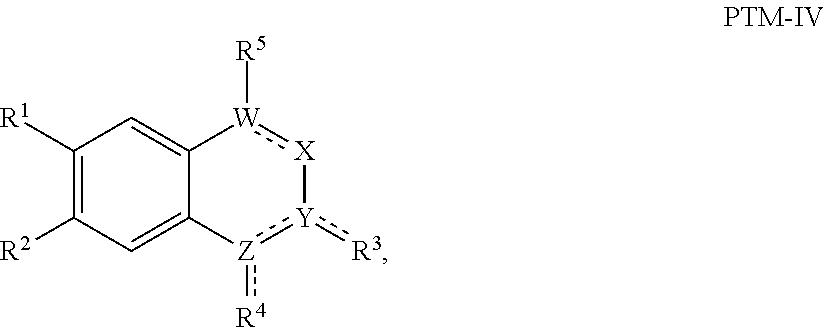
wherein:
-
- W of PTM-IV is C, N, O;
- X of PTM-IV can be C, N, absent;
- Y of PTM-IV can be C;
- Z of PTM-IV can be C, N;
- and R groups can be substituted variants of:
- R1 of PTM-IV can be H, alkoxy, hydroxyl, heterocyclic alkyl/aryl;
- R2 of PTM-IV can be H, F, alkoxy, heterocyclic alkyl/aryl;
- R3 of PTM-IV can be H, O, aryl, heteroaryl, C(O)heteroaryl;
- R4 of PTM-IV can be H, alkyl, aryl, heteroaryl, CH-heteoaryl, absent;
- R5 of PTM-IV can be H, aryl, heteroalkyl/aryl, absent;
- the dashed lines between WX, WY, YZ, YR3, and ZR4 of PTM-IV indicating an optionally double bond, wherein the aryl, heteroaryl, heterocyclic alkyl/aryl are optionally substituted; and
- the PTM-IV is covalently joined to a ULM, a chemical linker group (L), a CLM, an ILM, a VLM, MLM, a ULM′, a CLM′, a ILM′, a VLM′, a MLM′, or combination thereof.

wherein:
-
- X1 of PTM-V is N or CR2, X2 is N or CR6, Y1 is N or CR4, and Y2 is N or CR5, provided, however, that not more than one of X2, Y1 and Y2 is N;
- L1 of PTM-V is selected from the group consisting of optionally substituted lower alkylene, —S—, —O—, —C(O)—, —C(S)—, —S(O)—, —S(O)2—, and —NR7—;
- L2 of PTM-V is selected from the group consisting of a bond, optionally substituted lower alkylene, -(alk)a-S -(alk)b-, -(alk)a-O-(alk)b-, -(alk)a-OC(O)-(alk)b-, -(alk)a-C(O)O-(alk)b-, -(alk)a-OC(S)-(alk)b-, -(alk)a-C(S)O-(alk)b-, -(alk)a-C(O)-(alk)b-, -(alk)a-C(S)-(alk)b-, -(alk)a-C(O)NR9-(alk)b-, -(alk)a-OC(O)NR9-(alk)b-, -(alk)a-OC(S)NR9-(alk)b-, -(alk)a-C(S)NR9-(alk)b-, -(alk)a-S(O)-(alk)b-, -(alk)a-S(O)2-(alk)b-, -(alk)a-S(O)2NR9-(alk)b-, -(alk)a-NR9-(alk)b-, -(alk)a-NR9C(O)-(alk)b-, -(alk)a-NR9C(S)-(alk)b-, (alk)a-NR9C(O)NR9-(alk)b-, -(alk)a-NR9C(S)NR9-(alk)b-, -(alk)a-NR9C(O)O-(alk)b-, -(alk)a-NR9C(S)O-(alk)b-, -(alk)a-NR9S(O)2-(alk)b-, and -(alk)a-NR9S(O)2NR9-(alk)b-, wherein alk is optionally substituted C1-3 alkylene and a and b are independently 0 or 1;
- R1 of PTM-V is selected from the group consisting of optionally substituted lower alkyl, optionally substituted cycloalkyl, optionally substituted heterocycloalkyl, optionally substituted aryl, and optionally substituted heteroaryl;
- R2, R4, R5 and R6 of PTM-V are independently selected from the group consisting of hydrogen, halogen, optionally substituted lower alkyl, optionally substituted lower alkenyl, optionally substituted lower alkynyl, optionally substituted cycloalkyl, optionally substituted heterocycloalkyl, optionally substituted aryl, optionally substituted heteroaryl, —OH, —NH2, —NO2, —CN, —C(O)OH, —C(S)OH, —C(O)NH2, —C(S)NH2, —S(O)2NH2, —NHC(O)NH2, —NHC(S)NH2, —NHS(O)2NH2, —NR10R11, —NHR3, —OR3, —SR3, —C(O)R3, —C(S)R3, —S(O)R3, —S(O)2R3, —C(O)OR3, —C(S)OR3, C(O)NHR3, —C(O)NR3R3, —C(S)NHR3, —C(S)NR3R3, —S(O)2NHR3, —S(O)2NR3R3, —NHC(O)R3, —NR3C(O)R3, —NHC(S)R3, —NR3C(S)R3, —NHS(O)2R3, —NR3S(O)2R3, —NHC(O)OR3, —NR3C(O)OH, —NR3C(O)OR3, —NHC(S)OR3, —NR3C(S)OH, —NR3C(S)OR3, —NHC(O)NHR3, —NHC(O)NR3R3, —NR3C(O)NH2, —NR3C(O)NHR3, —NR3C(O)NR3R3, —NHC(S)NHR3, —NHC(S)NR3R3, —NR3C(S)NH2, —NR3C(S)NHR3, —NR3C(S)NR3R3, —NHS(O)2NHR3, —NHS(O)2NR3R3, NR3S(O)2NH2, —NR3S(O)2NHR3, and —NR3S(O)2NR3R3;
- Ar1 of PTM-V is a 5 or 6 membered optionally substituted heteroarylene having the structure

wherein

indicates the point of attachment of L1 and

indicates the point of attachment of L2, and wherein the indicated N is either ═N— or —N═;
-
- n of PTM-V is 0 or 1;
- F and J of PTM-V are both C or one of F and J is C and the other of F and J is N;
- P and Q of PTM-V are independently selected from CR, N, NR, O or S;
- T of PTM-V is selected from CR or N;
- wherein:
- when n is 1, F and J are C, and P, T and Q are CR, or any one of P, T and Q is N and the other two of P, T and Q are CR,
- when n is 0 and F and J are both C, then one of P and Q are CR, N or NR and the other of P and Q is C, N, NR, O or S, provided both P and Q are not CR,
- when n is 0, one of F and J is N and the other of F and J is C, then one of P and Q is N and the other of P and Q is CR or both P and Q are CR, and
- R of PTM-V is hydrogen or an optional substituent as defined herein for optionally substituted heteroarylene that provides a stable compound;
- R3 of PTM-V at each occurrence is independently selected from the group consisting of optionally substituted lower alkyl, optionally substituted lower alkenyl, provided, however, that no alkene carbon thereof is bound to any —C(O)—, —C(S)—, —S(O)—, —S(O)2, —O—, —S—, or —N— of any of —OR3, —SR3, —C(O)R3, —C(S)R3, —S(O)R3, —S(O)2R3, —C(O)OR3, —C(S)OR3, —C(O)NHR3, —C(O)NR3R3, —C(S)NHR3, —C(S)NR3R3, —S(O)2NHR3, —S(O)2NR3R3, —NHR3, —NHC(O)R3, —NR3C(O)R3, —NHC(S)R3, —NR3C(S)R3, —NHS(O)2R3, —NR3S(O)2R3, —NHC(O)OR3, —NR3C(O)OH, —NR3C(O)OR3, —NHC(S)OR3, —NR3C(S)OH, —NR3C(S)OR3, —NHC(O)NHR3, —NHC(O)NR3R3, —NR3C(O)NH2, —NR3C(O)NHR3, —NR3C(O)NR3R3, —NHC(S)NHR3, —NHC(S)NR3R3, —NR3C(S)NH2, —NR3C(S)NHR3, —NR3C(S)NR3R3, —NHS(O)2NHR3, —NHS(O)2NR3R3, —NR3S(O)2NH2, —NR3S(O)2NHR3, or —NR3S(O)2NR3R3, optionally substituted lower alkynyl, provided, however, that no alkyne carbon thereof is bound to any —C(O)—, —C(S)—, —S(O)—, —S(O)2—, —O—, —S—, or —N— of any of —OR3, —SR3, —C(O)R3, —C(S)R3, —S(O)R3, —S(O)2R3, —C(O)OR3, —C(S)OR3, —C(O)NHR3, —C(O)NR3R3, —C(S)NHR3, —C(S)NR3R3, —S(O)2NHR3, —S(O)2NR3R3, —NHR3, —NHC(O)R3, —NR3C(O)R3, —NHC(S)R3, —NR3C(S)R3, —NHS(O)2R3, —NR3S(O)2R3, —NHC(O)OR3, —NR3C(O)OH, —NR3C(O)OR3, —NHC(S)OR3, —NR3C(S)OH, —NR3C(S)OR3, —NHC(O)NHR3, —NHC(O)NR3R3, —NR3C(O)NH2, —NR3C(O)NHR3, —NR3C(O)NR3R3, —NHC(S)NHR3, —NHC(S)NR3R3, —NR3C(S)NH2, —NR3C(S)NHR3, —NR3C(S)NR3R3, —NHS(O)2NHR3, —NHS(O)2NR3R3, —NR3S(O)2NH2, —NR3S(O)2NHR3, or —NR3S(O)2NR3R3, optionally substituted cycloalkyl, optionally substituted heterocycloalkyl, optionally substituted aryl, and optionally substituted heteroaryl;
- R7 of PTM-V is selected from the group consisting of hydrogen, optionally substituted lower alkyl, optionally substituted cycloalkyl, optionally substituted heterocycloalkyl, optionally substituted aryl, optionally substituted heteroaryl, —C(O)R8, and —S(O)2R8;
- R8 of PTM-V is selected from the group consisting of optionally substituted lower alkyl, optionally substituted cycloalkyl, optionally substituted heterocycloalkyl, optionally substituted aryl and optionally substituted heteroaryl;
- R9 of PTM-V at each occurrence is independently selected from the group consisting of hydrogen, lower alkyl, and lower alkyl substituted with one or more substituents selected from the group consisting of fluoro, —OH, —NH2, lower alkoxy, fluoro substituted lower alkoxy, lower alkylthio, fluoro substituted lower alkylthio, mono-alkylamino, fluoro substituted mono-alkylamino, di-alkylamino, fluoro substituted di-alkylamino, and —NR12R13, provided, however, that when R9 is substituted lower alkyl, any substitution on the alkyl carbon bound to the —N— of NR9— is fluoro;
- R10 and R11 of PTM-V at each occurrence are independently selected from the group consisting of optionally substituted lower alkyl, optionally substituted lower alkenyl, provided, however, that no alkene carbon thereof is bound to the nitrogen of NR10R11 optionally substituted lower alkynyl, provided, however, that no alkyne carbon thereof is bound to the nitrogen of —NR10R11, optionally substituted cycloalkyl, optionally substituted heterocycloalkyl, optionally substituted aryl, and optionally substituted heteroaryl; or
- R10 and R11 of PTM-V together with the nitrogen to which they are attached form a monocyclic 5-7 membered optionally substituted heterocycloalkyl or a monocyclic 5 or 7 membered optionally substituted nitrogen containing heteroaryl;
- R12 and R13 of PTM-V combine with the nitrogen to which they are attached to form a 5-7 membered heterocycloalkyl or 5-7 membered heterocycloalkyl substituted with one or more substituents selected from the group consisting of fluoro, —OH, —NH2, lower alkyl, fluoro substituted lower alkyl, lower alkoxy, fluoro substituted lower alkoxy, lower alkylthio, and fluoro substituted lower alkylthio; and
- the PTM-V is covalently joined to a ULM, a chemical linker group (L), a CLM, an ILM, a VLM, MLM, a ULM′, a CLM′, a ILM′, a VLM′, a MLM′, or combination thereof.

wherein:
-
- Ar of PTM-VI is selected from the group consisting of optionally substituted or unsubstituted aryl, and optionally substituted or unsubstituted heteroaryl, when substituted, the substituents could be one or more groups independently selected from halogen, alkyl, haloalkyl, or hydroxyl alkyl;
- L of PTM-VI is H, optionally substituted or unsubstituted alkyl, optionally substituted or unsubstituted cycloalkyl, optionally substituted or unsubstituted cycloalkylalkyl, optionally substituted or unsubstituted aryl, optionally substituted or unsubstituted arylalkyl, optionally substituted or unsubstituted sulfonamido, optionally substituted or unsubstituted heterocycloalkyl, optionally substituted or unsubstituted heterocycloalkylalkyl, optionally substituted or unsubstituted heteroaryl or optionally substituted or unsubstituted heteroarylalkyl; when substituted, the substituents can be one or more groups independently selected from the group consisting of halo, alkyl, haloalkyl, cycloalkyl, cycloalkylalkyl, heterocycloalkyl, heterocycloalkylalkyl, amino, aminoalkyl, amido, aminocarbonyl, sulfonamido, ureido, cyano, acetyl, acyl, carboxylic acid, hydroxyl, hydroxylalkyl, alkoxyl, —NHalkylhydroxyl, —NHalkoxyalkyl, —NHalkylamino, —NHcycloalkyl, —NHcycloalkylalkyl, —N Hheterocycloalkyl, —NH heterocycloalkylalkyl, —NHaryl, —NHarylalkyl, —NHheteroaryl, or —NHheteroarylalkyl;
- Y of PTM-VI is O, S, NR2R2′, or a direct bond (that means L directly connected with the left heteroaryl);
- X1, X2, X3 and X4 of PTM-VI are independently N or CR1,
- R1 of PTM-VI is H, or —Y-L;
- R, R2 and R2′ of PTM-VI are each independently selected from the group consisting of hydrogen, alkyl, cycloalkyl, aryl, heteroaryl, haloalkoxyl, hydroxyl, amino, aminocarbonyl, sulfonamido, cyano, alkynyl, alkoxyl, aryloxyl, carboxylic acid, carboxylic ester or halogen, or R2, R2′ together with the nitrogen atom to which they are attached, form a 3- to 7-membered heterocycloalkyl ring, and the hetero atom could be selected from at least one of 0, S or N atoms. The 3- to 7-membered heterocycloalkyl ring could be further optionally substituted with a group independently selected from alkyl, cycloalkyl, methylsulfonyl, ureido, acyl, amido, aminocarbonyl, alkylamino, alkylhydroxyl, heterocycloalkyl, aryl, or heteroaryl. Preferably R2, R2′ and the N could be formed a heterocycle such as

and
-
- R7 of PTM-VI is independently selected from H, methylsulfonyl, lower alkyl, that is C1-C6 straight chain and branched chain alkyl, such as methyl, ethyl, propyl, 2-propyl, n-butyl, iso-butyl, tert-butyl, pentyl, neopentyl, hexyl, isohexyl; and
- the PTM-VI is covalently joined to a ULM, a chemical linker group (L), a CLM, an ILM, a VLM, MLM, a ULM′, a CLM′, a ILM′, a VLM′, a MLM′, or combination thereof.

wherein:
-
- L of PTM-VII is a bond, substituted or unsubstituted alkylene, or substituted or unsubstituted heteroalkylene;
- R1 of PTM-VII is hydrogen, halogen, —CF3, —CCl3, —CBr3, —CI3, —OCF3, —OCCl3, —OCBr3, —OCl3, —CN, —OH, —NH2, —COOH, —C(O)OR4, —CONH2, —NO2, —SH, —NHNH2, —NR2R3, —OR4, —SR4, substituted or unsubstituted alkyl, substituted or unsubstituted heteroalkyl, substituted or unsubstituted cycloalkyl, substituted or unsubstituted heterocycloalkyl, substituted or unsubstituted aryl or substituted or unsubstituted heteroaryl. R2 and R3 are independently substituted or unsubstituted alkyl, substituted or unsubstituted heteroalkyl, substituted or unsubstituted cycloalkyl, substituted or unsubstituted heterocycloalkyl, substituted or unsubstituted aryl, substituted or unsubstituted heteroaryl;
- R2 and R3 of PTM-VII are optionally joined together to form a substituted or unsubstituted heterocycloalkyl or substituted or unsubstituted heteroaryl. R4 of PTM-VII is substituted or unsubstituted alkyl, substituted or unsubstituted heteroalkyl, substituted or unsubstituted cycloalkyl, substituted or unsubstituted heterocycloalkyl, substituted or unsubstituted aryl or substituted or unsubstituted heteroaryl;
- R5 and R6 of PTM-VII are independently hydrogen, halogen, —CF3, —CCl3, —CBr3, —CI3, —OCF3, —OCCl3, —OCBr3, —OCl3, —CN, —OH, —NH2, —COOH, —C(O)OR9, —CONH2, —NO2, —SH, —NHNH2, —NR7R8, —OR9, —SR9, substituted or unsubstituted alkyl, substituted or unsubstituted heteroalkyl, substituted or unsubstituted cycloalkyl, substituted or unsubstituted heterocycloalkyl, substituted or unsubstituted aryl or substituted or unsubstituted heteroaryl;
- R7 and R8 of PTM-VII are independently substituted or unsubstituted alkyl, substituted or unsubstituted heteroalkyl, substituted or unsubstituted cycloalkyl, substituted or unsubstituted heterocycloalkyl, substituted or unsubstituted aryl or substituted or unsubstituted heteroaryl, or R7 and R8 are optionally joined together to form a substituted or unsubstituted heterocycloalkyl or substituted or unsubstituted heteroaryl;
- R9 of PTM-VII is substituted or unsubstituted alkyl, substituted or unsubstituted heteroalkyl, substituted or unsubstituted cycloalkyl, substituted or unsubstituted heterocycloalkyl, substituted or unsubstituted aryl or substituted or unsubstituted heteroaryl; and
- the PTM-VII is covalently joined to a ULM, a chemical linker group (L), a CLM, an ILM, a VLM, MLM, a ULM′, a CLM′, a ILM′, a VLM′, a MLM′, or combination thereof.

wherein:
-
- R1 of PTM-VIII is a hydrogen atom or a substituted or unsubstituted C1-6 alkyl group;
- R2 of PTM-VIII is a hydrogen atom, a substituted or unsubstituted C1-6 alkyl group, a substituted or unsubstituted C2-6 alkenyl group, or a substituted or unsubstituted C2-6 alkynyl group;
- R3 of PTM-VIII is a hydrogen atom, a substituted or unsubstituted C1-6 alkyl group, a substituted or unsubstituted C2-6 alkenyl group, or a substituted or unsubstituted C2-6 alkynyl group;
- or R2 and R3 of PTM-VIII may bind together to form an atomic bond;
- R4 of PTM-VIII is a hydrogen atom, a substituted or unsubstituted C1-6 alkyl group, a substituted or unsubstituted C2-6 alkenyl group, a substituted or unsubstituted C2-6 alkynyl group, a substituted or unsubstituted C3-8 cycloalkyl group, or an imino protecting group;
- m of R5 of PTM-VIII are the same or different, and is a hydrogen atom or a substituted or unsubstituted C1-6 alkyl group;
- m of R6 of PTM-VIII are the same or different, and is a hydrogen atom or a substituted or unsubstituted C1-6 alkyl group;
- or R5 and R6 of PTM-VIII binding to the same carbon atom may bind together to form: a substituted or unsubstituted C2-6 alkylene group; an substituted or unsubstituted O—(C1-6 alkylene) group, a substitute or unsubstituted N(R13)—(C1-6 alkylene) group, wherein R13 is a hydrogen atom, a substituted or unsubstituted C1-6 alkyl group or an imino protecting group; a substituted or unsubstituted (C1-3 alkylene)-O—(C1-3 alkylene) group; a substitute or unsubstituted (C1-3 alkylene)-N(R13)—(C1-3 alkylene) group, wherein R13 is a hydrogen atom, a substituted or unsubstituted C1-6 alkyl group or an imino protecting group;
- n of R7 of PTM-VIII are the same or different, and is a hydrogen atom or a substitute or unsubstituted C1-6 alkyl group;
- n of R8 of PTM-VIII are the same or different, and is a hydrogen atom or a substitute or unsubstituted C1-6 alkyl group;
- or R7 and R8 of PTM-VIII binding to the same carbon atom may bind together to form: a substituted or unsubstituted C2-6 alkylene group; an substituted or unsubstituted O—(C1-6 alkylene) group; a substituted or unsubstituted N(R14)—(C1-6 alkylene) group, wherein R14 is a hydrogen atom, a substituted or unsubstituted C1-6 alkyl group, or an imino protecting group; a substituted or unsubstituted (C1-3 alkylene)-O—(C1-3 alkylene) group; or a substituted or unsubstituted (C1-3 alkylene)-N(R14)—(C1-3 alkylene) group which may be substituted, wherein R14 is a hydrogen atom, a substituted or unsubstituted C1-6 alkyl group, or an imino protecting group;
- R9 of PTM-VIII is: a substituted or unsubstituted C1-6 alkyl group; a substituted or unsubstituted C3-8 cycloalkyl; a substituted or unsubstituted aryl group; a substituted or unsubstituted C1-6 alkoxy group; a substituted or unsubstituted heterocyclic group; N(R15)(R16) wherein R15 is a hydrogen atom, a substituted or unsubstituted C1-6 alkyl group, a substituted or unsubstituted C2-6 alkenyl group, a substituted or unsubstituted C2-6 alkynyl group, or a substituted or unsubstituted C3-8 cycloalkyl group, and R16 is a substituted or unsubstituted C1-6 alkyl group, a substituted or unsubstituted C2-6 alkenyl group, a substituted or unsubstituted C2-6 alkynyl group, a substituted or unsubstituted C3-8 cycloalkyl group, a substituted or unsubstituted aryl group, or a substituted or unsubstituted heterocyclic group, or R15 and R16 may form a substituted or unsubstituted cyclic amino group together with the nitrogen atom to which they bind;
- R10 of PTM-VIII is a hydrogen atom, a halogen atom, a substituted or unsubstituted C1-6 alkyl group, a substituted or unsubstituted C3-8 cycloalkyl group, a substituted or unsubstituted aryl group, a substituted or unsubstituted C1-6 alkoxy group, or a substituted or unsubstituted heterocyclic group;
- R11 of PTM-VIII is a hydrogen atom, a substituted or unsubstituted C1-6 alkyl group, a substituted or unsubstituted C2-6 alkenyl group, a substituted or unsubstituted C2-6 alkynyl group, or a substituted or unsubstituted C3-8 cycloalkyl group;
- R12 of PTM-VIII is a substituted or unsubstituted C1-6 alkyl group, a substituted or unsubstituted C2-6 alkenyl group, a substituted or unsubstituted C2-6 alkynyl group, a substituted or unsubstituted C3-8 cycloalkyl group, a substituted or unsubstituted aryl group, a substituted or unsubstituted heterocyclic group, or a substituted or unsubstituted carbamoyl group;
- X1 of PTM-VIII represents a group represented by —X4—X5—, wherein:
- X4 is a substituted or unsubstituted divalent alicyclic hydrocarbon, a substituted or unsubstituted divalent aromatic hydrocarbon group, a substituted or unsubstituted divalent heterocyclic group, or a group represented by

wherein p of R17 are the same or different, and is a hydrogen atom or a substituted or unsubstituted C1-6 alkyl group, or one R17 selected from p of R17 may bind with R4 to form: a substituted or unsubstituted C1-6 alkylene group: a substituted or unsubstituted (C1-3 alkylene)-O group: a substituted or unsubstituted (C1-3 alkylene)-N(R19) group, wherein R19 is a hydrogen atom, substituted or unsubstituted a C1-6 alkyl group, or an imino protecting group; a substituted or unsubstituted (C1-3 alkylene)-O—(C1-3 alkylene) group; a substituted or unsubstituted (C1-3 alkylene)-N(R19)—(C1-3 alkylene) group, wherein R19 is a hydrogen atom, substituted or unsubstituted a C1-6 alkyl group, or an imino protecting group; p of R18 are the same or different, and is a hydrogen atom or a substituted or unsubstituted C1-6 alkyl group; or R17 and R18 binding to the same carbon atom may bind together to form: a substituted or unsubstituted C2-6 alkylene group, a substituted or unsubstituted O—(C1-6 alkylene); a substituted or unsubstituted N(R20)—(C1-6 alkylene) group, wherein R20 is a hydrogen atom; a substituted or unsubstituted C1-6 alkyl group or an imino protecting group; a substituted or unsubstituted (C1-3 alkylene)-O—(C1-3 alkylene) group; a substituted or unsubstituted (C1-3 alkylene)-N(R20)—(C1-3 alkylene), wherein R20 is a hydrogen atom; a substituted or unsubstituted C1-6 alkyl group or an imino protecting group; and p represents an integer of 1 to 6; or an atomic bond; and
-
- X5 is an oxygen atom, N(R21) wherein R21 is a hydrogen atom, a substituted or unsubstituted C1-6 alkyl group, a substituted or unsubstituted C2-6 alkenyl group, a substituted or unsubstitute C2-6 alkynyl group or an imino protecting group, or R21 may bind with R4 to form a substitute or unsubstituted C1-6 alkylene group; C(═O); C(═O)—N(R21) wherein R21 is a hydrogen atom, a substituted or unsubstituted C1-6 alkyl group, a substituted or unsubstituted C2-6 alkenyl group, a substituted or unsubstitute C2-6 alkynyl group or an imino protecting group; or an atomic bond;
- X2 of PTM-VIII is a substituted or unsubstituted C1-6 alkylene group, a substituted or unsubstituted divalent alicyclic hydrocarbon group, a substituted or unsubstituted divalent aromatic hydrocarbon, or a substituted or unsubstituted divalent heterocyclic group;
- X3 of PTM-VIII is a substituted or unsubstituted C1-6 alkylene group, a substituted or unsubstituted C2-6 alkenylene group, a substituted or unsubstituted C2-6 alkynylene group, a substituted or unsubstituted O—(C1-6 alkylene) group, a substituted or unsubstituted S(O)q—(C1-6alkylene) group wherein q represents 0, 1 or 2; a substituted or unsubstituted N(R22)—(C1-6 alkylene) group wherein R22 is a hydrogen atom, a substituted or unsubstitute C1-6 alkyl group, a substituted or unsubstituted C2-6 alkenyl group, a substitute or unsubstituted C2-6 alkynyl group or an imino protecting group; N(R22)—C(═O) wherein R22 is a hydrogen atom, a substituted or unsubstitute C1-6 alkyl group, a substituted or unsubstituted C2-6 alkenyl group, a substitute or unsubstituted C2-6 alkynyl group or an imino protecting group; or an atomic bond;
- Z1 of PTM-VIII is a nitrogen atom or C(R23) wherein R23 is a hydrogen atom, a halogen atom, a substituted or unsubstituted C1-6 alkyl group, a substituted or unsubstituted C3-8 cycloalkyl group, a substituted or unsubstituted aryl group, a substituted or unsubstituted C1-6 alkoxy group or substituted or unsubstituted a heterocyclic group;
- m of PTM-VIII is an integer of 0, 1, 2, 3, 4, 5, or 6;
- n of PTM-VIII is an integer of 0, 1, 2, 3, 4, 5, or 6); and
- the PTM-VIII is covalently joined to a ULM, a chemical linker group (L), a CLM, an ILM, a

wherein:
-
- W of PTM-IX is an aryl, 5-membered heteroaryl, or 6-membered heteroaryl ring, each optionally substituted with one or more RPTM1 groups;
- X of PTM-IX is independently selected from C—RPTM1 or N;
- Y and Z of PTM-IX are independently selected from a bond or CH2;
- m and n of PTM-IX are each independently 1 or 2;
- RPTM1 of PTM-IX is H, halogen, C1-5alkyl, CN, C(O)—C1-5alkyl, C(O)O—C1-5alkyl, OH, or O—C1-5alkyl (e.g., selected from the group consisting of H, halogen, C1-5alkyl, CN, OH, or O—C1-5alkyl);
- of PTM-IX indicates either a single or double bond;

- each R of PTM-IX is independently selected from H, halogen, C1-5alkyl, CN, C(O)—C1-5alkyl, C(O)O—C1-5alkyl, OH, or O—C1-5alkyl, each optionally substituted (e.g., optionally substituted with a cycloalkyl, heterocycle, or aminoalkyl); and
- of PTM-IX indicates a covalent linkage, optionally through an atom or functional group, to at least one of a linker (L), a ULM, a ULM′, a VLM, a VLM′, a CLM, a CLM′, an ILM, an ILM′, a MLM, a MLM′, or a combination thereof.

-
- W of PTM-IX is phenyl or furan, each optionally substituted with one or more RPTM1 groups;
- X of PTM-IX is CH;
- Y of PTM-IX is CH2;
- Z of PTM-IX is CH2;
- m and n of PTM-IX are each 1;
- R of PTM-IX is H; or
- a combination thereof.


wherein R is 5-(4-methyl-1H-imidazol-1-yl) or 4-(N-(4-ethylpiperazin-1-yl)methyl).

wherein:
-
- X1, X2 are each independently selected from the group of a bond, O, NRY3, CRY3RY4, C═O, C═S, SO, and SO2;
- RY3, RY4 are each independently selected from the group of H, linear or branched C1-6 alkyl, optionally substituted by 1 or more halo, C1-6 alkoxyl optionally substituted by 0-3 RP groups;
- RP is 0, 1, 2, or 3 groups independently selected from the group H, halo, —OH, C1-3 alkyl, C═O;
- W3 is selected from the group of an optionally substituted -T-N(R1aR1b)X3, T-N(R1aR1b), -T-Aryl, an optionally substituted -T-Heteroaryl, an optionally substituted -T-Heterocycle, an optionally substituted —NR1-T-Aryl, an optionally substituted —NR1-T-Heteroaryl or an optionally substituted —NR1-T-Heterocycle;
- X3 is C═O, R1, R1a; R1b;
- each of R1, R1a, R1b is independently selected from the group consisting of H, linear or branched C1-C6 alkyl group optionally substituted by 1 or more halo or —OH groups, RY3C═O, RY3C═S, RY3SO, RY3SO2, N(RY3RY4)C═O, N(RY3RY4)C═S, N(RY3RY4)SO, and N(RY3RY4)SO2;
- T is selected from the group of an optionally substituted alkyl, —(CH2)n— group, wherein each one of the methylene groups is optionally substituted with one or two substituents selected from the group of halogen, methyl, a linear or branched C1-C6 alkyl group optionally substituted by 1 or more halogen or —OH groups or an amino acid side chain optionally substituted;
- n is 0 to 6;

-
- R14a, R14b, are each independently selected from the group of H, haloalkyl, or optionally substituted alkyl;
- W5 is selected from the group of a phenyl or a 5-10 membered heteroaryl;
- R15 is selected from the group of H, halogen, CN, OH, NO2, N R14aR14b, OR14a, CONR14aR14b, NR14aCOR14b, SO2NR14aR14b, NR14a SO2R14b, optionally substituted alkyl, optionally substituted haloalkyl, optionally substituted haloalkoxy; aryl, heteroaryl, cycloalkyl, or cycloheteroalkyl, each optionally substituted;
- and wherein the dashed line indicates the site of attachment of at least one PTM, another ULM (ULM′) or a chemical linker moiety coupling at least one PTM or a ULM′ or both to ULM.

wherein:
-
- W3 is selected from the group of an optionally substituted aryl, optionally substituted heteroaryl, or

-
- R9 and R10 are independently hydrogen, optionally substituted alkyl, optionally substituted cycloalkyl, optionally substituted hydroxyalkyl, optionally substituted heteroaryl, or haloalkyl, or R9, R10, and the carbon atom to which they are attached form an optionally substituted cycloalkyl;
- R11 is selected from the group of an optionally substituted heterocyclic, optionally substituted alkoxy, optionally substituted heteroaryl, optionally substituted aryl,

-
- R12 is selected from the group of H or optionally substituted alkyl;
- R13 is selected from the group of H, optionally substituted alkyl, optionally substituted alkylcarbonyl, optionally substituted (cycloalkyl)alkylcarbonyl, optionally substituted aralkylcarbonyl, optionally substituted arylcarbonyl, optionally substituted (heterocyclyl)carbonyl, or optionally substituted aralkyl;
- R14a, R14b, are each independently selected from the group of H, haloalkyl, or optionally substituted alkyl;
- W5 is selected from the group of a phenyl or a 5-10 membered heteroaryl,
- R15 is selected from the group of H, halogen, CN, OH, NO2, N R14aR14b, OR14a, CONR14aR14b, NR14aCOR14b, SO2NR14aR14b, NR14a SO2R14b, optionally substituted alkyl, optionally substituted haloalkyl, optionally substituted haloalkoxy; aryl, heteroaryl, cycloalkyl, or cycloheteroalkyl, each optionally substituted;
- R16 is independently selected from the group of halo, optionally substituted alkyl, optionally substituted haloalkyl, hydroxy, or optionally substituted haloalkoxy;
- o is 0, 1, 2, 3, or 4;
- R18 is independently selected from the group of H, halo, optionally substituted alkoxy, cyano, optionally substituted alkyl, haloalkyl, haloalkoxy or a linker; and
- p is 0, 1, 2, 3, or 4, and wherein the dashed line indicates the site of attachment of at least one PTM, another ULM (ULM′) or a chemical linker moiety coupling at least one PTM or a ULM′ or both to ULM.

wherein:
-
- R1 is H, ethyl, isopropyl, tert-butyl, sec-butyl, cyclopropyl, cyclobutyl, cyclopentyl, or cyclohexyl; optionally substituted alkyl, optionally substituted hydroxyalkyl, optionally substituted heteroaryl, or haloalkyl;
- R14a is H, haloalkyl, optionally substituted alkyl, methyl, fluoromethyl, hydroxymethyl, ethyl, isopropyl, or cyclopropyl;
- R15 is selected from the group consisting of H, halogen, CN, OH, NO2, optionally substituted heteroaryl, optionally substituted aryl; optionally substituted alkyl, optionally substituted haloalkyl, optionally substituted haloalkoxy, cycloalkyl, or cycloheteroalkyl, each optionally substituted;
- X is C, CH2, or C═O;
- R3 is absent or an optionally substituted 5 or 6 membered heteroaryl; and
- wherein the dashed line indicates the site of attachment of at least one PTM, another ULM (ULM′) or a chemical linker moiety coupling at least one PTM or a ULM′ or both to the ULM.

wherein:
-
- R14a is H, haloalkyl, optionally substituted alkyl, methyl, fluoromethyl, hydroxymethyl, ethyl, isopropyl, or cyclopropyl;
- R9 is H;
- R10 is H, ethyl, isopropyl, tert-butyl, sec-butyl, cyclopropyl, cyclobutyl, cyclopentyl, or cyclohexyl;
- R11 is

optionally substituted heteroaryl,

-
- p is 0, 1, 2, 3, or 4; and
- each R18 is independently halo, optionally substituted alkoxy, cyano, optionally substituted alkyl, haloalkyl, haloalkoxy or a linker;
- R12 is H, C═O;
- R13 is H, optionally substituted alkyl, optionally substituted alkylcarbonyl, optionally substituted (cycloalkyl)alkylcarbonyl, optionally substituted aralkylcarbonyl, optionally substituted arylcarbonyl, optionally substituted (heterocyclyl)carbonyl, or optionally substituted aralkyl;
- R15 is selected from the group consisting of H, halogen, Cl, CN, OH, NO2, optionally substituted heteroaryl, optionally substituted aryl;

-
- and wherein the dashed line indicates the site of attachment of at least one PTM, another ULM (ULM′) or a chemical linker moiety coupling at least one PTM or a ULM′ or both to the ULM.

wherein:
-
- W is selected from the group consisting of CH2, CHR, C═O, SO2, NH, and N-alkyl;
- each X is independently selected from the group consisting of O, S, and H2,
- Y is selected from the group consisting of CH2, —C═CR′, NH, N-alkyl, N-aryl, N-hetaryl, N-cycloalkyl, N-heterocyclyl, O, and S;
- Z is selected from the group consisting of O, S, and H2;
- G and G′ are independently selected from the group consisting of H, alkyl (linear, branched), OH, R′OCOOR, R′OCONRR″, CH2-heterocyclyl optionally substituted with R′, and benzyl optionally substituted with R′;
- Q1, Q2, Q3, and Q4 represent a carbon C substituted with a group independently selected from R′, N or N-oxide;
- A is independently selected from the group H, alkyl (linear, branched, optionally substituted), cycloalkyl, Cl and F;
- R comprises —CONR′R″, —OR′, —NR′R″, —SR′, —SO2R′, —SO2NR′R″, —CR′R″—, —CR′NR′R″—, -aryl, -hetaryl, -alkyl, -cycloalkyl, -heterocyclyl, —P(O)(OR′)R″, —P(O)R′R″, —OP(O)(OR′)R″, —OP(O)R′R″, —Cl, —F, —Br, —I, —CF3, —CN, —NR′SO2NR′R″, —NR′CONR′R″, —CONR′COR″, —NR′C(═N—CN)NR′R″, —C(═N—CN)NR′R″, —NR′C(═N—CN)R″, —NR′C(═C—NO2)NR′R″, —SO2NR′COR″, —NO2, —CO2R′, —C(C═N—OR′)R″, —CR′, CR′R″, —CCR′, —S(C═O)(C═N—R′)R″, —SF5 and —OCF3;
- R′ and R″ are independently selected from the group consisting of a bond, H, alkyl, cycloalkyl, aryl, heteroaryl, heterocyclic, —C(═O)R, heterocyclyl, each of which is optionally substituted;
- represents a bond that may be stereospecific ((R) or (S)) or non-stereospecific; and

- Ra comprises a functional group or an atom,
- wherein n is an integer from 1-10, and wherein
- when n is 1, Rn is modified to be covalently joined to the linker group (L), and
- when n is 2, 3, or 4, then one Rn is modified to be covalently joined to the linker group (L), and any other Rn is optionally modified to be covalently joined to a PTM, a CLM, a second CLM having the same chemical structure as the CLM, a CLM′, a second linker, or any multiple or combination thereof.

wherein:
-
- W is independently selected from the group CH2, C═O, NH, and N-alkyl;
- R is independently selected from a H, methyl, alkyl (e.g. a C1-C6 alkyl (linear, branched, optionally substituted));
- represents a bond that may be stereospecific ((R) or (S)) or non-stereospecific; and

- Rn comprises 1-4 independently selected functional groups or atoms, and optionally, one of which is modified to be covalently joined to a PTM, a chemical linker group (L), a CLM (or CLM′) or combination thereof.
-(AL)q-,
wherein:
-
- (AL)q is a group that is connected to at least one of a ULM moiety, a PTM moiety, or a combination thereof;
- q is an integer greater than or equal to 1;
- each AL is independently selected from the group consisting of, a bond, CRL1RL2, O, S, SO, SO2, NRL3, SO2NRL3, SONRL3, CONRL3, NRL3CONRL3, NRL3SO2NRL4, CO, CRL1═CRL2, C≡C, SiRL1RL2, P(O)RL1, P(O)ORL1, NRL3C(═NCN)NRL4, NRL3C(═NCN), NRL3C(═CNO2)NRL4, C3-11cycloalkyl optionally substituted with 0-6 RL1 and/or RL2 groups, C3-11heterocyclyl optionally substituted with 0-6 RL1 and/or RL2 groups, aryl optionally substituted with 0-6 RL1 and/or RL2 groups, heteroaryl optionally substituted with 0-6 RL1 and/or RL2 groups, where RL1 or RL2, each independently are optionally linked to other groups to form cycloalkyl and/or heterocyclyl moiety, optionally substituted with 0-4 RL5 groups; and
- RL1, RL2, RL3, RL4 and RL5 are, each independently, H, halo, C1-8alkyl, OC1-8alkyl, SC1-8alkyl, NHC1-8alkyl, N(C1-8alkyl)2, C3-11cycloalkyl, aryl, heteroaryl, C3-11heterocyclyl, OC1-8cycloalkyl, SC1-8cycloalkyl, NHC1-8cycloalkyl, N(C1-8cycloalkyl)2, N(C1-8cycloalkyl)(C1-8alkyl), OH, NH2, SH, SO2C1-8alkyl, P(O)(OC1-8alkyl)(C1-8alkyl), P(O)(OC1-8alkyl)2, CC—C1-8alkyl, CCH, CH═CH(C1-8alkyl), C(C1-8alkyl)═CH(C1-8alkyl), C(C1-8alkyl)═C(C1-8alkyl)2, Si(OH)3, Si(C1-8alkyl)3, Si(OH)(C1-8alkyl)2, COC1-8alkyl, CO2H, halogen, CN, CF3, CHF2, CH2F, NO2, SF4, SO2NHC1-8alkyl, SO2N(C1-8alkyl)2, SONHC1-8alkyl, SON(C1-8alkyl)2, CONHC1-8alkyl, CON(C1-8alkyl)2, N(C1-8alkyl)CONH(C1-8alkyl), N(C1-8alkyl)CON(C1-8alkyl)2, NHCONH(C1-8alkyl), NHCON(C1-8alkyl)2, NHCONH2, N(C1-8alkyl)SO2NH(C1-8alkyl), N(C1-8alkyl) SO2N(C1-8alkyl)2, NH SO2NH(C1-8alkyl), NH SO2N(C1-8alkyl)2, NH SO2NH2.
- —N(R)—(CH2)m—O(CH2)n—O(CH2)o—O(CH2)p—O(CH2)q—O(CH2)r-OCH2-,
- O—(CH2)m—O(CH2)n—O(CH2)oO(CH2)p—O(CH2)q—O(CH2)r-OCH2-,
- O—(CH2)m—O(CH2)n—O(CH2)oO(CH2)p—O(CH2)q—O(CH2)r—O—;
- —N(R)—(CH2)m—O(CH2)n—O(CH2)o—O(CH2)p—O(CH2)q—O(CH2)r—O—;
- (CH2)m—O(CH2)n—O(CH2)oO(CH2)p—O(CH2)q—O(CH2)r—O—;
- (CH2)m—O(CH2)n—O(CH2)o—O(CH2)p—O(CH2)q—O(CH2)r-OCH2-;


wherein each m, n, o, p, q, and r is independently 0, 1, 2, 3, 4, 5, 6 with the proviso that when the number is zero, there is no N—O or O—O bond, R is selected from the group H, methyl and ethyl, and X is selected from the group H and F;


wherein each m and n is independently selected from 0, 1, 2, 3, 4, 5 or 6.


wherein each m, n, o, p, q, and r is independently 0, 1, 2, 3, 4, 5, 6, or 7.


wherein:
-
- WL1 and WL2 are each independently a 4-8 membered ring with 0-4 heteroatoms, optionally substituted with RQ, each RQ is independently a H, halo, OH, CN, CF3, C1-C6 alkyl (linear, branched, optionally substituted), C1-C6 alkoxy (linear, branched, optionally substituted), or 2 RQ groups taken together with the atom they are attached to, form a 4-8 membered ring system containing 0-4 heteroatoms;
- YL1 is each independently a bond, C1-C6 alkyl (linear, branched, optionally substituted) and optionally one or more C atoms are replaced with 0; or C1-C6 alkoxy (linear, branched, optionally substituted);
- n is 0-10; and
a dashed line indicates the attachment point to the PTM or ULM moieties.

wherein:
-
- WL1 and WL2 are each independently aryl, heteroaryl, cyclic, heterocyclic, C1-6 alkyl, bicyclic, biaryl, biheteroaryl, or biheterocyclic, each optionally substituted with RQ, each RQ is independently a H, halo, OH, CN, CF3, hydroxyl, nitro, C≡CH, C2-6 alkenyl, C2-6 alkynyl, C1-C6 alkyl (linear, branched, optionally substituted), C1-C6 alkoxy (linear, branched, optionally substituted), OC1-3alkyl (optionally substituted by 1 or more —F), OH, NH2, NRY1RY2, CN, or 2 RQ groups taken together with the atom they are attached to, form a 4-8 membered ring system containing 0-4 heteroatoms;
- YL1 is each independently a bond, NRYL1, O, S, NRYL2, CRYL1RYL2, C═O, C═S, SO, SO2, C1-C6 alkyl (linear, branched, optionally substituted) and optionally one or more C atoms are replaced with O; C1-C6 alkoxy (linear, branched, optionally substituted);
- QL is a 3-6 membered alicyclic or aromatic ring with 0-4 heteroatoms, optionally bridged, optionally substituted with 0-6 RQ, each RQ is independently H, C1-6 alkyl (linear, branched, optionally substituted by 1 or more halo, C1-6 alkoxyl), or 2 RQ groups taken together with the atom they are attached to, form a 3-8 membered ring system containing 0-2 heteroatoms);
- RYL1, RYL2 are each independently H, OH, C1-6 alkyl (linear, branched, optionally substituted by 1 or more halo, C1-6 alkoxyl), or R1, R2 together with the atom they are attached to, form a 3-8 membered ring system containing 0-2 heteroatoms);
- n is 0-10; and
a dashed line indicates the attachment point to the PTM or ULM moieties.


Claims (23)
ULM-L-PTM,


Priority Applications (1)
| Application Number | Priority Date | Filing Date | Title |
|---|---|---|---|
| US15/840,950 US10806737B2 (en) | 2016-12-23 | 2017-12-13 | Compounds and methods for the targeted degradation of fetal liver kinase polypeptides |
Applications Claiming Priority (3)
| Application Number | Priority Date | Filing Date | Title |
|---|---|---|---|
| US201662438844P | 2016-12-23 | 2016-12-23 | |
| US201762450716P | 2017-01-26 | 2017-01-26 | |
| US15/840,950 US10806737B2 (en) | 2016-12-23 | 2017-12-13 | Compounds and methods for the targeted degradation of fetal liver kinase polypeptides |
Publications (2)
| Publication Number | Publication Date |
|---|---|
| US20180256586A1 US20180256586A1 (en) | 2018-09-13 |
| US10806737B2 true US10806737B2 (en) | 2020-10-20 |
Family
ID=62627043
Family Applications (1)
| Application Number | Title | Priority Date | Filing Date |
|---|---|---|---|
| US15/840,950 Active US10806737B2 (en) | 2016-12-23 | 2017-12-13 | Compounds and methods for the targeted degradation of fetal liver kinase polypeptides |
Country Status (3)
| Country | Link |
|---|---|
| US (1) | US10806737B2 (en) |
| EP (1) | EP3559006A4 (en) |
| WO (1) | WO2018118598A1 (en) |
Cited By (2)
| Publication number | Priority date | Publication date | Assignee | Title |
|---|---|---|---|---|
| US12059413B2 (en) | 2016-11-02 | 2024-08-13 | The Research Foundation For The State University Of New York | Methods of inhibiting viruses using compositions targeting TSG101-ubiquitin interaction |
| US12194023B2 (en) | 2018-11-29 | 2025-01-14 | The Research Foundation For The State University Of New York | Compositions and methods for modular control of bioorthogonal ligation |
Families Citing this family (81)
| Publication number | Priority date | Publication date | Assignee | Title |
|---|---|---|---|---|
| US20180228907A1 (en) | 2014-04-14 | 2018-08-16 | Arvinas, Inc. | Cereblon ligands and bifunctional compounds comprising the same |
| WO2016197114A1 (en) | 2015-06-05 | 2016-12-08 | Arvinas, Inc. | Tank-binding kinase-1 protacs and associated methods of use |
| EP3319944A4 (en) | 2015-07-10 | 2019-04-24 | Arvinas, Inc. | MDM2-BASED PROTEASE MODULATORS AND METHODS OF USE THEREOF |
| US10772962B2 (en) | 2015-08-19 | 2020-09-15 | Arvinas Operations, Inc. | Compounds and methods for the targeted degradation of bromodomain-containing proteins |
| US20170281784A1 (en) | 2016-04-05 | 2017-10-05 | Arvinas, Inc. | Protein-protein interaction inducing technology |
| CN109790143A (en) | 2016-05-10 | 2019-05-21 | C4医药公司 | The C of amine connection for target protein degradation3Glutarimide degron body |
| CN109641874A (en) | 2016-05-10 | 2019-04-16 | C4医药公司 | C for target protein degradation3The glutarimide degron body of carbon connection |
| ES2990061T3 (en) | 2016-05-10 | 2024-11-28 | C4 Therapeutics Inc | Spirocyclic degronimers for the degradation of target proteins |
| EP3454856B1 (en) | 2016-05-10 | 2024-09-11 | C4 Therapeutics, Inc. | Heterocyclic degronimers for target protein degradation |
| US20180072711A1 (en) | 2016-09-15 | 2018-03-15 | Arvinas, Inc. | Indole derivatives as estrogen receptor degraders |
| MX2019005007A (en) | 2016-11-01 | 2019-07-18 | Arvinas Inc | PROTAC TARGETED AT TAU PROTEIN AND ASSOCIATED METHODS OF USE. |
| US10689366B2 (en) * | 2016-11-01 | 2020-06-23 | Cornell University | Compounds for MALT1 degredation |
| BR112019011200B1 (en) | 2016-12-01 | 2021-12-28 | Arvinas Operations, Inc | TETRAHYDRONAPPHTALENE AND TETRAHYDROISOQUINOLINE DERIVATIVES AS ESTROGEN RECEPTOR DEGRADATORS |
| KR20250117470A (en) | 2016-12-23 | 2025-08-04 | 아비나스 오퍼레이션스, 인코포레이티드 | Compounds and methods for the targeted degradation of rapidly accelerated fibrosarcoma polypeptides |
| US10806737B2 (en) | 2016-12-23 | 2020-10-20 | Arvinas Operations, Inc. | Compounds and methods for the targeted degradation of fetal liver kinase polypeptides |
| JP2020505327A (en) | 2016-12-23 | 2020-02-20 | アルビナス・オペレーションズ・インコーポレイテッドArvinas Operations, Inc. | EGFR proteolytic targeting chimeric molecules and related methods of use |
| US11173211B2 (en) | 2016-12-23 | 2021-11-16 | Arvinas Operations, Inc. | Compounds and methods for the targeted degradation of rapidly accelerated Fibrosarcoma polypeptides |
| US11191741B2 (en) | 2016-12-24 | 2021-12-07 | Arvinas Operations, Inc. | Compounds and methods for the targeted degradation of enhancer of zeste homolog 2 polypeptide |
| BR112019015312A2 (en) | 2017-01-26 | 2020-03-10 | Arvinas Operations, Inc. | MODULATORS OF PROTEOLYSIS BY THE ESTROGEN RECEPTOR AND ASSOCIATED METHODS OF USE |
| IL312367A (en) | 2017-01-31 | 2024-06-01 | Arvinas Operations Inc | Servalon ligands and bifunctional compounds containing them |
| CN110769822A (en) | 2017-06-20 | 2020-02-07 | C4医药公司 | N/O-linked degron and degron bodies for protein degradation |
| TWI793151B (en) | 2017-08-23 | 2023-02-21 | 瑞士商諾華公司 | 3-(1-oxoisoindolin-2-yl)piperidine-2,6-dione derivatives and uses thereof |
| WO2019043208A1 (en) | 2017-09-04 | 2019-03-07 | F. Hoffmann-La Roche Ag | Dihydroquinolinones |
| CN118108706A (en) | 2017-09-04 | 2024-05-31 | C4医药公司 | Glutarimide |
| WO2019043217A1 (en) | 2017-09-04 | 2019-03-07 | F. Hoffmann-La Roche Ag | Dihydrobenzimidazolones |
| WO2019094773A1 (en) | 2017-11-10 | 2019-05-16 | The Regents Of The University Of Michigan | Ash1l inhibitors and methods of treatment therewith |
| CN111372585A (en) | 2017-11-16 | 2020-07-03 | C4医药公司 | Degradants and degrons for target protein degradation |
| EP3710443A1 (en) | 2017-11-17 | 2020-09-23 | Arvinas Operations, Inc. | Compounds and methods for the targeted degradation of interleukin-1 receptor-associated kinase 4 polypeptides |
| WO2019148055A1 (en) | 2018-01-26 | 2019-08-01 | Yale University | Imide-based modulators of proteolysis and methods of use |
| EP3773576A4 (en) | 2018-03-26 | 2021-12-29 | C4 Therapeutics, Inc. | Cereblon binders for the degradation of ikaros |
| US12539292B2 (en) | 2018-04-01 | 2026-02-03 | Arvinas Operations, Inc. | BRM targeting compounds and associated methods of use |
| WO2019195609A2 (en) | 2018-04-04 | 2019-10-10 | Arvinas Operations, Inc. | Modulators of proteolysis and associated methods of use |
| EP3781156A4 (en) | 2018-04-16 | 2022-05-18 | C4 Therapeutics, Inc. | SPIROCYCLIC COMPOUNDS |
| EP3578561A1 (en) | 2018-06-04 | 2019-12-11 | F. Hoffmann-La Roche AG | Spiro compounds |
| BR122022012697B1 (en) | 2018-07-10 | 2023-04-04 | Novartis Ag | USES OF 3-(5-HYDROXY-1-OXOISOINDOLIN-2-IL)PIPERIDINE-2,6- DIONE DERIVATIVES, AND KIT |
| AR116109A1 (en) | 2018-07-10 | 2021-03-31 | Novartis Ag | DERIVATIVES OF 3- (5-AMINO-1-OXOISOINDOLIN-2-IL) PIPERIDINE-2,6-DIONA AND USES OF THE SAME |
| WO2020027225A1 (en) | 2018-07-31 | 2020-02-06 | ファイメクス株式会社 | Heterocyclic compound |
| JP7297053B2 (en) | 2018-08-20 | 2023-06-23 | アルビナス・オペレーションズ・インコーポレイテッド | Alpha-Synuclein Protein-Targeted Proteolysis Targeting Chimeric (PROTAC) Compounds with E3 Ubiquitin Ligase Binding Activity to Treat Neurodegenerative Diseases |
| US11969472B2 (en) | 2018-08-22 | 2024-04-30 | Cullgen (Shanghai), Inc. | Tropomyosin receptor kinase (TRK) degradation compounds and methods of use |
| JP7472103B2 (en) | 2018-08-22 | 2024-04-22 | クルゲン(シャンハイ),インク. | Tropomyosin receptor kinase (TRK) degrading compounds and methods of use thereof |
| WO2020051235A1 (en) | 2018-09-04 | 2020-03-12 | C4 Therapeutics, Inc. | Compounds for the degradation of brd9 or mth1 |
| CN120698983A (en) | 2018-12-20 | 2025-09-26 | C4医药公司 | Targeted protein degradation |
| US11389438B2 (en) | 2019-02-25 | 2022-07-19 | Chdi Foundation, Inc. | Compounds for targeting mutant huntingtin protein and uses thereof |
| ES2995214T3 (en) | 2019-03-06 | 2025-02-07 | C4 Therapeutics Inc | Heterocyclic compounds for medical treatment |
| WO2020210630A1 (en) | 2019-04-12 | 2020-10-15 | C4 Therapeutics, Inc. | Tricyclic degraders of ikaros and aiolos |
| WO2020214555A1 (en) | 2019-04-16 | 2020-10-22 | Northwestern University | Bifunctional compounds comprising apcin-a and their use in the treatment of cancer |
| EP3999182A1 (en) | 2019-07-17 | 2022-05-25 | Arvinas Operations, Inc. | Tau-protein targeting compounds and associated methods of use |
| KR20220054347A (en) | 2019-08-26 | 2022-05-02 | 아비나스 오퍼레이션스, 인코포레이티드 | Method of treating breast cancer with tetrahydronaphthalene derivatives as estrogen receptor degraders |
| CA3154386A1 (en) | 2019-10-17 | 2021-04-22 | Michael Berlin | Bifunctional molecules containing an e3 ubiquitine ligase binding moiety linked to a bcl6 targeting moiety |
| JP7629459B2 (en) | 2019-11-19 | 2025-02-13 | ブリストル-マイヤーズ スクイブ カンパニー | Compounds useful as inhibitors of Helios protein |
| PH12022551482A1 (en) | 2019-12-18 | 2023-11-29 | Novartis Ag | 3-(5-methoxy-1-oxoisoindolin-2-yl)piperidine-2,6-dione derivatives and uses thereof |
| AU2020405129A1 (en) | 2019-12-19 | 2022-06-23 | Arvinas Operations, Inc. | Compounds and methods for the targeted degradation of androgen receptor |
| WO2023205701A1 (en) | 2022-04-20 | 2023-10-26 | Kumquat Biosciences Inc. | Macrocyclic heterocycles and uses thereof |
| EP4110772A4 (en) | 2020-02-26 | 2024-04-03 | Cullgen (Shanghai), Inc. | TROPOMYOSIN-RELATED KINASE RECEPTOR (TRK) DEGRADING COMPOUNDS AND METHODS OF USE |
| TW202146412A (en) | 2020-03-05 | 2021-12-16 | 美商C4醫藥公司 | Compounds for targeted degradation of brd9 |
| TW202140441A (en) | 2020-03-23 | 2021-11-01 | 美商必治妥美雅史谷比公司 | Substituted oxoisoindoline compounds |
| JP2023530030A (en) | 2020-06-19 | 2023-07-12 | シーフォー セラピューティクス, インコーポレイテッド | BRAF decomposer |
| IL300397A (en) | 2020-08-05 | 2023-04-01 | C4 Therapeutics Inc | Compounds for targeted degradation of ret |
| WO2022047145A1 (en) | 2020-08-28 | 2022-03-03 | Arvinas Operations, Inc. | Rapidly accelerating fibrosarcoma protein degrading compounds and associated methods of use |
| CA3193736A1 (en) * | 2020-09-02 | 2022-03-10 | The United States Of America, As Represented By The Secretary, Department Of Health And Human Services | Lzk-targeting degraders and methods of use |
| WO2022056368A1 (en) | 2020-09-14 | 2022-03-17 | Arvinas Operations, Inc. | Crystalline forms of a compound for the targeted degradation of estrogen receptor |
| EP4255568A1 (en) * | 2020-12-03 | 2023-10-11 | Baylor College of Medicine | Novel ripk1 kinase targeting protacs and methods of use thereof |
| AU2022207648A1 (en) | 2021-01-13 | 2023-07-27 | Monte Rosa Therapeutics Ag | Isoindolinone compounds |
| EP4320112B1 (en) | 2021-04-06 | 2025-05-14 | Bristol-Myers Squibb Company | Pyridinyl substituted oxoisoindoline compounds |
| KR20230171979A (en) | 2021-04-16 | 2023-12-21 | 아비나스 오퍼레이션스, 인코포레이티드 | Modulators of BCL6 protein degradation and related methods of use |
| AU2022270089A1 (en) * | 2021-05-03 | 2023-11-16 | Nurix Therapeutics, Inc. | Compounds for inhibiting or degrading target proteins, compositions, comprising the same, methods of their making, and methods of their use |
| TW202309039A (en) | 2021-05-05 | 2023-03-01 | 美商百健Ma公司 | Compounds for targeting degradation of bruton's tyrosine kinase |
| WO2022254362A1 (en) | 2021-06-03 | 2022-12-08 | Novartis Ag | 3-(1-oxoisoindolin-2-yl)piperidine-2,6-dione derivatives and medical uses thereof |
| US20250018046A1 (en) | 2021-07-07 | 2025-01-16 | Biogen Ma Inc | Compounds for targeting degradation of irak4 proteins |
| EP4367113A1 (en) | 2021-07-07 | 2024-05-15 | Biogen MA Inc. | Compounds for targeting degradation of irak4 proteins |
| CA3249074A1 (en) | 2022-06-06 | 2023-12-14 | C4 Therapeutics, Inc. | Bicyclic-substituted glutarimide cereblon binders |
| WO2024054591A1 (en) | 2022-09-07 | 2024-03-14 | Arvinas Operations, Inc. | Rapidly accelerated fibrosarcoma (raf) degrading compounds and associated methods of use |
| US12448399B2 (en) | 2023-01-26 | 2025-10-21 | Arvinas Operations, Inc. | Cereblon-based KRAS degrading PROTACs and uses related thereto |
| WO2024187006A1 (en) * | 2023-03-08 | 2024-09-12 | Arizona Board Of Regents On Behalf Of The University Of Arizona | Bioorthogonal activation of protac prodrugs |
| PE20252789A1 (en) | 2023-05-24 | 2025-12-22 | Kumquat Biosciences Inc | HETEROCYCLIC COMPOUNDS AND THEIR USES |
| CN121263417A (en) | 2023-06-30 | 2026-01-02 | 金橘生物科技公司 | Substituted fused tricyclic amine compounds and their use as RAS inhibitors |
| TW202530189A (en) | 2023-09-29 | 2025-08-01 | 日商第一三共股份有限公司 | 3-Phenylpropylamine derivatives |
| WO2025087879A2 (en) * | 2023-10-23 | 2025-05-01 | Institut National de la Santé et de la Recherche Médicale | Suppressing the pi3kgamma/akt signalling pathway for the treatment of acute myeloid leukemia |
| AU2024374420A1 (en) | 2023-11-02 | 2026-04-16 | Kumquat Biosciences Inc. | Degraders and uses thereof |
| WO2025137500A1 (en) | 2023-12-21 | 2025-06-26 | Dana-Farber Cancer Institute, Inc. | Kinase inhibition and degradation |
| WO2026060321A1 (en) | 2024-09-13 | 2026-03-19 | Olema Pharmaceuticals, Inc. | Kat6 degrader compounds and method thereof |
Citations (121)
| Publication number | Priority date | Publication date | Assignee | Title |
|---|---|---|---|---|
| WO1998003502A1 (en) | 1996-07-24 | 1998-01-29 | Celgene Corporation | Substituted 2(2,6-dioxopiperidin-3-yl)phthalimides and -1-oxoisoindolines and method of reducing tnf-alpha levels |
| WO2000066119A1 (en) | 1999-05-05 | 2000-11-09 | Merck & Co., Inc. | Novel prolines as antimicrobial agents |
| US6306663B1 (en) | 1999-02-12 | 2001-10-23 | Proteinex, Inc. | Controlling protein levels in eucaryotic organisms |
| WO2002066512A1 (en) | 2001-02-16 | 2002-08-29 | E.I. Dupont De Nemours And Company | Angiogenesis-inhibitory tripeptides, compositions and their methods of use |
| WO2002100845A1 (en) | 2001-06-11 | 2002-12-19 | Agouron Pharmaceuticals, Inc. | Hv protease inhibitors, compositions containing the same, their pharmaceutical uses and materials for their synthesis |
| WO2003013541A1 (en) | 2001-08-07 | 2003-02-20 | Novartis Ag | 4-amino-6-phenyl-pyrrolo[2,3-d]pyrimidine derivatives |
| US6670348B1 (en) | 1997-05-14 | 2003-12-30 | Sloan-Kettering Institute For Cancer Research | Methods and compositions for destruction of selected proteins |
| JP2004525889A (en) | 2000-12-27 | 2004-08-26 | セルジーン・コーポレーション | Isoindole-imide compounds, compositions, and uses thereof |
| WO2005097791A1 (en) | 2004-04-07 | 2005-10-20 | Novartis Ag | Inhibitors of iap |
| US7030141B2 (en) | 2001-11-29 | 2006-04-18 | Christopher Franklin Bigge | Inhibitors of factor Xa and other serine proteases involved in the coagulation cascade |
| US7041298B2 (en) | 2000-09-08 | 2006-05-09 | California Institute Of Technology | Proteolysis targeting chimeric pharmaceutical |
| US20060128632A1 (en) | 2002-07-02 | 2006-06-15 | Sharma Sushil K | Peptide inhibitors of smac protein binding to inhibitor of apoptosis proteins (iap) |
| WO2006069063A1 (en) | 2004-12-20 | 2006-06-29 | Genentech, Inc. | Pyrrolidine inhibitors of iap |
| CN1844118A (en) | 2005-04-07 | 2006-10-11 | 天津和美生物技术有限公司 | Piperidine-2,6-dione derivatives that inhibit the release of tumor necrosis factor from cells |
| WO2006113942A2 (en) | 2005-04-20 | 2006-10-26 | Schering Corporation | Method of inhibiting cathepsin activity |
| US20060281768A1 (en) | 2005-06-10 | 2006-12-14 | Gaul Michael D | Thienopyrimidine and thienopyridine kinase modulators |
| US7208157B2 (en) | 2000-09-08 | 2007-04-24 | California Institute Of Technology | Proteolysis targeting chimeric pharmaceutical |
| US20070149572A1 (en) | 2005-10-18 | 2007-06-28 | Ballentine Shelley K | Method of inhibiting flt3 kinase |
| US7244851B2 (en) | 2004-07-02 | 2007-07-17 | Genentech, Inc. | Inhibitors of IAP |
| WO2007101347A1 (en) | 2006-03-07 | 2007-09-13 | Aegera Therapeutics Inc. | Bir domain binding compounds |
| WO2007106670A2 (en) | 2006-03-03 | 2007-09-20 | Novartis Ag | N-formyl hydroxylamine compounds |
| WO2007130626A2 (en) | 2006-05-05 | 2007-11-15 | The Regents Of The University Of Michigan | Bivalent smac mimetics and the uses thereof |
| US20070281907A1 (en) | 2003-12-22 | 2007-12-06 | Watkins William J | Kinase Inhibitor Phosphonate Conjugates |
| WO2008011392A2 (en) | 2006-07-20 | 2008-01-24 | Ligand Pharmacueticals Incorporated | Proline urea ccr1 antagonists for the treatment of autoimmune diseases or inflammation |
| WO2008014236A1 (en) | 2006-07-24 | 2008-01-31 | Tetralogic Pharmaceuticals Corporation | Dimeric iap inhibitors |
| US7345081B2 (en) | 2004-03-23 | 2008-03-18 | Genentech, Inc. | Azabicyclo-octane inhibitors of IAP |
| US20080214501A1 (en) | 2006-11-03 | 2008-09-04 | Pharmacyclics, Inc. | Bruton's tyrosine kinase activity probe and method of using |
| WO2008109057A1 (en) | 2007-03-02 | 2008-09-12 | Dana-Farber Cancer Institute, Inc. | Organic compounds and their uses |
| WO2008128121A1 (en) | 2007-04-12 | 2008-10-23 | Joyant Pharmaceuticals, Inc. | Smac mimetic dimers and trimers useful as anti-cancer agents |
| WO2008128171A2 (en) | 2007-04-13 | 2008-10-23 | The Regents Of The University Of Michigan | Diazo bicyclic smac mimetics and the uses thereof |
| US20080269140A1 (en) | 2004-01-16 | 2008-10-30 | The Regents Of The University Of Michigan | Conformationally Constrained Smac Mimetics and the Uses Thereof |
| WO2008134679A1 (en) | 2007-04-30 | 2008-11-06 | Genentech, Inc. | Inhibitors of iap |
| WO2009015254A1 (en) | 2007-07-25 | 2009-01-29 | Bristol-Myers Squibb Company | Triazine kinase inhibitors |
| US20090054358A1 (en) | 2004-07-19 | 2009-02-26 | The John Hopkins University | Flt3 inhibitors for immune suppression |
| US7517906B2 (en) | 2005-02-25 | 2009-04-14 | Tetralogic Pharmaceuticals Corporation | Dimeric IAP inhibitors |
| WO2009060292A2 (en) | 2007-11-09 | 2009-05-14 | Universita'degli Studi Di Milano | Smac mimetic compounds as apoptosis inducers |
| RU2008112221A (en) | 2005-08-31 | 2009-10-10 | Селджин Корпорейшн (Us) | COMPOUNDS OF A NUMBER OF ISOINDOLIMIDES, THEIR COMPOSITIONS AND METHODS OF APPLICATION |
| JP2010502627A (en) | 2006-08-30 | 2010-01-28 | セルジーン・コーポレーション | 5-substituted isoindoline compounds |
| US20100203012A1 (en) | 2007-05-30 | 2010-08-12 | Aegera Therapeutics, Inc. | Iap bir domain binding compounds |
| WO2010107485A1 (en) | 2009-03-17 | 2010-09-23 | The Trustees Of Columbia University In The City Of New York | E3 ligase inhibitors |
| WO2010141805A1 (en) | 2009-06-05 | 2010-12-09 | Janssen Pharmaceutica Nv | Heterocyclic amides as modulators of trpa1 |
| WO2011008260A2 (en) | 2009-07-13 | 2011-01-20 | President And Fellows Of Harvard College | Bifunctional stapled polypeptides and uses thereof |
| US7915293B2 (en) | 2003-05-30 | 2011-03-29 | Rigel Pharmaceuticals, Inc. | Ubiquitin ligase inhibitors |
| US20110195043A1 (en) | 2009-10-28 | 2011-08-11 | Sun Haizhou | Dimeric Smac Mimetics |
| WO2012003281A2 (en) | 2010-06-30 | 2012-01-05 | Brandeis University | Small-molecule-targeted protein degradation |
| WO2012040527A2 (en) | 2010-09-24 | 2012-03-29 | The Regents Of The University Of Michigan | Deubiquitinase inhibitors and methods for use of the same |
| RU2448101C2 (en) | 2006-08-30 | 2012-04-20 | Селджин Корпорейшн | 5-substituted isoindoline compounds |
| WO2012078559A2 (en) | 2010-12-07 | 2012-06-14 | Yale University | Small-molecule hydrophobic tagging of fusion proteins and induced degradation of same |
| WO2012090104A1 (en) | 2010-12-31 | 2012-07-05 | Kareus Therapeutics, Sa | Methods and compositions for designing novel conjugate therapeutics |
| RU2011121567A (en) | 2008-10-29 | 2012-12-10 | Селджин Корпорейшн | ISOINDOLINE COMPOUNDS FOR USE IN TREATMENT OF CANCER |
| WO2013071039A1 (en) | 2011-11-09 | 2013-05-16 | Ensemble Therapeutics | Macrocyclic compounds for inhibition of inhibitors of apoptosis |
| WO2013071035A1 (en) | 2011-11-09 | 2013-05-16 | Ensemble Therapeutics | Macrocyclic compounds for inhibition of inhibitors of apoptosis |
| WO2013106646A2 (en) | 2012-01-12 | 2013-07-18 | Yale University | Compounds and methods for the inhibition of vcb e3 ubiquitin ligase |
| WO2013106643A2 (en) | 2012-01-12 | 2013-07-18 | Yale University | Compounds & methods for the enhanced degradation of targeted proteins & other polypeptides by an e3 ubiquitin ligase |
| US20130274259A1 (en) | 2011-05-17 | 2013-10-17 | Plexxikon Inc. | Kinase modulation and indications therefor |
| WO2013170147A1 (en) | 2012-05-11 | 2013-11-14 | Yale University | Compounds useful for promoting protein degradation and methods using same |
| WO2013175417A1 (en) | 2012-05-24 | 2013-11-28 | Novartis Ag | Pyrrolopyrrolidinone compounds |
| WO2013178570A1 (en) | 2012-05-30 | 2013-12-05 | F. Hoffmann-La Roche Ag | Substituted pyrrolidine-2-carboxamides |
| WO2014011712A1 (en) | 2012-07-10 | 2014-01-16 | Bristol-Myers Squibb Company | Iap antagonists |
| WO2014020502A2 (en) | 2012-07-31 | 2014-02-06 | Novartis Ag | Markers associated with human double minute 2 inhibitors |
| WO2014025759A1 (en) | 2012-08-09 | 2014-02-13 | Bristol-Myers Squibb Company | Iap antagonists |
| WO2014038606A1 (en) | 2012-09-06 | 2014-03-13 | 第一三共株式会社 | Crystal of dispiropyrrolidine derivative |
| RU2012138709A (en) | 2010-02-11 | 2014-03-20 | Селджин Корпорейшн | DERIVATIVES OF ARYLMETOXY OF ISOINDOLINE AND COMPOSITIONS INCLUDING THEM, AND WAYS OF THEIR APPLICATION |
| CN103688176A (en) | 2011-04-29 | 2014-03-26 | 细胞基因公司 | Methods for the treatment of cancer and inflammatory diseases using cereblon as a predictor |
| WO2014047024A1 (en) | 2012-09-18 | 2014-03-27 | Bristol-Myers Squibb Company | Iap antagonists |
| US20140088143A1 (en) | 2012-09-21 | 2014-03-27 | Arog Pharmaceuticals, Llc | Method of Inhibiting Constitutively Active Phosphorylated FLT3 Kinase |
| WO2014055461A1 (en) | 2012-10-02 | 2014-04-10 | Bristol-Myers Squibb Company | Iap antagonists |
| WO2014074658A1 (en) | 2012-11-09 | 2014-05-15 | Bristol-Myers Squibb Company | Macrocyclic compounds for inhibition of inhibitors of apoptosis |
| WO2014100071A2 (en) | 2012-12-20 | 2014-06-26 | Merck Sharp & Dohme Corp. | Substituted pyrrolopyrimidines as hdm2 inhibitors |
| WO2014100065A1 (en) | 2012-12-20 | 2014-06-26 | Merck Sharp & Dohme Corp. | Substituted imidazopyridines as hdm2 inhibitors |
| WO2014107713A1 (en) | 2013-01-07 | 2014-07-10 | Sanofi | Combination of a hdm2 antagonist and a mek inhibitor for use in treating cancer |
| WO2014108452A1 (en) | 2013-01-11 | 2014-07-17 | Glaxosmithkline Intellectual Property Development Limited | Proteolysis targeting chimeras (protacs) directed to the modulation of the estrogen receptor |
| WO2014123418A1 (en) | 2013-02-06 | 2014-08-14 | Hq Medical (Netherlands) B.V. | Groundbreaking platform technology for specific binding to necrotic cells |
| US20140235629A1 (en) | 2011-09-27 | 2014-08-21 | Amgen Inc. | Heterocyclic compounds as mdm2 inhibitors for the treatment of cancer |
| US20140243372A1 (en) | 2013-02-28 | 2014-08-28 | Amgen Inc. | Benzoic acid derivative mdm2 inhibitor for the treatment of cancer |
| US20140275168A1 (en) | 2013-03-14 | 2014-09-18 | City Of Hope | Indirubin derivatives, and uses thereof |
| WO2014151863A1 (en) | 2013-03-14 | 2014-09-25 | Amgen Inc. | Heteroaryl acid morpholinone compounds as mdm2 inhibitors for the treatment of cancer |
| US20140329800A1 (en) | 2011-12-20 | 2014-11-06 | Shanghai De Novo Pharmatech Co Ltd. | Tri-heterocyclic derivatives, preparation process and uses thereof |
| WO2015000868A1 (en) | 2013-07-03 | 2015-01-08 | Glaxosmithkline Intellectual Property Development Limited | Novel compounds |
| WO2015006524A1 (en) | 2013-07-12 | 2015-01-15 | Bristol-Myers Squibb Company | Iap antagonists |
| US20150045339A1 (en) | 2012-04-17 | 2015-02-12 | Fujifilm Corporation | Nitrogen-containing heterocyclic compound or salt thereof |
| US20150119421A1 (en) | 2013-10-25 | 2015-04-30 | Arog Pharmaceuticals, Llc | Method of inhibiting flt3 kinase |
| US20150259288A1 (en) | 2014-03-14 | 2015-09-17 | City Of Hope | 5-bromo-indirubins |
| US20150291562A1 (en) | 2014-04-14 | 2015-10-15 | Arvinas, Inc. | Imide-based modulators of proteolysis and associated methods of use |
| US20150344473A1 (en) | 2014-06-03 | 2015-12-03 | Gilead Sciences, Inc. | Tank-binding kinase inhibitor compounds |
| US20160022642A1 (en) | 2014-07-25 | 2016-01-28 | Yale University | Compounds Useful for Promoting Protein Degradation and Methods Using Same |
| EP2985285A1 (en) | 2014-08-11 | 2016-02-17 | Yale University | Estrogen-related receptor alpha based protac compounds and associated methods of use |
| US20160058872A1 (en) | 2014-04-14 | 2016-03-03 | Arvinas, Inc. | Imide-based modulators of proteolysis and associated methods of use |
| WO2016118666A1 (en) | 2015-01-20 | 2016-07-28 | Arvinas, Inc. | Compounds and methods for the targeted degradation of the androgen receptor |
| US20160243247A1 (en) | 2014-12-23 | 2016-08-25 | Dana-Farber Cancer Institute, Inc. | Methods to induce targeted protein degradation through bifunctional molecules |
| US20160272639A1 (en) | 2015-03-18 | 2016-09-22 | Arvinas, Inc. | Compounds and methods for the enhanced degradation of targeted proteins |
| WO2016146985A1 (en) | 2015-03-13 | 2016-09-22 | University Of Dundee | Derivatives of 1-[(cyclopentyl or 2-pyrrolidinyl)carbonylaminomethyl]-4-(1,3-thiazol-5-yl) benzene which are useful for the treatment of proliferative, autoimmune or inflammatory diseases |
| US20160303109A1 (en) | 2013-01-07 | 2016-10-20 | Arog Pharmaceuticals, Inc. | Crenolanib for Treating FLT3 Mutated Proliferative Disorders |
| WO2016169989A1 (en) | 2015-04-22 | 2016-10-27 | Glaxosmithkline Intellectual Property Development Limited | Iap e3 ligase directed proteolysis targeting chimeric molecules |
| WO2016172134A2 (en) | 2015-04-22 | 2016-10-27 | Glaxosmithkline Intellectual Property Development Limited | Novel compounds |
| WO2016197114A1 (en) | 2015-06-05 | 2016-12-08 | Arvinas, Inc. | Tank-binding kinase-1 protacs and associated methods of use |
| US20160368911A1 (en) | 2013-07-03 | 2016-12-22 | Glaxosmithkline Intellectual Property Development Limited | Benzothiophene derivatives as estrogen receptor inhibitors |
| US20170008904A1 (en) | 2015-07-10 | 2017-01-12 | Arvinas, Inc. | Mdm2-based modulators of proteolysis and associated methods of use |
| WO2017011590A1 (en) | 2015-07-13 | 2017-01-19 | Arvinas, Inc. | Alanine-based modulators of proteolysis and associated methods of use |
| WO2017030814A1 (en) | 2015-08-19 | 2017-02-23 | Arvinas, Inc. | Compounds and methods for the targeted degradation of bromodomain-containing proteins |
| WO2017046036A1 (en) | 2015-09-14 | 2017-03-23 | Glaxosmithkline Intellectual Property Development Limited | Compounds for the modulation of rip2 kinase activity |
| US20170121321A1 (en) * | 2015-11-02 | 2017-05-04 | Yale University | Proteolysis Targeting Chimera Compounds and Methods of Preparing and Using Same |
| WO2017161119A1 (en) | 2016-03-16 | 2017-09-21 | H. Lee Moffitt Cancer Center & Research Institute, Inc. | Small molecules against cereblon to enhance effector t cell function |
| US20170281784A1 (en) | 2016-04-05 | 2017-10-05 | Arvinas, Inc. | Protein-protein interaction inducing technology |
| WO2017185036A1 (en) | 2016-04-22 | 2017-10-26 | Dana Farber Cancer Institute, Inc. | Bifunctional molecules for degradation of egfr and methods of use |
| WO2017197051A1 (en) | 2016-05-10 | 2017-11-16 | C4 Therapeutics, Inc. | Amine-linked c3-glutarimide degronimers for target protein degradation |
| US20170327469A1 (en) | 2015-01-20 | 2017-11-16 | Arvinas, Inc. | Compounds and methods for the targeted degradation of androgen receptor |
| US20180015087A1 (en) | 2016-07-13 | 2018-01-18 | Araxes Pharma Llc | Conjugates of cereblon binding compounds and g12c mutant kras, hras or nras protein modulating compounds and methods of use thereof |
| US20180072711A1 (en) | 2016-09-15 | 2018-03-15 | Arvinas, Inc. | Indole derivatives as estrogen receptor degraders |
| US20180099940A1 (en) | 2016-10-11 | 2018-04-12 | Arvinas, Inc. | Compounds and methods for the targeted degradation of androgen receptor |
| US20180125821A1 (en) | 2016-11-01 | 2018-05-10 | Arvinas, Inc. | Tau-protein targeting protacs and associated methods of use |
| WO2018098280A1 (en) | 2016-11-22 | 2018-05-31 | Dana-Farber Cancer Institute, Inc. | Degradation of protein kinases by conjugation of protein kinase inhibitors with e3 ligase ligand and methods of use |
| US20180155322A1 (en) | 2016-12-01 | 2018-06-07 | Arvinas, Inc. | Tetrahydronaphthalene and tetrahydroisoquinoline derivatives as estrogen receptor degraders |
| US20180177750A1 (en) | 2016-12-24 | 2018-06-28 | Arvinas, Inc. | Compounds and methods for the targeted degradation of enhancer of zeste homolog 2 polypeptide |
| US20180179183A1 (en) | 2016-12-23 | 2018-06-28 | Arvinas, Inc. | Compounds and methods for the targeted degradation of rapidly accelerated fibrosarcoma polypeptides |
| US20180193470A1 (en) | 2016-12-23 | 2018-07-12 | Arvinas, Inc. | Egfr proteolysis targeting chimeric molecules and associated methods of use |
| US20180215731A1 (en) | 2017-01-31 | 2018-08-02 | Arvinas, Inc. | Cereblon ligands and bifunctional compounds comprising the same |
| WO2018148440A1 (en) | 2017-02-08 | 2018-08-16 | Dana-Farber Cancer Institute, Inc. | Regulating chimeric antigen receptors |
| US20180228907A1 (en) | 2014-04-14 | 2018-08-16 | Arvinas, Inc. | Cereblon ligands and bifunctional compounds comprising the same |
| US20180237418A1 (en) | 2017-01-26 | 2018-08-23 | Arvinas, Inc. | Modulators of estrogen receptor proteolysis and associated methods of use |
| US20180256586A1 (en) | 2016-12-23 | 2018-09-13 | Arvinas, Inc. | Compounds and methods for the targeted degradation of fetal liver kinase polypeptides |
-
2017
- 2017-12-13 US US15/840,950 patent/US10806737B2/en active Active
- 2017-12-13 WO PCT/US2017/066213 patent/WO2018118598A1/en not_active Ceased
- 2017-12-13 EP EP17882731.7A patent/EP3559006A4/en not_active Withdrawn
Patent Citations (139)
| Publication number | Priority date | Publication date | Assignee | Title |
|---|---|---|---|---|
| WO1998003502A1 (en) | 1996-07-24 | 1998-01-29 | Celgene Corporation | Substituted 2(2,6-dioxopiperidin-3-yl)phthalimides and -1-oxoisoindolines and method of reducing tnf-alpha levels |
| US6670348B1 (en) | 1997-05-14 | 2003-12-30 | Sloan-Kettering Institute For Cancer Research | Methods and compositions for destruction of selected proteins |
| US6306663B1 (en) | 1999-02-12 | 2001-10-23 | Proteinex, Inc. | Controlling protein levels in eucaryotic organisms |
| WO2000066119A1 (en) | 1999-05-05 | 2000-11-09 | Merck & Co., Inc. | Novel prolines as antimicrobial agents |
| US7208157B2 (en) | 2000-09-08 | 2007-04-24 | California Institute Of Technology | Proteolysis targeting chimeric pharmaceutical |
| US7041298B2 (en) | 2000-09-08 | 2006-05-09 | California Institute Of Technology | Proteolysis targeting chimeric pharmaceutical |
| JP2004525889A (en) | 2000-12-27 | 2004-08-26 | セルジーン・コーポレーション | Isoindole-imide compounds, compositions, and uses thereof |
| WO2002066512A1 (en) | 2001-02-16 | 2002-08-29 | E.I. Dupont De Nemours And Company | Angiogenesis-inhibitory tripeptides, compositions and their methods of use |
| WO2002100845A1 (en) | 2001-06-11 | 2002-12-19 | Agouron Pharmaceuticals, Inc. | Hv protease inhibitors, compositions containing the same, their pharmaceutical uses and materials for their synthesis |
| WO2003013541A1 (en) | 2001-08-07 | 2003-02-20 | Novartis Ag | 4-amino-6-phenyl-pyrrolo[2,3-d]pyrimidine derivatives |
| US7030141B2 (en) | 2001-11-29 | 2006-04-18 | Christopher Franklin Bigge | Inhibitors of factor Xa and other serine proteases involved in the coagulation cascade |
| US20060128632A1 (en) | 2002-07-02 | 2006-06-15 | Sharma Sushil K | Peptide inhibitors of smac protein binding to inhibitor of apoptosis proteins (iap) |
| US7915293B2 (en) | 2003-05-30 | 2011-03-29 | Rigel Pharmaceuticals, Inc. | Ubiquitin ligase inhibitors |
| US20070281907A1 (en) | 2003-12-22 | 2007-12-06 | Watkins William J | Kinase Inhibitor Phosphonate Conjugates |
| US20080269140A1 (en) | 2004-01-16 | 2008-10-30 | The Regents Of The University Of Michigan | Conformationally Constrained Smac Mimetics and the Uses Thereof |
| US7345081B2 (en) | 2004-03-23 | 2008-03-18 | Genentech, Inc. | Azabicyclo-octane inhibitors of IAP |
| WO2005097791A1 (en) | 2004-04-07 | 2005-10-20 | Novartis Ag | Inhibitors of iap |
| US7419975B2 (en) | 2004-04-07 | 2008-09-02 | Novartis Ag | Organic compounds |
| US7244851B2 (en) | 2004-07-02 | 2007-07-17 | Genentech, Inc. | Inhibitors of IAP |
| US20090054358A1 (en) | 2004-07-19 | 2009-02-26 | The John Hopkins University | Flt3 inhibitors for immune suppression |
| WO2006069063A1 (en) | 2004-12-20 | 2006-06-29 | Genentech, Inc. | Pyrrolidine inhibitors of iap |
| US7517906B2 (en) | 2005-02-25 | 2009-04-14 | Tetralogic Pharmaceuticals Corporation | Dimeric IAP inhibitors |
| US20080051432A1 (en) | 2005-04-07 | 2008-02-28 | Hesheng Zhang | Piperidine-2, 6-dione derivatives and their use as tumor necrosis factor inhibitors |
| CN1844118A (en) | 2005-04-07 | 2006-10-11 | 天津和美生物技术有限公司 | Piperidine-2,6-dione derivatives that inhibit the release of tumor necrosis factor from cells |
| WO2006113942A2 (en) | 2005-04-20 | 2006-10-26 | Schering Corporation | Method of inhibiting cathepsin activity |
| US20060281768A1 (en) | 2005-06-10 | 2006-12-14 | Gaul Michael D | Thienopyrimidine and thienopyridine kinase modulators |
| RU2008112221A (en) | 2005-08-31 | 2009-10-10 | Селджин Корпорейшн (Us) | COMPOUNDS OF A NUMBER OF ISOINDOLIMIDES, THEIR COMPOSITIONS AND METHODS OF APPLICATION |
| US20070149572A1 (en) | 2005-10-18 | 2007-06-28 | Ballentine Shelley K | Method of inhibiting flt3 kinase |
| WO2007106670A2 (en) | 2006-03-03 | 2007-09-20 | Novartis Ag | N-formyl hydroxylamine compounds |
| WO2007101347A1 (en) | 2006-03-07 | 2007-09-13 | Aegera Therapeutics Inc. | Bir domain binding compounds |
| WO2007130626A2 (en) | 2006-05-05 | 2007-11-15 | The Regents Of The University Of Michigan | Bivalent smac mimetics and the uses thereof |
| WO2008011392A2 (en) | 2006-07-20 | 2008-01-24 | Ligand Pharmacueticals Incorporated | Proline urea ccr1 antagonists for the treatment of autoimmune diseases or inflammation |
| WO2008014236A1 (en) | 2006-07-24 | 2008-01-31 | Tetralogic Pharmaceuticals Corporation | Dimeric iap inhibitors |
| JP2010502627A (en) | 2006-08-30 | 2010-01-28 | セルジーン・コーポレーション | 5-substituted isoindoline compounds |
| RU2448101C2 (en) | 2006-08-30 | 2012-04-20 | Селджин Корпорейшн | 5-substituted isoindoline compounds |
| US20080214501A1 (en) | 2006-11-03 | 2008-09-04 | Pharmacyclics, Inc. | Bruton's tyrosine kinase activity probe and method of using |
| WO2008109057A1 (en) | 2007-03-02 | 2008-09-12 | Dana-Farber Cancer Institute, Inc. | Organic compounds and their uses |
| WO2008128121A1 (en) | 2007-04-12 | 2008-10-23 | Joyant Pharmaceuticals, Inc. | Smac mimetic dimers and trimers useful as anti-cancer agents |
| WO2008128171A2 (en) | 2007-04-13 | 2008-10-23 | The Regents Of The University Of Michigan | Diazo bicyclic smac mimetics and the uses thereof |
| WO2008134679A1 (en) | 2007-04-30 | 2008-11-06 | Genentech, Inc. | Inhibitors of iap |
| US20100203012A1 (en) | 2007-05-30 | 2010-08-12 | Aegera Therapeutics, Inc. | Iap bir domain binding compounds |
| WO2009015254A1 (en) | 2007-07-25 | 2009-01-29 | Bristol-Myers Squibb Company | Triazine kinase inhibitors |
| WO2009060292A2 (en) | 2007-11-09 | 2009-05-14 | Universita'degli Studi Di Milano | Smac mimetic compounds as apoptosis inducers |
| RU2011121567A (en) | 2008-10-29 | 2012-12-10 | Селджин Корпорейшн | ISOINDOLINE COMPOUNDS FOR USE IN TREATMENT OF CANCER |
| WO2010107485A1 (en) | 2009-03-17 | 2010-09-23 | The Trustees Of Columbia University In The City Of New York | E3 ligase inhibitors |
| WO2010141805A1 (en) | 2009-06-05 | 2010-12-09 | Janssen Pharmaceutica Nv | Heterocyclic amides as modulators of trpa1 |
| US20120270800A1 (en) | 2009-07-13 | 2012-10-25 | President And Fellows Of Harvard College | Bifunctional stapled polypeptides and uses thereof |
| WO2011008260A2 (en) | 2009-07-13 | 2011-01-20 | President And Fellows Of Harvard College | Bifunctional stapled polypeptides and uses thereof |
| US20110195043A1 (en) | 2009-10-28 | 2011-08-11 | Sun Haizhou | Dimeric Smac Mimetics |
| RU2012138709A (en) | 2010-02-11 | 2014-03-20 | Селджин Корпорейшн | DERIVATIVES OF ARYLMETOXY OF ISOINDOLINE AND COMPOSITIONS INCLUDING THEM, AND WAYS OF THEIR APPLICATION |
| WO2012003281A2 (en) | 2010-06-30 | 2012-01-05 | Brandeis University | Small-molecule-targeted protein degradation |
| WO2012040527A2 (en) | 2010-09-24 | 2012-03-29 | The Regents Of The University Of Michigan | Deubiquitinase inhibitors and methods for use of the same |
| WO2012078559A2 (en) | 2010-12-07 | 2012-06-14 | Yale University | Small-molecule hydrophobic tagging of fusion proteins and induced degradation of same |
| US9500653B2 (en) | 2010-12-07 | 2016-11-22 | Yale University | Small-molecule hydrophobic tagging of fusion proteins and induced degradation of same |
| US9632089B2 (en) | 2010-12-07 | 2017-04-25 | Yale University | Small-molecule hydrophobic tagging of fusion proteins and induced degradation of same |
| US20170307614A1 (en) | 2010-12-07 | 2017-10-26 | Yale University | Small-Molecule Hydrophobic Tagging of Fusion Proteins and Induced Degradation of Same |
| US20140302523A1 (en) | 2010-12-07 | 2014-10-09 | Yale University | Small-Molecule Hydrophobic Tagging of Fusion Proteins and Induced Degradation of Same |
| WO2012090104A1 (en) | 2010-12-31 | 2012-07-05 | Kareus Therapeutics, Sa | Methods and compositions for designing novel conjugate therapeutics |
| CN103688176A (en) | 2011-04-29 | 2014-03-26 | 细胞基因公司 | Methods for the treatment of cancer and inflammatory diseases using cereblon as a predictor |
| US20130274259A1 (en) | 2011-05-17 | 2013-10-17 | Plexxikon Inc. | Kinase modulation and indications therefor |
| US20140235629A1 (en) | 2011-09-27 | 2014-08-21 | Amgen Inc. | Heterocyclic compounds as mdm2 inhibitors for the treatment of cancer |
| WO2013071035A1 (en) | 2011-11-09 | 2013-05-16 | Ensemble Therapeutics | Macrocyclic compounds for inhibition of inhibitors of apoptosis |
| WO2013071039A1 (en) | 2011-11-09 | 2013-05-16 | Ensemble Therapeutics | Macrocyclic compounds for inhibition of inhibitors of apoptosis |
| US20140329800A1 (en) | 2011-12-20 | 2014-11-06 | Shanghai De Novo Pharmatech Co Ltd. | Tri-heterocyclic derivatives, preparation process and uses thereof |
| WO2013106643A2 (en) | 2012-01-12 | 2013-07-18 | Yale University | Compounds & methods for the enhanced degradation of targeted proteins & other polypeptides by an e3 ubiquitin ligase |
| US20140356322A1 (en) | 2012-01-12 | 2014-12-04 | Yale University | Compounds & Methods for the Enhanced Degradation of Targeted Proteins & Other Polypeptides by an E3 Ubiquitin Ligase |
| WO2013106646A2 (en) | 2012-01-12 | 2013-07-18 | Yale University | Compounds and methods for the inhibition of vcb e3 ubiquitin ligase |
| US20150045339A1 (en) | 2012-04-17 | 2015-02-12 | Fujifilm Corporation | Nitrogen-containing heterocyclic compound or salt thereof |
| US20150119435A1 (en) | 2012-05-11 | 2015-04-30 | Yale University | Compounds useful for promoting protein degradation and methods using same |
| WO2013170147A1 (en) | 2012-05-11 | 2013-11-14 | Yale University | Compounds useful for promoting protein degradation and methods using same |
| WO2013175417A1 (en) | 2012-05-24 | 2013-11-28 | Novartis Ag | Pyrrolopyrrolidinone compounds |
| WO2013178570A1 (en) | 2012-05-30 | 2013-12-05 | F. Hoffmann-La Roche Ag | Substituted pyrrolidine-2-carboxamides |
| WO2014011712A1 (en) | 2012-07-10 | 2014-01-16 | Bristol-Myers Squibb Company | Iap antagonists |
| WO2014020502A2 (en) | 2012-07-31 | 2014-02-06 | Novartis Ag | Markers associated with human double minute 2 inhibitors |
| WO2014025759A1 (en) | 2012-08-09 | 2014-02-13 | Bristol-Myers Squibb Company | Iap antagonists |
| WO2014038606A1 (en) | 2012-09-06 | 2014-03-13 | 第一三共株式会社 | Crystal of dispiropyrrolidine derivative |
| WO2014047024A1 (en) | 2012-09-18 | 2014-03-27 | Bristol-Myers Squibb Company | Iap antagonists |
| US20140088143A1 (en) | 2012-09-21 | 2014-03-27 | Arog Pharmaceuticals, Llc | Method of Inhibiting Constitutively Active Phosphorylated FLT3 Kinase |
| WO2014055461A1 (en) | 2012-10-02 | 2014-04-10 | Bristol-Myers Squibb Company | Iap antagonists |
| WO2014074658A1 (en) | 2012-11-09 | 2014-05-15 | Bristol-Myers Squibb Company | Macrocyclic compounds for inhibition of inhibitors of apoptosis |
| WO2014100065A1 (en) | 2012-12-20 | 2014-06-26 | Merck Sharp & Dohme Corp. | Substituted imidazopyridines as hdm2 inhibitors |
| WO2014100071A2 (en) | 2012-12-20 | 2014-06-26 | Merck Sharp & Dohme Corp. | Substituted pyrrolopyrimidines as hdm2 inhibitors |
| US20160303109A1 (en) | 2013-01-07 | 2016-10-20 | Arog Pharmaceuticals, Inc. | Crenolanib for Treating FLT3 Mutated Proliferative Disorders |
| WO2014107713A1 (en) | 2013-01-07 | 2014-07-10 | Sanofi | Combination of a hdm2 antagonist and a mek inhibitor for use in treating cancer |
| WO2014108452A1 (en) | 2013-01-11 | 2014-07-17 | Glaxosmithkline Intellectual Property Development Limited | Proteolysis targeting chimeras (protacs) directed to the modulation of the estrogen receptor |
| WO2014123418A1 (en) | 2013-02-06 | 2014-08-14 | Hq Medical (Netherlands) B.V. | Groundbreaking platform technology for specific binding to necrotic cells |
| WO2014134201A1 (en) | 2013-02-28 | 2014-09-04 | Amgen Inc. | A benzoic acid derivative mdm2 inhibitor for the treatment of cancer |
| US20140243372A1 (en) | 2013-02-28 | 2014-08-28 | Amgen Inc. | Benzoic acid derivative mdm2 inhibitor for the treatment of cancer |
| WO2014151863A1 (en) | 2013-03-14 | 2014-09-25 | Amgen Inc. | Heteroaryl acid morpholinone compounds as mdm2 inhibitors for the treatment of cancer |
| US20140275168A1 (en) | 2013-03-14 | 2014-09-18 | City Of Hope | Indirubin derivatives, and uses thereof |
| US20160136230A1 (en) | 2013-07-03 | 2016-05-19 | Glaxosmithkline Intellectual Property Development Limited | Novel compounds |
| WO2015000868A1 (en) | 2013-07-03 | 2015-01-08 | Glaxosmithkline Intellectual Property Development Limited | Novel compounds |
| US20160368911A1 (en) | 2013-07-03 | 2016-12-22 | Glaxosmithkline Intellectual Property Development Limited | Benzothiophene derivatives as estrogen receptor inhibitors |
| WO2015006524A1 (en) | 2013-07-12 | 2015-01-15 | Bristol-Myers Squibb Company | Iap antagonists |
| US20150119421A1 (en) | 2013-10-25 | 2015-04-30 | Arog Pharmaceuticals, Llc | Method of inhibiting flt3 kinase |
| US20150259288A1 (en) | 2014-03-14 | 2015-09-17 | City Of Hope | 5-bromo-indirubins |
| US20150291562A1 (en) | 2014-04-14 | 2015-10-15 | Arvinas, Inc. | Imide-based modulators of proteolysis and associated methods of use |
| US20160058872A1 (en) | 2014-04-14 | 2016-03-03 | Arvinas, Inc. | Imide-based modulators of proteolysis and associated methods of use |
| US20180228907A1 (en) | 2014-04-14 | 2018-08-16 | Arvinas, Inc. | Cereblon ligands and bifunctional compounds comprising the same |
| WO2015160845A2 (en) | 2014-04-14 | 2015-10-22 | Arvinas, Inc. | Imide-based modulators of proteolysis and associated methods of use |
| US20150344473A1 (en) | 2014-06-03 | 2015-12-03 | Gilead Sciences, Inc. | Tank-binding kinase inhibitor compounds |
| US20160022642A1 (en) | 2014-07-25 | 2016-01-28 | Yale University | Compounds Useful for Promoting Protein Degradation and Methods Using Same |
| EP2985285A1 (en) | 2014-08-11 | 2016-02-17 | Yale University | Estrogen-related receptor alpha based protac compounds and associated methods of use |
| US20160045607A1 (en) | 2014-08-11 | 2016-02-18 | Yale University | Estrogen-related receptor alpha based protac compounds and associated methods of use |
| US20160243247A1 (en) | 2014-12-23 | 2016-08-25 | Dana-Farber Cancer Institute, Inc. | Methods to induce targeted protein degradation through bifunctional molecules |
| US20160214972A1 (en) | 2015-01-20 | 2016-07-28 | Arvinas, Inc. | Compounds and methods for the targeted degradation of androgen receptor |
| WO2016118666A1 (en) | 2015-01-20 | 2016-07-28 | Arvinas, Inc. | Compounds and methods for the targeted degradation of the androgen receptor |
| US20170327469A1 (en) | 2015-01-20 | 2017-11-16 | Arvinas, Inc. | Compounds and methods for the targeted degradation of androgen receptor |
| WO2016146985A1 (en) | 2015-03-13 | 2016-09-22 | University Of Dundee | Derivatives of 1-[(cyclopentyl or 2-pyrrolidinyl)carbonylaminomethyl]-4-(1,3-thiazol-5-yl) benzene which are useful for the treatment of proliferative, autoimmune or inflammatory diseases |
| US20160272639A1 (en) | 2015-03-18 | 2016-09-22 | Arvinas, Inc. | Compounds and methods for the enhanced degradation of targeted proteins |
| WO2016169989A1 (en) | 2015-04-22 | 2016-10-27 | Glaxosmithkline Intellectual Property Development Limited | Iap e3 ligase directed proteolysis targeting chimeric molecules |
| WO2016172134A2 (en) | 2015-04-22 | 2016-10-27 | Glaxosmithkline Intellectual Property Development Limited | Novel compounds |
| WO2016197114A1 (en) | 2015-06-05 | 2016-12-08 | Arvinas, Inc. | Tank-binding kinase-1 protacs and associated methods of use |
| US20180147202A1 (en) | 2015-06-05 | 2018-05-31 | Arvinas, Inc. | TANK-BINDING KINASE-1 PROTACs AND ASSOCIATED METHODS OF USE |
| US20170008904A1 (en) | 2015-07-10 | 2017-01-12 | Arvinas, Inc. | Mdm2-based modulators of proteolysis and associated methods of use |
| WO2017011590A1 (en) | 2015-07-13 | 2017-01-19 | Arvinas, Inc. | Alanine-based modulators of proteolysis and associated methods of use |
| US20170037004A1 (en) | 2015-07-13 | 2017-02-09 | Arvinas, Inc. | Alanine-based modulators of proteolysis and associated methods of use |
| WO2017030814A1 (en) | 2015-08-19 | 2017-02-23 | Arvinas, Inc. | Compounds and methods for the targeted degradation of bromodomain-containing proteins |
| US20170065719A1 (en) | 2015-08-19 | 2017-03-09 | Arvinas, Inc. | Compounds and methods for the targeted degradation of bromodomain-containing proteins |
| WO2017046036A1 (en) | 2015-09-14 | 2017-03-23 | Glaxosmithkline Intellectual Property Development Limited | Compounds for the modulation of rip2 kinase activity |
| US20170121321A1 (en) * | 2015-11-02 | 2017-05-04 | Yale University | Proteolysis Targeting Chimera Compounds and Methods of Preparing and Using Same |
| WO2017079267A1 (en) | 2015-11-02 | 2017-05-11 | Yale University | Proteolysis targeting chimera compounds and methods of preparing and using same |
| WO2017161119A1 (en) | 2016-03-16 | 2017-09-21 | H. Lee Moffitt Cancer Center & Research Institute, Inc. | Small molecules against cereblon to enhance effector t cell function |
| US20170281784A1 (en) | 2016-04-05 | 2017-10-05 | Arvinas, Inc. | Protein-protein interaction inducing technology |
| WO2017185036A1 (en) | 2016-04-22 | 2017-10-26 | Dana Farber Cancer Institute, Inc. | Bifunctional molecules for degradation of egfr and methods of use |
| WO2017197051A1 (en) | 2016-05-10 | 2017-11-16 | C4 Therapeutics, Inc. | Amine-linked c3-glutarimide degronimers for target protein degradation |
| US20180015087A1 (en) | 2016-07-13 | 2018-01-18 | Araxes Pharma Llc | Conjugates of cereblon binding compounds and g12c mutant kras, hras or nras protein modulating compounds and methods of use thereof |
| US20180072711A1 (en) | 2016-09-15 | 2018-03-15 | Arvinas, Inc. | Indole derivatives as estrogen receptor degraders |
| US20180099940A1 (en) | 2016-10-11 | 2018-04-12 | Arvinas, Inc. | Compounds and methods for the targeted degradation of androgen receptor |
| US20180125821A1 (en) | 2016-11-01 | 2018-05-10 | Arvinas, Inc. | Tau-protein targeting protacs and associated methods of use |
| WO2018098280A1 (en) | 2016-11-22 | 2018-05-31 | Dana-Farber Cancer Institute, Inc. | Degradation of protein kinases by conjugation of protein kinase inhibitors with e3 ligase ligand and methods of use |
| US20180155322A1 (en) | 2016-12-01 | 2018-06-07 | Arvinas, Inc. | Tetrahydronaphthalene and tetrahydroisoquinoline derivatives as estrogen receptor degraders |
| US20180179183A1 (en) | 2016-12-23 | 2018-06-28 | Arvinas, Inc. | Compounds and methods for the targeted degradation of rapidly accelerated fibrosarcoma polypeptides |
| US20180193470A1 (en) | 2016-12-23 | 2018-07-12 | Arvinas, Inc. | Egfr proteolysis targeting chimeric molecules and associated methods of use |
| US20180256586A1 (en) | 2016-12-23 | 2018-09-13 | Arvinas, Inc. | Compounds and methods for the targeted degradation of fetal liver kinase polypeptides |
| US20180177750A1 (en) | 2016-12-24 | 2018-06-28 | Arvinas, Inc. | Compounds and methods for the targeted degradation of enhancer of zeste homolog 2 polypeptide |
| US20180237418A1 (en) | 2017-01-26 | 2018-08-23 | Arvinas, Inc. | Modulators of estrogen receptor proteolysis and associated methods of use |
| US20180215731A1 (en) | 2017-01-31 | 2018-08-02 | Arvinas, Inc. | Cereblon ligands and bifunctional compounds comprising the same |
| WO2018148440A1 (en) | 2017-02-08 | 2018-08-16 | Dana-Farber Cancer Institute, Inc. | Regulating chimeric antigen receptors |
Non-Patent Citations (125)
Cited By (2)
| Publication number | Priority date | Publication date | Assignee | Title |
|---|---|---|---|---|
| US12059413B2 (en) | 2016-11-02 | 2024-08-13 | The Research Foundation For The State University Of New York | Methods of inhibiting viruses using compositions targeting TSG101-ubiquitin interaction |
| US12194023B2 (en) | 2018-11-29 | 2025-01-14 | The Research Foundation For The State University Of New York | Compositions and methods for modular control of bioorthogonal ligation |
Also Published As
| Publication number | Publication date |
|---|---|
| EP3559006A4 (en) | 2021-03-03 |
| US20180256586A1 (en) | 2018-09-13 |
| EP3559006A1 (en) | 2019-10-30 |
| WO2018118598A1 (en) | 2018-06-28 |
Similar Documents
| Publication | Publication Date | Title |
|---|---|---|
| US10806737B2 (en) | Compounds and methods for the targeted degradation of fetal liver kinase polypeptides | |
| US11857519B2 (en) | Compounds and methods for the targeted degradation of enhancer of zeste homolog 2 polypeptide | |
| US20220395576A1 (en) | Modulators of bcl6 proteolysis and associated methods of use | |
| US12577255B2 (en) | MDM2-based modulators of proteolysis and associated methods of use | |
| US12275716B2 (en) | Modulators of estrogen receptor proteolysis and associated methods of use | |
| US12172981B2 (en) | Tetrahydronaphthalene and tetrahydroisoquinoline derivatives as estrogen receptor degraders | |
| US12239711B2 (en) | Cereblon ligands and bifunctional compounds comprising the same | |
| US10723717B2 (en) | Compounds and methods for the targeted degradation of rapidly accelerated fibrosarcoma polypeptides | |
| US20220162163A1 (en) | Alanine-based modulators of proteolysis and associated methods of use | |
| US10946017B2 (en) | Tank-binding kinase-1 PROTACs and associated methods of use | |
| US11028088B2 (en) | Modulators of BTK proteolysis and methods of use | |
| US11986531B2 (en) | Compounds and methods for the targeted degradation of rapidly accelerated fibrosarcoma polypeptides | |
| US20180353501A1 (en) | Modulators of proteolysis and associated methods of use | |
| US20200121684A1 (en) | Modulators of btk proteolysis and methods of use | |
| WO2025080753A1 (en) | Dyrk/clk protacs and uses thereof |
Legal Events
| Date | Code | Title | Description |
|---|---|---|---|
| FEPP | Fee payment procedure |
Free format text: ENTITY STATUS SET TO UNDISCOUNTED (ORIGINAL EVENT CODE: BIG.); ENTITY STATUS OF PATENT OWNER: SMALL ENTITY |
|
| FEPP | Fee payment procedure |
Free format text: ENTITY STATUS SET TO SMALL (ORIGINAL EVENT CODE: SMAL); ENTITY STATUS OF PATENT OWNER: SMALL ENTITY |
|
| AS | Assignment |
Owner name: ARVINAS, INC., CONNECTICUT Free format text: ASSIGNMENT OF ASSIGNORS INTEREST;ASSIGNORS:CREW, ANDREW P.;HORNBERGER, KEITH R.;SIGNING DATES FROM 20171220 TO 20171221;REEL/FRAME:044586/0036 |
|
| AS | Assignment |
Owner name: YALE UNIVERSITY, CONNECTICUT Free format text: ASSIGNMENT OF ASSIGNORS INTEREST;ASSIGNORS:CREWS, CRAIG M.;BURSLEM, GEORGE;SIGNING DATES FROM 20180123 TO 20180323;REEL/FRAME:045494/0891 |
|
| STPP | Information on status: patent application and granting procedure in general |
Free format text: RESPONSE TO NON-FINAL OFFICE ACTION ENTERED AND FORWARDED TO EXAMINER |
|
| STPP | Information on status: patent application and granting procedure in general |
Free format text: NON FINAL ACTION MAILED |
|
| AS | Assignment |
Owner name: ARVINAS OPERATIONS, INC., CONNECTICUT Free format text: CHANGE OF NAME;ASSIGNOR:ARVINAS, INC.;REEL/FRAME:050673/0807 Effective date: 20180924 |
|
| STPP | Information on status: patent application and granting procedure in general |
Free format text: RESPONSE TO NON-FINAL OFFICE ACTION ENTERED AND FORWARDED TO EXAMINER |
|
| STPP | Information on status: patent application and granting procedure in general |
Free format text: FINAL REJECTION MAILED |
|
| STPP | Information on status: patent application and granting procedure in general |
Free format text: NOTICE OF ALLOWANCE MAILED -- APPLICATION RECEIVED IN OFFICE OF PUBLICATIONS |
|
| STPP | Information on status: patent application and granting procedure in general |
Free format text: PUBLICATIONS -- ISSUE FEE PAYMENT VERIFIED |
|
| STCF | Information on status: patent grant |
Free format text: PATENTED CASE |
|
| MAFP | Maintenance fee payment |
Free format text: PAYMENT OF MAINTENANCE FEE, 4TH YR, SMALL ENTITY (ORIGINAL EVENT CODE: M2551); ENTITY STATUS OF PATENT OWNER: SMALL ENTITY Year of fee payment: 4 |
|
| FEPP | Fee payment procedure |
Free format text: ENTITY STATUS SET TO UNDISCOUNTED (ORIGINAL EVENT CODE: BIG.); ENTITY STATUS OF PATENT OWNER: LARGE ENTITY |