US10804565B2 - Batteries with polymer electrolyte composites based on tetrahedral arylborate nodes - Google Patents

Batteries with polymer electrolyte composites based on tetrahedral arylborate nodes Download PDF

Info

Publication number
US10804565B2
US10804565B2 US16/049,911 US201816049911A US10804565B2 US 10804565 B2 US10804565 B2 US 10804565B2 US 201816049911 A US201816049911 A US 201816049911A US 10804565 B2 US10804565 B2 US 10804565B2
Authority
US
United States
Prior art keywords
solid
tetrahedral
composite
state electrolyte
arylborate
Prior art date
Legal status (The legal status is an assumption and is not a legal conclusion. Google has not performed a legal analysis and makes no representation as to the accuracy of the status listed.)
Active, expires
Application number
US16/049,911
Other versions
US20190051938A1 (en
Inventor
Sondra Hellstrom
David Abram
Michael Aubrey
Jeffrey Long
Katherine Harry
John F. Christensen
Hany Eitouni
Jordan Axelson
Current Assignee (The listed assignees may be inaccurate. Google has not performed a legal analysis and makes no representation or warranty as to the accuracy of the list.)
Robert Bosch GmbH
Original Assignee
Robert Bosch GmbH
Priority date (The priority date is an assumption and is not a legal conclusion. Google has not performed a legal analysis and makes no representation as to the accuracy of the date listed.)
Filing date
Publication date
Application filed by Robert Bosch GmbH filed Critical Robert Bosch GmbH
Priority to US16/049,911 priority Critical patent/US10804565B2/en
Assigned to ROBERT BOSCH GMBH reassignment ROBERT BOSCH GMBH ASSIGNMENT OF ASSIGNORS INTEREST (SEE DOCUMENT FOR DETAILS). Assignors: ABRAM, DAVID, CHRISTENSEN, JOHN F., HELLSTROM, SONDRA
Publication of US20190051938A1 publication Critical patent/US20190051938A1/en
Application granted granted Critical
Publication of US10804565B2 publication Critical patent/US10804565B2/en
Active legal-status Critical Current
Adjusted expiration legal-status Critical

Links

Images

Classifications

    • HELECTRICITY
    • H01ELECTRIC ELEMENTS
    • H01MPROCESSES OR MEANS, e.g. BATTERIES, FOR THE DIRECT CONVERSION OF CHEMICAL ENERGY INTO ELECTRICAL ENERGY
    • H01M10/00Secondary cells; Manufacture thereof
    • H01M10/05Accumulators with non-aqueous electrolyte
    • H01M10/056Accumulators with non-aqueous electrolyte characterised by the materials used as electrolytes, e.g. mixed inorganic/organic electrolytes
    • H01M10/0564Accumulators with non-aqueous electrolyte characterised by the materials used as electrolytes, e.g. mixed inorganic/organic electrolytes the electrolyte being constituted of organic materials only
    • H01M10/0565Polymeric materials, e.g. gel-type or solid-type
    • HELECTRICITY
    • H01ELECTRIC ELEMENTS
    • H01MPROCESSES OR MEANS, e.g. BATTERIES, FOR THE DIRECT CONVERSION OF CHEMICAL ENERGY INTO ELECTRICAL ENERGY
    • H01M10/00Secondary cells; Manufacture thereof
    • H01M10/05Accumulators with non-aqueous electrolyte
    • H01M10/052Li-accumulators
    • H01M10/0525Rocking-chair batteries, i.e. batteries with lithium insertion or intercalation in both electrodes; Lithium-ion batteries
    • HELECTRICITY
    • H01ELECTRIC ELEMENTS
    • H01MPROCESSES OR MEANS, e.g. BATTERIES, FOR THE DIRECT CONVERSION OF CHEMICAL ENERGY INTO ELECTRICAL ENERGY
    • H01M2300/00Electrolytes
    • H01M2300/0017Non-aqueous electrolytes
    • H01M2300/0065Solid electrolytes
    • H01M2300/0082Organic polymers
    • HELECTRICITY
    • H01ELECTRIC ELEMENTS
    • H01MPROCESSES OR MEANS, e.g. BATTERIES, FOR THE DIRECT CONVERSION OF CHEMICAL ENERGY INTO ELECTRICAL ENERGY
    • H01M2300/00Electrolytes
    • H01M2300/0088Composites
    • H01M2300/0091Composites in the form of mixtures
    • YGENERAL TAGGING OF NEW TECHNOLOGICAL DEVELOPMENTS; GENERAL TAGGING OF CROSS-SECTIONAL TECHNOLOGIES SPANNING OVER SEVERAL SECTIONS OF THE IPC; TECHNICAL SUBJECTS COVERED BY FORMER USPC CROSS-REFERENCE ART COLLECTIONS [XRACs] AND DIGESTS
    • Y02TECHNOLOGIES OR APPLICATIONS FOR MITIGATION OR ADAPTATION AGAINST CLIMATE CHANGE
    • Y02EREDUCTION OF GREENHOUSE GAS [GHG] EMISSIONS, RELATED TO ENERGY GENERATION, TRANSMISSION OR DISTRIBUTION
    • Y02E60/00Enabling technologies; Technologies with a potential or indirect contribution to GHG emissions mitigation
    • Y02E60/10Energy storage using batteries

Definitions

  • Li-ion battery Since its first commercial release in the 1990s, the lithium-ion (Li-ion) battery has steadily improved to the point where it has become a staple component in electronic products. In recent years, the Li-ion battery has fostered the development of affordable electric and hybrid vehicles. However, commercial grade Li-ion cells are reaching their maximum energy storage capability ( ⁇ 250 Wh/kg) and are still unable to provide a safe, low-cost battery with storage sufficient for electric vehicles with 100+ mile ranges. A new generation of batteries with energy densities of at least 400 Wh/kg, low cost ( ⁇ $125/kWh), excellent safety, and low environmental impact is urgently needed.
  • Solid-state Li-ion cells have been recently developed that possess high energy densities (>400 Wh/kg) and very good safety properties.
  • one key factor inhibiting the commercialization of solid-state-cells is the lack of a suitable electrolyte.
  • Existing candidate solid electrolytes have insufficient conductivities and low transference numbers (such as polymer electrolytes), poor processability and high boundary resistances (as in ceramic electrolytes), mechanical instability (as in gel based electrolytes) or severe chemical instabilities to air and water (as in electrolytes using sulfidic materials).
  • Blends or composites of multiple polymeric or oligomeric electrolytes have been investigated. However, these electrolytes have not gained wide acceptance primarily because different polymeric systems tend to have similar advantages and disadvantages thereby limiting the overall potential benefit of a blend.
  • new classes of polymeric materials are emerging that possess properties similar to ceramics in many respects. These materials are single-ion conductors or nearly so, and have relatively high (>10 ⁇ 5 S cm ⁇ 1 ) ionic conductivities at room temperature.
  • polymer/oligomer composites generally possess an open network that enables the composite electrolyte to take up liquids, plasticizers, or other compounds; indeed, some composites require these additional components to function.
  • the tunability and chemical structure of these polymers present an opportunity for distributed, high-surface area interfacial engineering.
  • a polymer electrolyte to minimize (compared to ceramic electrolytes) the interfacial resistance between electrode materials and the electrolyte.
  • Polymers tend to be more easily processed in air than ceramics and are more mechanically robust; their elasticity and lack of brittleness makes them ideal candidates for absorbing volume change. Polymers are also less dense than ceramics, thereby offering gains in specific energy.
  • known Li-ion polymer electrolytes such as polyethylene oxide (PEO) tend to have poor ionic conductivity at room temperature ( ⁇ 10 ⁇ 5 S cm ⁇ 1 ).
  • conventional PEO electrolytes typically have low transference numbers ( ⁇ 0.3) at all temperatures of interest, which results in high concentration polarization and therefore low rate capability.
  • the present disclosure provides an electrolyte material containing, at least in part, a borate-based network polymer phase with a high transference number, and a polymeric phase which may conduct anions and/or cations, or which may serve only as a binder.
  • This novel electrolyte material may also include one or more plasticizers.
  • the resulting composite is a processable electrolyte with higher conductivity and higher transference number than would be achievable by conventional polymeric electrolytes (such as polyethylene oxide) alone.
  • the electrolyte material disclosed herein represents a significant advance in the field of solid-state batteries.
  • solid electrolyte materials disclosed herein provide high conductivity, high transference number, chemical stability, superior processability, and suitable mechanical properties. Use of these electrolytes will lead to increased rate capability as well as improved energy density by allowing thicker active material layers in polymeric solid-state batteries.
  • a composite of multiple polymers is provided that includes at least one borate-based network polymer with a transference number t + >0.9.
  • the present disclosure contemplates the formation of thin films having high-transference number (>0.9), high-conductivity (at least >1 ⁇ 10 ⁇ 5 S cm ⁇ 1 at room temperature and preferably >1 ⁇ 10 ⁇ 4 S cm ⁇ 1 ) network polymer electrolytes in all solid-state cells, either (or both) as the catholyte (i.e., electrolyte integrated into cathode) and/or as the separator material.
  • these polymer materials are readily processable in dry air or air which overcomes many of the manufacturing limitations of present solid-state Li-ion or Li battery cells that use sulfides (sensitive to moisture and air) or garnets (sensitive to CO 2 ).
  • the polymer materials disclosed herein also have more reliable interfacial resistances as opposed to other known polymeric systems.
  • the present disclosure contemplates an electrolyte composite composed of at least: 1) a single-ion conducting network polymer having a transference number (or ion transfer number) t + >0.9); and 2) a linear polymer which may or may not also be able to solvate metal cations such as Li + .
  • the single-ion conducting network polymer comprises of a system of tetrahedral arylborate nodes connected with linkers, and in particular tetrahedral perfluoroarylborate nodes.
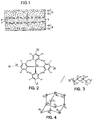
  • FIG. 1 is a schematic of a generalized solid-state battery for incorporating the composite electrolytes disclosed herein.
  • FIG. 2 shows the chemical structure of the tetrahedral perfluoroarylborate node according to one embodiment of the composite electrolytes disclosed herein.
  • FIG. 3 shows the chemical structure of a poly(ethylene glycol) (PEG) linker for linking the tetrahedral perfluoroarylborate node according to one embodiment of the composite electrolytes disclosed herein.
  • PEG poly(ethylene glycol)
  • FIG. 4 shows part of the three-dimensional aperiodic connectivity between the borate node of FIG. 2 and the linker of FIG. 3 .
  • FIG. 1 The general structure of a solid-state battery, such as a lithium-ion battery, is shown in FIG. 1 .
  • the battery includes a cathode 3 formed by a positive current collector 31 and an active material layer 32 and an anode 5 formed by a negative current collector 51 and an active material layer 52 .
  • a separator 4 is interposed between the cathode and anode to physically separate the opposing electrodes while permitting ion transfer therebetween.
  • An electrolyte 6 is also disposed between the cathode and anode and is configured to conduct ions therebetween.
  • the separator 4 is provided with openings or voids 7 to contain the electrolyte.
  • An electrolyte composite is composed of at least: 1) a single-ion conducting network polymer (t + >0.9) which may or may not also require a plasticizer; and 2) a linear polymer, which may or may not also be able to solvate metal cations such as Li + .
  • the electrolyte may also include conventional polymeric ionic conductors such as polyethylene oxide or polypropylene carbonate, salts such as lithium bis(trifluoromethane)sulfonimide (TFSI), and small molecule or oligomeric plasticizers such as propylene carbonate, ethylene carbonate, low-MW PEGs, tetraglyme, dimethyl sulfoxide, and the like.
  • the single-ion conducting network polymer comprises of a system of arylborate nodes connected with linkers.
  • the nodes are tetrahedral arylborate nodes, and more specifically tetrahedral perfluoroarylborate nodes.
  • the linkers may possess any suitable chemical structure with a topicity of two or higher, but example linkers include glycol, di- and tri-ethylene glycol, longer polyethylene glycols (PEG), 1,5-pentanediol, and linkers with structures as reported in the published application US2016/0315348 entitled “Polymer Network Single-Ion Conductors”, published on Oct. 27, 2016 in the name of applicant The Regents of the University of California (the '348 Publication).
  • a network polymer formed of tetrahedral perfluoroarylborate nodes and PEG linkers is another exemplary structure suitable for the composite electrolyte disclosed herein.
  • Such a network polymer is disclosed in published Application US2018/0166744 entitled “Polymer Network Single-Ion Conductors with Flexible Linker”, published on Jun. 14, 2018 in the name of The Regents of the University of California (the '744 Publication).
  • the structure of the nodes is shown in FIG. 2 , the linker in FIG. 3 and the combined three-dimensional structure in FIG. 4 .
  • This network polymer can be synthesized as disclosed in the '744 Publication.
  • the disclosures of the '348 Publication and the '744 Publication are incorporated herein in their entirety.
  • the linear polymer component of the present electrolyte composite can be any linear polymer.
  • This linear polymer may be, but is not necessarily, an ionic conductor, such as polyethylene oxide, polyethylene glycol, polyacrylonitrile, polypropylene, polypropylene carbonate or polycaprolactone or derivatives thereof.
  • a suitable non-ionically conductive polymer may be polystyrene or polyvinylidene fluoride.
  • the present disclosure further contemplates batteries and battery components made with the class of composite electrolytes described above.
  • Small-grained borate-based network polymers may be prepared by bath ultrasonication in an appropriate solvent such as DMF (dimethylformamide) and subsequently dried.
  • a well-mixed slurry of small-grained borate-based network polymer, PEO (polyethylene oxide), and LiTFSI (lithium bis(trifluoromethanesulfonyl)imide) may be prepared in a solvent such as NMP (N-methyl-2-pyrrolidone).
  • This slurry may be cast onto a TEFLON® (Polytetrafluoroethylene (PTFE)) substrate by a doctor blade. It may subsequently be dried at 50° C. and re-solvated, or the solvent replaced with an appropriate plasticizer such as PEG500 (polyethylene glycol).
  • TEFLON® Polytetrafluoroethylene (PTFE)
  • a well-mixed slurry of small-grained borate-based network polymer and polystyrene may be prepared in a solvent such as NMP.
  • This slurry may be cast onto a TEFLON® substrate by a doctor blade. It may subsequently be dried at 150° C. and re-solvated, or the solvent replaced with an appropriate plasticizer such as tetraglyme or propylene carbonate.
  • a well-mixed slurry of small-grained borate-based network polymer and polypropylene may be prepared in a solvent such as o-xylene.
  • This slurry may be cast onto a TEFLON® substrate by a doctor blade. It may subsequently be dried at 100° C. and re-solvated, or the solvent replaced with an appropriate plasticizer such as tetraglyme or propylene carbonate.
  • the resulting thin film electrolyte can be combined with conventional thin film electrode plates to form a battery.
  • the small-grained borate-based network polymer is formed of the linked tetrahedral perfluoroarylborate nodes described above.
  • the present disclosure contemplates a solid-state electrolyte containing at least a network polymer with tetrahedral arylborate nodes, and a linear polymer.
  • the nodes are tetrahedral perfluoroarylborate nodes and the linear polymer is polystyrene or polyvinylidene fluoride (PVDF).
  • the linear polymer is polyethylene oxide, polypropylene carbonate, polyacrylonitrile, or polycaprolactone.
  • the network polymer includes linkers of glycol, di- and tri-ethylene glycol, longer polyethylene glycols, or 1,5-pentanediol.
  • the composite electrolyte may be wetted with plasticizing agent(s) and/or include lithium salts suitable for use in a battery.
  • the present disclosure further contemplates a solid-state or gel battery comprising an electrolyte comprised of at least a network polymer with tetrahedral arylborate nodes, and a linear polymer.
  • the nodes are tetrahedral perfluoroarylborate nodes.
  • the disclosed electrolyte composition is in the cathode, and in particular the cathode active material.
  • the electrolyte is contained within the separator.
  • the battery can be constructed in accordance with known Li-ion batteries or in other subsequently developed forms.

Landscapes

  • Chemical & Material Sciences (AREA)
  • Engineering & Computer Science (AREA)
  • Electrochemistry (AREA)
  • Manufacturing & Machinery (AREA)
  • Chemical Kinetics & Catalysis (AREA)
  • General Chemical & Material Sciences (AREA)
  • Dispersion Chemistry (AREA)
  • General Physics & Mathematics (AREA)
  • Inorganic Chemistry (AREA)
  • Condensed Matter Physics & Semiconductors (AREA)
  • Physics & Mathematics (AREA)
  • Materials Engineering (AREA)
  • Conductive Materials (AREA)
  • Secondary Cells (AREA)

Abstract

Solid electrolytes have a favorable combination of properties such as high conductivity, high transference number, optimum processability, and low brittleness. A composite electrolyte includes some amount of a class of network polymer electrolytes with high transference number and high room temperature conductivity, and an additional polymeric component to contribute mechanical integrity and/or processability. The solid electrolytes can include a network polymer having linked nodes composed of a tetrahedral arylborate composition and a linear polymer combined with the network polymer as a composite. The solid electrolytes can be used in thin films and in solid-state batteries.

Description

PRIORITY CLAIM AND CROSS-REFERENCE TO PRIOR APPLICATION
This application is a utility filing from and claims priority to U.S. Provisional Application No. 62/539,207, filed on Jul. 31, 2017, the entire disclosure of which is incorporated herein by reference.
BACKGROUND
Since its first commercial release in the 1990s, the lithium-ion (Li-ion) battery has steadily improved to the point where it has become a staple component in electronic products. In recent years, the Li-ion battery has fostered the development of affordable electric and hybrid vehicles. However, commercial grade Li-ion cells are reaching their maximum energy storage capability (˜250 Wh/kg) and are still unable to provide a safe, low-cost battery with storage sufficient for electric vehicles with 100+ mile ranges. A new generation of batteries with energy densities of at least 400 Wh/kg, low cost (<$125/kWh), excellent safety, and low environmental impact is urgently needed.
Solid-state Li-ion cells have been recently developed that possess high energy densities (>400 Wh/kg) and very good safety properties. Up to now, one key factor inhibiting the commercialization of solid-state-cells is the lack of a suitable electrolyte. Existing candidate solid electrolytes have insufficient conductivities and low transference numbers (such as polymer electrolytes), poor processability and high boundary resistances (as in ceramic electrolytes), mechanical instability (as in gel based electrolytes) or severe chemical instabilities to air and water (as in electrolytes using sulfidic materials).
Blends or composites of multiple polymeric or oligomeric electrolytes have been investigated. However, these electrolytes have not gained wide acceptance primarily because different polymeric systems tend to have similar advantages and disadvantages thereby limiting the overall potential benefit of a blend. However, new classes of polymeric materials are emerging that possess properties similar to ceramics in many respects. These materials are single-ion conductors or nearly so, and have relatively high (>10−5 S cm−1) ionic conductivities at room temperature. Unlike ceramic solids, polymer/oligomer composites generally possess an open network that enables the composite electrolyte to take up liquids, plasticizers, or other compounds; indeed, some composites require these additional components to function. Along with this, the tunability and chemical structure of these polymers present an opportunity for distributed, high-surface area interfacial engineering.
Within the class of solid-state battery cells, it is desirable to use a polymer electrolyte to minimize (compared to ceramic electrolytes) the interfacial resistance between electrode materials and the electrolyte. Polymers tend to be more easily processed in air than ceramics and are more mechanically robust; their elasticity and lack of brittleness makes them ideal candidates for absorbing volume change. Polymers are also less dense than ceramics, thereby offering gains in specific energy. However, known Li-ion polymer electrolytes, such as polyethylene oxide (PEO), tend to have poor ionic conductivity at room temperature (<10−5 S cm−1). Moreover, conventional PEO electrolytes typically have low transference numbers (<0.3) at all temperatures of interest, which results in high concentration polarization and therefore low rate capability.
SUMMARY OF THE DISCLOSURE
There is a growing need for a commercially practical solid-state battery with improved storage capacity and safety. The present disclosure provides an electrolyte material containing, at least in part, a borate-based network polymer phase with a high transference number, and a polymeric phase which may conduct anions and/or cations, or which may serve only as a binder. This novel electrolyte material may also include one or more plasticizers. The resulting composite is a processable electrolyte with higher conductivity and higher transference number than would be achievable by conventional polymeric electrolytes (such as polyethylene oxide) alone. The electrolyte material disclosed herein represents a significant advance in the field of solid-state batteries.
The solid electrolyte materials disclosed herein provide high conductivity, high transference number, chemical stability, superior processability, and suitable mechanical properties. Use of these electrolytes will lead to increased rate capability as well as improved energy density by allowing thicker active material layers in polymeric solid-state batteries. In one aspect of the disclosure, a composite of multiple polymers is provided that includes at least one borate-based network polymer with a transference number t+>0.9.
The present disclosure contemplates the formation of thin films having high-transference number (>0.9), high-conductivity (at least >1×10⁻⁵ S cm−1 at room temperature and preferably >1×10⁻⁴ S cm−1) network polymer electrolytes in all solid-state cells, either (or both) as the catholyte (i.e., electrolyte integrated into cathode) and/or as the separator material. As well as having most of the advantages of polymeric electrolytes in general, these polymer materials are readily processable in dry air or air which overcomes many of the manufacturing limitations of present solid-state Li-ion or Li battery cells that use sulfides (sensitive to moisture and air) or garnets (sensitive to CO2). The polymer materials disclosed herein also have more reliable interfacial resistances as opposed to other known polymeric systems.
The present disclosure contemplates an electrolyte composite composed of at least: 1) a single-ion conducting network polymer having a transference number (or ion transfer number) t+>0.9); and 2) a linear polymer which may or may not also be able to solvate metal cations such as Li+. In one aspect, the single-ion conducting network polymer comprises of a system of tetrahedral arylborate nodes connected with linkers, and in particular tetrahedral perfluoroarylborate nodes.
DESCRIPTION OF THE DRAWINGS
FIG. 1 is a schematic of a generalized solid-state battery for incorporating the composite electrolytes disclosed herein.
FIG. 2 shows the chemical structure of the tetrahedral perfluoroarylborate node according to one embodiment of the composite electrolytes disclosed herein.
FIG. 3 shows the chemical structure of a poly(ethylene glycol) (PEG) linker for linking the tetrahedral perfluoroarylborate node according to one embodiment of the composite electrolytes disclosed herein.
FIG. 4 shows part of the three-dimensional aperiodic connectivity between the borate node of FIG. 2 and the linker of FIG. 3.
DETAILED DESCRIPTION
For the purposes of promoting an understanding of the principles of the disclosure, reference will now be made to the embodiments illustrated in the drawings and described in the following written specification. It is understood that no limitation to the scope of the disclosure is thereby intended. It is further understood that the present disclosure includes any alterations and modifications to the illustrated embodiments and includes further applications of the principles disclosed herein as would normally occur to one skilled in the art to which this disclosure pertains.
The general structure of a solid-state battery, such as a lithium-ion battery, is shown in FIG. 1. The battery includes a cathode 3 formed by a positive current collector 31 and an active material layer 32 and an anode 5 formed by a negative current collector 51 and an active material layer 52. A separator 4 is interposed between the cathode and anode to physically separate the opposing electrodes while permitting ion transfer therebetween. An electrolyte 6 is also disposed between the cathode and anode and is configured to conduct ions therebetween. In some batteries, the separator 4 is provided with openings or voids 7 to contain the electrolyte.
An electrolyte composite is composed of at least: 1) a single-ion conducting network polymer (t+>0.9) which may or may not also require a plasticizer; and 2) a linear polymer, which may or may not also be able to solvate metal cations such as Li+. The electrolyte may also include conventional polymeric ionic conductors such as polyethylene oxide or polypropylene carbonate, salts such as lithium bis(trifluoromethane)sulfonimide (TFSI), and small molecule or oligomeric plasticizers such as propylene carbonate, ethylene carbonate, low-MW PEGs, tetraglyme, dimethyl sulfoxide, and the like.
The single-ion conducting network polymer comprises of a system of arylborate nodes connected with linkers. In one embodiment the nodes are tetrahedral arylborate nodes, and more specifically tetrahedral perfluoroarylborate nodes. The linkers may possess any suitable chemical structure with a topicity of two or higher, but example linkers include glycol, di- and tri-ethylene glycol, longer polyethylene glycols (PEG), 1,5-pentanediol, and linkers with structures as reported in the published application US2016/0315348 entitled “Polymer Network Single-Ion Conductors”, published on Oct. 27, 2016 in the name of applicant The Regents of the University of California (the '348 Publication). A network polymer formed of tetrahedral perfluoroarylborate nodes and PEG linkers is another exemplary structure suitable for the composite electrolyte disclosed herein. Such a network polymer is disclosed in published Application US2018/0166744 entitled “Polymer Network Single-Ion Conductors with Flexible Linker”, published on Jun. 14, 2018 in the name of The Regents of the University of California (the '744 Publication). The structure of the nodes is shown in FIG. 2, the linker in FIG. 3 and the combined three-dimensional structure in FIG. 4. This network polymer can be synthesized as disclosed in the '744 Publication. The disclosures of the '348 Publication and the '744 Publication are incorporated herein in their entirety.
The linear polymer component of the present electrolyte composite can be any linear polymer. This linear polymer may be, but is not necessarily, an ionic conductor, such as polyethylene oxide, polyethylene glycol, polyacrylonitrile, polypropylene, polypropylene carbonate or polycaprolactone or derivatives thereof. A suitable non-ionically conductive polymer may be polystyrene or polyvinylidene fluoride.
The present disclosure further contemplates batteries and battery components made with the class of composite electrolytes described above.
The fabrication of specific examples of electrolyte thin films is described herein, but it is understood that these descriptions do not limit the scope of the invention in any way. Small-grained borate-based network polymers may be prepared by bath ultrasonication in an appropriate solvent such as DMF (dimethylformamide) and subsequently dried.
In a first example, a well-mixed slurry of small-grained borate-based network polymer, PEO (polyethylene oxide), and LiTFSI (lithium bis(trifluoromethanesulfonyl)imide) may be prepared in a solvent such as NMP (N-methyl-2-pyrrolidone). This slurry may be cast onto a TEFLON® (Polytetrafluoroethylene (PTFE)) substrate by a doctor blade. It may subsequently be dried at 50° C. and re-solvated, or the solvent replaced with an appropriate plasticizer such as PEG500 (polyethylene glycol).
In a second example, a well-mixed slurry of small-grained borate-based network polymer and polystyrene may be prepared in a solvent such as NMP. This slurry may be cast onto a TEFLON® substrate by a doctor blade. It may subsequently be dried at 150° C. and re-solvated, or the solvent replaced with an appropriate plasticizer such as tetraglyme or propylene carbonate.
In a third example, a well-mixed slurry of small-grained borate-based network polymer and polypropylene may be prepared in a solvent such as o-xylene. This slurry may be cast onto a TEFLON® substrate by a doctor blade. It may subsequently be dried at 100° C. and re-solvated, or the solvent replaced with an appropriate plasticizer such as tetraglyme or propylene carbonate.
In each example, the resulting thin film electrolyte can be combined with conventional thin film electrode plates to form a battery. In each example, the small-grained borate-based network polymer is formed of the linked tetrahedral perfluoroarylborate nodes described above.
The present disclosure contemplates a solid-state electrolyte containing at least a network polymer with tetrahedral arylborate nodes, and a linear polymer. In certain aspects, the nodes are tetrahedral perfluoroarylborate nodes and the linear polymer is polystyrene or polyvinylidene fluoride (PVDF). In other aspects, the linear polymer is polyethylene oxide, polypropylene carbonate, polyacrylonitrile, or polycaprolactone. In a further feature, the network polymer includes linkers of glycol, di- and tri-ethylene glycol, longer polyethylene glycols, or 1,5-pentanediol. The composite electrolyte may be wetted with plasticizing agent(s) and/or include lithium salts suitable for use in a battery.
The present disclosure further contemplates a solid-state or gel battery comprising an electrolyte comprised of at least a network polymer with tetrahedral arylborate nodes, and a linear polymer. In certain aspects, the nodes are tetrahedral perfluoroarylborate nodes. In one aspect, the disclosed electrolyte composition is in the cathode, and in particular the cathode active material. In another aspect the electrolyte is contained within the separator. The battery can be constructed in accordance with known Li-ion batteries or in other subsequently developed forms.
The present disclosure should be considered as illustrative and not restrictive in character. It is understood that only certain embodiments have been presented and that all changes, modifications and further applications that come within the spirit of the disclosure are desired to be protected.

Claims (20)

What is claimed is:
1. A solid-state electrolyte for a battery comprising:
a network polymer having linked nodes composed of a tetrahedral arylborate composition; and
a linear polymer combined with said network polymer as a composite.
2. The solid-state electrolyte of claim 1, wherein said tetrahedral arylborate composition is a tetrahedral perfluoroarylborate.
3. The solid-state electrolyte of claim 1, wherein the linear polymer is polystyrene or polyvinylidene fluoride.
4. The solid-state electrolyte of claim 1, wherein the linear polymer is selected from the group consisting of polyethylene oxide, polypropylene carbonate, polyacrylonitrile, and polycaprolactone.
5. The solid-state electrolyte of claim 1, wherein the network polymer includes linkers for linking the tetrahedral arylborate composition nodes, the linkers selected from the group consisting of glycol, di-ethylene glycol, tri-ethylene glycol, longer polyethylene glycols, and 1,5-pentanediol.
6. The solid-state electrolyte of claim 1, wherein the composite is wetted with one or more plasticizing agents.
7. The solid-state electrolyte of claim 1, wherein the composite includes lithium salts.
8. A solid-state or gel battery comprising:
an anode;
a cathode;
a separator between said anode and said cathode; and
a composite electrolyte comprising;
a network polymer having linked nodes composed of a tetrahedral arylborate composition; and
a linear polymer combined with said network polymer as a composite, wherein said composite electrolyte is in the separator.
9. The solid-state electrolyte of claim 8, wherein said tetrahedral arylborate composition is tetrahedral perfluoroarylborate.
10. The solid-state electrolyte of claim 8, wherein the linear polymer is polystyrene or polyvinylidene fluoride.
11. The solid-state electrolyte of claim 8, wherein the linear polymer is selected from the group consisting of polyethylene oxide, polypropylene carbonate, polyacrylonitrile, and polycaprolactone.
12. The solid-state electrolyte of claim 8, wherein the network polymer includes linkers for linking the tetrahedral arylborate composition nodes, the linkers selected from the group consisting of glycol, di-ethylene glycol, tri-ethylene glycol, longer polyethylene glycols, and 1,5-pentanediol.
13. The solid-state electrolyte of claim 8, wherein the composite is wetted with one or more plasticizing agents.
14. The solid-state electrolyte of claim 8, wherein the composite includes lithium salts.
15. A solid-state or gel battery comprising:
an anode;
a cathode; and
a composite electrolyte comprising;
a network polymer having linked nodes composed of a tetrahedral arylborate composition; and
a linear polymer combined with said network polymer as a composite, wherein the composite electrolyte is in the cathode.
16. The solid-state electrolyte of claim 15, wherein said tetrahedral arylborate composition is tetrahedral perfluoroarylborate.
17. The solid-state electrolyte of claim 15, wherein the linear polymer is polystyrene or polyvinylidene fluoride.
18. The solid-state electrolyte of claim 15, wherein the linear polymer is selected from the group consisting of polyethylene oxide, polypropylene carbonate, polyacrylonitrile, and polycaprolactone.
19. The solid-state electrolyte of claim 15, wherein the network polymer includes linkers for linking the tetrahedral arylborate composition nodes, the linkers selected from the group consisting of glycol, di-ethylene glycol, tri-ethylene glycol, longer polyethylene glycols, and 1,5-pentanediol.
20. The solid-state electrolyte of claim 15, wherein the composite includes lithium salts.
US16/049,911 2017-07-31 2018-07-31 Batteries with polymer electrolyte composites based on tetrahedral arylborate nodes Active 2038-11-15 US10804565B2 (en)

Priority Applications (1)

Application Number Priority Date Filing Date Title
US16/049,911 US10804565B2 (en) 2017-07-31 2018-07-31 Batteries with polymer electrolyte composites based on tetrahedral arylborate nodes

Applications Claiming Priority (2)

Application Number Priority Date Filing Date Title
US201762539207P 2017-07-31 2017-07-31
US16/049,911 US10804565B2 (en) 2017-07-31 2018-07-31 Batteries with polymer electrolyte composites based on tetrahedral arylborate nodes

Publications (2)

Publication Number Publication Date
US20190051938A1 US20190051938A1 (en) 2019-02-14
US10804565B2 true US10804565B2 (en) 2020-10-13

Family

ID=65233056

Family Applications (1)

Application Number Title Priority Date Filing Date
US16/049,911 Active 2038-11-15 US10804565B2 (en) 2017-07-31 2018-07-31 Batteries with polymer electrolyte composites based on tetrahedral arylborate nodes

Country Status (4)

Country Link
US (1) US10804565B2 (en)
CN (1) CN110915050B (en)
DE (1) DE112018003878T5 (en)
WO (1) WO2019027977A2 (en)

Families Citing this family (4)

* Cited by examiner, † Cited by third party
Publication number Priority date Publication date Assignee Title
KR102195086B1 (en) * 2019-08-28 2020-12-24 성균관대학교산학협력단 Solid electrolyte and manufacturing method for the same
CN111934006B (en) * 2020-07-23 2021-09-21 深圳技术大学 Intrinsically microporous polyaluminum/borate solid electrolytes and batteries
US20230335791A1 (en) * 2020-12-24 2023-10-19 Lg Energy Solution, Ltd. Composition for electrolyte of lithium secondary battery, gel polymer electrolyte, and lithium secondary battery including gel polymer electrolyte
CN114566705A (en) * 2022-02-28 2022-05-31 中国科学院重庆绿色智能技术研究院 Preparation method of polymer solid electrolyte of lithium metal battery

Citations (11)

* Cited by examiner, † Cited by third party
Publication number Priority date Publication date Assignee Title
JP2003092138A (en) * 2001-09-17 2003-03-28 Yuasa Corp Polymer solid electrolyte and polymer solid electrolyte lithium battery
US20140106236A1 (en) * 2011-06-30 2014-04-17 Lg Chem, Ltd. Novel polymer electrolyte and lithium secondary battery including the same
US20140287305A1 (en) * 2013-03-21 2014-09-25 Eric D. Wachsman Ion conducting batteries with solid state electrolyte materials
US9219271B2 (en) * 2004-07-27 2015-12-22 Oxis Energy Limited Battery electrode structure
US20160049690A1 (en) * 2013-03-19 2016-02-18 Council Of Scientic & Industrial Reserach High-ionic conductivity electrolyte compositions comprising semi-interpenetrating polymer networks and their composites
US20160315348A1 (en) 2013-12-08 2016-10-27 The Regents Of The University Of California Polymer network single ion conductors
WO2016201335A1 (en) 2015-06-10 2016-12-15 The Regents Of The University Of California Polymer network single-ion conductors with flexible linker
KR20170053577A (en) * 2015-11-06 2017-05-16 에프이아이 컴파니 Improved method of material deposition
US20190067757A1 (en) * 2015-11-06 2019-02-28 Robert Bosch Gmbh Method for operating a battery, and battery
US20190135988A1 (en) * 2017-03-03 2019-05-09 Blue Current, Inc. Polymerized in-situ hybrid solid ion-conductive compositions
US20190326578A1 (en) * 2016-12-07 2019-10-24 Sepion Technologies, Inc. Microstructured ion-conducting composites and uses thereof

Family Cites Families (6)

* Cited by examiner, † Cited by third party
Publication number Priority date Publication date Assignee Title
CN1037728C (en) * 1991-06-04 1998-03-11 中国科学院物理研究所 Mixed-phase solid electrolyte all-solid-state room temperature lithium battery and preparation method thereof
DE69404602T2 (en) * 1993-10-07 1998-01-29 Matsushita Electric Ind Co Ltd Manufacturing method of a separator for a lithium secondary battery and a lithium secondary battery with organic electrolyte using such a separator
US6022643A (en) * 1997-12-08 2000-02-08 Brookhaven Science Associates Boron compounds as anion binding agents for nonaqueous battery electrolytes
US6645675B1 (en) * 1999-09-02 2003-11-11 Lithium Power Technologies, Inc. Solid polymer electrolytes
JP2001176479A (en) * 1999-12-16 2001-06-29 Nitto Denko Corp Porous membrane for separator for electrochemical device
CN101891848B (en) * 2010-07-06 2012-10-31 上海纳米技术及应用国家工程研究中心有限公司 Polyvinyl alcohol-based single ion polymer electrolyte and preparation method thereof

Patent Citations (13)

* Cited by examiner, † Cited by third party
Publication number Priority date Publication date Assignee Title
JP2003092138A (en) * 2001-09-17 2003-03-28 Yuasa Corp Polymer solid electrolyte and polymer solid electrolyte lithium battery
US9219271B2 (en) * 2004-07-27 2015-12-22 Oxis Energy Limited Battery electrode structure
US20140106236A1 (en) * 2011-06-30 2014-04-17 Lg Chem, Ltd. Novel polymer electrolyte and lithium secondary battery including the same
US20160049690A1 (en) * 2013-03-19 2016-02-18 Council Of Scientic & Industrial Reserach High-ionic conductivity electrolyte compositions comprising semi-interpenetrating polymer networks and their composites
US20140287305A1 (en) * 2013-03-21 2014-09-25 Eric D. Wachsman Ion conducting batteries with solid state electrolyte materials
US9960447B2 (en) * 2013-12-08 2018-05-01 The Regents Of The University Of California Polymer network single ion conductors
US20160315348A1 (en) 2013-12-08 2016-10-27 The Regents Of The University Of California Polymer network single ion conductors
WO2016201335A1 (en) 2015-06-10 2016-12-15 The Regents Of The University Of California Polymer network single-ion conductors with flexible linker
US20180166744A1 (en) * 2015-06-10 2018-06-14 The Regents Of The University Of California Polymer network single-ion conductors with flexible linker
KR20170053577A (en) * 2015-11-06 2017-05-16 에프이아이 컴파니 Improved method of material deposition
US20190067757A1 (en) * 2015-11-06 2019-02-28 Robert Bosch Gmbh Method for operating a battery, and battery
US20190326578A1 (en) * 2016-12-07 2019-10-24 Sepion Technologies, Inc. Microstructured ion-conducting composites and uses thereof
US20190135988A1 (en) * 2017-03-03 2019-05-09 Blue Current, Inc. Polymerized in-situ hybrid solid ion-conductive compositions

Non-Patent Citations (5)

* Cited by examiner, † Cited by third party
Title
International Search Report and Written Opinion corresponding to International Patent Application No. PCT/US2018/044541 (12 pages).
Liang, S. et al., "Synthesis and Lithium Ion Conduction of Polysiloxane Single-Ion Conductors Containing Novel Weak-Binding Borates," Chemistry of Materials, vol. 24, 2316-2323, 2012 (8 pages).
Machine translation of KR 10-2017-0053577 (no date). *
Van Humbeck, J. F. et al., "Tetraarylborate polymer networks as a single-ion conducting solid electrolytes," Chemical Science, vol. 6, 5499-5505, 2015 (7 pages).
Zhang, Y. et al., "A class of sp3 boron-based single-ion polymeric electrolytes for lithium ion batteries," RSC Advances, vol. 3, 14934-14937, 2013 (4 pages).

Also Published As

Publication number Publication date
CN110915050B (en) 2023-06-27
US20190051938A1 (en) 2019-02-14
WO2019027977A2 (en) 2019-02-07
WO2019027977A3 (en) 2019-05-09
DE112018003878T5 (en) 2020-04-23
CN110915050A (en) 2020-03-24

Similar Documents

Publication Publication Date Title
Fan et al. Tailoring inorganic–polymer composites for the mass production of solid-state batteries
Liu et al. Designing polymer‐in‐salt electrolyte and fully infiltrated 3D electrode for integrated solid‐state lithium batteries
Chen et al. Functional additives for solid polymer electrolytes in flexible and high‐energy‐density solid‐state lithium‐ion batteries
Li et al. Polymers in lithium‐ion and lithium metal batteries
US10923766B2 (en) Hybrid solid electrolyte for secondary battery and manufacturing method thereof
US10622672B2 (en) Ceramic-polymer composite electrolytes for lithium polymer batteries
Shan et al. Polymer electrolytes with high cation transport number for rechargeable Li–metal batteries: current status and future direction
CN108886164B (en) A composite electrolyte for secondary battery with multi-layer structure
KR102714277B1 (en) Hybrid composite solid-state electrolyte for electrochemical cells
US10804565B2 (en) Batteries with polymer electrolyte composites based on tetrahedral arylborate nodes
Mu et al. Solid-state polymer electrolytes in lithium batteries: latest progress and perspective
Aliahmad et al. Poly (vinylidene fluoride-hexafluoropropylene) polymer electrolyte for paper-based and flexible battery applications
Xin et al. A cross-linked poly (ethylene oxide)-based electrolyte for all-solid-state lithium metal batteries with long cycling stability
Austin Suthanthiraraj et al. Nanocomposite polymer electrolytes
JP2018528567A (en) Solid polymer electrolyte
Lewandowski et al. Li+ conducting polymer electrolyte based on ionic liquid for lithium and lithium-ion batteries
Liu et al. Zwitterionic poly (ionic liquids)-based polymer electrolytes for Lithium-ion batteries applications
Babu et al. Quasi-gel polymer electrolyte interfaced with electrodes through solvent-swollen poly (ethylene oxide) for high-performance lithium/lithium-ion batteries
Pavithra et al. Influence of graphene oxide on the membrane characteristics of PVDF-HFP as an electrolyte for lithium-based energy storage devices
KR101218288B1 (en) Method for developing an electrochemical device
KR102575109B1 (en) Solid-state batteries based on ion-conducting matrices composed of camphor or 2-adamantanone
Balaji T et al. Polymer-Based Solid-State Electrolytes For Lithium–Sulfur Batteries
Cao et al. Solid-state batteries based on composite polymer electrolytes
Kim Gel Polymer Electrolytes
KR20170132119A (en) Composite electrolyte having multilayers for secondary batteries

Legal Events

Date Code Title Description
FEPP Fee payment procedure

Free format text: ENTITY STATUS SET TO UNDISCOUNTED (ORIGINAL EVENT CODE: BIG.); ENTITY STATUS OF PATENT OWNER: LARGE ENTITY

STPP Information on status: patent application and granting procedure in general

Free format text: DOCKETED NEW CASE - READY FOR EXAMINATION

AS Assignment

Owner name: ROBERT BOSCH GMBH, GERMANY

Free format text: ASSIGNMENT OF ASSIGNORS INTEREST;ASSIGNORS:HELLSTROM, SONDRA;ABRAM, DAVID;CHRISTENSEN, JOHN F.;SIGNING DATES FROM 20190115 TO 20190118;REEL/FRAME:048111/0433

STPP Information on status: patent application and granting procedure in general

Free format text: NON FINAL ACTION MAILED

STPP Information on status: patent application and granting procedure in general

Free format text: RESPONSE TO NON-FINAL OFFICE ACTION ENTERED AND FORWARDED TO EXAMINER

STPP Information on status: patent application and granting procedure in general

Free format text: NOTICE OF ALLOWANCE MAILED -- APPLICATION RECEIVED IN OFFICE OF PUBLICATIONS

STPP Information on status: patent application and granting procedure in general

Free format text: AWAITING TC RESP., ISSUE FEE NOT PAID

STPP Information on status: patent application and granting procedure in general

Free format text: PUBLICATIONS -- ISSUE FEE PAYMENT RECEIVED

STCF Information on status: patent grant

Free format text: PATENTED CASE

MAFP Maintenance fee payment

Free format text: PAYMENT OF MAINTENANCE FEE, 4TH YEAR, LARGE ENTITY (ORIGINAL EVENT CODE: M1551); ENTITY STATUS OF PATENT OWNER: LARGE ENTITY

Year of fee payment: 4