US10800480B2 - Hydraulic operating device - Google Patents

Hydraulic operating device Download PDF

Info

Publication number
US10800480B2
US10800480B2 US16/131,084 US201816131084A US10800480B2 US 10800480 B2 US10800480 B2 US 10800480B2 US 201816131084 A US201816131084 A US 201816131084A US 10800480 B2 US10800480 B2 US 10800480B2
Authority
US
United States
Prior art keywords
hose
center axis
mount
operating device
attachment hole
Prior art date
Legal status (The legal status is an assumption and is not a legal conclusion. Google has not performed a legal analysis and makes no representation as to the accuracy of the status listed.)
Active, expires
Application number
US16/131,084
Other versions
US20200086944A1 (en
Inventor
Yusuke Nishikawa
Takuma Sakai
Nobuyoshi Fujii
Yoshimitsu Miki
Masahiro Nakakura
Current Assignee (The listed assignees may be inaccurate. Google has not performed a legal analysis and makes no representation or warranty as to the accuracy of the list.)
Shimano Inc
Original Assignee
Shimano Inc
Priority date (The priority date is an assumption and is not a legal conclusion. Google has not performed a legal analysis and makes no representation as to the accuracy of the date listed.)
Filing date
Publication date
Application filed by Shimano Inc filed Critical Shimano Inc
Priority to US16/131,084 priority Critical patent/US10800480B2/en
Assigned to SHIMANO INC. reassignment SHIMANO INC. ASSIGNMENT OF ASSIGNORS INTEREST (SEE DOCUMENT FOR DETAILS). Assignors: Nakakura, Masahiro, FUJII, NOBUYOSHI, MIKI, YOSHIMITSU, NISHIKAWA, YUSUKE, SAKAI, TAKUMA
Priority to TW108126168A priority patent/TWI807074B/en
Priority to CN201910811056.8A priority patent/CN110901818B/en
Priority to DE102019213364.9A priority patent/DE102019213364A1/en
Publication of US20200086944A1 publication Critical patent/US20200086944A1/en
Application granted granted Critical
Publication of US10800480B2 publication Critical patent/US10800480B2/en
Active legal-status Critical Current
Adjusted expiration legal-status Critical

Links

Images

Classifications

    • BPERFORMING OPERATIONS; TRANSPORTING
    • B62LAND VEHICLES FOR TRAVELLING OTHERWISE THAN ON RAILS
    • B62LBRAKES SPECIALLY ADAPTED FOR CYCLES
    • B62L3/00Brake-actuating mechanisms; Arrangements thereof
    • B62L3/02Brake-actuating mechanisms; Arrangements thereof for control by a hand lever
    • B62L3/023Brake-actuating mechanisms; Arrangements thereof for control by a hand lever acting on fluid pressure systems
    • BPERFORMING OPERATIONS; TRANSPORTING
    • B60VEHICLES IN GENERAL
    • B60TVEHICLE BRAKE CONTROL SYSTEMS OR PARTS THEREOF; BRAKE CONTROL SYSTEMS OR PARTS THEREOF, IN GENERAL; ARRANGEMENT OF BRAKING ELEMENTS ON VEHICLES IN GENERAL; PORTABLE DEVICES FOR PREVENTING UNWANTED MOVEMENT OF VEHICLES; VEHICLE MODIFICATIONS TO FACILITATE COOLING OF BRAKES
    • B60T11/00Transmitting braking action from initiating means to ultimate brake actuator without power assistance or drive or where such assistance or drive is irrelevant
    • B60T11/10Transmitting braking action from initiating means to ultimate brake actuator without power assistance or drive or where such assistance or drive is irrelevant transmitting by fluid means, e.g. hydraulic
    • B60T11/16Master control, e.g. master cylinders
    • BPERFORMING OPERATIONS; TRANSPORTING
    • B60VEHICLES IN GENERAL
    • B60TVEHICLE BRAKE CONTROL SYSTEMS OR PARTS THEREOF; BRAKE CONTROL SYSTEMS OR PARTS THEREOF, IN GENERAL; ARRANGEMENT OF BRAKING ELEMENTS ON VEHICLES IN GENERAL; PORTABLE DEVICES FOR PREVENTING UNWANTED MOVEMENT OF VEHICLES; VEHICLE MODIFICATIONS TO FACILITATE COOLING OF BRAKES
    • B60T11/00Transmitting braking action from initiating means to ultimate brake actuator without power assistance or drive or where such assistance or drive is irrelevant
    • B60T11/10Transmitting braking action from initiating means to ultimate brake actuator without power assistance or drive or where such assistance or drive is irrelevant transmitting by fluid means, e.g. hydraulic
    • B60T11/16Master control, e.g. master cylinders
    • B60T11/165Single master cylinders for pressurised systems
    • BPERFORMING OPERATIONS; TRANSPORTING
    • B60VEHICLES IN GENERAL
    • B60TVEHICLE BRAKE CONTROL SYSTEMS OR PARTS THEREOF; BRAKE CONTROL SYSTEMS OR PARTS THEREOF, IN GENERAL; ARRANGEMENT OF BRAKING ELEMENTS ON VEHICLES IN GENERAL; PORTABLE DEVICES FOR PREVENTING UNWANTED MOVEMENT OF VEHICLES; VEHICLE MODIFICATIONS TO FACILITATE COOLING OF BRAKES
    • B60T7/00Brake-action initiating means
    • B60T7/02Brake-action initiating means for personal initiation
    • B60T7/08Brake-action initiating means for personal initiation hand actuated
    • B60T7/10Disposition of hand control
    • BPERFORMING OPERATIONS; TRANSPORTING
    • B60VEHICLES IN GENERAL
    • B60TVEHICLE BRAKE CONTROL SYSTEMS OR PARTS THEREOF; BRAKE CONTROL SYSTEMS OR PARTS THEREOF, IN GENERAL; ARRANGEMENT OF BRAKING ELEMENTS ON VEHICLES IN GENERAL; PORTABLE DEVICES FOR PREVENTING UNWANTED MOVEMENT OF VEHICLES; VEHICLE MODIFICATIONS TO FACILITATE COOLING OF BRAKES
    • B60T7/00Brake-action initiating means
    • B60T7/02Brake-action initiating means for personal initiation
    • B60T7/08Brake-action initiating means for personal initiation hand actuated
    • B60T7/10Disposition of hand control
    • B60T7/102Disposition of hand control by means of a tilting lever
    • BPERFORMING OPERATIONS; TRANSPORTING
    • B62LAND VEHICLES FOR TRAVELLING OTHERWISE THAN ON RAILS
    • B62KCYCLES; CYCLE FRAMES; CYCLE STEERING DEVICES; RIDER-OPERATED TERMINAL CONTROLS SPECIALLY ADAPTED FOR CYCLES; CYCLE AXLE SUSPENSIONS; CYCLE SIDE-CARS, FORECARS, OR THE LIKE
    • B62K23/00Rider-operated controls specially adapted for cycles, i.e. means for initiating control operations, e.g. levers, grips
    • B62K23/02Rider-operated controls specially adapted for cycles, i.e. means for initiating control operations, e.g. levers, grips hand actuated
    • B62K23/06Levers
    • BPERFORMING OPERATIONS; TRANSPORTING
    • B62LAND VEHICLES FOR TRAVELLING OTHERWISE THAN ON RAILS
    • B62LBRAKES SPECIALLY ADAPTED FOR CYCLES
    • B62L1/00Brakes; Arrangements thereof
    • B62L1/005Brakes; Arrangements thereof constructional features of brake elements, e.g. fastening of brake blocks in their holders
    • BPERFORMING OPERATIONS; TRANSPORTING
    • B62LAND VEHICLES FOR TRAVELLING OTHERWISE THAN ON RAILS
    • B62LBRAKES SPECIALLY ADAPTED FOR CYCLES
    • B62L3/00Brake-actuating mechanisms; Arrangements thereof
    • B62L3/02Brake-actuating mechanisms; Arrangements thereof for control by a hand lever
    • B62L3/026Brake-actuating mechanisms; Arrangements thereof for control by a hand lever actuation by a turning handle or handlebar
    • FMECHANICAL ENGINEERING; LIGHTING; HEATING; WEAPONS; BLASTING
    • F16ENGINEERING ELEMENTS AND UNITS; GENERAL MEASURES FOR PRODUCING AND MAINTAINING EFFECTIVE FUNCTIONING OF MACHINES OR INSTALLATIONS; THERMAL INSULATION IN GENERAL
    • F16DCOUPLINGS FOR TRANSMITTING ROTATION; CLUTCHES; BRAKES
    • F16D55/00Brakes with substantially-radial braking surfaces pressed together in axial direction, e.g. disc brakes
    • F16D55/02Brakes with substantially-radial braking surfaces pressed together in axial direction, e.g. disc brakes with axially-movable discs or pads pressed against axially-located rotating members
    • F16D55/22Brakes with substantially-radial braking surfaces pressed together in axial direction, e.g. disc brakes with axially-movable discs or pads pressed against axially-located rotating members by clamping an axially-located rotating disc between movable braking members, e.g. movable brake discs or brake pads
    • F16D55/228Brakes with substantially-radial braking surfaces pressed together in axial direction, e.g. disc brakes with axially-movable discs or pads pressed against axially-located rotating members by clamping an axially-located rotating disc between movable braking members, e.g. movable brake discs or brake pads with a separate actuating member for each side
    • FMECHANICAL ENGINEERING; LIGHTING; HEATING; WEAPONS; BLASTING
    • F16ENGINEERING ELEMENTS AND UNITS; GENERAL MEASURES FOR PRODUCING AND MAINTAINING EFFECTIVE FUNCTIONING OF MACHINES OR INSTALLATIONS; THERMAL INSULATION IN GENERAL
    • F16DCOUPLINGS FOR TRANSMITTING ROTATION; CLUTCHES; BRAKES
    • F16D55/00Brakes with substantially-radial braking surfaces pressed together in axial direction, e.g. disc brakes
    • F16D2055/0004Parts or details of disc brakes
    • F16D2055/0016Brake calipers
    • F16D2055/0025Brake calipers comprising a flat frame member
    • FMECHANICAL ENGINEERING; LIGHTING; HEATING; WEAPONS; BLASTING
    • F16ENGINEERING ELEMENTS AND UNITS; GENERAL MEASURES FOR PRODUCING AND MAINTAINING EFFECTIVE FUNCTIONING OF MACHINES OR INSTALLATIONS; THERMAL INSULATION IN GENERAL
    • F16DCOUPLINGS FOR TRANSMITTING ROTATION; CLUTCHES; BRAKES
    • F16D2121/00Type of actuator operation force
    • F16D2121/02Fluid pressure
    • F16D2121/04Fluid pressure acting on a piston-type actuator, e.g. for liquid pressure

Definitions

  • the present invention relates to a hydraulic operating device.
  • a human-powered vehicle includes a hydraulic system configured to operate a hydraulic component.
  • a hydraulic operating device comprises a base member, an operating member, a piston, and a mounting member.
  • the base member includes a cylinder bore, a first hose-attachment hole, and a second hose-attachment hole.
  • the first hose-attachment hole is configured to be in fluid communication with the cylinder bore.
  • the second hose-attachment hole is configured to be in fluid communication with the cylinder bore.
  • the operating member is pivotally coupled to the base member about a pivot axis.
  • the piston is movably provided in the cylinder bore and is operatively coupled to the operating member to move relative to the base member in response to a pivotal movement of the operating member.
  • the mounting member is configured to couple the base member to a handlebar.
  • the mounting member includes a mount opening through which the handlebar is to extend.
  • the first hose-attachment hole, the second hose-attachment hole, and the mount opening are provided on a reference plane perpendicular to the pivot axis.
  • the hydraulic operating device With the hydraulic operating device according to the first aspect, it is possible to utilize the base member as both a left-hand side operating device and a right-hand side operating device. This can reduce a manufacturing cost of the hydraulic operating device.
  • the hydraulic operating device is configured so that the mount opening has a mount center axis included in the reference plane.
  • the hydraulic operating device With the hydraulic operating device according to the second aspect, it is possible to utilize the mounting member as both the left-hand side operating device and the right-hand side operating device. This can further reduce the manufacturing cost of the hydraulic operating device.
  • the hydraulic operating device according to the first or second aspect is configured so that the first hose-attachment hole has a first center axis included in the reference plane.
  • the hydraulic operating device according to any one of the first to third aspects is configured so that the second hose-attachment hole has a second center axis included in the reference plane.
  • the hydraulic operating device according to any one of the first to fourth aspects is configured so that the cylinder bore has a cylinder center axis included in the reference plane.
  • the hydraulic operating device according to any one of the first to fifth aspects is configured so that the base member has a symmetric shape relative to the reference plane.
  • the hydraulic operating device according to any one of the first to sixth aspects is configured so that the mount opening has a symmetric shape relative to the reference plane.
  • the hydraulic operating device according to any one of the first to seventh aspects is configured so that the operating member has a symmetric shape relative to the reference plane.
  • the hydraulic operating device according to any one of the first to seventh aspects is configured so that the base member includes an additional hole configured to be in fluid communication with the cylinder bore.
  • the hydraulic operating device is configured so that the additional hole includes an additional opening having an additional center axis included in the reference plane.
  • the hydraulic operating device according to the ninth or tenth aspect is configured so that the cylinder center axis is provided between the first hose-attachment hole and the additional hole as viewed along the pivot axis.
  • the hydraulic operating device according to any one of the ninth to eleventh aspects further comprises a plug threadedly engaged with the additional hole.
  • the hydraulic operating device according to any one of the first to twelfth aspects is configured so that the mount opening has a mount center axis. At least one of the first hose-attachment hole and the second hose-attachment hole faces toward the mount center axis of the mount opening as viewed along the pivot axis.
  • the hydraulic operating device is configured so that the mount opening has a mount center axis.
  • the first hose-attachment hole and the second hose-attachment hole are closer to the mount center axis than the pivot axis in a perpendicular direction perpendicular to both the pivot axis and the mount center axis.
  • the hydraulic operating device is configured so that the mount opening has a mount center axis.
  • the first hose-attachment hole and the second hose-attachment hole are provided between the pivot axis and the mount center axis in a perpendicular direction perpendicular to both the pivot axis and the mount center axis.
  • the hydraulic operating device according to any one of the first to fifteenth aspects is configured so that the mount opening has a mount center axis.
  • the first hose-attachment hole is provided between the pivot axis and the second hose-attachment hole in a mount axis direction parallel to the mount center axis.
  • the hydraulic operating device is configured so that the mount opening has a mount center axis.
  • the cylinder bore has a cylinder center axis.
  • the cylinder center axis is non-perpendicular to the mount center axis as viewed along the pivot axis.
  • the hydraulic operating device is configured so that the mount opening has a mount center axis.
  • the cylinder bore has a cylinder center axis.
  • the cylinder center axis is non-parallel to the mount center axis as viewed along the pivot axis.
  • the hydraulic operating device is configured so that the mount opening has a mount center axis.
  • the base member includes a support portion configured to contact an outer circumferential surface of the handlebar without clamping the handlebar in a mounting state where the handlebar extends through the mount opening of the mounting member.
  • the support portion is spaced apart from the mounting member in a mount axis direction parallel to the mount center axis.
  • the support portion can improve stability of the orientation of the base member relative to the handlebar in the mounting state.
  • the hydraulic operating device is configured so that the support portion includes a groove through which a hydraulic hose attached to one of the first hose-attachment hole and the second hose-attachment hole is to extend in the mounting state.
  • the support portion can improve stability of the hydraulic hose relative to the handlebar in the mounting state with improving stability of the orientation of the base member relative to the handlebar.
  • FIG. 1 is a schematic perspective view of a part of a human-powered vehicle including a hydraulic operating device in accordance with an embodiment.
  • FIG. 2 is a cross-sectional view of an additional hydraulic operating device of the human-powered vehicle illustrated in FIG. 1 .
  • FIG. 3 is a cross-sectional view of the hydraulic operated device of the human-powered vehicle illustrated in FIG. 1 .
  • FIG. 4 is a top view of the hydraulic operating device of the human-powered vehicle illustrated in FIG. 1 .
  • FIG. 5 is a cross-sectional view of the hydraulic operating device taken along line V-V of FIG. 4 .
  • FIG. 6 is a side elevational view of the hydraulic operating device of the human-powered vehicle illustrated in FIG. 1 .
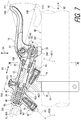
  • FIG. 7 is a cross-sectional view of the hydraulic operating device taken along line VII-VII of FIG. 6 .
  • FIG. 8 is a partial enlarged cross-sectional view of the hydraulic operating device illustrated in FIG. 7 .
  • FIG. 9 is a cross-sectional view of the hydraulic operating device taken along line IX-IX of FIG. 8 .
  • FIG. 10 is a partial enlarged perspective cross-sectional view around an additional opening of a base member in the hydraulic operating device.
  • FIG. 11 is another side elevational view of the hydraulic operating device of the human-powered vehicle illustrated in FIG. 1 .
  • FIG. 12 is a cross-sectional view of the hydraulic operating device taken along line XII-XII of FIG. 7 .
  • FIG. 13 is a rear view of the hydraulic operating device of the human-powered vehicle illustrated in FIG. 1 .
  • FIG. 14 is a front view of the hydraulic operating device of the human-powered vehicle illustrated in FIG. 1 .
  • a hydraulic operating device 10 is configured to be mounted to a handlebar HB of a human-powered vehicle VH.
  • the hydraulic operating device 10 is configured to be connected to an additional hydraulic operating device 2 with a first hydraulic hose H 1 .
  • the additional hydraulic operating device 2 is configured to be mounted to the handlebar HB.
  • the hydraulic operating device 10 is configured to be connected to a hydraulic operated device 4 with a second hydraulic hose H 2 .
  • the additional hydraulic operating device 2 is configured to operate the hydraulic operated device 4 via the hydraulic operating device 10 .
  • the hydraulic operating device 10 is configured to operate the hydraulic operated device 4 .
  • the hydraulic operated device 4 is a disc brake caliper.
  • the hydraulic operated device 4 is not limited to the brake caliper.
  • the first hydraulic hose H 1 can also be referred to as a hydraulic hose H 1 .
  • the second hydraulic hose H 2 can also be referred to as a hydraulic hose H 2 .
  • the human-powered vehicle VH is a vehicle to travel with a motive power including at least a human power of a user who rides the human-powered vehicle VH (i.e., rider).
  • the human-powered vehicle VH has an arbitrary number of wheels.
  • the human-powered vehicle VH has at least one wheel.
  • the human-powered vehicle VH preferably has a smaller size than that of a four-wheeled automobile.
  • the human-powered vehicle VH can have an arbitrary size.
  • the human-powered vehicle VH can have a larger size than that of the four-wheeled automobile.
  • Examples of the human-powered vehicle VH include a bicycle, a tricycle, and a kick scooter.
  • the human-powered vehicle VH is a bicycle.
  • An electric assisting system including an electric motor can be applied to the human-powered vehicle VH (e.g., the bicycle) to assist muscular motive power of the user.
  • the human-powered vehicle VII can be an E-bike.
  • the handlebar HB is a drop-down handlebar and includes a straight part HB 1 and a curved drop-down part HB 2 .
  • the hydraulic operating device 10 is configured to be mounted to the straight part HB 1 .
  • the additional hydraulic operating device 2 is configured to be mounted to the curved drop-down part HB 2 .
  • the locations of the hydraulic operating device 10 and the additional hydraulic operating device 2 are not limited to this embodiment.
  • the additional hydraulic operating device 2 includes a bracket 2 A, a lever 2 B, a master piston 2 C, and a master chamber 2 D.
  • the bracket 2 A includes a master cylinder bore 2 E.
  • the lever 2 B is pivotally coupled to the bracket 2 A.
  • the master piston 2 C is movably provided in the master cylinder bore 2 E and is coupled to the lever 2 B.
  • the master piston 2 C and the master cylinder bore 2 E define the master chamber 2 D.
  • the master chamber 2 D is in fluid communication with the hydraulic operating device 10 with the first hydraulic hose H 1 .
  • the additional hydraulic operating device 2 is configured to generate a hydraulic pressure in the master chamber 2 D in response to a pivotal movement of the lever 2 B relative to the bracket 2 A.
  • the hydraulic operated device 4 includes a caliper body 4 A, a pair of slave pistons 4 B, a pair of slave chambers 4 C, a pair of friction members 4 D.
  • the caliper body 4 A includes a pair of slave cylinder bores 4 E and is secured to a frame FM.
  • the slave piston 4 B is movably provided in the slave cylinder bore 4 E.
  • the slave piston 4 B and the slave cylinder bore 4 E define the slave chamber 4 C.
  • the friction member 4 D is movably attached to the caliper body 4 A.
  • the slave piston 4 B presses the friction member 4 D toward a disc brake rotor RT in response to a hydraulic pressure transmitted to the slave chamber 4 C.
  • the pair of slave chambers 4 C is in fluid communication with the hydraulic operating device 10 with the second hydraulic hose H 2 .
  • the hydraulic operating device 10 comprises a base member 12 and an operating member 14 .
  • the operating member 14 is pivotally coupled to the base member 12 about a pivot axis A 1 .
  • the operating member 14 is provided as a lever in this embodiment.
  • the operating member 14 includes a proximal end portion 14 A and a distal end portion 14 B opposite to the proximal end portion 14 A.
  • the operating member 14 is pivotally coupled to the base member 12 at the proximal end portion 14 A about the pivot axis A 1 .
  • the operating member 14 extends from the proximal end portion 14 A to the distal end portion 14 B.
  • the distal end portion 14 B constitutes a free end of the operating member 14 .
  • a pivot axis direction D 1 is defined to be parallel to the pivot axis A 1 .
  • the operating member 14 is pivotable relative to the base member 12 about the pivot axis A 1 from a rest position P 11 to an operated position P 12 .
  • the term “rest position” as used herein refers to a position at which a movable part such as the operating member 14 remains stationary in a state where the movable part is not operated by the user.
  • the term “operated position” as used herein refers to a position at which the movable part has been operated by the user to perform the operation of the hydraulic operated device 4 .
  • the hydraulic operating device 10 comprises a mounting member 16 .
  • the mounting member 16 is configured to couple the base member 12 to the handlebar HB.
  • the mounting member 16 includes a mount opening 18 through which the handlebar HB is to extend.
  • the mount opening 18 has a mount center axis A 2 .
  • the straight part HB 1 of the handlebar HB has a longitudinal center axis HB 3 .
  • the mount center axis A 2 is coincident with the longitudinal center axis HB 3 as the mounting member 16 couples the base member 12 to the handlebar HB.
  • the mounting member 16 includes a first clamp band 20 , a second clamp band 22 , and a clamp bolt 24 .
  • the first clamp band 20 is coupled to the base member 12 .
  • the second clamp band 22 is coupled to the base member 12 .
  • the first clamp band 20 includes a first curved part 20 A and a first band end portion 20 B.
  • the first curved part 20 A extends from the base member 12 along an outer circumferential surface of the handlebar HB.
  • the first band end portion 20 B is provided at an end of the first curved part 20 A.
  • the second clamp band 22 includes a second curved part 22 A and a second band end portion 22 B.
  • the second curved part 22 A extends from the base member 12 along the outer circumferential surface of the handlebar HB.
  • the second band end portion 22 B is provided at an end of the second curved part 22 A.
  • the clamp bolt 24 couples the first band end portion 20 B to the second band end portion 22 B to change a distance between the first band end portion 20 B and the second band end portion 22 B.
  • Each of the first clamp band 20 and the second clamp band 22 is made of a deformable material.
  • each of the first clamp band 20 and the second clamp band 22 is made of a thin metallic material, e.g., steel, stainless steel, or aluminum alloy.
  • Each of the first clamp band 20 and the second clamp band 22 is integrally provided with the base member 12 .
  • at least one of the first clamp band 20 and the second clamp band 22 can be a separate member from the base member 12 .
  • the material of each of the first clamp band 20 and the second clamp band 22 is not limited to this embodiment.
  • the base member 12 includes a mounting contact surface 25 .
  • the mounting contact surface 25 has a curved shape extending along the outer circumferential surface of the handlebar HB.
  • the first clamp band 20 , the second clamp band 22 , and the mounting contact surface 25 define the mount opening 18 .
  • the clamp bolt 24 includes a rod 24 A and a bolt head 24 B provided at an end of the rod 24 A.
  • the rod 24 A includes an external thread 24 C.
  • the first band end portion 20 B includes a through-hole 20 C.
  • the second band end portion 22 B includes a clamp threaded hole 22 C.
  • the rod 24 A extends through the through-hole 20 C.
  • the external thread 24 C is threadedly engaged with the clamp threaded hole 22 C.
  • the bolt head 24 B includes a tool engagement part 24 D such as a hexagon socket.
  • the base member 12 includes a support portion 28 .
  • the support portion 28 is configured to contact the outer circumferential surface of the handlebar HB without clamping the handlebar HB in a mounting state where the handlebar HB extends through the mount opening 18 of the mounting member 16 .
  • the support portion 28 is provided between the mounting member 16 and the distal end portion 14 B of the operating member 14 in a mount axis direction D 2 parallel to the mount center axis A 2 .
  • the first clamp band 20 and the second clamp band 22 are symmetrical with respect to each other as seen in the mount axis direction D 2 . Retuning to FIG.
  • the support portion 28 is spaced apart from the mounting member 16 in the mount axis direction D 2 parallel to the mount center axis A 2 .
  • the location of the support portion 28 is not limited to this embodiment.
  • the support portion 28 can be omitted from the base member 12 .
  • the support portion 28 is provided between the mounting member 16 and the distal end portion 14 B of the operating member 14 in the mount axis direction D 2 in a rest state where the operating member 14 is in the rest position P 11 .
  • the support portion 28 is provided between the mounting member 16 and the distal end portion 14 B of the operating member 14 in the mount axis direction D 2 in an operated state where the operating member 14 is in the operated position P 12 .
  • the support portion 28 includes a support contact surface 28 A.
  • the support contact surface 28 A has a curved shape extending along the outer circumferential surface of the handlebar HB.
  • the support contact surface 28 A has a radius of curvature RC 1 equal to a radius of curvature RC 2 of the mounting contact surface 25 .
  • the radius of curvature RC 1 of the support contact surface 28 A can be different from the radius of curvature RC 2 of the mounting contact surface 25 .
  • the support contact surface 28 A can be offset form the mounting contact surface 25 in the radial direction of the mount opening 18 as viewed along the mount center axis A 2
  • the base member 12 includes a cylinder bore 30 .
  • the cylinder bore 30 has a cylinder center axis A 3 .
  • the cylinder bore 30 extends along the cylinder center axis A 3 .
  • the hydraulic operating device 10 comprises a piston 32 .
  • the piston 32 is movably provided in the cylinder bore 30 and is operatively coupled to the operating member 14 to move relative to the base member 12 in response to a pivotal movement of the operating member 14 .
  • the piston 32 is movable relative to the base member 12 between an initial position P 21 and an actuated position P 22 .
  • the piston 32 is in the initial position P 21 in the rest state where the operating member 14 is in the rest position P 11 .
  • the piston 32 is in the actuated position P 22 in the operated state where the operating member 14 is in the operated position P 12 .
  • the hydraulic operating device 10 comprises a first seal member 34 and a second seal member 36 .
  • the first seal member 34 and the second seal member 36 are attached to the piston 32 .
  • the piston 32 , the first seal member 34 , and the cylinder bore 30 define a hydraulic chamber 38 .
  • the piston 32 , the first seal member 34 , the second seal member 36 and the cylinder bore 30 define an additional hydraulic chamber 39 .
  • the hydraulic operating device 10 comprises a piston biasing member 40 , a lid 42 , a first stopper 44 , and a second stopper 46 .
  • the piston biasing member 40 is provided in the hydraulic chamber 38 to bias the piston 32 toward the initial position P 21 .
  • the lid 42 is attached to the base member 12 .
  • the first stopper 44 is provided as a pin.
  • the second stopper 46 is provided as a pin.
  • the first stopper 44 and the second stopper 46 are secured to the base member 12 .
  • the first stopper 44 and the second stopper 46 position the lid 42 on the base member 12 .
  • the hydraulic operating device 10 further comprises an adjustment structure 48 configured to adjust the rest position P 11 of the operating member 14 with respect to the base member 12 .
  • the adjustment structure 48 operatively couples the operating member 14 to the piston 32 .
  • the adjustment structure 48 includes a piston rod 50 and a coupling member 52 .
  • the piston rod 50 is rotatably and pivotally coupled to the piston 32 .
  • the piston rod 50 extends through an opening 42 A of the lid 42 .
  • the piston 32 includes a recess 32 A.
  • the piston rod 50 includes a rod body 54 and a joint 56 .
  • the rod body 54 includes a first rod end 54 A and a second rod end 54 B opposite to the first rod end 54 A.
  • the joint 56 is provided at the first rod end 54 A and has a spherical surface 56 A.
  • the joint 56 is provided in the recess 32 A of the piston 32 .
  • the joint 56 is in contact with the lid 42 in an initial state where the piston 32 is in the initial position P 21 .
  • a biasing force of the piston biasing member 40 keeps the piston 32 in the initial position P 21 in the rest state of the operating member 14 .
  • the coupling member 52 is rotatably coupled to the operating member 14 .
  • the coupling member 52 includes a threaded hole 52 A.
  • the piston rod 50 includes an externally threaded portion 50 A provided on the rod body 54 .
  • the externally threaded portion 50 A is threadedly engaged with the threaded hole 52 A.
  • the piston rod 50 includes a tool engagement part 50 B provided at the second rod end 54 B.
  • the tool engagement part includes a hexagonal hole 50 C. Rotation of the piston rod 50 relative to the coupling member 52 changes a distance between the piston 32 and the coupling member 52 , changing the rest position P 11 of the operating member 14 .
  • the base member 12 includes a first end portion 58 and a second end portion 60 .
  • the second end portion 60 is opposite to the first end portion 58 .
  • the operating member 14 is pivotally coupled to the base member 12 at the first end portion 58 about the pivot axis A 1 .
  • the cylinder bore 30 is provided at least partly between the first end portion 58 and the second end portion 60 . In this embodiment, the cylinder bore 30 is entirely provided between the first end portion 58 and the second end portion 60 . However, the cylinder bore 30 can be partly provided between the first end portion 58 and the second end portion 60 .
  • the hydraulic operating device 10 comprises a pivot pin 62 , a lock screw 64 , and a screw holder 66 .
  • the pivot pin 62 is attached to the base member 12 to pivotally couple the operating member 14 to the base member 12 .
  • the pivot pin 62 defines the pivot axis A 1 .
  • the lock screw 64 is attached to the screw holder 66 to position the pivot pin 62 on the base member 12 .
  • the screw holder 66 includes a lock threaded hole 66 A.
  • the lock screw 64 is threadedly engaged in the lock threaded hole 66 A.
  • the pivot pin 62 includes an annular groove 62 A.
  • the lock screw 64 is partly provided in the annular groove 62 A extending about the pivot axis A 1 .
  • the base member 12 includes a first support 68 and a second support 70 .
  • the second support 70 is spaced apart from the first support 68 in the pivot axis direction D 1 parallel to the pivot axis A 1 .
  • the first support 68 and the second support 70 constitute the first end portion 58 of the base member 12 .
  • the proximal end portion 14 A of the operating member 14 is provided between the first support 68 and the second support 70 in the pivot axis direction D 1 .
  • the first support 68 includes a first pivot hole 68 A.
  • the second support 70 includes a second pivot hole 70 A.
  • the pivot pin 62 extends through the first pivot hole 68 A and the second pivot hole 70 A.
  • the hydraulic operating device 10 comprises a first bushing 72 and a second bushing 74 .
  • the first bushing 72 is provided in the first pivot hole 68 A.
  • the second bushing 74 is provided in the second pivot hole 70 A.
  • the first bushing 72 is provided in the first pivot hole 68 A.
  • the second bushing 74 is provided in the second pivot hole 70 A.
  • the first bushing 72 is provided between the pivot pin 62 and the first support 68 .
  • the second bushing 74 is provided between the pivot pin 62 and the second support 70 .
  • the base member 12 includes a first hose-attachment hole 76 and a second hose-attachment hole 78 .
  • the first hose-attachment hole 76 is configured to be in fluid communication with the cylinder bore 30 .
  • the second hose-attachment hole 78 is configured to be in fluid communication with the cylinder bore 30 .
  • the first hose-attachment hole 76 is configured to be connected to the additional hydraulic operating device 2 .
  • the second hose-attachment hole 78 is configured to be connected to the hydraulic operated device 4 .
  • the first hose-attachment hole 76 can be configured to be connected to another hydraulic device such as the hydraulic operated device 4 .
  • the second hose-attachment hole 78 can be configured to be connected to another hydraulic device such as the additional hydraulic operating device 2 .
  • the hydraulic operating device 10 further comprises a first hose connector 80 and a second hose connector 82 .
  • the first hose connector 80 is configured to connect the first hydraulic hose H 1 to the first hose-attachment hole 76 .
  • the second hose connector 82 is configured to connect the second hydraulic hose H 2 to the second hose-attachment hole 78 .
  • the first hose-attachment hole 76 includes a first threaded hole 76 A.
  • the first hose connector 80 includes a first threaded fastening sleeve 84 threadedly engaged with the first threaded hole 76 A.
  • the first hose connector 80 includes a first tubular bushing 86 through which the first hydraulic hose H 1 is to pass in the first hose-attachment hole 76 .
  • the first tubular bushing 86 is configured to be deformed during installation of the first threaded fastening sleeve 84 to the first threaded hole 76 A.
  • the first hose connector 80 includes a first insertion 88 and a first cover 90 .
  • the first insertion 88 is configured to be provided in an end of the first hydraulic hose H 1 .
  • the first tubular bushing 86 catches the end of the first hydraulic hose H 1 to position the end of the first hydraulic hose H 1 with respect to the base member 12 .
  • the first cover 90 is attached to the first threaded fastening sleeve 84 to at least partly cover (in this embodiment, entirely cover) the first threaded fastening sleeve 84 .
  • the first hose connector 80 can include a banjo and a banjo bolt while the first hose connector 80 is a straight-type connector.
  • the second hose-attachment hole 78 includes a second threaded hole 78 A.
  • the second hose connector 82 includes a second threaded fastening sleeve 94 threadedly engaged with the second threaded hole 78 A.
  • the second hose connector 82 includes a second tubular bushing 96 through which the second hydraulic hose H 2 is to pass in the second hose-attachment hole 78 .
  • the second tubular bushing 96 is configured to be deformed during installation of the second threaded fastening sleeve 94 to the second threaded hole 78 A.
  • the second hose connector 82 includes a second insertion 98 and a second cover 100 .
  • the second insertion 98 is configured to be provided in an end of the second hydraulic hose H 2 .
  • the second tubular bushing 96 catches the end of the second hydraulic hose H 2 to position the end of the second hydraulic hose H 2 with respect to the base member 12 .
  • the second cover 100 is attached to the second threaded fastening sleeve 94 to at least partly cover (in this embodiment, entirely cover) the second threaded fastening sleeve 94 .
  • the second hose connector 82 can include a banjo and a banjo bolt while the second hose connector 82 is a straight-type connector.
  • the first hose-attachment hole 76 has a first center axis A 4 .
  • the second hose-attachment hole 78 has a second center axis A 5 .
  • the first hose-attachment hole 76 faces in a direction parallel to the first center axis A 4 .
  • the second hose-attachment hole 78 faces in a direction parallel to the second center axis A 5 .
  • the first center axis A 4 is non-parallel to the second center axis A 5 as viewed along the pivot axis A 1 .
  • the first center axis A 4 is non-perpendicular to the second center axis A 5 as viewed along the pivot axis A 1 .
  • first center axis A 4 can be parallel to the second center axis A 5 as viewed along the pivot axis A 1 .
  • the first center axis A 4 can be perpendicular to the second center axis A 5 as viewed along the pivot axis A 1 .
  • the first center axis A 4 is non-parallel to the mount center axis A 2 .
  • the second center axis A 5 is non-parallel to the mount center axis A 2 .
  • the first center axis A 4 is non-parallel to a cylinder axis direction D 3 parallel to the cylinder center axis A 3 .
  • the second center axis A 5 is non-parallel to the cylinder axis direction D 3 .
  • the first center axis A 4 is non-perpendicular to the cylinder axis direction D 3 .
  • the second center axis A 5 is non-perpendicular to the cylinder axis direction D 3 .
  • first center axis A 4 can be parallel to the mount center axis A 2 .
  • the second center axis A 5 can be parallel to the mount center axis A 2 .
  • the first center axis A 4 can be parallel to a cylinder axis direction D 3 parallel to the cylinder center axis A 3 .
  • the second center axis A 5 can be parallel to the cylinder axis direction D 3 .
  • the first center axis A 4 can be perpendicular to the cylinder axis direction D 3 .
  • the second center axis A 5 can be perpendicular to the cylinder axis direction D 3 .
  • the cylinder center axis A 3 is non-perpendicular to the mount center axis A 2 as viewed along the pivot axis A 1 .
  • the cylinder center axis A 3 is non-parallel to the mount center axis A 2 as viewed along the pivot axis A 1 .
  • the cylinder center axis A 3 can be perpendicular to the mount center axis A 2 as viewed along the pivot axis A 1 .
  • the cylinder center axis A 3 can be parallel to the mount center axis A 2 as viewed along the pivot axis A 1 .
  • At least one of the first hose-attachment hole 76 and the second hose-attachment hole 78 faces toward the mount center axis A 2 of the mount opening 18 as viewed along the pivot axis A 1 .
  • both the first hose-attachment hole 76 and the second hose-attachment hole 78 faces toward the mount center axis A 2 of the mount opening 18 as viewed along the pivot axis A 1 .
  • only one of the first hose-attachment hole 76 and the second hose-attachment hole 78 can face toward the mount center axis A 2 of the mount opening 18 as viewed along the pivot axis A 1 .
  • the other of the first hose-attachment hole 76 and the second hose-attachment hole 78 faces in the mount axis direction D 2 as viewed along the pivot axis A 1 or toward an opposite side of the mount center axis A 2 of the mount opening 18 as viewed along the pivot axis A 1 .
  • the first hose-attachment hole 76 is provided between the mounting member 16 and the support portion 28 in the mount axis direction D 2 as viewed along the pivot axis A 1 .
  • the mounting member 16 and first hose-attachment hole 76 are provided between the second hose-attachment hole 78 and the support portion 28 in the mount axis direction D 2 as viewed along the pivot axis A 1 .
  • the support portion 28 is closer to the mount center axis A 2 than the first hose-attachment hole 76 and the second hose-attachment hole 78 as viewed along the pivot axis A 1 .
  • the first hose-attachment hole 76 faces toward the support portion 28 as viewed along the pivot axis A 1 .
  • first hose-attachment hole 76 can be provided at a position other than between the mounting member 16 and the support portion 28 in the mount axis direction D 2 as viewed along the pivot axis A 1 .
  • the mounting member 16 and first hose-attachment hole 76 can be provided at a position other than between the second hose-attachment hole 78 and the support portion 28 in the mount axis direction D 2 as viewed along the pivot axis A 1 .
  • the support portion 28 can be farther from the mount center axis A 2 than the first hose-attachment hole 76 and the second hose-attachment hole 78 as viewed along the pivot axis A 1 .
  • the first hose-attachment hole 76 can face in another direction as viewed along the pivot axis A 1 .
  • the second hose-attachment hole 78 can be provided as a second hose-attachment hole 78 X shown with dotted lines in FIG. 7 .
  • the second hose-attachment hole 78 X has the same construction as the second hose attachment hole 78 .
  • the second hose-attachment hole 78 X is provided on the second end portion 60 , and a second center axis A 5 X of the second hose-attachment hole 78 X is coaxial with the cylinder center axis A 3 .
  • the mounting member 16 is provided between the first hose-attachment hole 76 and the second hose-attachment hole 78 in the mount axis direction D 2 parallel to the mount center axis A 2 as viewed along the pivot axis A 1 .
  • the mounting member 16 can be provided at a position other than between the first hose-attachment hole 76 and the second hose-attachment hole 78 in the mount axis direction D 2 parallel to the mount center axis A 2 as viewed along the pivot axis A 1 .
  • the first hose-attachment hole 76 can be provided at a position other than between the mount opening 18 and the second hose-attachment hole 78 in a perpendicular direction D 4 perpendicular to both the pivot axis A 1 and the mount center axis A 2 as viewed along the pivot axis A 1 .
  • the first hose-attachment hole 76 is provided between the pivot axis A 1 and the second hose-attachment hole 78 in the mount axis direction D 2 parallel to the mount center axis A 2 .
  • the first hose-attachment hole 76 can be provided at a position other than between the pivot axis A 1 and the second hose-attachment hole 78 in the mount axis direction D 2 .
  • the first hose-attachment hole 76 and the second hose-attachment hole 78 are closer to the mount center axis A 2 than the pivot axis A 1 in the perpendicular direction D 4 perpendicular to both the pivot axis A 1 and the mount center axis A 2 .
  • the first hose-attachment hole 76 and the second hose-attachment hole 78 are provided between the pivot axis A 1 and the mount center axis A 2 in the perpendicular direction D 4 perpendicular to both the pivot axis A 1 and the mount center axis A 2 .
  • first hose-attachment hole 76 and the second hose-attachment hole 78 can be farther from the mount center axis A 2 than the pivot axis A 1 in the perpendicular direction D 4 .
  • the first hose-attachment hole 76 and the second hose-attachment hole 78 can be provided at a position other than between the pivot axis A 1 and the mount center axis A 2 in the perpendicular direction D 4 .
  • a first hole angle AG 11 is defined between the mount center axis A 2 and the first center axis A 4 as viewed along the pivot axis A 1 .
  • a second hole angle AG 12 is defined between the mount center axis A 2 and the second center axis A 5 as viewed along the pivot axis A 1 .
  • the first hole angle AG 11 is different from the second hole angle AG 12 .
  • the first hole angle AG 11 is smaller than the second hole angle AG 12 .
  • the first hole angle AG 11 can be equal to or larger than the second hole angle AG 12 .
  • a first angle AG 21 is defined between the cylinder center axis A 3 and the first center axis A 4 as viewed along the pivot axis A 1 .
  • a second angle AG 22 is defined between the cylinder center axis A 3 and the second center axis A 5 as viewed along the pivot axis A 1 .
  • the first angle AG 21 is different from the second angle AG 22 .
  • the first angle AG 21 is smaller than the second angle AG 22 .
  • the first angle AG 21 can be equal to or larger than the second angle AG 22 .
  • An intermediate angle AG 3 is defined between the first center axis A 4 and the second center axis A 5 as viewed along the pivot axis A 1
  • the intermediate angle AG 3 is larger than the first hole angle AG 11 , the first angle AG 21 , and the second angle AG 22 .
  • the intermediate angle AG 3 is smaller than the second hole angle AG 12 .
  • the intermediate angle AG 3 can be equal to or smaller than at least one of the first hole angle AG 11 , the first angle AG 21 , and the second angle AG 22 .
  • the intermediate angle AG 3 can be equal to or larger than the second hole angle AG 12 .
  • the first center axis A 4 and the second center axis A 5 are perpendicular to the pivot axis A 1 as viewed in the perpendicular direction D 4 perpendicular to both the pivot axis A 1 and the mount center axis A 2 .
  • the first center axis A 4 defines a first orientation with respect to the pivot axis A 1 as viewed in the perpendicular direction D 4 .
  • the second center axis A 5 defines a second orientation with respect to the pivot axis A 1 as viewed in the perpendicular direction D 4 .
  • the first orientation is different from the second orientation.
  • the first orientation can be identical to the second orientation with respect to the pivot axis A 1 as viewed in the perpendicular direction D 4 .
  • the support portion 28 includes a groove 28 B through which the hydraulic hose H 1 attached to one of the first hose-attachment hole 76 and the second hose-attachment hole 78 is to extend in the mounting state.
  • the hydraulic hose H 1 attached to the first hose-attachment hole 76 extends through the groove 28 B in the mounting state.
  • the hydraulic hose H 2 attached to the second hose-attachment hole 78 can extend through the groove 28 B in the mounting state.
  • the base member 12 includes an additional hole 102 .
  • the additional hole 102 is configured to be in fluid communication with the cylinder bore 30 .
  • the additional hole 102 includes an additional opening 103 having an additional center axis A 6 .
  • the additional hole 102 is provided between the first hose-attachment hole 76 and the second hose-attachment hole 78 in the mount axis direction D 2 .
  • the cylinder center axis A 3 is provided between the first hose-attachment hole 76 and the additional hole 102 as viewed along the pivot axis A 1 .
  • the position of the additional hole 102 is not limited to this embodiment.
  • the base member 12 includes a connecting hole 104 connecting the additional hole 102 to the cylinder bore 30 .
  • the base member 12 includes a plurality of connecting holes 104 .
  • a total number of the connecting holes 104 is not limited to this embodiment.
  • the additional hole 102 has a first diameter DM 1 .
  • the connecting hole 104 has a second diameter DM 2 smaller than the first diameter DM 1 .
  • the second diameter DM 2 can be equal to or larger than the first diameter DM 1 .
  • the hydraulic operating device 10 further comprises a plug 108 threadedly engaged with the additional hole 102 .
  • the plug 108 includes a tubular part 108 A and a head part 108 B provided at an end of the tubular part 108 A.
  • the additional hole 102 includes an additional threaded hole 102 A.
  • the tubular part 108 A is threadedly engaged with the additional threaded hole 102 A.
  • the tubular part 108 A includes a first hole 108 C and a second hole 108 D connected to the first hole 108 C.
  • the base member 12 includes an annular recess 110 and an additional connecting hole 111 .
  • the additional connecting hole 111 is connected to the annular recess 110 .
  • the additional connecting hole 111 connects the additional hole 102 to the cylinder bore 30 .
  • the additional connecting hole 111 is provided on an opposite side of the connecting holes 104 with respect to the first seal member 34 in the cylinder axis direction D 3 in the initial state of the piston 32 .
  • the hydraulic operating device 10 comprises a seal ring 112 provided between the plug 108 and the base member 12 .
  • the additional hole 102 can be used as a bleeding port.
  • the base member 12 includes a first intermediate hole 116 A and a second intermediate hole 116 B.
  • the first intermediate hole 116 A is connected to the first hose-attachment hole 76 .
  • the second intermediate hole 116 B connects the first intermediate hole 116 A to the cylinder bore 30 .
  • the hydraulic chamber 38 of the hydraulic operating device 10 is in fluid communication with the master chamber 2 D ( FIG. 2 ) of the additional hydraulic operating device 2 .
  • the base member 12 includes an intermediate hole 118 .
  • the intermediate hole 118 connects the second hose-attachment hole 78 to the cylinder bore 30 .
  • the hydraulic chamber 38 of the hydraulic operating device 10 is in fluid communication with the slave chamber 4 C ( FIG. 3 ) of the hydraulic operated device 4 .
  • the connecting holes 104 and the second intermediate hole 116 B are provided between the first seal member 34 and the intermediate hole 118 in the cylinder axis direction D 3 in the initial state of the piston 32 .
  • the second intermediate hole 116 B and the intermediate hole 118 are in fluid communication with the hydraulic chamber 38 in the initial state of the piston 32 .
  • the hydraulic chamber 38 is in fluid communication with the master chamber 2 D ( FIG. 2 ) of the additional hydraulic operating device 2 and the slave chamber 4 C ( FIG. 3 ) of the hydraulic operated device 4 in the initial state of the piston 32 .
  • the hydraulic pressure generated by the additional hydraulic operating device 2 is transmitted from the master chamber 2 D ( FIG. 2 ) of the additional hydraulic operating device 2 to the slave chamber 4 C ( FIG. 3 ) of the hydraulic operated device 4 via the hydraulic chamber 38 .
  • the first seal member 34 passes through the second intermediate hole 116 B, blocking the fluid communication between the second intermediate hole 116 B and the hydraulic chamber 38 .
  • the hydraulic chamber 38 is in fluid communication with only the slave chamber 4 C ( FIG. 3 ) of the hydraulic operated device 4 in a state where the first seal member 34 blocks the fluid communication between the second intermediate hole 116 B and the hydraulic chamber 38 .
  • the hydraulic pressure generated by the hydraulic operating device 10 is transmitted from the hydraulic chamber 38 to the slave chamber 4 C ( FIG. 3 ) of the hydraulic operated device 4 without being transmitted to the additional hydraulic operating device 2 . Accordingly, the user can operate the hydraulic operated device 4 using the hydraulic operating device 10 or the additional hydraulic operating device 2 .
  • the first hose-attachment hole 76 ( FIG. 11 ), the second hose-attachment hole 78 ( FIG. 12 ), and the mount opening 18 are provided on a reference plane RP perpendicular to the pivot axis A 1 .
  • the reference plane RP extends through the first hose-attachment hole 76 ( FIG. 11 ), the second hose-attachment hole 78 ( FIG. 12 ), and the mount opening 18 as viewed in a direction parallel to the reference plane RP.
  • the base member 12 has a maximum axial width W 1 defined in the pivot axis direction D 1 .
  • the reference plane RP is defined to bisect the maximum axial width W 1 . Namely, the reference plane RP is defined at an axial center of the base member 12 . However, the position of the reference plane RP is not limited to the axial center of the base member 12 .
  • the second center axis A 5 is included in the reference plane RP.
  • the second center axis A 5 is coincident with the reference plane RP as viewed in a direction which is parallel to the reference plane RP and which is different from a direction of the second center axis A 5 .
  • the second center axis A 5 does not need to be included in the reference plane RP.
  • the second center axis A 5 can be arranged to intersect or not to intersect with the reference plane RP.
  • the mount opening 18 has a symmetric shape relative to the reference plane RP.
  • the first curved part 20 A of the first clamp band 20 and the second curved part 22 A of the second clamp band 22 have a symmetric shape with each other relative to the reference plane RP.
  • the mount opening 18 can have an asymmetric shape relative to the reference plane RP.
  • the first curved part 20 A of the first clamp band 20 and the second curved part 22 A of the second clamp band 22 can have an asymmetric shape with each other relative to the reference plane RP.
  • the first center axis A 4 is included in the reference plane RP.
  • the first center axis A 4 is coincident with the reference plane RP as viewed in a direction which is parallel to the reference plane RP and which is different from a direction of the first center axis A 4 .
  • the first center axis A 4 does not need to be included in the reference plane RP.
  • the first center axis A 4 can be arranged to intersect or not to interest with the reference plane RP.
  • the additional center axis A 6 is included in the reference plane RP.
  • the additional center axis A 6 is coincident with the reference plane RP as viewed in a direction which is parallel to the reference plane RP and which is different from a direction of the additional center axis A 6 .
  • the additional center axis A 6 does not need to be included in the reference plane RP.
  • the additional center axis A 6 can be arranged to intersect or not to interest with the reference plane RP.
  • the additional hole 102 is provided on the reference plane RP.
  • the reference plane RP extends through the additional hole 102 as viewed in a direction parallel to the reference plane RP.
  • the additional hole 102 can be provided at a position where the reference plane RP does not extend through the additional hole 102 as viewed in a direction parallel to the reference plane RP.
  • the cylinder center axis A 3 is included in the reference plane RP.
  • the cylinder center axis A 3 is coincident with the reference plane RP as viewed in a direction which is parallel to the reference plane RP and which is different from a direction of the cylinder center axis A 3 .
  • the cylinder center axis A 3 does not need to be included in the reference plane RP.
  • the cylinder center axis A 3 can be arranged to intersect or not to interest with the reference plane RP.
  • the mount center axis A 2 is included in the reference plane RP.
  • the mount center axis A 2 is coincident with the reference plane RP as viewed in a direction which is parallel to the reference plane RP and which is different from a direction of the mount center axis A 2 .
  • the mount center axis A 2 does not need to be included in the reference plane RP.
  • the mount center axis A 2 can be arranged to intersect or not to interest with the reference plane RP.
  • the base member 12 has a symmetric shape relative to the reference plane RP.
  • the operating member 14 has a symmetric shape relative to the reference plane RP.
  • the operating member 14 is movable relative to the base member 12 along the reference plane RP.
  • the operating member 14 is provided on the reference plane RP.
  • the reference plane RP extends through the operating member 14 as viewed in a direction parallel to the reference plane RP.
  • the base member 12 can have an asymmetric shape relative to the reference plane RP.
  • the operating member 14 can have an asymmetric shape relative to the reference plane RP.
  • the operating member 14 can be provided at a position where the reference plane RP does not extend through the operating member 14 as viewed in a direction parallel to the reference plane RP.
  • first and second recited in the present application are merely identifiers, but do not have any other meanings, for example, a particular order and the like. Moreover, for example, the term “first element” itself does not imply an existence of “second element,” and the term “second element” itself does not imply an existence of “first element.”
  • pair of can encompass the configuration in which the pair of elements have different shapes or structures from each other in addition to the configuration in which the pair of elements have the same shapes or structures as each other.

Landscapes

  • Engineering & Computer Science (AREA)
  • Mechanical Engineering (AREA)
  • Transportation (AREA)
  • General Engineering & Computer Science (AREA)
  • Physics & Mathematics (AREA)
  • Fluid Mechanics (AREA)
  • Actuator (AREA)
  • Transmission Of Braking Force In Braking Systems (AREA)
  • Lifting Devices For Agricultural Implements (AREA)

Abstract

A hydraulic operating device comprises a base member, an operating member, a piston, and a mounting member. The base member includes a cylinder bore, a first hose-attachment hole, and a second hose-attachment hole. The first hose-attachment hole is configured to be in fluid communication with the cylinder bore. The second hose-attachment hole is configured to be in fluid communication with the cylinder bore. The operating member is pivotally coupled to the base member about a pivot axis. The mounting member is configured to couple the base member to a handlebar. The mounting member includes a mount opening through which the handlebar is to extend. The first hose-attachment hole, the second hose-attachment hole, and the mount opening are provided on a reference plane perpendicular to the pivot axis.

Description

BACKGROUND OF THE INVENTION Field of the Invention
The present invention relates to a hydraulic operating device.
Discussion of the Background
A human-powered vehicle includes a hydraulic system configured to operate a hydraulic component.
SUMMARY OF THE INVENTION
In accordance with a first aspect of the present invention, a hydraulic operating device comprises a base member, an operating member, a piston, and a mounting member. The base member includes a cylinder bore, a first hose-attachment hole, and a second hose-attachment hole. The first hose-attachment hole is configured to be in fluid communication with the cylinder bore. The second hose-attachment hole is configured to be in fluid communication with the cylinder bore. The operating member is pivotally coupled to the base member about a pivot axis. The piston is movably provided in the cylinder bore and is operatively coupled to the operating member to move relative to the base member in response to a pivotal movement of the operating member. The mounting member is configured to couple the base member to a handlebar. The mounting member includes a mount opening through which the handlebar is to extend. The first hose-attachment hole, the second hose-attachment hole, and the mount opening are provided on a reference plane perpendicular to the pivot axis.
With the hydraulic operating device according to the first aspect, it is possible to utilize the base member as both a left-hand side operating device and a right-hand side operating device. This can reduce a manufacturing cost of the hydraulic operating device.
In accordance with a second aspect of the present invention, the hydraulic operating device according to the first aspect is configured so that the mount opening has a mount center axis included in the reference plane.
With the hydraulic operating device according to the second aspect, it is possible to utilize the mounting member as both the left-hand side operating device and the right-hand side operating device. This can further reduce the manufacturing cost of the hydraulic operating device.
In accordance with a third aspect of the present invention, the hydraulic operating device according to the first or second aspect is configured so that the first hose-attachment hole has a first center axis included in the reference plane.
With the hydraulic operating device according to the third aspect, it is possible to effectively utilize the base member as both the left-hand side operating device and the right-hand side operating device.
In accordance with a fourth aspect of the present invention, the hydraulic operating device according to any one of the first to third aspects is configured so that the second hose-attachment hole has a second center axis included in the reference plane.
With the hydraulic operating device according to the fourth aspect, it is possible to effectively utilize the base member as both the left-hand side operating device and the right-hand side operating device.
In accordance with a fifth aspect of the present invention, the hydraulic operating device according to any one of the first to fourth aspects is configured so that the cylinder bore has a cylinder center axis included in the reference plane.
With the hydraulic operating device according to the fifth aspect, it is possible to effectively utilize the base member as both the left-hand side operating device and the right-hand side operating device.
In accordance with a sixth aspect of the present invention, the hydraulic operating device according to any one of the first to fifth aspects is configured so that the base member has a symmetric shape relative to the reference plane.
With the hydraulic operating device according to the sixth aspect, it is possible to effectively utilize the base member as both the left-hand side operating device and the right-hand side operating device.
In accordance with a seventh aspect of the present invention, the hydraulic operating device according to any one of the first to sixth aspects is configured so that the mount opening has a symmetric shape relative to the reference plane.
With the hydraulic operating device according to the seventh aspect, it is possible to effectively utilize the base member as both the left-hand side operating device and the right-hand side operating device.
In accordance with an eighth aspect of the present invention, the hydraulic operating device according to any one of the first to seventh aspects is configured so that the operating member has a symmetric shape relative to the reference plane.
With the hydraulic operating device according to the eighth aspect, it is possible to effectively utilize the base member as both the left-hand side operating device and the right-hand side operating device.
In accordance with a ninth aspect of the present invention, the hydraulic operating device according to any one of the first to seventh aspects is configured so that the base member includes an additional hole configured to be in fluid communication with the cylinder bore.
With the hydraulic operating device according to the ninth aspect, it is possible to utilize the additional hole as a bleeding port or other uses.
In accordance with a tenth aspect of the present invention, the hydraulic operating device according to the ninth aspect is configured so that the additional hole includes an additional opening having an additional center axis included in the reference plane.
With the hydraulic operating device according to the tenth aspect, it is possible to effectively utilize the base member as both the left-hand side operating device and the right-hand side operating device.
In accordance with an eleventh aspect of the present invention, the hydraulic operating device according to the ninth or tenth aspect is configured so that the cylinder center axis is provided between the first hose-attachment hole and the additional hole as viewed along the pivot axis.
With the hydraulic operating device according to the eleventh aspect, it is possible to utilize a space provided on a reverse side of the first hose-attachment hole relative to the cylinder center axis.
In accordance with a twelfth aspect of the present invention, the hydraulic operating device according to any one of the ninth to eleventh aspects further comprises a plug threadedly engaged with the additional hole.
With the hydraulic operating device according to the twelfth aspect, it is possible to open and close the additional hole as necessary.
In accordance with a thirteenth aspect of the present invention, the hydraulic operating device according to any one of the first to twelfth aspects is configured so that the mount opening has a mount center axis. At least one of the first hose-attachment hole and the second hose-attachment hole faces toward the mount center axis of the mount opening as viewed along the pivot axis.
With the hydraulic operating device according to the thirteenth aspect, it is possible to utilize a space provided between the base member and the handlebar.
In accordance with a fourteenth aspect of the present invention, the hydraulic operating device according to any one of the first to thirteenth aspects is configured so that the mount opening has a mount center axis. The first hose-attachment hole and the second hose-attachment hole are closer to the mount center axis than the pivot axis in a perpendicular direction perpendicular to both the pivot axis and the mount center axis.
With the hydraulic operating device according to the fourteenth aspect, it is possible to improve stability of the orientation of the base member relative to the handlebar in the mounting state with creating a space for the first hose-attachment hole and the second hose-attachment hole.
In accordance with a fifteenth aspect of the present invention, the hydraulic operating device according to any one of the first to fourteenth aspects is configured so that the mount opening has a mount center axis. The first hose-attachment hole and the second hose-attachment hole are provided between the pivot axis and the mount center axis in a perpendicular direction perpendicular to both the pivot axis and the mount center axis.
With the hydraulic operating device according to the fifteenth aspect, it is possible to utilize a space between the base member and the handlebar in the mounting state for a hydraulic hose.
In accordance with a sixteenth aspect of the present invention, the hydraulic operating device according to any one of the first to fifteenth aspects is configured so that the mount opening has a mount center axis. The first hose-attachment hole is provided between the pivot axis and the second hose-attachment hole in a mount axis direction parallel to the mount center axis.
With the hydraulic operating device according to the sixteenth aspect, it is possible to utilize a space between the pivot axis and the second hose-attachment hole for the first hose-attachment hole.
In accordance with a seventeenth aspect of the present invention, the hydraulic operating device according to any one of the first to sixteenth aspects is configured so that the mount opening has a mount center axis. The cylinder bore has a cylinder center axis. The cylinder center axis is non-perpendicular to the mount center axis as viewed along the pivot axis.
With the hydraulic operating device according to the seventeenth aspect, it is possible to improve flexibility of designing the mounting member.
In accordance with an eighteenth aspect of the present invention, the hydraulic operating device according to any one of the first to seventeenth aspects is configured so that the mount opening has a mount center axis. The cylinder bore has a cylinder center axis. The cylinder center axis is non-parallel to the mount center axis as viewed along the pivot axis.
With the hydraulic operating device according to the eighteenth aspect, it is possible to improve flexibility of designing the mounting member.
In accordance with a nineteenth aspect of the present invention, the hydraulic operating device according to any one of the first to eighteenth aspects is configured so that the mount opening has a mount center axis. The base member includes a support portion configured to contact an outer circumferential surface of the handlebar without clamping the handlebar in a mounting state where the handlebar extends through the mount opening of the mounting member. The support portion is spaced apart from the mounting member in a mount axis direction parallel to the mount center axis.
With the hydraulic operating device according to the nineteenth aspect, the support portion can improve stability of the orientation of the base member relative to the handlebar in the mounting state.
In accordance with a twentieth aspect of the present invention, the hydraulic operating device according to the nineteenth aspect is configured so that the support portion includes a groove through which a hydraulic hose attached to one of the first hose-attachment hole and the second hose-attachment hole is to extend in the mounting state.
With the hydraulic operating device according to the twentieth aspect, the support portion can improve stability of the hydraulic hose relative to the handlebar in the mounting state with improving stability of the orientation of the base member relative to the handlebar.
BRIEF DESCRIPTION OF THE DRAWINGS
A more complete appreciation of the invention and many of the attendant advantages thereof will be readily obtained as the same becomes better understood by reference to the following detailed description when considered in connection with the accompanying drawings.
FIG. 1 is a schematic perspective view of a part of a human-powered vehicle including a hydraulic operating device in accordance with an embodiment.
FIG. 2 is a cross-sectional view of an additional hydraulic operating device of the human-powered vehicle illustrated in FIG. 1.
FIG. 3 is a cross-sectional view of the hydraulic operated device of the human-powered vehicle illustrated in FIG. 1.
FIG. 4 is a top view of the hydraulic operating device of the human-powered vehicle illustrated in FIG. 1.
FIG. 5 is a cross-sectional view of the hydraulic operating device taken along line V-V of FIG. 4.
FIG. 6 is a side elevational view of the hydraulic operating device of the human-powered vehicle illustrated in FIG. 1.
FIG. 7 is a cross-sectional view of the hydraulic operating device taken along line VII-VII of FIG. 6.
FIG. 8 is a partial enlarged cross-sectional view of the hydraulic operating device illustrated in FIG. 7.
FIG. 9 is a cross-sectional view of the hydraulic operating device taken along line IX-IX of FIG. 8.
FIG. 10 is a partial enlarged perspective cross-sectional view around an additional opening of a base member in the hydraulic operating device.
FIG. 11 is another side elevational view of the hydraulic operating device of the human-powered vehicle illustrated in FIG. 1.
FIG. 12 is a cross-sectional view of the hydraulic operating device taken along line XII-XII of FIG. 7.
FIG. 13 is a rear view of the hydraulic operating device of the human-powered vehicle illustrated in FIG. 1.
FIG. 14 is a front view of the hydraulic operating device of the human-powered vehicle illustrated in FIG. 1.
DESCRIPTION OF THE EMBODIMENTS
The embodiment(s) will now be described with reference to the accompanying drawings, wherein like reference numerals designate corresponding or identical elements throughout the various drawings.
As seen in FIG. 1, a hydraulic operating device 10 is configured to be mounted to a handlebar HB of a human-powered vehicle VH. The hydraulic operating device 10 is configured to be connected to an additional hydraulic operating device 2 with a first hydraulic hose H1. The additional hydraulic operating device 2 is configured to be mounted to the handlebar HB. The hydraulic operating device 10 is configured to be connected to a hydraulic operated device 4 with a second hydraulic hose H2. The additional hydraulic operating device 2 is configured to operate the hydraulic operated device 4 via the hydraulic operating device 10. The hydraulic operating device 10 is configured to operate the hydraulic operated device 4. In this embodiment, the hydraulic operated device 4 is a disc brake caliper. However, the hydraulic operated device 4 is not limited to the brake caliper. The first hydraulic hose H1 can also be referred to as a hydraulic hose H1. The second hydraulic hose H2 can also be referred to as a hydraulic hose H2.
For example, the human-powered vehicle VH is a vehicle to travel with a motive power including at least a human power of a user who rides the human-powered vehicle VH (i.e., rider). The human-powered vehicle VH has an arbitrary number of wheels. For example, the human-powered vehicle VH has at least one wheel. In this embodiment, the human-powered vehicle VH preferably has a smaller size than that of a four-wheeled automobile. However, the human-powered vehicle VH can have an arbitrary size. For example, the human-powered vehicle VH can have a larger size than that of the four-wheeled automobile. Examples of the human-powered vehicle VH include a bicycle, a tricycle, and a kick scooter. In this embodiment, the human-powered vehicle VH is a bicycle. An electric assisting system including an electric motor can be applied to the human-powered vehicle VH (e.g., the bicycle) to assist muscular motive power of the user. Namely, the human-powered vehicle VII can be an E-bike.
In this embodiment, the handlebar HB is a drop-down handlebar and includes a straight part HB1 and a curved drop-down part HB2. The hydraulic operating device 10 is configured to be mounted to the straight part HB1. The additional hydraulic operating device 2 is configured to be mounted to the curved drop-down part HB2. However, the locations of the hydraulic operating device 10 and the additional hydraulic operating device 2 are not limited to this embodiment.
As seen in FIG. 2, the additional hydraulic operating device 2 includes a bracket 2A, a lever 2B, a master piston 2C, and a master chamber 2D. The bracket 2A includes a master cylinder bore 2E. The lever 2B is pivotally coupled to the bracket 2A. The master piston 2C is movably provided in the master cylinder bore 2E and is coupled to the lever 2B. The master piston 2C and the master cylinder bore 2E define the master chamber 2D. The master chamber 2D is in fluid communication with the hydraulic operating device 10 with the first hydraulic hose H1. The additional hydraulic operating device 2 is configured to generate a hydraulic pressure in the master chamber 2D in response to a pivotal movement of the lever 2B relative to the bracket 2A.
As seen in FIG. 3, the hydraulic operated device 4 includes a caliper body 4A, a pair of slave pistons 4B, a pair of slave chambers 4C, a pair of friction members 4D. The caliper body 4A includes a pair of slave cylinder bores 4E and is secured to a frame FM. The slave piston 4B is movably provided in the slave cylinder bore 4E. The slave piston 4B and the slave cylinder bore 4E define the slave chamber 4C. The friction member 4D is movably attached to the caliper body 4A. The slave piston 4B presses the friction member 4D toward a disc brake rotor RT in response to a hydraulic pressure transmitted to the slave chamber 4C. The pair of slave chambers 4C is in fluid communication with the hydraulic operating device 10 with the second hydraulic hose H2.
As seen in FIG. 4, the hydraulic operating device 10 comprises a base member 12 and an operating member 14. The operating member 14 is pivotally coupled to the base member 12 about a pivot axis A1. The operating member 14 is provided as a lever in this embodiment. The operating member 14 includes a proximal end portion 14A and a distal end portion 14B opposite to the proximal end portion 14A. The operating member 14 is pivotally coupled to the base member 12 at the proximal end portion 14A about the pivot axis A1. The operating member 14 extends from the proximal end portion 14A to the distal end portion 14B. The distal end portion 14B constitutes a free end of the operating member 14. A pivot axis direction D1 is defined to be parallel to the pivot axis A1. The operating member 14 is pivotable relative to the base member 12 about the pivot axis A1 from a rest position P11 to an operated position P12.
In the present application, the term “rest position” as used herein refers to a position at which a movable part such as the operating member 14 remains stationary in a state where the movable part is not operated by the user. The term “operated position” as used herein refers to a position at which the movable part has been operated by the user to perform the operation of the hydraulic operated device 4.
As seen in FIG. 5, the hydraulic operating device 10 comprises a mounting member 16. The mounting member 16 is configured to couple the base member 12 to the handlebar HB. The mounting member 16 includes a mount opening 18 through which the handlebar HB is to extend. The mount opening 18 has a mount center axis A2. As seen in FIG. 4, the straight part HB1 of the handlebar HB has a longitudinal center axis HB3. The mount center axis A2 is coincident with the longitudinal center axis HB3 as the mounting member 16 couples the base member 12 to the handlebar HB.
As seen in FIG. 5, in this embodiment, the mounting member 16 includes a first clamp band 20, a second clamp band 22, and a clamp bolt 24. The first clamp band 20 is coupled to the base member 12. The second clamp band 22 is coupled to the base member 12. The first clamp band 20 includes a first curved part 20A and a first band end portion 20B. The first curved part 20A extends from the base member 12 along an outer circumferential surface of the handlebar HB. The first band end portion 20B is provided at an end of the first curved part 20A. The second clamp band 22 includes a second curved part 22A and a second band end portion 22B. The second curved part 22A extends from the base member 12 along the outer circumferential surface of the handlebar HB. The second band end portion 22B is provided at an end of the second curved part 22A. The clamp bolt 24 couples the first band end portion 20B to the second band end portion 22B to change a distance between the first band end portion 20B and the second band end portion 22B.
Each of the first clamp band 20 and the second clamp band 22 is made of a deformable material. In this embodiment, each of the first clamp band 20 and the second clamp band 22 is made of a thin metallic material, e.g., steel, stainless steel, or aluminum alloy. Each of the first clamp band 20 and the second clamp band 22 is integrally provided with the base member 12. However, at least one of the first clamp band 20 and the second clamp band 22 can be a separate member from the base member 12. The material of each of the first clamp band 20 and the second clamp band 22 is not limited to this embodiment.
The base member 12 includes a mounting contact surface 25. The mounting contact surface 25 has a curved shape extending along the outer circumferential surface of the handlebar HB. The first clamp band 20, the second clamp band 22, and the mounting contact surface 25 define the mount opening 18. The clamp bolt 24 includes a rod 24A and a bolt head 24B provided at an end of the rod 24A. The rod 24A includes an external thread 24C. The first band end portion 20B includes a through-hole 20C. The second band end portion 22B includes a clamp threaded hole 22C. The rod 24A extends through the through-hole 20C. The external thread 24C is threadedly engaged with the clamp threaded hole 22C. The bolt head 24B includes a tool engagement part 24D such as a hexagon socket.
As seen in FIG. 4, the base member 12 includes a support portion 28. The support portion 28 is configured to contact the outer circumferential surface of the handlebar HB without clamping the handlebar HB in a mounting state where the handlebar HB extends through the mount opening 18 of the mounting member 16. The support portion 28 is provided between the mounting member 16 and the distal end portion 14B of the operating member 14 in a mount axis direction D2 parallel to the mount center axis A2. The first clamp band 20 and the second clamp band 22 are symmetrical with respect to each other as seen in the mount axis direction D2. Retuning to FIG. 4, the support portion 28 is spaced apart from the mounting member 16 in the mount axis direction D2 parallel to the mount center axis A2. However, the location of the support portion 28 is not limited to this embodiment. The support portion 28 can be omitted from the base member 12.
The support portion 28 is provided between the mounting member 16 and the distal end portion 14B of the operating member 14 in the mount axis direction D2 in a rest state where the operating member 14 is in the rest position P11. The support portion 28 is provided between the mounting member 16 and the distal end portion 14B of the operating member 14 in the mount axis direction D2 in an operated state where the operating member 14 is in the operated position P12.
As seen in FIG. 6, the support portion 28 includes a support contact surface 28A. The support contact surface 28A has a curved shape extending along the outer circumferential surface of the handlebar HB. The support contact surface 28A has a radius of curvature RC1 equal to a radius of curvature RC2 of the mounting contact surface 25. However, the radius of curvature RC1 of the support contact surface 28A can be different from the radius of curvature RC2 of the mounting contact surface 25. Further, the support contact surface 28A can be offset form the mounting contact surface 25 in the radial direction of the mount opening 18 as viewed along the mount center axis A2
As seen in FIG. 7, the base member 12 includes a cylinder bore 30. The cylinder bore 30 has a cylinder center axis A3. The cylinder bore 30 extends along the cylinder center axis A3. The hydraulic operating device 10 comprises a piston 32. The piston 32 is movably provided in the cylinder bore 30 and is operatively coupled to the operating member 14 to move relative to the base member 12 in response to a pivotal movement of the operating member 14.
The piston 32 is movable relative to the base member 12 between an initial position P21 and an actuated position P22. The piston 32 is in the initial position P21 in the rest state where the operating member 14 is in the rest position P11. The piston 32 is in the actuated position P22 in the operated state where the operating member 14 is in the operated position P12.
As seen in FIG. 8, the hydraulic operating device 10 comprises a first seal member 34 and a second seal member 36. The first seal member 34 and the second seal member 36 are attached to the piston 32. The piston 32, the first seal member 34, and the cylinder bore 30 define a hydraulic chamber 38. The piston 32, the first seal member 34, the second seal member 36 and the cylinder bore 30 define an additional hydraulic chamber 39.
The hydraulic operating device 10 comprises a piston biasing member 40, a lid 42, a first stopper 44, and a second stopper 46. The piston biasing member 40 is provided in the hydraulic chamber 38 to bias the piston 32 toward the initial position P21. The lid 42 is attached to the base member 12. The first stopper 44 is provided as a pin. The second stopper 46 is provided as a pin. The first stopper 44 and the second stopper 46 are secured to the base member 12. The first stopper 44 and the second stopper 46 position the lid 42 on the base member 12.
In this embodiment, the hydraulic operating device 10 further comprises an adjustment structure 48 configured to adjust the rest position P11 of the operating member 14 with respect to the base member 12. The adjustment structure 48 operatively couples the operating member 14 to the piston 32. The adjustment structure 48 includes a piston rod 50 and a coupling member 52. The piston rod 50 is rotatably and pivotally coupled to the piston 32. The piston rod 50 extends through an opening 42A of the lid 42.
The piston 32 includes a recess 32A. The piston rod 50 includes a rod body 54 and a joint 56. The rod body 54 includes a first rod end 54A and a second rod end 54B opposite to the first rod end 54A. The joint 56 is provided at the first rod end 54A and has a spherical surface 56A. The joint 56 is provided in the recess 32A of the piston 32.
The joint 56 is in contact with the lid 42 in an initial state where the piston 32 is in the initial position P21. A biasing force of the piston biasing member 40 keeps the piston 32 in the initial position P21 in the rest state of the operating member 14.
The coupling member 52 is rotatably coupled to the operating member 14. The coupling member 52 includes a threaded hole 52A. The piston rod 50 includes an externally threaded portion 50A provided on the rod body 54. The externally threaded portion 50A is threadedly engaged with the threaded hole 52A. The piston rod 50 includes a tool engagement part 50B provided at the second rod end 54B. For example, the tool engagement part includes a hexagonal hole 50C. Rotation of the piston rod 50 relative to the coupling member 52 changes a distance between the piston 32 and the coupling member 52, changing the rest position P11 of the operating member 14.
The base member 12 includes a first end portion 58 and a second end portion 60. The second end portion 60 is opposite to the first end portion 58. The operating member 14 is pivotally coupled to the base member 12 at the first end portion 58 about the pivot axis A1. The cylinder bore 30 is provided at least partly between the first end portion 58 and the second end portion 60. In this embodiment, the cylinder bore 30 is entirely provided between the first end portion 58 and the second end portion 60. However, the cylinder bore 30 can be partly provided between the first end portion 58 and the second end portion 60.
The hydraulic operating device 10 comprises a pivot pin 62, a lock screw 64, and a screw holder 66. The pivot pin 62 is attached to the base member 12 to pivotally couple the operating member 14 to the base member 12. The pivot pin 62 defines the pivot axis A1. The lock screw 64 is attached to the screw holder 66 to position the pivot pin 62 on the base member 12. The screw holder 66 includes a lock threaded hole 66A. The lock screw 64 is threadedly engaged in the lock threaded hole 66A.
As seen in FIG. 9, the pivot pin 62 includes an annular groove 62A. The lock screw 64 is partly provided in the annular groove 62A extending about the pivot axis A1. The base member 12 includes a first support 68 and a second support 70. The second support 70 is spaced apart from the first support 68 in the pivot axis direction D1 parallel to the pivot axis A1. The first support 68 and the second support 70 constitute the first end portion 58 of the base member 12. The proximal end portion 14A of the operating member 14 is provided between the first support 68 and the second support 70 in the pivot axis direction D1.
The first support 68 includes a first pivot hole 68A. The second support 70 includes a second pivot hole 70A. The pivot pin 62 extends through the first pivot hole 68A and the second pivot hole 70A. The hydraulic operating device 10 comprises a first bushing 72 and a second bushing 74. The first bushing 72 is provided in the first pivot hole 68A. The second bushing 74 is provided in the second pivot hole 70A. The first bushing 72 is provided in the first pivot hole 68A. The second bushing 74 is provided in the second pivot hole 70A. The first bushing 72 is provided between the pivot pin 62 and the first support 68. The second bushing 74 is provided between the pivot pin 62 and the second support 70.
As seen in FIG. 8, the base member 12 includes a first hose-attachment hole 76 and a second hose-attachment hole 78. The first hose-attachment hole 76 is configured to be in fluid communication with the cylinder bore 30. The second hose-attachment hole 78 is configured to be in fluid communication with the cylinder bore 30. In this embodiment, the first hose-attachment hole 76 is configured to be connected to the additional hydraulic operating device 2. The second hose-attachment hole 78 is configured to be connected to the hydraulic operated device 4. However, the first hose-attachment hole 76 can be configured to be connected to another hydraulic device such as the hydraulic operated device 4. The second hose-attachment hole 78 can be configured to be connected to another hydraulic device such as the additional hydraulic operating device 2.
The hydraulic operating device 10 further comprises a first hose connector 80 and a second hose connector 82. The first hose connector 80 is configured to connect the first hydraulic hose H1 to the first hose-attachment hole 76. The second hose connector 82 is configured to connect the second hydraulic hose H2 to the second hose-attachment hole 78.
The first hose-attachment hole 76 includes a first threaded hole 76A. The first hose connector 80 includes a first threaded fastening sleeve 84 threadedly engaged with the first threaded hole 76A. The first hose connector 80 includes a first tubular bushing 86 through which the first hydraulic hose H1 is to pass in the first hose-attachment hole 76. The first tubular bushing 86 is configured to be deformed during installation of the first threaded fastening sleeve 84 to the first threaded hole 76A. The first hose connector 80 includes a first insertion 88 and a first cover 90. The first insertion 88 is configured to be provided in an end of the first hydraulic hose H1. In accordance with a deformation of the first tubular bushing 86, the first tubular bushing 86 catches the end of the first hydraulic hose H1 to position the end of the first hydraulic hose H1 with respect to the base member 12. The first cover 90 is attached to the first threaded fastening sleeve 84 to at least partly cover (in this embodiment, entirely cover) the first threaded fastening sleeve 84. However, the first hose connector 80 can include a banjo and a banjo bolt while the first hose connector 80 is a straight-type connector.
The second hose-attachment hole 78 includes a second threaded hole 78A. The second hose connector 82 includes a second threaded fastening sleeve 94 threadedly engaged with the second threaded hole 78A. The second hose connector 82 includes a second tubular bushing 96 through which the second hydraulic hose H2 is to pass in the second hose-attachment hole 78. The second tubular bushing 96 is configured to be deformed during installation of the second threaded fastening sleeve 94 to the second threaded hole 78A. The second hose connector 82 includes a second insertion 98 and a second cover 100. The second insertion 98 is configured to be provided in an end of the second hydraulic hose H2. In accordance with a deformation of the second tubular bushing 96, the second tubular bushing 96 catches the end of the second hydraulic hose H2 to position the end of the second hydraulic hose H2 with respect to the base member 12. The second cover 100 is attached to the second threaded fastening sleeve 94 to at least partly cover (in this embodiment, entirely cover) the second threaded fastening sleeve 94. However, the second hose connector 82 can include a banjo and a banjo bolt while the second hose connector 82 is a straight-type connector.
As seen in FIG. 8, the first hose-attachment hole 76 has a first center axis A4. The second hose-attachment hole 78 has a second center axis A5. The first hose-attachment hole 76 faces in a direction parallel to the first center axis A4. The second hose-attachment hole 78 faces in a direction parallel to the second center axis A5. The first center axis A4 is non-parallel to the second center axis A5 as viewed along the pivot axis A1. The first center axis A4 is non-perpendicular to the second center axis A5 as viewed along the pivot axis A1. However, the first center axis A4 can be parallel to the second center axis A5 as viewed along the pivot axis A1. The first center axis A4 can be perpendicular to the second center axis A5 as viewed along the pivot axis A1.
As seen in FIG. 7, the first center axis A4 is non-parallel to the mount center axis A2. The second center axis A5 is non-parallel to the mount center axis A2. The first center axis A4 is non-parallel to a cylinder axis direction D3 parallel to the cylinder center axis A3. The second center axis A5 is non-parallel to the cylinder axis direction D3. The first center axis A4 is non-perpendicular to the cylinder axis direction D3. The second center axis A5 is non-perpendicular to the cylinder axis direction D3.
However, the first center axis A4 can be parallel to the mount center axis A2. The second center axis A5 can be parallel to the mount center axis A2. The first center axis A4 can be parallel to a cylinder axis direction D3 parallel to the cylinder center axis A3. The second center axis A5 can be parallel to the cylinder axis direction D3. The first center axis A4 can be perpendicular to the cylinder axis direction D3. The second center axis A5 can be perpendicular to the cylinder axis direction D3.
The cylinder center axis A3 is non-perpendicular to the mount center axis A2 as viewed along the pivot axis A1. The cylinder center axis A3 is non-parallel to the mount center axis A2 as viewed along the pivot axis A1. However, the cylinder center axis A3 can be perpendicular to the mount center axis A2 as viewed along the pivot axis A1. The cylinder center axis A3 can be parallel to the mount center axis A2 as viewed along the pivot axis A1.
At least one of the first hose-attachment hole 76 and the second hose-attachment hole 78 faces toward the mount center axis A2 of the mount opening 18 as viewed along the pivot axis A1. In this embodiment, both the first hose-attachment hole 76 and the second hose-attachment hole 78 faces toward the mount center axis A2 of the mount opening 18 as viewed along the pivot axis A1. However, only one of the first hose-attachment hole 76 and the second hose-attachment hole 78 can face toward the mount center axis A2 of the mount opening 18 as viewed along the pivot axis A1. In such embodiments, the other of the first hose-attachment hole 76 and the second hose-attachment hole 78 faces in the mount axis direction D2 as viewed along the pivot axis A1 or toward an opposite side of the mount center axis A2 of the mount opening 18 as viewed along the pivot axis A1.
The first hose-attachment hole 76 is provided between the mounting member 16 and the support portion 28 in the mount axis direction D2 as viewed along the pivot axis A1. The mounting member 16 and first hose-attachment hole 76 are provided between the second hose-attachment hole 78 and the support portion 28 in the mount axis direction D2 as viewed along the pivot axis A1. The support portion 28 is closer to the mount center axis A2 than the first hose-attachment hole 76 and the second hose-attachment hole 78 as viewed along the pivot axis A1. The first hose-attachment hole 76 faces toward the support portion 28 as viewed along the pivot axis A1.
However, the positional relationship among the first hose-attachment hole 76, the second hose-attachment hole 78, the mounting member 16, the support portion 28, and the mount center axis A2 is not limited to this embodiment. The first hose-attachment hole 76 can be provided at a position other than between the mounting member 16 and the support portion 28 in the mount axis direction D2 as viewed along the pivot axis A1. The mounting member 16 and first hose-attachment hole 76 can be provided at a position other than between the second hose-attachment hole 78 and the support portion 28 in the mount axis direction D2 as viewed along the pivot axis A1. The support portion 28 can be farther from the mount center axis A2 than the first hose-attachment hole 76 and the second hose-attachment hole 78 as viewed along the pivot axis A1. The first hose-attachment hole 76 can face in another direction as viewed along the pivot axis A1. Concretely, for example, the second hose-attachment hole 78 can be provided as a second hose-attachment hole 78X shown with dotted lines in FIG. 7. The second hose-attachment hole 78X has the same construction as the second hose attachment hole 78. In this case, the second hose-attachment hole 78X is provided on the second end portion 60, and a second center axis A5X of the second hose-attachment hole 78X is coaxial with the cylinder center axis A3.
The mounting member 16 is provided between the first hose-attachment hole 76 and the second hose-attachment hole 78 in the mount axis direction D2 parallel to the mount center axis A2 as viewed along the pivot axis A1.
However, the mounting member 16 can be provided at a position other than between the first hose-attachment hole 76 and the second hose-attachment hole 78 in the mount axis direction D2 parallel to the mount center axis A2 as viewed along the pivot axis A1. The first hose-attachment hole 76 can be provided at a position other than between the mount opening 18 and the second hose-attachment hole 78 in a perpendicular direction D4 perpendicular to both the pivot axis A1 and the mount center axis A2 as viewed along the pivot axis A1.
The first hose-attachment hole 76 is provided between the pivot axis A1 and the second hose-attachment hole 78 in the mount axis direction D2 parallel to the mount center axis A2. However, the first hose-attachment hole 76 can be provided at a position other than between the pivot axis A1 and the second hose-attachment hole 78 in the mount axis direction D2.
The first hose-attachment hole 76 and the second hose-attachment hole 78 are closer to the mount center axis A2 than the pivot axis A1 in the perpendicular direction D4 perpendicular to both the pivot axis A1 and the mount center axis A2. The first hose-attachment hole 76 and the second hose-attachment hole 78 are provided between the pivot axis A1 and the mount center axis A2 in the perpendicular direction D4 perpendicular to both the pivot axis A1 and the mount center axis A2.
However, the first hose-attachment hole 76 and the second hose-attachment hole 78 can be farther from the mount center axis A2 than the pivot axis A1 in the perpendicular direction D4. The first hose-attachment hole 76 and the second hose-attachment hole 78 can be provided at a position other than between the pivot axis A1 and the mount center axis A2 in the perpendicular direction D4.
As seen in FIG. 7, a first hole angle AG11 is defined between the mount center axis A2 and the first center axis A4 as viewed along the pivot axis A1. A second hole angle AG12 is defined between the mount center axis A2 and the second center axis A5 as viewed along the pivot axis A1. The first hole angle AG11 is different from the second hole angle AG12. The first hole angle AG11 is smaller than the second hole angle AG12. However, the first hole angle AG11 can be equal to or larger than the second hole angle AG12.
A first angle AG21 is defined between the cylinder center axis A3 and the first center axis A4 as viewed along the pivot axis A1. A second angle AG22 is defined between the cylinder center axis A3 and the second center axis A5 as viewed along the pivot axis A1. The first angle AG21 is different from the second angle AG22. The first angle AG21 is smaller than the second angle AG22. However, the first angle AG21 can be equal to or larger than the second angle AG22.
An intermediate angle AG3 is defined between the first center axis A4 and the second center axis A5 as viewed along the pivot axis A1 The intermediate angle AG3 is larger than the first hole angle AG11, the first angle AG21, and the second angle AG22. The intermediate angle AG3 is smaller than the second hole angle AG12. However, the intermediate angle AG3 can be equal to or smaller than at least one of the first hole angle AG11, the first angle AG21, and the second angle AG22. The intermediate angle AG3 can be equal to or larger than the second hole angle AG12.
As seen in FIG. 13, the first center axis A4 and the second center axis A5 are perpendicular to the pivot axis A1 as viewed in the perpendicular direction D4 perpendicular to both the pivot axis A1 and the mount center axis A2.
The first center axis A4 defines a first orientation with respect to the pivot axis A1 as viewed in the perpendicular direction D4. The second center axis A5 defines a second orientation with respect to the pivot axis A1 as viewed in the perpendicular direction D4. In this embodiment, the first orientation is different from the second orientation. However, the first orientation can be identical to the second orientation with respect to the pivot axis A1 as viewed in the perpendicular direction D4.
As seen in FIG. 6, the support portion 28 includes a groove 28B through which the hydraulic hose H1 attached to one of the first hose-attachment hole 76 and the second hose-attachment hole 78 is to extend in the mounting state. In this embodiment, the hydraulic hose H1 attached to the first hose-attachment hole 76 extends through the groove 28B in the mounting state. However, the hydraulic hose H2 attached to the second hose-attachment hole 78 can extend through the groove 28B in the mounting state.
As seen in FIG. 8, the base member 12 includes an additional hole 102. The additional hole 102 is configured to be in fluid communication with the cylinder bore 30. The additional hole 102 includes an additional opening 103 having an additional center axis A6. The additional hole 102 is provided between the first hose-attachment hole 76 and the second hose-attachment hole 78 in the mount axis direction D2. The cylinder center axis A3 is provided between the first hose-attachment hole 76 and the additional hole 102 as viewed along the pivot axis A1. However, the position of the additional hole 102 is not limited to this embodiment.
As seen in FIG. 10, the base member 12 includes a connecting hole 104 connecting the additional hole 102 to the cylinder bore 30. In this embodiment, the base member 12 includes a plurality of connecting holes 104. However, a total number of the connecting holes 104 is not limited to this embodiment. The additional hole 102 has a first diameter DM1. The connecting hole 104 has a second diameter DM2 smaller than the first diameter DM1. However, the second diameter DM2 can be equal to or larger than the first diameter DM1.
The hydraulic operating device 10 further comprises a plug 108 threadedly engaged with the additional hole 102. The plug 108 includes a tubular part 108A and a head part 108B provided at an end of the tubular part 108A. The additional hole 102 includes an additional threaded hole 102A. The tubular part 108A is threadedly engaged with the additional threaded hole 102A. The tubular part 108A includes a first hole 108C and a second hole 108D connected to the first hole 108C. The base member 12 includes an annular recess 110 and an additional connecting hole 111. The additional connecting hole 111 is connected to the annular recess 110. The additional connecting hole 111 connects the additional hole 102 to the cylinder bore 30. The additional connecting hole 111 is provided on an opposite side of the connecting holes 104 with respect to the first seal member 34 in the cylinder axis direction D3 in the initial state of the piston 32. The hydraulic operating device 10 comprises a seal ring 112 provided between the plug 108 and the base member 12. The additional hole 102 can be used as a bleeding port.
As seen in FIG. 8, the base member 12 includes a first intermediate hole 116A and a second intermediate hole 116B. The first intermediate hole 116A is connected to the first hose-attachment hole 76. The second intermediate hole 116B connects the first intermediate hole 116A to the cylinder bore 30. Thus, the hydraulic chamber 38 of the hydraulic operating device 10 is in fluid communication with the master chamber 2D (FIG. 2) of the additional hydraulic operating device 2.
The base member 12 includes an intermediate hole 118. The intermediate hole 118 connects the second hose-attachment hole 78 to the cylinder bore 30. Thus, the hydraulic chamber 38 of the hydraulic operating device 10 is in fluid communication with the slave chamber 4C (FIG. 3) of the hydraulic operated device 4.
As seen in FIG. 8, the connecting holes 104 and the second intermediate hole 116B are provided between the first seal member 34 and the intermediate hole 118 in the cylinder axis direction D3 in the initial state of the piston 32. The second intermediate hole 116B and the intermediate hole 118 are in fluid communication with the hydraulic chamber 38 in the initial state of the piston 32. Thus, the hydraulic chamber 38 is in fluid communication with the master chamber 2D (FIG. 2) of the additional hydraulic operating device 2 and the slave chamber 4C (FIG. 3) of the hydraulic operated device 4 in the initial state of the piston 32. In this state, the hydraulic pressure generated by the additional hydraulic operating device 2 is transmitted from the master chamber 2D (FIG. 2) of the additional hydraulic operating device 2 to the slave chamber 4C (FIG. 3) of the hydraulic operated device 4 via the hydraulic chamber 38.
When the piston 32 moves from the initial position P21 toward the actuated position P22, the first seal member 34 passes through the second intermediate hole 116B, blocking the fluid communication between the second intermediate hole 116B and the hydraulic chamber 38. Thus, the hydraulic chamber 38 is in fluid communication with only the slave chamber 4C (FIG. 3) of the hydraulic operated device 4 in a state where the first seal member 34 blocks the fluid communication between the second intermediate hole 116B and the hydraulic chamber 38. In this state, the hydraulic pressure generated by the hydraulic operating device 10 is transmitted from the hydraulic chamber 38 to the slave chamber 4C (FIG. 3) of the hydraulic operated device 4 without being transmitted to the additional hydraulic operating device 2. Accordingly, the user can operate the hydraulic operated device 4 using the hydraulic operating device 10 or the additional hydraulic operating device 2.
As seen in FIGS. 11 and 12, the first hose-attachment hole 76 (FIG. 11), the second hose-attachment hole 78 (FIG. 12), and the mount opening 18 are provided on a reference plane RP perpendicular to the pivot axis A1. The reference plane RP extends through the first hose-attachment hole 76 (FIG. 11), the second hose-attachment hole 78 (FIG. 12), and the mount opening 18 as viewed in a direction parallel to the reference plane RP.
As seen in FIG. 11, the base member 12 has a maximum axial width W1 defined in the pivot axis direction D1. The reference plane RP is defined to bisect the maximum axial width W1. Namely, the reference plane RP is defined at an axial center of the base member 12. However, the position of the reference plane RP is not limited to the axial center of the base member 12.
The second center axis A5 is included in the reference plane RP. The second center axis A5 is coincident with the reference plane RP as viewed in a direction which is parallel to the reference plane RP and which is different from a direction of the second center axis A5. However, the second center axis A5 does not need to be included in the reference plane RP. The second center axis A5 can be arranged to intersect or not to intersect with the reference plane RP.
The mount opening 18 has a symmetric shape relative to the reference plane RP. The first curved part 20A of the first clamp band 20 and the second curved part 22A of the second clamp band 22 have a symmetric shape with each other relative to the reference plane RP. However, the mount opening 18 can have an asymmetric shape relative to the reference plane RP. The first curved part 20A of the first clamp band 20 and the second curved part 22A of the second clamp band 22 can have an asymmetric shape with each other relative to the reference plane RP.
As seen in FIG. 12, the first center axis A4 is included in the reference plane RP. The first center axis A4 is coincident with the reference plane RP as viewed in a direction which is parallel to the reference plane RP and which is different from a direction of the first center axis A4. However, the first center axis A4 does not need to be included in the reference plane RP. The first center axis A4 can be arranged to intersect or not to interest with the reference plane RP.
The additional center axis A6 is included in the reference plane RP. The additional center axis A6 is coincident with the reference plane RP as viewed in a direction which is parallel to the reference plane RP and which is different from a direction of the additional center axis A6. However, the additional center axis A6 does not need to be included in the reference plane RP. The additional center axis A6 can be arranged to intersect or not to interest with the reference plane RP.
The additional hole 102 is provided on the reference plane RP. The reference plane RP extends through the additional hole 102 as viewed in a direction parallel to the reference plane RP. However, the additional hole 102 can be provided at a position where the reference plane RP does not extend through the additional hole 102 as viewed in a direction parallel to the reference plane RP.
As seen in FIG. 5, the cylinder center axis A3 is included in the reference plane RP. The cylinder center axis A3 is coincident with the reference plane RP as viewed in a direction which is parallel to the reference plane RP and which is different from a direction of the cylinder center axis A3. However, the cylinder center axis A3 does not need to be included in the reference plane RP. The cylinder center axis A3 can be arranged to intersect or not to interest with the reference plane RP.
As seen in FIG. 13, the mount center axis A2 is included in the reference plane RP. The mount center axis A2 is coincident with the reference plane RP as viewed in a direction which is parallel to the reference plane RP and which is different from a direction of the mount center axis A2. However, the mount center axis A2 does not need to be included in the reference plane RP. The mount center axis A2 can be arranged to intersect or not to interest with the reference plane RP.
As seen in FIGS. 13 and 14, the base member 12 has a symmetric shape relative to the reference plane RP. The operating member 14 has a symmetric shape relative to the reference plane RP. The operating member 14 is movable relative to the base member 12 along the reference plane RP. The operating member 14 is provided on the reference plane RP. The reference plane RP extends through the operating member 14 as viewed in a direction parallel to the reference plane RP. However, the base member 12 can have an asymmetric shape relative to the reference plane RP. The operating member 14 can have an asymmetric shape relative to the reference plane RP. The operating member 14 can be provided at a position where the reference plane RP does not extend through the operating member 14 as viewed in a direction parallel to the reference plane RP.
The term “comprising” and its derivatives, as used herein, are intended to be open ended terms that specify the presence of the stated features, elements, components, groups, integers, and/or steps, but do not exclude the presence of other unstated features, elements, components, groups, integers and/or steps. This concept also applies to words of similar meaning, for example, the terms “have,” “include” and their derivatives.
The terms “member,” “section,” “portion,” “part,” “element,” “body” and “structure” as used in the singular can have the dual meaning of a single part or a plurality of parts.
The ordinal numbers such as “first” and “second” recited in the present application are merely identifiers, but do not have any other meanings, for example, a particular order and the like. Moreover, for example, the term “first element” itself does not imply an existence of “second element,” and the term “second element” itself does not imply an existence of “first element.”
The term “pair of,” as used herein, can encompass the configuration in which the pair of elements have different shapes or structures from each other in addition to the configuration in which the pair of elements have the same shapes or structures as each other.
The terms “a” (or “an”), “one or more” and “at least one” can be used interchangeably herein.
Finally, terms of degree such as “substantially,” “about” and “approximately” as used herein mean a reasonable amount of deviation of the modified term such that the end result is not significantly changed. All of numerical values described in the present application can be construed as including the terms such as “substantially,” “about” and “approximately.”
Obviously, numerous modifications and variations of the present invention are possible in light of the above teachings. It is therefore to be understood that within the scope of the appended claims, the invention may be practiced otherwise than as specifically described herein.

Claims (20)

What is claimed is:
1. A hydraulic operating device comprising:
a base member including
a cylinder bore,
a first hose-attachment hole configured to be in fluid communication with the cylinder bore, and
a second hose-attachment hole configured to be in fluid communication with the cylinder bore;
an operating member pivotally coupled to the base member about a pivot axis;
a piston movably provided in the cylinder bore and operatively coupled to the operating member to move relative to the base member in response to a pivotal movement of the operating member; and
a mounting member configured to couple the base member to a handlebar, the mounting member including a mount opening through which the handlebar is to extend, the first hose-attachment hole, the second hose-attachment hole, and the mount opening being provided on a reference plane perpendicular to the pivot axis.
2. The hydraulic operating device according to claim 1, wherein the mount opening has a mount center axis included in the reference plane.
3. The hydraulic operating device according to claim 1, wherein the first hose-attachment hole has a first center axis included in the reference plane.
4. The hydraulic operating device according to claim 1, wherein the second hose-attachment hole has a second center axis included in the reference plane.
5. The hydraulic operating device according to claim 1, wherein the cylinder bore has a cylinder center axis included in the reference plane.
6. The hydraulic operating device according to claim 1, wherein the base member has a symmetric shape relative to the reference plane.
7. The hydraulic operating device according to claim 1, wherein the mount opening has a symmetric shape relative to the reference plane.
8. The hydraulic operating device according to claim 1, wherein the operating member has a symmetric shape relative to the reference plane.
9. The hydraulic operating device according to claim 1, wherein
the base member includes an additional hole configured to be in fluid communication with the cylinder bore.
10. The hydraulic operating device according to claim 9, wherein
the additional hole has an additional center axis included in the reference plane.
11. The hydraulic operating device according to claim 9, wherein
the cylinder center axis is provided between the first hose-attachment hole and the additional hole as viewed along the pivot axis.
12. The hydraulic operating device according to claim 9, further comprising
a plug threadedly engaged with the additional hole.
13. The hydraulic operating device according to claim 1, wherein
the mount opening has a mount center axis, and
at least one of the first hose-attachment hole and the second hose-attachment hole faces toward the mount center axis of the mount opening as viewed along the pivot axis.
14. The hydraulic operating device according to claim 1, wherein
the mount opening has a mount center axis, and
the first hose-attachment hole and the second hose-attachment hole are closer to the mount center axis than the pivot axis in a perpendicular direction perpendicular to both the pivot axis and the mount center axis.
15. The hydraulic operating device according to claim 1, wherein
the mount opening has a mount center axis, and
the first hose-attachment hole and the second hose-attachment hole are provided between the pivot axis and the mount center axis in a perpendicular direction perpendicular to both the pivot axis and the mount center axis.
16. The hydraulic operating device according to claim 1, wherein
the mount opening has a mount center axis, and
the first hose-attachment hole is provided between the pivot axis and the second hose-attachment hole in a mount axis direction parallel to the mount center axis.
17. The hydraulic operating device according to claim 1, wherein
the mount opening has a mount center axis,
the cylinder bore has a cylinder center axis, and
the cylinder center axis is non-perpendicular to the mount center axis as viewed along the pivot axis.
18. The hydraulic operating device according to claim 1, wherein
the mount opening has a mount center axis,
the cylinder bore has a cylinder center axis, and
the cylinder center axis is non-parallel to the mount center axis as viewed along the pivot axis.
19. The hydraulic operating device according to claim 1, wherein
the mount opening has a mount center axis,
the base member includes a support portion configured to contact an outer circumferential surface of the handlebar without clamping the handlebar in a mounting state where the handlebar extends through the mount opening of the mounting member, and
the support portion is spaced apart from the mounting member in a mount axis direction parallel to the mount center axis.
20. The hydraulic operating device according to claim 19, wherein
the support portion includes a groove through which a hydraulic hose attached to one of the first hose-attachment hole and the second hose-attachment hole is to extend in the mounting state.
US16/131,084 2018-09-14 2018-09-14 Hydraulic operating device Active 2039-03-08 US10800480B2 (en)

Priority Applications (4)

Application Number Priority Date Filing Date Title
US16/131,084 US10800480B2 (en) 2018-09-14 2018-09-14 Hydraulic operating device
TW108126168A TWI807074B (en) 2018-09-14 2019-07-24 Hydraulic operating device
CN201910811056.8A CN110901818B (en) 2018-09-14 2019-08-30 Hydraulic operating device
DE102019213364.9A DE102019213364A1 (en) 2018-09-14 2019-09-03 HYDRAULIC ACTUATOR

Applications Claiming Priority (1)

Application Number Priority Date Filing Date Title
US16/131,084 US10800480B2 (en) 2018-09-14 2018-09-14 Hydraulic operating device

Publications (2)

Publication Number Publication Date
US20200086944A1 US20200086944A1 (en) 2020-03-19
US10800480B2 true US10800480B2 (en) 2020-10-13

Family

ID=69646856

Family Applications (1)

Application Number Title Priority Date Filing Date
US16/131,084 Active 2039-03-08 US10800480B2 (en) 2018-09-14 2018-09-14 Hydraulic operating device

Country Status (4)

Country Link
US (1) US10800480B2 (en)
CN (1) CN110901818B (en)
DE (1) DE102019213364A1 (en)
TW (1) TWI807074B (en)

Families Citing this family (2)

* Cited by examiner, † Cited by third party
Publication number Priority date Publication date Assignee Title
US11492063B1 (en) * 2021-05-25 2022-11-08 Shimano Inc. Operating device for human-powered vehicle
US11325674B1 (en) * 2021-05-25 2022-05-10 Shimano Inc. Operating device for human-powered vehicle

Citations (6)

* Cited by examiner, † Cited by third party
Publication number Priority date Publication date Assignee Title
US3935930A (en) * 1973-05-04 1976-02-03 Shimano Industrial Company, Limited Fluid pressure braking system for a bicycle
US20060185940A1 (en) * 2005-02-18 2006-08-24 Szu-Fang Tsai Auxiliary handbrake operating device
DE202014000348U1 (en) 2014-01-15 2014-04-23 Shimano Inc. operating device
US20150367908A1 (en) * 2014-06-20 2015-12-24 Shimano Inc. Bicycle hydraulic operating system
US20170259877A1 (en) * 2016-02-22 2017-09-14 Arctic Cat Inc. Snow vehicle
US20180274562A1 (en) * 2017-03-27 2018-09-27 Sram, Llc Hydraulic bicycle component control device

Family Cites Families (4)

* Cited by examiner, † Cited by third party
Publication number Priority date Publication date Assignee Title
US3845847A (en) * 1973-08-20 1974-11-05 R Camp Throttle, ignition and brake controls
US7938234B2 (en) * 2007-07-02 2011-05-10 Shimano Inc. Multi-position brake lever system with a converter that converts a cable actuator to a hydraulic actuator
US9630677B2 (en) * 2012-06-15 2017-04-25 Sram, Llc Brake control apparatus
JP3182205U (en) * 2012-12-26 2013-03-14 株式会社シマノ Bicycle control device

Patent Citations (6)

* Cited by examiner, † Cited by third party
Publication number Priority date Publication date Assignee Title
US3935930A (en) * 1973-05-04 1976-02-03 Shimano Industrial Company, Limited Fluid pressure braking system for a bicycle
US20060185940A1 (en) * 2005-02-18 2006-08-24 Szu-Fang Tsai Auxiliary handbrake operating device
DE202014000348U1 (en) 2014-01-15 2014-04-23 Shimano Inc. operating device
US20150367908A1 (en) * 2014-06-20 2015-12-24 Shimano Inc. Bicycle hydraulic operating system
US20170259877A1 (en) * 2016-02-22 2017-09-14 Arctic Cat Inc. Snow vehicle
US20180274562A1 (en) * 2017-03-27 2018-09-27 Sram, Llc Hydraulic bicycle component control device

Also Published As

Publication number Publication date
US20200086944A1 (en) 2020-03-19
TW202010667A (en) 2020-03-16
DE102019213364A1 (en) 2020-03-19
TWI807074B (en) 2023-07-01
CN110901818B (en) 2021-06-11
CN110901818A (en) 2020-03-24

Similar Documents

Publication Publication Date Title
US10266226B2 (en) Disc brake caliper and disc brake caliper assembly
US9598139B2 (en) Bicycle operating device
US10167041B2 (en) Bicycle operating device
US10926831B2 (en) Bicycle disc brake caliper
US10676151B2 (en) Hydraulic operating device
US10526038B2 (en) Operating device
US10800480B2 (en) Hydraulic operating device
US10882584B2 (en) Hydraulic operating device
US11077911B2 (en) Operating device for human-powered vehicle
US10870463B2 (en) Hydraulic operating device
US11492063B1 (en) Operating device for human-powered vehicle
US9764794B2 (en) Bicycle brake device and bicycle rim brake device
TW201910187A (en) Hydraulic operation device capable of maintaining a good appearance around the handlebars

Legal Events

Date Code Title Description
FEPP Fee payment procedure

Free format text: ENTITY STATUS SET TO UNDISCOUNTED (ORIGINAL EVENT CODE: BIG.); ENTITY STATUS OF PATENT OWNER: LARGE ENTITY

AS Assignment

Owner name: SHIMANO INC., JAPAN

Free format text: ASSIGNMENT OF ASSIGNORS INTEREST;ASSIGNORS:NISHIKAWA, YUSUKE;SAKAI, TAKUMA;FUJII, NOBUYOSHI;AND OTHERS;SIGNING DATES FROM 20190129 TO 20190131;REEL/FRAME:048263/0745

STPP Information on status: patent application and granting procedure in general

Free format text: RESPONSE TO NON-FINAL OFFICE ACTION ENTERED AND FORWARDED TO EXAMINER

STPP Information on status: patent application and granting procedure in general

Free format text: PUBLICATIONS -- ISSUE FEE PAYMENT VERIFIED

STCF Information on status: patent grant

Free format text: PATENTED CASE

MAFP Maintenance fee payment

Free format text: PAYMENT OF MAINTENANCE FEE, 4TH YEAR, LARGE ENTITY (ORIGINAL EVENT CODE: M1551); ENTITY STATUS OF PATENT OWNER: LARGE ENTITY

Year of fee payment: 4