US10797376B2 - Communication device - Google Patents

Communication device Download PDF

Info

Publication number
US10797376B2
US10797376B2 US16/517,888 US201916517888A US10797376B2 US 10797376 B2 US10797376 B2 US 10797376B2 US 201916517888 A US201916517888 A US 201916517888A US 10797376 B2 US10797376 B2 US 10797376B2
Authority
US
United States
Prior art keywords
metal element
communication device
radiation
dielectric substrate
feeding
Prior art date
Legal status (The legal status is an assumption and is not a legal conclusion. Google has not performed a legal analysis and makes no representation as to the accuracy of the status listed.)
Active
Application number
US16/517,888
Other versions
US20200274227A1 (en
Inventor
Shu-Yang Tu
Chun-I LIN
Hui Lin
Current Assignee (The listed assignees may be inaccurate. Google has not performed a legal analysis and makes no representation or warranty as to the accuracy of the list.)
Quanta Computer Inc
Original Assignee
Quanta Computer Inc
Priority date (The priority date is an assumption and is not a legal conclusion. Google has not performed a legal analysis and makes no representation as to the accuracy of the date listed.)
Filing date
Publication date
Application filed by Quanta Computer Inc filed Critical Quanta Computer Inc
Assigned to QUANTA COMPUTER INC. reassignment QUANTA COMPUTER INC. ASSIGNMENT OF ASSIGNORS INTEREST (SEE DOCUMENT FOR DETAILS). Assignors: LIN, CHUN-I, LIN, HUI, TU, SHU-YANG
Publication of US20200274227A1 publication Critical patent/US20200274227A1/en
Application granted granted Critical
Publication of US10797376B2 publication Critical patent/US10797376B2/en
Active legal-status Critical Current
Anticipated expiration legal-status Critical

Links

Images

Classifications

    • HELECTRICITY
    • H01ELECTRIC ELEMENTS
    • H01QANTENNAS, i.e. RADIO AERIALS
    • H01Q5/00Arrangements for simultaneous operation of antennas on two or more different wavebands, e.g. dual-band or multi-band arrangements
    • H01Q5/10Resonant antennas
    • HELECTRICITY
    • H01ELECTRIC ELEMENTS
    • H01QANTENNAS, i.e. RADIO AERIALS
    • H01Q1/00Details of, or arrangements associated with, antennas
    • H01Q1/12Supports; Mounting means
    • H01Q1/22Supports; Mounting means by structural association with other equipment or articles
    • H01Q1/24Supports; Mounting means by structural association with other equipment or articles with receiving set
    • H01Q1/241Supports; Mounting means by structural association with other equipment or articles with receiving set used in mobile communications, e.g. GSM
    • H01Q1/242Supports; Mounting means by structural association with other equipment or articles with receiving set used in mobile communications, e.g. GSM specially adapted for hand-held use
    • H01Q1/243Supports; Mounting means by structural association with other equipment or articles with receiving set used in mobile communications, e.g. GSM specially adapted for hand-held use with built-in antennas
    • HELECTRICITY
    • H01ELECTRIC ELEMENTS
    • H01QANTENNAS, i.e. RADIO AERIALS
    • H01Q1/00Details of, or arrangements associated with, antennas
    • H01Q1/12Supports; Mounting means
    • H01Q1/22Supports; Mounting means by structural association with other equipment or articles
    • H01Q1/24Supports; Mounting means by structural association with other equipment or articles with receiving set
    • HELECTRICITY
    • H01ELECTRIC ELEMENTS
    • H01QANTENNAS, i.e. RADIO AERIALS
    • H01Q1/00Details of, or arrangements associated with, antennas
    • H01Q1/36Structural form of radiating elements, e.g. cone, spiral, umbrella; Particular materials used therewith
    • H01Q1/38Structural form of radiating elements, e.g. cone, spiral, umbrella; Particular materials used therewith formed by a conductive layer on an insulating support
    • HELECTRICITY
    • H01ELECTRIC ELEMENTS
    • H01QANTENNAS, i.e. RADIO AERIALS
    • H01Q1/00Details of, or arrangements associated with, antennas
    • H01Q1/48Earthing means; Earth screens; Counterpoises
    • HELECTRICITY
    • H01ELECTRIC ELEMENTS
    • H01QANTENNAS, i.e. RADIO AERIALS
    • H01Q1/00Details of, or arrangements associated with, antennas
    • H01Q1/50Structural association of antennas with earthing switches, lead-in devices or lightning protectors
    • HELECTRICITY
    • H01ELECTRIC ELEMENTS
    • H01QANTENNAS, i.e. RADIO AERIALS
    • H01Q1/00Details of, or arrangements associated with, antennas
    • H01Q1/52Means for reducing coupling between antennas; Means for reducing coupling between an antenna and another structure
    • H01Q1/521Means for reducing coupling between antennas; Means for reducing coupling between an antenna and another structure reducing the coupling between adjacent antennas
    • HELECTRICITY
    • H01ELECTRIC ELEMENTS
    • H01QANTENNAS, i.e. RADIO AERIALS
    • H01Q5/00Arrangements for simultaneous operation of antennas on two or more different wavebands, e.g. dual-band or multi-band arrangements
    • H01Q5/20Arrangements for simultaneous operation of antennas on two or more different wavebands, e.g. dual-band or multi-band arrangements characterised by the operating wavebands
    • HELECTRICITY
    • H01ELECTRIC ELEMENTS
    • H01QANTENNAS, i.e. RADIO AERIALS
    • H01Q5/00Arrangements for simultaneous operation of antennas on two or more different wavebands, e.g. dual-band or multi-band arrangements
    • H01Q5/30Arrangements for providing operation on different wavebands
    • H01Q5/307Individual or coupled radiating elements, each element being fed in an unspecified way
    • H01Q5/314Individual or coupled radiating elements, each element being fed in an unspecified way using frequency dependent circuits or components, e.g. trap circuits or capacitors
    • H01Q5/321Individual or coupled radiating elements, each element being fed in an unspecified way using frequency dependent circuits or components, e.g. trap circuits or capacitors within a radiating element or between connected radiating elements
    • HELECTRICITY
    • H01ELECTRIC ELEMENTS
    • H01QANTENNAS, i.e. RADIO AERIALS
    • H01Q5/00Arrangements for simultaneous operation of antennas on two or more different wavebands, e.g. dual-band or multi-band arrangements
    • H01Q5/30Arrangements for providing operation on different wavebands
    • H01Q5/307Individual or coupled radiating elements, each element being fed in an unspecified way
    • H01Q5/314Individual or coupled radiating elements, each element being fed in an unspecified way using frequency dependent circuits or components, e.g. trap circuits or capacitors
    • H01Q5/335Individual or coupled radiating elements, each element being fed in an unspecified way using frequency dependent circuits or components, e.g. trap circuits or capacitors at the feed, e.g. for impedance matching
    • HELECTRICITY
    • H01ELECTRIC ELEMENTS
    • H01QANTENNAS, i.e. RADIO AERIALS
    • H01Q5/00Arrangements for simultaneous operation of antennas on two or more different wavebands, e.g. dual-band or multi-band arrangements
    • H01Q5/30Arrangements for providing operation on different wavebands
    • H01Q5/378Combination of fed elements with parasitic elements
    • HELECTRICITY
    • H01ELECTRIC ELEMENTS
    • H01QANTENNAS, i.e. RADIO AERIALS
    • H01Q5/00Arrangements for simultaneous operation of antennas on two or more different wavebands, e.g. dual-band or multi-band arrangements
    • H01Q5/50Feeding or matching arrangements for broad-band or multi-band operation
    • HELECTRICITY
    • H01ELECTRIC ELEMENTS
    • H01QANTENNAS, i.e. RADIO AERIALS
    • H01Q7/00Loop antennas with a substantially uniform current distribution around the loop and having a directional radiation pattern in a plane perpendicular to the plane of the loop
    • HELECTRICITY
    • H01ELECTRIC ELEMENTS
    • H01QANTENNAS, i.e. RADIO AERIALS
    • H01Q9/00Electrically-short antennas having dimensions not more than twice the operating wavelength and consisting of conductive active radiating elements
    • H01Q9/04Resonant antennas
    • H01Q9/30Resonant antennas with feed to end of elongated active element, e.g. unipole
    • H01Q9/42Resonant antennas with feed to end of elongated active element, e.g. unipole with folded element, the folded parts being spaced apart a small fraction of the operating wavelength

Definitions

  • the disclosure generally relates to a communication device, and more particularly, it relates to a communication device and an antenna element therein.
  • mobile devices such as portable computers, mobile phones, multimedia players, and other hybrid functional portable electronic devices have become more common.
  • mobile devices can usually perform wireless communication functions.
  • Some devices cover a large wireless communication area; these include mobile phones using 2G, 3G, and LTE (Long Term Evolution) systems and using frequency bands of 700 MHz, 850 MHz, 900 MHz, 1800 MHz, 1900 MHz, 2100 MHz, 2300 MHz, 2500 MHz, and 2700 MHz.
  • Some devices cover a small wireless communication area; these include mobile phones using Wi-Fi and Bluetooth systems and using frequency bands of 2.4 GHz, 5.2 GHz, and 5.8 GHz.
  • Antennas are indispensable elements for mobile devices supporting wireless communication.
  • notebook computers are used as an example.
  • the antenna design space of notebook computers is very limited. Therefore, it has become a critical challenge for current engineers to design a wideband antenna element that is small in size.
  • the disclosure is directed to a communication device which includes a ground element, a dielectric substrate, and an antenna element.
  • the dielectric substrate is disposed adjacent to an edge of the ground element.
  • the antenna element is disposed on the dielectric substrate.
  • the antenna element includes a feeding metal element, a shorting metal element, a first radiation metal element, a second radiation metal element, and an inductive element.
  • the feeding metal element has a feeding point.
  • the shorting metal element is coupled to the ground element.
  • the first radiation metal element is coupled to the shorting metal element, and is disposed adjacent to the feeding metal element.
  • the second radiation metal element is coupled through the inductive element to the feeding metal element.
  • the second radiation metal element is further coupled to the ground element.
  • the first radiation metal element substantially has an L-shape.
  • the antenna element further includes a matching metal element coupled to the second radiation metal element.
  • the distance between the matching metal element and the edge of the ground element is shorter than or equal to 5 mm.
  • the dielectric substrate has a first surface and a second surface which are opposite to each other.
  • the feeding metal element, the shorting metal element, the second radiation metal element, and the matching metal element are disposed on the first surface of the dielectric substrate.
  • the first radiation metal element is disposed on the second surface of the dielectric substrate.
  • the antenna element further includes a conductive via element penetrating the dielectric substrate.
  • the first radiation metal element is coupled through the conductive via element to the shorting metal element.
  • the antenna element covers a first frequency band and a second frequency band.
  • the first frequency band is from 2400 MHz to 2500 MHz.
  • the second frequency band is from 5150 MHz to 5850 MHz.
  • the inductive element is a chip inductor or a printed inductor.
  • the dielectric substrate has a first surface and a second surface which are opposite to each other.
  • the feeding metal element, the shorting metal element, the first radiation metal element, and the second radiation metal element are disposed on the first surface of the dielectric substrate.
  • the second radiation metal element includes a first portion and a second portion, and a partition gap is formed between the first portion and the second portion.
  • FIG. 1A is a top view of a communication device according to an embodiment of the invention.
  • FIG. 1B is a back view of a communication device according to an embodiment of the invention.
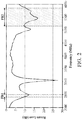
  • FIG. 2 is a diagram of return loss of an antenna element of a communication device according to an embodiment of the invention.
  • FIG. 3 is a top view of a communication device according to another embodiment of the invention.
  • FIG. 4 is a top view of a communication device according to another embodiment of the invention.
  • FIG. 5 is a top view of a communication device according to another embodiment of the invention.
  • FIG. 1A is a top view of a communication device 100 according to an embodiment of the invention.
  • FIG. 1B is a back view of the communication device 100 according to an embodiment of the invention. Please refer to FIG. 1A and FIG. 1B together.
  • the communication device 100 may be a smart phone, a tablet computer, or a notebook computer. As shown in FIG. 1A and FIG. 1B , the communication device 100 at least includes a ground element 110 , a dielectric substrate 120 , and an antenna element 130 . It should be understood that the communication device 100 may further include other components, such as a display device, a speaker, a touch control module, a power supply module, and a housing, although they are not displayed in FIG. 1A and FIG. 1B .
  • the ground element 110 may be made of a metal material, such as copper, silver, aluminum, iron, or their alloys.
  • the ground element 110 has an edge 111 .
  • the shape and size of the ground element 110 are not limited in the invention.
  • the dielectric substrate 120 may be a PCB (Printed Circuit Board), an FCB (Flexible Circuit Board), or an FR4 (Flame Retardant 4) substrate.
  • the dielectric substrate 120 is disposed adjacent to the edge 111 of the ground element 110 .
  • the dielectric substrate 120 has a first surface E 1 and a second surface E 2 which are opposite to each other. In some embodiments, the dielectric substrate 120 substantially has a rectangular shape.
  • the antenna element 130 is disposed on the dielectric substrate 120 .
  • the antenna element 130 at least includes a feeding metal element 140 , a shorting metal element 150 , a first radiation metal element 160 , an inductive element 174 , and a second radiation metal element 180 .
  • the feeding metal element 140 , the shorting metal element 150 , the inductive element 174 , and the second radiation metal element 180 are all disposed on the first surface E 1 of the dielectric substrate 120 .
  • the first radiation metal element 160 is disposed on the second surface E 2 of the dielectric substrate 120 .
  • the feeding metal element 140 may substantially have a meandering shape, such as an N-shape or a Z-shape, but it is not limited thereto.
  • the feeding metal element 140 has a first end 141 and a second end 142 .
  • a feeding point FP is positioned at the first end 141 of the feeding metal element 140 .
  • the second end 142 of the feeding metal element 140 is an open end.
  • the feeding point FP may be coupled to a positive electrode of a signal source 199 .
  • the signal source 199 may be an RF (Radio Frequency) module for exciting the antenna element 130 .
  • the feeding metal element 140 is partially parallel to the edge 111 of the ground element 110 , and is partially perpendicular to the edge 111 of the ground element 110 .
  • the shorting metal element 150 may substantially have a rectangular shape, a square shape, or an L-shape, but it is not limited thereto.
  • the shorting metal element 150 has a first end 151 and a second end 152 .
  • the first end 151 of the shorting metal element 150 is coupled to the edge 111 of the ground element 110 .
  • a negative electrode of the signal source 199 may be coupled to any position on the shorting metal element 150 .
  • the shorting metal element 150 is considered as an extension portion of the ground element 110 on the first surface E 1 of the dielectric substrate 120 .
  • the first radiation metal element 160 may substantially have an L-shape or a straight-line shape, but it is not limited thereto.
  • the first radiation metal element 160 is adjacent to or opposite to the feeding metal element 140 .
  • the vertical projection of the feeding metal element 140 may at least partially overlap the first metal radiation element 160 , so as to enhance the coupling effect between the feeding metal element 140 and the first radiation metal element 160 .
  • the first radiation metal element 160 has a first end 161 and a second end 162 .
  • the first end 161 of the first radiation metal element 160 is coupled to the second end 152 of the shorting metal element 150 .
  • the second end 162 of the first radiation metal element 160 is an open end, which extends to be substantially parallel to the edge 111 of the ground element 110 .
  • the antenna element 130 of the communication device 100 further includes a conductive via element 172 .
  • the conductive via element 172 penetrates the dielectric substrate 120 , and thus the first end 161 of the first radiation metal element 160 is coupled through the conductive via element 172 to the second end 152 of the shorting metal element 150 . It should be understood that the conductive via element 172 is an optional element, which is omitted in other embodiments.
  • the inductive element 174 may be a chip inductor, a printed inductor, or a combination thereof.
  • the inductive element 174 is coupled to a first connection point CP 1 on the feeding metal element 140 .
  • the first connection point CP 1 may be substantially positioned on a bending portion of the feeding metal element 140 , and the bending portion may be positioned between the first end 141 and the second end 142 of the feeding metal element 140 .
  • the inductance of the inductive element 174 may be from 2 nH to 20 nH, such as 4.3 nH, but it is not limited thereto.
  • the second radiation metal element 180 may substantially have a meandering shape, and it may be an equal-width structure or a variable-width structure.
  • the second radiation metal element 180 has a first end 181 and a second end 182 .
  • the first end 181 of the second radiation metal element 180 is coupled through the inductive element 174 to the first connection point CP 1 on the feeding metal element 140 .
  • the second end 182 of the second radiation metal element 180 is coupled to the edge 111 of the ground element 110 . Accordingly, a closed-loop path is formed by the feeding metal element 140 , the inductive element 174 , the second radiation metal element 180 , and the ground element 110 , and a non-metal region 185 is surrounded by the closed-loop path.
  • the antenna element 130 further includes a matching metal element 190 , which is disposed on the first surface E 1 of the dielectric substrate 120 and is positioned inside the aforementioned closed-loop path.
  • the matching metal element 190 may substantially have a straight-line shape or an L-shape.
  • the matching metal element 190 has a first end 191 and a second end 192 .
  • the first end 191 of the matching metal element 190 is coupled to a second connection point CP 2 on the second radiation metal element 180 .
  • the second end 192 of the matching metal element 190 is an open end, which extends to be substantially parallel to the edge 111 of the ground element 110 .
  • the second connection point CP 2 may be adjacent to the first end 181 of the second radiation metal element 180 .
  • the matching metal element 190 is an optional element, which is omitted in other embodiments.
  • FIG. 2 is a diagram of return loss of the antenna element 130 of the communication device 100 according to an embodiment of the invention.
  • the horizontal axis represents the operation frequency (MHz), and the vertical axis represents the return loss (dB).
  • the antenna element 130 can cover a first frequency band FB 1 and a second frequency band FB 2 .
  • the first frequency band FB 1 may be from 2400 MHz to 2500 MHz.
  • the second frequency band FB 2 may be from 5150 MHz to 5850 MHz. Therefore, the antenna element 130 can support at least the dual-band operations of WLAN (Wireless Local Area Networks) 2.4 GHz/5 GHz.
  • WLAN Wireless Local Area Networks
  • the radiation efficiency of the antenna element 130 is about 35% within the first frequency band FB 1
  • the radiation efficiency of the antenna element 130 is about 30% within the second frequency band FB 2 . It can meet the requirements of practical applications of general mobile communication devices.
  • the operation principles of the antenna element 130 are described as follows.
  • the second radiation metal element 180 is directly excited by the feeding metal element 140 , so as to generate the aforementioned first frequency band FB 1 .
  • the first radiation metal element 160 is excited by the feeding metal element 140 using a coupling mechanism, so as to generate the aforementioned second frequency band FB 2 .
  • the inductive element 174 is configured to increase the effective resonant length of the second radiation metal element 180 , thereby minimizing the total size of the antenna element 130 .
  • the inductive element 174 prevents the resonant currents of the second frequency band FB 2 from flowing into the second radiation metal element 180 , so as to reduce the interference between the first frequency band FB 1 and the second frequency band FB 2 .
  • the matching metal element 190 is mainly configured to fine-tune the impedance matching of the second frequency band FB 2 , thereby increasing the operation bandwidth of the second frequency band FB 2 .
  • the element sizes of the communication device 100 are described as follows.
  • the length of the ground element 110 may be about 280 mm, and the width of the ground element 110 may be about 180 mm.
  • the thickness of the dielectric substrate 120 i.e., the distance/spacing between the first surface E 1 and the second surface E 2 ) may be shorter than 2 mm, such as about 0.4 mm.
  • the length of the antenna element 130 may be about 55 mm, and the height of the antenna element 130 (i.e., the height on the edge 111 of the ground element 110 , parallel to the Y-axis) may be about 3 mm.
  • the length of the first radiation metal element 160 (i.e., the length from the first end 161 to the second end 162 ) may be shorter than or equal to 0.25 wavelength ( ⁇ /4) of the central frequency of the second frequency band FB 2 , such as about 11 mm.
  • the length of the second radiation metal element 180 (i.e., the length from the first end 181 to the second end 182 ) may be shorter than or equal to 0.5 wavelength ( ⁇ /2) of the central frequency of the first frequency band FB 1 , such as about 45 mm.
  • the length of the second radiation metal element 180 may be longer than the length of the first radiation metal element 160 . Specifically, the length of the second radiation metal element 180 may 1.5 to 3 times the length of the first radiation metal element 160 .
  • the distance D 1 between the matching metal element 190 and the edge 111 of the ground element 110 may be shorter than or equal to 5 mm, such as about 0.5 mm.
  • the above ranges of element sizes are calculated and obtained according to many experiment results, and they help to optimize the operation bandwidth and impedance matching of the antenna element 130 of the communication device 100 .
  • FIG. 3 is a top view of a communication device 300 according to another embodiment of the invention.
  • FIG. 3 is similar to FIG. 1A .
  • the matching metal element 390 has a first end 391 and a second end 392 .
  • the first end 391 of the matching metal element 390 is coupled to a second connection point CP 3 on the second radiation metal element 180 .
  • the second end 392 of the matching metal element 390 is an open end, which extends to be substantially parallel to the edge 111 of the ground element 110 .
  • the second connection point CP 3 may be adjacent to a bending portion of the second radiation metal element 180 .
  • the communication device 300 further includes a coaxial cable 380 .
  • the coaxial cable 380 includes a central conductive line 381 and a conductive housing 382 .
  • the positive electrode of the signal source 199 may be coupled through the central conductive line 381 to the feeding point FP.
  • the negative electrode of the signal source 199 may be coupled through the conductive housing 382 to the shorting metal element 150 .
  • the conductive housing 382 of the coaxial cable 380 is coupled to the shorting metal element 150 , instead of being directly coupled to the ground element 110 as conventional designs, and therefore such a proposed design can significantly reduce the area occupied by the coaxial cable 380 on the first surface E 1 of the dielectric substrate 120 .
  • the height of the antenna element 130 on the Y-axis can be reduced to about 3 mm (conventional antenna height is usually greater than 5 mm), so as to meet the requirements of low-profile antenna designs.
  • Other features of the communication device 300 of FIG. 3 are similar to those of the communication device 100 of FIG. 1A and FIG. 1B . Therefore, the two embodiments can achieve similar levels of performance.
  • FIG. 4 is a top view of a communication device 400 according to another embodiment of the invention.
  • FIG. 4 is similar to FIG. 1A .
  • a first radiation metal element 460 of the communication device 400 is disposed on the first surface E 1 of the dielectric substrate 120 . That is, the feeding metal element 140 , the shorting metal element 150 , the first radiation metal element 460 , and the second radiation metal element 180 are coplanar designs.
  • the first radiation metal element 460 may substantially have an L-shape.
  • the first radiation metal element 460 has a first end 461 and a second end 462 .
  • the first end 461 of the first radiation metal element 460 is directly coupled to the second end 152 of the shorting metal element 150 (without communicating through the conductive via element 172 , which is omitted).
  • the second end 462 of the second radiation metal element 460 is an open end, which extends to be substantially parallel to the edge 111 of the ground element 110 . It should be understood that the positions and shapes of the other elements of the communication device 400 are slightly adjusted to optimize the whole impedance matching. Other features of the communication device 400 of FIG. 4 are similar to those of the communication device 100 of FIG. 1A and FIG. 1B . Therefore, the two embodiments can achieve similar levels of performance.
  • FIG. 5 is a top view of a communication device 500 according to another embodiment of the invention.
  • FIG. 5 is similar to FIG. 1A .
  • a second radiation metal element 580 of the communication device 500 has a first end 581 and a second end 582 and includes a first portion 583 and a second portion 584 .
  • the first portion 583 is adjacent to the first end 581
  • the second portion 584 is adjacent to the second end 582 .
  • the first end 581 of the second radiation metal element 580 is coupled through the inductive element 174 to the first connection point CP 1 on the feeding metal element 140
  • the second end 582 of the second radiation metal element 580 is coupled to the edge 111 of the ground element 110 .
  • a partition gap 585 is formed between the first portion 583 and the second portion 584 of the second radiation metal element 580 , and it completely separates the first portion 583 from the second portion 584 .
  • the width of the partition gap 585 is smaller than 2 mm, there may be still a coupling effect between the first portion 583 and the second portion 584 of the second radiation metal element 580 , such that the antenna radiation performance of the communication device 500 should not be negatively affected by the discontinuous structure of the second radiation metal element 580 .
  • the positions and shapes of the other elements of the communication device 500 are slightly adjusted to optimize the whole impedance matching.
  • Other features of the communication device 500 of FIG. 5 are similar to those of the communication device 500 of FIG. 1A and FIG. 1B . Therefore, the two embodiments can achieve similar levels of performance.
  • the invention proposes a novel communication device and a novel antenna element.
  • the invention has the advantages of small size, low profile, wide bandwidth, and low manufacturing cost, and therefore it is suitable for application in a variety of mobile communication devices with narrow borders.
  • the above element sizes, element shapes, and frequency ranges are not limitations of the invention.
  • An antenna designer can fine-tune these settings or values according to different requirements.
  • the communication device and antenna element of the invention are not limited to the configurations of FIGS. 1-5 .
  • the invention may merely include any one or more features of any one or more embodiments of FIGS. 1-5 . In other words, not all of the features displayed in the figures should be implemented in the communication device and antenna element of the invention.

Landscapes

  • Engineering & Computer Science (AREA)
  • Computer Networks & Wireless Communication (AREA)
  • Support Of Aerials (AREA)
  • Details Of Aerials (AREA)

Abstract

A communication device includes a ground element, a dielectric substrate, and an antenna element. The dielectric substrate is disposed adjacent to an edge of the ground element. The antenna element is disposed on the dielectric substrate. The antenna element includes a feeding metal element, a shorting metal element, a first radiation metal element, a second radiation metal element, and an inductive element. The feeding metal element has a feeding point. The shorting metal element is coupled to the ground element. The first radiation metal element is coupled to the shorting metal element, and is disposed adjacent to the feeding metal element. The second radiation metal element is coupled through the inductive element to the feeding metal element. The second radiation metal element is further coupled to the ground element.

Description

CROSS REFERENCE TO RELATED APPLICATIONS
This application claims priority of Taiwan Patent Application No. 108106135 filed on Feb. 23, 2019, the entirety of which is incorporated by reference herein.
BACKGROUND OF THE INVENTION Field of the Invention
The disclosure generally relates to a communication device, and more particularly, it relates to a communication device and an antenna element therein.
Description of the Related Art
With the advancements being made in mobile communication technology, mobile devices such as portable computers, mobile phones, multimedia players, and other hybrid functional portable electronic devices have become more common. To satisfy user demand, mobile devices can usually perform wireless communication functions. Some devices cover a large wireless communication area; these include mobile phones using 2G, 3G, and LTE (Long Term Evolution) systems and using frequency bands of 700 MHz, 850 MHz, 900 MHz, 1800 MHz, 1900 MHz, 2100 MHz, 2300 MHz, 2500 MHz, and 2700 MHz. Some devices cover a small wireless communication area; these include mobile phones using Wi-Fi and Bluetooth systems and using frequency bands of 2.4 GHz, 5.2 GHz, and 5.8 GHz.
Antennas are indispensable elements for mobile devices supporting wireless communication. Notebook computers are used as an example. In order to satisfy consumer demands for narrow borders, the antenna design space of notebook computers is very limited. Therefore, it has become a critical challenge for current engineers to design a wideband antenna element that is small in size.
BRIEF SUMMARY OF THE INVENTION
In an exemplary embodiment, the disclosure is directed to a communication device which includes a ground element, a dielectric substrate, and an antenna element. The dielectric substrate is disposed adjacent to an edge of the ground element. The antenna element is disposed on the dielectric substrate. The antenna element includes a feeding metal element, a shorting metal element, a first radiation metal element, a second radiation metal element, and an inductive element. The feeding metal element has a feeding point. The shorting metal element is coupled to the ground element. The first radiation metal element is coupled to the shorting metal element, and is disposed adjacent to the feeding metal element. The second radiation metal element is coupled through the inductive element to the feeding metal element. The second radiation metal element is further coupled to the ground element.
In some embodiments, the first radiation metal element substantially has an L-shape.
In some embodiments, the antenna element further includes a matching metal element coupled to the second radiation metal element.
In some embodiments, the distance between the matching metal element and the edge of the ground element is shorter than or equal to 5 mm.
In some embodiments, the dielectric substrate has a first surface and a second surface which are opposite to each other. The feeding metal element, the shorting metal element, the second radiation metal element, and the matching metal element are disposed on the first surface of the dielectric substrate. The first radiation metal element is disposed on the second surface of the dielectric substrate.
In some embodiments, the antenna element further includes a conductive via element penetrating the dielectric substrate. The first radiation metal element is coupled through the conductive via element to the shorting metal element.
In some embodiments, the antenna element covers a first frequency band and a second frequency band. The first frequency band is from 2400 MHz to 2500 MHz. The second frequency band is from 5150 MHz to 5850 MHz.
In some embodiments, the inductive element is a chip inductor or a printed inductor.
In some embodiments, the dielectric substrate has a first surface and a second surface which are opposite to each other. The feeding metal element, the shorting metal element, the first radiation metal element, and the second radiation metal element are disposed on the first surface of the dielectric substrate.
In some embodiments, the second radiation metal element includes a first portion and a second portion, and a partition gap is formed between the first portion and the second portion.
BRIEF DESCRIPTION OF DRAWINGS
The invention can be more fully understood by reading the subsequent detailed description and examples with references made to the accompanying drawings, wherein:
FIG. 1A is a top view of a communication device according to an embodiment of the invention.
FIG. 1B is a back view of a communication device according to an embodiment of the invention.
FIG. 2 is a diagram of return loss of an antenna element of a communication device according to an embodiment of the invention.
FIG. 3 is a top view of a communication device according to another embodiment of the invention.
FIG. 4 is a top view of a communication device according to another embodiment of the invention.
FIG. 5 is a top view of a communication device according to another embodiment of the invention.
DETAILED DESCRIPTION OF THE INVENTION
In order to illustrate the purposes, features and advantages of the invention, the embodiments and figures of the invention are shown in detail as follows.
Certain terms are used throughout the description and following claims to refer to particular components. As one skilled in the art will appreciate, manufacturers may refer to a component by different names. This document does not intend to distinguish between components that differ in name but not function. In the following description and in the claims, the terms “include” and “comprise” are used in an open-ended fashion, and thus should be interpreted to mean “include, but not limited to . . . ”. The term “substantially” means the value is within an acceptable error range. One skilled in the art can solve the technical problem within a predetermined error range and achieve the proposed technical performance. Also, the term “couple” is intended to mean either an indirect or direct electrical connection. Accordingly, if one device is coupled to another device, that connection may be through a direct electrical connection, or through an indirect electrical connection via other devices and connections.
FIG. 1A is a top view of a communication device 100 according to an embodiment of the invention. FIG. 1B is a back view of the communication device 100 according to an embodiment of the invention. Please refer to FIG. 1A and FIG. 1B together. The communication device 100 may be a smart phone, a tablet computer, or a notebook computer. As shown in FIG. 1A and FIG. 1B, the communication device 100 at least includes a ground element 110, a dielectric substrate 120, and an antenna element 130. It should be understood that the communication device 100 may further include other components, such as a display device, a speaker, a touch control module, a power supply module, and a housing, although they are not displayed in FIG. 1A and FIG. 1B.
The ground element 110 may be made of a metal material, such as copper, silver, aluminum, iron, or their alloys. The ground element 110 has an edge 111. The shape and size of the ground element 110 are not limited in the invention. The dielectric substrate 120 may be a PCB (Printed Circuit Board), an FCB (Flexible Circuit Board), or an FR4 (Flame Retardant 4) substrate. The dielectric substrate 120 is disposed adjacent to the edge 111 of the ground element 110. It should be noted that the term “adjacent” or “close” over the disclosure means that the distance (spacing) between two corresponding elements is smaller than a predetermined distance (e.g., 5 mm or shorter), or means that the two corresponding elements directly touch each other (i.e., the aforementioned distance/spacing therebetween is reduced to 0). The dielectric substrate 120 has a first surface E1 and a second surface E2 which are opposite to each other. In some embodiments, the dielectric substrate 120 substantially has a rectangular shape.
The antenna element 130 is disposed on the dielectric substrate 120. Specifically, the antenna element 130 at least includes a feeding metal element 140, a shorting metal element 150, a first radiation metal element 160, an inductive element 174, and a second radiation metal element 180. The feeding metal element 140, the shorting metal element 150, the inductive element 174, and the second radiation metal element 180 are all disposed on the first surface E1 of the dielectric substrate 120. The first radiation metal element 160 is disposed on the second surface E2 of the dielectric substrate 120.
The feeding metal element 140 may substantially have a meandering shape, such as an N-shape or a Z-shape, but it is not limited thereto. The feeding metal element 140 has a first end 141 and a second end 142. A feeding point FP is positioned at the first end 141 of the feeding metal element 140. The second end 142 of the feeding metal element 140 is an open end. The feeding point FP may be coupled to a positive electrode of a signal source 199. For example, the signal source 199 may be an RF (Radio Frequency) module for exciting the antenna element 130. In some embodiments, the feeding metal element 140 is partially parallel to the edge 111 of the ground element 110, and is partially perpendicular to the edge 111 of the ground element 110.
The shorting metal element 150 may substantially have a rectangular shape, a square shape, or an L-shape, but it is not limited thereto. The shorting metal element 150 has a first end 151 and a second end 152. The first end 151 of the shorting metal element 150 is coupled to the edge 111 of the ground element 110. A negative electrode of the signal source 199 may be coupled to any position on the shorting metal element 150. The shorting metal element 150 is considered as an extension portion of the ground element 110 on the first surface E1 of the dielectric substrate 120.
The first radiation metal element 160 may substantially have an L-shape or a straight-line shape, but it is not limited thereto. The first radiation metal element 160 is adjacent to or opposite to the feeding metal element 140. Specifically, if the feeding metal element 140 has a vertical projection on the second surface E2 of the dielectric substrate 120, the vertical projection of the feeding metal element 140 may at least partially overlap the first metal radiation element 160, so as to enhance the coupling effect between the feeding metal element 140 and the first radiation metal element 160. The first radiation metal element 160 has a first end 161 and a second end 162. The first end 161 of the first radiation metal element 160 is coupled to the second end 152 of the shorting metal element 150. The second end 162 of the first radiation metal element 160 is an open end, which extends to be substantially parallel to the edge 111 of the ground element 110. In some embodiments, the antenna element 130 of the communication device 100 further includes a conductive via element 172. The conductive via element 172 penetrates the dielectric substrate 120, and thus the first end 161 of the first radiation metal element 160 is coupled through the conductive via element 172 to the second end 152 of the shorting metal element 150. It should be understood that the conductive via element 172 is an optional element, which is omitted in other embodiments.
The inductive element 174 may be a chip inductor, a printed inductor, or a combination thereof. The inductive element 174 is coupled to a first connection point CP1 on the feeding metal element 140. The first connection point CP1 may be substantially positioned on a bending portion of the feeding metal element 140, and the bending portion may be positioned between the first end 141 and the second end 142 of the feeding metal element 140. The inductance of the inductive element 174 may be from 2 nH to 20 nH, such as 4.3 nH, but it is not limited thereto.
The second radiation metal element 180 may substantially have a meandering shape, and it may be an equal-width structure or a variable-width structure. The second radiation metal element 180 has a first end 181 and a second end 182. The first end 181 of the second radiation metal element 180 is coupled through the inductive element 174 to the first connection point CP1 on the feeding metal element 140. The second end 182 of the second radiation metal element 180 is coupled to the edge 111 of the ground element 110. Accordingly, a closed-loop path is formed by the feeding metal element 140, the inductive element 174, the second radiation metal element 180, and the ground element 110, and a non-metal region 185 is surrounded by the closed-loop path.
In some embodiments, the antenna element 130 further includes a matching metal element 190, which is disposed on the first surface E1 of the dielectric substrate 120 and is positioned inside the aforementioned closed-loop path. The matching metal element 190 may substantially have a straight-line shape or an L-shape. The matching metal element 190 has a first end 191 and a second end 192. The first end 191 of the matching metal element 190 is coupled to a second connection point CP2 on the second radiation metal element 180. The second end 192 of the matching metal element 190 is an open end, which extends to be substantially parallel to the edge 111 of the ground element 110. For example, the second connection point CP2 may be adjacent to the first end 181 of the second radiation metal element 180. It should be understood that the matching metal element 190 is an optional element, which is omitted in other embodiments.
FIG. 2 is a diagram of return loss of the antenna element 130 of the communication device 100 according to an embodiment of the invention. The horizontal axis represents the operation frequency (MHz), and the vertical axis represents the return loss (dB). According to the measurement of FIG. 2, the antenna element 130 can cover a first frequency band FB1 and a second frequency band FB2. The first frequency band FB1 may be from 2400 MHz to 2500 MHz. The second frequency band FB2 may be from 5150 MHz to 5850 MHz. Therefore, the antenna element 130 can support at least the dual-band operations of WLAN (Wireless Local Area Networks) 2.4 GHz/5 GHz. According to practical measurement, the radiation efficiency of the antenna element 130 is about 35% within the first frequency band FB1, and the radiation efficiency of the antenna element 130 is about 30% within the second frequency band FB2. It can meet the requirements of practical applications of general mobile communication devices.
In some embodiments, the operation principles of the antenna element 130 are described as follows. The second radiation metal element 180 is directly excited by the feeding metal element 140, so as to generate the aforementioned first frequency band FB1. The first radiation metal element 160 is excited by the feeding metal element 140 using a coupling mechanism, so as to generate the aforementioned second frequency band FB2. The inductive element 174 is configured to increase the effective resonant length of the second radiation metal element 180, thereby minimizing the total size of the antenna element 130. Furthermore, the inductive element 174 prevents the resonant currents of the second frequency band FB2 from flowing into the second radiation metal element 180, so as to reduce the interference between the first frequency band FB1 and the second frequency band FB2. The matching metal element 190 is mainly configured to fine-tune the impedance matching of the second frequency band FB2, thereby increasing the operation bandwidth of the second frequency band FB2.
In some embodiments, the element sizes of the communication device 100 are described as follows. The length of the ground element 110 may be about 280 mm, and the width of the ground element 110 may be about 180 mm. The thickness of the dielectric substrate 120 (i.e., the distance/spacing between the first surface E1 and the second surface E2) may be shorter than 2 mm, such as about 0.4 mm. The length of the antenna element 130 may be about 55 mm, and the height of the antenna element 130 (i.e., the height on the edge 111 of the ground element 110, parallel to the Y-axis) may be about 3 mm. The length of the first radiation metal element 160 (i.e., the length from the first end 161 to the second end 162) may be shorter than or equal to 0.25 wavelength (λ/4) of the central frequency of the second frequency band FB2, such as about 11 mm. The length of the second radiation metal element 180 (i.e., the length from the first end 181 to the second end 182) may be shorter than or equal to 0.5 wavelength (λ/2) of the central frequency of the first frequency band FB1, such as about 45 mm. The length of the second radiation metal element 180 may be longer than the length of the first radiation metal element 160. Specifically, the length of the second radiation metal element 180 may 1.5 to 3 times the length of the first radiation metal element 160. The distance D1 between the matching metal element 190 and the edge 111 of the ground element 110 may be shorter than or equal to 5 mm, such as about 0.5 mm. The above ranges of element sizes are calculated and obtained according to many experiment results, and they help to optimize the operation bandwidth and impedance matching of the antenna element 130 of the communication device 100.
FIG. 3 is a top view of a communication device 300 according to another embodiment of the invention. FIG. 3 is similar to FIG. 1A. In the embodiment of FIG. 3, the position of a matching metal element 390 of the communication device 300 is slightly moved. The matching metal element 390 has a first end 391 and a second end 392. The first end 391 of the matching metal element 390 is coupled to a second connection point CP3 on the second radiation metal element 180. The second end 392 of the matching metal element 390 is an open end, which extends to be substantially parallel to the edge 111 of the ground element 110. For example, the second connection point CP3 may be adjacent to a bending portion of the second radiation metal element 180. According to practical measurements, if the distance D2 between the second connection point CP3 and the first end 181 of the second radiation metal element 180 is shorter than 0.2 times the length of the second radiation metal element 180, the antenna element 130 can provide better radiation performance. In addition, the communication device 300 further includes a coaxial cable 380. The coaxial cable 380 includes a central conductive line 381 and a conductive housing 382. The positive electrode of the signal source 199 may be coupled through the central conductive line 381 to the feeding point FP. The negative electrode of the signal source 199 may be coupled through the conductive housing 382 to the shorting metal element 150. It should be noted that the conductive housing 382 of the coaxial cable 380 is coupled to the shorting metal element 150, instead of being directly coupled to the ground element 110 as conventional designs, and therefore such a proposed design can significantly reduce the area occupied by the coaxial cable 380 on the first surface E1 of the dielectric substrate 120. According to practical measurements, with such a design, the height of the antenna element 130 on the Y-axis can be reduced to about 3 mm (conventional antenna height is usually greater than 5 mm), so as to meet the requirements of low-profile antenna designs. Other features of the communication device 300 of FIG. 3 are similar to those of the communication device 100 of FIG. 1A and FIG. 1B. Therefore, the two embodiments can achieve similar levels of performance.
FIG. 4 is a top view of a communication device 400 according to another embodiment of the invention. FIG. 4 is similar to FIG. 1A. In the embodiment of FIG. 4, a first radiation metal element 460 of the communication device 400 is disposed on the first surface E1 of the dielectric substrate 120. That is, the feeding metal element 140, the shorting metal element 150, the first radiation metal element 460, and the second radiation metal element 180 are coplanar designs. The first radiation metal element 460 may substantially have an L-shape. The first radiation metal element 460 has a first end 461 and a second end 462. The first end 461 of the first radiation metal element 460 is directly coupled to the second end 152 of the shorting metal element 150 (without communicating through the conductive via element 172, which is omitted). The second end 462 of the second radiation metal element 460 is an open end, which extends to be substantially parallel to the edge 111 of the ground element 110. It should be understood that the positions and shapes of the other elements of the communication device 400 are slightly adjusted to optimize the whole impedance matching. Other features of the communication device 400 of FIG. 4 are similar to those of the communication device 100 of FIG. 1A and FIG. 1B. Therefore, the two embodiments can achieve similar levels of performance.
FIG. 5 is a top view of a communication device 500 according to another embodiment of the invention. FIG. 5 is similar to FIG. 1A. In the embodiment of FIG. 5, a second radiation metal element 580 of the communication device 500 has a first end 581 and a second end 582 and includes a first portion 583 and a second portion 584. In the second radiation metal element 580, the first portion 583 is adjacent to the first end 581, and the second portion 584 is adjacent to the second end 582. Similarly, the first end 581 of the second radiation metal element 580 is coupled through the inductive element 174 to the first connection point CP1 on the feeding metal element 140, and the second end 582 of the second radiation metal element 580 is coupled to the edge 111 of the ground element 110. A partition gap 585 is formed between the first portion 583 and the second portion 584 of the second radiation metal element 580, and it completely separates the first portion 583 from the second portion 584. According to practical measurements, if the width of the partition gap 585 is smaller than 2 mm, there may be still a coupling effect between the first portion 583 and the second portion 584 of the second radiation metal element 580, such that the antenna radiation performance of the communication device 500 should not be negatively affected by the discontinuous structure of the second radiation metal element 580. It should be understood that the positions and shapes of the other elements of the communication device 500 are slightly adjusted to optimize the whole impedance matching. Other features of the communication device 500 of FIG. 5 are similar to those of the communication device 500 of FIG. 1A and FIG. 1B. Therefore, the two embodiments can achieve similar levels of performance.
The invention proposes a novel communication device and a novel antenna element. In comparison to the conventional designs, the invention has the advantages of small size, low profile, wide bandwidth, and low manufacturing cost, and therefore it is suitable for application in a variety of mobile communication devices with narrow borders.
Note that the above element sizes, element shapes, and frequency ranges are not limitations of the invention. An antenna designer can fine-tune these settings or values according to different requirements. It should be understood that the communication device and antenna element of the invention are not limited to the configurations of FIGS. 1-5. The invention may merely include any one or more features of any one or more embodiments of FIGS. 1-5. In other words, not all of the features displayed in the figures should be implemented in the communication device and antenna element of the invention.
Use of ordinal terms such as “first”, “second”, “third”, etc., in the claims to modify a claim element does not by itself connote any priority, precedence, or order of one claim element over another or the temporal order in which acts of a method are performed, but are used merely as labels to distinguish one claim element having a certain name from another element having the same name (but for use of the ordinal term) to distinguish the claim elements.
While the invention has been described by way of example and in terms of the preferred embodiments, it should be understood that the invention is not limited to the disclosed embodiments. On the contrary, it is intended to cover various modifications and similar arrangements (as would be apparent to those skilled in the art). Therefore, the scope of the appended claims should be accorded the broadest interpretation so as to encompass all such modifications and similar arrangements.

Claims (10)

What is claimed is:
1. A communication device, comprising:
a ground element;
a dielectric substrate, disposed adjacent to an edge of the ground element; and
an antenna element, disposed on the dielectric substrate, wherein the antenna element comprises:
a feeding metal element, having a feeding point;
a shorting metal element, coupled to the ground element;
a first radiation metal element, coupled to the shorting metal element, and disposed adjacent to the feeding metal element;
an inductive element; and
a second radiation metal element, coupled through the inductive element to the feeding metal element, wherein the second radiation metal element is further coupled to the ground element.
2. The communication device as claimed in claim 1, wherein the first radiation metal element substantially has an L-shape.
3. The communication device as claimed in claim 1, wherein the antenna element further comprises:
a matching metal element, coupled to the second radiation metal element.
4. The communication device as claimed in claim 3, wherein a distance between the matching metal element and the edge of the ground element is shorter than or equal to 5 mm.
5. The communication device as claimed in claim 3, wherein the dielectric substrate has a first surface and a second surface opposite to each other, wherein the feeding metal element, the shorting metal element, the second radiation metal element, and the matching metal element are disposed on the first surface of the dielectric substrate, and wherein the first radiation metal element is disposed on the second surface of the dielectric substrate.
6. The communication device as claimed in claim 5, wherein the antenna element further comprises:
a conductive via element, penetrating the dielectric substrate, wherein the first radiation metal element is coupled through the conductive via element to the shorting metal element.
7. The communication device as claimed in claim 1, wherein the antenna element covers a first frequency band and a second frequency band, the first frequency band is from 2400 MHz to 2500 MHz, and the second frequency band is from 5150 MHz to 5850 MHz.
8. The communication device as claimed in claim 1, wherein the inductive element is a chip inductor or a printed inductor.
9. The communication device as claimed in claim 1, wherein the dielectric substrate has a first surface and a second surface opposite to each other, and wherein the feeding metal element, the shorting metal element, the first radiation metal element, and the second radiation metal element are disposed on the first surface of the dielectric substrate.
10. The communication device as claimed in claim 1, wherein the second radiation metal element comprises a first portion and a second portion, and a partition gap is formed between the first portion and the second portion.
US16/517,888 2019-02-23 2019-07-22 Communication device Active US10797376B2 (en)

Applications Claiming Priority (3)

Application Number Priority Date Filing Date Title
TW108106135 2019-02-23
TW108106135A 2019-02-23
TW108106135A TWI699930B (en) 2019-02-23 2019-02-23 Communication device

Publications (2)

Publication Number Publication Date
US20200274227A1 US20200274227A1 (en) 2020-08-27
US10797376B2 true US10797376B2 (en) 2020-10-06

Family

ID=72141840

Family Applications (1)

Application Number Title Priority Date Filing Date
US16/517,888 Active US10797376B2 (en) 2019-02-23 2019-07-22 Communication device

Country Status (3)

Country Link
US (1) US10797376B2 (en)
CN (1) CN111613886B (en)
TW (1) TWI699930B (en)

Cited By (1)

* Cited by examiner, † Cited by third party
Publication number Priority date Publication date Assignee Title
US11081782B2 (en) * 2018-11-07 2021-08-03 Asustek Computer Inc. Three-dimensional antenna element

Families Citing this family (6)

* Cited by examiner, † Cited by third party
Publication number Priority date Publication date Assignee Title
CN114696077B (en) * 2020-12-30 2023-08-08 宏碁股份有限公司 Mobile device
TWI765743B (en) * 2021-06-11 2022-05-21 啓碁科技股份有限公司 Antenna structure
CN115603038A (en) * 2021-06-28 2023-01-13 启碁科技股份有限公司(Tw) Antenna structure
CN114518724B (en) * 2022-01-28 2023-04-28 弥费科技(上海)股份有限公司 Communication device and communication mode suitable for AMHS
TWI827202B (en) * 2022-08-17 2023-12-21 啟碁科技股份有限公司 Open loop antenna and electronic device
TWI844306B (en) * 2023-03-16 2024-06-01 啓碁科技股份有限公司 Antenna structure

Citations (9)

* Cited by examiner, † Cited by third party
Publication number Priority date Publication date Assignee Title
US20090322639A1 (en) 2008-06-27 2009-12-31 Asustek Computer Inc. Antenna apparatus
US7825863B2 (en) * 2006-11-16 2010-11-02 Galtronics Ltd. Compact antenna
US9112269B2 (en) * 2013-04-24 2015-08-18 Acer Incorporated Communication device and antenna element therein
US9300045B2 (en) * 2014-05-16 2016-03-29 Acer Incorporated Communication device with antenna element
US20180048076A1 (en) * 2016-08-11 2018-02-15 Wistron Neweb Corp. Antenna Structure
US9979074B2 (en) * 2016-07-06 2018-05-22 Quanta Computer Inc. Mobile device
US9979071B2 (en) * 2015-11-13 2018-05-22 Acer Incorporated Electronic device
US10542130B1 (en) * 2019-01-18 2020-01-21 Quanta Computer Inc. Mobile device
US10741915B2 (en) * 2018-12-05 2020-08-11 Wistron Neweb Corp. Antenna structure and mobile device

Family Cites Families (3)

* Cited by examiner, † Cited by third party
Publication number Priority date Publication date Assignee Title
JP2000077923A (en) * 1998-09-01 2000-03-14 Nippon Antenna Co Ltd Automotive antenna
CN103326116B (en) * 2013-06-17 2015-06-10 清华大学 Small-size plane wide-band double-antenna system used for mobile terminal
TWI633708B (en) * 2016-08-22 2018-08-21 宏碁股份有限公司 Mobile electronic device

Patent Citations (9)

* Cited by examiner, † Cited by third party
Publication number Priority date Publication date Assignee Title
US7825863B2 (en) * 2006-11-16 2010-11-02 Galtronics Ltd. Compact antenna
US20090322639A1 (en) 2008-06-27 2009-12-31 Asustek Computer Inc. Antenna apparatus
US9112269B2 (en) * 2013-04-24 2015-08-18 Acer Incorporated Communication device and antenna element therein
US9300045B2 (en) * 2014-05-16 2016-03-29 Acer Incorporated Communication device with antenna element
US9979071B2 (en) * 2015-11-13 2018-05-22 Acer Incorporated Electronic device
US9979074B2 (en) * 2016-07-06 2018-05-22 Quanta Computer Inc. Mobile device
US20180048076A1 (en) * 2016-08-11 2018-02-15 Wistron Neweb Corp. Antenna Structure
US10741915B2 (en) * 2018-12-05 2020-08-11 Wistron Neweb Corp. Antenna structure and mobile device
US10542130B1 (en) * 2019-01-18 2020-01-21 Quanta Computer Inc. Mobile device

Non-Patent Citations (1)

* Cited by examiner, † Cited by third party
Title
Chinese language office action dated Feb. 12, 2020, issued in application No. TW 108106135.

Cited By (1)

* Cited by examiner, † Cited by third party
Publication number Priority date Publication date Assignee Title
US11081782B2 (en) * 2018-11-07 2021-08-03 Asustek Computer Inc. Three-dimensional antenna element

Also Published As

Publication number Publication date
TW202032852A (en) 2020-09-01
US20200274227A1 (en) 2020-08-27
CN111613886A (en) 2020-09-01
CN111613886B (en) 2022-11-22
TWI699930B (en) 2020-07-21

Similar Documents

Publication Publication Date Title
US11133605B2 (en) Antenna structure
US10797376B2 (en) Communication device
US11038254B2 (en) Mobile device
US11469512B2 (en) Antenna structure
US11095032B2 (en) Antenna structure
US11670853B2 (en) Antenna structure
US11539133B2 (en) Antenna structure
US10910696B2 (en) Mobile device
US11380977B2 (en) Mobile device
US11211708B2 (en) Antenna structure
US11101574B2 (en) Antenna structure
US20220190465A1 (en) Mobile device
US11088439B2 (en) Mobile device and detachable antenna structure
US20210126343A1 (en) Mobile device
US11108144B2 (en) Antenna structure
US12394899B2 (en) Antenna structure and mobile device
US20240304997A1 (en) Antenna system
US20220013908A1 (en) Mobile device
US11996630B2 (en) Antenna structure
US11894616B2 (en) Antenna structure
US12418111B2 (en) Antenna structure
US20250174900A1 (en) Antenna structure
US12394897B2 (en) Mobile device supporting wideband operation
US12183994B2 (en) Antenna structure
US12542366B2 (en) Antenna structure

Legal Events

Date Code Title Description
AS Assignment

Owner name: QUANTA COMPUTER INC., TAIWAN

Free format text: ASSIGNMENT OF ASSIGNORS INTEREST;ASSIGNORS:TU, SHU-YANG;LIN, CHUN-I;LIN, HUI;REEL/FRAME:049815/0647

Effective date: 20190514

FEPP Fee payment procedure

Free format text: ENTITY STATUS SET TO UNDISCOUNTED (ORIGINAL EVENT CODE: BIG.); ENTITY STATUS OF PATENT OWNER: LARGE ENTITY

STPP Information on status: patent application and granting procedure in general

Free format text: PUBLICATIONS -- ISSUE FEE PAYMENT VERIFIED

STCF Information on status: patent grant

Free format text: PATENTED CASE

MAFP Maintenance fee payment

Free format text: PAYMENT OF MAINTENANCE FEE, 4TH YEAR, LARGE ENTITY (ORIGINAL EVENT CODE: M1551); ENTITY STATUS OF PATENT OWNER: LARGE ENTITY

Year of fee payment: 4