US10793473B2 - Crosslinked polysaccharide compositions and concrete blends containing the same - Google Patents
Crosslinked polysaccharide compositions and concrete blends containing the same Download PDFInfo
- Publication number
- US10793473B2 US10793473B2 US16/337,129 US201716337129A US10793473B2 US 10793473 B2 US10793473 B2 US 10793473B2 US 201716337129 A US201716337129 A US 201716337129A US 10793473 B2 US10793473 B2 US 10793473B2
- Authority
- US
- United States
- Prior art keywords
- polysaccharide
- concrete
- crosslinked
- composition
- chain
- Prior art date
- Legal status (The legal status is an assumption and is not a legal conclusion. Google has not performed a legal analysis and makes no representation as to the accuracy of the status listed.)
- Expired - Fee Related, expires
Links
- 239000000203 mixture Substances 0.000 title claims abstract description 114
- 150000004676 glycans Chemical class 0.000 title claims abstract description 90
- 229920001282 polysaccharide Polymers 0.000 title claims abstract description 55
- 239000005017 polysaccharide Substances 0.000 title claims abstract description 55
- RTZKZFJDLAIYFH-UHFFFAOYSA-N Diethyl ether Chemical compound CCOCC RTZKZFJDLAIYFH-UHFFFAOYSA-N 0.000 claims abstract description 44
- 238000004132 cross linking Methods 0.000 claims abstract description 41
- 150000004804 polysaccharides Polymers 0.000 claims abstract description 35
- 239000004094 surface-active agent Substances 0.000 claims abstract description 35
- AIHDCSAXVMAMJH-GFBKWZILSA-N levan Chemical compound O[C@H]1[C@H](O)[C@@H](CO)O[C@@]1(CO)OC[C@@H]1[C@@H](O)[C@H](O)[C@](CO)(CO[C@@H]2[C@H]([C@H](O)[C@@](O)(CO)O2)O)O1 AIHDCSAXVMAMJH-GFBKWZILSA-N 0.000 claims abstract description 24
- 238000000034 method Methods 0.000 claims abstract description 19
- XLYOFNOQVPJJNP-UHFFFAOYSA-N water Substances O XLYOFNOQVPJJNP-UHFFFAOYSA-N 0.000 claims abstract description 18
- 239000004568 cement Substances 0.000 claims abstract description 17
- 229920002307 Dextran Polymers 0.000 claims abstract description 11
- 125000002887 hydroxy group Chemical group [H]O* 0.000 claims description 23
- BRLQWZUYTZBJKN-UHFFFAOYSA-N Epichlorohydrin Chemical compound ClCC1CO1 BRLQWZUYTZBJKN-UHFFFAOYSA-N 0.000 claims description 12
- 125000000217 alkyl group Chemical group 0.000 claims description 7
- 239000007795 chemical reaction product Substances 0.000 claims description 7
- 229920002305 Schizophyllan Polymers 0.000 claims description 6
- FCBUKWWQSZQDDI-UHFFFAOYSA-N rhamnolipid Chemical compound CCCCCCCC(CC(O)=O)OC(=O)CC(CCCCCCC)OC1OC(C)C(O)C(O)C1OC1C(O)C(O)C(O)C(C)O1 FCBUKWWQSZQDDI-UHFFFAOYSA-N 0.000 claims description 4
- WDQLRUYAYXDIFW-RWKIJVEZSA-N (2r,3r,4s,5r,6r)-4-[(2s,3r,4s,5r,6r)-3,5-dihydroxy-4-[(2r,3r,4s,5s,6r)-3,4,5-trihydroxy-6-(hydroxymethyl)oxan-2-yl]oxy-6-[[(2r,3r,4s,5s,6r)-3,4,5-trihydroxy-6-(hydroxymethyl)oxan-2-yl]oxymethyl]oxan-2-yl]oxy-6-(hydroxymethyl)oxane-2,3,5-triol Chemical compound O[C@@H]1[C@@H](CO)O[C@@H](O)[C@H](O)[C@H]1O[C@H]1[C@H](O)[C@@H](O[C@H]2[C@@H]([C@@H](O)[C@H](O)[C@@H](CO)O2)O)[C@H](O)[C@@H](CO[C@H]2[C@@H]([C@@H](O)[C@H](O)[C@@H](CO)O2)O)O1 WDQLRUYAYXDIFW-RWKIJVEZSA-N 0.000 claims description 3
- FEBUJFMRSBAMES-UHFFFAOYSA-N 2-[(2-{[3,5-dihydroxy-2-(hydroxymethyl)-6-phosphanyloxan-4-yl]oxy}-3,5-dihydroxy-6-({[3,4,5-trihydroxy-6-(hydroxymethyl)oxan-2-yl]oxy}methyl)oxan-4-yl)oxy]-3,5-dihydroxy-6-(hydroxymethyl)oxan-4-yl phosphinite Chemical compound OC1C(O)C(O)C(CO)OC1OCC1C(O)C(OC2C(C(OP)C(O)C(CO)O2)O)C(O)C(OC2C(C(CO)OC(P)C2O)O)O1 FEBUJFMRSBAMES-UHFFFAOYSA-N 0.000 claims description 3
- 229920002907 Guar gum Polymers 0.000 claims description 3
- 229920001218 Pullulan Polymers 0.000 claims description 3
- 239000004373 Pullulan Substances 0.000 claims description 3
- 229920002310 Welan gum Polymers 0.000 claims description 3
- 239000001913 cellulose Substances 0.000 claims description 3
- 229920002678 cellulose Polymers 0.000 claims description 3
- 239000000665 guar gum Substances 0.000 claims description 3
- 235000010417 guar gum Nutrition 0.000 claims description 3
- 229960002154 guar gum Drugs 0.000 claims description 3
- 235000019423 pullulan Nutrition 0.000 claims description 3
- 229920001285 xanthan gum Polymers 0.000 claims description 3
- 239000000230 xanthan gum Substances 0.000 claims description 3
- 235000010493 xanthan gum Nutrition 0.000 claims description 3
- 229940082509 xanthan gum Drugs 0.000 claims description 3
- 230000008901 benefit Effects 0.000 abstract description 9
- -1 levan and/or dextran Chemical class 0.000 abstract description 6
- 239000004014 plasticizer Substances 0.000 description 11
- 238000006243 chemical reaction Methods 0.000 description 8
- 229920000642 polymer Polymers 0.000 description 7
- 229910052799 carbon Inorganic materials 0.000 description 6
- 238000011161 development Methods 0.000 description 5
- 235000014113 dietary fatty acids Nutrition 0.000 description 5
- 239000000194 fatty acid Substances 0.000 description 5
- 229930195729 fatty acid Natural products 0.000 description 5
- OKTJSMMVPCPJKN-UHFFFAOYSA-N Carbon Chemical group [C] OKTJSMMVPCPJKN-UHFFFAOYSA-N 0.000 description 4
- 229930091371 Fructose Natural products 0.000 description 4
- 239000005715 Fructose Substances 0.000 description 4
- RFSUNEUAIZKAJO-ARQDHWQXSA-N Fructose Chemical compound OC[C@H]1O[C@](O)(CO)[C@@H](O)[C@@H]1O RFSUNEUAIZKAJO-ARQDHWQXSA-N 0.000 description 4
- 229930186217 Glycolipid Natural products 0.000 description 4
- 238000002156 mixing Methods 0.000 description 4
- 239000000178 monomer Substances 0.000 description 4
- PEDCQBHIVMGVHV-UHFFFAOYSA-N Glycerine Chemical compound OCC(O)CO PEDCQBHIVMGVHV-UHFFFAOYSA-N 0.000 description 3
- HEMHJVSKTPXQMS-UHFFFAOYSA-M Sodium hydroxide Chemical compound [OH-].[Na+] HEMHJVSKTPXQMS-UHFFFAOYSA-M 0.000 description 3
- 239000000463 material Substances 0.000 description 3
- HVCOBJNICQPDBP-UHFFFAOYSA-N 3-[3-[3,5-dihydroxy-6-methyl-4-(3,4,5-trihydroxy-6-methyloxan-2-yl)oxyoxan-2-yl]oxydecanoyloxy]decanoic acid;hydrate Chemical compound O.OC1C(OC(CC(=O)OC(CCCCCCC)CC(O)=O)CCCCCCC)OC(C)C(O)C1OC1C(O)C(O)C(O)C(C)O1 HVCOBJNICQPDBP-UHFFFAOYSA-N 0.000 description 2
- BAPJBEWLBFYGME-UHFFFAOYSA-N Methyl acrylate Chemical compound COC(=O)C=C BAPJBEWLBFYGME-UHFFFAOYSA-N 0.000 description 2
- 239000008346 aqueous phase Substances 0.000 description 2
- 239000002585 base Substances 0.000 description 2
- 238000005336 cracking Methods 0.000 description 2
- 150000002170 ethers Chemical class 0.000 description 2
- 150000003944 halohydrins Chemical class 0.000 description 2
- 229920005646 polycarboxylate Polymers 0.000 description 2
- 238000002360 preparation method Methods 0.000 description 2
- 230000009467 reduction Effects 0.000 description 2
- 239000000243 solution Substances 0.000 description 2
- 238000012360 testing method Methods 0.000 description 2
- SMZOUWXMTYCWNB-UHFFFAOYSA-N 2-(2-methoxy-5-methylphenyl)ethanamine Chemical compound COC1=CC=C(C)C=C1CCN SMZOUWXMTYCWNB-UHFFFAOYSA-N 0.000 description 1
- JKNCOURZONDCGV-UHFFFAOYSA-N 2-(dimethylamino)ethyl 2-methylprop-2-enoate Chemical compound CN(C)CCOC(=O)C(C)=C JKNCOURZONDCGV-UHFFFAOYSA-N 0.000 description 1
- DPBJAVGHACCNRL-UHFFFAOYSA-N 2-(dimethylamino)ethyl prop-2-enoate Chemical compound CN(C)CCOC(=O)C=C DPBJAVGHACCNRL-UHFFFAOYSA-N 0.000 description 1
- HRPVXLWXLXDGHG-UHFFFAOYSA-N Acrylamide Chemical compound NC(=O)C=C HRPVXLWXLXDGHG-UHFFFAOYSA-N 0.000 description 1
- NLHHRLWOUZZQLW-UHFFFAOYSA-N Acrylonitrile Chemical compound C=CC#N NLHHRLWOUZZQLW-UHFFFAOYSA-N 0.000 description 1
- ZEVKMASTLTVIAS-UHFFFAOYSA-N CC(C)(C)OCC1OC(CO)(OCC2OC(COC3(CO)OC(COC(C)(C)C)C(O)C3O)(OCC3OC(CO)(OC(C)(C)C)C(O)C3O)C(O)C2O)C(O)C1O.CC(C)(C)OCC1OC(CO)(OCC2OC(COC3(COCC(O)COCC4(OCC5(OCC6OC(CO)(OC(C)(C)C)C(O)C6O)OC(COC6(CO)OC(COC(C)(C)C)C(O)C6O)C(O)C5O)OC(COC(C)(C)C)C(O)C4O)OC(COC(C)(C)C)C(O)C3O)(OCC3OC(CO)(OC(C)(C)C)C(O)C3O)C(O)C2O)C(O)C1O Chemical compound CC(C)(C)OCC1OC(CO)(OCC2OC(COC3(CO)OC(COC(C)(C)C)C(O)C3O)(OCC3OC(CO)(OC(C)(C)C)C(O)C3O)C(O)C2O)C(O)C1O.CC(C)(C)OCC1OC(CO)(OCC2OC(COC3(COCC(O)COCC4(OCC5(OCC6OC(CO)(OC(C)(C)C)C(O)C6O)OC(COC6(CO)OC(COC(C)(C)C)C(O)C6O)C(O)C5O)OC(COC(C)(C)C)C(O)C4O)OC(COC(C)(C)C)C(O)C3O)(OCC3OC(CO)(OC(C)(C)C)C(O)C3O)C(O)C2O)C(O)C1O ZEVKMASTLTVIAS-UHFFFAOYSA-N 0.000 description 1
- VEXZGXHMUGYJMC-UHFFFAOYSA-M Chloride anion Chemical compound [Cl-] VEXZGXHMUGYJMC-UHFFFAOYSA-M 0.000 description 1
- ZAMOUSCENKQFHK-UHFFFAOYSA-N Chlorine atom Chemical compound [Cl] ZAMOUSCENKQFHK-UHFFFAOYSA-N 0.000 description 1
- CQLMFPYJARHLRA-UHFFFAOYSA-N ClCC1CO1.OC(COCP=S)COCP=S.OCP=S Chemical compound ClCC1CO1.OC(COCP=S)COCP=S.OCP=S CQLMFPYJARHLRA-UHFFFAOYSA-N 0.000 description 1
- FBPFZTCFMRRESA-FSIIMWSLSA-N D-Glucitol Natural products OC[C@H](O)[C@H](O)[C@@H](O)[C@H](O)CO FBPFZTCFMRRESA-FSIIMWSLSA-N 0.000 description 1
- FBPFZTCFMRRESA-JGWLITMVSA-N D-glucitol Chemical compound OC[C@H](O)[C@@H](O)[C@H](O)[C@H](O)CO FBPFZTCFMRRESA-JGWLITMVSA-N 0.000 description 1
- 241000196324 Embryophyta Species 0.000 description 1
- JIGUQPWFLRLWPJ-UHFFFAOYSA-N Ethyl acrylate Chemical compound CCOC(=O)C=C JIGUQPWFLRLWPJ-UHFFFAOYSA-N 0.000 description 1
- 229920000761 Levan polysaccharide Polymers 0.000 description 1
- 108010028921 Lipopeptides Proteins 0.000 description 1
- 102000004895 Lipoproteins Human genes 0.000 description 1
- 108090001030 Lipoproteins Proteins 0.000 description 1
- CERQOIWHTDAKMF-UHFFFAOYSA-N Methacrylic acid Chemical compound CC(=C)C(O)=O CERQOIWHTDAKMF-UHFFFAOYSA-N 0.000 description 1
- VVQNEPGJFQJSBK-UHFFFAOYSA-N Methyl methacrylate Chemical compound COC(=O)C(C)=C VVQNEPGJFQJSBK-UHFFFAOYSA-N 0.000 description 1
- 239000011398 Portland cement Substances 0.000 description 1
- CZMRCDWAGMRECN-UGDNZRGBSA-N Sucrose Chemical compound O[C@H]1[C@H](O)[C@@H](CO)O[C@@]1(CO)O[C@@H]1[C@H](O)[C@@H](O)[C@H](O)[C@@H](CO)O1 CZMRCDWAGMRECN-UGDNZRGBSA-N 0.000 description 1
- 229930006000 Sucrose Natural products 0.000 description 1
- NINIDFKCEFEMDL-UHFFFAOYSA-N Sulfur Chemical compound [S] NINIDFKCEFEMDL-UHFFFAOYSA-N 0.000 description 1
- 239000000654 additive Substances 0.000 description 1
- 239000012615 aggregate Substances 0.000 description 1
- 125000001931 aliphatic group Chemical group 0.000 description 1
- 230000004075 alteration Effects 0.000 description 1
- 150000001408 amides Chemical class 0.000 description 1
- 239000003637 basic solution Substances 0.000 description 1
- 230000003115 biocidal effect Effects 0.000 description 1
- 230000000035 biogenic effect Effects 0.000 description 1
- 239000003876 biosurfactant Substances 0.000 description 1
- 150000001721 carbon Chemical group 0.000 description 1
- 239000003638 chemical reducing agent Substances 0.000 description 1
- 239000000460 chlorine Substances 0.000 description 1
- 229910052801 chlorine Inorganic materials 0.000 description 1
- 150000001875 compounds Chemical class 0.000 description 1
- 238000010276 construction Methods 0.000 description 1
- 229920001577 copolymer Polymers 0.000 description 1
- 229920006037 cross link polymer Polymers 0.000 description 1
- 239000003431 cross linking reagent Substances 0.000 description 1
- OIWOHHBRDFKZNC-UHFFFAOYSA-N cyclohexyl 2-methylprop-2-enoate Chemical compound CC(=C)C(=O)OC1CCCCC1 OIWOHHBRDFKZNC-UHFFFAOYSA-N 0.000 description 1
- 238000013461 design Methods 0.000 description 1
- 150000002148 esters Chemical class 0.000 description 1
- SUPCQIBBMFXVTL-UHFFFAOYSA-N ethyl 2-methylprop-2-enoate Chemical compound CCOC(=O)C(C)=C SUPCQIBBMFXVTL-UHFFFAOYSA-N 0.000 description 1
- 150000004665 fatty acids Chemical class 0.000 description 1
- 238000005187 foaming Methods 0.000 description 1
- 125000000524 functional group Chemical group 0.000 description 1
- 238000010348 incorporation Methods 0.000 description 1
- FPYJFEHAWHCUMM-UHFFFAOYSA-N maleic anhydride Chemical compound O=C1OC(=O)C=C1 FPYJFEHAWHCUMM-UHFFFAOYSA-N 0.000 description 1
- 230000007246 mechanism Effects 0.000 description 1
- FQPSGWSUVKBHSU-UHFFFAOYSA-N methacrylamide Chemical compound CC(=C)C(N)=O FQPSGWSUVKBHSU-UHFFFAOYSA-N 0.000 description 1
- MCVVUJPXSBQTRZ-ONEGZZNKSA-N methyl (e)-but-2-enoate Chemical compound COC(=O)\C=C\C MCVVUJPXSBQTRZ-ONEGZZNKSA-N 0.000 description 1
- 238000012986 modification Methods 0.000 description 1
- 230000004048 modification Effects 0.000 description 1
- 150000002825 nitriles Chemical class 0.000 description 1
- 150000002924 oxiranes Chemical group 0.000 description 1
- PNJWIWWMYCMZRO-UHFFFAOYSA-N pent‐4‐en‐2‐one Natural products CC(=O)CC=C PNJWIWWMYCMZRO-UHFFFAOYSA-N 0.000 description 1
- 150000003904 phospholipids Chemical class 0.000 description 1
- 238000006116 polymerization reaction Methods 0.000 description 1
- 230000008569 process Effects 0.000 description 1
- 239000000047 product Substances 0.000 description 1
- 238000000746 purification Methods 0.000 description 1
- 238000011160 research Methods 0.000 description 1
- 239000011435 rock Substances 0.000 description 1
- 150000003839 salts Chemical class 0.000 description 1
- 239000004576 sand Substances 0.000 description 1
- 238000000926 separation method Methods 0.000 description 1
- 239000000600 sorbitol Substances 0.000 description 1
- 239000000126 substance Substances 0.000 description 1
- 239000005720 sucrose Substances 0.000 description 1
- LSNNMFCWUKXFEE-UHFFFAOYSA-L sulfite Chemical class [O-]S([O-])=O LSNNMFCWUKXFEE-UHFFFAOYSA-L 0.000 description 1
- 229910052717 sulfur Inorganic materials 0.000 description 1
- 239000011593 sulfur Substances 0.000 description 1
- 150000003467 sulfuric acid derivatives Chemical class 0.000 description 1
- ISXSCDLOGDJUNJ-UHFFFAOYSA-N tert-butyl prop-2-enoate Chemical compound CC(C)(C)OC(=O)C=C ISXSCDLOGDJUNJ-UHFFFAOYSA-N 0.000 description 1
- LDHQCZJRKDOVOX-UHFFFAOYSA-N trans-crotonic acid Natural products CC=CC(O)=O LDHQCZJRKDOVOX-UHFFFAOYSA-N 0.000 description 1
Images

Classifications
-
- C—CHEMISTRY; METALLURGY
- C04—CEMENTS; CONCRETE; ARTIFICIAL STONE; CERAMICS; REFRACTORIES
- C04B—LIME, MAGNESIA; SLAG; CEMENTS; COMPOSITIONS THEREOF, e.g. MORTARS, CONCRETE OR LIKE BUILDING MATERIALS; ARTIFICIAL STONE; CERAMICS; REFRACTORIES; TREATMENT OF NATURAL STONE
- C04B28/00—Compositions of mortars, concrete or artificial stone, containing inorganic binders or the reaction product of an inorganic and an organic binder, e.g. polycarboxylate cements
- C04B28/02—Compositions of mortars, concrete or artificial stone, containing inorganic binders or the reaction product of an inorganic and an organic binder, e.g. polycarboxylate cements containing hydraulic cements other than calcium sulfates
- C04B28/04—Portland cements
-
- C—CHEMISTRY; METALLURGY
- C04—CEMENTS; CONCRETE; ARTIFICIAL STONE; CERAMICS; REFRACTORIES
- C04B—LIME, MAGNESIA; SLAG; CEMENTS; COMPOSITIONS THEREOF, e.g. MORTARS, CONCRETE OR LIKE BUILDING MATERIALS; ARTIFICIAL STONE; CERAMICS; REFRACTORIES; TREATMENT OF NATURAL STONE
- C04B24/00—Use of organic materials as active ingredients for mortars, concrete or artificial stone, e.g. plasticisers
- C04B24/24—Macromolecular compounds
- C04B24/38—Polysaccharides or derivatives thereof
-
- C—CHEMISTRY; METALLURGY
- C04—CEMENTS; CONCRETE; ARTIFICIAL STONE; CERAMICS; REFRACTORIES
- C04B—LIME, MAGNESIA; SLAG; CEMENTS; COMPOSITIONS THEREOF, e.g. MORTARS, CONCRETE OR LIKE BUILDING MATERIALS; ARTIFICIAL STONE; CERAMICS; REFRACTORIES; TREATMENT OF NATURAL STONE
- C04B24/00—Use of organic materials as active ingredients for mortars, concrete or artificial stone, e.g. plasticisers
- C04B24/10—Carbohydrates or derivatives thereof
-
- C—CHEMISTRY; METALLURGY
- C04—CEMENTS; CONCRETE; ARTIFICIAL STONE; CERAMICS; REFRACTORIES
- C04B—LIME, MAGNESIA; SLAG; CEMENTS; COMPOSITIONS THEREOF, e.g. MORTARS, CONCRETE OR LIKE BUILDING MATERIALS; ARTIFICIAL STONE; CERAMICS; REFRACTORIES; TREATMENT OF NATURAL STONE
- C04B28/00—Compositions of mortars, concrete or artificial stone, containing inorganic binders or the reaction product of an inorganic and an organic binder, e.g. polycarboxylate cements
- C04B28/02—Compositions of mortars, concrete or artificial stone, containing inorganic binders or the reaction product of an inorganic and an organic binder, e.g. polycarboxylate cements containing hydraulic cements other than calcium sulfates
-
- C—CHEMISTRY; METALLURGY
- C04—CEMENTS; CONCRETE; ARTIFICIAL STONE; CERAMICS; REFRACTORIES
- C04B—LIME, MAGNESIA; SLAG; CEMENTS; COMPOSITIONS THEREOF, e.g. MORTARS, CONCRETE OR LIKE BUILDING MATERIALS; ARTIFICIAL STONE; CERAMICS; REFRACTORIES; TREATMENT OF NATURAL STONE
- C04B40/00—Processes, in general, for influencing or modifying the properties of mortars, concrete or artificial stone compositions, e.g. their setting or hardening ability
- C04B40/0028—Aspects relating to the mixing step of the mortar preparation
- C04B40/0039—Premixtures of ingredients
-
- C—CHEMISTRY; METALLURGY
- C08—ORGANIC MACROMOLECULAR COMPOUNDS; THEIR PREPARATION OR CHEMICAL WORKING-UP; COMPOSITIONS BASED THEREON
- C08B—POLYSACCHARIDES; DERIVATIVES THEREOF
- C08B15/00—Preparation of other cellulose derivatives or modified cellulose, e.g. complexes
-
- C—CHEMISTRY; METALLURGY
- C08—ORGANIC MACROMOLECULAR COMPOUNDS; THEIR PREPARATION OR CHEMICAL WORKING-UP; COMPOSITIONS BASED THEREON
- C08B—POLYSACCHARIDES; DERIVATIVES THEREOF
- C08B37/00—Preparation of polysaccharides not provided for in groups C08B1/00 - C08B35/00; Derivatives thereof
-
- C—CHEMISTRY; METALLURGY
- C09—DYES; PAINTS; POLISHES; NATURAL RESINS; ADHESIVES; COMPOSITIONS NOT OTHERWISE PROVIDED FOR; APPLICATIONS OF MATERIALS NOT OTHERWISE PROVIDED FOR
- C09D—COATING COMPOSITIONS, e.g. PAINTS, VARNISHES OR LACQUERS; FILLING PASTES; CHEMICAL PAINT OR INK REMOVERS; INKS; CORRECTING FLUIDS; WOODSTAINS; PASTES OR SOLIDS FOR COLOURING OR PRINTING; USE OF MATERIALS THEREFOR
- C09D101/00—Coating compositions based on cellulose, modified cellulose, or cellulose derivatives
- C09D101/02—Cellulose; Modified cellulose
-
- C—CHEMISTRY; METALLURGY
- C09—DYES; PAINTS; POLISHES; NATURAL RESINS; ADHESIVES; COMPOSITIONS NOT OTHERWISE PROVIDED FOR; APPLICATIONS OF MATERIALS NOT OTHERWISE PROVIDED FOR
- C09D—COATING COMPOSITIONS, e.g. PAINTS, VARNISHES OR LACQUERS; FILLING PASTES; CHEMICAL PAINT OR INK REMOVERS; INKS; CORRECTING FLUIDS; WOODSTAINS; PASTES OR SOLIDS FOR COLOURING OR PRINTING; USE OF MATERIALS THEREFOR
- C09D105/00—Coating compositions based on polysaccharides or on their derivatives, not provided for in groups C09D101/00 or C09D103/00
-
- C—CHEMISTRY; METALLURGY
- C04—CEMENTS; CONCRETE; ARTIFICIAL STONE; CERAMICS; REFRACTORIES
- C04B—LIME, MAGNESIA; SLAG; CEMENTS; COMPOSITIONS THEREOF, e.g. MORTARS, CONCRETE OR LIKE BUILDING MATERIALS; ARTIFICIAL STONE; CERAMICS; REFRACTORIES; TREATMENT OF NATURAL STONE
- C04B2103/00—Function or property of ingredients for mortars, concrete or artificial stone
- C04B2103/40—Surface-active agents, dispersants
Definitions
- Modern concrete blends represent a material system containing water, cement, aggregates and specialty additives designed to provide both structural integrity and operational versatility for any number of job site conditions.
- Workability is a leading functional descriptor of the properties of a given concrete blend.
- Workability of freshly mixed concrete represents the amount of work needed to form a compacted homogeneous placement of the concrete without substantial separation or water loss.
- workability covers a broad range of performance parameters, the primary parameters affected are flexural and compressive strengths, as well as the amount of labor required to address shortcomings of unworkable concrete.
- Plasticizers are chemical admixtures used industrially to improve concrete workability without sacrificing strength and set time, or causing cracking, shrinkage or retardation of the concrete set. Since the relationship between compressive strength and workability is usually inversely related, plasticizers are used to maintain strength and workability at the same time.
- PCEs polycarboxylate ethers
- these types of compounds are often expensive and add undesirable costs to concrete blends.
- polycarboxylate ethers are fully synthetic entities, which can be undesirable when renewable material requirements and regulations must be met. Efforts to convert this category of products into more sustainable alternatives has met with limited success due to cost and performance tradeoffs.
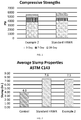
- FIG. 1 shows a bar graph comparing the compressive strength of the concrete blend of Example 2 against a concrete blend containing a conventional HRWR.
- FIG. 2 shows a bar graph comparing the average slump properties determined by ASTM C143 for the concrete blend of Example 2 and a concrete blend containing a conventional HRWR, both in comparison to a control lacking either plasticizer.
- FIG. 3 shows a bar graph comparing the average flowability properties determined by ASTM C109 for the concrete blend of Example 2 and a concrete blend containing a conventional HRWR, both in comparison to a control lacking either plasticizer.
- the present disclosure generally describes crosslinked polysaccharides and, more specifically, compositions comprising crosslinked polysaccharides in combination with a biologically sourced surfactant and concrete blends containing the same.
- plasticizers may be used to improve the workability of concrete blends, cracking, shrinkage or retardation during setting can be problematic in some instances.
- common plasticizers are not available from biological sources, and some can be comparatively expensive.
- compositions containing crosslinked polysaccharides in combination with a surfactant may provide surprising and advantageous benefits when incorporated into concrete blends.
- the compositions disclosed herein may afford good flexural strength upon setting of the concrete blend, early strength development, limited to no set time retardation, and good workability characteristics, including good flowability and minimal slumping characteristics.
- compositions of the present disclosure may comprise various components that are derived substantially from biological sources.
- Suitable crosslinked polysaccharides may include those in which a crosslinking group is bonded via a first ether linkage to a first polysaccharide chain and via a second ether linkage to a second polysaccharide chain. Additional details of the crosslinking chemistry are discussed hereinbelow.
- suitable surfactants may be biologically sourced (i.e., a “biosurfactant”), according to various embodiments.
- Biologically sourced surfactants may provide several advantages in the context of concrete blending, over and above that provided by their biogenic origin.
- Many biologically sources surfactants are oil-in-water (OW) surfactant systems that are very hydrophilic and improve mixing and handling features of concrete blends. A particular advantage is that little to no foaming tends to occur during blending.
- many biologically sourced surfactants are substantially free of environmentally undesirable chlorine and sulfur entities, such as chloride, sulfates and sulfites.
- various biologically sourced surfactants are capable of tolerating the extreme pH, hardness and temperature conditions associated with concrete mixing and setting.
- compositions of the present disclosure may comprise a biologically sourced surfactant, and a crosslinked polysaccharide, in which the crosslinked polysaccharide comprises at least one crosslinking group that is bonded via a first ether linkage to a first polysaccharide chain and via a second ether linkage to a second polysaccharide chain. Additional details concerning the crosslinking group and techniques for forming crosslinks between the first and second polysaccharide chains is discussed hereinbelow.
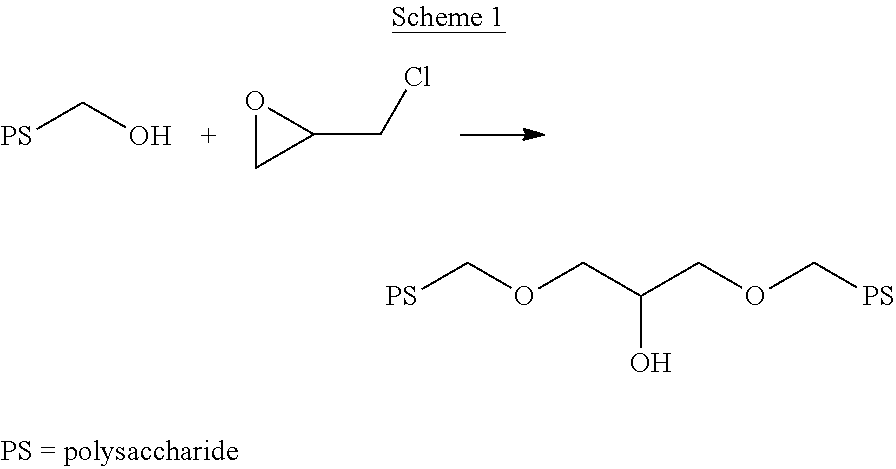
- the first and second polysaccharide chains may be crosslinked to one another through a reaction with a bis-epoxide or a halohydrin, such as epichlorohydrin.
- the crosslinking group may comprise an alkyl moiety or an alkyl moiety having one or more side chain hydroxyl groups extending between the first and second polysaccharide chains via the first and second ether linkages.
- the crosslinking group may comprise a reaction product of epichlorohydrin or a similar C 3 halohydrin with the first polysaccharide chain and the second polysaccharide chain.
- the reaction product of epichlorohydrin may comprise a C 3 alkyl moiety having a side chain hydroxyl group, specifically a hydroxyl group located upon the central carbon atom of the C 3 carbon chain.
- Scheme 1 below shows a generic reaction scheme in which epichlorohydrin is used to affect polysaccharide crosslinking. Although Scheme 1 has shown the crosslinking as occurring between a primary hydroxyl group located upon the first and second polysaccharides, it is to be understood that the secondary hydroxyl groups may be involved in crosslinking in some instances.
- crosslinked polysaccharides and other crosslinked polymers of the present disclosure may be produced by reacting a parent polysaccharide with epichlorohydrin in a basic solution at a temperature ranging from about 50° C. to 100° C. for several hours. About 1 to about 90 percent of the available hydroxyl groups in the polysaccharide may undergo a reaction to form crosslinks in this process, in more specific embodiments, about 1 to about 20 percent of the hydroxyl groups may undergo a crosslinking reaction, or between about 20 to about 50 percent of the hydroxyl groups, or between about 50 and about 70 percent of the hydroxyl groups, or between about 70 percent to about 90 percent of the hydroxyl groups.
- an even greater extent of crosslinking may take place, with up to substantially 100 percent of the available hydroxyl groups undergoing a crosslinking reaction.
- the extent of crosslinking may be used to tailor the resultant properties of the compositions and the cement blends formed therefrom.
- polysaccharides may be crosslinked using the crosslinking chemistry disclosed herein.
- Particular polysaccharides are not considered to be especially limited and, in some embodiments, may be selected from the group consisting of levan, dextran, guar gum, scleroglucan, welan, pullulan, xanthan gum, schizophyllan, cellulose, and any combination thereof.
- the crosslinked polysaccharide may include a levan, a dextran, or any combination thereof.
- the crosslinked polysaccharide may comprise a levan.
- Dextrans and levans crosslinked according to the embodiments of the present disclosure may provide especially advantageous benefits when incorporated in a concrete blend, as discussed herein.
- Dextrans and levans suitable for use in the embodiments of the present disclosure may be obtained from any source or prepared by any technique including synthetically, fermenting, and the like
- Scheme 2 shows an illustrative reaction schematic whereby levan may undergo crosslinking with epichlorohydin (EPCH), in a manner similar to that outlined generically in Scheme 1 above.
- the reaction product of epichlorohydrin with levan produces a C 3 alkyl group appended to a first levan chain via a first ether linkage (i.e., at the C 1 carbon of the crosslinking group) and to a second levan chain via a second ether linkage (i.e., at the C 3 carbon of the crosslinking group).
- the C 2 carbon of the crosslinking group bears a secondary hydroxyl group, which is formed upon opening the epoxide ring of the epichlorohydrin.
- the crosslinking group extends between branching fructose monomer units depending from the main chain. It is to be recognized, however, that this represents but one possible regioisomer of the depicted crosslinking chemistry.
- the crosslinking groups may extend between main chain fructose monomer units, between main chain and branching fructose monomer units, or between branching fructose monomer units.
- a combination of these types of crosslinking motifs may be present in any given crosslinked polysaccharide of the present disclosure. As such, the particular crosslinking motif shown in Scheme 2 should be considered illustrative and non-limiting.
- polymers and copolymers crosslinkable according to the present disclosure may include, for example, acrylic, methacrylic and crotonic acid ester and ether polymers such as polymers produced from the polymerization of methyl acrylate, ethyl acrylate, t-butyl acrylate, methyl methacrylate, ethyl methacrylate, cyclohexyl methacrylate, dimethyl aminoethyl methacrylate, dimethyl aminoethyl acrylate, methyl crotonate, and the like; polymers of maleic anhydride, esters thereof, and the like; nitrile polymers such as those produced from acrylonitrile; and amide polymers such as those produced from acrylamide, methacrylamide and the like.
- acrylic, methacrylic and crotonic acid ester and ether polymers such as polymers produced from the polymerization of methyl acrylate, ethyl acrylate, t-butyl acrylate,
- crosslinking chemistry the same as or different than that used for polysaccharides may be employed to affect crosslinking depending on the types of functional groups present in a given polymer.
- suitable crosslinking groups may comprise a C1-C8 carbon linker and/or long chain hydroxy aliphatic groups or salts as side chains, which may also contain a C1-C8 carbon linker.
- polysaccharides may comprise a plurality of hydroxyl groups, and a portion of these hydroxyl groups may undergo reaction with a crosslinking agent to form a crosslinking group between a first polysaccharide chain and a second polysaccharide chain, via an ether linkage to each chain.
- the hydroxyl groups that undergo crosslinking may be primary hydroxyl groups upon the first polysaccharide chain and the second polysaccharide chain.
- Polysaccharides suitable for use in the embodiments of the present disclosure may encompass a wide range of molecular weights.
- the molecular weight of polysaccharides suitable to undergo crosslinking according to the disclosure herein may range between about 1 million and about 50 million Daltons.
- the polysaccharide molecular weight, particularly for levans may range between about 1 million and about 5 million Daltons, or between 5 million and about 10 million Daltons, or between 10 million and about 20 million
- the polysaccharide may comprise a levan having a molecular weight ranging between about 3 million and about 10 million Daltons, which can be particularly desirable for incorporation in concrete blends according to the present disclosure.
- Biologically sourced surfactants suitable for use in the compositions and concrete blends of the present disclosure are not believed to be particularly limited.
- suitable biologically sourced surfactants may include entities such as, for example, glycolipids, phospholipids, fatty acids and fatty acid esters, fatty acid esters of glycerol, fatty acid esters of sorbitol, fatty acid esters of sucrose, alkyl polyglucosides, lipopeptides and lipoproteins, and the like.
- the biologically sourced surfactants may be obtained from any suitable biological origin, which may be plant or animal based.
- Glycolipids can be particularly desirable in the embodiments of the present disclosure due to the common structural similarity shared between the polysaccharide backbone of the crosslinked polysaccharide and the polysaccharide backbone of the glycolipid.
- rhamnolipids may be a particularly desirable glycolipid surfactant for use in the compositions and cement blends of the present disclosure.
- Rhamnolipids are not only EPA-registered as a surfactant, but also possess desirable biocidal properties and good surface tension reduction across a range of pH values. Without being bound by any theory or mechanism, at least some of the features of rhamnolipids are believed to arise due to their large hydrophilic head, which provides good surface coverage at the oil/water interface.
- an amount of biologically sourced surfactant in the compositions of the present disclosure may range between about 1 percent to about 10 percent by weight. In more specific embodiments, an amount of the biologically sourced surfactant may range between about 1 percent to about 2 percent by weight, or between about 1.5 to about 2.5 percent by weight, or between about 2 percent to about 3 percent by weight, or between about 2.5 to about 3.5 percent by weight, or between about 3 percent to about 4 percent by weight, or between about 3.5 to about 4.5 percent by weight, or between about 4 percent to about 5 percent by weight, or between about 4.5 to about 5.5 percent by weight, or between about 5 percent to about 6 percent by weight, or between about 5.5 to about 6.5 percent by weight, or between about 6 percent to about 7 percent by weight, or between about 6.5 to about 7.5 percent by weight, or between about 7 percent to about 8 percent by weight, or between about 7.5 to about 8.5 percent by weight, or between about 8 percent to about 9 percent by weight, or between about 8.5 to about 9.5 percent by weight, or between about 9
- a suitable amount of the biologically sourced surfactant may be about 1 to about 3 gallons of surfactant solution per about 1000 gallons of crosslinked levan solution.
- the present disclosure also describes concrete blends comprising the compositions disclosed hereinabove.
- the concrete blends may comprise a cement, water and an amount of the compositions disclosed hereinabove.
- the compositions may be introduced either before, during, or after adding water to form the concrete blends.
- a water mixture of a biologically sourced surfactant and a crosslinked polysaccharide may be combined with a cement to form a concrete blend of the present disclosure.
- Suitable types of cement that may be present in the concrete blends may include, for example, Portland cements.
- the concrete blends may comprise an aggregate material such as sand and/or rock.
- compositions disclosed herein may be included in concrete blends in an amount suitable to influence or enhance at least one property selected from the group consisting of flexural strength, early strength development, workability, flowability, and slumping.
- at least one property selected from the group consisting of flexural strength, early strength development, workability, flowability, and slumping.
- one or more of the following enhanced properties may be realized: about 5-15% increase in flexural strength compared to base, 90% or more of maximum strength occurring in about 1 day or less, and slump greater than about 7.5 inches.
- compositions of the present disclosure may be included in concrete blends in an amount ranging between about 1 to about 10 ounces per 100 concrete hundred weight (cwt). In more specific embodiments, the compositions may be present in the concrete blends in an amount ranging between about 1 and about 2 ounces per 100 cwt, or between about 2 and about 3 ounces per 100 cwt, or between about 3 and about 4 ounces per 100 cwt, or between about 4 and about 5 ounces per 100 cwt, or between about 5 and about 6 ounces per 100 cwt, or between about 6 and about 7 ounces per 100 cwt, or between about 7 and about 8 ounces per 100 cwt, or between about 8 and about 9 ounces per 100 cwt, or between about 9 and about 10 ounces per 100 cwt, or between about 2 and about 4 ounces per 100 cwt.
- compositions of the present disclosure may accelerate the set rate when incorporated in a concrete blend in the foregoing amounts. In some or other illustrative embodiments, compositions of the present disclosure may provide about 12% or greater water reduction when incorporated in a concrete blend, placing the compositions in the range of conventional high range water reducer (HRWR) and Type F plasticizers.
- HRWR high range water reducer
- compositions comprise: a biologically sourced surfactant; and a crosslinked polysaccharide, the crosslinked polysaccharide comprising at least one crosslinking group that is bonded via a first ether linkage to a first polysaccharide chain and via a second ether linkage to a second polysaccharide chain.
- the cement blends comprise a cement, water and a composition comprising a biologically sourced surfactant; and a crosslinked polysaccharide, the crosslinked polysaccharide comprising at least one crosslinking group that is bonded via a first ether linkage to a first polysaccharide chain and via a second ether linkage to a second polysaccharide chain.
- Methods for forming a cement blend comprise: forming a concrete blend comprising a cement, water, and a composition comprising a biologically sourced surfactant and a crosslinked polysaccharide, the crosslinked polysaccharide comprising at least one crosslinking group that is bonded via a first ether linkage to a first polysaccharide chain and via a second ether linkage to a second polysaccharide chain; and allowing the concrete blend to form a hardened mass.
- Embodiments A-C may have one or more of the following additional elements in any combination.
- crosslinked polysaccharide comprises a polysaccharide selected from the group consisting of levan, dextran, guar gum, scleroglucan, welan, pullulan, xanthan gum, schizophyllan, cellulose, and any combination thereof.
- Element 2 wherein the at least one crosslinking group comprises a reaction product of epichlorohydrin with the first polysaccharide chain and the second polysaccharide chain.
- Element 3 wherein the crosslinked polysaccharide comprises a levan, a dextran, or any combination thereof.
- Element 4 wherein the crosslinked polysaccharide comprises a levan.
- Element 5 wherein the at least one crosslinking group comprises a C 3 alkyl moiety having a side chain hydroxyl group.
- Element 6 wherein the biologically sourced surfactant comprises a rhamnolipid.
- Element 7 wherein the crosslinked polysaccharide comprises a plurality of pendant hydroxyl groups, and between about 1 to about 90 percent of the pendant hydroxyl groups are converted into an ether linkage.
- Element 8 wherein an amount of the biologically sourced surfactant ranges between about 1 and about 10 percent by weight of the composition.
- Element 9 wherein the composition is present in an amount ranging between about 3 and about 4 ounces per 100 concrete hundred weight (cwt).
- Element 10 wherein forming the concrete blend comprises combining a water mixture of the biologically sourced surfactant and the crosslinked polysaccharide with the cement.
- exemplary combinations applicable to A include: 1 and 2; 2 and 3; 2 and 4; 3 and 5; 4 and 5; 1 and 6; 2 and 6; 3 and 6; 4 and 6; 5 and 6; 1 and 7; 2 and 7; 3 and 7; 4 and 7; 5 and 7; 6 and 7; 1 and 8; 2 and 8; 3 and 8; 4 and 8; 5 and 8; 6 and 8; and 7 and 8.
- exemplary combinations applicable to B and C include: 1 and 2; 2 and 3; 2 and 4; 3 and 5; 4 and 5; 1 and 6; 2 and 6; 3 and 6; 4 and 6; 5 and 6; 1 and 7; 2 and 7; 3 and 7; 4 and 7; 5 and 7; 6 and 7; 1 and 8; 2 and 8; 3 and 8; 4 and 8; 5 and 8; 6 and 8; and 7 and 8, all optionally in further combination with element 9 and/or element 10.
- aqueous phase crosslinked levan from Example 1 was combined with a biologically sourced surfactant (rhamnolipids) in an amount ranging between 1 and 10 weight percent, which was then combined with a cement to form a concrete blend in a water:cement ratio of 0.575 at set temperature of 78° F.
- rhamnolipids biologically sourced surfactant
- the resulting concrete blends exhibited excellent flexural strength, little to no set retardation, early strength development and good workability, as determined by various ASTM testing methods.
- the measured properties were comparable or superior to industry standard plasticizers commonly used in the concrete industry.
- FIG. 1 shows a bar graph comparing the compressive strength of the concrete blend of Example 2 against a concrete blend containing a conventional HRWR. As shown, the concrete blend of Example 2 had a comparable to superior compressive strength value over the first 7 days of setting and only a marginally lower compressive strength following a 28-day set.
- FIG. 2 shows a bar graph comparing the average slump properties determined by ASTM C143 for the concrete blend of Example 2 and a concrete blend containing a conventional HRWR, both in comparison to a control lacking either plasticizer. As shown, the concrete blend of Example 2 was again comparable to that containing a conventional HRWR. The higher slump value for the concrete blend of Example 2 compared to the control illustrates the higher workability of the former.
- FIG. 3 shows a bar graph comparing the average flowability properties determined by ASTM C109 for the concrete blend of Example 2 and a concrete blend containing a conventional HRWR, both in comparison to a control lacking either plasticizer. As shown, the concrete blend of Example 2 had a superior flow diameter to both the control and the conventional HRWR.
- Table 1 provides a summary comparison of the concrete blend of Example 2 against a control and a concrete blend containing a conventional HRWR.
- the phrase “at least one of” preceding a series of items, with the terms “and” or “or” to separate any of the items, modifies the list as a whole, rather than each member of the list (i.e., each item).
- the phrase “at least one of” allows a meaning that includes at least one of any one of the items, and/or at least one of any combination of the items, and/or at least one of each of the items.
- the phrases “at least one of A, B, and C” or “at least one of A, B, or C” each refer to only A, only B, or only C; any combination of A, B, and C; and/or at least one of each of A, B, and C.
Landscapes
- Chemical & Material Sciences (AREA)
- Engineering & Computer Science (AREA)
- Ceramic Engineering (AREA)
- Materials Engineering (AREA)
- Organic Chemistry (AREA)
- Structural Engineering (AREA)
- Life Sciences & Earth Sciences (AREA)
- Chemical Kinetics & Catalysis (AREA)
- Health & Medical Sciences (AREA)
- Inorganic Chemistry (AREA)
- Molecular Biology (AREA)
- Wood Science & Technology (AREA)
- Biochemistry (AREA)
- Medicinal Chemistry (AREA)
- Polymers & Plastics (AREA)
- General Health & Medical Sciences (AREA)
- Curing Cements, Concrete, And Artificial Stone (AREA)
- Revetment (AREA)
Abstract
Description

| Initial Set | Final Set | |||
| Sample | Slump (in.) | Air (%) | Time (hr) | Time (Hr) |
| Control | 4.0 | 1.4 | 3:18 | 4:32 |
| Conv. HRWR | 7.6 | 1.4 | 3:34 | 4:58 |
| Example 2 | 7.5 | 2.1 | 3:13 | 4:23 |
As shown, the conventional HRWR produced a retarded set compared to both the control and the concrete blend of Example 2. The concrete blend of Example 2, in contrast, was slightly accelerated in comparison to the control.
Claims (21)
Priority Applications (1)
| Application Number | Priority Date | Filing Date | Title |
|---|---|---|---|
| US16/337,129 US10793473B2 (en) | 2016-11-23 | 2017-11-22 | Crosslinked polysaccharide compositions and concrete blends containing the same |
Applications Claiming Priority (3)
| Application Number | Priority Date | Filing Date | Title |
|---|---|---|---|
| US201662425852P | 2016-11-23 | 2016-11-23 | |
| US16/337,129 US10793473B2 (en) | 2016-11-23 | 2017-11-22 | Crosslinked polysaccharide compositions and concrete blends containing the same |
| PCT/US2017/063031 WO2018098291A1 (en) | 2016-11-23 | 2017-11-22 | Crosslinked polysaccharide compositions and concrete blends containing the same |
Publications (2)
| Publication Number | Publication Date |
|---|---|
| US20200031715A1 US20200031715A1 (en) | 2020-01-30 |
| US10793473B2 true US10793473B2 (en) | 2020-10-06 |
Family
ID=62195625
Family Applications (1)
| Application Number | Title | Priority Date | Filing Date |
|---|---|---|---|
| US16/337,129 Expired - Fee Related US10793473B2 (en) | 2016-11-23 | 2017-11-22 | Crosslinked polysaccharide compositions and concrete blends containing the same |
Country Status (4)
| Country | Link |
|---|---|
| US (1) | US10793473B2 (en) |
| CA (1) | CA3044701A1 (en) |
| MX (1) | MX2019005902A (en) |
| WO (1) | WO2018098291A1 (en) |
Families Citing this family (5)
| Publication number | Priority date | Publication date | Assignee | Title |
|---|---|---|---|---|
| EP3931168A1 (en) | 2019-02-28 | 2022-01-05 | Dow Global Technologies LLC | Concrete-forming composition |
| BR112022016375A2 (en) * | 2020-02-20 | 2022-10-04 | Locus Ip Co Llc | IMPROVED CONCRETE COMPOSITIONS AND METHODS TO PRODUCE THEM |
| CN113248181B (en) * | 2021-06-26 | 2022-04-01 | 西安同成建筑科技有限责任公司 | Anti-carbonization agent for concrete and preparation method thereof |
| WO2023026936A1 (en) * | 2021-08-25 | 2023-03-02 | 株式会社カネカ | Cement modifier and polymer cement composition |
| US20240116814A1 (en) * | 2021-12-01 | 2024-04-11 | Locus Solutions Ipco, Llc | Concrete with Improved Environmental Impact |
Citations (7)
| Publication number | Priority date | Publication date | Assignee | Title |
|---|---|---|---|---|
| WO1998003184A1 (en) | 1996-07-19 | 1998-01-29 | Clarke-Garegg, Margaret, A. | Levan derivatives, their preparation, composition and applications including medical and food applications |
| US7365190B2 (en) * | 2000-11-10 | 2008-04-29 | Archer-Daniels-Midland Company | Crosslinked polysaccharide, obtained by crosslinking with substituted polyethylene glycol, as superabsorbent |
| US20090197829A1 (en) | 2008-01-31 | 2009-08-06 | Rhodia Inc. | Crosslinked polysaccharides and methods of production thereof |
| US20090253599A1 (en) * | 2008-04-07 | 2009-10-08 | Rhodia Inc. | Crosslinking method and crosslinked polysaccharide made thereby |
| US20100029929A1 (en) * | 2008-07-30 | 2010-02-04 | Rhodia Inc. | Method of producing cross-linked polysaccharide particles |
| US20130142763A1 (en) * | 2010-10-27 | 2013-06-06 | Empire Technology Development Llc | Crosslinked cellulosic polymers |
| US20200010711A1 (en) * | 2017-03-07 | 2020-01-09 | Integrity Bio-Chemicals, Llc | Polysaccharide Compositions and Particulate Materials Coated Therewith |
-
2017
- 2017-11-22 US US16/337,129 patent/US10793473B2/en not_active Expired - Fee Related
- 2017-11-22 CA CA3044701A patent/CA3044701A1/en active Pending
- 2017-11-22 WO PCT/US2017/063031 patent/WO2018098291A1/en not_active Ceased
- 2017-11-22 MX MX2019005902A patent/MX2019005902A/en unknown
Patent Citations (8)
| Publication number | Priority date | Publication date | Assignee | Title |
|---|---|---|---|---|
| WO1998003184A1 (en) | 1996-07-19 | 1998-01-29 | Clarke-Garegg, Margaret, A. | Levan derivatives, their preparation, composition and applications including medical and food applications |
| US7365190B2 (en) * | 2000-11-10 | 2008-04-29 | Archer-Daniels-Midland Company | Crosslinked polysaccharide, obtained by crosslinking with substituted polyethylene glycol, as superabsorbent |
| US20090197829A1 (en) | 2008-01-31 | 2009-08-06 | Rhodia Inc. | Crosslinked polysaccharides and methods of production thereof |
| US8785622B2 (en) * | 2008-01-31 | 2014-07-22 | Rhodia Operations | Crosslinked polysaccharides and methods of production thereof |
| US20090253599A1 (en) * | 2008-04-07 | 2009-10-08 | Rhodia Inc. | Crosslinking method and crosslinked polysaccharide made thereby |
| US20100029929A1 (en) * | 2008-07-30 | 2010-02-04 | Rhodia Inc. | Method of producing cross-linked polysaccharide particles |
| US20130142763A1 (en) * | 2010-10-27 | 2013-06-06 | Empire Technology Development Llc | Crosslinked cellulosic polymers |
| US20200010711A1 (en) * | 2017-03-07 | 2020-01-09 | Integrity Bio-Chemicals, Llc | Polysaccharide Compositions and Particulate Materials Coated Therewith |
Non-Patent Citations (4)
| Title |
|---|
| International Search Report and Written Opinion received in corresponding PCT Application No. PCT/US2017/063031, search completed Mar. 14, 2018, dated Mar. 14, 2018. |
| Miller, Markus Michael et al., "Rhamnolipids-next generation surfactants?", Journal of Biotechnology, 2012, vol. 162, No. 4, pp. 366-380. |
| Nitschke, Marcia et al., "Rhamnolipid surfactants: an update on the general aspects of these remarkable biomolecules," Biotechnology Progress, 2005, vol. 21, No. 6, pp. 1593-1600. |
| Rosenberg, E. et al., "High-and low-molecular-mass microbial surfactants," Applied Microbiology and Biotechnology, 1999, vol. 52, No. 2, pp. 154-162. |
Also Published As
| Publication number | Publication date |
|---|---|
| MX2019005902A (en) | 2019-10-02 |
| CA3044701A1 (en) | 2018-05-31 |
| WO2018098291A1 (en) | 2018-05-31 |
| WO2018098291A9 (en) | 2018-09-07 |
| US20200031715A1 (en) | 2020-01-30 |
Similar Documents
| Publication | Publication Date | Title |
|---|---|---|
| US20200031715A1 (en) | Crosslinked polysaccharide compositions and concerte blends containing the same | |
| DE69716580T2 (en) | POLYSACCHARIDE DERIVATIVES AND HYDRAULIC COMPOSITIONS | |
| US7621995B2 (en) | Concrete mixtures having high flowability | |
| RU2012125994A (en) | EXTRUDED FIBER REINFORCED CEMENT PRODUCTS HAVING STONE PROPERTIES AND METHODS FOR PRODUCING THEM | |
| JP7228473B2 (en) | High-strength concrete containing steel fibers and its preparation method | |
| CN108529968A (en) | A kind of fiber concrete material and preparation method thereof for 3D printing | |
| CN1205680A (en) | Nitrogen-Containing Strengthening Agents for Portland Cement | |
| DE10226088A1 (en) | Additive for hydraulically setting systems, hydraulically setting compounds and their use | |
| DE602005004765T2 (en) | ADDITIVE FOR HYDRAULIC MATERIAL | |
| US4870120A (en) | Cement dispersant | |
| NZ234010A (en) | Additives for improving water-repellancy of hydraulic cements | |
| US20100307381A1 (en) | Rheology Modifying Admixture | |
| US8864905B2 (en) | Use of carboxymethyl chitosans as additives in agglomerating compositions | |
| JP5449024B2 (en) | Self-shrinkage reducing agent | |
| CN107074658B (en) | The method of concrete hydrophobization | |
| DE2549656A1 (en) | NEW HARDENING AGENTS FOR EPOXY RESINS | |
| CN1705728A (en) | Emulsions for composite materials | |
| KR101761778B1 (en) | A mortar additive composition | |
| RU2245990C1 (en) | Plugging composition | |
| ES2764675T3 (en) | Ductile Construction Material | |
| US6811605B2 (en) | Admixture and extrudable hydraulic composition | |
| EP2714746A1 (en) | Hydroxypropyl guar | |
| CN112778466B (en) | Air-entraining type polycarboxylate superplasticizer and preparation method and application thereof | |
| RU2282601C2 (en) | Concrete mixture | |
| CN111072788A (en) | Preparation method of starch sulfate and application of starch sulfate as cement additive |
Legal Events
| Date | Code | Title | Description |
|---|---|---|---|
| AS | Assignment |
Owner name: HPPE LLC, GEORGIA Free format text: ASSIGNMENT OF ASSIGNORS INTEREST;ASSIGNORS:MADDURI, ASHOKA V.R.;GARDNER, CHRISTOPHER P.;BLACKMON, MATTHEW B.;AND OTHERS;SIGNING DATES FROM 20180220 TO 20180702;REEL/FRAME:048715/0950 Owner name: INTEGRITY BIO-CHEMICALS, LLC, TEXAS Free format text: ASSIGNMENT OF ASSIGNORS INTEREST;ASSIGNOR:HPPE LLC;REEL/FRAME:048716/0253 Effective date: 20190224 |
|
| FEPP | Fee payment procedure |
Free format text: ENTITY STATUS SET TO UNDISCOUNTED (ORIGINAL EVENT CODE: BIG.); ENTITY STATUS OF PATENT OWNER: SMALL ENTITY |
|
| FEPP | Fee payment procedure |
Free format text: ENTITY STATUS SET TO SMALL (ORIGINAL EVENT CODE: SMAL); ENTITY STATUS OF PATENT OWNER: SMALL ENTITY |
|
| STPP | Information on status: patent application and granting procedure in general |
Free format text: APPLICATION DISPATCHED FROM PREEXAM, NOT YET DOCKETED |
|
| STPP | Information on status: patent application and granting procedure in general |
Free format text: DOCKETED NEW CASE - READY FOR EXAMINATION |
|
| STPP | Information on status: patent application and granting procedure in general |
Free format text: NOTICE OF ALLOWANCE MAILED -- APPLICATION RECEIVED IN OFFICE OF PUBLICATIONS |
|
| STPP | Information on status: patent application and granting procedure in general |
Free format text: PUBLICATIONS -- ISSUE FEE PAYMENT VERIFIED |
|
| STCF | Information on status: patent grant |
Free format text: PATENTED CASE |
|
| FEPP | Fee payment procedure |
Free format text: MAINTENANCE FEE REMINDER MAILED (ORIGINAL EVENT CODE: REM.); ENTITY STATUS OF PATENT OWNER: SMALL ENTITY |
|
| LAPS | Lapse for failure to pay maintenance fees |
Free format text: PATENT EXPIRED FOR FAILURE TO PAY MAINTENANCE FEES (ORIGINAL EVENT CODE: EXP.); ENTITY STATUS OF PATENT OWNER: SMALL ENTITY |
|
| STCH | Information on status: patent discontinuation |
Free format text: PATENT EXPIRED DUE TO NONPAYMENT OF MAINTENANCE FEES UNDER 37 CFR 1.362 |
|
| FP | Lapsed due to failure to pay maintenance fee |
Effective date: 20241006 |