US10787453B2 - Octahydropyrrolopyrroles their preparation and use - Google Patents
Octahydropyrrolopyrroles their preparation and use Download PDFInfo
- Publication number
- US10787453B2 US10787453B2 US15/950,528 US201815950528A US10787453B2 US 10787453 B2 US10787453 B2 US 10787453B2 US 201815950528 A US201815950528 A US 201815950528A US 10787453 B2 US10787453 B2 US 10787453B2
- Authority
- US
- United States
- Prior art keywords
- alkyl
- halogen
- och
- phenyl
- trifluoromethyl
- Prior art date
- Legal status (The legal status is an assumption and is not a legal conclusion. Google has not performed a legal analysis and makes no representation as to the accuracy of the status listed.)
- Active
Links
- 0 *C1=C(N2CC3CN(*B)CC3C2)C([5*])=C([4*])C([3*])=C1[2*] Chemical compound *C1=C(N2CC3CN(*B)CC3C2)C([5*])=C([4*])C([3*])=C1[2*] 0.000 description 69
- RFHQRRJFJJCQDJ-UHFFFAOYSA-N CC(C)C1CCC1 Chemical compound CC(C)C1CCC1 RFHQRRJFJJCQDJ-UHFFFAOYSA-N 0.000 description 6
- HXVNBWAKAOHACI-UHFFFAOYSA-N CC(C)C(=O)C(C)C Chemical compound CC(C)C(=O)C(C)C HXVNBWAKAOHACI-UHFFFAOYSA-N 0.000 description 4
- PXARCNRILXANBK-UHFFFAOYSA-N CC(C)C(=O)C(C)C.CC(C)NC(=O)C(C)C Chemical compound CC(C)C(=O)C(C)C.CC(C)NC(=O)C(C)C PXARCNRILXANBK-UHFFFAOYSA-N 0.000 description 4
- OVHHKQBVJAQEEX-UHFFFAOYSA-N C.CC(C)C(=O)NS(=O)(=O)C1CC1.CC(C)C(=O)NS(C)(=O)=O.CC(C)C(=O)NS(C)(=O)=O.CC(C)C(=O)OS(C)(=O)=O Chemical compound C.CC(C)C(=O)NS(=O)(=O)C1CC1.CC(C)C(=O)NS(C)(=O)=O.CC(C)C(=O)NS(C)(=O)=O.CC(C)C(=O)OS(C)(=O)=O OVHHKQBVJAQEEX-UHFFFAOYSA-N 0.000 description 3
- MAUMQBPRHNGALI-UHFFFAOYSA-N CC(C)S(=O)(=O)C1CCC1 Chemical compound CC(C)S(=O)(=O)C1CCC1 MAUMQBPRHNGALI-UHFFFAOYSA-N 0.000 description 3
- ITMHMKGFBREMQR-UHFFFAOYSA-N C.C.C.CC(C)C(=O)C1CCC1.CC(C)C(=O)N(C)C.CNC(=O)C(C)C Chemical compound C.C.C.CC(C)C(=O)C1CCC1.CC(C)C(=O)N(C)C.CNC(=O)C(C)C ITMHMKGFBREMQR-UHFFFAOYSA-N 0.000 description 2
- MRULEICYHMWUCE-UHFFFAOYSA-N CC(C)C(=O)NS(=O)(=O)C1CC1.CC(C)C(=O)NS(C)(=O)=O.CC(C)C(=O)NS(C)(=O)=O.CC(C)C(=O)OS(C)(=O)=O Chemical compound CC(C)C(=O)NS(=O)(=O)C1CC1.CC(C)C(=O)NS(C)(=O)=O.CC(C)C(=O)NS(C)(=O)=O.CC(C)C(=O)OS(C)(=O)=O MRULEICYHMWUCE-UHFFFAOYSA-N 0.000 description 2
- DKAPTUMYXGVVBZ-UHFFFAOYSA-N CC(C)C(=O)NS(=O)(=O)C1CC1.CC(C)C(=O)NS(C)(=O)=O.CC(C)C(=O)NS(C)(=O)=O.CC(C)OS(C)(=O)=O Chemical compound CC(C)C(=O)NS(=O)(=O)C1CC1.CC(C)C(=O)NS(C)(=O)=O.CC(C)C(=O)NS(C)(=O)=O.CC(C)OS(C)(=O)=O DKAPTUMYXGVVBZ-UHFFFAOYSA-N 0.000 description 2
- HNZBPRDIUKCJJJ-UHFFFAOYSA-N CC(C)C1=NN=C2N1[Y]=[Y]([Y])[Y]([Y][Y])=[Y]2[Y][Y][Y] Chemical compound CC(C)C1=NN=C2N1[Y]=[Y]([Y])[Y]([Y][Y])=[Y]2[Y][Y][Y] HNZBPRDIUKCJJJ-UHFFFAOYSA-N 0.000 description 2
- KUMUGKOWTKUSEB-AHKTXEOZSA-N [H][C@]12CN(C(=O)C3=NN=C4C=CC(C(=C)N(C)C)=CN43)C[C@@]1([H])CN(C1=C(C(F)(F)F)C=CC=C1)C2.[H][C@]12CN(C(=O)C3=NN=C4C=CC(C(=C)NC)=CN43)C[C@@]1([H])CN(C1=C(C(F)(F)F)C=CC=C1)C2.[H][C@]12CN(C(=O)C3=NN=C4C=CC(C)=CN43)C[C@@]1([H])CN(C1=C(C(F)(F)F)C=CC=C1)C2.[H][C@]12CN(C(=O)C3=NN=C4C=CC(C)=CN43)C[C@@]1([H])CN(C1=C(C(F)(F)F)C=CC=C1)C2.[H][C@]12CN(C(=O)C3=NN=C4C=CC(NC(=O)N(C)C)=CN43)C[C@@]1([H])CN(C1=C(C(F)(F)F)C=CC=C1)C2.[H][C@]12CN(C(=O)C3=NN=C4C=CC(NC(=O)NC)=CN43)C[C@@]1([H])CN(C1=C(C(F)(F)F)C=CC=C1)C2 Chemical compound [H][C@]12CN(C(=O)C3=NN=C4C=CC(C(=C)N(C)C)=CN43)C[C@@]1([H])CN(C1=C(C(F)(F)F)C=CC=C1)C2.[H][C@]12CN(C(=O)C3=NN=C4C=CC(C(=C)NC)=CN43)C[C@@]1([H])CN(C1=C(C(F)(F)F)C=CC=C1)C2.[H][C@]12CN(C(=O)C3=NN=C4C=CC(C)=CN43)C[C@@]1([H])CN(C1=C(C(F)(F)F)C=CC=C1)C2.[H][C@]12CN(C(=O)C3=NN=C4C=CC(C)=CN43)C[C@@]1([H])CN(C1=C(C(F)(F)F)C=CC=C1)C2.[H][C@]12CN(C(=O)C3=NN=C4C=CC(NC(=O)N(C)C)=CN43)C[C@@]1([H])CN(C1=C(C(F)(F)F)C=CC=C1)C2.[H][C@]12CN(C(=O)C3=NN=C4C=CC(NC(=O)NC)=CN43)C[C@@]1([H])CN(C1=C(C(F)(F)F)C=CC=C1)C2 KUMUGKOWTKUSEB-AHKTXEOZSA-N 0.000 description 2
- RHXLNCPGAOJERS-SERIZZSPSA-N [H][C@]12CN(C(=O)C3=NN=C4C=CC(C)=CN43)C[C@@]1([H])CN(C1=C(C(F)(F)F)C=CC=C1)C2.[H][C@]12CN(C(=O)C3=NN=C4C=CC(C)=CN43)C[C@@]1([H])CN(C1=C(C(F)(F)F)C=CC=C1)C2.[H][C@]12CN(C(=O)C3=NN=C4C=CC(Cl)=CN43)C[C@@]1([H])CN(C1=C(C(F)(F)F)C=CC=C1)C2.[H][C@]12CN(C(=O)C3=NN=C4C=CC(F)=CN43)C[C@@]1([H])CN(C1=C(C(F)(F)F)C=CC=C1)C2.[H][C@]12CN(C(=O)C3=NN=C4CCCCN43)C[C@@]1([H])CN(C1=C(C(F)(F)F)C=CC=C1)C2.[H][C@]12CN(C(=O)C3=NNC4=C3CCCC4)C[C@@]1([H])CN(C1=C(C(F)(F)F)C=CC=C1)C2.[H][C@]12CN(C(=O)C3=NNC4=C3CCCC4)C[C@@]1([H])CN(C1=C(C(F)(F)F)C=CC=C1)C2.[H][C@]12CN(C(=O)C3=NNC4=C3CCCCC4)C[C@@]1([H])CN(C1=C(C(F)(F)F)C=CC=C1)C2 Chemical compound [H][C@]12CN(C(=O)C3=NN=C4C=CC(C)=CN43)C[C@@]1([H])CN(C1=C(C(F)(F)F)C=CC=C1)C2.[H][C@]12CN(C(=O)C3=NN=C4C=CC(C)=CN43)C[C@@]1([H])CN(C1=C(C(F)(F)F)C=CC=C1)C2.[H][C@]12CN(C(=O)C3=NN=C4C=CC(Cl)=CN43)C[C@@]1([H])CN(C1=C(C(F)(F)F)C=CC=C1)C2.[H][C@]12CN(C(=O)C3=NN=C4C=CC(F)=CN43)C[C@@]1([H])CN(C1=C(C(F)(F)F)C=CC=C1)C2.[H][C@]12CN(C(=O)C3=NN=C4CCCCN43)C[C@@]1([H])CN(C1=C(C(F)(F)F)C=CC=C1)C2.[H][C@]12CN(C(=O)C3=NNC4=C3CCCC4)C[C@@]1([H])CN(C1=C(C(F)(F)F)C=CC=C1)C2.[H][C@]12CN(C(=O)C3=NNC4=C3CCCC4)C[C@@]1([H])CN(C1=C(C(F)(F)F)C=CC=C1)C2.[H][C@]12CN(C(=O)C3=NNC4=C3CCCCC4)C[C@@]1([H])CN(C1=C(C(F)(F)F)C=CC=C1)C2 RHXLNCPGAOJERS-SERIZZSPSA-N 0.000 description 2
- FFHVKVSTLZQLKG-PHZGNYQRSA-N [H][C@]12C[C@@H](C3=C(C(F)(F)F)C=CC=C3)C[C@@]1([H])CN(C(=O)C1=NN=C3C=C(C)C=CN31)C2 Chemical compound [H][C@]12C[C@@H](C3=C(C(F)(F)F)C=CC=C3)C[C@@]1([H])CN(C(=O)C1=NN=C3C=C(C)C=CN31)C2 FFHVKVSTLZQLKG-PHZGNYQRSA-N 0.000 description 2
- JLVUZSRCFYVLQG-ZSOGYDGISA-N [H][C@]12C[C@@H](C3=C(C(F)(F)F)C=CC=C3)C[C@@]1([H])CN(C(=O)NC1=CC=C(F)C=C1C(=O)O)C2 Chemical compound [H][C@]12C[C@@H](C3=C(C(F)(F)F)C=CC=C3)C[C@@]1([H])CN(C(=O)NC1=CC=C(F)C=C1C(=O)O)C2 JLVUZSRCFYVLQG-ZSOGYDGISA-N 0.000 description 2
- ZZZMLSGWZAFWHA-QKDCVEJESA-N [H][C@]12C[C@@H](C3=C(C(F)(F)F)C=CC=C3)C[C@@]1([H])CN(C(=O)NC1=CC=CC=C1C(=O)O)C2 Chemical compound [H][C@]12C[C@@H](C3=C(C(F)(F)F)C=CC=C3)C[C@@]1([H])CN(C(=O)NC1=CC=CC=C1C(=O)O)C2 ZZZMLSGWZAFWHA-QKDCVEJESA-N 0.000 description 2
- MATJKRPOHILPIO-PHZGNYQRSA-N [H][C@]12C[C@@H](C3=CC=CC=C3C(F)(F)F)C[C@@]1([H])CN(C(=O)C1=NNC3=C1CCN(C(C)=O)C3)C2 Chemical compound [H][C@]12C[C@@H](C3=CC=CC=C3C(F)(F)F)C[C@@]1([H])CN(C(=O)C1=NNC3=C1CCN(C(C)=O)C3)C2 MATJKRPOHILPIO-PHZGNYQRSA-N 0.000 description 2
- YVWIGSBPUFVPBG-FOEAUAERSA-N C.C.Cl.Cl.O=C=O.[H]C1=NNC2=C1CCN(C(=O)OC(C)(C)C)C2.[H][C@@]12CNC[C@]1([H])C[C@H](C1=C(C(F)(F)F)C=CC=C1)C2.[H][C@]12C[C@@H](C3=C(C(F)(F)F)C=CC=C3)C[C@@]1([H])CN(C(=O)C1=NNC3=C1CCN(C(=O)OC(C)(C)C)C3)C2.[H][C@]12C[C@@H](C3=C(C(F)(F)F)C=CC=C3)C[C@@]1([H])CN(C(=O)C1=NNC3=C1CCNC3)C2 Chemical compound C.C.Cl.Cl.O=C=O.[H]C1=NNC2=C1CCN(C(=O)OC(C)(C)C)C2.[H][C@@]12CNC[C@]1([H])C[C@H](C1=C(C(F)(F)F)C=CC=C1)C2.[H][C@]12C[C@@H](C3=C(C(F)(F)F)C=CC=C3)C[C@@]1([H])CN(C(=O)C1=NNC3=C1CCN(C(=O)OC(C)(C)C)C3)C2.[H][C@]12C[C@@H](C3=C(C(F)(F)F)C=CC=C3)C[C@@]1([H])CN(C(=O)C1=NNC3=C1CCNC3)C2 YVWIGSBPUFVPBG-FOEAUAERSA-N 0.000 description 1
- RFFQZHMBULKYAS-MUGLDYSPSA-N C.C.Cl.Cl.O=C=O.[H]C1=NNC2=C1CN(C(=O)OC(C)(C)C)C2.[H][C@@]12CNC[C@]1([H])C[C@H](C1=C(C(F)(F)F)C=CC=C1)C2.[H][C@]12C[C@@H](C3=C(C(F)(F)F)C=CC=C3)C[C@@]1([H])CN(C(=O)C1=NNC3=C1CN(C(=O)OC(C)(C)C)C3)C2.[H][C@]12C[C@@H](C3=C(C(F)(F)F)C=CC=C3)C[C@@]1([H])CN(C(=O)C1=NNC3=C1CNC3)C2 Chemical compound C.C.Cl.Cl.O=C=O.[H]C1=NNC2=C1CN(C(=O)OC(C)(C)C)C2.[H][C@@]12CNC[C@]1([H])C[C@H](C1=C(C(F)(F)F)C=CC=C1)C2.[H][C@]12C[C@@H](C3=C(C(F)(F)F)C=CC=C3)C[C@@]1([H])CN(C(=O)C1=NNC3=C1CN(C(=O)OC(C)(C)C)C3)C2.[H][C@]12C[C@@H](C3=C(C(F)(F)F)C=CC=C3)C[C@@]1([H])CN(C(=O)C1=NNC3=C1CNC3)C2 RFFQZHMBULKYAS-MUGLDYSPSA-N 0.000 description 1
- OIIQZFVOACCSGB-SOUXHFSSSA-N C.C.Cl.Cl.O=C=O.[H]C1=NNC2=C1CN(C(=O)OC(C)(C)C)CC2.[H][C@@]12CNC[C@]1([H])C[C@H](C1=C(C(F)(F)F)C=CC=C1)C2.[H][C@]12C[C@@H](C3=C(C(F)(F)F)C=CC=C3)C[C@@]1([H])CN(C(=O)C1=NNC3=C1CCCC3)C2.[H][C@]12C[C@@H](C3=C(C(F)(F)F)C=CC=C3)C[C@@]1([H])CN(C(=O)C1=NNC3=C1CCCC3)C2 Chemical compound C.C.Cl.Cl.O=C=O.[H]C1=NNC2=C1CN(C(=O)OC(C)(C)C)CC2.[H][C@@]12CNC[C@]1([H])C[C@H](C1=C(C(F)(F)F)C=CC=C1)C2.[H][C@]12C[C@@H](C3=C(C(F)(F)F)C=CC=C3)C[C@@]1([H])CN(C(=O)C1=NNC3=C1CCCC3)C2.[H][C@]12C[C@@H](C3=C(C(F)(F)F)C=CC=C3)C[C@@]1([H])CN(C(=O)C1=NNC3=C1CCCC3)C2 OIIQZFVOACCSGB-SOUXHFSSSA-N 0.000 description 1
- QUHZDEXFTMCPDP-LMDXYIDCSA-N C.C.Cl.FC(F)(F)C1=C(Br)C=CC=C1.[H][C@@]12CNC[C@]1([H])CN(C1=C(C(F)(F)F)C=CC=C1)C2.[H][C@]12CCC[C@@]1([H])CN(C(=O)OC(C)(C)C)C2.[H][C@]12CN(C(=O)OC(C)(C)C)C[C@@]1([H])CN(C1=C(C(F)(F)F)C=CC=C1)C2 Chemical compound C.C.Cl.FC(F)(F)C1=C(Br)C=CC=C1.[H][C@@]12CNC[C@]1([H])CN(C1=C(C(F)(F)F)C=CC=C1)C2.[H][C@]12CCC[C@@]1([H])CN(C(=O)OC(C)(C)C)C2.[H][C@]12CN(C(=O)OC(C)(C)C)C[C@@]1([H])CN(C1=C(C(F)(F)F)C=CC=C1)C2 QUHZDEXFTMCPDP-LMDXYIDCSA-N 0.000 description 1
- AOSZYLSVHMTQTO-DAZXIFTLSA-N C.[H][C@]12CN(C(=O)C3=NNC4=C3C=CC=N4)C[C@@]1([H])CN(C1=C(C(F)(F)F)C=CC=C1)C2.[H][C@]12CN(C(=O)C3=NNC4=C3CCN(C(=C)C)C4)C[C@@]1([H])CN(C1=C(C(F)(F)F)C=CC=C1)C2.[H][C@]12CN(C(=O)C3=NNC4=C3CCN(C)C4)C[C@@]1([H])CN(C1=C(C(F)(F)F)C=CC=C1)C2.[H][C@]12CN(C(=O)C3=NNC4=C3CCN(S(=C)(C)=O)C4)C[C@@]1([H])CN(C1=C(C(F)(F)F)C=CC=C1)C2.[H][C@]12CN(C(=O)C3=NNC4=C3CN(C(=C)C)CC4)C[C@@]1([H])CN(C1=C(C(F)(F)F)C=CC=C1)C2.[H][C@]12CN(C(=O)C3=NNC4=C3CN(C)C4)C[C@@]1([H])CN(C1=C(C(F)(F)F)C=CC=C1)C2.[H][C@]12CN(C(=O)C3=NNC4=C3CN(S(C)(=O)=O)CC4)C[C@@]1([H])CN(C1=C(C(F)(F)F)C=CC=C1)C2 Chemical compound C.[H][C@]12CN(C(=O)C3=NNC4=C3C=CC=N4)C[C@@]1([H])CN(C1=C(C(F)(F)F)C=CC=C1)C2.[H][C@]12CN(C(=O)C3=NNC4=C3CCN(C(=C)C)C4)C[C@@]1([H])CN(C1=C(C(F)(F)F)C=CC=C1)C2.[H][C@]12CN(C(=O)C3=NNC4=C3CCN(C)C4)C[C@@]1([H])CN(C1=C(C(F)(F)F)C=CC=C1)C2.[H][C@]12CN(C(=O)C3=NNC4=C3CCN(S(=C)(C)=O)C4)C[C@@]1([H])CN(C1=C(C(F)(F)F)C=CC=C1)C2.[H][C@]12CN(C(=O)C3=NNC4=C3CN(C(=C)C)CC4)C[C@@]1([H])CN(C1=C(C(F)(F)F)C=CC=C1)C2.[H][C@]12CN(C(=O)C3=NNC4=C3CN(C)C4)C[C@@]1([H])CN(C1=C(C(F)(F)F)C=CC=C1)C2.[H][C@]12CN(C(=O)C3=NNC4=C3CN(S(C)(=O)=O)CC4)C[C@@]1([H])CN(C1=C(C(F)(F)F)C=CC=C1)C2 AOSZYLSVHMTQTO-DAZXIFTLSA-N 0.000 description 1
- MVICVNBNPKYYBR-RHTVTPDJSA-N C.[H][C@]12CN(C(=O)C3=NNC4=C3CCN(C)C4)C[C@@]1([H])CN(C1=C(C(F)(F)F)C=CC=C1)C2.[H][C@]12CN(C(=O)C3=NNC4=C3CCN(S(=C)(C)=O)C4)C[C@@]1([H])CN(C1=C(C(F)(F)F)C=CC=C1)C2.[H][C@]12CN(C(=O)C3=NNC4=C3CN(C(=C)C)CC4)C[C@@]1([H])CN(C1=C(C(F)(F)F)C=CC=C1)C2.[H][C@]12CN(C(=O)C3=NNC4=C3CN(C)C4)C[C@@]1([H])CN(C1=C(C(F)(F)F)C=CC=C1)C2.[H][C@]12CN(C(=O)C3=NNC4=C3CN(S(=C)(C)=O)C4)C[C@@]1([H])CN(C1=C(C(F)(F)F)C=CC=C1)C2.[H][C@]12CN(C(=O)C3=NNC4=C3CN(S(C)(=O)=O)CC4)C[C@@]1([H])CN(C1=C(C(F)(F)F)C=CC=C1)C2 Chemical compound C.[H][C@]12CN(C(=O)C3=NNC4=C3CCN(C)C4)C[C@@]1([H])CN(C1=C(C(F)(F)F)C=CC=C1)C2.[H][C@]12CN(C(=O)C3=NNC4=C3CCN(S(=C)(C)=O)C4)C[C@@]1([H])CN(C1=C(C(F)(F)F)C=CC=C1)C2.[H][C@]12CN(C(=O)C3=NNC4=C3CN(C(=C)C)CC4)C[C@@]1([H])CN(C1=C(C(F)(F)F)C=CC=C1)C2.[H][C@]12CN(C(=O)C3=NNC4=C3CN(C)C4)C[C@@]1([H])CN(C1=C(C(F)(F)F)C=CC=C1)C2.[H][C@]12CN(C(=O)C3=NNC4=C3CN(S(=C)(C)=O)C4)C[C@@]1([H])CN(C1=C(C(F)(F)F)C=CC=C1)C2.[H][C@]12CN(C(=O)C3=NNC4=C3CN(S(C)(=O)=O)CC4)C[C@@]1([H])CN(C1=C(C(F)(F)F)C=CC=C1)C2 MVICVNBNPKYYBR-RHTVTPDJSA-N 0.000 description 1
- NJBLCXUZVRUNNQ-UHFFFAOYSA-N CC(=O)CCC(C)C.CC(=O)N1CCCC1C(C)C.CC(C)C1(C)CCC1.CC(C)C1CCC1.CC(C)C1CCCS1(=O)=O.CC(C)C1NCCC1O.CC(C)CC(=O)O.CC1CNC(C(C)C)C1.O=C=O.[H]C1CCCN1C(C)C Chemical compound CC(=O)CCC(C)C.CC(=O)N1CCCC1C(C)C.CC(C)C1(C)CCC1.CC(C)C1CCC1.CC(C)C1CCCS1(=O)=O.CC(C)C1NCCC1O.CC(C)CC(=O)O.CC1CNC(C(C)C)C1.O=C=O.[H]C1CCCN1C(C)C NJBLCXUZVRUNNQ-UHFFFAOYSA-N 0.000 description 1
- CANQKSYJLZALRG-UHFFFAOYSA-N CC(=O)N1CC2=C(C1)C(C)=NN2.CC(C)C(=O)N1CC2=C(C1)C(C(C)C)=NN2.CC(C)C1=NNC2=C1CN(C(=O)C(C)(C)C)C2.CC(C)C1=NNC2=C1CN(C(C)(C)C)C2.CC(C)C1=NNC2=C1CN(C(C)C)C2.CC(C)C1=NNC2=C1CN(C)C2.CC(C)C1=NNC2=C1CN(S(=O)(=O)C(C)C)C2.CC(C)C1=NNC2=C1CN(S(C)(=O)=O)C2.CC(C)C1=NNC2=C1CNC2.CC(C)CC(=O)N1CC2=C(C1)C(C(C)C)=NN2.CC(C)CN1CC2=C(C1)C(C(C)C)=NN2.CCC(=O)N1CC2=C(C1)C(C(C)C)=NN2.CCN1CC2=C(C1)C(C(C)C)=NN2.CCS(=O)(=O)N1CC2=C(C1)C(C(C)C)=NN2 Chemical compound CC(=O)N1CC2=C(C1)C(C)=NN2.CC(C)C(=O)N1CC2=C(C1)C(C(C)C)=NN2.CC(C)C1=NNC2=C1CN(C(=O)C(C)(C)C)C2.CC(C)C1=NNC2=C1CN(C(C)(C)C)C2.CC(C)C1=NNC2=C1CN(C(C)C)C2.CC(C)C1=NNC2=C1CN(C)C2.CC(C)C1=NNC2=C1CN(S(=O)(=O)C(C)C)C2.CC(C)C1=NNC2=C1CN(S(C)(=O)=O)C2.CC(C)C1=NNC2=C1CNC2.CC(C)CC(=O)N1CC2=C(C1)C(C(C)C)=NN2.CC(C)CN1CC2=C(C1)C(C(C)C)=NN2.CCC(=O)N1CC2=C(C1)C(C(C)C)=NN2.CCN1CC2=C(C1)C(C(C)C)=NN2.CCS(=O)(=O)N1CC2=C(C1)C(C(C)C)=NN2 CANQKSYJLZALRG-UHFFFAOYSA-N 0.000 description 1
- RYNPNNSRJFZTMW-UHFFFAOYSA-N CC(=O)N1CC2=C(C1)N(C)N=C2C(C)C.CC(=O)N1CCC2=C(C1)C(C(C)C)=NN2C.CC(=O)N1CCC2=C(C1)N(C)N=C2C(C)C.CC(=O)N1CCCC2=C(C1)/C(C(C)C)=N\N2C.CC(C)/C1=N/N(C)C2=C1CCCCC2.CC(C)/C1=N/NC2=C1CN(C(=O)CN)CCC2.CC(C)C1=NN(C)C2=C1CCN(C)C2.CC(C)C1=NN(C)C2=C1CN(C)C2.CC(C)C1=NN(C)C2=C1CN(C)CC2.CC(C)C1=NNC2=C1CCN(C(=O)N(C)C)C2.CCN1N=C(C(C)C)C2=C1CN(C)CC2.CNCC(=O)N1CC2=C(C1)C(C(C)C)=NN2.CNCC(=O)N1CCC2=C(C1)C(C(C)C)=NN2.CNCC(=O)N1CCCC2=C(C1)/C(C(C)C)=N\N2 Chemical compound CC(=O)N1CC2=C(C1)N(C)N=C2C(C)C.CC(=O)N1CCC2=C(C1)C(C(C)C)=NN2C.CC(=O)N1CCC2=C(C1)N(C)N=C2C(C)C.CC(=O)N1CCCC2=C(C1)/C(C(C)C)=N\N2C.CC(C)/C1=N/N(C)C2=C1CCCCC2.CC(C)/C1=N/NC2=C1CN(C(=O)CN)CCC2.CC(C)C1=NN(C)C2=C1CCN(C)C2.CC(C)C1=NN(C)C2=C1CN(C)C2.CC(C)C1=NN(C)C2=C1CN(C)CC2.CC(C)C1=NNC2=C1CCN(C(=O)N(C)C)C2.CCN1N=C(C(C)C)C2=C1CN(C)CC2.CNCC(=O)N1CC2=C(C1)C(C(C)C)=NN2.CNCC(=O)N1CCC2=C(C1)C(C(C)C)=NN2.CNCC(=O)N1CCCC2=C(C1)/C(C(C)C)=N\N2 RYNPNNSRJFZTMW-UHFFFAOYSA-N 0.000 description 1
- CQDLXWHLDYMVSO-UHFFFAOYSA-N CC(=O)N1CCC2=C(C1)C(C(C)C)=NN2.CC(=O)N1CCC2=C(C1)C(C(C)C)=NN2.CC(C)C(=O)N1CCC2=C(C1)C(C(C)C)=NN2.CC(C)C(=O)N1CCC2=C(C1)C(C(C)C)=NN2.CC(C)C1=NNC2=C1CCCC2.CC(C)C1=NNC2=C1CN(C(=O)C(C)(C)C)CC2.CC(C)C1=NNC2=C1CN(C(C)(C)C)CC2.CC(C)C1=NNC2=C1CN(C(C)C)CC2.CC(C)C1=NNC2=C1CN(C)CC2.CC(C)C1=NNC2=C1CN(S(=O)(=O)C(C)(C)C)C2.CC(C)CC(=O)N1CCC2=C(C1)C(C(C)C)=NN2.CC(C)CN1CCC2=C(C1)C(C(C)C)=NN2.CC(C)CS(=O)(=O)N1CC2=C(C1)C(C(C)C)=NN2.CCC(=O)N1CCC2=C(C1)C(C(C)C)=NN2 Chemical compound CC(=O)N1CCC2=C(C1)C(C(C)C)=NN2.CC(=O)N1CCC2=C(C1)C(C(C)C)=NN2.CC(C)C(=O)N1CCC2=C(C1)C(C(C)C)=NN2.CC(C)C(=O)N1CCC2=C(C1)C(C(C)C)=NN2.CC(C)C1=NNC2=C1CCCC2.CC(C)C1=NNC2=C1CN(C(=O)C(C)(C)C)CC2.CC(C)C1=NNC2=C1CN(C(C)(C)C)CC2.CC(C)C1=NNC2=C1CN(C(C)C)CC2.CC(C)C1=NNC2=C1CN(C)CC2.CC(C)C1=NNC2=C1CN(S(=O)(=O)C(C)(C)C)C2.CC(C)CC(=O)N1CCC2=C(C1)C(C(C)C)=NN2.CC(C)CN1CCC2=C(C1)C(C(C)C)=NN2.CC(C)CS(=O)(=O)N1CC2=C(C1)C(C(C)C)=NN2.CCC(=O)N1CCC2=C(C1)C(C(C)C)=NN2 CQDLXWHLDYMVSO-UHFFFAOYSA-N 0.000 description 1
- NAUNWRWGDPGOJO-UHFFFAOYSA-N CC(=O)N1CCC2=C(C1)C(C(C)C)=NO2.CC(=O)N1CCC2=C(C1)C(C(C)C)=NS2.CC(=O)N1CCC2=C(C1)ON=C2C(C)C.CC(=O)N1CCC2=C(C1)SN=C2C(C)C.CC(C)/C1=N/NC2=C1CCCCC2.CC(C)C1=NN(C)C2=C1CCCC2.CC(C)C1=NN(C)C2=C1COC(C)(C)C2.CC(C)C1=NN(C)C2=C1COCC2.CC(C)C1=NNC2=C1CC(=O)N(C)C2.CC(C)C1=NNC2=C1CC(=O)NC2.CC(C)C1=NNC2=C1CCC(=O)C2.CC(C)C1=NNC2=C1CN(C)C(=O)C2.CC(C)C1=NNC2=C1COC(C)(C)C2.CC(C)C1=NOC2=C1CCCC2.CC(C)C1=NOC2=C1CCNC2.CC(C)C1=NSC2=C1CCCC2 Chemical compound CC(=O)N1CCC2=C(C1)C(C(C)C)=NO2.CC(=O)N1CCC2=C(C1)C(C(C)C)=NS2.CC(=O)N1CCC2=C(C1)ON=C2C(C)C.CC(=O)N1CCC2=C(C1)SN=C2C(C)C.CC(C)/C1=N/NC2=C1CCCCC2.CC(C)C1=NN(C)C2=C1CCCC2.CC(C)C1=NN(C)C2=C1COC(C)(C)C2.CC(C)C1=NN(C)C2=C1COCC2.CC(C)C1=NNC2=C1CC(=O)N(C)C2.CC(C)C1=NNC2=C1CC(=O)NC2.CC(C)C1=NNC2=C1CCC(=O)C2.CC(C)C1=NNC2=C1CN(C)C(=O)C2.CC(C)C1=NNC2=C1COC(C)(C)C2.CC(C)C1=NOC2=C1CCCC2.CC(C)C1=NOC2=C1CCNC2.CC(C)C1=NSC2=C1CCCC2 NAUNWRWGDPGOJO-UHFFFAOYSA-N 0.000 description 1
- ICJAIZJSQYKSRB-UHFFFAOYSA-N CC(=O)N1CCC2=NN=C(C(C)C)N2C1.CC(=O)N1CCN2C(=NN=C2C(C)C)C1.CC(C)C1=C2C=CC=CC2=NO1.CC(C)C1=C2C=CC=CC2=NS1.CC(C)C1=CN2N=C(C3CC3)C=CC2=N1.CC(C)C1=CN2N=C(F)C=CC2=N1.CC(C)C1=CN2N=C(N3C=CN=C3)C=CC2=N1.CC(C)C1=CN2N=C(N3CCCC3)C=CC2=N1.CC(C)C1=CN2N=C(N3CCOCC3)C=CC2=N1.CC(C)C1=CN2N=CC=CC2=N1.CC(C)C1=NN=C2CCN(C)CN21.CC(C)C1=NN=C2CCN(S(C)(=O)=O)CN21.CC(C)C1=NN=C2CN(C)CCN21.CC(C)C1=NN=C2CN(S(C)(=O)=O)CCN21.CC1=NN2C=C(C(C)C)N=C2C=C1.COC1=NN2C=C(C(C)C)N=C2C=C1 Chemical compound CC(=O)N1CCC2=NN=C(C(C)C)N2C1.CC(=O)N1CCN2C(=NN=C2C(C)C)C1.CC(C)C1=C2C=CC=CC2=NO1.CC(C)C1=C2C=CC=CC2=NS1.CC(C)C1=CN2N=C(C3CC3)C=CC2=N1.CC(C)C1=CN2N=C(F)C=CC2=N1.CC(C)C1=CN2N=C(N3C=CN=C3)C=CC2=N1.CC(C)C1=CN2N=C(N3CCCC3)C=CC2=N1.CC(C)C1=CN2N=C(N3CCOCC3)C=CC2=N1.CC(C)C1=CN2N=CC=CC2=N1.CC(C)C1=NN=C2CCN(C)CN21.CC(C)C1=NN=C2CCN(S(C)(=O)=O)CN21.CC(C)C1=NN=C2CN(C)CCN21.CC(C)C1=NN=C2CN(S(C)(=O)=O)CCN21.CC1=NN2C=C(C(C)C)N=C2C=C1.COC1=NN2C=C(C(C)C)N=C2C=C1 ICJAIZJSQYKSRB-UHFFFAOYSA-N 0.000 description 1
- TZKBCHUFXKJATE-UHFFFAOYSA-N CC(=O)N1CCCC1C(C)C.CC(C)C1=CC2N=C(N3C=CN=C3)C=CC2N1.CC(C)C1=CC2N=C(N3CCOCC3)C=CC2N1.CC(C)C1=CC2N=CC=CC2N1C.CC(C)C1=CC=C(Cl)N=N1.CC(C)C1=CC=NN1.CC(C)C1=CC=NN=C1.CC(C)C1=CN=NN1.CC(C)C1=CNC2=C1C=CC=C2.CC(C)C1=NC2C=CC=CC2N1.CC(C)C1=NC2C=CC=CC2O1.CC(C)C1=NC2C=CC=CC2S1.CC(C)C1=NC2N=CC=CC2N1.CC(C)C1=NC=CN=C1.CC(C)C1=NN2C=CN=C2C=C1.CC(C)C1=NN=CC=C1.CC(C)C1NCCC1O.CC1=C(C(C)C)N2N=C(Cl)C=CC2=C1.CC1=C(C(C)C)N2N=C(Cl)C=CC2=N1.CC1=C(C(C)C)SN=N1.CC1=CC=C(C(C)C)N=N1.COC1=CC=C(C(C)C)N=N1.COC1=NC2C=C(C(C)C)NC2C=C1 Chemical compound CC(=O)N1CCCC1C(C)C.CC(C)C1=CC2N=C(N3C=CN=C3)C=CC2N1.CC(C)C1=CC2N=C(N3CCOCC3)C=CC2N1.CC(C)C1=CC2N=CC=CC2N1C.CC(C)C1=CC=C(Cl)N=N1.CC(C)C1=CC=NN1.CC(C)C1=CC=NN=C1.CC(C)C1=CN=NN1.CC(C)C1=CNC2=C1C=CC=C2.CC(C)C1=NC2C=CC=CC2N1.CC(C)C1=NC2C=CC=CC2O1.CC(C)C1=NC2C=CC=CC2S1.CC(C)C1=NC2N=CC=CC2N1.CC(C)C1=NC=CN=C1.CC(C)C1=NN2C=CN=C2C=C1.CC(C)C1=NN=CC=C1.CC(C)C1NCCC1O.CC1=C(C(C)C)N2N=C(Cl)C=CC2=C1.CC1=C(C(C)C)N2N=C(Cl)C=CC2=N1.CC1=C(C(C)C)SN=N1.CC1=CC=C(C(C)C)N=N1.COC1=CC=C(C(C)C)N=N1.COC1=NC2C=C(C(C)C)NC2C=C1 TZKBCHUFXKJATE-UHFFFAOYSA-N 0.000 description 1
- OVOHAYRLEWLYPQ-UHFFFAOYSA-N CC(=O)N1CCCC2=C(C1)C(C(C)C)=NN2.CC(C)/C1=N/NC2=C1CCCCC2.CC(C)/C1=N/NC2=C1CN(C(C)(C)C)CCC2.CC(C)C(=O)N1CCCC2=C(C1)C(C(C)C)=NN2.CC(C)C1=NNC2=C1CN(C(=O)C(C)(C)C)CCC2.CC(C)C1=NNC2=C1CN(S(=O)(=O)C(C)(C)C)CCC2.CC(C)C1=NNC2=C1CN(S(=O)(=O)C(C)C)CCC2.CC(C)C1=NNC2=C1CN(S(C)(=O)=O)CCC2.CC(C)CC(=O)N1CCCC2=C(C1)C(C(C)C)=NN2.CC(C)CS(=O)(=O)N1CCCC2=C(C1)C(C(C)C)=NN2.CCC(=O)N1CCCC2=C(C1)C(C(C)C)=NN2.CCS(=O)(=O)N1CCCC2=C(C1)C(C(C)C)=NN2 Chemical compound CC(=O)N1CCCC2=C(C1)C(C(C)C)=NN2.CC(C)/C1=N/NC2=C1CCCCC2.CC(C)/C1=N/NC2=C1CN(C(C)(C)C)CCC2.CC(C)C(=O)N1CCCC2=C(C1)C(C(C)C)=NN2.CC(C)C1=NNC2=C1CN(C(=O)C(C)(C)C)CCC2.CC(C)C1=NNC2=C1CN(S(=O)(=O)C(C)(C)C)CCC2.CC(C)C1=NNC2=C1CN(S(=O)(=O)C(C)C)CCC2.CC(C)C1=NNC2=C1CN(S(C)(=O)=O)CCC2.CC(C)CC(=O)N1CCCC2=C(C1)C(C(C)C)=NN2.CC(C)CS(=O)(=O)N1CCCC2=C(C1)C(C(C)C)=NN2.CCC(=O)N1CCCC2=C(C1)C(C(C)C)=NN2.CCS(=O)(=O)N1CCCC2=C(C1)C(C(C)C)=NN2 OVOHAYRLEWLYPQ-UHFFFAOYSA-N 0.000 description 1
- QOCNYEOIGMCJKA-UHFFFAOYSA-N CC(C)(C)C1=NNC2=C1C=C(F)C(F)=C2.CC(C)(C)C1=NNC2=C1C=CC(C#N)=C2.CC(C)(C)C1=NNC2=C1C=CC=C2Cl.CC(C)(C)C1=NNC2=C1C=CC=C2F.CC(C)(C)C1=NNC2=C1N=CC=C2.CC(C)C1=NN(C(C)C)C2=C1C=C(F)C=C2.CC(C)C1=NN(C(C)C)C2=C1C=CC(F)=C2.CC(C)C1=NN(C2COC2)C2=C1C=CC(F)=C2.CC(C)C1=NN=C2C=C(C(F)(F)F)C=CN21.CC(C)C1=NN=C2C=CC(C(F)(F)F)=CN21.CC(C)C1=NNC2=C1C=C(C#N)C=C2.CC(C)C1=NNC2=C1C=NC=C2.CC(C)C1=NOC2=C1C=CC=C2.CC1=CC2=NN=C(C(C)C)N2C=C1.CC1=CN2C(=NN=C2C(C)C)C=C1.CCN1N=C(C(C)C)C2=C1C=C(F)C=C2 Chemical compound CC(C)(C)C1=NNC2=C1C=C(F)C(F)=C2.CC(C)(C)C1=NNC2=C1C=CC(C#N)=C2.CC(C)(C)C1=NNC2=C1C=CC=C2Cl.CC(C)(C)C1=NNC2=C1C=CC=C2F.CC(C)(C)C1=NNC2=C1N=CC=C2.CC(C)C1=NN(C(C)C)C2=C1C=C(F)C=C2.CC(C)C1=NN(C(C)C)C2=C1C=CC(F)=C2.CC(C)C1=NN(C2COC2)C2=C1C=CC(F)=C2.CC(C)C1=NN=C2C=C(C(F)(F)F)C=CN21.CC(C)C1=NN=C2C=CC(C(F)(F)F)=CN21.CC(C)C1=NNC2=C1C=C(C#N)C=C2.CC(C)C1=NNC2=C1C=NC=C2.CC(C)C1=NOC2=C1C=CC=C2.CC1=CC2=NN=C(C(C)C)N2C=C1.CC1=CN2C(=NN=C2C(C)C)C=C1.CCN1N=C(C(C)C)C2=C1C=C(F)C=C2 QOCNYEOIGMCJKA-UHFFFAOYSA-N 0.000 description 1
- QUKWTVCEXYUFRI-UHFFFAOYSA-N CC(C)(C)C1=NNC2=C1C=CC(C#N)=C2.CC(C)(C)C1=NNC2=C1C=CC(Cl)=C2.CC(C)C1=NN(C)C2=C1C=C(F)C=C2.CC(C)C1=NN(C)C2=C1C=CC(F)=C2.CC(C)C1=NN(C)C2=C1C=CC=C2.CC(C)C1=NN(C2COC2)C2=C1C=C(F)C=C2.CC(C)C1=NN(C2COC2)C2=C1C=CC(F)=C2.CC(C)C1=NNC2=C1C=C(C#N)C=C2.CC(C)C1=NNC2=C1C=C(Cl)C=C2.CC(C)C1=NNC2=C1C=C(F)C=C2.CC(C)C1=NNC2=C1C=CC(F)=C2.CC(C)C1=NNC2=C1C=CC=C2.CC(C)C1=NSC2=C1CCNC2.CCN1N=C(C(C)C)C2=C1C=C(F)C=C2.CCN1N=C(C(C)C)C2=C1C=CC(F)=C2.COC1=CC2=C(C=C1)C(C(C)(C)C)=NN2.COC1=CC2=C(C=C1)NN=C2C(C)C Chemical compound CC(C)(C)C1=NNC2=C1C=CC(C#N)=C2.CC(C)(C)C1=NNC2=C1C=CC(Cl)=C2.CC(C)C1=NN(C)C2=C1C=C(F)C=C2.CC(C)C1=NN(C)C2=C1C=CC(F)=C2.CC(C)C1=NN(C)C2=C1C=CC=C2.CC(C)C1=NN(C2COC2)C2=C1C=C(F)C=C2.CC(C)C1=NN(C2COC2)C2=C1C=CC(F)=C2.CC(C)C1=NNC2=C1C=C(C#N)C=C2.CC(C)C1=NNC2=C1C=C(Cl)C=C2.CC(C)C1=NNC2=C1C=C(F)C=C2.CC(C)C1=NNC2=C1C=CC(F)=C2.CC(C)C1=NNC2=C1C=CC=C2.CC(C)C1=NSC2=C1CCNC2.CCN1N=C(C(C)C)C2=C1C=C(F)C=C2.CCN1N=C(C(C)C)C2=C1C=CC(F)=C2.COC1=CC2=C(C=C1)C(C(C)(C)C)=NN2.COC1=CC2=C(C=C1)NN=C2C(C)C QUKWTVCEXYUFRI-UHFFFAOYSA-N 0.000 description 1
- BJMGOULRGQCPHY-UHFFFAOYSA-N CC(C)/C1=N/N(C)C2=C1CN(S(C)(=O)=O)CCC2.CC(C)/C1=N/NC2=C1COCCC2.CC(C)C1=NN(C)C2=C1CCN(S(C)(=O)=O)C2.CC(C)C1=NN(C)C2=C1CN(S(C)(=O)=O)C2.CC(C)C1=NN(C)C2=C1CN(S(C)(=O)=O)CC2.CC(C)C1=NNC2=C1CCCC2.CC(C)C1=NNC2=C1CCOC2.CC(C)C1=NNC2=C1CCS(=O)(=O)C2.CC(C)C1=NNC2=C1COC2.CC(C)C1=NNC2=C1COCC2.CC(C)C1=NNC2=C1CS(=O)(=O)C2.CCN1/N=C(/C(C)C)C2=C1CCCN(S(C)(=O)=O)C2.CCN1N=C(C(C)C)C2=C1CCN(S(C)(=O)=O)C2.CCN1N=C(C(C)C)C2=C1CN(S(C)(=O)=O)C2.CCN1N=C(C(C)C)C2=C1CN(S(C)(=O)=O)CC2 Chemical compound CC(C)/C1=N/N(C)C2=C1CN(S(C)(=O)=O)CCC2.CC(C)/C1=N/NC2=C1COCCC2.CC(C)C1=NN(C)C2=C1CCN(S(C)(=O)=O)C2.CC(C)C1=NN(C)C2=C1CN(S(C)(=O)=O)C2.CC(C)C1=NN(C)C2=C1CN(S(C)(=O)=O)CC2.CC(C)C1=NNC2=C1CCCC2.CC(C)C1=NNC2=C1CCOC2.CC(C)C1=NNC2=C1CCS(=O)(=O)C2.CC(C)C1=NNC2=C1COC2.CC(C)C1=NNC2=C1COCC2.CC(C)C1=NNC2=C1CS(=O)(=O)C2.CCN1/N=C(/C(C)C)C2=C1CCCN(S(C)(=O)=O)C2.CCN1N=C(C(C)C)C2=C1CCN(S(C)(=O)=O)C2.CCN1N=C(C(C)C)C2=C1CN(S(C)(=O)=O)C2.CCN1N=C(C(C)C)C2=C1CN(S(C)(=O)=O)CC2 BJMGOULRGQCPHY-UHFFFAOYSA-N 0.000 description 1
- HPVAWDGLEVWHIO-UHFFFAOYSA-N CC(C)/C1=N/NC2=C1CN(C(C)C)CCC2.CC(C)/C1=N/NC2=C1CN(C)CCC2.CC(C)C(=O)N1CCC2=C(C1)NN=C2C(C)C.CC(C)C1=NNC2=C1CCN(C(=O)C(C)(C)C)C2.CC(C)C1=NNC2=C1CCN(S(=O)(=O)C(C)(C)C)C2.CC(C)C1=NNC2=C1CCN(S(=O)(=O)C(C)C)C2.CC(C)C1=NNC2=C1CCN(S(C)(=O)=O)C2.CC(C)CC(=O)N1CCC2=C(C1)NN=C2C(C)C.CC(C)CN1CCCC2=C(C1)/C(C(C)C)=N\N2.CC(C)CS(=O)(=O)N1CCC2=C(C1)NN=C2C(C)C.CCC(=O)N1CCC2=C(C1)NN=C2C(C)C.CCN1CCCC2=C(C1)/C(C(C)C)=N\N2.CCS(=O)(=O)N1CCC2=C(C1)NN=C2C(C)C Chemical compound CC(C)/C1=N/NC2=C1CN(C(C)C)CCC2.CC(C)/C1=N/NC2=C1CN(C)CCC2.CC(C)C(=O)N1CCC2=C(C1)NN=C2C(C)C.CC(C)C1=NNC2=C1CCN(C(=O)C(C)(C)C)C2.CC(C)C1=NNC2=C1CCN(S(=O)(=O)C(C)(C)C)C2.CC(C)C1=NNC2=C1CCN(S(=O)(=O)C(C)C)C2.CC(C)C1=NNC2=C1CCN(S(C)(=O)=O)C2.CC(C)CC(=O)N1CCC2=C(C1)NN=C2C(C)C.CC(C)CN1CCCC2=C(C1)/C(C(C)C)=N\N2.CC(C)CS(=O)(=O)N1CCC2=C(C1)NN=C2C(C)C.CCC(=O)N1CCC2=C(C1)NN=C2C(C)C.CCN1CCCC2=C(C1)/C(C(C)C)=N\N2.CCS(=O)(=O)N1CCC2=C(C1)NN=C2C(C)C HPVAWDGLEVWHIO-UHFFFAOYSA-N 0.000 description 1
- BNCRIYFNJMZLHS-UHFFFAOYSA-N CC(C)/C1=N/NC2=C1CN(C1COC1)CCC2.CC(C)C1=NNC2=C1CCN(C1COC1)C2.CC(C)C1=NNC2=C1CN(C(=O)CC(F)(F)F)CC2.CC(C)C1=NNC2=C1CN(C1COC1)C2.CC(C)C1=NNC2=C1CN(C1COC1)CC2.CCC(=O)N1CC2=C(C1)C(C(C)C)=NN2.CCC(=O)N1CCC2=C(C1)NN=C2C(C)C.CCC(=O)N1CCCC2=C(C1)/C(C(C)C)=N\N2.COCC(=O)N1CC2=C(C1)C(C(C)C)=NN2.COCC(=O)N1CCC2=C(C1)C(C(C)C)=NN2.COCC(=O)N1CCC2=C(C1)NN=C2C(C)C.COCC(=O)N1CCCC2=C(C1)/C(C(C)C)=N\N2.COCCN1CC2=C(C1)C(C(C)C)=NN2.COCCN1CCC2=C(C1)C(C(C)C)=NN2 Chemical compound CC(C)/C1=N/NC2=C1CN(C1COC1)CCC2.CC(C)C1=NNC2=C1CCN(C1COC1)C2.CC(C)C1=NNC2=C1CN(C(=O)CC(F)(F)F)CC2.CC(C)C1=NNC2=C1CN(C1COC1)C2.CC(C)C1=NNC2=C1CN(C1COC1)CC2.CCC(=O)N1CC2=C(C1)C(C(C)C)=NN2.CCC(=O)N1CCC2=C(C1)NN=C2C(C)C.CCC(=O)N1CCCC2=C(C1)/C(C(C)C)=N\N2.COCC(=O)N1CC2=C(C1)C(C(C)C)=NN2.COCC(=O)N1CCC2=C(C1)C(C(C)C)=NN2.COCC(=O)N1CCC2=C(C1)NN=C2C(C)C.COCC(=O)N1CCCC2=C(C1)/C(C(C)C)=N\N2.COCCN1CC2=C(C1)C(C(C)C)=NN2.COCCN1CCC2=C(C1)C(C(C)C)=NN2 BNCRIYFNJMZLHS-UHFFFAOYSA-N 0.000 description 1
- WPJFOOVXBPCTHL-UHFFFAOYSA-N CC(C)C(=O)C1CCC1.CC(C)C(=O)N(C)C.CNC(=O)C(C)C Chemical compound CC(C)C(=O)C1CCC1.CC(C)C(=O)N(C)C.CNC(=O)C(C)C WPJFOOVXBPCTHL-UHFFFAOYSA-N 0.000 description 1
- WRJYWIFGSQRUGJ-UHFFFAOYSA-N CC(C)C(CS(c1ccccc1)(=O)=O)=O Chemical compound CC(C)C(CS(c1ccccc1)(=O)=O)=O WRJYWIFGSQRUGJ-UHFFFAOYSA-N 0.000 description 1
- HIBNHEOFSPNXMP-UHFFFAOYSA-N CC(C)C1(C)COC1.CC(C)C1=C(C(N)=O)C=CC=C1.CC(C)C1=CC=C(C(N)=O)C=C1.CC(C)C1=CC=C(Cl)C=C1C(=O)O.CC(C)C1=CC=C(F)C=C1C(=O)O.CC(C)C1=CC=C(S(C)(=O)=O)C=C1C(=O)O.CC(C)C1=CC=CC(C(=O)O)=C1.CC(C)C1=CC=CC(C(N)=O)=C1.CC(C)C1=CC=CC=C1C(=O)O.CC(C)C1=CC=CC=C1C1=NN=NN1.CC(C)C1=CN=CN=C1C(=O)O.CC(C)C1CC(O)CN1.CC(C)C1CCCS1(=O)=O.CC(C)C1COC1.CC1=CC(C(=O)O)=NC(C(C)C)=N1.COC(=O)C1=NC(C(C)C)=NC(C)=C1.COC1=CC=C(C(C)C)C(C(=O)O)=C1.COC1=CC=C(C(C)C)C(C(=O)O)=C1.O=C=O.O=C=O.O=C=O.O=C=O.O=C=O.O=C=O.O=C=O.[H]C1=C(C(C)C)C=C(C)N=C1.[H]C1=C(C(C)C)C=CC=N1.[H]C1=C(C(C)C)C=CN=C1.[H]C1=C(C(C)C)C=CN=C1C.[H]C1=C(C(C)C)C=NC=C1.[H]C1=C(C(C)C)N=CC=C1.[H]C1=C(C(C)C)N=CN=C1 Chemical compound CC(C)C1(C)COC1.CC(C)C1=C(C(N)=O)C=CC=C1.CC(C)C1=CC=C(C(N)=O)C=C1.CC(C)C1=CC=C(Cl)C=C1C(=O)O.CC(C)C1=CC=C(F)C=C1C(=O)O.CC(C)C1=CC=C(S(C)(=O)=O)C=C1C(=O)O.CC(C)C1=CC=CC(C(=O)O)=C1.CC(C)C1=CC=CC(C(N)=O)=C1.CC(C)C1=CC=CC=C1C(=O)O.CC(C)C1=CC=CC=C1C1=NN=NN1.CC(C)C1=CN=CN=C1C(=O)O.CC(C)C1CC(O)CN1.CC(C)C1CCCS1(=O)=O.CC(C)C1COC1.CC1=CC(C(=O)O)=NC(C(C)C)=N1.COC(=O)C1=NC(C(C)C)=NC(C)=C1.COC1=CC=C(C(C)C)C(C(=O)O)=C1.COC1=CC=C(C(C)C)C(C(=O)O)=C1.O=C=O.O=C=O.O=C=O.O=C=O.O=C=O.O=C=O.O=C=O.[H]C1=C(C(C)C)C=C(C)N=C1.[H]C1=C(C(C)C)C=CC=N1.[H]C1=C(C(C)C)C=CN=C1.[H]C1=C(C(C)C)C=CN=C1C.[H]C1=C(C(C)C)C=NC=C1.[H]C1=C(C(C)C)N=CC=C1.[H]C1=C(C(C)C)N=CN=C1 HIBNHEOFSPNXMP-UHFFFAOYSA-N 0.000 description 1
- ODTUORFDRMWESL-UHFFFAOYSA-N CC(C)C1=C(C(=O)CS(=O)(=O)C2=CC=CC=C2)C=CC=C1.CC(C)C1=C(C(=O)CS(=O)(=O)C2CC2)C=CC=C1.CC(C)C1=C(C(=O)CS(C)(=O)=O)C=CC=C1.CC(C)C1=C(C(=O)O)C=CN=N1.CC(C)C1=C(C(=O)O)N=CC=N1.CC(C)C1=CC=C(C(=O)O)C=C1.CC(C)C1=CNC=N1.CC(C)C1=NN=C2C=CC(NC(=O)N(C)C)=CN21.CC(C)C1=NNC2=C1C=CC=N2.CC(C)C1=NNC2=C1C=CN=C2.CNC(=O)NC1=CN2C(=NN=C2C(C)C)C=C1.CNCC1=CN2C(=NN=C2C(C)C)C=C1 Chemical compound CC(C)C1=C(C(=O)CS(=O)(=O)C2=CC=CC=C2)C=CC=C1.CC(C)C1=C(C(=O)CS(=O)(=O)C2CC2)C=CC=C1.CC(C)C1=C(C(=O)CS(C)(=O)=O)C=CC=C1.CC(C)C1=C(C(=O)O)C=CN=N1.CC(C)C1=C(C(=O)O)N=CC=N1.CC(C)C1=CC=C(C(=O)O)C=C1.CC(C)C1=CNC=N1.CC(C)C1=NN=C2C=CC(NC(=O)N(C)C)=CN21.CC(C)C1=NNC2=C1C=CC=N2.CC(C)C1=NNC2=C1C=CN=C2.CNC(=O)NC1=CN2C(=NN=C2C(C)C)C=C1.CNCC1=CN2C(=NN=C2C(C)C)C=C1 ODTUORFDRMWESL-UHFFFAOYSA-N 0.000 description 1
- OEWLKVMAGAGUMB-UHFFFAOYSA-N CC(C)C1=C2C=CC=CC2=NO1.CC(C)C1=C2C=CC=CC2=NS1 Chemical compound CC(C)C1=C2C=CC=CC2=NO1.CC(C)C1=C2C=CC=CC2=NS1 OEWLKVMAGAGUMB-UHFFFAOYSA-N 0.000 description 1
- LSCIPTHRLGJYRS-UHFFFAOYSA-N CC(C)C1=C2[Y]=[Y]([Y])C=[Y]([Y][Y][Y])C2=NS1.CC(C)C1=C2[Y]=[Y]([Y])[Y]([Y][Y])=[Y]([Y][Y][Y])C2=NO1 Chemical compound CC(C)C1=C2[Y]=[Y]([Y])C=[Y]([Y][Y][Y])C2=NS1.CC(C)C1=C2[Y]=[Y]([Y])[Y]([Y][Y])=[Y]([Y][Y][Y])C2=NO1 LSCIPTHRLGJYRS-UHFFFAOYSA-N 0.000 description 1
- OEJGGUQWMNOGLK-UHFFFAOYSA-N CC(C)C1=C2[Y]=[Y]([Y])[Y]([Y][Y])=[Y]([Y][Y][Y])C2=NO1.CC(C)C1=C2[Y]=[Y]([Y])[Y]([Y][Y])=[Y]([Y][Y][Y])C2=NS1 Chemical compound CC(C)C1=C2[Y]=[Y]([Y])[Y]([Y][Y])=[Y]([Y][Y][Y])C2=NO1.CC(C)C1=C2[Y]=[Y]([Y])[Y]([Y][Y])=[Y]([Y][Y][Y])C2=NS1 OEJGGUQWMNOGLK-UHFFFAOYSA-N 0.000 description 1
- OJFYLQPXBILDNH-UHFFFAOYSA-N CC(C)C1=CC2C=CC=NC2N1.CC(C)C1=CC2C=CN=CC2N1.CC(C)C1=CC2C=NC=CC2N1.CC(C)C1=CC2N=C(Cl)C=CC2N1.CC(C)C1=CC2N=C(F)C=CC2N1.CC(C)C1=CC2N=CC(Cl)=CC2N1.CC(C)C1=CC2N=CC(F)=CC2N1.CC(C)C1=CC2N=CC(N3C=CN=C3)=CC2N1.CC(C)C1=CC2N=CC(N3CCOCC3)=CC2N1.CC(C)C1=CC2N=CC=CC2N1.CC(C)C1=CN2C=CC=CC2=N1.CC(C)C1=CN2N=C(C(F)(F)F)C=CC2=N1.CC(C)C1=CN2N=C(Cl)C=CC2=N1.CC1=CC2NC(C(C)C)=CC2N=C1.CC1=NC2C=C(C(C)C)NC2C=C1.COC1=CC2NC(C(C)C)=CC2N=C1 Chemical compound CC(C)C1=CC2C=CC=NC2N1.CC(C)C1=CC2C=CN=CC2N1.CC(C)C1=CC2C=NC=CC2N1.CC(C)C1=CC2N=C(Cl)C=CC2N1.CC(C)C1=CC2N=C(F)C=CC2N1.CC(C)C1=CC2N=CC(Cl)=CC2N1.CC(C)C1=CC2N=CC(F)=CC2N1.CC(C)C1=CC2N=CC(N3C=CN=C3)=CC2N1.CC(C)C1=CC2N=CC(N3CCOCC3)=CC2N1.CC(C)C1=CC2N=CC=CC2N1.CC(C)C1=CN2C=CC=CC2=N1.CC(C)C1=CN2N=C(C(F)(F)F)C=CC2=N1.CC(C)C1=CN2N=C(Cl)C=CC2=N1.CC1=CC2NC(C(C)C)=CC2N=C1.CC1=NC2C=C(C(C)C)NC2C=C1.COC1=CC2NC(C(C)C)=CC2N=C1 OJFYLQPXBILDNH-UHFFFAOYSA-N 0.000 description 1
- KQWOCLMDWYXQFF-UHFFFAOYSA-N CC(C)C1=CC=C(Cl)N=N1.CC(C)C1=CC=C(Cl)N=N1.CC1=CC=C(C(C)C)N=N1.CC1=CC=C(C(C)C)N=N1.O=C=O.O=C=O.O=C=O.O=C=O.O=C=O.[H]C1=C(C(C)C)C=CC=N1.[H]C1=C(C(C)C)C=NC=C1.[H]C1=C(C(C)C)N=CC=C1.[H]C1=C(C(C)C)N=CC=N1.[H]C1=C(C(C)C)N=CC=N1 Chemical compound CC(C)C1=CC=C(Cl)N=N1.CC(C)C1=CC=C(Cl)N=N1.CC1=CC=C(C(C)C)N=N1.CC1=CC=C(C(C)C)N=N1.O=C=O.O=C=O.O=C=O.O=C=O.O=C=O.[H]C1=C(C(C)C)C=CC=N1.[H]C1=C(C(C)C)C=NC=C1.[H]C1=C(C(C)C)N=CC=C1.[H]C1=C(C(C)C)N=CC=N1.[H]C1=C(C(C)C)N=CC=N1 KQWOCLMDWYXQFF-UHFFFAOYSA-N 0.000 description 1
- KUUXFAMAJHPFGD-UHFFFAOYSA-N CC(C)C1=CC=C2C=CC=NN21.CC(C)C1=NN2C=CN=C2C=C1.CC1=NN2C(=NC(C)=C2C(C)C)C=C1 Chemical compound CC(C)C1=CC=C2C=CC=NN21.CC(C)C1=NN2C=CN=C2C=C1.CC1=NN2C(=NC(C)=C2C(C)C)C=C1 KUUXFAMAJHPFGD-UHFFFAOYSA-N 0.000 description 1
- JMJUHQUEWYCLAX-UHFFFAOYSA-N CC(C)C1=CC=CC=C1C(=O)O.CC(C)C1=CC=CC=C1C1=NN=NN1.CC(C)CC1=CC=CC=C1O.CC(C)CC1=CC=CC=C1OS(N)(=O)=O.CC1=CC=C(C(C)C)C(C(=O)O)=C1.CC1=CC=C(C(C)C)C(C(=O)O)=C1.CC1=CC=C(C(C)C)C(C(=O)O)=C1.CC1=CC=C(C(C)C)C(C(=O)O)=C1.CC1=CC=C(C(C)C)C(C(=O)O)=C1.CC1=CC=CC=C1CC(C)C Chemical compound CC(C)C1=CC=CC=C1C(=O)O.CC(C)C1=CC=CC=C1C1=NN=NN1.CC(C)CC1=CC=CC=C1O.CC(C)CC1=CC=CC=C1OS(N)(=O)=O.CC1=CC=C(C(C)C)C(C(=O)O)=C1.CC1=CC=C(C(C)C)C(C(=O)O)=C1.CC1=CC=C(C(C)C)C(C(=O)O)=C1.CC1=CC=C(C(C)C)C(C(=O)O)=C1.CC1=CC=C(C(C)C)C(C(=O)O)=C1.CC1=CC=CC=C1CC(C)C JMJUHQUEWYCLAX-UHFFFAOYSA-N 0.000 description 1
- PKOQLFOAIAXFRA-UHFFFAOYSA-N CC(C)C1=CN2[Y]=[Y]([Y])C=[Y]([Y][Y][Y])C2=N1 Chemical compound CC(C)C1=CN2[Y]=[Y]([Y])C=[Y]([Y][Y][Y])C2=N1 PKOQLFOAIAXFRA-UHFFFAOYSA-N 0.000 description 1
- STSPPWVASYHFMF-UHFFFAOYSA-N CC(C)C1=CN=CN=C1C(=O)O.CC1=CC(C(=O)O)=NC(C(C)C)=N1.CC1=CC(C)=NC(C(C)C)=N1.O=C=O.[H]C1=C(C(C)C)N=CC=C1 Chemical compound CC(C)C1=CN=CN=C1C(=O)O.CC1=CC(C(=O)O)=NC(C(C)C)=N1.CC1=CC(C)=NC(C(C)C)=N1.O=C=O.[H]C1=C(C(C)C)N=CC=C1 STSPPWVASYHFMF-UHFFFAOYSA-N 0.000 description 1
- XSTJTNGOHBPCMO-UHFFFAOYSA-N CC(C)C1=NC2=C(C=CC=C2)N1.CC(C)C1=NC2=C(C=CC=C2)O1.CC(C)C1=NC2=C(C=CC=C2)S1.CC(C)C1=NC2=C(N=CC=C2)N1 Chemical compound CC(C)C1=NC2=C(C=CC=C2)N1.CC(C)C1=NC2=C(C=CC=C2)O1.CC(C)C1=NC2=C(C=CC=C2)S1.CC(C)C1=NC2=C(N=CC=C2)N1 XSTJTNGOHBPCMO-UHFFFAOYSA-N 0.000 description 1
- BJFBTLJGPKQDQB-UHFFFAOYSA-N CC(C)C1=NC2=C(N1)[Y]([Y][Y][Y])=C[Y]([Y])=[Y]2.CC(C)C1=NC2=C(O1)[Y]([Y][Y][Y])=C[Y]([Y])=[Y]2.CC(C)C1=NC2=C(S1)[Y]([Y][Y][Y])=[Y]([Y][Y])[Y]([Y])=[Y]2 Chemical compound CC(C)C1=NC2=C(N1)[Y]([Y][Y][Y])=C[Y]([Y])=[Y]2.CC(C)C1=NC2=C(O1)[Y]([Y][Y][Y])=C[Y]([Y])=[Y]2.CC(C)C1=NC2=C(S1)[Y]([Y][Y][Y])=[Y]([Y][Y])[Y]([Y])=[Y]2 BJFBTLJGPKQDQB-UHFFFAOYSA-N 0.000 description 1
- GGVHEMNOAYSCGA-UHFFFAOYSA-N CC(C)C1=NN=C2C=C(C(=O)N(C)C)C=CN21.CC(C)C1=NN=C2C=C(C(=O)O)C=CN21.CC(C)C1=NN=C2C=C(C(N)=O)C=CN21.CC(C)C1=NN=C2C=C(NC(=O)N(C)C)C=CN21.CC(C)C1=NN=C2C=CC(C#N)=CN21.CC(C)C1=NN=C2C=CC(C(=O)CN)=CN21.CC(C)C1=NN=C2C=CC(C(=O)O)=CN21.CC(C)C1=NN=C2C=CC(C(N)=O)=CN21.CC(C)C1=NN=C2C=CC(F)=CN21.CC(C)C1=NN=C2CCCCN21.CC(C)C1=NN=C2CCOCN21.CC(C)C1=NN=C2CNCCN21.CC(C)C1=NN=C2COCCN21.CCOC1=CN2C(=NN=C2C(C)C)C=C1.CNC(=O)C1=CC2=NN=C(C(C)C)N2C=C1.CNCC(=O)C1=CN2C(=NN=C2C(C)C)C=C1.COC1=CN2C(=NN=C2C(C)C)C=C1 Chemical compound CC(C)C1=NN=C2C=C(C(=O)N(C)C)C=CN21.CC(C)C1=NN=C2C=C(C(=O)O)C=CN21.CC(C)C1=NN=C2C=C(C(N)=O)C=CN21.CC(C)C1=NN=C2C=C(NC(=O)N(C)C)C=CN21.CC(C)C1=NN=C2C=CC(C#N)=CN21.CC(C)C1=NN=C2C=CC(C(=O)CN)=CN21.CC(C)C1=NN=C2C=CC(C(=O)O)=CN21.CC(C)C1=NN=C2C=CC(C(N)=O)=CN21.CC(C)C1=NN=C2C=CC(F)=CN21.CC(C)C1=NN=C2CCCCN21.CC(C)C1=NN=C2CCOCN21.CC(C)C1=NN=C2CNCCN21.CC(C)C1=NN=C2COCCN21.CCOC1=CN2C(=NN=C2C(C)C)C=C1.CNC(=O)C1=CC2=NN=C(C(C)C)N2C=C1.CNCC(=O)C1=CN2C(=NN=C2C(C)C)C=C1.COC1=CN2C(=NN=C2C(C)C)C=C1 GGVHEMNOAYSCGA-UHFFFAOYSA-N 0.000 description 1
- HCZUZQUFPLTCGF-UHFFFAOYSA-N CC(C)C1=NN=C2CCOCN21.CC(C)C1=NN=C2COCCN21 Chemical compound CC(C)C1=NN=C2CCOCN21.CC(C)C1=NN=C2COCCN21 HCZUZQUFPLTCGF-UHFFFAOYSA-N 0.000 description 1
- CHGWLHTUCZDLFU-UHFFFAOYSA-N CC(C)C1=NN=C2N1[Y]=[Y]([Y])C=[Y]2[Y][Y][Y] Chemical compound CC(C)C1=NN=C2N1[Y]=[Y]([Y])C=[Y]2[Y][Y][Y] CHGWLHTUCZDLFU-UHFFFAOYSA-N 0.000 description 1
- IHABFHKZWSWUBE-UHFFFAOYSA-N CC(C)C1=NN=C2N1[Y][Y]([Y])C[Y]2[Y][Y][Y] Chemical compound CC(C)C1=NN=C2N1[Y][Y]([Y])C[Y]2[Y][Y][Y] IHABFHKZWSWUBE-UHFFFAOYSA-N 0.000 description 1
- HRCRPPYWMFRULH-UHFFFAOYSA-N CC(C)C1=NNC2=C1C=CC=C2.CC(C)C1=NNC2=C1C=CC=C2.CC(C)C1=NNC2=C1C=CC=N2.CC(C)C1=NNC2=C1C=NC=C2.CC(C)C1=NNC2=C1N=CC=C2 Chemical compound CC(C)C1=NNC2=C1C=CC=C2.CC(C)C1=NNC2=C1C=CC=C2.CC(C)C1=NNC2=C1C=CC=N2.CC(C)C1=NNC2=C1C=NC=C2.CC(C)C1=NNC2=C1N=CC=C2 HRCRPPYWMFRULH-UHFFFAOYSA-N 0.000 description 1
- BWHHKMUZEPOYIJ-UHFFFAOYSA-N CC(C)C1=NNC2=C1CCN(C(C)(C)C)C2.CC(C)C1=NNC2=C1CCN(C(C)(C)C)C2.CC(C)C1=NNC2=C1CCN(C(C)C)C2.CC(C)C1=NNC2=C1CCN(C)C2.CC(C)C1=NNC2=C1CCNC2.CC(C)C1=NNC2=C1CN(C(=O)C(C)(C)C)CC2.CC(C)C1=NNC2=C1CN(S(=O)(=O)C(C)C)CC2.CC(C)C1=NNC2=C1CN(S(C)(=O)=O)CC2.CC(C)CC(=O)N1CCC2=C(C1)C(C(C)C)=NN2.CC(C)CS(=O)(=O)N1CCC2=C(C1)C(C(C)C)=NN2.CCC(=O)N1CCC2=C(C1)NN=C2C(C)C.CCCN1CCC2=C(C1)NN=C2C(C)C.CCN1CCC2=C(C1)NN=C2C(C)C.CCS(=O)(=O)N1CCC2=C(C1)C(C(C)C)=NN2 Chemical compound CC(C)C1=NNC2=C1CCN(C(C)(C)C)C2.CC(C)C1=NNC2=C1CCN(C(C)(C)C)C2.CC(C)C1=NNC2=C1CCN(C(C)C)C2.CC(C)C1=NNC2=C1CCN(C)C2.CC(C)C1=NNC2=C1CCNC2.CC(C)C1=NNC2=C1CN(C(=O)C(C)(C)C)CC2.CC(C)C1=NNC2=C1CN(S(=O)(=O)C(C)C)CC2.CC(C)C1=NNC2=C1CN(S(C)(=O)=O)CC2.CC(C)CC(=O)N1CCC2=C(C1)C(C(C)C)=NN2.CC(C)CS(=O)(=O)N1CCC2=C(C1)C(C(C)C)=NN2.CCC(=O)N1CCC2=C(C1)NN=C2C(C)C.CCCN1CCC2=C(C1)NN=C2C(C)C.CCN1CCC2=C(C1)NN=C2C(C)C.CCS(=O)(=O)N1CCC2=C(C1)C(C(C)C)=NN2 BWHHKMUZEPOYIJ-UHFFFAOYSA-N 0.000 description 1
- AGIVCRXYFNAQTL-UHFFFAOYSA-N CC(C)C1=NNC2=C1CCN(CC(F)(F)F)C2.CC(C)C1=NNC2=C1CN(C(=O)CN)C2.CC(C)C1=NNC2=C1CN(C(=O)CN)CC2.CC(C)C1=NNC2=C1CN(CC(F)(F)F)C2.CC(C)C1=NNC2=C1CN(CC(F)(F)F)CC2.CC(C)C1=NNC2=C1CN(S(=O)(=O)CCl)CC2.CCN1CCCC2=C(C1)/C(C(C)C)=N\N2.CNC(=O)N1CCC2=C(C1)NN=C2C(C)C.COCCN1CCC2=C(C1)NN=C2C(C)C.COCCN1CCCC2=C(C1)/C(C(C)C)=N\N2.COCN1CC2=C(C1)C(C(C)C)=NN2.COCN1CCC2=C(C1)C(C(C)C)=NN2.COCN1CCC2=C(C1)NN=C2C(C)C.COCN1CCCC2=C(C1)/C(C(C)C)=N\N2 Chemical compound CC(C)C1=NNC2=C1CCN(CC(F)(F)F)C2.CC(C)C1=NNC2=C1CN(C(=O)CN)C2.CC(C)C1=NNC2=C1CN(C(=O)CN)CC2.CC(C)C1=NNC2=C1CN(CC(F)(F)F)C2.CC(C)C1=NNC2=C1CN(CC(F)(F)F)CC2.CC(C)C1=NNC2=C1CN(S(=O)(=O)CCl)CC2.CCN1CCCC2=C(C1)/C(C(C)C)=N\N2.CNC(=O)N1CCC2=C(C1)NN=C2C(C)C.COCCN1CCC2=C(C1)NN=C2C(C)C.COCCN1CCCC2=C(C1)/C(C(C)C)=N\N2.COCN1CC2=C(C1)C(C(C)C)=NN2.COCN1CCC2=C(C1)C(C(C)C)=NN2.COCN1CCC2=C(C1)NN=C2C(C)C.COCN1CCCC2=C(C1)/C(C(C)C)=N\N2 AGIVCRXYFNAQTL-UHFFFAOYSA-N 0.000 description 1
- LTKGFEUNLMANBA-UHFFFAOYSA-N CC(C)C1=NOC2=C1C=CC=C2.CC(C)C1=NOC2=C1C=CC=C2.CC(C)C1=NOC2=C1C=CC=N2.CC(C)C1=NOC2=C1C=NC=C2.CC(C)C1=NOC2=C1N=CC=C2 Chemical compound CC(C)C1=NOC2=C1C=CC=C2.CC(C)C1=NOC2=C1C=CC=C2.CC(C)C1=NOC2=C1C=CC=N2.CC(C)C1=NOC2=C1C=NC=C2.CC(C)C1=NOC2=C1N=CC=C2 LTKGFEUNLMANBA-UHFFFAOYSA-N 0.000 description 1
- RMTWLCZSTOTZIF-UHFFFAOYSA-N CC(C)C1=NOC2=C1[Y]=[Y]([Y])C=[Y]2[Y][Y][Y] Chemical compound CC(C)C1=NOC2=C1[Y]=[Y]([Y])C=[Y]2[Y][Y][Y] RMTWLCZSTOTZIF-UHFFFAOYSA-N 0.000 description 1
- UBEKAKROXGAKPZ-UHFFFAOYSA-N CC(C)C1=NOC2=C1[Y]=[Y]([Y])[Y]([Y][Y])=[Y]2[Y][Y][Y] Chemical compound CC(C)C1=NOC2=C1[Y]=[Y]([Y])[Y]([Y][Y])=[Y]2[Y][Y][Y] UBEKAKROXGAKPZ-UHFFFAOYSA-N 0.000 description 1
- REURPUPTMNNFSG-UHFFFAOYSA-N CC(C)C1=NOC2=C1[Y][Y]([Y])C[Y]2[Y][Y][Y] Chemical compound CC(C)C1=NOC2=C1[Y][Y]([Y])C[Y]2[Y][Y][Y] REURPUPTMNNFSG-UHFFFAOYSA-N 0.000 description 1
- VOQRHVODPQUHDW-UHFFFAOYSA-N CC(C)C1=NOC2=C1[Y][Y]([Y])[Y]([Y][Y])[Y]2[Y][Y][Y].CC(C)C1=NSC2=C1[Y][Y]([Y])[Y]([Y][Y])[Y]2[Y][Y][Y] Chemical compound CC(C)C1=NOC2=C1[Y][Y]([Y])[Y]([Y][Y])[Y]2[Y][Y][Y].CC(C)C1=NSC2=C1[Y][Y]([Y])[Y]([Y][Y])[Y]2[Y][Y][Y] VOQRHVODPQUHDW-UHFFFAOYSA-N 0.000 description 1
- ASZPQFWMFCIHQL-UHFFFAOYSA-N CC(C)C1=NSC2=C1[Y][Y]([Y])C[Y]2[Y][Y][Y] Chemical compound CC(C)C1=NSC2=C1[Y][Y]([Y])C[Y]2[Y][Y][Y] ASZPQFWMFCIHQL-UHFFFAOYSA-N 0.000 description 1
- PKTGXFYEBCQNMB-UHFFFAOYSA-N CC(C)C1CC1.CC(C)N1C=CC=C1.CC(C)N1CCCC1.CC(C)N1CCCCC1 Chemical compound CC(C)C1CC1.CC(C)N1C=CC=C1.CC(C)N1CCCC1.CC(C)N1CCCCC1 PKTGXFYEBCQNMB-UHFFFAOYSA-N 0.000 description 1
- BQAGUGDBEIRRAZ-UHFFFAOYSA-N CC(C)N1C(=O)C2=C1C=CC=C2 Chemical compound CC(C)N1C(=O)C2=C1C=CC=C2 BQAGUGDBEIRRAZ-UHFFFAOYSA-N 0.000 description 1
- MEXPVAGHUUUTPD-UHFFFAOYSA-N CC(C)S(C1C[U]C1)(=N)=[ClH] Chemical compound CC(C)S(C1C[U]C1)(=N)=[ClH] MEXPVAGHUUUTPD-UHFFFAOYSA-N 0.000 description 1
- ODXVJCGCTUUXMV-UHFFFAOYSA-N COC(c1nc(N2CC(CC(C3)c4ccccc4)C3C2)ncc1)=O Chemical compound COC(c1nc(N2CC(CC(C3)c4ccccc4)C3C2)ncc1)=O ODXVJCGCTUUXMV-UHFFFAOYSA-N 0.000 description 1
- PPZCEQKSZMCBMR-XCLVTQTNSA-N Cl.[H][C@@]12CNC[C@]1([H])C[C@H](C1=C(C(F)(F)F)C=CC=C1)C2.[H][C@]12C[C@@H](C3=C(C(F)(F)F)C=CC=C3)C[C@@]1([H])CN(C(=O)OC(C)(C)C)C2 Chemical compound Cl.[H][C@@]12CNC[C@]1([H])C[C@H](C1=C(C(F)(F)F)C=CC=C1)C2.[H][C@]12C[C@@H](C3=C(C(F)(F)F)C=CC=C3)C[C@@]1([H])CN(C(=O)OC(C)(C)C)C2 PPZCEQKSZMCBMR-XCLVTQTNSA-N 0.000 description 1
- YPMDULSOJYGYIR-UHFFFAOYSA-N O=C=O.O=C=O.O=C=O.O=C=O.O=C=O.O=C=O.[H]C1=C(C(C)C)C=C(C)N=C1.[H]C1=C(C(C)C)C=CC=C1.[H]C1=C(C(C)C)C=CC=N1.[H]C1=C(C(C)C)C=CN=C1C.[H]C1=C(C(C)C)C=NC=C1.[H]C1=C(C(C)C)N=CC=C1 Chemical compound O=C=O.O=C=O.O=C=O.O=C=O.O=C=O.O=C=O.[H]C1=C(C(C)C)C=C(C)N=C1.[H]C1=C(C(C)C)C=CC=C1.[H]C1=C(C(C)C)C=CC=N1.[H]C1=C(C(C)C)C=CN=C1C.[H]C1=C(C(C)C)C=NC=C1.[H]C1=C(C(C)C)N=CC=C1 YPMDULSOJYGYIR-UHFFFAOYSA-N 0.000 description 1
- MZZHHURISPBBRS-UHFFFAOYSA-N OC(c1ccnc(N2CC(CC(C3)c4ccccc4)C3C2)n1)=O Chemical compound OC(c1ccnc(N2CC(CC(C3)c4ccccc4)C3C2)n1)=O MZZHHURISPBBRS-UHFFFAOYSA-N 0.000 description 1
- NUFJIWFVCSVGHI-LNKHZYCLSA-N [H][C@@]12CNC[C@]1([H])C[C@@H](C1=C(C(F)(F)F)C=CC=C1)C2.[H][C@]12CC(C3=C(C(F)(F)F)C=CC=C3)=C[C@@]1([H])CN(C(=O)OC(C)(C)C)C2 Chemical compound [H][C@@]12CNC[C@]1([H])C[C@@H](C1=C(C(F)(F)F)C=CC=C1)C2.[H][C@]12CC(C3=C(C(F)(F)F)C=CC=C3)=C[C@@]1([H])CN(C(=O)OC(C)(C)C)C2 NUFJIWFVCSVGHI-LNKHZYCLSA-N 0.000 description 1
- BPWHXOFCSIQNNP-LSDHHAIUSA-N [H][C@]12CC(C3=C(C(F)(F)F)C=CC=C3)=C[C@@]1([H])CN(C(=O)NC1=CC=CC=C1C(=O)O)C2 Chemical compound [H][C@]12CC(C3=C(C(F)(F)F)C=CC=C3)=C[C@@]1([H])CN(C(=O)NC1=CC=CC=C1C(=O)O)C2 BPWHXOFCSIQNNP-LSDHHAIUSA-N 0.000 description 1
- QZBZXTBTMUNART-OZXQIIEMSA-N [H][C@]12CN(C(=O)C3=CCN=N3)C[C@@]1([H])CN(C1=C(C(F)(F)F)C=CC=C1)C2.[H][C@]12CN(C(=O)C3=CN=CC=N3)C[C@@]1([H])CN(C1=C(C(F)(F)F)C=CC=C1)C2.[H][C@]12CN(C(=O)C3=NC=CC=N3)C[C@@]1([H])CN(C1=C(C(F)(F)F)C=CC=C1)C2.[H][C@]12CN(C(=O)C3=NN=CC=C3)C[C@@]1([H])CN(C1=C(C(F)(F)F)C=CC=C1)C2.[H][C@]12CN(C(=O)C3=NNC=N3)C[C@@]1([H])CN(C1=C(C(F)(F)F)C=CC=C1)C2.[H][C@]12CN(C(=O)NC3=CN=NC=C3C(C)=O)C[C@@]1([H])CN(C1=C(C(F)(F)F)C=CC=C1)C2.[H][C@]12CN(C3=NC(C)=CC(C)=N3)C[C@@]1([H])CN(C1=C(C(F)(F)F)C=CC=C1)C2.[H][C@]12CN(C3=NC(C)=CC(C)=N3)C[C@@]1([H])CN(C1=C(C(F)(F)F)C=CC=C1)C2 Chemical compound [H][C@]12CN(C(=O)C3=CCN=N3)C[C@@]1([H])CN(C1=C(C(F)(F)F)C=CC=C1)C2.[H][C@]12CN(C(=O)C3=CN=CC=N3)C[C@@]1([H])CN(C1=C(C(F)(F)F)C=CC=C1)C2.[H][C@]12CN(C(=O)C3=NC=CC=N3)C[C@@]1([H])CN(C1=C(C(F)(F)F)C=CC=C1)C2.[H][C@]12CN(C(=O)C3=NN=CC=C3)C[C@@]1([H])CN(C1=C(C(F)(F)F)C=CC=C1)C2.[H][C@]12CN(C(=O)C3=NNC=N3)C[C@@]1([H])CN(C1=C(C(F)(F)F)C=CC=C1)C2.[H][C@]12CN(C(=O)NC3=CN=NC=C3C(C)=O)C[C@@]1([H])CN(C1=C(C(F)(F)F)C=CC=C1)C2.[H][C@]12CN(C3=NC(C)=CC(C)=N3)C[C@@]1([H])CN(C1=C(C(F)(F)F)C=CC=C1)C2.[H][C@]12CN(C3=NC(C)=CC(C)=N3)C[C@@]1([H])CN(C1=C(C(F)(F)F)C=CC=C1)C2 QZBZXTBTMUNART-OZXQIIEMSA-N 0.000 description 1
- MNZXLJUMKMHUCE-VPTSLTMYSA-N [H][C@]12CN(C(=O)C3=CN4N=C(C5CCCCC5)C=CC4=N3)C[C@@]1([H])CN(C1=C(C(F)(F)F)C=CC=C1)C2.[H][C@]12CN(C(=O)C3=NNC4=C3CN(C(=C)C)C4)C[C@@]1([H])CN(C1=C(C(F)(F)F)C=CC=C1)C2.[H][C@]12CN(C(=O)C3=NNC4=C3CN(C(=C)C)CC4)C[C@@]1([H])CN(C1=C(C(F)(F)F)C=CC=C1)C2.[H][C@]12CN(C(=O)C3=NNC4=C3CN(C)C4)C[C@@]1([H])CN(C1=C(C(F)(F)F)C=CC=C1)C2.[H][C@]12CN(C(=O)C3=NNC4=C3CN(S(=C)(C)=O)C4)C[C@@]1([H])CN(C1=C(C(F)(F)F)C=CC=C1)C2 Chemical compound [H][C@]12CN(C(=O)C3=CN4N=C(C5CCCCC5)C=CC4=N3)C[C@@]1([H])CN(C1=C(C(F)(F)F)C=CC=C1)C2.[H][C@]12CN(C(=O)C3=NNC4=C3CN(C(=C)C)C4)C[C@@]1([H])CN(C1=C(C(F)(F)F)C=CC=C1)C2.[H][C@]12CN(C(=O)C3=NNC4=C3CN(C(=C)C)CC4)C[C@@]1([H])CN(C1=C(C(F)(F)F)C=CC=C1)C2.[H][C@]12CN(C(=O)C3=NNC4=C3CN(C)C4)C[C@@]1([H])CN(C1=C(C(F)(F)F)C=CC=C1)C2.[H][C@]12CN(C(=O)C3=NNC4=C3CN(S(=C)(C)=O)C4)C[C@@]1([H])CN(C1=C(C(F)(F)F)C=CC=C1)C2 MNZXLJUMKMHUCE-VPTSLTMYSA-N 0.000 description 1
- BWEXOGNDCOOHAW-YDYDFPBESA-N [H][C@]12CN(C(=O)C3=NC(C)=CC(C(=O)OC)=N3)C[C@@]1([H])CN(C1=C(C(F)(F)F)C=CC=C1)C2.[H][C@]12CN(C(=O)C3=NC(C)=CC(C)=N3)C[C@@]1([H])CN(C1=C(C(F)(F)F)C=CC=C1)C2.[H][C@]12CN(C(=O)NC3=NC(C)=CC(C(=O)O)=N3)C[C@@]1([H])CN(C1=C(C(F)(F)F)C=CC=C1)C2.[H][C@]12CN(C(=O)NC3=NC(C)=CC(C)=N3)C[C@@]1([H])CN(C1=C(C(F)(F)F)C=CC=C1)C2.[H][C@]12CN(C(=O)NC3=NC=CN=C3C(C)=O)C[C@@]1([H])CN(C1=C(C(F)(F)F)C=CC=C1)C2 Chemical compound [H][C@]12CN(C(=O)C3=NC(C)=CC(C(=O)OC)=N3)C[C@@]1([H])CN(C1=C(C(F)(F)F)C=CC=C1)C2.[H][C@]12CN(C(=O)C3=NC(C)=CC(C)=N3)C[C@@]1([H])CN(C1=C(C(F)(F)F)C=CC=C1)C2.[H][C@]12CN(C(=O)NC3=NC(C)=CC(C(=O)O)=N3)C[C@@]1([H])CN(C1=C(C(F)(F)F)C=CC=C1)C2.[H][C@]12CN(C(=O)NC3=NC(C)=CC(C)=N3)C[C@@]1([H])CN(C1=C(C(F)(F)F)C=CC=C1)C2.[H][C@]12CN(C(=O)NC3=NC=CN=C3C(C)=O)C[C@@]1([H])CN(C1=C(C(F)(F)F)C=CC=C1)C2 BWEXOGNDCOOHAW-YDYDFPBESA-N 0.000 description 1
- HRUAHFKKDIRRAF-LRCKYUDUSA-N [H][C@]12CN(C(=O)C3=NN=C4C=C(C)C=CN43)C[C@@]1([H])CN(C1=C(C(F)(F)F)C=CC=C1)C2.[H][C@]12CN(C(=O)C3=NN=C4C=C(C)C=CN43)C[C@@]1([H])CN(C1=C(C(F)(F)F)C=CC=C1)C2.[H][C@]12CN(C(=O)C3=NN=C4C=CC(C(=O)CC)=CN43)C[C@@]1([H])CN(C1=C(C(F)(F)F)C=CC=C1)C2.[H][C@]12CN(C(=O)C3=NN=C4C=CC(C)=CN43)C[C@@]1([H])CN(C1=C(C(F)(F)F)C=CC=C1)C2.[H][C@]12CN(C(=O)C3=NN=C4C=CC(C)=NN43)C[C@@]1([H])CN(C1=C(C(F)(F)F)C=CC=C1)C2.[H][C@]12CN(C(=O)C3=NN=C4C=CC(S(=O)(=O)CC)=CN43)C[C@@]1([H])CN(C1=C(C(F)(F)F)C=CC=C1)C2 Chemical compound [H][C@]12CN(C(=O)C3=NN=C4C=C(C)C=CN43)C[C@@]1([H])CN(C1=C(C(F)(F)F)C=CC=C1)C2.[H][C@]12CN(C(=O)C3=NN=C4C=C(C)C=CN43)C[C@@]1([H])CN(C1=C(C(F)(F)F)C=CC=C1)C2.[H][C@]12CN(C(=O)C3=NN=C4C=CC(C(=O)CC)=CN43)C[C@@]1([H])CN(C1=C(C(F)(F)F)C=CC=C1)C2.[H][C@]12CN(C(=O)C3=NN=C4C=CC(C)=CN43)C[C@@]1([H])CN(C1=C(C(F)(F)F)C=CC=C1)C2.[H][C@]12CN(C(=O)C3=NN=C4C=CC(C)=NN43)C[C@@]1([H])CN(C1=C(C(F)(F)F)C=CC=C1)C2.[H][C@]12CN(C(=O)C3=NN=C4C=CC(S(=O)(=O)CC)=CN43)C[C@@]1([H])CN(C1=C(C(F)(F)F)C=CC=C1)C2 HRUAHFKKDIRRAF-LRCKYUDUSA-N 0.000 description 1
- ADUIAUFRAJXELV-DEJCNGAXSA-N [H][C@]12CN(C(=O)C3=NN=C4C=C(C)C=CN43)C[C@@]1([H])CN(C1=C(C(F)(F)F)C=CC=C1)C2.[H][C@]12CN(C(=O)C3=NN=C4C=C(C)C=CN43)C[C@@]1([H])CN(C1=C(C(F)(F)F)C=CC=C1)C2.[H][C@]12CN(C(=O)C3=NN=C4C=CC(C)=CN43)C[C@@]1([H])CN(C1=C(C(F)(F)F)C=CC=C1)C2.[H][C@]12CN(C(=O)C3=NN=C4C=CC(C)=NN43)C[C@@]1([H])CN(C1=C(C(F)(F)F)C=CC=C1)C2.[H][C@]12CN(C(=O)C3=NN=C4C=CC(S(=O)(=O)CC)=CN43)C[C@@]1([H])CN(C1=C(C(F)(F)F)C=CC=C1)C2.[H][C@]12CN(C(=O)C3=NNC4=C3C=CC=N4)C[C@@]1([H])CN(C1=C(C(F)(F)F)C=CC=C1)C2.[H][C@]12CN(C(=O)C3=NNC4=C3CCN(C(=C)C)C4)C[C@@]1([H])CN(C1=C(C(F)(F)F)C=CC=C1)C2 Chemical compound [H][C@]12CN(C(=O)C3=NN=C4C=C(C)C=CN43)C[C@@]1([H])CN(C1=C(C(F)(F)F)C=CC=C1)C2.[H][C@]12CN(C(=O)C3=NN=C4C=C(C)C=CN43)C[C@@]1([H])CN(C1=C(C(F)(F)F)C=CC=C1)C2.[H][C@]12CN(C(=O)C3=NN=C4C=CC(C)=CN43)C[C@@]1([H])CN(C1=C(C(F)(F)F)C=CC=C1)C2.[H][C@]12CN(C(=O)C3=NN=C4C=CC(C)=NN43)C[C@@]1([H])CN(C1=C(C(F)(F)F)C=CC=C1)C2.[H][C@]12CN(C(=O)C3=NN=C4C=CC(S(=O)(=O)CC)=CN43)C[C@@]1([H])CN(C1=C(C(F)(F)F)C=CC=C1)C2.[H][C@]12CN(C(=O)C3=NNC4=C3C=CC=N4)C[C@@]1([H])CN(C1=C(C(F)(F)F)C=CC=C1)C2.[H][C@]12CN(C(=O)C3=NNC4=C3CCN(C(=C)C)C4)C[C@@]1([H])CN(C1=C(C(F)(F)F)C=CC=C1)C2 ADUIAUFRAJXELV-DEJCNGAXSA-N 0.000 description 1
- ZYZQMMKSGOPOSW-CYMGQSCLSA-N [H][C@]12CN(C(=O)C3=NN=C4C=C(C)C=CN43)C[C@@]1([H])CN(C1=C(C(F)(F)F)C=CC=C1)C2.[H][C@]12CN(C(=O)C3=NN=C4C=CC(C(=O)NC)=CN43)C[C@@]1([H])CN(C1=C(C(F)(F)F)C=CC=C1)C2.[H][C@]12CN(C(=O)C3=NN=C4C=CC(C)=CN43)C[C@@]1([H])CN(C1=C(C(F)(F)F)C=CC=C1)C2.[H][C@]12CN(C(=O)C3=NN=C4C=CC(NC(=O)N(C)C)=CN43)C[C@@]1([H])CN(C1=C(C(F)(F)F)C=CC=C1)C2.[H][C@]12CN(C(=O)C3=NN=C4C=CC(S(=O)(=O)NC)=CN43)C[C@@]1([H])CN(C1=C(C(F)(F)F)C=CC=C1)C2 Chemical compound [H][C@]12CN(C(=O)C3=NN=C4C=C(C)C=CN43)C[C@@]1([H])CN(C1=C(C(F)(F)F)C=CC=C1)C2.[H][C@]12CN(C(=O)C3=NN=C4C=CC(C(=O)NC)=CN43)C[C@@]1([H])CN(C1=C(C(F)(F)F)C=CC=C1)C2.[H][C@]12CN(C(=O)C3=NN=C4C=CC(C)=CN43)C[C@@]1([H])CN(C1=C(C(F)(F)F)C=CC=C1)C2.[H][C@]12CN(C(=O)C3=NN=C4C=CC(NC(=O)N(C)C)=CN43)C[C@@]1([H])CN(C1=C(C(F)(F)F)C=CC=C1)C2.[H][C@]12CN(C(=O)C3=NN=C4C=CC(S(=O)(=O)NC)=CN43)C[C@@]1([H])CN(C1=C(C(F)(F)F)C=CC=C1)C2 ZYZQMMKSGOPOSW-CYMGQSCLSA-N 0.000 description 1
- UXWRGJCRAUXDSK-ADSSBDQGSA-N [H][C@]12CN(C(=O)C3=NN=C4C=C(C)C=CN43)C[C@@]1([H])CN(C1=C(C(F)(F)F)C=CC=C1)C2.[H][C@]12CN(C(=O)C3=NN=C4C=CC(C)=NN43)C[C@@]1([H])CN(C1=C(C(F)(F)F)C=CC=C1)C2.[H][C@]12CN(C(=O)C3=NNC4=C3C=CC=N4)C[C@@]1([H])CN(C1=C(C(F)(F)F)C=CC=C1)C2.[H][C@]12CN(C(=O)C3=NNC4=C3CCN(C(C)=O)C4)C[C@@]1([H])CN(C1=C(C(F)(F)F)C=CC=C1)C2.[H][C@]12CN(C(=O)C3=NNC4=C3CCN(C)C4)C[C@@]1([H])CN(C1=C(C(F)(F)F)C=CC=C1)C2.[H][C@]12CN(C(=O)C3=NNC4=C3CCN(S(=C)(C)=O)C4)C[C@@]1([H])CN(C1=C(C(F)(F)F)C=CC=C1)C2.[H][C@]12CN(C(=O)C3=NNC4=C3CN(S(=C)(C)=O)CC4)C[C@@]1([H])CN(C1=C(C(F)(F)F)C=CC=C1)C2 Chemical compound [H][C@]12CN(C(=O)C3=NN=C4C=C(C)C=CN43)C[C@@]1([H])CN(C1=C(C(F)(F)F)C=CC=C1)C2.[H][C@]12CN(C(=O)C3=NN=C4C=CC(C)=NN43)C[C@@]1([H])CN(C1=C(C(F)(F)F)C=CC=C1)C2.[H][C@]12CN(C(=O)C3=NNC4=C3C=CC=N4)C[C@@]1([H])CN(C1=C(C(F)(F)F)C=CC=C1)C2.[H][C@]12CN(C(=O)C3=NNC4=C3CCN(C(C)=O)C4)C[C@@]1([H])CN(C1=C(C(F)(F)F)C=CC=C1)C2.[H][C@]12CN(C(=O)C3=NNC4=C3CCN(C)C4)C[C@@]1([H])CN(C1=C(C(F)(F)F)C=CC=C1)C2.[H][C@]12CN(C(=O)C3=NNC4=C3CCN(S(=C)(C)=O)C4)C[C@@]1([H])CN(C1=C(C(F)(F)F)C=CC=C1)C2.[H][C@]12CN(C(=O)C3=NNC4=C3CN(S(=C)(C)=O)CC4)C[C@@]1([H])CN(C1=C(C(F)(F)F)C=CC=C1)C2 UXWRGJCRAUXDSK-ADSSBDQGSA-N 0.000 description 1
- RNLDLJLRAUUNBG-XCCMECPLSA-N [H][C@]12CN(C(=O)C3=NN=C4C=CC(C(=C)N(C)C)=CN43)C[C@@]1([H])CN(C1=C(C(F)(F)F)C=CC=C1)C2.[H][C@]12CN(C(=O)C3=NN=C4C=CC(C(=C)NC)=CN43)C[C@@]1([H])CN(C1=C(C(F)(F)F)C=CC=C1)C2.[H][C@]12CN(C(=O)C3=NN=C4C=CC(C(=O)O)=CN43)C[C@@]1([H])CN(C1=C(C(F)(F)F)C=CC=C1)C2.[H][C@]12CN(C(=O)C3=NN=C4C=CC(C)=CN43)C[C@@]1([H])CN(C1=C(C(F)(F)F)C=CC=C1)C2.[H][C@]12CN(C(=O)C3=NN=C4C=CC(C)=CN43)C[C@@]1([H])CN(C1=C(C(F)(F)F)C=CC=C1)C2.[H][C@]12CN(C(=O)C3=NN=C4C=CC(NC(=O)NC)=CN43)C[C@@]1([H])CN(C1=C(C(F)(F)F)C=CC=C1)C2.[H][C@]12CN(C(=O)NC3=CC=CC=C3C(C)=O)C[C@@]1([H])CN(C1=C(C(F)(F)F)C=CC=C1)C2 Chemical compound [H][C@]12CN(C(=O)C3=NN=C4C=CC(C(=C)N(C)C)=CN43)C[C@@]1([H])CN(C1=C(C(F)(F)F)C=CC=C1)C2.[H][C@]12CN(C(=O)C3=NN=C4C=CC(C(=C)NC)=CN43)C[C@@]1([H])CN(C1=C(C(F)(F)F)C=CC=C1)C2.[H][C@]12CN(C(=O)C3=NN=C4C=CC(C(=O)O)=CN43)C[C@@]1([H])CN(C1=C(C(F)(F)F)C=CC=C1)C2.[H][C@]12CN(C(=O)C3=NN=C4C=CC(C)=CN43)C[C@@]1([H])CN(C1=C(C(F)(F)F)C=CC=C1)C2.[H][C@]12CN(C(=O)C3=NN=C4C=CC(C)=CN43)C[C@@]1([H])CN(C1=C(C(F)(F)F)C=CC=C1)C2.[H][C@]12CN(C(=O)C3=NN=C4C=CC(NC(=O)NC)=CN43)C[C@@]1([H])CN(C1=C(C(F)(F)F)C=CC=C1)C2.[H][C@]12CN(C(=O)NC3=CC=CC=C3C(C)=O)C[C@@]1([H])CN(C1=C(C(F)(F)F)C=CC=C1)C2 RNLDLJLRAUUNBG-XCCMECPLSA-N 0.000 description 1
- ONAGBXOPQNEWRZ-GASCZTMLSA-N [H][C@]12CN(C(=O)C3=NN=C4C=CC(C)=CN43)C[C@@]1([H])CN(C1=C(C(F)(F)F)C=CC=C1)C2 Chemical compound [H][C@]12CN(C(=O)C3=NN=C4C=CC(C)=CN43)C[C@@]1([H])CN(C1=C(C(F)(F)F)C=CC=C1)C2 ONAGBXOPQNEWRZ-GASCZTMLSA-N 0.000 description 1
- QHQQTEJYVRZJTD-AMRHYVJBSA-N [H][C@]12CN(C(=O)C3=NN=C4C=CC(Cl)=CN43)C[C@@]1([H])CN(C1=C(C(F)(F)F)C=CC=C1)C2.[H][C@]12CN(C(=O)C3=NN=C4C=CC(F)=CN43)C[C@@]1([H])CN(C1=C(C(F)(F)F)C=CC=C1)C2.[H][C@]12CN(C(=O)C3=NN=C4C=CC(OC)=CN43)C[C@@]1([H])CN(C1=C(C(F)(F)F)C=CC=C1)C2.[H][C@]12CN(C(=O)C3=NN=C4CCCCN43)C[C@@]1([H])CN(C1=C(C(F)(F)F)C=CC=C1)C2.[H][C@]12CN(C(=O)C3=NNC4=C3CCC4)C[C@@]1([H])CN(C1=C(C(F)(F)F)C=CC=C1)C2.[H][C@]12CN(C(=O)C3=NNC4=C3CCCC4)C[C@@]1([H])CN(C1=C(C(F)(F)F)C=CC=C1)C2.[H][C@]12CN(C(=O)C3=NNC4=C3CCCC4)C[C@@]1([H])CN(C1=C(C(F)(F)F)C=CC=C1)C2.[H][C@]12CN(C(=O)C3=NNC4=C3CCCCC4)C[C@@]1([H])CN(C1=C(C(F)(F)F)C=CC=C1)C2 Chemical compound [H][C@]12CN(C(=O)C3=NN=C4C=CC(Cl)=CN43)C[C@@]1([H])CN(C1=C(C(F)(F)F)C=CC=C1)C2.[H][C@]12CN(C(=O)C3=NN=C4C=CC(F)=CN43)C[C@@]1([H])CN(C1=C(C(F)(F)F)C=CC=C1)C2.[H][C@]12CN(C(=O)C3=NN=C4C=CC(OC)=CN43)C[C@@]1([H])CN(C1=C(C(F)(F)F)C=CC=C1)C2.[H][C@]12CN(C(=O)C3=NN=C4CCCCN43)C[C@@]1([H])CN(C1=C(C(F)(F)F)C=CC=C1)C2.[H][C@]12CN(C(=O)C3=NNC4=C3CCC4)C[C@@]1([H])CN(C1=C(C(F)(F)F)C=CC=C1)C2.[H][C@]12CN(C(=O)C3=NNC4=C3CCCC4)C[C@@]1([H])CN(C1=C(C(F)(F)F)C=CC=C1)C2.[H][C@]12CN(C(=O)C3=NNC4=C3CCCC4)C[C@@]1([H])CN(C1=C(C(F)(F)F)C=CC=C1)C2.[H][C@]12CN(C(=O)C3=NNC4=C3CCCCC4)C[C@@]1([H])CN(C1=C(C(F)(F)F)C=CC=C1)C2 QHQQTEJYVRZJTD-AMRHYVJBSA-N 0.000 description 1
- QUCACVJTGYBORN-GASCZTMLSA-N [H][C@]12CN(C(=O)C3=NNC4=C3CN(C(=C)C)C4)C[C@@]1([H])CN(C1=C(C(F)(F)F)C=CC=C1)C2 Chemical compound [H][C@]12CN(C(=O)C3=NNC4=C3CN(C(=C)C)C4)C[C@@]1([H])CN(C1=C(C(F)(F)F)C=CC=C1)C2 QUCACVJTGYBORN-GASCZTMLSA-N 0.000 description 1
- GFUXRDYMAGPZLI-LHMNTGHWSA-N [H][C@]12CN(C(=O)C3=NNC4=C3CN(C(=C)C)C4)C[C@@]1([H])CN(C1=C(C(F)(F)F)C=CC=C1)C2.[H][C@]12CN(C(=O)C3=NNC4=C3CN(S(C)(=O)=O)C4)C[C@@]1([H])CN(C1=C(C(F)(F)F)C=CC=C1)C2 Chemical compound [H][C@]12CN(C(=O)C3=NNC4=C3CN(C(=C)C)C4)C[C@@]1([H])CN(C1=C(C(F)(F)F)C=CC=C1)C2.[H][C@]12CN(C(=O)C3=NNC4=C3CN(S(C)(=O)=O)C4)C[C@@]1([H])CN(C1=C(C(F)(F)F)C=CC=C1)C2 GFUXRDYMAGPZLI-LHMNTGHWSA-N 0.000 description 1
- HCZFVPPJXBGJFS-OCMIKLIISA-N [H][C@]12CN(C(=O)NC3=CC=C(Cl)C=C3C(C)=O)C[C@@]1([H])CN(C1=C(C(F)(F)F)C=CC=C1)C2.[H][C@]12CN(C(=O)NC3=CC=C(F)C=C3C(C)=O)C[C@@]1([H])CN(C1=C(C(F)(F)F)C=CC=C1)C2.[H][C@]12CN(C(=O)NC3=CC=C(OC)C=C3C(C)=O)C[C@@]1([H])CN(C1=C(C(F)(F)F)C=CC=C1)C2.[H][C@]12CN(C(=O)NC3=CC=C(S(C)(=O)=O)C=C3C(C)=O)C[C@@]1([H])CN(C1=C(C(F)(F)F)C=CC=C1)C2.[H][C@]12CN(C(=O)NC3=CC=NC=C3C(C)=O)C[C@@]1([H])CN(C1=C(C(F)(F)F)C=CC=C1)C2.[H][C@]12CN(C(=O)NC3=NC=CC=C3C(C)=O)C[C@@]1([H])CN(C1=C(C(F)(F)F)C=CC=C1)C2 Chemical compound [H][C@]12CN(C(=O)NC3=CC=C(Cl)C=C3C(C)=O)C[C@@]1([H])CN(C1=C(C(F)(F)F)C=CC=C1)C2.[H][C@]12CN(C(=O)NC3=CC=C(F)C=C3C(C)=O)C[C@@]1([H])CN(C1=C(C(F)(F)F)C=CC=C1)C2.[H][C@]12CN(C(=O)NC3=CC=C(OC)C=C3C(C)=O)C[C@@]1([H])CN(C1=C(C(F)(F)F)C=CC=C1)C2.[H][C@]12CN(C(=O)NC3=CC=C(S(C)(=O)=O)C=C3C(C)=O)C[C@@]1([H])CN(C1=C(C(F)(F)F)C=CC=C1)C2.[H][C@]12CN(C(=O)NC3=CC=NC=C3C(C)=O)C[C@@]1([H])CN(C1=C(C(F)(F)F)C=CC=C1)C2.[H][C@]12CN(C(=O)NC3=NC=CC=C3C(C)=O)C[C@@]1([H])CN(C1=C(C(F)(F)F)C=CC=C1)C2 HCZFVPPJXBGJFS-OCMIKLIISA-N 0.000 description 1
- PXPRQLLDPCBTLI-BETUJISGSA-N [H][C@]12CN(C3=NC(C)=CC(C(=O)O)=N3)C[C@@]1([H])CN(C1=C(C(F)(F)F)C=CC=C1)C2 Chemical compound [H][C@]12CN(C3=NC(C)=CC(C(=O)O)=N3)C[C@@]1([H])CN(C1=C(C(F)(F)F)C=CC=C1)C2 PXPRQLLDPCBTLI-BETUJISGSA-N 0.000 description 1
- ZCCYWMHVJGKRJT-OKILXGFUSA-N [H][C@]12CN(C3=NC(C)=CC(C(=O)OC)=N3)C[C@@]1([H])CN(C1=C(C(F)(F)F)C=CC=C1)C2 Chemical compound [H][C@]12CN(C3=NC(C)=CC(C(=O)OC)=N3)C[C@@]1([H])CN(C1=C(C(F)(F)F)C=CC=C1)C2 ZCCYWMHVJGKRJT-OKILXGFUSA-N 0.000 description 1
- FALGPUYJWDNXPH-LKBUQDJMSA-N [H][C@]12C[C@@H](C3=C(C(F)(F)F)C=CC=C3)C[C@@]1(C)CN(C(=O)C1=NN=C3C=CC(Cl)=CN31)C2 Chemical compound [H][C@]12C[C@@H](C3=C(C(F)(F)F)C=CC=C3)C[C@@]1(C)CN(C(=O)C1=NN=C3C=CC(Cl)=CN31)C2 FALGPUYJWDNXPH-LKBUQDJMSA-N 0.000 description 1
- DSTMBQKFACASMG-PHZGNYQRSA-N [H][C@]12C[C@@H](C3=C(C(F)(F)F)C=CC=C3)C[C@@]1([H])CN(C(=O)C1=C/N3N=C(C)C=C\C3=N\1)C2 Chemical compound [H][C@]12C[C@@H](C3=C(C(F)(F)F)C=CC=C3)C[C@@]1([H])CN(C(=O)C1=C/N3N=C(C)C=C\C3=N\1)C2 DSTMBQKFACASMG-PHZGNYQRSA-N 0.000 description 1
- UMVDFNYNCXGJGN-CNDDSTCGSA-N [H][C@]12C[C@@H](C3=C(C(F)(F)F)C=CC=C3)C[C@@]1([H])CN(C(=O)C1=CNN=N1)C2 Chemical compound [H][C@]12C[C@@H](C3=C(C(F)(F)F)C=CC=C3)C[C@@]1([H])CN(C(=O)C1=CNN=N1)C2 UMVDFNYNCXGJGN-CNDDSTCGSA-N 0.000 description 1
- QHODVHYZSPPIEN-ZSOGYDGISA-N [H][C@]12C[C@@H](C3=C(C(F)(F)F)C=CC=C3)C[C@@]1([H])CN(C(=O)C1=NN=C3C=C(C(F)(F)F)C=CN31)C2 Chemical compound [H][C@]12C[C@@H](C3=C(C(F)(F)F)C=CC=C3)C[C@@]1([H])CN(C(=O)C1=NN=C3C=C(C(F)(F)F)C=CN31)C2 QHODVHYZSPPIEN-ZSOGYDGISA-N 0.000 description 1
- QPYKDPGZDZWASC-PHZGNYQRSA-N [H][C@]12C[C@@H](C3=C(C(F)(F)F)C=CC=C3)C[C@@]1([H])CN(C(=O)C1=NN=C3C=CC(C#N)=CN31)C2 Chemical compound [H][C@]12C[C@@H](C3=C(C(F)(F)F)C=CC=C3)C[C@@]1([H])CN(C(=O)C1=NN=C3C=CC(C#N)=CN31)C2 QPYKDPGZDZWASC-PHZGNYQRSA-N 0.000 description 1
- MLKBIZGJDFUNGC-OSYLJGHBSA-N [H][C@]12C[C@@H](C3=C(C(F)(F)F)C=CC=C3)C[C@@]1([H])CN(C(=O)C1=NN=C3C=CC(C(=O)N(C)C)=CN31)C2 Chemical compound [H][C@]12C[C@@H](C3=C(C(F)(F)F)C=CC=C3)C[C@@]1([H])CN(C(=O)C1=NN=C3C=CC(C(=O)N(C)C)=CN31)C2 MLKBIZGJDFUNGC-OSYLJGHBSA-N 0.000 description 1
- DMSUHPVBGSUHEY-PHZGNYQRSA-N [H][C@]12C[C@@H](C3=C(C(F)(F)F)C=CC=C3)C[C@@]1([H])CN(C(=O)C1=NN=C3C=CC(C(=O)NC)=CN31)C2 Chemical compound [H][C@]12C[C@@H](C3=C(C(F)(F)F)C=CC=C3)C[C@@]1([H])CN(C(=O)C1=NN=C3C=CC(C(=O)NC)=CN31)C2 DMSUHPVBGSUHEY-PHZGNYQRSA-N 0.000 description 1
- RCMYGIGQPNYOAL-QKDCVEJESA-N [H][C@]12C[C@@H](C3=C(C(F)(F)F)C=CC=C3)C[C@@]1([H])CN(C(=O)C1=NN=C3C=CC(C(=O)O)=CN31)C2 Chemical compound [H][C@]12C[C@@H](C3=C(C(F)(F)F)C=CC=C3)C[C@@]1([H])CN(C(=O)C1=NN=C3C=CC(C(=O)O)=CN31)C2 RCMYGIGQPNYOAL-QKDCVEJESA-N 0.000 description 1
- SIXOKTAQWQVJHY-ZSOGYDGISA-N [H][C@]12C[C@@H](C3=C(C(F)(F)F)C=CC=C3)C[C@@]1([H])CN(C(=O)C1=NN=C3C=CC(C(F)(F)F)=CN31)C2 Chemical compound [H][C@]12C[C@@H](C3=C(C(F)(F)F)C=CC=C3)C[C@@]1([H])CN(C(=O)C1=NN=C3C=CC(C(F)(F)F)=CN31)C2 SIXOKTAQWQVJHY-ZSOGYDGISA-N 0.000 description 1
- CHIDGONJRHKWLM-QKDCVEJESA-N [H][C@]12C[C@@H](C3=C(C(F)(F)F)C=CC=C3)C[C@@]1([H])CN(C(=O)C1=NN=C3C=CC(C(N)=O)=CN31)C2 Chemical compound [H][C@]12C[C@@H](C3=C(C(F)(F)F)C=CC=C3)C[C@@]1([H])CN(C(=O)C1=NN=C3C=CC(C(N)=O)=CN31)C2 CHIDGONJRHKWLM-QKDCVEJESA-N 0.000 description 1
- ZCEIWUQKRKASFK-ZSOGYDGISA-N [H][C@]12C[C@@H](C3=C(C(F)(F)F)C=CC=C3)C[C@@]1([H])CN(C(=O)C1=NN=C3C=CC(F)=CN31)C2 Chemical compound [H][C@]12C[C@@H](C3=C(C(F)(F)F)C=CC=C3)C[C@@]1([H])CN(C(=O)C1=NN=C3C=CC(F)=CN31)C2 ZCEIWUQKRKASFK-ZSOGYDGISA-N 0.000 description 1
- AJHSATJHQYIITK-PHZGNYQRSA-N [H][C@]12C[C@@H](C3=C(C(F)(F)F)C=CC=C3)C[C@@]1([H])CN(C(=O)C1=NN=C3C=CC(NC(=O)N(C)C)=CN31)C2 Chemical compound [H][C@]12C[C@@H](C3=C(C(F)(F)F)C=CC=C3)C[C@@]1([H])CN(C(=O)C1=NN=C3C=CC(NC(=O)N(C)C)=CN31)C2 AJHSATJHQYIITK-PHZGNYQRSA-N 0.000 description 1
- KCGASEQATRXZTL-QKDCVEJESA-N [H][C@]12C[C@@H](C3=C(C(F)(F)F)C=CC=C3)C[C@@]1([H])CN(C(=O)C1=NN=C3C=CC(NC(=O)NC)=CN31)C2 Chemical compound [H][C@]12C[C@@H](C3=C(C(F)(F)F)C=CC=C3)C[C@@]1([H])CN(C(=O)C1=NN=C3C=CC(NC(=O)NC)=CN31)C2 KCGASEQATRXZTL-QKDCVEJESA-N 0.000 description 1
- QWINVENXRYAVNR-QKDCVEJESA-N [H][C@]12C[C@@H](C3=C(C(F)(F)F)C=CC=C3)C[C@@]1([H])CN(C(=O)C1=NN=C3C=CC(OC)=CN31)C2 Chemical compound [H][C@]12C[C@@H](C3=C(C(F)(F)F)C=CC=C3)C[C@@]1([H])CN(C(=O)C1=NN=C3C=CC(OC)=CN31)C2 QWINVENXRYAVNR-QKDCVEJESA-N 0.000 description 1
- IFLISYPDFOMNGZ-PHZGNYQRSA-N [H][C@]12C[C@@H](C3=C(C(F)(F)F)C=CC=C3)C[C@@]1([H])CN(C(=O)C1=NN=C3C=CC(OCC)=CN31)C2 Chemical compound [H][C@]12C[C@@H](C3=C(C(F)(F)F)C=CC=C3)C[C@@]1([H])CN(C(=O)C1=NN=C3C=CC(OCC)=CN31)C2 IFLISYPDFOMNGZ-PHZGNYQRSA-N 0.000 description 1
- BSBUGILZSXDMLS-QKDCVEJESA-N [H][C@]12C[C@@H](C3=C(C(F)(F)F)C=CC=C3)C[C@@]1([H])CN(C(=O)C1=NN=C3C=CC(S(=O)(=O)NC)=CN31)C2 Chemical compound [H][C@]12C[C@@H](C3=C(C(F)(F)F)C=CC=C3)C[C@@]1([H])CN(C(=O)C1=NN=C3C=CC(S(=O)(=O)NC)=CN31)C2 BSBUGILZSXDMLS-QKDCVEJESA-N 0.000 description 1
- FJGSIUHYTWDVQB-ZSOGYDGISA-N [H][C@]12C[C@@H](C3=C(C(F)(F)F)C=CC=C3)C[C@@]1([H])CN(C(=O)C1=NN=C3COCCN31)C2 Chemical compound [H][C@]12C[C@@H](C3=C(C(F)(F)F)C=CC=C3)C[C@@]1([H])CN(C(=O)C1=NN=C3COCCN31)C2 FJGSIUHYTWDVQB-ZSOGYDGISA-N 0.000 description 1
- ZPXKATBTDCYSOX-ZSOGYDGISA-N [H][C@]12C[C@@H](C3=C(C(F)(F)F)C=CC=C3)C[C@@]1([H])CN(C(=O)C1=NNC3=C1C=CC=N3)C2 Chemical compound [H][C@]12C[C@@H](C3=C(C(F)(F)F)C=CC=C3)C[C@@]1([H])CN(C(=O)C1=NNC3=C1C=CC=N3)C2 ZPXKATBTDCYSOX-ZSOGYDGISA-N 0.000 description 1
- OBNFYTGUARDPNO-QKDCVEJESA-N [H][C@]12C[C@@H](C3=C(C(F)(F)F)C=CC=C3)C[C@@]1([H])CN(C(=O)C1=NNC3=C1CCN(C)C3)C2 Chemical compound [H][C@]12C[C@@H](C3=C(C(F)(F)F)C=CC=C3)C[C@@]1([H])CN(C(=O)C1=NNC3=C1CCN(C)C3)C2 OBNFYTGUARDPNO-QKDCVEJESA-N 0.000 description 1
- CSIWGEGYQRLAQX-QKDCVEJESA-N [H][C@]12C[C@@H](C3=C(C(F)(F)F)C=CC=C3)C[C@@]1([H])CN(C(=O)C1=NNC3=C1CN(C(C)=O)C3)C2 Chemical compound [H][C@]12C[C@@H](C3=C(C(F)(F)F)C=CC=C3)C[C@@]1([H])CN(C(=O)C1=NNC3=C1CN(C(C)=O)C3)C2 CSIWGEGYQRLAQX-QKDCVEJESA-N 0.000 description 1
- PHKCIJXCVIHWCP-PHZGNYQRSA-N [H][C@]12C[C@@H](C3=C(C(F)(F)F)C=CC=C3)C[C@@]1([H])CN(C(=O)C1=NNC3=C1CN(C(C)=O)CC3)C2 Chemical compound [H][C@]12C[C@@H](C3=C(C(F)(F)F)C=CC=C3)C[C@@]1([H])CN(C(=O)C1=NNC3=C1CN(C(C)=O)CC3)C2 PHKCIJXCVIHWCP-PHZGNYQRSA-N 0.000 description 1
- UMVNMUZQPWRFBM-ZSOGYDGISA-N [H][C@]12C[C@@H](C3=C(C(F)(F)F)C=CC=C3)C[C@@]1([H])CN(C(=O)C1=NNC3=C1CN(C)C3)C2 Chemical compound [H][C@]12C[C@@H](C3=C(C(F)(F)F)C=CC=C3)C[C@@]1([H])CN(C(=O)C1=NNC3=C1CN(C)C3)C2 UMVNMUZQPWRFBM-ZSOGYDGISA-N 0.000 description 1
- MWEGOZMLHRHQOK-ZSOGYDGISA-N [H][C@]12C[C@@H](C3=C(C(F)(F)F)C=CC=C3)C[C@@]1([H])CN(C(=O)C1=NNC3=C1CN(S(C)(=O)=O)C3)C2 Chemical compound [H][C@]12C[C@@H](C3=C(C(F)(F)F)C=CC=C3)C[C@@]1([H])CN(C(=O)C1=NNC3=C1CN(S(C)(=O)=O)C3)C2 MWEGOZMLHRHQOK-ZSOGYDGISA-N 0.000 description 1
- CJSZCUGCJIFMAV-QKDCVEJESA-N [H][C@]12C[C@@H](C3=C(C(F)(F)F)C=CC=C3)C[C@@]1([H])CN(C(=O)C1=NNC3=C1CN(S(C)(=O)=O)CC3)C2 Chemical compound [H][C@]12C[C@@H](C3=C(C(F)(F)F)C=CC=C3)C[C@@]1([H])CN(C(=O)C1=NNC3=C1CN(S(C)(=O)=O)CC3)C2 CJSZCUGCJIFMAV-QKDCVEJESA-N 0.000 description 1
- RDVNFQYNPUASKR-CNDDSTCGSA-N [H][C@]12C[C@@H](C3=C(C(F)(F)F)C=CC=C3)C[C@@]1([H])CN(C(=O)C1=NNC=N1)C2 Chemical compound [H][C@]12C[C@@H](C3=C(C(F)(F)F)C=CC=C3)C[C@@]1([H])CN(C(=O)C1=NNC=N1)C2 RDVNFQYNPUASKR-CNDDSTCGSA-N 0.000 description 1
- ZURQJVZWXQJVGJ-ZSOGYDGISA-N [H][C@]12C[C@@H](C3=C(C(F)(F)F)C=CC=C3)C[C@@]1([H])CN(C(=O)NC1=CC=C(Cl)C=C1C(=O)O)C2 Chemical compound [H][C@]12C[C@@H](C3=C(C(F)(F)F)C=CC=C3)C[C@@]1([H])CN(C(=O)NC1=CC=C(Cl)C=C1C(=O)O)C2 ZURQJVZWXQJVGJ-ZSOGYDGISA-N 0.000 description 1
- ACIYUYIAZNHVED-QKDCVEJESA-N [H][C@]12C[C@@H](C3=C(C(F)(F)F)C=CC=C3)C[C@@]1([H])CN(C(=O)NC1=CC=C(OC)C=C1C(=O)O)C2 Chemical compound [H][C@]12C[C@@H](C3=C(C(F)(F)F)C=CC=C3)C[C@@]1([H])CN(C(=O)NC1=CC=C(OC)C=C1C(=O)O)C2 ACIYUYIAZNHVED-QKDCVEJESA-N 0.000 description 1
- QTEQNMQSANNRQL-QKDCVEJESA-N [H][C@]12C[C@@H](C3=C(C(F)(F)F)C=CC=C3)C[C@@]1([H])CN(C(=O)NC1=CC=C(S(C)(=O)=O)C=C1C(=O)O)C2 Chemical compound [H][C@]12C[C@@H](C3=C(C(F)(F)F)C=CC=C3)C[C@@]1([H])CN(C(=O)NC1=CC=C(S(C)(=O)=O)C=C1C(=O)O)C2 QTEQNMQSANNRQL-QKDCVEJESA-N 0.000 description 1
- JZWRBLGQVCTHKC-ZSOGYDGISA-N [H][C@]12C[C@@H](C3=C(C(F)(F)F)C=CC=C3)C[C@@]1([H])CN(C(=O)NC1=CC=NC=C1C(=O)O)C2 Chemical compound [H][C@]12C[C@@H](C3=C(C(F)(F)F)C=CC=C3)C[C@@]1([H])CN(C(=O)NC1=CC=NC=C1C(=O)O)C2 JZWRBLGQVCTHKC-ZSOGYDGISA-N 0.000 description 1
- OAIRCWVKNKXXQY-XYYAHUGASA-N [H][C@]12C[C@@H](C3=C(C(F)(F)F)C=CC=C3)C[C@@]1([H])CN(C(=O)NC1=CN=NC=C1C(=O)O)C2 Chemical compound [H][C@]12C[C@@H](C3=C(C(F)(F)F)C=CC=C3)C[C@@]1([H])CN(C(=O)NC1=CN=NC=C1C(=O)O)C2 OAIRCWVKNKXXQY-XYYAHUGASA-N 0.000 description 1
- MDWUZADCYVCQNO-ZSOGYDGISA-N [H][C@]12C[C@@H](C3=C(C(F)(F)F)C=CC=C3)C[C@@]1([H])CN(C(=O)NC1=NC=CC=C1C(=O)O)C2 Chemical compound [H][C@]12C[C@@H](C3=C(C(F)(F)F)C=CC=C3)C[C@@]1([H])CN(C(=O)NC1=NC=CC=C1C(=O)O)C2 MDWUZADCYVCQNO-ZSOGYDGISA-N 0.000 description 1
- ZHNPSHDDKPJORV-XYYAHUGASA-N [H][C@]12C[C@@H](C3=C(C(F)(F)F)C=CC=C3)C[C@@]1([H])CN(C(=O)NC1=NC=CN=C1C(=O)O)C2 Chemical compound [H][C@]12C[C@@H](C3=C(C(F)(F)F)C=CC=C3)C[C@@]1([H])CN(C(=O)NC1=NC=CN=C1C(=O)O)C2 ZHNPSHDDKPJORV-XYYAHUGASA-N 0.000 description 1
- XODSGAMMDBEEFN-ZSOGYDGISA-N [H][C@]12C[C@@H](C3=C(C(F)(F)F)C=CC=C3)C[C@@]1([H])CN(C1=NC(C)=CC(C(=O)O)=N1)C2 Chemical compound [H][C@]12C[C@@H](C3=C(C(F)(F)F)C=CC=C3)C[C@@]1([H])CN(C1=NC(C)=CC(C(=O)O)=N1)C2 XODSGAMMDBEEFN-ZSOGYDGISA-N 0.000 description 1
- LLCHFIAHPDXANX-QKDCVEJESA-N [H][C@]12C[C@@H](C3=C(C(F)(F)F)C=CC=C3)C[C@@]1([H])CN(C1=NC(C)=CC(C(=O)OC)=N1)C2 Chemical compound [H][C@]12C[C@@H](C3=C(C(F)(F)F)C=CC=C3)C[C@@]1([H])CN(C1=NC(C)=CC(C(=O)OC)=N1)C2 LLCHFIAHPDXANX-QKDCVEJESA-N 0.000 description 1
- CWOBENHSPVRKSZ-NNZMDNLPSA-N [H][C@]12C[C@@H](C3=CC=CC=C3C(F)(F)F)C[C@@]1([H])CN(C(=O)C1=C/N3N=C(N4CCOCC4)C=C\C3=N\1)C2 Chemical compound [H][C@]12C[C@@H](C3=CC=CC=C3C(F)(F)F)C[C@@]1([H])CN(C(=O)C1=C/N3N=C(N4CCOCC4)C=C\C3=N\1)C2 CWOBENHSPVRKSZ-NNZMDNLPSA-N 0.000 description 1
- LDPQHZJMKZDYEH-ZSOGYDGISA-N [H][C@]12C[C@@H](C3=CC=CC=C3C(F)(F)F)C[C@@]1([H])CN(C(=O)C1=CN=CC=N1)C2 Chemical compound [H][C@]12C[C@@H](C3=CC=CC=C3C(F)(F)F)C[C@@]1([H])CN(C(=O)C1=CN=CC=N1)C2 LDPQHZJMKZDYEH-ZSOGYDGISA-N 0.000 description 1
- YONRTSRQTJTEID-ZSOGYDGISA-N [H][C@]12C[C@@H](C3=CC=CC=C3C(F)(F)F)C[C@@]1([H])CN(C(=O)C1=NC=CC=N1)C2 Chemical compound [H][C@]12C[C@@H](C3=CC=CC=C3C(F)(F)F)C[C@@]1([H])CN(C(=O)C1=NC=CC=N1)C2 YONRTSRQTJTEID-ZSOGYDGISA-N 0.000 description 1
- LPVYQJSZUDWBNF-ZSOGYDGISA-N [H][C@]12C[C@@H](C3=CC=CC=C3C(F)(F)F)C[C@@]1([H])CN(C(=O)C1=NN=CC=C1)C2 Chemical compound [H][C@]12C[C@@H](C3=CC=CC=C3C(F)(F)F)C[C@@]1([H])CN(C(=O)C1=NN=CC=C1)C2 LPVYQJSZUDWBNF-ZSOGYDGISA-N 0.000 description 1
- JLODJBQDGITYBW-QKDCVEJESA-N [H][C@]12C[C@@H](C3=CC=CC=C3C(F)(F)F)C[C@@]1([H])CN(C(=O)C1=NNC3=C1CCN(S(C)(=O)=O)C3)C2 Chemical compound [H][C@]12C[C@@H](C3=CC=CC=C3C(F)(F)F)C[C@@]1([H])CN(C(=O)C1=NNC3=C1CCN(S(C)(=O)=O)C3)C2 JLODJBQDGITYBW-QKDCVEJESA-N 0.000 description 1
- ZZZMLSGWZAFWHA-QDMKHBRRSA-N [H][C@]12C[C@H](C3=C(C(F)(F)F)C=CC=C3)C[C@@]1([H])CN(C(=O)NC1=C(C(=O)O)C=CC=C1)C2 Chemical compound [H][C@]12C[C@H](C3=C(C(F)(F)F)C=CC=C3)C[C@@]1([H])CN(C(=O)NC1=C(C(=O)O)C=CC=C1)C2 ZZZMLSGWZAFWHA-QDMKHBRRSA-N 0.000 description 1
Images


Classifications
-
- C—CHEMISTRY; METALLURGY
- C07—ORGANIC CHEMISTRY
- C07D—HETEROCYCLIC COMPOUNDS
- C07D487/00—Heterocyclic compounds containing nitrogen atoms as the only ring hetero atoms in the condensed system, not provided for by groups C07D451/00 - C07D477/00
- C07D487/02—Heterocyclic compounds containing nitrogen atoms as the only ring hetero atoms in the condensed system, not provided for by groups C07D451/00 - C07D477/00 in which the condensed system contains two hetero rings
- C07D487/04—Ortho-condensed systems
-
- A—HUMAN NECESSITIES
- A61—MEDICAL OR VETERINARY SCIENCE; HYGIENE
- A61K—PREPARATIONS FOR MEDICAL, DENTAL OR TOILETRY PURPOSES
- A61K31/00—Medicinal preparations containing organic active ingredients
- A61K31/33—Heterocyclic compounds
- A61K31/395—Heterocyclic compounds having nitrogen as a ring hetero atom, e.g. guanethidine or rifamycins
- A61K31/40—Heterocyclic compounds having nitrogen as a ring hetero atom, e.g. guanethidine or rifamycins having five-membered rings with one nitrogen as the only ring hetero atom, e.g. sulpiride, succinimide, tolmetin, buflomedil
- A61K31/407—Heterocyclic compounds having nitrogen as a ring hetero atom, e.g. guanethidine or rifamycins having five-membered rings with one nitrogen as the only ring hetero atom, e.g. sulpiride, succinimide, tolmetin, buflomedil condensed with other heterocyclic ring systems, e.g. ketorolac, physostigmine
-
- A—HUMAN NECESSITIES
- A61—MEDICAL OR VETERINARY SCIENCE; HYGIENE
- A61K—PREPARATIONS FOR MEDICAL, DENTAL OR TOILETRY PURPOSES
- A61K31/00—Medicinal preparations containing organic active ingredients
- A61K31/33—Heterocyclic compounds
- A61K31/395—Heterocyclic compounds having nitrogen as a ring hetero atom, e.g. guanethidine or rifamycins
- A61K31/41—Heterocyclic compounds having nitrogen as a ring hetero atom, e.g. guanethidine or rifamycins having five-membered rings with two or more ring hetero atoms, at least one of which being nitrogen, e.g. tetrazole
- A61K31/415—1,2-Diazoles
- A61K31/4162—1,2-Diazoles condensed with heterocyclic ring systems
-
- A—HUMAN NECESSITIES
- A61—MEDICAL OR VETERINARY SCIENCE; HYGIENE
- A61K—PREPARATIONS FOR MEDICAL, DENTAL OR TOILETRY PURPOSES
- A61K31/00—Medicinal preparations containing organic active ingredients
- A61K31/33—Heterocyclic compounds
- A61K31/395—Heterocyclic compounds having nitrogen as a ring hetero atom, e.g. guanethidine or rifamycins
- A61K31/41—Heterocyclic compounds having nitrogen as a ring hetero atom, e.g. guanethidine or rifamycins having five-membered rings with two or more ring hetero atoms, at least one of which being nitrogen, e.g. tetrazole
- A61K31/4192—1,2,3-Triazoles
-
- A—HUMAN NECESSITIES
- A61—MEDICAL OR VETERINARY SCIENCE; HYGIENE
- A61K—PREPARATIONS FOR MEDICAL, DENTAL OR TOILETRY PURPOSES
- A61K31/00—Medicinal preparations containing organic active ingredients
- A61K31/33—Heterocyclic compounds
- A61K31/395—Heterocyclic compounds having nitrogen as a ring hetero atom, e.g. guanethidine or rifamycins
- A61K31/41—Heterocyclic compounds having nitrogen as a ring hetero atom, e.g. guanethidine or rifamycins having five-membered rings with two or more ring hetero atoms, at least one of which being nitrogen, e.g. tetrazole
- A61K31/4196—1,2,4-Triazoles
-
- A—HUMAN NECESSITIES
- A61—MEDICAL OR VETERINARY SCIENCE; HYGIENE
- A61K—PREPARATIONS FOR MEDICAL, DENTAL OR TOILETRY PURPOSES
- A61K31/00—Medicinal preparations containing organic active ingredients
- A61K31/33—Heterocyclic compounds
- A61K31/395—Heterocyclic compounds having nitrogen as a ring hetero atom, e.g. guanethidine or rifamycins
- A61K31/435—Heterocyclic compounds having nitrogen as a ring hetero atom, e.g. guanethidine or rifamycins having six-membered rings with one nitrogen as the only ring hetero atom
- A61K31/4353—Heterocyclic compounds having nitrogen as a ring hetero atom, e.g. guanethidine or rifamycins having six-membered rings with one nitrogen as the only ring hetero atom ortho- or peri-condensed with heterocyclic ring systems
-
- A—HUMAN NECESSITIES
- A61—MEDICAL OR VETERINARY SCIENCE; HYGIENE
- A61K—PREPARATIONS FOR MEDICAL, DENTAL OR TOILETRY PURPOSES
- A61K31/00—Medicinal preparations containing organic active ingredients
- A61K31/33—Heterocyclic compounds
- A61K31/395—Heterocyclic compounds having nitrogen as a ring hetero atom, e.g. guanethidine or rifamycins
- A61K31/435—Heterocyclic compounds having nitrogen as a ring hetero atom, e.g. guanethidine or rifamycins having six-membered rings with one nitrogen as the only ring hetero atom
- A61K31/44—Non condensed pyridines; Hydrogenated derivatives thereof
-
- A—HUMAN NECESSITIES
- A61—MEDICAL OR VETERINARY SCIENCE; HYGIENE
- A61K—PREPARATIONS FOR MEDICAL, DENTAL OR TOILETRY PURPOSES
- A61K31/00—Medicinal preparations containing organic active ingredients
- A61K31/33—Heterocyclic compounds
- A61K31/395—Heterocyclic compounds having nitrogen as a ring hetero atom, e.g. guanethidine or rifamycins
- A61K31/495—Heterocyclic compounds having nitrogen as a ring hetero atom, e.g. guanethidine or rifamycins having six-membered rings with two or more nitrogen atoms as the only ring heteroatoms, e.g. piperazine or tetrazines
- A61K31/498—Pyrazines or piperazines ortho- and peri-condensed with carbocyclic ring systems, e.g. quinoxaline, phenazine
-
- A—HUMAN NECESSITIES
- A61—MEDICAL OR VETERINARY SCIENCE; HYGIENE
- A61K—PREPARATIONS FOR MEDICAL, DENTAL OR TOILETRY PURPOSES
- A61K31/00—Medicinal preparations containing organic active ingredients
- A61K31/33—Heterocyclic compounds
- A61K31/395—Heterocyclic compounds having nitrogen as a ring hetero atom, e.g. guanethidine or rifamycins
- A61K31/495—Heterocyclic compounds having nitrogen as a ring hetero atom, e.g. guanethidine or rifamycins having six-membered rings with two or more nitrogen atoms as the only ring heteroatoms, e.g. piperazine or tetrazines
- A61K31/50—Pyridazines; Hydrogenated pyridazines
- A61K31/501—Pyridazines; Hydrogenated pyridazines not condensed and containing further heterocyclic rings
-
- A—HUMAN NECESSITIES
- A61—MEDICAL OR VETERINARY SCIENCE; HYGIENE
- A61K—PREPARATIONS FOR MEDICAL, DENTAL OR TOILETRY PURPOSES
- A61K31/00—Medicinal preparations containing organic active ingredients
- A61K31/33—Heterocyclic compounds
- A61K31/395—Heterocyclic compounds having nitrogen as a ring hetero atom, e.g. guanethidine or rifamycins
- A61K31/495—Heterocyclic compounds having nitrogen as a ring hetero atom, e.g. guanethidine or rifamycins having six-membered rings with two or more nitrogen atoms as the only ring heteroatoms, e.g. piperazine or tetrazines
- A61K31/505—Pyrimidines; Hydrogenated pyrimidines, e.g. trimethoprim
- A61K31/506—Pyrimidines; Hydrogenated pyrimidines, e.g. trimethoprim not condensed and containing further heterocyclic rings
-
- A—HUMAN NECESSITIES
- A61—MEDICAL OR VETERINARY SCIENCE; HYGIENE
- A61K—PREPARATIONS FOR MEDICAL, DENTAL OR TOILETRY PURPOSES
- A61K31/00—Medicinal preparations containing organic active ingredients
- A61K31/33—Heterocyclic compounds
- A61K31/395—Heterocyclic compounds having nitrogen as a ring hetero atom, e.g. guanethidine or rifamycins
- A61K31/535—Heterocyclic compounds having nitrogen as a ring hetero atom, e.g. guanethidine or rifamycins having six-membered rings with at least one nitrogen and one oxygen as the ring hetero atoms, e.g. 1,2-oxazines
- A61K31/5355—Non-condensed oxazines and containing further heterocyclic rings
-
- A—HUMAN NECESSITIES
- A61—MEDICAL OR VETERINARY SCIENCE; HYGIENE
- A61K—PREPARATIONS FOR MEDICAL, DENTAL OR TOILETRY PURPOSES
- A61K31/00—Medicinal preparations containing organic active ingredients
- A61K31/33—Heterocyclic compounds
- A61K31/395—Heterocyclic compounds having nitrogen as a ring hetero atom, e.g. guanethidine or rifamycins
- A61K31/535—Heterocyclic compounds having nitrogen as a ring hetero atom, e.g. guanethidine or rifamycins having six-membered rings with at least one nitrogen and one oxygen as the ring hetero atoms, e.g. 1,2-oxazines
- A61K31/5365—Heterocyclic compounds having nitrogen as a ring hetero atom, e.g. guanethidine or rifamycins having six-membered rings with at least one nitrogen and one oxygen as the ring hetero atoms, e.g. 1,2-oxazines ortho- or peri-condensed with heterocyclic ring systems
-
- A—HUMAN NECESSITIES
- A61—MEDICAL OR VETERINARY SCIENCE; HYGIENE
- A61K—PREPARATIONS FOR MEDICAL, DENTAL OR TOILETRY PURPOSES
- A61K31/00—Medicinal preparations containing organic active ingredients
- A61K31/33—Heterocyclic compounds
- A61K31/395—Heterocyclic compounds having nitrogen as a ring hetero atom, e.g. guanethidine or rifamycins
- A61K31/55—Heterocyclic compounds having nitrogen as a ring hetero atom, e.g. guanethidine or rifamycins having seven-membered rings, e.g. azelastine, pentylenetetrazole
-
- C—CHEMISTRY; METALLURGY
- C07—ORGANIC CHEMISTRY
- C07D—HETEROCYCLIC COMPOUNDS
- C07D209/00—Heterocyclic compounds containing five-membered rings, condensed with other rings, with one nitrogen atom as the only ring hetero atom
- C07D209/02—Heterocyclic compounds containing five-membered rings, condensed with other rings, with one nitrogen atom as the only ring hetero atom condensed with one carbocyclic ring
- C07D209/52—Heterocyclic compounds containing five-membered rings, condensed with other rings, with one nitrogen atom as the only ring hetero atom condensed with one carbocyclic ring condensed with a ring other than six-membered
-
- C—CHEMISTRY; METALLURGY
- C07—ORGANIC CHEMISTRY
- C07D—HETEROCYCLIC COMPOUNDS
- C07D401/00—Heterocyclic compounds containing two or more hetero rings, having nitrogen atoms as the only ring hetero atoms, at least one ring being a six-membered ring with only one nitrogen atom
- C07D401/02—Heterocyclic compounds containing two or more hetero rings, having nitrogen atoms as the only ring hetero atoms, at least one ring being a six-membered ring with only one nitrogen atom containing two hetero rings
- C07D401/12—Heterocyclic compounds containing two or more hetero rings, having nitrogen atoms as the only ring hetero atoms, at least one ring being a six-membered ring with only one nitrogen atom containing two hetero rings linked by a chain containing hetero atoms as chain links
-
- C—CHEMISTRY; METALLURGY
- C07—ORGANIC CHEMISTRY
- C07D—HETEROCYCLIC COMPOUNDS
- C07D403/00—Heterocyclic compounds containing two or more hetero rings, having nitrogen atoms as the only ring hetero atoms, not provided for by group C07D401/00
- C07D403/02—Heterocyclic compounds containing two or more hetero rings, having nitrogen atoms as the only ring hetero atoms, not provided for by group C07D401/00 containing two hetero rings
- C07D403/04—Heterocyclic compounds containing two or more hetero rings, having nitrogen atoms as the only ring hetero atoms, not provided for by group C07D401/00 containing two hetero rings directly linked by a ring-member-to-ring-member bond
-
- C—CHEMISTRY; METALLURGY
- C07—ORGANIC CHEMISTRY
- C07D—HETEROCYCLIC COMPOUNDS
- C07D403/00—Heterocyclic compounds containing two or more hetero rings, having nitrogen atoms as the only ring hetero atoms, not provided for by group C07D401/00
- C07D403/02—Heterocyclic compounds containing two or more hetero rings, having nitrogen atoms as the only ring hetero atoms, not provided for by group C07D401/00 containing two hetero rings
- C07D403/06—Heterocyclic compounds containing two or more hetero rings, having nitrogen atoms as the only ring hetero atoms, not provided for by group C07D401/00 containing two hetero rings linked by a carbon chain containing only aliphatic carbon atoms
-
- C—CHEMISTRY; METALLURGY
- C07—ORGANIC CHEMISTRY
- C07D—HETEROCYCLIC COMPOUNDS
- C07D403/00—Heterocyclic compounds containing two or more hetero rings, having nitrogen atoms as the only ring hetero atoms, not provided for by group C07D401/00
- C07D403/02—Heterocyclic compounds containing two or more hetero rings, having nitrogen atoms as the only ring hetero atoms, not provided for by group C07D401/00 containing two hetero rings
- C07D403/12—Heterocyclic compounds containing two or more hetero rings, having nitrogen atoms as the only ring hetero atoms, not provided for by group C07D401/00 containing two hetero rings linked by a chain containing hetero atoms as chain links
-
- C—CHEMISTRY; METALLURGY
- C07—ORGANIC CHEMISTRY
- C07D—HETEROCYCLIC COMPOUNDS
- C07D471/00—Heterocyclic compounds containing nitrogen atoms as the only ring hetero atoms in the condensed system, at least one ring being a six-membered ring with one nitrogen atom, not provided for by groups C07D451/00 - C07D463/00
- C07D471/02—Heterocyclic compounds containing nitrogen atoms as the only ring hetero atoms in the condensed system, at least one ring being a six-membered ring with one nitrogen atom, not provided for by groups C07D451/00 - C07D463/00 in which the condensed system contains two hetero rings
- C07D471/04—Ortho-condensed systems
-
- C—CHEMISTRY; METALLURGY
- C07—ORGANIC CHEMISTRY
- C07D—HETEROCYCLIC COMPOUNDS
- C07D498/00—Heterocyclic compounds containing in the condensed system at least one hetero ring having nitrogen and oxygen atoms as the only ring hetero atoms
- C07D498/02—Heterocyclic compounds containing in the condensed system at least one hetero ring having nitrogen and oxygen atoms as the only ring hetero atoms in which the condensed system contains two hetero rings
- C07D498/04—Ortho-condensed systems
-
- C—CHEMISTRY; METALLURGY
- C07—ORGANIC CHEMISTRY
- C07D—HETEROCYCLIC COMPOUNDS
- C07D519/00—Heterocyclic compounds containing more than one system of two or more relevant hetero rings condensed among themselves or condensed with a common carbocyclic ring system not provided for in groups C07D453/00 or C07D455/00
Definitions
- Age-related macular degeneration is the leading cause of blindness in developed countries. It is estimated that 62.9 million individuals worldwide have the most prevalent atrophic (dry) form of AMD; 8 million of them are Americans. Due to increasing life expectancy and current demographics this number is expected to triple by 2020. There is currently no FDA-approved treatment for dry AMD. Given the lack of treatment and high prevalence, development of drugs for dry AMD is of upmost importance. Clinically, atrophic AMD represents a slowly progressing neurodegenerative disorder in which specialized neurons (rod and cone photoreceptors) die in the central part of the retina called macula (1).
- RPE retinal pigment epithelium
- A2E and other lipofuscin bisretinoids begins in photoreceptor cells in a non-enzymatic manner and can be considered as a by-product of the properly functioning visual cycle.
- A2-DHP-PE A2-dihydropyridine-phosphatidylethanolamine
- atRALdi-PE all-trans-retinal dimer-phosphatidylethanolamine
- A2E is a product of condensation of all-trans retinaldehyde with phosphatidyl-ethanolamine which occurs in the retina in a non-enzymatic manner and, as illustrated in FIG. 4 , can be considered a by-product of a properly functioning visual cycle (10).
- Light-induced isomerization of 11-cis retinaldehyde to its all-trans form is the first step in a signaling cascade that mediates light perception.
- the visual cycle is a chain of biochemical reactions that regenerate visual pigment (11-cis retinaldehyde conjugated to opsin) following exposure to light.
- partial pharmacological inhibition of the visual cycle may represent a treatment strategy for dry AMD and other disorders characterized by excessive accumulation of lipofuscin (25-27, 40, 41).
- the present invention provides a compound having the structure:
- R 1 , R 2 , R 3 , R 4 , and R 1 are each independently H, halogen, CF 3 or C 1 -C 4 alkyl; A is absent or present, and when present is
- B is substituted or unsubstituted monocycle, bicycle, heteromonocycle, heterobicycle, benzyl, CO 2 H or (C 1 -C 4 alkyl)-CO 2 H,
- FIG. 1 Structure of bisretinoid A2E, a cytotoxic component of retinal lipofuscin.
- FIG. 2 Structure of bisretinoid atRAL di-PE (all-transretinal dimer-phosphatidyl ethanolamine), a cytotoxiccomponent of retinal lipofuscin.
- R1 and R2 refer to various fatty acid constituents.
- FIG. 3 Structure of bisretinoid A2-DHP-PE, a cytotoxic component of retinal lipofuscin.
- FIG. 4 Visual cycle and biosynthesis of A2E.
- A2E biosynthesis begins when a portion of all-trans-retinal escapes the visual cycle (yellow box) and non-enzymatically reacts with phosphatidyl-ethanolamine forming the A2E precursor, A2-PE. Uptake of serum retinol to the RPE (gray box) fuels the cycle.
- FIG. 5 Three-dimensional structure of the RBP4-TTR-retinol complex. Tetrameic TTR is shown in blue, light blue, green and yellow (large boxed region). RBP is shown in red (unboxed region) and retinol is shown in gray (small boxed region) (28).
- FIG. 6 Structure of fenretinide, [N-(4-hydroxy-phenyl)retinamide, 4HRP], a retinoid RBP4 antagonist.
- FIG. 7 Schematic depiction of the HTRF-based assay format for characterization of RBP4 antagonists disrupting retinol-induced RBP4-TTR interaction.
- FIG. 8 RBP4 Binding, RBP4-TTR Interaction and/or Pharmacokinetic Data of compounds 17-24 and 27-39.
- PPB Plasma protein binding
- H Human
- M Mouse
- R Rat
- D Dog.
- FIG. 9 RBP4 Binding, RBP4-TTR Interaction and/or Pharmacokinetic Data of compounds 41-59.
- the present invention provides a compound having the structure:
- R 1 , R 2 , R 3 , R 4 , and R 5 are each independently H, halogen, CF 3 or C 1 -C 4 alkyl; A is absent or present, and when present is
- B is substituted or unsubstituted monocycle, bicycle, heteromonocycle, heterobicycle, benzyl, CO 2 H or (C 1 -C 4 alkyl)-CO 2 H,
- the compound having the structure is:
- the compound having the structure is:
- the compound wherein B is a substituted or unsubstituted heterobicycle.
- the compound wherein B has the structure:
- ⁇ , ⁇ , ⁇ , and ⁇ are each independently absent or present, and when present each is a bond;
- X is C or N;
- Z 1 is S, O, or N;
- Z 2 is S, O, N or NR 7 ,
- Z 1 and Z 2 are N, X is N, ⁇ is present, and x and ⁇ are absent, or when ⁇ is present, then Z 1 is O or S, Z 2 is N, X is C, ⁇ is present, and ⁇ and ⁇ are absent; when ⁇ is absent, then Z 1 is N, Z 2 is N—R 7 , X is C, ⁇ and ⁇ are present, and ⁇ is absent, or when ⁇ is absent, then Z 1 is N, Z 2 is O or S, X is C, ⁇ and ⁇ are present, and ⁇ is absent.
- n is an integer from 0-2; ⁇ , ⁇ , ⁇ , ⁇ , ⁇ , and ⁇ are each independently absent or present, and when present each is a bond; Z 1 is S, O or N; Z 2 is S, O, N or N—R 7 ,
- Z 1 and Z 2 are N, X is N, ⁇ is present, and ⁇ and ⁇ are absent, or when ⁇ is present, then Z 1 is O or S, Z 2 is N, X is C, ⁇ is present, and ⁇ and ⁇ are absent; when ⁇ is absent, then Z 1 is N, Z 2 is N—R 7 , X is C, ⁇ and ⁇ are present, and ⁇ is absent, or when ⁇ is absent, then Z 3 is N, Z 2 is O or S, X is C, ⁇ and ⁇ are present, and ⁇ is absent.
- the compound of claim 9
- the compound wherein B has the structure:
- the compound wherein B has the structure:
- the compound wherein B has the structure:
- the compound wherein B has the structure:
- the compound wherein B has the structure:
- the compound wherein R 10 is H, CH 3 , CH 2 CH 3 , CH 2 CH 2 CH 3 , CH(CH 3 ) 2 , CH 2 CH(CH 3 ) 2 , t-Bu, CH 2 OCH 3 , CH 2 CF 3 , CH 2 Cl, CH 2 F, CH 2 CH 2 OCH 3 , CH 2 CH 2 CF 3 , CH 2 CH 2 Cl, CH 2 CH 2 F, or
- the compound wherein R 10 is SO 2 —CH 3 , SO 2 —CH 2 CH 3 , SO 2 —CH 2 CH 2 CH 3 , SO 2 —CH(CH 3 ) 2 , SO 2 —CH 2 CH(CH 3 ) 2 , SO 2 -t-Bu, SO 2 —CH 2 OCH 3 , SO 2 —CH 2 CF 3 , SO 2 —CH 2 Cl, SO 2 —CH 2 F, SO 2 —CH 2 CH 2 OCH 3 , SO 2 —CH 2 CH 2 CF 3 , SO 2 —CH 2 CH 2 Cl, SO 2 —CH 2 CH 2 F, or
- the compound wherein R 10 is C(O)—CH 3 , C(O)—CH 2 CH 3 , C(O)—CH 2 CH 2 CH 3 , C(O)—CH(CH 3 ) 2 , C(O)—CH 2 CH(CH 3 ) 2 , C(O)-t-Bu, C(O)—CH 2 OCH 3 , C(O)—CH 2 CF 3 , C(O)—CH 2 Cl, C(O)—CH 2 F, C(O)—CH 2 CH 2 OCH 3 , C(O)—CH 2 CF 3 , C(O)—CH 2 CH 2 Cl, C(O)—CH 2 CH 2 F,
- the compound wherein B has the structure:
- the compound wherein B has the structure:
- the compound wherein B has the structure:
- the compound wherein B has the structure:
- the compound wherein B has the structure:
- the compound wherein B has the structure:
- the compound wherein R 10 is H, CH 3 , CH 2 CH 3 , CH 2 CH 2 CH 3 , CH(CH 3 ) 2 , CH 2 CH(CH 3 ) 2 , t-Bu, CH 2 OCH 3 , CH 2 CF 3 , CH 2 Cl, CH 2 F, CH 2 CH 2 OCH 3 , CH 2 CH 2 CF 3 , CH 2 CH 2 Cl, CH 2 CH 2 F, or
- the compound wherein R 10 is SO 2 —CH 3 , SO 2 —CH 2 CH 3 , SO 2 —CH 2 CH 2 CH 3 , SO 2 —CH(CH) 2 , SO 2 —CH 2 CH(CH 3 ) 2 , SO 2 -t-Bu, SO 2 —CH 2 OCH 3 , SO 2 —CH 2 CF 3 , SO 2 —CH 2 Cl, SO 2 —CH 2 F, SO 2 —CH 2 CH 2 OCH 3 , SO 2 —CH 2 CH 2 CF 3 , SO 2 —CH 2 CH 2 Cl, SO 2 —CH 2 CH 2 F, or
- the compound wherein R 10 is C(O)—CH 3 , C(O)—CH 2 CH 3 , C(O)—CH 2 CH 2 CH 3 , C(O)—CH(CH 3 ) 2 , C(O)—CH 2 CH(CH 3 ) 2 , C(O)-t-Bu, C(O)—CH 2 OCH 3 , C(O)—CH 2 CF 3 , C(O)—CH 2 Cl, C(O)—CH 2 F, C(O)—CH 2 CH 2 OCH 3 , C(O)—CH 2 CH 2 CF 3 , C(O)—CH 2 CH 2 Cl, C(O)—CH 2 CH 2 F,
- the compound wherein B has the structure:
- the compound wherein B has the structure:
- the compound wherein B has the structure:
- the compound wherein B has the structure:
- the compound wherein B has the structure:
- the compound wherein B has the structure:
- R 10 is H, CH 3 , CH 2 CH 3 , CH 2 CH 2 CH 3 , CH(CH 3 ) 2 , CH 2 CH(CH 3 ), t-Bu, CH 2 OCH 3 , CH 2 CF 3 , CH 2 Cl, CH 2 F, CH 2 CH 2 OCH 3 , CH 2 CH 2 CF 3 , CH 2 CH 2 Cl, CH 2 CH 2 F, or
- R 10 is SO 2 —CH 3 , SO 2 —CH 2 CH 3 , SO 2 —CH 2 CH 2 CH 3 , SO 2 —CH(CH 3 ) 2 , SO 2 —CH 2 CH(CH 3 ) 2 , SO 2 -t-Bu, SO 2 —CH 2 OCH 3 , SO 2 —CH 2 CF 3 , SO 2 —CH 2 Cl, SO 2 —CH 2 F, SO 2 —CH 2 CH 2 OCH 3 , SO 2 —CH 2 CH 2 CF 3 , SO 2 —CH 2 CH 2 Cl, SO 2 —CH 2 CH 2 F, or
- the compound wherein R 10 is C(O)—CH 3 , C(O)—CH 2 CH 3 , C(O)—CH 2 CH 2 CH 3 , C(O)—CH(CH 3 ) 2 , C(O)—CH 2 CH(CH 3 ) 2 , C(O)-t-Bu, C(O)—CH 2 OCH 3 , C(O)—CH 2 CF 3 , C(O)—CH 2 Cl, C(O)—CH 2 F, C(O)—CH 2 CH 2 OCH 3 , C(O)—CH 2 CH 2 CF 3 , C(O)—CH 2 CH 2 Cl, C(O)—CH 2 CH 2 F,
- the compound wherein B has the structure:
- the compound wherein B has the structure:
- the compound wherein B has the structure:
- the compound wherein B has the structure:
- the compound wherein B has the structure:
- the compound wherein B has the structure:
- ⁇ , ⁇ , ⁇ , and ⁇ are each independently absent or present, and when present each is a bond;
- X is C or N;
- Z 3 is CH, S, O, N or NR 11 ,
- Z 3 is CH or N
- Z 4 is NR 7 , S, or O
- X is C
- ⁇ and ⁇ are present, and ⁇ is absent.
- the compound wherein B has the structure:
- n is an integer from 0-2; ⁇ , ⁇ , ⁇ , ⁇ , ⁇ , and ⁇ are each independently absent or present, and when present each is a bond; X is C or N; Z 3 is CH, S, O, N or NR 11 ,
- Z 3 is CH or N
- Z 4 is NR 12 , S, or O
- X is C, ⁇ and ⁇ are present, and ⁇ is absent;
- n 1 , Y 2 , Y 3 , and Y 4 are independently C—R 13 or N;
- each of Y 1 , Y 2 , Y 3 , and each occurrence of Y 4 are independently C(R 14 ) 2 , N—R 15 , O, or SO 2 .
- the compound wherein B has the structure:
- the compound wherein B has the structure:
- the compound wherein B has the structure:
- the compound wherein B has the structure:
- the compound wherein R 13 is H, CH 3 , CF 3 , OCH 3 , F,
- the compound wherein B has the structure:
- the compound wherein B has the structure:
- the compound wherein B has the structure:
- the compound wherein B has the structure:
- the compound wherein B is a substituted or unsubstituted monocycle or heteromonocycle.
- the compound wherein B is a substituted or unsubstituted imidazole, pyridazine, pyrazole, pyrazine, thiadiazole, or triazole.
- the compound wherein R 19 is H, Cl, Br, F, OCH 3 , OCH 2 CH 3 , CF 3 , CN, CH 3 , CH 3 CH 3 , COOH, or COOCH 3 .
- the compound wherein B has the structure:
- the compound wherein H has the structure:
- the compound wherein B is a substituted or unsubstituted phenyl, pyridine, pyrimidine, benzyl, pyrrolidine, sulfolane, oxetane, CO 2 H or (C 1 -C 4 alkyl)-CO 2 H,
- the compound wherein B has the structure:
- the compound wherein B has the structure:
- the compound wherein R 21 , R 22 , and R 23 are each independently F, Cl, CH 3 , CF 3 , OCH 3 , OH, SO 2 —CH 3 , C(O)NH 2 , C(O)OH, C(O)OCH 3 ,
- the compound wherein B has the structure:
- the compound wherein R 22 , R 23 , R 24 and R 25 are each independently H, F, Cl, CF 3 , CH 3 , OCH 3 , OH, SO 2 —CH 3 , C(O)NH 2 , C(O)OH, C(O)OCH 3 ,
- the compound wherein R 22 , R 24 , R 25 are each H and R 23 is F, Cl, CH 3 , CF 3 , OCH 3 , OH, SO 2 —CH 3 , C(O)NH 2 , C(O)OH, C(O)OCH 3 ,
- the compound wherein B has the structure:
- the compound wherein B has the structure:
- the compound wherein B has the structure:
- R 21 and R 25 are each independently F, Cl, CF 3 , CH 3 , OCH 3 , OH, SO 2 —CH 3 , C(O)NH 2 , C(O)OH, C(O)OCH 3 ,
- the compound wherein B has the structure:
- the compound wherein R 21 , R 22 , R 23 , R 24 and R 25 are each independently H, F, Cl, CF 3 , CH 3 , OCH 3 , OH, SO 2 —CH 3 , C(O)NH 2 , C(O)OH, C(O) OCH 3 ,
- the compound wherein R 22 , R 24 , R 25 are each H and R 23 is F, Cl, CF 3 , CH 3 , OCH 3 , OH, SO 2 —CH 3 , C(O)NH 2 , C(O)OH, C(O)OCH 3 ,
- the compound wherein B has the structure:
- the compound wherein B has the structure:
- the compound wherein R 21 , R 22 , R 24 and R 25 are each independently H, F, Cl, CF 3 , CH 3 , OCH 3 , OH, SO 2 —CH 3 , C(O)NH 2 , C(O)OH, C(O)OCH 3 ,
- the compound wherein B has the structure:
- the compound having the structure is:
- the present invention provides a pharmaceutical composition
- a pharmaceutical composition comprising a compound of the present invention and a pharmaceutically acceptable carrier.
- the present invention provides a method for treating a disease characterized by excessive lipofuscin accumulation in the retina in a mammal afflicted therewith comprising administering to the mammal an effective amount of a compound of the present invention or a composition of the present invention.
- the disease is further characterized by bisretinoid-mediated macular degeneration.
- the amount of the compound is effective to lower the serum concentration of RBP4 in the mammal.
- the amount of the compound is effective to lower the retinal concentration of a bisretinoid in lipofuscin in the mammal.
- the bisretinoid is A2E. In some embodiments of the method, wherein the bisretinoid is isoA2E. In some embodiments of the method, wherein the bisretinoid is A2-DHP-PE. In some embodiments of the method, wherein the bisretinoid is atRAL di-PE.
- the disease characterized by excessive lipofuscin accumulation in the retina is Age-Related Macular Degeneration.
- the disease characterized by excessive lipofuscin accumulation in the retina is dry (atrophic) Age-Related Macular Degeneration.
- the disease characterized by excessive lipofuscin accumulation in the retina is Stargardt Disease.
- the disease characterized by excessive lipofuscin accumulation in the retina is Best disease.
- the disease characterized by excessive lipofuscin accumulation in the retina is adult vitelliform maculopathy.
- the disease characterized by excessive lipofuscin accumulation in the retina is Stargardt-like macular dystrophy.
- B has the structure:
- bisretinoid-mediated macular degeneration is Age-Related Macular Degeneration or Stargardt Disease.
- the bisretinoid-mediated macular degeneration is Age-Related Macular Degeneration.
- the bisretinoid-mediated macular degeneration is dry (atrophic) Age-Related Macular Degeneration.
- the bisretinoid-mediated macular degeneration is Stargardt Disease.
- the bisretinoid-mediated macular degeneration is Best disease.
- the bisretinoid-mediated macular degeneration is adult vitelliform maculopathy.
- the bisretinoid-mediated macular degeneration is Stargardt-like macular dystrophy.
- the bisretinoid-mediated macular degeneration may comprise the accumulation of lipofuscin deposits in the retinal pigment epithelium.
- bisretinoid lipofuscin is lipofuscin containing a cytotoxic bisretinoid.
- Cytotoxic bisretinoids include but are not necessarily limited to A2E, isoA2E, atRAL di-PE, and A2-DHP-PE ( FIGS. 1, 2, and 3 ).
- each stereogenic carbon may be of the R or S configuration.
- isomers arising from such asymmetry e.g., all enantiomers and diastereomers
- Such isomers can be obtained in substantially pure form by classical separation techniques and by stereochemically controlled synthesis, such as those described in “Enantiomers, Racemates and Resolutions” by J. Jacques, A. Collet and S. Wilen, Pub. John Wiley & Sons, N Y, 1981.
- the resolution may be carried out by preparative chromatography on a chiral column.
- the subject invention is also intended to include all isotopes of atoms occurring on the compounds disclosed herein.
- Isotopes include those atoms having the same atomic number but different mass numbers.
- isotopes of hydrogen include tritium and deuterium.
- isotopes of carbon include C-13 and C-14.
- any notation of a carbon in structures throughout this application when used without further notation, are intended to represent all isotopes of carbon, such as 12 C, 13 C, or 14 C.
- any compounds containing 13 C or 14 C may specifically have the structure of any of the compounds disclosed herein.
- any notation of a hydrogen in structures throughout this application when used without further notation, are intended to represent all isotopes of hydrogen, such as 1 H, 2 H, or 3 H.
- any compounds containing 2 H or 3 H may specifically have the structure of any of the compounds disclosed herein.
- Isotopically-labeled compounds can generally be prepared by conventional techniques known to those skilled in the art using appropriate isotopically-labeled reagents in place of the non-labeled reagents employed.
- substitution refers to a functional group as described above in which one or more bonds to a hydrogen atom contained therein are replaced by a bond to non-hydrogen or non-carbon atoms, provided that normal valencies are maintained and that the substitution results in a stable compound.
- Substituted groups also include groups in which one or more bonds to a carbon(s) or hydrogen(s) atom are replaced by one or more bonds, including double or triple bonds, to a heteroatom.
- substituent groups include the functional groups described above, and halogens (i.e., F, Cl, Br, and I); alkyl groups, such as methyl, ethyl, n-propyl, isopropryl, n-butyl, tert-butyl, and trifluoromethyl; hydroxyl; alkoxy groups, such as methoxy, ethoxy, n-propoxy, and isopropoxy; aryloxy groups, such as phenoxy; arylalkyloxy, such as benzyloxy (phenylmethoxy) and p-trifluoromethylbenzyloxy (4-trifluoromethylphenylmethoxy); heteroaryloxy groups; sulfonyl groups, such as trifluoromethanesulfonyl, methanesulfonyl, and p-toluenesulfonyl; nitro, nitrosyl; mercapto; sulfanyl groups, such
- substituted compound can be independently substituted by one or more of the disclosed or claimed substituent moieties, singly or plurally.
- independently substituted it is meant that the (two or more) substituents can be the same or different.
- the substituents may be substituted or unsubstituted, unless specifically defined otherwise.
- alkyl, heteroalkyl, monocycle, bicycle, aryl, heteroaryl and heterocycle groups can be further substituted by replacing one or more hydrogen atoms with alternative non-hydrogen groups.
- non-hydrogen groups include, but are not limited to, halo, hydroxy, mercapto, amino, carboxy, cyano and carbamoyl.
- substituents and substitution patterns on the compounds used in the method of the present invention can be selected by one of ordinary skill in the art to provide compounds that are chemically stable and that can be readily synthesized by techniques known in the art from readily available starting materials. If a substituent is itself substituted with more than one group, it is understood that these multiple groups may be on the same carbon or on different carbons, so long as a stable structure results.
- alkyl includes both branched and straight-chain saturated aliphatic hydrocarbon groups having the specified number of carbon atoms and may be unsubstituted or substituted.
- C 1 -C n as in “C 1 -C n alkyl” is defined to include groups having 1, 2 . . . n ⁇ 1 or n carbons in a linear or branched arrangement.
- C 1 -C 6 , as in “C 1 -C 6 alkyl” is defined to include groups having 1, 2, . . .
- Alkyl groups can be unsubstituted or substituted with one or more substituents, including but not limited to halogen, alkoxy, alkylthio, trifluoromethyl, difluoromethyl, methoxy, and hydroxyl.
- C 1 -C 4 alkyl includes both branched and straight-chain C 1 -C 4 alkyl.
- alkenyl refers to a non-aromatic hydrocarbon radical, straight or branched, containing at least 1 carbon to carbon double bond, and up to the maximum possible number of non-aromatic carbon-carbon double bonds may be present, and may be unsubstituted or substituted.
- C 2 -C 6 alkenyl means an alkenyl radical having 2, 3, 4, 5, or 6 carbon atoms, and up to 1, 2, 3, 4, or 5 carbon-carbon double bonds respectively.
- Alkenyl groups include ethenyl, propenyl, butenyl and cyclohexenyl.
- heteroalkyl includes both branched and straight-chain saturated aliphatic hydrocarbon groups having at least 1 heteroatom within the chain or branch.
- cycloalkyl includes cyclic rings of alkanes of three to eight total carbon atoms, or any number within this range (i.e., cyclopropyl, cyclobutyl, cyclopentyl, cyclohexyl, cycloheptyl or cyclooctyl).
- heterocycloalkyl is intended to mean a 5- to 10-membered nonaromatic ring containing from 1 to 4 heteroatoms selected from the group consisting of O, N and S, and includes bicyclic groups.
- “Heterocyclyl” therefore includes, but is not limited to the following: imidazolyl, piperazinyl, piperidinyl, pyrrolidinyl, morpholinyl, thiomorpholinyl, tetrahydropyranyl, dihydropiperidinyl, tetrahydrothiophenyl and the like. If the heterocycle contains nitrogen, it is understood that the corresponding N-oxides thereof are also encompassed by this definition.
- aryl is intended to mean any stable monocyclic, bicyclic or polycyclic carbon ring of up to 10 atoms in each ring, wherein at least one ring is aromatic, and may be unsubstituted or substituted.
- aryl elements include but are not limited to: phenyl, p-toluenyl (4-methylphenyl), naphthyl, tetrahydro-naphthyl, indanyl, phenanthryl, anthryl or acenaphthyl.
- the aryl substituent is bicyclic and one ring is non-aromatic, it is understood that attachment is via the aromatic ring.
- alkylaryl refers to alkyl groups as described above wherein one or more bonds to hydrogen contained therein are replaced by a bond to an aryl group as described above. It is understood that an “alkylaryl” group is connected to a core molecule through a bond from the alkyl group and that the aryl group acts as a substituent on the alkyl group.
- arylalkyl moieties include, but are not limited to, benzyl (phenylmethyl), p-trifluoromethylbenzyl (4-trifluoromethylphenylmethyl), 1-phenylethyl, 2-phenylethyl, 3-phenylpropyl, 2-phenylpropyl and the like.
- heteroaryl represents a stable monocyclic, bicyclic or polycyclic ring of up to 10 atoms in each ring, wherein at least one ring is aromatic and contains from 1 to 4 heteroatoms selected from the group consisting of O, N and S.
- Bicyclic aromatic heteroaryl groups include but are not limited to phenyl, pyridine, pyrimidine or pyridizine rings that are (a) fused to a 6-membered aromatic (unsaturated) heterocyclic ring having one nitrogen atom; (b) fused to a 5- or 6-membered aromatic (unsaturated) heterocyclic ring having two nitrogen atoms; (c) fused to a 5-membered aromatic (unsaturated) heterocyclic ring having one nitrogen atom together with either one oxygen or one sulfur atom; or (d) fused to a 5-membered aromatic (unsaturated) heterocyclic ring having one heteroatom selected from O, N or S.
- Heteroaryl groups within the scope of this definition include but are not limited to: benzoimidazolyl, benzofuranyl, benzofurazanyl, benzopyrazolyl, benzotriazolyl, benzothiophenyl, benzoxazolyl, carbazolyl, carbolinyl, cinnolinyl, furanyl, indolinyl, indolyl, indolazinyl, indazolyl, isobenzofuranyl, isoindolyl, isoquinolyl, isothiazolyl, isoxazolyl, naphthpyridinyl, oxadiazolyl, oxazolyl, oxazoline, isoxazoline, oxetanyl, pyranyl, pyrazinyl, pyrazolyl, pyridazinyl, pyridopyridinyl, pyridazinyl, pyridyl, pyr
- heteroaryl substituent is bicyclic and one ring is non-aromatic or contains no heteroatoms, it is understood that attachment is via the aromatic ring or via the heteroatom containing ring, respectively. If the heteroaryl contains nitrogen atoms, it is understood that the corresponding N-oxides thereof are also encompassed by this definition.
- “monocycle” includes any stable polycyclic carbon ring of up to 10 atoms and may be unsubstituted or substituted.
- non-aromatic monocycle elements include but are not limited to: cyclobutyl, cyclopentyl, cyclohexyl, and cycloheptyl.
- aromatic monocycle elements include but are not limited to: phenyl.
- heteromonocycle includes any monocycle containing at least one heteroatom.
- bicycle includes any stable polycyclic carbon ring of up to 10 atoms that is fused to a polycyclic carbon ring of up to 10 atoms with each ring being independently unsubstituted or substituted.
- non-aromatic bicycle elements include but are not limited to: decahydronaphthalene.
- aromatic bicycle elements include but are not limited to: naphthalene.
- heterocycle includes any bicycle containing at least one heteroatom.
- phenyl is intended to mean an aromatic six membered ring containing six carbons, and any substituted derivative thereof.
- benzyl is intended to mean a methylene attached directly to a benzene ring.
- a benzyl group is a methyl group wherein a hydrogen is replaced with a phenyl group, and any substituted derivative thereof.
- pyridine is intended to mean a heteroaryl having a six-membered ring containing 5 carbon atoms and 1 nitrogen atom, and any substituted derivative thereof.
- pyrimidine is intended to mean a heteroaryl having a six-membered ring containing 4 carbon atoms and 2 nitrogen atoms wherein the two nitrogen atoms are separated by one carbon atom, and any substituted derivative thereof.
- pyridazine is intended to mean a heteroaryl having a six-membered ring containing 4 carbon atoms and 2 nitrogen atoms wherein the two nitrogen atoms are adjacent to each other, and any substituted derivative thereof.
- pyrazine is intended to mean a heteroaryl having a six-membered ring containing 4 carbon atoms and 2 nitrogen atoms wherein the two nitrogen atoms are separated by two carbon atoms, and any substituted derivative thereof.
- pyrrolidine is intended to mean a non-aromatic five-membered ring containing four carbon atoms and one nitrogen atom, and any substituted derivative thereof.
- triazole is intended to mean a heteroaryl having a five-membered ring containing two carbon atoms and three nitrogen atoms, and any substituted derivative thereof.
- imidazole is intended to mean a heteroaryl having a five-membered ring containing three carbon atoms and two nitrogen atoms, and any substituted derivative thereof.
- thiadiazole is intended to mean a heteroaryl having a five-membered ring containing two carbon atoms, two nitrogen atoms, and one sulfur atom and any substituted derivative thereof.
- pyrazole is intended to mean a heteroaryl having a five-membered ring containing three carbon atoms and two nitrogen atoms wherein the nitrogen atoms are adjacent to each other, and any substituted derivative thereof.
- triazine is intended to mean a heteroaryl having a six-membered ring containing 3 carbon atoms and 3 nitrogen atoms, and any substituted derivative thereof.
- indole is intended to mean a heteroaryl having a five-membered ring fused to a phenyl ring with the five-membered ring containing 1 nitrogen atom directly attached to the phenyl ring.
- benzimidazole is intended to mean a heteroaryl having a five-membered ring fused to a phenyl ring with the five-membered ring containing 2 nitrogen atoms directly attached to the phenyl ring.
- oxatane is intended to mean a non-aromatic four-membered ring containing three carbon atoms and one oxygen atom, and any substituted derivative thereof.
- sulfolane is intended to mean a non-aromatic five-membered ring containing four carbon atoms and one sulfur atom wherein the sulfur atom is doubly bonded to two oxygen atoms and any substituted derivative thereof.
- the compounds used in the method of the present invention may be prepared by techniques well know in organic synthesis and familiar to a practitioner ordinarily skilled in the art. However, these may not be the only means by which to synthesize or obtain the desired compounds.
- the compounds of present invention may be prepared by techniques described in Vogel's Textbook of Practical Organic Chemistry, A. I. Vogel, A. R. Tatchell, B. S. Furnis, A. J. Hannaford, P. W. G. Smith, (Prentice Hall) 5 th Edition (1996), March's Advanced Organic Chemistry: Reactions, Mechanisms, and Structure, Michael B. Smith, Jerry March, (Wiley-Interscience) 5 th Edition (2007), and references therein, which are incorporated by reference herein. However, these may not be the only means by which to synthesize or obtain the desired compounds.
- the compounds of present invention may be prepared by techniques described herein.
- the synthetic methods used to prepare Examples 51-52 may be used to prepare additional octahydropyrrolopyrroles compounds which described herein.
- Another aspect of the invention comprises a compound of the present invention as a pharmaceutical composition.
- the term “pharmaceutically active agent” means any substance or compound suitable for administration to a subject and furnishes biological activity or other direct effect in the treatment, cure, mitigation, diagnosis, or prevention of disease, or affects the structure or any function of the subject.
- Pharmaceutically active agents include, but are not limited to, substances and compounds described in the Physicians' Desk Reference (PDR Network, LLC; 64th edition; Nov. 15, 2009) and “Approved Drug Products with Therapeutic Equivalence Evaluations” (U.S. Department Of Health And Human Services, 30 th edition, 2010), which are hereby incorporated by reference.
- compositions which have pendant carboxylic acid groups may be modified in accordance with the present invention using standard esterification reactions and methods readily available and known to those having ordinary skill in the art of chemical synthesis. Where a pharmaceutically active agent does not possess a carboxylic acid group, the ordinarily skilled artisan will be able to design and incorporate a carboxylic acid group into the pharmaceutically active agent where esterification may subsequently be carried out so long as the modification does not interfere with the pharmaceutically active agent's biological activity or effect.
- the compounds of the present invention may be in a salt form.
- a “salt” is a salt of the instant compounds which has been modified by making acid or base salts of the compounds.
- the salt is pharmaceutically acceptable.
- pharmaceutically acceptable salts include, but are not limited to, mineral or organic acid salts of basic residues such as amines; alkali or organic salts of acidic residues such as phenols.
- the salts can be made using an organic or inorganic acid.
- Such acid salts are chlorides, bromides, sulfates, nitrates, phosphates, sulfonates, formates, tartrates, maleates, malates, citrates, benzoates, salicylates, ascorbates, and the like.
- Phenolate salts are the alkaline earth metal salts, sodium, potassium or lithium.
- pharmaceutically acceptable salt in this respect, refers to the relatively non-toxic, inorganic and organic acid or base addition salts of compounds of the present invention.
- salts can be prepared in situ during the final isolation and purification of the compounds of the invention, or by separately reacting a purified compound of the invention in its free base or free acid form with a suitable organic or inorganic acid or base, and isolating the salt thus formed.
- Representative salts include the hydrobromide, hydrochloride, sulfate, bisulfate, phosphate, nitrate, acetate, valerate, oleate, palmitate, stearate, laurate, benzoate, lactate, phosphate, tosylate, citrate, maleate, fumarate, succinate, tartrate, napthylate, mesylate, glucoheptonate, lactobionate, and laurylsulphonate salts and the like. (See, e.g., Berge et al. (1977) “Pharmaceutical Salts”, J. Pharm. Sci. 66:1-19).
- a salt or pharmaceutically acceptable salt is contemplated for all compounds disclosed herein.
- treating means preventing, slowing, halting, or reversing the progression of a disease or infection. Treating may also mean improving one or more symptoms of a disease or infection.
- the compounds of the present invention may be administered in various forms, including those detailed herein.
- the treatment with the compound may be a component of a combination therapy or an adjunct therapy, i.e. the subject or patient in need of the drug is treated or given another drug for the disease in conjunction with one or more of the instant compounds.
- This combination therapy can be sequential therapy where the patient is treated first with one drug and then the other or the two drugs are given simultaneously.
- a “pharmaceutically acceptable carrier” is a pharmaceutically acceptable solvent, suspending agent or vehicle, for delivering the instant compounds to the animal or human.
- the carrier may be liquid or solid and is selected with the planned manner of administration in mind.
- Liposomes are also a pharmaceutically acceptable carrier.
- the dosage of the compounds administered in treatment will vary depending upon factors such as the pharmacodynamic characteristics of a specific chemotherapeutic agent and its mode and route of administration; the age, sex, metabolic rate, absorptive efficiency, health and weight of the recipient; the nature and extent of the symptoms; the kind of concurrent treatment being administered; the frequency of treatment with; and the desired therapeutic effect.
- a dosage unit of the compounds used in the method of the present invention may comprise a single compound or mixtures thereof with additional agents.
- the compounds can be administered in oral dosage forms as tablets, capsules, pills, powders, granules, elixirs, tinctures, suspensions, syrups, and emulsions.
- the compounds may also be administered in intravenous (bolus or infusion), intraperitoneal, subcutaneous, or intramuscular form, or introduced directly, e.g. by injection, topical application, or other methods, into or onto a site of infection, all using dosage forms well known to those of ordinary skill in the pharmaceutical arts.
- the compounds used in the method of the present invention can be administered in admixture with suitable pharmaceutical diluents, extenders, excipients, or carriers (collectively referred to herein as a pharmaceutically acceptable carrier) suitably selected with respect to the intended form of administration and as consistent with conventional pharmaceutical practices.
- a pharmaceutically acceptable carrier suitably selected with respect to the intended form of administration and as consistent with conventional pharmaceutical practices.
- the unit will be in a form suitable for oral, rectal, topical, intravenous or direct injection or parenteral administration.
- the compounds can be administered alone or mixed with a pharmaceutically acceptable carrier.
- This carrier can be a solid or liquid, and the type of carrier is generally chosen based on the type of administration being used.
- the active agent can be co-administered in the form of a tablet or capsule, liposome, as an agglomerated powder or in a liquid form.
- suitable solid carriers include lactose, sucrose, gelatin and agar.
- Capsule or tablets can be easily formulated and can be made easy to swallow or chew; other solid forms include granules, and bulk powders. Tablets may contain suitable binders, lubricants, diluents, disintegrating agents, coloring agents, flavoring agents, flow-inducing agents, and melting agents.
- suitable liquid dosage forms include solutions or suspensions in water, pharmaceutically acceptable fats and oils, alcohols or other organic solvents, including esters, emulsions, syrups or elixirs, suspensions, solutions and/or suspensions reconstituted from non-effervescent granules and effervescent preparations reconstituted from effervescent granules.
- Such liquid dosage forms may contain, for example, suitable solvents, preservatives, emulsifying agents, suspending agents, diluents, sweeteners, thickeners, and melting agents.
- Oral dosage forms optionally contain flavorants and coloring agents.
- Parenteral and intravenous forms may also include minerals and other materials to make them compatible with the type of injection or delivery system chosen.
- Tablets may contain suitable binders, lubricants, disintegrating agents, coloring agents, flavoring agents, flow-inducing agents, and melting agents.
- the active drug component can be combined with an oral, non-toxic, pharmaceutically acceptable, inert carrier such as lactose, gelatin, agar, starch, sucrose, glucose, methyl cellulose, magnesium stearate, dicalcium phosphate, calcium sulfate, mannitol, sorbitol and the like.
- Suitable binders include starch, gelatin, natural sugars such as glucose or beta-lactose, corn sweeteners, natural and synthetic gums such as acacia, tragacanth, or sodium alginate, carboxymethylcellulose, polyethylene glycol, waxes, and the like.
- Lubricants used in these dosage forms include sodium oleate, sodium stearate, magnesium stearate, sodium benzoate, sodium acetate, sodium chloride, and the like.
- Disintegrators include, without limitation, starch, methyl cellulose, agar, bentonite, xanthan gum, and the like.
- the compounds used in the method of the present invention may also be administered in the form of liposome delivery systems, such as small unilamellar vesicles, large unilamallar vesicles, and multilamellar vesicles.
- Liposomes can be formed from a variety of phospholipids, such as cholesterol, stearylamine, or phosphatidylcholines.
- the compounds may be administered as components of tissue-targeted emulsions.
- the compounds used in the method of the present invention may also be coupled to soluble polymers as targetable drug carriers or as a prodrug.
- soluble polymers include polyvinylpyrrolidone, pyran copolymer, polyhydroxylpropylmethacrylamide-phenol, polyhydroxyethylasparta-midephenol, or polyethyleneoxide-polylysine substituted with palmitoyl residues.
- the compounds may be coupled to a class of biodegradable polymers useful in achieving controlled release of a drug, for example, polylactic acid, polyglycolic acid, copolymers of polylactic and polyglycolic acid, polyepsilon caprolactone, polyhydroxy butyric acid, polyorthoesters, polyacetals, polydihydropyrans, polycyanoacylates, and crosslinked or amphipathic block copolymers of hydrogels.
- a class of biodegradable polymers useful in achieving controlled release of a drug
- a drug for example, polylactic acid, polyglycolic acid, copolymers of polylactic and polyglycolic acid, polyepsilon caprolactone, polyhydroxy butyric acid, polyorthoesters, polyacetals, polydihydropyrans, polycyanoacylates, and crosslinked or amphipathic block copolymers of hydrogels.
- Gelatin capsules may contain the active ingredient compounds and powdered carriers, such as lactose, starch, cellulose derivatives, magnesium stearate, stearic acid, and the like. Similar diluents can be used to make compressed tablets. Both tablets and capsules can be manufactured as immediate release products or as sustained release products to provide for continuous release of medication over a period of hours. Compressed tablets can be sugar coated or film coated to mask any unpleasant taste and protect the tablet from the atmosphere, or enteric coated for selective disintegration in the gastrointestinal tract.
- powdered carriers such as lactose, starch, cellulose derivatives, magnesium stearate, stearic acid, and the like. Similar diluents can be used to make compressed tablets. Both tablets and capsules can be manufactured as immediate release products or as sustained release products to provide for continuous release of medication over a period of hours. Compressed tablets can be sugar coated or film coated to mask any unpleasant taste and protect the tablet from the atmosphere, or enteric coated for selective disintegration in the gastrointestinal tract.
- liquid dosage form For oral administration in liquid dosage form, the oral drug components are combined with any oral, non-toxic, pharmaceutically acceptable inert carrier such as ethanol, glycerol, water, and the like.
- suitable liquid dosage forms include solutions or suspensions in water, pharmaceutically acceptable fats and oils, alcohols or other organic solvents, including esters, emulsions, syrups or elixirs, suspensions, solutions and/or suspensions reconstituted from non-effervescent granules and effervescent preparations reconstituted from effervescent granules.
- Such liquid dosage forms may contain, for example, suitable solvents, preservatives, emulsifying agents, suspending agents, diluents, sweeteners, thickeners, and melting agents.
- Liquid dosage forms for oral administration can contain coloring and flavoring to increase patient acceptance.
- water a suitable oil, saline, aqueous dextrose (glucose), and related sugar solutions and glycols such as propylene glycol or polyethylene glycols are suitable carriers for parenteral solutions.
- Solutions for parenteral administration preferably contain a water soluble salt of the active ingredient, suitable stabilizing agents, and if necessary, buffer substances, Antioxidizing agents such as sodium bisulfite, sodium sulfite, or ascorbic acid, either alone or combined, are suitable stabilizing agents. Also used are citric acid and its salts and sodium EDTA.
- parenteral solutions can contain preservatives, such as benzalkonium chloride, methyl- or propyl-paraben, and chlorobutanol.
- preservatives such as benzalkonium chloride, methyl- or propyl-paraben, and chlorobutanol.
- Suitable pharmaceutical carriers are described in Remington's Pharmaceutical Sciences, Mack Publishing Company, a standard reference text in this field.
- the compounds used in the method of the present invention may also be administered in intranasal form via use of suitable intranasal vehicles, or via transdermal routes, using those forms of transdermal skin patches well known to those of ordinary skill in that art.
- the dosage administration will generally be continuous rather than intermittent throughout the dosage regimen.
- Parenteral and intravenous forms may also include minerals and other materials to make them compatible with the type of injection or delivery system chosen.
- Binding of a desired RBP4 antagonist displaces retinol and induces hindrance for RBP4-TTR interaction resulting in the decreased FRET signal ( FIG. 7 ).
- Bacterially expressed MBP-RBP4 and untagged TTR were used in this assay.
- MBP maltose binding protein
- the maltose binding protein (MBP)-tagged human RBP4 fragment (amino acids 19-201) was expressed in the Gold(DE3)pLysS E. coli strain (Stratagene) using the pMAL-c4x vector.
- ACTA FPLC system GE Healthcare
- Untagged TTR was labeled directly with Eu 3+ Cryptate-NHS using the HTRF Cryptate Labeling kit from CisBio following the manufacturer's recommendations.
- HTRF assay was performed in white low volume 384 well plates (Greiner-Bio) in a final assay volume of 16 ⁇ l per well.
- the reaction buffer contained 10 mM Tris-HCl pH 7.5, 1 mM DTT, 0.05% NP-40, 0.05% Prionex, 6% glycerol, and 400 mM KF.
- Each reaction contained 60 nM MBP-RBP4 and 2 nM TTR-Eu along with 26.7 nM of anti-MBP antibody conjugated with d2 (Cisbio). Titration of test compounds in this assay was conducted in the presence of 1 ⁇ M retinol. All reactions were assembled in the dark under dim red light and incubated overnight at +4° C. wrapped in aluminum foil. TR-FRET signal was measured in the SpectraMax M5e Multimode Plate Reader (Molecular Device).
- the TR-FRET signal was expressed as the ratio of fluorescence intensity: Flu 665 /Flu 620 ⁇ 10,000.
- Untagged human RBP4 purified from urine of tubular proteinuria patients was purchased from Fitzgerald Industries International. It was biotinylated using the EZ-Link Sulfo-NHS-LC-Biotinylation kit from Pierce following the manufacturer's recommendations. Binding experiments were performed in 96-well plates (OptiPlate, PerkinElmer) in a final assay volume of 100 ⁇ l per well in SPA buffer (1 ⁇ PBS, pH 7.4, 1 mM EDTA, 0.1% BSA, 0.5% CHAPS). The reaction mix contained 10 nM 3 H-Retinol (48.7 Ci/mmol; PerkinElmer), 0.3 mg/well Streptavidin-PVT beads, 50 nM biotinylated RBP4 and a test compound.
- Nonspecific binding was determined in the presence of 20 ⁇ M of unlabeled retinol.
- the reaction mix was assembled in the dark under dim red light.
- the plates were sealed with clear tape (TopSeal-A: 96-well microplate, PerkinElmer), wrapped in the aluminum foil, and allowed to equilibrate 6 hours at room temperature followed by overnight incubation at +4° C. Radiocounts were measured using a TopCount NXT counter (Packard Instrument Company).
- the resulting residue was purified by either normal phase silica gel column chromatography (typical eluents included either a mixture of or hexanes and EtOAc or a mixture of CH 2 Cl 2 and a 90:9:1 mixture of CH 2 Cl 2 /CH 3 OH/concentrated NH 4 OH) or C-18 reversed phase column chromatography (typical eluents included CH 3 CN and H 2 O) to afford the desired carboxamide II.
- the product structure was verified by 1 H NMR and by mass analysis.
- the resulting residue was purified by either normal phase silica gel column chromatography (typical eluents included either a mixture of or hexanes and EtOAc or a mixture of CH 2 Cl 2 and a 90:9:1 mixture of CH 2 Cl 2 /CH 3 OH/concentrated NH 4 OH) or C-18 reversed phase column chromatography (typical eluents included CH 3 CN and H 2 O) to afford the desired carboxamide II.
- the product structure was verified by 1 H NMR and by mass analysis.
- the resulting residue was purified by either normal phase silica gel column chromatography (typical eluents included either a mixture of or hexanes and EtOAc or a mixture of CH 2 Cl 2 and a 90:9:1 mixture of CH 2 Cl 2 /CH 3 OH/concentrated NH 4 OH) or C-18 reversed phase column chromatography (typical eluents included CH 3 CN and H 2 O) to afford the desired carboxamides II.
- the product structure was verified by 1 H NMR and by mass analysis.
- the resulting residue was purified by either normal phase silica gel column chromatography (typical eluents included either a mixture of or hexanes and EtOAc or a mixture of CH 2 Cl 2 and a 90:9:1 mixture of CH 2 Cl 2 /CH 3 OH/concentrated NH 4 OH) or C-18 reversed phase column chromatography (typical eluents included CH 3 CN and H 2 O) to afford the desired carboxamides IV.
- the product structure was verified by 1H NMR and by mass analysis.
- the resulting residue was purified by either normal phase silica gel column chromatography (typical eluents included either a mixture of or hexanes and EtOAc or a mixture of CH 2 Cl 2 and a 90:9:1 mixture of CH 2 Cl 2 /CH 3 OH/concentrated NH 4 OH) or C-18 reversed phase column chromatography (typical eluents included CH 3 CN and H 2 O) to afford the desired sulfonamides V.
- the product structure was verified by 1 H NMR and by mass analysis.
- the resulting residue was purified by either normal phase silica gel column chromatography (typical eluents included either a mixture of or hexanes and EtOAc or a mixture of CH 2 Cl 2 and a 90:9:1 mixture of CH 2 Cl 2 /CH 3 OH/concentrated NH 4 OH) or C-18 reversed phase column chromatography (typical eluents included CH 3 CN and H 2 O) to afford the desired amines VI.
- the product structure was verified by 1 H NMR and by mass analysis.
- the resulting residue was purified by either normal phase silica gel column chromatography (typical eluents included either a mixture of or hexanes and EtOAc or a mixture of CH 2 Cl 2 and a 90:9:1 mixture of CH 2 Cl 2 /CH 3 OH/concentrated NH 4 OH) or C-18 reversed phase column chromatography (typical eluents included CH 3 CN and H 2 O) to afford the desired carboxamides VIII.
- the product structure was verified by 1H NMR and by mass analysis.
- the resulting residue was purified by either normal phase silica gel column chromatography (typical eluents included either a mixture of or hexanes and EtOAc or a mixture of CH 2 Cl 2 and a 90:9:1 mixture of CH 2 Cl 2 /CH 3 OH/concentrated NH 4 OH) or C-18 reversed phase column chromatography (typical eluents included CH 3 CN and H 2 O) to afford the desired sulfonamides IX.
- the product structure was verified by 1 H NMR and by mass analysis.
- the mixture was diluted with aqueous, saturated NaHCO 3 solution and extracted with CH 2 Cl 2 .
- the combined organic extracts were washed with H 2 O, brine, dried over Na 2 SO 4 , filtered, and concentrated under reduced pressure.
- the resulting residue was purified by either normal phase silica gel column chromatography (typical eluents included either a mixture of or hexanes and EtOAc or a mixture of CH 2 Cl 2 and a 90:9:1 mixture of CH 2 Cl 2 /CH 3 OH/concentrated NH 4 OH) or C-18 reversed phase column chromatography (typical eluents included CH 2 CN and H 2 O) to afford the desired amine X.
- the product structure was verified by 1 H NMR and by mass analysis.
- the resulting residue was purified by either normal phase silica gel column chromatography (typical eluents included either a mixture of or hexanes and EtOAc or a mixture of CH 2 Cl 2 and a 90:9:1 mixture of CH 2 Cl 2 /CH 3 OH/concentrated NH 4 OH) or C-18 reversed phase column chromatography (typical eluents included CH 3 CN and H 2 O) to afford the desired carboxamides XII.
- the product structure was verified by 1 H NMR and by mass analysis.
- the resulting residue was purified by either normal phase silica gel column chromatography (typical eluents included either a mixture of or hexanes and EtOAc or a mixture of CH 2 Cl 2 and a 90:9:1 mixture of CH 2 Cl 2 /CH 3 OH/concentrated NH 4 OH) or C-18 reversed phase column chromatography (typical eluents included CH 3 CN and H 2 O) to afford the desired sulfonamides XIII.
- the product structure was verified by 1 H NMR and by mass analysis.
- the resulting residue was purified by either normal phase silica gel column chromatography (typical eluents included either a mixture of or hexanes and EtOAc or a mixture of CH 2 Cl 2 and a 90:9:1 mixture of CH 2 Cl 2 /CH 3 OH/concentrated NH 4 OH) or C-18 reversed phase column chromatography (typical eluents included CH 3 CN and H 2 O) to afford the desired amine XIV.
- the product structure was verified by 1 H NMR and by mass analysis.
- the resulting residue was purified by either normal phase silica gel column chromatography (typical eluents included either a mixture of or hexanes and EtOAc or a mixture of CH 2 Cl 2 and a 90:9:1 mixture of CH 2 Cl 2 /CH 3 OH/concentrated NH 4 OH) or C-18 reversed phase column chromatography (typical eluents included CH 3 CN and H 2 O) to afford the desired carboxamide XV.
- the product structure was verified by 1 H NMR and by mass analysis.
- the resulting residue was purified by either normal phase silica gel column chromatography (typical eluents included either a mixture of or hexanes and EtOAc or a mixture of CH 2 Cl 2 and a 90:9:1 mixture of CH 2 Cl 2 /CH 3 OH/concentrated NH 4 OH) or C-18 reversed phase column chromatography (typical eluents included CH 3 CN and H 2 O) to afford the desired carboxamide XVI.
- the product structure was verified by 1 H NMR and by mass analysis.
- Step A To a 0° C. cooled solution of lithium aluminum hydride (LiAlH 4 ) in THF (1.0 M, 800 mL, 0.8 mol) in THF (800 mL) in a 3-L, three-necked, round-bottomed flask equipped with a thermometer was carefully added (3aR,7aS)-3a,4,7,7a-tetrahydro-1H-isoindole-1,3(2H)-dione (53.7 g, 0.35 mol) portion-wise. An exotherm of ⁇ 5° C. occurred upon each addition of the dione. Upon complete addition, the mixture was allowed to warm to room temperature followed by heating at 70° C. for 16 hours.
- LiAlH 4 lithium aluminum hydride
- the reaction was allowed to cool back to room temperature and then further cooled to 0° C.
- the reaction was carefully quenched by slow addition of H 2 O (30 mL), 15% aqueous NaOH solution (30 mL), followed by another bolus of H 2 O (90 mL).
- the rate of quenching was done carefully so as to maintain an internal temperature below 25° C.
- the mixture stirred for 1 hour and was filtered through Celite.
- the aqueous filtrate was extracted with Et 2 O (2 ⁇ 100 mL) and the organic extracts were combined and concentrated under reduced pressure.
- Step B To a 0° C. cooled solution of (3aR,7aS)-2,3,3a,4,7,7a-hexahydro-1H-isoindole (2, 11.5 g, 93.5 mmol) in CH 2 Cl 2 (200 mL) was added di-tert-butyl dicarbonate (24.5 g, 112 mmol) and the mixture was allowed to stir at room temperature for 16 hours. The mixture was washed with H 2 O (100 mL), brine (100 mL), dried over Na 2 SO 4 , filtered, and concentrated under reduced pressure.
- Step C To a 0° C. cooled mixture of (3aR,7aS)-tert-butyl 3a,4,7,7a-tetrahydro-1H-isoindole-2(3H)-carboxylate (3, 66.78 g, 0.224 mol) in CH 3 CN (600 mL), CCl 4 (400 mL), and H 2 O (800 mL) was added NaIO 4 (192.3 g, 0.899 mol) followed by RuO 2 *H 2 O (1.19 g, 8.94 mmol). The mixture was stirred at room temperature for 24 hours with mechanical stirring and then filtered through Celite.
- the filter cake was washed with 10% CH 3 OH in CH 2 Cl 2 (200 mL) and the biphasic mother liquor was separated.
- the aqueous phase was further extracted with CH 2 Cl 2 (3 ⁇ 150 mL) and the combined organic extracts were washed with H 2 O (100 mL), brine (100 mL), dried over Na 2 SO 4 , filtered, and concentrated under reduced pressure.
- the residue was filtered through a plug of silica gel using a CH 3 OH/CH 2 Cl 2 eluent system (2% to 10% CH 3 OH in CH 2 Cl 2 ).
- Step D To a suspension of 2,2′-((3S,4R)-1-(tert-butoxycarbonyl) pyrrolidine-3,4-diyl)diacetic acid (4, 6.97 g, 24.3 mmol) in acetic anhydride (50 mL) was added sodium acetate (NaOAc) (1.99 g, 24.3 mmol) and the mixture was heated at 120° C. for 3 hours. The mixture cooled to room temperature and filtered through Celite. The filter cake was washed with Et 2 O (5 ⁇ 50 mL) and the mother liquor was concentrated under reduced pressure.
- NaOAc sodium acetate
- Step E To a ⁇ 78° C. cooled solution of (3aR,6aS)-tert-butyl 5-oxohexahydrocyclopenta[c]pyrrole-2(1H)-carboxylate (5, 22.35 g, 99.2 mmol) in THF (500 mL) was slowly added a solution of lithium bis(trimethylsilyl)amide (LiHMDS) in THF (1.0 M, 129 mL). The mixture continued to stir a ⁇ 78° C.
- LiHMDS lithium bis(trimethylsilyl)amide
- Step F To an N 2 degassed mixture of (3aS,6aS)-tert-butyl 5-(((trifluoromethyl)sulfonyl)oxy)-3,3a,6,6a-tetrahydrocyclopenta[c]pyrrole-2(1H)-carboxylate (6, 14.79 g, 41.4 mmol), 2-trifluoromethylphenylboronic acid (19.70 g, 104 mmol), and a 2 M aqueous solution of Na 2 CO 3 (250 mL) in DME (500 mL) was added Pd(PPh 3 ) 4 (4.80 g, 4.16 mmol). The mixture was heated at 80° C.
- Step G A mixture of (3aR,6aS)-tert-butyl 5-(2-(trifluoromethyl)phenyl)-3,3a,6,6a-tetrahydrocyclopenta[c]pyrrole-2(1H)-carboxylate (7, 8.63 g, 24.4 mmol) and 10% Pd/C (1.57 g, wet, 10% w/w) in CH 3 OH (50 mL) was subjected to an atmosphere of H 2 gas (40 psi) using a Parr Shaker apparatus for 16 hours at room temperature. The mixture was filtered through Celite and the filtrate was concentrated under reduced pressure.
- H 2 gas 40 psi
- Step H To a 0° C. cooled solution of (3aR,5R,6aS)-tert-butyl 5-(2-(trifluoromethyl)phenyl)hexahydrocyclopenta[c]pyrrole-2(1H)-carboxylate (8, 7.94 g, 22.3 mmol) in CH 2 Cl 2 (60 mL) was added a 2 M HCl solution in Et 2 O (60 mL), and the mixture was allowed to stir at room temperature for 24 hours.
- Step A To a solution of (3aR,6aS)-tert-buty 5-(2-(trifluoromethyl)phenyl)-3,3a,6,6a-tetrahydrocyclopenta[c]pyrrole-2(1H)-carboxylate (7, 0.680 g, 1.92 mmol) in CH 2 Cl 2 was added trifluoroacetic acid (TFA, 1.5 mL). The mixture was stirred at room temperature for 16 hours and concentrated under reduced pressure. The residue was dissolved in CH 2 Cl 2 (25 mL) and washed with saturated aqueous NaHCO 3 solution (25 mL), brine (25 mL), dried over Na 2 SO 4 , filtered, and concentrated under reduced pressure.
- TFA trifluoroacetic acid
- Step A To a solution of (3aR,5r,6aS)-5-(2-(trifluoromethyl)phenyl) octahydrocyclopenta[c]pyrrole hydrochloride (9, 0.292 g, 1.00 mmol), 6-(tert-butoxycarbonyl)-4,5,6,7-tetrahydro-1H-pyrazolo[3,4-c]pyridine-3-carboxylic acid (0.268 g, 1.00 mmol), and i-Pr 2 NEt (0.52 mL, 3.00 mmol) in DMF (19 mL) under an atmosphere of N 2 was added EDCI (0.230 g, 1.20 mmol) and HOBt (0.162 g, 1.20 mmol).
- Step B To a suspension of tert-butyl 3-((3aR,5r,6aS)-5-(2-(trifluoromethyl)phenyl)octahydrocyclopenta[c]pyrrole-2-carbonyl)-4,5-dihydro-1H-pyrazolo[3,4-c]pyridine-6(7H)-carboxylate (11, 0.385 g, 0.763 mmol) in a 1:1 CH 2 Cl 2 /CH 3 OH (4.6 mL) was added a 2 N HCl solution in Et 2 O (4.6 mL) and the resulting solution was stirred at room temperature for 18 h.
- Step A To a solution of (3aR,5R,6aS)-5-(2-(trifluoromethyl) phenyl) octahydrocyclopenta[c]pyrrole hydrochloride (9, 0.271 g, 0.928 mmol), 5-(tert-butoxycarbonyl)-4,5,6,7-tetrahydro-1H-pyrazolo[3,4-c]pyridine-3-carboxylic acid (0.250 g, 0.928 mmol), and i-Pr 2 NEt (0.49 mL, 2.78 mmol) in DMF (18 mL) under an atmosphere of N 2 was added EDCI (0.213 g, 1.11 mmol) and HOBt (0.150 g, 1.11 mmol).
- Step B To a suspension of tert-butyl 3-((3aR,5r,6aS)-5-(2-(trifluoromethyl)phenyl)octahydrocyclopenta[c]pyrrole-2-carbonyl)-6,7-dihydro-1H-pyrazolo[4,3-c]pyridine-5 (4H)-carboxylate (13, 0.384 g, 0.761 mmol) in a 1:1 CH 2 Cl 2 /CH 3 OH (4.6 mL) was added a 2 N HCl solution in Et 2 O (4.6 mL) and the resulting solution was stirred at room temperature for 18 hours.
- Step A To a solution of (3aR,5R,6aS)-5-(2-(trifluoromethyl)phenyl) octahydrocyclopenta[c]pyrrole hydrochloride (9, 0.300 g, 1.03 mmol), 5-(tert-butoxycarbonyl)-1,4,5,6-tetrahydropyrrolo[3,4-c]pyrazole-3-carboxylic acid (0.260 g, 1.03 mmol), and i-Pr 2 NEt (0.389 g, 3.09 mmol) in DMF (20 mL) under an atmosphere of N 2 was added EDCI (0.236 g, 1.23 mmol) and HOBt (0.166 g, 1.23 mmol).
- Step B To a suspension of tert-butyl 3-((3aR,5R,6aS)-5-(2-(trifluoromethyl)phenyl) octahydrocyclopenta[c]pyrrole-2-carbonyl)-4,6-dihydropyrrolo[3,4-c]pyrazole-5(1H)-carboxylate (15, 0.349 g, 0.711 mmol) in CH 2 Cl 2 (3.0 mL) was added a 2 N HCl solution in Et 2 O (3.0 mL) and the resulting solution was stirred at room temperature for 72 h. The mixture was diluted with Et 2 O (30 mL) and the solids obtained by filtration.
- Step A To a solution of (3aR,5S,6aS)-5-(2-(trifluoromethyl)phenyl)octahydrocyclopenta[c]pyrrole (0.640 g, 2.50 mmol) in CH 2 Cl 2 (50 mL) was added methyl 2-isocyanatobenzoate (0.442 g, 2.50 mmol) and the mixture stirred at room temperature for 16 hours.
- Step B To a solution of methyl 2-((3aR,5R,6aS)-5-(2-(trifluoromethyl)phenyl)octahydrocyclopenta[c]pyrrole-2-carboxamido)benzoate (0.700 g, 1.61 mmol) in CH 3 OH (20 mL) and THF (20 mL) was added aqueous 2 N NaOH (10 mL). The mixture was stirred for 16 hours and concentrated under reduced pressure.
- Step A Following general procedure GP-A1, (3aR,5S,6aS)-5-(2-(trifluoronethyl)phenyl)(octahydrocyclopenta[c]pyrrole hydrochloride and 1H-1,2,4-triazole-3-carboxylic acid were converted to (1H-1,2,4-triazol-3-yl)((3aR,5R,6aS)-5-(2-(trifluoromethyl)phenyl) hexahydrocyclopenta[c]pyrrol-2 (1H)-yl)methanone as a white solid (0.071 g, 52%): 1 H NMR (500 MHz, CDCl 3 ) ⁇ 12.7.1 (bs, 1H), 8.12 (bs, 1H), 7.67 (m, 1H), 7.49 (m, 2H), 7.26 (m, 1H), 4.43 (m, 2H), 3.93 (m, 2H), 3.53 (m, 1H), 3.08-2.81 (m,
- Step A To a solution of ethyl 6-fluoro-[1,2,4]triazolo[4,3-a]pyridine-3-carboxylate (0.050 g, 0.239 mmol) in THF (4 mL) was added a solution of LiOH.H 2 O (0.030 g, 0.717 mmol) in H 2 O (3 mL). The mixture was stirred for 20 minutes, acidified with 2 N HCl to pH 6, and concentrated under reduced pressure.
- Step A To a solution of ethyl 6,8-dihydro-5H-[1,2,4]triazolo[3,4-c][1,4]oxazine-3-carboxylate (0.070 g, 0.355 mmol) in THF (3 mL) was added a solution of LiOH.H 2 O (0.030 g, 0.710 mmol) in H 2 O (2 mL). The mixture was stirred for 20 minutes, acidified with 2 N HCl to pH 6 and concentrated under reduced pressure.
- Step A To a solution of ethyl 6-methoxy-[1,2,4]triazolo[4,3-a]pyridine-3-carboxylate (0.016 g, 0.316 mmol) in THF (5 mL) was added a solution of LiOH.H 2 O (0.040 g, 0.948 mmol) in H 2 O (3 mL). The mixture was stirred for 20 minutes, acidified with 2 N HCl to pH 6 and concentrated under reduced pressure.
- Step A To a solution of ethyl 6-chloro-[1,2,4]triazolo[4,3-a]pyridine-3-carboxylate (0.058 g, 0.257 mmol) in THF (4 mL) was added a solution of LiOH.H 2 O (0.032 g, 0.771 mmol) in H 2 O (2 mL). The mixture was stirred for 30 minutes, acidified with 2 N HCl to pH 6 and concentrated under reduced pressure.
- Example 7 (6-(Trifluoromethyl)-[1,2,4]triazolo[4,3-a]pyridin-3-yl) ((3aR,5R,6aS)-5-(2-(trifluoromethyl)phenyl) hexahydrocyclopenta[c]pyrrol-2(1H)-yl)methanone (23)
- Step A To a solution of ethyl 6-(trifluoromethyl)-[1,2,4]triazolo[4,3-a]pyridine-3-carboxylate (0.072 g, 0.278 mmol) in THF (3 mL) was added a solution of LiOH.H 2 O (0.035 g, 0.834 mmol) in H 2 O (1 mL). The mixture was stirred for 30 minutes, acidified with 2 N HCl to pH 6 and concentrated under reduced pressure.
- Step A To a solution of ethyl 6-ethoxy-[1,2,4]triazolo[4,3-a]pyridine-3-carboxylate (0.072 g, 0.306 mmol) in THF (3 mL) was added a solution of LiOH.H 2 O (0.038 g, 0.918 mmol) in H 2 O (1 mL). The mixture was stirred for 30 minutes, acidified with 2 N HCl to pH 6 and concentrated under reduced pressure.
- Step A To a solution of (3aR,5S,6aS)-5-(2-(trifluoromethyl)phenyl)octahydrocyclopenta[c]pyrrole (10, 0.030 g, 0.118 mmol) in CH 2 Cl 2 (2 mL) was added methyl 2-isocyanatobenzoate (0.021 g, 0.118 mmol).
- Step C To a solution of methyl methyl 2-((3aR,5S,6aS)-5-(2-(trifluoromethyl)phenyl) octahydrocyclopenta[c]pyrrole-2-carboxamido) benzoate (0.052 g, 0.120 mmol) in THF (3 mL) and methanol (I mL) was added a solution of LiOH.H 2 O (0.015 g, 0.360 mmol) in H 2 O (1 mL). The mixture was stirred for 6 hours, acidified to pH 2 with 2 N HCl and poured into H 2 O.
- Step A To a solution of ethyl 6-bromo-[1,2,4]triazolo[4,3-a]pyridine-3-carboxylate (0.485 g, 1.80 mmol) in THF (15 mL) was added a solution of LiOH.H 2 O (0.076 g, 1.80 mmol) in H 2 O (5 mL). The mixture was stirred for 20 minutes, acidified with 2 N HCl to pH 6 and concentrated under reduced pressure.
- Step B (6-bromo-[1,2,4]triazolo[4,3-a]pyridin-3-yl)((3aR,5R,6aS)-5-(2-(trifluoromethyl)phenyl) hexahydrocyclopenta[c]pyrrol-2 (H)-yl)methanone (0.080 g, 0.167 mmol), molybdenum hexacarbonyl (0.066 g, 0.251 mmol), Pd(OAc) 2 (0.0037 g, 0.0167 mmol), xantphos (0.014 g, 0.0251 mmol), CH 3 OH (0.054 g, 1.67 mmol), Cs 2 CO 3 (109 g, 0.334 mmol), and 1,4-dioxane (2 mL) was heated at 80° C.
- Step C To a solution of 3-((3aR,5R,6aS)-5-(2-(trifluoromethyl)phenyl)octahydrocyclopenta[c]pyrrole-2-carbonyl)-[1,2,4]triazolo[4,3-a]pyridine-6-carboxylate (0.024 g, 0.0523 mmol) in THF (2 mL) was added a solution of LiOH.H 2 O (0.004 g, 0.105 mmol) in H 2 O (1 mL).
- Step A A mixture of (6-bromo-[1,2,4]triazolo[4,3-a]pyridin-3-yl)((3aR,5R,6aS)-5-(2-(trifluoromethyl)phenyl) hexahydrocyclopenta[c]pyrrol-2(1H)-yl) methanone (0.066 g, 0.138 mmol), molybdenum hexacarbonyl (0.054 g, 0.207 mmol), Pd(OAc); (0.0015 g, 0.0007 mmol), xantphos (0.008 g, 0.0138 mmol), methylamine (0.040 g, 0.414 mmol, 33% in ethanol), i-Pr 2 NEt (0.054 g, 0.414 mmol), and 1,4-dioxane (2 mL) was heated at 80° C.
- Example 12 N,N-Dimethyl-3-((3aR,5R,6aS)-5-(2-(trifluoromethyl) phenyl)octahydrocyclopenta[c]pyrrole-2-carbonyl)-[1,2,4]triazolo[4,3-a]pyridine-6-carboxamide (28)
- Step A A mixture of 6-bromo-[1,2,4]triazolo[4,3-a]pyridin-3-yl)((3aR,5R,6aS)-5-(2-(trifluoromethyl)phenyl)hexahydrocyclopenta[c]pyrrol-2(1H)-yl)methanone (0.066 g, 0.138 mmol), molybdenum hexacarbonyl (0.054 g, 0.207 mmol), Pd(OAc) 2 (0.0015 g, 0.0007 mmol), xantphos (0.008 g, 0.0138 mmol), dimethylamine hydrochloride (0.056 g, 0.690 mmol), i-Pr 2 NEt (0.125 g, 0.966 mmol), and 1,4-dioxane (2 mL) was heated at 80° C.
- Example 13 1-Methyl-3-(3-((3aR,5R,6aS)-5-(2-(trifluoromethyl) phenyl)octahydrocyclopenta[c]pyrrole-2-carbonyl)-[1,2,4]triazolo[4,3-a]pyridin-6-yl)urea (29)
- Step A A mixture of 6-bromo-[1,2,4]triazolo[4,3-a]pyridin-3-yl)((3aR,5R,6aS)-5-(2-(trifluoromethyl)phenyl) hexahydrocyclopenta[c]pyrrol-2(1H)-yl)methanone (0.066 g, 0.138 mmol), Pd(OAc) (0.003 g, 0.0138 mmol), xantphos (0.012 g, 0.0207 mmol), methylurea (0.020 g, 0.276 mmol), Cs 2 CO 3 (0.067 g, 0.207 mmol), and 1,4-dioxane (2 mL) was heated at 110° C.
- Example 14 1,1-Dimethyl-3-(3-((3aR,5R,6aS)-5-(2-(trifluoromethyl) phenyl)octahydrocyclopenta[c]pyrrole-2-carbonyl)-[1,2,4]triazolo[4,3-a]pyridin-6-yl)urea (30)
- Step A A mixture of 6-bromo-[1,2,4]triazolo[4,3-a]pyridin-3-yl)((3aR,5R,6aS)-5-(2-(trifluoromethyl)phenyl) hexahydrocyclopenta[c]pyrrol-2(1H)-yl)methanone (0.066 g, 0.138 mmol), Pd(OAc) 2 (0.003 g, 0.0138 mmol), xantphos (0.012 g, 0.0207 mmol), N,N-dimethylurea (0.018 g, 0.207 mmol), Cs 2 CO 3 (0.067 g, 0.207 mmol), and 1,4-dioxane (2 mL) was heated at 100° C.
- Step A A mixture of 6-bromo-[1,2,4]triazolo[4,3-a]pyridin-3-yl)((3aR,5R,6aS)-5-(2-(trifluoromethyl)phenyl) hexahydrocyclopenta[c]pyrrol-2(1H)-yl)methanone (0.090 g, 0.188 mmol), Pd(OAc) 2 (0.0042 g, 0.0188 mmol), xantphos (0.016 g, 0.0282 mmol), benzyl mercaptan (0.035 g, 0.282 mmol), i-Pr 2 NEt (0.073 g, 0.564 mmol), and 1,4-dioxane (2 mL) was heated at 110° C.
- Step B The material obtained in Step A was dissolved in HOAc (3 mL) and H 2 O (1 mL). N-Chlorosuccinimide (NCS, 0.040 g, 0.296 mmol) was added and the mixture was stirred for 3 hours then concentrated under reduced pressure. The residue was partitioned between saturated aqueous Na 2 CO 3 (50 mL) and CH 2 Cl 2 (50 mL). The organic layer was separated and washed with brine (50 mL), dried over Na 2 SO 4 , filtered, and concentrated under reduced pressure.
- NCS N-Chlorosuccinimide
- Step C The material obtained in Step B was dissolved in CH 2 Cl 2 (1 mL) and cooled to 0° C. A mixture of methylamine (33% in EtOH, 0.018 g, 0.192 mmol) and N,N-diisopropylethylamine (0.025 g, 0.192 mmol) in CH 2 Cl 2 (1 mL) was added. The mixture was stirred at room temperature for 2 hours and then concentrated under reduced pressure.
- Step A A mixture of 6-bromo-[1,2,4]triazolo[4,3-a]pyridin-3-yl)((3aR,5R,6aS)-5-(2-(trifluoromethyl)phenyl) hexahydrocyclopenta[c]pyrrol-2(1H)-yl)methanone (0.080 g, 0.167 mmol), ZnCN 2 (0.039 g, 0.335 mmol), Pd(PPh 3 ) 4 (0.019 g, 0.0167 mmol), and DMF (2 mL) was heated at 130° C. under microwave irradiation for 30 minutes.
- Example 17 3-((3aR,5R,6aS)-5-(2-(Trifluoromethyl)phenyl) octahydrocyclopenta[c]pyrrole-2-carbonyl)-[1,2,4]triazolo[4,3-a]pyridine-6-carboxamide (33)
- Step A To a solution of 3-((3aR,5R,6aS)-5-(2-(trifluoromethyl)phenyl)octahydrocyclopenta[c]pyrrole-2-carbonyl)-[1,2,4]triazolo[4,3-a]pyridine-6-carbonitrile (0.038 g, 0.0893 mmol) in THF (3 mL) was added a solution of LiOH.H 2 O (0.007 g, 0.179 mmol) in H 2 O (1 mL).
- Example 18 (7-(Trifluoromethyl)-[1,2,4]triazolo[4,3-a]pyridin-3-yl) ((3aR,5R,6aS)-5-(2-(trifluoromethyl)phenyl) hexahydrocyclopenta[c]pyrrol-2(1H)-yl)methanone (34)
- Step A To a solution of ethyl 7-(trifluoromethyl)-[1,2,4]triazolo[4,3-a]pyridine-3-carboxylate (0.072 g, 0.278 mmol) in THF (3 mL) was added a solution of LiOH.H 2 O (0.035 g, 0.834 mmol) in H 2 O (1 mL). The mixture was stirred for 20 minutes, acidified with 2 N HCl to pH 6 and concentrated under reduced pressure.
- Step A To a solution of ethyl 7-methyl-[1,2,4]triazolo[4,3-a]pyridine-3-carboxylate (0.067 g, 0.326 mmol) in THF (3 mL) was added a solution of LiOH.H 2 O (0.041 g, 0.978 mmol) in H 2 O (1 mL). The mixture was stirred for 20 minutes, acidified with 2 N HCl to pH 6 and concentrated under reduced pressure.
- Step A To a solution of ethyl 6-methyl-[1,2,4]triazolo[4,3-a]pyridine-3-carboxylate (0.067 g, 0.326 mmol) in THF (3 mL) is added a solution of LiOH.H 2 O (0.041 g, 0.978 mmol) in H 2 O (1 mL). The mixture is stirred for 20 minutes, acidified with 2 N HCl to pH 6 and concentrated under reduced pressure.
- Step B A mixture of (6-chloroimidazo[1,2-b]pyridazin-2-yl)((3aR,5r,6aS)-5-(2-(trifluoromethyl)phenyl) hexahydrocyclopenta[c]pyrrol-2(1H)-yl)methanone (0.064 g, 0.147 mmol) and morpholine (3.0 mL) was heated at 120° C. for 2 hours. The mixture cooled to room temperature and was concentrated under reduced pressure.
- Example 25 (6-Methylimidazo[1,2-b]pyridazin-2-yl)((3aR,5R,6aS)-5-(2-(trifluoromethyl)phenyl) hexahydrocyclopenta[c]pyrrol-2(1H)-yl)methanone (40)
- Step A To a solution of (6-chloroimidazo[1,2-b]pyridazin-2-yl)((3aR,5R,6aS)-5-(2-(trifluoromethyl)phenyl) hexahydrocyclopenta[c]pyrrol-2(1H)-yl)methanone (0.050 g, 0.115 mmol) in THF (0.5 mL) and NMP (44 ⁇ L) under N, atmosphere. To this was added Fe(acac) 3 (0.004 g, 0.0115 mmol) and the resulting solution was cooled to 0° C.
- Example 27 1-(3-((3aR,5R,6aS)-5-(2-(Trifluoromethyl)phenyl) octahydrocyclopenta[c]pyrrole-2-carbonyl)-4,5-dihydro-1H-pyrazolo[3,4-c]pyridin-6(7H)-yl)ethanone (42)
- Step A Following general procedure GP-E, (3aR,5R,6aS)-5-(2-(trifluoromethyl)phenyl)octahydrocyclopenta[c]pyrrole hydrochloride and acetyl chloride were converted to 1-(3-((3aR,5R,6aS)-5-(2-(trifluoromethyl)phenyl) octahydrocyclopenta[c]pyrrole-2-carbonyl)-4,5-dihydro-H-pyrazolo[3,4-c]pyridin-6(7H)-yl)ethanone as a white solid (48 mg, 60%): mp 207-213° C.; 1 H NMR (500 MHz, DMSO-d 6 ) ⁇ 13.00-12.94 (m, 1H), 7.71-7.60 (m, 3H), 7.42-7.36 (m, 11H), 4.66-4.52 (m, 2H), 4.12-3.99 (m, 2H), 3.7
- Example 28 (6-(Methylsulfonyl)-4,5,6,7-tetrahydro-1H-pyrazolo[3,4-c]pyridin-3-yl)((3aR,5R,6aS)-5-(2-(trifluoromethyl) phenyl) hexahydrocyclo-penta[c]pyrrol-2 (1H)-yl)methanone (43)
- Step A Following general procedure GP-F, (3aR,5R,6aS)-5-(2-(trifluoromethyl)phenyl) octahydrocyclopenta[c]pyrrole hydrochloride and methanesulfonyl chloride were converted to (6-(methylsulfonyl)-4,5,6,7-tetrahydro-1H-pyrazolo[3,4-c]pyridin-3-yl)((3aR,5R,6aS)-5-(2-(trifluoromethyl)phenyl) hexahydrocyclopenta[c]pyrrol-2(1H)-yl)methanone as a white solid (78.6 mg, 89%): mp 212-215° C.; 1 H NMR (500 MHz, DMSO-d 6 ) ⁇ 13.04 (s, 1H), 7.70-7.59 (m, 3H), 7.41-7.36 (m, 1H), 4.43-4.34 (m, 2H),
- Step A Following general procedure GP-G, (3aR,5R,6aS)-5-(2-(trifluoromethyl)phenyl)octahydrocyclopenta[c]pyrrole hydrochloride and formaldehyde were converted to (6-methyl-4,5,6,7-tetrahydro-1H-pyrazolo[3,4-c]pyridin-3-yl)((3aR,5R,6aS)-5-(2-(trifluoromethyl) phenyl) hexahydrocyclopenta[c]pyrrol-2(1H)-yl) methanone as a white solid (88.2 mg, 55%): H NMR (500 MHz, DMSO-d 6 ) ⁇ 12.80 (s, 1H), 7.69-7.60 (m, 3H), 7.42-7.36 (m, 1H), 4.09-3.97 (m, 2H), 3.69-3.57 (m, 2H), 3.47 (s, 2H), 3.43-3.32 (
- Example 30 1-(3-((3aR,5R,6aS)-5-(2-(Trifluoromethyl)phenyl) octahydrocyclopenta[c]pyrrole-2-carbonyl)-6,7-dihydro-1H-pyrazolo[4,3-c]pyridin-5(4H)-yl)ethanone (45)
- Step A Following general procedure GP-C, (4,5,6,7-tetrahydro-1H-pyrazolo[4,3-c]pyridin-3-yl)((3aR,5R,6aS)-5-(2-(trifluoromethyl) phenyl)hexahydrocyclopenta[c]pyrrol-2(1H)-yl)methanone hydrochloride and methanesulfonyl chloride were converted to 1-(3-((3aR,5R,6aS)-5-(2-(trifluoromethyl)phenyl) octahydrocyclopenta[c]pyrrole-2-carbonyl)-6,7-dihydro-1H-pyrazolo[4,3-c]pyridin-5(4H)-yl)ethanone as a white solid (77.2 mg, 86%): mp 215-219° C.; 1 H NMR (500 MHz, DMSO-d 6 ) ⁇ 13.04 (s, 1
- Example 31 1-(3-((3aR,5R,6aS)-5-(2-(Trifluoromethyl)phenyl) octahydrocyclopenta[c]pyrrole-2-carbonyl)-6,7-dihydro-1H-pyrazolo[4,3-c]pyridin-5(4H)-yl)ethanone (46)
- Step A Following general procedure GP-B, (4,5,6,7-tetrahydro-1H-pyrazolo[4,3-c]pyridin-3-yl)((3aR,5R,6aS)-5-(2-(trifluoromethyl) phenyl)hexahydrocyclopenta[c]pyrrol-2(1H)-yl)methanone hydrochloride and acetyl chloride were converted to 1-(3-((3aR,5R,6aS)-5-(2-(trifluoromethyl)phenyl) octahydrocyclopenta[c]pyrrole-2-carbonyl)-4,5-dihydro-1H-pyrazolo[3,4-c]pyridin-6(7H)-yl)ethanone as a white solid (57.2 mg, 69%): mp 191-199° C.; 1 H NMR (500 MHz, DMSO-d 6 ) ⁇ 13.01-12.94 (s, 1H
- Example 32 (5-Methyl-1,4,5,6-tetrahydropyrrolo[3,4-c]pyrazol-3-yl)((3aR,5R,6aS)-5-(2-(trifluoromethyl)phenyl) hexahydrocyclopenta[c]pyrrol-2(1H)-yl)methanone (47)
- Step A Following general procedure GP-J, (1,4,5,6-tetrahydropyrrolo[3,4-c]pyrazol-3-yl)((3aR,5r,6aS)-5-(2-(trifluoromethyl) phenyl)hexahydrocyclopenta[c]pyrrol-2(1H)-yl)methanone hydrochloride and formaldehyde were converted to (5-methyl-1,4,5,6-tetrahydropyrrolo[3,4-c]pyrazol-3-yl)((3aR,5R,6aS)-5-(2-(trifluoromethyl)phenyl) hexahydrocyclopenta[c]pyrrol-2(1H)-yl)methanone as a white solid (33 mg, 27%): mp 156-159° C.; 1 H NMR (500 MHz, DMSO-d 6 ) ⁇ 12.95 (s, 1H), 7.70-7.67 (m, 1H), 7.66
- Example 33 (5-(Methylsulfonyl)-1,4,5,6-tetrahydropyrrolo[3,4-c]pyrazol-3-yl)((3aR,5R,6aS)-5-(2-(trifluoromethyl)phenyl) hexahydrocyclopenta[c]pyrrol-2 (1H)-yl)methanone (48)
- Step A Following general procedure GP-I, (1,4,5,6-tetrahydropyrrolo[3,4-c]pyrazol-3-yl)((3aR,5r,6aS)-5-(2-(trifluoromethyl)phenyl)hexahydrocyclopenta[c]pyrrol-2 (1H)-yl)methanone hydrochloride and methanesulfonyl chloride were converted to (5-(methylsulfonyl)-1,4,5,6-tetrahydropyrrolo[3,4-c]pyrazol-3-yl)((3aR,5R,6aS)-5-(2-(trifluoromethyl) phenyl) hexahydrocyclopenta[c]pyrrol-2(1H)-yl)methanone (49 mg, 62%) as a white solid: mp 202-205° C.; 1 H NMR (500 MHz, DMSO-d 6 ) ⁇ 13.41-13.18 (m,
- Step A Following general procedure GP-H, (1,4,5,6-tetrahydropyrrolo[3,4-c]pyrazol-3-yl)((3aR,5r,6aS)-5-(2-(trifluoromethyl)phenyl)hexahydrocyclopenta[c]pyrrol-2 (1H)-yl)methanone hydrochloride and acetyl chloride were converted to 1-(3-((3aR,5R,6aS)-5-(2-(trifluoromethyl)phenyl) octahydrocyclopenta [c]pyrrole-2-carbonyl)pyrrolo[3,4-c]pyrazol-5(1H,4H,6H)-yl)ethanone as a white solid (20 mg, 28%): 1 H NMR (500 MHz, DMSO-d 6 ) ⁇ 13.36-13.14 (m, 1H), 7.74-7.58 (m, 3H), 7.43-7.35 (m, 1H),
- Step A To a solution of triphosgene (0.148 g, 0.500 mmol) in CH 2 Cl 2 (3.0 mL) under N 2 , cooled to ⁇ 78° C., was slowly added pyridine (0.158 g, 2.00 mmol) and the resulting solution was stirred at ⁇ 78° C. for 10 minutes. A solution of (3aR,5r,6aS)-5-(2-(trifluoromethyl)phenyl)octahydrocyclopenta[c]pyrrole hydrochloride (9, 0.292 g, 1.00 mmol) in CH 2 Cl 2 (2.0 mL) was added and the resulting solution was stirred at ⁇ 78° C. for 30 minutes.
- the solution was warmed to room temperature and stirred for 2 h.
- the reaction was diluted with 1 N HCl (8 mL) and extracted with CH 2 Cl 2 (3 ⁇ 30 mL). The combined organic extracts were washed with saturated NaHCO 3 solution (40 mL) and concentrated under reduced pressure.
- Step B To a solution of (3aR,5R,6aS)-5-(2-(trifluoromethyl)phenyl) hexahydrocyclopenta[c]pyrrole-2 (1H)-carbonyl chloride (0.170 g, 0.536 mmol) in THF (3.0 mL) was added i-Pr 2 NEt (0.064 g, 0.536 mmol) and methyl 4-aminonicotinate (0.081 g, 0.536 mmol) and the resulting solution was heated at 68° C. for 4 hours. The reaction was diluted with H 2 O (20 mL) and extracted with EtOAc (3 ⁇ 30 mL). The combined organic extracts were concentrated under reduced pressure.
- Step C To a solution of methyl 4-((3aR,5R,6aS)-5-(2-(trifluoromethyl)phenyl)octahydrocyclopenta[c]pyrrole-2-carboxamido) nicotinate (0.138 g, 0.311 mmol) in THF (6.2 mL) and CH 3 OH (3.2 mL) was added a solution of LiOH.H 2 O (0.130 g, 3.11 mmol) in H 2 O (1.6 mL). The mixture stirred for 3 hours, then acidified to pH 4 with 2 N HCl, and diluted with H 2 O (50 mL).
- Step A To a solution of (3aR,5R,6aS)-5-(2-(trifluoromethyl) phenyl) hexahydrocyclopenta[c]pyrrole-2 (1H)-carbonyl chloride (0.100 g, 0.315 mmol) in THF (1.8 mL) was added i-Pr 2 NEt (0.041 g, 0.315 mmol) and methyl 2-amino-5-methoxybenzoate (0.057 g, 0.315 mmol). The resulting solution was heated at 68° C. for 18 h. The reaction was diluted with H 2 O (30 mL) and extracted with EtOAc (4 ⁇ 30 mL). The combined organic extracts were concentrated under reduced pressure.
- Step B To a solution of methyl 5-methoxy-2-((3aR,5R,6aS)-5-(2-(trifluoromethyl)phenyl) octahydrocyclopenta[c]pyrrole-2-carboxamido) benzoate (0.092 g, 0.199 mmol) in THF (3.9 mL) and CH 3 OH (2.0 mL) was added a solution of LiOH.H 2 O (0.084 g, 1.99 mmol) in H 2 O (1.0 mL). The mixture was stirred for 2 hours, then acidified with 2 N HCl, and diluted with H 2 O (50 mL).
- Step A To a solution of (3aR,5R,6aS)-5-(2-(trifluoromethyl)phenyl)hexahydrocyclopenta[c]pyrrole-2(1H)-carbonyl chloride (0.100 g, 0.315 mmol) in THF (1.8 mL) was added i-Pr 2 NEt (0.041 g, 0.315 mmol) and methyl 2-amino-5-fluorobenzoate (0.064 g, 0.378 mmol). The resulting solution was heated at 68° C. for 5 h. The reaction was diluted with H 2 O (30 mL) and extracted with EtOAc (4 ⁇ 30 mL). The combined organic extracts were concentrated under reduced pressure.
- Step B To a solution of methyl 5-fluoro-2-((3aR,5R,6aS)-5-(2-(trifluoromethyl)phenyl) octahydrocyclopenta[c]pyrrole-2-carboxamido) benzoate (0.101 g, 0.224 mmol) in THF (4.4 mL) and CH 3 OH (2.3 mL) was added a solution of LiOH.H 2 O (0.094 g, 2.24 mmol) in H 2 O (1.2 mL). The mixture stirred for 18 hours, then acidified with 2 N HCl, diluted with H 2 O (20 mL), and extracted with EtOAc (3 ⁇ 30 mL). The combined organic extracts were concentrated under reduced pressure.
- Step A To a solution of methyl 2-amino-5-chlorobenzoate (0.0.58 g, 0.315 mmol) in DMF (2.7 mL) cooled to ⁇ 10° C. under N 2 was added NaH (60% in mineral oil, 0.019 g, 0.473 mmol) and the resulting solution was stirred at ⁇ 10° C. for 20 minutes.
- Step A To a solution of methyl 2-amino-5(methylsulfonyl)benzoate (0.116 g, 0.506 mmol) in DMF (4.4 mL) cooled to ⁇ 10° C. under N 2 was added NaH (60% in mineral oil, 0.024 g, 0.606 mmol) and the resulting solution was stirred at ⁇ 10° C. for 30 minutes.
- Step B To a solution of methyl 5-(methylsulfonyl)-2-((3aR,5R,6aS)-5-(2-(trifluoromethyl)phenyl) octahydrocyclopenta[c]pyrrole-2-carboxamido)benzoate (0.075 g, 0.147 mmol) in THF (2.9 mL) and CH 3 OH (1.5 mL) was added a solution of LiOH.H 2 O (0.062 g, 1.47 mmol) in H 2 O (0.74 mL). The mixture was stirred for 5 hours, then acidified to pH 2 with 2 N HCl and diluted with H 2 O (30 mL).
- Step A A solution of (3aR,5R,6aS)-5-(2-(trifluoromethyl) phenyl)hexahydrocyclopenta[c]pyrrole-2(1H)-carbonyl chloride (0.300 g, 0.946 mmol) in 7 N NH 3 in CH 3 OH (4.0 mL) was stirred for 1 hour. The reaction was concentrated with Et 2 O and dried to provide (3aR,5R,6aS)-5-(2-(trifluoromethyl)phenyl) hexahydrocyclopenta[c]pyrrole-2(1H)-carboxamide as a white solid (323 mg, >99%): MS (ESI+) m/z 299 [M+H] + .
- Step B To a solution of (3aR,5R,6aS)-5-(2-(trifluoromethyl)phenyl)hexahydrocyclopenta[c]pyrrole-2(1H)-carboxamide (0.100 g, 0.338 mmol), methyl 2-chloronicotinate (0.087 g, 0.507 mmol) and Cs 2 CO 3 (0.134 g, 0.473 mmol) in deoxygenated toluene (4.0 mL) was added Pd(OAc) 2 (0.022 g, 0.0338 mmol) and racemic BINAP (0.042 g, 0.0676 mmol) and the resulting solution was heated at reflux for 2 hours.
- Pd(OAc) 2 0.022 g, 0.0338 mmol
- racemic BINAP 0.042 g, 0.0676 mmol
- Step C To a solution of methyl 2-((3aR,5R,6aS)-5-(2-(trifluoromethyl)phenyl)octahydrocyclopenta[c]pyrrole-2-carboxamido) nicotinate (0.039 g, 0.090 mmol) in THF (4.0 mL) and CH 3 OH (1.9 mL) was added a solution of LiOH.H 2 O (0.037 g, 0.900 mmol) in H 2 O (1.1 mL). The mixture stirred for 3 hours, then neutralized with 2 N HC and extracted with CH 2 Cl 2 (4 ⁇ 20 mL).
- Step A To a solution of (3aR,6aS)-tert-butyl 5-(2-(trifluoromethyl)phenyl)-3,3a,6,6a-tetrahydrocyclopenta[c]pyrrole-2(1H)-carboxylate (7, 120 mg, 0.34 mmol) in CH 2 Cl 2 (3 mL) was added a TFA (3 mL) and the resulting solution was stirred at room temperature for 3 hours.
- Step B A solution of (3aS,6aR)-5-(2-(trifluoromethyl)phenyl)-1,2,3,3a,4,6a-hexahydrocyclopenta[c]pyrrole TFA salt (159 mg, 0.43 mmol), methyl 2-isocyanatobenzoate (91 mg, 0.51 mmol), and Et 3 N (0.14 mL, 1.0 mmol) in CH 2 Cl 2 (6 mL) stirred for 64 hours at room temperature. After this time, the reaction was diluted with saturated aqueous NaHCO 3 (30 mL) and extracted with dichloromethane (3 ⁇ 10 mL).
- Step C To a stirring solution of methyl 2-((3aS,6aR)-5-(2-(trifluoromethyl)phenyl)-1,2,3,3a,4,6a-hexahydrocyclopenta[c]pyrrole-2-carboxamido)benzoate (114 mg, 0.26 mmol) in CH 3 OH (4 mL) and THF (4 mL) was added a solution of LiOH.H 2 O (110 mg, 2.62 mmol) in H 2 O (2 mL). The mixture stirred for 4 hours at room temperature, was diluted with additional H 2 O (10 mL), and acidified with 2 N HCl to pH 6.
- Step A Following general procedure GP-A1, (3aR,6aS)-5-(2-(trifluoromethyl)phenyl) octahydrocyclopenta[c]pyrrole hydrochloride and 1H-1,2,3-triazole-5-carboxylic acid were converted to (1H-1,2,3-triazol-4-yl)((3aR,5R,6aS)-5-(2-(trifluoromethyl)phenyl) hexahydrocyclopenta[c]pyrrol-2 (1H)-yl)methanone as a white solid (0.039 g, 53%): mp 163-165° C.; 1 H NMR (300 MHz, DMSO-d 6 ) ⁇ 15.46 (br s, 1H), 8.32 (br s, 1H), 7.73-7.60 (a, 3H), 7.41-7.36 (a, 1H), 4.04-4.02 (m, 1H), 3.76-3.61 (a, 2H), 3.
- Step A To a solution of (3aR,5R,6aS)-5-(2-(trifluoromethyl)phenyl)octahydrocyclopenta[c]pyrrole hydrochloride (1, 1.0 g, 3.43 mmol) and Et 3 N (1.43 mL, 10.29 mmol) in DMF (50 mL) was added a methyl 2-chloropyrimidine-4-carboxylate (0.641 g, 3.43 mmol) and the resulting solution was stirred at 60° C. for 16 hours. The reaction was diluted with H 2 O (200 mL) and extracted with EtOAc (3 ⁇ 100 mL).
- Step B A solution of 6-methyl-2-((3aR,5R,6aS)-5-(2-(trifluoromethyl)phenyl)hexahydrocyclopenta[c]pyrrol-2(1H)-yl)pyrimidine-4-carboxylate (1.2 g, 2.95 mmol) and 2 N NaOH (20 mL) in a 1:1 mixture of CH 3 OH/THF (40 mL) stirred at room temperature for 16 hours. The mixture was carefully neutralized at 0° C. with 2 N HCl and extracted with CH 2 Cl 2 (3 ⁇ 10 mL). The combined organic extracts were washed with brine, dried over Na 2 SO 4 , filtered, and concentrated under reduced pressure.
- An additional aspect of the invention provides analogs of the compounds of Examples 1-46 that are active as RBP4 antagonists.
- the analogs of Examples 1-46 described herein analogously bind to RBP4 and antagonize retinol-dependent RBP4-TTR interaction.
- octahydrocyclopentapyrroles compounds which are analogs of those described in Example 1-46, are tested in two in vitro assays, RBP4 binding (SPA) and retinol-dependent RBP4-TTR interaction (HTRF). These compounds bind to RBP4 and antagonize retinol-dependent RBP4-TTR interaction. This activity indicates that the compounds reduce the level of serum RBP4 and retinol.
- Example 1-46 The effectiveness of the compounds listed in Example 1-46 are tested in wild-type and Abca4 ⁇ / ⁇ mice.
- the Abca4 ⁇ / ⁇ mouse model manifests accelerated accumulation of lipofuscin in the RPE and is considered a pre-clinical efficacy model for a drug reducing lipofuscin accumulation.
- Compounds are orally dosed for 3 weeks at 30 mg/kg. There is a reduction in the serum RBP4 level in treated animals.
- the levels of A2E/isoA2E and other bisretinoids are reduced in treated mice.
- the levels of A2-DHP-PE and atRAL di-PE are also reduced.
- Step A To a stirring mixture of (3aR,6aS)-tert-butyl hexahydropyrrolo[3,4-c]pyrrole-2(1H)-carboxylate (62, 200 mg, 0.94 mmol), rac-BINAP (25 mg, 0.04 mmol), and NaOt-Bu (120 mg, 1.25 mmol) in degassed toluene (2 mL) was added a 1-bromo-2-trifluoromethyl benzene (0.20 mL, 1.47 mmol) and Pd(OAc) (4 mg, 0.018 mmol) and the mixture was heated at reflux for 18 hours.
- Step B A solution of (3aR,6aS)-tert-butyl 5-(2-(trifluoromethyl)phenyl)hexahydropyrrolo[3,4-c]pyrrole-2(11H)-carboxylate (63, 247 mg, 0.69 mmol) in 4 M HCl solution in 1,4-dioxane (2 mL) was stirred at room temperature for 4 hours.
- Example 51 Preparation of (6-Methyl-[1,2,4]triazolo[4,3-a]pyridin-3-yl)((3aR,6aS)-5-(2-(trifluoromethyl)phenyl) hexahydropyrrolo[3,4-c]pyrrol-2 (1H)-yl)methanone (65)
- Step A A mixture of (3aR,6aS)-2-(2-(trifluoromethyl) phenyl)octahydrocpyrrolo[3,4, c]pyrrole hydrochloride (64, 95 mg, 0.32 mmol), sodium 6-bromo-[1,2,4]triazolo[4,3-a]pyridine-3-carboxylate (93 mg, 0.35 mmol), EDCI (86 mg, 0.45 mmol), HOBt (61 mg, 0.45 mmol), DIPEA (0.08 mL, 0.46 mmol) and DMF (3 mL) was stirred at room temperature for 40 hours. The mixture was concentrated under reduced pressure and the residue was diluted with H 2 O (10 mL).
- Step B To a mixture of (6-bromo-[1,2,4]triazolo[4,3-a]pyridin-3-yl)((3aR,6aS)-5-(2-(trifluoromethyl)phenyl) hexahydropyrrolo[3,4-c]pyrrol-2(1H)-yl)methanone (23 mg, 0.05 mmol), iron(II)acetylacetonate (2 mg, 0.005 mmol), and N-methylpyrrolidine (0.044 mL) in THF (0.5 mL) was added methylmagnesium bromide (0.05 mL of a 1.4 M solution in THE) drop wise over 10 minutes at 0° C.
- the reaction was allowed to warm to room temperature and stirred for 2 hours. The mixture was diluted with EtOAc (20 mL) and carefully quenched via dropwise addition of 1 N HCl. The reaction was made basic with saturated aqueous NaHCO 3 and was extracted with EtOAc (3 ⁇ 10 mL).
- the resulting residue was purified by either normal phase silica gel column chromatography (typical eluents included either a mixture of or hexanes and EtOAc or a mixture of CH 2 Cl 2 and a 90:9:1 mixture of CH 2 Cl/CH 3 OH/concentrated NH 4 OH) or C-18 reversed phase column chromatography (typical eluents included CH 3 CN and H 2 O) to afford the desired ester II.
- the product structure was verified by 1 H NMR and by mass analysis.
- the resulting residue was purified by either normal phase silica gel column chromatography (typical eluents included either a mixture of or hexanes and EtOAc or a mixture of CH 2 Cl 2 and a 90:9:1 mixture of CH 2 Cl 2 /CH 3 OH/concentrated NH 4 OH) or C-18 reversed phase column chromatography (typical eluents included CH 3 CN and H 2 O) to afford the desired acid III.
- the product structure was verified by 1 H NMR and by mass analysis.
- Step A Following general procedure GP-A, (3aR,6aS)-2-(2-(trifluoromethyl)phenyl)octahydropyrrolo[3,4-c]pyrrole hydrochloride and methyl 2-chloropyrimidine-4-carboxylate were converted to methyl 6-methyl-2-((3aR,6aS)-5-(2-(trifluoromethyl)phenyl) hexahydropyrrolo[3,4-c]pyrrol-2(1H)-yl)pyrimidine-4-carboxylate as an off-white solid (0.200 g, 86%): MS (ESI+) m/z 407 [M+H] + .
- Step B Following general procedure GP-B, methyl 6-methyl-2-((3aR,6aS)-5-(2-(trifluoromethyl)phenyl)hexahydropyrrolo[3,4-c]pyrrol-2(1H)-yl)pyrimidine-4-carboxylate was converted to 6-methyl-2-((3aR,6aS)-5-(2-(trifluoromethyl)phenyl) hexahydropyrrolo[3,4-c]pyrrol-2(1H)-yl)pyrimidine-4-carboxylic acid as an off-white solid (0.180 g, 86%): 1 H NMR (300 MHz, DMSO-d 6 ) ⁇ 13.2 (bs, 1H), 7.61 (m, 2H), 7.53 (m, 1H), 7.12 (m, 1H), 6.99 (s, 1H), 3.90 (m, 2H), 3.46 (m, 4H), 3.14 (m, 4H), 2.36 (s, 3H); MS (ES
- Compound 65 and 66 were tested in two in vitro assays, RBP4 binding (SPA) and retinol-dependent RBP4-TTR interaction (HTRF). The compounds binded to RBP4 and antagonized retinol-dependent RBP4-TTR interaction. This activity indicates that the compounds reduce the levels of serum RBP4 and retinol. Additional octahydropyrrolopyrroles compounds disclosed herein have analogous activity to Octahydropyrrolopyrrole Compounds 65 and 66.
- octahydropyrrolopyrroles compounds which are analogs of those described in Examples 51, 53 and 55 are tested in two in vitro assays, RBP4 binding (SPA) and retinol-dependent RBP4-TTR interaction (HTRF). These compounds bind to RBP4 and antagonize retinol-dependent RBP4-TTR interaction. This activity indicates that the compounds reduce the level of serum RBP4 and retinol.
- the octahydropyrrolopyrroles of the present invention are tested in two in vitro assays, RBP4 binding (SPA) and retinol-dependent RBP4-TTR interaction (HTRF).
- RBP4 binding SPA
- HTRF retinol-dependent RBP4-TTR interaction
- the compounds bind to RBP4 and/or antagonize retinol-dependent RBP4-TTR interaction. This activity indicates that the compounds reduce the levels of serum RBP4 and retinol.
- the effectiveness of the octahydropyrrolopyrroles 66 and 67 are tested in wild-type and Abca4 ⁇ / ⁇ mice.
- the Abca4 ⁇ / ⁇ mouse model manifests accelerated accumulation of lipofuscin in the RPE and is considered a pre-clinical efficacy model for a drug reducing lipofuscin accumulation.
- Compounds are orally dosed for 3 weeks at 30 mg/kg.
- the levels of A2E/isoA2E and other bisretinoids are reduced in treated mice.
- the levels of A2-DHP-PE and atRAL di-PE are also reduced.
- the effectiveness of the octahydropyrrolopyrroles of the present invention are tested in wild-type and Abca4 ⁇ / ⁇ mice.
- the Abca4 ⁇ / ⁇ mouse model manifests accelerated accumulation of lipofuscin in the RPE and is considered a pre-clinical efficacy model for a drug reducing lipofuscin accumulation.
- Compounds are orally dosed for 3 weeks at 30 mg/kg.
- the levels of A2E/isoA2E and other bisretinoids are reduced in treated mice.
- the levels of A2-DHP-PE and atRAL di-PE are also reduced.
- Age-related macular degeneration is the leading cause of blindness in developed countries. Its prevalence is higher than that of Alzheimer's disease. There is no treatment for the most common dry form of AND. Dry AMD is triggered by abnormalities in the retinal pigment epithelium (RPE) that lies beneath the photoreceptor cells and provides critical metabolic support to these light-sensing cells. RPE dysfunction induces secondary degeneration of photoreceptors in the central part of the retina called the macula. Experimental data indicate that high levels of lipofuscin induce degeneration of RPE and the adjacent photoreceptors in atrophic AMD retinas.
- RPE retinal pigment epithelium
- A2E formation occurs in the retina in a non-enzymatic manner and can be considered a by-product of a properly functioning visual cycle.
- A2E formation could lead to delay in visual loss in patients with dry AMD and STGD. It was suggested that small molecule visual cycle inhibitors may reduce the formation of A2E in the retina and prolong RPE and photoreceptor survival in patients with dry AMD and STGD.
- Rates of the visual cycle and A2E production in the retina depend on the influx of all-trans retinol from serum to the RPE.
- RPE retinol uptake depends on serum retinol concentrations.
- Pharmacological downregulation of serum retinol is a valid treatment strategy for dry AMD and STGD.
- Serum retinol is maintained in circulation as a tertiary complex with retinol-binding protein (RBP4) and transthyretin (TTR). Without interacting with TTR, the RBP4-retinol complex is rapidly cleared due to glomerular filtration. Retinol binding to RBP4 is required for formation of the RBP4-TTR complex; apo-RBP4 does not interact with TTR.
- the retinol-binding site on RBP4 is sterically proximal to the interface mediating the RBP4-TTR interaction.
- the data herein show that small molecule RBP4 antagonists displacing retinol from RBP4 and disrupting the RBP4-TTR interaction will reduce serum retinol concentration, inhibit retinol uptake into the retina and act as indirect visual cycle inhibitors reducing formation of cytotoxic A2E.
- Serum RBP4 as a Drug Target for Pharmacological Inhibition of the Visual Cycle
- Serum retinol is bound to retinol-binding protein (RBP4) and maintained in circulation as a tertiary complex with RBP4 and transthyretin (TTR) ( FIG. 5 ). Without interacting with TTR, the RBP4-retinol complex is rapidly cleared from circulation due to glomerular filtration. Additionally, formation of the RBP4-TTR-retinol complex is required for receptor-mediated all-trans retinol uptake from serum to the retina.
- RBP4 retinol-binding protein
- TTR transthyretin
- visual cycle inhibitors may reduce the formation of toxic bisretinoids and prolong RPE and photoreceptor survival in dry AMD. Rates of the visual cycle and A2E production depend on the influx of all-trans retinol from serum to the RPE. Formation of the tertiary retinol-binding protein 4 (RBP4)-transthyretin (TTR)-retinol complex in serum is required for retinol uptake from circulation to the RPE. Retinol-binding site on RBP4 is sterically proximal to the interface mediating the RBP4-TTR interaction. RBP4 antagonists that compete with serum retinol for binding to RBP4 while blocking the RBP4-TTR interaction would reduce serum retinol, slow down the visual cycle, and inhibit formation of cytotoxic bisretinoids.
- RBP4 antagonists that compete with serum retinol for binding to RBP4 while blocking the RBP4-TTR interaction would reduce serum retinol, slow down the visual
- RBP4 represents an attractive drug target for indirect pharmacological inhibition of the visual cycle and A2E formation.
- the retinol-binding site on RBP4 is sterically proximal to the interface mediating the RBP4-TTR interaction.
- Retinol antagonists competing with serum retinol for binding to RBP4 while blocking the RBP4-TTR interaction would reduce serum RBP4 and retinol levels which would lead to reduced uptake of retinol to the retina.
- the outcome would be visual cycle inhibition with subsequent reduction in the A2E synthesis.
- a synthetic retinoid called fenretinide [N-(4-hydroxy-phenyl]retinamide, 4HRP) ( FIG. 6 ) previously considered as a cancer treatment (29) was found to bind to RBP4, displace all-trans retinol from RBP4 (13), and disrupt the RBP4-TTR interaction (13,14).
- Fenretinide was shown to reduce serum RBP4 and retinol (15), inhibit ocular all-trans retinol uptake and slow down the visual cycle (11). Importantly, fenretinide administration reduced A2E production in an animal model of excessive bisretinoid accumulation, Abca4 ⁇ / ⁇ mice (11). Pre-clinical experiments with fenretinide validated RBP4 as a drug target for dry AMD. However, fenretinide is non-selective and toxic. Independent of its activity as an antagonist of retinol binding to RBP4, fenretinide is an extremely active inducer of apoptosis in many cell types (16-19), including the retinal pigment epithelium cells (20).
- fenretinide has been suggested that fenretinide's adverse effects are mediated by its action as a ligand of a nuclear receptor RAR (21-24). Additionally, similar to other retinoids, fenretinide is reported to stimulate formation of hemangiosarcomas in mice. Moreover, fenretinide is teratogenic, which makes its use problematic in Stargardt disease patients of childbearing age.
- the compounds of the present invention displace retinol from RBP4, disrupt retinol-induced RBP4-TTR interaction, and reduce serum REBP4 levels.
- the compounds of the present invention inhibit bisretinoid accumulation in the Abca4 ⁇ / ⁇ mouse model of excessive lipofuscinogenesis which indicates usefulness a treatment for dry AND and Stargardt disease.
- the present invention relates to small molecules for treatment of macular degeneration and Stargardt Disease.
- the octahydropyrrolopyrroles of the present invention bind RBP4 in vitro and/or antagonize RBP4-TTR interaction in vitro at biologically significant concentrations.
- Additional compounds described herein, which are analogs of Example 53 analogously bind RBP4 in vitro and antagonize RBP4-TTR interaction in vitro at biologically significant concentrations.
- Additional compounds described herein, which are aza analogs of Example 1-46 analogously bind RBP4 in vitro and antagonize RBP4-TTR interaction in vitro at biologically significant concentrations.
- the present invention identified non-retinoid RBP4 antagonists that are useful for the treatment of dry AMD and other conditions characterized by excessive accumulation of lipofuscin. Without wishing to be bound by any scientific theory, as accumulation of lipofuscin seems to be a direct cause of RPE and photoreceoptor demise in AMD and STGD retina, the compounds described herein are disease-modifying agents since they directly address the root cause of these diseases.
- the present invention provides novel methods of treatment that will preserve vision in AMD and Stargardt disease patients, and patients' suffering from conditions characterized by excessive accumulation of lipofuscin.
Landscapes
- Chemical & Material Sciences (AREA)
- Organic Chemistry (AREA)
- Health & Medical Sciences (AREA)
- Medicinal Chemistry (AREA)
- Pharmacology & Pharmacy (AREA)
- Epidemiology (AREA)
- Life Sciences & Earth Sciences (AREA)
- Animal Behavior & Ethology (AREA)
- General Health & Medical Sciences (AREA)
- Public Health (AREA)
- Veterinary Medicine (AREA)
- Pharmaceuticals Containing Other Organic And Inorganic Compounds (AREA)
Abstract
Description

wherein
R1, R2, R3, R4, and R1 are each independently H, halogen, CF3 or C1-C4 alkyl;
A is absent or present, and when present is

B is substituted or unsubstituted monocycle, bicycle, heteromonocycle, heterobicycle, benzyl, CO2H or (C1-C4 alkyl)-CO2H,
-
- wherein when B is CO2H, then A is present and is

or a pharmaceutically acceptable salt thereof.

wherein
R1, R2, R3, R4, and R5 are each independently H, halogen, CF3 or C1-C4 alkyl;
A is absent or present, and when present is

B is substituted or unsubstituted monocycle, bicycle, heteromonocycle, heterobicycle, benzyl, CO2H or (C1-C4 alkyl)-CO2H,
-
- wherein when B is CO2H, then A is present and is

or a pharmaceutically acceptable salt thereof.


wherein
α, β, χ, and δ are each independently absent or present, and when present each is a bond;
X is C or N;
Z1 is S, O, or N;
Z2 is S, O, N or NR7,
-
- wherein R7 is H, C1-C4 alkyl, or oxetane;
Q is a substituted or unsubstituted 5, 6, or 7 membered ring structure.
- wherein R7 is H, C1-C4 alkyl, or oxetane;

wherein
when α is present, then Z1 and Z2 are N, X is N, β is present, and x and δ are absent, or when α is present, then Z1 is O or S, Z2 is N, X is C, χ is present, and β and δ are absent;
when α is absent, then Z1 is N, Z2 is N—R7, X is C, β and δ are present, and χ is absent, or when α is absent, then Z1 is N, Z2 is O or S, X is C, β and δ are present, and χ is absent.

wherein
n is an integer from 0-2;
α, β, χ, δ, ε, and ϕ are each independently absent or present, and
when present each is a bond;
Z1 is S, O or N;
Z2 is S, O, N or N—R7,
-
- wherein R7 is H, C1-C10 alkyl, or oxetane;
X is C or N;
Y1, Y2, Y3, and each occurrence of Y4 are each independently CR8, C(R9)2, N—R10, O, N, SO2, or C═O, - wherein
- R8 is H, halogen, C1-C10 alkyl, C3-C6 cycloalkyl, O—(C1-C10 alkyl), C(O)OH, C(O)O(C1-C10 alkyl), C(O)—NH2, C(O)—NH(C1-C4 alkyl), C(O)—NH(C1-C4 alkyl)2, NHC(O)—NH(C1-C10 alkyl), NHC(O)—N(C1-C4 alkyl)2, SO2—NH(C1-C10 alkyl), SO2—N(C1-C10 alkyl)2, CN, or CF3;
- R9 is H or C1-C10 alkyl;
- R10 is H, C1-C10 alkyl, C3-C6 cycloalkyl, (C1-C10 alkyl)-CF3, (C1-C10 alkyl)-OCH3, (C1-C10 alkyl)-halogen, SO2—(C1-C10 alkyl), SO2—(C1-C10 alkyl)-CF3, SO2—(C1-C10 alkyl)-OCH3, SO2—(C1-C10 alkyl)-halogen, C(O)—(C1-C10 alkyl), C(O)—(C1-C10 alkyl)-CF3, C(O)—(C1-C10 alkyl)-OCH3, C(O)—(C1-C10 alkyl)-halogen, C(O)—NH—(C1-C10 alkyl), C(O)—N(C1-C4 alkyl)2, (C1-C10 alkyl)-C(O)OH, C(O)—NH2 or oxetane.
- wherein R7 is H, C1-C10 alkyl, or oxetane;

wherein
when α is present, then Z1 and Z2 are N, X is N, β is present, and χ and δ are absent, or when α is present, then Z1 is O or S, Z2 is N, X is C, χ is present, and β and δ are absent;
when α is absent, then Z1 is N, Z2 is N—R7, X is C, β and δ are present, and χ is absent, or when α is absent, then Z3 is N, Z2 is O or S, X is C, β and δ are present, and χ is absent.
when ε and ϕ are each present, then n=1, and each of Y1, Y2, Y3, and Y4 are independently C—R8 or N;
when ε and ϕ are each absent, then n=0, 1 or 2, each of Y1, Y2, Y3, and each occurrence of Y4 are independently C(R9)2, N—R10, O, or SO2.
10. The compound of claim 9,
-
- wherein
- β and δ are present;
- α, χ, ε, and ϕ are absent;
- Z1 is N;
- Z2 is O, S, or N—R7,
- wherein R7 is H, C1-C4 alkyl, or oxetane; and
- X is C.

-
- wherein
- n is 0;
- R7 is H, C1-C4 alkyl, or oxetane;
- Y1 and Y3 are each CH2 or C(CH3)2; and
- Y2 is O, SO2, or N—R10,
- wherein
- R10 is H, C1-C4 alkyl, C1-C4 cycloalkyl, (C1-C4 alkyl)-CF3, (C1-C4 alkyl)-OCH3, (C1-C4 alkyl)-halogen, SO2—(C1-C4 alkyl), SO2—(C1-C4 alkyl)-CF3, SO2—(C1-C4 alkyl)-OCH3, SO2—(C1-C4 alkyl)-halogen, C(O)—(C1-C4 alkyl), C(O)—(C1-C4 alkyl)-CF3, C(O)—(C1-C4 alkyl)-OCH3, C(O)—(C1-C4 alkyl)-halogen, C(O)—NH—(C1-C4 alkyl), C(O)—N(C1-C4 alkyl)2, (C1-C4 alkyl)-C(O)OH, C(O)—NH2 or oxetane.

-
- wherein
- n is 1;
- R7 is H, C1-C4 alkyl, or oxetane;
- Y1, Y2 and Y4 are each CH2 or C(CH3)2; and
- Y3 is O, SO2, or N—R10,
- wherein
- R10 is H, C1-C4 alkyl, C1-C4 cycloalkyl, (C1-C4 alkyl)-CF3, (C1-C4 alkyl)-OCH3, (C1-C4 alkyl)-halogen, SO2—(C1-C4 alkyl), SO2—(C1-C4 alkyl)-CF3, SO2—(C1-C4 alkyl)-OCH3, SO2—(C1-C4 alkyl)-halogen, C(O)—(C1-C4 alkyl), C(O)—(C1-C4 alkyl)-CF3, C(O)—(C1-C4 alkyl)-OCH3, C(O)—(C1-C4 alkyl)-halogen, C(O)—NH—(C1-C4 alkyl), C(O)—N(C1-C4 alkyl)2, (C1-C4 alkyl)-C(O)OH, C(O)—NH2 or oxetane.

-
- wherein
- n is 1;
- R7 is H, C1-C4 alkyl, or oxetane;
- Y1, Y3 and Y4 are each CH2 or C(CH3)2; and
- Y2 is O, SO2, or N—R10,
- wherein
- R10 is H, C1-C4 alkyl, C1-C4 cycloalkyl, (C1-C4 alkyl)-CF3, (C1-C4 alkyl)-OCH3, (C1-C4 alkyl)-halogen, SO3—(C1-C4 alkyl), SO2—(C1-C4 alkyl)-CF3, SO2—(C1-C4 alkyl)-OCH3, SO2—(C1-C4 alkyl)-halogen, C(O)—(C1-C4 alkyl), C(O)—(C1-C4 alkyl)-CF3, C(O)—(C1-C4 alkyl)-OCH3, C(O)—(C1-C4 alkyl)-halogen, C(O)—NH—(C1-C4 alkyl), C(O)—N(C1-C4 alkyl)2, (C1-C4 alkyl)-C(O)OH, C(O)—NH2 or oxetane.

-
- wherein
- n is 2;
- R7 is H, C1-C4 alkyl, or oxetane;
- Y1, Y3 and each occurrence of Y4 are each CH2 or C(CH3)2; and
- Y2 is O, SO2, or N—R10,
- wherein
- R10 is H, C1-C4 alkyl, C1-C4 cycloalkyl, (C1-C4 alkyl)-CF3, (C1-C4 alkyl)-OCH3, (C1-C4 alkyl)-halogen, SO3—(C1-C4 alkyl), SO2—(C1-C4 alkyl)-CF3, SO2—(C1-C4 alkyl)-OCH3, SO2—(C1-C4 alkyl)-halogen, C(O)—(C1-C4 alkyl), C(O)—(C1-C4 alkyl)-CF3, C(O)—(C1-C4 alkyl)-OCH3, C(O)—(C1-C4 alkyl)-halogen, C(O)—NH—(C1-C4 alkyl), C(O)—N(C1-C4 alkyl)2, (C1-C4 alkyl)-C(O)OH, C(O)—NH2 or oxetane.


-
- R7 is H, CH3, CH2CH3, CH(CH3)2, or


-
- wherein
- n is 1;
- R7 is H, C1-C4 alkyl, or oxetane;
- Y1 and Y4 are each CH2; and
- Y2 is C═O and Y3 is N—R10, or Y3 is C═O and Y2 is N—R10,
- wherein
- R10 is H or C1-C4 alkyl.

-
- R7 is H, CH3, CH2CH3, CH(CH3)2, or

and
-
- each R10 is H or CH3.

-
- wherein
- n is 1;
- Y1 and Y4 are each CH2; and
- one of Y2 or Y3 is CH2 and the other of Y2 or Y3 is O, SO2, or N—R10,
- wherein
- R10 is H, C1-C4 alkyl, C1-C4 cycloalkyl, (C1-C4 alkyl)-CF3, (C1-C4 alkyl)-OCH3, (C1-C4 alkyl)-halogen, SO2—(C1-C4 alkyl), SO2—(C1-C4 alkyl)-CF3, SO2—(C1-C4 alkyl)-OCH3, SO2—(C1-C4 alkyl)-halogen, C(O)—(C1-C4 alkyl), C(O)—(C1-C4 alkyl)-CF3, C(O)—(C1-C4 alkyl)-OCH3, C(O)—(C1-C4 alkyl)-halogen, C(O)—NH—(C1-C4 alkyl), C(O)—N(C1-C4 alkyl)2, C1-C4 alkyl)-C(O)OH, or oxetane.

-
- wherein
- n is 1;
- Y1 and Y4 are each CH2; and
- one of Y2 or Y3 is CH2 and the other of Y2 or Y3 is O, SO2, or N—R10,
- wherein
- R10 is H, C1-C4 alkyl, C1-C4 cycloalkyl, (C1-C4 alkyl)-CF3, (C1-C4 alkyl)-OCH3, (C1-C4 alkyl)-halogen, SO2—(C1-C4 alkyl), SO2—(C1-C4 alkyl)-CF3, SO2—(C1-C4 alkyl)-OCH3, SO2—(C1-C4 alkyl)-halogen, C(O)—(C1-C4 alkyl), C(O)—(C1-C4 alkyl)-CF3, C(O)—(C1-C4 alkyl)-OCH3, C(O)—(C1-C4 alkyl)-halogen, C(O)—NH—(C1-C4 alkyl), C(O)—N(C1-C4 alkyl)2, C1-C4 alkyl)-C(O)OH, or oxetane.


-
- β, δ, ε, and ϕ are present;
- a and x are absent;
- Z1 is N;
- Z2 is O or N—R7,
- wherein R7 is H, C1-C4 alkyl, or oxetane; and
- X is C.

-
- wherein
- R7 is H, C1-C4 alkyl, or oxetane; and
- Y1, Y2, Y3 and Y4 are each independently CR8 or N,
- wherein each R8 is independently H, halogen, C3-C4 alkyl, C1-C4 cycloalkyl, O—(C1-C4 alkyl), C(O)OH, C(O)—NH2, C(O)—N(CH3)2, C(O)—NHCH3, NHC(O)—N(CH3)2, CN, or CF3,
-
- Y1, Y2, Y3 and Y4 are each CH;
- Y1, Y2, Y3 are each CH and Y4 is N;
- Y1, Y2, Y4 are each CH and Y3 is N;
- Y1, Y3, Y4 are each CH and Y2 is N; or
- Y2, Y3, Y4 are each CH and Y1 is N.


-
- R7 is H, CH2CH3, CH3, CH(CH3)2, or

and
-
- each R8 is independently H, Cl, Br, F, OCH3, OCH2CH3, CF3, CN, CH3, CH3CH3; C(O)OH, C(O)—NH2, C(O)—N(CH3)2, C(O)—NHCH3, or NHC(O)—N(CH3)2.

-
- wherein
- Y1, Y2, Y3 and Y3 are each independently CR8 or N,
- wherein R8 is H, halogen, C1-C4 alkyl, C1-C4 cycloalkyl, O—(C1-C4 alkyl), C(O)OH, C(O)—NH2, C(O)—N(CH)2, C(O)—NHCH3, NHC(O)—N(CH3)2, CN, or CF3,
-
- Y1, Y2, Y3 and Y4 are each CH;
- Y1, Y2, Y3 are each CH and Y4 is N;
- Y1, Y2, Y4 are each CH and Y3 is N;
- Y1, Y3, Y4 are each CH and Y2 is N; or
- Y2, Y3, Y4 are each CH and Y1 is N.

-
- α and β are present;
- χ, δ, ε, and ϕ are absent;
- Z1 is N;
- Z2 is N; and
- X is N.

-
- wherein
- n is 1;
- Y1 and Y4 are each CH2; and
- one of Y2 or Y3 is CH2 and the other of Y2 or Y3 is O, SO2, or
- N—R10,
- wherein
- R10 is H, C1-C4 alkyl, C1-C4 cycloalkyl, (C1-C4 alkyl)-CF3, (C1-C4 alkyl)-OCH3, (C1-C4 alkyl)-halogen, SO2—(C1-C4 alkyl), SO2—(C1-C4 alkyl)-CF3, SO2—(C1-C4 alkyl)-OCH3, SO2—(C1-C4 alkyl)-halogen, C(O)—(C1-C4 alkyl), C(O)—(C1-C4 alkyl)-CF3, C(O)—(C1-C4 alkyl)-OCH3, C(O)—(C1-C4 alkyl)-halogen, C(O)—NH—(C1-C4 alkyl), C(O)—N(C1-C4 alkyl)2, (C1-C4 alkyl)-C(O)OH, or oxetane.
41 In some embodiments, the compound wherein B has the structure:


-
- α, β, ε, and ϕ are present;
- χ and δ are absent;
- Z1 is N;
- Z2 is N; and
- X is N.

-
- wherein
- Y1, Y2, Y3 and Y4 are each independently CR8 or N,
- wherein each R8 is independently H, halogen, C1-C4 alkyl, C1-C4 cycloalkyl, O(C1-C4 alkyl), CN, CF3, C(O)OH, C(O)—NH2, C(O)—N(CH3)2, C(O)—NHCH3, or NHC(O)—N(CH3)2

-
- each R8 is independently H, Cl, Br, F, OCH3, OCH2CH3, CF3, CN, CH3, CH3CH3, C(O)OH, C(O)—NH2, C(O)—N(CH3)2, C(O)—NHCH3, NHC(O)—NHCH3, NHC(O)—N(CH3)2, SO2—NHCH3 or SO2—N(CH)2.
-
- α, χ, ε, and ϕ are present;
- β and δ are absent;
- Z1 is O or S;
- Z2 is N; and
- X is C.

-
- wherein
- Y1, Y2, Y3 and Y4 are each independently CR1 or N, wherein each R1 is independently H, halogen, O—(C1-C4 alkyl), CN, or CF3.


wherein
α, β, χ, and δ are each independently absent or present, and when present each is a bond;
X is C or N;
Z3 is CH, S, O, N or NR11,
-
- wherein R11 is H or C1-C10 alkyl;
Z4 is CH, S, O, N or NR12, - wherein R12 is H or C1-C10 alkyl;
Q is a substituted or unsubstituted 5, 6, or 7 membered ring structure.
- wherein R11 is H or C1-C10 alkyl;

wherein
n is an integer from 0-2;
α, β, χ, δ, ε, and ϕ are each independently absent or present, and when present each is a bond;
X is C or N;
Z3 is CH, S, O, N or NR11,
-
- wherein R11 is H or C1-C10 alkyl;
Z4 is CH, S, O, N or NR12, - wherein R12 is H or C1-C10 alkyl;
Y1, Y2, Y3, and each occurrence of Y4 are each independently CR13, C(R14)2, N—R15, O, N, SO2, or C═O, - wherein
- R13 is H, halogen, C1-C10 alkyl, C3-C6 cycloalkyl, O—(C1-C10 alkyl), C(O)OH, C(O)O(C1-C10 alkyl), C(O)—NH2, C(O)—NH(C1-C4 alkyl), C(O)—NH(C1-C4 alkyl)2, NHC(O)—NH(C1-C10 alkyl), NHC(O)—N(C1-C4 alkyl)2, SO2—NH(C1-C10 alkyl), SO2—N(C1-C10 alkyl)2, CN, CF3, imidazole, morpholino, or pyrrolidine
- R14 is H or C1-C10 alkyl;
- R15 is H, C1-C10 alkyl, C3-C6 cycloalkyl, (C1-C10 alkyl)-CF3, (C1-C10 alkyl)-OCH3, (C1-C10 alkyl)-halogen, SO2—(C1-C10 alkyl), SO2—(C1-C10 alkyl)-CF3, SO2—(C1-C10 alkyl)-OCH3, SO2—(C1-C10 alkyl)-halogen, C(O)—(C1-C10 alkyl), C(O)—(C1-C10 alkyl)-CF3, C(O)—(C1-C10 alkyl)-OCH3, C(O)—(C1-C10 alkyl)-halogen, C(O)—NH—(C1-C10 alkyl), C(O)—N(C1-C4 alkyl)2, (C1-C10 alkyl)-C(O)OH, C(O)—NH2 or oxetane.
- wherein R11 is H or C1-C10 alkyl;
-
- α, χ, ε, and ϕ are each present, β and δ are each absent, Z3 is CH, Z4 is N; and X is N; or
- χ, δ, ε, and ϕ are each present, α and β are each absent, Z3 is CH, Z4 is N—R12; and X is C; or
- χ, δ, ε, and ϕ are each present, α and β are each absent, Z3 is N, Z4 is N—R12, S or O; and X is C.

-
- wherein
- n is 1; and
- Y1, Y2, Y3, and Y4 are each C—R13 or N,
- wherein R13 is H, halogen, C1-C4 alkyl, C1-C4 cycloalkyl, O—(C1-C4 alkyl), C(O)OH, C(O)—NH2, C(O)—N(CH3)2, C(O)—NHCH3, NHC(O)—N(CH3)2, CN, CF3, imidazole, morpholino, or pyrrolidine.
-
- Y1, Y2, Y3, and Y4 are each C—R13; or
- Y1 is N, and Y2, Y3, and Y4 are each C—R13.

-
- wherein is R13 is H, halogen, C1-C4 alkyl, C1-C4 cycloalkyl, O—(C1-C4 alkyl), C1-C4 cycloalkyl, C(O)OH, C(O)—NH2, C(O)—N(CH3)2, C(O)—NHCH3, NHC(O)—N(CH3)2, CN, CF3, imidazole, morpholino, or pyrrolidine.

-
- wherein
- n is 1;
- R12 is H or C1-C4 alkyl;
- Y1, Y2, Y3, and Y4 are each C—R13 or N,
- wherein R13 is H, halogen, C1-C4 alkyl, C1-C4 cycloalkyl, O—(C3-C4 alkyl), C(O)OH, C(O)—NH2, C(O)—N(CH3)2, C(O)—NHCH3, NHC(O)—N(CH3)2, CN, CF3, imidazole, morpholino, or pyrrolidine.


-
- wherein
- n is 1; and
- Y1, Y2, Y3, and Y4 are each C—R13 or N,
- wherein R13 is H, halogen, C1-C4 alkyl, C1-C4 cycloalkyl, O—(C1-C4 alkyl), C(O)OH, C(O)—NH2, C(O)—N(CH3)2, C(O)—NHCH3, NHC(O)—N(CH3)2, CN, CF3, imidazole, morpholino, or pyrrolidine.
-
- Y1, Y2, Y3, and Y4 are each C—R13, or
- one of Y1, Y2, Y3, or Y4 is N and the other three of Y1, Y2, Y3, or Y4 are each C—R13,
- wherein each R13 is H.


-
- wherein R16, R17, and R18 are each H, halogen, C1-C4 alkyl or C1-C4 cycloalkyl.


-
- wherein R19 is H, halogen CN, CF3, OH, NH2, C1-C4 alkyl, C3-C6 cycloalkyl, O(C1-C4 alkyl C(O)NH2, C(O)NH(C1-C4 alkyl), C(O)N(C1-C4 alkyl)2, C(O)OH, C(O)O(C1-C4 alkyl), C(O)(C1-C4 alkyl), C(O)NH4(SO2)—(C1-C4 alkyl), C(O)NH(SO2)—C3-C6 cycloalkyl), C(O)NH(SO2)-(aryl), O(SO2)—NH2, NHC(O)—N(C1-C4 alkyl), NHC(O)—N(C1-C4 alkyl)2, SO2—(C1-C4 alkyl) or tetrazole.


-
- wherein
- R20 is H, halogen, C1-C4 alkyl, C3-C6 cycloalkyl, O—(C1-C4 alkyl), C(O)OH, C(O)—NH2, C(O)—N(CH3)2, C(O)—NHCH3, NHC(O)—N(CH3)2, CN or CF3.
-
- R20 is H, CH3, or CH2CH3; and
- R21 is H, Cl, Br, F, OCH3, OCH2CH3, CF3, CN, CH3, or CH3CH3.


-
- wherein R21, R22, R23, R24, and R25 are each independently
- H, halogen CN, CF3, OH, NH2, C1-C10 alkyl, C3-C6 cycloalkyl, O(C1-C4 alkyl), C(O)NH2, C(O)NH(C1-C10 alkyl), C(O)N(C1-C4 alkyl)2, C(O)OH, C(O)O(C1-C10 alkyl), C(O)(C1-C10 alkyl), C(O)NH(SO2)—(C1-C4 alkyl), C(O)NH(SO2)—(C3-C6 cycloalkyl), C(O)NH(SO2)-(aryl), O(SO2)—NH2, NHC(O)—NH(C1-C10 alkyl), NHC(O)—N(C1-C4 alkyl)2, SO2—(C1-C10 alkyl) or tetrazole.

-
- wherein R21, R22, and R23 are each independently
- H, halogen, OH, CF3, NH2, C1-C4 alkyl, C3-C6 cycloalkyl, O(C1-C4 alkyl), C(O)NH2, C(O)NH(C1-C4 alkyl), C(O)N(C1-C4 alkyl)2, C(O)OH, C(O)O(C1-C4 alkyl), C(O)(C1-C4 alkyl), C(O)NH(SO2)—(C1-C2 alkyl), C(O)NH(SO2)—(C3-C6 cycloalkyl), C(O)NH(SO2)-(aryl), or O(SO2)—NH2, SO2—(C1-C4 alkyl).


-
- wherein R22, R23, R24 and R25 are each independently
- H, halogen, OH, CF3, NH2, C1-C4 alkyl, C3-C6 cycloalkyl, O(C1-C4 alkyl), C(O)NH2, C(O)NH(C1-C4 alkyl), C(O)N(C1-C4 alkyl)2, C(O)OH, C(O)O(C1-C4 alkyl), C(O)(C1-C4 alkyl), C(O)NH(SO2)—(C1-C4 alkyl), C(O)NH(SO2)—(C3-C6 cycloalkyl), C(O)NH(SO2)-(aryl), or O(SO2)—NH2, SO2—(C1-C4 alkyl).


-
- wherein R21, R22, R23, R24, and R25 are each independently
- H, halogen CN, CF3, OH, NH2, C1-C10 alkyl, C3-C6 cycloalkyl, O(C1-C10 alkyl), C(O)NH2, C(O)NH(C1-C10 alkyl), C(O)N(C1-C4 alkyl)2, C(O)OH, C(O)O(C1-C10 alkyl), C(O)(C1-C10 alkyl), C(O)NH(SO2)—(C1-C10 alkyl), C(O)NH(SO2)—(C3-C6 cycloalkyl), C(O)NH(SO2)-(aryl), O(SO2)—NH2, NHC(O)—NH(C1-C10 alkyl), NHC(O)—N(C1-C4 alkyl)2, SO2—(C1-C10 alkyl).

-
- wherein R21 and R25 are each independently
- H, halogen, OH, NH2, C1-C4 alkyl, C3-C6 cycloalkyl, O(C1-C4 alkyl), C(O)NH2, C(O)NH(C1-C4 alkyl), C(O)N(C1-C4 alkyl)2, C(O)OH, C(O)O(C1-C4 alkyl), C(O)(C1-C4 alkyl), C(O)NH(SO2)—(C1-C4 alkyl), C(O)NH(SO2)—(C3-C6 cycloalkyl), C(O)NH(SO2)-(aryl), or O(SO2)—NH2, SO2—(C1-C4 alkyl).


or
-
- wherein R22, R23, R24 and R25 are each independently
- H, halogen, OH, NH2, C1-C4 alkyl, C3-C6 cycloalkyl, O(C1-C4 alkyl), C(O)NH2, C(O)NH(C1-C4 alkyl), C(O)N(C1-C4 alkyl)2, C(O)OH, C(O)O(C1-C4 alkyl), C(O)(C1-C4 alkyl), C(O)NH(SO2)—(C1-C4 alkyl), C(O)NH(SO2)—(C3-C6 cycloalkyl), C(O)NH(SO2)-(aryl), or O(SO2)—NH2, SO2—(C1-C4 alkyl).


-
- wherein R21, R22, R23, R24, and R25 are each independently
- H, halogen CN, CF3, OH, NH2, C1-C10 alkyl, C3-C6 cycloalkyl, O(C1-C10 alkyl), C(O)NH2, C(O)NH(C1-C10 alkyl), C(O)N(C1-C4 alkyl)2, C(O)OH, C(O)O(C1-C10 alkyl), C(O)(C1-C10 alkyl), C(O)NH(SO2)—(C1-C10 alkyl), C(O) NH(SO2)—(C3-C6 cycloalkyl), C(O)NH(SO2)-(aryl), O(SO2)—NH2, NHC(O)—NH(C1-C10 alkyl), NHC(O)—N(C1-C4 alkyl)2, SO2—(C1-C10 alkyl).

-
- wherein R21, R22, R24 and R25 are each independently
- H, halogen, OH, NH2, C1-C4 alkyl, C3-C6 cycloalkyl, O(C1-C4 alkyl), C(O)NH2, C(O)NH(C1-C4 alkyl), C(O)N(C1-C4 alkyl)2, C(O)OH, C(O)O(C1-C4 alkyl), C(O)(C1-C4 alkyl), C(O)NH(SO2)—(C1-C4 alkyl), C(O)NH(SO2)—(C3-C6 cycloalkyl), C(O)NH(SO2)-(aryl), or O(SO2)—NH2, SO2—(C1-C4 alkyl).


-
- R1, R2, R3, R4, and R5 are each H, t-Bu, Cl, F, or CF3.
-
- R1, R2, R3, and R4 are each H; and
- R5 is CF3.
-
- R1, R2, R3, and R4 are each H; and
- R5 is t-Bu.


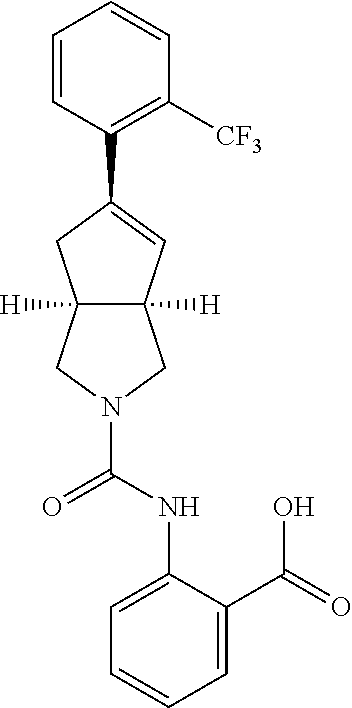


| HTRF assay for | ||
| antagonists of | ||
| RBP4-TTR | ||
| RBP4 SPA Binding | interaction | |
| Compound | IC50 (μM) | IC50 (μM) |
| 65 | 0.00168 | 0.0208 |


| HTRF assay for | ||
| antagonists of | ||
| RBP4-TTR | ||
| RBP4 SPA Binding | interaction | |
| Compound | IC50 (μM) | IC50 (μM) |
| 66 | 0.0039 | 0.074 |


- 1. Petrukhin K. New therapeutic targets in atrophic age-related macular degeneration. Expert Opin. Ther. Targets. 2007, 11(5): 625-639
- 2. C. Delori, D. G. Goger and C. K. Dorey, Age-related accumulation and spatial distribution of lipofuscin in RPE of normal subjects. Investigative Ophthalmology and Visual Science 42 (2001), pp. 1855-1866
- 3. F. C. Delori, RPE lipofuscin in ageing and age-related macular degeneration. In: G. Coscas and F. C. Piccolino, Editors, Retinal Pigment Epithelium and Macular Disease (Documenta Ophthalmologica) vol. 62, Kluwer Academic Publishers, Dordrecht, The Netherlands (1995), pp. 37-45.
- 4. C. K. Dorey, G. Wu, D. Ebenstein, A. Garsd and J. J. Weiter, Cell loss in the aging retina. Relationship to lipofuscin accumulation and macular degeneration. Investigative Ophthalmology and Visual Science 30 (1989), pp. 1691-1699.
- 5. L. Feeney-Burns, E. S. Hilderbrand and S. Eldridge, Aging human RPE: morphometric analysis of macular, equatorial, and peripheral cells. Investigative Ophthalmology and Visual Science 25 (1984), pp. 195-200.
- 6. F. G. Holz, C. Bellman, S. Staudt, F. Schutt and H. E. Volcker, Fundus autofluorescence and development of geographic atrophy in age-related macular degeneration. Investigative Ophthalmology and Visual Science 42 (2001), pp. 1051-1056.
- 7. F. G. Holz, C. Bellmann, M. Margaritidis, F. Schutt, T. P. Otto and H. E. Volcker, Patterns of increased in vivo fundus autofluorescence in the junctional zone of geographic atrophy of the retinal pigment epithelium associated with age-related macular degeneration. Graefe's Archive for Clinical and Experimental Ophthalmology 237 (1999), pp. 145-152.
- 7. A. von Rückmann, F. W. Fitzke and A. C. Bird, Fundus autofluorescence in age-related macular disease imaged with a laser scanning ophthalmoscope. Investigative Ophthalmology and Visual Science 38 (1997), pp. 478-486.
- 9. F. G. Holz, C. Bellman, S. Staudt, F. Schutt and H. E. Volcker, Fundus autofluorescence and development of geographic atrophy in age-related macular degeneration. Investigative Ophthalmology and Visual Science 42 (2001), pp. 1051-1056.
- 10. Sparrow J R, Fishkin N, Zhou J, Cai B, Jang Y P, Krane S, Itagaki Y, Nakanishi K. A2E, a byproduct of the visual cycle. Vision Res. 2003 December; 43(28):2983-90
- 11. Radu R A, Han Y, Bui T V, Nusinowitz S, Bok D, Lichter J, Widder K, Travis G H, Mata N L. Reductions in serum vitamin A arrest accumulation of toxic retinal fluorophores: a potential therapy for treatment of lipofuscin-based retinal diseases. Invest Ophthalmol Vis Sci. 2005 December; 46(12):4393-401
- 12. Motani A, Wang Z, Conn M, Siegler K, Zhang Y, Liu Q, Johnstone S, Xu H, Thibault S, Wang Y, Fan P, Connors R, Le H, Xu G, Walker N, Shan B, Coward P. Identification and characterization of a non-retinoid ligand for retinol-binding protein 4 which lowers serum retinol-binding protein 4 levels in vivo. J Biol Chem. 2009 Mar. 20; 284(12):7673-80.
- 13. Berni R, Formelli F. In vitro interaction of fenretinide with plasma retinol-binding protein and its functional consequences. FEBS Lett. 1992 Aug. 10; 308(1):43-5.
- 14. Schaffer E M, Ritter S J, Smith J E. N-(4-hydroxyphenyl)retinamide (fenretinide) induces retinol-binding protein secretion from liver and accumulation in the kidneys in rats. J Nutr. 1993 September; 123(9):1497-503
- 15. Adams W R, Smith J E, Green M H. Effects of N-(4-hydroxyphenyl)retinamide on vitamin A metabolism in rats. Proc Soc Exp Biol Med. 1995 February; 208(2):178-85.
- 16. Puduvalli V K, Saito Y, Xu R, Kouraklis G P, Levin V A, Kyritsis A P. Fenretinide activates caspases and induces apoptosis in gliomas. Clin Cancer Res. 1999 August; 5(8):2230-5
- 17. Holmes W F, Soprano D R, Soprano K J. Synthetic retinoids as inducers of apoptosis in ovarian carcinoma cell lines. J Cell Physiol. 2004 June; 199(3):317-29
- 18. Simeone A M, Ekmekcioglu S, Broemeling L D, Grimm E A, Tari A M. A novel mechanism by which N-(4-hydroxyphenyl)retinamide inhibits breast cancer cell growth: the production of nitric oxide. Mol Cancer Ther. 2002 October; 1(12):1009-17
- 19. Fontana J A, Rishi A K. Classical and novel retinoids: their targets in cancer therapy. Leukemia. 2002 April; 16(4):463-72
- 20. Samuel W, Kutty R K, Nagineni S, Vijayasarathy C, Chandraratna R A, Wiggert B. N-(4-hydroxyphenyl)retinamide induces apoptosis in human retinal pigment epithelial cells: retinoic acid receptors regulate apoptosis, reactive oxygen species generation, and the expression of heme oxygenase-1 and Gadd153. J Cell Physiol. 2006 December; 209(3):854-65
- 21. Fontana J A, Rishi A K. Classical and novel retinoids: their targets in cancer therapy. Leukemia. 2002 April; 16(4):463-72
- 22. Samuel W, Kutty R K, Nagineni S, Vijayasarathy C, Chandraratna R A, Wiggert B. N-(4-hydroxyphenyl)retinamide induces apoptosis in human retinal pigment epithelial cells: retinoic acid receptors regulate apoptosis, reactive oxygen species generation, and the expression of heme oxygenase-1 and Gadd153. J Cell Physiol. 2006 December; 209(3):854-65
- 23. Sabichi A L, Xu H, Fischer S, Zou C, Yang X, Steele V E, Kelloff G J, Lotan R, Clifford J L. Retinoid receptor-dependent and independent biological activities of novel fenretinide analogues and metabolites. Clin Cancer Res. 2003 Oct. 1; 9(12):4606-13
- 24. Clifford J L, Menter D G, Wang M, Lotan R, Lippman S M. Retinoid receptor-dependent and -independent effects of N-(4-hydroxyphenyl)retinamide in F9 embryonal carcinoma cells.
- 25. Gollapalli D R, Rando R R. The specific binding of retinoic acid to RPE65 and approaches to the treatment of macular degeneration. Proc Natl Acad Sci USA. 2004 Jul. 6; 101(27):10030-5
- 26. Maiti P, Kong J, Kim S R, Sparrow J R, Allikmets R, Rando R R. Small molecule RPE65 antagonists limit the visual cycle and prevent lipofuscin formation. Biochemistry. 2006 Jan. 24; 45(3):852-60
- 27. Radu R A, Mata N L, Nusinowitz S, Liu X, Sieving P A, Travis G H. Treatment with isotretinoin inhibits lipofuscin accumulation in a mouse model of recessive Stargardt's macular degeneration. Proc Natl Acad Sci USA. 2003 Apr. 15; 100(8):4742-7
- 28. Monaco H L, Rizzi M, Coda A. Structure of a complex of two plasma proteins: transthyretin and retinol-binding protein. Science. 1995 May 19; 268(5213):1039-41.
- 29. Bonanni B, Lazzeroni M, Veronesi U. Synthetic retinoid fenretinide in breast cancer chemoprevention. Expert Rev Anticancer Ther. 2007 April; 7(4):423-32.
- 30. Sunness J S, Margalit E, Srikumaran D, Applegate C A, Tian Y, Perry D, Hawkins B S, Bressler N M. The long-term natural history of geographic atrophy from age-related macular degeneration: enlargement of atrophy and implications for interventional clinical trials. Ophthalmology. 2007 February; 114(2):271-7.
- 31. Glickman J F et al. A comparison of ALPHAScreen, T R-FRET, and TRF as assay methods for FXR nuclear receptors. J. Biomol. Screening 2002; 7:3-10
- 32. Fujimura T et al. Unique properties of coactivator recruitment caused by differential binding of FK614, an anti-diabetic agent, to PPARgamma. Biol. Pharm. Bull. 2006; 29:423-429
- 33. Zhou G et al. Nuclear receptors have distinct affinities fo coactivators: characterization by FRET. Mol. Endocrinol. 1998; 12:1594-1605
- 34. Cogan U, Kopelman M, Mokady S, Shinitzky M. Binding affinities of retinol and related compounds to retinol binding proteins. Eur J Biochem. 1976 May 17; 65(1):71-8.
- 35. Decensi A, Torrisi R, Polizzi A, Gesi R, Brezzo V, Rolando M, Rondanina G, Orengo M A, Formelli F, Costa A. Effect of the synthetic retinoid fenretinide on dark adaptation and the ocular surface. J Natl Cancer Inst. 1994 Jan. 19; 86(2):105-10.
- 36. Conley B, O'Shaughnessy J, Prindiville S, Lawrence J, Chow C, Jones E, Merino M J, Kaiser-Kupfer M I, Caruso R C, Podgor M, Goldspiel B, Venzon D, Danforth D, Wu S, Noone M, Goldstein J, Cowan K H, Zujewski J. Pilot trial of the safety, tolerability, and retinoid levels of N-(4-hydroxyphenyl) retinamide in combination with tamoxifen in patients at high risk for developing invasive breast cancer. J Clin Oncol. 2000 January; 18(2):275-83.
- 37. Fain G L, Lisman J E. Photoreceptor degeneration in vitamin A deprivation and retinitis pigmentosa: the equivalent light hypothesis. Exp Eye Res. 1993 September; 57(3):335-40.
- 38. Makimura H, Wei J, Dolan-Looby S E, Ricchiuti V, Grinspoon S. Retinol-Binding Protein Levels are Increased in Association with Gonadotropin Levels in Healthy Women. Metabolism. 2009 April; 58(4): 479-487.
- 39. Yang Q, Graham T E, Mody N, Preitner F, Peroni O D, Zabolotny J M, Kotani K, Quadro L, Kahn B B. Serum retinol binding protein 4 contributes to insulin resistance in obesity and
type 2 diabetes. Nature. 2005 Jul. 21; 436(7049):356-62. - 40. Kim S R, Jang Y P, Jockusch S, Fishkin N E, Turro N J, Sparrow J R. The all-trans-retinal dimer series of lipofuscin pigments in retinal pigment epithelial cells in a recessive Stargardt disease model. PNAS. Dec. 4, 2007, Vol. 104, No. 49, 19273-8.
- 41. Wu Y, Fishkin N E, Pande A, Pande J, Sparrow R J. Novel Lipofuscin Bisretinoids Prominent in Human Retina and in a Model of Recessive Stargardt Disease. Journal of Biological Chemistry. Jul. 24, 2009, Vol. 284, No. 30, 20155-20166.
- 42. F. G. Holz, C. Bellmann, M. Margaritidis, F. Schutt, T. P. Otto and H. E. Volcker, Patterns of increased in vivo fundus autofluorescence in the junctional zone of geographic atrophy of the retinal pigment epithelium associated with age-related macular degeneration. Graefe's Archive for Clinical and Experimental Ophthalmology 237 (1999), pp. 145-152.
Claims (20)


Priority Applications (1)
| Application Number | Priority Date | Filing Date | Title |
|---|---|---|---|
| US15/950,528 US10787453B2 (en) | 2013-03-14 | 2018-04-11 | Octahydropyrrolopyrroles their preparation and use |
Applications Claiming Priority (4)
| Application Number | Priority Date | Filing Date | Title |
|---|---|---|---|
| US201361785334P | 2013-03-14 | 2013-03-14 | |
| PCT/US2014/026699 WO2014151936A1 (en) | 2013-03-14 | 2014-03-13 | Octahydropyrrolopyrroles, their preparation and use |
| US201514775565A | 2015-09-11 | 2015-09-11 | |
| US15/950,528 US10787453B2 (en) | 2013-03-14 | 2018-04-11 | Octahydropyrrolopyrroles their preparation and use |
Related Parent Applications (2)
| Application Number | Title | Priority Date | Filing Date |
|---|---|---|---|
| PCT/US2014/026699 Division WO2014151936A1 (en) | 2013-03-14 | 2014-03-13 | Octahydropyrrolopyrroles, their preparation and use |
| US14/775,565 Division US9944644B2 (en) | 2013-03-14 | 2014-03-13 | Octahydropyrrolopyrroles their preparation and use |
Publications (2)
| Publication Number | Publication Date |
|---|---|
| US20180298012A1 US20180298012A1 (en) | 2018-10-18 |
| US10787453B2 true US10787453B2 (en) | 2020-09-29 |
Family
ID=51581073
Family Applications (2)
| Application Number | Title | Priority Date | Filing Date |
|---|---|---|---|
| US14/775,565 Active 2034-03-19 US9944644B2 (en) | 2013-03-14 | 2014-03-13 | Octahydropyrrolopyrroles their preparation and use |
| US15/950,528 Active US10787453B2 (en) | 2013-03-14 | 2018-04-11 | Octahydropyrrolopyrroles their preparation and use |
Family Applications Before (1)
| Application Number | Title | Priority Date | Filing Date |
|---|---|---|---|
| US14/775,565 Active 2034-03-19 US9944644B2 (en) | 2013-03-14 | 2014-03-13 | Octahydropyrrolopyrroles their preparation and use |
Country Status (2)
| Country | Link |
|---|---|
| US (2) | US9944644B2 (en) |
| WO (1) | WO2014151936A1 (en) |
Cited By (1)
| Publication number | Priority date | Publication date | Assignee | Title |
|---|---|---|---|---|
| US20230348415A1 (en) * | 2020-07-20 | 2023-11-02 | The Trustees Of Columbia University In The City Of New York | Bispecific antagonists of retinol-binding protein 4 that stabilize transthyretin tetramers, their preparation, and use in the treatment of common age-related comorbidities |
Families Citing this family (17)
| Publication number | Priority date | Publication date | Assignee | Title |
|---|---|---|---|---|
| JP5951625B2 (en) | 2010-11-24 | 2016-07-13 | ザ・トラスティーズ・オブ・コランビア・ユニバーシティー・イン・ザ・シティー・オブ・ニューヨークThe Trustees Of Columbia University In The City Of New York | Non-retinoid RBP4 antagonists for the treatment of age-related macular degeneration and Stargardt disease |
| US9333202B2 (en) | 2012-05-01 | 2016-05-10 | The Trustees Of Columbia University In The City Of New York | Non-retinoid antagonists for treatment of age-related macular degeneration and stargardt disease |
| US9938291B2 (en) | 2013-03-14 | 2018-04-10 | The Trustess Of Columbia University In The City Of New York | N-alkyl-2-phenoxyethanamines, their preparation and use |
| US9944644B2 (en) | 2013-03-14 | 2018-04-17 | The Trustees Of Columbia University In The City Of New York | Octahydropyrrolopyrroles their preparation and use |
| EP3495357B1 (en) | 2013-03-14 | 2021-05-05 | The Trustees of Columbia University in the City of New York | 4-phenylpiperidines, their preparation and use |
| WO2014152018A1 (en) | 2013-03-14 | 2014-09-25 | The Trustees Of Columbia University In The City Of New York | Octahydrocyclopentapyrroles, their preparation and use |
| SG11201608943VA (en) | 2014-04-30 | 2016-11-29 | Univ Columbia | Substituted 4-phenylpiperidines, their preparaiton and use |
| GB201506658D0 (en) | 2015-04-20 | 2015-06-03 | Cellcentric Ltd | Pharmaceutical compounds |
| GB201506660D0 (en) | 2015-04-20 | 2015-06-03 | Cellcentric Ltd | Pharmaceutical compounds |
| EP3319968A1 (en) | 2015-07-06 | 2018-05-16 | Rodin Therapeutics, Inc. | Heterobicyclic n-aminophenyl-amides as inhibitors of histone deacetylase |
| WO2017007756A1 (en) | 2015-07-06 | 2017-01-12 | Rodin Therapeutics, Inc | Hetero-halo inhibitors of histone deacetylase |
| HUE057849T2 (en) | 2017-01-11 | 2022-06-28 | Alkermes Inc | Bicyclic inhibitors of histone deacetylase |
| US10245259B2 (en) | 2017-06-15 | 2019-04-02 | Belite Bio, Inc | Methods of treating RBP4 related diseases with triazolopyridines |
| US11389444B2 (en) | 2017-06-15 | 2022-07-19 | Belite Bio, Inc | Methods of treating metabolic diseases with fused bicyclic pyrazoles |
| LT3664802T (en) | 2017-08-07 | 2022-06-27 | Alkermes, Inc. | Bicyclic inhibitors of histone deacetylase |
| US12440486B2 (en) | 2018-08-01 | 2025-10-14 | The Trustees Of Columbia University In The City Of New York | RBP4 antagonists for treatment and prevention of non-alcoholic fatty liver disease and gout |
| AU2020310120B2 (en) | 2019-07-08 | 2025-05-29 | Belite Bio (HK) Limited | Formulations of RBP4 inhibitors and methods of use |
Citations (123)
| Publication number | Priority date | Publication date | Assignee | Title |
|---|---|---|---|---|
| JPS5936670A (en) | 1982-08-25 | 1984-02-28 | Takeda Chem Ind Ltd | Benzothiazole derivative, its preparation and anorectic agent containing the same |
| DE4130514A1 (en) | 1991-09-13 | 1993-03-18 | Chemie Linz Deutschland | Prodn. of N,N'-unsymmetrically substituted phenylurea herbicides - by controlled reaction of unsubstituted phenylurea with amine at elevated temp. |
| US5231083A (en) | 1989-08-11 | 1993-07-27 | Hoechst Aktiengesellschaft | Method for the treatment of cardiac and of vascular hypertrophy and hyperplasia |
| US5312814A (en) | 1992-12-09 | 1994-05-17 | Bristol-Myers Squibb Co. | α-phosphonocarboxylate squalene synthetase inhibitors |
| US5523430A (en) | 1994-04-14 | 1996-06-04 | Bristol-Myers Squibb Company | Protein farnesyl transferase inhibitors |
| US5532243A (en) | 1992-02-14 | 1996-07-02 | The Dupont Merck Pharmaceutical Company | Antipsychotic nitrogen-containing bicyclic compounds |
| WO1997017954A1 (en) | 1995-11-13 | 1997-05-22 | Albany Medical College | Analgesic compounds and uses thereof |
| WO1997038665A2 (en) | 1996-04-03 | 1997-10-23 | Merck & Co., Inc. | Inhibitors of farnesyl-protein transferase |
| US5703091A (en) | 1993-12-04 | 1997-12-30 | Basf Aktiengesellschaft | N-substituted azabicycloalkane derivatives, their preparation and use |
| WO1998039000A1 (en) | 1997-03-03 | 1998-09-11 | Eisai Co., Ltd. | Use of cholinesterase inhibitors to treat disorders of attention |
| WO1999037304A1 (en) | 1998-01-27 | 1999-07-29 | Aventis Pharmaceuticals Products Inc. | SUBSTITUTED OXOAZAHETEROCYCLYL FACTOR Xa INHIBITORS |
| WO1999065867A1 (en) | 1998-06-17 | 1999-12-23 | Du Pont Pharmaceuticals Company | Cyclic hydroxamic acids as metalloproteinase inhibitors |
| WO2000021557A1 (en) | 1998-10-09 | 2000-04-20 | Merck & Co., Inc. | Delta 6 fatty acid desaturase |
| WO2000042852A1 (en) | 1999-01-25 | 2000-07-27 | Smithkline Beecham Corporation | Compounds and methods |
| WO2000061606A1 (en) | 1999-04-14 | 2000-10-19 | Merck & Co., Inc. | Novel human voltage-gated potassium channel |
| WO2001007436A2 (en) | 1999-07-28 | 2001-02-01 | Aventis Pharmaceuticals Inc. | Substituted oxoazaheterocyclyl compounds |
| WO2001066114A1 (en) | 2000-03-03 | 2001-09-13 | Eisai Co., Ltd. | Novel methods using cholinesterase inhibitors |
| WO2001087921A2 (en) | 2000-05-16 | 2001-11-22 | Merck & Co., Inc. | Gene responsible for stargardt-like dominant macular dystrophy |
| WO2002005819A1 (en) | 2000-07-15 | 2002-01-24 | Smithkline Beecham Corporation | Compounds and methods |
| EP1190710A1 (en) | 1999-05-13 | 2002-03-27 | Shionogi & Co., Ltd. | Preventive or therapeutic drugs for diabetes |
| US6372793B1 (en) | 1999-08-20 | 2002-04-16 | Florida Agricultural & Mechanical University | Method for treatment of a neurological disease characterized by impaired neuromodulator function |
| WO2002088097A1 (en) | 2001-04-27 | 2002-11-07 | Vertex Pharmaceuticals Incorporated | Triazole-derived kinase inhibitors and uses thereof |
| WO2003024450A1 (en) | 2001-09-20 | 2003-03-27 | Eisai Co., Ltd. | Methods for treating prion diseases |
| WO2003024456A1 (en) | 2001-09-20 | 2003-03-27 | Eisai Co., Ltd. | Methods for treating and preventing migraines |
| WO2003032914A2 (en) | 2001-10-17 | 2003-04-24 | Eisai Co., Ltd. | Methods for treating substance abuse with cholinesterase inhibitors |
| WO2003066581A1 (en) | 2002-02-05 | 2003-08-14 | Eli Lilly And Company | Urea linker derivatives for use as ppar modulators |
| WO2003076400A1 (en) | 2002-03-13 | 2003-09-18 | Janssen Pharmaceutica N.V. | New inhibitors of histone deacetylase |
| US20030195195A1 (en) | 2002-04-05 | 2003-10-16 | Fortuna Haviv | Substituted pyridines having antiangiogenic activity |
| US6638980B1 (en) | 1999-05-24 | 2003-10-28 | Millennium Pharmaceuticals, Inc. | Inhibitors of factor Xa |
| WO2003092606A2 (en) | 2002-05-01 | 2003-11-13 | Eisai Co., Ltd. | Cholinesterase inhibitors to prevent injuries caused by chemicals |
| WO2004002531A1 (en) | 2002-06-26 | 2004-01-08 | Ono Pharmaceutical Co., Ltd. | Remedies for diseases caused by vascular contraction or dilation |
| WO2004010942A2 (en) | 2002-07-31 | 2004-02-05 | Smithkline Beecham Corporation | Substituted heterocyclic compounds as modulators of the ccr5 receptor |
| WO2004014374A1 (en) | 2002-07-25 | 2004-02-19 | Pharmacia Italia S.P.A. | Bicyclo-pyrazoles active as kinase inhibitors, process for their preparation and pharmaceutical compositions comprising them |
| WO2004017950A2 (en) | 2002-08-22 | 2004-03-04 | Piramed Limited | Phosphadidylinositol 3,5-biphosphate inhibitors as anti-viral agents |
| WO2004034963A2 (en) | 2002-05-17 | 2004-04-29 | Eisai Co., Ltd. | Methods and compositions using cholinesterase inhibitors |
| US20040097575A1 (en) | 2002-11-08 | 2004-05-20 | Doherty James B. | Ophthalmic compositions for treating ocular hypertension |
| US20040180877A1 (en) | 2001-07-06 | 2004-09-16 | Dan Peters | Novel compounds, their preparation and use |
| WO2004089416A2 (en) | 2003-04-11 | 2004-10-21 | Novo Nordisk A/S | Combination of an 11beta-hydroxysteroid dehydrogenase type 1 inhibitor and an antihypertensive agent |
| US20040220171A1 (en) | 2000-04-27 | 2004-11-04 | Aventis Pharmaceuticals Inc | 1-Aroyl-piperidinyl benzamidines |
| WO2004108135A1 (en) | 2003-05-30 | 2004-12-16 | Merck & Co., Inc. | Composition and method for treating macular disorders |
| US20050043354A1 (en) | 2003-06-19 | 2005-02-24 | Pfizer Inc | NK1 antagonist |
| WO2005074535A2 (en) | 2004-01-30 | 2005-08-18 | Eisai Co., Ltd. | Cholinesterase inhibitors for spinal cord disorders |
| WO2005087226A1 (en) | 2004-03-05 | 2005-09-22 | Eisai Co., Ltd. | Cadasil treatment with cholinesterase inhibitors |
| WO2005116009A1 (en) | 2004-05-18 | 2005-12-08 | Schering Corporation | Substituted 2-quinolyl-oxazoles useful as pde4 inhibitors |
| WO2006004201A1 (en) | 2004-07-01 | 2006-01-12 | Eisai R & D Management Co., Ltd. | Nerve reveneration promoter |
| WO2006003030A1 (en) | 2004-07-01 | 2006-01-12 | L'oreal | Use of piperidine derivatives as dermo-decontracting agents |
| JP2006077006A (en) | 2004-08-13 | 2006-03-23 | Eisai Co Ltd | Therapeutic agent against hyperactive bladder with age |
| WO2006034441A1 (en) | 2004-09-20 | 2006-03-30 | Xenon Pharmaceuticals Inc. | Heterocyclic derivatives and their use as stearoyl-coa desaturase inhibitors |
| WO2006034446A2 (en) | 2004-09-20 | 2006-03-30 | Xenon Pharmaceuticals Inc. | Pyridine derivatives for inhibiting human stearoyl-coa-desaturase |
| US20060074121A1 (en) | 2004-03-03 | 2006-04-06 | Chemocentryx, Inc. | Bicyclic and bridged nitrogen heterocycles |
| US20060089378A1 (en) | 2004-10-27 | 2006-04-27 | Mingde Xia | Tetrahydro-pyridinyl pyrazole cannabinoid modulators |
| US20060111366A1 (en) | 2003-04-11 | 2006-05-25 | Novo Nordisk A/S | Pharmaceutical use of substituted amides |
| US20060135460A1 (en) | 2004-12-08 | 2006-06-22 | Sytera, Inc. | Methods, assays and compositions for treating retinol-related diseases |
| WO2006065479A2 (en) | 2004-11-23 | 2006-06-22 | Ptc Therapeutics, Inc. | Substituted phenols as active agents inhibiting vegf production |
| JP2006176503A (en) | 2004-11-26 | 2006-07-06 | Tohoku Univ | Alzheimer's disease treatment with cerebrovascular disorder |
| WO2006085108A1 (en) | 2005-02-14 | 2006-08-17 | Smithkline Beecham Corporation | Awthranilic acid derivatives and their use in treatment of diseases of lipid metabolism, in particular dyslipidaemia |
| US20060199837A1 (en) | 2003-07-10 | 2006-09-07 | Aventis Pharma S.A. | Substituted tetrahydro-1h-pyrazolo [3,4-c]pyridines compositions comprising them, and use |
| US20060270688A1 (en) | 2005-05-09 | 2006-11-30 | Hydra Biosciences, Inc. | Compounds for modulating TRPV3 function |
| WO2006138657A1 (en) | 2005-06-17 | 2006-12-28 | Bristol-Myers Squibb Company | Bicyclic heterocycles as cannabinoid-1 receptor modulators |
| US7157451B2 (en) | 1999-12-06 | 2007-01-02 | Bristol-Myers Squibb Company | Heterocyclic dihydropyrimidine compounds |
| US20070015827A1 (en) | 2005-07-11 | 2007-01-18 | Sytera, Inc. | Methods and compositions for treating ophthalmic conditions via serum retinol, serum retinol binding protein (RBP), and/or serum retinol-RBP modulation |
| US20070027163A1 (en) | 2005-07-29 | 2007-02-01 | Caterina Bissantz | Indol-3-y-carbonyl-piperidin and piperazin-derivatives |
| WO2007020888A1 (en) | 2005-08-12 | 2007-02-22 | Takeda Pharmaceutical Company Limited | Brain/neuronal cell-protecting agent, and therapeutic agent for sleep disorder |
| WO2007027532A2 (en) | 2005-08-29 | 2007-03-08 | Merck & Co., Inc. | Niacin receptor agonists, compositions containing such compounds and methods of treatment |
| WO2007037187A1 (en) | 2005-09-27 | 2007-04-05 | Shionogi & Co., Ltd. | Sulfonamide derivative having pgd2 receptor antagonistic activity |
| WO2007044804A2 (en) | 2005-10-11 | 2007-04-19 | Chemocentryx, Inc. | Piperidine derivatives and methods of use |
| WO2007086584A1 (en) | 2006-01-30 | 2007-08-02 | Meiji Seika Kaisha, Ltd. | NOVEL INHIBITOR OF FabK AND FabI/K |
| US20070254911A1 (en) | 2006-03-27 | 2007-11-01 | Mingde Xia | Tetrahydro-Pyrazolo[3,4-c]Pyridine Cannabinoid Modulators |
| US20080039442A1 (en) | 2004-12-21 | 2008-02-14 | Devgen Nv | Compounds With Kv4 Ion Channel Activity |
| US20080051409A1 (en) | 2004-08-02 | 2008-02-28 | Peter Gmeiner | Indolizine Carboxamides and Aza and Diaza Derivatives Thereof |
| WO2008045393A2 (en) | 2006-10-11 | 2008-04-17 | Amgen Inc. | Imidazo- and triazolo-pyridine compounds and methods of use therof |
| US20080139552A1 (en) | 2006-12-08 | 2008-06-12 | Caterina Bissantz | Indoles |
| WO2008080455A1 (en) | 2006-12-21 | 2008-07-10 | Merck Patent Gmbh | Tetrahydrobenzoisoxazole - and tetrahydroindazole derivatives as modulators of the mitotic motor protein |
| US20080254140A1 (en) | 2004-08-18 | 2008-10-16 | Kenneth Widder | Combination Methods and Therapies for Treating Opthalmic Conditions with 13-Cis-Retinyl Derivatives |
| WO2008157791A2 (en) | 2007-06-21 | 2008-12-24 | Neuronascent, Inc. | Methods and compositions for stimulating neurogenesis and inhibiting neuronal degeneration using isothiazolopyrimidinones |
| WO2009023179A2 (en) | 2007-08-10 | 2009-02-19 | Genelabs Technologies, Inc. | Nitrogen containing bicyclic chemical entities for treating viral infections |
| US20090054532A1 (en) | 2004-11-04 | 2009-02-26 | Sirion Therapeutics, Inc. | Modulators of Retinol-Retinol Binding Protein (RBP)-Transthyretin (TTR) Complex Formation |
| US7501405B2 (en) | 2003-04-11 | 2009-03-10 | High Point Pharmaceuticals, Llc | Combination therapy using an 11β-hydroxysteroid dehydrogenase type 1 inhibitor and an antihypertensive agent for the treatment of metabolic syndrome and related diseases and disorders |
| US20090088435A1 (en) | 2007-09-27 | 2009-04-02 | Sirion Therapeutics, Inc. | Methods and compounds for treating retinol-related diseases |
| WO2009042444A2 (en) | 2007-09-27 | 2009-04-02 | Sirion Therapeutics, Inc. | Methods and compounds for treating retinol-related diseases |
| WO2009051244A1 (en) | 2007-10-18 | 2009-04-23 | Takeda Pharmaceutical Company Limited | Heterocyclic compound |
| US20090143376A1 (en) | 2005-03-03 | 2009-06-04 | Sitris Pharmaceuticals, Inc. | Fused Heterocyclic Compounds and Their Use as Sirtuin Modulators |
| US20100063047A1 (en) | 2008-09-10 | 2010-03-11 | Kalypsys, Inc. | Aminopyrimidine inhibitors of histamine receptors for the treatment of disease |
| US7718669B2 (en) | 2005-10-19 | 2010-05-18 | Sanofi-Aventis | Triazolopyridine derivatives as inhibitors of lipases and phospholipases |
| WO2010077915A1 (en) | 2008-12-17 | 2010-07-08 | Forest Laboratories Holdings Limited | Novel compounds useful as cc chemokine receptor ligands |
| WO2010088050A2 (en) | 2009-01-28 | 2010-08-05 | Cara Therapeutics, Inc. | Bicyclic pyrazolo-heterocycles |
| WO2010091409A1 (en) | 2009-02-09 | 2010-08-12 | Glaxosmithkline Llc | Certain nitrogen containing bicyclic chemical entities for treating viral infections |
| WO2010108268A1 (en) | 2009-03-23 | 2010-09-30 | Merck Frosst Canada Ltd. | Heterocyclic compounds as inhibitors of stearoyl-coenzyme a delta-9 desaturase |
| WO2010120741A1 (en) | 2009-04-13 | 2010-10-21 | Irm Llc | Compositions and methods for modulating retinol binding to retinol binding protein 4 (rbp4) |
| WO2010119992A1 (en) | 2009-04-16 | 2010-10-21 | Takeda Pharmaceutical Company Limited | Derivatives of n-acyl-n'-phenylpiperazine useful (inter alia) for the prophylaxis or treatment of diabetes |
| WO2010138487A1 (en) | 2009-05-26 | 2010-12-02 | Exelixis, Inc. | BENZOXAZEPINES AS INHIBITORS OF PI3K/m TOR AND METHODS OF THEIR USE AND MANUFACTURE |
| US20110003820A1 (en) | 2008-02-01 | 2011-01-06 | Merz Pharma Gmbh & Co. Kgaa | Pyrazolopyrimidines, a process for their preparation and their use as medicine |
| WO2011033255A1 (en) | 2009-09-16 | 2011-03-24 | The University Of Edinburgh | (4-phenyl-piperidin-1-yl)-[5-1h-pyrazol-4yl)-thiophen-3-yl]-methanone compounds and their use |
| WO2011059881A1 (en) | 2009-11-12 | 2011-05-19 | The Trustees Of Columbia University In The City Of New York | Treatment of ophthalmic conditions with fluorenone derivatives |
| US7947692B2 (en) | 2006-05-18 | 2011-05-24 | Hoffmann-La Roche Inc. | Substituted thiazolo[5,4-d]pyrimidine urea derivatives |
| US20110201657A1 (en) | 2006-04-03 | 2011-08-18 | Istituto Di Ricerche Di Biologia Molecolare P. Angeletti Spa | Amide substituted indazole and benzotriazole derivatives as poly(adp-ribose)polymerase (parp) inhibitors |
| WO2011116123A1 (en) | 2010-03-19 | 2011-09-22 | Irm Llc | Tafamidis for the treatment of ophthalmic diseases |
| US20110251182A1 (en) | 2009-12-11 | 2011-10-13 | Nono, Inc. | Agents and methods for treating ischemic and other diseases |
| US20110251187A1 (en) | 2008-05-30 | 2011-10-13 | Shizuo Kasai | Heterocyclic compound |
| US20110257196A1 (en) | 2008-06-16 | 2011-10-20 | Yan Lu | Compounds for treatment of cancer |
| US20110294854A1 (en) | 2010-05-25 | 2011-12-01 | Abbott Laboratories | SUBSTITUTED OCTAHYDROCYCLOPENTA[c]PYRROLES AS CALCIUM CHANNEL MODULATORS |
| WO2011156632A2 (en) | 2010-06-09 | 2011-12-15 | Georgetown University | Compositions and methods of treatment for tumors in the nervous system |
| US20110319412A1 (en) | 2009-03-05 | 2011-12-29 | Shionogi & Co., Ltd. | Piperidine and pyrrolidine derivatives having npy y5 receptor antagonism |
| US20110319393A1 (en) | 2009-03-20 | 2011-12-29 | Christophe Pierre Alain Chassaing | Anthelmintic agents and their use |
| WO2012025164A1 (en) | 2010-08-27 | 2012-03-01 | Novartis Ag | Hydroxamate-based inhibitors of deacetylases |
| US20120065189A1 (en) | 2009-05-28 | 2012-03-15 | Akira Takahashi | Heterocyclic compounds for the treatment of stress-related conditions |
| US20120071503A1 (en) | 2010-03-19 | 2012-03-22 | Sanford-Burnham Medical Research Institute | Positive allosteric modulators of group ii mglurs |
| US8168783B2 (en) | 2005-11-18 | 2012-05-01 | Ono Pharmaceutical Co., Ltd. | Chemokine receptor antagonists and use thereof |
| WO2012071369A2 (en) | 2010-11-24 | 2012-05-31 | The Trustees Of Columbia University In The City Of New York | A non-retinoid rbp4 antagonist for treatment of age-related macular degeneration and stargardt disease |
| WO2012087872A1 (en) | 2010-12-23 | 2012-06-28 | Merck Sharp & Dohme Corp. | Quinolines and aza-quinolines as crth2 receptor modulators |
| WO2012125904A1 (en) | 2011-03-17 | 2012-09-20 | The Trustees Of The University Of Pennsylvania | Mutation mimicking compounds that bind to the kinase domain of egfr |
| JP2012184205A (en) | 2011-03-08 | 2012-09-27 | Dainippon Sumitomo Pharma Co Ltd | 2-amino substituted 8-oxodihydropurine derivative |
| WO2012158844A1 (en) | 2011-05-17 | 2012-11-22 | Shionogi & Co., Ltd. | Heterocyclic compounds |
| WO2013166037A1 (en) | 2012-05-01 | 2013-11-07 | The Trustees Of Columbia University In The City Of New York | Non-retinoid antagonists for treatment of eye disorders |
| WO2013166040A1 (en) | 2012-05-01 | 2013-11-07 | The Trustees Of Columbia University In The City Of New York | S-fta and s-fta analogues capable of inhibiting retinol-dependent rbp4-ttr interaction for treatment of age-related macular degeneration, stargardt disease, and other retinal disease characterized by excessive lipofuscin accumulation |
| WO2013166041A1 (en) | 2012-05-01 | 2013-11-07 | The Trustees Of Columbia University In The City Of New York | Transthyretin ligands capable of inhibiting retinol-dependent rbp4-ttr interaction for treatment of age-related macular |
| WO2014133182A1 (en) | 2013-03-01 | 2014-09-04 | 協和発酵キリン株式会社 | Agent for preventing and/or treating ocular inflammatory disease |
| WO2014151936A1 (en) | 2013-03-14 | 2014-09-25 | The Trustees Of Columbia University In The City Of New York | Octahydropyrrolopyrroles, their preparation and use |
| WO2014152013A1 (en) | 2013-03-14 | 2014-09-25 | The Trustees Of Columbia University In The City Of New York | 4-phenylpiperidines, their preparation and use |
| WO2014152018A1 (en) | 2013-03-14 | 2014-09-25 | The Trustees Of Columbia University In The City Of New York | Octahydrocyclopentapyrroles, their preparation and use |
| WO2014151959A1 (en) | 2013-03-14 | 2014-09-25 | The Trustees Of Columbia University In The City Of New York | N-alkyl-2-phenoxyethanamines, their preparation and use |
| WO2014160409A1 (en) | 2013-03-14 | 2014-10-02 | The Trustees Of Columbia University In The City Of New York | Rbp4 antagonists for the treatment of age-related macular degeneration and stargardt disease |
| US20150315197A1 (en) | 2014-04-30 | 2015-11-05 | The Trustees Of Columbia University In The City Of New York | Substituted 4-phenylpiperidines, their preparation and use |
Family Cites Families (1)
| Publication number | Priority date | Publication date | Assignee | Title |
|---|---|---|---|---|
| GB0003237D0 (en) | 2000-02-11 | 2000-04-05 | Mannan Michael | Antenna |
-
2014
- 2014-03-13 US US14/775,565 patent/US9944644B2/en active Active
- 2014-03-13 WO PCT/US2014/026699 patent/WO2014151936A1/en not_active Ceased
-
2018
- 2018-04-11 US US15/950,528 patent/US10787453B2/en active Active
Patent Citations (161)
| Publication number | Priority date | Publication date | Assignee | Title |
|---|---|---|---|---|
| JPS5936670A (en) | 1982-08-25 | 1984-02-28 | Takeda Chem Ind Ltd | Benzothiazole derivative, its preparation and anorectic agent containing the same |
| US5231083A (en) | 1989-08-11 | 1993-07-27 | Hoechst Aktiengesellschaft | Method for the treatment of cardiac and of vascular hypertrophy and hyperplasia |
| DE4130514A1 (en) | 1991-09-13 | 1993-03-18 | Chemie Linz Deutschland | Prodn. of N,N'-unsymmetrically substituted phenylurea herbicides - by controlled reaction of unsubstituted phenylurea with amine at elevated temp. |
| US5532243A (en) | 1992-02-14 | 1996-07-02 | The Dupont Merck Pharmaceutical Company | Antipsychotic nitrogen-containing bicyclic compounds |
| US5312814A (en) | 1992-12-09 | 1994-05-17 | Bristol-Myers Squibb Co. | α-phosphonocarboxylate squalene synthetase inhibitors |
| US5703091A (en) | 1993-12-04 | 1997-12-30 | Basf Aktiengesellschaft | N-substituted azabicycloalkane derivatives, their preparation and use |
| US5523430A (en) | 1994-04-14 | 1996-06-04 | Bristol-Myers Squibb Company | Protein farnesyl transferase inhibitors |
| WO1997017954A1 (en) | 1995-11-13 | 1997-05-22 | Albany Medical College | Analgesic compounds and uses thereof |
| WO1997038665A2 (en) | 1996-04-03 | 1997-10-23 | Merck & Co., Inc. | Inhibitors of farnesyl-protein transferase |
| WO1998039000A1 (en) | 1997-03-03 | 1998-09-11 | Eisai Co., Ltd. | Use of cholinesterase inhibitors to treat disorders of attention |
| WO1999037304A1 (en) | 1998-01-27 | 1999-07-29 | Aventis Pharmaceuticals Products Inc. | SUBSTITUTED OXOAZAHETEROCYCLYL FACTOR Xa INHIBITORS |
| WO1999065867A1 (en) | 1998-06-17 | 1999-12-23 | Du Pont Pharmaceuticals Company | Cyclic hydroxamic acids as metalloproteinase inhibitors |
| WO2000021557A1 (en) | 1998-10-09 | 2000-04-20 | Merck & Co., Inc. | Delta 6 fatty acid desaturase |
| WO2000042852A1 (en) | 1999-01-25 | 2000-07-27 | Smithkline Beecham Corporation | Compounds and methods |
| WO2000061606A1 (en) | 1999-04-14 | 2000-10-19 | Merck & Co., Inc. | Novel human voltage-gated potassium channel |
| EP1190710A1 (en) | 1999-05-13 | 2002-03-27 | Shionogi & Co., Ltd. | Preventive or therapeutic drugs for diabetes |
| US6638980B1 (en) | 1999-05-24 | 2003-10-28 | Millennium Pharmaceuticals, Inc. | Inhibitors of factor Xa |
| WO2001007436A2 (en) | 1999-07-28 | 2001-02-01 | Aventis Pharmaceuticals Inc. | Substituted oxoazaheterocyclyl compounds |
| US6372793B1 (en) | 1999-08-20 | 2002-04-16 | Florida Agricultural & Mechanical University | Method for treatment of a neurological disease characterized by impaired neuromodulator function |
| US7157451B2 (en) | 1999-12-06 | 2007-01-02 | Bristol-Myers Squibb Company | Heterocyclic dihydropyrimidine compounds |
| WO2001066114A1 (en) | 2000-03-03 | 2001-09-13 | Eisai Co., Ltd. | Novel methods using cholinesterase inhibitors |
| US20040220171A1 (en) | 2000-04-27 | 2004-11-04 | Aventis Pharmaceuticals Inc | 1-Aroyl-piperidinyl benzamidines |
| WO2001087921A2 (en) | 2000-05-16 | 2001-11-22 | Merck & Co., Inc. | Gene responsible for stargardt-like dominant macular dystrophy |
| WO2002005819A1 (en) | 2000-07-15 | 2002-01-24 | Smithkline Beecham Corporation | Compounds and methods |
| WO2002088097A1 (en) | 2001-04-27 | 2002-11-07 | Vertex Pharmaceuticals Incorporated | Triazole-derived kinase inhibitors and uses thereof |
| US20040180877A1 (en) | 2001-07-06 | 2004-09-16 | Dan Peters | Novel compounds, their preparation and use |
| WO2003024450A1 (en) | 2001-09-20 | 2003-03-27 | Eisai Co., Ltd. | Methods for treating prion diseases |
| WO2003024456A1 (en) | 2001-09-20 | 2003-03-27 | Eisai Co., Ltd. | Methods for treating and preventing migraines |
| WO2003032914A2 (en) | 2001-10-17 | 2003-04-24 | Eisai Co., Ltd. | Methods for treating substance abuse with cholinesterase inhibitors |
| WO2003066581A1 (en) | 2002-02-05 | 2003-08-14 | Eli Lilly And Company | Urea linker derivatives for use as ppar modulators |
| WO2003076400A1 (en) | 2002-03-13 | 2003-09-18 | Janssen Pharmaceutica N.V. | New inhibitors of histone deacetylase |
| US20030195195A1 (en) | 2002-04-05 | 2003-10-16 | Fortuna Haviv | Substituted pyridines having antiangiogenic activity |
| WO2003092606A2 (en) | 2002-05-01 | 2003-11-13 | Eisai Co., Ltd. | Cholinesterase inhibitors to prevent injuries caused by chemicals |
| WO2004034963A2 (en) | 2002-05-17 | 2004-04-29 | Eisai Co., Ltd. | Methods and compositions using cholinesterase inhibitors |
| WO2004002531A1 (en) | 2002-06-26 | 2004-01-08 | Ono Pharmaceutical Co., Ltd. | Remedies for diseases caused by vascular contraction or dilation |
| WO2004014374A1 (en) | 2002-07-25 | 2004-02-19 | Pharmacia Italia S.P.A. | Bicyclo-pyrazoles active as kinase inhibitors, process for their preparation and pharmaceutical compositions comprising them |
| WO2004010942A2 (en) | 2002-07-31 | 2004-02-05 | Smithkline Beecham Corporation | Substituted heterocyclic compounds as modulators of the ccr5 receptor |
| WO2004017950A2 (en) | 2002-08-22 | 2004-03-04 | Piramed Limited | Phosphadidylinositol 3,5-biphosphate inhibitors as anti-viral agents |
| US20040097575A1 (en) | 2002-11-08 | 2004-05-20 | Doherty James B. | Ophthalmic compositions for treating ocular hypertension |
| US20060111366A1 (en) | 2003-04-11 | 2006-05-25 | Novo Nordisk A/S | Pharmaceutical use of substituted amides |
| WO2004089416A2 (en) | 2003-04-11 | 2004-10-21 | Novo Nordisk A/S | Combination of an 11beta-hydroxysteroid dehydrogenase type 1 inhibitor and an antihypertensive agent |
| US7501405B2 (en) | 2003-04-11 | 2009-03-10 | High Point Pharmaceuticals, Llc | Combination therapy using an 11β-hydroxysteroid dehydrogenase type 1 inhibitor and an antihypertensive agent for the treatment of metabolic syndrome and related diseases and disorders |
| WO2004108135A1 (en) | 2003-05-30 | 2004-12-16 | Merck & Co., Inc. | Composition and method for treating macular disorders |
| US20050043354A1 (en) | 2003-06-19 | 2005-02-24 | Pfizer Inc | NK1 antagonist |
| US20060199837A1 (en) | 2003-07-10 | 2006-09-07 | Aventis Pharma S.A. | Substituted tetrahydro-1h-pyrazolo [3,4-c]pyridines compositions comprising them, and use |
| WO2005074535A2 (en) | 2004-01-30 | 2005-08-18 | Eisai Co., Ltd. | Cholinesterase inhibitors for spinal cord disorders |
| WO2005074535A3 (en) | 2004-01-30 | 2005-10-13 | Eisai Co Ltd | Cholinesterase inhibitors for spinal cord disorders |
| US20060074121A1 (en) | 2004-03-03 | 2006-04-06 | Chemocentryx, Inc. | Bicyclic and bridged nitrogen heterocycles |
| WO2005087226A1 (en) | 2004-03-05 | 2005-09-22 | Eisai Co., Ltd. | Cadasil treatment with cholinesterase inhibitors |
| WO2005116009A1 (en) | 2004-05-18 | 2005-12-08 | Schering Corporation | Substituted 2-quinolyl-oxazoles useful as pde4 inhibitors |
| WO2006003030A1 (en) | 2004-07-01 | 2006-01-12 | L'oreal | Use of piperidine derivatives as dermo-decontracting agents |
| WO2006004201A1 (en) | 2004-07-01 | 2006-01-12 | Eisai R & D Management Co., Ltd. | Nerve reveneration promoter |
| US20120077844A1 (en) | 2004-07-01 | 2012-03-29 | L'oreal | Use of piperidine derivatives as dermo-decontracting agents |
| US20080051409A1 (en) | 2004-08-02 | 2008-02-28 | Peter Gmeiner | Indolizine Carboxamides and Aza and Diaza Derivatives Thereof |
| JP2006077006A (en) | 2004-08-13 | 2006-03-23 | Eisai Co Ltd | Therapeutic agent against hyperactive bladder with age |
| US20080254140A1 (en) | 2004-08-18 | 2008-10-16 | Kenneth Widder | Combination Methods and Therapies for Treating Opthalmic Conditions with 13-Cis-Retinyl Derivatives |
| WO2006034446A2 (en) | 2004-09-20 | 2006-03-30 | Xenon Pharmaceuticals Inc. | Pyridine derivatives for inhibiting human stearoyl-coa-desaturase |
| WO2006034441A1 (en) | 2004-09-20 | 2006-03-30 | Xenon Pharmaceuticals Inc. | Heterocyclic derivatives and their use as stearoyl-coa desaturase inhibitors |
| WO2006049880A1 (en) | 2004-10-27 | 2006-05-11 | Janssen Pharmaceutica, N.V. | Tetrahydro pyridinyl pyrazole cannabinoid modulators |
| US20060089378A1 (en) | 2004-10-27 | 2006-04-27 | Mingde Xia | Tetrahydro-pyridinyl pyrazole cannabinoid modulators |
| US20090054532A1 (en) | 2004-11-04 | 2009-02-26 | Sirion Therapeutics, Inc. | Modulators of Retinol-Retinol Binding Protein (RBP)-Transthyretin (TTR) Complex Formation |
| WO2006065479A2 (en) | 2004-11-23 | 2006-06-22 | Ptc Therapeutics, Inc. | Substituted phenols as active agents inhibiting vegf production |
| JP2006176503A (en) | 2004-11-26 | 2006-07-06 | Tohoku Univ | Alzheimer's disease treatment with cerebrovascular disorder |
| US20060135460A1 (en) | 2004-12-08 | 2006-06-22 | Sytera, Inc. | Methods, assays and compositions for treating retinol-related diseases |
| US20080039442A1 (en) | 2004-12-21 | 2008-02-14 | Devgen Nv | Compounds With Kv4 Ion Channel Activity |
| WO2006085108A1 (en) | 2005-02-14 | 2006-08-17 | Smithkline Beecham Corporation | Awthranilic acid derivatives and their use in treatment of diseases of lipid metabolism, in particular dyslipidaemia |
| US20090143376A1 (en) | 2005-03-03 | 2009-06-04 | Sitris Pharmaceuticals, Inc. | Fused Heterocyclic Compounds and Their Use as Sirtuin Modulators |
| US20060270688A1 (en) | 2005-05-09 | 2006-11-30 | Hydra Biosciences, Inc. | Compounds for modulating TRPV3 function |
| WO2006138657A1 (en) | 2005-06-17 | 2006-12-28 | Bristol-Myers Squibb Company | Bicyclic heterocycles as cannabinoid-1 receptor modulators |
| US20070015827A1 (en) | 2005-07-11 | 2007-01-18 | Sytera, Inc. | Methods and compositions for treating ophthalmic conditions via serum retinol, serum retinol binding protein (RBP), and/or serum retinol-RBP modulation |
| US7781436B2 (en) | 2005-07-29 | 2010-08-24 | Hoffmann-La Roche Inc. | Indol-3-y-carbonyl-piperidin and piperazin-derivatives |
| EP2392571A2 (en) | 2005-07-29 | 2011-12-07 | F. Hoffmann-La Roche AG | Indol-3-yl-carbonyl-piperidin and piperazin derivatives |
| CN102295636A (en) | 2005-07-29 | 2011-12-28 | 弗·哈夫曼-拉罗切有限公司 | Indol-3-y-carbonyl-piperidin and piperazin-derivatives |
| US20070027163A1 (en) | 2005-07-29 | 2007-02-01 | Caterina Bissantz | Indol-3-y-carbonyl-piperidin and piperazin-derivatives |
| US20100222357A1 (en) | 2005-07-29 | 2010-09-02 | Caterina Bissantz | Indol-3-y-carbonyl-piperidin and piperazin-derivatives |
| WO2007020888A1 (en) | 2005-08-12 | 2007-02-22 | Takeda Pharmaceutical Company Limited | Brain/neuronal cell-protecting agent, and therapeutic agent for sleep disorder |
| WO2007027532A2 (en) | 2005-08-29 | 2007-03-08 | Merck & Co., Inc. | Niacin receptor agonists, compositions containing such compounds and methods of treatment |
| WO2007037187A1 (en) | 2005-09-27 | 2007-04-05 | Shionogi & Co., Ltd. | Sulfonamide derivative having pgd2 receptor antagonistic activity |
| WO2007044804A2 (en) | 2005-10-11 | 2007-04-19 | Chemocentryx, Inc. | Piperidine derivatives and methods of use |
| WO2007073432A2 (en) | 2005-10-11 | 2007-06-28 | Chemocentryx, Inc. | Piperidine derivatives and methods of use |
| US7718669B2 (en) | 2005-10-19 | 2010-05-18 | Sanofi-Aventis | Triazolopyridine derivatives as inhibitors of lipases and phospholipases |
| US8168783B2 (en) | 2005-11-18 | 2012-05-01 | Ono Pharmaceutical Co., Ltd. | Chemokine receptor antagonists and use thereof |
| WO2007086584A1 (en) | 2006-01-30 | 2007-08-02 | Meiji Seika Kaisha, Ltd. | NOVEL INHIBITOR OF FabK AND FabI/K |
| US20070254911A1 (en) | 2006-03-27 | 2007-11-01 | Mingde Xia | Tetrahydro-Pyrazolo[3,4-c]Pyridine Cannabinoid Modulators |
| US20110201657A1 (en) | 2006-04-03 | 2011-08-18 | Istituto Di Ricerche Di Biologia Molecolare P. Angeletti Spa | Amide substituted indazole and benzotriazole derivatives as poly(adp-ribose)polymerase (parp) inhibitors |
| US7947692B2 (en) | 2006-05-18 | 2011-05-24 | Hoffmann-La Roche Inc. | Substituted thiazolo[5,4-d]pyrimidine urea derivatives |
| WO2008045393A2 (en) | 2006-10-11 | 2008-04-17 | Amgen Inc. | Imidazo- and triazolo-pyridine compounds and methods of use therof |
| US20080139552A1 (en) | 2006-12-08 | 2008-06-12 | Caterina Bissantz | Indoles |
| US20100022530A1 (en) | 2006-12-21 | 2010-01-28 | Merck Patent Gmbh | Tetrahydrobenzoisoxazole and tetrahydroindazole derivatives as modulators of the mitotic motor protein |
| WO2008080455A1 (en) | 2006-12-21 | 2008-07-10 | Merck Patent Gmbh | Tetrahydrobenzoisoxazole - and tetrahydroindazole derivatives as modulators of the mitotic motor protein |
| WO2008157791A2 (en) | 2007-06-21 | 2008-12-24 | Neuronascent, Inc. | Methods and compositions for stimulating neurogenesis and inhibiting neuronal degeneration using isothiazolopyrimidinones |
| WO2009023179A2 (en) | 2007-08-10 | 2009-02-19 | Genelabs Technologies, Inc. | Nitrogen containing bicyclic chemical entities for treating viral infections |
| US20090088435A1 (en) | 2007-09-27 | 2009-04-02 | Sirion Therapeutics, Inc. | Methods and compounds for treating retinol-related diseases |
| WO2009042444A2 (en) | 2007-09-27 | 2009-04-02 | Sirion Therapeutics, Inc. | Methods and compounds for treating retinol-related diseases |
| US8586571B2 (en) | 2007-10-18 | 2013-11-19 | Takeda Pharmaceutical Company Limited | Heterocyclic compound |
| WO2009051244A1 (en) | 2007-10-18 | 2009-04-23 | Takeda Pharmaceutical Company Limited | Heterocyclic compound |
| US20100292206A1 (en) | 2007-10-18 | 2010-11-18 | Shizuo Kasai | Heterocyclic compound |
| US20110003820A1 (en) | 2008-02-01 | 2011-01-06 | Merz Pharma Gmbh & Co. Kgaa | Pyrazolopyrimidines, a process for their preparation and their use as medicine |
| US20110251187A1 (en) | 2008-05-30 | 2011-10-13 | Shizuo Kasai | Heterocyclic compound |
| US20110257196A1 (en) | 2008-06-16 | 2011-10-20 | Yan Lu | Compounds for treatment of cancer |
| US20100063047A1 (en) | 2008-09-10 | 2010-03-11 | Kalypsys, Inc. | Aminopyrimidine inhibitors of histamine receptors for the treatment of disease |
| WO2010077915A1 (en) | 2008-12-17 | 2010-07-08 | Forest Laboratories Holdings Limited | Novel compounds useful as cc chemokine receptor ligands |
| WO2010088050A2 (en) | 2009-01-28 | 2010-08-05 | Cara Therapeutics, Inc. | Bicyclic pyrazolo-heterocycles |
| WO2010091409A1 (en) | 2009-02-09 | 2010-08-12 | Glaxosmithkline Llc | Certain nitrogen containing bicyclic chemical entities for treating viral infections |
| US20110319412A1 (en) | 2009-03-05 | 2011-12-29 | Shionogi & Co., Ltd. | Piperidine and pyrrolidine derivatives having npy y5 receptor antagonism |
| US20110319393A1 (en) | 2009-03-20 | 2011-12-29 | Christophe Pierre Alain Chassaing | Anthelmintic agents and their use |
| WO2010108268A1 (en) | 2009-03-23 | 2010-09-30 | Merck Frosst Canada Ltd. | Heterocyclic compounds as inhibitors of stearoyl-coenzyme a delta-9 desaturase |
| US20120010186A1 (en) | 2009-03-23 | 2012-01-12 | Merck Frosst Canada Ltd. | Heterocyclic compounds as inhibitors of stearoyl-coenzyme a delta-9 desaturase |
| WO2010120741A1 (en) | 2009-04-13 | 2010-10-21 | Irm Llc | Compositions and methods for modulating retinol binding to retinol binding protein 4 (rbp4) |
| US20120077854A1 (en) | 2009-04-13 | 2012-03-29 | Irm Llc | Compositions and methods for modulating retinol binding to retinol binding protein 4 (rbp4) |
| WO2010119992A1 (en) | 2009-04-16 | 2010-10-21 | Takeda Pharmaceutical Company Limited | Derivatives of n-acyl-n'-phenylpiperazine useful (inter alia) for the prophylaxis or treatment of diabetes |
| US20120071489A1 (en) | 2009-04-16 | 2012-03-22 | Shizuo Kasai | Derivatives of n-acyl-n'-phenylpiperazine useful (inter alia) for the prophylaxis or treatment of diabetes |
| WO2010138487A1 (en) | 2009-05-26 | 2010-12-02 | Exelixis, Inc. | BENZOXAZEPINES AS INHIBITORS OF PI3K/m TOR AND METHODS OF THEIR USE AND MANUFACTURE |
| US20120065189A1 (en) | 2009-05-28 | 2012-03-15 | Akira Takahashi | Heterocyclic compounds for the treatment of stress-related conditions |
| WO2011033255A1 (en) | 2009-09-16 | 2011-03-24 | The University Of Edinburgh | (4-phenyl-piperidin-1-yl)-[5-1h-pyrazol-4yl)-thiophen-3-yl]-methanone compounds and their use |
| WO2011059881A1 (en) | 2009-11-12 | 2011-05-19 | The Trustees Of Columbia University In The City Of New York | Treatment of ophthalmic conditions with fluorenone derivatives |
| US20110251182A1 (en) | 2009-12-11 | 2011-10-13 | Nono, Inc. | Agents and methods for treating ischemic and other diseases |
| WO2011116123A1 (en) | 2010-03-19 | 2011-09-22 | Irm Llc | Tafamidis for the treatment of ophthalmic diseases |
| US20120071503A1 (en) | 2010-03-19 | 2012-03-22 | Sanford-Burnham Medical Research Institute | Positive allosteric modulators of group ii mglurs |
| US20110294854A1 (en) | 2010-05-25 | 2011-12-01 | Abbott Laboratories | SUBSTITUTED OCTAHYDROCYCLOPENTA[c]PYRROLES AS CALCIUM CHANNEL MODULATORS |
| WO2011156632A2 (en) | 2010-06-09 | 2011-12-15 | Georgetown University | Compositions and methods of treatment for tumors in the nervous system |
| WO2012025164A1 (en) | 2010-08-27 | 2012-03-01 | Novartis Ag | Hydroxamate-based inhibitors of deacetylases |
| US20140031392A1 (en) | 2010-11-24 | 2014-01-30 | Konstantin Petrukhin | A non-retinoid rbp4 antagonist for treatment of age-related macular degeneration and stargardt disease |
| US8980924B2 (en) | 2010-11-24 | 2015-03-17 | The Trustees Of Columbia University In The City Of New York | Non-retinoid RBP4 antagonist for treatment of age-related macular degeneration and stargardt disease |
| WO2012071369A2 (en) | 2010-11-24 | 2012-05-31 | The Trustees Of Columbia University In The City Of New York | A non-retinoid rbp4 antagonist for treatment of age-related macular degeneration and stargardt disease |
| WO2012087872A1 (en) | 2010-12-23 | 2012-06-28 | Merck Sharp & Dohme Corp. | Quinolines and aza-quinolines as crth2 receptor modulators |
| JP2012184205A (en) | 2011-03-08 | 2012-09-27 | Dainippon Sumitomo Pharma Co Ltd | 2-amino substituted 8-oxodihydropurine derivative |
| WO2012125904A1 (en) | 2011-03-17 | 2012-09-20 | The Trustees Of The University Of Pennsylvania | Mutation mimicking compounds that bind to the kinase domain of egfr |
| WO2012158844A1 (en) | 2011-05-17 | 2012-11-22 | Shionogi & Co., Ltd. | Heterocyclic compounds |
| WO2013166037A1 (en) | 2012-05-01 | 2013-11-07 | The Trustees Of Columbia University In The City Of New York | Non-retinoid antagonists for treatment of eye disorders |
| WO2013166040A1 (en) | 2012-05-01 | 2013-11-07 | The Trustees Of Columbia University In The City Of New York | S-fta and s-fta analogues capable of inhibiting retinol-dependent rbp4-ttr interaction for treatment of age-related macular degeneration, stargardt disease, and other retinal disease characterized by excessive lipofuscin accumulation |
| WO2013166041A1 (en) | 2012-05-01 | 2013-11-07 | The Trustees Of Columbia University In The City Of New York | Transthyretin ligands capable of inhibiting retinol-dependent rbp4-ttr interaction for treatment of age-related macular |
| US20150057320A1 (en) | 2012-05-01 | 2015-02-26 | The Trustees Of Columbia University In The City Of New York | Transthyretin ligands capable of inhibiting retinol-dependent rbp4-ttr interaction for treatment of age-related macular degeneration, stargardt disease, and other retinal disease characterized by excessive lipofuscin accumulation |
| US20160287607A1 (en) | 2012-05-01 | 2016-10-06 | The Trustees Of Columbia University In The City Of New York | Non-retinoid antagonists for treatment of age-related macular degeneration and stargardt disease |
| US9333202B2 (en) | 2012-05-01 | 2016-05-10 | The Trustees Of Columbia University In The City Of New York | Non-retinoid antagonists for treatment of age-related macular degeneration and stargardt disease |
| WO2014133182A1 (en) | 2013-03-01 | 2014-09-04 | 協和発酵キリン株式会社 | Agent for preventing and/or treating ocular inflammatory disease |
| EP2962692A1 (en) | 2013-03-01 | 2016-01-06 | Kyowa Hakko Kirin Co., Ltd. | Agent for preventing and/or treating ocular inflammatory disease |
| WO2014152013A1 (en) | 2013-03-14 | 2014-09-25 | The Trustees Of Columbia University In The City Of New York | 4-phenylpiperidines, their preparation and use |
| US20170258786A1 (en) | 2013-03-14 | 2017-09-14 | The Trustees Of Columbia University In The City Of New York | Rbp4 antagonists for the treatment of age-related macular degeneration and stargardt disease |
| US20190031681A1 (en) | 2013-03-14 | 2019-01-31 | The Trustees Of Columbia University In The City Of New York | 4-phenylpiperidines, their preparation and use |
| US20180222919A1 (en) | 2013-03-14 | 2018-08-09 | The Trustees Of Columbia University In The City Of New York | N-alkyl-2-phenoxyethanamines, their preparation and use |
| WO2014151959A1 (en) | 2013-03-14 | 2014-09-25 | The Trustees Of Columbia University In The City Of New York | N-alkyl-2-phenoxyethanamines, their preparation and use |
| US20160024007A1 (en) | 2013-03-14 | 2016-01-28 | The Trustees Of Columbia University In The City Of New York | Octahydrocyclopentapyrroles, their preparation and use |
| US20160030422A1 (en) | 2013-03-14 | 2016-02-04 | Konstantin Petrukhin | Rbp4 antagonists for the treatment of age-related macular degeneration and stargardt disease |
| US20160046648A1 (en) | 2013-03-14 | 2016-02-18 | The Trustees Of Columbia University In The City Of New York | 4-phenylpiperidines, their preparation and use |
| US20160046649A1 (en) | 2013-03-14 | 2016-02-18 | The Trustees Of Columbia University In The City Of New York | N-alkyl-2-phenoxyethanamines, their preparation and use |
| US20160046632A1 (en) | 2013-03-14 | 2016-02-18 | The Trustees Of Columbia University In The City Of New York | Octahydropyrrolopyrroles their preparation and use |
| WO2014152018A1 (en) | 2013-03-14 | 2014-09-25 | The Trustees Of Columbia University In The City Of New York | Octahydrocyclopentapyrroles, their preparation and use |
| US9944644B2 (en) | 2013-03-14 | 2018-04-17 | The Trustees Of Columbia University In The City Of New York | Octahydropyrrolopyrroles their preparation and use |
| WO2014151936A1 (en) | 2013-03-14 | 2014-09-25 | The Trustees Of Columbia University In The City Of New York | Octahydropyrrolopyrroles, their preparation and use |
| US9938291B2 (en) | 2013-03-14 | 2018-04-10 | The Trustess Of Columbia University In The City Of New York | N-alkyl-2-phenoxyethanamines, their preparation and use |
| US9637450B2 (en) | 2013-03-14 | 2017-05-02 | The Trustees Of Columbia University In The City Of New York | Octahydrocyclopentapyrroles, their preparation and use |
| US20170247327A1 (en) | 2013-03-14 | 2017-08-31 | The Trustees Of Columbia University In The City Of New York | Octahydrocyclopentapyrroles, their preparation and use |
| WO2014160409A1 (en) | 2013-03-14 | 2014-10-02 | The Trustees Of Columbia University In The City Of New York | Rbp4 antagonists for the treatment of age-related macular degeneration and stargardt disease |
| US9926271B2 (en) | 2013-03-14 | 2018-03-27 | The Trustees Of Columbia University In The City Of New York | Octahydrocyclopentapyrroles, their preparation and use |
| US9777010B2 (en) | 2014-04-30 | 2017-10-03 | The Trustees Of Columbia University In The City Of New York | Substituted 4-phenylpiperidines, their preparation and use |
| US20160368925A1 (en) | 2014-04-30 | 2016-12-22 | The Trustees Of Columbia University In The City Of New York | Substituted 4-phenylpiperidines, their preparation and use |
| US9434727B2 (en) | 2014-04-30 | 2016-09-06 | The Trustees Of Columbia University In The City Of New York | Substituted 4-phenylpiperidines, their preparation and use |
| WO2015168286A1 (en) | 2014-04-30 | 2015-11-05 | The Trustees Of Columbia University In The City Of New York | Substituted 4-phenylpiperidines, their preparaiton and use |
| US20150315197A1 (en) | 2014-04-30 | 2015-11-05 | The Trustees Of Columbia University In The City Of New York | Substituted 4-phenylpiperidines, their preparation and use |
| US10407433B2 (en) | 2014-04-30 | 2019-09-10 | The Trustees Of Columbia University In The City Of New York | Substituted 4-phenylpiperidines, their preparation and use |
Non-Patent Citations (125)
| Title |
|---|
| Apr. 16, 2019 Office Action issued by the China National Intellectual Property Administration in connection with Chinese Patent Application No. 201580036136.0 including English translation prepared by Chinese agent. |
| Apr. 25, 2017 Office Action issued in connection with U.S. Appl. No. 15/471,208. |
| Apr. 4, 2019 Office Action issued in connection with U.S. Appl. No. 15/944,334. |
| Aug. 30, 2017 Office Action issued in connection with U.S. Appl. No. 14/775,546. |
| Aug. 7, 2017 Office Action issued in connection with U.S. Appl. No. 14/775,532. |
| Bonilha, V. Age and disease-related structural changes in the retinal pigment epithelium. Clinical Ophthalmology 2008:2(2) 413-424. |
| Bourgault, S. et al. (2011) Mechanisms of transthyretin cardiomyocyte toxicity inhibition by resveratrol analogs.Biochem Biophys Res Commun.410(4):707-13. |
| Chemical Abstract Registry No. 1247338-44-8, indexed in the Registry file on STN CAS Online Oct. 27, 2010. |
| Chemical Abstract Registry No. 861923-83-3, indexed in the Registry file on STN CAS Online Aug. 28, 2005. |
| Chemical Abstract Registry No. 954130-47-3, indexed in the Registry file on STN CAS Online Nov. 16, 2007. |
| Chemical Abstract Registry No. 954130-48-4, indexed in the Registry file on STN CAS Online Nov. 16, 2007. |
| Chemical Abstracts Registry No. 484651-57-2, indexed in the Registry file on STN CAS Online Feb. 3, 2003. |
| Cioffi, C. et al. (2014) Design, Synthesis, and Evaluation of Nonretinoid Retinol Binding Protein 4 Antagonists for the Potential Treatment of Atrophic Age-Related Macular Degeneration and Stargardt Disease. J. Med. Chem. 57, 18, 7731-7757. |
| Cioffi, C. et al. (2015) Bicyclic [3.3.0]-Octahydrocyclopenta [c]pyrrolo Antagonists of Retinol Binding Protein 4: Potential Treatment of Atrophic Age-Related Macular Degeneration and Stargardt Disease. J. Med. Chem. 58, 15, 5863-5888. |
| Communication Pursuant to Article 94(3) dated Apr. 11, 2017 in connection with European Patent Application No. 11842785.5. |
| Communication Pursuant to Article 94(3) dated Mar. 29, 2017 in connection with European Patent Application No. 14769462.4. |
| Damico et al., Arquivos Brasileiros de Oftalmologia, 2012, 75(1), pp. 71-75. (Year: 2012). * |
| Dec. 11, 2017 Final Office Action issued in connection with U.S. Appl. No. 15/093,179. |
| Dec. 11, 2019 Office Action issued in connection with U.S. Appl. No. 16/151,019. |
| Dec. 2, 2016 Office Action issued in connection with U.S. Appl. No. 14/775,565. |
| Dec. 9, 2014 CAS Search Report. |
| Dobri et al (2013) A1120, a Nonretinoid RBP4 Antagonist, Inhibits Formation of Cytotoxic Bisretinoids in the Animal Model of Enhanced Retinal Lipofuscinogenesis. Investigative Ophthalmology & Visual Science, vol. 54, No. 1, 85-95. |
| Elenewski, et al (2010) Free energy landscape of the retinol/serum retinol binding protein complex: a biological host-guest system. J Phys Chem B 02, 114(34):11315-11322. |
| European Search Report dated Jul. 11, 2016 in connection with European Patent Application No. 14769462.4. |
| European Search Report dated Sep. 23, 2016 in connection with European Patent Application No. 14769383. |
| Extended European Search Report dated Aug. 19, 2014 in connection with European Patent Application No. 11842785.5. |
| Feb. 24, 2013 CAS Search Report. |
| Final Office Action dated Apr. 13, 2017 in connection with U.S. Appl. No. 14/775,532. |
| International Preliminary Report on Patentability in connection with PCT/US2011/061763 dated May 29, 2012. |
| International Preliminary Report on Patentability in connection with PCT/US2013/038905 dated Nov. 4, 2014. |
| International Preliminary Report on Patentability in connection with PCT/US2013/038908 dated Nov. 4, 2014. |
| International Preliminary Report on Patentability in connection with PCT/US2013/038910 dated Nov. 4, 2014. |
| International Preliminary Report on Patentability in connection with PCT/US2014/026523 dated Sep. 15, 2015. |
| International Preliminary Report on Patentability in connection with PCT/US2014/026699 dated Sep. 15, 2015. |
| International Preliminary Report on Patentability in connection with PCT/US2014/026730 dated Sep. 15, 2015. |
| International Preliminary Report on Patentability in connection with PCT/US2014/026813 dated Sep. 15, 2015. |
| International Preliminary Report on Patentability in connection with PCT/US2014/026818 dated Sep. 15, 2015. |
| International Preliminary Report on Patentability in connection with PCT/US2015/028293 dated Nov. 1, 2016. |
| International Search Report in connection with PCT/US2011/061763 dated May 29, 2012. |
| International Search Report in connection with PCT/US2013/038905 dated Sep. 27, 2013. |
| International Search Report in connection with PCT/US2013/038908 dated Sep. 20, 2013. |
| International Search Report in connection with PCT/US2013/038910 dated Sep. 24, 2013. |
| International Search Report in connection with PCT/US2014/026523 dated Aug. 22, 2014. |
| International Search Report in connection with PCT/US2014/026699 dated Jul. 18, 2014. |
| International Search Report in connection with PCT/US2014/026730 dated Jul. 21, 2014. |
| International Search Report in connection with PCT/US2014/026813 dated Jul. 18, 2014. |
| International Search Report in connection with PCT/US2014/026818 dated Jul. 18, 2014. |
| International Search Report in connection with PCT/US2015/028293 dated Jul. 10, 2015. |
| Jain et al., Diabetes, vol. 40, Oct. 1991, pp. 1241-1244. (Year: 1991). * |
| Jan. 8, 2018 Office Action issued in connection with U.S. Appl. No. 14/775,532. |
| Jones, N. (1997) Organic Chemistry. p. 84-99. |
| Jul. 10, 2018 Office Action issued in connection with U.S. Appl. No. 15/093,179. |
| Jul. 11, 2019 Office Action issued by Indian Patent Office in connection with Indian Patent Application No. 201617038843 including English summary prepared by Indian agent. |
| Jul. 18, 2019 Office Action issued by Mexico Patent Office in connection with Mexican Application No. P-00201608173 including English summary prepare by Mexican agent. |
| Jul. 19, 2019 Office Action issued in connection with U.S. Appl. No. 16/151,019. |
| Jul. 23, 2019 Office Action issued by Japanese Patent Office in connection with Japanese Patent Application No. 2016-565008 including English translation prepare by Japanese agent. |
| Jul. 8, 2019 Office Action issued by Indonesian Patent office in connection with Indonesian Patent Application No. P-00201608713 including English summary prepared by Indonesian agent. |
| Jun. 21, 2017 Office Action issued in connection with U.S. Appl. No. 15/457,821. |
| Jun. 21, 2019 Office Action issued by European Patent office in connection with European Patent Application No. 15785329.2. |
| Jun. 6, 2017 Office Action issued in connection with European Patent Application No. 14769383.2. |
| Lachance et al (2012) Bioorganic & Medicinal Chemistry Letters. 22(2), 980-984. |
| Lachance et al., Bioorganic & Medical Chemistry Letters, Jan. 15, 2012, 22(2), pp. 980-984. |
| Mar. 22, 2017 Office Action issued in connection with U.S. Appl. No. 14/775,565. |
| Mar. 27, 2019 Office Action issued in connection with U.S. Appl. No. 16/151,019. |
| Mar. 5, 2013 CAS Search Report. |
| Motani, et al. (2009) Identification and Characterization of a Non-retinoid Ligand for Retinol-binding Protein 4 Which Lowers Serum Retinol-binding Protein 4 Levels in Vivo. Journal of Biological Chemistry, 284(12):7673-7680. |
| Notice of Allowance dated Feb. 10, 2015 in connection with U.S. Appl. No. 13/988,754. |
| Notice of Allowance dated May 12, 2016 in connection with U.S. Appl. No. 14/699,672. |
| Notification of Transmittal of the International Search Report and the Written Opinion of the International Searching Authority, or the Declaration dated Aug. 22, 2014 in connection with PCT/US2014/026523. |
| Notification of Transmittal of the International Search Report and the Written Opinion of the International Searching Authority, or the Declaration dated Jul. 18, 2014 in connection with PCT/US2014/026699. |
| Notification of Transmittal of the International Search Report and the Written Opinion of the International Searching Authority, or the Declaration dated Jul. 18, 2014 in connection with PCT/US2014/026813. |
| Notification of Transmittal of the International Search Report and the Written Opinion of the International Searching Authority, or the Declaration dated Jul. 18, 2014 in connection with PCT/US2014/026818. |
| Notification of Transmittal of the International Search Report and the Written Opinion of the International Searching Authority, or the Declaration dated Jul. 21, 2014 in connection with PCT/US2014/026730. |
| Notification of Transmittal of the International Search Report and the Written Opinion of the International Searching Authority, or the Declaration dated May 11, 2015 in connection with PCT/US2015/028293. |
| Notification of Transmittal of the International Search Report and the Written Opinion of the International Searching Authority, or the Declaration dated May 29, 2012 in connection with PCT/US2011/061763. |
| Notification of Transmittal of the International Search Report and the Written Opinion of the International Searching Authority, or the Declaration dated Sep. 20, 2013 in connection with PCT/US2013/038908. |
| Notification of Transmittal of the International Search Report and the Written Opinion of the International Searching Authority, or the Declaration dated Sep. 24, 2013 in connection with PCT/US2013/038910. |
| Notification of Transmittal of the International Search Report and the Written Opinion of the International Searching Authority, or the Declaration dated Sep. 27, 2013 in connection with PCT/US2013/038905. |
| Nov. 8, 2010 CAS Search Report. |
| Oct. 17, 2017 Communication Pursuant to Article 94(3) issued in connection with European Patent Application No. 14769462.4. |
| Office Action (including English Language summary thereof prepared by Japanese agent) dated Sep. 29, 2015 in connection with Japanese Patent Application No. 2013-541006. |
| Office Action dated Apr. 10, 2014 in connection with U.S. Appl. No. 13/988,754. |
| Office Action dated Aug. 9, 2016 in connection with U.S. Appl. No. 14/775,546. |
| Office Action dated Dec. 10, 2015 in connection with U.S. Appl. No. 14/530,516. |
| Office Action dated Dec. 2, 2016 in connection with U.S. Appl. No. 14/530,516. |
| Office Action dated Feb. 13, 2017 in connection with U.S. Appl. No. 15/254,966. |
| Office Action dated Feb. 22, 2017 in connection with U.S. Appl. No. 14/775,546. |
| Office Action dated Jul. 5, 2016 in connection with U.S. Appl. No. 14/530,516. |
| Office Action dated Jun. 2, 2017 in connection with U.S. Appl. No. 14/775,546. |
| Office Action dated Jun. 27, 2016 in connection with U.S. Appl. No. 14/775,532. |
| Office Action dated Mar. 18, 2016 in connection with U.S. Appl. No. 14/775,546. |
| Office Action dated Mar. 23, 2016 in connection with U.S. Appl. No. 14/775,552. |
| Office Action dated May 31, 2017 in connection with U.S. Appl. No. 15/093,179. |
| Office Action dated Nov. 25, 2015 in connection with U.S. Appl. No. 14/699,672. |
| Office Action dated Oct. 31, 2016 in connection with U.S. Appl. No. 15/093,179. |
| Office Action dated Sep. 23, 2016 in connection with U.S. Appl. No. 14/775,532. |
| Office Action dated Sep. 28, 2016 in connection with U.S. Appl. No. 14/775,552. |
| Office Action dated Sep. 8, 2016 in connection with U.S. Appl. No. 14/775,540. |
| Petrukhin (2007) New therapeutic targets in atrophic age-related macular degeneration. Expert Opin Ther Targets. 11(5):625-639; p. 629. |
| Petrukhin, K. et al. (1998) Identification of the gene responsible for Best macular dystrophy. Nature Genetics, 19, 241-247. |
| Princeton Biomolecular Research Inc. : "http://web.archive.org/web/20100930184751/http://www.princetonbio.com/pages4.html", accessed Apr. 30, 2015. |
| Sep. 14, 2017 Final Office Action issued in connection with U.S. Appl. No. 14/775,565. |
| Sep. 19, 2019 First Examination Report issued by Australian Patent Office in connection with Australian Patent Application No. 2015253232. |
| Sep. 24, 2018 Office Action dated Sep. 24, 2018 in connection with U.S. Appl. No. 15/471,208. |
| Sharif et al (2009) Time-resolved fluorescence resonance energy transfer and surface plasmon resonance-based assays for retinoid and transthyretin binding to retinol-binding protein 4. Anal Biochem, 392(2):162-168. |
| Sparrow, et al. (2010) Interpretations of Fundus Autofluorescence from Studies of the Bisretinoids of the Retina. Invest. Ophthalmol. Vis. Sci. vol. 51 No. 9 4351-4357. |
| Sparrow, et al. (2010) Phospholipid meets all-trans-retinal: the making of RPE bisretinoids. Lipid Res 51(2): 247-261. |
| STN Registry Database No. RN 1578332-30-5 (Apr. 1, 2014). |
| STN Registry Database No. RN 1581975-74-7 (Apr. 8, 2014). |
| STN-Chemical database registry # 1179485-09 for Methanone, [4-(4-chloropheny1)-4-hydroxy-1-piperidinyl](5,6, 7 ,8-tetrahydro-4H- cyclohept[d]isoxazol-3-yl). Sep. 2, 2009. |
| Wakefield, B. "Fluorinated Pharmaccuticals" Innovations in Pharmaceutical Technology 2003, 74, 76-78. |
| Wang, Y. et al. (2014) Structure-assisted discovery of the first non-retinoid ligands for Retinol-Binding Protein 4. Bioorganic & Medicinal Chemistry Letters. 24, 2885-2891. |
| Written Opinion dated Aug. 22, 2014 in connection with PCT/US2014/026523. |
| Written Opinion dated Jul. 10, 2015 in connection with PCT/US2015/028293. |
| Written Opinion dated Jul. 18, 2014 in connection with PCT/US2014/026818. |
| Written Opinion dated Jul. 21, 2014 in connection with PCT/US2014/026730. |
| Written Opinion dated May 29, 2012 in connection with PCT/US2011/061763. |
| Written Opinion dated Sep. 20, 2013 in connection with PCT/US2013/038908. |
| Written Opinion dated Sep. 24, 2013 in connection with PCT/US2013/038905. |
| Written Opinion dated Sep. 24, 2013 in connection with PCT/US2013/038910. |
| Written Opinion of the International Searching Authority dated Jul. 18, 2014 in connection with PCT/US2014/026813. |
| Written Opinion of the International Searching Authority in connection with PCT/US2014/026699 dated Jul. 18, 2014. |
| Wu et al (2009) Novel Lipofuscin bisretinoids prominent in human retina and in a model of recessive Stragardt disease. J. Biol. Chem. 284(30) 20155-20166. |
| Yang et al., Nature, vol. 436, Jul. 2005, pp. 356-362. (Year: 2005). * |
| Yingcai Wang et al. (2011) Structure-Assisted Discovery Of Non-Retinoid Ligands For Retinol-Binding Protein 4. Poster presented at 2011 confcrence. |
Cited By (1)
| Publication number | Priority date | Publication date | Assignee | Title |
|---|---|---|---|---|
| US20230348415A1 (en) * | 2020-07-20 | 2023-11-02 | The Trustees Of Columbia University In The City Of New York | Bispecific antagonists of retinol-binding protein 4 that stabilize transthyretin tetramers, their preparation, and use in the treatment of common age-related comorbidities |
Also Published As
| Publication number | Publication date |
|---|---|
| WO2014151936A1 (en) | 2014-09-25 |
| WO2014151936A9 (en) | 2015-06-25 |
| US20160046632A1 (en) | 2016-02-18 |
| US9944644B2 (en) | 2018-04-17 |
| US20180298012A1 (en) | 2018-10-18 |
Similar Documents
| Publication | Publication Date | Title |
|---|---|---|
| US10421720B2 (en) | Octahydrocyclopentapyrroles, their preparation and use | |
| US10787453B2 (en) | Octahydropyrrolopyrroles their preparation and use | |
| US12473302B2 (en) | 4-phenylpiperidines, their preparation and use | |
| US12404277B2 (en) | Substituted 4-phenylpiperidines, their preparation and use | |
| HK40075816A (en) | Substituted 4-phenylpiperidines, their preparation and use | |
| HK40010051B (en) | 4-phenylpiperidines, their preparation and use | |
| HK1232169B (en) | Substituted 4-phenylpiperidines, their preparation and use |
Legal Events
| Date | Code | Title | Description |
|---|---|---|---|
| FEPP | Fee payment procedure |
Free format text: ENTITY STATUS SET TO UNDISCOUNTED (ORIGINAL EVENT CODE: BIG.); ENTITY STATUS OF PATENT OWNER: SMALL ENTITY |
|
| AS | Assignment |
Owner name: THE TRUSTEES OF COLUMBIA UNIVERSITY IN THE CITY OF NEW YORK, NEW YORK Free format text: ASSIGNMENT OF ASSIGNORS INTEREST;ASSIGNORS:CIOFFI, CHRISTOPHER;FREEMAN, EMILY;CHEN, PING;AND OTHERS;REEL/FRAME:045524/0467 Effective date: 20140313 Owner name: THE TRUSTEES OF COLUMBIA UNIVERSITY IN THE CITY OF NEW YORK, NEW YORK Free format text: ASSIGNMENT OF ASSIGNORS INTEREST;ASSIGNORS:PETRUKHIN, KONSTANTIN;JOHNSON, GRAHAM;DOBRI, NICOLETA;REEL/FRAME:045524/0348 Effective date: 20140313 Owner name: THE TRUSTEES OF COLUMBIA UNIVERSITY IN THE CITY OF Free format text: ASSIGNMENT OF ASSIGNORS INTEREST;ASSIGNORS:PETRUKHIN, KONSTANTIN;JOHNSON, GRAHAM;DOBRI, NICOLETA;REEL/FRAME:045524/0348 Effective date: 20140313 Owner name: THE TRUSTEES OF COLUMBIA UNIVERSITY IN THE CITY OF Free format text: ASSIGNMENT OF ASSIGNORS INTEREST;ASSIGNORS:CIOFFI, CHRISTOPHER;FREEMAN, EMILY;CHEN, PING;AND OTHERS;REEL/FRAME:045524/0467 Effective date: 20140313 |
|
| FEPP | Fee payment procedure |
Free format text: ENTITY STATUS SET TO SMALL (ORIGINAL EVENT CODE: SMAL); ENTITY STATUS OF PATENT OWNER: SMALL ENTITY |
|
| STPP | Information on status: patent application and granting procedure in general |
Free format text: DOCKETED NEW CASE - READY FOR EXAMINATION |
|
| STPP | Information on status: patent application and granting procedure in general |
Free format text: NON FINAL ACTION MAILED |
|
| STPP | Information on status: patent application and granting procedure in general |
Free format text: RESPONSE TO NON-FINAL OFFICE ACTION ENTERED AND FORWARDED TO EXAMINER |
|
| STPP | Information on status: patent application and granting procedure in general |
Free format text: NON FINAL ACTION MAILED |
|
| STPP | Information on status: patent application and granting procedure in general |
Free format text: RESPONSE TO NON-FINAL OFFICE ACTION ENTERED AND FORWARDED TO EXAMINER |
|
| STPP | Information on status: patent application and granting procedure in general |
Free format text: NOTICE OF ALLOWANCE MAILED -- APPLICATION RECEIVED IN OFFICE OF PUBLICATIONS |
|
| STPP | Information on status: patent application and granting procedure in general |
Free format text: PUBLICATIONS -- ISSUE FEE PAYMENT VERIFIED |
|
| STCF | Information on status: patent grant |
Free format text: PATENTED CASE |
|
| MAFP | Maintenance fee payment |
Free format text: PAYMENT OF MAINTENANCE FEE, 4TH YR, SMALL ENTITY (ORIGINAL EVENT CODE: M2551); ENTITY STATUS OF PATENT OWNER: SMALL ENTITY Year of fee payment: 4 |