US10787430B2 - Hemoglobin modifier compounds and uses thereof - Google Patents
Hemoglobin modifier compounds and uses thereof Download PDFInfo
- Publication number
- US10787430B2 US10787430B2 US16/310,258 US201716310258A US10787430B2 US 10787430 B2 US10787430 B2 US 10787430B2 US 201716310258 A US201716310258 A US 201716310258A US 10787430 B2 US10787430 B2 US 10787430B2
- Authority
- US
- United States
- Prior art keywords
- substituted
- unsubstituted
- compound
- pharmaceutically acceptable
- ring
- Prior art date
- Legal status (The legal status is an assumption and is not a legal conclusion. Google has not performed a legal analysis and makes no representation as to the accuracy of the status listed.)
- Expired - Fee Related
Links
- 0 *.C.CC.CC.CC.CN1C=CN=C1.[1*]C(C)=O.[2*]C([3*])(C)CC Chemical compound *.C.CC.CC.CC.CN1C=CN=C1.[1*]C(C)=O.[2*]C([3*])(C)CC 0.000 description 106
- IPPROACGSQFRPI-PSZXADNCSA-N C.C.CC.CC.CC.CC.CC(C)C.CC(C)C1=CC=CN1C.CC(C)C1=CC=NN1C.CC1=NC=CN1C(C)C.[2HH] Chemical compound C.C.CC.CC.CC.CC.CC(C)C.CC(C)C1=CC=CN1C.CC(C)C1=CC=NN1C.CC1=NC=CN1C(C)C.[2HH] IPPROACGSQFRPI-PSZXADNCSA-N 0.000 description 3
- UJOYUZTXDPPTKS-UHFFFAOYSA-N CC(C)N1N=CC=C1C1=NC=NC=C1COC1=C(C=O)C2=NC=CC=C2C=C1 Chemical compound CC(C)N1N=CC=C1C1=NC=NC=C1COC1=C(C=O)C2=NC=CC=C2C=C1 UJOYUZTXDPPTKS-UHFFFAOYSA-N 0.000 description 3
- QIJGFIJETDNXKW-UHFFFAOYSA-N C.C.CC.CC.CC(C)C.CC(C)C.CC(C)C1=C(C(C)C)N=CC=C1 Chemical compound C.C.CC.CC.CC(C)C.CC(C)C.CC(C)C1=C(C(C)C)N=CC=C1 QIJGFIJETDNXKW-UHFFFAOYSA-N 0.000 description 2
- IIKWCUUOHLMUBS-UHFFFAOYSA-N C.C.CC.CC.CC.CC.CC.CC.CC.CC.CC.CC(C)C.CC(C)C.CC(C)C1=C(C(C)C)C=NC=C1.CC(C)C1=C(C(C)C)C=NC=C1.CC(C)C1=C(C(C)C)N=CC=C1.CC(C)C1=C(C(C)C)N=CC=C1.CC(C)C1=C(C(C)C)N=CC=N1.CC(C)C1=C(C(C)C)N=CN=C1.CC(C)C1=C(C(C)C)N=NC=C1.CC(C)C1=C(C(C)C)N=NC=C1 Chemical compound C.C.CC.CC.CC.CC.CC.CC.CC.CC.CC.CC(C)C.CC(C)C.CC(C)C1=C(C(C)C)C=NC=C1.CC(C)C1=C(C(C)C)C=NC=C1.CC(C)C1=C(C(C)C)N=CC=C1.CC(C)C1=C(C(C)C)N=CC=C1.CC(C)C1=C(C(C)C)N=CC=N1.CC(C)C1=C(C(C)C)N=CN=C1.CC(C)C1=C(C(C)C)N=NC=C1.CC(C)C1=C(C(C)C)N=NC=C1 IIKWCUUOHLMUBS-UHFFFAOYSA-N 0.000 description 2
- XGFPMROERSJQRL-UHFFFAOYSA-N C.CC.CC.CC(C)C.CC(C)C.CC(C)C1=C(C(C)C)C=CC=C1 Chemical compound C.CC.CC.CC(C)C.CC(C)C.CC(C)C1=C(C(C)C)C=CC=C1 XGFPMROERSJQRL-UHFFFAOYSA-N 0.000 description 2
- PWUWUQDOEUYVES-UHFFFAOYSA-N C.CC.CC.CC(C)C.CC(C)C.CC(C)C1=C(C(C)C)N=CC=C1 Chemical compound C.CC.CC.CC(C)C.CC(C)C.CC(C)C1=C(C(C)C)N=CC=C1 PWUWUQDOEUYVES-UHFFFAOYSA-N 0.000 description 2
- SNAYJQJWQMZLSJ-PUQAOBSFSA-N C.CC.CC.CC(C)C.CC(C)C1=CC=NN1C.[2HH] Chemical compound C.CC.CC.CC(C)C.CC(C)C1=CC=NN1C.[2HH] SNAYJQJWQMZLSJ-PUQAOBSFSA-N 0.000 description 2
- XGFUSYGSOMXLAE-KBXBZICCSA-N C.CC.CC.CC.CC.CC.CC(C)C.CC(C)C1=CC=CC=N1.CC(C)C1=CC=CN=C1.CC(C)C1=CC=NC=C1.CC(C)C1=CN=CN=C1.[2HH] Chemical compound C.CC.CC.CC.CC.CC.CC(C)C.CC(C)C1=CC=CC=N1.CC(C)C1=CC=CN=C1.CC(C)C1=CC=NC=C1.CC(C)C1=CN=CN=C1.[2HH] XGFUSYGSOMXLAE-KBXBZICCSA-N 0.000 description 2
- UWHDPCMGYUSHKU-UHFFFAOYSA-N CC(C)N1N=CC=C1C1=C(C2CC3=CC=C(O)C(C=O)=C3O2)C(O)=CC=N1 Chemical compound CC(C)N1N=CC=C1C1=C(C2CC3=CC=C(O)C(C=O)=C3O2)C(O)=CC=N1 UWHDPCMGYUSHKU-UHFFFAOYSA-N 0.000 description 2
- SUKLDVVIRIFYRC-UHFFFAOYSA-N CC(C)N1N=CC=C1C1=C(COC2=C(C=O)C(O)=CC=C2)N=CO1 Chemical compound CC(C)N1N=CC=C1C1=C(COC2=C(C=O)C(O)=CC=C2)N=CO1 SUKLDVVIRIFYRC-UHFFFAOYSA-N 0.000 description 2
- FIBPMCBTJTURLQ-UHFFFAOYSA-N CC(C)N1N=CC=C1C1=C(COC2=C(C=O)C3=C(C=C2)N=NS3)C=CC=N1 Chemical compound CC(C)N1N=CC=C1C1=C(COC2=C(C=O)C3=C(C=C2)N=NS3)C=CC=N1 FIBPMCBTJTURLQ-UHFFFAOYSA-N 0.000 description 2
- TZVKTXCPBUDMBX-GOSISDBHSA-N CC(C)N1N=CC=C1C1=C2C(=CC=N1)OC[C@H]2OC1=C(C=O)C(O)=CC=C1 Chemical compound CC(C)N1N=CC=C1C1=C2C(=CC=N1)OC[C@H]2OC1=C(C=O)C(O)=CC=C1 TZVKTXCPBUDMBX-GOSISDBHSA-N 0.000 description 2
- DORPPWLWCDJJBG-UHFFFAOYSA-N CC(C)N1N=CC=C1C1=CN(C)C(=O)C=C1COC1=C(C=O)C(O)=CC=C1 Chemical compound CC(C)N1N=CC=C1C1=CN(C)C(=O)C=C1COC1=C(C=O)C(O)=CC=C1 DORPPWLWCDJJBG-UHFFFAOYSA-N 0.000 description 2
- DPYNYDPCRKTYHO-PSZXADNCSA-N CC.CC.CC.CC.CC.CC(C)C.CC(C)C1=CC=CC=N1.CC(C)C1=CC=CN=C1.CC(C)C1=CC=NC=C1.CC(C)C1=CN=CN=C1.[2HH] Chemical compound CC.CC.CC.CC.CC.CC(C)C.CC(C)C1=CC=CC=N1.CC(C)C1=CC=CN=C1.CC(C)C1=CC=NC=C1.CC(C)C1=CN=CN=C1.[2HH] DPYNYDPCRKTYHO-PSZXADNCSA-N 0.000 description 2
- WXXVWGNKHHLQQJ-ZWGOZCLVSA-N [2H]C([2H])(OC1=C(C=O)C(O)=CC(F)=C1)C1=CC=CN=C1C1=CC=NN1C(C)C Chemical compound [2H]C([2H])(OC1=C(C=O)C(O)=CC(F)=C1)C1=CC=CN=C1C1=CC=NN1C(C)C WXXVWGNKHHLQQJ-ZWGOZCLVSA-N 0.000 description 2
- VDHBGZQVOKDUBD-XUWBISKJSA-N [2H]C([2H])(OC1=C(C=O)C(O)=CC=C1)C1=CC=CN=C1N1C=CN=C1C(C)C Chemical compound [2H]C([2H])(OC1=C(C=O)C(O)=CC=C1)C1=CC=CN=C1N1C=CN=C1C(C)C VDHBGZQVOKDUBD-XUWBISKJSA-N 0.000 description 2
- SPZBGQKYDPKAKF-OOAXKADTSA-M B.BrBr.C.CC(C)N1N=CC=C1B(O)O.CC(C)N1N=CC=C1C1=C(C=O)N(C)C=N1.CC(C)N1N=CC=C1C1=C(CCl)N(C)C=N1.CC(C)N1N=CC=C1C1=C(CO)N(C)C=N1.CC(C)N1N=CC=C1C1=C(COC2=C(C=O)C(O)=CC=C2)N(C)C=N1.CC[Mg]Br.CN1C(Br)=NC(Br)=C1Br.CN1C=C(Br)N=C1Br.CN1C=CN=C1.CN1C=NC(Br)=C1Br.CN1C=NC(Br)=C1C=O.[2H]CF.[NaH] Chemical compound B.BrBr.C.CC(C)N1N=CC=C1B(O)O.CC(C)N1N=CC=C1C1=C(C=O)N(C)C=N1.CC(C)N1N=CC=C1C1=C(CCl)N(C)C=N1.CC(C)N1N=CC=C1C1=C(CO)N(C)C=N1.CC(C)N1N=CC=C1C1=C(COC2=C(C=O)C(O)=CC=C2)N(C)C=N1.CC[Mg]Br.CN1C(Br)=NC(Br)=C1Br.CN1C=C(Br)N=C1Br.CN1C=CN=C1.CN1C=NC(Br)=C1Br.CN1C=NC(Br)=C1C=O.[2H]CF.[NaH] SPZBGQKYDPKAKF-OOAXKADTSA-M 0.000 description 1
- GPNIANXFBYJTSR-KMMMILHSSA-N B.C.C.CC(C)N1N=CC=C1C1=C(COC2=C(C=O)C3=C(C=C2)CC(F)(F)C3O)C=CC=N1.CC/N=C1\CCC2=C1C=C(OC)C=C2.CCCCN.COC1=CC2=C(C=C1)CC(F)(F)C2=O.COC1=CC2=C(C=C1)CCC2=O.O=C1C2=C(C=CC(O)=C2)CC1(F)F.O=CC1=C(O)C=CC2=C1C(O)C(F)(F)C2.OC1=CC2=C(C=C1)CC(F)(F)C2O.[NaH] Chemical compound B.C.C.CC(C)N1N=CC=C1C1=C(COC2=C(C=O)C3=C(C=C2)CC(F)(F)C3O)C=CC=N1.CC/N=C1\CCC2=C1C=C(OC)C=C2.CCCCN.COC1=CC2=C(C=C1)CC(F)(F)C2=O.COC1=CC2=C(C=C1)CCC2=O.O=C1C2=C(C=CC(O)=C2)CC1(F)F.O=CC1=C(O)C=CC2=C1C(O)C(F)(F)C2.OC1=CC2=C(C=C1)CC(F)(F)C2O.[NaH] GPNIANXFBYJTSR-KMMMILHSSA-N 0.000 description 1
- YROUKLGACICAIW-UHFFFAOYSA-N B.C.CC(C)N1N=CC=C1B(O)O.CC(C)N1N=CC=C1C1=C2C(=CC=N1)OCC2O.CC(C)N1N=CC=C1C1=C2C(=O)COC2=CC=N1.CCC1=C(O)C2=C(C3=CC=NN3C(C)C)N=CC=C2O1.CCC1=C(O)C2=C(Cl)N=CC=C2O1.CCOC(=O)CO.COC(=O)C1=C(Cl)C=CN=C1Cl.Cl.O=C(O)C1=C(Cl)C=CN=C1Cl.O=C=O.O=C=O.O=CC1=C(O)C=CC=C1O.[NaH] Chemical compound B.C.CC(C)N1N=CC=C1B(O)O.CC(C)N1N=CC=C1C1=C2C(=CC=N1)OCC2O.CC(C)N1N=CC=C1C1=C2C(=O)COC2=CC=N1.CCC1=C(O)C2=C(C3=CC=NN3C(C)C)N=CC=C2O1.CCC1=C(O)C2=C(Cl)N=CC=C2O1.CCOC(=O)CO.COC(=O)C1=C(Cl)C=CN=C1Cl.Cl.O=C(O)C1=C(Cl)C=CN=C1Cl.O=C=O.O=C=O.O=CC1=C(O)C=CC=C1O.[NaH] YROUKLGACICAIW-UHFFFAOYSA-N 0.000 description 1
- KIURBSRUNPGFQE-UHFFFAOYSA-N B.C.CC(C)N1N=CC=C1C1=C2C(=CC=N1)OCC2O.CC(C)N1N=CC=C1C1=C2C(=CC=N1)OCC2OC1=C(C=O)C(O)=CC=C1.CC(C)N1N=CC=C1C1=C2C(=O)COC2=CC=N1.CCC1=C(O)C2=C(C3=CC=NN3C(C)C)N=CC=C2O1.CCC1=C(O)C2=C(Cl)N=CC=C2O1.CCOC(=O)CO.COC(=O)C1=C(Cl)C=CN=C1Cl.Cl.O=C(O)C1=C(Cl)C=CN=C1Cl.O=C=O.O=C=O.[NaH] Chemical compound B.C.CC(C)N1N=CC=C1C1=C2C(=CC=N1)OCC2O.CC(C)N1N=CC=C1C1=C2C(=CC=N1)OCC2OC1=C(C=O)C(O)=CC=C1.CC(C)N1N=CC=C1C1=C2C(=O)COC2=CC=N1.CCC1=C(O)C2=C(C3=CC=NN3C(C)C)N=CC=C2O1.CCC1=C(O)C2=C(Cl)N=CC=C2O1.CCOC(=O)CO.COC(=O)C1=C(Cl)C=CN=C1Cl.Cl.O=C(O)C1=C(Cl)C=CN=C1Cl.O=C=O.O=C=O.[NaH] KIURBSRUNPGFQE-UHFFFAOYSA-N 0.000 description 1
- CWVXFXNSTSLJDM-UHFFFAOYSA-N B.CC(C)N1N=CC=C1B(O)O.CC(C)N1N=CC=C1C1=C2C(=O)COC2=CC=N1.CCC1=C(O)C2=C(C3=CC=NN3C(C)C)N=CC=C2O1.CCC1=C(O)C2=C(Cl)N=CC=C2O1.CCOC(=O)CO.COC(=O)C1=C(Cl)C=CN=C1Cl.Cl.O=C(O)C1=C(Cl)C=CN=C1Cl.O=C=O.O=C=O.[NaH] Chemical compound B.CC(C)N1N=CC=C1B(O)O.CC(C)N1N=CC=C1C1=C2C(=O)COC2=CC=N1.CCC1=C(O)C2=C(C3=CC=NN3C(C)C)N=CC=C2O1.CCC1=C(O)C2=C(Cl)N=CC=C2O1.CCOC(=O)CO.COC(=O)C1=C(Cl)C=CN=C1Cl.Cl.O=C(O)C1=C(Cl)C=CN=C1Cl.O=C=O.O=C=O.[NaH] CWVXFXNSTSLJDM-UHFFFAOYSA-N 0.000 description 1
- LWWYEWBPDVQVDT-UHFFFAOYSA-N B.CC(C)N1N=CC=C1B(O)O.CC(C)N1N=CC=C1C1=CN=C(O)C=C1CBr.CI.COC1=NC=C(Br)C(C=O)=C1.COC1=NC=C(Br)C(CO)=C1.COC1=NC=C(Br)C=C1.COC1=NC=C(C2=CC=NN2C(C)C)C(CCl)=C1.COC1=NC=C(C2=CC=NN2C(C)C)C(CO)=C1.O=S(Cl)Cl.[NaH] Chemical compound B.CC(C)N1N=CC=C1B(O)O.CC(C)N1N=CC=C1C1=CN=C(O)C=C1CBr.CI.COC1=NC=C(Br)C(C=O)=C1.COC1=NC=C(Br)C(CO)=C1.COC1=NC=C(Br)C=C1.COC1=NC=C(C2=CC=NN2C(C)C)C(CCl)=C1.COC1=NC=C(C2=CC=NN2C(C)C)C(CO)=C1.O=S(Cl)Cl.[NaH] LWWYEWBPDVQVDT-UHFFFAOYSA-N 0.000 description 1
- GUHUVOFTMVIDOT-UHFFFAOYSA-N B.CC(C)N1N=CC=C1B(O)O.CC1=NC(C2=CC=NN2C(C)C)=C(C2OCCO2)S1.CC1=NC(C2=CC=NN2C(C)C)=C(C=O)S1.CC1=NC(C2=CC=NN2C(C)C)=C(CO)S1.CC1=NC(Cl)=C(C2OCCO2)S1.ClC1=NC(Cl)=C(C2OCCO2)S1.N/N=N/N=N/Cl.O=CC1=C(Cl)N=C(Cl)S1.O=S(Cl)Cl.OCCO.[NaH] Chemical compound B.CC(C)N1N=CC=C1B(O)O.CC1=NC(C2=CC=NN2C(C)C)=C(C2OCCO2)S1.CC1=NC(C2=CC=NN2C(C)C)=C(C=O)S1.CC1=NC(C2=CC=NN2C(C)C)=C(CO)S1.CC1=NC(Cl)=C(C2OCCO2)S1.ClC1=NC(Cl)=C(C2OCCO2)S1.N/N=N/N=N/Cl.O=CC1=C(Cl)N=C(Cl)S1.O=S(Cl)Cl.OCCO.[NaH] GUHUVOFTMVIDOT-UHFFFAOYSA-N 0.000 description 1
- DRJBXDOLWWOVER-SMRISJSNSA-N B=NS.C.C.C.C1CCOC1.CC(C)N1N=CC=C1B(O)O.CC(C)N1N=CC=C1C1=C(CCl)N=CN1C.CC(C)N1N=CC=C1C1=C(CO)N=CN1C.CC(C)N1N=CC=C1C1=C(COC2=C(C=O)C(O)=CC=C2)N=CN1C.COC(=O)C1=C(Br)N(C)C=N1.COC(=O)C1=C(C2=CC=NN2C(C)C)N(C)C=N1.COC(=O)C1=CN(C)C=N1.ClC(Cl)Cl.O=S(Cl)Cl.[2H]CC Chemical compound B=NS.C.C.C.C1CCOC1.CC(C)N1N=CC=C1B(O)O.CC(C)N1N=CC=C1C1=C(CCl)N=CN1C.CC(C)N1N=CC=C1C1=C(CO)N=CN1C.CC(C)N1N=CC=C1C1=C(COC2=C(C=O)C(O)=CC=C2)N=CN1C.COC(=O)C1=C(Br)N(C)C=N1.COC(=O)C1=C(C2=CC=NN2C(C)C)N(C)C=N1.COC(=O)C1=CN(C)C=N1.ClC(Cl)Cl.O=S(Cl)Cl.[2H]CC DRJBXDOLWWOVER-SMRISJSNSA-N 0.000 description 1
- AVGOLJZEWOOWQM-UHFFFAOYSA-N Br.CC(C)N1N=CC=C1C1=CN(C)C(=O)C=C1CI.CC(C)N1N=CC=C1C1=CN=C(O)C=C1CBr.CI.COC1=NC=C(Br)C(C=O)=C1.COC1=NC=C(Br)C(CO)=C1.COC1=NC=C(Br)C=C1.COC1=NC=C(C2=CC=NN2C(C)C)C(CCl)=C1.COC1=NC=C(C2=CC=NN2C(C)C)C(CO)=C1.O=S(Cl)Cl.[AlH3].[LiH] Chemical compound Br.CC(C)N1N=CC=C1C1=CN(C)C(=O)C=C1CI.CC(C)N1N=CC=C1C1=CN=C(O)C=C1CBr.CI.COC1=NC=C(Br)C(C=O)=C1.COC1=NC=C(Br)C(CO)=C1.COC1=NC=C(Br)C=C1.COC1=NC=C(C2=CC=NN2C(C)C)C(CCl)=C1.COC1=NC=C(C2=CC=NN2C(C)C)C(CO)=C1.O=S(Cl)Cl.[AlH3].[LiH] AVGOLJZEWOOWQM-UHFFFAOYSA-N 0.000 description 1
- NGKCVFKPFNOVQV-UHFFFAOYSA-N BrB(Br)Br.BrBr.BrCCBr.CC(C)N1N=CC=C1C1=C(CCl)C=CC=N1.CC(C)N1N=CC=C1C1=C(COC2=C(C=O)C3=C(C=C2)OCC3)C=CC=N1.COC1=CC(Br)=C(O)C=C1.COC1=CC(Br)=C(OCCBr)C=C1.COC1=CC2=C(C=C1)OCC2.COC1=CC=C(O)C=C1.O=CC1=C(O)C=CC2=C1CCO2.OC1=CC2=C(C=C1)OCC2.[Li]CCCC Chemical compound BrB(Br)Br.BrBr.BrCCBr.CC(C)N1N=CC=C1C1=C(CCl)C=CC=N1.CC(C)N1N=CC=C1C1=C(COC2=C(C=O)C3=C(C=C2)OCC3)C=CC=N1.COC1=CC(Br)=C(O)C=C1.COC1=CC(Br)=C(OCCBr)C=C1.COC1=CC2=C(C=C1)OCC2.COC1=CC=C(O)C=C1.O=CC1=C(O)C=CC2=C1CCO2.OC1=CC2=C(C=C1)OCC2.[Li]CCCC NGKCVFKPFNOVQV-UHFFFAOYSA-N 0.000 description 1
- XNVTXEIWVHBDMB-UHFFFAOYSA-N BrB(Br)Br.C.C.CC(C)N1N=CC=C1C1=C(CS)C=CC=N1.CC(C)N1N=CC=C1C1=C(CSC2=C(C=O)C(O)=CC=C2)C=CC=N1.CC1=CC=CC(F)=C1C=O.COC1=CC=CC(SCC2=C(C3=CC=NN3C(C)C)N=CC=C2)=C1C=O Chemical compound BrB(Br)Br.C.C.CC(C)N1N=CC=C1C1=C(CS)C=CC=N1.CC(C)N1N=CC=C1C1=C(CSC2=C(C=O)C(O)=CC=C2)C=CC=N1.CC1=CC=CC(F)=C1C=O.COC1=CC=CC(SCC2=C(C3=CC=NN3C(C)C)N=CC=C2)=C1C=O XNVTXEIWVHBDMB-UHFFFAOYSA-N 0.000 description 1
- UKJCCJZDOPYHBL-UHFFFAOYSA-N BrCCBr.CC(C)N1N=CC=C1C1=C(COC2=C(C=O)C3=C(C=C2)CCO3)C=CC=N1.COC1=CC2=C(C=C1)CCO2.COC1=CC=C(Br)C(O)=C1.COC1=CC=C(Br)C(OCCBr)=C1.COC1=CC=CC(O)=C1.O=CC1=C(O)C=CC2=C1OCC2.OC1=CC2=C(C=C1)CCO2 Chemical compound BrCCBr.CC(C)N1N=CC=C1C1=C(COC2=C(C=O)C3=C(C=C2)CCO3)C=CC=N1.COC1=CC2=C(C=C1)CCO2.COC1=CC=C(Br)C(O)=C1.COC1=CC=C(Br)C(OCCBr)=C1.COC1=CC=CC(O)=C1.O=CC1=C(O)C=CC2=C1OCC2.OC1=CC2=C(C=C1)CCO2 UKJCCJZDOPYHBL-UHFFFAOYSA-N 0.000 description 1
- ZCIIFSWXXPYPLI-UHFFFAOYSA-N BrCCBr.CC(C)N1N=CC=C1C1=C(COC2=C(C=O)C3=C(C=C2)OCC3)C=CC=N1.COC1=CC(Br)=C(O)C=C1.COC1=CC(Br)=C(OCCBr)C=C1.COC1=CC2=C(C=C1)OCC2.COC1=CC=C(O)C=C1.O=CC1=C(O)C=CC2=C1CCO2.OC1=CC2=C(C=C1)OCC2 Chemical compound BrCCBr.CC(C)N1N=CC=C1C1=C(COC2=C(C=O)C3=C(C=C2)OCC3)C=CC=N1.COC1=CC(Br)=C(O)C=C1.COC1=CC(Br)=C(OCCBr)C=C1.COC1=CC2=C(C=C1)OCC2.COC1=CC=C(O)C=C1.O=CC1=C(O)C=CC2=C1CCO2.OC1=CC2=C(C=C1)OCC2 ZCIIFSWXXPYPLI-UHFFFAOYSA-N 0.000 description 1
- IHRSKTICABCOMK-UHFFFAOYSA-N C.C.C.C.C.C.C.C.C.C.C.CC(C)N1N=CC=C1C1=C(COC2=C(C=O)C3=C(C=C2)N=NS3)C=CC=N1.COC1=CC(SSC2=C(N)C=CC(OC)=C2)=C(N)C=C1.COC1=CC2=C(C=C1)N=NS2.COC1=CC=C2N=C(N)SC2=C1.COC1=CC=C2N=CSC2=C1.NN.O=CC1=C(O)C=CC2=C1SN=N2.OC1=CC2=C(C=C1)N=NS2 Chemical compound C.C.C.C.C.C.C.C.C.C.C.CC(C)N1N=CC=C1C1=C(COC2=C(C=O)C3=C(C=C2)N=NS3)C=CC=N1.COC1=CC(SSC2=C(N)C=CC(OC)=C2)=C(N)C=C1.COC1=CC2=C(C=C1)N=NS2.COC1=CC=C2N=C(N)SC2=C1.COC1=CC=C2N=CSC2=C1.NN.O=CC1=C(O)C=CC2=C1SN=N2.OC1=CC2=C(C=C1)N=NS2 IHRSKTICABCOMK-UHFFFAOYSA-N 0.000 description 1
- PIODMACJQKWBEH-UHFFFAOYSA-N C.C.C.C.C.C.C.C.C.C.C.CC.CC(C)N1N=CC=C1C1=C(COC2=C(C=O)C3=C(C=C2)SN=N3)C=CC=N1.CC(C)N1N=CC=C1C1=C(COC2=C(CO)C3=C(C=C2)SN=N3)C=CC=N1.COC1=CC(N)=C(SSC2=C(N)C=C(OC)C=C2)C=C1.COC1=CC([N+](=O)[O-])=C(Cl)C=C1.COC1=CC2=C(C=C1)SN=N2.O=CC1=C(O)C=CC2=C1N=NS2.OC1=CC2=C(C=C1)SN=N2 Chemical compound C.C.C.C.C.C.C.C.C.C.C.CC.CC(C)N1N=CC=C1C1=C(COC2=C(C=O)C3=C(C=C2)SN=N3)C=CC=N1.CC(C)N1N=CC=C1C1=C(COC2=C(CO)C3=C(C=C2)SN=N3)C=CC=N1.COC1=CC(N)=C(SSC2=C(N)C=C(OC)C=C2)C=C1.COC1=CC([N+](=O)[O-])=C(Cl)C=C1.COC1=CC2=C(C=C1)SN=N2.O=CC1=C(O)C=CC2=C1N=NS2.OC1=CC2=C(C=C1)SN=N2 PIODMACJQKWBEH-UHFFFAOYSA-N 0.000 description 1
- HDDXJTGFLICFRH-DTBBZYMHSA-N C.C.C.C.C.C.C.C.C.C.CC(C)(C)OC(=O)CN.CN(C)/C=C/C(=O)C1=NC=CC=C1CO[Si](C)(C)C(C)(C)C.O=CC1=C(O)C=CC=C1O.O=S(Cl)Cl.[2H]C([2H])([2H])C(=NCC(=O)OC(C)(C)C)C([2H])([2H])[2H].[2H]C([2H])([2H])C(C)=O.[2H]C([2H])([2H])C(C)CN.[2H]C([2H])([2H])C(C)N1N=CC=C1C1=NC=CC=C1CCl.[2H]C([2H])([2H])C(C)N1N=CC=C1C1=NC=CC=C1CO.[2H]C([2H])([2H])C(C)N1N=CC=C1C1=NC=CC=C1COC1=C(C=O)C(O)=CC=C1.[2H]C([2H])([2H])C(NCC(=O)OC(C)(C)C)C([2H])([2H])[2H] Chemical compound C.C.C.C.C.C.C.C.C.C.CC(C)(C)OC(=O)CN.CN(C)/C=C/C(=O)C1=NC=CC=C1CO[Si](C)(C)C(C)(C)C.O=CC1=C(O)C=CC=C1O.O=S(Cl)Cl.[2H]C([2H])([2H])C(=NCC(=O)OC(C)(C)C)C([2H])([2H])[2H].[2H]C([2H])([2H])C(C)=O.[2H]C([2H])([2H])C(C)CN.[2H]C([2H])([2H])C(C)N1N=CC=C1C1=NC=CC=C1CCl.[2H]C([2H])([2H])C(C)N1N=CC=C1C1=NC=CC=C1CO.[2H]C([2H])([2H])C(C)N1N=CC=C1C1=NC=CC=C1COC1=C(C=O)C(O)=CC=C1.[2H]C([2H])([2H])C(NCC(=O)OC(C)(C)C)C([2H])([2H])[2H] HDDXJTGFLICFRH-DTBBZYMHSA-N 0.000 description 1
- AVXQYKNTQFJHTH-UHFFFAOYSA-N C.C.C.C.C.C.C.C.C.C.CC(C)N1N=CC=C1C1=NC=CC=C1COC1=CC=C2C(=C1C=O)CCS2(=O)=O.COC1=CC=C2SC=CC2=C1.O=CC1=C2CCS(=O)(=O)C2=CC=C1O.O=S1(=O)C=CC2=CC(O)=CC=C21.O=S1(=O)CCC2=CC(O)=CC=C21.OC1=CC=C2SC=CC2=C1 Chemical compound C.C.C.C.C.C.C.C.C.C.CC(C)N1N=CC=C1C1=NC=CC=C1COC1=CC=C2C(=C1C=O)CCS2(=O)=O.COC1=CC=C2SC=CC2=C1.O=CC1=C2CCS(=O)(=O)C2=CC=C1O.O=S1(=O)C=CC2=CC(O)=CC=C21.O=S1(=O)CCC2=CC(O)=CC=C21.OC1=CC=C2SC=CC2=C1 AVXQYKNTQFJHTH-UHFFFAOYSA-N 0.000 description 1
- HXBUPZANZWBBLS-UHFFFAOYSA-L C.C.C.C.C.C.C.C.C.CC(=O)SCC1=C(C2=CC=NN2C(C)C)N=CC=C1.CC(=O)S[K].CC(C)N1N=CC=C1C1=C(CCl)C=CC=N1.CC(C)N1N=CC=C1C1=C(CO)C=CC=N1.COC(=O)C1=C(Br)N=CC=C1.O=C(O)C1=C(Br)N=CC=C1.O=S(Cl)Cl.OCC1=C(Br)N=CC=C1.O[K] Chemical compound C.C.C.C.C.C.C.C.C.CC(=O)SCC1=C(C2=CC=NN2C(C)C)N=CC=C1.CC(=O)S[K].CC(C)N1N=CC=C1C1=C(CCl)C=CC=N1.CC(C)N1N=CC=C1C1=C(CO)C=CC=N1.COC(=O)C1=C(Br)N=CC=C1.O=C(O)C1=C(Br)N=CC=C1.O=S(Cl)Cl.OCC1=C(Br)N=CC=C1.O[K] HXBUPZANZWBBLS-UHFFFAOYSA-L 0.000 description 1
- LGACZQWOTOOGDI-UHQIDXOISA-N C.C.C.C.C.C.C.C.CC(C)C1=NC=CC1.Cl.O=C=O.O=S(Cl)Cl.[2H]C([2H])(Cl)C1=CC=CN=C1N1C=CN=C1C(C)C.[2H]C([2H])(O)C1=CC=CN=C1Br.[2H]C([2H])(O)C1=CC=CN=C1N1C=CN=C1C(C)C.[2H]C([2H])(OC1=C(C=O)C(O)=CC=C1)C1=C(N2C=CN=C2C(C)C)N=CC=C1.[2H]C([2H])(OC1=C(C=O)C(O)=CC=C1)C1=CC=CN=C1N1C=CN=C1C(C)C.[H]C1=CC=CN=C1Br Chemical compound C.C.C.C.C.C.C.C.CC(C)C1=NC=CC1.Cl.O=C=O.O=S(Cl)Cl.[2H]C([2H])(Cl)C1=CC=CN=C1N1C=CN=C1C(C)C.[2H]C([2H])(O)C1=CC=CN=C1Br.[2H]C([2H])(O)C1=CC=CN=C1N1C=CN=C1C(C)C.[2H]C([2H])(OC1=C(C=O)C(O)=CC=C1)C1=C(N2C=CN=C2C(C)C)N=CC=C1.[2H]C([2H])(OC1=C(C=O)C(O)=CC=C1)C1=CC=CN=C1N1C=CN=C1C(C)C.[H]C1=CC=CN=C1Br LGACZQWOTOOGDI-UHQIDXOISA-N 0.000 description 1
- BFAZVFLLQRALPT-BXHZEIBMSA-N C.C.C.C.C.C.C.C.[2H]C([2H])(Cl)C1=CC=CN=C1C1=C(F)C=NN1C(C)C.[2H]C([2H])(O)C1=CC=CN=C1Br.[2H]C([2H])(O)C1=CC=CN=C1C1=C(F)C=NN1C(C)C.[2H]C([2H])(O)C1=CC=CN=C1C1=CC=NN1C(C)C.[2H]C([2H])(OC1=C(C=O)C(O)=CC=C1)C1=CC=CN=C1C1=C(F)C=NN1C(C)C Chemical compound C.C.C.C.C.C.C.C.[2H]C([2H])(Cl)C1=CC=CN=C1C1=C(F)C=NN1C(C)C.[2H]C([2H])(O)C1=CC=CN=C1Br.[2H]C([2H])(O)C1=CC=CN=C1C1=C(F)C=NN1C(C)C.[2H]C([2H])(O)C1=CC=CN=C1C1=CC=NN1C(C)C.[2H]C([2H])(OC1=C(C=O)C(O)=CC=C1)C1=CC=CN=C1C1=C(F)C=NN1C(C)C BFAZVFLLQRALPT-BXHZEIBMSA-N 0.000 description 1
- DKINNPVTNPVZJB-ISOQOETQSA-N C.C.C.C.C.C.CC(C)N1N=CC=C1C1=C(CCl)C=CC=N1.COC(=O)C1=C(O)C=CC=C1O.COC(=O)C1=C(OCC2=C(C3=CC=NN3C(C)C)N=CC=C2)C=CC=C1O.[2H]C(=O)C1=C(OCC2=C(C3=CC=NN3C(C)C)N=CC=C2)C=CC=C1O.[2H]C([2H])(O)C1=C(OCC2=C(C3=CC=NN3C(C)C)N=CC=C2)C=CC=C1O Chemical compound C.C.C.C.C.C.CC(C)N1N=CC=C1C1=C(CCl)C=CC=N1.COC(=O)C1=C(O)C=CC=C1O.COC(=O)C1=C(OCC2=C(C3=CC=NN3C(C)C)N=CC=C2)C=CC=C1O.[2H]C(=O)C1=C(OCC2=C(C3=CC=NN3C(C)C)N=CC=C2)C=CC=C1O.[2H]C([2H])(O)C1=C(OCC2=C(C3=CC=NN3C(C)C)N=CC=C2)C=CC=C1O DKINNPVTNPVZJB-ISOQOETQSA-N 0.000 description 1
- JLSVITSYQUUJMX-UHFFFAOYSA-N C.C.C.C.C.C.CC(C)N1N=CC=C1C1=NC=CC=C1COC1=CC=C2SC=CC2=C1C=O.COC1=CC=C2SC=CC2=C1.O=CC1=C2C=CSC2=CC=C1O.OC1=CC=C2SC=CC2=C1 Chemical compound C.C.C.C.C.C.CC(C)N1N=CC=C1C1=NC=CC=C1COC1=CC=C2SC=CC2=C1C=O.COC1=CC=C2SC=CC2=C1.O=CC1=C2C=CSC2=CC=C1O.OC1=CC=C2SC=CC2=C1 JLSVITSYQUUJMX-UHFFFAOYSA-N 0.000 description 1
- UNRRDLKFPBLINC-UHFFFAOYSA-N C.C.C.C.C.CC(C)N1N=CC(F)=C1C1=C(CCl)C=CC=N1.CC(C)N1N=CC(F)=C1C1=C(CO)C=CC=N1.CC(C)N1N=CC=C1C1=C(CO)C=CC=N1.O=CC1=C(O)C=CC2=C1OC=N2.[H]C(=O)C1=C(OCC2=C(C3=C(F)C=NN3C(C)C)N=CC=C2)C=CC2=C1OC=N2 Chemical compound C.C.C.C.C.CC(C)N1N=CC(F)=C1C1=C(CCl)C=CC=N1.CC(C)N1N=CC(F)=C1C1=C(CO)C=CC=N1.CC(C)N1N=CC=C1C1=C(CO)C=CC=N1.O=CC1=C(O)C=CC2=C1OC=N2.[H]C(=O)C1=C(OCC2=C(C3=C(F)C=NN3C(C)C)N=CC=C2)C=CC2=C1OC=N2 UNRRDLKFPBLINC-UHFFFAOYSA-N 0.000 description 1
- ULWZTXYTZQTYSV-UHFFFAOYSA-N C.C.C.C.CC(C)N1N=CC=C1C1=C(COC2=C(C=O)C3=C(C=C2)OC(F)(F)C3O)C=CC=N1.COC1=CC2=C(C=C1)OC(F)(F)C2=O.COC1=CC2=C(C=C1)OC(F)(F)C2O.COC1=CC2=C(C=C1)OC(F)=C2C.COC1=CC2=C(C=C1)OC(F)C2=O.O=CC1=C(O)C=CC2=C1C(O)C(F)(F)O2.OC1=CC2=C(C=C1)OC(F)(F)C2O Chemical compound C.C.C.C.CC(C)N1N=CC=C1C1=C(COC2=C(C=O)C3=C(C=C2)OC(F)(F)C3O)C=CC=N1.COC1=CC2=C(C=C1)OC(F)(F)C2=O.COC1=CC2=C(C=C1)OC(F)(F)C2O.COC1=CC2=C(C=C1)OC(F)=C2C.COC1=CC2=C(C=C1)OC(F)C2=O.O=CC1=C(O)C=CC2=C1C(O)C(F)(F)O2.OC1=CC2=C(C=C1)OC(F)(F)C2O ULWZTXYTZQTYSV-UHFFFAOYSA-N 0.000 description 1
- JYRYZGWCCOUYQZ-UHFFFAOYSA-N C.C.C.C.CC.CC.CC.CC.CC.CC.CC.CC.CC.CC(C)C.CC(C)C.CC(C)C1=C(C(C)C)C=NC=C1.CC(C)C1=C(C(C)C)C=NC=C1.CC(C)C1=C(C(C)C)N=CC=C1.CC(C)C1=C(C(C)C)N=CC=C1.CC(C)C1=C(C(C)C)N=CC=N1.CC(C)C1=C(C(C)C)N=CN=C1.CC(C)C1=C(C(C)C)N=NC=C1.CC(C)C1=C(C(C)C)N=NC=C1 Chemical compound C.C.C.C.CC.CC.CC.CC.CC.CC.CC.CC.CC.CC(C)C.CC(C)C.CC(C)C1=C(C(C)C)C=NC=C1.CC(C)C1=C(C(C)C)C=NC=C1.CC(C)C1=C(C(C)C)N=CC=C1.CC(C)C1=C(C(C)C)N=CC=C1.CC(C)C1=C(C(C)C)N=CC=N1.CC(C)C1=C(C(C)C)N=CN=C1.CC(C)C1=C(C(C)C)N=NC=C1.CC(C)C1=C(C(C)C)N=NC=C1 JYRYZGWCCOUYQZ-UHFFFAOYSA-N 0.000 description 1
- BOOWWUZKLJYSIA-BIAJRYGASA-N C.C.C.C.Cl.Cl.O=CC1=C(O)C=C(F)C=C1O.O=S(Cl)Cl.[2H]C([2H])(Cl)C1=CC=CN=C1C1=CC=NN1C(C)C.[2H]C([2H])(O)C1=CC=CN=C1C1=CC=NN1C(C)C.[2H]C([2H])(OC1=C(C=O)C(O)=CC(F)=C1)C1=C(C2=CC=NN2C(C)C)N=CC=C1.[2H]C([2H])(OC1=C(C=O)C(O)=CC(F)=C1)C1=CC=CN=C1C1=CC=NN1C(C)C Chemical compound C.C.C.C.Cl.Cl.O=CC1=C(O)C=C(F)C=C1O.O=S(Cl)Cl.[2H]C([2H])(Cl)C1=CC=CN=C1C1=CC=NN1C(C)C.[2H]C([2H])(O)C1=CC=CN=C1C1=CC=NN1C(C)C.[2H]C([2H])(OC1=C(C=O)C(O)=CC(F)=C1)C1=C(C2=CC=NN2C(C)C)N=CC=C1.[2H]C([2H])(OC1=C(C=O)C(O)=CC(F)=C1)C1=CC=CN=C1C1=CC=NN1C(C)C BOOWWUZKLJYSIA-BIAJRYGASA-N 0.000 description 1
- RZLPNFVNHYERKO-UHFFFAOYSA-N C.C.C.CC(C)N1N=CC=C1C1=C(COC2=C(C=O)C3=C(C=C2)OC(F)(F)O3)C=CC=N1.COCOC1=C(C=O)C2=C(C=C1)OC(F)(F)O2.COCOC1=CC2=C(C=C1)OC(F)(F)O2.FC1(F)OC2=C(C=C(Br)C=C2)O1.O=CC1=C(O)C=CC2=C1OC(F)(F)O2.OB(O)C1=CC2=C(C=C1)OC(F)(F)O2.OC1=CC2=C(C=C1)OC(F)(F)O2.OO Chemical compound C.C.C.CC(C)N1N=CC=C1C1=C(COC2=C(C=O)C3=C(C=C2)OC(F)(F)O3)C=CC=N1.COCOC1=C(C=O)C2=C(C=C1)OC(F)(F)O2.COCOC1=CC2=C(C=C1)OC(F)(F)O2.FC1(F)OC2=C(C=C(Br)C=C2)O1.O=CC1=C(O)C=CC2=C1OC(F)(F)O2.OB(O)C1=CC2=C(C=C1)OC(F)(F)O2.OC1=CC2=C(C=C1)OC(F)(F)O2.OO RZLPNFVNHYERKO-UHFFFAOYSA-N 0.000 description 1
- MGTMSVGUCNBKSW-UHFFFAOYSA-N C.C.C.CC.CC.CC(C)C.CC(C)C.CC(C)C1=C(C(C)C)C=CC=C1 Chemical compound C.C.C.CC.CC.CC(C)C.CC(C)C.CC(C)C1=C(C(C)C)C=CC=C1 MGTMSVGUCNBKSW-UHFFFAOYSA-N 0.000 description 1
- AFXADIOXRAJRLW-UHFFFAOYSA-N C.C.C.CC.CC.CC(C)C.CC(C)C.CC(C)C1=C(C(C)C)N=CC=C1 Chemical compound C.C.C.CC.CC.CC(C)C.CC(C)C.CC(C)C1=C(C(C)C)N=CC=C1 AFXADIOXRAJRLW-UHFFFAOYSA-N 0.000 description 1
- NDKRNMJEOCEHOC-KBXBZICCSA-N C.C.C.CC.CC.CC.CC.CC(C)C.CC(C)C1=CC=CN1C.CC(C)C1=CC=NN1C.CC1=NC=CN1C(C)C.[2HH] Chemical compound C.C.C.CC.CC.CC.CC.CC(C)C.CC(C)C1=CC=CN1C.CC(C)C1=CC=NN1C.CC1=NC=CN1C(C)C.[2HH] NDKRNMJEOCEHOC-KBXBZICCSA-N 0.000 description 1
- SIYDJFVTBKKSAZ-UHFFFAOYSA-N C.C.C.CC.CC.CC.CC.CC.CC.CC.CC.CC.CC(C)C.CC(C)C.CC(C)C1=C(C(C)C)C=NC=C1.CC(C)C1=C(C(C)C)C=NC=C1.CC(C)C1=C(C(C)C)N=CC=C1.CC(C)C1=C(C(C)C)N=CC=C1.CC(C)C1=C(C(C)C)N=CC=N1.CC(C)C1=C(C(C)C)N=CN=C1.CC(C)C1=C(C(C)C)N=NC=C1.CC(C)C1=C(C(C)C)N=NC=C1 Chemical compound C.C.C.CC.CC.CC.CC.CC.CC.CC.CC.CC.CC(C)C.CC(C)C.CC(C)C1=C(C(C)C)C=NC=C1.CC(C)C1=C(C(C)C)C=NC=C1.CC(C)C1=C(C(C)C)N=CC=C1.CC(C)C1=C(C(C)C)N=CC=C1.CC(C)C1=C(C(C)C)N=CC=N1.CC(C)C1=C(C(C)C)N=CN=C1.CC(C)C1=C(C(C)C)N=NC=C1.CC(C)C1=C(C(C)C)N=NC=C1 SIYDJFVTBKKSAZ-UHFFFAOYSA-N 0.000 description 1
- MOKGORVGWMLKGK-UHFFFAOYSA-N C.C.CC(=O)C1=C(Br)SC=N1.CC(C)N1N=CC=C1B(O)O.CC(C)N1N=CC=C1C1=C(C(=O)O)N=CS1.CC(C)N1N=CC=C1C1=C(CCl)N=CS1.CC(C)N1N=CC=C1C1=C(CO)N=CS1.CC(C)N1N=CC=C1C1=C(COC2=C(C=O)C(O)=CC=C2)N=CS1.O=CC1=C(O)C=CC=C1O.O=S(Cl)Cl Chemical compound C.C.CC(=O)C1=C(Br)SC=N1.CC(C)N1N=CC=C1B(O)O.CC(C)N1N=CC=C1C1=C(C(=O)O)N=CS1.CC(C)N1N=CC=C1C1=C(CCl)N=CS1.CC(C)N1N=CC=C1C1=C(CO)N=CS1.CC(C)N1N=CC=C1C1=C(COC2=C(C=O)C(O)=CC=C2)N=CS1.O=CC1=C(O)C=CC=C1O.O=S(Cl)Cl MOKGORVGWMLKGK-UHFFFAOYSA-N 0.000 description 1
- BCJXAOGBACTFKC-UHFFFAOYSA-N C.C.CC(C)N1N=CC=C1B(O)O.CC1=NC(C(=O)O)=C(C2=CC=NN2C(C)C)O1.CC1=NC(CCl)=C(C2=CC=NN2C(C)C)O1.CC1=NC(CO)=C(C2=CC=NN2C(C)C)O1.CC1=NC(COC2=C(C=O)C(O)=CC=C2)=C(C2=CC=NN2C(C)C)O1.COC(=O)C1=C(Br)OC(C)=N1.COC(=O)C1=COC(C)=N1.O=CC1=C(O)C=CC=C1O.O=S(Cl)Cl Chemical compound C.C.CC(C)N1N=CC=C1B(O)O.CC1=NC(C(=O)O)=C(C2=CC=NN2C(C)C)O1.CC1=NC(CCl)=C(C2=CC=NN2C(C)C)O1.CC1=NC(CO)=C(C2=CC=NN2C(C)C)O1.CC1=NC(COC2=C(C=O)C(O)=CC=C2)=C(C2=CC=NN2C(C)C)O1.COC(=O)C1=C(Br)OC(C)=N1.COC(=O)C1=COC(C)=N1.O=CC1=C(O)C=CC=C1O.O=S(Cl)Cl BCJXAOGBACTFKC-UHFFFAOYSA-N 0.000 description 1
- OTPAKQBIKRGYMN-UHFFFAOYSA-N C.C.CC.CC.CC(C)C.CC(C)C.CC(C)C1=C(C(C)C)C=CC=C1 Chemical compound C.C.CC.CC.CC(C)C.CC(C)C.CC(C)C1=C(C(C)C)C=CC=C1 OTPAKQBIKRGYMN-UHFFFAOYSA-N 0.000 description 1
- SSRJRAVPCZWPAT-KTTJZPQESA-N C.C.CC.CC.CC(C)C.CC(C)C1=CC=NN1C.[2HH] Chemical compound C.C.CC.CC.CC(C)C.CC(C)C1=CC=NN1C.[2HH] SSRJRAVPCZWPAT-KTTJZPQESA-N 0.000 description 1
- XVEZVWZOOSQLEM-KTTJZPQESA-N C.C.CC.CC.CC(C)C.CC1=NC=CN1C(C)C.[2HH] Chemical compound C.C.CC.CC.CC(C)C.CC1=NC=CN1C(C)C.[2HH] XVEZVWZOOSQLEM-KTTJZPQESA-N 0.000 description 1
- CSDTZYJZLUHKJH-MBDJGAHPSA-N C.C.CC.CC.CC.CC.CC.CC(C)C.CC(C)C1=CC=CC=N1.CC(C)C1=CC=CN=C1.CC(C)C1=CC=NC=C1.CC(C)C1=CN=CN=C1.[2HH] Chemical compound C.C.CC.CC.CC.CC.CC.CC(C)C.CC(C)C1=CC=CC=N1.CC(C)C1=CC=CN=C1.CC(C)C1=CC=NC=C1.CC(C)C1=CN=CN=C1.[2HH] CSDTZYJZLUHKJH-MBDJGAHPSA-N 0.000 description 1
- BFRKVLNHFNUCMQ-MHDAIPQSSA-N C.C1=CNC(C2CC2)=N1.C1CCOC1.CI.COC(=O)C1=CC=CN=C1N1C=CN=C1C1CC1.O=C(O)C1=CC=CN=C1Br.O=C(O)C1=CC=CN=C1N1C=CN=C1C1CC1.O=S(Cl)Cl.[2H]C([2H])(Cl)C1=CC=CN=C1N1C=CN=C1C1CC1.[2H]C([2H])(O)C1=CC=CN=C1N1C=CN=C1C1CC1.[2H]C([2H])(OC1=CC=CC(O)=C1C=O)C1=CC=CN=C1N1C=CN=C1C1CC1.[2H]CC Chemical compound C.C1=CNC(C2CC2)=N1.C1CCOC1.CI.COC(=O)C1=CC=CN=C1N1C=CN=C1C1CC1.O=C(O)C1=CC=CN=C1Br.O=C(O)C1=CC=CN=C1N1C=CN=C1C1CC1.O=S(Cl)Cl.[2H]C([2H])(Cl)C1=CC=CN=C1N1C=CN=C1C1CC1.[2H]C([2H])(O)C1=CC=CN=C1N1C=CN=C1C1CC1.[2H]C([2H])(OC1=CC=CC(O)=C1C=O)C1=CC=CN=C1N1C=CN=C1C1CC1.[2H]CC BFRKVLNHFNUCMQ-MHDAIPQSSA-N 0.000 description 1
- GDMBYHDXEKUCFP-UJCLYHRCSA-N C.C1=CNN=C1.CC(C)=O.O=CC1=C(O)C=CC=C1O.O=S(Cl)Cl.OCC1=C(Br)N=CC=C1.[2H]C(C)(C)N1C=CC=N1.[2H]C(C)(C)N1N=CC=C1B(O)O.[2H]C(C)(C)N1N=CC=C1C1=C(CCl)C=CC=N1.[2H]C(C)(C)N1N=CC=C1C1=C(CO)C=CC=N1.[2H]C(C)(C)N1N=CC=C1C1=C(COC2=C(C=O)C(O)=CC=C2)C=CC=N1.[2H]C(C)(C)OS(=O)(=O)C1=CC=C(C)C=C1.[2H]OC([2H])(C)C.[Li]CCCC Chemical compound C.C1=CNN=C1.CC(C)=O.O=CC1=C(O)C=CC=C1O.O=S(Cl)Cl.OCC1=C(Br)N=CC=C1.[2H]C(C)(C)N1C=CC=N1.[2H]C(C)(C)N1N=CC=C1B(O)O.[2H]C(C)(C)N1N=CC=C1C1=C(CCl)C=CC=N1.[2H]C(C)(C)N1N=CC=C1C1=C(CO)C=CC=N1.[2H]C(C)(C)N1N=CC=C1C1=C(COC2=C(C=O)C(O)=CC=C2)C=CC=N1.[2H]C(C)(C)OS(=O)(=O)C1=CC=C(C)C=C1.[2H]OC([2H])(C)C.[Li]CCCC GDMBYHDXEKUCFP-UJCLYHRCSA-N 0.000 description 1
- FGOQPYYHVRRHAP-GUVKNWDVSA-N C.CC#N.O=S(Cl)Cl.OCC1=CC=CN=C1Br.[2H]C([2H])([2H])C(N1N=CC(F)=C1C1=NC=CC=C1CCl)C([2H])([2H])[2H].[2H]C([2H])([2H])C(N1N=CC(F)=C1C1=NC=CC=C1CO)C([2H])([2H])[2H].[2H]C([2H])([2H])C(N1N=CC(F)=C1C1=NC=CC=C1COC1=C(C=O)C(O)=CC=C1)C([2H])([2H])[2H].[2H]C([2H])([2H])C(N1N=CC=C1B(O)O)C([2H])([2H])[2H].[2H]C([2H])([2H])C(N1N=CC=C1C1=NC=CC=C1CO)C([2H])([2H])[2H].[2H]CC Chemical compound C.CC#N.O=S(Cl)Cl.OCC1=CC=CN=C1Br.[2H]C([2H])([2H])C(N1N=CC(F)=C1C1=NC=CC=C1CCl)C([2H])([2H])[2H].[2H]C([2H])([2H])C(N1N=CC(F)=C1C1=NC=CC=C1CO)C([2H])([2H])[2H].[2H]C([2H])([2H])C(N1N=CC(F)=C1C1=NC=CC=C1COC1=C(C=O)C(O)=CC=C1)C([2H])([2H])[2H].[2H]C([2H])([2H])C(N1N=CC=C1B(O)O)C([2H])([2H])[2H].[2H]C([2H])([2H])C(N1N=CC=C1C1=NC=CC=C1CO)C([2H])([2H])[2H].[2H]CC FGOQPYYHVRRHAP-GUVKNWDVSA-N 0.000 description 1
- AVNBPEXRHBENEJ-HUGQHWSESA-M C.CC(=O)C1=C(Cl)N=CN=C1.CC(C)COC(=O)Cl.O.O=CC1=C(O)C=CC=C1O.[2H]C(C)(C)N1N=CC=C1B(O)O.[2H]C(C)(C)N1N=CC=C1C1=C(C(=O)O)C=NC=N1.[2H]C(C)(C)N1N=CC=C1C1=C(C(C)=O)C=NC=N1.[2H]C(C)(C)N1N=CC=C1C1=C(CCl)C=NC=N1.[2H]C(C)(C)N1N=CC=C1C1=C(CO)C=NC=N1.[2H]C(C)(C)N1N=CC=C1C1=C(COC2=C(C=O)C(O)=CC=C2)C=NC=N1.[Li]O Chemical compound C.CC(=O)C1=C(Cl)N=CN=C1.CC(C)COC(=O)Cl.O.O=CC1=C(O)C=CC=C1O.[2H]C(C)(C)N1N=CC=C1B(O)O.[2H]C(C)(C)N1N=CC=C1C1=C(C(=O)O)C=NC=N1.[2H]C(C)(C)N1N=CC=C1C1=C(C(C)=O)C=NC=N1.[2H]C(C)(C)N1N=CC=C1C1=C(CCl)C=NC=N1.[2H]C(C)(C)N1N=CC=C1C1=C(CO)C=NC=N1.[2H]C(C)(C)N1N=CC=C1C1=C(COC2=C(C=O)C(O)=CC=C2)C=NC=N1.[Li]O AVNBPEXRHBENEJ-HUGQHWSESA-M 0.000 description 1
- VDOJMSRSMIPLMC-UHFFFAOYSA-N C.CC(=O)C1=CN=CN=C1C1=CC=NN1C(C)C.CC(=O)C1=CN=CN=C1Cl.CC(C)N1N=CC=C1C1=NC=NC=C1C(=O)O.CC(C)N1N=CC=C1C1=NC=NC=C1CCl.CC(C)N1N=CC=C1C1=NC=NC=C1CO.O=S(Cl)Cl Chemical compound C.CC(=O)C1=CN=CN=C1C1=CC=NN1C(C)C.CC(=O)C1=CN=CN=C1Cl.CC(C)N1N=CC=C1C1=NC=NC=C1C(=O)O.CC(C)N1N=CC=C1C1=NC=NC=C1CCl.CC(C)N1N=CC=C1C1=NC=NC=C1CO.O=S(Cl)Cl VDOJMSRSMIPLMC-UHFFFAOYSA-N 0.000 description 1
- ZKHJZQKEPYLXQR-HUGQHWSESA-M C.CC(C)COC(=O)Cl.COC(=O)C1=C(Br)N=CC=N1.O.O=CC1=C(O)C=CC=C1O.[2H]C(C)(C)N1N=CC=C1B(O)O.[2H]C(C)(C)N1N=CC=C1C1=C(C(=O)O)N=CC=N1.[2H]C(C)(C)N1N=CC=C1C1=C(C(=O)OC)N=CC=N1.[2H]C(C)(C)N1N=CC=C1C1=C(CCl)N=CC=N1.[2H]C(C)(C)N1N=CC=C1C1=C(CO)N=CC=N1.[2H]C(C)(C)N1N=CC=C1C1=C(COC2=C(C=O)C(O)=CC=C2)N=CC=N1.[Li]O Chemical compound C.CC(C)COC(=O)Cl.COC(=O)C1=C(Br)N=CC=N1.O.O=CC1=C(O)C=CC=C1O.[2H]C(C)(C)N1N=CC=C1B(O)O.[2H]C(C)(C)N1N=CC=C1C1=C(C(=O)O)N=CC=N1.[2H]C(C)(C)N1N=CC=C1C1=C(C(=O)OC)N=CC=N1.[2H]C(C)(C)N1N=CC=C1C1=C(CCl)N=CC=N1.[2H]C(C)(C)N1N=CC=C1C1=C(CO)N=CC=N1.[2H]C(C)(C)N1N=CC=C1C1=C(COC2=C(C=O)C(O)=CC=C2)N=CC=N1.[Li]O ZKHJZQKEPYLXQR-HUGQHWSESA-M 0.000 description 1
- LDLYJMGJKVJQTA-UHFFFAOYSA-N C.CC(C)N1N=CC=C1B(O)O.CC(C)N1N=CC=C1C1=CC=CN=C1C(=O)O.CC(C)N1N=CC=C1C1=CC=CN=C1CCl.CC(C)N1N=CC=C1C1=CC=CN=C1COC1=C(C=O)C2=C(C=C1)N=CO2.COC(=O)C1=NC=CC=C1Br.OCC1=NC=CC=C1Br Chemical compound C.CC(C)N1N=CC=C1B(O)O.CC(C)N1N=CC=C1C1=CC=CN=C1C(=O)O.CC(C)N1N=CC=C1C1=CC=CN=C1CCl.CC(C)N1N=CC=C1C1=CC=CN=C1COC1=C(C=O)C2=C(C=C1)N=CO2.COC(=O)C1=NC=CC=C1Br.OCC1=NC=CC=C1Br LDLYJMGJKVJQTA-UHFFFAOYSA-N 0.000 description 1
- HIRVNINIIFJSGC-BNDAOIEBSA-N C.CC(C)N1N=CC=C1C1=C(C2CC3=CC=C(O)C(C=O)=C3O2)C(O)=CC=N1.CC(C)N1N=CC=C1C1=C2C(=CC=N1)OCC2OC1=C(C=O)C(O)=CC=C1.CC(C)N1N=CC=C1C1=C2C(=CC=N1)OC[C@@H]2OC1=C(C=O)C(O)=CC=C1.CC(C)N1N=CC=C1C1=C2C(=CC=N1)OC[C@H]2OC1=C(C=O)C(O)=CC=C1 Chemical compound C.CC(C)N1N=CC=C1C1=C(C2CC3=CC=C(O)C(C=O)=C3O2)C(O)=CC=N1.CC(C)N1N=CC=C1C1=C2C(=CC=N1)OCC2OC1=C(C=O)C(O)=CC=C1.CC(C)N1N=CC=C1C1=C2C(=CC=N1)OC[C@@H]2OC1=C(C=O)C(O)=CC=C1.CC(C)N1N=CC=C1C1=C2C(=CC=N1)OC[C@H]2OC1=C(C=O)C(O)=CC=C1 HIRVNINIIFJSGC-BNDAOIEBSA-N 0.000 description 1
- ISEIHMUTYHHBHA-UHFFFAOYSA-N C.CC(C)N1N=CC=C1C1=C(COC2=C(C=O)C3=C(C=C2)N=CS3)C=CC=N1.O=CC1=C(O)C=CC2=C1SN=C2.OC1=CC2=C(C=C1)N=CS2 Chemical compound C.CC(C)N1N=CC=C1C1=C(COC2=C(C=O)C3=C(C=C2)N=CS3)C=CC=N1.O=CC1=C(O)C=CC2=C1SN=C2.OC1=CC2=C(C=C1)N=CS2 ISEIHMUTYHHBHA-UHFFFAOYSA-N 0.000 description 1
- NIHKYDKCOYAKMF-UHFFFAOYSA-N C.CC(C)N1N=CC=C1C1=C(COC2=C(C=O)C3=C(C=C2)SC=N3)C=CC=N1.O=CC1=C(O)C=CC2=C1N=CS2.OC1=CC2=C(C=C1)SC=N2 Chemical compound C.CC(C)N1N=CC=C1C1=C(COC2=C(C=O)C3=C(C=C2)SC=N3)C=CC=N1.O=CC1=C(O)C=CC2=C1N=CS2.OC1=CC2=C(C=C1)SC=N2 NIHKYDKCOYAKMF-UHFFFAOYSA-N 0.000 description 1
- VNKIUOZOPIBBAR-KAULUDNSSA-N C.CC(C)N1N=CC=C1C1=NC=NC=C1C(=O)O.O=S(Cl)Cl.[2H]C([2H])(Cl)C1=CN=CN=C1C1=CC=NN1C(C)C.[2H]C([2H])(O)C1=CN=CN=C1C1=CC=NN1C(C)C.[2H]C([2H])(OC1=C(C=O)C(O)=CC=C1)C1=CN=CN=C1C1=CC=NN1C(C)C Chemical compound C.CC(C)N1N=CC=C1C1=NC=NC=C1C(=O)O.O=S(Cl)Cl.[2H]C([2H])(Cl)C1=CN=CN=C1C1=CC=NN1C(C)C.[2H]C([2H])(O)C1=CN=CN=C1C1=CC=NN1C(C)C.[2H]C([2H])(OC1=C(C=O)C(O)=CC=C1)C1=CN=CN=C1C1=CC=NN1C(C)C VNKIUOZOPIBBAR-KAULUDNSSA-N 0.000 description 1
- YJDRIUIADNXBBH-UHFFFAOYSA-N C.CC(C)N1N=CC=C1C1=NN(C)C(=O)C=C1CCl.CC(C)N1N=CC=C1C1=NN(C)C(=O)C=C1CO.CC(C)N1N=CC=C1C1=NN(C)C(=O)C=C1COC1=C(C=O)C(O)=CC=C1.CC(C)N1N=CC=C1C1=NN=C(Cl)C=C1CO.CC(C)N1N=CC=C1C1=NNC(=O)C=C1CO.Cl.ClC1=NN=C(Cl)C=C1.O=CC1=C(O)C=CC=C1O.O=S(Cl)Cl.OCC1=CC(Cl)=NN=C1Cl Chemical compound C.CC(C)N1N=CC=C1C1=NN(C)C(=O)C=C1CCl.CC(C)N1N=CC=C1C1=NN(C)C(=O)C=C1CO.CC(C)N1N=CC=C1C1=NN(C)C(=O)C=C1COC1=C(C=O)C(O)=CC=C1.CC(C)N1N=CC=C1C1=NN=C(Cl)C=C1CO.CC(C)N1N=CC=C1C1=NNC(=O)C=C1CO.Cl.ClC1=NN=C(Cl)C=C1.O=CC1=C(O)C=CC=C1O.O=S(Cl)Cl.OCC1=CC(Cl)=NN=C1Cl YJDRIUIADNXBBH-UHFFFAOYSA-N 0.000 description 1
- VTCYGCKVHSSCTJ-PUQAOBSFSA-N C.CC.CC.CC(C)C.CC1=NC=CN1C(C)C.[2HH] Chemical compound C.CC.CC.CC(C)C.CC1=NC=CN1C(C)C.[2HH] VTCYGCKVHSSCTJ-PUQAOBSFSA-N 0.000 description 1
- AJZSVTCKTCOROH-AOZJVWGDSA-N C.CC.CC.CC.CC.CC(C)C.CC(C)C1=CC=CN1C.CC(C)C1=CC=NN1C.CC1=NC=CN1C(C)C.[2HH] Chemical compound C.CC.CC.CC.CC.CC(C)C.CC(C)C1=CC=CN1C.CC(C)C1=CC=NN1C.CC1=NC=CN1C(C)C.[2HH] AJZSVTCKTCOROH-AOZJVWGDSA-N 0.000 description 1
- PYIWQMPEFPTDKU-RKKUYXDDSA-N C.CC.CC.CC.CC.CC.CC.CC(C)C.CC(C)C1=CN=C2CCCN12.CC(C)C1=CN=C2COCCN12.CC(C)N1CCC(=O)C12CCCC2.CC(C)N1CCC2=C1N(C)C=N2.CC(C)N1CCN2N=CC=C21.[2HH] Chemical compound C.CC.CC.CC.CC.CC.CC.CC(C)C.CC(C)C1=CN=C2CCCN12.CC(C)C1=CN=C2COCCN12.CC(C)N1CCC(=O)C12CCCC2.CC(C)N1CCC2=C1N(C)C=N2.CC(C)N1CCN2N=CC=C21.[2HH] PYIWQMPEFPTDKU-RKKUYXDDSA-N 0.000 description 1
- VACRIWFOUGUJOV-ZMRYQNRZSA-N C.O=CC1=C(O)C=C(F)C=C1O.[2H]C([2H])(Cl)C1=C(C2=C(F)C=NN2C(C)C)N=CC=C1.[2H]C([2H])(OC1=C(C=O)C(O)=CC(F)=C1)C1=C(C2=C(F)C=NN2C(C)C)N=CC=C1 Chemical compound C.O=CC1=C(O)C=C(F)C=C1O.[2H]C([2H])(Cl)C1=C(C2=C(F)C=NN2C(C)C)N=CC=C1.[2H]C([2H])(OC1=C(C=O)C(O)=CC(F)=C1)C1=C(C2=C(F)C=NN2C(C)C)N=CC=C1 VACRIWFOUGUJOV-ZMRYQNRZSA-N 0.000 description 1
- GSJBJZAQOXFPGM-NICUTMKDSA-N C.O=CC1=C(O)C=C(F)C=C1O.[2H]C([2H])([2H])C(C)N1N=CC=C1C1=NC=CC=C1CCl.[2H]C([2H])([2H])C(N1N=CC=C1C1=C(COC2=C(C=O)C(O)=CC(F)=C2)C=CC=N1)C([2H])([2H])[2H] Chemical compound C.O=CC1=C(O)C=C(F)C=C1O.[2H]C([2H])([2H])C(C)N1N=CC=C1C1=NC=CC=C1CCl.[2H]C([2H])([2H])C(N1N=CC=C1C1=C(COC2=C(C=O)C(O)=CC(F)=C2)C=CC=N1)C([2H])([2H])[2H] GSJBJZAQOXFPGM-NICUTMKDSA-N 0.000 description 1
- DUYHIQKKHJWKNI-UWSLBPGHSA-N C.O=CC1=C(O)C=CC2=C1OC=N2.[2H]C([2H])(Cl)C1=C(C2=CC=NN2C(C)C)N=CC=C1.[2H]C([2H])(OC1=C(C=O)C2=C(C=C1)N=CO2)C1=C(C2=CC=NN2C(C)C)N=CC=C1 Chemical compound C.O=CC1=C(O)C=CC2=C1OC=N2.[2H]C([2H])(Cl)C1=C(C2=CC=NN2C(C)C)N=CC=C1.[2H]C([2H])(OC1=C(C=O)C2=C(C=C1)N=CO2)C1=C(C2=CC=NN2C(C)C)N=CC=C1 DUYHIQKKHJWKNI-UWSLBPGHSA-N 0.000 description 1
- IQPWDWXFBPGIMC-QXGILABRSA-N C.O=S(Cl)Cl.[2H]C([2H])(Cl)C1=C(C2=C(F)C=NN2C(C)C)N=CN=C1.[2H]C([2H])(O)C1=C(C2=C(F)C=NN2C(C)C)N=CN=C1.[2H]C([2H])(O)C1=C(C2=CC=NN2C(C)C)N=CN=C1.[2H]C([2H])(OC1=C(C=O)C(O)=CC=C1)C1=C(C2=C(F)C=NN2C(C)C)N=CN=C1 Chemical compound C.O=S(Cl)Cl.[2H]C([2H])(Cl)C1=C(C2=C(F)C=NN2C(C)C)N=CN=C1.[2H]C([2H])(O)C1=C(C2=C(F)C=NN2C(C)C)N=CN=C1.[2H]C([2H])(O)C1=C(C2=CC=NN2C(C)C)N=CN=C1.[2H]C([2H])(OC1=C(C=O)C(O)=CC=C1)C1=C(C2=C(F)C=NN2C(C)C)N=CN=C1 IQPWDWXFBPGIMC-QXGILABRSA-N 0.000 description 1
- NWERBGVUWLBQEL-UHFFFAOYSA-N C1=CC2=C(C=C1)N=CC=C2.C1=CC2=C(C=C1)N=CC=N2.C1=CC2=CN=NC=C2C=C1.C1=CC=C2NC=CC2=C1.C1=CC=C2NC=CC2=C1.C1=CC=C2NC=NC2=C1.C1=CC=C2OC=CC2=C1.C1=CC=C2OC=NC2=C1.C1=CC=C2SC=CC2=C1.C1=CC=C2SC=NC2=C1.C1=CC=NC=C1.C1=CC=NN=C1.C1=CN=C2C=CC=CC2=C1.C1=CN=C2C=CC=CC2=C1.C1=CN=CC=N1.C1=CN=CN=C1.C1=CN=NC=N1.C1=CNC=C1.C1=CNC=N1.C1=CNC=N1.C1=CNN=C1.C1=COC=C1.C1=COC=N1.C1=CON=C1.C1=CSC=C1.C1=CSC=N1.C1=CSN=C1.C1=NC=NC=N1.C1=NC=NN1 Chemical compound C1=CC2=C(C=C1)N=CC=C2.C1=CC2=C(C=C1)N=CC=N2.C1=CC2=CN=NC=C2C=C1.C1=CC=C2NC=CC2=C1.C1=CC=C2NC=CC2=C1.C1=CC=C2NC=NC2=C1.C1=CC=C2OC=CC2=C1.C1=CC=C2OC=NC2=C1.C1=CC=C2SC=CC2=C1.C1=CC=C2SC=NC2=C1.C1=CC=NC=C1.C1=CC=NN=C1.C1=CN=C2C=CC=CC2=C1.C1=CN=C2C=CC=CC2=C1.C1=CN=CC=N1.C1=CN=CN=C1.C1=CN=NC=N1.C1=CNC=C1.C1=CNC=N1.C1=CNC=N1.C1=CNN=C1.C1=COC=C1.C1=COC=N1.C1=CON=C1.C1=CSC=C1.C1=CSC=N1.C1=CSN=C1.C1=NC=NC=N1.C1=NC=NN1 NWERBGVUWLBQEL-UHFFFAOYSA-N 0.000 description 1
- HANMZVUXCCSGPS-QKGCMANSSA-N C1=CNN=C1.CC(C)COC(=O)Cl.CC1=CC=C(S(=O)(=O)Cl)C=C1.CCOC(=O)C1=CN=CN=C1Cl.[2H]C([2H])([2H])C(C)=O.[2H]C([2H])([2H])C(C)N1C=CC=N1.[2H]C([2H])([2H])C(C)N1N=CC=C1B(O)O.[2H]C([2H])([2H])C(C)O.[2H]C([2H])([2H])C(C)OS(=O)(=O)C1=CC=C(C)C=C1.[2H]C([2H])([2H])C(N1N=CC=C1C1=C(C(=O)O)C=NC=N1)C([2H])([2H])[2H].[2H]C([2H])([2H])C(N1N=CC=C1C1=C(C(=O)OCC)C=NC=N1)C([2H])([2H])[2H].[2H]C([2H])([2H])C(N1N=CC=C1C1=C(CO)C=NC=N1)C([2H])([2H])[2H].[Li]CCCC Chemical compound C1=CNN=C1.CC(C)COC(=O)Cl.CC1=CC=C(S(=O)(=O)Cl)C=C1.CCOC(=O)C1=CN=CN=C1Cl.[2H]C([2H])([2H])C(C)=O.[2H]C([2H])([2H])C(C)N1C=CC=N1.[2H]C([2H])([2H])C(C)N1N=CC=C1B(O)O.[2H]C([2H])([2H])C(C)O.[2H]C([2H])([2H])C(C)OS(=O)(=O)C1=CC=C(C)C=C1.[2H]C([2H])([2H])C(N1N=CC=C1C1=C(C(=O)O)C=NC=N1)C([2H])([2H])[2H].[2H]C([2H])([2H])C(N1N=CC=C1C1=C(C(=O)OCC)C=NC=N1)C([2H])([2H])[2H].[2H]C([2H])([2H])C(N1N=CC=C1C1=C(CO)C=NC=N1)C([2H])([2H])[2H].[Li]CCCC HANMZVUXCCSGPS-QKGCMANSSA-N 0.000 description 1
- OYUZELWWLWJLOI-UHFFFAOYSA-N CC(=O)C1=C(Br)N=CO1.CC(C)N1N=CC=C1B(O)O.CC(C)N1N=CC=C1C1=C(C(=O)O)OC=N1.CC(C)N1N=CC=C1C1=C(CCl)OC=N1.CC(C)N1N=CC=C1C1=C(CO)OC=N1.CC(C)N1N=CC=C1C1=C(COC2=C(C=O)C(O)=CC=C2)OC=N1.O=CC1=C(O)C=CC=C1O.O=S(Cl)Cl Chemical compound CC(=O)C1=C(Br)N=CO1.CC(C)N1N=CC=C1B(O)O.CC(C)N1N=CC=C1C1=C(C(=O)O)OC=N1.CC(C)N1N=CC=C1C1=C(CCl)OC=N1.CC(C)N1N=CC=C1C1=C(CO)OC=N1.CC(C)N1N=CC=C1C1=C(COC2=C(C=O)C(O)=CC=C2)OC=N1.O=CC1=C(O)C=CC=C1O.O=S(Cl)Cl OYUZELWWLWJLOI-UHFFFAOYSA-N 0.000 description 1
- GRGGVWVPUVAALO-UHFFFAOYSA-M CC(=O)C1=CN=CN=C1C1=CC=NN1C(C)C.CC(=O)C1=CN=CN=C1Cl.CC(C)N1N=CC=C1B(O)O.CC(C)N1N=CC=C1C1=NC=NC=C1C(=O)O.CC(C)N1N=CC=C1C1=NC=NC=C1CCl.CC(C)N1N=CC=C1C1=NC=NC=C1CO.CC(C)N1N=CC=C1C1=NC=NC=C1COC1=C(C=O)C(O)=CC=C1.O.O=CC1=C(O)C=CC=C1O.O=S(Cl)Cl.[Li]O Chemical compound CC(=O)C1=CN=CN=C1C1=CC=NN1C(C)C.CC(=O)C1=CN=CN=C1Cl.CC(C)N1N=CC=C1B(O)O.CC(C)N1N=CC=C1C1=NC=NC=C1C(=O)O.CC(C)N1N=CC=C1C1=NC=NC=C1CCl.CC(C)N1N=CC=C1C1=NC=NC=C1CO.CC(C)N1N=CC=C1C1=NC=NC=C1COC1=C(C=O)C(O)=CC=C1.O.O=CC1=C(O)C=CC=C1O.O=S(Cl)Cl.[Li]O GRGGVWVPUVAALO-UHFFFAOYSA-M 0.000 description 1
- PDDXJRVWEXTTJJ-DJUMBOOZSA-N CC(C)C1=NC=CC1.CC(C)C1=NC=CN1C1=C(C(=O)O)C=NC=N1.CC(C)COC(=O)Cl.CCOC(=O)C1=C(Cl)N=CN=C1.CCOC(=O)C1=C(N2C=CN=C2C(C)C)N=CN=C1.O=CC1=C(O)C=CC2=C1OC=N2.[2H]C([2H])(Cl)C1=C(N2C=CN=C2C(C)C)N=CN=C1.[2H]C([2H])(O)C1=C(N2C=CN=C2C(C)C)N=CN=C1.[2H]C([2H])(OC1=C(C=O)C2=C(C=C1)N=CO2)C1=C(N2C=CN=C2C(C)C)N=CN=C1 Chemical compound CC(C)C1=NC=CC1.CC(C)C1=NC=CN1C1=C(C(=O)O)C=NC=N1.CC(C)COC(=O)Cl.CCOC(=O)C1=C(Cl)N=CN=C1.CCOC(=O)C1=C(N2C=CN=C2C(C)C)N=CN=C1.O=CC1=C(O)C=CC2=C1OC=N2.[2H]C([2H])(Cl)C1=C(N2C=CN=C2C(C)C)N=CN=C1.[2H]C([2H])(O)C1=C(N2C=CN=C2C(C)C)N=CN=C1.[2H]C([2H])(OC1=C(C=O)C2=C(C=C1)N=CO2)C1=C(N2C=CN=C2C(C)C)N=CN=C1 PDDXJRVWEXTTJJ-DJUMBOOZSA-N 0.000 description 1
- RLKVWRGGGDIGHR-DHCWZDMWSA-N CC(C)C1=NC=CC1.CC(C)C1N=CC=N1C1=C(C(=O)O)N=CC=N1.CC(C)COC(=O)Cl.COC(=O)C1=C(Br)N=CC=N1.COC(=O)C1=C(N2C=CN=C2C(C)C)N=CC=N1.O=CC1=C(O)C=CC=C1O.[2H]C([2H])(Cl)C1=C(N2C=CN=C2C(C)C)N=CC=N1.[2H]C([2H])(O)C1=C(N2C=CN=C2C(C)C)N=CC=N1.[2H]C([2H])(OC1=C(C=O)C(O)=CC=C1)C1=C(N2C=CN=C2C(C)C)N=CC=N1 Chemical compound CC(C)C1=NC=CC1.CC(C)C1N=CC=N1C1=C(C(=O)O)N=CC=N1.CC(C)COC(=O)Cl.COC(=O)C1=C(Br)N=CC=N1.COC(=O)C1=C(N2C=CN=C2C(C)C)N=CC=N1.O=CC1=C(O)C=CC=C1O.[2H]C([2H])(Cl)C1=C(N2C=CN=C2C(C)C)N=CC=N1.[2H]C([2H])(O)C1=C(N2C=CN=C2C(C)C)N=CC=N1.[2H]C([2H])(OC1=C(C=O)C(O)=CC=C1)C1=C(N2C=CN=C2C(C)C)N=CC=N1 RLKVWRGGGDIGHR-DHCWZDMWSA-N 0.000 description 1
- QHWKOYFTLVAGKV-UHFFFAOYSA-N CC(C)C1=NC=CN1C1=C(COC2=C(C=O)C(O)=CC(F)=C2)C=CC=N1.CC(C)C1=NC=CN1C1=C(COC2=C(C=O)C(O)=CC(F)=C2)C=NC=N1.CC(C)C1=NC=CN1C1=C(COC2=C(C=O)C(O)=CC=C2)C(F)=CC=N1.CC(C)C1=NC=CN1C1=C(COC2=C(C=O)C(O)=CC=C2)C=CC(F)=N1.CC(C)C1=NC=CN1C1=C(COC2=C(C=O)C(O)=CC=C2)C=NC(F)=N1.CC(C)C1=NC=CN1C1=C(COC2=C(C=O)C(O)=CC=C2)C=NC=N1.[H]C(=O)C1=C(OC(C)C2=C(N3C=CN=C3C(C)C)N=CC=C2)C=CC=C1O.[H]C(=O)C1=C(OC(CO)C2=C(N3C=CN=C3C(C)C)N=CC=C2)C=CC=C1O Chemical compound CC(C)C1=NC=CN1C1=C(COC2=C(C=O)C(O)=CC(F)=C2)C=CC=N1.CC(C)C1=NC=CN1C1=C(COC2=C(C=O)C(O)=CC(F)=C2)C=NC=N1.CC(C)C1=NC=CN1C1=C(COC2=C(C=O)C(O)=CC=C2)C(F)=CC=N1.CC(C)C1=NC=CN1C1=C(COC2=C(C=O)C(O)=CC=C2)C=CC(F)=N1.CC(C)C1=NC=CN1C1=C(COC2=C(C=O)C(O)=CC=C2)C=NC(F)=N1.CC(C)C1=NC=CN1C1=C(COC2=C(C=O)C(O)=CC=C2)C=NC=N1.[H]C(=O)C1=C(OC(C)C2=C(N3C=CN=C3C(C)C)N=CC=C2)C=CC=C1O.[H]C(=O)C1=C(OC(CO)C2=C(N3C=CN=C3C(C)C)N=CC=C2)C=CC=C1O QHWKOYFTLVAGKV-UHFFFAOYSA-N 0.000 description 1
- FRBJMJNGCXTCRK-QCFUPRNSSA-N CC(C)COC(=O)Cl.CC(C)N1N=CC=C1B(O)O.O=C(O)C1=C(Cl)N=CC=C1F.O=CC1=C(O)C=CC=C1O.[2H]C([2H])(Cl)C1=C(C2=CC=NN2C(C)C)N=CC=C1F.[2H]C([2H])(O)C1=C(C2=CC=NN2C(C)C)N=CC=C1F.[2H]C([2H])(O)C1=C(Cl)N=CC=C1F.[2H]C([2H])(OC1=C(C=O)C(O)=CC=C1)C1=C(C2=CC=NN2C(C)C)N=CC=C1F Chemical compound CC(C)COC(=O)Cl.CC(C)N1N=CC=C1B(O)O.O=C(O)C1=C(Cl)N=CC=C1F.O=CC1=C(O)C=CC=C1O.[2H]C([2H])(Cl)C1=C(C2=CC=NN2C(C)C)N=CC=C1F.[2H]C([2H])(O)C1=C(C2=CC=NN2C(C)C)N=CC=C1F.[2H]C([2H])(O)C1=C(Cl)N=CC=C1F.[2H]C([2H])(OC1=C(C=O)C(O)=CC=C1)C1=C(C2=CC=NN2C(C)C)N=CC=C1F FRBJMJNGCXTCRK-QCFUPRNSSA-N 0.000 description 1
- AJMFOARJDNOKHQ-MNNAUOCVSA-N CC(C)N/C(=C\C=N)B(O)O.CC(C)N1N=CC=C1C1=C(CCl)SC=N1.CC(C)N1N=CC=C1C1=C(CO)SC=N1.CC(C)N1N=CC=C1C1=C(COC2=C(C=O)C(O)=CC=C2)SC=N1.O=CC1=C(O)C=CC=C1O.OCC1=C(Br)N=CS1 Chemical compound CC(C)N/C(=C\C=N)B(O)O.CC(C)N1N=CC=C1C1=C(CCl)SC=N1.CC(C)N1N=CC=C1C1=C(CO)SC=N1.CC(C)N1N=CC=C1C1=C(COC2=C(C=O)C(O)=CC=C2)SC=N1.O=CC1=C(O)C=CC=C1O.OCC1=C(Br)N=CS1 AJMFOARJDNOKHQ-MNNAUOCVSA-N 0.000 description 1
- NXWSUZMCLAHFBJ-UHFFFAOYSA-N CC(C)N1N=CC(F)=C1C1=C(CCl)C=NC=N1.CC(C)N1N=CC(F)=C1C1=C(CO)C=NC=N1.CC(C)N1N=CC(F)=C1C1=C(COC2=C(C=O)C(O)=CC=C2)C=NC=N1.CC(C)N1N=CC=C1C1=C(CO)C=NC=N1.O=CC1=C2OC=NC2=CC=C1O.O=S(Cl)Cl Chemical compound CC(C)N1N=CC(F)=C1C1=C(CCl)C=NC=N1.CC(C)N1N=CC(F)=C1C1=C(CO)C=NC=N1.CC(C)N1N=CC(F)=C1C1=C(COC2=C(C=O)C(O)=CC=C2)C=NC=N1.CC(C)N1N=CC=C1C1=C(CO)C=NC=N1.O=CC1=C2OC=NC2=CC=C1O.O=S(Cl)Cl NXWSUZMCLAHFBJ-UHFFFAOYSA-N 0.000 description 1
- MVYUWLPZKCOBAV-UHFFFAOYSA-N CC(C)N1N=CC(F)=C1C1=C(COC2=C(C=O)C(O)=CC=C2)C=NC=N1 Chemical compound CC(C)N1N=CC(F)=C1C1=C(COC2=C(C=O)C(O)=CC=C2)C=NC=N1 MVYUWLPZKCOBAV-UHFFFAOYSA-N 0.000 description 1
- IAXZWRRZUYVEEJ-UHFFFAOYSA-N CC(C)N1N=CC=C1B(O)O.CC(C)N1N=CC=C1C1=C(CCl)C(F)=CC=N1.CC(C)N1N=CC=C1C1=C(CO)C(F)=CC=N1.CC(C)N1N=CC=C1C1=C(COC2=C(C=O)C(O)=CC=C2)C(F)=CC=N1.O=C(O)C1=C(Cl)N=CC=C1F.O=CC1=C(O)C=CC=C1O.OCC1=C(Cl)N=CC=C1F Chemical compound CC(C)N1N=CC=C1B(O)O.CC(C)N1N=CC=C1C1=C(CCl)C(F)=CC=N1.CC(C)N1N=CC=C1C1=C(CO)C(F)=CC=N1.CC(C)N1N=CC=C1C1=C(COC2=C(C=O)C(O)=CC=C2)C(F)=CC=N1.O=C(O)C1=C(Cl)N=CC=C1F.O=CC1=C(O)C=CC=C1O.OCC1=C(Cl)N=CC=C1F IAXZWRRZUYVEEJ-UHFFFAOYSA-N 0.000 description 1
- FKKXKDZMOHTPMR-UHFFFAOYSA-N CC(C)N1N=CC=C1B(O)O.CC(C)N1N=CC=C1C1=C(CCl)N=CO1.CC(C)N1N=CC=C1C1=C(CO)N=CO1.CC(C)N1N=CC=C1C1=C(COC2=C(C=O)C(O)=CC=C2)N=CO1.CCC1=C(Br)OC=N1.CCC1=COC=N1.CCOC(=O)C1=C(C2=CC=NN2C(C)C)OC=N1.O=C=O.O=C=O.O=CC1=C(O)C=CC=C1O Chemical compound CC(C)N1N=CC=C1B(O)O.CC(C)N1N=CC=C1C1=C(CCl)N=CO1.CC(C)N1N=CC=C1C1=C(CO)N=CO1.CC(C)N1N=CC=C1C1=C(COC2=C(C=O)C(O)=CC=C2)N=CO1.CCC1=C(Br)OC=N1.CCC1=COC=N1.CCOC(=O)C1=C(C2=CC=NN2C(C)C)OC=N1.O=C=O.O=C=O.O=CC1=C(O)C=CC=C1O FKKXKDZMOHTPMR-UHFFFAOYSA-N 0.000 description 1
- OFTMEHAPLXVKOB-UHFFFAOYSA-N CC(C)N1N=CC=C1B(O)O.CC(C)N1N=CC=C1C1=NC=CC=C1CCl.CC(C)N1N=CC=C1C1=NC=CC=C1CO.OCC1=CC=CN=C1Br Chemical compound CC(C)N1N=CC=C1B(O)O.CC(C)N1N=CC=C1C1=NC=CC=C1CCl.CC(C)N1N=CC=C1C1=NC=CC=C1CO.OCC1=CC=CN=C1Br OFTMEHAPLXVKOB-UHFFFAOYSA-N 0.000 description 1
- YSCVBBSVCXXSSS-LUSRQYFRSA-N CC(C)N1N=CC=C1C1=C(C2CC3=CC=C(O)C(C=O)=C3O2)C(O)=CC=N1.CC(C)N1N=CC=C1C1=C2C(=CC=N1)OCC2OC1=C(C=O)C(O)=CC=C1.CC(C)N1N=CC=C1C1=C2C(=CC=N1)OC[C@@H]2OC1=C(C=O)C(O)=CC=C1.CC(C)N1N=CC=C1C1=C2C(=CC=N1)OC[C@H]2OC1=C(C=O)C(O)=CC=C1.[2H]C([2H])(OC1=C(C=O)C(O)=CC=C1)C1=C(C2=CC=NN2C(C)C)N=CC=C1F.[2H]C([2H])(OC1=C(C=O)C(O)=CC=C1)C1=C(N2C(F)=CN=C2C(C)C)N=CN=C1.[2H]C([2H])(OC1=C(C=O)C(O)=CC=C1)C1=C(N2C=CN=C2C(C)C)N=CC=N1 Chemical compound CC(C)N1N=CC=C1C1=C(C2CC3=CC=C(O)C(C=O)=C3O2)C(O)=CC=N1.CC(C)N1N=CC=C1C1=C2C(=CC=N1)OCC2OC1=C(C=O)C(O)=CC=C1.CC(C)N1N=CC=C1C1=C2C(=CC=N1)OC[C@@H]2OC1=C(C=O)C(O)=CC=C1.CC(C)N1N=CC=C1C1=C2C(=CC=N1)OC[C@H]2OC1=C(C=O)C(O)=CC=C1.[2H]C([2H])(OC1=C(C=O)C(O)=CC=C1)C1=C(C2=CC=NN2C(C)C)N=CC=C1F.[2H]C([2H])(OC1=C(C=O)C(O)=CC=C1)C1=C(N2C(F)=CN=C2C(C)C)N=CN=C1.[2H]C([2H])(OC1=C(C=O)C(O)=CC=C1)C1=C(N2C=CN=C2C(C)C)N=CC=N1 YSCVBBSVCXXSSS-LUSRQYFRSA-N 0.000 description 1
- GBGTYQGEUKINFT-UHFFFAOYSA-N CC(C)N1N=CC=C1C1=C(COC2=C(C=O)C(O)=CC=C2)C(F)=CC=N1 Chemical compound CC(C)N1N=CC=C1C1=C(COC2=C(C=O)C(O)=CC=C2)C(F)=CC=N1 GBGTYQGEUKINFT-UHFFFAOYSA-N 0.000 description 1
- OPMNAEMWFMMMIR-UHFFFAOYSA-N CC(C)N1N=CC=C1C1=C(COC2=C(C=O)C(O)=CC=C2)N(C)C=N1 Chemical compound CC(C)N1N=CC=C1C1=C(COC2=C(C=O)C(O)=CC=C2)N(C)C=N1 OPMNAEMWFMMMIR-UHFFFAOYSA-N 0.000 description 1
- SHRJHYHPSKLHFJ-UHFFFAOYSA-N CC(C)N1N=CC=C1C1=C(COC2=C(C=O)C(O)=CC=C2)N=CN1C Chemical compound CC(C)N1N=CC=C1C1=C(COC2=C(C=O)C(O)=CC=C2)N=CN1C SHRJHYHPSKLHFJ-UHFFFAOYSA-N 0.000 description 1
- RFWOCTIJVLQNAO-UHFFFAOYSA-N CC(C)N1N=CC=C1C1=C(COC2=C(C=O)C(O)=CC=C2)N=CS1 Chemical compound CC(C)N1N=CC=C1C1=C(COC2=C(C=O)C(O)=CC=C2)N=CS1 RFWOCTIJVLQNAO-UHFFFAOYSA-N 0.000 description 1
- JSBUOABRGBJITH-UHFFFAOYSA-N CC(C)N1N=CC=C1C1=C(COC2=C(C=O)C(O)=CC=C2)OC=N1 Chemical compound CC(C)N1N=CC=C1C1=C(COC2=C(C=O)C(O)=CC=C2)OC=N1 JSBUOABRGBJITH-UHFFFAOYSA-N 0.000 description 1
- VTSGYTARAUHVFK-UHFFFAOYSA-N CC(C)N1N=CC=C1C1=C(COC2=C(C=O)C(O)=CC=C2)SC=N1 Chemical compound CC(C)N1N=CC=C1C1=C(COC2=C(C=O)C(O)=CC=C2)SC=N1 VTSGYTARAUHVFK-UHFFFAOYSA-N 0.000 description 1
- QDQFAGNZNNGKDD-UHFFFAOYSA-N CC(C)N1N=CC=C1C1=C(COC2=C(C=O)C3=C(C=C2)C=NO3)C=CC=N1.CC(C)N1N=CC=C1C1=C(COC2=C(C=O)C3=C(C=C2)OC=C3)C=CC=N1.CC(C)N1N=CC=C1C1=C(COC2=C(C=O)C3=C(C=C2)ON=C3)C=CC=N1.CC(C)N1N=CC=C1C1=C(COC2=C(C=O)C3=NC=CN3C=C2)C=CC=N1.CC(C)N1N=CC=C1C1=C(COC2=C(C=O)C3=NC=NN3C=C2)C=CC=N1.CC(C)N1N=CC=C1C1=C(COC2=C(C=O)C3=NN=CN3C=C2)C=CC=N1.[H]C(=O)C1=C(OC(C)C2=C(C3=CC=NN3C(C)C)N=CC=C2)C=CC=C1O.[H]C(=O)C1=C(OC(CO)C2=C(C3=CC=NN3C(C)C)N=CC=C2)C=CC=C1O Chemical compound CC(C)N1N=CC=C1C1=C(COC2=C(C=O)C3=C(C=C2)C=NO3)C=CC=N1.CC(C)N1N=CC=C1C1=C(COC2=C(C=O)C3=C(C=C2)OC=C3)C=CC=N1.CC(C)N1N=CC=C1C1=C(COC2=C(C=O)C3=C(C=C2)ON=C3)C=CC=N1.CC(C)N1N=CC=C1C1=C(COC2=C(C=O)C3=NC=CN3C=C2)C=CC=N1.CC(C)N1N=CC=C1C1=C(COC2=C(C=O)C3=NC=NN3C=C2)C=CC=N1.CC(C)N1N=CC=C1C1=C(COC2=C(C=O)C3=NN=CN3C=C2)C=CC=N1.[H]C(=O)C1=C(OC(C)C2=C(C3=CC=NN3C(C)C)N=CC=C2)C=CC=C1O.[H]C(=O)C1=C(OC(CO)C2=C(C3=CC=NN3C(C)C)N=CC=C2)C=CC=C1O QDQFAGNZNNGKDD-UHFFFAOYSA-N 0.000 description 1
- ZCWXXUWERBZUEO-UHFFFAOYSA-N CC(C)N1N=CC=C1C1=C(COC2=C(C=O)C3=C(C=C2)CC(C(=O)O)O3)C=CC=N1.CC(C)N1N=CC=C1C1=C(COC2=C(C=O)C3=C(C=C2)N=NO3)C=CC=N1.CC(C)N1N=CC=C1C1=C(COC2=C(C=O)C3=C(C=C2)OC(C(=O)O)C3)C=CC=N1.CC(C)N1N=CC=C1C1=C(COC2=C(C=O)C3=NON=C3C=C2)C=CC=N1.CC(C)N1N=CC=C1C1=C(COC2=C(C=O)N3C=CN=C3C=C2)C=CC=N1.CC(C)N1N=CC=C1C1=C(COC2=C(C=O)N3C=NN=C3C=C2)C=CC=N1.CC(C)N1N=CC=C1C1=C(COC2=C(C=O)N3N=CN=C3C=C2)C=CC=N1.CC(C)N1N=CC=C1C1=C(COC2=C(C=O)N3N=NN=C3C=C2)C=CC=N1 Chemical compound CC(C)N1N=CC=C1C1=C(COC2=C(C=O)C3=C(C=C2)CC(C(=O)O)O3)C=CC=N1.CC(C)N1N=CC=C1C1=C(COC2=C(C=O)C3=C(C=C2)N=NO3)C=CC=N1.CC(C)N1N=CC=C1C1=C(COC2=C(C=O)C3=C(C=C2)OC(C(=O)O)C3)C=CC=N1.CC(C)N1N=CC=C1C1=C(COC2=C(C=O)C3=NON=C3C=C2)C=CC=N1.CC(C)N1N=CC=C1C1=C(COC2=C(C=O)N3C=CN=C3C=C2)C=CC=N1.CC(C)N1N=CC=C1C1=C(COC2=C(C=O)N3C=NN=C3C=C2)C=CC=N1.CC(C)N1N=CC=C1C1=C(COC2=C(C=O)N3N=CN=C3C=C2)C=CC=N1.CC(C)N1N=CC=C1C1=C(COC2=C(C=O)N3N=NN=C3C=C2)C=CC=N1 ZCWXXUWERBZUEO-UHFFFAOYSA-N 0.000 description 1
- FIJNVFNRXDYADK-UHFFFAOYSA-N CC(C)N1N=CC=C1C1=C(COC2=C(C=O)C3=C(C=C2)CC(F)(F)C3O)C=CC=N1 Chemical compound CC(C)N1N=CC=C1C1=C(COC2=C(C=O)C3=C(C=C2)CC(F)(F)C3O)C=CC=N1 FIJNVFNRXDYADK-UHFFFAOYSA-N 0.000 description 1
- AQRDGZZFIYQGML-UHFFFAOYSA-N CC(C)N1N=CC=C1C1=C(COC2=C(C=O)C3=C(C=C2)CCO3)C=CC=N1 Chemical compound CC(C)N1N=CC=C1C1=C(COC2=C(C=O)C3=C(C=C2)CCO3)C=CC=N1 AQRDGZZFIYQGML-UHFFFAOYSA-N 0.000 description 1
- LDUUKUKLWUVNJX-UHFFFAOYSA-N CC(C)N1N=CC=C1C1=C(COC2=C(C=O)C3=C(C=C2)N=CO3)C=CC=N1 Chemical compound CC(C)N1N=CC=C1C1=C(COC2=C(C=O)C3=C(C=C2)N=CO3)C=CC=N1 LDUUKUKLWUVNJX-UHFFFAOYSA-N 0.000 description 1
- NJIINEWJNKQLGJ-UHFFFAOYSA-N CC(C)N1N=CC=C1C1=C(COC2=C(C=O)C3=C(C=C2)N=CO3)C=CC=N1.CCl.COC(OC)OC.COC1=CC(O)=C(N)C=C1.COC1=CC(O)=C([N+](=O)[O-])C=C1.COC1=CC2=C(C=C1)N=CO2.O=CC1=C(O)C=CC2=C1OC=N2.OC1=CC2=C(C=C1)N=CO2 Chemical compound CC(C)N1N=CC=C1C1=C(COC2=C(C=O)C3=C(C=C2)N=CO3)C=CC=N1.CCl.COC(OC)OC.COC1=CC(O)=C(N)C=C1.COC1=CC(O)=C([N+](=O)[O-])C=C1.COC1=CC2=C(C=C1)N=CO2.O=CC1=C(O)C=CC2=C1OC=N2.OC1=CC2=C(C=C1)N=CO2 NJIINEWJNKQLGJ-UHFFFAOYSA-N 0.000 description 1
- NQQFXBCJSZJEBJ-UHFFFAOYSA-N CC(C)N1N=CC=C1C1=C(COC2=C(C=O)C3=C(C=C2)N=CS3)C=CC=N1 Chemical compound CC(C)N1N=CC=C1C1=C(COC2=C(C=O)C3=C(C=C2)N=CS3)C=CC=N1 NQQFXBCJSZJEBJ-UHFFFAOYSA-N 0.000 description 1
- AZSJGHQHFVDCKE-UHFFFAOYSA-N CC(C)N1N=CC=C1C1=C(COC2=C(C=O)C3=C(C=C2)N=CS3)C=NC=N1 Chemical compound CC(C)N1N=CC=C1C1=C(COC2=C(C=O)C3=C(C=C2)N=CS3)C=NC=N1 AZSJGHQHFVDCKE-UHFFFAOYSA-N 0.000 description 1
- PEONMDOKBREVAZ-UHFFFAOYSA-N CC(C)N1N=CC=C1C1=C(COC2=C(C=O)C3=C(C=C2)N=CS3)N=CC=N1.O=CC1=C(O)C=CC2=C1SC=N2.OC1=CC2=C(C=C1)N=CS2 Chemical compound CC(C)N1N=CC=C1C1=C(COC2=C(C=O)C3=C(C=C2)N=CS3)N=CC=N1.O=CC1=C(O)C=CC2=C1SC=N2.OC1=CC2=C(C=C1)N=CS2 PEONMDOKBREVAZ-UHFFFAOYSA-N 0.000 description 1
- HSUGUEMKHWJACO-UHFFFAOYSA-N CC(C)N1N=CC=C1C1=C(COC2=C(C=O)C3=C(C=C2)OC(F)(F)C3O)C=CC=N1 Chemical compound CC(C)N1N=CC=C1C1=C(COC2=C(C=O)C3=C(C=C2)OC(F)(F)C3O)C=CC=N1 HSUGUEMKHWJACO-UHFFFAOYSA-N 0.000 description 1
- VCPMAXWZWHTMMR-UHFFFAOYSA-N CC(C)N1N=CC=C1C1=C(COC2=C(C=O)C3=C(C=C2)OC(F)(F)O3)C=CC=N1 Chemical compound CC(C)N1N=CC=C1C1=C(COC2=C(C=O)C3=C(C=C2)OC(F)(F)O3)C=CC=N1 VCPMAXWZWHTMMR-UHFFFAOYSA-N 0.000 description 1
- HHDDZUAKDFIYMZ-UHFFFAOYSA-N CC(C)N1N=CC=C1C1=C(COC2=C(C=O)C3=C(C=C2)OC=N3)C=CC=N1 Chemical compound CC(C)N1N=CC=C1C1=C(COC2=C(C=O)C3=C(C=C2)OC=N3)C=CC=N1 HHDDZUAKDFIYMZ-UHFFFAOYSA-N 0.000 description 1
- BXORTHBKYLNFLG-UHFFFAOYSA-N CC(C)N1N=CC=C1C1=C(COC2=C(C=O)C3=C(C=C2)OC=N3)C=CC=N1.CCl.COC(OC)OC.COC1=CC(N)=C(O)C=C1.COC1=CC([N+](=O)[O-])=C(O)C=C1.COC1=CC2=C(C=C1)OC=N2.O=CC1=C(O)C=CC2=C1N=CO2.OC1=CC2=C(C=C1)OC=N2 Chemical compound CC(C)N1N=CC=C1C1=C(COC2=C(C=O)C3=C(C=C2)OC=N3)C=CC=N1.CCl.COC(OC)OC.COC1=CC(N)=C(O)C=C1.COC1=CC([N+](=O)[O-])=C(O)C=C1.COC1=CC2=C(C=C1)OC=N2.O=CC1=C(O)C=CC2=C1N=CO2.OC1=CC2=C(C=C1)OC=N2 BXORTHBKYLNFLG-UHFFFAOYSA-N 0.000 description 1
- VAQPLMULZUDGTO-UHFFFAOYSA-N CC(C)N1N=CC=C1C1=C(COC2=C(C=O)C3=C(C=C2)OCC3)C=CC=N1 Chemical compound CC(C)N1N=CC=C1C1=C(COC2=C(C=O)C3=C(C=C2)OCC3)C=CC=N1 VAQPLMULZUDGTO-UHFFFAOYSA-N 0.000 description 1
- IBUQMDDNHMJTOT-UHFFFAOYSA-N CC(C)N1N=CC=C1C1=C(COC2=C(C=O)C3=C(C=C2)OCCO3)C=CC=N1 Chemical compound CC(C)N1N=CC=C1C1=C(COC2=C(C=O)C3=C(C=C2)OCCO3)C=CC=N1 IBUQMDDNHMJTOT-UHFFFAOYSA-N 0.000 description 1
- HNLLFSABLFEQII-UHFFFAOYSA-N CC(C)N1N=CC=C1C1=C(COC2=C(C=O)C3=C(C=C2)OCCO3)C=CC=N1.COCOC1=C(C=O)C2=C(C=C1)OCCO2.COCOC1=CC2=C(C=C1)OCCO2.O=CC1=C(O)C=CC2=C1OCCO2.OC1=CC2=C(C=C1)OCCO2 Chemical compound CC(C)N1N=CC=C1C1=C(COC2=C(C=O)C3=C(C=C2)OCCO3)C=CC=N1.COCOC1=C(C=O)C2=C(C=C1)OCCO2.COCOC1=CC2=C(C=C1)OCCO2.O=CC1=C(O)C=CC2=C1OCCO2.OC1=CC2=C(C=C1)OCCO2 HNLLFSABLFEQII-UHFFFAOYSA-N 0.000 description 1
- GWDJKTQLOODABW-UHFFFAOYSA-N CC(C)N1N=CC=C1C1=C(COC2=C(C=O)C3=C(C=C2)OCO3)C=CC=N1.COCCl.COCOC1=C(C=O)C2=C(C=C1)OCO2.COCOC1=CC2=C(C=C1)OCO2.O=CC1=C(O)C=CC2=C1OCO2.OC1=CC2=C(C=C1)OCO2.[Li]CCCC Chemical compound CC(C)N1N=CC=C1C1=C(COC2=C(C=O)C3=C(C=C2)OCO3)C=CC=N1.COCCl.COCOC1=C(C=O)C2=C(C=C1)OCO2.COCOC1=CC2=C(C=C1)OCO2.O=CC1=C(O)C=CC2=C1OCO2.OC1=CC2=C(C=C1)OCO2.[Li]CCCC GWDJKTQLOODABW-UHFFFAOYSA-N 0.000 description 1
- SSPPASZRAQRBMG-UHFFFAOYSA-N CC(C)N1N=CC=C1C1=C(COC2=C(C=O)C3=C(C=C2)SC=N3)C=CC=N1 Chemical compound CC(C)N1N=CC=C1C1=C(COC2=C(C=O)C3=C(C=C2)SC=N3)C=CC=N1 SSPPASZRAQRBMG-UHFFFAOYSA-N 0.000 description 1
- LBVGCKLNGZYIKL-UHFFFAOYSA-N CC(C)N1N=CC=C1C1=C(COC2=C(C=O)C3=C(C=C2)SN=C3)C=CC=N1 Chemical compound CC(C)N1N=CC=C1C1=C(COC2=C(C=O)C3=C(C=C2)SN=C3)C=CC=N1 LBVGCKLNGZYIKL-UHFFFAOYSA-N 0.000 description 1
- MQKFFSUQQACBJM-UHFFFAOYSA-N CC(C)N1N=CC=C1C1=C(COC2=C(C=O)C3=C(C=C2)SN=C3)C=CC=N1.NC1=CC2=C(C=C1)SN=C2.O=CC1=C(F)C=CC([N+](=O)[O-])=C1.O=CC1=C(O)C=CC2=C1C=NS2.O=[N+]([O-])C1=CC2=C(C=C1)SN=C2.OC1=CC2=C(C=C1)SN=C2 Chemical compound CC(C)N1N=CC=C1C1=C(COC2=C(C=O)C3=C(C=C2)SN=C3)C=CC=N1.NC1=CC2=C(C=C1)SN=C2.O=CC1=C(F)C=CC([N+](=O)[O-])=C1.O=CC1=C(O)C=CC2=C1C=NS2.O=[N+]([O-])C1=CC2=C(C=C1)SN=C2.OC1=CC2=C(C=C1)SN=C2 MQKFFSUQQACBJM-UHFFFAOYSA-N 0.000 description 1
- SPLBPMOIDWJUJU-UHFFFAOYSA-N CC(C)N1N=CC=C1C1=C(COC2=C(C=O)C3=C(C=C2)SN=N3)C=CC=N1 Chemical compound CC(C)N1N=CC=C1C1=C(COC2=C(C=O)C3=C(C=C2)SN=N3)C=CC=N1 SPLBPMOIDWJUJU-UHFFFAOYSA-N 0.000 description 1
- DXBAWIVAKQRLRD-UHFFFAOYSA-N CC(C)N1N=CC=C1C1=C(COC2=C(C=O)C3=C(C=CO3)C=C2)C=CC=N1 Chemical compound CC(C)N1N=CC=C1C1=C(COC2=C(C=O)C3=C(C=CO3)C=C2)C=CC=N1 DXBAWIVAKQRLRD-UHFFFAOYSA-N 0.000 description 1
- UGCSHTJKMBUIOR-UHFFFAOYSA-N CC(C)N1N=CC=C1C1=C(COC2=C(C=O)C3=C(C=CO3)C=C2)C=CC=N1.O=C1COC2=C1C=CC(O)=C2.O=CC1=C(O)C=CC2=C1OC=C2.OC1=CC2=C(C=CO2)C=C1 Chemical compound CC(C)N1N=CC=C1C1=C(COC2=C(C=O)C3=C(C=CO3)C=C2)C=CC=N1.O=C1COC2=C1C=CC(O)=C2.O=CC1=C(O)C=CC2=C1OC=C2.OC1=CC2=C(C=CO2)C=C1 UGCSHTJKMBUIOR-UHFFFAOYSA-N 0.000 description 1
- ZRAPTKJSQKTIRY-UHFFFAOYSA-N CC(C)N1N=CC=C1C1=C(COC2=C(C=O)C3=NN=NN3C=C2)C=CC=N1 Chemical compound CC(C)N1N=CC=C1C1=C(COC2=C(C=O)C3=NN=NN3C=C2)C=CC=N1 ZRAPTKJSQKTIRY-UHFFFAOYSA-N 0.000 description 1
- WPVBVGKCRZDIQE-UHFFFAOYSA-N CC(C)N1N=CC=C1C1=C(COC2=C(C=O)C3=NN=NN3C=C2)C=CC=N1.ClC1=NC=CC(OCC2=CC=CC=C2)=C1.O=CC1=C(O)C=CN2N=NN=C12.O=CC1=C(OCC2=CC=CC=C2)C=CN2N=NN=C12.O=CC1=C(OCC2=CC=CC=C2)C=CN=C1Cl Chemical compound CC(C)N1N=CC=C1C1=C(COC2=C(C=O)C3=NN=NN3C=C2)C=CC=N1.ClC1=NC=CC(OCC2=CC=CC=C2)=C1.O=CC1=C(O)C=CN2N=NN=C12.O=CC1=C(OCC2=CC=CC=C2)C=CN2N=NN=C12.O=CC1=C(OCC2=CC=CC=C2)C=CN=C1Cl WPVBVGKCRZDIQE-UHFFFAOYSA-N 0.000 description 1
- JOVZIUQZEOCGTA-UHFFFAOYSA-N CC(C)N1N=CC=C1C1=C(COC2=CC3=C(C=C2C=O)OCC3)C=CC=N1 Chemical compound CC(C)N1N=CC=C1C1=C(COC2=CC3=C(C=C2C=O)OCC3)C=CC=N1 JOVZIUQZEOCGTA-UHFFFAOYSA-N 0.000 description 1
- FBDXKGJQTPYXMU-UHFFFAOYSA-N CC(C)N1N=CC=C1C1=C(COC2=CC3=C(C=C2C=O)OCC3)C=CC=N1.O=CC1=CC2=C(C=C1O)CCO2.OC1=CC2=C(C=C1)OCC2 Chemical compound CC(C)N1N=CC=C1C1=C(COC2=CC3=C(C=C2C=O)OCC3)C=CC=N1.O=CC1=CC2=C(C=C1O)CCO2.OC1=CC2=C(C=C1)OCC2 FBDXKGJQTPYXMU-UHFFFAOYSA-N 0.000 description 1
- KUHNOZNNOYQLFH-UHFFFAOYSA-N CC(C)N1N=CC=C1C1=C(CSC2=C(C=O)C(O)=CC=C2)C=CC=N1 Chemical compound CC(C)N1N=CC=C1C1=C(CSC2=C(C=O)C(O)=CC=C2)C=CC=N1 KUHNOZNNOYQLFH-UHFFFAOYSA-N 0.000 description 1
- QHKGGGFJOANPOH-UHFFFAOYSA-N CC(C)N1N=CC=C1C1=C2C(=CC=N1)OCC2O.CC(C)N1N=CC=C1C1=C2C(=CC=N1)OCC2OC1=C(C=O)C(O)=CC=C1.O=CC1=C(O)C=CC=C1O Chemical compound CC(C)N1N=CC=C1C1=C2C(=CC=N1)OCC2O.CC(C)N1N=CC=C1C1=C2C(=CC=N1)OCC2OC1=C(C=O)C(O)=CC=C1.O=CC1=C(O)C=CC=C1O QHKGGGFJOANPOH-UHFFFAOYSA-N 0.000 description 1
- TZVKTXCPBUDMBX-UHFFFAOYSA-N CC(C)N1N=CC=C1C1=C2C(=CC=N1)OCC2OC1=C(C=O)C(O)=CC=C1 Chemical compound CC(C)N1N=CC=C1C1=C2C(=CC=N1)OCC2OC1=C(C=O)C(O)=CC=C1 TZVKTXCPBUDMBX-UHFFFAOYSA-N 0.000 description 1
- TZVKTXCPBUDMBX-SFHVURJKSA-N CC(C)N1N=CC=C1C1=C2C(=CC=N1)OC[C@@H]2OC1=C(C=O)C(O)=CC=C1 Chemical compound CC(C)N1N=CC=C1C1=C2C(=CC=N1)OC[C@@H]2OC1=C(C=O)C(O)=CC=C1 TZVKTXCPBUDMBX-SFHVURJKSA-N 0.000 description 1
- BJNJNJFNNAGXHK-UHFFFAOYSA-N CC(C)N1N=CC=C1C1=CC=CN=C1COC1=C(C=O)C2=C(C=C1)N=CO2 Chemical compound CC(C)N1N=CC=C1C1=CC=CN=C1COC1=C(C=O)C2=C(C=C1)N=CO2 BJNJNJFNNAGXHK-UHFFFAOYSA-N 0.000 description 1
- BHQYLYMWEFLEHZ-UHFFFAOYSA-N CC(C)N1N=CC=C1C1=CN(C)C(O)C=C1CI.CC(C)N1N=CC=C1C1=CN(C)C(O)C=C1COC1=C(C=O)C(O)=CC=C1.O=CC1=C(O)C=CC=C1O Chemical compound CC(C)N1N=CC=C1C1=CN(C)C(O)C=C1CI.CC(C)N1N=CC=C1C1=CN(C)C(O)C=C1COC1=C(C=O)C(O)=CC=C1.O=CC1=C(O)C=CC=C1O BHQYLYMWEFLEHZ-UHFFFAOYSA-N 0.000 description 1
- KTTJRRSBZMQHPE-UHFFFAOYSA-N CC(C)N1N=CC=C1C1=NC=CC=C1COC1=C(C=O)C2=C(C=C1)N=CN=C2 Chemical compound CC(C)N1N=CC=C1C1=NC=CC=C1COC1=C(C=O)C2=C(C=C1)N=CN=C2 KTTJRRSBZMQHPE-UHFFFAOYSA-N 0.000 description 1
- JRHVTGBHKONVEA-UHFFFAOYSA-N CC(C)N1N=CC=C1C1=NC=CC=C1COC1=C(C=O)C2=C(C=C1)OCO2 Chemical compound CC(C)N1N=CC=C1C1=NC=CC=C1COC1=C(C=O)C2=C(C=C1)OCO2 JRHVTGBHKONVEA-UHFFFAOYSA-N 0.000 description 1
- WYOLJCHKZRTXMK-UHFFFAOYSA-N CC(C)N1N=CC=C1C1=NC=CC=C1COC1=CC=C2C(=C1C=O)CCS2(=O)=O Chemical compound CC(C)N1N=CC=C1C1=NC=CC=C1COC1=CC=C2C(=C1C=O)CCS2(=O)=O WYOLJCHKZRTXMK-UHFFFAOYSA-N 0.000 description 1
- QSTGWNWQZABDMK-UHFFFAOYSA-N CC(C)N1N=CC=C1C1=NC=CC=C1COC1=CC=C2SC=CC2=C1C=O Chemical compound CC(C)N1N=CC=C1C1=NC=CC=C1COC1=CC=C2SC=CC2=C1C=O QSTGWNWQZABDMK-UHFFFAOYSA-N 0.000 description 1
- CECNSFCHGZTERB-UHFFFAOYSA-N CC(C)N1N=CC=C1C1=NC=NC=C1COC1=C(C=O)C2=C(C=C1)N=CO2 Chemical compound CC(C)N1N=CC=C1C1=NC=NC=C1COC1=C(C=O)C2=C(C=C1)N=CO2 CECNSFCHGZTERB-UHFFFAOYSA-N 0.000 description 1
- DGRGGXTVXQOUAL-UHFFFAOYSA-N CC(C)N1N=CC=C1C1=NC=NC=C1COC1=C(C=O)C2=C(C=C1)N=CO2.COC(=O)C1=C(O)C(N)=CC=C1O.COC(=O)C1=C(O)C([N+](=O)[O-])=CC=C1O.COC(=O)C1=C(O)C=CC=C1O.COC(=O)C1=C2OC=NC2=CC=C1O.O=CC1=C2OC=NC2=CC=C1O.O=[N+]([O-])O.OCC1=C2OC=NC2=CC=C1O Chemical compound CC(C)N1N=CC=C1C1=NC=NC=C1COC1=C(C=O)C2=C(C=C1)N=CO2.COC(=O)C1=C(O)C(N)=CC=C1O.COC(=O)C1=C(O)C([N+](=O)[O-])=CC=C1O.COC(=O)C1=C(O)C=CC=C1O.COC(=O)C1=C2OC=NC2=CC=C1O.O=CC1=C2OC=NC2=CC=C1O.O=[N+]([O-])O.OCC1=C2OC=NC2=CC=C1O DGRGGXTVXQOUAL-UHFFFAOYSA-N 0.000 description 1
- MPTMCMBRONVBRE-UHFFFAOYSA-N CC(C)N1N=CC=C1C1=NC=NC=C1COC1=C(C=O)C2=NC=CC=C2C=C1.O=CC1=C(O)C=CC2=CC=CN=C21.OC1=CC2=NC=CC=C2C=C1 Chemical compound CC(C)N1N=CC=C1C1=NC=NC=C1COC1=C(C=O)C2=NC=CC=C2C=C1.O=CC1=C(O)C=CC2=CC=CN=C21.OC1=CC2=NC=CC=C2C=C1 MPTMCMBRONVBRE-UHFFFAOYSA-N 0.000 description 1
- ZDQSXEBZNWPQOF-UHFFFAOYSA-N CC(C)N1N=CC=C1C1=NC=NC=C1COC1=C(C=O)C2=NC=CC=C2C=C1.O=CC1=C(O)C=CC2=NC=CC=C21.OC1=CC2=CC=CN=C2C=C1 Chemical compound CC(C)N1N=CC=C1C1=NC=NC=C1COC1=C(C=O)C2=NC=CC=C2C=C1.O=CC1=C(O)C=CC2=NC=CC=C21.OC1=CC2=CC=CN=C2C=C1 ZDQSXEBZNWPQOF-UHFFFAOYSA-N 0.000 description 1
- VUADDCSPBPWJMQ-UHFFFAOYSA-N CC(C)N1N=CC=C1C1=NN(C)C(=O)C=C1COC1=C(C=O)C(O)=CC=C1 Chemical compound CC(C)N1N=CC=C1C1=NN(C)C(=O)C=C1COC1=C(C=O)C(O)=CC=C1 VUADDCSPBPWJMQ-UHFFFAOYSA-N 0.000 description 1
- XTNRZXLRPCJXLW-RCUQKECRSA-N CC.CC.CC(C)C.CC(C)C1=CC=NN1C.[2HH] Chemical compound CC.CC.CC(C)C.CC(C)C1=CC=NN1C.[2HH] XTNRZXLRPCJXLW-RCUQKECRSA-N 0.000 description 1
- OHIFPEONDPWVFN-BLFZFAKISA-N CC.CP(C)(=O)OC1=CC=CC(O)=C1C=O.C[PH](=O)OCC1=CC=CC=C1.O=CC1=C(O)C=CC=C1O.O=CC1=C(O)C=CC=C1OP(=O)(O)O.[2H]C([2H])(Cl)C1=CN=CN=C1C1=CC=NN1C(C)C.[2H]C([2H])(OC1=C(C=O)C(OP(=O)(O)O)=CC=C1)C1=C(C2=CC=NN2C(C)C)N=CN=C1 Chemical compound CC.CP(C)(=O)OC1=CC=CC(O)=C1C=O.C[PH](=O)OCC1=CC=CC=C1.O=CC1=C(O)C=CC=C1O.O=CC1=C(O)C=CC=C1OP(=O)(O)O.[2H]C([2H])(Cl)C1=CN=CN=C1C1=CC=NN1C(C)C.[2H]C([2H])(OC1=C(C=O)C(OP(=O)(O)O)=CC=C1)C1=C(C2=CC=NN2C(C)C)N=CN=C1 OHIFPEONDPWVFN-BLFZFAKISA-N 0.000 description 1
- SQNBWXNOLQYNBK-UHFFFAOYSA-N CC1(C(C)=C)N=C1 Chemical compound CC1(C(C)=C)N=C1 SQNBWXNOLQYNBK-UHFFFAOYSA-N 0.000 description 1
- WGHZIEIDZIQXTB-UHFFFAOYSA-N CC1(N=C1C)I Chemical compound CC1(N=C1C)I WGHZIEIDZIQXTB-UHFFFAOYSA-N 0.000 description 1
- UONSZQWNTBDOBY-UHFFFAOYSA-M CC1=NC(C2=CC=NN2C(C)C)=C(CCl)S1.CC1=NC(C2=CC=NN2C(C)C)=C(COC2=C(C=O)C(O)=CC=C2)S1.O=CC1=C(O)C=CC=C1O.O=COO[K].[KH] Chemical compound CC1=NC(C2=CC=NN2C(C)C)=C(CCl)S1.CC1=NC(C2=CC=NN2C(C)C)=C(COC2=C(C=O)C(O)=CC=C2)S1.O=CC1=C(O)C=CC=C1O.O=COO[K].[KH] UONSZQWNTBDOBY-UHFFFAOYSA-M 0.000 description 1
- OOQWIPYHDFSWIN-UHFFFAOYSA-N CC1=NC(C2=CC=NN2C(C)C)=C(COC2=C(C=O)C(O)=CC=C2)S1 Chemical compound CC1=NC(C2=CC=NN2C(C)C)=C(COC2=C(C=O)C(O)=CC=C2)S1 OOQWIPYHDFSWIN-UHFFFAOYSA-N 0.000 description 1
- FPTMTGQXLWAZBV-UHFFFAOYSA-N CC1=NC(COC2=C(C=O)C(O)=CC=C2)=C(C2=CC=NN2C(C)C)O1 Chemical compound CC1=NC(COC2=C(C=O)C(O)=CC=C2)=C(C2=CC=NN2C(C)C)O1 FPTMTGQXLWAZBV-UHFFFAOYSA-N 0.000 description 1
- XPADFJJRJNHKPG-RKHRNGPGSA-N CC1=NC(Cl)=C(C(=O)O)C=C1.CC1=NC(Cl)=C(CO)C=C1.O=CC1=C(O)C=CC=C1O.O=S(Cl)Cl.[2H]C(C)(C)N1N=CC=C1B(O)O.[2H]C(C)(C)N1N=CC=C1C1=C(CCl)C=CC(C)=N1.[2H]C(C)(C)N1N=CC=C1C1=C(CO)C=CC(C)=N1.[2H]C(C)(C)N1N=CC=C1C1=C(COC2=C(C=O)C(O)=CC=C2)C=CC(C)=N1 Chemical compound CC1=NC(Cl)=C(C(=O)O)C=C1.CC1=NC(Cl)=C(CO)C=C1.O=CC1=C(O)C=CC=C1O.O=S(Cl)Cl.[2H]C(C)(C)N1N=CC=C1B(O)O.[2H]C(C)(C)N1N=CC=C1C1=C(CCl)C=CC(C)=N1.[2H]C(C)(C)N1N=CC=C1C1=C(CO)C=CC(C)=N1.[2H]C(C)(C)N1N=CC=C1C1=C(COC2=C(C=O)C(O)=CC=C2)C=CC(C)=N1 XPADFJJRJNHKPG-RKHRNGPGSA-N 0.000 description 1
- WCGRSWIFPXNCGV-BHPHSHLNSA-N COC(=O)C1=NC=CC=C1Br.[2H]C([2H])(Cl)C1=NC=CC=C1C1=CC=NN1C(C)C.[2H]C([2H])(O)C1=NC=CC=C1Br.[2H]C([2H])(O)C1=NC=CC=C1C1=CC=NN1C(C)C.[2H]C([2H])(OC1=C(C=O)C(O)=CC=C1)C1=NC=CC=C1C1=CC=NN1C(C)C Chemical compound COC(=O)C1=NC=CC=C1Br.[2H]C([2H])(Cl)C1=NC=CC=C1C1=CC=NN1C(C)C.[2H]C([2H])(O)C1=NC=CC=C1Br.[2H]C([2H])(O)C1=NC=CC=C1C1=CC=NN1C(C)C.[2H]C([2H])(OC1=C(C=O)C(O)=CC=C1)C1=NC=CC=C1C1=CC=NN1C(C)C WCGRSWIFPXNCGV-BHPHSHLNSA-N 0.000 description 1
- MCTWTZJPVLRJOU-UHFFFAOYSA-N C[n]1cncc1 Chemical compound C[n]1cncc1 MCTWTZJPVLRJOU-UHFFFAOYSA-N 0.000 description 1
- RPJPROWEHISYRH-ZPORPPBBSA-N O=CC1=C(O)C=C(F)C=C1O.[2H]C([2H])(Cl)C1=C(N2C=CN=C2C(C)C)N=CN=C1.[2H]C([2H])(OC1=C(C=O)C(O)=CC(F)=C1)C1=C(N2C=CN=C2C(C)C)N=CN=C1 Chemical compound O=CC1=C(O)C=C(F)C=C1O.[2H]C([2H])(Cl)C1=C(N2C=CN=C2C(C)C)N=CN=C1.[2H]C([2H])(OC1=C(C=O)C(O)=CC(F)=C1)C1=C(N2C=CN=C2C(C)C)N=CN=C1 RPJPROWEHISYRH-ZPORPPBBSA-N 0.000 description 1
- RBHWNDVXMOGXGW-ZPORPPBBSA-N O=CC1=C(O)C=C(F)C=C1O.[2H]C([2H])(Cl)C1=CN=CN=C1C1=CC=NN1C(C)C.[2H]C([2H])(OC1=C(C=O)C(O)=CC(F)=C1)C1=CN=CN=C1C1=CC=NN1C(C)C Chemical compound O=CC1=C(O)C=C(F)C=C1O.[2H]C([2H])(Cl)C1=CN=CN=C1C1=CC=NN1C(C)C.[2H]C([2H])(OC1=C(C=O)C(O)=CC(F)=C1)C1=CN=CN=C1C1=CC=NN1C(C)C RBHWNDVXMOGXGW-ZPORPPBBSA-N 0.000 description 1
- YTMUZHHIGHWDCW-STBCYZGMSA-N O=CC1=C(O)C=C(F)C=C1O.[2H]C([2H])(Cl)C1=NC=CC=C1C1=CC=NN1C(C)C.[2H]C([2H])(OC1=C(C=O)C(O)=CC(F)=C1)C1=NC=CC=C1C1=CC=NN1C(C)C Chemical compound O=CC1=C(O)C=C(F)C=C1O.[2H]C([2H])(Cl)C1=NC=CC=C1C1=CC=NN1C(C)C.[2H]C([2H])(OC1=C(C=O)C(O)=CC(F)=C1)C1=NC=CC=C1C1=CC=NN1C(C)C YTMUZHHIGHWDCW-STBCYZGMSA-N 0.000 description 1
- WZLODISTESQTHT-SVTIVGHHSA-N O=CC1=C(O)C=C(F)C=C1O.[2H]C([2H])([2H])C(N1N=CC=C1C1=C(CCl)C=NC=N1)C([2H])([2H])[2H].[2H]C([2H])([2H])C(N1N=CC=C1C1=C(CO)C=NC=N1)C([2H])([2H])[2H].[2H]C([2H])([2H])C(N1N=CC=C1C1=C(COC2=C(C=O)C(O)=CC(F)=C2)C=NC=N1)C([2H])([2H])[2H] Chemical compound O=CC1=C(O)C=C(F)C=C1O.[2H]C([2H])([2H])C(N1N=CC=C1C1=C(CCl)C=NC=N1)C([2H])([2H])[2H].[2H]C([2H])([2H])C(N1N=CC=C1C1=C(CO)C=NC=N1)C([2H])([2H])[2H].[2H]C([2H])([2H])C(N1N=CC=C1C1=C(COC2=C(C=O)C(O)=CC(F)=C2)C=NC=N1)C([2H])([2H])[2H] WZLODISTESQTHT-SVTIVGHHSA-N 0.000 description 1
- FQDNECZPLMXYQX-RKTRJPORSA-N O=CC1=C(O)C=CC2=C1OC=N2.[2H]C([2H])([2H])C(N1N=CC=C1C1=NC=CC=C1CCl)C([2H])([2H])[2H].[2H]C([2H])([2H])C(N1N=CC=C1C1=NC=CC=C1COC1=C(C=O)C2=C(C=C1)N=CO2)C([2H])([2H])[2H] Chemical compound O=CC1=C(O)C=CC2=C1OC=N2.[2H]C([2H])([2H])C(N1N=CC=C1C1=NC=CC=C1CCl)C([2H])([2H])[2H].[2H]C([2H])([2H])C(N1N=CC=C1C1=NC=CC=C1COC1=C(C=O)C2=C(C=C1)N=CO2)C([2H])([2H])[2H] FQDNECZPLMXYQX-RKTRJPORSA-N 0.000 description 1
- RJOLZTSUHQHYMM-BJBQNDPGSA-N O=CC1=C(O)C=CC=C1O.[2H]C([2H])(Cl)C1=C(N2C=CN=C2C(C)C)N=CN=C1.[2H]C([2H])(OC1=C(C=O)C(O)=CC=C1)C1=C(N2C=CN=C2C(C)C)N=CN=C1 Chemical compound O=CC1=C(O)C=CC=C1O.[2H]C([2H])(Cl)C1=C(N2C=CN=C2C(C)C)N=CN=C1.[2H]C([2H])(OC1=C(C=O)C(O)=CC=C1)C1=C(N2C=CN=C2C(C)C)N=CN=C1 RJOLZTSUHQHYMM-BJBQNDPGSA-N 0.000 description 1
- WZLNVYZZMFAEMR-RKTRJPORSA-N O=CC1=C(O)C=CC=C1O.[2H]C([2H])([2H])C(N1N=CC=C1C1=C(CCl)C=NC=N1)C([2H])([2H])[2H].[2H]C([2H])([2H])C(N1N=CC=C1C1=C(COC2=C(C=O)C(O)=CC=C2)C=NC=N1)C([2H])([2H])[2H] Chemical compound O=CC1=C(O)C=CC=C1O.[2H]C([2H])([2H])C(N1N=CC=C1C1=C(CCl)C=NC=N1)C([2H])([2H])[2H].[2H]C([2H])([2H])C(N1N=CC=C1C1=C(COC2=C(C=O)C(O)=CC=C2)C=NC=N1)C([2H])([2H])[2H] WZLNVYZZMFAEMR-RKTRJPORSA-N 0.000 description 1
- FWCVZAQENIZVMY-WORMITQPSA-N [2H]C(=O)C1=C(OCC2=C(C3=CC=NN3C(C)C)N=CC=C2)C=CC=C1O Chemical compound [2H]C(=O)C1=C(OCC2=C(C3=CC=NN3C(C)C)N=CC=C2)C=CC=C1O FWCVZAQENIZVMY-WORMITQPSA-N 0.000 description 1
- NBFAIVXOSPSHHI-YSOHJTORSA-N [2H]C(C)(C)N1N=CC=C1C1=C(COC2=C(C=O)C(O)=CC=C2)C=CC(C)=N1 Chemical compound [2H]C(C)(C)N1N=CC=C1C1=C(COC2=C(C=O)C(O)=CC=C2)C=CC(C)=N1 NBFAIVXOSPSHHI-YSOHJTORSA-N 0.000 description 1
- FWCVZAQENIZVMY-YSOHJTORSA-N [2H]C(C)(C)N1N=CC=C1C1=C(COC2=C(C=O)C(O)=CC=C2)C=CC=N1 Chemical compound [2H]C(C)(C)N1N=CC=C1C1=C(COC2=C(C=O)C(O)=CC=C2)C=CC=N1 FWCVZAQENIZVMY-YSOHJTORSA-N 0.000 description 1
- LIMNAZSHPNIBCQ-UQBWLURTSA-N [2H]C(C)(C)N1N=CC=C1C1=C(COC2=C(C=O)C(O)=CC=C2)C=NC=N1 Chemical compound [2H]C(C)(C)N1N=CC=C1C1=C(COC2=C(C=O)C(O)=CC=C2)C=NC=N1 LIMNAZSHPNIBCQ-UQBWLURTSA-N 0.000 description 1
- MQZCNVXUMGPPGB-UQBWLURTSA-N [2H]C(C)(C)N1N=CC=C1C1=C(COC2=C(C=O)C(O)=CC=C2)N=CC=N1 Chemical compound [2H]C(C)(C)N1N=CC=C1C1=C(COC2=C(C=O)C(O)=CC=C2)N=CC=N1 MQZCNVXUMGPPGB-UQBWLURTSA-N 0.000 description 1
- XTSHSHAYWIGEBZ-KNXIQCGSSA-N [2H]C([2H])(OC1=C(C=O)C(O)=C(F)C=C1)C1=C(C2=CC=NN2C(C)C)N=CN=C1 Chemical compound [2H]C([2H])(OC1=C(C=O)C(O)=C(F)C=C1)C1=C(C2=CC=NN2C(C)C)N=CN=C1 XTSHSHAYWIGEBZ-KNXIQCGSSA-N 0.000 description 1
- GPOGJTVORRGCIX-UJFGKLKOSA-N [2H]C([2H])(OC1=C(C=O)C(O)=C(F)C=C1)C1=C(C2=CC=NN2C(C)C)N=CN=C1.[2H]C([2H])(OC1=C(C=O)C(O)=CC(F)=C1)C1=C(C2=C(F)C=NN2C(C)C)N=CC=C1.[2H]C([2H])(OC1=C(C=O)C(O)=CC(F)=C1)C1=CC=CN=C1C1=CC=NN1C(C)C.[2H]C([2H])(OC1=C(C=O)C(O)=CC(F)=C1)C1=CN=CN=C1C1=CC=NN1C(C)C.[2H]C([2H])(OC1=C(C=O)C(O)=CC=C1)C1=CC=CN=C1C1=C(F)C=NN1C(C)C.[2H]C([2H])(OC1=C(C=O)C(O)=CC=C1)C1=CC=CN=C1N1C=CN=C1C(C)C.[2H]C([2H])(OC1=C(C=O)C(O)=CC=C1)C1=CN=CN=C1C1=CC=NN1C(C)C Chemical compound [2H]C([2H])(OC1=C(C=O)C(O)=C(F)C=C1)C1=C(C2=CC=NN2C(C)C)N=CN=C1.[2H]C([2H])(OC1=C(C=O)C(O)=CC(F)=C1)C1=C(C2=C(F)C=NN2C(C)C)N=CC=C1.[2H]C([2H])(OC1=C(C=O)C(O)=CC(F)=C1)C1=CC=CN=C1C1=CC=NN1C(C)C.[2H]C([2H])(OC1=C(C=O)C(O)=CC(F)=C1)C1=CN=CN=C1C1=CC=NN1C(C)C.[2H]C([2H])(OC1=C(C=O)C(O)=CC=C1)C1=CC=CN=C1C1=C(F)C=NN1C(C)C.[2H]C([2H])(OC1=C(C=O)C(O)=CC=C1)C1=CC=CN=C1N1C=CN=C1C(C)C.[2H]C([2H])(OC1=C(C=O)C(O)=CC=C1)C1=CN=CN=C1C1=CC=NN1C(C)C GPOGJTVORRGCIX-UJFGKLKOSA-N 0.000 description 1
- AJVCBMPHWNDUJC-MKRNAIHBSA-N [2H]C([2H])(OC1=C(C=O)C(O)=C(F)C=C1)C1=C(C2=CC=NN2C(C)C)N=CN=C1.[2H]C([2H])(OC1=C(C=O)C(O)=CC=C1)C1=C(C2=CC=NN2C(C)C)N=CN=C1 Chemical compound [2H]C([2H])(OC1=C(C=O)C(O)=C(F)C=C1)C1=C(C2=CC=NN2C(C)C)N=CN=C1.[2H]C([2H])(OC1=C(C=O)C(O)=CC=C1)C1=C(C2=CC=NN2C(C)C)N=CN=C1 AJVCBMPHWNDUJC-MKRNAIHBSA-N 0.000 description 1
- ZJTQXOOVESPBPI-KBMKNGFXSA-N [2H]C([2H])(OC1=C(C=O)C(O)=CC(F)=C1)C1=C(C2=C(F)C=NN2C(C)C)N=CC=C1 Chemical compound [2H]C([2H])(OC1=C(C=O)C(O)=CC(F)=C1)C1=C(C2=C(F)C=NN2C(C)C)N=CC=C1 ZJTQXOOVESPBPI-KBMKNGFXSA-N 0.000 description 1
- BFSVXOLBWSSPOH-DPIARNLWSA-N [2H]C([2H])(OC1=C(C=O)C(O)=CC(F)=C1)C1=C(N2C=CN=C2C(C)C)N=CC=C1.[2H]C([2H])(OC1=C(C=O)C(O)=CC(F)=C1)C1=C(N2C=CN=C2C(C)C)N=CN=C1.[2H]C([2H])(OC1=C(C=O)C(O)=CC=C1)C1=C(N2C=CN=C2C(C)C)N=C(F)C=C1.[2H]C([2H])(OC1=C(C=O)C(O)=CC=C1)C1=C(N2C=CN=C2C(C)C)N=CC=C1F.[H]C(=O)C1=C(OC([2H])([2H])C2=C(N3C=CN=C3C(C)C)N=CC=C2)C=CC=C1O.[H]C(=O)C1=C(OC2(C3=C(N4C=CN=C4C(C)C)N=CC=C3)CC2)C=CC=C1O.[H]C(=O)C1=C(OC2(C3=C(N4C=CN=C4C(C)C)N=CC=C3)CCC2)C=CC=C1O.[H]C(=O)C1=C(OC2(C3=C(N4C=CN=C4C(C)C)N=CC=C3)CCOC2)C=CC=C1O Chemical compound [2H]C([2H])(OC1=C(C=O)C(O)=CC(F)=C1)C1=C(N2C=CN=C2C(C)C)N=CC=C1.[2H]C([2H])(OC1=C(C=O)C(O)=CC(F)=C1)C1=C(N2C=CN=C2C(C)C)N=CN=C1.[2H]C([2H])(OC1=C(C=O)C(O)=CC=C1)C1=C(N2C=CN=C2C(C)C)N=C(F)C=C1.[2H]C([2H])(OC1=C(C=O)C(O)=CC=C1)C1=C(N2C=CN=C2C(C)C)N=CC=C1F.[H]C(=O)C1=C(OC([2H])([2H])C2=C(N3C=CN=C3C(C)C)N=CC=C2)C=CC=C1O.[H]C(=O)C1=C(OC2(C3=C(N4C=CN=C4C(C)C)N=CC=C3)CC2)C=CC=C1O.[H]C(=O)C1=C(OC2(C3=C(N4C=CN=C4C(C)C)N=CC=C3)CCC2)C=CC=C1O.[H]C(=O)C1=C(OC2(C3=C(N4C=CN=C4C(C)C)N=CC=C3)CCOC2)C=CC=C1O BFSVXOLBWSSPOH-DPIARNLWSA-N 0.000 description 1
- SVGVZOLYYZBXEC-LQEKTDGSSA-N [2H]C([2H])(OC1=C(C=O)C(O)=CC(F)=C1)C1=C(N2C=CN=C2C(C)C)N=CC=C1.[2H]C([2H])(OC1=C(C=O)C(O)=CC=C1)C1=C(C2=CC=NN2C(C)C)N=C(F)C=C1.[2H]C([2H])(OC1=C(C=O)C(O)=CC=C1)C1=C(C2=CC=NN2C(C)C)N=C(F)N=C1.[2H]C([2H])(OC1=C(C=O)C(O)=CC=C1)C1=C(N2C=CN=C2C(C)C)N=C(F)N=C1.[2H]C([2H])(OC1=C(C=O)C(O)=CC=C1)C1=C(N2C=CN=C2C(C)C)N=CN=C1.[2H]C([2H])([2H])C(C)N1N=CC=C1C1=C(COC2=C(C=O)C(O)=CC=C2)C=CC(F)=N1.[2H]C([2H])([2H])C(C)N1N=CC=C1C1=C(COC2=C(C=O)C(O)=CC=C2)C=NC(F)=N1.[H]C(=O)C1=C(OCC2=C(N3C=CN=C3C(C)C)N=CC=C2)C=CC=C1O Chemical compound [2H]C([2H])(OC1=C(C=O)C(O)=CC(F)=C1)C1=C(N2C=CN=C2C(C)C)N=CC=C1.[2H]C([2H])(OC1=C(C=O)C(O)=CC=C1)C1=C(C2=CC=NN2C(C)C)N=C(F)C=C1.[2H]C([2H])(OC1=C(C=O)C(O)=CC=C1)C1=C(C2=CC=NN2C(C)C)N=C(F)N=C1.[2H]C([2H])(OC1=C(C=O)C(O)=CC=C1)C1=C(N2C=CN=C2C(C)C)N=C(F)N=C1.[2H]C([2H])(OC1=C(C=O)C(O)=CC=C1)C1=C(N2C=CN=C2C(C)C)N=CN=C1.[2H]C([2H])([2H])C(C)N1N=CC=C1C1=C(COC2=C(C=O)C(O)=CC=C2)C=CC(F)=N1.[2H]C([2H])([2H])C(C)N1N=CC=C1C1=C(COC2=C(C=O)C(O)=CC=C2)C=NC(F)=N1.[H]C(=O)C1=C(OCC2=C(N3C=CN=C3C(C)C)N=CC=C2)C=CC=C1O SVGVZOLYYZBXEC-LQEKTDGSSA-N 0.000 description 1
- MKJROPOFURLNFR-WJCRMWOISA-N [2H]C([2H])(OC1=C(C=O)C(O)=CC(F)=C1)C1=C(N2C=CN=C2C(C)C)N=CC=C1.[2H]C([2H])(OC1=C(C=O)C(O)=CC=C1)C1=C(N2C=CN=C2C(C)C)N=C(F)C=C1.[2H]C([2H])(OC1=C(C=O)C(O)=CC=C1)C1=C(N2C=CN=C2C(C)C)N=C(F)N=C1.[2H]C([2H])(OC1=C(C=O)C(O)=CC=C1)C1=C(N2C=CN=C2C(C)C)N=CC=C1F.[2H]C([2H])(OC1=C(C=O)C(O)=CC=C1)C1=C(N2C=CN=C2C(C)C)N=CN=C1 Chemical compound [2H]C([2H])(OC1=C(C=O)C(O)=CC(F)=C1)C1=C(N2C=CN=C2C(C)C)N=CC=C1.[2H]C([2H])(OC1=C(C=O)C(O)=CC=C1)C1=C(N2C=CN=C2C(C)C)N=C(F)C=C1.[2H]C([2H])(OC1=C(C=O)C(O)=CC=C1)C1=C(N2C=CN=C2C(C)C)N=C(F)N=C1.[2H]C([2H])(OC1=C(C=O)C(O)=CC=C1)C1=C(N2C=CN=C2C(C)C)N=CC=C1F.[2H]C([2H])(OC1=C(C=O)C(O)=CC=C1)C1=C(N2C=CN=C2C(C)C)N=CN=C1 MKJROPOFURLNFR-WJCRMWOISA-N 0.000 description 1
- IWRWXIDCRJFYNE-KNXIQCGSSA-N [2H]C([2H])(OC1=C(C=O)C(O)=CC(F)=C1)C1=C(N2C=CN=C2C(C)C)N=CN=C1 Chemical compound [2H]C([2H])(OC1=C(C=O)C(O)=CC(F)=C1)C1=C(N2C=CN=C2C(C)C)N=CN=C1 IWRWXIDCRJFYNE-KNXIQCGSSA-N 0.000 description 1
- CWTDZGZLOALAHE-UPRBBIRJSA-N [2H]C([2H])(OC1=C(C=O)C(O)=CC(F)=C1)C1=C(N2C=CN=C2C(C)C)N=CN=C1.[2H]C([2H])(OC1=C(C=O)C(O)=CC(F)=C1)C1=NC=CC=C1C1=CC=NN1C(C)C.[2H]C([2H])(OC1=C(C=O)C(O)=CC=C1)C1=C(C2=C(F)C=NN2C(C)C)N=CN=C1.[2H]C([2H])(OC1=C(C=O)C(O)=CC=C1)C1=C(N2C=CN=C2C(C)C)N=CN=C1.[2H]C([2H])(OC1=C(C=O)C(O)=CC=C1)C1=NC=CC=C1C1=CC=NN1C(C)C.[2H]C([2H])(OC1=CC=CC(O)=C1C=O)C1=CC=CN=C1N1C=CN=C1C1CC1 Chemical compound [2H]C([2H])(OC1=C(C=O)C(O)=CC(F)=C1)C1=C(N2C=CN=C2C(C)C)N=CN=C1.[2H]C([2H])(OC1=C(C=O)C(O)=CC(F)=C1)C1=NC=CC=C1C1=CC=NN1C(C)C.[2H]C([2H])(OC1=C(C=O)C(O)=CC=C1)C1=C(C2=C(F)C=NN2C(C)C)N=CN=C1.[2H]C([2H])(OC1=C(C=O)C(O)=CC=C1)C1=C(N2C=CN=C2C(C)C)N=CN=C1.[2H]C([2H])(OC1=C(C=O)C(O)=CC=C1)C1=NC=CC=C1C1=CC=NN1C(C)C.[2H]C([2H])(OC1=CC=CC(O)=C1C=O)C1=CC=CN=C1N1C=CN=C1C1CC1 CWTDZGZLOALAHE-UPRBBIRJSA-N 0.000 description 1
- RGQHMXDNFCXURO-KNXIQCGSSA-N [2H]C([2H])(OC1=C(C=O)C(O)=CC(F)=C1)C1=CN=CN=C1C1=CC=NN1C(C)C Chemical compound [2H]C([2H])(OC1=C(C=O)C(O)=CC(F)=C1)C1=CN=CN=C1C1=CC=NN1C(C)C RGQHMXDNFCXURO-KNXIQCGSSA-N 0.000 description 1
- XPZHCYBNDPPPHS-ZWGOZCLVSA-N [2H]C([2H])(OC1=C(C=O)C(O)=CC(F)=C1)C1=NC=CC=C1C1=CC=NN1C(C)C Chemical compound [2H]C([2H])(OC1=C(C=O)C(O)=CC(F)=C1)C1=NC=CC=C1C1=CC=NN1C(C)C XPZHCYBNDPPPHS-ZWGOZCLVSA-N 0.000 description 1
- MVYUWLPZKCOBAV-KNXIQCGSSA-N [2H]C([2H])(OC1=C(C=O)C(O)=CC=C1)C1=C(C2=C(F)C=NN2C(C)C)N=CN=C1 Chemical compound [2H]C([2H])(OC1=C(C=O)C(O)=CC=C1)C1=C(C2=C(F)C=NN2C(C)C)N=CN=C1 MVYUWLPZKCOBAV-KNXIQCGSSA-N 0.000 description 1
- YNKVKTCLBMTSPG-WJVPMYFBSA-N [2H]C([2H])(OC1=C(C=O)C(O)=CC=C1)C1=C(C2=CC=NN2C(C)C)N=C(F)C=C1.[2H]C([2H])(OC1=C(C=O)C(O)=CC=C1)C1=C(C2=CC=NN2C(C)C)N=C(F)N=C1.[2H]C([2H])(OC1=C(C=O)C(O)=CC=C1)C1=C(C2=CC=NN2C(C)C)N=CC=C1.[2H]C([2H])(OC1=C(C=O)C(O)=CC=C1)C1=C(N2C=CN=C2C(C)C)N=C(F)C=C1.[2H]C([2H])(OC1=C(C=O)C(O)=CC=C1)C1=C(N2C=CN=C2C(C)C)N=CC=C1F.[H]C(=O)C1=C(OC2(C3=C(C4=CC=NN4C(C)C)N=CC=C3)CC2)C=CC=C1O.[H]C(=O)C1=C(OC2(C3=C(C4=CC=NN4C(C)C)N=CC=C3)CCC2)C=CC=C1O.[H]C(=O)C1=C(OC2(C3=C(C4=CC=NN4C(C)C)N=CC=C3)CCOC2)C=CC=C1O Chemical compound [2H]C([2H])(OC1=C(C=O)C(O)=CC=C1)C1=C(C2=CC=NN2C(C)C)N=C(F)C=C1.[2H]C([2H])(OC1=C(C=O)C(O)=CC=C1)C1=C(C2=CC=NN2C(C)C)N=C(F)N=C1.[2H]C([2H])(OC1=C(C=O)C(O)=CC=C1)C1=C(C2=CC=NN2C(C)C)N=CC=C1.[2H]C([2H])(OC1=C(C=O)C(O)=CC=C1)C1=C(N2C=CN=C2C(C)C)N=C(F)C=C1.[2H]C([2H])(OC1=C(C=O)C(O)=CC=C1)C1=C(N2C=CN=C2C(C)C)N=CC=C1F.[H]C(=O)C1=C(OC2(C3=C(C4=CC=NN4C(C)C)N=CC=C3)CC2)C=CC=C1O.[H]C(=O)C1=C(OC2(C3=C(C4=CC=NN4C(C)C)N=CC=C3)CCC2)C=CC=C1O.[H]C(=O)C1=C(OC2(C3=C(C4=CC=NN4C(C)C)N=CC=C3)CCOC2)C=CC=C1O YNKVKTCLBMTSPG-WJVPMYFBSA-N 0.000 description 1
- PNWXPWUPVGAQHS-FERBUJGLSA-N [2H]C([2H])(OC1=C(C=O)C(O)=CC=C1)C1=C(C2=CC=NN2C(C)C)N=C(F)C=C1.[2H]C([2H])(OC1=C(C=O)C(O)=CC=C1)C1=C(C2=CC=NN2C(C)C)N=C(F)N=C1.[2H]C([2H])(OC1=C(C=O)C(O)=CC=C1)C1=C(C2=CC=NN2C(C)C)N=CC=C1.[H]C(=O)C1=C(OC(C)C2=C(C3=CC=NN3C(C)C)N=CC=C2)C=CC=C1O.[H]C(=O)C1=C(OC(CO)C2=C(C3=CC=NN3C(C)C)N=CC=C2)C=CC=C1O.[H]C(=O)C1=C(OC2(C3=C(C4=CC=NN4C(C)C)N=CC=C3)CC2)C=CC=C1O.[H]C(=O)C1=C(OC2(C3=C(C4=CC=NN4C(C)C)N=CC=C3)CCC2)C=CC=C1O.[H]C(=O)C1=C(OC2(C3=C(C4=CC=NN4C(C)C)N=CC=C3)CCOC2)C=CC=C1O Chemical compound [2H]C([2H])(OC1=C(C=O)C(O)=CC=C1)C1=C(C2=CC=NN2C(C)C)N=C(F)C=C1.[2H]C([2H])(OC1=C(C=O)C(O)=CC=C1)C1=C(C2=CC=NN2C(C)C)N=C(F)N=C1.[2H]C([2H])(OC1=C(C=O)C(O)=CC=C1)C1=C(C2=CC=NN2C(C)C)N=CC=C1.[H]C(=O)C1=C(OC(C)C2=C(C3=CC=NN3C(C)C)N=CC=C2)C=CC=C1O.[H]C(=O)C1=C(OC(CO)C2=C(C3=CC=NN3C(C)C)N=CC=C2)C=CC=C1O.[H]C(=O)C1=C(OC2(C3=C(C4=CC=NN4C(C)C)N=CC=C3)CC2)C=CC=C1O.[H]C(=O)C1=C(OC2(C3=C(C4=CC=NN4C(C)C)N=CC=C3)CCC2)C=CC=C1O.[H]C(=O)C1=C(OC2(C3=C(C4=CC=NN4C(C)C)N=CC=C3)CCOC2)C=CC=C1O PNWXPWUPVGAQHS-FERBUJGLSA-N 0.000 description 1
- GBGTYQGEUKINFT-ZWGOZCLVSA-N [2H]C([2H])(OC1=C(C=O)C(O)=CC=C1)C1=C(C2=CC=NN2C(C)C)N=CC=C1F Chemical compound [2H]C([2H])(OC1=C(C=O)C(O)=CC=C1)C1=C(C2=CC=NN2C(C)C)N=CC=C1F GBGTYQGEUKINFT-ZWGOZCLVSA-N 0.000 description 1
- WMIKHDYEQGRUHG-KNXIQCGSSA-N [2H]C([2H])(OC1=C(C=O)C(O)=CC=C1)C1=C(N2C(F)=CN=C2C(C)C)N=CN=C1 Chemical compound [2H]C([2H])(OC1=C(C=O)C(O)=CC=C1)C1=C(N2C(F)=CN=C2C(C)C)N=CN=C1 WMIKHDYEQGRUHG-KNXIQCGSSA-N 0.000 description 1
- LPXOXVSYIHPWHQ-MKRNAIHBSA-N [2H]C([2H])(OC1=C(C=O)C(O)=CC=C1)C1=C(N2C(F)=CN=C2C(C)C)N=CN=C1.[2H]C([2H])(OC1=C(C=O)C(O)=CC=C1)C1=C(N2C=CN=C2C(C)C)N=CN=C1 Chemical compound [2H]C([2H])(OC1=C(C=O)C(O)=CC=C1)C1=C(N2C(F)=CN=C2C(C)C)N=CN=C1.[2H]C([2H])(OC1=C(C=O)C(O)=CC=C1)C1=C(N2C=CN=C2C(C)C)N=CN=C1 LPXOXVSYIHPWHQ-MKRNAIHBSA-N 0.000 description 1
- NEVUEPKEIHFDDV-VSVQKHBJSA-N [2H]C([2H])(OC1=C(C=O)C(O)=CC=C1)C1=C(N2C=CN=C2C(C)C)N=C(F)N=C1.[2H]C([2H])(OC1=C(C=O)C(O)=CC=C1)C1=C(N2C=CN=C2C(C)C)N=CN=C1 Chemical compound [2H]C([2H])(OC1=C(C=O)C(O)=CC=C1)C1=C(N2C=CN=C2C(C)C)N=C(F)N=C1.[2H]C([2H])(OC1=C(C=O)C(O)=CC=C1)C1=C(N2C=CN=C2C(C)C)N=CN=C1 NEVUEPKEIHFDDV-VSVQKHBJSA-N 0.000 description 1
- DDPJTPWWSDONES-ZWGOZCLVSA-N [2H]C([2H])(OC1=C(C=O)C(O)=CC=C1)C1=C(N2C=CN=C2C(C)C)N=CC=N1 Chemical compound [2H]C([2H])(OC1=C(C=O)C(O)=CC=C1)C1=C(N2C=CN=C2C(C)C)N=CC=N1 DDPJTPWWSDONES-ZWGOZCLVSA-N 0.000 description 1
- JKJPEGCHYMXMEU-KBMKNGFXSA-N [2H]C([2H])(OC1=C(C=O)C(O)=CC=C1)C1=C(N2C=CN=C2C(C)C)N=CN=C1 Chemical compound [2H]C([2H])(OC1=C(C=O)C(O)=CC=C1)C1=C(N2C=CN=C2C(C)C)N=CN=C1 JKJPEGCHYMXMEU-KBMKNGFXSA-N 0.000 description 1
- YMLUPHHPRVVSEU-ZWGOZCLVSA-N [2H]C([2H])(OC1=C(C=O)C(O)=CC=C1)C1=CC=CN=C1C1=C(F)C=NN1C(C)C Chemical compound [2H]C([2H])(OC1=C(C=O)C(O)=CC=C1)C1=CC=CN=C1C1=C(F)C=NN1C(C)C YMLUPHHPRVVSEU-ZWGOZCLVSA-N 0.000 description 1
- LIMNAZSHPNIBCQ-KBMKNGFXSA-N [2H]C([2H])(OC1=C(C=O)C(O)=CC=C1)C1=CN=CN=C1C1=CC=NN1C(C)C Chemical compound [2H]C([2H])(OC1=C(C=O)C(O)=CC=C1)C1=CN=CN=C1C1=CC=NN1C(C)C LIMNAZSHPNIBCQ-KBMKNGFXSA-N 0.000 description 1
- OEJHDVAWPDBFHG-XUWBISKJSA-N [2H]C([2H])(OC1=C(C=O)C(O)=CC=C1)C1=NC=CC=C1C1=CC=NN1C(C)C Chemical compound [2H]C([2H])(OC1=C(C=O)C(O)=CC=C1)C1=NC=CC=C1C1=CC=NN1C(C)C OEJHDVAWPDBFHG-XUWBISKJSA-N 0.000 description 1
- UZIXVQUXEJGFFO-KBMKNGFXSA-N [2H]C([2H])(OC1=C(C=O)C(OP(=O)(O)O)=CC=C1)C1=C(C2=CC=NN2C(C)C)N=CN=C1 Chemical compound [2H]C([2H])(OC1=C(C=O)C(OP(=O)(O)O)=CC=C1)C1=C(C2=CC=NN2C(C)C)N=CN=C1 UZIXVQUXEJGFFO-KBMKNGFXSA-N 0.000 description 1
- LDUUKUKLWUVNJX-ZWGOZCLVSA-N [2H]C([2H])(OC1=C(C=O)C2=C(C=C1)N=CO2)C1=C(C2=CC=NN2C(C)C)N=CC=C1 Chemical compound [2H]C([2H])(OC1=C(C=O)C2=C(C=C1)N=CO2)C1=C(C2=CC=NN2C(C)C)N=CC=C1 LDUUKUKLWUVNJX-ZWGOZCLVSA-N 0.000 description 1
- COMYWIDJJZJRET-KNXIQCGSSA-N [2H]C([2H])(OC1=C(C=O)C2=C(C=C1)N=CO2)C1=C(N2C=CN=C2C(C)C)N=CN=C1 Chemical compound [2H]C([2H])(OC1=C(C=O)C2=C(C=C1)N=CO2)C1=C(N2C=CN=C2C(C)C)N=CN=C1 COMYWIDJJZJRET-KNXIQCGSSA-N 0.000 description 1
- SCEJWMXFSCMEDM-XUWBISKJSA-N [2H]C([2H])(OC1=CC=CC(O)=C1C=O)C1=CC=CN=C1N1C=CN=C1C1CC1 Chemical compound [2H]C([2H])(OC1=CC=CC(O)=C1C=O)C1=CC=CN=C1N1C=CN=C1C1CC1 SCEJWMXFSCMEDM-XUWBISKJSA-N 0.000 description 1
- FWCVZAQENIZVMY-FIBGUPNXSA-N [2H]C([2H])([2H])C(C)N1N=CC=C1C1=NC=CC=C1COC1=C(C=O)C(O)=CC=C1 Chemical compound [2H]C([2H])([2H])C(C)N1N=CC=C1C1=NC=CC=C1COC1=C(C=O)C(O)=CC=C1 FWCVZAQENIZVMY-FIBGUPNXSA-N 0.000 description 1
- BEOWQWYHVAVXCB-CVFZNTDSSA-N [2H]C([2H])([2H])C(N1N=CC(F)=C1C1=C(CCl)C=NC=N1)C([2H])([2H])[2H].[2H]C([2H])([2H])C(N1N=CC(F)=C1C1=C(CO)C=NC=N1)C([2H])([2H])[2H].[2H]C([2H])([2H])C(N1N=CC(F)=C1C1=C(COC2=C(C=O)C(O)=CC(F)=C2)C=NC=N1)C([2H])([2H])[2H] Chemical compound [2H]C([2H])([2H])C(N1N=CC(F)=C1C1=C(CCl)C=NC=N1)C([2H])([2H])[2H].[2H]C([2H])([2H])C(N1N=CC(F)=C1C1=C(CO)C=NC=N1)C([2H])([2H])[2H].[2H]C([2H])([2H])C(N1N=CC(F)=C1C1=C(COC2=C(C=O)C(O)=CC(F)=C2)C=NC=N1)C([2H])([2H])[2H] BEOWQWYHVAVXCB-CVFZNTDSSA-N 0.000 description 1
- KJBNWLDZHFOGGT-RLNBIOQVSA-N [2H]C([2H])([2H])C(N1N=CC(F)=C1C1=C(CCl)C=NC=N1)C([2H])([2H])[2H].[2H]C([2H])([2H])C(N1N=CC(F)=C1C1=C(COC2=C(C=O)C(O)=CC=C2)C=NC=N1)C([2H])([2H])[2H] Chemical compound [2H]C([2H])([2H])C(N1N=CC(F)=C1C1=C(CCl)C=NC=N1)C([2H])([2H])[2H].[2H]C([2H])([2H])C(N1N=CC(F)=C1C1=C(COC2=C(C=O)C(O)=CC=C2)C=NC=N1)C([2H])([2H])[2H] KJBNWLDZHFOGGT-RLNBIOQVSA-N 0.000 description 1
- MHPAPVGUKXHGHT-WFGJKAKNSA-N [2H]C([2H])([2H])C(N1N=CC(F)=C1C1=C(COC2=C(C=O)C(O)=CC(F)=C2)C=NC=N1)C([2H])([2H])[2H] Chemical compound [2H]C([2H])([2H])C(N1N=CC(F)=C1C1=C(COC2=C(C=O)C(O)=CC(F)=C2)C=NC=N1)C([2H])([2H])[2H] MHPAPVGUKXHGHT-WFGJKAKNSA-N 0.000 description 1
- MVYUWLPZKCOBAV-WFGJKAKNSA-N [2H]C([2H])([2H])C(N1N=CC(F)=C1C1=C(COC2=C(C=O)C(O)=CC=C2)C=NC=N1)C([2H])([2H])[2H] Chemical compound [2H]C([2H])([2H])C(N1N=CC(F)=C1C1=C(COC2=C(C=O)C(O)=CC=C2)C=NC=N1)C([2H])([2H])[2H] MVYUWLPZKCOBAV-WFGJKAKNSA-N 0.000 description 1
- YMLUPHHPRVVSEU-WFGJKAKNSA-N [2H]C([2H])([2H])C(N1N=CC(F)=C1C1=NC=CC=C1COC1=C(C=O)C(O)=CC=C1)C([2H])([2H])[2H] Chemical compound [2H]C([2H])([2H])C(N1N=CC(F)=C1C1=NC=CC=C1COC1=C(C=O)C(O)=CC=C1)C([2H])([2H])[2H] YMLUPHHPRVVSEU-WFGJKAKNSA-N 0.000 description 1
- WXXVWGNKHHLQQJ-WFGJKAKNSA-N [2H]C([2H])([2H])C(N1N=CC=C1C1=C(COC2=C(C=O)C(O)=CC(F)=C2)C=CC=N1)C([2H])([2H])[2H] Chemical compound [2H]C([2H])([2H])C(N1N=CC=C1C1=C(COC2=C(C=O)C(O)=CC(F)=C2)C=CC=N1)C([2H])([2H])[2H] WXXVWGNKHHLQQJ-WFGJKAKNSA-N 0.000 description 1
- RGQHMXDNFCXURO-WFGJKAKNSA-N [2H]C([2H])([2H])C(N1N=CC=C1C1=C(COC2=C(C=O)C(O)=CC(F)=C2)C=NC=N1)C([2H])([2H])[2H] Chemical compound [2H]C([2H])([2H])C(N1N=CC=C1C1=C(COC2=C(C=O)C(O)=CC(F)=C2)C=NC=N1)C([2H])([2H])[2H] RGQHMXDNFCXURO-WFGJKAKNSA-N 0.000 description 1
- LIMNAZSHPNIBCQ-WFGJKAKNSA-N [2H]C([2H])([2H])C(N1N=CC=C1C1=C(COC2=C(C=O)C(O)=CC=C2)C=NC=N1)C([2H])([2H])[2H] Chemical compound [2H]C([2H])([2H])C(N1N=CC=C1C1=C(COC2=C(C=O)C(O)=CC=C2)C=NC=N1)C([2H])([2H])[2H] LIMNAZSHPNIBCQ-WFGJKAKNSA-N 0.000 description 1
- LDUUKUKLWUVNJX-WFGJKAKNSA-N [2H]C([2H])([2H])C(N1N=CC=C1C1=NC=CC=C1COC1=C(C=O)C2=C(C=C1)N=CO2)C([2H])([2H])[2H] Chemical compound [2H]C([2H])([2H])C(N1N=CC=C1C1=NC=CC=C1COC1=C(C=O)C2=C(C=C1)N=CO2)C([2H])([2H])[2H] LDUUKUKLWUVNJX-WFGJKAKNSA-N 0.000 description 1
- OBKDTTGZYBZZPK-UHFFFAOYSA-N [H]C(=O)C1=C(OCC2=C(C3=C(F)C=NN3C(C)C)N=CC=C2)C=CC2=C1OC=N2 Chemical compound [H]C(=O)C1=C(OCC2=C(C3=C(F)C=NN3C(C)C)N=CC=C2)C=CC2=C1OC=N2 OBKDTTGZYBZZPK-UHFFFAOYSA-N 0.000 description 1
- SDQAVVDYSSFSEL-UHFFFAOYSA-N [H]C(=O)C1=C(OCC2=C(C3=CC=NN3C(C)C)N=CC=C2)C=CC2=C1C(C)CO2.[H]C(=O)C1=C(OCC2=C(C3=CC=NN3C(C)C)N=CC=C2)C=CC2=C1CCO2.[H]C(=O)C1=C(OCC2=C(C3=CC=NN3C(C)C)N=CC=C2)C=CC2=C1COC2.[H]C(=O)C1=C(OCC2=C(C3=CC=NN3C(C)C)N=CC=C2)C=CC2=C1NC(C)=O2.[H]C(=O)C1=C(OCC2=C(C3=CC=NN3C(C)C)N=CC=C2)C=CC2=C1OC(C)=N2.[H]C(=O)C1=C(OCC2=C(C3=CC=NN3C(C)C)N=CC=N2)C=CC2=C1CCO2.[H]C(=O)C1=C(OCC2=C(C3=CC=NN3C(C)C)N=CN=C2)C=CC2=C1CCO2.[H]C(=O)C1=C(OCC2=C(C3=CC=NN3C(C)C)N=NC=C2)C=CC2=C1CCO2 Chemical compound [H]C(=O)C1=C(OCC2=C(C3=CC=NN3C(C)C)N=CC=C2)C=CC2=C1C(C)CO2.[H]C(=O)C1=C(OCC2=C(C3=CC=NN3C(C)C)N=CC=C2)C=CC2=C1CCO2.[H]C(=O)C1=C(OCC2=C(C3=CC=NN3C(C)C)N=CC=C2)C=CC2=C1COC2.[H]C(=O)C1=C(OCC2=C(C3=CC=NN3C(C)C)N=CC=C2)C=CC2=C1NC(C)=O2.[H]C(=O)C1=C(OCC2=C(C3=CC=NN3C(C)C)N=CC=C2)C=CC2=C1OC(C)=N2.[H]C(=O)C1=C(OCC2=C(C3=CC=NN3C(C)C)N=CC=N2)C=CC2=C1CCO2.[H]C(=O)C1=C(OCC2=C(C3=CC=NN3C(C)C)N=CN=C2)C=CC2=C1CCO2.[H]C(=O)C1=C(OCC2=C(C3=CC=NN3C(C)C)N=NC=C2)C=CC2=C1CCO2 SDQAVVDYSSFSEL-UHFFFAOYSA-N 0.000 description 1
Images


Classifications
-
- C—CHEMISTRY; METALLURGY
- C07—ORGANIC CHEMISTRY
- C07D—HETEROCYCLIC COMPOUNDS
- C07D403/00—Heterocyclic compounds containing two or more hetero rings, having nitrogen atoms as the only ring hetero atoms, not provided for by group C07D401/00
- C07D403/02—Heterocyclic compounds containing two or more hetero rings, having nitrogen atoms as the only ring hetero atoms, not provided for by group C07D401/00 containing two hetero rings
- C07D403/04—Heterocyclic compounds containing two or more hetero rings, having nitrogen atoms as the only ring hetero atoms, not provided for by group C07D401/00 containing two hetero rings directly linked by a ring-member-to-ring-member bond
-
- C—CHEMISTRY; METALLURGY
- C07—ORGANIC CHEMISTRY
- C07D—HETEROCYCLIC COMPOUNDS
- C07D401/00—Heterocyclic compounds containing two or more hetero rings, having nitrogen atoms as the only ring hetero atoms, at least one ring being a six-membered ring with only one nitrogen atom
- C07D401/02—Heterocyclic compounds containing two or more hetero rings, having nitrogen atoms as the only ring hetero atoms, at least one ring being a six-membered ring with only one nitrogen atom containing two hetero rings
- C07D401/04—Heterocyclic compounds containing two or more hetero rings, having nitrogen atoms as the only ring hetero atoms, at least one ring being a six-membered ring with only one nitrogen atom containing two hetero rings directly linked by a ring-member-to-ring-member bond
-
- C—CHEMISTRY; METALLURGY
- C07—ORGANIC CHEMISTRY
- C07D—HETEROCYCLIC COMPOUNDS
- C07D401/00—Heterocyclic compounds containing two or more hetero rings, having nitrogen atoms as the only ring hetero atoms, at least one ring being a six-membered ring with only one nitrogen atom
- C07D401/14—Heterocyclic compounds containing two or more hetero rings, having nitrogen atoms as the only ring hetero atoms, at least one ring being a six-membered ring with only one nitrogen atom containing three or more hetero rings
-
- C—CHEMISTRY; METALLURGY
- C07—ORGANIC CHEMISTRY
- C07D—HETEROCYCLIC COMPOUNDS
- C07D405/00—Heterocyclic compounds containing both one or more hetero rings having oxygen atoms as the only ring hetero atoms, and one or more rings having nitrogen as the only ring hetero atom
- C07D405/14—Heterocyclic compounds containing both one or more hetero rings having oxygen atoms as the only ring hetero atoms, and one or more rings having nitrogen as the only ring hetero atom containing three or more hetero rings
-
- C—CHEMISTRY; METALLURGY
- C07—ORGANIC CHEMISTRY
- C07D—HETEROCYCLIC COMPOUNDS
- C07D409/00—Heterocyclic compounds containing two or more hetero rings, at least one ring having sulfur atoms as the only ring hetero atoms
- C07D409/14—Heterocyclic compounds containing two or more hetero rings, at least one ring having sulfur atoms as the only ring hetero atoms containing three or more hetero rings
-
- C—CHEMISTRY; METALLURGY
- C07—ORGANIC CHEMISTRY
- C07D—HETEROCYCLIC COMPOUNDS
- C07D413/00—Heterocyclic compounds containing two or more hetero rings, at least one ring having nitrogen and oxygen atoms as the only ring hetero atoms
- C07D413/02—Heterocyclic compounds containing two or more hetero rings, at least one ring having nitrogen and oxygen atoms as the only ring hetero atoms containing two hetero rings
- C07D413/04—Heterocyclic compounds containing two or more hetero rings, at least one ring having nitrogen and oxygen atoms as the only ring hetero atoms containing two hetero rings directly linked by a ring-member-to-ring-member bond
-
- C—CHEMISTRY; METALLURGY
- C07—ORGANIC CHEMISTRY
- C07D—HETEROCYCLIC COMPOUNDS
- C07D413/00—Heterocyclic compounds containing two or more hetero rings, at least one ring having nitrogen and oxygen atoms as the only ring hetero atoms
- C07D413/14—Heterocyclic compounds containing two or more hetero rings, at least one ring having nitrogen and oxygen atoms as the only ring hetero atoms containing three or more hetero rings
-
- C—CHEMISTRY; METALLURGY
- C07—ORGANIC CHEMISTRY
- C07D—HETEROCYCLIC COMPOUNDS
- C07D417/00—Heterocyclic compounds containing two or more hetero rings, at least one ring having nitrogen and sulfur atoms as the only ring hetero atoms, not provided for by group C07D415/00
- C07D417/02—Heterocyclic compounds containing two or more hetero rings, at least one ring having nitrogen and sulfur atoms as the only ring hetero atoms, not provided for by group C07D415/00 containing two hetero rings
- C07D417/04—Heterocyclic compounds containing two or more hetero rings, at least one ring having nitrogen and sulfur atoms as the only ring hetero atoms, not provided for by group C07D415/00 containing two hetero rings directly linked by a ring-member-to-ring-member bond
-
- C—CHEMISTRY; METALLURGY
- C07—ORGANIC CHEMISTRY
- C07D—HETEROCYCLIC COMPOUNDS
- C07D417/00—Heterocyclic compounds containing two or more hetero rings, at least one ring having nitrogen and sulfur atoms as the only ring hetero atoms, not provided for by group C07D415/00
- C07D417/14—Heterocyclic compounds containing two or more hetero rings, at least one ring having nitrogen and sulfur atoms as the only ring hetero atoms, not provided for by group C07D415/00 containing three or more hetero rings
-
- C—CHEMISTRY; METALLURGY
- C07—ORGANIC CHEMISTRY
- C07D—HETEROCYCLIC COMPOUNDS
- C07D471/00—Heterocyclic compounds containing nitrogen atoms as the only ring hetero atoms in the condensed system, at least one ring being a six-membered ring with one nitrogen atom, not provided for by groups C07D451/00 - C07D463/00
- C07D471/02—Heterocyclic compounds containing nitrogen atoms as the only ring hetero atoms in the condensed system, at least one ring being a six-membered ring with one nitrogen atom, not provided for by groups C07D451/00 - C07D463/00 in which the condensed system contains two hetero rings
- C07D471/04—Ortho-condensed systems
-
- C—CHEMISTRY; METALLURGY
- C07—ORGANIC CHEMISTRY
- C07D—HETEROCYCLIC COMPOUNDS
- C07D491/00—Heterocyclic compounds containing in the condensed ring system both one or more rings having oxygen atoms as the only ring hetero atoms and one or more rings having nitrogen atoms as the only ring hetero atoms, not provided for by groups C07D451/00 - C07D459/00, C07D463/00, C07D477/00 or C07D489/00
- C07D491/02—Heterocyclic compounds containing in the condensed ring system both one or more rings having oxygen atoms as the only ring hetero atoms and one or more rings having nitrogen atoms as the only ring hetero atoms, not provided for by groups C07D451/00 - C07D459/00, C07D463/00, C07D477/00 or C07D489/00 in which the condensed system contains two hetero rings
- C07D491/04—Ortho-condensed systems
- C07D491/044—Ortho-condensed systems with only one oxygen atom as ring hetero atom in the oxygen-containing ring
- C07D491/048—Ortho-condensed systems with only one oxygen atom as ring hetero atom in the oxygen-containing ring the oxygen-containing ring being five-membered
-
- A—HUMAN NECESSITIES
- A61—MEDICAL OR VETERINARY SCIENCE; HYGIENE
- A61K—PREPARATIONS FOR MEDICAL, DENTAL OR TOILETRY PURPOSES
- A61K31/00—Medicinal preparations containing organic active ingredients
- A61K31/13—Amines
- A61K31/155—Amidines (), e.g. guanidine (H2N—C(=NH)—NH2), isourea (N=C(OH)—NH2), isothiourea (—N=C(SH)—NH2)
-
- A—HUMAN NECESSITIES
- A61—MEDICAL OR VETERINARY SCIENCE; HYGIENE
- A61K—PREPARATIONS FOR MEDICAL, DENTAL OR TOILETRY PURPOSES
- A61K31/00—Medicinal preparations containing organic active ingredients
- A61K31/185—Acids; Anhydrides, halides or salts thereof, e.g. sulfur acids, imidic, hydrazonic or hydroximic acids
- A61K31/19—Carboxylic acids, e.g. valproic acid
- A61K31/195—Carboxylic acids, e.g. valproic acid having an amino group
- A61K31/197—Carboxylic acids, e.g. valproic acid having an amino group the amino and the carboxyl groups being attached to the same acyclic carbon chain, e.g. gamma-aminobutyric acid [GABA], beta-alanine, epsilon-aminocaproic acid or pantothenic acid
- A61K31/198—Alpha-amino acids, e.g. alanine or edetic acid [EDTA]
-
- C—CHEMISTRY; METALLURGY
- C07—ORGANIC CHEMISTRY
- C07K—PEPTIDES
- C07K16/00—Immunoglobulins [IG], e.g. monoclonal or polyclonal antibodies
- C07K16/18—Immunoglobulins [IG], e.g. monoclonal or polyclonal antibodies against material from animals or humans
- C07K16/28—Immunoglobulins [IG], e.g. monoclonal or polyclonal antibodies against material from animals or humans against receptors, cell surface antigens or cell surface determinants
- C07K16/2851—Immunoglobulins [IG], e.g. monoclonal or polyclonal antibodies against material from animals or humans against receptors, cell surface antigens or cell surface determinants against the lectin superfamily, e.g. CD23, CD72
- C07K16/2854—Immunoglobulins [IG], e.g. monoclonal or polyclonal antibodies against material from animals or humans against receptors, cell surface antigens or cell surface determinants against the lectin superfamily, e.g. CD23, CD72 against selectins, e.g. CD62
Definitions
- Described herein are compounds, including pharmaceutically acceptable salts, solvates, metabolites, prodrugs thereof, methods of making such compounds, pharmaceutical compositions comprising such compounds, and methods of using such compounds to treat, prevent or diagnose blood-based diseases, disorders or conditions.
- Blood-based proteins such as hemoglobin, are responsible for delivering oxygen from the lungs to all parts of the body. Described herein are compounds that modulate the activity of blood-based proteins and find use in the treatment of blood-based diseases, disorders or conditions.
- compounds, or pharmaceutically acceptable salts or solvates thereof that modulate hemoglobin.
- compounds, or pharmaceutically acceptable salts or solvates thereof modulate hemoglobin in such a manner so as to maintain hemoglobin in an oxygenated state.
- compounds, or pharmaceutically acceptable salts or solvates thereof increase tissue oxygenation.
- the compound of Formula (V) has the structure of Formula (Va), or a pharmaceutically acceptable salt or solvate thereof:
- the compound of Formula (II) has the structure of Formula (IIa), or a pharmaceutically acceptable salt or solvate thereof:
- the compound of Formula (II) has the structure of Formula (IIa), or a pharmaceutically acceptable salt or solvate thereof:
- the compound of Formula (II) has the structure of Formula (IIc), or a pharmaceutically acceptable salt or solvate thereof:
- R 1 is H or D
- R 2 is H or D
- R 3 is H or D
- R A is H, D, or F
- R C is H, D, or F
- R D is H, D, C 1 -C 6 alkyl, or C 1 -C 6 deuteroalkyl
- R D is H or C 1 -C 6 alkyl then at least one of R 1 , R 2 , R 3 , R A , and R C is D.
- compositions comprising any one of the compounds disclosed herein, or a pharmaceutically acceptable salt thereof, and at least one pharmaceutically acceptable excipient.
- the pharmaceutical composition is formulated for intravenous injection, subcutaneous injection, oral administration, or topical administration.
- the pharmaceutical composition is a tablet, a pill, a capsule, a liquid, a suspension, a gel, a dispersion, a solution, an emulsion, an ointment, or a lotion.
- Also provided herein in one aspect are compounds of Formula (I), (II), (II′), (III), (IV), (V), (VI), or (VII), or a pharmaceutically acceptable salt or solvate thereof, that are suitable for use in medicine.
- presented herein are compounds selected from active metabolites, tautomers, pharmaceutically acceptable solvates, pharmaceutically acceptable salts or prodrugs of a compound of Formula (I), (II), (II′), (III), (IV), (V), (VI), or (VII).
- compositions comprising a therapeutically effective amount of a compound of Formula (I), (II), (II′), (III), (IV), (V), (VI), or (VII), or a pharmaceutically acceptable salt thereof.
- the pharmaceutical composition also contains at least one pharmaceutically acceptable inactive ingredient.
- the pharmaceutical composition is formulated for intravenous injection, subcutaneous injection, oral administration, or topical administration.
- the pharmaceutical composition is a tablet, a pill, a capsule, a liquid, a suspension, a gel, a dispersion, a suspension, a solution, an emulsion, an ointment, or a lotion.
- compositions described herein are administered to a mammal in a variety of ways, including but not limited to, oral, parenteral (e.g., intravenous, subcutaneous, intramuscular), buccal, topical or transdermal administration routes.
- the pharmaceutical formulations described herein include, but are not limited to, aqueous liquid dispersions, self-emulsifying dispersions, solid solutions, liposomal dispersions, solid dosage forms, powders, immediate release formulations, controlled release formulations, fast melt formulations, tablets, capsules, pills, delayed release formulations, extended release formulations, pulsatile release formulations, multiparticulate formulations, and mixed immediate and controlled release formulations.
- the compound of Formula (I), (II), (II′), (III), (IV), (V), (VI), or (VII), or a pharmaceutically acceptable salt thereof is formulated into a variety of topically administrable compositions, such as solutions, suspensions, lotions, gels, pastes, shampoos, scrubs, rubs, smears, medicated sticks, medicated bandages, balms, creams or ointments.
- the compounds of Formula (I), (II), (II′), (III), (IV), (V), (VI), or (VII), or a pharmaceutically acceptable salt thereof are administered topically to the skin of mammal.
- the effective amount of the compound of Formula (I), (II), (II′), (III), (IV), (V), (VI), or (VII), or a pharmaceutically acceptable salt thereof is: (a) systemically administered to the mammal; and/or (b) administered orally to the mammal; and/or (c) intravenously administered to the mammal; and/or (d) administered by injection to the mammal; and/or (e) administered topically to the mammal; and/or (f) adminstered non-systemically or locally to the mammal.
- any of the aforementioned aspects are further embodiments comprising single administrations of the effective amount of the compound, including further embodiments in which (i) the compound is administered once; (ii) the compound is administered to the mammal multiple times over the span of one day; (iii) continually; or (iv) continuously.
- any of the aforementioned aspects are further embodiments comprising multiple administrations of the effective amount of the compound, including further embodiments in which (i) the compound is administered continuously or intermittently: as in a a single dose; (ii) the time between multiple administrations is every 6 hours; (iii) the compound is administered to the mammal every 8 hours; (iv) the compound is administered to the mammal every 12 hours; (v) the compound is administered to the mammal every 24 hours.
- the method comprises a drug holiday, wherein the administration of the compound is temporarily suspended or the dose of the compound being administered is temporarily reduced; at the end of the drug holiday, dosing of the compound is resumed.
- the length of the drug holiday varies from 2 days to 1 year.
- Articles of manufacture which include: packaging material; a compound of Formula (I), (II), (II′), (III), (IV), (V), (VI), or (VII), or a pharmaceutically acceptable salt, active metabolite, prodrug, or pharmaceutically acceptable solvate thereof, or composition thereof, within the packaging material; and a label that indicates that the compound or pharmaceutically acceptable salt, active metabolite, prodrug, or pharmaceutically acceptable solvate thereof, or composition thereof, or composition thereof, is used for modifying hemoglobin activity, are provided.
- the disease or condition is associated with oxygen deficiency.
- the disease or condition is selected from sickle-cell disease, cancer, a pulmonary condition, stroke, high altitude sickness, an ulcer, a pressure sore, Alzheimer's disease, acute respiratory disease syndrome, and a wound.
- the disease or condition is sickle-cell disease.
- the disease or condition is a mitochondrial disease.
- the mitochondrial disease is selected from mitochondrial myopathy, Leber's hereditary optic neuropathy (LHON), Leigh syndrome, neuropathy/ataxia/retinitis pigmentosa (NARP), myoneurogenic gastrointestinal encephalopathy (MNGIE), myoclonic epilepsy with ragged red fibers (MERRF), mitochondrial myopathy/encephalomyopathy/lactic acidosis/stroke-like symptoms (MELAS), mitochondrial neurogastrointestinal encephalomyopathy (MNGIE), and any combination thereof.
- the mitochondrial disease is Leigh syndrome.
- the disease or condition is a hypoxemic pulmonary disorder.
- the hypoxemic pulmonary disorder is selected from idiopathic pulmonary fibrosis (IPF), acute respiratory distress syndrome (ARDS), chronic obstructive pulmonary disease (COPD), and any combinations thereof.
- the hypoxemic pulmonary disorder is idiopathic pulmonary fibrosis (IPF).
- the method further comprises administering a second therapeutic agent.
- the second therapeutic agent is selected from metformin, a P-selectin inhibitor, L-glutamine, and any combinations thereof.
- the second therapeutic agent is metformin.
- the second therapeutic agent is L-glutamine.
- the second therapeutic agent is a P-selectin inhibitor.
- the method of claim 110 wherein the P-selectin inhibitor is selected from crizanlizumab, PSI-697 (2-(4-chlorobenzyl)-3-hydroxy-7,8,9,10-tetrahydrobenzo[h] quinoline-4-carboxylic acid), rivipansel, and any combinations thereof.
- the P-selectin inhibitor is crizanlizumab.
- the frequency of sickle-cell crisis in the subject is reduced as compared to a subject being administered the first therapeutic agent alone.
- the sickle-cell crisis is selected from a vaso-occlusive crisis, an aplastic crisis, a sequestration crisis, haemolytic crisis, and any combinations thereof.
- FIG. 1A shows the delta hemox (%) of example 29e as compared with GBT440 at 0.2 mM.
- FIG. 1B shows the delta hemox (%) of example 29e as compared with GBT440 at 0.5 mM.
- FIG. 2 shows anti-sickling: 0.2 mM compounds in sickled HbSS whole blood 26% Hct under hypoxic induction (M: maximum percentage of sickled cells during 20 mins of hypoxic induction T: time needed to reach 50% of M, and Z: baseline percentage of sickled cells prior to hypoxic induction)
- Sickle cell disease is a genetic, chronic disease that is caused by sickle hemoglobin, which are abnormal hemoglobin that have a sickle shape. Sickle hemoglobin cells tend to stick to vessel walls, causing a blockage that impedes the blood flow and prevents oxygen from reaching nearby tissues.
- the symptoms of sickle cell disease vary in severity and include acute pain, chronic pain, anemia, and organ damage resulting from prolonged periods without adequate oxygen.
- the only cure available to treat sickle-cell disease is hematopoietic stem cell transplantation (HSCT), which is not widely utilized due to significant costs and risks associated with the procedure and limited number of suitable well-matched donors.
- HSCT hematopoietic stem cell transplantation
- Hemoglobin is a protein found in red blood cells that delivers oxygen from the lung to various tissues and organs throughout the body. Oxygen release from hemoglobin is accomplished through conformational changes under allosteric regulation.
- the tense (T) state refers to the when hemoglobin is in the deoxygenated state and it is not bound to oxygen.
- the relaxed (R) state refers to when hemoglobin is in the oxygenated state and it is bound to oxygen.
- Sickle-cell disease is a group of chronic, inherited blood disorders that is attributed to an abnormality in hemoglobin.
- a mutation in the beta chain of hemoglobin causes deoxygenated hemoglobin to be more susceptible to polymerization, which results in the formation of rigid polymers that change the shape of hemoglobin from the normal, flexible disc to a rigid, crescent, or sickle.
- hemoglobin S refers to the sickle hemoglobin.
- Sickled-shaped hemoglobin cells are likely to stick to vessel walls, causing a blockage that impedes the blood flow and prevents oxygen from reaching nearby tissues. Maintaining hemoglobin in the oxygenated state has been implicated in delaying the polymerization of deoxygenated hemoglobin.
- Sickle cell disease is a life-long disease and the severity of the illness varies from person to person. Since the only cure to sickle-cell disease is hematopoietic stem cell transplantation (HSCT), which is not a viable option for most due to the significant costs and risks associated with procedure and limited number of suitable well-matched donors, the current treatment options for sickle cell disease are aimed at avoiding crises, reliving symptoms and preventing complications. Accordingly, there exists a need in developing new methods for treating for sickle cell disease and for related diseases and conditions that would benefit from the modulation of blood-based proteins, such as hemoglobin.
- HSCT hematopoietic stem cell transplantation
- blood-based proteins are hemoglobin, abnormal hemoglobin and/or sickle hemoglobin.
- blood-based proteins are hemoglobin, abnormal hemoglobin and/or sickle hemoglobin.
- blood-based proteins are hemoglobin, abnormal hemoglobin and/or sickle hemoglobin.
- the increase in affinity for oxygen is achieved from maintaining hemoglobin in the oxygenated state, or R state.
- the increase in affinity for oxygen is achieved from preventing and/or inhibiting the polymerization of deoxygenated hemoglobin.
- kits and compositions that are useful for treating diseases or conditions characterized by oxygen deficiency.
- the diseases or conditions include sickle cell disease and disorders and conditions that are associated with sickle cell disease.
- Hemoglobin SS disease is the most common type of sickle cell disease, and occurs when the two copies of the sickle cell gene, hemoglobin S, are inherited, one from parent. In some instances, hemoglobin SS is also known as sickle cell anemia. Hemoglobin SS is the most severe form of sickle cell disease. Hemoglobin SC disease (HbSC) refers to when one copy to the hemoglobin S gene is inherited and when one copy of the hemoglobin C gene, a gene for abnormal hemoglobin known as “C”, is inherited. Individuals with hemoglobin SC disease have symptoms, such as anemia, that are milder than individuals with hemoglobin SS disease.
- Hemoglobin SB+ (beta) thalassemia refers to when one copy of the sickle cell gene is inherited and one gene for beta thalassemia, which is another type of anemia, is inherited from the other parent.
- the “+” refers to one type of beta thalassemia.
- Those with hemoglobin SB+(beta) thalassemia have a milder form of sickle cell disease.
- Hemoglobin SB-zero (Beta) thalassemia refers to the when the other type of beta thalassemia, “0”, is inherited with a copy of the sickle cell gene. Those with beta-zero thalassemia have a more severe form of sickle-cell disease.
- sickle cell diseases include those wherein one copy of the sickle cell gene is inherited and one copy of an abnormal hemoglobin gene, such as “D”, “E”, or “O” is inherited (HbSD, HbSE and HbSO). The severity of these rarer forms of sickle-cell disease varies.
- the compounds disclosed herein and compositions thereof are useful for the treatment of sickle-cell disease.
- the sickle-cell disease is hemoglobin SS, hemoglobin SC, hemoglobin SB+(beta) thalassemia, or hemoglobin SB-zero (beta) thalassemia.
- the sickle-cell disease is a disease resulting from when one copy of the sickle cell gene is inherited from parent and a copy of an abnormal hemoglobin gene selected from “D”, “E”, or “O” is inherited from the other parent.
- diseases or conditions that would benefit from cellular and/or tissue oxygenation include disorders or conditions characterized by failure of the lung to supply adequate oxygen to blood, resulting in hypoxia.
- Other disorders that could benefit from cellular and/or tissue oxygenation include disorders or conditions characterized by failure of the lung to supply adequate oxygen to blood, resulting in hypoxia.
- An example of such a disorder is hypoxemic pulmonary disorder.
- hypoxemic pulmonary disorders include but are not limited to idiopathic pulmonary fibrosis (IPF), acute respiratory distress syndrome (ARDS), and chronic obstructive pulmonary disease (COPD).
- Idiopathic pulmonary fibrosis is a chronic and ultimately fatal disease that causes the formation of scar tissue, or fibrosis, in the lungs, which leads to progressive decline in lung function.
- Acute respiratory distress syndrome (ARDS) is serious life threatening condition that occurs in critically ill patients, wherein fluid builds up in the air sacs of the lungs and prevents enough oxygen from being delivered from the lungs to the blood.
- Acute respiratory distress syndrome is caused by any major indirect or direct injury to the lungs. Common causes include but are not limited to sepsis, inhalation of harmful substances, severe pneumonia, head injuries, and chest injuries.
- Chronic obstructive pulmonary disease COPD is a type of obstructive lung disease characterized by long-term poor airflow. The main symptoms include shortness of breath and cough with sputum production. COPD is a progressive disease, meaning it typically worsens over time. Eventually everyday activities, such as walking up stairs, become difficult.
- the compounds disclosed herein and compositions thereof are useful in the treatment of disorders or conditions characterized by failure of the lung to supply adequate oxygen to blood. In some embodiments, the compounds disclosed herein and compositions thereof are useful in the treatment of hypoxemic pulmonary disorders. In some embodiments, the compounds disclosed herein and compositions thereof are useful in the treatment of idiopathic pulmonary fibrosis (IPF). In some embodiments, the compounds disclosed herein and compositions thereof are useful in the treatment of acute respiratory distress syndrome (ARDS). In some embodiments, the compounds disclosed herein and compositions thereof are useful in the treatment of chronic obstructive pulmonary disease (COPD).
- IPF idiopathic pulmonary fibrosis
- ARDS acute respiratory distress syndrome
- COPD chronic obstructive pulmonary disease
- Mitochondria are ancient organelles that are essential for normal physiology and health.
- the respiratory chain (RC) is crucial to mitochondrial function and generates approximately 90% of cellular ATP via oxidative phosphorylation.
- oxidative step four large protein complexes transfer electrons from NADH (the reduced form of nicotinamide adenine dinucleotide) or FADH (the reduced form of flavin adenine dinucleotide) to oxygen while generating a proton gradient. Approximately 90% of the oxygen we breathe is utilized as a substrate for the RC.
- the proton gradient is dissipated by a fifth and final complex to generate ATP. Numerous additional chemical reactions and transport processes are intimately coupled to the redox and proton pumping activities of the RC.
- RC mitochondrial respiratory chain
- disorders or conditions that benefit from administration of any one of the compounds disclosed herein or compositions thereof include cancer, hypertensive disorders, pulmonary disorder, strokes, high altitude sickness, ulcers, pressure sores, deep vein thrombosis, pulmonary embolism, vision loss, Alzheimer's disease, and inflammatory diseases such as Inflammatory bowel disease (IBD).
- IBD Inflammatory bowel disease
- Additional therapeutic uses of the compounds disclosed herein or compositions thereof also include wound healing and sensitizing hypoxic tumor cells resistant to standard chemotherapy and/or radiotherapy due to low levels of oxygen in the cell.
- ring A is a bicyclic heterocycle that is a 8-, 9- or 10-membered bicyclic heterocycle. In some embodiments, ring A is a bicyclic heterocycle that has 1-4 N atoms, 0-1 O atoms, and 0-1 S atoms in the bicyclic ring. In some embodiments, ring A is a bicyclic heterocycle that has 0-4 N atoms, 1 O atom or 1 S atom in the bicyclic ring.
- ring A is a bicyclic heterocycle that is quinolinyl, isoquinolinyl, cinnolinyl, phthalazinyl, quinazolinyl, quinoxalinyl, naphthyridinyl, pteridinyl, indolizinyl, azaindolizinyl, indolyl, azaindolyl, azaindazolyl, benzimidazolyl, azabenzimidazolyl, benzotriazolyl, azabenzotriazolyl, benzoxazolyl, azabenzoxazolyl, benzisoxazolyl, azabenzisoxazolyl, benzofuranyl, azabenzofuranyl, benzothienyl, azabenzothienyl, benzothiazolyl, azabenzothiazolyl, or purinyl.
- ring A is a bicyclic heterocycle that is indolinyl, isoindolinyl, indolinonyl, 1,2,3,4-tetrahydroquinolinyl, 1,2,3,4-tetrahydroisoquinolinyl, 3,4-dihydro-2(1H)-quinolinonyl, dihydrobenzofuranyl, dihydroisobenzofuran, dihydrobenzo[b]thiophenyl, or dihydrobenzo[c]thiophenyl.
- ring A is a bicyclic heterocycle that is quinolinyl, isoquinolinyl, cinnolinyl, phthalazinyl, quinazolinyl, quinoxalinyl, naphthyridinyl, pteridinyl, indolizinyl, indolyl, benzimidazolyl, benzotriazolyl, benzoxazolyl, benzisoxazolyl, benzofuranyl, benzothienyl, benzothiazolyl, or purinyl.
- ring A is a bicyclic carbocycle that is naphthyl, indanyl, or indenyl.
- L 1 is X; and X is O or S. In some embodiments, X is O.
- ring C is a monocyclic heterocycle. In some embodiments, ring C is a monocyclic heterocycle with 1-3 N atoms in the ring. In some embodiments, ring C is a monocyclic 6-membered heterocycle with 1-3 N atoms in the ring. In some embodiments, ring C is a monocyclic 6-membered heterocycle that is pyridinyl, pyrimidinyl, pyrazinyl, or triazinyl
- ring C is a monocyclic 6-membered heterocycle that is
- ring C is phenyl
- the compound of Formula (I) has the structure of Formula (Ia), or a pharmaceutically acceptable salt or solvate thereof:
- ring D is a monocyclic heterocycle. In some embodiments, ring D is a monocyclic N-containing heterocycle. In some embodiments, ring D is a monocyclic 5-membered N-containing heterocycle or a monocyclic 6-membered N-containing heterocycle.
- ring D is a monocyclic N-containing heterocycle that is pyrrolyl, oxazolyl, thiazolyl, imidazolyl, pyrazolyl, triazolyl, tetrazolyl, isoxazolyl, isothiazolyl, oxadiazolyl, thiadiazolyl pyridinyl, pyrimidinyl, pyrazinyl, or triazinyl.
- ring D is a 5-membered monocyclic N-containing heterocycle.
- ring D is a 5-membered monocyclic N-containing heterocycle that is pyrrolyl, oxazolyl, thiazolyl, imidazolyl, pyrazolyl, triazolyl, tetrazolyl, isoxazolyl, isothiazolyl, oxadiazolyl, or thiadiazolyl.
- ring D is a monocyclic heterocycle that is a ⁇ -lactam, ⁇ -lactam, ⁇ -lactam or ⁇ -lactam.
- ring D is a bicyclic heterocycle. In some embodiments, ring D is a bicyclic heterocycle that is a fused bicyclic heterocycle, bridged bicyclic heterocycle, or spiro bicyclic heterocycle.
- the compound of Formula (I) has a structure of Formula (Ib), or pharmaceutically acceptable salt or solvate thereof:
- the compound of Formula (I) has a structure of Formula (Ic), or pharmaceutically acceptable salt or solvate thereof:
- R D is H, D, substituted or unsubstituted C 1 -C 6 alkyl, substituted or unsubstituted C 1 -C 6 fluoroalkyl, substituted or unsubstituted C 1 -C 6 heteroalkyl.
- R 4 is hydrogen, D, substituted or unsubstituted C 1 -C 6 alkyl, substituted or unsubstituted C 1 -C 6 deuteroalkyl, substituted or unsubstituted C 1 -C 6 fluoroalkyl, or substituted or unsubstituted C 1 -C 6 heteroalkyl;
- ring A is phenyl
- ring A is a monocyclic heterocycle that is a monocyclic heteroaryl. In some embodiments, ring A is a monocyclic heterocycle with 1-3 N atoms in the ring. In some embodiments, ring A is a monocyclic 6-membered heterocycle with 1-3 N atoms in the ring. In some embodiments, ring A is a monocyclic 6-membered heterocycle that is pyridinyl, pyrimidinyl, pyrazinyl, or triazinyl. In some embodiments, ring A is pyridinyl.
- ring A is a bicyclic heterocycle that is a 8-, 9- or 10-membered bicyclic heterocycle. In some embodiments, ring A is a bicyclic heterocycle that has 1-4 N atoms, 0-1 O atoms, and 0-1 S atoms in the bicyclic ring. In some embodiments, ring A is a bicyclic heterocycle that has 0-4 N atoms, 1 O atom or 1 S atom in the bicyclic ring.
- ring A is a bicyclic heterocycle that is quinolinyl, isoquinolinyl, cinnolinyl, phthalazinyl, quinazolinyl, quinoxalinyl, naphthyridinyl, pteridinyl, indolizinyl, azaindolizinyl, indolyl, azaindolyl, indazolyl, azaindazolyl, benzimidazolyl, azabenzimidazolyl, benzotriazolyl, azabenzotriazolyl, benzoxazolyl, azabenzoxazolyl, benzisoxazolyl, azabenzisoxazolyl, benzofuranyl, azabenzofuranyl, benzothienyl, azabenzothienyl, benzothiazolyl, azabenzothiazolyl, or purinyl.
- ring A is a bicyclic heterocycle that is indolinyl, isoindolinyl, indolinonyl, 1,2,3,4-tetrahydroquinolinyl, 1,2,3,4-tetrahydroisoquinolinyl, 3,4-dihydro-2(1H)-quinolinonyl, dihydrobenzofuranyl, dihydroisobenzofuran, dihydrobenzo[b]thiophenyl, or dihydrobenzo[c]thiophenyl.
- ring A is a bicyclic heterocycle that is quinolinyl, isoquinolinyl, cinnolinyl, phthalazinyl, quinazolinyl, quinoxalinyl, naphthyridinyl, pteridinyl, indolizinyl, indolyl, benzimidazolyl, benzotriazolyl, benzoxazolyl, benzisoxazolyl, benzofuranyl, benzothienyl, benzothiazolyl, or purinyl.
- ring A is a bicyclic carbocycle that is naphthyl, indanyl, or indenyl.
- L 1 is X; and X is —O— or —S—. In some embodiments, X is —O—.
- R 2 is H or D; and R 3 is substituted or unsubstituted C 1 -C 3 alkyl, substituted or unsubstituted C 1 -C 3 fluoroalkyl, or substituted or unsubstituted C 1 -C 3 heteroalkyl.
- R 2 is H; and R 3 is substituted or unsubstituted C 1 -C 3 alkyl, substituted or unsubstituted C 1 -C 3 fluoroalkyl, or substituted or unsubstituted C 1 -C 3 heteroalkyl.
- R 2 and R 3 are each substituted or unsubstituted C 1 -C 3 alkyl.
- R 2 and R 3 together with the carbon that they are attached to form a substituted or unsubstituted C 3 -C 6 cycloalkyl or a substituted or unsubstituted C 2 -C 8 heterocycloalkyl.
- ring C is a monocyclic heterocycle. In some embodiments, ring C is a monocyclic heterocycle with 1-3 N atoms in the ring. In some embodiments, ring C is a monocyclic 6-membered heterocycle with 1-3 N atoms in the ring. In some embodiments, ring C is a monocyclic 6-membered heterocycle that is pyridinyl, pyrimidinyl, pyrazinyl, or triazinyl
- ring C is a monocyclic 6-membered heterocycle that is
- ring C is phenyl
- the compound of Formula (II) has the structure of Formula (IIa), or a pharmaceutically acceptable salt or solvate thereof:
- ring D is a monocyclic heterocycle. In some embodiments, ring D is a monocyclic N-containing heterocycle. In some embodiments, ring D is a monocyclic 5-membered N-containing heterocycle or a monocyclic 6-membered N-containing heterocycle.
- ring D is a monocyclic N-containing heterocycle that is pyrrolyl, oxazolyl, thiazolyl, imidazolyl, pyrazolyl, triazolyl, tetrazolyl, isoxazolyl, isothiazolyl, oxadiazolyl, thiadiazolyl pyridinyl, pyrimidinyl, pyrazinyl, or triazinyl.
- ring D is a 5-membered monocyclic N-containing heterocycle.
- ring D is a 5-membered monocyclic N-containing heterocycle that is pyrrolyl, oxazolyl, thiazolyl, imidazolyl, pyrazolyl, triazolyl, tetrazolyl, isoxazolyl, isothiazolyl, oxadiazolyl, or thiadiazolyl.
- ring D is a monocyclic heterocycle that is a ⁇ -lactam, ⁇ -lactam, ⁇ -lactam or ⁇ -lactam.
- ring D is a bicyclic heterocycle. In some embodiments, ring D is a bicyclic heterocycle that is a fused bicyclic heterocycle, bridged bicyclic heterocycle, or spiro bicyclic heterocycle.
- the compound of Formula (II) has a structure of Formula (IIb), or pharmaceutically acceptable salt or solvate thereof:
- the compound of Formula (II) has a structure of Formula (IIc), or pharmaceutically acceptable salt or solvate thereof:
- R D is H, D, substituted or unsubstituted C 1 -C 6 alkyl, substituted or unsubstituted C 1 -C 6 fluoroalkyl, substituted or unsubstituted C 1 -C 6 heteroalkyl.
- ring A is phenyl
- ring A is a monocyclic heterocyle that is a monocyclic heteroaryl. In some embodiments, ring A is a monocyclic 6-membered heterocycle that is pyridinyl, pyrimidinyl, pyrazinyl, or triazinyl.
- L 1 is X; and X is —O— or —S—. In some embodiments, X is —O—.
- ring D is a monocyclic heterocycle. In some embodiments, ring D is a monocyclic N-containing heterocycle. In some embodiments, ring D is a monocyclic 5-membered N-containing heterocycle or a monocyclic 6-membered N-containing heterocycle.
- ring D is a monocyclic N-containing heterocycle that is pyrrolyl, oxazolyl, thiazolyl, imidazolyl, pyrazolyl, triazolyl, tetrazolyl, isoxazolyl, isothiazolyl, oxadiazolyl, thiadiazolyl pyridinyl, pyrimidinyl, pyrazinyl, or triazinyl.
- ring D is a 5-membered monocyclic N-containing heterocycle.
- ring D is a 5-membered monocyclic N-containing heterocycle that is pyrrolyl, oxazolyl, thiazolyl, imidazolyl, pyrazolyl, triazolyl, tetrazolyl, isoxazolyl, isothiazolyl, oxadiazolyl, or thiadiazolyl.
- ring D is a monocyclic heterocycle that is a ⁇ -lactam, ⁇ -lactam, ⁇ -lactam or ⁇ -lactam.
- ring D is a bicyclic heterocycle. In some embodiments, ring D is a bicyclic heterocycle that is a fused bicyclic heterocycle, bridged bicyclic heterocycle, or spiro bicyclic heterocycle.
- the compound of Formula (III) has a structure of Formula (IIIa), or pharmaceutically acceptable salt or solvate thereof:
- the compound of Formula (III) has a structure of Formula (IIIb), or pharmaceutically acceptable salt or solvate thereof:
- R D is H, D, substituted or unsubstituted C 1 -C 6 alkyl, substituted or unsubstituted C 1 -C 6 fluoroalkyl, substituted or unsubstituted C 1 -C 6 heteroalkyl.
- R 1 is H or D
- R 2 is H or D
- R 3 is H or D
- R A is H, D, or F
- R C is H, D, or F
- R D is H, D, C 1 -C 6 alkyl, or C 1 -C 6 deuteroalkyl
- R D is H or C 1 -C 6 alkyl then at least one of R 1 , R 2 , R 3 , R A , and R C is D.
- R D is C 1 -C 6 deuteroalkyl. In some embodiments, R D is —CH(CD 3 ) 2 .
- R 1 is D.
- R 2 is D; and R 3 is D.
- R A is H or F. In some embodiments, R A is F.
- R C is H or F. In some embodiments, R C is F.
- ring A is phenyl
- ring A is a monocyclic heterocycle that is a monocyclic heteroaryl.
- ring A is a monocyclic heterocycle with 1-3 N atoms in the ring.
- ring A is a monocyclic 6-membered heterocycle with 1-3 N atoms in the ring.
- ring A is a monocyclic 6-membered heterocycle that is pyridinyl, pyrimidinyl, pyrazinyl, or triazinyl
- ring A is pyridinyl
- ring A is a bicyclic heterocycle that is a 8-, 9- or 10-membered bicyclic heterocycle.
- ring A is a bicyclic heterocycle that has 1-4 N atoms, 0-1 O atoms, and 0-1 S atoms in the bicyclic ring.
- ring A is a bicyclic heterocycle that has 0-4 N atoms, 1 O atom, or 1 S atom in the bicyclic ring.
- ring A is a bicyclic heterocycle that is quinolinyl, isoquinolinyl, cinnolinyl, phthalazinyl, quinazolinyl, quinoxalinyl, naphthyridinyl, pteridinyl, indolizinyl, azaindolizinyl, indolyl, azaindolyl, indazolyl, azaindazolyl, benzimidazolyl, azabenzimidazolyl, benzotriazolyl, azabenzotriazolyl, benzoxazolyl, azabenzoxazolyl, benzisoxazolyl, azabenzisoxazolyl, benzofuranyl, azabenzofuranyl, benzothienyl, azabenzothienyl, benzothiazolyl, azabenzothiazolyl, or purinyl.
- ring A is a bicyclic heterocycle that is indolinyl, isoindolinyl, indolinonyl, 1,2,3,4-tetrahydroquinolinyl, 1,2,3,4-tetrahydroisoquinolinyl, 3,4-dihydro-2(1H)-quinolinonyl, dihydrobenzofuranyl, dihydroisobenzofuran, dihydrobenzo[b]thiophenyl, or dihydrobenzo[c]thiophenyl.
- ring A is a bicyclic heterocycle that is quinolinyl, isoquinolinyl, cinnolinyl, phthalazinyl, quinazolinyl, quinoxalinyl, naphthyridinyl, pteridinyl, indolizinyl, indolyl, benzimidazolyl, benzotriazolyl, benzoxazolyl, benzisoxazolyl, benzofuranyl, benzothienyl, benzothiazolyl, or purinyl.
- ring A is a bicyclic carbocycle that is naphthyl, indanyl, or indenyl.
- L 1 is X; and X is —O— or —S—.
- X is —O—.
- R 2 is H; and R 3 is H. In some embodiments, R 2 is D; and R 3 is D.
- R 2 is H; and R 3 is substituted or unsubstituted C 1 -C 3 alkyl, substituted or unsubstituted C 1 -C 3 fluoroalkyl, or substituted or unsubstituted C 1 -C 3 heteroalkyl.
- R 2 and R 3 are each substituted or unsubstituted C 1 -C 3 alkyl.
- R 2 and R 3 together with the carbon that they are attached to form a substituted or unsubstituted C 3 -C 6 cycloalkyl or a substituted or unsubstituted C 2 -C 8 eterocycloalkyl.
- ring C is a monocyclic heterocycle.
- ring C is a monocyclic heterocycle with 1-3 N atoms in the ring.
- ring C is a monocyclic 6-membered heterocycle with 1-3 N atoms in the ring.
- ring C is a monocyclic 6-membered heterocycle that is pyridinyl, pyrimidinyl, pyrazinyl, or triazinyl
- ring C is a monocyclic 6-membered heterocycle that is
- ring C is phenyl
- the compound of Formula (V) has the structure of Formula (Va), or a pharmaceutically acceptable salt or solvate thereof:
- R D is H, D, substituted or unsubstituted C 1 -C 6 alkyl, substituted or unsubstituted C 1 -C 6 fluoroalkyl, substituted or unsubstituted C 1 -C 6 heteroalkyl.
- ring A is phenyl
- ring A is a monocyclic heterocyle that is a monocyclic heteroaryl. In some embodiments, ring A is a monocyclic 6-membered heterocycle that is pyridinyl, pyrimidinyl, pyrazinyl, or triazinyl.
- L 1 is X; and X is —O— or —S—. In some embodiments, X is —O—.
- ring D is a monocyclic heterocycle. In some embodiments, ring D is a monocyclic N-containing heterocycle. In some embodiments, ring D is a monocyclic 5-membered N-containing heterocycle or a monocyclic 6-membered N-containing heterocycle.
- ring D is a monocyclic N-containing heterocycle that is pyrrolyl, oxazolyl, thiazolyl, imidazolyl, pyrazolyl, triazolyl, tetrazolyl, isoxazolyl, isothiazolyl, oxadiazolyl, thiadiazolyl pyridinyl, pyrimidinyl, pyrazinyl, or triazinyl.
- ring D is a 5-membered monocyclic N-containing heterocycle.
- ring D is a 5-membered monocyclic N-containing heterocycle that is pyrrolyl, oxazolyl, thiazolyl, imidazolyl, pyrazolyl, triazolyl, tetrazolyl, isoxazolyl, isothiazolyl, oxadiazolyl, or thiadiazolyl.
- ring D is a bicyclic heterocycle. In some embodiments, ring D is a bicyclic heterocycle that is a fused bicyclic heterocycle, bridged bicyclic heterocycle, or spiro bicyclic heterocycle.
- the compound of Formula (VI) has a structure of Formula (VIa), or pharmaceutically acceptable salt or solvate thereof:
- the compound of Formula (VI) has a structure of Formula (VIb), or pharmaceutically acceptable salt or solvate thereof:
- R D is H, D, substituted or unsubstituted C 1 -C 6 alkyl, substituted or unsubstituted C 1 -C 6 fluoroalkyl, substituted or unsubstituted C 1 -C 6 heteroalkyl.
- ring A is phenyl
- ring A is a monocyclic heterocycle that is a monocyclic heteroaryl. In some embodiments, ring A is a monocyclic heterocycle with 1-3 N atoms in the ring. In some embodiments, ring A is a monocyclic 6-membered heterocycle with 1-3 N atoms in the ring. In some embodiments, ring A is a monocyclic 6-membered heterocycle that is pyridinyl, pyrimidinyl, pyrazinyl, or triazinyl. In some embodiments, ring A is pyridinyl.
- ring A is a bicyclic heterocycle that is a 8-, 9- or 10-membered bicyclic heterocycle. In some embodiments, ring A is a bicyclic heterocycle that has 1-4 N atoms, 0-1 O atoms, and 0-1 S atoms in the bicyclic ring. In some embodiments, ring A is a bicyclic heterocycle that has 0-4 N atoms, 1 O atom or 1 S atom in the bicyclic ring.
- ring A is a bicyclic heterocycle that is quinolinyl, isoquinolinyl, cinnolinyl, phthalazinyl, quinazolinyl, quinoxalinyl, naphthyridinyl, pteridinyl, indolizinyl, azaindolizinyl, indolyl, azaindolyl, indazolyl, azaindazolyl, benzimidazolyl, azabenzimidazolyl, benzotriazolyl, azabenzotriazolyl, benzoxazolyl, azabenzoxazolyl, benzisoxazolyl, azabenzisoxazolyl, benzofuranyl, azabenzofuranyl, benzothienyl, azabenzothienyl, benzothiazolyl, azabenzothiazolyl, or purinyl.
- ring A is a bicyclic heterocycle that is indolinyl, isoindolinyl, indolinonyl, 1,2,3,4-tetrahydroquinolinyl, 1,2,3,4-tetrahydroisoquinolinyl, 3,4-dihydro-2(1H)-quinolinonyl, dihydrobenzofuranyl, dihydroisobenzofuran, dihydrobenzo[b]thiophenyl, or dihydrobenzo[c]thiophenyl.
- ring A is a bicyclic heterocycle that is quinolinyl, isoquinolinyl, cinnolinyl, phthalazinyl, quinazolinyl, quinoxalinyl, naphthyridinyl, pteridinyl, indolizinyl, indolyl, benzimidazolyl, benzotriazolyl, benzoxazolyl, benzisoxazolyl, benzofuranyl, benzothienyl, benzothiazolyl, or purinyl.
- ring A is a bicyclic carbocycle that is naphthyl, indanyl, or indenyl
- L 1 is X; and X is —S—.
- R 2 is H or D; and R 3 is substituted or unsubstituted C 1 -C 3 alkyl, substituted or unsubstituted C 1 -C 3 fluoroalkyl, or substituted or unsubstituted C 1 -C 3 heteroalkyl.
- R 2 is H; and R 3 is substituted or unsubstituted C 1 -C 3 alkyl, substituted or unsubstituted C 1 -C 3 fluoroalkyl, or substituted or unsubstituted C 1 -C 3 heteroalkyl.
- R 2 and R 3 are each substituted or unsubstituted C 1 -C 3 alkyl.
- R 2 and R 3 together with the carbon that they are attached to form a substituted or unsubstituted C 3 -C 6 cycloalkyl or a substituted or unsubstituted C 2 -C 8 eterocycloalkyl.
- ring C is a monocyclic heterocycle. In some embodiments, ring C is a monocyclic heterocycle with 1-3 N atoms in the ring. In some embodiments, ring C is a monocyclic 6-membered heterocycle with 1-3 N atoms in the ring. In some embodiments, ring C is a monocyclic 6-membered heterocycle that is pyridinyl, pyrimidinyl, pyrazinyl, or triazinyl
- ring C is a monocyclic 6-membered heterocycle that is
- ring C is phenyl
- the compound of Formula (VII) has the structure of Formula (VIIa), or a pharmaceutically acceptable salt or solvate thereof:
- ring D is a monocyclic heterocycle. In some embodiments, ring D is a monocyclic N-containing heterocycle. In some embodiments, ring D is a monocyclic 5-membered N-containing heterocycle or a monocyclic 6-membered N-containing heterocycle.
- ring D is a monocyclic N-containing heterocycle that is pyrrolyl, oxazolyl, thiazolyl, imidazolyl, pyrazolyl, triazolyl, tetrazolyl, isoxazolyl, isothiazolyl, oxadiazolyl, thiadiazolyl pyridinyl, pyrimidinyl, pyrazinyl, or triazinyl.
- ring D is a 5-membered monocyclic N-containing heterocycle.
- ring D is a 5-membered monocyclic N-containing heterocycle that is pyrrolyl, oxazolyl, thiazolyl, imidazolyl, pyrazolyl, triazolyl, tetrazolyl, isoxazolyl, isothiazolyl, oxadiazolyl, or thiadiazolyl.
- ring D is a monocyclic heterocycle that is a ⁇ -lactam, ⁇ -lactam, ⁇ -lactam or ⁇ -lactam.
- ring D is a bicyclic heterocycle. In some embodiments, ring D is a bicyclic heterocycle that is a fused bicyclic heterocycle, bridged bicyclic heterocycle, or spiro bicyclic heterocycle.
- the compound of Formula (VII) has a structure of Formula (VIIb), or pharmaceutically acceptable salt or solvate thereof:
- the compound of Formula (VII) has a structure of Formula (VIIc), or pharmaceutically acceptable salt or solvate thereof:
- R D is H, D, substituted or unsubstituted C 1 -C 6 alkyl, substituted or unsubstituted C 1 -C 6 fluoroalkyl, substituted or unsubstituted C 1 -C 6 heteroalkyl.
- the compound of the present disclosure, or the pharmaceutically acceptable salt thereof is selected from:
- the compound of the present disclosure, or the pharmaceutically acceptable salt thereof is selected from:
- compounds described herein possess one or more stereocenters and each stereocenter exists independently in either the R or S configuration.
- the compounds presented herein include all diastereomeric, enantiomeric, and epimeric forms as well as the appropriate mixtures thereof.
- the compounds and methods provided herein include all cis, trans, syn, anti,
- E
- Z
- compounds described herein are prepared as their individual stereoisomers by reacting a racemic mixture of the compound with an optically active resolving agent to form a pair of diastereoisomeric compounds/salts, separating the diastereomers and recovering the optically pure enantiomers.
- resolution of enantiomers is carried out using covalent diastereomeric derivatives of the compounds described herein.
- diastereomers are separated by separation/resolution techniques based upon differences in solubility.
- separation of stereoisomers is performed by chromatography or by the forming diastereomeric salts and separation by recrystallization, or chromatography, or any combination thereof. Jean Jacques, Andre Collet, Samuel H. Wilen, “Enantiomers, Racemates and Resolutions”, John Wiley And Sons, Inc., 1981.
- stereoisomers are obtained by stereoselective synthesis.
- compositions described herein include the use of amorphous forms as well as crystalline forms (also known as polymorphs).
- compounds described herein are in the form of pharmaceutically acceptable salts.
- active metabolites of these compounds having the same type of activity are included in the scope of the present disclosure.
- the compounds described herein can exist in unsolvated as well as solvated forms with pharmaceutically acceptable solvents such as water, ethanol, and the like.
- the solvated forms of the compounds presented herein are also considered to be disclosed herein.
- compounds described herein are prepared as prodrugs.
- a “prodrug” refers to an agent that is converted into the parent drug in vivo. Prodrugs are often useful because, in some situations, they may be easier to administer than the parent drug. They may, for instance, be bioavailable by oral administration whereas the parent is not. The prodrug may also have improved solubility in pharmaceutical compositions over the parent drug. In some embodiments, the design of a prodrug increases the effective water solubility.
- An example, without limitation, of a prodrug is a compound described herein, which is administered as an ester (the “prodrug”) but then is metabolically hydrolyzed to provide the active entity.
- the active entity is a phenolic compound as described herein.
- a further example of a prodrug might be a short peptide (polyaminoacids) bonded to an acid group where the peptide is metabolized to reveal the active moiety.
- a prodrug upon in vivo administration, is chemically converted to the biologically, pharmaceutically or therapeutically active form of the compound.
- a prodrug is enzymatically metabolized by one or more steps or processes to the biologically, pharmaceutically or therapeutically active form of the compound.
- Prodrugs of the compounds described herein include, but are not limited to, esters, ethers, carbonates, thiocarbonates, N-acyl derivatives, N-acyloxyalkyl derivatives, quaternary derivatives of tertiary amines, N-Mannich bases, Schiff bases, amino acid conjugates, phosphate esters, and sulfonate esters. See for example Design of Prodrugs, Bundgaard, A. Ed., Elseview, 1985 and Method in Enzymology, Widder, K. et al., Ed.; Academic, 1985, vol. 42, p. 309-396; Bundgaard, H.
- a hydroxyl group in the compounds disclosed herein is used to form a prodrug, wherein the hydroxyl group is incorporated into an acyloxyalkyl ester, alkoxycarbonyloxyalkyl ester, alkyl ester, aryl ester, phosphate ester, sugar ester, ether, and the like.
- Prodrug forms of the herein described compounds, wherein the prodrug is metabolized in vivo to produce a compound of Formula (I), (II), (II′), (III), (IV), (V), (VI), or (VII), as set forth herein are included within the scope of the claims.
- some of the herein-described compounds may be a prodrug for another derivative or active compound.
- sites on the aromatic ring portion of compounds described herein are susceptible to various metabolic reactions. Incorporation of appropriate substituents on the aromatic ring structures will reduce, minimize or eliminate this metabolic pathway. In specific embodiments, the appropriate substituent to decrease or eliminate the susceptibility of the aromatic ring to metabolic reactions is, by way of example only, a halogen, deuterium or an alkyl group.
- the compounds described herein are labeled isotopically (e.g. with a radioisotope) or by another other means, including, but not limited to, the use of chromophores or fluorescent moieties, bioluminescent labels, or chemiluminescent labels.
- Compounds described herein include isotopically-labeled compounds, which are identical to those recited in the various formulae and structures presented herein, but for the fact that one or more atoms are replaced by an atom having an atomic mass or mass number different from the atomic mass or mass number usually found in nature.
- isotopes that can be incorporated into the present compounds include isotopes of hydrogen, carbon, nitrogen, oxygen, fluorine and chlorine, such as, for example, 2 H, 3 H, 13 C, 14 C, 15 N, 18 O, 17 O, 35 S, 8 F, 36 Cl.
- isotopically-labeled compounds described herein for example those into which radioactive isotopes such as 3 H and 14 C are incorporated, are useful in drug and/or substrate tissue distribution assays.
- substitution with isotopes such as deuterium affords certain therapeutic advantages resulting from greater metabolic stability, such as, for example, increased in vivo half-life or reduced dosage requirements.
- one or more hydrogen atoms that are present in the compounds described herein is replaced with one or more deuterium atoms.
- the compounds described herein are metabolized upon administration to an organism in need to produce a metabolite that is then used to produce a desired effect, including a desired therapeutic effect.
- “Pharmaceutically acceptable,” as used herein, refers a material, such as a carrier or diluent, which does not abrogate the biological activity or properties of the compound, and is relatively nontoxic, i.e., the material may be administered to an individual without causing undesirable biological effects or interacting in a deleterious manner with any of the components of the composition in which it is contained.
- pharmaceutically acceptable salt refers to a formulation of a compound that does not cause significant irritation to an organism to which it is administered and does not abrogate the biological activity and properties of the compound.
- pharmaceutically acceptable salts are obtained by reacting a compound described herein with acids.
- Pharmaceutically acceptable salts are also obtained by reacting a compound described herein with a base to form a salt.
- compositions described herein may be formed as, and/or used as, pharmaceutically acceptable salts.
- pharmaceutical acceptable salts include, but are not limited to: (1) acid addition salts, formed by reacting the free base form of the compound with a pharmaceutically acceptable: inorganic acid to form a salt such as, for example, a hydrochloric acid salt, a hydrobromic acid salt, a sulfuric acid salt, a phosphoric acid salt, a metaphosphoric acid salt, and the like; or with an organic acid to form a salt such as, for example, an acetic acid salt, a propionic acid salt, a hexanoic acid salt, a cyclopentanepropionic acid salt, a glycolic acid salt, a pyruvic acid salt, a lactic acid salt, a malonic acid salt, a succinic acid salt, a malic acid salt, a maleic acid salt, a fumaric acid salt, a trifluoroacetic acid salt, a tartaric acid
- compounds described herein may coordinate with an organic base to form a salt, such as, but not limited to, an ethanolamine salt, a diethanolamine salt, a triethanolamine salt, a tromethamine salt, a N-methylglucamine salt, a dicyclohexylamine salt, or a tris(hydroxymethyl)methylamine salt.
- compounds described herein may form salts with amino acids such as, but not limited to, an arginine salt, a lysine salt, and the like.
- Acceptable inorganic bases used to form salts with compounds that include an acidic proton include, but are not limited to, aluminum hydroxide, calcium hydroxide, potassium hydroxide, sodium carbonate, sodium hydroxide, and the like.
- a reference to a pharmaceutically acceptable salt includes the solvent addition forms.
- Solvates contain either stoichiometric or non-stoichiometric amounts of a solvent, and may be formed during the process of crystallization with pharmaceutically acceptable solvents such as water, ethanol, and the like. Hydrates are formed when the solvent is water, or alcoholates are formed when the solvent is alcohol. Solvates of compounds described herein can be conveniently prepared or formed during the processes described herein. In addition, the compounds provided herein can exist in unsolvated as well as solvated forms.
- the starting material used for the synthesis of the compounds described herein are either synthesized or obtained from commercial sources, such as, but not limited to, Sigma-Aldrich, Fluka, Acros Organics, Alfa Aesar, and the like.
- the compounds described herein, and other related compounds having different substituents are synthesized using techniques and materials described herein or otherwise known, including those found in March, A DVANCED O RGANIC C HEMISTRY 4 th Ed., (Wiley 1992); Carey and Sundberg, A DVANCED O RGANIC C HEMISTRY 4 th Ed., Vols.
- the compounds described herein are prepared as outlined in the following Schemes.
- a compound, such as 1-1 is prepared according to the route as shown in Scheme 1.
- a phenolic compound, such as 1A is brominated with a suitable bromination reagent, to provide a brominated phenolic compound, such as 1B.
- the suitable bromination reagent is bromine.
- the brominated phenolic compound, such as 1B is alkylated with an appropriate alkylation reagent with a suitable base, to provide an alkylated bromo compound, such as 1C.
- the appropriate alkylation reagent is dibromoethane, such as 1G.
- the suitable base is sodium hydroxide.
- the alkylated bromo compound, such as 1C is subjected under suitable reaction conditions to provide a dihydrobenzofuran, such as 1D.
- the suitable reaction conditions include treatment with n-BuLi.
- a methoxy dihydrobenzofuran compound, such as 1D is subjected under suitable deprotection conditions to afford the corresponding hydroxy dihydrobenzofuran compound, such as 1E.
- the suitable deprotection conditions include BBr 3 .
- a compound, such as 1E is then subjected under appropriate formylation conditions to afford the corresponding aldehyde compound, such as 1F.
- appropriate formylation conditions include chloroform and aqueous sodium hydroxide.
- 1F is then alkylated with an appropriate alkylation partner, such as chloro compound 1H, with a suitable base to provide a compound, such as 1-1.
- the suitable base is potassium carbonate.
- a compound, such as 2-1 is prepared according to the route as shown in Scheme 2.
- a bromo pyridine such as 2A
- suitable formylation conditions to provide the corresponding aldehyde, such as 2B.
- the appropropriate formylation conditions include LDA and DMF.
- an aldehyde, such as 2B is reduced under suitable reducing conditions to provide the corresponding alcohol, such as 2C.
- the suitable reducing conditions include NaBH 4 .
- bromo pyridine, such as 2C is then subjected under suitable palladium cross-coupling conditions with a suitable coupling partner, such as the boronic acid 2H to provide the corresponding coupled product, such as 2D.
- suitable palladium-catalyzed cross coupling conditions include Pd(dppf)Cl 2 .
- an alcohol such as 2D
- the appropriate chlorination reagent is SOCl 2 .
- the chloro compound, such as 2E is converted to the corresponding bromo compound, such as compound 2F, with treatment under appropriate bromination conditions.
- the appropriate bromination conditions include HBr and acetic acetic.
- the bromo hydroxypyridine such as 2F
- the appropriate conditions include treatment with MeI.
- iodo methylpyridine is alkylated with an appropriate dihydroxybenzene, such as 21, with a suitable base to provide 2-1.
- the suitable base is K 2 CO 3 .
- a compound, such as 3-1 is prepared according to the route as shown in Scheme 3.
- a chloro pyrimidine such as 3A
- suitable palladium-catalyzed cross coupling conditions with an appropriate coupling partner, such as boronic acid 2H, to afford the cross-coupled product, such as 3B.
- suitable palladium-catalyzed cross coupling conditions include Pd 2 (dba) 3 , Xphos, K 3 PO 4 and dioxane/H 2 O.
- an ester compound, such as 3B is hydrolyzed with a suitable base to provide the corresponding acid, such as 3C.
- a suitable base is LiOH.H 2 O.
- an acid, such as 3C is subjected under appropriate reaction conditions to provide the corresponding alcohol, such as 3D.
- appropriate reaction conditions is a two step process that involves treatment with iBuOCOCl followed by treatment with an appropriate reducing agent, such as NaBH 4 .
- the alcohol, such as 3D is subjected with an appropriate chlorination reagent to provide the corresponding chloride, such as 3E.
- the appropriate chlorination reagent is SOCl 2 .
- the chloro compound, such as 3E is alkylated with an appropriate dihydroxybenzene, such as 21, with a suitable base to provide 3-1.
- a suitable base is K 2 CO 3 .
- a compound such as 4-1 is prepared according to the route as shown in Scheme 4.
- an acid such as 4A
- suitable reaction conditions include MeI and K 2 CO 3 .
- a pyridine such as 4B
- the appropriate reaction conditions is alkylation with ethyl 2-hydroxyacetate followed by treatment with a suitable base to promote cyclization.
- the suitable base is NaH.
- a furopyridine such as 4C
- suitable palladium-catalyzed cross coupling conditions with an appropriate boronic acid, such as boronic acid 2H, to provide the corresponding cross-coupled product, such as 4D.
- suitable palladium-catalyzed cross coupling conditions include Pd(dppf)Cl 2 , Na 2 CO 3 and dioxane/H 2 O.
- a compound, such as 4D is subjected under suitable reaction conditions to provide a compound, such as 4E.
- suitable reaction conditions include treatment with HCl in MeOH/H 2 O.
- a compound, such as 4E is subjected to a suitable reducing agent to provide the corresponding hydroxyl compound, such as 4F.
- a suitable reducing agent is NaBH 4 .
- the hydroxy compound, such as 4F is alkylated with an appropriate dihydroxybenzene, such as 21, with suitable reaction conditions to provide 4-1.
- suitable reaction conditions include PPh 3 and DIAD.
- alkyl refers to an aliphatic hydrocarbon group.
- the alkyl moiety may be branched or straight chain.
- the “alkyl” group may have 1 to 6 carbon atoms (whenever it appears herein, a numerical range such as “1 to 6” refers to each integer in the given range; e.g., “1 to 6 carbon atoms” means that the alkyl group may consist of 1 carbon atom, 2 carbon atoms, 3 carbon atoms, etc., up to and including 6 carbon atoms, although the present definition also covers the occurrence of the term “alkyl” where no numerical range is designated).
- the alkyl is selected from the group consisting of methyl, ethyl, propyl, iso-propyl, n-butyl, iso-butyl, sec-butyl, and t-butyl.
- Typical alkyl groups include, but are in no way limited to, methyl, ethyl, propyl, isopropyl, butyl, isobutyl, sec-butyl, tertiary butyl, pentyl, neopentyl, hexyl, and the like.
- 1 or more hydrogen atoms of an alkyl are replaced with 1 or more deuterium atoms.
- alkylene refers to a divalent alkyl radical. Any of the above mentioned monovalent alkyl groups may be an alkylene by abstraction of a second hydrogen atom from the alkyl.
- Typical alkylene groups include, but are not limited to, —CH 2 —, —CH(CH 3 )—, —C(CH 3 ) 2 —, —CH 2 CH 2 —, —CH 2 CH 2 CH 2 — and the like.
- alkenyl refers to a type of alkyl group in which at least one carbon-carbon double bond is present.
- an alkenyl group has the formula —C(R) ⁇ CR 2 , wherein R refers to the remaining portions of the alkenyl group, which may be the same or different.
- R is H or an alkyl.
- Non-limiting examples of an alkenyl group include —CH ⁇ CH 2 , —C(CH 3 ) ⁇ CH 2 , —CH ⁇ CHCH 3 , —C(CH 3 ) ⁇ CHCH 3 , and —CH 2 CH ⁇ CH 2 .
- alkynyl refers to a type of alkyl group in which at least one carbon-carbon triple bond is present.
- an alkenyl group has the formula —C ⁇ C—R, wherein R refers to the remaining portions of the alkynyl group.
- R is H or an alkyl.
- Non-limiting examples of an alkynyl group include —C ⁇ CH, —C ⁇ CCH 3 —C ⁇ CCH 2 CH 3 , —CH 2 C ⁇ CH.
- alkoxy refers to a (alkyl)O— group, where alkyl is as defined herein.
- aromatic refers to a planar ring having a delocalized ⁇ -electron system containing 4n+2 ⁇ electrons, where n is an integer. Aromatics are optionally substituted.
- aromatic includes both carbocyclic aryl (“aryl”, e.g., phenyl) and heterocyclic aryl (or “heteroaryl” or “heteroaromatic”) groups (e.g., pyridine).
- aryl e.g., phenyl
- heterocyclic aryl or “heteroaryl” or “heteroaromatic” groups (e.g., pyridine).
- the term includes monocyclic or fused-ring polycyclic (i.e., rings which share adjacent pairs of carbon atoms) groups.
- Carbocyclic or “carbocycle” refers to a ring or ring system where the atoms forming the backbone of the ring are all carbon atoms. The term thus distinguishes carbocyclic from heterocyclic rings in which the ring backbone contains at least one atom which is different from carbon.
- aryl refers to an aromatic ring wherein each of the atoms forming the ring is a carbon atom.
- Aryl groups are optionally substituted.
- an aryl is a phenyl or a naphthalenyl.
- an aryl is a phenyl.
- an aryl is a C 6 -C 10 aryl.
- an aryl group can be a monoradical or a diradical (i.e., an arylene group).
- 1 or more hydrogen atoms of an aryl are replaced with 1 or more deuterium atoms
- cycloalkyl refers to a monocyclic or polycyclic aliphatic, non-aromatic radical, wherein each of the atoms forming the ring (i.e. skeletal atoms) is a carbon atom. Cycloalkyls may be saturated, or partially unsaturated. Cycloalkyls may be fused with an aromatic ring, and the point of attachment is at a carbon that is not an aromatic ring carbon atom. Cycloalkyl groups include groups having from 3 to 10 ring atoms.
- cycloalkyl groups are selected from among cyclopropyl, cyclobutyl, cyclopentyl, cyclopentenyl, cyclohexyl, cyclohexenyl, cycloheptyl, and cyclooctyl. Cycloalkyl groups may be substituted or unsubstituted.
- a cycloalkyl group can be a monoradical or a diradical (i.e., an cycloalkylene group, such as, but not limited to, cyclopropan-1,1-diyl, cyclobutan-1,1-diyl, cyclopentan-1,1-diyl, cyclohexan-1,1-diyl, cyclohexan-1,4-diyl, cycloheptan-1,1-diyl, and the like).
- a cycloalkyl is a C 3 -C 6 cycloalkyl.
- halo or, alternatively, “halogen” or “halide” means fluoro (F), chloro (Cl), bromo (Br) or iodo (I). In some embodiments, halogen is F or Cl. In some embodiments, halogen is F.
- fluoroalkyl refers to an alkyl in which one or more hydrogen atoms are replaced by a fluorine atom.
- a fluoroalkyl is a C 1 -C 6 fluoroalkyl.
- a fluoroalkyl is a monofluoroalkyl, wherein one hydrogen atom of the alkyl is replaced by a fluorine atom.
- a fluoroalkyl is a difluoroalkyl, wherein two hydrogen atoms of the alkyl are replaced by a fluorine atom.
- a fluoroalkyl is a trifluoroalkyl, wherein three hydrogen atom of the alkyl are replaced by a fluorine atom. In some embodiments, a fluoroalkyl is a monofluoroalkyl, difluoroalkyl, or trifluoroalkyl.
- a monofluoroalkyl is —CH 2 F, —CHF 2 , —CF 3 , —CHFCH 3 , —CH 2 CH 2 F, —CH 2 CHF 2 , —CH 2 CF 3 , —CH 2 CH 2 CF 3 , —CH 2 CH 2 CH 2 CF 3 , —CHCH 3 CF 3 , —CH(CF 3 ) 2 , or —CF(CH 3 ) 2 .
- heteroalkyl refers to an alkyl group in which one or more skeletal atoms of the alkyl are selected from an atom other than carbon, e.g., oxygen, nitrogen (e.g. —NH—, —N(alkyl)-), sulfur, or combinations thereof.
- a heteroalkyl is a C 1 -C 6 heteroalkyl.
- a heteroalkyl is a C 1 -C 4 heteroalkyl.
- a heteroalkyl is an alkyl group in which one or more skeletal atoms of the alkyl is oxygen (e.g. a hydroxyalkyl or an alkoxyalkyl).
- heterocycle refers to heteroaromatic rings (also known as heteroaryls) and heterocycloalkyl rings (also known as heteroalicyclic groups) containing one to four heteroatoms in the ring(s), where each heteroatom in the ring(s) is selected from O, S and N, wherein each heterocyclic group has from 4 to 10 atoms in its ring system, and with the proviso that the any ring does not contain two adjacent O or S atoms.
- Non-aromatic heterocyclic groups also known as heterocycloalkyls
- the heterocyclic groups include benzo-fused ring systems.
- An example of a 3-membered heterocyclic group is aziridinyl.
- An example of a 4-membered heterocyclic group is azetidinyl.
- An example of a 5-membered heterocyclic group is thiazolyl.
- An example of a 6-membered heterocyclic group is pyridyl, and an example of a 10-membered heterocyclic group is quinolinyl.
- non-aromatic heterocyclic groups are pyrrolidinyl, tetrahydrofuranyl, dihydrofuranyl, tetrahydrothienyl, oxazolidinonyl, tetrahydropyranyl, dihydropyranyl, tetrahydrothiopyranyl, piperidinyl, morpholinyl, thiomorpholinyl, thioxanyl, piperazinyl, aziridinyl, azetidinyl, oxetanyl, thietanyl, homopiperidinyl, oxepanyl, thiepanyl, oxazepinyl, diazepinyl, thiazepinyl, 1,2,3,6-tetrahydropyridinyl, pyrrolin-2-yl, pyrrolin-3-yl, indolinyl, 2H-pyranyl, 4H-pyranyl, dioxanyl,
- aromatic heterocyclic groups are pyridinyl, imidazolyl, pyrimidinyl, pyrazolyl, triazolyl, pyrazinyl, tetrazolyl, furyl, thienyl, isoxazolyl, thiazolyl, oxazolyl, isothiazolyl, pyrrolyl, quinolinyl, isoquinolinyl, indolyl, benzimidazolyl, benzofuranyl, cinnolinyl, indazolyl, indolizinyl, phthalazinyl, pyridazinyl, triazinyl, isoindolyl, pteridinyl, purinyl, oxadiazolyl, thiadiazolyl, furazanyl, benzofurazanyl, benzothiophenyl, benzothiazolyl, benzoxazolyl, quinazolinyl, quinox
- the foregoing groups may be C-attached (or C-linked) or N-attached where such is possible.
- a group derived from pyrrole may be pyrrol-1-yl (N-attached) or pyrrol-3-yl (C-attached).
- a group derived from imidazole may be imidazol-1-yl or imidazol-3-yl (both N-attached) or imidazol-2-yl, imidazol-4-yl or imidazol-5-yl (all C-attached).
- the heterocyclic groups include benzo-fused ring systems. Non-aromatic heterocycles may be substituted with one or two oxo ( ⁇ O) moieties, such as pyrrolidin-2-one.
- heteroaryl or, alternatively, “heteroaromatic” refers to an aryl group that includes one or more ring heteroatoms selected from nitrogen, oxygen and sulfur.
- heteroaryl groups include the following moieties:
- Monocyclic heteroaryls include pyridinyl, imidazolyl, pyrimidinyl, pyrazolyl, triazolyl, pyrazinyl, tetrazolyl, furyl, thienyl, isoxazolyl, thiazolyl, oxazolyl, isothiazolyl, pyrrolyl, pyridazinyl, triazinyl, oxadiazolyl, thiadiazolyl, and furazanyl.
- a heteroaryl contains 0-3 N atoms in the ring. In some embodiments, a heteroaryl contains 1-3 N atoms in the ring.
- a heteroaryl contains 0-3 N atoms, 0-1 O atoms, and 0-1 S atoms in the ring.
- a heteroaryl is a monocyclic or bicyclic heteroaryl.
- heteroaryl is a C 1 -C 9 heteroaryl.
- monocyclic heteroaryl is a C 1 -C 5 heteroaryl.
- monocyclic heteroaryl is a 5-membered or ⁇ -membered heteroaryl.
- bicyclic heteroaryl is a C 6 -C 9 heteroaryl.
- a heteroaryl group can be a monoradical or a diradical (i.e., a heteroarylene group).
- heterocycloalkyl or “heteroalicyclic” group refers to a cycloalkyl group wherein at least one of the carbon atoms of the cycloalkyl is replaced with nitrogen (unsubstituted or substituted, e.g. —NH—, —NR 3 —), oxygen (—O—), or sulfur (e.g. —S—, —S( ⁇ O)— or —S( ⁇ O) 2 —).
- the radicals may be fused with an aryl or heteroaryl.
- the heterocycloalkyl is selected from oxazolidinonyl, pyrrolidinyl, tetrahydrofuranyl, tetrahydrothienyl, tetrahydropyranyl, tetrahydrothiopyranyl, piperidinyl, morpholinyl, thiomorpholinyl, piperazinyl, and indolinyl.
- the term heteroalicyclic also includes all ring forms of the carbohydrates, including but not limited to the monosaccharides, the disaccharides and the oligosaccharides.
- a heterocycloalkyl is a C 2 -C 10 heterocycloalkyl.
- a heterocycloalkyl is a C 4 -C 10 heterocycloalkyl.
- a heterocycloalkyl contains 0-2 N atoms in the ring.
- a heterocycloalkyl contains 0-2 N atoms, 0-2 O atoms and 0-1 S atoms in the ring.
- bond refers to a chemical bond between two atoms, or two moieties when the atoms joined by the bond are considered to be part of larger substructure.
- bond when a group described herein is a bond, the referenced group is absent thereby allowing a bond to be formed between the remaining identified groups.
- moiety refers to a specific segment or functional group of a molecule. Chemical moieties are often recognized chemical entities embedded in or appended to a molecule.
- optionally substituted or “substituted” means that the referenced group may be substituted with one or more additional group(s) individually and independently selected from alkyl, cycloalkyl, aryl, heteroaryl, heteroalicyclic, hydroxy, alkoxy, aryloxy, alkylthio, arylthio, alkylsulfoxide, arylsulfoxide, alkylsulfone, arylsulfone, cyano, halo, nitro, haloalkyl, fluoroalkyl, fluoroalkoxy, and amino, including mono- and di-substituted amino groups, and the protected derivatives thereof.
- optional substituents are independently selected from halogen, —CN, —NH 2 , —NH(CH 3 ), —N(CH 3 ) 2 , —OH, —CO 2 H, —CO 2 alkyl, —C( ⁇ O)NH 2 , —C( ⁇ O)NH(alkyl), —C( ⁇ O)N(alkyl) 2 , —S( ⁇ O) 2 NH 2 , —S( ⁇ O) 2 NH(alkyl), —S( ⁇ O) 2 N(alkyl) 2 , alkyl, cycloalkyl, fluoroalkyl, heteroalkyl, alkoxy, fluoroalkoxy, heterocycloalkyl, aryl, heteroaryl, aryloxy, alkylthio, arylthio, alkylsulfoxide, arylsulfoxide, alkylsulfone, and arylsulfone.
- optional substituents are independently selected from halogen, —CN, —NH 2 , —OH, —NH(CH 3 ), —N(CH 3 ) 2 , —CH 3 , —CH 2 CH 3 , —CF 3 , —OCH 3 , and —OCF 3 .
- substituted groups are substituted with one or two of the preceding groups.
- an optional substituent on an aliphatic carbon atom (acyclic or cyclic, saturated or unsaturated carbon atoms, excluding aromatic carbon atoms) includes oxo ( ⁇ O).
- the compounds presented herein possess one or more stereocenters and each center independently exists in either the R or S configuration.
- the compounds presented herein include all diastereomeric, enantiomeric, and epimeric forms as well as the appropriate mixtures thereof.
- Stereoisomers are obtained, if desired, by methods such as, stereoselective synthesis and/or the separation of stereoisomers by chiral chromatographic columns.
- the methods and formulations described herein include the use of N-oxides (if appropriate), crystalline forms (also known as polymorphs), or pharmaceutically acceptable salts of compounds having the structure of Formula (I), (II), (II′), (III), (IV), (V), (VI), or (VII), as well as active metabolites of these compounds having the same type of activity.
- compounds may exist as tautomers. All tautomers are included within the scope of the compounds presented herein.
- the compounds described herein exist in solvated forms with pharmaceutically acceptable solvents such as water, ethanol, and the like. In other embodiments, the compounds described herein exist in unsolvated form.
- module means to interact with a target either directly or indirectly so as to alter the activity of the target, including, by way of example only, to enhance the activity of the target, to inhibit the activity of the target, to limit the activity of the target, or to extend the activity of the target.
- modulator refers to a molecule that interacts with a target either directly or indirectly.
- the interactions include, but are not limited to, the interactions of an agonist, partial agonist, an inverse agonist, antagonist, degrader, or combinations thereof.
- a modulator is an antagonist.
- a modulator is a degrader.
- a modulator is an agonist.
- allosterically modulate means to interact with a target either directly or indirectly induce a conformational change that alters the activity of the target, including, by way of example only, to enhance the activity of the target, to inhibit the activity of the target, to limit the activity of the target, or to extend the activity of the target.
- antagonist refers to a small-molecule agent that binds to a target and subsequently decreases the agonist induced transcriptional activity of the target.
- agonist refers to a small-molecule agent that binds to a target and subsequently increases target transcriptional activity in the absence of a known agonist.
- inverse agonist refers to a small-molecule agent that binds to a target and subsequently decreases the basal level of target transcriptional activity that is present in the absence of a known agonist.
- cancer refers to an abnormal growth of cells which tend to proliferate in an uncontrolled way and, in some cases, to metastasize (spread).
- types of cancer include, but is not limited to, solid tumors (such as those of the bladder, bowel, brain, breast, endometrium, heart, Liver, kidney, lung, uterus, lymphatic tissue (lymphoma), ovary, pancreas or other endocrine organ (thyroid), prostate, skin (melanoma or basal cell cancer) or hematological tumors (such as the leukemias and lymphomas) at any stage of the disease with or without metastases.
- solid tumors such as those of the bladder, bowel, brain, breast, endometrium, heart, Liver, kidney, lung, uterus, lymphatic tissue (lymphoma), ovary, pancreas or other endocrine organ (thyroid), prostate, skin (melanoma or basal cell cancer) or hematological tumors (such as the leukemias and
- cancers include, acute lymphoblastic leukemia, acute myeloid leukemia, adrenocortical carcinoma, anal cancer, appendix cancer, astrocytomas, atypical teratoid/rhabdoid tumor, basal cell carcinoma, bile duct cancer, bladder cancer, bone cancer (osteosarcoma and malignant fibrous histiocytoma), brain stem glioma, brain tumors, brain and spinal cord tumors, breast cancer, bronchial tumors, Burkitt lymphoma, cervical cancer, chronic lymphocytic leukemia, chronic myelogenous leukemia, colon cancer, colorectal cancer, craniopharyngioma, cutaneous T-Cell lymphoma, embryonal tumors, endometrial cancer, ependymoblastoma, ependymoma, esophageal cancer, ewing sarcoma family of tumors, eye cancer, reti
- co-administration are meant to encompass administration of the selected therapeutic agents to a single patient, and are intended to include treatment regimens in which the agents are administered by the same or different route of administration or at the same or different time.
- an “effective amount” or “therapeutically effective amount,” as used herein, refer to a sufficient amount of an agent or a compound being administered which will relieve to some extent one or more of the symptoms of the disease or condition being treated. The result can be reduction and/or alleviation of the signs, symptoms, or causes of a disease, or any other desired alteration of a biological system.
- an “effective amount” for therapeutic uses is the amount of the composition comprising a compound as disclosed herein required to provide a clinically significant decrease in disease symptoms.
- An appropriate “effective” amount in any individual case may be determined using techniques, such as a dose escalation study.
- an “enhance” or “enhancing,” as used herein, means to increase or prolong either in potency or duration a desired effect.
- the term “enhancing” refers to the ability to increase or prolong, either in potency or duration, the effect of other therapeutic agents on a system.
- An “enhancing-effective amount,” as used herein, refers to an amount adequate to enhance the effect of another therapeutic agent in a desired system.
- pharmaceutical combination means a product that results from the mixing or combining of more than one active ingredient and includes both fixed and non-fixed combinations of the active ingredients.
- fixed combination means that the active ingredients, e.g. a compound of Formula (I), (II), (II′), (III), (IV), (V), (VI), or (VII), or a pharmaceutically acceptable salt thereof, and a co-agent, are both administered to a patient simultaneously in the form of a single entity or dosage.
- non-fixed combination means that the active ingredients, e.g.
- a compound of Formula (I), (II), (II′), (III), (IV), (V), (VI), or (VII), or a pharmaceutically acceptable salt thereof, and a co-agent are administered to a patient as separate entities either simultaneously, concurrently or sequentially with no specific intervening time limits, wherein such administration provides effective levels of the two compounds in the body of the patient.
- cocktail therapy e.g. the administration of three or more active ingredients.
- a “metabolite” of a compound disclosed herein is a derivative of that compound that is formed when the compound is metabolized.
- active metabolite refers to a biologically active derivative of a compound that is formed when the compound is metabolized.
- metabolized refers to the sum of the processes (including, but not limited to, hydrolysis reactions and reactions catalyzed by enzymes) by which a particular substance is changed by an organism. Thus, enzymes may produce specific structural alterations to a compound.
- cytochrome P450 catalyzes a variety of oxidative and reductive reactions while uridine diphosphate glucuronyltransferases catalyze the transfer of an activated glucuronic-acid molecule to aromatic alcohols, aliphatic alcohols, carboxylic acids, amines and free sulphydryl groups.
- Metabolites of the compounds disclosed herein are optionally identified either by administration of compounds to a host and analysis of tissue samples from the host, or by incubation of compounds with hepatic cells in vitro and analysis of the resulting compounds.
- subject or “patient” encompasses mammals.
- mammals include, but are not limited to, any member of the Mammalian class: humans, non-human primates such as chimpanzees, and other apes and monkey species; farm animals such as cattle, horses, sheep, goats, swine; domestic animals such as rabbits, dogs, and cats; laboratory animals including rodents, such as rats, mice and guinea pigs, and the like.
- the mammal is a human.
- treat include alleviating, abating or ameliorating at least one symptom of a disease disease or condition, preventing additional symptoms, inhibiting the disease or condition, e.g., arresting the development of the disease or condition, relieving the disease or condition, causing regression of the disease or condition, relieving a condition caused by the disease or condition, or stopping the symptoms of the disease or condition either prophylactically and/or therapeutically.
- Suitable routes of administration include, but are not limited to, oral, intravenous, rectal, aerosol, parenteral, ophthalmic, pulmonary, transmucosal, transdermal, vaginal, otic, nasal, and topical administration.
- parenteral delivery includes intramuscular, subcutaneous, intravenous, intramedullary injections, as well as intrathecal, direct intraventricular, intraperitoneal, intralymphatic, and intranasal injections.
- a compound as described herein is administered in a local rather than systemic manner, for example, via injection of the compound directly into an organ, often in a depot preparation or sustained release formulation.
- long acting formulations are administered by implantation (for example subcutaneously or intramuscularly) or by intramuscular injection.
- the drug is delivered in a targeted drug delivery system, for example, in a liposome coated with organ-specific antibody.
- the liposomes are targeted to and taken up selectively by the organ.
- the compound as described herein is provided in the form of a rapid release formulation, in the form of an extended release formulation, or in the form of an intermediate release formulation.
- the compound described herein is administered topically.
- the compounds described herein are formulated into pharmaceutical compositions.
- Pharmaceutical compositions are formulated in a conventional manner using one or more pharmaceutically acceptable inactive ingredients that facilitate processing of the active compounds into preparations that can be used pharmaceutically. Proper formulation is dependent upon the route of administration chosen.
- a summary of pharmaceutical compositions described herein can be found, for example, in Remington: The Science and Practice of Pharmacy, Nineteenth Ed (Easton, Pa.: Mack Publishing Company, 1995); Hoover, John E., Remington's Pharmaceutical Sciences, Mack Publishing Co., Easton, Pa. 1975; Liberman, H. A.
- compositions that include a compound of Formula (I), (II), (II′), (III), (IV), (V), (VI), or (VII), or a pharmaceutically acceptable salt thereof, and at least one pharmaceutically acceptable inactive ingredient.
- the compounds described herein are administered as pharmaceutical compositions in which a compound of Formula (I), (II), (II′), (III), (IV), (V), (VI), or (VII), or a pharmaceutically acceptable salt thereof, is mixed with other active ingredients, as in combination therapy.
- the pharmaceutical compositions include other medicinal or pharmaceutical agents, carriers, adjuvants, preserving, stabilizing, wetting or emulsifying agents, solution promoters, salts for regulating the osmotic pressure, and/or buffers.
- the pharmaceutical compositions include other therapeutically valuable substances.
- a pharmaceutical composition refers to a mixture of a compound of Formula (I), (II), (II′), (III), (IV), (V), (VI), or (VII), or a pharmaceutically acceptable salt thereof, with other chemical components (i.e. pharmaceutically acceptable inactive ingredients), such as carriers, excipients, binders, filling agents, suspending agents, flavoring agents, sweetening agents, disintegrating agents, dispersing agents, surfactants, lubricants, colorants, diluents, solubilizers, moistening agents, plasticizers, stabilizers, penetration enhancers, wetting agents, anti-foaming agents, antioxidants, preservatives, or one or more combination thereof.
- the pharmaceutical composition facilitates administration of the compound to a mammal.
- a therapeutically effective amount can vary widely depending on the severity of the disease, the age and relative health of the subject, the potency of the compound used and other factors.
- the compounds can be used singly or in combination with one or more therapeutic agents as components of mixtures.
- the pharmaceutical formulations described herein are administered to a subject by appropriate administration routes, including but not limited to, oral, parenteral (e.g., intravenous, subcutaneous, intramuscular), intranasal, buccal, topical, rectal, or transdermal administration routes.
- the pharmaceutical formulations described herein include, but are not limited to, aqueous liquid dispersions, self-emulsifying dispersions, solid solutions, liposomal dispersions, aerosols, solid dosage forms, powders, immediate release formulations, controlled release formulations, fast melt formulations, tablets, capsules, pills, delayed release formulations, extended release formulations, pulsatile release formulations, multiparticulate formulations, and mixed immediate and controlled release formulations.
- compositions including a compound of Formula (I), (II), (II′), (III), (IV), (V), (VI), or (VII), or a pharmaceutically acceptable salt thereof are manufactured in a conventional manner, such as, by way of example only, by means of conventional mixing, dissolving, granulating, dragee-making, levigating, emulsifying, encapsulating, entrapping or compression processes.
- the pharmaceutical compositions will include at least one compound of Formula (I), (II), (II′), (III), (IV), (V), (VI), or (VII), as an active ingredient in free-acid or free-base form, or in a pharmaceutically acceptable salt form.
- the methods and pharmaceutical compositions described herein include the use of N-oxides (if appropriate), crystalline forms, amorphous phases, as well as active metabolites of these compounds having the same type of activity.
- compounds described herein exist in unsolvated form or in solvated forms with pharmaceutically acceptable solvents such as water, ethanol, and the like. The solvated forms of the compounds presented herein are also considered to be disclosed herein.
- compositions described herein which include a compound of Formula (I), (II), (II′), (III), (IV), (V), (VI), or (VII), or a pharmaceutically acceptable salt thereof, are formulated into any suitable dosage form, including but not limited to, aqueous oral dispersions, liquids, gels, syrups, elixirs, slurries, suspensions, solid oral dosage forms, controlled release formulations, fast melt formulations, effervescent formulations, lyophilized formulations, tablets, powders, pills, dragees, capsules, delayed release formulations, extended release formulations, pulsatile release formulations, multiparticulate formulations, and mixed immediate release and controlled release formulations.
- aqueous oral dispersions liquids, gels, syrups, elixirs, slurries, suspensions, solid oral dosage forms, controlled release formulations, fast melt formulations, effervescent formulations, lyophilized formulations, tablets, powders, pills, dragee
- compositions that are administered orally include push-fit capsules made of gelatin, as well as soft, sealed capsules made of gelatin and a plasticizer, such as glycerol or sorbitol.
- the push-fit capsules contain the active ingredients in admixture with filler such as lactose, binders such as starches, and/or lubricants such as talc or magnesium stearate and, optionally, stabilizers.
- the push-fit capsules do not include any other ingredient besides the capsule shell and the active ingredient.
- the active compounds are dissolved or suspended in suitable liquids, such as fatty oils, liquid paraffin, or liquid polyethylene glycols. In some embodiments, stabilizers are added.
- solid oral soage forms are prepared by mixing a compound of Formula (I), (II), (II′), (III), (IV), (V), (VI), or (VII), or a pharmaceutically acceptable salt thereof, with one or more of the following: antioxidants, flavoring agents, and carrier materials such as binders, suspending agents, disintegration agents, filling agents, surfactants, solubilizers, stabilizers, lubricants, wetting agents, and diluents.
- antioxidants such as binders, suspending agents, disintegration agents, filling agents, surfactants, solubilizers, stabilizers, lubricants, wetting agents, and diluents.
- the solid dosage forms disclosed herein are in the form of a tablet, (including a suspension tablet, a fast-melt tablet, a bite-disintegration tablet, a rapid-disintegration tablet, an effervescent tablet, or a caplet), a pill, a powder, a capsule, solid dispersion, solid solution, bioerodible dosage form, controlled release formulations, pulsatile release dosage forms, multiparticulate dosage forms, beads, pellets, granules.
- the pharmaceutical formulation is in the form of a powder.
- the pharmaceutical formulation is in the form of a tablet.
- pharmaceutical formulation is in the form of a capsule.
- solid dosage forms e.g., tablets, effervescent tablets, and capsules
- solid dosage forms are prepared by mixing particles of a compound of Formula (I), (II), (II′), (III), (IV), (V), (VI), or (VII), or a pharmaceutically acceptable salt thereof, with one or more pharmaceutical excipients to form a bulk blend composition.
- the bulk blend is readily subdivided into equally effective unit dosage forms, such as tablets, pills, and capsules.
- the individual unit dosages include film coatings. These formulations are manufactured by conventional formulation techniques.
- Conventional formulation techniques include, e.g., one or a combination of methods: (1) dry mixing, (2) direct compression, (3) milling, (4) dry or non-aqueous granulation, (5) wet granulation, or (6) fusion.
- Other methods include, e.g., spray drying, pan coating, melt granulation, granulation, fluidized bed spray drying or coating (e.g., wurster coating), tangential coating, top spraying, tableting, extruding and the like.
- tablets will include a film surrounding the final compressed tablet.
- the film coating can provide a delayed release of the compound of Formula (I), (II), (II′), (III), (IV), (V), (VI), or (VII), or a pharmaceutically acceptable salt thereof, from the formulation.
- the film coating aids in patient compliance (e.g., Opadry® coatings or sugar coating). Film coatings including Opadry® typically range from about 1% to about 3% of the tablet weight.
- a capsule may be prepared, for example, by placing the bulk blend of the formulation of the compound described above, inside of a capsule.
- the formulations non-aqueous suspensions and solutions
- the formulations are placed in a soft gelatin capsule.
- the formulations are placed in standard gelatin capsules or non-gelatin capsules such as capsules comprising HPMC.
- the formulation is placed in a sprinkle capsule, wherein the capsule is swallowed whole or the capsule is opened and the contents sprinkled on food prior to eating.
- the particles of the compound of Formula (I), (II), (II′), (III), (IV), (V), (VI), or (VII), or a pharmaceutically acceptable salt thereof, and one or more excipients are dry blended and compressed into a mass, such as a tablet, having a hardness sufficient to provide a pharmaceutical composition that substantially disintegrates within less than about 30 minutes, less than about 35 minutes, less than about 40 minutes, less than about 45 minutes, less than about 50 minutes, less than about 55 minutes, or less than about 60 minutes, after oral administration, thereby releasing the formulation into the gastrointestinal fluid.
- effervescent powders are also prepared.
- Effervescent salts have been used to disperse medicines in water for oral administration.
- the pharmaceutical solid oral dosage forms are formulated to provide a controlled release of the active compound.
- Controlled release refers to the release of the active compound from a dosage form in which it is incorporated according to a desired profile over an extended period of time.
- Controlled release profiles include, for example, sustained release, prolonged release, pulsatile release, and delayed release profiles.
- immediate release compositions controlled release compositions allow delivery of an agent to a subject over an extended period of time according to a predetermined profile.
- Such release rates can provide therapeutically effective levels of agent for an extended period of time and thereby provide a longer period of pharmacologic response while minimizing side effects as compared to conventional rapid release dosage forms.
- Such longer periods of response provide for many inherent benefits that are not achieved with the corresponding short acting, immediate release preparations.
- the solid dosage forms described herein are formulated as enteric coated delayed release oral dosage forms, i.e., as an oral dosage form of a pharmaceutical composition as described herein which utilizes an enteric coating to affect release in the small intestine or large intestine.
- the enteric coated dosage form is a compressed or molded or extruded tablet/mold (coated or uncoated) containing granules, powder, pellets, beads or particles of the active ingredient and/or other composition components, which are themselves coated or uncoated.
- the enteric coated oral dosage form is in the form of a capsule containing pellets, beads or granules.
- coating techniques such as spray or pan coating are employed to apply coatings.
- the coating thickness must be sufficient to ensure that the oral dosage form remains intact until the desired site of topical delivery in the intestinal tract is reached.
- the formulations described herein are delivered using a pulsatile dosage form.
- a pulsatile dosage form is capable of providing one or more immediate release pulses at predetermined time points after a controlled lag time or at specific sites. Exemplary pulsatile dosage forms and methods of their manufacture are disclosed in U.S. Pat. Nos. 5,011,692, 5,017,381, 5,229,135, 5,840,329 and 5,837,284.
- the pulsatile dosage form includes at least two groups of particles, (i.e. multiparticulate) each containing the formulation described herein. The first group of particles provides a substantially immediate dose of the active compound upon ingestion by a mammal.
- the first group of particles can be either uncoated or include a coating and/or sealant.
- the second group of particles comprises coated particles.
- the coating on the second group of particles provides a delay of from about 2 hours to about 7 hours following ingestion before release of the second dose. Suitable coatings for pharmaceutical compositions are described herein or in the art.
- pharmaceutical formulations include particles of a compound of Formula (I), (II), (II′), (III), (IV), (V), (VI), or (VII), or a pharmaceutically acceptable salt thereof, and at least one dispersing agent or suspending agent for oral administration to a subject.
- the formulations may be a powder and/or granules for suspension, and upon admixture with water, a substantially uniform suspension is obtained.
- liquid formulation dosage forms for oral administration are in the form of aqueous suspensions selected from the group including, but not limited to, pharmaceutically acceptable aqueous oral dispersions, emulsions, solutions, elixirs, gels, and syrups. See, e.g., Singh et al., Encyclopedia of Pharmaceutical Technology, 2nd Ed., pp. 754-757 (2002).
- the liquid dosage forms include additives, such as: (a) disintegrating agents; (b) dispersing agents; (c) wetting agents; (d) at least one preservative, (e) viscosity enhancing agents, (f) at least one sweetening agent, and (g) at least one flavoring agent.
- the aqueous dispersions can further include a crystalline inhibitor.
- buccal formulations that include a compound of Formula (I), (II), (II′), (III), (IV), (V), (VI), or (VII), or a pharmaceutically acceptable salt thereof, are administered using a variety of formulations known in the art.
- formulations include, but are not limited to, U.S. Pat. Nos. 4,229,447, 4,596,795, 4,755,386, and 5,739,136.
- the buccal dosage forms described herein can further include a bioerodible (hydrolysable) polymeric carrier that also serves to adhere the dosage form to the buccal mucosa.
- the compositions may take the form of tablets, lozenges, or gels formulated in a conventional manner.
- transdermal formulations described herein include at least three components: (1) a formulation of a compound of Formula (I), (II), (II′), (III), (IV), (V), (VI), or (VII), or a pharmaceutically acceptable salt thereof; (2) a penetration enhancer; and (3) an aqueous adjuvant.
- the transdermal formulations include additional components such as, but not limited to, gelling agents, creams and ointment bases, and the like.
- the transdermal formulation further includes a woven or non-woven backing material to enhance absorption and prevent the removal of the transdermal formulation from the skin.
- the transdermal formulations described herein can maintain a saturated or supersaturated state to promote diffusion into the skin.
- formulations suitable for transdermal administration of compounds described herein employ transdermal delivery devices and transdermal delivery patches and can be lipophilic emulsions or buffered, aqueous solutions, dissolved and/or dispersed in a polymer or an adhesive.
- patches are constructed for continuous, pulsatile, or on demand delivery of pharmaceutical agents.
- transdermal delivery of the compounds described herein can be accomplished by means of iontophoretic patches and the like.
- transdermal patches provide controlled delivery of the active compound.
- transdermal devices are in the form of a bandage comprising a backing member, a reservoir containing the compound optionally with carriers, optionally a rate controlling barrier to deliver the compound to the skin of the host at a controlled and predetermined rate over a prolonged period of time, and means to secure the device to the skin.
- a compound of Formula (I), (II), (II′), (III), (IV), (V), (VI), or (VII), or a pharmaceutically acceptable salt thereof is formulated into a pharmaceutical composition suitable for intramuscular, subcutaneous, or intravenous injection.
- formulations suitable for intramuscular, subcutaneous, or intravenous injection include physiologically acceptable sterile aqueous or non-aqueous solutions, dispersions, suspensions or emulsions, and sterile powders for reconstitution into sterile injectable solutions or dispersions.
- aqueous and non-aqueous carriers examples include water, ethanol, polyols (propyleneglycol, polyethylene-glycol, glycerol, cremophor and the like), vegetable oils and organic esters, such as ethyl oleate.
- formulations suitable for subcutaneous injection contain additives such as preserving, wetting, emulsifying, and dispensing agents. Prolonged absorption of the injectable pharmaceutical form can be brought about by the use of agents delaying absorption, such as aluminum monostearate and gelatin.
- compounds described herein are formulated in aqueous solutions, preferably in physiologically compatible buffers such as Hank's solution, Ringer's solution, or physiological saline buffer.
- penetrants appropriate to the barrier to be permeated are used in the formulation. Such penetrants are generally known in the art.
- appropriate formulations include aqueous or nonaqueous solutions, preferably with physiologically compatible buffers or excipients. Such excipients are known.
- Parenteral injections may involve bolus injection or continuous infusion.
- Formulations for injection may be presented in unit dosage form, e.g., in ampoules or in multi-dose containers, with an added preservative.
- the pharmaceutical composition described herein may be in a form suitable for parenteral injection as a sterile suspensions, solutions or emulsions in oily or aqueous vehicles, and may contain formulatory agents such as suspending, stabilizing and/or dispersing agents.
- the active ingredient is in powder form for constitution with a suitable vehicle, e.g., sterile pyrogen-free water, before use.
- compositions provided herein can also include an mucoadhesive polymer, selected from among, for example, carboxymethylcellulose, carbomer (acrylic acid polymer), poly(methylmethacrylate), polyacrylamide, polycarbophil, acrylic acid/butyl acrylate copolymer, sodium alginate and dextran.
- an mucoadhesive polymer selected from among, for example, carboxymethylcellulose, carbomer (acrylic acid polymer), poly(methylmethacrylate), polyacrylamide, polycarbophil, acrylic acid/butyl acrylate copolymer, sodium alginate and dextran.
- the compounds described herein may be administered topically and can be formulated into a variety of topically administrable compositions, such as solutions, suspensions, lotions, gels, pastes, medicated sticks, balms, creams or ointments.
- Such pharmaceutical compounds can contain solubilizers, stabilizers, tonicity enhancing agents, buffers and preservatives.
- the compounds of Formula (I), (II), (II′), (III), (IV), (V), (VI), or (VII), or a pharmaceutically acceptable salt thereof are used in the preparation of medicaments for the treatment of diseases or conditions described herein in a mammal.
- Methods for treating any of the diseases or conditions described herein in a mammal in need of such treatment involves administration of pharmaceutical compositions that include at least one compound of Formula (I), (II), (II′), (III), (IV), (V), (VI), or (VII), or a pharmaceutically acceptable salt thereof, or a pharmaceutically acceptable salt, active metabolite, prodrug, or pharmaceutically acceptable solvate thereof, in therapeutically effective amounts to said mammal.
- compositions containing the compound(s) described herein are administered for prophylactic and/or therapeutic treatments.
- the compositions are administered to a patient already suffering from a disease or condition, in an amount sufficient to cure or at least partially arrest at least one of the symptoms of the disease or condition.
- Amounts effective for this use depend on the severity and course of the disease or condition, previous therapy, the patient's health status, weight, and response to the drugs, and the judgment of the treating physician. Therapeutically effective amounts are optionally determined by methods including, but not limited to, a dose escalation clinical trial.
- compositions containing the compounds described herein are administered to a patient susceptible to or otherwise at risk of a particular disease, disorder or condition. Such an amount is defined to be a “prophylactically effective amount or dose.”
- a patient susceptible to or otherwise at risk of a particular disease, disorder or condition is defined to be a “prophylactically effective amount or dose.”
- dose a pharmaceutically effective amount or dose.
- the precise amounts also depend on the patient's state of health, weight, and the like.
- effective amounts for this use will depend on the severity and course of the disease, disorder or condition, previous therapy, the patient's health status and response to the drugs, and the judgment of the treating physician.
- prophylactic treatments include administering to a mammal, who previously experienced at least one symptom of the disease being treated and is currently in remission, a pharmaceutical composition comprising a compound of Formula (I), (II), (II′), (III), (IV), (V), (VI), or (VII), or a pharmaceutically acceptable salt thereof, in order to prevent a return of the symptoms of the disease or condition.
- the administration of the compounds are administered chronically, that is, for an extended period of time, including throughout the duration of the patient's life in order to ameliorate or otherwise control or limit the symptoms of the patient's disease or condition.
- the dose of drug being administered may be temporarily reduced or temporarily suspended for a certain length of time (i.e., a “drug holiday”).
- the length of the drug holiday is between 2 days and 1 year, including by way of example only, 2 days, 3 days, 4 days, 5 days, 6 days, 7 days, 10 days, 12 days, 15 days, 20 days, 28 days, or more than 28 days.
- the dose reduction during a drug holiday is, by way of example only, by 10%-100%, including by way of example only 10%, 15%, 20%, 25%, 30%, 35%, 40%, 45%, 50%, 55%, 60%, 65%, 70%, 75%, 80%, 85%, 90%, 95%, and 100%.
- a maintenance dose is administered if necessary. Subsequently, in specific embodiments, the dosage or the frequency of administration, or both, is reduced, as a function of the symptoms, to a level at which the improved disease, disorder or condition is retained. In certain embodiments, however, the patient requires intermittent treatment on a long-term basis upon any recurrence of symptoms.
- the amount of a given agent that corresponds to such an amount varies depending upon factors such as the particular compound, disease condition and its severity, the identity (e.g., weight, sex) of the subject or host in need of treatment, but can nevertheless be determined according to the particular circumstances surrounding the case, including, e.g., the specific agent being administered, the route of administration, the condition being treated, and the subject or host being treated.
- doses employed for adult human treatment are typically in the range of 0.01 mg-5000 mg per day. In one aspect, doses employed for adult human treatment are from about 1 mg to about 1000 mg per day. In one embodiment, the desired dose is conveniently presented in a single dose or in divided doses administered simultaneously or at appropriate intervals, for example as two, three, four or more sub-doses per day.
- the daily dosages appropriate for the compound of Formula (I), (II), (II′), (III), (IV), (V), (VI), or (VII), or a pharmaceutically acceptable salt thereof, described herein are from about 0.01 to about 20 mg/kg per body weight.
- the daily dosage or the amount of active in the dosage form are lower or higher than the ranges indicated herein, based on a number of variables in regard to an individual treatment regime.
- the daily and unit dosages are altered depending on a number of variables including, but not limited to, the activity of the compound used, the disease or condition to be treated, the mode of administration, the requirements of the individual subject, the severity of the disease or condition being treated, and the judgment of the practitioner.
- Toxicity and therapeutic efficacy of such therapeutic regimens are determined by standard pharmaceutical procedures in cell cultures or experimental animals, including, but not limited to, the determination of the LD 50 and the ED 50 .
- the dose ratio between the toxic and therapeutic effects is the therapeutic index and it is expressed as the ratio between LD 50 and ED 50 .
- the data obtained from cell culture assays and animal studies are used in formulating the therapeutically effective daily dosage range and/or the therapeutically effective unit dosage amount for use in mammals, including humans.
- the daily dosage amount of the compounds described herein lies within a range of circulating concentrations that include the ED 50 with minimal toxicity.
- the daily dosage range and/or the unit dosage amount varies within this range depending upon the dosage form employed and the route of administration utilized.
- Described herein are methods of treating a disease or condition in a subject comprising administering a compound disclosed herein to the subject.
- the disease or condition treated with the compounds described herein is associated with oxygen deficiency.
- the disease or condition is selected from sickle-cell disease, cancer, a pulmonary condition, stroke, high altitude sickness, an ulcer, a pressure sore, Alzheimer's disease, acute respiratory disease syndrome, a wound, and inflammatory diseases such as inflammatory bowel disease (IBD).
- IBD inflammatory bowel disease
- the disease or condition is sickle-cell disease.
- the frequency of sickle-cell crisis in the subject is reduced as compared to a subject being administered the first therapeutic agent alone.
- the sickle-cell crisis is selected from a vaso-occlusive crisis, an aplastic crisis, a sequestration crisis, haemolytic crisis, and any combinations thereof.
- the subject experiences sickle-cell disease complications.
- the sickle-cell disease complications experienced by the subject are reduced as compared to a subject being administered the first therapeutic agent alone.
- the sickle-cell disease complication is selected from stroke, anemia, bacterial infections, cholelithiasis, cholecystitis, avascular necrosis, osteomyelitis, acute papillary necrosis in the kidneys, pulmonary hypertension, and any combinations thereof.
- the disease or condition treated with the compounds described herein is a mitochondrial disease.
- the mitochondrial disease is selected from mitochondrial myopathy, Leber's hereditary optic neuropathy (LHON), Leigh syndrome, neuropathy/ataxia/retinitis pigmentosa (NARP), myoneurogenic gastrointestinal encephalopathy (MNGIE), myoclonic epilepsy with ragged red fibers (MERRF), mitochondrial myopathy/encephalomyopathy/lactic acidosis/stroke-like symptoms (MELAS), mitochondrial neurogastrointestinal encephalomyopathy (MNGIE), and any combination thereof.
- the mitochondrial disease is Leigh syndrome.
- the disease or condition treated with the compounds described herein is a hypoxemic pulmonary disorder.
- the hypoxemic pulmonary disorder is selected from idiopathic pulmonary fibrosis (IPF), acute respiratory distress syndrome (ARDS), Chronic obstructive pulmonary disease (COPD), and any combination thereof.
- the hypoxemic pulmonary disorder is idiopathic pulmonary fibrosis (IPF).
- the therapeutic effectiveness of one of the compounds described herein is enhanced by administration of an adjuvant (i.e., by itself the adjuvant may have minimal therapeutic benefit, but in combination with another therapeutic agent, the overall therapeutic benefit to the patient is enhanced).
- an adjuvant i.e., by itself the adjuvant may have minimal therapeutic benefit, but in combination with another therapeutic agent, the overall therapeutic benefit to the patient is enhanced.
- the benefit experienced by a patient is increased by administering one of the compounds described herein with another therapeutic agent (which also includes a therapeutic regimen) that also has therapeutic benefit.
- a compound of Formula (I), (II), (II′), (III), (IV), (V), (VI), or (VII), or a pharmaceutically acceptable salt thereof is co-administered with a second therapeutic agent, wherein the compound of Formula (I), (II), (II′), (III), (IV), (V), (VI), or (VII), or a pharmaceutically acceptable salt thereof, and the second therapeutic agent modulate different aspects of the disease, disorder or condition being treated, thereby providing a greater overall benefit than administration of either therapeutic agent alone.
- the overall benefit experienced by the patient may simply be additive of the two therapeutic agents or the patient may experience a synergistic benefit.
- different therapeutically-effective dosages of the compounds disclosed herein will be utilized in formulating pharmaceutical composition and/or in treatment regimens when the compounds disclosed herein are administered in combination with one or more additional agent, such as an additional therapeutically effective drug, an adjuvant or the like.
- additional agent such as an additional therapeutically effective drug, an adjuvant or the like.
- Therapeutically-effective dosages of drugs and other agents for use in combination treatment regimens can be determined by means similar to those set forth hereinabove for the actives themselves.
- the methods of prevention/treatment described herein encompasses the use of metronomic dosing, i.e., providing more frequent, lower doses in order to minimize toxic side effects.
- a combination treatment regimen encompasses treatment regimens in which administration of a compound of Formula (I), (II), (II′), (III), (IV), (V), (VI), or (VII), or a pharmaceutically acceptable salt thereof, is initiated prior to, during, or after treatment with a second agent described herein, and continues until any time during treatment with the second agent or after termination of treatment with the second agent. It also includes treatments in which a compound of Formula (I), (II), (II′), (III), (IV), (V), (VI), or (VII), or a pharmaceutically acceptable salt thereof, and the second agent being used in combination are administered simultaneously or at different times and/or at decreasing or increasing intervals during the treatment period. Combination treatment further includes periodic treatments that start and stop at various times to assist with the clinical management of the patient.
- the dosage regimen to treat, prevent, or ameliorate the condition(s) for which relief is sought is modified in accordance with a variety of factors (e.g. the disease, disorder or condition from which the subject suffers; the age, weight, sex, diet, and medical condition of the subject).
- factors e.g. the disease, disorder or condition from which the subject suffers; the age, weight, sex, diet, and medical condition of the subject.
- the dosage regimen actually employed varies and, in some embodiments, deviates from the dosage regimens set forth herein.
- dosages of the co-administered compounds vary depending on the type of co-drug employed, on the specific drug employed, on the disease or condition being treated and so forth.
- the compound provided herein when co-administered with one or more other therapeutic agents, is administered either simultaneously with the one or more other therapeutic agents, or sequentially.
- the multiple therapeutic agents are administered in any order or even simultaneously. If administration is simultaneous, the multiple therapeutic agents are, by way of example only, provided in a single, unified form, or in multiple forms (e.g., as a single pill or as two separate pills).
- the compounds of Formula (I), (II), (II′), (III), (IV), (V), (VI), or (VII), or a pharmaceutically acceptable salt thereof, as well as combination therapies, are administered before, during or after the occurrence of a disease or condition, and the timing of administering the composition containing a compound varies.
- the compounds described herein are used as a prophylactic and are administered continuously to subjects with a propensity to develop conditions or diseases in order to prevent the occurrence of the disease or condition.
- the compounds and compositions are administered to a subject during or as soon as possible after the onset of the symptoms.
- a compound described herein is administered as soon as is practicable after the onset of a disease or condition is detected or suspected, and for a length of time necessary for the treatment of the disease.
- the length required for treatment varies, and the treatment length is adjusted to suit the specific needs of each subject.
- a compound described herein or a formulation containing the compound is administered for at least 2 weeks, about 1 month to about 5 years.
- the compounds described herein are administered before the second therapeutic agent. In some embodiments, the compounds described herein are administered after the second therapeutic agent. In some embodiments, the compounds described herein are administered every day and the second therapeutic agent is administered every day. In some embodiments, the compounds described herein are administered every day and the second therapeutic agent is administered once a week. In some embodiments, the compounds described herein are administered every day and the second therapeutic agent is administered once every two weeks. In some embodiments, the compounds described herein are administered every day and the second therapeutic agent is administered once every three weeks. In some embodiments, the compounds described herein are administered every day and the second therapeutic agent is administered once every four weeks.
- methods for treatment of the diseases or disorders described herein comprises administration to a mammal a compound of Formula (I), (II), (II′), (III), (IV), (V), (VI), or (VII), or a pharmaceutically acceptable salt thereof, in combination with oxygen therapy.
- methods for treatment of the diseases or disorders described herein comprises administration to a mammal a compound of Formula (I), (II), (II′), (III), (IV), (V), (VI), or (VII), or a pharmaceutically acceptable salt thereof, in combination with at least one additional therapeutic agent.
- a compound of Formula (I), (II), (II′), (III), (IV), (V), (VI), or (VII), or a pharmaceutically acceptable salt thereof is co-administered with thrombolytic agents (e.g., alteplase anistreplase, streptokinase, urokinase, or tissue plasminogen activator), heparin, tinzaparin, warfarin, dabigatran (e.g., dabigatran etexilate), factor Xa inhibitors (e.g., fondaparinux, draparinux, rivaroxaban, DX-9065a, otamixaban, LY517717, or YM150), ticlopidine, clopidogrel, CS-747 (prasugrel, LY640315), ximelagatran, or BIBR 1048.
- thrombolytic agents e.g., alteplase anist
- a compound of Formula (I), (II), (II′), (III), (IV), (V), (VI), or (VII), or a pharmaceutically acceptable salt thereof is used in combination with anti-emetic agents to treat nausea or emesis, which may result from the use of a compound of Formula (I), (II), (II′), (III), (IV), (V), (VI), or (VII), or a pharmaceutically acceptable salt thereof.
- Anti-emetic agents include, but are not limited to: neurokinin-1 receptor antagonists, 5HT3 receptor antagonists (such as ondansetron, granisetron, tropisetron, palonosetron, and zatisetron), GABA B receptor agonists (such as baclofen), corticosteroids (such as dexamethasone, prednisone, prednisolone, or others), dopamine antagonists (such as, but not limited to, domperidone, droperidol, haloperidol, chlorpromazine, promethazine, proclorperazine, metoclopramide), antihistamines (H1 histamine receptor antagonists, such as but not limited to, cyclizine, diphenhydramine, dimenhydrinate, meclizine, promethazine, hydroxyzine), cannabinoids (such as but not limited to, Cannabis , marinol, dronabinol), and others (such as, but not limited
- a compound of Formula (I), (II), (II′), (III), (IV), (V), (VI), or (VII), or a pharmaceutically acceptable salt thereof is used in combination with an agent useful in the treatment of anemia.
- an agent useful in the treatment of anemia is, for example, a continuous erythropoiesis receptor activator (such as epoetin- ⁇ ).
- a compound of Formula (I), (II), (II′), (III), (IV), (V), (VI), or (VII), or a pharmaceutically acceptable salt thereof is used in combination with an agent useful in the treatment of neutropenia.
- agents useful in the treatment of neutropenia include, but are not limited to, a hematopoietic growth factor which regulates the production and function of neutrophils such as a human granulocyte colony stimulating factor, (G-CSF).
- G-CSF human granulocyte colony stimulating factor
- Examples of a G-CSF include filgrastim.
- a compound of Formula (I), (II), (II′), (III), (IV), (V), (VI), or (VII), or a pharmaceutically acceptable salt thereof is administered with corticosteroids.
- Corticosteroids include, but are not limited to: betamethasone, prednisone, alclometasone, aldosterone, amcinonide, beclometasone, betamethasone, budesonide, ciclesonide, clobetasol, clobetasone, clocortolone, cloprednol, cortisone, cortivazol, deflazacort, deoxycorticosterone, desonide, desoximetasone, desoxycortone, dexamethasone, diflorasone, diflucortolone, difluprednate, fluclorolone, fludrocortisone, fludroxycortide, flumetasone, flunisolide
- sickle red blood cells The adherence of sickle red blood cells (RBCs) to the vascular endothelium is thought to contribute to painful vaso-occlusion in sickle cell disease.
- Sickle cell adherence involves several receptor-mediated processes and may be potentiated by the up-regulated expression of adhesion molecules on activated endothelial cells.
- thrombin rapidly increases the adhesivity of endothelial cells for sickle erythrocytes.
- Studies of the possible interaction of erythrocytes with P-selectin revealed that either P-selectin blocking monoclonal antibodies or sialyl Lewis tetrasaccharide inhibits the enhanced adherence of normal and sickle cells to thrombin-treated endothelial cells.
- Both RBC types also adhere to immobilized recombinant P-selectin.
- Pretreating erythrocytes with sialidase reduces their adherence to activated endothelial cells and to immobilized recombinant P-selectin.
- the up-regulation of P-selectin in endothelial cells and platelets contributes to the cell-cell interactions that are involved in the pathogenesis of vaso-occlusion and sickle cell-related pain crises.
- a compound of Formula (I), (II), (II′), (III), (IV), (V), (VI), or (VII), or a pharmaceutically acceptable salt thereof is administered with a P-selectin inhibitor.
- the P-selectin inhibitor is selected from crizanlizumab, PSI-697 (2-(4-chlorobenzyl)-3-hydroxy-7,8,9,10-tetrahydrobenzo[h] quinoline-4-carboxylic acid), rivipansel, and any combinations thereof.
- the P-selectin inhibitor is crizanlizumab.
- Metformin has been found to have relevant therapeutic significance in SCD, including enhancement of nitric oxide bioavailability, induction of fetal hemoglobin synthesis, attenuation of the inflammatory phenotype and beneficial effects in ischemia/reperfusion injury.
- a compound of Formula (I), (II), (II′), (III), (IV), (V), (VI), or (VII), or a pharmaceutically acceptable salt thereof, is administered with metformin.
- oxidant stress plays a major part in the pathophysiology of sickle cell disease. It can lead to disturbance of cell membranes, exposure of adhesion molecules and damage to the contents of the sickle red blood cells (sRBC). It has been found that enhancement of nicotinamide adenine dinucleotide (NAD) in sRBC was achieved by supplementation with a precursor of NAD, L-glutamine.
- a compound of Formula (I), (II), (II′), (III), (IV), (V), (VI), or (VII), or a pharmaceutically acceptable salt thereof is administered with L-glutamine.
- kits and articles of manufacture are also described herein.
- Such kits can comprise a carrier, package, or container that is compartmentalized to receive one or more containers such as vials, tubes, and the like, each of the container(s) comprising one of the separate elements to be used in a method described herein.
- Suitable containers include, for example, bottles, vials, syringes, and test tubes.
- the containers are formed from any acceptable material including, e.g., glass or plastic.
- the container(s) can comprise one or more compounds described herein, optionally in a composition or in combination with another agent as disclosed herein.
- the container(s) optionally have a sterile access port (for example the container can be an intravenous solution bag or a vial having a stopper pierceable by a hypodermic injection needle).
- kits optionally comprising a compound with an identifying description or label or instructions relating to its use in the methods described herein.
- a kit will typically comprise one or more additional containers, each with one or more of various materials (such as reagents, optionally in concentrated form, and/or devices) desirable from a commercial and user standpoint for use of a compound described herein.
- materials include, but not limited to, buffers, diluents, filters, needles, syringes; carrier, package, container, vial and/or tube labels listing contents and/or instructions for use, and package inserts with instructions for use.
- a set of instructions will also typically be included.
- a label can be on or associated with the container.
- a label can be on a container when letters, numbers or other characters forming the label are attached, molded or etched into the container itself; a label can be associated with a container when it is present within a receptacle or carrier that also holds the container, e.g., as a package insert.
- a label can be used to indicate that the contents are to be used for a specific therapeutic application. The label can also indicate directions for use of the contents, such as in the methods described herein.
- Example 1a To a solution of Example 1a (30 g, 0.159 mol, 1 eq.) in dioxane/water (300 mL/30 mL) was added Example 1b (30 g, 1.2 mol, 1.5 eq.), K 3 PO 4 (101 g, 0.477 mol, 2.5 eq), Pd 2 (dba) 3 (3.0 g) and 2-dicyclohexylphosphino-2′,4′,6′-triisopropylbiphenyl (3 g) under N 2 protection and then heated to 90° C. for 2 hrs. After cooled to room temperature, the solvent was removed under reduced pressure; The residue was extracted with EtOAc (200 mL*2).
- Example 1c To a solution of Example 1c (20 mg) in DCM (200 mL) was added thionyl chloride (5 mL) and stirred at r.t for 0.5 h. After the reaction was completed, the solvent was removed under reduced pressure to give the desired product (Example 1, 20 g, yield 90%) as white solid.
- Example 2a To a solution of Example 2a (51.2 g, 0.41 mol) in DCM (0.5 L) cooled in an ice bath was added Br 2 (66 g, 0.41 mol) dropwise. After addition, the resulting solution was stirred at 40° C. for 1 h. The reaction mixture was washed with water (400 mL*3), NaHCO 3 (200 mL) and brine, dried over Na 2 SO 4 and concentrated to give the desired product (Example 2b, 86.1 g, yield 100%) as colorless oil, which was used in the next step without further purification.
- Example 2b A solution of Example 2b (86.1 g, 0.41 mol) in 1,2-dibromoethane (306.5 g, 1.64 mol) at room temperature was treated with aqueous NaOH (41 g in 170 mL of water). The reaction mixture was stirred for 4 h at 100° C.
- Example 2c A solution of Example 2c (98.1 g, 0.32 mol) in THF (1.0 L) was treated with n-BuLi (152 mL, 0.38 mol) and stirred at ⁇ 60° C. for 1.5 h. The reaction mixture was warmed to room temperature and diluted with EtOAc (200 mL). The combined organic phase was washed with brine (200 mL), dried over MgSO 4 , filtrated, and concentrated under reduced pressure to give the desired product (Example 2d, 43.1 g, yield 91%) as yellow solid, which was used to the next step without further purification.
- Example 2d To a solution of Example 2d (43.1 g, 0.29 mol) in DCM (800 mL) at ⁇ 60° C. was added BBr 3 (215 mL, 1M in DCM) dropwise. The reaction mixture was allowed to stir at room temperature for 17 h. The reaction mixture was quenched slowly with MeOH (200 mL), and basified with NaHCO 3 to pH-8. The organic layer was separated, dried over Na 2 SO 4 , filtrated and concentrated under reduced pressure. The residue was purified by silica gel chromatography, eluting with 10% of EtOAc in Petroleum Ether, to give the desired product (Example 2e, 14.8 g, yield 38%) as white solid.
- Example 2e A mixture of Example 2e (9.0 g, 0.07 mol), chloroform (16.7 g), water (28 mL) and NaOH (22.6 g) was refluxed for 3 h. The reaction mixture was cooled to ambient temperature, diluted with DCM (100 mL) and washed with water. The organic layer was dried over MgSO 4 , filtrated and concentrated under reduced pressure. The residue was purified by flash chromatography, eluting with 10% of EtOAc in Petroleum Ether, to give the desired product (Example 2f, 80 mg, yield 7%) as light yellow solid.
- Example 2f 80 mg, 0.49 mmol
- K 2 CO 3 135 mg, 0.97 mmol
- DMF 3 mL
- Example 1d 115 mg, 0.49 mmol
- the resulting mixture was heated at 80° C. for 3 h and then cooled, which was then extracted with EtOAc (20 mL*2).
- the combined organic phase was washed with brine, dried over Na 2 SO 4 , concentrated under reduced pressure.
- the residue was purified by silica gel chromatography, eluting with 10% of EtOAc in Petroleum Ether, to give the desired product (Example 2, 35 mg, yield 20%) as yellow solid.
- MS [M+1] + 364.2
- Example 3a A slurry of Example 3a (2.1 g, 0.015 mol) and acetonitrile (100 mL) were added to a three-necked bottle, to which paraformaldehyde (3.2 g, 0.11 mol), anhydrous magnesium chloride (2.2 g, 0.023 mol) and triethylamine (6.2 g, 0.062 mol) were added in this order with stirring at room temperature. After refluxing for 4 h, the reaction solution was poured into ice water, which was acidified with aqueous HCl solution to a pH of 5. After extraction with EtOAc (50 mL*2), combined organic phase was dried over MgSO 4 and concentrated under reduced pressure. The residue was purified by silica gel chromatography, eluting with 12% of EtOAc in Petroleum Ether, to give the desired product (Example 3b, 450 mg, yield 18%) as yellow solid.
- Example 4a To a solution of Example 4a (24.8 g, 0.2 mol, 1.0 eq.) in DCM (20 mL) was added Br 2 (30.4 g, 0.19 mol, 0.95 eq.) in an ice bath. The mixture was then warmed to room temperature and stirred for another 2 h. The reaction was quenched by adding 40 mL of NaHCO 3 (aq. 15%), and then extracted with DCM (20 mL*2). The combined organic phase was dried over Na 2 SO 4 , concentrated under reduced pressure to give the desired product (Example 4b, 34.5 g, crude yield 85%) as colorless oil without further purification.
- Example 4b A mixture of Example 4b (20.3 g, 0.1 mol), BrCH 2 CH 2 Br (22.5 g, 0.12 mol) and potassium carbonate (27.6 g, 0.2 mol) was stirred in acetonitrile (300 mL) at 80° C. for 16 h. The solvent was then removed, the residue was further purified by silica gel chromatography, eluting with 20%-50% of EtOAc in Petroleum Ether, to give the desired product (Example 4c, 16.1 g, yield 52%) as yellow oil.
- Example 4d To a solution of Example 4d (1.1 g, 7.1 mmol) in DCM (22 mL) was added 10 mL of BBr 3 /DCM (1.0 M, 10.0 mmol) dropwise at ⁇ 40° C. The reaction mixture was stirred at the same temperature for 2 h. TLC showed the starting material was consumed completely. The reaction was quenched by adding 20 mL of methanol carefully, and the solvent was then removed under reduced pressure. The residue was further purified by silica gel chromatography, eluting with 15%-45% of EtOAc in Petroleum Ether, to give the desired product (Example 4e, 0.52 g, yield 79%) as yellow solid.
- Example 4e To a solution of Example 4e (1.36 g, 10.0 mmol, 1.0 eq.) in NaOH (12 mL, aq. 25%) was added chloroform (2.4 g, 20.2 mmol, 2.0 eq.). The mixture was stirred at 72° C. for 3 h. The mixture was then neutralized by 6 M HCl (15 mL*2), and extracted with EtOAc (15 mL*2). The combined organic phase was concentrated under reduced pressure, the residue was purified by silica gel chromatography, eluting with 10%-25% of EtOAc in Petroleum Ether, to give the desired product (Example 4f, 72 mg, yield 4%) as light yellow oil.
- Example 4f 72 mg, 0.47 mmol
- Example 1d (0.14 g, 0.58 mmol
- potassium carbonate 140 mg, 0.98 mmol
- NaI 20 mg
- the reaction was quenched by adding 20 mL of water, extracted with EtOAc (35 mL*2).
- the combined organic phase was washed with brine, dried over Na 2 SO 4 , and concentrated under reduced pressure.
- MS [M+1] + 364.2.
- Example 5b To a suspension of Example 5b (0.26 g, 1.9 mmol, 1 eq.), triethylamine (0.65 g, 6.5 mmol, 3.4 eq.), and magnesium dichloride (0.29 g, 3.1 mmol, 1.6 eq.) in acetonitrile (25 mL) was added paraformaldehyde (0.36 g, 13 mmol, 6.8 eq.) portionwise. The resulting mixture was refluxed for 3.5 hours at which time TLC revealed that all the starting material was consumed. The reaction mixture was acidified with 6 N HCl, concentrated and extracted with ether (3*15 mL). The ether extracts were washed with water, brine, dried over Na 2 SO 4 and concentrated under reduced pressure to give the desired product (Example 5c, 0.22 g, crude yield 65%) as yellow oil.
- Example 5c 70 mg, 0.47 mmol
- Example 1d (0.14 g, 0.58 mmol)
- potassium carbonate 140 mg, 0.98 mmol
- NaI 20 mg
- MS [M+1] + 362.2.
- Example 6a To a solution of Example 6a (6.1 g, 44.2 mmol) in THF (60 mL) was added NaH partially (60%, 2.6 g, 66.3 mmol) at 0° C., the mixture was stirred at 0° C. for 1 h, and then MOM-Cl (4.2 g, 53.1 mmol) was added slowly at 0° C. After adding over, the reaction was then turned to room temperature and stirred for another 1 hr. The reaction was quenched by adding 90 mL water and extracted with EtOAc (100 mL*2).
- Example 6c To a solution of Example 6c (0.81 g, 3.8 mmol) in DCM (30 mL) was added TFA (0.8 mL), the mixture was stirred at 0° C. for 1 hr, then it was turned to r.t and stirred for another 2 hrs. The solvent was then removed under reduced pressure to give the desired product (Example 6d, 0.4 g, yield 58%) as yellow solid.
- Example 7a 500 mg, 3.29 mmol, 1.0 eq
- THF 10 mL
- NaH 210 mg, 5.26 mmol, 1.6 eq
- MOMCl 397 mg, 4.93 mmol, 1.5 eq
- the resulting mixture was stirred at RT for 2 h.
- the reaction mixture was extracted with EA (30 mL) and H 2 O.
- the organic layer was dried over Na 2 SO 4 and concentrated under reduced pressure.
- the residue was purified by flash column chromatography, eluting with 25% of EtOAc in Petroleum Ether, to give the desired product (Example 7b, 320 mg, yield 50%) as colorless oil.
- MS [M+1] + 197.1
- Example 7b To a solution of Example 7b (320 mg, 1.63 mmol, 1.0 eq) in THF (8 mL) was added TMEDA (208 mg, 1.79 mmol, 1.1 eq) and cooled to ⁇ 65° C. under N 2 . n-BuLi (0.8 mL, 2.12 mmol, 1.3 eq, 2.5 M) was added dropwise and the mixture was stirred for 30 min at this temperature. Then DMF (133 mg, 1.79 mmol, 1.1 eq) was added, and the resulting mixture was stirred at ⁇ 65° C. for 1 h, warmed to RT for 1 h. The reaction mixture was extracted with EA (30 mL) and H 2 O.
- Example 8a (15.7 g, 0.066 mol), B(OiPr) 3 (18.7 g, 0.099 mol), was dissolved in THF (300 mL), the mixture was cooled to ⁇ 65° C. under N 2 , n-BuLi (32 mL, 0.079 mol) was added dropwise. After addition, the reaction mixture was stirred at ⁇ 60° C. for 1 h, then warmed to r.t., NH 4 Cl (200 mL) and EA (200 mL) was added, the mixture was acidified to pH 2-3 by adding HCl (3 N). The organic phase was separated, washed with water, brine and dried over Na 2 SO 4 , filtrated and concentrated under reduced pressure to give the desired product (Example 8b, 16 g, yield 100%) as white solid.
- Example 8c (3.3 g, 0.019 mol) was dissolved in THF (35 mL), the mixture was cooled to 0° C., NaH (910 mg, 0.023 mol) was added in three batches. After addition the reaction mixture was stirred at r.t. for 1 h, and then cooled to 0° C., MOMCl (1.74 g, 0.021 mol) was added, dropwise, the reaction mixture was stirred at r.t. for 1 h. The reaction was quenched by adding water (10 mL), and then extracted with EA (50 mL*2). The combined organic phase was washed with water, brine, dried over Na 2 SO 4 , filtrated and concentrated under reduced pressure to give the desired product (Example 8d, 3.4 g, yield 82%) as yellow oil.
- Example 8d (3.4 g, 15.6 mmol), DMF (1.7 g, 23.4 mmol) was dissolved in THF (70 mL), the mixture was cooled to ⁇ 65° C. under N 2 , n-BuLi (7.5 mL, 18.7 mmol) was added dropwise. After addition, the reaction mixture was stirred at ⁇ 60° C. for 1 h. Then warmed to r.t., NH 4 Cl (50 mL) and EA (200 mL) were added.
- Example 8e (875 mg, 3.56 mmol) was dissolved in DCM (10 mL), TFA (3 mL) was added, the mixture was stirred at r.t. for 1 h. TLC showed Compound 33 was consumed. The mixture was concentrated under reduced pressure to give the desired product (Example 8f, 800 mg, yield 100%) as yellow oil, which was used for the next step without further purification.
- Example 9b 540 mg, 1.8 mmol, 1.0 eq
- acetonitrile 22 mL
- Select F 1.6 g, 4.6 mmol, 2.5 eq
- the resulting mixture was concentrated under reduced pressure.
- the residue was extracted with DCM (100 mL), then washed with water (20 mL*2) and brine (20 mL), dried over Na 2 SO 4 , then concentrated under reduced pressure to give the desired product (Example 9c, 770 mg, yield 100%) as yellow oil, which was used for the next step without further purification.
- MS [M+1] 201
- Example 9c 770 mg, 3.9 mmol, 1.0 eq
- sodium borohydride 292 mg, 7.7 mmol, 2.0 eq
- EtOAc 100 mL
- the combined organic phase was washed with brine (20 mL), dried over Na 2 SO 4 , concentrated under reduced pressure.
- the residue was purified by Prep-TLC to give the desired product (Example 9d, 350 mg, yield 45%) as yellow oil.
- Example 9d 300 mg, 1.5 mmol, 1.0 eq
- pyridine hydrochloride 6.9 g, 59.4 mmol, 40.0 eq
- Example 10a A mixture of Example 10a (65 g, 0.4 mol) and butan-1-amine (100 g, 1.2 mol), TsOH (2 g, 0.01 mol) was stirred at 110° C. in toluene (600 mL) for 3 hrs. The reaction was quenched by water (1 L), and then extracted with EA (2 L), the organic phase was combined and concentrated to give the desired product (Example 10b, 100 g, yield 100%) as yellow oil.
- LCMS [M+1] + 218.1
- Example 10b 100 g, 0.5 mol
- select-F 358 g, 1 mol
- the reaction was quenched with water (2 L), the residue was extracted with EtOAc (2000 mL*2).
- the combined organic phase was washed with brine, dried over Na 2 SO 4 , filtrated and concentrated under reduced pressure to give the crude product which was further purified by silica gel chromatography to give the pure product (Example 10c, 60 g, yield 61%) as yellow oil.
- LCMS [M+1] + 199.1
- Example 10d To a solution of Example 10d (5 g, 0.027 mol, 1.0 eq) in THF (30 mL) was added NaBH 4 (2 g, 5.66 mmol, 2.0 eq) at ice temperature (0° C.), the mixture was then turned to room temperature and stirred for another 1.5 h. The reaction was quenched with water (20 mL), The residue was extracted with EtOAc (50 mL*2). The combined organic phase was washed with brine, dried over Na 2 SO 4 , filtrated and concentrated under reduced pressure to give the crude product which was further purified by silica gel chromatography to give the pure product (Example 10e, 5 g, yield 100%) as a yellow solid.
- Example 10f 500 mg, 2.33 mmol
- Example 1d 500 mg, 1.84 mmol
- potassium carbonate 1.3 g, 9.42 mmol
- KI 18 mg, 0.11 mmol
- Example 11a To a solution of Example 11a (3.38 g, 20 mmol, 1.0 eq.) in DMF (12.25 mL) was treated with sulfur (672 mg, 21 mmol, 1.05 eq.) and NH 4 OH (12.25 mL) at r.t., then heated at 90° C. for 3 hrs. TLC indicated the consumption of Example 11a and new spot generated, the mixture was added ice water, the precipitate was filtrate to afford the crude product (Example 11b, yield 100%), which was used for next step without further purification.
- Example 11c 700 mg, 4.67 mmol was added, heated to 90° C. for 2 hrs, afterwards cooled to 0° C., NaNO 2 solution (338 mg, 4.9 mmol, 1.05 eq.) was added to the previous mixture dropwise, then stirred at r.t. for a while, added this mixture to a mixture of water/H 2 SO 4 (36 mL/3 mL) at 90° C. dropwise, then stirred for 2 hrs. The mixture then was hot filtrated; the residue was extracted with EtOAc (50 mL*2).
- Example 11d To a solution of Example 11d (18 mg, 0.12 mmol) in trifluoroacetic acid (1.0 mL) was added hexamethylenetetramine (34 mg, 0.24 mmol), the resulting mixture was refluxed at 80° C. for about 3 h. The reaction mixture was then cooled and poured into ice-water, and extracted with ethyl acetate. The organic layers were combined, dried over Na 2 SO 4 , filtered and concentrated under reduced pressure to give the crude desired product (Example 11e, 5 mg, yield 70%) as a yellow solid.
- Example 12a Slurry of Example 12a (560 mg, 3.74 mmol) and acetonitrile (5 mL) was added to a three-necked bottle, to which paraformaldehyde (753 mg, 25.05 mmol), anhydrous magnesium chloride (532 mg, 5.59 mmol) and triethylamine (1.39 g, 13.8 mmol) were added in this order with stirring at room temperature. After refluxing for 2 hours, the reaction solution was poured into ice water, which was adjusted with aqueous HCl solution to a pH of 5, the residue was extracted with EtOAc (200 mL*2).
- Example 12b 150 mg, 0.586 mmol, 1.0 eq
- Example 1d 238 mg, 0.879 mmol, 1.5 eq
- potassium carbonate 202 mg, 1.465 mmol, 2.5 eq
- potassium iodide 2 mg
- Example 13a To a solution of Example 13a (7.9 g, 36.1 mmol) in anhydrous THF (80 mL) at ⁇ 70° C. was added n-BuLi (16 mL 39.7 mmol) dropwise under the protection of nitrogen. After it was stirred at ⁇ 70° C. for about 10 mins, dry DMF (4.0 g, 54.1 mmol) was added. The reaction was stirred at ⁇ 40° C. for another 1 h, which was followed by quenched with NH 4 Cl aqueous solution (40 mL 20%); the residue was extracted with EtOAc (100 mL*2).
- Example 13d 116 mg, 0.71 mmol
- Example 1d 153 mg, 0.71 mmol
- PPh 3 PPh 3 (0.37 g, 1.42 mmol
- DIAD 214 mg, 1.1 mmol
- TLC TLC showed the reaction was completed, the solvent was then removed and the residue was then purified by prep HPLC to give Example 13 (75 mg, 0.21 mmol, yield 21.0%) as white solid.
- Example 14a A mixture of Example 14a (10 g, 59.1 mmol) and Pd/C (1 g 10%) was stirred under the hydrogen balloon in MeOH (500 mL) at r.t for 16 hrs. After the reaction (detected by TLC and LCMS) was completed, the black suspension was filtered through celite, and then concentrated at 45° C. under reduced pressure to give the desired product (Example 14b, 7 g, yield 85%) as brown solid.
- LCMS [M+1] + 140
- LCMS [M+1] + 150
- Example 14d 500 mg, 3.7 mmol
- hexamethylenetetramine 2.1 g, 14.8 mmol
- AcOH 100 mL
- DCM 100 mL
- LCMS [M+1] + 164
- Example 14e 60 mg, 0.37 mmol
- Example 1d 95.4 mg, 0.4 mmol
- K 2 CO 3 203 mg, 1.47 mmol
- DMF 5 mL
- EtOAc 20 mL*2
- the combined organic phase was washed with brine, dried over Na 2 SO 4 , filtrated and concentrated under reduced pressure to give the crude product which was further purified by prep-HPLC to give the desired product Example 14 (51 mg, yield 38%) as white solid.
- Example 15a 40 g, 230 mmol
- Pd/C 4.0 g, 10%
- MeOH 600 mL
- the black suspension was filtered through celite, then concentrated at 45° C. under reduced pressure to give the desired product (Example 15b, 31.5 g, yield 95.7%) as brown solid.
- LCMS [M+1] + 140
- Example 15d To a mixture of Example 15d (1.0 g, 7.4 mmol) in AcOH (30 mL) was added HMTA (4.15 g, 29.6 mmol) at room temperature, the reaction mixture was heated to 80° C. under N 2 protection for 2 hrs. After the reaction cooled to r.t., EtOAc (50 mL) was added to the mixture, then washed with water (30 mL*3), sat. NaHCO 3 (30 mL*3) and brine (30 mL*3), dried over Na 2 SO 4 , filtrated and concentrated under reduced pressure to give the crude product which was further purified by silica gel chromatography to give the pure product (Example 15e, 40 mg, yield 3.33%) as a yellow solid.
- LCMS [M+1] + 164
- Example 15e 40 mg, 0.24 mmol
- Example 1d 56 mg, 0.24 mmol
- K2CO3 135 mg, 0.98 mmol
- DMF 5 mL
- Example 16a 800 mg, 5.29 mmol
- TFA 10 mL
- HMTA 2.9 g, 21.19 mmol
- the residue was extracted with EtOAc (200 mL*2).
- the combined organic phase was washed with brine, dried over Na 2 SO 4 , filtrated and concentrated under reduced pressure to give the crude product which was further purified by silica gel chromatography to give the pure product (Example 16b, 80 mg, yield 10%) white solid.
- LCMS [M+1] 180
- Example 16b 50 mg, 0.21 mmol, 1.0 eq
- Example 1d 45 mg, 0.25 mmol, 1.2 eq
- potassium carbonate 72 mg, 0.5 mmol, 2.5 eq
- potassium iodide 1 mg
- Example 17a (11.6 g, 0.062 mol) was added, the mixture was stirred at 100° C. for 1 h, then cooled to r.t., AcOH (50 mL) was added and extracted with EA (100 mL*2), the organic layer was washed with brine (200 mL), dried over Na 2 SO 4 , and concentrated, the residue was purified by flash column chromatography to afford the desired product (Example 17b, 11.2 g, yield 100%) as yellow solid.
- Example 17b To a mixture of Example 17b (11.2 g, 0.062 mol) in water (20 mL) was added aqueous 0.2 N hydrochloric acid (850 mL, 0.13 mol) slowly at r.t., sodium nitrite (6.5 g, 0.094 mol) was then added slowly at r.t., the reaction was stirred at r.t. for 30 min. The residue was extracted with EtOAc (200 mL*2). The combined organic phase was washed with brine, dried over Na 2 SO 4 , filtrated and concentrated under reduced pressure to give the crude product which was further purified by silica gel chromatography to give the pure product (Example 17c, 2.4 g, yield 22%) as colorless solid.
- aqueous 0.2 N hydrochloric acid 850 mL, 0.13 mol
- sodium nitrite 6.5 g, 0.094 mol
- Example 17c 460 mg, 2.77 mmol
- toluene 10 mL
- AlCl 3 1.1 g, 8.31 mmol
- the reaction mixture was heated to 115° C. for 2 hours.
- water (50 mL) and EA 50 mL were added, the mixture was stirred at r.t. for 20 min, the organic layer was washed with water (20 mL*2) brine (20 mL), dried over Na 2 SO 4 and concentrated, purified by flash column chromatography to afford the desired product (Example 17d, 350 mg, yield 83%) as yellow solid.
- Example 17d A slurry of Example 17d (230 mg 1.51 mmol) and acetonitrile (3 mL) were added to a three-necked bottle, to which paraformaldehyde (304 mg 10.14 mmol), anhydrous magnesium chloride (532 mg 5.59 mmol) and triethylamine (229 mg 2.27 mmol) were added in this order with stirring at room temperature. After refluxing for 2 hours, the reaction solution was poured into ice water, which was adjusted with aqueous HCl solution to a pH of 5, the residue was extracted with EtOAc (20 mL*2).
- Example 17e 200 mg, 1.11 mmol
- Example 1d 300 mg, 1.11 mmol
- K 2 CO 3 306 mg, 2.02 mmol
- KI 18 mg, 0.11 mmol
- acetonitrile 2.2 mL
- EA 50 mL
- LCMS [M+1] + 381
- Example 17f 100 mg, 0.26 mmol
- DCM 2.6 mL
- Dess-martin 557 mg, 1.31 mmol
- LCMS detected Example 17f was consumed and TM was formed, filtered and concentrated to give 160 mg crude as a colorless oil, purified by Prep-HPLC Example 17 (54 mg, yield 55%) was obtained as yellow solid.
- LCMS [M+1] + 380
- Example 18a To a solution of Example 18a (11.7 g, 0.065 mol) in THF (100 mL), then isopentylnitrite (15.2 g, 0.13 mol) was added under nitrogen, the mixture was stirred at 70° C. for 2 h. Then water (500 mL) was added, extracted with EA (500 mL*2), the organic layer was washed with brine (200 mL), dried over Na 2 SO 4 , filtered and the filtrate was concentrated, purified by flash column chromatography to give the desired product (Example 18b, 10.2 g, yield 95%) as colorless oil.
- LCMS [M+1] + 166
- Example 18b A solution of Example 18b (10.2 g, 0.062 mol) in ethanol (10 mL) was treated with hydrazine monohydrate (31 g, 0.62 mol). The reaction mixture was stirred for 3 hrs at 80° C. and concentrated to give a crude product (Example 18c, 10 g, yield 90%) as yellow solid.
- LCMS [M+1] + 309
- Example 18c To a mixture of Example 18c (10 g, 0.065 mol) in water (20 mL) was added aqueous 0.5 N hydrochloric acid (258 mL, 0.13 mol) slowly at r.t., sodium nitrite (827 mg, 12.0 mmol) was then added slowly at r.t., and the reaction was stirred at r.t for 30 min. The residue was extracted with EtOAc (200 mL*2). The combined organic phase was washed with brine, dried over Na 2 SO 4 , filtrated and concentrated under reduced pressure to give the crude product which was further purified by silica gel chromatography to give the pure product (Example 18d, 2.1 g, yield 19%) as colorless solid.
- LCMS [M+1] + 167
- Example 18d To a solution of Example 18d (444 mg, 2.67 mmol) in Tol (10 mL) was added AlCl 3 (1.1 g, 8.02 mmol) at r.t. After addition, the reaction mixture was heated to 115° C. for 2 h. Water (50 mL) and EA (50 mL) were added, the organic layer was washed with water (20 mL*2), brine (20 mL), dried over Na 2 SO 4 , filtered and concentrated, purified by flash column chromatography to give the desired product (Example 18e, 370 mg, yield 91%) as yellow solid.
- LCMS [M+1] + 153
- Example 18e (320 mg, 2.11 mol) in TFA (10 mL) was added HMTA (590 mg, 4.21 mmol), the reaction mixture was allowed stirred at 80° C. for 2 h. TLC showed SM was consumed, then concentrated to give (Example 18f, 300 mg, yield 78%) as yellow solid.
- Example 18f 300 mg, 1.67 mmol
- Example 1d 452 mg, 1.67 mmol
- K 2 CO 3 690 mg, 5.0 mmol
- KI 28 mg, 0.17 mmol
- acetonitrile 10 mL
- EA 50 mL
- LCMS [M+1] + 380
- Example 19b To a suspension of Example 19b (21.75 g, 91 mmol) and Zn (68.43 g, 1.04 mol) in ice water (450 mL) was added AcOH (87.36 g, 1.45 mol) slowly at 20° C., the yellow suspension was stirred for 30 min, Zn (26.77 g, 409.5 mmol) was added and the suspension was stirred at 20° C. for 16 hrs.
- LCMS [M+1] + 147
- Example 20b 50 mg, 0.33 mmol, 1.0 eq
- MeCN MeCN
- TEA 114 mg, 1.13 mmol, 3.4 eq
- (CH 2 O) 68 mg, 2.27 mmol, 6.8 eq
- MgCl 2 51 mg, 0.53 mmol, 1.6 eq
- the reaction mixture was stirred at 80° C. for 1.5 h.
- the organic layer was dried Na 2 SO 4 and concentrated.
- LCMS [M+1] + 179.0
- Example 20c 10 mg, 0.056 mmol, 1.0 eq
- DMF 1 mL
- Example 1d 13 mg, 0.056 mmol, 1.0 eq
- K 2 CO 3 23 mg, 0.17 mmol, 3.0 eq
- NaI 2 mg, 0.017 mmol, 0.3 eq
- the mixture was stirred at 100° C. for 2 h.
- the reaction mixture was extracted with EA (10 mL) and H 2 O.
- the organic layer was dried over Na 2 SO 4 and concentrated.
- the residue was purified by Pre-HPLC to give the product Example 20 (10 mg, yield 47%) as a white solid.
- Example 21a To a solution of Example 21a (1.5 g, 9.14 mmol, 1.0 eq) in DCM (20 mL) was added dropwise BBr 3 (36.6 ml, 36.6 mmol, 4.0 eq, 1M in DCM) at ⁇ 10° C. under N 2 . The mixture was stirred at this temperature for 30 min, and then warmed to r.t. for 1 h. The reaction was quenched with MeOH at ⁇ 10° C. The residue was extracted with DCM (50 mL*2).
- Example 21c 100 mg, 0.55 mmol, 1.0 eq
- EA 10 mL
- Pd/C 10 mg
- the reaction mixture was stirred under H 2 balloon at r.t. for 3 h.
- the reaction mixture was filtered.
- the filtrate was concentrated to give the crude product (Example 21d, 100 mg, yield 99%) as a white solid.
- Example 21e To a solution of Example 21e (23 mg, 0.11 mmol, 1.0 eq) in DMF (1.5 mL) was added Example 1d (26 mg, 0.11 mmol, 1.0 eq), K 2 CO 3 (45 mg, 0.32 mmol, 3.0 eq) and NaI (5 mg, 0.032 mmol, 0.3 eq). The mixture was stirred at 100° C. for 2 hrs. The residue was extracted with EtOAc (10 mL*2). The combined organic phase was washed with brine, dried over Na 2 SO 4 , filtrated and concentrated under reduced pressure to give the crude product which was further purified by Pre-HPLC to give the product Example 21 (3 mg, yield 7%) as a white solid.
- LCMS [M+1] + 412.1
- Example 22a 157 mg, 0.668 mmol
- DCM DCM
- SOCl 2 0.5 mL
- the reaction mixture was stirred at r.t. for 0.5 h and concentrated to dryness.
- the crude solid was suspended in toluene and concentrated to dryness to give the desired product (Example 22b, 165 mg) as yellow solid, which was used for next step without further purification.
- LCMS [M+H] + 254.1.
- Example 15e A mixture of ⁇ -hydroxybenzo[d]oxazole-7-carbaldehyde (Example 15e, 82 mg, 0.5 mmol) and K 2 CO 3 (210 mg, 1.5 mmol) in DMF (10 mL) was added Example 22b (145 mg, 0.5 mmol) at r.t. The mixture was heated at 80° C. for 1.5 h, Cooled to r.t. Added water (25 mL) and extracted with EtOAc (50 mL*3).
- Example 23a A mixture of 2-bromonicotinic acid (Example 23a, 2.0 g, 10.0 mmol) and 12 mL sulfurous dichloride was stirred at 80° C. for 3 hrs, the solvent was then removed under vacuum, followed by adding 40 mL methanol, the mixture was stirred at r.t. for another 2 hrs, the solvent was then removed, washed by water (10 mL), the desired product was successfully obtained (Example 23b, 2.2 g, crude yield 95%) as white solid.
- LCMS [M+1] + 191.3
- Example 23c To a solution of Example 23c (1.5 g, 7.98 mmol) in dioxane/H 2 O (8 mL/2 mL) was added (1-isopropyl-1H-pyrazol-5-yl)boronic acid (Example 1b, 1.23 g, 7.98 mmol), PdCl 2 (dppf) (0.58 g, 0.8 mmol) and NaHCO 3 (1.7 g, 20.2 mmol). The resulting solution was stirred at 100° C. for 10 hrs under N 2 . The reaction mixture was partitioned between EtOAc (30 mL*2) and H 2 O (20 mL). The combined organic layers were saturated with brine, dried over Na 2 SO 4 , filtered and concentrated. The residue was purified by silica gel chromatography, eluting with 50-100% EtOAc in Petroleum Ether, to afford the desired product (Example 23d, 1.01 g, yield 58%) as light brown oil.
- Example 23d (0.92 g, 4.23 mmol) in DCM (18 mL) was added sulfurous dichloride (3 mL), the mixture was then stirred at 40° C. for 2 hrs, TLC showed the start materials consumed completely, the solvent was then removed to give the crude product (Example 23e, 0.89 g, crude yield 89%) as yellow solid.
- LCMS [M+1] + 236.2
- LCMS [M+1] + 276.1
- Example 23g 0.3 g, 1.6 mmol
- 2-fluoro- ⁇ -methoxybenzaldehyde Example 23h, 0.39 g
- potassium 2-methylpropan-2-olate 0.39 g
- LCMS [M+1] + 368.2.
- Example 1d A mixture of Example 1d (0.76 g, 2.79 mmol), methyl 2,6-dihydroxybenzoate (Example 24a, 0.57 g, 3.39 mmol), K 2 CO 3 (0.96 g, 6.96 mmol) and NaI (50 mg, 0.33 mmol) in DMF (10 mL) was stirred at 90° C. for 3 h. The reaction was quenched by adding 8 mL of water; the residue was extracted with EtOAc (20 mL*2).
- Example 24b 0.4 g, 1.1 mmol
- LiAlD 4 160 mg, 3.8 mmol
- the reaction was quenched by adding 0.2 mL of 20% sodium hydroxide solution, followed by adding 0.2 mL of water.
- the reaction was then filtered, and the filtrate was concentrated to afford the desired product (Example 24c, 0.3 g, yield 75%) as a light yellow solid.
- Example 25a To a solution of Example 25a (1.63 g, 8.63 mmol) in dioxin (63 mL) was added (1-isopropyl-1H-pyrazol-5-yl)boronicacid (Example 1b, 2.0 g, 2.94 mmol), 2N Na 2 CO 3 (21.6 mL, 43.15 mmol), Pd(dppf)Cl 2 (315 mg, 0.43 mmol) under N 2 protection and then heated to 90° C. for 18 hrs.
- (1-isopropyl-1H-pyrazol-5-yl)boronicacid Example 1b, 2.0 g, 2.94 mmol
- 2N Na 2 CO 3 (21.6 mL, 43.15 mmol
- Pd(dppf)Cl 2 315 mg, 0.43 mmol
- Example 25b 300 mg, 1.36 mmol
- CH 3 CN 5 mL
- Selectfluor 728 mg, 2.05 mmol
- LCMS [M+H] + 238.1.
- Example 25c 150 mg, 0.63 mmol
- DCM DCM
- SOCl 2 0.5 mL
- the reaction mixture was stirred at r.t. for 1 h and concentrated to dryness.
- the crude solid was suspended in toluene and concentrated to dryness to give the desired product (Example 25d, 165 mg, yield 100%) as yellow solid, which was used for next step without further purification.
- Example 25d (226 mg 0.88 mmol), Example 26a (138 mg 0.88 mmol), K 3 CO 3 (244 mg 1.76 mmol), KI (10 mg 0.06 mmol) was suspended in DMF (5 mL), heated to 80° C. for 40 mins, TLC detected the reaction was complete, the filtered was concentrated and purified by doing Prep-HPLC to afford the desired product Example 26 (40 mg) as a white solid.
- LCMS [M+1] 376
- Example 27 General Procedure for Synthesis of Example 27b & Example 27
- Example 27b (1 g) was dissolved in HCl (50 mL), stirred at r.t. for 0.5 h, then concentrated and dried under high vacuum to give Example 27 (1 g) as a yellow solid.
- Example 27a 131 mg, 0.8 mmol
- the reaction mixture was diluted with water (20 mL) and extracted with EtOAc (15 mL*4). The combined organic layers were washed with brine (25 mL*3), dried over Na 2 SO 4 , filtered and concentrated under reduced pressure to give the crude product which was further purified by silica gel chromatography to give the pure product Example 28 (211 mg, yield 79.3%) as a white solid.
- LCMS [M+1] + 365.
- Example 29 General Procedure for Synthesis of Example 29e & Example 29
- Example 29a To a solution of Example 29a (4.4 g, 22.0 mmol) in THF (90 mL) was added LAD partially (1.8 g, 44.0 mmol) at 0° C., the mixture was stirred at 0° C. for 30 min and then turned to room temperature for another 1 hr. The reaction was quenched by adding 5 mL water slowly at 0° C.
- Example 29b A mixture of Example 29b (1.3 g, 6.8 mmol), 2-isopropyl-1H-imidazole (0.9 g, 8.2 mmol), CuBr (0.14 g, 1.0 mmol), L-proline (0.12 g, 1.0 mmol) and Cs 2 CO 3 (4.3 g, 13.6 mmol) was stirred in 40 mL toluene under reflux with the protection of nitrogen for 16 hrs.
- Example 29c 120 mg, 0.54 mmol
- DCM DCM
- SOCl 2 1.5 mL
- the mixture was stirred at r.t for 30 min, concentrated under vacuum to give the desired product (Example 29d, 120 mg, yield 92%) as yellow solid.
- LCMS [M+1] + 238.1
- Example 29d 120 mg, 0.5 mmol
- 2,6-dihydroxybenzaldehyde Example 5e
- 140 mg potassium carbonate 2.0 mmol
- LCMS [M+1] + 340.1
- Example 29e (2.2 g) was dissolved in HCl (50 mL, 2.5M in MeOH), stirred at r.t for 1 h. Then concentrated and dried under high vacuum to give the desired product Example 29 (2.3 g, yield 100%) as a yellow solid.
- Example 30a To a solution of crude Example 30a (3.50 g, 20 mmol) in THF (25 mL) and MeOH (25 mL) were added sodium cyanoborohydride (4.34 g, 69.0 mmol) portionwise, and catalytic amount of acetic acid. The reaction was refluxed under nitrogen for 18 hrs, and then cooled to room temperature. The mixture was concentrated and diluted with a mixture of water (50 mL) and EtOAc (50 mL). The layers were separated and aqueous layer was extracted with EtOAc (50 mL) again.
- Example 30b To a solution of Example 30b (3.40 g, 19.0 mmol) in MeOH (20 mL) was added HCl (50 mL, 5M in dioxane) and the mixture was stirred at 40° C. for 18 h and then cooled to room temperature. Concentration of the mixture gave the crude product (Example 30c, 2.2 g, yield 100%) as off-white oil, which was used for next step without further purification.
- Example 30d To a solution of Example 30d (2.50 g, 7.81 mmol) in EtOH (10 mL) was added Example 30c (1.00 g, 8.60 mmol). The mixture was heated at 80° C. for 3 h and then cooled. HCl (6 N, 2 mL) was added and then mixture was stirred overnight. The mixture was concentrated and diluted with EtOAc (100 mL) and NaHCO 3 (sat.) (50 mL). The layers were separated and the aqueous layer was extracted with EtOAc (50 mL ⁇ 2).
- Example 30e To a solution of Example 30e (560 mg, 2.5 mmol) in DCM (20 mL) was added SOCl 2 (2.0 mL) at room temperature. The reaction mixture was stirred at room temperature for 2 h and concentrated to dryness. The crude solid was suspended in toluene and concentrated to dryness to give product (Example 30f, 700 mg, yield 100%) as an off-white solid, which was used for next step without further purification.
- Example 25e A mixture of 2,6-dihydroxybenzaldehyde (Example 25e, 348 mg, 2.5 mmol) and K 2 CO 3 (1.73 g, 12.5 mmol) in DMF (25 mL) was stirred at room temperature for 5 min, followed by addition of Example 30f (700 mg, 2.5 mmol). The mixture was heated at 80° C. for 3 h, and then cooled. 2N HCl was added to the mixture until pH reached 7, which was then extracted with EtOAc (50 mL ⁇ 3).
- Example 32b To a solution of Example 32b (1.63 g, 8.63 mmol, 1 eq) in dioxane (63 mL) was added Example 32a (2.07 g, 12.94 mmol), 2N Na 2 CO 3 (21.6 mL, 43.15 mmol), Pd(dppf)Cl 2 (315 mg, 0.43 mmol) under N 2 protection and then heated to 90° C. for 18 hrs.
- Example 32d 102 mg, 0.42 mmol
- DCM DCM
- SOCl 2 0.5 mL
- the reaction mixture was stirred at r.t. for 1 h and concentrated to dryness.
- the crude solid was suspended in toluene and concentrated to dryness to give the desired product (Example 32e, 115 mg) as yellow solid, which was used for next step without further purification.
- LCMS [M+H] + 260.1.
- Example 15e A mixture of ⁇ -hydroxybenzo[d]oxazole-7-carbaldehyde (Example 15e, 80 mg, 0.49 mmol) and K 2 CO 3 (350 mg, 2.5 mmol) in DMF (5 mL) was added Example 30f (124 mg, 0.44 mmol) at r.t. The mixture was heated at 80° C. for 2 hrs, Cooled to r.t. Added water (25 mL) and extracted with EtOAc (50 mL*3).
- Example 34a (20 g, 303 mmol) in Pyridine (100 mL) was added TsCl (63.5 g, 333 mmol) at 0° C. The reaction allowed warmed to r.t. and kept for 18 hrs the reaction liquid was added with water, and extracted with EA (100 mL*3). The combined organic phase was washed with water (200 mL*2), dried over anhydrous sodium sulfate, and concentrated to give a crude product. The crude product was purified by column chromatography to give the Example 34b (50 g, yield 75%) as colorless oil.
- Example 34c (8.0 g, yield 61%) as colorless oil.
- LCMS [M+H] + 117.1.
- Example 34c To a solution of Example 34c (4.64 g, 40 mmol) in THF (100 mL) at ⁇ 78° C. was added 2.5M n-BuLi (24 mL, 60 mmol). The solution was stirred at ⁇ 78° C. for 1 h and Triisopropyl borate (22.5 g, 120 mmol) was added dropwise. The reaction was continued at ⁇ 78° C. for 0.5 h, then warmed up to r.t. for 18 hrs.
- Example 34d To a solution of Example 34d (1.5 g, 6.25 mmol) in dioxane (45 mL) was added ethyl 4-chloropyrimidine-5-carboxylate (1.2 g, 6.25 mmol), 2N Na 2 CO 3 (15 mL, 31.25 mmol), Pd(dppf)Cl 2 (228 mg, 0.31 mmol) under N 2 protection and then heated to 90° C. for 18 hrs.
- ethyl 4-chloropyrimidine-5-carboxylate 1.2 g, 6.25 mmol
- 2N Na 2 CO 3 15 mL, 31.25 mmol
- Pd(dppf)Cl 2 228 mg, 0.31 mmol
- 1N LiOH(aq) 3.0 mL, 3.0 mmol
- EA 50 mL*3
- Example 34f To a solution of Example 34f (300 mg, 1.25 mmol), Isobutyl chloroformate (205 mg, 1.5 mmol) in THF (20 mL) at 0° C. was added TEA (203 mg, 2.0 mmol), the mixture was stirred at 0° C. for 0.5 hrs, and then NaBH 4 (57 mg, 1.5 mmol) in EtOH (1.0 mL) was added at 0° C., which was turned to r.t. for another 30 min. The reaction was then quenched by adding 2 mL water, the residue was extracted with EtOAc (20 mL*2).
- Example 34g 120 mg, 0.54 mmol
- CH 3 CN CH 3 CN
- Selectfluor 287 mg, 0.81 mmol
- LCMS [M+H] + 243.1.
- Example 34h (40 mg, 0.165 mmol) in DCM (5 mL) was added SOCl 2 (0.3 mL) at r.t. The reaction mixture was stirred at r.t. for 1 h and concentrated to dryness. The crude solid was suspended in toluene and concentrated to dryness to give the crude product (Example 34i, 60 mg) as yellow solid, which was used for next step without further purification.
- Example 34i 50 mg, 0.168 mmol
- the mixture was heated at 80° C. for 1.5 h, Cooled to rt.
- the combined organic layers were washed with brine, dried over Na 2 SO 4 , concentrated, and purified by Pre-HPLC to give Example 34 (19 mg, yield 30.3%) as yellow solid.
- LCMS [M+H] + 381.1.
- Example 34g 250 mg, 1.12 mmol
- DCM DCM
- SOCl 2 0.5 mL
- the reaction mixture was stirred at r.t. for 1 h and concentrated to dryness.
- the crude solid was suspended in toluene and concentrated to dryness to give Example 36a (300 mg) as yellow solid, which was used for next step without further purification.
- Example 36a A mixture of 2,6-dihydroxybenzaldehyde (Example 25e, 22 mg, 0.159 mmol) and K 2 CO 3 (51 mg, 0.366 mmol) in DMF (5 mL) was added Example 36a (30 mg, 0.122 mmol) at r.t. The mixture was heated at 60° C. for 2.5 h, Cooled to r.t. Added water (25 mL) and extracted with EtOAc (50 mL*3). The combined organic layers were washed with brine, dried over Na 2 SO 4 , concentrated, and purified by Pre-HPLC to give Example 37 (25 mg, yield 59.5%) as white solid.
- LCMS [M+H] + 345.1
- Example 38a To a solution of Example 38a (50 mg, 0.215 mmol, 1.0 eq) in THF (4 mL), tBuOCOCl (35.2 mg, 0.258 mmol) at 0° C. was added TEA (43.4 g, 0.43 mmol, 2.0 eq), the mixture was stirred at 0° C. for 10 min, at 0° C. was added NaBD 4 (13 mg, 0322 mmol, 1.5 eq) in EtOH (1 mL) to r.t. for 10 min. The reaction was then quenched by adding 2 mL water, The residue was extracted with EtOAc (50 mL*2).
- Example 38b 200 mg, 0.917 mmol, 1.0 eq
- DCM 2 mL
- SOCl 2 3 mL
Landscapes
- Chemical & Material Sciences (AREA)
- Organic Chemistry (AREA)
- Pharmaceuticals Containing Other Organic And Inorganic Compounds (AREA)
Abstract
Description

-
- wherein,
- R1 is H or D;
- L1 is X or —C(R7)(R8)—;
- X is —O—, —S—, —S(O)—, —S(O2)— or —NR4—;
- R7 and R8 are each independently H, D, substituted or unsubstituted C1-C6alkyl, or substituted or unsubstituted C1-C6deuteroalkyl;
- R4 is hydrogen, D, substituted or unsubstituted C1-C6alkyl, substituted or unsubstituted C1-C6deuteroalkyl, substituted or unsubstituted C1-C6fluoroalkyl, or substituted or unsubstituted C1-C6heteroalkyl;
- R2 is H, D, substituted or unsubstituted C1-C6alkyl, substituted or unsubstituted C1-C6deuteroalkyl, substituted or unsubstituted C1-C6fluoroalkyl, or substituted or unsubstituted C1-C6heteroalkyl;
- R3 is H, D, substituted or unsubstituted C1-C6alkyl, substituted or unsubstituted C1-C6deuteroalkyl, substituted or unsubstituted C1-C6fluoroalkyl, or substituted or unsubstituted C1-C6heteroalkyl;
- or R2 and R3 together with the carbon that they are attached to form a substituted or unsubstituted C3-C6cycloalkyl or a substituted or unsubstituted C2-C8heterocycloalkyl;
- ring A is a monocyclic carbocycle, monocyclic heterocycle, bicyclic carbocycle, or bicyclic heterocycle;
- ring C is a monocyclic heterocycle or a monocyclic carbocycle;
- each RA, RC, and RD is independently H, D, halogen, —CN, —OH, —OR5, —SR5, —S(═O)R6, —NO2, —N(R5)2, —S(═O)2R6, —NHS(═O)2R6, —S(═O)2N(R)2, —C(═O)R6, —OC(═O)R6, —CO2R5, —OCO2R6, —C(═O)N(R)2, —OC(═O)N(R)2, —NR5C(═O)N(R)2, —NR5C(═O)R6, —NR5C(═O)OR6, substituted or unsubstituted C1-C6alkyl, substituted or unsubstituted C1-C6deuteroalkyl, substituted or unsubstituted C2-C6alkenyl, substituted or unsubstituted C2-C6alkynyl, substituted or unsubstituted C1-C6fluoroalkyl, substituted or unsubstituted C1-C6heteroalkyl, substituted or unsubstituted aryl, or substituted or unsubstituted heteroaryl;
- each R5 is independently H, D, substituted or unsubstituted C1-C6alkyl, substituted or unsubstituted C1-C6deuteroalkyl, substituted or unsubstituted C1-C6fluoroalkyl, substituted or unsubstituted C3-C6cycloalkyl, substituted or unsubstituted aryl, or substituted or unsubstituted heteroaryl;
- or two R5 on the same N atom are taken together with the N atom to which they are attached to form a N-containing heterocycloalkyl;
- each R6 is independently substituted or unsubstituted C1-C6alkyl, substituted or unsubstituted C1-C6deuteroalkyl, substituted or unsubstituted C1-C6heteroalkyl, substituted or unsubstituted C1-C6fluoroalkyl, substituted or unsubstituted C3-C6cycloalkyl, substituted or unsubstituted aryl, or substituted or unsubstituted heteroaryl;
- p is 0, 1, 2 or 3;
- m is 0, 1, 2 or 3; and
- n is 0, 1, 2 or 3.


-
- wherein,
- R1 is H or D;
- L1 is X or —C(R7)(R8)—;
- X is —O—, —S—, —S(O)—, —S(O2)— or —NR4—;
- R7 and R8 are each independently H, D, substituted or unsubstituted C1-C6alkyl, or substituted or unsubstituted C1-C6deuteroalkyl;
- R4 is hydrogen, D, substituted or unsubstituted C1-C6alkyl, substituted or unsubstituted C1-C6deuteroalkyl, substituted or unsubstituted C1-C6fluoroalkyl, or substituted or unsubstituted C1-C6heteroalkyl;
- R2 is H, D, substituted or unsubstituted C1-C6alkyl, or substituted or unsubstituted C1-C6deuteroalkyl;
- R3 is D, substituted or unsubstituted C1-C6alkyl, substituted or unsubstituted C1-C6deuteroalkyl, substituted or unsubstituted C1-C6fluoroalkyl, or substituted or unsubstituted C1-C6heteroalkyl;
- or R2 and R3 together with the carbon that they are attached to form a substituted or unsubstituted C3-C6cycloalkyl or a substituted or unsubstituted C2-C8heterocycloalkyl;
- or R7 and R3 are taken together with the carbons that they are attached to form a substituted or unsubstituted C3-C6cycloalkyl or a substituted or unsubstituted C2-C8heterocycloalkyl;
- or R3 and RC are taken together with the carbons that they are attached to form a substituted or unsubstituted C3-C6cycloalkyl or a substituted or unsubstituted C2-C8heterocycloalkyl;
- or R3 and RA are taken together with the carbons that they are attached to form a substituted or unsubstituted C3-C6cycloalkyl or a substituted or unsubstituted C2-C8heterocycloalkyl;
- ring A is a monocyclic carbocycle, monocyclic heterocycle, bicyclic carbocycle, or bicyclic heterocycle;
- ring C is a monocyclic heterocycle or a monocyclic carbocycle;
- ring D is a monocyclic heterocycle, bicyclic heterocycle, monocyclic carbocycle, or a bicyclic carbocycle;
- each RA, RC, and RD is independently H, D, halogen, —CN, —OH, —OR5, —SR5, —S(═O)R6, —NO2, —N(R5)2, —S(═O)2R6, —NHS(═O)2R6, —S(═O)2N(R5)2, —C(═O)R6, —OC(═O)R6, —CO2R5, —OCO2R6, —C(═O)N(R)2, —OC(═O)N(R)2, —NR5C(═O)N(R)2, —NR5C(═O)R6, —NR5C(═O)OR6, substituted or unsubstituted C1-C6alkyl, substituted or unsubstituted C1-C6deuteroalkyl, substituted or unsubstituted C2-C6alkenyl, substituted or unsubstituted C2-C6alkynyl, substituted or unsubstituted C1-C6fluoroalkyl, substituted or unsubstituted C1-C6heteroalkyl, substituted or unsubstituted aryl, or substituted or unsubstituted heteroaryl;
- each R5 is independently H, D, substituted or unsubstituted C1-C6alkyl, substituted or unsubstituted C1-C6deuteroalkyl, substituted or unsubstituted C1-C6fluoroalkyl, substituted or unsubstituted C3-C6cycloalkyl, substituted or unsubstituted aryl, or substituted or unsubstituted heteroaryl;
- or two R5 on the same N atom are taken together with the N atom to which they are attached to form a N-containing heterocycloalkyl;
- each R6 is independently substituted or unsubstituted C1-C6alkyl, substituted or unsubstituted C1-C6deuteroalkyl, substituted or unsubstituted C1-C6heteroalkyl, substituted or unsubstituted C1-C6fluoroalkyl, substituted or unsubstituted C3-C6cycloalkyl, substituted or unsubstituted aryl, or substituted or unsubstituted heteroaryl;
- p is 0, 1, 2 or 3;
- m is 0, 1, 2 or 3; and
- n is 0, 1, 2 or 3.


-
- wherein,
- R1 is H or D;
- L1 is X or —C(R7)(R8)—;
- X is —O—, —S—, —S(O)—, —S(O2)— or —NR4—;
- R7 and R8 are each independently H, D, substituted or unsubstituted C1-C6alkyl, or substituted or unsubstituted C1-C6deuteroalkyl;
- R4 is hydrogen, D, substituted or unsubstituted C1-C6alkyl, substituted or unsubstituted C1-C6deuteroalkyl, substituted or unsubstituted C1-C6fluoroalkyl, or substituted or unsubstituted C1-C6heteroalkyl;
- R2 is H or D;
- R3 is H or D;
- ring A is a bicyclic heterocycle or a bicyclic carbocycle, provided that ring A is not indazolyl; ring C is a monocyclic heterocycle or a monocyclic carbocycle;
- ring D is a monocyclic heterocycle, bicyclic heterocycle, monocyclic carbocycle, or a bicyclic carbocycle;
- each RA, RC, and RD are independently H, D, halogen, —CN, —OH, ˜OD, —OR5, —SR5, —S(═O)R6, —NO2, —N(R5)2, —S(═O)2R6, —NHS(═O)2R6, —S(═O)2N(R5)2, —C(═O)R6, —OC(═O)R6, —CO2R5, —OCO2R6, —C(═O)N(R)2, —OC(═O)N(R)2, —NR5C(═O)N(R)2, —NR5C(═O)R6, —NR5C(═O)OR6, substituted or unsubstituted C1-C6alkyl, substituted or unsubstituted C2-C6alkenyl, substituted or unsubstituted C2-C6alkynyl, substituted or unsubstituted C1-C6fluoroalkyl, substituted or unsubstituted C1-C6heteroalkyl, substituted or unsubstituted aryl, or substituted or unsubstituted heteroaryl, wherein a hydrogen atom on a substituted or unsubstituted C1-C6alkyl, substituted or unsubstituted C2-C6alkenyl, substituted or unsubstituted C2-C6alkynyl, substituted or unsubstituted C1-C6fluoroalkyl, substituted or unsubstituted C1-C6heteroalkyl, substituted or unsubstituted aryl, or substituted or unsubstituted heteroaryl is optionally replaced with at least one D;
- each R5 is independently H, D, substituted or unsubstituted C1-C6alkyl, substituted or unsubstituted C1-C6deuteroalkyl, substituted or unsubstituted C1-C6fluoroalkyl, substituted or unsubstituted C3-C6cycloalkyl, substituted or unsubstituted aryl, or substituted or unsubstituted heteroaryl, wherein a hydrogen atom on a substituted or unsubstituted C1-C6alkyl, substituted or unsubstituted C1-C6deuteroalkyl, substituted or unsubstituted C1-C6fluoroalkyl, substituted or unsubstituted C3-C6cycloalkyl, substituted or unsubstituted aryl, or substituted or unsubstituted heteroaryl is optionally replaced with at least one D;
- or two R5 on the same N atom are taken together with the N atom to which they are attached to form a N-containing heterocycloalkyl;
- each R6 is independently substituted or unsubstituted C1-C6alkyl, substituted or unsubstituted C1-C6deuteroalkyl, substituted or unsubstituted C1-C6heteroalkyl, substituted or unsubstituted C1-C6fluoroalkyl, substituted or unsubstituted C3-C6cycloalkyl, substituted or unsubstituted aryl, or substituted or unsubstituted heteroaryl;
- p is 0, 1, 2 or 3;
- m is 0, 1, 2 or 3; and
- n is 0, 1, 2 or 3.


are on adjacent atoms of ring C.


-
- wherein,
- R1 is H or D;
- L1 is X or —C(R7)(R8)—;
- X is —O—, —S—, —S(O)—, —S(O2)— or —NR4—;
- R7 and R8 are each independently H, D, substituted or unsubstituted C1-C6alkyl, or substituted or unsubstituted C1-C6deuteroalkyl;
- R4 is hydrogen, D, substituted or unsubstituted C1-C6alkyl, substituted or unsubstituted C1-C6deuteroalkyl, substituted or unsubstituted C1-C6fluoroalkyl, or substituted or unsubstituted C1-C6heteroalkyl;
- R2 is H, D, substituted or unsubstituted C1-C6alkyl, or substituted or unsubstituted C1-C6deuteroalkyl;
- R3 is D, substituted or unsubstituted C1-C6alkyl, substituted or unsubstituted C1-C6deuteroalkyl, substituted or unsubstituted C1-C6fluoroalkyl, or substituted or unsubstituted C1-C6heteroalkyl;
- or R2 and R3 together with the carbon that they are attached to form a substituted or unsubstituted C3-C6cycloalkyl or a substituted or unsubstituted C2-C8heterocycloalkyl;
- or R7 and R3 are taken together with the carbons that they are attached to form a substituted or unsubstituted C3-C6cycloalkyl or a substituted or unsubstituted C2-C8heterocycloalkyl;
- or R3 and RC are taken together with the carbons that they are attached to form a substituted or unsubstituted C3-C6cycloalkyl or a substituted or unsubstituted C2-C8heterocycloalkyl;
- or R3 and RA are taken together with the carbons that they are attached to form a substituted or unsubstituted C3-C6cycloalkyl or a substituted or unsubstituted C2-C8heterocycloalkyl;
- ring A is a monocyclic carbocycle, monocyclic heterocycle, bicyclic carbocycle, or bicyclic heterocycle;
- ring C is a monocyclic heterocycle or a monocyclic carbocycle;
- ring D is a monocyclic heterocycle, bicyclic heterocycle, monocyclic carbocycle, or a bicyclic carbocycle;
- each RA, RC, and RD is independently H, D, halogen, —CN, —OH, —OR5, —SR5, —S(═O)R6, —NO2, —N(R5)2, —S(═O)2R6, —NHS(═O)2R6, —S(═O)2N(R5)2, —C(═O)R6, —OC(═O)R, —CO2R5, —OCO2R6, —C(═O)N(R5)2, —OC(═O)N(R)2, —NR5C(═O)N(R)2, —NR5C(═O)R6, —NR5C(═O)OR6, substituted or unsubstituted C1-C6alkyl, substituted or unsubstituted C1-C6deuteroalkyl, substituted or unsubstituted C2-C6alkenyl, substituted or unsubstituted C2-C6alkynyl, substituted or unsubstituted C1-C6fluoroalkyl, substituted or unsubstituted C1-C6heteroalkyl, substituted or unsubstituted aryl, or substituted or unsubstituted heteroaryl;
- each R5 is independently H, D, substituted or unsubstituted C1-C6alkyl, substituted or unsubstituted C1-C6deuteroalkyl, substituted or unsubstituted C1-C6fluoroalkyl, substituted or unsubstituted C3-C6cycloalkyl, substituted or unsubstituted aryl, or substituted or unsubstituted heteroaryl;
- or two R5 on the same N atom are taken together with the N atom to which they are attached to form a N-containing heterocycloalkyl;
- each R6 is independently substituted or unsubstituted C1-C6alkyl, substituted or unsubstituted C1-C6deuteroalkyl, substituted or unsubstituted C1-C6heteroalkyl, substituted or unsubstituted C1-C6fluoroalkyl, substituted or unsubstituted C3-C6cycloalkyl, substituted or unsubstituted aryl, or substituted or unsubstituted heteroaryl;
- p is 0, 1, 2 or 3;
- m is 0, 1, 2 or 3; and
- n is 0, 1, 2 or 3.

-
- wherein,
- R1 is H or D;
- L1 is X or —C(R7)(R8)—;
- X is —O—, —S—, —S(O)—, —S(O2)— or —NR4—;
- R7 and R8 are each independently H, D, substituted or unsubstituted C1-C6alkyl, or substituted or unsubstituted C1-C6deuteroalkyl;
-
- R2 is H, D, substituted or unsubstituted C1-C6alkyl, or substituted or unsubstituted C1-C6deuteroalkyl;
- R3 is D, substituted or unsubstituted C1-C6alkyl, substituted or unsubstituted C1-C6deuteroalkyl, substituted or unsubstituted C1-C6fluoroalkyl, or substituted or unsubstituted C1-C6heteroalkyl;
- or R2 and R3 together with the carbon that they are attached to form a substituted or unsubstituted C3-C6cycloalkyl or a substituted or unsubstituted C2-C8heterocycloalkyl;
- or R7 and R3 are taken together with the carbons that they are attached to form a substituted or unsubstituted C3-C6cycloalkyl or a substituted or unsubstituted C2-C8heterocycloalkyl; ring A is a monocyclic carbocycle, monocyclic heterocycle, bicyclic carbocycle, or bicyclic heterocycle;
- ring C is a monocyclic heterocycle or a monocyclic carbocycle;
- ring D is a monocyclic heterocycle, bicyclic heterocycle, monocyclic carbocycle, or a bicyclic carbocycle;
- each RA, RC, and RD is independently H, D, halogen, —CN, —OH, —OR5, —SR5, —S(═O)R6, —NO2, —N(R5)2, —S(═O)2R6, —NHS(═O)2R6, —S(═O)2N(R)2, —C(═O)R6, —OC(═O)R6, —CO2R5, —OCO2R6, —C(═O)N(R)2, —OC(═O)N(R)2, —NR5C(═O)N(R)2, —NR5C(═O)R6, —NR5C(═O)OR6, substituted or unsubstituted C1-C6alkyl, substituted or unsubstituted C1-C6deuteroalkyl, substituted or unsubstituted C2-C6alkenyl, substituted or unsubstituted C2-C6alkynyl, substituted or unsubstituted C1-C6fluoroalkyl, substituted or unsubstituted C1-C6heteroalkyl, substituted or unsubstituted aryl, or substituted or unsubstituted heteroaryl;
- each R5 is independently H, D, substituted or unsubstituted C1-C6alkyl, substituted or unsubstituted C1-C6deuteroalkyl, substituted or unsubstituted C1-C6fluoroalkyl, substituted or unsubstituted C3-C6cycloalkyl, substituted or unsubstituted aryl, or substituted or unsubstituted heteroaryl;
- or two R5 on the same N atom are taken together with the N atom to which they are attached to form a N-containing heterocycloalkyl;
- each R6 is independently substituted or unsubstituted C1-C6alkyl, substituted or unsubstituted C1-C6deuteroalkyl, substituted or unsubstituted C1-C6heteroalkyl, substituted or unsubstituted C1-C6fluoroalkyl, substituted or unsubstituted C3-C6cycloalkyl, substituted or unsubstituted aryl, or substituted or unsubstituted heteroaryl;
- p is 0, 1, 2 or 3;
- m is 0, 1, 2 or 3; and
- n is 0, 1, 2 or 3.

are on adjacent atoms of ring A.


are on adjacent atoms of ring C.


-
- wherein,
- R1 is H or D;
- L1 is X or —C(R7)(R8)—;
- X is —O—, —S—, —S(O)—, —S(O2)— or —NR4—;
- R7 and R8 are each independently H, D, substituted or unsubstituted C1-C6alkyl, or substituted or unsubstituted C1-C6deuteroalkyl;
- R4 is hydrogen, D, substituted or unsubstituted C1-C6alkyl, substituted or unsubstituted C1-C6deuteroalkyl, substituted or unsubstituted C1-C6fluoroalkyl, or substituted or unsubstituted C1-C6heteroalkyl;
- R2 is H or D;
- R3 is H or D;
- ring A is phenyl or a monocyclic heterocycle;

-
- ring D is a monocyclic heterocycle, bicyclic heterocycle, monocyclic carbocycle, or a bicyclic carbocycle;
- each RA, RC, and RD are independently H, D, halogen, —CN, —OH, —OR5, —SR5, —S(═O)R6, —NO2, —N(R5)2, —S(═O)2R6, —NHS(═O)2R6, —S(═O)2N(R)2, —C(═O)R6, —OC(═O)R6, —CO2R5, —OCO2R6, —C(═O)N(R)2, —OC(═O)N(R)2, —NR5C(═O)N(R)2, —NR5C(═O)R6, —NR5C(═O)OR6, substituted or unsubstituted C1-C6alkyl, substituted or unsubstituted C1-C6deuteroalkyl, substituted or unsubstituted C2-C6alkenyl, substituted or unsubstituted C2-C6alkynyl, substituted or unsubstituted C1-C6fluoroalkyl, substituted or unsubstituted C1-C6heteroalkyl, substituted or unsubstituted aryl, or substituted or unsubstituted heteroaryl;
- each R5 is independently H, D, substituted or unsubstituted C1-C6alkyl, substituted or unsubstituted C1-C6deuteroalkyl, substituted or unsubstituted C1-C6fluoroalkyl, substituted or unsubstituted C3-C6cycloalkyl, substituted or unsubstituted aryl, or substituted or unsubstituted heteroaryl;
- or two R5 on the same N atom are taken together with the N atom to which they are attached to form a N-containing heterocycloalkyl;
- each R6 is independently substituted or unsubstituted C1-C6alkyl, substituted or unsubstituted C1-C6deuteroalkyl, substituted or unsubstituted C1-C6heteroalkyl, substituted or unsubstituted C1-C6fluoroalkyl, substituted or unsubstituted C3-C6cycloalkyl, substituted or unsubstituted aryl, or substituted or unsubstituted heteroaryl;
- p is 0, 1, 2 or 3;
- m is 0, 1, 2 or 3; and n is 0, 1, 2 or 3.

are on adjacent atoms of ring A.


-
- wherein,
- R1 is H or D;
- L1 is X or —C(R7)(R8)—;
- X is —O—, —S—, —S(O)—, —S(O2)— or —NR4—;
- R7 and R8 are each independently H, D, substituted or unsubstituted C1-C6alkyl, or substituted or unsubstituted C1-C6deuteroalkyl;
- R4 is hydrogen, D, substituted or unsubstituted C1-C6alkyl, substituted or unsubstituted C1-C6deuteroalkyl, substituted or unsubstituted C1-C6fluoroalkyl, or substituted or unsubstituted C1-C6heteroalkyl;
- R2 is H, D, substituted or unsubstituted C1-C6alkyl, substituted or unsubstituted C1-C6deuteroalkyl, substituted or unsubstituted C1-C6fluoroalkyl, or substituted or unsubstituted C1-C6heteroalkyl;
- R3 is H, D, substituted or unsubstituted C1-C6alkyl, substituted or unsubstituted C1-C6deuteroalkyl, substituted or unsubstituted C1-C6fluoroalkyl, or substituted or unsubstituted C1-C6heteroalkyl;
- or R2 and R3 together with the carbon that they are attached to form a substituted or unsubstituted C3-C6cycloalkyl or a substituted or unsubstituted C2-C8eterocycloalkyl;
- ring A is a monocyclic carbocycle, monocyclic heterocycle, bicyclic carbocycle, or bicyclic heterocycle;
- ring C is a monocyclic heterocycle or a monocyclic carbocycle;
- each RA, RC, and RD is independently H, D, halogen, —CN, —OH, —OR5, —SR5, —S(═O)R6, —NO2, —N(R5)2, —S(═O)2R6, —NHS(═O)2R6, —S(═O)2N(R)2, —C(═O)R6, —OC(═O)R6, —CO2R5, —OCO2R6, —C(═O)N(R)2, —OC(═O)N(R)2, —NR5C(═O)N(R)2, —NR5C(═O)R6, —NR5C(═O)OR6, substituted or unsubstituted C1-C6alkyl, substituted or unsubstituted C1-C6deuteroalkyl, substituted or unsubstituted C2-C6alkenyl, substituted or unsubstituted C2-C6alkynyl, substituted or unsubstituted C1-C6fluoroalkyl, substituted or unsubstituted C1-C6heteroalkyl, substituted or unsubstituted aryl, or substituted or unsubstituted heteroaryl;
- each R5 is independently H, D, substituted or unsubstituted C1-C6alkyl, substituted or unsubstituted C1-C6deuteroalkyl, substituted or unsubstituted C1-C6fluoroalkyl, substituted or unsubstituted C3-C6cycloalkyl, substituted or unsubstituted aryl, or substituted or unsubstituted heteroaryl;
- or two R5 on the same N atom are taken together with the N atom to which they are attached to form a N-containing heterocycloalkyl;
- each R6 is independently substituted or unsubstituted C1-C6alkyl, substituted or unsubstituted C1-C6deuteroalkyl, substituted or unsubstituted C1-C6heteroalkyl, substituted or unsubstituted C1-C6fluoroalkyl, substituted or unsubstituted C3-C6cycloalkyl, substituted or unsubstituted aryl, or substituted or unsubstituted heteroaryl;
- p is 0, 1, 2 or 3;
- m is 0, 1, 2 or 3; and
- n is 0, 1, 2 or 3.

are on adjacent atoms of ring A.


are on adjacent atoms of ring C.


-
- wherein,
- R1 is H or D;
- L1 is X or —C(R7)(R8)—;
- X is —O—, —S—, —S(O)—, —S(O2)— or —NR4—;
- R7 and R8 are each independently H, D, substituted or unsubstituted C1-C6alkyl, or substituted or unsubstituted C1-C6deuteroalkyl;
- R4 is hydrogen, D, substituted or unsubstituted C1-C6alkyl, substituted or unsubstituted C1-C6deuteroalkyl, substituted or unsubstituted C1-C6fluoroalkyl, or substituted or unsubstituted C1-C6heteroalkyl;
- R2 is H or D;
- R3 is H or D;
- ring A is phenyl or a monocyclic heterocycle;
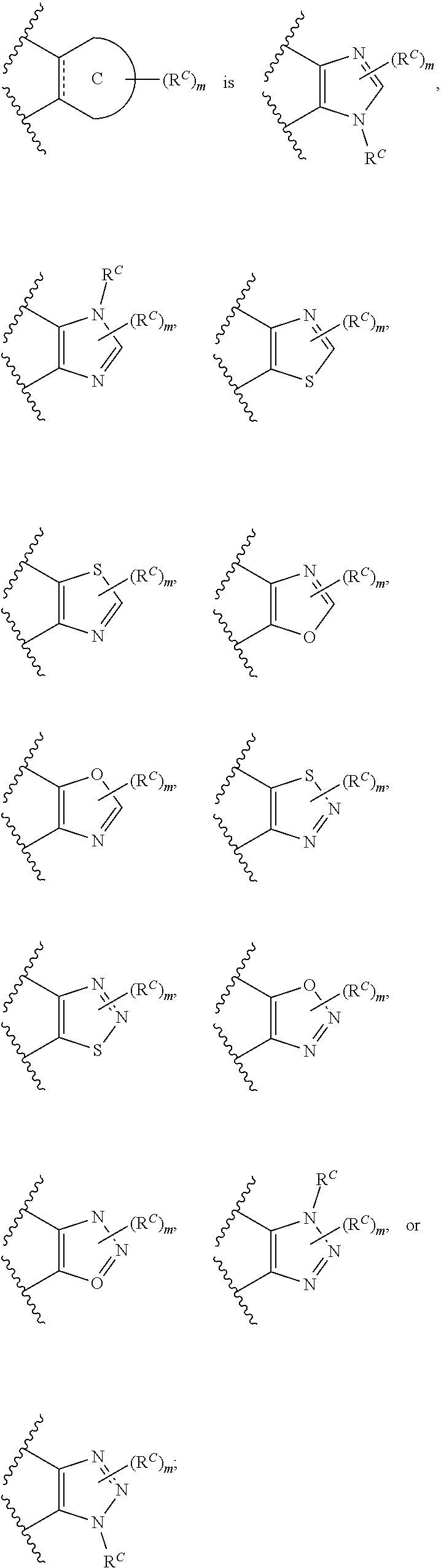
-
- ring D is a monocyclic heterocycle, bicyclic heterocycle, monocyclic carbocycle, or a bicyclic carbocycle;
- each RA, RC, and RD are independently H, D, halogen, —CN, —OH, —OR5, —SR5, —S(═O)R6, —NO2, —N(R5)2, —S(═O)2R6, —NHS(═O)2R6, —S(═O)2N(R5)2, —C(═O)R6, —OC(═O)R6, —CO2R5, —OCO2R6, —C(═O)N(R)2, —OC(═O)N(R)2, —NR5C(═O)N(R)2, —NR5C(═O)R6, —NR5C(═O)OR6, substituted or unsubstituted C1-C6alkyl, substituted or unsubstituted C1-C6deuteroalkyl, substituted or unsubstituted C2-C6alkenyl, substituted or unsubstituted C2-C6alkynyl, substituted or unsubstituted C1-C6fluoroalkyl, substituted or unsubstituted C1-C6heteroalkyl, substituted or unsubstituted aryl, or substituted or unsubstituted heteroaryl;
- each R5 is independently H, D, substituted or unsubstituted C1-C6alkyl, substituted or unsubstituted C1-C6deuteroalkyl, substituted or unsubstituted C1-C6fluoroalkyl, substituted or unsubstituted C3-C6cycloalkyl, substituted or unsubstituted aryl, or substituted or unsubstituted heteroaryl;
- or two R5 on the same N atom are taken together with the N atom to which they are attached to form a N-containing heterocycloalkyl;
- each R6 is independently substituted or unsubstituted C1-C6alkyl, substituted or unsubstituted C1-C6deuteroalkyl, substituted or unsubstituted C1-C6heteroalkyl, substituted or unsubstituted C1-C6fluoroalkyl, substituted or unsubstituted C3-C6cycloalkyl, substituted or unsubstituted aryl, or substituted or unsubstituted heteroaryl;
- p is 0, 1, 2 or 3;
- m is 0, 1, 2 or 3; and
- n is 0, 1, 2 or 3.

are on adjacent atoms of ring A.


-
- wherein,
- R is H or D;
- L1 is X;
- X is —S—, —S(O)—, or —S(O2)—;
- R7 and R8 are each independently H, D, substituted or unsubstituted C1-C6alkyl, or substituted or unsubstituted C1-C6deuteroalkyl;
- R4 is hydrogen, D, substituted or unsubstituted C1-C6alkyl, substituted or unsubstituted C1-C6deuteroalkyl, substituted or unsubstituted C1-C6fluoroalkyl, or substituted or unsubstituted C1-C6heteroalkyl;
- R2 is H, D, substituted or unsubstituted C1-C6alkyl, or substituted or unsubstituted C1-C6deuteroalkyl;
- R3 is H, D, substituted or unsubstituted C1-C6alkyl, substituted or unsubstituted C1-C6deuteroalkyl, substituted or unsubstituted C1-C6fluoroalkyl, or substituted or unsubstituted C1-C6heteroalkyl;
- or R2 and R3 together with the carbon that they are attached to form a substituted or unsubstituted C3-C6cycloalkyl or a substituted or unsubstituted C2-C8eterocycloalkyl;
- or R7 and R3 are taken together with the carbons that they are attached to form a substituted or unsubstituted C3-C6cycloalkyl or a substituted or unsubstituted C2-C8eterocycloalkyl; ring A is a monocyclic carbocycle, monocyclic heterocycle, bicyclic carbocycle, or bicyclic heterocycle;
- ring C is a monocyclic heterocycle or a monocyclic carbocycle;
- ring D is a monocyclic heterocycle, bicyclic heterocycle, monocyclic carbocycle, or a bicyclic carbocycle;
- each RA, RC, and RD is independently H, D, halogen, —CN, —OH, —OR5, —SR5, —S(═O)R6, —NO2, —N(R5)2, —S(═O)2R6, —NHS(═O)2R6, —S(═O)2N(R)2, —C(═O)R6, —OC(═O)R6, —CO2R5, —OCO2R6, —C(═O)N(R)2, —OC(═O)N(R)2, —NR5C(═O)N(R)2, —NR5C(═O)R6, —NR5C(═O)OR6, substituted or unsubstituted C1-C6alkyl, substituted or unsubstituted C1-C6deuteroalkyl, substituted or unsubstituted C2-C6alkenyl, substituted or unsubstituted C2-C6alkynyl, substituted or unsubstituted C1-C6fluoroalkyl, substituted or unsubstituted C1-C6heteroalkyl, substituted or unsubstituted aryl, or substituted or unsubstituted heteroaryl;
- each R5 is independently H, D, substituted or unsubstituted C1-C6alkyl, substituted or unsubstituted C1-C6deuteroalkyl, substituted or unsubstituted C1-C6fluoroalkyl, substituted or unsubstituted C3-C6cycloalkyl, substituted or unsubstituted aryl, or substituted or unsubstituted heteroaryl;
- or two R5 on the same N atom are taken together with the N atom to which they are attached to form a N-containing heterocycloalkyl;
- each R6 is independently substituted or unsubstituted C1-C6alkyl, substituted or unsubstituted C1-C6deuteroalkyl, substituted or unsubstituted C1-C6heteroalkyl, substituted or unsubstituted C1-C6fluoroalkyl, substituted or unsubstituted C3-C6cycloalkyl, substituted or unsubstituted aryl, or substituted or unsubstituted heteroaryl;
- p is 0, 1, 2 or 3;
- m is 0, 1, 2 or 3; and
- n is 0, 1, 2 or 3.

are on adjacent atoms of ring A.


are on adjacent atoms of ring C.


| Ex. | Name | |
| 2 | 5-((2-(1-isopropyl-1H-pyrazol- 5-yl)pyridin-3-yl)methoxy)-2,3- dihydrobenzofuran-4- carbaldehyde |
 |
| 3 | 5-((2-(1-isopropyl-1H-pyrazol- 5-yl)pyridin-3-yl)methoxy)-2,3- dihydrobenzofuran-6- carbaldehyde |
 |
| 4 | 6-((2-(1-isopropyl-1H-pyrazol- 5-yl)pyridin-3-yl)methoxy)-2,3- dihydrobenzofuran-7- carbaldehyde |
 |
| 5 | 6-((2-(1-isopropyl-1H-pyrazol- 5-yl)pyridin-3- yl)methoxy)benzofuran-7- carbaldehyde |
 |
| 6 | 5-((2-(1-isopropyl-1H-pyrazol- 5-yl)pyridin-3- yl)methoxy)benzo[d][1,3]dioxole- 4-carbaldehyde |
 |
| 7 | 6-((2-(1-isopropyl-1H-pyrazol- 5-yl)pyridin-3-yl)methoxy)-2,3- dihydrobenzo[b][1,4]dioxine-5- carbaldehyde |
 |
| 8 | 2,2-difluoro-5-((2-(1-isopropyl- 1H-pyrazol-5-yl)pyridin-3- yl)methoxy)benzo[d][1,3]dioxole- 4-carbaldehyde |
 |
| 9 | 2,2-difluoro-3-hydroxy-5-((2- (1-isopropyl-1H-pyrazol-5- yl)pyridin-3-yl)methoxy)-2,3- dihydrobenzofuran-4- carbaldehyde |
 |
| 10 | 2,2-difluoro-3-hydroxy-5-((2- (1-isopropyl-1H-pyrazol-5- yl)pyridin-3-yl)methoxy)-2,3- dihydro-1H-indene-4- carbaldehyde |
 |
| 11 | 5-((2-(1-isopropyl-1H-pyrazol- 5-yl)pyridin-3- yl)methoxy)benzo[d]isothiazole- 4-carbaldehyde |
 |
| 12 | 6-((2-(1-isopropyl-1H-pyrazol- 5-yl)pyridin-3- yl)methoxy)benzo[d]thiazole-7- carbaldehyde |
 |
| 13 | 7-((2-(1-isopropyl-1H-pyrazol- 5-yl)pyridin-3- yl)methoxy)tetrazolo[1,5-a] pyridine-8-carbaldehyde |
 |
| 14 | 5-((2-(1-isopropyl-1H-pyrazol- 5-yl)pyridin-3- yl)methoxy)benzo[d]oxazole-4- carbaldehyde |
 |
| 15 | 6-((2-(1-isopropyl-1H-pyrazol- 5-yl)pyridin-3- yl)methoxy)benzo[d]oxazole-7- carbaldehyde |
 |
| 16 | 5-((2-(1-isopropyl-1H-pyrazol- 5-yl)pyridin-3- yl)methoxy)benzo[d]thiazole-4- carbaldehyde |
 |
| 17 | 5-((2-(1-isopropyl-1H-pyrazol- 5-yl)pyridin-3- yl)methoxy)benzo[d][1,2,3] thiadiazole-4-carbaldehyde |
 |
| 18 | 6-((2-(1-isopropyl-1H-pyrazol- 5-yl)pyridin-3- yl)methoxy)benzo[d][1,2,3] thiadiazole-7-carbaldehyde |
 |
| 19 | 6-((2-(1-isopropyl-1H-pyrazol- 5-yl)pyridin-3- yl)methoxy)quinazoline-5- carbaldehyde |
 |
| 20 | 5-((2-(1-isopropyl-1H-pyrazol- 5-yl)pyridin-3- yl)methoxy)benzo[b]thiophene- 4-carbaldehyde |
 |
| 21 | 5-((2-(1-isopropyl-1H-pyrazol- 5-yl)pyridin-3-yl)methoxy)-2,3- dihydrobenzo[b]thiophene-4- carbaldehyde 1,1-dioxide |
 |
| 22 | 6-((2-(4-fluoro-1-isopropyl-1H- pyrazol-5-yl)pyridin-3- yl)methoxy)benzo[d]oxazole-7- carbaldehyde |
 |
| 23 | 2-hydroxy-6-(((2-(1-isopropyl- 1H-pyrazol-5-yl)pyridin-3- yl)methyl)thio)benzaldehyde |
 |
| 24 |
 |
|
| 25 | 2-((2-(4-fluoro-1-isopropyl-1H- pyrazol-5-yl)pyridin-3- yl)methoxy-d2)-6- hydroxybenzaldehyde |
 |
| 26 | 4-fluoro-2-((2-(4-fluoro-1- isopropyl-1H-pyrazol-5- yl)pyridin-3-yl)methoxy-d2)-6- hydroxybenzaldehyde |
 |
| 27b | 4-fluoro-2-hydroxy-6-((2-(1- isopropyl-1H-pyrazol-5- yl)pyridin-3-yl)methoxy- d2)benzaldehyde |
 |
| 27 | 4-fluoro-2-hydroxy-6-((2-(1- isopropyl-1H-pyrazol-5- yl)pyridin-3-yl)methoxy- d2)benzaldehyde hydrochloric acid |
 |
| 28 | 6-((2-(1-isopropyl-1H-pyrazol- 5-yl)pyridin-3-yl)methoxy- d2)benzo[d]oxazole-7- carbaldehyde |
 |
| 29e | 2-hydroxy-6-((2-(2-isopropyl- 1H-imidazol-1-yl)pyridin-3- yl)methoxy-d2)benzaldehyde |
 |
| 29 | 2-hydroxy-6-((2-(2-isopropyl- 1H-imidazol-1-yl)pyridin-3- yl)methoxy-d2)benzaldehyde hydrochloric acid |
 |
| 30 | 2-hydroxy-6-((2-(1-(propan-2- yl-1,1,1,3,3,3-d6)-1H-pyrazol- 5-yl)pyridin-3- yl)methoxy)benzaldehyde |
 |
| 31 | 4-fluoro-2-hydroxy-6-((2-(1- (propan-2-yl-1,1,1,3,3,3-d6)- 1H-pyrazol-5-yl)pyridin-3- yl)methoxy)benzaldehyde |
 |
| 32 | 2-((2-(4-fluoro-1-(propan-2-yl- 1,1,1,3,3,3-d6)-1H-pyrazol-5- yl)pyridin-3-yl)methoxy)-6- hydroxybenzaldehyde |
 |
| 33 | 6-((2-(1-(propan-2-yl- 1,1,1,3,3,3-d6)-1H-pyrazol-5- yl)pyridin-3- yl)methoxy)benzo[d]oxazole-7- carbaldehyde |
 |
| 34 | 4-fluoro-2-((4-(4-fluoro-1- (propan-2-yl-1,1,1,3,3,3-d6)- 1H-pyrazol-5-yl)pyrimidin-5- yl)methoxy)-6- hydroxybenzaldehyde |
 |
| 35 | 2-((4-(4-fluoro-1-(propan-2-yl- 1,1,1,3,3,3-d6)-1H-pyrazol-5- yl)pyrimidin-5-yl)methoxy)-6- hydroxybenzaldehyde |
 |
| 36 | 4-fluoro-2-hydroxy-6-((4-(1- (propan-2-yl-1,1,1,3,3,3-d6)- 1H-pyrazol-5-yl)pyrimidin-5- yl)methoxy)benzaldehyde |
 |
| 37 | 2-hydroxy-6-((4-(1-(propan-2- yl-1,1,1,3,3,3-d6)-1H-pyrazol- 5-yl)pyrimidin-5- yl)methoxy)benzaldehyde |
 |
| 38 | 2-hydroxy-6-((4-(1-isopropyl- 1H-pyrazol-5-yl)pyrimidin-5- yl)methoxy-d2)benzaldehyde |
 |
| 39 | 4-fluoro-2-hydroxy-6-((4-(1- isopropyl-1H-pyrazol-5- yl)pyrimidin-5-yl)methoxy- d2)benzaldehyde |
 |
| 40 | 3-fluoro-2-hydroxy-6-((4-(1- isopropyl-1H-pyrazol-5- yl)pyrimidin-5-yl)methoxy- d2)benzaldehyde |
 |
| 41 | 2-((4-(4-fluoro-1-isopropyl-1H- pyrazol-5-yl)pyrimidin-5- yl)methoxy-d2)-6- hydroxybenzaldehyde |
 |
| 42 | 2-hydroxy-6-((4-(2-isopropyl- 1H-imidazol-1-yl)pyrimidin-5- yl)methoxy-d2)benzaldehyde |
 |
| 43 | 6-((4-(2-isopropyl-1H- imidazol-1-yl)pyrimidin-5- yl)methoxy- d2)benzo[d]oxazole-7- carbaldehyde |
 |
| 44 | 4-fluoro-2-hydroxy-6-((4-(2- isopropyl-1H-imidazol-1- yl)pyrimidin-5-yl)methoxy- d2)benzaldehyde |
 |
| 45 | 2-((2-(2-cyclopropyl-1H- imidazol-1-yl)pyridin-3- yl)methoxy-d2)-6- hydroxybenzaldehyde |
 |
| 46 | 2-hydroxy-6-((3-(1-isopropyl- 1H-pyrazol-5-yl)pyridin-2- yl)methoxy-d2)benzaldehyde |
 |
| 47 | 4-fluoro-2-hydroxy-6-((3-(1- isopropyl-1H-pyrazol-5- yl)pyridin-2-yl)methoxy- d2)benzaldehyde |
 |
| 48 | 2-hydroxy-6-((2-(1-(propan-2- yl-2-d)-1H-pyrazol-5- yl)pyridin-3- yl)methoxy)benzaldehyde |
 |
| 49 | 2-hydroxy-6-((6-methyl-2-(1- (propan-2-yl-2-d)-1H-pyrazol- 5-yl)pyridin-3- yl)methoxy)benzaldehyde |
 |
| 50 | 2-hydroxy-6-((4-(1-(propan-2- yl-2-d)-1H-pyrazol-5- yl)pyrimidin-5- yl)methoxy)benzaldehyde |
 |
| 51 | 2-hydroxy-6-((3-(1-(propan-2- yl-2-d)-1H-pyrazol-5- yl)pyrazin-2- yl)methoxy)benzaldehyde |
 |
| 53 | 6-((4-(1-isopropyl-1H-pyrazol- 5-yl)pyrimidin-5- yl)methoxy)benzo[d]thiazole-7- carbaldehyde |
 |
| 54 | 6-((4-(1-isopropyl-1H-pyrazol- 5-yl)pyrimidin-5- yl)methoxy)benzo[d]oxazole-7- carbaldehyde |
 |
| 55 | 7-((4-(1-isopropyl-1H-pyrazol- 5-yl)pyrimidin-5- yl)methoxy)quinoline-8- carbaldehyde |
 |
| 56 | 7-((4-(1-isopropyl-1H-pyrazol- 5-yl)pyrimidin-5- yl)methoxy)quinoline-8- carbaldehyde |
 |
| 57 | 2-((4-(4-fluoro-1-isopropyl-1H- pyrazol-5-yl)pyrimidin-5- yl)methoxy)-6- hydroxybenzaldehyde |
 |
| 58 | 6-((3-(1-isopropyl-1H-pyrazol- 5-yl)pyridin-2- yl)methoxy)benzo[d]oxazole-7- carbaldehyde |
 |
| 59 | 2-hydroxy-6-((3-(1-isopropyl- 1H-pyrazol-5-yl)-1-methyl-6- oxo-1,6-dihydropyridazin-4- yl)methoxy)benzaldehyde |
 |
| 60 | 2-hydroxy-6-((5-(1-isopropyl- 1H-pyrazol-5-yl)-1-methyl-2- oxo-1,2-dihydropyridin-4- yl)methoxy)benzaldehyde |
 |
| 61g | 2-hydroxy-6-((4-(1-isopropyl- 1H-pyrazol-5-yl)-2,3- dihydrofuro[3,2-c]pyridin-3- yl)oxy)benzaldehyde |
 |
| 61h | 6-hydroxy-2-(4-hydroxy-2-(1- isopropyl-1H-pyrazol-5- yl)pyridin-3-yl)-2,3- dihydrobenzofuran-7- carbaldehyde |
 |
| 62a | (R)-2-hydroxy-6-((4-(1- isopropyl-1H-pyrazol-5-yl)-2,3- dihydrofuro[3,2-c]pyridin-3- yl)oxy)benzaldehyde |
 |
| 62b | (S)-2-hydroxy-6-((4-(1- isopropyl-1H-pyrazol-5-yl)-2,3- dihydrofuro[3,2-c]pyridin-3- yl)oxy)benzaldehyde |
 |
| 63 | 2-hydroxy-6-((5-(1-isopropyl- 1H-pyrazol-5-yl)-1-methyl-1H- imidazol-4- yl)methoxy)benzaldehyde |
 |
| 64 | 2-hydroxy-6-((5-(1-isopropyl- 1H-pyrazol-5-yl)thiazol-4- yl)methoxy)benzaldehyde |
 |
| 65 | 2-hydroxy-6-((4-(1-isopropyl- 1H-pyrazol-5-yl)thiazol-5- yl)methoxy)benzaldehyde |
 |
| 66 | 2-hydroxy-6-((5-(1-isopropyl- 1H-pyrazol-5-yl)oxazol-4- yl)methoxy)benzaldehyde |
 |
| 67 | 2-hydroxy-6-((4-(1-isopropyl- 1H-pyrazol-5-yl)oxazol-5- yl)methoxy)benzaldehyde |
 |
| 68 | 2-hydroxy-6-((5-(1-isopropyl- 1H-pyrazol-5-yl)-2- methyloxazol-4- yl)methoxy)benzaldehyde |
 |
| 69 | 2-hydroxy-6-((4-(1-isopropyl- 1H-pyrazol-5-yl)-1-methyl-1H- imidazol-5- yl)methoxy)benzaldehyde |
 |
| 70 | 2-hydroxy-6-((4-(1-isopropyl- 1H-pyrazol-5-yl)-2- methylthiazol-5- yl)methoxy)benzaldehyde |
 |
| 71 | 2-((4-(5-fluoro-2-isopropyl-1H- imidazol-1-yl)pyrimidin-5- yl)methoxy-d2)-6- hydroxybenzaldehyde |
 |
| 72 | 2-hydroxy-6-((3-(2-isopropyl- 1H-imidazol-1-yl)pyrazin-2- yl)methoxy-d2)benzaldehyde |
 |
| 73 | 2-formyl-3-((4-(1-isopropyl- 1H-pyrazol-5-yl)pyrimidin-5- yl)methoxy-d2)phenyl dihydrogen phosphate |
 |
| 74 | 2-((4-fluoro-2-(1-isopropyl-1H- pyrazol-5-yl)pyridin-3- yl)methoxy)-6- hydroxybenzaldehyde |
 |
| 75 | 2-((4-fluoro-2-(1-isopropyl-1H- pyrazol-5-yl)pyridin-3- yl)methoxy-d2)-6- hydroxybenzaldehyde |
 |


Further Forms of Compounds


and the like. Monocyclic heteroaryls include pyridinyl, imidazolyl, pyrimidinyl, pyrazolyl, triazolyl, pyrazinyl, tetrazolyl, furyl, thienyl, isoxazolyl, thiazolyl, oxazolyl, isothiazolyl, pyrrolyl, pyridazinyl, triazinyl, oxadiazolyl, thiadiazolyl, and furazanyl. In some embodiments, a heteroaryl contains 0-3 N atoms in the ring. In some embodiments, a heteroaryl contains 1-3 N atoms in the ring. In some embodiments, a heteroaryl contains 0-3 N atoms, 0-1 O atoms, and 0-1 S atoms in the ring. In some embodiments, a heteroaryl is a monocyclic or bicyclic heteroaryl. In some embodiments, heteroaryl is a C1-C9heteroaryl. In some embodiments, monocyclic heteroaryl is a C1-C5heteroaryl. In some embodiments, monocyclic heteroaryl is a 5-membered or δ-membered heteroaryl. In some embodiments, bicyclic heteroaryl is a C6-C9heteroaryl. Depending on the structure, a heteroaryl group can be a monoradical or a diradical (i.e., a heteroarylene group).


| Column | CHIRALCEL OZ-H | ||
| Column size | 0.46 cm I.D. × 15 cm L | ||
| Injection | 1.0 ul | ||
| Mobile phase | Hexane/EtOH = 80/20 (V/V) | ||
| Flow rate | 1.0 ml/min | ||
| Wave length | UV 254 nm | ||
| Temperature | 35° C. | ||
| Sample name | Raw Material | ||


| TABLE 1 | |||
| | delta p50 | ||
| 2 | −78% | ||
| 3 | −62% | ||
| 4 | −51% | ||
| 5 | −77% | ||
| 6 | −66% | ||
| 7 | −59% | ||
| 8 | −68% | ||
| 9 | −64% | ||
| 10 | −68% | ||
| 13 | −9% | ||
| 14 | −63% | ||
| 15 | −81% | ||
| 20 | −74% | ||
| 21 | −72% | ||
| 23 | −62% | ||
| 24 | −47% | ||
| 30 | −85% | ||
| 59 | −54% | ||
| 60 | −69% | ||
| 61g | −59% | ||
| 62a | −63% | ||
| 62b | −64% | ||
Dose-Dependent Whole Blood OEC Studies
| TABLE 2 | |||
| delta p50 | |||
| Example | 0.2 mM | 0.5 mM | ||
| GBT-440 | −14.2% | −35.1% | ||
| 11 | −12.80% | −37.60% | ||
| 12 | −26.60% | −58.40% | ||
| 16 | −8.90% | −14.70% | ||
| 17 | −12% | −30% | ||
| 18 | −2.80% | −8.10% | ||
| 19 | −8.20% | −18.10% | ||
| 22 | −12.90% | −35.50% | ||
| 25 | −14.30% | −36.10% | ||
| 26 | −11.10% | −26.10% | ||
| 27b | −18.8% | −56.6% | ||
| 28 | −11.90% | −40.70% | ||
| 29e | −24.9% | −66.1% | ||
| 31 | −9.80% | −36.10% | ||
| 32 | −12.70% | −39.20% | ||
| 33 | −12.70% | −39.70% | ||
| 34 | −6.50% | −10.00% | ||
| 35 | −10.30% | −29.80% | ||
| 36 | −9.30% | −14% | ||
| 37 | −16.20% | −46.10% | ||
| 38 | −15.20% | −46.80% | ||
| 39 | −12.20% | −29.30% | ||
| 40 | −6% | −12% | ||
| 41 | −14.40% | −30.20% | ||
| 42 | −10.20% | −23.10% | ||
| 43 | −9.90% | −28.10% | ||
| 44 | −6.90% | −22.10% | ||
| 45 | −10% | −29.80% | ||
| 46 | −12.80% | −37.90% | ||
| 47 | −15.30% | −40.80% | ||
| 48 | −11% | −38.10% | ||
| 49 | −13.10% | −33.00% | ||
| 50 | −16.10% | −38.4.% | ||
| 51 | −13.10% | −36.40% | ||
| 53 | −20.50% | −37.80% | ||
| 54 | −12.00% | −35.00% | ||
| 55 | −5.30% | −8.80% | ||
| 56 | −1.60% | −11.30% | ||
| 57 | −4.90% | −7.60% | ||
| 58 | −14.30% | −34.30% | ||
| 63 | −7.00% | −15.20% | ||
| 64 | −10.00% | −31.00% | ||
| 65 | −11.20% | −36.20% | ||
| 66 | −5.70% | −16.50% | ||
| 67 | −6.80% | −25.30% | ||
| 68 | −8.70% | −13.00% | ||
| 69 | −21.40% | −41.80% | ||
| 70 | −10.40% | −21.90% | ||
| 72 | −5.10% | −16.80% | ||
| 74 | −15.8% | −48.4% | ||
| 75 | −13.0% | −53.7% | ||
-
- Blood collected after informed consent from sickle cell individuals.
- HBS buffer: 10 mM HEPES, 145 mM NaCl, pH 7.4
- Hemox buffer: Buffer provided for the hemox analyzer
- Control Compound stock solution in DMSO (50 mM) stored at RT
- Control Compound work solution (CWS): 10 μl of DMSO was added by Hamilton to 90 μl of HBS buffer (20 mM Hepes, 145 mM NaCl, pH 7.4) to create a working solution with a final concentration of 5 mM drug and 10% DMSO).
- Compound stock solution in DMSO (50 mM) stored at RT
- Compound work solution (WS): 10 μl of DMSO was added by Hamilton to 90 μl of HBS buffer (20 mM Hepes, 145 mM NaCl, pH 7.4) to create a working solution with a final concentration of 5 mM drug and 10% DMSO).
- DMSO buffer: 10% DMSO (DB), same as WS but without drug. This will be used to maintain DMSO the same for different drug incubations.
Test Protocol:
-
- Run Advia 120 analysis on SCD blood, to determine Hct.
- Dilute blood to 20% Hct with HBS to total volume of 3 ml.
- This cell suspension (CS) will be used for all experiments.
-
- 1. 200 μl CS
- 2. 200 μl CS+20 μl CWS (5 mM diluted 10 times=0.5 mM control final)−(1% DMSO)
- 3. 200 μl CS+20 μl WS (5 mM diluted 10 times=0.5 mM control final)−(1% DMSO)
- 4. 200 μl CS+8 μl WS (0.2 mM drug final)+DB−(1% DMSO)
-
Incubate 30 minutes at 37° C.
| TABLE 3 | |||
| p50 | |||
| Example | 0.2 mM | 0.5 mM | ||
| Untreated | 24.2% | 24.2% | ||
| GBT-440 | 21.6% | 19.8% | ||
| 27b | 20.9% | 19.2% | ||
| 38 | 19.8% | 20.6% | ||
| 29e | 20.3% | 17.7% | ||
| TABLE 4 | ||||
| GBT440 | Example 27b | Example 38 | Example 29e | |
| Reduction in % sickled cells | −22.4% | −30.8% | −30.6% | −27.1% |
| compared to untreated | ||||
|
|
||||
Cb·VB=Cp·Vp+CBC·VBC
Where, Cb=Concentration of whole blood; VB=Volume of whole blood; Cp=Concentration of plasma; Vp=Volume of plasma; CBC=Concentration of blood cell; VBC=Volume of blood cell. VBC=H·VB, where H is the hematocrit number.
Vp=(1−H)·VB
| TABLE 5 | ||||
| Example 27 | Example 29 | Example 38 | ||
| Dose |
| 7.2 mg/kg | 7.2 mg/kg | 7.2 mg/kg |
| Plasma | RBC | Ratio | Plasma | RBC | Ratio | Plasma | RBC | Ratio | ||
| Cmax | 0.742 | 50.3 | 68:1 | 4.01 | 1236.7 | 308:1 | 0.753 | 115.7 | 154:1 |
| (μg/mL) | |||||||||
| AUC0-24 h | 10.7 | 565.6 | 53:1 | 42.6 | 11952.8 | 281:1 | 10.7 | 1732.2 | 161:1 |
| (μg * h/mL) | |||||||||
| T1/2 (h) | 18 | 26 | 12 | 10 | 11 | 11 | |||
| TABLE 6 | ||
| GBT-440 (HCl salt) | ||
| 7.2 mg/kg | ||
| Dose | Plasma | RBC | Ratio | ||
| Cmax (μg/mL) | 2.15 | 216.2 | 100:1 | ||
| AUC0-24 h (μg*h/mL) | 22.8 | 3436.3 | 151:1 | ||
| T1/2 (h) | 19 | 17 | |||
| TABLE 7 | ||||
| JP1 Solubility | JP2 Solubility | FaSSIF Solubility | ||
| (μg/mL) | (μg/mL) | (μg/mL) | ||
| GBT-440 (HCl) | 986.02 | 27.99 | 95.66 |
| Example 27 | 623.32 | 8.16 | 35.67 |
| Example 29 | >4444.44 | 74.43 | 590.91 |
| Example 38 | 19.96 | 15.11 | 26.59 |
| TABLE 8 | ||
| IC50 (μM) | ||
| CYP1A2 | CYP2C8 | CYP2C9 | CYP2C19 | CYP2D6 | CYP3A4-M | ||
| GBT-440 | 17.6 | 12.4 | 28.1 | 7 | >30 | >30 |
| Ex. 27b | 22 | 3.7 | 11 | 6.1 | >30 | 10 |
| Ex. 29e | >50 | >50 | 36.5 | 19.5 | >50 | >50 |
| Ex. 38 | >30 | 25.2 | 10.6 | 8.61 | >30 | >30 |
| TABLE 9 | |||
| Rat microsome, t½ (min) | Human microsome, t½ (min) | ||
| GBT-440 | 22 | 24 |
| Ex. 27b | 19 | 24 |
| Ex. 29e | 11 | 11 |
| Ex. 38 | 18 | 38 |
Claims (18)


Priority Applications (1)
| Application Number | Priority Date | Filing Date | Title |
|---|---|---|---|
| US16/310,258 US10787430B2 (en) | 2016-06-17 | 2017-06-16 | Hemoglobin modifier compounds and uses thereof |
Applications Claiming Priority (3)
| Application Number | Priority Date | Filing Date | Title |
|---|---|---|---|
| US201662351708P | 2016-06-17 | 2016-06-17 | |
| US16/310,258 US10787430B2 (en) | 2016-06-17 | 2017-06-16 | Hemoglobin modifier compounds and uses thereof |
| PCT/US2017/037983 WO2017218960A1 (en) | 2016-06-17 | 2017-06-16 | Hemoglobin modifier compounds and uses thereof |
Publications (2)
| Publication Number | Publication Date |
|---|---|
| US20190330181A1 US20190330181A1 (en) | 2019-10-31 |
| US10787430B2 true US10787430B2 (en) | 2020-09-29 |
Family
ID=60664275
Family Applications (1)
| Application Number | Title | Priority Date | Filing Date |
|---|---|---|---|
| US16/310,258 Expired - Fee Related US10787430B2 (en) | 2016-06-17 | 2017-06-16 | Hemoglobin modifier compounds and uses thereof |
Country Status (3)
| Country | Link |
|---|---|
| US (1) | US10787430B2 (en) |
| EP (1) | EP3472150A1 (en) |
| WO (1) | WO2017218960A1 (en) |
Families Citing this family (17)
| Publication number | Priority date | Publication date | Assignee | Title |
|---|---|---|---|---|
| EP4512819A3 (en) | 2015-08-12 | 2025-08-06 | The General Hospital Corporation | Compositions and methods that promote hypoxia or the hypoxia response for treatment and prevention of mitochondrial dysfunction and oxidative stress disorders |
| WO2017218960A1 (en) | 2016-06-17 | 2017-12-21 | Fronthera U.S. Pharmaceuticals Llc | Hemoglobin modifier compounds and uses thereof |
| CA3092931A1 (en) * | 2018-03-08 | 2019-09-12 | Novartis Ag | Use of an anti-p-selectin antibody |
| AU2019387290A1 (en) | 2018-11-29 | 2021-05-27 | Pfizer Inc. | Pyrazoles as modulators of hemoglobin |
| BR112021012311A2 (en) | 2018-12-21 | 2021-09-08 | Crystal Pharma, S.A.U. | USE OF AN INTERMEDIATE COMPOUND, PROCESS TO PREPARE VOXELOTOR AND INTERMEDIATE COMPOUND |
| US12544403B2 (en) | 2019-01-10 | 2026-02-10 | The General Hospital Corporation | Methods to treat mitochondrial-associated dysfunctions or diseases |
| WO2021142312A1 (en) * | 2020-01-10 | 2021-07-15 | The Board Of Regents Of The University Of Texas | Methods and compositions related to heparinoids |
| WO2021224280A1 (en) * | 2020-05-05 | 2021-11-11 | Dipharma Francis S.R.L. | Synthesis of a sickle cell disease agent and intermediates thereof |
| IT202000009970A1 (en) * | 2020-05-05 | 2021-11-05 | Dipharma Francis Srl | PROCEDURE FOR THE PREPARATION OF A DRUG FOR THE TREATMENT OF SICKLE CELL ANEMIA |
| CN115667202B (en) * | 2020-06-17 | 2024-10-11 | 贝达药业股份有限公司 | Indenone compound and application thereof |
| US20230263832A1 (en) * | 2020-07-10 | 2023-08-24 | Children's Medical Center Corporation | Targeted drug delivery to sites of intravascular occlusion |
| EP3939589A1 (en) * | 2020-07-15 | 2022-01-19 | Sandoz Ag | High drug load tablet comprising voxelotor |
| CN112047924B (en) * | 2020-10-10 | 2023-04-18 | 山东汇海医药化工有限公司 | Preparation method of Wo Keluo polypeptide |
| WO2022099064A2 (en) * | 2020-11-06 | 2022-05-12 | Global Blood Therapeutics, Inc. | Process for preparation of 2-hydroxy-6-((2-(1-isopropyl- 1h-pyrazol-5-yl)pyridin-3-yl)methoxy)benzaldehyde |
| US20240124454A1 (en) | 2020-12-31 | 2024-04-18 | Nanjing Zaiming Pharmaceutical Co., Ltd. | Tricyclic compound and use thereof |
| CN113214182B (en) * | 2021-05-19 | 2022-12-23 | 佛山湘潭大学绿色智造研究院 | Benzisothiazole compound and preparation method thereof |
| US20250145637A1 (en) | 2021-08-10 | 2025-05-08 | Jiangsu Hengrui Pharmaceuticals Co. Ltd. | Sulfonamide derivative, preparation method therefor and medical use thereof |
Citations (19)
| Publication number | Priority date | Publication date | Assignee | Title |
|---|---|---|---|---|
| US20130040997A1 (en) | 2010-04-26 | 2013-02-14 | Gwangju Institute Of Science And Technology | Novel pyridine carboxylic acid based compound used as a p2x1 and p2x3 receptor antagonist, a production method for the same and a composition comprising the same |
| WO2013102142A1 (en) | 2011-12-28 | 2013-07-04 | Global Blood Therapeutics, Inc. | Substituted benzaldehyde compounds and methods for their use in increasing tissue oxygenation |
| US20130190316A1 (en) | 2011-12-28 | 2013-07-25 | Global Blood Therapeutics, Inc. | Substituted heteroaryl aldehyde compounds and methods for their use in increasing tissue oxygenation |
| US20140275152A1 (en) | 2013-03-15 | 2014-09-18 | Global Blood Therapeutics, Inc. | Compounds and uses thereof for the modulation of hemoglobin |
| US20140271591A1 (en) | 2013-03-15 | 2014-09-18 | Global Blood Therapeutics, Inc. | Compositions and methods for the modulation of hemoglobin (s) |
| US20140274961A1 (en) | 2013-03-15 | 2014-09-18 | Global Blood Therapeutics, Inc. | Compounds and uses thereof for the modulation of hemoglobin |
| WO2014150258A1 (en) | 2013-03-15 | 2014-09-25 | Global Blood Therapeutics, Inc. | Compounds and uses thereof for the modulation of hemoglobin |
| WO2014150256A1 (en) | 2013-03-15 | 2014-09-25 | Global Blood Therapeutics, Inc. | Compositions and methods for the modulation of hemoglobin (s) |
| WO2014150276A1 (en) | 2013-03-15 | 2014-09-25 | Global Blood Therapeutics, Inc. | Compounds and uses thereof for the modulation of hemoglobin |
| WO2014150261A1 (en) | 2013-03-15 | 2014-09-25 | Global Blood Therapeutics, Inc. | Compounds and uses thereof for the modulaton of hemoglobin |
| WO2014150289A1 (en) | 2013-03-15 | 2014-09-25 | Global Blood Therapeutics, Inc. | Compounds and uses thereof for the modulation of hemoglobin |
| US20150057251A1 (en) | 2013-08-26 | 2015-02-26 | Global Blood Therapeutics, Inc. | Compounds and uses thereof for the modulation of hemoglobin |
| WO2015031284A1 (en) | 2013-08-26 | 2015-03-05 | Global Blood Therapeutics, Inc. | Formulations comprising wetting agents and compounds for the modulation of hemoglobin (s) |
| WO2015031285A1 (en) | 2013-08-27 | 2015-03-05 | Global Blood Therapeutics, Inc. | Crystalline 2-hydroxy-6-((2-(1-isopropyl-1h-pyrazol-5-yl)pyridin-3-yl)methoxy)benzaldehyde ansolvate salts |
| US20150209443A1 (en) | 2014-01-29 | 2015-07-30 | Global Blood Therapeutics, Inc. | 1:1 adducts of sickle hemoglobin |
| WO2015116061A1 (en) | 2014-01-29 | 2015-08-06 | Global Blood Therapeutics, Inc. | 1:1 adducts of sickle hemoglobin |
| WO2015120133A1 (en) | 2014-02-07 | 2015-08-13 | Global Blood Therapeutics, Inc. | Crystalline polymorphs of the free base of 2-hydroxy-6-((2-(1-isopropyl-1h-pyrazol-5-yl)pyridin-3-yl)methoxy)benzaldehyde |
| WO2015125085A1 (en) | 2014-02-19 | 2015-08-27 | Piramal Enterprises Limited | Compounds for use as gpr120 agonists |
| WO2017218960A1 (en) | 2016-06-17 | 2017-12-21 | Fronthera U.S. Pharmaceuticals Llc | Hemoglobin modifier compounds and uses thereof |
-
2017
- 2017-06-16 WO PCT/US2017/037983 patent/WO2017218960A1/en not_active Ceased
- 2017-06-16 US US16/310,258 patent/US10787430B2/en not_active Expired - Fee Related
- 2017-06-16 EP EP17814215.4A patent/EP3472150A1/en not_active Withdrawn
Patent Citations (22)
| Publication number | Priority date | Publication date | Assignee | Title |
|---|---|---|---|---|
| US20130040997A1 (en) | 2010-04-26 | 2013-02-14 | Gwangju Institute Of Science And Technology | Novel pyridine carboxylic acid based compound used as a p2x1 and p2x3 receptor antagonist, a production method for the same and a composition comprising the same |
| WO2013102142A1 (en) | 2011-12-28 | 2013-07-04 | Global Blood Therapeutics, Inc. | Substituted benzaldehyde compounds and methods for their use in increasing tissue oxygenation |
| US20130190316A1 (en) | 2011-12-28 | 2013-07-25 | Global Blood Therapeutics, Inc. | Substituted heteroaryl aldehyde compounds and methods for their use in increasing tissue oxygenation |
| US20130190315A1 (en) | 2011-12-28 | 2013-07-25 | Global Blood Therapeutics, Inc. | Substituted benzaldehyde compounds and methods for their use in increasing tissue oxygenation |
| US20150344483A1 (en) | 2011-12-28 | 2015-12-03 | Global Blood Therapeutics, Inc. | Substituted heteroaryl aldehyde compounds and methods for their use in increasing tissue oxygenation |
| WO2014150261A1 (en) | 2013-03-15 | 2014-09-25 | Global Blood Therapeutics, Inc. | Compounds and uses thereof for the modulaton of hemoglobin |
| US20140275152A1 (en) | 2013-03-15 | 2014-09-18 | Global Blood Therapeutics, Inc. | Compounds and uses thereof for the modulation of hemoglobin |
| WO2014150258A1 (en) | 2013-03-15 | 2014-09-25 | Global Blood Therapeutics, Inc. | Compounds and uses thereof for the modulation of hemoglobin |
| WO2014150256A1 (en) | 2013-03-15 | 2014-09-25 | Global Blood Therapeutics, Inc. | Compositions and methods for the modulation of hemoglobin (s) |
| WO2014150276A1 (en) | 2013-03-15 | 2014-09-25 | Global Blood Therapeutics, Inc. | Compounds and uses thereof for the modulation of hemoglobin |
| US20140271591A1 (en) | 2013-03-15 | 2014-09-18 | Global Blood Therapeutics, Inc. | Compositions and methods for the modulation of hemoglobin (s) |
| WO2014150289A1 (en) | 2013-03-15 | 2014-09-25 | Global Blood Therapeutics, Inc. | Compounds and uses thereof for the modulation of hemoglobin |
| US20140274961A1 (en) | 2013-03-15 | 2014-09-18 | Global Blood Therapeutics, Inc. | Compounds and uses thereof for the modulation of hemoglobin |
| US20160046613A1 (en) | 2013-03-15 | 2016-02-18 | Global Blood Therapeutics, Inc. | Compounds and uses thereof for the modulation of hemoglobin |
| US20150057251A1 (en) | 2013-08-26 | 2015-02-26 | Global Blood Therapeutics, Inc. | Compounds and uses thereof for the modulation of hemoglobin |
| WO2015031284A1 (en) | 2013-08-26 | 2015-03-05 | Global Blood Therapeutics, Inc. | Formulations comprising wetting agents and compounds for the modulation of hemoglobin (s) |
| WO2015031285A1 (en) | 2013-08-27 | 2015-03-05 | Global Blood Therapeutics, Inc. | Crystalline 2-hydroxy-6-((2-(1-isopropyl-1h-pyrazol-5-yl)pyridin-3-yl)methoxy)benzaldehyde ansolvate salts |
| WO2015116061A1 (en) | 2014-01-29 | 2015-08-06 | Global Blood Therapeutics, Inc. | 1:1 adducts of sickle hemoglobin |
| US20150209443A1 (en) | 2014-01-29 | 2015-07-30 | Global Blood Therapeutics, Inc. | 1:1 adducts of sickle hemoglobin |
| WO2015120133A1 (en) | 2014-02-07 | 2015-08-13 | Global Blood Therapeutics, Inc. | Crystalline polymorphs of the free base of 2-hydroxy-6-((2-(1-isopropyl-1h-pyrazol-5-yl)pyridin-3-yl)methoxy)benzaldehyde |
| WO2015125085A1 (en) | 2014-02-19 | 2015-08-27 | Piramal Enterprises Limited | Compounds for use as gpr120 agonists |
| WO2017218960A1 (en) | 2016-06-17 | 2017-12-21 | Fronthera U.S. Pharmaceuticals Llc | Hemoglobin modifier compounds and uses thereof |
Non-Patent Citations (1)
| Title |
|---|
| PCT/US2017/037983 International Search Report and Written Opinion dated Oct. 20, 2017. |
Also Published As
| Publication number | Publication date |
|---|---|
| WO2017218960A1 (en) | 2017-12-21 |
| EP3472150A1 (en) | 2019-04-24 |
| US20190330181A1 (en) | 2019-10-31 |
Similar Documents
| Publication | Publication Date | Title |
|---|---|---|
| US10787430B2 (en) | Hemoglobin modifier compounds and uses thereof | |
| US9586952B2 (en) | Polycyclic estrogen receptor modulators and uses thereof | |
| TWI393716B (en) | Heterocyclic compounds as factor ixa inhibitors | |
| US9868704B2 (en) | Estrogen receptor modulators and uses thereof | |
| US9499538B2 (en) | Estrogen receptor modulators and uses thereof | |
| EP1417205B1 (en) | Isoxazolyl-pyrimidines as inhibitors of src and lck protein kinases | |
| TW202102482A (en) | Cystic fibrosis transmembrane conductance regulator modulating agents | |
| JP6461637B2 (en) | Triazine compound and pharmaceutical use thereof | |
| JP2013536200A (en) | Autotaxin inhibitors and uses thereof | |
| MX2011002149A (en) | Compounds that modulate intracellular calcium. | |
| US20170312273A1 (en) | Methods of using fasn inhibitors | |
| US11708376B2 (en) | Substituted imidazo[4,5-b]pyridines, imidazo[4,5-b]pyrazines, and oxazolo[4,5- b]pyrazines as mitochondrial uncouplers | |
| CA3227602A1 (en) | Inhibitors for coronaviruses | |
| WO2019084300A1 (en) | Treatment of glioblastoma with fasn inhibitors | |
| WO2022083703A1 (en) | Compounds and compositions for treating conditions associated with lpa receptor activity | |
| US20230293539A1 (en) | Mll1-wdr5 protein-protein interaction inhibitor compounds and uses thereof | |
| CA3201608A1 (en) | Boron containing pyrazole compounds, compositions comprising them, methods and uses thereof | |
| US4810715A (en) | Imidazoyl-substituted thiomethylpyridine derivatives, method of administration thereof and medicaments containing them | |
| US9562033B2 (en) | Inhibitors of viral replication, their process of preparation and their therapeutical uses | |
| US20210213006A1 (en) | Methods of treating neurodegenerative diseases | |
| JPS62252774A (en) | Phthalazine derivative and production thereof | |
| TW202116319A (en) | Nanoparticle formulation of bcl-2 inhibitor | |
| US9796671B2 (en) | Aurora kinase inhibitors | |
| US12357631B2 (en) | Pyrrolo[2,3-B]pyridin derivatives as inhibitors of influenza virus replication | |
| CS277691A3 (en) | 3-/1h-indazol-3-yl/-4-pyridinamines, process and intermediates for their preparation and their application as medicaments |
Legal Events
| Date | Code | Title | Description |
|---|---|---|---|
| FEPP | Fee payment procedure |
Free format text: ENTITY STATUS SET TO UNDISCOUNTED (ORIGINAL EVENT CODE: BIG.); ENTITY STATUS OF PATENT OWNER: LARGE ENTITY |
|
| FEPP | Fee payment procedure |
Free format text: ENTITY STATUS SET TO SMALL (ORIGINAL EVENT CODE: SMAL); ENTITY STATUS OF PATENT OWNER: LARGE ENTITY |
|
| AS | Assignment |
Owner name: HAISCO PHARMACEUTICAL CO., LIMITED, CHINA Free format text: SECURITY INTEREST;ASSIGNORS:FRONTHERA U.S. PHARMACEUTICALS LLC;FRONTHERA INTERNATIONAL GROUP LIMITED;REEL/FRAME:049977/0645 Effective date: 20190731 |
|
| AS | Assignment |
Owner name: FRONTHERA U.S. PHARMACEUTICALS LLC, CALIFORNIA Free format text: ASSIGNMENT OF ASSIGNORS INTEREST;ASSIGNORS:JIN, BOHAN;DONG, QING;HUNG, GENE;REEL/FRAME:050993/0227 Effective date: 20191031 |
|
| STPP | Information on status: patent application and granting procedure in general |
Free format text: DOCKETED NEW CASE - READY FOR EXAMINATION |
|
| FEPP | Fee payment procedure |
Free format text: ENTITY STATUS SET TO UNDISCOUNTED (ORIGINAL EVENT CODE: BIG.); ENTITY STATUS OF PATENT OWNER: LARGE ENTITY |
|
| STPP | Information on status: patent application and granting procedure in general |
Free format text: NON FINAL ACTION MAILED |
|
| STPP | Information on status: patent application and granting procedure in general |
Free format text: RESPONSE TO NON-FINAL OFFICE ACTION ENTERED AND FORWARDED TO EXAMINER |
|
| AS | Assignment |
Owner name: FRONTHERA U.S. PHARMACEUTICALS LLC, CALIFORNIA Free format text: ASSIGNMENT OF ASSIGNORS INTEREST;ASSIGNORS:JIN, BOHAN;DONG, QING;HUNG, GENE;REEL/FRAME:052563/0254 Effective date: 20170614 |
|
| STPP | Information on status: patent application and granting procedure in general |
Free format text: NOTICE OF ALLOWANCE MAILED -- APPLICATION RECEIVED IN OFFICE OF PUBLICATIONS |
|
| STPP | Information on status: patent application and granting procedure in general |
Free format text: PUBLICATIONS -- ISSUE FEE PAYMENT VERIFIED |
|
| STCF | Information on status: patent grant |
Free format text: PATENTED CASE |
|
| CC | Certificate of correction | ||
| AS | Assignment |
Owner name: FRONTHERA INTERNATIONAL GROUP LIMITED, CALIFORNIA Free format text: RELEASE BY SECURED PARTY;ASSIGNOR:HAISCO PHARMACEUTICAL CO., LIMITED;REEL/FRAME:055528/0734 Effective date: 20210308 Owner name: FRONTHERA U.S. PHARMACEUTICALS LLC, CALIFORNIA Free format text: RELEASE BY SECURED PARTY;ASSIGNOR:HAISCO PHARMACEUTICAL CO., LIMITED;REEL/FRAME:055528/0734 Effective date: 20210308 |
|
| AS | Assignment |
Owner name: SICHUAN HAISCO PHARMACEUTICAL CO., LTD., CHINA Free format text: ASSIGNMENT OF ASSIGNORS INTEREST;ASSIGNOR:FRONTHERA U.S. PHARMACEUTICALS LLC;REEL/FRAME:055809/0009 Effective date: 20210322 |
|
| FEPP | Fee payment procedure |
Free format text: MAINTENANCE FEE REMINDER MAILED (ORIGINAL EVENT CODE: REM.); ENTITY STATUS OF PATENT OWNER: LARGE ENTITY |
|
| LAPS | Lapse for failure to pay maintenance fees |
Free format text: PATENT EXPIRED FOR FAILURE TO PAY MAINTENANCE FEES (ORIGINAL EVENT CODE: EXP.); ENTITY STATUS OF PATENT OWNER: LARGE ENTITY |
|
| STCH | Information on status: patent discontinuation |
Free format text: PATENT EXPIRED DUE TO NONPAYMENT OF MAINTENANCE FEES UNDER 37 CFR 1.362 |
|
| FP | Lapsed due to failure to pay maintenance fee |
Effective date: 20240929 |