US10776803B2 - Computerized promotion and markdown price scheduling - Google Patents
Computerized promotion and markdown price scheduling Download PDFInfo
- Publication number
- US10776803B2 US10776803B2 US15/062,561 US201615062561A US10776803B2 US 10776803 B2 US10776803 B2 US 10776803B2 US 201615062561 A US201615062561 A US 201615062561A US 10776803 B2 US10776803 B2 US 10776803B2
- Authority
- US
- United States
- Prior art keywords
- prices
- promotion
- price
- markdown
- segment
- Prior art date
- Legal status (The legal status is an assumption and is not a legal conclusion. Google has not performed a legal analysis and makes no representation as to the accuracy of the status listed.)
- Active, expires
Links
Images


Classifications
-
- G—PHYSICS
- G06—COMPUTING OR CALCULATING; COUNTING
- G06Q—INFORMATION AND COMMUNICATION TECHNOLOGY [ICT] SPECIALLY ADAPTED FOR ADMINISTRATIVE, COMMERCIAL, FINANCIAL, MANAGERIAL OR SUPERVISORY PURPOSES; SYSTEMS OR METHODS SPECIALLY ADAPTED FOR ADMINISTRATIVE, COMMERCIAL, FINANCIAL, MANAGERIAL OR SUPERVISORY PURPOSES, NOT OTHERWISE PROVIDED FOR
- G06Q30/00—Commerce
- G06Q30/02—Marketing; Price estimation or determination; Fundraising
- G06Q30/0207—Discounts or incentives, e.g. coupons or rebates
- G06Q30/0223—Discounts or incentives, e.g. coupons or rebates based on inventory
-
- G—PHYSICS
- G06—COMPUTING OR CALCULATING; COUNTING
- G06Q—INFORMATION AND COMMUNICATION TECHNOLOGY [ICT] SPECIALLY ADAPTED FOR ADMINISTRATIVE, COMMERCIAL, FINANCIAL, MANAGERIAL OR SUPERVISORY PURPOSES; SYSTEMS OR METHODS SPECIALLY ADAPTED FOR ADMINISTRATIVE, COMMERCIAL, FINANCIAL, MANAGERIAL OR SUPERVISORY PURPOSES, NOT OTHERWISE PROVIDED FOR
- G06Q10/00—Administration; Management
- G06Q10/08—Logistics, e.g. warehousing, loading or distribution; Inventory or stock management
- G06Q10/087—Inventory or stock management, e.g. order filling, procurement or balancing against orders
-
- G—PHYSICS
- G06—COMPUTING OR CALCULATING; COUNTING
- G06Q—INFORMATION AND COMMUNICATION TECHNOLOGY [ICT] SPECIALLY ADAPTED FOR ADMINISTRATIVE, COMMERCIAL, FINANCIAL, MANAGERIAL OR SUPERVISORY PURPOSES; SYSTEMS OR METHODS SPECIALLY ADAPTED FOR ADMINISTRATIVE, COMMERCIAL, FINANCIAL, MANAGERIAL OR SUPERVISORY PURPOSES, NOT OTHERWISE PROVIDED FOR
- G06Q10/00—Administration; Management
- G06Q10/08—Logistics, e.g. warehousing, loading or distribution; Inventory or stock management
- G06Q10/087—Inventory or stock management, e.g. order filling, procurement or balancing against orders
- G06Q10/0872—Inventory or stock management, e.g. order filling, procurement or balancing against orders using inventory planning
- G06Q10/08726—Inventory or stock management, e.g. order filling, procurement or balancing against orders using inventory planning for replenishment processing, procedures, or recommendations using forecasting or optimisation
-
- G—PHYSICS
- G06—COMPUTING OR CALCULATING; COUNTING
- G06Q—INFORMATION AND COMMUNICATION TECHNOLOGY [ICT] SPECIALLY ADAPTED FOR ADMINISTRATIVE, COMMERCIAL, FINANCIAL, MANAGERIAL OR SUPERVISORY PURPOSES; SYSTEMS OR METHODS SPECIALLY ADAPTED FOR ADMINISTRATIVE, COMMERCIAL, FINANCIAL, MANAGERIAL OR SUPERVISORY PURPOSES, NOT OTHERWISE PROVIDED FOR
- G06Q10/00—Administration; Management
- G06Q10/08—Logistics, e.g. warehousing, loading or distribution; Inventory or stock management
- G06Q10/087—Inventory or stock management, e.g. order filling, procurement or balancing against orders
- G06Q10/0877—Inventory or stock management, e.g. order filling, procurement or balancing against orders by inventory control or reporting using inventory tracking or counting
-
- G—PHYSICS
- G06—COMPUTING OR CALCULATING; COUNTING
- G06Q—INFORMATION AND COMMUNICATION TECHNOLOGY [ICT] SPECIALLY ADAPTED FOR ADMINISTRATIVE, COMMERCIAL, FINANCIAL, MANAGERIAL OR SUPERVISORY PURPOSES; SYSTEMS OR METHODS SPECIALLY ADAPTED FOR ADMINISTRATIVE, COMMERCIAL, FINANCIAL, MANAGERIAL OR SUPERVISORY PURPOSES, NOT OTHERWISE PROVIDED FOR
- G06Q30/00—Commerce
- G06Q30/02—Marketing; Price estimation or determination; Fundraising
- G06Q30/0201—Market modelling; Market analysis; Collecting market data
- G06Q30/0206—Price or cost determination based on market factors
-
- G—PHYSICS
- G06—COMPUTING OR CALCULATING; COUNTING
- G06Q—INFORMATION AND COMMUNICATION TECHNOLOGY [ICT] SPECIALLY ADAPTED FOR ADMINISTRATIVE, COMMERCIAL, FINANCIAL, MANAGERIAL OR SUPERVISORY PURPOSES; SYSTEMS OR METHODS SPECIALLY ADAPTED FOR ADMINISTRATIVE, COMMERCIAL, FINANCIAL, MANAGERIAL OR SUPERVISORY PURPOSES, NOT OTHERWISE PROVIDED FOR
- G06Q30/00—Commerce
- G06Q30/02—Marketing; Price estimation or determination; Fundraising
- G06Q30/0207—Discounts or incentives, e.g. coupons or rebates
- G06Q30/0235—Discounts or incentives, e.g. coupons or rebates constrained by time limit or expiration date
-
- G—PHYSICS
- G06—COMPUTING OR CALCULATING; COUNTING
- G06Q—INFORMATION AND COMMUNICATION TECHNOLOGY [ICT] SPECIALLY ADAPTED FOR ADMINISTRATIVE, COMMERCIAL, FINANCIAL, MANAGERIAL OR SUPERVISORY PURPOSES; SYSTEMS OR METHODS SPECIALLY ADAPTED FOR ADMINISTRATIVE, COMMERCIAL, FINANCIAL, MANAGERIAL OR SUPERVISORY PURPOSES, NOT OTHERWISE PROVIDED FOR
- G06Q30/00—Commerce
- G06Q30/02—Marketing; Price estimation or determination; Fundraising
- G06Q30/0283—Price estimation or determination
Definitions
- FIG. 1 illustrates one embodiment of a computerized system associated with promotion and markdown price scheduling.
- FIGS. 2A-2E illustrate other embodiments of a computerized system associated with promotion and markdown price scheduling.
- FIG. 3 illustrates one embodiment of a method associated with promotion and markdown price scheduling.
- FIG. 4 illustrates one embodiment of a computerized system associated with promotion and markdown scheduling that includes promotions on markdown prices during the clearance season.
- FIG. 5 illustrates one embodiment of a method associated with promotion and markdown scheduling that includes promotions on markdown prices during the clearance season.
- FIG. 6 illustrates an embodiment of a computing system configured with the example systems and/or methods disclosed.
- a retailer often has business rules such as a maximum number of items that can be assigned promotion prices at the same time, that constrain the price schedule for each item.
- different customer segments e.g., single people, young people, parents, retirees, and so on
- Systems and methods are described herein that provide computerized promotion and markdown scheduling for a large number of items in an efficient manner.
- a different promotion schedule is created for different customer segments to leverage knowledge about the buying habits of different types of customers and to maximize profits.
- a promotion portion of the schedule i.e., regular season
- a markdown portion of the schedule i.e., clearance season
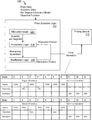
- FIG. 1 illustrates one embodiment of a computerized system 100 that generates a price schedule for a set of items.
- the price schedule is, for example, a data structure stored in memory that contains data values and/or records for information as described herein.
- the system 100 includes price schedule logic 110 that controls a processor to perform various operations described below (see FIG. 6 ).
- price schedule logic 110 is implemented as computer instructions embodied in a module stored in a non-transitory computer storage medium where the instructions are configured as an executable algorithm configured to perform the functions as described herein when executed by at least the processor of a computing device.
- the price schedule logic 110 interacts by way of electronic communication over network or Internet connection with a pricing device 115 used by a retailer.
- a pricing device 115 used by a retailer.
- the term “retailer” or “pricing device” is intended to include a computing device under the control of a retailer who prices items for sale and who is requesting, from the system 100 , a price schedule for items sold by the retailer.
- the price schedule logic 110 is configured to receive electronic communications from the pricing device 115 that communicate price data for items, inventory data for the items, a per-segment demand model for the items, and/or a selected objective function.
- the price data defines a set of prices that are to be considered for each item.
- the set of prices includes the regular price, promotion prices, and markdown prices for the item.
- the promotion prices and the markdown prices are separated into two sets, neither of which includes the regular price for the item, to simplify the calculations in the promotion and markdown seasons.
- a set of prices is referred to as a “price ladder” for an item.
- cost data for each item is also input by the price schedule logic 110 for use in calculating profit.
- Inventory data includes an “inventory quantity” which, for the purposes of this description, includes the initial inventory quantity of an item that will be on hand at the beginning of the regular season and, optionally, scheduled shipments of the item to replenish the stock during the regular season.
- the price schedule logic 110 may query a database that stores such data (e.g., electronic records encoding price ladders and inventory and replenishment quantities).
- the per-segment demand model may be provided by the retailer or may be otherwise accessible to the price schedule logic 110 .
- the per segment demand model is the scan-pro model.
- the per-segment demand model is a stored set of instructions that, when executed by a processor, computes demand for an item based on the price of the item and other factors such as elasticity, promotion fatigue, seasonality, and so on.
- the per-segment demand model includes different demand parameter values for different customer segments.
- One example per-segment demand model will be described in detail below, however, it is to be understood that the systems and methods described herein are applicable to any demand model, including demand models that do not differentiate between different customer segments.
- the retailer furnishes values for demand parameters based on their own sales histories and experience.
- the price schedule logic 110 stores and maintains the per-segment demand model or obtains the per-segment demand model and parameter values from a different source.
- the objective function defines the sales-related quantity that the retailer seeks to maximize.
- Example objective functions include profit and revenue.
- the revenue objective function will be described in more detail below, however, it is to be understood that the systems and methods described herein are suitable for use with any objective function.
- the price schedule logic 110 is configured to generate a price schedule that includes a promotion portion and a markdown portion.
- the price schedule assigns to an item a series of prices selected from the set of prices for respective time periods (e.g., weeks or days) during a regular season and also a clearance season for the item.
- a price schedule for an item is generated for each customer segment.
- Example price schedules for a “singles” customer segment and a “moms” customer segment are shown in FIG. 1 . It can be seen that the price schedule is different for the two customer segments during the “regular/promotion” portion of the price schedule, while the price schedule is the same for the two customer segments during the “clearance/markdown” portion of the price schedule.
- the price schedule logic 110 is configured to transmit, by way of a network connection, the price schedules to the pricing device 115 ( FIG. 1 ) for use in pricing the item.
- the promotion and markdown schedule problem increases proportionally when customer segments are taken into account.
- One of the challenges to performing per-segment promotion and markdown scheduling is that the different customer segments share the same inventory.
- Another challenge is that the markdown policies are typically the same across all customer segments while per-segment promotion pricing can be achieved by targeted marketing.
- the price schedule logic 110 includes allocation logic 120 , promotion logic 130 , and markdown logic 140 that together cooperate to address these challenges using a multi-phase process to generate the promotion and markdown portions of the price schedule.
- the allocation logic 120 is configured to allocate the inventory quantity for either an individual item (e.g., SKU) or some grouping of items (e.g., accessories) amongst a plurality of customer segments based at least on a predicted contribution of each customer segment to the objective function.
- an individual item e.g., SKU
- some grouping of items e.g., accessories
- the per-segment demand model specifies the particular behaviors of these different types of customers by including different demand parameter values for each segment.
- the allocation logic 120 is configured to predict a contribution of each customer segment to the objective function. In one embodiment, based on the per-segment demand model, the allocation logic 120 may determine that i) when all the inventory quantity is allocated to the single women segment, $1200.00 in revenue (i.e., objective function) will be generated; ii) when all of the inventory quantity is allocated to mothers, $1000.00 in revenue will be generated, and iii) when all of the inventory quantity is allocated to retirees, $300.00 in revenue will be generated.
- the allocation logic 120 allocates the inventory quantity to the different customer segments based on this predicted contribution (e.g., 1200/(1200+1000+300) or 48% of the inventory quantity is allocated to the single women customer segment, and so on). In other embodiments, other methods of predicting the contribution of each customer segment to the objective function are used.
- the promotion logic 130 is configured to determine the promotion portion of the price schedule. For each customer segment, based the quantity of inventory allocated to the customer segment, the promotion logic 130 is configured to determine the promotion portion of the price schedule that maximizes the objective function. The promotion portion assigns to the item a series of prices selected from the set of promotion prices for respective time periods during the regular season for the item.
- the markdown logic 140 is configured to aggregate a quantity of remaining inventory in each customer segment at the end of the regular season.
- the markdown logic 140 is configured to, based at least on the aggregated inventory, determine a markdown portion of the price schedule for the item that maximizes the objective function.
- the markdown portion assigns a series of prices selected from the set of prices to the item for respective time periods during the clearance season for the item.
- the price schedule logic 110 combines the promotion portion and the markdown portion for each customer segment to create the price schedule for the customer segment.
- the price schedule may be expressed as a series of percentages to be deducted from an item's full price or a fraction of the full price.
- the same price schedule can be used for multiple items (e.g., purses and scarves) in a merchandise category (e.g., accessories) for which the price schedule was generated.
- the price schedule is transmitted to a pricing device 115 used by a retailer to assign prices to merchandise.
- the pricing device 115 includes a microprocessor and hardware and software (not shown) that support a network connection with the price schedule logic 110 .
- the system 100 is a computing/data processing system including an application or collection of distributed applications for enterprise organizations.
- the applications and computing system 100 may be configured to operate with or be implemented as a cloud-based networking system, a “software as a service” (SaaS) architecture, or other type of networked computing solution.
- the price schedule logic 110 is a centralized server-side application that provides at least the functions disclosed herein and that is accessed by many users via computing devices/terminals (e.g. pricing device 115 ), communicating with the computing system 100 (functioning as the server) over a computer network.
- FIG. 2A illustrates one embodiment of a computerized system 200 that generates a price schedule for a set of items.
- the system 200 includes price schedule logic 210 with an allocation logic 220 , a promotion logic 230 , and a markdown logic 240 that function in a manner analogous to that described for the allocation logic 120 , the promotion logic 130 , and the markdown logic 140 of FIG. 1 .
- the price schedule logic 210 is configured to interact with an optimizer (e.g., a mixed integer linear programming (MILP) solver such as Gurobi) to generate the price schedule.
- MILP mixed integer linear programming
- a number of constraints that constrain various aspects of the price schedule according to business rules and other constraints generated by the price schedule logic 210 as described below are stored by the price schedule logic 210 .
- Mathematical notations describing many example constraints are included in appendix A. These constraints will be referred to by a constraint number assigned to the constraint in the appendix.
- the price schedule logic 210 includes a price logic 250 , a demand model logic 260 , and an objective function logic 270 that make simplifications to the price data, the per segment demand model, and the objective function, respectively, that are provided to the optimizer in the form of approximation constraints.
- the price logic 250 is configured to generate a price line constraint that approximates the set of prices in a manner that allows the prices to be expressed as an integer variable.
- the demand logic 260 is configured to generate two or more linear demand pieces that approximate the demand function for a customer segment and to provide a selected one of the pieces as a demand piece constraint for each price value.
- the objective function logic 270 is configured to generate two or more linear envelopes that surround segments of the objective function and to provide a selected one of the envelopes as a set of linear envelope constraints associated with each price value.
- the allocation logic 220 , the promotion logic 230 , and the markdown logic 240 are configured to provide the approximation constraints along with selected other constraints to the optimizer in a manner that will be described in more detail below, after the approximation constraints are explained in detail.
- FIG. 2B illustrates how one embodiment of the price logic 250 generates the price line constraint that is used to approximate the set of prices for an item.
- the price line constraint recognizes that optimization problems with integer variables over a finite interval are typically simpler to handle than problems that include a “scaled” number of binary variables accounting for the same interval. If the prices in the set or prices or “price ladder” for an item are regularly spaced, the price ladder can be represented by a scaled integer variable. This feature is used to approximate the price ladder by a line given by position variable w, which is an integer. Prices in the line correspond to different values of w. In general, price ladders are discrete and not necessarily evenly spaced. However, the price line approximation produces acceptable results even when this is the case. Post optimization, a “true” price value from the price ladder that corresponds to the position variable w selected by the optimizer can be included in the price schedule and any other calculations.
- p i t,seg is the price for item “i” in customer segment “seg” at time “t”.
- the OLS regression is performed for each product, customer segment, and time period during the regular season. During the clearance season, the OLS regression is performed for each product and time period. If the price ladder for an item is the same for all customer segments, and/or all time periods the number of OLS regressions is reduced accordingly.
- FIG. 2B shows two price ladders for two different products. The prices in the first price ladder are equally spaced and exactly define a line.
- the price line for the item is provided to the optimizer by the allocation logic 120 , the promotion logic 130 , and the markdown logic 140 .
- FIG. 2C illustrates how one embodiment of the price logic 250 generates a multi-piece price line constraint that is used to approximate the set of prices for an item when the price ladder for the item is not linear. It can be seen in the plot I that the prices for the item define three “buckets”, a first bucket near full price, a slightly reduced price, and a significantly reduced price. A single line approximation (also shown in plot I) results in significant error with respect to actual prices. This error will be incorporated into the allocation stage, the promotion stage, and the markdown stage of the generation of the price schedule.
- the price logic 250 analyzes the series of prices to detect “kinks”, or points at which significant changes occur between a given price and an adjacent price. In one embodiment, the price logic 250 computes slopes between each pair of prices in the series and when a significant change in slope is detected, the series of prices is “broken” at the price at which the change occurs. OLS is then performed on the prices before the given price to create a first line and OLS is performed on the prices after the given price to create a second line. This process is continued until the error for each line is less than the threshold.
- FIG. 2D illustrates how one embodiment of the demand logic 260 determines the demand piece constraint that is a linear approximation of the per-segment demand model provided to the optimizer.
- the demand logic 260 is configured to approximate the per-segment demand model over two linear pieces.
- a mathematical expression of one approximate demand model that includes two linear pieces is: d i t,seg ( p i t,seg ) ⁇ B i t,seg *SEA i t,seg *max( m i t,seg p i t,seg + c i t,seg , ⁇ circumflex over (m) ⁇ i t,seg p i t,seg + ⁇ i t,seg ) EQ 2
- d i t,seg is the demand for item “i” in customer segment “seg” at time “t”
- B i t,seg is the base demand for item “i” in customer segment “seg” at time “t”
- SEA i t,seg is the base seasonality of item “i” in customer segment “seg” at time “t”
- m i t,seg and ⁇ circumflex over (m) ⁇ i t,seg are the slope of the first demand piece and second demand piece, respectively, of item “i” in customer segment “seg” at time “t”
- c i t,seg and ⁇ i t,seg are the y intercept of the first demand piece and second demand piece, respectively, of item “i” in customer segment “seg” at time “t”.
- OLS regression is run on demand values as determined given the different prices in the price ladder for each product, customer segment, and time period in the regular season.
- the resulting demand pieces are per-segment demand pieces used to generate promotion prices.
- the demand values for the different segments are aggregated in each time period and the OLS regression of the aggregated demand is performed for each product and time period.
- the resulting demand pieces are aggregate demand pieces used to generate markdown prices.
- the demand logic 260 selects the demand piece constraint that yields the higher demand. This is why equation 2 includes the “max” function.
- Constraint C8 describes, mathematically, one embodiment of the demand piece constraint.
- Plot I in FIG. 2D shows a two-piece linear demand approximation.
- the demand logic 260 is configured to approximate the demand model over more than two pieces when the error of the two-piece demand approximation exceeds some threshold (e.g., a gamma value above some threshold). If the error is above the threshold, the demand model is broken into three regions corresponding to an even division of prices as shown by the regions A′+A′′, B, and C in plot II. For each region, a line is fitted to the demand model and the error is calculated. It can be seen in plot II that the error of the lines in regions B and C is low, while the error of a line that fits all of region A would be higher.
- some threshold e.g., a gamma value above some threshold
- the line is broken at the point of worst error and two lines are computed, one for the region before the break point price and one for the region after the break point price. It can be seen in plot II that the region A has been broken into two regions A′ and A′′. This process is repeated until the error becomes small enough.
- the demand model logic 260 selects the line that yields the highest demand at each price point as described above.
- FIG. 2E illustrates how one embodiment of the objective function logic 270 determines the envelope constraints that approximate the objective function.
- the objective function is typically non-linear and also non-convex. However, in light of the fact that the objective function's terms are bilinear, the objective function logic 270 may use the McCormick relaxation technique to approximate the objective function using a series of linear envelopes. In one embodiment, two envelopes are used.
- the objective function shown in FIG. 2E is revenue, however, the profits objective function can be handled by including appropriate linear terms.
- the objective function logic 270 calculates the following parameters, which are used to generate two sets of envelope constraints, where the objective function is split at the point at which half the sales occur on either side of the point: P L,i t,seg Min.
- the calculated (price, sales points) are used to define the envelopes as shown in FIG. 2E .
- the approximate objective function derived by the objective function logic 270 expressed in terms of the objective function envelope constraints, is shown in mathematical terms in constraint C9.
- the allocation logic 220 allocates the inventory quantity amongst the customer segments based on a predicted contribution of each customer segment to the objective function (e.g., revenue).
- the allocation logic 220 uses the optimizer to predict the contributions of each segment as follows.
- the allocation logic 240 allocates the entire inventory quantity (including initial inventory and, in some embodiments, any replenishment) to each segment.
- Equation 4 is the set of items, is the set of time periods in entire season, I i t,seg is the inventory of item “i” in customer segment “seg” at the beginning of time period “t” (i.e., the entire inventory quantity for the item), sup i t,seg is the replenishment of item “i” in customer segment “seg” at the beginning of time period “t” (i.e., the entirety of replenishments for the item), and y i t,seg is the sales of item “i” in customer segment “seg” during time period “t”.
- the allocation logic 220 adjusts a “markdown price change limit” constraint C4 using segment-wise variables as follows:
- Equation 5 S is the set of customer segments, T R is the set of time periods in the regular season, MPRODS t is the number of products that can be marked down in time period “t”, x i t,seg is one when there is a price change for item “i” in customer segment “seg” at time “t”, MPROMS i is the number of times an item “i” can be marked down during the time periods in the clearance season, and y i t,seg is the sales of item “i” in customer segment “seg” during time period “t”, and C is the set of time periods in the clearance season.
- the allocation logic 220 feeds the full inventory quantity allocated to each segment, the modified “inventory conservation” constraint C6, the modified “markdown price change limits” constraint C4, the price line constraint C1, the demand piece constraint C8, the objective function envelope constraint C9, and the constraints C2, C3, and C7 to the optimizer.
- the allocation logic 220 does not include a sell-through constraint C5 in the problem formulation used to allocate the inventory.
- the sell-through constraint specifies a certain amount of inventory that is to be sold during the entire selling season (e.g., 90%). Dropping this constraint reduces the chance that the optimizer will be unable to solve for an optimal objective function.
- the optimizer obtains an optimal objective function * seg for each customer segment based on this full allocation of inventory to the customer segment and transmits the optimal objective function for each customer segment to the allocation logic 220 .
- the allocation logic 220 calculates an inventory allocation ratio seg for each customer segment as follows:
- the allocation logic 220 then allocates the inventory quantity (including replenishment, if any) to each customer segment according to its inventory allocation ratio.
- the allocation process just described may be performed on a broader category of items, like accessories.
- the allocation logic 220 applies the resulting category allocation to all items in the category (e.g., purses, scarves, and so on).
- the allocation logic 220 performs a streamlined allocation process that makes it more feasible to allocate on a per item basis.
- the streamlined allocation process may be performed for every product, resulting in more granular allocation.
- the allocation logic 220 compiles a simplified version of the optimization problem that includes just a few constraints.
- the objective function is selected by the allocation logic 220 to be maximization of revenue.
- the allocation logic 220 selects two promotional prices and one markdown price from the item's price data thereby limiting the number of prices that are considered by the optimizer.
- One additional constraint is that total demand be less than or equal to total inventory for the item.
- the allocation logic 220 provides this simplified version of the optimization problem to the optimizer, which returns the revenue for each segment that results if all inventory is allocated to the segment.
- the allocation logic 220 then allocates the particular item according to ratio of each segment revenue to a total of all segment revenues.
- the promotion logic 230 modifies the “sell-through” constraint C5 for each segment as follows: ⁇ i ⁇ ,t ⁇ :I i t,seg ⁇ y i t,seg ⁇ (1 ⁇ ST i t ) I i 1,seg EQ 7
- Equation 8 ST i t is the sell-through target for product i at end of time-period t.
- the promotion logic 230 feeds the inventory quantity allocated to the segment, the modified “inventory conservation” constraint C6, the modified “sell-through” constraint C5, the price line constraint C1, the per-segment demand piece constraint C8, the objective function envelope constraint C9, and the constraints C2, C3, C6, and C7 to the optimizer.
- additional constraints that reflect business rules are provided to the optimizer.
- the optimizer obtains an optimal objective function * seg for each customer segment based on optimal promotion prices p_opt i t,seg expressed as position variables w i t,seg for each price in the time periods in the regular season.
- the promotion logic 230 is configured to select, from the “true” price ladder for the item, the promotion price value p i t,seg that corresponds to the selected position variable w i t,seg .
- An example is shown below:
- the promotion logic selects the “true” price of 0.80 that is associated with the position variable 2. The selected prices for each time period in the regular season make up the promotion portion of the price schedule.
- the markdown logic 240 is configured to generate the markdown portion of the price schedule.
- the markdown logic 240 drops all regular season time periods because the item is being priced for the clearance season.
- the markdown logic 240 feeds the aggregated inventory quantity, the price line constraint C1, the aggregated demand piece constraint C8, the objective function envelope constraint C9, and the constraints C2-C7 to the optimizer.
- additional constraints that reflect business rules are provided to the optimizer.
- the optimizer obtains an optimal objective function based on optimal markdown prices pm_opt i t expressed as position variables w for each price in the clearance season time periods.
- the markdown logic 240 is configured to select, from the “true” price ladder for the item, the markdown price value that corresponds to the selected position variable as described above.
- the selected prices for each time period in the clearance season make up the markdown portion of the price schedule.
- the price schedule logic 210 is configured to combine the promotion portion with the markdown portion to generate the price schedule that is transmitted to the retailer.
- FIG. 3 illustrates one embodiment of a method 300 associated with to determining a price schedule for each item in a group of items.
- a set of prices for the item, an inventory quantity for the item, a per-segment demand model for the item, and an objective function that is a function of the per-segment demand model are input. This step may be performed by the price schedule logic 110 or 210 of FIGS. 1 and 2A-2E .
- the data corresponding to the set of prices is stored in records in a database table or other database structure that can be queried by the price schedule logic 110 .
- data describing the set of prices and inventory quantity are stored in registers or memory addresses, the contents of which may be read, input, or transferred into the working memory of the price schedule logic 110 .
- data structures encoding the per-segment demand model and a selected objective function are received by way of an electronic communication from a retailer that is parsed to identify the data structures.
- the method includes allocating the inventory quantity amongst a plurality of customer segments based at least on a predicted contribution of each customer segment to the objective function. This step may be performed by the allocation logic 120 or 220 of FIGS. 1 and 2A-2E .
- a processor is controlled by the allocation logic 110 or 220 to allocate the inventory quantity as described above with respect to FIG. 2A (see also FIG. 6 ).
- a promotion portion of the price schedule that maximizes the objective function is determined at 330 .
- the promotion portion assigns to the item a series of prices selected from the set of prices for respective time periods during a regular season for the item. This step may be performed by the promotion logic 240 of FIGS. 1 and 2A-2E .
- a processor is controlled by the promotion logic 240 to create the promotion portion of the price schedule as described above with respect to FIG. 2A (see also FIG. 6 ).
- the method includes aggregating a quantity of remaining inventory allocated to the plurality of customer segments at an end of the regular season. This step may be performed by the markdown logic 250 of FIGS. 1 and 2 A- 2 E. A processor is controlled by the markdown logic 250 aggregate the remaining inventory (see FIG. 6 ).
- a markdown portion of the price schedule for the item that maximizes the objective function is determined.
- the markdown portion assigns a series of prices selected from the set of prices for respective time periods during a clearance season for the item. This step may be performed by the markdown logic 250 of FIGS. 1 and 2A-2E .
- a processor is controlled by the markdown logic 250 to create the markdown portion of the price schedule as described above with respect to FIG. 2A (see also FIG. 6 ).
- the promotion portion and the markdown portion are combined to create a price schedule for the item at 360 .
- This step may be performed by the price schedule logic 110 or 210 of FIGS. 1 and 2A-2E .
- a processor is controlled by the price schedule logic 110 or 210 to combine the promotion portion and the markdown portion (see FIG. 4 ).
- an electronic communication that includes the price schedule is transmitted, by way of a network or internet connection, to a pricing device ( 115 in FIG. 1 ) of the retailer.
- the price schedule causes the computing device of the retailer to modify/adjust prices of items in data records of an inventory/pricing database according to the price schedule.
- the modified/adjusted prices provide a pricing solution to improve the selected objective function in a manner that observes the selected constraints.
- the method 300 includes allocating the inventory quantity amongst customer segments by performing the following steps for each customer segment: allocating an entirety of the inventory quantity to the customer segment; transmitting the entirety of the inventory quantity, the set of prices, an approximate per-segment demand model, a first set of constraints, and an approximate objective function to an optimizer; receiving, from the optimizer, a per segment value of the approximate objective function for the customer segment; computing a ratio of the per segment value to a sum of all per segment values for the customer segments; and allocating the inventory amongst the customer segments according to the ratio for each customer segment.
- These steps may be performed by the allocation logic 220 of FIG. 2A controlling a processor (see FIG. 6 ).
- the method 300 includes determining the promotion portion for each customer segment by performing the following steps: providing the set of prices, the inventory quantity allocated to the customer segment, the approximate per-segment demand model, a second set of constraints, and the approximate objective function to the optimizer; and receiving, from the optimizer, a promotion portion for each customer segment that optimizes the objective function. These steps may be performed by the promotion logic 230 of FIG. 2A controlling a processor (see FIG. 6 ).
- the method 300 includes determining the markdown portion by performing the following steps: providing the set of prices, the aggregated inventory, an approximate aggregate demand model for the item, a third set of constraints, and the approximate objective function to the optimizer; and receiving, from the optimizer, a markdown portion that optimizes the objective function. These steps may be performed by the markdown logic 240 of FIG. 2A controlling a processor (see FIG. 6 ).
- the method 300 includes calculating a line corresponding to a linear approximation of the set of prices, where the line is a function of a position variable that evenly divides the line into segments between a maximum price and a minimum price, where each integer value of the position variable is associated with a price in the set of prices.
- These steps may be performed by the price logic 250 of FIG. 2B or 2C controlling a processor (see FIG. 6 ).
- An expression of the line is provided to the optimizer as the set of prices for the item; an integer value for the position variable that corresponds to a selected price is received from the optimizer; a price in the set of prices is identified that corresponds to the position variable; and the identified price is included in the price schedule for the item.
- These steps may be performed by the allocation logic 220 , the promotion logic 230 , or the markdown logic 240 of FIG. 2A controlling a processor (see FIG. 6 ).
- the method 300 includes determining the promotion portion for each customer segment by, for each time period, performing the following steps: calculating a set of customer segment demands for the item when the item is priced at respective prices in the set of prices; calculating a plurality of lines corresponding to a piecewise linear approximation of the set of customer segment demands; and for each price, selecting a line that corresponds to a highest demand at the price.
- steps may be performed by the demand logic 260 of FIG. 2D controlling a processor (see FIG. 6 ).
- An expression for the selected line is provided to the optimizer as the approximate per-segment demand model for the price during the time period.
- This step may be performed by the allocation logic 220 , the promotion logic 230 , or the markdown logic 240 of FIG. 2A controlling a processor (see FIG. 6 ).
- the method 300 includes determining the markdown portion for the item by, for each time period, performing the following steps: for each customer segment, calculating a set of customer segment demands for the item when the item is priced at respective prices in the set of prices; calculating a set of respective aggregate demands by aggregating respective customer segment demands for each price; calculating a plurality of lines corresponding to a piecewise linear approximation of the set of aggregate demands; and for each price, select a line that corresponds to a highest demand at the price.
- These steps may be performed by the demand logic 260 of FIG. 2D controlling a processor (see FIG. 6 ).
- An expression for the selected line is provided to the optimizer as the approximate aggregate demand model for the price during the time period.
- This step may be performed by the allocation logic 220 , the promotion logic 230 , or the markdown logic 240 of FIG. 2A controlling a processor (see FIG. 6 ).
- the method 300 includes determining the approximate objective function by, for each time period, performing the following steps: based on at least on the approximate demand model for the time period, calculating sales for the item at prices in the set of prices; dividing the objective function into a plurality of segments based at least on the calculated sales; and for each segment of the objective function, determine a linear envelope that covers the segment.
- steps may be performed by the objective function logic 270 of FIG. 2E controlling a processor (see FIG. 6 ).
- a set of constraints describing the linear envelopes is provided to the optimizer as the approximate objective function for the item during the time period. This step may be performed by the allocation logic 220 , the promotion logic 230 , or the markdown logic 240 of FIG. 2A controlling a processor (see FIG. 6 ).
- a user of the system 100 may selectively enable and specify several different business related constraints. These constraints will be provided to the optimizer by the allocation logic 220 , the promotion logic 230 , and the markdown logic 240 . Example business related constraints will now be described. Of course, any number of other constraints on possible prices for items may be presented to the optimizer to constrain the optimizer's solution in accordance with a retailer's pricing policies.
- a “self no-touch” constraint models the fact that two consecutive promotions of a specific item should be separated by a few time periods (e.g., minimum of two weeks between consecutive promotions). A retailer may choose to enable this constraint for certain (or all) items and, for each item, specify the minimum number of time periods between consecutive promotions.
- One possible mathematical formulation of the “self no-touch” constraint suitable for input to an MIP solver is presented in mathematical form as constraint C10 in appendix A.
- a “cross no-touch” constraint models the fact that two consecutive promotions of any two different items should be separated by a few time periods (e.g., minimum of two weeks between consecutive promotions for yogurt of any brand).
- a retailer may choose to enable this constraint for certain (or all) sets of items and, for each set of items, specify the minimum number of time periods between consecutive promotions.
- One possible mathematical formulation of the “cross no-touch” constraint suitable for input to an MIP solver is presented in mathematical form as constraint C11 in appendix A.
- Set constraints include “must-promote sets of items” and “cannot-promote sets of items.” Items in a “must-promote set” must be promoted together. For example, if there are three products of a shampoo brand (e.g., shampoo, conditioner, and hair spray), a retailer may want to put all the three products on promotion at the same time. A retailer may choose to enable the must-promote set constraint for certain sets of items. Items in a “cannot-promote set” cannot be promoted together. For example, a retailer may not want to put a highly popular shampoo product and a low-seller shampoo product on promotion at the same time. A retailer may choose to enable the “cannot-promote set” constraint for certain sets of items.
- One possible mathematical formulation of the “must-promote set” constraint and the “cannot-promote set” constraint suitable for input to an MIP solver is presented in mathematical form as constraints C12 and C13, respectively, in appendix A.
- Inter-item constraints can be used by a retailer to impose price restrictions that maintain the price order between two items. For example, a retailer may want to specify that the price of a national brand item should always be higher than a private label brand item. Another example would be to maintain the price relation between a 2-pack of 2-liter Coke bottles and a 4-pack of 2-liter Coke bottles.
- a retailer may choose to enable the inter-item constraints for certain sets of items. The retailer specifies the relationships between prices of items in the set that must be maintained.
- One possible mathematical formulation of the “cross no-touch” constraint suitable for input to an MIP solver is presented in mathematical form as constraint C14 in appendix A.
- FIG. 4 illustrates one embodiment of computerized system 400 that generates a price schedule that includes promotional pricing on top of markdown prices during the clearance season.
- Example price schedules similar to those presented in FIG. 1 are shown in FIG. 4 with the promotional pricing during the clearance season in bold. It can be seen that the price schedule includes an additional 20% off the already marked down price (by 50%) that will be targeted to singles in the second time period (e.g., week) of the clearance season.
- the price schedule also includes an additional 30% off the already marked down price (by 60%) that will be targeted to moms in the third time period (e.g., week) of the clearance season.
- the system 400 functions in a manner similar to the system 100 of FIG. 1 with several modifications that will be described now.
- the system 400 includes a price schedule logic 410 that includes the allocation logic 120 , a promotion logic 430 , a markdown logic 440 , and a promotion-markdown logic 450 that cooperate to control a processor (not shown) to create the price schedule.
- the allocation logic 120 functions as described above with respect to FIG. 2A and, for simplicity sake, will not be explained again now.
- the promotion-markdown logic 450 performs several functions to enable generation of the promotion-markdown (PM) price schedule that is transmitted to the pricing device 115 .
- the promotion-markdown logic 450 calculates promotion-markdown (PM) prices for the item using the price data.
- the PM prices are provided as price constraints to the optimizer by the promotion logic 430 for consideration during the clearance period.
- the PM prices are calculated by applying, to the item's markdown prices, promotional price rates that yielded the item's promotion prices.
- the PM prices are calculated by the promotion-markdown logic 450 as follows.
- the promotion logic 430 provides price constraints in the form of expressions of line pieces as described above with respect to FIGS. 2B and 2C to the optimizer.
- the price constraints correspond to the promotion prices for the item for the regular season and the PM prices for the clearance season.
- the approximate objective function, the approximate demand model, and the rest of the constraints described above with respect to FIG. 2A are provided to the optimizer by the promotion logic 430 .
- the optimizer will return selected promotion prices for each customer segment in each time period in the regular season as well as selected PM prices for each customer segment in each time period in the clearance season.
- the promotion logic 430 outputs a promotion and markdown portion of the schedule as opposed to just the promotion portion that is output by the promotion logic 230 of FIG. 2A .
- the promotion and markdown portion is adjusted by the promotion-markdown logic 450 as follows prior to transmitting the PM price schedule to the pricing device 115 .
- the markdown logic 440 calculates the inventory remaining in each customer segment at the end of the regular season when the item is priced according to the promotion and markdown portion.
- the markdown logic 440 calls on the optimizer to determine an aggregate markdown schedule for each customer segment with the additional price constraint that the markdown price must be the same for all segments in each time period.
- the markdown logic 440 provides the original markdown prices for the item (not the PM prices) to the optimizer.
- the optimizer will return an aggregate markdown portion for each customer segment in which a common markdown price is assigned to all customer segments in each time period.
- the promotion-markdown logic 450 adjusts the PM prices for each customer segment in the promotion and markdown portion based on the common markdown prices generated by the markdown logic 440 . For each PM price in a time period for a customer segment in the promotion and markdown portion, the closest PM price that resulted from applying a promotion rate to the common markdown price is substituted. The resulting adjusted promotion and markdown portion is provided as the PM price schedule to the pricing device 115 . An example of the adjustment to the PM price in the original promotion and markdown portion will be described with respect to FIG. 5 .
- FIG. 5 illustrates one embodiment of method 500 that determines a PM price schedule for an item that includes promotions applied to markdown prices during the clearance season.
- the method 500 is performed when the method 300 fails to produce a result.
- the method 500 is performed by the price schedule logic 410 and its logical components controlling a processor to perform the steps described with respect to FIG. 4 .
- a set of promotion prices for the item, a set of markdown prices for the item, an inventory quantity for the item, a per-segment demand model for the item, and an objective function that is a function of the per-segment demand model are input.
- This step may be performed by the price schedule logic 110 , 210 , or 410 of FIGS. 1, 2A-2E, and 4 .
- the data corresponding to the set of prices is stored in records in a database table or other database structure that can be queried by the price schedule logic 110 , 210 , or 410 .
- data describing the set of prices and inventory quantity are stored in registers or memory addresses, the contents of which may be read, input, or transferred into the working memory of the price schedule logic 110 , 210 , or 410 .
- data structures encoding the per-segment demand model and a selected objective function are received by way of an electronic communication from a retailer that is parsed to identify the data structures.
- the promotion prices and markdown prices for an example item are shown in table 595 in FIG. 5 .
- the method includes generating a set of promotion-markdown prices for the item by applying, to each markdown price, respective promotion rates that resulted in the respective promotion prices.
- This step may be performed by the promotion-markdown logic 450 of FIG. 4 .
- a processor is controlled by the promotion-markdown logic 450 to generate a set of promotion-markdown prices as described above with respect to FIG. 4 (see also FIG. 6 ).
- the inventory quantity is allocated amongst a plurality of customer segments based at least on a predicted contribution of each customer segment to the objective function.
- This step may be performed by the allocation logic 120 or 220 of FIG. 1, 2A-2E , or 4 .
- a processor is controlled by the allocation logic 110 or 220 allocate the inventory quantity as described above with respect to FIG. 2A (see also FIG. 6 ).
- This step may be performed by controlling a processor to formulate and provide an optimization problem to an optimizer as described with reference to FIG. 2A .
- a promotion portion of the price schedule that maximizes the objective function is determined at 540 , where the promotion portion comprises a series of prices selected from the set of promotion prices for respective time periods during a regular season for the item.
- This step may be performed by the promotion logic 230 or 430 of FIG. 1, 2A-2E , or 4 .
- a processor is controlled by the promotion logic 230 or 440 to create the promotion portion of the price schedule as described above with respect to FIG. 2A or 4 (see also FIG. 6 ).
- a markdown portion of the price schedule for the item that maximizes the objective function is determined.
- the markdown portion comprises series of prices selected from the set of promotion-markdown prices for respective time periods during a clearance season for the item. This step may be performed by the promotion logic 230 or 430 of FIGS. 1, 2A-2E, and 4 .
- a processor is controlled by the promotion logic 230 or 440 to create the promotion portion of the price schedule as described above with respect to FIG. 2A or 4 (see also FIG. 6 ).
- the PM price for the example item for a given customer segment and a given clearance season time period is shown in table 595 as 0.42.
- the promotion portion and the markdown portion may be combined and provided to a pricing device 115 for use in pricing the item.
- the method includes, at 560 , determining a remaining inventory quantity for each customer segment at the end of the regular season. This step may be performed by the markdown logic 440 of FIG. 4 .
- a processor is controlled by the markdown logic 440 to determine the remaining inventory (see also FIG. 6 ).
- the method includes determining a common markdown price for all customer segments in each time period in the clearance season by: providing the set of promotion prices, the set of markdown prices, the inventory quantities, the approximate per-segment demand model, a common markdown constraint that specifies that markdown prices must be the same across all customer segments in each time period, and the approximate objective function to the optimizer.
- An aggregate markdown portion comprising a series of common markdown prices for all customer segments in respective time periods that optimizes the objective function is received from the optimizer. This step may be performed by the markdown logic 440 of FIG. 4 .
- a processor is controlled by the markdown logic 440 to create the markdown portion of the price schedule with common markdown prices as described above with respect to FIG. 4 (see also FIG. 6 ).
- the common markdown price for the example item for all customer segments and the given clearance season time period is shown in table 595 as 0.65.
- each PM price in the markdown portion for the customer segment is adjusted based at least on the common markdown price.
- This step may be performed by the promotion-markdown logic 450 of FIG. 4 .
- a processor is controlled by the promotion-markdown logic 450 to adjust a PM price for a customer segment in a clearance time period as described above with respect to FIG. 4 (see also FIG. 6 ).
- the adjusted PM price for the example item in the given customer segment and the given time period is shown as 0.455 in FIG. 5 .
- the method includes combining the promotion portion and the adjusted markdown portion to create the price schedule for the item. This step may be performed by the promotion-markdown logic 450 of FIG. 4 .
- a processor is controlled by the promotion-markdown logic 450 to combine the promotion portion of the promotion markdown portion with the adjusted PM prices in the markdown portion of the promotion markdown portion to create the PM price schedule as described in FIG. 4 (see also FIG. 6 ).
- an electronic communication that includes the PM price schedule is transmitted, by way of a network or internet connection, to a pricing device ( 115 in FIGS. 1 and 4 ) of the retailer.
- the price schedule causes the computing device of the retailer to modify/adjust prices of items in data records of an inventory/pricing database according to the price schedule.
- the modified/adjusted prices provide a pricing solution to improve the selected objective function in a manner that observes the selected constraints.
- the PM prices are adjusted by, for each time period: identifying a promotion-markdown price in the set of promotion-markdown prices that i) resulted from applying a promotion rate to the common markdown price and ii) is closest to the promotion-markdown price received from the optimizer for the customer segment; and replacing the promotion-markdown price received from the optimizer with the identified promotion-markdown price.
- This step may be performed by the promotion-markdown logic 450 of FIG. 4 .
- a processor is controlled by the promotion-markdown logic 450 to adjust PM prices in the markdown portion of the promotion markdown portion as described in FIG. 4 (see also FIG. 6 ).
- the PM price selected by the optimizer for the example item is 0.42.
- This PM price cannot be generated by applying a promotion rate (rates are shown in top row of table 595 ) for the item to the common markdown price for the item, which is 0.65.
- the closest PM price that resulted from a promotion rate applied to 0.65, or the PM price 0.455 is selected.
- PM price 0.455 resulted from the promotion rate (0.7) being applied to the markdown price (0.65).
- 0.455 replaces 0.42 for the item in the given customer segment in the given time period.
- the method 500 includes allocating the inventory quantity amongst customer segments by, for each customer segment: allocating an entirety of the inventory quantity to the customer segment; transmitting, to an optimizer, the entirety of the inventory quantity, a subset of the promotion prices and a subset of the markdown prices, an approximate per-segment demand model, and an approximate objective function; and receiving, from the optimizer, a per segment value of the approximate objective function for the customer segment.
- a ratio of the per segment value to a sum of all per segment values is computed for the customer segments and the inventory is allocated amongst the customer segments according to the ratio for each customer segment.
- the method 500 includes creating the price schedule for each customer segment by: providing the set of promotion prices, the set of promotion-markdown prices, the inventory quantity allocated to the customer segment, an approximate per-segment demand model, and an approximate objective function to the optimizer; and receiving, from the optimizer, a promotion portion for each customer segment that optimizes the objective function and a markdown portion for each customer segment that optimizes the objective function. These steps may be performed by the promotion logic 430 of FIG. 4 controlling a processor (see FIG. 6 ).
- the method 500 includes calculating a line corresponding to a linear approximation of the set of promotion prices, where the line is a function of a position variable that evenly divides the line into segments between a maximum price and a minimum price, where each integer value of the position variable is associated with a price in the set of prices and calculating an error between the line and the set of promotion prices.
- an integer value at which the error is highest is identified and the line is broken into a first line and a second line.
- the first line is a linear approximation of a first subset of promotion prices that precede the identified integer value
- the second line is a linear approximation of a second subset of promotion prices that succeed the identified integer value.
- a set of expressions for respective lines as associated with respective integer values is provided to the optimizer as the set of promotion prices for the item.
- the method includes receiving, from the optimizer, an integer value for the position variable that corresponds to a selected promotion price; identifying a price in the set of promotion prices that corresponds to the position variable; and including the identified price in the price schedule for the item. These steps may be performed by the allocation logic 220 , the promotion logic 230 or 430 , or the markdown logic 240 or 440 of FIGS. 2A and 4 controlling a processor (see FIG. 6 ).
- the method 500 includes determining the promotion portion and the markdown portion for each customer segment by, for each time period, calculating a set of customer segment demands for the item when the item is priced at respective prices in the set of prices, further where there are n prices in the set of prices; calculating two lines corresponding to a two-piece linear approximation of the set of customer segment demands; and calculating an error between the customer segment demands and the two-piece linear approximation comprising a first line and a second line.
- a line is selected from the first line or the second line that corresponds to a highest demand at the price; and an expression for the selected line is provided to the optimizer as the approximate per-segment demand model for the price during the time period.
- the method includes calculating i) a third line that is a linear approximation of the set of customer segment demands for the first n/3 prices, ii) a fourth line that is a linear approximation of the set of customer segment demands for the second n/3 prices, and iii) a fifth line that is a linear approximation of the set of customer segment demands for the third n/3 prices; for each price, selecting one of the third line, the fourth line, or the fifth line that corresponds to a highest demand at the price; and providing an expression for the selected line to the optimizer as the approximate per-segment demand model for the price during the time period.
- FIG. 6 controlling a processor (see FIG. 6 ).
- An expression for the selected line is provided to the optimizer as the approximate per-segment demand model for the price during the time period. This step may be performed by the allocation logic 220 , the promotion logic 230 or 430 , or the markdown logic 240 or 440 of FIG. 2A or 4 controlling a processor (see FIG. 6 ).
- the systems and methods described herein include a single layer of approximations to produce a mixed integer linear programming problem of the same dimension.
- Stock-outs which impose additional non-smoothness to sales models, are taken into account by the described techniques.
- the described framework computes the promotion portion of the price schedule for different customer segments in a manner that makes it possible to utilize mixed integer problem (MIP) solver-based parallelization.
- MIP mixed integer problem
- the described techniques can be applied to any demand model regardless of whether the model is non-linear or non-convex. Further, many different business constraints can be included in the solution process.
- FIG. 6 illustrates an example computing device that is configured and/or programmed with one or more of the example systems and methods described herein, and/or equivalents.
- the example computing device may be a computer 600 that includes a processor 602 , a memory 604 , and input/output ports 610 operably connected by a bus 608 .
- the computer 600 may include price schedule logic 630 configured to create a promotion price and markdown schedule in a manner similar to the price schedule logic 110 and 410 shown in FIGS. 1 and 4 further explained in FIGS. 2A-2E and 4 .
- the price schedule logic 630 may be implemented in hardware, a non-transitory computer-readable medium with stored instructions, firmware, and/or combinations thereof.
- price schedule logic 630 is illustrated as a hardware component attached to the bus 608 , it is to be appreciated that in other embodiments, the price schedule logic 630 could be implemented in the processor 602 , stored in memory 604 , or stored in disk 606 .
- price schedule logic 630 or the computer is a means (e.g., structure: hardware, non-transitory computer-readable medium, firmware) for performing the actions described in FIGS. 1-5 .
- the computing device may be a server operating in a cloud computing system, a server configured in a “Software as a Service” (SaaS) architecture, a smart phone, laptop, tablet computing device, and so on.
- SaaS Software as a Service
- the means may be implemented, for example, as an application specific integrated circuit (ASIC) programmed to perform the methods 300 and 500 of FIGS. 3 and 5 , as further explained in FIGS. 1, 2A-2E, and 4 .
- the means may also be implemented as stored computer executable instructions that are presented to computer 600 as data 616 that are temporarily stored in memory 604 and then executed by a processor 602 .
- Price schedule logic 630 may also provide means (e.g., hardware, non-transitory computer-readable medium that stores executable instructions, firmware) for performing the methods 300 and 500 of FIGS. 3 and 5 , as further explained in FIGS. 1, 2A-2E, and 4 .
- means e.g., hardware, non-transitory computer-readable medium that stores executable instructions, firmware
- the processor 602 may be a variety of various processors including dual microprocessor and other multi-processor architectures.
- a memory 604 may include volatile memory and/or non-volatile memory.
- Non-volatile memory may include, for example, read only memory (ROM), programmable ROM (PROM), and so on.
- Volatile memory may include, for example, random access memory (RAM), synchronous random access memory (SRAM), dynamic random access memory (DRAM), and so on.
- a storage disk 606 may be operably connected to the computer 600 via, for example, an input/output interface (e.g., card, device) 618 and an input/output port 610 .
- the disk 606 may be, for example, a magnetic disk drive, a solid state disk drive, a floppy disk drive, a tape drive, a Zip drive, a flash memory card, a memory stick, and so on.
- the disk 606 may be a compact disk-read only memory (CD-ROM) drive, a CD recordable (CD-R) drive, a CD read/write (CD-RW) drive, a digital video disc (DVD) ROM, and so on.
- the memory 604 can store a process 614 and/or a data 616 , for example.
- the disk 606 and/or the memory 604 can store an operating system that controls and allocates resources of the computer 600 .
- the computer 600 may interact with input/output devices via the i/o interfaces 618 and the input/output ports 610 .
- Input/output devices may be, for example, a keyboard, a microphone, a pointing and selection device, cameras, video cards, displays, the disk 606 , the network devices 620 , and so on.
- the input/output ports 610 may include, for example, serial ports, parallel ports, and universal serial bus (USB) ports.
- the computer 600 can operate in a network environment and thus may be connected to the network devices 620 via the I/O interfaces 618 , and/or the i/o ports 610 . Through the network devices 620 , the computer 600 may interact with a network. Through the network, the computer 600 may be logically connected to remote computers. Networks with which the computer 600 may interact include, but are not limited to, a local area network (LAN), a wide area network (WAN), and other networks.
- LAN local area network
- WAN wide area network
- a non-transitory computer readable/storage medium is configured with stored computer executable instructions of an algorithm/executable application that when executed by a machine(s) cause the machine(s) (and/or associated components) to perform the method.
- Example machines include but are not limited to a processor, a computer, a server operating in a cloud computing system, a server configured in a Software as a Service (SaaS) architecture, a smart phone, and so on).
- SaaS Software as a Service
- a computing device is implemented with one or more executable algorithms that are configured to perform any of the disclosed methods.
- the disclosed methods or their equivalents are performed by either: computer hardware configured to perform the method; or computer instructions embodied in a module stored in a non-transitory computer-readable medium where the instructions are configured as an executable algorithm configured to perform the functions as described herein when executed by at least a processor of a computing device.
- references to “one embodiment”, “an embodiment”, “one example”, “an example”, and so on, indicate that the embodiment(s) or example(s) so described may include a particular feature, structure, characteristic, property, element, or limitation, but that not every embodiment or example necessarily includes that particular feature, structure, characteristic, property, element or limitation. Furthermore, repeated use of the phrase “in one embodiment” does not necessarily refer to the same embodiment, though it may.
- a “data structure”, as used herein, is an organization of data in a computing system that is stored in a memory, a storage device, or other computerized system.
- a data structure may be any one of, for example, a data field, a data file, a data array, a data record, a database, a data table, a graph, a tree, a linked list, and so on.
- a data structure may be formed from and contain many other data structures (e.g., a database includes many data records). Other examples of data structures are possible as well, in accordance with other embodiments.
- Computer-readable medium or “computer storage medium”, as used herein, refers to a non-transitory medium that stores instructions and/or data configured to perform one or more of the disclosed functions when executed. Data may function as instructions in some embodiments.
- a computer-readable medium may take forms, including, but not limited to, non-volatile media, and volatile media. Non-volatile media may include, for example, optical disks, magnetic disks, and so on. Volatile media may include, for example, semiconductor memories, dynamic memory, and so on.
- a computer-readable medium may include, but are not limited to, a floppy disk, a flexible disk, a hard disk, a magnetic tape, other magnetic medium, an application specific integrated circuit (ASIC), a programmable logic device, a compact disk (CD), other optical medium, a random access memory (RAM), a read only memory (ROM), a memory chip or card, a memory stick, solid state storage device (SSD), flash drive, and other media from which a computer, a processor or other electronic device can function with.
- ASIC application specific integrated circuit
- CD compact disk
- RAM random access memory
- ROM read only memory
- memory chip or card a memory chip or card
- SSD solid state storage device
- flash drive and other media from which a computer, a processor or other electronic device can function with.
- Each type of media if selected for implementation in one embodiment, may include stored instructions of an algorithm configured to perform one or more of the disclosed and/or claimed functions.
- Computer-readable media described herein are limited to statutory subject matter under 35 U.
- Logic represents a component that is implemented with computer or electrical hardware, a non-transitory medium with stored instructions of an executable application or program module, and/or combinations of these to perform any of the functions or actions as disclosed herein, and/or to cause a function or action from another logic, method, and/or system to be performed as disclosed herein.
- Equivalent logic may include firmware, a microprocessor programmed with an algorithm, a discrete logic (e.g., ASIC), at least one circuit, an analog circuit, a digital circuit, a programmed logic device, a memory device containing instructions of an algorithm, and so on, any of which may be configured to perform one or more of the disclosed functions.
- logic may include one or more gates, combinations of gates, or other circuit components configured to perform one or more of the disclosed functions. Where multiple logics are described, it may be possible to incorporate the multiple logics into one logic. Similarly, where a single logic is described, it may be possible to distribute that single logic between multiple logics. In one embodiment, one or more of these logics are corresponding structure associated with performing the disclosed and/or claimed functions. Choice of which type of logic to implement may be based on desired system conditions or specifications. For example, if greater speed is a consideration, then hardware would be selected to implement functions. If a lower cost is a consideration, then stored instructions/executable application would be selected to implement the functions. Logic is limited to statutory subject matter under 35 U.S.C. ⁇ 101.
- An “operable connection”, or a connection by which entities are “operably connected”, is one in which signals, physical communications, and/or logical communications may be sent and/or received.
- An operable connection may include a physical interface, an electrical interface, and/or a data interface.
- An operable connection may include differing combinations of interfaces and/or connections sufficient to allow operable control.
- two entities can be operably connected to communicate signals to each other directly or through one or more intermediate entities (e.g., processor, operating system, logic, non-transitory computer-readable medium).
- Logical and/or physical communication channels can be used to create an operable connection.
- “User” or “Retailer”, as used herein, includes but is not limited to one or more persons, computers or other devices, or combinations of these.
- Initial inventory of an item i at the start of the season P i full Full or regular price of product i (e.g., $45.99)
- C i Cost of product i P i fullnorm Normalized regular/full price of product i (usually equals 1)
- C i norm Normalized cost of product i (equals C i /P i full ) i p L i p Promotion Price ladder for product i (e.g., 1, 0.95, 0.90 , .
Landscapes
- Business, Economics & Management (AREA)
- Engineering & Computer Science (AREA)
- Development Economics (AREA)
- Accounting & Taxation (AREA)
- Finance (AREA)
- Strategic Management (AREA)
- Economics (AREA)
- Entrepreneurship & Innovation (AREA)
- Physics & Mathematics (AREA)
- Marketing (AREA)
- General Business, Economics & Management (AREA)
- General Physics & Mathematics (AREA)
- Theoretical Computer Science (AREA)
- Game Theory and Decision Science (AREA)
- Human Resources & Organizations (AREA)
- Operations Research (AREA)
- Quality & Reliability (AREA)
- Tourism & Hospitality (AREA)
- Data Mining & Analysis (AREA)
- Management, Administration, Business Operations System, And Electronic Commerce (AREA)
Abstract
Description
p i t,seg=αi t,seg−βi t,seg w i t,seg where w i t,seg={0,1,2,3 . . . L i}
d i t,seg(p i t,seg)≈B i t,seg *SEA i t,seg*max(
P L,i t,seg
Min. price point in the price ladder for product i at time t in segment seg.
P U,i t,seg
Max. price point in the price ladder for product i at time t in segment seg
Y MAX,i t,seg =d i t,seg(P L,i t,seg)
Max. Sales for product i at time t in segment seg
Y MIN,i t,seg=min(0,d i t,seg(P U,i t,seg))
Min. Sales for product i at time t in segment seg
Y L,i 1,t,seg =Y MIN,i t,seg
Min. Sales for first envelope for product i at time t in segment seg
Y U,i 1,t,seg=0.5(Y MIN,i t,seg +Y MAX,i t,seg)
Max. Sales for first envelope for product i at time t in segment seg
Y L,i 2,t,seg=0.5(Y MIN,i t,seg +Y MAX,i t,seg)
Min. Sales for second envelope for product i at time t in segment seg
Y U,i 2,t,seg =Y MAX,i t,seg
Max. Sales for second envelope for product i at time t in segment seg
∀i∈


∇i∈
∇i∈
 |


I i 1 =

| Set/Symbol | Size | Indices | Description |
 |
N | i | Set (number) of products |
 |
S | seg | Set (number) of customer segments |
 |
T | t | Set (number) of time periods for entire |
| season (e.g., 1 . . . T) | |||
| |
TR | t | Set (number) of time periods for regular |
| season | |||
| |
TC | t | Set (number) of time periods for clearance |
| season | |||
| SUPi t | Replenishments for product i at beginning | ||
| of time period t | |||
| Ii 1 | Initial inventory of an item i at the start | ||
| of the season | |||
| Pi full | Full or regular price of product i (e.g., | ||
| $45.99) | |||
| Ci | Cost of product i | ||
| Pi fullnorm | Normalized regular/full price of product i | ||
| (usually equals 1) | |||
| Ci norm | Normalized cost of product i (equals | ||
| Ci/Pi full) | |||
 |
Li p | Promotion Price ladder for product i (e.g., | |
| 1, 0.95, 0.90 , . . .) | |||
| |
Li m | Markdown Price ladder for product i | |
| |
Li pp | Planned Promotion Price ladder for | |
| product i | |||
| STi t | Sell-through target for product i at end of | ||
| time-period t | |||
| PPROMSi | Number of times a product i can be | ||
| promoted in TR periods | |||
| PPRODSt | Number of products that can be promoted | ||
| in time-period t | |||
| MPROMSi | Number of times a product i can be | ||
| marked down in TC periods | |||
| MPRODSt | Number of products that can be marked | ||
| down in time-period t | |||
| Demand | |
| Parameter | Definition |
| γMi t, seg | Markdown price elasticity of an item i for segment seg at |
| time t | |
| γPi t, seg | Promotion price elasticity of an item i for segment seg at |
| time t | |
| γPPi t, seg | Planned promotion price elasticity of an item i for segment |
| seg at time t | |
| PFi t, seg | Promo fatigue of price elasticity for an item i for segment |
| seg at time t | |
| SEAi t, seg | Seasonally of an item i at time t for segment seg |
| Bi t, seg | Base demand (level) of an item i at time t for segment seg |
| RPi seg | Return percentage of an item i for segment seg |
| RLi seg | Return lead time of an item i for segment seg |
| Decision variables |
| pi t, seg | Promotion Price of an item i in customer segment seg at |
| time t (t ∈ |
|
| pmi t | Markdown price of an item i at time t (t ∈ |
| Ii t | Inventory of an item i at beginning of time-period t (Ii 1 = |
| initial inventory of an item i) | |
| θi t, seg | Revenue or Profit of an item i in customer segment seg at |
| time t (t ∈ |
| Auxiliary decision variables |
| xi t, seg | Equals 1 when there is a price change for product i in |
| customer segment seg at time t | |
| ui t, seg | Equals 1 when there is a price change for product i in |
| customer segment seg at time t when compared to time | |
| period t − 1 | |
| vi t, seg | Equals 1 when there is a price change for product i in |
| customer segment seg at time t when compared to regular | |
| price in time period t | |
| yi t, seg | Sales of product i in customer segment seg at time t |
| di t, seg | Demand for product i in customer segment seg at time t |
| zi t, seg | Variable denoting McCormick relaxation for pi t, seg × yi t, seg |
| wi t, seg | Index denoting which point in ladder is picked |
| ki t, seg | Equals 1 when there is a price change for product i in |
| customer segment seg at time t | |
| δi t | Equals 1 when there is a price change for product i in |
| customer segment seg at time t | |
| Ii t, seg | Inventory of an item i at beginning of time-period t for |
| customer segment seg (Ii 1, seg = initial inventory of | |
| an item i for segment seg) | |
| supi t, seg | Replenishment of an item i at beginning of time-period t for |
| customer segment seg | |
| bdi t,seg | Binary variable equals 1 when the first line is chosen for the |
| demand approximation; 0 for choosing second line | |
| bmcki 1, t, seg | Binary variable equals 1 when the first piece is chosen for |
| McCormick approximation for an item i at time-period t for | |
| customer segment seg; 0 otherwise. | |
| bmcki 2, t, seg | Binary variable equals 1 when the second piece is chosen |
| for McCormick approximation for an item i at time-period t | |
| for customer segment seg; 0 otherwise. |
| Output variables |
| p_opti t, seg | Optimal promotion price of an item i in customer segment |
| seg at time t (t ∈ TR) | |
| pm_opti t | Optimal markdown price of an item i at time t (t ∈ TC) |
| I_opti t | Optimal inventory of an item i at beginning of time-period t |
| y-opti t, seg | Optimal sales of product i in customer segment seg at time t |
| ** Please note that superscript seg is dropped when dealing with clearance periods | |
| Objective | |||
| function | McCormick Approximation Formulation | ||
| Maximize Revenue |
|
||
| C#: Name | |
| (prefix) | Inequalities |
| C1: price | ∀i ∈    |
| ladder | ∀i ∈ |
| (pricelad) | |
| C2: Price Change Identification |
|
| (pricechid) |
|
|
|
|
| ∀i ∈ |
|
| ∀i ∈ |
|
| ∀i ∈ |
|
| ∀i ∈ |
|
| Add the markdown count constraints | |
| C3: Promo Price Change Limits (ppricechlt) |
|
|
|
|
| C4: Markdown Price Change |
|
| Limits (mpricechlt) |
|
| C5: Sell- through (sellthru) |
|
| C6: Inventory conservation (invflow) |
|
| C7: Sales | ∀i ∈  |
| calculation | ∀i ∈ |
| (salescalc) | ∀i ∈ |
| ∀i ∈ |
|
| ∀i ∈ |
|
| ∀i ∈ |
|
| C8: Demand | ∀i ∈ |
| calculation | {circumflex over (d)}i t,seg ≤ |
| (demcalc) | {circumflex over (d)}i t,seg ≤ {circumflex over (m)}i t,segpi t,seg + ĉi t,seg + bdi t,segM3 |
| |
|
| {circumflex over (m)}i t,segpi t,seg + {circumflex over (ci)}t,seg ≤ |
|
| ∀i ∈ |
|
| yi t ≤ |
|
| yi t ≤ {circumflex over (m)}i tpmi t + ĉi t + bdi tM3 | |
| |
|
| {circumflex over (m)}i tpmi t + ĉi t ≤ |
|
| C9: objective | ∀i ∈ |
| function | θi t,seg ≥ YU,i 1,t,segpi t,seg + PU,i t,segyi t,seg − YU,i 1,t,segPU,i t,seg − (1 bmcki 1,t,seg)M4 |
| McCormick | θi t,seg ≥ YL,i 1,t,segpi t,seg + PL,i t,segyi t,seg − YL,i 1,t,segPL,i t,seg − (1 − bmcki 1,t,seg)M4 |
| approximation | θi t,seg ≤ YU,i 1,t,segpi t,seg + PL,i tyi t,seg − YU,i 1,t,segPL,i t,seg + (1 − bmcki 1,t,seg)M4 |
| (objmck) | θi t,seg ≤ YL,i 1,t,segpi t,seg + PU,i t,segyi t,seg − YL,i 1,t,segPU,i t,seg + (1 − bmcki 1,t,seg)M4 |
| ∀i ∈ |
|
| θi t,seg ≥ YU,i 2,t,segpi t,seg + PU,i t,segyi t,seg − YU,i 2,t,segPU,i t,seg − (1 − bmcki 2,t,seg)M4 | |
| θi t,seg ≥ YL,i 2,t,segpi t,seg + PL,i t,segyi t,seg − YL,i 2,t,segPL,i t,seg − (1 − bmcki 2,t,seg)M4 | |
| θi t,seg ≤ YU,i 2,t,segpi t,seg + PL,i tyi t,seg − YU,i 2,t,segPL,i t,seg + (1 − bmcki 2,t,seg)M4 | |
| θi t,seg ≤ YL,i 2,t,segpi t,seg + PU,i t,segyi t,seg − YL,i 2,t,segPU,i t,seg + (1 − bmcki 2,t,seg)M4 | |
| bmcki 1,t,seg + bmcki 2,t,seg = 1 | |
| ∀i ∈ |
|
| C10 Self No-Touch |
|
| C11 Cross No- Touch |
|
| C12 Must Promote |
|
| C13 Cannot Promote |
|
| C14 Inter-Item |
|
Claims (18)
Priority Applications (1)
| Application Number | Priority Date | Filing Date | Title |
|---|---|---|---|
| US15/062,561 US10776803B2 (en) | 2016-01-07 | 2016-03-07 | Computerized promotion and markdown price scheduling |
Applications Claiming Priority (2)
| Application Number | Priority Date | Filing Date | Title |
|---|---|---|---|
| US14/989,932 US10528903B2 (en) | 2016-01-07 | 2016-01-07 | Computerized promotion and markdown price scheduling |
| US15/062,561 US10776803B2 (en) | 2016-01-07 | 2016-03-07 | Computerized promotion and markdown price scheduling |
Related Parent Applications (1)
| Application Number | Title | Priority Date | Filing Date |
|---|---|---|---|
| US14/989,932 Continuation-In-Part US10528903B2 (en) | 2016-01-07 | 2016-01-07 | Computerized promotion and markdown price scheduling |
Publications (2)
| Publication Number | Publication Date |
|---|---|
| US20170200180A1 US20170200180A1 (en) | 2017-07-13 |
| US10776803B2 true US10776803B2 (en) | 2020-09-15 |
Family
ID=59276283
Family Applications (1)
| Application Number | Title | Priority Date | Filing Date |
|---|---|---|---|
| US15/062,561 Active 2037-11-16 US10776803B2 (en) | 2016-01-07 | 2016-03-07 | Computerized promotion and markdown price scheduling |
Country Status (1)
| Country | Link |
|---|---|
| US (1) | US10776803B2 (en) |
Cited By (2)
| Publication number | Priority date | Publication date | Assignee | Title |
|---|---|---|---|---|
| US12020196B2 (en) | 2021-09-28 | 2024-06-25 | Oracle International Corporation | Optimized tree ensemble based demand model |
| US20250005635A1 (en) * | 2021-11-29 | 2025-01-02 | Sato Holdings Kabushiki Kaisha | Information processing device, information processing method, and program |
Families Citing this family (7)
| Publication number | Priority date | Publication date | Assignee | Title |
|---|---|---|---|---|
| US11151604B2 (en) * | 2016-06-10 | 2021-10-19 | International Business Machines Corporation | Revenue management using dynamic customer selection |
| CA3094075A1 (en) * | 2018-03-15 | 2019-09-19 | Walmart Apollo, Llc | Customized item disposition system |
| US11080727B1 (en) * | 2018-12-11 | 2021-08-03 | Stitch Fix, Inc. | Global optimization of inventory allocation |
| US11270326B2 (en) * | 2019-04-10 | 2022-03-08 | Oracle International Corporation | Price optimization system |
| US11631102B2 (en) | 2020-03-31 | 2023-04-18 | Target Brands, Inc. | Optimization of markdown schedules for clearance items at physical retail stores |
| US11157871B1 (en) * | 2020-11-24 | 2021-10-26 | Coupang Corp. | Computerized systems and methods for managing inventory by determining product prices based on product characteristics |
| EP4492309A1 (en) * | 2023-07-14 | 2025-01-15 | Tata Consultancy Services Limited | A method and a system for optimizing e-commerce markdown price based on contextual bandit technique |
Citations (15)
| Publication number | Priority date | Publication date | Assignee | Title |
|---|---|---|---|---|
| US20030220830A1 (en) | 2002-04-04 | 2003-11-27 | David Myr | Method and system for maximizing sales profits by automatic display promotion optimization |
| US7092896B2 (en) | 2001-05-04 | 2006-08-15 | Demandtec, Inc. | Interface for merchandise promotion optimization |
| US7251615B2 (en) | 2002-06-07 | 2007-07-31 | Oracle International Corporation | Markdown management |
| US20080033809A1 (en) | 2006-07-24 | 2008-02-07 | Black Andre B | Techniques for promotion management |
| US20080077459A1 (en) * | 2006-09-25 | 2008-03-27 | Demandtec Inc. | Price markdown apparatus |
| US20110213648A1 (en) * | 1999-05-12 | 2011-09-01 | Ewinwin, Inc. | e-COMMERCE VOLUME PRICING |
| US8082175B2 (en) | 2006-08-24 | 2011-12-20 | Sap Ag | System and method for optimization of a promotion plan |
| US20110313840A1 (en) | 2009-05-05 | 2011-12-22 | Andrew Mason | System and methods for providing location based discount retailing |
| US8271318B2 (en) | 2009-03-26 | 2012-09-18 | Sas Institute Inc. | Systems and methods for markdown optimization when inventory pooling level is above pricing level |
| US20130090988A1 (en) * | 2011-10-06 | 2013-04-11 | Revionics, Inc. | Defining a markdown event using store clustering methodology |
| US20130132153A1 (en) | 2011-11-23 | 2013-05-23 | Oracle International Corporation | Product pricing optimizer |
| US20130211877A1 (en) | 2012-02-13 | 2013-08-15 | Oracle International Corporation | Retail product pricing markdown system |
| US20140200964A1 (en) | 2013-01-15 | 2014-07-17 | Oracle International Corporation | Multi-product pricing markdown optimizer |
| US20150081393A1 (en) | 2013-09-18 | 2015-03-19 | Massachusetts Institute Of Technology | Product promotion optimization system |
| US20160189278A1 (en) * | 2014-12-29 | 2016-06-30 | DecisionGPS, LLC | Assortment Breadth and Mix Guidance and Reconciliation |
-
2016
- 2016-03-07 US US15/062,561 patent/US10776803B2/en active Active
Patent Citations (15)
| Publication number | Priority date | Publication date | Assignee | Title |
|---|---|---|---|---|
| US20110213648A1 (en) * | 1999-05-12 | 2011-09-01 | Ewinwin, Inc. | e-COMMERCE VOLUME PRICING |
| US7092896B2 (en) | 2001-05-04 | 2006-08-15 | Demandtec, Inc. | Interface for merchandise promotion optimization |
| US20030220830A1 (en) | 2002-04-04 | 2003-11-27 | David Myr | Method and system for maximizing sales profits by automatic display promotion optimization |
| US7251615B2 (en) | 2002-06-07 | 2007-07-31 | Oracle International Corporation | Markdown management |
| US20080033809A1 (en) | 2006-07-24 | 2008-02-07 | Black Andre B | Techniques for promotion management |
| US8082175B2 (en) | 2006-08-24 | 2011-12-20 | Sap Ag | System and method for optimization of a promotion plan |
| US20080077459A1 (en) * | 2006-09-25 | 2008-03-27 | Demandtec Inc. | Price markdown apparatus |
| US8271318B2 (en) | 2009-03-26 | 2012-09-18 | Sas Institute Inc. | Systems and methods for markdown optimization when inventory pooling level is above pricing level |
| US20110313840A1 (en) | 2009-05-05 | 2011-12-22 | Andrew Mason | System and methods for providing location based discount retailing |
| US20130090988A1 (en) * | 2011-10-06 | 2013-04-11 | Revionics, Inc. | Defining a markdown event using store clustering methodology |
| US20130132153A1 (en) | 2011-11-23 | 2013-05-23 | Oracle International Corporation | Product pricing optimizer |
| US20130211877A1 (en) | 2012-02-13 | 2013-08-15 | Oracle International Corporation | Retail product pricing markdown system |
| US20140200964A1 (en) | 2013-01-15 | 2014-07-17 | Oracle International Corporation | Multi-product pricing markdown optimizer |
| US20150081393A1 (en) | 2013-09-18 | 2015-03-19 | Massachusetts Institute Of Technology | Product promotion optimization system |
| US20160189278A1 (en) * | 2014-12-29 | 2016-06-30 | DecisionGPS, LLC | Assortment Breadth and Mix Guidance and Reconciliation |
Non-Patent Citations (1)
| Title |
|---|
| Patent Cooperation Treaty (PCT) International Search Report and Written Opinion in co-pending PCT Intemational Appl. No. PCT/US2017/012417 (International Filing Date of Jan. 6, 2016) dated Feb. 24, 2017 (10 pgs.). |
Cited By (3)
| Publication number | Priority date | Publication date | Assignee | Title |
|---|---|---|---|---|
| US12020196B2 (en) | 2021-09-28 | 2024-06-25 | Oracle International Corporation | Optimized tree ensemble based demand model |
| US12307404B2 (en) | 2021-09-28 | 2025-05-20 | Oracle International Corporation | Optimized tree ensemble based demand model |
| US20250005635A1 (en) * | 2021-11-29 | 2025-01-02 | Sato Holdings Kabushiki Kaisha | Information processing device, information processing method, and program |
Also Published As
| Publication number | Publication date |
|---|---|
| US20170200180A1 (en) | 2017-07-13 |
Similar Documents
| Publication | Publication Date | Title |
|---|---|---|
| US11423344B2 (en) | Computerized promotion and markdown price scheduling | |
| US20170200180A1 (en) | Computerized promotion and markdown price scheduling | |
| US12039564B2 (en) | Method and system for generation of at least one output analytic for a promotion | |
| JP7340456B2 (en) | Dynamic feature selection for model generation | |
| US11922440B2 (en) | Demand forecasting using weighted mixed machine learning models | |
| CN108351999B (en) | System and method for providing multi-channel inventory distribution avenues for retailers | |
| US11270326B2 (en) | Price optimization system | |
| US12567026B2 (en) | Computerized inventory redistribution control system | |
| Akyuz et al. | Ensemble approach for time series analysis in demand forecasting: Ensemble learning | |
| JP6303015B2 (en) | Product sales promotion optimization system | |
| US20210312488A1 (en) | Price-Demand Elasticity as Feature in Machine Learning Model for Demand Forecasting | |
| US11354686B2 (en) | Short life cycle sales curve estimation | |
| US20160247172A1 (en) | System and method for forecasting cross-promotion effects for merchandise in retail | |
| US20190066128A1 (en) | Computer system and method to predict customer behavior based on inter-customer influences and to control distribution of electronic messages | |
| US12614206B2 (en) | Method and system for generation of at least one output analytics for a promotion | |
| US20120316919A1 (en) | Systems and methods for buy and hold pricing | |
| US10740782B2 (en) | Computerized promotion price scheduling utilizing multiple product demand model | |
| US12182728B1 (en) | Price-demand elasticity as feature in machine learning model for demand forecasting | |
| US20210056591A1 (en) | Computer system and method for automatically optimizing selection of media units |
Legal Events
| Date | Code | Title | Description |
|---|---|---|---|
| AS | Assignment |
Owner name: ORACLE INTERNATIONAL CORPORATION, CALIFORNIA Free format text: ASSIGNMENT OF ASSIGNORS INTEREST;ASSIGNORS:KANNAN, ASWIN;PANCHAMGAM, KIRAN;SIGNING DATES FROM 20160303 TO 20160304;REEL/FRAME:037909/0857 |
|
| STPP | Information on status: patent application and granting procedure in general |
Free format text: FINAL REJECTION MAILED |
|
| STPP | Information on status: patent application and granting procedure in general |
Free format text: DOCKETED NEW CASE - READY FOR EXAMINATION |
|
| STPP | Information on status: patent application and granting procedure in general |
Free format text: NON FINAL ACTION MAILED |
|
| STPP | Information on status: patent application and granting procedure in general |
Free format text: RESPONSE TO NON-FINAL OFFICE ACTION ENTERED AND FORWARDED TO EXAMINER |
|
| STPP | Information on status: patent application and granting procedure in general |
Free format text: NON FINAL ACTION MAILED |
|
| STPP | Information on status: patent application and granting procedure in general |
Free format text: NOTICE OF ALLOWANCE MAILED -- APPLICATION RECEIVED IN OFFICE OF PUBLICATIONS |
|
| STPP | Information on status: patent application and granting procedure in general |
Free format text: PUBLICATIONS -- ISSUE FEE PAYMENT VERIFIED |
|
| STCF | Information on status: patent grant |
Free format text: PATENTED CASE |
|
| CC | Certificate of correction | ||
| MAFP | Maintenance fee payment |
Free format text: PAYMENT OF MAINTENANCE FEE, 4TH YEAR, LARGE ENTITY (ORIGINAL EVENT CODE: M1551); ENTITY STATUS OF PATENT OWNER: LARGE ENTITY Year of fee payment: 4 |