US10774046B2 - Inhibitors for the treatment of cancer and related methods - Google Patents
Inhibitors for the treatment of cancer and related methods Download PDFInfo
- Publication number
- US10774046B2 US10774046B2 US16/170,391 US201816170391A US10774046B2 US 10774046 B2 US10774046 B2 US 10774046B2 US 201816170391 A US201816170391 A US 201816170391A US 10774046 B2 US10774046 B2 US 10774046B2
- Authority
- US
- United States
- Prior art keywords
- formula
- compound
- cell
- pfkfb4
- cancer
- Prior art date
- Legal status (The legal status is an assumption and is not a legal conclusion. Google has not performed a legal analysis and makes no representation as to the accuracy of the status listed.)
- Active, expires
Links
- 0 [1*]C.[2*]C.[3*]N([4*])/C1=C/C=N\C2=CC=CC=C21 Chemical compound [1*]C.[2*]C.[3*]N([4*])/C1=C/C=N\C2=CC=CC=C21 0.000 description 63
- PUKQDOZLWWEQOI-UHFFFAOYSA-N CC(=O)OC(C)(C)C.CC(C)=O.CC(C)=O.CC(C)=O.CC(C)=O.CC(C)=O.COC(C)=O.CS(C)(=O)=O.CS(C)(=O)=O.CS(C)(=O)=O Chemical compound CC(=O)OC(C)(C)C.CC(C)=O.CC(C)=O.CC(C)=O.CC(C)=O.CC(C)=O.COC(C)=O.CS(C)(=O)=O.CS(C)(=O)=O.CS(C)(=O)=O PUKQDOZLWWEQOI-UHFFFAOYSA-N 0.000 description 3
- LFHWXUGQBQJORB-UHFFFAOYSA-N C=C(O)CCCCCCNC1=CC=NC2=C(OC)C=CC=C12.COC1=C2N=CC=C(NCCCCCNC(=O)OC(C)(C)C)C2=CC=C1.COC1=C2N=CC=C(NCCCCCNS(C)(=O)=O)C2=CC=C1 Chemical compound C=C(O)CCCCCCNC1=CC=NC2=C(OC)C=CC=C12.COC1=C2N=CC=C(NCCCCCNC(=O)OC(C)(C)C)C2=CC=C1.COC1=C2N=CC=C(NCCCCCNS(C)(=O)=O)C2=CC=C1 LFHWXUGQBQJORB-UHFFFAOYSA-N 0.000 description 2
- DAMBGVPZJHMMNB-UHFFFAOYSA-N CCCCCCNC1=CC=NC2=C(OC)C=CC=C12 Chemical compound CCCCCCNC1=CC=NC2=C(OC)C=CC=C12 DAMBGVPZJHMMNB-UHFFFAOYSA-N 0.000 description 2
- UEPQCIFLTYFTRV-UHFFFAOYSA-N CCCCCCNC1=CC=NC2=C(OC)C=CC=C12.COCCCCCCNC1=CC=NC2=C(OC)C=CC=C12.COCCCCCNC1=CC=NC2=CC(Cl)=CC=C21.COCCCCNC1=CC=NC2=C(OC)C=CC=C12.O=[N+]([O-])OCCCCCNC1=CC=NC2=CC=CC=C21 Chemical compound CCCCCCNC1=CC=NC2=C(OC)C=CC=C12.COCCCCCCNC1=CC=NC2=C(OC)C=CC=C12.COCCCCCNC1=CC=NC2=CC(Cl)=CC=C21.COCCCCNC1=CC=NC2=C(OC)C=CC=C12.O=[N+]([O-])OCCCCCNC1=CC=NC2=CC=CC=C21 UEPQCIFLTYFTRV-UHFFFAOYSA-N 0.000 description 2
- NQCMYILQQRYEOM-UHFFFAOYSA-N COC(=O)CCCCCCNC1=CC=NC2=C(OC)C=CC=C12 Chemical compound COC(=O)CCCCCCNC1=CC=NC2=C(OC)C=CC=C12 NQCMYILQQRYEOM-UHFFFAOYSA-N 0.000 description 2
- XYGKQWMJKPYYDV-UHFFFAOYSA-N COC(=O)CCCCCCNC1=CC=NC2=C(OC)C=CC=C12.COC1=C2N=CC=C(NCCCCCNC(=O)C(F)(F)F)C2=CC=C1 Chemical compound COC(=O)CCCCCCNC1=CC=NC2=C(OC)C=CC=C12.COC1=C2N=CC=C(NCCCCCNC(=O)C(F)(F)F)C2=CC=C1 XYGKQWMJKPYYDV-UHFFFAOYSA-N 0.000 description 2
- LCYDNBWXXPOMQL-UHFFFAOYSA-N COC1=C2N=CC=C(Cl)C2=CC=C1 Chemical compound COC1=C2N=CC=C(Cl)C2=CC=C1 LCYDNBWXXPOMQL-UHFFFAOYSA-N 0.000 description 2
- WHOZAVDGSYBEMV-UHFFFAOYSA-N COC1=C2N=CC=C(NCCCCCNS(=O)(=O)C(C)(F)F)C2=CC=C1 Chemical compound COC1=C2N=CC=C(NCCCCCNS(=O)(=O)C(C)(F)F)C2=CC=C1 WHOZAVDGSYBEMV-UHFFFAOYSA-N 0.000 description 2
- KCHNVIBNHGXUBH-UHFFFAOYSA-N COCCCCCN(C1=CC=NC=C1)[N+](=O)[O-].O=[N+]([O-])OCCCCCNC1=CC=NC=C1 Chemical compound COCCCCCN(C1=CC=NC=C1)[N+](=O)[O-].O=[N+]([O-])OCCCCCNC1=CC=NC=C1 KCHNVIBNHGXUBH-UHFFFAOYSA-N 0.000 description 2
- IGWWCHGWHQVVFF-UHFFFAOYSA-N COCCCCCNC1=CC=NC2=CC=CC=C21 Chemical compound COCCCCCNC1=CC=NC2=CC=CC=C21 IGWWCHGWHQVVFF-UHFFFAOYSA-N 0.000 description 2
- BYIJSQDVYRWOGD-UHFFFAOYSA-N C.CC(=O)OC(C)(C)C.CC(C)=O.CC(C)=O.CC(C)=O.CC(C)=O.CC(C)=O.CC(C)=O.CC(C)=O.CC(C)=O.CC(C)=O.CC(C)=O.CS(C)(=O)=O.CS(C)(=O)=O.[H]S(C)(=O)=O Chemical compound C.CC(=O)OC(C)(C)C.CC(C)=O.CC(C)=O.CC(C)=O.CC(C)=O.CC(C)=O.CC(C)=O.CC(C)=O.CC(C)=O.CC(C)=O.CC(C)=O.CS(C)(=O)=O.CS(C)(=O)=O.[H]S(C)(=O)=O BYIJSQDVYRWOGD-UHFFFAOYSA-N 0.000 description 1
- YBLJIWPRUROANU-UHFFFAOYSA-N C.CC(=O)OC(C)(C)C.CC(C)=O.CC(C)=O.CC(C)=O.CC(C)=O.CC(C)=O.CC(C)=O.CS(C)(=O)=O.CS(C)(=O)=O.[H]S(C)(=O)=O Chemical compound C.CC(=O)OC(C)(C)C.CC(C)=O.CC(C)=O.CC(C)=O.CC(C)=O.CC(C)=O.CC(C)=O.CS(C)(=O)=O.CS(C)(=O)=O.[H]S(C)(=O)=O YBLJIWPRUROANU-UHFFFAOYSA-N 0.000 description 1
- GHTGMXVBRRVEMD-UHFFFAOYSA-N C.CCOC(=O)C(F)(F)F.COC1=C2N=CC=C(Cl)C2=CC=C1.COC1=C2N=CC=C(NCCCCCN)C2=CC=C1.COC1=C2N=CC=C(NCCCCCN)C2=CC=C1.NCCCCCN Chemical compound C.CCOC(=O)C(F)(F)F.COC1=C2N=CC=C(Cl)C2=CC=C1.COC1=C2N=CC=C(NCCCCCN)C2=CC=C1.COC1=C2N=CC=C(NCCCCCN)C2=CC=C1.NCCCCCN GHTGMXVBRRVEMD-UHFFFAOYSA-N 0.000 description 1
- MYZKYGOZGLSPCD-UHFFFAOYSA-N C=C(NCCCCCNC1=CC=NC2=C(OC)C=CC=C12)C(F)(F)F Chemical compound C=C(NCCCCCNC1=CC=NC2=C(OC)C=CC=C12)C(F)(F)F MYZKYGOZGLSPCD-UHFFFAOYSA-N 0.000 description 1
- DMNHSDSHZVIEKN-UHFFFAOYSA-N C=C(O)CCCCCCNC1=CC=NC2=C(OC)C=CC=C12 Chemical compound C=C(O)CCCCCCNC1=CC=NC2=C(OC)C=CC=C12 DMNHSDSHZVIEKN-UHFFFAOYSA-N 0.000 description 1
- DYKUJNUJOYSDDX-UHFFFAOYSA-N C=C(O)CCCCCCNC1=CC=NC2=C(OC)C=CC=C12.COC(=O)CCCCCCNC1=CC=NC2=C(OC)C=CC=C12 Chemical compound C=C(O)CCCCCCNC1=CC=NC2=C(OC)C=CC=C12.COC(=O)CCCCCCNC1=CC=NC2=C(OC)C=CC=C12 DYKUJNUJOYSDDX-UHFFFAOYSA-N 0.000 description 1
- YLJOQCHNJDHZSN-UHFFFAOYSA-N C=C(O)CCCCCCNC1=CC=NC2=C(OC)C=CC=C12.COC(=O)CCCCCCNC1=CC=NC2=C(OC)C=CC=C12.COC1=C2N=CC=C(NCCCCCNC(=O)OC(C)(C)C)C2=CC=C1.COC1=C2N=CC=C(NCCCCCNS(C)(=O)=O)C2=CC=C1 Chemical compound C=C(O)CCCCCCNC1=CC=NC2=C(OC)C=CC=C12.COC(=O)CCCCCCNC1=CC=NC2=C(OC)C=CC=C12.COC1=C2N=CC=C(NCCCCCNC(=O)OC(C)(C)C)C2=CC=C1.COC1=C2N=CC=C(NCCCCCNS(C)(=O)=O)C2=CC=C1 YLJOQCHNJDHZSN-UHFFFAOYSA-N 0.000 description 1
- PJEMRFHKRQAESG-UHFFFAOYSA-N CC(=O)O.CC(C)=O.CC(C)=O.CC(C)=O.CC(C)=O.CC(C)=O.CC(C)=O.CC(C)=O.CC(C)=O.CC(C)=O.CC(C)=O.CS(C)(=O)=O.CS(C)(=O)=O.CS(C)(=O)=O Chemical compound CC(=O)O.CC(C)=O.CC(C)=O.CC(C)=O.CC(C)=O.CC(C)=O.CC(C)=O.CC(C)=O.CC(C)=O.CC(C)=O.CC(C)=O.CS(C)(=O)=O.CS(C)(=O)=O.CS(C)(=O)=O PJEMRFHKRQAESG-UHFFFAOYSA-N 0.000 description 1
- VOPDCVTZPWSWQA-UHFFFAOYSA-N CC(C)=O.CC(C)=O.CC(C)=O.CC(C)=O.CC(C)=O.CC(C)=O.CC(C)=O.CS(C)(=O)=O.CS(C)(=O)=O.CS(C)(=O)=O Chemical compound CC(C)=O.CC(C)=O.CC(C)=O.CC(C)=O.CC(C)=O.CC(C)=O.CC(C)=O.CS(C)(=O)=O.CS(C)(=O)=O.CS(C)(=O)=O VOPDCVTZPWSWQA-UHFFFAOYSA-N 0.000 description 1
- DCIZARBQVWRICL-UHFFFAOYSA-N CC(C)=O.CC(C)=O.CC(C)=O.CC(C)=O.CC(C)=O.CC(C)=O.COC(C)=O.CS(C)(=O)=O.CS(C)(=O)=O.CS(C)(=O)=O Chemical compound CC(C)=O.CC(C)=O.CC(C)=O.CC(C)=O.CC(C)=O.CC(C)=O.COC(C)=O.CS(C)(=O)=O.CS(C)(=O)=O.CS(C)(=O)=O DCIZARBQVWRICL-UHFFFAOYSA-N 0.000 description 1
- BMVXCPBXGZKUPN-UHFFFAOYSA-N CCCCCCN Chemical compound CCCCCCN BMVXCPBXGZKUPN-UHFFFAOYSA-N 0.000 description 1
- LOKQPXARDHNOJY-UHFFFAOYSA-N CCCCCCNC1=CC=NC2=C(OC)C=CC=C12.COCCCCCCNC1=CC=NC2=C(OC)C=CC=C12.COCCCCCNC1=CC=NC2=CC(Cl)=CC=C21.COCCCCCNC1=CC=NC2=CC=CC=C21.COCCCCNC1=CC=NC2=C(OC)C=CC=C12 Chemical compound CCCCCCNC1=CC=NC2=C(OC)C=CC=C12.COCCCCCCNC1=CC=NC2=C(OC)C=CC=C12.COCCCCCNC1=CC=NC2=CC(Cl)=CC=C21.COCCCCCNC1=CC=NC2=CC=CC=C21.COCCCCNC1=CC=NC2=C(OC)C=CC=C12 LOKQPXARDHNOJY-UHFFFAOYSA-N 0.000 description 1
- MNPUOCFARUKDCK-UHFFFAOYSA-N CCCCCCNC1=CC=NC2=C(OC)C=CC=C12.COCCCCCCNC1=CC=NC2=C(OC)C=CC=C12.COCCCCCNC1=CC=NC2=CC=CC=C21.COCCCCNC1=CC=NC2=C(OC)C=CC=C12 Chemical compound CCCCCCNC1=CC=NC2=C(OC)C=CC=C12.COCCCCCCNC1=CC=NC2=C(OC)C=CC=C12.COCCCCCNC1=CC=NC2=CC=CC=C21.COCCCCNC1=CC=NC2=C(OC)C=CC=C12 MNPUOCFARUKDCK-UHFFFAOYSA-N 0.000 description 1
- XEKOWRVHYACXOJ-UHFFFAOYSA-N CCOC(C)=O Chemical compound CCOC(C)=O XEKOWRVHYACXOJ-UHFFFAOYSA-N 0.000 description 1
- ZTKHFHIYJPQEJZ-UHFFFAOYSA-N CCOC(C)=O.COC1=C2N=CC=C(Cl)C2=CC=C1.COC1=C2N=CC=C(NCCCCN)C2=CC=C1.COC1=C2N=CC=C(NCCCCNC(=O)C(F)(F)F)C2=CC=C1.NCCCCN Chemical compound CCOC(C)=O.COC1=C2N=CC=C(Cl)C2=CC=C1.COC1=C2N=CC=C(NCCCCN)C2=CC=C1.COC1=C2N=CC=C(NCCCCNC(=O)C(F)(F)F)C2=CC=C1.NCCCCN ZTKHFHIYJPQEJZ-UHFFFAOYSA-N 0.000 description 1
- YQBLVTANHVGJMW-UHFFFAOYSA-N CCOC(C)=O.COC1=C2N=CC=C(NCCCCCCN)C2=CC=C1.COC1=C2N=CC=C(NCCCCCCNC(=O)C(F)(F)F)C2=CC=C1.NCCCCCCN Chemical compound CCOC(C)=O.COC1=C2N=CC=C(NCCCCCCN)C2=CC=C1.COC1=C2N=CC=C(NCCCCCCNC(=O)C(F)(F)F)C2=CC=C1.NCCCCCCN YQBLVTANHVGJMW-UHFFFAOYSA-N 0.000 description 1
- CKLWYRZOHXMWET-UHFFFAOYSA-N CCOC(C)=O.ClC1=CC=NC2=CC=CC=C12.NCCCCCN.NCCCCCNC1=CC=NC2=CC=CC=C21.O=C(NCCCCCNC1=CC=NC2=CC=CC=C21)C(F)(F)F Chemical compound CCOC(C)=O.ClC1=CC=NC2=CC=CC=C12.NCCCCCN.NCCCCCNC1=CC=NC2=CC=CC=C21.O=C(NCCCCCNC1=CC=NC2=CC=CC=C21)C(F)(F)F CKLWYRZOHXMWET-UHFFFAOYSA-N 0.000 description 1
- DCNAPWIBRKBTTN-UHFFFAOYSA-N COC(=O)[H]C(F)F.COC1=C2N=CC=C(Cl)C2=CC=C1.COC1=C2N=CC=C(NCCCCCN)C2=CC=C1.COC1=C2N=CC=C(NCCCCCNC(=O)C(F)F)C2=CC=C1.NCCCCCN Chemical compound COC(=O)[H]C(F)F.COC1=C2N=CC=C(Cl)C2=CC=C1.COC1=C2N=CC=C(NCCCCCN)C2=CC=C1.COC1=C2N=CC=C(NCCCCCNC(=O)C(F)F)C2=CC=C1.NCCCCCN DCNAPWIBRKBTTN-UHFFFAOYSA-N 0.000 description 1
- NISRHNWWIHQPGR-UHFFFAOYSA-N COC1=C2/N=C\C=C(\NCCCCCNC(=O)C(F)(F)F)C2=CC=C1 Chemical compound COC1=C2/N=C\C=C(\NCCCCCNC(=O)C(F)(F)F)C2=CC=C1 NISRHNWWIHQPGR-UHFFFAOYSA-N 0.000 description 1
- ZRCCBTAVTURICA-UHFFFAOYSA-O COC1=C2C(=CC=C1)C(NCCCCCNC(=O)C(F)(F)F)=CC=[N+]2C.[I-] Chemical compound COC1=C2C(=CC=C1)C(NCCCCCNC(=O)C(F)(F)F)=CC=[N+]2C.[I-] ZRCCBTAVTURICA-UHFFFAOYSA-O 0.000 description 1
- HOMANDOYPJOOJF-UHFFFAOYSA-N COC1=C2N=CC=C(NCCCCCCNC(C)=O)C2=CC=C1.COC1=C2N=CC=C(NCCCCCNC(=O)C(F)F)C2=CC=C1.COC1=C2N=CC=C(NCCCCNC(C)=O)C2=CC=C1 Chemical compound COC1=C2N=CC=C(NCCCCCCNC(C)=O)C2=CC=C1.COC1=C2N=CC=C(NCCCCCNC(=O)C(F)F)C2=CC=C1.COC1=C2N=CC=C(NCCCCNC(C)=O)C2=CC=C1 HOMANDOYPJOOJF-UHFFFAOYSA-N 0.000 description 1
- SVIULGOKNJAHBT-UHFFFAOYSA-N COC1=C2N=CC=C(NCCCCCNC(=O)CBr)C2=CC=C1.COC1=C2N=CC=C(NCCCCCNS(C)(=O)=O)C2=CC=C1.O=C(NCCCCCNC1=CC=NC2=CC=CC=C21)C(F)(F)F Chemical compound COC1=C2N=CC=C(NCCCCCNC(=O)CBr)C2=CC=C1.COC1=C2N=CC=C(NCCCCCNS(C)(=O)=O)C2=CC=C1.O=C(NCCCCCNC1=CC=NC2=CC=CC=C21)C(F)(F)F SVIULGOKNJAHBT-UHFFFAOYSA-N 0.000 description 1
- SCDCKUMLMSBNKU-UHFFFAOYSA-N COC1=C2N=CC=C(NCCCCCNC(=O)CBr)C2=CC=C1.O=C(Br)CBr Chemical compound COC1=C2N=CC=C(NCCCCCNC(=O)CBr)C2=CC=C1.O=C(Br)CBr SCDCKUMLMSBNKU-UHFFFAOYSA-N 0.000 description 1
- PAQUYQHDONLRGV-UHFFFAOYSA-N COC1=C2N=CC=C(NCCCCCNC(=O)OC(C)(C)C)C2=CC=C1 Chemical compound COC1=C2N=CC=C(NCCCCCNC(=O)OC(C)(C)C)C2=CC=C1 PAQUYQHDONLRGV-UHFFFAOYSA-N 0.000 description 1
- PBOLRJCBSCTZRN-UHFFFAOYSA-N COC1=C2N=CC=C(NCCCCCNC(=O)OC(C)(C)C)C2=CC=C1.COC1=C2N=CC=C(NCCCCCNS(C)(=O)=O)C2=CC=C1.COCCCCCNC1=CC=NC2=CC(Cl)=CC=C21 Chemical compound COC1=C2N=CC=C(NCCCCCNC(=O)OC(C)(C)C)C2=CC=C1.COC1=C2N=CC=C(NCCCCCNS(C)(=O)=O)C2=CC=C1.COCCCCCNC1=CC=NC2=CC(Cl)=CC=C21 PBOLRJCBSCTZRN-UHFFFAOYSA-N 0.000 description 1
- CUHCCHYEDVBRJV-UHFFFAOYSA-K COC1=C2N=CC=C(NCCCCCNC(C)=O)C2=CC=C1.I[V](I)I Chemical compound COC1=C2N=CC=C(NCCCCCNC(C)=O)C2=CC=C1.I[V](I)I CUHCCHYEDVBRJV-UHFFFAOYSA-K 0.000 description 1
- MAEXYXASQVPYLS-UHFFFAOYSA-N COC1=C2N=CC=C(NCCCCCNS(=O)(=O)C(F)(F)F)C2=CC=C1.CS(=O)(=O)OS(=O)(=O)C(F)(F)F Chemical compound COC1=C2N=CC=C(NCCCCCNS(=O)(=O)C(F)(F)F)C2=CC=C1.CS(=O)(=O)OS(=O)(=O)C(F)(F)F MAEXYXASQVPYLS-UHFFFAOYSA-N 0.000 description 1
- PPRGFOAWNWBMGM-UHFFFAOYSA-N COC1=C2N=CC=C(NCCCCCNS(=O)(=O)C(F)(F)F)C2=CC=C1.O=[N+]([O-])OCCCCCNC1=CC=NC2=CC=CC=C21 Chemical compound COC1=C2N=CC=C(NCCCCCNS(=O)(=O)C(F)(F)F)C2=CC=C1.O=[N+]([O-])OCCCCCNC1=CC=NC2=CC=CC=C21 PPRGFOAWNWBMGM-UHFFFAOYSA-N 0.000 description 1
- RNMUNKLNIBVTIC-UHFFFAOYSA-N COC1=C2N=CC=C(NCCCCCNS(C)(=O)=O)C2=CC=C1 Chemical compound COC1=C2N=CC=C(NCCCCCNS(C)(=O)=O)C2=CC=C1 RNMUNKLNIBVTIC-UHFFFAOYSA-N 0.000 description 1
- KVBQNFWIWZKTQG-UHFFFAOYSA-N COC1=C2NC/C=C(/NCCCCCNS(C)(=O)=O)C2=CC=C1.COC1=C2\N=CC=C(NCCCCCNC(=O)C(F)(F)F)\C2=C/C=C\1 Chemical compound COC1=C2NC/C=C(/NCCCCCNS(C)(=O)=O)C2=CC=C1.COC1=C2\N=CC=C(NCCCCCNC(=O)C(F)(F)F)\C2=C/C=C\1 KVBQNFWIWZKTQG-UHFFFAOYSA-N 0.000 description 1
- KBNTVGDQWMQZND-UHFFFAOYSA-N COCCCCCCNC1=CC=NC2=C(OC)C=CC=C12 Chemical compound COCCCCCCNC1=CC=NC2=C(OC)C=CC=C12 KBNTVGDQWMQZND-UHFFFAOYSA-N 0.000 description 1
- VHQSSGAIVKZHDY-UHFFFAOYSA-N COCCCCCN(C1=CC=NC=C1)[N+](=O)[O-] Chemical compound COCCCCCN(C1=CC=NC=C1)[N+](=O)[O-] VHQSSGAIVKZHDY-UHFFFAOYSA-N 0.000 description 1
- KZPYINLHVLXZBB-UHFFFAOYSA-N COCCCCCNC1=CC=NC2=CC(Cl)=CC=C21 Chemical compound COCCCCCNC1=CC=NC2=CC(Cl)=CC=C21 KZPYINLHVLXZBB-UHFFFAOYSA-N 0.000 description 1
- KZDIKIDCSDOYEJ-UHFFFAOYSA-N COCCCCCNC1=CC=NC=C1 Chemical compound COCCCCCNC1=CC=NC=C1 KZDIKIDCSDOYEJ-UHFFFAOYSA-N 0.000 description 1
- CTZJAIAIDXPVCX-UHFFFAOYSA-N COCCCCNC1=CC=NC2=C(OC)C=CC=C12 Chemical compound COCCCCNC1=CC=NC2=C(OC)C=CC=C12 CTZJAIAIDXPVCX-UHFFFAOYSA-N 0.000 description 1
- KSTLVIXHIUSHDQ-UHFFFAOYSA-N COc(c1ncc2)cccc1c2NCCCCCO Chemical compound COc(c1ncc2)cccc1c2NCCCCCO KSTLVIXHIUSHDQ-UHFFFAOYSA-N 0.000 description 1
- STGAQZGWXOTEHU-UHFFFAOYSA-N O=[N+]([O-])OCCCCCNC1=CC=NC2=CC=CC=C21 Chemical compound O=[N+]([O-])OCCCCCNC1=CC=NC2=CC=CC=C21 STGAQZGWXOTEHU-UHFFFAOYSA-N 0.000 description 1
Images




Classifications
-
- C—CHEMISTRY; METALLURGY
- C07—ORGANIC CHEMISTRY
- C07D—HETEROCYCLIC COMPOUNDS
- C07D215/00—Heterocyclic compounds containing quinoline or hydrogenated quinoline ring systems
- C07D215/02—Heterocyclic compounds containing quinoline or hydrogenated quinoline ring systems having no bond between the ring nitrogen atom and a non-ring member or having only hydrogen atoms or carbon atoms directly attached to the ring nitrogen atom
- C07D215/16—Heterocyclic compounds containing quinoline or hydrogenated quinoline ring systems having no bond between the ring nitrogen atom and a non-ring member or having only hydrogen atoms or carbon atoms directly attached to the ring nitrogen atom with hetero atoms or with carbon atoms having three bonds to hetero atoms with at the most one bond to halogen, e.g. ester or nitrile radicals, directly attached to ring carbon atoms
- C07D215/38—Nitrogen atoms
- C07D215/42—Nitrogen atoms attached in position 4
- C07D215/46—Nitrogen atoms attached in position 4 with hydrocarbon radicals, substituted by nitrogen atoms, attached to said nitrogen atoms
-
- A—HUMAN NECESSITIES
- A61—MEDICAL OR VETERINARY SCIENCE; HYGIENE
- A61K—PREPARATIONS FOR MEDICAL, DENTAL OR TOILETRY PURPOSES
- A61K31/00—Medicinal preparations containing organic active ingredients
- A61K31/33—Heterocyclic compounds
- A61K31/395—Heterocyclic compounds having nitrogen as a ring hetero atom, e.g. guanethidine or rifamycins
- A61K31/435—Heterocyclic compounds having nitrogen as a ring hetero atom, e.g. guanethidine or rifamycins having six-membered rings with one nitrogen as the only ring hetero atom
- A61K31/47—Quinolines; Isoquinolines
- A61K31/4706—4-Aminoquinolines; 8-Aminoquinolines, e.g. chloroquine, primaquine
-
- A—HUMAN NECESSITIES
- A61—MEDICAL OR VETERINARY SCIENCE; HYGIENE
- A61K—PREPARATIONS FOR MEDICAL, DENTAL OR TOILETRY PURPOSES
- A61K45/00—Medicinal preparations containing active ingredients not provided for in groups A61K31/00 - A61K41/00
- A61K45/06—Mixtures of active ingredients without chemical characterisation, e.g. antiphlogistics and cardiaca
-
- A—HUMAN NECESSITIES
- A61—MEDICAL OR VETERINARY SCIENCE; HYGIENE
- A61P—SPECIFIC THERAPEUTIC ACTIVITY OF CHEMICAL COMPOUNDS OR MEDICINAL PREPARATIONS
- A61P35/00—Antineoplastic agents
-
- C—CHEMISTRY; METALLURGY
- C07—ORGANIC CHEMISTRY
- C07D—HETEROCYCLIC COMPOUNDS
- C07D215/00—Heterocyclic compounds containing quinoline or hydrogenated quinoline ring systems
- C07D215/02—Heterocyclic compounds containing quinoline or hydrogenated quinoline ring systems having no bond between the ring nitrogen atom and a non-ring member or having only hydrogen atoms or carbon atoms directly attached to the ring nitrogen atom
- C07D215/16—Heterocyclic compounds containing quinoline or hydrogenated quinoline ring systems having no bond between the ring nitrogen atom and a non-ring member or having only hydrogen atoms or carbon atoms directly attached to the ring nitrogen atom with hetero atoms or with carbon atoms having three bonds to hetero atoms with at the most one bond to halogen, e.g. ester or nitrile radicals, directly attached to ring carbon atoms
- C07D215/38—Nitrogen atoms
- C07D215/42—Nitrogen atoms attached in position 4
Definitions
- Neoplastic cells utilize glycolysis to satisfy their increased needs for energy and biosynthetic precursors.
- the PFKFB enzymes (PFKFB1-4) synthesize fructose-2,6-bisphosphate (F2,6BP).
- F2,6BP activates 6-phosphofructo-1-kinase (PFK-1), a control point in the glycolytic pathway.
- PFKFB4 inhibitors 6-phosphofructo-1-kinase
- Certain embodiments of the invention address one or more of the deficiencies described above.
- Some embodiments of the invention include inventive compounds.
- Other embodiments include compositions (e.g., pharmaceutical compositions) comprising the inventive compound.
- Still other embodiments of the invention include compositions (e.g., pharmaceutical compositions) for treating, for example, certain diseases using the compounds.
- Some embodiments include methods of using the inventive compound (e.g., in compositions or in pharmaceutical compositions) for administering and treating (e.g., diseases such as cancer). Further embodiments include methods for making the inventive compounds.
- Other embodiments include PFKFB4 inhibitors and methods of using the same that can target neoplastic cells, including, such as, mechanisms within those cells that relate to the use of the glycolytic pathway.
- small molecule PFKFB4 inhibitors are used to disrupt the kinase domain of PFKFB4 and, in some instances, decrease the glucose metabolism and growth of human cancers.
- the PFKFB4 inhibitors are selective for PFKFB4, and should not directly inhibit PFKFB1, PFKFB2, and PFKFB3.
- the PFKFB4 inhibitor can have good oral bioavailability while sometimes reducing or avoiding toxicity. Additional embodiments of the invention are also discussed herein.
- Some embodiments of the presently disclosed subject matter relate to a compound selected from a compound of Formula (IX),
- R 1 is a monovalent H, carboxy (—CO 2 H), nitro (—NO 2 ), nitrate (—ONO 2 ), sulfo (—SO 3 H), halogen, C 1 -C 8 alkyl, C 2 -C 8 alkenyl, C 2 -C 8 alkynyl, or C 1 -C 7 alkoxy, which C 1 -C 8 alkyl, C 2 -C 8 alkenyl, C 2 -C 8 alkynyl, or C 1 -C 7 alkoxy can optionally be substituted with one or more of halogen, hydroxy (—OH), C 1 -C 3 alkyl, C 1 -C 2 alkoxy, methanoly (—COH), carboxy (—CO 2 H), nitro (—NO 2 ), nitrate (—ONO 2 ), cyano (—CN), amino (—NH 2
- R 4 is a monovalent H, carboxy (—CO 2 H), nitro (—NO 2 ), sulfo (—SO 3 H), halogen, C 1 -C 8 alkyl, C 2 -C 8 alkenyl, C 2 -C 8 alkynyl, or C 1 -C 7 alkoxy, which C 1 -C 8 alkyl, C 2 -C 8 alkenyl, C 2 -C 8 alkynyl, or C 1 -C 7 alkoxy can optionally be substituted with one or more of halogen, hydroxy (—OH), C 1 -C 3 alkyl, C 1 -C 2 alkoxy, methanoly (—COH), carboxy (—CO 2 H), nitro (—NO 2 ), nitrate (—NO 3 ), cyano (—CN), amino (—NH 2 ), carbamoyl (—CONH 2 ), ethynyl (—CCH), or sulfo (—SO 3 H);
- halogen hydroxy (—OH), C 1 -C 4 alkyl, C 2 -C 4 alkenyl, C 2 -C 4 alkynyl, C 1 -C 4 alkoxy, methanoly (—COH), carboxy (—CO 2 H), nitro (—NO 2 ), nitrate (—ONO 2 ), cyano (—CN), amino (—NH 2 ), —NH(C 1 -C 4 alkyl), —N(C 1 -C 4 alkyl)(C 1 -C 4 alkyl), carbamoyl (—CONH 2 ), ethynyl (—CCH), or sulfo (—SO 3 H).
- the compound of Formula (IX) has R 1 is H, C 1 -C 5 alkoxy or halogen; R 2 is H or C 1 -C 5 alkyl; R 2 is attached to the nitrogen of the quinoline ring; or R 3 is C 1 -C 6 alkyl substituted with one or more of hydroxyl, nitro, nitrate, carboxy (—CO 2 H), —CO 2 (C 1 -C 6 alkyl), —CO 2 (CH 3 ),
- R 4 is H; or a combination thereof.
- the compound of Formula (IX) is selected from:
- Some embodiments of the invention include a compound of Formula (X)
- R 5 is a monovalent H, carboxy (—CO 2 H), nitro (—NO 2 ), sulfo (—SO 3 H), halogen, C 1 -C 8 alkyl, C 2 -C 8 alkenyl, C 2 -C 8 alkynyl, or C 1 -C 7 alkoxy, which C 1 -C 8 alkyl, C 2 -C 8 alkenyl, C 2 -C 8 alkynyl, or C 1 -C 7 alkoxy can optionally be substituted with one or more of halogen, hydroxy (—OH), C 1 -C 3 alkyl, C 1 -C 2 alkoxy, methanoly (—COH), carboxy (—CO 2 H), nitro (—NO 2 ), nitrate (—ONO 2 ), cyano (—CN), amino (—NH 2 ), carbamoyl (—CONH
- R 5 is H or nitro
- R 6 is C 1 -C 6 alkyl, C 1 -C 6 alkyl substituted with a nitro, C 1 -C 6 alkyl substituted with nitro at a terminal methyl group, C 1 -C 6 alkyl substituted with a nitrate, or C 1 -C 6 alkyl substituted with nitrate at a terminal methyl group
- R 7 is H, halogen, hydroxy (—OH), C 1 -C 3 alkyl, or C 1 -C 2 alkoxy; or R 7 is not attached to the nitrogen; or a combination thereof.
- compositions comprising a compound of Formula (IX), salts, optical isomers, geometric isomers, salts of isomers, or derivatives thereof, or a compound of Formula (X), salts, optical isomers, geometric isomers, salts of isomers, or derivatives thereof.
- the composition comprises an amount of the compound from about 0.0001% (by weight total composition) to about 99%.
- the composition further comprises a formulary ingredient, an adjuvant, or a carrier.
- compositions comprising a compound of Formula (IX), salts, optical isomers, geometric isomers, salts of isomers, or derivatives thereof, or a compound of Formula (X), salts, optical isomers, geometric isomers, salts of isomers, or derivatives thereof.
- the pharmaceutical composition comprises an amount of the compound from about 0.0001% (by weight total composition) to about 50%.
- pharmaceutical composition further comprised a formulary ingredient, an adjuvant, or a carrier.
- Some embodiments of the invention include a method of treating cancer in a subject in need of treatment thereof, the method comprising administering to the subject an effective amount of (a) any compound disclosed herein, (b) any composition disclosed herein, or (c) any pharmaceutical composition disclosed herein.
- the administration is at a dosage effective for specifically inhibiting 6-phosphofructo-2-kinase/fructose-2,6-bisphophatase 4 (PFKFB4).
- PFKFB4 6-phosphofructo-2-kinase/fructose-2,6-bisphophatase 4
- the administration is administered orally or the administration is administered intravenously.
- the subject is substantially free of signs of toxicity.
- the subject is a mammal.
- the cancer is selected from breast cancer, lung cancer, colon cancer, and prostate cancer.
- the method further comprises administering to the subject one or more additional therapeutic compounds.
- the one or more additional therapeutic compounds comprises one or more of a PFKFB3 inhibitor, a PFKFB2 inhibitor, and a PFKFB1 inhibitor.
- Some embodiments of the invention include a method of inhibiting PFKFB4 in a cell, the method comprising contacting the cell with an effective amount of (a) any compound disclosed herein, (b) any composition disclosed herein, or (c) any pharmaceutical composition disclosed herein.
- PFKFB4 is specifically inhibited.
- the cell is a mammalian cell.
- the cell is a cancer cell.
- the cell is or is derived from a cell line comprising H460, H1299, H441, H522, DAOY, D283, SKBR3, JURKAT, B16F10, A549, MDA-MB-231, LNCaP, HCT116, or LLC cell lines.
- Some embodiments of the invention include a method of inhibiting PFKFB4 in a subject, the method comprising administering to the subject (a) any compound disclosed herein, (b) any composition disclosed herein, or (c) any pharmaceutical composition disclosed herein.
- the administering is at a dosage effective for specifically inhibiting PFKFB4.
- the administering is orally or is intravenously.
- the subject remains substantially free of signs of toxicity.
- Some embodiments of the invention include a method of reducing glycolytic flux in a cell, the method comprising contacting the cell with an effective amount of (a) any compound disclosed herein, (b) any composition disclosed herein, or (c) any pharmaceutical composition disclosed herein.
- the cell is a mammalian cell.
- the cell is a cancer cell.
- the cell is or is derived from a cell line comprising H460, H1299, H441, H522, DAOY, D283, SKBR3, JURKAT, B16F10, A549, MDA-MB-231, LNCaP, HCT116, or LLC cell lines.
- Some embodiments of the invention include a method of reducing proliferative capacity of a cell, the method comprising contacting the cell with an effective amount of (a) any compound disclosed herein, (b) any composition disclosed herein, or (c) any pharmaceutical composition disclosed herein.
- the cell is contacted with (a) any compound disclosed herein, (b) any composition disclosed herein, or (c) any pharmaceutical composition disclosed herein, at a dosage effective for specifically inhibiting PFKFB4.
- the cell is a mammalian cell.
- the cell is a cancer cell.
- the cell is or is derived from a cell line comprising H460, H1299, H441, H522, DAOY, D283, SKBR3, JURKAT, B16F10, A549, MDA-MB-231, LNCaP, HCT116, or LLC cell lines.
- Some embodiments of the invention include a method of reducing fructose-2,6-bisphosphate (F2,6BP) in a cell, the method comprising contacting the cell with an effective amount of (a) any compound disclosed herein, (b) any composition disclosed herein, or (c) any pharmaceutical composition disclosed herein.
- the cell is a mammalian cell. In yet other embodiments, the cell is a cancer cell.
- FIG. 1 Compound 5MPN inhibits recombinant PFKFB4 enzyme activity.
- Panel (A) shows a schematic representation of the 5MPN molecule docked in the crystal structure of rat testes PFKFB4. 5MPN is shown in thicker stick representation than the surrounding protein residues.
- Panel (B) shows the molecular structure of 5MPN (MW, 305.3 Da).
- Panels (C) and (D) show Michaelis-Menten and Lineweaver-Burk double reciprocal plots, respectively, examining PFKFB4 enzyme activity as a function of F6P concentration (0-2000 ⁇ mol/L).
- In vitro kinase assays using purified recombinant human PFKFB4 were performed as described in the presence or absence of 0, 0.1, 1 or 10 ⁇ M 5MPN. Data shown are representative of three independent experiments.
- FIG. 2 5MPN causes decreased proliferation of cancer cells preceded by a reduction in intracellular F2,6BP concentration, glycolysis and ATP.
- Panel (A) shows the results of H460 NSCLC cells treated with DMSO ⁇ 10 ⁇ M 5MPN. The effects on F2,6BP production, glycolysis and ATP were measured after 6-72 hours.
- Panel (B) shows the proliferation of H460 cells exposed to DMSO ⁇ 5MPN after 24-72 hours.
- Panel (C) shows the cell growth of NHBE cells and indicated transformed cell lines that were exposed to DMSO ⁇ 5MPN. Viable cells counted at 48 hours.
- Panel (D) shows cell growth of NHBE and hT/LT/Ras cells treated with DMSO ⁇ 5MPN. Live cells were counted at 48 hours.
- Panel (E) shows PFKFB4 expression of H460 cells transfected with empty pCMV-XL4 (Vec) or pCMV-XL4 containing full-length PFKFB4 (FB4) for 24 hours that were treated with DMSO ⁇ 10 ⁇ M 5MPN. 24 hours after treatment with DMSO ⁇ 10 ⁇ M 5MPN, PFKFB4 expression was examined by Western blot and viable cells were counted. (*p value ⁇ 0.01 Vec vs. FB4 exposed to 5MPN).
- Panel (F) shows large T antigen-immortalized, tamoxifen (4HT)-inducible PFKFB4 ⁇ / ⁇ lung fibroblasts that were exposed to vehicle (ethanol) ⁇ 10 ⁇ M 4HT for 24 hours and then treated with DMSO ⁇ 10 ⁇ M 5MPN. Cell counts and PFKFB4 protein expression were examined 24 hours later. (*p value ⁇ 0.01 vehicle vs.+4HT, exposed to 5MPN). Data are expressed as the mean ⁇ SD of three experiments.
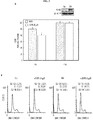
- FIG. 3 5MPN induces cell cycle arrest at the G1 phase.
- Panel (A) shows H460 cells treated with DMSO ⁇ 10 ⁇ M 5MPN
- Panel (B) shows H460 cells treated transfected with nonsense (siCtrl) or PFKFB4 siRNA (siFB4). Cells were analyzed for induction of apoptosis by flow cytometry. Decrease in PFKFB4 protein expression by siFB4 was confirmed by Western blot. PI + +PI/Ann V + cells shown as % apoptotic cells.
- Panel (C) shows H460 cells treated with DMSO ⁇ 10 ⁇ M 5MPN and the distribution of cells in G1, S and G2 phases of the cell cycle.
- Panel (D) shows H460 cells transfected with siCtrl or siFB4 and the distribution of cells in phases of the cell cycle. H460 cells were transfected with empty pCMV-XL4 (Vec) or pCMV-XL4 containing PFKFB4 (FB4) for 24 hours then treated with DMSO ⁇ 10 ⁇ M 5MPN for 24 hours.
- Panel (E) shows the H460 cells transfected with empty pCMV-XL4 (Vec) or pCMV-XL4 containing PFKFB4 (FB4) protein expression and F2,6BP concentration.
- H460 cells were transfected with empty pCMV-XL4 (Vec) or pCMV-XL4 containing PFKFB4 (FB4) for 24 hours then treated with DMSO ⁇ 10 ⁇ M 5MPN for 24 hours.
- Panel (F) shows the H460 cells transfected with empty pCMV-XL4 (Vec) or pCMV-XL4 containing PFKFB4 (FB4) and the distribution of cells in G1, S and G2 phases of the cell cycle. Data shown are representative of three independent experiments and are expressed as the mean ⁇ SD of three experiments. *p value ⁇ 0.01 compared to control.
- FIG. 4 5MPN has oral bioavailability and suppresses glucose uptake and tumor growth in mice.
- Panels (A) and (B) show the oral and intravenous pharmacokinetic properties of 5MPN were in C57BL/6 mice. Groups of 10 C57BL/6 mice were implanted with LLC cells and, when tumors reached a mass of 150-200 mg, were randomized to daily administration of DMSO or 5MPN by gavage (120 mg/kg, for ten days).
- Panels (C) and (D) show daily tumor and daily body mass measurements, respectively.
- Panel (E) shows F2,6BP expression after 10 days of daily administration of DMSO or 5MPN (120 mg/kg) by gavage.
- Panel (F) shows micro-PET scans obtained from separate groups of tumor-bearing mice that were administered either DMSO or 5MPN (120 mg/kg by gavage, once). Regions of interest in the tumor and cerebellum were quantified in quadruplicate. Representative transverse view cuts are shown with red arrows indicating the tumor.
- Panel (G) shows the in vitro cell cycle analysis of LLC cells that were exposed to DMSO ⁇ 10 ⁇ M 5MPN.
- Panel (H) shows Ki67 staining in LLC xenografs that were examined by immunohistochemistry (representative sections shown, 10 ⁇ and 25 ⁇ magnification).
- Groups of 10 C57BL/6 mice were implanted with LLC cells and, when tumors reached a mass of 150-200 mg, were randomized to daily administration of DMSO or 5MPN by gavage (120 mg/kg, for ten days).
- Panel (I) shows Ki67 positive pixels that were enumerated in a minimum of 5 fields per tumor section.
- Groups of 10 C57BL/6 mice were implanted with LLC cells and, when tumors reached a mass of 150-200 mg, were randomized to daily administration of DMSO or 5MPN by gavage (120 mg/kg, for ten days).
- Panels (J) and (K) show tumor and body mass measurements (collected daily), respectively, of groups of 10 BALB/c athymic mice implanted with H460 NSCLC cells and, when tumors were 150-200 mg, were randomized to daily DMSO or 5MPN by gavage. *p value ⁇ 0.01 compared to controls.
- FIG. 5 MPN-2 inhibits recombinant PFKFB4 enzyme activity, decreases the production of F2,6BP, decreased proliferation of cancer cells, and has oral bioavailability.
- Panel (A) shows the molecular structure of MPN-2.
- Panel (B) shows that MPN-2 inhibits PFKFB4 activity.
- Panel (C) shows that MPN-2 inhibits F2,6BP production.
- Panel (D) shows that MPN-2 decreases the proliferation of a human cancer cell line, H460 NSCLC cells. Viable cells counted at 48 hours and at 72 hours.
- FIG. 6 MPN-2 causes decreased proliferation of cancer cells preceded by a reduction in intracellular glycolysis and ATP, decreased proliferation of cancer cells, and tumor growth in mice.
- Panels (A) and (B) show the results of H460 NSCLC cells treated with DMSO ⁇ the indicated concentrations of MPN-2. The effects on glycolysis (A) and ATP (B) were measured after 48 hours.
- Panel (C) shows that MPN-2 decreases the proliferation of MCF7, SK-BR-3, H460, and A549 cells exposed to DMSO ⁇ the indicated concentrations of MPN-2 after 24-72 hours (72 hours shown).
- Panel (D) shows daily tumor mass measurements of groups of 10 C57BL/6 mice that were implanted with LLC cells and, when tumors reached a mass of 150-200 mg, were randomized to daily administration of DMSO or 5MPN in DMSO at the indicated dose by intraperitoneal injection (10 mg/kg, for eleven days).
- FIG. 7 Formula IV compounds decreased proliferation of cancer cells.
- FIG. 7 shows the results of H460 NSCLC cells treated with DMSO ⁇ the indicated concentrations of two compounds of Formula IV at the indicated doses. Specifically, FBR1-02 corresponds to
- FIG. 8 Dual PFKFB4 and PFKFB3 inhibition with MPN-2 and PFK15, respectively, causes a synergistic increase in cell death.
- Panel (A) shows the Fa-Cl combination index plot, while Panel (B) shows the isobologram.
- FIG. 9 Synthesis pathway of the small molecule antagonists of the kinase domain of PFKFB4.
- FIG. 9 shows a synthesis pathway used to create various compounds of Formulae (I), (II), and (III), (IV), (V), (VI), and (VII)).
- FIG. 10 Inhibiting 6-phosphofructo-2-kinase/fructose-2,6,biphosphate 4 (PFKFB4) activity by Formula (VIII) (also referred to as FBR1-12).
- Formula (VIII) also referred to as FBR1-12.
- FIG. 11 Decrease in cell proliferation by Formula (VIII).
- FIG. 12 Decrease in fructose-2,6-bisphosphate (F26BP) in cells by Formula (VIII).
- FIG. 13 Decrease in glycolysis in cells by Formula (VIII).
- FIG. 14 Decrease in ATP production in cells by Formula (VIII).
- FIG. 15 Decrease in anchorage independent growth in cells by Formula (VIII).
- FIG. 16 Pharmacokinetic profile of Formula (VIII).
- FIG. 17 Formula (VIII) decreases growth of tumors in vivo.
- FIG. 18 Formula (VIII) decreases glucose uptake in tumors in vivo.
- FIG. 19 FB4-32 and FB4-35 inhibit PFKFB4 enzyme activity, decrease fructose-2,6 bisphosphate production, proliferation and glycolysis in a human lung cancer cell line (H460).
- FIG. 20 Pharmacokinetic studies of FB4-32 demonstrate oral bioavailability.
- inventive compounds include inventive compounds.
- compositions e.g., pharmaceutical compositions
- Still other embodiments of the invention include compositions (e.g., pharmaceutical compositions) for treating, for example, certain diseases using the compounds.
- Some embodiments include methods of using the inventive compound (e.g., in compositions or in pharmaceutical compositions) for administering and treating (e.g., diseases such as cancer).
- Further embodiments include methods for making the inventive compounds.
- Other embodiments include PFKFB4 inhibitors and methods of using the same that can target neoplastic cells, including, such as, mechanisms within those cells that relate to the use of the glycolytic pathway.
- small molecule PFKFB4 inhibitors are used to disrupt the kinase domain of PFKFB4 and, in some instances, decrease the glucose metabolism and growth of human cancers. Additional embodiments of the invention are also discussed herein.
- Some embodiments of the invention include compounds of Formula (I) and a method of treating cancer in a subject in need of treatment comprises administering to the subject an effective amount of a compound having the Formula (I):
- R 1 is a C 1 -C 5 alkyl nitrooxy
- R 2 can be present or absent, and when present is a C 1 -C 5 alkyl
- R 3 can be present or absent, and when present is a C 1 -C 5 alkoxy
- R 2 is present and located on the nitrogen of the quinoline group, said nitrogen has a positive charge.
- the invention includes compounds of Formula (II) and a method of treating cancer in a subject in need of treatment comprises administering to the subject an effective amount of a compound having the Formula (II):
- n is 1-5; R 1 can be present or absent, and when present is a C 1 -C 5 alkoxy; R 2 can be present or absent, and when present is a C 1 -C 5 alkyl; and wherein if R 2 is present and located on the nitrogen of the quinoline group, said nitrogen has a positive charge.
- the invention includes compounds of Formula (III) and a method of treating cancer in a subject in need of treatment comprises administering to the subject an effective amount of a compound having the Formula (III):
- R 1 can be present or absent, and when present is a C 1 -C 5 alkoxy
- R 2 can be present or absent, and when present is a C 1 -C 5 alkyl
- the nitrogen of the quinoline group has a positive charge
- the invention includes compounds of Formula (IV) and a method of treating cancer in a subject in need of treatment thereof comprises administering to the subject an effective amount of a compound of:
- n is 1-6;
- R 1 is carboxylic acid, methyl sulfamide, carboxylic acid methyl ester, hydroxide, nitrate, or tert-butyl carbamate;
- R 2 can be present or absent, and when present is a C 1 -C 5 alkyl;
- R 3 can be present or absent, and when present is a C 1 -C 5 alkoxy, C 1 -C 5 alkyl, chlorine, or hydrogen; and wherein if R 2 is present and located on the nitrogen of the quinoline group, said nitrogen has a positive charge.
- R 1 is a carbonate, a carbamide, nitro sulfonamide, or a thiocarbonyl.
- the compound of formula (IV) includes the following compounds:
- the invention includes compounds of Formula (V) and a method of treating cancer in a subject in need of treatment thereof comprises administering to the subject an effective amount of a compound of:
- n is 1-6; R 1 nitrate; and R 2 is a hydrogen or nitrogen dioxide.
- R 1 is carboxylic acid, methyl sulfamide, carboxylic acid methyl ester, hydroxide, nitrate, or tert-butyl carbamate.
- R 1 is a carbonate, a carbamide, nitro sulfonamide, or a thiocarbonyl.
- the compound of Formula (V) includes the compounds:
- the invention includes a compound 5MPN and a method of treating cancer in a subject in need of treatment thereof comprises administering to the subject an effective amount of 5MPN.
- the invention includes a compound of MPN-2 and a method of treating cancer in a subject in need of treatment thereof comprises administering to the subject an effective amount of MPN-2.
- the invention includes compounds of Formula (VI) and a method of treating cancer in a subject in need of treatment thereof comprises an effective amount of compound:
- the invention includes compounds of Formula (VII) and a method of treating cancer in a subject in need of treatment thereof comprises an effective amount of compound:
- the invention includes compounds of Formula (VIII) and a method of treating cancer in a subject in need of treatment thereof comprises an effective amount of compound:
- alkyl means a monovalent, straight or branched hydrocarbon chain.
- C 1 -C 7 alkyl or C 1 -C 4 alkyl refer to straight- or branched-chain saturated hydrocarbon groups having from 1 to 7 (e.g., 1, 2, 3, 4, 5, 6, or 7), or 1 to 4 (e.g., 1, 2, 3, or 4), carbon atoms, respectively.
- C 1 -C 7 alkyl groups include, but are not limited to, methyl, ethyl, n-propyl, i-propyl, n-butyl, s-butyl, t-butyl, n-pentyl, s-pentyl, n-hexyl, and n-septyl.
- Examples of C 1 -C 4 alkyl groups include, but are not limited to, methyl, ethyl, n-propyl, i-propyl, n-butyl, s-butyl, and t-butyl.
- alkenyl means a monovalent, straight or branched hydrocarbon chain that includes one or more (e.g., 1, 2, 3, or 4) double bonds.
- alkenyl groups include, but are not limited to, vinyl, allyl, 1-propenyl, 2-propenyl, 1-butenyl, 2-butenyl, 3-butenyl, 1-pentenyl, 2-pentenyl, 3-pentenyl, 4-pentenyl, 1-hexenyl, 2-hexenyl, 3-hexenyl, 4-hexenyl, and 5-hexenyl.
- alkoxy means any of the above alkyl groups which is attached to the remainder of the molecule by an oxygen atom (alkyl-O—).
- alkoxy groups include, but are not limited to, methoxy (sometimes shown as MeO), ethoxy, isopropoxy, propoxy, and butyloxy.
- alkynyl means a monovalent, straight or branched hydrocarbon chain that includes one or more (e.g., 1, 2, 3, or 4) triple bonds and that also may optionally include one or more (e.g. 1, 2, 3, or 4) double bonds in the chain.
- alkynyl groups include, but are not limited to, ethynyl, 1-propynyl, 2-propynyl, 1-butynyl, 2-butynyl, 3-butynyl, 1-pentynyl, 2-pentynyl, 3-pentynyl, 4-pentynyl, 1-hexynyl, 2-hexynyl, 3-hexynyl, 4-hexynyl, and 5-hexynyl.
- halogen means monovalent Cl, F, Br, or I.
- hetero atom means an atom selected from nitrogen atom, oxygen atom, or sulfur atom.
- hydroxy indicates the presence of a monovalent —OH group.
- substituted e.g., as in substituted alkyl
- substituted alkyl means that one or more hydrogen atoms of a chemical group (with one or more hydrogen atoms) can be replaced by one or more non-hydrogen substituents selected from the specified options. The replacement can occur at one or more positions.
- optionally substituted means that one or more hydrogen atoms of a chemical group (with one or more hydrogen atoms) can be, but is not required to be substituted.
- Some compounds of the invention can have one or more chiral centers and can exist in and be isolated in optically active and racemic forms, for any of the one or more chiral centers. Some compounds can exhibit polymorphism.
- the compounds of the present invention encompass any optically active, racemate, stereoisomer form, polymorphism, or mixtures thereof. If a chiral center does not provide an indication of its configuration (i.e., R or S) in a chemical structure, it should be considered to represent R, S or a racemate.
- the invention includes compounds of Formula (IX)
- halogen e.g., F, Cl, Br, or I
- hydroxy —OH
- C 1 -C 4 alkyl e.g., C 1 , C 2 , C 3 , or C 4 alkyl
- C 2 -C 4 alkenyl e.g., C 2 , C 3 , or C 4 alkenyl
- C 2 -C 4 alkynyl e.g., C 2 , C 3 , or C 4 alkynyl
- C 1 -C 4 alkoxy e.g., C 1 , C 2 , C 3 , or C 4 alkoxy
- methanoly —COH
- carboxy —CO 2 H
- nitro —NO 2
- nitrate —ONO 2
- cyano —CN
- amino —NH 2 ), —NH(C 1 -C 4 alkyl
- the compound of Formula (IX) is selected from:
- the compound of Formula (IX) is selected from:
- Some embodiments of the invention include a compound selected from a compound of Formula (X),
- one or more compounds of the invention can be part of a composition or a pharmaceutical composition and can be in an amount of at least about 0.0001%, at least about 0.001%, at least about 0.10%, at least about 0.15%, at least about 0.20%, at least about 0.25%, at least about 0.50%, at least about 0.75%, at least about 1%, at least about 10%, at least about 25%, at least about 50%, at least about 75%, at least about 90%, at least about 95%, at least about 99%, at least about 99.99%, no more than about 75%, no more than about 90%, no more than about 95%, no more than about 99%, no more than about 99.99%, from about 0.001% to about 99%, from about 0.001% to about 50%,
- the composition or pharmaceutical composition can be presented in a dosage form which is suitable for the topical, subcutaneous, intrathecal, intraperitoneal, oral, parenteral, rectal, cutaneous, nasal, vaginal, or ocular administration route.
- the composition or pharmaceutical composition can be presented in a dosage form which is suitable for parenteral administration, a mucosal administration, intravenous administration, subcutaneous administration, topical administration, intradermal administration, oral administration, sublingual administration, intranasal administration, or intramuscular administration.
- composition or pharmaceutical composition can be in the form of, for example, tablets, capsules, pills, powders granulates, suspensions, emulsions, solutions, gels (including hydrogels), pastes, ointments, creams, plasters, drenches, delivery devices, suppositories, enemas, injectables, implants, sprays, aerosols or other suitable forms.
- the composition or pharmaceutical composition can include one or more formulary ingredients.
- a “formulary ingredient” can be any suitable ingredient (e.g., suitable for the drug(s), for the dosage of the drug(s), for the timing of release of the drugs(s), for the disease, for the disease state, or for the delivery route) including, but not limited to, water (e.g., boiled water, distilled water, filtered water, pyrogen-free water, or water with chloroform), sugar (e.g., sucrose, glucose, mannitol, sorbitol, xylitol, or syrups made therefrom), ethanol, glycerol, glycols (e.g., propylene glycol), acetone, ethers, DMSO, surfactants (e.g., anionic surfactants, cationic surfactants, zwitterionic surfactants, or nonionic surfactants (e.g., polysorbates)), oils (e.g., animal oils, plant oils (e
- the composition or pharmaceutical composition can include a unit dose of one or more compounds of the invention (e.g., Formula (I), Formula (II), Formula (III), Formula (IV), Formula (V), Formula (VI), Formula (VII), Formula (VIII), Formula (IX), Formula (X), 5MPN, MPN-2, and salts thereof) in combination with a pharmaceutically acceptable carrier and, in addition, can include other medicinal agents, pharmaceutical agents, carriers, adjuvants, diluents, and excipients.
- the carrier, vehicle or excipient can facilitate administration, delivery and/or improve preservation of the composition.
- the one or more carriers include but are not limited to, saline solutions such as normal saline, Ringer's solution, PBS (phosphate-buffered saline), and generally mixtures of various salts including potassium and phosphate salts with or without sugar additives such as glucose.
- Carriers can include aqueous and non-aqueous sterile injection solutions that can contain antioxidants, buffers, bacteriostats, bactericidal antibiotics, and solutes that render the formulation isotonic with the bodily fluids of the intended recipient; and aqueous and non-aqueous sterile suspensions, which can include suspending agents and thickening agents.
- the one or more excipients can include, but are not limited to water, saline, dextrose, glycerol, ethanol, or the like, and combinations thereof.
- Nontoxic auxiliary substances such as wetting agents, buffers, or emulsifiers may also be added to the composition.
- Oral formulations can include such normally employed excipients as, for example, pharmaceutical grades of mannitol, lactose, starch, magnesium stearate, sodium saccharine, cellulose, and magnesium carbonate.
- Cancer includes but is not limited to diseases caused by uncontrolled cell division and the ability of cells to metastasize, or to establish new growth in additional sites. It will be appreciated that the administration to a subject of an effective amount of the presently-disclosed small molecule antagonists of the kinase domain of PFKFB4 can provide therapy for a wide variety of cancers including, but not limited to lung, breast, colon, ovarian, brain, liver, pancreas, prostate, melanoma, malignant melanoma, non-melanoma skin cancers, (and solid tumors thereof) as well as hematologic tumors and/or malignancies, such as childhood leukemia and lymphomas, multiple myeloma, Hodgkin's disease, lymphomas of lymphocytic and cutaneous origin, acute and chronic leukemia such as acute lymphoblastic, acute myelocytic or chronic myelocytic leukemia, plasma cell neoplasm, lymphoid neoplasm and cancers
- a method of treating cancer in a subject in need of treatment thereof comprising administering to the subject an effective amount of the presently-disclosed small molecule antagonists of the kinase domain of PFKFB4 (e.g., Formula (I), Formula (II), Formula (III), Formula (IV), Formula (V), Formula (VI), Formula (VII), Formula (VIII), Formula (IX), Formula (X), 5MPN, MPN-2, and salts thereof), the cancer is selected from breast cancer, brain cancer, melanoma, lung cancer, colon cancer, and prostate cancer.
- the cancer is selected from breast cancer, brain cancer, melanoma, lung cancer, colon cancer, and prostate cancer.
- treating (and its variations, such as “treatment”) is to be considered in its broadest context.
- the term “treating” relates to any treatment of cancer, including but not limited to prophylactic treatment and therapeutic treatment.
- the term “treating” does not necessarily imply that an animal is treated until total recovery.
- “Treating” includes any effect, e.g., lessening, reducing, modulating, or eliminating, that results in the improvement of the cancer.
- “Treating” or “treatment” of cancer state includes: inhibiting the cancer, i.e., arresting the development of the cancer or its clinical symptoms; or relieving the cancer, i.e., causing temporary or permanent regression of the cancer or its clinical symptoms.
- treating includes amelioration of the symptoms, relief from the symptoms or effects associated with a condition, decrease in severity of a condition, or preventing, preventively ameliorating symptoms, or otherwise reducing the risk of developing a particular condition.
- Any of the compositions (e.g., pharmaceutical compositions) described herein can be used to treat an animal.
- a “subject” includes mammals, e.g., humans, companion animals (e.g., dogs, cats, birds, and the like), farm animals (e.g., cows, sheep, pigs, horses, fowl, and the like) and laboratory animals (e.g., rats, mice, guinea pigs, birds, and the like).
- Animals include but are not limited to mammals, primates, monkeys (e.g., macaque, rhesus macaque, or pig tail macaque), humans, canine, feline, bovine, porcine, avian (e.g., chicken), mice, rabbits, and rats.
- the term “subject” refers to both human and animal subjects.
- a method of treating cancer in a subject in need of treatment thereof comprising administering to the subject an effective amount of the presently-disclosed small molecule antagonists of the kinase domain of PFKFB4 (e.g., Formula (I), Formula (II), Formula (III), Formula (IV), Formula (V), Formula (VI), Formula (VII), Formula (VIII), Formula (IX), Formula (X), 5MPN, MPN-2, and salts thereof), the subject that is administered an effective amount is a mammal.
- the subject that is administered an effective amount is a mammal.
- an “effective amount” is defined herein in relation to the treatment of cancers is an amount that will decrease, reduce, inhibit, or otherwise abrogate the growth of a cancer cell or tumor.
- the “effective amount” can vary depending the cancer and its severity and the age, weight, etc., of the mammal to be treated.
- “Therapeutically effective amount” means an amount effective to achieve a desired and/or beneficial effect (e.g., in relation to treating cancer).
- An effective amount or a therapeutically effective amount can be administered in one or more administrations.
- a therapeutically effective amount is an amount appropriate to treat an indication.
- treating an indication is meant achieving any desirable effect, such as one or more of palliate, ameliorate, stabilize, reverse, slow, or delay disease progression, increase the quality of life, or to prolong life.
- Such achievement can be measured by any suitable method, such as measurement of tumor size.
- the presently-disclosed small molecule antagonists of the kinase domain of PFKFB4 can include pharmaceutically acceptable salts, solvates, stereoisomers, and optical isomers thereof.
- the compounds can include prodrugs of such compounds.
- the compounds disclosed herein can be in the form of salts, optical and geometric isomers, and salts of isomers.
- the compounds can be in various forms, such as uncharged molecules, components of molecular complexes, or non-irritating pharmacologically acceptable salts, including but not limited to hydrochloride, hydrobromide, sulphate, phosphate, nitrate, borate, acetate, maleate, tartrate, and salicylate.
- salts can include metals, amines, or organic cations (e.g. quaternary ammonium).
- derivatives of the compounds e.g., ethers, esters, or amides
- hydrolyzed e.g., easily hydrolyzed
- the compounds of the invention having a chiral center and can exist in and be isolated in optically active and racemic forms. In other embodiments, compounds may exhibit polymorphism. Some embodiments of the present invention encompass any racemic, optically active, polymorphic, or stereoisomeric form, or mixtures thereof, of a compound described herein.
- the preparation of optically active forms can be accomplished by any suitable method, including but not limited to, resolution of the racemic form by recrystallization techniques, synthesis from optically-active starting materials, chiral synthesis, or chromatographic separation using a chiral stationary phase.
- compounds of the invention encompass the compounds disclosed herein and salts, optical isomers, geometric isomers, salts of isomers, and derivatives thereof.
- “Pharmaceutically acceptable salt” of a compound means a salt that is pharmaceutically acceptable and that possesses the desired pharmacological activity of the parent compound.
- “pharmaceutically acceptable salt” refers to modification(s) of the compounds (e.g., Formula (I), Formula (II), Formula (III), Formula (IV), Formula (V), Formula (VI), Formula (VII), Formula (VIII), Formula (IX), Formula (X), 5MPN, MPN-2, and salts thereof) wherein such compounds are modified by making acid or base salts thereof.
- Examples of pharmaceutically acceptable salts include, but are not limited to, mineral or organic acid salts of basic residues such as amines, alkali or organic salts of acidic residues such as carboxylic acids, and the like.
- the pharmaceutically acceptable salts include the conventional non-toxic salts or the quaternary ammonium salts of the parent compound formed, for example, from non-toxic inorganic or organic acids.
- such conventional non-toxic salts include, but are not limited to, those derived from inorganic and organic acids selected from 2-acetoxybenzoic, 2-hydroxyethane sulfonic, acetic, ascorbic, benzene sulfonic, benzoic, bicarbonic, carbonic, citric, edetic, ethane disulfonic, 1,2-ethane sulfonic, fumaric, glucoheptonic, gluconic, glutamic, glycolic, glycollyarsanilic, hexylresorcinic, hydrabamic, hydrobromic, hydrochloric, hydroiodic, hydroxymaleic, hydroxynaphthoic, isethionic, lactic, lactobionic, lauryl sulfonic, maleic, malic, mandelic, methane sulfonic, napsylic, nitric, oxalic, pamoic, pantothenic, phenylacetic, phosphoric,
- references to the presently-disclosed small molecule antagonists of the kinase domain of PFKFB4 include solvent addition forms (solvates) or crystal forms (polymorphs) as defined herein.
- crystal polymorphs or “polymorphs” or “crystal forms” means crystal structures in which a compound (or salt or solvate thereof) can crystallize in different crystal packing arrangements, all of which have the same elemental composition. Different crystal forms usually have different X-ray diffraction patterns, infrared spectral, melting points, density hardness, crystal shape, optical and electrical properties, stability and solubility. Recrystallization solvent, rate of crystallization, storage temperature, and other factors may cause one crystal form to dominate. Crystal polymorphs of the compounds can be prepared by crystallization under different conditions.
- the compounds of the present invention for example, the salts of the presently-disclosed small molecule antagonists of the kinase domain of PFKFB4 (e.g., Formula (I), Formula (II), Formula (III), Formula (IV), Formula (V), Formula (VI), Formula (VII), Formula (VIII), Formula (IX), Formula (X), 5MPN, MPN-2, and salts thereof), can exist in either hydrated or unhydrated (the anhydrous) form or as solvates with other solvent molecules.
- hydrates include monohydrates, dihydrates, etc.
- Nonlimiting examples of solvates include ethanol solvates, acetone solvates, etc.
- Solidvates means solvent addition forms that contain either stoichiometric or non stoichiometric amounts of solvent. Some compounds or salts have a tendency to trap a fixed molar ratio of solvent molecules in the crystalline solid state, thus forming a solvate. If the solvent is water the solvate formed is a hydrate, when the solvent is alcohol, the solvate formed is an alcoholate. Hydrates are formed by the combination of one or more molecules of water with one of the substances in which the water retains its molecular state as H 2 O, such combination being able to form one or more hydrate.
- the presently-disclosed small molecule antagonists of the kinase domain of PFKFB4 can be prepared as prodrugs, for example pharmaceutically acceptable prodrugs.
- prodrugs for example pharmaceutically acceptable prodrugs.
- pro-drug and prodrug are used interchangeably herein and refer to any compound which releases an active parent drug in vivo.
- prodrugs are known to enhance numerous desirable qualities of pharmaceuticals (e.g., solubility, bioavailability, manufacturing, etc.)
- the presently-disclosed small molecule antagonists of the kinase domain of PFKFB4 e.g., Formula (I), Formula (II), Formula (III), Formula (IV), Formula (V), Formula (VI), Formula (VII), Formula (VIII), Formula (IX), Formula (X), 5MPN, MPN-2, and salts thereof
- PFKFB4 e.g., Formula (I), Formula (II), Formula (III), Formula (IV), Formula (V), Formula (VI), Formula (VII), Formula (VIII), Formula (IX), Formula (X), 5MPN, MPN-2, and salts thereof
- PFKFB4 e.g., Formula (I), Formula (II), Formula (III), Formula (IV), Formula (V), Formula (VI), Formula (VII), Formula (VIII), Formula (IX), Formula (X), 5MPN, MP
- the present invention is intended to cover prodrugs of the presently-disclosed small molecule antagonists of the kinase domain of PFKFB4 (e.g., Formula (I), Formula (II), Formula (III), Formula (IV), Formula (V), Formula (VI), Formula (VII), Formula (VIII), Formula (IX), Formula (X), 5MPN, MPN-2, and salts thereof), methods of delivering the same and compositions containing the same.
- “Prodrugs” are intended to include any covalently bonded carriers that release an active parent drug of the present invention in vivo when such prodrug is administered to a subject.
- the presently-disclosed small molecule antagonists of the kinase domain of PFKFB4 are administered at a dosage effective for specifically inhibiting 6-phosphofructo-2-kinase/fructose-2,6-bisphophatase 4 (PFKFB4).
- “specifically inhibiting” is defined as inhibiting PFKFB4 without inhibiting 6-phosphofructo-2-kinase/fructose-2,6,biphosphate 3 (PFKFB3), 6-phosphofructo-2-kinase/fructose-2,6-biphospatase 2 (PFKFB2), or 6-phosphofructo-2-kinase/fructose-2,6,biphosphate 1 (PFKFB1).
- the presently-disclosed small molecule antagonists of the kinase domain of PFKFB4 can be delivered regionally to a particular affected region or regions of the subject's body.
- the presently-disclosed small molecule antagonists of the kinase domain of PFKFB4 can be administered systemically.
- Formula (I), Formula (II), Formula (III), Formula (IV), Formula (V), Formula (VI), Formula (VII), Formula (VIII), Formula (IX), Formula (X), 5MPN, MPN-2, and salts thereof can be administered systemically.
- the presently-disclosed small molecule antagonists of the kinase domain of PFKFB4 e.g., Formula (I), Formula (II), Formula (III), Formula (IV), Formula (V), Formula (VI), Formula (VII), Formula (VIII), Formula (IX), Formula (X), 5MPN, MPN-2, and salts thereof
- PFKFB4 small molecule antagonists of the kinase domain of PFKFB4
- Formula (I), Formula (II), Formula (III), Formula (IV), Formula (V), Formula (VI), Formula (VII), Formula (VIII), Formula (IX), Formula (X), 5MPN, MPN-2, and salts thereof are administered orally.
- the presently-disclosed small molecule antagonists of the kinase domain of PFKFB4 can be administered orally as a solid or as a liquid.
- the presently-disclosed small molecule antagonists of the kinase domain of PFKFB4 e.g., Formula (I), Formula (II), Formula (III), Formula (IV), Formula (V), Formula (VI), Formula (VII), Formula (VIII), Formula (IX), Formula (X), 5MPN, MPN-2, and salts thereof
- PFKFB4 a small molecule antagonists of the kinase domain of PFKFB4
- Formula (I), Formula (II), Formula (III), Formula (IV), Formula (V), Formula (VI), Formula (VII), Formula (VIII), Formula (IX), Formula (X), 5MPN, MPN-2, and salts thereof is administered intravenously.
- the presently-disclosed small molecule antagonists of the kinase domain of PFKFB4 can be administered intravenously as a solution, suspension, or emulsion.
- the presently-disclosed small molecule antagonists of the kinase domain of PFKFB4 also can be administered by inhalation, intravenously, or intramuscularly as a liposomal suspension.
- a method of treating cancer in a subject in need of treatment thereof comprising administering to the subject an effective amount of the presently-disclosed small molecule antagonists of the kinase domain of PFKFB4 (e.g., Formula (I), Formula (II), Formula (III), Formula (IV), Formula (V), Formula (VI), Formula (VII), Formula (VIII), Formula (IX), Formula (X), 5MPN, MPN-2, and salts thereof), the subject that is administered an effective amount of said small molecule antagonist is substantially free of signs of toxicity.
- the subject that is administered an effective amount of said small molecule antagonist is substantially free of signs of toxicity.
- “Substantially free of signs of toxicity” includes unsafe deviations on complete blood counts, electrolytes, hepatic and renal function, body mass, and the unsafe deviations on the gross and histological appearance of the brain, heart, lungs, liver, kidneys, and spleen due to the administration of the presently-disclosed small molecule antagonists of the kinase domain of PFKFB4 (e.g., Formula (I), Formula (II), Formula (III), Formula (IV), Formula (V), Formula (VI), Formula (VII), Formula (VIII), Formula (IX), Formula (X), 5MPN, MPN-2, and salts thereof) to the subject.
- the pharmaceutical composition is non-toxic, does not cause side effects, or both. In some embodiments, there may be inherent side effects (e.g., it may harm the patient or may be toxic or harmful to some degree in some patients).
- a method of treating cancer in a subject in need of treatment thereof comprising administering to the subject an effective amount of the presently-disclosed small molecule antagonists of the kinase domain of PFKFB4 (e.g., Formula (I), Formula (II), Formula (III), Formula (IV), Formula (V), Formula (VI), Formula (VII), Formula (VIII), Formula (IX), Formula (X), 5MPN, MPN-2, and salts thereof), the method further comprises administering to the subject one or more additional therapeutic compounds.
- the method further comprises administering to the subject one or more additional therapeutic compounds.
- therapeutic benefits for the treatment of cancer can be realized by combining treatment with the presently-disclosed small molecule antagonists of the kinase domain of PFKFB4 (e.g., Formula (I), Formula (II), Formula (III), Formula (IV), Formula (V), Formula (VI), Formula (VII), Formula (VIII), Formula (IX), Formula (X), 5MPN, MPN-2, and salts thereof) with one or more additional therapeutic compounds.
- additional therapeutic compounds includes anti-cancer agents or treatments. The choice of such combinations can sometimes depend on various factors including, but not limited to, the type of disease, the age and general health of the subject, the aggressiveness of disease progression, and the ability of the subject to tolerate the agents that comprise the combination.
- the presently-disclosed small molecule antagonists of the kinase domain of PFKFB4 can be combined with other agents and therapeutic regimens that are effective at reducing tumor size (e.g., radiation, surgery, chemotherapy, hormonal treatments, and or gene therapy).
- PFKFB4 small molecule antagonists of the kinase domain of PFKFB4 (e.g., Formula (I), Formula (II), Formula (III), Formula (IV), Formula (V), Formula (VI), Formula (VII), Formula (VIII), Formula (IX), Formula (X), 5MPN, MPN-2, and salts thereof) with one or more agents that treat the side effects of a disease or the side effects of one of the additional therapeutic agents, e.g., providing the subject with an analgesic, or agents effective to stimulate the subject's own immune response (e.g., colony stimulating factor).
- an analgesic or agents effective to stimulate the subject's own immune response (e.g., colony stimulating factor).
- additional therapeutic compounds includes a variety of anti-cancer agents or treatments, such as chemical compounds that are also known as anti-neoplastic agents or chemotherapeutic agents.
- the agents can be used in combination with the presently-disclosed small molecule antagonists of the kinase domain of PFKFB4 (e.g., Formula (I), Formula (II), Formula (III), Formula (IV), Formula (V), Formula (VI), Formula (VII), Formula (VIII), Formula (IX), Formula (X), 5MPN, MPN-2, and salts thereof).
- Such compounds include, but are not limited to, alkylating agents, DNA intercalators, protein synthesis inhibitors, inhibitors of DNA or RNA synthesis, DNA base analogs, topoisomerase inhibitors, anti-angiogenesis agents, and telomerase inhibitors or telomeric DNA binding compounds.
- suitable alkylating agents include alkyl sulfonates, such as busulfan, improsulfan, and piposulfan; aziridines, such as a benzodizepa, carboquone, meturedepa, and uredepa; ethylenimines and methylmelamines, such as altretamine, triethylenemelamine, triethylenephosphoramide, triethylenethiophosphoramide, and trimethylolmelamine; nitrogen mustards such as chlorambucil, chlornaphazine, cyclophosphamide, estramustine, iphosphamide, mechlorethamine, mechlorethamine oxide hydrochloride, melphalan, novembichine, phenesterine, prednimustine, trofosfamide, and uracil mustard; nitroso ureas, such as carmustine, chlorozotocin, fotemustine, lomustine, nimustine, and ranimus;
- antibiotics used in the treatment of cancer and that can be combined with the presently-disclosed small molecule antagonists of the kinase domain of PFKFB4 include dactinomycin, daunorubicin, doxorubicin, idarubicin, bleomycin sulfate, mytomycin, plicamycin, and streptozocin.
- chemotherapeutic antimetabolites can also be combined with the presently-disclosed small molecule antagonists of the kinase domain of PFKFB4 (e.g., Formula (I), Formula (II), Formula (III), Formula (IV), Formula (V), Formula (VI), Formula (VII), Formula (VIII), Formula (IX), Formula (X), 5MPN, MPN-2, and salts thereof) for the treatment of cancer, and include mercaptopurine, thioguanine, cladribine, fludarabine phosphate, fluorouracil (5-FU), floxuridine, cytarabine, pentostatin, methotrexate, and azathioprine, acyclovir, adenine ⁇ -1-D-arabinoside, amethopterin, aminopterin, 2-aminopurine, aphidicolin, 8-azaguanine, azaserine, 6-azauracil, 2′-azido-2
- chemotherapeutic protein synthesis inhibitors can also be combined with the presently-disclosed small molecule antagonists of the kinase domain of PFKFB4 (e.g., Formula (I), Formula (II), Formula (III), Formula (IV), Formula (V), Formula (VI), Formula (VII), Formula (VIII), Formula (IX), Formula (X), 5MPN, MPN-2, and salts thereof) for the treatment of cancer.
- the presently-disclosed small molecule antagonists of the kinase domain of PFKFB4 e.g., Formula (I), Formula (II), Formula (III), Formula (IV), Formula (V), Formula (VI), Formula (VII), Formula (VIII), Formula (IX), Formula (X), 5MPN, MPN-2, and salts thereof
- Such inhibitors include abrin, aurintricarboxylic acid, chloramphenicol, colicin E3, cycloheximide, diphtheria toxin, edeine A, emetine, erythromycin, ethionine, fluoride, 5-fluorotryptophan, fusidic acid, guanylyl methylene diphosphonate and guanylyl imidodiphosphate, kanamycin, kasugamycin, kirromycin, and O-methyl threonine.
- protein synthesis inhibitors can also be combined with the presently-disclosed small molecule antagonists of the kinase domain of PFKFB4 (e.g., Formula (I), Formula (II), Formula (III), Formula (IV), Formula (V), Formula (VI), Formula (VII), Formula (VIII), Formula (IX), Formula (X), 5MPN, MPN-2, and salts thereof) for the treatment of cancer.
- the presently-disclosed small molecule antagonists of the kinase domain of PFKFB4 e.g., Formula (I), Formula (II), Formula (III), Formula (IV), Formula (V), Formula (VI), Formula (VII), Formula (VIII), Formula (IX), Formula (X), 5MPN, MPN-2, and salts thereof
- Such inhibitors include modeccin, neomycin, norvaline, pactamycin, paromomycine, puromycin, ricin, shiga toxin, showdomycin, sparsomycin, spectinomycin, streptomycin, tetracycline, thiostrepton, and trimethoprim.
- inhibitors of DNA synthesis can be combined with the presently-disclosed small molecule antagonists of the kinase domain of PFKFB4 (e.g., Formula (I), Formula (II), Formula (III), Formula (IV), Formula (V), Formula (VI), Formula (VII), Formula (VIII), Formula (IX), Formula (X), 5MPN, MPN-2, and salts thereof) for the treatment of cancer.
- the presently-disclosed small molecule antagonists of the kinase domain of PFKFB4 e.g., Formula (I), Formula (II), Formula (III), Formula (IV), Formula (V), Formula (VI), Formula (VII), Formula (VIII), Formula (IX), Formula (X), 5MPN, MPN-2, and salts thereof
- Such inhibitors include alkylating agents such as dimethyl sulfate, mitomycin C, nitrogen and sulfur mustards, intercalating agents, such as acridine dyes, actinomycins, adriamycin, anthracenes, benzopyrene, ethidium bromide, propidium diiodide-intertwining, and agents, such as distamycin and netropsin.
- alkylating agents such as dimethyl sulfate, mitomycin C, nitrogen and sulfur mustards
- intercalating agents such as acridine dyes, actinomycins, adriamycin, anthracenes, benzopyrene, ethidium bromide, propidium diiodide-intertwining, and agents, such as distamycin and netropsin.
- Topoisomerase inhibitors such as coumermycin, nalidixic acid, novobiocin, and oxolinic acid, inhibitors of cell division, including colcemide, colchicine, vinblastine, and vincristine; and RNA synthesis inhibitors including actinomycin D, ⁇ -amanitine and other fungal amatoxins, cordycepin (3′-deoxyadenosine), dichlororibofuranosyl benzimidazole, rifampicine, streptovaricin, and streptolydigin also can be combined with the presently-disclosed small molecule antagonists of the kinase domain of PFKFB4 (e.g., Formula (I), Formula (II), Formula (III), Formula (IV), Formula (V), Formula (VI), Formula (VII), Formula (VIII), Formula (IX), Formula (X), 5MPN, MPN-2, and salts thereof) to provide a suitable cancer treatment.
- PFKFB4 e.
- chemotherapeutic agents that can, in other embodiments, be used in a combination treatment with the presently-disclosed small molecule antagonists of the kinase domain of PFKFB4 (e.g., Formula (I), Formula (II), Formula (III), Formula (IV), Formula (V), Formula (VI), Formula (VII), Formula (VIII), Formula (IX), Formula (X), 5MPN, MPN-2, and salts thereof) include, but are not limited to, adrimycin, 5-fluorouracil (5FU), etoposide, camptothecin, actinomycin-D, mitomycin, cisplatin, hydrogen peroxide, carboplatin, procarbazine, mechlorethamine, cyclophosphamide, ifosfamide, melphalan, chlorambucil, bisulfan, nitrosurea, dactinomycin, duanorubicin, doxorubicin, bleomycin, plico
- the treatments can also include one or more of surgical intervention, chemotherapy, radiation therapy, hormone therapies, immunotherapy, and adjuvant systematic therapies.
- Adjuvants may include but are not limited to chemotherapy (e.g., temozolomide or any of those disclosed herein), radiation therapy, antiangiogenic therapy (e.g., bevacizumab), and hormone therapies, such as administration of LHRH agonists; antiestrogens, such as tamoxifen; high-dose progestogens; aromatase inhibitors; and/or adrenalectomy.
- Chemotherapy e.g., any of those disclosed herein
- “Additional therapeutic compounds” can further involve immunotherapy directed at tumor antigen markers that are found on the surface of tumor cells.
- Treatment of a cancer with the presently-disclosed small molecule antagonists of the kinase domain of PFKFB4 e.g., Formula (I), Formula (II), Formula (III), Formula (IV), Formula (V), Formula (VI), Formula (VII), Formula (VIII), Formula (IX), Formula (X), 5MPN, MPN-2, and salts thereof
- a gene therapy based treatment targeted towards oncogenes and/or cell cycle controlling genes, such as p53, p16, p21, Rb, APC, DCC, NF-1, NF-2, BRCA2, FHIT, WT-1, MEN-I, MEN-II, BRCA1, VHL, FCC, MCC, ras, myc, neu, raf, erb, src, fms, jun, trk, re
- a method of treating cancer in a subject in need of treatment thereof comprising administering to the subject an effective amount of the presently-disclosed small molecule antagonists of the kinase domain of PFKFB4 (e.g., Formula (I), Formula (II), Formula (III), Formula (IV), Formula (V), Formula (VI), Formula (VII), Formula (VIII), Formula (IX), Formula (X), 5MPN, MPN-2, and salts thereof), one or more additional therapeutic compounds comprise one or more of a PFKFB3 inhibitor, a PFKFB2 inhibitor, and a PFKFB1 inhibitor.
- the one or more PFKFB3 inhibitor is PFK15.
- the additional therapeutic agents can be administered by the same route or by different routes.
- a first therapeutic agent of the combination selected may be administered by intravenous injection while the other therapeutic agents of the combination may be administered orally.
- all therapeutic agents may be administered orally or all therapeutic agents may be administered by intravenous injection.
- the sequence in which the therapeutic agents are administered can be varied.
- additional cancer treatments can be used in combination with administration of the presently-disclosed small molecule antagonists of the kinase domain of PFKFB4 (e.g., Formula (I), Formula (II), Formula (III), Formula (IV), Formula (V), Formula (VI), Formula (VII), Formula (VIII), Formula (IX), Formula (X), 5MPN, MPN-2, and salts thereof).
- the presently-disclosed small molecule antagonists of the kinase domain of PFKFB4 e.g., Formula (I), Formula (II), Formula (III), Formula (IV), Formula (V), Formula (VI), Formula (VII), Formula (VIII), Formula (IX), Formula (X), 5MPN, MPN-2, and salts thereof.
- the presently-disclosed small molecule antagonists of the kinase domain of PFKFB4 can be used as part of a treatment course further involving attempts to surgically remove part or all of a cancerous growth.
- the presently-disclosed small molecule antagonists of the kinase domain of PFKFB4 can be administered after surgical treatment of a subject to treat any remaining neoplastic or metastasized cells.
- Treatment with the presently-disclosed small molecule antagonists of the kinase domain of PFKFB4 can also precede surgery, in an effort to shrink the size of a tumor to reduce the amount of tissue to be excised, thereby making the surgery less invasive and traumatic.
- treatment with the presently-disclosed small molecule antagonists of the kinase domain of PFKFB4 can include one or more treatment courses with a radiotherapeutic agent to induce DNA damage.
- Radiotherapeutic agents include, for example, gamma irradiation, X-rays, UV-irradiation, microwaves, electronic emissions, radioisotopes, and the like. Therapy can be achieved by irradiating the localized tumor site with the above-described forms of radiation.
- a pharmaceutical composition comprising an effective amount of the presently-disclosed small molecule antagonists of the kinase domain of PFKFB4 (e.g., Formula (I), Formula (II), Formula (III), Formula (IV), Formula (V), Formula (VI), Formula (VII), Formula (VIII), Formula (IX), Formula (X), 5MPN, MPN-2, and salts thereof) and at least one pharmaceutical excipient
- “Pharmaceutically acceptable excipient” can sometimes mean an excipient that is useful in preparing a pharmaceutical composition that is generally safe, non-toxic and neither biologically nor otherwise undesirable, and includes excipient that is acceptable for veterinary use as well as human pharmaceutical use.
- the term “pharmaceutical excipient” is used herein to describe any ingredient other than the compound(s) of the invention.
- pharmaceutical excipients include one or more substances which may act as diluents, flavoring agents, solubilisers, lubricants, suspending agents, binders, preservatives, wetting agents, tablet disintegrating agents, or an encapsulating material.
- the choice of excipient can depend on factors such as the particular mode of administration, the effect of the excipient on solubility and stability, and the nature of the dosage form.
- a “pharmaceutical excipient” includes both one and more than one such excipient.
- a pharmaceutical composition comprising an effective amount of the presently-disclosed small molecule antagonists of the kinase domain of PFKFB4 (e.g., Formula (I), Formula (II), Formula (III), Formula (IV), Formula (V), Formula (VI), Formula (VII), Formula (VIII), Formula (IX), Formula (X), 5MPN, MPN-2, and salts thereof) and at least one pharmaceutical excipient
- the presently-disclosed small molecule antagonists of the kinase domain of PFKFB4 e.g., Formula (I), Formula (II), Formula (III), Formula (IV), Formula (V), Formula (VI), Formula (VII), Formula (VIII), Formula (IX), Formula (X), 5MPN, MPN-2, and salts thereof
- the presently-disclosed small molecule antagonists of the kinase domain of PFKFB4 e.g., Formula (I), Formula (II), Formula (III), Formula (IV), Formula (V), Formula (
- the presently-disclosed small molecule antagonists of the kinase domain of PFKFB4 are specific inhibitors of the activity of PFKFB4.
- the specific inhibitors of PFKFB4 inhibits the activity of PFKFB4 by at least about 25%, 30%, 35%, 40%, 45%, 50%, 55%, 60%, 65%, 70%, 75%, 80%, 85%, 90%, 95% 99%, or any value or range in between, but does not inhibit the activity of PFKFB1, PFKFB2, PFKFB3 by more than about 20%, 15%, 10%, 5%, 2%, or 1%.
- the pharmaceutical composition comprising an effective amount of the presently-disclosed small molecule antagonists of the kinase domain of PFKFB4 (e.g., Formula (I), Formula (II), Formula (III), Formula (IV), Formula (V), Formula (VI), Formula (VII), Formula (VIII), Formula (IX), Formula (X), 5MPN, MPN-2, and salts thereof) and at least one pharmaceutical excipient described herein can be formulated with a pharmaceutically acceptable carrier for administration to a human or an animal.
- the pharmaceutical compositions can be administered orally as a solid or as a liquid, or can be administered intramuscularly or intravenously as a solution, suspension, or emulsion.
- the pharmaceutical compositions can be administered by inhalation, intravenously, or intramuscularly as a liposomal suspension.
- the pharmaceutical composition is formulated for oral administration.
- the pharmaceutical composition is formulated for intravenous administration.
- a pharmaceutical composition comprising an effective amount of the presently-disclosed small molecule antagonists of the kinase domain of PFKFB4 (e.g., Formula (I), Formula (II), Formula (III), Formula (IV), Formula (V), Formula (VI), Formula (VII), Formula (VIII), Formula (IX), Formula (X), 5MPN, MPN-2, and salts thereof) and at least one pharmaceutical excipient
- the pharmaceutical composition comprises one or more additional therapeutic agents, as defined above.
- the one or more additional therapeutic compounds comprise one or more of a PFKFB3 inhibitor, a PFKFB2 inhibitor, and a PFKFB1 inhibitor.
- a method of inhibiting PFKFB4 in a cell comprising contacting the cell with an effective amount of the presently-disclosed small molecule antagonists of the kinase domain of PFKFB4 (e.g., Formula (I), Formula (II), Formula (III), Formula (IV), Formula (V), Formula (VI), Formula (VII), Formula (VIII), Formula (IX), Formula (X), 5MPN, MPN-2, and salts thereof) is provided.
- PFKFB4 is specifically inhibited by the presently-disclosed small molecule antagonists of the kinase domain of PFKFB4.
- the presently-disclosed small molecule antagonists of the kinase domain of PFKFB4 are specific inhibitors of the activity of PFKFB4.
- the specific inhibitors of PFKFB4 inhibits the activity of PFKFB4 by at least about 25%, 30%, 35%, 40%, 45%, 50%, 55%, 60%, 65%, 70%, 75%, 80%, 85%, 90%, 95% 99%, or any value or range in between, but does not inhibit the activity of PFKFB1, PFKFB2, PFKFB3 by more than about 20%, 15%, 10%, 5%, 2%, or 1%.
- a method of inhibiting PFKFB4 in a cell comprising contacting the cell with an effective amount of the presently-disclosed small molecule antagonists of the kinase domain of PFKFB4 (e.g., Formula (I), Formula (II), Formula (III), Formula (IV), Formula (V), Formula (VI), Formula (VII), Formula (VIII), Formula (IX), Formula (X), 5MPN, MPN-2, and salts thereof), the cell is a mammalian cell. In certain embodiments, the cell is a cancer cell.
- the cell is a cancer cell.
- the cell is derived from a cell line comprising H460, H1299, H441, H522, DAOY, D283, SKBR3, JURKAT, B16F10, A549, MDA-MB-231, LNCaP, HCT116, or LLC cell lines.
- the cell is or is derived from a cell line of H460 (NSCLC), H1299 (NSCLC), H441 (NSCLC), H522 (NSCLC), DAOY and D283 (brain tumor), SKBR3 (breast), JURKAT (leukemia/hematological malignancy), B16F10 (mouse melanoma), A549 (NSCLC), MDA-MB-231 (breast cancer), LNCaP (prostatic cancer), HCT116 (colon cancer), or LLC (Lewis lung carcinoma) cell lines (e.g., obtained from ATCC).
- a method of inhibiting PFKFB4 in a subject in need thereof comprising administering to the subject an effective amount of the presently-disclosed small molecule antagonists of the kinase domain of PFKFB4 (e.g., Formula (I), Formula (II), Formula (III), Formula (IV), Formula (V), Formula (VI), Formula (VII), Formula (VIII), Formula (IX), Formula (X), 5MPN, MPN-2, and salts thereof) is provided.
- the presently-disclosed small molecule antagonists of the kinase domain of PFKFB4 e.g., Formula (I), Formula (II), Formula (III), Formula (IV), Formula (V), Formula (VI), Formula (VII), Formula (VIII), Formula (IX), Formula (X), 5MPN, MPN-2, and salts thereof
- the presently-disclosed small molecule antagonists of the kinase domain of PFKFB4 e.g., Formula (I), Formula (II), Formula (III), Formula (IV), Formula (V), Formula (VI), Formula (VII), Formula (VIII), Formula (IX), Formula (X), 5MPN, MPN-2, and salts thereof
- PFKFB4 a dosage effective for specifically inhibiting PFKFB4.
- the specific inhibitors of PFKFB4 inhibits the activity of PFKFB4 by at least about 25%, 30%, 35%, 40%, 45%, 50%, 55%, 60%, 65%, 70%, 75%, 80%, 85%, 90%, 95% 99%, or any value or range in between, but does not inhibit the activity of PFKFB1, PFKFB2, PFKFB3 by more than about 20%, 15%, 10%, 5%, 2%, or 1%.
- a method of inhibiting PFKFB4 in a subject in need thereof comprising administering to the subject an effective amount of the presently-disclosed small molecule antagonists of the kinase domain of PFKFB4 (e.g., Formula (I), Formula (II), Formula (III), Formula (IV), Formula (V), Formula (VI), Formula (VII), Formula (VIII), Formula (IX), Formula (X), 5MPN, MPN-2, and salts thereof), with said small molecule antagonists administered orally.
- the small molecule antagonists of the kinase domain of PFKFB4 e.g., Formula (I), Formula (II), Formula (III), Formula (IV), Formula (V), Formula (VI), Formula (VII), Formula (VIII), Formula (IX), Formula (X), 5MPN, MPN-2, and salts thereof
- the presently-disclosed small molecule antagonists of the kinase domain of PFKFB4 are administered intravenously.
- Formula (I), Formula (II), Formula (III), Formula (IV), Formula (V), Formula (VI), Formula (VII), Formula (VIII), Formula (IX), Formula (X), 5MPN, MPN-2, and salts thereof are administered intravenously.
- a method of inhibiting PFKFB4 in a subject comprising administering to the subject an effective amount of the presently-disclosed small molecule antagonists of the kinase domain of PFKFB4 (e.g., Formula (I), Formula (II), Formula (III), Formula (IV), Formula (V), Formula (VI), Formula (VII), Formula (VIII), Formula (IX), Formula (X), 5MPN, MPN-2, and salts thereof), the subject remains substantially free of signs of toxicity.
- the presently-disclosed small molecule antagonists of the kinase domain of PFKFB4 e.g., Formula (I), Formula (II), Formula (III), Formula (IV), Formula (V), Formula (VI), Formula (VII), Formula (VIII), Formula (IX), Formula (X), 5MPN, MPN-2, and salts thereof
- the subject remains substantially free of signs of toxicity.
- a method of reducing proliferative capacity of a cell comprising contacting the cell with an effective amount of the presently-disclosed small molecule antagonists of the kinase domain of PFKFB4 (e.g., Formula (I), Formula (II), Formula (III), Formula (IV), Formula (V), Formula (VI), Formula (VII), Formula (VIII), Formula (IX), Formula (X), 5MPN, MPN-2, and salts thereof) is provided.
- the presently-disclosed small molecule antagonists of the kinase domain of PFKFB4 e.g., Formula (I), Formula (II), Formula (III), Formula (IV), Formula (V), Formula (VI), Formula (VII), Formula (VIII), Formula (IX), Formula (X), 5MPN, MPN-2, and salts thereof
- the cell is contacted with the presently-disclosed small molecule antagonists of the kinase domain of PFKFB4 (e.g., Formula (I), Formula (II), Formula (III), Formula (IV), Formula (V), Formula (VI), Formula (VII), Formula (VIII), Formula (IX), Formula (X), 5MPN, MPN-2, and salts thereof) at a dosage effective for specifically inhibiting PFKFB4.
- the PFKFB4 e.g., Formula (I), Formula (II), Formula (III), Formula (IV), Formula (V), Formula (VI), Formula (VII), Formula (VIII), Formula (IX), Formula (X), 5MPN, MPN-2, and salts thereof
- the specific inhibitors of PFKFB4 inhibits the activity of PFKFB4 by at least about 25%, 30%, 35%, 40%, 45%, 50%, 55%, 60%, 65%, 70%, 75%, 80%, 85%, 90%, 95% 99%, or any value or range in between, but does not inhibit the activity of PFKFB1, PFKFB2, PFKFB3 by more than about 20%, 15%, 10%, 5%, 2%, or 1%.
- a method of reducing proliferative capacity of a cell comprising contacting the cell with an effective amount of the presently-disclosed small molecule antagonists of the kinase domain of PFKFB4 (e.g., Formula (I), Formula (II), Formula (III), Formula (IV), Formula (V), Formula (VI), Formula (VII), Formula (VIII), Formula (IX), Formula (X), 5MPN, MPN-2, and salts thereof), the cell is a mammalian cell. In certain embodiments, the cell is a cancer cell.
- the cell is a cancer cell.
- the cell is derived from a cell line comprising H460, H1299, H441, H522, DAOY, D283, SKBR3, JURKAT, B16F10, A549, MDA-MB-231, LNCaP, HCT116, or LLC cell lines.
- the cell is or is derived from a cell line of H460 (NSCLC), H1299 (NSCLC), H441 (NSCLC), H522 (NSCLC), DAOY and D283 (brain tumor), SKBR3 (breast), JURKAT (leukemia/hematological malignancy), B16F10 (mouse melanoma), A549 (NSCLC), MDA-MB-231 (breast cancer), LNCaP (prostatic cancer), HCT116 (colon cancer), or LLC (Lewis lung carcinoma) cell lines (e.g., obtained from ATCC).
- a method of reducing fructose-2,6-bisphosphate (F2,6BP) in a cell comprising contacting the cell with an effective amount of the presently-disclosed small molecule antagonists of the kinase domain of PFKFB4 (e.g., Formula (I), Formula (II), Formula (III), Formula (IV), Formula (V), Formula (VI), Formula (VII), Formula (VIII), Formula (IX), Formula (X), 5MPN, MPN-2, and salts thereof) is provided.
- the cell is a mammalian cell.
- the cell is a cancer cell, such as, but not limited to lung, breast, colon, ovarian, brain, liver, pancreas, prostate, melanoma, malignant melanoma, non-melanoma skin cancers, as well as hematologic tumors and/or malignancies, such as childhood leukemia and lymphomas, multiple myeloma, Hodgkin's disease, lymphomas of lymphocytic and cutaneous origin, acute and chronic leukemia such as acute lymphoblastic, acute myelocytic or chronic myelocytic leukemia, plasma cell neoplasm, lymphoid neoplasm and cancers associated with AIDS.
- a cancer cell such as, but not limited to lung, breast, colon, ovarian, brain, liver, pancreas, prostate, melanoma, malignant melanoma, non-melanoma skin cancers, as well as hematologic tumors and/or malignancies, such as childhood leukemia and
- the presently-disclosed subject matter is further illustrated by the following specific but non-limiting examples.
- the following examples may include compilations of data that are representative of data gathered at various times during the course of development and experimentation related to the present invention.
- H460, H1299, H441, H522 and A549 non-small cell lung cancer (NSCLC), MDA-MB-231 (breast), LNCaP (prostatic) and HCT116 (colon) adenocarcinoma and Lewis lung carcinoma (LLC) cell lines were obtained from ATCC and used within 6 months of acquisition.
- PFKFB4 ⁇ / ⁇ ear pinna fibroblasts isolated from TamCre/loxP/PFKFB4 ⁇ / ⁇ mice were immortalized as described previously (Chesney J et al.
- Fructose-2,6-bisphosphate synthesis by 6-phosphofructo-2-kinase/fructose-2,6-bisphosphatase 4 is required for the glycolytic response to hypoxia and tumor growth.
- PFKFB4 6-phosphofructo-2-kinase/fructose-2,6-bisphosphatase 4
- NHBE Normal bronchial epithelial cells
- hT/LT/Ras SV40 large T antigen and activated Ras
- All cell lines were tested and found negative for mycoplasma (PCR Mycoplasma Detection Kit, ABM).
- DMEM fetal calf serum
- HCT116 McCoy's 5A media
- NHBE and hT/LT/Ras cells were grown in BEGM containing SingleQuots (Lonza). All lines were cultured at 37° C. in 5% CO 2 .
- 4-hydroxytamoxifen (4HT, Sigma-Aldrich) was added to PFKFB4 ⁇ / ⁇ fibroblasts at indicated concentrations.
- the PFKFB4 homology model used the rat testes PFKFB4 isozyme X-ray structure (PDB code 1BIF) as a structural template.
- An alignment was generated using Clustal W (CHENNA et al., “Multiple sequence alignment with the Clustal series of programs” Nucleic Acids Res (2003) Vol. 31, No. 13, pp. 3497-500).
- Four homology models were generated using Modeller (SALI et al., “Comparative protein modeling by satisfaction of spatial restraints” J Mol Biol (1993) Vol. 234, No. 3, pp. 779-815), and the structure that best reproduced the PFKFB4 binding site selected for further use.
- the residues associated with ligand binding and protein activity for PFKFB4 were correlated to equivalent residue numbers in the consensus structure.
- the catalytic site residues were selected to produce a residue-based protocol for Surflex 1.33 (JAIN “Surflex: fully automatic flexible molecular docking using a molecular similarity-based search engine” J Med Chem (2003) Vol. 46, No. 4, pp. 499-511) for the virtual screening run using the 2007 ZINC-drug-like library containing 3,381,225 compounds.
- the highest-scoring 100 molecules were identified for purchase. All computational work and virtual screening was done in the Brown Cancer Center Molecular Modeling Facility.
- the top 30 commercially available compounds were purchased and examined for inhibitory effects on H460 cell proliferation and recombinant PFKFB4 activity.
- siRNA experiments cells growing in 6-well plates were transfected with control (Stealth Negative Control Medium GC, Invitrogen) or PFKFB4 siRNA (siFB4, HSS107863, Invitrogen) using Lipofectamine RNAiMax (Invitrogen) and harvested as indicated.
- control Stepalth Negative Control Medium GC, Invitrogen
- PFKFB4 siRNA siFB4, HSS107863, Invitrogen
- Lipofectamine RNAiMax Invitrogen
- overexpression experiments cells were transfected with pCMV-XL4 (vector) or pCMV-XL4 containing full-length PFKFB4 (Origene) using Lipofectamine 2000 (Invitrogen) and harvested as indicated.
- Protein extraction and blotting were conducted as previously described. Membranes were probed with antibodies to PFKFB4 (Abcam) or ⁇ -actin (Sigma) followed by HRP-conjugated goat anti-rabbit or anti-mouse secondary antibodies respectively (Pierce). Data shown are representative of three experiments.
- the fructose-6-phosphate kinase activity of human recombinant PFKFB4 in the presence of DMSO ⁇ indicated 5MPN concentrations was assayed as previously described.
- the activity of 5MPN against 97 kinases was examined using a commercially available active-site dependent competition binding assay core service (KINOMEscanEDGE) that quantifies the capacity of test agents to compete with an immobilized, active-site directed ligand using a DNA-tagged kinase and immobilized ligand and compound.
- enzyme inhibition was studied using an ADP-Glo assay.
- PFKFB4 The effect of MPN-2 on the activity of recombinant human PFKFB4 enzyme was examined in an ADP-Glo assay (Promega), which measures ADP formed from a kinase reaction. ADP is converted into ATP, which is converted into light by a luciferase. PFKFB4 protein was exposed to MPN-2 at indicated concentrations in the presence of ATP and fructose-6-phosphate and following manufacturer's instructions, ADP-Glo and kinase detections reagents were added. The data are shown as the decrease in luminescence caused by MPN-2 relative to DMSO.
- VAN SCHAFTINGEN E et al. A kinetic study of pyrophosphate:fructose-6-phosphate phosphotransferase from potato tubers. Application to a microassay of fructose 2,6-bisphosphate” Eur J Biochem (1982) Vol. 129, No. 1, pp. 191-195) and normalized to total cellular protein measured by the bicinchoninic acid assay (BCA, Thermo Scientific). For example, H460 cells were exposed to the indicated concentrations of MPN-2.
- F2,6BP In order to measure F2,6BP, cells were harvested, washed with PBS, lysed in NaOH/Tris acetate by heating at 80° C. and lysates neutralized to pH 7.2. F2,6BP content was measured using a coupled enzyme reaction following a modified method of Van Schaftingen et al (VAN SCHAFTINGEN E et al. “A kinetic study of pyrophosphate:fructose-6-phosphate phosphotransferase from potato tubers. Application to a microassay of fructose 2,6-bisphosphate” Eur J Biochem (1982) Vol. 129, No. 1, pp. 191-195).
- the F2,6BP concentration was normalized to total cellular protein measured by the bicinchoninic acid assay (BCA, Thermo Scientific). All data are expressed as the mean ⁇ SD of three experiments. Statistical significance was assessed by the two-sample t test (independent variable).
- H460 cells were exposed to the indicated concentrations of MPN-2 and glycolysis production was examined.
- Cells growing in 6-well plates were incubated in 500 ⁇ l of complete medium containing 1 ⁇ Ci of 5-[ 3 H]glucose per well for 60 min in 5% CO 2 at 37° C.
- Media was collected, 3 H 2 O formed via glycolysis from the 5-[ 3 H]glucose measured and counts normalized as previously described. For example, the medium was then collected and centrifuged to pellet any suspended cells.
- an evaporation technique in a sealed system was utilized.
- H460 cells were exposed to the indicated concentrations of MPN-2 and ATP production was examined.
- Cells were lysed and intracellular ATP determined as described previously. For example, cells were washed (while still adherent) with cold PBS 1 ⁇ , lysed with Passive Lysis Buffer (1 ⁇ ; Molecular Probes, Invitrogen) added directly to the plates, and immediately harvested by scraping. The lysates were flash frozen (to ⁇ 80° C.) and thawed (to 37° C.) once to accomplish complete lysis and then centrifuged (at 4° C.) for 30 seconds to clear the lysates.
- Intracellular ATP levels were determined using a bioluminescence assay (Molecular Probes), utilizing recombinant firefly luciferase and its substrate, D-luciferin. The luminescence was read in a TD-20/20 luminometer (Turner Designs) at 560 nm. The ATP values were calculated using an ATP standard curve. The protein concentrations of the lysates were estimated using the BCA assay (Pierce Biotechnology) and ATP was expressed as pmol/ ⁇ g protein. All data are expressed as the mean ⁇ SD of three experiments. Statistical significance was assessed by the two-sample t test (independent variable).
- H460 non-small cell lung cancer cells were plated in 24 well plates and exposed to increasing concentrations of the indicated inhibitors of Formula IV (FBR1-02 corresponds to
- DMSO fetal sulfate
- apoptosis cells were stained with annexin V and propidium iodide and examined as previously described. For example, H460 cells were exposed to increasing concentrations of the PFKFB4 inhibitor (MPN-2), the PFKFB3 inhibitor PFK15 (Tocris) or both and viable cells were counted at 24, 48 and 72 hours. DMSO used as vehicle. For cell cycle experiments, cells were detached, washed with cold PBS and fixed in 70% ethanol (4° C., 30 minutes). The cells then were pelleted by centrifugation, resuspended in PBS containing PI and RNase A, incubated at 37° C. in the dark for 30 minutes and analyzed by flow cytometry (BD FACSCalibur).
- mice When tumor masses were 150-200 mg, mice were randomized to daily intraperitoneal DMSO or 5MPN at the indicated dose in 50 ⁇ L DMSO. Tumor measurements and body weights were followed daily. All data are expressed as the mean ⁇ SD of two experiments. Statistical significance was assessed by the two-sample t test (independent variable).
- FDG 2-[ 18 F]-fluoro-2-deoxyglucose
- H460 cells are lung adenocarcinoma cells that harbor several common oncogenic mutations (CDKN2A del457 , KRAS Q61H , PIK3CA E545K , STK11 Q37X ) and are sensitive to inhibition of PFKFB4 using siRNA molecules.
- CDKN2A del457 adenocarcinoma cells that harbor several common oncogenic mutations
- KRAS Q61H PIK3CA E545K , STK11 Q37X
- PFKFB4 has been found to be expressed by normal lung epithelia
- 5MPN normal human bronchial epithelial
- 5MPN has Oral Bioavailability and Suppresses the Glucose Uptake and Growth of Tumors in Mice
- MPN-2 Inhibits Recombinant PFKFB4 Enzyme Activity, Decreases the Production of F2,6BP, Decreased Proliferation of Cancer Cells, and has Intravenous Bioavailability
- MPN-2 causes Decreased Proliferation of Cancer Cells Preceded by a Reduction in Intracellular Glycolysis and ATP, Decreased Proliferation of Cancer Cells, and Tumor Growth in Mice
- FIG. 6A shows the decreased intracellular glycolysis ( FIG. 6A ) and ATP ( FIG. 6B ) production of H460 NSCLC cells treated with DMSO ⁇ the indicated concentrations of MPN-2.
- the effects on glycolysis ( FIG. 6A ) and ATP ( FIG. 6B ) were measured after 48 hours.
- MPN-2 decreased the proliferation of various cancer cell lines.
- FIG. 6C shows the decreased proliferation of MCF7, SK-BR-3, H460, and A549 cells exposed to DMSO ⁇ the indicated concentrations of MPN-2 after 24-72 hours (72 hours shown).
- FIG. 6D shows that MPN-2 suppressed the growth of Lewis lung carcinomas grown in C57BL/6 mice ( FIG. 6D ). When tumors reached a mass of 150-200 mg, mice were randomized to daily administration of DMSO or 5MPN in DMSO at the indicated dose by intraperitoneal injection (10 mg/kg, for eleven days).
- FIG. 8 shows that simultaneous administration of MPN-2 (determined by the instant investigators to be a PFKFB4 inhibitor) and PFK15 (Tocris, a commercially available PFKFB3 inhibitor) synergistically increased cell death in vitro.
- MPN-2 determined by the instant investigators to be a PFKFB4 inhibitor
- PFK15 Tocris, a commercially available PFKFB3 inhibitor
- combination therapy with PFK15 (and other PFKFB3 inhibitors) and the presently-disclosed small molecule antagonists of the kinase domain of PFKFB4 may be used to provide an effective chemotherapeutic regimen.
- the synthesis is amendable to produce a library of derivatives.
- the carbon linker can be altered by treating chloride 5 with a variety of nucleophiles.
- the primary alcohol of compound 6 can be functionalized with groups other than the nitric acid ester. Attempts were made to prepare the 2-methylquinoline salt by treating 7 with methyl iodide in acetonitrile. Decomposition was observed. In some instances, a salt may need to be prepared prior to the installation of the nitric acid ester.
- the instrument was equipped with an Agilent Zobrax Extend C-18 column (1.8 m, 2.1 ⁇ 50 mm) with mobile phase consisting of mass spectrophotometry grade water (with 0.1% formic acid and 0.1% methanol) and acetonitrile (with 0.1% formic acid).
- the RP-HPLC method employed a linear gradient from 5%-100% acetonitrile at 0.3 mL/min over 15 mins with 4 ⁇ L injection volume.
- High-resolution MS were recorded on an Agilent 6224 time-of-flight detector connected to the HPLC system that utilized electrospray ionization.
- Formula (VIII-p1) was purchased (e.g., from MilliporeSigma (Order number: BBO000177-1G)) or prepared from 2-methoxyaniline using a modified literature procedure (GHOSH et al., “Discovery of 4-(4-(2-((5-Hydroxy-1,2,3,4-tetrahydronaphthalen-2-yl)(propyl)amino)ethyl)piperazin-1-yl)quinolin-8-ol and Its Analogues as Highly Potent Dopamine D2/D3 Agonists and as Iron Chelator: In Vivo Activity Indicates Potential Application in Symptomatic and Neuroprotective Therapy for Parkinson's Disease.” J. Med. Chem. (2010) Vol. 53, pp. 2114-2125, which is herein incorporated by reference in its entirety).
- the solid was chromatographed over silica gel (eluted with CH 2 Cl 2 ⁇ 50% MeOH) to afford 1.15 g (69%) of Formula (VIII-p3) as a tan solid.
- the solid can be purified by partially dissolving in ethyl acetate, sonicating for 5 mins and/or collecting the solid by filtration to afford semi pure product that is suitable for further use.
- FIG. 10 shows that Formula (VIII) inhibited the kinase activity of the PFKFB4 enzyme, and thereby indicating its ability to decrease the production of F26BP by PFKFB4.
- FIG. 11 shows that Formula (VIII) decreases the proliferation of human cancer cell lines in vitro with higher potency than 5MPN (5-[(8-methoxyquinolin-4-yl)amino]pentyl nitrate). Data in FIG. 11 are shown as the decrease in cell counts relative to the DMSO (vehicle) control.
- F26BP Fructose-2,6-Bisphosphate
- FIG. 12A and FIG. 12B show that Formula (VIII) has a dose-dependent decrease in F26BP in cancer cells. Data in FIG. 12 are shown as the concentration of intracellular F26BP normalized to cellular protein concentration.
- FIG. 13A and FIG. 13B show that Formula (VIII) caused a dose-dependent decrease in glycolysis in cancer cells measured by the production of tritiated H 2 O ( 3 H 2 O) in glycolysis through the enzyme enolase from 5-[ 3 H]glucose added to the medium. Data in FIG. 13A and FIG. 13B are shown as the production of 3 H 2 O by Formula (VIII) relative to DMSO and normalized to protein concentration.
- the scintillation vials were sealed, and the 3 H 2 O produced by glycolysis through enolase and released to the medium was allowed to equilibrate with the H 2 O in the outer vial for 48 h at 37° C.
- the amounts of 3 H 2 O that had diffused into the surrounding H 2 O was measured on a Tri-Carb 2910 liquid scintillation analyzer (Perkin Elmer) and compared with 3 H 2 O and 5-[ 3 H]glucose standards.
- Protein concentration was determined using the BCA assay and counts were normalized to protein concentration (previously described in CHESNEY et al., “Fructose-2,6-bisphosphate synthesis by 6-phosphofructo-2-kinase/fructose-2,6-bisphosphatase 4 (PFKFB4) is required for the glycolytic response to hypoxia and tumor growth” Oncotarget (2014) Vol. 5, No. 16, pp. 6670-6686, which is herein incorporated by reference in its entirety).
- FIG. 14A and FIG. 14B show that Formula (VIII) caused a dose-dependent decrease in the production of ATP by cancer cells.
- Formula (VIII) (Also Referred to as FBR1-12) Decreased the Growth of Tumors In Vivo:
- FIG. 17 shows that oral Formula (VIII) administration decreased established tumor growth in a syngeneic mouse tumor model. Data shown as mean ⁇ SEM for each timepoint.
- tumors were ⁇ 150-200 mg
- Formula (VIII) (Also Referred to as FBR1-12) Decreased Tumor Glucose Uptake in Tumors In Vivo:
- FIG. 18 shows that Formula (VIII) administration caused a decrease in tumor FDG uptake compared with vehicle.
- FDG-PET was conducted on tumor-bearing mice to determine acute effects of Formula (VIII) on glucose uptake.
- C57BL/6 mice (Charles River) with subcutaneous Lewis lung carcinoma tumors were injected intraperitoneally with 100 ⁇ Ci of 18 F-fluoro-2-deoxy-glucose under isoflurane anesthesia and subjected to a 15-minute static scan 45 minutes after tracer injection at baseline. Twenty-four hours later, the same animals were administered vehicle (DMSO) or Formula (VIII) (in DMSO, 40 mg/kg, POx1), and, after 60 minutes, FDG uptake determined by PET scan.
- Tumor/cerebellum ROI regions of interest
- representative sagittal cuts from mice are shown with arrows showing the tumors on the animals. (* signifies statistical significance).
- FIG. 19A is a diagrammatic representation of FIG. 19A .
- a kinase detection reagent was added to convert the newly formed ADP to ATP which was measured by a luciferase reaction. Data are shown as the decrease in luminescence caused by FB4-32 and FB4-35 relative to DMSO.
- FIG. 19B is a diagrammatic representation of FIG. 19A .
- F26BP F26BP content was measured using a coupled enzyme reaction following a modified method of Van Schaftingen et al. (Eur J Biochem. 1982; 129(1):191-195). The F26BP concentration was normalized to total cellular protein measured by the bicinchoninic acid assay (BCA, Thermo Scientific).
- FIG. 19C is a diagrammatic representation of FIG. 19C .
- PFKFB4 produces F26BP which activates a key rate-limiting enzyme of the glycolytic pathway, 6-phosphofructo-2-kinase (PFK-1).
- PFK-1 6-phosphofructo-2-kinase
- Both compounds caused a dose-dependent decrease in glycolysis in lung cancer cells (H460) measured by the production of tritiated H 2 O ( 3 H 2 O) in glycolysis through the enzyme enolase from 5-[ 3 H]glucose added to the medium.
- H460 lung cancer cells
- 3 H 2 O tritiated H 2 O
- enolase 5-[ 3 H]glucose added to the medium.
- Data are shown as the decrease in production of 3 H 2 O by FB4-32 and FB4-35 relative to DMSO and normalized to protein concentration.
- H460 cells growing in 6-well plates were incubated in 500 ⁇ l of complete medium containing 1 ⁇ Ci of 5-[ 3 H] glucose per well for 60 min in 5% CO 2 at 37° C. The medium was then collected and centrifuged to pellet any suspended cells.
- an evaporation technique in a sealed system was utilized. Briefly, 150 ⁇ l aliquots of medium were added to open tubes that were placed upright inside scintillation vials containing 1 ml of H 2 O.
- the scintillation vials were sealed, and the 3 H 2 O produced by glycolysis through enolase and released to the medium was allowed to equilibrate with the H 2 O in the outer vial for 48 h at 37° C.
- the amounts of 3 H 2 O that had diffused into the surrounding H 2 O was measured on a Tri-Carb 2910 liquid scintillation analyzer (Perkin Elmer) and compared with 3 H 2 O and 5-[ 3 H]glucose standards. Protein concentration was determined using the BCA assay and counts were normalized to protein concentration (previously described in CHESNEY et al. Oncotarget. 2014; 5(16):6670-6686.)
- FIG. 19D is a diagrammatic representation of FIG. 19D .
- FB4-32 and FB4-35 decreased the proliferation of H460 cells in vitro with higher potency than 5MPN. Data are shown as the decrease in cell counts relative to the DMSO (vehicle) control.
- H460 cells were plated in 24 well plates and exposed to increasing concentrations of FB4-31 to FB4-36 and 5MPN. DMSO was used as a vehicle. After 24, 48 and 72 hours of exposure, cells were detached, and viable cells were counted by Trypan blue exclusion (representative counts at 72 hours shown).
- FIG. 20 is a diagrammatic representation of FIG. 20 .
- FB4-32 The pharmacokinetic profile of FB4-32 was determined in mice following IV and oral administration of FB4-32. FB4-32 was found to have oral bioavailability.
- FB4-32 The pharmacokinetic profile of FB4-32 was determined in mice dosed orally and IV with FB4-32.
- Plasma samples were extracted using acetonitrile and analyzed by LC/MS-MS using a PhenomexSynergi Polar-RP 4 micron 50 ⁇ 2.0 mm column eluted with a biphasic mobile phase (0.5% formic acid in acetonitrile and water).
- Analytical purity was determined by reverse-phase high-performance liquid chromatography (RP-HPLC) on an Agilent 1260 infinity equipped with a diode array (160-450 nm).
- the instrument was equipped with an Agilent Zobrax Extend C-18 column (1.8 m, 2.1 ⁇ 50 mm) with mobile phase consisting of mass spectrophotometry grade water (with 0.1% formic acid and 0.1% methanol) and acetonitrile (with 0.1% formic acid).
- the RP-HPLC method employed a linear gradient from 5%-100% acetonitrile at 0.3 mL/min over 15 mins with 4 mL injection volume.
- High-resolution MS were recorded on an Agilent 6224 time-of-flight detector connected to the HPLC system that utilized electrospray ionization.
- 4-Chloro-8-methoxyquinoline MilliporeSigma (order number: BBO0000177-1G).
- 4-Chloro-8-methoxyquinoline according to a modified procedure based on GHOSH et al., “Discovery of 4-(4-(2-((5-Hydroxy-1,2,3,4-tetrahydronaphthalen-2-yl)(propyl)amino)ethyl)piperazin-1-yl)quinolin-8-ol and Its Analogues as Highly Potent Dopamine D2/D3 Agonists and as Iron Chelator: In Vivo Activity Indicates Potential Application in Symptomatic and Neuroprotective Therapy for Parkinson's Disease.” J. Med. Chem. 2010, 53, 2114-2125.
- 1,6-diaminohexane Alfa Aesar (order number: A14212)
- 1,4-diaminobutane Alfa Aesar (order number: B21316)
- Anhydrous ethanol was purchased from MilliporeSigma and used without further purification.
- Dichloromethane, chloroform and methanol was HPLC grade or better and was purchased from Thermo Fisher Scientific.
- Quinoline 1 is commercially available or can be prepared in three steps from 2-methoxyaniline by a modified literature procedure (as discussed above).
- the crude product can be purified by partially dissolving in ethyl acetate, sonicate for 5 mins and collect the solid by filtration to afford semi pure product that is suitable for further use:
- a method of treating cancer in a subject in need of treatment thereof comprising administering to the subject an effective amount of a compound having the Formula (I):
- R 1 is a C 1 -C 5 alkyl nitrooxy
- R 2 can be present or absent, and when present is a C 1 -C 5 alkyl
- R 3 can be present or absent, and when present is a C 1 -C 5 alkoxy
- R 2 is present and located on the nitrogen of the quinoline group, said nitrogen has a positive charge.
- cancer selected from breast cancer, lung cancer, colon cancer, and prostate cancer.
- the one or more additional therapeutic compounds comprises one or more of a PFKFB3 inhibitor, a PFKFB2 inhibitor, and a PFKFB1 inhibitor.
- a method of inhibiting PFKFB4 in a cell comprising contacting the cell with an effective amount of a compound having the Formula (I):
- R 1 is a C 1 -C 5 alkyl nitrooxy
- R 2 can be present or absent, and when present is a C 1 -C 5 alkyl
- R 3 can be present or absent, and when present is a C 1 -C 5 alkoxy
- R 2 is present and located on the nitrogen of the quinoline group, said nitrogen has a positive charge.
- the cell is derived from a cell line comprising H460, H1299, H441, H522, DAOY, D283, SKBR3, JURKAT, B16F10, A549, MDA-MB-231, LNCaP, HCT116, or LLC cell lines.
- a method of inhibiting PFKFB4 in a subject comprising administering to the subject an effective amount of a compound having the Formula (I):
- R 1 is a C 1 -C 5 alkyl nitrooxy
- R 2 can be present or absent, and when present is a C 1 -C 5 alkyl
- R 3 can be present or absent, and when present is a C 1 -C 5 alkoxy
- R 2 is present and located on the nitrogen of the quinoline group, said nitrogen has a positive charge.
- a method of reducing glycolytic flux in a cell comprising contacting the cell with an effective amount of a compound having the Formula (I):
- R 1 is a C 1 -C 5 alkyl nitrooxy
- R 2 can be present or absent, and when present is a C 1 -C 5 alkyl
- R 3 can be present or absent, and when present is a C 1 -C 5 alkoxy
- R 2 is present and located on the nitrogen of the quinoline group, said nitrogen has a positive charge.
- the cell is derived from a cell line comprising H460, H1299, H441, H522, DAOY, D283, SKBR3, JURKAT, B16F10, A549, MDA-MB-231, LNCaP, HCT116, or LLC cell lines.
- a method of reducing proliferative capacity of a cell comprising contacting the cell with an effective amount of a compound having the Formula (I):
- R 1 is a C 1 -C 5 alkyl nitrooxy
- R 2 can be present or absent, and when present is a C 1 -C 5 alkyl
- R 3 can be present or absent, and when present is a C 1 -C 5 alkoxy
- R 2 is present and located on the nitrogen of the quinoline group, said nitrogen has a positive charge.
- the cell is derived from a cell line comprising H460, H1299, H441, H522, DAOY, D283, SKBR3, JURKAT, B16F10, A549, MDA-MB-231, LNCaP, HCT116, or LLC cell lines.
- a method of reducing fructose-2,6-bisphosphate (F2,6BP) in a cell comprising contacting the cell with an effective amount of a compound having the Formula (I):
- R 1 is a C 1 -C 5 alkyl nitrooxy
- R 2 can be present or absent, and when present is a C 1 -C 5 alkyl
- R 3 can be present or absent, and when present is a C 1 -C 5 alkoxy
- R 2 is present and located on the nitrogen of the quinoline group, said nitrogen has a positive charge.
- a pharmaceutical composition comprising an effective amount of a compound having the Formula (I):
- R 1 is a C 1 -C 5 alkyl nitrooxy
- R 2 can be present or absent, and when present is a C 1 -C 5 alkyl
- R 3 can be present or absent, and when present is a C 1 -C 5 alkoxy
- R 2 is present and located on the nitrogen of the quinoline group, said nitrogen has a positive charge
- at least one pharmaceutical excipient if R 2 is present and located on the nitrogen of the quinoline group, said nitrogen has a positive charge; and at least one pharmaceutical excipient.
- composition of embodiment 32 wherein an effective amount of the compound of Formula (I) is an amount that specifically inhibits PFKFB4.
- composition of embodiment 32 wherein the pharmaceutical composition is formulated for oral administration.
- composition of embodiment 32 wherein the pharmaceutical composition is formulated for intravenous administration.
- composition of embodiment 32 further comprising one or more additional therapeutic agents.
- a method of treating cancer in a subject in need of treatment thereof comprising administering to the subject an effective amount of a compound having the Formula (II):
- n is 1-5; R 1 can be present or absent, and when present is a C 1 -C 5 alkoxy; R 2 can be present or absent, and when present is a C 1 -C 5 alkyl; and wherein if R 2 is present and located on the nitrogen of the quinoline group, said nitrogen has a positive charge.
- cancer selected from breast cancer, lung cancer, colon cancer, and prostate cancer.
- the one or more additional therapeutic compounds comprises one or more of a PFKFB3 inhibitor, a PFKFB2 inhibitor, and a PFKFB1 inhibitor.
- a method of inhibiting PFKFB4 in a cell comprising contacting the cell with an effective amount of a compound having the Formula (II):
- n is 1-5; R 1 can be present or absent, and when present is a C 1 -C 5 alkoxy; R 2 can be present or absent, and when present is a C 1 -C 5 alkyl; and wherein if R 2 is present and located on the nitrogen of the quinoline group, said nitrogen has a positive charge.
- cell is derived from a cell line comprising H460, H1299, H441, H522, DAOY, D283, SKBR3, JURKAT, B16F10, A549, MDA-MB-231, LNCaP, HCT116, or LLC cell lines.
- a method of inhibiting PFKFB4 in a subject comprising administering to the subject an effective amount of a compound having the Formula (II):
- n is 1-5; R 1 can be present or absent, and when present is a C 1 -C 5 alkoxy; R 2 can be present or absent, and when present is a C 1 -C 5 alkyl; and wherein if R 2 is present and located on the nitrogen of the quinoline group, said nitrogen has a positive charge.
- a method of reducing glycolytic flux in a cell comprising contacting the cell with an effective amount of a compound having the Formula (II):
- n is 1-5; R 1 can be present or absent, and when present is a C 1 -C 5 alkoxy; R 2 can be present or absent, and when present is a C 1 -C 5 alkyl; and wherein if R 2 is present and located on the nitrogen of the quinoline group, said nitrogen has a positive charge.
- the cell is derived from a cell line comprising H460, H1299, H441, H522, DAOY, D283, SKBR3, JURKAT, B16F10, A549, MDA-MB-231, LNCaP, HCT116, or LLC cell lines.
- a method of reducing proliferative capacity of a cell comprising contacting the cell with an effective amount of a compound having the Formula (II):
- n is 1-5; R 1 can be present or absent, and when present is a C 1 -C 5 alkoxy; R 2 can be present or absent, and when present is a C 1 -C 5 alkyl; and wherein if R 2 is present and located on the nitrogen of the quinoline group, said nitrogen has a positive charge.
- cell is derived from a cell line comprising H460, H1299, H441, H522, DAOY, D283, SKBR3, JURKAT, B16F10, A549, MDA-MB-231, LNCaP, HCT116, or LLC cell lines.
- a method of reducing fructose-2,6-bisphosphate (F2,6BP) in a cell comprising contacting the cell with an effective amount of a compound having the Formula (II):
- n is 1-5; R 1 can be present or absent, and when present is a C 1 -C 5 alkoxy; R 2 can be present or absent, and when present is a C 1 -C 5 alkyl; and wherein if R 2 is present and located on the nitrogen of the quinoline group, said nitrogen has a positive charge.
- a pharmaceutical composition comprising an effective amount of a compound having the Formula (II):
- n is 1-5; R 1 can be present or absent, and when present is a C 1 -C 5 alkoxy; R 2 can be present or absent, and when present is a C 1 -C 5 alkyl; and wherein if R 2 is present and located on the nitrogen of the quinoline group, said nitrogen has a positive charge; and at least one pharmaceutical excipient.
- an effective amount of the compound of Formula (II) is an amount that specifically inhibits PFKFB4.
- composition of embodiment 68 wherein the pharmaceutical composition is formulated for oral administration.
- composition of embodiment 68 wherein the pharmaceutical composition is formulated for intravenous administration.
- a method of treating cancer in a subject in need of treatment thereof comprising administering to the subject an effective amount of a compound having the Formula (III):
- R 1 can be present or absent, and when present is a C 1 -C 5 alkoxy
- R 2 can be present or absent, and when present is a C 1 -C 5 alkyl
- the nitrogen of the quinoline group has a positive charge
- cancer selected from breast cancer, lung cancer, colon cancer, and prostate cancer.
- the one or more additional therapeutic compounds comprises one or more of a PFKFB3 inhibitor, a PFKFB2 inhibitor, and a PFKFB1 inhibitor.
- a method of inhibiting PFKFB4 in a cell comprising contacting the cell with an effective amount of a compound having the Formula (III):
- R 1 can be present or absent, and when present is a C 1 -C 5 alkoxy
- R 2 can be present or absent, and when present is a C 1 -C 5 alkyl
- the nitrogen of the quinoline group has a positive charge
- cell is derived from a cell line comprising H460, H1299, H441, H522, DAOY, D283, SKBR3, JURKAT, B16F10, A549, MDA-MB-231, LNCaP, HCT116, or LLC cell lines.
- a method of inhibiting PFKFB4 in a subject comprising administering to the subject an effective amount of a compound having the Formula (III):
- R 1 can be present or absent, and when present is a C 1 -C 5 alkoxy
- R 2 can be present or absent, and when present is a C 1 -C 5 alkyl
- the nitrogen of the quinoline group has a positive charge
- a method of reducing glycolytic flux in a cell comprising contacting the cell with an effective amount of the compound having the Formula (III):
- R 1 can be present or absent, and when present is a C 1 -C 5 alkoxy
- R 2 can be present or absent, and when present is a C 1 -C 5 alkyl
- the nitrogen of the quinoline group has a positive charge
- cell is derived from a cell line comprising H460, H1299, H441, H522, DAOY, D283, SKBR3, JURKAT, B16F10, A549, MDA-MB-231, LNCaP, HCT116, or LLC cell lines.
- a method of reducing proliferative capacity of a cell comprising contacting the cell with an effective amount of a compound having the Formula (III):
- R 1 can be present or absent, and when present is a C 1 -C 5 alkoxy
- R 2 can be present or absent, and when present is a C 1 -C 5 alkyl
- the nitrogen of the quinoline group has a positive charge
- the cell is derived from a cell line comprising H460, H1299, H441, H522, DAOY, D283, SKBR3, JURKAT, B16F10, A549, MDA-MB-231, LNCaP, HCT116, or LLC cell lines.
- a method of reducing fructose-2,6-bisphosphate (F2,6BP) in a cell comprising contacting the cell with an effective amount of a compound having the Formula (III):
- R 1 can be present or absent, and when present is a C 1 -C 5 alkoxy
- R 2 can be present or absent, and when present is a C 1 -C 5 alkyl
- the nitrogen of the quinoline group has a positive charge
- a pharmaceutical composition comprising an effective amount of a compound having the Formula (III):
- R 1 can be present or absent, and when present is a C 1 -C 5 alkoxy
- R 2 can be present or absent, and when present is a C 1 -C 5 alkyl
- the nitrogen of the quinoline group has a positive charge
- at least one pharmaceutical excipient
- an effective amount of the compound of Formula (III) is an amount that specifically inhibits PFKFB4.
- composition of embodiment 103 wherein the pharmaceutical composition is formulated for oral administration.
- composition of embodiment 103 wherein the pharmaceutical composition is formulated for intravenous administration.
- a method of treating cancer in a subject in need of treatment thereof comprising administering to the subject an effective amount of 5-[(8-methoxyquinolin-4-yl)amino]pentyl nitrate (5MPN).
- 5MPN 5-[(8-methoxyquinolin-4-yl)amino]pentyl nitrate
- cancer is selected from breast cancer, lung cancer, colon cancer, and prostate cancer.
- the one or more additional therapeutic compounds comprises one or more of a PFKFB3 inhibitor, a PFKFB2 inhibitor, and a PFKFB1 inhibitor.
- a method of inhibiting PFKFB4 in a cell comprising contacting the cell with an effective amount of 5MPN.
- cell is derived from a cell line comprising H460, H1299, H441, H522, DAOY, D283, SKBR3, JURKAT, B16F10, A549, MDA-MB-231, LNCaP, HCT116, or LLC cell lines.
- a method of inhibiting PFKFB4 in a subject comprising administering to the subject an effective amount of 5MPN.
- a method of reducing glycolytic flux in a cell comprising contacting the cell with an effective amount of 5MPN.
- cell is derived from a cell line comprising H460, H1299, H441, H522, DAOY, D283, SKBR3, JURKAT, B16F10, A549, MDA-MB-231, LNCaP, HCT116, or LLC cell lines.
- a method of reducing proliferative capacity of a cell comprising contacting the cell with an effective amount of 5MPN.
- cell is derived from a cell line comprising H460, H1299, H441, H522, DAOY, D283, SKBR3, JURKAT, B16F10, A549, MDA-MB-231, LNCaP, HCT116, or LLC cell lines.
- a method of reducing fructose-2,6-bisphosphate (F2,6BP) in a cell comprising contacting the cell with an effective amount of 5MPN.
- a pharmaceutical composition comprising an effective amount of 5MPN, and at least one pharmaceutical excipient.
- composition of embodiment 138, wherein an effective amount of 5MPN is an amount that specifically inhibits PFKFB4.
- composition of embodiment 138 wherein the pharmaceutical composition is formulated for oral administration.
- composition of embodiment 138 wherein the pharmaceutical composition is formulated for intravenous administration.
- composition of embodiment 138 further comprising one or more additional therapeutic agents.
- a method of treating cancer in a subject in need of treatment thereof comprising administering to the subject an effective amount of 5-[(8-methoxy-2-methylquinolin-1-ium-4-yl)amino]pentyl nitrate (MPN-2).
- cancer is selected from breast cancer, lung cancer, colon cancer, and prostate cancer.
- the one or more additional therapeutic compounds comprises one or more of a PFKFB3 inhibitor, a PFKFB2 inhibitor, and a PFKFB1 inhibitor.
- a method of inhibiting PFKFB4 in a cell comprising contacting the cell with an effective amount of MPN-2.
- cell line comprising H460, H1299, H441, H522, DAOY, D283, SKBR3, JURKAT, B16F10, A549, MDA-MB-231, LNCaP, HCT116, or LLC cell lines.
- a method of inhibiting PFKFB4 in a subject comprising administering to the subject an effective amount of MPN-2.
- a method of reducing glycolytic flux in a cell comprising contacting the cell with an effective amount of MPN-2.
- cell is derived from a cell line comprising H460, H1299, H441, H522, DAOY, D283, SKBR3, JURKAT, B16F10, A549, MDA-MB-231, LNCaP, HCT116, or LLC cell lines.
- a method of reducing proliferative capacity of a cell comprising contacting the cell with an effective amount of MPN-2.
- cell is derived from a cell line comprising H460, H1299, H441, H522, DAOY, D283, SKBR3, JURKAT, B16F10, A549, MDA-MB-231, LNCaP, HCT116, or LLC cell lines.
- a method of reducing fructose-2,6-bisphosphate (F2,6BP) in a cell comprising contacting the cell with an effective amount of MPN-2.
- a pharmaceutical composition comprising an effective amount of MPN-2, and at least one pharmaceutical excipient.
- an effective amount of MPN-2 is an amount that specifically inhibits PFKFB4.
- composition of embodiment 174 wherein the pharmaceutical composition is formulated for oral administration.
- composition of embodiment 174 wherein the pharmaceutical composition is formulated for intravenous administration.
- composition of embodiment 174 further comprising one or more additional therapeutic agents.
- composition of embodiment 178, wherein the one or more additional therapeutic compounds comprises one or more of a PFKFB3 inhibitor, a PFKFB2 inhibitor, and a PFKFB1 inhibitor.
- a method of treating cancer in a subject in need of treatment thereof comprising administering to the subject an effective amount of a compound having the Formula (IV):
- n is 1-6;
- R 1 is carboxylic acid, methyl sulfamide, carboxylic acid methyl ester, hydroxide, nitrate, or tert-butyl carbamate;
- R 2 can be present or absent, and when present is a C 1 -C 5 alkyl;
- R 3 can be present or absent, and when present is a C 1 -C 5 alkoxy, cloride, or hydrogen; and wherein if R 2 is present and located on the nitrogen of the quinoline group, said nitrogen has a positive charge.
- cancer selected from breast cancer, lung cancer, colon cancer, and prostate cancer.
- invention 180 further comprising administering to the subject one or more additional therapeutic compounds.
- the one or more additional therapeutic compounds comprises one or more of a PFKFB3 inhibitor, a PFKFB2 inhibitor, and a PFKFB1 inhibitor.
- a method of inhibiting PFKFB4 in a cell comprising contacting the cell with an effective amount of a compound having the Formula (IV):
- n is 1-6;
- R 1 is carboxylic acid, methyl sulfamide, carboxylic acid methyl ester, hydroxide, nitrate, or tert-butyl carbamate;
- R 2 can be present or absent, and when present is a C 1 -C 5 alkyl;
- R 3 can be present or absent, and when present is a C 1 -C 5 alkoxy, cloride, or hydrogen; and wherein if R 2 is present and located on the nitrogen of the quinoline group, said nitrogen has a positive charge.
- cell is derived from a cell line comprising H460, H1299, H441, H522, DAOY, D283, SKBR3, JURKAT, B16F10, A549, MDA-MB-231, LNCaP, HCT116, or LLC cell lines.
- a method of inhibiting PFKFB4 in a subject comprising administering to the subject an effective amount of a compound having the Formula (IV):
- n is 1-6;
- R 1 is carboxylic acid, methyl sulfamide, carboxylic acid methyl ester, hydroxide, nitrate, or tert-butyl carbamate;
- R 2 can be present or absent, and when present is a C 1 -C 5 alkyl;
- R 3 can be present or absent, and when present is a C 1 -C 5 alkoxy, cloride, or hydrogen; and wherein if R 2 is present and located on the nitrogen of the quinoline group, said nitrogen has a positive charge.
- a method of reducing glycolytic flux in a cell comprising contacting the cell with an effective amount of the compound having the Formula (IV):
- n is 1-6;
- R 1 is carboxylic acid, methyl sulfamide, carboxylic acid methyl ester, hydroxide, nitrate, or tert-butyl carbamate;
- R 2 can be present or absent, and when present is a C 1 -C 5 alkyl;
- R 3 can be present or absent, and when present is a C 1 -C 5 alkoxy, cloride, or hydrogen; and wherein if R 2 is present and located on the nitrogen of the quinoline group, said nitrogen has a positive charge.
- cell is derived from a cell line comprising H460, H1299, H441, H522, DAOY, D283, SKBR3, JURKAT, B16F10, A549, MDA-MB-231, LNCaP, HCT116, or LLC cell lines.
- a method of reducing proliferative capacity of a cell comprising contacting the cell with an effective amount of a compound having the Formula (IV):
- n is 1-6;
- R 1 is carboxylic acid, methyl sulfamide, carboxylic acid methyl ester, hydroxide, nitrate, or tert-butyl carbamate;
- R 2 can be present or absent, and when present is a C 1 -C 5 alkyl;
- R 3 can be present or absent, and when present is a C 1 -C 5 alkoxy, cloride, or hydrogen; and wherein if R 2 is present and located on the nitrogen of the quinoline group, said nitrogen has a positive charge.
- cell line comprising H460, H1299, H441, H522, DAOY, D283, SKBR3, JURKAT, B16F10, A549, MDA-MB-231, LNCaP, HCT116, or LLC cell lines.
- a method of reducing fructose-2,6-bisphosphate (F2,6BP) in a cell comprising contacting the cell with an effective amount of a compound having the Formula (IV):
- n is 1-6;
- R 1 is carboxylic acid, methyl sulfamide, carboxylic acid methyl ester, hydroxide, nitrate, or tert-butyl carbamate;
- R 2 can be present or absent, and when present is a C 1 -C 5 alkyl;
- R 3 can be present or absent, and when present is a C 1 -C 5 alkoxy, cloride, or hydrogen; and wherein if R 2 is present and located on the nitrogen of the quinoline group, said nitrogen has a positive charge.
- a pharmaceutical composition comprising an effective amount of a compound having the Formula (IV)
- n is 1-6;
- R 1 is carboxylic acid, methyl sulfamide, carboxylic acid methyl ester, hydroxide, nitrate, or tert-butyl carbamate;
- R 2 can be present or absent, and when present is a C 1 -C 5 alkyl;
- R 3 can be present or absent, and when present is a C 1 -C 5 alkoxy, cloride, or hydrogen; and wherein if R 2 is present and located on the nitrogen of the quinoline group, said nitrogen has a positive charge; and at least one pharmaceutical excipient.
- an effective amount of the compound of Formula (IV) is an amount that specifically inhibits PFKFB4.
- composition of embodiment 211 wherein the pharmaceutical composition is formulated for oral administration.
- composition of embodiment 211 wherein the pharmaceutical composition is formulated for intravenous administration.
- a method of treating cancer in a subject in need of treatment thereof comprising administering to the subject an effective amount of a compound having the Formula (V):
- n is 1-6; R 1 nitrate; and R 2 is a hydrogen or nitrogen dioxide.
- cancer selected from breast cancer, lung cancer, colon cancer, and prostate cancer.
- the one or more additional therapeutic compounds comprises one or more of a PFKFB3 inhibitor, a PFKFB2 inhibitor, and a PFKFB1 inhibitor.
- a method of inhibiting PFKFB4 in a cell comprising contacting the cell with an effective amount of a compound having the Formula (V):
- n is 1-6; R 1 nitrate; and R 2 is a hydrogen or nitrogen dioxide.
- cell is derived from a cell line comprising H460, H1299, H441, H522, DAOY, D283, SKBR3, JURKAT, B16F10, A549, MDA-MB-231, LNCaP, HCT116, or LLC cell lines.
- a method of inhibiting PFKFB4 in a subject comprising administering to the subject an effective amount of a compound having the Formula (V):
- n is 1-6; R 1 nitrate; and R 2 is a hydrogen or nitrogen dioxide.
- a method of reducing glycolytic flux in a cell comprising contacting the cell with an effective amount of the compound having the Formula (V):
- n is 1-6; R 1 nitrate; and R 2 is a hydrogen or nitrogen dioxide.
- the cell is derived from a cell line comprising H460, H1299, H441, H522, DAOY, D283, SKBR3, JURKAT, B16F10, A549, MDA-MB-231, LNCaP, HCT116, or LLC cell lines.
- a method of reducing proliferative capacity of a cell comprising contacting the cell with an effective amount of a compound having the Formula (V):
- n is 1-6; R 1 nitrate; and R 2 is a hydrogen or nitrogen dioxide.
- a method of reducing fructose-2,6-bisphosphate (F2,6BP) in a cell comprising contacting the cell with an effective amount of a compound having the Formula (V):
- n is 1-6; R 1 nitrate; and R 2 is a hydrogen or nitrogen dioxide.
- a pharmaceutical composition comprising an effective amount of a compound having the Formula (V):
- n is 1-6; R 1 nitrate; and R 2 is a hydrogen or nitrogen dioxide; and at least one pharmaceutical excipient.
- composition of embodiment 246, wherein an effective amount of the compound of Formula (V) is an amount that specifically inhibits PFKFB4.
- composition of embodiment 246, wherein the pharmaceutical composition is formulated for intravenous administration.
- n is 1-6;
- R 1 is carboxylic acid, methyl sulfamide, carboxylic acid methyl ester, hydroxide, nitrate, or tert-butyl carbamate;
- R 2 can be present or absent, and when present is a C 1 -C 5 alkyl;
- R 3 can be present or absent, and when present is a C 1 -C 5 alkoxy, cloride, or hydrogen; and wherein if R 2 is present and located on the nitrogen of the quinoline group, said nitrogen has a positive charge.
- n is 1-6; R 1 nitrate; and R 2 is a hydrogen or nitrogen dioxide.
- a composition comprising the compound of any of Embodiments 265-267.
- composition of Embodiment 268, wherein the amount of the compound is from about 0.0001% (by weight total composition) to about 99%.
- Embodiment 268 or Embodiment 269 further comprising a formulary ingredient, an adjuvant, or a carrier.
- a pharmaceutical composition comprising the compound of any of Embodiments 265-267.
- Embodiment 271 The pharmaceutical composition of Embodiment 271, wherein the amount of the compound is from about 0.0001% (by weight total composition) to about 50%.
- Embodiment 271 or Embodiment 272 further comprising a formulary ingredient, an adjuvant, or a carrier.
- Embodiment 274 or Embodiment 275 wherein at least one of the one or more compositions comprises the composition of any of Embodiments 268-270 or the pharmaceutical composition of any of Embodiments 271-273.
- compositions comprising parenteral administration, mucosal administration, intravenous administration, subcutaneous administration, topical administration, intradermal administration, oral administration, sublingual administration, intranasal administration, or intramuscular administration.
- a method for treating an animal for a disease comprising one or more administrations of one or more compositions comprising the compound of any of Embodiments 265-267, wherein the compositions may be the same or different if there is more than one administration.
- Embodiment 281 or Embodiment 282 wherein at least one of the one or more compositions comprises the composition of any of Embodiments 4-6 or the pharmaceutical composition of any of Embodiments 7-9.
- At least one of the one or more administrations comprises parenteral administration, mucosal administration, intravenous administration, subcutaneous administration, topical administration, intradermal administration, oral administration, sublingual administration, intranasal administration, or intramuscular administration.
- Embodiments 281-289 wherein the method is for treating acute lymphoblastic leukemia, astrocytoma, basal cell carcinoma, bladder cancer, bone marrow cancer, brain cancer, brain tumors, childhood brain tumors, breast cancer, chronic lymphocytic leukemia (CLL), CNS cancer, glioblastoma, glioblastoma multiforme, gliosarcoma, astrocytoma, colon cancer, colorectal cancer, colon cancer, rectal cancer, endometrial cancer, gastric cancer, glioblastoma, glioblastoma multiforme, glioma, gliosarcoma, hepatocellular carcinoma, kidney cancer, renal cancer, leukemia, liver cancer, lung cancer, non-small cell lung cancer, lymphoma, melanoma, cutaneous malignant melanoma, melanoma tumorigenesis, malignancies, hematological malignancies, malignant nerve sheath tumors
- CLL chronic
- Embodiments 281-290 wherein the method is for treating breast cancer, childhood brain tumors, hematological malignancies, leukemia, melanoma, lung cancer, colon cancer, prostate cancer, or cancerous tumors thereof.
- Embodiments 281-291 wherein the method is for treating breast cancer, childhood brain tumors, hematological malignancies, leukemia, melanoma, lung cancer, colon cancer, or prostate cancer.
- a method of inhibiting PFKFB4 in a cell comprising contacting the cell with the compound of any of Embodiments 265-267.
- Embodiment 293 wherein the cell is a mammalian cell.
- a method of inhibiting PFKFB4 in a subject comprising administering to the subject an effective amount of the compound of any of Embodiments 265-267.
- Embodiment 298 wherein the compound is administered at a dosage effective for specifically inhibiting PFKFB4.
- Embodiment 298 or Embodiment 299 wherein the compound is administered orally or administered intravenously.
- Embodiments 298-301 wherein the subject has breast cancer, childhood brain tumors, hematological malignancies, leukemia, melanoma, lung cancer, colon cancer, prostate cancer, or cancerous tumors thereof.
- Embodiments 298-303 wherein the method treats breast cancer, childhood brain tumors, hematological malignancies, leukemia, melanoma, lung cancer, colon cancer, prostate cancer, or cancerous tumors thereof, in the subject.
- a method of reducing glycolytic flux in a cell comprising contacting the cell with an effective amount of the compound of any of Embodiments 265-267.
- Embodiment 306 wherein the cell is a mammalian cell.
- Embodiment 306 or Embodiment 307, wherein the cell is a cancer cell.
- a method of reducing proliferative capacity of a cell comprising contacting the cell with an effective amount of the compound of any of Embodiments 265-267.
- Embodiment 310 wherein the cell is contacted with the compound at a dosage effective for specifically inhibiting PFKFB4.
- Embodiment 310 or Embodiment 311, wherein the cell is a mammalian cell.
- Embodiments 310-313 wherein the cell is H460, H1299, H441, H522, DAOY, D283, SKBR3, Jurkat, B16F10, A549, MDA-MB-231, LNCaP, HCT116, or LLC cell line.
- a method of reducing fructose-2,6-bisphosphate (F2,6BP) in a cell comprising contacting the cell with an effective amount of the compound of any of Embodiments 265-267.
- Embodiment 315 wherein the cell is a mammalian cell.
- Embodiment 315 or Embodiment 316, wherein the cell is a cancer cell.
- a” or “an” means one or more than one, unless otherwise specified.
- the words “a” or “an” means one or more than one, unless otherwise specified.
- “another” means at least a second or more, unless otherwise specified.
- the phrases “such as”, “for example”, and “e.g.” mean “for example, but not limited to” in that the list following the term (“such as”, “for example”, or “e.g.”) provides some examples but the list is not necessarily a fully inclusive list.
- the word “comprising” means that the items following the word “comprising” may include additional unrecited elements or steps; that is, “comprising” does not exclude additional unrecited steps or elements.
Landscapes
- Chemical & Material Sciences (AREA)
- Health & Medical Sciences (AREA)
- Organic Chemistry (AREA)
- Life Sciences & Earth Sciences (AREA)
- Pharmacology & Pharmacy (AREA)
- Medicinal Chemistry (AREA)
- Animal Behavior & Ethology (AREA)
- General Health & Medical Sciences (AREA)
- Public Health (AREA)
- Veterinary Medicine (AREA)
- Epidemiology (AREA)
- Chemical Kinetics & Catalysis (AREA)
- General Chemical & Material Sciences (AREA)
- Nuclear Medicine, Radiotherapy & Molecular Imaging (AREA)
- Pharmaceuticals Containing Other Organic And Inorganic Compounds (AREA)
Abstract
Description

and
salts, optical isomers, geometric isomers, salts of isomers, and derivatives thereof, where R1 is a monovalent H, carboxy (—CO2H), nitro (—NO2), nitrate (—ONO2), sulfo (—SO3H), halogen, C1-C8 alkyl, C2-C8 alkenyl, C2-C8 alkynyl, or C1-C7 alkoxy, which C1-C8 alkyl, C2-C8 alkenyl, C2-C8 alkynyl, or C1-C7 alkoxy can optionally be substituted with one or more of halogen, hydroxy (—OH), C1-C3 alkyl, C1-C2 alkoxy, methanoly (—COH), carboxy (—CO2H), nitro (—NO2), nitrate (—ONO2), cyano (—CN), amino (—NH2), carbamoyl (—CONH2), ethynyl (—CCH), or sulfo (—SO3H); R2 is a monovalent H, carboxy (—CO2H), nitro (—NO2), nitrate (—ONO2), sulfo (—SO3H), halogen, C1-C8 alkyl, C2-C8 alkenyl, C2-C8 alkynyl, or C1-C7 alkoxy, which C1-C8 alkyl, C2-C8 alkenyl, C2-C8 alkynyl, or C1-C7 alkoxy can optionally be substituted with one or more of halogen, hydroxy (—OH), C1-C3 alkyl, C1-C2 alkoxy, methanoly (—COH), carboxy (—CO2H), nitro (—NO2), nitrate (—ONO2), cyano (—CN), amino (—NH2), carbamoyl (—CONH2), ethynyl (—CCH), or sulfo (—SO3H); R3 is a monovalent C1-C10 alkyl, C2-C10 alkenyl, C2-C10 alkynyl, or C1-C9 alkoxy, which C1-C10 alkyl, C2-C10 alkenyl, C2-C10 alkynyl, or C1-C9 alkoxy can optionally be substituted with one or more of halogen, hydroxy (—OH), C1-C3 alkyl, C1-C2 alkoxy, methanoly (—COH), —CO(C1-C3 alkyl), carboxy (—CO2H), —CO2(C1-C6 alkyl), nitro (—NO2), nitrate (—ONO2), cyano (—CN), amino (—NH2), —N(C1-C6 alkyl)H, —N(C1-C6 alkyl)(C1-C6 alkyl), carbamoyl (—CONH2), ethynyl (—CCH), sulfo (—SO3H), —SO3(C1-C6 alkyl) (e.g., —SO3—CH3),

R4 is a monovalent H, carboxy (—CO2H), nitro (—NO2), sulfo (—SO3H), halogen, C1-C8 alkyl, C2-C8 alkenyl, C2-C8 alkynyl, or C1-C7 alkoxy, which C1-C8 alkyl, C2-C8 alkenyl, C2-C8 alkynyl, or C1-C7 alkoxy can optionally be substituted with one or more of halogen, hydroxy (—OH), C1-C3 alkyl, C1-C2 alkoxy, methanoly (—COH), carboxy (—CO2H), nitro (—NO2), nitrate (—NO3), cyano (—CN), amino (—NH2), carbamoyl (—CONH2), ethynyl (—CCH), or sulfo (—SO3H); R1 can be attached to any position on the quinoline ring but is not attached to the nitrogen; R2 can be attached to any position on the quinoline ring including being attached to the nitrogen; and if R3 comprises a substitution with one or more of methanoly (—COH), —CO(C1-C3 alkyl), carboxy (—CO2H), —CO2(C1-C6 alkyl) (e.g., —CO2(CH3)), amino (—NH2), —N(C1-C6 alkyl)H, —N(C1-C6 alkyl)(C1-C6 alkyl), carbamoyl (—CONH2), ethynyl (—CCH), sulfo (—SO3H), —SO3(C1-C6 alkyl), —SO3—CH3,

then each of methanoly (—COH), —CO(C1-C3 alkyl), carboxy (—CO2H), —CO2(C1-C6 alkyl) (e.g., —CO2(CH3)), amino (—NH2), —N(C1-C6 alkyl)H, —N(C1-C6 alkyl)(C1-C6 alkyl), carbamoyl (—CONH2), ethynyl (—CCH), sulfo (—SO3H), —SO3(C1-C6 alkyl), —SO3—CH3,

can be independently and optionally substituted with one or more of halogen, hydroxy (—OH), C1-C4 alkyl, C2-C4 alkenyl, C2-C4 alkynyl, C1-C4 alkoxy, methanoly (—COH), carboxy (—CO2H), nitro (—NO2), nitrate (—ONO2), cyano (—CN), amino (—NH2), —NH(C1-C4 alkyl), —N(C1-C4 alkyl)(C1-C4 alkyl), carbamoyl (—CONH2), ethynyl (—CCH), or sulfo (—SO3H).

or R4 is H; or a combination thereof.


5MPN, and MPN-2.

and salts, optical isomers, geometric isomers, salts of isomers, and derivatives thereof, where R5 is a monovalent H, carboxy (—CO2H), nitro (—NO2), sulfo (—SO3H), halogen, C1-C8 alkyl, C2-C8 alkenyl, C2-C8 alkynyl, or C1-C7 alkoxy, which C1-C8 alkyl, C2-C8 alkenyl, C2-C8 alkynyl, or C1-C7 alkoxy can optionally be substituted with one or more of halogen, hydroxy (—OH), C1-C3 alkyl, C1-C2 alkoxy, methanoly (—COH), carboxy (—CO2H), nitro (—NO2), nitrate (—ONO2), cyano (—CN), amino (—NH2), carbamoyl (—CONH2), ethynyl (—CCH), or sulfo (—SO3H); R6 is a monovalent C1-C8 alkyl, C2-C8 alkenyl, C2-C8 alkynyl, or C1-C7 alkoxy, which C1-C8 alkyl, C2-C8 alkenyl, C2-C8 alkynyl, or C1-C7 alkoxy can optionally be substituted with one or more of halogen, hydroxy (—OH), C1-C3 alkyl, C1-C2 alkoxy, methanoly (—COH), carboxy (—CO2H), nitro (—NO2), nitrate (—ONO2), cyano (—CN), amino (—NH2), carbamoyl (—CONH2), ethynyl (—CCH), or sulfo (—SO3H); R7 is a monovalent H, carboxy (—CO2H), nitro (—NO2), nitrate (—ONO2), sulfo (—SO3H), halogen, C1-C8 alkyl, C2-C8 alkenyl, C2-C8 alkynyl, or C1-C7 alkoxy, which C1-C8 alkyl, C2-C8 alkenyl, C2-C8 alkynyl, or C1-C7 alkoxy can optionally be substituted with one or more of halogen, hydroxy (—OH), C1-C3 alkyl, C1-C2 alkoxy, methanoly (—COH), carboxy (—CO2H), nitro (—NO2), nitrate (—ONO2), cyano (—CN), amino (—NH2), carbamoyl (—CONH2), ethynyl (—CCH), or sulfo (—SO3H); and R7 can be attached to any position on the ring including being attached to the nitrogen. In other embodiments, of the compound of Formula (X) R5 is H or nitro; R6 is C1-C6 alkyl, C1-C6 alkyl substituted with a nitro, C1-C6 alkyl substituted with nitro at a terminal methyl group, C1-C6 alkyl substituted with a nitrate, or C1-C6 alkyl substituted with nitrate at a terminal methyl group; R7 is H, halogen, hydroxy (—OH), C1-C3 alkyl, or C1-C2 alkoxy; or R7 is not attached to the nitrogen; or a combination thereof.

while FBR1-12 corresponds to


wherein:
R1 is a C1-C5 alkyl nitrooxy;
R2 can be present or absent, and when present is a C1-C5 alkyl;
R3 can be present or absent, and when present is a C1-C5 alkoxy; and
wherein if R2 is present and located on the nitrogen of the quinoline group, said nitrogen has a positive charge.

wherein:
n is 1-5;
R1 can be present or absent, and when present is a C1-C5 alkoxy;
R2 can be present or absent, and when present is a C1-C5 alkyl; and
wherein if R2 is present and located on the nitrogen of the quinoline group, said nitrogen has a positive charge.

wherein:
R1 can be present or absent, and when present is a C1-C5 alkoxy;
R2 can be present or absent, and when present is a C1-C5 alkyl; and
wherein if R2 is present, the nitrogen of the quinoline group has a positive charge.

wherein:
n is 1-6;
R1 is carboxylic acid, methyl sulfamide, carboxylic acid methyl ester, hydroxide, nitrate, or tert-butyl carbamate;
R2 can be present or absent, and when present is a C1-C5 alkyl;
R3 can be present or absent, and when present is a C1-C5 alkoxy, C1-C5 alkyl, chlorine, or hydrogen; and
wherein if R2 is present and located on the nitrogen of the quinoline group, said nitrogen has a positive charge. In other embodiments, R1 is a carbonate, a carbamide, nitro sulfonamide, or a thiocarbonyl. In certain embodiments, the compound of formula (IV) includes the following compounds:


wherein:
n is 1-6;
R1 nitrate; and
R2 is a hydrogen or nitrogen dioxide. In further embodiments, R1 is carboxylic acid, methyl sulfamide, carboxylic acid methyl ester, hydroxide, nitrate, or tert-butyl carbamate. In even further embodiments, R1 is a carbonate, a carbamide, nitro sulfonamide, or a thiocarbonyl. In certain embodiments, the compound of Formula (V) includes the compounds:


wherein:
n is 2-6;
R1 can be present or absent, and when present is a C1-C5 alkoxy, a C1-C5 alkyl, chlorine, or hydrogen;
R2 can be present or absent, and when present is a hydrogen or nitrogen dioxide;
W is carbon, oxygen, nitrogen, hydrogen, methyl, methoxy, or hydroxide;
X can be present or absent, and when present is carbon, oxygen, nitrogen, or sulfur;
Y can be present or absent, and when present is oxygen, sulfur, or independently oxygen and sulfer and wherein one or two Ys may be present; and
Z is can be present or absent, and when present is carbon, oxygen, nitrogen, hydrogen, methyl, or methoxy; and
wherein if W is hydrogen, methyl, methoxy, or hydroxide, then X, Y, and Z is absent.

wherein:
n is 1-6;
R2 is a hydrogen or nitrogen dioxide;
W is carbon, oxygen, nitrogen, hydrogen, methyl, methoxy, or hydroxide;
X can be present or absent, and when present is carbon, oxygen, nitrogen, or sulfur;
Y can be present or absent, and when present is oxygen, sulfur, or independently oxygen and sulfer and wherein one or two Ys may be present; and
Z is can be present or absent, and when present is carbon, oxygen, nitrogen, hydrogen, methyl, or methoxy; and
wherein if W is hydrogen, methyl, methoxy, or hydroxide, then X, Y, and Z is absent.

(2,2,2-trifluoro-N-(5-((8-methoxyquinolin-4-yl)amino)pentyl)acetamide).

and salts, optical isomers, geometric isomers, salts of isomers, and derivatives thereof,
wherein
-
- R1 is a monovalent H, carboxy (—CO2H), nitro (—NO2), nitrate (—ONO2), sulfo (—SO3H), halogen (e.g., F, Cl, Br, or I), C1-C8 alkyl (e.g., C1, C2, C3, C4, C5, C6, C7, or C8 alkyl), C2-C8 alkenyl (e.g., C2, C3, C4, C5, C6, C7, or C8 alkenyl), C2-C8 alkynyl (e.g., C2, C3, C4, C5, C6, C7, or C8 alkynyl), or C1-C7 alkoxy (e.g., C1, C2, C3, C4, C5, C6, or C7 alkoxy), which C1-C8 alkyl, C2-C8 alkenyl, C2-C8 alkynyl, or C1-C7 alkoxy can optionally be substituted with one or more (e.g., 0, 1, 2, 3, 4, 5, or 6) of halogen (e.g., F, Cl, Br, or I), hydroxy (—OH), C1-C3 alkyl (e.g., C1, C2, or C3 alkyl), C1-C2 alkoxy (e.g., C1 or C2 alkoxy), methanoly (—COH), carboxy (—CO2H), nitro (—NO2), nitrate (—ONO2), cyano (—CN), amino (—NH2), carbamoyl (—CONH2), ethynyl (—CCH), or sulfo (—SO3H);
- R2 is a monovalent H, carboxy (—CO2H), nitro (—NO2), nitrate (—ONO2), sulfo (—SO3H), halogen (e.g., F, Cl, Br, or I), C1-C8 alkyl (e.g., C1, C2, C3, C4, C5, C6, C7, or C8 alkyl), C2-C8 alkenyl (e.g., C2, C3, C4, C5, C6, C7, or C8 alkenyl), C2-C8 alkynyl (e.g., C2, C3, C4, C5, C6, C7, or C8 alkynyl), or C1-C7 alkoxy (e.g., C1, C2, C3, C4, C5, C6, or C7 alkoxy), which C1-C8 alkyl, C2-C8 alkenyl, C2-C8 alkynyl, or C1-C7 alkoxy can optionally be substituted with one or more (e.g., 0, 1, 2, 3, 4, 5, or 6) of halogen (e.g., F, Cl, Br, or I), hydroxy (—OH), C1-C3 alkyl (e.g., C1, C2, or C3 alkyl), C1-C2 alkoxy (e.g., C1 or C2 alkoxy), methanoly (—COH), carboxy (—CO2H), nitro (—NO2), nitrate (—ONO2), cyano (—CN), amino (—NH2), carbamoyl (—CONH2), ethynyl (—CCH), or sulfo (—SO3H);
- R3 is a monovalent C1-C10 alkyl (e.g., C1, C2, C3, C4, C5, C6, C7, C8, C9, or C10 alkyl), C2-C10 alkenyl (e.g., C2, C3, C4, C5, C6, C7, C8, C9, or C10 alkenyl), C2-C10 alkynyl (e.g., C2, C3, C4, C5, C6, C7, C8, C9, or C10 alkynyl), or C1-C9 alkoxy (e.g., C1, C2, C3, C4, C5, C6, C7, C8, or C9 alkoxy), which C1-C10 alkyl, C2-C10 alkenyl, C2-C10 alkynyl, or C1-C9 alkoxy can optionally be substituted with one or more (e.g., 0, 1, 2, 3, 4, 5, or 6) of halogen (e.g., F, Cl, Br, or I), hydroxy (—OH), C1-C3 alkyl (e.g., C1, C2, or C3 alkyl), C1-C2 alkoxy (e.g., C1 or C2 alkoxy), methanoly (—COH), —CO(C1-C3 alkyl), carboxy (—CO2H), —CO2(C1-C6 alkyl) (e.g., —CO2(CH3)), nitro (—NO2), nitrate (—ONO2), cyano (—CN), amino (—NH2), —N(C1-C6 alkyl)H, —N(C1-C6 alkyl)(C1-C6 alkyl), carbamoyl (—CONH2), ethynyl (—CCH), sulfo (—SO3H), —SO3(C1-C6 alkyl) (e.g., —SO3—CH3),

-
- R4 is a monovalent H, carboxy (—CO2H), nitro (—NO2), sulfo (—SO3H), halogen (e.g., F, Cl, Br, or I), C1-C8 alkyl (e.g., C1, C2, C3, C4, C5, C6, C7, or C8 alkyl), C2-C8 alkenyl (e.g., C2, C3, C4, C5, C6, C7, or C8 alkenyl), C2-C8 alkynyl (e.g., C2, C3, C4, C5, C6, C7, or C8 alkynyl), or C1-C7 alkoxy (e.g., C1, C2, C3, C4, C5, C6, or C7 alkoxy), which C1-C8 alkyl, C2-C8 alkenyl, C2-C8 alkynyl, or C1-C7 alkoxy can optionally be substituted with one or more (e.g., 0, 1, 2, 3, 4, 5, or 6) of halogen (e.g., F, Cl, Br, or I), hydroxy (—OH), C1-C3 alkyl (e.g., C1, C2, or C3 alkyl), C1-C2 alkoxy (e.g., C1 or C2 alkoxy), methanoly (—COH), carboxy (—CO2H), nitro (—NO2), nitrate (—NO3), cyano (—CN), amino (—NH2), carbamoyl (—CONH2), ethynyl (—CCH), or sulfo (—SO3H);
- R1 can be attached to any position on the quinoline ring but is not attached to the nitrogen;
- R2 can be attached to any position on the quinoline ring including being attached to the nitrogen; and
- if R3 comprises a substitution with one or more of methanoly (—COH), —CO(C1-C3 alkyl), carboxy (—CO2H), —CO2(C1-C6 alkyl) (e.g., —CO2(CH3)), amino (—NH2), —N(C1-C6 alkyl)H, —N(C1-C6 alkyl)(C1-C6 alkyl), carbamoyl (—CONH2), ethynyl (—CCH), sulfo (—SO3H), —SO3(C1-C6 alkyl) (e.g., —SO3—CH3),

then each of methanoly (—COH), —CO(C1-C3 alkyl), carboxy (—CO2H), —CO2(C1-C6 alkyl) (e.g., —CO2(CH3)), amino (—NH2), —N(C1-C6 alkyl)H, —N(C1-C6 alkyl)(C1-C6 alkyl), carbamoyl (—CONH2), ethynyl (—CCH), sulfo (—SO3H), —SO3(C1-C6 alkyl) (e.g., —SO3—CH3),

can be independently and optionally substituted with one or more (e.g., 0, 1, 2, 3, 4, 5, 6, 7, 8, 9, 10, 11, or 12) of halogen (e.g., F, Cl, Br, or I), hydroxy (—OH), C1-C4 alkyl (e.g., C1, C2, C3, or C4 alkyl), C2-C4 alkenyl (e.g., C2, C3, or C4 alkenyl), C2-C4 alkynyl (e.g., C2, C3, or C4 alkynyl), C1-C4 alkoxy (e.g., C1, C2, C3, or C4 alkoxy), methanoly (—COH), carboxy (—CO2H), nitro (—NO2), nitrate (—ONO2), cyano (—CN), amino (—NH2), —NH(C1-C4 alkyl) (e.g., —NHCH2CH3), —N(C1-C4 alkyl)(C1-C4 alkyl) (e.g., —N(CH3)2), carbamoyl (—CONH2), ethynyl (—CCH), or sulfo (—SO3H).
-
- R1 is H, C1-C5 alkoxy (e.g., methoxy) or halogen (e.g., Cl);
- R2 is H or C1-C5 alkyl (e.g., methyl);
- R2 is attached to the nitrogen of the quinoline ring;
- R3 is C1-C6 alkyl substituted with one or more of hydroxyl, nitro, nitrate, carboxy (—CO2H), —CO2(C1-C6 alkyl) (e.g., —C2(CH3)),

or
-
- R4 is H;


5MPN, and MPN-2.
In certain embodiments, the compound of Formula (IX) is selected from


Some embodiments of the invention include a compound selected from a compound of Formula (X),

and
salts, optical isomers, geometric isomers, salts of isomers, and derivatives thereof, wherein
-
- R5 is a monovalent H, carboxy (—CO2H), nitro (—NO2), sulfo (—SO3H), halogen (e.g., F, Cl, Br, or I), C1-C8 alkyl (e.g., C1, C2, C3, C4, C5, C6, C7, or C8 alkyl), C2-C8 alkenyl (e.g., C2, C3, C4, C5, C6, C7, or C8 alkenyl), C2-C8 alkynyl (e.g., C2, C3, C4, C5, C6, C7, or C8 alkynyl), or C1-C7 alkoxy (e.g., C1, C2, C3, C4, C5, C6, or C7 alkoxy), which C1-C8 alkyl, C2-C8 alkenyl, C2-C8 alkynyl, or C1-C7 alkoxy can optionally be substituted with one or more (e.g., 0, 1, 2, 3, 4, 5, or 6) of halogen (e.g., F, Cl, Br, or I), hydroxy (—OH), C1-C3 alkyl (e.g., C1, C2, or C3 alkyl), C1-C2 alkoxy (e.g., C1 or C2 alkoxy), methanoly (—COH), carboxy (—CO2H), nitro (—NO2), nitrate (—ONO2), cyano (—CN), amino (—NH2), carbamoyl (—CONH2), ethynyl (—CCH), or sulfo (—SO3H);
- R6 is a monovalent C1-C8 alkyl (e.g., C1, C2, C3, C4, C5, C6, C7, or C8 alkyl), C2-C8 alkenyl (e.g., C2, C3, C4, C5, C6, C7, or C8 alkenyl), C2-C8 alkynyl (e.g., C2, C3, C4, C5, C6, C7, or C8 alkynyl), or C1-C7 alkoxy (e.g., C1, C2, C3, C4, C5, C6, or C7 alkoxy), which C1-C8 alkyl, C2-C8 alkenyl, C2-C8 alkynyl, or C1-C7 alkoxy can optionally be substituted with one or more (e.g., 0, 1, 2, 3, 4, 5, or 6) of halogen (e.g., F, Cl, Br, or I), hydroxy (—OH), C1-C3 alkyl (e.g., C1, C2, or C3 alkyl), C1-C2 alkoxy (e.g., C1 or C2 alkoxy), methanoly (—COH), carboxy (—CO2H), nitro (—NO2), nitrate (—ONO2), cyano (—CN), amino (—NH2), carbamoyl (—CONH2), ethynyl (—CCH), or sulfo (—SO3H);
- R7 is a monovalent H, carboxy (—CO2H), nitro (—NO2), nitrate (—ONO2), sulfo (—SO3H), halogen (e.g., F, Cl, Br, or I), C1-C8 alkyl (e.g., C1, C2, C3, C4, C5, C6, C7, or C8 alkyl), C2-C8 alkenyl (e.g., C2, C3, C4, C5, C6, C7, or C8 alkenyl), C2-C5 alkynyl (e.g., C2, C3, C4, C5, C6, C7, or C8 alkynyl), or C1-C7 alkoxy (e.g., C1, C2, C3, C4, C5, C6, or C7 alkoxy), which C1-C8 alkyl, C2-C8 alkenyl, C2-C8 alkynyl, or C1-C7 alkoxy can optionally be substituted with one or more (e.g., 0, 1, 2, 3, 4, 5, or 6) of halogen (e.g., F, Cl, Br, or I), hydroxy (—OH), C1-C3 alkyl (e.g., C1, C2, or C3 alkyl), C1-C2 alkoxy (e.g., C1 or C2 alkoxy), methanoly (—COH), carboxy (—CO2H), nitro (—NO2), nitrate (—ONO2), cyano (—CN), amino (—NH2), carbamoyl (—CONH2), ethynyl (—CCH), or sulfo (—SO3H); and
- R7 can be attached to any position on the ring including being attached to the nitrogen.
In other embodiments relating to the compounds Formula (X), - R5 is H or nitro;
- R6 is C1-C6 alkyl, C1-C6 alkyl substituted with a nitro (e.g., substituted with nitro at a terminal methyl group), or C1-C6 alkyl substituted with a nitrate (e.g., substituted with nitrate at a terminal methyl group);
- R7 is H, halogen (e.g., F, Cl, Br, or I), hydroxy (—OH), C1-C3 alkyl (e.g., C1, C2, or C3 alkyl), or C1-C2 alkoxy (C1, or C2 alkoxy); or
- R7 is not attached to the nitrogen;

and FBR1-12 corresponds to

DMSO was used as vehicle. After 24, 48 and 72 hours of exposure, cells were detached and viable cells were counted by Trypan blue exclusion (representative counts at 48 hours shown).

decreased the proliferation of the H460 NSCLC cells (


wherein:
R1 is a C1-C5 alkyl nitrooxy;
R2 can be present or absent, and when present is a C1-C5 alkyl;
R3 can be present or absent, and when present is a C1-C5 alkoxy; and
wherein if R2 is present and located on the nitrogen of the quinoline group, said nitrogen has a positive charge.

wherein:
R1 is a C1-C5 alkyl nitrooxy;
R2 can be present or absent, and when present is a C1-C5 alkyl;
R3 can be present or absent, and when present is a C1-C5 alkoxy; and
wherein if R2 is present and located on the nitrogen of the quinoline group, said nitrogen has a positive charge.

wherein:
R1 is a C1-C5 alkyl nitrooxy;
R2 can be present or absent, and when present is a C1-C5 alkyl;
R3 can be present or absent, and when present is a C1-C5 alkoxy; and
wherein if R2 is present and located on the nitrogen of the quinoline group, said nitrogen has a positive charge.

wherein:
R1 is a C1-C5 alkyl nitrooxy;
R2 can be present or absent, and when present is a C1-C5 alkyl;
R3 can be present or absent, and when present is a C1-C5 alkoxy; and
wherein if R2 is present and located on the nitrogen of the quinoline group, said nitrogen has a positive charge.

wherein:
R1 is a C1-C5 alkyl nitrooxy;
R2 can be present or absent, and when present is a C1-C5 alkyl;
R3 can be present or absent, and when present is a C1-C5 alkoxy; and
wherein if R2 is present and located on the nitrogen of the quinoline group, said nitrogen has a positive charge.

wherein:
R1 is a C1-C5 alkyl nitrooxy;
R2 can be present or absent, and when present is a C1-C5 alkyl;
R3 can be present or absent, and when present is a C1-C5 alkoxy; and
wherein if R2 is present and located on the nitrogen of the quinoline group, said nitrogen has a positive charge.

wherein:
R1 is a C1-C5 alkyl nitrooxy;
R2 can be present or absent, and when present is a C1-C5 alkyl;
R3 can be present or absent, and when present is a C1-C5 alkoxy;
wherein if R2 is present and located on the nitrogen of the quinoline group, said nitrogen has a positive charge;
and at least one pharmaceutical excipient.

wherein:
n is 1-5;
R1 can be present or absent, and when present is a C1-C5 alkoxy;
R2 can be present or absent, and when present is a C1-C5 alkyl; and
wherein if R2 is present and located on the nitrogen of the quinoline group, said nitrogen has a positive charge.

wherein:
n is 1-5;
R1 can be present or absent, and when present is a C1-C5 alkoxy;
R2 can be present or absent, and when present is a C1-C5 alkyl; and
wherein if R2 is present and located on the nitrogen of the quinoline group, said nitrogen has a positive charge.

wherein:
n is 1-5;
R1 can be present or absent, and when present is a C1-C5 alkoxy;
R2 can be present or absent, and when present is a C1-C5 alkyl; and
wherein if R2 is present and located on the nitrogen of the quinoline group, said nitrogen has a positive charge.

wherein:
n is 1-5;
R1 can be present or absent, and when present is a C1-C5 alkoxy;
R2 can be present or absent, and when present is a C1-C5 alkyl; and
wherein if R2 is present and located on the nitrogen of the quinoline group, said nitrogen has a positive charge.

wherein:
n is 1-5;
R1 can be present or absent, and when present is a C1-C5 alkoxy;
R2 can be present or absent, and when present is a C1-C5 alkyl; and
wherein if R2 is present and located on the nitrogen of the quinoline group, said nitrogen has a positive charge.

wherein:
n is 1-5;
R1 can be present or absent, and when present is a C1-C5 alkoxy;
R2 can be present or absent, and when present is a C1-C5 alkyl; and
wherein if R2 is present and located on the nitrogen of the quinoline group, said nitrogen has a positive charge.

wherein:
n is 1-5;
R1 can be present or absent, and when present is a C1-C5 alkoxy;
R2 can be present or absent, and when present is a C1-C5 alkyl; and
wherein if R2 is present and located on the nitrogen of the quinoline group, said nitrogen has a positive charge;
and at least one pharmaceutical excipient.

wherein:
R1 can be present or absent, and when present is a C1-C5 alkoxy;
R2 can be present or absent, and when present is a C1-C5 alkyl; and
wherein if R2 is present, the nitrogen of the quinoline group has a positive charge.

wherein:
R1 can be present or absent, and when present is a C1-C5 alkoxy;
R2 can be present or absent, and when present is a C1-C5 alkyl; and
wherein if R2 is present, the nitrogen of the quinoline group has a positive charge.

wherein:
R1 can be present or absent, and when present is a C1-C5 alkoxy;
R2 can be present or absent, and when present is a C1-C5 alkyl; and
wherein if R2 is present, the nitrogen of the quinoline group has a positive charge.

wherein:
R1 can be present or absent, and when present is a C1-C5 alkoxy;
R2 can be present or absent, and when present is a C1-C5 alkyl; and
wherein if R2 is present, the nitrogen of the quinoline group has a positive charge.

wherein:
R1 can be present or absent, and when present is a C1-C5 alkoxy;
R2 can be present or absent, and when present is a C1-C5 alkyl; and
wherein if R2 is present, the nitrogen of the quinoline group has a positive charge.

wherein:
R1 can be present or absent, and when present is a C1-C5 alkoxy;
R2 can be present or absent, and when present is a C1-C5 alkyl; and
wherein if R2 is present, the nitrogen of the quinoline group has a positive charge.

wherein:
R1 can be present or absent, and when present is a C1-C5 alkoxy;
R2 can be present or absent, and when present is a C1-C5 alkyl; and
wherein if R2 is present, the nitrogen of the quinoline group has a positive charge;
and at least one pharmaceutical excipient.

wherein:
n is 1-6;
R1 is carboxylic acid, methyl sulfamide, carboxylic acid methyl ester, hydroxide, nitrate, or tert-butyl carbamate;
R2 can be present or absent, and when present is a C1-C5 alkyl;
R3 can be present or absent, and when present is a C1-C5 alkoxy, cloride, or hydrogen; and
wherein if R2 is present and located on the nitrogen of the quinoline group, said nitrogen has a positive charge.

wherein:
n is 1-6;
R1 is carboxylic acid, methyl sulfamide, carboxylic acid methyl ester, hydroxide, nitrate, or tert-butyl carbamate;
R2 can be present or absent, and when present is a C1-C5 alkyl;
R3 can be present or absent, and when present is a C1-C5 alkoxy, cloride, or hydrogen; and
wherein if R2 is present and located on the nitrogen of the quinoline group, said nitrogen has a positive charge.

wherein:
n is 1-6;
R1 is carboxylic acid, methyl sulfamide, carboxylic acid methyl ester, hydroxide, nitrate, or tert-butyl carbamate;
R2 can be present or absent, and when present is a C1-C5 alkyl;
R3 can be present or absent, and when present is a C1-C5 alkoxy, cloride, or hydrogen; and
wherein if R2 is present and located on the nitrogen of the quinoline group, said nitrogen has a positive charge.

wherein:
n is 1-6;
R1 is carboxylic acid, methyl sulfamide, carboxylic acid methyl ester, hydroxide, nitrate, or tert-butyl carbamate;
R2 can be present or absent, and when present is a C1-C5 alkyl;
R3 can be present or absent, and when present is a C1-C5 alkoxy, cloride, or hydrogen; and
wherein if R2 is present and located on the nitrogen of the quinoline group, said nitrogen has a positive charge.

wherein:
n is 1-6;
R1 is carboxylic acid, methyl sulfamide, carboxylic acid methyl ester, hydroxide, nitrate, or tert-butyl carbamate;
R2 can be present or absent, and when present is a C1-C5 alkyl;
R3 can be present or absent, and when present is a C1-C5 alkoxy, cloride, or hydrogen; and
wherein if R2 is present and located on the nitrogen of the quinoline group, said nitrogen has a positive charge.

wherein:
n is 1-6;
R1 is carboxylic acid, methyl sulfamide, carboxylic acid methyl ester, hydroxide, nitrate, or tert-butyl carbamate;
R2 can be present or absent, and when present is a C1-C5 alkyl;
R3 can be present or absent, and when present is a C1-C5 alkoxy, cloride, or hydrogen; and
wherein if R2 is present and located on the nitrogen of the quinoline group, said nitrogen has a positive charge.

wherein:
n is 1-6;
R1 is carboxylic acid, methyl sulfamide, carboxylic acid methyl ester, hydroxide, nitrate, or tert-butyl carbamate;
R2 can be present or absent, and when present is a C1-C5 alkyl;
R3 can be present or absent, and when present is a C1-C5 alkoxy, cloride, or hydrogen; and
wherein if R2 is present and located on the nitrogen of the quinoline group, said nitrogen has a positive charge;
and at least one pharmaceutical excipient.

wherein:
n is 1-6;
R1 nitrate; and
R2 is a hydrogen or nitrogen dioxide.

wherein:
n is 1-6;
R1 nitrate; and
R2 is a hydrogen or nitrogen dioxide.

wherein:
n is 1-6;
R1 nitrate; and
R2 is a hydrogen or nitrogen dioxide.

wherein:
n is 1-6;
R1 nitrate; and
R2 is a hydrogen or nitrogen dioxide.

wherein:
n is 1-6;
R1 nitrate; and
R2 is a hydrogen or nitrogen dioxide.

wherein:
n is 1-6;
R1 nitrate; and
R2 is a hydrogen or nitrogen dioxide.

wherein:
n is 1-6;
R1 nitrate; and
R2 is a hydrogen or nitrogen dioxide;
and at least one pharmaceutical excipient.

wherein:
n is 1-6;
R1 is carboxylic acid, methyl sulfamide, carboxylic acid methyl ester, hydroxide, nitrate, or tert-butyl carbamate;
R2 can be present or absent, and when present is a C1-C5 alkyl;
R3 can be present or absent, and when present is a C1-C5 alkoxy, cloride, or hydrogen; and
wherein if R2 is present and located on the nitrogen of the quinoline group, said nitrogen has a positive charge.


wherein:
n is 1-6;
R1 nitrate; and
R2 is a hydrogen or nitrogen dioxide.


salts, optical isomers, geometric isomers, salts of isomers, and derivatives thereof.
-
- (a) reacting a compound of Formula (VIII-p1) with a compound of Formula (VIII-p2) to result in a mixture comprising a compound of Formula (VIII-p3);
- (b) reacting a compound of Formula (VIII-p3) with a compound of Formula (VIII-p4); and;
- (c) recovering the compound of any of Embodiments 265-267,
wherein Formula (VIII-p1) is


and

Claims (24)


Priority Applications (1)
| Application Number | Priority Date | Filing Date | Title |
|---|---|---|---|
| US16/170,391 US10774046B2 (en) | 2017-10-26 | 2018-10-25 | Inhibitors for the treatment of cancer and related methods |
Applications Claiming Priority (2)
| Application Number | Priority Date | Filing Date | Title |
|---|---|---|---|
| US201762577659P | 2017-10-26 | 2017-10-26 | |
| US16/170,391 US10774046B2 (en) | 2017-10-26 | 2018-10-25 | Inhibitors for the treatment of cancer and related methods |
Publications (2)
| Publication Number | Publication Date |
|---|---|
| US20190127329A1 US20190127329A1 (en) | 2019-05-02 |
| US10774046B2 true US10774046B2 (en) | 2020-09-15 |
Family
ID=66245221
Family Applications (1)
| Application Number | Title | Priority Date | Filing Date |
|---|---|---|---|
| US16/170,391 Active 2038-11-04 US10774046B2 (en) | 2017-10-26 | 2018-10-25 | Inhibitors for the treatment of cancer and related methods |
Country Status (1)
| Country | Link |
|---|---|
| US (1) | US10774046B2 (en) |
Cited By (1)
| Publication number | Priority date | Publication date | Assignee | Title |
|---|---|---|---|---|
| US20210145821A1 (en) * | 2015-04-24 | 2021-05-20 | University Of Louisville Research Foundation, Inc. | Compounds for the treatment of cancer |
Citations (9)
| Publication number | Priority date | Publication date | Assignee | Title |
|---|---|---|---|---|
| US4035367A (en) | 1974-09-09 | 1977-07-12 | Sandoz, Inc. | Hydroxyalkyl-substituted-amino-quinolines |
| US7759392B2 (en) | 1999-08-12 | 2010-07-20 | Nicox S.A. | Pharmaceutical compounds |
| US20100267815A1 (en) | 2009-04-17 | 2010-10-21 | University Of Louisville Research Foundation, Inc. | PFKFB4 Inhibitors And Methods Of Using The Same |
| US20100273841A1 (en) * | 2009-04-23 | 2010-10-28 | Shionogi & Co., Ltd. | Amine-derivatives having npy y5 receptor antagonistic activity and the uses thereof |
| US8088385B2 (en) | 2007-06-18 | 2012-01-03 | University Of Louisville Research Foundation Inc. | PFKB3 inhibitor for the treatment of a proliferative cancer |
| US20130289083A1 (en) | 2007-11-30 | 2013-10-31 | Newlink Genetics Corporation | IDO Inhibitors |
| WO2014134705A1 (en) | 2013-03-04 | 2014-09-12 | Advanced Medical Research Institute Of Canada | Quinoline sulfonyl derivatives and uses thereof |
| WO2015040169A1 (en) | 2013-09-19 | 2015-03-26 | Pierre Fabre Medicament | Quinazoline derivatives and their use as dna methyltransferase inhibitors |
| WO2016172499A1 (en) | 2015-04-24 | 2016-10-27 | University Of Louisville Research Foundation, Inc. | Selective pfkfb4 inhibitors for the treatment of cancer |
-
2018
- 2018-10-25 US US16/170,391 patent/US10774046B2/en active Active
Patent Citations (11)
| Publication number | Priority date | Publication date | Assignee | Title |
|---|---|---|---|---|
| US4035367A (en) | 1974-09-09 | 1977-07-12 | Sandoz, Inc. | Hydroxyalkyl-substituted-amino-quinolines |
| US7759392B2 (en) | 1999-08-12 | 2010-07-20 | Nicox S.A. | Pharmaceutical compounds |
| US8088385B2 (en) | 2007-06-18 | 2012-01-03 | University Of Louisville Research Foundation Inc. | PFKB3 inhibitor for the treatment of a proliferative cancer |
| US20130289083A1 (en) | 2007-11-30 | 2013-10-31 | Newlink Genetics Corporation | IDO Inhibitors |
| US20100267815A1 (en) | 2009-04-17 | 2010-10-21 | University Of Louisville Research Foundation, Inc. | PFKFB4 Inhibitors And Methods Of Using The Same |
| US8283332B2 (en) | 2009-04-17 | 2012-10-09 | University Of Louisville Research Foundation, Inc. | PFKFB4 inhibitors and methods of using the same |
| US20100273841A1 (en) * | 2009-04-23 | 2010-10-28 | Shionogi & Co., Ltd. | Amine-derivatives having npy y5 receptor antagonistic activity and the uses thereof |
| WO2014134705A1 (en) | 2013-03-04 | 2014-09-12 | Advanced Medical Research Institute Of Canada | Quinoline sulfonyl derivatives and uses thereof |
| US20150376132A1 (en) * | 2013-03-04 | 2015-12-31 | Advanced Medical Research Institute Of Canada | Quinoline Sulfonyl Derivatives And Uses Thereof |
| WO2015040169A1 (en) | 2013-09-19 | 2015-03-26 | Pierre Fabre Medicament | Quinazoline derivatives and their use as dna methyltransferase inhibitors |
| WO2016172499A1 (en) | 2015-04-24 | 2016-10-27 | University Of Louisville Research Foundation, Inc. | Selective pfkfb4 inhibitors for the treatment of cancer |
Non-Patent Citations (51)
| Title |
|---|
| _PCT/US2016/028868 ISR mailed Jul. 26, 2016, 3 pages. |
| _PCT/US2016/028868 Written Opinion dated Jul. 26, 2016, 9 pages. |
| CAS database RN 1329224-26-1, 1 page. (2011). |
| Chenna et al., "Multiple sequence alignment with the Clustal series of programs" Nucleic Acids Res (2003) vol. 31, No. 13, pp. 3497-3500. |
| Chesney et al., "Fructose-2,6-bisphosphate synthesis by 6-phosphofructo-2-kinase/fructose-2,6-bisphosphatase 4 (PFKFB4) is required for the glycolytic response to hypoxia and tumor growth" Oncotarget (2014) vol. 5, No. 16, pp. 6670-6686. |
| Chesney et al., "Targeting the sugar metabolism of tumors with a first-in-class 6-phosphofructo-2-kinase (PFKFB4) inhibitor" Oncotarget (2015) vol. 6, No. 20, pp. 18001-18011. |
| Colosia et al., "Isolation of a cDNA clone for rat liver 6-phosphofructo 2-kinase/fructose 2,6-bisphosphatase" Biochem Biophys Res Commun (1987) vol. 143, No. 3, pp. 1092-1098. |
| El-Maghrabi et al., "Tissue distribution, immunoreactivity, and physical properties of 6-phosphofructo-2-kinase/fructose-2,6-bisphosphatase" Proc Natl Acad Sci USA (1986) vol. 83, No. 14, pp. 5005-5009. |
| Finn et al., "The cyclin-dependent kinase 4/6 inhibitor palbociclib in combination with letrozole versus letrozole alone as first-line treatment of oestrogen receptor-positive, HER2-negative, advanced breast cancer (PALOMA-1/TRI0-18): a randomised phase 2 study" Lancet Oncol (2015) vol. 16, No. 1, pp. 25-35. |
| Ghosh et al., "Discovery of 4-(4-(2-((5-Hydroxy-1,2,3,4-tetrahydronaphthalen-2-yl)(propyl)amino )ethyl)piperazin-1-yl)quinolin-8-ol and Its Analogues as Highly Potent Dopamine D2/D3 Agonists and as Iron Chelator: In Vivo Activity Indicates Potential Application in Symptomatic and Neuroprotective Therapy for Parkinson's Disease" J. Med. Chem. (2010) vol. 53, pp. 2114-2125. |
| Goidts et al., "RNAi screening in glioma stem-like cells identifies PFKFB4 as a key molecule important for cancer cell survival" Oncogene (2012) vol. 31, No. 27, pp. 3235-3243. |
| Hasemann et al., "The crystal structure of the bifunctional enzyme 6-phosphofructo-2-kinase/fructose-2,6-bisphosphatase reveals distinct domain homologies" Structure (1996) vol. 4, No. 9, pp. 1017-1029. |
| Jain "Surflex: fully automatic flexible molecular docking using a molecular similarity-based search engine" J Med Chem (2003) vol. 46, No. 4, pp. 499-511. |
| Johnson et al., "Relationships between drug activity in NCI preclinical in vitro and in vivo models and early clinical trials" British Journal of Cancer (2001) vol. 84, No. 10, pp. 1424-1431. |
| Kemp et al., "Allosteric regulatory properties of muscle phosphofructokinase" Mol Cell Biochem (1983) vol. 57, No. 2, pp. 147-154. |
| Kemp et al., "Evolution of the allosteric ligand sites of mammalian phosphofructo-1-kinase" Biochemistry (2002), vol. 41, No. 30, pp. 9426-9430. |
| Madrid et al, Bioorganic & Medicinal Chemistry Letters, 15(4), 1015-1018 (Year: 2005). * |
| Minchenko et al., "6-Phosphofructo-2-kinase/fructose-2,6-bisphosphatase gene family overexpression in human lung tumor" Ukr Biokhim Zh (2005) vol. 77, No. 6, pp. 46-50. |
| Minchenko et al., "Expression and hypoxia-responsiveness of 6-phosphofructo-2-kinase/fructose-2,6-bisphosphatase 4 in mammary gland malignant cell lines" Acta biochimica Polonica (2005) vol. 52, No. 4, pp. 881-888. |
| Minchenko et al., "Hypoxic regulation of the 6-phosphofructo-2-kinase/fructose-2,6-bisphosphatase gene family (PFKFB-1-4) expression in vivo" FEBS letters (2003) vol. 554, No. 3, pp. 264-270. |
| Minchenko et al., "Overexpression of 6-phosphofructo-2-kinase/fructose-2,6-bisphosphatase-4 in the human breast and colon malignant tumors" Biochimie (2005) vol. 87, No. 11, pp. 1005-1010. |
| Mlakar et al., "Citrate inhibition-resistant form of 6-phosphofructo-1-kinase from Aspergillus niger" Appl Environ Microbiol (2006) vol. 72, No. 7, pp. 4515-4521. |
| Okuno et al, Chemical Abstracts 153:580355 (Abstract of US 20100273841) (Year: 2010). * |
| Perez et al., "N-Cinnamoylated Chloroquine Analogues as Dual-Stage Antimalarial Leads" J. Med. Chem. (2013) vol. 56, pp. 556-567. |
| PubChem Substance record SID 128585143 (2011), 7 pages (last accessed Jul. 7, 2017). |
| PubChem Substance record SID 236909839 (2015), 7 pages (last accessed Jul. 7, 2017). |
| PubChem Substance record SID 236984397 (2015), 7 pages (last accessed Jul. 7, 2017). |
| PubChem Substance record SID 35997106 (2007), 5 pages (last accessed Jul. 7, 2017). |
| PubChem Substance record SID 4060327, 1 page. (2005). |
| Ros et al., "Functional metabolic screen identifies 6-phosphofructo-2-kinase/fructose-2,6-biphosphatase 4 as an important regulator of prostate cancer cell survival" Cancer Discov (2012) vol. 2, No. 4, pp. 328-343. |
| Sakata et al., "Molecular cloning of the DNA and expression and characterization of rat testes fructose-6-phosphate,2-kinase: fructose-2,6-bisphosphatase" J Biol Chem (1991) vol. 266, No. 24, pp. 15764-15770. |
| Sali et al., "Comparative protein modeling by satisfaction of spatial restraints" J Mol Biol (1993) vol. 234, No. 3, pp. 779-815. |
| Sasaki et al., "The cell cycle associated change of the Ki-67 reactive nuclear antigen expression" J Cell Physiol (1987) vol. 133, No. 3, pp. 579-584. |
| Sausville, et al., "Contributions of Human Tumor Xenografts to Anticancer Drug Development" Cancer Res. (2006) vol. 66, No. 7, pp. 3351-3354. |
| Solomon et al. (2011) "Quinoline as a Privileged Scaffold in Cancer Drug Discovery" Current Medicinal Chemistry, vol. 18, No. 10, pp. 1488-1508. |
| Telang et al. (2015) "Targeting 6-Phosphofructo-2-kInase/Fructose-2,6-BIsphosphatase-4 (PFKFB4) in Cancer" FASEB abstract, vol. 29, No. 1 supplement, Abstract 725.29 (1 page). |
| U.S. Appl. No. 15/568,751 final Office action dated May 3, 2019, 20 pages. |
| U.S. Appl. No. 15/568,751 nonfinal Office action dated Dec. 19, 2018, 23 pages. |
| U.S. Appl. No. 15/568,751 nonfinal Office action dated Sep. 19, 2019, 18 pages. |
| U.S. Appl. No. 15/568,751 Response to final Office action dated Aug. 1, 2019, 19 pages. |
| U.S. Appl. No. 15/568,751 Response to nonfinal Office action dated Apr. 10, 2019, 16 pages. |
| U.S. Appl. No. 15/568,751 Response to Restriction Requirement dated Sep. 22, 2018, 6 pages. |
| U.S. Appl. No. 15/568,751 Restriction Requirement dated May 22, 2018, 8 pages. |
| Van Schaftingen et al., "A kinetic study of pyrophosphate: fructose-6-phosphate phosphotransferase from potato tubers. Application to a microassay of fructose 2,6-bisphosphate" Eur J Biochem (1982) vol. 129, No. 1, pp. 191-195. |
| Van Schaftingen et al., "Fructose 2,6-bisphosphate, the probably structure of the glucose- and glucagon-sensitive stimulator of phosphofructokinase" Biochem J (1980), vol. 192, No. 3, pp. 897-901. |
| Van Schaftingen et al., "Synthesis of a stimulator of phosphofructokinase, most likely fructose 2,6-bisphosphate, from phosphoric acid and fructose 6-phosphoric acid" Biochem Biophys Res Commun (1980) vol. 96, No. 4, 1524-1531. |
| Williams et al., Faye's Principles of Medicinal Chemistry, 5th edition, pp. 50 and 59-61, 2002. |
| Yalcin et al., "6-Phosphofructo-2-kinase (PFKFB3) promotes cell cycle progression and suppresses apoptosis via Cdkl-mediated phosphorylation of p27" Cell death & disease (2014) No. 5, Article e1337, 10 pages. |
| Yalcin et al., "Nuclear targeting of 6-phosphofructo-2-kinase (PFKFB3) increases proliferation via cyclin-dependent kinases" J Biol Chem (2009) vol. 284, No. 36, 24223-24232. |
| Yalcin et al., "Regulation of glucose metabolism by 6-phosphofructo-2-kinase/fructose-2,6-bisphosphatases in cancer" Exp Mol Pathol (2009) vol. 86, No. 3, pp. 174-179. |
| Ziakas et al., "Nitric oxide releasing derivatives of tolfenamic acid with anti-inflammatory activity and safe gastrointestinal profile" Bioorg. Med. Chem. (2005) vol. 13, pp. 6485-6492. |
Cited By (2)
| Publication number | Priority date | Publication date | Assignee | Title |
|---|---|---|---|---|
| US20210145821A1 (en) * | 2015-04-24 | 2021-05-20 | University Of Louisville Research Foundation, Inc. | Compounds for the treatment of cancer |
| US12377087B2 (en) * | 2015-04-24 | 2025-08-05 | University Of Louisville Research Foundation, Inc. | Compounds for the treatment of cancer |
Also Published As
| Publication number | Publication date |
|---|---|
| US20190127329A1 (en) | 2019-05-02 |
Similar Documents
| Publication | Publication Date | Title |
|---|---|---|
| JP6779793B2 (en) | EZH2 inhibitor for the treatment of lymphoma | |
| KR101985778B1 (en) | (R) - and (S) -1- (3- (3-N, N-dimethylaminocarbonyl) phenoxy- Phosphoramidates, compositions and methods of use and manufacture thereof | |
| US12377087B2 (en) | Compounds for the treatment of cancer | |
| US20180296563A1 (en) | Method of treating malignant rhabdoid tumor of the ovary (mrto)/small cell cancer of the ovary of the hypercalcemic type(sccoht) with an ezh2 inhibitor | |
| EA013904B1 (en) | Pyrido- and pyrimidopyrimidine derivatives as anti- proliferative agents | |
| CN113811333A (en) | Compounds targeting anti-cancer nuclear hormone receptors | |
| JP2018502867A (en) | Heterocyclic compounds for imaging and treatment of cancer and methods for their use | |
| JP2023095928A (en) | Use of EZH2 inhibitors to treat cancer | |
| US12202835B2 (en) | Substituted aromatic ring-linked dioxinoquinazolines and dioxinoquinolines as kinase inhibitors | |
| US20190100503A1 (en) | Myc g-quadruplex stabilizing small molecules and their use | |
| US20190127329A1 (en) | Inhibitors for the treatment of cancer and related methods | |
| CA2868120A1 (en) | Kinase inhibitors for the treatment of cancer | |
| AU2019309942A1 (en) | Derivatives of papaverine that are effective hypoxic tumor radiosensitizers | |
| EP3324974B1 (en) | Compounds, compositions, methods for treating diseases, and methods for preparing compounds | |
| CA3020090C (en) | Selective pfkfb4 inhibitors for the treatment of cancer | |
| US10711002B2 (en) | Purine compounds and method for the treatment of cancer | |
| US11708330B2 (en) | Compounds, compositions, methods for treating diseases, and methods for preparing compounds | |
| TW202426441A (en) | Compounds for the treatment of cancer | |
| NZ727108B2 (en) | Ezh2 inhibitors for treating lymphoma |
Legal Events
| Date | Code | Title | Description |
|---|---|---|---|
| FEPP | Fee payment procedure |
Free format text: ENTITY STATUS SET TO UNDISCOUNTED (ORIGINAL EVENT CODE: BIG.); ENTITY STATUS OF PATENT OWNER: SMALL ENTITY |
|
| FEPP | Fee payment procedure |
Free format text: ENTITY STATUS SET TO SMALL (ORIGINAL EVENT CODE: SMAL); ENTITY STATUS OF PATENT OWNER: SMALL ENTITY |
|
| AS | Assignment |
Owner name: UNIVERSITY OF LOUISVILLE RESEARCH FOUNDATION, INC. Free format text: ASSIGNMENT OF ASSIGNORS INTEREST;ASSIGNORS:CHESNEY, JASON;TRENT, JOHN O;TELANG, SUCHETA;AND OTHERS;SIGNING DATES FROM 20190109 TO 20190111;REEL/FRAME:047978/0889 Owner name: UNIVERSITY OF LOUISVILLE RESEARCH FOUNDATION, INC., KENTUCKY Free format text: ASSIGNMENT OF ASSIGNORS INTEREST;ASSIGNORS:CHESNEY, JASON;TRENT, JOHN O;TELANG, SUCHETA;AND OTHERS;SIGNING DATES FROM 20190109 TO 20190111;REEL/FRAME:047978/0889 |
|
| STPP | Information on status: patent application and granting procedure in general |
Free format text: NON FINAL ACTION MAILED |
|
| STPP | Information on status: patent application and granting procedure in general |
Free format text: NON FINAL ACTION MAILED |
|
| STPP | Information on status: patent application and granting procedure in general |
Free format text: RESPONSE TO NON-FINAL OFFICE ACTION ENTERED AND FORWARDED TO EXAMINER |
|
| STPP | Information on status: patent application and granting procedure in general |
Free format text: FINAL REJECTION MAILED |
|
| STPP | Information on status: patent application and granting procedure in general |
Free format text: NOTICE OF ALLOWANCE MAILED -- APPLICATION RECEIVED IN OFFICE OF PUBLICATIONS |
|
| STPP | Information on status: patent application and granting procedure in general |
Free format text: PUBLICATIONS -- ISSUE FEE PAYMENT VERIFIED |
|
| STCF | Information on status: patent grant |
Free format text: PATENTED CASE |
|
| MAFP | Maintenance fee payment |
Free format text: PAYMENT OF MAINTENANCE FEE, 4TH YR, SMALL ENTITY (ORIGINAL EVENT CODE: M2551); ENTITY STATUS OF PATENT OWNER: SMALL ENTITY Year of fee payment: 4 |