US10767112B2 - Methods of producing metal sulfides, metal selenides, and metal sulfides/selenides having controlled architectures using kinetic control - Google Patents
Methods of producing metal sulfides, metal selenides, and metal sulfides/selenides having controlled architectures using kinetic control Download PDFInfo
- Publication number
- US10767112B2 US10767112B2 US15/541,937 US201615541937A US10767112B2 US 10767112 B2 US10767112 B2 US 10767112B2 US 201615541937 A US201615541937 A US 201615541937A US 10767112 B2 US10767112 B2 US 10767112B2
- Authority
- US
- United States
- Prior art keywords
- optionally substituted
- precursor
- sulfur
- selenium
- metal
- Prior art date
- Legal status (The legal status is an assumption and is not a legal conclusion. Google has not performed a legal analysis and makes no representation as to the accuracy of the status listed.)
- Active, expires
Links
- 0 CC.[1*]CC(=C)C[2*].[3*]N1C=CC=NC1=C.[3*][Y]C(=C)C Chemical compound CC.[1*]CC(=C)C[2*].[3*]N1C=CC=NC1=C.[3*][Y]C(=C)C 0.000 description 38
- ULPNRHMQMLKMRZ-UHFFFAOYSA-N *.B.C.CCCCN(CCCC)C(=[Se])NC1CCCCC1.CCCCNC(=[Se])N(CC)CC.CCN(CC)C(=[Se])NC1CCCCC1 Chemical compound *.B.C.CCCCN(CCCC)C(=[Se])NC1CCCCC1.CCCCNC(=[Se])N(CC)CC.CCN(CC)C(=[Se])NC1CCCCC1 ULPNRHMQMLKMRZ-UHFFFAOYSA-N 0.000 description 1
- GZLOYDLKKXZDHC-UHFFFAOYSA-N *.B.CC1=CC=CC=C1NC(=S)NC1=CC=CC=C1.CCCCCCCCCCCCNC(=S)NC1=CC=C(C)C=C1 Chemical compound *.B.CC1=CC=CC=C1NC(=S)NC1=CC=CC=C1.CCCCCCCCCCCCNC(=S)NC1=CC=C(C)C=C1 GZLOYDLKKXZDHC-UHFFFAOYSA-N 0.000 description 1
- WTRDCEWTAILCIQ-UHFFFAOYSA-N *.B.CCCCN(CCCC)C(=[Se])NC1CCCCC1.CCCCNC(=[Se])N1CCCC1 Chemical compound *.B.CCCCN(CCCC)C(=[Se])NC1CCCCC1.CCCCNC(=[Se])N1CCCC1 WTRDCEWTAILCIQ-UHFFFAOYSA-N 0.000 description 1
- FHORZENAVUGLOY-UHFFFAOYSA-N C=CCN(CC=C)C(=[Se])NCCCC Chemical compound C=CCN(CC=C)C(=[Se])NCCCC FHORZENAVUGLOY-UHFFFAOYSA-N 0.000 description 1
- NNQSDMBKANOXSI-UHFFFAOYSA-N C=CCN(CC=C)C(=[Se])NCCCC.CCCCN(CCCC)C(=[Se])NC1CCCCC1 Chemical compound C=CCN(CC=C)C(=[Se])NCCCC.CCCCN(CCCC)C(=[Se])NC1CCCCC1 NNQSDMBKANOXSI-UHFFFAOYSA-N 0.000 description 1
- VKAJYMUHDFYAJS-UHFFFAOYSA-O CC1=[C+]C=CC=C1NC(=S)NC1=CC=CC=C1 Chemical compound CC1=[C+]C=CC=C1NC(=S)NC1=CC=CC=C1 VKAJYMUHDFYAJS-UHFFFAOYSA-O 0.000 description 1
- KCOMYCDKIQTCOT-UHFFFAOYSA-N CCCCCCCCCCCCNC(=S)NC1=CC=C(C)C=C1 Chemical compound CCCCCCCCCCCCNC(=S)NC1=CC=C(C)C=C1 KCOMYCDKIQTCOT-UHFFFAOYSA-N 0.000 description 1
- UXOUPPALXSESKM-UHFFFAOYSA-N CCCCN(CCCC)C(=[Se])NC1CCCCC1 Chemical compound CCCCN(CCCC)C(=[Se])NC1CCCCC1 UXOUPPALXSESKM-UHFFFAOYSA-N 0.000 description 1
- VAHWKGPQIVKHKG-UHFFFAOYSA-N CNC(Nc1ccc(C(F)(F)F)cc1)=S Chemical compound CNC(Nc1ccc(C(F)(F)F)cc1)=S VAHWKGPQIVKHKG-UHFFFAOYSA-N 0.000 description 1
- JMMWMCXMSYXCNN-UHFFFAOYSA-N Cc(cccc1)c1NC(Nc1ccccc1)=S Chemical compound Cc(cccc1)c1NC(Nc1ccccc1)=S JMMWMCXMSYXCNN-UHFFFAOYSA-N 0.000 description 1
Images


Classifications
-
- C—CHEMISTRY; METALLURGY
- C09—DYES; PAINTS; POLISHES; NATURAL RESINS; ADHESIVES; COMPOSITIONS NOT OTHERWISE PROVIDED FOR; APPLICATIONS OF MATERIALS NOT OTHERWISE PROVIDED FOR
- C09K—MATERIALS FOR MISCELLANEOUS APPLICATIONS, NOT PROVIDED FOR ELSEWHERE
- C09K11/00—Luminescent materials, e.g. electroluminescent or chemiluminescent
- C09K11/08—Luminescent materials, e.g. electroluminescent or chemiluminescent containing inorganic luminescent materials
- C09K11/88—Luminescent materials, e.g. electroluminescent or chemiluminescent containing inorganic luminescent materials containing selenium, tellurium or unspecified chalcogen elements
- C09K11/881—Chalcogenides
- C09K11/883—Chalcogenides with zinc or cadmium
-
- C—CHEMISTRY; METALLURGY
- C01—INORGANIC CHEMISTRY
- C01B—NON-METALLIC ELEMENTS; COMPOUNDS THEREOF; METALLOIDS OR COMPOUNDS THEREOF NOT COVERED BY SUBCLASS C01C
- C01B19/00—Selenium; Tellurium; Compounds thereof
- C01B19/007—Tellurides or selenides of metals
-
- C—CHEMISTRY; METALLURGY
- C01—INORGANIC CHEMISTRY
- C01B—NON-METALLIC ELEMENTS; COMPOUNDS THEREOF; METALLOIDS OR COMPOUNDS THEREOF NOT COVERED BY SUBCLASS C01C
- C01B19/00—Selenium; Tellurium; Compounds thereof
- C01B19/04—Binary compounds including binary selenium-tellurium compounds
-
- C—CHEMISTRY; METALLURGY
- C01—INORGANIC CHEMISTRY
- C01G—COMPOUNDS CONTAINING METALS NOT COVERED BY SUBCLASSES C01D OR C01F
- C01G1/00—Methods of preparing compounds of metals not covered by subclasses C01B, C01C, C01D, or C01F, in general
- C01G1/12—Sulfides
-
- C—CHEMISTRY; METALLURGY
- C01—INORGANIC CHEMISTRY
- C01G—COMPOUNDS CONTAINING METALS NOT COVERED BY SUBCLASSES C01D OR C01F
- C01G11/00—Compounds of cadmium
- C01G11/02—Sulfides
-
- C—CHEMISTRY; METALLURGY
- C01—INORGANIC CHEMISTRY
- C01G—COMPOUNDS CONTAINING METALS NOT COVERED BY SUBCLASSES C01D OR C01F
- C01G19/00—Compounds of tin
-
- C—CHEMISTRY; METALLURGY
- C01—INORGANIC CHEMISTRY
- C01G—COMPOUNDS CONTAINING METALS NOT COVERED BY SUBCLASSES C01D OR C01F
- C01G19/00—Compounds of tin
- C01G19/006—Compounds containing tin, with or without oxygen or hydrogen, and containing two or more other elements
-
- C—CHEMISTRY; METALLURGY
- C01—INORGANIC CHEMISTRY
- C01G—COMPOUNDS CONTAINING METALS NOT COVERED BY SUBCLASSES C01D OR C01F
- C01G21/00—Compounds of lead
- C01G21/21—Sulfides
-
- C—CHEMISTRY; METALLURGY
- C01—INORGANIC CHEMISTRY
- C01G—COMPOUNDS CONTAINING METALS NOT COVERED BY SUBCLASSES C01D OR C01F
- C01G3/00—Compounds of copper
- C01G3/12—Sulfides
-
- C—CHEMISTRY; METALLURGY
- C01—INORGANIC CHEMISTRY
- C01G—COMPOUNDS CONTAINING METALS NOT COVERED BY SUBCLASSES C01D OR C01F
- C01G53/00—Compounds of nickel
- C01G53/11—Sulfides; Oxysulfides
-
- C—CHEMISTRY; METALLURGY
- C01—INORGANIC CHEMISTRY
- C01G—COMPOUNDS CONTAINING METALS NOT COVERED BY SUBCLASSES C01D OR C01F
- C01G9/00—Compounds of zinc
- C01G9/08—Sulfides
-
- C—CHEMISTRY; METALLURGY
- C09—DYES; PAINTS; POLISHES; NATURAL RESINS; ADHESIVES; COMPOSITIONS NOT OTHERWISE PROVIDED FOR; APPLICATIONS OF MATERIALS NOT OTHERWISE PROVIDED FOR
- C09K—MATERIALS FOR MISCELLANEOUS APPLICATIONS, NOT PROVIDED FOR ELSEWHERE
- C09K11/00—Luminescent materials, e.g. electroluminescent or chemiluminescent
- C09K11/08—Luminescent materials, e.g. electroluminescent or chemiluminescent containing inorganic luminescent materials
- C09K11/56—Luminescent materials, e.g. electroluminescent or chemiluminescent containing inorganic luminescent materials containing sulfur
- C09K11/562—Chalcogenides
- C09K11/565—Chalcogenides with zinc cadmium
-
- C—CHEMISTRY; METALLURGY
- C09—DYES; PAINTS; POLISHES; NATURAL RESINS; ADHESIVES; COMPOSITIONS NOT OTHERWISE PROVIDED FOR; APPLICATIONS OF MATERIALS NOT OTHERWISE PROVIDED FOR
- C09K—MATERIALS FOR MISCELLANEOUS APPLICATIONS, NOT PROVIDED FOR ELSEWHERE
- C09K11/00—Luminescent materials, e.g. electroluminescent or chemiluminescent
- C09K11/08—Luminescent materials, e.g. electroluminescent or chemiluminescent containing inorganic luminescent materials
- C09K11/58—Luminescent materials, e.g. electroluminescent or chemiluminescent containing inorganic luminescent materials containing copper, silver or gold
- C09K11/582—Chalcogenides
-
- C—CHEMISTRY; METALLURGY
- C09—DYES; PAINTS; POLISHES; NATURAL RESINS; ADHESIVES; COMPOSITIONS NOT OTHERWISE PROVIDED FOR; APPLICATIONS OF MATERIALS NOT OTHERWISE PROVIDED FOR
- C09K—MATERIALS FOR MISCELLANEOUS APPLICATIONS, NOT PROVIDED FOR ELSEWHERE
- C09K11/00—Luminescent materials, e.g. electroluminescent or chemiluminescent
- C09K11/08—Luminescent materials, e.g. electroluminescent or chemiluminescent containing inorganic luminescent materials
- C09K11/60—Luminescent materials, e.g. electroluminescent or chemiluminescent containing inorganic luminescent materials containing iron, cobalt or nickel
- C09K11/602—Chalcogenides
-
- C—CHEMISTRY; METALLURGY
- C09—DYES; PAINTS; POLISHES; NATURAL RESINS; ADHESIVES; COMPOSITIONS NOT OTHERWISE PROVIDED FOR; APPLICATIONS OF MATERIALS NOT OTHERWISE PROVIDED FOR
- C09K—MATERIALS FOR MISCELLANEOUS APPLICATIONS, NOT PROVIDED FOR ELSEWHERE
- C09K11/00—Luminescent materials, e.g. electroluminescent or chemiluminescent
- C09K11/08—Luminescent materials, e.g. electroluminescent or chemiluminescent containing inorganic luminescent materials
- C09K11/66—Luminescent materials, e.g. electroluminescent or chemiluminescent containing inorganic luminescent materials containing germanium, tin or lead
- C09K11/661—Chalcogenides
-
- C—CHEMISTRY; METALLURGY
- C09—DYES; PAINTS; POLISHES; NATURAL RESINS; ADHESIVES; COMPOSITIONS NOT OTHERWISE PROVIDED FOR; APPLICATIONS OF MATERIALS NOT OTHERWISE PROVIDED FOR
- C09K—MATERIALS FOR MISCELLANEOUS APPLICATIONS, NOT PROVIDED FOR ELSEWHERE
- C09K11/00—Luminescent materials, e.g. electroluminescent or chemiluminescent
- C09K11/08—Luminescent materials, e.g. electroluminescent or chemiluminescent containing inorganic luminescent materials
- C09K11/88—Luminescent materials, e.g. electroluminescent or chemiluminescent containing inorganic luminescent materials containing selenium, tellurium or unspecified chalcogen elements
- C09K11/881—Chalcogenides
-
- B—PERFORMING OPERATIONS; TRANSPORTING
- B82—NANOTECHNOLOGY
- B82Y—SPECIFIC USES OR APPLICATIONS OF NANOSTRUCTURES; MEASUREMENT OR ANALYSIS OF NANOSTRUCTURES; MANUFACTURE OR TREATMENT OF NANOSTRUCTURES
- B82Y20/00—Nanooptics, e.g. quantum optics or photonic crystals
-
- B—PERFORMING OPERATIONS; TRANSPORTING
- B82—NANOTECHNOLOGY
- B82Y—SPECIFIC USES OR APPLICATIONS OF NANOSTRUCTURES; MEASUREMENT OR ANALYSIS OF NANOSTRUCTURES; MANUFACTURE OR TREATMENT OF NANOSTRUCTURES
- B82Y30/00—Nanotechnology for materials or surface science, e.g. nanocomposites
-
- B—PERFORMING OPERATIONS; TRANSPORTING
- B82—NANOTECHNOLOGY
- B82Y—SPECIFIC USES OR APPLICATIONS OF NANOSTRUCTURES; MEASUREMENT OR ANALYSIS OF NANOSTRUCTURES; MANUFACTURE OR TREATMENT OF NANOSTRUCTURES
- B82Y40/00—Manufacture or treatment of nanostructures
-
- C—CHEMISTRY; METALLURGY
- C01—INORGANIC CHEMISTRY
- C01P—INDEXING SCHEME RELATING TO STRUCTURAL AND PHYSICAL ASPECTS OF SOLID INORGANIC COMPOUNDS
- C01P2002/00—Crystal-structural characteristics
- C01P2002/70—Crystal-structural characteristics defined by measured X-ray, neutron or electron diffraction data
- C01P2002/72—Crystal-structural characteristics defined by measured X-ray, neutron or electron diffraction data by d-values or two theta-values, e.g. as X-ray diagram
-
- C—CHEMISTRY; METALLURGY
- C01—INORGANIC CHEMISTRY
- C01P—INDEXING SCHEME RELATING TO STRUCTURAL AND PHYSICAL ASPECTS OF SOLID INORGANIC COMPOUNDS
- C01P2002/00—Crystal-structural characteristics
- C01P2002/80—Crystal-structural characteristics defined by measured data other than those specified in group C01P2002/70
- C01P2002/84—Crystal-structural characteristics defined by measured data other than those specified in group C01P2002/70 by UV- or VIS- data
-
- C—CHEMISTRY; METALLURGY
- C01—INORGANIC CHEMISTRY
- C01P—INDEXING SCHEME RELATING TO STRUCTURAL AND PHYSICAL ASPECTS OF SOLID INORGANIC COMPOUNDS
- C01P2004/00—Particle morphology
- C01P2004/01—Particle morphology depicted by an image
- C01P2004/04—Particle morphology depicted by an image obtained by TEM, STEM, STM or AFM
-
- C—CHEMISTRY; METALLURGY
- C01—INORGANIC CHEMISTRY
- C01P—INDEXING SCHEME RELATING TO STRUCTURAL AND PHYSICAL ASPECTS OF SOLID INORGANIC COMPOUNDS
- C01P2004/00—Particle morphology
- C01P2004/10—Particle morphology extending in one dimension, e.g. needle-like
- C01P2004/16—Nanowires or nanorods, i.e. solid nanofibres with two nearly equal dimensions between 1-100 nanometer
-
- C—CHEMISTRY; METALLURGY
- C01—INORGANIC CHEMISTRY
- C01P—INDEXING SCHEME RELATING TO STRUCTURAL AND PHYSICAL ASPECTS OF SOLID INORGANIC COMPOUNDS
- C01P2004/00—Particle morphology
- C01P2004/20—Particle morphology extending in two dimensions, e.g. plate-like
- C01P2004/24—Nanoplates, i.e. plate-like particles with a thickness from 1-100 nanometer
-
- C—CHEMISTRY; METALLURGY
- C01—INORGANIC CHEMISTRY
- C01P—INDEXING SCHEME RELATING TO STRUCTURAL AND PHYSICAL ASPECTS OF SOLID INORGANIC COMPOUNDS
- C01P2004/00—Particle morphology
- C01P2004/30—Particle morphology extending in three dimensions
- C01P2004/32—Spheres
-
- C—CHEMISTRY; METALLURGY
- C01—INORGANIC CHEMISTRY
- C01P—INDEXING SCHEME RELATING TO STRUCTURAL AND PHYSICAL ASPECTS OF SOLID INORGANIC COMPOUNDS
- C01P2004/00—Particle morphology
- C01P2004/60—Particles characterised by their size
- C01P2004/64—Nanometer sized, i.e. from 1-100 nanometer
-
- C—CHEMISTRY; METALLURGY
- C01—INORGANIC CHEMISTRY
- C01P—INDEXING SCHEME RELATING TO STRUCTURAL AND PHYSICAL ASPECTS OF SOLID INORGANIC COMPOUNDS
- C01P2004/00—Particle morphology
- C01P2004/80—Particles consisting of a mixture of two or more inorganic phases
-
- H01L33/04—
-
- H—ELECTRICITY
- H10—SEMICONDUCTOR DEVICES; ELECTRIC SOLID-STATE DEVICES NOT OTHERWISE PROVIDED FOR
- H10H—INORGANIC LIGHT-EMITTING SEMICONDUCTOR DEVICES HAVING POTENTIAL BARRIERS
- H10H20/00—Individual inorganic light-emitting semiconductor devices having potential barriers, e.g. light-emitting diodes [LED]
- H10H20/80—Constructional details
- H10H20/81—Bodies
- H10H20/811—Bodies having quantum effect structures or superlattices, e.g. tunnel junctions
-
- Y—GENERAL TAGGING OF NEW TECHNOLOGICAL DEVELOPMENTS; GENERAL TAGGING OF CROSS-SECTIONAL TECHNOLOGIES SPANNING OVER SEVERAL SECTIONS OF THE IPC; TECHNICAL SUBJECTS COVERED BY FORMER USPC CROSS-REFERENCE ART COLLECTIONS [XRACs] AND DIGESTS
- Y10—TECHNICAL SUBJECTS COVERED BY FORMER USPC
- Y10S—TECHNICAL SUBJECTS COVERED BY FORMER USPC CROSS-REFERENCE ART COLLECTIONS [XRACs] AND DIGESTS
- Y10S977/00—Nanotechnology
- Y10S977/70—Nanostructure
- Y10S977/773—Nanoparticle, i.e. structure having three dimensions of 100 nm or less
- Y10S977/774—Exhibiting three-dimensional carrier confinement, e.g. quantum dots
-
- Y—GENERAL TAGGING OF NEW TECHNOLOGICAL DEVELOPMENTS; GENERAL TAGGING OF CROSS-SECTIONAL TECHNOLOGIES SPANNING OVER SEVERAL SECTIONS OF THE IPC; TECHNICAL SUBJECTS COVERED BY FORMER USPC CROSS-REFERENCE ART COLLECTIONS [XRACs] AND DIGESTS
- Y10—TECHNICAL SUBJECTS COVERED BY FORMER USPC
- Y10S—TECHNICAL SUBJECTS COVERED BY FORMER USPC CROSS-REFERENCE ART COLLECTIONS [XRACs] AND DIGESTS
- Y10S977/00—Nanotechnology
- Y10S977/70—Nanostructure
- Y10S977/813—Of specified inorganic semiconductor composition, e.g. periodic table group IV-VI compositions
- Y10S977/824—Group II-VI nonoxide compounds, e.g. CdxMnyTe
-
- Y—GENERAL TAGGING OF NEW TECHNOLOGICAL DEVELOPMENTS; GENERAL TAGGING OF CROSS-SECTIONAL TECHNOLOGIES SPANNING OVER SEVERAL SECTIONS OF THE IPC; TECHNICAL SUBJECTS COVERED BY FORMER USPC CROSS-REFERENCE ART COLLECTIONS [XRACs] AND DIGESTS
- Y10—TECHNICAL SUBJECTS COVERED BY FORMER USPC
- Y10S—TECHNICAL SUBJECTS COVERED BY FORMER USPC CROSS-REFERENCE ART COLLECTIONS [XRACs] AND DIGESTS
- Y10S977/00—Nanotechnology
- Y10S977/70—Nanostructure
- Y10S977/813—Of specified inorganic semiconductor composition, e.g. periodic table group IV-VI compositions
- Y10S977/825—Heterojunction formed between semiconductor materials that differ in that they belong to different periodic table groups
-
- Y—GENERAL TAGGING OF NEW TECHNOLOGICAL DEVELOPMENTS; GENERAL TAGGING OF CROSS-SECTIONAL TECHNOLOGIES SPANNING OVER SEVERAL SECTIONS OF THE IPC; TECHNICAL SUBJECTS COVERED BY FORMER USPC CROSS-REFERENCE ART COLLECTIONS [XRACs] AND DIGESTS
- Y10—TECHNICAL SUBJECTS COVERED BY FORMER USPC
- Y10S—TECHNICAL SUBJECTS COVERED BY FORMER USPC CROSS-REFERENCE ART COLLECTIONS [XRACs] AND DIGESTS
- Y10S977/00—Nanotechnology
- Y10S977/84—Manufacture, treatment, or detection of nanostructure
- Y10S977/89—Deposition of materials, e.g. coating, cvd, or ald
- Y10S977/892—Liquid phase deposition
-
- Y—GENERAL TAGGING OF NEW TECHNOLOGICAL DEVELOPMENTS; GENERAL TAGGING OF CROSS-SECTIONAL TECHNOLOGIES SPANNING OVER SEVERAL SECTIONS OF THE IPC; TECHNICAL SUBJECTS COVERED BY FORMER USPC CROSS-REFERENCE ART COLLECTIONS [XRACs] AND DIGESTS
- Y10—TECHNICAL SUBJECTS COVERED BY FORMER USPC
- Y10S—TECHNICAL SUBJECTS COVERED BY FORMER USPC CROSS-REFERENCE ART COLLECTIONS [XRACs] AND DIGESTS
- Y10S977/00—Nanotechnology
- Y10S977/84—Manufacture, treatment, or detection of nanostructure
- Y10S977/895—Manufacture, treatment, or detection of nanostructure having step or means utilizing chemical property
- Y10S977/896—Chemical synthesis, e.g. chemical bonding or breaking
-
- Y—GENERAL TAGGING OF NEW TECHNOLOGICAL DEVELOPMENTS; GENERAL TAGGING OF CROSS-SECTIONAL TECHNOLOGIES SPANNING OVER SEVERAL SECTIONS OF THE IPC; TECHNICAL SUBJECTS COVERED BY FORMER USPC CROSS-REFERENCE ART COLLECTIONS [XRACs] AND DIGESTS
- Y10—TECHNICAL SUBJECTS COVERED BY FORMER USPC
- Y10S—TECHNICAL SUBJECTS COVERED BY FORMER USPC CROSS-REFERENCE ART COLLECTIONS [XRACs] AND DIGESTS
- Y10S977/00—Nanotechnology
- Y10S977/902—Specified use of nanostructure
- Y10S977/932—Specified use of nanostructure for electronic or optoelectronic application
- Y10S977/949—Radiation emitter using nanostructure
- Y10S977/95—Electromagnetic energy
Definitions
- This disclosure relates to novel methods of preparing monodispersed metal sulfides and selenides, useful in quantum dot applications.
- QDs Quantum dots
- CdS and CdSe distinct semiconductor materials
- Graded alloy core-shell interfaces interfaces between two materials that vary smoothly from one material to the other—can be used, but synthesis of QDs, including graded core-shell QDs, can be challenging to control and to scale to large quantities.
- the present disclosure addresses at least some of these long-felt problems.
- the present invention is directed to methods of preparing metal sulfide, metal selenide, metal sulfide/selenide, mixed metal sulfide, mixed metal selenide, and mixed metal sulfide/selenide nanoparticles with controlled compositions/architectures and the products derived therefrom.
- Certain embodiments comprise contacting (a) at least two precursor metal salts with a sulfur- or selenium-containing precursor or (b) a precursor metal salt with a sulfur-containing precursor, a selenium-containing precursor, or a mixture of sulfur- and selenium-containing precursor, simultaneously or sequentially in a solution, each precursor metal salt being capable of reacting with each sulfur- and selenium-containing precursor to form the corresponding metal sulfide and metal selenide.
- Separate embodiments provide methods comprising contacting two or more precursor metal salts (preferably two) with a sulfur-containing precursor, a selenium-containing precursor, or a combination of sulfur- and selenium-containing precursors to form the nanoparticles. Other embodiments to prepare these nanoparticles are described elsewhere herein.
- the contacting gives rise to reaction conditions sufficient to control the particle size, particle distribution, and particle composition of the nanoparticles to predetermined architecture.
- the sulfur- or selenium-containing precursor each independently has a structure of Formula (I), (II), or (III), or an isomer, salt, or tautomer thereof,
- inventions provide methods of preparing metal sulfide, metal selenide, or metal sulfide/selenide nanoparticles comprising contacting a precursor metal salt with a sulfur- or selenium-containing precursor or a mixture of sulfur- and selenium-containing precursor, each sulfur- or selenium-containing precursor independently having a structure of Formula (IA), (II), or (III), or an isomer, salt, or tautomer thereof, in solution under controlled nucleation and growth conditions for the formation of the monodispersed nanoparticles:
- R 3 and R 4 are independently at each occurrence H, optionally substituted C 1-24 alkyl, optionally substituted C 3-12 cycloalkyl, optionally substituted C 2-24 alkenyl, optionally substituted C 3-12 cycloalkenyl, optionally substituted aryl, optionally substituted aralkyl, optionally substituted heteroaryl, or optionally substituted heteroaralkyl;
- R 1 , R 2 , R 3 , and R 4 are, within the same structure, linked to form an optionally substituted 5- to 10-membered (preferably 5-membered or 6-membered) heterocycle comprising an optionally substituted alkylene or an optionally substituted and/or conjugated alkenylene linkage;
- the specific sulfur- and selenium-containing precursors are chosen such that their reaction kinetics with the precursor metal salt are matched.
- the ratio of the respective pseudo first order rate constants with the precursor metal salt are in a range of from 1 to 1.1, from 1.1 to 1.2, from 1.2 to 1.3, from 1.3 to 1.4, from 1.4 to 1.5, from 1.5 to 1.6, from 1.6 to 1.7, from 1.7 to 1.8, from 1.8 to 1.9, from 1.9 to 2, from 2 to 2.2, from 2.2 to 2.4, from 2.4 to 2.6, from 2.6 to 2.8, from 2.8 to 3, from 3 to 4, from 4 to 5, from 5 to 10, or any combination of two or more of these ranges, under the reaction conditions employed.
- Such conditions provide homogeneous or graded alloys as described elsewhere herein.
- the specific sulfur- and selenium-containing precursors are chosen such that their reaction kinetics with the precursor metal salt are deliberately mismatched.
- the ratio of the respective pseudo first order rate constants of the sulfur- and selenium-containing precursors with the precursor metal salt are in a range of from 10 to 100, from 100 to 1000, from 1000 to 10,000, or any combination of two or more of these ranges, under the reaction conditions employed.
- k obs (s ⁇ 1 ) range from 1 ⁇ 10 ⁇ 4 to 5 ⁇ 10 ⁇ 4 , from 5 ⁇ 10 ⁇ 4 to 1 ⁇ 10 ⁇ 3 , from 1 ⁇ 10 ⁇ 3 to to 5 ⁇ 10 ⁇ 3 , from 5 ⁇ 10 ⁇ 3 to 1 ⁇ 10 ⁇ 2 , from 1 ⁇ 10 ⁇ 2 to 5 ⁇ 10 ⁇ 2 , from 5 ⁇ 10 ⁇ 2 to 1 ⁇ 10 ⁇ 1 , from 1 ⁇ 10 ⁇ 1 to 0.5, from 0.5 to 1, or any combination of two or more of these ranges.
- the sulfur- and/or selenium-containing precursors may comprise aliphatic, olefinic, and aromatic structures as described herein.
- X is S. In other embodiments, X is Se. Mixtures of S and Se structures are included within the scope of the present invention. All of the precursor structures described here are independent embodiments when used individually, and all combinations or permutations of these precursor structures are individual embodiments when combined with any other precursor structure to form metal sulfides, metal selenides, or mixed sulfides/selenides.
- the precursor metal salt comprises a C 2-30 carboxylate (preferably, but not limited to, oleate), thiocarboxylate, (alkyl)phosphonate, alkylsulfonate, alkylphosphate, alkylsulfate, alkylphosphonamide, or halide (e.g., F, Cl, Br, or I) counterion, or any counterion or combination of counterions described in this application.
- halide e.g., F, Cl, Br, or I
- Other anions may be used, as long as they do not adversely impact the controlled nucleation and growth of the nanoparticles.
- the precursor metal salts may also comprise Cd, Cu, Fe, Ga, Hg, In, Mn, Mo, or Zn, preferably Cd, Cu, Ga, In, Ni, Pb, or Zn. Cd and Pb are individually preferred. Other metals capable of forming sulfides and selenides may also be considered.
- the metal salts may be contacted with the sulfur- and/or selenium-containing precursor in solution at the same time or sequentially, or as a combination of concurrent or sequential contacts.
- the methods may provide for spontaneous nucleation of the metal-sulfide/selenide nanoparticles, of the methods may be applied to one or more metal, metal oxide, metal phosphide metal sulfide, metal selenide nucleants, these nucleants forming the core of a core-shell arrangement.
- the invention also provide that the methods result in the formation of nanoparticles containing a single metal sulfide, a single metal selenide, or a mixed metal sulfide and/or selenide.
- the composition may contain the same or different amounts of the different metal sulfide and metal selenide distributed throughout each individual structure. This distribution of composition may vary continuously (e.g., graded in a linear or non-linear fashion) throughout its structure, reflective of the kinetics of the reactions between combinations of metal and sulfur-/selenide precursors).
- composition of metal sulfide/metal selenide may also vary discontinuously (i.e., in a core-shell arrangement or other arrangement having discrete, discontinuous transitions) throughout its structure.
- the particles may have alternating layers.
- Structures may be reflective of the reaction kinetics or the sequential processing of the precursors, and the use of various precursors, salts, kinetics, and process conditions enable one of skill in the art to construct nanomaterials (nanoparticles, nanocrystals, nanowires, nanotubes, and the like) having a desired structure based on the teachings herein.
- the methods are useful for preparing populations of monodispersed nanoparticles, including those having substantially spherical, cylindrical, or nanosheet shapes.
- the nanoparticles are crystalline or quasi-crystalline.
- the metal sulfide, metal selenide, or metal sulfide/selenide nanoparticles exhibit the characteristics of quantum dots.
- Exemplary compositions include those comprising CdS, CdSe, CuS, CuSe, GaS, GaSe, InS, InSe, NiS, NiSe, PbS, PbSe, ZnS, ZnSe or any combination, alloy, or mixture thereof, including graded and discontinuously graded core shell structures.
- the nanocrystals have diameters greater than their exciton Bohr radii. In other embodiments, the nanocrystals have diameters less than their exciton Bohr radii.
- Those devices and applications e.g., electronic applications, including electronic displays, television screens, transistors, solar cells, light emitting diodes (LEDs), and diode lasers
- electronic applications including electronic displays, television screens, transistors, solar cells, light emitting diodes (LEDs), and diode lasers
- LEDs light emitting diodes
- diode lasers diode lasers
- FIG. 1 illustrates a mechanism of precursor-limited homogeneous nucleation and growth of colloidal metal chalcogenide nanocrystals.
- A The time evolution of the monomer concentration, where monomer supersaturation (I) precedes crystal nucleation (II) and is followed by growth (III).
- B Metal and chalcogen precursors (MX 2 , ER 2 ) react and supply monomers ([ME] i ) to the growth medium at a rate that limits the crystallization.
- FIG. 1 further illustrates how the products of one pot syntheses of graded core-shell QD with intermixing at interface is determined by the relative conversion rates of the selenium and sulfur (C-1 and C2).
- FIG. 2 illustrates a range of sulfide- and selenium-containing precursors and the CdS/CdSe nanocrystals prepared therefrom.
- A shows an exemplary reaction scheme showing the conditions used to extract pseudo first-order rate constants from the reactions of Cd precursors.
- B) and C illustrate the k obs values extracted from a single exponential fit to the reaction progress for the conversion of each precursor.
- D shows representative emission spectra from representative product nanocrystals.
- FIG. 3 illustrates a schematic of anatomically defined alloy composition where the homogeneous alloy core is larger than Bohr exciton radius, graded alloy interface, shell, and encapsulant.
- alloy core with narrow linewidth, synthetic reliability;
- Graded interface alloy with increased flux stability;
- the alloy may also be coated with a thermally robust ultrabarrier (IV, not shown) for protection of the nanoparticle.
- FIG. 5 shows infrared spectra of lead oleate from lead trifluoroacetate.
- FT-IR spectra were acquired with a liquid cell by dissolving the compounds in tetrachloroethylene.
- the top spectrum shows the FT-IR of lead oleate, with no obvious peaks from water or lead hydroxide (3700-3100 cm ⁇ 1 ), or the solvents used during the synthesis (bottom spectrum).
- FIG. 6 shows at least part of the library of thioureas that have been accessed in a single step and used to prepare PbS nanocrystals with highly reproducible control over the final size.
- A Synthesis of substituted thiourea precursors.
- B Synthesis of lead oleate from lead oxide and synthesis of PbS nanocrystals from substituted thioureas and lead oleate. Et, ethyl group.
- UV-Vis-NIR Ultraviolet-visible-near-infrared
- FIG. 7 shows representative photoluminescence spectra of PbS nanocrystals. See Example 3.1.
- FIG. 8 shows absorbance spectra of PbS crystals derived from large-scale PbS synthesis. See Example 3.3.
- FIG. 9 shows reaction conditions for reproducibility study. See Example 3.3.
- FIG. 10 shows an exemplary 1 H nuclear magnetic resonance spectrum of isolated PbS nanocrystals.
- the lead sulfide nanocrystals were isolated from a large-scale reaction.
- the broad peak at 5.65 ppm indicates surface-bound lead oleate complexes. See Example 3.3.
- FIG. 11 shows an exemplary powder X-ray diffraction (PXRD) patterns of (A) PbS nanocrystals (Example 3.3) and (B) PbSe nanocrystals (Example 3.4) prepared by the inventive methods described herein.
- FIG. 12 shows UV-Visible absorption (solid line) and photoluminescence (dashed line) spectra from cadmium sulfide nanocrystals. See Example 3.4.
- FIG. 13 shows (A) UV-Vis absorption spectrum of ZnS nanocrystals synthesized from N-hexyl-N′-dodecylthiourea (8) and N-phenyl-N′,N′-di-n-butylthiourea (11).
- the ZnS standard was obtained from International Crystallographic Structure Database (ICSD) as coll.
- ICSD International Crystallographic Structure Database
- FIG. 14 shows UV-Vis absorbance and photoluminescence spectra of (i) CdSe cores, (ii) CdSe/CdS core/shell heterostructures, and (iii) CdSe/CdS/ZnS core/shell/shell heterostructures synthesized as described in Example 3.6.
- the photoluminescence quantum yield of the nanocrystals increased from 30% for the unshelled cores to 55% when shelled with CdS and ZnS.
- FIG. 15 shows an exemplary synthesis of a graded CdS/CdSe QD (a), comparing the long luminescence decay expected by the Type II structure compared with the short decay expected of pure CdSe (b).
- FIG. 16 shows the reaction scheme for combined precursor reaction (A). Kinetics of single component precursor conversion at 5 mM chalcogen precursor via UV-Vis (B) and 1 H NMR. The single component 1H NMR data is compared with the one-pot core/shell HNMR data (C). UV-Vis and fluorescence spectra of aliquots of this reaction (D). See Example 3.6.
- FIG. 17 shows that the of mixing of thio- and selenourea precursors results in different color emitting. See Example 3.6.
- FIG. 18 shows transmission electron micrographs of Cu 2-x S nanocrystals synthesized with (A) N—N′-diphenylthiourea (2), (B) N-phenyl-N′-n-dodecylthiourea (3d), (C) N-n-hexyl-N′—N′-di-n-butylthiourea (9), and (D) N—N—N′—N′-tetramethylthiourea (12).
- a histogram of the platelet diameters (ignoring the platelet depth, e.g. the short lengths in (B)) is shown in (E), clearly demonstrating a systematic variation in size.
- FIG. 19 shows transmission electron micrographs of NiS nanocrystals synthesized with (A) N—N′-diphenylthiourea (2), (B) N-phenyl-N′-n-dodecylthiourea (3d), and (C) N-n-hexyl-N′—N′-di-n-butylthiourea (9).
- D X-ray powder diffraction data nickel sulfide nanocrystals synthesized from 2. The standard were obtained from the International Crystallographic Structure Database (ICSD) as coll. codes 27521 and 68169. An exponential baseline correction was applied to the data to remove signal from scattering. See Example 3.8.
- ICSD International Crystallographic Structure Database
- FIG. 20 shows (A) UV-Vis-NIR absorbance spectrum of CZTS nanocrystals dissolved in chloroform.
- B Powder X-ray diffraction pattern of CZTS nanocrystals (CZTS standard was obtained from International Crystallographic Structure Database (ICSD) as coll. code 262388).
- C Raman spectra of CZTS nanocrystals i) as synthesized and ii) after annealing at 400° C. under vacuum for 5 minutes.
- D Transmission electron micrograph of CZTS nanocrystals. See Example 3.9.
- FIG. 21 shows UV-Vis and photoluminescence spectra of CdS nanorods synthesized with tetramethylthiourea (12), N-n-hexyl-N′,N′-di-n-butylthiourea (9), and N-(p-methoxyphenyl)-N′-n-dodecylthiourea (3f).
- Panels show data collected from syntheses with (A) 12 mol % hexylphosphonic acid and (B) 6 mol % hexylphosphonic acid. See Example 3.10.
- FIG. 22 shows transmission electron microscope images of CdS nanorods synthesized with 6 mol % hexylphosphonic acid and thiourea (A) 12, (B) 9, and (C) 3f; samples were prepared without any intentional size selective precipitation.
- FIG. 23 shows UV-Vis absorbance spectra of reaction aliquots taken from the syntheses of CdS nanorods synthesized with 12 mol % hexylphosphonic acid and thiourea (A) 12, (B) 9, and (C) 3f.
- D Absorbance measured at 400 nm from each aliquot versus time gives a rough estimate of reaction kinetics for each synthesis. Taken in total with the TEM data, it is concluded that since faster precursors formed a greater number of nuclei, and the CdS nanorod aspect ratio decreases with increasing thiourea precursor conversion kinetics. See Example 3.10.
- FIG. 24 shows (A) Transmission electron micrograph of SnS nanosheets; (B) High resolution transmission electron micrograph showing the crystallinity of the nanosheet product. (C) Electron diffraction of a single SnS nanosheet, indexed according to reference 27. The diffraction shows a slight distortion from the bulk orthorhombic phase. (D) Powder X-ray diffraction pattern of SnS nanocrystals. An exponential baseline correction was applied to the XRD data to remove signal from scattering. The ⁇ -SnS standard was obtained from the International Crystallographic Structure Database (ICSD) as coll. code 24376. See Example 3.11.
- ICSD International Crystallographic Structure Database
- FIG. 25 shows the UV-Vis-NIR spectra of extremely small PbSe nanocrystals (d ⁇ 3 nm) synthesized as described in Example 3.12.1 from 1) N′-cyclohexyl-N,N-diisopropylselenourea, 1a) N′-butyl-N,N-diisopropylselenourea, 2) N,N-dibutyl-N′-cyclohexylselenourea, 2a) N′-cyclohexyl-N,N-diisobutylselenourea, and 3a) N′-butyl-N,N-diisobutylselenourea.
- FIG. 26 shows the UV-Vis-NIR spectra of PbSe nanocrystals prepared as described in Example 3.12.2 from A) N,N-dibutyl-N′-cyclohexylselenourea and B) N-butylpyrrolidine-1-carboselenoamide using dibutyl ether or diglyme solvent.
- FIG. 27 shows the UV-Vis-NIR spectra of PbSe nanocrystals prepared as described in Example 3.12.3 A) at 1 gram scale and B) at 5 gram scale.
- FIG. 28 shows the UV-Vis-NIR spectra of PbSe nanocrystals prepared at 1 gram scale as shown in Example 3.12.4 from A) N,N-dibutyl-N′-cyclohexylselenourea, B) N′-cyclohexyl-N,N-diethylselenourea, and C) N′-butyl-N,N-diethylselenourea.
- FIG. 29 shows the UV-Vis-NIR spectra of aliquots removed from four PbSe nanocrystal synthesis reactions shown in Example 3.12.5 at completion, each of which was conducted at a different concentration
- FIG. 30 shows the UV-Vis-NIR spectra of aliquots removed from the PbSe nanocrystal synthesis reaction showing the slowness of Ostwald ripening under the conditions of Example 3.12.6.
- FIG. 31 shows exemplary first-order fits to kinetics data, derived from reactions run as described for kinetics experiments with N-phenyl-N′-n-clodecylthiourea 3d) (left) and N-(p-methoxyphenyl)-N′-n-dodecylthiourea (3f) (right).
- the upper plots show the formation of PbS as a function of time, fit with a first order trace in red.
- the lower plots show the same data plotted against ln([PbS]), the linearity of which supports the ability to model the data as first order.
- FIG. 32 shows absorbance spectra of aliquots illustrating slow Ostwald ripening for the PbS system described in Example 4.1.
- FIG. 33 shows kinetics traces showing the incubation time of various N-p-X-phenyl-N′-n-dodecylthioureas reacting with lead oleate under standard kinetics conditions
- FIG. 34 shows the relationship between reaction temperature and incubation time for A) N-phenyl-N′-o-tolylthiourea and B) N-dodecyl-N′-(p-(trifluoromethyl)phenyl)thiourea at various temperatures, as described in Example 4.1.3.
- FIG. 35 shows the UV-Vis-NIR absorbance spectra of aliquots removed from PbS nanocrystal synthesis reactions conducted at 80° C., 70° C., and 60° C. under conditions described in Example 4.1.4.
- (A)-(D) show data for the phenyl thiourea system described in Example 4.2.
- (E) compares the relationship of nanoparticles formed as a function of k obs for various CdS and CdSe systems.
- FIG. 37 shows CdS nanocrystal number and size as a function of rate. See Example 4.2.
- FIG. 38 shows a scheme of the reaction of di-substituted thioureas with lead oleate in hexadecane and diphenyl ether follows single exponential kinetics, allowing the conversion rate constants to be quantitatively compared.
- A Schematic of PbS formation reaction used to measure conversion kinetics at 90° to 150° C.
- FIG. 39 shows UV-Vis-NIR absorbance spectra of PbS nanocrystals; all reactions were run as described in the synthesis of PbS nanocrystals for absorbance and photoluminescence spectroscopies at the following temperatures: 3a: 120° C.; 5: 150° C.; 3e: 120° C.; 7: 150° C.
- the spectrum of nanocrystals synthesized with precursor 3a shows scattering from insoluble co-products.
- a reference to “a material” is a reference to at least one of such materials and equivalents thereof known to those skilled in the art, and so forth. More specifically, in the present case, reference to “a precursor metal salt” also includes those independent embodiments where two, three, or more precursor metal salts are used, reference to “a sulfur-containing precursor” or “selenium-containing precursor” includes those independent embodiments where two, three, or more of each precursor are independently employed.
- transitional terms “comprising,” “consisting essentially of” and “consisting” are intended to connote their generally in accepted meanings in the patent vernacular; that is, (i) “comprising,” which is synonymous with “including,” “containing,” or “characterized by,” is inclusive or open-ended and does not exclude additional, unrecited elements or method steps; (ii) “consisting of” excludes any element, step, or ingredient not specified in the claim; and (iii) “consisting essentially of” limits the scope of a claim to the specified materials or steps “and those that do not materially affect the basic and novel characteristic(s)” of the claimed invention.
- Embodiments described in terms of the phrase “comprising” also provide, as embodiments, those which are independently described in terms of “consisting of” and “consisting essentially of.”
- the basic and novel characteristic(s) is the facile operability of the methods (and the systems used in such methods and the compositions derived therefrom) to prepare and use the inventive materials, and the materials themselves, where the methods and materials are capable of delivering the highlighted properties using only the elements provided in the claims.
- a composition described in terms of two variables A and B, each variable presenting two options (a) and (b), includes, as independent embodiments, the subgenera A(a)-B(a), A(a)-B(b), A(b)-B(a), and A(b)-B(b).
- This principle can be applied to larger numbers of variables and options, such that any one or more of these variable or options can be independently claimed or excluded.
- a definition such as C 1-3 -alkyl includes C 1 -alkyl, C 2 -alkyl, C 3 -alkyl, C 1-2 -alkyl, C 2-3 -alkyl, and C 1-3 -alkyl as separate embodiments.
- a genus described as containing elements “A, B, C, D, E, or F” also includes the embodiments excluding one or more of these elements, for example “A, C, D, E, or F;” “A, B, D, E, or F;” “A, B, C, E, or F;” “A, B, C, D, or F;” “A, B, C, D, or E;” “A, D, E, or F;” “A, B, C, or F;” “A, E, or F;” “A, C, E, or F;” “A or F;” etc., without the need to explicitly delineate the exclusions.
- the present invention is directed to methods of preparing nanoparticles, including metal sulfide, metal selenide, metal sulfide/selenide, mixed metal sulfides, mixed metal selenides, or mixed metal sulfide/selenide nanoparticles, including monodispersed nanoparticles and monodispersed nanocrystals, and the products derived from these methods.
- the methods comprise:
- the contacting being done simultaneously or sequentially in a solution.
- Each precursor metal salt is capable of reacting with each sulfur- and selenium-containing precursor, or a mixture of the sulfur- and selenium-containing precursor, to form the corresponding metal sulfide and metal selenide and metal sulfide/selenide.
- the contacting giving rise to reaction conditions sufficient to control the at least one parameter of particle size, particle distribution, and particle composition of the nanoparticles to a predetermined architecture.
- the sulfur- or selenium-containing precursor each independently have a structure of Formula (I), (II), or (III), or an isomer, salt, or tautomer thereof,
- thioureas and certain dithiocarbamates are known in the preparation of individual metal sulfides, it is not previously recognized that these reagents may be used in the preparation of mixed metal sulfides or mixed metal sulfides/selenides, provided the kinetics of the reactions can be properly managed.
- a given reagent such as thiourea or (alkyl or dialkyl)dithiocarbamate
- certain additional embodiments provide methods of preparing metal sulfide, metal selenide, or mixed metal sulfide/selenide nanoparticles, the method comprising contacting a precursor metal salt with a sulfur-containing precursor, a selenium-containing precursor, or a mixture of sulfur- and selenium-containing precursors, each independently having a structure of Formula (IA), (II), or (III), or an isomer, salt, or tautomer thereof, in solution under controlled nucleation and growth conditions for the formation of the monodispersed nanoparticles:
- Q 1 is independently —O—, —S—, Se—, —CR 3 R 4 —, —N(R 4 )— or P(R 4 )—;
- Q 2 is independently —O—, —S—, Se—, —CR 3 R 4 —, —N(R 3 )— or P(R 3 )—;
- Q 3 is optionally substituted aryl or optionally substituted heteroaryl
- R 1 and R 2 are independently at each occurrence optionally substituted C 1-24 alkyl, optionally substituted C 3-12 cycloalkyl, optionally substituted C 2-24 alkenyl, optionally substituted C 3-12 cycloalkenyl, optionally substituted aryl, optionally substituted aralkyl, optionally substituted heteroaryl, or optionally substituted heteroaralkyl;
- R 3 and R 4 are independently at each occurrence H, optionally substituted C 1-24 alkyl, optionally substituted C 3-12 cycloalkyl, optionally substituted C 2-24 alkenyl, optionally substituted C 3-12 cycloalkenyl, optionally substituted aryl, optionally substituted aralkyl, optionally substituted heteroaryl, or optionally substituted heteroaralkyl;
- R 1 , R 2 , R 3 , and R 4 are, within the same structure, linked to form an optionally substituted 5- to 10-membered (preferably 5-membered or 6-membered) heterocycle comprising an optionally substituted alkylene or an optionally substituted and/or conjugated alkenylene linkage;
- R 1 , R 2 , and R 3 is not H;
- R 5 is halo, —CN, —NO 2 , C 1-6 alkoxy, C 1-6 alkyl, C 3-6 cycloalkyl, C 2-6 alkenyl, optionally substituted aryl, optionally substituted aryloxy, optionally substituted aralkyl, optionally substituted heteroaryl, or optionally substituted heteroaralkyl;
- q 0, 1, 2, or 3;
- X is S or Se
- Y is a bond, —O—, —S—, or —N(R 3 )—.
- the methods produce nanoparticles which are crystalline, capable of functioning as quantum dots.
- the methods also provide for populations of nanoparticles which size distribution is monodispersed.
- the precursor metal salt or salts and the individual sulfur- or selenium-containing precursor are chosen such that the reactions between each of the precursor metal salt or salts and the individual sulfur- or selenium-containing precursor are matched so as to be the same or predictably different from one another, thereby providing nanoparticles with controlled architectures.
- the sulfur-containing precursor and a selenium-containing precursor having known relative rate constants with the Cd precursor can be used to provide predictable CdS/CdSe ratios in the final nanoparticles.
- the wide array of sulfur- or selenium-containing precursors described herein provides the opportunity for specific selections of these rate constants.
- each permutation of this genus is considered a separate embodiment.
- the methods using the compounds of Formula (I), of Formula (II), and of Formula (III) are independent embodiments.
- the sulfur- or selenium-containing precursor independently individually, or in any combination, has a structure according to:
- the sulfur- and/or selenium precursor independently has the structure the structure of Formula (IB), (IC), (ID), (IE), (IF), (IG), or (IH).
- R 1 , R 2 , R 3 , and X are defined in terms of the substituents of either Formula (I) or (IA), including the cyclic derivatives of (IB) through (IG). Additionally, in other embodiments, these compounds are individually or in any combination excluded from the genera of Formula (I) or (IA) (e.g., the non-cyclic derivatives of (IB) through (IG)). In still other embodiments, the compounds described in International Application No. PCT/US2014/057740 can be selectively and independently excluded from any of the methods described herein, depending on the nature of the claimed method.
- the sulfur- or selenium-containing precursor independently individually, or in any combination, has a structure according to:
- the sulfur- or selenium-containing precursor independently individually, or in any combination, has a structure according to:
- the sulfur- or selenium-containing precursor independently individually, or in any combination, has a structure according to:
- the sulfur- or selenium-containing precursor independently individually, or in any combination, has a structure according to:
- the sulfur- and/or selenium-containing precursor(s) individually, or in any combination has a structure according to:
- the sulfur- or selenium-containing precursor independently individually, or in any combination, has a structure according to:
- chemistries can be accessed by methods such as those described in the Appendices, for example, using the reactions of thiocyanates or selenocyanates, isothiocyanates or isoselenocyanates, orthoformates, thiophosgenes, or thioacyl chlorides with appropriate precursors:
- At least one of the sulfur- or selenium-containing precursors has a structure according to:
- Such representations are intended to include the structures derived from any of the substituents corresponding to Q 3 , R 3 , and R 4 , as described above. Particular exemplars of these structures include those where Q 3 is an optionally substituted furanyl, thiophenyl, pyrrolyl, phenyl, naphthyl, pyridinyl, quinolinyl, benzofuranyl, benzothophenyl, or indolyl, especially an optionally substituted phenyl or pyridinyl (for example, optionally substituted with 0, 1, 2, 3, or 4 halogen (e.g., Cl, Br, I, or F), —CN, —NO 2 , C 1-6 alkoxy, C 1-6 alkyl, C 3-6 cycloalkyl, C 2-6 alkenyl, optionally substituted aryl, optionally substituted aralkyloxy, optionally substituted aralkyl, optional
- R 3 is H and R 4 is optionally substituted C 1-12 alkyl, optionally substituted C 3-6 cycloalkyl, optionally substituted C 2-12 alkenyl, optionally substituted aryl, optionally substituted aralkyloxy, optionally substituted aralkyl, optionally substituted heteroaryl, or optionally substituted heteroaralkyl.
- R 1 , R 2 , R 3 , R 4 , and R 5 are independently optionally substituted alkyl, optionally substituted aryl, or optionally substituted aralkyl.
- R 1 , R 2 , R 3 , R 4 , and R 5 is H. Any of the substituents described in this application's examples are also considered to be independent embodiments and within the scope of this invention.
- any of the structures designated herein as having a substituent X (or E) is considered to represent independent embodiments where X (or E) is S and where X (or E) is Se.
- Such metal salts may individually or collectively comprise Cd, Cu, Fe, Ga, Hg, In, Mn, Mo, or Zn, preferably Cd, Cu, Ga, In, Ni, Pb, or Zn.
- These precursor metal salts also contain counterions, which may include saturated or unsaturated C 2-30 carboxylates (preferably C 6-30 carboxylates, or fatty acid carboxylates, such as oleate), thiocarboxylate, (alkyl)phosphonate, alkylsulfonate, alkylphosphate, alkylsulfate, alkylphosphonamide, or halide (e.g., F, Cl, Br, or I) counterion, or any counterion or combination of counterions described elsewhere in this application.
- C 2-30 carboxylates preferably C 6-30 carboxylates, or fatty acid carboxylates, such as oleate
- thiocarboxylate alkyl)phosphonate
- alkylsulfonate alkylphosphate
- alkylsulfate alkylphosphonamide
- halide e.g., F, Cl, Br, or I
- the scope of this invention also includes novel methods for the preparation of carboxylate salts of metal oxides, though the use of short-chain fluorinated carboxylic acid/anhydride reagents (e.g., trifluoroacetic acid (TFA)/anhydride mixtures).
- short-chain fluorinated carboxylic acid/anhydride reagents e.g., trifluoroacetic acid (TFA)/anhydride mixtures.
- the counterions for anionic sulfur- and selenium-containing precursors may comprise ammonium cations, alkali metal cations, or a cation of the one or more precursor metal salt metals.
- the methods described herein may employ any solvent, including aqueous or semi-aqueous solvents (e.g., at least 95 vol % water), but the ability to eliminate the variability caused by poorly defined metal surfactant complexes and to eliminate the effect of water on the conversion rate constant by preparing well-defined metal surfactant complexes ex situ (rather than with the conventional in situ approach that leads to variable water contamination and reactivity) is seen as important.
- aqueous or semi-aqueous solvents e.g., at least 95 vol % water
- the ability to eliminate the variability caused by poorly defined metal surfactant complexes and to eliminate the effect of water on the conversion rate constant by preparing well-defined metal surfactant complexes ex situ is seen as important.
- the sulfur- and selenium-precursors are described for provide optimal results using non-aqueous solvents, in some cases in the presence of surfactants to provide for homogeneity of the reactants.
- Exemplary reactants are described within the Examples, and include high boiling solvents such as alkanes (e.g., hexadecane), alkenes (e.g., 1-octene or 1-octadecene), aromatic hydrocarbons (e.g., toluene or mesitylene), ethers and polyethers (including glymes, diglymes, or diphenyl ether), and trialkyl- or triaylphosphines or trialkylphosphine oxides (e.g., tri-n-octyl phosphine oxide).
- high boiling solvents such as alkanes (e.g., hexadecane), alkenes (e.g., 1-octene or 1-octadecene), aromatic hydrocarbons (e.g., toluene or mesitylene), ethers and polyethers (including glymes, diglymes, or diphenyl ether
- the solvents contain less than about 20% water, less than about 15% water, less than about 10% water, less than about 5% water, or less than 1% water, or substantially anhydrous (e.g., no water added or dried by conventional methods).
- Reaction temperatures are also flexible variables in the present methods, though the instant precursors are chosen to provide convenient reaction kinetics at temperatures in a range of about 50° C. to about 400° C., or about 120° C. to about 350° C. or about 120° C. to about 250° C.
- the reactions are conducted at temperatures in a range of from 50 to 60° C., from 60 to 80° C., from 80 to 100° C., from 100 to 120° C., from 120 to 160° C., from 160 to 200° C., from 200 to 240° C., from 240 to 280° C., from 280 to 320° C., from 320 to 360° C., from 360 to 400° C., or any two or more ranges thereof.
- the thermal mass of the solutions of the various metal, sulfur-containing, and selenium-containing precusors being injected into the preheated solvents is less than 10% or less than 5%; i.e., upon injection of the various (metal,) sulfur-containing, and selenium-containing precursors into the preheated solvent, the temperature remains within 10% or 5% of the original pre-injected solvent temperature. This effect may also be minimized by preheating the solutions of the various (metal,) sulfur-containing, and selenium-containing precusors prior to injection.
- the metal precursor salts are employed at stoichiometric levels or excess with respect to the sulfur- or selenium-containing precursors.
- the sulfur- or selenium-containing precursors in the final reaction mixture are present at concentrations in a range of from 5 to 10 mM, from 10 to 20 mM, from 20 to 40 mM, from 40 to 80 mM, or any combination of two or more of these ranges.
- the methods of the present invention are also flexible in their ability to operate with one or more precursor metal salts and one or more sulfur- or selenium-containing precursors, to form a wide array of metal sulfide, metal selenide, and mixed metal sulfide/selenide materials.
- the precursors may be combined all at once, sequentially, or stage wise (i.e., first set of precursors added at once, second set of precursors added sequentially, and so forth) in single pot or multi-pot syntheses, where the intermediate structures are optionally isolated between steps.
- Non-limiting examples of the flexibility of the methods include:
- concentration of each of the precursors are typically fixed at the beginning of the reaction
- concentration of the precursor metal salts or the sulfur-/selenium precursors (or both) can also be changed or maintained during the course of the reaction (by the addition of new material) to achieve further flexibility and properties.
- Such flexibility allows for the deliberate design and preparation of nanoparticles having structures of tunable metal/sulfide/selenide levels, and where the composition of each nanoparticle can vary with respect to the absolute levels of metal sulfide or metal selenide or proportion of each within each particle. That is, using the methods described herein, it is possible to prepare nanoparticles having graded cross-sectional compositions, where proportions of both metals and sulfide/selenides can be designed and made to vary either continuously or discontinuously (e.g., stepwise, optionally described as a core-shell arrangement) from the center to the exterior surface of the nanoparticle. The relative conversion kinetics and ratios of the amounts of materials used tailor the grading of the composition as shown in FIGS. 1 and 2 .
- graded alloys are synthesized from pairs of precursors with matched pseudo-first order rate constants, or nearly matched pseudo-first order rate constants, so as to grade the interface between the two alloys.
- the interfaces of sulfur and selenium in core shell quantum dots can be tailored by pairs of sulfide and selenide precursors by selecting matched pairs from any of the structures described herein, including those shown in FIG. 2 . That is, it is now possible to use the kinetic data now available to rationally design nanoparticles having particular absorbance/emissive properties.
- the specific sulfur- and selenium-containing precursors are chosen such that their reaction kinetics with the precursor metal salt are matched or nearly matched.
- the ratio of the respective pseudo first order rate constants with the precursor metal salt are in a range of from 1 to 1.1, from 1.1 to 1.2, from 1.2 to 1.3, from 1.3 to 1.4, from 1.4 to 1.5, from 1.5 to 1.6, from 1.6 to 1.7, from 1.7 to 1.8, from 1.8 to 1.9, from 1.9 to 2, from 2 to 2.2, from 2.2 to 2.4, from 2.4 to 2.6, from 2.6 to 2.8, from 2.8 to 3, from 3 to 4, from 4 to 5, from 5 to 10, or any combination of two or more of these ranges, under the reaction conditions employed.
- Such conditions provide homogeneous or graded alloys as described elsewhere herein.
- the specific sulfur- and selenium-containing precursors are chosen such that their reaction kinetics with the precursor metal salt are deliberately mismatched.
- the ratio of the respective pseudo first order rate constants of the sulfur- and selenium-containing precursors with the precursor metal salt are in a range of from 10 to 100, from 100 to 1000, from 1000 to 10,000, or any combination of two or more of these ranges, under the reaction conditions employed.
- k obs (s ⁇ 1 ) range from 1 ⁇ 10 ⁇ 4 to 5 ⁇ 10 ⁇ 4 , from 5 ⁇ 10 ⁇ 4 to 1 ⁇ 10 ⁇ 3 , from 1 ⁇ 10 ⁇ 3 to 5 ⁇ 10 ⁇ 3 , from 5 ⁇ 10 ⁇ 3 to 1 ⁇ 10 ⁇ 2 , from 1 ⁇ 10 ⁇ 2 to 5 ⁇ 10 ⁇ 2 , from 5 ⁇ 10 ⁇ 2 to 1 ⁇ 10 ⁇ 1 , from 1 ⁇ 10 ⁇ 1 to 0.5, from 0.5 to 1, or any combination of two or more of these ranges.
- matched pairs include the co-reaction of cadmium salts of fatty acids (oleates being preferred; in the presence of excess fatty acid/oleic acid) with diaryl thiocarbonates or aryl thioureas with alkyl or aryl substituted imidazolidine-2-selones:
- R 1 is optionally substituted aryl and R 2 , R 3 , R 4 are independently H, C 1-12 alkyl, optionally substituted aryl or optionally substituted heteroaryl, the optional substituents comprising;
- R 1 and R 2 are independently C 1-12 alkyl or optionally substituted aryl or optionally substituted heteroaryl.
- Additional embodiments include any and all combinations of the sulfur- and/or selenium-containing precursors described herein.
- the methods provide homogeneous alloy QDs (e.g., Cd(Se 1-x ,S x ) alloy QDs) that have radii larger than the Bohr radii are especially attractive, both in their own rights and as precursors for graded structures. See, e.g., FIG. 3 .
- homogenously alloyed Cd(Se 1-x ,S x ) QDs with a luminescence spectrum centered at a given wavelength (e.g., 625 nm) and a diameter greater than the Bohr exciton radius (r ⁇ 6 nm) can also serve as a core material around which insulating shells and/or encapsulation layer may be deposited.
- the luminescence wavelength is defined by the ratio of sulfur and selenium rather than the size of the QD.
- the luminescence linewidth is not heterogeneously broadened by the size polydispersity. This alleviates pervasive problems with synthetic reproducibility because it reduces the control needed with respect to nanocrystal size, as long as it is larger than the Bohr radius. This allows the reaction to be run to completion rather than requiring it be stopped prematurely at a particular size.
- the size polydispersity becomes relatively less important to the linewidth.
- the methods can provide for populations monodispersed nanoparticles, each nanoparticle exhibiting a variable composition of metal sulfide/metal selenide throughout its structure.
- Such monodispersity can be realized by controlling the nucleation rates of the nanoparticles, especially through judicious choice of the sulfur-/selenium precursors.
- Certain precursors, for example, thiourea (NH 2 —C( ⁇ S)—NH 2 ) is simply too reactive under ambient conditions to allow for the controlled nucleation required in the present invention and so this material is excluded from consideration, at least as a nucleant.
- the degree of monodispersity may be characterized by a standard deviation variance of particle size, and in certain embodiments, this variance is less than about 0.5%, 1%, 1.5%, 2%, 2.5%, 5%, 7.5%, 10%, 15%, or 20% relative to the mean particle size of the nanoparticle, as measured by statistical samples of TEM micrographs.
- Nanoparticles have been prepared by the inventive methods having shapes which are substantially spherical, cylindrical, or nanosheet.
- Substantially spherical, monodispersed nanoparticles include those within a having an average mean diameter in a range of from about 1 nm to about 5 nm, from about 5 nm to about 10 nm, from about 10 nm to about 25 nm, from about 25 nm to about 50 nm, from about 50 nm to about 100 nm, or any combination of two or more of these ranges.
- Cylindrical nanoparticles are those having at least one dimension in a range of from about 1 nm to about 5 nm, from about 5 nm to about 10 nm, from about 10 nm to about 25 nm, from about 25 nm to about 50 nm, from about 50 nm to about 100 nm, or any combination of two or more of these ranges.
- the particle sizes and distributions can be defined herein by Transmission Electron Microscopy (TEM) photomicrograph analysis.
- TEM Transmission Electron Microscopy
- a predetermined number of particles are analyzed in representative transmission electron micrographs (typically derived from more than 3 randomly selected powder samples) by measuring the mean diameters of the particles, counting particles within a pre-determined size fraction gradient, and statistically correlating those numbers.
- the metal sulfide, metal selenide, or mixed metal sulfides/selenides can present themselves as amorphous, semi-crystalline, or crystalline nanoparticles (i.e., exhibiting no XRD pattern, broadened patterns, or distinct patterns, respectively).
- the nanoparticles are crystalline.
- the methods provide nanoparticles that exhibit the characteristics of quantum dots.
- the nanoparticles are crystalline or quasi-crystalline.
- the metal sulfide, metal selenide, or metal sulfide/selenide nanoparticles exhibit the characteristics of quantum dots.
- Exemplary compositions include those comprising CdS, CdSe, CuS, CuSe, GaS, GaSe, InS, InSe, NiS, NiSe, PbS, PbSe, ZnS, ZnSe or any combination thereof.
- the nanocrystals have dimensions or diameters greater than their exciton Bohr radii. In other embodiments, the nanocrystals have dimensions or diameters less than their exciton Bohr radii.
- the populations of nanoparticles can be tuned to exhibit emissive maxima at any single wavelength within the range of 400 to 2000 nm; e.g., any single wavelength in a range from 400 to 600 nm, from 600 to 800 nm, from 800 to 1200 nm, from 1200 to 1600 nm, from 1600 to 2000 nm, from 2000 to 2400 nm, from 2400 to 2800 nm, from 2800 to 3200 nm, from 3200 nm to 3600 nm, from 3600 to 4000 nm, or any combination of two or more of these ranges.
- these nanoparticles exhibit not only the characteristics already described, but also exhibiting any one or more of the bandgap characteristics described in this application.
- the nanoparticles comprise the crystalline quantum dots described above, exhibiting:
- emission wavelengths within 5 nm, 4 nm, 3 nm, 2 nm, or 1 nm precision while maintaining a linewidth (defined as FWHM, or full width at half magnitude) of less than 30 nm or in a range of 25 nm to 35 nm;
- the features of the quantum dots available through these inventive methods make them especially suitable for any application where quantum dots are currently used.
- Exemplary, non-limiting applications include displays, television screens, transistors, solar cells, light emitting diodes (LEDs), or diode lasers.
- the displays may comprise a plurality of nanoparticles (e.g., quantum dots) according to the present disclosure (e.g., nanoparticles characterized by one or more of size, dispersity, band gap, or any other characteristic provided herein.)
- the displays may be fixed, portable, or even incorporated into a mobile device.
- architecture refers to the size and spatial arrangement of the nanoparticles, with respect to their particle size, particle distribution, and particle composition (including chemical homogeneity and/or presence of compositional gradients or layers).
- the ability to prepare nanoparticles to meet targeted dimensions, particle size distributions, and internal chemical compositions is a feature of the present invention.
- alkyl refers to a linear, branched, or cyclic saturated hydrocarbon group typically although not necessarily containing 1 to about 30 carbon atoms, in some cases, from 1 to about 12 carbon atoms, such as methyl, ethyl, n-propyl, isopropyl, n-butyl, isobutyl, t-butyl, octyl, decyl, and the like, as well as cycloalkyl groups such as cyclopentyl, cyclohexyl and the like, or in other cases from about 12 to about 24 or 30 carbon atoms (e.g., oleic and other fatty or saturated acids).
- alkyl groups herein can also contain 1 to about 12 carbon atoms or 1 to 6 carbon atoms.
- the term “lower alkyl” intends an alkyl group of 1 to 6 carbon atoms
- the specific term “cycloalkyl” intends a cyclic alkyl group, typically having 4 to 8, preferably 5 to 7, carbon atoms.
- substituted alkyl refers to alkyl groups substituted with one or more substituent groups
- heteroatom-containing alkyl and “heteroalkyl” refer to alkyl groups in which at least one carbon atom is replaced with a heteroatom. If not otherwise indicated, the terms “alkyl” and “lower alkyl” include linear, branched, cyclic, unsubstituted, substituted, and/or heteroatom-containing alkyl and lower alkyl groups, respectively.
- alkylene refers to a difunctional linear, branched, or cyclic alkyl group, where “alkyl” is as defined above.
- alkenyl refers to a linear, branched, or cyclic hydrocarbon group of 2 to about 30 carbon atoms containing at least one double bond, such as ethenyl, n-propenyl, isopropenyl, n-butenyl, isobutenyl, octenyl, decenyl, tetradecenyl, hexadecenyl, eicosenyl, tetracosenyl, and the like. In some embodiments, alkenyl groups contain 2 to about 12 carbon atoms.
- lower alkenyl intends an alkenyl group of 2 to 6 carbon atoms
- specific term “cycloalkenyl” intends a cyclic alkenyl group, preferably having 5 to 8 carbon atoms.
- substituted alkenyl refers to alkenyl groups substituted with one or more substituent groups
- heteroatom-containing alkenyl and heteroalkenyl refer to alkenyl groups in which at least one carbon atom is replaced with a heteroatom.
- alkenyl and lower alkenyl include linear, branched, cyclic, unsubstituted, substituted, and/or heteroatom-containing alkenyl and lower alkenyl groups, respectively.
- alkenylene refers to a difunctional linear, branched, or cyclic alkenyl group, where “alkenyl” is as defined above.
- alkoxy intends an alkyl group bound through a single, terminal ether linkage; that is, an “alkoxy” group may be represented as —O-alkyl where alkyl is as defined above.
- a “lower alkoxy” group intends an alkoxy group containing 1 to 6 carbon atoms.
- alkenyloxy and lower alkenyloxy respectively refer to an alkenyl and lower alkenyl group bound through a single, terminal ether linkage
- alkynyloxy and “lower alkynyloxy” respectively refer to an alkynyl and lower alkynyl group bound through a single, terminal ether linkage.
- aromatic refers to the ring moieties which satisfy the Hückel 4n+2 rule for aromaticity, and includes both aryl (i.e., carbocyclic) and heteroaryl (also called heteroaromatic) structures, including aryl, aralkyl, heteroaryl, or heteroaralkyl moieties, or oligomeric or polymeric analogs thereof.
- aryl refers to an aromatic substituent or structure containing a single aromatic ring or multiple aromatic rings that are fused together, directly linked, or indirectly linked (such that the different aromatic rings are bound to a common group such as a methylene or ethylene moiety).
- aryl refers to carbocyclic structures.
- Preferred aryl groups contain 5 to 24 carbon atoms, and particularly preferred aryl groups contain 5 to 14 carbon atoms.
- Exemplary aryl groups contain one aromatic ring or two fused or linked aromatic rings, e.g., phenyl, naphthyl, biphenyl, diphenylether, diphenylamine, benzophenone, and the like.
- Substituted aryl refers to an aryl moiety substituted with one or more substituent groups
- heteroatom-containing aryl and “heteroaryl” refer to aryl substituents in which at least one carbon atom is replaced with a heteroatom, as will be described in further detail infra.
- aryloxy refers to an aryl group bound through a single, terminal ether linkage, wherein “aryl” is as defined above.
- An “aryloxy” group may be represented as —O-aryl where aryl is as defined above.
- aralkyl refers to an alkyl group with an aryl substituent, wherein “aryl” and “alkyl” are as defined above.
- the aralkyl groups contain 6 to 24 carbon atoms, and particularly preferred aralkyl groups contain 6 to 16 carbon atoms.
- Examples of aralkyl groups include, without limitation, benzyl, 2-phenyl-ethyl, 3-phenyl-propyl, and the like.
- acyl refers to substituents having the formula —(CO)-alkyl, —(CO)-aryl, or —(CO)-aralkyl
- acyloxy refers to substituents having the formula —O(CO)-alkyl, —O(CO)-aryl, or —O(CO)-aralkyl, wherein “alkyl,” “aryl, and “aralkyl” are as defined above.
- cyclic and ring refer to alicyclic or aromatic groups that may or may not be substituted and/or heteroatom-containing, and that may be monocyclic, bicyclic, or polycyclic.
- alicyclic is used in the conventional sense to refer to an aliphatic cyclic moiety, as opposed to an aromatic cyclic moiety, and may be monocyclic, bicyclic, or polycyclic.
- acyclic refers to a structure in which the double bond is not contained within a ring structure.
- halo halide
- halogen halogen
- heteroatom-containing refers to a hydrocarbon molecule or a molecular fragment in which one or more carbon atoms is replaced with an atom other than carbon, e.g., nitrogen, oxygen, sulfur, phosphorus or silicon, typically nitrogen, oxygen or sulfur.
- heteroalkyl refers to an alkyl substituent that is heteroatom-containing
- heterocyclic refers to a cyclic substituent that is heteroatom-containing
- heteroaryl and heteroaromatic respectively refer to “aryl” and “aromatic” substituents that are heteroatom-containing, and the like.
- heterocyclic group or compound may or may not be aromatic, and further that “heterocycles” may be monocyclic, bicyclic, or polycyclic as described above with respect to the term “aryl.”
- heteroaryl substituents include pyrrolyl, pyrrolidinyl, pyridinyl, quinolinyl, indolyl, pyrimidinyl, imidazolyl, etc.
- heteroatom-containing alicyclic groups are pyrrolidino, morpholino, piperazino, and piperidino.
- kinetics refers to the rate or speed of the reaction under the chosen reaction conditions. The dependence of this rate of reaction on the concentrations of the various reactants also gives some insight as to the mechanism of the reaction. As described herein, the methods provide reactions exhibiting pseudo first-order kinetics, described in terms of a first order rate constant, k obs , measured in reciprocal second. The term “rate constant” refers to this pseudo first order rate constant.
- substituted as in “substituted alkyl,” “substituted aryl,” and the like, as alluded to in some of the aforementioned definitions, is meant that in the alkyl, aryl, heteroaryl, or other moiety, at least one hydrogen atom bound to a carbon (or other) atom is replaced with one or more non-hydrogen substituents.
- substituents include, without limitation halogen (e.g., F, Cl, Br, I), hydroxyl, sulfhydryl, C 1 -C 24 alkoxy, C 5 -C 24 aryloxy, C 6 -C 24 aralkyloxy, acyl (including C 1 -C 24 alkylcarbonyl (—CO-alkyl) and C 6 -C 24 arylcarbonyl (—CO-aryl)), acyloxy (—O-acyl, including C 2 -C 24 alkylcarbonyloxy (—O—CO-alkyl) and C 6 -C 24 arylcarbonyloxy (—O—CO-aryl)), C 2 -C 24 alkoxycarbonyl ((CO)—O-alkyl), C 6 -C 24 aryloxycarbonyl (—(CO)—O-aryl), halocarbonyl (—CO)—X where X is halogen), carboxy (—COOH), carboxyla
- alkyl may be optionally fluorinated or perfluorinated.
- “functionalized” as in “functionalized alkyl,” “functionalized aryl or heteroaryl,” “functionalized olefin,” and the like, is meant that in the alkyl, aryl, heteroaryl, olefin, or other moiety, at least one hydrogen atom bound to a carbon (or other) atom is replaced with one or more functional groups such as those described herein and above.
- the term “functional group” is meant to include any functional species that is suitable for the uses described herein.
- separate embodiments include those compounds where the alkyl, alkylene, alkenyl, alkenylene, alkoxy, aromatic, aryl, heteroaryl, and/or acyl groups are functionalized by every combination of any substituents or functional groups described herein (i.e., every individual or subcombination thereof).
- nucleation and growth refers to the formation and growth of the nanoparticles. These two steps may be considered separately or together in individual embodiments.
- the methods provide for spontaneous nucleation (i.e., without extraneous nucleant) and subsequent growth of the metal-sulfide/selenide nanoparticles.
- the methods may be applied in the presence of one or more nanoscale metal, metal oxide, metal phosphide metal sulfide, metal selenide nucleants, in which the methods provide for growth of the nanoparticles (spontaneous nucleation being less efficient when such extraneous nucleants are present), the added nucleant providing the core of a core-shell arrangement.
- controlled nucleation and growth is a term understood by those skilled in the art to refer to the selection of conditions in which pluralities of nanoparticles form and grow at substantially the same time and rate, resulting in substantially monodispersed populations of nanoparticles.
- control is achieved by judicious choice and manipulation of at least one kinetic feature of the system and generally involves inductions times (between mixing and nucleation) on the order of at least seconds or minutes, or at least greater than the mixing time of the ingredients.
- Optional or “optionally” means that the subsequently described circumstance may or may not occur, so that the description includes instances where the circumstance occurs and instances where it does not.
- the phrase “optionally substituted” means that a non-hydrogen substituent may or may not be present on a given atom, and, thus, the description includes structures wherein a non-hydrogen substituent is present and structures wherein a non-hydrogen substituent is not present.
- nanoscale or “nanodimensioned,” without more refers to a particle or object having at least one dimension (e.g., diameter in the case of spheres or diameter or length in the case of cylinders) in a range of from about 1 nm to about 1000 nm, though in the present case, the range of dimensions is narrower that this definition (see elsewhere herein).
- nanoparticle shape the term “substantially spherical” relates to the shape which may be approximated as spherical.
- the ratio of the lengths of the major and minor axis of each particle can be less than about 2, less than about 1.5, less than about 1.3, less than about 1.2, less than about 1.1, or less than about 1.05 or less than about 1.02.
- mean diameter refers to the arithmetic average of the lengths of the major and minor axes of the particles.
- a method of preparing metal sulfide, metal selenide, or mixed metal sulfide/selenide nanoparticles comprising: (a) contacting at least two precursor metal salts with a sulfur- or selenium-containing precursor, or (b) contacting a precursor metal salt with a sulfur-containing precursor and a selenium-containing precursor, or a mixture of sulfur- and selenium-containing precursors, in each case, the contacting being done simultaneously or sequentially in a solution, each precursor metal salt being capable of reacting with each sulfur- and selenium-containing precursor to form the corresponding metal sulfide and metal selenide, the contacting giving rise to reaction conditions sufficient to control the at least one parameter of particle size, particle distribution, and particle composition of the nanoparticles to a predetermined particle size, distribution, and composition, the sulfur- or selenium-containing precursor each independently having a structure of Formula (I), Formula (II), or Formula (III), or an isomer, salt, or tautomer thereof,
- the structures of Formulae (I), (II), or (III) exhibit kinetics favorable to the formation of monodispersed nanoparticles of the corresponding metal sulfide and/or selenide under the reaction conditions employed.
- Embodiment 1 comprising contacting two or more precursor metal salts (preferably two) with a sulfur-containing precursor, a selenium-containing precursor, or a combination of sulfur- and selenium-containing precursors to form the nanoparticles.
- Embodiment 1 comprising contacting a precursor metal salt with a combination of a sulfur-containing precursor and a selenium-containing precursor to form the nanoparticles.
- a method of preparing metal sulfide, metal selenide, or mixed metal sulfide/selenide nanoparticles, optionally monodispersed, preferably nanocrystals comprising contacting a precursor metal salt with a sulfur- or selenium-containing precursor each independently having a structure of Formula (IA), Formula (II), or Formula (III), or an isomer, salt, or tautomer thereof, in solution under controlled nucleation and growth conditions for the formation of the monodispersed nanoparticles:
- any one of claims 1 to 4 wherein a mixture of sulfur- and selenium-containing precursors is used, the sulfur- and selenium-containing precursors exhibiting pseudo first order kinetics with respect to the metal precursor salt, the pseudo first kinetics of each having a pseudo first order rate constant, the ratio of the pseudo first order rate constants being in a range of from 1 to 1.1, from 1.1 to 1.2, from 1.2 to 1.3, from 1.3 to 1.4, from 1.4 to 1.5, from 1.5 to 1.6, from 1.6 to 1.7, from 1.7 to 1.8, from 1.8 to 1.9, from 1.9 to 2, from 2 to 2.2, from 2.2 to 2.4, from 2.4 to 2.6, from 2.6 to 2.8, from 2.8 to 3, from 3 to 4, from 4 to 5, from 5 to 10, or any combination of two or more of these ranges, under the reaction conditions employed.
- the ratio of pseudo first order rate constants is the ratio of the larger to the small of the two rate constants.
- any one of claims 1 to 4 wherein a mixture of sulfur- and selenium-containing precursors is used, the sulfur- and selenium-containing precursors exhibiting pseudo first order kinetics with respect to the metal precursor salt, the pseudo first kinetics of each having a pseudo first order rate constant, the ratio of the pseudo first order rate constants being in a range of from 10 to 100, from 100 to 1000, from 1000 to 10,000, or any combination of two or more of these ranges, under the reaction conditions employed. In these cases, the ratio of pseudo first order rate constants is the ratio of the larger to the small of the two rate constants.
- the pseudo-first order rate constants, k obs (s ⁇ 1 ) associated with at least one of the sulfur- or selenium-containing precursors with the metal containing precursor salt is in a range from 1 ⁇ 10 ⁇ 4 to 5 ⁇ 10 ⁇ 4 , from 5 ⁇ 10 ⁇ 4 to 1 ⁇ 10 ⁇ 3 , from 1 ⁇ 10 ⁇ 3 to 5 ⁇ 10 ⁇ 3 , from 5 ⁇ 10 ⁇ 3 to 1 ⁇ 10 ⁇ 2 , from 1 ⁇ 10 ⁇ 2 to 5 ⁇ 10 ⁇ 2 , from 5 ⁇ 10 ⁇ 2 to 1 ⁇ 10 ⁇ 1 , from 1 ⁇ 10 ⁇ 1 to 0.5, from 0.5 to 1, or any combination of two or more of these ranges.
- R 1 , R 2 , R 3 , and R 4 are independently optionally substituted alkyl, optionally substituted aryl, or optionally substituted aralkyl.
- R 1 , R 2 , R 3 , R 4 , or R 5 are independently any of the optionally substituted alkyls, optionally substituted aryls, or optionally substituted aralkyls described in this application.
- the precursor metal salt or salts comprise a C 2-30 carboxylate (preferably oleate), thiocarboxylate, (alkyl)phosphonate, alkylsulfonate, alkylphosphate, alkylsulfate, alkylphosphonamide, or halide (e.g., F, Cl, Br, or I) counterion, or any counterion or combination of counterions described in this application.
- carboxylate preferably oleate
- thiocarboxylate alkyl
- (alkyl)phosphonate alkylsulfonate
- alkylphosphate alkylsulfate
- alkylphosphonamide alkylphosphonamide
- halide e.g., F, Cl, Br, or I
- the precursor metal salt or salts comprise Cd, Cu, Fe, Ga, Hg, In, Mn, Mo, or Zn, preferably Cd, Cu, Ga, In, Ni, Pb, or Zn, more preferably Cd or Pb.
- Embodiment 27 wherein the precursor metal salt is contacted with the sulfur- and selenium-containing precursors, at the same time.
- Embodiment 27 wherein the precursor metal salt is contacted with the one sulfur- and selenium-containing precursors sequentially.
- the precursor metal salt is contacted with the sulfur-containing precursor first, and in a separate embodiment, the precursor metal salt is contacted with the selenium-containing precursors sequentially first.
- Embodiment 31 wherein the composition of metal sulfide/metal selenide varies discontinuously (i.e., in a simple core-shell arrangement) throughout its structure.
- any one of Embodiments 1 to 35 wherein the nanoparticles are substantially spherical, the plurality of nanoparticles having an average mean diameter in a range of from about 1 nm to about 5 nm, from about 5 nm to about 10 nm, from about 10 nm to about 25 nm, from about 25 nm to about 50 nm, from about 50 nm to about 100 nm, or any combination of two or more of these ranges.
- any one of Embodiments 1 to 35 wherein the nanoparticles are cylindrical having at least one dimension in a range of from about 1 nm to about 5 nm, from about 5 nm to about 10 nm, from about 10 nm to about 25 nm, from about 25 nm to about 50 nm, from about 50 nm to about 100 nm, or any combination of two or more of these ranges.
- One or more nanoparticles prepared by any one of Embodiments 1 to 40 are provided.
- a plurality of crystalline quantum dots prepared by any one of Embodiments 1 to 40.
- the nanoparticles of Embodiments 41 or the crystalline quantum dots of Embodiment 39 each comprising CdS, CdSe, CuS, CuSe, GaS, GaSe, InS, InSe, NiS, NiSe, PbS, PbSe, ZnS, ZnSe or any combination thereof.
- a plurality of nanoparticles the size of each nanoparticle being greater than the Exciton Bohr radius of that material.
- An alternative Embodiment comprises a plurality of nanoparticles, the size of each nanoparticle being less than the Exciton Bohr radius of that material.
- Embodiments 42 or 43 that exhibit:
- emission wavelengths within 5 nm, 4 nm, 3 nm, 2 nm, or 1 nm precision while maintaining a linewidth (defined as FWHM, or full width at half magnitude) of less than 30 nm or in a range of 25 nm to 35 nm;
- An electronic display, television screen, transistor, solar cell, light emitting diode (LED), or diode laser comprising the nanoparticles of any one of Embodiments 38 to 42.
- Emissive devices including those listed previously—that comprise the nanoparticles disclosed herein (or that comprise nanoparticles made according to any of the disclosed method) are also within the scope of the present disclosure.
- Oleic acid (99%) was obtained from either Sigma Aldrich or Alfa Aesar and used without further purification.
- Cadmium oxide (99.99%), copper (II) acetylacetonate (98+%), nickel (II) stearate, tri-n-octylphosphine (min. 97%), and tri-n-butylphosphine (99%) were purchased from Strem Chemicals and used as received.
- Lead (II) oxide was obtained from either Strem (99.999+%) or Alfa. Aesar (99.9995%) and used without further purification.
- 3,5-bis(trifluoromethyl)phenyl isothiocyanate (97+%) was obtained from Maybridge and used as received.
- Hexadecane (99%) was obtained from Sigma Aldrich, stirred with calcium hydride overnight, and distilled prior to use.
- 1-Octene (99%) was obtained from Acros Organics, stirred with calcium hydride overnight, and distilled prior to use.
- Diethylene glycol dimethyl ether (“diglyme”, anhydrous, 99.5%) was obtained from Sigma Aldrich and shaken with activated alumina prior to use.
- Trioctylphosphine oxide (99%) was obtained from Aldrich and recrystallized from hot acetonitrile.
- UV-Vis-NIR spectra were obtained using a Perkin-Elmer Lambda 950 spectrophotometer equipped with deuterium and halogen lamps and either a PbS or InGaAs detector. UV-Vis-NIR spectra were corrected with a linear baseline correction and an offset at the detector change (860 nm).
- UV-Vis-NIR and photoluminescence spectroscopies were dissolved in tetrachloroethylene for PbS, toluene for CdS, and hexanes for ZnS, and a blank with the same solvents at the concentrations of the corresponding sample was used.
- Photoluminescence measurements in the range 300-800 nm were performed using a Fluoromax 4 from Horiba Scientific, and quantum yields were determined using a quanta-phi integrating sphere accessory.
- Transmission electron microscopy (TEM) was performed on either a JEOL JEM-100CX or a JEOL 2100 TEM.
- Powder X-ray diffraction was measured on a PANalytical X'Pert Powder X-ray diffractometer.
- Raman spectra were obtained using a Renishaw inVia Raman Microscope with a 532 nm laser operating at 27 mW and 1% power, in the range of 200-400 cm ⁇ 1 with a resolution of 2 cm-1. Acquisition times were 10 s per scan with the final spectrum from the co-addition of 185 scans.
- N-alkyl-N′-aryl-thioureas (3a-3f) were best obtained from aryl isothiocyanates and alkylamines rather than the corresponding alkyl isothiocyanate, which reacted too sluggishly with anilines to be practical.
- N-dodecyl-N′-phenylthiourea was prepared according to the general procedure from solutions of n-dodecylamine (11.56 g, 62.4 mmol) in toluene (20 mL) and phenyl isothiocyanate (8.44 g, 62.4 mmol) in toluene (20 mL), producing a white powder. Yield: 19.56 g (98%).
- Lead (II) oxide (10.00 g, 44.8 mmol) and acetonitrile (20 mL) were added to a 100 mL round bottom flask. The suspension was stirred while being cooled in an ice bath for ten minutes, after which trifluoroacetic acid (0.7 mL, 8.96 mmol, 0.2 equiv.) and trifluoroacetic anhydride (6.2 mL, 44.8 mmol, 1 equiv.) were added. After fifteen minutes the yellow lead oxide had dissolved, resulting in a clear and colorless solution that was allowed to warm to room temperature.
- oleic acid (25.437 g, 90.05 mmol, 2.01 equiv.), isopropanol (180 mL), and triethylamine (10.246 g, 101.25 mmol, 2.26 equiv.) were added.
- the lead trifluoroacetate solution was then added to the oleic acid solution with stirring, resulting in the formation of a white precipitate.
- the mixture was heated to reflux in order to dissolve the precipitate whereupon a clear and colorless solution was obtained.
- the heat was then turned off and the flask allowed to slowly cool to room temperature over >2 hours, followed by further cooling in a ⁇ 20° C. freezer for >2 hours.
- the resulting white powder was isolated by suction filtration using a glass fritted funnel, the filtrate thoroughly washed with methanol (3 ⁇ 300 mL) being careful to thoroughly stir the slurry to break up any large pieces, and then dried under vacuum for >6 hours.
- the free flowing white powder was stored in a nitrogen-filled glovebox. Typical yields were 31.1 g-32.8 g (90-95%). This reaction can be run at three times the scale described with no observable changes.
- Residual trifluoroacetate content may be measured by 19 F NMR relative to a C 6 F 6 internal standard (10 ⁇ L); typical residual trifluoroacetate content ⁇ 0.1% by mass and may be further reduced by recrystallization from hot isopropanol.
- the resulting white powder was isolated by suction filtration, the filtrate thoroughly washed with methanol (3 ⁇ 300 mL), and then dried under vacuum for >6 hours.
- the fluffy white powder was stored in a nitrogen-filled glovebox. Typical yields were 3.9 g-7.8 g (25-50%).
- a library of substituted thiocarbonate precursors were also obtained from thiocarbonyl starting materials such as thiocarbonyl diimidazole, and other thiophosgene derivatives according to Scheme 1.
- the thiocarbonates were used to produce CdS nanocrystals with exceptionally narrow fluorescence properties (See FIG. 2(C) (D), 10-13). Note that the presence of more electron withdrawing groups in the aryl thiocarbonates leads to a decrease in reactivity (4-MeO-Ph->Ph>4-CF 3 -Ph-).
- lead oleate (1-2: 231.0 mg, 0.30 mmol, 1.5 equiv.; 3a-3f, 5-8: 184.8 mg, 0.24 mmol, 1.2 equiv.) and hexadecane (7.344 g, 9.5 mL) were added to a 40 mL vial equipped with a stir bar and sealed with a rubber septum.
- the vial was removed from the glovebox, and the septum pierced with an argon inlet needle and submerged in an oil bath at the desired temperature (1-2: 95° C.; 3a-3f, 5: 120° C.; 3f, 5-8: 150° C.).
- the thiourea (0.30 mmol) was dissolved in diphenyl ether (0.805 g, 0.75 mL) by heating the mixture in the same oil bath. After reaching thermal equilibrium (10 minutes) the thiourea solution (500 ⁇ L, 0.20 mmol, 1.0 equiv.) was injected into the lead oleate solution. An aliquot (125 ⁇ L) was removed after 5 minutes from reactions at 95° C. and after 20 minutes from reactions at 120 or 150° C. The aliquot was dissolved in tetrachloroethylene (2.35 mL) for absorption and photoluminescence spectroscopies.
- FIGS. 6, 7, and 8 illustrate the UV-Vis-NIR absorbance and photoluminescence spectra of the PbS nanocrystals.
- FIG. 7 shows photoluminescence spectra of PbS nanocrystals.
- Photoluminescence measurements were conducted using excitation from a 6-picosecond supercontinuum laser. After spectral filtering, the excitation light (590 ⁇ 10 nm, ⁇ 25 nJ cm ⁇ 2 per pulse) was focused onto a dilute solution of nanocrystals. The emission was collected using reflective optics, dispersed by a 1 ⁇ 3-meter spectrometer, and detected with an InGaAs photodiode and lock-in amplifier. The grating angle was scanned to acquire spectra. All yields and spectra were corrected for grating and detector efficiency, and the measurements were conducted under inert atmosphere with weak excitation and stirring to prevent experimental artifacts due to oxidation, multiple excitation, and photocharging.
- Methyl acetate 180 mL was then added to the toluene solution to precipitate the nanocrystals. After centrifugation (7000 rpm, 10 minutes), the clear, pale brown solution was discarded and the remaining nanocrystal residue redissolved in toluene.
- the cycle of precipitation from toluene with methyl acetate was performed six times in total to reach a ligand coverage of 2.9 oleate ligands per square nanometer as measured by UV-Visible-NIR absorption and 1 H NMR spectroscopy.
- FIG. 8 show the absorbance spectra used for the reproducibility study obtained from independent reactions, the results of which are shown in FIG. 9 .
- Reactions were run as described for large-scale synthesis of 3.4 nm PbS nanocrystals with N,N′-diphenylthiourea (2) and for large-scale synthesis of 6.5 nm PbS nanocrystals with N-phenyl-N′-n-dodecylthiourea (3d). Each synthesis was run using a different batch of lead oleate.
- each dot represents data from an absorbance spectrum obtained from an independent reaction.
- FIG. 10 shows an exemplary 1 H nuclear magnetic resonance spectrum of lead sulfide nanocrystals were isolated from a large-scale reaction.
- the broad peak at 5.65 ppm indicates surface-bound lead oleate complexes.
- the concentrations of oleate, PbS, and nanocrystals were determined by a combination of 1 H NMR and UV-Vis-NIR absorption spectroscopies.
- a toluene solution of purified nanocrystals was dried under vacuum and dissolved in d8-toluene. Ferrocene dissolved in d8-toluene (100 ⁇ L, 51 mM) was added to a known volume of the nanocrystal stock solution and used as an internal standard for 1 H NMR.
- the number of PbS units per nanocrystal were calculated by assuming a spherical shape and the molar volume of the bulk.
- the concentration of nanocrystals, the ratio of ligands per nanocrystal, and the ligand surface density were calculated from the number of PbS units per nanocrystal, the molar concentration of PbS, and ligands in the stock solution.
- FIG. 11(A) show a powder X-ray diffraction (PXRD) pattern of PbS nanocrystals isolated from a reaction under conditions similar to those described for the large-scale synthesis of 6.5 nm PbS nanocrystals, but the scale was doubled and diphenyl ether was used as the injection solvent rather than diglyme. An exponential baseline correction was applied to the data to remove signal from scattering.
- the bar graph spectrum PbS standard was obtained from the International Crystallographic Structure Database (ICSD) as coll. code 38293.
- cadmium tetradecanoate 136 mg, 0.24 mmol, 1.2 equiv.
- hexadecane 7.344 g, 9.5 mL
- N-n-hexyl-N′,N′-di-n-butylthiourea 9 (54.5 mg, 0.2 mmol, 1.0 equiv.) was dissolved in diphenyl ether (0.537 g, 0.5 mL) by heating the mixture in the same oil bath. After both solutions reach thermal equilibrium (10 minutes), the thiourea solution was injected into the cadmium tetradecanoate solution and a timer started. After one hour the temperature was increased to 200° C. at an average rate of 2° C. min ⁇ 1 . The reaction was held at 200° C. for another 3.67 hours (for a full reaction time of 5 hours) and an aliquot was removed and dissolved in toluene for absorption and photoluminescence analysis. See FIG. 12 .
- CdS nanocrystals were synthesized from cadmium carboxylate and N,N,N′-trialkyl substituted thioureas at intermediate temperatures (200-240° C.) on multi-gram scales.
- Cadmium oxide (77 mg, 0.6 mmol) and oleic acid (0.68 g, 2.4 mmol) were added to 1-octadecene (6.0 g), degassed under Ar flow for 30 minutes at room temperature, and then heated to 240° C. until clear (15 minutes). This solution was then cooled to ⁇ 70° C. and trioctylphosphine (1.5 g) and octadecylamine (4.5) were added under an overpressure of Ar. The reaction solution was degassed under Ar flow for 15 minutes and then heated to 270° C.
- CdS and ZnS shells were grown on the preformed CdSe cores using an alternating addition strategy.
- CdSe cores dissolved in hexane 100 nmol in QDs as determined by absorbance at the first excitonic transition
- octadecylamine 1.5 g
- 1-octadecene 5.0 g
- degassed under vacuum 100° C. to remove all of the hexane (30 minutes).
- the reaction solution was then heated to 240° C. under Ar and the temperature allowed to stabilize for 30 minutes.
- the molar amount for each metal cation addition was calculated to produce one half-monolayer based on a diameter change of 0.35 nm for one full monolayer assuming the bulk density of CdSe.
- the molar amount for each S addition was 2:3 compared to the metal-cation addition due to the complete conversion of the thiourea precursors.
- the mixture was allowed to react for 10 minutes.
- the solution was allowed to cool to ⁇ 80° C. before the addition of toluene (10 mL). After centrifugation (5000 rpm, 5 min), the clear nanocrystal solution was decanted and the solid precipitates discarded.
- Controlled conversion kinetics limited the steady state monomer supersaturation and prevented homogeneous nucleation during the synthesis of CdSe/CdS/ZnS core/shell/shell heterostructures using existing step-wise shelling approaches.
- the fast precursor determines the outcome of the nanocrystal nucleation and can be used to control the concentration of nanocrystals and the final core size and shell thickness of the core shell nanocrystals.
- the terms “fast” and slow” are used in relative terms, but it should be appreciated that the precursor with the faster kinetics (larger k obs , “fast” precursor”) defines the number and size of the nanoparticles. Another example case is shown below in FIG.
- CdSe/CdS core/shell quantum dots that use a selenium precursor with different kinetics to determine the size of the core are shown in FIG. 17 .
- the faster tri-substituted seleno urea produced a higher concentration of smaller cores and a shorter final emission wavelength, while the slower tetrasubstituted precursor gave rise to a lower concentration of core nanocrystals with a larger size with a longer emission wavelength.
- a much slower tetrasubstituted thiourea such as tetramethyl thiourea or a substituted thione deposited CdS shells onto these CdSe cores at an even slower rate.
- the final emission characteristics are shown below in FIG. 17 illustrating the results.
- Cd(Se 1-x ,S x ) compositions the precursor conversion kinetics are sensitive to reaction conditions including concentration of the sulfur- and/or selenium containing precursors, the concentration of excess fatty (e.g., oleic) acid, and concentration of cadmium oleate (or other cadmium fatty acid salt).
- concentration of the sulfur- and/or selenium containing precursors concentration of the sulfur- and/or selenium containing precursors
- concentration of excess fatty (e.g., oleic) acid concentration of excess fatty (e.g., oleic) acid
- concentration of cadmium oleate or other cadmium fatty acid salt
- CdSe/CdS core/shell reactions Some secondary nucleation of CdS nanocrystals have been observed in some CdSe/CdS core/shell reactions. Without intending to be bound by any particular theory, it is possible that this occurs when the core precursor nucleates too few cores compared to what the shell precursor alone would have nucleated. The shell precursor builds up monomer in solution until enough monomer has accumulated to trigger another nucleation event. Supporting this theory, no CdSe secondary nucleation has been observed during CdS/CdSe core/shell syntheses.
- the reaction was allowed to proceed for 30 minutes, after which the vial was removed from the oil bath and cooled to room temperature.
- the nanocrystals were isolated by precipitation with 20 mL methyl acetate, centrifugation (5 minutes, 7000 rpm), decanting the liquor, and re-dissolving the remaining nanocrystal residue in 5 mL hexane. This was repeated twice more using 10 mL methyl acetate to precipitate the nanocrystals. See FIG. 18 for additional information.
- Nickel (II) stearate (62.6 mg, 0.1 mmol) and distilled oleylamine (10 mL, 8.13 g) were combined in a septum-sealed vial in a nitrogen-filled glovebox.
- the vial was removed from the glovebox, pierced with an argon inlet needle, and submerged in an oil bath heated to 200° C. After five minutes in the oil bath, a solution of substituted thiourea (0.1 mmol) in oleylamine (0.5 mL) was injected. The reaction was allowed to proceed for 30 minutes, after which the vial was removed from the oil bath and cooled to room temperature.
- the nanocrystals were isolated by precipitation with 20 mL methyl acetate, centrifugation (5 minutes, 7000 rpm), decanting the liquor, and redissolving the remaining nanocrystal residue in 5 mL hexane. This was repeated twice more using 10 mL methyl acetate to precipitate the nanocrystals. See FIG. 19 for additional information.
- N,N′-diphenylthiourea (2) (571 mg, 2.5 mmol, 0.3125 equiv.), tetramethylthiourea (12) (727 mg, 5.5 mmol, 0.6875 equiv.), and tetraglyme (2 mL) were added to a scintillation vial and heated to 100° C., giving a pale yellow solution.
- the thiourea solution was rapidly injected into the metal solution, giving a dark reaction mixture. The mixture was stirred at 100° C. for 60 minutes, then heated to 250° C. and held there for 60 minutes, then heated to 290° C. and held there for 10 minutes, and finally allowed to cool to 60° C.
- the reaction mixture was then opened to air, diluted with chloroform (7.5 mL), precipitated with acetone (12.5 mL) and methanol (12.5 mL), and centrifuged (4000 rpm, 5 minutes), giving a clear pale yellow supernatant.
- the dark residue was dissolved in chloroform (5 mL) and centrifuged (4000 rpm, 5 minutes) to remove a small amount of aggregated material ( ⁇ 20% of product).
- the dark brown solution was decanted, precipitated with ethanol (5 mL), and centrifuged (4000 rpm, 5 minutes), giving a clear colorless supernatant.
- the dark residue was dissolved in chloroform (5 mL) and dried under vacuum, giving a brown-black nanocrystal solid. See FIG. 20 for additional information
- Cadmium sulfide nanorods were synthesized by mixing cadmium oxide (56 mg, 0.44 mmol) with a mixture of hexylphosphonic acid (10-20 mg, 0.06-0.12 mmol) and octadecylphosphonic acid (274-294 mg, 0.82-0.88 mmol) where the total amount of phosphonic acids was held at 0.94 mmol in 1.75 g recrystallized trioctylphosphine oxide. This solution was first degassed under vacuum (50 mTorr) for 30 min at 100° C., followed by heating to 320° C. under Ar for 20 min resulting in a clear solution.
- This solution was first degassed under vacuum (50 mTorr) for 30 min at 100° C., followed by heating to 320° C. under Ar for 20 min resulting in a clear solution.
- FIG. 22 shows transmission electron microscope images of CdS nanorods synthesized with 6 mol % hexylphosphonic acid and thiourea (A) 12, (B) 9, and (C) 3f; samples were prepared without any intentional size selective precipitation.
- Tin (II) acetate 24 mg, 0.10 mmol
- oleylamine 20 mL
- hexamethyldisilazane 1.0 mL, 4.77 mmol
- N-n-hexyl-N′-dodecylthiourea 36 mg, 0.11 mmol
- diphenyl ether 0.5 mL
- the thiourea solution was added to the metal solution at 90° C., and the temperature was then increased to 180° C. over 10 minutes, turning brown after approximately 4 min at 180° C. After 30 minutes at 180° C., the reaction mixture was allowed to cool to room temperature. The reaction mixture was then opened to air, washed with an acetone/toluene/hexane mixture (30 mL, 3:1:1 ratio), and centrifuged. The precipitate was washed twice more with a toluene/methanol mixture (20 mL, 1:1 ratio) prior to characterization.
- FIG. 24 shows transmission electron micrograph of SnS nanosheets (A) and high resolution transmission electron micrograph showing the crystallinity of the nanosheet product (B). Electron diffraction of a single SnS nanosheet is shown in (C). The diffraction shows a slight distortion from the bulk orthorhombic phase as seen previously. Powder X-ray diffraction pattern of SnS nanocrystals are shown in (D). An exponential baseline correction was applied to the XRD data to remove signal from scattering. The ⁇ -SnS standard was obtained from the International Crystallographic Structure Database (ICSD) as coll. code 24376.
- ICSD International Crystallographic Structure Database
- UV-Vis-NIR spectra of these PbSe nanocrystals 1) N′-cyclohexyl-N,N-diisopropylselenourea, 1a) N′-butyl-N,N-diisopropylselenourea, 2) N,N-dibutyl-N′-cyclohexylselenourea, 2a) N′-cyclohexyl-N,N-diisobutylselenourea, and 3a) N′-butyl-N,N-diisobutylselenourea are shown in FIG. 25 .
- UV-Vis-NIR spectra are shown in FIG. 29 , showing only minor shifts in the wavelength maxima. Spectra are normalized to the peak height.
- UV-Vis-NIR spectra of aliquots removed from the PbSe nanocrystal synthesis reaction shown above at several times are shown in FIG. 30 .
- the retention of the peak shape and negligible broadening indicates that Ostwald ripening is very slow under these conditions.
- a stock solution of the desired thiourea (0.216 mmol) in diphenyl ether (1.25 g, 1.2 mL) was prepared in a 2 mL scintillation vial. After allowing the flask to reach thermal equilibrium with the oil bath (10 minutes), the vial containing the thiourea stock solution is immersed in the oil bath for 30 seconds. Continuous recording of the absorbance at 400 nm was initiated and the thiourea stock solution (1 mL, 0.18 mmol thiourea) quickly injected into the flask with vigorous stirring. This results in 20 mL of total solution, and an initial lead oleate concentration of 10.8 mM and thiourea concentration of 9 mM.
- the reaction was run for 20 minutes after the injection, at which time a 250 ⁇ L aliquot was removed to measure the full UV-Vis-NIR spectrum and a 150 ⁇ L aliquot was removed for TEM analysis.
- the UV-Vis-NIR aliquot was dissolved in tetrachloroethylene (2.25 mL), and the TEM aliquot was dissolved in hexane (3 mL).
- the data were fit to single exponential functions, allowing first-order rate constants to be extracted.
- Relative rate constants were computed versus the rate of N-n-hexyl-N′-dodecyl-thiourea (8) at 150° C. Relative rates were determined over a range of temperatures by running some precursors at two temperatures (3b: 90, 120° C. and 3f: 120, 150° C.).
- FIG. 31 exemplifies the first-order fits to these kinetics data.
- the reactions were run as described for kinetics experiments with N-phenyl-N′-n-dodecylthiourea (3d) (left) and N-(p-methoxyphenyl)-N′-n-dodecylthiourea (3f) (right).
- the upper plots show the formation of PbS as a function of time, fit with a first order trace in red.
- the lower plots show the same data plotted against ln([PbS]), the linearity of which supports the ability to model the data as first order.
- N-phenyl-N′-n-dodecylthiourea was injected into the lead oleate solution at 120° C. Aliquots (125 ⁇ L) were removed at 20 minutes, 1 hour, 2 hours, 3 hours, 4 hours, and 20 hours after injection and dissolved in tetrachloroethylene (2.35 mL) for absorption spectroscopy.
- FIG. 32 shows the effect of the slow Ostwald ripening under these conditions.
- Cadmium sulfide kinetics experiments were run similarly to those described for lead sulfide kinetics, with the following changes.
- Cadmium oleate was used in the place of lead oleate and was prepared by analogous methods. The reactions were monitored at 300 nm rather than 400 nm (except for precursor 11 in which the formation of CdS was monitored using the extinction coefficient reported previously due to an observable intermediate absorbing at high energy at early times). All reactions were run at 150° C. For slower precursors (11, 12), the absorbance was monitored by removing aliquots from the reaction and diluting in toluene rather than using the in-situ dip probe.
- the precursor conversion reaction was considered complete when the absorbance at 300 nm stopped increasing, at which time a final aliquot was removed and used to determine the final nanocrystal volume using the Peng sizing formula.
- Final nanocrystal concentration was calculated by dividing the theoretical CdS yield by the nanocrystal volume.
- the tunable conversion kinetics was also be used to precisely adjust the concentration of nanocrystals, allowing a desired size to be reproducibly obtained in quantitative yield.
- the plots shown in FIGS. 36 and 37 show that increasing thiourea conversion reactivity produces a higher nanocrystal concentration and a smaller final nanocrystal diameter.
- B to D Transmission electron micrographs of PbS nanocrystals synthesized under reaction conditions used for kinetics experiments (3a, 3d, and 3f).
- the conversion reactivity of these precursor compositions can be finely tuned over seven orders of magnitude by adjusting the organic substituents.
- the widely tunable reactivity allows an optimum chalcogen precursor to be matched with the reactivity of a metal complex at a desired reaction temperature.
- the extent of nucleation could be adjusted in syntheses of lead sulfide, cadmium sulfide, zinc sulfide, and copper sulfide nanocrystals so as to be able to reliably prepare a desired size with a narrow size distribution and in quantitative yield.
- the tunability allows favorable conversion kinetics over a wide range of temperatures 100-350° C.
- N,N,N′-trialkylthioureas (9 to 11) or N,N,N′,N′-tetramethylthiourea (12) were found to have the appropriate, controllable conversion reactivity.
- Monodisperse zinc sulfide nanocrystals could also be obtained, but only at high temperatures ( ⁇ 240° C.).
- the lower reactivity of zinc oleate compared with cadmium oleate allowed more-reactive disubstituted thioureas to be used.
- the conversion reactivity could be optimized to induce nucleation shortly after injection at the temperature needed to obtain narrow size distributions.
- CdSe/CdS/ZnS photoluminescent core-shell nanocrystals
- Cu 2-x S plasmonic nanocrystals
- NiS catalyst materials
- CuZnSnS 4 complex compound semiconductors
- 1D and 2D anisotropic nanostructures CdS nanorods, SnS nanosheets—across a diverse set of growth media, including amine, carboxylate, and phosphonate surfactant mixtures ( FIGS. 12 to 25 ).
- tunable monomer supply controlled the number of nanocrystals and thereby defined a desired size after 100% yield was reached.
- FIG. 9 shows the results of nine syntheses conducted using N,N′-diphenylthiourea (2) and six syntheses conducted using N-dodecyl-N′-phenylthiourea (3d) that produced between 0.2 and 6 g of nanocrystals.
- N,N′-diphenylthiourea (2) and six syntheses conducted using N-dodecyl-N′-phenylthiourea (3d) that produced between 0.2 and 6 g of nanocrystals.
- a final size and size distribution were reliably obtained ( FIG. 9 ).
- little change in the final size and size distribution was observed as the scale, concentration, and stoichiometry were varied (10 to 150 ml, 25 to 100 mM, 1.2:1 to 3:1 Pb:S) ( FIG.
- the relative first-order rate constants [k rel(1) to k rel(8) ] were determined across a range of temperatures (90° to 150° C.), allowing the reactivity to be quantitatively compared over more than three orders of magnitude. These measurements showed a well-defined dependence of the conversion reactivity on the thiourea structure that was defined by the substituents. Within the disubstituted thiourea derivatives, the conversion rate constants decreased over three orders of magnitude upon replacing electron-withdrawing aryl substituents with alkyl substituents.
- N,N′-diarylthioureas such as N-(3,5,-bis-trifluoromethylphenyl)-N′-phenylthiourea (1) converted most rapidly, whereas N,N′-di-n-alkylthioureas (8) reacted 4000-fold more slowly. Similar reactivity trends were found with cadmium oleate ( FIG. 37 ). Mixed N-alkyl-N′-aryl variants showed intermediate reactivity toward lead oleate that can be finely adjusted by appending electron withdrawing or donating substituents on the aromatic ring.
- the logarithms of the observed first-order rate constants were plotted versus the Hammett sigma parameter of the para-substituent in FIG. 38(D) .
- a linear relationship was observed, demonstrating the well-behaved dependence of conversion kinetics on the thiourea acidity.
- the nanocrystal concentrations obtained from 3a to 3f are plotted versus k obs in FIG. 39(D) , where an eightfold increase in the conversion rate led to a fourfold increase in the nanocrystal concentration.
- the finely tuned monomer supply kinetics controlled the extent of nucleation, because the rate of Ostwald ripening was negligibly slow under these conditions.
- a similar dependence was observed in studies of zinc sulfide, copper sulfide, nickel sulfide, and cadmium sulfide nanocrystals.
- Tuning the precursor reactivity can also be used to finely control the aspect ratio of CdS nanorods; thioureas of decreasing reactivity (3f, 9, and 12) led to a systematic increase in the volume and rod aspect ratio, a trend that resulted from the lower nanocrystal concentration produced by slower conversion kinetics.
- Tuning size with precursor reactivity and running reactions to full conversion allowed the final ratio of lead sulfide product and unconverted lead oleate to be determined by the amounts of reactants used.
- This advance enabled a standard purification procedure to be optimized to reproducibly control the final oleate ligand shell and nanocrystal stoichiometry.
- syntheses run at or below 120° C. can be conducted in low-boiling solvents like 1-octene that were conveniently distilled under vacuum after completion of the synthesis. This reduced the volume of solvent used during the isolation and facilitates large-scale reactions.
- nanocrystals with a 3.4-nm diameter were synthesized on a 3-g scale from a 1.5:1 lead oleate-to-2 mixture and isolated with 5.7 oleates per square nanometer of surface area, from which a Pb:S ratio of 1.26 was estimated.
- Larger nanocrystals (6.5 nm) with a lower surface area-to-volume ratio were synthesized on a 6-g scale with a lower lead oleate-to-3d ratio (1.2:1) and isolated with 2.9 oleates nm ⁇ 2 , from a Pb:S ratio of 1.07 was estimated. In both cases, the purification was greatly simplified compared with methods where the conversion was limited.
- a desired amount of remaining metal precursor can be chosen by the starting metal-to-sulfur ratio.
- obtaining a desired size at complete conversion was an important step toward reproducibly defining the surface structure and optoelectronic properties at large reaction scales.
Landscapes
- Chemical & Material Sciences (AREA)
- Organic Chemistry (AREA)
- Inorganic Chemistry (AREA)
- Engineering & Computer Science (AREA)
- Materials Engineering (AREA)
- Luminescent Compositions (AREA)
Abstract
Description

wherein
-
- Q1 is independently —O—, —S—, Se—, —CR3R4—, —N(R4)— or P(R4)—;
- Q2 is independently —O—, —S—, Se—, —CR3R4—, —N(R3)— or P(R3)—;
- Q3 is an optionally substituted aryl or optionally substituted heteroaryl;
- R1, R2, R3, and R4 are independently at each occurrence H, optionally substituted C1-24 alkyl, optionally substituted C3-12 cycloalkyl, optionally substituted C2-24 alkenyl, optionally substituted C3-12 cycloalkenyl, optionally substituted aryl, optionally substituted aralkyl, optionally substituted heteroaryl, or optionally substituted heteroaralkyl;
- or optionally any two of R1, R2, R3, and R4 are, within the same structure, linked to form an optionally substituted 5- to 10-membered (preferably 5-membered or 6-membered) comprising an optionally substituted alkylene or an optionally substituted and/or conjugated alkenylene linkage;
- or optionally, one or more of R1, R2, and R3 is not H;
- R5 is halogen, —CN, —NO2, C1-6 alkoxy, C1-6 alkyl, C3-6 cycloalkyl, C2-6 alkenyl, optionally substituted aryl, optionally substituted aryloxy, optionally substituted aralkyl, optionally substituted heteroaryl, or optionally substituted heteroaralkyl;
- q is 0, 1, 2, or 3;
- X is S or Se; and
- Y is a bond, —O—, —S—, or —N(R3)—.

wherein
-
- Q1 is independently —O—, —S—, Se—, —CR3R4—, —N(R4)— or P(R4)—;
- Q2 is independently —O—, —S—, Se—, —CR3R4—, —N(R3)— or P(R3)—;
- Q3 is optionally substituted aryl or optionally substituted heteroaryl;
- R1 and R2 are independently at each occurrence optionally substituted C1-24 alkyl, optionally substituted C3-12 cycloalkyl, optionally substituted C2-24 alkenyl, optionally substituted C3-12 cycloalkenyl, optionally substituted aryl, optionally substituted aralkyl, optionally substituted heteroaryl, or optionally substituted heteroaralkyl;
-
- or optionally, one or more of R1, R2, and R3 is not H; R5 is halogen, —CN, —NO2, C1-6 alkoxy, C1-6 alkyl, C3-6 cycloalkyl, C2-6 alkenyl, optionally substituted aryl, optionally substituted aryloxy, optionally substituted aralkyl, optionally substituted heteroaryl, or optionally substituted heteroaralkyl;
- q is 0, 1, 2, or 3;
- X is S or Se; and
- Y is a bond, —O—, —S—, or —N(R3)—.

wherein
-
- Q1 is independently —O—, —S—, Se—, —CR3R4—, —N(R4)— or P(R4)—;
- Q2 is independently —O—, —S—, Se—, —CR3R4—, —N(R3)— or P(R3)—;
- Q3 is an optionally substituted aryl or optionally substituted heteroaryl;
- R1, R2, R3, and R4 are independently at each occurrence H, optionally substituted C1-24 alkyl, optionally substituted C3-12 cycloalkyl, optionally substituted C2-24 alkenyl, optionally substituted C3-12 cycloalkenyl, optionally substituted aryl, optionally substituted aralkyl, optionally substituted heteroaryl, or optionally substituted heteroaralkyl; and
- or optionally any two of R1, R2, R3, and R4 are, within the same structure, linked to form an optionally substituted 5- to 10-membered (preferably 5-membered or 6-membered) heterocycle comprising an optionally substituted alkylene or an optionally substituted and/or conjugated alkenylene linkage;
- or optionally, one or more of R1, R2, and R3 is not H;
- R5 is halogen, —CN, —NO2, C1-6 alkoxy, C1-6 alkyl, C3-6 cycloalkyl, C2-6 alkenyl, optionally substituted aryl, optionally substituted aryloxy, optionally substituted aralkyl, optionally substituted heteroaryl, or optionally substituted heteroaralkyl;
- q is 0, 1, 2, or 3;
- X is S or Se; and
- Y is a bond, —O—, —S—, or —N(R3)—.

wherein

or an isomer, salt, or tautomer thereof,

wherein in each case, R1, R2, R3, and X are defined in terms of the substituents of either Formula (I) or (IA), including the cyclic derivatives of (IB) through (IG). Additionally, in other embodiments, these compounds are individually or in any combination excluded from the genera of Formula (I) or (IA) (e.g., the non-cyclic derivatives of (IB) through (IG)). In still other embodiments, the compounds described in International Application No. PCT/US2014/057740 can be selectively and independently excluded from any of the methods described herein, depending on the nature of the claimed method.

-
- or an isomer, salt, or tautomer thereof, wherein R5 is halogen, —CN, —NO2, C1-6 alkoxy, C1-6 alkyl, C3-6 cycloalkyl, C2-6 alkenyl, optionally substituted aryl, optionally substituted aryloxy, optionally substituted aralkyl, optionally substituted heteroaryl, or optionally substituted heteroaralkyl; and m is 0, 1, 2, 3, or 4.

-
- or an isomer, salt, or tautomer thereof, wherein R5 is halogen, —CN, —NO2, C1-6 alkoxy, C1-6 alkyl, C3-6 cycloalkyl, C2-6 alkenyl, optionally substituted aryl, optionally substituted aryloxy, optionally substituted aralkyl, optionally substituted heteroaryl, or optionally substituted heteroaralkyl; and n is 0, 1, or 2.

-
- or an isomer, salt, or tautomer thereof, wherein R5 is halogen, —CN, C1-6 alkoxy, C1-6 alkyl, C3-6 cycloalkyl, C2-6 alkenyl, optionally substituted aryl, optionally substituted aryloxy, optionally substituted aralkyl, optionally substituted heteroaryl, or optionally substituted heteroaralkyl; and p is 0, 1, 2, 3, 4, 5, or 6.

or an isomer, salt, or tautomer thereof,
-
- wherein R5 is halogen, —CN, —NO2, C1-6 alkoxy, C1-6 alkyl, C3-6 cycloalkyl, C2-6 alkenyl, optionally substituted aryl, optionally substituted aryloxy, optionally substituted aralkyl, optionally substituted heteroaryl, or optionally substituted heteroaralkyl, and m is 0, 1, 2, 3, or 4.

wherein q is 0, 1, 2, or 3.
For each of the individual compounds and genera presented, the structures presented are also intended to include those salts and tautomers of the structures provided. Note that this particular compound also may be described as its tautomer, having structures:

respectively, especially when X is S and R3 is H. In these cases, then, the compounds may also be individually or collectively described in terms of

-
- wherein R3, R4, R5 and q are defined elsewhere herein.

or an isomer, salt, or tautomer thereof, wherein q is 0, 1, 2, or 3.


or an isomer, salt, or tautomer thereof. Such representations are intended to include the structures derived from any of the substituents corresponding to Q3, R3, and R4, as described above. Particular exemplars of these structures include those where Q3 is an optionally substituted furanyl, thiophenyl, pyrrolyl, phenyl, naphthyl, pyridinyl, quinolinyl, benzofuranyl, benzothophenyl, or indolyl, especially an optionally substituted phenyl or pyridinyl (for example, optionally substituted with 0, 1, 2, 3, or 4 halogen (e.g., Cl, Br, I, or F), —CN, —NO2, C1-6 alkoxy, C1-6 alkyl, C3-6 cycloalkyl, C2-6 alkenyl, optionally substituted aryl, optionally substituted aralkyloxy, optionally substituted aralkyl, optionally substituted heteroaryl, or optionally substituted heteroaralkyl). Other exemplars include those where R3 is H and R4 is optionally substituted C1-12 alkyl, optionally substituted C3-6 cycloalkyl, optionally substituted C2-12 alkenyl, optionally substituted aryl, optionally substituted aralkyloxy, optionally substituted aralkyl, optionally substituted heteroaryl, or optionally substituted heteroaralkyl.

Further exemplary experimental details may be found in the Examples. These methods has been successfully been employed with PbO and CdO (e.g., n=2), but is expected also to work with other metal oxides, by the same principles, such as oxides of Cu, Fe, Ga, Hg, In, Mn, Mo, and or Zn. The method is especially useful for longer chain saturated and unsaturated carboxylic acids, for example C8-C26 fatty acids. Tri-n-alkyl amines, for example triethyl amine, are preferred for neutralizing the released TFA.
-
- (a) one precursor metal salt mixed (or contacted) with a sulfur-containing precursor or a selenide-containing precursor in a single pot at the same time;
- (b) one precursor metal salt mixed (or contacted) with a sulfur-containing precursor and a selenide-containing precursor in a single pot at the same time;
- (c) one precursor metal salt mixed (or contacted) with a sulfur-containing precursor and a selenide-containing precursor in a single pot at staggered times (including options where the order of addition of the sulfur-containing precursor and a selenide-containing precursor are reversed);
- (d) two (or more) precursor metal salts mixed (or contacted) with a sulfur-containing precursor or a selenide-containing precursor in a single pot at the same time;
- (e) two (or more) precursor metal salts mixed (or contacted) with a sulfur-containing precursor or a selenide-containing precursor in a single pot at staggered times (including options where the order of addition of the metal precursors are reversed);
- (f) two (or more) precursor metal salts mixed (or contacted) with a sulfur-containing precursor and a selenide-containing precursor in a single pot at the same time;
- (g) two (or more) precursor metal salts mixed (or contacted) with a sulfur-containing precursor and a selenide-containing precursor in a single pot at staggered times; or
- (h) any multiple application of two or more of (a) to (g).

where R1 is optionally substituted aryl and R2, R3, R4 are independently H, C1-12 alkyl, optionally substituted aryl or optionally substituted heteroaryl, the optional substituents comprising; and

where R1 and R2 are independently C1-12 alkyl or optionally substituted aryl or optionally substituted heteroaryl.

wherein
-
- Q1 is independently —O—, —S—, Se—, —CR3R4—, —N(R4)— or P(R4)—;
- Q2 is independently —O—, —S—, Se—, —CR3R4—, —N(R3)— or P(R3)—;
- Q3 is an optionally substituted aryl or optionally substituted heteroaryl;
- R1, R2, R3, and R4 are independently at each occurrence H, optionally substituted C1-24 alkyl, optionally substituted C3-12 cycloalkyl, optionally substituted C2-24 alkenyl, optionally substituted C3-12 cycloalkenyl, optionally substituted aryl, optionally substituted aralkyl, optionally substituted heteroaryl, or optionally substituted heteroaralkyl;
- or optionally any two of R1, R2, R3, and R4 are, within the same structure, linked to form an optionally substituted 5- to 10-membered (preferably 5-membered or 6-membered) heterocycle comprising an optionally substituted alkylene or an optionally conjugated alkenylene linkage;
- R5 is halogen (e.g., Cl, Br, I, or F), —CN, —NO2, C1-6 alkoxy, C1-6 alkyl, C3-6 cycloalkyl, C2-6 alkenyl, optionally substituted aryl, optionally substituted aryloxy, optionally substituted aralkyl, optionally substituted heteroaryl, or optionally substituted heteroaralkyl;
- q is 0, 1, 2, or 3;
- X is S or Se; and
- Y is a bond, —O—, —S—, or —N(R3)—.
As should be apparent, the steps of (a) contacting at least two precursor metal salts with a sulfur- or selenium-containing precursor and (b) contacting a precursor metal salt with a sulfur-containing precursor and a selenium-containing precursor, or a mixture of sulfur- and selenium-containing precursors represent individual aspects ofEmbodiment 1.

wherein
-
- Q1 is independently —O—, —S—, Se—, —CR3R4—, —N(R4)— or P(R4)—;
- Q2 is independently —O—, —S—, Se—, —CR3R4—, —N(R3)— or P(R3)—;
- Q3 is optionally substituted aryl or optionally substituted heteroaryl;
- R1 and R2 are independently at each occurrence optionally substituted C1-24 alkyl, optionally substituted C3-12 cycloalkyl, optionally substituted C2-24 alkenyl, optionally substituted C3-12 cycloalkenyl, optionally substituted aryl, optionally substituted aralkyl, optionally substituted heteroaryl, or optionally substituted heteroaralkyl;
- R3 and R4 are independently at each occurrence H, optionally substituted C1-24 alkyl, optionally substituted C3-12 cycloalkyl, optionally substituted C2-24 alkenyl, optionally substituted C3-12 cycloalkenyl, optionally substituted aryl, optionally substituted aralkyl, optionally substituted heteroaryl, or optionally substituted heteroaralkyl;
- or optionally any two of R2, R3, and R4 are, within the same structure, linked to form an optionally substituted 5- to 10-membered (preferably 5-membered or 6-membered) heterocycle comprising an optionally substituted alkylene or an optionally conjugated alkenylene linkage;
- R5 is halogen (e.g., Cl, Br, I, or F), —CN, —NO2, C1-6 alkoxy, C1-6 alkyl, C3-6 cycloalkyl, C2-6 alkenyl, optionally substituted aryl, optionally substituted aryloxy, optionally substituted aralkyl, optionally substituted heteroaryl, or optionally substituted heteroaralkyl;
- q is 0, 1, 2, or 3;
- X is S or Se; and
- Y is a bond, —O—, —S—, or —N(R3)−.


-
- wherein R5 is halogen, —CN, —NO2, C1-6 alkoxy, C1-6 alkyl, C3-6 cycloalkyl, C2-6 alkenyl, optionally substituted aryl, optionally substituted aryloxy, optionally substituted aralkyl, optionally substituted heteroaryl, or optionally substituted heteroaralkyl; and m is 0, 1, 2, 3, or 4.

-
- wherein R5 is halogen, —CN, —NO2, C1-6 alkoxy, C1-6 alkyl, C3-6 cycloalkyl, C2-6 alkenyl, optionally substituted aryl, optionally substituted aryloxy, optionally substituted aralkyl, optionally substituted heteroaryl, or optionally substituted heteroaralkyl; and n is 0, 1, or 2.

-
- wherein R5 is halogen, —CN, —NO2, C1-6 alkoxy, C1-6 alkyl, C3-6 cycloalkyl, C2-6 alkenyl, optionally substituted aryl, optionally substituted aryloxy, optionally substituted aralkyl, optionally substituted heteroaryl, or optionally substituted heteroaralkyl; and p is 0, 1, 2, 3, 4, 5, or 6.

-
- wherein R5 is halogen, —CN, —NO2, C1-6 alkoxy, C1-6 alkyl, C3-6 cycloalkyl, C2-6 alkenyl, optionally substituted aryl, optionally substituted aryloxy, optionally substituted aralkyl, optionally substituted heteroaryl, or optionally substituted heteroaralkyl; and m is 0, 1, 2, 3, or 4.

-
- wherein R5 is halogen, —CN, —NO2, C1-6 alkoxy, C1-6 alkyl, C3-6 cycloalkyl, C2-6 alkenyl, optionally substituted aryl, optionally substituted aryloxy, optionally substituted aralkyl, optionally substituted heteroaryl, or optionally substituted heteroaralkyl; and q is 0, 1, 2, or 3.


The UV-Vis-NIR spectra of these PbSe nanocrystals, 1) N′-cyclohexyl-N,N-diisopropylselenourea, 1a) N′-butyl-N,N-diisopropylselenourea, 2) N,N-dibutyl-N′-cyclohexylselenourea, 2a) N′-cyclohexyl-N,N-diisobutylselenourea, and 3a) N′-butyl-N,N-diisobutylselenourea are shown in

It was observed that changing the injection solvent from dibutyl ether to diglyme resulted in a ˜100 nm red shift in the lowest-energy electronic transition under these conditions. Reactions were conducted under identical conditions except for the choice of injection solvent comprising 5% of the final reaction mixture. The UV-Vis-NIR spectra of PbSe nanocrystals are shown in

The resulting UV-Vis-NIR spectra of PbSe nanocrystals are shown in

The resulting properties are described in Table 1 and
| TABLE 1 |
| Properties of PbSe nanocrystals prepared at 1 gram scale from |
| A) N,N-dibutyl-N′-cyclohexylselenourea, B) N′-cyclohexyl- |
| N,N-diethylselenourea, and C) N′-butyl-N,N-diethylselenourea. |
| Label | A | B | C |
| Peak position (nm) | 995 | 1060 | 1144 |
| Peak position (eV) | 1.25 | 1.17 | 1.08 |
| Diameter (nm) | 2.36 | 2.67 | 3.07 |
| Volume (nm3) | 6.90 | 9.94 | 15.08 |
| PbSe per nanocrystal | 118 | 170 | 258 |
| Oleates per nanocrystal | 82.2 | 104.1 | 135.9 |
| Oleates per nm2 | 4.69 | 4.66 | 4.60 |
| Pb:Se ratio | 1.35 | 1.31 | 1.26 |
| Yield (g, %) | 1.064 | 1.1613 | 1.0007 |
| (83.4%) | (96.7%) | (89.0%) | |
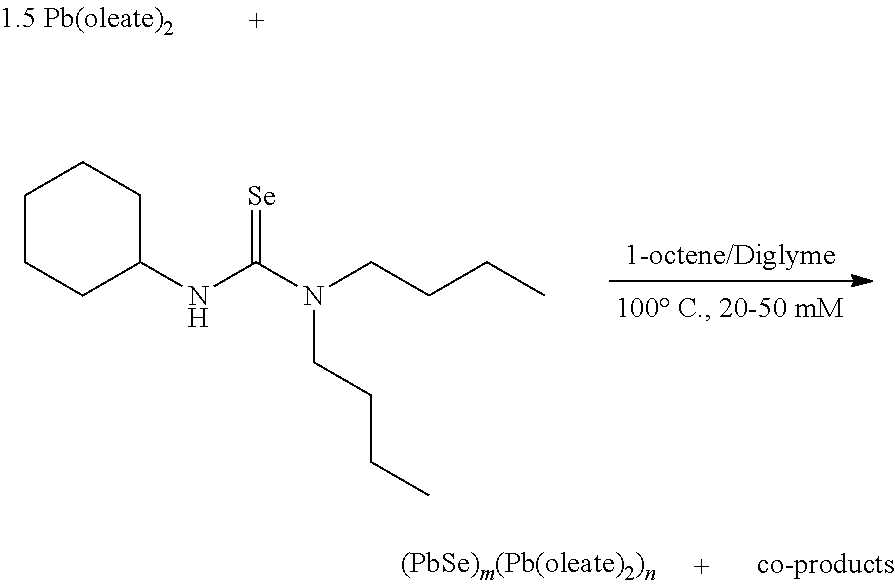
The resulting UV-Vis-NIR spectra are shown in

UV-Vis-NIR spectra of aliquots removed from the PbSe nanocrystal synthesis reaction shown above at several times are shown in

The kinetics traces showing these incubation time of various N-p-X-phenyl-N′-n-dodecylthioureas reacting with lead oleate under standard kinetics conditions are shown in

The results are shown in

aliquots were removed from PbS nanocrystal synthesis reactions conducted at 80° C., 70° C., and 60° C. The resulting spectra are shown in
Claims (42)


Priority Applications (1)
| Application Number | Priority Date | Filing Date | Title |
|---|---|---|---|
| US15/541,937 US10767112B2 (en) | 2015-01-15 | 2016-01-15 | Methods of producing metal sulfides, metal selenides, and metal sulfides/selenides having controlled architectures using kinetic control |
Applications Claiming Priority (5)
| Application Number | Priority Date | Filing Date | Title |
|---|---|---|---|
| US201562104041P | 2015-01-15 | 2015-01-15 | |
| US201562174491P | 2015-06-11 | 2015-06-11 | |
| US201562185088P | 2015-06-26 | 2015-06-26 | |
| PCT/US2016/013518 WO2016115416A1 (en) | 2015-01-15 | 2016-01-15 | Methods of producing metal suflides, metal selenides, and metal sulfides/selenides having controlled architectures using kinetic control |
| US15/541,937 US10767112B2 (en) | 2015-01-15 | 2016-01-15 | Methods of producing metal sulfides, metal selenides, and metal sulfides/selenides having controlled architectures using kinetic control |
Publications (2)
| Publication Number | Publication Date |
|---|---|
| US20170369779A1 US20170369779A1 (en) | 2017-12-28 |
| US10767112B2 true US10767112B2 (en) | 2020-09-08 |
Family
ID=56406424
Family Applications (1)
| Application Number | Title | Priority Date | Filing Date |
|---|---|---|---|
| US15/541,937 Active 2037-02-02 US10767112B2 (en) | 2015-01-15 | 2016-01-15 | Methods of producing metal sulfides, metal selenides, and metal sulfides/selenides having controlled architectures using kinetic control |
Country Status (2)
| Country | Link |
|---|---|
| US (1) | US10767112B2 (en) |
| WO (1) | WO2016115416A1 (en) |
Families Citing this family (14)
| Publication number | Priority date | Publication date | Assignee | Title |
|---|---|---|---|---|
| WO2016115416A1 (en) | 2015-01-15 | 2016-07-21 | The Trustees Of Columbia University In The City Of New York | Methods of producing metal suflides, metal selenides, and metal sulfides/selenides having controlled architectures using kinetic control |
| WO2018041335A1 (en) * | 2016-08-30 | 2018-03-08 | Toyota Motor Europe | Three-dimensional assembled active material from two-dimensional semiconductor flakes for optoelectronic devices |
| US11352556B2 (en) * | 2016-10-28 | 2022-06-07 | Council Of Scientific & Industrial Research | Process for the synthesis of air stable metal sulphide quantum dots |
| CN106860865B (en) * | 2017-02-24 | 2019-11-15 | 合肥工业大学 | A kind of Ni0.85Se nanometer material and its preparation method and application |
| GB201904069D0 (en) * | 2019-03-25 | 2019-05-08 | Quantum Science Ltd | Nanocrystals |
| CA3134613A1 (en) | 2019-04-02 | 2020-10-08 | Aligos Therapeutics, Inc. | Compounds targeting prmt5 |
| WO2021097217A1 (en) | 2019-11-14 | 2021-05-20 | The Board Of Trustees Of The University Of Illinois | Precursor chemistry for quantum dot synthesis enabling temperature-independent modulation of reactivity |
| US12497289B2 (en) * | 2020-07-13 | 2025-12-16 | Sharp Kabushiki Kaisha | Quantum dot, self-luminous device, and method for manufacturing quantum dot |
| CN112811460B (en) * | 2021-02-03 | 2022-03-22 | 中南大学 | Preparation method of zinc sulfide-cuprous sulfide nano heterostructure material |
| CN113247973B (en) * | 2021-06-28 | 2023-04-18 | 河南工程学院 | Preparation method of sulfur group magnetic compound of transition metal Cr intercalation |
| CN113683059B (en) * | 2021-07-28 | 2023-02-21 | 青岛中科赛锂达新能源技术合伙企业(有限合伙) | A kind of preparation method of lithium sulfide material |
| CN116925740A (en) * | 2022-04-01 | 2023-10-24 | Tcl科技集团股份有限公司 | A kind of quantum dot and its preparation method and optoelectronic device |
| WO2024171842A1 (en) * | 2023-02-16 | 2024-08-22 | 富士フイルム株式会社 | PbS QUANTUM DOT LIQUID DISPERSION, METHOD FOR PRODUCING SEMICONDUCTOR FILM, METHOD FOR PRODUCING LIGHT DETECTION ELEMENT, METHOD FOR PRODUCING IMAGE SENSOR, AND METHOD FOR PRODUCING PbS QUANTUM DOT LIQUID DISPERSION |
| GB2643220A (en) * | 2024-08-06 | 2026-02-11 | Zaharieva Zhanet | Quantum dots |
Citations (13)
| Publication number | Priority date | Publication date | Assignee | Title |
|---|---|---|---|---|
| US20050036938A1 (en) | 2003-08-13 | 2005-02-17 | Taegwhan Hyeon | Method for synthesizing nanoparticles of metal sulfides |
| CN1645559A (en) * | 2004-12-03 | 2005-07-27 | 中国科学院长春应用化学研究所 | Method for synthesizing cadmium selenide and quantum point with cadmium selenide cadmium sulfide nucleocapsid structure |
| US20050254528A1 (en) | 2002-11-26 | 2005-11-17 | Slop Electro-Optics Industries Ltd. And Technion Research And Development Foundation Ltd. | Passive Q-switch laser |
| CN101402468A (en) | 2008-10-28 | 2009-04-08 | 杭州电子科技大学 | Method for producing monodisperse pulmbous sulfide nanospheres |
| US20090289233A1 (en) * | 2008-05-20 | 2009-11-26 | Samsung Electronics Co., Ltd. | Method for preparing nanoparticles using carbene derivatives |
| WO2010118279A1 (en) | 2009-04-10 | 2010-10-14 | William Marsh Rice University | Semiconducting nanocrystals comprising a metal sulfide shell and methods for their preparation |
| US20110001096A1 (en) | 2007-11-08 | 2011-01-06 | Taleb Mokari | SYNTHESIS OF Pb ALLOY AND CORE/SHELL NANOWIRES |
| US8470636B2 (en) * | 2009-11-25 | 2013-06-25 | E I Du Pont De Nemours And Company | Aqueous process for producing crystalline copper chalcogenide nanoparticles, the nanoparticles so-produced, and inks and coated substrates incorporating the nanoparticles |
| WO2013091114A1 (en) * | 2011-12-22 | 2013-06-27 | The University Of Western Ontario | Copper-containing nanocrystals and methods of preparation therefor |
| EP2669409A1 (en) * | 2012-05-29 | 2013-12-04 | King Saud University | Method for preparing highly crystalline Pb chalcogenide nanoparticles, nanoparticles prepared thereby and use thereof |
| US20140110640A1 (en) * | 2011-06-06 | 2014-04-24 | Kochi University | Method of producing sulfide compound semiconductor by use of solvothermal method and rod-like crystal of sulfide compound semiconductor |
| WO2015048460A1 (en) | 2013-09-27 | 2015-04-02 | The Trustees Of Columbia University In The City Of New York | Use of sulfur and selenium compounds as precursors to nanostructured materials |
| WO2016115416A1 (en) | 2015-01-15 | 2016-07-21 | The Trustees Of Columbia University In The City Of New York | Methods of producing metal suflides, metal selenides, and metal sulfides/selenides having controlled architectures using kinetic control |
-
2016
- 2016-01-15 WO PCT/US2016/013518 patent/WO2016115416A1/en not_active Ceased
- 2016-01-15 US US15/541,937 patent/US10767112B2/en active Active
Patent Citations (14)
| Publication number | Priority date | Publication date | Assignee | Title |
|---|---|---|---|---|
| US20050254528A1 (en) | 2002-11-26 | 2005-11-17 | Slop Electro-Optics Industries Ltd. And Technion Research And Development Foundation Ltd. | Passive Q-switch laser |
| US20050036938A1 (en) | 2003-08-13 | 2005-02-17 | Taegwhan Hyeon | Method for synthesizing nanoparticles of metal sulfides |
| CN1645559A (en) * | 2004-12-03 | 2005-07-27 | 中国科学院长春应用化学研究所 | Method for synthesizing cadmium selenide and quantum point with cadmium selenide cadmium sulfide nucleocapsid structure |
| US20110001096A1 (en) | 2007-11-08 | 2011-01-06 | Taleb Mokari | SYNTHESIS OF Pb ALLOY AND CORE/SHELL NANOWIRES |
| US20090289233A1 (en) * | 2008-05-20 | 2009-11-26 | Samsung Electronics Co., Ltd. | Method for preparing nanoparticles using carbene derivatives |
| CN101402468A (en) | 2008-10-28 | 2009-04-08 | 杭州电子科技大学 | Method for producing monodisperse pulmbous sulfide nanospheres |
| WO2010118279A1 (en) | 2009-04-10 | 2010-10-14 | William Marsh Rice University | Semiconducting nanocrystals comprising a metal sulfide shell and methods for their preparation |
| US8470636B2 (en) * | 2009-11-25 | 2013-06-25 | E I Du Pont De Nemours And Company | Aqueous process for producing crystalline copper chalcogenide nanoparticles, the nanoparticles so-produced, and inks and coated substrates incorporating the nanoparticles |
| US20140110640A1 (en) * | 2011-06-06 | 2014-04-24 | Kochi University | Method of producing sulfide compound semiconductor by use of solvothermal method and rod-like crystal of sulfide compound semiconductor |
| WO2013091114A1 (en) * | 2011-12-22 | 2013-06-27 | The University Of Western Ontario | Copper-containing nanocrystals and methods of preparation therefor |
| EP2669409A1 (en) * | 2012-05-29 | 2013-12-04 | King Saud University | Method for preparing highly crystalline Pb chalcogenide nanoparticles, nanoparticles prepared thereby and use thereof |
| WO2015048460A1 (en) | 2013-09-27 | 2015-04-02 | The Trustees Of Columbia University In The City Of New York | Use of sulfur and selenium compounds as precursors to nanostructured materials |
| US10253256B2 (en) * | 2013-09-27 | 2019-04-09 | The Trustees Of Columbia University In The City Of New York | Use of sulfur and selenium compounds as precursors to nanostructured materials |
| WO2016115416A1 (en) | 2015-01-15 | 2016-07-21 | The Trustees Of Columbia University In The City Of New York | Methods of producing metal suflides, metal selenides, and metal sulfides/selenides having controlled architectures using kinetic control |
Non-Patent Citations (6)
| Title |
|---|
| Ajibade, "Synthesis and Use of [Cd(Detu)2(OOCCH3)2]-H2O as Single Molecule Precursor for Cds Nanoparticles", The Scientific World Journal, 2013, vol. 2013, 1-6. |
| Hendricks et al., "A tunable library of substituted thiourea precursors to metal sulfide nanocrystals", Science, Jun. 12, 2015, vol. 348, 1226-1230. |
| Pradhan et al., "Synthesis of High-Quality Metal Sulfide Nanoparticles from Alkyl Xanthate Single Precursors in Alkylamine Solvents", J. Phys. Chem B, Nov. 20, 2003, vol. 107, 13843-13854. |
| Translation for CN 101402468, Aug. 4, 2009. labeled as "Description CN1317737". * |
| Translation of CN 1645559, Jul. 27, 2005. * |
| Yong et al., "Control of the Morphology and Size of PbS Nanowires Using Gold Nanoparticles", Chemistry of Materials, Nov. 16, 2006, vol. 18, 5965-5972. |
Also Published As
| Publication number | Publication date |
|---|---|
| US20170369779A1 (en) | 2017-12-28 |
| WO2016115416A1 (en) | 2016-07-21 |
Similar Documents
| Publication | Publication Date | Title |
|---|---|---|
| US20170369779A1 (en) | Methods of producing metal sulfides, metal selenides, and metal sulfides/selenides having controlled architectures using kinetic control | |
| CN107338048B (en) | InP/GaP/ZnS core-shell quantum dot and preparation method thereof | |
| Pu et al. | Highly reactive, flexible yet green Se precursor for metal selenide nanocrystals: Se-octadecene suspension (Se-SUS) | |
| Bennett et al. | Size dependent optical properties and structure of ZnS nanocrystals prepared from a library of thioureas | |
| TWI619856B (en) | Continuous Synthesis of InP/ZnS Nanocrystals with High Quantum Yield | |
| US10253256B2 (en) | Use of sulfur and selenium compounds as precursors to nanostructured materials | |
| JP5136877B2 (en) | Phosphor and method for producing the same | |
| US20080138514A1 (en) | Preparation method of multi-shell nanocrystals | |
| US20060019427A1 (en) | One-pot synthesis of high-quality metal chalcogenide nanocrystals without precursor injection | |
| Kaur et al. | Size tuning of MAA capped CdSe and CdSe/CdS quantum dots and their stability in different pH environments | |
| CN110951477B (en) | Core-shell quantum dot and preparation method thereof | |
| US20100090164A1 (en) | Indium arsenide nanocrystals and methods of making the same | |
| CN106833610B (en) | Core-shell structure quantum dot and preparation method thereof | |
| JPWO2019160093A1 (en) | Core-shell semiconductor nanoparticles, their manufacturing methods and light emitting devices | |
| US8137457B2 (en) | One-pot synthesis of high-quality metal chalcogenide nanocrystals without precursor injection | |
| US7476599B2 (en) | Two-phase thermal method for preparation of cadmium sulfide quantum dots | |
| EP2387544B1 (en) | Low-temperature synthesis of colloidal nanocrystals | |
| WO2012168192A2 (en) | Synthesis of highly fluorescing semiconducting core-shell nanoparticles based on ib, iib, iiia, via elements of the periodic classification. | |
| Bahmani Jalali et al. | Colloidal aluminum antimonide quantum dots | |
| CN101457403B (en) | Green synthetic method of controllable dimension semi-conductor nano cluster and nanocrystalline | |
| US9714379B2 (en) | Highly luminescent semiconductor nanocrystals | |
| JP5717232B2 (en) | Method for producing nanocrystals | |
| CN114958377B (en) | Alloy nanocrystal groups, core-shell nanocrystal groups and their applications and synthesis methods | |
| US20240309271A1 (en) | Population of alloy nanocrystals, population of core-shell nanocrystals, and use thereof and synthesis method therefor | |
| Hendricks | The Synthesis of Colloidal Metal Sulfide Nanocrystals: A Study of Precursor Reactivity and Kinetics |
Legal Events
| Date | Code | Title | Description |
|---|---|---|---|
| AS | Assignment |
Owner name: THE TRUSTEES OF COLUMBIA UNIVERSITY IN THE CITY OF NEW YORK, NEW YORK Free format text: ASSIGNMENT OF ASSIGNORS INTEREST;ASSIGNORS:OWEN, JONATHAN S.;HENDRICKS, MARK P.;CAMPOS, MICHAEL P.;SIGNING DATES FROM 20160112 TO 20160114;REEL/FRAME:042924/0546 Owner name: THE TRUSTEES OF COLUMBIA UNIVERSITY IN THE CITY OF NEW YORK, NEW YORK Free format text: ASSIGNMENT OF ASSIGNORS INTEREST;ASSIGNORS:OWEN, JONATHAN S.;HENDRICKS, MARK P.;CAMPOS, MICHAEL P.;SIGNING DATES FROM 20160112 TO 20160114;REEL/FRAME:042924/0486 Owner name: THE TRUSTEES OF COLUMBIA UNIVERSITY IN THE CITY OF NEW YORK, NEW YORK Free format text: ASSIGNMENT OF ASSIGNORS INTEREST;ASSIGNORS:CLEVELAND, GREGORY T.;PLANTE, ILAN JEN-LA;OWEN, JONATHAN S.;AND OTHERS;SIGNING DATES FROM 20160112 TO 20160114;REEL/FRAME:042924/0438 Owner name: THE TRUSTEES OF COLUMBIA UNIVERSITY IN THE CITY OF Free format text: ASSIGNMENT OF ASSIGNORS INTEREST;ASSIGNORS:OWEN, JONATHAN S.;HENDRICKS, MARK P.;CAMPOS, MICHAEL P.;SIGNING DATES FROM 20160112 TO 20160114;REEL/FRAME:042924/0546 Owner name: THE TRUSTEES OF COLUMBIA UNIVERSITY IN THE CITY OF Free format text: ASSIGNMENT OF ASSIGNORS INTEREST;ASSIGNORS:OWEN, JONATHAN S.;HENDRICKS, MARK P.;CAMPOS, MICHAEL P.;SIGNING DATES FROM 20160112 TO 20160114;REEL/FRAME:042924/0486 Owner name: THE TRUSTEES OF COLUMBIA UNIVERSITY IN THE CITY OF Free format text: ASSIGNMENT OF ASSIGNORS INTEREST;ASSIGNORS:CLEVELAND, GREGORY T.;PLANTE, ILAN JEN-LA;OWEN, JONATHAN S.;AND OTHERS;SIGNING DATES FROM 20160112 TO 20160114;REEL/FRAME:042924/0438 |
|
| FEPP | Fee payment procedure |
Free format text: ENTITY STATUS SET TO SMALL (ORIGINAL EVENT CODE: SMAL); ENTITY STATUS OF PATENT OWNER: SMALL ENTITY |
|
| AS | Assignment |
Owner name: NATIONAL SCIENCE FOUNDATION, VIRGINIA Free format text: CONFIRMATORY LICENSE;ASSIGNOR:COLUMBIA UNIVERSITY;REEL/FRAME:044005/0226 Effective date: 20170815 |
|
| AS | Assignment |
Owner name: THE TRUSTEES OF COLUMBIA UNIVERSITY IN THE CITY OF NEW YORK, NEW YORK Free format text: ASSIGNMENT OF ASSIGNORS INTEREST;ASSIGNOR:HAMACHI, LESLIE SACHIYO;REEL/FRAME:044030/0228 Effective date: 20171011 Owner name: THE TRUSTEES OF COLUMBIA UNIVERSITY IN THE CITY OF Free format text: ASSIGNMENT OF ASSIGNORS INTEREST;ASSIGNOR:HAMACHI, LESLIE SACHIYO;REEL/FRAME:044030/0228 Effective date: 20171011 |
|
| STPP | Information on status: patent application and granting procedure in general |
Free format text: DOCKETED NEW CASE - READY FOR EXAMINATION |
|
| STPP | Information on status: patent application and granting procedure in general |
Free format text: NON FINAL ACTION MAILED |
|
| STPP | Information on status: patent application and granting procedure in general |
Free format text: FINAL REJECTION MAILED |
|
| STPP | Information on status: patent application and granting procedure in general |
Free format text: DOCKETED NEW CASE - READY FOR EXAMINATION |
|
| STPP | Information on status: patent application and granting procedure in general |
Free format text: NOTICE OF ALLOWANCE MAILED -- APPLICATION RECEIVED IN OFFICE OF PUBLICATIONS |
|
| STPP | Information on status: patent application and granting procedure in general |
Free format text: PUBLICATIONS -- ISSUE FEE PAYMENT RECEIVED |
|
| STCF | Information on status: patent grant |
Free format text: PATENTED CASE |
|
| MAFP | Maintenance fee payment |
Free format text: PAYMENT OF MAINTENANCE FEE, 4TH YR, SMALL ENTITY (ORIGINAL EVENT CODE: M2551); ENTITY STATUS OF PATENT OWNER: SMALL ENTITY Year of fee payment: 4 |