US10766893B2 - 1H-pyrazolo[4,3-b]pyridines as PDE1 inhibitors - Google Patents

1H-pyrazolo[4,3-b]pyridines as PDE1 inhibitors Download PDF

Info

Publication number
US10766893B2
US10766893B2 US16/218,019 US201816218019A US10766893B2 US 10766893 B2 US10766893 B2 US 10766893B2 US 201816218019 A US201816218019 A US 201816218019A US 10766893 B2 US10766893 B2 US 10766893B2
Authority
US
United States
Prior art keywords
methyl
pyrazolo
pyridin
amine
isopropyl
Prior art date
Legal status (The legal status is an assumption and is not a legal conclusion. Google has not performed a legal analysis and makes no representation as to the accuracy of the status listed.)
Expired - Fee Related
Application number
US16/218,019
Other versions
US20190194189A1 (en
Inventor
Karsten Juhl
Mikkel Jessing
Morten Langgård
Paulo Jorge Vieira Vital
Jan Kehler
Lars Kyhn Rasmussen
Carl Martin Sebastian Clementson
Mauro Marigo
Current Assignee (The listed assignees may be inaccurate. Google has not performed a legal analysis and makes no representation or warranty as to the accuracy of the list.)
H Lundbeck AS
Original Assignee
H Lundbeck AS
Priority date (The priority date is an assumption and is not a legal conclusion. Google has not performed a legal analysis and makes no representation as to the accuracy of the date listed.)
Filing date
Publication date
Application filed by H Lundbeck AS filed Critical H Lundbeck AS
Assigned to H. LUNDBECK A/S reassignment H. LUNDBECK A/S ASSIGNMENT OF ASSIGNORS INTEREST (SEE DOCUMENT FOR DETAILS). Assignors: KEHLER, JAN, JUHL, KARSTEN, LANGGÅRD, Morten, MARIGO, MAURO, RASMUSSEN, LARS KYHN, CLEMENTSON, CARL MARTIN SEBASTIAN, JESSING, Mikkel, VIEIRA VITAL, PAULO JORGE
Publication of US20190194189A1 publication Critical patent/US20190194189A1/en
Application granted granted Critical
Publication of US10766893B2 publication Critical patent/US10766893B2/en
Expired - Fee Related legal-status Critical Current
Anticipated expiration legal-status Critical

Links

Classifications

    • CCHEMISTRY; METALLURGY
    • C07ORGANIC CHEMISTRY
    • C07DHETEROCYCLIC COMPOUNDS
    • C07D471/00Heterocyclic compounds containing nitrogen atoms as the only ring hetero atoms in the condensed system, at least one ring being a six-membered ring with one nitrogen atom, not provided for by groups C07D451/00 - C07D463/00
    • C07D471/02Heterocyclic compounds containing nitrogen atoms as the only ring hetero atoms in the condensed system, at least one ring being a six-membered ring with one nitrogen atom, not provided for by groups C07D451/00 - C07D463/00 in which the condensed system contains two hetero rings
    • C07D471/04Ortho-condensed systems
    • AHUMAN NECESSITIES
    • A61MEDICAL OR VETERINARY SCIENCE; HYGIENE
    • A61PSPECIFIC THERAPEUTIC ACTIVITY OF CHEMICAL COMPOUNDS OR MEDICINAL PREPARATIONS
    • A61P25/00Drugs for disorders of the nervous system
    • A61P25/18Antipsychotics, i.e. neuroleptics; Drugs for mania or schizophrenia
    • AHUMAN NECESSITIES
    • A61MEDICAL OR VETERINARY SCIENCE; HYGIENE
    • A61PSPECIFIC THERAPEUTIC ACTIVITY OF CHEMICAL COMPOUNDS OR MEDICINAL PREPARATIONS
    • A61P25/00Drugs for disorders of the nervous system
    • A61P25/22Anxiolytics
    • AHUMAN NECESSITIES
    • A61MEDICAL OR VETERINARY SCIENCE; HYGIENE
    • A61PSPECIFIC THERAPEUTIC ACTIVITY OF CHEMICAL COMPOUNDS OR MEDICINAL PREPARATIONS
    • A61P25/00Drugs for disorders of the nervous system
    • A61P25/24Antidepressants
    • AHUMAN NECESSITIES
    • A61MEDICAL OR VETERINARY SCIENCE; HYGIENE
    • A61PSPECIFIC THERAPEUTIC ACTIVITY OF CHEMICAL COMPOUNDS OR MEDICINAL PREPARATIONS
    • A61P25/00Drugs for disorders of the nervous system
    • A61P25/28Drugs for disorders of the nervous system for treating neurodegenerative disorders of the central nervous system, e.g. nootropic agents, cognition enhancers, drugs for treating Alzheimer's disease or other forms of dementia
    • CCHEMISTRY; METALLURGY
    • C07ORGANIC CHEMISTRY
    • C07DHETEROCYCLIC COMPOUNDS
    • C07D519/00Heterocyclic compounds containing more than one system of two or more relevant hetero rings condensed among themselves or condensed with a common carbocyclic ring system not provided for in groups C07D453/00 or C07D455/00

Definitions

  • the present invention provides compounds that are PDE1 enzyme inhibitors and their use as a medicament, in particular for the treatment of neurodegenerative disorders and psychiatric disorders.
  • the present invention also provides pharmaceutical compositions comprising compounds of the invention and methods of treating disorders using the compounds of the invention.
  • cyclic Nucleotides cyclic adenosine monophosphate (cAMP) and cyclic guanosine monophosphate (cGMP) play a major role in intracellular signal transduction cascade, by regulating cN-dependent protein kinases (PKA and PKG), EPACs (Exchange Protein Activated by cAMP), phosphoprotein phosphatases, and/or cN-gated cation channels.
  • PKA and PKG cN-dependent protein kinases
  • EPACs Exchange Protein Activated by cAMP
  • phosphoprotein phosphatases and/or cN-gated cation channels.
  • Intracellular concentrations of cAMP and cGMP are strictly regulated by the rate of biosynthesis by cyclases and by the rate of degradation by phosphodiesterases (PDEs, EC 3.1.4.17).
  • PDEs are bimetallic hydrolases that inactivate cAMP/cGMP by catalytic hydrolysis of the 3′-ester bond, forming the inactive 5′-monophosphate. Since PDEs provide the only means of degrading the cyclic nucleotides cAMP and cGMP in cells, PDEs play an essential role in cyclic nucleotide signalling.
  • PDEs The catalytic activities of PDEs provide for breakdown of cNs over a spectrum of cN-concentrations in all cells, and their varied regulatory mechanisms provide for integration and crosstalk with myriads of signalling pathways.
  • Particular PDEs are targeted to discrete compartments within cells where they control cN level and sculpt microenvironments for a variety of cN signalosomes (Sharron H. Francis, Mitsi A. Blount, and Jackie D. Corbin. Physiol Rev 2011, 91: 651-690).
  • the PDE families can be divided into three groups: 1) The cAMP-specific PDEs, which include PDE4, PDE7, and PDE8, 2) the cGMP-selective enzymes PDE5 and PDE9, and 3) the dual-substrate PDEs, PDE1, PDE2, PDE3, as well as PDE10 and PDE11.
  • the cAMP-specific PDEs which include PDE4, PDE7, and PDE8, 2) the cGMP-selective enzymes PDE5 and PDE9, and 3) the dual-substrate PDEs, PDE1, PDE2, PDE3, as well as PDE10 and PDE11.
  • calmodulin-stimulated PDE (CaM-PDE)
  • CaM Ca 2+ -dependently regulated via calmodulin (CaM, a 16 kDa Ca 2+ -binding protein) complexed with four Ca 2+
  • CaM Ca 2+ -dependently regulated via calmodulin
  • PDE1 represents an interesting regulatory link between cyclic nucleotides and intracellular Ca 2+ .
  • the PDE1 family is encoded by three genes: PDE1A (mapped on human chromosome 2q32), PDE1B (human chromosome location, hcl: 12q13) and PDE1C (hcl: 7p14.3). They have alternative promoters and give rise to a multitude of proteins by alternative splicing which differ in their regulatory properties, substrate affinities, specific activities, activation constants for CaM, tissue distribution and molecular weights. More than 10 human isoforms are identified. Their molecular weights vary from 58 to 86 kDa per monomer.
  • the N-terminal regulatory domain contains two Ca 2+ /CaM binding domains and two phosphorylation sites and different splice variants have different variations of the N-terminal domain, which can give proteins with different amino acid sequence with different biochemical functions.
  • PDE1 is a dual substrate PDE and the PDE1C-subtype has equal activity towards cAMP and cGMP (Km ⁇ 1-3 ⁇ M), whereas the subtypes PDE1A and PDE1B have a preference for cGMP (Km for cGMP ⁇ 1-3 ⁇ M and for cAMP ⁇ 10-30 ⁇ M).
  • the PDE1 subtypes are highly enriched in the brain and located especially in the striatum (PDE1B), hippocampus (PDE1A) and cortex (PDE1A) and this localization is conserved across species (Amy Bernard et al. Neuron 2012, 73, 1083-1099).
  • PDE1A is present mainly in deep cortical layers 5 and 6 (output layers), and used as a specificity marker for the deep cortical layers.
  • PDE1 inhibitors enhance the levels of the second messenger cNs leading to enhanced neuronal excitability.
  • PDE1 is a therapeutic target for regulation of intracellular signalling pathways, preferably in the nervous system and PDE1 inhibitors can enhance the levels of the second messenger's cAMP/cGMP leading to modulation of neuronal processes and to the expression of neuronal plasticity-related genes, neurotrophic factors, and neuroprotective molecules. These neuronal plasticity enhancement properties together with the modulation of synaptic transmission make PDE1 inhibitors good candidates as therapeutic agents in many neurological and psychiatric conditions.
  • the evaluation of PDE1 inhibitors in animal models see e.g. Blokland et al. Expert Opinion on Therapeutic Patents (2012), 22(4), 349-354; and Medina, A. E.
  • PDE1 inhibitors have suggested the potential for the therapeutic use of PDE1 inhibitors in neurological disorders, like e.g. Alzheimer's, Parkinson's and Huntington's Diseases and in psychiatric disorders like e.g. Attention Deficit Hyperactivity Disorder (ADHD), depression, anxiety, narcolepsy, cognitive impairment and cognitive impairment associated with schizophrenia (CIAS) and in restless leg syndrome.
  • ADHD Attention Deficit Hyperactivity Disorder
  • CNS cognitive impairment and cognitive impairment associated with schizophrenia
  • PDE1 inhibitors are useful in diseases that may be alleviated by the enhancement of progesterone-signalling such as female sexual dysfunction (e.g. WO 2008/070095).
  • PDE1 inhibitors may be a good alternative.
  • the present invention discloses new compounds with PDE1 inhibitor activity and good physicochemical properties as alternatives to known PDE1 inhibitors.
  • PDE1 enzymes are expressed in the Central Nervous System (CNS), making this gene family an attractive source of new targets for the treatment of psychiatric and neurodegenerative disorders.
  • CNS Central Nervous System
  • the present invention relates to a compound according to formula (I)
  • L is selected from the group consisting of NH, CH 2 , S and O;
  • R1 is selected from the group consisting of hydrogen, linear or branched C 1-5 alkyl, C 1-5 fluoroalkyl and saturated monocyclic C 3-5 cycloalkyl;
  • R2 is selected from the group consisting of linear or branched C 1-8 alkyl, saturated monocyclic C 3-8 cycloalkyl, oxetanyl, tetrahydrofuranyl, and tetrahydropyranyl; all of which can be optionally substituted one or more times with one or more substituents selected from the group consisting of methyl, fluorine, hydroxy, cyano and methoxy; the combination of R3 and R4 are selected from a) and b):
  • Reference to compounds encompassed by the present invention includes the free base and pharmaceutically acceptable salts of the compounds, such as acid addition salts of the compounds, racemic mixtures of the compounds, or the corresponding enantiomer and/or optical isomer of the compounds for which this is relevant, and polymorphic and amorphic forms of compounds of the present invention and of pharmaceutically acceptable salts of said compounds, as well as tautomeric forms the compounds for which this is relevant.
  • the compounds of the present invention and pharmaceutically acceptable salts thereof may potentially exist in unsolvated as well as in solvated forms with pharmaceutically acceptable solvents such as water, ethanol and the like. Both solvated and unsolvated forms of the compounds and pharmaceutically acceptable salts thereof are encompassed by the present invention.
  • the invention relates to a compound according to formula (I) or a pharmaceutically acceptable salt thereof for use in therapy.
  • the invention relates to a compound according to formula (I) or a pharmaceutically acceptable salt thereof, for use in the treatment of a neurodegenerative disorder, selected from the group consisting of Alzheimer's Disease, Parkinson's Disease and Huntington's Disease or for use in the treatment of a psychiatric disorder such as Attention Deficit Hyperactivity Disorder (ADHD), depression, anxiety, narcolepsy, cognitive impairment and cognitive impairment associated with schizophrenia (CIAS), or another brain disease like restless leg syndrome.
  • a neurodegenerative disorder selected from the group consisting of Alzheimer's Disease, Parkinson's Disease and Huntington's Disease or for use in the treatment of a psychiatric disorder such as Attention Deficit Hyperactivity Disorder (ADHD), depression, anxiety, narcolepsy, cognitive impairment and cognitive impairment associated with schizophrenia (CIAS), or another brain disease like restless leg syndrome.
  • the invention relates to a pharmaceutical composition
  • a pharmaceutical composition comprising a compound according formula (I) or a pharmaceutically acceptable salt thereof, and one or more pharmaceutically acceptable carrier and/or excipient.
  • the invention relates to a method for the treatment of a neurodegenerative disorder, selected from the group consisting of Alzheimer's Disease, Parkinson's Disease and Huntington's Disease or for the treatment of a psychiatric disorder such as Attention Deficit Hyperactivity Disorder (ADHD), depression, anxiety, narcolepsy, cognitive impairment and cognitive impairment associated with schizophrenia (CIAS), or another brain disease like restless leg syndrome, which method comprises the administration of a therapeutically effective amount of a compound according to formula (I) or a pharmaceutically acceptable salt thereof, to a patient in need thereof.
  • a neurodegenerative disorder selected from the group consisting of Alzheimer's Disease, Parkinson's Disease and Huntington's Disease or for the treatment of a psychiatric disorder such as Attention Deficit Hyperactivity Disorder (ADHD), depression, anxiety, narcolepsy, cognitive impairment and cognitive impairment associated with schizophrenia (CIAS), or another brain disease like restless leg syndrome
  • ADHD Attention Deficit Hyperactivity Disorder
  • depression depression
  • anxiety, narcolepsy cognitive impairment
  • the invention relates to the use of a compound according to formula (I) or a pharmaceutically acceptable salt thereof, in the manufacture of a medicament for the treatment of a neurodegenerative disorder, selected from the group consisting of Alzheimer's Disease, Parkinson's Disease and Huntington's Disease or for the treatment of a psychiatric disorder such as Attention Deficit Hyperactivity Disorder (ADHD), depression, anxiety, narcolepsy, cognitive impairment and cognitive impairment associated with schizophrenia (CIAS), or another brain disease like restless leg syndrome.
  • ADHD Attention Deficit Hyperactivity Disorder
  • depression depression
  • anxiety narcolepsy
  • cognitive impairment and cognitive impairment associated with schizophrenia or another brain disease like restless leg syndrome.
  • the PDE1 isozyme family includes numerous splice variant PDE1 isoforms. It has three subtypes, PDE1A, PDE1B and PDE1C which divide further into various isoforms.
  • PDE1 and PDE1 enzymes are synonymous and refer to PDE1A, PDE1B and PDE1C enzymes as well as their isoforms unless otherwise specified.
  • a compound is considered to be a PDE1 inhibitor if the amount required to reach the IC 50 level of one or more of the three PDE1 isoforms is 10 micro molar or less, preferably less than 9 micro molar, such as 8 micro molar or less, such as 7 micro molar or less, such as 6 micro molar or less, such as 5 micro molar or less, such as 4 micro molar or less, such as 3 micro molar or less, more preferably 2 micro molar or less, such as 1 micro molar or less, in particular 500 nM or less.
  • Preferred compounds of the invention exhibit selectivity towards the PDE1B isoform meaning that said compounds are stronger as PDE1B inhibitors than as PDE1A and/or PDE1C inhibitors.
  • said compounds are at least two-fold stronger, five-fold stronger or ten-fold stronger as PDE1B inhibitors than as PDE1A and/or PDE1C inhibitors.
  • said compounds are at least fifteen-fold stronger or twenty-fold stronger as PDE1B inhibitors than as PDE1A and/or PDE1C inhibitors.
  • the required amount of PDE1 inhibitor required to reach the IC 50 level of PDE1B is 400 nM or less, such as 300 nM or less, 200 nM or less, 100 nM or less, or even 80 nM or less, such as 50 nM or less, for example 25 nM or less.
  • Selectivity towards the PDE1B isoform may prevent potentially unwanted effects associated with PDE1A and/or PDE1C inhibition. For example, potentially unwanted peripheral effects.
  • optionally substituted means that the indicated moiety may or may not be substituted, and when substituted is mono-, di-, or tri-substituted. It is understood that where no substituents are indicated for an “optionally substituted” moiety, then the position is held by a hydrogen atom.
  • halo and halogen are used interchangeably and refer to fluorine, chlorine, bromine or iodine. In a preferable embodiment, “halogen” refers to fluorine.
  • a given range may interchangeably be indicated with “-” (dash) or “to”, e.g. the term “C 1-3 alkyl” is equivalent to “C 1 to C 3 alkyl”.
  • C 1-3 alkyl refers to a linear (i.e. unbranched) or branched saturated hydrocarbon having from one up to eight carbon atoms, inclusive.
  • Examples of such groups include, but are not limited to, methyl, ethyl, 1-propyl, 2-propyl, 1-butyl, 2-butyl, 2-methyl-2-propyl, 2-methyl-1-butyl, n-hexyl, n-heptyl and n-octyl.
  • C 1-3 fluoroalkyl refers to a C 1-3 alkyl substituted with one or more fluorine.
  • saturated monocyclic C 3-8 cycloalkyl refers to cyclopropyl, cyclobutyl, cyclopentyl, cyclohexyl, cycloheptyl and cyclooctyl.
  • 5-membered heteroaryl refers to a 5 membered aromatic monocyclic ring containing 1 to 4 carbon atoms and one or more heteroatoms selected from oxygen, nitrogen and sulfur. Examples include, but are not limited to thiazolyl, oxazolyl, isoxazolyl, triazolyl, pyrazolyl, tetrazolyl, imidazolyl, oxadiazolyl and thiadiazolyl and thiophenyl.
  • 9-membered bicyclic heteroaryl refers to a moiety consisting of a 6-membered aromatic ring and a 5-membered aromatic ring fused together to give a 9-membered bicyclic aromatic moeity.
  • the 9-membered bicyclic heteroaryl consists of carbon and one or more heteroatoms selected from oxygen, nitrogen and sulfur. Particular mention is made of benzoxazolyl, imidazo[1,5-a]pyridine,imidazo[1,2-a]pyridine, indazolyl, and indolyl.
  • C 1-3 alkoxy refers to a moiety of the formula —OR′, wherein R′ indicates C 1 -C 3 alkyl as defined above.
  • C 1-3 fluoroalkoxy refers to a moiety of the formula —OR′, wherein R′ indicates C 1 -C 3 fluoroalkyl as defined above.
  • C 1-4 deuterioalkyl and C 1-3 deuterioalkyl refer to a C 1-4 alkyl and a C 1-3 alkyl wherein one or more hydrogen atoms are designated as deuterium.
  • Examples of “C 1-3 deuterioalkyl” include, but are not limited to, trideuteriomethyl, 1,1-dideuterioethyl, 2,2,2-trideuterioethyl and 1,1,2,2,2-pentadeuterioethyl.
  • C 1-3 deuterioalkoxy refers to a C 1-3 alkoxy wherein one or more hydrogen atoms are designated as deuterium. Wxamples include, but are not limited to, trideuteriomethoxy, 1,1-dideuterioethoxy, 2,2,2-trideuterioethoxy and 1,1,2,2,2-pentadeuterioethoxy.
  • 4, 5 or 6 membered saturated heterocycle refers to a saturated monocyclic ring containing 1 to 3, 4, or 5 carbon atoms and one or more heteroatoms selected from oxygen, nitrogen and sulfur. Examples include, but are not limited to oxazolidin-2-one, azetidin-2-one, imidazolidin-2-one, pyrrolidin-2-one, imidazolidine-2,4-dione, oxazolidine-2,4-dione or piperidin-2-one.
  • 9-membered bicyclic heteroaryl refers to a moiety consisting of a 6-membered aromatic ring and a 5-membered aromatic ring fused together to give a 9-membered bicyclic aromatic moeity.
  • the 9-membered bicyclic heteroaryl consists of carbon and one or more heteroatoms selected from oxygen, nitrogen and sulfur. Particular mention is made of benzoxazol, imidazo[1,5-a]pyridine and imidazo[1,2-a]pyridine.
  • enantiomer 1 When a compound of the invention is denoted with the suffix “enantiomer 1” or “enantiomer 2” it is understood that said enantiomer could be either the S-enantiomer or the R-enantiomer. I.e. “enantiomer 1” could be either the S-enantiomer or the R-enantiomer and “enantiomer 2” could be either the S-enantiomer or the R-enantiomer. When both enantiomer 1 and enantiomer 2 have been exemplified for a compound it follows that one is the S-enantiomer and the other is the R-enantiomer.
  • the absolute stereochemistry for a compound of the invention can be determined by X-ray crystallography or vibrational circular dichroism.
  • the compounds of this invention are generally utilized as the free substance or as a pharmaceutically acceptable salt thereof.
  • a compound of formula (I) contains a free base
  • such salts are prepared in a conventional manner by treating a solution or suspension of a free base of formula (I) with a molar equivalent of a pharmaceutically acceptable acid.
  • suitable organic and inorganic acids are described below.
  • Pharmaceutically acceptable salts in the present context is intended to indicate non-toxic, i.e. physiologically acceptable salts.
  • the term pharmaceutically acceptable salts includes salts formed with inorganic and/or organic acids such as hydrochloric acid, hydrobromic acid, phosphoric acid, nitrous acid, sulphuric acid, benzoic acid, citric acid, gluconic acid, lactic acid, maleic acid, succinic acid, tartaric acid, acetic acid, propionic acid, oxalic acid, maleic acid, fumaric acid, glutamic acid, pyroglutamic acid, salicylic acid, salicylic acid, saccharin and sulfonic acids, such as methanesulfonic acid, ethanesulfonic acid, toluenesulfonic acid and benzenesulfonic acid.
  • Some of the acids listed above are di- or tri-acids, i.e. acids containing two or three acidic hydrogens, such as phosphoric
  • the term “therapeutically effective amount” of a compound means an amount sufficient to alleviate, arrest, partly arrest, remove or delay the clinical manifestations of a given disease and its complications in a therapeutic intervention comprising the administration of said compound.
  • An amount adequate to accomplish this is defined as “therapeutically effective amount”.
  • Effective amounts for each purpose will depend on the severity of the disease or injury as well as the weight and general state of the subject. It will be understood that determining an appropriate dosage may be achieved using routine experimentation, by constructing a matrix of values and testing different points in the matrix, which is all within the ordinary skills of a trained physician.
  • treatment or “treating” is intended to indicate the management and care of a patient for the purpose of alleviating, arresting, partly arresting, removing or delaying progress of the clinical manifestation of the disease.
  • the patient to be treated is preferably a mammal, in particular a human being.
  • the compound of formula (I) is for use as stand-alone treatment as the sole active compound.
  • the compound of formula (I) may be used in combination with a second compound, wherein said second compound is selected from the following: a compound useful in active or passive Tau immunotherapy, a compound useful in active or passive AP peptide immunotherapy, an NMDA receptor antagonist, an acetylcholine esterase inhibitor, a BACE inhibitor, a 5-HT6 receptor antagonist, an antiepileptic, an anti-inflammatory drug or an anti-N3-pGlu Abeta monoclonal antibody.
  • the compound of formula (I) may be used in combination with a second compound, wherein said second compound is a compound that is useful in the treatment of a psychiatric disorder.
  • the two compounds may be administered simultaneously or with a time gap between the administrations of the two compounds.
  • the two compounds may be administered either as part of the same pharmaceutical formulation or composition, or in separate pharmaceutical formulations or compositions.
  • the two compounds may be administered on the same day or on different days. They may be administered by the same route, such for example by oral administration, by depot, by intramuscular injection or intravenous injection; or by different routes wherein one compound is for example administered orally or placed by depot and the other compound is for example injected.
  • the two compounds may be administered by the same dosage regime or interval, such as once or twice daily, weekly, or monthly; or by different dosage regimes for example wherein one is administered once daily and the other is administered twice daily or weekly or monthly.
  • the patient to be treated may already be in treatment with one or more of said second compound when treatment with a compound of formula (I) is initiated. In other instances, the patient may already be in treatment with a compound of formula (I) when treatment with one or more of said second compound is initiated. In other instances, the treatment with a compound of formula (I) and treatment with one or more of said second compound is initiated at the same time.
  • compounds to be used in combination with a compound of formula (I) in the treatment of a neurodegenerative disorder are selected from for example a compound useful in active or passive Tau immunotherapy, a compound useful in active or passive A ⁇ peptide immunotherapy, an NMDA receptor antagonist, an acetylcholine esterase inhibitor, a BACE inhibitor, a 5-HT6 receptor antagonist, an antiepileptic, an anti-inflammatory drug or an anti-N3-pGlu Abeta monoclonal antibody.
  • compounds to be used in combination with a compound of formula (I) in the treatment of a psychiatric and/or cognitive disorder is a compound with a pharmacological activity selected from one or more of the following mechanisms: antagonist/inverse agonist/negative modulator/partial agonist/inhibitor of one or more of the targets dopamine D1 receptor, dopamine D2 receptor, dopamine D3 receptor, phosphodiesterase PDE10, serotonin 5-HT2A receptor, serotonin 5-HT6 receptor, and glycine transporter GlyT1; or agonist/positive modulator/partial agonist of one or more of the targets KCNQ channels, NMDA receptor, AMPA receptor and nicotinic alpha-7 receptor.
  • Examples of such compounds includes clozapine, risperidone, paliperidone, olanzapine, quetiapine, amisulpride, ziprasidone, aripiprazole, brexpiprazole, asenapine, haloperidole, iloperidone, lurasidone, chlorpromazine, blonanserin, perphenazine, levomepromazine, sulpiride, fluphenazine, zuclopenthixol, flupenthixol and cariprazine.
  • compositions comprising a compound of the present invention either as the sole active compound or in combination a second compound defined above, may be specifically formulated for administration by any suitable route such as the oral, rectal, nasal, buccal, sublingual, transdermal and parenteral (e.g. subcutaneous, intramuscular, and intravenous) route; the oral route being preferred.
  • suitable route such as the oral, rectal, nasal, buccal, sublingual, transdermal and parenteral (e.g. subcutaneous, intramuscular, and intravenous) route; the oral route being preferred.
  • excipient or “pharmaceutically acceptable excipient” refers to pharmaceutical excipients including, but not limited to, fillers, antiadherents, binders, coatings, colours, disintegrants, flavours, glidants, lubricants, preservatives, sorbents, sweeteners, solvents, vehicles and adjuvants.
  • the present invention also provides a pharmaceutical composition comprising a compound of formula (I), such as one of the compounds disclosed in the Experimental Section herein.
  • the present invention also provides a process for making a pharmaceutical composition comprising a compound of formula (I).
  • the pharmaceutical compositions according to the invention may be formulated with pharmaceutically acceptable excipients in accordance with conventional techniques such as those disclosed in Remington, “The Science and Practice of Pharmacy”, 22 th edition (2012), Edited by Allen, Loyd V., Jr.
  • compositions for oral administration include solid oral dosage forms such as tablets, capsules, powders and granules; and liquid oral dosage forms such as solutions, emulsions, suspensions and syrups as well as powders and granules to be dissolved or suspended in an appropriate liquid.
  • Solid oral dosage forms may be presented as discrete units (e.g. tablets or hard or soft capsules), each containing a predetermined amount of the active ingredient, and preferably one or more suitable excipients.
  • the solid dosage forms may be prepared with coatings such as enteric coatings or they may be formulated so as to provide modified release of the active ingredient such as delayed or extended release according to methods well known in the art.
  • the solid dosage form may be a dosage form disintegrating in the saliva, such as for example an orodispersible tablet.
  • excipients suitable for solid oral formulation include, but are not limited to, microcrystalline cellulose, corn starch, lactose, mannitol, povidone, croscarmellose sodium, sucrose, cyclodextrin, talcum, gelatin, pectin, magnesium stearate, stearic acid and lower alkyl ethers of cellulose.
  • the solid formulation may include excipients for delayed or extended release formulations known in the art, such as glyceryl monostearate or hypromellose.
  • the formulation may for example be prepared by mixing the active ingredient with solid excipients and subsequently compressing the mixture in a conventional tableting machine; or the formulation may for example be placed in a hard capsule e.g. in powder, pellet or mini tablet form.
  • the amount of solid excipient will vary widely but will typically range from about 25 mg to about 1 g per dosage unit.
  • Liquid oral dosage forms may be presented as for example elixirs, syrups, oral drops or a liquid filled capsule. Liquid oral dosage forms may also be presented as powders for a solution or suspension in an aqueous or non-aqueous liquid.
  • excipients suitable for liquid oral formulation include, but are not limited to, ethanol, propylene glycol, glycerol, polyethylenglycols, poloxamers, sorbitol, poly-sorbate, mono and di-glycerides, cyclodextrins, coconut oil, palm oil, and water.
  • Liquid oral dosage forms may for example be prepared by dissolving or suspending the active ingredient in an aqueous or non-aqueous liquid, or by incorporating the active ingredient into an oil-in-water or water-in-oil liquid emulsion.
  • excipients may be used in solid and liquid oral formulations, such as colourings, flavourings and preservatives etc.
  • compositions for parenteral administration include sterile aqueous and nonaqueous solutions, dispersions, suspensions or emulsions for injection or infusion, concentrates for injection or infusion as well as sterile powders to be reconstituted in sterile solutions or dispersions for injection or infusion prior to use.
  • excipients suitable for parenteral formulation include, but are not limited to water, coconut oil, palm oil and solutions of cyclodextrins.
  • Aqueous formulations should be suitably buffered if necessary and rendered isotonic with sufficient saline or glucose.
  • compositions include suppositories, inhalants, creams, gels, dermal patches, implants and formulations for buccal or sublingual administration.
  • the compound of the present invention is administered in an amount from about 0.001 mg/kg body weight to about 100 mg/kg body weight per day.
  • daily dosages may be in the range of 0.01 mg/kg body weight to about 50 mg/kg body weight per day. The exact dosages will depend upon the frequency and mode of administration, the sex, the age, the weight, and the general condition of the subject to be treated, the nature and the severity of the condition to be treated, any concomitant diseases to be treated, the desired effect of the treatment and other factors known to those skilled in the art.
  • a typical oral dosage for adults will be in the range of 0.1-1000 mg/day of a compound of the present invention, such as 1-500 mg/day, such as 1-100 mg/day or 1-50 mg/day.
  • the compounds of the invention are administered in a unit dosage form containing said compounds in an amount of about 0.1 to 500 mg, such as 10 mg, 50 mg 100 mg, 150 mg, 200 mg or 250 mg of a compound of the present invention.
  • the present inventors have identified compounds that are PDE1 inhibitors, and as such are useful to treat neurodegenerative and psychiatric disorders.
  • the present invention thus provides compounds of formula (I) that are effective in inhibiting PDE1 for use as a medicament in the treatment of a mammal, preferably a human.
  • the invention provides a compound of formula (I) or a pharmaceutically acceptable salt thereof, as well as a pharmaceutical composition containing such a compound, for use in the treatment of a brain disease which could be a neurodegenerative disorder or a psychiatric disorder.
  • a neurodegenerative disorder is selected from the group consisting of Alzheimer's Disease, Parkinson's Disease and Huntington's Disease.
  • the psychiatric disorder is selected from the group consisting of Attention Deficit Hyperactivity Disorder (ADHD), depression, anxiety, narcolepsy, cognitive impairment and cognitive impairment associated with schizophrenia (CIAS).
  • ADHD Attention Deficit Hyperactivity Disorder
  • CUAS cognitive impairment
  • Other brain disorders could be e.g. restless leg syndrome.
  • This invention further provides a method of treating a brain disease which could be a neurodegenerative or a psychiatric disorder, which method comprises administering to said mammal a pharmaceutically effective amount of a compound of formula (I) or a pharmaceutically acceptable salt thereof.
  • a brain disease which could be a neurodegenerative or a psychiatric disorder
  • Examples of neurodegenerative disorders that can be treated according to the present invention include Alzheimer's Disease, Parkinson's Disease and Huntington's Disease, which method comprises administering to the subject a therapeutically effective amount of a compound of formula (I).
  • Examples of psychiatric disorders that can be treated according to the present invention include Attention Deficit Hyperactivity Disorder (ADHD), depression, narcolepsy, cognitive impairment and cognitive impairment associated with schizophrenia (CTAS).
  • ADHD Attention Deficit Hyperactivity Disorder
  • CAS cognitive impairment
  • Other brain disorders to be treated could be e.g. restless leg syndrome.
  • the first embodiment is denoted E1
  • the second embodiment is denoted E2 and so forth.
  • L is selected from the group consisting of NH, CH 2 , S and O;
  • R1 is selected from the group consisting of hydrogen, linear or branched C 1-5 alkyl, C 1-5 fluoroalkyl and saturated monocyclic C 3-5 cycloalkyl;
  • R2 is selected from the group consisting of linear or branched C 1-8 alkyl, saturated monocyclic C 3-8 cycloalkyl, oxetanyl, tetrahydrofuranyl, and tetrahydropyranyl; all of which can be optionally substituted one or more times with one or more substituents selected from the group consisting of methyl, fluorine, hydroxy, cyano and methoxy; the combination of R3 and R4 are selected from a) and b):
  • L is selected from the group consisting of NH, CH 2 , S and O;
  • R1 is selected from the group consisting of hydrogen, linear or branched C 1-5 alkyl, C 1-5 fluoroalkyl and saturated monocyclic C 3-5 cycloalkyl;
  • R2 is selected from the group consisting of linear or branched C 1-8 alkyl, saturated monocyclic C 3-8 cycloalkyl, oxetanyl, tetrahydrofuranyl, and tetrahydropyranyl; all of which can be optionally substituted one or more times with one or more substituents selected from the group consisting of methyl, fluorine, hydroxy, cyano and methoxy;
  • R3 is methyl substituted with a 9-membered bicyclic heteroaryl which is optionally substituted with one or more substituents selected from halogen, cyano, C 1-3 alkyl, C 1-3 fluoroalkyl, C 1-3 fluoroalkoxy
  • R1 is methyl; R2 is isopropyl; R3 is methyl substituted with a 9-membered bicyclic heteroaryl which is optionally substituted with methyl; R4 is pyridinyl which is optionally substituted with ethoxy; or a pharmaceutically acceptable salt thereof.
  • L is selected from the group consisting of NH, CH 2 , S and O;
  • R1 is selected from the group consisting of hydrogen, linear or branched C 1-5 alkyl, C 1-5 fluoroalkyl and saturated monocyclic C 3-5 cycloalkyl;
  • R2 is selected from the group consisting of linear or branched C 1-8 alkyl, saturated monocyclic C 3-8 cycloalkyl, oxetanyl, tetrahydrofuranyl, and tetrahydropyranyl; all of which can be optionally substituted one or more times with one or more substituents selected from the group consisting of methyl, fluorine, hydroxy, cyano and methoxy;
  • R3 is methyl substituted with phenyl, pyridonyl, pyridinyl, pyrimidinyl or pyrazinyl all of which can be optionally substituted one or more times with one or more substituents selected from the group consisting of halogen
  • E14 The compound according to embodiment 13, wherein L is NH.
  • E15 The compound according to anyone of embodiments 13-14, wherein R1 is methyl.
  • E16 The compound according to anyone of embodiments 13-15, wherein R2 is selected from the group consisting of linear or branched C 1-8 alkyl, saturated monocyclic C 3 -C 8 cycloalkyl, oxetanyl, tetrahydrofuranyl and tetrahydropyranyl, all of which are unsubstituted.
  • E17 The compound according to embodiment 16, wherein R2 is an unsubstituted linear or branched C 1-4 alkyl.
  • R3 is methyl substituted with phenyl, pyridonyl, pyridinyl, pyrimidinyl or pyrazinyl all of which can be optionally substituted one or more times with one or more substituents selected from the group consisting of fluorine, C 1-3 alkyl and C 1-3 alkoxy.
  • R3 is methyl substituted with phenyl, pyridonyl, pyridinyl, pyrimidinyl or pyrazinyl all of which can be optionally substituted one or more times with one or more substituents selected from the group consisting of fluorine, methyl and methoxy.
  • R4 is pyridazinyl which can be optionally substituted one or more times with one or more substituents selected from the group consisting of halogen, cyano, C 1-4 alkyl, C 1-4 fluoroalkyl, C 1-4 deuterioalkyl, C 1-3 fluoroalkoxy, cyclopropyloxy, C 1-3 alkoxy, C 1-3 deuterioalkoxy and —N—R5R6 wherein R5 and R6 are each independently selected from H, C 1-3 alkyl and C 1-3 deuterioalkyl. E24.
  • R4 is 4-pyridinyl which can be optionally substituted one or more times with one or more substituents selected from the group consisting of halogen, cyano, C 1-4 alkyl, C 1-4 fluoroalkyl, C 1-4 deuterioalkyl, C 1-3 fluoroalkoxy, cyclopropyloxy, C 1-3 alkoxy, C 1-3 deuterioalkoxy and —N—R5R6 wherein R5 and R6 are each independently selected from H, C 1-3 alkyl and C 1-3 deuterioalkyl. E27.
  • R4 is a 9-membered bicyclic heteroaryl which can be optionally substituted one or more times with one or more substituents selected from the group consisting of halogen, cyano, C 1-4 alkyl, C 1-4 fluoroalkyl, C 1-4 deuterioalkyl, C 1-3 fluoroalkoxy, cyclopropyloxy, C 1-3 alkoxy, C 1-3 deuterioalkoxy and —N—R5R6 wherein R5 and R6 are each independently selected from H, C 1-3 alkyl and C 1-3 deuterioalkyl. E30.
  • R1 is methyl;
  • R2 is linear or branched C 1-8 alkyl;
  • R3 is methyl substituted with phenyl, pyridonyl, pyridinyl, pyrimidinyl or pyrazinyl all of which can be optionally substituted one or more times with one or more substituents selected from the group consisting of fluorine, C 1-3 alkyl and C 1-3 alkoxy; or
  • R3 is methyl substituted with a 5-membered heteroaryl which is optionally substituted with one or more substituents selected from the group consisting of fluorine, C 1-3 alkyl and C 1-3 alkoxy;
  • R4 is pyridazinyl which can be optionally substituted once with a C 1-3 alkoxy; or
  • R4 is 4-pyridinyl which can be optionally substituted once with a C 1-3 alkoxy; or
  • R4 is is a 9-membered bicyclic heteroaryl which can be optionally
  • Table 1 lists the IC 50 value for inhibition of PDE1 by the compounds of the invention.
  • the IC 50 value refers to the concentration (nM) of the compound required to reach 50% inhibition of the PDE1 enzyme at the specified substrate concentration. PDE1 assays are described in the Experimental Section.
  • Table 2 lists the IC 50 value for inhibition of PDE1 by the supporting examples.
  • the IC 50 value refers to the concentration (nM) of the compound required to reach 50% inhibition of the PDE1 enzyme at the specified substrate concentration. PDE1 assays are described in the Experimental Section.
  • the compounds of formula (I) may be prepared by methods described below, together with synthetic methods known in the art of organic chemistry, or modifications that are familiar to those of ordinary skill in the art.
  • the starting materials used herein are available commercially or may be prepared by routine methods known in the art, such as those methodS described in standard reference books such as “Compendium of Organic Synthetic Methods, Vol. I-XIII” (published with Wiley-Interscience, ISSN: 1934-4783). Preferred methods include, but are not limited to, those described below.
  • R1 is as described for formula I and R is R2 as described for formula I or a protection group such as para-methoxy benzyl.
  • R1 is as described for formula I
  • R is R2 as described for formula I or R is a protection group such as para-methoxy benzyl and Y is a halogen such as chlorine or bromine.
  • Compounds of general formula VIII (Scheme 3) can be prepared by nitration of compounds of general formula IV followed by reduction.
  • Compounds of general formula XI can be prepared by reaction of compounds of general formula VIII with methyl 3-chloro-3-oxopropanoate followed by ring-closure in the presence of a base such as sodium ethoxide or sodium methoxide.
  • Hydrolysis and decarboxylation of compounds of general formula XI followed by treatment with phosphoryl trichloride or phosphoryl tribromide gives compounds of general formula XIII.
  • R1 and R2 are as described for formula I, R is a protection group such as para-methoxy benzyl, Y is a halogen such as chlorine or bromine and Z is a leaving group such as chlorine, bromine, iodine or a methanesulfonate group or Z is a hydroxy group.
  • Compounds of general formula XIV (Scheme 4) can be prepared by the deprotection of compounds of general formula XIII where R is a protection group. If the protection group is para-methoxy benzyl, the deprotection can be performed by treatment with an acid such as trifluoroacetic acid.
  • Compounds of general formula XIII can be prepared by reaction of compounds of general formula XIV with compounds of general formula XV in the presence of a base such as cesium carbonate or using Mitsunobu reaction conditions when Z is a hydroxy group.
  • L is NH, O or S and R are hydroxy groups or R together with the boron atom form a 4,4,5,5-tetramethyl-1,3,2-dioxaborolane group.
  • Y is a halogen such as chlorine or bromine.
  • Compounds of general formula XVII can be prepared by treatment of compounds of general formula XIII with compounds of general formula XVI in the presence of a base such as but not limited to cesium fluoride or N,N-diisopropylethylamine.
  • a base such as but not limited to cesium fluoride or N,N-diisopropylethylamine.
  • Compounds of general formula I can be prepared from compounds of general formulae XVII and XVIII in the presence of a palladium catalyst such as [1,1′-bis(diphenylphosphino)ferrocene]palladium(II) dichloride and a base such as potasium carbonate or other Suzuki-Miyaura coupling reaction conditions known to chemists skilled in the art of organic synthesis.
  • R1, R2, R3 and R4 are as described for formula I, R are hydroxy groups or R together with the boron atom form a 4,4,5,5-tetramethyl-1,3,2-dioxaborolane group and Pg is a protection group such as para-methoxy benzyl.
  • Y is a halogen such as chlorine or bromine.
  • Compounds of general formula XX can be prepared by treatment of compounds of general formula XIII with compounds of general formula XIX in the presence of a base such as but not limited to cesium fluoride or N,N-diisopropylethylamine.
  • a base such as but not limited to cesium fluoride or N,N-diisopropylethylamine.
  • Compounds of general formula XXI can be prepared from compounds of general formulae XX and XVIII in the presence of a palladium catalyst such as [1,1′-bis(diphenylphosphino)ferrocene]palladium(II) dichloride and a base such as potassium carbonate or other Suzuki-Miyaura coupling reaction conditions known to chemists skilled in the art of organic synthesis.
  • Compounds of general formula XXII can be prepared by deprotection of compounds of general formula XXI. If the protection group is para-methoxy benzyl, the deprotection can be performed by treatment with an acid such as trifluoroacetic acid.
  • Compounds of general formula I can be prepared by reductive amination of compounds of general formula XXII with the appropriate aldehyde or ketone.
  • L is NH, O or S
  • R are hydroxy groups or R together with the boron atom form a 4,4,5,5-tetramethyl-1,3,2-dioxaborolane group.
  • Y is a halogen such as chlorine or bromine.
  • Compounds of general formula XXIV (Scheme 7) can be prepared from compounds of general formulae XIII and XXIII in the presence of a palladium catalyst such as [1,1′-bis(diphenylphosphino)ferrocene]palladium(II) dichloride and a base such as potassium carbonate or other Suzuki-Miyaura coupling reaction conditions known to chemists skilled in the art of organic synthesis.
  • Compounds of general formula XXV can be prepared by treatment of compounds of general formula XXIV with compounds of general formula XVI in the presence of a base such as but not limited to cesium fluoride or N,N-diisopropylethylamine.
  • Compounds of general formula I can be prepared by treatment of compounds of general formula XXV with sodium ethoxide.
  • R1, R2, R3, R4 and L are as described for formula I and M is ZnCl or SnR 3 , where R are alkyl groups such as butyl or methyl.
  • Y is a halogen such as chlorine or bromine.
  • R1, R2, R3, and L are as described for formula I and M is ZnCl or Sn(R) 3 , where R are alkyl groups such as butyl or methyl.
  • Y is a halogen such as chlorine or bromine.
  • R4 is as described for formula I with the attachment point of R4 is a nitrogen.
  • Compounds of general formula I can be prepared from compounds of general formulae XVII and XXVII in the presence of a copper catalyst such as CuI in combination with a ligand or palladium catalyst such as Pd 2 (dba) 3 in combination with Xantphos and a base such as Cs 2 CO 3 using reaction conditions known to chemists skilled in the art of organic synthesis.
  • a copper catalyst such as CuI
  • a ligand or palladium catalyst such as Pd 2 (dba) 3 in combination with Xantphos
  • a base such as Cs 2 CO 3
  • R1, R2 and R4 are as described for formula I, L is CH 2 and
  • R3 is methyl substituted with phenyl, pyridonyl, pyridinyl, pyrimidinyl or pyrazinyl all of which can be optionally substituted one or more times with one or more substituents selected from the group consisting of halogen, cyano, C 1 -C 3 alkyl, C 1 -C 3 fluoroalkyl, C 1 -C 3 fluoroalkoxy and C 1 -C 3 alkoxy; or R3 is methyl substituted with a 5-membered heteroaryl which is optionally substituted with one or more substituents selected from halogen, cyano, C 1 -C 3 alkyl, C 1 -C 3 fluoroalkyl, C 1 -C 3 fluoroalkoxy and C 1 -C 3 alkoxy.
  • R5 is phenyl, pyridonyl, pyridinyl, pyrimidinyl or pyrazinyl all of which can be optionally substituted one or more times with one or more substituents selected from the group consisting of halogen, cyano, C 1 -C 3 alkyl, C 1 -C 3 fluoroalkyl, C 1 -C 3 fluoroalkoxy and C 1 -C 3 alkoxy; or R5 is a 5-membered heteroaryl which is optionally substituted with one or more substituents selected from halogen, cyano, C 1 -C 3 alkyl, C 1 -C 3 fluoroalkyl, C 1 -C 3 fluoroalkoxy and C 1 -C 3 alkoxy.
  • Y is a halogen such as chlorine or bromine.
  • X is a halogen such as iodine or bromine.
  • Compounds of general formula XXVIII can be prepared by treatment of compounds of general formula XIII with a reagent such as i-PrMgCl-LiCl followed by treatment with N,N-dimethyl formamide.
  • Compounds of general formula XXIX can be prepared by treatment of compounds of general formula XXVIII with a reagent such as 1-diazo-1-dimethoxyphosphoryl-propan-2-one and a base such as Cs 2 CO 3 .
  • Compounds of general formula XXXI can be prepared from compounds of general formulae XXIX and XXX in the presence of a palladium catalyst such as [1,1T-bis(diphenylphosphino)ferrocene]palladium(II) dichloride, a base such as triethylamine and a copper catalyst such as CuI using reaction conditions known to chemists skilled in the art of organic synthesis.
  • a palladium catalyst such as [1,1T-bis(diphenylphosphino)ferrocene]palladium(II) dichloride
  • a base such as triethylamine
  • a copper catalyst such as CuI
  • L is CH 2 and R3 is NH which is substituted with phenyl, pyridonyl, pyridinyl, pyrimidinyl or pyrazinyl all of which can be optionally substituted one or more times with one or more substituents selected from the group consisting of halogen, cyano, C 1 -C 3 alkyl, C 1 -C 3 fluoroalkyl, C 1 -C 3 fluoroalkoxy and C 1 -C 3 alkoxy; or L is CH 2 and R3 is NH which is substituted with a 5-membered heteroaryl which is optionally substituted with one or more substituents selected from halogen, cyano, C 1 -C 3 alkyl, C 1 -C 3 fluoroalkyl, C 1 -C 3 fluoroalkoxy and C 1 -C 3 alkoxy.
  • R5 is phenyl, pyridonyl, pyridinyl, pyrimidinyl or pyrazinyl all of which can be optionally substituted one or more times with one or more substituents selected from the group consisting of halogen, cyano, C 1 -C 3 alkyl, C 1 -C 3 fluoroalkyl, C 1 -C 3 fluoroalkoxy and C 1 -C 3 alkoxy; or R5 is a 5-membered heteroaryl which is optionally substituted with one or more substituents selected from halogen, cyano, C 1 -C 3 alkyl, C 1 -C 3 fluoroalkyl, C 1 -C 3 fluoroalkoxy and C 1 -C 3 alkoxy.
  • Y is a halogen such as chlorine or bromine.
  • R1, R2, R3 and R4 are as described for formula I and L is sulphur.
  • Y is a halogen such as chlorine or bromine.
  • Pg is a protecting group such as 6-methylheptyl propano-3-ate.
  • Lg is a leaving group such as chlorine, bromine, iodine, 4-methylbenzenesulfonate or methanesulfonate.
  • Compounds of general formula XXXIII (Scheme 12) can be prepared by treatment of compounds of general formula XIII with a reagent such as 6-methylheptyl 3-mercaptopropanoate in the presence of a base such as diisopropyl ethylamine.
  • a reagent such as 6-methylheptyl 3-mercaptopropanoate
  • a base such as diisopropyl ethylamine.
  • Compounds of general formula XXXIV can be prepared by the same methods as described in methods 5, 8 and 9.
  • Compounds of general formula I can be prepared by deprotection of compounds of general formula XXXIV by using a base such as potassium tert-butoxide followed by alkylation with compounds of general formula XXXVI.
  • R1, R2, R3 and R4 are as described for formula I and L is NH.
  • Pg is a protecting group such as p-methoxybenzyl and Lg is a leaving group such as chlorine, bromine, iodine, 4-methylbenzenesulfonate or methanesulfonate.
  • Compounds of general formula XXXVII (Scheme 13) can be prepared by deprotonation of compounds of general formula XXI with a base such as sodium hydride followed by alkylation with compounds of general formula XXXVI.
  • Compounds of general formula I can be prepared by removal of the protecting group (Pg) using reaction conditions known to chemists skilled in the art of organic synthesis, e.g. by treatment with trifluoroacetic acid when Pg is p-methoxybenzyl.
  • Ethyl 1-ethyl-3-methyl-4-nitro-1H-pyrazole-5-carboxylate was prepared in a similar way from ethylhydrazine.
  • Ethyl 1-cyclopropyl-3-methyl-4-nitro-1H-pyrazole-5-carboxylate was prepared in a similar way from cyclopropylhydrazine.
  • Ethyl 3-methyl-1H-pyrazole-5-carboxylate (12 g, 78 mmol) was added in portions to fuming nitric acid (140 g, 2.2 mol, 100 mL) at 0° C. The mixture was stirred at 15° C. for 16 hours. The mixture was poured into ice (200 g) and adjusted to pH 7 by saturated aqueous K 2 CO 3 . The mixture was extracted with ethyl acetate (500 mL ⁇ 2).
  • Ethyl 4-amino-1-(4-methoxybenzyl)-3-methyl-1H-pyrazole-5-carboxylate was prepared in a similar way from ethyl 1-(4-methoxybenzyl)-3-methyl-4-nitro-1H-pyrazole-5-carboxylate.
  • Ethyl 4-amino-1-ethyl-3-methyl-1H-pyrazole-5-carboxylate was prepared in a similar way from ethyl 1-ethyl-3-methyl-4-nitro-1H-pyrazole-5-carboxylate.
  • Ethyl 4-amino-1-cyclopropyl-3-methyl-1H-pyrazole-5-carboxylate was prepared in a similar way from ethyl 1-cyclopropyl-3-methyl-4-nitro-1H-pyrazole-5-carboxylate.
  • Ethyl 4-amino-1,3-dimethyl-1H-pyrazole-5-carboxylate was prepared in a similar way from ethyl 1,3-dimethyl-4-nitro-1H-pyrazole-5-carboxylate.
  • Ethyl 4-(3-methoxy-3-oxopropanamido)-1-(4-methoxybenzyl)-3-methyl-1H-pyrazole-5-carboxylate was prepared in a similar way from ethyl 4-amino-1-(4-methoxybenzyl)-3-methyl-1H-pyrazole-5-carboxylate.
  • Ethyl 1-ethyl-4-(3-methoxy-3-oxopropanamido)-3-methyl-1H-pyrazole-5-carboxylate was prepared in a similar way fromethyl 4-amino-1-ethyl-3-methyl-1H-pyrazole-5-carboxylate.
  • Ethyl 1-cyclopropyl-4-(3-methoxy-3-oxopropanamido)-3-methyl-1H-pyrazole-5-carboxylate was prepared in a similar way from ethyl 4-amino-1-cyclopropyl-3-methyl-1H-pyrazole-5-carboxylate.
  • Ethyl 4-(3-methoxy-3-oxopropanamido)-1,3-dimethyl-1H-pyrazole-5-carboxylate was prepared in a similar way from ethyl 4-amino-1,3-dimethyl-1H-pyrazole-5-carboxylate.
  • Methyl 5,7-dihydroxy-1-(4-methoxybenzyl)-3-methyl-1H-pyrazolo[4,3-b]pyridine-6-carboxylate was prepared in a similar way from ethyl 4-(3-methoxy-3-oxopropanamido)-1-(4-methoxybenzyl)-3-methyl-1H-pyrazole-5-carboxylate.
  • Methyl 1-ethyl-5,7-dihydroxy-3-methyl-1H-pyrazolo[4,3-b]pyridine-6-carboxylate was prepared in a similar way from ethyl 1-ethyl-4-(3-methoxy-3-oxopropanamido)-3-methyl-1H-pyrazole-5-carboxylate.
  • Methyl 1-cyclopropyl-5,7-dihydroxy-3-methyl-1H-pyrazolo[4,3-b]pyridine-6-carboxylate was prepared in a similar way from ethyl 1-cyclopropyl-4-(3-methoxy-3-oxopropanamido)-3-methyl-1H-pyrazole-5-carboxylate.
  • Methyl 5,7-dihydroxy-1,3-dimethyl-1H-pyrazolo[4,3-b]pyridine-6-carboxylate was prepared in a similar way from ethyl 4-(3-methoxy-3-oxopropanamido)-1,3-dimethyl-1H-pyrazole-5-carboxylate.
  • 1-ethyl-3-methyl-1H-pyrazolo[4,3-b]pyridine-5,7-diol was prepared in a similar way from methyl 1-ethyl-5,7-dihydroxy-3-methyl-1H-pyrazolo[4,3-b]pyridine-6-carboxylate.
  • 1,3-dimethyl-1H-pyrazolo[4,3-b]pyridine-5,7-diol was prepared in a similar way from 1-cyclopropyl-3-methyl-1H-pyrazolo[4,3-b]pyridine-5,7-diol.
  • the folowing compounds were prepared in a similar manner:
  • tert-butyl (2-hydrazinyl-2-oxoethyl)carbamate 5.00 g, 26.4 mmol
  • trimethoxymethane 50 mL
  • 4-methylbenzenesulfonic acid 45.5 mg, 0.26 mmol
  • the mixture was stirred at 80° C. for 4 hour.
  • the mixture was concentrated.
  • Diisopropyl azodicarboxylate (979 mg, 4.84 mmol) was dropwise added to an ice cold solution of 7-bromo-5-chloro-1H-pyrazolo[4,3-b]pyridine (250 mg, 1.08 mmol), triphenylphosphine (1.27 g, 4.84 mmol) and oxetan-3-ol (319 mg, 4.30 mmol) in THF (10 mL) under an inert atmosphere. The ice bath was allowed to warm to room temperature and stirring continued at room temperature overnight.
  • N-((5-bromo-1-isopropyl-3-methyl-1H-pyrazolo[4,3-b]pyridin-7-yl)methyl)-1-methyl-1H-1,2,4-triazol-3-amine was prepared in similar manner from 5-bromo-1-isopropyl-3-methyl-pyrazolo[4,3-b]pyridine-7-carbaldehyde and 1-methyl-1,2,4-triazol-3-amine.
  • reaction mixture was extracted with ethyl acetate (100 mL ⁇ 2) and the organic layers were washed with water (100 ⁇ 3 mL), brine (100 mL), dried over anhydrous Na 2 SO 4 , filtered and concentrated under reduced pressure to give a residue.
  • the residue was purified by flash chromatography on silica gel (petroleum ether/ethyl acetate) to give 2-(trifluoromethyl) pyridine-3-carbonitrile.
  • reaction mixture was extracted with ethyl acetate (20 mL ⁇ 3) and the organic layers were washed with water (20 ⁇ 3 mL), brine (20 mL), dried over anhydrous Na 2 SO 4 , filtered and concentrated under reduced pressure to give a residue.
  • the residue was purified by flash chromatography on silica gel (petroleum ether/ethyl acetate) to give 4-methoxypyrimidine-2-carbonitrile.
  • 3-bromo-2-(ethoxy-2,2,2-d 3 )pyridine prepared from 3-bromo-2-fluoropyridine and ethanol-2,2,2-d 3 .
  • 3-bromo-2-(ethoxy-1,1-d 2 )pyridine prepared from 3-bromo-2-fluoropyridine and ethanol(1,1-d 2 ).
  • the resulting suspension was diluted with ethyl acetate (10 ml) and filtered through a short pad of Celite which was rinsed with ethyl acetate (2 ⁇ 10 ml). Most of the solvent was removed under vacuo. The obtained residue was taken into ethyl acetate (50 ml) and washed with brine (30 ml). The organic layer was dried (Na 2 SO 4 ), filtered and concentrated. Purification by flash chromatography on silica gel (elution from heptane to ethyl acetate) delivered 2-(ethoxy-d 5 )-3-(4,4,5,5,-tetramethyl-1,3,2-dioxaboran-2yl)pyridine.
  • N 2 was bubbled through a mixture of 6-bromo-2-methylpyridin-3-amine (2.5 g, 13.4 mmol), 2-ethoxy-3-(4,4,5,5-tetramethyl-1,3,2-dioxaborolan-2-yl)pyridine (5.0 g, 20.1 mmol), PdCl 2 (dppf)-CH 2 Cl 2 (2.18 g, 2.67 mmol) and potassium carbonate (3.69 g, 26.7 mmol) in 1,4-dioxane (126 ml) and water (12 ml) for 10 minutes. A reflux condenser was inserted and the reaction mixture was heated at 105° C. for 2.5 hours under an inert atmosphere after which most of the solvent was removed under vacuo.
  • N 2 was bubbled through a suspension of 7-chloro-5-(2-ethoxypyridin-3-yl)-3-iodo-1-isopropyl-1H-pyrazolo[4,3-b]pyridine (10 mg, 0.023 mmol), tributyl(vinyl)stannane (9.9 ⁇ l, 0.034 mmol), bis(triphenylphosphine) palladiumI(II) dichloride (4 mg, 5.7 ⁇ mol) in 1,4-dioxane (0.30 ml) over 2 minutes. The mixture was stirred at 105° C.
  • NaBH 4 (2.0 mg, 0.05 mmol) was added to an ice cold solution of 7-chloro-5-(2-ethoxypyridin-3-yl)-1-isopropyl-1H-pyrazolo[4,3-b]pyridine-3-carbaldehyde (4.0 mg, 0.01 mmol) in methanol (0.1 ml) under an inert atmosphere. After stirring for 5 minutes at ice bath temperature the resulting solution was allowed to reach room temperature and stirring continued for 1 hour Recooled to ice bath temperature and quenched with a few drops of water. Most of the solvent was removed under vacuo. The obtained residue was partitioned between ethyl acetate (15 ml) and brine (10 ml).
  • Diethylaminosulfur trifluoride (5 ⁇ l, 0.04 mmol) was added to an ice cold solution of (7-chloro-5-(2-ethoxypyridin-3-yl)-1-isopropyl-1H-pyrazolo[4,3-b]pyridin-3-yl)methanol (4.0 mg, 0.01 mmol) in CHCl 3 (0.2 ml).
  • the reaction vial was capped and the solution was stirred at 0° C. for 5 minutes after which the cooling bath was removed and stirring continued at room temperature for 12 hours.
  • Trimethoxymethane (2.5 ml, 22.9 mmol) was added to (2-hydrazinylpyridin-3-yl)methanol (95 mg, 0.683 mmol).
  • the reaction mixture was heated by microwave irradiation using the Biotage Initiator instrument (150° C. for 60 minutes).
  • the reaction mixture was concentrated in vacuo to give 8-((dimethoxymethoxy)methyl)-[1,2,4]triazolo[4,3-a]pyridine. Used in the next step without further purification.
  • reaction mixture was extracted with ethyl acetate (50 mL ⁇ 3), the organic layer was washed with saturated brine (20 mL), dried over anhydrous sodium sulfate and then concentrated. The residue was purified by flash column silica gel chromatography (Gradient: 0 ⁇ 40%, ethyl acetate in petroleum ether) to give 4-bromo-3-propoxypyridine.
  • n-Butyllithium (2.5 M, 3.7 mL, in hexane) was slowly added to a solution of 2,2,6,6-tetramethylpiperidine (1.31 g, 9.26 mmol) in diisopropyl ether (15 mL) at ⁇ 30° C. under argon.
  • the reaction mixture was stirred at 0° C. for 30 minutes before being cooled to ⁇ 78° C. and a solution of 3-ethoxypyridazine (0.5 g, 4.03 mmol) in diisopropyl ether (4 mL) was slowly added.
  • Tributylchlorostannane (1.86 g, 5.71 mmol) was then added in 10 portions at the same temperature.
  • 3-propoxy-4-(tributylstannyl)pyridazine was prepared in a similar way from 3,6-dichloropyridazine and propan-1-ol
  • 3-methoxy-4-(tributylstannyl)pyridazine was prepared in a similar way from 3,6-dichloropyridazine and methanol.
  • Example 1a 5-(2-ethoxy-3-pyridyl)-1-isopropyl-3-methyl-N-[(3-methyl-[1,2,4]triazolo[4,3-c]pyridin-8-yl)methyl]pyrazolo[4,3-b]pyridin-7-amine
  • Example 3a 5-(2-ethoxy-3-pyridyl)-1-isopropyl-3-methyl-N-([1,2,4]triazolo[4,3-c]pyridin-8-ylmethyl)pyrazolo[4,3-b]pyridin-7-amine
  • Example 6a 5-(2-ethoxy-3-pyridyl)-1-isopropyl-3-methyl-N-([1,2,4]triazolo[1,5-a]pyridin-5-ylmethyl)pyrazolo[4,3-b]pyridin-7-amine
  • Example 7a 5-(2-ethoxy-3-pyridyl)-1-isopropyl-3-methyl-N-[(2-methyl-[1,2,4]triazolo[1,5-a]pyridin-5-yl)methyl]pyrazolo[4,3-b]pyridin-7-amine
  • Example 8a 5-(2-ethoxy-3-pyridyl)-N-(imidazo[1,5-a]pyridin-8-ylmethyl)-1-isopropyl-3-methyl-pyrazolo[4,3-b]pyridin-7-amine
  • Example 10a N-(1,3-benzoxazol-4-ylmethyl)-5-(2-ethoxy-3-pyridyl)-1-isopropyl-3-methyl-pyrazolo[4,3-b]pyridin-7-amine
  • Example 11a 5-(2-ethoxy-3-pyridyl)-1-isopropyl-3-methyl-N-[(2-methyl-1,3-benzoxazol-4-yl)methyl]pyrazolo[4,3-b]pyridin-7-amine
  • Example 12a 5-(2-ethoxy-3-pyridyl)-1-isopropyl-3-methyl-N-[(2-methyl-1,3-benzoxazol-5-yl)methyl]pyrazolo[4,3-b]pyridin-7-amine
  • Example 13a N-(1,3-benzoxazol-4-ylmethyl)-5-(3-ethoxypyridazin-4-yl)-1-isopropyl-3-methyl-pyrazolo[4,3-b]pyridin-7-amine
  • Example 14a 5-(3-ethoxypyridazin-4-yl)-1-isopropyl-3-methyl-N-[(2-methyl-1,3-benzoxazol-4-yl)methyl]pyrazolo[4,3-b]pyridin-7-amine
  • Example 15a N-([1,2,4]triazolo[4,3-c]pyrimidin-5-ylmethyl)-5-(2-ethoxypyridin-3-yl)-1-isopropyl-3-methyl-1H-pyrazolo[4,3-b]pyridin-7-amine
  • Example 16a 5-(2-ethoxypyridin-3-yl)-N-(imidazo[1,2-c]pyrimidin-5-ylmethyl)-1-isopropyl-3-methyl-1H-pyrazolo[4,3-b]pyridin-7-amine
  • Example 2b 1-isopropyl-5-(3-methoxypyridazin-4-yl)-3-methyl-N-[(1-methylpyrazol-4-yl)methyl]pyrazolo[4,3-b]pyridin-7-amine
  • Example 4b 1-isopropyl-3-methyl-N-[(1-methylpyrazol-4-yl)methyl]-5-(3-propoxypyridazin-4-yl)pyrazolo[4,3-b]pyridin-7-amine
  • Example 8b 5-(3-ethoxypyridazin-4-yl)-1-isopropyl-3-methyl-N-[(5-methyl-1,3,4-oxadiazol-2-yl)methyl]pyrazolo[4,3-b]pyridin-7-amine
  • Example 12b 5-(3-ethoxy-4-pyridyl)-N-[(6-fluoro-2-pyridyl)methyl]-1-isopropyl-3-methyl-pyrazolo[4,3-b]pyridin-7-amine
  • Example 13b 5-(3-ethoxy-4-pyridyl)-1-isopropyl-3-methyl-N-(1H-pyrazol-3-ylmethyl)pyrazolo[4,3-b]pyridin-7-amine

Landscapes

  • Health & Medical Sciences (AREA)
  • Chemical & Material Sciences (AREA)
  • Organic Chemistry (AREA)
  • Engineering & Computer Science (AREA)
  • Bioinformatics & Cheminformatics (AREA)
  • Biomedical Technology (AREA)
  • Neurology (AREA)
  • Neurosurgery (AREA)
  • Pharmacology & Pharmacy (AREA)
  • General Health & Medical Sciences (AREA)
  • Medicinal Chemistry (AREA)
  • Nuclear Medicine, Radiotherapy & Molecular Imaging (AREA)
  • Chemical Kinetics & Catalysis (AREA)
  • Life Sciences & Earth Sciences (AREA)
  • Animal Behavior & Ethology (AREA)
  • General Chemical & Material Sciences (AREA)
  • Public Health (AREA)
  • Veterinary Medicine (AREA)
  • Psychiatry (AREA)
  • Hospice & Palliative Care (AREA)
  • Pain & Pain Management (AREA)
  • Pharmaceuticals Containing Other Organic And Inorganic Compounds (AREA)
  • Nitrogen Condensed Heterocyclic Rings (AREA)
  • Nitrogen And Oxygen Or Sulfur-Condensed Heterocyclic Ring Systems (AREA)

Abstract

The present invention provides 1H-pyrazolo[4,3-b]pyridines of formula (I) as PDE1 inhibitors and their use as a medicament, in particular for the treatment of neurodegenerative disorders and psychiatric disorders.
Figure US10766893-20200908-C00001

Description

CROSS-REFERENCE TO RELATED APPLICATIONS
Foreign priority benefits are claimed under 35 U.S.C. § 119(a)-(d) or 35 U.S.C. § 365(b) of Danish application number PA201700727, filed Dec. 20, 2017, and Danish application number PA201700730, filed Dec. 20, 2017. The entire contents of these applications are incorporated herein by reference in their entirety.
FIELD OF THE INVENTION
The present invention provides compounds that are PDE1 enzyme inhibitors and their use as a medicament, in particular for the treatment of neurodegenerative disorders and psychiatric disorders. The present invention also provides pharmaceutical compositions comprising compounds of the invention and methods of treating disorders using the compounds of the invention.
BACKGROUND OF THE INVENTION
The second messenger cyclic Nucleotides (cNs), cyclic adenosine monophosphate (cAMP) and cyclic guanosine monophosphate (cGMP) play a major role in intracellular signal transduction cascade, by regulating cN-dependent protein kinases (PKA and PKG), EPACs (Exchange Protein Activated by cAMP), phosphoprotein phosphatases, and/or cN-gated cation channels. In neurons, this includes the activation of cAMP- and cGMP-dependent kinases and subsequent phosphorylation of proteins involved in acute regulation of synaptic transmission as well as in neuronal differentiation and survival. Intracellular concentrations of cAMP and cGMP are strictly regulated by the rate of biosynthesis by cyclases and by the rate of degradation by phosphodiesterases (PDEs, EC 3.1.4.17). PDEs are bimetallic hydrolases that inactivate cAMP/cGMP by catalytic hydrolysis of the 3′-ester bond, forming the inactive 5′-monophosphate. Since PDEs provide the only means of degrading the cyclic nucleotides cAMP and cGMP in cells, PDEs play an essential role in cyclic nucleotide signalling. The catalytic activities of PDEs provide for breakdown of cNs over a spectrum of cN-concentrations in all cells, and their varied regulatory mechanisms provide for integration and crosstalk with myriads of signalling pathways. Particular PDEs are targeted to discrete compartments within cells where they control cN level and sculpt microenvironments for a variety of cN signalosomes (Sharron H. Francis, Mitsi A. Blount, and Jackie D. Corbin. Physiol Rev 2011, 91: 651-690).
On the basis of substrate specificity, the PDE families can be divided into three groups: 1) The cAMP-specific PDEs, which include PDE4, PDE7, and PDE8, 2) the cGMP-selective enzymes PDE5 and PDE9, and 3) the dual-substrate PDEs, PDE1, PDE2, PDE3, as well as PDE10 and PDE11.
Previously named calmodulin-stimulated PDE (CaM-PDE), PDE1 is unique in that it is Ca2+-dependently regulated via calmodulin (CaM, a 16 kDa Ca2+-binding protein) complexed with four Ca2+ (for review, Sharron H. Francis, Mitsi A. Blount, and Jackie D. Corbin. Physiol Rev 2011, 91: 651-690). Thus, PDE1 represents an interesting regulatory link between cyclic nucleotides and intracellular Ca2+. The PDE1 family is encoded by three genes: PDE1A (mapped on human chromosome 2q32), PDE1B (human chromosome location, hcl: 12q13) and PDE1C (hcl: 7p14.3). They have alternative promoters and give rise to a multitude of proteins by alternative splicing which differ in their regulatory properties, substrate affinities, specific activities, activation constants for CaM, tissue distribution and molecular weights. More than 10 human isoforms are identified. Their molecular weights vary from 58 to 86 kDa per monomer. The N-terminal regulatory domain contains two Ca2+/CaM binding domains and two phosphorylation sites and different splice variants have different variations of the N-terminal domain, which can give proteins with different amino acid sequence with different biochemical functions. PDE1 is a dual substrate PDE and the PDE1C-subtype has equal activity towards cAMP and cGMP (Km≈1-3 μM), whereas the subtypes PDE1A and PDE1B have a preference for cGMP (Km for cGMP≈1-3 μM and for cAMP≈10-30 μM).
The PDE1 subtypes are highly enriched in the brain and located especially in the striatum (PDE1B), hippocampus (PDE1A) and cortex (PDE1A) and this localization is conserved across species (Amy Bernard et al. Neuron 2012, 73, 1083-1099). In the cortex, PDE1A is present mainly in deep cortical layers 5 and 6 (output layers), and used as a specificity marker for the deep cortical layers. PDE1 inhibitors enhance the levels of the second messenger cNs leading to enhanced neuronal excitability.
Thus, PDE1 is a therapeutic target for regulation of intracellular signalling pathways, preferably in the nervous system and PDE1 inhibitors can enhance the levels of the second messenger's cAMP/cGMP leading to modulation of neuronal processes and to the expression of neuronal plasticity-related genes, neurotrophic factors, and neuroprotective molecules. These neuronal plasticity enhancement properties together with the modulation of synaptic transmission make PDE1 inhibitors good candidates as therapeutic agents in many neurological and psychiatric conditions. The evaluation of PDE1 inhibitors in animal models (for reviews see e.g. Blokland et al. Expert Opinion on Therapeutic Patents (2012), 22(4), 349-354; and Medina, A. E. Frontiers in Neuropharmacology (2011), 5 (February), 21) has suggested the potential for the therapeutic use of PDE1 inhibitors in neurological disorders, like e.g. Alzheimer's, Parkinson's and Huntington's Diseases and in psychiatric disorders like e.g. Attention Deficit Hyperactivity Disorder (ADHD), depression, anxiety, narcolepsy, cognitive impairment and cognitive impairment associated with schizophrenia (CIAS) and in restless leg syndrome. There have also been patent applications claiming that PDE1 inhibitors are useful in diseases that may be alleviated by the enhancement of progesterone-signalling such as female sexual dysfunction (e.g. WO 2008/070095).
Current treatments for neurodegenerative and/or psychiatric disorders are not efficacious in all patients. Hence, there remains a need for alternative methods of treatment of such diseases and for this purpose PDE1 inhibitors may be a good alternative. The present invention discloses new compounds with PDE1 inhibitor activity and good physicochemical properties as alternatives to known PDE1 inhibitors.
SUMMARY OF THE INVENTION
PDE1 enzymes are expressed in the Central Nervous System (CNS), making this gene family an attractive source of new targets for the treatment of psychiatric and neurodegenerative disorders.
Accordingly, the present invention relates to a compound according to formula (I)
Figure US10766893-20200908-C00002

wherein
L is selected from the group consisting of NH, CH2, S and O;
R1 is selected from the group consisting of hydrogen, linear or branched C1-5 alkyl, C1-5 fluoroalkyl and saturated monocyclic C3-5 cycloalkyl;
R2 is selected from the group consisting of linear or branched C1-8 alkyl, saturated monocyclic C3-8 cycloalkyl, oxetanyl, tetrahydrofuranyl, and tetrahydropyranyl; all of which can be optionally substituted one or more times with one or more substituents selected from the group consisting of methyl, fluorine, hydroxy, cyano and methoxy;
the combination of R3 and R4 are selected from a) and b):
  • a) R3 is methyl substituted with a 9-membered bicyclic heteroaryl which is optionally substituted with one or more substituents selected from halogen, cyano, C1-3 alkyl, C1-3 fluoroalkyl, C1-3 fluoroalkoxy and C1-3 alkoxy; or
    • R3 is ethyl substituted with a 9-membered bicyclic heteroaryl which is optionally substituted with one or more substituents selected from halogen, cyano, C1-3 alkyl, C1-3 fluoroalkyl, C1-3 fluoroalkoxy and C1-3 alkoxy; or
    • L is CH2 and R3 is NH which is substituted with a 9-membered bicyclic heteroaryl which is optionally substituted with one or more substituents selected from halogen, cyano, C1-3 alkyl, C1-3 fluoroalkyl, C1-3 fluoroalkoxy and C1-3 alkoxy;
    • R4 is phenyl, pyridinyl, pyridazinyl or pyridonyl all of which can be optionally substituted one or more times with one or more substituents selected from the group consisting of halogen, cyano, C1-4 alkyl, C1-4 fluoroalkyl, C1-4 deuterioalkyl, C1-3 fluoroalkoxy, cyclopropyloxy, C1-3 alkoxy, C1-3 deuterioalkoxy and —N—R5R6 wherein R5 and R6 are each independently selected from H, C1-3 alkyl and C1-3 deuterioalkyl; or
    • R4 is a 5-membered heteroaryl which is optionally substituted with one or more substituents selected from halogen, cyano, C1-4 alkyl, C1-4 fluoroalkyl, C1-4 deuterioalkyl, C1-3 fluoroalkoxy, cyclopropyloxy, C1-3 alkoxy, C1-3 deuterioalkoxy and —N—R5R6 wherein R5 and R6 are each independently selected from H, C1-3 alkyl and C1-3 deuterioalkyl; or
    • R4 is a 4, 5 or 6 membered saturated heterocycle all of which can be optionally substituted with one or more substituents selected from oxo, C1-4 alkyl and C1-4 fluoroalkyl;
  • b) R3 is methyl substituted with phenyl, pyridonyl, pyridinyl, pyrimidinyl or pyrazinyl all of which can be optionally substituted one or more times with one or more substituents selected from the group consisting of halogen, cyano, C1-3 alkyl, C1-3 fluoroalkyl, C1-3 fluoroalkoxy and C1-3 alkoxy; or
    • R3 is methyl substituted with a 5-membered heteroaryl which is optionally substituted with one or more substituents selected from halogen, cyano, C1-3 alkyl, C1-3 fluoroalkyl, C1-3 fluoroalkoxy and C1-3 alkoxy; or
    • R3 is ethyl substituted with phenyl, pyridonyl, pyridinyl, pyrimidinyl or pyrazinyl all of which can be optionally substituted one or more times with one or more substituents selected from the group consisting of halogen, cyano, C1-3 alkyl, C1-3 fluoroalkyl, C1-3 fluoroalkoxy and C1-3 alkoxy; or
    • R3 is ethyl substituted with a 5-membered heteroaryl which is optionally substituted with one or more substituents selected from halogen, cyano, C1-3 alkyl, C1-3 fluoroalkyl, C1-3 fluoroalkoxy and C1-3 alkoxy; or
    • L is CH2 and R3 is NH which is substituted with phenyl, pyridonyl, pyridinyl, pyrimidinyl or pyrazinyl all of which can be optionally substituted one or more times with one or more substituents selected from the group consisting of halogen, cyano, C1-3 alkyl, C1-3 fluoroalkyl, C1-3 fluoroalkoxy and C1-3 alkoxy; or
    • L is CH2 and R3 is NH which is substituted with a 5-membered heteroaryl which is optionally substituted with one or more substituents selected from halogen, cyano, C1-3 alkyl, C1-3 fluoroalkyl, C1-3 fluoroalkoxy and C1-3 alkoxy;
    • R4 is pyridazinyl which can be optionally substituted one or more times with one or more substituents selected from the group consisting of halogen, cyano, C1-4 alkyl, C1-4 fluoroalkyl, C1-4 deuterioalkyl, C1-3 fluoroalkoxy, cyclopropyloxy, C1-3 alkoxy, C1-3 deuterioalkoxy and —N—R5R6 wherein R5 and R6 are each independently selected from H, C1-3 alkyl and C1-3 deuterioalkyl; or
    • R4 is 4-pyridinyl which can be optionally substituted one or more times with one or more substituents selected from the group consisting of halogen, cyano, C1-4 alkyl, C1-4 fluoroalkyl, C1-4 deuterioalkyl, C1-3 fluoroalkoxy, cyclopropyloxy, C1-3 alkoxy, C1-3 deuterioalkoxy and —N—R5R6 wherein R5 and R6 are each independently selected from H, C1-3 alkyl and C1-3 deuterioalkyl; or
    • R4 is a 9-membered bicyclic heteroaryl which can be optionally substituted one or more times with one or more substituents selected from the group consisting of halogen, cyano, C1-4 alkyl, C1-4 fluoroalkyl, C1-4 deuterioalkyl, C1-3 fluoroalkoxy, cyclopropyloxy, C1-3 alkoxy, C1-3 deuterioalkoxy and —N—R5R6 wherein R5 and R6 are each independently selected from H, C1-3 alkyl and C1-3 deuterioalkyl;
      or a pharmaceutically acceptable salt thereof.
Reference to compounds encompassed by the present invention includes the free base and pharmaceutically acceptable salts of the compounds, such as acid addition salts of the compounds, racemic mixtures of the compounds, or the corresponding enantiomer and/or optical isomer of the compounds for which this is relevant, and polymorphic and amorphic forms of compounds of the present invention and of pharmaceutically acceptable salts of said compounds, as well as tautomeric forms the compounds for which this is relevant. Furthermore, the compounds of the present invention and pharmaceutically acceptable salts thereof may potentially exist in unsolvated as well as in solvated forms with pharmaceutically acceptable solvents such as water, ethanol and the like. Both solvated and unsolvated forms of the compounds and pharmaceutically acceptable salts thereof are encompassed by the present invention.
In one embodiment, the invention relates to a compound according to formula (I) or a pharmaceutically acceptable salt thereof for use in therapy.
In one embodiment, the invention relates to a compound according to formula (I) or a pharmaceutically acceptable salt thereof, for use in the treatment of a neurodegenerative disorder, selected from the group consisting of Alzheimer's Disease, Parkinson's Disease and Huntington's Disease or for use in the treatment of a psychiatric disorder such as Attention Deficit Hyperactivity Disorder (ADHD), depression, anxiety, narcolepsy, cognitive impairment and cognitive impairment associated with schizophrenia (CIAS), or another brain disease like restless leg syndrome.
In one embodiment, the invention relates to a pharmaceutical composition comprising a compound according formula (I) or a pharmaceutically acceptable salt thereof, and one or more pharmaceutically acceptable carrier and/or excipient.
In one embodiment, the invention relates to a method for the treatment of a neurodegenerative disorder, selected from the group consisting of Alzheimer's Disease, Parkinson's Disease and Huntington's Disease or for the treatment of a psychiatric disorder such as Attention Deficit Hyperactivity Disorder (ADHD), depression, anxiety, narcolepsy, cognitive impairment and cognitive impairment associated with schizophrenia (CIAS), or another brain disease like restless leg syndrome, which method comprises the administration of a therapeutically effective amount of a compound according to formula (I) or a pharmaceutically acceptable salt thereof, to a patient in need thereof.
In one embodiment, the invention relates to the use of a compound according to formula (I) or a pharmaceutically acceptable salt thereof, in the manufacture of a medicament for the treatment of a neurodegenerative disorder, selected from the group consisting of Alzheimer's Disease, Parkinson's Disease and Huntington's Disease or for the treatment of a psychiatric disorder such as Attention Deficit Hyperactivity Disorder (ADHD), depression, anxiety, narcolepsy, cognitive impairment and cognitive impairment associated with schizophrenia (CIAS), or another brain disease like restless leg syndrome.
Definitions
PDE1 Enzymes:
The PDE1 isozyme family includes numerous splice variant PDE1 isoforms. It has three subtypes, PDE1A, PDE1B and PDE1C which divide further into various isoforms. In the context of the present invention PDE1 and PDE1 enzymes are synonymous and refer to PDE1A, PDE1B and PDE1C enzymes as well as their isoforms unless otherwise specified.
PDE1 Inhibitors:
In the context of the present invention, a compound is considered to be a PDE1 inhibitor if the amount required to reach the IC50 level of one or more of the three PDE1 isoforms is 10 micro molar or less, preferably less than 9 micro molar, such as 8 micro molar or less, such as 7 micro molar or less, such as 6 micro molar or less, such as 5 micro molar or less, such as 4 micro molar or less, such as 3 micro molar or less, more preferably 2 micro molar or less, such as 1 micro molar or less, in particular 500 nM or less.
Preferred compounds of the invention exhibit selectivity towards the PDE1B isoform meaning that said compounds are stronger as PDE1B inhibitors than as PDE1A and/or PDE1C inhibitors. In preferred embodiments, said compounds are at least two-fold stronger, five-fold stronger or ten-fold stronger as PDE1B inhibitors than as PDE1A and/or PDE1C inhibitors. In more preferred embodiments, said compounds are at least fifteen-fold stronger or twenty-fold stronger as PDE1B inhibitors than as PDE1A and/or PDE1C inhibitors.
In preferred embodiments, the required amount of PDE1 inhibitor required to reach the IC50 level of PDE1B is 400 nM or less, such as 300 nM or less, 200 nM or less, 100 nM or less, or even 80 nM or less, such as 50 nM or less, for example 25 nM or less. Selectivity towards the PDE1B isoform may prevent potentially unwanted effects associated with PDE1A and/or PDE1C inhibition. For example, potentially unwanted peripheral effects.
Substituents:
In the present context, “optionally substituted” means that the indicated moiety may or may not be substituted, and when substituted is mono-, di-, or tri-substituted. It is understood that where no substituents are indicated for an “optionally substituted” moiety, then the position is held by a hydrogen atom.
As used in the context of the present invention, the terms “halo” and “halogen” are used interchangeably and refer to fluorine, chlorine, bromine or iodine. In a preferable embodiment, “halogen” refers to fluorine.
A given range may interchangeably be indicated with “-” (dash) or “to”, e.g. the term “C1-3 alkyl” is equivalent to “C1 to C3 alkyl”.
The terms “C1-3 alkyl”, “C1-4 alkyl”, “C1-5 alkyl”, “C1-6 alkyl”, “C1-7 alkyl” and “C1-8 alkyl” refer to a linear (i.e. unbranched) or branched saturated hydrocarbon having from one up to eight carbon atoms, inclusive. Examples of such groups include, but are not limited to, methyl, ethyl, 1-propyl, 2-propyl, 1-butyl, 2-butyl, 2-methyl-2-propyl, 2-methyl-1-butyl, n-hexyl, n-heptyl and n-octyl.
The term “C1-3 fluoroalkyl” refers to a C1-3 alkyl substituted with one or more fluorine.
The term saturated monocyclic C3-8 cycloalkyl refers to cyclopropyl, cyclobutyl, cyclopentyl, cyclohexyl, cycloheptyl and cyclooctyl.
The term “5-membered heteroaryl” refers to a 5 membered aromatic monocyclic ring containing 1 to 4 carbon atoms and one or more heteroatoms selected from oxygen, nitrogen and sulfur. Examples include, but are not limited to thiazolyl, oxazolyl, isoxazolyl, triazolyl, pyrazolyl, tetrazolyl, imidazolyl, oxadiazolyl and thiadiazolyl and thiophenyl.
The term “9-membered bicyclic heteroaryl” refers to a moiety consisting of a 6-membered aromatic ring and a 5-membered aromatic ring fused together to give a 9-membered bicyclic aromatic moeity. The 9-membered bicyclic heteroaryl consists of carbon and one or more heteroatoms selected from oxygen, nitrogen and sulfur. Particular mention is made of benzoxazolyl, imidazo[1,5-a]pyridine,imidazo[1,2-a]pyridine, indazolyl, and indolyl.
The term “C1-3 alkoxy” refers to a moiety of the formula —OR′, wherein R′ indicates C1-C3 alkyl as defined above.
The term “C1-3 fluoroalkoxy” refers to a moiety of the formula —OR′, wherein R′ indicates C1-C3 fluoroalkyl as defined above.
The terms, “C1-4 deuterioalkyl” and “C1-3 deuterioalkyl” refer to a C1-4 alkyl and a C1-3 alkyl wherein one or more hydrogen atoms are designated as deuterium. Examples of “C1-3 deuterioalkyl” include, but are not limited to, trideuteriomethyl, 1,1-dideuterioethyl, 2,2,2-trideuterioethyl and 1,1,2,2,2-pentadeuterioethyl.
The term, “C1-3 deuterioalkoxy” refers to a C1-3 alkoxy wherein one or more hydrogen atoms are designated as deuterium. Wxamples include, but are not limited to, trideuteriomethoxy, 1,1-dideuterioethoxy, 2,2,2-trideuterioethoxy and 1,1,2,2,2-pentadeuterioethoxy.
The terms “4, 5 or 6 membered saturated heterocycle” refers to a saturated monocyclic ring containing 1 to 3, 4, or 5 carbon atoms and one or more heteroatoms selected from oxygen, nitrogen and sulfur. Examples include, but are not limited to oxazolidin-2-one, azetidin-2-one, imidazolidin-2-one, pyrrolidin-2-one, imidazolidine-2,4-dione, oxazolidine-2,4-dione or piperidin-2-one.
The term “9-membered bicyclic heteroaryl” refers to a moiety consisting of a 6-membered aromatic ring and a 5-membered aromatic ring fused together to give a 9-membered bicyclic aromatic moeity. The 9-membered bicyclic heteroaryl consists of carbon and one or more heteroatoms selected from oxygen, nitrogen and sulfur. Particular mention is made of benzoxazol, imidazo[1,5-a]pyridine and imidazo[1,2-a]pyridine.
Isomeric and Tautomeric Forms:
When compounds of the present invention contain one or more chiral centers reference to any of the compounds will, unless otherwise specified, cover the enantiomerically or diastereomerically pure compound as well as mixtures of the enantiomers or diastereomers in any ratio.
When a compound of the invention is denoted with the suffix “enantiomer 1” or “enantiomer 2” it is understood that said enantiomer could be either the S-enantiomer or the R-enantiomer. I.e. “enantiomer 1” could be either the S-enantiomer or the R-enantiomer and “enantiomer 2” could be either the S-enantiomer or the R-enantiomer. When both enantiomer 1 and enantiomer 2 have been exemplified for a compound it follows that one is the S-enantiomer and the other is the R-enantiomer.
The absolute stereochemistry for a compound of the invention can be determined by X-ray crystallography or vibrational circular dichroism.
Furthermore, some of the compounds of the present invention may exist in different tautomeric forms and it is intended that any tautomeric forms that the compounds are able to form are included within the scope of the present invention.
Pharmaceutically Acceptable Salts:
The compounds of this invention are generally utilized as the free substance or as a pharmaceutically acceptable salt thereof. When a compound of formula (I) contains a free base, such salts are prepared in a conventional manner by treating a solution or suspension of a free base of formula (I) with a molar equivalent of a pharmaceutically acceptable acid. Representative examples of suitable organic and inorganic acids are described below.
Pharmaceutically acceptable salts in the present context is intended to indicate non-toxic, i.e. physiologically acceptable salts. The term pharmaceutically acceptable salts includes salts formed with inorganic and/or organic acids such as hydrochloric acid, hydrobromic acid, phosphoric acid, nitrous acid, sulphuric acid, benzoic acid, citric acid, gluconic acid, lactic acid, maleic acid, succinic acid, tartaric acid, acetic acid, propionic acid, oxalic acid, maleic acid, fumaric acid, glutamic acid, pyroglutamic acid, salicylic acid, salicylic acid, saccharin and sulfonic acids, such as methanesulfonic acid, ethanesulfonic acid, toluenesulfonic acid and benzenesulfonic acid. Some of the acids listed above are di- or tri-acids, i.e. acids containing two or three acidic hydrogens, such as phosphoric acid, sulphuric acid, fumaric acid and maleic acid.
Additional examples of useful acids and bases to form pharmaceutically acceptable salts can be found e.g. in Stahl and Wermuth (Eds) “Handbook of Pharmaceutical salts. Properties, selection, and use”, Wiley-VCH, 2008.
Therapeutically Effective Amount:
In the present context, the term “therapeutically effective amount” of a compound means an amount sufficient to alleviate, arrest, partly arrest, remove or delay the clinical manifestations of a given disease and its complications in a therapeutic intervention comprising the administration of said compound. An amount adequate to accomplish this is defined as “therapeutically effective amount”. Effective amounts for each purpose will depend on the severity of the disease or injury as well as the weight and general state of the subject. It will be understood that determining an appropriate dosage may be achieved using routine experimentation, by constructing a matrix of values and testing different points in the matrix, which is all within the ordinary skills of a trained physician.
Treatment and Treating:
In the present context, “treatment” or “treating” is intended to indicate the management and care of a patient for the purpose of alleviating, arresting, partly arresting, removing or delaying progress of the clinical manifestation of the disease. The patient to be treated is preferably a mammal, in particular a human being.
Combinations
In one embodiment of the invention, the compound of formula (I) is for use as stand-alone treatment as the sole active compound.
In another embodiment of the invention, the compound of formula (I) may be used in combination with a second compound, wherein said second compound is selected from the following: a compound useful in active or passive Tau immunotherapy, a compound useful in active or passive AP peptide immunotherapy, an NMDA receptor antagonist, an acetylcholine esterase inhibitor, a BACE inhibitor, a 5-HT6 receptor antagonist, an antiepileptic, an anti-inflammatory drug or an anti-N3-pGlu Abeta monoclonal antibody.
In yet another embodiment of the invention, the compound of formula (I) may be used in combination with a second compound, wherein said second compound is a compound that is useful in the treatment of a psychiatric disorder.
The terms “combined use”, “in combination with” and “a combination of” and the like as used herein in the context of the method of the invention comprising the combined administration of therapeutically effective amounts of a compound of formula (I), and another pharmaceutically active compound, is intended to mean the administration of a compound of formula (I) simultaneously or sequentially, in any order, together with said second compound.
The two compounds may be administered simultaneously or with a time gap between the administrations of the two compounds. The two compounds may be administered either as part of the same pharmaceutical formulation or composition, or in separate pharmaceutical formulations or compositions. The two compounds may be administered on the same day or on different days. They may be administered by the same route, such for example by oral administration, by depot, by intramuscular injection or intravenous injection; or by different routes wherein one compound is for example administered orally or placed by depot and the other compound is for example injected. The two compounds may be administered by the same dosage regime or interval, such as once or twice daily, weekly, or monthly; or by different dosage regimes for example wherein one is administered once daily and the other is administered twice daily or weekly or monthly.
In some instances, the patient to be treated may already be in treatment with one or more of said second compound when treatment with a compound of formula (I) is initiated. In other instances, the patient may already be in treatment with a compound of formula (I) when treatment with one or more of said second compound is initiated. In other instances, the treatment with a compound of formula (I) and treatment with one or more of said second compound is initiated at the same time.
Compounds for Combination Treatment
In the context of the invention, compounds to be used in combination with a compound of formula (I) in the treatment of a neurodegenerative disorder, are selected from for example a compound useful in active or passive Tau immunotherapy, a compound useful in active or passive Aβ peptide immunotherapy, an NMDA receptor antagonist, an acetylcholine esterase inhibitor, a BACE inhibitor, a 5-HT6 receptor antagonist, an antiepileptic, an anti-inflammatory drug or an anti-N3-pGlu Abeta monoclonal antibody.
In the context of the invention, compounds to be used in combination with a compound of formula (I) in the treatment of a psychiatric and/or cognitive disorder, is a compound with a pharmacological activity selected from one or more of the following mechanisms: antagonist/inverse agonist/negative modulator/partial agonist/inhibitor of one or more of the targets dopamine D1 receptor, dopamine D2 receptor, dopamine D3 receptor, phosphodiesterase PDE10, serotonin 5-HT2A receptor, serotonin 5-HT6 receptor, and glycine transporter GlyT1; or agonist/positive modulator/partial agonist of one or more of the targets KCNQ channels, NMDA receptor, AMPA receptor and nicotinic alpha-7 receptor. Examples of such compounds includes clozapine, risperidone, paliperidone, olanzapine, quetiapine, amisulpride, ziprasidone, aripiprazole, brexpiprazole, asenapine, haloperidole, iloperidone, lurasidone, chlorpromazine, blonanserin, perphenazine, levomepromazine, sulpiride, fluphenazine, zuclopenthixol, flupenthixol and cariprazine.
Administration Routes:
Pharmaceutical compositions comprising a compound of the present invention either as the sole active compound or in combination a second compound defined above, may be specifically formulated for administration by any suitable route such as the oral, rectal, nasal, buccal, sublingual, transdermal and parenteral (e.g. subcutaneous, intramuscular, and intravenous) route; the oral route being preferred.
It will be appreciated that the route will depend on the general condition and age of the subject to be treated, the nature of the condition to be treated and the active ingredient.
Pharmaceutical Formulations and Excipients:
In the following, the term, “excipient” or “pharmaceutically acceptable excipient” refers to pharmaceutical excipients including, but not limited to, fillers, antiadherents, binders, coatings, colours, disintegrants, flavours, glidants, lubricants, preservatives, sorbents, sweeteners, solvents, vehicles and adjuvants.
The present invention also provides a pharmaceutical composition comprising a compound of formula (I), such as one of the compounds disclosed in the Experimental Section herein. The present invention also provides a process for making a pharmaceutical composition comprising a compound of formula (I). The pharmaceutical compositions according to the invention may be formulated with pharmaceutically acceptable excipients in accordance with conventional techniques such as those disclosed in Remington, “The Science and Practice of Pharmacy”, 22th edition (2012), Edited by Allen, Loyd V., Jr.
Pharmaceutical compositions for oral administration include solid oral dosage forms such as tablets, capsules, powders and granules; and liquid oral dosage forms such as solutions, emulsions, suspensions and syrups as well as powders and granules to be dissolved or suspended in an appropriate liquid.
Solid oral dosage forms may be presented as discrete units (e.g. tablets or hard or soft capsules), each containing a predetermined amount of the active ingredient, and preferably one or more suitable excipients. Where appropriate, the solid dosage forms may be prepared with coatings such as enteric coatings or they may be formulated so as to provide modified release of the active ingredient such as delayed or extended release according to methods well known in the art. Where appropriate, the solid dosage form may be a dosage form disintegrating in the saliva, such as for example an orodispersible tablet.
Examples of excipients suitable for solid oral formulation include, but are not limited to, microcrystalline cellulose, corn starch, lactose, mannitol, povidone, croscarmellose sodium, sucrose, cyclodextrin, talcum, gelatin, pectin, magnesium stearate, stearic acid and lower alkyl ethers of cellulose. Similarly, the solid formulation may include excipients for delayed or extended release formulations known in the art, such as glyceryl monostearate or hypromellose. If solid material is used for oral administration, the formulation may for example be prepared by mixing the active ingredient with solid excipients and subsequently compressing the mixture in a conventional tableting machine; or the formulation may for example be placed in a hard capsule e.g. in powder, pellet or mini tablet form. The amount of solid excipient will vary widely but will typically range from about 25 mg to about 1 g per dosage unit.
Liquid oral dosage forms may be presented as for example elixirs, syrups, oral drops or a liquid filled capsule. Liquid oral dosage forms may also be presented as powders for a solution or suspension in an aqueous or non-aqueous liquid. Examples of excipients suitable for liquid oral formulation include, but are not limited to, ethanol, propylene glycol, glycerol, polyethylenglycols, poloxamers, sorbitol, poly-sorbate, mono and di-glycerides, cyclodextrins, coconut oil, palm oil, and water. Liquid oral dosage forms may for example be prepared by dissolving or suspending the active ingredient in an aqueous or non-aqueous liquid, or by incorporating the active ingredient into an oil-in-water or water-in-oil liquid emulsion.
Further excipients may be used in solid and liquid oral formulations, such as colourings, flavourings and preservatives etc.
Pharmaceutical compositions for parenteral administration include sterile aqueous and nonaqueous solutions, dispersions, suspensions or emulsions for injection or infusion, concentrates for injection or infusion as well as sterile powders to be reconstituted in sterile solutions or dispersions for injection or infusion prior to use. Examples of excipients suitable for parenteral formulation include, but are not limited to water, coconut oil, palm oil and solutions of cyclodextrins. Aqueous formulations should be suitably buffered if necessary and rendered isotonic with sufficient saline or glucose.
Other types of pharmaceutical compositions include suppositories, inhalants, creams, gels, dermal patches, implants and formulations for buccal or sublingual administration.
It is requisite that the excipients used for any pharmaceutical formulation comply with the intended route of administration and are compatible with the active ingredients.
Doses:
In one embodiment, the compound of the present invention is administered in an amount from about 0.001 mg/kg body weight to about 100 mg/kg body weight per day. In particular, daily dosages may be in the range of 0.01 mg/kg body weight to about 50 mg/kg body weight per day. The exact dosages will depend upon the frequency and mode of administration, the sex, the age, the weight, and the general condition of the subject to be treated, the nature and the severity of the condition to be treated, any concomitant diseases to be treated, the desired effect of the treatment and other factors known to those skilled in the art.
A typical oral dosage for adults will be in the range of 0.1-1000 mg/day of a compound of the present invention, such as 1-500 mg/day, such as 1-100 mg/day or 1-50 mg/day. Conveniently, the compounds of the invention are administered in a unit dosage form containing said compounds in an amount of about 0.1 to 500 mg, such as 10 mg, 50 mg 100 mg, 150 mg, 200 mg or 250 mg of a compound of the present invention.
DETAILED DESCRIPTION OF THE INVENTION
The present inventors have identified compounds that are PDE1 inhibitors, and as such are useful to treat neurodegenerative and psychiatric disorders. The present invention thus provides compounds of formula (I) that are effective in inhibiting PDE1 for use as a medicament in the treatment of a mammal, preferably a human.
The invention provides a compound of formula (I) or a pharmaceutically acceptable salt thereof, as well as a pharmaceutical composition containing such a compound, for use in the treatment of a brain disease which could be a neurodegenerative disorder or a psychiatric disorder. In a preferred embodiment, the neurodegenerative disorder is selected from the group consisting of Alzheimer's Disease, Parkinson's Disease and Huntington's Disease. In another preferred embodiment, the psychiatric disorder is selected from the group consisting of Attention Deficit Hyperactivity Disorder (ADHD), depression, anxiety, narcolepsy, cognitive impairment and cognitive impairment associated with schizophrenia (CIAS). Other brain disorders could be e.g. restless leg syndrome.
This invention further provides a method of treating a brain disease which could be a neurodegenerative or a psychiatric disorder, which method comprises administering to said mammal a pharmaceutically effective amount of a compound of formula (I) or a pharmaceutically acceptable salt thereof. Examples of neurodegenerative disorders that can be treated according to the present invention include Alzheimer's Disease, Parkinson's Disease and Huntington's Disease, which method comprises administering to the subject a therapeutically effective amount of a compound of formula (I). Examples of psychiatric disorders that can be treated according to the present invention include Attention Deficit Hyperactivity Disorder (ADHD), depression, narcolepsy, cognitive impairment and cognitive impairment associated with schizophrenia (CTAS). Other brain disorders to be treated could be e.g. restless leg syndrome.
EMBODIMENTS OF THE INVENTION
In the following, embodiments of the invention are disclosed. The first embodiment is denoted E1, the second embodiment is denoted E2 and so forth.
E1. A compound according to formula (I)
Figure US10766893-20200908-C00003

wherein
L is selected from the group consisting of NH, CH2, S and O;
R1 is selected from the group consisting of hydrogen, linear or branched C1-5 alkyl, C1-5 fluoroalkyl and saturated monocyclic C3-5 cycloalkyl;
R2 is selected from the group consisting of linear or branched C1-8 alkyl, saturated monocyclic C3-8 cycloalkyl, oxetanyl, tetrahydrofuranyl, and tetrahydropyranyl; all of which can be optionally substituted one or more times with one or more substituents selected from the group consisting of methyl, fluorine, hydroxy, cyano and methoxy;
the combination of R3 and R4 are selected from a) and b):
  • a) R3 is methyl substituted with a 9-membered bicyclic heteroaryl which is optionally substituted with one or more substituents selected from halogen, cyano, C1-3 alkyl, C1-3 fluoroalkyl, C1-3 fluoroalkoxy and C1-3 alkoxy; or
    • R3 is ethyl substituted with a 9-membered bicyclic heteroaryl which is optionally substituted with one or more substituents selected from halogen, cyano, C1-3 alkyl, C1-3 fluoroalkyl, C1-3 fluoroalkoxy and C1-3 alkoxy; or
    • L is CH2 and R3 is NH which is substituted with a 9-membered bicyclic heteroaryl which is optionally substituted with one or more substituents selected from halogen, cyano, C1-3 alkyl, C1-3 fluoroalkyl, C1-3 fluoroalkoxy and C1-3 alkoxy;
    • R4 is phenyl, pyridinyl, pyridazinyl or pyridonyl all of which can be optionally substituted one or more times with one or more substituents selected from the group consisting of halogen, cyano, C1-4 alkyl, C1-4 fluoroalkyl, C1-4 deuterioalkyl, C1-3 fluoroalkoxy, cyclopropyloxy, C1-3 alkoxy, C1-3 deuterioalkoxy and —N—R5R6 wherein R5 and R6 are each independently selected from H, C1-3 alkyl and C1-3 deuterioalkyl; or
    • R4 is a 5-membered heteroaryl which is optionally substituted with one or more substituents selected from halogen, cyano, C1-4 alkyl, C1-4 fluoroalkyl, C1-4 deuterioalkyl, C1-3 fluoroalkoxy, cyclopropyloxy, C1-3 alkoxy, C1-3 deuterioalkoxy and —N—R5R6 wherein R5 and R6 are each independently selected from H, C1-3 alkyl and C1-3 deuterioalkyl; or
    • R4 is a 4, 5 or 6 membered saturated heterocycle all of which can be optionally substituted with one or more substituents selected from oxo, C1-4 alkyl and C1-4 fluoroalkyl;
  • b) R3 is methyl substituted with phenyl, pyridonyl, pyridinyl, pyrimidinyl or pyrazinyl all of which can be optionally substituted one or more times with one or more substituents selected from the group consisting of halogen, cyano, C1-3 alkyl, C1-3 fluoroalkyl, C1-3 fluoroalkoxy and C1-3 alkoxy; or
    • R3 is methyl substituted with a 5-membered heteroaryl which is optionally substituted with one or more substituents selected from halogen, cyano, C1-3 alkyl, C1-3 fluoroalkyl, C1-3 fluoroalkoxy and C1-3 alkoxy; or
    • R3 is ethyl substituted with phenyl, pyridonyl, pyridinyl, pyrimidinyl or pyrazinyl all of which can be optionally substituted one or more times with one or more substituents selected from the group consisting of halogen, cyano, C1-3 alkyl, C1-3 fluoroalkyl, C1-3 fluoroalkoxy and C1-3 alkoxy; or
    • R3 is ethyl substituted with a 5-membered heteroaryl which is optionally substituted with one or more substituents selected from halogen, cyano, C1-3 alkyl, C1-3 fluoroalkyl, C1-3 fluoroalkoxy and C1-3 alkoxy; or
    • L is CH2 and R3 is NH which is substituted with phenyl, pyridonyl, pyridinyl, pyrimidinyl or pyrazinyl all of which can be optionally substituted one or more times with one or more substituents selected from the group consisting of halogen, cyano, C1-3 alkyl, C1-3 fluoroalkyl, C1-3 fluoroalkoxy and C1-3 alkoxy; or
    • L is CH2 and R3 is NH which is substituted with a 5-membered heteroaryl which is optionally substituted with one or more substituents selected from halogen, cyano, C1-3 alkyl, C1-3 fluoroalkyl, C1-3 fluoroalkoxy and C1-3 alkoxy;
    • R4 is pyridazinyl which can be optionally substituted one or more times with one or more substituents selected from the group consisting of halogen, cyano, C1-4 alkyl, C1-4 fluoroalkyl, C1-4 deuterioalkyl, C1-3 fluoroalkoxy, cyclopropyloxy, C1-3 alkoxy, C1-3 deuterioalkoxy and —N—R5R6 wherein R5 and R6 are each independently selected from H, C1-3 alkyl and C1-3 deuterioalkyl; or
    • R4 is 4-pyridinyl which can be optionally substituted one or more times with one or more substituents selected from the group consisting of halogen, cyano, C1-4 alkyl, C1-4 fluoroalkyl, C1-4 deuterioalkyl, C1-3 fluoroalkoxy, cyclopropyloxy, C1-3 alkoxy, C1-3 deuterioalkoxy and —N—R5R6 wherein R5 and R6 are each independently selected from H, C1-3 alkyl and C1-3 deuterioalkyl; or
    • R4 is a 9-membered bicyclic heteroaryl which can be optionally substituted one or more times with one or more substituents selected from the group consisting of halogen, cyano, C1-4 alkyl, C1-4 fluoroalkyl, C1-4 deuterioalkyl, C1-3 fluoroalkoxy, cyclopropyloxy, C1-3 alkoxy, C1-3 deuterioalkoxy and —N—R5R6 wherein R5 and R6 are each independently selected from H, C1-3 alkyl and C1-3 deuterioalkyl;
      or a pharmaceutically acceptable salt thereof.
      E2. A compound according to embodiment 1 of formula (Ia)
Figure US10766893-20200908-C00004

wherein
L is selected from the group consisting of NH, CH2, S and O;
R1 is selected from the group consisting of hydrogen, linear or branched C1-5 alkyl, C1-5 fluoroalkyl and saturated monocyclic C3-5 cycloalkyl;
R2 is selected from the group consisting of linear or branched C1-8 alkyl, saturated monocyclic C3-8 cycloalkyl, oxetanyl, tetrahydrofuranyl, and tetrahydropyranyl; all of which can be optionally substituted one or more times with one or more substituents selected from the group consisting of methyl, fluorine, hydroxy, cyano and methoxy;
R3 is methyl substituted with a 9-membered bicyclic heteroaryl which is optionally substituted with one or more substituents selected from halogen, cyano, C1-3 alkyl, C1-3 fluoroalkyl, C1-3 fluoroalkoxy and C1-3 alkoxy; or
R3 is ethyl substituted with a 9-membered bicyclic heteroaryl which is optionally substituted with one or more substituents selected from halogen, cyano, C1-3 alkyl, C1-3 fluoroalkyl, C1-3 fluoroalkoxy and C1-3 alkoxy; or
L is CH2 and R3 is NH which is substituted with a 9-membered bicyclic heteroaryl which is optionally substituted with one or more substituents selected from halogen, cyano, C1-3 alkyl, C1-3 fluoroalkyl, C1-3 fluoroalkoxy and C1-3 alkoxy;
R4 is phenyl, pyridinyl, pyridazinyl or pyridonyl all of which can be optionally substituted one or more times with one or more substituents selected from the group consisting of halogen, cyano, C1-4 alkyl, C1-4 fluoroalkyl, C1-4 deuterioalkyl, C1-3 fluoroalkoxy, cyclopropyloxy, C1-3 alkoxy, C1-3 deuterioalkoxy and —N—R5R6 wherein R5 and R6 are each independently selected from H, C1-3 alkyl and C1-3 deuterioalkyl; or
R4 is a 5-membered heteroaryl which is optionally substituted with one or more substituents selected from halogen, cyano, C1-4 alkyl, C1-4 fluoroalkyl, C1-4 deuterioalkyl, C1-3 fluoroalkoxy, cyclopropyloxy, C1-3 alkoxy, C1-3 deuterioalkoxy and —N—R5R6 wherein R5 and R6 are each independently selected from H, C1-3 alkyl and C1-3 deuterioalkyl; or
R4 is a 4, 5 or 6 membered saturated heterocycle all of which can be optionally substituted with one or more substituents selected from oxo, C1-4 alkyl and C1-4 fluoroalkyl;
or a pharmaceutically acceptable salt thereof.
E3. The compound according to any of embodiments 1-2 wherein L is NH.
E4. The compound according to any of embodiments 1-3 wherein R1 is a linear or branched C1-3 alkyl.
E5. The compound according to any of embodiments 1-4 wherein R1 is methyl.
E6. The compound according to any of embodiments 1-5 wherein R2 is a linear or branched C1-8 alkyl.
E7. The compound according to any of embodiments 1-6 wherein R2 is a linear or branched C1-3 alkyl.
E8. The compound according to embodiment 7 wherein R2 is isopropyl.
E9. The compound according to any of embodiments 2-8 wherein R4 is pyridinyl which is optionally substituted with ethoxy; or a pharmaceutically acceptable salt thereof.
E10. The compound according to any of embodiments 1-2 of formula (laa)
Figure US10766893-20200908-C00005

wherein
R1 is methyl;
R2 is isopropyl;
R3 is methyl substituted with a 9-membered bicyclic heteroaryl which is optionally substituted with methyl;
R4 is pyridinyl which is optionally substituted with ethoxy;
or a pharmaceutically acceptable salt thereof.
E11. The compound according to any of embodiments 2-10 wherein said 9-membered bicyclic heteroaryl substituent in R3 is selected from the group consisting of pyrazolo[1,5-a]pyridinyl, imidazo[1,2-a]pyridinyl, [1,2,4]triazolo[4,3-a]pyridinyl, 2,1,3-benzothiadiazolyl, imidazo[1,5-a]pyridinyl, imidazo[1,2-a]pyridinyl, 1,3-benzoxazolyl and [1,2,4]triazolo[1,5-a]pyridinyl.
E12. The compound according to any of embodiments 1-2, selected from the group consisting of:
  • 1a. 5-(2-ethoxy-3-pyridyl)-1-isopropyl-3-methyl-N-[(3-methyl-[1,2,4]triazolo[4,3-c]pyridin-8-yl)methyl]pyrazolo[4,3-b]pyridin-7-amine;
  • 2a. N-(2,1,3-benzothiadiazol-4-ylmethyl)-5-(2-ethoxy-3-pyridyl)-1-isopropyl-3-methyl-pyrazolo[4,3-b]pyridin-7-amine;
  • 3a. 5-(2-ethoxy-3-pyridyl)-1-isopropyl-3-methyl-N-([1,2,4]triazolo[4,3-c]pyridin-8-ylmethyl)pyrazolo[4,3-b]pyridin-7-amine;
  • 4a. 5-(2-ethoxy-3-pyridyl)-N-(imidazo[1,2-c]pyridin-8-ylmethyl)-1-isopropyl-3-methyl-pyrazolo[4,3-b]pyridin-7-amine;
  • 5a. 5-(2-ethoxy-3-pyridyl)-1-isopropyl-3-methyl-N-(pyrazolo[1,5-c]pyridin-4-ylmethyl)pyrazolo[4,3-b]pyridin-7-amine;
  • 6a. 5-(2-ethoxy-3-pyridyl)-1-isopropyl-3-methyl-N-([1,2,4]triazolo[1,5-c]pyridin-5-ylmethyl)pyrazolo[4,3-b]pyridin-7-amine;
  • 7a. 5-(2-ethoxy-3-pyridyl)-1-isopropyl-3-methyl-N-[(2-methyl-[1,2,4]triazolo[1,5-c]pyridin-5-yl)methyl]pyrazolo[4,3-b]pyridin-7-amine;
  • 8a. 5-(2-ethoxy-3-pyridyl)-N-(imidazo[1,5-c]pyridin-8-ylmethyl)-1-isopropyl-3-methyl-pyrazolo[4,3-b]pyridin-7-amine;
  • 9a. N-(1,3-benzoxazol-7-ylmethyl)-5-(2-ethoxy-3-pyridyl)-1-isopropyl-3-methyl-pyrazolo[4,3-b]pyridin-7-amine;
  • 10a. N-(1,3-benzoxazol-4-ylmethyl)-5-(2-ethoxy-3-pyridyl)-1-isopropyl-3-methyl-pyrazolo[4,3-b]pyridin-7-amine;
  • 11a. 5-(2-ethoxy-3-pyridyl)-1-isopropyl-3-methyl-N-[(2-methyl-1,3-benzoxazol-4-yl)methyl]pyrazolo[4,3-b]pyridin-7-amine;
  • 12a. 5-(2-ethoxy-3-pyridyl)-1-isopropyl-3-methyl-N-[(2-methyl-1,3-benzoxazol-5-yl)methyl]pyrazolo[4,3-b]pyridin-7-amine;
  • 13a. N-(1,3-benzoxazol-4-ylmethyl)-5-(3-ethoxypyridazin-4-yl)-1-isopropyl-3-methyl-pyrazolo[4,3-b]pyridin-7-amine;
  • 14a. 5-(3-ethoxypyridazin-4-yl)-1-isopropyl-3-methyl-N-[(2-methyl-1,3-benzoxazol-4-yl)methyl]pyrazolo[4,3-b]pyridin-7-amine;
  • 15a. N-([1,2,4]triazolo[4,3-c]pyrimidin-5-ylmethyl)-5-(2-ethoxypyridin-3-yl)-1-isopropyl-3-methyl-1H-pyrazolo[4,3-b]pyridin-7-amine;
  • 16a. 5-(2-ethoxypyridin-3-yl)-N-(imidazo[1,2-c]pyrimidin-5-ylmethyl)-1-isopropyl-3-methyl-1H-pyrazolo[4,3-b]pyridin-7-amine;
    or a pharmaceutically acceptable salt of any of these compounds.
    E13. A compound according to embodiment 1 of formula (Ib)
Figure US10766893-20200908-C00006

L is selected from the group consisting of NH, CH2, S and O;
R1 is selected from the group consisting of hydrogen, linear or branched C1-5 alkyl, C1-5 fluoroalkyl and saturated monocyclic C3-5 cycloalkyl;
R2 is selected from the group consisting of linear or branched C1-8 alkyl, saturated monocyclic C3-8 cycloalkyl, oxetanyl, tetrahydrofuranyl, and tetrahydropyranyl; all of which can be optionally substituted one or more times with one or more substituents selected from the group consisting of methyl, fluorine, hydroxy, cyano and methoxy;
R3 is methyl substituted with phenyl, pyridonyl, pyridinyl, pyrimidinyl or pyrazinyl all of which can be optionally substituted one or more times with one or more substituents selected from the group consisting of halogen, cyano, C1-3 alkyl, C1-3 fluoroalkyl, C1-3 fluoroalkoxy and C1-3 alkoxy; or
R3 is methyl substituted with a 5-membered heteroaryl which is optionally substituted with one or more substituents selected from halogen, cyano, C1-3 alkyl, C1-3 fluoroalkyl, C1-3 fluoroalkoxy and C1-3 alkoxy; or
R3 is ethyl substituted with phenyl, pyridonyl, pyridinyl, pyrimidinyl or pyrazinyl all of which can be optionally substituted one or more times with one or more substituents selected from the group consisting of halogen, cyano, C1-3 alkyl, C1-3 fluoroalkyl, C1-3 fluoroalkoxy and C1-3 alkoxy; or
R3 is ethyl substituted with a 5-membered heteroaryl which is optionally substituted with one or more substituents selected from halogen, cyano, C1-3 alkyl, C1-3 fluoroalkyl, C1-3 fluoroalkoxy and C1-3 alkoxy; or
L is CH2 and R3 is NH which is substituted with phenyl, pyridonyl, pyridinyl, pyrimidinyl or pyrazinyl all of which can be optionally substituted one or more times with one or more substituents selected from the group consisting of halogen, cyano, C1-3 alkyl, C1-3 fluoroalkyl, C1-3 fluoroalkoxy and C1-3 alkoxy; or
L is CH2 and R3 is NH which is substituted with a 5-membered heteroaryl which is optionally substituted with one or more substituents selected from halogen, cyano, C1-3 alkyl, C1-3 fluoroalkyl, C1-3 fluoroalkoxy and C1-3 alkoxy;
R4 is pyridazinyl which can be optionally substituted one or more times with one or more substituents selected from the group consisting of halogen, cyano, C1-4 alkyl, C1-4 fluoroalkyl, C1-4 deuterioalkyl, C1-3 fluoroalkoxy, cyclopropyloxy, C1-3 alkoxy, C1-3 deuterioalkoxy and —N—R5R6 wherein R5 and R6 are each independently selected from H, C1-3 alkyl and C1-3 deuterioalkyl; or
R4 is 4-pyridinyl which can be optionally substituted one or more times with one or more substituents selected from the group consisting of halogen, cyano, C1-4 alkyl, C1-4 fluoroalkyl, C1-4 deuterioalkyl, C1-3 fluoroalkoxy, cyclopropyloxy, C1-3 alkoxy, C1-3 deuterioalkoxy and —N—R5R6 wherein R5 and R6 are each independently selected from H, C1-3 alkyl and C1-3 deuterioalkyl; or
R4 is a 9-membered bicyclic heteroaryl which can be optionally substituted one or more times with one or more substituents selected from the group consisting of halogen, cyano, C1-4 alkyl, C1-4 fluoroalkyl, C1-4 deuterioalkyl, C1-3 fluoroalkoxy, cyclopropyloxy, C1-3 alkoxy, C1-3 deuterioalkoxy and —N—R5R6 wherein R5 and R6 are each independently selected from H, C1-3 alkyl and C1-3 deuterioalkyl;
or a pharmaceutically acceptable salt thereof.
E14. The compound according to embodiment 13, wherein L is NH.
E15. The compound according to anyone of embodiments 13-14, wherein R1 is methyl.
E16. The compound according to anyone of embodiments 13-15, wherein R2 is selected from the group consisting of linear or branched C1-8 alkyl, saturated monocyclic C3-C8 cycloalkyl, oxetanyl, tetrahydrofuranyl and tetrahydropyranyl, all of which are unsubstituted.
E17. The compound according to embodiment 16, wherein R2 is an unsubstituted linear or branched C1-4 alkyl.
E18. The compound according to any of embodiments 13-17 wherein R3 is methyl substituted with phenyl, pyridonyl, pyridinyl, pyrimidinyl or pyrazinyl all of which can be optionally substituted one or more times with one or more substituents selected from the group consisting of fluorine, C1-3 alkyl and C1-3 alkoxy.
E19. The compound according to any of embodiments 13-17 wherein R3 is methyl substituted with phenyl, pyridonyl, pyridinyl, pyrimidinyl or pyrazinyl all of which can be optionally substituted one or more times with one or more substituents selected from the group consisting of fluorine, methyl and methoxy.
E20. The compound according to any of embodiments 13-17 wherein R3 is methyl substituted with a 5-membered heteroaryl which is optionally substituted with one or more substituents selected from the group consisting of fluorine, C1-3 alkyl and C1-3 alkoxy.
E21. The compound according to any of embodiments 13-17 wherein R3 is methyl substituted with a 5-membered heteroaryl which is optionally substituted one or more times with one or more substituents selected from the group consisting of fluorine, methyl and methoxy.
E22. The compound according to any of embodiments 20-21, wherein said 5-membered heteroaryl is selected from thiazolyl, oxazolyl, isoxazolyl, triazolyl, pyrazolyl, tetrazolyl, imidazolyl, oxadiazolyl and thiadiazolyl and thiophenyl.
E23. The compound according to any of embodiments 13-22, wherein R4 is pyridazinyl which can be optionally substituted one or more times with one or more substituents selected from the group consisting of halogen, cyano, C1-4 alkyl, C1-4 fluoroalkyl, C1-4 deuterioalkyl, C1-3 fluoroalkoxy, cyclopropyloxy, C1-3 alkoxy, C1-3 deuterioalkoxy and —N—R5R6 wherein R5 and R6 are each independently selected from H, C1-3 alkyl and C1-3 deuterioalkyl.
E24. The compound according to any of embodiments 13-22, wherein R4 is pyridazinyl which is substituted once with a C1-3 alkoxy.
E25. The compound according to embodiment 24, wherein said C1-3 alkoxy is located at the 2-position of said pyridazinyl.
E26. The compound according to any of embodiments 13-22, wherein R4 is 4-pyridinyl which can be optionally substituted one or more times with one or more substituents selected from the group consisting of halogen, cyano, C1-4 alkyl, C1-4 fluoroalkyl, C1-4 deuterioalkyl, C1-3 fluoroalkoxy, cyclopropyloxy, C1-3 alkoxy, C1-3 deuterioalkoxy and —N—R5R6 wherein R5 and R6 are each independently selected from H, C1-3 alkyl and C1-3 deuterioalkyl.
E27. The compound according to any of embodiments 13-22, wherein R4 is 4-pyridinyl which is substituted once with a C1-3 alkoxy.
E28. The compound according to embodiment 27, wherein said C1-3 alkoxy is located at the 2-position of said 4-pyridinyl.
E29. The compound according to any of embodiments 13-22, wherein R4 is a 9-membered bicyclic heteroaryl which can be optionally substituted one or more times with one or more substituents selected from the group consisting of halogen, cyano, C1-4 alkyl, C1-4 fluoroalkyl, C1-4 deuterioalkyl, C1-3 fluoroalkoxy, cyclopropyloxy, C1-3 alkoxy, C1-3 deuterioalkoxy and —N—R5R6 wherein R5 and R6 are each independently selected from H, C1-3 alkyl and C1-3 deuterioalkyl.
E30. The compound according to any of embodiments 13-22, wherein R4 is a 9-membered bicyclic heteroaryl which can be optionally substituted once with a methyl.
E31. The compound according to any of embodiments 1 and 13 of formula (Ibb)
Figure US10766893-20200908-C00007

wherein
R1 is methyl;
R2 is linear or branched C1-8 alkyl;
R3 is methyl substituted with phenyl, pyridonyl, pyridinyl, pyrimidinyl or pyrazinyl all of which can be optionally substituted one or more times with one or more substituents selected from the group consisting of fluorine, C1-3 alkyl and C1-3 alkoxy; or
R3 is methyl substituted with a 5-membered heteroaryl which is optionally substituted with one or more substituents selected from the group consisting of fluorine, C1-3 alkyl and C1-3 alkoxy;
R4 is pyridazinyl which can be optionally substituted once with a C1-3 alkoxy; or
R4 is 4-pyridinyl which can be optionally substituted once with a C1-3 alkoxy; or
R4 is is a 9-membered bicyclic heteroaryl which can be optionally substituted once with a methyl;
or a pharmaceutically acceptable salt thereof.
E32. The compound according to any of embodiments 13 and 29-31, wherein said 9-membered bicyclic heteroaryl is selected from the group consisting of indazolyl, indolyl and benzoxazolyl.
E33. The compound according to any of embodiments 1 and 13, wherein the compound is selected from the group consisting of
  • 1b. 5-(3-ethoxypyridazin-4-yl)-1-isopropyl-3-methyl-N-(pyrimidin-2-ylmethyl)pyrazolo[4,3-b]pyridin-7-amine;
  • 2b. 1-isopropyl-5-(3-methoxypyridazin-4-yl)-3-methyl-N-[(1-methylpyrazol-4-yl)methyl]pyrazolo[4,3-b]pyridin-7-amine;
  • 3b. 5-(3-ethoxypyridazin-4-yl)-1-isopropyl-3-methyl-N-[(1-methylpyrazol-4-yl)methyl]pyrazolo[4,3-b]pyridin-7-amine;
  • 4b. 1-isopropyl-3-methyl-N-[(1-methylpyrazol-4-yl)methyl]-5-(3-propoxypyridazin-4-yl)pyrazolo[4,3-b]pyridin-7-amine;
  • 5b. 5-(3-ethoxypyridazin-4-yl)-3-methyl-N-[(1-methylpyrazol-4-yl)methyl]-1-[1-methylpropyl]pyrazolo[4,3-b]pyridin-7-amine, enantiomer 1;
  • 6b. 5-(3-ethoxypyridazin-4-yl)-3-methyl-N-[(1-methylpyrazol-4-yl)methyl]-1-[1-methylpropyl]pyrazolo[4,3-b]pyridin-7-amine, enantiomer 2;
  • 7b. 5-(3-ethoxypyridazin-4-yl)-1-isopropyl-N-[(2-methoxy-3-pyridyl)methyl]-3-methyl-pyrazolo[4,3-b]pyridin-7-amine;
  • 8b. 5-(3-ethoxypyridazin-4-yl)-1-isopropyl-3-methyl-N-[(5-methyl-1,3,4-oxadiazol-2-yl)methyl]pyrazolo[4,3-b]pyridin-7-amine;
  • 9b. 5-(3-ethoxypyridazin-4-yl)-1-isopropyl-3-methyl-N-[(1-methylpyrazol-3-yl)methyl]pyrazolo[4,3-b]pyridin-7-amine;
  • 10b. 5-(3-ethoxypyridazin-4-yl)-N-[(5-fluoropyrimidin-2-yl)methyl]-1-isopropyl-3-methyl-pyrazolo[4,3-b]pyridin-7-amine;
  • 11b. 5-(3-ethoxypyridazin-4-yl)-1-isopropyl-3-methyl-N-[(4-methylpyrimidin-2-yl)methyl]pyrazolo[4,3-b]pyridin-7-amine;
  • 12b. 5-(3-ethoxy-4-pyridyl)-N-[(6-fluoro-2-pyridyl)methyl]-1-isopropyl-3-methyl-pyrazolo[4,3-b]pyridin-7-amine;
  • 13b. 5-(3-ethoxy-4-pyridyl)-1-isopropyl-3-methyl-N-(1H-pyrazol-3-ylmethyl)pyrazolo[4,3-b]pyridin-7-amine;
  • 14b. 5-(3-ethoxypyridazin-4-yl)-1-isopropyl-3-methyl-N-(2-pyridylmethyl)pyrazolo[4,3-b]pyridin-7-amine;
  • 15b. 5-(3-ethoxy-4-pyridyl)-1-isopropyl-3-methyl-N-(2-pyridylmethyl)pyrazolo[4,3-b]pyridin-7-amine;
  • 16b. 5-(3-ethoxypyridazin-4-yl)-N-[(2-fluoro-3-pyridyl)methyl]-1-isopropyl-3-methyl-pyrazolo[4,3-b]pyridin-7-amine;
  • 17b. 5-(3-ethoxy-4-pyridyl)-N-[(2-fluoro-3-pyridyl)methyl]-1-isopropyl-3-methyl-pyrazolo[4,3-b]pyridin-7-amine;
  • 18b. 5-(3-ethoxypyridazin-4-yl)-1-isopropyl-3-methyl-N-[(1-methyl-1,2,4-triazol-3-yl)methyl]pyrazolo[4,3-b]pyridin-7-amine;
  • 19b. 5-(3-ethoxy-4-pyridyl)-1-isopropyl-3-methyl-N-[(1-methyl-1,2,4-triazol-3-yl)methyl]pyrazolo[4,3-b]pyridin-7-amine;
  • 20b. 5-(3-ethoxypyridazin-4-yl)-1-isopropyl-3-methyl-N-[(2-methylthiazol-5-yl)methyl]pyrazolo[4,3-b]pyridin-7-amine;
  • 21b. 5-(3-ethoxy-4-pyridyl)-1-isopropyl-3-methyl-N-[(2-methylthiazol-5-yl)methyl]pyrazolo[4,3-b]pyridin-7-amine;
  • 22b. 5-(3-ethoxypyridazin-4-yl)-1-isopropyl-3-methyl-N-[(5-methyl-1H-pyrazol-3-yl)methyl]pyrazolo[4,3-b]pyridin-7-amine;
  • 23b. 5-(3-ethoxy-4-pyridyl)-1-isopropyl-3-methyl-N-[(5-methyl-1H-pyrazol-3-yl)methyl]pyrazolo[4,3-b]pyridin-7-amine;
  • 24b. 5-(3-ethoxypyridazin-4-yl)-1-isopropyl-N-[(6-methoxy-2-pyridyl)methyl]-3-methyl-pyrazolo[4,3-b]pyridin-7-amine;
  • 25b. 5-(3-ethoxy-4-pyridyl)-1-isopropyl-N-[(6-methoxy-2-pyridyl)methyl]-3-methyl-pyrazolo[4,3-b]pyridin-7-amine;
  • 26b. 5-(3-ethoxypyridazin-4-yl)-N-[(6-fluoro-2-pyridyl)methyl]-1-isopropyl-3-methyl-pyrazolo[4,3-b]pyridin-7-amine;
  • 27b. 5-(3-ethoxy-4-pyridyl)-1-isopropyl-3-methyl-N-[(1-methylpyrazol-3-yl)methyl]pyrazolo[4,3-b]pyridin-7-amine;
  • 28b. 5-(3-ethoxy-4-pyridyl)-1-isopropyl-3-methyl-N-[(1-methylpyrazol-4-yl)methyl]pyrazolo[4,3-b]pyridin-7-amine;
  • 29b. 1-isopropyl-5-(3-methoxy-4-pyridyl)-3-methyl-N-[(1-methylpyrazol-4-yl)methyl]pyrazolo[4,3-b]pyridin-7-amine;
  • 30b. 5-(3-ethoxy-4-pyridyl)-1-isopropyl-N-[(2-methoxy-3-pyridyl)methyl]-3-methyl-pyrazolo[4,3-b]pyridin-7-amine;
  • 31b. 1-isopropyl-3-methyl-N-[(1-methylpyrazol-4-yl)methyl]-5-(3-propoxy-4-pyridyl)pyrazolo[4,3-b]pyridin-7-amine;
  • 32b. 5-(3-ethoxy-4-pyridyl)-3-methyl-N-[(1-methylpyrazol-4-yl)methyl]-1-[1-methylpropyl]pyrazolo[4,3-b]pyridin-7-amine, enantiomer 1;
  • 34b. 5-(3-ethoxy-4-pyridyl)-1-isopropyl-3-methyl-N-[(5-methyl-1,3,4-oxadiazol-2-yl)methyl]pyrazolo[4,3-b]pyridin-7-amine;
  • 35b. 1-isopropyl-3-methyl-5-(2-methyl-1,3-benzoxazol-4-yl)-N-[(1-methylpyrazol-4-yl)methyl]pyrazolo[4,3-b]pyridin-7-amine;
  • 36b. 1-isopropyl-3-methyl-5-(2-methyl-1,3-benzoxazol-7-yl)-N-[(1-methylpyrazol-4-yl)methyl]pyrazolo[4,3-b]pyridin-7-amine;
  • 37b. 5-(1,3-benzoxazol-7-yl)-1-isopropyl-3-methyl-N-[(1-methylpyrazol-4-yl)methyl]pyrazolo[4,3-b]pyridin-7-amine;
  • 38b. 5-(1H-indol-7-yl)-1-isopropyl-3-methyl-N-[(1-methylpyrazol-4-yl)methyl]pyrazolo[4,3-b]pyridin-7-amine;
  • 39b. 5-(1H-indazol-7-yl)-1-isopropyl-3-methyl-N-[(1-methylpyrazol-4-yl)methyl]pyrazolo[4,3-b]pyridin-7-amine:
    or a pharmaceutically acceptable salt of any of these compounds.
    10. The compound according to any of embodiments 1 and 13, wherein the compound is selected from the group consisting of:
  • 1b. 5-(3-ethoxypyridazin-4-yl)-1-isopropyl-3-methyl-N-(pyrimidin-2-ylmethyl)pyrazolo[4,3-b]pyridin-7-amine;
  • 2b. 1-isopropyl-5-(3-methoxypyridazin-4-yl)-3-methyl-N-[(1-methylpyrazol-4-yl)methyl]pyrazolo[4,3-b]pyridin-7-amine;
  • 3b. 5-(3-ethoxypyridazin-4-yl)-1-isopropyl-3-methyl-N-[(1-methylpyrazol-4-yl)methyl]pyrazolo[4,3-b]pyridin-7-amine;
  • 4b. 1-isopropyl-3-methyl-N-[(1-methylpyrazol-4-yl)methyl]-5-(3-propoxypyridazin-4-yl)pyrazolo[4,3-b]pyridin-7-amine;
  • 5b. (R)-5-(3-ethoxypyridazin-4-yl)-3-methyl-N-[(1-methylpyrazol-4-yl)methyl]-1-[1-methylpropyl]pyrazolo[4,3-b]pyridin-7-amine or (S)-5-(3-ethoxypyridazin-4-yl)-3-methyl-N-[(1-methylpyrazol-4-yl)methyl]-1-[1-methylpropyl]pyrazolo[4,3-b]pyridin-7-amine;
  • 6b. (R)-5-(3-ethoxypyridazin-4-yl)-3-methyl-N-[(1-methylpyrazol-4-yl)methyl]-1-[1-methylpropyl]pyrazolo[4,3-b]pyridin-7-amine or (S)-5-(3-ethoxypyridazin-4-yl)-3-methyl-N-[(1-methylpyrazol-4-yl)methyl]-1-[1-methylpropyl]pyrazolo[4,3-b]pyridin-7-amine;
  • 7b. 5-(3-ethoxypyridazin-4-yl)-1-isopropyl-N-[(2-methoxy-3-pyridyl)methyl]-3-methyl-pyrazolo[4,3-b]pyridin-7-amine;
  • 8b. 5-(3-ethoxypyridazin-4-yl)-1-isopropyl-3-methyl-N-[(5-methyl-1,3,4-oxadiazol-2-yl)methyl]pyrazolo[4,3-b]pyridin-7-amine;
  • 9b. 5-(3-ethoxypyridazin-4-yl)-1-isopropyl-3-methyl-N-[(1-methylpyrazol-3-yl)methyl]pyrazolo[4,3-b]pyridin-7-amine;
  • 10b. 5-(3-ethoxypyridazin-4-yl)-N-[(5-fluoropyrimidin-2-yl)methyl]-1-isopropyl-3-methyl-pyrazolo[4,3-b]pyridin-7-amine;
  • 11b. 5-(3-ethoxypyridazin-4-yl)-1-isopropyl-3-methyl-N-[(4-methylpyrimidin-2-yl)methyl]pyrazolo[4,3-b]pyridin-7-amine;
  • 12b. 5-(3-ethoxy-4-pyridyl)-N-[(6-fluoro-2-pyridyl)methyl]-1-isopropyl-3-methyl-pyrazolo[4,3-b]pyridin-7-amine;
  • 13b. 5-(3-ethoxy-4-pyridyl)-1-isopropyl-3-methyl-N-(1H-pyrazol-3-ylmethyl)pyrazolo[4,3-b]pyridin-7-amine;
  • 14b. 5-(3-ethoxypyridazin-4-yl)-1-isopropyl-3-methyl-N-(2-pyridylmethyl)pyrazolo[4,3-b]pyridin-7-amine;
  • 15b. 5-(3-ethoxy-4-pyridyl)-1-isopropyl-3-methyl-N-(2-pyridylmethyl)pyrazolo[4,3-b]pyridin-7-amine;
  • 16b. 5-(3-ethoxypyridazin-4-yl)-N-[(2-fluoro-3-pyridyl)methyl]-1-isopropyl-3-methyl-pyrazolo[4,3-b]pyridin-7-amine;
  • 17b. 5-(3-ethoxy-4-pyridyl)-N-[(2-fluoro-3-pyridyl)methyl]-1-isopropyl-3-methyl-pyrazolo[4,3-b]pyridin-7-amine;
  • 18b. 5-(3-ethoxypyridazin-4-yl)-1-isopropyl-3-methyl-N-[(1-methyl-1,2,4-triazol-3-yl)methyl]pyrazolo[4,3-b]pyridin-7-amine;
  • 19b. 5-(3-ethoxy-4-pyridyl)-1-isopropyl-3-methyl-N-[(1-methyl-1,2,4-triazol-3-yl)methyl]pyrazolo[4,3-b]pyridin-7-amine;
  • 20b. 5-(3-ethoxypyridazin-4-yl)-1-isopropyl-3-methyl-N-[(2-methylthiazol-5-yl)methyl]pyrazolo[4,3-b]pyridin-7-amine;
  • 21b. 5-(3-ethoxy-4-pyridyl)-1-isopropyl-3-methyl-N-[(2-methylthiazol-5-yl)methyl]pyrazolo[4,3-b]pyridin-7-amine;
  • 22b. 5-(3-ethoxypyridazin-4-yl)-1-isopropyl-3-methyl-N-[(5-methyl-1H-pyrazol-3-yl)methyl]pyrazolo[4,3-b]pyridin-7-amine;
  • 23b. 5-(3-ethoxy-4-pyridyl)-1-isopropyl-3-methyl-N-[(5-methyl-1H-pyrazol-3-yl)methyl]pyrazolo[4,3-b]pyridin-7-amine;
  • 24b. 5-(3-ethoxypyridazin-4-yl)-1-isopropyl-N-[(6-methoxy-2-pyridyl)methyl]-3-methyl-pyrazolo[4,3-b]pyridin-7-amine;
  • 25b. 5-(3-ethoxy-4-pyridyl)-1-isopropyl-N-[(6-methoxy-2-pyridyl)methyl]-3-methyl-pyrazolo[4,3-b]pyridin-7-amine;
  • 26b. 5-(3-ethoxypyridazin-4-yl)-N-[(6-fluoro-2-pyridyl)methyl]-1-isopropyl-3-methyl-pyrazolo[4,3-b]pyridin-7-amine;
  • 27b. 5-(3-ethoxy-4-pyridyl)-1-isopropyl-3-methyl-N-[(1-methylpyrazol-3-yl)methyl]pyrazolo[4,3-b]pyridin-7-amine;
  • 28b. 5-(3-ethoxy-4-pyridyl)-1-isopropyl-3-methyl-N-[(1-methylpyrazol-4-yl)methyl]pyrazolo[4,3-b]pyridin-7-amine;
  • 29b. 1-isopropyl-5-(3-methoxy-4-pyridyl)-3-methyl-N-[(1-methylpyrazol-4-yl)methyl]pyrazolo[4,3-b]pyridin-7-amine;
  • 30b. 5-(3-ethoxy-4-pyridyl)-1-isopropyl-N-[(2-methoxy-3-pyridyl)methyl]-3-methyl-pyrazolo[4,3-b]pyridin-7-amine;
  • 31b. 1-isopropyl-3-methyl-N-[(1-methylpyrazol-4-yl)methyl]-5-(3-propoxy-4-pyridyl)pyrazolo[4,3-b]pyridin-7-amine;
  • 32b. (R)-5-(3-ethoxy-4-pyridyl)-3-methyl-N-[(1-methylpyrazol-4-yl)methyl]-1-[1-methylpropyl]pyrazolo[4,3-b]pyridin-7-amine or (S)-5-(3-ethoxy-4-pyridyl)-3-methyl-N-[(1-methylpyrazol-4-yl)methyl]-1-[1-methylpropyl]pyrazolo[4,3-b]pyridin-7-amine;
  • 34b. 5-(3-ethoxy-4-pyridyl)-1-isopropyl-3-methyl-N-[(5-methyl-1,3,4-oxadiazol-2-yl)methyl]pyrazolo[4,3-b]pyridin-7-amine;
  • 35b. 1-isopropyl-3-methyl-5-(2-methyl-1,3-benzoxazol-4-yl)-N-[(1-methylpyrazol-4-yl)methyl]pyrazolo[4,3-b]pyridin-7-amine;
  • 36b. 1-isopropyl-3-methyl-5-(2-methyl-1,3-benzoxazol-7-yl)-N-[(1-methylpyrazol-4-yl)methyl]pyrazolo[4,3-b]pyridin-7-amine;
  • 37b. 5-(1,3-benzoxazol-7-yl)-1-isopropyl-3-methyl-N-[(1-methylpyrazol-4-yl)methyl]pyrazolo[4,3-b]pyridin-7-amine;
  • 38b. 5-(1H-indol-7-yl)-1-isopropyl-3-methyl-N-[(1-methylpyrazol-4-yl)methyl]pyrazolo[4,3-b]pyridin-7-amine;
  • 39b. 5-(1H-indazol-7-yl)-1-isopropyl-3-methyl-N-[(1-methylpyrazol-4-yl)methyl]pyrazolo[4,3-b]pyridin-7-amine:
    or a pharmaceutically acceptable salt of any of these compounds.
    E35. A compound of any one of embodiments 1-34 or a pharmaceutically acceptable salt thereof, for use in therapy.
    E36. A compound according to any of embodiments 1-34 or a pharmaceutically acceptable salt thereof, for use as a medicament.
    E37. A pharmaceutical composition comprising a therapeutically effective amount of a compound of any one of embodiments 1-34 or a pharmaceutically acceptable salt thereof, and one or more pharmaceutically acceptable carriers, diluents and/or excipients.
    E38. The pharmaceutical composition according to embodiment 37 for use in the treatment of a neurodegenerative disorder, selected from the group consisting of Alzheimer's Disease, Parkinson's Disease and Huntington's Disease or for use in the treatment of a psychiatric disorder such as Attention Deficit Hyperactivity Disorder (ADHD), depression, anxiety, narcolepsy, cognitive impairment and cognitive impairment associated with schizophrenia (CTAS), or another brain disease like restless leg syndrome.
    E39. The pharmaceutical composition according to embodiment 38, wherein said pharmaceutical composition further comprises a second compound, which compound is selected from a compound useful in active or passive Tau immunotherapy, a compound useful in active or passive AB peptide immunotherapy, an NMDA receptor antagonist, an acetylcholine esterase inhibitor, a BACE inhibitor, a 5-HT6 receptor antagonist, an antiepileptic, an anti-inflammatory drug or an anti-N3-pGlu Abeta monoclonal antibody.
    E40. The pharmaceutical composition according to embodiment 39, wherein said composition is for use in the treatment of a neurodegenerative disorder selected from the group consisting of Alzheimer's Disease, Parkinson's Disease and Huntington's Disease.
    E41. The pharmaceutical composition according to embodiment 37, further comprising a second compound, which compound is useful in the treatment of a psychiatric disorder.
    E42. The pharmaceutical composition according to embodiment 41, wherein said second compound has a pharmacological activity selected from one or more of the following mechanisms: antagonist/inverse agonist/negative modulator/partial agonist/inhibitor of one or more of the targets dopamine D1 receptor, dopamine D2 receptor, dopamine D3 receptor, phosphodiesterase PDE10, serotonin 5-HT2A receptor, serotonin 5-HT6 receptor, and glycine transporter GlyT1; or agonist/positive modulator/partial agonist of one or more of the targets KCNQ channels, NMDA receptor, AMPA receptor and nicotinic alpha-7 receptor.
    E43. The pharmaceutical composition according to embodiment 41, wherein said second compound is selected from the list comprising clozapine, risperidone, paliperidone, olanzapine, quetiapine, amisulpride, ziprasidone, aripiprazole, brexpiprazole, asenapine, haloperidole, iloperidone, lurasidone, chlorpromazine, blonanserin, perphenazine, levomepromazine, sulpiride, fluphenazine, zuclopenthixol, flupenthixol and cariprazine.
    E44. The pharmaceutical composition according to any of embodiments 41-44, wherein said composition is for use in the treatment of a psychiatric disorder such as Attention Deficit Hyperactivity Disorder (ADHD), depression, anxiety, narcolepsy, cognitive impairment and cognitive impairment associated with schizophrenia (CTAS).
    E45. A compound according to any of embodiments 1-34 or a pharmaceutically acceptable salt thereof, for use in the treatment of a neurodegenerative disorder, selected from the group consisting of Alzheimer's Disease, Parkinson's Disease and Huntington's Disease or for use in the treatment of a psychiatric disorder such as Attention Deficit Hyperactivity Disorder (ADHD), depression, anxiety, narcolepsy, cognitive impairment and cognitive impairment associated with schizophrenia (CIAS), or another brain disease like restless leg syndrome.
    E46. The compound according to any of embodiments 1-34 or a pharmaceutically acceptable salt thereof, for use in the treatment of a neurodegenerative disorder selected from the group consisting of Alzheimer's Disease, Parkinson's Disease and Huntington's Disease, wherein said compound is used in combination with a second compound, which compound is selected from a compound useful in active or passive Tau immunotherapy, a compound useful in active or passive AB peptide immunotherapy, an NMDA receptor antagonist, an acetylcholine esterase inhibitor, a BACE inhibitor, a 5-HT6 receptor antagonist, an antiepileptic, an anti-inflammatory drug or an anti-N3-pGlu Abeta monoclonal antibody.
    E47. The compound according to any of embodiments 1-34 or a pharmaceutically acceptable salt thereof, for the use in the treatment of a psychiatric disorder such as Attention Deficit Hyperactivity Disorder (ADHD), depression, anxiety, narcolepsy, cognitive impairment and cognitive impairment associated with schizophrenia (CIAS), wherein said compound is used in combination with a second compound, which compound is useful in the treatment of a psychiatric disorder.
    E48. The compound or pharmaceutically acceptable salt thereof for the use according to embodiment 47, wherein said second compound, which compound is useful in the treatment of a psychiatric disorder, has a pharmacological activity selected from one or more of the following mechanisms: antagonist/inverse agonist/negative modulator/partial agonist/inhibitor of one or more of the targets dopamine D1 receptor, dopamine D2 receptor, dopamine D3 receptor, phosphodiesterase PDE10, serotonin 5-HT2A receptor, serotonin 5-HT6 receptor, and glycine transporter GlyT1; or agonist/positive modulator/partial agonist of one or more of the targets KCNQ channels, NMDA receptor, AMPA receptor and nicotinic alpha-7 receptor.
    E49. The compound or pharmaceutically acceptable salt thereof for the use according to embodiment 47, wherein said second compound, which compound is useful in the treatment of a psychiatric disorder, is selected from the list comprising clozapine, risperidone, paliperidone, olanzapine, quetiapine, amisulpride, ziprasidone, aripiprazole, brexpiprazole, asenapine, haloperidole, iloperidone, lurasidone, chlorpromazine, blonanserin, perphenazine, levomepromazine, sulpiride, fluphenazine, zuclopenthixol, flupenthixol and cariprazine.
    E50. A method for the treatment of a neurodegenerative disorder, selected from the group consisting of Alzheimer's Disease, Parkinson's Disease and Huntington's Disease or for the treatment of a psychiatric disorder such as Attention Deficit Hyperactivity Disorder (ADHD), depression, anxiety, narcolepsy, cognitive impairment and cognitive impairment associated with schizophrenia (CTAS), or another brain disease like restless leg syndrome, which method comprises the administration of a therapeutically effective amount of a compound according to any of embodiments 1-34 or a pharmaceutically acceptable salt thereof, to a patient in need thereof.
    E51. A method for the treatment of a neurodegenerative disorder, selected from the group consisting of Alzheimer's Disease, Parkinson's Disease and Huntington's Disease, which method comprises the administration of a therapeutically effective amount of a compound according to any of embodiments 1-34 or a pharmaceutically acceptable salt thereof, in combination with a therapeutically effective amount of a second compound, which compound is selected from a compound useful in active or passive Tau immunotherapy, a compound useful in active or passive AB peptide immunotherapy, an NMDA receptor antagonist, an acetylcholine esterase inhibitor, a BACE inhibitor, a 5-HT6 receptor antagonist, an antiepileptic, an anti-inflammatory drug or an anti-N3-pGlu Abeta monoclonal antibody; to a patient in need thereof.
    E52. A method for the treatment of a psychiatric disorder such as Attention Deficit Hyperactivity Disorder (ADHD), depression, anxiety, narcolepsy, cognitive impairment and cognitive impairment associated with schizophrenia (CIAS), which method comprises the administration of a therapeutically effective amount of a compound according to any of embodiments 1-34 or a pharmaceutically acceptable salt thereof, in combination with a therapeutically effective amount of a second compound, which compound is useful in the treatment of a psychiatric disorder; to a patient in need thereof.
    E53. The method according to embodiment 52, wherein said second compound, which compound is useful in the treatment of a psychiatric disorder, has a pharmacological activity selected from one or more of the following mechanisms: antagonist/inverse agonist/negative modulator/partial agonist/inhibitor of one or more of the targets dopamine D1 receptor, dopamine D2 receptor, dopamine D3 receptor, phosphodiesterase PDE10, serotonin 5-HT2A receptor, serotonin 5-HT6 receptor, and glycine transporter GlyT1; or agonist/positive modulator/partial agonist of one or more of the targets KCNQ channels, NMDA receptor, AMPA receptor and nicotinic alpha-7 receptor.
    E54. The method according to embodiment 52, wherein said second compound, which compound is useful in the treatment of a psychiatric disorder, is selected from the list comprising clozapine, risperidone, paliperidone, olanzapine, quetiapine, amisulpride, ziprasidone, aripiprazole, brexpiprazole, asenapine, haloperidole, iloperidone, lurasidone, chlorpromazine, blonanserin, perphenazine, levomepromazine, sulpiride, fluphenazine, zuclopenthixol, flupenthixol and cariprazine.
    E55. Use of a compound according to any of embodiments 1-34 or a pharmaceutically acceptable salt thereof, in the manufacture of a medicament for the treatment of a neurodegenerative disorder, selected from the group consisting of Alzheimer's Disease, Parkinson's Disease and Huntington's Disease or for the treatment of a psychiatric disorder such as Attention Deficit Hyperactivity Disorder (ADHD), depression, anxiety, narcolepsy, cognitive impairment and cognitive impairment associated with schizophrenia (CIAS), or another brain disease like restless leg syndrome.
    E56. Use of a compound according to any of embodiments 1-34 or a pharmaceutically acceptable salt thereof, in the manufacture of a medicament for the treatment of a neurodegenerative disorder, selected from the group consisting of Alzheimer's Disease, Parkinson's Disease and Huntington's Disease, wherein said medicament is for use in combination with a second compound, which compound is selected from a compound useful in active or passive Tau immunotherapy, a compound useful in active or passive AB peptide immunotherapy, an NMDA receptor antagonist, an acetylcholine esterase inhibitor, a BACE inhibitor, a 5-HT6 receptor antagonist, an antiepileptic, an anti-inflammatory drug or an anti-N3-pGlu Abeta monoclonal antibody.
    E57. Use of a compound according to any of embodiments 1-34 or a pharmaceutically acceptable salt thereof, in the manufacture of a medicament for the treatment of a psychiatric disorder such as Attention Deficit Hyperactivity Disorder (ADHD), depression, anxiety, narcolepsy, cognitive impairment and cognitive impairment associated with schizophrenia (CIAS), wherein said medicament is for use in combination with a second compound, which compound is useful in the treatment of a psychiatric disorder.
    E58. The use according to embodiment 57, wherein said second compound, which compound is useful in the treatment of a psychiatric disorder, has a pharmacological activity selected from one or more of the following mechanisms: antagonist/inverse agonist/negative modulator/partial agonist/inhibitor of one or more of the targets dopamine D1 receptor, dopamine D2 receptor, dopamine D3 receptor, phosphodiesterase PDE10, serotonin 5-HT2A receptor, serotonin 5-HT6 receptor, and glycine transporter GlyT1; or agonist/positive modulator/partial agonist of one or more of the targets KCNQ channels, NMDA receptor, AMPA receptor and nicotinic alpha-7 receptor.
    E59. The use according to embodiment 57, wherein said second compound, which compound is useful in the treatment of a psychiatric disorder, is selected from the list comprising clozapine, risperidone, paliperidone, olanzapine, quetiapine, amisulpride, ziprasidone, aripiprazole, brexpiprazole, asenapine, haloperidole, iloperidone, lurasidone, chlorpromazine, blonanserin, perphenazine, levomepromazine, sulpiride, fluphenazine, zuclopenthixol, flupenthixol and cariprazine.
All references, including publications, patent applications and patents, cited herein are hereby incorporated by reference in their entirety and to the same extent as if each reference were individually and specifically indicated to be incorporated by reference and were set forth in its entirety (to the maximum extent permitted by law).
Headings and sub-headings are used herein for convenience only, and should not be construed as limiting the invention in any way.
The use of any and all examples, or exemplary language (including “for instance”, “for example”, “e.g.”, and “as such”) in the present specification is intended merely to better illuminate the invention, and does not pose a limitation on the scope of invention unless otherwise indicated.
The citation and incorporation of patent documents herein is done for convenience only, and does not reflect any view of the validity, patentability and/or enforceability of such patent documents.
The present invention includes all modifications and equivalents of the subject-matter recited in the claims appended hereto, as permitted by applicable law.
COMPOUNDS OF THE INVENTION
TABLE 1
Compounds of the invention
PDE1A, PDE1B, PDE1C,
IC50 IC50 IC50
Example Compound (nM) (nM) (nM)
 1a 5-(2-ethoxy-3-pyridyl)-1-isopropyl-3-methyl-N-[(3- 3 0.29 6.1
methyl-[1,2,4]triazolo[4,3-a]pyridin-8-
yl)methyl]pyrazolo[4,3-b]pyridin-7-amine
 2a N-(2,1,3-benzothiadiazol-4-ylmethyl)-5-(2-ethoxy- 53 3.4 140
3-pyridyl)-1-isopropyl-3-methyl-pyrazolo[4,3-
b]pyridin-7-amine
 3a 5-(2-ethoxy-3-pyridyl)-1-isopropyl-3-methyl-N- 4.7 0.32 16
([1,2,4]triazolo[4,3-a]pyridin-8-
ylmethyl)pyrazolo[4,3-b]pyridin-7-amine
 4a 5-(2-ethoxy-3-pyridyl)-N-(imidazo[1,2-a]pyridin-8- 6.6 0.48 22
ylmethyl)-1-isopropyl-3-methyl-pyrazolo[4,3-
b]pyridin-7-amine
 5a 5-(2-ethoxy-3-pyridyl)-1-isopropyl-3-methyl-N- 53 7.1 95
(pyrazolo[1,5-a]pyridin-4-ylmethyl)pyrazolo[4,3-
b]pyridin-7-amine
 6a 5-(2-ethoxy-3-pyridyl)-1-isopropyl-3-methyl-N- 18 1.4 64
([1,2,4]triazolo[1,5-a]pyridin-5-
ylmethyl)pyrazolo[4,3-b]pyridin-7-amine
 7a 5-(2-ethoxy-3-pyridyl)-1-isopropyl-3-methyl-N-[(2- 11 0.93 35
methyl-[1,2,4]triazolo[1,5-a]pyridin-5-
yl)methyl]pyrazolo[4,3-b]pyridin-7-amine
 8a 5-(2-ethoxy-3-pyridyl)-N-(imidazo[1,5-a]pyridin-8- 3.2 0.18 9.1
ylmethyl)-1-isopropyl-3-methyl-pyrazolo[4,3-
b]pyridin-7-amine
 9a N-(1,3-benzoxazol-7-ylmethyl)-5-(2-ethoxy-3- 45 5.3 82
pyridyl)-1-isopropyl-3-methyl-pyrazolo[4,3-
b]pyridin-7-amine
10a N-(1,3-benzoxazol-4-ylmethyl)-5-(2-ethoxy-3- 14 0.94 39
pyridyl)-1-isopropyl-3-methyl-pyrazolo[4,3-
b]pyridin-7-amine
11a 5-(2-ethoxy-3-pyridyl)-1-isopropyl-3-methyl-N-[(2- 18 4 26
methyl-1,3-benzoxazol-4-yl)methyl]pyrazolo[4,3-
b]pyridin-7-amine
12a 5-(2-ethoxy-3-pyridyl)-1-isopropyl-3-methyl-N-[(2- 8.7 0.81 31
methyl-1,3-benzoxazol-5-yl)methyl]pyrazolo[4,3-
b]pyridin-7-amine
13a N-(1,3-benzoxazol-4-ylmethyl)-5-(3- 39 1.7 93
ethoxypyridazin-4-yl)-1-isopropyl-3-methyl-
pyrazolo[4,3-b]pyridin-7-amine
14a 5-(3-ethoxypyridazin-4-yl)-1-isopropyl-3- 9.3 0.21 25
methyl-N-[(2-methyl-1,3-benzoxazol-4-
yl)methyl]pyrazolo[4,3-b]pyridin-7-amine
15a N-([1,2,4]triazolo[4,3-c]pyrimidin-5-ylmethyl)- 30 4.8 43
5-(2-ethoxypyridin-3-yl)-1-isopropyl-3-
methyl-1H-pyrazolo[4,3-b]pyridin-7-amine
16a 5-(2-ethoxypyridin-3-yl)-N-(imidazo[1,2- 35 4.0 44
c]pyrimidin-5-ylmethyl)-1-isopropyl-3-methyl-
1H-pyrazolo[4,3-b]pyridin-7-amine
1b 5-(3-ethoxypyridazin-4-yl)-1-isopropyl-3-methyl- 11 1.3 48
N-(pyrimidin-2-ylmethyl)pyrazolo[4,3-b]pyridin-7-
amine
2b 1-isopropyl-5-(3-methoxypyridazin-4-yl)-3- 45 8.1 49
methyl-N-[(1-methylpyrazol-4-
yl)methyl]pyrazolo[4,3-b]pyridin-7-amine
3b 5-(3-ethoxypyridazin-4-yl)-1-isopropyl-3-methyl- 6.1 1.1 27
N-[(1-methylpyrazol-4-yl)methyl]pyrazolo[4,3-
b]pyridin-7-amine
4b 1-isopropyl-3-methyl-N-[(1-methylpyrazol-4- 3.2 0.35 18
yl)methyl]-5-(3-propoxypyridazin-4-
yl)pyrazolo[4,3-b]pyridin-7-amine
5b 5-(3-ethoxypyridazin-4-yl)-3-methyl-N-[(1- 25 6.1 102
methylpyrazol-4-yl)methyl]-1-[1-
methylpropyl]pyrazolo[4,3-b]pyridin-7-amine,
enantiomer 1
6b 5-(3-ethoxypyridazin-4-yl)-3-methyl-N-[(1- 1.9 0.36 11
methylpyrazol-4-yl)methyl]-1-[1-
methylpropyl]pyrazolo[4,3-b]pyridin-7-amine,
enantiomer 2
7b 5-(3-ethoxypyridazin-4-yl)-1-isopropyl-N-[(2- 11 1.7 45
methoxy-3-pyridyl)methyl]-3-methyl-
pyrazolo[4,3-b]pyridin-7-amine
8b 5-(3-ethoxypyridazin-4-yl)-1-isopropyl-3-methyl- 97 14 320
N-[(5-methyl-1,3,4-oxadiazol-2-
yl)methyl]pyrazolo[4,3-b]pyridin-7-amine
9b 5-(3-ethoxypyridazin-4-yl)-1-isopropyl-3-methyl- 5.2 0.6 22
N-[(1-methylpyrazol-3-yl)methyl]pyrazolo[4,3-
b]pyridin-7-amine
10b 5-(3-ethoxypyridazin-4-yl)-N-[(5-fluoropyrimidin- 21 2.4 67
2-yl)methyl]-1-isopropyl-3-methyl-pyrazolo[4,3-
b]pyridin-7-amine
11b 5-(3-ethoxypyridazin-4-yl)-1-isopropyl-3-methyl- 38 4.4 160
N-[(4-methylpyrimidin-2-yl)methyl]pyrazolo[4,3-
b]pyridin-7-amine
12b 5-(3-ethoxy-4-pyridyl)-N-[(6-fluoro-2- 22 1.1 61
pyridyl)methyl]-1-isopropyl-3-methyl-
pyrazolo[4,3-b]pyridin-7-amine
13b 5-(3-ethoxy-4-pyridyl)-1-isopropyl-3-methyl-N- 24 2.5 56
(1H-pyrazol-3-ylmethyl)pyrazolo[4,3-b]pyridin-7-
amine
14b 5-(3-ethoxypyridazin-4-yl)-1-isopropyl-3-methyl- 12 1.1 53
N-(2-pyridylmethyl)pyrazolo[4,3-b]pyridin-7-
amine
15b 5-(3-ethoxy-4-pyridyl)-1-isopropyl-3-methyl-N-(2- 17 1.4 55
pyridylmethyl)pyrazolo[4,3-b]pyridin-7-amine
16b 5-(3-ethoxypyridazin-4-yl)-N-[(2-fluoro-3- 18 3.4 50
pyridyl)methyl]-1-isopropyl-3-methyl-
pyrazolo[4,3-b]pyridin-7-amine
17b 5-(3-ethoxy-4-pyridyl)-N-[(2-fluoro-3- 20 2.4 37
pyridyl)methyl]-1-isopropyl-3-methyl-
pyrazolo[4,3-b]pyridin-7-amine
18b 5-(3-ethoxypyridazin-4-yl)-1-isopropyl-3-methyl- 3.6 0.59 17
N-[(1-methyl-1,2,4-triazol-3-
yl)methyl]pyrazolo[4,3-b]pyridin-7-amine
19b 5-(3-ethoxy-4-pyridyl)-1-isopropyl-3-methyl-N-[(1- 11 0.91 22
methyl-1,2,4-triazol-3-yl)methyl]pyrazolo[4,3-
b]pyridin-7-amine
20b 5-(3-ethoxypyridazin-4-yl)-1-isopropyl-3-methyl- 5.7 1.1 24
N-[(2-methylthiazol-5-yl)methyl]pyrazolo[4,3-
b]pyridin-7-amine
21b 5-(3-ethoxy-4-pyridyl)-1-isopropyl-3-methyl-N-[(2- 5.6 0.64 14
methylthiazol-5-yl)methyl]pyrazolo[4,3-b]pyridin-
7-amine
22b 5-(3-ethoxypyridazin-4-yl)-1-isopropyl-3-methyl- 4.6 0.4 15
N-[(5-methyl-1H-pyrazol-3-
yl)methyl]pyrazolo[4,3-b]pyridin-7-amine
23b 5-(3-ethoxy-4-pyridyl)-1-isopropyl-3-methyl-N-[(5- 5.5 0.55 12
methyl-1H-pyrazol-3-yl)methyl]pyrazolo[4,3-
b]pyridin-7-amine
24b 5-(3-ethoxypyridazin-4-yl)-1-isopropyl-N-[(6- 13 1.4 71
methoxy-2-pyridyl)methyl]-3-methyl-
pyrazolo[4,3-b]pyridin-7-amine
25b 5-(3-ethoxy-4-pyridyl)-1-isopropyl-N-[(6-methoxy- 17 1.6 53
2-pyridyl)methyl]-3-methyl-pyrazolo[4,3-
b]pyridin-7-amine
26b 5-(3-ethoxypyridazin-4-yl)-N-[(6-fluoro-2- 6.5 1.2 44
pyridyl)methyl]-1-isopropyl-3-methyl-
pyrazolo[4,3-b]pyridin-7-amine
27b 5-(3-ethoxy-4-pyridyl)-1-isopropyl-3-methyl-N-[(1- 17 1.6 42
methylpyrazol-3-yl)methyl]pyrazolo[4,3-b]pyridin-
7-amine
28b 5-(3-ethoxy-4-pyridyl)-1-isopropyl-3-methyl-N-[(1- 12 2.1 33
methylpyrazol-4-yl)methyl]pyrazolo[4,3-b]pyridin-
7-amine
29b 1-isopropyl-5-(3-methoxy-4-pyridyl)-3-methyl-N- 32 4.9 44
[(1-methylpyrazol-4-yl)methyl]pyrazolo[4,3-
b]pyridin-7-amine
30b 5-(3-ethoxy-4-pyridyl)-1-isopropyl-N-[(2-methoxy- 27 2.7 65
3-pyridyl)methyl]-3-methyl-pyrazolo[4,3-
b]pyridin-7-amine
31b 1-isopropyl-3-methyl-N-[(1-methylpyrazol-4- 4.6 0.38 18
yl)methyl]-5-(3-propoxy-4-pyridyl)pyrazolo[4,3-
b]pyridin-7-amine
32b 5-(3-ethoxy-4-pyridyl)-3-methyl-N-[(1- 57 7.8 180
methylpyrazol-4-yl)methyl]-1-[1-
methylpropyl]pyrazolo[4,3-b]pyridin-7-amine,
enantiomer 1
34b 5-(3-ethoxy-4-pyridyl)-1-isopropyl-3-methyl-N-[(5- 49 7 130
methyl-1,3,4-oxadiazol-2-yl)methyl]pyrazolo[4,3-
b]pyridin-7-amine
35b 1-isopropyl-3-methyl-5-(2-methyl-1,3-benzoxazol- 39 7.8 43
7-yl)-N-[(1-methylpyrazol-4-
yl)methyl]pyrazolo[4,3-b]pyridin-7-amine
36b 1-isopropyl-3-methyl-5-(2-methyl-1,3-benzoxazol- 14 2.4 28
7-yl)-N-[(1-methylpyrazol-4-
yl)methyl]pyrazolo[4,3-b]pyridin-7-amine
37b 5-(1,3-benzoxazol-7-yl)-1-isopropyl-3-methyl-N- 16 2.4 14
[(1-methylpyrazol-4-yl)methyl]pyrazolo[4,3-
b]pyridin-7-amine
38b 5-(1H-indol-7-yl)-1-isopropyl-3-methyl-N-[(1- 590 100 350
methylpyrazol-4-yl)methyl]pyrazolo[4,3-b]pyridin-
7-amine
39b 5-(1H-indazol-7-yl)-1-isopropyl-3-methyl-N-[(1- 140 24 300
methylpyrazol-4-yl)methyl]pyrazolo[4,3-b]pyridin-
7-amine
Table 1 lists the IC50 value for inhibition of PDE1 by the compounds of the invention. The IC50 value refers to the concentration (nM) of the compound required to reach 50% inhibition of the PDE1 enzyme at the specified substrate concentration. PDE1 assays are described in the Experimental Section.
SUPPORTING EXAMPLES
The compounds in Table 2 are disclosed herein in order to support the substituents R1, R2, R3, R4, R5 and R6.
TABLE 2
Supporting Examples
PDE1A, PDE1B, PDE1C,
Supporting IC50 IC50 IC50
example Compound (nM) (nM) (nM)
S1 5-(2-ethoxy-3-pyridyl)-1-isopropyl-3-methyl- 18 1.6 40
N-[(5-methyl-1,3,4-oxadiazol-2-
yl)methyl]pyrazolo[4,3-b]pyridin-7-amine
S2 5-(2-ethoxy-3-pyridyl)-1-isopropyl-3-methyl- 0.46 0.071 4.9
N-[(5-methylthiazol-2-yl)methyl]pyrazolo[4,3-
b]pyridin-7-amine
S3 5-(2-ethoxy-3-pyridyl)-1-isopropyl-3-methyl- 0.8 0.11 3
N-[(5-methylisoxazol-3-
yl)methyl]pyrazolo[4,3-b]pyridin-7-amine
S4 5-(2-ethoxy-3-pyridyl)-1-isopropyl-3-methyl- 8.6 0.86 19
N-[(2-methyloxazol-5-yl)methyl]pyrazolo[4,3-
b]pyridin-7-amine
S5 5-(2-ethoxy-3-pyridyl)-1-isopropyl-3-methyl- 11 1.8 28
N-[(2-methyltriazol-4-yl)methyl]pyrazolo[4,3-
b]pyridin-7-amine
S6 5-(2-ethoxy-3-pyridyl)-1-isopropyl-3-methyl- 4.8 0.22 5.6
N-[(1-methyltriazol-4-yl)methyl]pyrazolo[4,3-
b]pyridin-7-amine
S7 5-(2-ethoxy-3-pyridyl)-1-isopropyl-3-methyl- 21 1.1 37
N-(1H-pyrazol-4-ylmethyl)pyrazolo[4,3-
b]pyridin-7-amine
S8 5-(2-ethoxy-3-pyridyl)-1-isopropyl-3-methyl- 2.9 0.34 8.9
N-[(2-methyltetrazol-5-
yl)methyl]pyrazolo[4,3-b]pyridin-7-amine
S9 5-(2-ethoxypyridin-3-yl)-1-isopropyl-3- 2.6 0.49 17
methyl-N-((1-methyl-1H-pyrazol-4-yl)methyl)-
1H-pyrazolo[4,3-b]pyridin-7-amine
S10 5-(2-ethoxy-3-pyridyl)-1-isopropyl-3-methyl- 4.1 0.47 14
N-[(3-methylisoxazol-5-
yl)methyl]pyrazolo[4,3-b]pyridin-7-amine
S11 5-(2-ethoxy-3-pyridyl)-1-isopropyl-3-methyl- 9.6 0.72 30
N-[(2-methylthiazol-4-yl)methyl]pyrazolo[4,3-
b]pyridin-7-amine
S12 1-cyclopropyl-5-(2-ethoxy-3-pyridyl)-3- 200 60 690
methyl-N-[(1-methylpyrazol-4-
yl)methyl]pyrazolo[4,3-b]pyridin-7-amine
S13 5-(2-ethoxy-3-pyridyl)-N-[(1-methylpyrazol-4- 90 15 340
yl)methyl]-1-propyl-pyrazolo[4,3-b]pyridin-7-
amine
S14 5-(2-ethoxypyridin-3-yl)-N-((1-methyl-1H- 450 38 300
pyrazol-4-yl)methyl)-1-(oxetan-3-yl)-1H-
pyrazolo[4,3-b]pyridin-7-amine
S15 5-(2-ethoxypyridin-3-yl)-1-methyl-N-(1-(1- 820 200 36%
methyl-1H-pyrazol-4-yl)ethyl)-1H- inhibition
pyrazolo[4,3-b]pyridin-7-amine (racemic) at 10 μM
S16 5-(2-ethoxypyridin-3-yl)-1-methyl-N-((1- 670 92 1800
methyl-1H-pyrazol-4-yl)methyl)-1H-
pyrazolo[4,3-b]pyridin-7-amine
S17 5-(2-ethoxy-3-pyridyl)-1-isopropyl-N-[(1- 700 54 970
methylimidazol-2-yl)methyl]pyrazolo[4,3-
b]pyridin-7-amine
S18 5-(2-ethoxypyridin-3-yl)-1-isopropyl-N-((1- 450 73 640
methyl-1H-pyrazol-5-yl)methyl)-1H-
pyrazolo[4,3-b]pyridin-7-amine
S19 5-(2-ethoxypyridin-3-yl)-1-isopropyl-N-((1- 66 4.6 150
methyl-1H-pyrazol-3-yl)methyl)-1H-
pyrazolo[4,3-b]pyridin-7-amine
S20 5-(2-ethoxy-3-pyridyl)-1-isopropyl-N-(thiazol- 520 37 600
2-ylmethyl)pyrazolo[4,3-b]pyridin-7-amine
S21 5-(2-ethoxy-3-pyridyl)-1-isopropyl-N-[(1- 8.9 0.44 29
methylimidazol-4-yl)methyl]pyrazolo[4,3-
b]pyridin-7-amine
S22 5-(2-ethoxy-3-pyridyl)-1-isopropyl-N-(4- 250 50 430
pyridylmethyl)pyrazolo[4,3-b]pyridin-7-amine
S23 5-(2-ethoxy-3-pyridyl)-1-isopropyl-N-(m- 240 38 750
tolylmethyl)pyrazolo[4,3-b]pyridin-7-amine
S24 5-(2-ethoxy-3-pyridyl)-1-isopropyl-N-(p- 380 160 1200
tolylmethyl)pyrazolo[4,3-b]pyridin-7-amine
S25 5-(2-ethoxy-3-pyridyl)-1-isopropyl-N-[(1- 56 4.6 150
methylpyrazol-4-yl)methyl]pyrazolo[4,3-
b]pyridin-7-amine
S26 5-(2-ethoxy-3-pyridyl)-1-ethyl-N-[(1- 140 22 440
methylpyrazol-4-yl)methyl]pyrazolo[4,3-
b]pyridin-7-amine
S27 5-(2-ethoxy-3-pyridyl)-3-methyl-N-[(1- 94 6.6 170
methylpyrazol-4-yl)methyl]-1-(oxetan-3-
yl)pyrazolo[4,3-b]pyridin-7-amine
S28 5-(2-ethoxy-3-pyridyl)-1,3-dimethyl-N-[(1- 550 85 1900
methylpyrazol-4-yl)methyl]pyrazolo[4,3-
b]pyridin-7-amine
S29 5-(2-ethoxy-3-pyridyl)-1-isopropyl-3-methyl- 27 1.1 44
N-[(4-methylthiazol-2-yl)methyl]pyrazolo[4,3-
b]pyridin-7-amine
S30 5-(2-ethoxy-3-pyridyl)-1-isopropyl-3-methyl- 15 1.3 31
N-[(3-methyl-1,2,4-oxadiazol-5-
yl)methyl]pyrazolo[4,3-b]pyridin-7-amine
S31 5-(2-ethoxy-3-pyridyl)-1-isopropyl-3-methyl- 1.2 0.11 2.1
N-[(1-methyl-1,2,4-triazol-3-
yl)methyl]pyrazolo[4,3-b]pyridin-7-amine
S32 5-(2-ethoxy-3-pyridyl)-1-isopropyl-3-methyl- 4.6 0.14 6.2
N-[(2-methylthiazol-5-yl)methyl]pyrazolo[4,3-
b]pyridin-7-amine
S33 5-(2-ethoxy-3-pyridyl)-1-isopropyl-3-methyl- 1.6 0.41 7.9
N-[(5-methyl-1,3,4-thiadiazol-2-
yl)methyl]pyrazolo[4,3-b]pyridin-7-amine
S34 5-(2-ethoxy-3-pyridyl)-1-isopropyl-3-methyl- 8.1 1.8 21
N-[(5-methyl-3-thienyl)methyl]pyrazolo[4,3-
b]pyridin-7-amine
S35 5-(2-ethoxy-3-pyridyl)-1-isopropyl-3-methyl- 7.3 1.7 32
N-[(4-methyl-2-thienyl)methyl]pyrazolo[4,3-
b]pyridin-7-amine
S36 5-(2-ethoxy-3-pyridyl)-1-isopropyl-3-methyl- 24 5.2 41
N-[(5-methyl-2-thienyl)methyl]pyrazolo[4,3-
b]pyridin-7-amine
S37 5-(2-ethoxy-3-pyridyl)-1-isopropyl-3-methyl- 5.9 0.43 18
N-[(2-methyloxazol-4-yl)methyl]pyrazolo[4,3-
b]pyridin-7-amine
S38 5-(2-ethoxy-3-pyridyl)-1-isopropyl-3-methyl- 1.1 0.24 13
N-[(5-methyloxazol-2-yl)methyl]pyrazolo[4,3-
b]pyridin-7-amine
S39 5-(2-ethoxy-3-pyridyl)-1-isopropyl-3-methyl- 8.1 0.43 13
N-(1H-pyrazol-3-ylmethyl)pyrazolo[4,3-
b]pyridin-7-amine
S40 5-(2-ethoxy-3-pyridyl)-N-(1H-imidazol-4- 14 1 32
ylmethyl)-1-isopropyl-3-methyl-pyrazolo[4,3-
b]pyridin-7-amine
S41 N-benzyl-5-(2-ethoxy-3-pyridyl)-1-isopropyl- 500 45 500
pyrazolo[4,3-b]pyridin-7-amine
S42 5-(2-ethoxy-3-pyridyl)-1-isopropyl-N-[(3- 82 5.8 180
methylisoxazol-5-yl)methyl]pyrazolo[4,3-
b]pyridin-7-amine
S43 5-(2-ethoxy-3-pyridyl)-1-isopropyl-N-[(5- 30 2.4 80
methyl-1,2,4-oxadiazol-3-
yl)methyl]pyrazolo[4,3-b]pyridin-7-amine
S44 N-[(1,5-dimethylpyrazol-3-yl)methyl]-5-(2- 19 1.4 70
ethoxy-3-pyridyl)-1-isopropyl-pyrazolo[4,3-
b]pyridin-7-amine
S45 3-(1-isopropyl-3-methyl-7-(((1-methyl-1H- 8 0.62 16
pyrazol-4-yl)methyl)amino)-1H-pyrazolo[4,3-
b]pyridin-5-yl)-1-methylpyridin-2(1H)-one
S46 5-(2-ethoxypyridin-3-yl)-1-isopropyl-3- 5 0.42 9.7
methyl-N-((2-methyl-1H-imidazol-4-
yl)methyl)-1H-pyrazolo[4,3-b]pyridin-7-amine
S47 5-(2-ethoxypyridin-3-yl)-1-isopropyl-3- 1.6 0.069 1.8
methyl-N-((5-methyl-1H-pyrazol-3-yl)methyl)-
1H-pyrazolo[4,3-b]pyridin-7-amine
S48 5-(2-ethoxypyridin-3-yl)-1-ethyl-3-methyl-N- 38 6.3 170
((1-methyl-1H-pyrazol-4-yl)methyl)-1H-
pyrazolo[4,3-b]pyridin-7-amine
S49 3-(1-isopropyl-3-methyl-7-(((1-methyl-1H- 170 20 420
pyrazol-4-yl)methyl)amino)-1H-pyrazolo[4,3-
b]pyridin-5-yl)-1-methylpyridin-2(1H)-one
S50 5-(2-ethoxypyridin-3-yl)-1-isopropyl-3- 9 0.5 16
methyl-N-((4-methyloxazol-2-yl)methyl)-1H-
pyrazolo[4,3-b]pyridin-7-amine 2,2,2-
trifluoroacetate
S51 N-((1,2-dimethyl-1H-imidazol-4-yl)methyl)-5- 53 9.1 88
(2-ethoxypyridin-3-yl)-1-isopropyl-3-methyl-
1H-pyrazolo[4,3-b]pyridin-7-amine 2,2,2-
trifluoroacetate
S52 5-(2-ethoxy-3-pyridyl)-1-isopropyl-3-methyl- 1.9 0.17 4.4
N-[(5-methyl-1,2,4-oxadiazol-3-
yl)methyl]pyrazolo[4,3-b]pyridin-7-amine
S53 5-(2-ethoxy-3-pyridyl)-1-isopropyl-3-methyl- 9.3 0.89 17
N-(1,2,4-oxadiazol-3-ylmethyl)pyrazolo[4,3-
b]pyridin-7-amine
S54 N-[(1,5-dimethylpyrazol-3-yl)methyl]-5-(2- 0.39 0.18 4.6
ethoxy-3-pyridyl)-1-isopropyl-3-methyl-
pyrazolo[4,3-b]pyridin-7-amine
S55 5-(2-ethoxy-3-pyridyl)-1-isopropyl-3-methyl- 3.4 0.51 5.5
N-[(5-methyl-1H-1,2,4-triazol-3-
yl)methyl]pyrazolo[4,3-b]pyridin-7-amine
S56 5-(2-ethoxy-3-pyridyl)-1-isopropyl-N-[(1- 16 1 45
methyl-1,2,4-triazol-3-yl)methyl]pyrazolo[4,3-
b]pyridin-7-amine
S57 5-(2-ethoxy-3-pyridyl)-1-isopropyl-N-(1H- 98 4.8 170
pyrazol-3-ylmethyl)pyrazolo[4,3-b]pyridin-7-
amine
S58 5-(2-ethoxypyridin-3-yl)-1-isopropyl-3- 1.1 0.17 2.1
methyl-N-((1-methyl-1H-imidazol-4-
yl)methyl)-1H-pyrazolo[4,3-b]pyridin-7-amine
2,2,2-trifluoroacetate
S59 5-(2-ethoxy-3-pyridyl)-1-isopropyl-3-methyl- 55 12 120
N-(1,3,4-oxadiazol-2-ylmethyl)pyrazolo[4,3-
b]pyridin-7-amine
S60 5-(2-ethoxy-3-pyridyl)-1-isopropyl-3-methyl- 6.5 0.59 12
N-[(1-methylpyrazol-3-
yl)methyl]pyrazolo[4,3-b]pyridin-7-amine
S61 5-(1,3-dimethylpyrazol-4-yl)-1-isopropyl-3- 550 120 680
methyl-N-[(1-methylpyrazol-4-
yl)methyl]pyrazolo[4,3-b]pyridin-7-amine
S62 1-isopropyl-5-(2-methoxy-3-pyridyl)-3- 16 2.4 21
methyl-N-[(1-methylpyrazol-4-
yl)methyl]pyrazolo[4,3-b]pyridin-7-amine
S63 1-isopropyl-5-(2-methoxyphenyl)-3-methyl-N- 64 9.4 20
[(1-methylpyrazol-4-yl)methyl]pyrazolo[4,3-
b]pyridin-7-amine
S64 1-isopropyl-3-methyl-N-[(1-methylpyrazol-4- 52 12 47
yl)methyl]-5-phenyl-pyrazolo[4,3-b]pyridin-7-
amine
S65 1-isopropyl-3-methyl-N-[(1-methylpyrazol-4- 7.9 1.2 16
yl)methyl]-5-(2-methyl-3-
thienyl)pyrazolo[4,3-b]pyridin-7-amine
S66 5-(1,5-dimethylpyrazol-4-yl)-1-isopropyl-3- 210 59 220
methyl-N-[(1-methylpyrazol-4-
yl)methyl]pyrazolo[4,3-b]pyridin-7-amine
S67 5-(2-ethoxy-3-pyridyl)-3-methyl-1-[1- 9.6 0.64 27
methylpropyl]-N-[(1-methylpyrazol-3-
yl)methyl]pyrazolo[4,3-b]pyridin-7-amine,
enantiomer 2
S68 3-methyl-1-[1-methylpropyl]-N-[(2- 0.79 0.14 1.3
methyltetrazol-5-yl)methyl]-5-(2-propoxy-3-
pyridyl)pyrazolo[4,3-b]pyridin-7-amine,
enantiomer 2
S69 5-(2-ethoxy-3-pyridyl)-1-[1-methylpropyl]-N- 14 1.2 40
[(1-methylpyrazol-4-yl)methyl]pyrazolo[4,3-
b]pyridin-7-amine, enantiomer 1
S70 5-(2-ethoxy-3-pyridyl)-1-[1-methylpropyl]-N- 140 14 360
[(1-methylpyrazol-4-yl)methyl]pyrazolo[4,3-
b]pyridin-7-amine, enantiomer 2
S71 5-(2-ethoxy-3-pyridyl)-1-isopropyl-N-[(4- 170 18 180
methylthiazol-5-yl)methyl]pyrazolo[4,3-
b]pyridin-7-amine
S72 5-[[5-(2-ethoxy-3-pyridyl)-1-isopropyl-3- 14 2.4 39
methyl-pyrazolo[4,3-b]pyridin-7-
yl]oxymethyl]-2-methyl-oxazole
S73 5-(2-ethoxy-3-pyridyl)-1-isopropyl-3-methyl- 81 9.2 140
N-(pyrimidin-4-ylmethyl)pyrazolo[4,3-
b]pyridin-7-amine
S74 5-(2-ethoxy-3-pyridyl)-1-isopropyl-3-methyl- 2.1 0.34 8.1
N-(pyrimidin-2-ylmethyl)pyrazolo[4,3-
b]pyridin-7-amine
S75 5-(2-ethoxy-3-pyridyl)-1-isopropyl-3-methyl- 9.9 0.81 33
N-[(4-methylpyrimidin-2-
yl)methyl]pyrazolo[4,3-b]pyridin-7-amine
S76 5-(2-ethoxy-3-pyridyl)-1-isopropyl-3-methyl- 23 2.9 32
N-(pyrazin-2-ylmethyl)pyrazolo[4,3-b]pyridin-
7-amine
S77 5-(2-ethoxy-3-pyridyl)-1-isopropyl-3-methyl- 21 0.22 64
N-[[2-(trifluoromethyl)-3-
pyridyl]methyl]pyrazolo[4,3-b]pyridin-7-
amine
S78 4-[[[5-(2-ethoxy-3-pyridyl)-1-isopropyl-3- 27 3.2 44
methyl-pyrazolo[4,3-b]pyridin-7-
yl]amino]methyl]-1-methyl-pyridin-2-one
S79 5-(2-(ethylamino)pyridin-3-yl)-1-isopropyl-3- 230 31 260
methyl-N-((1-methyl-1H-pyrazol-4-yl)methyl)-
1H-pyrazolo[4,3-b]pyridin-7-amine
S81 5-(2-ethoxy-3-pyridyl)-1-isopropyl-N-[(4- 1 0.26 4.7
methoxy-2-pyridyl)methyl]-3-methyl-
pyrazolo[4,3-b]pyridin-7-amine
S82 5-(2-ethoxy-3-pyridyl)-1-isopropyl-N-[(6- 16 1 35
methoxypyrazin-2-yl)methyl]-3-methyl-
pyrazolo[4,3-b]pyridin-7-amine
S83 5-(2-ethoxy-3-pyridyl)-N-[(5-fluoropyrimidin- 17 1.2 38
2-yl)methyl]-1-isopropyl-3-methyl-
pyrazolo[4,3-b]pyridin-7-amine
S84 5-(2-ethoxy-3-pyridyl)-1-isopropyl-3-methyl- 19 1.8 23
N-[(2-methyl-3-pyridyl)methyl]pyrazolo[4,3-
b]pyridin-7-amine
S85 5-(2-ethoxy-3-pyridyl)-N-[(2-fluoro-3- 8.4 0.22 27
pyridyl)methyl]-1-isopropyl-3-methyl-
pyrazolo[4,3-b]pyridin-7-amine
S86 5-(2-ethoxy-3-pyridyl)-1-isopropyl-N-[(2- 20 0.36 68
methoxy-3-pyridyl)methyl]-3-methyl-
pyrazolo[4,3-b]pyridin-7-amine
S87 5-(2-ethoxy-3-pyridyl)-1-isopropyl-3-methyl- 6.3 0.95 13
N-[(6-methyl-3-pyridyl)methyl]pyrazolo[4,3-
b]pyridin-7-amine
S88 5-(2-ethoxy-3-pyridyl)-1-isopropyl-N-[(2- 110 5.1 170
methoxyphenyl)methyl]-3-methyl-
pyrazolo[4,3-b]pyridin-7-amine
S89 5-(2-ethoxy-3-pyridyl)-N-[(2- 61 1.5 93
fluorophenyl)methyl]-1-isopropyl-3-methyl-
pyrazolo[4,3-b]pyridin-7-amine
S90 5-(2-ethoxy-3-pyridyl)-1-isopropyl-3-methyl- 270 12 640
N-[[2-
(trifluoromethyl)phenyl]methyl]pyrazolo[4,3-
b]pyridin-7-amine
S91 5-(2-ethoxy-3-pyridyl)-1-isopropyl-N-[(3- 27 2.3 70
methoxypyrazin-2-yl)methyl]-3-methyl-
pyrazolo[4,3-b]pyridin-7-amine
S92 5-(2-ethoxy-3-pyridyl)-1-isopropyl-N-[(4- 47 2.7 110
methoxy-3-pyridyl)methyl]-3-methyl-
pyrazolo[4,3-b]pyridin-7-amine
S93 1-isopropyl-3-methyl-N-[(2-methyltetrazol-5- 4.3 0.96 17
yl)methyl]-5-(2-propoxy-3-
pyridyl)pyrazolo[4,3-b]pyridin-7-amine
S94 1-isopropyl-3-methyl-N-[(1-methylpyrazol-4- 1.4 0.065 4.9
yl)methyl]-5-(2-propoxy-3-
pyridyl)pyrazolo[4,3-b]pyridin-7-amine
S95 1-isopropyl-5-(2-methoxy-3-pyridyl)-N-[(2- 42 6.4 28
methoxy-3-pyridyl)methyl]-3-methyl-
pyrazolo[4,3-b]pyridin-7-amine
S96 1-isopropyl-5-(2-methoxy-3-pyridyl)-N-[(6- 18 3.8 5.3
methoxy-3-pyridyl)methyl]-3-methyl-
pyrazolo[4,3-b]pyridin-7-amine
S97 5-(2-isopropoxy-3-pyridyl)-1-isopropyl-3- 1.4 0.6 9.1
methyl-N-[(1-methylpyrazol-4-
yl)methyl]pyrazolo[4,3-b]pyridin-7-amine
S98 5-(2-ethoxy-3-pyridyl)-1-isopropyl-3-methyl- 7.2 0.58 21
N-(1H-1,2,4-triazol-3-ylmethyl)pyrazolo[4,3-
b]pyridin-7-amine
S99 5-(2-ethoxy-3-pyridyl)-1-isopropyl-3-methyl- 0.73 0.31 3.8
N-(2H-tetrazol-5-ylmethyl)pyrazolo[4,3-
b]pyridin-7-amine
S100 5-(2-ethoxy-3-pyridyl)-1-isopropyl-3-methyl- 6.3 0.39 21
N-(2-pyridylmethyl)pyrazolo[4,3-b]pyridin-7-
amine
S101 5-(2-ethoxy-3-pyridyl)-1-isopropyl-3-methyl- 20 0.9 43
N-[(6-methyl-2-pyridyl)methyl]pyrazolo[4,3-
b]pyridin-7-amine
S102 5-(2-ethoxy-3-pyridyl)-1-isopropyl-N-[(6- 8 0.73 34
methoxy-2-pyridyl)methyl]-3-methyl-
pyrazolo[4,3-b]pyridin-7-amine
S103 5-(2-ethoxy-3-pyridyl)-1-isopropyl-3-methyl- 5.4 2.9 17
N-[(2-methyl-4-pyridyl)methyl]pyrazolo[4,3-
b]pyridin-7-amine
S104 5-(2-ethoxy-3-pyridyl)-1-isopropyl-N-[(2- 2.2 0.16 6.3
methoxy-4-pyridyl)methyl]-3-methyl-
pyrazolo[4,3-b]pyridin-7-amine
S105 5-(2-ethoxy-3-pyridyl)-1-isopropyl-3-methyl- 54 12 150
N-[(2-methylpyrimidin-4-
yl)methyl]pyrazolo[4,3-b]pyridin-7-amine
S106 5-(2-ethoxy-3-pyridyl)-1-isopropyl-N-[(5- 2.1 0.45 3.9
methoxy-3-pyridyl)methyl]-3-methyl-
pyrazolo[4,3-b]pyridin-7-amine
S107 5-(2-ethoxy-3-pyridyl)-1-isopropyl-3-methyl- 110 5.6 170
N-[[6-(trifluoromethyl)-2-
pyridyl]methyl]pyrazolo[4,3-b]pyridin-7-
amine
S108 3-[[[5-(2-ethoxy-3-pyridyl)-1-isopropyl-3- 2.8 0.36 12
methyl-pyrazolo[4,3-b]pyridin-7-
yl]amino]methyl]-1-methyl-pyridin-2-one
S109 5-(2-ethoxy-3-pyridyl)-N-[(1-ethylpyrazol-4- 4.9 0.66 11
yl)methyl]-1-isopropyl-3-methyl-pyrazolo[4,3-
b]pyridin-7-amine
S110 5-(2-ethoxy-3-pyridyl)-1-isopropyl-3-methyl- 11 1.1 8.5
N-[(1-propylpyrazol-4-yl)methyl]pyrazolo[4,3-
b]pyridin-7-amine
S111 5-(2-ethoxy-3-pyridyl)-1-isopropyl-N-[(6- 28 1.4 68
methoxy-3-pyridyl)methyl]-3-methyl-
pyrazolo[4,3-b]pyridin-7-amine
S112 5-(2-ethoxy-3-pyridyl)-1-isopropyl-N-[(5- 61 12 100
methoxy-2-pyridyl)methyl]-3-methyl-
pyrazolo[4,3-b]pyridin-7-amine
S113 5-(2-ethoxy-3-pyridyl)-3-methyl-N-[(2- 110 5.7 130
methylthiazol-4-yl)methyl]-1-(oxetan-3-
yl)pyrazolo[4,3-b]pyridin-7-amine
S114 5-(2-ethoxy-3-pyridyl)-1-isopropyl-N-[(5- 24 3 46
methoxypyrazin-2-yl)methyl]-3-methyl-
pyrazolo[4,3-b]pyridin-7-amine
S115 5-(2-ethoxy-3-pyridyl)-1-isopropyl-3-methyl- 15 2 31
N-(3-pyridylmethyl)pyrazolo[4,3-b]pyridin-7-
amine
S116 5-(2-ethoxy-3-pyridyl)-N-[(6-fluoro-3- 21 2.4 46
pyridyl)methyl]-1-isopropyl-3-methyl-
pyrazolo[4,3-b]pyridin-7-amine
S117 N-[[6-(difluoromethyl)-3-pyridyl]methyl]-5-(2- 18 2.3 26
ethoxy-3-pyridyl)-1-isopropyl-3-methyl-
pyrazolo[4,3-b]pyridin-7-amine
S118 5-(2-ethoxy-3-pyridyl)-1-isopropyl-N-[(3- 13 0.42 88
methoxy-2-pyridyl)methyl]-3-methyl-
pyrazolo[4,3-b]pyridin-7-amine
S119 5-(2-ethoxy-3-pyridyl)-3-methyl-1-[1- 12 0.56 29
methylpropyl]-N-(1H-pyrazol-3-
ylmethyl)pyrazolo[4,3-b]pyridin-7-amine,
enantiomer 1
S120 5-(2-ethoxy-3-pyridyl)-3-methyl-1-[1- 4.6 0.27 7.6
methylpropyl]-N-(1H-pyrazol-3-
ylmethyl)pyrazolo[4,3-b]pyridin-7-amine,
enantiomer 2
S121 5-(2-ethoxy-3-pyridyl)-3-methyl-1-[1- 4 0.47 10
methylpropyl]-N-[(1-methyl-1,2,4-triazol-3-
yl)methyl]pyrazolo[4,3-b]pyridin-7-amine,
enantiomer 1
S122 5-(2-ethoxy-3-pyridyl)-3-methyl-1-[1- 2.2 0.15 3.5
methylpropyl]-N-[(1-methyl-1,2,4-triazol-3-
yl)methyl]pyrazolo[4,3-b]pyridin-7-amine,
enantiomer 2
S123 5-(2-ethoxy-3-pyridyl)-3-methyl-N-[(5-methyl- 54 7 130
1,3,4-oxadiazol-2-yl)methyl]-1-[1-
methylpropyl]pyrazolo[4,3-b]pyridin-7-amine,
enantiomer 1
S124 5-(2-ethoxy-3-pyridyl)-3-methyl-N-[(5-methyl- 9.7 1.1 21
1,3,4-oxadiazol-2-yl)methyl]-1-[1-
methylpropyl]pyrazolo[4,3-b]pyridin-7-amine,
enantiomer 2
S125 5-(2-ethoxy-3-pyridyl)-N-[(5-methoxy-3- 1 0.32 4.3
pyridyl)methyl]-3-methyl-1-[1-
methylpropyl]pyrazolo[4,3-b]pyridin-7-amine,
enantiomer 2
S126 5-(2-ethoxy-3-pyridyl)-N-[(2-methoxy-4- 5.4 0.51 8.4
pyridyl)methyl]-3-methyl-1-[1-
methylpropyl]pyrazolo[4,3-b]pyridin-7-amine,
enantiomer 2
S127 5-(2-ethoxy-3-pyridyl)-3-methyl-1-[1- 1.8 0.31 5.1
methylpropyl]-N-[(2-methyltetrazol-5-
yl)methyl]pyrazolo[4,3-b]pyridin-7-amine,
enantiomer 2
S128 5-(2-ethoxy-3-pyridyl)-3-methyl-N-[(5-methyl- 1.2 0.26 4.1
1,2,4-oxadiazol-3-yl)methyl]-1-[1-
methylpropyl]pyrazolo[4,3-b]pyridin-7-amine,
enantiomer 2
S129 5-(2-ethoxy-3-pyridyl)-3-methyl-N-[(2- 11 1.2 25
methyloxazol-4-yl)methyl]-1-[1-
methylpropyl]pyrazolo[4,3-b]pyridin-7-amine,
enantiomer 2
S130 5-(2-ethoxy-3-pyridyl)-N-(1H-imidazol-4- 11 0.86 25
ylmethyl)-3-methyl-1-[1-
methylpropyl]pyrazolo[4,3-b]pyridin-7-amine,
enantiomer 2
S131 5-(2-ethoxy-3-pyridyl)-3-methyl-1-[1- 0.35 0.042 0.46
methylpropyl]-N-[(5-methyl-1H-pyrazol-3-
yl)methyl]pyrazolo[4,3-b]pyridin-7-amine,
enantiomer 2
S132 5-(2-ethoxy-3-pyridyl)-3-methyl-N-[(1- 0.14 0.045 0.52
methylimidazol-4-yl)methyl]-1-[1-
methylpropyl]pyrazolo[4,3-b]pyridin-7-amine,
enantiomer 2
S133 5-(2-ethoxy-3-pyridyl)-3-methyl-N-[(2- 11 1.3 23
methyloxazol-5-yl)methyl]-1-[1-
methylpropyl]pyrazolo[4,3-b]pyridin-7-amine,
enantiomer 2
S134 3-methyl-1-[1-methylpropyl]-N-[(1-methyl- 0.96 0.12 1.5
1,2,4-triazol-3-yl)methyl]-5-(2-propoxy-3-
pyridyl)pyrazolo[4,3-b]pyridin-7-amine,
enantiomer 2
S135 3-methyl-1-[1-methylpropyl]-5-(2-propoxy-3- 1.9 0.095 3.6
pyridyl)-N-(1H-pyrazol-3-
ylmethyl)pyrazolo[4,3-b]pyridin-7-amine,
enantiomer 2
S136 5-(2-ethoxy-3-pyridyl)-1-[1-methylpropyl]-N- 62 3.2 100
(1H-pyrazol-3-ylmethyl)pyrazolo[4,3-
b]pyridin-7-amine, enantiomer 1
S137 5-(2-ethoxy-3-pyridyl)-1-[1-methylpropyl]-N- 180 12 340
(1H-pyrazol-3-ylmethyl)pyrazolo[4,3-
b]pyridin-7-amine, enantiomer 2
S138 5-(2-ethoxy-3-pyridyl)-N-[(5-methyl-1,3,4- 93 6.8 180
oxadiazol-2-yl)methyl]-1-[1-
methylpropyl]pyrazolo[4,3-b]pyridin-7-amine,
enantiomer 1
S139 5-(2-ethoxy-3-pyridyl)-N-[(5-methyl-1,3,4- 330 35 530
oxadiazol-2-yl)methyl]-1-[1-
methylpropyl]pyrazolo[4,3-b]pyridin-7-amine,
enantiomer 2
S140 5-(2-ethoxy-3-pyridyl)-1-[1-methylpropyl]-N- 32 1.7 52
[(1-methyl-1,2,4-triazol-3-
yl)methyl]pyrazolo[4,3-b]pyridin-7-amine,
enantiomer 1
S141 5-(2-ethoxy-3-pyridyl)-1-[1-methylpropyl]-N- 44 2.2 76
[(1-methyl-1,2,4-triazol-3-
yl)methyl]pyrazolo[4,3-b]pyridin-7-amine,
enantiomer 2
S142 1-isopropyl-3-methyl-N-[(1-methylimidazol-4- 0.26 0.1 0.8
yl)methyl]-5-(2-propoxy-3-
pyridyl)pyrazolo[4,3-b]pyridin-7-amine
S143 1-isopropyl-3-methyl-5-(2-propoxy-3-pyridyl)- 3.8 0.26 9.2
N-(1H-pyrazol-3-ylmethyl)pyrazolo[4,3-
b]pyridin-7-amine
S144 5-(2-ethoxy-3-pyridyl)-3-methyl-1-[1- 14 1.1 23
methylpropyl]-N-(1H-1,2,4-triazol-3-
ylmethyl)pyrazolo[4,3-b]pyridin-7-amine,
enantiomer 2
S145 1-isopropyl-3-methyl-N-[(1-methyl-1,2,4- 0.41 0.095 1.2
triazol-3-yl)methyl]-5-(2-propoxy-3-
pyridyl)pyrazolo[4,3-b]pyridin-7-amine
S146 1-isopropyl-3-methyl-5-(2-propoxy-3-pyridyl)- 3.9 0.51 14
N-(1H-1,2,4-triazol-3-ylmethyl)pyrazolo[4,3-
b]pyridin-7-amine
S147 1-isopropyl-3-methyl-N-[(1-methylpyrazol-4- 12 2.1 28
yl)methyl]-5-thiazol-2-yl-pyrazolo[4,3-
b]pyridin-7-amine
S148 1-isopropyl-3-methyl-N-[(1-methylpyrazol-4- 110 58 86
yl)methyl]-5-(5-methylthiazol-2-
yl)pyrazolo[4,3-b]pyridin-7-amine
S149 1-isopropyl-3-methyl-N-[(1-methylpyrazol-4- 29 2.4 69
yl)methyl]-5-(4-methylthiazol-2-
yl)pyrazolo[4,3-b]pyridin-7-amine
S150 3-[1-isopropyl-3-methyl-7-[(1-methylpyrazol- 44 33 13
4-yl)methylamino]pyrazolo[4,3-b]pyridin-5-
yl]-5-methyl-oxazolidin-2-one
S151 3-[1-isopropyl-3-methyl-7-[(1-methylpyrazol- 10 4.7 12
4-yl)methylamino]pyrazolo[4,3-b]pyridin-5-
yl]oxazolidin-2-one
S152 1-[1-isopropyl-3-methyl-7-[(1-methylpyrazol- 48 32 61
4-yl)methylamino]pyrazolo[4,3-b]pyridin-5-
yl]azetidin-2-one
S153 1-tert-butyl-3-[1-isopropyl-3-methyl-7-[(1- 130 76 270
methylpyrazol-4-
yl)methylamino]pyrazolo[4,3-b]pyridin-5-
yl]imidazolidin-2-one
S154 1-[1-isopropyl-3-methyl-7-[(1-methylpyrazol- 26 3.6 49
4-yl)methylamino]pyrazolo[4,3-b]pyridin-5-
yl]pyrrolidin-2-one
S155 3-[1-isopropyl-3-methyl-7-[(1-methylpyrazol- 8.2 4.9 3.9
4-yl)methylamino]pyrazolo[4,3-b]pyridin-5-
yl]-4-methyl-oxazolidin-2-one
S156 4-ethyl-3-[1-isopropyl-3-methyl-7-[(1- 31 31 5.1
methylpyrazol-4-
yl)methylamino]pyrazolo[4,3-b]pyridin-5-
yl]oxazolidin-2-one
S157 N-[[5-(2-ethoxy-3-pyridyl)-1-isopropyl-3- 34 14 77
methyl-pyrazolo[4,3-b]pyridin-7-yl]methyl]-5-
methoxy-pyridin-3-amine
S158 N-[[5-(2-ethoxy-3-pyridyl)-1-isopropyl-3- 23 4.9 50
methyl-pyrazolo[4,3-b]pyridin-7-yl]methyl]-1-
methyl-1,2,4-triazol-3-amine
S159 5-(2-ethoxy-3-pyridyl)-1-isopropyl-7-[2-(5- 270 70 1600
methoxy-3-pyridyl)ethyl]-3-methyl-
pyrazolo[4,3-b]pyridine
S160 5-(2-ethoxy-3-pyridyl)-1-isopropyl-3-methyl- 23 3.9 56
7-[2-(1-methyl-1,2,4-triazol-3-
yl)ethyl]pyrazolo[4,3-b]pyridine
S161 5-(2-ethoxy-3-pyridyl)-1-isopropyl-3-methyl- 60 6.6 120
N-[(2-methyl-1,2,4-triazol-3-
yl)methyl]pyrazolo[4,3-b]pyridin-7-amine
S162 5-(2-ethoxy-3-pyridyl)-1-isopropyl-3-methyl- 100 13 180
N-[(4-methyl-1,2,4-triazol-3-
yl)methyl]pyrazolo[4,3-b]pyridin-7-amine
S163 5-(2-ethoxy-3-pyridyl)-3-methyl-N-[(1-methyl- 120 14 120
1,2,4-triazol-3-yl)methyl]-1-(oxetan-3-
yl)pyrazolo[4,3-b]pyridin-7-amine
S164 5-(2-ethoxy-3-pyridyl)-1-isopropyl-3-methyl- 6.8 1.6 25
7-[(1-methylpyrazol-4-
yl)methylsulfanyl]pyrazolo[4,3-b]pyridine
S165 N-[[1-(difluoromethyl)pyrazol-4-yl]methyl]-5- 73 5.9 110
(2-ethoxy-3-pyridyl)-1-isopropyl-3-methyl-
pyrazolo[4,3-b]pyridin-7-amine
S166 5-(2-ethoxy-3-pyridyl)-N-[[5- 2.1 0.16 7.2
(fluoromethyl)isoxazol-3-yl]methyl]-1-
isopropyl-3-methyl-pyrazolo[4,3-b]pyridin-7-
amine
S167 5-(2-ethoxy-3-pyridyl)-N-[[3- 11 1 33
(fluoromethyl)isoxazol-5-yl]methyl]-1-
isopropyl-3-methyl-pyrazolo[4,3-b]pyridin-7-
amine
S168 1-isopropyl-3-methyl-N-[(1-methylpyrazol-4- 14 2.6 36
yl)methyl]-5-oxazol-2-yl-pyrazolo[4,3-
b]pyridin-7-amine
S169 1-isopropyl-3-methyl-N-[(1-methylpyrazol-4- 610 85 170
yl)methyl]-5-(3-methyltriazol-4-
yl)pyrazolo[4,3-b]pyridin-7-amine
S170 1-isopropyl-5-(2-methoxy-3-pyridyl)-3- 42 5.3 46
methyl-N-[[2-(trifluoromethyl)-3-
pyridyl]methyl]pyrazolo[4,3-b]pyridin-7-
amine
S171 3-[1-isopropyl-7-[(2-methoxy-3- 290 47 420
pyridyl)methylamino]-3-methyl-pyrazolo[4,3-
b]pyridin-5-yl]-1H-pyridin-2-one
S172 5-(2-ethoxy-3-pyridyl)-1-isopropyl-N-[(3- 40 5.5 46
methoxy-4-pyridyl)methyl]-3-methyl-
pyrazolo[4,3-b]pyridin-7-amine
S173 1-isopropyl-5-(2-methoxy-3-pyridyl)-3- 49 6.3 26
methyl-N-[(2-methylthiazol-5-
yl)methyl]pyrazolo[4,3-b]pyridin-7-amine
S174 5-(2-cyclopropoxypyridin-3-yl)-1-isopropyl-N- 18 1.5 52
((2-methoxypyridin-3-yl)methyl)-3-methyl-
1H-pyrazolo[4,3-b]pyridin-7-amine
S175 1-isopropyl-N-((2-methoxypyridin-3- 83 17 130
yl)methyl)-3-methyl-5-(1-methyl-1H-pyrazol-
5-yl)-1H-pyrazolo[4,3-b]pyridin-7-amine
S176 5-(2-ethoxy-3-pyridyl)-1-isopropyl-N-[(5- 81 12 93
methoxypyrimidin-2-yl)methyl]-3-methyl-
pyrazolo[4,3-b]pyridin-7-amine
S177 3-[1-isopropyl-3-methyl-7-[(1-methylpyrazol- 130 20 180
4-yl)methylamino]pyrazolo[4,3-b]pyridin-5-
yl]-1H-pyridin-2-one
S178 N-[[2-(difluoromethyl)-3-pyridyl]methyl]-5-(2- 31 3.2 63
ethoxy-3-pyridyl)-1-isopropyl-3-methyl-
pyrazolo[4,3-b]pyridin-7-amine
S179 5-(2-ethoxy-3-pyridyl)-1-isopropyl-N-[(6- 2.8 0.51 7
methoxypyrimidin-4-yl)methyl]-3-methyl-
pyrazolo[4,3-b]pyridin-7-amine
S180 5-(2-(ethoxy-1,1-d2)pyridin-3-yl)-1-isopropyl- 27 0.77 78
N-((2-methoxypyridin-3-yl)methyl)-3-methyl-
1H-pyrazolo[4,3-b]pyridin-7-amine
S181 5-(2-(ethoxy-d5)pyridin-3-yl)-1-isopropyl-N- 31 1.6 84
((2-methoxypyridin-3-yl)methyl)-3-methyl-
1H-pyrazolo[4,3-b]pyridin-7-amine
S182 5-(2-(ethoxy-2,2,2-d3)pyridin-3-yl)-1- 24 1.1 61
isopropyl-N-((2-methoxypyridin-3-yl)methyl)-
3-methyl-1H-pyrazolo[4,3-b]pyridin-7-amine
S183 1-isopropyl-N-((2-methoxypyridin-3- 290 38 350
yl)methyl)-3-methyl-5-(2-
(trifluoromethyl)pyridin-3-yl)-1H-
pyrazolo[4,3-b]pyridin-7-amine
S184 3-(difluoromethyl)-5-(2-ethoxypyridin-3-yl)-1- 13 2.4 45
isopropyl-N-((1-methyl-1H-pyrazol-4-
yl)methyl)-1H-pyrazolo[4,3-b]pyridin-7-amine
S185 1-isopropyl-3-methyl-N-((1-methyl-1H- 100 24 92
pyrazol-4-yl)methyl)-5-(1H-1,2,4-triazol-1-yl)-
1H-pyrazolo[4,3-b]pyridin-7-amine
S186 3-[1-isopropyl-3-methyl-7-[(1-methyl-1,2,4- 64 15 130
triazol-3-yl)methylamino]pyrazolo[4,3-
b]pyridin-5-yl]-1H-pyridin-2-one
S187 3-[1-isopropyl-3-methyl-7-(1H-pyrazol-3- 140 18 250
ylmethylamino)pyrazolo[4,3-b]pyridin-5-yl]-
1H-pyridin-2-one
S188 5-[2-(difluoromethoxy)-3-pyridyl]-1-isopropyl- 61 7.8 60
N-[(2-methoxy-3-pyridyl)methyl]-3-methyl-
pyrazolo[4,3-b]pyridin-7-amine
S189 5-(2-ethoxy-3-pyridyl)-1-isopropyl-N-[(4- 3.9 0.49 19
methoxypyrimidin-2-yl)methyl]-3-methyl-
pyrazolo[4,3-b]pyridin-7-amine
S190 5-(2-ethoxy-3-pyridyl)-1-isopropyl-N-[(4- 74 7.9 94
methoxypyrimidin-5-yl)methyl]-3-methyl-
pyrazolo[4,3-b]pyridin-7-amine
S191 5-(2-ethoxy-3-pyridyl)-N-[(2-ethoxy-3- 160 10 400
pyridyl)methyl]-1-isopropyl-3-methyl-
pyrazolo[4,3-b]pyridin-7-amine
S192 5-[2-(dimethylamino)-3-pyridyl]-1-isopropyl- 630 71 490
N-[(4-methoxyphenyl)methyl]-3-methyl-
pyrazolo[4,3-b]pyridin-7-amine
S193 3-[1-isopropyl-3-methyl-7-[[2- 320 54 880
(trifluoromethyl)-3-
pyridyl]methylamino]pyrazolo[4,3-b]pyridin-
5-yl]-1H-pyridin-2-one
S194 1-isopropyl-3-methyl-5-(3-methylisoxazol-4- 95 23 21
yl)-N-[(1-methylpyrazol-4-
yl)methyl]pyrazolo[4,3-b]pyridin-7-amine
S195 1-isopropyl-3-methyl-5-(1-methyl-1H-1,2,4- 420 110 160
triazol-5-yl)-N-((1-methyl-1H-pyrazol-4-
yl)methyl)-1H-pyrazolo[4,3-b]pyridin-7-amine
S196 1-isopropyl-3-methyl-5-(2-propoxy-3-pyridyl)- 18 1.7 27
N-(1H-pyrazol-4-ylmethyl)pyrazolo[4,3-
b]pyridin-7-amine
S197 5-(2-ethoxy-3-pyridyl)-N-[(2-methoxy-3- 190 13 190
pyridyl)methyl]-3-methyl-1-(oxetan-3-
yl)pyrazolo[4,3-b]pyridin-7-amine
S198 5-(2-(ethyl(methyl)amino)pyridin-3-yl)-1- 1100 240 1000
isopropyl-N-(4-methoxybenzyl)-3-methyl-1H-
pyrazolo[4,3-b]pyridin-7-amine
S199 5-(2-ethoxypyridin-3-yl)-3-(fluoromethyl)-1- 7.4 0.75 26
isopropyl-N-((1-methyl-1H-pyrazol-4-
yl)methyl)-1H-pyrazolo[4,3-b]pyridin-7-amine
S200 1-isopropyl-3-methyl-N-((1-methyl-1H- 98 18 110
pyrazol-4-yl)methyl)-5-(4-methyloxazol-5-yl)-
1H-pyrazolo[4,3-b]pyridin-7-amine
S201 5-[2-(dimethylamino)-3-pyridyl]-1-isopropyl- 2100 230 2100
3-methyl-N-[(1-methylpyrazol-4-
yl)methyl]pyrazolo[4,3-b]pyridin-7-amine
S202 1-isopropyl-3-methyl-N-((1-methyl-1H- 92 14 170
pyrazol-4-yl)methyl)-5-(4-methyloxazol-2-yl)-
1H-pyrazolo[4,3-b]pyridin-7-amine
S203 1-isopropyl-3-methyl-N-[(1-methylpyrazol-4- 410 180 420
yl)methyl]-5-(4-methyl-1,2,4-triazol-3-
yl)pyrazolo[4,3-b]pyridin-7-amine
Table 2 lists the IC50 value for inhibition of PDE1 by the supporting examples. The IC50 value refers to the concentration (nM) of the compound required to reach 50% inhibition of the PDE1 enzyme at the specified substrate concentration. PDE1 assays are described in the Experimental Section.
EXPERIMENTAL SECTION
Preparation of the Compounds of the Invention—General Methods
The compounds of formula (I) may be prepared by methods described below, together with synthetic methods known in the art of organic chemistry, or modifications that are familiar to those of ordinary skill in the art. The starting materials used herein are available commercially or may be prepared by routine methods known in the art, such as those methodS described in standard reference books such as “Compendium of Organic Synthetic Methods, Vol. I-XIII” (published with Wiley-Interscience, ISSN: 1934-4783). Preferred methods include, but are not limited to, those described below.
The schemes are representative of methods useful in synthesizing the compounds of the present invention and the supporting examples. They are not to constrain the scope of the invention in any way.
Method 1:
Figure US10766893-20200908-C00008

where R1 is as described for formula I and R is hydrogen or R is R2 as described for formula I. Compounds of general formula IV (Scheme 1) can be prepared from compounds of general formula II and III.
Method 2:
Figure US10766893-20200908-C00009

where R1 is as described for formula I and R is R2 as described for formula I or a protection group such as para-methoxy benzyl.
Compounds of general formula IV (Scheme 2) can be prepared from compounds of general formula II, III and V as described in the literature (e.g. Int. Pat. App. WO2013142307)
Method 3:
Figure US10766893-20200908-C00010

where R1 is as described for formula I, R is R2 as described for formula I or R is a protection group such as para-methoxy benzyl and Y is a halogen such as chlorine or bromine.
Compounds of general formula VIII (Scheme 3) can be prepared by nitration of compounds of general formula IV followed by reduction. Compounds of general formula XI can be prepared by reaction of compounds of general formula VIII with methyl 3-chloro-3-oxopropanoate followed by ring-closure in the presence of a base such as sodium ethoxide or sodium methoxide. Hydrolysis and decarboxylation of compounds of general formula XI followed by treatment with phosphoryl trichloride or phosphoryl tribromide gives compounds of general formula XIII.
Method 4:
Figure US10766893-20200908-C00011

where R1 and R2 are as described for formula I, R is a protection group such as para-methoxy benzyl, Y is a halogen such as chlorine or bromine and Z is a leaving group such as chlorine, bromine, iodine or a methanesulfonate group or Z is a hydroxy group.
Compounds of general formula XIV (Scheme 4) can be prepared by the deprotection of compounds of general formula XIII where R is a protection group. If the protection group is para-methoxy benzyl, the deprotection can be performed by treatment with an acid such as trifluoroacetic acid. Compounds of general formula XIII can be prepared by reaction of compounds of general formula XIV with compounds of general formula XV in the presence of a base such as cesium carbonate or using Mitsunobu reaction conditions when Z is a hydroxy group.
Method 5:
Figure US10766893-20200908-C00012

where R1, R2, R3 and R4 are as described for formula I, L is NH, O or S and R are hydroxy groups or R together with the boron atom form a 4,4,5,5-tetramethyl-1,3,2-dioxaborolane group. Y is a halogen such as chlorine or bromine.
Compounds of general formula XVII (Scheme 5) can be prepared by treatment of compounds of general formula XIII with compounds of general formula XVI in the presence of a base such as but not limited to cesium fluoride or N,N-diisopropylethylamine. Compounds of general formula I can be prepared from compounds of general formulae XVII and XVIII in the presence of a palladium catalyst such as [1,1′-bis(diphenylphosphino)ferrocene]palladium(II) dichloride and a base such as potasium carbonate or other Suzuki-Miyaura coupling reaction conditions known to chemists skilled in the art of organic synthesis.
Method 6:
Figure US10766893-20200908-C00013

where R1, R2, R3 and R4 are as described for formula I, R are hydroxy groups or R together with the boron atom form a 4,4,5,5-tetramethyl-1,3,2-dioxaborolane group and Pg is a protection group such as para-methoxy benzyl. Y is a halogen such as chlorine or bromine.
Compounds of general formula XX (Scheme 6) can be prepared by treatment of compounds of general formula XIII with compounds of general formula XIX in the presence of a base such as but not limited to cesium fluoride or N,N-diisopropylethylamine. Compounds of general formula XXI can be prepared from compounds of general formulae XX and XVIII in the presence of a palladium catalyst such as [1,1′-bis(diphenylphosphino)ferrocene]palladium(II) dichloride and a base such as potassium carbonate or other Suzuki-Miyaura coupling reaction conditions known to chemists skilled in the art of organic synthesis. Compounds of general formula XXII can be prepared by deprotection of compounds of general formula XXI. If the protection group is para-methoxy benzyl, the deprotection can be performed by treatment with an acid such as trifluoroacetic acid. Compounds of general formula I can be prepared by reductive amination of compounds of general formula XXII with the appropriate aldehyde or ketone.
Method 7:
Figure US10766893-20200908-C00014

where R1, R2, and R3 are as described for formula I, L is NH, O or S, R are hydroxy groups or R together with the boron atom form a 4,4,5,5-tetramethyl-1,3,2-dioxaborolane group. Y is a halogen such as chlorine or bromine.
Compounds of general formula XXIV (Scheme 7) can be prepared from compounds of general formulae XIII and XXIII in the presence of a palladium catalyst such as [1,1′-bis(diphenylphosphino)ferrocene]palladium(II) dichloride and a base such as potassium carbonate or other Suzuki-Miyaura coupling reaction conditions known to chemists skilled in the art of organic synthesis. Compounds of general formula XXV can be prepared by treatment of compounds of general formula XXIV with compounds of general formula XVI in the presence of a base such as but not limited to cesium fluoride or N,N-diisopropylethylamine. Compounds of general formula I can be prepared by treatment of compounds of general formula XXV with sodium ethoxide.
Method 8:
Figure US10766893-20200908-C00015

where R1, R2, R3, R4 and L are as described for formula I and M is ZnCl or SnR3, where R are alkyl groups such as butyl or methyl. Y is a halogen such as chlorine or bromine.
Compounds of general formula I (Scheme 8) can be prepared from compounds of general formulae XVII and XXVI in the presence of a palladium catalyst such Pd(PPh3)4 or other Stille or Negishi coupling reaction conditions known to chemists skilled in the art of organic synthesis.
Method 9:
Figure US10766893-20200908-C00016

where R1, R2, R3, and L are as described for formula I and M is ZnCl or Sn(R)3, where R are alkyl groups such as butyl or methyl. Y is a halogen such as chlorine or bromine. R4 is as described for formula I with the attachment point of R4 is a nitrogen.
Compounds of general formula I (Scheme 9) can be prepared from compounds of general formulae XVII and XXVII in the presence of a copper catalyst such as CuI in combination with a ligand or palladium catalyst such as Pd2(dba)3 in combination with Xantphos and a base such as Cs2CO3 using reaction conditions known to chemists skilled in the art of organic synthesis.
Method 10:
Figure US10766893-20200908-C00017

where R1, R2 and R4 are as described for formula I, L is CH2 and
R3 is methyl substituted with phenyl, pyridonyl, pyridinyl, pyrimidinyl or pyrazinyl all of which can be optionally substituted one or more times with one or more substituents selected from the group consisting of halogen, cyano, C1-C3 alkyl, C1-C3 fluoroalkyl, C1-C3 fluoroalkoxy and C1-C3 alkoxy; or R3 is methyl substituted with a 5-membered heteroaryl which is optionally substituted with one or more substituents selected from halogen, cyano, C1-C3 alkyl, C1-C3 fluoroalkyl, C1-C3 fluoroalkoxy and C1-C3 alkoxy. R5 is phenyl, pyridonyl, pyridinyl, pyrimidinyl or pyrazinyl all of which can be optionally substituted one or more times with one or more substituents selected from the group consisting of halogen, cyano, C1-C3 alkyl, C1-C3 fluoroalkyl, C1-C3 fluoroalkoxy and C1-C3 alkoxy; or R5 is a 5-membered heteroaryl which is optionally substituted with one or more substituents selected from halogen, cyano, C1-C3 alkyl, C1-C3 fluoroalkyl, C1-C3 fluoroalkoxy and C1-C3 alkoxy. Y is a halogen such as chlorine or bromine. X is a halogen such as iodine or bromine.
Compounds of general formula XXVIII (Scheme 10) can be prepared by treatment of compounds of general formula XIII with a reagent such as i-PrMgCl-LiCl followed by treatment with N,N-dimethyl formamide. Compounds of general formula XXIX can be prepared by treatment of compounds of general formula XXVIII with a reagent such as 1-diazo-1-dimethoxyphosphoryl-propan-2-one and a base such as Cs2CO3. Compounds of general formula XXXI can be prepared from compounds of general formulae XXIX and XXX in the presence of a palladium catalyst such as [1,1T-bis(diphenylphosphino)ferrocene]palladium(II) dichloride, a base such as triethylamine and a copper catalyst such as CuI using reaction conditions known to chemists skilled in the art of organic synthesis. Compounds of general formula I can be prepared by treatment of compounds of general formula XXXI with palladium on carbon under an atmosphere of hydrogen.
Method 11:
Figure US10766893-20200908-C00018

where R1, R2 and R4 are as described for formula I,
L is CH2 and R3 is NH which is substituted with phenyl, pyridonyl, pyridinyl, pyrimidinyl or pyrazinyl all of which can be optionally substituted one or more times with one or more substituents selected from the group consisting of halogen, cyano, C1-C3 alkyl, C1-C3 fluoroalkyl, C1-C3 fluoroalkoxy and C1-C3 alkoxy; or L is CH2 and R3 is NH which is substituted with a 5-membered heteroaryl which is optionally substituted with one or more substituents selected from halogen, cyano, C1-C3 alkyl, C1-C3 fluoroalkyl, C1-C3 fluoroalkoxy and C1-C3 alkoxy. R5 is phenyl, pyridonyl, pyridinyl, pyrimidinyl or pyrazinyl all of which can be optionally substituted one or more times with one or more substituents selected from the group consisting of halogen, cyano, C1-C3 alkyl, C1-C3 fluoroalkyl, C1-C3 fluoroalkoxy and C1-C3 alkoxy; or R5 is a 5-membered heteroaryl which is optionally substituted with one or more substituents selected from halogen, cyano, C1-C3 alkyl, C1-C3 fluoroalkyl, C1-C3 fluoroalkoxy and C1-C3 alkoxy. Y is a halogen such as chlorine or bromine.
Compounds of general formula XVII (Scheme 11) can be prepared by reductive amination of compounds of general formula XXVIII with compounds of general formula XXXII.
Method 12:
Figure US10766893-20200908-C00019

where R1, R2, R3 and R4 are as described for formula I and L is sulphur. Y is a halogen such as chlorine or bromine. Pg is a protecting group such as 6-methylheptyl propano-3-ate. Lg is a leaving group such as chlorine, bromine, iodine, 4-methylbenzenesulfonate or methanesulfonate.
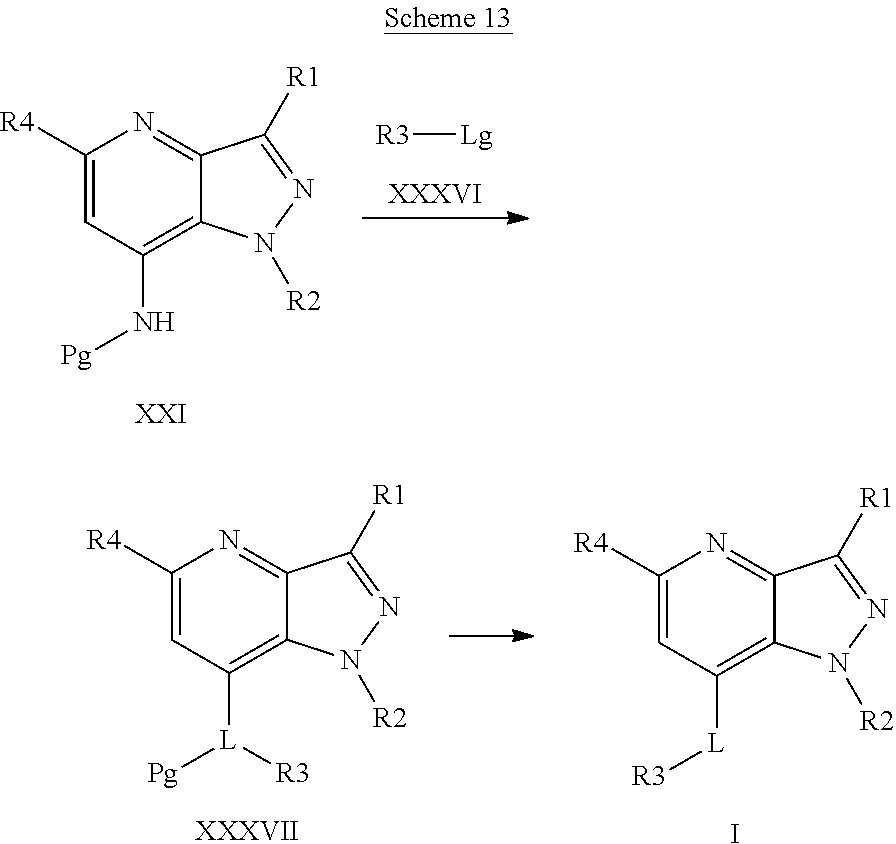
Compounds of general formula XXXIII (Scheme 12) can be prepared by treatment of compounds of general formula XIII with a reagent such as 6-methylheptyl 3-mercaptopropanoate in the presence of a base such as diisopropyl ethylamine. Compounds of general formula XXXIV can be prepared by the same methods as described in methods 5, 8 and 9. Compounds of general formula I can be prepared by deprotection of compounds of general formula XXXIV by using a base such as potassium tert-butoxide followed by alkylation with compounds of general formula XXXVI.
Method 13:
Figure US10766893-20200908-C00020

where R1, R2, R3 and R4 are as described for formula I and L is NH. Pg is a protecting group such as p-methoxybenzyl and Lg is a leaving group such as chlorine, bromine, iodine, 4-methylbenzenesulfonate or methanesulfonate.
Compounds of general formula XXXVII (Scheme 13) can be prepared by deprotonation of compounds of general formula XXI with a base such as sodium hydride followed by alkylation with compounds of general formula XXXVI. Compounds of general formula I can be prepared by removal of the protecting group (Pg) using reaction conditions known to chemists skilled in the art of organic synthesis, e.g. by treatment with trifluoroacetic acid when Pg is p-methoxybenzyl.
LC-MS Methods
Method A: An Agilent 1200 LCMS system with ELS detector was used. Phenomenex Luna-C18, 5 μm; 2.0×50 mm; Column temperature: 50° C.; Solvent system: A=water/trifluoroacetic acid (99.9:0.1) and B=acetonitrile/trifluoroacetic acid (99.95:0.05); Method: Linear gradient elution with A:B=90:10 to 0:100 in 4.0 minutes and with a flow rate of 0.8 mL/min.
Method B: An Agilent 1200 LCMS system with ELS detector was used. Column: Waters XBridge ShieldRP18, 2.1×50 mm, 5 μm; Column temperature: 40° C.; Solvent system: A=water/ammonia (99.95:0.05) and B=acetonitrile; Method: Linear gradient elution with A:B=95:5 to 0:100 in 4.0 minutes and with a flow rate of 0.8 mL/min.
Method C: An Agilent 1200 LCMS system with ELS detector was used. Phenomenex Luna-C18, 5 μm; 2.0×50 mm; Column temperature: 50° C.; Solvent system: A=water/trifluoroacetic acid (99.9:0.1) and B=acetonitrile/trifluoroacetic acid (99.95:0.05); Method: Linear gradient elution with A:B=99:1 to 0:100 in 4.0 minutes and with a flow rate of 0.8 mL/min.
Method D: A Waters Acquity UPLC-MS was used. Column: Acquity UPLC BEH C18 1.7 μm; 2.1×50 mm; Column temperature: 60° C.; Solvent system: A=water/trifluoroacetic acid (99.965:0.035) and B=acetonitrile/water/trifluoroacetic acid (94.965:5:0.035); Method: Linear gradient elution with A:B=90:10 to 0:100 in 1.0 minutes and with a flow rate of 1.2 mL/min.
Method E: A Waters Acquity UPLC-MS was used. Column: Acquity UPLC BEH C18 1.7 μm; 2.1×50 mm; Column temperature: 60° C.; Solvent system: A=water/formic acid (99.9:0.1) and B=acetonitrile/water/formic acid (94.9:5:0.1); Method: Linear gradient elution with A:B=90:10 to 0:100 in 1.0 minutes and with a flow rate of 1.2 mL/min.
Method F: An Agilent 1200 LCMS system with ELS detector was used. Column: Waters XBridge ShieldRP18, 2.1×50 mm, 5 μm; Column temperature: 40° C.; Solvent system: A=water/ammonia (99.95:0.05) and B=acetonitrile; Method: Linear gradient elution with A:B=85:15 to 0:100 in 3.4 minutes and with a flow rate of 0.8 mL/min.
Method G: An Agilent 1200 LCMS system with ELS detector was used. Column: Agilent TC-C18 5 μm; 2.1×50 mm; Column temperature: 50° C.; Solvent system: A=water/trifluoroacetic acid (99.9:0.1) and B=acetonitrile/trifluoroacetic acid (99.95:0.05); Method: Linear gradient elution with A:B=99:1 to 0:100 in 4.0 minutes and with a flow rate of 0.8 mL/min.
Method H: An Agilent 1200 LCMS system with ELS detector was used. Column: Waters XBridge ShieldRP18, 2.1×50 mm, 5 μm; Column temperature: 40° C.; Solvent system: A=water/ammonia (99.95:0.05) and B=acetonitrile; Method: Linear gradient elution with A:B=70:30 to 0:100 in 3.4 minutes and with a flow rate of 0.8 mL/min.
Method I: An Agilent 1200 LCMS system with ELS detector was used. Phenomenex Luna-C18, 5 μm; 2.0×50 mm; Column temperature: 50° C.; Solvent system: A=water/trifluoroacetic acid (99.9:0.1) and B=acetonitrile/trifluoroacetic acid (99.95:0.05); Method: Linear gradient elution with A:B=75:25 to 0:100 in 3.4 minutes and with a flow rate of 0.8 mL/min.
Method J: A Waters Autopurification was used. Column: XSelect CSH C18 3.5 micron, 4.6×50 mm; Column temperature: 25° C.; Solvent system: A=water/formic acid (99.9:0.1) and B=acetonitrile/trifluoroacetic acid (99.9:0.1); Method: Linear gradient elution with A:B=97:3 to 10:90 in 2.5 minutes and with a flow rate of 2.5 mL/min.
Method K: A Waters Autopurification was used. Column: XSelect CSH C18 3.5 micron, 4.6×50 mm; Column temperature: 25° C.; Solvent system: A=water/formic acid (99.9:0.1) and B=acetonitrile/trifluoroacetic acid (99.9:0.1); Method: Linear gradient elution with A:B=97:3 to 10:90 in 2.5 minutes, then with A:B=10:90 for 1 minute. The flow rate was 2.5 mL/min.
Method L: An Agilent 1200 LCMS system with ELS detector was used. Waters Xbridge-C18, 50×2 mm; Column temperature: 50° C.; Solvent system: A=water/trifluoroacetic acid (99.96:0.04) and B=acetonitrile/trifluoroacetic acid (99.98:0.02); Method: Linear gradient elution with A:B=90:10 to 0:100 in 3.4 minutes and with a flow rate of 0.8 mL/min.
Method M: An Agilent 1200 LCMS system with ELS detector was used. Waters Xbridge-C18, 50×2 mm; Column temperature: 50° C.; Solvent system: A=water/trifluoroacetic acid (99.96:0.04) and B=acetonitrile/trifluoroacetic acid (99.98:0.02); Method: Linear gradient elution with A:B=99:1 to 0:100 in 3.4 minutes and with a flow rate of 0.8 mL/min.
Intermediates (for Compounds of the Invention and Supporting Examples) Preparation of ethyl 3-methyl-1H-pyrazole-5-carboxylate
Figure US10766893-20200908-C00021
A solution of ethyl 2,4-dioxopentanoate (20 g, 126 mmol, 18 mL) and hydrazine hydrate (6.96 g, 139 mmol, 6.76 mL) in ethanol (400 mL) was stirred at 0° C. for 1 hour. The mixture was concentrated to give ethyl 3-methyl-1H-pyrazole-5-carboxylate (19 g, 123 mmol, 97% yield).
Preparation of ethyl 1,3-dimethyl-1H-pyrazole-5-carboxylate
Figure US10766893-20200908-C00022
To a solution of ethyl 3-methyl-1H-pyrazole-5-carboxylate (19.5 g, 126 mmol) in DMF (200 mL) was added Me2SO4 (23.8 g, 189 mmol, 17.9 mL). The mixture was stirred at 80° C. for 18 hours. After cooling to 0° C., the mixture was diluted with ice, then aqueous ammonia (25%) was added to adjust the pH to 8. Then the mixture was extracted with ethyl acetate (300 mL×3), the combined organic layers were washed with brine (50 mL), dried, and concentrated.
The crude mixture was purified by flash chromatography with petroleum ether:ethyl acetate=5:1 to give ethyl 1,3-dimethyl-1H-pyrazole-5-carboxylate (15 g, 89 mmol, 71% yield).
Preparation of ethyl 2-(methoxyimino)-4-oxopentanoate
Figure US10766893-20200908-C00023
A mixture of ethyl 2,4-dioxopentanoate (27 g, 171 mmol, 24 mL) and methoxylamine (15 g, 179 mmol, 13.6 mL) in ethanol (150 mL) was stirred at 25° C. for 18 hours under a nitrogen atmosphere. The mixture was concentrated. The crude mixture was purified by flash silica gel chromatography with petroleum ether:ethyl acetate=10:1 to give ethyl 2-(methoxyimino)-4-oxopentanoate (19.9 g, 103 mmol, 60% yield). 1H NMR (chloroform-d 400 MHz): δ 4.34 (q, J=6.8 Hz, 2H), 4.07 (s, 3H), 3.71 (s, 2H), 2.21 (s, 3H), 1.35 (d, J=7.6 Hz, 3H).
Preparation of ethyl 1-isopropyl-3-methyl-1H-pyrazole-5-carboxylate
Figure US10766893-20200908-C00024
To a solution of ethyl 2-(methoxyimino)-4-oxopentanoate (14.6 g, 78.0 mmol) in ethanol (200 mL) was added isopropylhydrazine hydrochloride (17.25 g, 156 mmol). The mixture was stirred at 80° C. for 18 hours. The mixture was concentrated. Saturated aqueous NaHCO3 was added into the residue to adjust the pH to 7. Then the mixture was extracted with dichloromethane (100 mL×3), the combined organic layers were washed with brine, dried over Na2SO4 and concentrated. The crude mixture was purified by flash silica gel chromatography with petroleum ether:ethyl acetate=10:1 to give ethyl 1-isopropyl-3-methyl-1H-pyrazole-5-carboxylate (12.3 g, 62.7 mmol, 80% yield). 1H NMR (chloroform-d 400 MHz): δ6.59 (s, 1H), 5.41-5.44 (m, 1H), 4.35-4.29 (m, 2H), 2.29 (s, 3H), 1.48 (d, J=6.8 Hz, 6H), 1.39-1.35 (m, 3H).
Preparation of ethyl 1-isopropyl-3-methyl-4-nitro-1H-pyrazole-5-carboxylate
Figure US10766893-20200908-C00025
To a solution of ethyl 1-isopropyl-3-methyl-1H-pyrazole-5-carboxylate (8 g, 40.8 mmol) and (2,2,2-trifluoroacetyl) 2,2,2-trifluoroacetate (59.9 g, 285.4 mmol, 39.7 mL) in TFA (80 mL) was added ammonium nitrate (6.5 g, 81.5 mmol, 3.8 mL) slowly at 0° C. The mixture was stirred at 20° C. for 18 hours. The solution was cooled to 0° C. and then neutralized with aqueous K2CO3 and the product was extracted with ethyl acetate:dichloromethane=40:1 (205 mL×4). The combined organic layers were washed with brine (150 mL), dried over Na2SO4 and concentrated to give ethyl 1-isopropyl-3-methyl-4-nitro-1H-pyrazole-5-carboxylate (9.8 g).
Ethyl 1-ethyl-3-methyl-4-nitro-1H-pyrazole-5-carboxylate was prepared in a similar way from ethylhydrazine.
Ethyl 1-cyclopropyl-3-methyl-4-nitro-1H-pyrazole-5-carboxylate was prepared in a similar way from cyclopropylhydrazine.
(±)-Ethyl 1-(sec-butyl)-3-methyl-1H-pyrazole-5-carboxylate was prepared in a similar way from (±)-sec-butylhydrazine hydrochloride.
Preparation of ethyl 3-methyl-4-nitro-1H-pyrazole-5-carboxylate
Figure US10766893-20200908-C00026
Ethyl 3-methyl-1H-pyrazole-5-carboxylate (12 g, 78 mmol) was added in portions to fuming nitric acid (140 g, 2.2 mol, 100 mL) at 0° C. The mixture was stirred at 15° C. for 16 hours. The mixture was poured into ice (200 g) and adjusted to pH 7 by saturated aqueous K2CO3. The mixture was extracted with ethyl acetate (500 mL×2). The organic layer was washed with H2O (500 mL), brine (500 mL), dried over Na2SO4, filtered and concentrated to give ethyl 3-methyl-4-nitro-1H-pyrazole-5-carboxylate (13 g, 65 mmol, 84% yield). 1H NMR (chloroform-d 400 MHz) δ 11.41 (brs, 1H), 4.47-4.42 (m, 2H), 2.64 (s, 3H), 1.39 (t, J=7.2 Hz, 3H).
Preparation of ethyl 1-(4-methoxybenzyl)-3-methyl-4-nitro-1H-pyrazole-5-carboxylate and ethyl 1-(4-methoxybenzyl)-5-methyl-4-nitro-1H-pyrazole-3-carboxylate
Figure US10766893-20200908-C00027
To a solution of ethyl 3-methyl-4-nitro-1H-pyrazole-5-carboxylate (4.40 g, 22.1 mmol) in dry DMF (50 mL) was added 1-(chloromethyl)-4-methoxybenzene (4.15 g, 26.5 mmol, 3.6 mL) and K2CO3 (6.11 g, 44.2 mmol). The mixture was stirred at 15° C. for 16 hours. The mixture was concentrated and water (20 mL) was added. The mixture was extracted with ethyl acetate (20 mL×2). The combined organic layers were washed with H2O (20 mL×2), brine (20 mL), dried over Na2SO4, filtered and concentrated. The residue was purified by flash chromatography on silica gel (0% to 50% ethyl acetate in petroleum ether) to give ethyl 1-(4-methoxybenzyl)-3-methyl-4-nitro-1H-pyrazole-5-carboxylate (2.80 g, 8.77 mmol, 40% yield) and ethyl 1-(4-methoxybenzyl)-5-methyl-4-nitro-1H-pyrazole-3-carboxylate (3.50 g, 11 mmol, 50% yield).
Preparation of ethyl 4-amino-1-isopropyl-3-methyl-1H-pyrazole-5-carboxylate
Figure US10766893-20200908-C00028
To a solution of ethyl 1-isopropyl-3-methyl-4-nitro-1H-pyrazole-5-carboxylate (10.23 g, 42.41 mmol) in ethyl acetate (200 mL) was added Pd—C (10%, 2.0 g, wet) under nitrogen. The suspension was degassed under vacuo and purged with hydrogen several times. The mixture was stirred under hydrogen (30 psi) at 40° C. for 18 hours. The mixture was filtered and the residue was washed with ethyl acetate (150 ml×3), the combined filtrates were concentrated to give ethyl 4-amino-1-isopropyl-3-methyl-1H-pyrazole-5-carboxylate (8.96 g).
Ethyl 4-amino-1-(4-methoxybenzyl)-3-methyl-1H-pyrazole-5-carboxylate was prepared in a similar way from ethyl 1-(4-methoxybenzyl)-3-methyl-4-nitro-1H-pyrazole-5-carboxylate.
Ethyl 4-amino-1-ethyl-3-methyl-1H-pyrazole-5-carboxylate was prepared in a similar way from ethyl 1-ethyl-3-methyl-4-nitro-1H-pyrazole-5-carboxylate.
Ethyl 4-amino-1-cyclopropyl-3-methyl-1H-pyrazole-5-carboxylate was prepared in a similar way from ethyl 1-cyclopropyl-3-methyl-4-nitro-1H-pyrazole-5-carboxylate.
Ethyl 4-amino-1,3-dimethyl-1H-pyrazole-5-carboxylate was prepared in a similar way from ethyl 1,3-dimethyl-4-nitro-1H-pyrazole-5-carboxylate.
(±)-Ethyl 4-amino-1-(sec-butyl)-3-methyl-1H-pyrazole-5-carboxylate was prepared in a similar way from (±)-ethyl 1-(sec-butyl)-3-methyl-1H-pyrazole-5-carboxylate.
Preparation of ethyl 1-isopropyl-4-(3-methoxy-3-oxopropanamido)-3-methyl-1H-pyrazole-5-carboxylate
Figure US10766893-20200908-C00029
To a solution of ethyl 4-amino-1-isopropyl-3-methyl-1H-pyrazole-5-carboxylate (7.96 g, 37.7 mmol) in dichloromethane (150 mL) was added methyl 3-chloro-3-oxopropanoate (5.14 g, 37.7 mmol, 4.02 mL). The mixture was stirred at 50° C. for 45 minutes. After the reaction mixture had cooled to room temperature, the mixture was partitioned between dichloromethane (200 mL) and saturated aqueous NaHCO3 (100 mL), the aqueous phase was extracted with dichloromethane (100 mL×2), the combined organic layers were washed with brine (50 mL), dried over MgSO4 and concentrated to give ethyl 1-isopropyl-4-(3-methoxy-3-oxopropanamido)-3-methyl-1H-pyrazole-5-carboxylate (11.7 g, 37 mmol, >95% yield).
Ethyl 4-(3-methoxy-3-oxopropanamido)-1-(4-methoxybenzyl)-3-methyl-1H-pyrazole-5-carboxylate was prepared in a similar way from ethyl 4-amino-1-(4-methoxybenzyl)-3-methyl-1H-pyrazole-5-carboxylate.
Ethyl 1-ethyl-4-(3-methoxy-3-oxopropanamido)-3-methyl-1H-pyrazole-5-carboxylate was prepared in a similar way fromethyl 4-amino-1-ethyl-3-methyl-1H-pyrazole-5-carboxylate.
Ethyl 1-cyclopropyl-4-(3-methoxy-3-oxopropanamido)-3-methyl-1H-pyrazole-5-carboxylate was prepared in a similar way from ethyl 4-amino-1-cyclopropyl-3-methyl-1H-pyrazole-5-carboxylate.
Ethyl 4-(3-methoxy-3-oxopropanamido)-1,3-dimethyl-1H-pyrazole-5-carboxylate was prepared in a similar way from ethyl 4-amino-1,3-dimethyl-1H-pyrazole-5-carboxylate.
(±)-Ethyl 1-(sec-butyl)-4-(3-methoxy-3-oxopropanamido)-3-methyl-1H-pyrazole-5-carboxylate was prepared in a similar way from (±)-ethyl 4-amino-1-(sec-butyl)-3-methyl-1H-pyrazole-5-carboxylate.
Preparation of methyl 5,7-dihydroxy-1-isopropyl-3-methyl-1H-pyrazolo[4,3-b]pyridine-6-carboxylate
Figure US10766893-20200908-C00030
To a solution of ethyl 1-isopropyl-4-(3-methoxy-3-oxopropanamido)-3-methyl-1H-pyrazole-5-carboxylate (12.5 g, 40 mmol) in ethanol (200 mL) was added NaOEt (5.45 g, 80 mmol). The mixture was stirred at 20° C. for 1 hour. The mixture was concentrated. The crude product (10.62 g) was used into the next step without further purification.
Methyl 5,7-dihydroxy-1-(4-methoxybenzyl)-3-methyl-1H-pyrazolo[4,3-b]pyridine-6-carboxylate was prepared in a similar way from ethyl 4-(3-methoxy-3-oxopropanamido)-1-(4-methoxybenzyl)-3-methyl-1H-pyrazole-5-carboxylate.
Methyl 1-ethyl-5,7-dihydroxy-3-methyl-1H-pyrazolo[4,3-b]pyridine-6-carboxylate was prepared in a similar way from ethyl 1-ethyl-4-(3-methoxy-3-oxopropanamido)-3-methyl-1H-pyrazole-5-carboxylate.
Methyl 1-cyclopropyl-5,7-dihydroxy-3-methyl-1H-pyrazolo[4,3-b]pyridine-6-carboxylate was prepared in a similar way from ethyl 1-cyclopropyl-4-(3-methoxy-3-oxopropanamido)-3-methyl-1H-pyrazole-5-carboxylate.
Methyl 5,7-dihydroxy-1,3-dimethyl-1H-pyrazolo[4,3-b]pyridine-6-carboxylate was prepared in a similar way from ethyl 4-(3-methoxy-3-oxopropanamido)-1,3-dimethyl-1H-pyrazole-5-carboxylate.
(±)-Methyl 1-(sec-butyl)-5,7-dihydroxy-3-methyl-1H-pyrazolo[4,3-b]pyridine-6-carboxylate was prepared in a similar way from (±)-ethyl 1-(sec-butyl)-4-(3-methoxy-3-oxopropanamido)-3-methyl-1H-pyrazole-5-carboxylate.
Preparation of 1-isopropyl-3-methyl-1H-pyrazolo[4,3-b]pyridine-5,7-diol
Figure US10766893-20200908-C00031
A mixture of methyl 5,7-dihydroxy-1-isopropyl-3-methyl-1H-pyrazolo[4,3-b]pyridine-6-carboxylate (10.62 g, 40.04 mmol) in aqueous NaOH (2 N, 150 mL) was stirred at 110° C. for 6 hours. The mixture was cooled to 0° C., then saturated aqueous KHSO4 was added to adjust the pH to 2˜3. The resulting mixture was filtered and the residue was washed with water (50 mL×3), then dried to give 1-isopropyl-3-methyl-1H-pyrazolo[4,3-b]pyridine-5,7-diol (7 g, 32.43 mmol, 81% yield). 1H NMR (DMSO-d6 400 MHz) δ 11.02 (brs, 1H), 5.50 (s, 1H), 5.11-5.08 (m, 1H), 2.24 (s, 3H), 1.37 (d, J=6.8 Hz, 6H).
1-(4-Methoxybenzyl)-3-methyl-1H-pyrazolo[4,3-b]pyridine-5,7-diol was prepared in a similar way from methyl 5,7-dihydroxy-1-(4-methoxybenzyl)-3-methyl-1H-pyrazolo[4,3-b]pyridine-6-carboxylate.
1-ethyl-3-methyl-1H-pyrazolo[4,3-b]pyridine-5,7-diol was prepared in a similar way from methyl 1-ethyl-5,7-dihydroxy-3-methyl-1H-pyrazolo[4,3-b]pyridine-6-carboxylate.
1-cyclopropyl-3-methyl-1H-pyrazolo[4,3-b]pyridine-5,7-diol was prepared in a similar way from methyl 1-cyclopropyl-5,7-dihydroxy-3-methyl-1H-pyrazolo[4,3-b]pyridine-6-carboxylate.
1,3-dimethyl-1H-pyrazolo[4,3-b]pyridine-5,7-diol was prepared in a similar way from 1-cyclopropyl-3-methyl-1H-pyrazolo[4,3-b]pyridine-5,7-diol.
(±)-1-(sec-Butyl)-3-methyl-1H-pyrazolo[4,3-b]pyridine-5,7-diol was prepared in a similar way from (±)-methyl 1-(sec-butyl)-5,7-dihydroxy-3-methyl-1H-pyrazolo[4,3-b]pyridine-6-carboxylate.
Preparation of 5,7-dichloro-1-isopropyl-3-methyl-1H-pyrazolo[4,3-b]pyridine
Figure US10766893-20200908-C00032
A mixture of 1-isopropyl-3-methyl-1H-pyrazolo[4,3-b]pyridine-5,7-diol (3.50 g, 16.9 mmol) in phosphoryl trichloride (30 mL) was stirred at 80° C. for 18 hours. The mixture was stirred at 85° C. for another 1 hour. The mixture was concentrated and then water (50 mL) was added slowly, followed by saturated aqueous NaHCO3 to adjust pH to 7. The aqueous phase was extracted with ethyl acetate (70 mL×3), the combined organic layers were washed with brine (50 mL), dried over Na2SO4 and concentrated. The crude product was purified by flash chromatography with petroleum ether:ethyl acetate=20:1 to give 5,7-dichloro-1-isopropyl-3-methyl-1H-pyrazolo[4,3-b]pyridine (3.50 g, 14.3 mmol, 85% yield). 1H NMR (chloroform-d 400 MHz) δ 7.28 (s, 1H), 5.48-5.41 (m, 1H), 2.62 (s, 3H), 1.57 (d, J=4.8 Hz, 6H).
The following compounds were prepared in a similar manner:
Figure US10766893-20200908-C00033
5,7-dibromo-1-isopropyl-3-methyl-1H-pyrazolo[4,3-b]pyridine from 1-isopropyl-3-methyl-1H-pyrazolo[4,3-b]pyridine-5,7-diol and phosphoryl tribromide. 1H NMR (chloroform-d 400 MHz) δ 7.60 (s, 1H), 5.61-5.55 (m, 1H), 2.63 (s, 3H), 1.57 (d, J=6.4 Hz, 6H).
Figure US10766893-20200908-C00034
5,7-dibromo-1-ethyl-3-methyl-1H-pyrazolo[4,3-b]pyridine from 1-ethyl-3-methyl-1H-pyrazolo[4,3-b]pyridine-5,7-diol and phosphoryl tribromide.
Figure US10766893-20200908-C00035
5,7-dichloro-1,3-dimethyl-1H-pyrazolo[4,3-b]pyridine from 1,3-dimethyl-1H-pyrazolo[4,3-b]pyridine-5,7-diol and phosphoryl trichloride. 1H NMR (chloroform-d 400 MHz) δ 7.29 (s, 1H), 4.29 (s, 3H), 2.60 (s, 3H).
Figure US10766893-20200908-C00036
(±)-5,7-Dibromo-1-(sec-butyl)-3-methyl-1H-pyrazolo[4,3-b]pyridine from (±)-1-(sec-butyl)-3-methyl-1H-pyrazolo[4,3-b]pyridine-5,7-diol and phosphoryl tribromide.
Figure US10766893-20200908-C00037
5,7-dibromo-1-cyclopropyl-3-methyl-1H-pyrazolo[4,3-b]pyridine from 1-cyclopropyl-3-methyl-1H-pyrazolo[4,3-b]pyridine-5,7-diol and phosphoryl tribromide. 1H NMR (chloroform-d 400 MHz) δ 7.63 (s, 1H), 3.99-3.88 (m, 1H), 2.57 (s, 3H), 1.41-1.38 (m, 2H), 1.22-1.19 (m, 2H).
Figure US10766893-20200908-C00038
5,7-Dibromo-1-(4-methoxybenzyl)-3-methyl-1H-pyrazolo[4,3-b]pyridine from 1-(4-methoxybenzyl)-3-methyl-1H-pyrazolo[4,3-b]pyridine-5,7-diol and phosphoryl tribromide.
Preparation of 5,7-dibromo-3-methyl-1H-pyrazolo[4,3-b]pyridine
Figure US10766893-20200908-C00039
A solution of 5,7-dibromo-1-(4-methoxybenzyl)-3-methyl-1H-pyrazolo[4,3-b]pyridine (650 mg, 1.58 mmol) in TFA (5 mL) was heated at 80° C. for 2 hours. The mixture was concentrated and the residue was dissolved in H2O (5 mL). The mixture was adjusted to pH 7 by saturated aqueous. NaHCO3 and extracted with ethyl acetate (20 mL×2). The combined organic layers were washed with H2O (20 mL), brine (20 mL), dried over Na2SO4, filtered and concentrated to give 5,7-dibromo-3-methyl-1H-pyrazolo[4,3-b]pyridine (450 mg, 1.55 mmol, 98% yield).
Preparation of 5,7-dibromo-3-methyl-1-(oxetan-3-yl)-1H-pyrazolo[4,3-b]pyridine
Figure US10766893-20200908-C00040
To a solution of 5,7-dibromo-3-methyl-1H-pyrazolo[4,3-b]pyridine (340 mg, 1.17 mmol) in dry DMF (10 mL) was added 3-iodooxetane (323 mg, 1.76 mmol) and Cs2CO3 (762 mg, 2.34 mmol). The mixture was heated under microwave at 100° C. for 1 hour. The mixture was concentrated and water (20 mL) was added. The mixture was extracted with ethyl acetate (20 mL×2). The combined organic layers were washed with H2O (20 mL×2), brine (20 mL), dried over Na2SO4, filtered and concentrated. The residue was purified by flash chromatography on silica gel (0% to 50% ethyl acetate in petroleum ether) to give 5,7-dibromo-3-methyl-1-(oxetan-3-yl)-1H-pyrazolo[4,3-b]pyridine (200 mg, 49% yield).
Preparation of (+5,7-dibromo-1-(sec-butyl)-3-methyl-1H-pyrazolo[4,3-b]pyridine and (+)-5,7-dibromo-1-(sec-butyl)-3-methyl-1H-pyrazolo[4,3-b]pyridine
Figure US10766893-20200908-C00041
(±)-5,7-dibromo-1-(sec-butyl)-3-methyl-1H-pyrazolo[4,3-b]pyridine (2.2 g, 6.34 mmol) was purified by SFC twice to give (+)-5,7-dibromo-1-(sec-butyl)-3-methyl-1H-pyrazolo[4,3-b]pyridine (800 mg) (Rt=6.25 min) and (+5,7-dibromo-1-(sec-butyl)-3-methyl-1H-pyrazolo[4,3-b]pyridine (900 mg) (Rt=6.28 min).
(+)-5,7-dibromo-1-(sec-butyl)-3-methyl-1H-pyrazolo[4,3-b]pyridine 1H NMR (Chloroform-d, 400 MHz): δ 7.60 (s, 1H), 5.41-5.32 (m, 1H), 2.63 (s, 3H), 2.13-2.07 (m, 1H), 1.87-1.83 (m, 1H), 1.54 (d, J=6.4 Hz, 3H), 0.79 (t, J=7.6 Hz, 3H). SFC-MS: tR=6.25 min, ee %=100%; [α]D 20=2.60 (c=1.0, dichloromethane).
(−)-5,7-dibromo-1-(sec-butyl)-3-methyl-1H-pyrazolo[4,3-b]pyridinel-HNMR (Chloroform-d, 400 MHz): δ 7.60 (s, 1H), 5.41-5.32 (m, 1H), 2.63 (s, 3H), 2.13-2.07 (m, 1H), 1.87-1.83 (m, 1H), 1.55 (d, J=6.8 Hz, 3H), 0.79 (t, J=7.6 Hz, 3H). SFC-MS: tR=6.5 min, ee %=97.87%; [α]D 20=−2.90 (c=1.0, dichloromethane).
SFC Condition 1:
Instrument: Thar SFC 1; Column:(s,s) WHELK-01 (250 mm×30 mm, 5 μm); Mobile phase: A: Supercritical CO2, B: isopropyl alcohol (0.1% NH3H2O), A:B=85:15 at 60 ml/min; Column Temp: 38° C.; Nozzle Pressure: 100 Bar; Nozzle Temp: 60° C.; Evaporator Temp: 20° C.; Trimmer Temp: 25° C.; Wavelength: 220 nm
SFC Condition 2:
Instrument: Thar SFC-13; Column:(s,s) WHELK-01 (250 mm×30 mm, 5 μm); Mobile phase: A: Supercritical CO2, B: isopropyl alcohol (0.1% NH3H2O), A:B=85:15 at 60 ml/min; Column Temp: 38° C.; Nozzle Pressure: 100 Bar; Nozzle Temp: 60° C.; Evaporator Temp: 20° C.; Trimmer Temp: 25° C.; Wavelength: 220 nm
Preparation of 4,6-dibromo-2-methylpyridin-3-amine
Figure US10766893-20200908-C00042
A solution of 6-bromo-2-methylpyridin-3-amine (24 g, 128 mmol) and AcOH (14.7 mL 257 mmol) in MeOH (200 mL) was cooled to 0° C., Br2 (36.9 g, 230.9 mmol, 11.9 mL) was added and stirred at 0° C. for 5 hours. The mixture was quenched with saturated aqueous Na2SO3 (500 mL), extracted with ethyl acetate (300 mL×3). The organic layer was washed with brine (200 mL), dried over Na2SO4, and concentrated in vacuo. The residue was purified by silica gel chromatography (petroleum ether:ethyl acetate=2:1) to afford 4,6-dibromo-2-methylpyridin-3-amine (30 g, 87% yield).
Preparation of 5,7-dibromo-1H-pyrazolo[4,3-b]pyridine
Figure US10766893-20200908-C00043
To a mixture of 4,6-dibromo-2-methylpyridin-3-amine (15.0 g, 56.4 mmol) and AcOK (13.8 g, 141 mmol) in AcOH (30 mL) and toluene (200 mL) was added isopentyl nitrite (13.2 g, 112.8 mmol). The mixture was stirred at 25° C. for 1 hour then at 60° C. for 19 hours. The mixture was concentrated in vacuo, diluted with water (300 mL) and extracted with ethyl acetate (200 mL×2). The organic layer was washed with brine (100 mL), dried over Na2SO4 and concentrated in vacuo to give 5,7-dibromo-1H-pyrazolo[4,3-b]pyridine (5.4 g, 30% yield).
Preparation of 5,7-dibromo-1-ethyl-1H-pyrazolo[4,3-b]pyridine
Figure US10766893-20200908-C00044
To a mixture of 5,7-dibromo-1H-pyrazolo[4,3-b]pyridine (1 g, 3.6 mmol) and Cs2CO3 (12.4 g, 7.2 mmol) in anhydrous DMF (10 mL) was added iodoethane (0.8 g, 5.4 mmol). The mixture was stirred at 0° C. for 0.5 hours. The mixture was diluted with water (20 mL), extracted with ethyl acetate (30 mL×2). The organic layer was washed with water (20 mL), brine (20 mL) and dried with Na2SO4, concentrated in vacuo. The residue was purified by silica gel chromatography (petroleum ether:ethyl acetate=10:1-5:1) to give 5,7-dibromo-1-ethyl-1H-pyrazolo[4,3-b]pyridine (0.56 g, 51% yield). 1H NMR (DMSO-d6 400 MHz) δ 8.37 (s, 1H), 7.98 (s, 1H), 4.72 (q, J=7.2 Hz, 2H), 1.42 (t, J=7.2 Hz, 3H).
The following compounds were prepared in a similar manner:
Figure US10766893-20200908-C00045
5,7-Dibromo-1-isopropyl-1H-pyrazolo[4,3-b]pyridine from 5,7-dibromo-1H-pyrazolo[4,3-b]pyridine and 2-iodopropane. 1H NMR (DMSO-d6 400 MHz) δ 8.36 (s, 1H), 7.94 (s, 1H), 5.62-5.55 (m, 1H), 1.49 (d, J=6.0 Hz, 6H).
Figure US10766893-20200908-C00046
5,7-Dibromo-1-propyl-1H-pyrazolo[4,3-b]pyridine from 5,7-dibromo-1H-pyrazolo[4,3-b]pyridine and 1-iodopropane. 1H NMR (chloroform-d 400 MHz) δ 8.14 (s, 1H), 7.64 (s, 1H), 4.67 (t, J=7.2 Hz, 2H), 1.98-1.89 (m, 2H), 0.94 (t, J=7.6 Hz, 3H).
Figure US10766893-20200908-C00047
5,7-Dibromo-1-methyl-1H-pyrazolo[4,3-b]pyridine from 5,7-dibromo-1H-pyrazolo[4,3-b]pyridine and iodomethane. 1H NMR (chloroform-d 400 MHz) δ 8.13 (s, 1H), 7.64 (s, 1H), 4.38 (s, 3H).
Figure US10766893-20200908-C00048
(±)-5,7-Dibromo-1-(sec-butyl)-3-methyl-1H-pyrazolo[4,3-b]pyridine from 5,7-dibromo-1H-pyrazolo[4,3-b]pyridine and (±)-2-iodobutane.
Preparation of (+)-5,7-dibromo-1-(sec-butyl)-1H-pyrazolo[4,3-b]pyridine and (−)-5,7-dibromo-1-(sec-butyl)-1H-pyrazolo[4,3-b]pyridine
Figure US10766893-20200908-C00049
(±)-5,7-dibromo-1-sec-butyl-pyrazolo[4,3-b]pyridine (5.2 g, 15.6 mmol) was separated by SFC with column: AD (250 mm*50 mm, 10 μm); mobile phase: [0.1% NH3H2O in isopropyl alcohol]; B %: 20%-20%, min.
(+)-5,7-dibromo-1-(sec-butyl)-1H-pyrazolo [4,3-b]pyridine (2.5 g) (Rt=3.137 min) ([α]D 20=1.40) (c=1.0, ethanol).
(−)-5,7-dibromo-1-(sec-butyl)-1H-pyrazolo[4,3-b]pyridine (2.5 g) (Rt=2.808 min) ([α]D 20=−1.60) (c=1.0, ethanol).
Preparation of 5-chloro-1-isopropyl-N-(4-methoxybenzyl)-3-methyl-1H-pyrazolo[4,3-b]pyridin-7-amine
Figure US10766893-20200908-C00050
To a solution of 5,7-dichloro-1-isopropyl-3-methyl-1H-pyrazolo[4,3-b]pyridine (100 mg, 410 μmol) and (4-methoxyphenyl)methanamine (67 mg, 492 μmol, 64 μL) in NMP (5 mL) was added CsF (124 mg, 819 μmol, 30 μL). The mixture was stirred at 100° C. for 18 hours. Water (20 mL) was added and the mixture was filtered and concentrated in vacuo. The crude mixture was purified by flash chromatography with petroleum ether:ethyl acetate=3:1 to give 5-chloro-1-isopropyl-N-(4-methoxybenzyl)-3-methyl-1H-pyrazolo[4,3-b]pyridin-7-amine (80 mg, 215 μmol, 53% yield). 1H NMR (chloroform-d 400 MHz) δ 7.32 (d, J=8.4 Hz, 2H), 6.95 (d, J=8.4 Hz, 2H), 6.39 (s, 1H), 4.79 (brs, 1H), 4.70-4.63 (m, 1H), 4.39 (d, J=4.4 Hz, 2H), 3.85 (s, 3H), 2.56 (s, 3H), 1.57 (d, J=6.4 Hz, 6H).
Preparation of 5-(2-ethoxypyridin-3-yl)-1-isopropyl-N-(4-methoxybenzyl)-3-methyl-1H-pyrazolo[4,3-b]pyridin-7-amine
Figure US10766893-20200908-C00051
To a solution of 5-chloro-1-isopropyl-N-(4-methoxybenzyl)-3-methyl-1H-pyrazolo[4,3-b]pyridin-7-amine (60 mg, 174 μmol) in dioxane (2 mL) and H2O (0.5 mL) was added Pd(1,1′-bis(diphenylphosphino)ferrocene)Cl2 (25 mg, 35 μmol) and Cs2CO3 (141.72 mg, 435 μmol) and (2-ethoxypyridin-3-yl)boronic acid (52 mg, 313 μmol). The mixture was stirred at 100° C. for 1 hour under microwave irradiation. Water (30 mL) was added and the mixture was extracted with ethyl acetate (30 mL×3). The combined organic layers were washed with brine (20 mL), dried over Na2SO4 and concentrated. The crude mixture was purified by flash chromatography with petroleum ether:ethyl acetate=1:1 to 0:1 to give 5-(2-ethoxypyridin-3-yl)-1-isopropyl-N-(4-methoxybenzyl)-3-methyl-1H-pyrazolo[4,3-b]pyridin-7-amine (50 mg, 67% yield). 1H NMR (chloroform-d 400 MHz) δ 8.27-8.25 (m, 1H), 8.17-8.16 (m, 1H), 7.32 (d, J=8.8 Hz, 2H), 7.22 (s, 1H), 7.03-7.00 (m, 1H), 6.95 (d, J=8.4 Hz, 2H), 4.81-4.76 (m, 1H), 4.65 (brs, 1H), 4.47-4.41 (m, 4H), 3.84 (s, 3H), 2.65 (s, 3H), 1.60 (d, J=6.4 Hz, 6H), 1.36 (t, J=7.2 Hz, 3H).
The following compounds were prepared in a similar manner:
5-(2-Fluoropyridin-3-yl)-1-isopropyl-N-(4-methoxybenzyl)-3-methyl-1H-pyrazolo[4,3-b]pyridin-7-amine
Figure US10766893-20200908-C00052
Prepared from 5-bromo-1-isopropyl-N-(4-methoxybenzyl)-3-methyl-1H-pyrazolo[4,3-b]pyridin-7-amine and (2-fluoropyridin-3-yl)boronic acid.
3-(1-Isopropyl-7-((4-methoxybenzyl)amino)-3-methyl-1H-pyrazolo[4,3-b]pyridin-5-yl)pyridin-2(1H)-one
Figure US10766893-20200908-C00053
Prepared from 5-chloro-1-isopropyl-N-(4-methoxybenzyl)-3-methyl-1H-pyrazolo[4,3-b]pyridin-7-amine and (2-oxo-1,2-dihydropyridin-3-yl)boronic acid.
Preparation of 5-(2-ethoxypyridin-3-yl)-1-isopropyl-3-methyl-1H-pyrazolo[4,3-b]pyridin-7-amine
Figure US10766893-20200908-C00054
A solution of 5-(2-ethoxypyridin-3-yl)-1-isopropyl-N-(4-methoxybenzyl)-3-methyl-1H-pyrazolo[4,3-b]pyridin-7-amine (1.25 g, 2.90 mmol) in TFA (15 mL) was stirred at 60° C. for 18 hours. The mixture was concentrated and the residue was dissolved in ethyl acetate (200 mL). The resulting mixture was washed with saturated aqueous NaHCO3 (30 mL), brine (20 mL), dried over Na2SO4 and concentrated. The crude mixture was purified by flash chromatography with petroleum ether:ethyl acetate=3:1 to 2:1 to give 5-(2-ethoxypyridin-3-yl)-1-isopropyl-3-methyl-1H-pyrazolo[4,3-b]pyridin-7-amine (900 mg, 96% yield).
The following compounds were prepared in a similar manner:
Figure US10766893-20200908-C00055
5-(2-Ethoxypyridin-3-yl)-1-isopropyl-1H-pyrazolo[4,3-b]pyridin-7-amine
Figure US10766893-20200908-C00056
5-(2-Ethoxypyridin-3-yl)-3-methyl-1H-pyrazolo[4,3-b]pyridin-7-amine
Figure US10766893-20200908-C00057
1-Isopropyl-3-methyl-5-(2-propoxypyridin-3-yl)-1H-pyrazolo[4,3-b]pyridin-7-amine
Figure US10766893-20200908-C00058
1-(sec-Butyl)-5-(2-ethoxypyridin-3-yl)-1H-pyrazolo[4,3-b]pyridin-7-amine, enantiomer 1, prepared from (+)-5,7-dibromo-1-(sec-butyl)-1H-pyrazolo[4,3-b]pyridine
Figure US10766893-20200908-C00059
1-(sec-Butyl)-5-(2-ethoxypyridin-3-yl)-1H-pyrazolo[4,3-b]pyridin-7-amine, enantiomer 2, prepared from (−)-5,7-dibromo-1-(sec-butyl)-1H-pyrazolo[4,3-b]pyridine
Figure US10766893-20200908-C00060
1-(sec-Butyl)-5-(2-ethoxypyridin-3-yl)-3-methyl-1H-pyrazolo[4,3-b]pyridin-7-amine, enantiomer 1, prepared from (+)-5,7-dibromo-1-(sec-butyl)-3-methyl-1H-pyrazolo[4,3-b]pyridine
Figure US10766893-20200908-C00061
1-(sec-Butyl)-5-(2-ethoxypyridin-3-yl)-3-methyl-1H-pyrazolo[4,3-b]pyridin-7-amine, enantiomer 2, prepared from (−)-5,7-dibromo-1-(sec-butyl)-3-methyl-1H-pyrazolo[4,3-b]pyridine 1-Isopropyl-5-(2-methoxypyridin-3-yl)-3-methyl-1H-pyrazolo[4,3-b]pyridin-7-amine
Figure US10766893-20200908-C00062
Prepared from 1-isopropyl-N-(4-methoxybenzyl)-5-(2-methoxypyridin-3-yl)-3-methyl-1H-pyrazolo[4,3-b]pyridin-7-amine 5-(2-(Dimethylamino)pyridin-3-yl)-1-isopropyl-3-methyl-1H-pyrazolo[4,3-b]pyridin-7-amine
Figure US10766893-20200908-C00063
Prepared from 5-(2-(dimethylamino)pyridin-3-yl)-1-isopropyl-N-(4-methoxybenzyl)-3-methyl-1H-pyrazolo[4,3-b]pyridin-7-amine 3-(7-Amino-1-isopropyl-3-methyl-1H-pyrazolo[4,3-b]pyridin-5-yOpyridin-2(1H)-one
Figure US10766893-20200908-C00064
Prepared from 3-(1-isopropyl-7-((4-methoxybenzyl)amino)-3-methyl-1H-pyrazolo[4,3-b]pyridin-5-yl)pyridin-2(1H)-one Preparation of ethyl 3-methyl-1,2,4-oxadiazole-5-carboxylate
Figure US10766893-20200908-C00065
To a solution of ethyl 2-chloro-2-oxoacetate (1 g, 13.5 mmol) and pyridine (4.27 g, 54 mmol, 4.36 mL) in dichloromethane (40 mL) was added at 15-20° C. N′-hydroxyacetimidamide (2.40 g, 17.5 mmol, 1.96 mL). The solution was stirred at 50° C. for 14 hours. The reaction mixture was cooled and quenched with saturated aqueous NH4Cl (30 mL). The aqueous phase was extracted with dichloromethane (2×50 mL). The organic phases were combined, washed with saturated aqueous NaHCO3 (50 mL), dried over MgSO4, filtered and concentrated under reduced pressure to give ethyl 3-methyl-1,2,4-oxadiazole-5-carboxylate (2.80 g, 44% yield).
Preparation of (3-methyl-1,2,4-oxadiazol-5-yl)methanol
Figure US10766893-20200908-C00066
To a solution of ethyl 3-methyl-1,2,4-oxadiazole-5-carboxylate (2.10 g, 13.5 mmol) in THF (10 mL) and ethanol (10 mL) was added NaBH4 (1.02 g, 26.9 mmol) at 0° C. The mixture was stirred at 0° C. for 1 hour. The mixture was quenched with saturated aqueous NH4Cl, and concentrated in vacuo. The residue was dissolved in dichloromethane (50 mL) and filtered; the filtrate was dried over Na2SO4 and concentrated in vacuo to give (3-methyl-1,2,4-oxadiazol-5-yl)methanol (800 mg, 52% yield).
Preparation of 3-methyl-1,2,4-oxadiazole-5-carbaldehyde
Figure US10766893-20200908-C00067
A solution of oxalyl chloride (267 mg, 2.10 mmol, 184 μL) in dry dichloromethane (5 mL) was cooled to −78° C. and then DMSO (219 mg, 2.80 mmol) was added. The mixture was stirred at −78° C. for 15 minutes. A solution of (3-methyl-1,2,4-oxadiazol-5-yl)methanol (80 mg, 0.70 mmol) in dichloromethane (0.5 mL) was added at −78° C. The mixture was stirred at −78° C. for 1 hour. Then triethylamine (0.58 mL, 4.2 mmol) was added at −78° C. The mixture was warmed to 20° C. and stirred at 20° C. for 1 hour. The mixture was poured into 1 N aqueous HCl (5 mL). The mixture was extracted with dichloromethane (20 mL×2). The combined organic layers were washed with H2O (20 mL), dried over Na2SO4, filtered and concentrated to give 3-methyl-1,2,4-oxadiazole-5-carbaldehyde (80 mg). 1H NMR (chloroform-d 400 MHz) δ 9.97 (s, 1H), 2.55 (s, 3H).
Preparation of 1-methyl-1H-1,2,4-triazole-3-carbaldehyde
Figure US10766893-20200908-C00068
To a mixture of (1-methyl-1H-1,2,4-triazol-3-yl)methanol (400 mg, 3.54 mmol) and iodobenzene diacetate (1.25 g, 3.89 mmol) in dichloromethane (10 mL) was added TEMPO ((2,2,6,6-tetramethylpiperidin-1-yl)oxyl) (56 mg, 354 μmol). The mixture was stirred at 15-20° C. for 2 h. The mixture was concentrated in vacuo. The residue was purified by silica gel chromatography (petroleum ether:ethyl acetate=1:2) to give 1-methyl-1H-1,2,4-triazole-3-carbaldehyde (300 mg, 2.70 mmol, 76% yield). 1H NMR (chloroform-d 400 MHz) δ 10.01 (s, 1H), 8.19 (s, 1H), 4.06 (s, 3H).
Preparation of ethyl 2-(2-acetylhydrazinyl)-2-oxoacetate
Figure US10766893-20200908-C00069
To a solution of acetohydrazide (5 g, 67 mmol) in dichloromethane (150 mL) was added N-ethoxycarbonyl-2-ethoxy-1,2-dihydroquinoline (16.7 g, 67 mmol). The mixture was stirred at 15° C. for 10 minutes. Then ethyl 2-chloro-2-oxoacetate (9.22 g, 67.5 mmol, 7.56 mL) was dropwise added to the mixture. The mixture was stirred at 15° C. for 16 hours. The mixture was washed with H2O (100 mL) and extracted with dichloromethane (100 mL×3). The combined organic phases were dried over Na2SO4 and concentrated under vacuo. The residue was purified with column chromatography (SiO2, petroleum ether:ethyl acetate=1:0 to 0:1) to give ethyl 2-(2-acetylhydrazinyl)-2-oxoacetate (9.30 g, 79% yield).
Preparation of ethyl 5-methyl-1,3,4-thiadiazole-2-carboxylate
Figure US10766893-20200908-C00070
To a solution of ethyl 2-(2-acetylhydrazinyl)-2-oxoacetate (3 g, 17 mmol) in THF (100 mL) was added Lawesson's reagent (7.66 g, 19 mmol). The mixture was stirred at 75° C. for 3 hours. The mixture was diluted with ethyl acetate (500 mL) and added approximately 40 g of decolourising charcoal. The mixture was stirred at 18° C. for 16 hours. The mixture was filtered. The filtrate was concentrated under vacuo. The residue was purified with column chromatography (SiO2, petroleum ether:ethyl acetate=3:7) to give ethyl 5-methyl-1,3,4-thiadiazole-2-carboxylate (921 mg, 28% yield).
Preparation of 5-methyl-1,3,4-thiadiazole-2-carbaldehyde
Figure US10766893-20200908-C00071
To a solution of ethyl 5-methyl-1,3,4-thiadiazole-2-carboxylate (400 mg, 2.32 mmol) in dry THF (5 mL) was dropwise added DIBAL-H (diisobutylaluminium hydride) (1 M in toluene, 6.97 mL). The mixture was stirred at −40° C. for 2 hours. The mixture was quenched with saturated aqueous NH4Cl (5 mL) and filtered. The solution was extracted with dichloromethane (15 mL×3). The combined organic phases were dried over Na2SO4 and concentrated under vacuo. The residue was purified with preparative TLC (petroleum ether:ethyl acetate=1:1) to give 5-methyl-1,3,4-thiadiazole-2-carbaldehyde (123 mg, 41% yield). 1H NMR (chloroform-d 400 MHz) δ 10.19 (s, 1H), 2.92 (s, 3H).
Preparation of (5-methylthiophen-3-yl)methanol
Figure US10766893-20200908-C00072
To a solution of 5-methylthiophene-3-carboxylic acid (300 mg, 2.11 mmol) in THF (10 mL) was added LiAlH4 (120 mg, 3.17 mmol) slowly at 0° C. The mixture was stirred at 20° C. for 2 hours. Water (0.3 mL) was added at 0° C. to quench the reaction mixture followed by addition of 15% aqueous NaOH (0.3 mL). Ethyl acetate (50 mL) was added to the mixture, the mixture was filtered and the residue was washed with ethyl acetate (20 mL×2). The combined filtrates were dried over Na2SO4 and concentrated to give (5-methylthiophen-3-yl)methanol (270 mg).
Preparation of (5-methyloxazol-2-yl)methanol
Figure US10766893-20200908-C00073
To the reaction mixture of ethyl 5-methyloxazole-2-carboxylate (500 mg, 3.22 mmol) in ethanol (10 mL) was added NaBH4 (609 mg, 16.10 mmol) with stirring at 20° C. Then resulting solution was stirred at 20° C. for 3 hours. The reaction was quenched by water (50 mL), then concentrated under reduced pressure to remove the ethanol. The residue was extracted by ethyl acetate (50 mL×3). The combined organic layers were washed with brine (10 mL), dried over Na2SO4, concentrated to give (5-methyloxazol-2-yl)methanol (364 mg).
Preparation of 5-methylthiophene-3-carbaldehyde
Figure US10766893-20200908-C00074
To a solution of (5-methylthiophen-3-yl)methanol (270 mg, 2.11 mmol) in dichloromethane (10 mL) was added Dess-Martin reagent (1,1,1-triacetoxy-1,1-dihydro-1,2-benziodoxol-3(1H)-one) (1.07 g, 2.53 mmol). The mixture was stirred at 20° C. for 1 hour. The mixture was filtered and the residue was washed with dichloromethane (30 mL), the combined organic layers were concentrated. The crude mixture was purified by flash chromatography with petroleum ether: ethyl acetate=5:1 to give 5-methylthiophene-3-carbaldehyde (180 mg, 1.43 mmol, 68% yield). 1H NMR (chloroform-d 400 MHz) δ 9.81 (s, 1H), 7.89 (s, 1H), 7.20 (s, 1H), 2.51 (s, 3H).
The folowing compounds were prepared in a similar manner:
5-methyloxazole-2-carbaldehyde from (5-methyloxazol-2-yl)methanol
3-methylisoxazole-5-carbaldehyde from (3-methylisoxazol-5-yl)methanol
5-methyl-1,2,4-oxadiazole-3-carbaldehyde from (5-methyl-1,2,4-oxadiazol-3-yl)methanol
1,5-dimethyl-1H-pyrazole-3-carbaldehyde from (1,5-dimethyl-1H-pyrazol-3-yl)methanol
Preparation of 1-((1-aminoethyl)thio)-3-chloropropan-2-one
Figure US10766893-20200908-C00075
A solution of ethanethioamide (1 g, 13.3 mmol) in acetone (7 mL) was added dropwise to a solution of 1,3-dichloropropan-2-one (1.69 g, 13.3 mmol, 1.66 mL) in acetone (5 mL) at 20° C. and stirred at 20° C. for 12 hours. The mixture was filtered and the filter cake was washed with acetone (10 mL×3) to give 1-((1-aminoethyl)thio)-3-chloropropan-2-one.
Preparation of 4-(chloromethyl)-2-methylthiazole
Figure US10766893-20200908-C00076
A mixture of 1-((1-aminoethyl)thio)-3-chloropropan-2-one (3 g, 17.9 mmol) in ethanol (30 mL) was stirred at 80° C. for 2 h. The mixture was concentrated in vacuo to give 4-(chloromethyl)-2-methylthiazole (2.9 g).
Preparation of 2-((2-methylthiazol-4-yl)methyl)isoindoline-1,3-dione
Figure US10766893-20200908-C00077
To a mixture of 4-(chloromethyl)-2-methylthiazole (2.80 g, 19.0 mmol) and isoindoline-1,3-dione in anhydrous DMF (30 mL) was added K2CO3 (1.31 g, 9.49 mmol). The mixture stirred at 100° C. for 0.5 hour. The mixture was diluted with water (50 mL), extracted with ethyl acetate (50 mL×2). The organic layer was washed with water (30 mL), brine (30 mL), dried with Na2SO4 and concentrated in vacuo. The residue was purified by silica gel chromatography (petroleum ether:ethyl acetate=10:1-2:1) to give 2-((2-methylthiazol-4-yl)methyl)isoindoline-1,3-dione (3.29 g).
Preparation of (2-methylthiazol-4-yl)methanamine
Figure US10766893-20200908-C00078
A mixture of 2-((2-methylthiazol-4-yl)methyl)isoindoline-1,3-dione (1 g, 3.87 mmol) and hydrazine hydrate (291 mg, 5.81 mmol, 282 μL) in ethanol (10 mL) was stirred at 20° C. for 0.5 hour. The mixture was concentrated in vacuo. The residue was purified by silica gel chromatography (dichloromethane:methanol=0:1 to 10:1) to give (2-methylthiazol-4-yl)methanamine (330 mg).
Preparation of benzyl (cyanomethyl)carbamate
Figure US10766893-20200908-C00079
A mixture of 2-aminoacetonitrile hydrochloride (5 g, 54.0 mmol), NaHCO3 (18.16 g, 216 mmol) and dioxane (50 mL) in H2O (100 mL) was stirred at 0° C. Then a solution of benzyl carbonochloridate (11.06 g, 64.8 mmol, 9.22 mL) in toluene (10 mL) was added at 0° C. and stirred at 20° C. for 12 hours. The mixture was poured into water (100 mL), and the aqueous phase was extracted with ethyl acetate (100 mL×3). The combined organic phases were washed with brine (100 mL), dried with anhydrous Na2SO4, filtered and concentrated in vacuo. The residue was purified by silica gel chromatography to give benzyl (cyanomethyl)carbamate (1.70 g). 1H NMR (chloroform-d 400 MHz): 7.40-7.31 (m, 5H), 5.35-5.13 (m, 3H), 4.16-4.12 (m, 2H).
Preparation of benzyl ((2H-tetrazol-5-yl)methyl)carbamate
Figure US10766893-20200908-C00080
A mixture of benzyl (cyanomethyl)carbamate (200 mg, 1.05 mmol), sodium azide (250 mg, 3.85 mmol) zinc dibromide (118 mg, 525 μmol) and isopropyl alcohol (2 mL) in H2O (4 mL) was stirred at 100° C. for 24 hours. The mixture was poured into water (50 mL), and added KHSO4 (aq.) until pH=2. The aqueous phase was extracted with ethyl acetate (20 mL×3). The combined organic phases were washed with brine (10 mL), dried with anhydrous Na2SO4, filtered and concentrated in vacuo. The residue was purified by silica gel chromatography (petroleum ether/ethyl acetate=10/1 to 3/1) to give benzyl ((2H-tetrazol-5-yl)methyl)carbamate (200 mg).
Preparation of benzyl ((2-methyl-2H-tetrazol-5-yl)methyl)carbamate
Figure US10766893-20200908-C00081
To a mixture of benzyl ((2H-tetrazol-5-yl)methyl)carbamate (1 g, 4.29 mmol) and K2CO3 (1.19 g, 8.58 mmol) in DMF (20 mL) was added CH3I (0.91 g, 6.4 mmol) at 0° C., and the reaction mixture was stirred at 30° C. for 12 hours. The mixture was filtrated and the filtrate was concentrated in vacuo. The residue was purified by silica gel chromatography (petroleum ether/ethyl acetate=10/1 to 3/1) to give benzyl ((2-methyl-2H-tetrazol-5-yl)methyl)carbamate (400 mg).
Preparation of (2-methyl-2H-tetrazol-5-yl)methanamine
Figure US10766893-20200908-C00082
To a solution of benzyl ((2-methyl-2H-tetrazol-5-yl)methyl)carbamate (250 mg, 1.0 mmol) in MeOH (10 mL) was added Pd/C (10%, wet) (10 mg) under N2. The suspension was degassed in vacuo and purged with H2 several times. The mixture was stirred under H2 (15 psi) at 25° C. for 12 hours. The mixture was filtered and the filtrate was concentrated under vacuum to give (2-methyl-2H-tetrazol-5-yl)methanamine (120 mg, crude).
Preparation of m-tolylmethanamine hydrochloride
Figure US10766893-20200908-C00083
A mixture 3-methylbenzaldehyde (500 mg, 4.16 mmol, 490.20 μL) in NH3/MeOH (7 M, 1 mL) was stirred at 80° C. for 14 hours. Then NaBH4 (315 mg, 8.32 mmol) was added and the reaction mixture was stirred at 20° C. for 1 hour. The mixture was diluted with water (20 mL) and extracted with ethyl acetate (20 mL×2). The organic layers were washed with water (10 mL), brine (10 mL), dried with Na2SO4 and concentrated in vacuo. The residue was purified by preparative HPLC to give m-tolylmethanamine (370 mg) as the HCl salt.
Preparation of p-tolylmethanol
Figure US10766893-20200908-C00084
To a suspension of LiAlH4 (5.56 g, 147 mmol) in anhydrous THF (100 mL) was added a solution of methyl 4-methylbenzoate (11 g, 73.3 mmol) in anhydrous THF (50 mL), and the resulting mixture was stirred at 0° C. for 1 hour. The reaction mixture was quenched by addition H2O (5 mL), 15% aqueous NaOH (5 mL) and H2O (8 mL) at 0° C., 8 g of anhydrous Na2SO4 was added and the reaction mixture was filtered. The filtered cake was washed with additional THF (80 mL×3). The combined organic layers were concentrated to give p-tolylmethanol (8.30 g, 93% yield). 1H NMR (chloroform-d 400 MHz) δ 7.26 (d, J=8.0 Hz, 2H), 7.18 (d, J=7.6 Hz, 2H), 4.65 (d, J=5.2 Hz, 2H), 2.36 (s, 3H).
Preparation of 1-(bromomethyl)-4-methylbenzene
Figure US10766893-20200908-C00085
To a solution of p-tolylmethanol (8.30 g, 68 mmol) in dichloromethane (200 mL) was added tribromophosphane (20.2 g, 74.7 mmol). The mixture was stirred at 0° C. for 1 hour. The reaction mixture was poured into H2O (10 mL) and extracted with dichloromethane (25 mL), The organic phase was separated, washed with brine (10 mL), dried over anhydrous Na2SO4, filtered and concentrated to give 1-(bromomethyl)-4-methylbenzene (12.5 g, 99% yield). 1H NMR (chloroform-d 400 MHz) δ 7.29 (d, J=7.6 Hz, 2H), 7.16 (d, J=7.6 Hz, 2H), 4.50 (s, 2H), 2.36 (s, 3H).
Preparation of 2-(4-methylbenzyl)isoindoline-1,3-dione
Figure US10766893-20200908-C00086
To a solution of 1-(bromomethyl)-4-methylbenzene (5 g, 27 mmol) in DMF (30 mL) was added potassium 1,3-dioxoisoindolin-2-ide (7.51 g, 40.5 mmol). The mixture was stirred at 100° C. for 14 hours. The reaction mixture was concentrated under reduced pressure to remove DMF. The residue was purified by column chromatography (SiO2, petroleum ether:ethyl acetate=0 to 20%) to give 2-(4-methylbenzyl)isoindoline-1,3-dione (5.50 g, 81% yield). 1H NMR (chloroform-d 400 MHz) δ 7.85 (d, J=3.2 Hz, 2H), 7.84 (d, J=3.2 Hz, 2H), 7.34 (d, J=7.6 Hz, 2H), 7.13 (d, J=8.0 Hz, 2H), 4.82 (s, 2H), 2.32 (s, 3H).
Preparation of p-tolylmethanamine
Figure US10766893-20200908-C00087
A mixture of 2-(4-methylbenzyl)isoindoline-1,3-dione (1 g, 3.8 mmol) and hydrazine hydrate (752 mg, 15 mmol, 730 μL) in MeOH (10 mL) was stirred at 20° C. for 3 hours. The mixture was concentrated in vacuo. The residue was purified by silica gel chromatography (dichloromethane:methanol (with 5% ammonia in water)=0:1 to 5:1) to give p-tolylmethanamine (160 mg).
Preparation of ethyl 5-methyl-1,2,4-oxadiazole-3-carboxylate
Figure US10766893-20200908-C00088
To a solution of hydroxylamine hydrochloride (1.71 g, 24.6 mmol) in acetic acid (10 mL) was added ethyl carbonocyanidate (2.00 g, 20.18 mmol, 1.98 mL, 1.00 eq) and NaOAc (2.02 g, 24.62 mmol, 1.22 eq) at room temperature and the reaction mixture was for stirred 0.5 hours. To the reaction mixture was added acetic anhydride (3.25 mL, 34.7 mmol) at room temperature and the reaction mixture was stirred for 0.5 hours. Then it was stirred at 100° C. for 12 hours. The mixture was cooled to room temperature, and acetic acid was removed under vacuo. Ethyl acetate (25 mL) and water (5 mL) were added to the reaction mixture. The solution was neutralized with K2CO3 (aq.) to pH 7. The aqueous phase was extracted with ethyl acetate (5 mL×3). The combined organic phases were washed with brine (10 mL), dried with anhydrous Na2SO4, filtered and concentrated in vacuo. The residue was purified by preparative HPLC to give ethyl 5-methyl-1,2,4-oxadiazole-3-carboxylate (1.40 g).
Preparation of (5-methyl-1,2,4-oxadiazol-3-yl)methanol
Figure US10766893-20200908-C00089
To a solution of 5-methyl-1,2,4-oxadiazole-3-carboxylate (400 mg, 2.56 mmol) in THF (4 mL) and ethanol (4 mL) was added NaBH4 (290 mg, 7.68 mmol) at 0° C. The reaction mixture was stirred at 0° C. for 1 hour. The reaction was quenched with NH4Cl, and the mixture was concentrated under vacuo. The residue was purified by silica gel chromatography (petroleum ether:ethyl acetate=1/0 to 1/1) to give (5-methyl-1,2,4-oxadiazol-3-yl)methanol (250 mg).
Preparation of 5-methyl-1,2,4-oxadiazole-3-carbaldehyde
Figure US10766893-20200908-C00090
A solution of (5-methyl-1,2,4-oxadiazol-3-yl)methanol (250 mg, 2.19 mmol) and Dess-Martin periodinane (1.39 g, 3.29 mmol) in dichloromethane (5 mL) was stirred at room temperature for 12 hours. The mixture was filtered and the filtrate was concentrated under vacuo to give 5-methyl-1,2,4-oxadiazole-3-carbaldehyde (300 mg).
Preparation of methyl (tert-butoxycarbonyl)glycinate
Figure US10766893-20200908-C00091
To a solution of methyl glycinate (20 g, 159.30 mmol) in dioxane (120 mL) and water (80 mL) was added Na2CO3 (33.77 g, 318.60 mmol) at 0° C., Boc2O (43.9 mL, 191 mmol) was added dropwise at room temperature. The mixture was stirred at room temperature for 18 h. The mixture was concentrated, water (200 mL) was added and the mixture was extracted with ethyl acetate (100 mL×3). The organic layer was washed with water (50 mL×2) and brine (50 mL×2), dried with anhydrous Na2SO4, filtered, concentrated to give methyl (tert-butoxycarbonyl)glycinate (30 g) which was used for next step directly.
Preparation of tert-butyl (2-hydrazinyl-2-oxoethyl)carbamate
Figure US10766893-20200908-C00092
A mixture of methyl (tert-butoxycarbonyl)glycinate (10 g, 52.9 mmol) and hydrazine hydrate (4.37 mL, 89.85 mmol) in methanol (60 mL) and water (15 mL) were stirred at room temperature for 48 hours. The mixture was concentrated to give tert-butyl (2-hydrazinyl-2-oxoethyl)carbamate (10 g).
Preparation of tert-butyl ((1,3,4-oxadiazol-2-yl)methyl)carbamate
Figure US10766893-20200908-C00093
To a solution of tert-butyl (2-hydrazinyl-2-oxoethyl)carbamate (5.00 g, 26.4 mmol) in trimethoxymethane (50 mL) was added 4-methylbenzenesulfonic acid (45.5 mg, 0.26 mmol). The mixture was stirred at 80° C. for 4 hour. The mixture was concentrated. The crude mixture was purified by flash chromatography with petroleum ether:ethyl acetate=3:1 to give tert-butyl ((1,3,4-oxadiazol-2-yl)methyl)carbamate (850 mg).
Preparation of (1,3,4-oxadiazol-2-yl)methanamine hydrobromide
Figure US10766893-20200908-C00094
A solution of tert-butyl ((1,3,4-oxadiazol-2-yl)methyl)carbamate (450 mg, 2.26 mmol, 1.00 eq) in 35% hydrobromic acid in acetic acid (5 mL) was stirred at room temperature for 2 hours. The mixture was concentrated to give (1,3,4-oxadiazol-2-yl)methanamine hydrobromide (406 mg).
Preparation of methyl 1,2,4-oxadiazole-3-carboxylate
Figure US10766893-20200908-C00095
To a solution of ethyl 2-amino-2-(hydroxyimino)acetate (1.90 g, 14.4 mmol) in triethoxymethane (9.58 mL, 57.5 mmol) was added BF3.Et2O (0.089 mL, 0.72 mmol). The mixture was heated at 90° C. for 2 hours. The mixture was concentrated and the residue was dissolved in dichloromethane (30 mL). The organic layer was washed with 2N HCl (aq) (20 mL), Saturated aqueous NaHCO3 (20 mL), water (20 mL), brine (20 mL) and dried over Na2SO4, filtered and concentrated to give methyl 1,2,4-oxadiazole-3-carboxylate (1.60 g).
Preparation of (1,2,4-oxadiazol-3-yl)methanol
Figure US10766893-20200908-C00096
To a cooled (0° C.) solution of methyl 1,2,4-oxadiazole-3-carboxylate (300 mg, 2.11 mmol) in ethanol (2 mL) and THF (2 mL) was added NaBH4 (239 mg, 6.33 mmol). The mixture was stirred at 0° C. for 1 hour. Saturated aqueous NH4Cl (5 mL) was added, the mixture was concentrated and the residue was dissolved in 10% methanol in dichloromethane (20 mL). The mixture was filtered and the filtrate was concentrated. The residue was purified by flash chromatography on silica gel (10%˜100% ethyl acetate in petroleum ether) to give (1,2,4-oxadiazol-3-yl)methanol (40 mg).
Preparation of 1,2,4-oxadiazole-3-carbaldehyde
Figure US10766893-20200908-C00097
To a cooled (0° C.) solution of (1,2,4-oxadiazol-3-yl)methanol (40 mg, 0.40 mmol) in dichloromethane (5 mL) was added Dess-Martin periodinane (254 mg, 0.60 mmol). The mixture was stirred at room temperature for 1 hour. The mixture was filtered and the filtrate was concentrated to give 1,2,4-oxadiazole-3-carbaldehyde (39 mg).
Preparation of ethyl (5-methyl-1H-1,2,4-triazol-3-yl)methanol
Figure US10766893-20200908-C00098
To a mixture of ethyl 5-methyl-1H-1,2,4-triazole-3-carboxylate (200 mg, 1.29 mmol) in THF (5 mL) was added LiAlH4 (245 mg, 6.45 mmol) at 0° C. under N2. The mixture was stirred at 30° C. for 1 hour. The mixture was filtrated and washed with methanol, concentrated in vacuo to give (5-methyl-1H-1,2,4-triazol-3-yl)methanol (350 mg).
Preparation of 5-methyl-1H-1,2,4-triazole-3-carbaldehyde
Figure US10766893-20200908-C00099
To a mixture of (5-methyl-1H-1,2,4-triazol-3-yl)methanol (350 mg, 3.09 mmol) in dichloromethane (10 mL) and acetonitrile (10 mL) was added Dess-Martin periodinane (2.62 g, 6.19 mmol). The mixture was stirred at 30° C. for 14 hours. The mixture was filtrated and washed with petroleum ether and ethyl acetate and concentrated in vacuo to give 5-methyl-1H-1,2,4-triazole-3-carbaldehyde (90 mg).
Preparation of 4-bromo-6-chloro-2-methylpyridin-3-amine
Figure US10766893-20200908-C00100
To an ice cold solution of 6-chloro-2-methylpyridin-3-amine (12 g, 84 mmol) and AcOH (5.1 g, 84 mmol) in MeOH (198 g, 250 mL) was dropwise added bromine (13.5 g, 84 mmol). The resulting solution was stirred at ice bath temperature overnight after which it was concentrated under vacuo. The obtained residue was dissolved in EtOAc and sequentially washed with saturated aqueous NaHCO3 solution, 10% Na2S2O3 aqueous solution, brine and dried (Na2SO4). The solvent was removed under vacuo and the obtained crude material was purified by flash chromatography to afford 4-bromo-6-chloro-2-methylpyridin-3-amine (12.6 g). 1H NMR (500 MHz, Chloroform-d) δ 7.30 (s, 1H), 4.04 (brs, 2H), 2.46 (s, 3H).
Preparation of 7-bromo-5-chloro-1H-pyrazolo[4,3-b]pyridine
Figure US10766893-20200908-C00101
Isopentyl nitrite (3.97 g, 33.9 mmol) was dropwise added to an ice cold suspension of 4-bromo-6-chloro-2-methylpyridin-3-amine (5 g, 22.6 mmol), KOAc (4.43 g, 45.2 mmol) and AcOH (44.1 g, 734 mmol) in toluene (125 mL) under an inert atmosphere. A reflux condenser was inserted and the reaction mixture was heated at 30° C. over 4 h, after which most of the solvent was removed under vacuo. The obtained residue was dissolved in ethyl acetate and carefully washed with saturated aqueous NaHCO3 solution ensuring that pH 8-9 was obtained. The organic layer was washed with brine, dried (Na2SO4) and concentrated to a crude material which was purified by flash chromatography (SiO2) to deliver 7-bromo-5-chloro-1H-pyrazolo[4,3-b]pyridine (2.3 g, 44% yield). 1H NMR (500 MHz, Chloroform-d) δ 10.61 (brs, 1H), 8.35 (s, 1H), 7.60 (s, 1H)
Preparation of 7-bromo-5-chloro-1-(oxetan-3-yl)-1H-pyrazolo[4,3-b]pyridine
Figure US10766893-20200908-C00102
Diisopropyl azodicarboxylate (979 mg, 4.84 mmol) was dropwise added to an ice cold solution of 7-bromo-5-chloro-1H-pyrazolo[4,3-b]pyridine (250 mg, 1.08 mmol), triphenylphosphine (1.27 g, 4.84 mmol) and oxetan-3-ol (319 mg, 4.30 mmol) in THF (10 mL) under an inert atmosphere. The ice bath was allowed to warm to room temperature and stirring continued at room temperature overnight. Most of the solvent was removed under vacuo and the crude material obtained was purified by flash chromatography delivering 7-bromo-5-chloro-1-(oxetan-3-yl)-1H-pyrazolo[4,3-b]pyridine (130 mg, 38% yield). 1H NMR (Chloroform-d, 500 MHz) δ 8.31 (s, 1H), 7.56 (s, 1H), 6.48 (p, J=6.9 Hz, 1H), 5.35 (t, J=6.5 Hz, 2H), 5.11 (t, J=7.1 Hz, 2H).
Preparation of 3-(1,3-dioxolan-2-yl)pyridine
Figure US10766893-20200908-C00103
A solution of nicotinaldehyde (1 g, 9.34 mmol) in toluene (20 mL) was added toluene-4-sulfonic acid (1.93 g, 11 mmol) and stirred at 120° C. for 0.5 hour. Ethane-1,2-diol (637 mg, 10 mmol) was added and the resulting solution was stirred at 120° C. for 15 hours. The solution was quenched with saturated aqueous NaHCO3 (60 mL) and the aqueous phase was extracted with DCM (30 mL×3). The combined organic phases were washed with brine, dried with Na2SO4, filtered and concentrated in vacuo. The residue was purified by silica gel chromatography (petroleum ether:ethyl acetate=10:1 to 1:1) to give 3-(1,3-dioxolan-2-yl)pyridine (1.30 g, 92% yield). 1H NMR (Chloroform-d, 400 MHz) δ 8.70 (d, J=2.0 Hz, 1H), 8.61-8.60 (m, 1H), 7.79-7.77 (m, 1H), 7.32-7.29 (m, 1H), 5.84 (s, 1H), 4.12-4.01 (m, 4H).
Preparation of 5-(1,3-dioxolan-2-yl)-1-methylpyridin-2(1H)-one
Figure US10766893-20200908-C00104
Dimethyl sulfate (1 g, 7.9 mmol) was slowly added dropwise to 3-(1,3-dioxolan-2-yl)pyridine (1.20 g, 7.94 mmol) and stirred at 100° C. for 1 hour. The resulting solution was dissolved in H2O (4 mL) and an aqueous solution of K3[Fe(CN)6] (6.27 g) in H2O (24 mL) was added under stirring and cooling. KOH (3.56 g) was added slowly, keeping the temperature at 5° C. After adding DCM (12 mL), the solution was stirred at 20° C. for 0.5 hours, before additional portions of K3[Fe(CN)6] (3.1 g) in H2O (11 mL) and KOH (1.8 g) were added at 20° C. and stirred at 20° C. for 12 hours. The aqueous phase was extracted with ethyl acetate (30 mL×3). The combined organic phases were washed with brine, dried with Na2SO4, filtered and concentrated in vacuo. The residue was purified by preparative HPLC to give 5-(1,3-dioxolan-2-yl)-1-methylpyridin-2(1H)-one (250 mg).
Preparation of 1-methyl-6-oxo-1,6-dihydropyridine-3-carbaldehyde
Figure US10766893-20200908-C00105
A solution of 5-(1,3-dioxolan-2-yl)-1-methylpyridin-2(1H)-one (250 mg, 1.38 mmol) in 3% aqueous HCl (5 mL) was stirred at 100° C. for 3 hours. The solution was extracted with DCM (10 mL×3). The combined organic phases were washed with brine, dried with Na2SO4, filtered and concentrated in vacuo to give 1-methyl-6-oxo-1,6-dihydropyridine-3-carbaldehyde (150 mg).
Preparation of 6-(difluoromethyl)nicotinaldehyde
Figure US10766893-20200908-C00106
To a solution of 5-bromo-2-(difluoromethyl)pyridine (400 mg, 1.92 mmol) in THF (2 mL) at 0° C. was added isopropylmagnesium chloride-lithium chloride complex (1.3 M, 2.96 mL) dropwise. The reaction was allowed to stir at room temperature for 2 hours, then DMF (703 mg, 9.62 mmol) was added at 0° C. and the reaction was stirred for an additional 12 hours at room temperature. The reaction was quenched with 2M HCl (aq) and basified with 1M NaOH (aq) until pH=7. The organic layer was separated and the aqueous layer was extracted with dichloromethane. The combined organic layers were dried over Na2SO4 and concentrated. The residue was purified by column chromatography (SiO2, Petroleum ether/Ethyl acetate=1/0 to 10:1) to give 6-(difluoromethyl)nicotinaldehyde (130 mg).
Preparation of methyl 5-methoxypyrazine-2-carboxylate
Figure US10766893-20200908-C00107
To a solution of 5-methoxypyrazine-2-carboxylic acid (1 g, 6.49 mmol) in MeOH (20 mL) was added SOCl2 (927 mg, 7.79 mmol) at 15° C. The mixture was refluxed at 60° C. for 2 hours to give a brown solution. The reaction mixture was concentrated under reduced pressure to give a residue. The residue was diluted with dichloromethane (20 mL) and the pH was adjusted to 8 by NaHCO3 (aq, 50 mL). The mixture was extracted with dichloromethane (100 mL×3). The combined organic layers were washed with brine (100 mL), dried over anhydrous Na2SO4, filtered and concentrated under reduced pressure to give methyl 5-methoxypyrazine-2-carboxylate (1.02 g).
Preparation of (5-methoxypyrazin-2-yl)methanol
Figure US10766893-20200908-C00108
To a solution of methyl 5-methoxypyrazine-2-carboxylate (200 mg, 1.19 mmol) in THF (0.1 mL) and MeOH (4 mL) was added NaBH4 (225 mg, 5.95 mmol). The mixture was stirred at 15° C. for 16 hours. The mixture was quenched with water (5 mL), then diluted with further water (15 mL), extracted with ethyl acetate (2×25 mL) then 20 percent 2-propanol in dichloromethane (25 mL). The combined organic extracts were dried over anhydrous Na2SO4, filtered and concentrated to give (5-methoxypyrazin-2-yl)methanol (122 mg).
Preparation of 5-methoxypyrazine-2-carbaldehyde
Figure US10766893-20200908-C00109
To a solution of (5-methoxypyrazin-2-yl)methanol (115 mg, 0.82 mmol) in dichloromethane (3 mL) was added MnO2 (714 mg, 8.21 mmol) at 15° C. The reaction mixture was refluxed at 50° C. for 18 hours. The reaction mixture was cooled to 20° C., filtered through celite and washed with dichloromethane (100 ml). The filtrate was concentrated to afford 5-methoxypyrazine-2-carbaldehyde (45 mg).
Preparation of 4-ethyloxazolidin-2-one
Figure US10766893-20200908-C00110
To a solution of 2-aminobutan-1-ol (1 g, 11.2 mmol), carbonyl diimidazole (2.18 g, 13.5 mmol) in THF (3 mL) was added Et3N (1.14 g, 11.2 mmol) under argon atmosphere. The reaction was stirred at room temperature for 12 h. The mixture was concentrated and the residue was purified by column chromatography (SiO2, Petroleum ether:Ethyl acetate=10:1 to 5:1) to give 4-ethyloxazolidin-2-one (800 mg).
Preparation of 5-bromo-1-isopropyl-3-methyl-1H-pyrazolo[4,3-b]pyridine-7-carbaldehyde
Figure US10766893-20200908-C00111
A solution of i-PrMgCl-LiCl (1.3 M, 3.6 mL) in THF was dropwise added into a mixture of 5,7-dibromo-1-isopropyl-3-methyl-pyrazolo[4,3-b]pyridine (1.3 g, 3.9 mmol) in THF (25 mL) at 0° C. The mixture was stirred at room temperature for 30 min. Then the mixture was recooled to 0° C. and DMF (1.4 g, 19.5 mmol, 1.5 mL) was added and the resulting mixture was stirred at room temperature for another 2.5 hours. NH4Cl (aq. 2 mL) was added to quench the reaction, then water (20 mL) was added and the mixture was extracted with ethyl acetate (20 mL×3). The combined organic layer was washed with brine (10 mL), dried over Na2SO4 and concentrated. The crude mixture was purified by flash chromatography with petroleum ether:ethyl acetate=30:1˜20:1 to give 5-bromo-1-isopropyl-3-methyl-1H-pyrazolo[4,3-b]pyridine-7-carbaldehyde (800 mg).
Preparation of N-((5-bromo-1-isopropyl-3-methyl-1H-pyrazolo[4,3-b]pyridin-7-yl)methyl)-5-methoxypyridin-3-amine
Figure US10766893-20200908-C00112
To a solution of 5-bromo-1-isopropyl-3-methyl-pyrazolo[4,3-b]pyridine-7-carbaldehyde (50 mg, 0.18 mmol) in dioxane (3 mL) was added Ti(i-PrO)4 (101 mg, 0.35 mmol) and 5-methoxypyridin-3-amine (44 mg, 0.35 mmol). The mixture was stirred at 80° C. for 14 hours. After the reaction mixture had cooled to room temperature, EtOH (3 mL) was added followed by addition of NaBH4 (35 mg, 0.9 mmol). The mixture was stirred at room temperature for 15 minutes. Water (0.5 mL) was added to quench the reaction at 0° C. And the resulting mixture was stirred at room temperature for 10 minutes, then filtered and the residue was washed with ethyl acetate (30 mL×3). The combined organic layers was dried and concentrated. The crude product N-[(5-bromo-1-isopropyl-3-methyl-pyrazolo[4,3-b]pyridin-7-yl)methyl]-5-methoxy-pyridin-3-amine (69 mg) was used into the next step without further purification.
Figure US10766893-20200908-C00113
N-((5-bromo-1-isopropyl-3-methyl-1H-pyrazolo[4,3-b]pyridin-7-yl)methyl)-1-methyl-1H-1,2,4-triazol-3-amine was prepared in similar manner from 5-bromo-1-isopropyl-3-methyl-pyrazolo[4,3-b]pyridine-7-carbaldehyde and 1-methyl-1,2,4-triazol-3-amine.
Preparation of 5-(2-ethoxypyridin-3-yl)-1-isopropyl-3-methyl-1H-pyrazolo[4,3-b]pyridine-7-carbaldehyde
Figure US10766893-20200908-C00114
A mixture of 5-bromo-1-isopropyl-3-methyl-1H-pyrazolo[4,3-b]pyridine-7-carbaldehyde (0.56 g, 1.98 mmol), (2-ethoxy-3-pyridyl)boronic acid (497 mg, 2.98 mmol), Pd(dppf)Cl2 (145 mg, 0.2 mmol), Cs2CO3 (1.94 g, 5.95 mmol) in dioxane (8 mL), water (2 mL) was stirred at 100° C. for 2 hours. The mixture was concentrated under reduced pressure. The residue was extracted with ethyl acetate (30 mL×2). The combined organic layers were washed with brine (20 mL), dried over Na2SO4, filtered and concentrated under reduced pressure to give a residue. The residue was purified by column chromatography (SiO2, Petroleum ether/Ethyl acetate=10:1 to 3:1) to give 5-(2-ethoxypyridin-3-yl)-1-isopropyl-3-methyl-1H-pyrazolo[4,3-b]pyridine-7-carbaldehyde (0.55 g).
Preparation of 5-(2-ethoxypyridin-3-yl)-7-ethynyl-1-isopropyl-3-methyl-1H-pyrazolo[4,3-b]pyridine
Figure US10766893-20200908-C00115
A mixture of 5-(2-ethoxypyridin-3-yl)-1-isopropyl-3-methyl-1H-pyrazolo[4,3-b]pyridine-7-carbaldehyde (0.55 g, 1.70 mmol), 1-diazo-1-dimethoxyphosphoryl-propan-2-one (423 mg, 2.20 mmol) and Cs2CO3 (1.66 g, 5.09 mmol) in MeOH (7 mL) was stirred at room temperature for 2 hours. The mixture was concentrated under reduced pressure and extracted with DCM (20 mL×2). The combined organic layers were washed with brine (20 mL), dried over Na2SO4, filtered and concentrated under reduced pressure to give crude. 5-(2-ethoxypyridin-3-yl)-7-ethynyl-1-isopropyl-3-methyl-1H-pyrazolo[4,3-b]pyridine (0.5 g).
Preparation of tert-butyl ((6-chloropyrazin-2-yl)methyl)carbamate
Figure US10766893-20200908-C00116
To a suspension of Raney-Ni (307 mg, 3.59 mmol,) in EtOH (20 mL) was added 6-chloropyrazine-2-carbonitrile (1.00 g, 7.17 mmol,) and tert-butoxycarbonyl tert-butyl carbonate (1.72 g, 7.88 mmol), then the reaction mixture was stirred at room temperature under H2 (45 psi) for 16 hours. The reaction mixture was filtered through celite and the filtrate was concentrated under reduced pressure to give a residue. The residue was purified by flash silica gel chromatography (eluention with 0˜10% Ethyl acetate/Petroleum ether gradient) to give tert-butyl N-[(6-chloropyrazin-2-yl)methyl]carbamate (1.05 g).
Preparation of tert-butyl ((6-methoxypyrazin-2-yl)methyl)carbamate
Figure US10766893-20200908-C00117
To an ice cold solution of tert-butyl N-[(6-chloropyrazin-2-yl)methyl]carbamate (500 mg, 2.05 mmol,) in MeOH (10 mL) was added sodium methoxide (443 mg, 8.21 mmol), then the reaction mixture was stirred at room temperature for 16 hours. The reaction mixture was concentrated under reduced pressure. The residue was diluted with water (100 mL) and extracted with ethyl acetate (100 mL×3). The combined organic layers were washed with saturated aqueous NH4Cl (100 mL×2), dried over anhydrous Na2SO4, filtered and concentrated under reduced pressure to give a residue. The residue was purified by flash silica gel chromatography (eluention with 0˜16% Ethyl acetate/Petroleum ether) to give tert-butyl N-[(6-methoxypyrazin-2-yl)methyl]carbamate (300 mg).
Preparation of (6-methoxypyrazin-2-yl)methanamine hydrochloride
Figure US10766893-20200908-C00118
A solution of tert-butyl N-[(6-methoxypyrazin-2-yl)methyl]carbamate (350 mg, 1.46 mmol) in 4N HCl/dioxane (10 mL) was stirred at room temperature for 2 hours. The reaction mixture was concentrated under pressure to give a (6-methoxypyrazin-2-yl)methanamine hydrochloride. The crude product was used directly without further purification.
The following compound was prepared in a similar manner:
Figure US10766893-20200908-C00119
(3-methoxypyrazin-2-yl)methanamine hydrochloride Preparation of (4-methoxy-3-pyridyl)methanamine
Figure US10766893-20200908-C00120
To a solution of 4-methoxypyridine-3-carbonitrile (200 mg, 1.49 mmol), 25% ammonia in water (0.23 mL) and MeOH (5 mL) was added to Raney-Ni (30 mg, 10%), the reaction mixture was stirred at room temperature for 4 hours under a H2 atmosphere (45 psi). The reaction mixture was filtered to remove the catalyst and the filter cake was washed with MeOH (10 mL×3), the filtrate was concentrated under vacuo to give the crude product (4-methoxy-3-pyridyl)methanamine (150 mg).
Preparation of 6-methylheptyl 3-((5-bromo-1-isopropyl-3-methyl-1H-pyrazolo[4,3-b]pyridin-7-yl)thio)propanoate
Figure US10766893-20200908-C00121
A solution of 5,7-dibromo-1-isopropyl-3-methyl-1H-pyrazolo[4,3-b]pyridine (150 mg, 0.45 mmol), 6-methylheptyl 3-mercaptopropanoate (124 mg, 0.57 mmol), DIPEA (116 mg, 157 μL, 0.90 mmol) in NMP (2 mL) was stirred at rt under inert atmosphere over 15 minutes after which it was inserted in an oil bath at 50° C. and stirred overnight. Partitioned between water (25 mL) and a solution of pentane:ethyl acetate (1:1) (50 mL). The aq. layer was extracted with fresh pentane:ethyl acetate (1:1) (20 mL). The combined org. layers were dried (Na2SO4) and concentrated. The crude matrial was purified by flash chromatography with heptane:ethyl acetate 1:0 to 0:1 to give 6-methylheptyl 3-((5-bromo-1-isopropyl-3-methyl-1H-pyrazolo[4,3-b]pyridin-7-yl)thio)propanoate (194 mg).
Preparation of 6-methylheptyl 3-((5-(2-ethoxypyridin-3-yl)-1-isopropyl-3-methyl-1H-pyrazolo[4,3-b]pyridin-7-yl)thio)propanoate
Figure US10766893-20200908-C00122
A suspension of 6-methylheptyl 3-((5-bromo-1-isopropyl-3-methyl-1H-pyrazolo[4,3-b]pyridin-7-yl)thio)propanoate (194 mg, 0.41 mmol), 2-ethoxy-3-(4,4,5,5-tetramethyl-1,3,2-dioxaborolan-2-yl)pyridine (123 mg, 0.50 mmol), PdCl2(dppf)-CH2Cl2 (84 mg, 0.10 mmol), K2CO3 (85 mg, 0.62 mmol) in 1,4-dioxane (5.5 mL) and water (0.3 mL) was degassed by bubbling nitrogen over 3 minutes and then stirred at 105° C. over 4 hours. Most of the solvent was removed under vacuo. The obtained residue was taken in ethyl acetate (25 mL) and filtered through a short pad of Celite which was rinsed with ethyl acetate (10 mL×2). The combined filtrates were washed with brine (20 mL), dried (Na2SO4) and concentrated. The crude material was purified by flash chromatography with heptane:ethyl acetate 1:0 to 0:1 to give 6-methylheptyl 3-((5-(2-ethoxypyridin-3-yl)-1-isopropyl-3-methyl-1H-pyrazolo[4,3-b]pyridin-7-yl)thio)propanoate (128 mg).
Preparation of ethyl 5-(hydroxymethyl)isoxazole-3-carboxylate
Figure US10766893-20200908-C00123
To a solution of prop-2-yn-1-ol (500 mg, 0.52 ml, 8.92 mmol) and ethyl 2-nitroacetate (2.26 g, 1.88 ml, 16.95 mmol) in EtOH (15 ml) was added DABCO (1.0 g, 8.92 mmol). The mixture was stirred at 80° C. for 72 hours under microwave irradiation. The mixture was concentrated and purified directly by flash chromatography with heptane:ethyl acetate=1:0 to 0:1 to give ethyl 5-(hydroxymethyl)isoxazole-3-carboxylate (400 mg).
Preparation of ethyl 5-(fluoromethyl)isoxazole-3-carboxylate
Figure US10766893-20200908-C00124
To a solution of ethyl 5-(hydroxymethyl)isoxazole-3-carboxylate (50.0 mg, 0.29 mmol) in DCM (2 mL) was added diethylaminosulfur trifluoride (70.6 mg, 0.06 ml, 0.44 mmol). The mixture was stirred at 40° C. for 1 hour. Water (3 mL) was added and the mixture was extracted with ethyl acetate (5 mL×3). The combined organic layers were washed with brine (5 mL), dried over Na2SO4 and concentrated. The crude mixture was purified by flash chromatography with heptane:ethyl acetate=1:0 to 0:1 to give ethyl 5-(fluoromethyl)isoxazole-3-carboxylate (41.0 mg).
Preparation of (5-(fluoromethyl)isoxazol-3-yl)methanol
Figure US10766893-20200908-C00125
To a solution of ethyl 5-(fluoromethyl)isoxazole-3-carboxylate (50.0 mg, 0.29 mmol) in THF (4 mL) at 0° C. was added lithium aluminum hydride (0.43 mL, 0.43 mmol, 1 M in THF). The mixture was stirred at 0° C. for 1 hour. A half saturated solution of sodium potassium tartarate (5 mL) was added and the mixture was stirred vigorously for 30 minutes. The mixture was then extracted with ethyl acetate (10 mL×3). The combined organic layers were washed with brine (10 mL), dried over Na2SO4 and concentrated. The crude mixture was purified by flash chromatography with heptane:ethyl acetate=1:0 to 0:1 to give (5-(fluoromethyl)isoxazol-3-yl)methanol (29.0 mg).
Preparation of 3-(bromomethyl)-5-(fluoromethyl)isoxazole
Figure US10766893-20200908-C00126
To a solution of (5-(fluoromethyl)isoxazol-3-yl)methanol (17.0 mg 0.13 mmol) in MeCN (2 mL) was added triphenylphosphine (68 mg, 0.26 mmol), 2,6-lutidine (13.9 mg, 0.015 mL, 0.13 mmol) and CBr4 (86 mg, 0.26 mmol). The reaction mixture was stirred at room temperature for 1 hour. The mixture was concentrated purified directly by flash chromatography with heptane:ethyl acetate=1:0 to 0:1 to give 3-(bromomethyl)-5-(fluoromethyl)isoxazole (12 mg).
Preparation of ethyl 5-(bromomethyl)isoxazole-3-carboxylate
Figure US10766893-20200908-C00127
To a solution of ethyl 5-(hydroxymethyl)isoxazole-3-carboxylate (50 mg, 0.29 mmol) in MeCN (2 mL) was added triphenylphosphine (153 mg, 0.58 mmol), 2,6-lutidine (31.3 mg, 0.034 mL, 0.29 mmol) and CBr4 (194 mg, 0.58 mmol). The reaction mixture was stirred at room temperature for 1.5 hours. The mixture is concentrated and purified directly by flash chromatography with heptane:ethyl acetate=1:0 to 0:1 to give ethyl 5-(bromomethyl)isoxazole-3-carboxylate (68 mg).
Preparation of (5-(bromomethyl)isoxazol-3-yl)methanol
Figure US10766893-20200908-C00128
To a solution of ethyl 5-(bromomethyl)isoxazole-3-carboxylate (26 mg, 0.11 mmol) in THF (1 mL) at 0° C. was added diisopropyl aluminium hydride (0.12 ml, 0.12 mmol, 1 M in THF). The mixture was stirred at 0° C. for 2 hours. Another 0.12 mmol of diisopropyl aluminium hydride solution was added and the mixture was stirred for another hour. 3 drops of 4M HCl (aq) was added followed by a half saturated solution of sodium potassium tartarate (5 mL). The mixture was stirred vigorously for 30 minutes. The mixture was then extracted with ethyl acetate (10 mL×3). The combined organic layers were washed with brine (10 mL), dried over Na2SO4 and concentrated to give (5-(bromomethyl)isoxazol-3-yl)methanol (21.3 mg, 0.11 mmol).
Preparation of 5-(bromomethyl)-3-(fluoromethyl)isoxazole
Figure US10766893-20200908-C00129
To a solution of (5-(bromomethyl)isoxazol-3-yl)methanol in DCM (1 mL) was added diethylaminosulfur trifluoride (70.6 mg, 0.06 ml, 0.44 mmol). The mixture was stirred at 40° C. for 1 hour. Water (3 mL) was added and the mixture was extracted with ethyl acetate (5 mL×3). The combined organic layers were washed with brine (5 mL), dried over Na2SO4 and concentrated. The crude mixture was purified by flash chromatography with heptane:ethyl acetate=1:0 to 0:1 to give 5-(bromomethyl)-3-(fluoromethyl)isoxazole (7.0 mg, 0.04 mmol).
Preparation of methyl 1-(difluoromethyl)-1H-pyrazole-4-carboxylate
Figure US10766893-20200908-C00130
To a solution of 1-(difluoromethyl)-1H-pyrazole-4-carboxylic acid (100 mg, 0.62 mmol) in DCM (4 mL) was added (diazomethyl)trimethylsilane (0.62 mL, 1.23 mmol, 2 M in hexane). The mixture was stirred at room temperature for 2 hours. Acetic acid (0.2 mL) was added and the mixture was co-evaporated with toluene (2×20 mL) to give methyl 1-(difluoromethyl)-1H-pyrazole-4-carboxylate (99.0 mg, 0.56 mmol).
Preparation of (1-(difluoromethyl)-1H-pyrazol-4-yl)methanol
Figure US10766893-20200908-C00131
To a solution of methyl 1-(difluoromethyl)-1H-pyrazole-4-carboxylate (120 mg, 0.68 mmol) in THF (4 mL) at 0° C. was added lithium aluminum hydride (1.0 mL, 1.0 mmol, 1 M in THF). The mixture was stirred at 0° C. for 1 hour. A half saturated solution of sodium potassium tartarate (5 mL) was added and the mixture was stirred vigorously for 30 minutes. The mixture was then extracted with ethyl acetate (10 mL×3). The combined organic layers were washed with brine (10 mL), dried over Na2SO4 and concentrated. The crude mixture was purified by flash chromatography with heptane:ethyl acetate=1:0 to 0:1 to give (1-(difluoromethyl)-1H-pyrazol-4-yl)methanol (101 mg, 0.68 mmol).
Preparation of 4-(bromomethyl)-1-(difluoromethyl)-1H-pyrazole
Figure US10766893-20200908-C00132
To a solution of (1-(difluoromethyl)-1H-pyrazol-4-yl)methanol (30 mg, 0.20 mmol) in MeCN (1.5 mL) was added triphenylphosphine (106 mg, 0.41 mmol), 2,6-lutidine (21.7 mg, 23.6 μl, 0.20 mmol) and CBr4 (134 mg, 0.41 mmol). The reaction mixture was stirred at room temperature for 1 hour. The mixture is concentrated and purified directly by flash chromatography with heptane:ethyl acetate=1:0 to 0:1 to give 4-(bromomethyl)-1-(difluoromethyl)-1H-pyrazole (29 mg).
Preparation of N-((1-(difluoromethyl)-1H-pyrazol-4-yl)methyl)-5-(2-ethoxypyridin-3-yl)-1-isopropyl-N-(4-methoxybenzyl)-3-methyl-1H-pyrazolo[4,3-b]pyridin-7-amine
Figure US10766893-20200908-C00133
To a suspension of NaH (3.79 mg, 0.095 mmol, 60% w/w) in THF (1 mL) at 0° C. was added 5-(2-ethoxypyridin-3-yl)-1-isopropyl-N-(4-methoxybenzyl)-3-methyl-1H-pyrazolo[4,3-b]pyridin-7-amine (20.5 mg, 0.05 mmol). The mixture was stirred at 0° C. for 15 minutes before 4-(bromomethyl)-1-(difluoromethyl)-1H-pyrazole (10 mg, 0.05 mmol) in THF (1 mL) was added. The reaction mixture was slowly allowed to reach room temperature and stirred for 2 hours. Water (5 mL) was added and the mixture was extracted with ethyl acetate (5 mL×3). The combined organic layers were washed with brine (10 mL), dried over Na2SO4 and concentrated. The crude mixture was purified by flash chromatography with heptane:ethyl acetate=1:0 to 0:1 to give N-((1-(difluoromethyl)-1H-pyrazol-4-yl)methyl)-5-(2-ethoxypyridin-3-yl)-1-isopropyl-N-(4-methoxybenzyl)-3-methyl-1H-pyrazolo[4,3-b]pyridin-7-amine (23 mg, 0.04 mmol).
The following examples were prepared in a similar manner:
5-(2-ethoxypyridin-3-yl)-N-((5-(fluoromethyl)isoxazol-3-yl)methyl)-1-isopropyl-N-(4-methoxybenzyl)-3-methyl-1H-pyrazolo[4,3-b]pyridin-7-amine
Figure US10766893-20200908-C00134
Prepared from 5-(2-ethoxypyridin-3-yl)-1-isopropyl-N-(4-methoxybenzyl)-3-methyl-1H-pyrazolo[4,3-b]pyridin-7-amine and 3-(bromomethyl)-5-(fluoromethyl)isoxazole.
5-(2-ethoxypyridin-3-yl)-N-((3-(fluoromethyl)isoxazol-5-yl)methyl)-1-isopropyl-N-(4-methoxybenzyl)-3-methyl-1H-pyrazolo[4,3-b]pyridin-7-amine
Figure US10766893-20200908-C00135
Prepared from 5-(2-ethoxypyridin-3-yl)-1-isopropyl-N-(4-methoxybenzyl)-3-methyl-1H-pyrazolo[4,3-b]pyridin-7-amine and 5-(bromomethyl)-3-(fluoromethyl)isoxazole.
Preparation of (2-oxo-1,2-dihydropyridin-3-yl)boronic acid
Figure US10766893-20200908-C00136
To a solution of 3-bromopyridin-2(1H)-one (3.3 g, 19 mmol) in THF (200 mL) cooled to −78° C., TMEDA (tetramethylethylenediamine) (6.6 g, 57 mmol) was added dropwise over 15 minutes followed by addition of n-BuLi (in hexane, 2.5 M, 23 mL). The resulting mixture was stirred for 15 min at −78° C. and then warmed to room temperature. The reaction mixture was cooled to 0° C., and trimethyl borate (3.9 g, 38 mmol) was added dropwise over 30 minutes. After the addition was complete, the reaction mixture was warmed to room temperature and was stirred for 15 hours. The mixture was then cooled to 0° C. and a small amount of ice was added followed by HCl (aq. 100 mL, 2M). The THF was removed under reduced pressure, and the aqueous solution was washed twice with dichloromethane (50 mL×2). Concentrated aqueous NaOH was added slowly until pH=5 was attained and a precipitate formed. The mixture was cooled to 0° C. and stirred for 10 minutes. The solid was collected by filtration, washed with cold water, and dried under vacuum to afford (2-oxo-1,2-dihydropyridin-3-yl)boronic acid.
Preparation of 2-(trifluoromethyl)pyridine-3-carbonitrile
Figure US10766893-20200908-C00137
To 3-bromo-2-(trifluoromethyl)pyridine (1 g, 4.42 mmol) in NMP (10 mL) was added Zn(CN)2 (572 mg, 4.87 mmol,) and Pd(PPh3)4 (1 g, 0.885 mmol,), then the reaction mixture was stirred at 140° C. for 1 hour by microwave heating. The reaction mixture was cooled to room temperature, filtered through celite and washed with ethyl acetate (100 mL). The reaction mixture was extracted with ethyl acetate (100 mL×2) and the organic layers were washed with water (100×3 mL), brine (100 mL), dried over anhydrous Na2SO4, filtered and concentrated under reduced pressure to give a residue. The residue was purified by flash chromatography on silica gel (petroleum ether/ethyl acetate) to give 2-(trifluoromethyl) pyridine-3-carbonitrile.
Preparation of (2-(trifluoromethyl) pyridin-3-yl)methanamine
Figure US10766893-20200908-C00138
To a solution of Raney-Ni (50 mg, 0.581 mmol) in MeOH (20 mL) was added 2-(trifluoromethyl)pyridine-3-carbonitrile (500 mg, 2.91 mmol) and NH3.water (6 M, 5 mL), then the reaction mixture was stirred at 30° C. for 2 hours. The reaction mixture was concentrated under reduced pressure to give a residue. To the residue was added HCl (2M, 2 mL) and water (10 mL). The resulting solution was lyophilized. The crude product was used for next step without further purification.
Preparation of tert-butyl ((5-methoxypyrimidin-2-yl)methyl)carbamate
Figure US10766893-20200908-C00139
A mixture of 5-methoxypyrimidine-2-carbonitrile (100 mg, 0.74 mmol) and Boc2O (194 mg, 0.89 mmol) and MeOH (5 mL) was added to Raney-Ni (30 mg, 10%), the reaction mixture was stirred at room temperature for 2 hours under a H2 atmosphere (45 psi). The reaction mixture was filtered to remove the catalyst and the filter cake was washed with MeOH (10 mL×3), and the filtrate was concentrated under vacuum. The crude product was purified by flash chromatography on silica gel (0˜10% ethyl acetate in petroleum ether) to give tert-butyl ((5-methoxypyrimidin-2-yl)methyl)carbamate.
Preparation of (5-methoxypyrimidin-2-yl)methanamine hydrochloride
Figure US10766893-20200908-C00140
A mixture of tert-butyl ((5-methoxypyrimidin-2-yl)methyl)carbamate (100 mg, 0.42 mmol) and dichloromethane (5 mL) and HCl/dioxane (4 M, 2 mL) was stirred at room temperature for 0.5 hour. Water (10 mL) was added to the reaction mixture and the solution was concentrated under vacuum to remove the organic phase and the aqueous phase was lyophilized to give the crude product. The crude product (5-methoxypyrimidin-2-yl)methanamine was obtained.
Preparation of 4-methoxypyrimidine-2-carbonitrile
Figure US10766893-20200908-C00141
2-chloro-4-methoxy-pyrimidine (600 mg, 4.15 mmol) and Zn(CN)2 (292 mg, 2.49 mmol) and Pd(dppf)Cl2 (607 mg, 0.83 mmol) were taken up into a microwave tube in NMP (3 mL). The sealed tube was heated at 140° C. for 1 hour under microwave irradiation. The reaction mixture was cooled to room temperature, filtered through celite and washed with ethyl acetate (20 mL). The reaction mixture was extracted with ethyl acetate (20 mL×3) and the organic layers were washed with water (20×3 mL), brine (20 mL), dried over anhydrous Na2SO4, filtered and concentrated under reduced pressure to give a residue. The residue was purified by flash chromatography on silica gel (petroleum ether/ethyl acetate) to give 4-methoxypyrimidine-2-carbonitrile.
Preparation of tert-butyl N-[(4-methoxypyrimidin-2-yl)methyl]carbamate
Figure US10766893-20200908-C00142
To a solution of Raney-Ni (25 mg, 0.296 mmol) in EtOH (5 mL) was added 4-methoxypyrimidine-2-carbonitrile (200 mg, 1.48 mmol) and Boc2O (355 mg, 1.63 mmol, 0.374 mL) under N2, then the reaction mixture was stirred at room temperature under H2 (45 psi) for 2 hours. The reaction mixture was filtered through celite and concentrated under reduced pressure to give a residue. The residue was purified by flash chromatography on silica gel (petroleum ether/ethyl acetate) to give tert-butyl N-[(4-methoxypyrimidin-2-yl)methyl]carbamate.
Preparation of (4-methoxypyrimidin-2-yl)methanamine hydrobromide
Figure US10766893-20200908-C00143
A solution of tert-butyl N-[(4-methoxypyrimidin-2-yl)methyl]carbamate (100 mg, 0.418 mmol) in HBr/water (3 mL) was stirred at room temperature for 1 hour. The reaction mixture was concentrated under reduced pressure to give a residue. The crude product was used in the next step without further purification.
Preparation of 6-methoxypyrimidine-4-carbonitrile
Figure US10766893-20200908-C00144
To a solution of 4-chloro-6-methoxy-pyrimidine (1 g, 6.92 mmol) in DMF (10 mL) was added Pd(PPh3)4 (2 g, 1.38 mmol) and Zn(CN)2 (487 mg, 4.15 mmol). The reaction mixture was stirred at 80° C. for 16 hours. The reaction mixture was cooled to room temperature, filtered through celite and washed with dichloromethane (100 mL). The reaction mixture was extracted with dichloromethane (100 mL×3) and the organic layers were washed with water (100×3 mL) and brine (50 mL), dried over anhydrous Na2SO4, filtered and concentrated under reduced pressure to give a residue. The residue was purified by flash chromatography on silica gel (petroleum ether/ethyl acetate) to give 6-methoxypyrimidine-4-carbonitrile.
Preparation of tert-butyl N-((6-methoxypyrimidin-4-yl)methyl)carbamate
Figure US10766893-20200908-C00145
To a solution of Raney-Ni (25 mg, 0.296 mmol) in EtOH (5 mL) was added 6-methoxypyrimidine-4-carbonitrile (200 mg, 1.48 mmol) and Boc2O (355 mg, 1.63 mmol, 0.374 mL), then the reaction mixture was stirred at room temperature under H2 (45 psi) for 2 hours. The reaction mixture was filtered through celite and washed with EtOH (20 mL×2), the filtrated was concentrated under reduced pressure to give a residue. The residue was purified by flash chromatography on silica gel (petroleum ether/ethyl acetate) to give tert-butyl N-[(6-methoxypyrimidin-4-yl)methyl]carbamate.
Preparation of (6-methoxypyrimidin-4-yl)methanamine
Figure US10766893-20200908-C00146
A solution of tert-butyl N-[(6-methoxypyrimidin-4-yl)methyl]carbamate (240 mg, 1.00 mmol) in HCl/dioxane (10 mL) was stirred at room temperature for 2 hours. The reaction mixture was concentrated under reduced pressure to give a residue. The residue was used in the next step without further purification.
Preparation of 3-bromopicolinaldehyde
Figure US10766893-20200908-C00147
To a solution of 2,3-dibromopyridine (5 g, 21.11 mmol) in toluene (50 mL), t-BuLi (1.3 M, 19.50 mL) was dropwise added at −78° C. under N2. The resulting mixture was stirred at −78° C. for 2 hours. DMF (1.9 g, 25.33 mmol) was added dropwise at −78° C. The mixture was stirred at −78° C. for another 2 hours. The solution was quenched with NH4Cl (aq. 1 mL) at −78° C., and the mixture was concentrated under vacuum. The residue was purified by column chromatography on silica gel (Petroleum ether/ethyl acetate=10/1 to 1/1) to afford 3-bromopicolinaldehyde.
Preparation of 3-bromo-2-(difluoromethyl)pyridine
Figure US10766893-20200908-C00148
To a solution of 3-bromopicolinaldehyde (1.3 g, 6.99 mmol) in dichloromethane (30 mL) was added diethylaminosulfur trifluoride (2.25 g, 13.98 mmol) at 0° C. The reaction mixture was stirred at 0° C. for 2 hours under N2. The solution was quenched with NaHCO3 (aq. 15 mL) at 0° C. The aqueous phase was extracted with dichloromethane (10 mL×3). The combined organic phases were washed with brine (15 mL×1), dried with anhydrous Na2SO4, filtered and concentrated in vacuo. The residue was purified by silica gel chromatography (petroleum ether/ethyl acetate=1/0, 10/1) to afford 3-bromo-2-(difluoromethyl)pyridine
Preparation of 2-(difluoromethyl)nicotinonitrile
Figure US10766893-20200908-C00149
To a mixture of 3-bromo-2-(difluoromethyl)pyridine (600 mg, 2.88 mmol) and Zn(CN)2 (373 mg, 3.17 mmol) in NMP (10 mL) was added Pd(PPh3)4 (333 mg, 0.29 mmol). The reaction mixture was heated by microwave irradiation at 140° C. for 1 hour. The reaction mixture was poured into ethyl acetate (50 mL). The mixture was washed with water (20 mL×3) and brine (15 mL×1), dried over Na2SO4 and filtered. The filtrate was concentrated under reduced pressure. The residue was purified by silica gel chromatography (petroleum ether/ethyl acetate=1/0, 2/1) to afford 2-(difluoromethyl)nicotinonitrile.
Preparation of tert-butyl ((2-(difluoromethyl)pyridin-3-yl)methyl)carbamate
Figure US10766893-20200908-C00150
A mixture of 2-(difluoromethyl)nicotinonitrile (0.4 g, 2.60 mmol), (Boc)2O (680 mg, 3.11 mmol) and Raney-Ni (22 mg, 0.26 mmol) in MeOH (20 mL) was stirred at 30° C. for 2 hours under H2 (40 psi). The mixture was filtered and the filtrate was concentrated under vacuum. The residue was purified by silica gel chromatography (petroleum ether/ethyl acetate=1/0, 3/1) to afford tert-butyl ((2-(difluoromethyl)pyridin-3-yl)methyl)carbamate.
Preparation of (2-(difluoromethyl)pyridin-3-yl)methanamine hydrochloride
Figure US10766893-20200908-C00151
To a solution of tert-butyl ((2-(difluoromethyl)pyridin-3-yl)methyl)carbamate (0.6 g, 2.32 mmol) in dichloromethane (5 mL) was added HCl/dioxane (4M, 1 mL) at 0° C. The reaction mixture was stirred at room temperature for 12 hours. The mixture was concentrated under vacuum to afford (2-(difluoromethyl)pyridin-3-yl)methanamine hydrochloride.
Preparation of 3-bromo-2-ethoxypyridine
Figure US10766893-20200908-C00152
To a mixture of 3-bromo-2-chloropyridine (200 mg, 1 mmol) in EtOH (5 mL) was added t-BuOK (233 mg, 2 mmol). The mixture was stirred at 80° C. for 12 hours. The reaction mixture was filtered and the filtrate was concentrated in vacuo to give the crude product. The residue was purified by flash chromatography on silica gel (0%˜40% ethyl acetate in petroleum ether) to afford 3-bromo-2-ethoxypyridine.
Preparation of 2-ethoxynicotinonitrile
Figure US10766893-20200908-C00153
To a solution of 3-bromo-2-ethoxy-pyridine (350 mg, 1.7 mmol) in NMP (2 mL) was added Zn(CN)2 (244 mg, 2.1 mmol) and Pd(dppf)Cl2 (127 mg, 0.17 mmol). The mixture was degassed with N2 and heated at 140° C. under microwave irradiation for 1 hour. The mixture was cooled to room temperature and filtered through celite. The filtered cake was washed with ethyl acetate (30 mL). The filtrate was washed with water (20 mL×2) and brine (20 mL), dried over Na2SO4, filtered and concentrated. The residue was purified by flash chromatography on silica gel (0%˜20% ethyl acetate in petroleum ether) to give 2-ethoxynicotinonitrile.
Preparation of tert-butyl ((2-ethoxypyridin-3-yl)methyl)carbamate
Figure US10766893-20200908-C00154
To a solution of Raney-Ni (24 mg, 0.28 mmol) in EtOH (5 mL) was added 2-ethoxynicotinonitrile (210 mg, 1.4 mmol) and Boc2O (371 mg, 1.7 mmol). The reaction mixture was stirred at room temperature under H2 (45 psi) for 2 hours. The reaction mixture was filtered through celite and washed with EtOH (20 mL×2), then the filtrate was concentrated under reduced pressure to give a residue. The residue was purified by preperative HPLC to afford tert-butyl ((2-ethoxypyridin-3-yl)methyl)carbamate.
Preparation of (2-ethoxypyridin-3-yl)methanamine
Figure US10766893-20200908-C00155
A solution of tert-butyl ((2-ethoxypyridin-3-yl)methyl)carbamate (85 mg, 0.34 mmol) in HCl/dioxane (4 M, 2 mL) was stirred at room temperature for 12 hours. The reaction mixture was concentrated under reduced pressure to afford 2-ethoxypyridin-3-yl)methanamine.
Preparation of 3-methoxypyridine-4-carbonitrile
Figure US10766893-20200908-C00156
3-chloropyridine-4-carbonitrile (250 mg, 1.80 mmol) was disolved in DMF (5 mL) and cooled to ice bath temperature. CH3ONa (194.95 mg, 3.61 mmol) was added slowly and the reaction mixture was stirred at room temperature for 2 hours under a N2 atmosphere. Water (20 mL) and ethyl acetate (20 mL) were added to the reaction mixture. The aqueous phase was extracted with ethyl acetate (20 mL×2). The organic phases were combined and dried over anhydrous Na2SO4 (5 g), filtered and concentrated under vacuum to give the product 3-methoxypyridine-4-carbonitrile.
Preparation of (3-methoxy-4-pyridyl)methanamine
Figure US10766893-20200908-C00157
A mixture of 3-methoxypyridine-4-carbonitrile (200 mg, 1.49 mmol), NH3 in water (314 mg, 2.24 mmol, 25%) and Raney-Ni (30 mg) in MeOH (5 mL) was stirred at room temperature for 3 hours under a H2 atmosphere (45 psi). The reaction mixture was filtered to remove the catalyst and the filter cake was washed with MeOH (10 mL×3). The filtrate was concentrated under vacuum. The residue was dissolved in 1 M HCl (30 mL) and the solution was lyophilized to give (3-methoxy-4-pyridyl)methanamine hydrochloride (296 mg). A mixture of (3-methoxy-4-pyridyl)methanamine hydrochloride (100 mg, 0.57 mmol), Ambersep 900(OH) and iron exchange resin (150 mg) in MeCN (5 mL) was stirred at room temperature for 0.5 hour. Universal indicator paper showed that pH of the solution was 9˜10. The reaction mixture was filtered to remove the resin and the filtrate was dried over anhydrous Na2SO4, filtered and concentrated under vacuum to give (3-methoxy-4-pyridyl)methanamine.
Preparation of methyl 4-methoxypyrimidine-5-carboxylate
Figure US10766893-20200908-C00158
To a solution of 5-bromo-4-methoxypyrimidine (1 g, 5.29 mmol) in MeOH (20 mL) was added triethylamine (1.07 g, 10.58 mmol) and Pd(dppf)Cl2 (774 mg, 1.06 mmol). The suspension was degassed and purged with CO several times. The mixture was heated at 80° C. under CO (50 psi) for 16 hours. The mixture was filtered through celite and the filtrate was concentrated. The residue was purified by flash chromatography on silica gel (petroleum ether/ethyl acetate) to give methyl 4-methoxypyrimidine-5-carboxylate.
Preparation of (4-methoxypyrimidin-5-yl)methanol
Figure US10766893-20200908-C00159
To a solution of methyl 4-methoxypyrimidine-5-carboxylate (250 mg, 1.49 mmol) in THF (5 mL) was added LiAIH4 (169 mg, 4.46 mmol) at −40° C. The mixture was stirred at −40° C. for 0.5 hour. Water (0.5 mL) and 15% NaOH (0.5 mL) were added. The mixture was extracted with ethyl acetate (20 mL×2). The combined organic layer was washed with water (10 mL), dried over Na2SO4, filtered and concentrated. The residue was purified by flash chromatography on silica gel (petroleum ether/ethyl acetate) to give (4-methoxypyrimidin-5-yl)methanol.
Preparation of 5-(bromomethyl)-4-methoxypyrimidine
Figure US10766893-20200908-C00160
To a solution of (4-methoxypyrimidin-5-yl)methanol (50 mg, 0.36 mmol) in dry dichloromethane (2 mL) was added PBr3 (144 mg, 0.53 mmol) at 0° C. The mixture was stirred at 0° C. for 0.5 hour. The mixture was concentrated and ice-water (5 g) was added. The aqueous layer was extracted with ethyl acetate (20 mL×2). The organic layer was dried over Na2SO4, filtered and concentrated to give 5-(bromomethyl)-4-methoxypyrimidine (70 mg, crude).
Preparation of 3-bromo-2-(ethoxy-d5)pyridine
Figure US10766893-20200908-C00161
NaH (60% dispersion in oil) (227 mg, 5.68 mmol) was suspended in THF (13 ml) and cooled to ice bath temperature. A solution of ethanol-d6 (296 mg, 5.68 mmol) in THF (1.2 ml) was added dropwise. The resulting suspension was stirred at ice bath temperature over 10 minutes after which the cooling bath was removed and stirring continued for 0.5 hour. The resulting mixture was recooled to ice bath temperature and a solution of 3-bromo-2-fluoropyridine (500 mg, 2.84 mmol) in THF (1.2 ml) was added dropwise. After stirring for 15 minutes at ice bath temperature the cooling was removed and stirring continued for 45 minutes further at room temperature after which a reflux condenser was inserted and the mixture was heated to 65° C. for 10 hours. The mixture was recooled to ice bath temperature and quenched with a few drops of water. Most of the solvent was removed under vacuo. The obtained residue was partioned between ethyl acetate (25 ml) and brine (10 ml). The organic layer was dried (Na2SO4) and concentrated. The residue was purified by flash chromatography on silica gel (heptane/ethyl acetate) to give 3-bromo-2-(ethoxy-d5)pyridine.
The following compounds were prepared in a similar manner:
Figure US10766893-20200908-C00162
3-bromo-2-(ethoxy-2,2,2-d3)pyridine prepared from 3-bromo-2-fluoropyridine and ethanol-2,2,2-d3.
Figure US10766893-20200908-C00163
3-bromo-2-(ethoxy-1,1-d2)pyridine prepared from 3-bromo-2-fluoropyridine and ethanol(1,1-d2).
Preparation of 2-(ethoxy-d5)-3-(4,4,5,5,-tetramethyl-1,3,2-dioxaboran-2yl)pyridine
Figure US10766893-20200908-C00164
A suspension of 3-bromo-2-(ethoxy-d5)pyridine (152 mg, 0.73 mmol), 4,4,4′,4′,5,5,5′,5′-octamethyl-2,2′-bi(1,3,2-dioxaborolane) (242 mg, 0.95 mmol), PdCl2(dppf)-CH2Cl2 (120 mg, 0.15 mmol) and KOAc (216 mg, 2.20 mmol) in 1,4-dioxane (2.5 ml) was degassed by bubbling N2 through the suspension for approx. 3 minutes after which it was heated to 110° C. for 4.5 hours. The resulting suspension was diluted with ethyl acetate (10 ml) and filtered through a short pad of Celite which was rinsed with ethyl acetate (2×10 ml). Most of the solvent was removed under vacuo. The obtained residue was taken into ethyl acetate (50 ml) and washed with brine (30 ml). The organic layer was dried (Na2SO4), filtered and concentrated. Purification by flash chromatography on silica gel (elution from heptane to ethyl acetate) delivered 2-(ethoxy-d5)-3-(4,4,5,5,-tetramethyl-1,3,2-dioxaboran-2yl)pyridine.
The following compounds were prepared in a similar manner:
Figure US10766893-20200908-C00165
2-(Ethoxy-2,2,2-d3)-3-(4,4,5,5,-tetramethyl-1,3,2-dioxaboran-2yl)pyridine prepared from 3-bromo-2-(ethoxy-2,2,2-d3)pyridine.
Figure US10766893-20200908-C00166
2-(Ethoxy-1,1-d2)-3-(4,4,5,5,-tetramethyl-1,3,2-dioxaboran-2yl)pyridine prepared from 3-bromo-2-(ethoxy-1,1-d2)pyridine.
Preparation of 2T-ethoxy-6-methyl-[2,3′-bipyridin]-5-amine
Figure US10766893-20200908-C00167
N2 was bubbled through a mixture of 6-bromo-2-methylpyridin-3-amine (2.5 g, 13.4 mmol), 2-ethoxy-3-(4,4,5,5-tetramethyl-1,3,2-dioxaborolan-2-yl)pyridine (5.0 g, 20.1 mmol), PdCl2(dppf)-CH2Cl2 (2.18 g, 2.67 mmol) and potassium carbonate (3.69 g, 26.7 mmol) in 1,4-dioxane (126 ml) and water (12 ml) for 10 minutes. A reflux condenser was inserted and the reaction mixture was heated at 105° C. for 2.5 hours under an inert atmosphere after which most of the solvent was removed under vacuo. The obtained residue was taken into ethyl acetate (150 ml) and filtered through a short pad of Celite which was rinsed with ethyl acetate (2×50 ml). Concentration and purification by flash chromatography on silica gel (elution with heptane to heptane/dichloromethane (1:1) to heptane/dichloromethane/ethyl acetate (1:1:1.5)) delivered 2′-ethoxy-6-methyl-[2,3′-bipyridin]-5-amine.
Preparation of 4-chloro-2′-ethoxy-6-methyl-[2,3′-bipyridin]-5-amine
Figure US10766893-20200908-C00168
A solution of 2′-ethoxy-6-methyl-[2,3′-bipyridin]-5-amine (7.40 g, 22.6 mmol) and N-chloro succinimde (3.77 g, 28.2 mmol) in NMP (104 ml) was stirred at room temperature for 15 minutes under an inert atmosphere. A reflux condenser was inserted and the solution was heated to 80° C. for 3.5 hours after which it was allowed to reach room temperature and partitioned between ethyl acetate (300 ml) and aqueous saturated NaHCO3 (3×200 ml). The combined aqueous layers were extracted with ethyl acetate (50 ml). The combined organic layers were further washed with brine (2×100 ml), dried (Na2SO4) and concentrated. The residue was purified by flash chromatography on silica gel (heptane/ethyl acetate) to give 4-chloro-2′-ethoxy-6-methyl-[2,3′-bipyridin]-5-amine.
Preparation of 7-chloro-5-(2-ethoxypyridin-3-yl)-1H-pyrazolo[4,3-b]pyridine
Figure US10766893-20200908-C00169
A suspension of 4-chloro-2′-ethoxy-6-methyl-[2,3′-bipyridin]-5-amine (4.01 g, 12.2 mmol) and potassium acetate (2.98 g, 30.4 mmol) in toluene (84 ml) and acetic acid (28 ml) was stirred at ice bath temperature for 5 minutes under an inert atmosphere. Isopentyl nitrite (2.71 g, 23.11 mmol) was added dropwise for 5 minutes. After stirring at ice bath temperature over 10 minutes a reflux condenser was inserted and the mixture was heated to 35° C. for 2.5 hours. Most of the solvent was removed under vacuo. The obtained residue was suspended in ethyl acetate (350 ml) and washed with aqueous saturated NaHCO3 (2×250 ml), brine (200 ml), dried (Na2SO4) and concentrated. The residue was purified by flash chromatography on silica gel (heptane/ethyl acetate) to give 7-chloro-5-(2-ethoxypyridin-3-yl)-1H-pyrazolo[4,3-b]pyridine.
Preparation of 7-chloro-5-(2-ethoxypyridin-3-yl)-3-iodo-1H-pyrazolo[4,3-b]pyridine
Figure US10766893-20200908-C00170
A solution of 7-chloro-5-(2-ethoxypyridin-3-yl)-1H-pyrazolo[4,3-b]pyridine (1.0 g, 3.64 mmol) and N-iodo succinimide (1.11 g, 4.91 mmol) in DMF (50.0 ml) was stirred at room temperature for 15 minutes under an inert atmosphere after which a reflux condenser was inserted and stirring continued at 35° C. for 11 hours. The solution was diluted with ethyl acetate (350 ml) and washed with aqueous 10% Na2S2O3 (100 ml), aqueous ½ saturated NaHCO3 (2×150 ml) and brine (50 ml). The organic layer was dried (Na2SO4) and concentrated to deliver 7-chloro-5-(2-ethoxypyridin-3-yl)-3-iodo-1H-pyrazolo[4,3-b]pyridine which was used without further purification.
Preparation of 7-chloro-5-(2-ethoxypyridin-3-yl)-3-iodo-1-isopropyl-1H-pyrazolo[4,3-b]pyridine
Figure US10766893-20200908-C00171
A solution of diisopropyl azodicarboxylate (1.59 g, 7.86 mmol) in THF (3.0 ml) was dropwise added to an ice cold solution of 7-chloro-5-(2-ethoxypyridin-3-yl)-3-iodo-1H-pyrazolo[4,3-b]pyridine (1.0 g, 2.25 mmol), isopropanol (0.60 ml, 7.86 mmol) and triphenylphosphine (2.06 g, 7.86 mmol) in THF (25 ml) under an inert atmosphere. After stirring at ice bath temperature for 0.5 hours, the solution was allowed to reach room temperature and stirring continued for 4.5 hours. Most of the solvent was removed under vacuo and the obtained residue was dissolved in ethyl acetate (150 ml) and washed with aqueous saturated NaHCO3 (150 ml), brine (100 ml), dried (Na2SO4) and concentrated. Purification by flash chromatography on silica gel (elution gradient from heptane to ethyl acetate) delivered 7-chloro-5-(2-ethoxypyridin-3-yl)-3-iodo-1-isopropyl-1H-pyrazolo[4,3-b]pyridine.
Preparation of 7-chloro-5-(2-ethoxypyridin-3-yl)-1-isopropyl-3-vinyl-1H-pyrazolo[4,3-b]pyridine
Figure US10766893-20200908-C00172
N2 was bubbled through a suspension of 7-chloro-5-(2-ethoxypyridin-3-yl)-3-iodo-1-isopropyl-1H-pyrazolo[4,3-b]pyridine (10 mg, 0.023 mmol), tributyl(vinyl)stannane (9.9 μl, 0.034 mmol), bis(triphenylphosphine) palladiumI(II) dichloride (4 mg, 5.7 μmol) in 1,4-dioxane (0.30 ml) over 2 minutes. The mixture was stirred at 105° C. for 6.5 hours after which additional tributyl(vinyl)stannane (5.0 μl, 0.017 mmol), bis(triphenylphosphine) palladiumI(II) dichloride (1.6 mg, 2.3 μmol) and 1,4-dioxane (0.15 ml) were added. The mixture was degassed by bubbling N2 over 2 minutes and reheated to 105° C. for 5 hours. Most of the solvent was removed under vacuo. The obtained residue was dissolved in ethyl acetate (20 ml), washed with brine (10 ml) and dried (Na2SO4). Concentration under vacuo delivered a residue which was purified by flash chromatography on silica gel (elution gradient from heptane to ethyl acetate) to deliver 7-chloro-5-(2-ethoxypyridin-3-yl)-1-isopropyl-3-vinyl-1H-pyrazolo[4,3-b]pyridine.
Preparation of 1-(7-chloro-5-(2-ethoxypyridin-3-yl)-1-isopropyl-1H-pyrazolo[4,3-b]pyridin-3-yl)ethane-1,2-diol
Figure US10766893-20200908-C00173
A mixture of 7-chloro-5-(2-ethoxypyridin-3-yl)-1-isopropyl-3-vinyl-1H-pyrazolo[4,3-b]pyridine (10 mg, 0.03 mmol), osmium tetraoxide (as a 2.5 wt % in 2-methyl-2-propanol) (37 μl, 2.9 μmol), N-methylmorpholine (as a 50% aqueous solution) (14 mg, 0.06 mmol) in THF (0.29 ml) and water (0.10 ml) was stirred at room temperature for 24 hours. The reaction was quenched at room temperature with aqueous 10% Na2S2O3 (0.2 ml) and the resulting mixture was stirred for 5 minutes, diluted with brine (0.3 ml) and extracted with ethyl acetate (2×5 ml). The combined organic layers were dried (Na2SO4) and concentrated to deliver crude 1-(7-chloro-5-(2-ethoxypyridin-3-yl)-1-isopropyl-1H-pyrazolo[4,3-b]pyridin-3-yl)ethane-1,2-diol which was used without further purification.
Preparation of 7-chloro-5-(2-ethoxypyridin-3-yl)-1-isopropyl-1H-pyrazolo[4,3-b]pyridine-3-carbaldehyde
Figure US10766893-20200908-C00174
A mixture of 1-(7-chloro-5-(2-ethoxypyridin-3-yl)-1-isopropyl-1H-pyrazolo[4,3-b]pyridin-3-yl)ethane-1,2-diol (9.0 mg, 0.024 mmol) and sodium periodate (7.7 mg, 0.04 mmol) in THF (0.25 ml) and water (55 μl) was stirred at room temperature for 40 minutes after which sodium periodate (10.0 mg, 0.05 mmol) and 3 drops of water were added. After stirring for further 15 minutes, the resulting suspension was diluted with ethyl acetate (5 ml) and stirred for 3 minutes. The mixture was filtered through a short pad of Celite which was rinsed with ethyl acetate (2×5 ml). The combined filtrates were washed with brine (5 ml), dried (Na2SO4) and concentrated to deliver 7-chloro-5-(2-ethoxypyridin-3-yl)-1-isopropyl-1H-pyrazolo[4,3-b]pyridine-3-carbaldehyde which was used without further purification.
Preparation of (7-chloro-5-(2-ethoxypyridin-3-yl)-1-isopropyl-1H-pyrazolo[4,3-b]pyridin-3-yl)methanol
Figure US10766893-20200908-C00175
NaBH4 (2.0 mg, 0.05 mmol) was added to an ice cold solution of 7-chloro-5-(2-ethoxypyridin-3-yl)-1-isopropyl-1H-pyrazolo[4,3-b]pyridine-3-carbaldehyde (4.0 mg, 0.01 mmol) in methanol (0.1 ml) under an inert atmosphere. After stirring for 5 minutes at ice bath temperature the resulting solution was allowed to reach room temperature and stirring continued for 1 hour Recooled to ice bath temperature and quenched with a few drops of water. Most of the solvent was removed under vacuo. The obtained residue was partitioned between ethyl acetate (15 ml) and brine (10 ml). The aqueous layer was back-extracted with ethyl acetate (5 ml). The combined organic layers were dried (Na2SO4) and concentrated. The residue was purified by flash chromatography on silica gel (heptane/ethyl acetate) to give (7-chloro-5-(2-ethoxypyridin-3-yl)-1-isopropyl-1H-pyrazolo[4,3-b]pyridin-3-yl)methanol.
Preparation of 7-chloro-5-(2-ethoxypyridin-3-yl)-3-(fluoromethyl)-1-isopropyl-1H-pyrazolo[4,3-b]pyridine
Figure US10766893-20200908-C00176
Diethylaminosulfur trifluoride (5 μl, 0.04 mmol) was added to an ice cold solution of (7-chloro-5-(2-ethoxypyridin-3-yl)-1-isopropyl-1H-pyrazolo[4,3-b]pyridin-3-yl)methanol (4.0 mg, 0.01 mmol) in CHCl3 (0.2 ml). The reaction vial was capped and the solution was stirred at 0° C. for 5 minutes after which the cooling bath was removed and stirring continued at room temperature for 12 hours. The solution was diluted with ethyl acetate (25 ml) and washed with aqueous saturated NaHCO3 (2×15 ml), brine (10 ml), dried (Na2SO4) and concentrated. The residue was purified by flash chromatography on silica gel (heptane/ethyl acetate) to give 7-chloro-5-(2-ethoxypyridin-3-yl)-3-(fluoromethyl)-1-isopropyl-1H-pyrazolo[4,3-b]pyridine.
Preparation of 7-chloro-3-(difluoromethyl)-5-(2-ethoxypyridin-3-yl)-1-isopropyl-1H-pyrazolo[4,3-b]pyridine
Figure US10766893-20200908-C00177
A solution of 7-chloro-5-(2-ethoxypyridin-3-yl)-1-isopropyl-1H-pyrazolo[4,3-b]pyridine-3-carbaldehyde (5.0 mg, 0.01 mmol) and diethylaminosulfur trifluoride (10 μl, 0.08 mmol) in dichloromethane (0.15 ml) was stirred at room temperature for 4.5 hours. under an inert atmosphere. The mixture was diluted with ethyl acetate (20 ml) and washed with aqueous saturated NaHCO3 (10 ml) and brine (10 ml). The organic layer was dried (Na2SO4) and concentrated. The residue was purified by flash chromatography on silica gel (heptane/ethyl acetate) to give 7-chloro-3-(difluoromethyl)-5-(2-ethoxypyridin-3-yl)-1-isopropyl-1H-pyrazolo[4,3-b]pyridine.
Preparation of (2-hydrazinylpyridin-3-yl)methanol
Figure US10766893-20200908-C00178
Hydrazine hydrate (2.09 g, 41.8 mmol) was added to (2-chloropyridin-3-yl)methanol (2 g, 13.9 mmol) in THF (15 mL). The reaction mixture was stirred at 80° C. overnight. A fresh portion of hydrazine hydrate (2.04 g, 40.8 mmol) was added. The reaction mixture was stirred at 80° C. overnight, then at 90° C. for 2 days. The reaction mixture was mixed with 50 mL water. The mixture was extracted with THF/ethyl acetate (1/1). The organic phase was washed with brine, dried over MgSO4 and concentrated in vacuo to give (2-hydrazinylpyridin-3-yl)methanol. Used in the next step without further purification.
Preparation of [1,2,4]triazolo[4,3-a]pyridine-8-carbaldehyde
Figure US10766893-20200908-C00179
Trimethoxymethane (2.5 ml, 22.9 mmol) was added to (2-hydrazinylpyridin-3-yl)methanol (95 mg, 0.683 mmol). The reaction mixture was heated by microwave irradiation using the Biotage Initiator instrument (150° C. for 60 minutes). The reaction mixture was concentrated in vacuo to give 8-((dimethoxymethoxy)methyl)-[1,2,4]triazolo[4,3-a]pyridine. Used in the next step without further purification. Hydrochloric acid (0.3 mL, 0.3 mmol, 1 molar in water) was added to 8-((dimethoxymethoxy)methyl)-[1,2,4]triazolo[4,3-a]pyridine (40 mg, 0.179 mmol) in methanol (0.3 mL). The reaction mixture was heated by microwave irradiation using the Biotage Initiator instrument (100° C. for 10 minutes). The reaction mixture was concentrated in vacuo to give [1,2,4]triazolo[4,3-a]pyridin-8-ylmethanol hydrochloride. Used in the next step without further purification. To a solution of [1,2,4]triazolo[4,3-a]pyridin-8-ylmethanol hydrochloride (85 mg, 0.46 mmol) in dichloromethane (3 mL) was added N,N-diisopropylethylamine (71 mg, 0.55 mmol) and manganese(IV) oxide (119 mg, 1.37 mmol). The mixture was stirred at 50° C. in a sealed vial for 24 hours. The reaction mixture is filtered and concentrated to give [1,2,4]triazolo[4,3-c]pyridine-8-carbaldehyde.
Preparation of 3-methyl-[1,2,4]triazolo[4,3-c]pyridine-8-carbaldehyde
Figure US10766893-20200908-C00180
3-Methyl-[1,2,4]triazolo[4,3-a]pyridine-8-carbaldehyde was prepared in a similar way from (2-hydrazinylpyridin-3-yl)methanol and 1,1,1-trimethoxyethane.
Preparation of imidazo[1,5-a]pyridin-8-ylmethanol
Figure US10766893-20200908-C00181
To a solution of ethyl imidazo[1,5-a]pyridine-8-carboxylate (2 g, 10.52 mmol) in THF (20 mL) was added LiAlH4 (798 mg, 21.0 mmol) with stirring at 0° C. The resulting suspension was stirred at 20° C. for 2 hours. The reaction mixture was cooled to 0° C. and was quenched with water (2 mL), then diluted with ethyl acetate (200 mL). The resulting suspension was filtered through a pad of Al2O3 and concentrated. The residue was purified by column silica gel chromatography (Gradient: 0˜10%, MeOH in dichloromethane) to give imidazo[1,5-a]pyridin-8-ylmethanol.
Preparation of imidazo[1,5-a]pyridine-8-carbaldehyde
Figure US10766893-20200908-C00182
A suspension of imidazo[1,5-a]pyridin-8-ylmethanol (200 mg, 1.35 mmol) and Dess-Martin periodinane (1.15 g, 2.70 mmol) in dichloromethane (5 mL) was stirred at 20° C. for 2 hours. The reaction mixture was filtered through a pad of Al2O3, and concentrated. The residue was purified by column silica gel chromatography (Gradient: 0˜5%, MeOH in dichloromethane) to give imidazo[1,5-a]pyridine-8-carbaldehyde.
Preparation of 7-methylbenzo[d]oxazole
Figure US10766893-20200908-C00183
A mixture of 2-amino-6-methylphenol (0.4 g, 3.3 mmol) in triethoxymethane (4.8 g, 32 mmol) was stirred at 140° C. for 12 hours. The solution was concentrated and the residue was purified by silica gel chromatography (petroleum ether/ethyl acetate=1/0 to3/1) to afford 7-methylbenzo[d]oxazole.
Preparation of 7-(bromomethyl)benzo[d]oxazole
Figure US10766893-20200908-C00184
To a solution of 7-methylbenzo[d]oxazole (0.1 g, 0.75 mmol) in CCl4 (2 mL) was added benzoyl peroxide (18 mg, 0.075 mmol) and NBS (147 mg, 0.83 mmol), then the reaction mixture was stirred at 85° C. for 2 hours. The mixture was concentrated and the residue was purified by silica gel chromatography (petroleum ether/ethyl acetate=1/0 to 10/1) to afford 7-(bromomethyl)benzo[d]oxazole.
Preparation of methyl 2-methylbenzo[d]oxazole-4-carboxylate
Figure US10766893-20200908-C00185
A solution of methyl 2-amino-3-hydroxybenzoate (1 g, 5.98 mmol) in 1,1,1-triethoxyethane (17.7 g, 109 mmol) was heated at 120° C. for 16 hours. The mixture was concentrated. The residue was purified by flash silica gel chromatography (ethyl acetate/petroleum ether gradient 0˜30%) to afford methyl 2-methylbenzo[d]oxazole-4-carboxylate.
Preparation of (2-methylbenzo[d]oxazol-4-yl)methanol
Figure US10766893-20200908-C00186
A solution of methyl 2-methyl-1,3-benzoxazole-4-carboxylate (100 mg, 0.52 mmol) in THF (5 mL) was stirred at −78° C., DIBAL-H (diisobutyl aluminium hydride) (1 M in toluene, 2.1 mL) was added in portions. The resulting mixture was stirred at −78° C. for 1 hour. The reaction mixture was quenched by addition of methanol (1 mL) at 25° C., stirred for 45 min, and then water (1 mL), and a saturated solution of ammonium chloride (2 mL) was added with vigorous stirring. The resultant inorganic precipitate was removed by filtration. The filtrate was extracted with ethyl acetate (20 mL×2). The combined organic layers were washed with water (20 mL×2), dried over anhydrous Na2SO4, filtered and concentrated. The residue was purified by flash silica gel chromatography (ethyl acetate/petroleum ether gradient 0˜30%) to afford (2-methylbenzo[d]oxazol-4-yl)methanol.
Preparation of 4-(chloromethyl)-2-methylbenzo[d]oxazole
Figure US10766893-20200908-C00187
To a solution of (2-methylbenzo[d]oxazol-4-yl)methanol (40 mg, 0.25 mmol) in dichloromethane (2 mL) was added SOCl2 (87 mg, 0.74 mmol) dropwise at 0° C. The mixture was stirred at 25° C. for 1 hour. The mixture was concentrated to afford 4-(chloromethyl)-2-methylbenzo[d]oxazole which was used directly in the next step.
Preparation of methyl 2-methylbenzo[d]oxazole-5-carboxylate
Figure US10766893-20200908-C00188
A solution of methyl 3-amino-4-hydroxybenzoate (2 g, 12 mmol) and TFA (1.5 mL) in 1,1,1-triethoxyethane (15 mL) was stirred at 30° C. for 2 hours. The solution was concentrated and the residue was purified by silica gel chromatography (petroleum ether/ethyl acetate=1/0 to 3/1) to afford methyl 2-methylbenzo[d]oxazole-5-carboxylate.
Preparation of (2-methylbenzo[d]oxazol-5-yl)methanol
Figure US10766893-20200908-C00189
A solution of methyl 2-methylbenzo[d]oxazole-5-carboxylate (0.5 g, 2.6 mmol) in THF (5 mL) was stirred at −20° C. LiAlH4 (119 mg, 3.1 mmol) was added in small portions. The resulting suspension was stirred for 1 hour at −20° C. The mixture was quenched with H2O (0.2 mL), and NaOH (aq. 15%, 0.2 mL), and H2O (0.6 mL) was added at 0° C. Then anhydrous Na2SO4 and THF (15 mL) were added and the mixture was stirred at 0° C. for 0.5 hour. The mixture was filtered and the filtrate was concentrated. The residue was purified by column chromatography (silica gel, petroleum ether/ethyl acetate=1/0 to 1:1) to afford (2-methylbenzo[d]oxazol-5-yl)methanol.
Preparation of 5-(chloromethyl)-2-methylbenzo[d]oxazole
Figure US10766893-20200908-C00190
To a solution of (2-methylbenzo[d]oxazol-5-yl)methanol (100 mg, 0.61 mmol) in dichloromethane (5 mL) was added SOCl2 (219 mg, 1.8 mmol) at 0° C. and the reaction mixture was stirred at 30° C. for 3 hours. The solution was concentrated. The crude product 5-(chloromethyl)-2-methylbenzo[d]oxazole was used directly in the next step.
Preparation of 4-chloro-2-(chloromethyl)pyrimidine
Figure US10766893-20200908-C00191
The solution of 4-chloro-2-methylpyrimidine (3 g, 23.34 mmol), 1-chloropyrrolidine-2,5-dione (9.35 g, 70.01 mmol) and azobisisobutyronitrile (766 mg, 4.67 mmol) in carbon tetrachloride (30 mL) was sealed and stirred at 100° C. for 30 hours under a N2 atmosphere. The reaction mixture was cooled to 20° C. and concentrated. The crude mixture was purified by flash chromatography with petroleum ether/ethyl acetate to give 4-chloro-2-(chloromethyl)pyrimidine.
Preparation of N-((4-chloropyrimidin-2-yl)methyl)-5-(2-ethoxypyridin-3-yl)-1-isopropyl-N-(4-methoxybenzyl)-3-methyl-1H-pyrazolo[4,3-b]pyridin-7-amine
Figure US10766893-20200908-C00192
To the solution of 5-(2-ethoxypyridin-3-yl)-1-isopropyl-N-(4-methoxybenzyl)-3-methyl-1H-pyrazolo[4,3-b]pyridin-7-amine (400 mg, 0.93 mmol), 4-chloro-2-(chloromethyl)pyrimidine (302 mg, 1.85 mmol) and NaI (347 mg, 2.32 mmol) in DMF (3 mL) was added t-BuOK (260 mg, 2.32 mmol). The resulting solution was 90° C. for 15 hours. Water (10 mL) was added. The resulting mixture was extracted with ethyl acetate (30 mL×3). The combined organic layers were washed with brine (20 mL), dried over Na2SO4, and concentrated. The residue was purified by preparative HPLC to give N-((4-chloropyrimidin-2-yl)methyl)-5-(2-ethoxypyridin-3-yl)-1-isopropyl-N-(4-methoxybenzyl)-3-methyl-1H-pyrazolo[4,3-b]pyridin-7-amine.
Preparation of 5-(2-ethoxypyridin-3-yl)-N-((4-hydrazinylpyrimidin-2-yl)methyl)-1-isopropyl-N-(4-methoxybenzyl)-3-methyl-1H-pyrazolo[4,3-b]pyridin-7-amine
Figure US10766893-20200908-C00193
To a solution of N-((4-chloropyrimidin-2-yl)methyl)-5-(2-ethoxypyridin-3-yl)-1-isopropyl-N-(4-methoxybenzyl)-3-methyl-1H-pyrazolo[4,3-b]pyridin-7-amine (0.025 g, 0.045 mmol) in THF (1 mL) was added NH2NH2 (1 M, 1 mL, 1 mmol, solution in THF). The resulting solution was stirred at 20° C. for 15 hours. The reaction mixture was concentrated to give crude 5-(2-ethoxypyridin-3-yl)-N-((4-hydrazinylpyrimidin-2-yl)methyl)-1-isopropyl-N-(4-methoxybenzyl)-3-methyl-1H-pyrazolo[4,3-b]pyridin-7-amine.
Preparation of N-([1,2,4]triazolo[4,3-c]pyrimidin-5-ylmethyl)-5-(2-ethoxypyridin-3-yl)-1-isopropyl-N-(4-methoxybenzyl)-3-methyl-1H-pyrazolo[4,3-b]pyridin-7-amine
Figure US10766893-20200908-C00194
To a soution of 5-(2-ethoxypyridin-3-yl)-N-((4-hydrazinylpyrimidin-2-yl)methyl)-1-isopropyl-N-(4-methoxybenzyl)-3-methyl-1H-pyrazolo[4,3-b]pyridin-7-amine (crude used from previous step) in trimethyl orthoformate (2.5 mL, 23 mmol) was stirred at 50° C. for 15 hours.
The reaction mixture was cooled to 20° C. and concentrated in vacuo. The crude mixture was purified by flash chromatography with petroleum ether/ethyl acetate to give N-([1,2,4]triazolo[4,3-c]pyrimidin-5-ylmethyl)-5-(2-ethoxypyridin-3-yl)-1-isopropyl-N-(4-methoxybenzyl)-3-methyl-1H-pyrazolo[4,3-b]pyridin-7-amine.
Preparation of N-((4-aminopyrimidin-2-yl)methyl)-5-(2-ethoxypyridin-3-yl)-1-isopropyl-N-(4-methoxybenzyl)-3-methyl-1H-pyrazolo[4,3-b]pyridin-7-amine
Figure US10766893-20200908-C00195
To a solution of 5-(2-ethoxy-3-pyridyl)-1-isopropyl-N-[(4-methoxyphenyl)methyl]-3-methyl-pyrazolo[4,3-b]pyridin-7-amine (200 mg, 0.46 mmol,) in DMF (3 mL) was added t-BuOK (156 mg, 1.39 mmol), NaI (209 mg, 1.39 mmol) and 2-(chloromethyl)pyrimidin-4-amine (133 mg, 0.93 mmol). The mixture was heated at 100° C. for 16 hours. Water (5 mL) was added. The mixture was extracted with ethyl acetate (20 mL×2). The combined organic layer was washed with H2O (20 mL×2), brine (20 mL), dried over Na2SO4, filtered and concentrated. The crude mixture was purified by flash chromatography with petroleum ether/ethyl acetate to give N-[(4-aminopyrimidin-2-yl)methyl]-5-(2-ethoxy-3-pyridyl)-1-isopropyl-N-[(4-methoxyphenyl)methyl]-3-methyl-pyrazolo[4,3-b]pyridin-7-amine.
Preparation of 5-(2-ethoxypyridin-3-yl)-N-(imidazo[1,2-c]pyrimidin-5-ylmethyl)-1-isopropyl-N-(4-methoxybenzyl)-3-methyl-1H-pyrazolo[4,3-b]pyridin-7-amine
Figure US10766893-20200908-C00196
To a solution of N-[(4-aminopyrimidin-2-yl)methyl]-5-(2-ethoxy-3-pyridyl)-1-isopropyl-N-[(4-methoxyphenyl)methyl]-3-methyl-pyrazolo[4,3-b]pyridin-7-amine (50 mg, 0.09 mmol) in EtOH (4 mL) was added 2-chloroacetaldehyde (310 mg, 1.58 mmol) (40% in H2O) and triethylamine (47 mg, 0.46 mmol). The mixture was heated at 85° C. for 16 hours. After cooling to room temperature the reaction mixture was concentrated. The residue was dissolved in dichloromethane (20 mL) and washed with saturated sodium bicarbonate solution (20 mL) and brine (20 mL), dried over Na2SO4 and concentrated. The crude mixture was purified by flash chromatography with petroleum ether/ethyl acetate to give 5-(2-ethoxy-3-pyridyl)-N-(imidazo[1,2-c]pyrimidin-5-ylmethyl)-1-isopropyl-N-[(4-methoxyphenyl)methyl]-3-methylpyrazolo[4,3-b]pyridin-7-amine.
Preparation of 4-nitro-3-propoxypyridine 1-oxide
Figure US10766893-20200908-C00197
Na (109 mg, 4.74 mmol) was added to n-PrOH (5 mL) with stirring. The solution was stirred at 80° C. for 0.5 hour. The reaction mixture was cooled to 0° C. The resulting solution was added into another solution of 3-fluoro-4-nitropyridine 1-oxide (0.5 g, 3.16 mmol) in n-PrOH (5 mL) with stirring. The resulting solution was stirred for 10 minutes. The temperature was raised to 25° C., and stirred for 10 minutes. The propanol was evaporated under reduced pressure. Then water (20 mL) was added into the residue. The mixture was extracted with ethyl acetate (30 mL×3). The organic layers were washed brine (20 mL), dried over Na2SO4, and concentrated. The residue was purified by column silica gel chromatography (Gradient: 0˜10%, ethyl acetate in petroleum ether) to give 4-nitro-3-propoxypyridine 1-oxide.
Preparation of 4-bromo-3-propoxypyridine
Figure US10766893-20200908-C00198
To a solution of 4-nitro-3-propoxypyridine 1-oxide (560 mg, 2.83 mmol) in ethyl acetate (15 mL), a solution of phosphorus tribromide (7.65 g, 28.3 mmol) in ethyl acetate (5 mL) was added dropwise at a rate to keep the reaction temperature below 40° C. The mixture was stirred for 10 minutes, then at 80° C. for 15 hours. The mixture was cooled to 20° C. and concentrated. The residue was poured into ice water (50 mL). Under ice cooling, 2 M sodium hydroxide aqueous solution was added at a rate to keep the temperature at 20° C. to adjust the reaction system to pH=10. The reaction mixture was extracted with ethyl acetate (50 mL×3), the organic layer was washed with saturated brine (20 mL), dried over anhydrous sodium sulfate and then concentrated. The residue was purified by flash column silica gel chromatography (Gradient: 0˜40%, ethyl acetate in petroleum ether) to give 4-bromo-3-propoxypyridine.
Preparation of 4-bromo-3-ethoxypyridine
Figure US10766893-20200908-C00199
To a solution of 4-bromopyridin-3-ol (500 mg, 2.87 mmol) in DMF (10 mL) was added bromoethane (313 mg, 2.87 mmol) and K2CO3 (794 mg, 5.75 mmol). The mixture was heated at 60° C. for 16 hours. The mixture was concentrated. The residue was dissolved in ethyl acetate (20 mL) and H2O (20 mL). The organic layer was washed with H2O (20 mL×2), brine (20 mL), dried over Na2SO4, filtered and concentrated to give 4-bromo-3-ethoxy-pyridine.
Preparation of 3-ethoxy-4-(4,4,5,5-tetramethyl-1,3,2-dioxaborolan-2-yl)pyridine
Figure US10766893-20200908-C00200
To a solution of 4-bromo-3-ethoxy-pyridine (50 mg, 0.25 mmol) in dioxane (3 mL) was added 4,4,4′,4′,5,5,5′,5′-octamethyl-2,2′-bis(1,3,2-dioxaborolane) (94 mg, 0.37 mmol), Pd(dppf)Cl2 (36 mg, 0.05 mmol) and KOAc (73 mg, 0.74 mmol). The mixture was bubbled with N2 and heated at 100° C. for 16 hours. The mixture was cooled to 20° C. The solution of 3-ethoxy-4-(4,4,5,5-tetramethyl-1,3,2-dioxaborolan-2-yl)pyridine (62 mg, crude) in dioxane (3 mL) was directly used in the next step.
Preparation of (3-propoxypyridin-4-yl)boronic acid
Figure US10766893-20200908-C00201
(3-propoxypyridin-4-yl)boronic acid was prepared in a similar way from 4-bromo-3-propoxypyridine
Preparation of 3-chloro-6-ethoxypyridazine
Figure US10766893-20200908-C00202
A mixture of 3,6-dichloropyridazine (4 g, 26.85 mmol) and K2CO3 (5.57 g, 40.28 mmol) in ethanol (60 mL) was stirred at 90° C. for 20 hours. The reaction mixture was cooled to 20° C., solvent was removed by evaporation. The residue was diluted with saturated NH4Cl aqueous solution (40 mL), then the mixture was extracted with ethyl acetate (50 mL×3). The organic layers were washed with brine (40 mL), dried over Na2SO4, and concentrated to give 3-chloro-6-ethoxy-pyridazine.
Preparation of 3-ethoxypyridazine
Figure US10766893-20200908-C00203
To a solution of 3-chloro-6-ethoxy-pyridazine (1 g, 6.31 mmol) and ammonium formate (596 mg, 9.46 mmol) in EtOH (5 mL) was added Pd/C (10% Pd, 50% water, 0.01 g) under N2. The mixture was stirred at 50° C. for 1 hour. The reaction mixture was filtered and the filtrate was concentrated. The crude product was purified by silica gel chromatography (Gradient: 0100%, ethyl acetate in petroleum ether) to give 3-ethoxypyridazine.
Preparation of 3-ethoxy-4-(tributylstannyl)pyridazine
Figure US10766893-20200908-C00204
n-Butyllithium (2.5 M, 3.7 mL, in hexane) was slowly added to a solution of 2,2,6,6-tetramethylpiperidine (1.31 g, 9.26 mmol) in diisopropyl ether (15 mL) at −30° C. under argon. The reaction mixture was stirred at 0° C. for 30 minutes before being cooled to −78° C. and a solution of 3-ethoxypyridazine (0.5 g, 4.03 mmol) in diisopropyl ether (4 mL) was slowly added. Tributylchlorostannane (1.86 g, 5.71 mmol) was then added in 10 portions at the same temperature. After stirring at −78° C. for 45 minutes, a mixture of diisopropyl ether and an aqueous saturated solution of ammonium chloride (15 mL/15 mL) was added and the temperature was allowed to warm up to 20° C. Additional diisopropyl ether (300 mL) was then added to the mixture and the organic layer was separated, washed with aqueous saturated solution of ammonium chloride (30 mL), dried over MgSO4, and the mixture was concentrated. The residue was purified by flash silica gel chromatography (Gradient: 0˜50%, ethyl acetate in petroleum ether) to give 3-ethoxy-4-(tributylstannyl)pyridazine.
Preparation of 3-propoxy-4-(tributylstannyl)pyridazine
Figure US10766893-20200908-C00205
3-propoxy-4-(tributylstannyl)pyridazine was prepared in a similar way from 3,6-dichloropyridazine and propan-1-ol
Preparation of 3-methoxy-4-(tributylstannyl)pyridazine
Figure US10766893-20200908-C00206
3-methoxy-4-(tributylstannyl)pyridazine was prepared in a similar way from 3,6-dichloropyridazine and methanol.
Preparation of tert-butyl ((5-fluoropyrimidin-2-yl)methyl)carbamate
Figure US10766893-20200908-C00207
To a solution of 5-fluoropyrimidine-2-carbonitrile (1 g, 8.12 mmol) and di-cert-butyl dicarbonate (2.13 g, 9.75 mmol) in MeOH (40 mL) was added Raney Nickel (0.1 g) under N2. The suspension was degassed under vacuum and purged with H2 several times. The mixture was stirred under H2 (50 psi) at 20° C. for 15 hours. The mixture was filtered through a pad of diatomaceous earth and concentrated. The residue was purified by column silica gel chromatography (Gradient: 0˜15%, ethyl acetate in petroleum ether) to give tert-butyl ((5-fluoropyrimidin-2-yl)methyl)carbamate.
Preparation of (5-fluoropyrimidin-2-yl)methanamine
Figure US10766893-20200908-C00208
A solution of tert-butyl ((5-fluoropyrimidin-2-yl)methyl)carbamate (1.5 g, 6.6 mmol) in HCl/ethyl acetate (15 mL) was stirred at 25° C. for 30 min. The reaction mixture was cooled to 20° C. and concentrated to give (5-fluoropyrimidin-2-yl)methanamine hydrochloride.
Preparation of methyl 2-methylbenzo[d]oxazole-4-carboxylate
Figure US10766893-20200908-C00209
A solution of methyl 2-amino-3-hydroxybenzoate (1 g, 5.98 mmol) in 1,1,1-triethoxyethane (17.7 g, 109 mmol) was heated at 120° C. for 16 hours. The mixture was concentrated. The residue was purified by flash silica gel chromatography (0˜30% ethyl acetate/petroleum ether gradient) to afford methyl 2-methylbenzo[d]oxazole-4-carboxylate.
Preparation of (2-methylbenzo[d]oxazol-4-yl)methanol
Figure US10766893-20200908-C00210
A solution of methyl 2-methyl-1,3-benzoxazole-4-carboxylate (100 mg, 0.52 mmol) in THF (5 mL) was stirred at 0° C., DIBAL-H (diisobutyl aluminiumhydride) (1 M in toluene, 2.09 mL) was added in portions and the resulting mixture was stirred at −78° C. for 1 hour. The reaction mixture was quenched by addition methanol (1 mL) at 25° C. stirred over 45 min, and then water (1 mL) and a saturated solution of ammonium chloride (2 mL) were added with vigorous stirring and the resultant inorganic precipitate was removed by filtration. The filtrate was extracted with ethyl acetate (20 mL×2). The combined organic layers were washed with water (20 mL×2), dried with anhydrous Na2SO4, filtered and concentrated. The residue was purified by flash silica gel chromatography (ethyl acetate/petroleum ether gradient 0˜30%) to afford (2-methylbenzo[d]oxazol-4-yl)methanol.
Preparation of 4-(chloromethyl)-2-methylbenzo[d]oxazole
Figure US10766893-20200908-C00211
To a solution of (2-methylbenzo[d]oxazol-4-yl)methanol (40 mg, 0.25 mmol) in dichloromethane (2 mL) was added SOCl2 (87 mg, 0.74 mmol) dropwise at 0° C. and the mixture was stirred at 25° C. for 1 hour. The mixture was concentrated to afford 4-(chloromethyl)-2-methylbenzo[d]oxazole.
Preparation of 5-(3-ethoxypyridin-4-yl)-1-isopropyl-N-(4-methoxybenzyl)-3-methyl-1H-pyrazolo[4,3-b]pyridin-7-amine
Figure US10766893-20200908-C00212
To a solution of 5-chloro-1-isopropyl-N-(4-methoxybenzyl)-3-methyl-1H-pyrazolo[4,3-b]pyridin-7-amine (500 mg, 1.45 mmol) and 5-chloro-1-isopropyl-N-(4-methoxybenzyl)-3-methyl-1H-pyrazolo[4,3-b]pyridin-7-amine (542 mg, 2.17 mmol) in dioxane (8 mL) and H2O (3 mL) was added Pd(dppf)Cl2 (107 mg, 0.14 mmol) and Cs2CO3 (945 mg, 2.90 mmol). The mixture was bubbled with N2 and heated at 100° C. under N2 for 3 hours. The mixture was cooled to 20° C. and extracted with ethyl acetate (20 mL×2). The combined organic layer was washed with H2O (20 mL), brine (20 mL), dried over Na2SO4, filtered and concentrated to give the crude product. The residue was purified by flash silica gel chromatography (ethyl acetate/petroleum ether gradient 0˜30%) to give 5-(3-ethoxypyridin-4-yl)-1-isopropyl-N-(4-methoxybenzyl)-3-methyl-1H-pyrazolo[4,3-b]pyridin-7-amine.
Preparation of 5-(3-ethoxypyridin-4-yl)-1-isopropyl-3-methyl-1H-pyrazolo[4,3-b]pyridin-7-amine
Figure US10766893-20200908-C00213
A solution of 5-(3-ethoxy-4-pyridyl)-1-isopropyl-N-[(4-methoxyphenyl)methyl]-3-methyl-pyrazolo[4,3-b]pyridin-7-amine (650 mg, 1.51 mmol) in TFA (10 mL) was heated at 60° C. for 16 hours. The mixture was concentrated. H2O (2 mL) was added to the residue. The mixture was adjusted to pH=7 by saturated aqueous NaHCO3 and extracted with ethyl acetate (20 mL×2). The combined organic layer was washed with H2O (20 mL), brine (20 mL), dried over Na2SO4, filtered and concentrated. The residue was purified by flash silica gel chromatography (ethyl acetate/petroleum ether gradient 10˜100%) to give 5-(3-ethoxypyridin-4-yl)-1-isopropyl-3-methyl-1H-pyrazolo[4,3-b]pyridin-7-amine.
Preparation of 5-bromo-1-isopropyl-N-(4-methoxybenzyl)-3-methyl-1H-pyrazolo[4,3-b]pyridin-7-amine
Figure US10766893-20200908-C00214
To a mixture of 5,7-dibromo-1-isopropyl-3-methyl-1H-pyrazolo[4,3-b]pyridine (1 g, 3 mmol) and (4-methoxyphenyl)methanamine (494 mg, 3.6 mmol) in NMP (10 mL) was added CsF (1.4 g, 9 mmol,). The mixture was stirred at 100° C. for 12 hours. The mixture was filtered. The mixture was added H2O (5 mL) and extracted with ethyl acetate (20 mL). The combined organic phases were washed with brine, dried with anhydrous Na2SO4, filtered and concentrated. The residue was purified by Flash silica gel chromatography (0%˜30% ethyl acetate in petroleum ether) to give 5-bromo-1-isopropyl-N-(4-methoxybenzyl)-3-methyl-1H-pyrazolo[4,3-b]pyridin-7-amine.
Preparation of 5-(3-ethoxypyridazin-4-yl)-1-isopropyl-N-(4-methoxybenzyl)-3-methyl-1H-pyrazolo[4,3-b]pyridin-7-amine
Figure US10766893-20200908-C00215
A mixture of 5-bromo-1-isopropyl-N-(4-methoxybenzyl)-3-methyl-1H-pyrazolo[4,3-b]pyridin-7-amine (500 mg, 1.3 mmol), 3-ethoxy-4-(tributylstannyl)pyridazine (584 mg, 1.4 mmol) and CuI (24 mg, 0.13 mmol) in DMF (5 mL) was subjected to three cycles of evacuation and backfilling with N2. Pd(PPh3)4 (148 mg, 0.13 mmol) was then added and the resulting mixture was subjected to three further cycles of evacuation and backfilling with N2 before being stirred at 100° C. for 12 hours. The reaction mixture was cooled to 25° C. and was partitioned between EtOAc (20 mL) and H2O (20 mL). The organic phase was separated, washed with H2O (10 mL×2), dried over anhydrous Na2SO4, filtered and concentrated. The residue was purified by Flash silica gel chromatography (0%˜50% ethyl acetate in petroleum ether) to give 5-(3-ethoxypyridazin-4-yl)-1-isopropyl-N-(4-methoxybenzyl)-3-methyl-1H-pyrazolo[4,3-b]pyridin-7-amine.
Preparation of 5-(3-ethoxypyridazin-4-yl)-1-isopropyl-3-methyl-1H-pyrazolo[4,3-b]pyridin-7-amine
Figure US10766893-20200908-C00216
A solution of 5-(3-ethoxypyridazin-4-yl)-1-isopropyl-N-(4-methoxybenzyl)-3-methyl-1H-pyrazolo[4,3-b]pyridin-7-amine (820 mg, 1.9 mmol) in TFA (20 mL) was heated at 60° C. for 16 hours. The mixture was concentrated. H2O (2 mL) was added to the residue. The mixture was adjusted to pH=7 by saturated aqueous NaHCO3 and extracted with ethyl acetate (20 mL×2). The combined organic layers were washed with H2O (20 mL), brine (20 mL), dried over Na2SO4, filtered and concentrated. The residue was purified by Flash silica gel chromatography (0%˜50% ethyl acetate in petroleum ether) to give 5-(3-ethoxypyridazin-4-yl)-1-isopropyl-3-methyl-1H-pyrazolo[4,3-b]pyridin-7-amine.
Compounds of the Invention Example 1a: 5-(2-ethoxy-3-pyridyl)-1-isopropyl-3-methyl-N-[(3-methyl-[1,2,4]triazolo[4,3-c]pyridin-8-yl)methyl]pyrazolo[4,3-b]pyridin-7-amine
Figure US10766893-20200908-C00217
To a solution of 5-(2-ethoxypyridin-3-yl)-1-isopropyl-3-methyl-1H-pyrazolo[4,3-b]pyridin-7-amine (15 mg, 0.05 mmol) and 3-methyl-[1,2,4]triazolo[4,3-a]pyridine-8-carbaldehyde (15.5 mg, 0.10 mmol) in THF (0.4 mL) was added tetraethyl orthotitanate (65.9 mg, 0.29 mmol). The mixture was stirred at 75° C. for 2 hours before beeing diluted with ethanol (0.15 mL) and cooled to 0° C. Sodium borohydride (9.1 mg, 0.24 mmol) was added and the reaction mixture was stirred at room temperature for 1 hour. Water (10 mL) was added and the mixture was extracted with ethyl acetate (20 mL×3). The combined organic layers were washed with brine (20 mL), dried over Na2SO4 and concentrated. The crude mixture was purified by flash chromatography (silica gel, heptane:ethyl acetate=1:0 to 0:1) to give 5-(2-ethoxy-3-pyridyl)-1-isopropyl-3-methyl-N-[(3-methyl-[1,2,4]triazolo[4,3-c]pyridin-8-yl)methyl]pyrazolo[4,3-b]pyridin-7-amine.
1H NMR (600 MHz, Chloroform-d) δ 8.22 (dd, J=7.3, 2.0 Hz, 1H), 8.15 (dd, J=4.9, 2.0 Hz, 1H), 7.82 (d, J=7.0 Hz, 1H), 7.23 (dd, J=6.7, 1.1 Hz, 1H), 7.19 (s, 1H), 7.00 (dd, J=7.4, 4.9 Hz, 1H), 6.85 (t, J=6.8 Hz, 1H), 6.35 (t, J=6.0 Hz, 1H), 5.08 (hept, J=6.6 Hz, 1H), 4.93 (d, J=5.9 Hz, 2H), 4.44 (q, J=7.0 Hz, 2H), 2.77 (s, 3H), 2.63 (s, 3H), 1.65 (d, J=6.5 Hz, 6H), 1.35 (t, J=7.0 Hz, 3H). LC-MS: tR=0.47 minutes (Method D), m/z=457.6 [M+H]+.
Example 2a: N-(2,1,3-benzothiadiazol-4-ylmethyl)-5-(2-ethoxy-3-pyridyl)-1-isopropyl-3-methyl-pyrazolo[4,3-b]pyridin-7-amine
Figure US10766893-20200908-C00218
Prepared in a way similar to example 1 from 5-(2-ethoxypyridin-3-yl)-1-isopropyl-3-methyl-1H-pyrazolo[4,3-b]pyridin-7-amine and benzo[c][1,2,5]thiadiazole-4-carbaldehyde. 1H NMR (600 MHz, Chloroform-d) δ 8.22 (dd, J=7.4, 2.0 Hz, 1H), 8.14 (dd, J=4.9, 2.0 Hz, 1H), 7.97 (dd, J=7.8, 2.2 Hz, 1H), 7.61-7.57 (m, 2H), 7.23 (s, 1H), 6.99 (dd, J=7.4, 4.9 Hz, 1H), 5.67 (t, J=5.9 Hz, 1H), 5.05 (d, J=5.9 Hz, 2H), 4.95 (hept, J=6.6 Hz, 1H), 4.36 (q, J=7.0 Hz, 2H), 2.64 (s, 3H), 1.64 (d, J=6.5 Hz, 6H), 1.24 (t, J=7.0 Hz, 3H). LC-MS: tR=0.65 minutes (Method D), m/z=460.5 [M+H]+.
Example 3a: 5-(2-ethoxy-3-pyridyl)-1-isopropyl-3-methyl-N-([1,2,4]triazolo[4,3-c]pyridin-8-ylmethyl)pyrazolo[4,3-b]pyridin-7-amine
Figure US10766893-20200908-C00219
Prepared in a way similar to example 1 from 5-(2-ethoxypyridin-3-yl)-1-isopropyl-3-methyl-1H-pyrazolo[4,3-b]pyridin-7-amine and [1,2,4]triazolo[4,3-a]pyridine-8-carbaldehyde. 1H NMR (600 MHz, Chloroform-d) δ 8.86 (s, 1H), 8.22 (dd, J=7.4, 2.0 Hz, 1H), 8.15 (dd, J=4.9, 2.0 Hz, 1H), 8.09 (dd, J=6.9, 1.0 Hz, 1H), 7.27 (dd, J=6.8, 1.1 Hz, 1H), 7.19 (s, 1H), 7.00 (dd, J=7.4, 4.9 Hz, 1H), 6.87 (t, J=6.8 Hz, 1H), 6.26 (t, J=6.0 Hz, 1H), 5.07 (hept, J=6.6 Hz, 1H), 4.97 (d, J=5.9 Hz, 2H), 4.42 (q, J=7.0 Hz, 2H), 2.63 (s, 3H), 1.65 (d, J=6.5 Hz, 6H), 1.33 (t, J=7.0 Hz, 3H). LC-MS: tR=0.57 minutes (Method D), m/z=443.6 [M+H]+.
Example 4a: 5-(2-ethoxy-3-pyridyl)-N-(imidazo[1,2-a]pyridin-8-ylmethyl)-1-isopropyl-3-methyl-pyrazolo[4,3-b]pyridin-7-amine
Figure US10766893-20200908-C00220
Prepared in a way similar to example 1 from 5-(2-ethoxypyridin-3-yl)-1-isopropyl-3-methyl-1H-pyrazolo[4,3-b]pyridin-7-amine and imidazo[1,2-a]pyridine-8-carbaldehyde. 1H NMR (600 MHz, Chloroform-d) δ 8.23 (dd, J=7.3, 2.0 Hz, 1H), 8.16 (dd, J=4.9, 2.0 Hz, 1H), 8.11 (dd, J=6.8, 1.1 Hz, 1H), 7.64-7.63 (m, 2H), 7.22 (s, 1H), 7.17 (dd, J=6.8, 1.1 Hz, 1H), 7.01 (dd, J=7.4, 4.9 Hz, 1H), 6.87 (t, J=5.7 Hz, 1H), 6.80 (t, J=6.8 Hz, 1H), 5.11 (hept, J=6.5 Hz, 1H), 4.86 (d, J=5.6 Hz, 2H), 4.45 (q, J=7.0 Hz, 2H), 2.63 (s, 3H), 1.62 (d, J=6.5 Hz, 6H), 1.37 (t, J=7.0 Hz, 3H). LC-MS: tR=0.49 minutes (Method D), m/z=442.5 [M+H]+.
Example 5a: 5-(2-ethoxy-3-pyridyl)-1-isopropyl-3-methyl-N-(pyrazolo[1,5-a]pyridin-4-ylmethyl)pyrazolo[4,3-b]pyridin-7-amine
Figure US10766893-20200908-C00221
Prepared in a way similar to example 1 from 5-(2-ethoxypyridin-3-yl)-1-isopropyl-3-methyl-1H-pyrazolo[4,3-b]pyridin-7-amine and pyrazolo[1,5-a]pyridine-4-carbaldehyde. 1H NMR (600 MHz, Chloroform-d) δ 8.48 (d, J=6.9 Hz, 1H), 8.27 (dd, J=7.4, 2.0 Hz, 1H), 8.14 (dd, J=4.9, 2.0 Hz, 1H), 8.02 (d, J=2.3 Hz, 1H), 7.20 (s, 1H), 7.17 (dd, J=6.9, 1.1 Hz, 1H), 7.00 (dd, J=7.4, 4.9 Hz, 1H), 6.78 (t, J=6.9 Hz, 1H), 6.61 (dd, J=2.3, 0.9 Hz, 1H), 4.85 (t, J=5.4 Hz, 1H), 4.80 (hept, J=6.6 Hz, 1H), 4.75 (d, J=5.3 Hz, 2H), 4.31 (q, J=7.1 Hz, 2H), 2.66 (s, 3H), 1.61 (d, J=6.5 Hz, 6H), 1.17 (t, J=7.0 Hz, 3H). LC-MS: tR=0.52 minutes (Method D), m/z=442.5 [M+H]+.
Example 6a: 5-(2-ethoxy-3-pyridyl)-1-isopropyl-3-methyl-N-([1,2,4]triazolo[1,5-a]pyridin-5-ylmethyl)pyrazolo[4,3-b]pyridin-7-amine
Figure US10766893-20200908-C00222
Prepared in a way similar to example 1 from 5-(2-ethoxypyridin-3-yl)-1-isopropyl-3-methyl-1H-pyrazolo[4,3-b]pyridin-7-amine and [1,2,4]triazolo[1,5-a]pyridine-5-carbaldehyde. 1H NMR (600 MHz, Chloroform-d) δ 8.43 (s, 1H), 8.24 (dd, J=7.4, 2.0 Hz, 1H), 8.15 (dd, J=4.9, 2.0 Hz, 1H), 7.77 (dd, J=9.0, 1.1 Hz, 1H), 7.54 (dd, J=8.9, 7.1 Hz, 1H), 7.24 (s, 1H), 7.12 (dd, J=7.0, 1.1 Hz, 1H), 7.00 (dd, J=7.4, 4.9 Hz, 1H), 5.92 (t, J=6.4 Hz, 1H), 5.06 (d, J=6.3 Hz, 2H), 4.95 (hept, J=6.6 Hz, 1H), 4.39 (q, J=7.0 Hz, 2H), 2.63 (s, 3H), 1.64 (d, J=6.7 Hz, 6H), 1.25 (t, J=7.0 Hz, 3H). LC-MS: tR=0.61 minutes (Method D), m/z=443.6 [M+H]+.
Example 7a: 5-(2-ethoxy-3-pyridyl)-1-isopropyl-3-methyl-N-[(2-methyl-[1,2,4]triazolo[1,5-a]pyridin-5-yl)methyl]pyrazolo[4,3-b]pyridin-7-amine
Figure US10766893-20200908-C00223
Prepared in a way similar to example 1 from 5-(2-ethoxypyridin-3-yl)-1-isopropyl-3-methyl-1H-pyrazolo[4,3-b]pyridin-7-amine and 2-methyl-[1,2,4]triazolo[1,5-a]pyridine-5-carbaldehyde. 1H NMR (600 MHz, Chloroform-d) δ 8.22 (dd, J=7.4, 2.0 Hz, 1H), 8.16 (dd, J=4.9, 2.0 Hz, 1H), 7.63 (dd, J=8.9, 1.2 Hz, 1H), 7.47 (dd, J=8.9, 7.0 Hz, 1H), 7.23 (s, 1H), 7.02 (dd, J=7.2, 1.1 Hz, 1H), 7.00 (dd, J=7.4, 4.9 Hz, 1H), 6.08 (t, J=6.4 Hz, 1H), 5.02-4.94 (m, 3H), 4.42 (q, J=7.0 Hz, 2H), 2.64 (s, 3H), 2.62 (s, 3H), 1.64 (d, J=6.6 Hz, 6H), 1.30 (t, J=7.0 Hz, 3H). LC-MS: tR=0.51 minutes (Method D), m/z=457.7 [M+H]+.
Example 8a: 5-(2-ethoxy-3-pyridyl)-N-(imidazo[1,5-a]pyridin-8-ylmethyl)-1-isopropyl-3-methyl-pyrazolo[4,3-b]pyridin-7-amine
Figure US10766893-20200908-C00224
Prepared in a way similar to example 1 from 6-(2-ethoxy-3-pyridyl)-3-isopropyl-1-methyl-pyrazolo[3,4-b]pyridin-4-amine and imidazo[1,5-a]pyridine-8-carbaldehyde. 1H NMR (400 MHz, Chloroform-d) δ 8.27 (dd, J=1.6, 7.6 Hz, 1H), 8.21 (s, 1H), 8.14 (dd, J=1.6, 4.8 Hz, 1H), 7.94 (d, J=7.6 Hz, 1H), 7.54 (s, 1H), 7.20 (s, 1H), 7.00 (dd, J=4.8, 7.2 Hz, 1H), 6.79 (d, J=6.4 Hz, 1H), 6.63-6.52 (m, 1H), 4.91 (br s, 1H), 4.88-4.78 (m, 1H), 4.73 (d, J=5.2 Hz, 2H), 4.32 (q, J=6.8 Hz, 2H), 2.66 (s, 3H), 1.63 (d, J=6.4 Hz, 6H), 1.20 (t, J=6.8 Hz, 3H). LC-MS: tR=1.23 min (Method A, m/z=442.1 [M+H]+
Example 9a: N-(1,3-benzoxazol-7-ylmethyl)-5-(2-ethoxy-3-pyridyl)-1-isopropyl-3-methyl-pyrazolo[4,3-b]pyridin-7-amine
Figure US10766893-20200908-C00225
NaH (46 mg, 1.2 mmol, 60% dispersion in mineral oil) was added to a solution of 5-(2-ethoxypyridin-3-yl)-1-isopropyl-N-(4-methoxybenzyl)-3-methyl-1H-pyrazolo[4,3-b]pyridin-7-amine (250 mg, 0.58 mmol) in DMF (10 mL) at 0° C. After stirring the mixture at 30° C. for 0.5 hour, a solution of 7-(bromomethyl)benzo[d]oxazole (246 mg, 1.2 mmol) in DMF (5 mL) was added at 0° C. The solution was stirred at 0° C. for 0.5 hour. The solution was quenched with NH4Cl (saturated aqueous 0.5 mL) and concentrated. The residue was purified by silica gel chromatography (petroleum ether/ethyl acetate=1/0 to 3/1) to afford N-(benzo[d]oxazol-7-ylmethyl)-5-(2-ethoxypyridin-3-yl)-1-isopropyl-N-(4-methoxybenzyl)-3-methyl-1H-pyrazolo[4,3-b]pyridin-7-amine. A solution of N-(benzo[d]oxazol-7-ylmethyl)-5-(2-ethoxypyridin-3-yl)-1-isopropyl-N-(4-methoxybenzyl)-3-methyl-1H-pyrazolo[4,3-b]pyridin-7-amine (100 mg, 0.18 mmol) in TFA (5 mL) was stirred at 30° C. for 1 hour. The solution was added drop-wise to TEA (30 ml) at 0° C., and stirred at 0° C. for 0.5 hour. The mixture was concentrated. The residue was diluted with ethyl acetate (60 mL) and washed with water (20 mL×3), brine (15 mL), dried with anhydrous Na2SO4, filtered and concentrated. The residue was purified by column chromatography (SiO2, petroleum ether/ethyl acetate=1/0 to 1:1) to afford N-(1,3-benzoxazol-7-ylmethyl)-5-(2-ethoxy-3-pyridyl)-1-isopropyl-3-methyl-pyrazolo[4,3-b]pyridin-7-amine.
1H NMR (CDCl3 400 MHz): δ=8.23 (d, J=7.2 Hz, 1H), 8.18-8.13 (m, 2H), 7.79 (d, J=7.6 Hz, 1H), 7.48-7.39 (m, 2H), 7.23 (s, 1H), 7.01 (dd, J=6.8, 4.0 Hz, 1H), 5.01 (br. s, 1H), 4.94-4.82 (m, 3H), 4.37 (q, J=6.8 Hz, 2H), 2.66 (s, 3H), 1.64 (d, J=6.0 Hz, 6H), 1.27 (t, J=6.8 Hz, 3H). LC-MS: tR=1.82 minutes (Method L), m/z=443.1 [M+H]+.
Example 10a: N-(1,3-benzoxazol-4-ylmethyl)-5-(2-ethoxy-3-pyridyl)-1-isopropyl-3-methyl-pyrazolo[4,3-b]pyridin-7-amine
Figure US10766893-20200908-C00226
Prepared in a way similar to example 9 from 5-(2-ethoxypyridin-3-yl)-1-isopropyl-N-(4-methoxybenzyl)-3-methyl-1H-pyrazolo[4,3-b]pyridin-7-amine and 4-(bromomethyl)-1,3-benzoxazole.
1H NMR (CDCl3 400 MHz): δ 8.23 (dd, J=2.0, 7.6 Hz, 1H), 8.18-8.16 (m, 2H), 7.58 (dd, J=2.0, 7.6 Hz, 1H), 7.44-7.40 (m, 2H), 7.25 (s, 1H), 7.02 (dd, J=5.2, 7.6 Hz, 1H), 6.18 (brs, 1H), 5.12-5.06 (m, 1H), 4.92 (d, J=5.6 Hz, 2H), 4.44 (q, dd, J=7.2 Hz, 2H), 2.65 (s, 3H), 1.64 (d, J=6.4 Hz, 6H), 1.38 (t, dd, J=7.2 Hz, 3H). LC-MS: tR=1.97 minutes (Method A), m/z=433 [M+H]+.
Example 11a: 5-(2-ethoxy-3-pyridyl)-1-isopropyl-3-methyl-N-[(2-methyl-1,3-benzoxazol-4-yl)methyl]pyrazolo[4,3-b]pyridin-7-amine
Figure US10766893-20200908-C00227
Prepared in a way similar to example 9 from 5-(2-ethoxypyridin-3-yl)-1-isopropyl-N-(4-methoxybenzyl)-3-methyl-1H-pyrazolo[4,3-b]pyridin-7-amine and 4-(chloromethyl)-2-methylbenzo[d]oxazole.
1H NMR (CDCl3 400 MHz): δ 8.31-8.29 (m, 3H), 8.18 (dd, =2.0, 5.2 Hz, 1H), 7.24 (s, 1H), 7.02 (dd, J=4.8, 7.2 Hz, 1H), 6.95 (s, 1H), 5.20-5.17 (m, 1H), 4.62 (d, J=7.0 Hz, 2H), 4.40 (q, J=7.2 Hz, 2H), 4.06 (s, 3H), 3.85 (s, 3H), 3.33-3.26 (m, 1H), 1.47 (d, J=6.8 Hz, 6H), 1.30 (t, J=7.2 Hz, 3H). LC-MS: tR=2.11 minutes (Method L), m/z=457 [M+H]+.
Example 12a: 5-(2-ethoxy-3-pyridyl)-1-isopropyl-3-methyl-N-[(2-methyl-1,3-benzoxazol-5-yl)methyl]pyrazolo[4,3-b]pyridin-7-amine
Figure US10766893-20200908-C00228
Prepared in a way similar to example 9 from 5-(2-ethoxypyridin-3-yl)-1-isopropyl-N-(4-methoxybenzyl)-3-methyl-1H-pyrazolo[4,3-b]pyridin-7-amine and 5-(chloromethyl)-2-methylbenzo[d]oxazole.
1H NMR (CDCl3 400 MHz): δ8.24 (dd, J=2.0, 7.2 Hz, 1H), 8.15 (dd, 1=2.0, 4.8 Hz, 1H), 7.72 (s, 1H), 7.50 (d, J=8.4 Hz, 1H), 7.37 (dd, J=1.2, 8.4 Hz, 1H), 7.21 (s, 1H), 7.01 (dd, J=4.8, 7.2 Hz, 1H), 4.85-4.79 (m, 1H), 4.78 (brs, 1H), 4.64 (d, J=5.2 Hz, 2H), 4.40 (q, J=7.2 Hz, 2H), 2.66 (s, 3H), 2.65 (s, 3H), 1.61 (d, J=6.4 Hz, 6H), 1.31 (t, J=7.2 Hz, 3H). LC-MS: tR=1.95 minutes (Method L), m/z=457.1 [M+H]+.
Example 13a: N-(1,3-benzoxazol-4-ylmethyl)-5-(3-ethoxypyridazin-4-yl)-1-isopropyl-3-methyl-pyrazolo[4,3-b]pyridin-7-amine
Figure US10766893-20200908-C00229
To a solution of 5-(3-ethoxypyridazin-4-yl)-1-isopropyl-N-(4-methoxybenzyl)-3-methyl-1H-pyrazolo[4,3-b]pyridin-7-amine (80 mg, 0.18 mmol) in NMP (2 mL) was added 4-(bromomethyl)benzo[d]oxazole (59 mg, 0.28 mmol), t-BuOK (42 mg, 0.37 mmol) and NaI (55 mg, 0.37 mmol), the resulting mixture was degassed and purged 3 times with N2, then the mixture was stirred at 120° C. for 12 hours. The mixture was cooled to 20° C. and filtered, and the filter cake was washed with ethyl acetate (20 mL×2). The filtrate was concentrated. Ethyl acetate (10 mL) and H2O (10 mL) were added, the organic layer was washed with H2O (20 mL×3), brine (20 mL), dried over Na2SO4, filtered and concentrated. The residue was purified by flash silica gel chromatography (ethyl acetate/petroleum ether gradient 0˜50%) to afford N-(benzo[d]oxazol-4-ylmethyl)-5-(3-ethoxypyridazin-4-yl)-1-isopropyl-N-(4-methoxybenzyl)-3-methyl-1H-pyrazolo[4,3-b]pyridin-7-amine. A solution of N-(benzo[d]oxazol-4-ylmethyl)-5-(3-ethoxypyridazin-4-yl)-1-isopropyl-N-(4-methoxybenzyl)-3-methyl-1H-pyrazolo[4,3-b]pyridin-7-amine (58 mg, 0.10 mmol) in TFA (2 mL) was stirred at 20° C. for 1 hour. The solution was dropwise added to TEA (30 ml) at 0° C. and stirred at 0° C. for 0.5 hour. The mixture was concentrated. The residue was diluted with ethyl acetate (20 mL) and washed with water (20 mL×3), brine (20 mL), dried with anhydrous Na2SO4, filtered and concentrated. The residue was purified by preparative HPLC to afford N-(1,3-benzoxazol-4-ylmethyl)-5-(3-ethoxypyridazin-4-yl)-1-isopropyl-3-methyl-pyrazolo[4,3-b]pyridin-7-amine. amine 1H NMR (CDCl3 400 MHz): δ8.95 (d, J=4.8 Hz, 1H), 8.17 (s, 1H), 8.13 (d, J=4.8 Hz, 1H), 7.59 (d, J=7.6 Hz, 1H), 7.47-7.37 (m, 3H), 6.32 (broad t, J=5.2 Hz, 1H), 5.14-5.06 (m, 1H), 4.94 (d, J=5.2 Hz, 2H), 4.70 (q, J=6.8 Hz, 2H), 2.65 (s, 3H), 1.65 (d, J=6.4 Hz, 6H), 1.48 (t, J=6.8 Hz, 3H) LC-MS: tR=2.01 minutes (Method L), m/z=444 [M+H]+.
Example 14a: 5-(3-ethoxypyridazin-4-yl)-1-isopropyl-3-methyl-N-[(2-methyl-1,3-benzoxazol-4-yl)methyl]pyrazolo[4,3-b]pyridin-7-amine
Figure US10766893-20200908-C00230
Prepared in a way similar to example 13 from N-(benzo[d]oxazol-4-ylmethyl)-5-(3-ethoxypyridazin-4-yl)-1-isopropyl-N-(4-methoxybenzyl)-3-methyl-1H-pyrazolo[4,3-b]pyridin-7-amine and 4-(chloromethyl)-2-methylbenzo[d]oxazole. 1H NMR (CDCl3 400 MHz): δ8.95 (d, J=4.8 Hz, 1H), 8.13 (d, J=4.8 Hz, 1H), 7.47 (d, J=7.2 Hz, 1H), 7.39 (s, 1H), 7.36-7.29 (m, 2H), 6.58 (brt, J=5.2 Hz, 1H), 5.23-5.14 (m, 1H), 4.88 (d, J=5.2 Hz, 2H), 4.72 (q, J=7.2 Hz, 2H), 2.69 (s, 3H), 2.66 (s, 3H), 1.66 (d, J=6.8 Hz, 6H), 1.51 (t, J=7.2 Hz, 3H). LC-MS: tR=2.1 minutes (Method L), m/z=458 [M+H]+.
Example 15a: N-([1,2,4]triazolo[4,3-c]pyrimidin-5-ylmethyl)-5-(2-ethoxypyridin-3-yl)-1-isopropyl-3-methyl-1H-pyrazolo[4,3-b]pyridin-7-amine
Figure US10766893-20200908-C00231
A solution of N-([1,2,4]triazolo[4,3-c]pyrimidin-5-ylmethyl)-5-(2-ethoxypyridin-3-yl)-1-isopropyl-N-(4-methoxybenzyl)-3-methyl-1H-pyrazolo[4,3-b]pyridin-7-amine (crude from previous step directly) in trifluoroacetic acid (1.4 mL, 0.019 mmol) was stirred at 50° C. for 1 hour. The reaction mixture was cooled to 20° C. and concentrated. The residue was diluted with saturated NaHCO3 aqueous solution (40 mL), then extracted with ethyl acetate (20 mL×3). The combined organic layers were washed with brine (10 mL), dried over Na2SO4, and concentrated. The crude mixture was purified by flash chromatography with petroleum ether/ethyl acetate followed by preparative HPLC to give N-([1,2,4]triazolo[4,3-c]pyrimidin-5-ylmethyl)-5-(2-ethoxypyridin-3-yl)-1-isopropyl-3-methyl-1H-pyrazolo[4,3-b]pyridin-7-amine.
1H NMR (Acetonitrile-d3, 400 MHz) δ9.22 (s, 1H), 8.15 (dd, J=2.0, 4.8 Hz, 1H), 8.12 (dd, J=2.0, 7.2 Hz, 1H), 7.93 (d, J=6.8 Hz, 1H), 7.61 (d, J=6.8 Hz, 1H), 7.23 (s, 1H), 7.03 (dd, J=4.8, 7.2 Hz, 1H), 6.07 (br s, 1H), 5.15-5.05 (m, 1H), 4.96 (d, J=4.8 Hz, 2H), 4.35 (q, J=7.2 Hz, 2H), 2.51 (s, 3H), 1.60 (d, J=6.4 Hz, 6H), 1.23 (t, J=7.2 Hz, 3H). LC-MS (m/z) 444.2 (MH+); tR=1.741 min (Method M).
Example 16a: 5-(2-ethoxypyridin-3-yl)-N-(imidazo[1,2-c]pyrimidin-5-ylmethyl)-1-isopropyl-3-methyl-1H-pyrazolo[4,3-b]pyridin-7-amine
Figure US10766893-20200908-C00232
Prepared in a way similar to example 15 from 5-(2-ethoxy-3-pyridyl)-N-(imidazo[1,2-c]pyrimidin-5-yl methyl)-1-isopropyl-N-[(4-methoxyphenyl)methyl]-3-methyl-pyrazolo[4,3-b]pyridin-7-amine. 1H NMR (Chloroform-d, 400 MHz): δ8.32 (d, J=6.8 Hz, 1H), 8.21 (d, J=3.6 Hz, 1H), 8.21 (d, J=6.4 Hz, 1H), 7.86 (s, 1H), 7.64-7.62 (m, 2H), 7.27-7.26 (m, 1H), 7.08-7.05 (m, 1H), 6.54 (brs, 1H), 5.17-5.14 (m, 1H), 4.80 (d, J=2.8 Hz, 2H), 4.53 (q, J=6.8 Hz, 2H), 2.68 (s, 3H), 1.74 (d, J=6.4 Hz, 6H), 1.48 (t, J=6.8 Hz, 3H). LC-MS (m/z) 443.3 (MH+); tR=1.682 minutes (Method J).
Example 1b: 5-(3-ethoxypyridazin-4-yl)-1-isopropyl-3-methyl-N-(pyrimidin-2-ylmethyl)pyrazolo[4,3-b]pyridin-7-amine
Figure US10766893-20200908-C00233
To a solution of 5,7-dibromo-1-isopropyl-3-methyl-1H-pyrazolo[4,3-b]pyridine (500 mg, 1.5 mmol) in NMP (1.5 mL) was added pyrimidin-2-ylmethanamine hydrochloride (437 mg, 3 mmol) and CsF (684 mg, 4.50 mmol), the resulting mixture was heated at 100° C. for 16 hours. The mixture was cooled to 25° C., then ethyl acetate (50 mL) and H2O (30 mL) were added, the organic layer was washed with H2O (50 mL×3), brine (50 mL×2), then concentrated. The residue was purified by flash silica gel chromatography (ethyl acetate/petroleum ether gradient 0100%) to afford 5-bromo-1-isopropyl-3-methyl-N-(pyrimidin-2-ylmethyl)-1H-pyrazolo[4,3-b]pyridin-7-amine. To a solution of 5-bromo-1-isopropyl-3-methyl-N-(pyrimidin-2-ylmethyl)-1H-pyrazolo[4,3-b]pyridin-7-amine (100 mg, 0.28 mmol) in DMF (1 mL) was added 3-ethoxy-4-(tributylstannyl)pyridazine (229 mg, 0.55 mmol), CuI (5 mg, 0.028 mmol) and Pd(PPh3)4 (32 mg, 0.028 mmol), the reaction mixture was degassed with N2 and heated at 100° C. for 16 hours. The mixture was cooled to 25° C. and filtered and the filter cake was washed with ethyl acetate (10 mL). The filtrate was concentrated. The residue was purified by flash silica gel chromatography (MeOH/dichloromethane gradient 0˜5%) to give the crude. The crude was purified by preparative TLC (SiO2, dichloromethane:MeOH=20:1) to afford the title compound. 1H NMR (CDCl3 400 MHz): δ8.96 (d, J=4.8 Hz, 1H), 8.83 (d, J=5.2 Hz, 2H), 8.16 (d, J=4.8 Hz, 1H), 7.34-7.32 (m, 2H), 6.53 (brs, 1H), 5.16-5.10 (m, 1H), 4.78-4.73 (m, 4H), 2.67 (s, 3H), 1.72 (d, J=6.8 Hz, 6H), 1.56 (t, J=7.2 Hz, 3H). LC-MS: tR=1.71 minutes (Method L), m/z=405 [M+H]+.
Example 2b: 1-isopropyl-5-(3-methoxypyridazin-4-yl)-3-methyl-N-[(1-methylpyrazol-4-yl)methyl]pyrazolo[4,3-b]pyridin-7-amine
Figure US10766893-20200908-C00234
Prepared in a way similar to example 1 from 5,7-dibromo-1-isopropyl-3-methyl-1H-pyrazolo[4,3-b]pyridine, (1-methyl-1H-pyrazol-4-yl)methanamine and tributyl-(3-methoxypyridazin-4-yl)stannane.
1H NMR (CDCl3 400 MHz): δ 8.98 (d, J=4.4 Hz, 1H), 8.09 (d, J=4.4 Hz, 1H), 7.59 (s, 1H), 7.45 (s 1H), 7.23 (s, 1H), 4.79-4.73 (m, 1H), 4.65 (brs, 1H), 4.42 (d, J=5.2 Hz, 2H), 4.22 (s, 3H), 3.94 (s, 3H), 2.64 (s, 3H), 1.60 (d, J=6.4 Hz, 6H). LC-MS: tR=1.6 minutes (Method C), m/z=393.1 [M+H]+.
Example 3b: 5-(3-ethoxypyridazin-4-yl)-1-isopropyl-3-methyl-N-[(1-methylpyrazol-4-yl)methyl]pyrazolo[4,3-b]pyridin-7-amine
Figure US10766893-20200908-C00235
Prepared in a way similar to example 1 from 5,7-dibromo-1-isopropyl-3-methyl-1H-pyrazolo[4,3-b]pyridine, (1-methyl-1H-pyrazol-4-yl)methanamine and tributyl-(3-ethoxypyridazin-4-yl) stannane.
1H NMR (CDCl3, 400 MHz) δ 8.96 (d, J=4.4 Hz, 1H), 8.17 (d, J=4.4 Hz, 1H), 7.58 (s, 1H), 7.44 (s, 1H), 7.39 (s, 1H), 4.82-4.65 (m, 3H), 4.61 (brs, 1H), 4.41 (d, J=4.4 Hz, 2H), 3.94 (s, 3H), 2.65 (s, 3H), 1.60 (d, J=6.8 Hz, 6H), 1.48 (t, J=7.2 Hz, 3H). LC-MS: tR=1.69 minutes (Method C), m/z=407.1 [M+H]+.
Example 4b: 1-isopropyl-3-methyl-N-[(1-methylpyrazol-4-yl)methyl]-5-(3-propoxypyridazin-4-yl)pyrazolo[4,3-b]pyridin-7-amine
Figure US10766893-20200908-C00236
Prepared in a way similar to example 1 from 5,7-dibromo-1-isopropyl-3-methyl-1H-pyrazolo[4,3-b]pyridine, (1-methyl-1H-pyrazol-4-yl)methanamine and 3-propoxy-4-(tributylstannyl)pyridazine.
1H NMR (CDCl3 400 MHz): δ 8.98 (d, J=4.0 Hz, 1H), 8.16 (d, J=4.0 Hz, 1H), 7.57 (s, 1H), 7.45 (s, 1H), 7.32 (s, 1H), 4.85-4.72 (m, 2H), 4.62 (t, J=6.8 Hz, 2H), 4.42 (s, 2H), 3.94 (s, 3H), 2.65 (s, 3H), 1.93-1.88 (m, 2H), 1.60 (d, J=6.8 Hz, 6H), 1.07 (t, J=7.6 Hz, 3H). LC-MS: tR=1.8 minutes (Method L), m/z=421.1 [M+H]+.
Example 5b: 5-(3-ethoxypyridazin-4-yl)-3-methyl-N-[(1-methylpyrazol-4-yl)methyl]-1-[1-methylpropyl]pyrazolo[4,3-b]pyridin-7-amine, enantiomer 1
Figure US10766893-20200908-C00237
Prepared in a way similar to example 1 from (+)-5,7-dibromo-3-methyl-1-[1-methylpropyl]pyrazolo[4,3-b]pyridine, (1-methyl-1H-pyrazol-4-yl)methanamine and tributyl-(3-ethoxypyridazin-4-yl) stannane.
1H NMR (CDCl3, 400 MHz) δ 8.96 (d, J=4.8 Hz, 1H), 8.18 (d, J=4.8 Hz, 1H), 7.58 (s, 1H), 7.44 (s, 1H), 7.41 (s, 1H), 4.72 (q, J=7.2 Hz, 2H), 4.52 (s, 1H), 4.47-4.43 (m, 1H), 4.41 (d, J=4.8 Hz, 2H), 3.94 (s, 3H), 2.65 (s, 3H), 2.18-2.11 (m, 1H), 1.88-1.81 (m, 1H), 1.59 (d, J=6.4 Hz, 3H), 1.48 (t, J=7.2 Hz, 3H), 0.83 (t, J=7.6 Hz, 3H). LC-MS: tR=1.79 minutes (Method L), m/z=421.1 [M+H]+.
Example 6b: 5-(3-ethoxypyridazin-4-yl)-3-methyl-N-[(1-methylpyrazol-4-yl)methyl]-1-[1-methylpropyl]pyrazolo[4,3-b]pyridin-7-amine, enantiomer 2
Figure US10766893-20200908-C00238
Prepared in a way similar to example 1 from (+5,7-dibromo-3-methyl-1-[1-methylpropyl]pyrazolo[4,3-b]pyridine, (1-methyl-1H-pyrazol-4-yl)methanamine and tributyl-(3-ethoxypyridazin-4-yl) stannane.
1H NMR (CDCl3 400 MHz): δ 8.96 (d, J=4.8 Hz, 1H), 8.18 (d, J=4.8 Hz, 1H), 7.58 (s, 1H), 7.44 (s, 1H), 7.41 (s, 1H), 4.72 (q, J=7.2 Hz, 2H), 4.54 (brs, 1H), 4.49-4.42 (m, 1H), 4.41 (d, J=4.8 Hz, 2H), 3.94 (s, 3H), 2.65 (s, 3H), 2.21-2.07 (m, 1H), 1.90-1.79 (m, 1H), 1.59 (d, J=6.4 Hz, 3H), 1.48 (t, J=7.2 Hz, 3H), 0.83 (t, J=7.6 Hz, 3H). LC-MS: tR=1.79 minutes (Method L), m/z=421.1 [M+H]+.
Example 7b: 5-(3-ethoxypyridazin-4-yl)-1-isopropyl-N-[(2-methoxy-3-pyridyl)methyl]-3-methyl-pyrazolo[4,3-b]pyridin-7-amine
Figure US10766893-20200908-C00239
Prepared in a way similar to example 1 from 5,7-dibromo-1-isopropyl-3-methyl-1H-pyrazolo[4,3-b]pyridine, (2-methoxy-3-pyridyl)methanamine and tributyl-(3-ethoxypyridazin-4-yl) stannane.
1H NMR (CDCl3 400 MHz): δ 8.94 (d, J=4.8 Hz, 1H), 8.16-8.14 (m, 2H), 7.59 (dd, J=2.0, 7.2 Hz 1H), 7.31 (s, 1H), 6.91 (dd, J=5.2, 7.2 Hz 1H), 5.19 (brt, J=5.6 Hz, 1H), 4.90-4.87 (m, 1H), 4.66 (q, J=6.8 Hz, 2H), 4.53 (d, J=5.6 Hz, 2H), 4.05 (s, 3H), 2.65 (s, 3H), 1.65 (d, J=6.4 Hz, 6H), 1.40 (t, J=7.2 Hz, 3H). LC-MS: tR=1.95 minutes (Method L), m/z=434.1 [M+H]+.
Example 8b: 5-(3-ethoxypyridazin-4-yl)-1-isopropyl-3-methyl-N-[(5-methyl-1,3,4-oxadiazol-2-yl)methyl]pyrazolo[4,3-b]pyridin-7-amine
Figure US10766893-20200908-C00240
Prepared in a way similar to example 1 from 5,7-dibromo-1-isopropyl-3-methyl-1H-pyrazolo[4,3-b]pyridine, (5-methyl-1,3,4-oxadiazol-2-yl)methanamine and tributyl-(3-ethoxypyridazin-4-yl) stannane.
1H NMR (CDCl3 400 MHz): δ 8.97 (d, J=4.8 Hz, 1H), 8.17 (d, J=4.8 Hz, 1H), 7.38 (s, 1H), 5.39-5.33 (m, 1H), 4.97-4.92 (m, 1H), 4.77-4.73 (m, 4H), 2.66 (s, 3H), 2.59 (s, 3H), 1.67 (d, J=6.4 Hz, 6H), 1.53 (t, J=7.2 Hz, 3H). LC-MS: tR=1.74 minutes (Method B), m/z=409.01 [M+H]+.
Example 9b: 5-(3-ethoxypyridazin-4-yl)-1-isopropyl-3-methyl-N-[(1-methylpyrazol-3-yl)methyl]pyrazolo[4,3-b]pyridin-7-amine
Figure US10766893-20200908-C00241
Prepared in a way similar to example 1 from 5,7-dibromo-1-isopropyl-3-methyl-1H-pyrazolo[4,3-b]pyridine, (1-methyl-1H-pyrazol-3-yl)methanamine and tributyl-(3-ethoxypyridazin-4-yl) stannane.
1H NMR (CDCl3 400 MHz): δ=8.94 (d, J=4.8 Hz, 1H), 8.15 (d, J=4.8 Hz, 1H), 7.38 (d, J=2.4 Hz, 1H), 7.35 (s, 1H), 6.26 (d, J=2.4 Hz, 1H), 5.36 (brt, J=4.4 Hz, 1H), 4.95-4.88 (m, 1H), 4.73 (q, J=6.8 Hz, 2H), 4.52 (d, J=4.8 Hz, 2H), 3.93 (s, 3H), 2.65 (s, 3H), 1.64 (d, J=6.4 Hz, 6H), 1.51 (t, J=7.2 Hz, 3H). LC-MS: tR=1.76 minutes (Method L), m/z=407.1 [M+H]+.
Example 10b: 5-(3-ethoxypyridazin-4-yl)-N-[(5-fluoropyrimidin-2-yl)methyl]-1-isopropyl-3-methyl-pyrazolo[4,3-b]pyridin-7-amine
Figure US10766893-20200908-C00242
Prepared in a way similar to example 1 from 5,7-dibromo-1-isopropyl-3-methyl-1H-pyrazolo[4,3-b]pyridine, (5-fluoropyrimidin-2-yl)methanamine hydrochloride and 3-ethoxy-4-(tributylsta nnyl)pyridazine.
1H NMR (CDCl3, 400 MHz) δ 8.89 (d, J=4.8 Hz, 1H), 8.63 (s, 2H), 8.10 (d, J=4.8 Hz, 1H), 7.20 (s, 1H), 6.24 (brs, 1H), 5.05-4.99 (m, 1H), 4.70-4.67 (m, 4H), 2.59 (s, 3H), 1.64 (d, J=6.4 Hz, 6H), 1.49 (t, J=7.2 Hz, 3H). LC-MS: tR=2.13 minutes (Method B), m/z=423 [M+H]+.
Example 11b: 5-(3-ethoxypyridazin-4-yl)-1-isopropyl-3-methyl-N-[(4-methylpyrimidin-2-yl)methyl]pyrazolo[4,3-b]pyridin-7-amine
Figure US10766893-20200908-C00243
Prepared in a way similar to example 1 from 5,7-dibromo-1-isopropyl-3-methyl-1H-pyrazolo[4,3-b]pyridine, (4-methylpyrimidin-2-yl)methanamine and 3-ethoxy-4-(tributylstannyl)pyridazine.
1H NMR (CDCl3 400 MHz): δ 8.96 (d, J=4.0 Hz, 1H), 8.66 (d, J=4.8 Hz, 1H), 8.14 (d, J=4.0 Hz, 1H), 7.29 (s, 1H), 7.18 (d, J=4.8 Hz, 1H), 6.67 (brs, 1H), 5.21-5.15 (m, 1H), 4.75 (q, J=6.8 Hz, 2H), 4.68 (s, 2H), 2.67 (s, 3H), 2.61 (s, 3H), 1.73 (d, J=6.4 Hz, 6H), 1.56 (t, J=6.8 Hz, 3H). LC-MS: tR=1.86 minutes (Method L), m/z=419.1 [M+H]+.
Example 12b: 5-(3-ethoxy-4-pyridyl)-N-[(6-fluoro-2-pyridyl)methyl]-1-isopropyl-3-methyl-pyrazolo[4,3-b]pyridin-7-amine
Figure US10766893-20200908-C00244
To a solution of 5-(3-ethoxypyridin-4-yl)-1-isopropyl-3-methyl-1H-pyrazolo[4,3-b]pyridin-7-amine (50 mg, 0.16 mmol) in dioxane (2 mL) was added 6-fluoropicolinaldehyde (40 mg, 0.32 mmol) and Ti(Oi-Pr)4 (91 mg, 0.32 mmol), the reaction mixture was heated at 100° C. for 16 hours. The mixture was cooled to 20° C. and directly used for the next step. The reaction mixture was cooled to 0° C., then EtOH (2 mL) was added, followed by NaBH4 (30 mg, 0.80 mmol). The mixture was stirred at 25° C. for 1 hour. Saturated aqueous NH4Cl solution (1 mL) was added and the mixture was filtered through celite, the filter cake was washed with ethyl acetate (20 mL) and the filtrate was concentrated. The residue was purified by preparative HPLC to afford the title compound.
1H NMR (CDCl3 400 MHz): δ 8.39-8.36 (m 2H), 7.88-7.82 (m 2H), 7.26-7.25 (m, 1H), 7.10 (s, 1H), 6.94-6.91 (m, 1H), 6.11 (brs, 1H), 5.13-5.06 (m, 1H), 4.60 (d, J=4.4 Hz, 2H), 4.18 (q, J=7.2 Hz, 2H), 2.67 (s, 3H), 1.72 (d, J=6.4 Hz, 6H), 1.41 (t, J=7.2 Hz, 3H). LC-MS: tR=1.68 minutes (Method M), m/z=421 [M+H]+.
Example 13b: 5-(3-ethoxy-4-pyridyl)-1-isopropyl-3-methyl-N-(1H-pyrazol-3-ylmethyl)pyrazolo[4,3-b]pyridin-7-amine
Figure US10766893-20200908-C00245
Prepared in a way similar to example 12 from 5-(3-ethoxypyridin-4-yl)-1-isopropyl-3-methyl-1H-pyrazolo[4,3-b]pyridin-7-amine and 1H-pyrazole-3-carbaldehyde.
1H NMR (CDCl3 400 MHz): δ 8.40 (s, 1H), 8.36 (d, J=4.8 Hz, 1H), 7.86 (d, J=4.8 Hz, 1H), 7.61 (d, J=2.0 Hz, 1H), 7.19 (s, 1H), 6.36 (d, J=2.0 Hz, 1H), 5.38 (brs, 1H), 4.95-4.89 (m, 1H), 4.57 (d, J=5.2 Hz, 2H), 4.20 (q, J=6.8 Hz, 2H), 2.66 (s, 3H), 1.64 (d, J=6.4 Hz, 6H), 1.43 (t, J=6.8 Hz, 3H) LC-MS: tR=1.64 minutes (Method C), m/z=392.1 [M+H]+.
Example 14b: 5-(3-ethoxypyridazin-4-yl)-1-isopropyl-3-methyl-N-(2-pyridylmethyl)pyrazolo[4,3-b]pyridin-7-amine
Figure US10766893-20200908-C00246
Prepared in a way similar to example 12 from 5-(3-ethoxypyridazin-4-yl)-1-isopropyl-3-methyl-1H-pyrazolo[4,3-b]pyridin-7-amine and picolinaldehyde.
1H NMR (CDCl3 400 MHz): δ 8.94 (d, J=4.8 Hz, 1H), 8.65-8.63 (d, J=5.2 Hz, 1H), 8.15 (d, J=4.8 Hz, 1H), 7.75-7.73 (m, 1H), 7.37-7.35 (m, 1H), 7.30-7.29 (m, 1H), 7.26 (s, 1H), 6.65 (brs, 1H), 5.14-5.07 (m, 1H), 4.71 (q, J=7.2 Hz, 2H), 4.61 (d, J=4.0 Hz, 2H), 2.65 (s, 3H), 1.69 (d, J=6.4 Hz, 6H), 1.51 (t, J=7.2 Hz, 3H). LC-MS: tR=1.75 minutes (Method L), m/z=404 [M+H]+.
Example 15b: 5-(3-ethoxy-4-pyridyl)-1-isopropyl-3-methyl-N-(2-pyridylmethyl)pyrazolo[4,3-b]pyridin-7-amine
Figure US10766893-20200908-C00247
Prepared in a way similar to example 12 from 5-(3-ethoxypyridin-4-yl)-1-isopropyl-3-methyl-1H-pyrazolo[4,3-b]pyridin-7-amine and picolinaldehyde.
1H NMR (CDCl3 400 MHz): δ 8.64 (d, J=4.8 Hz, 1H), 8.40 (s, 1H), 8.37 (d, J=4.8 Hz, 1H), 7.87 (d, J=4.8 Hz, 1H), 7.76-7.72 (m, 1H), 7.35 (d, J=7.6 Hz, 1H), 7.29 (d, J=4.8 Hz, 1H), 7.12 (s, 1H), 6.60 (brt, J=4.0 Hz, 1H), 5.17-5.07 (m, 1H), 4.60 (d, J=4.0 Hz, 2H), 4.19 (q, J=6.8 Hz, 2H), 2.67 (s, 3H), 1.70 (d, J=6.4 Hz, 6H), 1.43 (t, J=6.8 Hz, 3H). LC-MS: tR=1.71 minutes (Method L), m/z=403.1 [M+H]+.
Example 16b: 5-(3-ethoxypyridazin-4-yl)-N-[(2-fluoro-3-pyridyl)methyl]-1-isopropyl-3-methyl-pyrazolo[4,3-b]pyridin-7-amine
Figure US10766893-20200908-C00248
Prepared in a way similar to example 12 from 5-(3-ethoxypyridazin-4-yl)-1-isopropyl-3-methyl-1H-pyrazolo[4,3-b]pyridin-7-amine and 2-fluoronicotinaldehyde.
1H NMR (CDCl3 400 MHz): δ 8.94 (d, J=4.8 Hz, 1H), 8.21-8.20 (m, 1H), 8.16 (d, J=4.8 Hz, 1H), 7.84-7.79 (m, 1H), 7.28 (s, 1H), 7.23-7.20 (m, 1H), 5.04 (brs, 1H), 4.89-4.86 (m, 1H), 4.68 (d, J=5.6 Hz, 2H), 4.63 (q, J=7.2 Hz, 2H), 2.65 (s, 3H), 1.66 (d, J=6.4 Hz, 6H), 1.35 (t, J=7.2 Hz, 3H). LC-MS: tR=1.79 minutes (Method L), m/z=422 [M+H]+.
Example 17b: 5-(3-ethoxy-4-pyridyl)-N-[(2-fluoro-3-pyridyl)methyl]-1-isopropyl-3-methyl-pyrazolo[4,3-b]pyridin-7-amine
Figure US10766893-20200908-C00249
Prepared in a way similar to example 12 from 5-(3-ethoxypyridin-4-yl)-1-isopropyl-3-methyl-1H-pyrazolo[4,3-b]pyridin-7-amine and 2-fluoronicotinaldehyde.
1H NMR (CDCl3 400 MHz): δ 8.35-8.33 (m, 2H), 8.18 (d, J=4.8 Hz, 1H), 7.85 (d, J=4.8 Hz, 1H), 7.82-7.80 (m, 1H), 7.23-7.19 (m, 1H), 7.11 (s, 1H), 5.01 (brs, 1H), 4.92-4.83 (m, 1H), 4.65 (d, J=5.6 Hz, 2H), 4.11 (q, J=6.8 Hz, 2H), 2.66 (s, 3H), 1.66 (d, J=6.4 Hz, 6H), 1.29 (t, J=6.8 Hz, 3H). LC-MS: tR=1.51 minutes (Method M), m/z=421.1 [M+H]+.
Example 18b: 5-(3-ethoxypyridazin-4-yl)-1-isopropyl-3-methyl-N-[(1-methyl-1,2,4-triazol-3-yl)methyl]pyrazolo[4,3-b]pyridin-7-amine
Figure US10766893-20200908-C00250
Prepared in a way similar to example 12 from 5-(3-ethoxypyridazin-4-yl)-1-isopropyl-3-methyl-1H-pyrazolo[4,3-b]pyridin-7-amine and 1-methyl-1H-1,2,4-triazole-3-carbaldehyde. 1H NMR (CDCl3 400 MHz): δ 8.95 (d, J=4.8 Hz, 1H), 8.15 (d, J=4.8 Hz, 1H), 8.06 (s, 1H), 7.36 (s, 1H), 5.61 (brs, 1H), 5.01-4.94 (m, 1H), 4.74 (q, J=7.2 Hz, 2H), 4.60 (d, J=4.8 Hz, 2H), 3.96 (s, 3H), 2.65 (s, 3H), 1.67 (d, J=6.8 Hz, 6H), 1.55 (t, J=7.2 Hz, 3H). LC-MS: tR=1.61 minutes (Method L), m/z=408.1 [M+H]+.
Example 19b: 5-(3-ethoxy-4-pyridyl)-1-isopropyl-3-methyl-N-[(1-methyl-1,2,4-triazol-3-yl)methyl]pyrazolo[4,3-b]pyridin-7-amine
Figure US10766893-20200908-C00251
Prepared in a way similar to example 12 from 5-(3-ethoxypyridin-4-yl)-1-isopropyl-3-methyl-1H-pyrazolo[4,3-b]pyridin-7-amine and 1-methyl-1H-1,2,4-triazole-3-carbaldehyde.
1H NMR (CDCl3 400 MHz): δ 8.40 (s, 1H), 8.36 (d, J=4.4 Hz, 1H), 8.05 (s, 1H), 7.87 (d, J=4.4 Hz, 1H), 7.19 (s, 1H), 5.55 (brs, 1H), 5.00-4.95 (m, 1H), 4.57 (d, J=4.4 Hz, 2H), 4.22 (q, J=6.8 Hz, 2H), 3.95 (s, 3H), 2.66 (s, 3H), 1.66 (d, J=6.8 Hz, 6H), 1.46 (t, J=6.8 Hz, 3H). LC-MS: tR=1.56 minutes (Method L), m/z=407.1 [M+H]+.
Example 20b: 5-(3-ethoxypyridazin-4-yl)-1-isopropyl-3-methyl-N-[(2-methylthiazol-5-yl)methyl]pyrazolo[4,3-b]pyridin-7-amine
Figure US10766893-20200908-C00252
Prepared in a way similar to example 12 from 5-(3-ethoxypyridazin-4-yl)-1-isopropyl-3-methyl-1H-pyrazolo[4,3-b]pyridin-7-amine and 2-methylthiazole-5-carbaldehyde.
1H NMR (CDCl3 400 MHz): δ 8.96 (d, J=4.4 Hz, 1H), 8.16 (d, J=4.4 Hz, 1H), 7.63 (s, 1H), 7.40 (s, 1H), 4.83-4.69 (m, 6H), 2.72 (s, 3H), 2.65 (s, 3H), 1.62 (d, J=6.4 Hz, 6H), 1.47 (t, J=6.8 Hz, 3H).
LC-MS: tR=1.76 minutes (Method L), m/z=424 [M+H]+.
Example 21b: 5-(3-ethoxy-4-pyridyl)-1-isopropyl-3-methyl-N-[(2-methylthiazol-5-yl)methyl]pyrazolo[4,3-b]pyridin-7-amine
Figure US10766893-20200908-C00253
Prepared in a way similar to example 12 from 5-(3-ethoxypyridin-4-yl)-1-isopropyl-3-methyl-1H-pyrazolo[4,3-b]pyridin-7-amine and 2-methylthiazole-5-carbaldehyde.
1H NMR (CDCl3 400 MHz): δ=8.39 (s, 1H), 8.37 (d, J=4.8 Hz, 1H), 7.86 (d, J=4.8 Hz, 1H), 7.62 (s, 1H), 7.23 (s, 1H), 4.83-4.77 (m, 1H), 4.75-4.68 (m, 3H), 4.20 (q, J=6.8 Hz, 2H), 2.72 (s, 3H), 2.66 (s, 3H), 1.62 (d, J=6.4 Hz, 6H), 1.40 (t, J=6.8 Hz, 3H). LC-MS: tR=1.45 minutes (Method M), m/z=423 [M+H]+.
Example 22b: 5-(3-ethoxypyridazin-4-yl)-1-isopropyl-3-methyl-N-[(5-methyl-1H-pyrazol-3-yl)methyl]pyrazolo[4,3-b]pyridin-7-amine
Figure US10766893-20200908-C00254
Prepared in a way similar to example 12 from 5-(3-ethoxypyridazin-4-yl)-1-isopropyl-3-methyl-1H-pyrazolo[4,3-b]pyridin-7-amine and 5-methyl-1H-pyrazole-3-carbaldehyde.
1H NMR (CDCl3 400 MHz): δ 8.95 (d, J=4.8 Hz, 1H), 8.15 (d, J=4.8 Hz, 1H), 7.34 (s, 1H), 6.09 (s, 1H), 5.40 (brs, 1H), 4.94-4.87 (m, 1H), 4.73 (q, J=6.8 Hz, 2H), 4.51 (d, J=4.4 Hz, 2H), 2.65 (s, 3H), 2.36 (s, 3H), 1.64 (d, J=6.4 Hz, 6H), 1.51 (t, J=6.8 Hz, 3H). LC-MS: tR=1.77 minutes (Method L), m/z=407.1 [M+H]+.
Example 23b: 5-(3-ethoxy-4-pyridyl)-1-isopropyl-3-methyl-N-[(5-methyl-1H-pyrazol-3-yl)methyl]pyrazolo[4,3-b]pyridin-7-amine
Figure US10766893-20200908-C00255
Prepared in a way similar to example 12 from 5-(3-ethoxypyridin-4-yl)-1-isopropyl-3-methyl-1H-pyrazolo[4,3-b]pyridin-7-amine and 5-methyl-1H-pyrazole-3-carbaldehyde.
1H NMR (CDCl3 400 MHz): δ 8.40 (s, 1H), 8.37 (d, J=4.8 Hz, 1H), 7.87 (d, J=4.8 Hz, 1H), 7.17 (s, 1H), 6.07 (s, 1H), 5.37 (brs, 1H), 4.95-4.87 (m, 1H), 4.49 (d, J=4.4 Hz, 2H), 4.20 (q, J=7.2 Hz, 2H), 2.66 (s, 3H), 2.35 (s, 3H), 1.64 (d, J=6.4 Hz, 6H), 1.43 (t, J=7.2 Hz, 3H). LC-MS: tR=1.7 minutes (Method L), m/z=406.1 [M+H]+.
Example 24b: 5-(3-ethoxypyridazin-4-yl)-1-isopropyl-N-[(6-methoxy-2-pyridyl)methyl]-3-methyl-pyrazolo[4,3-b]pyridin-7-amine
Figure US10766893-20200908-C00256
Prepared in a way similar to example 12 from 5-(3-ethoxypyridazin-4-yl)-1-isopropyl-3-methyl-1H-pyrazolo[4,3-b]pyridin-7-amine and 6-methoxypicolinaldehyde.
1H NMR (CDCl3 400 MHz): δ 8.96 (d, J=4.8 Hz, 1H), 8.17 (d, J=4.4 Hz, 1H), 7.64 (dd, J=7.6, 8.4 Hz, 1H), 7.33 (s, 1H), 6.96 (dd, J=7.2, 0.8 Hz, 1H), 6.75 (d, J=8.0 Hz, 1H), 6.25 (brt, J=4.0 Hz, 1H), 5.13-5.06 (m, 1H), 4.74 (q, J=7.2 Hz, 2H), 4.57 (d, J=4.0 Hz, 2H), 4.02 (s, 3H), 2.67 (s, 3H), 1.66 (d, J=6.4 Hz, 6H), 1.53 (t, J=6.8 Hz, 3H). LC-MS: tR=2.1 minutes (Method L), m/z=434 [M+H]+.
Example 25b: 5-(3-ethoxy-4-pyridyl)-1-isopropyl-N-[(6-methoxy-2-pyridyl)methyl]-3-methyl-pyrazolo[4,3-b]pyridin-7-amine
Figure US10766893-20200908-C00257
Prepared in a way similar to example 12 from 5-(3-ethoxypyridin-4-yl)-1-isopropyl-3-methyl-1H-pyrazolo[4,3-b]pyridin-7-amine and 6-methoxypicolinaldehyde.
1H NMR (CDCl3 400 MHz): δ 8.40-8.37 (m, 2H), 7.88 (d, J=4.4 Hz, 1H), 7.65-7.61 (m, 1H), 7.16 (s, 1H), 6.94 (d, J=7.6 Hz, 1H), 6.74 (d, J=8.4 Hz, 1H), 6.20 (brs, 1H), 5.13-5.06 (m, 1H), 4.54 (d, J=4.4 Hz, 2H), 4.21 (q, J=6.8 Hz, 2H), 4.01 (s, 3H), 2.67 (s, 3H), 1.66 (d, J=6.4 Hz, 6H), 1.44 (t, J=7.2 Hz, 3H). LC-MS: tR=1.81 minutes (Method M), m/z=433.1 [M+H]+.
Example 26b: 5-(3-ethoxypyridazin-4-yl)-N-[(6-fluoro-2-pyridyl)methyl]-1-isopropyl-3-methyl-pyrazolo[4,3-b]pyridin-7-amine
Figure US10766893-20200908-C00258
Prepared in a way similar to example 12 from 5-(3-ethoxypyridazin-4-yl)-1-isopropyl-3-methyl-1H-pyrazolo[4,3-b]pyridin-7-amine and 6-fluoropicolinaldehyde.
1H NMR (CDCl3 400 MHz): δ 8.96 (d, J=4.8 Hz, 1H), 8.15 (d, J=4.4 Hz, 1H), 7.89-7.83 (m, 1H), 7.29-7.28 (m, 2H), 6.95-6.92 (m, 1H), 6.18 (brs, 1H), 5.11-5.08 (m, 1H), 4.72 (q, J=6.8 Hz, 2H), 4.62 (d, J=4.4 Hz, 2H), 2.66 (s, 3H), 1.72 (d, J=6.4 Hz, 6H), 1.50 (t, J=6.8 Hz, 3H). LC-MS: tR=1.95 minutes (Method L), m/z=422 [M+H]+.
Example 27b: 5-(3-ethoxy-4-pyridyl)-1-isopropyl-3-methyl-N-[(1-methylpyrazol-3-yl)methyl]pyrazolo[4,3-b]pyridin-7-amine
Figure US10766893-20200908-C00259
A mixture of 5,7-dibromo-1-isopropyl-3-methyl-1H-pyrazolo[4,3-b]pyridine (0.3 g, 0.9 mmol), (1-methyl-1H-pyrazol-3-yl)methanamine (120 mg, 1.08 mmol) and CsF (274 mg, 1.80 mmol) in NMP (8 mL) was stirred at 100° C. for 12 hours. The mixture was poured into water (20 mL), the aqueous phase was extracted with ethyl acetate (10 mL×3). The combined organic phase was washed with brine (10 mL×1), dried with anhydrous Na2SO4, filtered and concentrated. The residue was purified by silica gel chromatography (silica gel, petroleum ether/ethyl acetate=1/0, 1/1) to afford 5-bromo-1-isopropyl-3-methyl-N-((1-methyl-1H-pyrazol-3-yl)methyl)-1H-pyrazolo[4,3-b]pyridin-7-amine. A mixture of 5-bromo-1-isopropyl-3-methyl-N-((1-methyl-1H-pyrazol-3-yl)methyl)-1H-pyrazolo[4,3-b]pyridin-7-amine (30 mg, 0.083 mmol), (3-ethoxypyridin-4-yl)boronic acid (28 mg, 0.17 mmol), Pd(dppf)Cl2 (6 mg, 0.008 mmol), K2CO3 (23 mg, 0.17 mmol) and dioxane (1.5 mL) in H2O (1.5 mL) was stirred at 100° C. for 2 hours. The mixture was concentrated. The residue was purified by column chromatography (SiO2, petroleum ether/ethyl acetate=1/0 to 0:1) and preparative HPLC to afford the title compound.
1H NMR (CD3CN 400 MHz): δ=8.39 (s, 1H), 8.26 (d, J=4.8 Hz, 1H), 7.74 (d, J=4.8 Hz, 1H), 7.41 (d, J=2.4 Hz, 1H), 7.19 (s, 1H), 6.20 (d, J=2.4 Hz, 1H), 5.71 (brt, J=5.2 Hz, 1H), 5.04-4.94 (m, 1H), 4.50 (d, J=5.2 Hz, 2H), 4.19 (q, J=7.2 Hz, 2H), 3.80 (s, 3H), 2.50 (s, 3H), 1.54 (d, J=6.8 Hz, 6H), 1.35 (t, J=6.8 Hz, 3H). LC-MS: tR=1.71 minutes (Method L), m/z=406.1 [M+H]+.
Example 28b: 5-(3-ethoxy-4-pyridyl)-1-isopropyl-3-methyl-N-[(1-methylpyrazol-4-yl)methyl]pyrazolo[4,3-b]pyridin-7-amine
Figure US10766893-20200908-C00260
Prepared in a way similar to example 27 from 5,7-dibromo-1-isopropyl-3-methyl-1H-pyrazolo[4,3-b]pyridine, (1-methyl-1H-pyrazol-4-yl)methanamine and (3-ethoxypyridin-4-yl)boronic acid.
1H NMR (CDCl3 400 MHz): δ 8.39-8.37 (m, 2H), 7.89-7.88 (m, 1H), 7.57 (s, 1H), 7.44 (s, 1H), 7.22 (s, 1H), 4.80-4.73 (m, 1H), 4.59 (brs, 1H), 4.38 (d, J=4.8 Hz, 2H), 4.20 (q, J=6.8 Hz, 2H), 3.93 (s, 3H), 2.66 (s, 3H), 1.60 (d, J=6.8 Hz, 6H), 1.41 (t, J=6.8 Hz, 3H). LC-MS: tR=1.66 minutes (Method C), m/z=406.1 [M+H]+.
Example 29b: 1-isopropyl-5-(3-methoxy-4-pyridyl)-3-methyl-N-[(1-methylpyrazol-4-yl)methyl]pyrazolo[4,3-b]pyridin-7-amine
Figure US10766893-20200908-C00261
Prepared in a way similar to example 27 from 5,7-dibromo-1-isopropyl-3-methyl-1H-pyrazolo[4,3-b]pyridine, (1-methyl-1H-pyrazol-4-yl)methanamine and (3-methoxy-4-pyridyl)boronic acid.
1H NMR (CDCl3 400 MHz): δ 8.40 (s, 1H), 8.37 (d, J=4.8 Hz, 1H), 7.77 (d, J=5.2 Hz, 1H), 7.57 (s, 1H), 7.43 (s, 1H), 7.04 (s, 1H), 4.80-4.73 (m, 1H), 4.63-4.61 (m, 1H), 4.38 (d, J=4.8 Hz, 2H), 3.93 (s, 6H), 2.65 (s, 3H), 1.59 (d, J=6.8 Hz, 6H). LC-MS: tR=1.57 minutes (Method C), m/z=392 [M+H]+.
Example 30b: 5-(3-ethoxy-4-pyridyl)-1-isopropyl-N-[(2-methoxy-3-pyridyl)methyl]-3-methyl-pyrazolo[4,3-b]pyridin-7-amine
Figure US10766893-20200908-C00262
Prepared in a way similar to example 27 from 5,7-dibromo-1-isopropyl-3-methyl-1H-pyrazolo[4,3-b]pyridine, (2-methoxy-3-pyridyl)methanamine and (3-ethoxypyridin-4-yl)boronic acid.
1H NMR (CDCl3 400 MHz): δ 8.36-8.33 (m, 2H), 8.14 (dd, J=1.6, 4.8 Hz, 1H), 7.84 (d, J=4.8 Hz, 1H), 7.59 (dd, J=1.6, 7.2 Hz, 1H), 7.14 (s, 1H), 6.89 (dd, J=5.2, 7.2 Hz, 1H), 5.15 (brt, J=6.0 Hz, 1H), 4.91-4.84 (m, 1H), 4.49 (d, J=6.0 Hz, 2H), 4.12 (q, J=6.8 Hz, 2H), 4.03 (s, 3H), 2.65 (s, 3H), 1.64 (d, J=6.4 Hz, 6H), 1.32 (t, J=6.8 Hz, 3H). LC-MS: tR=1.64 minutes (Method A), m/z=433.1 [M+H]+.
Example 31b: 1-isopropyl-3-methyl-N-[(1-methylpyrazol-4-yl)methyl]-5-(3-propoxy-4-pyridyl)pyrazolo[4,3-b]pyridin-7-amine
Figure US10766893-20200908-C00263
Prepared in a way similar to example 27 from 5,7-dibromo-1-isopropyl-3-methyl-1H-pyrazolo[4,3-b]pyridine, (1-methyl-1H-pyrazol-4-yl)methanamine and (3-propoxypyridin-4-yl)boronic acid.
1H NMR (CDCl3, 400 MHz) δ 8.39 (s, 1H), 8.36 (d, J=4.8 Hz, 1H), 7.85 (d, J=4.8 Hz, 1H), 7.57 (s, 1H), 7.43 (s, 1H), 7.18 (s, 1H), 4.81-4.69 (m, 1H), 4.52 (brs, 1H), 4.37 (d, J=4.8 Hz, 2H), 4.09 (t, J=6.4 Hz, 2H), 3.94 (s, 3H), 2.65 (s, 3H), 1.87-1.72 (m, 2H), 1.60 (d, J=6.8 Hz, 6H), 1.03 (t, J=7.2 Hz, 3H). LC-MS: tR=2.03 minutes (Method B), m/z=420.1 [M+H]+.
Example 32b: 5-(3-ethoxy-4-pyridyl)-3-methyl-N-[(1-methylpyrazol-4-yl)methyl]-1-[1-methylpropyl]pyrazolo[4,3-b]pyridin-7-amine, enantiomer 1
Figure US10766893-20200908-C00264
Prepared in a way similar to example 27 from (+)-5,7-dibromo-3-methyl-1-[1-methylpropyl]pyrazolo[4,3-b]pyridine, (1-methyl-1H-pyrazol-4-yl)methanamine and (3-ethoxypyridin-4-yl)boronic acid.
1H NMR (CDCl3, 400 MHz) δ 8.47-8.32 (m, 2H), 7.89 (d, J=4.8 Hz, 1H), 7.57 (s, 1H), 7.43 (s, 1H), 7.23 (s, 1H), 4.52-4.41 (m, 2H), 4.38 (d, J=4.8 Hz, 2H), 4.20 (q, J=6.8 Hz, 2H), 3.93 (s, 3H), 2.66 (s, 3H), 2.22-2.09 (m, 1H), 1.92-1.78 (m, 1H), 1.59 (d, J=6.4 Hz, 3H), 1.42 (t, J=6.8 Hz, 3H), 0.84 (t, J=7.6 Hz, 3H). LC-MS: tR=1.75 minutes (Method L), m/z=420.1 [M+H]+.
Example 34b: 5-(3-ethoxy-4-pyridyl)-1-isopropyl-3-methyl-N-[(5-methyl-1,3,4-oxadiazol-2-yl)methyl]pyrazolo[4,3-b]pyridin-7-amine
Figure US10766893-20200908-C00265
Prepared in a way similar to example 27 from 5,7-dibromo-1-isopropyl-3-methyl-1H-pyrazolo[4,3-b]pyridine, (5-methyl-1,3,4-oxadiazol-2-yl)methanamine and (3-ethoxypyridin-4-yl)boronic acid.
1H NMR (CDCl3 400 MHz): δ 8.41 (s, 1H), 8.37 (d, J=5.2 Hz, 1H), 7.88 (d, J=4.8 Hz, 1H), 7.21 (s, 1H), 5.29 (br s, 1H), 4.97-4.90 (m, 1H), 4.71 (d, J=5.2 Hz, 2H), 4.23 (q, J=6.8 Hz, 2H), 2.66 (s, 3H), 2.58 (s, 3H), 1.67 (d, J=6.8 Hz, 6H), 1.45 (t, J=6.8 Hz, 3H). LC-MS: tR=1.59 minutes (Method L), m/z=408.1 [M+H]+.
Example 35b: 1-isopropyl-3-methyl-5-(2-methyl-1,3-benzoxazol-4-yl)-N-[(1-methylpyrazol-4-yl)methyl]pyrazolo[4,3-b]pyridin-7-amine
Figure US10766893-20200908-C00266
To a solution of 5-bromo-1-isopropyl-3-methyl-N-((1-methyl-1H-pyrazol-4-yl)methyl)-1H-pyrazolo[4,3-b]pyridin-7-amine (50 mg, 0.14 mmol) in dioxane (2 mL) was added 4-bromo-2-methylbenzo[d]oxazole (58 mg, 0.28 mmol), 4,4,4′,4′,5,5,5′,5′-octamethyl-2,2′-bi(1,3,2-dioxaborolane) (70 mg, 0.28 mmol), Cs2CO3 (90 mg, 0.28 mmol) and Pd(dppf)Cl2 (20 mg, 0.03 mmol). The mixture was bubbled with N2 and heated at 100° C. for 16 hours. The mixture was concentrated. The residue was purified by preparative TLC (SiO2, dichloromethane/MeOH=20/1) to give the crude product. The crude product was purified by preparative HPLC to give 1-isopropyl-3-methyl-5-(2-methyl-1,3-benzoxazol-4-yl)-N-[(1-methylpyrazol-4-yl)methyl]pyrazolo[4,3-b]pyridin-7-amine. 1H NMR (CDCl3 400 MHz): δ 8.24 (dd, J=1.2, 8.0 Hz, 1H), 7.89 (s, 1H), 7.63 (s, 1H), 7.60 (s, 1H), 7.50 (dd, J=1.2, 8.0 Hz, 1H), 7.43 (dd, J=8.0, 8.0 Hz, 1H), 4.80-4.71 (m, 1H), 4.56 (brs, 1H), 4.48 (d, J=5.2 Hz, 2H), 3.92 (s, 3H), 2.68 (s, 3H), 2.67 (s, 3H), 1.58 (d, J=6.8 Hz, 6H). LC-MS: tR=1.71 minutes (Method A), m/z=416 [M+H]+.
Example 36b: 1-isopropyl-3-methyl-5-(2-methyl-1,3-benzoxazol-7-yl)-N-[(1-methylpyrazol-4-yl)methyl]pyrazolo[4,3-b]pyridin-7-amine
Figure US10766893-20200908-C00267
Prepared in a way similar to example 35 from 5-bromo-1-isopropyl-3-methyl-N-((1-methyl-1H-pyrazol-4-yl)methyl)-1H-pyrazolo[4,3-b]pyridin-7-amine and 7-bromo-2-methylbenzo[d]oxazole.
1H NMR (CDCl3 400 MHz): δ 8.13 (dd, J=1.2, 8.0 Hz, 1H), 7.68 (dd, J=1.2, 8.0 Hz, 1H), 7.62 (s, 1H), 7.47 (s, 1H), 7.44 (dd, J=8.0, 8.0 Hz, 1H), 7.30 (s, 1H), 4.80-4.75 (m, 1H), 4.66 (brs, 1H), 4.48 (d, J=4.8 Hz, 2H), 3.94 (s, 3H), 2.70 (s, 3H), 2.69 (s, 3H), 1.61 (d, J=6.8 Hz, 6H). LC-MS: tR=1.58 minutes (Method A), m/z=416 [M+H]+.
Example 37b: 5-(1,3-benzoxazol-7-yl)-1-isopropyl-3-methyl-N-[(1-methylpyrazol-4-yl)methyl]pyrazolo[4,3-b]pyridin-7-amine
Figure US10766893-20200908-C00268
Prepared in a way similar to example 35 from 5-bromo-1-isopropyl-3-methyl-N-((1-methyl-1H-pyrazol-4-yl)methyl)-1H-pyrazolo[4,3-b]pyridin-7-amine and 7-bromobenzo[d]oxazole. 1H NMR (CDCl3 400 MHz): δ 8.27 (d, J=8.0 Hz, 1H), 8.20 (s, 1H), 7.82 (d, J=6.8 Hz, 1H), 7.61 (s, 1H), 7.52 (dd, J=8.0, 6.8 Hz, 1H), 7.47 (s, 1H), 7.34 (s, 1H), 4.80-4.74 (m, 1H), 4.64 (brs, 1H), 4.48 (d, J=4.8 Hz, 2H), 3.94 (s, 3H), 2.69 (s, 3H), 1.61 (d, J=6.8 Hz, 6H). LC-MS: tR=1.71 minutes (Method C), m/z=402 [M+H]+.
Example 38b: 5-(1H-indol-7-yl)-1-isopropyl-3-methyl-N-[(1-methylpyrazol-4-yl)methyl]pyrazolo[4,3-b]pyridin-7-amine
Figure US10766893-20200908-C00269
To a mixture of 5-bromo-1-isopropyl-3-methyl-N-((1-methyl-1H-pyrazol-4-yl)methyl)-1H-pyrazolo[4,3-b]pyridin-7-amine (100 mg, 0.28 mmol) in dioxane (2 mL) and H2O (1 mL) was added 7-(4,4,5,5-tetramethyl-1,3,2-dioxaborolan-2-yl)-1H-indole (100 mg, 0.41 mmol), Cs2CO3 (179 mg, 0.55 mmol) and Pd(dppf)Cl2 (20 mg, 0.03 mmol). The mixture was bubbled with N2 and heated at 100° C. for 16 hours. The mixture was cooled to 25° C. and extracted with ethyl acetate (20 mL×2). The combined organic layers were washed with H2O (20 mL), brine (20 mL), and dried over Na2SO4, filtered and concentrated to give the crude product. The residue was purified by flash silica gel chromatography (ethyl acetate/petroleum ether, gradient 10˜100%) to give 5-(1H-indol-7-yl)-1-isopropyl-3-methyl-N-[(1-methylpyrazol-4-yl)methyl]pyrazolo[4,3-b]pyridin-7-amine. 1H NMR (CDCl3 400 MHz): δ 11.58 (brs, 1H), 7.74-7.71 (m, 2H), 7.61 (s, 1H), 7.46-7.42 (m, 2H), 7.22-7.18 (m, 2H), 6.62 (s, 1H), 4.79-4.72 (m, 1H), 4.56 (brs, 1H), 4.47 (d, J=4.4 Hz, 2H), 3.94 (s, 3H), 2.72 (s, 3H), 1.61 (d, J=6.4 Hz, 6H). LC-MS: tR=1.66 minutes (Method A), m/z=400 [M+H]+.
Example 39b: 5-(1H-indazol-7-yl)-1-isopropyl-3-methyl-N-[(1-methylpyrazol-4-yl)methyl]pyrazolo[4,3-b]pyridin-7-amine
Figure US10766893-20200908-C00270
Prepared in a way similar to example 38 from 5-bromo-1-isopropyl-3-methyl-N-((1-methyl-1H-pyrazol-4-yl)methyl)-1H-pyrazolo[4,3-b]pyridin-7-amine and 1H-indazol-7-ylboronic acid. 1H NMR (CDCl3 400 MHz): δ 12.76 (brs, 1H), 8.14 (s, 1H), 7.89 (d, J=7.2 Hz, 1H), 7.81 (d, J=7.2 Hz, 1H), 7.61 (s, 1H), 7.46 (s, 1H), 7.27-7.23 (m, 1H), 7.16 (s, 1H), 4.81-4.71 (m, 1H), 4.62 (brs, 1H), 4.48 (d, J=4.8 Hz, 2H), 3.94 (s, 3H), 2.72 (s, 3H), 1.61 (d, J=6.4 Hz, 6H). LC-MS: tR=1.74 minutes (Method C), m/z=401.1 [M+H]+.
SUPPORTING EXAMPLES Supporting Example S1: 5-(2-ethoxypyridin-3-yl)-1-isopropyl-3-methyl-N-((5-methyl-1,3,4-oxadiazol-2-yl)methyl)-1H-pyrazolo[4,3-b]pyridin-7-amine
Figure US10766893-20200908-C00271
To a solution of 5,7-dichloro-1-isopropyl-3-methyl-1H-pyrazolo[4,3-b]pyridine (100 mg, 0.41 mmol) in NMP (2 mL) was added CsF (187 mg, 1.23 mmol, 45 μL) and (5-methyl-1,3,4-oxadiazol-2-yl)methanamine hydrochloride (74 mg, 0.49 mmol). The mixture was stirred at 100° C. for 18 hours. Water (30 mL) was added and the mixture was extracted with ethyl acetate (30 mL×3). The combined organic layers were washed with brine (20 mL), dried over Na2SO4 and concentrated. The crude mixture was purified by preparative HPLC to give 5-chloro-1-isopropyl-3-methyl-N-((5-methyl-1,3,4-oxadiazol-2-yl)methyl)-1H-pyrazolo[4,3-b]pyridin-7-amine (50 mg).
To a solution of 5-chloro-1-isopropyl-3-methyl-N-((5-methyl-1,3,4-oxadiazol-2-yl)methyl)-1H-pyrazolo[4,3-b]pyridin-7-amine (50 mg, 70 μmop and (2-ethoxypyridin-3-yl)boronic acid (21 mg, 0.13 mmol) in dioxane (2 mL) and H2O (0.7 mL) was added Cs2CO3 (57 mg, 175 μmol) and Pd(1,1′-bis(diphenylphosphino)ferrocene)Cl2 (10 mg, 14 μmol). The mixture was purged with nitrogen for 3 minutes then stirred at 100° C. for 30 minutes under microwave irradiation. Water (30 mL) was added and the mixture was extracted with ethyl acetate (30 mL×3). The combined organic layers were washed with brine (20 mL), dried over Na2SO4 and concentrated. The crude mixture was purified by preparative TLC with dichloromethane:methanol=20:1 twice, and then the crude product was further purified by preparative HPLC to give 5-(2-ethoxypyridin-3-yl)-1-isopropyl-3-methyl-N-((5-methyl-1,3,4-oxadiazol-2-yl)methyl)-1H-pyrazolo[4,3-b]pyridin-7-amine (6.1 mg).
1H NMR (chloroform-d, 400 MHz) δ 8.28-8.26 (m, 1H), 8.19-8.18 (m, 1H), 7.23 (s, 1H), 7.05-7.02 (m, 1H), 5.27 (brs, 1H), 4.96-4.90 (m, 1H), 4.71 (d, J=1.2 Hz, 2H), 4.53-4.48 (m, 2H), 2.65 (s, 3H), 2.57 (s, 3H), 1.66 (d, J=6.4 Hz, 6H), 1.43 (t, J=6.8 Hz, 3H). LC-MS (m/z) 408.2 (MH+); tR=2.08 minutes (Method B).
The following examples were prepared in a similar manner:
Supporting Example S2: 5-(2-ethoxy-3-pyridyl)-1-isopropyl-3-methyl-N-[(5-methylthiazol-2-yl)methyl]pyrazolo[4,3-b]pyridin-7-amine
Figure US10766893-20200908-C00272
Prepared from (5-methylthiazol-2-yl)methanamine dihydrochloride and 5,7-dichloro-1-isopropyl-3-methyl-1H-pyrazolo[4,3-b]pyridine.
1H NMR (DMSO-d6, 500 MHz) δ 8.21-8.14 (m, 2H), 7.42 (d, J=1.4 Hz, 1H), 7.21 (t, J=5.6 Hz, 1H), 7.11-7.05 (m, 2H), 5.23 (hept, J=6.4 Hz, 1H), 4.75 (d, J=5.5 Hz, 2H), 4.31 (q, J=7.0 Hz, 2H), 2.48 (s, 3H), 2.35 (s, 3H), 1.50 (d, J=6.4 Hz, 6H), 1.24 (t, J=7.1 Hz, 3H). LC-MS (m/z) 423 (MH+); tR=0.61 minutes (Method D).
Supporting Example S3: 5-(2-ethoxy-3-pyridyl)-1-isopropyl-3-methyl-N-[(5-methylisoxazol-3-yl)methyl]pyrazolo[4,3-b]pyridin-7-amine
Figure US10766893-20200908-C00273
Prepared from (5-methylisoxazol-3-yl)methanamine and 5,7-dichloro-1-isopropyl-3-methyl-1H-pyrazolo[4,3-b]pyridine.
1H NMR (Chloroform-d, 500 MHz) δ 8.28 (d, J=7.3 Hz, 1H), 8.29-8.17 (m, 1H), 7.29 (s, 1H), 7.04 (m, 1H), 6.07 (s, 1H), 5.19 (brs, 1H), 4.90 (hept, J=6.4 Hz, 1H), 4.59 (d, J=5.2 Hz, 2H), 4.50 (q, J=7.0 Hz, 2H), 2.67 (s, 3H), 2.47 (s, 3H), 1.66 (d, J=6.1, 6H), 1.43 (q, J=7.1 Hz, 3H). LC-MS (m/z) 407.3 (MH+); tR=0.54 minutes (Method E).
Supporting Example S4: 5-(2-ethoxy-3-pyridyl)-1-isopropyl-3-methyl-N-[(2-methyloxazol-5-yl)methyl]pyrazolo[4,3-b]pyridin-7-amine
Figure US10766893-20200908-C00274
Prepared from (2-methyloxazol-5-yl)methanamine and 5,7-dichloro-1-isopropyl-3-methyl-1H-pyrazolo[4,3-b]pyridine.
1H NMR (DMSO-d6, 600 MHz) δ 8.21-8.15 (m, 2H), 7.14 (s, 1H), 7.09 (dd, J=7.3, 4.8 Hz, 1H), 6.90 (s, 1H), 6.82 (t, J=5.7 Hz, 1H), 5.16 (hept, J=6.4 Hz, 1H), 4.55 (d, J=5.5 Hz, 2H), 4.39 (q, J=7.0 Hz, 2H), 2.47 (s, 3H), 2.37 (s, 3H), 1.45 (d, J=6.4 Hz, 6H), 1.26 (t, J=7.0 Hz, 3H). LC-MS (m/z) 407.1 (MH+); tR=0.53 minutes (Method D).
Supporting Example S5: 5-(2-ethoxy-3-pyridyl)-1-isopropyl-3-methyl-N-[(2-methyltriazol-4-yl)methyl]pyrazolo[4,3-b]pyridin-7-amine
Figure US10766893-20200908-C00275
Prepared from (2-methyl-2H-1,2,3-triazol-4-yl)methanamine and 5,7-dichloro-1-isopropyl-3-methyl-1H-pyrazolo[4,3-b]pyridine.
1H NMR (DMSO-d6, 600 MHz) δ 8.21-8.15 (m, 2H), 7.64 (s, 1H), 7.10-7.08 (m, 2H), 6.88 (t, J=5.6 Hz, 1H), 5.19 (hept, J=6.3 Hz, 1H), 4.59 (d, J=5.1 Hz, 2H), 4.34 (q, J=7.0 Hz, 2H), 4.11 (s, 3H), 2.48 (s, 3H), 1.48 (d, J=5.7 Hz, 6H), 1.28-1.20 (t, J=7.0 Hz, 3H). LC-MS (m/z) 407.1 (MH+); tR=0.55 minutes (Method D).
Supporting Example S6: 5-(2-ethoxy-3-pyridyl)-1-isopropyl-3-methyl-N-[(1-methyltriazol-4-yl)methyl]pyrazolo[4,3-b]pyridin-7-amine
Figure US10766893-20200908-C00276
Prepared from (1-methyl-1H-1,2,3-triazol-4-yl)methanamine and 5,7-dichloro-1-isopropyl-3-methyl-1H-pyrazolo[4,3-b]pyridine.
1H NMR (DMSO-d6, 600 MHz) δ 8.21-8.14 (m, 2H), 7.90 (s, 1H), 7.13 (s, 1H), 7.08 (dd, J=7.3, 4.9 Hz, 1H), 6.88 (t, J=5.7 Hz, 1H), 5.18 (hept, J=6.4 Hz, 1H), 4.59 (d, J=5.6 Hz, 2H), 4.34 (q, J=7.0 Hz, 2H), 3.98 (s, 3H), 2.47 (s, 3H), 1.47 (d, J=6.3 Hz, 6H), 1.25 (t, J=7.0 Hz, 3H). LC-MS (m/z) 407.3 (MH+); tR=0.45 minutes (Method E).
Supporting Example S7: 5-(2-ethoxy-3-pyridyl)-1-isopropyl-3-methyl-N-(1H-pyrazol-4-ylmethyl)pyrazolo[4,3-b]pyridin-7-amine
Figure US10766893-20200908-C00277
Prepared from (1H-pyrazol-4-yl)methanamine hydrochloride and 5,7-dichloro-1-isopropyl-3-methyl-1H-pyrazolo[4,3-b]pyridine.
1H NMR (Chloroform-d, 600 MHz) δ 8.27 (dd, J=7.3, 2.0 Hz, 1H), 8.18 (dd, J=4.8, 1.9 Hz, 1H), 7.69 (s, 2H), 7.25 (s, 1H), 7.03 (dd, J=7.3, 4.9 Hz, 1H), 4.76 (hept, J=6.4 Hz, 1H), 4.55 (brds, 1H), 4.46 (m, 4H), 2.63 (s, 3H), 1.59 (d, J=6.5 Hz, 6H), 1.39 (t, J=7.0 Hz, 3H). LC-MS (m/z) 392.1 (MH+); tR=0.50 minutes (Method D).
Supporting Examples S8: 5-(2-ethoxy-3-pyridyl)-1-isopropyl-3-methyl-N-[(2-methyltetrazol-5-yl)methyl]pyrazolo[4,3-b]pyridin-7-amine
Figure US10766893-20200908-C00278
Prepared from (2-methyl-2H-tetrazol-5-yl)methanamine and 5,7-dibromo-1-isopropyl-3-methyl-1H-pyrazolo[4,3-b]pyridine.
1H NMR (Chloroform-d, 400 MHz) δ 8.27 (dd, J=7.2, 2.0 Hz, 1H), 8.18 (dd, J=5.2, 2.0 Hz, 1H), 7.26 (s, 1H), 7.04-7.01 (m, 1H), 5.33-5.31 (m, 1H), 4.96-4.93 (m, 1H), 4.80 (d, J=5.2 Hz, 2H), 4.50 (q, J=6.8 Hz, 2H), 4.39 (s, 3H), 2.65 (s, 3H), 1.67 (d, J=6.4 Hz, 6H), 1.44 (t, J=6.8 Hz, 3H). LC-MS (m/z) 408.1 (MH+); tR=1.96 minutes (Method C).
Supporting Examples S9: 5-(2-ethoxypyridin-3-yl)-1-isopropyl-3-methyl-N-((1-methyl-1H-pyrazol-4-yl)methyl)-1H-pyrazolo[4,3-b]pyridin-7-amine
Figure US10766893-20200908-C00279
Prepared from (1-methyl-1H-pyrazol-4-yl)methanamine and 5,7-dibromo-1-isopropyl-3-methyl-1H-pyrazolo[4,3-b]pyridine.
1H NMR (DMSO-d6, 400 MHz): δ 8.18-8.16 (m, 2H), 7.60 (s, 1H), 7.41 (s, 1H), 7.10-7.06 (m, 2H), 6.68-6.65 (m, 1H), 5.19-5.12 (m, 1H), 4.39-4.34 (m, 4H), 3.77 (s, 3H), 2.46 (s, 3H), 1.15 (d, J=6.4 Hz, 6H), 1.25 (t, J=7.2 Hz, 3H). LC-MS (m/z) 406.1 (MH+); tR=2.50 minutes (Method B).
Supporting Examples S10: 5-(2-ethoxy-3-pyridyl)-1-isopropyl-3-methyl-N-[(3-methylisoxazol-5-yl)methyl]pyrazolo[4,3-b]pyridin-7-amine
Figure US10766893-20200908-C00280
Prepared from (3-methylisoxazol-5-yl)methanamine and 5,7-dichloro-1-isopropyl-3-methyl-1H-pyrazolo[4,3-b]pyridine.
1H NMR (Chloroform-d, 400 MHz) δ 8.28-8.26 (m, 1H), 8.15-8.18 (m, 1H), 7.20 (s, 1H), 7.04-7.00 (m, 1H), 6.10 (s, 1H), 4.87 (brs, 2H), 4.66-4.65 (m, 2H), 4.45 (q, J=7.2 Hz, 2H), 2.64 (s, 3H), 2.29 (s, 3H), 1.63 (d, J=6.8 Hz, 6H), 1.36 (t, J=7.2 Hz, 3H). LC-MS (m/z) 407.1 (MH+); tR=2.05 minutes (Method C).
Supporting Examples S11: 5-(2-ethoxy-3-pyridyl)-1-isopropyl-3-methyl-N-[(2-methylthiazol-4-yl)methyl]pyrazolo[4,3-b]pyridin-7-amine
Figure US10766893-20200908-C00281
Prepared from (2-methylthiazol-4-yl)methanamine and 5,7-dibromo-1-isopropyl-3-methyl-1H-pyrazolo[4,3-b]pyridine.
1H NMR (Chloroform-d, 400 MHz) δ 8.26 (dd, JJJ=7.6, 2.0 Hz, 1H), 8.17 (dd, J=4.8, 2.0 Hz, 1H), 7.18 (s, 1H), 7.05-7.01 (m, 2H), 5.40-5.27 (m, 1H), 4.96-4.90 (m, 1H), 4.59 (d, J=5.2 Hz, 2H), 4.46 (q, J=7.2 Hz, 2H), 2.75 (s, 3H), 2.65 (s, 3H), 1.65 (d, J=6.4 Hz, 6H), 1.38 (t, J=7.2 Hz, 3H). LC-MS (m/z) 423 (MH+); tR=1.90 minutes (Method A).
Supporting Examples S12: 1-cyclopropyl-5-(2-ethoxy-3-pyridyl)-3-methyl-N-[(1-methylpyrazol-4-yl)methyl]pyrazolo[4,3-b]pyridin-7-amine
Figure US10766893-20200908-C00282
Prepared from (1-methyl-1H-pyrazol-4-yl)methanamine and 5,7-dibromo-1-cyclopropyl-3-methyl-1H-pyrazolo[4,3-b]pyridine.
1H NMR (Cloroform-d, 400 MHz): (δ 8.26-8.23 (m, 1H), 8.19-8.17 (m, 1H), 7.57 (s, 1H), 7.44 (s, 1H), 7.16 (s, 1H), 7.04-7.01 (m, 1H), 5.64 (brs, 1H), 4.50-4.45 (m, 2H), 4.39 (d, J=4.4 Hz, 2H), 3.93 (s, 3H), 3.72-3.70 (m, 1H), 2.61 (s, 3H), 1.46-1.38 (m, 5H), 1.16-1.11 (m, 2H). LC-MS (m/z) 404.1 (MH+); tR=1.88 minutes (Method C).
Supporting Examples S13: 5-(2-ethoxy-3-pyridyl)-N-[(1-methylpyrazol-4-yl)methyl]-1-propyl-pyrazolo[4,3-b]pyridin-7-amine
Figure US10766893-20200908-C00283
Prepared from (1-methyl-1H-pyrazol-4-yl)methanamine dihydrochloride and 5,7-dibromo-1-propyl-1H-pyrazolo[4,3-b]pyridine.
1H NMR (Chloroform-d, 400 MHz) δ 8.16-8.11 (m, 2H), 8.04 (s, 1H), 7.49 (s, 1H), 7.37 (s, 1H), 7.17 (s, 1H), 6.97-6.94 (m, 1H), 4.42-4.32 (m, 7H), 3.86 (s, 3H), 1.85 (q, J=7.2 Hz, 2H), 1.33 (t, J=7.2 Hz, 3H), 0.86 (t, J=7.2 Hz, 3H). LC-MS (m/z) 392.2 (MH+); tR=1.87 minutes (Method C).
Supporting Examples S14: 5-(2-ethoxypyridin-3-yl)-N-((1-methyl-1H-pyrazol-4-yl)methyl)-1-(oxetan-3-yl)-1H-pyrazolo[4,3-b]pyridin-7-amine
Figure US10766893-20200908-C00284
Prepared from (1-methyl-1H-pyrazol-4-yl)methanamine and 7-bromo-5-chloro-1-(oxetan-3-yl)-1H-pyrazolo[4,3-b]pyridine.
1H NMR (Methanol-d4, 600 MHz) δ 8.18-8.14 (m, 2H), 7.95 (dd, J=7.3, 2.0 Hz, 1H), 7.62 (s, 1H), 7.51 (s, 1H), 7.08-7.04 (m, 2H), 6.24-6.17 (m, 1H), 5.24-5.18 (m, 2H), 5.15-5.08 (m, 2H), 4.45 (s, 2H), 4.38 (q, J=7.0 Hz, 2H), 3.85 (s, 3H), 1.26 (t, J=7.0 Hz, 3H). LC-MS (m/z) 406.2 (MH+); tR=0.41 minutes (Method D).
Supporting Examples S15: 5-(2-ethoxypyridin-3-yl)-1-methyl-N-(1-(1-methyl-1H-pyrazol-4-yl)ethyl)-1H-pyrazolo[4,3-b]pyridin-7-amine (racemic)
Figure US10766893-20200908-C00285
Prepared from 1-(1-methyl-1H-pyrazol-4-yl)ethan-1-amine and 7-bromo-5-chloro-1-methyl-1H-pyrazolo[4,3-b]pyridine.
1H NMR (Chloroform-d, 500 MHz) δ 8.24-8.17 (m, 2H), 8.09 (s, 1H), 7.54 (s, 1H), 7.39 (s, 1H), 7.17 (s, 1H), 7.03 (dd, J=7.3, 5.1 Hz, 1H), 4.84 (m, 1H), 4.73 (d, J=5.9 Hz, 1H), 4.54-4.37 (m, 2H), 4.35 (s, 3H), 3.91 (s, 3H), 1.72 (d, J=7.0 Hz 3H), 1.36 (t, J=6.5 Hz, 3H). LC-MS (m/z) 378.2 (MH+); tR=0.44 minutes (Method D).
Supporting Examples S16: 5-(2-ethoxypyridin-3-yl)-1-methyl-N-((1-methyl-1H-pyrazol-4-yl)methyl)-1H-pyrazolo[4,3-b]pyridin-7-amine
Figure US10766893-20200908-C00286
Prepared from (1-methyl-1H-pyrazol-4-yl)methanamine and 5,7-dibromo-1-methyl-1H-pyrazolo[4,3-b]pyridine
1H NMR (Methanol-d4, 400 MHz) δ 8.15-8.14 (m, 1H), 7.93-7.92 (m, 2H), 7.60 (s, 1H), 7.50 (s, 1H), 7.038 (dd, J=4.8 Hz, J=6.8 Hz, 1H), 6.94 (s, 1H), 4.46 (s, 2H), 4.40-4.34 (m, 6H), 3.83 (s, 3H), 1.25 (t, J=6.8 Hz, 3H). LC-MS (m/z) 364.1 (MH+); tR=1.71 minutes (Method C).
Supporting Examples S17: 5-(2-ethoxy-3-pyridyl)-1-isopropyl-N-[(1-methylimidazol-2-yl)methyl]pyrazolo[4,3-b]pyridin-7-amine
Figure US10766893-20200908-C00287
Prepared from (1-methyl-1H-imidazol-2-yl)methanamine and 5,7-dibromo-1-isopropyl-1H-pyrazolo[4,3-b]pyridine.
1H NMR (DMSO-d6, 600 MHz) δ 8.19 (dd, J=4.9, 2.0 Hz, 1H), 8.09-8.12 (m, 2H), 7.35 (s, 1H), 7.13-7.05 (m, 2H), 6.83-6.76 (m, 2H), 5.25 (hept, J=6.5 Hz, 1H), 4.56 (d, J=4.9 Hz, 2H), 4.42 (q, J=7.0 Hz, 2H), 3.71 (s, 3H), 1.51 (d, J=6.4 Hz, 6H), 1.38 (t, J=7.0 Hz, 3H). LC-MS (m/z) 392.1 (MH+); tR=0.35 minutes (Method D).
Supporting Examples S18: 5-(2-ethoxypyridin-3-yl)-1-isopropyl-N-((1-methyl-1H-pyrazol-5-yl)methyl)-1H-pyrazolo[4,3-b]pyridin-7-amine
Figure US10766893-20200908-C00288
Prepared from (1-methyl-1H-pyrazol-5-yl)methanamine dihydrochloride and 5,7-dibromo-1-isopropyl-1H-pyrazolo[4,3-b]pyridine.
1H NMR (DMSO-d6, 600 MHz) δ 8.20-8.12 (m, 3H), 7.33 (d, J=1.8 Hz, 1H), 7.14 (s, 1H), 7.08 (dd, J=7.4, 4.8 Hz, 1H), 6.89 (t, J=5.4 Hz, 1H), 6.19 (d, J=1.8 Hz, 1H), 5.29 (hept, J=6.5 Hz, 1H), 4.59 (d, J=5.3 Hz, 2H), 4.36 (q, J=7.0 Hz, 2H), 3.88 (s, 3H), 1.50 (d, J=6.3 Hz, 6H), 1.24 (t, J=7.0 Hz, 3H). LC-MS (m/z) 392.1 (MH+); tR=0.49 minutes (Method D).
Supporting Examples S19: 5-(2-ethoxypyridin-3-yl)-1-isopropyl-N-((1-methyl-1H-pyrazol-3-yl)methyl)-1H-pyrazolo[4,3-b]pyridin-7-amine
Figure US10766893-20200908-C00289
Prepared from (1-methyl-1H-pyrazol-3-yl)methanamine and 5,7-dibromo-1-isopropyl-1H-pyrazolo[4,3-b]pyridine.
1H NMR (DMSO-d6, 600 MHz) δ 8.19-8.13 (m, 2H), 8.09 (s, 1H), 7.59 (d, J=2.2 Hz, 1H), 7.14 (s, 1H), 7.07 (dd, J=7.4, 4.8 Hz, 1H), 6.85 (t, J=5.7 Hz, 1H), 6.17 (d, J=2.1 Hz, 1H), 5.27 (hept, J=6.4 Hz, 1H), 4.46 (d, J=5.6 Hz, 2H), 4.36 (q, J=7.0 Hz, 2H), 3.78 (s, 3H), 1.50 (d, J=6.3 Hz, 6H), 1.29 (t, J=7.0 Hz, 3H). LC-MS (m/z) 392.1 (MH+); tR=0.54 minutes (Method D).
Supporting Examples S20: 5-(2-ethoxy-3-pyridyl)-1-isopropyl-N-(thiazol-2-ylmethyl)pyrazolo[4,3-b]pyridin-7-amine
Figure US10766893-20200908-C00290
Prepared from thiazol-2-ylmethanamine hydrochloride and 5,7-dibromo-1-isopropyl-1H-pyrazolo[4,3-b]pyridine
1H NMR (DMSO-d6, 600 MHz). δ 8.18-8.13 (m, 3H), 7.78 (d, J=3.3 Hz, 1H), 7.62 (d, J=3.3 Hz, 1H), 7.32 (t, J=5.7 Hz, 1H), 7.12 (s, 1H), 7.06 (dd, J=6.9, 5.4 Hz, 1H), 5.32 (hept, J=6.5 Hz, 1H), 4.86 (d, J=5.6 Hz, 2H), 4.29 (q, J=7.0 Hz, 2H), 1.54 (d, J=6.4 Hz, 6H), 1.21 (t, J=7.0 Hz, 3H). LC-MS (m/z) 395 (MH+); tR=0.54 minutes (Method D).
Supporting Examples S21: 5-(2-ethoxy-3-pyridyl)-1-isopropyl-N-[(1-methylimidazol-4-yl)methyl]pyrazolo[4,3-b]pyridin-7-amine
Figure US10766893-20200908-C00291
Prepared from (1-methyl-1H-imidazol-4-yl)methanamine and 5,7-dibromo-1-isopropyl-1H-pyrazolo[4,3-b]pyridine.
1H NMR (DMSO-d6, 600 MHz) δ 8.19-8.13 (m, 2H), 8.09 (s, 1H), 7.52 (s, 1H), 7.15 (s, 1H), 7.07 (dd, J=7.3, 4.9 Hz, 1H), 6.96 (s, 1H), 6.76 (t, J=5.5 Hz, 1H), 5.25 (hept, J=6.5 Hz, 1H), 4.40 (d, J=5.4 Hz, 2H), 4.35 (q, J=7.0 Hz, 2H), 3.57 (s, 3H), 1.50 (d, J=6.3 Hz, 6H), 1.27 (t, J=7.0 Hz, 3H). LC-MS (m/z) 392.1 (MH+); tR=0.39 minutes (Method D).
Supporting Examples S22: 5-(2-ethoxy-3-pyridyl)-1-isopropyl-N-(4-pyridylmethyl)pyrazolo[4,3-b]pyridin-7-amine
Figure US10766893-20200908-C00292
Prepared from pyridin-4-ylmethanamine and 5,7-dibromo-1-isopropyl-1H-pyrazolo[4,3-b]pyridine.
1H NMR (Methanol-d4, 600 MHz) δ 8.52-8.48 (m, 2H), 8.11 (dd, J=5.0, 1.9 Hz, 1H), 8.06 (s, 1H), 7.90 (dd, J=7.4, 2.0 Hz, 1H), 7.51-7.47 (m, 2H), 7.01 (dd, J=7.4, 4.9 Hz, 1H), 6.74 (s, 1H), 5.28 (hept, J=6.5 Hz, 1H), 4.72 (s, 2H), 4.19 (q, J=7.1 Hz, 2H), 1.64 (d, J=6.4 Hz, 6H), 1.07 (t, J=7.0 Hz, 3H). LC-MS (m/z) 389.1 (MH+); tR=0.38 minutes (Method D).
Supporting Examples S23: 5-(2-ethoxy-3-pyridyl)-1-isopropyl-N-(m-tolylmethyl)pyrazolo[4,3-b]pyridin-7-amine
Figure US10766893-20200908-C00293
Prepared from m-tolylmethanamine hydrochloride and 5,7-dibromo-1-isopropyl-1H-pyrazolo[4,3-b]pyridine.
1H NMR (Chloroform-d, 400 MHz) δ 8.22-8.17 (m, 3H), 7.33-7.19 (m, 5H), 7.03-7.00 (m, 1H), 4.89-4.86 (m, 2H), 4.53 (d, J=5.2 Hz, 2H), 4.42 (q, J=7.2 Hz, 2H), 2.39 (s, 3H), 1.65 (d, J=6.4 Hz, 6H), 1.33 (t, J=7.2 Hz, 3H). LC-MS (m/z) 402.1 (MH+); tR=2.57 minutes (Method F).
Supporting Examples S24: 5-(2-ethoxy-3-pyridyl)-1-isopropyl-N-(p-tolylmethyl)pyrazolo[4,3-b]pyridin-7-amine
Figure US10766893-20200908-C00294
Prepared from p-tolylmethanamine and 5,7-dibromo-1-isopropyl-1H-pyrazolo[4,3-b]pyridine.
1H NMR (Chloroform-d, 400 MHz) δ 8.23-8.17 (m, 3H), 7.34-7.32 (m, 2H), 7.24-7.22 (m, 3H), 7.03-7.00 (m, 1H), 4.89-4.74 (m, 2H), 4.52 (d, J=4.8 Hz, 2H), 4.42 (q, J=6.8 Hz, 2H), 2.39 (s, 3H), 1.65 (d, J=6.8 Hz, 6H), 1.35 (t, J=6.8 Hz, 3H). LC-MS (m/z) 402.1 (MH+); tR=2.17 minutes (Method A).
Supporting Examples S25: 5-(2-ethoxy-3-pyridyl)-1-isopropyl-N-[(1-methylpyrazol-4-yl)methyl]pyrazolo[4,3-b]pyridin-7-amine
Figure US10766893-20200908-C00295
Prepared from (1-methyl-1H-pyrazol-4-yl)methanamine dihydrochloride and 5,7-dibromo-1-isopropyl-1H-pyrazolo[4,3-b]pyridine.
1H NMR (Chloroform-d, 400 MHz) δ 8.22-8.16 (m, 3H), 7.57 (s, 1H), 7.44 (s, 1H), 7.24 (s, 1H), 7.03-7.00 (m, 1H), 4.82-4.77 (m, 1H), 4.60 (brs, 1H), 4.46 (q, J=7.2 Hz, 2H), 4.39 (d, J=4.8 Hz, 2H), 3.93 (s, 3H), 1.62 (d, J=6.4 Hz, 6H), 1.39 (t, J=7.2 Hz, 3H). LC-MS (m/z) 392.2 (MH+); tR=1.86 minutes (Method C).
Supporting Examples S26: 5-(2-ethoxy-3-pyridyl)-1-ethyl-N-[(1-methylpyrazol-4-yl)methyl]pyrazolo[4,3-b]pyridin-7-amine
Figure US10766893-20200908-C00296
Prepared from (1-methyl-1H-pyrazol-4-yl)methanamine and 5,7-dibromo-1-ethyl-1H-pyrazolo[4,3-b]pyridine.
1H NMR (Chloroform-d, 400 MHz) δ 8.22-8.11 (m, 3H), 7.56 (s, 1H), 7.43 (s, 1H), 7.23 (s, 1H), 7.03-7.00 (m, 1H), 4.56-4.39 (m, 7H), 3.92 (s, 3H), 1.51 (t, J=7.2 Hz, 3H), 1.38 (t, J=7.2 Hz, 3H). LC-MS (m/z) 378.2 (MH+); tR=1.79 minutes (Method G).
Supporting Examples S27: 5-(2-ethoxy-3-pyridyl)-3-methyl-N-[(1-methylpyrazol-4-yl)methyl]-1-(oxetan-3-yl)pyrazolo[4,3-b]pyridin-7-amine
Figure US10766893-20200908-C00297
Prepared from (1-methyl-1H-pyrazol-4-yl)methanamine and 5,7-dibromo-3-methyl-1-(oxetan-3-yl)-1H-pyrazolo[4,3-b]pyridine.
1H NMR (Cloroform-d, 400 MHz) δ 8.30-8.28 (m, 1H), 8.20-8.18 (m, 1H), 7.54 (s, 1H), 7.43 (s, 1H), 7.32 (s, 1H), 7.05-7.02 (m, 1H), 5.85-5.75 (m, 1H), 5.55 (brs, 1H), 5.18-5.11 (m, 4H), 4.51-4.45 (m, 2H), 4.41 (d, J=4.8 Hz, 2H), 3.92 (s, 3H), 2.64 (s, 3H), 1.40 (t, J=7.2 Hz, 3H). LC-MS (m/z) 420.1 (MH+); tR=1.99 minutes (Method B).
Supporting Examples S28: 5-(2-ethoxy-3-pyridyl)-1,3-dimethyl-N-[(1-methylpyrazol-4-yl)methyl]pyrazolo[4,3-b]pyridin-7-amine
Figure US10766893-20200908-C00298
Prepared from (1-methyl-1H-pyrazol-4-yl)methanamine and 5,7-dichloro-1,3-dimethyl-1H-pyrazolo[4,3-b]pyridine.
1H NMR (Chloroform-d, 400 MHz) δ 8.28-8.26 (m, 1H), 8.19-8.18 (m, 1H), 7.56 (s, 1H), 7.44 (s, 1H), 7.21 (s, 1H), 7.04-7.01 (m, 1H), 4.63 (brs, 1H), 4.47 (q, J=6.8 Hz, 2H), 4.38 (d, J=4.8 Hz, 2H), 4.23 (s, 3H), 3.92 (s, 3H), 2.62 (s, 3H), 1.39 (t, J=7.2 Hz, 3H). LC-MS (m/z) 378.2 (MH+); tR=1.93 minutes (Method B).
Supporting Examples S29: 5-(2-ethoxypyridin-3-yl)-1-isopropyl-3-methyl-N-((4-methylthiazol-2-yl)methyl)-1H-pyrazolo[4,3-b]pyridin-7-amine
Figure US10766893-20200908-C00299
To a solution of 5-(2-ethoxypyridin-3-yl)-1-isopropyl-3-methyl-1H-pyrazolo[4,3-b]pyridin-7-amine (50 mg, 0.16 mmol) in THF (3 mL) was added Ti(i-PrO)4 (91 mg, 0.32 mmol, 95 μL) and 4-methylthiazole-2-carbaldehyde (41 mg, 0.32 mmol, 35 μL). The mixture was stirred at 50° C. for 18 hours. The reaction mixture was cooled to 0° C., then NaBH4 (30 mg, 0.80 mmol) was added into the mixture slowly and the reaction was stirred at 0° C. for 10 min. Water (2 mL) was added to quench the reaction, the resulting mixture was filtered and the residue was washed with ethyl acetate (20 mL×2). The combined filtrates were washed with brine (10 mL), dried over Na2SO4, and concentrated. The residue was purified by column chromatography (SiO2, petroleum ether:ethyl acetate=2:1 to 1:1) followed by purification by preparative HPLC to give 5-(2-ethoxypyridin-3-yl)-1-isopropyl-3-methyl-N-((4-methylthiazol-2-yl)methyl)-1H-pyrazolo[4,3-b]pyridin-7-amine (14 mg).
1H NMR (Cloroform-d, 400 MHz) δ 8.26-8.24 (m, 1H), 8.18-8.17 (m, 1H), 7.19 (s, 1H), 7.03-7.00 (m, 1H), 6.87 (s, 1H), 5.01-4.95 (m, 1H), 4.82 (d, J=4.8 Hz, 2H), 4.47-4.42 (q, J=7.2 Hz, 2H), 2.66 (s, 3H), 2.48 (s, 3H), 1.68 (d, J=6.4 Hz, 6H), 1.37 (t, J=7.2 Hz, 3H). LC-MS (m/z) 423.0 (MH+); tR=1.92 minutes (Method C).
The following examples were prepared in a similar manner:
Supporting Examples S30: 5-(2-ethoxy-3-pyridyl)-1-isopropyl-3-methyl-N-[(3-methyl-1,2,4-oxadiazol-5-yl)methyl]pyrazolo[4,3-b]pyridin-7-amine
Figure US10766893-20200908-C00300
Prepared from 3-methyl-1,2,4-oxadiazole-5-carbaldehyde and 5-(2-ethoxypyridin-3-yl)-1-isopropyl-3-methyl-1H-pyrazolo[4,3-b]pyridin-7-amine.
1H NMR (Chloroform-d, 400 MHz) δ 8.27 (dd, J=7.2, 2.0 Hz, 1H), 8.19-8.18 (m, 1H), 7.17 (s, 1H), 7.05-7.02 (m, 1H), 4.95 (brs, 1H), 4.76 (d, J=4.8 Hz, 2H), 4.49 (q, J=6.8 Hz, 2H), 2.65 (s, 3H), 2.44 (s, 3H), 1.67 (d, J=6.4 Hz, 6H), 1.42 (t, J=6.8 Hz, 3H). LC-MS (m/z) 408.2 (MH+); tR=2.31 minutes (Method B).
Supporting Examples S31: 5-(2-ethoxy-3-pyridyl)-1-isopropyl-3-methyl-N-[(1-methyl-1,2,4-triazol-3-yl)methyl]pyrazolo[4,3-b]pyridin-7-amine
Figure US10766893-20200908-C00301
Prepared from 1-methyl-1H-1,2,4-triazole-3-carbaldehyde and 5-(2-ethoxypyridin-3-yl)-1-isopropyl-3-methyl-1H-pyrazolo[4,3-b]pyridin-7-amine.
1H NMR (Chloroform-d, 400 MHz) δ 8.27 (dd, J=1.6, 7.2 Hz, 1H), 8.18 (dd, J=1.6, 4.8 Hz, 1H), 8.05 (s, 1H), 7.22 (s, 1H), 7.04-7.01 (m, 1H), 5.50 (brs, 1H), 5.01-4.96 (m, 1H), 4.58 (d, J=4.8 Hz, 2H), 4.50 (q, J=7.2 Hz, 2H), 3.95 (s, 3H), 2.66 (s, 3H), 1.66 (d, J=6.0 Hz, 6H), 1.45 (t, J=7.2 Hz, 3H). LC-MS (m/z) 407.1 (MH+); tR=1.87 minutes (Method C).
Supporting Examples S32: 5-(2-ethoxy-3-pyridyl)-1-isopropyl-3-methyl-N-[(2-methylthiazol-5-yl)methyl]pyrazolo[4,3-b]pyridin-7-amine
Figure US10766893-20200908-C00302
Prepared from 2-methylthiazole-5-carbaldehyde and 5-(2-ethoxypyridin-3-yl)-1-isopropyl-3-methyl-1H-pyrazolo[4,3-b]pyridin-7-amine.
1H NMR (Chloroform-d, 400 MHz) δ 8.17-8.25 (m, 1H), 8.19-8.18 (m, 1H), 7.62 (s, 1H), 7.26 (s, 1H), 7.05-7.02 (m, 1H), 4.83-4.80 (m, 1H), 4.70 (s, 2H), 4.48 (q, J=7.2 Hz, 2H), 2.71 (s, 3H), 2.65 (s, 3H), 1.62 (d, J=6.4 Hz, 6H), 1.40 (t, J=7.2 Hz, 3H). LC-MS (m/z) 423 (MH+); tR=1.80 minutes (Method A).
Supporting Examples S33: 5-(2-ethoxy-3-pyridyl)-1-isopropyl-3-methyl-N-[(5-methyl-1,3,4-thiadiazol-2-yl)methyl]pyrazolo[4,3-b]pyridin-7-amine
Figure US10766893-20200908-C00303
Prepared from 5-methyl-1,3,4-thiadiazole-2-carbaldehyde and 5-(2-ethoxypyridin-3-yl)-1-isopropyl-3-methyl-1H-pyrazolo[4,3-b]pyridin-7-amine.
1H NMR (Chloroform-d, 400 MHz) δ 8.32-8.29 (m, 1H), 8.22-8.20 (m, 1H), 7.30 (s, 1H), 7.07-7.04 (m, 1H), 5.51 (brs, 1H), 4.97 (d, J=5.2 Hz, 2H), 4.57-4.48 (m, 2H), 2.82 (s, 3H), 2.69 (s, 3H), 1.69 (d, J=6.4 Hz, 6H), 1.42 (t, J=7.2 Hz, 3H). LC-MS (m/z) 424 (MH+); tR=2.14 minutes (Method B).
Supporting Examples S34: 5-(2-ethoxy-3-pyridyl)-1-isopropyl-3-methyl-N-[(5-methyl-3-thienyl)methyl]pyrazolo[4,3-b]pyridin-7-amine
Figure US10766893-20200908-C00304
Prepared from 5-methylthiophene-3-carbaldehyde and 5-(2-ethoxypyridin-3-yl)-1-isopropyl-3-methyl-1H-pyrazolo[4,3-b]pyridin-7-amine.
1H NMR (Chloroform-d, 400 MHz) δ 8.28-8.26 (m, 1H), 8.18-8.17 (m, 1H), 7.22 (s, 1H), 7.04-7.01 (m, 2H), 6.80 (s, 1H), 4.84-4.77 (m, 1H), 4.66 (brs, 1H), 4.48-4.43 (m, 4H), 2.65 (s, 3H), 2.51 (s, 3H), 1.62 (d, J=6.8 Hz, 6H), 1.38 (t, J=7.2 Hz, 3H). LC-MS (m/z) 422 (MH+); tR=2.21 minutes (Method H).
Supporting Examples S35: 5-(2-ethoxy-3-pyridyl)-1-isopropyl-3-methyl-N-[(4-methyl-2-thienyl)methyl]pyrazolo[4,3-b]pyridin-7-amine
Figure US10766893-20200908-C00305
Prepared from 4-methylthiophene-2-carbaldehyde and 5-(2-ethoxypyridin-3-yl)-1-isopropyl-3-methyl-1H-pyrazolo[4,3-b]pyridin-7-amine.
1H NMR (Chloroform-d, 400 MHz) δ 8.27 (dd, J=7.6, 1.6 Hz, 1H), 8.18 (dd, J=4.8, 2.0 Hz, 1H), 7.26 (s, 1H), 7.04-7.01 (m, 1H), 6.92 (s, 1H), 6.87 (s, 1H), 4.86-4.81 (m, 1H), 4.72 (brs, 1H), 4.66-4.65 (m, 2H), 4.47 (q, J=7.2 Hz, 2H), 2.65 (s, 3H), 2.27 (s, 3H), 1.62 (d, J=6.4 Hz, 6H), 1.39 (t, J=7.2 Hz, 3H). LC-MS (m/z) 422.1 (MH+); tR=1.78 minutes (Method I).
Supporting Examples S36: 5-(2-ethoxy-3-pyridyl)-1-isopropyl-3-methyl-N-[(5-methyl-2-thienyl)methyl]pyrazolo[4,3-b]pyridin-7-amine
Figure US10766893-20200908-C00306
Prepared from 5-methylthiophene-2-carbaldehyde and 5-(2-ethoxypyridin-3-yl)-1-isopropyl-3-methyl-1H-pyrazolo[4,3-b]pyridin-7-amine.
1H NMR (Chloroform-d, 400 MHz) δ 8.28-8.25 (m, 1H), 8.18-8.17 (m, 1H), 7.25 (s, 1H), 7.04-7.01 (m, 1H), 6.90-6.89 (m, 1H), 6.67-6.66 (s, 1H), 4.86-4.81 (m, 1H), 4.72 (brs, 1H), 4.63-4.62 (m, 2H), 4.48 (q, J=6.8 Hz, 2H), 2.65 (s, 3H), 2.49 (s, 3H), 1.62 (d, J=6.4 Hz, 6H), 1.39 (t, J=7.2 Hz, 3H). LC-MS (m/z) 422 (MH+); tR=1.78 minutes (Method I).
Supporting Examples S37: 5-(2-ethoxy-3-pyridyl)-1-isopropyl-3-methyl-N-[(2-methyloxazol-4-yl)methyl]pyrazolo[4,3-b]pyridin-7-amine
Figure US10766893-20200908-C00307
Prepared from 2-methyloxazole-4-carbaldehyde and 5-(2-ethoxypyridin-3-yl)-1-isopropyl-3-methyl-1H-pyrazolo[4,3-b]pyridin-7-amine.
1H NMR (Chloroform-d, 400 MHz) δ 8.26-8.24 (m, 1H), 8.17-8.16 (m, 1H), 7.53 (s, 1H), 7.17 (s, 1H), 7.03-7.00 (m, 1H), 5.01 (brs, 1H), 4.88-4.83 (m, 1H), 4.49-4.44 (m, 2H), 4.39 (d, J=5.2 Hz, 2H), 2.64 (s, 3H), 2.48 (s, 3H), 1.62 (d, J=6.8 Hz, 6H), 1.38 (t, J=7.2 Hz, 3H). LC-MS (m/z) 407.1 (MH+); tR=2.03 minutes (Method C).
Supporting Examples S38: 5-(2-ethoxy-3-pyridyl)-1-isopropyl-3-methyl-N-[(5-methyloxazol-2-yl)methyl]pyrazolo[4,3-b]pyridin-7-amine
Figure US10766893-20200908-C00308
Prepared from 5-methyloxazole-2-carbaldehyde and 5-(2-ethoxypyridin-3-yl)-1-isopropyl-3-methyl-1H-pyrazolo[4,3-b]pyridin-7-amine.
1H NMR (Chloroform-d, 400 MHz) δ 8.27-8.25 (m, 1H), 8.19-8.17 (m, 1H), 7.17 (s, 1H), 7.04-7.01 (m, 1H), 6.75 (s, 1H), 5.41 (brs, 1H), 4.99-4.95 (m, 1H), 4.55 (d, J=4.8 Hz, 2H), 4.49 (q, J=7.2 Hz, 2H), 2.65 (s, 3H), 2.35 (s, 3H), 1.67 (d, J=6.4 Hz, 6H), 1.44 (t, J=7.2 Hz, 3H). LC-MS (m/z) 407.1 (MH+); tR=2.06 minutes (Method C).
Supporting Examples S39: 5-(2-ethoxy-3-pyridyl)-1-isopropyl-3-methyl-N-(1H-pyrazol-3-ylmethyl)pyrazolo[4,3-b]pyridin-7-amine
Figure US10766893-20200908-C00309
Prepared from 1H-pyrazole-3-carbaldehyde and 5-(2-ethoxypyridin-3-yl)-1-isopropyl-3-methyl-1H-pyrazolo[4,3-b]pyridin-7-amine.
1H NMR (Chloroform-d, 400 MHz) δ 8.25-8.23 (m, 1H), 8.18-8.16 (m, 1H), 7.58 (d, J=2.4 Hz, 1H), 7.19 (s, 1H), 7.03-7.00 (m, 1H), 6.35 (d, J=2.4 Hz, 1H), 5.31 (brs, 1H), 4.93-4.87 (m, 1H), 4.57 (d, J=4.8 Hz, 2H), 4.50-4.45 (m, 2H), 2.65 (s, 3H), 1.63 (d, J=6.4 Hz, 6H), 1.41 (t, J=7.2 Hz, 3H). LC-MS (m/z) 392.1 (MH+); tR=1.92 minutes (Method C).
Supporting Examples S40: 5-(2-ethoxy-3-pyridyl)-N-(1H-imidazol-4-ylmethyl)-1-isopropyl-3-methyl-pyrazolo[4,3-b]pyridin-7-amine
Figure US10766893-20200908-C00310
Prepared from 1H-imidazole-4-carbaldehyde and 5-(2-ethoxypyridin-3-yl)-1-isopropyl-3-methyl-1H-pyrazolo[4,3-b]pyridin-7-amine.
1H NMR (Chloroform-d, 400 MHz) δ 8.24-8.22 (m, 1H), 8.17-8.15 (m, 1H), 7.65 (m, 1H), 7.19 (m, 1H), 7.03-7.00 (m, 2H), 5.27 (brs, 1H), 4.92-4.86 (m, 1H), 4.49-4.44 (m, 4H), 2.64 (s, 3H), 1.61 (d, J=6.4 Hz, 6H), 1.40 (t, J=7.2 Hz, 3H). LC-MS (m/z) 392.1 (MH+); tR=1.52 minutes (Method C).
Supporting Examples S41: N-benzyl-5-(2-ethoxy-3-pyridyl)-1-isopropyl-pyrazolo[4,3-b]pyridin-7-amine
Figure US10766893-20200908-C00311
Prepared from benzaldehyde and 5-(2-ethoxypyridin-3-yl)-1-isopropyl-1H-pyrazolo[4,3-b]pyridin-7-amine.
1H NMR (DMSO-d6, 600 MHz) δ 8.16-8.07 (m, 3H), 7.43-7.38 (m, 2H), 7.35 (dd, J=8.4, 7.0 Hz, 2H), 7.27-7.21 (m, 1H), 7.04 (dd, J=7.4, 4.9 Hz, 2H), 6.96 (s, 1H), 5.34 (hept, J=6.4 Hz, 1H), 4.58 (d, J=5.6 Hz, 2H), 4.23 (q, J=7.0 Hz, 2H), 1.56-1.45 (d, J=6.4 Hz, 6H), 1.13 (t, J=7.0 Hz, 3H). LC-MS (m/z) 388 (MH+); tR=0.66 minutes (Method D).
Supporting Examples S42: 5-(2-ethoxy-3-pyridyl)-1-isopropyl-N-[(3-methylisoxazol-5-yl)methyl]pyrazolo[4,3-b]pyridin-7-amine
Figure US10766893-20200908-C00312
Prepared from 3-methylisoxazole-5-carbaldehyde and 5-(2-ethoxypyridin-3-yl)-1-isopropyl-1H-pyrazolo[4,3-b]pyridin-7-amine.
1H NMR (DMSO-d6, 600 MHz) δ 8.25-8.17 (m, 3H), 7.16-7.11 (m, 2H), 7.08 (t, J=5.8 Hz, 1H), 6.31 (s, 1H), 5.31 (hept, J=6.5 Hz, 1H), 4.71 (d, J=5.7 Hz, 2H), 4.40 (q, J=7.0 Hz, 2H), 2.23 (s, 3H), 1.56 (d, J=6.5 Hz, 6H), 1.29 (t, J=7.0 Hz, 3H). LC-MS (m/z) 393.1 (MH+); tR=0.55 minutes (Method D).
Supporting Examples S43: 5-(2-ethoxy-3-pyridyl)-1-isopropyl-N-[(5-methyl-1,2,4-oxadiazol-3-yl)methyl]pyrazolo[4,3-b]pyridin-7-amine
Figure US10766893-20200908-C00313
Prepared from 5-methyl-1,2,4-oxadiazole-3-carbaldehyde and 5-(2-ethoxypyridin-3-yl)-1-isopropyl-1H-pyrazolo[4,3-b]pyridin-7-amine.
1H NMR (DMSO-d6, 600 MHz) δ 8.20-8.10 (m, 3H), 7.13 (s, 1H), 7.08 (dd, J=7.4, 4.9 Hz, 1H), 7.00 (t, J=5.9 Hz, 1H), 5.26 (hept, J=6.4 Hz, 1H), 4.66 (d, J=5.8 Hz, 2H), 4.36 (q, J=7.0 Hz, 2H), 2.56 (s, 3H), 1.50 (d, J=6.4 Hz, 6H), 1.28 (t, J=7.0 Hz, 3H). LC-MS (m/z) 394 (MH+); tR=0.54 minutes (Method D).
Supporting Examples S44: N-[(1,5-dimethylpyrazol-3-yl)methyl]-5-(2-ethoxy-3-pyridyl)-1-isopropyl-pyrazolo[4,3-b]pyridin-7-amine
Figure US10766893-20200908-C00314
Prepared from 1,5-dimethyl-1H-pyrazole-3-carbaldehyde and 5-(2-ethoxypyridin-3-yl)-1-isopropyl-1H-pyrazolo[4,3-b]pyridin-7-amine.
1H NMR (Methanol-d4, 600 MHz) δ 8.17 (dd, J=5.0, 2.0 Hz, 1H), 8.04 (s, 1H), 7.94 (dd, J=7.3, 1.9 Hz, 1H), 7.07 (dd, J=7.3, 4.9 Hz, 1H), 6.98 (s, 1H), 6.07 (s, 1H), 5.22 (hept, J=6.4 Hz, 1H), 4.53 (d, J=1.5 Hz, 2H), 4.39 (q, J=7.0 Hz, 2H), 3.75 (s, 3H), 2.26 (s, 3H), 1.63 (d, J=6.5 Hz, 6H), 1.30 (t, J=7.1 Hz, 3H). LC-MS (m/z) 406.1 (MH+); tR=0.60 minutes (Method D).
Supporting Examples S45: 3-(1-isopropyl-3-methyl-7-(((1-methyl-1H-pyrazol-4-yl)methyl)amino)-1H-pyrazolo[4,3-b]pyridin-5-yl)-1-methylpyridin-2(1H)-one
Figure US10766893-20200908-C00315
Prepared from 1-methyl-6-oxo-1,6-dihydropyridine-3-carbaldehyde and 5-(2-ethoxypyridin-3-yl)-1-isopropyl-3-methyl-1H-pyrazolo[4,3-b]pyridin-7-amine.
1H NMR (Chloroform-d, 400 MHz) 8.28-8.26 (m, 1H), 8.19-8.18 (m, 1H), 7.44-7.42 (m, 1H), 7.35 (d, J=2.0 Hz, 1H), 7.19 (s, 1H), 7.05-7.02 (m, 1H), 6.66 (d, J=9.6 Hz, 1H), 4.82-4.76 (m, 1H), 4.56 (brs, 1H), 4.47-4.42 (m, 2H), 4.29 (d, J=5.2 Hz, 2H), 3.56 (s, 3H), 2.65 (s, 3H), 1.62 (d, J=6.4 Hz, 6H), 1.35 (t, J=7.2 Hz, 3H). LC-MS (m/z) 433.1 (MH+); tR=1.86 min (Method C).
Supporting Examples S46: 5-(2-ethoxypyridin-3-yl)-1-isopropyl-3-methyl-N-((2-methyl-1H-imidazol-4-yl)methyl)-1H-pyrazolo[4,3-b]pyridin-7-amine
Figure US10766893-20200908-C00316
Prepared from 2-methyl-1H-imidazole-4-carbaldehyde and 5-(2-ethoxypyridin-3-yl)-1-isopropyl-3-methyl-1H-pyrazolo[4,3-b]pyridin-7-amine.
1H NMR (Chloroform-d, 400 MHz) 8.25-8.23 (m, 1H), 8.17-8.15 (m, 1H), 7.19 (s, 1H), 7.02-6.99 (m, 1H), 6.89 (s, 1H), 5.19 (brs, 1H), 4.90-4.85 (m, 1H), 4.49-4.41 (m, 4H), 2.63 (s, 3H), 2.43 (s, 3H), 1.61 (d, J=6.8 Hz, 6H), 1.40 (t, J=7.2 Hz, 3H). LC-MS (m/z) 406.1 (MH+); tR=1.60 min (Method C).
Supporting Examples S47: 5-(2-ethoxypyridin-3-yl)-1-isopropyl-3-methyl-N-((5-methyl-1H-pyrazol-3-yl)methyl)-1H-pyrazolo[4,3-b]pyridin-7-amine
Figure US10766893-20200908-C00317
Prepared from 5-methyl-1H-pyrazole-3-carbaldehyde and 5-(2-ethoxypyridin-3-yl)-1-isopropyl-3-methyl-1H-pyrazolo[4,3-b]pyridin-7-amine.
1H NMR (Chloroform-d, 400 MHz) δ 8.27-8.25 (m, 1H), 8.19-8.17 (m, 1H), 7.20 (s, 1H), 7.04-7.01 (m, 1H), 6.08 (s, 1H), 5.29 (brs, 1H), 4.94-4.87 (m, 1H), 4.51-4.46 (m, 4H), 2.65 (s, 3H), 2.35 (s, 3H), 1.63 (d, J=6.8 Hz, 6H), 1.42 (t, J=7.2 Hz, 3H). LC-MS (m/z) 406.1 (MH+); tR=1.90 min (Method B).
Supporting Examples S48: 5-(2-ethoxypyridin-3-yl)-1-ethyl-3-methyl-N-((1-methyl-1H-pyrazol-4-yl)methyl)-1H-pyrazolo[4,3-b]pyridin-7-amine
Figure US10766893-20200908-C00318
Prepared using the same procedure as described for supporting example 1, from (1-methyl-1H-pyrazol-4-yl)methanamine and 5,7-dibromo-1-ethyl-3-methyl-1H-pyrazolo[4,3-b]pyridine.
1H NMR (Chloroform-d, 400 MHz) δ 8.28-8.26 (m, 1H), 8.19-8.17 (m, 1H), 7.56 (s, 1H), 7.43 (s, 1H), 7.23 (s, 1H), 7.04-7.01 (m, 1H), 4.53 (brs, 1H), 4.50-4.45 (m, 4H), 4.40 (d, J=4.8 Hz, 2H), 3.92 (s, 3H), 2.63 (s, 3H), 1.47 (t, J=7.2 Hz, 3H), 1.39 (t, J=7.2 Hz, 3H). LC-MS: LC-MS (m/z) 392.1 (MH+); tR=1.72 min (Method F).
Supporting Examples S49: 3-(1-isopropyl-3-methyl-7-(((1-methyl-1H-pyrazol-4-yl)methyl)amino)-1H-pyrazolo[4,3-b]pyridin-5-yl)-1-methylpyridin-2(1H)-one
Figure US10766893-20200908-C00319
A mixture of 5-bromo-1-isopropyl-3-methyl-N-((1-methyl-1H-pyrazol-4-yl)methyl)-1H-pyrazolo[4,3-b]pyridin-7-amine (60 mg, 0.17 mmol), 3-bromo-1-methylpyridin-2(1H)-one (62 mg, 0.33 mmol), [1,1′-bis(diphenylphosphino)ferrocene]palladium(II) dichloride (24 mg, 33 mmol), Cs2CO3 (108 mg, 0.33 mmol) and 4,4,4′,4′,5,5,5′,5′-octamethyl-2,2′-bi(1,3,2-dioxaborolane) (84 mg, 0.33 mmol) in dioxane (3 mL) was degassed and purged with N2 3 times, and then the mixture was stirred at 100° C. for 1 hour under microwave irradiation. Then water (30 mL) was added and the mixture was extracted with ethyl acetate (30 mL×3). The combined organic layers were washed with brine (20 mL), dried over Na2SO4 and concentrated. The crude product was purified by preparative HPLC to give 3-(1-isopropyl-3-methyl-7-(((1-methyl-1H-pyrazol-4-yl)methyl)amino)-1H-pyrazolo[4,3-b]pyridin-5-yl)-1-methylpyridin-2(1H)-one.
1H NMR (Cloroform-d, 400 MHz) δ 8.45-8.42 (m, 1H), 7.82-7.80 (m, 1H), 7.56-7.54 (m, 2H), 7.44-7.43 (m, 1H), 6.43-6.41 (m, 1H), 4.84-4.82 (m, 1H), 4.48 (s, 2H), 3.92 (s, 3H), 3.68 (s, 3H), 2.63 (s, 3H) 1.57 (d, J=6.8 Hz, 6H). LC-MS (m/z) 392.1 (MH+); tR=1.76 min (Method B).
Supporting Examples S50: 5-(2-ethoxypyridin-3-yl)-1-isopropyl-3-methyl-N-((4-methyloxazol-2-yl)methyl)-1H-pyrazolo[4,3-b]pyridin-7-amine 2,2,2-trifluoroacetate
Figure US10766893-20200908-C00320
Prepared using the same procedure as described for supporting example 29, from 5-(2-ethoxypyridin-3-yl)-1-isopropyl-3-methyl-1H-pyrazolo[4,3-b]pyridin-7-amine and 4-methyloxazole-2-carbaldehyde.
1H NMR (DMSO-d6, 600 MHz) δ 8.37 (dd, J=4.9, 1.9 Hz, 1H), 8.03 (dd, J=7.5, 1.9 Hz, 1H), 7.81 (s, 1H), 7.22 (dd, J=7.5, 4.9 Hz, 1H), 7.11 (s, 1H), 6.64 (bds, 1H), 5.29 (p, J=6.3 Hz, 1H), 4.91 (d, J=5.6 Hz, 2H), 4.37 (q, J=7.0 Hz, 2H), 2.54 (s, 3H), 2.03 (s, 3H), 1.50 (d, J=6.3 Hz, 6H), 1.26 (t, J=7.0 Hz, 3H). LC-MS (m/z) 407.4 (MH+); tR=0.52 minutes (Method E).
Supporting Examples S51: N-((1,2-dimethyl-1H-imidazol-4-yl)methyl)-5-(2-ethoxypyridin-3-yl)-1-isopropyl-3-methyl-1H-pyrazolo[4,3-b]pyridin-7-amine 2,2,2-trifluoroacetate
Figure US10766893-20200908-C00321
Prepared using the same procedure as described for supporting example 29, from 5-(2-ethoxypyridin-3-yl)-1-isopropyl-3-methyl-1H-pyrazolo[4,3-b]pyridin-7-amine and 1,2-dimethylimidazole-4-carbaldehyde.
1H NMR (DMSO-d6, 600 MHz) δ 8.35 (s, 1H), 8.05 (s, 1H), 7.61 (s, 1H), 7.23-7.17 (m, 1H), 7.09 (s, 1H), 6.66 (bds, 1H), 5.30 (m, 1H), 4.85 (m, 2H), 4.36 (q, J=7.0 Hz, 2H), 3.77 (s, 3H), 2.58 (s, 3H), 2.53 (s, 3H), 1.50 (d, J=6.3 Hz, 6H), 1.19 (t, J=7.0 Hz, 3H). LC-MS (m/z) 420.4 (MH+); tR=0.33 minutes (Method E).
Supporting Examples S52: 5-(2-ethoxy-3-pyridyl)-1-isopropyl-3-methyl-N-[(5-methyl-1,2,4-oxadiazol-3-yl)methyl]pyrazolo[4,3-b]pyridin-7-amine
Figure US10766893-20200908-C00322
Prepared using the same procedure as described for supporting example 29, from 5-(2-ethoxypyridin-3-yl)-1-isopropyl-3-methyl-1H-pyrazolo[4,3-b]pyridin-7-amine and 5-methyl-1,2,4-oxadiazole-3-carbaldehyde.
1H NMR (Chloroform-d, 400 MHz) δ 8.27-8.25 (m, 1H), 8.19-8.18 (m, 1H), 7.23 (s, 1H), 7.04-7.01 (m, 1H), 5.23 (brs, 1H), 4.94-4.91 (m, 1H), 4.63 (d, J=5.2 Hz, 2H), 4.52-4.47 (m, 2H), 2.65 (s, 3H), 2.64 (s, 3H), 1.66 (d, J=6.4 Hz, 6H), 1.44 (t, J=6.8 Hz, 3H). LC-MS (m/z) 408.4 (MH+); tR=0.49 minutes (Method E).
Supporting Examples S53: 5-(2-ethoxy-3-pyridyl)-1-isopropyl-3-methyl-N-(1,2,4-oxadiazol-3-ylmethyl)pyrazolo[4,3-b]pyridin-7-amine
Figure US10766893-20200908-C00323
Prepared using the same procedure as described for supporting example 29, from 5-(2-ethoxypyridin-3-yl)-1-isopropyl-3-methyl-1H-pyrazolo[4,3-b]pyridin-7-amine and 1,2,4-oxadiazole-3-carbaldehyde.
1H NMR (Chloroform-d, 400 MHz) δ 8.78 (s, 1H), 8.27-8.25 (m, 1H), 8.19-8.17 (m, 1H), 7.25 (s, 1H), 7.04-7.01 (m, 1H), 5.25 (brs, 1H), 4.96-4.90 (m, 1H), 4.74 (d, J=4.4 Hz, 2H), 4.52-4.47 (m, 2H), 2.65 (s, 3H), 1.66 (d, J=6.4 Hz, 6H), 1.43 (t, J=7.2 Hz, 3H). LC-MS (m/z) 394.4 (MH+); tR=0.47 minutes (Method E).
Supporting Examples S54: N-[(1,5-dimethylpyrazol-3-yl)methyl]-5-(2-ethoxy-3-pyridyl)-1-isopropyl-3-methyl-pyrazolo[4,3-b]pyridin-7-amine
Figure US10766893-20200908-C00324
Prepared using the same procedure as described for supporting example 29, from 5-(2-ethoxypyridin-3-yl)-1-isopropyl-3-methyl-1H-pyrazolo[4,3-b]pyridin-7-amine and 1,5-dimethylpyrazole-3-carbaldehyde.
1H NMR (Chloroform-d, 400 MHz) δ 8.26 (dd, J=2.0, 7.6 Hz, 1H), 8.18 (dd, J=2.0, 8.4 Hz, 1H), 7.18 (s, 1H), 7.03 (dd, J=5.2, 7.6 Hz, 1H), 6.03 (s, 1H), 5.29 (brs, 1H), 4.95-4.88 (m, 1H), 4.51-4.44 (m, 4H), 3.79 (s, 3H), 2.65 (s, 3H), 2.29 (s, 3H), 1.64 (d, J=6.8 Hz, 6H), 1.42 (t, J=7.6 Hz, 3H). LC-MS (m/z) 420.4 (MH+); tR=0.53 minutes (Method E).
Supporting Examples S55: 5-(2-ethoxy-3-pyridyl)-1-isopropyl-3-methyl-N-[(5-methyl-1H-1,2,4-triazol-3-yl)methyl]pyrazolo[4,3-b]pyridin-7-amine
Figure US10766893-20200908-C00325
Prepared using the same procedure as described for supporting example 29, from 5-(2-ethoxypyridin-3-yl)-1-isopropyl-3-methyl-1H-pyrazolo[4,3-b]pyridin-7-amine and 5-methyl-1H-1,2,4-triazole-3-carbaldehyde.
1H NMR (Chloroform-d, 400 MHz) δ 8.23 (dd, J=2.0, 7.6 Hz, 1H), 8.17 (dd, J=2.0, 5.2 Hz, 1H), 7.19 (s, 1H), 7.01 (dd, J=5.2, 7.6 Hz, 1H), 5.70 (brs, 1H), 5.00 (brs, 1H), 4.61 (br s, 2H), 4.48 (q, J=7.2 Hz, 2H), 2.64 (s, 3H), 2.48 (s, 3H), 1.65 (d, J=6.4 Hz, 6H), 1.43 (t, J=7.2 Hz, 3H). LC-MS (m/z) 407.1 (MH+); tR=1.86 minutes (Method C).
Supporting Examples S56: 5-(2-ethoxy-3-pyridyl)-1-isopropyl-N-[(1-methyl-1,2,4-triazol-3-yl)methyl]pyrazolo[4,3-b]pyridin-7-amine
Figure US10766893-20200908-C00326
Prepared using the same procedure as described for supporting example 29, from 5-(2-ethoxypyridin-3-yl)-1-isopropyl-1H-pyrazolo[4,3-b]pyridin-7-amine and 1-methyl-1,2,4-triazole-3-carbaldehyde.
1H NMR (Chloroform-d, 400 MHz) δ 8.24-8.17 (m, 3H), 8.06 (s, 1H), 7.23 (s, 1H), 7.04-7.01 (m, 1H), 5.61 (brs, 1H), 5.08-5.01 (m, 1H), 4.60 (d, J=4.4 Hz, 2H), 4.50 (q, J=7.2 Hz, 2H), 3.95 (s, 3H), 1.70 (d, J=6.4 Hz, 6H), 1.46 (t, J=7.2 Hz, 3H). LC-MS (m/z) 393.4 (MH+); tR=0.41 minutes (Method E).
Supporting Examples S57: 5-(2-ethoxy-3-pyridyl)-1-isopropyl-N-(1H-pyrazol-3-ylmethyl)pyrazolo[4,3-b]pyridin-7-amine
Figure US10766893-20200908-C00327
Prepared using the same procedure as described for supporting example 29, from 5-(2-ethoxypyridin-3-yl)-1-isopropyl-1H-pyrazolo[4,3-b]pyridin-7-amine and 1H-pyrazole-3-carbaldehyde.
1H NMR (Chloroform-d, 400 MHz) δ 8.23-8.17 (m, 3H), 7.61 (d, J=2.4 Hz, 1H), 7.22 (s, 1H), 7.04-7.01 (m, 1H), 6.38 (d, J=2.4 Hz, 1H), 5.46 (brs, 1H), 5.02-4.95 (m, 1H), 4.59 (d, J=4.4 Hz, 2H), 4.49 (q, J=7.2 Hz, 2H), 1.67 (d, J=6.8 Hz, 6H), 1.43 (t, J=7.2 Hz, 3H). LC-MS (m/z) 378.3 (MH+); tR=0.43 minutes (Method E).
Supporting Examples S58: 5-(2-ethoxypyridin-3-yl)-1-isopropyl-3-methyl-N-((1-methyl-1H-imidazol-4-yl)methyl)-1H-pyrazolo[4,3-b]pyridin-7-amine 2,2,2-trifluoroacetate
Figure US10766893-20200908-C00328
Prepared using the same procedure as described for supporting example 1, from 5,7-dichloro-1-isopropyl-3-methyl-1H-pyrazolo[4,3-b]pyridine and (1-methyl-1H-imidazol-4-yl)methanamine.
1H NMR (DMSO-d6, 600 MHz) δ 8.99 (s, 1H), 8.55 (bds, 1H), 8.39 (dd, J=5.0, 1.9 Hz, 1H), 8.02 (dd, J=7.4, 1.9 Hz, 1H), 7.67 (s, 1H), 7.23 (dd, J=7.4, 5.0 Hz, 1H), 7.04 (s, 1H), 5.29 (p, J=6.4 Hz, 1H), 4.91 (d, J=5.8 Hz, 2H), 4.36 (t, J=7.0 Hz, 2H), 3.82 (s, 3H), 2.55 (s, 3H), 1.51 (d, J=6.4 Hz, 6H), 1.21 (t, J=7.0 Hz, 3H). LC-MS (m/z) 406.4 (MH+); tR=0.34 minutes (Method E).
Supporting Examples S59: 5-(2-ethoxy-3-pyridyl)-1-isopropyl-3-methyl-N-(1,3,4-oxadiazol-2-ylmethyl)pyrazolo[4,3-b]pyridin-7-amine
Figure US10766893-20200908-C00329
Prepared using the same procedure as described for supporting example 1, from 5,7-dichloro-1-isopropyl-3-methyl-1H-pyrazolo[4,3-b]pyridine and (1,3,4-oxadiazol-2-yl)methanamine hydrobromide.
1H NMR (Chloroform-d, 400 MHz) δ 8.42-8.37 (m, 2H), 8.24-8.22 (m, 1H), 7.88 (s, 1H), 7.10-7.08 (m, 2H), 4.86-4.79 (m, 1H), 4.52 (d, J=7.2 Hz, 2H), 4.33 (s, 2H), 2.71 (s, 3H), 1.55 (d, J=6.8 Hz, 6H), 1.45 (t, J=7.2 Hz, 3H). LC-MS (m/z) 394.3 (MH+); tR=0.61 minutes (Method E).
Supporting Examples S60: 5-(2-ethoxy-3-pyridyl)-1-isopropyl-3-methyl-N-[(1-methylpyrazol-3-yl)methyl]pyrazolo[4,3-b]pyridin-7-amine
Figure US10766893-20200908-C00330
Prepared using the same procedure as described for supporting example 1, from 5,7-dichloro-1-isopropyl-3-methyl-1H-pyrazolo[4,3-b]pyridine and (1-methyl-1H-pyrazol-3-yl)methanamine.
1H NMR (Chloroform-d, 400 MHz) δ 8.27-8.25 (m, 1H), 8.18-8.17 (m, 1H), 7.37 (d, J=2.0 Hz, 1H), 7.20 (s, 1H), 7.04-7.01 (m, 1H), 6.26 (d, J=2.0 Hz, 1H), 5.25 (brs, 1H), 4.95-4.88 (m, 1H), 4.51-4.46 (m, 4H), 3.93 (s, 3H), 2.65 (s, 3H), 1.64 (d, J=6.4 Hz, 6H), 1.42 (t, J=6.8 Hz, 3H). LC-MS (m/z) 406.4 (MH+); tR=0.50 minutes (Method E).
Supporting Examples S61: 5-(1,3-dimethylpyrazol-4-yl)-1-isopropyl-3-methyl-N-[(1-methylpyrazol-4-yl)methyl]pyrazolo[4,3-b]pyridin-7-amine
Figure US10766893-20200908-C00331
Prepared using the same procedure as described for supporting example 1, from 5-chloro-1-isopropyl-3-methyl-N-[(1-methylpyrazol-4-yl)methyl]pyrazolo[4,3-b]pyridin-7-amine and 1,3-dimethyl-4-(4,4,5,5-tetramethyl-1,3,2-dioxaborolan-2-yl)pyrazole.
1H NMR (Chloroform-d, 400 MHz): δ 7.75 (s, 1H), 7.55 (s, 1H), 7.40 (s, 1H), 6.56 (s, 1H), 4.74-4.67 (m, 1H), 4.54 (brs, 1H), 4.37 (d, J=4.8 Hz, 2H), 3.92 (s, 3H), 3.87 (s, 3H), 2.60 (s, 3H), 2.50 (s, 3H), 1.56 (d, J=6.4 Hz, 6H). LC-MS (m/z) 379.4 (MH+); tR=0.38 minutes (Method E).
Supporting Examples S62: 1-isopropyl-5-(2-methoxy-3-pyridyl)-3-methyl-N-[(1-methylpyrazol-4-yl)methyl]pyrazolo[4,3-b]pyridin-7-amine
Figure US10766893-20200908-C00332
Prepared using the same procedure as described for supporting example 1, from 5-chloro-1-isopropyl-3-methyl-N-[(1-methylpyrazol-4-yl)methyl]pyrazolo[4,3-b]pyridin-7-amine and (2-methoxy-3-pyridyl)boronic acid.
1H NMR (Chloroform-d, 400 MHz) δ 8.21-8.17 (m, 2H), 7.57 (s, 1H), 7.45 (s, 1H), 7.08-7.04 (m, 2H), 4.79-4.73 (m, 1H), 4.57 (brs, 1H), 4.39 (d, J=4.8 Hz, 2H), 3.99 (s, 3H), 3.93 (s, 3H), 2.64 (s, 3H), 1.59 (d, J=6.4 Hz, 6H). LC-MS (m/z) 392.4 (MH+); tR=0.43 minutes (Method E).
Supporting Examples S63: 1-isopropyl-5-(2-methoxyphenyl)-3-methyl-N-[(1-methylpyrazol-4-yl)methyl]pyrazolo[4,3-b]pyridin-7-amine
Figure US10766893-20200908-C00333
Prepared using the same procedure as described for supporting example 1, from 5-chloro-1-isopropyl-3-methyl-N-[(1-methylpyrazol-4-yl)methyl]pyrazolo[4,3-b]pyridin-7-amine and (2-methoxyphenyl)boronic acid.
1H NMR (Chloroform-d, 400 MHz) δ 7.74 (dd, J=1.8, 7.4 Hz, 1H), 7.56 (s, 1H), 7.43 (s, 1H), 7.40-7.31 (m, 1H), 7.13-7.05 (m, 1H), 7.00 (d, J=8.0 Hz, 1H), 6.94 (s, 1H), 4.82-4.72 (m, 1H), 4.53 (brs, 1H), 4.36 (d, J=4.8 Hz, 2H), 3.92 (s, 3H), 3.82 (s, 3H), 2.65 (s, 3H), 1.59 (d, J=6.8 Hz, 6H). LC-MS (m/z) 391.1 (MH+); tR=0.47 minutes (Method E).
Supporting Examples S64: 1-isopropyl-3-methyl-N-[(1-methylpyrazol-4-yl)methyl]-5-phenyl-pyrazolo[4,3-b]pyridin-7-amine
Figure US10766893-20200908-C00334
Prepared using the same procedure as described for supporting example 1, from 5-chloro-1-isopropyl-3-methyl-N-[(1-methylpyrazol-4-yl)methyl]pyrazolo[4,3-b]pyridin-7-amine and phenylboronic acid.
1H NMR (Chloroform-d, 400 MHz) δ 8.00-7.99 (m, 2H), 7.58 (s, 1H), 7.49-7.43 (m, 3H), 7.41-7.37 (m, 1H), 6.88 (s, 1H), 4.79-4.69 (m, 1H), 4.56 (brs, 1H), 4.43 (d, J=4.8 Hz, 2H), 3.93 (s, 3H), 2.67 (s, 3H), 1.59 (d, J=6.4 Hz, 6H). LC-MS (m/z) 361.3 (MH+); tR=0.45 minutes (Method E).
Supporting Examples S65: 1-isopropyl-3-methyl-N-[(1-methylpyrazol-4-yl)methyl]-5-(2-methyl-3-thienyl)pyrazolo[4,3-b]pyridin-7-amine
Figure US10766893-20200908-C00335
Prepared using the same procedure as described for supporting example 1, from 5-chloro-1-isopropyl-3-methyl-N-[(1-methylpyrazol-4-yl)methyl]pyrazolo[4,3-b]pyridin-7-amine and 4,4,5,5-tetramethyl-2-(2-methyl-3-thienyl)-1,3,2-dioxaborolane.
1H NMR (Chloroform-d, 400 MHz) δ 7.55 (s, 1H), 7.40 (s, 1H), 7.26 (d, JJJ=4.8 Hz 1H), 7.08 (d, JJJ=5.2 Hz 1H), 6.60 (brs, 1H), 4.77-4.72 (m, 1H), 4.57 (brs, 1H), 4.36 (d, J=4.4 Hz, 2H), 3.92 (s, 3H), 2.66 (s, 3H), 2.62 (s, 3H), 1.58 (d, J=6.4 Hz, 6H)). LC-MS (m/z) 381.0 (MH+); tR=2.06 minutes (Method F).
Supporting Examples S66: 5-(1,5-dimethylpyrazol-4-yl)-1-isopropyl-3-methyl-N-[(1-methylpyrazol-4-yl)methyl]pyrazolo[4,3-b]pyridin-7-amine
Figure US10766893-20200908-C00336
Prepared using the same procedure as described for supporting example 1, from 5-chloro-1-isopropyl-3-methyl-N-[(1-methylpyrazol-4-yl)methyl]pyrazolo[4,3-b]pyridin-7-amine and 1,5-dimethyl-4-(4,4,5,5-tetramethyl-1,3,2-dioxaborolan-2-yl)pyrazole.
1H NMR (DMSO-d6, 400 MHz) δ 7.74 (s, 1H), 7.64 (s, 1H), 7.44 (s, 1H), 6.57 (brs, 1H), 6.57 (s, 1H), 5.13-5.07 (m, 1H), 4.38 (d, J=5.2 Hz, 2H), 3.76 (s, 3H), 3.75 (s, 3H), 2.56 (s, 3H), 2.41 (s, 3H), 1.42 (d, J=6.4 Hz, 6H). LC-MS (m/z) 379.4 (MH+); tR=0.38 minutes (Method E).
Supporting Examples S67: 5-(2-ethoxy-3-pyridyl)-3-methyl-1-[1-methylpropyl]-N-[(1-methylpyrazol-3-yl)methyl]pyrazolo[4,3-b]pyridin-7-amine, enantiomer 2
Figure US10766893-20200908-C00337
Prepared using the same procedure as described for supporting example 1, from 1-(sec-butyl)-5-(2-ethoxypyridin-3-yl)-3-methyl-1H-pyrazolo[4,3-b]pyridin-7-amine, enantiomer 2, (2-ethoxy-3-pyridyl)boronic acid and (1-methyl-1H-pyrazol-3-yl)methanamine.
1H NMR (Chloroform-d, 400 MHz) δ 8.27 (dd, J=1.6, 7.2 Hz, 1H), 8.17 (dd, J=1.6, 4.8 Hz, 1H), 7.37 (d, J=2.0 Hz, 1H), 7.21 (s, 1H), 7.02 (dd, J=4.8, 7.6 Hz, 1H), 6.25 (d, J=2.0 Hz, 1H), 5.24 (brs, 1H), 4.65-4.60 (m, 1H), 4.51-4.46 (m, 4H), 3.92 (s, 3H), 2.65 (s, 3H), 2.22-2.15 (m, 1H), 1.92-1.85 (m, 1H), 1.62 (d, J=6.4 Hz, 3H), 1.43 (t, J=6.8 Hz, 3H), 0.92 (t, J=7.6 Hz, 3H). LC-MS (m/z) 420.1 (MH+); tR=1.87 (Method A).
Supporting Examples S68: 3-methyl-1-[1-methylpropyl]-N-[(2-methyltetrazol-5-yl)methyl]-5-(2-propoxy-3-pyridyl)pyrazolo[4,3-b]pyridin-7-amine, enantiomer 2
Figure US10766893-20200908-C00338
Prepared using the same procedure as described for supporting example 1, from 1-(sec-butyl)-5-(2-ethoxypyridin-3-yl)-3-methyl-1H-pyrazolo[4,3-b]pyridin-7-amine, enantiomer 2 and (2-methyl-2H-tetrazol-5-yl)methanamine.
1H NMR (Chloroform-d, 400 MHz) δ 8.27 (dd, J=7.50, 1.98 Hz, 1H) 8.19 (dd, J=5.07, 1.98 Hz, 1H) 7.25 (s, 1H) 7.03 (dd, J=7.39, 4.96 Hz, 1H) 5.29 (s, 1H) 4.78 (d, J=5.07 Hz, 2H) 4.61-4.68 (m, 1H) 4.37-4.41 (m, 5H) 2.66 (s, 3H) 2.18 (s, 1H) 1.80-1.96 (m, 3H) 1.65 (d, J=6.62 Hz, 3H) 1.06 (t, J=7.39 Hz, 3H) 0.92 (t, J=7.39 Hz, 3H). LC-MS (m/z) 436.1 (MH+); tR=1.97 (Method A).
Supporting Examples S69: 5-(2-ethoxy-3-pyridyl)-1-[1-methylpropyl]-N-[(1-methylpyrazol-4-yl)methyl]pyrazolo[4,3-b]pyridin-7-amine, enantiomer 1
Figure US10766893-20200908-C00339
Prepared using the same procedure as described for supporting example 1, from 1-(sec-butyl)-5-(2-ethoxypyridin-3-yl)-1H-pyrazolo[4,3-b]pyridin-7-amine, enantiomer 1, (2-ethoxy-3-pyridyl)boronic acid and (1-methyl-1H-pyrazol-4-yl)methanamine.
1H NMR (Chloroform-d, 400 MHz) δ 8.18-8.14 (m, 2H), 8.11 (s, 1H), 7.59 (s, 1H), 7.40 (s, 1H), 7.11-7.07 (m, 2H), 6.73-6.72 (m, 1H), 5.01-4.96 (m, 1H), 4.39-4.33 (m, 4H), 3.77 (s, 3H), 2.00-1.97 (m, 1H), 1.81-1.79 (m, 1H), 1.49 (d, J=6.8 Hz, 3H), 1.25 (t, J=6.8 Hz, 3H), 0.73 (t, J=7.2 Hz, 3H). SFC-MS: tR=4.72 min, ee %=97.51. LC-MS (m/z) 406.1 (MH+); tR=2.09 (Method A).
Supporting Examples S70: 5-(2-ethoxy-3-pyridyl)-1-[1-methylpropyl]-N-[(1-methylpyrazol-4-yl)methyl]pyrazolo[4,3-b]pyridin-7-amine, enantiomer 2
Figure US10766893-20200908-C00340
Prepared using the same procedure as described for supporting example 1, from 1-(sec-butyl)-5-(2-ethoxypyridin-3-yl)-1H-pyrazolo[4,3-b]pyridin-7-amine, enantiomer 2, (2-ethoxy-3-pyridyl)boronic acid and (1-methyl-1H-pyrazol-4-yl)methanamine.
1H NMR (Chloroform-d, 400 MHz) δ 8.17-8.14 (m, 2H), 8.11 (s, 1H), 7.59 (s, 1H), 7.40 (s, 1H), 7.11-7.06 (m, 2H), 6.74-6.71 (m, 1H), 5.01-4.97 (m, 1H), 4.39-4.33 (m, 4H), 3.77 (s, 3H), 2.00-1.95 (m, 1H), 1.82-1.77 (m, 1H), 1.49 (d, J=6.4 Hz, 3H), 1.25 (t, J=6.8 Hz, 3H), 0.73 (t, J=7.2 Hz, 3H). SFC-MS: tR=4.48 min, ee %=95.47. LC-MS (m/z) 406.1 (MH+); tR=2.01 (Method A).
Supporting Examples S71: 5-(2-ethoxy-3-pyridyl)-1-isopropyl-N-[(4-methylthiazol-5-yl)methyl]pyrazolo[4,3-b]pyridin-7-amine
Figure US10766893-20200908-C00341
Prepared using the same procedure as described for supporting example 1, from 5,7-dibromo-1-isopropyl-1H-pyrazolo[4,3-b]pyridine, 2-ethoxy-3-(4,4,5,5-tetramethyl-1,3,2-dioxaborolan-2-yl)pyridine and (4-methylthiazol-5-yl)methanamine dihydrochloride.
1H NMR (DMSO-d6, 600 MHz) δ 8.84 (s, 1H), 8.17 (dd, J=4.9, 1.9 Hz, 1H), 8.14-8.08 (m, 2H), 7.07 (dd, J=7.3, 4.7 Hz, 2H), 7.02 (s, 1H), 5.26 (hept, J=6.4 Hz, 1H), 4.67 (d, J=5.3 Hz, 2H), 4.34 (q, J=7.0 Hz, 2H), 2.44 (s, 3H), 1.50 (d, J=6.3 Hz, 6H), 1.21 (t, J=7.0 Hz, 3H). LC-MS (m/z) 409.5 (MH+); tR=0.51 (Method D).
Supporting Examples S72: 5-[[5-(2-ethoxy-3-pyridyl)-1-isopropyl-3-methyl-pyrazolo[4,3-b]pyridin-7-yl]oxymethyl]-2-methyl-oxazole
Figure US10766893-20200908-C00342
Prepared using the same procedure as described for supporting example 1, from 5,7-dibromo-1-isopropyl-1H-pyrazolo[4,3-b]pyridine, 2-ethoxy-3-(4,4,5,5-tetramethyl-1,3,2-dioxaborolan-2-yl)pyridine and (2-methyloxazol-5-yl)methanol.
1H NMR (DMSO-d6, 600 MHz) δ 8.24 (dd, J=4.9, 2.0 Hz, 1H), 8.18 (dd, J=7.3, 2.0 Hz, 1H), 7.65 (s, 1H), 7.28 (s, 1H), 7.14 (dd, J=7.4, 4.9 Hz, 1H), 5.45 (s, 2H), 5.11 (hept, J=6.7 Hz, 1H), 4.45 (q, J=7.0 Hz, 2H), 2.51 (s, 3H), 2.43 (s, 3H), 1.44 (d, J=6.6 Hz, 6H), 1.36 (t, J=7.0 Hz, 3H). LC-MS (m/z) 408.6 (MH+); tR=0.64 (Method D).
Supporting Examples S73: 5-(2-ethoxy-3-pyridyl)-1-isopropyl-3-methyl-N-(pyrimidin-4-ylmethyl)pyrazolo[4,3-b]pyridin-7-amine
Figure US10766893-20200908-C00343
Prepared using the same procedure as described for supporting example 1, from 5,7-dichloro-1-isopropyl-3-methyl-pyrazolo[4,3-b]pyridine, (2-ethoxy-3-pyridyl)boronic acid and pyrimidin-4-ylmethanamine.
1H NMR (400 MHz, Chloroform-d,) δ 9.28 (s, 1H), 8.76 (d, J=5.3 Hz, 1H), 8.27 (brd, J=7.5 Hz, 1H), 8.19 (brd, J=3.3 Hz, 1H), 7.45 (brs, 1H), 7.11 (s, 1H), 7.04 (dd, J=5.0, 6.9 Hz, 1H), 6.30 (weak br s, 1H), 5.11 (m, 1H), 4.68 (m, 2H), 4.46 (q, J=7.1 Hz, 2H), 2.68 (s, 3H), 1.72 (d, J=6.6 Hz, 6H), 1.39 (t, J=7.1 Hz, 3H). LC-MS (m/z) 404.1 (MH+); tR=1.89 (Method C).
Supporting Examples S74: 5-(2-ethoxy-3-pyridyl)-1-isopropyl-3-methyl-N-(pyrimidin-2-ylmethyl)pyrazolo[4,3-b]pyridin-7-amine
Figure US10766893-20200908-C00344
Prepared using the same procedure as described for supporting example 1, from 5,7-dichloro-1-isopropyl-3-methyl-pyrazolo[4,3-b]pyridine, (2-ethoxy-3-pyridyl)boronic acid and pyrimidin-2-ylmethanamine.
1H NMR (Chloroform-d, 400 MHz) δ 8.83 (d, J=4.8 Hz, 2H), 8.28 (dd, J=2.0, 7.2 Hz, 1H), 8.19 (dd, J=2.0, 4.8 Hz, 1H), 7.34-7.31 (m, 1H), 7.19 (s, 1H), 7.03 (dd, 1=5.2, 7.6 Hz, 1H), 6.45 (brs, 1H), 5.17-5.10 (m, 1H), 4.74 (d, J=4.0 Hz, 2H), 4.50 (q, J=6.8 Hz, 2H), 2.67 (s, 3H), 1.72 (d, J=6.4 Hz, 6H), 1.46 (t, J=6.8 Hz, 3H). LC-MS (m/z) 404 (MH+); tR=2.20 (Method B).
Supporting Examples S75: 5-(2-ethoxy-3-pyridyl)-1-isopropyl-3-methyl-N-[(4-methylpyrimidin-2-yl)methyl]pyrazolo[4,3-b]pyridin-7-amine
Figure US10766893-20200908-C00345
Prepared using the same procedure as described for supporting example 1, from 5,7-dichloro-1-isopropyl-3-methyl-pyrazolo[4,3-b]pyridine, (2-ethoxy-3-pyridyl)boronic acid and (4-methylpyrimidin-2-yl)methanamine.
1H NMR (Chloroform-d, 400 MHz) δ 8.65 (d, J=5.2 Hz, 1H), 8.25 (dd, J=2.0, 7.2 Hz, 1H), 8.18 (dd, J=2.0, 5.2 Hz, 1H), 7.18-7.15 (m, 2H), 7.03 (dd, J=5.2, 7.2 Hz, 1H), 6.57 (brs, 1H), 5.21-5.15 (m, 1H), 4.68 (d, J=4.0 Hz, 2H), 4.50 (q, J=7.2 Hz, 2H), 2.67 (s, 3H), 2.61 (s, 3H), 1.73 (d, J=6.4 Hz, 6H), 1.46 (t, J=7.2 Hz, 3H). LC-MS (m/z) 418.1 (MH+); tR=2.2 (Method C).
Supporting Examples S76: 5-(2-ethoxy-3-pyridyl)-1-isopropyl-3-methyl-N-(pyrazin-2-ylmethyl)pyrazolo[4,3-b]pyridin-7-amine
Figure US10766893-20200908-C00346
Prepared using the same procedure as described for supporting example 1, from 5,7-dichloro-1-isopropyl-3-methyl-pyrazolo[4,3-b]pyridine, (2-ethoxy-3-pyridyl)boronic acid and pyrazin-2-ylmethanamine.
1H NMR (Chloroform-d, 400 MHz) δ 8.73 (d, J=1.6 Hz, 1H), 8.63 (dd, J=2.4, 1.6 Hz, 1H), 8.59 (d, J=2.4 Hz, 1H), 8.26 (dd, J=2, 7.6 Hz, 1H), 8.18 (dd, J=2, 4.8 Hz, 1H), 7.18 (s, 1H), 7.05-7.02 (m, 1H), 6.10 (brs, 1H), 5.06-5.03 (m, 1H), 4.7 (d, J=4.0 Hz, 2H), 4.48 (q, J=7.2 Hz, 2H), 2.67 (s, 3H), 1.69 (d, J=6.4 Hz, 6H), 1.42 (t, J=7.2 Hz, 3H). LC-MS (m/z) 404.1 (MH+); tR=2.19 (Method B).
Supporting Examples S77: 5-(2-ethoxy-3-pyridyl)-1-isopropyl-3-methyl-N-[[2-(trifluoromethyl)-3-pyridyl]methyl]pyrazolo[4,3-b]pyridin-7-amine
Figure US10766893-20200908-C00347
Prepared using the same procedure as described for supporting example 1, from 5,7-dichloro-1-isopropyl-3-methyl-pyrazolo[4,3-b]pyridine, (2-ethoxy-3-pyridyl)boronic acid and (2-(trifluoromethyl)pyridin-3-yl)methanamine.
1H NMR (Chloroform-d, 400 MHz) δ 8.67-8.66 (m, 1H), 8.26-8.23 (m, 1H), 8.16-8.13 (m, 1H), 7.99-7.98 (m, 1H), 7.52-7.49 (m, 1H), 7.06 (s, 1H), 7.02-6.99 (m, 1H), 4.94-4.87 (m, 4H), 4.34-4.29 (m, 2H), 2.66 (s, 3H), 1.66 (d, J=6.4 Hz, 6H), 1.17 (t, J=7.2 Hz, 3H). LC-MS (m/z) 471 (MH+); tR=2.1 (Method A).
Supporting Examples S78: 4-[[[5-(2-ethoxy-3-pyridyl)-1-isopropyl-3-methyl-pyrazolo[4,3-b]pyridin-7-yl]amino]methyl]-1-methyl-pyridin-2-one
Figure US10766893-20200908-C00348
Prepared using the same procedure as described for supporting example 1, from 5,7-dichloro-1-isopropyl-3-methyl-pyrazolo[4,3-b]pyridine, (2-ethoxy-3-pyridyl)boronic acid and 4-(aminomethyl)-1-methylpyridin-2(1H)-one.
1H NMR (Chloroform-d, 400 MHz) δ 8.23 (dd, J=1.6, 5.6 Hz, 1H), 8.16 (dd, J=2.0, 5.2 Hz, 1H), 7.29 (d, J=6.8 Hz, 1H), 7.04-7.01 (m, 2H), 6.61 (s, 1H), 6.21 (d, J=6.8 Hz, 1H), 4.89 (m, 1H), 4.44-4.39 (m, 4H), 3.54 (s, 3H), 2.65 (s, 3H), 1.66 (d, J=6.4 Hz, 6H), 1.33 (t, J=7.2 Hz, 3H). LC-MS (m/z) 433.1 (MH+); tR=1.88 (Method B).
Supporting Examples S79: 5-(2-(ethylamino)pyridin-3-yl)-1-isopropyl-3-methyl-N-((1-methyl-1H-pyrazol-4-yl)methyl)-1H-pyrazolo[4,3-b]pyridin-7-amine
Figure US10766893-20200908-C00349
Prepared using the same procedure as described for supporting example 1 from 5-bromo-1-isopropyl-3-methyl-N-((1-methyl-1H-pyrazol-4-yl)methyl)-1H-pyrazolo[4,3-b]pyridin-7-amine and N-ethyl-3-(4,4,5,5-tetramethyl-1,3,2-dioxaborolan-2-yl)pyridin-2-amine.
1H NMR (Chloroform-d, 600 MHz) δ 9.34-9.27 (m, 1H), 8.16 (dd, J=4.9, 1.8 Hz, 1H), 7.77 (dd, J=7.6, 1.8 Hz, 1H), 7.57 (s, 1H), 7.42 (s, 1H), 6.80 (s, 1H), 6.58 (dd, J=7.5, 4.9 Hz, 1H), 4.72 (hept, J=6.6 Hz, 1H), 4.57 (t, J=5.0 Hz, 1H), 4.41 (d, J=4.7 Hz, 2H), 3.93 (s, 3H), 3.57 (qd, J=7.2, 4.6 Hz, 2H), 2.61 (s, 3H), 1.59 (d, J=6.5 Hz, 6H), 1.37 (t, J=7.2 Hz, 3H). LC-MS (m/z) 405.6 (MH+); tR=0.45 minutes (Method D)
Supporting Examples S81: 5-(2-ethoxy-3-pyridyl)-1-isopropyl-N-[(4-methoxy-2-pyridyl)methyl]-3-methyl-pyrazolo[4,3-b]pyridin-7-amine
Figure US10766893-20200908-C00350
Prepared using the same procedure as described for supporting example 1, from 5,7-dichloro-1-isopropyl-3-methyl-pyrazolo[4,3-b]pyridine, (2-ethoxy-3-pyridyl)boronic acid and (4-methoxypyridin-2-yl)methanamine.
1H NMR (Chloroform-d, 400 MHz) δ 8.45 (d, J=2.4 Hz, 1H), 8.26 (d, J=7.2 Hz, 1H), 8.18 (d, J=4.4 Hz, 1H), 7.12 (s, 1H), 7.03 (dd, J=5.2, 6.8 Hz, 1H), 6.87-6.81 (m, 2H), 6.54-6.49 (m, 1H), 5.13-5.06 (m, 1H), 4.57-4.55 (m, 2H), 4.50-4.45 (m, 2H), 3.89 (s, 3H), 2.67 (s, 3H), 1.69 (d, J=6.4 Hz, 6H), 1.42 (t, J=1.6 Hz, 3H). LC-MS (m/z) 433.1 (MH+); tR=2.32 (Method B).
Supporting Examples S82: 5-(2-ethoxy-3-pyridyl)-1-isopropyl-N-[(6-methoxypyrazin-2-yl)methyl]-3-methyl-pyrazolo[4,3-b]pyridin-7-amine
Figure US10766893-20200908-C00351
Prepared using the same procedure as described for supporting example 1, from 5,7-dichloro-1-isopropyl-3-methyl-pyrazolo[4,3-b]pyridine, (2-ethoxy-3-pyridyl)boronic acid and (6-methoxypyrazin-2-yl)methanamine hydrochloride.
1H NMR (Chloroform-d, 400 MHz) δ 8.25-8.27 (m, 2H), 8.23 (s, 1H), 8.18-8.19 (m, 1H), 7.21 (s, 1H), 7.03 (dd, J=5.2, 7.6 Hz 1H), 5.72-5.74 (m, 1H), 4.99-5.06 (s, 1H), 4.60 (d, J=4.4 Hz 2H), 4.45-4.51 (m, 2H), 4.03 (s, 3H), 2.66 (s, 3H), 1.67 (d, J=6.4 Hz, 6H), 1.42 (t, J=7.0 Hz, 3H). LC-MS (m/z) 434.1 (MH+); tR=1.86 (Method A).
Supporting Examples S83: 5-(2-ethoxy-3-pyridyl)-N-[(5-fluoropyrimidin-2-yl)methyl]-1-isopropyl-3-methyl-pyrazolo[4,3-b]pyridin-7-amine
Figure US10766893-20200908-C00352
Prepared using the same procedure as described for supporting example 1, from 5,7-dichloro-1-isopropyl-3-methyl-pyrazolo[4,3-b]pyridine, (2-ethoxy-3-pyridyl)boronic acid and (5-fluoropyrimidin-2-yl)methanamine.
1H NMR (Chloroform-d, 400 MHz) δ 8.70 (s, 2H), 8.27 (dd, J=2.0, 6.0 Hz, 1H), 8.20 (d, J=2.8 Hz, 1H), 7.18 (s, 1H), 7.04 (dd, J=4.8, 7.2 Hz, 1H), 6.25 (brs, 1H), 5.13-5.06 (m, 1H), 4.75 (d, J=4.4 Hz, 2H), 4.50 (q J=7.2 Hz, 2H), 3.69 (s, 3H), 1.71 (d, J=6.8 Hz, 6H), 1.46 (t, J=7.2 Hz, 3H) LC-MS (m/z) 422.1 (MH+); tR=2.2 (Method C).
Supporting Example S84: 5-(2-ethoxy-3-pyridyl)-1-isopropyl-3-methyl-N-[(2-methyl-3-pyridyl)methyl]pyrazolo[4,3-b]pyridin-7-amine
Figure US10766893-20200908-C00353
Prepared using the same procedure as described for supporting example 1, from 5,7-dichloro-1-isopropyl-3-methyl-pyrazolo[4,3-b]pyridine, (2-ethoxy-3-pyridyl)boronic acid and (2-methylpyridin-3-yl)methanamine.
1H NMR (Chloroform-d, 400 MHz): δ=8.50 (d, J=5.2 Hz, 1H), 8.26 (d, J=7.2 Hz, 1H), 8.16 (d, J=5.2 Hz, 1H), 7.66 (d, J=8.0 Hz, 1H), 7.19-7.16 (m, 1H), 7.14 (s, 1H), 7.03-7.00 (m, 1H), 4.83-4.78 (m, 1H), 4.68 (brs, 1H), 4.54 (d, J=5.2 Hz, 2H), 4.36 (q, J=7.2 Hz, 2H), 2.66 (s, 6H), 1.62 (d, J=6.4 Hz, 6H), 1.25 (t, J=6.8 Hz, 3H) LC-MS (m/z) 417.1 (MH+); tR=1.33 (Method A).
Supporting Examples S85: 5-(2-ethoxy-3-pyridyl)-N-[(2-fluoro-3-pyridyl)methyl]-1-isopropyl-3-methyl-pyrazolo[4,3-b]pyridin-7-amine
Figure US10766893-20200908-C00354
Prepared using the same procedure as described for supporting example 1, from 5,7-dichloro-1-isopropyl-3-methyl-pyrazolo[4,3-b]pyridine, (2-ethoxy-3-pyridyl)boronic acid and (2-fluoropyridin-3-yl)methanamine.
1H NMR (Chloroform-d, 400 MHz): δ 8.26-8.14 (m, 1H), 8.19-8.15 (m, 2H), 7.90-7.80 (m, 1H), 7.22-7.19 (m, 1H), 7.13 (s, 1H), 7.03-7.00 (m, 1H), 5.00-4.80 (m, 2H), 4.67-4.66 (m, 2H), 4.37 (q, J=7.2 Hz, 2H), 2.65 (s, 3H), 1.65 (d, J=6.8 Hz, 6H), 1.33 (t, J=7.2 Hz, 3H) LC-MS (m/z) 421.1 (MH+); tR=1.8 (Method A).
Supporting Examples S86: 5-(2-ethoxy-3-pyridyl)-1-isopropyl-N-[(2-methoxy-3-pyridyl)methyl]-3-methyl-pyrazolo[4,3-b]pyridin-7-amine
Figure US10766893-20200908-C00355
Prepared using the same procedure as described for supporting example 1, from 5,7-dichloro-1-isopropyl-3-methyl-pyrazolo[4,3-b]pyridine, (2-ethoxy-3-pyridyl)boronic acid and (2-methoxypyridin-3-yl)methanamine.
1H NMR (Chloroform-d, 400 MHz): δ 8.26-8.23 (m, 1H), 8.16-8.13 (m, 2H), 7.62-7.61 (m, 1H), 7.15 (s, 1H), 7.03-7.00 (m, 1H), 6.92-6.89 (m, 1H), 5.13-5.11 (m, 1H), 4.93-4.90 (m, 1H), 4.53-4.52 (m, 2H), 4.41 (q, J=7.2 Hz, 2H), 4.04 (s, 3H), 2.65 (s, 3H), 1.65 (d, J=6.8 Hz, 6H), 1.33 (t, J=7.2 Hz, 3HChloroform-d, 400 MHz). LC-MS (m/z) 433 (MH+); tR=2.04 (Method A).
Supporting Examples S87: 5-(2-ethoxy-3-pyridyl)-1-isopropyl-3-methyl-N-[(6-methyl-3-pyridyl)methyl]pyrazolo[4,3-b]pyridin-7-amine
Figure US10766893-20200908-C00356
Prepared using the same procedure as described for supporting example 1, from 5,7-dichloro-1-isopropyl-3-methyl-pyrazolo[4,3-b]pyridine, (2-ethoxy-3-pyridyl)boronic acid and (6-methylpyridin-3-yl)methanamine 1H NMR (Chloroform-d, 400 MHz): δ=8.60 (s, 1H), 8.25 (brd, J=7.7 Hz, 1H), 8.17 (brd, J=4.6 Hz, 1H), 7.66 (brd, J=8.4 Hz, 1H), 7.20-7.17 (m, 1H), 7.20 (brd, J=11.5 Hz, 1H), 7.06-6.99 (m, 1H), 4.82 (s, 1H), 4.71 (s, 1H), 4.55 (br s, 2H), 4.42 (q, J=7.1 Hz, 2H), 2.65 (s, 3H), 2.59 (s, 3H), 1.62 (d, J=6.4 Hz, 6H), 1.33 (t, J=7.1 Hz, 3H). LC-MS (m/z) 417.1 (MH+); tR=1.36 (Method A).
Supporting Examples S88: 5-(2-ethoxy-3-pyridyl)-1-isopropyl-N-[(2-methoxyphenyl)methyl]-3-methyl-pyrazolo[4,3-b]pyridin-7-amine
Figure US10766893-20200908-C00357
Prepared using the same procedure as described for supporting example 1, from 5,7-dichloro-1-isopropyl-3-methyl-pyrazolo[4,3-b]pyridine, (2-ethoxy-3-pyridyl)boronic acid and (2-methoxyphenyl)methanamine.
1H NMR (400 MHz, Chloroform-d,) δ=8.24 (d, J=7.3 Hz, 1H), 8.18-8.13 (m, 1H), 7.37-7.30 (m, 2H), 7.23 (s, 1H), 7.03-6.94 (m, 3H), 5.08 (brs, 1H), 4.89-4.81 (m, 1H), 4.53 (d, J=5.3 Hz, 2H), 4.45 (q, J=6.9 Hz, 2H), 3.90 (s, 3H), 2.64 (s, 3H), 1.62 (d, J=6.6 Hz, 6H), 1.38 (t, J=7.1 Hz, 3H). LC-MS (m/z) 432.1 (MH+); tR=2.19 (Method A).
Supporting Examples S89: 5-(2-ethoxy-3-pyridyl)-N-[(2-fluorophenyl)methyl]-1-isopropyl-3-methyl-pyrazolo[4,3-b]pyridin-7-amine
Figure US10766893-20200908-C00358
Prepared using the same procedure as described for supporting example 1, from 5,7-dichloro-1-isopropyl-3-methyl-pyrazolo[4,3-b]pyridine, (2-ethoxy-3-pyridyl)boronic acid and (2-fluorophenyl)methanamine.
1H NMR (Chloroform-d, 400 MHz): δ=8.26-8.24 (m, 1H), 8.18-8.17 (m, 1H), 7.44 (br s, J=7.7 Hz, 1H), 7.34-7.32 (m, 1H), 7.20 (s, 1H), 7.18-7.14 (m, 2H), 7.03-7.02 (m, 1H), 4.89-4.85 (m, 2H), 4.65-4.64 (m, 2H), 4.42 (q, J=7.2 Hz, 2H), 2.65 (s, 3H), 1.64 (d, J=6.4 Hz, 6H), 1.33 (t, J=6.8 Hz, 3H). LC-MS (m/z) 420 (MH+); tR=2.14 (Method A)
Supporting Examples S90: 5-(2-ethoxy-3-pyridyl)-1-isopropyl-3-methyl-N-[[2-(trifluoromethyl)phenyl]methyl]pyrazolo[4,3-b]pyridin-7-amine
Figure US10766893-20200908-C00359
Prepared using the same procedure as described for supporting example 1, from 5,7-dichloro-1-isopropyl-3-methyl-pyrazolo[4,3-b]pyridine, (2-ethoxy-3-pyridyl)boronic acid and (2-(trifluoromethyl)phenyl)methanamine.
1H NMR (Chloroform-d, 400 MHz): δ 8.34-8.22 (m, 1H), 8.17-8.15 (m, 1H), 7.75 (d, J=7.6 Hz, 1H), 7.63 (d, J=8.0 Hz, 1H), 7.55 (t, J=6.4 Hz, 1H), 7.45 (t, J=7.6 Hz, 1H), 7.11 (s, 1H), 7.03-6.99 (m, 1H), 4.91-4.86 (m, 1H), 4.82 (br s, 2H), 4.35 (q, J=7.2 Hz, 2H), 2.66 (s, 3H), 1.62 (d, J=6.4 Hz, 6H), 1.23 (t, J=6.8 Hz, 3H). LC-MS (m/z) 470 (MH+); tR=1.87 (Method I)
Supporting Examples S91: 5-(2-ethoxy-3-pyridyl)-1-isopropyl-N-[(3-methoxypyrazin-2-yl)methyl]-3-methyl-pyrazolo[4,3-b]pyridin-7-amine
Figure US10766893-20200908-C00360
Prepared using the same procedure as described for supporting example 1, from 5,7-dichloro-1-isopropyl-3-methyl-pyrazolo[4,3-b]pyridine, (2-ethoxy-3-pyridyl)boronic acid and (3-methoxypyrazin-2-yl)methanamine hydrochloride.
1H NMR (Chloroform-d, 400 MHz): δ 8.34-8.32 (m, 1H), 8.20-8.12 (m, 3H), 7.30 (s, 1H), 7.04 (dd, J=7.6, 4.8 Hz, 1H), 6.53 (brs, 1H), 5.14-5.08 (m, 1H), 4.58 (d, J=4.0 Hz 2H), 4.52 (q, J=7.2 Hz, 2H), 4.08 (s, 3H), 2.67 (s, 3H), 1.71 (d, J=6.8 Hz, 6H), 1.51 (t, J=7.2 Hz, 3H). LC-MS (m/z) 434.1 (MH+); tR=2.01 (Method A).
Supporting Examples S92: 5-(2-ethoxy-3-pyridyl)-1-isopropyl-N-[(4-methoxy-3-pyridyl)methyl]-3-methyl-pyrazolo[4,3-b]pyridin-7-amine
Figure US10766893-20200908-C00361
Prepared using the same procedure as described for supporting example 1, from 5,7-dichloro-1-isopropyl-3-methyl-pyrazolo[4,3-b]pyridine, (2-ethoxy-3-pyridyl)boronic acid and (4-methoxy-3-pyridyl)methanamine.
1H NMR (Chloroform-d, 400 MHz) δ=8.53-8.50 (m, 2H), 8.24 (dd, J=1.6, 7.2 Hz, 1H), 8.17 (dd, J=2.8, 4.8 Hz, 1H), 7.23 (s, 1H), 7.05-7.00 (m, 1H), 6.89 (d, J=6.0 Hz, 1H), 4.95 (brs, 1H), 4.87-4.81 (m, 1H), 4.54 (d, J=6.4 Hz, 2H), 4.47 (q, J=7.8 Hz, 2H), 3.95 (s, 3H), 2.65 (s, 3H), 1.62 (d, J=6.4 Hz, 6H), 1.39 (t, J=7.8 Hz, 3H). LC-MS (m/z) 433.1 (MH+); tR=1.39 (Method A).
Supporting Examples S93: 1-isopropyl-3-methyl-N-[(2-methyltetrazol-5-yl)methyl]-5-(2-propoxy-3-pyridyl)pyrazolo[4,3-b]pyridin-7-amine
Figure US10766893-20200908-C00362
Prepared using the same procedure as described for supporting example 1, from 5,7-dichloro-1-isopropyl-3-methyl-pyrazolo[4,3-b]pyridine, (2-propoxy-3-pyridyl)boronic acid and (2-methyl-2H-tetrazol-5-yl)methanamine.
1H NMR (Chloroform-d, 400 MHz): δ=8.26-8.19 (m, 2H), 7.22 (s, 1H), 7.06-7.03 (m, 1H), 5.48 (br. s, 1H), 4.99-4.91 (m, 1H), 4.81 (d, J=3.2 Hz, 2H), 4.41-4.38 (m, 5H), 2.65 (s, 3H), 1.88-1.82 (m, 2H), 1.67 (d, J=6.4 Hz, 6H) 1.06 (t, J=7.2 Hz, 3H). LC-MS (m/z) 422.1 (MH+); tR=2.04 (Method C).
Supporting Examples S94: 1-isopropyl-3-methyl-N-[(1-methylpyrazol-4-yl)methyl]-5-(2-propoxy-3-pyridyl)pyrazolo[4,3-b]pyridin-7-amine
Figure US10766893-20200908-C00363
Prepared using the same procedure as described for supporting example 1, from 5,7-dichloro-1-isopropyl-3-methyl-pyrazolo[4,3-b]pyridine, 2-propoxy-3-(4,4,5,5-tetramethyl-1,3,2-dioxaborolan-2-yl)pyridine and (1-methyl-1H-pyrazol-4-yl)methanamine.
1H NMR (Chloroform-d, 400 MHz): δ 8.26 (dd, J=2.0, 7.6 Hz, 1H), 8.18 (d, J=5.2 Hz, 1H), 7.57 (s, 1H), 7.44 (s, 1H), 7.22 (s, 1H), 7.03 (dd, J=4.8, 7.2 Hz, 1H), 4.84-4.67 (m, 1H), 4.48 (brs, 1H), 4.40-4.33 (m, 4H), 3.94 (s, 3H), 2.65 (s, 3H), 1.89-1.74 (m, 2H), 1.59 (d, J=6.8 Hz, 6H), 1.03 (t, J=7.6 Hz, 3H). LC-MS (m/z) 420.4 (MH+); tR=0.59 (Method D).
Supporting Examples S95: 1-isopropyl-5-(2-methoxy-3-pyridyl)-N-[(2-methoxy-3-pyridyl)methyl]-3-methyl-pyrazolo[4,3-b]pyridin-7-amine
Figure US10766893-20200908-C00364
Prepared using the same procedure as described for supporting example 1, from 5,7-dibromo-1-isopropyl-3-methyl-1H-pyrazolo[4,3-b]pyridine, (2-methoxypyridin-3-yl)boronic acid and (2-methoxypyridin-3-yl)methanamine.
1H NMR (Chloroform-d, 400 MHz): δ 8.20-8.18 (m, 1H), 8.16-8.14 (m, 2H), 7.64-7.62 (m, 1H), 7.04-7.03 (m, 1H), 6.97 (s, 1H), 6.93-6.92 (m, 1H), 5.24-5.21 (m, 1H), 4.93-4.87 (m, 1H), 4.51 (d, J=5.6 Hz, 2H), 4.04 (s, 3H), 3.89 (s, 3H), 2.64 (s, 3H), 1.65 (d, J=6.4 Hz, 6H). LC-MS (m/z) 419.1 (MH+); tR=1.82 (Method A).
Supporting Examples S96: 1-isopropyl-5-(2-methoxy-3-pyridyl)-N-[(6-methoxy-3-pyridyl)methyl]-3-methyl-pyrazolo[4,3-b]pyridin-7-amine
Figure US10766893-20200908-C00365
Prepared using the same procedure as described for supporting example 1, from 5,7-dibromo-1-isopropyl-3-methyl-1H-pyrazolo[4,3-b]pyridine, (2-methoxypyridin-3-yl)boronic acid and (6-methoxy-3-pyridyl) methanamine.
1H NMR (Chloroform-d, 400 MHz): δ 8.26 (d, J=1.6 Hz, 1H), 8.16-8.21 (m, 2H), 7.67 (dd, J=2.4, 8.4 Hz, 1H), 7.02-7.07 (m, 2H), 6.80 (d, J=8.8 Hz, 1H), 4.76-4.82 (m, 1H), 4.69 (brs, 1H), 4.47 (d, J=5.2 Hz, 2H), 3.96 (s, 3H), 3.94 (s, 3H), 2.65 (s, 3H), 1.61 (d, J=6.4 Hz, 6H). LC-MS (m/z) 419 (MH+); tR=1.83 (Method A).
Supporting Examples S97: 5-(2-isopropoxy-3-pyridyl)-1-isopropyl-3-methyl-N-[(1-methylpyrazol-4-yl)methyl]pyrazolo[4,3-b]pyridin-7-amine
Figure US10766893-20200908-C00366
Prepared using the same procedure as described for supporting example 29, from 5-(2-isopropoxypyridin-3-yl)-1-isopropyl-3-methyl-1H-pyrazolo[4,3-b]pyridin-7-amine and 1-methyl-1H-pyrazole-4-carbaldehyde.
1H NMR (600 MHz, DMSO) δ 8.21-8.09 (m, 2H), 7.58 (d, J=9.7 Hz, 1H), 7.38 (s, 1H), 7.08 (s, 1H), 7.06 (dd, J=7.3, 4.9 Hz, 1H), 6.67 (t, J=5.5 Hz, 1H), 5.44-5.33 (m, 1H), 5.16 (dt, J=12.7, 6.4 Hz, 1H), 4.36 (d, J=5.5 Hz, 2H), 3.76 (s, 3H), 2.46 (s, 3H), 1.45 (d, J=6.4 Hz, 6H), 1.23 (d, J=6.2 Hz, 6H). LC-MS (m/z) 420.4 (MH+); tR=0.52 (Method E).
Supporting Examples S98: 5-(2-ethoxy-3-pyridyl)-1-isopropyl-3-methyl-N-(1H-1,2,4-triazol-3-ylmethyl)pyrazolo[4,3-b]pyridin-7-amine
Figure US10766893-20200908-C00367
Prepared using the same procedure as described for supporting example 29, from 5-(2-ethoxypyridin-3-yl)-1-isopropyl-3-methyl-1H-pyrazolo[4,3-b]pyridin-7-amine and 1H-1,2,4-triazole-3-carbaldehyde.
1H NMR (Chloroform-d, 400 MHz): δ 8.21-8.17 (m, 2H), 8.12 (s, 1H), 7.15 (s, 1H), 7.02-6.99 (m, 1H), 5.60 (brs, 1H), 4.99-4.93 (m, 1H), 4.65 (s, 2H), 4.46 (q, J=7.2 Hz, 2H), 2.65 (s, 3H), 1.65 (d, J=6.4 Hz, 6H), 1.39 (t, J=7.2 Hz, 3H). LC-MS (m/z) 393.1 (MH+); tR=2.3 (Method C).
Supporting Examples S99: 5-(2-ethoxy-3-pyridyl)-1-isopropyl-3-methyl-N-(2H-tetrazol-5-ylmethyl)pyrazolo[4,3-b]pyridin-7-amine
Figure US10766893-20200908-C00368
Prepared using the same procedure as described for supporting example 29, from 5-(2-ethoxypyridin-3-yl)-1-isopropyl-3-methyl-1H-pyrazolo[4,3-b]pyridin-7-amine and 2H-tetrazole-5-carbaldehyde.
1H NMR (DMSO-d6 400 MHz): δ 8.17-8.13 (m, 2H), 7.09-7.05 (m, 1H), 6.99 (s, 1H), 6.91 (br. s, 1H), 5.20-5.14 (m, 1H), 4.79 (d, J=5.2 Hz, 2H), 4.30 (q, J=6.8 Hz, 2H), 2.47 (s, 3H), 1.49 (d, J=6.4 Hz, 6H), 1.22 (t, J=6.8 Hz, 3H). LC-MS (m/z) 394 (MH+); tR=1.77 (Method C).
Supporting Examples S100: 5-(2-ethoxy-3-pyridyl)-1-isopropyl-3-methyl-N-(2-pyridylmethyl)pyrazolo[4,3-b]pyridin-7-amine
Figure US10766893-20200908-C00369
Prepared using the same procedure as described for supporting example 29, from 5-(2-ethoxypyridin-3-yl)-1-isopropyl-3-methyl-1H-pyrazolo[4,3-b]pyridin-7-amine and picolinaldehyde.
1H NMR (Chloroform-d, 400 MHz): δ 8.66-8.64 (m, 1H), 8.26 (dd, J=2.0, 7.2 Hz, 1H), 8.18 (dd, J=2.0, 4.8 Hz, 1H), 7.77-7.72 (m, 1H), 7.38-7.36 (m, 1H), 7.30-7.28 (m, 1H), 7.14 (s, 1H), 7.03 (dd, J=4.8, 7.2 Hz, 1H), 6.53 (brs, 1H), 5.15-5.08 (m, 1H), 4.62 (d, J=4.0 Hz, 2H), 4.48 (q, J=6.8 Hz, 2H), 2.67 (s, 3H), 1.70 (d, J=6.8 Hz, 6H), 1.42 (t, J=7.2 Hz, 3H). LC-MS (m/z) 403.1 (MH+); tR=2.15 (Method A).
Supporting Examples S101: 5-(2-ethoxy-3-pyridyl)-1-isopropyl-3-methyl-N-[(6-methyl-2-pyridyl)methyl]pyrazolo[4,3-b]pyridin-7-amine
Figure US10766893-20200908-C00370
Prepared using the same procedure as described for supporting example 29, from 5-(2-ethoxypyridin-3-yl)-1-isopropyl-3-methyl-1H-pyrazolo[4,3-b]pyridin-7-amine and 6-methylpicolinaldehyde.
1H NMR (Chloroform-d, 400 MHz): δ 8.27-8.26 (m, 1H), 8.19-8.18 (m, 1H), 7.66-7.62 (m, 1H), 7.18-7.14 (m, 2H), 7.11 (s, 1H), 7.04 (dd, J=4.8, 7.2 Hz, 1H), 6.84 (brs, 1H), 5.22-5.19 (m, 1H), 4.57 (d, J=3.6 Hz, 2H), 4.49 (q, J=6.8 Hz, 2H), 2.68 (s, 3H), 2.61 (s, 3H), 1.73 (d, J=6.4 Hz, 6H), 1.43 (t, J=7.2 Hz, 3H). LC-MS (m/z) 417.1 (MH+); tR=2.04 (Method A).
Supporting Examples S102: 5-(2-ethoxy-3-pyridyl)-1-isopropyl-N-[(6-methoxy-2-pyridyl)methyl]-3-methyl-pyrazolo[4,3-b]pyridin-7-amine
Figure US10766893-20200908-C00371
Prepared using the same procedure as described for supporting example 29, from 5-(2-ethoxypyridin-3-yl)-1-isopropyl-3-methyl-1H-pyrazolo[4,3-b]pyridin-7-amine and 6-methoxypicolinaldehyde.
1H NMR (Chloroform-d, 400 MHz): δ 8.28-8.26 (m, 1H), 8.19-8.18 (m, 1H), 7.65-7.61 (m, 1H), 7.17 (s, 1H), 7.05-7.02 (m, 1H), 6.96-6.94 (m, 1H), 6.75-6.72 (m, 1H), 6.17 (brs, 1H), 5.11-5.08 (m, 1H), 4.55-4.46 (m, 4H), 4.01 (s, 3H), 2.67 (s, 3H), 1.66 (d, J=6.0 Hz, 6H), 1.43 (t, J=7.2 Hz, 3H). LC-MS (m/z) 433.1 (MH+); tR=2.47 (Method A).
Supporting Examples S103: 5-(2-ethoxy-3-pyridyl)-1-isopropyl-3-methyl-N-[(2-methyl-4-pyridyl)methyl]pyrazolo[4,3-b]pyridin-7-amine
Figure US10766893-20200908-C00372
Prepared using the same procedure as described for supporting example 29, from 5-(2-ethoxypyridin-3-yl)-1-isopropyl-3-methyl-1H-pyrazolo[4,3-b]pyridin-7-amine and 2-methylisonicotinaldehyde.
1H NMR (Chloroform-d, 400 MHz): δ 8.50 (d, J=5.2 Hz, 1H), 8.22 (dd, J=2.0, 7.2 Hz, 1H), 8.15 (dd, J=2.0, 4.2 Hz, 1H), 7.20 (s, 1H), 7.15 (d, J=5.2 Hz, 1H), 7.03 (s, 1H), 7.00 (dd, J=5.2, 7.6 Hz, 1H), 4.91-4.86 (m, 2H), 4.57 (d, J=5.2 Hz, 2H), 4.32 (q, J=7.2 Hz, 2H), 2.66 (s, 3H), 2.57 (s, 3H), 1.67 (d, J=6.4 Hz, 6H), 1.21 (t, J=7.2 Hz, 3H). LC-MS (m/z) 417.1 (MH+); tR=1.53 (Method A).
Supporting Examples S104: 5-(2-ethoxy-3-pyridyl)-1-isopropyl-N-[(2-methoxy-4-pyridyl)methyl]-3-methyl-pyrazolo[4,3-b]pyridin-7-amine
Figure US10766893-20200908-C00373
Prepared using the same procedure as described for supporting example 29, from 5-(2-ethoxypyridin-3-yl)-1-isopropyl-3-methyl-1H-pyrazolo[4,3-b]pyridin-7-amine and 2-methoxyisonicotinaldehyde.
1H NMR (Chloroform-d, 400 MHz): δ 8.22 (d, J=7.6 Hz, 1H), 8.18-8.14 (m, 2H), 7.04 (s, 1H), 7 (dd, J=5.2, 7.6 Hz 1H), 6.92 (d, J=5.2 Hz 1H), 6.79 (s, 1H), 4.89-4.86 (m, 2H), 4.56 (d, J=5.2 Hz, 2H), 4.34 (q, J=7.2 Hz, 2H), 3.94 (s, 3H), 2.66 (s, 3H), 1.66 (d, J=6.8 Hz, 6H), 1.24 (t, J=7.2 Hz, 3H). LC-MS (m/z) 433.1 (MH+); tR=1.94 (Method A).
Supporting Examples S105: 5-(2-ethoxy-3-pyridyl)-1-isopropyl-3-methyl-N-[(2-methylpyrimidin-4-yl)methyl]pyrazolo[4,3-b]pyridin-7-amine
Figure US10766893-20200908-C00374
Prepared using the same procedure as described for supporting example 29, from 5-(2-ethoxypyridin-3-yl)-1-isopropyl-3-methyl-1H-pyrazolo[4,3-b]pyridin-7-amine and 2-methylpyrimidine-4-carbaldehyde.
1H NMR (Chloroform-d, 400 MHz): δ 8.65 (d, J=5.2 Hz, 1H), 8.26 (dd, J=2.0, 7.6 Hz, 1H), 8.18 (dd, J=2.0, 7.6 Hz, 1H), 7.20 (d, J=5.2 Hz, 1H), 7.09 (s, 1H), 7.05-7.02 (m, 1H), 6.45 (brs, 1H), 5.16-5.13 (m, 1H), 4.59 (d, J=4.0 Hz, 2H), 4.46 (q, J=7.2 Hz, 2H), 2.81 (s, 3H), 2.67 (s, 3H), 1.73 (d, J=6.4 Hz, 6H), 1.40 (t, J=7.2 Hz, 3H). LC-MS (m/z) 418.1 (MH+); tR=1.96 (Method C)
Supporting Examples S106: 5-(2-ethoxy-3-pyridyl)-1-isopropyl-N-[(5-methoxy-3-pyridyl)methyl]-3-methyl-pyrazolo[4,3-b]pyridin-7-amine
Figure US10766893-20200908-C00375
Prepared using the same procedure as described for supporting example 29, from 5-(2-ethoxypyridin-3-yl)-1-isopropyl-3-methyl-1H-pyrazolo[4,3-b]pyridin-7-amine and 5-methoxynicotinaldehyde.
1H NMR (Chloroform-d, 400 MHz): δ 8.24 (s, 1H), 8.19-8.18 (m, 1H), 8.14-8.12 (m, 2H), 7.38 (s, 1H), 7.10-7.03 (m, 1H), 7.02-6.97 (m, 1H), 6.94 (s, 1H), 5.27-5.21 (m, 1H), 4.58 (d, J=4.8 Hz, 2H), 4.24 (q, J=7.2 Hz, 2H), 3.78 (s, 3H), 2.46 (s, 3H), 1.48 (d, J=6.0 Hz, 6H), 1.10 (t, J=6.8 Hz, 3H). LC-MS (m/z) 433.1 (MH+); tR=1.63 (Method A).
Supporting Examples S107: 5-(2-ethoxy-3-pyridyl)-1-isopropyl-3-methyl-N-[[6-(trifluoromethyl)-2-pyridyl]methyl]pyrazolo[4,3-b]pyridin-7-amine
Figure US10766893-20200908-C00376
Prepared using the same procedure as described for supporting example 29, from 5-(2-ethoxypyridin-3-yl)-1-isopropyl-3-methyl-1H-pyrazolo[4,3-b]pyridin-7-amine and 6-(trifluoromethyl)picolinaldehyde.
1H NMR (Chloroform-d, 400 MHz): δ 8.27 (dd, J=2.0, 7.2 Hz, 1H), 8.18 (dd, J=4.8, 2.0 Hz 1H), 8.00-7.95 (m, 1H), 7.71 (d, J=7.6 Hz, 1H), 7.59 (d, J=7.6 Hz, 1H), 7.13 (s, 1H), 7.04 (dd, J=7.2, 4.8 Hz, 1H), 6.68 (brs, 1H), 5.19-5.16 (m, 1H), 4.70 (d, J=3.6 Hz, 2H), 4.49 (q, J=7.2 Hz, 2H), 2.67 (s, 3H), 1.71 (d, J=6.4 Hz, 6H), 1.44 (t, J=7.2 Hz, 3H). LC-MS (m/z) 471 (MH+); tR=2.34 (Method A).
Supporting Examples S108: 3-[[[5-(2-ethoxy-3-pyridyl)-1-isopropyl-3-methyl-pyrazolo[4,3-b]pyridin-7-yl]amino]methyl]-1-methyl-pyridin-2-one
Figure US10766893-20200908-C00377
Prepared using the same procedure as described for supporting example 29, from 5-(2-ethoxypyridin-3-yl)-1-isopropyl-3-methyl-1H-pyrazolo[4,3-b]pyridin-7-amine and 1-methyl-2-oxo-1,2-dihydropyridine-3-carbaldehyde.
1H NMR (Chloroform-d, 400 MHz): δ 8.31-8.24 (m, 1H), 8.19-8.17 (m, 1H), 7.50-7.42 (m, 1H), 7.30-7.28 (m, 1H), 7.15 (s, 1H), 7.05-7.02 (m, 1H), 6.21-6.17 (m, 1H), 5.06-4.95 (m, 1H), 4.51-4.45 (m, 4H), 3.59 (s, 3H), 2.65 (s, 3H), 1.64 (d, J=6.8 Hz, 6H), 1.40 (t, J=7.2 Hz, 3H). LC-MS (m/z) 433 (MH+); tR=1.93 (Method C).
Supporting Examples S109: 5-(2-ethoxy-3-pyridyl)-N-[(1-ethylpyrazol-4-yl)methyl]-1-isopropyl-3-methyl-pyrazolo[4,3-b]pyridin-7-amine
Figure US10766893-20200908-C00378
Prepared using the same procedure as described for supporting example 29, from 5-(2-ethoxypyridin-3-yl)-1-isopropyl-3-methyl-1H-pyrazolo[4,3-b]pyridin-7-amine and 1-ethyl-1H-pyrazole-4-carbaldehyde.
1H NMR (Chloroform-d, 400 MHz): δ 8.28 (dd, J=7.6, 2.0 Hz, 1H), 8.18 (dd, J=4.8, 1.6 Hz, 1H), 7.59 (s, 1H), 7.48 (s, 1H), 7.25 (s, 1H), 7.03 (dd, J=7.6, 5.2 Hz, 1H), 4.77-4.50 (m, 1H), 4.52-4.45 (m, 3H), 4.39 (d, J=4.8 Hz, 2H), 4.2 (q, J=7.2 Hz, 2H), 2.65 (s, 3H), 1.59 (d, J=6.8 Hz, 6H), 1.52 (t, J=7.2 Hz, 3H), 1.40 (t, J=6.8 Hz, 3H). LC-MS (m/z) 420.1 (MH+); tR=2.13 (Method F).
Supporting Examples S110: 5-(2-ethoxy-3-pyridyl)-1-isopropyl-3-methyl-N-[(1-propylpyrazol-4-yl)methyl]pyrazolo[4,3-b]pyridin-7-amine
Figure US10766893-20200908-C00379
Prepared using the same procedure as described for supporting example 29, from 5-(2-ethoxypyridin-3-yl)-1-isopropyl-3-methyl-1H-pyrazolo[4,3-b]pyridin-7-amine and 1-propyl-1H-pyrazole-4-carbaldehyde.
1H NMR (Chloroform-d, 400 MHz): δ 8.27 (dd, J=2.0, 7.2 Hz, 1H), 8.18 (dd, J=2.0, 5.2 Hz, 1H), 7.59 (s, 1H), 7.45 (s, 1H), 7.24 (s, 1H), 7.03 (dd, J=4.8, 7.2 Hz, 1H), 4.77-4.74 (m, 1H), 4.48 (q, J=7.2 Hz, 3H), 4.39 (d, J=4.4 Hz, 2H), 4.09 (t, J=7.2 Hz, 2H), 2.65 (s, 3H), 1.94-1.88 (m, 2H), 1.59 (d, J=6.4 Hz, 6H), 1.4 (t, J=6.8 Hz, 3H), 0.93 (t, J=7.2 Hz, 3H). LC-MS (m/z) 434.1 (MH+); tR=1.89 (Method A).
Supporting Examples S111: 5-(2-ethoxy-3-pyridyl)-1-isopropyl-N-[(6-methoxy-3-pyridyl)methyl]-3-methyl-pyrazolo[4,3-b]pyridin-7-amine
Figure US10766893-20200908-C00380
Prepared using the same procedure as described for supporting example 29, from 5-(2-ethoxypyridin-3-yl)-1-isopropyl-3-methyl-1H-pyrazolo[4,3-b]pyridin-7-amine and 6-methoxynicotinaldehyde. 1H NMR (Chloroform-d, 400 MHz): δ 8.30-8.24 (m, 2H), 8.20-8.15 (m, 1H), 7.67 (d, J=8.0 Hz, 1H), 7.21 (s, 1H), 7.04-7.01 (m, 1H), 6.80 (d, J=8.0 Hz, 1H), 4.80 (dd, J=4.8, 6.4 Hz, 1H), 4.65 (brs, 1H), 4.49-4.42 (m, 4H), 3.96 (s, 3H), 2.66 (s, 3H), 1.59 (d, J=4.8 Hz, 6H), 1.40-1.34 (m, 3H). LC-MS (m/z) 433.1 (MH+); tR=2.33 (Method F).
Supporting Examples S112: 5-(2-ethoxy-3-pyridyl)-1-isopropyl-N-[(5-methoxy-2-pyridyl)methyl]-3-methyl-pyrazolo[4,3-b]pyridin-7-amine
Figure US10766893-20200908-C00381
Prepared using the same procedure as described for supporting example 29, from 5-(2-ethoxypyridin-3-yl)-1-isopropyl-3-methyl-1H-pyrazolo[4,3-b]pyridin-7-amine and 5-methoxypicolinaldehyde.
1H NMR (Chloroform-d, 400 MHz): δ 8.33 (d, J=1.6 Hz, 1H), 8.26 (dd, J=2.0, 7.6 Hz, 1H), 8.18 (dd, J=2.0, 4.8 Hz, 1H), 7.31-7.28 (m, 2H), 7.13 (s, 1H), 7.03 (dd, J=7.2, 7.6 Hz, 1H), 6.36 (s, 1H), 5.11-5.05 (m, 1H), 4.56 (d, J=4.4 Hz, 2H), 4.48 (q, J=7.2 Hz, 2H), 3.91 (s, 3H), 2.66 (s, 3H), 1.69 (d, J=7.2 Hz, 6H), 1.42 (t, J=7.2 Hz, 3H). LC-MS (m/z) 433.1 (MH+); tR=2.14 (Method A).
Supporting Examples S113: 5-(2-ethoxy-3-pyridyl)-3-methyl-N-[(2-methylthiazol-4-yl)methyl]-1-(oxetan-3-yl)pyrazolo[4,3-b]pyridin-7-amine
Figure US10766893-20200908-C00382
Prepared using the same procedure as described for supporting example 1, from 5,7-dibromo-3-methyl-1-(oxetan-3-yl)pyrazolo[4,3-b]pyridine, (2-ethoxy-3-pyridyl)boronic acid and (2-methylthiazol-4-yl)methanamine.
1H NMR (Chloroform-d, 400 MHz) δ 8.26 (dd, J=1.6, 7.2 Hz 1H), 8.18 (dd, J=2.0, 4.8 Hz 1H), 7.24 (s, 1H), 7.05-7.02 (m, 2H), 5.94-5.85 (m, 2H), 5.28-5.25 (m, 2H), 5.20-5.16 (m, 2H), 4.57 (d, J=5.2 Hz, 2H), 4.46 (q, J=7.2 Hz, 2H), 2.76 (s, 3H), 2.66 (s, 3H), 1.39 (t, J=7.2 Hz, 3H). LC-MS (m/z) 437.4 (MH+); tR=0.46 minutes (Method E).
Supporting Examples S114: 5-(2-ethoxy-3-pyridyl)-1-isopropyl-N-[(5-methoxypyrazin-2-yl)methyl]-3-methyl-pyrazolo[4,3-b]pyridin-7-amine
Figure US10766893-20200908-C00383
Prepared using the same procedure as described for supporting example 29, from 5-(2-ethoxypyridin-3-yl)-1-isopropyl-3-methyl-1H-pyrazolo[4,3-b]pyridin-7-amine and 5-methoxypyrazine-2-carbaldehyde.
1H NMR (400 MHz, Chloroform-d,): δ 8.24-8.28 (m, 2H), 8.16-8.23 (m, 2H), 7.18 (s, 1H), 7.04 (brt, J=5.84 Hz, 1H), 5.80 (brs, 1H), 4.93-5.06 (m, 1H), 4.60 (brd, J=3.75 Hz, 2H), 4.48 (q, J=6.69 Hz, 2H), 4.00 (s, 3H), 2.66 (s, 3H), 1.66 (brd, J=6.39 Hz, 6H), 1.41 (t, J=6.95 Hz, 3H). LC-MS (m/z) 434.1 (MH+); tR=1.99 (Method A).
Supporting Examples S115: 5-(2-ethoxy-3-pyridyl)-1-isopropyl-3-methyl-N-(3-pyridylmethyl)pyrazolo[4,3-b]pyridin-7-amine
Figure US10766893-20200908-C00384
Prepared using the same procedure as described for supporting example 29, from 5-(2-ethoxypyridin-3-yl)-1-isopropyl-3-methyl-1H-pyrazolo[4,3-b]pyridin-7-amine and nicotinaldehyde.
1H NMR (Chloroform-d, 400 MHz): δ=8.73 (s, 1H), 8.61 (d, J=3.6 Hz, 1H), 8.24 (d, J=6.0 Hz, 1H), 8.16 (dd, J=1.6, 4.4 Hz, 1H), 7.76 (d, J=8.4 Hz, 1H), 7.36-7.33 (m, 1H), 7.18 (s, 1H), 7.01 (dd, J=4.8, 7.6 Hz, 1H), 4.82 (s, 1H), 4.75 (s, 1H), 4.60 (d, J=5.2 Hz, 2H), 4.40 (q, J=6.8 Hz, 2H), 2.65 (s, 3H), 1.62 (d, J=6.4 Hz, 6H), 1.30 (t, J=7.2 Hz, 3H). LC-MS (m/z) 403.1 (MH+); tR=1.41 (Method A).
Supporting Examples S116: 5-(2-ethoxy-3-pyridyl)-N-[(6-fluoro-3-pyridyl)methyl]-1-isopropyl-3-methyl-pyrazolo[4,3-b]pyridin-7-amine
Figure US10766893-20200908-C00385
Prepared using the same procedure as described for supporting example 29, from 5-(2-ethoxypyridin-3-yl)-1-isopropyl-3-methyl-1H-pyrazolo[4,3-b]pyridin-7-amine and 6-fluoronicotinaldehyde.
1H NMR (Cloroform-d, 400 MHz): δ 8.33 (s, 1H), 8.26-8.24 (m, 1H), 8.18-8.17 (m, 1H), 7.88-7.86 (m, 1H), 7.17 (s, 1H), 7.04-6.98 (m, 2H), 4.83-4.82 (m, 1H), 4.74-4.72 (m, 1H), 4.59-4.58 (m, 2H), 4.41 (q, J=6.8 Hz, 2H), 2.66 (s, 3H), 1.63 (d, J=6.8 Hz, 6H), 1.31 (t, J=6.8 Hz, 3H). LC-MS (m/z) 421 (MH+); tR=1.89 (Method A).
Supporting Examples S117: N-[[6-(difluoromethyl)-3-pyridyl]methyl]-5-(2-ethoxy-3-pyridyl)-1-isopropyl-3-methyl-pyrazolo[4,3-b]pyridin-7-amine
Figure US10766893-20200908-C00386
Prepared using the same procedure as described for supporting example 29, from 5-(2-ethoxypyridin-3-yl)-1-isopropyl-3-methyl-1H-pyrazolo[4,3-b]pyridin-7-amine and 6-(difluoromethyl)nicotinaldehyde.
1H NMR (Cloroform-d, 400 MHz): δ 8.76 (s, 1H), 8.24 (dd, J=7.2, 2.0 Hz, 1H), 8.16 (dd, J=5.2, 2.0 Hz, 1H), 7.92 (d, J=8.0, 1H), 7.68 (d, J=8.2 Hz, 1H), 7.13 (s, 1H), 7.01 (dd, J=7.2, 4.8 Hz, 1H), 6.67 (t, J=55.2 Hz, 1H), 4.87-4.83 (m, 2H), 4.68 (d, J=5.2 Hz, 2H), 4.35 (q, J=6.8 Hz, 2H), 2.66 (s, 3H), 1.65 (d, J=6.8 Hz, 6H), 1.24 (t, J=7.2 Hz, 3H). LC-MS (m/z) 453.1 (MH+); tR=1.92 (Method A).
Supporting Examples S118: 5-(2-ethoxy-3-pyridyl)-1-isopropyl-N-[(3-methoxy-2-pyridyl)methyl]-3-methyl-pyrazolo[4,3-b]pyridin-7-amine
Figure US10766893-20200908-C00387
Prepared using the same procedure as described for supporting example 29, from 5-(2-ethoxypyridin-3-yl)-1-isopropyl-3-methyl-1H-pyrazolo[4,3-b]pyridin-7-amine and 3-methoxypicolinaldehyde.
1H NMR (Chloroform-d, 400 MHz): δ 8.33 (dd, J=2.0, 7.2 Hz, 1H), 8.23 (dd, J=1.2, 4.8 Hz, 1H), 8.19 (dd, J=2.0, 5.2 Hz, 1H), 7.28-7.30 (m, 2H), 7.22-7.24 (m, 1H), 7.04 (dd, J=4.8, 7.2 Hz, 1H), 6.96 (brs, 1H), 5.12-5.21 (m, 1H), 4.57 (d, J=4.0 Hz, 2H), 4.52 (q, J=6.8 Hz, 2H), 3.94 (s, 3H), 2.68 (s, 3H), 1.72 (d, J=6.4 Hz, 6H), 1.51 (t, J=7.0 Hz, 3H). LC-MS (m/z) 433.1 (MH+); tR=2.08 (Method A).
Supporting Examples S119: 5-(2-ethoxy-3-pyridyl)-3-methyl-1-[1-methylpropyl]-N-(1H-pyrazol-3-ylmethyl)pyrazolo[4,3-b]pyridin-7-amine, enantiomer 1
Figure US10766893-20200908-C00388
Prepared using the same procedure as described for supporting example 29, from 1-(sec-butyl)-5-(2-ethoxypyridin-3-yl)-3-methyl-1H-pyrazolo[4,3-b]pyridin-7-amine, enantiomer 1 and 1H-pyrazole-3-carbaldehyde.
1H NMR (Chloroform-d, 400 MHz): δ 8.26 (dd, J=2.0, 7.6 Hz, 1H), 8.18 (dd, J=2.0, 4.2 Hz, 1H), 7.60 (d, J=2.4 Hz, 1H), 7.22 (s, 1H), 7.03 (dd, J=4.8, 7.2 Hz, 1H), 6.36 (d, J=2.4 Hz, 1H), 5.29 (br. s, 1H), 4.64-4.60 (m, 1H), 4.57 (d, J=4.8 Hz, 2H), 4.48 (q, J=6.8 Hz, 2H), 2.66 (s, 3H), 2.22-2.14 (m, 1H), 1.90-1.85 (m, 1H), 1.61 (d, J=6.4 Hz, 3H), 1.43 (t, J=6.8 Hz, 3H), 0.89 (t, J=7.6 Hz, 3H). LC-MS (m/z) 406.1 (MH+); tR=2.25 (Method A).
Supporting Examples S120: 5-(2-ethoxy-3-pyridyl)-3-methyl-1-[1-methylpropyl]-N-(1H-pyrazol-3-ylmethyl)pyrazolo[4,3-b]pyridin-7-amine, enantiomer 2
Figure US10766893-20200908-C00389
Prepared using the same procedure as described for supporting example 29, from 1-(sec-butyl)-5-(2-ethoxypyridin-3-yl)-3-methyl-1H-pyrazolo[4,3-b]pyridin-7-amine, enantiomer 2 and 1H-pyrazole-3-carbaldehyde.
1H NMR (Chloroform-d, 400 MHz): δ 8.26 (dd, J=2.0, 7.2 Hz, 1H), 8.18 (dd, J=2.0, 4.2 Hz, 1H), 7.60 (d, J=2.4 Hz, 1H), 7.22 (s, 1H), 7.03 (dd, J=4.8, 7.2 Hz, 1H), 6.36 (d, J=2.4 Hz, 1H), 5.28 (br. s, 1H), 4.64-4.60 (m, 1H), 4.57 (d, J=4.8 Hz, 2H), 4.48 (q, J=6.8 Hz, 2H), 2.66 (s, 3H), 2.22-2.14 (m, 1H), 1.92-1.86 (m, 1H), 1.62 (d, J=6.8 Hz, 3H), 1.43 (t, J=6.8 Hz, 3H), 0.89 (t, J=7.2 Hz, 3H). LC-MS (m/z) 406.1 (MH+); tR=2.22 (Method A).
Supporting Examples S121: 5-(2-ethoxy-3-pyridyl)-3-methyl-1-[1-methylpropyl]-N-[(1-methyl-1,2,4-triazol-3-yl)methyl]pyrazolo[4,3-b]pyridin-7-amine, enantiomer 1
Figure US10766893-20200908-C00390
Prepared using the same procedure as described for supporting example 29, from 1-(sec-butyl)-5-(2-ethoxypyridin-3-yl)-3-methyl-1H-pyrazolo[4,3-b]pyridin-7-amine, enantiomer 1 and 1-methyl-1H-1,2,4-triazole-3-carbaldehyde.
1H NMR (Cloroform-d, 400 MHz): δ 8.27 (dd, J=2.0, 7.2 Hz, 1H), 8.18 (dd, J=2.0, 5.2 Hz, 1H), 8.05 (s, 1H), 7.20 (s, 1H), 7.03 (dd, J=4.8, 7.2 Hz, 1H), 5.49 (br. s, 1H), 4.69-4.65 (m, 1H), 4.57 (d, J=4.8 Hz, 2H), 4.49 (q, J=6.8 Hz, 2H), 3.95 (s, 3H), 2.66 (s, 3H), 2.21-2.16 (m, 1H), 1.94-1.91 (m, 1H), 1.64 (d, J=6.4 Hz, 3H), 1.45 (t, J=7.2 Hz, 3H), 0.93 (t, J=7.2 Hz, 3H). LC-MS (m/z) 421.1 (MH+); tR=2.26 (Method C).
Supporting Examples S122: 5-(2-ethoxy-3-pyridyl)-3-methyl-1-[1-methylpropyl]-N-[(1-methyl-1,2,4-triazol-3-yl)methyl]pyrazolo[4,3-b]pyridin-7-amine, enantiomer 2
Figure US10766893-20200908-C00391
Prepared using the same procedure as described for supporting example 29, from 1-(sec-butyl)-5-(2-ethoxypyridin-3-yl)-3-methyl-1H-pyrazolo[4,3-b]pyridin-7-amine, enantiomer 2 and 1-methyl-1H-1,2,4-triazole-3-carbaldehyde.
1H NMR (Chloroform-d, 400 MHz): δ 8.26 (dd, J=2.0, 7.2 Hz, 1H), 8.18 (dd, J=2.0, 5.2 Hz, 1H), 8.05 (s, 1H), 7.21 (s, 1H), 7.03 (dd, J=4.8, 7.2 Hz, 1H), 5.49 (br. s, 1H), 4.68-4.65 (m, 1H), 4.57 (d, J=4.8 Hz, 2H), 4.49 (q, J=6.8 Hz, 2H), 3.95 (s, 3H), 2.65 (s, 3H), 2.21-2.16 (m, 1H), 1.94-1.89 (m, 1H), 1.64 (d, J=6.8 Hz, 3H), 1.45 (t, J=6.8 Hz, 3H), 0.93 (t, J=7.6 Hz, 3H). LC-MS (m/z) 421.1 (MH+); tR=2.29 (Method C).
Supporting Examples S123: 5-(2-ethoxy-3-pyridyl)-3-methyl-N-[(5-methyl-1,3,4-oxadiazol-2-yl)methyl]-1-[1-methylpropyl]pyrazolo[4,3-b]pyridin-7-amine, enantiomer 1
Figure US10766893-20200908-C00392
Prepared using the same procedure as described for supporting example 29, from 1-(sec-butyl)-5-(2-ethoxypyridin-3-yl)-3-methyl-1H-pyrazolo[4,3-b]pyridin-7-amine, enantiomer 1 and 5-methyl-1,3,4-oxadiazole-2-carbaldehyde.
1H NMR (Cloroform-d, 400 MHz): δ 8.30-8.28 (m, 1H), 8.21-8.20 (m, 1H), 7.25 (s, 1H), 7.06-7.01 (m, 1H), 5.28-5.20 (m, 1H), 4.76-4.64 (m, 3H), 4.51 (q, J=7.2 Hz, 2H), 2.66 (s, 3H), 2.58 (s, 3H), 2.23-2.18 (m, 1H), 1.94-1.91 (m, 1H), 1.65 (d, J=6.4 Hz, 3H), 1.45 (t, J=6.8 Hz, 3H), 0.91 (t, J=7.2 Hz, 3H). LC-MS (m/z) 422.1 (MH+); tR=2.22 (Method C).
Supporting Examples S124: 5-(2-ethoxy-3-pyridyl)-3-methyl-N-[(5-methyl-1,3,4-oxadiazol-2-yl)methyl]-1-[1-methylpropyl]pyrazolo[4,3-b]pyridin-7-amine, enantiomer 2
Figure US10766893-20200908-C00393
Prepared using the same procedure as described for supporting example 29, from 1-(sec-butyl)-5-(2-ethoxypyridin-3-yl)-3-methyl-1H-pyrazolo[4,3-b]pyridin-7-amine, enantiomer 2 and 5-methyl-1,3,4-oxadiazole-2-carbaldehyde.
1H NMR (Cloroform-d, 400 MHz): δ 8.30-8.28 (m, 1H), 8.20-8.19 (m, 1H), 7.25 (s, 1H), 7.06-7.02 (m, 1H), 5.20-5.18 (m, 1H), 4.73-4.71 (m, 2H), 4.63-4.61 (m, 1H), 4.51 (q, J=7.2 Hz, 2H), 2.66 (s, 3H), 2.58 (s, 3H), 2.23-2.16 (m, 1H), 1.94-1.90 (m, 1H), 1.65 (d, J=6.4 Hz, 3H), 1.44 (t, J=6.8 Hz, 3H), 0.91 (t, J=7.2 Hz, 3H). LC-MS (m/z) 422.1 (MH+); tR=2.17 (Method C).
Supporting Examples S125: 5-(2-ethoxy-3-pyridyl)-N-[(5-methoxy-3-pyridyl)methyl]-3-methyl-1-[1-methylpropyl]pyrazolo[4,3-b]pyridin-7-amine, enantiomer 2
Figure US10766893-20200908-C00394
Prepared using the same procedure as described for supporting example 29, from 1-(sec-butyl)-5-(2-ethoxypyridin-3-yl)-3-methyl-1H-pyrazolo[4,3-b]pyridin-7-amine, enantiomer 2 and 5-methoxynicotinaldehyde.
1H NMR (DMSO-d6 400 MHz): δ=8.21 (s, 1H), 8.16 (d, J=2.8 Hz, 1H), 8.13 (s, 1H), 8.12-8.09 (m, 1H), 7.33-7.32 (m, 1H), 7.05-7.02 (m, 1H), 6.93 (s, 1H), 6.91 (s, 1H), 4.96-4.93 (m, 1H), 4.57-4.56 (m, 2H), 4.25-4.20 (m, 2H), 3.75 (s, 3H), 2.44 (s, 3H), 1.98-1.74 (m, 2H), 1.48 (d, J=6.4 Hz, 3H), 1.08 (t, J=7.0 Hz, 3H), 0.73 (t, J=7.6 Hz, 3H). LC-MS (m/z) 447.1 (MH+); tR=1.62 (Method A).
Supporting Examples S126: 5-(2-ethoxy-3-pyridyl)-N-[(2-methoxy-4-pyridyl)methyl]-3-methyl-1-[1-methylpropyl]pyrazolo[4,3-b]pyridin-7-amine, enantiomer 2
Figure US10766893-20200908-C00395
Prepared using the same procedure as described for supporting example 29, from 1-(sec-butyl)-5-(2-ethoxypyridin-3-yl)-3-methyl-1H-pyrazolo[4,3-b]pyridin-7-amine, enantiomer 2 and 2-methoxyisonicotinaldehyde.
1H NMR (Chloroform-d, 400 MHz): δ=8.24 (dd, J=2.0, 7.6 Hz, 1H), 8.17 (d, J=5.6 Hz, 1H), 8.15 (dd, J=1.6, 4.8 Hz, 1H), 7.07 (s, 1H), 7.00 (dd, J=5.2, 7.6 Hz, 1H), 6.91 (d, J=4.0 Hz, 1H), 6.78 (s, 1H), 4.80 (brs, 1H), 4.55 (d, J=5.6 Hz, 3H), 4.35 (q, J=6.8 Hz, 2H), 3.94 (s, 3H), 2.66 (s, 3H), 2.26-2.15 (m, 1H), 1.95-1.85 (m, 1H), 1.64 (d, J=6.4 Hz, 3H), 1.25 (t, J=6.8 Hz, 3H), 0.90 (t, J=7.6 Hz, 3H). LC-MS (m/z) 447.1 (MH+); tR=1.96 (Method A).
Supporting Examples S127: 5-(2-ethoxy-3-pyridyl)-3-methyl-1-[1-methylpropyl]-N-[(2-methyltetrazol-5-yl)methyl]pyrazolo[4,3-b]pyridin-7-amine, enantiomer 2
Figure US10766893-20200908-C00396
Prepared using the same procedure as described for supporting example 29, from 1-(sec-butyl)-5-(2-ethoxypyridin-3-yl)-3-methyl-1H-pyrazolo[4,3-b]pyridin-7-amine, enantiomer 2 and 2-methyl-2H-tetrazole-5-carbaldehyde.
1H NMR (Chloroform-d, 400 MHz): δ 8.28 (dd, J=7.6, 2.0 Hz, 1H), 8.18 (dd, J=5.2, 2.0 Hz, 1H), 7.27 (s, 1H), 7.05-7.02 (m, 1H), 5.31-5.28 (m, 1H), 4.79 (d, J=5.2 Hz, 2H), 4.67-4.62 (m, 1H), 4.50 (q, J=6.8 Hz, 2H), 4.39 (s, 3H), 2.67 (s, 3H), 2.24-2.17 (m, 1H), 1.95-1.88 (m, 1H), 1.65 (d, J=6.8 Hz, 3H), 1.45 (t, J=7.2 Hz, 3H), 0.92 (t, J=7.2 Hz, 3H). LC-MS (m/z) 422.1 (MH+); tR=2.03 (Method C).
Supporting Examples S128: 5-(2-ethoxy-3-pyridyl)-3-methyl-N-[(5-methyl-1,2,4-oxadiazol-3-yl)methyl]-1-[1-methylpropyl]pyrazolo[4,3-b]pyridin-7-amine, enantiomer 2
Figure US10766893-20200908-C00397
Prepared using the same procedure as described for supporting example 29, from 1-(sec-butyl)-5-(2-ethoxypyridin-3-yl)-3-methyl-1H-pyrazolo[4,3-b]pyridin-7-amine, enantiomer 2 and 5-methyl-1,2,4-oxadiazole-3-carbaldehyde.
1H NMR (Chloroform-d, 400 MHz): δ 8.26 (dd, J=2.0, 7.2 Hz, 1H), 8.18 (dd, J=2.0, 4.2 Hz, 1H), 7.24 (s, 1H), 7.03 (dd, J=4.4, 7.2 Hz, 1H), 5.17 (br. s, 1H), 4.65-4.60 (m, 3H), 4.50 (q, J=7.2 Hz, 2H), 2.65 (s, 3H), 2.64 (s, 3H), 2.23-2.16 (m, 1H), 1.93-1.90 (m, 1H), 1.64 (d, J=6.4 Hz, 3H), 1.44 (t, J=6.8 Hz, 3H), 0.92 (t, J=7.6 Hz, 3H). LC-MS (m/z) 422.1 (MH+); tR=2.05 (Method C).
Supporting Examples S129: 5-(2-ethoxy-3-pyridyl)-3-methyl-N-[(2-methyloxazol-4-yl)methyl]-1-[1-methylpropyl]pyrazolo[4,3-b]pyridin-7-amine, enantiomer 2
Figure US10766893-20200908-C00398
Prepared using the same procedure as described for supporting example 29, from 1-(sec-butyl)-5-(2-ethoxypyridin-3-yl)-3-methyl-1H-pyrazolo[4,3-b]pyridin-7-amine, enantiomer 2 and 2-methyloxazole-4-carbaldehyde.
1H NMR (Chloroform-d, 400 MHz): δ=8.27 (dd, J=2.0, 7.2 Hz, 1H), 8.18 (dd, J=2.0, 5.2 Hz, 1H), 7.54 (s, 1H), 7.18 (s, 1H), 7.03 (dd, J=4.8, 7.2 Hz, 1H), 5.11-4.91 (m, 1H), 4.61-4.55 (m, 1H), 4.48 (q, J=7.2 Hz, 2H), 4.40 (d, J=4.8 Hz, 2H), 2.65 (s, 3H), 2.49 (s, 3H), 2.21-2.14 (m, 1H), 1.92-1.85 (m, 1H), 1.63 (s, 3H), 1.40 (t, J=7.2 Hz, 3H), 0.89 (t, J=7.2 Hz, 3H). LC-MS (m/z) 421.1 (MH+); tR=1.9 (Method A).
Supporting Examples S130: 5-(2-ethoxy-3-pyridyl)-N-(1H-imidazol-4-ylmethyl)-3-methyl-1-[1-methylpropyl]pyrazolo[4,3-b]pyridin-7-amine, enantiomer 2
Figure US10766893-20200908-C00399
Prepared using the same procedure as described for supporting example 29, from 1-(sec-butyl)-5-(2-ethoxypyridin-3-yl)-3-methyl-1H-pyrazolo[4,3-b]pyridin-7-amine, enantiomer 2 and 1H-imidazole-4-carbaldehyde.
1H NMR (Cloroform-d, 400 MHz): δ=8.25 (dd, J=2.0, 7.2 Hz, 1H), 8.17 (dd, J=2.0, 4.8 Hz, 1H), 7.67 (d, J=1.2 Hz, 1H), 7.21 (s, 1H), 7.03 (s, 1H), 7.02-7.00 (m, 1H), 5.57-5.08 (m, 1H), 4.63-4.60 (m, 1H), 4.50-4.51 (m, 4H), 2.64 (s, 3H), 2.18-2.12 (m, 1H), 1.90-1.85 (m, 1H), 1.61 (d, J=6.4 Hz, 3H), 1.41 (t, J=7.2 Hz, 3H), 0.87 (t, J=7.2 Hz, 3H). LC-MS (m/z) 406.1 (MH+); tR=1.35 (Method A).
Supporting Examples S131: 5-(2-ethoxy-3-pyridyl)-3-methyl-1-[1-methylpropyl]-N-[(5-methyl-1H-pyrazol-3-yl)methyl]pyrazolo[4,3-b]pyridin-7-amine, enantiomer 2
Figure US10766893-20200908-C00400
Prepared using the same procedure as described for supporting example 29, from 1-(sec-butyl)-5-(2-ethoxypyridin-3-yl)-3-methyl-1H-pyrazolo[4,3-b]pyridin-7-amine, enantiomer 2 and 5-methyl-1H-pyrazole-3-carbaldehyde.
1H NMR (Chloroform-d, 400 MHz): δ=8.27 (dd, J=2.0, 7.2 Hz, 1H), 8.18 (dd, J=2.0, 4.8 Hz, 1H), 7.20 (s, 1H), 7.04-7.01 (m, 1H), 6.08 (s, 1H), 5.28 (brs, 1H), 4.61-4.58 (m, 1H), 4.51-4.46 (m, 4H), 2.65 (s, 3H), 2.35 (s, 3H), 2.21-2.14 (m, 1H), 1.91-1.85 (m, 1H), 1.62 (d, J=6.8 Hz, 3H), 1.43 (t, J=6.8 Hz, 3H), 0.89 (t, J=7.6 Hz, 3H). LC-MS (m/z) 420.1 (MH+); tR=1.85 (Method A).
Supporting Examples S132: 5-(2-ethoxy-3-pyridyl)-3-methyl-N-[(1-methylimidazol-4-yl)methyl]-1-[1-methylpropyl]pyrazolo[4,3-b]pyridin-7-amine, enantiomer 2
Figure US10766893-20200908-C00401
Prepared using the same procedure as described for supporting example 29, from 1-(sec-butyl)-5-(2-ethoxypyridin-3-yl)-3-methyl-1H-pyrazolo[4,3-b]pyridin-7-amine, enantiomer 2 and 1-methyl-1H-imidazole-4-carbaldehyde.
1H NMR (Chloroform-d, 400 MHz): δ=8.28 (dd, J=2.0, 7.6 Hz, 1H), 8.17 (dd, J=2.0, 4.8 Hz, 1H), 7.45 (s, 1H), 7.20 (s, 1H), 7.04-7.01 (m, 1H), 6.88 (s, 1H), 5.25 (brs, 1H), 4.61-4.58 (m, 1H), 4.48 (q, J=6.8 Hz, 2H), 4.42 (d, J=4.8 Hz, 2H), 3.70 (s, 3H), 2.65 (s, 3H), 2.18-2.13 (m, 1H), 1.89-1.85 (m, 1H), 1.60 (d, J=6.8 Hz, 3H), 1.42 (t, J=6.8 Hz, 3H), 0.88 (t, J=7.2 Hz, 3H). LC-MS (m/z) 420.1 (MH+); tR=1.38 (Method A).
Supporting Examples S133: 5-(2-ethoxy-3-pyridyl)-3-methyl-N-[(2-methyloxazol-5-yl)methyl]-1-[1-methylpropyl]pyrazolo[4,3-b]pyridin-7-amine, enantiomer 2
Figure US10766893-20200908-C00402
Prepared using the same procedure as described for supporting example 29, from 1-(sec-butyl)-5-(2-ethoxypyridin-3-yl)-3-methyl-1H-pyrazolo[4,3-b]pyridin-7-amine, enantiomer 2 and 2-methyloxazole-5-carbaldehyde.
1H NMR (Chloroform-d, 400 MHz): δ=8.27 (dd, J=2.0, 7.6 Hz, 1H), 8.18 (dd, J=2.0, 4.8 Hz, 1H), 7.25 (s, 1H), 7.03 (dd, J=4.8, 7.6 Hz, 1H), 6.94 (s, 1H), 4.62 (brd, J=4.8 Hz, 1H), 4.55-4.46 (m, 5H), 2.65 (s, 3H), 2.47 (s, 3H), 2.21-2.13 (m, 1H), 1.91-1.84 (m, 1H), 1.62 (d, J=6.8 Hz, 3H), 1.41 (t, J=6.8 Hz, 3H), 0.87 (t, J=7.6 Hz, 3H). LC-MS (m/z) 421.1 (MH+); tR=1.81 (Method A).
Supporting Examples S134: 3-methyl-1-[1-methylpropyl]-N-[(1-methyl-1,2,4-triazol-3-yl)methyl]-5-(2-propoxy-3-pyridyl)pyrazolo[4,3-b]pyridin-7-amine, enantiomer 2
Figure US10766893-20200908-C00403
Prepared using the same procedure as described for supporting example 29, from 1-(sec-butyl)-5-(2-ethoxypyridin-3-yl)-3-methyl-1H-pyrazolo[4,3-b]pyridin-7-amine, enantiomer 2 and 1-methyl-1H-1,2,4-triazole-3-carbaldehyde.
1H NMR (Chloroform-d, 400 MHz): δ 8.27-8.25 (m, 1H), 8.19-8.17 (m, 1H), 8.06 (s, 1H), 7.19 (s, 1H), 7.04-7.01 (m, 1H), 5.50-5.48 (m, 1H), 4.71-4.66 (m, 1H), 4.56 (d, J=2.2 Hz, 2H), 4.39 (t, J=6.8 Hz, 2H), 3.96 (s, 3H), 2.66 (s, 3H), 2.24-2.18 (m, 1H), 1.91-1.83 (m, 3H), 1.65 (d, J=3.2 Hz, 3H), 1.06 (t, J=7.2 Hz, 3H), 0.94 (t, J=7.2 Hz, 3H). LC-MS (m/z) 435.1 (MH+); tR=2.05 (Method C).
Supporting Examples S135: 3-methyl-1-[1-methylpropyl]-5-(2-propoxy-3-pyridyl)-N-(1H-pyrazol-3-ylmethyl)pyrazolo[4,3-b]pyridin-7-amine, enantiomer 2
Figure US10766893-20200908-C00404
Prepared using the same procedure as described for supporting example 29, from 1-(sec-butyl)-5-(2-ethoxypyridin-3-yl)-3-methyl-1H-pyrazolo[4,3-b]pyridin-7-amine, enantiomer 2 and 1H-pyrazole-3-carbaldehyde.
1H NMR (Chloroform-d, 400 MHz): δ 12.66 (s, 1H), 8.16-8.11 (m, 2H), 7.57 (s, 1H), 7.10-7.06 (m, 2H), 6.71 (t, J=6.0 Hz, 1H), 6.15-6.14 (m, 1H), 4.93-4.91 (m, 1H), 4.50 (d, J=5.6 Hz, 2H), 4.26 (t, J=6.8 Hz, 2H), 2.45 (s, 3H), 2.00-1.92 (m, 1H), 1.76-1.67 (m, 3H), 1.47 (d, J=6.4 Hz, 3H), 0.94 (t, J=7.2 Hz, 3H), 0.73 (t, J=7.2 Hz, 3H). LC-MS (m/z) 420.1 (MH+); tR=2.1 (Method C).
Supporting Examples S136: 5-(2-ethoxy-3-pyridyl)-1-[1-methylpropyl]-N-(1H-pyrazol-3-ylmethyl)pyrazolo[4,3-b]pyridin-7-amine, enantiomer 1
Figure US10766893-20200908-C00405
Prepared using the same procedure as described for supporting example 29, from 1-(sec-butyl)-5-(2-ethoxypyridin-3-yl)-1H-pyrazolo[4,3-b]pyridin-7-amine, enantiomer 1 and 1H-pyrazole-3-carbaldehyde.
1H NMR (Chloroform-d, 400 MHz): δ 8.24-8.19 (m, 3H), 7.62 (d, J=2.0 Hz, 1H), 7.23 (s, 1H), 7.04-7.01 (m, 1H), 6.37 (d, J=2.4 Hz, 1H), 5.45 (s, 1H), 4.71-4.67 (m, 1H), 4.59 (d, J=4.8 Hz, 2H), 4.49 (q, J=6.8 Hz, 2H), 2.25-2.18 (m, 1H), 1.94-1.90 (m, 1H), 1.66 (d, J=6.4 Hz, 3H), 1.44 (t, J=7.2 Hz, 3H), 0.9 (t, J=7.2 Hz, 3H). SFC: tR=4.729 min, ee %=97.49%. LC-MS (m/z) 392 (MH+); tR=2.23 (Method A).
Supporting Examples S137: 5-(2-ethoxy-3-pyridyl)-1-[1-methylpropyl]-N-(1H-pyrazol-3-ylmethyl)pyrazolo[4,3-b]pyridin-7-amine, enantiomer 2
Figure US10766893-20200908-C00406
Prepared using the same procedure as described for supporting example 29, from 1-(sec-butyl)-5-(2-ethoxypyridin-3-yl)-1H-pyrazolo[4,3-b]pyridin-7-amine, enantiomer 2 and 1H-pyrazole-3-carbaldehyde.
1H NMR (Chloroform-d, 400 MHz): δ 8.24-8.18 (m, 3H), 7.61 (d, J=2.4 Hz, 1H), 7.23 (s, 1H), 7.04-7.01 (m, 1H), 6.37 (d, J=2.4 Hz, 1H), 5.44 (s, 1H), 4.71-4.67 (m, 1H), 4.59 (d, J=4.8 Hz, 2H), 4.49 (q, J=6.8 Hz, 2H), 2.25-2.18 (m, 1H), 1.96-1.90 (m, 1H), 1.66 (d, J=6.8 Hz, 3H), 1.43 (t, J=7.2 Hz, 3H), 0.9 (t, J=7.2 Hz, 3H). SFC: tR=4.453 min, ee %=94.84%. LC-MS (m/z) 392.1 (MH+); tR=2.23 (Method A).
Supporting Examples S138: 5-(2-ethoxy-3-pyridyl)-N-[(5-methyl-1,3,4-oxadiazol-2-yl)methyl]-1-[1-methylpropyl]pyrazolo[4,3-b]pyridin-7-amine, enantiomer 1
Figure US10766893-20200908-C00407
Prepared using the same procedure as described for supporting example 29, from 1-(sec-butyl)-5-(2-ethoxypyridin-3-yl)-1H-pyrazolo[4,3-b]pyridin-7-amine, enantiomer 1 and 5-methyl-1,3,4-oxadiazole-2-carbaldehyde.
1H NMR (Chloroform-d, 400 MHz): δ 8.24-8.20 (m, 3H), 7.25 (s, 1H), 7.03 (dd, J=4.8, 7.2 Hz, 1H), 5.37 (brs, 1H), 4.73-4.69 (m, 3H), 4.51 (q, J=7.2 Hz, 2H), 2.58 (s, 3H), 2.27-2.19 (m, 1H), 1.97-1.93 (m, 1H), 1.68 (d, J=6.4 Hz, 3H), 1.44 (t, J=7.2 Hz, 3H), 0.92 (t, J=7.2 Hz, 3H). SFC-MS: tR=4.24 min, ee %=98.70%. LC-MS (m/z) 408 (MH+); tR=2.4 (Method C).
Supporting Examples S139: 5-(2-ethoxy-3-pyridyl)-N-[(5-methyl-1,3,4-oxadiazol-2-yl)methyl]-1-[1-methylpropyl]pyrazolo[4,3-b]pyridin-7-amine, enantiomer 2
Figure US10766893-20200908-C00408
Prepared using the same procedure as described for supporting example 29, from 1-(sec-butyl)-5-(2-ethoxypyridin-3-yl)-1H-pyrazolo[4,3-b]pyridin-7-amine, enantiomer 2 and 5-methyl-1,3,4-oxadiazole-2-carbaldehyde.
1H NMR (Chloroform-d, 400 MHz): δ 8.25-8.20 (m, 3H), 7.25 (s, 1H), 7.03 (dd, J=4.8, 7.2 Hz, 1H), 5.31 (brs, 1H), 4.73-4.68 (m, 3H), 4.51 (q, J=7.2 Hz, 2H), 2.59 (s, 3H), 2.27-2.20 (m, 1H), 1.97-1.94 (m, 1H), 1.68 (d, J=6.4 Hz, 3H), 1.45 (t, J=7.2 Hz, 3H), 0.92 (t, J=7.2 Hz, 3H). SFC-MS: tR=3.997 min, ee %=97.68%. LC-MS (m/z) 408.1 (MH+); tR=2.4 (Method C).
Supporting Examples S140: 5-(2-ethoxy-3-pyridyl)-1-[1-methylpropyl]-N-[(1-methyl-1,2,4-triazol-3-yl)methyl]pyrazolo[4,3-b]pyridin-7-amine, enantiomer 1
Figure US10766893-20200908-C00409
Prepared using the same procedure as described for supporting example 29, from 1-(sec-butyl)-5-(2-ethoxypyridin-3-yl)-1H-pyrazolo[4,3-b]pyridin-7-amine, enantiomer 1 and 1-methyl-1H-1,2,4-triazole-3-carbaldehyde.
1H NMR (Chloroform-d, 400 MHz): δ 8.25-8.19 (m, 3H), 8.07 (s, 1H), 7.23 (s, 1H), 7.03 (dd, J=4.8, 7.2 Hz, 1H), 5.61 (brs, 1H), 4.79-4.74 (m, 1H), 4.59 (d, J=4.8 Hz, 2H), 4.50 (q, J=7.2 Hz, 2H), 3.96 (s, 3H), 2.27-2.22 (m, 1H), 1.98-1.93 (m, 1H), 1.68 (d, J=6.8 Hz, 3H), 1.46 (t, J=7.2 Hz, 3H), 0.95 (t, J=7.2 Hz, 3H). SFC-MS: tR=4.97 min, ee %=98.60%. LC-MS (m/z) 407 (MH+); tR=2.44 (Method C).
Supporting Examples S141: 5-(2-ethoxy-3-pyridyl)-1-[1-methylpropyl]-N-[(1-methyl-1,2,4-triazol-3-yl)methyl]pyrazolo[4,3-b]pyridin-7-amine, enantiomer 2
Figure US10766893-20200908-C00410
Prepared using the same procedure as described for supporting example 29, from 1-(sec-butyl)-5-(2-ethoxypyridin-3-yl)-1H-pyrazolo[4,3-b]pyridin-7-amine, enantiomer 2 and 1-methyl-1H-1,2,4-triazole-3-carbaldehyde.
1H NMR (Chloroform-d, 400 MHz): δ 8.24-8.19 (m, 3H), 8.07 (s, 1H), 7.23 (s, 1H), 7.03 (dd, J=4.8, 7.2 Hz, 1H), 5.60 (brs, 1H), 4.78-4.73 (m, 1H), 4.59 (d, J=4.8 Hz, 2H), 4.50 (q, J=7.2 Hz, 2H), 3.96 (s, 3H), 2.27-2.22 (m, 1H), 1.98-1.93 (m, 1H), 1.68 (d, J=6.8 Hz, 3H), 1.46 (t, J=7.2 Hz, 3H), 0.95 (t, J=7.2 Hz, 3H). SFC-MS: tR=4.66 min, ee %=96.90%. LC-MS (m/z) 407.1 (MH+); tR=2.44 (Method C).
Supporting Examples S142: 1-isopropyl-3-methyl-N-[(1-methylimidazol-4-yl)methyl]-5-(2-propoxy-3-pyridyl)pyrazolo[4,3-b]pyridin-7-amine
Figure US10766893-20200908-C00411
Prepared using the same procedure as described for supporting example 29, from 1-isopropyl-3-methyl-5-(2-propoxypyridin-3-yl)-1H-pyrazolo[4,3-b]pyridin-7-amine and 1-methyl-1H-imidazole-4-carbaldehyde.
1H NMR (Cloroform-d, 400 MHz): δ 8.28-8.26 (m, 1H), 8.20-8.18 (m, 1H), 7.46 (s, 1H), 7.18 (s, 1H), 7.05-7.02 (m, 1H), 6.91 (s, 1H), 5.43 (brs, 1H), 4.94-4.90 (m, 1H), 4.45-4.44 (m, 2H), 4.38 (t, J=6.8 Hz, 2H), 3.70 (s, 3H), 2.65 (s, 3H), 1.87-1.78 (m, 2H), 1.62 (d, J=6.8 Hz, 6H), 1.05 (t, J=7.6 Hz, 3H). LC-MS (m/z) 420.1 (MH+); tR=1.75 (Method C).
Supporting Examples S143: 1-isopropyl-3-methyl-5-(2-propoxy-3-pyridyl)-N-(1H-pyrazol-3-ylmethyl)pyrazolo[4,3-b]pyridin-7-amine
Figure US10766893-20200908-C00412
Prepared using the same procedure as described for supporting example 29, from 1-isopropyl-3-methyl-5-(2-propoxypyridin-3-yl)-1H-pyrazolo[4,3-b]pyridin-7-amine and 1H-pyrazole-3-carbaldehyde.
1H NMR (Chloroform-d, 400 MHz): δ 8.25-8.23 (m, 1H), 8.19-8.17 (m, 1H), 7.61 (d, J=1.2 Hz, 1H), 7.18 (s, 1H), 7.05-7.01 (m, 1H), 6.36 (d, J=1.2 Hz, 1H), 5.40 (brs, 1H), 4.96-4.90 (m, 1H), 4.58 (d, J=2.4 Hz, 2H), 4.38 (t, J=7.2 Hz, 2H), 2.65 (s, 3H), 1.86-1.82 (m, 2H), 1.64 (d, J=3.2 Hz, 6H), 1.05 (t, J=7.6 Hz, 3H). LC-MS (m/z) 406.1 (MH+); tR=1.83 (Method A).
Supporting Examples S144: 5-(2-ethoxy-3-pyridyl)-3-methyl-1-[1-methylpropyl]-N-(1H-1,2,4-triazol-3-ylmethyl)pyrazolo[4,3-b]pyridin-7-amine, enantiomer 2
Figure US10766893-20200908-C00413
Prepared using the same procedure as described for supporting example 29, from 1-(sec-butyl)-5-(2-ethoxypyridin-3-yl)-3-methyl-1H-pyrazolo[4,3-b]pyridin-7-amine, enantiomer 2 and 1-((2-(trimethylsilyl)ethoxy)methyl)-1H-1,2,4-triazole-3-carbaldehyde followed by deprotection with TFA.
1H NMR (Chloroform-d, 400 MHz): δ 11.58 (brs, 1H), 8.25 (d, J=2.0 Hz, 1H), 8.23-8.17 (m, 2H), 7.19 (s, 1H), 7.01 (dd, J=4.8, 7.2 Hz, 1H), 5.51 (brs, 1H), 4.69-4.66 (m, 3H), 4.48 (q, J=7.2 Hz, 2H), 2.66 (s, 3H), 2.22-2.16 (m, 1H), 1.93-1.89 (m, 1H), 1.64 (d, J=6.8 Hz, 3H), 1.42 (t, J=6.8 Hz, 3H), 0.91 (t, J=7.2 Hz, 3H). LC-MS (m/z) 407.1 (MH+); tR=1.91 (Method C) [α]D 20-3.40 (c=1.0, DCM).
Supporting Examples S145: 1-isopropyl-3-methyl-N-[(1-methyl-1,2,4-triazol-3-yl)methyl]-5-(2-propoxy-3-pyridyl)pyrazolo[4,3-b]pyridin-7-amine
Figure US10766893-20200908-C00414
Prepared using the same procedure as described for supporting example 29, from 1-isopropyl-3-methyl-5-(2-propoxypyridin-3-yl)-1H-pyrazolo[4,3-b]pyridin-7-amine and 1H-1,2,4-triazole-3-carbaldehyde.
1H NMR (Chloroform-d, 400 MHz): δ=8.26-8.23 (m, 1H), 8.19-8.17 (m, 1H), 8.06 (s, 1H), 7.18 (s, 1H), 7.04-7.01 (m, 1H), 5.52-5.51 (m, 1H), 5.01-4.95 (m, 1H), 4.57 (d, J=4.8 Hz, 2H), 4.38 (t, J=6.8 Hz, 2H), 3.95 (s, 3H), 2.65 (s, 3H), 1.90-1.81 (m, 2H), 1.66 (d, J=6.4 Hz, 6H), 1.05 (t, J=7.6 Hz, 3H). LC-MS (m/z) 421.1 (MH+); tR=2.1 (Method B).
Supporting Examples S146: 1-isopropyl-3-methyl-5-(2-propoxy-3-pyridyl)-N-(1H-1,2,4-triazol-3-ylmethyl)pyrazolo[4,3-b]pyridin-7-amine
Figure US10766893-20200908-C00415
Prepared using the same procedure as described for supporting example 29, from 1-isopropyl-3-methyl-5-(2-propoxypyridin-3-yl)-1H-pyrazolo[4,3-b]pyridin-7-amine and 1-((2-(trimethylsilyl)ethoxy)methyl)-1H-1,2,4-triazole-3-carbaldehyde followed by deprotection with TFA.
1H NMR (Chloroform-d, 400 MHz): δ 8.20-8.17 (m, 2H), 8.14 (s, 1H), 7.14 (s, 1H), 7.03 (dd, J=4.2, 7.6 Hz, 1H), 5.59 (brs, 1H), 5.00-4.94 (m, 1H), 4.64 (s, 2H), 4.36 (t, J=6.8 Hz, 2H), 2.65 (s, 3H), 1.85-1.76 (m, 2H), 1.65 (d, J=6.8 Hz, 6H), 1.01 (t, J=7.2 Hz, 3H). LC-MS (m/z) 407.1 (MH+); tR=1.91 (Method C).
Supporting Examples S147: 1-isopropyl-3-methyl-N-[(1-methylpyrazol-4-yl)methyl]-5-thiazol-2-yl-pyrazolo[4,3-b]pyridin-7-amine
Figure US10766893-20200908-C00416
To a solution of 5-bromo-1-isopropyl-3-methyl-N-((1-methyl-1H-pyrazol-4-yl)methyl)-1H-pyrazolo[4,3-b]pyridin-7-amine (50 mg, 0.14 mmol) in DMF (2 mL) was added 2-(tributylstannyl)thiazole (103 mg, 0.28 mmol) and Pd(PPh3)4 (16 mg, 0.013 mmol). The mixture was bubbled with N2 and heated at 80° C. for 2 hours. The mixture was cooled to room temperature. ethyl acetate (20 mL) and water (10 mL) were added. The organic layer was washed with water (10 mL×2), brine (10 mL), dried over Na2SO4, filtered and concentrated. The crude was purified by preparative TLC (SiO2, ethyl acetate) to give 1-isopropyl-3-methyl-N-((1-methyl-1H-pyrazol-4-yl)methyl)-5-(thiazol-2-yl)-1H-pyrazolo[4,3-b]pyridin-7-amine (10 mg).
1H NMR (Chloroform-d, 400 MHz): δ 7.88 (d, J=3.2 Hz, 1H), 7.58 (s, 1H), 7.46 (s, 2H), 7.40 (d, J=3.2 Hz, 1H), 4.75-4.68 (m, 1H), 4.54 (brs, 1H), 4.46 (d, J=4.8 Hz, 2H), 3.94 (s, 3H), 2.65 (s, 3H), 1.58 (d, J=6.8 Hz, 6H). LC-MS (m/z) 368 (MH+); tR=1.91 (Method C).
Supporting Examples S148: 1-isopropyl-3-methyl-N-[(1-methylpyrazol-4-yl)methyl]-5-(5-methylthiazol-2-yl)pyrazolo[4,3-b]pyridin-7-amine
Figure US10766893-20200908-C00417
Prepared using the same procedure as described for supporting example 147, from 5-bromo-1-isopropyl-3-methyl-N-((1-methyl-1H-pyrazol-4-yl)methyl)-1H-pyrazolo[4,3-b]pyridin-7-amine and 5-methyl-2-(tributylstannyl)thiazole.
1H NMR (600 MHz, DMSO-d6) δ 7.62 (s, 1H), 7.56 (s, 1H), 7.43 (s, 1H), 7.20 (s, 1H), 6.86 (t, J=5.6 Hz, 1H), 5.16 (m, 1H), 4.41 (d, J=5.5 Hz, 2H), 3.77 (s, 3H), 2.47 (s, 3H), 2.45 (s, 3H), 1.44 (d, J=6.3 Hz, 6H). LC-MS (m/z) 382.3 (MH+); tR=0.51 (Method D).
Supporting Examples S149: 1-isopropyl-3-methyl-N-[(1-methylpyrazol-4-yl)methyl]-5-(4-methylthiazol-2-yl)pyrazolo[4,3-b]pyridin-7-amine
Figure US10766893-20200908-C00418
Prepared using the same procedure as described for supporting example 147, from 5-bromo-1-isopropyl-3-methyl-N-((1-methyl-1H-pyrazol-4-yl)methyl)-1H-pyrazolo[4,3-b]pyridin-7-amine and 4-methyl-2-(tributylstannyl)thiazole.
1H NMR (500 MHz, Chloroform-d) δ 7.60 (s, 1H), 7.47 (s, 1H), 7.45 (s, 1H), 6.96 (s, 1H), 4.73 (m, 1H), 4.53 (s, 1H), 4.49 (s, 2H), 3.96 (s, 3H), 2.65 (s, 3H), 2.55 (s, 3H), 1.59 (d, J=6.4 Hz, 6H). LC-MS (m/z) 382.4 (MH+); tR=0.51 (Method D).
Supporting Examples S150: 3-[1-isopropyl-3-methyl-7-[(1-methylpyrazol-4-yl)methylamino]pyrazolo[4,3-b]pyridin-5-yl]-5-methyl-oxazolidin-2-one
Figure US10766893-20200908-C00419
A mixture of 5-bromo-1-isopropyl-3-methyl-N-[(1-methylpyrazol-4-yl)methyl]pyrazolo[4,3-b]pyridin-7-amine (20 mg, 0.06 mmol), 5-methyloxazolidin-2-one (7 mg, 0.07 mmol), Pd2(dba)3 (5 mg, 0.006 mmol), Xantphos (10 mg, 0.02 mmol), Cs2CO3 (25 mg, 0.08 mmol) in dioxane (2 mL) was stirred at 85° C. for 12 hours. The mixture was concentrated to give a residue. The residue was purified by preparative HPLC to give 3-[1-isopropyl-3-methyl-7-[(1-methylpyrazol-4-yl)methylamino]pyrazolo[4,3-b]pyridin-5-yl]-5-methyl-oxazolidin-2-one (15 mg).
1H NMR (Chloroform-d, 400 MHz): δ=7.59 (s, 1H), 7.55 (s, 2H), 4.80 (brd, J=6.8 Hz, 1H), 4.74-4.64 (m, 1H), 4.63-4.56 (m, 1H), 4.47 (dd, J=8.4, 10.4 Hz, 1H), 4.39 (d, J=5.0 Hz, 2H), 3.98-3.93 (m, 1H), 3.92 (s, 3H), 2.51 (s, 3H), 1.58 (s, 3H), 1.55 (d, J=6.3 Hz, 6H). LC-MS (m/z) 384.1 (MH+); tR=1.9 (Method C).
Supporting Examples S151: 3-[1-isopropyl-3-methyl-7-[(1-methylpyrazol-4-yl)methylamino]pyrazolo[4,3-b]pyridin-5-yl]oxazolidin-2-one
Figure US10766893-20200908-C00420
Prepared using the same procedure as described for supporting example 150, from 5-bromo-1-isopropyl-3-methyl-N-((1-methyl-1H-pyrazol-4-yl)methyl)-1H-pyrazolo[4,3-b]pyridin-7-amine and oxazolidin-2-one.
1H NMR (600 MHz, DMSO-d6) δ 7.65 (s, 1H), 7.45 (s, 1H), 7.41 (s, 1H), 6.78 (t, J=5.7 Hz, 1H), 5.09 (m, 1H), 4.41 (m, 2H), 4.28 (d, J=5.6 Hz, 2H), 4.19 (m, 2H), 3.77 (s, 3H), 2.36 (s, 3H), 1.40 (d, J=6.3 Hz, 6H). LC-MS (m/z) 370.2 (MH+); tR=1.51 (Method J).
Supporting Examples S152: 1-[1-isopropyl-3-methyl-7-[(1-methylpyrazol-4-yl)methylamino]pyrazolo[4,3-b]pyridin-5-yl]azetidin-2-one
Figure US10766893-20200908-C00421
Prepared using the same procedure as described for supporting example 150, from 5-bromo-1-isopropyl-3-methyl-N-((1-methyl-1H-pyrazol-4-yl)methyl)-1H-pyrazolo[4,3-b]pyridin-7-amine and azetidin-2-one.
1H NMR (600 MHz, DMSO-d6) δ 7.64 (s, 1H), 7.45 (s, 1H), 6.94 (s, 1H), 6.81 (t, J=5.6 Hz, 1H), 5.07 (m, 1H), 4.27 (d, J=5.5 Hz, 2H), 3.77 (s, 3H), 3.66 (s, 2H), 3.04 (t, J=4.5 Hz, 2H), 2.35 (s, 3H), 1.40 (d, J=6.3 Hz, 6H). LC-MS (m/z) 354.2 (MH+); tR=1.46 (Method K).
Supporting Examples S153: 1-rert-butyl-3-[1-isopropyl-3-methyl-7-[(1-methylpyrazol-4-yl)methylamino]pyrazolo[4,3-b]pyridin-5-yl]imidazolidin-2-one
Figure US10766893-20200908-C00422
Prepared using the same procedure as described for supporting example 150, from 5-bromo-1-isopropyl-3-methyl-N-((1-methyl-1H-pyrazol-4-yl)methyl)-1H-pyrazolo[4,3-b]pyridin-7-amine and 1-(tert-butyl)imidazolidin-2-one.
1H NMR (500 MHz, Chloroform-d) δ 7.71 (s, 1H), 7.61 (s, 1H), 7.48 (s, 1H), 6.52 (t, J=5.6 Hz, 1H), 5.10-4.94 (m, 1H), 4.25 (d, J=5.6 Hz, 2H), 3.91-3.82 (m, 2H), 3.77 (s, 3H), 3.44 (t, J=7.9 Hz, 2H), 2.34 (s, 3H), 1.48-1.23 (m, 15H). LC-MS (m/z) 425.2 (MH+); tR=1.64 (Method K).
Supporting Examples S154: 1-[1-isopropyl-3-methyl-7-[(1-methylpyrazol-4-yl)methylamino]pyrazolo[4,3-b]pyridin-5-yl]pyrrolidin-2-one
Figure US10766893-20200908-C00423
Prepared using the same procedure as described for supporting example 150, from 5-bromo-1-isopropyl-3-methyl-N-((1-methyl-1H-pyrazol-4-yl)methyl)-1H-pyrazolo[4,3-b]pyridin-7-amine and pyrrolidin-2-one.
1H NMR (600 MHz, DMSO-d6) δ 7.68 (s, 1H), 7.67 (s, 1H), 7.47 (s, 1H), 6.70 (t, J=5.7 Hz, 1H), 5.08 (m, 1H), 4.26 (d, J=5.6 Hz, 2H), 4.06-3.96 (m, 2H), 3.77 (s, 3H), 2.56 (t, J=8.0 Hz, 2H), 2.36 (s, 3H), 2.06-1.94 (m, 2H), 1.39 (d, J=6.3 Hz, 6H). LC-MS (m/z) 368.2 (MH+); tR=1.39 (Method K).
Supporting Examples S155: 3-[1-isopropyl-3-methyl-7-[(1-methylpyrazol-4-yl)methylamino]pyrazolo[4,3-b]pyridin-5-yl]-4-methyl-oxazolidin-2-one
Figure US10766893-20200908-C00424
Prepared using the same procedure as described for supporting example 150, from 5-bromo-1-isopropyl-3-methyl-N-((1-methyl-1H-pyrazol-4-yl)methyl)-1H-pyrazolo[4,3-b]pyridin-7-amine and 4-methyloxazolidin-2-one.
1H NMR (Chloroform-d, 400 MHz): δ=7.55 (d, J=2.4 Hz, 2H), 7.45 (s, 1H), 5.14-5.03 (m, 1H), 4.73-4.64 (m, 1H), 4.62-4.51 (m, 2H), 4.38 (dd, J=5.0, 9.6 Hz, 2H), 4.07 (dd, J=4.5, 8.3 Hz, 1H), 3.92 (s, 3H), 2.51 (s, 3H), 1.56 (dd, J=1.7, 6.5 Hz, 6H), 1.52 (d, J=6.2 Hz, 3H). LC-MS (m/z) 384.1 (MH+); tR=2 (Method B).
Supporting Examples S156: 4-ethyl-3-[1-isopropyl-3-methyl-7-[(1-methylpyrazol-4-yl)methylamino]pyrazolo[4,3-b]pyridin-5-yl]oxazolidin-2-one
Figure US10766893-20200908-C00425
Prepared using the same procedure as described for supporting example 150, from 5-bromo-1-isopropyl-3-methyl-N-((1-methyl-1H-pyrazol-4-yl)methyl)-1H-pyrazolo[4,3-b]pyridin-7-amine and 4-ethyloxazolidin-2-one.
1H NMR (Chloroform-d, 400 MHz): δ 7.55 (d, J=2.0 Hz, 2H), 7.46 (s, 1H), 5.1-4.98 (m, 1H), 4.70-4.66 (m, 1H), 4.57-4.55 (m, 1H), 4.51 (t, J=8.8 Hz, 1H), 4.40-4.36 (m, 2H), 4.21-4.18 (m, 1H), 3.92 (s, 3H), 2.50 (s, 3H), 2.02-1.79 (m, 2H), 1.55 (d, J=4.8 Hz 6H), 0.93 (t, J=7.6 Hz, 3H). LC-MS (m/z) 398.1 (MH+); tR=1.99 (Method C).
Supporting Examples S157: N4-[[5-(2-ethoxy-3-pyridyl)-1-isopropyl-3-methyl-pyrazolo[4,3-b]pyridin-7-yl]methyl]-5-methoxy-pyridin-3-amine
Figure US10766893-20200908-C00426
A mixture of N-[(5-bromo-1-isopropyl-3-methyl-pyrazolo[4,3-b]pyridin-7-yl)methyl]-5-methoxy-pyridin-3-amine (69 mg, 0.18 mmol), (2-ethoxy-3-pyridyl)boronic acid (59 mg, 0.35 mmol), Pd(dppf)Cl2 (26 mg, 0.03 mmol), Cs2CO3 (115 mg, 0.35 mmol) in dioxane (3 mL) and water (1 mL) was degassed and purged with N2 3 times, and then the mixture was stirred at 100° C. for 2 hours under a N2 atmosphere. Water (20 mL) was added and the mixture was extracted with ethyl acetate (30 mL×3). The combined organic layers were washed with brine (20 mL), dried over Na2SO4 and concentrated. The crude mixture was purified by preparative HPLC to give N-[[5-(2-ethoxy-3-pyridyl)-1-isopropyl-3-methyl-pyrazolo[4,3-b]pyridin-7-yl]methyl]-5-methoxy-pyridin-3-amine (48.16 mg).
1H NMR (Cloroform-d, 400 MHz): δ 8.27 (dd, J=2.0, 7.6 Hz, 1H), 8.18 (dd, J=2.0, 4.8 Hz, 1H), 8.00 (s, 1H), 7.81-7.80 (m, 2H), 7.05-7.02 (m, 1H), 6.49-6.48 (m, 1H), 4.90-4.87 (m, 1H), 4.74 (d, J=5.6 Hz, 2H), 4.40 (q, J=7.2 Hz, 2H), 4.18-4.16 (m, 1H), 3.83 (s, 3H), 2.72 (s, 3H), 1.58 (d, J=7.2 Hz, 6H). 1.27 (t, J=7.2 Hz, 3H). LC-MS (m/z) 433.1 (MH+); tR=1.88 (Method A).
Supporting Examples S158: N-[[5-(2-ethoxy-3-pyridyl)-1-isopropyl-3-methyl-pyrazolo[4,3-b]pyridin-7-yl]methyl]-1-methyl-1,2,4-triazol-3-amine
Figure US10766893-20200908-C00427
Prepared using the same procedure as described for supporting example 157, from N-[(5-bromo-1-isopropyl-3-methyl-pyrazolo[4,3-b]pyridin-7-yl)methyl]-1-methyl-1,2,4-triazol-3-amine and (2-ethoxy-3-pyridyl)boronic acid.
1H NMR (Cloroform-d, 400 MHz): δ 8.24 (dd, J=2.0, 7.6 Hz, 1H), 8.18 (dd, J=2.0, 5.2 Hz, 1H), 7.99 (s, 1H), 7.67 (s, 1H), 7.03 (dd, J=4.8, 7.2 Hz, 1H), 5.01-4.98 (m, 1H), 4.91 (d, J=6.0 Hz, 2H), 4.56 (t, J=6.0 Hz, 1H), 4.45 (q, J=7.2 Hz, 2H), 3.77 (s, 3H), 2.70 (s, 3H), 1.58 (d, J=6.4 Hz, 6H), 1.34 (t, J=7.2 Hz, 3H). LC-MS (m/z) 407.1 (MH+); tR=2.17 (Method C).
Supporting Examples S159: 5-(2-ethoxy-3-pyridyl)-1-isopropyl-7-[2-(5-methoxy-3-pyridyl)ethyl]-3-methyl-pyrazolo[4,3-b]pyridine
Figure US10766893-20200908-C00428
A mixture of 5-(2-ethoxypyridin-3-yl)-7-ethynyl-1-isopropyl-3-methyl-1H-pyrazolo[4,3-b]pyridine (0.05 g, 0.16 mmol), 3-iodo-5-methoxy-pyridine (37 mg, 0.16 mmol), CuI (3 mg, 0.016 mmol), Pd(dppf)Cl2 (11 mg, 0.016 mmol) and Et3N (79 mg, 0.78 mmol) in dioxane (3 mL) was stirred at 100° C. under a N2 atmosphere for 4 hours. The mixture was worked up with 4 other batchs (each with same procedure and same amount of starting material). The mixture was concentrated and extracted with ethyl acetate (20 mL×2), dried over Na2SO4, and concentrated to give residue. The mixture was purified by column chromatography (SiO2, Petroleum ether/Ethyl acetate=10/1 to 1/1) to give 5-(2-ethoxypyridin-3-yl)-1-isopropyl-7-((5-methoxypyridin-3-yl)ethynyl)-3-methyl-1H-pyrazolo[4,3-b]pyridine (0.025 g). A mixture of 5-(2-ethoxypyridin-3-yl)-1-isopropyl-7-((5-methoxypyridin-3-yl)ethynyl)-3-methyl-1H-pyrazolo[4,3-b]pyridine (0.02 g, 0.047 mmol), Pd/C (0.005 g, 0.047 mmol, 10%), H2 (15 psi) in ethyl acetate (2 mL) was stirred at room temperature for 0.25 hour. The mixture was filtered and the filtrate was concentrated to give residue. The residue was purified by preparative HPLC to give 5-(2-ethoxypyridin-3-yl)-1-isopropyl-7-(2-(5-methoxypyridin-3-ypethyl)-3-methyl-1H-pyrazolo[4,3-b]pyridine (7 mg).
1H NMR (Chloroform-d, 400 MHz): δ=8.27-8.24 (m, 1H), 8.24-8.14 (m, 3H), 7.79 (s, 1H), 7.05 (dd, J=4.8, 7.2 Hz, 1H), 6.96 (t, J=2.0 Hz, 1H), 4.98-4.79 (m, 1H), 4.48 (q, J=7.2 Hz, 2H), 3.81 (s, 3H), 3.43-3.29 (m, 2H), 3.18-3.01 (m, 2H), 2.70 (s, 3H), 1.59 (d, J=6.8 Hz, 6H), 1.41 (t, J=6.8 Hz, 3H). LC-MS (m/z) 432.1 (MH+); tR=1.97 (Method A).
Supporting Examples S160: 5-(2-ethoxy-3-pyridyl)-1-isopropyl-3-methyl-7-[2-(1-methyl-1,2,4-triazol-3-ypethyl]pyrazolo[4,3-b]pyridine
Figure US10766893-20200908-C00429
Prepared using the same procedure as described for supporting example 159, from 5-(2-ethoxypyridin-3-yl)-7-ethynyl-1-isopropyl-3-methyl-1H-pyrazolo[4,3-b]pyridine and added 3-bromo-1-methyl-1H-1,2,4-triazole.
1H NMR (Chloroform-d, 400 MHz): δ 8.23 (dd, J=2.0, 7.6 Hz, 1H), 8.19 (dd, J=1.6, 4.4 Hz, 1H), 7.99 (s, 1H), 7.81 (s, 1H), 7.04 (dd, J=4.2, 7.6 Hz, 1H), 5.11-5.04 (m, 1H), 4.48 (q, J=7.2 Hz, 2H), 3.90 (s, 3H), 3.55-3.51 (m, 2H), 3.23-3.18 (m, 2H), 2.70 (s, 3H), 1.61 (d, J=6.8 Hz, 6H), 1.43 (t, J=6.8 Hz, 3H). LC-MS (m/z) 406.1 (MH+); tR=2.3 (Method C).
Supporting Examples S161: 5-(2-ethoxy-3-pyridyl)-1-isopropyl-3-methyl-N-[(2-methyl-1,2,4-triazol-3-yl)methyl]pyrazolo[4,3-b]pyridin-7-amine and Supporting Examples S162: 5-(2-ethoxy-3-pyridyl)-1-isopropyl-3-methyl-N-[(4-methyl-1,2,4-triazol-3-yl)methyl]pyrazolo[4,3-b]pyridin-7-amine
Figure US10766893-20200908-C00430
Cs2CO3 (16.6 mg, 0.051 mmol) and iodomethane (510 μl, 0.051 mmol, 100 mM, THF) were added to N-((4H-1,2,4-triazol-3-yl)methyl)-5-(2-ethoxypyridin-3-yl)-1-isopropyl-3-methyl-1H-pyrazolo[4,3-b]pyridin-7-amine (20 mg, 0.051 mmol) in THF (1.3 mL). The reaction mixture was stirred in a sealed vial at 80° C. for 50 minutes. The reaction mixture was concentrated in vacuo. Water was added. The mixture was extracted with ethyl acetate. The organic phase was washed with brine, dried over MgSO4, filtered and concentrated in vacuo. The residue was purified by SFC to give 5-(2-ethoxypyridin-3-yl)-1-isopropyl-3-methyl-N-((1-methyl-1H-1,2,4-triazol-5-yl)methyl)-1H-pyrazolo[4,3-b]pyridin-7-amine (2 mg) and 5-(2-ethoxypyridin-3-yl)-1-isopropyl-3-methyl-N-((4-methyl-4H-1,2,4-triazol-3-yl)methyl)-1H-pyrazolo[4,3-b]pyridin-7-amine (1 mg)
Supporting Examples S161: 5-(2-ethoxy-3-pyridyl)-1-isopropyl-3-methyl-N-[(2-methyl-1,2,4-triazol-3-yl)methyl]pyrazolo[4,3-b]pyridin-7-amine
1H NMR (600 MHz, Chloroform-d) δ 8.28 (dt, J=7.3, 1.4 Hz, 1H), 8.19 (dd, J=4.9, 1.9 Hz, 1H), 7.92 (s, 1H), 7.17 (s, 1H), 7.05 (dd, J=7.3, 4.9 Hz, 1H), 5.72 (s, 1H), 4.98 (hept, J=6.6 Hz, 1H), 4.56 (d, J=4.1 Hz, 2H), 4.49 (q, J=7.0 Hz, 2H), 3.95 (s, 3H), 2.66 (s, 3H), 1.66 (d, J=6.5 Hz, 6H), 1.44 (t, J=7.0 Hz, 3H). LC-MS (m/z) 407.4 (MH+); tR=0.51 (Method D).
Supporting Examples S162: 5-(2-ethoxy-3-pyridyl)-1-isopropyl-3-methyl-N-[(4-methyl-1,2,4-triazol-3-yl)methyl]pyrazolo[4,3-b]pyridin-7-amine
1H NMR (600 MHz, DMSO-d6) δ 8.43 (s, 1H), 8.19 (dd, J=4.9, 1.9 Hz, 1H), 8.12 (dd, J=7.3, 2.0 Hz, 1H), 7.32 (s, 1H), 7.09 (dd, J=7.4, 4.8 Hz, 1H), 6.80 (t, J=5.2 Hz, 1H), 5.17 (hept, J=6.8 Hz, 1H), 4.67 (d, J=5.0 Hz, 2H), 4.42 (q, J=7.0 Hz, 2H), 3.71 (s, 3H), 2.46 (s, 3H), 1.45 (d, J=6.3 Hz, 6H), 1.36 (t, J=7.0 Hz, 3H). LC-MS (m/z) 407.4 (MH+); tR=0.49 (Method D).
Supporting Examples S163: 5-(2-ethoxy-3-pyridyl)-3-methyl-N-[(1-methyl-1,2,4-triazol-3-yl)methyl]-1-(oxetan-3-yl)pyrazolo[4,3-b]pyridin-7-amine
Figure US10766893-20200908-C00431
A suspension of 5-(2-ethoxypyridin-3-yl)-3-methyl-N-((1-methyl-1H-1,2,4-triazol-3-yl)methyl)-1H-pyrazolo[4,3-b]pyridin-7-amine (80 mg, 0.22 mmol, prepared using the same procedure as described for supporting example 29, from 5-(2-ethoxypyridin-3-yl)-3-methyl-1H-pyrazolo[4,3-b]pyridin-7-amine and 1-methyl-1,2,4-triazole-3-carbaldehyde), 3-iodooxetane (81 mg, 0.44 mmol) and t-BuOK (215 mg, 1.91 mmol) in DMF (2 mL) was heated to 120° C. for 34 hours. The reaction mixture was cooled to room temperature and concentrated in vacuo. The residue was purified by preparative HPLC twice to give 5-(2-ethoxy-3-pyridyl)-3-methyl-N-[(1-methyl-1,2,4-triazol-3-yl)methyl]-1-(oxetan-3-yl)pyrazolo[4,3-b]pyridin-7-amine (8 mg).
1H NMR (Cloroform-d, 400 MHz) δ 8.28 (dd, J=2.2, 7.4 Hz, 1H), 8.19 (dd, J=2.0, 4.8 Hz, 1H), 8.06 (s, 1H), 7.26 (s, 1H), 7.03 (dd, J=4.8, 7.4 Hz, 1H), 5.97-5.93 (m, 1H), 5.34 (t, J=6.4 Hz, 2H), 5.19 (t, J=7.2 Hz, 2H), 4.57 (d, J=5.2 Hz, 2H), 4.49 (q, J=6.8 Hz, 2H), 3.96 (s, 3H), 2.67 (s, 3H), 1.44 (t, J=7.2 Hz, 3H). LC-MS (m/z) 421.1 (MH+); tR=2.04 (Method B).
Supporting Examples S164: 5-(2-ethoxy-3-pyridyl)-1-isopropyl-3-methyl-7-[(1-methylpyrazol-4-yl)methylsulfanyl]pyrazolo[4,3-b]pyridine
Figure US10766893-20200908-C00432
KOtBu (6.9 mg, 0.06 mmol) was added to a solution of 6-methylheptyl 3-((5-(2-ethoxypyridin-3-yl)-1-isopropyl-3-methyl-1H-pyrazolo[4,3-b]pyridin-7-yl)thio)propanoate (21 mg, 0.04 mmol) in DMF (0.59 mL) at rt. The resulting mixture was stirred at rt over 50 minutes after which 4-(chloromethyl)-1-methyl-1H-pyrazole (13.4 mg, 0.06 mmol) was added in one portion. After stirring at rt over 6 hours the mixture was cooled to ice bath temperature, quenched with a few drops of water and stirred without cooling bath for 5 minutes. Partitioned between ethyl acetate (40 mL) and water (2×15 mL). The org. layer was further washed with brine (10 mL). The combined org. layers were dried (Na2SO4) and concentrated. The crude material was purified by flash chromatography with heptane:ethyl acetate 1:0 to 0:1 to give 5-(2-ethoxypyridin-3-yl)-1-isopropyl-3-methyl-7-(((1-methyl-1H-pyrazol-4-yl)methyl)thio)-1H-pyrazolo[4,3-b]pyridine (8 mg).
1H NMR (DMSO-d6 600 MHz): δ 8.28-8.22 (m, 2H), 7.94 (s, 1H), 7.76 (s, 1H), 7.47 (s, 1H), 7.16 (dd, J=7.3, 4.9 Hz, 1H), 5.33 (hept, J=6.5 Hz, 1H), 4.44 (q, J=7.0 Hz, 2H), 4.39 (s, 2H), 3.79 (s, 3H), 2.54 (s, 3H), 1.47 (d, J=6.5 Hz, 6H), 1.34 (t, J=7.0 Hz, 3H). LC-MS (m/z) 423.6 (MH+); tR=0.76 (Method D).
Supporting Examples S165: N4-[[1-(difluoromethyl)pyrazol-4-yl]methyl]-5-(2-ethoxy-3-pyridyl)-1-isopropyl-3-methyl-pyrazolo[4,3-b]pyridin-7-amine
Figure US10766893-20200908-C00433
To a solution of N-((1-(difluoromethyl)-1H-pyrazol-4-yl)methyl)-5-(2-ethoxypyridin-3-yl)-1-isopropyl-N-(4-methoxybenzyl)-3-methyl-1H-pyrazolo[4,3-b]pyridin-7-amine (15 mg, 0.027 mmol) in DCM (0.5 mL) was added trifluoro acetic acid (0.5 mL). The mixture was stirred at room temperature for 1 hour. Water (3 mL) was added and the mixture was poured into a saturated, aqueous solution of NaHCO3. The mixture was extracted with ethyl acetate (5 mL×3). The combined organic layers were washed with brine (5 mL), dried over Na2SO4 and concentrated. The crude mixture was purified by flash chromatography with heptane:ethyl acetate=1:0 to 0:1 to give N-((1-(difluoromethyl)-1H-pyrazol-4-yl)methyl)-5-(2-ethoxypyridin-3-yl)-1-isopropyl-3-methyl-1H-pyrazolo[4,3-b]pyridin-7-amine (11 mg, 0.025 mmol, 93% yield).
1H NMR (600 MHz, Chloroform-d) δ 8.26 (dd, J=7.4, 2.0 Hz, 1H), 8.17 (dd, J=4.9, 2.0 Hz, 1H), 7.84 (d, J=2.7 Hz, 1H), 7.20 (s, 1H), 7.17 (t, J=60.7 Hz, 1H), 7.02 (dd, J=7.3, 4.9 Hz, 1H), 6.49 (d, J=2.7 Hz, 1H), 5.24 (s, 1H), 4.91 (hept, J=6.6 Hz, 1H), 4.57 (d, J=4.8 Hz, 2H), 4.47 (q, J=7.0 Hz, 2H), 2.65 (s, 3H), 1.65 (d, J=6.5 Hz, 6H), 1.40 (t, J=7.0 Hz, 3H). LC-MS (m/z) 442.5 (MH+); tR=0.60 minutes (Method D).
Supporting Examples S166: 5-(2-ethoxypyridin-3-yl)-N-((5-(fluoromethyl)isoxazol-3-yl)methyl)-1-isopropyl-3-methyl-1H-pyrazolo[4,3-b]pyridin-7-amine
Figure US10766893-20200908-C00434
Prepared using the same procedure as described for supporting example 165, from 5-(2-ethoxypyridin-3-yl)-N-((5-(fluoromethyl)isoxazol-3-yl)methyl)-1-isopropyl-N-(4-methoxybenzyl)-3-methyl-1H-pyrazolo[4,3-b]pyridin-7-amine
1H NMR (600 MHz, Chloroform-d) δ 8.27 (dd, J=7.4, 2.0 Hz, 1H), 8.18 (dd, J=4.9, 2.0 Hz, 1H), 7.22 (s, 1H), 7.02 (dd, J=7.4, 4.9 Hz, 1H), 6.47 (d, J=2.6 Hz, 1H), 5.43 (d, J=47.3 Hz, 2H), 5.22 (s, 1H), 4.89 (hept, J=6.6 Hz, 1H), 4.65 (d, J=5.2 Hz, 2H), 4.47 (q, J=7.0 Hz, 2H), 2.64 (s, 3H), 1.64 (d, J=6.5 Hz, 6H), 1.39 (t, J=7.0 Hz, 3H). LC-MS (m/z) 425.6 (MH+); tR=0.57 minutes (Method D).
Supporting Examples S167: 5-(2-ethoxypyridin-3-yl)-N-((3-(fluoromethyl)isoxazol-5-yl)methyl)-1-isopropyl-3-methyl-1H-pyrazolo[4,3-b]pyridin-7-amine
Figure US10766893-20200908-C00435
Prepared using the same procedure as described for supporting example 165, from 5-(2-ethoxypyridin-3-yl)-N-((3-(fluoromethyl)isoxazol-5-yl)methyl)-1-isopropyl-N-(4-methoxybenzyl)-3-methyl-1H-pyrazolo[4,3-b]pyridin-7-amine
1H NMR (600 MHz, Chloroform-d) δ 8.28 (dd, J=7.4, 2.0 Hz, 1H), 8.17 (dd, J=4.9, 2.0 Hz, 1H), 7.22 (s, 1H), 7.02 (dd, J=7.4, 4.9 Hz, 1H), 6.41 (s, 1H), 5.44 (d, J=46.9 Hz, 2H), 4.90 (t, J=5.9 Hz, 1H), 4.84 (hept, J=6.6 Hz, 1H), 4.73 (d, J=5.8 Hz, 2H), 4.45 (q, J=7.0 Hz, 2H), 2.65 (s, 3H), 1.64 (d, J=6.5 Hz, 6H), 1.35 (t, J=7.0 Hz, 3H). LC-MS (m/z) 425.6 (MH+); tR=0.55 minutes (Method D).
Supporting Examples S168: 1-isopropyl-3-methyl-N-[(1-methylpyrazol-4-yl)methyl]-5-oxazol-2-yl-pyrazolo[4,3-b]pyridin-7-amine
Figure US10766893-20200908-C00436
Prepared using the same procedure as described for supporting example 147 from 5-bromo-1-isopropyl-3-methyl-N-((1-methyl-1H-pyrazol-4-yl)methyl)-1H-pyrazolo[4,3-b]pyridin-7-amine and tributyl(oxazol-2-yl)stannane.
1H NMR (Chloroform-d, 400 MHz): δ 7.83 (s, 1H), 7.59 (s, 1H), 7.46 (s, 1H), 7.39 (s, 1H), 7.29 (s, 1H), 4.76-4.70 (m, 1H), 4.58 (brs, 1H), 4.44 (d, J=4.2 Hz, 2H), 3.94 (s, 3H), 2.69 (s, 3H), 1.59 (d, J=6.4 Hz, 6H). LC-MS (m/z) 352 (MH+); tR=1.75 minutes (Method C).
Supporting Examples S169: 1-isopropyl-3-methyl-N-[(1-methylpyrazol-4-yl)methyl]-5-(3-methyltriazol-4-yl)pyrazolo[4,3-b]pyridin-7-amine
Figure US10766893-20200908-C00437
Prepared using the same procedure as described for supporting example 147 from 5-bromo-1-isopropyl-3-methyl-N-((1-methyl-1H-pyrazol-4-yl)methyl)-1H-pyrazolo[4,3-b]pyridin-7-amine and 1-methyl-5-(tributylstannyl)-1H-1,2,3-triazole.
1H NMR (Chloroform-d, 400 MHz): δ 7.93 (s, 1H), 7.57 (s, 1H), 7.45 (s, 1H), 6.70 (s, 1H), 4.76-4.69 (m, 1H), 4.65 (brs, 1H), 4.48 (s, 3H), 4.39 (d, J=4.4 Hz, 2H), 3.95 (s, 3H), 2.62 (s, 3H), 1.60 (d, J=6.4 Hz, 6H). LC-MS (m/z) 366 (MH+); tR=1.69 minutes (Method C).
Supporting Examples S170: 1-isopropyl-5-(2-methoxy-3-pyridyl)-3-methyl-N-[[2-(trifluoromethyl)-3-pyridyl]methyl]pyrazolo[4,3-b]pyridin-7-amine
Figure US10766893-20200908-C00438
Prepared using the same procedure as described for supporting example 1 from [2-(trifluoromethyl)-3-pyridyl]methanamine, (2-methoxypyridin-3-yl)boronic acid and 5,7-dichloro-1-isopropyl-3-methyl-pyrazolo[4,3-b]pyridine.
1H NMR (Chloroform-d, 400 MHz): δ 8.67 (d, J=4.0 Hz 1H), 8.20 (dd, J=1.2, 7.2 Hz 1H), 8.15 (dd, J=2.0, 4.8 Hz 1H), 7.99 (d, J=7.6 Hz 1H), 7.50 (dd, J=4.8, 8.0 Hz 1H), 7.01 (dd, J=5.2, 7.6 Hz 1H), 6.90 (s, 1H), 5.07 (brs, 1H), 4.86-4.89 (m, 3H), 3.74 (s, 3H), 2.65 (s, 3H), 1.66 (d, J=6.8 Hz, 6H). LC-MS (m/z) 457 (MH+); tR=1.89 minutes (Method A).
Supporting Examples S171: 3-[1-isopropyl-7-[(2-methoxy-3-pyridyl)methylamino]-3-methyl-pyrazolo[4,3-b]pyridin-5-yl]-1H-pyridin-2-one
Figure US10766893-20200908-C00439
Prepared using the same procedure as described for supporting example 1 from 5,7-dichloro-1-isopropyl-3-methyl-1H-pyrazolo[4,3-b]pyridine, (2-methoxypyridin-3-yl)methanamine and (2-oxo-1,2-dihydropyridin-3-yl)boronic acid.
1H NMR (DMSO-d6, 400 MHz): δ 11.73 (brs, 1H), 8.27 (dd, J=2.0, 7.2 Hz, 1H), 8.01 (d, J=3.6 Hz, 1H), 7.57 (d, J=6.4 Hz, 1H), 7.45-7.35 (m, 1H), 6.88 (dd, J=4.2, 7.2 Hz, 1H), 6.75-6.67 (m, 1H), 6.35-6.25 (m, 1H), 5.20-5.14 (m, 1H), 4.45-4.40 (m, 2H), 3.91 (s, 3H), 2.43 (s, 3H), 1.43 (d, J=6.4 Hz, 6H). LC-MS (m/z) 405 (MH+); tR=1.95 minutes (Method C).
Supporting Examples S172: 5-(2-ethoxy-3-pyridyl)-1-isopropyl-N-[(3-methoxy-4-pyridyl)methyl]-3-methyl-pyrazolo[4,3-b]pyridin-7-amine
Figure US10766893-20200908-C00440
Prepared using the same procedure as described for supporting example 1 from 5,7-dichloro-1-isopropyl-3-methyl-1H-pyrazolo[4,3-b]pyridine, (3-methoxy-4-pyridyl)methanamine and (2-ethoxy-3-pyridyl)boronic acid.
1H NMR (Chloroform-d, 400 MHz): δ 8.32 (s, 1H), 8.26 (d, J=4.8 Hz, 1H), 8.22 (d, J=7.2 Hz, 1H), 8.14 (d, J=4.2 Hz, 1H), 7.30-7.25 (m, 1H), 7.08 (s, 1H), 7.01 (dd, J=4.8, 7.2 Hz, 1H), 5.02 (brs, 1H), 4.91-4.88 (m, 1H), 4.58 (d, J=5.6 Hz, 2H), 4.35 (q, J=7.2 Hz, 2H), 4.01 (s, 3H), 2.65 (s, 3H), 1.66 (d, J=7.2 Hz, 6H), 1.26 (t, J=7.2 Hz, 3H). LC-MS (m/z) 433.1 (MH+); tR=1.47 minutes (Method A).
Supporting Examples S173: 1-isopropyl-5-(2-methoxy-3-pyridyl)-3-methyl-N-[(2-methylthiazol-5-yl)methyl]pyrazolo[4,3-b]pyridin-7-amine
Figure US10766893-20200908-C00441
Prepared using the same procedure as described for supporting example 29 from 1-isopropyl-5-(2-methoxypyridin-3-yl)-3-methyl-1H-pyrazolo[4,3-b]pyridin-7-amine and 2-methylthiazole-5-carbaldehyde.
1H NMR (Chloroform-d, 400 MHz): δ 8.20-8.18 (m, 2H), 7.64 (s, 1H), 7.12 (s, 1H), 7.07-7.04 (m, 1H), 4.88-4.77 (m, 2H), 4.77-4.68 (m, 2H), 4.00 (s, 3H), 2.72 (s, 3H), 2.65 (s, 3H), 1.62 (d, J=6.8 Hz, 6H). LC-MS (m/z) 409 (MH+); tR=1.66 minutes (Method A).
Supporting Examples S174: 5-(2-cyclopropoxypyridin-3-yl)-1-isopropyl-N-((2-methoxypyridin-3-yl)methyl)-3-methyl-1H-pyrazolo[4,3-b]pyridin-7-amine
Figure US10766893-20200908-C00442
Prepared using the same procedure as described for supporting example 1 from 5,7-dibromo-1-isopropyl-3-methyl-1H-pyrazolo[4,3-b]pyridine, (2-methoxypyridin-3-yl)methanamine and 2-cyclopropoxy-3-(4,4,5,5-tetramethyl-1,3,2-dioxaborolan-2-yl)pyridine.
1H NMR (Chloroform-d, 600 MHz) δ 8.23 (dd, J=4.9, 2.0 Hz, 1H), 8.21 (dd, J=7.4, 2.0 Hz, 1H), 8.14 (dd, J=5.0, 1.9 Hz, 1H), 7.59 (dd, J=7.2, 1.8 Hz, 1H), 7.05 (dd, J=7.4, 4.9 Hz, 1H), 6.97 (s, 1H), 6.90 (dd, J=7.2, 5.0 Hz, 1H), 5.11 (t, J=5.8 Hz, 1H), 4.86 (hept, J=6.5 Hz, 1H), 4.48 (d, J=5.8 Hz, 2H), 4.39-4.34 (m, 1H), 4.04 (s, 3H), 2.63 (s, 3H), 1.63 (d, J=6.6 Hz, 6H), 0.79-0.76 (m, 2H), 0.63-0.60 (m, 2H). LC-MS (m/z) 445.5 (MH+); tR=0.6 minutes (Method D).
Supporting Examples S175: 1-isopropyl-N-((2-methoxypyridin-3-yl)methyl)-3-methyl-5-(1-methyl-1H-pyrazol-5-yl)-1H-pyrazolo[4,3-b]pyridin-7-amine
Figure US10766893-20200908-C00443
Prepared using the same procedure as described for supporting example 1 from 5,7-dibromo-1-isopropyl-3-methyl-1H-pyrazolo[4,3-b]pyridine, (2-methoxypyridin-3-yl)methanamine and 1-methyl-5-(4,4,5,5-tetramethyl-1,3,2-dioxaborolan-2-yl)-1H-pyrazole. 1H NMR (Chloroform-d, 600 MHz) δ 8.15 (dd, J=5.1, 1.9 Hz, 1H), 7.60 (dd, J=7.2, 1.8 Hz, 1H), 7.48 (d, J=1.9 Hz, 1H), 6.91 (dd, J=7.2, 5.0 Hz, 1H), 6.64 (s, 1H), 6.44 (d, J=2.0 Hz, 1H), 5.22 (t, J=5.9 Hz, 1H), 4.84 (hept, J=6.6 Hz, 1H), 4.49 (d, J=5.8 Hz, 2H), 4.22 (s, 3H), 4.04 (s, 3H), 2.60 (s, 3H), 1.63 (d, J=6.5 Hz, 6H). LC-MS (m/z) 392.5 (MH+); tR=0.49 minutes (Method D).
Supporting Examples S176: 5-(2-ethoxy-3-pyridyl)-1-isopropyl-N-[(5-methoxypyrimidin-2-yl)methyl]-3-methyl-pyrazolo[4,3-b]pyridin-7-amine
Figure US10766893-20200908-C00444
Prepared using the same procedure as described for supporting example 1 from 5,7-dichloro-1-isopropyl-3-methyl-1H-pyrazolo[4,3-b]pyridine, (5-methoxypyrimidin-2-yl)methanamine and (2-ethoxy-3-pyridyl)boronic acid.
1H NMR (Chloroform-d, 400 MHz): δ 8.48 (s, 2H), 8.27 (d, J=7.6 Hz, 1H), 8.20 (d, J=4.0 Hz, 1H), 7.16 (s, 1H), 7.04 (dd, J=4.8, 6.8 Hz, 1H), 5.15-5.08 (m, 1H), 4.68 (d, J=4.4 Hz, 2H), 4.50 (q, J=7.2 Hz, 2H), 3.98 (s, 3H), 2.70 (s, 3H), 1.71 (d, J=6.4 Hz, 6H), 1.45 (t, J=6.8 Hz, 3H). LC-MS (m/z) 434.1 (MH+); tR=2.15 minutes (Method C).
Supporting Examples S177: 3-[1-isopropyl-3-methyl-7-[(1-methylpyrazol-4-yl)methylamino]pyrazolo[4,3-b]pyridin-5-yl]-1H-pyridin-2-one
Figure US10766893-20200908-C00445
Prepared using the same procedure as described for supporting example 1 from 5,7-dichloro-1-isopropyl-3-methyl-1H-pyrazolo[4,3-b]pyridine, (1-methyl-1H-pyrazol-4-yl)methanamine and (2-oxo-1,2-dihydropyridin-3-yl)boronic acid.
1H NMR (Chloroform-d, 400 MHz): δ 8.22 (d, J=6.8 Hz, 1H), 7.90-7.75 (m, 1H), 7.59 (s, 1H), 7.57 (s, 1H), 7.26-7.20 (m, 1H), 6.65-6.63 (m, 1H), 5.47 (brs, 1H), 4.96-4.90 (m, 1H), 4.52 (d, J=4.4 Hz, 2H), 3.92 (s, 3H), 2.60 (s, 3H), 1.59 (d, J=6.4 Hz, 6H). LC-MS (m/z) 378 (MH+); tR=1.71 minutes (Method C).
Supporting Examples S178: N-[[2-(difluoromethyl)-3-pyridyl]methyl]-5-(2-ethoxy-3-pyridyl)-1-isopropyl-3-methyl-pyrazolo[4,3-b]pyridin-7-amine
Figure US10766893-20200908-C00446
Prepared using the same procedure as described for supporting example 1 from 5,7-dibromo-1-isopropyl-3-methyl-1H-pyrazolo[4,3-b]pyridine, (2-(difluoromethyl)pyridin-3-yl)methanamine and (2-ethoxy-3-pyridyl)boronic acid.
1H NMR (Chloroform-d, 400 MHz): δ 8.58 (d, J=4.4 Hz, 1H), 8.24 (dd, J=7.6, 2.0 Hz, 1H), 8.14 (dd, J=4.8, 2.0 Hz, 1H), 7.92 (d, J=7.6 Hz, 1H), 7.42 (dd, J=8.0, 5.2 Hz, 1H), 7.13 (s, 1H), 7.00 (dd, J=7.2, 4.8 Hz, 1H), 6.80 (t, J=54.8 Hz, 1H), 4.97-4.82 (m, 4H), 4.33 (q, J=6.8 Hz, 2H), 2.66 (s, 3H), 1.64 (d, J=6.4 Hz, 6H), 1.21 (t, J=6.8 Hz, 3H) LC-MS (m/z) 453.1 (MH+); tR=1.98 minutes (Method A).
Supporting Examples S179: 5-(2-ethoxy-3-pyridyl)-1-isopropyl-N-[(6-methoxypyrimidin-4-yl)methyl]-3-methyl-pyrazolo[4,3-b]pyridin-7-amine
Figure US10766893-20200908-C00447
Prepared using the same procedure as described for supporting example 1 from 5,7-dichloro-1-isopropyl-3-methyl-1H-pyrazolo[4,3-b]pyridine, (6-methoxypyrimidin-4-yl)methanamine and (2-ethoxy-3-pyridyl)boronic acid.
1H NMR (Chloroform-d, 400 MHz): δ 8.82 (s, 1H), 8.25 (dd, J=5.2, 7.2 Hz, 1H), 8.17 (dd, J=2.0, 5.2 Hz, 1H), 7.08 (s, 1H), 7.02 (dd, J=4.8, 7.2 Hz, 1H), 6.78 (s, 1H), 6.01 (brs, 1H), 5.06-5.00 (m, 1H), 4.54 (d, J=4.4 Hz, 2H), 4.43 (q, J=6.8 Hz, 2H), 4.01 (s, 3H), 2.66 (s, 3H), 1.69 (d, J=6.8 Hz, 6H), 1.36 (t, J=6.8 Hz, 3H) LC-MS (m/z) 434.1 (MH+); tR=1.9 minutes (Method A).
Supporting Examples S180: 5-(2-(ethoxy-1,1-d2)pyridin-3-yl)-1-isopropyl-N-((2-methoxypyridin-3-yl)methyl)-3-methyl-1H-pyrazolo[4,3-b]pyridin-7-amine
Figure US10766893-20200908-C00448
Prepared using the same procedure as described for supporting example 1 from 5-bromo-1-isopropyl-N-((2-methoxypyridin-3-yl)methyl)-3-methyl-1H-pyrazolo[4,3-b]pyridin-7-amine and 2-(ethoxy-1,1-d2)-3-(4,4,5,5,-tetramethyl-1,3,2-dioxaboran-2yl)pyridine.
1H NMR (Chloroform-d, 600 MHz) δ 8.24 (dd, J=7.3, 2.0 Hz, 1H), 8.12-8.15 (m, 2H), 7.59 (ddt, J=7.2, 1.8, 0.8 Hz, 1H), 7.14 (s, 1H), 6.99 (dd, J=7.4, 4.9 Hz, 1H), 6.89 (dd, J=7.2, 5.0 Hz, 1H), 5.10 (t, J=5.8 Hz, 1H), 4.87 (hept, J=6.6 Hz, 1H), 4.50 (d, J=5.7 Hz, 2H), 4.03 (s, 3H), 2.64 (s, 3H), 1.63 (d, J=6.5 Hz, 6H), 1.29 (s, 3H). LC-MS (m/z) 435.6 (MH+); tR=0.61 minutes (Method D).
Supporting Examples S181: 5-(2-(ethoxy-ds)pyridin-3-yl)-1-isopropyl-N-((2-methoxypyridin-3-yl)methyl)-3-methyl-1H-pyrazolo[4,3-b]pyridin-7-amine
Figure US10766893-20200908-C00449
Prepared using the same procedure as described for supporting example 1 from 5-bromo-1-isopropyl-N-((2-methoxypyridin-3-yl)methyl)-3-methyl-1H-pyrazolo[4,3-b]pyridin-7-amine and 2-(ethoxy-d5)-3-(4,4,5,5,-tetramethyl-1,3,2-dioxaboran-2yl)pyridine.
1H NMR (Chloroform-d, 600 MHz) δ 8.24 (ddd, J=7.4, 2.0, 0.7 Hz, 1H), 8.12-8.15 (m, 2H), 7.61-7.56 (m, 1H), 7.14 (s, 1H), 7.02-6.96 (m, 1H), 6.89 (dd, J=7.2, 5.0 Hz, 1H), 5.10 (t, J=5.8 Hz, 1H), 4.87 (hept, J=6.6 Hz, 1H), 4.50 (d, J=5.7 Hz, 2H), 4.03 (s, 3H), 2.64 (s, 3H), 1.63 (d, J=6.5 Hz, 6H). LC-MS (m/z) 438.6 (MH+); tR=0.6 minutes (Method D).
Supporting Examples S182: 5-(2-(ethoxy-2,2,2-d3)pyridin-3-yl)-1-isopropyl-N-((2-methoxypyridin-3-yl)methyl)-3-methyl-1H-pyrazolo[4,3-b]pyridin-7-amine
Figure US10766893-20200908-C00450
Prepared using the same procedure as described for supporting example 1 from 5-bromo-1-isopropyl-N-((2-methoxypyridin-3-yl)methyl)-3-methyl-1H-pyrazolo[4,3-b]pyridin-7-amine and 2-(ethoxy-2,2,2-d3)-3-(4,4,5,5,-tetramethyl-1,3,2-dioxaboran-2yl)pyridine.
1H NMR (Chloroform-d, 600 MHz) δ 8.24 (dd, J=7.4, 2.0 Hz, 1H), 8.12-8.16 (m, 2H), 7.59 (ddd, J=7.3, 1.9, 0.9 Hz, 1H), 7.14 (s, 1H), 6.99 (dd, J=7.4, 4.9 Hz, 1H), 6.89 (dd, J=7.2, 5.0 Hz, 1H), 5.10 (t, J=5.8 Hz, 1H), 4.87 (hept, J=6.6 Hz, 1H), 4.50 (d, J=5.7 Hz, 2H), 4.38 (s, 2H), 4.03 (s, 3H), 2.64 (s, 3H), 1.63 (d, J=6.5 Hz, 6H). LC-MS (m/z) 436.6 (MH+); tR=0.6 minutes (Method D).
Supporting Examples S183: 1-isopropyl-N-((2-methoxypyridin-3-yl)methyl)-3-methyl-5-(2-(trifluoromethyl)pyridin-3-yl)-1H-pyrazolo[4,3-b]pyridin-7-amine
Figure US10766893-20200908-C00451
Prepared using the same procedure as described for supporting example 1 from 5-bromo-1-isopropyl-N-((2-methoxypyridin-3-yl)methyl)-3-methyl-1H-pyrazolo[4,3-b]pyridin-7-amine and (2-(trifluoromethyl)pyridin-3-yl)boronic acid.
1H NMR (Chloroform-d, 600 MHz) δ 8.73 (dd, J=4.7, 1.6 Hz, 1H), 8.13 (dd, J=5.1, 1.9 Hz, 1H), 7.94 (dd, J=7.9, 1.6 Hz, 1H), 7.57-7.52 (m, 2H), 6.89 (dd, J=7.2, 5.1 Hz, 1H), 6.49 (s, 1H), 5.29 (t, J=5.8 Hz, 1H), 4.87 (hept, J=6.6 Hz, 1H), 4.45 (d, J=5.8 Hz, 2H), 4.01 (s, 3H), 2.61 (s, 3H), 1.66 (d, J=6.5 Hz, 6H). LC-MS (m/z) 457.5 (MH+); tR=0.56 minutes (Method D).
Supporting Examples S184: 3-(difluoromethyl)-5-(2-ethoxypyridin-3-yl)-1-isopropyl-N-((1-methyl-1H-pyrazol-4-yl)methyl)-1H-pyrazolo[4,3-b]pyridin-7-amine
Figure US10766893-20200908-C00452
A solution of 7-chloro-3-(difluoromethyl)-5-(2-ethoxypyridin-3-yl)-1-isopropyl-1H-pyrazolo[4,3-b]pyridine (3.0 mg, 6.5 μmol), (1-methyl-1H-pyrazol-4-yl)methanamine (29.0 mg, 0.26 mmol) in NMP (0.22 ml) in a sealed vial was inserted in an oil bath at 155° C. and stirred for 16 hours The mixture was partitioned between ethyl acetate (20 ml) and water (2×15 ml). The organic layer was washed with brine (10 ml), dried (Na2SO4) and concentrated. Flash chromatography on silica gel (elution gradient from heptane to ethyl acetate) delivered 3-(difluoromethyl)-5-(2-ethoxypyridin-3-yl)-1-isopropyl-N-((1-methyl-1H-pyrazol-4-yl)methyl)-1H-pyrazolo[4,3-b]pyridin-7-amine.
1H NMR (Chloroform-d, 600 MHz) δ 8.33 (dd, J=7.4, 2.0 Hz, 1H), 8.18 (dd, J=4.9, 2.0 Hz, 1H), 7.57 (s, 1H), 7.44 (s, 1H), 7.35 (s, 1H), 7.16 (t, J=54.1 Hz, 1H), 7.03 (dd, J=7.4, 4.9 Hz, 1H), 4.82 (hept, J=6.5 Hz, 1H), 4.57 (t, J=5.0 Hz, 1H), 4.47 (q, J=7.0 Hz, 2H), 4.40 (d, J=4.8 Hz, 2H), 3.93 (s, 3H), 1.64 (d, J=6.5 Hz, 6H), 1.39 (t, J=7.0 Hz, 3H). LC-MS (m/z) 442.6 (MH+); tR=0.55 minutes (Method D).
Supporting Examples S185: 1-isopropyl-3-methyl-N-((1-methyl-1H-pyrazol-4-yl)methyl)-5-(1H-1,2,4-triazol-1-yl)-1H-pyrazolo[4,3-b]pyridin-7-amine
Figure US10766893-20200908-C00453
A mixture of 5-bromo-1-isopropyl-3-methyl-N-((1-methyl-1H-pyrazol-4-yl)methyl)-1H-pyrazolo[4,3-b]pyridin-7-amine (50 mg, 0.14 mmol), 1H-1,2,4-triazole (19 mg, 0.28 mmol), Cs2CO3 (135 mg, 0.41 mmol) N1,N2-dimethylethane-1,2-diamine (2 mg, 0.028 mmol), iodocopper; tetrabutylammonium; diiodide (30 mg, 0.027 mmol) in dimethylacetamide (2 mL) was stirred at 110° C. for 16 hours in a glove box. After a filtration, the filtrate was concentrated and purified by preparative HPLC to give 1-isopropyl-3-methyl-N-((1-methyl-1H-pyrazol-4-yl)methyl)-5-(1H-1,2,4-triazol-1-yl)-1H-pyrazolo[4,3-b]pyridin-7-amine. 1H NMR (Chloroform-d, 400 MHz): δ 9.24 (s, 1H), 8.08 (s, 1H), 7.58 (s, 1H), 7.47 (s, 1H), 7.13 (s, 1H), 4.76-4.73 (m, 1H), 4.73-4.64 (m, 1H), 4.45 (d, J=4.8 Hz, 2H), 3.95 (s, 3H), 2.59 (s, 3H), 1.59 (d, J=6.4 Hz, 6H). LC-MS: tR=1.88 min (Method B), m/z=352.1 [M+H]+.
Supporting Examples S186: 3-[1-isopropyl-3-methyl-7-[(1-methyl-1,2,4-triazol-3-yl)methylamino]pyrazolo[4,3-b]pyridin-5-yl]-1H-pyridin-2-one
Figure US10766893-20200908-C00454
Prepared using the same procedure as described for supporting example 29 from 3-(7-amino-1-isopropyl-3-methyl-1H-pyrazolo[4,3-b]pyridin-5-yl)pyridin-2(1H)-one and 1-methyl-1H-1,2,4-triazole-3-carbaldehyde.
1H NMR (Chloroform-d, 400 MHz): δ 8.24-8.22 (m, 1H), 8.05 (s, 1H), 8.02-7.98 (m, 1H), 7.21 (s, 1H), 6.79-6.74 (m, 1H), 6.00-5.94 (m, 1H), 5.03-4.97 (m, 1H), 4.70 (d, J=4.4 Hz, 2H), 3.95 (s, 3H), 2.62 (s, 3H), 1.65 (d, J=6.8 Hz, 6H). LC-MS (m/z) 379.1 (MH+); tR=1.56 minutes (Method B).
Supporting Examples S187: 3-[1-isopropyl-3-methyl-7-(1H-pyrazol-3-ylmethylamino)pyrazolo[4,3-b]pyridin-5-yl]-1H-pyridin-2-one
Figure US10766893-20200908-C00455
Prepared using the same procedure as described for supporting example 29 from 3-(7-amino-1-isopropyl-3-methyl-1H-pyrazolo[4,3-b]pyridin-5-yl)pyridin-2(1H)-one and 1H-pyrazole-3-carbaldehyde.
1H NMR (DMSO-d6, 400 MHz): δ 12.63 (brs, 1H), 11.73 (brs, 1H), 8.30-8.28 (m, 1H), 7.82-7.47 (m, 3H), 6.62-6.51 (m, 1H), 6.32-6.21 (m, 2H), 5.16-5.13 (m, 1H), 4.57-4.39 (m, 2H), 2.46 (s, 3H), 1.43 (d, J=6.4 Hz, 6H). LC-MS (m/z) 364 (MH+); tR=1.79 minutes (Method C).
Supporting Examples S188: 5-[2-(difluoromethoxy)-3-pyridyl]-1-isopropyl-N-[(2-methoxy-3-pyridyl)methyl]-3-methyl-pyrazolo[4,3-b]pyridin-7-amine
Figure US10766893-20200908-C00456
Prepared using the same procedure as described for supporting example 1 from 5,7-dibromo-1-isopropyl-3-methyl-1H-pyrazolo[4,3-b]pyridine, (2-methoxypyridin-3-yl)methanamine and (2-(difluoromethoxy)pyridin-3-yl)boronic acid. 1H NMR (Chloroform-d, 600 MHz) δ 8.38 (dd, J=7.5, 2.0 Hz, 1H), 8.19 (dd, J=4.8, 2.0 Hz, 1H), 8.12 (dd, J=5.1, 1.9 Hz, 1H), 7.64 (dd, J=7.2, 1.7 Hz, 1H), 7.60 (t, J=73.1 Hz, 1H), 7.24 (dd, J=7.5, 4.8 Hz, 1H), 7.05 (s, 1H), 6.90 (dd, J=7.2, 5.0 Hz, 1H), 5.27 (t, J=6.0 Hz, 1H), 4.87 (hept, J=6.5 Hz, 1H), 4.51 (d, J=5.9 Hz, 2H), 4.03 (s, 3H), 2.62 (s, 3H), 1.64 (d, J=6.6 Hz, 6H). LC-MS (m/z) 455.6 (MH+); tR=0.57 minutes (Method D).
Supporting Examples S189: 5-(2-ethoxy-3-pyridyl)-1-isopropyl-N-[(4-methoxypyrimidin-2-yl)methyl]-3-methyl-pyrazolo[4,3-b]pyridin-7-amine
Figure US10766893-20200908-C00457
Prepared using the same procedure as described for supporting example 1 from 5,7-dichloro-1-isopropyl-3-methyl-1H-pyrazolo[4,3-b]pyridine, (4-methoxypyrimidin-2-yl)methanamine and (2-ethoxy-3-pyridyl)boronic acid.
1H NMR (Chloroform-d, 400 MHz): δ 8.47 (d, J=5.6 Hz, 1H), 8.26 (dd, J=2.0, 7.6 Hz, 1H), 8.19 (dd, J=2.0, 4.8 Hz, 1H), 7.17 (s, 1H), 7.03 (dd, J=4.8, 7.2 Hz, 1H), 6.71 (d, J=6.0 Hz, 1H), 6.35 (brs, 1H), 5.16-5.10 (m, 1H), 4.62 (d, J=4.4 Hz, 2H), 4.50 (q, J=6.8 Hz, 2H), 4.04 (s, 3H), 2.67 (s, 3H), 1.69 (d, J=6.4 Hz, 6H), 1.46 (t, J=6.8 Hz, 3H) LC-MS (m/z) 434.2 (MH+); tR=1.75 minutes (Method A).
Supporting Examples S190: 5-(2-ethoxy-3-pyridyl)-1-isopropyl-N-[(4-methoxypyrimidin-5-yl)methyl]-3-methyl-pyrazolo[4,3-b]pyridin-7-amine
Figure US10766893-20200908-C00458
Prepared using the same procedure as described for supporting example 165 from 5-(2-ethoxypyridin-3-yl)-1-isopropyl-N-(4-methoxybenzyl)-3-methyl-1H-pyrazolo[4,3-b]pyridin-7-amine and 5-(bromomethyl)-4-methoxypyrimidine.
1H NMR (Chloroform-d, 400 MHz): δ 8.77 (s, 1H), 8.49 (s, 1H), 8.24 (dd, J=2.0, 7.2 Hz, 1H), 8.17 (dd, J=2.0, 4.8 Hz, 1H), 7.16 (s, 1H), 7.02 (dd, J=4.8, 7.2 Hz, 1H), 4.97-4.94 (m, 1H), 4.88-4.84 (m, 1H), 4.52 (d, J=5.6 Hz, 2H), 4.44 (q, J=7.2 Hz, 2H), 4.09 (s, 3H), 2.65 (s, 3H), 1.64 (d, J=6.8 Hz, 6H), 1.34 (t, J=6.8 Hz, 3H). LC-MS (m/z) 434.1 (MH+); tR=1.57 minutes (Method A).
Supporting Examples S191: 5-(2-ethoxy-3-pyridyl)-N-[(2-ethoxy-3-pyridyl)methyl]-1-isopropyl-3-methyl-pyrazolo[4,3-b]pyridin-7-amine
Figure US10766893-20200908-C00459
Prepared using the same procedure as described for supporting example 1 from 5,7-dichloro-1-isopropyl-3-methyl-1H-pyrazolo[4,3-b]pyridine, (2-ethoxypyridin-3-yl)methanamine and (2-ethoxy-3-pyridyl)boronic acid.
1H NMR (Chloroform-d, 400 MHz): δ 8.26-8.24 (m, 1H), 8.17-8.16 (m, 1H), 8.12-8.11 (m, 1H), 7.60-7.59 (m, 1H), 7.17 (s, 1H), 7.03-7.00 (m, 1H), 6.88-6.87 (m, 1H), 5.08 (brs, 1H), 4.89-4.86 (m, 1H), 4.53-4.45 (m, 4H), 4.41 (q, J=6.8 Hz, 2H), 2.65 (s, 3H), 1.64 (d, J=6.4 Hz, 6H), 1.43 (t, J=7.2 Hz, 3H), 1.32 (t, J=7.2 Hz, 3H). LC-MS (m/z) 447.2 (MH+); tR=1.9 minutes (Method A).
Supporting Examples S192: 5-[2-(dimethylamino)-3-pyridyl]-1-isopropyl-N-[(4-methoxyphenyl)methyl]-3-methyl-pyrazolo[4,3-b]pyridin-7-amine
Figure US10766893-20200908-C00460
To a solution of NaH (183 mg, 4.59 mmol, 60% w/w) in THF (4 mL) was added 5-(2-fluoropyridin-3-yl)-1-isopropyl-N-(4-methoxybenzyl)-3-methyl-1H-pyrazolo[4,3-b]pyridin-7-amine (310 mg, 0.77 mmol) at 0° C. Dimethylamine hydrochloride (156 mg, 1.91 mmol) was added and the resulting mixture was stirred at 70° C. for 16 hours. Water (3 mL) was added and the mixture was poured into a saturated, aqueous solution of NaHCO3. The mixture was extracted with ethyl acetate (20 mL×3). The combined organic layers were washed with brine (20 mL), dried over Na2SO4 and concentrated. The crude mixture was purified by flash chromatography with heptane:ethyl acetate=1:0 to 0:1 to give 5-(2-(dimethylamino)pyridin-3-yl)-1-isopropyl-N-(4-methoxybenzyl)-3-methyl-1H-pyrazolo[4,3-b]pyridin-7-amine
1H NMR (Chloroform-d, 600 MHz) δ 8.19 (dd, J=4.8, 1.9 Hz, 1H), 7.82 (dd, J=7.4, 1.9 Hz, 1H), 7.32 (d, J=8.6 Hz, 2H), 6.93 (d, J=8.7 Hz, 2H), 6.82 (dd, J=7.4, 4.8 Hz, 1H), 6.79 (s, 1H), 4.87-4.83 (m, 1H), 4.83-4.79 (m, 1H), 4.42 (d, J=5.1 Hz, 2H), 3.83 (s, 3H), 2.64 (s, 3H), 2.61 (s, 6H), 1.64 (d, J=6.6 Hz, 6H). LC-MS (m/z) 431.2 (MH+); tR=0.42 minutes (Method D).
Supporting Examples S193: 3-[1-isopropyl-3-methyl-7-[[2-(trifluoromethyl)-3-pyridyl]methylamino]pyrazolo[4,3-b]pyridin-5-yl]-1H-pyridin-2-one
Figure US10766893-20200908-C00461
Prepared using the same procedure as described for supporting example 1 from 5,7-dichloro-1-isopropyl-3-methyl-1H-pyrazolo[4,3-b]pyridine, (2-(trifluoromethyl)pyridin-3-yl)methanamine and (2-oxo-1,2-dihydropyridin-3-yl)boronic acid.
1H NMR (Chloroform-d, 400 MHz): δ 8.64 (d, J=4.4 Hz, 1H), 8.08 (d, J=8.0 Hz, 2H), 7.69 (m, 1H), 7.50-7.47 (m, 1H), 7.07 (m, 1H), 6.59-6.56 (m, 1H), 6.06 (brs, 1H), 5.08 (m, 1H), 4.91 (s, 2H), 2.58 (s, 3H), 1.63 (d, J=6.4 Hz, 6H). LC-MS (m/z) 443 (MH+); tR=1.87 minutes (Method C).
Supporting Examples S194: 1-isopropyl-3-methyl-5-(3-methylisoxazol-4-yl)-N-[(1-methylpyrazol-4-yl)methyl]pyrazolo[4,3-b]pyridin-7-amine
Figure US10766893-20200908-C00462
Prepared using the same procedure as described for supporting example 1 from 5-bromo-1-isopropyl-3-methyl-N-((1-methyl-1H-pyrazol-4-yl)methyl)-1H-pyrazolo[4,3-b]pyridin-7-amine and 3-methyl-4-(4,4,5,5-tetramethyl-1,3,2-dioxaborolan-2-yl)isoxazole.
1H NMR (Chloroform-d, 400 MHz): δ=8.67 (s, 1H), 7.56 (s, 1H), 7.43 (s, 1H), 6.54 (s, 1H), 4.79-4.66 (m, 1H), 4.60 (brs, 1H), 4.38 (d, J=4.8 Hz, 2H), 3.94 (s, 3H), 2.61 (s, 6H), 1.59 (d, J=6.4 Hz, 6H). LC-MS (m/z) 366.1 (MH+); tR=1.61 minutes (Method C).
Supporting Examples S195: 1-isopropyl-3-methyl-5-(1-methyl-1H-1,2,4-triazol-5-yl)-N-((1-methyl-1H-pyrazol-4-yl)methyl)-1H-pyrazolo[4,3-b]pyridin-7-amine
Figure US10766893-20200908-C00463
A mixture of 5-bromo-1-isopropyl-3-methyl-N-((1-methyl-1H-pyrazol-4-yl)methyl)-1H-pyrazolo[4,3-b]pyridin-7-amine (0.15 g, 0.41 mmol), 1-methyl-1H-1,2,4-triazole (103 mg, 1.24 mmol), Pd(OAc)2 (5 mg, 0.021 mmol), Ru-Phos (2-dicyclohexylphosphino-2′,6′-diisopropoxybiphenyl) (19 mg, 0.041 mmol), K2CO3 (171 mg, 1.24 mmol) and 2,2-dimethylpropanoic acid (21 mg, 0.21 mmol) in xylene (15 mL) was stirred at 140° C. for 12 hours under N2. The mixture was concentrated under vacuum. The residue was purified by preparative TLC (SiO2, ethyl acetate/MeOH=10:1) and preparative HPLC to afford 1-isopropyl-3-methyl-5-(1-methyl-1H-1,2,4-triazol-5-yl)-N-((1-methyl-1H-pyrazol-4-yl)methyl)-1H-pyrazolo[4,3-b]pyridin-7-amine.
1H NMR (Chloroform-d; 400 MHz): δ 7.92 (s, 1H), 7.57 (s, 1H), 7.46 (s, 1H), 7.42 (s, 1H), 4.76-4.70 (m, 1H), 4.59-4.56 (m, 1H), 4.47 (s, 3H), 4.44 (d, J=4.4 Hz, 2H), 3.93 (s, 3H), 2.62 (s, 3H), 1.59 (d, J=6.4 Hz, 6H). LC-MS (m/z) 366.1 (MH+); tR=1.72 minutes (Method C).
Supporting Examples S196: 1-isopropyl-3-methyl-5-(2-propoxy-3-pyridyl)-N-(1H-pyrazol-4-ylmethyl)pyrazolo[4,3-b]pyridin-7-amine
Figure US10766893-20200908-C00464
Prepared using the same procedure as described for supporting example 29 from 1-isopropyl-3-methyl-5-(2-propoxypyridin-3-yl)-1H-pyrazolo[4,3-b]pyridin-7-amine and 1-trityl-1H-pyrazole-4-carbaldehyde.
1H NMR (DMSO-d6, 400 MHz): δ 8.27 (dd, J=7.2, 2.0 Hz, 1H), 8.18 (dd, J=4.8, 2.0 Hz, 1H), 7.70 (s, 2H), 7.24 (s, 1H), 7.03 (dd, J=7.6, 5.2 Hz, 1H), 4.82-4.72 (m, 1H), 4.52 (brs, 1H), 4.45 (d, J=4.8 Hz, 2H), 4.37 (t, J=6.4 Hz, 2H), 2.65 (s, 3H), 1.86-1.77 (m, 2H), 1.6 (d, J=6.4 Hz, 6H), 1.04 (t, J=7.6 Hz, 3H). LC-MS (m/z) 406.1 (MH+); tR=1.66 minutes (Method A).
Supporting Examples S197: 5-(2-ethoxy-3-pyridyl)-N-[(2-methoxy-3-pyridyl)methyl]-3-methyl-1-(oxetan-3-yl)pyrazolo[4,3-b]pyridin-7-amine
Figure US10766893-20200908-C00465
Prepared using the same procedure as described for supporting example 1 from 5,7-dibromo-3-methyl-1-(oxetan-3-yl)pyrazolo[4,3-b]pyridine, (2-methoxy-3-pyridyl)methanamine and (2-ethoxy-3-pyridyl)boronic acid.
1H NMR (Chloroform-d, 400 MHz): δ 8.27 (dd, J=2.0, 7.6 Hz, 1H), 8.19-8.16 (m, 1H), 8.15-8.12 (m, 1H), 7.59 (d, J=6.4 Hz 1H), 7.23 (s, 1H), 7.04-7.01 (m, 1H), 6.91-6.88 (m, 1H), 6.15 (brs, 1H), 5.90-5.86 (m, 1H), 5.26-5.22 (m, 2H), 5.18-5.15 (m, 2H), 4.53 (d, J=5.6 Hz, 2H), 4.42 (q, J=6.8 Hz, 2H) 4.03 (s, 3H), 2.64 (s, 3H), 1.32 (t, J=6.8 Hz, 3H). LC-MS (m/z) 447 (MH+); tR=1.89 minutes (Method C).
Supporting Examples S198: 5-(2-(ethyl(methyl)amino)pyridin-3-yl)-1-isopropyl-N-(4-methoxybenzyl)-3-methyl-1H-pyrazolo[4,3-b]pyridin-7-amine
Figure US10766893-20200908-C00466
Prepared using the same procedure as described for supporting example 192 from 5-(2-fluoropyridin-3-yl)-1-isopropyl-N-(4-methoxybenzyl)-3-methyl-1H-pyrazolo[4,3-b]pyridin-7-amine and methylethanamine.
1H NMR (Chloroform-d, 600 MHz) δ 8.20 (dd, J=4.8, 1.9 Hz, 1H), 7.80 (dd, J=7.4, 1.9 Hz, 1H), 7.32 (d, J=8.7 Hz, 2H), 6.93 (d, J=8.6 Hz, 2H), 6.84-6.80 (m, 2H), 4.79 (hept, J=6.6 Hz, 1H), 4.72 (t, J=5.2 Hz, 1H), 4.40 (d, J=5.1 Hz, 2H), 3.83 (s, 3H), 3.08 (q, J=7.0 Hz, 2H), 2.65 (s, 3H), 2.64 (s, 3H), 1.62 (d, J=6.5 Hz, 6H), 0.93 (t, J=7.0 Hz, 3H). LC-MS (m/z) 445.6 (MH+); tR=0.53 minutes (Method D).
Supporting Examples S199: 5-(2-ethoxypyridin-3-yl)-3-(fluoromethyl)-1-isopropyl-N-((1-methyl-1H-pyrazol-4-yl)methyl)-1H-pyrazolo[4,3-b]pyridin-7-amine
Figure US10766893-20200908-C00467
A solution of 7-chloro-5-(2-ethoxypyridin-3-yl)-3-(fluoromethyl)-1-isopropyl-1H-pyrazolo[4,3-b]pyridine (2.0 mg, 5.7 μmol), (1-methyl-1H-pyrazol-4-yl)methanamine (30.0 mg, 0.27 mmol) in NMP (0.2 ml) in a sealed vial was inserted in an oil bath at 155° C. After 20 hours (1-methyl-1H-pyrazol-4-yl)methanamine (30.0 mg, 0.27 mmol) was added and the solution was heated at 155° C. for 15 hours. The mixture was partitioned between ethyl acetate (25 ml) and water (3×20 ml). The organic layer was washed with brine (25 ml), dried (Na2SO4) and concentrated. The residue was purified by flash chromatography on silica gel (heptane/ethyl acetate) to give 5-(2-ethoxypyridin-3-yl)-3-(fluoromethyl)-1-isopropyl-N-((1-methyl-1H-pyrazol-4-yl)methyl)-1H-pyrazolo[4,3-b]pyridin-7-amine.
1H NMR (DMSO-d6, 600 MHz) δ 8.21-8.15 (m, 2H), 7.61 (s, 1H), 7.42 (s, 1H), 7.14 (s, 1H), 7.10 (dd, J=7.4, 4.9 Hz, 1H), 6.84 (t, J=5.6 Hz, 1H), 5.67 (d, J=49.2 Hz, 2H), 5.28 (hept, J=6.4 Hz, 1H), 4.41-4.33 (m, 4H), 3.77 (s, 3H), 1.51 (d, J=6.5 Hz, 6H), 1.24 (t, J=6.9 Hz, 3H). LC-MS (m/z) 424.6 (MH+); tR=0.5 minutes (Method D).
Supporting Examples S200: 1-isopropyl-3-methyl-N-((1-methyl-1H-pyrazol-4-yl)methyl)-5-(4-methyloxazol-5-yl)-1H-pyrazolo[4,3-b]pyridin-7-amine
Figure US10766893-20200908-C00468
A mixture of 5-bromo-1-isopropyl-3-methyl-N-((1-methyl-1H-pyrazol-4-yl)methyl)-1H-pyrazolo[4,3-b]pyridin-7-amine (0.15 g, 0.41 mmol), 4-methyloxazole (103 mg, 1.2 mmol), Pd(OAc)2 (5 mg, 0.021 mmol), Ru-Phos (19 mg, 0.041 mmol), K2CO3 (171 mg, 1.2 mmol) and 2,2-dimethylpropanoic acid (17 mg, 0.17 mmol) in toluene (15 mL) was stirred at 110° C. for 12 hours. The mixture was concentrated under vacuum. The residue was purified by preperative TLC (SiO2, petroleum ether/ethyl acetate=0:1) and preparative HPLC to afford 1-isopropyl-3-methyl-N-((1-methyl-1H-pyrazol-4-yl)methyl)-5-(4-methyloxazol-5-yl)-1H-pyrazolo[4,3-b]pyridin-7-amine.
1H NMR (Chloroform-d; 400 MHz): δ 7.85 (s, 1H), 7.58 (s, 1H), 7.45 (s, 1H), 6.84 (s, 1H), 4.78-4.72 (m, 2H), 4.43 (d, J=4.4 Hz, 2H), 3.94 (s, 3H), 2.68 (s, 3H), 2.62 (s, 3H), 1.58 (d, J=6.4 Hz, 6H). LC-MS (m/z) 366 (MH+); tR=1.6 minutes (Method C).
Supporting Examples S201: 5-[2-(dimethylamino)-3-pyridyl]-1-isopropyl-3-methyl-N-[(1-methylpyrazol-4-yl)methyl]pyrazolo[4,3-b]pyridin-7-amine
Figure US10766893-20200908-C00469
Prepared using the same procedure as described for supporting example 29 from 5-(2-(dimethylamino)pyridin-3-yl)-1-isopropyl-3-methyl-1H-pyrazolo[4,3-b]pyridin-7-amine and 1-methyl-1H-pyrazole-4-carbaldehyde. 1H NMR (Chloroform-d, 600 MHz) δ 8.22 (dd, J=4.8, 1.9 Hz, 1H), 7.83 (dd, J=7.3, 1.9 Hz, 1H), 7.54 (s, 1H), 7.40 (s, 1H), 6.87-6.82 (m, 2H), 4.77 (hept, J=6.6 Hz, 1H), 4.58 (t, J=4.7 Hz, 1H), 4.33 (d, J=5.0 Hz, 2H), 3.93 (s, 3H), 2.73 (s, 6H), 2.64 (s, 3H), 1.61 (d, J=6.6 Hz, 6H).
LC-MS (m/z) 405.6 (MH+); tR=0.34 minutes (Method D).
Supporting Examples S202: 1-isopropyl-3-methyl-N-((1-methyl-1H-pyrazol-4-yl)methyl)-5-(4-methyloxazol-2-yl)-1H-pyrazolo[4,3-b]pyridin-7-amine
Figure US10766893-20200908-C00470
A mixture of 5-bromo-1-isopropyl-3-methyl-N-((1-methyl-1H-pyrazol-4-yl)methyl)-1H-pyrazolo[4,3-b]pyridin-7-amine (100 mg, 0.28 mmol), 4-methyloxazole (46 mg, 0.55 mmol), XPHOS-Pd-G3 ((2-dicyclohexylphosphino-2′,4′,6′-triisopropyl-1,1′-biphenyl)[2-(2′-amino-1,1′-biphenyl)]palladium(11) methanesulfonate) (12 mg, 0.014 mmol), t-BuOK (93 mg, 0.83 mmol) in dimethylacetamide (5 mL) was stirred at 100° C. for 12 hours under N2. The mixture was concentrated under vacuum. The residue was purified by preparative TLC (SiO2, Petroleum ether/ethyl acetate=0:1) and preparative HPLC to afford 1-isopropyl-3-methyl-N-((1-methyl-1H-pyrazol-4-yl)methyl)-5-(4-methyloxazol-2-yl)-1H-pyrazolo[4,3-b]pyridin-7-amine. 1H NMR (Chloroform-d; 400 MHz): δ 7.58 (s, 1H), 7.53 (s, 1H), 7.45 (s, 1H), 7.34 (s, 1H), 4.77-4.67 (m, 1H), 4.58 (brs, 1H), 4.44 (d, J=4.8 Hz, 2H), 3.94 (s, 3H), 2.68 (s, 3H), 2.29 (s, 3H), 1.58 (d, J=6.8 Hz, 6H). LC-MS (m/z) 366.1 (MH+); tR=1.74 minutes (Method C).
Supporting Examples S203: 1-isopropyl-3-methyl-N-[(1-methylpyrazol-4-yl)methyl]-5-(4-methyl-1,2,4-triazol-3-yl)pyrazolo[4,3-b]pyridin-7-amine
Figure US10766893-20200908-C00471
Prepared using the same procedure as described for supporting example 195 from 5-bromo-1-isopropyl-3-methyl-N-((1-methyl-1H-pyrazol-4-yl)methyl)-1H-pyrazolo[4,3-b]pyridin-7-amine and 4-methyl-4H-1,2,4-triazole.
1H NMR (CDCl3 400 MHz): δ 8.18 (s, 1H), 7.56 (s, 1H), 7.55 (s, 1H), 7.48 (s, 1H), 4.78-4.71 (m, 1H), 4.60 (brs, 1H), 4.44 (d, J=4.4 Hz, 2H), 4.23 (s, 3H), 3.93 (s, 3H), 2.60 (s, 3H), 1.59 (d, J=6.4 Hz, 6H). LC-MS (m/z) 366.1 (MH+); tR=1.65 minutes (Method B).
In Vitro Testing
PDE1 Inhibition Assay
PDE1A, PDE1B and PDE1C assays were performed as follows: the assays were performed in 60 μL samples containing a fixed amount of the PDE1 enzyme (sufficient to convert 20-25% of the cyclic nucleotide substrate), a buffer (50 mM HEPES pH 7.6; 10 mM MgCl2; 0.02% Tween20), 0.1 mg/ml BSA, 15 nM tritium labelled cAMP and varying amounts of inhibitors. Reactions were initiated by addition of the cyclic nucleotide substrate, and reactions were allowed to proceed for 1 hr at room temperature before being terminated through mixing with 20 μL (0.2 mg) yttrium silicate SPA beads (PerkinElmer). The beads were allowed to settle for 1 hr in the dark before the plates were counted in a Wallac 1450 Microbeta counter. The measured signals were converted to activity relative to an uninhibited control (100%) and IC50 values were calculated using XIFit (model 205, IDBS).

Claims (19)

The invention claimed is:
1. A compound according to formula (I)
Figure US10766893-20200908-C00472
wherein
L is selected from the group consisting of NH, CH2, S and O;
R1 is selected from the group consisting of hydrogen, linear or branched C1-5 alkyl, C1-5 fluoroalkyl and saturated monocyclic C3-5 cycloalkyl;
R2 is selected from the group consisting of linear or branched C1-8 alkyl, saturated monocyclic C3-8 cycloalkyl, oxetanyl, tetrahydrofuranyl, and tetrahydropyranyl; all of which can be optionally substituted one or more times with one or more substituents selected from the group consisting of methyl, fluorine, hydroxy, cyano and methoxy;
R3 and R4 are selected from a) and b):
a) R3 is methyl substituted with a 9-membered bicyclic heteroaryl which is optionally substituted with one or more substituents selected from halogen, cyano, C1-3 alkyl, C1-3 fluoroalkyl, C1-3 fluoroalkoxy and C1-3 alkoxy; or
R3 is ethyl substituted with a 9-membered bicyclic heteroaryl which is optionally substituted with one or more substituents selected from halogen, cyano, C1-3 alkyl, C1-3 fluoroalkyl, C1-3 fluoroalkoxy and C1-3 alkoxy; or
when L is CH2, R3 is NH which is substituted with a 9-membered bicyclic heteroaryl which is optionally substituted with one or more substituents selected from halogen, cyano, C1-3 alkyl, C1-3 fluoroalkyl, C1-3 fluoroalkoxy and C1-3 alkoxy;
R4 is phenyl, pyridinyl, pyridazinyl or pyridonyl all of which can be optionally substituted one or more times with one or more substituents selected from the group consisting of halogen, cyano, C1-4 alkyl, C1-4 fluoroalkyl, C1-4 deuterioalkyl, C1-3 fluoroalkoxy, cyclopropyloxy, C1-3 alkoxy, C1-3 deuterioalkoxy and —N—R5R6 wherein R5 and R6 are each independently selected from H, C1-3 alkyl and C1-3 deuterioalkyl; or
R4 is a 5-membered heteroaryl which is optionally substituted with one or more substituents selected from halogen, cyano, C1-4 alkyl, C1-4 fluoroalkyl, C1-4 deuterioalkyl, C1-3 fluoroalkoxy, cyclopropyloxy, C1-3 alkoxy, C1-3 deuterioalkoxy and —N—R5R6 wherein R5 and R6 are each independently selected from H, C1-3 alkyl and C1-3 deuterioalkyl; or
R4 is a 4, 5 or 6 membered saturated heterocycle all of which can be optionally substituted with one or more substituents selected from oxo, C1-4 alkyl and C1-4 fluoroalkyl;
b) R3 is methyl substituted with phenyl, pyridonyl, pyridinyl, pyrimidinyl or pyrazinyl all of which can be optionally substituted one or more times with one or more substituents selected from the group consisting of halogen, cyano, C1-3 alkyl, C1-3 fluoroalkyl, C1-3 fluoroalkoxy and C1-3 alkoxy; or
R3 is methyl substituted with a 5-membered heteroaryl which is optionally substituted with one or more substituents selected from halogen, cyano, C1-3 alkyl, C1-3 fluoroalkyl, C1-3 fluoroalkoxy and C1-3 alkoxy; or
R3 is ethyl substituted with phenyl, pyridonyl, pyridinyl, pyrimidinyl or pyrazinyl all of which can be optionally substituted one or more times with one or more substituents selected from the group consisting of halogen, cyano, C1-3 alkyl, C1-3 fluoroalkyl, C1-3 fluoroalkoxy and C1-3 alkoxy; or
R3 is ethyl substituted with a 5-membered heteroaryl which is optionally substituted with one or more substituents selected from halogen, cyano, C1-3 alkyl, C1-3 fluoroalkyl, C1-3 fluoroalkoxy and C1-3 alkoxy; or
when L is CH2, R3 is NH which is substituted with phenyl, pyridonyl, pyridinyl, pyrimidinyl or pyrazinyl all of which can be optionally substituted one or more times with one or more substituents selected from the group consisting of halogen, cyano, C1-3 alkyl, C1-3 fluoroalkyl, C1-3 fluoroalkoxy and C1-3 alkoxy; or
when L is CH2, R3 is NH which is substituted with a 5-membered heteroaryl which is optionally substituted with one or more substituents selected from halogen, cyano, C1-3 alkyl, C1-3 fluoroalkyl, C1-3 fluoroalkoxy and C1-3 alkoxy;
R4 is pyridazinyl which can be optionally substituted one or more times with one or more substituents selected from the group consisting of halogen, cyano, C1-4 alkyl, C1-4 fluoroalkyl, C1-4 deuterioalkyl, C1-3 fluoroalkoxy, cyclopropyloxy, C1-3 alkoxy, C1-3 deuterioalkoxy and —N—R5R6 wherein R5 and R6 are each independently selected from H, C1-3 alkyl and C1-3 deuterioalkyl; or
R4 is 4-pyridinyl which can be optionally substituted one or more times with one or more substituents selected from the group consisting of halogen, cyano, C1-4 alkyl, C1-4 fluoroalkyl, C1-4 deuterioalkyl, C1-3 fluoroalkoxy, cyclopropyloxy, C1-3 alkoxy, C1-3 deuterioalkoxy and —N—R5R6 wherein R5 and R6 are each independently selected from H, C1-3 alkyl and C1-3 deuterioalkyl; or
R4 is a 9-membered bicyclic heteroaryl which can be optionally substituted one or more times with one or more substituents selected from the group consisting of halogen, cyano, C1-4 alkyl, C1-4 fluoroalkyl, C1-4 deuterioalkyl, C1-3 fluoroalkoxy, cyclopropyloxy, C1-3 alkoxy, C1-3 deuterioalkoxy and —N—R5R6 wherein R5 and R6 are each independently selected from H, C1-3 alkyl and C1-3 deuterioalkyl;
or a pharmaceutically acceptable salt thereof.
2. A compound according to claim 1 of formula (Ia)
Figure US10766893-20200908-C00473
wherein
L is selected from the group consisting of NH, CH2, S and O;
R1 is selected from the group consisting of hydrogen, linear or branched C1-5 alkyl, C1-5 fluoroalkyl and saturated monocyclic C3-5 cycloalkyl;
R2 is selected from the group consisting of linear or branched C1-8 alkyl, saturated monocyclic C3-8 cycloalkyl, oxetanyl, tetrahydrofuranyl, and tetrahydropyranyl; all of which can be optionally substituted one or more times with one or more substituents selected from the group consisting of methyl, fluorine, hydroxy, cyano and methoxy;
R3 is methyl substituted with a 9-membered bicyclic heteroaryl which is optionally substituted with one or more substituents selected from halogen, cyano, C1-3 alkyl, C1-3 fluoroalkyl, C1-3 fluoroalkoxy and C1-3 alkoxy; or
R3 is ethyl substituted with a 9-membered bicyclic heteroaryl which is optionally substituted with one or more substituents selected from halogen, cyano, C1-3 alkyl, C1-3 fluoroalkyl, C1-3 fluoroalkoxy and C1-3 alkoxy; or
when L is CH2, R3 is NH which is substituted with a 9-membered bicyclic heteroaryl which is optionally substituted with one or more substituents selected from halogen, cyano, C1-3 alkyl, C1-3 fluoroalkyl, C1-3 fluoroalkoxy and C1-3 alkoxy;
R4 is phenyl, pyridinyl, pyridazinyl or pyridonyl all of which can be optionally substituted one or more times with one or more substituents selected from the group consisting of halogen, cyano, C1-4 alkyl, C1-4 fluoroalkyl, C1-4 deuterioalkyl, C1-3 fluoroalkoxy, cyclopropyloxy, C1-3 alkoxy, C1-3 deuterioalkoxy and —N—R5R6 wherein R5 and R6 are each independently selected from H, C1-3 alkyl and C1-3 deuterioalkyl; or
R4 is a 5-membered heteroaryl which is optionally substituted with one or more substituents selected from halogen, cyano, C1-4 alkyl, C1-4 fluoroalkyl, C1-4 deuterioalkyl, C1-3 fluoroalkoxy, cyclopropyloxy, C1-3 alkoxy, C1-3 deuterioalkoxy and —N—R5R6 wherein R5 and R6 are each independently selected from H, C1-3 alkyl and C1-3 deuterioalkyl; or
R4 is a 4, 5 or 6 membered saturated heterocycle all of which can be optionally substituted with one or more substituents selected from oxo, C1-4 alkyl and C1-4 fluoroalkyl;
or a pharmaceutically acceptable salt thereof.
3. A compound according to claim 1 of formula (Ib)
Figure US10766893-20200908-C00474
wherein
L is selected from the group consisting of NH, CH2, S and O;
R1 is selected from the group consisting of hydrogen, linear or branched C1-5 alkyl, C1-5 fluoroalkyl and saturated monocyclic C3-5 cycloalkyl;
R2 is selected from the group consisting of linear or branched C1-8 alkyl, saturated monocyclic C3-8 cycloalkyl, oxetanyl, tetrahydrofuranyl, and tetrahydropyranyl; all of which can be optionally substituted one or more times with one or more substituents selected from the group consisting of methyl, fluorine, hydroxy, cyano and methoxy;
R3 is methyl substituted with phenyl, pyridonyl, pyridinyl, pyrimidinyl or pyrazinyl all of which can be optionally substituted one or more times with one or more substituents selected from the group consisting of halogen, cyano, C1-3 alkyl, C1-3 fluoroalkyl, C1-3 fluoroalkoxy and C1-3 alkoxy; or
R3 is methyl substituted with a 5-membered heteroaryl which is optionally substituted with one or more substituents selected from halogen, cyano, C1-3 alkyl, C1-3 fluoroalkyl, C1-3 fluoroalkoxy and C1-3 alkoxy; or
R3 is ethyl substituted with phenyl, pyridonyl, pyridinyl, pyrimidinyl or pyrazinyl all of which can be optionally substituted one or more times with one or more substituents selected from the group consisting of halogen, cyano, C1-3 alkyl, C1-3 fluoroalkyl, C1-3 fluoroalkoxy and C1-3 alkoxy; or
R3 is ethyl substituted with a 5-membered heteroaryl which is optionally substituted with one or more substituents selected from halogen, cyano, C1-3 alkyl, C1-3 fluoroalkyl, C1-3 fluoroalkoxy and C1-3 alkoxy; or
when L is CH2, R3 is NH which is substituted with phenyl, pyridonyl, pyridinyl, pyrimidinyl or pyrazinyl all of which can be optionally substituted one or more times with one or more substituents selected from the group consisting of halogen, cyano, C1-3 alkyl, C1-3 fluoroalkyl, C1-3 fluoroalkoxy and C1-3 alkoxy; or
when L is CH2, R3 is NH which is substituted with a 5-membered heteroaryl which is optionally substituted with one or more substituents selected from halogen, cyano, C1-3 alkyl, C1-3 fluoroalkyl, C1-3 fluoroalkoxy and C1-3 alkoxy;
R4 is pyridazinyl which can be optionally substituted one or more times with one or more substituents selected from the group consisting of halogen, cyano, C1-4 alkyl, C1-4 fluoroalkyl, C1-4 deuterioalkyl, C1-3 fluoroalkoxy, cyclopropyloxy, C1-3 alkoxy, C1-3 deuterioalkoxy and —N—R5R6 wherein R5 and R6 are each independently selected from H, C1-3 alkyl and C1-3 deuterioalkyl; or
R4 is 4-pyridinyl which can be optionally substituted one or more times with one or more substituents selected from the group consisting of halogen, cyano, C1-4 alkyl, C1-4 fluoroalkyl, C1-4 deuterioalkyl, C1-3 fluoroalkoxy, cyclopropyloxy, C1-3 alkoxy, C1-3 deuterioalkoxy and —N—R5R6 wherein R5 and R6 are each independently selected from H, C1-3 alkyl and C1-3 deuterioalkyl; or
R4 is a 9-membered bicyclic heteroaryl which can be optionally substituted one or more times with one or more substituents selected from the group consisting of halogen, cyano, C1-4 alkyl, C1-4 fluoroalkyl, C1-4 deuterioalkyl, C1-3 fluoroalkoxy, cyclopropyloxy, C1-3 alkoxy, C1-3 deuterioalkoxy and —N—R5R6 wherein R5 and R6 are each independently selected from H, C1-3 alkyl and C1-3 deuterioalkyl;
or a pharmaceutically acceptable salt thereof.
4. The compound according to claim 1 wherein L is NH, or a pharmaceutically acceptable salt thereof.
5. The compound according to claim 1 wherein R1 is methyl, or a pharmaceutically acceptable salt thereof.
6. The compound according to claim 1 wherein R2 is a linear or branched C1-8 alkyl, or a pharmaceutically acceptable salt thereof.
7. The compound according to claim 1 of formula (Iaa)
Figure US10766893-20200908-C00475
wherein
R1 is methyl;
R2 is isopropyl;
R3 is methyl substituted with a 9-membered bicyclic heteroaryl which is optionally substituted with methyl;
R4 is pyridinyl which is optionally substituted with ethoxy;
or a pharmaceutically acceptable salt thereof.
8. The compound according to claim 1,
wherein
R1 is methyl;
R2 is linear or branched C1-8 alkyl;
R3 is methyl substituted with phenyl, pyridonyl, pyridinyl, pyrimidinyl or pyrazinyl all of which can be optionally substituted one or more times with one or more substituents selected from the group consisting of fluorine, C1-3 alkyl and C1-3 alkoxy; or
R3 is methyl substituted with a 5-membered heteroaryl which is optionally substituted with one or more substituents selected from the group consisting of fluorine, C1-3 alkyl and C1-3 alkoxy;
R4 is pyridazinyl which can be optionally substituted once with a C1-3 alkoxy; or
R4 is 4-pyridinyl which can be optionally substituted once with a C1-3 alkoxy; or
R4 is a 9-membered bicyclic heteroaryl which can be optionally substituted once with a methyl;
or a pharmaceutically acceptable salt thereof.
9. The compound according to claim 1, wherein the compound is selected from the group consisting of:
1a) 5-(2-ethoxy-3-pyridyl)-1-isopropyl-3-methyl-N-[(3-methyl-[1,2,4]triazolo[4,3-a]pyridin-8-yl)methyl]pyrazolo[4,3-b]pyridin-7-amine;
2a) N-(2,1,3-benzothiadiazol-4-ylmethyl)-5-(2-ethoxy-3-pyridyl)-1-isopropyl-3-methyl-pyrazolo[4,3-b]pyridin-7-amine;
3a) 5-(2-ethoxy-3-pyridyl)-1-isopropyl-3-methyl-N-([1,2,4]triazolo[4,3-a]pyridin-8-ylmethyl)pyrazolo[4,3-b]pyridin-7-amine;
4a) 5-(2-ethoxy-3-pyridyl)-N-(imidazo[1,2-a]pyridin-8-ylmethyl)-1-isopropyl-3-methyl-pyrazolo[4,3-b]pyridin-7-amine;
5a) 5-(2-ethoxy-3-pyridyl)-1-isopropyl-3-methyl-N-(pyrazolo[1,5-a]pyridin-4-ylmethyl)pyrazolo[4,3-b]pyridin-7-amine;
6a) 5-(2-ethoxy-3-pyridyl)-1-isopropyl-3-methyl-N-([1,2,4]triazolo[1,5-a]pyridin-5-ylmethyl)pyrazolo[4,3-b]pyridin-7-amine;
7a) 5-(2-ethoxy-3-pyridyl)-1-isopropyl-3-methyl-N-[(2-methyl-[1,2,4]triazolo[1,5-a]pyridin-5-yl)methyl]pyrazolo[4,3-b]pyridin-7-amine;
8a) 5-(2-ethoxy-3-pyridyl)-N-(imidazo[1,5-a]pyridin-8-ylmethyl)-1-isopropyl-3-methyl-pyrazolo[4,3-b]pyridin-7-amine;
9a) N-(1,3-benzoxazol-7-ylmethyl)-5-(2-ethoxy-3-pyridyl)-1-isopropyl-3-methyl-pyrazolo[4,3-b]pyridin-7-amine;
10a) N-(1,3-benzoxazol-4-ylmethyl)-5-(2-ethoxy-3-pyridyl)-1-isopropyl-3-methyl-pyrazolo[4,3-b]pyridin-7-amine;
11a) 5-(2-ethoxy-3-pyridyl)-1-isopropyl-3-methyl-N-[(2-methyl-1,3-benzoxazol-4-yl)methyl]pyrazolo[4,3-b]pyridin-7-amine;
12a) 5-(2-ethoxy-3-pyridyl)-1-isopropyl-3-methyl-N-[(2-methyl-1,3-benzoxazol-5-yl)methyl]pyrazolo[4,3-b]pyridin-7-amine;
13a) N-(1,3-benzoxazol-4-ylmethyl)-5-(3-ethoxypyridazin-4-yl)-1-isopropyl-3-methyl-pyrazolo[4,3-b]pyridin-7-amine;
14a) 5-(3-ethoxypyridazin-4-yl)-1-isopropyl-3-methyl-N-[(2-methyl-1,3-benzoxazol-4-yl)methyl]pyrazolo[4,3-b]pyridin-7-amine;
15a) N-([1,2,4]triazolo[4,3-c]pyrimidin-5-ylmethyl)-5-(2-ethoxypyridin-3-yl)-1-isopropyl-3-methyl-1H-pyrazolo[4,3-b]pyridin-7-amine;
16a) 5-(2-ethoxypyridin-3-yl)-N-(imidazo[1,2-c]pyrimidin-5-ylmethyl)-1-isopropyl-3-methyl-1H-pyrazolo[4,3-b]pyridin-7-amine; and
pharmaceutically acceptable salts of any of these compounds.
10. The compound according to claim 1, wherein the compound is selected from the group consisting of:
1b) 5-(3-ethoxypyridazin-4-yl)-1-isopropyl-3-methyl-N-(pyrimidin-2-ylmethyl)pyrazolo[4,3-b]pyridin-7-amine;
2b) 1-isopropyl-5-(3-methoxypyridazin-4-yl)-3-methyl-N-[(1-methylpyrazol-4-yl)methyl]pyrazolo[4,3-b]pyridin-7-amine;
3b) 5-(3-ethoxypyridazin-4-yl)-1-isopropyl-3-methyl-N-[(1-methylpyrazol-4-yl)methyl]pyrazolo[4,3-b]pyridin-7-amine;
4b) 1-isopropyl-3-methyl-N-[(1-methylpyrazol-4-yl)methyl]-5-(3-propoxypyridazin-4-yl)pyrazolo[4,3-b]pyridin-7-amine;
5b) (R)-5-(3-ethoxypyridazin-4-yl)-3-methyl-N-[(1-methylpyrazol-4-yl)methyl]-1-[1-methylpropyl]pyrazolo[4,3-b]pyridin-7-amine or (S)-5-(3-ethoxypyridazin-4-yl)-3-methyl-N-[(1-methylpyrazol-4-yl)methyl]-1-[1-methylpropyl]pyrazolo[4,3-b]pyridin-7-amine;
6b) (R)-5-(3-ethoxypyridazin-4-yl)-3-methyl-N-[(1-methylpyrazol-4-yl)methyl]-1-[1-methylpropyl]pyrazolo[4,3-b]pyridin-7-amine or (S)-5-(3-ethoxypyridazin-4-yl)-3-methyl-N-[(1-methylpyrazol-4-yl)methyl]-1-[1-methylpropyl]pyrazolo[4,3-b]pyridin-7-amine;
7b) 5-(3-ethoxypyridazin-4-yl)-1-isopropyl-N-[(2-methoxy-3-pyridyl)methyl]-3-methyl-pyrazolo[4,3-b]pyridin-7-amine;
8b) 5-(3-ethoxypyridazin-4-yl)-1-isopropyl-3-methyl-N-[(5-methyl-1,3,4-oxadiazol-2-yl)methyl]pyrazolo[4,3-b]pyridin-7-amine;
9b) 5-(3-ethoxypyridazin-4-yl)-1-isopropyl-3-methyl-N-[(1-methylpyrazol-3-yl)methyl]pyrazolo[4,3-b]pyridin-7-amine;
10b) 5-(3-ethoxypyridazin-4-yl)-N-[(5-fluoropyrimidin-2-yl)methyl]-1-isopropyl-3-methyl-pyrazolo[4,3-b]pyridin-7-amine;
11b) 5-(3-ethoxypyridazin-4-yl)-1-isopropyl-3-methyl-N-[(4-methylpyrimidin-2-yl)methyl]pyrazolo[4,3-b]pyridin-7-amine;
12b) 5-(3-ethoxy-4-pyridyl)-N-[(6-fluoro-2-pyridyl)methyl]-1-isopropyl-3-methyl-pyrazolo[4,3-b]pyridin-7-amine;
13b) 5-(3-ethoxy-4-pyridyl)-1-isopropyl-3-methyl-N-(1H-pyrazol-3-ylmethyl)pyrazolo[4,3-b]pyridin-7-amine;
14b) 5-(3-ethoxypyridazin-4-yl)-1-isopropyl-3-methyl-N-(2-pyridylmethyl)pyrazolo[4,3-b]pyridin-7-amine;
15b) 5-(3-ethoxy-4-pyridyl)-1-isopropyl-3-methyl-N-(2-pyridylmethyl)pyrazolo[4,3-b]pyridin-7-amine;
16b) 5-(3-ethoxypyridazin-4-yl)-N-[(2-fluoro-3-pyridyl)methyl]-1-isopropyl-3-methyl-pyrazolo[4,3-b]pyridin-7-amine;
17b) 5-(3-ethoxy-4-pyridyl)-N-[(2-fluoro-3-pyridyl)methyl]-1-isopropyl-3-methyl-pyrazolo[4,3-b]pyridin-7-amine;
18b) 5-(3-ethoxypyridazin-4-yl)-1-isopropyl-3-methyl-N-[(1-methyl-1,2,4-triazol-3-yl)methyl]pyrazolo[4,3-b]pyridin-7-amine;
19b) 5-(3-ethoxy-4-pyridyl)-1-isopropyl-3-methyl-N-[(1-methyl-1,2,4-triazol-3-yl)methyl]pyrazolo[4,3-b]pyridin-7-amine;
20b) 5-(3-ethoxypyridazin-4-yl)-1-isopropyl-3-methyl-N-[(2-methylthiazol-5-yl)methyl]pyrazolo[4,3-b]pyridin-7-amine;
21b) 5-(3-ethoxy-4-pyridyl)-1-isopropyl-3-methyl-N-[(2-methylthiazol-5-yl)methyl]pyrazolo[4,3-b]pyridin-7-amine;
22b) 5-(3-ethoxypyridazin-4-yl)-1-isopropyl-3-methyl-N-[(5-methyl-1H-pyrazol-3-yl)methyl]pyrazolo[4,3-b]pyridin-7-amine;
23b) 5-(3-ethoxy-4-pyridyl)-1-isopropyl-3-methyl-N-[(5-methyl-1H-pyrazol-3-yl)methyl]pyrazolo[4,3-b]pyridin-7-amine;
24b) 5-(3-ethoxypyridazin-4-yl)-1-isopropyl-N-[(6-methoxy-2-pyridyl)methyl]-3-methyl-pyrazolo[4,3-b]pyridin-7-amine;
25b) 5-(3-ethoxy-4-pyridyl)-1-isopropyl-N-[(6-methoxy-2-pyridyl)methyl]-3-methyl-pyrazolo[4,3-b]pyridin-7-amine;
26b) 5-(3-ethoxypyridazin-4-yl)-N-[(6-fluoro-2-pyridyl)methyl]-1-isopropyl-3-methyl-pyrazolo[4,3-b]pyridin-7-amine;
27b) 5-(3-ethoxy-4-pyridyl)-1-isopropyl-3-methyl-N-[(1-methylpyrazol-3-yl)methyl]pyrazolo[4,3-b]pyridin-7-amine;
28b) 5-(3-ethoxy-4-pyridyl)-1-isopropyl-3-methyl-N-[(1-methylpyrazol-4-yl)methyl]pyrazolo[4,3-b]pyridin-7-amine;
29b) 1-isopropyl-5-(3-methoxy-4-pyridyl)-3-methyl-N-[(1-methylpyrazol-4-yl)methyl]pyrazolo[4,3-b]pyridin-7-amine;
30b) 5-(3-ethoxy-4-pyridyl)-1-isopropyl-N-[(2-methoxy-3-pyridyl)methyl]-3-methyl-pyrazolo[4,3-b]pyridin-7-amine;
31b) 1-isopropyl-3-methyl-N-[(1-methylpyrazol-4-yl)methyl]-5-(3-propoxy-4-pyridyl)pyrazolo[4,3-b]pyridin-7-amine;
32b) (R)-5-(3-ethoxy-4-pyridyl)-3-methyl-N-[(1-methylpyrazol-4-yl)methyl]-1-[1-methylpropyl]pyrazolo[4,3-b]pyridin-7-amine or (S)-5-(3-ethoxy-4-pyridyl)-3-methyl-N-[(1-methylpyrazol-4-yl)methyl]-1-[1-methylpropyl]pyrazolo[4,3-b]pyridin-7-amine;
34b) 5-(3-ethoxy-4-pyridyl)-1-isopropyl-3-methyl-N-[(5-methyl-1,3,4-oxadiazol-2-yl)methyl]pyrazolo[4,3-b]pyridin-7-amine;
35b) 1-isopropyl-3-methyl-5-(2-methyl-1,3-benzoxazol-4-yl)-N-[(1-methylpyrazol-4-yl)methyl]pyrazolo[4,3-b]pyridin-7-amine;
36b) 1-isopropyl-3-methyl-5-(2-methyl-1,3-benzoxazol-7-yl)-N-[(1-methylpyrazol-4-yl)methyl]pyrazolo[4,3-b]pyridin-7-amine;
37b) 5-(1,3-benzoxazol-7-yl)-1-isopropyl-3-methyl-N-[(1-methylpyrazol-4-yl)methyl]pyrazolo[4,3-b]pyridin-7-amine;
38b) 5-(1H-indol-7-yl)-1-isopropyl-3-methyl-N-[(1-methylpyrazol-4-yl)methyl]pyrazolo[4,3-b]pyridin-7-amine;
39b) 5-(1H-indazol-7-yl)-1-isopropyl-3-methyl-N-[(1-methylpyrazol-4-yl)methyl]pyrazolo[4,3-b]pyridin-7-amine; and
pharmaceutically acceptable salts of any of these compounds.
11. A pharmaceutical composition comprising a therapeutically effective amount of a compound of claim 1 or a pharmaceutically acceptable salt thereof, and one or more pharmaceutically acceptable carriers, diluents and/or excipients.
12. The compound according to claim 2 wherein L is NH, or a pharmaceutically acceptable salt thereof.
13. The compound according to claim 3 wherein L is NH, or a pharmaceutically acceptable salt thereof.
14. The compound according to claim 2, wherein R1 is methyl, or a pharmaceutically acceptable salt thereof.
15. The compound according to claim 3, wherein R1 is methyl, or a pharmaceutically acceptable salt thereof.
16. The compound according to claim 4 wherein R1 is methyl, or a pharmaceutically acceptable salt thereof.
17. The compound according to claim 2 wherein R2 is a linear or branched C1-8 alkyl, or a pharmaceutically acceptable salt thereof.
18. The compound according to claim 3 wherein R2 is a linear or branched C1-8 alkyl, or a pharmaceutically acceptable salt thereof.
19. The compound according to claim 4 wherein R2 is a linear or branched C1-8 alkyl, or a pharmaceutically acceptable salt thereof.
US16/218,019 2017-12-20 2018-12-12 1H-pyrazolo[4,3-b]pyridines as PDE1 inhibitors Expired - Fee Related US10766893B2 (en)

Applications Claiming Priority (6)

Application Number Priority Date Filing Date Title
DK201700730 2017-12-20
DKPA201700730 2017-12-20
DK201700727 2017-12-20
DKPA201700730 2017-12-20
DKPA201700727 2017-12-20

Publications (2)

Publication Number Publication Date
US20190194189A1 US20190194189A1 (en) 2019-06-27
US10766893B2 true US10766893B2 (en) 2020-09-08

Family

ID=66949351

Family Applications (1)

Application Number Title Priority Date Filing Date
US16/218,019 Expired - Fee Related US10766893B2 (en) 2017-12-20 2018-12-12 1H-pyrazolo[4,3-b]pyridines as PDE1 inhibitors

Country Status (8)

Country Link
US (1) US10766893B2 (en)
EP (1) EP3728249B1 (en)
JP (1) JP7269936B2 (en)
CN (1) CN111556871B (en)
BR (1) BR112019017171A2 (en)
ES (1) ES2910623T3 (en)
TW (1) TW201927779A (en)
WO (1) WO2019121885A1 (en)

Cited By (4)

* Cited by examiner, † Cited by third party
Publication number Priority date Publication date Assignee Title
US11026923B2 (en) 2016-07-04 2021-06-08 H. Lundbeck A/S 1H-pyrazolo[4,3-b]pyridines as PDE1 inhibitors
US11535611B2 (en) 2017-12-20 2022-12-27 H. Lundbeck A/S Pyrazolo[3,4-B]pyridines and imidazo[1,5-B]pyridazines as PDE1 inhibitors
US11634416B2 (en) 2017-12-14 2023-04-25 H. Lundbeck A/S Combination treatments comprising administration of 1H-pyrazolo[4,3-b]pyridines
US11851425B2 (en) 2017-12-14 2023-12-26 H. Lundbeck A/S Combination treatments comprising administration of 1H-pyrazolo[4,3-B]pyridines

Families Citing this family (8)

* Cited by examiner, † Cited by third party
Publication number Priority date Publication date Assignee Title
JOP20190126A1 (en) 2016-12-22 2019-05-28 H Lundbeck As Pyrazolo[3,4-b]pyridines and imidazo[1,5-b]pyridazines as pde1 inhibitors
TW201927784A (en) 2017-12-20 2019-07-16 丹麥商H 朗德貝克公司 Macrocycles as PDE1 inhibitors
PE20220806A1 (en) 2019-06-14 2022-05-20 Janssen Pharmaceutica Nv SUBSTITUTED HETEROAROMATIC PYRIZOLO PYRIDINES AND THEIR USE AS GLUN2B RECEPTOR MODULATORS
JOP20210328A1 (en) 2019-06-14 2023-01-30 Janssen Pharmaceutica Nv Substituted pyrazolo-pyridine amides and their use as glun2b receptor modulators
JP2022536773A (en) 2019-06-14 2022-08-18 ヤンセン ファーマシューティカ エヌ.ベー. Substituted pyrazolopyrazines and their use as GLUN2B receptor modulators
JP7667097B2 (en) 2019-06-14 2025-04-22 ヤンセン ファーマシューティカ エヌ.ベー. Substituted pyrazolo-pyridine amides and their use as glun2b receptor modulators - Patents.com
EP4077287B1 (en) * 2019-12-20 2025-11-19 Pfizer Ireland Pharmaceuticals Unlimited Company Efficient process for making 6-carboxy benzoxazole derivatives
WO2026030052A1 (en) 2024-07-31 2026-02-05 Fmc Corporation Fungicidal substituted azoles

Citations (15)

* Cited by examiner, † Cited by third party
Publication number Priority date Publication date Assignee Title
WO2006044821A1 (en) 2004-10-19 2006-04-27 Sb Pharmco Puerto Rico Inc. Crf receptor antagonists and methods relating thereto
WO2008070095A1 (en) 2006-12-05 2008-06-12 Intra-Cellular Therapies, Inc. Novel uses
WO2008111010A1 (en) 2007-03-14 2008-09-18 Ranbaxy Laboratories Limited Pyrazolo (3, 4-b) pyridine derivatives as phosphodiesterase inhibitors
WO2010065153A1 (en) 2008-12-06 2010-06-10 Intra-Cellular Therapies, Inc. Organic compounds
WO2013142307A1 (en) 2012-03-19 2013-09-26 Abide Therapeutics Carbamate compounds and of making and using same
US20160083400A1 (en) 2014-09-18 2016-03-24 Sunovion Pharmaceuticals Inc. Tricyclic guanidine derivative
WO2016042775A1 (en) 2014-09-18 2016-03-24 Sunovion Pharmaceuticals Inc. Tricyclic derivative
US20160083391A1 (en) 2014-09-18 2016-03-24 Sunovion Pharmaceuticals Inc. Tricyclic piperazine derivative
WO2016055618A1 (en) 2014-10-10 2016-04-14 H. Lundbeck A/S Triazolopyrazinones as pde1 inhibitors
WO2016147659A1 (en) 2015-03-16 2016-09-22 Sumitomo Dainippon Pharma Co., Ltd. Bicyclic imidazolo derivative
WO2016170064A1 (en) 2015-04-22 2016-10-27 H. Lundbeck A/S Imidazotriazinones as pde1 inhibitors
WO2017172795A1 (en) 2016-03-28 2017-10-05 Intra-Cellular Therapies, Inc. Novel compositions and methods
US20180000786A1 (en) 2016-07-04 2018-01-04 H. Lundbeck A/S 1H-Pyrazolo[4,3-b]pyridines as PDE1 Inhibitors
US20180179200A1 (en) 2016-12-22 2018-06-28 H. Lundbeck A/S PYRAZOLO[3,4-b]PYRIDINES AND IMIDAZO[1,5-b]PYRIDAZINES AS PDE1 INHIBITORS
US20190185489A1 (en) 2017-12-20 2019-06-20 H. Lundbeck A/S Macrocycles as pde1 inhibitors

Family Cites Families (3)

* Cited by examiner, † Cited by third party
Publication number Priority date Publication date Assignee Title
DE19942474A1 (en) 1999-09-06 2001-03-15 Merck Patent Gmbh Pyrazolo [4,3-d] pyrimidines
GB0230045D0 (en) 2002-12-23 2003-01-29 Glaxo Group Ltd Compounds
JP2007504243A (en) 2003-09-03 2007-03-01 ニューロジェン・コーポレーション 5-Aryl-pyrazolo [4,3-d] pyrimidines, pyridines, pyrazines and related compounds

Patent Citations (21)

* Cited by examiner, † Cited by third party
Publication number Priority date Publication date Assignee Title
WO2006044821A1 (en) 2004-10-19 2006-04-27 Sb Pharmco Puerto Rico Inc. Crf receptor antagonists and methods relating thereto
WO2008070095A1 (en) 2006-12-05 2008-06-12 Intra-Cellular Therapies, Inc. Novel uses
WO2008111010A1 (en) 2007-03-14 2008-09-18 Ranbaxy Laboratories Limited Pyrazolo (3, 4-b) pyridine derivatives as phosphodiesterase inhibitors
WO2010065153A1 (en) 2008-12-06 2010-06-10 Intra-Cellular Therapies, Inc. Organic compounds
WO2013142307A1 (en) 2012-03-19 2013-09-26 Abide Therapeutics Carbamate compounds and of making and using same
US20160083400A1 (en) 2014-09-18 2016-03-24 Sunovion Pharmaceuticals Inc. Tricyclic guanidine derivative
WO2016042775A1 (en) 2014-09-18 2016-03-24 Sunovion Pharmaceuticals Inc. Tricyclic derivative
US20160083391A1 (en) 2014-09-18 2016-03-24 Sunovion Pharmaceuticals Inc. Tricyclic piperazine derivative
WO2016055618A1 (en) 2014-10-10 2016-04-14 H. Lundbeck A/S Triazolopyrazinones as pde1 inhibitors
WO2016147659A1 (en) 2015-03-16 2016-09-22 Sumitomo Dainippon Pharma Co., Ltd. Bicyclic imidazolo derivative
WO2016170064A1 (en) 2015-04-22 2016-10-27 H. Lundbeck A/S Imidazotriazinones as pde1 inhibitors
WO2017172795A1 (en) 2016-03-28 2017-10-05 Intra-Cellular Therapies, Inc. Novel compositions and methods
US20180000786A1 (en) 2016-07-04 2018-01-04 H. Lundbeck A/S 1H-Pyrazolo[4,3-b]pyridines as PDE1 Inhibitors
WO2018007249A1 (en) 2016-07-04 2018-01-11 H. Lundbeck A/S 1h-pyrazolo[4,3-b]pyridines as pde1 inhibitors
US10034861B2 (en) 2016-07-04 2018-07-31 H. Lundbeck A/S 1H-pyrazolo[4,3-b]pyridines as PDE1 inhibitors
US20190105302A1 (en) 2016-07-04 2019-04-11 H. Lundbeck A/S 1h-pyrazolo[4,3-b]pyridines as pde1 inhibitors
US10512632B2 (en) 2016-07-04 2019-12-24 H. Lundbeck A/S 1 H-pyrazolo[4,3-B]pyridines as PDE1 inhibitors
US20180179200A1 (en) 2016-12-22 2018-06-28 H. Lundbeck A/S PYRAZOLO[3,4-b]PYRIDINES AND IMIDAZO[1,5-b]PYRIDAZINES AS PDE1 INHIBITORS
US10351561B2 (en) 2016-12-22 2019-07-16 H. Lundbeck A/S Pyrazolo[3,4-b]pyridines and imidazo[1,5-b]pyridazines as PDE1 inhibitors
US20190352302A1 (en) 2016-12-22 2019-11-21 H. Lundbeck A/S Pyrazolo[3,4-b]pyridines and imidazo[1,5-b]pyridazines as pde1 inhibitors
US20190185489A1 (en) 2017-12-20 2019-06-20 H. Lundbeck A/S Macrocycles as pde1 inhibitors

Non-Patent Citations (9)

* Cited by examiner, † Cited by third party
Title
Bernard et al., Transcriptional architecture of the primate neocortex. Neuron. Mar. 22, 2012;73(6):1083-99.
Blokland et al., PDE Inhibition and Cognition Enhancement. Expert Opinion Thera. Patents. 2012; 22(4):349-354.
Francis et al., Mammalian cyclic nucleotide phosphodiesterases: molecular mechanisms and physiological functions. Physiol Rev. Apr. 2011;91(2):651-90.
International Search Report and Written Opinion dated Aug. 25, 2017 for Application No. PCT/EP2017/066255.
International Search Report and Written Opinion dated Feb. 11, 2019 for Application No. PCT/EP2018/085728.
International Search Report and Written Opinion dated Feb. 13, 2019 for Application No. PCT/EP2018/085798.
International Search Report and Written Opinion dated Feb. 7, 2018 for Application No. PCT/EP2017/083721.
Medina, Therapeutic Utility of Phosphodiesterase Type I Inhibitors in Neurological Conditions. Front Neurosci. 2011; 5: 21.
Yamamoto et al., the effects of a novel phosphodiesterase 7A and -4 dual inhibitor, YM-393059, on T-cell-related cytokine production in vitro and in vivo. Eur J Pharmacol. Jul. 10, 2006;541(1-2):106-14.

Cited By (6)

* Cited by examiner, † Cited by third party
Publication number Priority date Publication date Assignee Title
US11026923B2 (en) 2016-07-04 2021-06-08 H. Lundbeck A/S 1H-pyrazolo[4,3-b]pyridines as PDE1 inhibitors
US11026924B2 (en) 2016-07-04 2021-06-08 H. Lundbeck A/S 1H-pyrazolo[4,3-b]pyridines as PDE1 inhibitors
US11491140B2 (en) 2016-07-04 2022-11-08 H. Lundbeck A/S 1H-pyrazolo[4,3-b]pyridines as PDE1 inhibitors
US11634416B2 (en) 2017-12-14 2023-04-25 H. Lundbeck A/S Combination treatments comprising administration of 1H-pyrazolo[4,3-b]pyridines
US11851425B2 (en) 2017-12-14 2023-12-26 H. Lundbeck A/S Combination treatments comprising administration of 1H-pyrazolo[4,3-B]pyridines
US11535611B2 (en) 2017-12-20 2022-12-27 H. Lundbeck A/S Pyrazolo[3,4-B]pyridines and imidazo[1,5-B]pyridazines as PDE1 inhibitors

Also Published As

Publication number Publication date
ES2910623T3 (en) 2022-05-12
EP3728249A1 (en) 2020-10-28
TW201927779A (en) 2019-07-16
EP3728249B1 (en) 2022-03-09
BR112019017171A2 (en) 2020-04-14
CN111556871A (en) 2020-08-18
JP2021508685A (en) 2021-03-11
CN111556871B (en) 2023-07-07
JP7269936B2 (en) 2023-05-09
WO2019121885A1 (en) 2019-06-27
US20190194189A1 (en) 2019-06-27

Similar Documents

Publication Publication Date Title
US10766893B2 (en) 1H-pyrazolo[4,3-b]pyridines as PDE1 inhibitors
US11026923B2 (en) 1H-pyrazolo[4,3-b]pyridines as PDE1 inhibitors
US11634416B2 (en) Combination treatments comprising administration of 1H-pyrazolo[4,3-b]pyridines
US11851425B2 (en) Combination treatments comprising administration of 1H-pyrazolo[4,3-B]pyridines
HK40030290A (en) 1h-pyrazolo[4,3-b]pyridines as pde1 inhibitors
HK40030290B (en) 1h-pyrazolo[4,3-b]pyridines as pde1 inhibitors
HK40034250B (en) Combination treatments comprising administration of 1h-pyrazolo[4,3-b]pyridines

Legal Events

Date Code Title Description
FEPP Fee payment procedure

Free format text: ENTITY STATUS SET TO UNDISCOUNTED (ORIGINAL EVENT CODE: BIG.); ENTITY STATUS OF PATENT OWNER: LARGE ENTITY

AS Assignment

Owner name: H. LUNDBECK A/S, DENMARK

Free format text: ASSIGNMENT OF ASSIGNORS INTEREST;ASSIGNORS:JUHL, KARSTEN;CLEMENTSON, CARL MARTIN SEBASTIAN;JESSING, MIKKEL;AND OTHERS;SIGNING DATES FROM 20190103 TO 20190107;REEL/FRAME:048045/0429

STPP Information on status: patent application and granting procedure in general

Free format text: NON FINAL ACTION MAILED

STPP Information on status: patent application and granting procedure in general

Free format text: NON FINAL ACTION MAILED

STPP Information on status: patent application and granting procedure in general

Free format text: RESPONSE TO NON-FINAL OFFICE ACTION ENTERED AND FORWARDED TO EXAMINER

STPP Information on status: patent application and granting procedure in general

Free format text: RESPONSE AFTER FINAL ACTION FORWARDED TO EXAMINER

ZAAA Notice of allowance and fees due

Free format text: ORIGINAL CODE: NOA

ZAAB Notice of allowance mailed

Free format text: ORIGINAL CODE: MN/=.

STCF Information on status: patent grant

Free format text: PATENTED CASE

FEPP Fee payment procedure

Free format text: MAINTENANCE FEE REMINDER MAILED (ORIGINAL EVENT CODE: REM.); ENTITY STATUS OF PATENT OWNER: LARGE ENTITY

LAPS Lapse for failure to pay maintenance fees

Free format text: PATENT EXPIRED FOR FAILURE TO PAY MAINTENANCE FEES (ORIGINAL EVENT CODE: EXP.); ENTITY STATUS OF PATENT OWNER: LARGE ENTITY

STCH Information on status: patent discontinuation

Free format text: PATENT EXPIRED DUE TO NONPAYMENT OF MAINTENANCE FEES UNDER 37 CFR 1.362

FP Lapsed due to failure to pay maintenance fee

Effective date: 20240908