US10765932B1 - Maze capable of changing rolling paths - Google Patents

Maze capable of changing rolling paths Download PDF

Info

Publication number
US10765932B1
US10765932B1 US16/591,401 US201916591401A US10765932B1 US 10765932 B1 US10765932 B1 US 10765932B1 US 201916591401 A US201916591401 A US 201916591401A US 10765932 B1 US10765932 B1 US 10765932B1
Authority
US
United States
Prior art keywords
square cube
maze
units
individually
path
Prior art date
Legal status (The legal status is an assumption and is not a legal conclusion. Google has not performed a legal analysis and makes no representation as to the accuracy of the status listed.)
Expired - Fee Related
Application number
US16/591,401
Inventor
Kuo-Ming Tsai
Peter Tsungyu Tsai
Current Assignee (The listed assignees may be inaccurate. Google has not performed a legal analysis and makes no representation or warranty as to the accuracy of the list.)
Individual
Original Assignee
Individual
Priority date (The priority date is an assumption and is not a legal conclusion. Google has not performed a legal analysis and makes no representation as to the accuracy of the date listed.)
Filing date
Publication date
Application filed by Individual filed Critical Individual
Priority to US16/591,401 priority Critical patent/US10765932B1/en
Application granted granted Critical
Publication of US10765932B1 publication Critical patent/US10765932B1/en
Expired - Fee Related legal-status Critical Current
Anticipated expiration legal-status Critical

Links

Images

Classifications

    • AHUMAN NECESSITIES
    • A63SPORTS; GAMES; AMUSEMENTS
    • A63FCARD, BOARD, OR ROULETTE GAMES; INDOOR GAMES USING SMALL MOVING PLAYING BODIES; VIDEO GAMES; GAMES NOT OTHERWISE PROVIDED FOR
    • A63F7/00Indoor games using small moving playing bodies, e.g. balls, discs or blocks
    • A63F7/04Indoor games using small moving playing bodies, e.g. balls, discs or blocks using balls to be shaken or rolled in small boxes, e.g. comprising labyrinths
    • A63F7/042Three-dimensional labyrinths
    • AHUMAN NECESSITIES
    • A63SPORTS; GAMES; AMUSEMENTS
    • A63FCARD, BOARD, OR ROULETTE GAMES; INDOOR GAMES USING SMALL MOVING PLAYING BODIES; VIDEO GAMES; GAMES NOT OTHERWISE PROVIDED FOR
    • A63F9/00Games not otherwise provided for
    • A63F9/06Patience; Other games for self-amusement
    • A63F9/08Puzzles provided with elements movable in relation, i.e. movably connected, to each other
    • A63F9/0826Three-dimensional puzzles with slidable or rotatable elements or groups of elements, the main configuration remaining unchanged, e.g. Rubik's cube
    • A63F9/0838Three-dimensional puzzles with slidable or rotatable elements or groups of elements, the main configuration remaining unchanged, e.g. Rubik's cube with an element, e.g. invisible core, staying permanently in a central position having the function of central retaining spider and with groups of elements rotatable about at least three axes intersecting in one point
    • A63F9/0842Three-dimensional puzzles with slidable or rotatable elements or groups of elements, the main configuration remaining unchanged, e.g. Rubik's cube with an element, e.g. invisible core, staying permanently in a central position having the function of central retaining spider and with groups of elements rotatable about at least three axes intersecting in one point each group consisting of again a central element and a plurality of additional elements rotatable about three orthogonal axes at both ends, the additional elements being rotatable about at least two axes, e.g. Rubik's cube

Definitions

  • the present invention relates to a maze structure which is capable of changing rolling paths.
  • a conventional maze structure is plane and contains multiple horizontal partitions and vertical partitions which define a path in which a ball rolls. However, it is easy for a user to walk out of the maze structure.
  • a three-dimensional maze structure is formed in a pen shape and contains a plurality of partitions separated from one another.
  • the three-dimensional maze structure also contains plural cutouts defined on the plurality of partitions respectively so as to form a path, hence a ball rolls downwardly in the path via the plural cutouts so as to get out of the three-dimensional maze structure. Nevertheless, it is also easy for a user to walk out of the three-dimensional maze structure.
  • the present invention has arisen to mitigate and/or obviate the afore-described disadvantages.
  • the primary objective of the present invention is to provide a maze in which the rotatable three-dimensional block is rotatable to guide the ball to roll and turn on the at least one path formed in any one of the T shape, the cross shape, and the arc shape on each square cube unit, wherein when the three rotary layer units of the rotatable three-dimensional block are rotated in different levels, the ball rolls in various paths so as to enhance interesting of the maze.
  • a maze provided by a preferred embodiment of the present invention contains: a rotatable three-dimensional block formed in a six-sided cube shape and defined by twenty-six square cube units for matching with a central fixing element.
  • the rotatable three-dimensional block includes nine of the twenty-six square cube units formed in a 3 by 3 grid arranged on each of six surfaces of the rotatable three-dimensional block, and each of the twenty-six square cube units has three sets of rotary layers so as to form twelve rotary layer units.
  • the rotatable three-dimensional block includes at least one path formed on each square cube unit and having at least one visible window formed on the at least one path respectively.
  • the at least one path is formed in any one of a T shape, a cross shape, and an arc shape on each square cube unit, and the at least one path includes a ball rolling therein and at least one channel which communicates with one another, such that the ball rolls from a path of one square cube unit to a path of another square cube unit.
  • the at least one path is changeable by rotating each rotary layer unit so as to changeably roll the ball relative to each square cube unit and each of the at least one path.
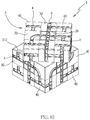
  • FIG. 1 is a perspective view showing the assembly of a maze according to a preferred embodiment of the present invention.
  • FIG. 2 is a perspective view showing the exploded components of the maze according to the preferred embodiment of the present invention.
  • FIG. 3 is a perspective view showing the exploded components of a part of the maze according to the preferred embodiment of the present invention.
  • FIG. 4 is another perspective view showing the exploded components of a part of the maze according to the preferred embodiment of the present invention.
  • FIG. 5 is another perspective view showing the exploded components of a part of the maze according to the preferred embodiment of the present invention.
  • FIG. 6 is a perspective view showing the assembly of a part of the maze according to the preferred embodiment of the present invention.
  • FIG. 7 is another perspective view showing the assembly of a part of the maze according to the preferred embodiment of the present invention.
  • FIG. 8 is a cross sectional view showing the assembly of the maze according to the preferred embodiment of the present invention.
  • FIG. 9 is an amplified cross-sectional view of a portion of FIG. 8 .
  • FIG. 10 is a perspective view showing the operation of the maze according to the preferred embodiment of the present invention.
  • FIG. 11 is another perspective view showing the operation of the maze according to the preferred embodiment of the present invention.
  • a maze capable of changing rolling paths comprises: a rotatable three-dimensional block 1 formed in a six-sided cube shape and defined by twenty-six square cube units for matching with a central fixing element 10 , wherein the rotatable three-dimensional block 1 includes nine of the twenty-six square cube units formed in a 3 by 3 grid arranged on each of six surfaces of the rotatable three-dimensional block 1 , and each of the twenty-six square cube units has three sets of rotary layers so as to form twelve rotary layer units 3 , wherein each of the three rotary layer units 3 rotates along the central fixing element 10 , thus changing a position of each square cube unit.
  • the rotatable three-dimensional block 1 includes at least one path 4 formed on each square cube unit and having at least one visible window formed on the at least one path 4 respectively, wherein the at least one path 4 is formed in any one of a T shape, a cross shape, and an arc shape on each square cube unit.
  • the at least one path 4 includes a ball B rolling therein and at least one channel S which communicates with one another, such that the ball rolls from a path 4 of one square cube unit to a path 4 of another square cube unit, wherein the at least one path 4 is changeable by rotating each rotary layer unit 3 so as to changeably roll the ball B relative to each square cube unit and each of the at least one path 4 .
  • the central fixing element 10 includes six three-dimensional extensions 11 , wherein the six three-dimensional extensions 11 have six threaded orifices 12 defined on six central positions of six free end surfaces of the six three-dimensional extensions 11 respectively.
  • the twenty-six square cube units include six first square cube units 20 rotatably connected with the six threaded orifices 12 of the central fixing element 10 individually, wherein the six first square cube units 20 have six first bodies 21 , six first screwing elements 22 , six first maze seats 23 , and six first caps 24 respectively, wherein the six first bodies 21 have six first connection portions 212 corresponding to the six threaded orifices 12 of the central fixing element 10 individually, the six first connection portions 212 have six receiving orifices 2121 configured to accommodate the first screwing elements 22 respectively so that the first screwing elements 22 are screwed with the six threaded orifices 12 of the central fixing element 10 via the first screwing elements 22 individually, the six first bodies 21 have six arcuate faces 211 and six first uneven ridge
  • the six first maze seats 23 have six first open segments 234 opposite to the multiple first protrusions 231 respectively, and the six first open segments 234 have six first V-shaped tracks 232 and being a part of the at least one path 4 individually, the six first V-shaped tracks 232 have multiple first openings 233 defined below the multiple first protrusions 231 and communicate with the multiple first openings 233 .
  • the six first open segments 234 of the six first maze seats 23 have six first inner fringes 235 and connected with six first outer fringes 241 of the six first caps 24 respectively so as to close the six first open segments 234 individually, and the six first caps 24 have six first visible windows 242 corresponding to the six first V-shaped tracks 232 respectively so that the ball B is visible when being rolled on the at least one path 4 .
  • the six first visible windows 242 have six first limiting rims 243 individually, when the ball B rolls in the six first V-shaped tracks 232 , the six first limiting rims 243 limit an upper portion of the ball B.
  • the twenty-six square cube units further include twelve second square cube units 30 arranged beside the six first square cube units 20 respectively, each of the twelve second square cube units 30 has a first rotatable member 315 relative to a first rotatable connection position of the central fixing element 10 and each of the six arcuate faces 211 of each six first square cube unit 20 so that the first rotatable member 315 is rotatably limited on the first rotatable connection position of the central fixing element 10 and each of the six arcuate faces 211 of each first square cube unit 20 , wherein each second square cube unit 30 has a second body 31 , and the second body 31 has two first maze units 311 perpendicular to each other, the two first maze units 311 have two second V-shaped tracks 314 respectively and being a part of the at least one path 4 individually, the two second V-shaped tracks 314 have two second openings 312 communicating with the multiple first openings 233 of each six first square cube unit 20 .
  • the two first maze units 311 have two first coupling portions 313 formed beside two tops of the two first maze units 311 respectively and coupled with two second caps 32 individually, wherein the two second caps 32 have two second coupling portions 323 corresponding to the two first coupling portions 313 of the second body 31 individually so that the two second coupling portions 323 of the two second caps 32 are connected with the two first coupling portions 313 of the second body 31 respectively.
  • the two second caps 32 have two first visible windows 321 corresponding to the two second V-shaped tracks 314 of the two first maze units 311 individually so that the ball B is visible when being rolled on the at least one path 4 .
  • the two second visible windows 321 have two second limiting rims 322 individually, when the ball B rolls in the two second V-shaped tracks 314 , the two second limiting rims 322 limit the upper portion of the ball B.
  • the twenty-six square cube units further include eight third square cube units 40 arranged on diagonal positions of the six first square cube units 20 respectively, each of the eight third square cube units 40 has a second rotatable member 415 relative to a second rotatable connection position of the central fixing element 10 and the first rotatable member 315 of each second square cube unit 30 so that the second rotatable member 415 is rotatably limited on the second rotatable connection position of the central fixing element 10 and each second square cube unit 30 , wherein each third square cube unit 40 has a third body 41 , and the third body 41 has three third maze seats 411 perpendicular to one another, the three third maze seats 411 have three third V-shaped tracks 412 respectively and being a part of the at least one path 4 individually, the three third V-shaped tracks 412 have three third openings 413 communicating with the multiple first openings 233 of each first square cube unit 20 and the two second openings 312 of each second square cube unit 30 .
  • the three third maze seats 411 have three second coupling portions 414 formed on three tops thereof respectively and coupled with three third caps 42 individually, wherein the three third caps 42 have three third coupling portions 423 corresponding to the three second coupling portions 414 of the second body 31 individually so that the three third coupling portions 423 of the three third caps 42 are connected with the three second coupling portions 414 of the third body 41 respectively.
  • the three third caps 42 have three third visible windows 421 corresponding to the three third V-shaped tracks 412 of the three third maze seats 411 individually so that the ball B is visible when being rolled on the at least one path 4 .
  • the three third visible windows 421 have three third limiting rims 422 individually, when the ball B rolls in the three third V-shaped tracks 412 , the three third limiting rims 422 limit the upper portion of the ball B.
  • the six first uneven ridges 213 of the six first bodies 21 of the six first square cube units 20 are connected with the multiple first protrusions 231 of the six first maze seats 23 respectively in a gluing manner or in an ultrasonic welding manner, and the six first inner fringes 235 of the six first maze seats 23 are connected with the six first outer fringes 241 of the six first caps 24 respectively in the gluing manner or in the ultrasonic welding manner.
  • the two first coupling portions 313 of the second body 31 of each second square cube unit 30 are connected with the two second coupling portions 323 of the two second caps 32 respectively in the gluing manner or in the ultrasonic welding manner.
  • the rotatable three-dimensional block 1 is rotatable to guide the ball B to roll and turn on the at least one path 4 formed in any one of the T shape, the cross shape, and the arc shape on each square cube unit, wherein when the three rotary layer units 3 of the rotatable three-dimensional block 1 are rotated in different levels, the ball B rolls in various paths 4 so as to enhance interesting of the maze.

Landscapes

  • Engineering & Computer Science (AREA)
  • Multimedia (AREA)
  • Toys (AREA)

Abstract

A maze capable of changing rolling paths contains: a rotatable three-dimensional block formed in a six-sided cube shape and defined by twenty-six square cube units for matching with a central fixing element. The rotatable three-dimensional block includes nine of the twenty-six square cube units formed in a 3 by 3 grid arranged on the rotatable three-dimensional block, and each square cube unit has three sets of rotary layers so as to form twelve rotary layer units. The rotatable three-dimensional block includes at least one path having at least one visible window formed on the at least one path respectively. The at least one path is formed in any one of a T shape, a cross shape, and an arc shape on each square cube unit, and the at least one path includes a ball rolling therein and at least one channel which communicates with one another.

Description

FIELD OF THE INVENTION
The present invention relates to a maze structure which is capable of changing rolling paths.
BACKGROUND OF THE INVENTION
A conventional maze structure is plane and contains multiple horizontal partitions and vertical partitions which define a path in which a ball rolls. However, it is easy for a user to walk out of the maze structure.
To enhance playing difficulty, a three-dimensional maze structure is formed in a pen shape and contains a plurality of partitions separated from one another. The three-dimensional maze structure also contains plural cutouts defined on the plurality of partitions respectively so as to form a path, hence a ball rolls downwardly in the path via the plural cutouts so as to get out of the three-dimensional maze structure. Nevertheless, it is also easy for a user to walk out of the three-dimensional maze structure.
The present invention has arisen to mitigate and/or obviate the afore-described disadvantages.
SUMMARY OF THE INVENTION
The primary objective of the present invention is to provide a maze in which the rotatable three-dimensional block is rotatable to guide the ball to roll and turn on the at least one path formed in any one of the T shape, the cross shape, and the arc shape on each square cube unit, wherein when the three rotary layer units of the rotatable three-dimensional block are rotated in different levels, the ball rolls in various paths so as to enhance interesting of the maze.
To obtain the above mentioned objective, a maze provided by a preferred embodiment of the present invention contains: a rotatable three-dimensional block formed in a six-sided cube shape and defined by twenty-six square cube units for matching with a central fixing element.
The rotatable three-dimensional block includes nine of the twenty-six square cube units formed in a 3 by 3 grid arranged on each of six surfaces of the rotatable three-dimensional block, and each of the twenty-six square cube units has three sets of rotary layers so as to form twelve rotary layer units.
The rotatable three-dimensional block includes at least one path formed on each square cube unit and having at least one visible window formed on the at least one path respectively. The at least one path is formed in any one of a T shape, a cross shape, and an arc shape on each square cube unit, and the at least one path includes a ball rolling therein and at least one channel which communicates with one another, such that the ball rolls from a path of one square cube unit to a path of another square cube unit. The at least one path is changeable by rotating each rotary layer unit so as to changeably roll the ball relative to each square cube unit and each of the at least one path.
BRIEF DESCRIPTION OF THE DRAWINGS
FIG. 1 is a perspective view showing the assembly of a maze according to a preferred embodiment of the present invention.
FIG. 2 is a perspective view showing the exploded components of the maze according to the preferred embodiment of the present invention.
FIG. 3 is a perspective view showing the exploded components of a part of the maze according to the preferred embodiment of the present invention.
FIG. 4 is another perspective view showing the exploded components of a part of the maze according to the preferred embodiment of the present invention.
FIG. 5 is another perspective view showing the exploded components of a part of the maze according to the preferred embodiment of the present invention.
FIG. 6 is a perspective view showing the assembly of a part of the maze according to the preferred embodiment of the present invention.
FIG. 7 is another perspective view showing the assembly of a part of the maze according to the preferred embodiment of the present invention.
FIG. 8 is a cross sectional view showing the assembly of the maze according to the preferred embodiment of the present invention.
FIG. 9 is an amplified cross-sectional view of a portion of FIG. 8.
FIG. 10 is a perspective view showing the operation of the maze according to the preferred embodiment of the present invention.
FIG. 11 is another perspective view showing the operation of the maze according to the preferred embodiment of the present invention.
DETAILED DESCRIPTION OF THE PREFERRED EMBODIMENTS
With reference to FIGS. 1-11, a maze capable of changing rolling paths according to a preferred embodiment of the present invention comprises: a rotatable three-dimensional block 1 formed in a six-sided cube shape and defined by twenty-six square cube units for matching with a central fixing element 10, wherein the rotatable three-dimensional block 1 includes nine of the twenty-six square cube units formed in a 3 by 3 grid arranged on each of six surfaces of the rotatable three-dimensional block 1, and each of the twenty-six square cube units has three sets of rotary layers so as to form twelve rotary layer units 3, wherein each of the three rotary layer units 3 rotates along the central fixing element 10, thus changing a position of each square cube unit.
The rotatable three-dimensional block 1 includes at least one path 4 formed on each square cube unit and having at least one visible window formed on the at least one path 4 respectively, wherein the at least one path 4 is formed in any one of a T shape, a cross shape, and an arc shape on each square cube unit. The at least one path 4 includes a ball B rolling therein and at least one channel S which communicates with one another, such that the ball rolls from a path 4 of one square cube unit to a path 4 of another square cube unit, wherein the at least one path 4 is changeable by rotating each rotary layer unit 3 so as to changeably roll the ball B relative to each square cube unit and each of the at least one path 4.
The central fixing element 10 includes six three-dimensional extensions 11, wherein the six three-dimensional extensions 11 have six threaded orifices 12 defined on six central positions of six free end surfaces of the six three-dimensional extensions 11 respectively. The twenty-six square cube units include six first square cube units 20 rotatably connected with the six threaded orifices 12 of the central fixing element 10 individually, wherein the six first square cube units 20 have six first bodies 21, six first screwing elements 22, six first maze seats 23, and six first caps 24 respectively, wherein the six first bodies 21 have six first connection portions 212 corresponding to the six threaded orifices 12 of the central fixing element 10 individually, the six first connection portions 212 have six receiving orifices 2121 configured to accommodate the first screwing elements 22 respectively so that the first screwing elements 22 are screwed with the six threaded orifices 12 of the central fixing element 10 via the first screwing elements 22 individually, the six first bodies 21 have six arcuate faces 211 and six first uneven ridges 213 opposite to the six arcuate faces 211 respectively and connected with multiple first protrusions 231 of the six first maze seats 23 respectively. The six first maze seats 23 have six first open segments 234 opposite to the multiple first protrusions 231 respectively, and the six first open segments 234 have six first V-shaped tracks 232 and being a part of the at least one path 4 individually, the six first V-shaped tracks 232 have multiple first openings 233 defined below the multiple first protrusions 231 and communicate with the multiple first openings 233. The six first open segments 234 of the six first maze seats 23 have six first inner fringes 235 and connected with six first outer fringes 241 of the six first caps 24 respectively so as to close the six first open segments 234 individually, and the six first caps 24 have six first visible windows 242 corresponding to the six first V-shaped tracks 232 respectively so that the ball B is visible when being rolled on the at least one path 4. The six first visible windows 242 have six first limiting rims 243 individually, when the ball B rolls in the six first V-shaped tracks 232, the six first limiting rims 243 limit an upper portion of the ball B.
The twenty-six square cube units further include twelve second square cube units 30 arranged beside the six first square cube units 20 respectively, each of the twelve second square cube units 30 has a first rotatable member 315 relative to a first rotatable connection position of the central fixing element 10 and each of the six arcuate faces 211 of each six first square cube unit 20 so that the first rotatable member 315 is rotatably limited on the first rotatable connection position of the central fixing element 10 and each of the six arcuate faces 211 of each first square cube unit 20, wherein each second square cube unit 30 has a second body 31, and the second body 31 has two first maze units 311 perpendicular to each other, the two first maze units 311 have two second V-shaped tracks 314 respectively and being a part of the at least one path 4 individually, the two second V-shaped tracks 314 have two second openings 312 communicating with the multiple first openings 233 of each six first square cube unit 20. The two first maze units 311 have two first coupling portions 313 formed beside two tops of the two first maze units 311 respectively and coupled with two second caps 32 individually, wherein the two second caps 32 have two second coupling portions 323 corresponding to the two first coupling portions 313 of the second body 31 individually so that the two second coupling portions 323 of the two second caps 32 are connected with the two first coupling portions 313 of the second body 31 respectively. The two second caps 32 have two first visible windows 321 corresponding to the two second V-shaped tracks 314 of the two first maze units 311 individually so that the ball B is visible when being rolled on the at least one path 4. The two second visible windows 321 have two second limiting rims 322 individually, when the ball B rolls in the two second V-shaped tracks 314, the two second limiting rims 322 limit the upper portion of the ball B.
The twenty-six square cube units further include eight third square cube units 40 arranged on diagonal positions of the six first square cube units 20 respectively, each of the eight third square cube units 40 has a second rotatable member 415 relative to a second rotatable connection position of the central fixing element 10 and the first rotatable member 315 of each second square cube unit 30 so that the second rotatable member 415 is rotatably limited on the second rotatable connection position of the central fixing element 10 and each second square cube unit 30, wherein each third square cube unit 40 has a third body 41, and the third body 41 has three third maze seats 411 perpendicular to one another, the three third maze seats 411 have three third V-shaped tracks 412 respectively and being a part of the at least one path 4 individually, the three third V-shaped tracks 412 have three third openings 413 communicating with the multiple first openings 233 of each first square cube unit 20 and the two second openings 312 of each second square cube unit 30. The three third maze seats 411 have three second coupling portions 414 formed on three tops thereof respectively and coupled with three third caps 42 individually, wherein the three third caps 42 have three third coupling portions 423 corresponding to the three second coupling portions 414 of the second body 31 individually so that the three third coupling portions 423 of the three third caps 42 are connected with the three second coupling portions 414 of the third body 41 respectively. The three third caps 42 have three third visible windows 421 corresponding to the three third V-shaped tracks 412 of the three third maze seats 411 individually so that the ball B is visible when being rolled on the at least one path 4. The three third visible windows 421 have three third limiting rims 422 individually, when the ball B rolls in the three third V-shaped tracks 412, the three third limiting rims 422 limit the upper portion of the ball B.
Preferably, the six first uneven ridges 213 of the six first bodies 21 of the six first square cube units 20 are connected with the multiple first protrusions 231 of the six first maze seats 23 respectively in a gluing manner or in an ultrasonic welding manner, and the six first inner fringes 235 of the six first maze seats 23 are connected with the six first outer fringes 241 of the six first caps 24 respectively in the gluing manner or in the ultrasonic welding manner.
Preferably, the two first coupling portions 313 of the second body 31 of each second square cube unit 30 are connected with the two second coupling portions 323 of the two second caps 32 respectively in the gluing manner or in the ultrasonic welding manner.
Thereby, the rotatable three-dimensional block 1 is rotatable to guide the ball B to roll and turn on the at least one path 4 formed in any one of the T shape, the cross shape, and the arc shape on each square cube unit, wherein when the three rotary layer units 3 of the rotatable three-dimensional block 1 are rotated in different levels, the ball B rolls in various paths 4 so as to enhance interesting of the maze.
While the preferred embodiments of the invention have been set forth for the purpose of disclosure, modifications of the disclosed embodiments of the invention as well as other embodiments thereof may occur to those skilled in the art. Accordingly, the appended claims are intended to cover all embodiments which do not depart from the spirit and scope of the invention.

Claims (6)

What is claimed is:
1. A maze capable of changing rolling paths comprising:
a rotatable three-dimensional block formed in a six-sided cube shape and defined by twenty-six square cube units for matching with a central fixing element, wherein the rotatable three-dimensional block includes nine of the twenty-six square cube units formed in a 3 by 3 grid arranged on each of six surfaces of the rotatable three-dimensional block, and each of the twenty-six square cube units has three sets of rotary layers so as to form twelve rotary layer units;
wherein the rotatable three-dimensional block includes at least one path formed on each square cube unit and having at least one visible window formed on the at least one path respectively, wherein the at least one path is formed in any one of a T shape, a cross shape, and an arc shape on each square cube unit, and the at least one path includes a ball rolling therein and at least one channel which communicates with one another, such that the ball rolls from a path of one square cube unit to a path of another square cube unit, wherein the at least one path is changeable by rotating each rotary layer unit so as to changeably roll the ball relative to each square cube unit and each of the at least one path;
wherein the central fixing element includes six three-dimensional extensions, wherein the six three-dimensional extensions have six threaded orifices defined on six central positions of six free end surfaces of the six three-dimensional extensions respectively; the twenty-six square cube units include six first square cube units rotatably connected with the six threaded orifices of the central fixing element individually, wherein the six first square cube units have six first bodies, six first screwing elements, six first maze seats, and six first caps respectively, wherein the six first bodies have six first connection portions corresponding to the six threaded orifices of the central fixing element individually, the six first connection portions have six receiving orifices configured to accommodate the first screwing elements respectively so that the first screwing elements are screwed with the six threaded orifices of the central fixing element via the first screwing elements individually, the six first bodies have six arcuate faces and six first uneven ridges opposite to the six arcuate faces respectively and connected with multiple first protrusions of the six first maze seats respectively; the six first maze seats have six first open segments opposite to the multiple first protrusions respectively, and the six first open segments have six first V-shaped tracks and being a part of the at least one path individually, the six first V-shaped tracks have multiple first openings defined below the multiple first protrusions and communicate with the multiple first openings; the six first open segments of the six first maze seats have six first inner fringes and connected with six first outer fringes of the six first caps respectively so as to close the six first open segments individually, and the six first caps have six first visible windows corresponding to the six first V-shaped tracks respectively, and the six first visible windows have six first limiting rims individually, when the ball rolls in the six first V-shaped tracks, the six first limiting rims limit an upper portion of the ball.
2. The maze as claimed in claim 1, wherein the twenty-six square cube units further include twelve second square cube units arranged beside the six first square cube units respectively, each of the twelve second square cube units has a first rotatable member relative to a first rotatable connection position of the central fixing element and each of the six arcuate faces of each six first square cube unit so that the first rotatable member is rotatably limited on the first rotatable connection position of the central fixing element and each of the six arcuate faces of each first square cube unit, wherein each second square cube unit has a second body, and the second body has two first maze units perpendicular to each other, the two first maze units have two second V-shaped tracks respectively and being a part of the at least one path individually, the two second V-shaped tracks have two second openings communicating with the multiple first openings of each six first square cube unit, the two first maze units have two first coupling portions formed beside two tops of the two first maze units respectively and coupled with two second caps individually, wherein the two second caps have two second coupling portions corresponding to the two first coupling portions of the second body individually so that the two second coupling portions of the two second caps are connected with the two first coupling portions of the second body respectively; the two second caps have two first visible windows corresponding to the two second V-shaped tracks of the two first maze units individually, and the two second visible windows have two second limiting rims individually, when the ball rolls in the two second V-shaped tracks, the two second limiting rims limit the upper portion of the ball.
3. The maze as claimed in claim 2, wherein the twenty-six square cube units further include eight third square cube units arranged on diagonal positions of the six first square cube units respectively, each of the eight third square cube units has a second rotatable member relative to a second rotatable connection position of the central fixing element and the first rotatable member of each second square cube unit so that the second rotatable member is rotatably limited on the second rotatable connection position of the central fixing element and each second square cube unit, wherein each third square cube unit has a third body, and the third body has three third maze seats perpendicular to one another, the three third maze seats have three third V-shaped tracks respectively and being a part of the at least one path individually, the three third V-shaped tracks have three third openings communicating with the multiple first openings of each first square cube unit and the two second openings of each second square cube unit; the three third maze seats have three second coupling portions formed on three tops thereof respectively and coupled with three third caps individually, wherein the three third caps have three third coupling portions corresponding to the three second coupling portions of the second body individually so that the three third coupling portions of the three third caps are connected with the three second coupling portions of the third body respectively; the three third caps have three third visible windows corresponding to the three third V-shaped tracks of the three third maze seats individually, and the three third visible windows have three third limiting rims individually, when the ball rolls in the three third V-shaped tracks, the three third limiting rims limit the upper portion of the ball.
4. The maze as claimed in claim 1, wherein the six first uneven ridges of the six first bodies of the six first square cube units are connected with the multiple first protrusions of the six first maze seats respectively in a gluing manner or in an ultrasonic welding manner, and the six first inner fringes of the six first maze seats are connected with the six first outer fringes of the six first caps respectively in the gluing manner or in the ultrasonic welding manner.
5. The maze as claimed in claim 2, wherein the two first coupling portions of the second body of each second square cube unit are connected with the two second coupling portions of the two second caps respectively in the gluing manner or in the ultrasonic welding manner.
6. The maze as claimed in claim 3, wherein the two first coupling portions of the second body of each second square cube unit are connected with the two second coupling portions of the two second caps respectively in the gluing manner or in the ultrasonic welding manner.
US16/591,401 2019-10-02 2019-10-02 Maze capable of changing rolling paths Expired - Fee Related US10765932B1 (en)

Priority Applications (1)

Application Number Priority Date Filing Date Title
US16/591,401 US10765932B1 (en) 2019-10-02 2019-10-02 Maze capable of changing rolling paths

Applications Claiming Priority (1)

Application Number Priority Date Filing Date Title
US16/591,401 US10765932B1 (en) 2019-10-02 2019-10-02 Maze capable of changing rolling paths

Publications (1)

Publication Number Publication Date
US10765932B1 true US10765932B1 (en) 2020-09-08

Family

ID=72289997

Family Applications (1)

Application Number Title Priority Date Filing Date
US16/591,401 Expired - Fee Related US10765932B1 (en) 2019-10-02 2019-10-02 Maze capable of changing rolling paths

Country Status (1)

Country Link
US (1) US10765932B1 (en)

Cited By (5)

* Cited by examiner, † Cited by third party
Publication number Priority date Publication date Assignee Title
USD985068S1 (en) * 2020-03-27 2023-05-02 Geniewoos Inc. Puzzle cube
USD994786S1 (en) * 2022-06-20 2023-08-08 Alexander Krys Puzzle game
USD1013057S1 (en) * 2022-06-20 2024-01-30 Alexander Krys Puzzle game
USD1013058S1 (en) * 2022-06-20 2024-01-30 Alexander Krys Puzzle box
US20240238668A1 (en) * 2023-01-17 2024-07-18 Harshad Bhavsar 3d puzzles with replaceable tiles

Citations (18)

* Cited by examiner, † Cited by third party
Publication number Priority date Publication date Assignee Title
US3696549A (en) * 1971-02-24 1972-10-10 Columbia Broadcasting Syst Inc Ball and cube with conduits extending between adjacent walls thereof
US4861036A (en) * 1987-11-04 1989-08-29 Tsutomu Watanabe Multi-level crossing maze toy
US4953863A (en) * 1989-04-05 1990-09-04 Zeidler Douglas D Game assembly
US4953502A (en) * 1989-09-21 1990-09-04 Hoover Judith L Three-dimensional maze pet toy
FR2646096A1 (en) * 1989-04-24 1990-10-26 Tsutomu Watanabe Multi-level maze game
WO1992019338A1 (en) * 1991-04-26 1992-11-12 Victor Manuel Pracas Puzzle device
WO1995033537A1 (en) * 1994-06-07 1995-12-14 Signo Gmbh Solitary game device and process for manufacturing the same
US5560606A (en) * 1996-02-26 1996-10-01 David; Eliahu Cubicle maze puzzle
US6139015A (en) * 1999-04-22 2000-10-31 Hsieh; Frank Maze toy having changeable tracks
US20010033056A1 (en) * 2000-02-15 2001-10-25 Francis Geoffrey V. Spatial game toy
US6568679B1 (en) * 1999-07-30 2003-05-27 Michael Saunders Sommer Cubical maze module
US7165768B2 (en) * 2005-04-06 2007-01-23 Chih-Chung Fang Variable three-dimensional labyrinth
US7338045B2 (en) * 2002-11-05 2008-03-04 Dwipendra Nath Guha Three dimensional maze game
US7600756B2 (en) * 2003-05-21 2009-10-13 Panayotis Verdes Cubic logic toy
US20090278309A1 (en) * 2008-05-09 2009-11-12 Bart Miller Three-dimensional game and method of playing the same
CN102553224A (en) * 2012-01-06 2012-07-11 周琬芸 Labyrinth magic cube
WO2018230763A1 (en) * 2017-06-13 2018-12-20 울산과학기술원 Maze-type cube block
US20200054937A1 (en) * 2018-08-18 2020-02-20 Yang Cao Space maze puzzle with reconfigurable paths

Patent Citations (18)

* Cited by examiner, † Cited by third party
Publication number Priority date Publication date Assignee Title
US3696549A (en) * 1971-02-24 1972-10-10 Columbia Broadcasting Syst Inc Ball and cube with conduits extending between adjacent walls thereof
US4861036A (en) * 1987-11-04 1989-08-29 Tsutomu Watanabe Multi-level crossing maze toy
US4953863A (en) * 1989-04-05 1990-09-04 Zeidler Douglas D Game assembly
FR2646096A1 (en) * 1989-04-24 1990-10-26 Tsutomu Watanabe Multi-level maze game
US4953502A (en) * 1989-09-21 1990-09-04 Hoover Judith L Three-dimensional maze pet toy
WO1992019338A1 (en) * 1991-04-26 1992-11-12 Victor Manuel Pracas Puzzle device
WO1995033537A1 (en) * 1994-06-07 1995-12-14 Signo Gmbh Solitary game device and process for manufacturing the same
US5560606A (en) * 1996-02-26 1996-10-01 David; Eliahu Cubicle maze puzzle
US6139015A (en) * 1999-04-22 2000-10-31 Hsieh; Frank Maze toy having changeable tracks
US6568679B1 (en) * 1999-07-30 2003-05-27 Michael Saunders Sommer Cubical maze module
US20010033056A1 (en) * 2000-02-15 2001-10-25 Francis Geoffrey V. Spatial game toy
US7338045B2 (en) * 2002-11-05 2008-03-04 Dwipendra Nath Guha Three dimensional maze game
US7600756B2 (en) * 2003-05-21 2009-10-13 Panayotis Verdes Cubic logic toy
US7165768B2 (en) * 2005-04-06 2007-01-23 Chih-Chung Fang Variable three-dimensional labyrinth
US20090278309A1 (en) * 2008-05-09 2009-11-12 Bart Miller Three-dimensional game and method of playing the same
CN102553224A (en) * 2012-01-06 2012-07-11 周琬芸 Labyrinth magic cube
WO2018230763A1 (en) * 2017-06-13 2018-12-20 울산과학기술원 Maze-type cube block
US20200054937A1 (en) * 2018-08-18 2020-02-20 Yang Cao Space maze puzzle with reconfigurable paths

Cited By (6)

* Cited by examiner, † Cited by third party
Publication number Priority date Publication date Assignee Title
USD985068S1 (en) * 2020-03-27 2023-05-02 Geniewoos Inc. Puzzle cube
USD994786S1 (en) * 2022-06-20 2023-08-08 Alexander Krys Puzzle game
USD1013057S1 (en) * 2022-06-20 2024-01-30 Alexander Krys Puzzle game
USD1013058S1 (en) * 2022-06-20 2024-01-30 Alexander Krys Puzzle box
US20240238668A1 (en) * 2023-01-17 2024-07-18 Harshad Bhavsar 3d puzzles with replaceable tiles
US12403389B2 (en) * 2023-01-17 2025-09-02 Harshad Bhavsar 3D puzzles with replaceable tiles

Similar Documents

Publication Publication Date Title
US10765932B1 (en) Maze capable of changing rolling paths
US5816571A (en) Spherical puzzle toy
US9427675B2 (en) Hexagonal block and its stand
US7367565B2 (en) Balance plate intelligent game apparatus
US4865323A (en) Spherical puzzle
US9248695B2 (en) Mosaic piece
US5992850A (en) Four-layer intellectual cube
US8870185B2 (en) Building base plates assembled to build blocks set in cube dimensional configurations
US20080274665A1 (en) Building base plates assembled to build block sets in two or three dimensional configurations
HU180387B (en) Spatial logic toy
US4575088A (en) Three dimensional combinatorial device
US6568679B1 (en) Cubical maze module
IE52080B1 (en) Cylindrical manipulative puzzle
KR900007454A (en) Golf ball
US20110057387A1 (en) Cylinder cube
EP0042695A2 (en) Puzzle toy
TWI743571B (en) Stereoscopic maze structure with switchable path changes
EP3456396A1 (en) Folding toy
US10010787B1 (en) Three-dimensional maze structure
US6773011B1 (en) Puzzle
US6003868A (en) Game ball
KR101237840B1 (en) Dice playing apparatus
HU189640B (en) Three-dimensional logic and constructional toy
CN216456897U (en) Color pairing toy
USD1096955S1 (en) Leaf game

Legal Events

Date Code Title Description
FEPP Fee payment procedure

Free format text: ENTITY STATUS SET TO UNDISCOUNTED (ORIGINAL EVENT CODE: BIG.); ENTITY STATUS OF PATENT OWNER: SMALL ENTITY

FEPP Fee payment procedure

Free format text: ENTITY STATUS SET TO SMALL (ORIGINAL EVENT CODE: SMAL); ENTITY STATUS OF PATENT OWNER: SMALL ENTITY

ZAAA Notice of allowance and fees due

Free format text: ORIGINAL CODE: NOA

ZAAB Notice of allowance mailed

Free format text: ORIGINAL CODE: MN/=.

STCF Information on status: patent grant

Free format text: PATENTED CASE

FEPP Fee payment procedure

Free format text: MAINTENANCE FEE REMINDER MAILED (ORIGINAL EVENT CODE: REM.); ENTITY STATUS OF PATENT OWNER: SMALL ENTITY

LAPS Lapse for failure to pay maintenance fees

Free format text: PATENT EXPIRED FOR FAILURE TO PAY MAINTENANCE FEES (ORIGINAL EVENT CODE: EXP.); ENTITY STATUS OF PATENT OWNER: SMALL ENTITY

STCH Information on status: patent discontinuation

Free format text: PATENT EXPIRED DUE TO NONPAYMENT OF MAINTENANCE FEES UNDER 37 CFR 1.362

FP Lapsed due to failure to pay maintenance fee

Effective date: 20240908