US10759785B2 - Compounds - Google Patents
Compounds Download PDFInfo
- Publication number
- US10759785B2 US10759785B2 US16/312,158 US201716312158A US10759785B2 US 10759785 B2 US10759785 B2 US 10759785B2 US 201716312158 A US201716312158 A US 201716312158A US 10759785 B2 US10759785 B2 US 10759785B2
- Authority
- US
- United States
- Prior art keywords
- heterocyclyl
- carbocyclyl
- mmol
- compound according
- heteroaryl
- Prior art date
- Legal status (The legal status is an assumption and is not a legal conclusion. Google has not performed a legal analysis and makes no representation as to the accuracy of the status listed.)
- Active
Links
- 0 [1*]C.[2*][N+]1=C(CNC(=O)C2=NC([3*])=CN=C2N)N([10*])C2=C1C=CC=C2.[CH3-] Chemical compound [1*]C.[2*][N+]1=C(CNC(=O)C2=NC([3*])=CN=C2N)N([10*])C2=C1C=CC=C2.[CH3-] 0.000 description 38
- XGSXMDQVYYCSDA-UHFFFAOYSA-N CC(=O)NC1CCOC1=O Chemical compound CC(=O)NC1CCOC1=O XGSXMDQVYYCSDA-UHFFFAOYSA-N 0.000 description 5
- QJEHYANFPMGHMU-UHFFFAOYSA-O CCN1C2=CC(OC)=CC=C2[N+](C)=C1CNC(=O)C1=C(N)N=CC(C)=N1.[I-] Chemical compound CCN1C2=CC(OC)=CC=C2[N+](C)=C1CNC(=O)C1=C(N)N=CC(C)=N1.[I-] QJEHYANFPMGHMU-UHFFFAOYSA-O 0.000 description 3
- YOBIXGJSDZBXPQ-BSBBBTHVSA-O *.*.*.CCN1C2=CC(C3=CN(C4CCN(C[C@H](O)[C@@H](O)[C@H](O)[C@H](O)CO)CC4)N=C3)=CC=C2[N+](CC)=C1CNC(=O)C1=C(N)N=CC(Br)=N1.O=CO.S.[Cl-] Chemical compound *.*.*.CCN1C2=CC(C3=CN(C4CCN(C[C@H](O)[C@@H](O)[C@H](O)[C@H](O)CO)CC4)N=C3)=CC=C2[N+](CC)=C1CNC(=O)C1=C(N)N=CC(Br)=N1.O=CO.S.[Cl-] YOBIXGJSDZBXPQ-BSBBBTHVSA-O 0.000 description 2
- YUGHIKMHNABFDM-BTQNPOSSSA-O *.CCN1C2=CC(C(=O)N[C@@H]3CCOC3=O)=CC=C2[N+](CC)=C1CNC(=O)C1=NC(Br)=CN=C1N.O=CO Chemical compound *.CCN1C2=CC(C(=O)N[C@@H]3CCOC3=O)=CC=C2[N+](CC)=C1CNC(=O)C1=NC(Br)=CN=C1N.O=CO YUGHIKMHNABFDM-BTQNPOSSSA-O 0.000 description 2
- DWZDOKWYMOUPTE-UHFFFAOYSA-O CCC1=NC(C(=O)NCC2=[N+](C)C3=CC=C(OC)C=C3N2CC)=C(N)N=C1.[I-] Chemical compound CCC1=NC(C(=O)NCC2=[N+](C)C3=CC=C(OC)C=C3N2CC)=C(N)N=C1.[I-] DWZDOKWYMOUPTE-UHFFFAOYSA-O 0.000 description 2
- HVYBQGGQGKQXMK-UHFFFAOYSA-O CCN1C2=CC(C(=O)O)=CC=C2[N+](CC)=C1CNC(=O)C1=C(N)N=CC(Br)=N1.[Br-] Chemical compound CCN1C2=CC(C(=O)O)=CC=C2[N+](CC)=C1CNC(=O)C1=C(N)N=CC(Br)=N1.[Br-] HVYBQGGQGKQXMK-UHFFFAOYSA-O 0.000 description 2
- IKJIYSFMXSMRQT-UHFFFAOYSA-O CCN1C2=CC(C(=O)OC)=CC=C2[N+](CC)=C1CNC(=O)C1=C(N)N=CC(Br)=N1.[I-] Chemical compound CCN1C2=CC(C(=O)OC)=CC=C2[N+](CC)=C1CNC(=O)C1=C(N)N=CC(Br)=N1.[I-] IKJIYSFMXSMRQT-UHFFFAOYSA-O 0.000 description 2
- RDPPNMKIGIEIHI-UHFFFAOYSA-N CCN1C2=CC(C(F)(F)F)=CC=C2N=C1CNC(=O)OC(C)(C)C Chemical compound CCN1C2=CC(C(F)(F)F)=CC=C2N=C1CNC(=O)OC(C)(C)C RDPPNMKIGIEIHI-UHFFFAOYSA-N 0.000 description 2
- NAJQXBOVVSPYHF-UHFFFAOYSA-O CCN1C2=CC(C(F)(F)F)=CC=C2[N+](C)=C1CNC(=O)C1=C(N)N=CC(Br)=N1.[I-] Chemical compound CCN1C2=CC(C(F)(F)F)=CC=C2[N+](C)=C1CNC(=O)C1=C(N)N=CC(Br)=N1.[I-] NAJQXBOVVSPYHF-UHFFFAOYSA-O 0.000 description 2
- BHPBFSUGVUSRBY-UHFFFAOYSA-N CCN1C2=CC(C(F)(F)F)=CC=C2[N+](CC2=CC=CC=C2)=C1CNC(=O)C1=NC(Br)=CN=C1N.O=C[O-] Chemical compound CCN1C2=CC(C(F)(F)F)=CC=C2[N+](CC2=CC=CC=C2)=C1CNC(=O)C1=NC(Br)=CN=C1N.O=C[O-] BHPBFSUGVUSRBY-UHFFFAOYSA-N 0.000 description 2
- IIIXWOJSOQAPKI-UHFFFAOYSA-N CCN1C2=CC(C3=CN(C4CCN(C(=N)N)CC4)N=C3)=CC=C2[N+](CC)=C1CNC(=O)C1=C(N)N=CC(Br)=N1.O=CO.O=C[O-] Chemical compound CCN1C2=CC(C3=CN(C4CCN(C(=N)N)CC4)N=C3)=CC=C2[N+](CC)=C1CNC(=O)C1=C(N)N=CC(Br)=N1.O=CO.O=C[O-] IIIXWOJSOQAPKI-UHFFFAOYSA-N 0.000 description 2
- GAUBDWKVDUGEFK-UHFFFAOYSA-O CCN1C2=CC(C3=CN(C4CCN(C(=O)OC(C)(C)C)CC4)N=C3)=CC=C2[N+](CC)=C1CNC(=O)C1=C(N)N=CC(Br)=N1.[I-] Chemical compound CCN1C2=CC(C3=CN(C4CCN(C(=O)OC(C)(C)C)CC4)N=C3)=CC=C2[N+](CC)=C1CNC(=O)C1=C(N)N=CC(Br)=N1.[I-] GAUBDWKVDUGEFK-UHFFFAOYSA-O 0.000 description 2
- QOFWZOYFVNRDAE-UHFFFAOYSA-O CCN1C2=CC(C3=CN(C4CCNCC4)N=C3)=CC=C2[N+](CC)=C1CNC(=O)C1=C(N)N=CC(Br)=N1.Cl.[I-] Chemical compound CCN1C2=CC(C3=CN(C4CCNCC4)N=C3)=CC=C2[N+](CC)=C1CNC(=O)C1=C(N)N=CC(Br)=N1.Cl.[I-] QOFWZOYFVNRDAE-UHFFFAOYSA-O 0.000 description 2
- FOIGHKREHOQXSE-UHFFFAOYSA-N CCN1C2=CC(Cl)=CC=C2[N+](C)=C1CNC(=O)C1=C(N)N=CC(Br)=N1.O=CO.O=C[O-] Chemical compound CCN1C2=CC(Cl)=CC=C2[N+](C)=C1CNC(=O)C1=C(N)N=CC(Br)=N1.O=CO.O=C[O-] FOIGHKREHOQXSE-UHFFFAOYSA-N 0.000 description 2
- GBYYURYZDBFROM-UHFFFAOYSA-N CCN1C2=CC(F)=CC=C2[N+](C)=C1CNC(=O)C1=C(N)N=CC(Br)=N1.O=C[O-] Chemical compound CCN1C2=CC(F)=CC=C2[N+](C)=C1CNC(=O)C1=C(N)N=CC(Br)=N1.O=C[O-] GBYYURYZDBFROM-UHFFFAOYSA-N 0.000 description 2
- FMHDILBEQGUNIW-UHFFFAOYSA-N CCN1C2=CC(OC(F)(F)F)=CC=C2[N+](C)=C1CNC(=O)C1=C(N)N=CC(Br)=N1.O=C[O-] Chemical compound CCN1C2=CC(OC(F)(F)F)=CC=C2[N+](C)=C1CNC(=O)C1=C(N)N=CC(Br)=N1.O=C[O-] FMHDILBEQGUNIW-UHFFFAOYSA-N 0.000 description 2
- WLZOXFFNLWKAEL-UHFFFAOYSA-O CCN1C2=CC(OC)=CC=C2[N+](C)=C1CNC(=O)C1=C(N)N=CC(Br)=N1.[I-] Chemical compound CCN1C2=CC(OC)=CC=C2[N+](C)=C1CNC(=O)C1=C(N)N=CC(Br)=N1.[I-] WLZOXFFNLWKAEL-UHFFFAOYSA-O 0.000 description 2
- SCZIECFBUJIRLF-UHFFFAOYSA-O CCN1C2=CC(OC)=CC=C2[N+](C)=C1CNC(=O)C1=C(N)N=CC(Cl)=N1.[I-] Chemical compound CCN1C2=CC(OC)=CC=C2[N+](C)=C1CNC(=O)C1=C(N)N=CC(Cl)=N1.[I-] SCZIECFBUJIRLF-UHFFFAOYSA-O 0.000 description 2
- WQZARHKKPLFQLR-UHFFFAOYSA-O CCN1C2=CC(OC)=CC=C2[N+](C)=C1CNC(=O)C1=C(N)N=CC(SC)=N1.[I-] Chemical compound CCN1C2=CC(OC)=CC=C2[N+](C)=C1CNC(=O)C1=C(N)N=CC(SC)=N1.[I-] WQZARHKKPLFQLR-UHFFFAOYSA-O 0.000 description 2
- BHXMDVNEZNDZNL-UHFFFAOYSA-O CCN1C2=CC(OC)=CC=C2[N+](C)=C1CNC(=O)C1=C(N)N=CC=N1.[I-] Chemical compound CCN1C2=CC(OC)=CC=C2[N+](C)=C1CNC(=O)C1=C(N)N=CC=N1.[I-] BHXMDVNEZNDZNL-UHFFFAOYSA-O 0.000 description 2
- YAGDYMJAKULKHF-UHFFFAOYSA-N CCN1C2=CC(OC)=CC=C2[N+](CC)=C1CNC(=O)C1=C(N)N=CC(Br)=N1.O=C[O-] Chemical compound CCN1C2=CC(OC)=CC=C2[N+](CC)=C1CNC(=O)C1=C(N)N=CC(Br)=N1.O=C[O-] YAGDYMJAKULKHF-UHFFFAOYSA-N 0.000 description 2
- CNAYLEGBRIPVMZ-UHFFFAOYSA-N CCN1C2=CC(OC)=CC=C2[N+](CCO)=C1CNC(=O)C1=C(N)N=CC(Br)=N1.O=C[O-] Chemical compound CCN1C2=CC(OC)=CC=C2[N+](CCO)=C1CNC(=O)C1=C(N)N=CC(Br)=N1.O=C[O-] CNAYLEGBRIPVMZ-UHFFFAOYSA-N 0.000 description 2
- ZCKXHYBJQJGRMG-UHFFFAOYSA-N CCN1C2=CC(OC)=CC=C2[N+](CCOCCOCCO)=C1CNC(=O)C1=C(N)N=CC(Br)=N1.O=C[O-] Chemical compound CCN1C2=CC(OC)=CC=C2[N+](CCOCCOCCO)=C1CNC(=O)C1=C(N)N=CC(Br)=N1.O=C[O-] ZCKXHYBJQJGRMG-UHFFFAOYSA-N 0.000 description 2
- KLEPGIYTNMBQHZ-UHFFFAOYSA-N CCN1C2=CC(OCCCC(=O)OC(C)(C)C)=CC=C2[N+](CC)=C1CNC(=O)C1=C(N)N=CC(Br)=N1.O=C[O-] Chemical compound CCN1C2=CC(OCCCC(=O)OC(C)(C)C)=CC=C2[N+](CC)=C1CNC(=O)C1=C(N)N=CC(Br)=N1.O=C[O-] KLEPGIYTNMBQHZ-UHFFFAOYSA-N 0.000 description 2
- HBJCIAOORNRAOV-UHFFFAOYSA-O CCN1C2=CC(OCCN)=CC=C2[N+](CC)=C1CNC(=O)C1=C(N)N=CC(Br)=N1.Cl.[Cl-] Chemical compound CCN1C2=CC(OCCN)=CC=C2[N+](CC)=C1CNC(=O)C1=C(N)N=CC(Br)=N1.Cl.[Cl-] HBJCIAOORNRAOV-UHFFFAOYSA-O 0.000 description 2
- BSHYRRODPGNMMX-UHFFFAOYSA-N CSC1=NC(C(=O)O)=C(N)N=C1 Chemical compound CSC1=NC(C(=O)O)=C(N)N=C1 BSHYRRODPGNMMX-UHFFFAOYSA-N 0.000 description 2
- IDMYVNQNGWCNDY-UHFFFAOYSA-N N#CC1=CN=C(N)C(C(=O)O)=N1 Chemical compound N#CC1=CN=C(N)C(C(=O)O)=N1 IDMYVNQNGWCNDY-UHFFFAOYSA-N 0.000 description 2
- MTNAQEKMSVDTAQ-UHFFFAOYSA-M NC1=C(C(=O)[O-])N=C(Br)C=N1.[Li+] Chemical compound NC1=C(C(=O)[O-])N=C(Br)C=N1.[Li+] MTNAQEKMSVDTAQ-UHFFFAOYSA-M 0.000 description 2
- VXPZENNGJBBPGK-GUNLUECXSA-R *.*.*.C.CCN1C2=CC(C3=CN(C4CCN(C[C@H](O)[C@@H](O)[C@H](O)[C@H](O)CO)CC4)N=C3)=CC=C2/[N+](CC)=C\1CNC(=O)C1=C(N)N=CC(Br)=N1.CCN1C2=CC(OC)=CC=C2/[N+](CC)=C\1CNC(=O)C1=C(N)N=CC(C#N)=N1.CCN1C2=CC(OCCCC(=O)OC(C)(C)C)=CC=C2/[N+](CC)=C\1CNC(=O)C1=C(N)N=CC(Br)=N1.CCN1C2=CC(OCCN)=CC=C2/[N+](CC)=C\1CNC(=O)C1=C(N)N=CC(Br)=N1.S.[CH3-].[CH3-].[CH3-] Chemical compound *.*.*.C.CCN1C2=CC(C3=CN(C4CCN(C[C@H](O)[C@@H](O)[C@H](O)[C@H](O)CO)CC4)N=C3)=CC=C2/[N+](CC)=C\1CNC(=O)C1=C(N)N=CC(Br)=N1.CCN1C2=CC(OC)=CC=C2/[N+](CC)=C\1CNC(=O)C1=C(N)N=CC(C#N)=N1.CCN1C2=CC(OCCCC(=O)OC(C)(C)C)=CC=C2/[N+](CC)=C\1CNC(=O)C1=C(N)N=CC(Br)=N1.CCN1C2=CC(OCCN)=CC=C2/[N+](CC)=C\1CNC(=O)C1=C(N)N=CC(Br)=N1.S.[CH3-].[CH3-].[CH3-] VXPZENNGJBBPGK-GUNLUECXSA-R 0.000 description 1
- YGPMJZVVZVIZKQ-UHFFFAOYSA-O Br.CCN1C2=CC(C(=O)O)=CC=C2/[N+](CC)=C\1CN.[Br-] Chemical compound Br.CCN1C2=CC(C(=O)O)=CC=C2/[N+](CC)=C\1CN.[Br-] YGPMJZVVZVIZKQ-UHFFFAOYSA-O 0.000 description 1
- KTEJILNQBHEWIW-UHFFFAOYSA-N C.C.C.C.CC1=CN(C2CCN(C)CC2)N=C1.CC1CCN(C)CC1 Chemical compound C.C.C.C.CC1=CN(C2CCN(C)CC2)N=C1.CC1CCN(C)CC1 KTEJILNQBHEWIW-UHFFFAOYSA-N 0.000 description 1
- FRYPKYDVAHWBGC-UHFFFAOYSA-N C.C.CC1=CN(C)N=C1 Chemical compound C.C.CC1=CN(C)N=C1 FRYPKYDVAHWBGC-UHFFFAOYSA-N 0.000 description 1
- CTNYCJJBBNRXHV-UHFFFAOYSA-N C.CC1=CN(C)N=C1.CCCC1=CC=C(NC(=O)C(C)N)C=C1.CCCNC(CC)C(N)=O.CCCNC(CO)C(N)=O Chemical compound C.CC1=CN(C)N=C1.CCCC1=CC=C(NC(=O)C(C)N)C=C1.CCCNC(CC)C(N)=O.CCCNC(CO)C(N)=O CTNYCJJBBNRXHV-UHFFFAOYSA-N 0.000 description 1
- SZQCPPRPWDXLMM-UHFFFAOYSA-N CC1=CN(C)N=C1 Chemical compound CC1=CN(C)N=C1 SZQCPPRPWDXLMM-UHFFFAOYSA-N 0.000 description 1
- QSZZFYBMVYRYET-UHFFFAOYSA-N CC1=CN(C)N=C1.CCCC1=CC=C(NC(=O)C(C)N)C=C1.CCCNC(CC)C(N)=O.CCCNC(CO)C(N)=O Chemical compound CC1=CN(C)N=C1.CCCC1=CC=C(NC(=O)C(C)N)C=C1.CCCNC(CC)C(N)=O.CCCNC(CO)C(N)=O QSZZFYBMVYRYET-UHFFFAOYSA-N 0.000 description 1
- QNXZVODBXTYJJQ-UHFFFAOYSA-N CC1=CN(C2CCN(C)CC2)N=C1.CC1CCN(C)CC1 Chemical compound CC1=CN(C2CCN(C)CC2)N=C1.CC1CCN(C)CC1 QNXZVODBXTYJJQ-UHFFFAOYSA-N 0.000 description 1
- ZQDYILWQCQIWFL-UHFFFAOYSA-M CC1=NC(C(=O)[O-])=C(N)N=C1.[Li+] Chemical compound CC1=NC(C(=O)[O-])=C(N)N=C1.[Li+] ZQDYILWQCQIWFL-UHFFFAOYSA-M 0.000 description 1
- LABCVBWADPUJTM-UHFFFAOYSA-N CCC1=CN=C(N)C(C(=O)OC)=N1 Chemical compound CCC1=CN=C(N)C(C(=O)OC)=N1 LABCVBWADPUJTM-UHFFFAOYSA-N 0.000 description 1
- CEZVOMUPMUEZFW-UHFFFAOYSA-X CCC1=NC(C(=O)NC/C2=[N+](\C)C3=CC=C(OC)C=C3N2CC)=C(N)N=C1.CCN1C2=CC(OC)=CC=C2/[N+](C)=C\1CNC(=O)C1=C(N)N=CC(Br)=N1.CCN1C2=CC(OC)=CC=C2/[N+](C)=C\1CNC(=O)C1=C(N)N=CC(C)=N1.CCN1C2=CC(OC)=CC=C2/[N+](C)=C\1CNC(=O)C1=C(N)N=CC(Cl)=N1.CCN1C2=CC(OC)=CC=C2/[N+](C)=C\1CNC(=O)C1=C(N)N=CC(I)=N1.CCN1C2=CC(OC)=CC=C2/[N+](C)=C\1CNC(=O)C1=C(N)N=CC(SC)=N1.CCN1C2=CC(OC)=CC=C2/[N+](C)=C\1CNC(=O)C1=C(N)N=CC=N1.CCN1C2=CC(OC)=CC=C2/[N+](CC)=C\1CNC(=O)C1=C(N)N=CC(Br)=N1.CCN1C2=CC(OC)=CC=C2/[N+](CCO)=C\1CNC(=O)C1=C(N)N=CC(Br)=N1.CCN1C2=CC(OC)=CC=C2/[N+](CCOCCOCCO)=C\1CNC(=O)C1=C(N)N=CC(Br)=N1.[CH3-].[CH3-].[CH3-].[CH3-].[CH3-].[CH3-].[CH3-].[CH3-].[CH3-].[CH3-] Chemical compound CCC1=NC(C(=O)NC/C2=[N+](\C)C3=CC=C(OC)C=C3N2CC)=C(N)N=C1.CCN1C2=CC(OC)=CC=C2/[N+](C)=C\1CNC(=O)C1=C(N)N=CC(Br)=N1.CCN1C2=CC(OC)=CC=C2/[N+](C)=C\1CNC(=O)C1=C(N)N=CC(C)=N1.CCN1C2=CC(OC)=CC=C2/[N+](C)=C\1CNC(=O)C1=C(N)N=CC(Cl)=N1.CCN1C2=CC(OC)=CC=C2/[N+](C)=C\1CNC(=O)C1=C(N)N=CC(I)=N1.CCN1C2=CC(OC)=CC=C2/[N+](C)=C\1CNC(=O)C1=C(N)N=CC(SC)=N1.CCN1C2=CC(OC)=CC=C2/[N+](C)=C\1CNC(=O)C1=C(N)N=CC=N1.CCN1C2=CC(OC)=CC=C2/[N+](CC)=C\1CNC(=O)C1=C(N)N=CC(Br)=N1.CCN1C2=CC(OC)=CC=C2/[N+](CCO)=C\1CNC(=O)C1=C(N)N=CC(Br)=N1.CCN1C2=CC(OC)=CC=C2/[N+](CCOCCOCCO)=C\1CNC(=O)C1=C(N)N=CC(Br)=N1.[CH3-].[CH3-].[CH3-].[CH3-].[CH3-].[CH3-].[CH3-].[CH3-].[CH3-].[CH3-] CEZVOMUPMUEZFW-UHFFFAOYSA-X 0.000 description 1
- XIJZOFKRLCJGQM-UHFFFAOYSA-M CCC1=NC(C(=O)[O-])=C(N)N=C1.[Li+] Chemical compound CCC1=NC(C(=O)[O-])=C(N)N=C1.[Li+] XIJZOFKRLCJGQM-UHFFFAOYSA-M 0.000 description 1
- AAIWSCWUTBAKAF-UHFFFAOYSA-N CCN1C2=CC(Br)=CC=C2/N=C\1CN1C(=O)C2=CC=CC=C2C1=O Chemical compound CCN1C2=CC(Br)=CC=C2/N=C\1CN1C(=O)C2=CC=CC=C2C1=O AAIWSCWUTBAKAF-UHFFFAOYSA-N 0.000 description 1
- IBKRNIDPPTTXHP-QKLRKGDUSA-T CCN1C2=CC(C(=O)N[C@@H]3CCOC3=O)=CC=C2/[N+](CC)=C\1CNC(=O)C1=NC(Br)=CN=C1N.CCN1C2=CC(C(=O)N[C@H]3CCOC3=O)=CC=C2/[N+](CC)=C\1CNC(=O)C1=NC(Br)=CN=C1N.CCN1C2=CC(C(F)(F)F)=CC=C2/[N+](CC2=CC=CC=C2)=C\1CNC(=O)C1=NC(Br)=CN=C1N.CCN1C2=CC(C3=CN(C4CCN(C(=N)N)CC4)N=C3)=CC=C2/[N+](CC)=C\1CNC(=O)C1=C(N)N=CC(Br)=N1.CCN1C2=CC(C3=CN(C4CCN(C(=O)OC(C)(C)C)CC4)N=C3)=CC=C2/[N+](CC)=C\1CNC(=O)C1=C(N)N=CC(Br)=N1.CCN1C2=CC(C3=CN(C4CCNCC4)N=C3)=CC=C2/[N+](CC)=C\1CNC(=O)C1=C(N)N=CC(Br)=N1.[CH3-].[CH3-].[CH3-].[CH3-].[CH3-].[CH3-] Chemical compound CCN1C2=CC(C(=O)N[C@@H]3CCOC3=O)=CC=C2/[N+](CC)=C\1CNC(=O)C1=NC(Br)=CN=C1N.CCN1C2=CC(C(=O)N[C@H]3CCOC3=O)=CC=C2/[N+](CC)=C\1CNC(=O)C1=NC(Br)=CN=C1N.CCN1C2=CC(C(F)(F)F)=CC=C2/[N+](CC2=CC=CC=C2)=C\1CNC(=O)C1=NC(Br)=CN=C1N.CCN1C2=CC(C3=CN(C4CCN(C(=N)N)CC4)N=C3)=CC=C2/[N+](CC)=C\1CNC(=O)C1=C(N)N=CC(Br)=N1.CCN1C2=CC(C3=CN(C4CCN(C(=O)OC(C)(C)C)CC4)N=C3)=CC=C2/[N+](CC)=C\1CNC(=O)C1=C(N)N=CC(Br)=N1.CCN1C2=CC(C3=CN(C4CCNCC4)N=C3)=CC=C2/[N+](CC)=C\1CNC(=O)C1=C(N)N=CC(Br)=N1.[CH3-].[CH3-].[CH3-].[CH3-].[CH3-].[CH3-] IBKRNIDPPTTXHP-QKLRKGDUSA-T 0.000 description 1
- YUGHIKMHNABFDM-ZOWNYOTGSA-O CCN1C2=CC(C(=O)N[C@H]3CCOC3=O)=CC=C2[N+](CC)=C1CNC(=O)C1=NC(Br)=CN=C1N.O=CO Chemical compound CCN1C2=CC(C(=O)N[C@H]3CCOC3=O)=CC=C2[N+](CC)=C1CNC(=O)C1=NC(Br)=CN=C1N.O=CO YUGHIKMHNABFDM-ZOWNYOTGSA-O 0.000 description 1
- ICVSJABVYGFNIF-GXKRWWSZSA-O CCN1C2=CC(C(=O)N[C@H]3CCOC3=O)=CC=C2[N+](CC)=C1CNC(=O)C1=NC(Br)=CN=C1N.O=CO.S Chemical compound CCN1C2=CC(C(=O)N[C@H]3CCOC3=O)=CC=C2[N+](CC)=C1CNC(=O)C1=NC(Br)=CN=C1N.O=CO.S ICVSJABVYGFNIF-GXKRWWSZSA-O 0.000 description 1
- FSWZEFNSNBGKGQ-UHFFFAOYSA-N CCN1C2=CC(C(=O)O)=CC=C2/N=C\1CNC(=O)OCC1=CC=CC=C1 Chemical compound CCN1C2=CC(C(=O)O)=CC=C2/N=C\1CNC(=O)OCC1=CC=CC=C1 FSWZEFNSNBGKGQ-UHFFFAOYSA-N 0.000 description 1
- VACAYPSTLTXWEM-UHFFFAOYSA-T CCN1C2=CC(C(=O)O)=CC=C2/[N+](CC)=C\1CNC(=O)C1=C(N)N=CC(Br)=N1.CCN1C2=CC(C(=O)OC)=CC=C2/[N+](CC)=C\1CNC(=O)C1=C(N)N=CC(Br)=N1.CCN1C2=CC(C(F)(F)F)=CC=C2/[N+](C)=C\1CNC(=O)C1=C(N)N=CC(Br)=N1.CCN1C2=CC(Cl)=CC=C2/[N+](C)=C\1CNC(=O)C1=C(N)N=CC(Br)=N1.CCN1C2=CC(F)=CC=C2/[N+](C)=C\1CNC(=O)C1=C(N)N=CC(Br)=N1.CCN1C2=CC(OC(F)(F)F)=CC=C2/[N+](C)=C\1CNC(=O)C1=C(N)N=CC(Br)=N1.[CH3-].[CH3-].[CH3-].[CH3-].[CH3-].[CH3-] Chemical compound CCN1C2=CC(C(=O)O)=CC=C2/[N+](CC)=C\1CNC(=O)C1=C(N)N=CC(Br)=N1.CCN1C2=CC(C(=O)OC)=CC=C2/[N+](CC)=C\1CNC(=O)C1=C(N)N=CC(Br)=N1.CCN1C2=CC(C(F)(F)F)=CC=C2/[N+](C)=C\1CNC(=O)C1=C(N)N=CC(Br)=N1.CCN1C2=CC(Cl)=CC=C2/[N+](C)=C\1CNC(=O)C1=C(N)N=CC(Br)=N1.CCN1C2=CC(F)=CC=C2/[N+](C)=C\1CNC(=O)C1=C(N)N=CC(Br)=N1.CCN1C2=CC(OC(F)(F)F)=CC=C2/[N+](C)=C\1CNC(=O)C1=C(N)N=CC(Br)=N1.[CH3-].[CH3-].[CH3-].[CH3-].[CH3-].[CH3-] VACAYPSTLTXWEM-UHFFFAOYSA-T 0.000 description 1
- VOUBXLRKWXTZFC-UHFFFAOYSA-N CCN1C2=CC(C(=O)OC(C)(C)C)=CC=C2/N=C\1CNC(=O)OCC1=CC=CC=C1 Chemical compound CCN1C2=CC(C(=O)OC(C)(C)C)=CC=C2/N=C\1CNC(=O)OCC1=CC=CC=C1 VOUBXLRKWXTZFC-UHFFFAOYSA-N 0.000 description 1
- IHGPCTGQIJJHGO-UHFFFAOYSA-O CCN1C2=CC(C(=O)OC(C)(C)C)=CC=C2/[N+](CC)=C\1CNC(=O)OCC1=CC=CC=C1.[I-] Chemical compound CCN1C2=CC(C(=O)OC(C)(C)C)=CC=C2/[N+](CC)=C\1CNC(=O)OCC1=CC=CC=C1.[I-] IHGPCTGQIJJHGO-UHFFFAOYSA-O 0.000 description 1
- OSZCBUZTBMECBS-UHFFFAOYSA-N CCN1C2=CC(C(=O)OC)=CC=C2/N=C\1CN.Cl.Cl Chemical compound CCN1C2=CC(C(=O)OC)=CC=C2/N=C\1CN.Cl.Cl OSZCBUZTBMECBS-UHFFFAOYSA-N 0.000 description 1
- HIOHBJKERHRYKK-UHFFFAOYSA-N CCN1C2=CC(C(=O)OC)=CC=C2/N=C\1CNC(=O)OC(C)(C)C Chemical compound CCN1C2=CC(C(=O)OC)=CC=C2/N=C\1CNC(=O)OC(C)(C)C HIOHBJKERHRYKK-UHFFFAOYSA-N 0.000 description 1
- ICFMIVJKBZEPOT-UHFFFAOYSA-N CCN1C2=CC(C(=O)OC)=CC=C2/N=C\1CNC(=O)OCC1=CC=CC=C1 Chemical compound CCN1C2=CC(C(=O)OC)=CC=C2/N=C\1CNC(=O)OCC1=CC=CC=C1 ICFMIVJKBZEPOT-UHFFFAOYSA-N 0.000 description 1
- YDCGWSCMCUYOKS-UHFFFAOYSA-N CCN1C2=CC(C(=O)OC)=CC=C2/[N+](CC)=C\1CN.Cl.[I-] Chemical compound CCN1C2=CC(C(=O)OC)=CC=C2/[N+](CC)=C\1CN.Cl.[I-] YDCGWSCMCUYOKS-UHFFFAOYSA-N 0.000 description 1
- QRYZCIUZSUHBCG-UHFFFAOYSA-O CCN1C2=CC(C(=O)OC)=CC=C2/[N+](CC)=C\1CNC(=O)OC(C)(C)C.[I-] Chemical compound CCN1C2=CC(C(=O)OC)=CC=C2/[N+](CC)=C\1CNC(=O)OC(C)(C)C.[I-] QRYZCIUZSUHBCG-UHFFFAOYSA-O 0.000 description 1
- GIMIVMPZHNQQFD-UHFFFAOYSA-N CCN1C2=CC(C(F)(F)F)=CC=C2/[N+](CC2=CC=CC=C2)=C\1CN.Cl.[Br-] Chemical compound CCN1C2=CC(C(F)(F)F)=CC=C2/[N+](CC2=CC=CC=C2)=C\1CN.Cl.[Br-] GIMIVMPZHNQQFD-UHFFFAOYSA-N 0.000 description 1
- UZHZXVOEJQOKKP-UHFFFAOYSA-O CCN1C2=CC(C(F)(F)F)=CC=C2/[N+](CC2=CC=CC=C2)=C\1CNC(=O)OC(C)(C)C.[Br-] Chemical compound CCN1C2=CC(C(F)(F)F)=CC=C2/[N+](CC2=CC=CC=C2)=C\1CNC(=O)OC(C)(C)C.[Br-] UZHZXVOEJQOKKP-UHFFFAOYSA-O 0.000 description 1
- ROHGAEBQIPBMLS-UHFFFAOYSA-N CCN1C2=CC(C(F)(F)F)=CC=C2[N+](C)=C1CN.Cl.[I-] Chemical compound CCN1C2=CC(C(F)(F)F)=CC=C2[N+](C)=C1CN.Cl.[I-] ROHGAEBQIPBMLS-UHFFFAOYSA-N 0.000 description 1
- PDVLFGJGEUGFNC-UHFFFAOYSA-O CCN1C2=CC(C(F)(F)F)=CC=C2[N+](C)=C1CNC(=O)OC(C)(C)C.[I-] Chemical compound CCN1C2=CC(C(F)(F)F)=CC=C2[N+](C)=C1CNC(=O)OC(C)(C)C.[I-] PDVLFGJGEUGFNC-UHFFFAOYSA-O 0.000 description 1
- DLPCWGXCBSURFK-UHFFFAOYSA-N CCN1C2=CC(C3=CN(C4CCN(C(=O)OC(C)(C)C)CC4)N=C3)=CC=C2/N=C\1CN1C(=O)C2=C(C=CC=C2)C1=O Chemical compound CCN1C2=CC(C3=CN(C4CCN(C(=O)OC(C)(C)C)CC4)N=C3)=CC=C2/N=C\1CN1C(=O)C2=C(C=CC=C2)C1=O DLPCWGXCBSURFK-UHFFFAOYSA-N 0.000 description 1
- SDSTXNHPLDXBSG-UHFFFAOYSA-N CCN1C2=CC(C3=CN(C4CCN(C(=O)OC(C)(C)C)CC4)N=C3)=CC=C2/[N+](CC)=C\1CN.[I-] Chemical compound CCN1C2=CC(C3=CN(C4CCN(C(=O)OC(C)(C)C)CC4)N=C3)=CC=C2/[N+](CC)=C\1CN.[I-] SDSTXNHPLDXBSG-UHFFFAOYSA-N 0.000 description 1
- CACXFKBMMVHMQB-UHFFFAOYSA-N CCN1C2=CC(C3=CN(C4CCN(C(=O)OC(C)(C)C)CC4)N=C3)=CC=C2/[N+](CC)=C\1CN1C(=O)C2=C(C=CC=C2)C1=O.[I-] Chemical compound CCN1C2=CC(C3=CN(C4CCN(C(=O)OC(C)(C)C)CC4)N=C3)=CC=C2/[N+](CC)=C\1CN1C(=O)C2=C(C=CC=C2)C1=O.[I-] CACXFKBMMVHMQB-UHFFFAOYSA-N 0.000 description 1
- RPVPQFODRFKIPA-UHFFFAOYSA-N CCN1C2=CC(Cl)=CC=C2N=C1CN1C(=O)C2=CC=CC=C2C1=O Chemical compound CCN1C2=CC(Cl)=CC=C2N=C1CN1C(=O)C2=CC=CC=C2C1=O RPVPQFODRFKIPA-UHFFFAOYSA-N 0.000 description 1
- AAJXDXMPYQSZFI-UHFFFAOYSA-N CCN1C2=CC(Cl)=CC=C2[N+](C)=C1CN.[I-] Chemical compound CCN1C2=CC(Cl)=CC=C2[N+](C)=C1CN.[I-] AAJXDXMPYQSZFI-UHFFFAOYSA-N 0.000 description 1
- ZFYUOTKAJSJIJE-UHFFFAOYSA-N CCN1C2=CC(Cl)=CC=C2[N+](C)=C1CN1C(=O)C2=CC=CC=C2C1=O.[I-] Chemical compound CCN1C2=CC(Cl)=CC=C2[N+](C)=C1CN1C(=O)C2=CC=CC=C2C1=O.[I-] ZFYUOTKAJSJIJE-UHFFFAOYSA-N 0.000 description 1
- MFBFZPSRZWPDEX-UHFFFAOYSA-N CCN1C2=CC(F)=CC=C2N=C1CNC(=O)OC(C)(C)C Chemical compound CCN1C2=CC(F)=CC=C2N=C1CNC(=O)OC(C)(C)C MFBFZPSRZWPDEX-UHFFFAOYSA-N 0.000 description 1
- KAMVJKGOYGZGBG-UHFFFAOYSA-N CCN1C2=CC(F)=CC=C2[N+](C)=C1CN.Cl.[I-] Chemical compound CCN1C2=CC(F)=CC=C2[N+](C)=C1CN.Cl.[I-] KAMVJKGOYGZGBG-UHFFFAOYSA-N 0.000 description 1
- WBWZUBMJAFKVHP-UHFFFAOYSA-O CCN1C2=CC(F)=CC=C2[N+](C)=C1CNC(=O)OC(C)(C)C.[I-] Chemical compound CCN1C2=CC(F)=CC=C2[N+](C)=C1CNC(=O)OC(C)(C)C.[I-] WBWZUBMJAFKVHP-UHFFFAOYSA-O 0.000 description 1
- HYIFKYVJWBIRCZ-UHFFFAOYSA-N CCN1C2=CC(OC(F)(F)F)=CC=C2/N=C\1CNC(=O)OC(C)(C)C Chemical compound CCN1C2=CC(OC(F)(F)F)=CC=C2/N=C\1CNC(=O)OC(C)(C)C HYIFKYVJWBIRCZ-UHFFFAOYSA-N 0.000 description 1
- QKASVALQCHKJFZ-UHFFFAOYSA-N CCN1C2=CC(OC(F)(F)F)=CC=C2/[N+](C)=C\1CN.Cl.[I-] Chemical compound CCN1C2=CC(OC(F)(F)F)=CC=C2/[N+](C)=C\1CN.Cl.[I-] QKASVALQCHKJFZ-UHFFFAOYSA-N 0.000 description 1
- JDIFHLIZZTZKKH-UHFFFAOYSA-O CCN1C2=CC(OC(F)(F)F)=CC=C2/[N+](C)=C\1CNC(=O)OC(C)(C)C.[I-] Chemical compound CCN1C2=CC(OC(F)(F)F)=CC=C2/[N+](C)=C\1CNC(=O)OC(C)(C)C.[I-] JDIFHLIZZTZKKH-UHFFFAOYSA-O 0.000 description 1
- SQCUVSQLMZEQNV-UHFFFAOYSA-O CCN1C2=CC(OC)=CC=C2/[N+](CC)=C\1CNC(=O)C1=C(N)N=CC(C#N)=N1.O=CO Chemical compound CCN1C2=CC(OC)=CC=C2/[N+](CC)=C\1CNC(=O)C1=C(N)N=CC(C#N)=N1.O=CO SQCUVSQLMZEQNV-UHFFFAOYSA-O 0.000 description 1
- RKJXKLFNMXTMPF-UHFFFAOYSA-N CCN1C2=CC(OC)=CC=C2/[N+](CCOCCOCCO)=C\1CN.[I-] Chemical compound CCN1C2=CC(OC)=CC=C2/[N+](CCOCCOCCO)=C\1CN.[I-] RKJXKLFNMXTMPF-UHFFFAOYSA-N 0.000 description 1
- SJYHSNIOHPJZHU-UHFFFAOYSA-O CCN1C2=CC(OC)=CC=C2/[N+](CCOCCOCCO)=C\1CNC(=O)C1=CC=CC=C1C(=O)O.[I-] Chemical compound CCN1C2=CC(OC)=CC=C2/[N+](CCOCCOCCO)=C\1CNC(=O)C1=CC=CC=C1C(=O)O.[I-] SJYHSNIOHPJZHU-UHFFFAOYSA-O 0.000 description 1
- QFSPRFBZFZZLDH-UHFFFAOYSA-N CCN1C2=CC(OC)=CC=C2N=C1CCC(=O)OC(C)(C)C Chemical compound CCN1C2=CC(OC)=CC=C2N=C1CCC(=O)OC(C)(C)C QFSPRFBZFZZLDH-UHFFFAOYSA-N 0.000 description 1
- JVWZVHXKGWADDA-UHFFFAOYSA-N CCN1C2=CC(OC)=CC=C2N=C1CN1C(=O)C2=CC=CC=C2C1=O Chemical compound CCN1C2=CC(OC)=CC=C2N=C1CN1C(=O)C2=CC=CC=C2C1=O JVWZVHXKGWADDA-UHFFFAOYSA-N 0.000 description 1
- CTPKPVXJYWQUKS-UHFFFAOYSA-N CCN1C2=CC(OC)=CC=C2[N+](C)=C1CN.[I-] Chemical compound CCN1C2=CC(OC)=CC=C2[N+](C)=C1CN.[I-] CTPKPVXJYWQUKS-UHFFFAOYSA-N 0.000 description 1
- SYANZFQCFGBMHY-UHFFFAOYSA-N CCN1C2=CC(OC)=CC=C2[N+](C)=C1CN1C(=O)C2=CC=CC=C2C1=O.[I-] Chemical compound CCN1C2=CC(OC)=CC=C2[N+](C)=C1CN1C(=O)C2=CC=CC=C2C1=O.[I-] SYANZFQCFGBMHY-UHFFFAOYSA-N 0.000 description 1
- SFSTZXJWHZFTJI-UHFFFAOYSA-O CCN1C2=CC(OC)=CC=C2[N+](C)=C1CNC(=O)C1=C(N)N=CC(I)=N1.[I-] Chemical compound CCN1C2=CC(OC)=CC=C2[N+](C)=C1CNC(=O)C1=C(N)N=CC(I)=N1.[I-] SFSTZXJWHZFTJI-UHFFFAOYSA-O 0.000 description 1
- CTGRMXCCYXGQPM-UHFFFAOYSA-N CCN1C2=CC(OC)=CC=C2[N+](CC)=C1CN.[I-] Chemical compound CCN1C2=CC(OC)=CC=C2[N+](CC)=C1CN.[I-] CTGRMXCCYXGQPM-UHFFFAOYSA-N 0.000 description 1
- RNULJTURDYFLPY-UHFFFAOYSA-N CCN1C2=CC(OC)=CC=C2[N+](CC)=C1CN1C(=O)C2=CC=CC=C2C1=O.[I-] Chemical compound CCN1C2=CC(OC)=CC=C2[N+](CC)=C1CN1C(=O)C2=CC=CC=C2C1=O.[I-] RNULJTURDYFLPY-UHFFFAOYSA-N 0.000 description 1
- YAGDYMJAKULKHF-UHFFFAOYSA-O CCN1C2=CC(OC)=CC=C2[N+](CC)=C1CNC(=O)C1=C(N)N=CC(Br)=N1.O=CO Chemical compound CCN1C2=CC(OC)=CC=C2[N+](CC)=C1CNC(=O)C1=C(N)N=CC(Br)=N1.O=CO YAGDYMJAKULKHF-UHFFFAOYSA-O 0.000 description 1
- CUHCHDFDBWSENY-UHFFFAOYSA-N CCN1C2=CC(OC)=CC=C2[N+](CCO)=C1CCC(=O)OC(C)(C)C.[Br-] Chemical compound CCN1C2=CC(OC)=CC=C2[N+](CCO)=C1CCC(=O)OC(C)(C)C.[Br-] CUHCHDFDBWSENY-UHFFFAOYSA-N 0.000 description 1
- PGOOUGKTTRHRIP-UHFFFAOYSA-N CCN1C2=CC(OC)=CC=C2[N+](CCO)=C1CN.Cl.[Cl-] Chemical compound CCN1C2=CC(OC)=CC=C2[N+](CCO)=C1CN.Cl.[Cl-] PGOOUGKTTRHRIP-UHFFFAOYSA-N 0.000 description 1
- MLUTYAFMJANXPE-UHFFFAOYSA-O CCN1C2=CC(OCCNC(=O)OC(C)(C)C)=CC=C2/[N+](CC)=C\1CN.[I-] Chemical compound CCN1C2=CC(OCCNC(=O)OC(C)(C)C)=CC=C2/[N+](CC)=C\1CN.[I-] MLUTYAFMJANXPE-UHFFFAOYSA-O 0.000 description 1
- VGEBLZOMNYALCD-UHFFFAOYSA-O CCN1C2=CC(OCCNC(=O)OC(C)(C)C)=CC=C2/[N+](CC)=C\1CNC(=O)OCC1C2=CC=CC=C2C2=CC=CC=C21.[I-] Chemical compound CCN1C2=CC(OCCNC(=O)OC(C)(C)C)=CC=C2/[N+](CC)=C\1CNC(=O)OCC1C2=CC=CC=C2C2=CC=CC=C21.[I-] VGEBLZOMNYALCD-UHFFFAOYSA-O 0.000 description 1
- SCLAKVKSKRVPOR-UHFFFAOYSA-N CCNC1=CC(OC(F)(F)F)=CC=C1[N+](=O)O Chemical compound CCNC1=CC(OC(F)(F)F)=CC=C1[N+](=O)O SCLAKVKSKRVPOR-UHFFFAOYSA-N 0.000 description 1
- DZIRZHBFUPWNFK-UHFFFAOYSA-N CNC(=O)C1=CC=CC=C1C(=O)O Chemical compound CNC(=O)C1=CC=CC=C1C(=O)O DZIRZHBFUPWNFK-UHFFFAOYSA-N 0.000 description 1
- VFKIJMHDBGWTIH-UHFFFAOYSA-N COC(=O)C1=C(N)N=CC(C)=N1 Chemical compound COC(=O)C1=C(N)N=CC(C)=N1 VFKIJMHDBGWTIH-UHFFFAOYSA-N 0.000 description 1
- VFYHDEVRSUIBEQ-UHFFFAOYSA-N COC(=O)C1=NC(C#N)=CN=C1N Chemical compound COC(=O)C1=NC(C#N)=CN=C1N VFYHDEVRSUIBEQ-UHFFFAOYSA-N 0.000 description 1
- XABBIVBWOSMXQQ-UHFFFAOYSA-N NC1=C(C(=O)N2C=CN=C2)N=C(Br)C=N1 Chemical compound NC1=C(C(=O)N2C=CN=C2)N=C(Br)C=N1 XABBIVBWOSMXQQ-UHFFFAOYSA-N 0.000 description 1
- MMXRLDGHYRHOGZ-UHFFFAOYSA-M NC1=C(C(=O)[O-])N=C(I)C=N1.[Li+] Chemical compound NC1=C(C(=O)[O-])N=C(I)C=N1.[Li+] MMXRLDGHYRHOGZ-UHFFFAOYSA-M 0.000 description 1
Classifications
-
- C—CHEMISTRY; METALLURGY
- C07—ORGANIC CHEMISTRY
- C07D—HETEROCYCLIC COMPOUNDS
- C07D403/00—Heterocyclic compounds containing two or more hetero rings, having nitrogen atoms as the only ring hetero atoms, not provided for by group C07D401/00
- C07D403/02—Heterocyclic compounds containing two or more hetero rings, having nitrogen atoms as the only ring hetero atoms, not provided for by group C07D401/00 containing two hetero rings
- C07D403/12—Heterocyclic compounds containing two or more hetero rings, having nitrogen atoms as the only ring hetero atoms, not provided for by group C07D401/00 containing two hetero rings linked by a chain containing hetero atoms as chain links
-
- A—HUMAN NECESSITIES
- A61—MEDICAL OR VETERINARY SCIENCE; HYGIENE
- A61P—SPECIFIC THERAPEUTIC ACTIVITY OF CHEMICAL COMPOUNDS OR MEDICINAL PREPARATIONS
- A61P11/00—Drugs for disorders of the respiratory system
-
- A—HUMAN NECESSITIES
- A61—MEDICAL OR VETERINARY SCIENCE; HYGIENE
- A61P—SPECIFIC THERAPEUTIC ACTIVITY OF CHEMICAL COMPOUNDS OR MEDICINAL PREPARATIONS
- A61P17/00—Drugs for dermatological disorders
-
- A—HUMAN NECESSITIES
- A61—MEDICAL OR VETERINARY SCIENCE; HYGIENE
- A61P—SPECIFIC THERAPEUTIC ACTIVITY OF CHEMICAL COMPOUNDS OR MEDICINAL PREPARATIONS
- A61P27/00—Drugs for disorders of the senses
- A61P27/02—Ophthalmic agents
-
- C—CHEMISTRY; METALLURGY
- C07—ORGANIC CHEMISTRY
- C07D—HETEROCYCLIC COMPOUNDS
- C07D401/00—Heterocyclic compounds containing two or more hetero rings, having nitrogen atoms as the only ring hetero atoms, at least one ring being a six-membered ring with only one nitrogen atom
- C07D401/14—Heterocyclic compounds containing two or more hetero rings, having nitrogen atoms as the only ring hetero atoms, at least one ring being a six-membered ring with only one nitrogen atom containing three or more hetero rings
-
- C—CHEMISTRY; METALLURGY
- C07—ORGANIC CHEMISTRY
- C07D—HETEROCYCLIC COMPOUNDS
- C07D403/00—Heterocyclic compounds containing two or more hetero rings, having nitrogen atoms as the only ring hetero atoms, not provided for by group C07D401/00
- C07D403/14—Heterocyclic compounds containing two or more hetero rings, having nitrogen atoms as the only ring hetero atoms, not provided for by group C07D401/00 containing three or more hetero rings
-
- C—CHEMISTRY; METALLURGY
- C07—ORGANIC CHEMISTRY
- C07D—HETEROCYCLIC COMPOUNDS
- C07D405/00—Heterocyclic compounds containing both one or more hetero rings having oxygen atoms as the only ring hetero atoms, and one or more rings having nitrogen as the only ring hetero atom
- C07D405/14—Heterocyclic compounds containing both one or more hetero rings having oxygen atoms as the only ring hetero atoms, and one or more rings having nitrogen as the only ring hetero atom containing three or more hetero rings
Definitions
- the present invention relates to novel compounds which have activity as inhibitors of the epithelial sodium channel (ENaC).
- ENaC epithelial sodium channel
- the invention also relates to the use of these compounds in treating diseases and conditions modulated by ENaC, particularly respiratory diseases and conditions, dry eye disease, atopic dermatitis and psoriasis.
- the invention also relates to methods of preparing the compounds and pharmaceutical compositions containing them.
- the hydration of the mucus gel is critical to enable mucus clearance (Boucher 2007; Matsui et al, 1998).
- the mucus gel In a normal, healthy airway, the mucus gel is typically 97% water and 3% solids under which conditions the mucus is cleared by mucociliary action.
- the hydration of the airway mucosa is regulated by the coordinated activity of a number of ion channels and transporters.
- the % solids of the mucus gel is increased as the hydration is reduced and mucus clearance is reduced (Boucher, 2007).
- cystic fibrosis where loss of function mutations in CFTR attenuates ability of the airway to secrete fluid, the % solids can be increased to 15% which is believed to contribute towards the plugging of small airways and failure of mucus clearance.
- ENaC is expressed in renal, colonic, corneal, sweat duct and respiratory epithelia where it forms a low conductance channel ( ⁇ 4 pS) with a selectivity for Na + over K + of approximately 10-fold (Kellenberger 2002).
- Loss and gain of function mutations in the channel can cause human disease including pseudohypoaldosteronism type 1 (PHA1), a salt wasting disease (Chang et al, 1996), and Liddle's syndrome, a disease associated with salt retention and hypertension (Botero-Velez et al, 1994).
- PHA1 pseudohypoaldosteronism type 1
- PHA1 salt wasting disease
- Liddle's syndrome a disease associated with salt retention and hypertension
- ENaC is expressed in the cortical collecting duct of the kidney epithelium and blockade of the channel here can lead to a systemic accumulation of K + .
- an inhaled ENaC blocker avoids renal exposure following absorption from the lung. This could be achieved through either a high lung retention of ENaC blocker therefore enabling only a low dose to be administered or through the design of a compound that will be rapidly broken down before it reaches the kidney.
- ENaC is also expressed by the ocular epithelium and is implicated in controlling the hydration status of the eye. Analogous to its function in the respiratory epithelium, ENaC is proposed as an absorptive pathway in the corneal/conjunctival epithelium. Thus, inhibition of ENaC is expected to produce an increase in tear volume and ocular hydration.
- Dry eye (keratoconjunctivitus sicca) is a common disorder, associated with numerous medical conditions includiung Sjögren's syndrome, lupus and allergic conjunctivitis, and is characterised by the production of an inadequate quantity or quality of tears. Studies in pre-clinical models suggest ENaC blockers represent a novel pharmacological approach to the treatment of chronic dry eye (Thelin et al, 2012).
- ENaC has also been implicated in controlling the hydration and barrier function of skin, offering a novel approach to the treatment of diseases where these are compromised such as atopic dermatitis and psoriasis (Fratechi et al, 2010).
- WO 2011/079087 relates to compounds of the formula:
- WO 2015/007516, WO 2015/007517 and WO 2015/007519 all relate to compounds of the formula:
- the compounds described in these documents all contain a 3,5-diaminopyrazine group and this group is also a structural feature of the ENaC inhibitors disclosed in numerous other documents including WO2013/0664450, WO2013/092674, WO2014/044849, WO 2014/177469, WO 2015/003958, WO2015/018754, WO 2011/028740, WO 2007/071396, WO 2007/071400, WO 2008/135557, WO 2009/074575, WO 2009/138378, WO 2009/150137 and WO 2012/035158.
- a number of other prior art documents mention the possibility of an alternative substituent at the 5-position of the pyrazine ring.
- WO 2011/113894 relates to compounds which are said to be of use for treating inflammatory or obstructive diseases of the airways or for promoting mucosal hydration.
- the compounds are of the formula:
- A is N or CR 4a and R 2 is haloalkyl. None of the compounds exemplified in this document contain a benzodiazole moiety.
- WO 2017/028926 relates to ENaC inhibiting compounds of the formula:
- WO 2017/028927 relates to ENaC inhibiting compounds of the formula:
- the present inventors have further compounds which lack an amino substituent at the 5-position of the pyrazine ring but which retain ENaC blocking activity. Furthermore, some of these compounds have the advantage of more rapid metabolism than the equivalent 3,5-diaminopyrazine compounds, meaning that if they are administered directly to the airways and lungs, they may be substantially metabolised before they reach the kidneys or the colon, thus minimising side effects of the therapy.
- X ⁇ is an anion
- R 1 is: i. H, halo; or ii. C 1-6 alkyl, C 2-6 alkenyl, C 2-6 alkynyl, —O(C 1-6 alkyl), —O(C 2-6 alkenyl) or —O(C 2-6 alkynyl) any of which is optionally substituted by one or more halo substituents; or iii -L 1 R 11 , —O-L 1 R 11 , —OR 5 , —SO 2 R 5 , —C(O)OR 5 , —C(O)NR 5 R 6 or —C( ⁇ NR 7 )NR 5 R 6 ;
- the anion X ⁇ can have any negative charge and will be balanced by the appropriate number of cations.
- a compound of general formula (I) in which X ⁇ is an anion having a single negative charge will have a 1:1 ratio of cation:anion whereas if the anion X ⁇ has a charge of ⁇ 2, the ratio of cation:anion in the compound of general formula (I) will be 2:1.
- the anion X ⁇ is suitably a pharmacologically acceptable anion, although other anions may also be useful, particularly in synthetic precursors to the compounds of general formula (I).
- Suitable anions, X ⁇ include halide, hydroxide, sulfate, nitrate, phosphate, formate, acetate, trifluoroacetate, fumarate, citrate, tartrate, oxalate, succinate, mandelate, methane sulfonate and p-toluene sulfonate.
- C 1-6 alkyl refers to a straight or branched fully saturated hydrocarbon group having from 1 to 6 carbon atoms.
- the term encompasses methyl, ethyl, n-propyl, isopropyl, n-butyl, isobutyl and t-butyl.
- Other alkyl groups for example C 1-4 alkyl are as defined above but contain different numbers of carbon atoms.
- C 2-6 alkenyl refers to a straight or branched hydrocarbon group having from 2 to 6 carbon atoms and at least one carbon-carbon double bond. Examples include ethenyl, prop-1-enyl, hex-2-enyl etc.
- Other alkylene groups for example C 1-3 alkylene are as defined above except that they contain the specified number (e.g. 1 to 3) carbon atoms.
- C 2-6 alkynyl refers to a straight or branched hydrocarbon group having from 2 to 6 carbon atoms and at least one carbon-carbon triple bond. Examples include ethynyl, prop-1-ynyl, hex-2-ynyl etc.
- Other alkenylene groups, for example C 2-3 alkylene are as defined above except that they contain the specified number (e.g. 2 to 3) carbon atoms.
- C 1-6 alkylene refers to a straight or branched fully saturated hydrocarbon chain having from 1 to 6 carbon atoms.
- alkylene groups include —CH 2 —, —CH 2 CH 2 —, CH(CH 3 )—CH 2 —, CH 2 CH(CH 3 )—, —CH 2 CH 2 CH 2 —, —CH 2 CH(CH 2 CH 3 )— and —CH 2 CH(CH 2 CH 3 )CH 2 —.
- Other alkylene groups, for example C 1-3 alkylene are as defined above except that they contain the specified number (e.g. 1 to 3) carbon atoms.
- C 2-6 alkenylene refers to a straight or branched hydrocarbon chain containing from 2 to 6 carbon atoms and at least one carbon-carbon double bond.
- alkenylene groups include —CH ⁇ CH—, —CH ⁇ C(CH 3 )—, —CH 2 CH ⁇ CH—, —CH ⁇ CHCH 2 —, CH 2 CH 2 CH ⁇ CH—, CH 2 CH ⁇ C(CH 3 )— and —CH 2 CH ⁇ C(CH 2 CH 3 )—.
- Other alkenylene groups, for example C 2-3 alkenylene, are as defined above except that they contain the specified number (e.g. 2 to 3) carbon atoms.
- C 2-6 alkynylene refers to a straight or branched hydrocarbon chain containing from 2 to 6 carbon atoms and at least one carbon-carbon triple bond.
- alkenylene groups include —C ⁇ C—, —CH 2 C ⁇ C—, —C ⁇ C—CH 2 —, CH 2 CH 2 C ⁇ C—, CH 2 C ⁇ CCH 2 — and —CH 2 CH ⁇ C—CH 2 CH 2 —)—.
- Other alkynylene groups for example C 2-3 alkynylene, are as defined above except that they contain the specified number (e.g. 2 to 3) carbon atoms.
- carbocyclic and “carbocyclyl” refer to a non-aromatic hydrocarbon ring system containing from 3 to 10 ring carbon atoms, unless otherwise indicated, and optionally one or more double bond.
- the carbocyclic group may be a single ring or may contain two or three rings which may be fused or bridged. Examples include cyclopropyl, cyclobutyl, cyclopentyl, cyclohexyl, cyclopentenyl and cyclohexenyl.
- heterocyclic and “heterocyclyl” refer to a non-aromatic ring system containing 3 to 10 ring atoms including at least one heteroatom selected from N, O and S.
- the heterocyclic group may be a single ring or may contain two or three rings which may be fused or bridged. Examples include tetrahydrofuranyl, tetrahydroypranyl, pyrrolidine, piperidinyl, morpholinyl, piperazinyl and thiomorpholinyl.
- aryl and aromatic in the context of the present specification refer to a ring system with aromatic character having from 5 to 14 ring carbon atoms and containing up to three rings. Where an aryl group contains more than one ring, not all rings must be fully aromatic in character. Examples of aromatic moieties are benzene, naphthalene, fluorene, indane and indene.
- heteroaryl and “heteroaromatic” in the context of the specification refer to a ring system with aromatic character having from 5 to 14 ring atoms, at least one of which is a heteroatom selected from N, O and S, and containing up to three rings. Where a heteroaryl group contains more than one ring, not all rings must be fully aromatic in character. Examples of heteroaryl groups include pyridine, pyrimidine, indole, benzofuran, benzimidazole and indolene.
- halogen refers to fluorine, chlorine, bromine or iodine and the term “halo” to fluoro, chloro, bromo or iodo groups.
- halide refers to fluoride, chloride, bromide or iodide.
- C 1-6 haloalkyl refers to a C 1-6 alkyl group as defined above in which one or more of the hydrogen atoms is replaced by a halo group. Any number of hydrogen atoms may be replaced, up to perhalo substitution. Examples include trifluoromethyl, chloroethyl and 1,1-difluoroethyl.
- oxo refers to a substituent ⁇ O where the double bond is to a carbon atom in the ring or chain substituted with the oxo substituent so as to form a carbonyl moiety.
- isotopic variant refers to isotopically-labelled compounds which are identical to those recited in formula (I) but for the fact that one or more atoms are replaced by an atom having an atomic mass or mass number different from the atomic mass or mass number most commonly found in nature, or in which the proportion of an atom having an atomic mass or mass number found less commonly in nature has been increased (the latter concept being referred to as “isotopic enrichment”).
- isotopes that can be incorporated into compounds of the invention include isotopes of hydrogen, carbon, nitrogen, oxygen, fluorine, iodine and chlorine such as 2H (deuterium), 3H, 11C, 13C, 14C, 18F, 123I or 125I (e.g. 3H, 11C, 14C, 18F, 123I or 125I), which may be naturally occurring or non-naturally occurring isotopes.
- R 2 is ethyl
- R 3 is chloro and R 10 is ethyl
- R 1 is not C(O)NR 5 R 6 or L 2 R 12 where L 2 is C(O)heterocyclyl and R 12 is N(CH 3 ) 2 .
- the R 1 substituent is suitably at the 5- or the 6-position and thus the compound of general formula (I) can be a compound of general formula (IC):
- R 1 , R 2 , R 3 , R 10 and X ⁇ are as defined for general formula (I); or a compound of general formula (ID):
- R 1 , R 2 , R 3 , R 10 and X ⁇ are as defined for general formula (I).
- R 1 is:
- halo or C 1-6 alkyl, C 2-6 alkenyl, C 2-6 alkynyl, —O(C 1-6 alkyl), —O(C 2-6 alkenyl) or —O(C 2-6 alkynyl), any of which is optionally substituted by one or more halo substituents.
- R 1 is H, halo, C 1-6 alkyl, C 1-6 haloalkyl, C 1-6 alkoxy or C 1-6 haloalkoxy.
- R 1 groups include H, chloro, methyl, trifluoromethyl, methoxy and trifluoromethoxy.
- R 1 is -L 1 R 11 , —O-L 1 R 11 , —OR 5 —SO 2 R 5 , —C(O)OR 5 , —C(O)NR 5 R 6 or —C( ⁇ NR 7 )NR 5 R 6 ; wherein L 1 , R 11 , R 5 , R 6 and R 7 are as defined above.
- L 1 is C 1-6 alkylene, more suitably C 1-4 alkylene.
- L 1 is —(CH 2 ) n — where n is 1 to 6.
- L 1 is —(CH 2 ) m —, where m is 1 to 5.
- L 1 and OL 1 groups include —CH 2 —CH 2 —, —CH 2 —CH 2 —CH 2 , —CH 2 —CH 2 —CH 2 —, —O—CH 2 —, —O—CH 2 —CH 2 — and —O—CH 2 —CH 2 —CH 2 —.
- R 11 is H, —NR 7 R 8 , —NR 7 —C( ⁇ NR 9 )N(R 8 ) 2 , —NR 7 —C(O)O—R 8 , —NR 7 —C(O)—(C 1 0.3 alkylene)-N + (R 8 ) 3 or —N + (R 8 ) 3 where each R 7 , R 8 and R 9 is selected from H and C 1-4 alkyl.
- R 7 is H
- each R 8 is independently H or C 1-4 alkyl
- R 9 is H.
- R 11 is —NR 7 —C(O)—(C 1-3 alkylene)-N + (R 8 ) 3
- the C 1-3 alkylene group is suitably —CH 2 — or —CH 2 —CH 2 —, particularly —CH 2 —.
- R 11 groups include —NH 2 , —NH—C( ⁇ NH)NH 2 , —NH—C(O)O—C(CH 3 ) 3 , —NH—C(O)—CH 2 —N + (CH 3 ) 3 and —N + (CH 3 ) 3 .
- R 1 is —OR 5 , —C(O)OR 5 , —C(O)NR 5 R 6 or —C( ⁇ NR 7 )NR 5 R 6
- suitable R 5 and R 6 groups include H and C 1-6 alkyl.
- R 5 is not H as these compounds may be unstable. Therefore, when R 1 is —SO 2 R 5 , suitably R 5 is C 1-6 alkyl.
- R 6 when present may be H and R 5 may be a cyclic group, for example a 5- or 6-membered carbocyclic or heterocyclic group optionally substituted with an oxo, for example a lactone such as gamma-butyrolactone, tetrahydrofuran, pyrrolidine, piperidine or piperazine group.
- R 5 may be a cyclic group, for example a 5- or 6-membered carbocyclic or heterocyclic group optionally substituted with an oxo, for example a lactone such as gamma-butyrolactone, tetrahydrofuran, pyrrolidine, piperidine or piperazine group.
- R 1 groups of this type include —OCH 3 , —OCF 3 , —C(O)OCH 3 , —C(O)OH, —NH—C(O)O—C(CH 3 ) 3 , —C( ⁇ NH)NH 2 , —SO 2 —CH 3 , —C(O)N(CH 3 ) 2 and:
- R 1 is -L 2 -R 12 wherein L 2 and R 12 are as defined above.
- L 2 is -L 2 -R 12 wherein L 2 and R 12 are as defined above.
- L 2 is -L 2 -R 12 wherein L 2 and R 12 are as defined above.
- linker L 2 More suitably in the linker L 2 , independently or in any combination:
- substituents include —NH 2 , —N(CH 3 ) 2 , —C(O)NH 2 , —C(O)N(CH 3 ) 2 , OH and halo.
- More suitable substituents include —NH 2 , —C(O)NH 2 , OH and halo.
- the linker L 2 is suitably
- linker L 2 is:
- suitable R 7 , Z 12 , Z 6 , carbocyclyl, heterocyclyl, aryl and heteroaryl groups are as defined above.
- L 2 linkers examples include:
- R 12 is —NR 14 R 15 or -G-R 14 where G is a 5- to 10-membered heterocyclic ring optionally substituted with one or more OH groups and containing at least one nitrogen atom which is connected by a covalent bond to the group R 14 .
- G is a 5- or 6-membered heterocyclic ring, more suitably piperidinyl, for example:
- each of R 14 and R 15 is independently C 4-8 alkyl optionally substituted with one or more OH groups.
- R 14 and optionally R 15 comprises two or more OH groups or three or more OH groups.
- R 14 and/or R 15 when R 14 and/or R 15 is C 4 alkyl it will have three OH substituents; when R 14 and/or R 15 is C 5 alkyl it will have four OH substituents; when R 14 and/or R 15 is C 6 alkyl it will have five OH substituents; when R 14 and/or R 15 is C 7 alkyl it will have six OH substituents; and when R 14 and/or R 15 is C 8 alkyl it will have seven OH substituents.
- both R 14 and R 15 comprise a plurality of OH groups as discussed above.
- R 14 and R 15 when R 12 is —NR 14 R 15 , one of R 14 and R 15 has one or more OH substituents, suitably two or more OH groups, and the other of when R 14 and R 15 is unsubstituted. In other compounds both R 14 and R 15 contain one or more OH substituents.
- R 1 is -L 3 -R 13 , wherein L 3 and R 13 are as defined above.
- L 3 comprises a carbocyclic or heterocyclic group optionally linked to an aryl or heteroaryl group.
- both the carbocyclic or heterocyclic group and the aryl or heteroaryl group will be 5- or 6-membered rings.
- L 3 comprises a heterocyclic group, especially a nitrogen-containing heterocyclic group optionally linked to an aryl or heteroaryl group.
- nitrogen containing heterocyclic groups examples include piperidine, piperazine and pyrrolidine, more suitably piperazine and piperidine and particularly piperidine.
- the R 13 group is suitably attached to the nitrogen at the 1-position and the piperidine or piperazine ring is linked via the 4-position to the remainder of the molecule or (when present) to the aryl group which comprises the remainder of the L 3 linker.
- the heterocylic group is piperazine linked via the 4-position to a heteroaryl group, it will be linked to a carbon atom of the heteroaryl group.
- the heterocyclic group is piperidine linked to a heteroaryl group, it can be linked to a carbon or a nitrogen atom of the heteroaryl group.
- an aryl or heteroaryl group which forms a part of the L 3 linker is a heteroaryl group, typically a nitrogen-containing heteroaryl group for example pyrazole, imidazole, pyrrole, pyridine or pyrazine.
- L 3 linkers examples include
- a is the link to the remainder of the molecule and b is the link to R 13 .
- the group R 13 is H, —OR 5 —SO 2 R 5 , —C(O)OR 5 , —C(O)NR 5 R 6 or —C( ⁇ NR 7 )NR 5 R 6 ; wherein R 5 , R 6 and R 7 are as defined above;
- R 13 is H.
- R 13 is —OR 5 —C(O)OR 5 , —C(O)NR 5 R 6 or —C( ⁇ NR 7 )NR 5 R 6 , where suitably, each R 5 , R 6 and R 7 group is independently selected from H and C 1-6 alkyl.
- R 13 is —SO 2 R 5
- R 5 is not H as these compounds may be unstable. Therefore, when R 13 is —SO 2 R 5 , suitably R 5 is C 1-6 alkyl.
- R 6 when present may be H and R 5 may be a cyclic group, for example a 5- or 6-membered carbocyclic or heterocyclic group optionally substituted with an oxo, for example a lactone such as gamma-butyrolactone, tetrahydrofuran, pyrrolidine, piperidine or piperazine group.
- R 5 may be a cyclic group, for example a 5- or 6-membered carbocyclic or heterocyclic group optionally substituted with an oxo, for example a lactone such as gamma-butyrolactone, tetrahydrofuran, pyrrolidine, piperidine or piperazine group.
- R 13 groups of this type include —OCH 3 , —OCF 3 , —C(O)OCH 3 , —C(O)OH, —NH—C(O)O—C(CH 3 ) 3 , —C( ⁇ NH)NH 2 , —SO 2 —CH 3 , —C(O)N(CH 3 ) 2 and:
- R 2 is C 1-10 alkyl in which one or more —CH 2 — groups is optionally replaced by —O— and which is optionally substituted as defined above.
- R 2 is —(CH 2 ) s CH 3 or (CH 2 CH 2 O) t —H, either of which is optionally substituted as defined above; and wherein s is 0-9, more suitably 0-6; and t is 1-3, especially 2 or 3.
- R 2 More suitable substituents for R 2 include OR 6 , halo, NR 6 R 7 , phenyl or pyridyl, where R 6 and R 7 are as defined above. Particularly suitable substituents for R 2 include OH, methoxy, ethoxy, halo, NH 2 , phenyl or pyridyl, particularly OH, phenyl or pyridyl.
- R 2 is —(CH 2 ) s CH 3 and is optionally substituted with a single substituent as defined above.
- R 2 is methyl, ethyl, benzyl, pyridylmethyl, —CH 2 OH, —CH 2 NH 2 , —CH 2 CH 2 OH or CH 2 CH 2 NH 2 .
- R 2 is —CH 2 CH 2 OCH 2 CH 2 OH or —CH 2 CH 2 OCH 2 CH 2 OCH 2 CH 2 OH
- R 3 is halo, cyano or methyl, ethyl, thiomethyl or thioethyl, any of which is optionally substituted with one or more halo substituents.
- R 3 is fluoro, chloro, bromo, cyano, methyl, trifluoromethyl or thiomethyl.
- R 3 is chloro, bromo, methyl or thiomethyl.
- R 10 is suitably H or C 1-6 alkyl optionally substituted with one or more substituents selected from halo, —OR 6 and —NR 6 R 7 , wherein R 6 and R 7 are as defined above.
- R 10 is H C 1-4 alkyl, or more suitably H, methyl or ethyl optionally substituted as defined above.
- R 10 is optionally substituted with a single substituent selected from halo, —OR 6 and —NR 6 R 7 , wherein R 6 and R 7 are as defined above.
- R 10 is methyl, ethyl, —CH 2 OH, —CH 2 NH 2 , —CH 2 CH 2 OH or CH 2 CH 2 NH 2 .
- Some particularly suitable compounds of the present invention include those shown in Table 1 below, in which the numbers refer to the numbers of the Examples below.
- R 3 is as defined for general formula (I); with a salt of general formula (III):
- R 1 , R 2 , Q 1 , Q 2 and X ⁇ are as defined for general formula (I).
- the reaction is carried out under basic conditions in the presence of a coupling reagent.
- the basic conditions may be supplied by a non-nucleophilic base such as N,N-diisopropylethylamine (DIPEA) or triethylamine.
- DIPEA N,N-diisopropylethylamine
- TPIPEA triethylamine
- Suitable coupling reagents include O-(7-Azabenzotriazol-1-yl)-N,N,N′,N′-tetramethyluronium hexafluorophosphate (HATU), O-(Benzotriazol-1-yl)-N,N,N′,N′-tetramethyluronium tetrafluoroborate (TBTU), N,N,N′N′-tetramethyl-O-(1H-benzotriazol-1-yl)uronium hexafluorophosphate (HBTU) or a combination of 1-ethyl-3-(3-dimethylaminopropyl)carbodiimide (EDC) with 1-hydroxy-7-azabenzotriazole (HOAt) or hydroxybenzotriazole (HOBt).
- HATU O-(7-Azabenzotriazol-1-yl)-N,N,N′,N′-tetramethyluronium hexaflu
- the reaction may be conducted at a temperature of about 10 to 50° C., more usually at 15 to 30° C., or room temperature and in an organic solvent such as N,N-dimethylformamide.
- R 3 is as defined for general formula (I)
- R 21 is C 1-6 alkyl or benzyl.
- the hydrolysis is base hydrolysis such that the compound of general formula (V) is reacted with a base, suitably a strong aqueous base such as lithium hydroxide, potassium hydroxide or sodium hydroxide.
- a base suitably a strong aqueous base such as lithium hydroxide, potassium hydroxide or sodium hydroxide.
- a compound of general formula (V) in which R 3 is C 1-3 alkyl may be prepared from a compound of general formula (V) in which R 3 is halo, for example bromo, by reaction with a suitable alkyl borane derivative in the presence of a catalyst.
- suitable alkyl borane derivatives include trimethyl boroxine when the required R 3 group is methyl, or ethylboronic acid or a propylboronic acid when the required R 3 group is ethyl or propyl.
- Suitable catalysts include [1,1′-bis(diphenylphosphino)ferrocene] dichloropalladium(II).
- the reaction suitably takes place under an inert atmosphere, for example under nitrogen and at elevated temperature, for example from about 70 to 1100° C. and elevated pressure (e.g. in a pressure tube).
- Suitable solvents include ethers such as dimethylether.
- Compounds of general formula (V) in which R 3 is —CN may be prepared from compounds of general formula (V) in which R 3 is halo, for example bromo, by reaction with a suitable cyanide salt.
- the reaction takes place in the presence of a copper (I) salt, for example copper (I) iodide and the cyanide salt is suitably copper(I) cyanide.
- the reaction may be catalysed with a palladium catalyst such as tetrakis(triphenylphosphine)palladium(0) and may take place at elevated pressure, for example in a pressure tube, and at a temperature of about 50 to 100° C., more usually 70 to 900° C., typically about 80° C.
- a compound of general formula (V) may be converted directly to a compound of general formula (II) with a different R 3 group.
- a compound of general formula (V) in which R 3 is halo, for example bromo may be converted to a compound of general formula (II) in which R 3 is —S(C 1-3 alkyl) by reaction with a compound of general formula (VI): R 22 —S ⁇ Z + (VI) wherein R 22 is C 1-3 alkyl and Z + is a suitable cation, for example Na + or K + .
- the reaction is suitably catalysed, for example with a palladium catalyst such as tetrakis(triphenylphosphine)palladium(0) and may take place at elevated pressure, for example in a pressure tube, and at a temperature of about 30 to 80° C., more usually 40 to 60° C., typically about 50° C.
- a palladium catalyst such as tetrakis(triphenylphosphine)palladium(0)
- a compound of general formula (I) may be prepared by reacting a salt of general formula (III) as defined above with a compound of general formula (IV):
- R 3 is as defined for general formula (I).
- the reaction is conducted at a temperature of about 10 to 50° C., more usually at 15 to 30° C., or room temperature and in an organic solvent such as N,N-dimethylformamide.
- Compounds of general formula (IV) may be prepared by reacting a compound of general formula (V) as defined above with carbonyl diimidazole (CDI).
- CDI carbonyl diimidazole
- the reaction takes place in an organic solvent such as N,N-dimethylformamide and at a temperature of from about 10 to 300° C., more usually 15 to 25° C. or room temperature.
- R 1 , R 2 and R 10 are as defined for general formula (I);
- R 23 is O(C 1-6 ) alkyl optionally substituted with aryl, or aryl, optionally substituted with C(O)OH; and
- R 24 is H; or R 23 and R 24 together with the carbon and nitrogen atoms to which they are attached form a heterocyclic ring, optionally fused to an aryl or heteroaryl ring and optionally containing a further ⁇ O substituent.
- the conversion to the compound of general formula (III) may be effected by reaction either with an acid, for example with hydrogen chloride solution, by an inorganic base such as sodium hydroxide or with an organic base such as piperidine or morpholine.
- the reaction is suitably carried out at about 10 to 30° C., more usually 15 to 25° C. or room temperature.
- the choice of acid or base will depend on the nature of the R 23 group.
- R 23 groups examples include methoxy, ethoxy, n propyloxy, i propyloxy, n butyloxy, s butyloxy, t butyloxy, benzyloxy and fluorenylmethoxy.
- R 23 is alkoxy
- the conversion to the compound of general formula (III) may be carried out under acidic conditions.
- R 23 groups, particularly fluorenylmethoxy basic conditions are more appropriate.
- cyclic N(R 24 )C(O)R 23 groups is 1,3-dioxo-2,3-dihydro-1H-isoindol-2-yl (phthalimidyl).
- the compound of general formula (III) may be synthesised by reacting the compound of general formula (VII) with hydrazine hydrate.
- this reaction is carried out in an alcoholic solvent such as methanol and at elevated temperature, for example about 60-90° C., typically about 75° C.
- R 1 and R 10 are as defined for general formula (I) and R 23 and R 24 are as defined for general formula (VII); by reaction with a compound of general formula (IX): R 2 —X 1 (IX) wherein R 2 is as defined for general formula (I) and X 1 is a leaving group such as halo; or with a compound of general formula (IXA): R 2a —X 1 (IXA) wherein X 1 is as defined above for general formula (IX) and R 2a is a protected R 2 group.
- R 2 group contains one or more OH moieties
- these may be protected using standard protecting groups, for example silyl protecting groups such as trimethylsilyl (TMS), t butyldimethylsilyl(TBDMS) etc.
- the compound of general formula (VIII) is suitably one in which R 23 is O(C 1-6 ) alkyl optionally substituted with aryl, or aryl, optionally substituted with C(O)OH; and R 24 is H; because, in this case, the silyl and carbonyloxy protecting groups can be removed using an acid such as hydrogen chloride solution.
- Some compounds of general formula (VIII) may be synthesised from other compounds of general formula (VIII).
- a compound of general formula (VIII) in which R 1 is C(O)OR 5 , where R 5 is other than H may be converted to a compound of general formula (VIII) in which R 1 is C(O)OH by hydrolysis, for example with a base, suitably an alkali metal hydroxide such as lithium hydroxide.
- R 1 is C(O)OH
- R 1 is C(O)OR 5
- R 5 is other than H by reaction with a compound of general formula (X): R 5 2 —CH—NHR 25 2 X wherein R 5 is as defined for general formula (I) except that it is not H and R 25 is C 1-4 alkyl.
- Compounds of general formula (VIII) can also be converted to other compounds of general formula (VIII) with a different R 23 and/or R 24 groups.
- R 23 is O(C 1-6 ) alkyl optionally substituted with aryl, or aryl, optionally substituted with C(O)OH; and R 24 is H
- the compound of general formula (VIII) may be hydrolysed, for example by reaction with HCl in a solvent such as dioxane, to give a compound of general formula (XI):
- R 1 and R 10 are as defined in general formula (I).
- the compound of general formula (X) may be re-protected to obtain a new compound of general formula (VIII), for example by reaction with a compound of general formula (XII):
- R 23 is as defined above for general formula (VII).
- the reaction may be conducted in the presence of a base such as trimethylamine in a polar organic solvent, for example dichloromethane and at a temperature of from 10 to 30° C., more usually 15 to 25° C., typically at room temperature.
- a base such as trimethylamine
- a polar organic solvent for example dichloromethane
- R 23 is as defined above for general formula (VII).
- the reaction suitably takes place in the presence of a base, typically a non-nucleophilic base, for example an amine such as N,N-diisopropylethylamine (DIPEA) or triethylamine and a peptide coupling agent, for example HATU, TBTU, HBTU or a combination EDC with HOAt or HOBt.
- a base typically a non-nucleophilic base
- DIPEA N,N-diisopropylethylamine
- a peptide coupling agent for example HATU, TBTU, HBTU or a combination EDC with HOAt or HOBt.
- the reaction is suitably conducted at a temperature of about 10 to 30° C., usually 15 to 25° C., for example at room temperature.
- Suitable reaction solvents include organic solvents such as N,N-dimethylformamide (DMF).
- R 1 and R 10 are as defined for general formula (I); by catalytic hydrogenation, suitably using a palladium catalyst.
- the hydrogenation is suitably carried out at 1 atmosphere pressure and at a temperature of about 10 to 30° C., usually 15 to 25° C., for example at room temperature.
- R 1 is as defined for general formula (I) and X 2 is a leaving group, particularly a halo group such as chloro; by reaction with a compound of general formula (XVII): R 10 —NH 2 (XVII) wherein R 10 is as defined for general formula (I).
- the reaction is suitably carried out under pressure, at a temperature of about 30-70° C., more usually about 40-60° C., typically about 50° C. and in an organic solvent such as tetrahydrofuran.
- the compounds of general formula (I) are ENaC blockers and are therefore useful in the treatment or prevention of respiratory diseases and conditions.
- the compound of general formula (I) is for use in the treatment or prophylaxis of a disease or condition mediated by ENaC.
- the invention further provides:
- Respiratory diseases and conditions which may be treated by the compounds of general formula (I) include cystic fibrosis, chronic obstructive pulmonary disease (COPD), chronic bronchitis, emphysema, bronchiectasis, including non-cystic fibrosis bronchiectasis, and asthma.
- COPD chronic obstructive pulmonary disease
- chronic bronchitis emphysema
- bronchiectasis including non-cystic fibrosis bronchiectasis
- asthma chronic obstructive pulmonary disease
- Skin conditions which may be treated by the compounds of the present invention include psoriasis, atopic dermatitis and ichthyosis.
- Ocular conditions which may be treated by the compounds of the present invention included dry eye disease (keratoconjunctivitus sicca).
- the patient to be treated is suitably a mammal and more suitably a human.
- the compounds of general formula (I) may be administered in a pharmaceutical composition and therefore in a further aspect of the invention there is provided a pharmaceutical composition comprising a compound of general formula (I) and a pharmaceutically acceptable excipient.
- a pharmaceutical composition comprising a compound of general formula (I) and a pharmaceutically acceptable excipient.
- Other pharmacologically active materials may also be present, as considered appropriate or advisable for the disease or condition being treated or prevented.
- each of the carriers must be acceptable in the sense of being compatible with the other ingredients of the formulation and not deleterious to the recipient.
- formulations include those suitable for oral, rectal, nasal, bronchial (inhaled), topical (including dermal, transdermal, eye drops, buccal and sublingual), vaginal or parenteral (including subcutaneous, intramuscular, intravenous and intradermal) administration and may be prepared by any methods well known in the art of pharmacy.
- compositions for oral, nasal, bronchial (inhaled) or topical administration.
- compositions for bronchial administration by inhalation are preferred as they particularly suitable for the treatment of respiratory conditions.
- Topical formulations for administration as eye drops are also preferred and are particularly suitable for the treatment of dry eye disease.
- Topical formulations for application to the skin are also preferred and are particularly suitable for the treatment of skin conditions such as psoriasis, atopic dermatitis and ichthyosis.
- the composition may be prepared by bringing into association the above defined active agent with the excipient.
- the formulations are prepared by uniformly and intimately bringing into association the active agent with liquid carriers or finely divided solid carriers or both, and then if necessary shaping the product.
- the invention extends to methods for preparing a pharmaceutical composition comprising bringing a compound of general formula (I) in conjunction or association with a pharmaceutically or veterinarily acceptable carrier or vehicle.
- Formulations for oral administration in the present invention may be presented as: discrete units such as capsules, sachets or tablets each containing a predetermined amount of the active agent; as a powder or granules; as a solution or a suspension of the active agent in an aqueous liquid or a non-aqueous liquid; or as an oil-in-water liquid emulsion or a water in oil liquid emulsion; or as a bolus etc.
- the term “acceptable carrier” includes vehicles such as common excipients e.g. binding agents, for example syrup, acacia, gelatin, sorbitol, tragacanth, polyvinylpyrrolidone (Povidone), methylcellulose, ethylcellulose, sodium carboxymethylcellulose, hydroxypropylmethylcellulose, sucrose and starch; fillers and carriers, for example corn starch, gelatin, lactose, sucrose, microcrystalline cellulose, kaolin, mannitol, dicalcium phosphate, sodium chloride and alginic acid; and lubricants such as magnesium stearate, sodium stearate and other metallic stearates, glycerol stearate, stearic acid, silicone fluid, talc waxes, oils and colloidal silica.
- Flavouring agents such as peppermint, oil of wintergreen, cherry flavouring and the like can also be used. It may be desirable
- a tablet may be made by compression or moulding, optionally with one or more accessory ingredients.
- Compressed tablets may be prepared by compressing in a suitable machine the active agent in a free flowing form such as a powder or granules, optionally mixed with a binder, lubricant, inert diluent, preservative, surface-active or dispersing agent.
- Moulded tablets may be made by moulding in a suitable machine a mixture of the powdered compound moistened with an inert liquid diluent.
- the tablets may optionally be coated or scored and may be formulated so as to provide slow or controlled release of the active agent.
- compositions suitable for oral administration include lozenges comprising the active agent in a flavoured base, usually sucrose and acacia or tragacanth; pastilles comprising the active agent in an inert base such as gelatin and glycerin, or sucrose and acacia; and mouthwashes comprising the active agent in a suitable liquid carrier.
- compounds of general formula (I) may be made up into a cream, ointment, jelly, solution or suspension etc.
- Cream or ointment formulations that may be used for the drug are conventional formulations well known in the art, for example, as described in standard text books of pharmaceutics such as the British Pharmacopoeia.
- Compounds of general formula (I) may be used for the treatment of the respiratory tract by nasal, bronchial or buccal administration of, for example, aerosols or sprays which can disperse the pharmacological active ingredient in the form of a powder or in the form of drops of a solution or suspension.
- Pharmaceutical compositions with powder-dispersing properties usually contain, in addition to the active ingredient, a liquid propellant with a boiling point below room temperature and, if desired, adjuncts, such as liquid or solid non-ionic or anionic surfactants and/or diluents.
- Pharmaceutical compositions in which the pharmacological active ingredient is in solution contain, in addition to this, a suitable propellant, and furthermore, if necessary, an additional solvent and/or a stabiliser.
- compressed air can also be used, it being possible for this to be produced as required by means of a suitable compression and expansion device.
- Parenteral formulations will generally be sterile.
- Compounds of general formula (I) may be used in combination with one or more other active agents which are useful in the treatment or prophylaxis of respiratory diseases and conditions.
- An additional active agent of this type may be included in the pharmaceutical composition described above but alternatively it may be administered separately, either at the same time as the compound of general formula (I) or at an earlier or later time.
- a product comprising a compound of general formula (I) and an additional agent useful in the treatment or prevention of respiratory conditions as a combined preparation for simultaneous, sequential or separate use in the treatment of a disease or condition mediated by ENaC and especially a respiratory disease or condition, for example one of the diseases and conditions mentioned above.
- Suitable additional active agents which may be included in a pharmaceutical composition or a combined preparation with the compounds of general formula (I) include:
- ⁇ 2 adrenoreceptor agonists such as metaproterenol, isoproterenol, isoprenaline, albuterol, salbutamol, formoterol, salmeterol, indacaterol, terbutaline, orciprenaline, bitolterol mesylate and pirbuterol;
- antihistamines for example histamine H 1 receptor antagonists such as loratadine, cetirizine, desloratadine, levocetirizine, fexofenadine, astemizole, azelastine and chlorpheniramine or H 4 receptor antagonists;
- corticosteroids such as prednisone, prednisolone, flunisolide, triamcinolone acetonide, beclomethasone dipropionate, budesonide, fluticasone propionate mometasone furoate and fluticasone furoate;
- Leukotriene antagonists such as montelukast and zafirlukast
- Analytical LCMS were carried out on the following systems: System A: stationary phase: Kinetex Core-Shell C18 2.1 ⁇ 50 mm, 5 ⁇ m, 40° C.; detection UV 215 nm-ELS-MS; mobile phase: A, water+0.1% formic acid; B, MeCN+0.1% formic acid; gradient (A:B ratio, time): 95:5-0:100, 1.20 min; 100:0, 0.10 min; 100:0-5:95, 0.01 min; System B: stationary phase: Phenomenex Gemini-NX C18 2.0 ⁇ 50 mm, 3 ⁇ m, 40° C.; detection UV 215 nm-ELS-MS; mobile phase: A, 2 mM NH 4 HCO 3 pH 10; B, MeCN; gradient (A:B ratio, time): 99:1-0:100, 1.80 min; 100:0, 0.30 min; 100:0-1:99, 0.20 min; 1:99, 1.20 min; System C: stationary phase: Phenomenex Kinetix-
- Preparative HPLC purification was carried out using the following conditions: stationary phase: Waters Sunfire 30 ⁇ 100 mm, 10 ⁇ m; detection UV 215 and 254 nm; mobile phase A: water+0.1% formic acid; B: MeCN+0.1% formic acid; gradient: 5-95% solvent B over 14 min; flowrate: 40 ml/min.
- CDI (2.23 g, 13.8 mmol) was added to a suspension of commercial 3-amino-6-bromopyrazine-2-carboxylic acid (2.00 g, 9.17 mmol) in DMF (20 ml). The reaction was stirred at RT for 16 h. The reaction mixture was cooled (0° C.) then diluted with water (20 ml). The solid was collected by filtration then washed with the minimum volume of water and cooled (0° C.) MeCN then dried under vacuum to afford the product as a yellow solid (2.23 g, 86%).
- Aqueous LiOH solution (2.0 M, 0.72 ml, 1.4 mmol) was added dropwise to a suspension of methyl 3-amino-6-iodopyrazine-2-carboxylate (200 mg, 0.72 mmol) in MeOH (3.5 ml) at RT.
- the reaction was heated at 50° C. for 1.5 h then allowed to cool to RT.
- the reaction mixture was concentrated in vacuo to remove most of the MeOH.
- the resulting suspension was filtered and the solid thus obtained was washed with the minimum volume of water (0.5 ml) and dried under vacuum to afford the product as a brown solid (40 mg, 20%).
- Aqueous LiOH solution (2.0 M, 4.3 ml, 8.6 mmol) was added dropwise to a suspension of methyl 3-amino-6-methylpyrazine-2-carboxylate, Intermediate 4 (464 mg, 2.78 mmol) in MeOH (5 ml) at RT.
- the reaction was heated at 50° C. for 1 h then allowed to cool to RT.
- the reaction mixture was concentrated in vacuo to remove most of the MeOH.
- the resulting suspension was filtered and the solid thus obtained was washed with the minimum volume of water (1 ml) and dried under vacuum to afford the product as a yellow solid (395 mg, 89%).
- Pd(dppf)Cl 2 (158 mg, 0.215 mmol) was added to a suspension of methyl 3-amino-6-bromopyrazine-2-carboxylate (1.00 g, 4.31 mmol), ethylboronic acid (0.637 g, 8.62 mmol) and K 2 CO 3 (1.79 g, 12.9 mmol) in DME (20 ml).
- the resultant suspension was de-gassed by bubbling a stream of nitrogen through the reaction mixture for 1 min.
- the reaction mixture was heated at 90° C. for 17 h then allowed to cool to RT.
- the reaction was recharged with ethylboronic acid (318 mg, 4.31 mmol) and Pd(dppf)Cl 2 (79 mg, 0.11 mmol) then heated at 90° C. for 2 h.
- the reaction mixture was allowed to cool to RT then added to saturated aq. NaHCO 3 solution (40 ml).
- the resultant mixture was extracted with EtOAc (2 ⁇ 40 ml) then the combined organic extracts were washed with brine (40 ml), dried over MgSO 4 , filtered and concentrated in vacuo.
- the crude material was purified by flash column chromatography on a silica column (50 g). The column was eluted with EtOAc:heptane, increasing the gradient linearly from 6:94 to 50:50 over 10 column volumes. The desired fractions were combined and evaporated to yield the product as a yellow solid (322 mg, 41%).
- Aqueous LiOH solution (2.0 M, 1.8 ml, 3.6 mmol) was added dropwise to a suspension of methyl 3-amino-6-ethylpyrazine-2-carboxylate, Intermediate 6 (322 mg, 1.78 mmol) in MeOH (5 ml) at RT.
- the reaction was heated at 50° C. for 2 h then allowed to cool to RT.
- the reaction mixture was concentrated in vacuo to remove most of the MeOH.
- the resulting suspension was filtered and the solid thus obtained was washed with the minimum volume of water (0.5 ml) and dried under vacuum to afford the product as a yellow solid (306 mg, 99%).
- the crude material thus obtained was purified by flash column chromatography on C18 (60 g).
- the column was eluted with MeCN:H 2 O+0.1% formic acid using the following gradient (% MeCN, column volumes): 10%, 2 CV; 10-100%, 20 CV; 100%, 2 CV.
- the desired fractions were combined and evaporated to yield the product as a dark yellow solid (77 mg, 19%).
- Tetrakis(triphenylphosphine)palladium(0) (176 mg, 0.152 mmol) was added to a solution of methyl 3-amino-6-iodopyrazine-2-carboxylate (350 mg, 1.25 mmol) and CuI (167 mg, 0.878 mmol) in DMF (8 ml) in a pressure tube.
- the reaction tube was flushed with nitrogen then CuCN (225 mg, 2.51 mmol) was added.
- the tube was sealed then heated at 80° C. for 4 h.
- the reaction mixture was allowed to cool to RT, then added onto saturated aq. NaHCO 3 solution (25 ml) and extracted with EtOAc (3 ⁇ 25 ml).
- Iodomethane (590 ⁇ l, 9.47 mmol) was added to a suspension of 2-[(1-ethyl-6-methoxy-1H-1,3-benzodiazol-2-yl)methyl]-2,3-dihydro-1H-isoindole-1,3-dione, Intermediate 11 (1.59 g, 4.74 mmol) in MeCN (13 ml) in a pressure tube. The mixture was heated at 80° C. for 4 h then allowed to cool to RT. The resulting suspension was reduced to approximately half of the original volume under a stream of nitrogen. The solid was collected by filtration then washed with further MeCN (3 ml) to yield the product as a white solid (1.99 g, 87%).
- Iodoethane (715 ⁇ l, 8.95 mmol) was added to a suspension of 2-[(1-ethyl-6-methoxy-1H-1,3-benzodiazol-2-yl)methyl]-2,3-dihydro-1H-isoindole-1,3-dione, Intermediate 11 (3.00 g, 8.95 mmol) in MeCN (20 ml). The mixture was heated at 80° C. for 4 h. Iodoethane (715 ⁇ l, 8.95 mmol) was added and mixture was stirred at 80° C. for 16 h. Iodoethane (715 ⁇ l, 8.95 mmol) was added and mixture was stirred at 80° C.
- HATU (8.53 g, 22.3 mmol) and DIPEA (7.1 ml, 41 mmol) were added to a solution of N-(tert-butoxycarbonyl)glycine (3.93 g, 22.4 mmol) in DMF (40 ml). The resulting solution was stirred at RT for 0.5 h then a solution of 1-N-ethyl-5-methoxybenzene-1,2-diamine (3.39 g, 20.4 mmol) in THF (20 ml) was added. The reaction was left to stir at RT for 80 min then the reaction mixture was diluted with EtOAc (200 ml) and water (150 ml).
- the phases were separated and the organic phase was washed with water (2 ⁇ 150 ml) and brine (150 ml), then dried over Na 2 SO 4 and concentrated in vacuo to afford the crude product as a dark red oil.
- the crude material was purified by flash column chromatography on a silica column (340 g). The column was eluted with CH 2 Cl 2 :MeOH, increasing the gradient linearly from 100:0 to 92:8 over 10 column volumes. The desired fractions were combined and evaporated to a viscous dark red oil which solidified on standing to yield the product as a dark red solid (5.02 g, 77%).
- reaction was allowed to cool to RT then additional (2-bromoethoxy)(tert-butyl)dimethylsilane (1.00 g, 4.18 mmol) was added. The tube was sealed then the reaction was left to stir at 100° C. for a further 24 h. The reaction mixture was allowed to cool then concentrated in vacuo to a red oil.
- the crude material was purified by flash column chromatography on a silica column (25 g). The column was eluted with CH 2 Cl 2 :MeOH, increasing the gradient linearly from 100:0 to 90:10 over 10 column volumes. The desired fractions were combined and evaporated to yield a viscous dark red oil (615 mg).
- the material was further purified by flash column chromatography on C18 (30 g).
- the column was eluted with MeCN:H 2 O+0.1% formic acid using the following gradient (% MeCN, column volumes): 10%, 2 CV; 10-36%; 36%, 2 CV; 36-50%, 4 CV; 50-100%, 3 CV; 100%, 3 CV.
- the desired fractions were combined and evaporated to yield the product as a viscous dark red oil (278 mg, 43%).
- the column was eluted with MeCN:H 2 O+0.1% formic acid using the following gradient (% MeCN, column volumes): 10%, 2 CV; 10-14%, 2 CV; 14-18%, 1 CV; 18-27%, 2 CV; 27-31 CV, 0.5 CV; 31-60%, 0.5 CV; 60-100%, 1 CV; 100%, 1 CV.
- the desired fractions were combined and evaporated to yield the product as a yellow amorphous solid (1.72 g, 47%).
- the solid was filtered, washed with water and dried under vacuum.
- the solid thus obtained was triturated in MeCN then filtered and dried under vacuum to afford the intermediate as a pale pink solid (5.4 g).
- the solid thus obtained was added portion-wise to acetic acid (30 ml).
- the resulting suspension was heated at 100° C. for 45 min then allowed to cool to RT over 16 h.
- the resulting suspension was filtered and washed with EtOAc then dried under vacuum to afford the product as a pale pink solid (585 mg).
- the solid was suspended in MeCN (5 ml) then MeCN:water (1:1, 1 ml) was added.
- the resulting suspension was filtered then the solid was dried under vacuum to afford the product as a pale pink solid (430 mg, 13%).
- the aqueous phase was extracted with EtOAc (50 ml) then the combined organic phases were washed with water (4 ⁇ 50 ml) and brine (50 ml), then dried over Na 2 SO 4 , filtered and evaporated to a black solid (4 g).
- the solid was dissolved in the minimum of CH 2 Cl 2 /MeOH then evaporated onto silica (9 g).
- the crude material was purified by flash column chromatography on a silica column (120 g). The column was eluted with CH 2 Cl 2 :MeOH, increasing the gradient linearly from 100:0 to 95:5 over 10 column volumes. The desired fractions were combined and evaporated to a black solid (2.9 g).
- the solid thus obtained was dissolved in EtOAc (100 ml) and extracted with saturated aqueous sodium bicarbonate solution (3 ⁇ 50 ml) and water (50 ml) then dried over Na 2 SO 4 , filtered and evaporated to a black solid (2.5 g).
- the solid was dissolved in the minimum of CH 2 Cl 2 /MeOH then evaporated onto silica (10 g).
- the material was further purified by flash column chromatography on a silica column (120 g). The column was eluted with EtOAc:heptane, increasing the gradient linearly from 0:100 to 100:0 over 10 column volumes. The desired fractions were combined and evaporated to afford the product as a pink solid (1.78 g, 62%).
- the aqueous phase was extracted with EtOAc (2 ⁇ 50 ml) then the combined organic phases were washed with water (4 ⁇ 50 ml) and brine (50 ml) then dried over Na 2 SO 4 , filtered and evaporated to a black oil.
- the oil thus obtained was dissolved in acetic acid (10 ml) and the resulting solution was heated at 70° C. for 1.5 h.
- the reaction solution was concentrated in vacuo then the residue was partitioned between EtOAc (50 ml) and saturated aq. NaHCO 3 solution (50 ml).
- the organic phase was washed with saturated aq.
- Iodomethane (208 ⁇ l, 3.34 mmol) was added to a suspension of tert-butyl N- ⁇ [1-ethyl-6-(trifluoromethoxy)-1H-1,3-benzodiazol-2-yl]methyl ⁇ carbamate, Intermediate 31 (400 mg, 1.11 mmol) in anhydrous MeCN (5 ml) in a pressure tube. The tube was sealed then heated at 75° C. for 5 h then allowed to cool to RT. The reaction mixture was concentrated in vacuo to yield the product as a dark green solid (567 mg, 95%).
- the filtrate was transferred to a separating funnel then extracted with saturated aqueous NaHCO 3 solution (3 ⁇ 100 ml), water (100 ml) and brine (50 ml) then dried over Na 2 SO 4 , filtered and evaporated to a yellow solid which was suspended in the minimum volume of EtOAc:heptane (1:4) and filtered then dried under vacuum to afford a third batch of the product as a white solid (1.77 g).
- the filtrate from the first filtration was transferred to a separating funnel then extracted with saturated aqueous NaHCO 3 solution (3 ⁇ 100 ml), water (100 ml) and brine (50 ml) then dried over Na 2 SO 4 , filtered and evaporated to a dark brown solid.
- Iodoethane (969 ⁇ l, 12.1 mmol) was added to a suspension of methyl 2-( ⁇ [(tert-butoxy)carbonyl]amino ⁇ methyl)-1-ethyl-1H-1,3-benzodiazole-6-carboxylate, Intermediate 34 (1.34 g, 4.02 mmol) in anhydrous MeCN (15 ml) in a pressure tube. The tube was sealed then heated at 80° C. for 21 h then allowed to cool to RT. Iodoethane (323 ⁇ l, 4.02 mmol) was added then the reaction was heated at 80° C. for 5 h then allowed to cool to RT.
- Triethylamine (2.04 ml, 14.6 mmol) was added to a suspension of methyl 2-(aminomethyl)-1-ethyl-1H-1,3-benzodiazole-6-carboxylate dihydrochloride Intermediate 37 (1.29 g, 4.21 mmol) in CH 2 Cl 2 (22 ml).
- reaction mixture was extracted with water (20 ml), saturated aqueous NaHCO 3 solution (2 ⁇ 10 ml), water (20 ml) and brine (10 ml), then dried over Na 2 SO 4 , filtered and evaporated to afford the product as a white solid (1.65 g, 92%)
- Aqueous LiOH solution (2.0 M, 2.4 ml, 4.8 mmol) was added to a suspension of methyl 2-( ⁇ [(benzyloxy)carbonyl]amino ⁇ methyl)-1-ethyl-1H-1,3-benzodiazole-6-carboxylate, Intermediate 38 (1.33 g, 3.62 mmol) in MeOH (20 ml).
- the reaction mixture was stirred at 50° C. for 17 h then allowed to cool to RT.
- the reaction mixture was filtered then the filtrate was concentrated in vacuo to remove most of the MeOH. Three quarters of the resulting aqueous solution was purified by flash column chromatography on C18 (60 g).
- the column was eluted with MeCN:H 2 O+0.1% formic acid using the following gradient (% MeCN, column volumes): 5%, 5 CV; 5-100%, 20 CV; 100%, 2 CV.
- the fractions were analysed by LCMS then the purest fractions were combined and filtered to afford the product as a white solid (92 mg).
- the filtrate was concentrated in vacuo to afford a second batch of product as an off-white solid (48 mg).
- Product-containing fractions of lesser purity were combined and evaporated to afford an off-white solid, which was suspended in EtOAc then filtered and dried under vacuum to afford a third batch of product as an off-white solid (96 mg).
- EtOAc (10 ml) was added to the remaining aqueous reaction mixture.
- 1,1-Di-tert-butoxy-N,N-dimethylmethanamine (1.03 ml, 4.30 mmol) was added to a suspension of 2-( ⁇ [(benzyloxy)carbonyl]amino ⁇ methyl)-1-ethyl-1H-1,3-benzodiazole-6-carboxylic acid, Intermediate 39 (380 mg, 1.08 mmol) in toluene (10 ml). The reaction was heated at 80° C. for 2 h then allowed to cool to RT. 1,1-Di-tert-butoxy-N,N-dimethylmethanamine (1.03 ml, 4.30 mmol) was added then the reaction was heated at 80° C. for 3 h then allowed to cool to RT.
- 1,1-Di-tert-butoxy-N,N-dimethylmethanamine (1.03 ml, 4.30 mmol) was added then the reaction was heated at 110° C. for 1 h then allowed to cool to RT.
- the reaction mixture was diluted with EtOAc (20 ml) then washed with water (2 ⁇ 20 ml), saturated aq. NaHCO 3 solution (2 ⁇ 20 ml) and brine (10 ml), then dried over Na 2 SO 4 , filtered and evaporated to afford an orange solid (510 mg).
- the crude material was purified by flash column chromatography on a silica column (25 g). The column was eluted with EtOAc:heptane, increasing the gradient linearly from 0:100 to 50:50 over 10 column volumes. The desired fractions were combined and evaporated to yield the product as a white solid (320 mg, 72%).
- the resulting precipitate was collected by filtration then washed with water and dried under vacuum to afford the intermediate as a light grey solid.
- the solid thus obtained was added portionwise to acetic acid (150 ml).
- the resulting suspension was heated at 100° C. for 2.5 h then allowed to cool to RT.
- the reaction mixture was concentrated in vacuo then the residue was partitioned between EtOAc (300 ml) and water (300 ml).
- the resulting precipitate was collected by filtration and washed with EtOAc (200 ml) and water (200 ml) then dried under vacuum to afford the product as a pink solid (17.9 g, 76%).
- the crude material was purified by flash column chromatography on a silica column (50 g).
- the column was eluted with EtOAc:heptane, increasing the gradient linearly from 0:100 to 100:0 over 10 column volumes.
- the desired fractions were combined and evaporated to yield the product as a light yellow foam (226 mg, 31%).
- Morpholine (3.46 ml, 40.0 mmol) was added to a solution of 6-(2- ⁇ [(tert-butoxy)carbonyl]amino ⁇ ethoxy)-1,3-diethyl-2-[( ⁇ [(9H-fluoren-9-yl)methoxy]carbonyl ⁇ amino)methyl]-1H-1,3-benzodiazol-3-ium iodide, Intermediate 49 (95%, 3.00 g, 4.00 mmol) in THF (50 ml). The reaction mixture was stirred at RT for 25 min then diluted with diethyl ether (150 ml). The resulting mixture was agitated then the supernatant was decanted off. The residual gum was washed further with ether (2 ⁇ 60 ml) then dried under vacuum. The residue was dissolved in THF then concentrated in vacuo afford the product as a pale orange solid (1.99 g, 83%).
- the resulting brown/orange precipitate was filtered, washed with water (20 ml), dissolved in the minimum of water/MeCN and then lyophilised.
- the resulting solid was suspended in TBME (8 ml), sonicated, collected by filtration and dried under vacuum.
- the resulting solid was dissolved in EtOAc (40 ml) then washed with water (30 ml) then brine (30 ml).
- the organic phase was dried over MgSO 4 , filtered and concentrated under reduced pressure to afford a glassy oil that gave a solid upon scratching.
- the resulting solid was dissolved in the minimum of water/MeCN then lyophilised to yield the product as a yellow solid (275 mg, 70%).
- the column was eluted with MeCN:H 2 O+0.1% formic acid using the following gradient (% MeCN, column volumes): 10%, 2 CV; 10-100%, 20 CV; 100%, 2 CV.
- the desired fractions were combined and lyophilised to yield the product as a pale yellow solid (54 mg, 37%).
- the column was eluted with MeCN:H 2 O+0.1% formic acid using the following gradient (% MeCN, column volumes): 10%, 2 CV; 10-30%, 15 CV; 30-100%, 3 CV; 100%, 3 CV.
- the desired fractions were combined and evaporated.
- the material thus obtained was further purified by flash column chromatography on C18 (12 g).
- the column was eluted with MeCN:H 2 O+0.1% formic acid using the following gradient (% MeCN, column volumes): 10%, 2 CV; 10-46%, 18 CV.
- the desired fractions were combined and evaporated to yield the product as a pale orange solid (11 mg, 7%).
- DIPEA (156 ⁇ l, 0.893 mmol) was added to a solution of lithium 3-amino-6-bromopyrazine-2-carboxylate, Intermediate 1 (50 mg, 0.22 mmol), 2-(aminomethyl)-1-ethyl-3- ⁇ 2-[2-(2-hydroxyethoxy)ethoxy]ethyl ⁇ -6-methoxy-1H-1,3-benzodiazol-3-ium iodide, Intermediate 20 (104 mg, 0.22 mmol) and HBTU (110 mg, 0.29 mmol) in DMF (1 ml). The resulting mixture was stirred at ambient temperature for 2.5 h. The reaction was concentrated under a flow of nitrogen to afford the crude product as an oil.
- the crude material was purified by flash column chromatography on C18 (12 g).
- the column was eluted with MeCN:H 2 O+0.1% formic acid using the following gradient (% MeCN, column volumes): 10%, 2 CV; 10-100%, 20 CV; 100%, 2 CV.
- the desired fractions were combined and lyophilised to yield the product as a brown solid (25 mg).
- the material thus obtained was further purified by flash column chromatography on C18 (12 g).
- the column was eluted with MeCN:H 2 O+0.1% formic acid using the following gradient (% MeCN, column volumes): 10%, 2 CV; 10-100%, 20 CV; 100%, 2 CV.
- the desired fractions were combined and lyophilised to yield the product as a light brown solid (16 mg, 12%).
- the column was eluted with MeCN:H 2 O+0.1% formic acid using the following gradient (% MeCN, column volumes): 10%, 2 CV; 10-100%, 20 CV; 100%, 2 CV.
- the desired fractions were combined and lyophilised to yield the product as an off-white solid (84 mg, 58%).
- HBTU 155 mg, 0.41 mmol was added to a solution of lithium 3-amino-6-methylpyrazine-2-carboxylate, Intermediate 5 (50 mg, 0.31 mmol) and 2-(aminomethyl)-1-ethyl-6-methoxy-3-methyl-1H-1,3-benzodiazol-3-ium iodide, Intermediate 13 (109 mg, 0.31 mmol) in anhydrous DMF (1 ml). DIPEA (218 ⁇ l, 1.26 mmol) was added then the resulting mixture was stirred at ambient temperature for 3 h. The reaction was concentrated under a flow of nitrogen to afford the crude product as an oil. The crude material was purified by flash column chromatography on C18 (12 g).
- the column was eluted with MeCN:H 2 O+0.1% formic acid using the following gradient (% MeCN, column volumes): 10%, 2 CV; 10-100%, 20 CV; 100%, 2 CV.
- the desired fractions were combined and lyophilised to yield the product as an off-white solid (67 mg, 41%).
- the column was eluted with MeCN:H 2 O+0.1% formic acid using the following gradient (% MeCN, column volumes): 10%, 2 CV; 10-100%, 20 CV; 100%, 2 CV.
- the desired fractions were combined and lyophilised to yield the product as an off-white solid (28 mg, 19%).
- the crude material was purified by flash column chromatography on C18 (12 g).
- the column was eluted with MeCN:H 2 O+0.1% formic acid using the following gradient (% MeCN, column volumes): 10%, 2 CV; 10-100%, 20 CV; 100%, 2 CV.
- the desired fractions were combined and lyophilised to yield the product as an off-white solid (31 mg, 27%).
- the column was eluted with MeCN:H 2 O+0.1% formic acid using the following gradient (% MeCN, column volumes): 10%, 2 CV; 10-100%, 20 CV; 100%, 2 CV.
- the desired fractions were combined and lyophilised to yield the product as a white solid (95 mg, 69%).
- the column was eluted with MeCN:H 2 O+0.1% formic acid using the following gradient (% MeCN, column volumes): 5%, 5 CV; 5-100%, 20 CV; 100%, 2 CV. The desired fractions were combined and evaporated to yield the product as an orange solid (70 mg, 43%).
- the crude material was purified by flash column chromatography on C18 (12 g).
- the column was eluted with MeCN:H 2 O+0.1% formic acid using the following gradient (% MeCN, column volumes): 5%, 5 CV; 5-100%, 20 CV; 100%, 2 CV.
- the desired fractions were combined and evaporated to an orange solid (28 mg).
- the solid thus obtained was further purified by flash column chromatography on C18 (12 g).
- the column was eluted with MeCN:H 2 O+0.1% formic acid using the following gradient (% MeCN, column volumes): 5%, 5 CV; 5-100%, 20 CV; 100%, 2 CV.
- the desired fractions were combined and evaporated to yield the product as an orange solid (20 mg, 20%).
- the desired fractions were combined and evaporated then the residue was further purified by flash column chromatography on C18 (12 g).
- the column was eluted with MeCN:H 2 O+0.1% formic acid using the following gradient (% MeCN, column volumes): 10%, 2 CV; 10-50%, 25 CV; 50-100%, 5 CV; 100%, 2 CV.
- the desired fractions were combined and concentrated in vacuo to remove most of the MeCN.
- the resulting suspension was filtered then the solid was dried under vacuum to afford the product as a yellow solid (38 mg, 16%).
- the reaction mixture was concentrated in vacuo then the crude material was purified by flash column chromatography on C18 (12 g).
- the column was eluted with MeCN:H 2 O+0.1% formic acid using the following gradient (% MeCN, column volumes): 0%, 2 CV; 0-40%, 16 CV; 40-100%, 4 CVs; 100%, 2 CV.
- the desired fractions were combined and evaporated then the residue was further purified by flash column chromatography on C18 (12 g).
- the column was eluted with MeCN:H 2 O+0.1% formic acid using the following gradient (% MeCN, column volumes): 10%, 2 CV; 10-50%, 25 CV; 50-100%, 5 CV; 100%, 2 CV.
- the desired fractions were combined and concentrated in vacuo.
- the reaction mixture was concentrated in vacuo then the crude material was purified by flash column chromatography on C18 (12 g).
- the column was eluted with MeCN:H 2 O+0.1% formic acid using the following gradient (% MeCN, column volumes): 5%, 2 CV; 5-100%, 20 CV; 100%, 2 CV.
- the desired fractions were combined and lyophilised to afford the product as an off-white solid (22 mg, 32%).
- the reaction mixture was concentrated in vacuo then the crude material was purified by flash column chromatography on C18 (12 g).
- the column was eluted with MeCN:H 2 O+0.1% formic acid using the following gradient (% MeCN, column volumes): 5%, 2 CV; 5-100%, 20 CV; 100%, 2 CV.
- the desired fractions were combined and lyophilised to afford the product as an off-white solid (17 mg, 21%).
- the column was eluted with MeCN:H 2 O+0.1% formic acid using the following gradient (% MeCN, column volumes): 5%, 2 CV; 5-100%, 20 CV; 100%, 2 CV.
- the desired fractions were combined and evaporated to afford the product as a white solid (68 mg, 57%).
- the column was eluted with MeCN:H 2 O+0.1% formic acid using the following gradient (% MeCN, column volumes): 5%, 2 CV; 5-100%, 20 CV; 100%, 2 CV.
- the desired fractions were combined and evaporated to afford the product as a light yellow solid (146 mg, 49%).
- HBECs Human bronchial epithelial cells
- BEGM Bronchial Epithelial Cell Growth Medium
- bovine pituitary extract 52 ng/mL
- hydrocortisone 0.5 ⁇ g/mL
- human recombinant Epidermal Growth Factor 0.5 ng/mL
- epinephrine 0.5 ng/mL
- transferrin 10 ng/mL
- insulin 5 ng/mL
- retinoic acid 0.1 ng/mL
- triiodothyronine 6.5 ng/mL
- gentamycin 50 ⁇ g/mL
- amphotericin-B 50 ng/mL
- HBEC From the first day of establishment of an ALI, HBEC were fed with a DMEM:HAMS F-12 (1:1) media containing 2% Ultroser G (Pall BioSepra, France) with gentamycin (50 ⁇ g/mL) and amphotericin B (50 ng/mL). Cells were used for short-circuit current assay between days 14-21 after the establishment of the ALI. At all stages of culture, cells were maintained at 37′C in 5% CO 2 in an air incubator.
- ISC Short-Circuit Current
- Snapwell inserts were mounted in Costar Vertical Diffusion Chambers (Costar, UK) and were bathed with continuously gassed Ringer solution (5% CO 2 in O 2 ; pH 7.4) maintained at 37° C. containing (in mM): 120 NaCl, 25 NaHCO 3 , 3.3 KH 2 PO 4 , 0.8 K 2 HPO 4 , 1.2 CaCl 2 , 1.2 MgCl 2 and 10 glucose.
- the solution osmolarity was always between 280-300 mOsm/kg H 2 O for all physiological salt solutions used.
- Cells were voltage clamped to 0 mV (model EVC4000, WPI).
- Transepithelial resistance (RT) was measured by applying a 2 mV pulse at 30 s intervals and calculating RT by Ohm's law. Data were recorded using a PowerLab workstation (ADInstruments, UK).
- ENaC blocker compounds were added to the apical chamber from a 1000-fold stock solution (prepared in DMSO) to achieve a cumulative concentration response in terms of the inhibition of the basal ISC. At the completion of the concentration response, a supra-maximal concentration of amiloride (10 ⁇ M) was added. The concentration of test compound that induced a 50% inhibition of the total amiloride-sensitive ISC (IC 50 ) was calculated using GraphPad Prism v6.05.
- Microsomes (rat and human) were obtained from Bioreclamation.
- Test compound stock solutions in DMSO (10 mM) were diluted with DMSO to 2 mM. Further dilution was completed to achieve a 100 ⁇ M stock (final concentrations; 91.5% Acetonitrile: 8.5% DMSO). Final test compound concentration in incubation was 1 ⁇ M ( ⁇ 0.1% DMSO).
- the following probe substrates were used: verapamil, propranolol, metoprolol and phenacetin (rat) at a final incubation concentration of 1 ⁇ M.
- Solution 2 13.6 g potassium phosphate monobasic anhydrous (KH2PO4, 0.1 M) dissolved in 1 L deionised water. Potassium phosphate solutions 1 and 2 were combined to form a pH 7.42 solution at 37° C. pH 7.4 with 2 mM magnesium chloride. NADPH (10 mM)—diluted in deionised water. Frozen microsomes were thawed at 37° C. Microsomes were diluted in assay buffer to achieve a final protein concentration of 0.5 mg/mL and 1 mM NADPH.
- Cryopreserved hepatocytes (rat and human) were obtained from Bioreclamation.
- Test compound stock solutions in DMSO (10 mM) were diluted with DMSO to 4 mM. Further dilution was completed to achieve a 100 ⁇ M stock (5 ⁇ L of 4 mM in 195 ⁇ L of 50:50 DMSO:hepatocyte buffer). Final test compound concentration in incubation was 1 ⁇ M.
- the following probe substrates were used: testosterone and carbamazepine at a final incubation concentration of 1 ⁇ M.
- Hepatocyte buffer was prepared (Williams E media containing phenol red and GlutamaxTM, 15 mM HEPES, warmed to 37° C., pH7.4 with NaOH).
- Cells were removed from liquid nitrogen, thawed in a waterbath, decanted into 50 mL of pre-warmed Cryopreserved Hepatocyte Recovery Media (LifeTechnologies) and centrifuged. Supernatant fraction was removed, cells were re-suspended in hepatocyte buffer and counted by trypan blue exclusion. Cell viability of >80% was required for all assays. Cells were re-suspended to 1 ⁇ 10 6 /mL and 198 ⁇ L cell suspension added to each 96-well. 2 ⁇ L of 100 ⁇ M compound stock solution was added to relevant wells to initiate the incubation. A no cell control and two replicates of each test compound was included in every assay.
Landscapes
- Chemical & Material Sciences (AREA)
- Organic Chemistry (AREA)
- Health & Medical Sciences (AREA)
- Pharmacology & Pharmacy (AREA)
- Animal Behavior & Ethology (AREA)
- Chemical Kinetics & Catalysis (AREA)
- General Chemical & Material Sciences (AREA)
- Medicinal Chemistry (AREA)
- Nuclear Medicine, Radiotherapy & Molecular Imaging (AREA)
- Engineering & Computer Science (AREA)
- Veterinary Medicine (AREA)
- Life Sciences & Earth Sciences (AREA)
- Bioinformatics & Cheminformatics (AREA)
- General Health & Medical Sciences (AREA)
- Public Health (AREA)
- Ophthalmology & Optometry (AREA)
- Dermatology (AREA)
- Pulmonology (AREA)
- Pharmaceuticals Containing Other Organic And Inorganic Compounds (AREA)
- Plural Heterocyclic Compounds (AREA)
Abstract

Description


where A is N or CR4a and R2 is haloalkyl. None of the compounds exemplified in this document contain a benzodiazole moiety.

and WO 2017/028927 relates to ENaC inhibiting compounds of the formula:

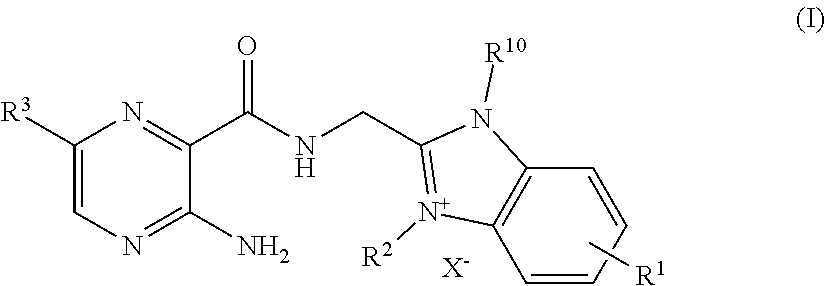
wherein:
X− is an anion;
R1 is:
i. H, halo; or
ii. C1-6 alkyl, C2-6 alkenyl, C2-6 alkynyl, —O(C1-6 alkyl), —O(C2-6 alkenyl) or —O(C2-6 alkynyl) any of which is optionally substituted by one or more halo substituents; or
iii -L1R11, —O-L1R11, —OR5, —SO2R5, —C(O)OR5, —C(O)NR5R6 or —C(═NR7)NR5R6;
-
- L1 is C1-6 alkylene, C2-6 alkenylene or C2-6 alkynylene;
- R11 is H, —NR7R8, —NR7—C(═NR9)N(R8)2, —NR7—C(O)O—R8, —NR7—C(O)—(C1-3 alkylene)—N(R8)3 or —N+(R8)3;
- each R7, R8 and R9 is independently selected from H or C1-4 alkyl;
- each R5 and R6 is independently H, C1-6 alkyl, C2-6 alkenyl, C2-6 alkynyl, C3-8 cycloalkyl or C3-8 heterocyclyl, any of which is optionally substituted by one or more substituents selected from halo, OR7, C(O)OR7, —NR7R8, C(O)NR7R8 or, in the case of cycloalkyl or heterocyclyl groups, oxo; or
iv. -L2-R12 wherein - L2 is:
- a bond;
- —Z12—, -aryl-, -heteroaryl-, -carbocyclyl-, -heterocyclyl-,
- —Z6-carbocyclyl-, —Z6-heterocyclyl-, —Z6-aryl-, —Z6-heteroaryl-;
- carbocyclyl-Z6—, -heterocyclyl-Z6—, -aryl-Z6—, -heteroaryl-Z6—;
- —Z6—NR7—Z6—;
- —OZ12—, —O-aryl-, —O-heteroaryl-, —O-carbocyclyl-, —O-heterocyclyl-,
- —OZ6-carbocyclyl-, —OZ6-heterocyclyl-, —OZ6-aryl-, —OZ6-heteroaryl-;
- —O-carbocyclyl-Z6—, —O-heterocyclyl-Z6—, —O-aryl-Z6—, —O-heteroaryl-Z6—;
- —OZ6—NR7—Z6—,
- —C(O)Z12—, —C(O)-carbocyclyl-, —C(O)-heterocyclyl-, —C(O)-carbocyclyl-Z6—, —C(O)—heterocyclyl-Z6—, —C(O)—Z6-carbocyclyl-, C(O)—Z6-heterocyclyl-, —C(O)—Z6-carbocyclyl-Z6—, C(O)—Z6-heterocyclyl-Z6—,
- —C(O)NR7—, —C(O)NR7—Z12—, —C(O)NR7-carbocyclyl-, C(O)NR7-heterocyclyl-, C(O)NR7-aryl-, C(O)NR7-heteroaryl-, —C(O)NR7-carbocyclyl-Z6—, —C(O)NH—heterocyclyl-Z6—, —C(O)NR7—Z6-carbocyclyl-, —C(O)NR7—Z6-heterocyclyl-, —C(O)NR7—Z6-carbocyclyl-Z6—, —C(O)NR—Z6-heterocyclyl-Z6—;
- —Z6—C(O)NR7—Z6—, —Z6—C(O)NR7-aryl-, —Z6—C(O)NR7-heteroaryl-, —Z6—C(O)NR7-carbocyclyl-, —Z6—C(O)NR7-heterocyclyl-, —Z6—C(O)NR7-aryl-Z6—, —Z6—C(O)NR7-heteroaryl-Z6—, —Z6—C(O)NR7-carbocyclyl-Z6— or —Z6—C(O)NR7-heterocyclyl-Z6—;
- —C(O)Z12—, —C(O)-carbocyclyl-, —C(O)-heterocyclyl-, —C(O)-carbocyclyl-Z6—, —C(O)— heterocyclyl-Z6—, —C(O)—Z6-carbocyclyl-, C(O)—Z6-heterocyclyl-, —C(O)—Z6-carbocyclyl-Z6—, C(O)—Z6-heterocyclyl-Z6—,
- —C(═N)NR7—Z12—, —C(═N)NR7-carbocyclyl-, C(═N)NR7-heterocyclyl-, —C(═N)NR7-carbocyclyl-Z6—, —C(═N)N H-heterocyclyl-Z6—, —C(═N)NR7—Z6-carbocyclyl-, —C(═N)NR7—Z6-heterocyclyl-, —C(═N)NR7—Z6-carbocyclyl-Z6—, —C(═N)NR7—Z6-heterocyclyl-Z6—;
- wherein Z12 is O1-12 alkylene, C2-12 alkenylene or C2-12 alkynylene; Z6 is C1-6 alkylene, C2-6 alkenylene or C2-6 alkynylene and alkylene, alkenylene and alkynylene groups are optionally substituted with one or more substituents selected from NR8R9, C(O)NR8R9, OH or halo, wherein R7, R8 and R9 are as defined above;
- R12 is —NR14R15 or -G-R14
- each of R14 and R15 is independently C1-8 alkyl optionally substituted with one or more OH groups; and G is a 5- to 10-membered heterocyclic ring optionally substituted with one or more OH groups and containing at least one nitrogen atom which is connected by a covalent bond to the group R14;
v. -L3-R13, wherein
- each of R14 and R15 is independently C1-8 alkyl optionally substituted with one or more OH groups; and G is a 5- to 10-membered heterocyclic ring optionally substituted with one or more OH groups and containing at least one nitrogen atom which is connected by a covalent bond to the group R14;
- L3 comprises one or two cyclic groups directly linked to one another wherein each cyclic group is selected from aryl, heteroaryl, carbocyclyl and heterocyclyl, wherein cycloalkyl and heterocyclyl groups may have one or more oxo substituents; and
R13 is H, —OR5—SO2R5, —C(O)OR5, —C(O)NR5R6 or —C(═NR7)NR5R6; wherein R5, R6 and R7 are as defined above;
R2 is C1-10 alkyl, wherein one or more —CH2— groups is optionally replaced by —O— and which is optionally substituted with one or more substituents selected from halo, aryl, heteroaryl, —OR7 and —NR7R8, wherein R7 and R8 are as defined above;
R3 is H, halo, cyano, C1-3 alkyl, C1-3 haloalkyl, or —S(C1-3 alkyl);
R10 is C1-6 alkyl optionally substituted with one or more substituents selected from halo, —OR7 and —NR7R8, wherein R7 and R8 are as defined above;
provided that
when R2 is ethyl; R3 is chloro and R10 is ethyl: - R1 is not C(O)NR5R6, wherein at least one of R5 and R6 is C1-6 alkyl substituted with one or more substituents selected from OH and NR7R8, where R7 and R8 are each independently H or methyl; and
- R1 is not L2R12 where L2 is C(O)heterocyclyl and R12 is N(CH3)2.

both of which are included within the scope of the invention.

wherein R1, R2, R3, R10 and X− are as defined for general formula (I);
or a compound of general formula (ID):

wherein R1, R2, R3, R10 and X− are as defined for general formula (I).

-
- R7 is H;
- carbocyclyl and heterocyclyl groups are 5- or 6-membered rings, suitably 6-membered rings;
- the aryl group is phenyl;
- heteroaryl groups are 5- or 6-membered nitrogen containing heteroaryl groups; Z12 and Z6 are alkylene groups optionally substituted as described above.
-
- R7 is H;
- heterocyclyl groups are piperidinyl groups;
- the heteroaryl group is:

-
- where a is the link to the remainder of the molecule and b is the link to R12.
-
- a bond;
- Z12—, -aryl-, -heteroaryl-, -carbocyclyl-, -heterocyclyl-,
- —Z6-carbocyclyl-, —Z6-heterocyclyl-, —Z6-aryl-, —Z6-heteroaryl-;
- carbocyclyl-Z6—, -heterocyclyl-Z6—, -aryl-Z6—, -heteroaryl-Z6—;
- —Z6—NR7—Z6—;
- —OZ12—, —O-aryl-, —O-heteroaryl-, —O-carbocyclyl-, —O-heterocyclyl-,
- —OZ6-carbocyclyl-, —OZ6-heterocyclyl-, —OZ6-aryl-, —OZ6-heteroaryl-;
- —O-carbocyclyl-Z6—, —O-heterocyclyl-Z6—, —O-aryl-Z6—, —O-heteroaryl-Z6—;
- —OZ6—NR7—Z6—,
- —C(O)-heterocyclyl-, —C(O)-heterocyclyl-Z6—,
- —C(O)NR7—, —C(O)NR7—Z12—, —C(O)NR7—Z6-heterocyclyl-, —C(O)NR7—Z6-carbocyclyl-Z6—, —C(O)NR7—Z6-heterocyclyl-Z6—;
- —Z6—C(O)NR7—Z6—, —Z6—C(O)NR7-aryl-, —Z6—C(O)NR7-heteroaryl-, —Z6—C(O)NR7—Z6—C(O)NR7-aryl-Z6—, —Z6—C(O)NR7-heteroaryl-Z6—;
- wherein Z12 and Z6 groups are optionally substituted as described above.
-
- a bond;
- —Z12—, -aryl-, -heteroaryl-,
- —Z6—NR7—Z6—;
- —OZ12—,
- —OZ6—NR7—Z6—,
- —C(O)-heterocyclyl-, —C(O)-heterocyclyl-Z6—,
- —C(O)NR7—, —C(O)NR7—Z12—, —C(O)NR7—Z6-heterocyclyl-, —C(O)NR7—Z-heterocyclyl-Z6—;
- —Z6—C(O)NR7—, —Z6—C(O)NR7-aryl-Z6—, —Z6—C(O)NR7-heteroaryl-Z6—;
- wherein Z12 and Z6 groups are optionally substituted as described above.


where the piperidinyl group is joined to L2 at a.

wherein a is the link to the remainder of the molecule and b is the link to R13.

| TABLE 1 | |
| 1 |  |
| 2 |  |
| 3 |  |
| 4 |  |
| 5 |  |
| 6 |  |
| 7 |  |
| 8 |  |
| 9 |  |
| 10 |  |
| 11 |  |
| 12 |  |
| 13 |  |
| 14 |  |
| 15 |  |
| 16 |  |
| 17 |  |
| 18 |  |
| 19 |  |
| 20 |  |
| 21 |  |
| 22 |  |
| 23 |  |
| 24 |  |
| 25 |  |
| 26 |  |
or alternative salts of the above compounds in which the anion is replaced by an alternative anion X− as defined above.

wherein R3 is as defined for general formula (I);
with a salt of general formula (III):

wherein R1, R2, Q1, Q2 and X− are as defined for general formula (I).

wherein R3 is as defined for general formula (I) R21 is C1-6 alkyl or benzyl.
R22—S−Z+ (VI)
wherein R22 is C1-3 alkyl and Z+ is a suitable cation, for example Na+ or K+.

wherein R3 is as defined for general formula (I).

wherein R1, R2 and R10 are as defined for general formula (I);
R23 is O(C1-6) alkyl optionally substituted with aryl, or aryl, optionally substituted with C(O)OH; and R24 is H; or
R23 and R24 together with the carbon and nitrogen atoms to which they are attached form a heterocyclic ring, optionally fused to an aryl or heteroaryl ring and optionally containing a further ═O substituent.

wherein R1 and R10 are as defined for general formula (I) and R23 and R24 are as defined for general formula (VII);
by reaction with a compound of general formula (IX):
R2—X1 (IX)
wherein R2 is as defined for general formula (I) and X1 is a leaving group such as halo; or with a compound of general formula (IXA):
R2a—X1 (IXA)
wherein X1 is as defined above for general formula (IX) and R2a is a protected R2 group. For example, when the desired R2 group contains one or more OH moieties, these may be protected using standard protecting groups, for example silyl protecting groups such as trimethylsilyl (TMS), tbutyldimethylsilyl(TBDMS) etc.

R5 2—CH—NHR25 2 X
wherein R5 is as defined for general formula (I) except that it is not H and R25 is C1-4 alkyl.

wherein R1 and R10 are as defined in general formula (I).

wherein R23 is as defined above for general formula (VII). The reaction may be conducted in the presence of a base such as trimethylamine in a polar organic solvent, for example dichloromethane and at a temperature of from 10 to 30° C., more usually 15 to 25° C., typically at room temperature.

wherein R1 and R10 are as defined for general formula (I);
by reaction with a compound of general formula (XIV):

wherein R23 is as defined above for general formula (VII).

wherein R1 and R10 are as defined for general formula (I);
by catalytic hydrogenation, suitably using a palladium catalyst.

wherein R1 is as defined for general formula (I) and X2 is a leaving group, particularly a halo group such as chloro;
by reaction with a compound of general formula (XVII):
R10—NH2 (XVII)
wherein R10 is as defined for general formula (I).
-
- A compound of general formula (I) for use in the treatment or prophylaxis of respiratory diseases and conditions.
- A compound of general formula (I) for use in the treatment or prophylaxis of skin conditions or ocular conditions.
-
- The use of a compound of general formula (I) in the preparation of an agent for the treatment or prophylaxis of respiratory diseases and conditions.
- The use of a compound of general formula (I) in the preparation of an agent for the treatment or prophylaxis of skin conditions or ocular conditions
-
- A method for the treatment or prophylaxis of respiratory diseases and conditions, the method comprising administering to a patient in need of such treatment an effective amount of a compound of general formula (I).
- A method for the treatment or prophylaxis of skin conditions and ocular conditions, the method comprising administering to a patient in need of such treatment an effective amount of a compound of general formula (I).


| TABLE 2 | |||||
| Averages. | Averages. | Averages. | Averages. | ||
| Ex- | Averages. | Mic Half | Mic Half | Hep Half | Hep Half |
| am- | ENaC | Life | Life | Life | Life |
| ple | Ic50 μm | Human | Rat | Human | Rat |
| No. | Avg | (mins) | (mins) | (mins) | (mins) |
| 1 | 5 | 12 | 3 | 44 | 6 |
| 2 | 0.001 | 58 | 3 | 90 | 5 |
| 3 | 0.001 | 89 | 4 | 240 | 13 |
| 4 | 0.004 | 86 | 8 | 240 | 16 |
| 5 | 0.002 | 12 | 4 | 68 | 5 |
| 7 | 0.004 | 22 | 7 | 129 | 16 |
| 8 | 0.224 | 23. | 3 | ||
| 9 | 0.074 | 5 | 3 | ||
| 11 | 0.002 | 138 | 4 | 240 | 6 |
| 12 | 0.019 | 111 | 4 | ||
| 13 | 0.004 | 138 | 5 | 240 | 14 |
| 14 | 0.003 | 138 | 11 | 205 | 28 |
| 15 | 0.002 | 138 | 11 | 154 | 14 |
| 16 | 0.014 | ||||
| 17 | 0.003 | 135 | 29 | 101 | 32 |
| 18 | 0.004 | >138 | 61 | 137 | 46 |
| 19 | 0.004 | 240 | 17 | ||
| 20 | 0.001 | >138 | 61 | 70 | 20 |
| 21 | 0.001 | 92 | 77 | 66 | 25 |
| 22 | 0.002 | >138 | >138 | 67 | 90 |
| 23 | 0.002 | >138 | >138 | 72 | 124 |
| 24 | 0.002 | 59 | 37 | 73 | 42 |
| 25 | 0.002 | >138 | >138 | >240 | 59 |
| 26 | 0.008 | >138 | <3 | 232 | 23 |
- App E M, King M, Helfesrieder R, Köhler D and Matthys H. Acute and long-term amiloride inhalation in cystic fibrosis lung disease. A rational approach to cystic fibrosis therapy. Am Rev Respir Dis., 1990, 141(3):605-12.
- Botero-Velez M, Curtis J J and Warnock D G. Brief report: Liddle's syndrome revisited—a disorder of sodium reabsorption in the distal tubule. N Engl J Med., 1994, 330(3):178-81.
- Boucher R C. Evidence for airway surface dehydration as the initiating event in C F airway disease. J Intern Med., 2007, 261(1):5-16.
- Bowler I M, Kelman B, Worthington D, Littlewood J M, Watson A, Conway S P, Smye S W, James S L and Sheldon T A. Nebulised amiloride in respiratory exacerbations of cystic fibrosis: a randomised controlled trial. Arch Dis Child., 1995, 73(5):427-30.
- Chang S S, Grunder S, Hanukoglu A, Rösler A, Mathew P M, Hanukoglu I, Schild L, Lu Y, Shimkets R A, Nelson-Williams C, Rossier B C and Lifton R P. Mutations in subunits of the epithelial sodium channel cause salt wasting with hyperkalaemic acidosis, pseudohypoaldosteronism type 1. Nat Genet., 1996, 12(3):248-53.
- Fajac I, Hubert D, Guillemot D, Honoré I, Bienvenu T, Volter F, Dall'Ava-Santucci J and Dusser D J. Nasal airway ion transport is linked to the cystic fibrosis phenotype in adult patients. Thorax, 2004, 59(11):971-6.
- Frateschi S, Charles R-P, Hummler E. The Epithelial Sodium Channel ENaC and its Regulators in the Epidermal Permeability Barrier Function. The Open Dermatology Journal, 2010, 4: 27-35.
- Graham A, Hasani A, Alton E W, Martin G P, Marriott C, Hodson M E, Clarke S W and Geddes D M. No added benefit from nebulized amiloride in patients with cystic fibrosis. Eur Respir J., 1993, 6(9):1243-8.
- Kellenberger S and Schild L. Epithelial sodium channel/degenerin family of ion channels: a variety of functions for a shared structure. Physiol Rev., 2002 82(3):735-67.
- Kerem E, Bistritzer T, Hanukoglu A, Hofmann T, Zhou Z, Bennett W, MacLaughlin E, Barker P, Nash M, Quittell L, Boucher R and Knowles M R. Pulmonary epithelial sodium-channel dysfunction and excess airway liquid in pseudohypoaldosteronism. N Engl J Med., 1999, 341(3):156-62.
- Knowles M R, Stutts M J, Spock A, Fischer N, Gatzy J T and Boucher R C. Abnormal ion permeation through cystic fibrosis respiratory epithelium. Science, 1983, 221(4615):1067-70.
- Knowles M R, Church N L, Waltner W E, Yankaskas J R, Gilligan P, King M, Edwards L J, Helms R W and Boucher R C. A pilot study of aerosolized amiloride for the treatment of lung disease in cystic fibrosis. N Engl J Med., 1990, 322(17):1189-94.
- Leal T, Fajac I, Wallace H L, Lebecque P, Lebacq J, Hubert D, Dall'Ava J, Dusser D, Ganesan A P, Knoop C, Cumps J, Wallemacq P and Southern K W. Airway ion transport impacts on disease presentation and severity in cystic fibrosis. Clin Biochem., 2008, 41(10-11):764-72.
- Matsui H, Grubb B R, Tarran R, Randell S H, Gatzy J T, Davis C W and Boucher R C. Evidence for periciliary liquid layer depletion, not abnormal ion composition, in the pathogenesis of cystic fibrosis airways disease. Cell, 1998, 95(7):1005-15.
- Middleton P G, Geddes D M and Alton E W. Effect of amiloride and saline on nasal mucociliary clearance and potential difference in cystic fibrosis and normal subjects. Thorax, 1993, 48(8):812-6.
- Noone P G, Regnis J A, Liu X, Brouwer K L, Robinson M, Edwards L and Knowles M R. Airway deposition and clearance and systemic pharmacokinetics of amiloride following aerosolization with an ultrasonic nebulizer to normal airways. Chest, 1997, 112(5):1283-90.
- Perazella M A. Drug-induced hyperkalemia: old culprits and new offenders. Am J Med., 2000, 109(4):307-14.
- Pons G, Marchand M C, d'Athis P, Sauvage E, Foucard C, Chaumet-Riffaud P, Sautegeau A, Navarro J and Lenoir G. French multicenter randomized double-blind placebo-controlled trial on nebulized amiloride in cystic fibrosis patients. The Amiloride-AFLM Collaborative Study Group. Pediatr Pulmonol., 2000, 30(1):25-31.
- Thelin W R, Johnson M R, Hirsh A J, Kublin C L, Zoukhri D. Effect of Topically Applied Epithelial Sodium Channel Inhibitors on Tear Production in Normal Mice and in Mice with Induced Aqueous Tear Deficiency. J Ocul Pharmacol. Ther. 2012, 28(4): 433-438.
Claims (32)


Applications Claiming Priority (3)
| Application Number | Priority Date | Filing Date | Title |
|---|---|---|---|
| GB1610854.0 | 2016-06-21 | ||
| GBGB1610854.0A GB201610854D0 (en) | 2016-06-21 | 2016-06-21 | Compounds |
| PCT/GB2017/051815 WO2017221008A1 (en) | 2016-06-21 | 2017-06-21 | Compounds |
Publications (2)
| Publication Number | Publication Date |
|---|---|
| US20190233402A1 US20190233402A1 (en) | 2019-08-01 |
| US10759785B2 true US10759785B2 (en) | 2020-09-01 |
Family
ID=56895059
Family Applications (1)
| Application Number | Title | Priority Date | Filing Date |
|---|---|---|---|
| US16/312,158 Active US10759785B2 (en) | 2016-06-21 | 2017-06-21 | Compounds |
Country Status (5)
| Country | Link |
|---|---|
| US (1) | US10759785B2 (en) |
| EP (1) | EP3472154B1 (en) |
| JP (1) | JP7012078B2 (en) |
| GB (1) | GB201610854D0 (en) |
| WO (1) | WO2017221008A1 (en) |
Families Citing this family (11)
| Publication number | Priority date | Publication date | Assignee | Title |
|---|---|---|---|---|
| GB201619694D0 (en) | 2016-11-22 | 2017-01-04 | Entpr Therapeutics Ltd | Compounds |
| GB201717051D0 (en) | 2017-10-17 | 2017-11-29 | Enterprise Therapeutics Ltd | Compounds |
| GB201801355D0 (en) | 2018-01-26 | 2018-03-14 | Enterprise Therapeutics Ltd | Compounds |
| GB201808093D0 (en) | 2018-05-18 | 2018-07-04 | Enterprise Therapeutics Ltd | Compounds |
| PH12021553110A1 (en) | 2019-06-12 | 2022-08-01 | Tmem16A Ltd | Compounds for treating respiratory disease |
| GB201908453D0 (en) | 2019-06-12 | 2019-07-24 | Enterprise Therapeutics Ltd | Compounds for treating respiratory disease |
| GB201910608D0 (en) | 2019-07-24 | 2019-09-04 | Enterprise Therapeutics Ltd | Compounds |
| EP4052760B1 (en) | 2019-10-31 | 2024-03-13 | FUJIFILM Corporation | Pyrazine derivative or salt thereof, and use of same |
| EP4190402B1 (en) | 2020-07-30 | 2025-08-27 | FUJIFILM Corporation | Nitrogen-containing heterocyclic compound or salt thereof, use thereof, and intermediate thereof |
| AR124316A1 (en) | 2020-12-11 | 2023-03-15 | Tmem16A Ltd | COMPOUNDS TO TREAT A RESPIRATORY DISEASE |
| WO2022159028A2 (en) * | 2021-01-25 | 2022-07-28 | Phamri Norden Ab | Method of treating a skin disorder |
Citations (42)
| Publication number | Priority date | Publication date | Assignee | Title |
|---|---|---|---|---|
| WO2003070184A2 (en) | 2002-02-19 | 2003-08-28 | Johnson Michael R | Sodium channel blockers |
| WO2003070182A2 (en) | 2002-02-19 | 2003-08-28 | Johnson Michael R | Sodium channel blockers |
| WO2004073629A2 (en) | 2003-02-19 | 2004-09-02 | Parion Sciences, Inc. | Hetero substitued sodium channel blockers |
| WO2005016879A2 (en) | 2003-08-18 | 2005-02-24 | Parion Sciences, Inc. | Cyclic pyrazinoylguanidine sodium channel blockers |
| WO2005018644A1 (en) | 2003-08-18 | 2005-03-03 | Parion Sciences, Inc. | Capped pyrazinoylguanidine sodium channel blockers |
| WO2005025496A2 (en) | 2003-08-18 | 2005-03-24 | Parion Sciences, Inc. | Aliphatic pyrazinoylguanidine sodium channel blockers |
| WO2005034847A2 (en) | 2003-08-20 | 2005-04-21 | Parion Sciences, Inc. | Methods of reducing risk of infection from pathogens |
| WO2005044180A2 (en) | 2003-08-20 | 2005-05-19 | Parion Sciences, Inc. | Methods of reducing risk of infection from pathogens |
| WO2006022935A1 (en) | 2004-08-18 | 2006-03-02 | Parion Sciences, Inc. | Soluble amide & ester pyrazinoylguanidine sodium channel blockers |
| WO2007018640A1 (en) | 2005-08-03 | 2007-02-15 | Parion Sciences, Inc. | New capped pyrazinoylguanidine sodium channel blockers |
| WO2007071400A1 (en) | 2005-12-22 | 2007-06-28 | Novartis Ag | Pyrazine derivatives as epithelial sodium channel blocker |
| WO2007071396A2 (en) | 2005-12-22 | 2007-06-28 | Novartis Ag | Pyrazinoylguanidine compounds useful in the treatment of inflammatory or allergic conditions |
| WO2008013557A1 (en) | 2006-07-24 | 2008-01-31 | International Stem Cell Corporation | Synthetic cornea from retinal stem cells |
| WO2008124491A1 (en) | 2007-04-03 | 2008-10-16 | Parion Sciences, Inc. | Pyrazinoylguanidine compounds for use taste modulators |
| WO2008135557A1 (en) | 2007-05-07 | 2008-11-13 | Novartis Ag | Organic compounds |
| WO2009074575A2 (en) | 2007-12-10 | 2009-06-18 | Novartis Ag | Organic compounds |
| WO2009138378A1 (en) | 2008-05-13 | 2009-11-19 | Novartis Ag | 3,5-diamino-6-chloro-pyrazine-2-carboxylic acid derivatives and their use as epithelial sodium channel blockers for the treatment of arway diseases |
| WO2009139948A1 (en) | 2008-02-26 | 2009-11-19 | Johnson Michael R | Poly aromatic sodium channel blockers |
| WO2009150137A2 (en) | 2008-06-10 | 2009-12-17 | Novartis Ag | Organic compounds |
| WO2011028740A1 (en) | 2009-09-03 | 2011-03-10 | Glaxo Group Limited | ENaC BLOCKERS |
| WO2011079087A1 (en) | 2009-12-23 | 2011-06-30 | Glaxo Group Limited | Enac blockers |
| WO2011113894A1 (en) | 2010-03-19 | 2011-09-22 | Novartis Ag | Pyridine and pyrazine derivative for the treatment of cf |
| WO2012035158A1 (en) | 2010-09-17 | 2012-03-22 | Novartis Ag | Pyrazine derivatives as enac blockers |
| WO2013003386A1 (en) | 2011-06-27 | 2013-01-03 | Parion Sciences, Inc. | 3,5-diamino-6-chloro-n-(n-(4-(4-(2-(hexyl (2,3,4,5,6-pentahydroxyhexyl) amino) ethoxy) phenyl) butyl) carbamimidoyl) pyrazine-2-carboxamide |
| WO2013064450A1 (en) | 2011-11-02 | 2013-05-10 | Boehringer Ingelheim International Gmbh | Heterocyclic compounds, medicaments containing said compounds, use thereof and processes for the preparation thereof |
| WO2013092674A1 (en) | 2011-12-20 | 2013-06-27 | Boehringer Ingelheim International Gmbh | Heterocyclic compounds, medicaments containing said compounds, use thereof and processes for the preparation thereof |
| WO2013181232A2 (en) | 2012-05-29 | 2013-12-05 | Michael Ross Johnson | Dendrimer like amino amides possessing sodium channel blocker activity for the treatment of dry eye and other mucosal diseases |
| WO2014044849A1 (en) | 2012-09-24 | 2014-03-27 | Boehringer Ingelheim International Gmbh | Heterocyclic compounds, medicaments containing said compounds, use thereof and processes for the preparation thereof |
| WO2014099673A1 (en) | 2012-12-17 | 2014-06-26 | Parion Sciences, Inc. | 3,5-diamino-6-chloro-n-(n-(4-phenylbutyl)carbamimidoyl) pyrazine-2- carboxamide compounds |
| WO2014099705A1 (en) | 2012-12-17 | 2014-06-26 | Parion Sciences, Inc. | Arylalkyl-and aryloxyalkyl-substituted epithelial sodium channel blocking compounds |
| WO2014099676A1 (en) | 2012-12-17 | 2014-06-26 | Parion Sciences, Inc. | Chloro-pyrazine carboxamide derivatives useful for the treatment of diseases favoured by insufficient mucosal hydration |
| WO2014177469A1 (en) | 2013-04-30 | 2014-11-06 | Boehringer Ingelheim International Gmbh,M | Diaminopyrazine compounds, medicaments containing said compounds, use thereof and processes for the preparation thereof |
| WO2015003083A1 (en) | 2013-07-02 | 2015-01-08 | The California Institute For Biomedical Research | Compounds for treatment of cystic fibrosis |
| WO2015003958A1 (en) | 2013-07-08 | 2015-01-15 | Boehringer Ingelheim International Gmbh | Amiloride-type compounds as inhibitors in epithelial sodium channels for the treatment of diseases of the lungs and airways |
| WO2015007517A1 (en) | 2013-07-15 | 2015-01-22 | Boehringer Ingelheim International Gmbh | Novel tetra- and pentasubstituted benzimidazolium compounds |
| WO2015007519A1 (en) | 2013-07-15 | 2015-01-22 | Boehringer Ingelheim International Gmbh | Novel benzimidazolium compounds |
| WO2015007516A1 (en) | 2013-07-15 | 2015-01-22 | Boehringer Ingelheim International Gmbh | Novel 5-substituted benzimidazolium compounds |
| WO2015018754A1 (en) | 2013-08-08 | 2015-02-12 | Boehringer Ingelheim International Gmbh | Novel pyrazine amide compounds |
| WO2016113167A1 (en) | 2015-01-12 | 2016-07-21 | Boehringer Ingelheim International Gmbh | Substituted benzimidazolium compounds useful in the treatment of respiratory diseases |
| WO2017028926A1 (en) | 2015-08-20 | 2017-02-23 | Boehringer Ingelheim International Gmbh | Novel annelated benzamides |
| WO2017028927A1 (en) | 2015-08-20 | 2017-02-23 | Boehringer Ingelheim International Gmbh | Novel annelated phenoxyacetamides |
| WO2018096325A1 (en) | 2016-11-22 | 2018-05-31 | Enterprise Therapeutics Limited | Benzodiazolium compounds as enac inhibitors |
-
2016
- 2016-06-21 GB GBGB1610854.0A patent/GB201610854D0/en not_active Ceased
-
2017
- 2017-06-21 WO PCT/GB2017/051815 patent/WO2017221008A1/en not_active Ceased
- 2017-06-21 JP JP2019520504A patent/JP7012078B2/en active Active
- 2017-06-21 EP EP17734416.5A patent/EP3472154B1/en active Active
- 2017-06-21 US US16/312,158 patent/US10759785B2/en active Active
Patent Citations (42)
| Publication number | Priority date | Publication date | Assignee | Title |
|---|---|---|---|---|
| WO2003070184A2 (en) | 2002-02-19 | 2003-08-28 | Johnson Michael R | Sodium channel blockers |
| WO2003070182A2 (en) | 2002-02-19 | 2003-08-28 | Johnson Michael R | Sodium channel blockers |
| WO2004073629A2 (en) | 2003-02-19 | 2004-09-02 | Parion Sciences, Inc. | Hetero substitued sodium channel blockers |
| WO2005016879A2 (en) | 2003-08-18 | 2005-02-24 | Parion Sciences, Inc. | Cyclic pyrazinoylguanidine sodium channel blockers |
| WO2005018644A1 (en) | 2003-08-18 | 2005-03-03 | Parion Sciences, Inc. | Capped pyrazinoylguanidine sodium channel blockers |
| WO2005025496A2 (en) | 2003-08-18 | 2005-03-24 | Parion Sciences, Inc. | Aliphatic pyrazinoylguanidine sodium channel blockers |
| WO2005034847A2 (en) | 2003-08-20 | 2005-04-21 | Parion Sciences, Inc. | Methods of reducing risk of infection from pathogens |
| WO2005044180A2 (en) | 2003-08-20 | 2005-05-19 | Parion Sciences, Inc. | Methods of reducing risk of infection from pathogens |
| WO2006022935A1 (en) | 2004-08-18 | 2006-03-02 | Parion Sciences, Inc. | Soluble amide & ester pyrazinoylguanidine sodium channel blockers |
| WO2007018640A1 (en) | 2005-08-03 | 2007-02-15 | Parion Sciences, Inc. | New capped pyrazinoylguanidine sodium channel blockers |
| WO2007071400A1 (en) | 2005-12-22 | 2007-06-28 | Novartis Ag | Pyrazine derivatives as epithelial sodium channel blocker |
| WO2007071396A2 (en) | 2005-12-22 | 2007-06-28 | Novartis Ag | Pyrazinoylguanidine compounds useful in the treatment of inflammatory or allergic conditions |
| WO2008013557A1 (en) | 2006-07-24 | 2008-01-31 | International Stem Cell Corporation | Synthetic cornea from retinal stem cells |
| WO2008124491A1 (en) | 2007-04-03 | 2008-10-16 | Parion Sciences, Inc. | Pyrazinoylguanidine compounds for use taste modulators |
| WO2008135557A1 (en) | 2007-05-07 | 2008-11-13 | Novartis Ag | Organic compounds |
| WO2009074575A2 (en) | 2007-12-10 | 2009-06-18 | Novartis Ag | Organic compounds |
| WO2009139948A1 (en) | 2008-02-26 | 2009-11-19 | Johnson Michael R | Poly aromatic sodium channel blockers |
| WO2009138378A1 (en) | 2008-05-13 | 2009-11-19 | Novartis Ag | 3,5-diamino-6-chloro-pyrazine-2-carboxylic acid derivatives and their use as epithelial sodium channel blockers for the treatment of arway diseases |
| WO2009150137A2 (en) | 2008-06-10 | 2009-12-17 | Novartis Ag | Organic compounds |
| WO2011028740A1 (en) | 2009-09-03 | 2011-03-10 | Glaxo Group Limited | ENaC BLOCKERS |
| WO2011079087A1 (en) | 2009-12-23 | 2011-06-30 | Glaxo Group Limited | Enac blockers |
| WO2011113894A1 (en) | 2010-03-19 | 2011-09-22 | Novartis Ag | Pyridine and pyrazine derivative for the treatment of cf |
| WO2012035158A1 (en) | 2010-09-17 | 2012-03-22 | Novartis Ag | Pyrazine derivatives as enac blockers |
| WO2013003386A1 (en) | 2011-06-27 | 2013-01-03 | Parion Sciences, Inc. | 3,5-diamino-6-chloro-n-(n-(4-(4-(2-(hexyl (2,3,4,5,6-pentahydroxyhexyl) amino) ethoxy) phenyl) butyl) carbamimidoyl) pyrazine-2-carboxamide |
| WO2013064450A1 (en) | 2011-11-02 | 2013-05-10 | Boehringer Ingelheim International Gmbh | Heterocyclic compounds, medicaments containing said compounds, use thereof and processes for the preparation thereof |
| WO2013092674A1 (en) | 2011-12-20 | 2013-06-27 | Boehringer Ingelheim International Gmbh | Heterocyclic compounds, medicaments containing said compounds, use thereof and processes for the preparation thereof |
| WO2013181232A2 (en) | 2012-05-29 | 2013-12-05 | Michael Ross Johnson | Dendrimer like amino amides possessing sodium channel blocker activity for the treatment of dry eye and other mucosal diseases |
| WO2014044849A1 (en) | 2012-09-24 | 2014-03-27 | Boehringer Ingelheim International Gmbh | Heterocyclic compounds, medicaments containing said compounds, use thereof and processes for the preparation thereof |
| WO2014099673A1 (en) | 2012-12-17 | 2014-06-26 | Parion Sciences, Inc. | 3,5-diamino-6-chloro-n-(n-(4-phenylbutyl)carbamimidoyl) pyrazine-2- carboxamide compounds |
| WO2014099705A1 (en) | 2012-12-17 | 2014-06-26 | Parion Sciences, Inc. | Arylalkyl-and aryloxyalkyl-substituted epithelial sodium channel blocking compounds |
| WO2014099676A1 (en) | 2012-12-17 | 2014-06-26 | Parion Sciences, Inc. | Chloro-pyrazine carboxamide derivatives useful for the treatment of diseases favoured by insufficient mucosal hydration |
| WO2014177469A1 (en) | 2013-04-30 | 2014-11-06 | Boehringer Ingelheim International Gmbh,M | Diaminopyrazine compounds, medicaments containing said compounds, use thereof and processes for the preparation thereof |
| WO2015003083A1 (en) | 2013-07-02 | 2015-01-08 | The California Institute For Biomedical Research | Compounds for treatment of cystic fibrosis |
| WO2015003958A1 (en) | 2013-07-08 | 2015-01-15 | Boehringer Ingelheim International Gmbh | Amiloride-type compounds as inhibitors in epithelial sodium channels for the treatment of diseases of the lungs and airways |
| WO2015007517A1 (en) | 2013-07-15 | 2015-01-22 | Boehringer Ingelheim International Gmbh | Novel tetra- and pentasubstituted benzimidazolium compounds |
| WO2015007519A1 (en) | 2013-07-15 | 2015-01-22 | Boehringer Ingelheim International Gmbh | Novel benzimidazolium compounds |
| WO2015007516A1 (en) | 2013-07-15 | 2015-01-22 | Boehringer Ingelheim International Gmbh | Novel 5-substituted benzimidazolium compounds |
| WO2015018754A1 (en) | 2013-08-08 | 2015-02-12 | Boehringer Ingelheim International Gmbh | Novel pyrazine amide compounds |
| WO2016113167A1 (en) | 2015-01-12 | 2016-07-21 | Boehringer Ingelheim International Gmbh | Substituted benzimidazolium compounds useful in the treatment of respiratory diseases |
| WO2017028926A1 (en) | 2015-08-20 | 2017-02-23 | Boehringer Ingelheim International Gmbh | Novel annelated benzamides |
| WO2017028927A1 (en) | 2015-08-20 | 2017-02-23 | Boehringer Ingelheim International Gmbh | Novel annelated phenoxyacetamides |
| WO2018096325A1 (en) | 2016-11-22 | 2018-05-31 | Enterprise Therapeutics Limited | Benzodiazolium compounds as enac inhibitors |
Non-Patent Citations (24)
Also Published As
| Publication number | Publication date |
|---|---|
| US20190233402A1 (en) | 2019-08-01 |
| JP2019519616A (en) | 2019-07-11 |
| EP3472154B1 (en) | 2020-08-12 |
| EP3472154A1 (en) | 2019-04-24 |
| GB201610854D0 (en) | 2016-08-03 |
| WO2017221008A1 (en) | 2017-12-28 |
| JP7012078B2 (en) | 2022-02-10 |
Similar Documents
| Publication | Publication Date | Title |
|---|---|---|
| US20190233402A1 (en) | Compounds | |
| US12371436B2 (en) | Substituted benzodiazoliums as ENaC inhibitors | |
| US12037336B2 (en) | Compounds with activity as inhibitors of the epithelial sodium channel (ENaC) | |
| US9126985B2 (en) | Tetra- and pentasubstituted benzimidazolium compounds | |
| US9073954B2 (en) | 5-substituted benzimidazolium compounds | |
| WO2015007519A1 (en) | Novel benzimidazolium compounds | |
| US11370778B2 (en) | Bis(pentahydroxyhexyl)amino substituted 2-{[(3-amino-pyrazin-2-yl)formamido]methyl}-1H-1,3-benzodiazol-3-ium derivatives as ENaC inhibitors for treating respiratory diseases | |
| HK40014276A (en) | Benzodiazolium compounds as enac inhibitors | |
| HK40014276B (en) | Benzodiazolium compounds as enac inhibitors | |
| BR112019009864B1 (en) | BENZODIAZOLINIUM COMPOUNDS, PHARMACEUTICAL COMPOSITION AND PRODUCT COMPRISING THE SAID COMPOUNDS, THEIR MANUFACTURING PROCESSES AND USE |
Legal Events
| Date | Code | Title | Description |
|---|---|---|---|
| FEPP | Fee payment procedure |
Free format text: ENTITY STATUS SET TO UNDISCOUNTED (ORIGINAL EVENT CODE: BIG.); ENTITY STATUS OF PATENT OWNER: SMALL ENTITY |
|
| FEPP | Fee payment procedure |
Free format text: ENTITY STATUS SET TO SMALL (ORIGINAL EVENT CODE: SMAL); ENTITY STATUS OF PATENT OWNER: SMALL ENTITY |
|
| AS | Assignment |
Owner name: EVOTEC (UK) LIMITED, UNITED KINGDOM Free format text: ASSIGNMENT OF ASSIGNORS INTEREST;ASSIGNORS:HARGRAVE, JOHNATHAN DAVID;HAY, DUNCAN ALEXANDER;SCHOFIELD, THOMAS BEAUREGARD;AND OTHERS;REEL/FRAME:048126/0145 Effective date: 20170524 Owner name: EVOTEC INTERNATIONAL GMBH, GERMANY Free format text: ASSIGNMENT OF ASSIGNORS INTEREST;ASSIGNOR:EVOTEC (UK) LIMITED;REEL/FRAME:048125/0993 Effective date: 20170616 Owner name: ENTERPRISE THERAPEUTICS LIMITED, UNITED KINGDOM Free format text: ASSIGNMENT OF ASSIGNORS INTEREST;ASSIGNOR:MCCARTHY, CLIVE;REEL/FRAME:048126/0087 Effective date: 20170617 Owner name: ENTERPRISE THERAPEUTICS LIMITED, UNITED KINGDOM Free format text: ASSIGNMENT OF ASSIGNORS INTEREST;ASSIGNOR:EVOTEC INTERNATIONAL GMBH;REEL/FRAME:048125/0895 Effective date: 20170619 |
|
| STPP | Information on status: patent application and granting procedure in general |
Free format text: DOCKETED NEW CASE - READY FOR EXAMINATION |
|
| STPP | Information on status: patent application and granting procedure in general |
Free format text: NON FINAL ACTION MAILED |
|
| STPP | Information on status: patent application and granting procedure in general |
Free format text: NOTICE OF ALLOWANCE MAILED -- APPLICATION RECEIVED IN OFFICE OF PUBLICATIONS |
|
| STPP | Information on status: patent application and granting procedure in general |
Free format text: PUBLICATIONS -- ISSUE FEE PAYMENT VERIFIED |
|
| STCF | Information on status: patent grant |
Free format text: PATENTED CASE |
|
| MAFP | Maintenance fee payment |
Free format text: PAYMENT OF MAINTENANCE FEE, 4TH YR, SMALL ENTITY (ORIGINAL EVENT CODE: M2551); ENTITY STATUS OF PATENT OWNER: SMALL ENTITY Year of fee payment: 4 |