US10757438B2 - Motion estimation - Google Patents

Motion estimation Download PDF

Info

Publication number
US10757438B2
US10757438B2 US15/463,387 US201715463387A US10757438B2 US 10757438 B2 US10757438 B2 US 10757438B2 US 201715463387 A US201715463387 A US 201715463387A US 10757438 B2 US10757438 B2 US 10757438B2
Authority
US
United States
Prior art keywords
pixel motion
motion vector
quarter
full
block
Prior art date
Legal status (The legal status is an assumption and is not a legal conclusion. Google has not performed a legal analysis and makes no representation as to the accuracy of the status listed.)
Active, expires
Application number
US15/463,387
Other versions
US20170195686A1 (en
Inventor
Sean Chen
David Wang
Current Assignee (The listed assignees may be inaccurate. Google has not performed a legal analysis and makes no representation or warranty as to the accuracy of the list.)
Hewlett Packard Development Co LP
Original Assignee
Polycom LLC
Priority date (The priority date is an assumption and is not a legal conclusion. Google has not performed a legal analysis and makes no representation as to the accuracy of the date listed.)
Filing date
Publication date
Application filed by Polycom LLC filed Critical Polycom LLC
Priority to US15/463,387 priority Critical patent/US10757438B2/en
Publication of US20170195686A1 publication Critical patent/US20170195686A1/en
Assigned to MACQUIRE CAPITAL FUNDING LLC reassignment MACQUIRE CAPITAL FUNDING LLC SECURITY INTEREST (SEE DOCUMENT FOR DETAILS). Assignors: POLYCOM, INC.
Assigned to POLYCOM, INC. reassignment POLYCOM, INC. RELEASE OF SECURITY INTEREST Assignors: MACQUARIE CAPITAL FUNDING LLC
Assigned to WELLS FARGO BANK, NATIONAL ASSOCIATION reassignment WELLS FARGO BANK, NATIONAL ASSOCIATION SECURITY AGREEMENT Assignors: PLANTRONICS, INC., POLYCOM, INC.
Application granted granted Critical
Publication of US10757438B2 publication Critical patent/US10757438B2/en
Assigned to PLANTRONICS, INC., POLYCOM, INC. reassignment PLANTRONICS, INC. RELEASE OF PATENT SECURITY INTERESTS Assignors: WELLS FARGO BANK, NATIONAL ASSOCIATION
Assigned to HEWLETT-PACKARD DEVELOPMENT COMPANY, L.P. reassignment HEWLETT-PACKARD DEVELOPMENT COMPANY, L.P. NUNC PRO TUNC ASSIGNMENT (SEE DOCUMENT FOR DETAILS). Assignors: POLYCOM, INC.
Active legal-status Critical Current
Adjusted expiration legal-status Critical

Links

Images

Classifications

    • HELECTRICITY
    • H04ELECTRIC COMMUNICATION TECHNIQUE
    • H04NPICTORIAL COMMUNICATION, e.g. TELEVISION
    • H04N19/00Methods or arrangements for coding, decoding, compressing or decompressing digital video signals
    • H04N19/50Methods or arrangements for coding, decoding, compressing or decompressing digital video signals using predictive coding
    • H04N19/503Methods or arrangements for coding, decoding, compressing or decompressing digital video signals using predictive coding involving temporal prediction
    • H04N19/51Motion estimation or motion compensation
    • H04N19/513Processing of motion vectors
    • HELECTRICITY
    • H04ELECTRIC COMMUNICATION TECHNIQUE
    • H04NPICTORIAL COMMUNICATION, e.g. TELEVISION
    • H04N19/00Methods or arrangements for coding, decoding, compressing or decompressing digital video signals
    • H04N19/50Methods or arrangements for coding, decoding, compressing or decompressing digital video signals using predictive coding
    • H04N19/503Methods or arrangements for coding, decoding, compressing or decompressing digital video signals using predictive coding involving temporal prediction
    • H04N19/51Motion estimation or motion compensation
    • H04N19/533Motion estimation using multistep search, e.g. 2D-log search or one-at-a-time search [OTS]
    • HELECTRICITY
    • H04ELECTRIC COMMUNICATION TECHNIQUE
    • H04NPICTORIAL COMMUNICATION, e.g. TELEVISION
    • H04N19/00Methods or arrangements for coding, decoding, compressing or decompressing digital video signals
    • H04N19/10Methods or arrangements for coding, decoding, compressing or decompressing digital video signals using adaptive coding
    • H04N19/102Methods or arrangements for coding, decoding, compressing or decompressing digital video signals using adaptive coding characterised by the element, parameter or selection affected or controlled by the adaptive coding
    • H04N19/103Selection of coding mode or of prediction mode
    • H04N19/105Selection of the reference unit for prediction within a chosen coding or prediction mode, e.g. adaptive choice of position and number of pixels used for prediction
    • HELECTRICITY
    • H04ELECTRIC COMMUNICATION TECHNIQUE
    • H04NPICTORIAL COMMUNICATION, e.g. TELEVISION
    • H04N19/00Methods or arrangements for coding, decoding, compressing or decompressing digital video signals
    • H04N19/50Methods or arrangements for coding, decoding, compressing or decompressing digital video signals using predictive coding
    • H04N19/503Methods or arrangements for coding, decoding, compressing or decompressing digital video signals using predictive coding involving temporal prediction
    • H04N19/51Motion estimation or motion compensation
    • H04N19/523Motion estimation or motion compensation with sub-pixel accuracy
    • HELECTRICITY
    • H04ELECTRIC COMMUNICATION TECHNIQUE
    • H04NPICTORIAL COMMUNICATION, e.g. TELEVISION
    • H04N19/00Methods or arrangements for coding, decoding, compressing or decompressing digital video signals
    • H04N19/10Methods or arrangements for coding, decoding, compressing or decompressing digital video signals using adaptive coding
    • H04N19/169Methods or arrangements for coding, decoding, compressing or decompressing digital video signals using adaptive coding characterised by the coding unit, i.e. the structural portion or semantic portion of the video signal being the object or the subject of the adaptive coding
    • H04N19/17Methods or arrangements for coding, decoding, compressing or decompressing digital video signals using adaptive coding characterised by the coding unit, i.e. the structural portion or semantic portion of the video signal being the object or the subject of the adaptive coding the unit being an image region, e.g. an object
    • H04N19/172Methods or arrangements for coding, decoding, compressing or decompressing digital video signals using adaptive coding characterised by the coding unit, i.e. the structural portion or semantic portion of the video signal being the object or the subject of the adaptive coding the unit being an image region, e.g. an object the region being a picture, frame or field
    • HELECTRICITY
    • H04ELECTRIC COMMUNICATION TECHNIQUE
    • H04NPICTORIAL COMMUNICATION, e.g. TELEVISION
    • H04N19/00Methods or arrangements for coding, decoding, compressing or decompressing digital video signals
    • H04N19/10Methods or arrangements for coding, decoding, compressing or decompressing digital video signals using adaptive coding
    • H04N19/169Methods or arrangements for coding, decoding, compressing or decompressing digital video signals using adaptive coding characterised by the coding unit, i.e. the structural portion or semantic portion of the video signal being the object or the subject of the adaptive coding
    • H04N19/17Methods or arrangements for coding, decoding, compressing or decompressing digital video signals using adaptive coding characterised by the coding unit, i.e. the structural portion or semantic portion of the video signal being the object or the subject of the adaptive coding the unit being an image region, e.g. an object
    • H04N19/176Methods or arrangements for coding, decoding, compressing or decompressing digital video signals using adaptive coding characterised by the coding unit, i.e. the structural portion or semantic portion of the video signal being the object or the subject of the adaptive coding the unit being an image region, e.g. an object the region being a block, e.g. a macroblock
    • HELECTRICITY
    • H04ELECTRIC COMMUNICATION TECHNIQUE
    • H04NPICTORIAL COMMUNICATION, e.g. TELEVISION
    • H04N19/00Methods or arrangements for coding, decoding, compressing or decompressing digital video signals
    • H04N19/10Methods or arrangements for coding, decoding, compressing or decompressing digital video signals using adaptive coding
    • H04N19/169Methods or arrangements for coding, decoding, compressing or decompressing digital video signals using adaptive coding characterised by the coding unit, i.e. the structural portion or semantic portion of the video signal being the object or the subject of the adaptive coding
    • H04N19/182Methods or arrangements for coding, decoding, compressing or decompressing digital video signals using adaptive coding characterised by the coding unit, i.e. the structural portion or semantic portion of the video signal being the object or the subject of the adaptive coding the unit being a pixel

Definitions

  • the disclosure relates to the field of video compression, and particularly to a method of motion estimation in video compression.
  • Hierarchy motion estimation is usually adopted by high quality video codec in video compression as it can give desirable Rate-Distortion quality in different kinds of motion scenarios, especially in fast motion situation.
  • down sampling is used to generate low resolution sample, where full-pixel motion estimation is made to find the best motion vector of multi pixels.
  • full-pixel motion estimation in certain region of input raw video can get precise full-pixel motion vector.
  • sub pixel interpolation is required, which introduces heavy computational burden.
  • a method of motion estimation in video compression comprising:
  • the sub-pixel motion vectors to be checked are strongly relevant to the motion trend of the block.
  • there is not over 1% loss of video quality which can bring about 30%-35% reduction of sub pixel motion estimation complexity.
  • the impact on video quality caused by this method is extremely little.
  • the method further comprises: if the best full-pixel motion vector is a non-zero vector and m*n ⁇ 0, the half-pixel motion vectors in the same trend direction of the best full-pixel motion vector and the half-pixel motion vector in the opposite trend direction of the best full-pixel motion vector are selected as the best half-pixel motion vector candidates; wherein the half-pixel motion vectors in the same trend direction of the best full-pixel motion vector are
  • each of the best half-pixel motion vector candidates belongs to S 1 .
  • the method determines the one of the best half-pixel motion vector candidates, whose corresponding block best matches the block in the current frame, as the best half-pixel motion vector.
  • the method further comprises determining which of the block corresponding to the best full-pixel motion vector and the block corresponding to the best half-pixel motion vector better matches the block in the current frame.
  • the method further comprises: if the block corresponding to the best full-pixel motion vector better matches the block in the current frame and the best full-pixel motion vector is a zero vector, the quarter-pixel motion vector in the opposite direction of the best half-pixel motion vector is selected as the best quarter-pixel motion vector candidate.
  • the method further comprises: if the block corresponding to the best half-pixel motion vector better matches the block in the current frame, the quarter-pixel motion vectors in the same trend direction of the best half-pixel motion vector, each of which is at an angle less than 90 degrees with the best half-pixel motion vector, are selected as the best quarter-pixel motion vector candidates, wherein each of the best quarter-pixel motion vector candidates belongs to S 2 .
  • the method determines the one of the best quarter-pixel motion vector candidates, whose corresponding block best matches the block in the current frame, as the best quarter-pixel motion vector.
  • a motion estimation system comprising:
  • one or more computer-readable media having computer-executable instructions embodied thereon that, when executed by at least one processor, cause at least one processor to perform any method mention above.
  • FIG. 1 shows a prior art method of motion estimation
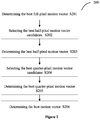
  • FIG. 2 shows a flow chart that describes steps in a method according to an embodiment of the disclosure
  • FIGS. 3A and 3B show aspects of a step for selecting the best half-pixel motion vector candidates
  • FIGS. 4A, 4B and 4C show aspects of a step for selecting the best quarter-pixel motion vector candidates
  • FIG. 5 shows a motion estimation system according to an embodiment of the disclosure.
  • first, second, third etc. may be used herein to describe various elements, components, steps and/or modes, these elements, components, steps, and/or modes should not be limited by these terms. These terms are only used to distinguish one element, component, step, and/or mode from another element, component, step, and/or mode. Thus, a first element, component, step, and/or mode discussed below could be termed a second element, component, step, and/or mode without departing from the teachings of the present disclosure.
  • FIG. 1 shows an example of a prior art method of motion estimation.
  • half-pixel motion estimation is implemented by checking eight half-pixel vectors (H 1 , H 2 , . . . H 8 ) around the best full-pixel motion vector to find the best half-pixel motion vector with minimum SAD (the Sum of Absolute Difference) value.
  • SAD the Sum of Absolute Difference
  • the symbol u is a real number greater than zero
  • 4u is the distance between two adjacent full-pixels.
  • quarter-pixel motion estimation is implemented by checking eight quarter-pixel vectors around best half-pixel motion vectors to find the best quarter-pixel motion vector with minimum SAD value.
  • checking eight vectors and SAD computation occupy a significant amount of computation.
  • FIG. 2 shows a flow chart that describes steps in a method 200 according to an embodiment of the disclosure. It should be appreciated that a video picture can be divided into a plurality of non-overlapping blocks.
  • the method 200 determines, in one or more reference frames of a video picture, the best full-pixel motion vector for a block in a current frame of the video picture.
  • the best full-pixel motion vector may be the full-pixel motion vector whose corresponding block in its corresponding reference frame best matches the block in the current frame. This can be implemented by using any of the prior art techniques.
  • step S 202 the method selects the best half-pixel motion vector candidates from a set of half-pixel motion vectors based on the best full-pixel motion vector.
  • the set of half-pixel motion vectors can be, for example, the eight half-pixel motion vectors (H 1 , H 2 . . . , H 8 ) shown in FIG. 1 .
  • step S 203 the method determines the best half-pixel motion vector H. This can be achieved by, for example, determining the one of the best half-pixel motion vector candidates, whose corresponding block in the reference frame best matches the block in the current frame.
  • the best quarter-pixel motion vector can be determined by employing SAD criteria, for example.
  • SAD criteria for example.
  • other criteria can be employed, such as SATD (Sum of Absolute Transformed Difference), SSD (Sum of Squared Difference), MAD (Mean Absolute Difference), MSD (Mean Squared Difference), etc.
  • step S 204 the method selects the best quarter-pixel motion vector candidates from a set of quarter-pixel motion vectors based on the best full-pixel motion vector and the best half-pixel motion vector.
  • the set of quarter-pixel motion vectors can be, for example, the eight half-pixel motion vectors (Q 1 , Q 2 . . . , Q 8 ) shown in FIG. 4A .
  • step S 205 the method determines the best quarter-pixel motion vector Q. This can be implemented by determining the one of the best quarter-pixel motion vector candidates, whose corresponding block in the reference frame best matches the block in the current frame.
  • the best quarter-pixel motion vector can be determined by employing SAD criteria, for example. Of course, other criteria can be employed, such as SATD (Sum of Absolute Transformed Difference), SSD (Sum of Squared Difference), MAD (Mean Absolute Difference), MSD (Mean Squared Difference), etc.
  • SATD Sud of Absolute Transformed Difference
  • SSD Sud of Squared Difference
  • MAD Mean Absolute Difference
  • MSD Mel Squared Difference
  • FIG. 3A shows an aspect of a step for selecting the best half-pixel motion vector candidates.
  • the half-pixel motion vectors in the same and opposite directions of the best full-pixel motion vector are selected as the best half-pixel motion vector candidates. For example, if the best full-pixel motion vector (as indicated by the thickest black solid arrow 301 ) is vertical, then H 2 and H 7 are selected as the best half-pixel motion vector candidates, as indicated by the thickest black dashed arrows.
  • H 4 and H 5 are selected as the best half-pixel motion vector candidates, as indicated by the thicker black dashed arrows.
  • FIG. 3B shows another aspect of a step for selecting the best half-pixel motion vector candidates.
  • the half-pixel motion vectors in the same trend direction of the best full-pixel motion vector and the half-pixel motion vector in the opposite trend direction of the best full-pixel motion vector are selected as the best half-pixel motion vector candidates.
  • the best full-pixel motion vector is the vector indicated by the black solid arrow
  • the half-pixel motion vectors (H 1 , H 2 , H 4 ) in the same trend direction of the best full-pixel motion vector and the half-pixel motion vector (H 8 ) in the opposite trend direction of the best full-pixel motion vector are selected as the best half-pixel motion vector candidates, as indicated by the dashed arrows.
  • the best full-pixel motion vector is a zero vector
  • eight half-pixel motion vectors (H 1 , H 2 . . . , H 8 ) are selected as the best half-pixel motion vector candidates, as indicated in FIG. 1 .
  • FIGS. 4A, 4B, and 4C show aspects of a step for selecting the best quarter-pixel motion vector candidates.
  • FIG. 4A if the block corresponding to the best full-pixel motion vector better matches the block in the current frame and the best full-pixel motion vector is a non-zero vector, eight quarter-pixel vectors (Q 1 , Q 2 . . . , Q 8 ) are selected as the best quarter-pixel motion vector candidates.
  • the quarter-pixel motion vector in the opposite direction of the best half-pixel motion vector is selected as the best quarter-pixel motion vector candidate.
  • the block corresponding to the best full-pixel motion vector (not shown) better matches the block in the current frame and the best full-pixel motion vector is a zero vector
  • only one quarter-pixel motion vector Q 8 in the opposite direction of the best half-pixel motion vector (for example, the best half-pixel motion vector H 1 , as indicated by thin solid arrow 401 ) is selected as the best quarter-pixel motion vector candidate.
  • the quarter-pixel motion vectors in the same trend direction of the best half-pixel motion vector are selected as the best quarter-pixel motion vector candidates. As shown in FIG.
  • the quarter-pixel motion vectors Q 1 , Q 2 and Q 4 in the same trend direction of the best half-pixel motion vector are selected as the best quarter-pixel motion vector candidates, as indicated by the thicker dotted arrows, each of which is at an angle less than 90 degrees with the best half-pixel motion vector.
  • FIG. 5 shows a motion estimation system 500 according to an embodiment of the disclosure.
  • the motion estimation system comprises: a first determination module 501 , which is adapted for determining, in one or more reference frames of the video picture, the best full-pixel motion vector F for a block in a current frame of a video picture; a first selection module 502 , which is adapted for selecting the best half-pixel motion vector candidates from a set of half-pixel motion vectors based on the best full-pixel motion vector; a second determination module 503 , which is adapted for determining the best half-pixel motion vector H; a second selection module 504 , which is adapted for selecting the best quarter-pixel motion vector candidates from a set of quarter-pixel motion vectors based on the best full-pixel motion vector and the best half-pixel motion vector; a third determination module 505 , which is adapted for determining the best quarter-pixel motion vector Q; a fourth determination module 506 which is adapted for determining the best motion vector for the block as BMV.
  • modules include routines, programs, objects, elements, components, data structures, and so forth that perform particular tasks or implement particular abstract data types.
  • module generally represent software, firmware, hardware, or a combination thereof.
  • the features of the techniques described herein are platform-independent, meaning that the techniques may be implemented on a variety of commercial computing platforms having a variety of processors.
  • Computer-readable media may include a variety of media.
  • computer-readable media may include hardware such as volatile and non-volatile, removable and non-removable media and/or storage devices implemented in a method or technology suitable for storage of information such as computer readable instructions, data structures, program modules, logic elements/circuits, or other data.
  • Examples of computer-readable media may include, but are not limited to, RAM, ROM, EEPROM, flash memory or other memory technology, CD-ROM, digital versatile disks (DVD) or other optical storage, hard disks, magnetic cassettes, magnetic tape, magnetic disk storage or other magnetic storage devices, or other storage device, tangible media, or article of manufacture suitable to store the desired information and which may be accessed by a computer.
  • the terms “comprises,” “comprising,” “includes,” “including,” “has,” “having” or any other variation thereof, are intended to cover a non-exclusive inclusion.
  • a process, method, article, or apparatus that comprises a list of elements is not necessarily limited to only those elements but may include other elements not expressly listed or inherent to such process, method, article, or apparatus.

Landscapes

  • Engineering & Computer Science (AREA)
  • Multimedia (AREA)
  • Signal Processing (AREA)
  • Compression Or Coding Systems Of Tv Signals (AREA)

Abstract

A technique of motion estimation in video compression is described, the technique including: determining, in one or more reference frames of a video picture, the best full-pixel motion vector F for a block in a current frame of the video picture, wherein m and n are signed numbers and integer multiples of the distance between two adjacent full-pixels; selecting the best half-pixel motion vector candidates from a set of half-pixel motion vectors based on the best full-pixel motion vector; determining the best half-pixel motion vector H; selecting the best quarter-pixel motion vector candidates from a set of quarter-pixel motion vectors based on the best full-pixel motion vector and the best half-pixel motion vector; determining the best quarter-pixel motion vector Q; and determining the best motion vector for the block as BMV.

Description

TECHNICAL FIELD
The disclosure relates to the field of video compression, and particularly to a method of motion estimation in video compression.
BACKGROUND ART
Hierarchy motion estimation is usually adopted by high quality video codec in video compression as it can give desirable Rate-Distortion quality in different kinds of motion scenarios, especially in fast motion situation. First, it gets accurate full-pixel motion vector. In this stage, down sampling is used to generate low resolution sample, where full-pixel motion estimation is made to find the best motion vector of multi pixels. Hence, based on this result, full-pixel motion estimation in certain region of input raw video can get precise full-pixel motion vector. In the second stage of sub-pixel motion estimation, sub pixel interpolation is required, which introduces heavy computational burden. For example, in H.264, half-pixel interpolation requires 6-tap filter, and quarter-pixel interpolation needs 2-tap filter; whereas in H.265, more computation is needed as 8-tap filter and 7-tap filter are required. Because of highly-expensive interpolation, sub-pixel motion estimation occupies a significant amount of computation, sometimes even more than that of full pixel motion estimation.
SUMMARY OF INVENTION
Therefore, how to efficiently reduce complexity of sub pixel motion estimation with little degradation of video quality becomes very important in motion estimation, especially for H.265 encoder.
According to the first aspect of the disclosure, there is provided a method of motion estimation in video compression, comprising:
    • determining, in one or more reference frames of a video picture, the best full-pixel motion vector F=(m,n) for a block in a current frame of the video picture, wherein m and n are signed numbers and integer multiples of the distance between two adjacent full-pixels;
    • selecting the best half-pixel motion vector candidates from a set of half-pixel motion vectors based on the best full-pixel motion vector;
    • determining the best half-pixel motion vector H;
    • selecting the best quarter-pixel motion vector candidates from a set of quarter-pixel motion vectors based on the best full-pixel motion vector and the best half-pixel motion vector;
    • determining the best quarter-pixel motion vector Q;
    • determining the best motion vector for the block as BMV=F+H+Q.
In most cases, at most four half-pixel vectors need to be checked when determining the best half-pixel motion vector, and at most three quarter-pixel vectors need to be checked when determining best quarter-pixel motion vector. Therefore, the number of sub-pixel vectors (including half-pixel vectors and quarter-pixel vectors) need to be checked is decreased significantly.
With this method, the sub-pixel motion vectors to be checked are strongly relevant to the motion trend of the block. When comparing with original sub pixel motion estimation, there is not over 1% loss of video quality, which can bring about 30%-35% reduction of sub pixel motion estimation complexity. Thus, the impact on video quality caused by this method is extremely little.
In an embodiment, the set of half-pixel motion vectors is S1={H1=(2 u, 2 u), H2=(0, 2 u), H3=(−2 u, 2 u), H4=(−2 u, 0), H5=(−2 u, 0), H6=(2 u, −2 u), H7=(0,−2 u), H8=(−2 u, −2 u)}; wherein the set of quarter-pixel motion vectors is S2={Q1=(u, u), Q2=(0, u), Q3=(−u, u), Q4=(u, 0), Q5=(−u, 0), Q6=(u, −u), Q7=(0, u), Q8=(−u, −u)}; and wherein u is a real number greater than zero, and 4u is the distance between two adjacent full-pixels.
The method further comprises: if the best full-pixel motion vector is a non-zero vector and m*n=0, the half-pixel motion vectors in the same and opposite directions of the best full-pixel motion vector are selected as the best half-pixel motion vector candidates.
The method further comprises: if the best full-pixel motion vector is a non-zero vector and m*n≠0, the half-pixel motion vectors in the same trend direction of the best full-pixel motion vector and the half-pixel motion vector in the opposite trend direction of the best full-pixel motion vector are selected as the best half-pixel motion vector candidates; wherein the half-pixel motion vectors in the same trend direction of the best full-pixel motion vector are
( m m 2 u , n n 2 u ) , ( m m 2 u , 0 ) , and ( 0 , n n 2 u ) ,
and the half-pixel motion vector in the opposite trend direction of the best full-pixel motion vector is
( - m m 2 u , - n n 2 u ) ,
and wherein each of the best half-pixel motion vector candidates belongs to S1.
In an embodiment, the method determines the one of the best half-pixel motion vector candidates, whose corresponding block best matches the block in the current frame, as the best half-pixel motion vector.
The method further comprises determining which of the block corresponding to the best full-pixel motion vector and the block corresponding to the best half-pixel motion vector better matches the block in the current frame.
The method further comprises: if the block corresponding to the best full-pixel motion vector better matches the block in the current frame and the best full-pixel motion vector is a zero vector, the quarter-pixel motion vector in the opposite direction of the best half-pixel motion vector is selected as the best quarter-pixel motion vector candidate.
The method further comprises: if the block corresponding to the best half-pixel motion vector better matches the block in the current frame, the quarter-pixel motion vectors in the same trend direction of the best half-pixel motion vector, each of which is at an angle less than 90 degrees with the best half-pixel motion vector, are selected as the best quarter-pixel motion vector candidates, wherein each of the best quarter-pixel motion vector candidates belongs to S2.
In an embodiment, the method determines the one of the best quarter-pixel motion vector candidates, whose corresponding block best matches the block in the current frame, as the best quarter-pixel motion vector.
According to the second aspect of the disclosure, there is provided a motion estimation system, comprising:
    • a first determination module adapted for determining, in one or more reference frames of the video picture, the best full-pixel motion vector F=(m,n) for a block in a current frame of a video picture, wherein m and n are signed real numbers;
    • a first selection module adapted for selecting the best half-pixel motion vector candidates from a set of half-pixel motion vectors based on the best full-pixel motion vector;
    • a second determination module adapted for determining the best half-pixel motion vector H;
    • a second selection module adapted for selecting the best quarter-pixel motion vector candidates from a set of quarter-pixel motion vectors based on the best full-pixel motion vector and the best half-pixel motion vector;
    • a third determination module adapted for determining the best quarter-pixel motion vector Q;
    • a fourth determination module adapted for determining the best motion vector for the block as BMV=F+H+Q.
According to the third aspect of the disclosure, there is provided one or more computer-readable media having computer-executable instructions embodied thereon that, when executed by at least one processor, cause at least one processor to perform any method mention above.
By means of the method, system or one or more computer-readable media provided herein, about 30%-35% of an amount of computation of the sub pixel motion estimation can be decreased, and meanwhile the impact on video quality is extremely little.
BRIEF DESCRIPTION OF DRAWINGS
These and other aspects are described in more detail with reference to the drawings. Therein:
FIG. 1 shows a prior art method of motion estimation;
FIG. 2 shows a flow chart that describes steps in a method according to an embodiment of the disclosure;
FIGS. 3A and 3B show aspects of a step for selecting the best half-pixel motion vector candidates;
FIGS. 4A, 4B and 4C show aspects of a step for selecting the best quarter-pixel motion vector candidates;
FIG. 5 shows a motion estimation system according to an embodiment of the disclosure.
DESCRIPTION OF EMBODIMENTS
Like reference symbols in the various drawings indicate like elements unless otherwise indicated.
It will be understood that, although the terms first, second, third etc. may be used herein to describe various elements, components, steps and/or modes, these elements, components, steps, and/or modes should not be limited by these terms. These terms are only used to distinguish one element, component, step, and/or mode from another element, component, step, and/or mode. Thus, a first element, component, step, and/or mode discussed below could be termed a second element, component, step, and/or mode without departing from the teachings of the present disclosure.
FIG. 1 shows an example of a prior art method of motion estimation. In this example, half-pixel motion estimation is implemented by checking eight half-pixel vectors (H1, H2, . . . H8) around the best full-pixel motion vector to find the best half-pixel motion vector with minimum SAD (the Sum of Absolute Difference) value. In FIG. 1, the symbol u is a real number greater than zero, and 4u is the distance between two adjacent full-pixels. Similarly, quarter-pixel motion estimation is implemented by checking eight quarter-pixel vectors around best half-pixel motion vectors to find the best quarter-pixel motion vector with minimum SAD value. However, checking eight vectors and SAD computation occupy a significant amount of computation.
FIG. 2 shows a flow chart that describes steps in a method 200 according to an embodiment of the disclosure. It should be appreciated that a video picture can be divided into a plurality of non-overlapping blocks. In step S201, the method 200 determines, in one or more reference frames of a video picture, the best full-pixel motion vector for a block in a current frame of the video picture. The best full-pixel motion vector may be the full-pixel motion vector whose corresponding block in its corresponding reference frame best matches the block in the current frame. This can be implemented by using any of the prior art techniques.
In step S202, the method selects the best half-pixel motion vector candidates from a set of half-pixel motion vectors based on the best full-pixel motion vector. The set of half-pixel motion vectors can be, for example, the eight half-pixel motion vectors (H1, H2 . . . , H8) shown in FIG. 1.
In step S203, the method determines the best half-pixel motion vector H. This can be achieved by, for example, determining the one of the best half-pixel motion vector candidates, whose corresponding block in the reference frame best matches the block in the current frame. The best quarter-pixel motion vector can be determined by employing SAD criteria, for example. Of course, other criteria can be employed, such as SATD (Sum of Absolute Transformed Difference), SSD (Sum of Squared Difference), MAD (Mean Absolute Difference), MSD (Mean Squared Difference), etc.
In step S204, the method selects the best quarter-pixel motion vector candidates from a set of quarter-pixel motion vectors based on the best full-pixel motion vector and the best half-pixel motion vector. The set of quarter-pixel motion vectors can be, for example, the eight half-pixel motion vectors (Q1, Q2 . . . , Q8) shown in FIG. 4A.
In step S205, the method determines the best quarter-pixel motion vector Q. This can be implemented by determining the one of the best quarter-pixel motion vector candidates, whose corresponding block in the reference frame best matches the block in the current frame. The best quarter-pixel motion vector can be determined by employing SAD criteria, for example. Of course, other criteria can be employed, such as SATD (Sum of Absolute Transformed Difference), SSD (Sum of Squared Difference), MAD (Mean Absolute Difference), MSD (Mean Squared Difference), etc. Then, the best motion vector for the block in the current frame can be determined as F+H+Q, in step S206.
FIG. 3A shows an aspect of a step for selecting the best half-pixel motion vector candidates. As an example, the full-pixel motion vector F=(m,n) was determined to be vertical or horizontal (i.e. F is a non-zero vector and m*n=0), wherein m and n are signed numbers and integer multiples of the distance between two adjacent full-pixels. In this case, the half-pixel motion vectors in the same and opposite directions of the best full-pixel motion vector are selected as the best half-pixel motion vector candidates. For example, if the best full-pixel motion vector (as indicated by the thickest black solid arrow 301) is vertical, then H2 and H7 are selected as the best half-pixel motion vector candidates, as indicated by the thickest black dashed arrows.
As another example, if the best full-pixel motion vector (as indicated by the thicker black solid arrow 302) is horizontal, then H4 and H5 are selected as the best half-pixel motion vector candidates, as indicated by the thicker black dashed arrows.
FIG. 3B shows another aspect of a step for selecting the best half-pixel motion vector candidates. As an example, the full-pixel motion vector F=(m,n) was determined to be a non-zero vector and m*n≠0. In this case, the half-pixel motion vectors in the same trend direction of the best full-pixel motion vector and the half-pixel motion vector in the opposite trend direction of the best full-pixel motion vector are selected as the best half-pixel motion vector candidates. For example, if the best full-pixel motion vector is the vector indicated by the black solid arrow, then the half-pixel motion vectors (H1, H2, H4) in the same trend direction of the best full-pixel motion vector and the half-pixel motion vector (H8) in the opposite trend direction of the best full-pixel motion vector are selected as the best half-pixel motion vector candidates, as indicated by the dashed arrows.
However, if the best full-pixel motion vector is a zero vector, eight half-pixel motion vectors (H1, H2 . . . , H8) are selected as the best half-pixel motion vector candidates, as indicated in FIG. 1.
FIGS. 4A, 4B, and 4C show aspects of a step for selecting the best quarter-pixel motion vector candidates. Prior to selecting the best quarter-pixel motion vector candidates, it is determined that which of the block corresponding to the best full-pixel motion vector and the block corresponding to the best half-pixel motion vector better matches the block in the current frame. As shown in FIG. 4A, if the block corresponding to the best full-pixel motion vector better matches the block in the current frame and the best full-pixel motion vector is a non-zero vector, eight quarter-pixel vectors (Q1, Q2 . . . , Q8) are selected as the best quarter-pixel motion vector candidates.
In another aspect, if the block corresponding to the best full-pixel motion vector better matches the block in the current frame and the best full-pixel motion vector is a zero vector, the quarter-pixel motion vector in the opposite direction of the best half-pixel motion vector is selected as the best quarter-pixel motion vector candidate. As shown in FIG. 4B, if the block corresponding to the best full-pixel motion vector (not shown) better matches the block in the current frame and the best full-pixel motion vector is a zero vector, only one quarter-pixel motion vector Q8 in the opposite direction of the best half-pixel motion vector (for example, the best half-pixel motion vector H1, as indicated by thin solid arrow 401) is selected as the best quarter-pixel motion vector candidate.
In another aspect, if the block corresponding to the best half-pixel motion vector better matches the block in the current frame, the quarter-pixel motion vectors in the same trend direction of the best half-pixel motion vector, each of which is at an angle less than 90 degrees with the best half-pixel motion vector, are selected as the best quarter-pixel motion vector candidates. As shown in FIG. 4C, if the block corresponding to the best half-pixel motion vector (for example, the best half-pixel motion vector H1, as indicated by thin solid arrow 402 better matches the block in the current frame, the quarter-pixel motion vectors Q1, Q2 and Q4 in the same trend direction of the best half-pixel motion vector are selected as the best quarter-pixel motion vector candidates, as indicated by the thicker dotted arrows, each of which is at an angle less than 90 degrees with the best half-pixel motion vector.
FIG. 5 shows a motion estimation system 500 according to an embodiment of the disclosure. The motion estimation system comprises: a first determination module 501, which is adapted for determining, in one or more reference frames of the video picture, the best full-pixel motion vector F for a block in a current frame of a video picture; a first selection module 502, which is adapted for selecting the best half-pixel motion vector candidates from a set of half-pixel motion vectors based on the best full-pixel motion vector; a second determination module 503, which is adapted for determining the best half-pixel motion vector H; a second selection module 504, which is adapted for selecting the best quarter-pixel motion vector candidates from a set of quarter-pixel motion vectors based on the best full-pixel motion vector and the best half-pixel motion vector; a third determination module 505, which is adapted for determining the best quarter-pixel motion vector Q; a fourth determination module 506 which is adapted for determining the best motion vector for the block as BMV.
It should be noted that various techniques may be described herein in the general context of software, hardware elements, or program modules. Generally, such modules include routines, programs, objects, elements, components, data structures, and so forth that perform particular tasks or implement particular abstract data types. The terms “module,” “functionality,” and “component” as used herein generally represent software, firmware, hardware, or a combination thereof. The features of the techniques described herein are platform-independent, meaning that the techniques may be implemented on a variety of commercial computing platforms having a variety of processors.
An implementation of the described modules and techniques may be stored on or transmitted across some form of computer-readable media. The computer-readable media may include a variety of media. By way of example, and not limitation, computer-readable media may include hardware such as volatile and non-volatile, removable and non-removable media and/or storage devices implemented in a method or technology suitable for storage of information such as computer readable instructions, data structures, program modules, logic elements/circuits, or other data. Examples of computer-readable media may include, but are not limited to, RAM, ROM, EEPROM, flash memory or other memory technology, CD-ROM, digital versatile disks (DVD) or other optical storage, hard disks, magnetic cassettes, magnetic tape, magnetic disk storage or other magnetic storage devices, or other storage device, tangible media, or article of manufacture suitable to store the desired information and which may be accessed by a computer.
As used herein, the terms “comprises,” “comprising,” “includes,” “including,” “has,” “having” or any other variation thereof, are intended to cover a non-exclusive inclusion. For example, a process, method, article, or apparatus that comprises a list of elements is not necessarily limited to only those elements but may include other elements not expressly listed or inherent to such process, method, article, or apparatus.
Although the various embodiments have been described in language specific to structural features and/or methodological acts, it is to be understood that the embodiments defined in the appended claims are not necessarily limited to the specific features or acts described. Rather, the specific features and acts are disclosed as example forms of implementing the various claimed embodiments.

Claims (18)

What is claimed is:
1. A method of efficiently reducing complexity of sub pixel motion estimation in video compression for limiting degradation, comprising:
determining, in one or more reference frames of a video picture, a best full-pixel motion vector F for a block in a current frame of the video picture;
determining a best half-pixel motion vector H from a set of half-pixel motion vectors based on the best full-pixel motion vector;
determining a best quarter-pixel motion vector Q from a set of quarter-pixel motion vectors based on the best full-pixel motion vector and the best half-pixel motion vector;
determining the best motion vector for the block as BMV=F+H+Q; and
determining full-pixel motion estimation based on the best motion vector.
2. The method of claim 1, wherein determining the best half-pixel motion vector H comprises:
selecting all of the set of half-pixel motion vectors as a set of best half-pixel motion vector candidates responsive to the best full-pixel motion vector F being a zero vector;
selecting the set of best half-pixel motion vector candidates comprising half-pixel motion vectors in a same and opposite directions of the best full-pixel motion vector, responsive to the best full-pixel motion vector being a non-zero vector along either an x or y axis;
selecting the set of best half-pixel motion vector candidates comprising half-pixel motion vectors in a same and opposite trend directions of the best full-pixel motion vector, responsive to the best full-pixel motion vector being a non-zero vector in a direction not along either an x or y axis; and
selecting the best half-pixel motion vector from the set of best half-pixel motion vector candidates.
3. The method of claim 1, wherein determining the best half-pixel motion vector H comprises:
determining the half-pixel motion vector whose corresponding block best matches the block in the current frame.
4. The method of claim 1, wherein determining the best quarter-pixel motion vector Q comprises:
determining which of the block corresponding to the best full-pixel motion vector and the block corresponding to the best half-pixel motion vector better matches the block in the current frame.
5. The method of claim 4,
wherein determining which of the block corresponding to the best full-pixel motion vector and the block corresponding to the best half-pixel motion vector better matches the block in the current frame comprises:
selecting the quarter-pixel motion vector in the opposite direction of the best half-pixel motion vector responsive to the block corresponding to the best full-pixel motion vector better matching the block in the current frame and responsive to the best full-pixel motion vector being a zero vector, and
wherein selecting the best quarter-pixel motion vector candidates comprises:
selecting all of the set of quarter-pixel motion vectors as the best quarter-pixel motion vector candidates responsive to a determination that the block corresponding to the best full-pixel motion vector better matches the block in the current frame and the best full-pixel motion vector is a non-zero vector; and
selecting the quarter-pixel motion vectors in the same trend direction of the best half-pixel motion vector, as the best quarter-pixel motion vector candidates, wherein each of the best quarter-pixel motion vector candidates belongs to the set of quarter-pixel motion vectors, responsive to a determination that the block corresponding to the best half-pixel motion vector better matches the block in the current frame.
6. The method of claim 1, wherein determining the best quarter-pixel motion vector comprises:
determining which of the set of quarter-pixel motion vectors has a corresponding block that best matches the block in the current frame.
7. A system of efficiently reducing complexity of sub pixel motion estimation for limiting degradation, comprising:
a first determination module adapted for determining, in one or more reference frames of the video picture, a best full-pixel motion vector F for a block in a current frame of a video picture;
a second determination module adapted for determining a best half-pixel motion vector H from a set of half-pixel motion vectors based on the best full-pixel motion vector;
a third determination module adapted for determining a best quarter-pixel motion vector Q from a set of quarter-pixel motion vectors based on the best full-pixel motion vector and the best half-pixel motion vector;
a fourth determination module adapted for determining the best motion vector for the block as BMV=F+H+Q; and
a usage module adapted for determining full-pixel motion estimation based on the best motion vector.
8. The system of claim 7, wherein determining the best half-pixel motion vector H comprises:
selecting all of the set of half-pixel motion vectors as a set of best half-pixel motion vector candidates responsive to the best full-pixel motion vector F being a zero vector;
selecting the set of best half-pixel motion vector candidates comprising half-pixel motion vectors in a same and opposite directions of the best full-pixel motion vector, responsive to the best full-pixel motion vector being a non-zero vector along either an x or y axis;
selecting the set of best half-pixel motion vector candidates comprising half-pixel motion vectors in a same and opposite trend directions of the best full-pixel motion vector, responsive to the best full-pixel motion vector being a non-zero vector in a direction not along either an x or y axis; and
selecting the best half-pixel motion vector from the set of best half-pixel motion vector candidates.
9. The system of claim 7, wherein determining the best half-pixel motion vector H comprises:
determining the half-pixel motion vector whose corresponding block best matches the block in the current frame.
10. The system of claim 7, wherein determining the best quarter-pixel motion vector Q comprises:
determining which of the block corresponding to the best full-pixel motion vector and the block corresponding to the best half-pixel motion vector better matches the block in the current frame.
11. The system of claim 10,
wherein determining which of the block corresponding to the best full-pixel motion vector and the block corresponding to the best half-pixel motion vector better matches the block in the current frame comprises:
selecting the quarter-pixel motion vector in the opposite direction of the best half-pixel motion vector responsive to the block corresponding to the best full-pixel motion vector better matching the block in the current frame and responsive to the best full-pixel motion vector being a zero vector, and
wherein selecting the best quarter-pixel motion vector candidates comprises:
selecting all of the set of quarter-pixel motion vectors as the best quarter-pixel motion vector candidates responsive to a determination that the block corresponding to the best full-pixel motion vector better matches the block in the current frame and the best full-pixel motion vector is a non-zero vector; and
selecting the quarter-pixel motion vectors in the same trend direction of the best half-pixel motion vector, as the best quarter-pixel motion vector candidates, wherein each of the best quarter-pixel motion vector candidates belongs to the set of quarter-pixel motion vectors, responsive to a determination that the block corresponding to the best half-pixel motion vector better matches the block in the current frame.
12. The system of claim 7, wherein determining the best quarter-pixel motion vector comprises:
determining which of the set of quarter-pixel motion vectors has a corresponding block that best matches the block in the current frame.
13. One or more non-transitory machine-readable media on which are stored instructions for efficiently reducing complexity of sub pixel motion estimation, comprising instructions that when executed cause a machine to:
determine, in one or more reference frames of a video picture, a best full-pixel motion vector F for a block in a current frame of the video picture;
determine a best half-pixel motion vector H from a set of half-pixel motion vectors based on the best full-pixel motion vector;
determine a best quarter-pixel motion vector Q from a set of quarter-pixel motion vectors based on the best full-pixel motion vector and the best half-pixel motion vector;
determine the best motion vector for the block as BMV=F+H+Q; and
determine full-pixel motion estimation based on the best motion vector.
14. The one or more machine-readable media of claim 13, wherein the instructions that when executed cause the machine to determine the best half-pixel motion vector H comprise instructions that when executed cause the machine to:
select all of the set of half-pixel motion vectors as a set of best half-pixel motion vector candidates responsive to the best full-pixel motion vector F being a zero vector;
select the set of best half-pixel motion vector candidates comprising half-pixel motion vectors in a same and opposite directions of the best full-pixel motion vector, responsive to the best full-pixel motion vector being a non-zero vector along either an x or y axis;
select a set of best half-pixel motion vector candidates comprising half-pixel motion vectors in a same and opposite trend directions of the best full-pixel motion vector, responsive to the best full-pixel motion vector being a non-zero vector in a direction not along either an x or y axis; and
select the best half-pixel motion vector from the set of best half-pixel motion vector candidates.
15. The one or more machine-readable media of claim 13, wherein the instructions that when executed cause the machine to determine the best half-pixel motion vector H comprise instructions that when executed cause the machine to:
determine the half-pixel motion vector whose corresponding block best matches the block in the current frame.
16. The one or more machine-readable media of claim 13, wherein the instructions that when executed cause the machine to determine the best quarter-pixel motion vector Q comprise instructions that when executed cause the machine to:
determine which of the block corresponding to the best full-pixel motion vector and the block corresponding to the best half-pixel motion vector better matches the block in the current frame.
17. The one or more machine-readable media of claim 16,
wherein the instructions that when executed cause the machine to determine which of the block corresponding to the best full-pixel motion vector and the block corresponding to the best half-pixel motion vector better matches the block in the current frame comprise instructions that when executed cause the machine to:
select the quarter-pixel motion vector in the opposite direction of the best half-pixel motion vector responsive to the block corresponding to the best full-pixel motion vector better matching the block in the current frame and responsive to the best full-pixel motion vector being a zero vector, and
wherein the instructions that when executed cause the machine to select the best quarter-pixel motion vector candidates comprise instructions that when executed cause the machine to:
select all of the set of quarter-pixel motion vectors as the best quarter-pixel motion vector candidates responsive to a determination that the block corresponding to the best full-pixel motion vector better matches the block in the current frame and the best full-pixel motion vector is a non-zero vector; and
select the quarter-pixel motion vectors in the same trend direction of the best half-pixel motion vector, as the best quarter-pixel motion vector candidates, wherein each of the best quarter-pixel motion vector candidates belongs to the set of quarter-pixel motion vectors, responsive to a determination that the block corresponding to the best half-pixel motion vector better matches the block in the current frame.
18. The one or more machine-readable media of claim 13, wherein the instructions that when executed cause the machine to determine the best quarter-pixel motion vector comprise instructions that when executed cause the machine to:
determine which of the set of quarter-pixel motion vectors has a corresponding block that best matches the block in the current frame.
US15/463,387 2014-09-26 2017-03-20 Motion estimation Active 2035-12-13 US10757438B2 (en)

Priority Applications (1)

Application Number Priority Date Filing Date Title
US15/463,387 US10757438B2 (en) 2014-09-26 2017-03-20 Motion estimation

Applications Claiming Priority (2)

Application Number Priority Date Filing Date Title
US14/498,010 US9628793B1 (en) 2014-09-26 2014-09-26 Motion estimation
US15/463,387 US10757438B2 (en) 2014-09-26 2017-03-20 Motion estimation

Related Parent Applications (1)

Application Number Title Priority Date Filing Date
US14/498,010 Continuation US9628793B1 (en) 2014-09-26 2014-09-26 Motion estimation

Publications (2)

Publication Number Publication Date
US20170195686A1 US20170195686A1 (en) 2017-07-06
US10757438B2 true US10757438B2 (en) 2020-08-25

Family

ID=58772054

Family Applications (2)

Application Number Title Priority Date Filing Date
US14/498,010 Expired - Fee Related US9628793B1 (en) 2014-09-26 2014-09-26 Motion estimation
US15/463,387 Active 2035-12-13 US10757438B2 (en) 2014-09-26 2017-03-20 Motion estimation

Family Applications Before (1)

Application Number Title Priority Date Filing Date
US14/498,010 Expired - Fee Related US9628793B1 (en) 2014-09-26 2014-09-26 Motion estimation

Country Status (1)

Country Link
US (2) US9628793B1 (en)

Families Citing this family (4)

* Cited by examiner, † Cited by third party
Publication number Priority date Publication date Assignee Title
US9628793B1 (en) * 2014-09-26 2017-04-18 Polycom, Inc. Motion estimation
US10477233B2 (en) * 2015-09-30 2019-11-12 Apple Inc. Predictor candidates for motion estimation search systems and methods
CN109391821B (en) * 2017-08-02 2020-08-28 联咏科技股份有限公司 Motion estimation method and motion estimation device
CN109587501B (en) * 2017-09-28 2022-07-12 腾讯科技(深圳)有限公司 Method, apparatus and storage medium for motion estimation

Citations (4)

* Cited by examiner, † Cited by third party
Publication number Priority date Publication date Assignee Title
US20010028680A1 (en) 2000-04-11 2001-10-11 Jean Gobert Determining the degree of resemblance between a data sample and interpolations of other data samples
US20030156646A1 (en) * 2001-12-17 2003-08-21 Microsoft Corporation Multi-resolution motion estimation and compensation
US8761261B1 (en) * 2008-07-29 2014-06-24 Marvell International Ltd. Encoding using motion vectors
US9628793B1 (en) * 2014-09-26 2017-04-18 Polycom, Inc. Motion estimation

Patent Citations (4)

* Cited by examiner, † Cited by third party
Publication number Priority date Publication date Assignee Title
US20010028680A1 (en) 2000-04-11 2001-10-11 Jean Gobert Determining the degree of resemblance between a data sample and interpolations of other data samples
US20030156646A1 (en) * 2001-12-17 2003-08-21 Microsoft Corporation Multi-resolution motion estimation and compensation
US8761261B1 (en) * 2008-07-29 2014-06-24 Marvell International Ltd. Encoding using motion vectors
US9628793B1 (en) * 2014-09-26 2017-04-18 Polycom, Inc. Motion estimation

Also Published As

Publication number Publication date
US9628793B1 (en) 2017-04-18
US20170195686A1 (en) 2017-07-06

Similar Documents

Publication Publication Date Title
US10404917B2 (en) One-pass video stabilization
US10757438B2 (en) Motion estimation
TWI455588B (en) Bi-directional, local and global motion estimation based frame rate conversion
US8107750B2 (en) Method of generating motion vectors of images of a video sequence
US8204124B2 (en) Image processing apparatus, method thereof, and program
CA3228568A1 (en) Encoding and decoding method and device, encoder side apparatus and decoder side apparatus
US12114005B2 (en) Encoding and decoding method and apparatus, and devices
US20150071567A1 (en) Image processing device, image processing method and non-transitory computer readable medium
KR101445009B1 (en) Techniques to perform video stabilization and detect video shot boundaries based on common processing elements
US20060203912A1 (en) Motion vector detection method, motion vector detection apparatus, computer program for executing motion vector detection process on computer
US8305500B2 (en) Method of block-based motion estimation
EP2362655B1 (en) Motion-vector estimation
JP5198543B2 (en) Image processing method, image processing apparatus, and image processing program
US20130235274A1 (en) Motion vector detection device, motion vector detection method, frame interpolation device, and frame interpolation method
US20110135001A1 (en) Hierarchical motion estimation method using dynamic search range determination
US20150326786A1 (en) Image processing device, imaging device, and image processing method
US9369707B2 (en) Global motion vector estimation
US8451900B2 (en) System and method for global motion estimation using profile matching
CN106993108B (en) Method and device for determining random quantity of video image in motion estimation
TW201333836A (en) Image processing method
KR101359351B1 (en) Fast method for matching stereo images according to operation skip
US8989269B2 (en) Motion vector extraction method and apparatus
JP5011854B2 (en) High resolution image processing device
KR102089433B1 (en) Multidirectional hierarchical motion estimation method for video coding tool
US20130136369A1 (en) Method for detecting background motion vector

Legal Events

Date Code Title Description
AS Assignment

Owner name: MACQUIRE CAPITAL FUNDING LLC, NEW YORK

Free format text: SECURITY INTEREST;ASSIGNOR:POLYCOM, INC.;REEL/FRAME:043156/0239

Effective date: 20160927

AS Assignment

Owner name: POLYCOM, INC., COLORADO

Free format text: RELEASE BY SECURED PARTY;ASSIGNOR:MACQUARIE CAPITAL FUNDING LLC;REEL/FRAME:046472/0815

Effective date: 20180702

AS Assignment

Owner name: WELLS FARGO BANK, NATIONAL ASSOCIATION, NORTH CAROLINA

Free format text: SECURITY AGREEMENT;ASSIGNORS:PLANTRONICS, INC.;POLYCOM, INC.;REEL/FRAME:046491/0915

Effective date: 20180702

Owner name: WELLS FARGO BANK, NATIONAL ASSOCIATION, NORTH CARO

Free format text: SECURITY AGREEMENT;ASSIGNORS:PLANTRONICS, INC.;POLYCOM, INC.;REEL/FRAME:046491/0915

Effective date: 20180702

STCV Information on status: appeal procedure

Free format text: ON APPEAL -- AWAITING DECISION BY THE BOARD OF APPEALS

STCV Information on status: appeal procedure

Free format text: BOARD OF APPEALS DECISION RENDERED

STPP Information on status: patent application and granting procedure in general

Free format text: NOTICE OF ALLOWANCE MAILED -- APPLICATION RECEIVED IN OFFICE OF PUBLICATIONS

STPP Information on status: patent application and granting procedure in general

Free format text: PUBLICATIONS -- ISSUE FEE PAYMENT VERIFIED

STCF Information on status: patent grant

Free format text: PATENTED CASE

AS Assignment

Owner name: POLYCOM, INC., CALIFORNIA

Free format text: RELEASE OF PATENT SECURITY INTERESTS;ASSIGNOR:WELLS FARGO BANK, NATIONAL ASSOCIATION;REEL/FRAME:061356/0366

Effective date: 20220829

Owner name: PLANTRONICS, INC., CALIFORNIA

Free format text: RELEASE OF PATENT SECURITY INTERESTS;ASSIGNOR:WELLS FARGO BANK, NATIONAL ASSOCIATION;REEL/FRAME:061356/0366

Effective date: 20220829

AS Assignment

Owner name: HEWLETT-PACKARD DEVELOPMENT COMPANY, L.P., TEXAS

Free format text: NUNC PRO TUNC ASSIGNMENT;ASSIGNOR:POLYCOM, INC.;REEL/FRAME:064056/0947

Effective date: 20230622

MAFP Maintenance fee payment

Free format text: PAYMENT OF MAINTENANCE FEE, 4TH YEAR, LARGE ENTITY (ORIGINAL EVENT CODE: M1551); ENTITY STATUS OF PATENT OWNER: LARGE ENTITY

Year of fee payment: 4