US10754301B2 - Liquid powered device - Google Patents
Liquid powered device Download PDFInfo
- Publication number
- US10754301B2 US10754301B2 US16/524,009 US201916524009A US10754301B2 US 10754301 B2 US10754301 B2 US 10754301B2 US 201916524009 A US201916524009 A US 201916524009A US 10754301 B2 US10754301 B2 US 10754301B2
- Authority
- US
- United States
- Prior art keywords
- liquid
- assembly
- powered device
- liquid tank
- pressure relief
- Prior art date
- Legal status (The legal status is an assumption and is not a legal conclusion. Google has not performed a legal analysis and makes no representation as to the accuracy of the status listed.)
- Active
Links
Images




Classifications
-
- G—PHYSICS
- G04—HOROLOGY
- G04C—ELECTROMECHANICAL CLOCKS OR WATCHES
- G04C10/00—Arrangements of electric power supplies in time-pieces
-
- G—PHYSICS
- G04—HOROLOGY
- G04G—ELECTRONIC TIME-PIECES
- G04G17/00—Structural details; Housings
- G04G17/02—Component assemblies
- G04G17/04—Mounting of electronic components
-
- G—PHYSICS
- G04—HOROLOGY
- G04G—ELECTRONIC TIME-PIECES
- G04G17/00—Structural details; Housings
- G04G17/08—Housings
-
- G—PHYSICS
- G04—HOROLOGY
- G04G—ELECTRONIC TIME-PIECES
- G04G19/00—Electric power supply circuits specially adapted for use in electronic time-pieces
Definitions
- the present invention relates to portable electrolyte powered devices and more particularly to a liquid powered device that utilizes a power assembly and electronic module assembly that are separately liquid sealed.
- Electrolyte solutions are known in the prior art for providing power to operate very low power consumption devices such as clocks and calculators.
- Bedol International Group, Inc. Claremont, Calif.
- the Bedol “Water Clock” includes a cap that extends from an upper portion of the housing of the device.
- the present invention is a liquid powered device, including a housing assembly configured to be worn on the wrist of a user.
- the housing assembly includes a front portion and a back portion.
- a liquid tank assembly is secured within the housing assembly.
- the liquid tank assembly has a fluid inlet.
- a power assembly is secured within the liquid tank assembly.
- An electronic module assembly is secured within the upper liquid seal member.
- the power assembly is in fluid communication with the fluid inlet to provide filling of the power assembly.
- the power assembly and the electronic module assembly are each separately liquid sealed.
- the back portion of the housing assembly includes a back plate connected to the liquid tank assembly.
- the present invention is a liquid powered device, including a liquid tank assembly, the liquid tank assembly having a fluid inlet; a power assembly secured within the liquid tank assembly; a water tight sealed compartment connected to the liquid tank assembly, an electronic module assembly secured in the water tight compartment, wherein the power assembly is in fluid communication with the fluid inlet to provide filling of the power assembly; and, a mechanical clock mechanism operatively connected to the electronic module assembly, the mechanical clock mechanism including an hour hand and a minute hand, the mechanical clock mechanism not having a second hand.
- the liquid tank assembly, the power assembly, the electronic module assembly and the mechanical clock mechanism are cooperatively configured to operate without an external power source.
- the present invention enables powering a wrist watch with water.
- the electronics and mechanical elements of the watch need to be protected from being shorted from exposure to water.
- a watch user will in the course of use wash their hands, be exposed to rain or other climate elements, spill liquid by mistake or otherwise get their arms and hands wet. If the inner electronic or working mechanism of a watch is not protected, it will be shorted out from the water exposure.
- the present invention protects the electronic elements from the potential liquid exposure from the environment. It also protects electronic mechanisms from water exposure from its own power source, the water tank that is providing the power to run the watch. This unique double seal is a key and unique advantage that enables the liquid powered watch to be worn safely on a wrist.
- U.S. Pat. No. 6,416,217 issued on Jul. 9, 2002 to H. Von Braunhaut, discloses an aquarium watch with a plug for filling the aquarium.
- the aquarium portion of the device is distinctly separate from the power supply and the electronic portion.
- the utility of the aquarium is not relevant to the utility of the watch mechanism.
- the watch works independently from its connection to the water in the aquarium.
- FIG. 1 is a perspective view of a first embodiment of the liquid powered device of the present invention.
- FIG. 2 is a top view of the liquid powered device of FIG. 1 .
- FIG. 3 is a bottom view of the liquid powered device of FIG. 1 .
- FIG. 4 is a bottom, side perspective view of the liquid powered device, shown with the wrist strap removed.
- FIG. 5 is a top perspective view of the liquid powered device, shown cut away to reveal the internal components thereof.
- FIG. 6 is an exploded bottom perspective view of the liquid powered device.
- FIG. 7 is an exploded top perspective view of the liquid powered device.
- FIG. 8 is a perspective view of a second embodiment of the liquid powered device of the present invention which utilizes a pressure relief assembly.
- FIG. 9 is a top view of the liquid powered device of FIG. 8 .
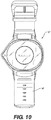
- FIG. 10 is a bottom view of the liquid powered device of FIG. 8 .
- FIG. 11 is a bottom, side perspective view of the liquid powered device of FIG. 8 , shown with the wrist strap removed.
- FIG. 12 is a top perspective view of the liquid powered device of FIG. 8 , shown cut away to reveal the internal components thereof.
- FIG. 13 is an exploded bottom perspective view of the liquid powered device of FIG. 8 .
- FIG. 14 is an exploded top perspective view of the liquid powered device of FIG. 8 .
- FIG. 15 is a perspective view of a third embodiment of the liquid powered device of the present invention which, as the FIG. 8 embodiment, utilizes a pressure relief assembly.
- FIG. 16 is a top view of the liquid powered device of FIG. 15 .
- FIG. 17 is a bottom view of the liquid powered device of FIG. 15 .
- FIG. 18 is a bottom, side perspective view of the liquid powered device of FIG. 15 , shown with the wrist strap removed.
- FIG. 19 is a top perspective view of the liquid powered device of FIG. 15 , shown cut away to reveal the internal components thereof.
- FIG. 20 is an exploded top, side perspective view of the liquid powered device of FIG. 15 , with the face plate removed, revealing the pressure relief assembly.
- FIG. 21 is an exploded top, side perspective view of the liquid powered device of FIG. 15 , showing an assembled pressure relief assembly, with the face plate missing.
- FIG. 22 is a cross-sectional side view of a portion of the liquid powered device of FIG. 15 , showing the operation of the pressure relief assembly.
- FIG. 23 is a front perspective view of a mechanical clock showing the hour and minute hands.
- FIG. 24 is front elevation of a mechanical clock showing the hour and minute hands.
- FIG. 25 is left side elevation showing the liquid filled in the water tank and in contact with the metal plates. Liquid is not filled to the top of the liquid tank.
- FIG. 26 is an exploded perspective view of the mechanical clock assembly located in the liquid tight compartment in the liquid tank.
- FIG. 27 is a cross sectional view showing the area where the liquid is located and the liquid sealed area where the mechanical clock mechanism is housed where no liquid can enter.
- FIG. 28 is a exploded perspective view of the liquid powered device of FIG. 15 , shown with the wrist strap removed.
- FIG. 29 is an exploded top, side perspective view of the liquid powered device of FIG. 15 , with the face plate removed, revealing the pressure relief assembly
- FIG. 30 is a cross-sectional side view of a portion of the liquid powered device of FIG. 15 , showing the operation of the pressure relief assembly.
- FIG. 31 is a cross-sectional view taken along line 31 - 31 of FIG. 29 .
- FIG. 32 is a cross-sectional view taken along line 32 - 32 of FIG. 29 .
- FIG. 33 is a bottom plan view back housing removed.
- FIG. 34 is a top perspective view.
- FIG. 35 is cross-sectional view taken along 35 - 35 of FIG. 29C .
- FIG. 36 is a bottom plan view.
- FIGS. 1-7 illustrate the liquid powered device, designated generally as 10 .
- the device 10 includes a housing assembly, designated, generally as 12 ; that is configured to be worn on the wrist of a user via a wristband 14 .
- the device 10 shown in this figure is embodied as a watch in this preferred embodiment.
- the housing assembly 12 includes a front portion 16 and a back portion 18 . Although the housing assembly 12 is shown in the figures as being clear, it can be clear, semi-transparent or opaque.
- the front portion 16 includes an upper liquid seal member 20 .
- a liquid tank assembly 22 is secured within the housing assembly 12 .
- the liquid tank assembly 22 includes a fluid inlet 24 .
- a power assembly 26 is secured within the liquid tank assembly 22 .
- An electronic module assembly 28 is secured within the liquid tank assembly 22 .
- the power assembly 26 is in fluid communication with the fluid inlet 24 to provide filling of the power assembly 26 .
- the power assembly 26 and the electronic module assembly 28 are each separately liquid sealed.
- the power assembly 26 includes two sets of metal elements 30 , 32 .
- Each set of metal elements is configured to produce an electrolyte charge.
- the two sets are divided into separate chambers to total two power cells.
- each set includes a pair of metallic elements that are polar opposites which react with electrolyte solution to generate an electric charge that can power the electronic module.
- these elements or plates are formed of copper and zinc.
- an electrolyte solution 30 typically water.
- electricity is generated as well known by those familiar with liquid batteries.
- the liquid tank assembly 22 includes a divider 34 for separating the metal elements of each respective set 30 , 32 of metal elements.
- the upper liquid seal member 20 cooperates with an upper liquid seal portion 36 of the liquid tank assembly 22 to provide a sealing engagement there between.
- the liquid tank generally holds 1 teaspoon or 5 ml. of water.
- the upper liquid seal portion 36 includes an upper sealing surface 38 and a lower sealing surface 40 .
- the upper sealing surface 38 cooperates with the upper liquid seal member 20 for sealing the electronic module assembly 28 .
- the lower sealing surface 40 cooperates with the back portion 18 for sealing the power assembly 26 .
- sealing is preferably ultrasonic sealing for both sealing the electronic module assembly 28 and sealing the power assembly 26 .
- sealing by glue can be utilized.
- the front portion 16 preferably includes a face plate 42 configured to encapsulate the upper liquid seal member 20 .
- the upper liquid seal member 20 preferably includes a transparent viewing window 44 .
- the back portion 18 of the housing assembly 12 includes a back plate 46 connected to the liquid tank assembly 22 , a water cap 48 , and a washer 50 positioned between the back plate 46 and the water cap 48 .
- the water cap 48 includes an indentation 52 for turning the water cap 48 for opening and closing the fluid inlet 24 .
- the fluid inlet 24 is at the back portion 18 of the housing assembly 12 .
- the fluid inlet 24 may be formed at, for example, sidewalls of the liquid tank assembly 22 .
- the electronic module assembly 28 includes an electronic module element 54 operatively connected to a liquid crystal display (LCD) 56 .
- the electronic module element 54 has a connecting plate 58 operatively connected at a back surface thereof.
- the power assembly 26 includes a pair of conducting screws 60 , 62 .
- Each set of metal elements 30 , 32 is configured to produce an electrolyte charge.
- Each conductive screw 60 , 62 of an associated set of metal elements 30 , 32 is arranged and positioned to conduct electricity from its associated metal element to the connecting plate 58 .
- the electronic module assembly 28 also includes a plurality of set buttons 64 , 66 .
- Plate attachment screws/nuts 68 , 70 attach the metal elements 30 , 32 to the liquid tank assembly 22 .
- Engagement elements 72 that extend from the sides of the liquid tank assembly 22 provide attachment of the wrist band 14 .
- each pressure relief assembly 100 includes a pressure relief housing 102 .
- a pressure relief top cap 104 is attached to an upper end of the pressure relief housing 102 .
- Each pressure relief top cap 104 has a top cap opening (i.e. air hole) 106 (see FIG. 8 ).
- a pressure relief element 108 is positioned within the pressure relief housing 102 .
- the pressure relief element 108 can be, for example, sponge material, a semi porous material, a filament material such as that used as the tip of a highlighting marker, or other suitable materials that allow the air to escape from the liquid tank and neutralize the air pressure appropriately.
- This pressure discrepancy is a result of gasses generated as a natural byproduct of the electrolysis power system. Pressure build up should not be sufficient to break the liquid seal.
- the pressure relief assembly allows the gases to escape at a relatively low rate and allow the majority of the liquid to be maintained inside of the liquid tank. Without the sponge material and a hole in the liquid tank, liquid could rapidly be forced out of the liquid tank by gases that build up in the water tank.
- the pressure relief assembly could eliminate some gases, for example, pressure relief top cap 104 transports gases from and into the liquid tank 22 ′.
- the pressure relief top cap 104 could be formed to be the same part as the liquid tank assembly 22 ′.
- the pressure relief bottom cap 110 could be eliminated if the pressure relief element 108 is sized to be able to pressure fit onto the area in the tank that holds it so that it is held sufficiently with solely a pressure fit.
- a pressure relief bottom cap 110 is positioned within the pressure relief housing 102 .
- the pressure relief bottom cap 110 has a bottom cap opening 112 .
- FIGS. 15-22 a third embodiment of the liquid powered device of the present invention is illustrated, designated generally as 10 ′′, which, as the FIG. 8 embodiment, utilizes two pressure relief assemblies 100 ′′, 100 ′′′.
- the clock When you fill the water tank with liquid the clock turns on due to an electrolysis system that powers the clock. There a current that is transmitted to the electronics on the electronic circuit board using the wires 116 and the system creates energy and at the same time creates a reaction that generates gas that starts building up in the water chamber. The pressure from the gas build up is released using the pressure release assembly.
- the pressure relief assembly utilizes a semi porous membrane 108 to allow a slow release of gas to the outside. Without this filament having only a hole to allow the expelling of gas the water chamber would be emptied in a matter of a day or two. With the semi porous filament the clock will work for months before the liquid solution would be needed to be added to by refilling the water tank.
- the liquid powered watch is important since there is a limited amount of size an item needs to be in order to be comfortably worn on a wrist.
- the liquid tank assembly is preferably one inch or less in thickness.
- the size of a typical water tank can be defined by the following parameters—length A, as shown in FIG. 17 is 11/16′′; and, length B shown in FIG. 16 is 2′′.
- the Length C in FIG. 16 is 11 ⁇ 2′′.
- the amount of water that will fill the watch to near-capacity is about 5 ml. (1 teaspoon) of liquid. (There is always a small amount of air left while filling, about the size of a small bubble, so we use the term “near-capacity”.) Since the water tank is filled to its near-capacity, i.e. filling with as much liquid that can realistically be fit into the water tank, this limitation creates a high amount of pressure that needs to be released.
- the pressure relief valve of the present invention solves the problem that pressure ruptures the seal, causing water to leak into the electronics generating a short circuit and leakage of water.
- the upper liquid seal member 20 has been eliminated.
- the liquid tank assembly 22 provides the liquid seal between the back plate 46 ′′ and the liquid tank assembly 22 ′′, which prevents the water from leaking through to the upper liquid seal area 36 ′′.
- conductive screws 60 ′′, 62 ′′, 68 keep water under pressure so that water does not leak out at the location of their attachment to the liquid tank.
- Elimination of the upper liquid seal member 20 minimizes parts and reduces the cost of manufacturing. It also provides the capability for the liquid powered watch to be as thin as possible.
- FIGS. 18-22 illustrate the liquid powered device, designated generally as 10 ′′.
- the device 10 ′′ includes a housing assembly, designated generally as 12 ′′; that is configured to be worn on the wrist of a user via a wristband 14 ′′.
- the device 10 ′′ embodied as a watch in this preferred embodiment.
- the housing assembly 12 ′′ includes a front portion 16 ′′ and a back portion 18 ′′. Although the housing assembly 12 ′′ is shown in the figures as being clear, it can be clear or transparent.
- the front portion 16 ′′ includes an upper liquid seal member 20 ′′.
- a liquid tank assembly 22 ′′ is secured within the housing assembly 12 ′′.
- the liquid tank assembly 22 ′′ includes a fluid inlet 24 ′′.
- a power assembly 26 ′′ is secured within the liquid tank assembly 22 ′′.
- An electronic module assembly 28 ′′ is secured to the liquid tank assembly 22 ′′.
- the power assembly 26 ′′ is in fluid communication with the fluid inlet 24 ′′ to provide filling of the power assembly 26 ′′.
- the power assembly 26 ′′ includes two sets of metal elements 30 ′′, 32 ′′. Each set of metal elements is configured to produce an electrolyte charge. The two sets are divided into separate chambers to total two power cells. In each chamber, each set includes a pair of metallic elements that are polar opposites which react with electrolyte solution to generate an electric charge that can power the electronic module. Typically these elements or plates are formed of copper and zinc. Thus, during operation the device 10 ′′ is filled with an electrolyte solution 30 ′′ typically water. Thus, electricity is generated as well known by those familiar with liquid batteries.
- the electronic module 54 ′′ and the liquid tank assembly 22 ′′ are connected by wires 114 ′′ and 116 ′′.
- the liquid tank assembly 22 ′′ includes a divider 34 ′′ for separating the metal elements of each respective set 30 ′′, 32 ′′ of metal elements.
- the upper liquid seal member 20 ′′ cooperates with an upper liquid seal portion 36 ′′ of the liquid tank assembly 22 ′′ to provide a sealing engagement there between.
- the upper liquid seal portion 36 ′′ includes an upper sealing surface 38 ′′ and a lower sealing surface 40 ′′.
- the upper sealing surface 38 ′′ cooperates with the upper liquid seal member 20 ′′ for sealing the electronic module assembly 28 ′′.
- the lower sealing surface 40 ′′ cooperates with the back portion 18 ′′ for sealing the power assembly 26 ′′.
- sealing is preferably ultrasonic sealing for both sealing the electronic module assembly 28 ′′ and sealing the power assembly 26 ′′.
- sealing by glue can be utilized.
- the front portion 16 ′′ preferably includes a face plate 42 ′′.
- the back portion 18 ′′ of the housing assembly 12 ′′ includes a back plate 46 ′′ connected to the liquid tank assembly 22 ′′, a water cap 48 ′′, and a washer 50 ′′ positioned between the back plate 46 ′′ and the water cap 48 ′′.
- the back plate 46 ′′ may be glued or ultrasonically welded to the liquid tank assembly 22 ′′.
- the water cap 48 ′′ includes an indentation 52 ′′ for turning the water cap 48 ′′ for opening and closing the fluid inlet 24 ′′.
- the fluid inlet 24 ′′ is at the back portion 18 ′′ of the housing assembly 12 ′′.
- the fluid inlet 24 ′′ may be formed at, for example, sidewalls of the liquid tank assembly 22 ′′.
- the electronic module assembly 28 ′′ includes an electronic module element 54 ′′ operatively connected to a liquid crystal display (LCD) 56 ′′.
- the electronic module element 54 ′′ has a connecting plate 58 ′′ operatively connected at a back surface thereof.
- the power assembly 26 ′′ includes a pair of conducting screws 60 ′′, 62 ′′.
- Each set of metal elements 30 ′′, 32 ′′ is configured to produce an electrolyte charge.
- Each conductive screw 60 ′′, 62 ′′ of an associated set of metal elements 30 ′′, 32 ′′ is arranged and positioned to conduct electricity from its associated metal element to the connecting plate 58 ′′.
- the electronic module assembly 28 ′′ also includes a plurality of set buttons 64 ′′, 66 ′′.
- Plate attachment screws/nuts 68 ′′, 70 ′′ attach the metal elements 30 ′′, 32 ′′ to the liquid tank assembly 22 ′′.
- Engagement elements 72 ′′ that extend from the sides of the liquid tank assembly 22 ′′ provide attachment of the wrist band 14 ′′.
- a small amount of fluid can be released if the pressure exceeds a predetermined amount.
- the liquid powered device can be enlarged to be approximately 15 inches high (see line A in FIG. 24 ) and to hold approximately 7 cups of liquid which is utilized to power the clock 74 .
- the advantage of this embodiment is that the clock 74 can be hung on the wall and provide time keeping capabilities without the need for an external electric plug and/or external batteries.
- the user simply adds water to the clock's water tank, i.e. liquid tank assembly 76 , and when the liquid encounters the metal plates 78 the clock 74 begins to operate.
- the element that provides the time is an analog mechanical clock mechanism 80 .
- the two part housing for the mechanical clock mechanism 80 has a front 82 and back 84 and it holds a series of gears that moves the hour hand and minute hand. There is a motor 130 that drives the gears.
- Attached to the mechanism on the back side of the mechanism housing is an electronic module assembly 126 that converts the current produced when water is inserted into the water tank by the metal plates into power to run the clock 74 .
- the water tank 76 includes a fill hole 88 and a water cap 90 .
- a liquid tank assembly 76 is secured within the housing assembly 74 .
- the liquid tank assembly includes the fluid inlet 88 .
- An electronic module assembly 126 is secured within the water tight sealed housing 124 .
- a mechanical clock mechanism 80 is secured to the liquid tank assembly in cavity where no liquid is stored.
- the power assembly 134 is in fluid communication with the fluid inlet 88 to provide filling of the power assembly.
- the power assembly 134 includes two sets of the metal elements 78 .
- Each set of metal elements is configured to produce an electrolyte charge.
- the two sets are divided into separate chambers to total two power cells.
- each set includes a pair of metallic elements that are polar opposites which react with electrolyte solution to generate an electric charge that can power the electronic module.
- these elements or plates are formed of copper and zinc.
- an electrolyte solution 128 typically water.
- electricity is generated as well known by those familiar with liquid batteries.
- the electronic module 120 that converts the current into a charge that the mechanical mechanism can use for power has an electronic circuit board and electronic components and are connected by wires 122 that are positioned into the water tank using a water tight seal so that it can connect to the power assembly and not allow water into the water tight compartment.
- the power generated by the liquid battery power source is approximately 3 Amps or under with a current which is insufficient to reliably and continuously power a mechanism that is driven with a motor 130 when a second hand is attached.
- the constant friction that a second hand produces is too much for the liquid power source to power successfully.
- the invention will not work successfully with a second hand. Omission of the second hand provides the capability for the mechanism to successfully keep running and show the correct time.
- the pressure relief assembly 100 includes a pressure relief housing 102 .
- a pressure relief top 182 ′′ (see FIG. 29 ) which is part of to an upper end of the pressure relief housing 102 .
- the pressure relief top is a raised up portion with one or more air openings or air holes 106 ′ (see FIG. 30 ).
- a pressure relief element 108 ′ is positioned within the pressure relief housing 102 (see FIG. 30 ).
- the pressure relief element 108 ′ can be, for example, sponge material, a semi porous material, a filament material such as that used as the tip of a highlighting marker, or other suitable materials that allow the air to escape from the liquid tank and neutralize the air pressure appropriately.
- This pressure discrepancy is a result of gasses generated as a natural byproduct of the electrolysis power system. It is important that pressure build up should not be sufficient to break the liquid seal.
- the pressure relief assembly allows the gases to escape at a relatively low rate and allow the majority of the liquid to be maintained inside of the liquid tank.
- a connecting wire 114 ′′ and 116 ′′ connect to the upper facing surface of the liquid tank 154 ′ and are held in place with screws 62 ′′ and 68 ′′ which attach to the wire connector 150 ′′.
- the wire connector connects to the wires which connects to the circuit board.
- Those screws are secured through the liquid tank housing by means of a tight water proof tightening the screws through the female threaded cavity in the housing in the downward extended housing portion 156 ′′ and 200 ′′ that can be seen in FIG. 28 .
- the other screws tighten through the female threaded cavity 250 ′′, 252 ′′, 254 ′′ and 256 ′′ as seen in FIG. 31 and FIG. 32 . This forms a liquid seal 258 ′′.
- the Screws connect through the holes in the metallic elements 160 ′′ and 162 ′′, and the second set 170 ′′ and 172 ′′ (see FIG. 28 ). Nuts 70 ′′ and 174 ′′ connect to the screw and hold the metallic element securely in place on the first set and 164 ′′ and 176 ′′ on the second set. Because the water tank is thin ( FIG. 17 , line A) there is little space to pour liquid into the water tank FIG. 33 after removing back cap 52 ′′. So that issue is solved by having a “metallic element fill hole” a cut-out, 308 ′′ and 310 ′′ in the set of metallic elements as seen in lines D and F, G and E, along with G and I, j and H in FIG. 33 . There are in FIG.
- This metallic element cut-out allows liquid to enter the chamber in the center portion of the liquid tank when filling with liquid. It also allows the liquid to enter in the water tank and into both of the battery cells.
- the cut-out is approximately the same size as the size of the fill hole as shown in FIG. 36 (the N and S, E and W notation).
- the lower metallic element is sized to extend down and be shorter then a raised up housing nib 200 ′′ and 156 ′′ that is used to attach a second layer of metallic elements which extends horizontally from the opposite direction.
- screws 166 ′′ and 168 ′′ connect through a metal strip 152 ′′ that produces and completed electrical circuit. The screws tighten through the female threaded cavity.
- Non metallic pieces that could be made of silicon, plastic or a material that is not metal that provides a division of the metallic elements to not touch the housing and in between the set of metallic element layers on both liquid power cells, 188 ′′, 186 ′′, 192 ′′, 190 ′′.
- FIG. 35 shows the center divider has a male extension 198 ′′ and 202 ′′ on both the two ends that fits into two holes 208 and 210 ′′ in the back side of the back plate.
- FIG. 35 shows a cross section showing how the pieces are assembled.
Landscapes
- Physics & Mathematics (AREA)
- General Physics & Mathematics (AREA)
- Engineering & Computer Science (AREA)
- Power Engineering (AREA)
- Electric Clocks (AREA)
Abstract
Description
Claims (19)
Priority Applications (2)
| Application Number | Priority Date | Filing Date | Title |
|---|---|---|---|
| US16/524,009 US10754301B2 (en) | 2014-03-13 | 2019-07-27 | Liquid powered device |
| US17/001,492 US20210124312A1 (en) | 2014-03-13 | 2020-08-24 | Liquid Powered Device |
Applications Claiming Priority (4)
| Application Number | Priority Date | Filing Date | Title |
|---|---|---|---|
| US14/208,617 US20150261193A1 (en) | 2014-03-13 | 2014-03-13 | Liquid powered watch |
| US15/915,344 US10095188B2 (en) | 2014-03-13 | 2018-03-08 | Liquid powered watch |
| US16/153,246 US10379499B2 (en) | 2014-03-13 | 2018-10-05 | Liquid powered device |
| US16/524,009 US10754301B2 (en) | 2014-03-13 | 2019-07-27 | Liquid powered device |
Related Parent Applications (1)
| Application Number | Title | Priority Date | Filing Date |
|---|---|---|---|
| US16/153,246 Continuation-In-Part US10379499B2 (en) | 2014-03-13 | 2018-10-05 | Liquid powered device |
Related Child Applications (1)
| Application Number | Title | Priority Date | Filing Date |
|---|---|---|---|
| US17/001,492 Continuation-In-Part US20210124312A1 (en) | 2014-03-13 | 2020-08-24 | Liquid Powered Device |
Publications (2)
| Publication Number | Publication Date |
|---|---|
| US20200110367A1 US20200110367A1 (en) | 2020-04-09 |
| US10754301B2 true US10754301B2 (en) | 2020-08-25 |
Family
ID=70051650
Family Applications (1)
| Application Number | Title | Priority Date | Filing Date |
|---|---|---|---|
| US16/524,009 Active US10754301B2 (en) | 2014-03-13 | 2019-07-27 | Liquid powered device |
Country Status (1)
| Country | Link |
|---|---|
| US (1) | US10754301B2 (en) |
Citations (3)
| Publication number | Priority date | Publication date | Assignee | Title |
|---|---|---|---|---|
| US3888127A (en) * | 1972-11-10 | 1975-06-10 | Farallon Ind | Portable underwater indicating instrument for divers |
| WO2003034521A1 (en) * | 2001-10-19 | 2003-04-24 | Vaisala Oyj | Water activated battery cell, primary battery and its use |
| US20110176393A1 (en) * | 2009-04-01 | 2011-07-21 | Ocean Works Limited | Battery-less environmental friendly quartz timepieces |
-
2019
- 2019-07-27 US US16/524,009 patent/US10754301B2/en active Active
Patent Citations (3)
| Publication number | Priority date | Publication date | Assignee | Title |
|---|---|---|---|---|
| US3888127A (en) * | 1972-11-10 | 1975-06-10 | Farallon Ind | Portable underwater indicating instrument for divers |
| WO2003034521A1 (en) * | 2001-10-19 | 2003-04-24 | Vaisala Oyj | Water activated battery cell, primary battery and its use |
| US20110176393A1 (en) * | 2009-04-01 | 2011-07-21 | Ocean Works Limited | Battery-less environmental friendly quartz timepieces |
Also Published As
| Publication number | Publication date |
|---|---|
| US20200110367A1 (en) | 2020-04-09 |
Similar Documents
| Publication | Publication Date | Title |
|---|---|---|
| US10095188B2 (en) | Liquid powered watch | |
| JP2015131295A (en) | Portable hydrogen water production device | |
| TW200520287A (en) | Structure of thin battery covered by outer packaging film, battery pack, and method for manufacturing battery pack | |
| JP6530151B2 (en) | Electrolytic hydrogen and oxygen gas suction tool | |
| JPS62177873A (en) | Metal/air battery | |
| US10379499B2 (en) | Liquid powered device | |
| EP1646102A3 (en) | Fuel cell device | |
| US10754301B2 (en) | Liquid powered device | |
| US20210124312A1 (en) | Liquid Powered Device | |
| WO1992008253A1 (en) | Direct current salt water activated generator | |
| TW200703673A (en) | Solar cell | |
| US20150261193A1 (en) | Liquid powered watch | |
| US10720632B2 (en) | Liquid powered assembly | |
| CN205355210U (en) | Air battery | |
| TWM547553U (en) | Hydrogen-rich cup and its electrolytic structure | |
| US9368989B2 (en) | Battery charger and fuel cell | |
| CN205710945U (en) | Equipment for preparing hypochlorous acid water | |
| MX2007005230A (en) | Electrolysis cell electrolyte pumping system. | |
| US20030049526A1 (en) | Power generating device for an electrical appliance that consumes little electricity | |
| US20210005873A1 (en) | Liquid Powered Assembly | |
| JP6416536B2 (en) | Air battery | |
| JP3155956U (en) | Pressurized small output water battery | |
| MY210005A (en) | Electrolyte solution production device | |
| US20110039135A1 (en) | Liquid powered assembly | |
| CN222735832U (en) | A charging device |
Legal Events
| Date | Code | Title | Description |
|---|---|---|---|
| FEPP | Fee payment procedure |
Free format text: ENTITY STATUS SET TO UNDISCOUNTED (ORIGINAL EVENT CODE: BIG.); ENTITY STATUS OF PATENT OWNER: SMALL ENTITY |
|
| AS | Assignment |
Owner name: BEDOL, MARK A., CALIFORNIA Free format text: ASSIGNMENT OF ASSIGNORS INTEREST;ASSIGNOR:THOMPSON, ROBERT D.;REEL/FRAME:049886/0843 Effective date: 20190727 |
|
| FEPP | Fee payment procedure |
Free format text: ENTITY STATUS SET TO SMALL (ORIGINAL EVENT CODE: SMAL); ENTITY STATUS OF PATENT OWNER: SMALL ENTITY |
|
| STPP | Information on status: patent application and granting procedure in general |
Free format text: NOTICE OF ALLOWANCE MAILED -- APPLICATION RECEIVED IN OFFICE OF PUBLICATIONS |
|
| STPP | Information on status: patent application and granting procedure in general |
Free format text: PUBLICATIONS -- ISSUE FEE PAYMENT RECEIVED |
|
| STCF | Information on status: patent grant |
Free format text: PATENTED CASE |
|
| FEPP | Fee payment procedure |
Free format text: MAINTENANCE FEE REMINDER MAILED (ORIGINAL EVENT CODE: REM.); ENTITY STATUS OF PATENT OWNER: SMALL ENTITY |
|
| FEPP | Fee payment procedure |
Free format text: SURCHARGE FOR LATE PAYMENT, SMALL ENTITY (ORIGINAL EVENT CODE: M2554); ENTITY STATUS OF PATENT OWNER: SMALL ENTITY |
|
| MAFP | Maintenance fee payment |
Free format text: PAYMENT OF MAINTENANCE FEE, 4TH YR, SMALL ENTITY (ORIGINAL EVENT CODE: M2551); ENTITY STATUS OF PATENT OWNER: SMALL ENTITY Year of fee payment: 4 |