US10750742B2 - Pesticidally active pyrazole derivatives - Google Patents
Pesticidally active pyrazole derivatives Download PDFInfo
- Publication number
- US10750742B2 US10750742B2 US16/064,916 US201616064916A US10750742B2 US 10750742 B2 US10750742 B2 US 10750742B2 US 201616064916 A US201616064916 A US 201616064916A US 10750742 B2 US10750742 B2 US 10750742B2
- Authority
- US
- United States
- Prior art keywords
- pyrazol
- methyl
- chloro
- alkyl
- trifluoromethyl
- Prior art date
- Legal status (The legal status is an assumption and is not a legal conclusion. Google has not performed a legal analysis and makes no representation as to the accuracy of the status listed.)
- Active, expires
Links
- 0 [1*]N(C)C(=[W])C1=CC([3H]C2=C(C)C([U]C)=NN2C)=CC=C1 Chemical compound [1*]N(C)C(=[W])C1=CC([3H]C2=C(C)C([U]C)=NN2C)=CC=C1 0.000 description 92
- NNPPMTNAJDCUHE-UHFFFAOYSA-N CC(C)C Chemical compound CC(C)C NNPPMTNAJDCUHE-UHFFFAOYSA-N 0.000 description 14
- SZRPEPRPKSCSDM-UHFFFAOYSA-N CN1N=C(OC(F)(F)C(F)Br)C(C(F)(F)F)=C1N1C=C(C2=CC=C(Cl)C(C(=O)NC3(C#N)CC3)=C2)C=N1 Chemical compound CN1N=C(OC(F)(F)C(F)Br)C(C(F)(F)F)=C1N1C=C(C2=CC=C(Cl)C(C(=O)NC3(C#N)CC3)=C2)C=N1 SZRPEPRPKSCSDM-UHFFFAOYSA-N 0.000 description 4
- NSYVLDMCMITOOE-UHFFFAOYSA-N CN1N=C(OC(F)(F)C(F)Br)C(C(F)(F)F)=C1N1C=C(C2=CC=C(Cl)C(C(=O)NC3CC3)=C2)C=N1 Chemical compound CN1N=C(OC(F)(F)C(F)Br)C(C(F)(F)F)=C1N1C=C(C2=CC=C(Cl)C(C(=O)NC3CC3)=C2)C=N1 NSYVLDMCMITOOE-UHFFFAOYSA-N 0.000 description 4
- FRMUEPHYQCDTFS-UHFFFAOYSA-N CN1N=C(OC(F)(F)C(F)C(F)(F)F)C(C(F)(F)F)=C1N1C=C(C2=CC=C(Cl)C(C(=O)NC3CC3)=C2)C=N1 Chemical compound CN1N=C(OC(F)(F)C(F)C(F)(F)F)C(C(F)(F)F)=C1N1C=C(C2=CC=C(Cl)C(C(=O)NC3CC3)=C2)C=N1 FRMUEPHYQCDTFS-UHFFFAOYSA-N 0.000 description 4
- TVAJZOVLQZNNCJ-UHFFFAOYSA-N CN1N=C(C(F)(F)C(F)(F)F)C(C(F)(F)F)=C1N1C=C(C2=CC=C(Cl)C(C(=O)NC3(C#N)CC3)=C2)C=N1 Chemical compound CN1N=C(C(F)(F)C(F)(F)F)C(C(F)(F)F)=C1N1C=C(C2=CC=C(Cl)C(C(=O)NC3(C#N)CC3)=C2)C=N1 TVAJZOVLQZNNCJ-UHFFFAOYSA-N 0.000 description 3
- FIHROKWUHWXXEK-FOCLMDBBSA-N CN1N=C(O/C(=C(/F)C(F)(F)F)C(F)(F)F)C(C(F)(F)F)=C1N1C=C(C2=CC=C(Cl)C(C(=O)NC3(C#N)CC3)=C2)C=N1 Chemical compound CN1N=C(O/C(=C(/F)C(F)(F)F)C(F)(F)F)C(C(F)(F)F)=C1N1C=C(C2=CC=C(Cl)C(C(=O)NC3(C#N)CC3)=C2)C=N1 FIHROKWUHWXXEK-FOCLMDBBSA-N 0.000 description 3
- PKRLJWBVPBUBGK-UHFFFAOYSA-N CN1N=C(OC(F)(F)C(F)C(F)(F)F)C(C(F)(F)F)=C1N1C=C(C2=CC=C(Cl)C(C(=O)NCC#N)=C2)C=N1 Chemical compound CN1N=C(OC(F)(F)C(F)C(F)(F)F)C(C(F)(F)F)=C1N1C=C(C2=CC=C(Cl)C(C(=O)NCC#N)=C2)C=N1 PKRLJWBVPBUBGK-UHFFFAOYSA-N 0.000 description 3
- HWMYXLHTLWNODZ-UHFFFAOYSA-N CN1N=C(OC(F)(F)C(F)C(F)(F)F)C(C(F)(F)F)=C1N1C=C(C2=CC=C(F)C(C(=O)NC3(C#N)CC3)=C2)C=N1 Chemical compound CN1N=C(OC(F)(F)C(F)C(F)(F)F)C(C(F)(F)F)=C1N1C=C(C2=CC=C(F)C(C(=O)NC3(C#N)CC3)=C2)C=N1 HWMYXLHTLWNODZ-UHFFFAOYSA-N 0.000 description 3
- ZUACNHMFTOWDSM-UHFFFAOYSA-N CN1N=C(OC(F)(F)C(F)C(F)(F)F)C(C(F)(F)F)=C1N1C=C(C2=CC=C(F)C(C(=O)NC3CC3)=C2)C=N1 Chemical compound CN1N=C(OC(F)(F)C(F)C(F)(F)F)C(C(F)(F)F)=C1N1C=C(C2=CC=C(F)C(C(=O)NC3CC3)=C2)C=N1 ZUACNHMFTOWDSM-UHFFFAOYSA-N 0.000 description 3
- XYPGUQJKWJLIIO-UHFFFAOYSA-N CN1N=C(OC(F)(F)C(F)OC(F)(F)F)C(C(F)(F)F)=C1N1C=C(C2=CC=C(Cl)C(C(=O)NC3(C#N)CC3)=C2)C=N1 Chemical compound CN1N=C(OC(F)(F)C(F)OC(F)(F)F)C(C(F)(F)F)=C1N1C=C(C2=CC=C(Cl)C(C(=O)NC3(C#N)CC3)=C2)C=N1 XYPGUQJKWJLIIO-UHFFFAOYSA-N 0.000 description 3
- MUBZXRFYEZESKS-UHFFFAOYSA-N CN1N=C(OC(F)(F)C(F)OC(F)(F)F)C(C(F)(F)F)=C1N1C=C(C2=CN=C(Cl)C(C(=O)NC3(C#N)CC3)=C2)C=N1 Chemical compound CN1N=C(OC(F)(F)C(F)OC(F)(F)F)C(C(F)(F)F)=C1N1C=C(C2=CN=C(Cl)C(C(=O)NC3(C#N)CC3)=C2)C=N1 MUBZXRFYEZESKS-UHFFFAOYSA-N 0.000 description 3
- FKRJMLBCQXQBQY-UHFFFAOYSA-N CN1N=C(OCC(F)(F)C(F)(F)C(F)(F)C(F)(F)C(F)(F)C(F)(F)C(F)(F)F)C(C(F)(F)F)=C1N1C=C(C2=CC=C(Cl)C(C(=O)NC3CC3)=C2)C=N1 Chemical compound CN1N=C(OCC(F)(F)C(F)(F)C(F)(F)C(F)(F)C(F)(F)C(F)(F)C(F)(F)F)C(C(F)(F)F)=C1N1C=C(C2=CC=C(Cl)C(C(=O)NC3CC3)=C2)C=N1 FKRJMLBCQXQBQY-UHFFFAOYSA-N 0.000 description 3
- UYPWPEVUSUUYHP-UHFFFAOYSA-N CN1N=C(OCC(F)(F)C(F)(F)C(F)(F)F)C(C(F)(F)F)=C1N1C=C(C2=CC=C(Cl)C(C(=O)NC3CC3)=C2)C=N1 Chemical compound CN1N=C(OCC(F)(F)C(F)(F)C(F)(F)F)C(C(F)(F)F)=C1N1C=C(C2=CC=C(Cl)C(C(=O)NC3CC3)=C2)C=N1 UYPWPEVUSUUYHP-UHFFFAOYSA-N 0.000 description 3
- CDRGPALIJVTAGH-UHFFFAOYSA-N CN1N=C(OCCC(F)=C(F)F)C(C(F)(F)F)=C1N1C=C(C2=CC=C(Cl)C(C(=O)NC3(C#N)CC3)=C2)C=N1 Chemical compound CN1N=C(OCCC(F)=C(F)F)C(C(F)(F)F)=C1N1C=C(C2=CC=C(Cl)C(C(=O)NC3(C#N)CC3)=C2)C=N1 CDRGPALIJVTAGH-UHFFFAOYSA-N 0.000 description 3
- XBEVPDBAYGCYFQ-UHFFFAOYSA-N CN1N=C(OCCCCC(F)=C(F)F)C(C(F)(F)F)=C1N1C=C(C2=CC=C(Cl)C(C(=O)NC3(C#N)CC3)=C2)C=N1 Chemical compound CN1N=C(OCCCCC(F)=C(F)F)C(C(F)(F)F)=C1N1C=C(C2=CC=C(Cl)C(C(=O)NC3(C#N)CC3)=C2)C=N1 XBEVPDBAYGCYFQ-UHFFFAOYSA-N 0.000 description 3
- LPUUYSLYYAIQAY-UHFFFAOYSA-N CN1N=C(OS(=O)(=O)C(F)(F)C(F)(F)C(F)(F)C(F)(F)F)C(C(F)(F)F)=C1N1C=C(C2=CC=C(Cl)C(C(=O)NC3(C#N)CC3)=C2)C=N1 Chemical compound CN1N=C(OS(=O)(=O)C(F)(F)C(F)(F)C(F)(F)C(F)(F)F)C(C(F)(F)F)=C1N1C=C(C2=CC=C(Cl)C(C(=O)NC3(C#N)CC3)=C2)C=N1 LPUUYSLYYAIQAY-UHFFFAOYSA-N 0.000 description 3
- DCPBTUKYPXZDHE-UHFFFAOYSA-N CN1N=C(OS(=O)(=O)C(F)(F)C(F)(F)C(F)(F)C(F)(F)F)C(C(F)(F)F)=C1N1C=C(C2=CC=C(Cl)C(C(=O)NC3CC3)=C2)C=N1 Chemical compound CN1N=C(OS(=O)(=O)C(F)(F)C(F)(F)C(F)(F)C(F)(F)F)C(C(F)(F)F)=C1N1C=C(C2=CC=C(Cl)C(C(=O)NC3CC3)=C2)C=N1 DCPBTUKYPXZDHE-UHFFFAOYSA-N 0.000 description 3
- LQAONFUDTUXUAD-UHFFFAOYSA-N CN1N=C(SC(F)(F)F)C(Br)=C1N1C=C(C2=CC=C(Cl)C(C(=O)CC3CC3)=C2)C=N1 Chemical compound CN1N=C(SC(F)(F)F)C(Br)=C1N1C=C(C2=CC=C(Cl)C(C(=O)CC3CC3)=C2)C=N1 LQAONFUDTUXUAD-UHFFFAOYSA-N 0.000 description 3
- DBPVYTSUGGMKSY-UHFFFAOYSA-N COC1=NN(C)C(N2C=C(C3=CC=C(Cl)C(C(=O)NC4CC4)=C3)N=N2)=C1C(F)(F)F Chemical compound COC1=NN(C)C(N2C=C(C3=CC=C(Cl)C(C(=O)NC4CC4)=C3)N=N2)=C1C(F)(F)F DBPVYTSUGGMKSY-UHFFFAOYSA-N 0.000 description 3
- NNBCEQPZASCOCW-BOPFTXTBSA-N C/C(F)=C(\F)N(C(=O)C1=CC(C2=CN(C3=C(C(F)(F)F)C(OC(F)(F)C(F)C(F)(F)F)=NN3C)N=C2)=CC=C1Cl)C1(C#N)CC1 Chemical compound C/C(F)=C(\F)N(C(=O)C1=CC(C2=CN(C3=C(C(F)(F)F)C(OC(F)(F)C(F)C(F)(F)F)=NN3C)N=C2)=CC=C1Cl)C1(C#N)CC1 NNBCEQPZASCOCW-BOPFTXTBSA-N 0.000 description 2
- CFODWZFPUYIHGS-VLGSPTGOSA-N C=C/C(F)=C(\F)OC1=NN(C)C(N2C=C(C3=CC=C(Cl)C(C(=O)NC4(C#N)CC4)=C3)C=N2)=C1C(F)(F)F Chemical compound C=C/C(F)=C(\F)OC1=NN(C)C(N2C=C(C3=CC=C(Cl)C(C(=O)NC4(C#N)CC4)=C3)C=N2)=C1C(F)(F)F CFODWZFPUYIHGS-VLGSPTGOSA-N 0.000 description 2
- XYXMRDCHZGHNDG-UHFFFAOYSA-N CC(C)C1=NOC(C(C)C)=N1 Chemical compound CC(C)C1=NOC(C(C)C)=N1 XYXMRDCHZGHNDG-UHFFFAOYSA-N 0.000 description 2
- MILMNFCCXDFCRJ-UHFFFAOYSA-N CC(C)C1=NSC(C(C)C)=N1 Chemical compound CC(C)C1=NSC(C(C)C)=N1 MILMNFCCXDFCRJ-UHFFFAOYSA-N 0.000 description 2
- MODYWWNXCFNRJH-UHFFFAOYSA-N CC(F)C(F)(F)OC1=NN(C)C(N2C=C(C3=C(Cl)C=C(Cl)C(C(=O)NC4CC4)=C3)C=N2)=C1C(F)(F)F Chemical compound CC(F)C(F)(F)OC1=NN(C)C(N2C=C(C3=C(Cl)C=C(Cl)C(C(=O)NC4CC4)=C3)C=N2)=C1C(F)(F)F MODYWWNXCFNRJH-UHFFFAOYSA-N 0.000 description 2
- VBEMXPWSSYPBFP-UHFFFAOYSA-N CC(F)C(F)(F)OC1=NN(C)C(N2C=C(C3=C(F)C=C(Cl)C(C(=O)NC4CC4)=C3)C=N2)=C1C(F)(F)F Chemical compound CC(F)C(F)(F)OC1=NN(C)C(N2C=C(C3=C(F)C=C(Cl)C(C(=O)NC4CC4)=C3)C=N2)=C1C(F)(F)F VBEMXPWSSYPBFP-UHFFFAOYSA-N 0.000 description 2
- NNHSXSZYOJUIAX-UHFFFAOYSA-N CC(F)C(F)(F)OC1=NN(C)C(N2C=C(C3=CC(Cl)=C(Cl)C(C(=O)NC4(C#N)CC4)=C3)C=N2)=C1C(F)(F)F Chemical compound CC(F)C(F)(F)OC1=NN(C)C(N2C=C(C3=CC(Cl)=C(Cl)C(C(=O)NC4(C#N)CC4)=C3)C=N2)=C1C(F)(F)F NNHSXSZYOJUIAX-UHFFFAOYSA-N 0.000 description 2
- XFOJXQSYRIURLH-UHFFFAOYSA-N CC(F)C(F)(F)OC1=NN(C)C(N2C=C(C3=CC(Cl)=C(Cl)C(C(=O)NC4CC4)=C3)C=N2)=C1C(F)(F)F Chemical compound CC(F)C(F)(F)OC1=NN(C)C(N2C=C(C3=CC(Cl)=C(Cl)C(C(=O)NC4CC4)=C3)C=N2)=C1C(F)(F)F XFOJXQSYRIURLH-UHFFFAOYSA-N 0.000 description 2
- JBLAGNBSXMCQEL-UHFFFAOYSA-N CC(F)C(F)(F)OC1=NN(C)C(N2C=C(C3=CC=C(F)C(C(=O)NC4(C#N)CC4)=C3)C=N2)=C1C(F)(F)F Chemical compound CC(F)C(F)(F)OC1=NN(C)C(N2C=C(C3=CC=C(F)C(C(=O)NC4(C#N)CC4)=C3)C=N2)=C1C(F)(F)F JBLAGNBSXMCQEL-UHFFFAOYSA-N 0.000 description 2
- KAKVJWOGYMAETC-UHFFFAOYSA-N CC(F)C(F)(F)OC1=NN(C)C(N2C=C(C3=CC=CC(C(=O)NC4CC4)=C3F)C=N2)=C1C(F)(F)F Chemical compound CC(F)C(F)(F)OC1=NN(C)C(N2C=C(C3=CC=CC(C(=O)NC4CC4)=C3F)C=N2)=C1C(F)(F)F KAKVJWOGYMAETC-UHFFFAOYSA-N 0.000 description 2
- XOFAGKBHSFFHNW-UHFFFAOYSA-N CC1=C(N2C=C(C3=CC=C(Cl)C(C(=O)NC4(C#N)CC4)=C3)C=N2)N(C)N=C1OC(F)(F)C(F)C(F)(F)F Chemical compound CC1=C(N2C=C(C3=CC=C(Cl)C(C(=O)NC4(C#N)CC4)=C3)C=N2)N(C)N=C1OC(F)(F)C(F)C(F)(F)F XOFAGKBHSFFHNW-UHFFFAOYSA-N 0.000 description 2
- RGSXBUINXOKLCY-UHFFFAOYSA-N CC1=C(N2C=C(C3=CC=C(Cl)C(C(=O)NC4(C#N)CC4)=C3)C=N2)N(C)N=C1OC(F)F Chemical compound CC1=C(N2C=C(C3=CC=C(Cl)C(C(=O)NC4(C#N)CC4)=C3)C=N2)N(C)N=C1OC(F)F RGSXBUINXOKLCY-UHFFFAOYSA-N 0.000 description 2
- FPZBRFUFWUREKV-UHFFFAOYSA-N CC1=CC=C(C2=CN(C3=C(C(F)(F)F)C(OC(F)(F)C(F)C(F)(F)F)=NN3C)N=C2)C=C1C(=O)NC1CC1 Chemical compound CC1=CC=C(C2=CN(C3=C(C(F)(F)F)C(OC(F)(F)C(F)C(F)(F)F)=NN3C)N=C2)C=C1C(=O)NC1CC1 FPZBRFUFWUREKV-UHFFFAOYSA-N 0.000 description 2
- NCEXKWBMKCZBOB-UHFFFAOYSA-N CCNC(=O)C1=CC(C2=CN(C3=C(C(F)(F)F)C(OC(F)(F)C(F)C(F)(F)F)=NN3C)N=C2)=CC=C1Cl Chemical compound CCNC(=O)C1=CC(C2=CN(C3=C(C(F)(F)F)C(OC(F)(F)C(F)C(F)(F)F)=NN3C)N=C2)=CC=C1Cl NCEXKWBMKCZBOB-UHFFFAOYSA-N 0.000 description 2
- KGBFJWZOTSCFNA-UHFFFAOYSA-N CCOC1=NN(C)C(N2C=C(C3=CC=C(Cl)C(C(=O)NC4(C#N)CC4)=C3)C=N2)=C1C Chemical compound CCOC1=NN(C)C(N2C=C(C3=CC=C(Cl)C(C(=O)NC4(C#N)CC4)=C3)C=N2)=C1C KGBFJWZOTSCFNA-UHFFFAOYSA-N 0.000 description 2
- LSPNYZSVGPPJBI-UHFFFAOYSA-N CCOC1=NN(C)C(N2C=C(C3=CC=C(Cl)C(C(=O)NC4CC4)=C3)C=N2)=C1C Chemical compound CCOC1=NN(C)C(N2C=C(C3=CC=C(Cl)C(C(=O)NC4CC4)=C3)C=N2)=C1C LSPNYZSVGPPJBI-UHFFFAOYSA-N 0.000 description 2
- CJCCVSKPXABETL-UHFFFAOYSA-N CN1N=C(CCC(F)(F)F)C(Br)=C1N1C=C(C2=CC=C(Cl)C(C(=O)NC3CC3)=C2)C=N1 Chemical compound CN1N=C(CCC(F)(F)F)C(Br)=C1N1C=C(C2=CC=C(Cl)C(C(=O)NC3CC3)=C2)C=N1 CJCCVSKPXABETL-UHFFFAOYSA-N 0.000 description 2
- ILLZCYKZOPIWJI-CHHVJCJISA-N CN1N=C(O/C(=C\F)C(F)(F)F)C(C(F)(F)F)=C1N1C=C(C2=CC=C(Cl)C(C(=O)NC3(C#N)CC3)=C2)C=N1 Chemical compound CN1N=C(O/C(=C\F)C(F)(F)F)C(C(F)(F)F)=C1N1C=C(C2=CC=C(Cl)C(C(=O)NC3(C#N)CC3)=C2)C=N1 ILLZCYKZOPIWJI-CHHVJCJISA-N 0.000 description 2
- WPDNAWPERWCVAS-VIZOYTHASA-N CN1N=C(O/C(F)=C/C(F)(F)F)C(C(F)(F)F)=C1N1C=C(C2=CC=C(Cl)C(C(=O)NC3(C#N)CC3)=C2)C=N1 Chemical compound CN1N=C(O/C(F)=C/C(F)(F)F)C(C(F)(F)F)=C1N1C=C(C2=CC=C(Cl)C(C(=O)NC3(C#N)CC3)=C2)C=N1 WPDNAWPERWCVAS-VIZOYTHASA-N 0.000 description 2
- QCVHKWQISKEKAA-UHFFFAOYSA-N CN1N=C(OC(Cl)(Cl)C(Cl)=C(Cl)Cl)C(C(F)(F)F)=C1N1C=C(C2=CC=C(Cl)C(C(=O)CC3(C#N)CC3)=C2)C=N1 Chemical compound CN1N=C(OC(Cl)(Cl)C(Cl)=C(Cl)Cl)C(C(F)(F)F)=C1N1C=C(C2=CC=C(Cl)C(C(=O)CC3(C#N)CC3)=C2)C=N1 QCVHKWQISKEKAA-UHFFFAOYSA-N 0.000 description 2
- QUOKCEDOAWPMNB-UHFFFAOYSA-N CN1N=C(OC(Cl)(Cl)C(Cl)=C(Cl)Cl)C(C(F)(F)F)=C1N1C=C(C2=CC=C(Cl)C(C(=O)CC3CC3)=C2)C=N1 Chemical compound CN1N=C(OC(Cl)(Cl)C(Cl)=C(Cl)Cl)C(C(F)(F)F)=C1N1C=C(C2=CC=C(Cl)C(C(=O)CC3CC3)=C2)C=N1 QUOKCEDOAWPMNB-UHFFFAOYSA-N 0.000 description 2
- ULMKUURZZWQVCD-UHFFFAOYSA-N CN1N=C(OC(F)(F)C(Cl)Br)C(C(F)(F)F)=C1N1C=C(C2=CC=C(Cl)C(C(=O)NC3(C#N)CC3)=C2)C=N1 Chemical compound CN1N=C(OC(F)(F)C(Cl)Br)C(C(F)(F)F)=C1N1C=C(C2=CC=C(Cl)C(C(=O)NC3(C#N)CC3)=C2)C=N1 ULMKUURZZWQVCD-UHFFFAOYSA-N 0.000 description 2
- ZGGBMZKPUOZVEI-UHFFFAOYSA-N CN1N=C(OC(F)(F)C(Cl)Br)C(C(F)(F)F)=C1N1C=C(C2=CC=C(Cl)C(C(=O)NC3CC3)=C2)C=N1 Chemical compound CN1N=C(OC(F)(F)C(Cl)Br)C(C(F)(F)F)=C1N1C=C(C2=CC=C(Cl)C(C(=O)NC3CC3)=C2)C=N1 ZGGBMZKPUOZVEI-UHFFFAOYSA-N 0.000 description 2
- NMFJWYIUDSWVIL-UHFFFAOYSA-N CN1N=C(OC(F)(F)C(F)(C(F)=C(F)C(F)(F)F)C(F)(F)F)C(C(F)(F)F)=C1N1C=C(C2=CC=C(Cl)C(C(=O)NC3(C#N)CC3)=C2)C=N1 Chemical compound CN1N=C(OC(F)(F)C(F)(C(F)=C(F)C(F)(F)F)C(F)(F)F)C(C(F)(F)F)=C1N1C=C(C2=CC=C(Cl)C(C(=O)NC3(C#N)CC3)=C2)C=N1 NMFJWYIUDSWVIL-UHFFFAOYSA-N 0.000 description 2
- RPPFGTOAOBIDQO-UHFFFAOYSA-N CN1N=C(OC(F)(F)C(F)(C(F)=C(F)C(F)(F)F)C(F)(F)F)C(C(F)(F)F)=C1N1C=C(C2=CC=C(Cl)C(C(=O)NC3CC3)=C2)C=N1 Chemical compound CN1N=C(OC(F)(F)C(F)(C(F)=C(F)C(F)(F)F)C(F)(F)F)C(C(F)(F)F)=C1N1C=C(C2=CC=C(Cl)C(C(=O)NC3CC3)=C2)C=N1 RPPFGTOAOBIDQO-UHFFFAOYSA-N 0.000 description 2
- OYKSWPUJASQFBF-UHFFFAOYSA-N CN1N=C(OC(F)(F)C(F)(F)Br)C(C(F)(F)F)=C1N1C=C(C2=CC=C(Cl)C(C(=O)NC3(C#N)CC3)=C2)C=N1 Chemical compound CN1N=C(OC(F)(F)C(F)(F)Br)C(C(F)(F)F)=C1N1C=C(C2=CC=C(Cl)C(C(=O)NC3(C#N)CC3)=C2)C=N1 OYKSWPUJASQFBF-UHFFFAOYSA-N 0.000 description 2
- GACXRNUAQWGTJQ-UHFFFAOYSA-N CN1N=C(OC(F)(F)C(F)(F)C(F)(F)C(F)(F)C(F)(F)C(F)(F)C(F)(F)C(F)(F)F)C(C(F)(F)F)=C1N1C=C(C2=CC=C(Cl)C(C(=O)NC3(C#N)CC3)=C2)C=N1 Chemical compound CN1N=C(OC(F)(F)C(F)(F)C(F)(F)C(F)(F)C(F)(F)C(F)(F)C(F)(F)C(F)(F)F)C(C(F)(F)F)=C1N1C=C(C2=CC=C(Cl)C(C(=O)NC3(C#N)CC3)=C2)C=N1 GACXRNUAQWGTJQ-UHFFFAOYSA-N 0.000 description 2
- AUCMKUXVMRJOGM-UHFFFAOYSA-N CN1N=C(OC(F)(F)C(F)(F)C(F)(F)C(F)(F)C(F)(F)C(F)(F)F)C(C(F)(F)F)=C1N1C=C(C2=CC=C(Cl)C(C(=O)NC3(C#N)CC3)=C2)C=N1 Chemical compound CN1N=C(OC(F)(F)C(F)(F)C(F)(F)C(F)(F)C(F)(F)C(F)(F)F)C(C(F)(F)F)=C1N1C=C(C2=CC=C(Cl)C(C(=O)NC3(C#N)CC3)=C2)C=N1 AUCMKUXVMRJOGM-UHFFFAOYSA-N 0.000 description 2
- MIXKLVMTYGIPOK-UHFFFAOYSA-N CN1N=C(OC(F)(F)C(F)(F)C(F)(F)C(F)(F)C(F)(F)C(F)(F)F)C(C(F)(F)F)=C1N1C=C(C2=CC=C(Cl)C(C(=O)NC3CC3)=C2)C=N1 Chemical compound CN1N=C(OC(F)(F)C(F)(F)C(F)(F)C(F)(F)C(F)(F)C(F)(F)F)C(C(F)(F)F)=C1N1C=C(C2=CC=C(Cl)C(C(=O)NC3CC3)=C2)C=N1 MIXKLVMTYGIPOK-UHFFFAOYSA-N 0.000 description 2
- SDSDUHGTZHNUNA-UHFFFAOYSA-N CN1N=C(OC(F)(F)C(F)(F)C(F)(F)F)C(C(F)(F)F)=C1N1C=C(C2=CC=C(Cl)C(C(=O)NC3(C#N)CC3)=C2)C=N1 Chemical compound CN1N=C(OC(F)(F)C(F)(F)C(F)(F)F)C(C(F)(F)F)=C1N1C=C(C2=CC=C(Cl)C(C(=O)NC3(C#N)CC3)=C2)C=N1 SDSDUHGTZHNUNA-UHFFFAOYSA-N 0.000 description 2
- DNQZUAPWECRHCX-UHFFFAOYSA-N CN1N=C(OC(F)(F)C(F)=C(C(F)(F)F)C(F)(F)F)C(C(F)(F)F)=C1N1C=C(C2=CC=C(Cl)C(C(=O)NC3(C#N)CC3)=C2)C=N1 Chemical compound CN1N=C(OC(F)(F)C(F)=C(C(F)(F)F)C(F)(F)F)C(C(F)(F)F)=C1N1C=C(C2=CC=C(Cl)C(C(=O)NC3(C#N)CC3)=C2)C=N1 DNQZUAPWECRHCX-UHFFFAOYSA-N 0.000 description 2
- MMYPQBCUYZPBKV-UHFFFAOYSA-N CN1N=C(OC(F)(F)C(F)C(F)(C(F)(F)F)C(F)(F)F)C(C(F)(F)F)=C1N1C=C(C2=CC=C(Cl)C(C(=O)NC3(C#N)CC3)=C2)C=N1 Chemical compound CN1N=C(OC(F)(F)C(F)C(F)(C(F)(F)F)C(F)(F)F)C(C(F)(F)F)=C1N1C=C(C2=CC=C(Cl)C(C(=O)NC3(C#N)CC3)=C2)C=N1 MMYPQBCUYZPBKV-UHFFFAOYSA-N 0.000 description 2
- GECWWULIIBGEHL-UHFFFAOYSA-N CN1N=C(OC(F)(F)C(F)C(F)(F)F)C(C(F)(F)F)=C1N1C=C(C2=CC=C(Cl)C(C(=O)CC3CC3)=C2)C=N1 Chemical compound CN1N=C(OC(F)(F)C(F)C(F)(F)F)C(C(F)(F)F)=C1N1C=C(C2=CC=C(Cl)C(C(=O)CC3CC3)=C2)C=N1 GECWWULIIBGEHL-UHFFFAOYSA-N 0.000 description 2
- LQWBKWSGQGKLTI-UHFFFAOYSA-N CN1N=C(OC(F)(F)C(F)C(F)(F)F)C(C(F)(F)F)=C1N1C=C(C2=CC=C(Cl)C(C(=O)N(C)C3(C#N)CC3)=C2)C=N1 Chemical compound CN1N=C(OC(F)(F)C(F)C(F)(F)F)C(C(F)(F)F)=C1N1C=C(C2=CC=C(Cl)C(C(=O)N(C)C3(C#N)CC3)=C2)C=N1 LQWBKWSGQGKLTI-UHFFFAOYSA-N 0.000 description 2
- IIPTUXKBRZOYHG-UHFFFAOYSA-N CN1N=C(OC(F)(F)C(F)C(F)(F)F)C(C(F)(F)F)=C1N1C=C(C2=CC=CC(C(=O)NC3CC3)=C2F)C=N1 Chemical compound CN1N=C(OC(F)(F)C(F)C(F)(F)F)C(C(F)(F)F)=C1N1C=C(C2=CC=CC(C(=O)NC3CC3)=C2F)C=N1 IIPTUXKBRZOYHG-UHFFFAOYSA-N 0.000 description 2
- YGKRWLLERMHONT-UHFFFAOYSA-N CN1N=C(OC(F)(F)C(F)C(F)(F)F)C(C(F)(F)F)=C1N1C=C(C2=CN=C(Cl)C(C(=O)NC3(C#N)CC3)=C2)C=N1 Chemical compound CN1N=C(OC(F)(F)C(F)C(F)(F)F)C(C(F)(F)F)=C1N1C=C(C2=CN=C(Cl)C(C(=O)NC3(C#N)CC3)=C2)C=N1 YGKRWLLERMHONT-UHFFFAOYSA-N 0.000 description 2
- AOVFSJHMYJAMTP-UHFFFAOYSA-N CN1N=C(OC(F)(F)C(F)C(F)(F)F)C(C(F)(F)F)=C1N1C=C(C2=CN=C(Cl)C(C(=O)NC3CC3)=C2)C=N1 Chemical compound CN1N=C(OC(F)(F)C(F)C(F)(F)F)C(C(F)(F)F)=C1N1C=C(C2=CN=C(Cl)C(C(=O)NC3CC3)=C2)C=N1 AOVFSJHMYJAMTP-UHFFFAOYSA-N 0.000 description 2
- PPAIQQAESHGNND-UHFFFAOYSA-N CN1N=C(OC(F)(F)C(F)Cl)C(C(F)(F)F)=C1N1C=C(C2=CC=C(Cl)C(C(=O)NC3(C#N)CC3)=C2)C=N1 Chemical compound CN1N=C(OC(F)(F)C(F)Cl)C(C(F)(F)F)=C1N1C=C(C2=CC=C(Cl)C(C(=O)NC3(C#N)CC3)=C2)C=N1 PPAIQQAESHGNND-UHFFFAOYSA-N 0.000 description 2
- XSGLUGNKNXKOTP-UHFFFAOYSA-N CN1N=C(OC(F)(F)C(F)F)C(C(F)(F)F)=C1N1C=C(C2=CC=C(Cl)C(C(=O)NC3(C#N)CC3)=C2)C=N1 Chemical compound CN1N=C(OC(F)(F)C(F)F)C(C(F)(F)F)=C1N1C=C(C2=CC=C(Cl)C(C(=O)NC3(C#N)CC3)=C2)C=N1 XSGLUGNKNXKOTP-UHFFFAOYSA-N 0.000 description 2
- NOUPMINKQHIZMS-UHFFFAOYSA-N CN1N=C(OC(F)(F)C(F)OC(F)(F)C(F)(F)C(F)(F)F)C(C(F)(F)F)=C1N1C=C(C2=CC=C(Cl)C(C(=O)NC3(C#N)CC3)=C2)C=N1 Chemical compound CN1N=C(OC(F)(F)C(F)OC(F)(F)C(F)(F)C(F)(F)F)C(C(F)(F)F)=C1N1C=C(C2=CC=C(Cl)C(C(=O)NC3(C#N)CC3)=C2)C=N1 NOUPMINKQHIZMS-UHFFFAOYSA-N 0.000 description 2
- PIICJRUEVUHSPR-UHFFFAOYSA-N CN1N=C(OC(F)(F)C(F)OC(F)(F)F)C(C(F)(F)F)=C1N1C=C(C2=CN=C(Cl)C(C(=O)CC3CC3)=C2)C=N1 Chemical compound CN1N=C(OC(F)(F)C(F)OC(F)(F)F)C(C(F)(F)F)=C1N1C=C(C2=CN=C(Cl)C(C(=O)CC3CC3)=C2)C=N1 PIICJRUEVUHSPR-UHFFFAOYSA-N 0.000 description 2
- GPVMFQWTSZTIPX-UHFFFAOYSA-N CN1N=C(OC(F)(F)CBr)C(C(F)(F)F)=C1N1C=C(C2=CC=C(Cl)C(C(=O)NC3(C#N)CC3)=C2)C=N1 Chemical compound CN1N=C(OC(F)(F)CBr)C(C(F)(F)F)=C1N1C=C(C2=CC=C(Cl)C(C(=O)NC3(C#N)CC3)=C2)C=N1 GPVMFQWTSZTIPX-UHFFFAOYSA-N 0.000 description 2
- TUONIALCDLQEAZ-UHFFFAOYSA-N CN1N=C(OC(F)=C(F)C(F)(F)F)C(C(F)(F)F)=C1N1C=C(C2=CC=C(Cl)C(C(=O)NC3(C#N)CC3)=C2)C=N1 Chemical compound CN1N=C(OC(F)=C(F)C(F)(F)F)C(C(F)(F)F)=C1N1C=C(C2=CC=C(Cl)C(C(=O)NC3(C#N)CC3)=C2)C=N1 TUONIALCDLQEAZ-UHFFFAOYSA-N 0.000 description 2
- PLCNDXYUDRBVJD-UHFFFAOYSA-N CN1N=C(OC(F)=C(F)C(F)(F)F)C(C(F)(F)F)=C1N1C=C(C2=CC=C(Cl)C(C(=O)NC3CC3)=C2)C=N1 Chemical compound CN1N=C(OC(F)=C(F)C(F)(F)F)C(C(F)(F)F)=C1N1C=C(C2=CC=C(Cl)C(C(=O)NC3CC3)=C2)C=N1 PLCNDXYUDRBVJD-UHFFFAOYSA-N 0.000 description 2
- OTVRFBBJQTUVGT-UHFFFAOYSA-N CN1N=C(OC(F)C(F)(F)C(F)(F)F)C(C(F)(F)F)=C1N1C=C(C2=CC=C(Cl)C(C(=O)NC3(C#N)CC3)=C2)C=N1 Chemical compound CN1N=C(OC(F)C(F)(F)C(F)(F)F)C(C(F)(F)F)=C1N1C=C(C2=CC=C(Cl)C(C(=O)NC3(C#N)CC3)=C2)C=N1 OTVRFBBJQTUVGT-UHFFFAOYSA-N 0.000 description 2
- SNBDWWZTHKJCKX-UHFFFAOYSA-N CN1N=C(OC(F)F)C(C(F)(F)F)=C1N1C=C(C2=CC=C(Cl)C(C(=O)CC3CC3)=C2)C=N1 Chemical compound CN1N=C(OC(F)F)C(C(F)(F)F)=C1N1C=C(C2=CC=C(Cl)C(C(=O)CC3CC3)=C2)C=N1 SNBDWWZTHKJCKX-UHFFFAOYSA-N 0.000 description 2
- QQWRDBDXPYIEQO-UHFFFAOYSA-N CN1N=C(OCC(F)(F)C(F)(F)C(F)(F)C(F)(F)C(F)(F)C(F)(F)C(F)(F)F)C(C(F)(F)F)=C1N1C=C(C2=CC=C(Cl)C(C(=O)NC3(C#N)CC3)=C2)C=N1 Chemical compound CN1N=C(OCC(F)(F)C(F)(F)C(F)(F)C(F)(F)C(F)(F)C(F)(F)C(F)(F)F)C(C(F)(F)F)=C1N1C=C(C2=CC=C(Cl)C(C(=O)NC3(C#N)CC3)=C2)C=N1 QQWRDBDXPYIEQO-UHFFFAOYSA-N 0.000 description 2
- HQFJGHZEFNCANX-UHFFFAOYSA-N CN1N=C(OCC(F)(F)C(F)(F)C(F)(F)C(F)F)C(C(F)(F)F)=C1N1C=C(C2=CC=C(Cl)C(C(=O)NC3(C#N)CC3)=C2)C=N1 Chemical compound CN1N=C(OCC(F)(F)C(F)(F)C(F)(F)C(F)F)C(C(F)(F)F)=C1N1C=C(C2=CC=C(Cl)C(C(=O)NC3(C#N)CC3)=C2)C=N1 HQFJGHZEFNCANX-UHFFFAOYSA-N 0.000 description 2
- LAEARBAWVDZMQS-UHFFFAOYSA-N CN1N=C(OCC(F)(F)C(F)(F)C(F)(F)C(F)F)C(C(F)(F)F)=C1N1C=C(C2=CC=C(Cl)C(C(=O)NC3CC3)=C2)C=N1 Chemical compound CN1N=C(OCC(F)(F)C(F)(F)C(F)(F)C(F)F)C(C(F)(F)F)=C1N1C=C(C2=CC=C(Cl)C(C(=O)NC3CC3)=C2)C=N1 LAEARBAWVDZMQS-UHFFFAOYSA-N 0.000 description 2
- ZJZOAJGIWQISPN-UHFFFAOYSA-N CN1N=C(OCC(F)(F)C(F)(F)C(F)(F)F)C(C(F)(F)F)=C1N1C=C(C2=CC=C(Cl)C(C(=O)NC3(C#N)CC3)=C2)C=N1 Chemical compound CN1N=C(OCC(F)(F)C(F)(F)C(F)(F)F)C(C(F)(F)F)=C1N1C=C(C2=CC=C(Cl)C(C(=O)NC3(C#N)CC3)=C2)C=N1 ZJZOAJGIWQISPN-UHFFFAOYSA-N 0.000 description 2
- BVSLIIPONRIAKT-UHFFFAOYSA-N CN1N=C(OCC(F)(F)C(F)(F)F)C(C(F)(F)F)=C1N1C=C(C2=CC=C(Cl)C(C(=O)NC3CC3)=C2)C=N1 Chemical compound CN1N=C(OCC(F)(F)C(F)(F)F)C(C(F)(F)F)=C1N1C=C(C2=CC=C(Cl)C(C(=O)NC3CC3)=C2)C=N1 BVSLIIPONRIAKT-UHFFFAOYSA-N 0.000 description 2
- CHEXDEQIPDHVNI-UHFFFAOYSA-N CN1N=C(OCC(F)(F)C(F)F)C(C(F)(F)F)=C1N1C=C(C2=CC=C(Cl)C(C(=O)NC3(C#N)CC3)=C2)C=N1 Chemical compound CN1N=C(OCC(F)(F)C(F)F)C(C(F)(F)F)=C1N1C=C(C2=CC=C(Cl)C(C(=O)NC3(C#N)CC3)=C2)C=N1 CHEXDEQIPDHVNI-UHFFFAOYSA-N 0.000 description 2
- PNKIYUUPDLCIHQ-UHFFFAOYSA-N CN1N=C(OCC(F)(F)C(F)F)C(C(F)(F)F)=C1N1C=C(C2=CC=C(Cl)C(C(=O)NC3CC3)=C2)C=N1 Chemical compound CN1N=C(OCC(F)(F)C(F)F)C(C(F)(F)F)=C1N1C=C(C2=CC=C(Cl)C(C(=O)NC3CC3)=C2)C=N1 PNKIYUUPDLCIHQ-UHFFFAOYSA-N 0.000 description 2
- GRLAXDZBJQWHNI-UHFFFAOYSA-N CN1N=C(OCC(F)(F)OC(F)(F)C(F)(F)OC(F)(F)F)C(C(F)(F)F)=C1N1C=C(C2=CC=C(Cl)C(C(=O)NC3(C#N)CC3)=C2)C=N1 Chemical compound CN1N=C(OCC(F)(F)OC(F)(F)C(F)(F)OC(F)(F)F)C(C(F)(F)F)=C1N1C=C(C2=CC=C(Cl)C(C(=O)NC3(C#N)CC3)=C2)C=N1 GRLAXDZBJQWHNI-UHFFFAOYSA-N 0.000 description 2
- VACKVQSLTVHDBG-UHFFFAOYSA-N CN1N=C(OCC(F)(F)OC(F)(F)C(F)(F)OC(F)(F)F)C(C(F)(F)F)=C1N1C=C(C2=CC=C(Cl)C(C(=O)NC3CC3)=C2)C=N1 Chemical compound CN1N=C(OCC(F)(F)OC(F)(F)C(F)(F)OC(F)(F)F)C(C(F)(F)F)=C1N1C=C(C2=CC=C(Cl)C(C(=O)NC3CC3)=C2)C=N1 VACKVQSLTVHDBG-UHFFFAOYSA-N 0.000 description 2
- HYGDAUCKRCVPGV-UHFFFAOYSA-N CN1N=C(OCC(F)F)C(C(F)(F)F)=C1N1C=C(C2=CC=C(Cl)C(C(=O)NC3(C#N)CC3)=C2)C=N1 Chemical compound CN1N=C(OCC(F)F)C(C(F)(F)F)=C1N1C=C(C2=CC=C(Cl)C(C(=O)NC3(C#N)CC3)=C2)C=N1 HYGDAUCKRCVPGV-UHFFFAOYSA-N 0.000 description 2
- REPKAWMAWKEUGQ-UHFFFAOYSA-N CN1N=C(OCC(F)F)C(C(F)(F)F)=C1N1C=C(C2=CC=C(Cl)C(C(=O)NC3CC3)=C2)C=N1 Chemical compound CN1N=C(OCC(F)F)C(C(F)(F)F)=C1N1C=C(C2=CC=C(Cl)C(C(=O)NC3CC3)=C2)C=N1 REPKAWMAWKEUGQ-UHFFFAOYSA-N 0.000 description 2
- WPZBNEVKHNLITP-UHFFFAOYSA-N CN1N=C(OCCCCC(F)=C(F)F)C(C(F)(F)F)=C1N1C=C(C2=CC=C(Cl)C(C(=O)NC3CC3)=C2)C=N1 Chemical compound CN1N=C(OCCCCC(F)=C(F)F)C(C(F)(F)F)=C1N1C=C(C2=CC=C(Cl)C(C(=O)NC3CC3)=C2)C=N1 WPZBNEVKHNLITP-UHFFFAOYSA-N 0.000 description 2
- HUGKDRZBWLFMLP-UHFFFAOYSA-N CN1N=C(OCCOC(F)(F)F)C(C(F)(F)F)=C1N1C=C(C2=CC=C(Cl)C(C(=O)NC3(C#N)CC3)=C2)C=N1 Chemical compound CN1N=C(OCCOC(F)(F)F)C(C(F)(F)F)=C1N1C=C(C2=CC=C(Cl)C(C(=O)NC3(C#N)CC3)=C2)C=N1 HUGKDRZBWLFMLP-UHFFFAOYSA-N 0.000 description 2
- KJPMGBPCZCOHDM-UHFFFAOYSA-N CN1N=C(OCCOC(F)(F)F)C(C(F)(F)F)=C1N1C=C(C2=CC=C(Cl)C(C(=O)NC3CC3)=C2)C=N1 Chemical compound CN1N=C(OCCOC(F)(F)F)C(C(F)(F)F)=C1N1C=C(C2=CC=C(Cl)C(C(=O)NC3CC3)=C2)C=N1 KJPMGBPCZCOHDM-UHFFFAOYSA-N 0.000 description 2
- VAAWVIKUWJMYHD-UHFFFAOYSA-N CN1N=C(OS(=O)(=O)C(F)(F)F)C(C(F)(F)F)=C1N1C=C(C2=CC=C(Cl)C(C(=O)NC3(C#N)CC3)=C2)C=N1 Chemical compound CN1N=C(OS(=O)(=O)C(F)(F)F)C(C(F)(F)F)=C1N1C=C(C2=CC=C(Cl)C(C(=O)NC3(C#N)CC3)=C2)C=N1 VAAWVIKUWJMYHD-UHFFFAOYSA-N 0.000 description 2
- CIMHZYSSASNERX-UHFFFAOYSA-N CN1N=C(SC(F)(F)C(F)(F)C(F)(F)F)C(Br)=C1N1C=C(C2=CC=C(Cl)C(C(=O)CC3CC3)=C2)C=N1 Chemical compound CN1N=C(SC(F)(F)C(F)(F)C(F)(F)F)C(Br)=C1N1C=C(C2=CC=C(Cl)C(C(=O)CC3CC3)=C2)C=N1 CIMHZYSSASNERX-UHFFFAOYSA-N 0.000 description 2
- ZOKBEJWZOUXYTR-UHFFFAOYSA-N CN1N=C(SCC(F)(F)C(F)F)C(Br)=C1N1C=C(C2=CC(C(=O)NC3CC3)=C(Cl)C=C2)C=N1 Chemical compound CN1N=C(SCC(F)(F)C(F)F)C(Br)=C1N1C=C(C2=CC(C(=O)NC3CC3)=C(Cl)C=C2)C=N1 ZOKBEJWZOUXYTR-UHFFFAOYSA-N 0.000 description 2
- QAULHMDVNKHQCS-UHFFFAOYSA-N CN1N=C(SCCC(F)(F)C(F)(F)C(F)(F)C(F)(F)C(F)(F)C(F)(F)F)C(Br)=C1N1C=C(C2=CC(C(=O)NC3CC3)=C(Cl)C=C2)C=N1 Chemical compound CN1N=C(SCCC(F)(F)C(F)(F)C(F)(F)C(F)(F)C(F)(F)C(F)(F)F)C(Br)=C1N1C=C(C2=CC(C(=O)NC3CC3)=C(Cl)C=C2)C=N1 QAULHMDVNKHQCS-UHFFFAOYSA-N 0.000 description 2
- KIORYFQXXVXZQY-UHFFFAOYSA-N COC1=NN(C)C(N2C=C(C3=CC=C(Cl)C(C(=O)N(C)C4(C#N)CC4)=C3)C=N2)=C1C(F)(F)F Chemical compound COC1=NN(C)C(N2C=C(C3=CC=C(Cl)C(C(=O)N(C)C4(C#N)CC4)=C3)C=N2)=C1C(F)(F)F KIORYFQXXVXZQY-UHFFFAOYSA-N 0.000 description 2
- VZNMHANPTPMOFJ-UHFFFAOYSA-N COC1=NN(C)C(N2C=C(C3=CC=C(Cl)C(C(=O)NC4(C#N)CC4)=C3)C=N2)=C1C Chemical compound COC1=NN(C)C(N2C=C(C3=CC=C(Cl)C(C(=O)NC4(C#N)CC4)=C3)C=N2)=C1C VZNMHANPTPMOFJ-UHFFFAOYSA-N 0.000 description 2
- MDIKXXICMREEHD-UHFFFAOYSA-N [C-]#[N+]C1(NC(=O)C2=C(F)C(C3=CN(C4=C(C(F)(F)F)C(OC(F)(F)C(C)F)=NN4C)N=C3)=CC=C2)CC1 Chemical compound [C-]#[N+]C1(NC(=O)C2=C(F)C(C3=CN(C4=C(C(F)(F)F)C(OC(F)(F)C(C)F)=NN4C)N=C3)=CC=C2)CC1 MDIKXXICMREEHD-UHFFFAOYSA-N 0.000 description 2
- ZKFQMQKSCMSSST-UHFFFAOYSA-N [C-]#[N+]C1(NC(=O)C2=CC(C3=CN(C4=C(C(F)(F)F)C(OC(F)(F)C(C)F)=NN4C)N=C3)=C(Cl)C=C2Cl)CC1 Chemical compound [C-]#[N+]C1(NC(=O)C2=CC(C3=CN(C4=C(C(F)(F)F)C(OC(F)(F)C(C)F)=NN4C)N=C3)=C(Cl)C=C2Cl)CC1 ZKFQMQKSCMSSST-UHFFFAOYSA-N 0.000 description 2
- SRVKGIIQUFOOCG-UHFFFAOYSA-N [C-]#[N+]C1(NC(=O)C2=CC(C3=CN(C4=C(C(F)(F)F)C(OC(F)(F)C(C)F)=NN4C)N=C3)=C(F)C=C2Cl)CC1 Chemical compound [C-]#[N+]C1(NC(=O)C2=CC(C3=CN(C4=C(C(F)(F)F)C(OC(F)(F)C(C)F)=NN4C)N=C3)=C(F)C=C2Cl)CC1 SRVKGIIQUFOOCG-UHFFFAOYSA-N 0.000 description 2
- YPEJWLAWNQWSGU-MSDJOOQESA-N BrC1=CNN=C1.C/C(F)=C(\C)C(F)(F)F.CC.CC1=C(N2C=C(C3=CC=CC(C(=O)O)=C3)C=N2)N(C)N=C1O.CC1=NN(C)C(F)=C1C.CC1=NN(C)C(N2C=C(Br)C=N2)=C1C.CNN.COC(=O)C1=CC(B2OC(C)(C)C(C)(C)O2)=CC=C1.COC(=O)C1=CC(C2=CN(C3=C(C)C(C)=NN3C)N=C2)=CC=C1.COC(=O)C1=CC(C2=CN(C3=C(C)C(O)=NN3C)N=C2)=CC=C1.C[Si](C)(C)I.FC(F)=C(F)[Rf] Chemical compound BrC1=CNN=C1.C/C(F)=C(\C)C(F)(F)F.CC.CC1=C(N2C=C(C3=CC=CC(C(=O)O)=C3)C=N2)N(C)N=C1O.CC1=NN(C)C(F)=C1C.CC1=NN(C)C(N2C=C(Br)C=N2)=C1C.CNN.COC(=O)C1=CC(B2OC(C)(C)C(C)(C)O2)=CC=C1.COC(=O)C1=CC(C2=CN(C3=C(C)C(C)=NN3C)N=C2)=CC=C1.COC(=O)C1=CC(C2=CN(C3=C(C)C(O)=NN3C)N=C2)=CC=C1.C[Si](C)(C)I.FC(F)=C(F)[Rf] YPEJWLAWNQWSGU-MSDJOOQESA-N 0.000 description 1
- KHXNHNNUTPPNHR-UHFFFAOYSA-N CC(C)C1=NN(C(C)C)N=N1 Chemical compound CC(C)C1=NN(C(C)C)N=N1 KHXNHNNUTPPNHR-UHFFFAOYSA-N 0.000 description 1
- NUMPVMCIGYBLFI-UHFFFAOYSA-N CC(C)C1=NN=C(C(C)C)O1 Chemical compound CC(C)C1=NN=C(C(C)C)O1 NUMPVMCIGYBLFI-UHFFFAOYSA-N 0.000 description 1
- OSNBUGBUMPTDKE-UHFFFAOYSA-N CC(C)C1=NN=C(C(C)C)S1 Chemical compound CC(C)C1=NN=C(C(C)C)S1 OSNBUGBUMPTDKE-UHFFFAOYSA-N 0.000 description 1
- MDMTZIBDJDMIFU-UHFFFAOYSA-N CC(F)C(F)(F)OC1=NN(C)C(N2C=C(C3=CC(C(=O)CC4(C#N)CC4)=C(Cl)C(F)=C3)C=N2)=C1C(F)(F)F Chemical compound CC(F)C(F)(F)OC1=NN(C)C(N2C=C(C3=CC(C(=O)CC4(C#N)CC4)=C(Cl)C(F)=C3)C=N2)=C1C(F)(F)F MDMTZIBDJDMIFU-UHFFFAOYSA-N 0.000 description 1
- LKMILRMBHYXION-UHFFFAOYSA-N CC(F)C(F)(F)OC1=NN(C)C(N2C=C(C3=CC(C(=O)CC4(C#N)CC4)=C(Cl)C(F)=C3)C=N2)C1C(F)(F)F Chemical compound CC(F)C(F)(F)OC1=NN(C)C(N2C=C(C3=CC(C(=O)CC4(C#N)CC4)=C(Cl)C(F)=C3)C=N2)C1C(F)(F)F LKMILRMBHYXION-UHFFFAOYSA-N 0.000 description 1
- AIEGPIMUUXHANT-UHFFFAOYSA-N CC(F)C(F)(F)OC1=NN(C)C(N2C=C(C3=CC(C(=O)CC4CC4)=C(Cl)C(F)=C3)C=N2)=C1C(F)(F)F Chemical compound CC(F)C(F)(F)OC1=NN(C)C(N2C=C(C3=CC(C(=O)CC4CC4)=C(Cl)C(F)=C3)C=N2)=C1C(F)(F)F AIEGPIMUUXHANT-UHFFFAOYSA-N 0.000 description 1
- KAMOLQBJUMSAAX-UHFFFAOYSA-N CC(F)C(F)(F)OC1=NN(C)C(N2C=C(C3=CC(C(=O)CC4CC4)=C(Cl)C(F)=C3)C=N2)C1C(F)(F)F Chemical compound CC(F)C(F)(F)OC1=NN(C)C(N2C=C(C3=CC(C(=O)CC4CC4)=C(Cl)C(F)=C3)C=N2)C1C(F)(F)F KAMOLQBJUMSAAX-UHFFFAOYSA-N 0.000 description 1
- ISGMOYBLGHWYKB-UHFFFAOYSA-N CC1(CC1)NC(c1cc(-c2c[n](-c3c(C(F)(F)F)c(O)n[n]3C)nc2)ccc1Cl)=O Chemical compound CC1(CC1)NC(c1cc(-c2c[n](-c3c(C(F)(F)F)c(O)n[n]3C)nc2)ccc1Cl)=O ISGMOYBLGHWYKB-UHFFFAOYSA-N 0.000 description 1
- KESZPZHHQQKTOR-UHFFFAOYSA-N CC1=C(N2C=C(C3=CC=C(Cl)C(C(=O)NC4(C#N)CC4)=C3)C=N2)N(C)N=C1O Chemical compound CC1=C(N2C=C(C3=CC=C(Cl)C(C(=O)NC4(C#N)CC4)=C3)C=N2)N(C)N=C1O KESZPZHHQQKTOR-UHFFFAOYSA-N 0.000 description 1
- KIQXBLIPUYPTGN-UHFFFAOYSA-N CC1=C(N2C=C(C3=CC=C(Cl)C(C(=O)NC4CC4)=C3)C=N2)N(C)N=C1OC(F)F Chemical compound CC1=C(N2C=C(C3=CC=C(Cl)C(C(=O)NC4CC4)=C3)C=N2)N(C)N=C1OC(F)F KIQXBLIPUYPTGN-UHFFFAOYSA-N 0.000 description 1
- GMWVIRGTXSPEQX-UHFFFAOYSA-N CC1=C(N2C=C(C3=CC=C(Cl)C(C(=O)O)=C3)C=N2)N(C)N=C1O Chemical compound CC1=C(N2C=C(C3=CC=C(Cl)C(C(=O)O)=C3)C=N2)N(C)N=C1O GMWVIRGTXSPEQX-UHFFFAOYSA-N 0.000 description 1
- JMDMGYDWKTYKFO-UHFFFAOYSA-N CC1=C(N2C=C(C3=CC=C(Cl)C(C(=O)O)=C3)C=N2)N(C)N=C1OC(F)F Chemical compound CC1=C(N2C=C(C3=CC=C(Cl)C(C(=O)O)=C3)C=N2)N(C)N=C1OC(F)F JMDMGYDWKTYKFO-UHFFFAOYSA-N 0.000 description 1
- XZANKGPFFFEJGC-UHFFFAOYSA-N CCCNC(c1cc(-c2c[n](-c3c(C(F)(F)F)c(OC)n[n]3C)nn2)ccc1Cl)=O Chemical compound CCCNC(c1cc(-c2c[n](-c3c(C(F)(F)F)c(OC)n[n]3C)nn2)ccc1Cl)=O XZANKGPFFFEJGC-UHFFFAOYSA-N 0.000 description 1
- WQJSWIVHDZOHEJ-UHFFFAOYSA-N CCOC(=O)CCSC1=NN(C)C(N2C=C(C3=CC=C(Cl)C(C(=O)CC4CC4)=C3)C=N2)=C1Br Chemical compound CCOC(=O)CCSC1=NN(C)C(N2C=C(C3=CC=C(Cl)C(C(=O)CC4CC4)=C3)C=N2)=C1Br WQJSWIVHDZOHEJ-UHFFFAOYSA-N 0.000 description 1
- BSHONFVRBOXARL-UHFFFAOYSA-N CCOC1=NN(C)C(N2C=C(C3=CC=C(Cl)C(C(=O)CC4(C#N)CC4)=C3)C=N2)=C1C(F)(F)F Chemical compound CCOC1=NN(C)C(N2C=C(C3=CC=C(Cl)C(C(=O)CC4(C#N)CC4)=C3)C=N2)=C1C(F)(F)F BSHONFVRBOXARL-UHFFFAOYSA-N 0.000 description 1
- DVCXSVZXNCSNGJ-UHFFFAOYSA-N CCOC1=NN(C)C(N2C=C(C3=CC=C(Cl)C(C(=O)CC4CC4)=C3)C=N2)=C1C(F)(F)F Chemical compound CCOC1=NN(C)C(N2C=C(C3=CC=C(Cl)C(C(=O)CC4CC4)=C3)C=N2)=C1C(F)(F)F DVCXSVZXNCSNGJ-UHFFFAOYSA-N 0.000 description 1
- RUJUKMKXBKTIMH-UHFFFAOYSA-N CCOC1=NN(C)C(N2C=C(C3=CC=C(Cl)C(C(=O)O)=C3)C=N2)=C1C Chemical compound CCOC1=NN(C)C(N2C=C(C3=CC=C(Cl)C(C(=O)O)=C3)C=N2)=C1C RUJUKMKXBKTIMH-UHFFFAOYSA-N 0.000 description 1
- GTKBPHHQPCLNAL-UHFFFAOYSA-N CN1C=C(Br)C(I)=N1 Chemical compound CN1C=C(Br)C(I)=N1 GTKBPHHQPCLNAL-UHFFFAOYSA-N 0.000 description 1
- WPSHSTSXCDKNTC-UHFFFAOYSA-N CN1N=C(C(F)(F)C(F)(F)F)C(C(F)(F)F)=C1N1C=C(C2=CC=C(Cl)C(C(=O)NC3CC3)=C2)C=N1 Chemical compound CN1N=C(C(F)(F)C(F)(F)F)C(C(F)(F)F)=C1N1C=C(C2=CC=C(Cl)C(C(=O)NC3CC3)=C2)C=N1 WPSHSTSXCDKNTC-UHFFFAOYSA-N 0.000 description 1
- RXZVMWBLCMGKSO-UHFFFAOYSA-N CN1N=C(CCC(F)(F)F)C(Br)=C1N1C=C(C2=CC=C(Cl)C(C(=O)CC3CC3)=C2)C=N1 Chemical compound CN1N=C(CCC(F)(F)F)C(Br)=C1N1C=C(C2=CC=C(Cl)C(C(=O)CC3CC3)=C2)C=N1 RXZVMWBLCMGKSO-UHFFFAOYSA-N 0.000 description 1
- NNXUQYUJWJNAFK-UHFFFAOYSA-N CN1N=C(I)C(Br)=C1F Chemical compound CN1N=C(I)C(Br)=C1F NNXUQYUJWJNAFK-UHFFFAOYSA-N 0.000 description 1
- GJOFPMVXBKSMIL-UHFFFAOYSA-N CN1N=C(I)C(Br)=C1N1C=C(C2=CC(C(=O)NC3CC3)=C(Cl)C=C2)C=N1 Chemical compound CN1N=C(I)C(Br)=C1N1C=C(C2=CC(C(=O)NC3CC3)=C(Cl)C=C2)C=N1 GJOFPMVXBKSMIL-UHFFFAOYSA-N 0.000 description 1
- ASBNGISCBSYLTN-UHFFFAOYSA-N CN1N=C(N)C(Br)=C1N1C=C(C2=CC=C(Cl)C(C(=O)CC3CC3)=C2)C=N1 Chemical compound CN1N=C(N)C(Br)=C1N1C=C(C2=CC=C(Cl)C(C(=O)CC3CC3)=C2)C=N1 ASBNGISCBSYLTN-UHFFFAOYSA-N 0.000 description 1
- KCAFRZLMQMPDEE-UHFFFAOYSA-N CN1N=C(OC(F)(F)C(F)(F)C(F)(F)F)C(C(F)(F)F)=C1N1=CC(C2=CC=C(Cl)C(C(=O)NC3(C#N)CC3)=C2)C=N1 Chemical compound CN1N=C(OC(F)(F)C(F)(F)C(F)(F)F)C(C(F)(F)F)=C1N1=CC(C2=CC=C(Cl)C(C(=O)NC3(C#N)CC3)=C2)C=N1 KCAFRZLMQMPDEE-UHFFFAOYSA-N 0.000 description 1
- WXRPZWSUSUGGHU-UHFFFAOYSA-N CN1N=C(OC(F)(F)C(F)C(F)(F)F)C(C(F)(F)F)=C1N1C=C(C2=CC=C(Cl)C(C(=O)CC3(C#N)CC3)=C2)C=N1 Chemical compound CN1N=C(OC(F)(F)C(F)C(F)(F)F)C(C(F)(F)F)=C1N1C=C(C2=CC=C(Cl)C(C(=O)CC3(C#N)CC3)=C2)C=N1 WXRPZWSUSUGGHU-UHFFFAOYSA-N 0.000 description 1
- PNMPYGRGKCFIOK-UHFFFAOYSA-N CN1N=C(OC(F)(F)C(F)C(F)(F)F)C(C(F)(F)F)=C1N1C=C(C2=CC=C(Cl)C(C(=O)NC3CC3)=C2)N=N1 Chemical compound CN1N=C(OC(F)(F)C(F)C(F)(F)F)C(C(F)(F)F)=C1N1C=C(C2=CC=C(Cl)C(C(=O)NC3CC3)=C2)N=N1 PNMPYGRGKCFIOK-UHFFFAOYSA-N 0.000 description 1
- UNWYBKLHXQTJAE-UHFFFAOYSA-N CN1N=C(OC(F)F)C(C(F)(F)F)=C1N1C=C(C2=CC=C(Cl)C(C(=O)CC3(C#N)CC3)=C2)C=N1 Chemical compound CN1N=C(OC(F)F)C(C(F)(F)F)=C1N1C=C(C2=CC=C(Cl)C(C(=O)CC3(C#N)CC3)=C2)C=N1 UNWYBKLHXQTJAE-UHFFFAOYSA-N 0.000 description 1
- KPUSMZYQRFOQJD-UHFFFAOYSA-N CN1N=C(S)C(Br)=C1N1C=C(C2=CC=C(Cl)C(C(=O)CC3CC3)=C2)C=N1 Chemical compound CN1N=C(S)C(Br)=C1N1C=C(C2=CC=C(Cl)C(C(=O)CC3CC3)=C2)C=N1 KPUSMZYQRFOQJD-UHFFFAOYSA-N 0.000 description 1
- VOOBFCHSAYAJAZ-UHFFFAOYSA-N COC(=O)C1=CC(C2=CN(C3=C(C)C(O)=NN3C)N=C2)=CC=C1Cl Chemical compound COC(=O)C1=CC(C2=CN(C3=C(C)C(O)=NN3C)N=C2)=CC=C1Cl VOOBFCHSAYAJAZ-UHFFFAOYSA-N 0.000 description 1
- BUFQFBGBFITBQT-UHFFFAOYSA-N COC(=O)C1=CC(C2=CN(C3=C(C)C(OC(F)F)=NN3C)N=C2)=CC=C1Cl Chemical compound COC(=O)C1=CC(C2=CN(C3=C(C)C(OC(F)F)=NN3C)N=C2)=CC=C1Cl BUFQFBGBFITBQT-UHFFFAOYSA-N 0.000 description 1
- XNJBPGTXFFPGOK-UHFFFAOYSA-N COC(=O)C1=CC(C2=CN(C3CCCCO3)N=C2)=CC=C1Cl Chemical compound COC(=O)C1=CC(C2=CN(C3CCCCO3)N=C2)=CC=C1Cl XNJBPGTXFFPGOK-UHFFFAOYSA-N 0.000 description 1
- WJOADBGDOMYWEC-UHFFFAOYSA-N COC(=O)C1=CC(C2=CNN=C2)=CC=C1Cl Chemical compound COC(=O)C1=CC(C2=CNN=C2)=CC=C1Cl WJOADBGDOMYWEC-UHFFFAOYSA-N 0.000 description 1
- VJSMWKDSPNQPFG-UHFFFAOYSA-N COC(CC1=NN(C)C(N2C=C(C3=CC=C(Cl)C(C(=O)CC4CC4)=C3)C=N2)=C1Br)C(F)(F)F Chemical compound COC(CC1=NN(C)C(N2C=C(C3=CC=C(Cl)C(C(=O)CC4CC4)=C3)C=N2)=C1Br)C(F)(F)F VJSMWKDSPNQPFG-UHFFFAOYSA-N 0.000 description 1
- KSXCPKXCAUFJTO-UHFFFAOYSA-N COC1=NN(C)C(F)=C1C(F)(F)F Chemical compound COC1=NN(C)C(F)=C1C(F)(F)F KSXCPKXCAUFJTO-UHFFFAOYSA-N 0.000 description 1
- IKEBFPDZHKGNHG-UHFFFAOYSA-N COC1=NN(C)C(N2C=C(Br)C=N2)=C1C(F)(F)F Chemical compound COC1=NN(C)C(N2C=C(Br)C=N2)=C1C(F)(F)F IKEBFPDZHKGNHG-UHFFFAOYSA-N 0.000 description 1
- AGOCMPQLXSNUJG-UHFFFAOYSA-N COC1=NN(C)C(N2C=C(C3=CC=C(Cl)C(C(=O)CC4(C#N)CC4)=C3)C=N2)=C1C(F)(F)F Chemical compound COC1=NN(C)C(N2C=C(C3=CC=C(Cl)C(C(=O)CC4(C#N)CC4)=C3)C=N2)=C1C(F)(F)F AGOCMPQLXSNUJG-UHFFFAOYSA-N 0.000 description 1
- MOODUJFVJVUFEP-UHFFFAOYSA-N COC1=NN(C)C(N2C=C(C3=CC=C(Cl)C(C(=O)Cl)=C3)C=N2)=C1C Chemical compound COC1=NN(C)C(N2C=C(C3=CC=C(Cl)C(C(=O)Cl)=C3)C=N2)=C1C MOODUJFVJVUFEP-UHFFFAOYSA-N 0.000 description 1
- YLCFVPSSMMKQIM-UHFFFAOYSA-N COC1=NN(C)C(N2C=C(C3=CC=C(Cl)C(C(=O)O)=C3)C=N2)=C1C Chemical compound COC1=NN(C)C(N2C=C(C3=CC=C(Cl)C(C(=O)O)=C3)C=N2)=C1C YLCFVPSSMMKQIM-UHFFFAOYSA-N 0.000 description 1
- NVYNOPLVOWJIEF-AJHIFPMESA-N C[U]C1=NN(C)C([3H]C2=CC=CC(C(=O)O)=C2)=C1C Chemical compound C[U]C1=NN(C)C([3H]C2=CC=CC(C(=O)O)=C2)=C1C NVYNOPLVOWJIEF-AJHIFPMESA-N 0.000 description 1
- OWICODCPJPGHSS-AJHIFPMESA-N C[U]C1=NN(C)C([3H]C2=CC=CC(C(C)=O)=C2)=C1C Chemical compound C[U]C1=NN(C)C([3H]C2=CC=CC(C(C)=O)=C2)=C1C OWICODCPJPGHSS-AJHIFPMESA-N 0.000 description 1
- CHRHXFGDTWPFBB-UHFFFAOYSA-N C[n](c(-[n]1ncc(-c(cc2C(NC3(CC3)C#N)=O)ccc2Cl)c1)c1C(F)(F)F)nc1OC(C(C(F)(F)F)F)(F)F Chemical compound C[n](c(-[n]1ncc(-c(cc2C(NC3(CC3)C#N)=O)ccc2Cl)c1)c1C(F)(F)F)nc1OC(C(C(F)(F)F)F)(F)F CHRHXFGDTWPFBB-UHFFFAOYSA-N 0.000 description 1
- DFBHBKFPFAYENB-UHFFFAOYSA-N C[n](c(-[n]1ncc(-c(cc2C(NC3CC3)=O)ccc2Cl)c1)c1C(F)(F)F)nc1OC(F)F Chemical compound C[n](c(-[n]1ncc(-c(cc2C(NC3CC3)=O)ccc2Cl)c1)c1C(F)(F)F)nc1OC(F)F DFBHBKFPFAYENB-UHFFFAOYSA-N 0.000 description 1
- WIZXCOWBEBBRAS-UHFFFAOYSA-N O=C(CC1CC1)C1=CC(C2=CNN=C2)=CC=C1Cl Chemical compound O=C(CC1CC1)C1=CC(C2=CNN=C2)=CC=C1Cl WIZXCOWBEBBRAS-UHFFFAOYSA-N 0.000 description 1
- WVCXGINNCZGFDR-UHFFFAOYSA-N O=C(O)C1=CC(C2=CNN=C2)=CC=C1Cl Chemical compound O=C(O)C1=CC(C2=CNN=C2)=CC=C1Cl WVCXGINNCZGFDR-UHFFFAOYSA-N 0.000 description 1
Classifications
-
- A—HUMAN NECESSITIES
- A01—AGRICULTURE; FORESTRY; ANIMAL HUSBANDRY; HUNTING; TRAPPING; FISHING
- A01N—PRESERVATION OF BODIES OF HUMANS OR ANIMALS OR PLANTS OR PARTS THEREOF; BIOCIDES, e.g. AS DISINFECTANTS, AS PESTICIDES OR AS HERBICIDES; PEST REPELLANTS OR ATTRACTANTS; PLANT GROWTH REGULATORS
- A01N43/00—Biocides, pest repellants or attractants, or plant growth regulators containing heterocyclic compounds
- A01N43/48—Biocides, pest repellants or attractants, or plant growth regulators containing heterocyclic compounds having rings with two nitrogen atoms as the only ring hetero atoms
- A01N43/56—1,2-Diazoles; Hydrogenated 1,2-diazoles
-
- A—HUMAN NECESSITIES
- A01—AGRICULTURE; FORESTRY; ANIMAL HUSBANDRY; HUNTING; TRAPPING; FISHING
- A01N—PRESERVATION OF BODIES OF HUMANS OR ANIMALS OR PLANTS OR PARTS THEREOF; BIOCIDES, e.g. AS DISINFECTANTS, AS PESTICIDES OR AS HERBICIDES; PEST REPELLANTS OR ATTRACTANTS; PLANT GROWTH REGULATORS
- A01N25/00—Biocides, pest repellants or attractants, or plant growth regulators, characterised by their forms, or by their non-active ingredients or by their methods of application, e.g. seed treatment or sequential application; Substances for reducing the noxious effect of the active ingredients to organisms other than pests
-
- A—HUMAN NECESSITIES
- A01—AGRICULTURE; FORESTRY; ANIMAL HUSBANDRY; HUNTING; TRAPPING; FISHING
- A01N—PRESERVATION OF BODIES OF HUMANS OR ANIMALS OR PLANTS OR PARTS THEREOF; BIOCIDES, e.g. AS DISINFECTANTS, AS PESTICIDES OR AS HERBICIDES; PEST REPELLANTS OR ATTRACTANTS; PLANT GROWTH REGULATORS
- A01N25/00—Biocides, pest repellants or attractants, or plant growth regulators, characterised by their forms, or by their non-active ingredients or by their methods of application, e.g. seed treatment or sequential application; Substances for reducing the noxious effect of the active ingredients to organisms other than pests
- A01N25/26—Biocides, pest repellants or attractants, or plant growth regulators, characterised by their forms, or by their non-active ingredients or by their methods of application, e.g. seed treatment or sequential application; Substances for reducing the noxious effect of the active ingredients to organisms other than pests in coated particulate form
-
- A—HUMAN NECESSITIES
- A01—AGRICULTURE; FORESTRY; ANIMAL HUSBANDRY; HUNTING; TRAPPING; FISHING
- A01N—PRESERVATION OF BODIES OF HUMANS OR ANIMALS OR PLANTS OR PARTS THEREOF; BIOCIDES, e.g. AS DISINFECTANTS, AS PESTICIDES OR AS HERBICIDES; PEST REPELLANTS OR ATTRACTANTS; PLANT GROWTH REGULATORS
- A01N43/00—Biocides, pest repellants or attractants, or plant growth regulators containing heterocyclic compounds
- A01N43/48—Biocides, pest repellants or attractants, or plant growth regulators containing heterocyclic compounds having rings with two nitrogen atoms as the only ring hetero atoms
- A01N43/50—1,3-Diazoles; Hydrogenated 1,3-diazoles
-
- A—HUMAN NECESSITIES
- A01—AGRICULTURE; FORESTRY; ANIMAL HUSBANDRY; HUNTING; TRAPPING; FISHING
- A01N—PRESERVATION OF BODIES OF HUMANS OR ANIMALS OR PLANTS OR PARTS THEREOF; BIOCIDES, e.g. AS DISINFECTANTS, AS PESTICIDES OR AS HERBICIDES; PEST REPELLANTS OR ATTRACTANTS; PLANT GROWTH REGULATORS
- A01N43/00—Biocides, pest repellants or attractants, or plant growth regulators containing heterocyclic compounds
- A01N43/713—Biocides, pest repellants or attractants, or plant growth regulators containing heterocyclic compounds having rings with four or more nitrogen atoms as the only ring hetero atoms
-
- A—HUMAN NECESSITIES
- A01—AGRICULTURE; FORESTRY; ANIMAL HUSBANDRY; HUNTING; TRAPPING; FISHING
- A01N—PRESERVATION OF BODIES OF HUMANS OR ANIMALS OR PLANTS OR PARTS THEREOF; BIOCIDES, e.g. AS DISINFECTANTS, AS PESTICIDES OR AS HERBICIDES; PEST REPELLANTS OR ATTRACTANTS; PLANT GROWTH REGULATORS
- A01N43/00—Biocides, pest repellants or attractants, or plant growth regulators containing heterocyclic compounds
- A01N43/72—Biocides, pest repellants or attractants, or plant growth regulators containing heterocyclic compounds having rings with nitrogen atoms and oxygen or sulfur atoms as ring hetero atoms
- A01N43/80—Biocides, pest repellants or attractants, or plant growth regulators containing heterocyclic compounds having rings with nitrogen atoms and oxygen or sulfur atoms as ring hetero atoms five-membered rings with one nitrogen atom and either one oxygen atom or one sulfur atom in positions 1,2
-
- A—HUMAN NECESSITIES
- A01—AGRICULTURE; FORESTRY; ANIMAL HUSBANDRY; HUNTING; TRAPPING; FISHING
- A01N—PRESERVATION OF BODIES OF HUMANS OR ANIMALS OR PLANTS OR PARTS THEREOF; BIOCIDES, e.g. AS DISINFECTANTS, AS PESTICIDES OR AS HERBICIDES; PEST REPELLANTS OR ATTRACTANTS; PLANT GROWTH REGULATORS
- A01N53/00—Biocides, pest repellants or attractants, or plant growth regulators containing cyclopropane carboxylic acids or derivatives thereof
-
- A—HUMAN NECESSITIES
- A61—MEDICAL OR VETERINARY SCIENCE; HYGIENE
- A61P—SPECIFIC THERAPEUTIC ACTIVITY OF CHEMICAL COMPOUNDS OR MEDICINAL PREPARATIONS
- A61P33/00—Antiparasitic agents
- A61P33/14—Ectoparasiticides, e.g. scabicides
Definitions
- the present invention relates to pyrazole derivatives, to processes for preparing them, to intermediates for preparing them, to pesticidal, in particular insecticidal, acaricidal, moluscicidal and nematicidal compositions comprising those derivatives and to methods of using them to combat and control pests such as insect, acarine, mollusc and nematode pests.
- the present invention relates to a compound of formula (I),
- R 1 is selected from H, C 1 -C 6 -alkyl, C 2 -C 6 alkenyl, C 2 -C 6 alkynyl, C 3 -C 7 cycloalkyl, C 3 -C 7 cycloalkyl-C 1 -C 3 -alkyl, C 1 -C 6 -alkylcarbonyl, C 1 -C 6 -alkoxycarbonyl, aryl(C 0 -C 3 )-akyl and heteroaryl(C 0 -C 3 )-alkyl, wherein each of C 1 -C 6 -alkyl, C 2 -C 6 alkenyl, C 2 -C 6 alkynyl, C 3 -C 7 cycloalkyl, C 3 -C 7 cycloalkyl-C 1 -C 3 -alkyl, C 1 -C 6 -akylcarbonyl, C 1 -C 6 -alkoxycarbonyl,
- D 1 is selected from CR 6a , N, NR 6b , O and S
- D 2 is selected from CR 7a , N, NR 7b , O and S
- D 3 is C or N
- D 4 is selected from CR 8a , N, NR 8b , S and O
- D 5 is C or N; with the proviso that at least one of D 1 , D 2 , D 3 , D 4 and D 5 is selected from N, O and S, and that no more than one of D 1 , D 2 and D 4 is O or S, and that at least one of D 3 and D 5 is C
- Preferred values of A 1 , A 2 , A 3 , A 4 , D 1 , D 2 , D 3 , D 4 , D 5 , R 1 , R 2 , R 3 , R 4 , R 5 , R 6a , R 6b , R 7a , R 7b , R 8a , R 8b , Q, U, Z 1 , Z 2 and Z 3 in relation to each compound of the present invention, including the intermediate compounds, are as set out below in embodiments 2 to 78.
- R 1 is selected from H, C 1 -C 6 -alkyl, C 3 -C 6 alkenyl, C 3 -C 6 alkynyl, C 3 -C 7 cycloalkyl, C 3 -C 7 cycloalkyl-C 1 -C 3 -alkyl, C 1 -C 6 -alkylcarbonyl, C 1 -C 6 -alkoxycarbonyl, aryl(C 0 -C 3 )-akyl and heteroaryl(C 0 -C 3 )-alkyl, wherein each of C 1 -C 6 -alkyl, C 3 -C 6 alkenyl, C 3 -C 6 alkynyl, C 3 -C 7 cycloalkyl, C 3 -C 7 cycloalkyl-C 1 -C 3 -alkyl, C 1 -C 6 -akylcarbonyl, C 1 -C 6 -alkoxycarbonyl,
- D 1 is selected from CR 6a , N, NR 6b , O and S
- D 2 is selected from CR 7a , N, NR 7b , O and S
- D 3 is C or N
- D 4 is selected from CR 8a , N, NR 8b , S and O
- D 5 is C or N; with the proviso that at least one of D 1 , D 2 , D 3 , D 4 and D 5 is selected from N, O and S, and that no more than one of D 1 , D 2 and D 4 is O or S, and that at least one of D 3 and D 5 is C
- R 1 is selected from H, methyl, ethyl, n-propyl, isopropyl, n-butyl, isobutyl, s-butyl, t-butyl, propenyl, methoxymethyl, ethoxymethyl, propoxymethyl, methylcarbonyl, ethylcarbonyl, n-propylcarbonyl, isopropylcarbonyl, s-butylcarbonyl, t-butylcarbonyl, methoxycarbonyl, ethoxycarbonyl, n-propoxycarbonyl, isopropoxycarbonyl, s-butoxycarbonyl, t-butoxycarbonyl, cyanomethyl, 2-cyanoethyl, benzyl, 4-methoxybenzyl, pyrid-2-yl-methyl, pyrid-3-yl-methyl, pyrid-4-yl-methyl and 4-chlor-pyrid-3-yl-methyl.
- R 1 is selected from H, methyl, ethyl, n-propyl, n-propylcarbonyl and propenyl.
- R 1 is H or methyl, in particular H.
- Q is selected from H, hydroxy, HC( ⁇ O)—, C 1 -C 6 -alkyl, C 1 -C 6 -alkoxy, C 3 -C 6 alkenyl, C 3 -C 6 alkynyl, C 3 -C 7 cycloalkyl, C 3 -C 7 heterocycloalkyl, C 3 -C 7 cycloalkyl-C 1 -C 3 -alkyl, C 1 -C 3 -alkyl-C 3 -C 7 cycloalkyl, aryl(C 0 -C 3 )-alkyl, heteroaryl(C 0 -C 3 )-alkyl, N—C 1 -C 6 -alkylamino, N—C 1 -C 6 -alkylcarbonylamino and N,N-di (C 1 -C 6 -alkyl)amino, wherein each of C 1 -C 6 -alkyl, C 1 -
- Q is selected from H, methyl, ethyl, n-propyl, 1-cyano-cyclopropyl, (E)-1,2,3,3,3-pentafluoroprop-1-enyl, cyanomethyl, benzyl, cyclopropyl, 2-thienylmethyl, carbamothioylcyclopropyl, pyrid-4-yl, 2,2,2-trifluorethyl, methylsulfonyl, thietan-3-yl and 1-carbamoylcyclopropyl; 1-methylethyl, 1,1-dimethylethyl, 1-methylpropyl, n-butyl, 2-methylpropyl, 2-methylbutyl, hydroxyethyl, 2-hydroxypropyl, cyanomethyl, 2-cyanoethyl, 2-fluoroethyl, 2,2-difluoroethyl, 2,2,2-trifluorethyl, 1-trifluoromethylethy
- Q is selected from H, methyl, ethyl, n-propyl, 1-methylethyl, 1,1-dimethylethyl, 1-methylpropyl, n-butyl, 2-methylpropyl, 2-methylbutyl, hydroxyethyl, 2-hydroxypropyl, cyanomethyl, 2-cyanoethyl, 2-fluoroethyl, 2,2-difluoroethyl, 2,2,2-trifluorethyl, 1-trifluoromethylethyl, 2,2-difluoropropyl, 3,3,3-trifluoropropyl, 2,2-dimethyl-3-fluoropropyl, cyclopropyl, 1-cyano-cyclopropyl, 1-methoxycarbonyl-cyclopropyl, 1-(N-methylcarbamoyl)cyclopropyl, 1-carbamoyl-cyclopropyl, 1-carbamothioyl-cyclopropyl, 1-(N-
- Q is selected from 1-cyano-cyclopropyl, (E)-1,2,3,3,3-pentafluoroprop-1-enyl, cyanomethyl, benzyl, cyclopropyl, methyl, ethyl, 2-thienylmethyl, carbamothioylcyclopropyl, pyrid-4-yl, 2,2,2-trifluorethyl, methylsulfonyl, thietan-3-yl and 1-carbamoyl-cyclopropyl;
- Q is selected from 1-cyano-cyclopropyl, benzyl, cyclopropyl, 2-thienylmethyl, carbamothioylcyclopropyl, pyrid-4-yl, 2,2,2-trifluorethyl, methylsulfonyl, thietan-3-yl and 1-carbamoyl-cyclopropyl.
- W is O.
- a 1 is CR 2 or N
- a 2 is CR 3 or N
- a 3 is CR 4 or N
- a 4 is CR 5 or N
- R 2 and R 5 are independently selected from H, methyl, fluoro and chloro;
- R 3 and R 4 are independently selected from H, fluoro, chloro, bromo, iodo, cyano, nitro, methyl, ethyl, fluoromethyl, difluoromethyl, chlorodifluoromethyl, trifluoromethyl, 2,2,2-trifluoroethyl, methoxy, ethoxy, n-propoxy, 1-methylethoxy, fluoromethoxy, difluoromethoxy, chloro-difluoromethoxy, dichloro-fluoromethoxy, trifluoromethoxy, 2,2,2-trifluoroethoxy, 2-chloro-2,2-difluorethoxy, pentafluoroethoxy, N-methoxyiminomethyl, 1-(N-methoxyimino)-ethyl, methylsulfanyl, trifluoromethylsulfanyl, methylsulfonyl, methylsulfinyl, trifluoromethylsulfony
- a 1 and A 4 are CH;
- a 2 is CH, CF or N
- a 3 is CH or CCl.
- a 1 and A 4 are CH;
- a 2 is CH or CF
- a 3 is CH or CCl.
- R 6a , R 7a and R 8a are independently selected from H, halogen, cyano, nitro, amino, methyl, ethyl, propyl, 1-methylethyl, tert-butyl, trifluoromethyl, difluoromethyl, methoxy, ethoxy, trifluoromethoxy, 2,2-difluoroethoxy, 2,2,2-trifluoroethoxy, methylcarbonyl, ethylcarbonyl, trifluoromethylcarbonyl, methylsulfanyl, methylsulfinyl, methylsulfonyl, trifluoromethylsulfonyl, trifluoromethylsulfanyl and trifluoromethylsulfinyl; R 6b , R 7b and R 8b are independently selected from H or methyl.
- R 6a , R 7a and R 8a are independently selected from H, methyl and trifluoromethoxy; R 6b , R 7b and R 8b are independently selected from H and methyl.
- Z 1 is selected from C 1 -C 10 -alkyl, C 1 -C 6 -alkoxy-C 1 -C 6 -alkyl, C 1 -C 6 -alkoxy-C 1 -C 6 -alkoxy-C 1 -C 6 -alkyl, C 2 -C 10 -alkenyl, C 2 -C 10 -alkynyl, —(C 0 -C 6 -alkyl)-C 3 -C 7 heterocycloalkyl, —(C 0 -C 6 -alkyl)-C 3 -C 6 -cycloalkyl and C 1 -C 10 -alkylsulfonyl, wherein each of C 1 -C 10 -alkyl, C 1 -C 6 -alkoxy-C 1 -C 6 -alkyl, C 1 -C 6 -alkoxy-C 1 -C 6 -alkoxy-C 1 -C 6
- Z 1 is selected from C 1 -C 6 -alkyl, C 1 -C 6 -alkoxy-C 1 -C 6 -alkyl, C 1 -C 6 -alkoxy-C 1 -C 6 -alkoxy-C 1 -C 6 -alkyl, C 2 -C 10 -alkenyl, C 2 -C 6 -alkynyl, —(C 0 -C 6 -alkyl)-C 3 -C 7 heterocycloalkyl, —(C 0 -C 6 -alkyl)-C 3 -C 6 -cycloalkyl, wherein each of C 1 -C 6 -alkyl, C 1 -C 6 -alkoxy-C 1 -C 6 -alkyl, C 1 -C 6 -alkoxy-C 1 -C 6 -alkoxy-C 1 -C 6 -alkyl, C 2 -C 6 -alkenyl,
- Z 1 is selected from C 1 -C 10 -alkyl, C 1 -C 6 -alkoxy-C 1 -C 6 -alkyl, C 1 -C 6 -alkoxy-C 1 -C 6 -alkoxy-C 1 -C 6 -alkyl, C 2 -C 10 -alkenyl and C 1 -C 10 -alkylsulfonyl, wherein each of C 1 -C 6 -alkyl, C 1 -C 6 -alkoxy-C 1 -C 6 -alkyl, C 1 -C 6 -alkoxy-C 1 -C 6 -alkoxy-C 1 -C 6 -alkyl, C 2 -C 10 -alkenyl and C 1 -C 10 -alkylsulfonyl is unsubstituted or substituted with 1 to 20 substituents independently selected from halogen.
- Z 1 is selected from C 1 -C 10 -alkyl, C 1 -C 6 -alkoxy-C 1 -C 6 -alkyl, C 1 -C 6 -alkoxy-C 1 -C 6 -alkoxy-C 1 -C 6 -alkyl, C 2 -C 10 -alkenyl and C 1 -C 10 -alkylsulfonyl, wherein each of C 1 -C 6 -alkyl, C 1 -C 6 -alkoxy-C 1 -C 6 -alkyl, C 1 -C 6 -alkoxy-C 1 -C 6 -alkoxy-C 1 -C 6 -alkyl, C 2 -C 10 -alkenyl and C 1 -C 10 -alkylsulfonyl is unsubstituted or substituted with 1 to 20 substituents independently selected from halogen.
- Z 1 is selected from C 1 -C 10 -alkyl, which is unsubstituted or substituted with 1 to 20 substituents independently selected from halogen.
- Z 1 is selected from C 1 -C 6 -alkoxy-C 1 -C 6 -akyl, which is unsubstituted or substituted with 1 to 20 substituents independently selected from halogen.
- Z 1 is selected from C 1 -C 6 -alkoxy-C 1 -C 6 -alkoxy-C 1 -C 6 -akyl, which is unsubstituted or substituted with 1 to 20 substituents independently selected from halogen.
- Z 1 is selected from C 2 -C 10 -alkenyl, which is unsubstituted or substituted with 1 to 20 substituents independently selected from halogen.
- Z 1 is selected from C 1 -C 10 -alkylsulfonyl, which is unsubstituted or substituted with 1 to 20 substituents independently selected from halogen.
- U—Z 1 is selected from
- Z 1 is selected from C 1 -C 6 -alkyl and C 1 -C 6 -alkoxy-C 1 -C 6 -alkyl, wherein C 1 -C 6 -alkyl is unsubstituted or substituted with 1 to 8 substituents independently selected from halogen.
- Z 1 is selected from C 1 -C 6 -alkyl, wherein C 1 -C 6 -alkyl is unsubstituted or substituted with 1 to 8 fluoro substituents.
- Z 1 is selected from —CF 2 H, —CF 3 , —CF 2 CFHCF 3 , —CF 2 CF 2 CF 3 , —CF 2 CF 2 H, —CF 2 CF 2 OCF 3 , —CH 2 CF 2 CF 3 , —CH(CF 3 )CH 2 CF 3 and —CH 2 CF 3
- Z 1 is selected from methyl, ethyl, 1,1-dimethylethyl, difluoromethyl, trichloromethyl, chlorodifluoromethyl, dichlorofluoromethyl, trifluoromethyl, bromodichloromethyl, 1-fluoroethyl, 1-fluoro-1-methylethyl, 2-fluoroethyl, 2,2-difluoroethyl, 2,2,2-trifluoroethyl, 1,2,2,2-tetrafluoroethyl, 1-chloro-1,2,2,2-tetrafluoroethyl, 2,2,2-trichloroethyl, 2-chloro-2,2-difluoroethyl, 1,1-difluoroethyl, pentafluoroethyl, heptafluoro-n-propyl, heptafluoro-isopropyl, nonafluoro-n-butyl, cycloprop
- U—Z 1 is selected from
- Z 2 is CF 3 ;
- Z 3 is selected from methyl, ethyl, phenyl, 4-NO 2 -phenyl and 3-chloro-pyridin-2-yl.
- Z 1 is selected from —CF 2 H, —CF 2 CFHCF 3 , —CF 2 CF 2 CF 3 , —CF 2 CF 2 H, —CF 2 CF 2 OCF 3 , —CH 2 CF 2 CF 3 , —CH(CF 3 )CH 2 CF 3 and —CH 2 CF 3 ;
- Z 2 is CF 3 ;
- Z 3 is selected from methyl, ethyl, phenyl, 4-NO 2 -phenyl and 3-chloro-pyridin-2-yl.
- R 1 is H
- Q is selected from 1-cyano-cyclopropyl, (E)-1,2,3,3,3-pentafluoroprop-1-enyl, cyanomethyl, benzyl, cyclopropyl, methyl, ethyl, 2-thienylmethyl, carbamothioylcyclopropyl, pyrid-4-yl, 2,2,2-trifluorethyl, methylsulfonyl, thietan-3-yl and 1-carbamoylcyclopropyl; W is O; A 1 is CR 2 or N; A 2 is CR 3 or N; A 3 is CR 4 or N; A 4 is CR 5 or N; with the proviso that no more than 3 of A 1 , A 2 , A 3 and A 4 are N; R 2 and R 5 are independently selected from H, methyl, fluoro and chloro; R 3 and R 4 are independently selected from H, fluoro, chloro, bromo, iodo, cyano
- R 1 is H
- Q is selected from 1-cyano-cyclopropyl, benzyl, cyclopropyl, 2-thienylmethyl, carbamothioylcyclopropyl, pyrid-4-yl, 2,2,2-trifluorethyl, methylsulfonyl, thietan-3-yl and 1-carbamoylcyclopropyl;
- W is O
- a 1 is CR 2 or N
- a 2 is CR 3 or N
- a 3 is CR 4 or N
- a 4 is CR 5 or N
- R 2 and R 5 are independently selected from H, methyl, fluoro and chloro;
- R 3 and R 4 are independently selected from H, fluoro, chloro, bromo, iodo, cyano, nitro, methyl, ethyl, fluoromethyl, difluoromethyl, chlorodifluoromethyl, trifluoromethyl, 2,2,2-trifluoroethyl, methoxy, ethoxy, n-propoxy, 1-methylethoxy, fluoromethoxy, difluoromethoxy, chloro-difluoromethoxy, dichloro-fluoromethoxy, trifluoromethoxy, 2,2,2-trifluoroethoxy, 2-chloro-2,2-difluoroethoxy, pentafluoroethoxy, N-methoxyiminomethyl, 1-(N-methoxyimino)-ethyl, methylsulfanyl, trifluoromethylsulfanyl, methylsulfonyl, methylsulfinyl, trifluoromethylsulfon
- R 1 is H
- Q is selected from 1-cyano-cyclopropyl, benzyl, cyclopropyl, 2-thienylmethyl, carbamothioylcyclopropyl, pyrid-4-yl, 2,2,2-trifluorethyl, methylsulfonyl, thietan-3-yl and 1-carbamoylcyclopropyl;
- W is O
- a 1 is CR 2 or N
- a 2 is CR 3 or N
- a 3 is CR 4 or N
- a 4 is CR 5 or N
- R 2 and R 5 are independently selected from H, methyl, fluoro and chloro;
- R 3 and R 4 are independently selected from H, fluoro, chloro, bromo, iodo, cyano, nitro, methyl, ethyl, fluoromethyl, difluoromethyl, chlorodifluoromethyl, trifluoromethyl, 2,2,2-trifluoroethyl, methoxy, ethoxy, n-propoxy, 1-methylethoxy, fluoromethoxy, difluoromethoxy, chloro-difluoromethoxy, dichloro-fluoromethoxy, trifluoromethoxy, 2,2,2-trifluoroethoxy, 2-chloro-2,2-difluoroethoxy, pentafluoroethoxy, N-methoxyiminomethyl, 1-(N-methoxyimino)-ethyl, methylsulfanyl, trifluoromethylsulfanyl, methylsulfonyl, methylsulfinyl, trifluoromethylsulfon
- R 6a , R 7a and R 8a are independently selected from H, methyl and trifluoromethoxy
- R 6b , R 7b and R 8b are independently selected from H and methyl.
- R 1 is H
- Q is selected from 1-cyano-cyclopropyl, benzyl, cyclopropyl, 2-thienylmethyl, carbamothioylcyclopropyl, pyrid-4-yl, 2,2,2-trifluorethyl, methylsulfonyl, thietan-3-yl and 1-carbamoylcyclopropyl;
- W is O
- a 1 and A4 are CH;
- a 2 is CH or CF
- a 3 is CH or CCl
- Z 1 is selected from —CF 2 H, —CF 2 CFHCF 3 , —CF 2 CF 2 CF 3 , —CF 2 CF 2 H, —CF 2 CF 2 OCF 3 , —CH 2 CF 2 CF 3 , —CH(CF 3 )CH 2 CF 3 and —CH 2 CF 3 ;
- Z 2 is CF 3 ;
- Z 3 is selected from methyl, ethyl, phenyl, 4-NO 2 -phenyl and 3-chloropyridin-2-yl.
- R 6a , R 7a and R 8a are independently selected from H, methyl and trifluoromethoxy
- R 6b , R 7b and R 8b are independently selected from H and methyl.
- R 1 is H
- Q is selected from 1-cyano-cyclopropyl, benzyl, cyclopropyl, 2-thienylmethyl, carbamothioylcyclopropyl, pyrid-4-yl, 2,2,2-trifluorethyl, methylsulfonyl, thietan-3-yl and 1-carbamoylcyclopropyl;
- W is O
- a 1 and A4 are CH;
- a 2 is CH or CF
- a 3 is CH or CCl
- Z 1 is selected from —CF 2 H, —CF 2 CFHCF 3 , —CF 2 CF 2 CF 3 , —CF 2 CF 2 H, —CF 2 CF 2 OCF 3 , —CH 2 CF 2 CF 3 , —CH(CF 3 )CH 2 CF 3 and —CH 2 CF 3 ;
- Z 2 is CF 3 ;
- Z 3 is selected from methyl, ethyl, phenyl, 4-NO 2 -phenyl and 3-chloropyridin-2-yl.
- R 6a , R 7a and R 8a are independently selected from H, methyl and trifluoromethoxy
- R 6b , R 7b and R 8b are independently selected from H and methyl.
- R 1 is H
- Q is selected from 1-cyano-cyclopropyl, benzyl, cyclopropyl, 2-thienylmethyl, carbamothioylcyclopropyl, pyrid-4-yl, 2,2,2-trifluorethyl, methylsulfonyl, thietan-3-yl and 1-carbamoylcyclopropyl;
- W is O
- a 1 and A4 are CH;
- a 2 is CH or CF
- a 3 is CH or CCl
- Z 1 is selected from —CF 2 H, —CF 2 CFHCF 3 , —CF 2 CF 2 CF 3 , —CF 2 CF 2 H, —CF 2 CF 2 OCF 3 , —CH 2 CF 2 CF 3 , —CH(CF 3 )CH 2 CF 3 and —CH 2 CF 3 .
- Z 2 is CF 3 ;
- Z 3 is selected from methyl, ethyl, phenyl, 4-NO 2 -phenyl and 3-chloropyridin-2-yl.
- R 6a , R 7a and R 8a are independently selected from H, methyl and trifluoromethoxy
- R 6b , R 7b and R 8b are independently selected from H and methyl.
- R 1 is H
- Q is selected from 1-cyano-cyclopropyl, benzyl, cyclopropyl, 2-thienylmethyl, carbamothioylcyclopropyl, pyrid-4-yl, 2,2,2-trifluorethyl, methylsulfonyl, thietan-3-yl and 1-carbamoylcyclopropyl;
- W is O
- a 1 and A4 are CH;
- a 2 is CH or CF
- a 3 is CH or CCl
- Z 1 is selected from —CF 2 H, —CF 2 CFHCF 3 , —CF 2 CF 2 CF 3 , —CF 2 CF 2 H, —CF 2 CF 2 OCF 3 , —CH 2 CF 2 CF 3 , —CH(CF 3 )CH 2 CF 3 and —CH 2 CF 3 ;
- Z 2 is CF 3 ;
- Z 3 is selected from methyl, ethyl, phenyl, 4-NO 2 -phenyl and 3-chloropyridin-2-yl.
- R 6a , R 7a , and R 8a are independently selected from H, methyl and trifluoromethoxy
- R 6b , R 7b and R 8b are independently selected from H and methyl.
- R 1 is H
- Q is selected from 1-cyano-cyclopropyl, benzyl, cyclopropyl, 2-thienylmethyl, carbamothioylcyclopropyl, pyrid-4-yl, 2,2,2-trifluorethyl, methylsulfonyl, thietan-3-yl and 1-carbamoylcyclopropyl;
- W is O
- a 1 and A4 are CH;
- a 2 is CH or CF
- a 3 is CH or CCl
- U is —NR 100 —;
- R 100 is selected from H, C 1 -C 6 -alkyl, C 2 -C 6 -alkenyl, C 2 -C 6 -alkynyl, C 1 -C 6 -alkoxy, C 1 -C 6 -alkylcarbonyl, C 1 -C 6 -alkoxycarbonyl and C 3 -C 6 -cycloalkyl, wherein each of C 1 -C 6 -alkyl, C 2 -C 6 -alkenyl, C 2 -C 6 -alkynyl, C 1 -C 6 -alkoxy and C 3 -C 6 -cycloalkyl is unsubstituted or substituted with 1 to 8 substituents independently selected from halogen;
- Z 1 is selected from —CF 2 H, —CF 2 CFHCF 3 , —CF 2 CF 2 CF 3 , —CF 2 CF 2 H, —CF 2 CF 2 OCF 3 , —CH
- R 6a and R 7a are independently selected from H, methyl and trifluoromethoxy;
- R 1 is H;
- Q is selected from 1-cyano-cyclopropyl, benzyl, cyclopropyl, 2-thienylmethyl, carbamothioylcyclopropyl, pyrid-4-yl, 2,2,2-trifluorethyl, methylsulfonyl, thietan-3-yl and 1-carbamoylcyclopropyl;
- W is O;
- a 1 and A4 are CH;
- a 2 is CH or CF;
- a 3 is CH or CCl;
- U is selected from —O—, —S—, —SO—, —SO 2 — and —NR 100 —;
- R 100 is selected from H, C 1 -C 6 -alkyl, C 2 -C 6 -alkenyl, C 2 -C 6 -alkynyl, C 1 -
- R 6a and R 8a are independently selected from H, methyl and trifluoromethoxy;
- R 1 is H;
- Q is selected from 1-cyano-cyclopropyl, benzyl, cyclopropyl, 2-thienylmethyl, carbamothioylcyclopropyl, pyrid-4-yl, 2,2,2-trifluorethyl, methylsulfonyl, thietan-3-yl and 1-carbamoylcyclopropyl;
- W is O;
- a 1 and A4 are CH;
- a 2 is CH or CF;
- a 3 is CH or CCl;
- U is selected from —O—, —S—, —SO—, —SO 2 — and —NR 100 —;
- R 100 is selected from H, C 1 -C 6 -alkyl, C 2 -C 6 -alkenyl, C 2 -C 6 -alkynyl, C 1 -
- R 8a is selected from H, methyl and trifluoromethoxy;
- R 1 is H;
- Q is selected from 1-cyano-cyclopropyl, benzyl, cyclopropyl, 2-thienylmethyl, carbamothioylcyclopropyl, pyrid-4-yl, 2,2,2-trifluorethyl, methylsulfonyl, thietan-3-yl and 1-carbamoylcyclopropyl;
- W is O;
- a 1 and A4 are CH;
- a 2 is CH or CF;
- a 3 is CH or CCl;
- U is selected from —O—, —S—, —SO—, —SO 2 — and —NR 100 —;
- R 100 is selected from H, C 1 -C 6 -alkyl, C 2 -C 6 -alkenyl, C 2 -C 6 -alkynyl, C 1 -C 6 -al
- R 8a is selected from H, methyl and trifluoromethoxy;
- R 1 is H;
- Q is selected from 1-cyano-cyclopropyl, benzyl, cyclopropyl, 2-thienylmethyl, carbamothioylcyclopropyl, pyrid-4-yl, 2,2,2-trifluorethyl, methylsulfonyl, thietan-3-yl and 1-carbamoylcyclopropyl;
- W is O;
- a 1 and A4 are CH;
- a 2 is CH or CF;
- a 3 is CH or CCl;
- U is selected from —O—, —S—, —SO—, —SO 2 — and —NR 100 —;
- R 100 is selected from H, C 1 -C 6 -alkyl, C 2 -C 6 -alkenyl, C 2 -C 6 -alkynyl, C 1 -C 6 -al
- R 1 is H;
- Q is selected from 1-cyano-cyclopropyl, benzyl, cyclopropyl, 2-thienylmethyl, carbamothioylcyclopropyl, pyrid-4-yl, 2,2,2-trifluorethyl, methylsulfonyl, thietan-3-yl and 1-carbamoylcyclopropyl;
- W is O;
- a 1 and A4 are CH;
- a 2 is CH or CF;
- a 3 is CH or CCl;
- U is selected from —O—, —S—, —SO—, —SO 2 — and —NR 100 —;
- R 100 is selected from H, C 1 -C 6 -alkyl, C 2 -C 6 -alkenyl, C 2 -C 6 -alkynyl, C 1 -C 6 -alkoxy, C 1 -C 6 -alkylcarbonyl, C 1
- R 1 is H;
- Q is selected from 1-cyano-cyclopropyl, benzyl, cyclopropyl, 2-thienylmethyl, carbamothioylcyclopropyl, pyrid-4-yl, 2,2,2-trifluorethyl, methylsulfonyl, thietan-3-yl and 1-carbamoylcyclopropyl;
- W is O;
- a 1 and A4 are CH;
- a 2 is CH or CF;
- a 3 is CH or CCl;
- U is selected from —O—, —S—, —SO—, —SO 2 — and —NR 100 —;
- R 100 is selected from H, C 1 -C 6 -alkyl, C 2 -C 6 -alkenyl, C 2 -C 6 -alkynyl, C 1 -C 6 -alkoxy, C 1 -C 6 -alkylcarbonyl, C 1
- R 1 is H;
- Q is selected from 1-cyano-cyclopropyl, benzyl, cyclopropyl, 2-thienylmethyl, carbamothioylcyclopropyl, pyrid-4-yl, 2,2,2-trifluorethyl, methylsulfonyl, thietan-3-yl and 1-carbamoylcyclopropyl;
- W is O;
- a 1 and A4 are CH;
- a 2 is CH or CF;
- a 3 is CH or CCl;
- U is selected from —O—, —S—, —SO—, —SO 2 — and —NR 100 —;
- R 100 is selected from H, C 1 -C 6 -alkyl, C 2 -C 6 -alkenyl, C 2 -C 6 -alkynyl, C 1 -C 6 -alkoxy, C 1 -C 6 -alkylcarbonyl, C 1
- R 8b is selected from H, methyl and trifluoromethoxy;
- R 1 is H;
- Q is selected from 1-cyano-cyclopropyl, benzyl, cyclopropyl, 2-thienylmethyl, carbamothioylcyclopropyl, pyrid-4-yl, 2,2,2-trifluorethyl, methylsulfonyl, thietan-3-yl and 1-carbamoylcyclopropyl;
- W is O;
- a 1 and A4 are CH;
- a 2 is CH or CF;
- a 3 is CH or CCl;
- U is selected from —O—, —S—, —SO—, —SO 2 — and —NR 100 —;
- R 100 is selected from H, C 1 -C 6 -alkyl, C 2 -C 6 -alkenyl, C 2 -C 6 -alkynyl, C 1 -C 6 -al
- R 7D is selected from H, methyl and trifluoromethoxy;
- R 1 is H;
- Q is selected from 1-cyano-cyclopropyl, benzyl, cyclopropyl, 2-thienylmethyl, carbamothioylcyclopropyl, pyrid-4-yl, 2,2,2-trifluorethyl, methylsulfonyl, thietan-3-yl and 1-carbamoylcyclopropyl;
- W is O;
- a 1 and A4 are CH;
- a 2 is CH or CF;
- a 3 is CH or CCl;
- U is selected from —O—, —S—, —SO—, —SO 2 — and —NR 100 —;
- R 100 is selected from H, C 1 -C 6 -alkyl, C 2 -C 6 -alkenyl, C 2 -C 6 -alkynyl, C 1 -C 6 -al
- R b is selected from H, methyl and trifluoromethoxy;
- R 1 is H;
- Q is selected from 1-cyano-cyclopropyl, benzyl, cyclopropyl, 2-thienylmethyl, carbamothioylcyclopropyl, pyrid-4-yl, 2,2,2-trifluorethyl, methylsulfonyl, thietan-3-yl and 1-carbamoylcyclopropyl;
- W is O;
- a 1 and A4 are CH;
- a 2 is CH or CF;
- a 3 is CH or CCl;
- U is selected from —O—, —S—, —SO—, —SO 2 — and —NR 100 —;
- R 100 is selected from H, C 1 -C 6 -alkyl, C 2 -C 6 -alkenyl, C 2 -C 6 -alkynyl, C 1 -C 6 -al
- R 1 is H;
- Q is selected from 1-cyano-cyclopropyl, benzyl, cyclopropyl, 2-thienylmethyl, carbamothioylcyclopropyl, pyrid-4-yl, 2,2,2-trifluorethyl, methylsulfonyl, thietan-3-yl and 1-carbamoylcyclopropyl;
- W is O;
- a 1 and A4 are CH;
- a 2 is CH or CF;
- a 3 is CH or CCl;
- U is selected from —O—, —S—, —SO—, —SO 2 — and —NR 100 —;
- R 100 is selected from H, C 1 -C 6 -alkyl, C 2 -C 6 -alkenyl, C 2 -C 6 -alkynyl, C 1 -C 6 -alkoxy, C 1 -C 6 -alkylcarbonyl, C 1
- R 6b and R 7a are independently selected from H, methyl and trifluoromethoxy;
- R 1 is H;
- Q is selected from 1-cyano-cyclopropyl, benzyl, cyclopropyl, 2-thienylmethyl, carbamothioylcyclopropyl, pyrid-4-yl, 2,2,2-trifluorethyl, methylsulfonyl, thietan-3-yl and 1-carbamoylcyclopropyl;
- W is O;
- a 1 and A4 are CH;
- a 2 is CH or CF;
- a 3 is CH or CCl;
- U is selected from —O—, —S—, —SO—, —SO 2 — and —NR 100 —;
- R 100 is selected from H, C 1 -C 6 -alkyl, C 2 -C 6 -alkenyl, C 2 -C 6 -alkynyl, C 1 -
- R 7a and R 8b are selected from H, methyl and trifluoromethoxy;
- R 1 is H;
- Q is selected from 1-cyano-cyclopropyl, benzyl, cyclopropyl, 2-thienylmethyl, carbamothioylcyclopropyl, pyrid-4-yl, 2,2,2-trifluorethyl, methylsulfonyl, thietan-3-yl and 1-carbamoylcyclopropyl;
- W is O;
- a 1 and A4 are CH;
- a 2 is CH or CF;
- a 3 is CH or CCl;
- U is selected from —O—, —S—, —SO—, —SO 2 — and —NR 100 —;
- R 100 is selected from H, C 1 -C 6 -alkyl, C 2 -C 6 -alkenyl, C 2 -C 6 -alkynyl, C 1 -C
- R 6 and R 8b are independently selected from H, methyl and trifluoromethoxy;
- R 1 is H;
- Q is selected from 1-cyano-cyclopropyl, benzyl, cyclopropyl, 2-thienylmethyl, carbamothioylcyclopropyl, pyrid-4-yl, 2,2,2-trifluorethyl, methylsulfonyl, thietan-3-yl and 1-carbamoylcyclopropyl;
- W is O;
- a 1 and A4 are CH;
- a 2 is CH or CF;
- a 3 is CH or CCl;
- U is selected from —O—, —S—, —SO—, —SO 2 — and —NR 100 —;
- R 100 is selected from H, C 1 -C 6 -alkyl, C 2 -C 6 -alkenyl, C 2 -C 6 -alkynyl, C 1 -C
- R 6a and R 7b are independently selected from H, methyl and trifluoromethoxy;
- R 1 is H;
- Q is selected from 1-cyano-cyclopropyl, benzyl, cyclopropyl, 2-thienylmethyl, carbamothioylcyclopropyl, pyrid-4-yl, 2,2,2-trifluorethyl, methylsulfonyl, thietan-3-yl and 1-carbamoylcyclopropyl;
- W is O;
- a 1 and A4 are CH;
- a 2 is CH or CF;
- a 3 is CH or CCl;
- U is selected from —O—, —S—, —SO—, —SO 2 — and —NR 100 —;
- R 100 is selected from H, C 1 -C 6 -alkyl, C 2 -C 6 -alkenyl, C 2 -C 6 -alkynyl, C 1 -
- R 6a and R 7a are independently selected from H, methyl and trifluoromethoxy;
- R 1 is H;
- Q is selected from 1-cyano-cyclopropyl, benzyl, cyclopropyl, 2-thienylmethyl, carbamothioylcyclopropyl, pyrid-4-yl, 2,2,2-trifluorethyl, methylsulfonyl, thietan-3-yl and 1-carbamoylcyclopropyl;
- W is O;
- a 1 and A4 are CH;
- a 2 is CH or CF;
- a 3 is CH or CCl;
- U is selected from —O—, —S—, —SO—, —SO 2 — and —NR 100 —;
- R 100 is selected from H, C 1 -C 6 -alkyl, C 2 -C 6 -alkenyl, C 2 -C 6 -alkynyl, C 1 -
- R 6a and R 7a are independently selected from H, methyl and trifluoromethoxy;
- R 1 is H;
- Q is selected from 1-cyano-cyclopropyl, benzyl, cyclopropyl, 2-thienylmethyl, carbamothioylcyclopropyl, pyrid-4-yl, 2,2,2-trifluorethyl, methylsulfonyl, thietan-3-yl and 1-carbamoylcyclopropyl;
- W is O;
- a 1 and A4 are CH;
- a 2 is CH or CF;
- a 3 is CH or CCl;
- U is selected from —O—, —S—, —SO—, —SO 2 — and —NR 100 —;
- R 100 is selected from H, C 1 -C 6 -alkyl, C 2 -C 6 -alkenyl, C 2 -C 6 -alkynyl, C 1 -
- R 7 is selected from H, methyl and trifluoromethoxy;
- R 1 is H;
- Q is selected from 1-cyano-cyclopropyl, benzyl, cyclopropyl, 2-thienylmethyl, carbamothioylcyclopropyl, pyrid-4-yl, 2,2,2-trifluorethyl, methylsulfonyl, thietan-3-yl and 1-carbamoylcyclopropyl;
- W is O;
- a 1 and A4 are CH;
- a 2 is CH or CF;
- a 3 is CH or CCl;
- U is selected from —O—, —S—, —SO—, —SO 2 — and —NR 100 —;
- R 100 is selected from H, C 1 -C 6 -alkyl, C 2 -C 6 -alkenyl, C 2 -C 6 -alkynyl, C 1 -C 6 -alk
- R 6a and R 8a are independently selected from H, methyl and trifluoromethoxy;
- R 1 is H;
- Q is selected from 1-cyano-cyclopropyl, benzyl, cyclopropyl, 2-thienylmethyl, carbamothioylcyclopropyl, pyrid-4-yl, 2,2,2-trifluorethyl, methylsulfonyl, thietan-3-yl and 1-carbamoylcyclopropyl;
- W is O;
- a 1 and A4 are CH;
- a 2 is CH or CF;
- a 3 is CH or CCl;
- U is selected from —O—, —S—, —SO—, —SO 2 — and —NR 100 —;
- R 100 is selected from H, C 1 -C 6 -alkyl, C 2 -C 6 -alkenyl, C 2 -C 6 -alkynyl, C 1 -
- R b and RU are independently selected from H, methyl and trifluoromethoxy;
- R 1 is H;
- Q is selected from 1-cyano-cyclopropyl, benzyl, cyclopropyl, 2-thienylmethyl, carbamothioylcyclopropyl, pyrid-4-yl, 2,2,2-trifluorethyl, methylsulfonyl, thietan-3-yl and 1-carbamoylcyclopropyl;
- W is O;
- a 1 and A4 are CH;
- a 2 is CH or CF;
- a 3 is CH or CCl;
- U is selected from —O—, —S—, —SO—, —SO 2 — and —NR 100 —;
- R 100 is selected from H, C 1 -C 6 -alkyl, C 2 -C 6 -alkenyl, C 2 -C 6 -alkynyl, C 1 -C
- R 7b and R 8a are independently selected from H, methyl and trifluoromethoxy;
- R 1 is H;
- Q is selected from 1-cyano-cyclopropyl, benzyl, cyclopropyl, 2-thienylmethyl, carbamothioylcyclopropyl, pyrid-4-yl, 2,2,2-trifluorethyl, methylsulfonyl, thietan-3-yl and 1-carbamoylcyclopropyl;
- W is O;
- a 1 and A4 are CH;
- a 2 is CH or CF;
- a 3 is CH or CCl;
- U is selected from —O—, —S—, —SO—, —SO 2 — and —NR 100 —;
- R 100 is selected from H, C 1 -C 6 -alkyl, C 2 -C 6 -alkenyl, C 2 -C 6 -alkynyl, C 1 -
- R 8a is selected from H, methyl and trifluoromethoxy;
- R 1 is H;
- Q is selected from 1-cyano-cyclopropyl, benzyl, cyclopropyl, 2-thienylmethyl, carbamothioylcyclopropyl, pyrid-4-yl, 2,2,2-trifluorethyl, methylsulfonyl, thietan-3-yl and 1-carbamoylcyclopropyl;
- W is O;
- a 1 and A4 are CH;
- a 2 is CH or CF;
- a 3 is CH or CCl;
- U is selected from —O—, —S—, —SO—, —SO 2 — and —NR 100 —;
- R 100 is selected from H, C 1 -C 6 -alkyl, C 2 -C 6 -alkenyl, C 2 -C 6 -alkynyl, C 1 -C 6 -al
- R 8a is selected from H, methyl and trifluoromethoxy;
- R 1 is H;
- Q is selected from 1-cyano-cyclopropyl, benzyl, cyclopropyl, 2-thienylmethyl, carbamothioylcyclopropyl, pyrid-4-yl, 2,2,2-trifluorethyl, methylsulfonyl, thietan-3-yl and 1-carbamoylcyclopropyl;
- W is O;
- a 1 and A4 are CH;
- a 2 is CH or CF;
- a 3 is CH or CCl;
- U is selected from —O—, —S—, —SO—, —SO 2 — and —NR 100 —;
- R 100 is selected from H, C 1 -C 6 -alkyl, C 2 -C 6 -alkenyl, C 2 -C 6 -alkynyl, C 1 -C 6 -al
- R 7a is selected from H, methyl and trifluoromethoxy;
- R 1 is H;
- Q is selected from 1-cyano-cyclopropyl, benzyl, cyclopropyl, 2-thienylmethyl, carbamothioylcyclopropyl, pyrid-4-yl, 2,2,2-trifluorethyl, methylsulfonyl, thietan-3-yl and 1-carbamoylcyclopropyl;
- W is O;
- a 1 and A4 are CH;
- a 2 is CH or CF;
- a 3 is CH or CCl;
- U is selected from —O—, —S—, —SO—, —SO 2 — and —NR 100 —;
- R 100 is selected from H, C 1 -C 6 -alkyl, C 2 -C 6 -alkenyl, C 2 -C 6 -alkynyl, C 1 -C 6 -al
- R 6a is selected from H, methyl and trifluoromethoxy;
- R 1 is H;
- Q is selected from 1-cyano-cyclopropyl, benzyl, cyclopropyl, 2-thienylmethyl, carbamothioylcyclopropyl, pyrid-4-yl, 2,2,2-trifluorethyl, methylsulfonyl, thietan-3-yl and 1-carbamoylcyclopropyl;
- W is O;
- a 1 and A4 are CH;
- a 2 is CH or CF;
- a 3 is CH or CCl;
- U is selected from —O—, —S—, —SO—, —SO 2 — and —NR 100 —;
- R 100 is selected from H, C 1 -C 6 -alkyl, C 2 -C 6 -alkenyl, C 2 -C 6 -alkynyl, C 1 -C 6 -al
- R 6a is selected from H, methyl and trifluoromethoxy;
- R 1 is H;
- Q is selected from 1-cyano-cyclopropyl, benzyl, cyclopropyl, 2-thienylmethyl, carbamothioylcyclopropyl, pyrid-4-yl, 2,2,2-trifluorethyl, methylsulfonyl, thietan-3-yl and 1-carbamoylcyclopropyl;
- W is O;
- a 1 and A4 are CH;
- a 2 is CH or CF;
- a 3 is CH or CCl;
- U is selected from —O—, —S—, —SO—, —SO 2 — and —NR 100 —;
- R 100 is selected from H, C 1 -C 6 -alkyl, C 2 -C 6 -alkenyl, C 2 -C 6 -alkynyl, C 1 -C 6 -al
- R 7a is selected from H, methyl and trifluoromethoxy;
- R 1 is H;
- Q is selected from 1-cyano-cyclopropyl, benzyl, cyclopropyl, 2-thienylmethyl, carbamothioylcyclopropyl, pyrid-4-yl, 2,2,2-trifluorethyl, methylsulfonyl, thietan-3-yl and 1-carbamoylcyclopropyl;
- W is O;
- a 1 and A4 are CH;
- a 2 is CH or CF;
- a 3 is CH or CCl;
- U is selected from —O—, —S—, —SO—, —SO 2 — and —NR 100 —;
- R 100 is selected from H, C 1 -C 6 -alkyl, C 2 -C 6 -alkenyl, C 2 -C 6 -alkynyl, C 1 -C 6 -al
- R 7a is selected from H, methyl and trifluoromethoxy;
- R 1 is H;
- Q is selected from 1-cyano-cyclopropyl, benzyl, cyclopropyl, 2-thienylmethyl, carbamothioylcyclopropyl, pyrid-4-yl, 2,2,2-trifluorethyl, methylsulfonyl, thietan-3-yl and 1-carbamoylcyclopropyl;
- W is O;
- a 1 and A4 are CH;
- a 2 is CH or CF;
- a 3 is CH or CCl;
- U is selected from —O—, —S—, —SO—, —SO 2 — and —NR 100 —;
- R 100 is selected from H, C 1 -C 6 -alkyl, C 2 -C 6 -alkenyl, C 2 -C 6 -alkynyl, C 1 -C 6 -al
- R 6a is selected from H, methyl and trifluoromethoxy;
- R 1 is H;
- Q is selected from 1-cyano-cyclopropyl, benzyl, cyclopropyl, 2-thienylmethyl, carbamothioylcyclopropyl, pyrid-4-yl, 2,2,2-trifluorethyl, methylsulfonyl, thietan-3-yl and 1-carbamoylcyclopropyl;
- W is O;
- a 1 and A4 are CH;
- a 2 is CH or CF;
- a 3 is CH or CCl;
- U is selected from —O—, —S—, —SO—, —SO 2 — and —NR 100 —;
- R 100 is selected from H, C 1 -C 6 -alkyl, C 2 -C 6 -alkenyl, C 2 -C 6 -alkynyl, C 1 -C 6 -al
- R 7a s selected from H, methyl and trifluoromethoxy;
- R 1 is H;
- Q is selected from 1-cyano-cyclopropyl, benzyl, cyclopropyl, 2-thienylmethyl, carbamothioylcyclopropyl, pyrid-4-yl, 2,2,2-trifluorethyl, methylsulfonyl, thietan-3-yl and 1-carbamoylcyclopropyl;
- W is O;
- a 1 and A4 are CH;
- a 2 is CH or CF;
- a 3 is CH or CCl;
- U is selected from —O—, —S—, —SO—, —SO 2 — and —NR 100 —;
- R 100 is selected from H, C 1 -C 6 -alkyl, C 2 -C 6 -alkenyl, C 2 -C 6 -alkynyl, C 1 -C 6 -
- R is selected from H, methyl and trifluoromethoxy;
- R 1 is H;
- Q is selected from 1-cyano-cyclopropyl, benzyl, cyclopropyl, 2-thienylmethyl, carbamothioylcyclopropyl, pyrid-4-yl, 2,2,2-trifluorethyl, methylsulfonyl, thietan-3-yl and 1-carbamoylcyclopropyl;
- W is O;
- a 1 and A4 are CH;
- a 2 is CH or CF;
- a 3 is CH or CCl;
- U is selected from —O—, —S—, —SO—, —SO 2 — and —NR 100 —;
- R 100 is selected from H, C 1 -C 6 -alkyl, C 2 -C 6 -alkenyl, C 2 -C 6 -alkynyl, C 1 -C 6 -alkoxy
- R 7a and R 8a are independently selected from H, methyl and trifluoromethoxy;
- R 1 is H;
- Q is selected from 1-cyano-cyclopropyl, benzyl, cyclopropyl, 2-thienylmethyl, carbamothioylcyclopropyl, pyrid-4-yl, 2,2,2-trifluorethyl, methylsulfonyl, thietan-3-yl and 1-carbamoylcyclopropyl;
- W is O;
- a 1 and A4 are CH;
- a 2 is CH or CF;
- a 3 is CH or CCl;
- U is selected from —O—, —S—, —SO—, —SO 2 — and —NR 100 —;
- R 100 is selected from H, C 1 -C 6 -alkyl, C 2 -C 6 -alkenyl, C 2 -C 6 -alkynyl, C 1 -
- R 1 is H;
- Q is selected from 1-cyano-cyclopropyl, benzyl, cyclopropyl, 2-thienylmethyl, carbamothioylcyclopropyl, pyrid-4-yl, 2,2,2-trifluorethyl, methylsulfonyl, thietan-3-yl and 1-carbamoylcyclopropyl;
- W is O;
- a 1 and A4 are CH;
- a 2 is CH or CF;
- a 3 is CH or CCl;
- U is selected from —O—, —S—, —SO—, —SO 2 — and —NR 100 —;
- R 100 is selected from H, C 1 -C 6 -alkyl, C 2 -C 6 -alkenyl, C 2 -C 6 -alkynyl, C 1 -C 6 -alkoxy, C 1 -C 6 -alkylcarbonyl, C 1
- R 1 is H;
- Q is selected from 1-cyano-cyclopropyl, benzyl, cyclopropyl, 2-thienylmethyl, carbamothioylcyclopropyl, pyrid-4-yl, 2,2,2-trifluorethyl, methylsulfonyl, thietan-3-yl and 1-carbamoylcyclopropyl;
- W is O;
- a 1 and A4 are CH;
- a 2 is CH or CF;
- a 3 is CH or CCl;
- U is selected from —O—, —S—, —SO—, —SO 2 — and —NR 100 —;
- R 100 is selected from H, C 1 -C 6 -alkyl, C 2 -C 6 -alkenyl, C 2 -C 6 -alkynyl, C 1 -C 6 -alkoxy, C 1 -C 6 -alkylcarbonyl, C 1
- R 1 is H; R 6a , R 7a and R 8a are independently selected from H, methyl and trifluoromethoxy;
- Q is selected from 1-cyano-cyclopropyl, benzyl, cyclopropyl, 2-thienylmethyl, carbamothioylcyclopropyl, pyrid-4-yl, 2,2,2-trifluorethyl, methylsulfonyl, thietan-3-yl and 1-carbamoylcyclopropyl;
- W is O;
- a 1 and A4 are CH;
- a 2 is CH or CF;
- a 3 is CH or CCl;
- U is selected from —O—, —S—, —SO—, —SO 2 — and —NR 100 —;
- R 100 is selected from H, C 1 -C 6 -alkyl, C 2 -C 6 -alkenyl, C 2 -C 6 -alkynyl, C
- R 1 is H; R 6a and R 8a are independently selected from H, methyl and trifluoromethoxy; Q is selected from 1-cyano-cyclopropyl, (E)-1,2,3,3,3-pentafluoroprop-1-enyl, cyanomethyl, benzyl, cyclopropyl, methyl, ethyl, 2-thienylmethyl, carbamothioylcyclopropyl, pyrid-4-yl, 2,2,2-trifluorethyl, methylsulfonyl, thietan-3-yl and 1-carbamoylcyclopropyl; W is O; A 1 and A4 are CH; A 2 is CH or CF; A 3 is CH or CCl; U—Z 1 is selected from difluoromethoxy; 2,2,2-trifluoroethoxy; 1,1,2,3,3,3-hexafluoropropoxy; methoxy; 1,1,2,2-tetrafluoroethoxy; 2-brom
- R 1 is H; R 7a and R 8a are independently selected from H, methyl and trifluoromethoxy; Q is selected from 1-cyano-cyclopropyl, (E)-1,2,3,3,3-pentafluoroprop-1-enyl, cyanomethyl, benzyl, cyclopropyl, methyl, ethyl, 2-thienylmethyl, carbamothioylcyclopropyl, pyrid-4-yl, 2,2,2-trifluorethyl, methylsulfonyl, thietan-3-yl and 1-carbamoylcyclopropyl; W is O; A 1 and A4 are CH; A 2 is CH or CF; A 3 is CH or CCl; U—Z 1 is selected from difluoromethoxy; 2,2,2-trifluoroethoxy; 1,1,2,3,3,3-hexafluoropropoxy; methoxy; 1,1,2,2-tetrafluoroethoxy; 2-brom
- R 1 is H; R 7a and R 8a are independently selected from H, methyl and trifluoromethoxy; Q is selected from 1-cyano-cyclopropyl, (E)-1,2,3,3,3-pentafluoroprop-1-enyl, cyanomethyl, benzyl, cyclopropyl, methyl, ethyl, 2-thienylmethyl, carbamothioylcyclopropyl, pyrid-4-yl, 2,2,2-trifluorethyl, methylsulfonyl, thietan-3-yl and 1-carbamoylcyclopropyl; W is O; A 1 and A4 are CH; A 2 is CH or CF; A 3 is CH or CCl; U is selected from —O—, —S—, —SO—, —SO 2 — and —NR 100 —; R 100 is selected from H, C 1 -C 6 -alkyl, C 2 -C 6 -alken
- R 1 is H; R 7a and R 8a are independently selected from H, methyl and trifluoromethoxy; Q is selected from 1-cyano-cyclopropyl, benzyl, cyclopropyl, 2-thienylmethyl, carbamothioylcyclopropyl, pyrid-4-yl, 2,2,2-trifluorethyl, methylsulfonyl, thietan-3-yl and 1-carbamoylcyclopropyl; W is O; A 1 and A4 are CH; A 2 is CH or CF; A 3 is CH or CCl; U is selected from —O—, —S—, —SO—, —SO 2 — and —NR 100 —; R 100 is selected from H, C 1 -C 6 -alkyl, C 2 -C 6 -alkenyl, C 2 -C 6 -alkynyl, C 1 -C 6 -alkoxy, C 1 -C 6 -
- R 1 is H; R 6a and R 7a are independently selected from H, methyl and trifluoromethoxy; Q is selected from 1-cyano-cyclopropyl, benzyl, cyclopropyl, 2-thienylmethyl, carbamothioylcyclopropyl, pyrid-4-yl, 2,2,2-trifluorethyl, methylsulfonyl, thietan-3-yl and 1-carbamoylcyclopropyl; W is O; A 1 and A4 are CH; A 2 is CH or CF; A 3 is CH or CCl; U is selected from —O—, —S—, —SO—, —SO 2 — and —NR 100 —; R 100 is selected from H, C 1 -C 6 -alkyl, C 2 -C 6 -alkenyl, C 2 -C 6 -alkynyl, C 1 -C 6 -alkoxy, C 1 -C 6 -
- R 1 is H; R 6a is selected from H, methyl and trifluoromethoxy; Q is selected from 1-cyano-cyclopropyl, benzyl, cyclopropyl, 2-thienylmethyl, carbamothioylcyclopropyl, pyrid-4-yl, 2,2,2-trifluorethyl, methylsulfonyl, thietan-3-yl and 1-carbamoylcyclopropyl; W is O; A 1 and A4 are CH; A 2 is CH or CF; A 3 is CH or CCl; U is selected from —O—, —S—, —SO—, —SO 2 — and —NR 100 —; R 100 is selected from H, C 1 -C 6 -alkyl, C 2 -C 6 -alkenyl, C 2 -C 6 -alkynyl, C 1 -C 6 -alkoxy, C 1 -C 6 -alkylcarbony
- R 1 is H; R 7a is selected from H, methyl and trifluoromethoxy; Q is selected from 1-cyano-cyclopropyl, benzyl, cyclopropyl, 2-thienylmethyl, carbamothioylcyclopropyl, pyrid-4-yl, 2,2,2-trifluorethyl, methylsulfonyl, thietan-3-yl and 1-carbamoylcyclopropyl; W is O; A 1 and A4 are CH; A 2 is CH or CF; A 3 is CH or CCl; U is selected from —O—, —S—, —SO—, —SO 2 — and —NR 100 —; R 100 is selected from H, C 1 -C 6 -alkyl, C 2 -C 6 -alkenyl, C 2 -C 6 -alkynyl, C 1 -C 6 -alkoxy, C 1 -C 6 -alkylcarbony
- R 1 is H;
- Q is selected from 1-cyano-cyclopropyl, benzyl, cyclopropyl, 2-thienylmethyl, carbamothioylcyclopropyl, pyrid-4-yl, 2,2,2-trifluorethyl, methylsulfonyl, thietan-3-yl and 1-carbamoylcyclopropyl;
- W is O;
- a 1 and A4 are CH;
- a 2 is CH or CF;
- a 3 is CH or CCl;
- U is selected from —O—, —S—, —SO—, —SO 2 — and —NR 100 —;
- R 100 is selected from H, C 1 -C 6 -alkyl, C 2 -C 6 -alkenyl, C 2 -C 6 -alkynyl, C 1 -C 6 -alkoxy, C 1 -C 6 -alkylcarbonyl, C 1
- R 1 is H;
- R 8a is selected from H, methyl and trifluoromethoxy;
- Q is selected from 1-cyano-cyclopropyl, benzyl, cyclopropyl, 2-thienylmethyl, carbamothioylcyclopropyl, pyrid-4-yl, 2,2,2-trifluorethyl, methylsulfonyl, thietan-3-yl and 1-carbamoylcyclopropyl;
- W is O;
- a 1 and A4 are CH;
- a 2 is CH or CF;
- a 3 is CH or CCl;
- U is selected from —O—, —S—, —SO—, —SO 2 — and —NR 100 —;
- R 100 is selected from H, C 1 -C 6 -alkyl, C 2 -C 6 -alkenyl, C 2 -C 6 -alkynyl, C 1 -C 6 -al
- Alkyl as used herein—in isolation or as part of a chemical group—represents straight-chain or branched hydrocarbons, preferably with 1 to 6 carbon atoms, for example methyl, ethyl, n-propyl, isopropyl, n-butyl, isobutyl, s-butyl, t-butyl, pentyl, 1-methylbutyl, 2-methylbutyl, 3-methylbutyl, 1,2-dimethylpropyl, 1,1-dimethylpropyl, 2,2-dimethylpropyl, 1-ethylpropyl, hexyl, 1-methylpentyl, 2-methylpentyl, 3-methylpentyl, 4-methylpentyl, 1,2-dimethylpropyl, 1,3-dimethylbutyl, 1,4-dimethylbutyl, 2,3-dimethylbutyl, 1,1-dimethylbutyl, 2,2-dimethylbutyl, 3,3-
- Alkyl groups with 1 to 4 carbon atoms are preferred, for example methyl, ethyl, n-propyl, isopropyl, n-butyl, isobutyl, s-butyl or t-butyl.
- alkenyl in isolation or as part of a chemical group—represents straight-chain or branched hydrocarbons, preferably with 2 to 6 carbon atoms and at least one double bond, for example vinyl, 2-propenyl, 2-butenyl, 3-butenyl, 1-methyl-2-propenyl, 2-methyl-2-propenyl, 2-pentenyl, 3-pentenyl, 4-pentenyl, 1-methyl-2-butenyl, 2-methyl-2-butenyl, 3-methyl-2-butenyl, 1-methyl-3-butenyl, 2-methyl-3-butenyl, 3-methyl-3-butenyl, 1,1-dimethyl-2-propenyl, 1,2-dimethyl-2-propenyl, 1-ethyl-2-propenyl, 2-hexenyl, 3-hexenyl, 4-hexenyl, 5-hexenyl, 1-methyl-2-pentenyl, 2-methyl-2-pentenyl, 3-methyl-2-pentenyl
- alkynyl in isolation or as part of a chemical group—represents straight-chain or branched hydrocarbons, preferably with 2 to 6 carbon atoms and at least one triple bond, for example 2-propynyl, 2-butynyl, 3-butynyl, 1-methyl-2-propynyl, 2-pentynyl, 3-pentynyl, 4-pentynyl, 1-methyl-3-butynyl, 2-methyl-3-butynyl, 1-methyl-2-butynyl, 1,1-dimethyl-2-propynyl, 1-ethyl-2-propynyl, 2-hexynyl, 3-hexynyl, 4-hexynyl, 5-hexynyl, 1-methyl-2-pentynyl, 1-methyl-3-pentynyl, 1-methyl-4-pentynyl, 2-methyl-3-pentynyl, 2-methyl-4-pentynyl, 3-methyl
- cycloalkyl In isolation or as part of a chemical group—represents saturated or partially unsaturated mono-, bi- or tricyclic hydrocarbons, preferably 3 to 10 carbon atoms, for example cyclopropyl, cyclobutyl, cyclopentyl, cyclohexyl, cycloheptyl, cyclooctyl, bicyclo[2.2.1]heptyl, bicyclo[2.2.2]octyl or adamantyl.
- Cycloalkyls with 3, 4, 5, 6 or 7 carbon atoms are preferred, for example cyclopropyl or cyclobutyl.
- heterocycloalkyl in isolation or as part of a chemical group—represents saturated or partially unsaturated mono-, bi- or tricyclic hydrocarbons, preferably 3 to 10 carbon atoms, for example cyclopropyl, cyclobutyl, cyclopentyl, cyclohexyl, cycloheptyl, cyclooctyl, bicyclo[2.2.1]heptyl, bicyclo[2.2.2]octyl or adamantyl, wherein one or more of the ring atoms, preferably 1 to 4, more preferably 1, 2 or 3 of the ring atoms are independently selected from N, O, S, P, B, Si and Se, more preferably N, O and S, wherein no O atoms can be located next to each other.
- Alkylcycloalkyl represents mono-, bi- or tricyclic alkylcycloalkyl, preferably with 4 to 10 or 4 to 7 carbon atoms, for example ethylcyclopropyl, isopropylcyclobutyl, 3-methylcyclopentyl and 4-methyl-cyclohexyl.
- Alkylcycloalkyls with 4, 5 or 7 carbon atoms are preferred, for example ethylcyclopropyl or 4-methyl-cyclohexyl.
- cycloalkylalkyl represents mono, bi- or tricyclic cycloalkylalkyls, preferably 4 to 10 or 4 to 7 carbon atoms, for example cyclopropylmethyl, cyclobutylmethyl, cyclopentylmethyl, cyclohexylmethyl and cyclopentylethyl. Cycloalkylalkyls with 4, 5 or 7 carbon atoms are preferred, for example cyclopropylmethyl or cyclobutylmethyl.
- halogen represents fluoro, chloro, bromo or iodo, particularly fluoro, chloro or bromo.
- the chemical groups which are substituted with halogen for example haloalkyl, halocycloalkyl, haloalkyloxy, haloalkylsulfanyl, haloalkylsulfinyl or haloalkylsulfonyl are substituted one or up to the maximum number of substituents with halogen. If “alkyl”, “alkenyl” or “alkynyl” are substituted with halogen, the halogen atoms can be the same or different and can be bound at the same carbon atom or different carbon atoms.
- halocycloalkyl represents mono-, bi- or tricyclic halocycloalkyl, preferably with 3 to 10 carbon atoms, for example 1-fluoro-cyclopropyl, 2-fluoro-cyclopropyl or 1-fluoro-cyclobutyl.
- Preferred halocycloalkyl have 3, 5 or 7 carbon atoms.
- monohaloalkyls monohaloalkyl
- haloalkoxy examples are for example OCF 3 , OCHF 2 , OCH 2 F, OCF 2 CF 3 , OCH 2 CF 3 , OCF 3 , OCHF 2 , OCH 2 F, OCF 2 CF 3 , OCH 2 CF 3 .
- haloalkyls are trichloromethyl, chlorodifluoromethyl, dichlorofluoromethyl, 1-fluoroethyl, 2-fluoroethyl, 2,2-difluoroethyl, 2,2,2-trifluorethyl, 2,2,2-trichloroethyl, 2-chloro-2,2-difluoroethyl, pentafluoroethyl and pentafluoro-t-butyl.
- hydroxyalkyl represents straight or branched chain alcohols, preferably with 1 to 6 carbon atoms, for example methanol, ethanol, n-propanol, isopropanol, n-butanol, isobutanol, s-butanol and t-butanol. Hydroxyalkyls having 1 to 4 carbon atoms are preferred.
- alkoxy represents straight or branched chain O-alkyl, preferably having 1 to 6 carbon atoms, for example methoxy, ethoxy, n-propoxy, isopropoxy, n-butoxy, isobutoxy, s-butoxy and t-butoxy. Alkoxy having 1 to 4 carbon atoms are preferred.
- haloalkoxy represents straight or branched chain O-alkyl substituted with halogen, preferably with 1 to 6 carbon atoms, for example difluoromethoxy, trifluoromethoxy, 2,2-difluoroethoxy, 1,1,2,2-tetrafluoroethoxy, 2,2,2-Trifluoroethoxy and 2-Chloro-1,1,2-trifluoroethoxy.
- Haloalkoxy having 1 to 4 carbon atoms are preferred.
- alkylsulfanyl represents straight or branched chain S-alkyl, preferably with 1 to 6 carbon atoms, for example methylthio, ethylthio, n-propylthio, isopropylthio, n-butylthio, isobutylthio, s-butylthio and t-butylthio.
- Alkylsulfanyl having 1 to 4 carbon atoms are preferred. Examples for haloalkylsulfanyl, i.e.
- halogen substituted alkylsulfanyl are for example difluoromethylthio, trifluoromethylthio, trichloromethylthio, chlorodifluoromethylthio, 1-fluoroethylthio, 2-fluoroethylthio, 2,2-difluoroethylthio, 1,1,2,2-tetrafluoroethylthio, 2,2,2-trifluoroethylthio or 2-chloro-1,1,2-trifluoroethylthio.
- alkylsulfinyl represents straight or branched chain alkylsulfinyl, preferably having 1 to 6 carbon atoms, for example methylsulfinyl, ethylsulfinyl, n-propylsulfinyl, isopropylsulfinyl, n-butylsulfinyl, isobutylsulfinyl, s-butylsulfinyl and t-butylsulfinyl.
- Alkylsulfinyls having 1 to 4 carbon atoms are preferred.
- haloalkylsulfinyls i.e. with halogen substituted alkylsulfinyls
- difluoromethylsulfinyl trifluoromethylsulfinyl, trichloromethylsulfinyl, chlorodifluoromethylsulfinyl, 1-fluoroethylsulfinyl, 2-fluoroethylsulfinyl, 2,2-difluoroethylsulfinyl, 1,1,2,2-tetrafluoroethylsulfinyl, 2,2,2-trifluoroethylsulfinyl and 2-chloro-1,1,2-trifluoroethylsulfinyl.
- alkylsulfonyl represents straight or branched chain alkylsulfonyl, preferably having 1 to 6 carbon atoms, for example methylsulfonyl, ethylsulfonyl, n-propylsulfonyl, isopropylsulfonyl, n-butylsulfonyl, isobutylsulfonyl, s-butylsulfonyl and t-butylsulfonyl.
- Alkylsulfonyls having 1 to 4 carbon atoms are preferred.
- haloalkylsulfonyls i.e. with halogen substituted alkylsulfonyls
- difluoromethylsulfonyl trifluoromethylsulfonyl
- trichloromethylsulfonyl chlorodfluoromethylsulfonyl, 1-fluoroethylsulfonyl, 2-fluoroethylsulfonyl, 2,2-difluoroethylsulfonyl, 1,1,2,2-tetrafluoroethylsulfonyl, 2,2,2-trifluoroethylsulfonyl and 2-chloro-1,1,2-trifluorethylsulfonyl.
- alkylcarbonyl represents straight or branched chain akyl-C( ⁇ O), preferably having 2 to 7 carbon atoms, for example methylcarbonyl, ethylcarbonyl, n-propylcarbonyl, isopropylcarbonyl, s-butylcarbonyl and t-butylcarbonyl.
- Alkylcarbonyls having 1 to 4 carbon atoms are preferred.
- cycloalkylcarbonyl represents cycloalkyl-carbonyl, preferably 3 to 10 carbon atoms in the cycloakyl part, for example cyclopropylcarbonyl, cyclobutylcarbonyl, cyclopentylcarbonyl, cyclohexyl-carbonyl, cycloheptyl-carbonyl, cyclooctylcarbonyl, bicyclo[2.2.1]heptyl, bicyclo[2.2.2]octylcarbonyl and adamantylcarbonyl. Cycloalkylcarbonyls having 3, 5 or 7 carbon atoms in the cycloalkyl part are preferred.
- alkoxycarbonyl in isolation or as part of a chemical group—represents straight or branched chain alkoxycarbonyl, preferably having 1 to 6 carbon atoms or 1 to 4 carbon atoms in the alkoxy part, for example methoxycarbonyl, ethoxycarbonyl, n-propoxycarbonyl, isopropoxycarbonyl, s-butoxycarbonyl and t-butoxycarbonyl.
- alkylaminocarbonyl represents straight or branched chain alkylaminocarbonyl having preferably 1 to 6 carbon atoms or 1 to 4 carbon atoms in the alkyl part, for example methylaminocarbonyl, ethylaminocarbonyl, n-proylaminocarbonyl, isopropyl-aminocarbonyl, s-butylaminocarbonyl and t-butylaminocarbonyl.
- N,N-Dialkylamino-carbonyl represents straight or branched chain N,N-diakylaminocarbonyl with preferably 1 to 6 carbon atoms or 1 to 4 carbon atoms in the akyl part, for example N,N-Dimethylamino-carbonyl, N,N-diethylamino-carbonyl, N,N-di(n-propylamino)-carbonyl, N,N-di-(isopropylamino)-carbonyl and N,N-di-(s-butylamino)-carbonyl.
- aryl represents a mono-, bi- or polycydical aromatic system with preferably 6 to 14, more preferably 6 to 10 ring-carbon atoms, for example phenyl, naphthyl, anthryl, phenanthrenyl, preferably phenyl.
- Aryl also represents polycyclic systems, for example tetrahydronaphtyl, indenyl, Indanyl, fluorenyl, biphenyl.
- Arylalkyls are examples of substituted aryls, which may be further substituted with the same or different substituents both at the aryl or alkyl part. Benzyl and 1-phenylethyl are examples of such arylalkyls.
- heterocyclyl represents a carbocyclic ring system with at least one ring, in which ring at least one carbon atom is replaced by a heteroatom, preferably selected from N, O, S, P, B, SI, Se, and which ring is saturated, unsaturated or partially saturated, and which ring is unsubstituted or substituted with a substituent Z, wherein the connecting bond is located at a ring atom.
- the heterocyclic ring has preferably 3 to 9 ring atoms, preferably 3 to 6 ring atoms, and one or more, preferably 1 to 4, more preferably 1, 2 or 3 heteroatoms in the heterocyclic ring, preferably selected from N, O, and S, wherein no O atoms can be located next to each other.
- the heterocyclic rings normally contain no more than 4 nitrogens, and/or no more than 2 oxygen atoms and/or no more than 2 sulfur atoms. In case that the heterocyclic substituent or the heterocyclic ring are further substituted, it can be further annulated with other heterocyclic rings.
- heterocyclic also includes polycyclic systems, for example 5-aza-bicyclo[3.2.1]octanyl or 1-aza-bicyclo[2.2.1]heptyl.
- heterocycldic also includes spirocyclic systems, for example 1-oxa-5-aza-spiro[2.3]hexyl.
- heterocyclyls are for example piperidinyl, piperazinyl, morpholinyl, thiomorpholinyl, dihydropyranyl, tetrahydropyranyl, dioxanyl, pyrrolinyl, pyrrolidinyl, imidazolinyl, Imidazolidinyl, thiazolidinyl, oxazolidinyl, dioxolanyl, dioxolyl, pyrazolidinyl, tetrahydrofuranyl, dihydrofuranyl, oxetanyl, oxiranyl, azetidinyl, aziridinyl, oxazetidinyl, oxaziridinyl, oxazepanyl, oxazinanyl,
- heteroaryls i.e. heteroaromatic systems.
- heteroaryl represents heteroaromatic groups, i.e. completely unsaturated aromatic heterocyclic groups, which fall under the above definition of heterocycls. “Heteroaryls” with 5 to 7-membered rings with 1 to 3, preferably 1 or 2 of the same or different heteroatoms selected from N, O, and S.
- heteroaryls are furyl, thienyl, pyrazolyl, imidazolyl, 1,2,3- and 1,2,4-triazolyl, isoxazolyl, thiazolyl, isothiazolyl, 1,2,3-, 1,3,4-, 1,2,4- and 1,2,5-oxadiazolyl, azepinyl, pyrrolyl, pyridyl, pyridazinyl, pyrimidinyl, pyrazinyl, 1,3,5-, 1,2,4- and 1,2,3-triazinyl, 1,2,4-, 1,3,2-, 1,3,6- and 1,2,6-oxazinyl, oxepinyl, thiepinyl, 1,2,4-triazolonyl and 1,2,4-diazepinyl.
- Halogen is generally fluorine, chlorine, bromine or iodine. This also applies, correspondingly, to halogen in combination with other meanings, such as haloalkyl or halophenyl.
- Haloalkyl groups preferably have a chain length of from 1 to 6 carbon atoms.
- Haloakyl is, for example, fluoromethyl, difluoromethyl, trifluoromethyl, chloromethyl, dichloromethyl, trichloromethyl, 2,2,2-trifluoroethyl, 2-fluoroethyl, 2-chloroethyl, pentafluoroethyl, 1,1-difluoro-2,2,2-trichloroethyl, 2,2,3,3-tetrafluoroethyl and 2,2,2-trichloroethyl.
- Alkoxy is, for example, methoxy, ethoxy, propoxy, i-propoxy, n-butoxy, isobutoxy, sec-butoxy and tert-butoxy and also the isomeric pentyloxy and hexyloxy radicals.
- Alkoxyalkyl groups preferably have a chain length of 1 to 6 carbon atoms.
- Alkoxyalkyl is, for example, methoxymethyl, methoxyethyl, ethoxymethyl, ethoxyethyl, n-propoxymethyl, n-propoxyethyl, isopropoxymethyl or isopropoxyethyl.
- Alkoxycarbonyl is for example methoxycarbonyl (which is C 1 alkoxycarbonyl), ethoxycarbonyl, propoxycarbonyl, isopropoxycarbonyl, n-butoxycarbonyl, tert-butoxycarbonyl, n-pentoxycarbonyl or hexoxycarbonyl.
- the cycloalkyl groups preferably have from 3 to 6 ring carbon atoms, for example cyclopropyl, cyclobutyl, cyclopentyl and cyclohexyl.
- a compound according to any one of embodiments 1 to 78 which has at least one basic centre can form, for example, acid addition salts, for example with strong inorganic acids such as mineral acids, for example perchloric acid, sulfuric acid, nitric acid, nitrose acid, a phosphorus acid or a hydrohalic acid, with strong organic carboxylic acids, such as C 1 -C 4 alkanecarboxylic acids which are unsubstituted or substituted, for example by halogen, for example acetic acid, such as saturated or unsaturated dicarboxylic acids, for example oxalic acid, malonic acid, succinic acid, maleic acid, fumaric acid or phthalic acid, such as hydroxycarboxylic acids, for example ascorbic acid, lactic acid, malic acid, tartaric acid or citric acid, or such as benzoic acid, or with organic sulfonic acids, such as C 1 -C 4 alkane- or arylsulfonic acids which are un
- a compounds according to any one of embodiments 1 to 20 which have at least one acidic group can form, for example, salts with bases, for example mineral salts such as alkali metal or alkaline earth metal salts, for example sodium, potassium or magnesium salts, or salts with ammonia or an organic amine, such as morpholine, piperidine, pyrrolidine, a mono-, di- or tri-lower-alkylamine, for example ethyl-, diethyl-, triethyl- or dimethylpropylamine, or a mono-, di- or trihydroxy-lower-alkylamine, for example mono-, di- or triethanolamine.
- bases for example mineral salts such as alkali metal or alkaline earth metal salts, for example sodium, potassium or magnesium salts
- salts with ammonia or an organic amine such as morpholine, piperidine, pyrrolidine, a mono-, di- or tri-lower-alkylamine, for example ethy
- Compounds according to any one of embodiments 1 to 78 also include hydrates which may be formed during the salt formation.
- R 1 , Q, A 1 , A 2 , A 3 , A 4 , Z 1 , Z 2 , and Z 3 are as defined in any one of embodiments 1 to 78, R 1′ is as R 1 but not H, LG represents a leaving group such as Cl, Br, I, OMs (—OSO 2 CH 3 ), OTs (—OSO 2 —C or OTf and Rf is F or a fluorinated C 1-10 alkyl.
- Compounds of formula (1), (2), (4), (6), (10), (11), (14) or (15) are commercially available or are known from the chemistry literature.
- Compound of formula (3) can be prepared according to processes described in WO12/158413 p. 371.
- R 1 , Q, T, A 1 , A 2 , A 3 , A 4 , Z 1 , Z 2 , and Z 3 are as defined in any one of embodiments
- R 1′ is as R 1 but not H
- LG represents a leaving group such as Cl, Br, I, OMs, OTs or OTf
- Rf is F or a fluorinated C 1-10 alkyl
- Hal is an halogen such as Cl or Br.
- Compounds of formula (17) and (18) are commercially available or are known from the chemistry literature.
- R 1 , Q, T, A 1 , A 2 , A 3 , A 4 , Z 1 , Z 2 , and Z 3 are as defined in any one of embodiments 1 to 78, R 1′ is as R 1 but not H, LG represents a leaving group such as Cl, Br, I, OMs, OTs or OTf and Rf is F or a fluorinated C 1-10 alkyl, n is 1 or 2.
- R 1 , R 100 , Q, T, A 1 , A 2 , A 3 , A 4 , Z 1 , Z 2 , and Z 3 are as defined in any one of embodiments 1 to 78, R 1′ is as R 1 but not H, LG represents a leaving group such as Cl, Br, I, OMs, OTs or OTf and Rf is F or a fluorinated C 1-10 alkyl, Hal is an halogen such as Cl or Br.
- Compounds of formula (23), (24) and (26) are commercially available or are known from the chemistry literature.
- R 1 , R 6a , R 7 , Q, A 1 , A 2 , A 3 , A 4 , Z 1 , Z 2 , and Z 3 are as defined in any one of embodiments 1 to 78
- LG represents a leaving group such as Cl, Br, I, OMs, OTs or OTf and Rf is F or a fluorinated C 1-10 alkyl
- X represents Cl, Br, I or a boronic acid/boronic acid ester group.
- Compounds of formula (33) and (36) are commercially available or are known from the chemistry literature.
- Compounds (34) may be prepared in analogy to literature methods from compounds (32) and carbonic acid amide acetal compounds (33) (for example WO2006/044505, compound 60, part A; WO2012/4604, intermediate 2).
- Compounds (35) may be prepared in analogy to literature methods from compounds (34) and hydrazine (for example WO2013/009791, p. 50, example 43; WO2004/099146, p. 75-76).
- Compounds (37) may be prepared in analogy to literature methods from compounds (35) and (36) (for example WO2013/009791, p. 50, example 44, X ⁇ Br).
- Compounds (38) may be prepared in analogy to literature methods from compound (37) via ester cleavage (for example WO2010/051926 or WO2010/133312).
- Compounds of formula (I) may be prepared in analogy to literature methods from compounds (38) and (39) via known peptide coupling methods (for example WO2010/051926 and WO2010/133312).
- Compounds (39) are known or may be prepared according to known methods.
- LG represents a leaving group such as Cl, Br, I, OMs, OTs or OTf and Rf is F or a fluorinated C 1 -10-alkyl
- X represents Cl, Br, I or a boronic acid/boronic acid ester group.
- Compounds (40) may be prepared according to WO2012/069366.
- Compounds (41) may be prepared in analogy to literature methods from compounds (40) (for example WO2008/148868A1, p. 87).
- Compounds (44) may be prepared according to literature methods from compounds (43) and hydrazine (for example WO2008/080969, p. 102-103, example 104).
- Compounds (45) may be prepared in analogy to literature methods from compounds (44) and (36) (for example WO2013/009791, p. 50, example 44).
- R 1 , R 8a , Q, A 1 , A 2 , A 3 , A 4 , Z 1 , Z 2 , and Z 3 are as defined in any one of embodiments
- Y represents a leaving group such as Cl, Br, I or triflate.
- Compounds of formula (54) and (50) are commercially available or are known from the chemistry literature.
- Compounds (51) may be prepared in analogy to literature methods from compounds (50). For example, known methods for the preparation of oximes from aldehydes may be used (for example H. Metzger in Houben-Weyl, Band X/4, p. 55 ff, Georg Thieme Verlag Stuttgart, 1968).
- Compounds (52) may be prepared in analogy to literature methods by reacting them with halogenating agents such as Cl 2 , Br 2 , I 2 , N-chlorosuccinimide, N-bromosuccinimide, N-iodosuccinimide, etc.
- Compounds (56) may be prepared in analogy to literature methods by reacting compounds (52) with (55) in the presence of a transition metal catalyst such as paladium or copper and a suitable base (for example Chinchilla, Rafael et al., Chemical Reviews, 2007, 40(10), p. 5084-5121; Chinchilla, Rafael et al., Chemical Reviews, 2007, 107(3), p. 874-922).
- a transition metal catalyst such as paladium or copper
- a suitable base for example Chinchilla, Rafael et al., Chemical Reviews, 2007, 40(10), p. 5084-5121; Chinchilla, Rafael et al., Chemical Reviews, 2007, 107(3), p. 874-922).
- Compounds (53) can be prepared according to known methods (for example see pages 8-10 of EP1253128).
- R 8a is H
- a suitable protecting group can be used instead of R 8a .
- Suitable protecting groups are for example trimethylsilyl, triethylsily
- R 1 , R 8a , Q, A 1 , A 2 , A 3 , A 4 , Z 1 , Z 2 , and Z 3 are as defined in any one of embodiments
- LG represents a leaving group such as Cl, Br, I, OMs, OTs or OTf and Rf is F or a fluorinated C 1 -10-alkyl
- X represents Cl, Br, I or a boronic acid/boronic acid ester group.
- Compounds of formula (54) are commercially available or are known from the chemistry literature.
- Compounds (62) are known or may be prepared in analogy to literature methods.
- Compounds (63) may be prepared by reacting compounds (62) with compounds (54) according to literature methods (for example WO2012/175474, p. 117-118).
- Compounds (61) may be prepared in analogy to literature (for example US2011/53904, p. 19) or by reacting compounds (58) with a hydride source also according to known methods.
- Compounds (60) may be prepared in analogy to literature methods for the preparation of oximes from aldehyde compounds (59) (for example H. Metzger in Houben-Weyl, Band X/4, p. 55 ff, Georg Thieme Verlag Stuttgart 1968).
- Compounds (61) may be prepared according to literature methods by reacting compounds (60) with a suitable halogenating agent such as Cl 2 , Br 2 , I 2 , N-chlorosuccinimde, N-bromosuccinimide, N-iodosuccinimide, etc.
- Compounds (64) may be prepared in analogy to literature methods by reacting compounds (61) with compounds (63) in the presence of a suitable base (see WO2015/067646, p. 138-141). The last five reaction steps to obtain compounds (II) from compounds of formula (64) may be carried out as previously described in Scheme 6.
- R 1 , Q, A 1 , A 2 , A 3 , A 4 , Z, Z 2 , and Z 3 are as defined in any one of embodiments 1 to 78, LG represents a leaving group such as Cl, Br, I, OMs, OTs or OTf and Rf is F or a fluorinated C 1-10 -alkyl.
- Compound (68) can be prepared in analogy to WO10/078905 or WO2010/078910.
- Compound (72) can be prepared in analogy to Quian U et al, Org. Lett. 2014, 16, 1622 or WO2012/166951.
- Compound (74) can be prepared in analogy to WO2011/088181.
- the final steps to obtain compounds (77) and then compounds of formula (Im) may be carried out as previously described in Scheme 6.
- R 1 , Q, A 1 , A 2 , A 3 , A 4 , Z 1 , Z 2 , and Z 3 are as defined in any one of embodiments 1 to 78, LG represents a leaving group such as Cl, Br, I, OMs, OTs or OTf.
- LG represents a leaving group such as Cl, Br, I, OMs, OTs or OTf.
- Compounds of formula (78) are commercially available or are known from the chemistry literature.
- Compound (80) can be prepared by metalation of compound (79) followed by reaction with an electrophilic fluorine source such as e.g. NSFI, pyridinium salts or Selectfluor.
- Compound (83) can be prepared from compound (82) and compound Z 1 —SH under Pd (0) catalysis in the presence of a phosphine or a carbene ligand in analogy to WO09/149837 (Bayer Schering Pharma).
- compound (83a) can be prepared from compound (82) and methyl 3-sulfanypropanoate under Pd (0) catalysis in the presence of a phosphine or a carbene ligand.
- Compound (84) can be prepared from compound (83a) by a retro-Michael reaction, as described e.g. In A. Kahehi, S. Ito, H. Isawa, T. Takashima, Chem. Pharm. Bull. 1990, 38(10), 2662.
- Compounds (83) can be obtained by reacting a compound of formula (84) with a Togni-type reagent (85) (e.g. I. Kieltsch, P. Eisenberger, and A. Togni, Angew. Chem. Int. Ed. 2007, 46, 754), a iodonium salt (86) (described e.g. in WO2009/051245) or a compound Z 1 -LG (87).
- Compound (89) can be obtained by cross-coupling of compound (83) with Z 2 -LG in the presence of Pd(0) or a Cu(I) or a Cu(II) salt in the presence or in the absence of a ligand.
- Compound (81) can be prepared from compound (81a) according to standard synthetic practice.
- Compound (81a) can be prepared from known protected 3-bromo pyrazole (88) and compound (6) described in scheme 1 by standard Suzuki cross-coupling.
- R 1 , Q, A 1 , A 2 , A 3 , A 4 , Z 1 , Z 2 , and Z 3 are as defined in any one of embodiments 1 to 78, LG represents a leaving group such as Cl, Br, I, OMs, OTs or OTf.
- Compounds of formula (82) can be prepared according to scheme 10.
- Compound (90) can be obtained by cross-coupling of compounds (82) with Z 1 —NH 2 , as described in J. Hartwig et al., J. Am. Chem. Soc. 2015, 137, 8460.
- Compound (91) can be obtained by cross-coupling of compound (90) with Z 2 -LG in the presence of Pd(0) or a Cu(I) or a Cu(II) salt in the presence or in the absence of a ligand.
- Compound (92) can be prepared by cross-coupling of compound (82) with aqueous ammonia under Pd(0) or Cu(I) or Cu(II) salt catalysis, as described in M. Taillefer et al. Angew. Chem. Int.
- a compound according to any one of embodiments 1 to 78 can be converted in a manner known per se into another compound according to any one of embodiments 1 to 78 by replacing one or more substituents of the starting compound according to any one of embodiments 1 to 78 in the customary manner by (an)other substituent(s) according to the invention.
- k is possible, for example, in one reaction step only to replace one substituent by another substituent according to the invention, or a plurality of substituents can be replaced by other substituents according to the invention in the same reaction step.
- Salts of compounds of formula (I) can be prepared in a manner known per se.
- acid addition salts of compounds according to any one of embodiments 1 to 78 are obtained by treatment with a suitable acid or a suitable ion exchanger reagent and salts with bases are obtained by treatment with a suitable base or with a suitable ion exchanger reagent.
- Salts of compounds according to any one of embodiments 1 to 78 can be converted in the customary manner into the free compounds, acid addition salts, for example, by treatment with a suitable basic compound or with a suitable ion exchanger reagent and salts with bases, for example, by treatment with a suitable acid or with a suitable ion exchanger reagent.
- Salts of compounds according to any one of embodiments 1 to 78 can be converted in a manner known per se into other salts of compounds according to any one of embodiments 1 to 78, acid addition salts, for example, into other acid addition salts, for example by treatment of a salt of inorganic acid such as hydrochloride with a suitable metal salt such as a sodium, barium or silver salt, of an acid, for example with silver acetate, in a suitable solvent in which an inorganic salt which forms, for example silver chloride, is insoluble and thus precipitates from the reaction mixture.
- a salt of inorganic acid such as hydrochloride
- a suitable metal salt such as a sodium, barium or silver salt
- the compounds according to any one of embodiments 1 to 78, which have sat-forming properties can be obtained in free form or in the form of salts.
- the compounds according to any one of embodiments 1 to 78 and, where appropriate, the tautomers thereof, in each case in free form or in salt form, can be present in the form of one of the stereoisomers which are possible or as a mixture of these, for example in the form of pure stereoisomers, such as antipodes and/or diastereomers, or as stereoisomer mixtures, such as enantiomer mixtures, for example racemates, diastereomer mixtures or racemate mixtures, depending on the number, absolute and relative configuration of asymmetric carbon atoms which occur in the molecule and/or depending on the configuration of non-aromatic double bonds which occur in the molecule; the invention relates to the pure stereoisomers and also to all stereoisomer mixtures which are possible and is to be understood in each case in this sense hereinabove and hereinbelow, even when stereochemical details are not mentioned specifically in each case.
- Diastereomer mixtures or racemate mixtures of compounds according to any one of embodiments 1 to 78, in free form or in salt form, which can be obtained depending on which starting materials and procedures have been chosen can be separated in a known manner into the pure diasteromers or racemates on the basis of the physicochemical differences of the components, for example by fractional crystallization, distillation and/or chromatography.
- Enantiomer mixtures such as racemates, which can be obtained in a similar manner can be resolved into the optical antipodes by known methods, for example by recrystallization from an optically active solvent, by chromatography on chiral adsorbents, for example high-performance liquid chromatography (HPLC) on acetyl cellulose, with the aid of suitable microorganisms, by cleavage with specific, immobilized enzymes, via the formation of inclusion compounds, for example using chiral crown ethers, where only one enantiomer is complexed, or by conversion into diastereomeric salts, for example by reacting a basic end-product racemate with an optically active acid, such as a carboxylic acid, for example camphor, tartaric or malic acid, or sulfonic acid, for example camphorsulfonic acid, and separating the diastereomer mixture which can be obtained in this manner, for example by fractional crystallization based on their differing solubilities, to give the di
- Pure diastereomers or enantiomers can be obtained according to the invention not only by separating suitable stereoisomer mixtures, but also by generally known methods of diastereoselective or enantioselective synthesis, for example by carrying out the process according to the invention with starting materials of a suitable stereochemistry.
- N-oxides can be prepared by reacting a compound according to any one of embodiments 1 to 78 with a suitable oxidizing agent, for example the H 2 O 2 /urea adduct in the presence of an acid anhydride, e.g. trifluoroacetic anhydride.
- a suitable oxidizing agent for example the H 2 O 2 /urea adduct
- an acid anhydride e.g. trifluoroacetic anhydride.
- Such oxidations are known from the literature, for example from J. Med. Chem., 32 (12), 2561-73, 1989 or WO 00/15615.
- stereoisomer for example enantiomer or diastereomer
- stereoisomer mixture for example enantiomer mixture or diastereomer mixture
- the compounds according to any one of embodiments 1 to 78 and, where appropriate, the tautomers thereof, in each case in free form or in salt form, can, if appropriate, also be obtained in the form of hydrates and/or include other solvents, for example those which may have been used for the crystallization of compounds which are present in solid form.
- the compounds of the invention can be distinguished from known compounds by virtue of greater efficacy at low application rates, which can be verified by the person skilled in the art using the experimental procedures outlined in the Examples, using lower application rates if necessary, for example 50 ppm, 12.5 ppm, 6 ppm, 3 ppm, 1.5 ppm or 0.8 ppm.
- the present invention also provides intermediates useful for the preparation of compounds according to any one of embodiments 1 to 78. Certain intermediates are novel and as such form a further aspect of the invention.
- a 1 , A 2 , A 3 , A 4 , T, U, Z 1 , Z 2 and Z 3 are as defined in any one of embodiments 1 to 78.
- the preferences for A 1 , A 2 , A 3 , A 4 , T, U, Z 1 , Z 2 and Z are the same as the preferences set out for the corresponding substituents of a compound according to any one of embodiments 1 to 78.
- a 1 , A 2 , A 3 , A 4 , T, U, Z 1 , Z 2 , Z 3 and alkyl are as defined in any one of embodiments 1 to 78.
- the preferences for A 1 , A 2 , A 3 , A 4 , T, Z 1 , Z 2 , Z are the same as the preferences set out for the corresponding substituents of a compound according to any one of embodiments 1 to 78.
- the compounds according to any one of embodiments 1 to 78 are preventively and/or curatively valuable active ingredients in the field of pest control, even at low rates of application, which have a very favorable biocidal spectrum and are well tolerated by warm-blooded species, fish and plants.
- the active ingredients according to the invention act against all or individual developmental stages of normally sensitive, but also resistant, animal pests, such as Insects or representatives of the order Acarina.
- the insecticidal or acaricidal activity of the active ingredients according to the invention can manifest itself directly, i. e. In destruction of the pests, which takes place either immediately or only after some time has elapsed, for example during ecdysis, or indirectly, for example in a reduced oviposition and/or hatching rate.
- Anoplura for example, Haematopinus spp., Unognathus spp., Pediculus spp., Pemphigus spp. and Phylloxera spp.
- Coleoptera for example, Agriotes spp., Amphimalon majale, Anomala orlentalis, Anthonomus spp., Aphodius spp, Astylus atromaculatus, Ataenius spp, Atomaria Nnearis, Chaetocnema tiblalis, Cerotoma spp, Conoderus spp, Cosmopolites spp., Cotlnis nlida, Curculio spp., Cyclocephala spp, Dermestes spp., Diabrotica spp., Diloboderus abderus, Epilachna spp., Erem
- Trogoderma spp. from the order Diptera, for example, Aedes spp., Anopheles spp, Antherigona soccata, Bactrocea oleae, Bblo hortulanus, Bradysia spp, CalNphora erythrocephala, Ceratltis spp., Chrysomyla spp., Culex spp., Cuterebra spp., Dacus spp., Delia spp, Drosophila melanogaster, Fannia spp., Gastrophilus spp., Geomyza tripunctata, Glossina spp., Hypoderma spp., Hyppobosca spp., Lirlomyza spp., Lucilla spp., Melanagromyza spp., Musca spp., Oestrus spp., Orseolla spp., Osdnella
- Hemiptera for example, Acanthocoris scabrator, Acrostemum spp, Adelphocoris Ilneolatus, Amblypelta nitida, Bathycoella thalassina, Blissus spp, Cimex spp., Clavigralla tomentosicollis, Creontlades spp, Distantlella theobroma, Dichelops furcatus, Dysdercus spp., Edessa spp, Euchistus spp., Eurydema pulchrum, Eurygaster spp., Halyomorpha halys, Horcias nobilelus, Leptocorisa spp., Lygus spp, Margarodes spp, Murgantla histrionic, Neomegalotomus spp, Nesidiocoris tenuis, Nezara spp., Nysius si
- Vespa spp. from the order Isoptera, for example, Coptotermes spp, Comitemes cumulans, Inciskermes spp, Macrotermes spp, Mastotermes spp, Microtermes spp, Reticullermes spp.; Solenopsis geminate from the order Lepidoptera, for example, Acleris spp., Adoxophyes spp., Aegeria spp., Agrotis spp., Alabama argilaceae, Amylois spp., Anticarsia gemmatals, Archips spp., Argyresthia spp, Argyrotaenla spp., Autographa spp., Bucculatrix thurberlella, Busseola fusca, Cadra cautella, Carposina nipponensis, Chilo spp., Choristoneura spp., Chrysoteuchia toplaria, Cly
- Trichodectes spp. from the order Oithoptera, for example, Blatta spp., Blattella spp., Gryllotalpa spp., Leucophaea maderae, Locusta spp., Neocurtila hexadactyla, Periplaneta spp., Scapteriscus spp, and Schistocerca spp.; from the order Psocoptera, for example, Uposcells spp.; from the order Siphonaptera, for example, Ceratophylus spp., Ctenocephalides spp.
- Oithoptera for example, Blatta spp., Blattella spp., Gryllotalpa spp., Leucophaea maderae, Locusta spp., Neocurtila hexadactyla, Periplaneta spp., Scapteriscus spp, and Schistocer
- Thysanoptera for example, Caliothrips phaseoi, Franklinlella spp., Helothrips spp, Hercinothrips spp., Parthenothrips spp, Scirtothdlps aurantll, Sericothrips variabils, Taeniothrips spp., Thrips spp; from the order Thysanura, for example, Lepisma saccharina.
- the active ingredients according to the invention can be used for controlling, i. e. containing or destroying, pests of the abovementioned type which occur in particular on plants, especially on useful plants and ornamentals in agriculture, in horticulture and in forests, or on organs, such as fruits, flowers, foliage, stalks, tubers or roots, of such plants, and in some cases even plant organs which are formed at a later point in time remain protected against these pests.
- Suitable target crops are, in particular, cereals, such as wheat, barley, rye, oats, rice, maize or sorghum; beet, such as sugar or fodder beet; fruit, for example pomaceous fruit, stone fruit or soft fruit, such as apples, pears, plums, peaches, almonds, cherries or berries, for example strawberries, raspberries or blackberries; leguminous crops, such as beans, lentils, peas or soya; oil crops, such as oilseed rape, mustard, poppies, olives, sunflowers, coconut, castor, cocoa or ground nuts; cucurbits, such as pumpkins, cucumbers or melons; fibre plants, such as cotton, flax, hemp or jute; citrus fruit, such as oranges, lemons, grapefruit or tangerines; vegetables, such as spinach, lettuce, asparagus, cabbages, carrots, onions, tomatoes, potatoes or bell peppers; Lauraceae, such as avocado, Cinnamonium or camphor; and also tobacco, nuts,
- the active ingredients according to the invention are especially suitable for controlling Aphis craccivora, Diabrotica balteata, Hellothis virescens, Myzus persicae, Plutella xylostela and Spodoptera ittoralls in cotton, vegetable, maize, rice and soya crops.
- the active ingredients according to the invention are further especially suitable for controlling Mamestra (preferably in vegetables), Cydia pomonella (preferably in apples), Empoasca (preferably in vegetables, vineyards), Leptinotarsa (preferably in potatoes) and Chilo supressalis (preferably in rice).
- the invention may also relate to a method of controlling damage to plant and parts thereof by plant parasitic nematodes (Endoparasitic-, Semlendoparasltio- and Ectoparasltic nematodes), especially plant parasitic nematodes such as root knot nematodes, Meloidogyne hapla, Meloidogyne incognita, Meloidogyne javanica, Meloidogyne arenaria and other Meloidogyne species; cyst-forming nematodes, Globodera rostochiensis and other Globodera species; Heterodera avenae, Heterodera glycines, Heterodera schachtii, Heterodera trifolii , and other Heterodera species; Seed gall nematodes, Anguina species; Stem and folar nematodes, Aphelenchoides species; Sting nematodes (Endopara
- the compounds according to any one of embodiments 1 to 78 may also have activity against the molluscs.
- Examples of which include, for example, Ampullaridae; Arion ( A. ater, A. circumscriptus, A. hortensis, A. rufus ); Bradybaenidae ( Bradybaena fruticum ); Cepaea ( C. hortensis, C. Nemoralls ); ochlodina; Deroceras ( D. agrestis, D. empiricorum, D. laeve, D. reticulatum ); Discus ( D. rotundatus ); Euomphalla; Galba ( G.
- H. aperta Limax ( L. cinereoniger, L. flavus, L. marginatus, L. maximus, L. tenelus ); Lymnaea; Milax ( M. gagates, M. marginatus, M. sowerbyi ); Opeas; Pomacea ( P. canaticulata ); Vallonla and Zanitoldes.
- crops is to be understood as including also crop plants which have been so transformed by the use of recombinant DNA techniques that they are capable of synthesising one or more selectively acting toxins, such as are known, for example, from toxin-producing bacteria, especially those of the genus Bacillus.
- Toxins that can be expressed by such transgenic plants include, for example, insecticidal proteins, for example insecticidal proteins from Bacillus cereus or Bacillus popilliae ; or insecticidal proteins from Bacillus thuringiensis , such as ⁇ -endotoxins, e.g. Cry1Ab, Cry1Ac, Cry1F, Cry1Fa2, Cry2Ab, Cry3A, Cry3Bb1 or Cry9C, or vegetative insecticidal proteins (Vip), e.g. Vip1, Vip2, Vip3 or Vip3A; or insecticidal proteins of bacteria colonising nematodes, for example Photorhabdus spp.
- insecticidal proteins for example insecticidal proteins from Bacillus cereus or Bacillus popilliae
- Bacillus thuringiensis such as ⁇ -endotoxins, e.g. Cry1Ab, Cry1Ac, Cry1F, Cry1
- Xenorhabdus spp. such as Photorhabdus luminescens, Xenorhabdus nematophius ; toxins produced by animals, such as scorpion toxins, arachnid toxins, wasp toxins and other insect-specific neurotoxins; toxins produced by fungi, such as Streptomycetes toxins, plant lectins, such as pea lectins, barley lectins or snowdrop lectins; agglutinins; proteinase inhibitors, such as trypsin inhibitors, serine protease inhibitors, patatin, cystatin, papain inhibitors; ribosome-inactivating proteins (RIP), such as ricin, maize-RIP, abrin, luffin, saporin or bryodin; steroid metabolism enzymes, such as 3-hydroxysteroidoxidase, ecdysteroid-UDP-glycosyl-transferase, cholesterol oxidases, e
- 8-endotoxins for example Cry1Ab, Cry1Ac, Cry1F, Cry1Fa2, Cry2Ab, Cry3A, Cry3Bb1 or Cry9C, or vegetative insecticidal proteins (Vip), for example Vip1, Vip2, Vip3 or Vip3A
- Vip vegetative insecticidal proteins
- Hybrid toxins are produced recombinantly by a new combination of different domains of those proteins (see, for example, WO 02/15701).
- Truncated toxins for example a truncated Cry1Ab, are known.
- modified toxins one or more amino acids of the naturally occurring toxin are replaced.
- amino acid replacements preferably non-naturally present protease recognition sequences are inserted into the toxin, such as, for example, in the case of Cry3A055, a cathepsin-G-recognition sequence is inserted into a Cry3A toxin (see WO 03/018810).
- Examples of such toxins or transgenic plants capable of synthesising such toxins are disclosed, for example, in EP-A-0 374 753, WO93/07278, WO95/34656, EP-A-0 427 529, EP-A-451 878 and WO 03/052073.
- Cry1-type deoxyribonucleic acids and their preparation are known, for example, from WO 95/34656, EP-A-0 367 474, EP-A-0 401 979 and WO 90/13651.
- the toxin contained in the transgenic plants imparts to the plants tolerance to harmful insects.
- insects can occur in any taxonomic group of insects, but are especially commonly found in the beetles (Coleoptera), two-winged insects (Diptera) and moths (Lepidoptera).
- Transgenic plants containing one or more genes that code for an insecticidal resistance and express one or more toxins are known and some of them are commercially available. Examples of such plants are: YieldGard® (maize variety that expresses a Cry1Ab toxin); YieldGard Rootworm® (maize variety that expresses a Cry3Bb1 toxin); YieldGard Plus® (maize variety that expresses a Cry1Ab and a Cry3Bb1 toxin); Starlink® (maize variety that expresses a Cry9C toxin); Herculex I® (maize variety that expresses a Cry1Fa2 toxin and the enzyme phosphinothricine N-acetyltransferase (PAT) to achieve tolerance to the herbicide glufosinate ammonium); NuCOTN 338® (cotton variety that expresses a Cry1Ac toxin); Bolgard I® (cotton variety that expresse
- transgenic crops are:
- MIR604 Maize from Syngenta Seeds SAS, Chemin de I'Hobit 27, F-31 790 St. Sauveur, France, registration number C/FR/96/05/10. Maize which has been rendered insect-resistant by transgenic expression of a modified Cry3A toxin. This toxin is Cry3A055 modified by insertion of a cathepsin-G-protease recognition sequence. The preparation of such transgenic maize plants is described in WO 03/018810.
- MON 883 Maize from Monsanto Europe SA. 270-272 Avenue de Tervuren, B-1150 Brussels, Belgium, registration number C/DE/02/9. MON 863 expresses a Cry3Bb1 toxin and has resistance to certain Coleoptera Insects.
- NK603 ⁇ MON 810 Maize from Monsanto Europe SA. 270-272 Avenue de Tervuren, B-1150 Brussels, Belgium, registration number C/GB/02/M3/03. Consists of conventionally bred hybrid maize varieties by crossing the genetically modified varieties NK603 and MON 810.
- NK603 ⁇ MON 810 Maize transgenically expresses the protein CP4 EPSPS, obtained from Agrobacterium sp. strain CP4, which imparts tolerance to the herbicide Roundup® (contains glyphosate), and also a Cry1Ab toxin obtained from Bacillus thuringiensis subsp. kurstaki which brings about tolerance to certain Lepidoptera, include the European corn borer.
- crops is to be understood as including also crop plants which have been so transformed by the use of recombinant DNA techniques that they are capable of synthesising antipathogenic substances having a selective action, such as, for example, the so-called “pathogenesis-related proteins” (PRPs, see e.g. EP-A-0 392 225).
- PRPs pathogenesis-related proteins
- Examples of such antipathogenic substances and transgenic plants capable of synthesising such antipathogenic substances are known, for example, from EP-A-0 392 225, WO95/33818 and EP-A-0 353 191.
- the methods of producing such transgenic plants are generally known to the person skilled in the art and are described, for example, in the publications mentioned above.
- Crops may also be modified for enhanced resistance to fungal (for example Fusarium, Anthracnose , or Phytophthora ), bacterial (for example Pseudomonas ) or viral (for example potato leafroll virus, tomato spotted wilt virus, cucumber mosaic virus) pathogens.
- fungal for example Fusarium, Anthracnose , or Phytophthora
- bacterial for example Pseudomonas
- viral for example potato leafroll virus, tomato spotted wilt virus, cucumber mosaic virus pathogens.
- Crops also include those that have enhanced resistance to nematodes, such as the soybean cyst nematode.
- Crops that are tolerant to abiotic stress include those that have enhanced tolerance to drought, high salt, high temperature, chill, frost, or light radiation, for example through expression of NF—YB or other proteins known in the art.
- Antipathogenic substances which can be expressed by such transgenic plants include, for example, ion channel blockers, such as blockers for sodium and calcium channels, for example the viral KP1, KP4 or KP6 toxins; stibene synthases; bibenzyl syntheses; chitinases; glucanases; the so-called “pathogenesis-related proteins” (PRPs; see e.g. EP-A-0 392 225); antipathogenic substances produced by microorganisms, for example peptide antibiotics or heterocyclic antibiotics (see e.g. WO95/33818) or protein or polypeptide factors involved in plant pathogen defence (so-called “plant disease resistance genes”, as described in WO 03/000906).
- ion channel blockers such as blockers for sodium and calcium channels, for example the viral KP1, KP4 or KP6 toxins
- stibene synthases such as the viral KP1, KP4 or KP6 toxins
- stibene synthases such
- compostions according to the invention are the protection of stored goods and store rooms and the protection of raw materials, such as wood, textiles, floor coverings or buildings, and also in the hygiene sector, especially the protection of humans, domestic animals and productive livestock against pests of the mentioned type.
- the present invention also provides a method for controlling pests (such as mosquitoes and other disease vectors).
- the method for controlling pests comprises applying the compositions of the invention to the target pests, to their locus or to a surface or substrate by brushing, rolling, spraying, spreading or dipping.
- an IRS (indoor residual spraying) application of a surface such as a wall, ceiling or floor surface is contemplated by the method of the invention.
- the method for controlling such pests comprises applying a pesticidally effective amount of the compositions of the invention to the target pests, to their locus, or to a surface or substrate so as to provide effective residual pesticidal activity on the surface or substrate.
- a pesticidally effective amount of the compositions of the invention to the target pests, to their locus, or to a surface or substrate so as to provide effective residual pesticidal activity on the surface or substrate.
- Such application may be made by brushing, rolling, spraying, spreading or dipping the pesticidal composition of the invention.
- an IRS application of a surface such as a wall, ceiling or floor surface is contemplated by the method of the invention so as to provide effective residual pesticidal activity on the surface.
- it is contemplated to apply such compostions for residual control of pests on a substrate such as a fabric material in the form of (or which can be used in the manufacture of) netting, clothing, bedding, curtains and tents.
- Substrates including non-woven, fabrics or netting to be treated may be made of natural fibres such as cotton, raffia, jute, flax, sisal, hessian, or wool, or synthetic fibres such as polyamide, polyester, polypropylene, polyacrylonitrile or the like.
- the polyesters are particularly suitable.
- the methods of textile treatment are known, e.g. WO 2008/151984, WO 2003/034823, U.S. Pat. No. 5,631,072, WO 2005/64072, WO2006/128870, EP 1724392, WO2005113886 or WO 2007/090739.
- compositions according to the invention are the field of tree injection/trunk treatment for all ornamental trees as well all sort of fruit and nut trees.
- the compounds according to the present invention are especially suitable against wood-boring insects from the order Lepidoptera as mentioned above and from the order Coleoptera, especially against woodborers listed in the following tables A and B:
- the compostions according to the invention are active against ectoparasites such as hard ticks, soft ticks, mange mites, harvest miles, flies (biting and licking), parasitic fly larvae, lice, hair lice, bird lice and fleas.
- ectoparasites such as hard ticks, soft ticks, mange mites, harvest miles, flies (biting and licking), parasitic fly larvae, lice, hair lice, bird lice and fleas.
- Anoplurida Haematopinus spp., Linognathus spp., Pediculus spp. and Phtirus spp., Solenopotes spp.
- Nematocerina and Brachycerina for example Aedes spp., Anopheles spp., Culex spp., Simulium spp., Eusimulium spp., Phlebotomus spp., Lutzomyla spp., Culicoides spp., Chrysops spp., Hybomitra spp., Atylotus spp., Tabanus spp., Haematopota spp., Phlipomyla spp., Braula spp., Musca spp., Hydrotaea spp., Stomoxys spp., Haematobla spp., Morella spp., Fannia spp., Glossina spp., Caliphora spp., Luclia spp., Chrysomyla spp., Woh
- Siphonaptrida for example Pulex spp., Ctenocephaldes spp., Xenopsylla spp., Ceratophylus spp.
- Heteropterida for example Cimex spp., Triatoma spp., Rhodnius spp., Panstrongylus spp.
- Argas spp. Omithodorus spp., Otoblus spp., Ixodes spp., Amblyomma spp., Boophilus spp., Dermacentor spp., Haemophysalis spp., Hyalomma spp., Rhipicephalus spp., Dermanyssus spp., Railletla spp., Pneumonyssus spp., Stemostoma spp. and Varroa spp.
- Actinedida Prostigmata
- Acaridida Acaridida
- Acarapis spp. Cheyletiella spp., Omithocheyletia spp., Myobla spp., Psorergatesspp., Demodex spp., Trombicula spp., Listrophorus spp., Acarus spp., Tyrophagus spp., Caloglyphus spp., Hypodectes spp., Pterolichus spp., Psoroptes spp., Chorioptes spp., Otodectes spp., Sarcoptes spp., Notoedres spp., Knemidocoptes spp., Cytodles spp. and Laminosioptes spp.
- compositions according to the invention are also suitable for protecting against insect infestation in the case of materials such as wood, textiles, plastics, adhesives, glues, paints, paper and card, leather, floor coverings and buildings.
- compositions according to the invention can be used, for example, against the following pests: beetles such as Hylotrupes bajulus, Chlorophorus pilosis, Anoblum punctatum, Xestoblum rufovillosum, Ptilinuspecticomis, Dendroblum pertinex, Emoblus mollis, Prioblum carpini, Lydus brunneus, Lyctus africanus, Lyctus planicolis, Lyctus linearis, Lyctus pubescens, Trogoxylon aequale, Minthesrugicolls, Xyleborus spec., Tryptodendron spec., Apate monachus, Bostrychus capucins, Heterobostrychus brunneus, Sinoxylon spec.
- hymenopterans such as Sirex juvencus, Urocerus gigas, Urocerus gigas taignus and Urocerus augur , and termites such as Kalotermes flavicolis, Cryptotermes brevis, Heterotermes indicola, Reticultermes flavipes, Reticulitermes santonensis, Reticultermes lucifugus, Mastotermes darwiniensis, Zootermopsis nevadensis and Coptotermes formosanus , and bristletails such as Lepisma saccharina.
- the invention therefore also relates to pesticidal compositions such as emulsifiable concentrates, suspension concentrates, microemulsions, oil dispersibles, directly sprayable or dilutable solutions, spreadable pastes, dilute emulsions, soluble powders, dispersible powders, wettable powders, dusts, granules or encapsulations in polymeric substances, which comprise—at least—one of the active ingredients according to any one of embodiments 1 to 78 and which are to be selected to suit the intended aims and the prevailing circumstances.
- pesticidal compositions such as emulsifiable concentrates, suspension concentrates, microemulsions, oil dispersibles, directly sprayable or dilutable solutions, spreadable pastes, dilute emulsions, soluble powders, dispersible powders, wettable powders, dusts, granules or encapsulations in polymeric substances, which comprise—at least—one of the active ingredients according to any one of embodiments 1
- the active ingredient is employed in pure form, a solid active ingredient for example in a specific particle size, or, preferably, together with—at least—one of the auxiliaries conventionally used in the art of formulation, such as extenders, for example solvents or solid carriers, or such as surface-active compounds (surfactants).
- auxiliaries conventionally used in the art of formulation, such as extenders, for example solvents or solid carriers, or such as surface-active compounds (surfactants).
- suitable solvents are: unhydrogenated or partially hydrogenated aromatic hydrocarbons, preferably the fractions C 8 to C 12 of alkylbenzenes, such as xylene mixtures, alkylated naphthalenes or tetrahydronaphthalene, aliphatic or cycloaliphatic hydrocarbons, such as paraffins or cyclohexane, alcohols such as ethanol, propanol or butanol, glycols and their ethers and esters such as propylene glycol, dipropylene glycol ether, ethylene glycol or ethylene glycol monomethyl ether or ethylene glycol monoethyl ether, ketones, such as cyclohexanone, sophorone or diacetone alcohol, strongly polar solvents, such as N-methylpyrrolid-2-one, dimethyl sulfoxide or N,N-dimethylformamide, water, unepoxidized or epoxidized vegetable oils, such as unexpodized or ep
- Sold carriers which are used for example for dusts and dispersible powders are, as a rule, ground natural minerals such as calcite, talc, kaolin, montmorllionite or attapulgite. To improve the physical properties, it is also possible to add highly disperse silicas or highly disperse absorbtive polymers.
- Suitable adsorptive carriers for granules are porous types, such as pumice, brick grit, sepiolite or bentonite, and suitable non-sorptive carrier materials are calcite or sand.
- suitable non-sorptive carrier materials are calcite or sand.
- a large number of granulated materials of inorganic or organic nature can be used, in particular dolomite or comminuted plant residues.
- Suitable surface-active compounds are, depending on the type of the active ingredient to be formulated, non-ionic, cationic and/or anionic surfactants or surfactant mixtures which have good emulsifying, dispersing and wetting properties.
- the surfactants mentioned below are only to be considered as examples; a large number of further surfactants which are conventionally used in the art of formulation and suitable according to the invention are described in the relevant literature.
- Suitable non-ionic surfactants are, especially, polyglycol ether derivatives of aliphatic or cycloaliphatic alcohols, of saturated or unsaturated fatty acids or of alkyl phenols which may contain approximately 3 to approximately 30 glycol ether groups and approximately 8 to approximately 20 carbon atoms in the (cyclo)aliphatic hydrocarbon radical or approximately 6 to approximately 18 carbon atoms in the alkyl moiety of the alkyl phenols.
- water-soluble polyethylene oxide adducts with polypropylene glycol, ethylenediaminopolypropylene glycol or alkyl polypropylene glycol having 1 to approximately 10 carbon atoms in the alkyl chain and approximately 20 to approximately 250 ethylene glycol ether groups and approximately 10 to approximately 100 propylene glycol ether groups.
- the abovementioned compounds contain 1 to approximately 5 ethylene glycol units per propylene glycol unit.
- nonylphenoxypolyethoxyethanol castor oil polyglycol ether, polypropylene glycol/polyethylene oxide adducts, tributylphenoxypolyethoxyethanol, polyethylene glycol or octylphenoxypolyethoxyethanol.
- fatty acid esters of polyoxyethylene sorbitan such as polyoxyethylene sorbian trioleate.
- the cationic surfactants are, especially, quarternary ammonium salts which generally have at least one alkyl radical of approximately 8 to approximately 22 C atoms as substituents and as further substituents (unhalogenated or halogenated) lower alkyl or hydroxyalkyl or benzyl radicals.
- the salts are preferably in the form of halides, methylsulfates or ethylsulfates. Examples are stearyltrimethylammonium chloride and benzylbis(2-chloroethyl)ethylammonium bromide.
- Suitable anionic surfactants are water-soluble soaps or water-soluble synthetic surface-active compounds.
- suitable soaps are the alkali, alkaline earth or (unsubstituted or substituted) ammonium salts of fatty acids having approximately 10 to approximately 22 C atoms, such as the sodium or potassium salts of oleic or stearic acid, or of natural fatty acid mixtures which are obtainable for example from coconut or tall oil; mention must also be made of the fatty acid methyl taurates.
- synthetic surfactants are used more frequently, in particular fatty sulfonates, fatty sulfates, sulfonated benzimidazole derivatives or alkylaryl sulfonates.
- the fatty sulfonates and fatty sulfates are present as alkali, alkaline earth or (substituted or unsubstituted) ammonium salts and they generally have an alkyl radical of approximately 8 to approximately 22 C atoms, alkyl also to be understood as including the alkyl moiety of acyl radicals; examples which may be mentioned are the sodium or calcium salts of lignosulfonic acid, of the dodecylsulfuric ester or of a fatty alcohol sulfate mixture prepared from natural fatty acids. This group also includes the salts of the sulfuric esters and sulfonic acids of fatty alcohol/ethylene oxide adducts.
- the sulfonated benzimidazole derivatives preferably contain 2 sulfonyl groups and a fatty acid radical of approximately 8 to approximately 22 C atoms.
- alkylarylsulfonates are the sodium, calcium or triethanolammonium salts of decylbenzenesulfonic acid, of dibutylnaphthalenesulfonic acid or of a naphthalenesulfonic acid/formaldehyde condensate.
- suitable phosphates such as salts of the phosphoric ester of a p-nonylphenol/(4-14)ethylene oxide adduct, or phospholipids.
- the compostions comprise 0.1 to 99%, especially 0.1 to 95%, of active ingredient and 1 to 99.9%, especially 5 to 99.9%, of at least one solid or liquid adjuvant, it being possible as a rule for 0 to 25%, especially 0.1 to 20%, of the composition to be surfactants (% in each case meaning percent by weight).
- surfactants % in each case meaning percent by weight.
- a pre-mix formulation for foliar application comprises 0.1 to 99.9%, especially 1 to 95%, of the desired ingredients, and 99.9 to 0.1%, especially 99 to 5%, of a solid or liquid adjuvant (including, for example, a solvent such as water), where the auxiliaries can be a surfactant in an amount of 0 to 50%, especially 0.5 to 40%, based on the pre-mix formulation.
- a solid or liquid adjuvant including, for example, a solvent such as water
- a tank-mix formulation for seed treatment application comprises 0.25 to 80%, especially 1 to 75%, of the desired ingredients, and 99.75 to 20%, especially 99 to 25%, of a solid or liquid auxiliaries (including, for example, a solvent such as water), where the auxiliaries can be a surfactant in an amount of 0 to 40%, especially 0.5 to 30%, based on the tank-mix formulation.
- auxiliaries including, for example, a solvent such as water
- a pre-mix formulation for seed treatment application comprises 0.5 to 99.9%, especially 1 to 95%, of the desired ingredients, and 99.5 to 0.1%, especially 99 to 5%, of a solid or liquid adjuvant (including, for example, a solvent such as water), where the auxiliaries can be a surfactant in an amount of 0 to 50%, especially 0.5 to 40%, based on the pre-mix formulation.
- a solid or liquid adjuvant including, for example, a solvent such as water
- Preferred seed treatment pre-mix formulations are aqueous suspension concentrates.
- the formulation can be applied to the seeds using conventional treating techniques and machines, such as fluidized bed techniques, the roller mill method, rotostatic seed treaters, and drum coaters. Other methods, such as spouted beds may also be useful.
- the seeds may be presized before coating. After coating, the seeds are typically dried and then transferred to a sizing machine for sizing. Such procedures are known in the art.
- the pre-mix compositions of the invention contain 0.5 to 99.9 especially 1 to 95, advantageously 1 to 50%, by mass of the desired ingredients, and 99.5 to 0.1, especially 99 to 5%, by mass of a solid or liquid adjuvant (including, for example, a solvent such as water), where the auxiliaries (or adjuvant) can be a surfactant in an amount of 0 to 50, especially 0.5 to 40%, by mass based on the mass of the pre-mix formulation.
- a solid or liquid adjuvant including, for example, a solvent such as water
- foliar formulation types for pre-mix compositions are:
- WP wettable powders
- WG water dispersable granules (powders)
- SE aqueous suspo-emulsion.
- examples of seed treatment formulation types for pre-mix compositions are:
- WS wettable powders for seed treatment slurry
- WG water dispersible granules
- CS aqueous capsule suspension.
- formulation types suitable for tank-mix compositions are solutions, dilute emulsions, suspensions, or a mixture thereof, and dusts.
- active ingredient 1 to 95%, preferably 5 to 20%
- surfactant 1 to 30%, preferably 10 to 20%
- active ingredient 0.1 to 10%, preferably 0.1 to 1%
- solid carrier 99.9 to 90%, preferably 99.9 to 99%
- active ingredient 5 to 75%, preferably 10 to 50%
- surfactant 1 to 40%, preferably 2 to 30%
- active ingredient 0.5 to 90%, preferably 1 to 80%
- surfactant 0.5 to 20%, preferably 1 to 15%
- solid carrier 5 to 99%, preferably 15 to 98%
- active ingredient 0.5 to 30%, preferably 3 to 15%
- solid carrier 99.5 to 70%, preferably 97 to 85%
- Mp means melting point in ° C. 1 H NMR measurements were recorded on a Brucker 400 MHz spectrometer, chemical shifts are given in ppm relevant to a TMS standard. Spectra measured in deuterated solvents as indicated.
- Spectra were recorded on a Mass Spectrometer from Waters (SQD or ZQ Single quadrupole mass spectrometer) equipped with an electrospray source (Polarity: positive or negative ions, Capillary: 3.00 kV, Cone range: 30-60 V, Extractor 2.00 V, Source Temperature: 150° C., Desolvation Temperature: 350° C., Cone Gas Flow: 0 L/Hr, Desolvation Gas Flow: 650 L/Hr, Mass range: 100 to 900 Da) and an Acquity UPLC from Waters: Binary pump, heated column compartment and diode-array detector.
- an electrospray source Polyity: positive or negative ions, Capillary: 3.00 kV, Cone range: 30-60 V, Extractor 2.00 V, Source Temperature: 150° C., Desolvation Temperature: 350° C., Cone Gas Flow: 0 L/Hr, Desolvation Gas Flow: 650 L/Hr, Mass range: 100 to
- Solvent degasser binary pump, heated column compartment and diode-array detector.
- Spectra were recorded on a Mass Spectrometer from Waters (SQD or ZQ Single quadrupole mass spectrometer) equipped with an electrospray source (Polarity: positive or negative ions, Capillary: 3.00 kV, Cone range: 30-60 V, Extractor 2.00 V, Source Temperature: 150° C., Desolvation Temperature: 350° C., Cone Gas Flow: 0 L/Hr, Desolvation Gas Flow: 650 L/Hr, Mass range: 100 to 900 Da) and an Acquity UPLC from Waters: Binary pump, heated column compartment and diode-array detector.
- an electrospray source Polyity: positive or negative ions, Capillary: 3.00 kV, Cone range: 30-60 V, Extractor 2.00 V, Source Temperature: 150° C., Desolvation Temperature: 350° C., Cone Gas Flow: 0 L/Hr, Desolvation Gas Flow: 650 L/Hr, Mass range: 100 to
- Solvent degasser binary pump, heated column compartment and diode-array detector.
- Spectra were recorded on a Mass Spectrometer from Waters (SQD or ZQ Single quadrupole mass spectrometer) equipped with an electrospray source (Polarity: positive or negative ions, Capillary: 3.00 kV, Cone range: 30-60 V, Extractor 2.00 V, Source Temperature: 150° C., Desolvation Temperature: 350° C., Cone Gas Flow: 0 L/Hr, Desolvation Gas Flow: 650 L/Hr, Mass range: 100 to 900 Da) and an Acquity UPLC from Waters: Binary pump, heated column compartment and diode-array detector.
- an electrospray source Polyity: positive or negative ions, Capillary: 3.00 kV, Cone range: 30-60 V, Extractor 2.00 V, Source Temperature: 150° C., Desolvation Temperature: 350° C., Cone Gas Flow: 0 L/Hr, Desolvation Gas Flow: 650 L/Hr, Mass range: 100 to
- Solvent degasser binary pump, heated column compartment and diode-array detector.
- Type of column Waters ACQUITY UPLC HSS T3; Column length: 30 mm; Internal diameter of column: 2.1 mm; Particle Size: 1.8 micron; Temperature: 60° C.
- tetrakis(triphenylphosphine)palladium(0) 177 mg, 0.15 mmol
- the mixture was filtrated, evaporated, diluted with ethyl acetate, quenched with 10 ml of sodium hydroxide 2N, and extracted 2 times with ethyl acetate.
- the water phase was acidified to pH 2 using hydrochloride acid 10% and extracted 3 times with 20 ml of ethyl acetate, the organic phase was washed with brine, dried over sodium sulfate, filtrated and evaporated to give 2-chloro-5-[1-[5-methoxy-2-methyl-4-(trifluoromethyl)pyrazol-3-yl]pyrazol-4-yl]benzoic acid as a yellow resin.
- the water phase was acidified to pH 2 with 10% HCl and extracted with 3 times with 20 ml of ethyl acetate; the organic phase was washed with brine, dried over sodium sulfate, filtrated and evaporated.
- the crude beige product was purified to give 2-chloro-5-[1-[5-hydroxy-2-methyl-4-(trifluoromethyl)pyrazol-3-yl]pyrazol-4-yl]benzoic acid as white crystals.
- Methyl 2-chloro-5-[1-[5-(difluoromethoxy)-2-methyl-4-(trifluoromethyl)pyrazol-3-yl]pyrazol-4-yl]benzoate (71 mg, 0.151 mmol) was dissolved in a mixture of THF and water (4 ml, 3/1). To this colorless solution was added LiOH monohydrate (7.12 mg, 0.166 mmol) and the yellow solution was allowed to stirred over night at RT. The mixture was acidified with HCl 2N and evaporated. The residue was diluted with 10 ml of water and 15 ml of ethyl acetate.
- TCEP HCl tris(2-carboxyethyl)phosphine hydrochloride
- aqueous ammonia (28%, 0.237 mL) was added and the vial was sealed and heated again to 80° C. for 24 hours. Then the vial was heated under microwave irradiation at 120° C. for 30 minutes. The reaction mixture was filtered on Cellite, the latter being washed with dichloromethane. The organic phase was washed twice with water. The aqueous phase was extracted 5 times with dichloromethane. The combined organic phases were dried over magnesium sulfate and concentrated under reduced pressure.
- Table X The following compounds of formula (1-1a) may be prepared in analogy to Examples 1 to 87 or according to the methods disclosed herein or according to literature methods, e.g. methods disclosed in WO2012/107434, WO2014/122083 and WO2015/150442. Table X discloses 262 substituent definitions X.001 to X.262 as defined in formula (1-1a):
- Z 1 , U, A 1 , R 1 and Q are as defined below:
- Table 1 This table discloses the 262 compounds 1.001 to 1.262 of formula (1-1), wherein Z 1 , U, A 1 , R 1 and Q are as defined in Table X.
- compound No. 1.001 has the following structure:
- Table 2 This table discloses the 262 compounds 2.001 to 2.262 of the formula (1-2), wherein Z 1 , U, A 1 , R 1 and Q are as defined in Table X.
- Table 3 This table discloses the 262 compounds 3.001 to 3.262 of the formula (1-3), wherein Z 1 , U, A 1 , R 1 and Q are as defined in Table X.
- Table 4 This table discloses the 262 compounds 4.001 to 4.262 of the formula (1-4), wherein Z 1 , U, A 1 , R 1 and Q are as defined in Table X.
- Table 5 This table discloses the 262 compounds 5.001 to 5.262 of the formula (1-5), wherein Z 1 , U, A 1 , R 1 and Q are as defined in Table X.
- Table 6 This table discloses the 262 compounds 6.001 to 6.262 of the formula (1-6), wherein Z 1 , U, A 1 , R 1 and Q are as defined in Table X.
- Table 7 This table discloses the 262 compounds 7.001 to 7.262 of the formula (1-7), wherein Z 1 , U, A 1 , R 1 and Q are as defined in Table X.
- Table 8 This table discloses the 262 compounds 8.001 to 8.262 of the formula (1-8), wherein Z 1 , U, A 1 , R 1 and Q are as defined in Table X.
- Table 9 This table discloses the 262 compounds 9.001 to 9.262 of the formula (1-9), wherein Z 1 , U, A 1 , R 1 and Q are as defined in Table X.
- Table 10 This table discloses the 262 compounds 10.001 to 10.262 of the formula (1-10), wherein Z 1 , U, A 1 , R 1 and Q are as defined in Table X.
- Table 11 This table discloses the 262 compounds 11.001 to 11.262 of the formula (1-11), wherein Z 1 , U, A 1 , R 1 and Q are as defined in Table X.
- Table 12 This table discloses the 262 compounds 12.001 to 12.262 of the formula (1-12), wherein Z 1 , U, A 1 , R 1 and Q are as defined in Table X.
- Example F1 Emulsion concentrates a) b) c) Active ingredient 25% 40% 50% Calcium dodecylbenzenesulfonate 5% 8% 6% Castor oil polyethylene 5% — — glycol ether (36 mol of EO) Tributylphenoxypolyethylene glycol — 12% 4% ether (30 mol of EO) Cyclohexanone — 15% 20% Xylene mixture 65% 25% 20%
- Emulsions of any desired concentration can be prepared from such concentrates by dilution with water.
- Example F2 Solutions a) b) c) d) Active ingredient 80% 10% 5% 95% Ethylene glycol monomethyl 20% — — — ether Polyethylene glycol — 70% — — MW 400 N-Methylpyrrolid-2-one — 20% — — Epoxidized coconut oil — — 1% 5% Petroleum ether — — 94% — (boiling range: 160-190°)
- the solutions are suitable for use in the form of microdrops.
- Example F3 Granules a) b) c) d) Active ingredient 5% 10% 8% 21% Kaolin 94% — 79% 54% Highly disperse silica 1% — 13% 7% Attapulgite — 90% — 18%
- the active ingredient is dissolved in dichloromethane, the solution is sprayed onto the carrier(s), and the solvent is subsequently evaporated in vacuo.
- Example F4 Dusts a) b) Active ingredient 2% 5% Highly disperse silica 1% 5% Talc 97% — Kaolin — 90%
- Ready-to-use dusts are obtained by intimately mixing the carriers and the active ingredient.
- Example F5 Wettable powders a) b) c) Active ingredient 25% 50% 75% Sodium lignosulfonate 5% 5% — Sodium lauryl sulfate 3% — 5% Sodium diisobutyl- — 6% 10% naphthalenesulfonate Octylphenoxypolyethylene glycol — 2% — ether (7-8 mol of EO) Highly disperse silica 5% 10% 10% Kaolin 62% 27% —
- the active ingredient is mixed with the additives and the mixture is ground thoroughly in a suitable mill. This gives wettable powders, which can be diluted with water to give suspensions of any desired concentration.
- Example F6 Extruder granules Active ingredient 10% Sodium lignosulfonate 2% Carboxymethylcellulose 1% Kaolin 87%
- the active ingredient is mixed with the additives, and the mixture is ground, moistened with water, extruded, granulated and dried in a stream of air.
- Example F7 Coated granules Active ingredient 3% Polyethylene glycol (MW 200) 3% Kaolin 94%
- the finely ground active ingredient is applied uniformly to the kaolin, which has been moistened with the polyethylene glycol. This gives dust-free coated granules.
- Example F8 Suspension concentrate Active ingredient 40% Ethylene glycol 10% Nonylphenoxypolyethylene glycol ether (15 mol of EO) 6% Sodium lignosulfonate 10% Carboxymethylcellulose 1% 37% aqueous formaldehyde solution 0.2% Silicone oil (75% aqueous emulsion) 0.8% Water 32%
- the finely ground active ingredient is mixed intimately with the additives.
- Suspensions of any desired concentration can be prepared from the thus resulting suspension concentrate by dilution with water.
- Example F9 Powders for dry seed treatment a) b) c) active ingredient 25% 50% 75% light mineral oil 5% 5% 5% highly dispersed silicic acid 5% 5% — Kaolin 65% 40% — Talcum — — 20%
- the combination is thoroughly mixed with the adjuvants and the mixture is thoroughly ground in a suitable mill, affording powders that can be used directly for seed treatment.
- Example F10 Emulsifiable concentrate active ingredient 10% octylphenol polyethylene glycol ether 3% (4-5 mol of ethylene oxide) calcium dodecylbenzenesulfonate 3% castor oil polyglycol ether (35 mol of ethylene oxide) 4% Cyclohexanone 30% xylene mixture 50%
- Emulsions of any required dilution which can be used in plant protection, can be obtained from this concentrate by dilution with water.
- Example F11 Flowable concentrate for seed treatment active ingredients 40% propylene glycol 5% copolymer butanol PO/EO 2% Tristyrenephenole with 10-20 moles EO 2% 1,2-benzisothiazolin-3-one (in the form of a 20% 0.5% solution in water) monoazo-pigment calcium salt 5% Silicone oil (in the form of a 75% emulsion in water) 0.2% Water 45.3%
- the finely ground combination is intimately mixed with the adjuvants, giving a suspension concentrate from which suspensions of any desired dilution can be obtained by dilution with water.
- a suspension concentrate from which suspensions of any desired dilution can be obtained by dilution with water.
- living plants as well as plant propagation material can be treated and protected against infestation by microorganisms, by spraying, pouring or immersion.
- compositions according to the invention can be broadened considerably, and adapted to prevailing circumstances, by adding other insecticidally, acaricidally and/or fungicidally active ingredients.
- the mixtures of the compounds according to any one of embodiments 1 to 78 with other insecticidally, acaricidally and/or fungicidally active ingredients may also have further surprising advantages which can also be described, in a wider sense, as synergistic activity. For example, better tolerance by plants, reduced phytotoxicity, insects can be controlled in their different development stages or better behaviour during their production, for example during grinding or mixing, during their storage or during their use.
- Suitable additions to active ingredients here are, for example, representatives of the following classes of active ingredients: organophosphorus compounds, nitrophenol derivatives, thioureas, juvenile hormones, formamidines, benzophenone derivatives, ureas, pyrrole derivatives, carbamates, pyrethroids, chlorinated hydrocarbons, acylureas, pyridylmethyleneamino derivatives, macrolides, neonicotinoids and Bacillus thuringiensis preparations.
- TX means “one compound selected from the compounds according to any one of embodiments 1 to 78, preferably embodiment 78):
- an adjuvant selected from the group of substances consisting of petroleum oils (alternative name) (628)+TX,
- an acaricide selected from the group of substances consisting of 1,1-bis(4-chlorophenyl)-2-ethoxyethanol (IUPAC name) (910)+TX, 2,4-dichlorophenyl benzenesulfonate (IUPAC/Chemical Abstracts name) (1059)+TX, 2-fluoro-N-methyl-N-1-naphthylacetamide (IUPAC name) (1295)+TX, 4-chlorophenyl phenyl sulfone (IUPAC name) (981)+TX, abamectin (1)+TX, acequinocyl (3)+TX, acetoprole [CCN]+TX, acrinathrin (9)+TX, aldicarb (16)+TX, aldoxycarb (863)+TX, alpha-cypermethrin (202)+TX, amidithion (870)+TX, amidoflumet [CCN]+TX, amid
- the active ingredient mixture of the compounds according to any one of embodiments 1 to 78 with active ingredients described above comprises a compound according to any one of embodiments 1 to 78 and an active ingredient as described above preferably in a mixing ratio of from 100:1 to 1:6000, especially from 50:1 to 1:50, more especially in a ratio of from 20:1 to 1:20, even more especially from 10:1 to 1:10, very especially from 5:1 and 1:5, special preference being given to a ratio of from 2:1 to 1:2, and a ratio of from 4:1 to 2:1 being likewise preferred, above all in a ratio of 1:1, or 5:1, or 5:2, or 5:3, or 5:4, or 4:1, or 4:2, or 4:3, or 3:1, or 3:2, or 2:1, or 1:5, or 2:5, or 3:5, or 4:5, or 1:4, or 2:4, or 3:4, or 1:3, or 2:3, or 1:2, or 1:600, or 1:300, or 1:150, or 1:35, or 2:35, or 4:35, or 1:
- the mixtures as described above can be used in a method for controlling pests, which comprises applying a composition comprising a mixture as described above to the pests or their environment, with the exception of a method for treatment of the human or animal body by surgery or therapy and diagnostic methods practised on the human or animal body.
- the mixtures comprising a compound of according to any one of embodiments 1 to 78 and one or more active ingredients as described above can be applied, for example, in a single “ready-mix” form, in a combined spray mixture composed from separate formulations of the single active ingredient components, such as a “tank-mix”, and in a combined use of the single active ingredients when applied in a sequential manner, i.e. one after the other with a reasonably short period, such as a few hours or days.
- the order of applying the compounds according to any one of embodiments 1 to 78 and the active ingredients as described above is not essential for working the present invention.
- compositions according to the invention can also comprise further solid or liquid auxiliaries, such as stabilizers, for example unepoxidized or epoxidized vegetable oils (for example epoxidized coconut oil, rapeseed oil or soya oil), antifoams, for example silicone oil, preservatives, viscosity regulators, binders and/or tackifiers, fertilizers or other active ingredients for achieving specific effects, for example bactericides, fungicides, nematocides, plant activators, molluscicides or herbicides.
- auxiliaries such as stabilizers, for example unepoxidized or epoxidized vegetable oils (for example epoxidized coconut oil, rapeseed oil or soya oil), antifoams, for example silicone oil, preservatives, viscosity regulators, binders and/or tackifiers, fertilizers or other active ingredients for achieving specific effects, for example bactericides, fungicides, nematocides
- compositions according to the invention are prepared in a manner known per se, in the absence of auxiliaries for example by grinding, screening and/or compressing a solid active ingredient and in the presence of at least one auxiliary for example by intimately mixing and/or grinding the active ingredient with the auxiliary (auxiliaries).
- auxiliaries for example by grinding, screening and/or compressing a solid active ingredient and in the presence of at least one auxiliary for example by intimately mixing and/or grinding the active ingredient with the auxiliary (auxiliaries).
- compositions that is the methods of controlling pests of the abovementioned type, such as spraying, atomizing, dusting, brushing on, dressing, scattering or pouring—which are to be selected to suit the intended aims of the prevailing circumstances—and the use of the compositions for controlling pests of the abovementioned type are other subjects of the invention.
- Typical rates of concentration are between 0.1 and 1000 ppm, preferably between 0.1 and 500 ppm, of active ingredient.
- the rate of application per hectare is generally 1 to 2000 g of active ingredient per hectare, in particular 10 to 1000 g/ha, preferably 10 to 600 g/ha.
- a preferred method of application in the field of crop protection is application to the foliage of the plants (foliar application), it being possible to select frequency and rate of application to match the danger of infestation with the pest in question.
- the active ingredient can reach the plants via the root system (systemic action), by drenching the locus of the plants with a liquid composition or by incorporating the active ingredient in solid form into the locus of the plants, for example into the soil, for example in the form of granules (soil application). In the case of paddy rice crops, such granules can be metered into the flooded paddy-field.
- the compounds of the invention and compositions thereof are also be suitable for the protection of plant propagation material, for example seeds, such as fruit, tubers or kernels, or nursery plants, against pests of the abovementioned type.
- the propagation material can be treated with the compound prior to planting, for example seed can be treated prior to sowing.
- the compound can be applied to seed kernels (coating), either by soaking the kernels in a liquid composition or by applying a layer of a solid composition. It is also possible to apply the compositions when the propagation material is planted to the site of application, for example into the seed furrow during drilling.
- These treatment methods for plant propagation material and the plant propagation material thus treated are further subjects of the invention.
- Typical treatment rates would depend on the plant and pest/fungi to be controlled and are generally between 1 to 200 grams per 100 kg of seeds, preferably between 5 to 150 grams per 100 kg of seeds, such as between 10 to 100 grams per 100 kg of seeds.
- seed embraces seeds and plant propagules of all kinds including but not limited to true seeds, seed pieces, suckers, corns, bulbs, fruit, tubers, grains, rhizomes, cuttings, cut shoots and the like and means in a preferred embodiment true seeds.
- the present invention also comprises seeds coated or treated with or containing a compound according to any one of embodiments 1 to 78.
- coated or treated with and/or containing generally signifies that the active ingredient is for the most part on the surface of the seed at the time of application, although a greater or lesser part of the ingredient may penetrate into the seed material, depending on the method of application.
- the said seed product is (re)planted, it may absorb the active ingredient.
- the present invention makes available a plant propagation material adhered thereto with according to any one of embodiments 1 to 78. Further, it is hereby made available, a composition comprising a plant propagation material treated with a compound according to any one of embodiments 1 to 78.
- Seed treatment comprises all suitable seed treatment techniques known in the art, such as seed dressing, seed coating, seed dusting, seed soaking and seed pelleting.
- the seed treatment application of the compound according to any one of embodiments 1 to 78 can be carried out by any known methods, such as spraying or by dusting the seeds before sowing or during the sowing/planting of the seeds.
- Cotton leaf discs were placed on agar in 24-well microtiter plates and sprayed with aqueous test solutions prepared from 10′000 ppm DMSO stock solutions. After drying the leaf discs were infested with five L1 larvae. The samples were assessed for mortality, anti-feedant effect, and growth inhibition in comparison to untreated samples 3 days after infestation. Control of Spodoptera littoralis by a test sample is when at least one of mortality, anti-feedant effect, and growth inhibition is higher than the untreated sample.
- the following compounds resulted in at least 80% control at an application rate of 200 ppm: compounds 1,2, 3, 4, 6, 7, 9, 10, 11, 12, 15, 16, 17, 18, 19, 20, 22, 23, 24, 25, 26, 27, 30, 32, 33, 34, 35, 38, 39, 41, 42, 43, 45, 46, 47, 48, 49, 50, 51, 53, 54, 55, 57, 58, 59, 60, 61, 62, 63, 64 and 68.
- 24-well microtiter plates with artificial diet were treated with aqueous test solutions prepared from 10′000 ppm DMSO stock solutions by pipetting. After drying, the plates were infested with L2 larvae (10 to 15 per well). The samples were assessed for mortality and growth inhibition in comparison to untreated samples 5 days after infestation.
- the following compounds resulted in at least 80% control at an application rate of 200 ppm: compounds 1,2, 3, 4, 6, 7, 9, 10, 11, 12, 15, 16, 17, 18, 19, 20, 22, 23, 24, 25, 26, 27, 30, 31, 32, 33, 34, 35, 36, 37, 38, 39, 41, 42, 43, 45, 46, 47, 48, 50, 51, 53, 54, 55, 56, 58, 59, 60, 61, 62, 63, 64, 65 and 66.
- Diabrotica balteata (Corn Root Worm)
- Maize sprouts, placed on an agar layer in 24-well microtiter plates were treated with aqueous test solutions prepared from 10′000 ppm DMSO stock solutions by spraying. After drying, the plates were infested with L2 larvae (6 to 10 per well). The samples were assessed for mortality and growth inhibition in comparison to untreated samples 4 days after infestation.
- the following compounds resulted in at least 80% control at an application rate of 200 ppm: compounds 1,2, 3, 4, 6, 7, 9, 10, 11, 12, 15, 16, 17, 18, 19, 20, 22, 23, 24, 25, 26, 27, 29, 30, 32, 33, 34, 35, 36, 37, 38, 39, 41, 42, 43, 44, 47, 48, 50, 51, 53, 53, 55, 56, 58, 58, 59, 60, 61, 62, 63, 64, 65, 67 and 68.
- Thrips tabaci Onion Thrips
- Sunflower leaf discs were placed on agar in 24-well microtiter plates and sprayed with aqueous test solutions prepared from 10′000 ppm DMSO stock solutions. After drying the leaf discs were infested with a thrips population of mixed ages. The samples were assessed for mortality 6 days after infestation.
- the following compounds resulted in at least 80% control at an application rate of 200 ppm: compounds 2, 3, 4, 6, 7, 9, 10, 11, 12, 15, 16, 17, 18, 19, 20, 23, 25, 26, 27, 30, 32, 33, 35, 36 37, 38, 39, 41,43,44,45,46,47,48,50,51,52,53,55,58,59,60,61,62,63,64,65,66, 67 and 68.
- Bean leaf discs on agar in 24-well microtiter plates were sprayed with aqueous test solutions prepared from 10′000 ppm DMSO stock solutions. After drying the leaf discs were infested with a mite population of mixed ages. The samples were assessed for mortality on mixed population (mobile stages) 8 days after infestation.
- the following compounds resulted in at least 80% control at an application rate of 200 ppm: compounds 2, 3, 4, 6, 7, 9, 10, 11, 12, 14, 15, 16, 17, 18, 19, 20, 21, 23, 24, 25, 26, 27, 30, 32, 33, 34, 35, 39, 41, 43, 44, 45, 47, 48, 49, 50, 51, 52, 53, 55, 58, 59, 60, 61, 62, 63, 64, 65, 66 and 68.
- Soybean leaves on agar in 24-well microtiter plates were sprayed with aqueous test solutions prepared from 10′000 ppm DMSO stock solutions. After drying the leaves were infested with N2 nymphs. The samples were assessed for mortality and growth inhibition in comparison to untreated samples 5 days after infestation.
- the following compounds gave an effect of at least 80% in at least one of the two categories (mortality or growth inhibition) at an application rate of 200 ppm: compounds 1,2, 3, 4, 6, 9, 11, 12, 15, 16, 17, 18, 19, 20, 21, 23, 24, 25, 26, 27, 28, 30, 32, 33, 34, 35, 36, 37, 38, 39, 41, 42, 43, 44, 45, 47, 48, 49, 50, 51, 52, 53, 55, 59, 60, 61, 62, 63, 64, 65 and 66.
- Sunflower leaf discs were placed on agar in a 24-well microtiter plate and sprayed with test solutions at an application rate of 200 ppm. After drying, the leaf discs were infested with an aphid population of mixed ages. After an incubation period of 6 DAT, samples were checked for mortality. The following compounds gave at least 80% mortality of Myzus persicae : compounds 1,2, 3, 4, 5, 6, 11, 12, 15, 17, 18, 19, 20, 23, 24, 25, 26, 27, 30, 32, 33, 34 35, 41, 43, 44, 47, 50, 55, 58, 59, 60, 61, 62, 63, 64, 65 and 66.
- Test compounds were applied by pipette into 24 well plates and mixed with Sucrose solution. Application rate: 12.5 ppm.
- the plates were closed with a stretched parafilm.
- a plastic stencil with 24 holes is placed onto the plate and infested pea seedlings were placed directly on the Parafilm.
- the infested plate is closed with a gel blotting paper and another plastic stencil and then turned upside down. 5 days after infestation the samples were checked on mortality.
- the following compounds gave at least 80% mortality of Myzus persicae at a test rate of 12 ppm: compounds 1,2, 3, 4, 5, 6, 9, 10, 11, 12, 15, 17, 18, 19, 20, 23, 24, 25, 26, 27, 28, 30, 32, 33, 34, 35, 36, 37, 44, 45, 47, 48, 49, 50, 51, 52, 53, 55, 56, 58, 59 and 60.
- the compounds of the invention can be distinguished from known compounds by virtue of greater efficacy at low application rates, which can be verified by the person skilled in the art using the experimental procedures outlined in the Examples, using lower application rates if necessary, for example 50 ppm, 12.5 ppm, 6 ppm, 3 ppm, 1.5 ppm, 0.8 ppm or 0.2 ppm.
- Compound A and B are disclosed in WO2014/122083 as example (Ic-1) (p. 76) and (lc-2) (p. 82, Table 3).
- the activities of compounds A and B to treat different pests are compared with the activities of compound 4, 6, 15 and 35 according to the present invention.
- the tests are carried out at different concentrations (ppm). It can be seen that compounds 4, 6, 15 and 35 of the present invention have surprisingly improved activity in comparison with compounds A and B.
- Soybean plants were sprayed with diluted test solutions in an application chamber. The plants (2 replicates) were infested with 10 L 3 larvae 1 day after treatment. Samples were checked 5 days after infestation for mortality, feeding behavior, and growth regulation.
- Sunflower leaf discs were placed on agar in 24-well microtiter plates and sprayed with aqueous test solutions prepared from 10′000 ppm DMSO stock solutions. After drying the leaf discs were infested with a thrips population of mixed ages. The samples were assessed for mortality 6 days after infestation.
- the compounds according to any one of embodiments 1 to 78 have surprisingly shown to have improved degradation properties compared with prior art compounds. Additionally, the compounds according to any one of embodiments 1 to 78 have surprisingly shown to be less toxic to bees compared with prior art compounds.
Landscapes
- Life Sciences & Earth Sciences (AREA)
- Health & Medical Sciences (AREA)
- General Health & Medical Sciences (AREA)
- Agronomy & Crop Science (AREA)
- Pest Control & Pesticides (AREA)
- Plant Pathology (AREA)
- Engineering & Computer Science (AREA)
- Dentistry (AREA)
- Wood Science & Technology (AREA)
- Zoology (AREA)
- Environmental Sciences (AREA)
- Toxicology (AREA)
- Veterinary Medicine (AREA)
- Pharmacology & Pharmacy (AREA)
- Chemical Kinetics & Catalysis (AREA)
- General Chemical & Material Sciences (AREA)
- Medicinal Chemistry (AREA)
- Nuclear Medicine, Radiotherapy & Molecular Imaging (AREA)
- Organic Chemistry (AREA)
- Chemical & Material Sciences (AREA)
- Animal Behavior & Ethology (AREA)
- Public Health (AREA)
- Tropical Medicine & Parasitology (AREA)
- Plural Heterocyclic Compounds (AREA)
- Pharmaceuticals Containing Other Organic And Inorganic Compounds (AREA)
- Agricultural Chemicals And Associated Chemicals (AREA)
Abstract

Description

wherein
R1 is selected from H, C1-C6-alkyl, C2-C6 alkenyl, C2-C6 alkynyl, C3-C7 cycloalkyl, C3-C7 cycloalkyl-C1-C3-alkyl, C1-C6-alkylcarbonyl, C1-C6-alkoxycarbonyl, aryl(C0-C3)-akyl and heteroaryl(C0-C3)-alkyl, wherein each of C1-C6-alkyl, C2-C6 alkenyl, C2-C6 alkynyl, C3-C7 cycloalkyl, C3-C7 cycloalkyl-C1-C3-alkyl, C1-C6-akylcarbonyl, C1-C6-alkoxycarbonyl, aryl(C0-C3)-alkyl and heteroaryl(C0-C3)-alkyl is unsubstituted or substituted with 1 to 10 substituents independently selected from halogen, cyano, C1-C6-alkoxy and C1-C6-alkoxycarbonyl;
-
- Q is selected from H, hydroxy, HC(═O)—, C1-C6-alkyl, C1-C6-alkoxy, C3-C6 alkenyl, C3-C6 alkynyl, C3-C7 cycloalkyl, C3-C7 heterocycloalkyl, C3-C7 cycloalkyl-C1-C3-alkyl, C1-C3-alkyl-C5-C7 cycloalkyl, aryl(C0-C3)-alkyl, heteroaryl(C0-C3)-alkyl, N—C1-C6-alkylamino, N—C1-C6-alkylcarbonylamino and N,N-di (C1-C6-akyl)amino, wherein each of C1-C6-alkyl, C1-C6-alkoxy, C3-C6 alkenyl, C3-C6 alkynyl, C3-C7 cycloalkyl, C3-C7 heterocycloalkyl, C3-C7 cycloalkyl-C1-C3-alkyl, C1-C3-akyl-C3-C7 cycloakyl, aryl(C0-C3)-alkyl, heteroaryl(C0-C3)-alkyl, N—C1-C6-alkylamino, N—C1-C6-alkylcarbonylamino and N,N-di (C1-C6-alkyl)amino is unsubstituted or substituted with 1 to 10 substituents independently selected from halogen, hydroxyl, nitro, amino, cyano, C1-C6-alkoxy, C1-C6-alkoxycarbonyl, hydroxycarbonyl, C1-C6-alkylcarbamoyl, C3-C6-cycloalkylcarbamoyl and phenyl;
W is O or S;
A1 is CR2 or N;
A2 is CR3 or N;
A3 is CR1 or N;
A4 is CR5 or N;
with the proviso that no more than 3 of A1, A2, A3 and A4 are N;
R2, R3, R4 and R5 are independently selected from H, halogen, cyano, nitro, C1-C6-alkyl, C1-C6-alkoxy, N—C1-C6-alkoxy-imino-C1-C3-alkyl, C1-C6-alkylsulfanyl, C1-C6-akylsulfinyl, C1-C6-alkylsulfonyl, N—C1-C6-akylamino and N,N-di-C1-C6-alkylamino, wherein each of C1-C6-alkyl, C1-C6-alkoxy, N—C1-C6-alkoxy-imino-C1-C3-akyl, C1-C6-akylsulfanyl, C1-C6-alkylsulfinyl, C1-C6-alkylsulfonyl, N—C1-C6-alkylamino and N,N-di-C1-C6-akylamino is unsubstituted or substituted with 1 to 5 substituents independently selected from halogen, hydroxy, nitro, amino, cyano, C1-C6-alkoxy, C1-C6-alkoxycarbonyl, hydroxycarbonyl, C1-C6-alkylcarbamoyl, C3-C6-cycloalkylcarbamoyl and phenyl;
T is a 5-membered heteroaryl of formula
- Q is selected from H, hydroxy, HC(═O)—, C1-C6-alkyl, C1-C6-alkoxy, C3-C6 alkenyl, C3-C6 alkynyl, C3-C7 cycloalkyl, C3-C7 heterocycloalkyl, C3-C7 cycloalkyl-C1-C3-alkyl, C1-C3-alkyl-C5-C7 cycloalkyl, aryl(C0-C3)-alkyl, heteroaryl(C0-C3)-alkyl, N—C1-C6-alkylamino, N—C1-C6-alkylcarbonylamino and N,N-di (C1-C6-akyl)amino, wherein each of C1-C6-alkyl, C1-C6-alkoxy, C3-C6 alkenyl, C3-C6 alkynyl, C3-C7 cycloalkyl, C3-C7 heterocycloalkyl, C3-C7 cycloalkyl-C1-C3-alkyl, C1-C3-akyl-C3-C7 cycloakyl, aryl(C0-C3)-alkyl, heteroaryl(C0-C3)-alkyl, N—C1-C6-alkylamino, N—C1-C6-alkylcarbonylamino and N,N-di (C1-C6-alkyl)amino is unsubstituted or substituted with 1 to 10 substituents independently selected from halogen, hydroxyl, nitro, amino, cyano, C1-C6-alkoxy, C1-C6-alkoxycarbonyl, hydroxycarbonyl, C1-C6-alkylcarbamoyl, C3-C6-cycloalkylcarbamoyl and phenyl;

wherein

indicates the bond to the pyrazole group;
D1 is selected from CR6a, N, NR6b, O and S;
D2 is selected from CR7a, N, NR7b, O and S;
D3 is C or N;
D4 is selected from CR8a, N, NR8b, S and O;
D5 is C or N;
with the proviso that at least one of D1, D2, D3, D4 and D5 is selected from N, O and S, and that no more than one of D1, D2 and D4 is O or S, and that at least one of D3 and D5 is C;
R6a, R7a and R8a are independently selected from H, halogen, cyano, nitro, amino, C1-C6-alkyl, C1-C6-alkoxy, C1-C6-akylcarbonyl, C1-C6-alkylsulfanyl, C1-C6-alkylsulfinyl and C1-C6-alkylsulfonyl, wherein each of C1-C6-alkyl, C1-C6-alkoxy, C1-C6-alkylcarbonyl, C1-C6-alkylsulfanyl, C1-C6-alkylsulfinyl, C1-C6-alkylsulfonyl is unsubstituted or substituted with 1 to 5 halogen;
R6b, R7b and R8b are independently selected from H and C1-C6-akyl, wherein each of C1-C6-alkyl is unsubstituted or substituted with 1 to 5 halogen;
U is selected from —O—, —S—, —SO—, —SO2— and —NR100—;
R100 is selected from H, C1-C6-alkyl, C2-C6-alkenyl, C2-C6-alkynyl, C1-C6-alkoxy, C1-C6-alkylcarbonyl, C1-C6-alkoxycarbonyl and C3-C6-cycloalkyl, wherein each of C1-C6-alkyl, C2-C6-alkenyl, C2-C6-alkynyl, C1-C6-alkoxy and C3-C6-cycloakyl is unsubstituted or substituted with 1 to 13 substituents independently selected from halogen;
Z1 is selected from C1-C10-alkyl, C1-C6-alkoxy-C1-C6-alkyl, C1-C6-alkoxy-C1-C6-alkoxy-C1-C6-alkyl, C2-C10-alkenyl, C2-C10-alkynyl, —(C0-C6-alkyl)-C3-C7 heterocycloalkyl, —(C0-C6-alkyl)-C3-C6-cycloalkyl and C1-C10-alkylsulfonyl, wherein each of C1-C10-alkyl, C1-C6-alkoxy-C1-C6-alkyl, C1-C6-alkoxy-C1-C6-alkoxy-C1-C6-alkyl, C2-C10-alkenyl, C2-C10-alkynyl, —(C0-C6-alkyl)-C3-C7 heterocycloalkyl, —(C0-C6-akyl)-C3-C6-cycloalkyl and C1-C10-alkylsulfonyl is unsubstituted or substituted with 1 to 20 substituents independently selected from halogen, hydroxy, nitro, amino, cyano, C1-C6-alkoxy, C1-C6-alkoxycarbonyl, hydroxycarbonyl, C1-C6-alkylcarbamoyl, C3-C6-cycloalkylcarbamoyl and phenyl;
Z2 is selected from H, halogen, cyano, nitro, amino, C1-C6-alkyl, C1-C6-akylcarbonyl, C1-C6-akylsulfanyl, C1-C6-alkylsulfinyl and C1-C6-alkylsulfonyl, wherein each of C1-C6-alkyl, C1-C6-akylcarbonyl, C1-C6-akylsulfanyl, C1-C6-alkylsulfinyl and C1-C6-alkylsulfonyl is unsubstituted or substituted with 1 to 5 substituents independently selected from halogen, hydroxy, nitro, amino, cyano, C1-C6-alkoxy, C1-C6-alkoxycarbonyl, hydroxycarbonyl, C1-C6-alkylcarbamoyl, C3-C6-cycloalkylcarbamoyl and phenyl;
Z3 is selected from H, C1-C6-alkyl, C1-C6-cycloalkyl, C1-C6-alkenyl, C1-C6-alkinyl, aryl and heteroaryl, wherein each of C1-C6-alkyl, C1-C6-cycloakyl, C1-C6-alkenyl, C1-C6-alkinyl, aryl and heteroaryl is unsubstituted or substituted with 1 to 5 substituents independently selected from halogen, hydroxy, nitro, amino, cyano, C1-C6-alkoxy, C1-C6-alkoxycarbonyl, hydroxycarbonyl, C1-C6-alkylcarbamoyl, C3-C6-cycloakylcarbamoyl and phenyl;
or an agrochemically acceptable salt or N-oxide thereof.

wherein
R1 is selected from H, C1-C6-alkyl, C3-C6 alkenyl, C3-C6 alkynyl, C3-C7 cycloalkyl, C3-C7 cycloalkyl-C1-C3-alkyl, C1-C6-alkylcarbonyl, C1-C6-alkoxycarbonyl, aryl(C0-C3)-akyl and heteroaryl(C0-C3)-alkyl, wherein each of C1-C6-alkyl, C3-C6 alkenyl, C3-C6 alkynyl, C3-C7 cycloalkyl, C3-C7 cycloalkyl-C1-C3-alkyl, C1-C6-akylcarbonyl, C1-C6-alkoxycarbonyl, aryl(C0-C3)-alkyl and heteroaryl(C0-C3)-alkyl is unsubstituted or substituted with 1 to 5 substituents independently selected from halogen, cyano, C1-C6-alkoxy and C1-C6-alkoxycarbonyl;
Q is selected from H, hydroxy, HC(═O)—, C1-C6-alkyl, C1-C6-alkoxy, C3-C6 alkenyl, C3-C6 alkynyl, C3-C7 cycloalkyl, C3-C7 heterocycloalkyl, C3-C7 cycloalkyl-C1-C3-alkyl, C1-C3-alkyl-C3-C7 cycloalkyl, aryl(C0-C3)-akyl, heteroaryl(C0-C3)-alkyl, N—C1-C6-alkylamino, N—C1-C6-alkylcarbonylamino and N,N-di (C1-C6-akyl)amino, wherein each of C1-C6-alkyl, C1-C6-alkoxy, C3-C6 alkenyl, C3-C6 alkynyl, C3-C7 cycloalkyl, C3-C7 heterocycloalkyl, C3-C7 cycloalkyl-C1-C3-alkyl, C1-C3-alkyl-C3-C7 cycloakyl, aryl(C0-C3)-alkyl, heteroaryl(C0-C3)-alkyl, N—C1-C6-alkylamino, N—C1-C6-alkylcarbonylamino and N,N-di (C1-C6-alkyl)amino is unsubstituted or substituted with 1 to 5 substituents independently selected from halogen, hydroxyl, nitro, amino, cyano, C1-C6-alkoxy, C1-C6-alkoxycarbonyl, hydroxycarbonyl, C1-C6-alkylcarbamoyl, C3-C6-cycloakylcarbamoyl and phenyl;
W is O or S;
A1 is CR2 or N;
A2 is CR3 or N;
A3 is CR4 or N;
A4 is CR5 or N;
with the proviso that no more than 3 of A1, A2, A3 and A4 are N;
R2, R3, R1 and R5 are independently selected from H, halogen, cyano, nitro, C1-C6-alkyl, C1-C6-alkoxy, N—C1-C6-alkoxy-imino-C1-C3-alkyl, C1-C6-alkylsulfanyl, C1-C6-akylsulfinyl, C1-C6-alkylsulfonyl, N—C1-C6-akylamino and N,N-di-C1-C6-alkylamino, wherein each of C1-C6-alkyl, C1-C6-alkoxy, N—C1-C6-alkoxy-imino-C1-C3-akyl, C1-C6-akylsulfanyl, C1-C6-alkylsulfinyl, C1-C6-alkylsulfonyl, N—C1-C6-alkylamino and N,N-di-C1-C6-akylamino is unsubstituted or substituted with 1 to 5 substituents independently selected from halogen, hydroxy, nitro, amino, cyano, C1-C6-alkoxy, C1-C6-alkoxycarbonyl, hydroxycarbonyl, C1-C6-alkylcarbamoyl, C3-C6-cycloalkylcarbamoyl and phenyl;
T is a 5-membered heteroaryl of formula

wherein

indicates the bond to the pyrazole group;
D1 is selected from CR6a, N, NR6b, O and S;
D2 is selected from CR7a, N, NR7b, O and S;
D3 is C or N;
D4 is selected from CR8a, N, NR8b, S and O;
D5 is C or N;
with the proviso that at least one of D1, D2, D3, D4 and D5 is selected from N, O and S, and that no more than one of D1, D2 and D4 is O or S, and that at least one of D3 and D5 is C;
R6a, R7a and R8a are independently selected from H, halogen, cyano, nitro, amino, C1-C6-alkyl, C1-C6-alkoxy, C1-C6-akylcarbonyl, C1-C6-alkylsulfanyl, C1-C6-alkylsulfinyl and C1-C6-alkylsulfonyl, wherein each of C1-C6-alkyl, C1-C6-alkoxy, C1-C6-alkylcarbonyl, C1-C6-alkylsulfanyl, C1-C6-alkylsulfinyl, C1-C6-alkylsulfonyl is unsubstituted or substituted with 1 to 5 halogen;
R6b, R7b and R8b are independently selected from H and C1-C6-akyl, wherein each of C1-C6-alkyl is unsubstituted or substituted with 1 to 5 halogen;
U is selected from —O—, —S—, —SO—, —SO2— and —NR100—;
R100 is selected from H, C1-C6-alkyl, C2-C6-alkenyl, C2-C6-alkynyl, C1-C6-alkoxy, C1-C6-alkylcarbonyl, C1-C6-alkoxycarbonyl and C3-C6-cycloalkyl, wherein each of C1-C6-alkyl, C2-C6-alkenyl, C2-C6-alkynyl, C1-C6-alkoxy and C3-C6-cycloakyl is unsubstituted or substituted with 1 to 8 substituents independently selected from halogen;
Z1 is selected from C1-C6-alkyl, C1-C6-alkoxy-C1-C6-alkyl, C1-C6-alkoxy-C1-C6-alkoxy-C1-C6-alkyl, C2-C6-alkenyl, C2-C6-alkynyl, —(C0-C6-alkyl)-C3-C7 heterocycloalkyl, —(C0-C6-alkyl)-C3-C6-cycoalkyl, wherein each of C1-C6-alkyl, C1-C6-alkoxy-C1-C6-alkyl, C1-C6-alkoxy-C1-C6-alkoxy-C1-C6-alkyl, C2-C6-alkenyl, C2-C6-alkynyl, —(C0-C6-alkyl)-C3-C7 heterocycloalkyl, —(C0-C6-alkyl)-C3-C6-cycoalkyl is unsubstituted or substituted with 1 to 8 substituents independently selected from halogen, hydroxy, nitro, amino, cyano, C1-C6-alkoxy, C1-C6-alkoxycarbonyl, hydroxycarbonyl, C1-C6-alkylcarbamoyl, C3-C6-cycloalkylcarbamoyl and phenyl;
Z2 is selected from H, halogen, cyano, nitro, amino, C1-C6-alkyl, C1-C6-akylcarbonyl, C1-C6-akylsulfanyl, C1-C6-alkylsulfinyl and C1-C6-alkylsulfonyl, wherein each of C1-C6-alkyl, C1-C6-akylcarbonyl, C1-C6-akylsulfanyl, C1-C6-alkylsulfinyl and C1-C6-alkylsulfonyl is unsubstituted or substituted with 1 to 5 substituents independently selected from halogen, hydroxy, nitro, amino, cyano, C1-C6-alkoxy, C1-C3-alkoxycarbonyl, hydroxycarbonyl, C1-C6-alkylcarbamoyl, C3-C6-cycloalkylcarbamoyl and phenyl;
Z3 is selected from H, C1-C6-akyl, C1-C3-cycloalkyl, C1-C6-alkenyl, C1-C6-alkynyl, aryl and heteroaryl, wherein each of C1-C6-alkyl, C1-C6-cycloakyl, C1-C6-alkenyl, C1-C6-alkynyl, aryl and heteroaryl is unsubstituted or substituted with 1 to 5 substituents independently selected from halogen, hydroxy, nitro, amino, cyano, C1-C6-alkoxy, C1-C3-alkoxycarbonyl, hydroxycarbonyl, C1-C3-alkylcarbamoyl, C3-C6-cycloakylcarbamoyl and phenyl;
or an agrochemically acceptable salt or N-oxide thereof.


wherein

indicates the bond to the pyrazole group.


wherein

indicates the bond to the pyrazole group.

wherein

indicates the bond to the pyrazole group.

wherein

indicates the bond to the pyrazole group.

wherein

indicates the bond to the pyrazole group.

wherein

indicates the bond to the pyrazole group.
1-methylethyl, 1,1-dimethylethyl, 1-methylpropyl, n-butyl, 2-methylpropyl, 2-methylbutyl, hydroxyethyl, 2-hydroxypropyl, cyanomethyl, 2-cyanoethyl, 2-fluoroethyl, 2,2-difluoroethyl, 2,2,2-trifluorethyl, 1-trifluoromethylethyl, 2,2-difluoropropyl, 3,3,3-trifluoropropyl, 2,2-dimethyl-3-fluoropropyl, cyclopropyl, 1-cyano-cyclopropyl, 1-methoxycarbonyl-cyclopropyl, 1-(N-methylcarbamoylcycopropyl, 1-carbamoyl-cyclopropyl, 1-carbamothioyl-cyclopropyl, 1-(N-cyclopropylcarbamoyl)cyclopropyl, cyclopropyl-methyl, cyclobutyl, cyclopentyl, cyclohexyl, 1-cyclopropylethyl, bis(cyclopropyl)methyl, 2,2-dimethylcyclopropyl-methyl, 2-phenylcyclopropyl, 2,2-dichlorocyclopropyl, trans-2-chlorocyclopropyl, cis-2-chlorocyclopropyl, 2,2-difluorocyclopropyl, trans-2-fluorocyclopropyl, cis-2-fluorocyclopropyl, trans-4-hydroxycyclohexyl, 4-trifluoromethylcyclohexyl, prop-2-enyl, 2-methylprop-2-enyl, prop-2-ynyl, 1,1-dimethylbut-2-ynyl, 3-chloro-prop-2-enyl, 3-fluoro-prop-2-enyl, 3,3-dichloro-prop-2-enyl, 3,3-dichloro-1,1-dimethylprop-2-enyl, oxetan-3-yl, thietan-3-yl, 1-oxido-thietan-3-yl, 1,1-dioxido-thietan-3-yl, isoxazol-3-ylmethyl, 1,2,4-triazol-3-ylmethyl, 3-methyloxetan-3-ylmethyl, benzyl, 2,6-difluorophenylmethyl, 3-fluorophenylmethyl, 2-fluorophenylmethyl, 2,5-difluorophenylmethyl, 1-phenylethyl, 4-chlorophenylethyl, 2-trifluoromethylphenylethyl, 1-pyridin-2-ylethyl, pyridin-2-ylmethyl, 5-fluoropyridin-2-ylmethyl, (6-chloro-pyridin-3-yl)methyl, pyrimidin-2-ylmethyl, methoxy, 2-ethoxyethyl, 2-methoxyethyl, 2-(methylsulfanyl)ethyl, 1-methyl-2-(ethylsulfanyl)ethyl, 2-methyl-1-(methylsulfanyl)propan-2-yl, methoxycarbonyl, methoxycarbonylmethyl, NH2, N-ethylamino, N-allylamino, N,N-dimethylamino, N,N-diethylamino, 2-thienylmethyl, isopropyl, isobutyl, methylsulfonyl, methylsulfinyl, 3-(methylsulfanyl)-cyclobutyl, 2-oxo-2[(2,2,2)-trifluoroethyl)amino]ethyl, 1-(CF3)cyclopropyl, 2-methylcyclopropyl, 1,1,1-trifluoropropan-2-yl, buta-2,3-dien-1-yl, 3-chloroprop-2-en-1-yl, 3-cyanothientan-3-yl, 3-(methylsulfonyl)cyclobutyl, 4-fluorophenyl, 2-[(methylsulfinyl)methyl]cyclobutyl, 3-methylbutan-2-yl, 2-(methylsulfonyl)cyclobutyl, 2-(dimethylamino)ethyl and 2-methoxyethyl; or
Q is selected from phenyl, naphthyl, pyridazine, pyrazine, pyrimidine, triazine, pyridine, pyrazole, thiazole isothiazole, oxazole, isoxazole, triazole, imidazole, furan, thiophene, pyrrole, oxadiazole, thiadiazole, tetrazole and tetrahydrofuran, each of which is unsubstituted or substituted with 1 to 4 substituents independently selected from V;
V is selected from fluoro, chloro, bromo, iodo, cyano, nitro, methyl, ethyl, difluoromethyl, hydroxyl, trichloromethyl, chlorodifluoromethyl, dichlorofluoromethyl, trifluoromethyl, 1-fluoroethyl, 2-fluoroethyl, 2,2-difluoroethyl, 2,2,2-trifluoroethyl, 1,2,2,2-tetrafluoroethyl, 1-chloro-1,2,2,2-tetrafluoroethyl, 2,2,2-trichloroethyl, 2-chloro-2,2-difluoroethyl, 1,1-difluoroethyl, pentafluoroethyl heptafluoro-n-propyl, heptafluoro-isopropyl, nonafluoro-n-butyl, cyclopropyl, cyclobutyl, methoxy, ethoxy, n-propoxy, 1-methylethoxy, fluoromethoxy, difluoromethoxy, chloro-difluoromethoxy, dichloro-fluoromethoxy, trifluoromethoxy, 2,2,2-trifluoroethoxy, 2-chloro-2,2-difluorethoxy, pentafluorethoxy, N-methoxylminomethyl, I-(N-methoxyimino)-ethyl, methylsulfanyl, methylsulfonyl, methylsulfinyl, trifluoromethylsulfonyl, trifluoromethylsulfinyl, trifluoromethylsulfanyl and N,N-dimethylamino.
Q is selected from phenyl, naphthyl, pyridazine, pyrazine, pyrimidine, triazine, pyridine, pyrazole, thiazole isothiazole, oxazole, isoxazole, triazole, imidazole, furan, thiophene, pyrrole, oxadiazole, thiadiazole, tetrazole and tetrahydrofuran, each of which is unsubstituted or substituted with 1 to 4 substituents independently selected from V;
V is selected from fluoro, chloro, bromo, iodo, cyano, nitro, methyl, ethyl, difluoromethyl, hydroxyl, trichloromethyl, chlorodifluoromethyl, dichlorofluoromethyl, trifluoromethyl, 1-fluoroethyl, 2-fluoroethyl, 2,2-difluoroethyl, 2,2,2-trifluoroethyl, 1,2,2,2-tetrafluoroethyl, 1-chloro-1,2,2,2-tetrafluoroethyl, 2,2,2-trichloroethyl, 2-chloro-2,2-difluoroethyl, 1,1-difluoroethyl, pentafluoroethyl heptafluoro-n-propyl, heptafluoro-isopropyl, nonafluoro-n-butyl, cyclopropyl, cyclobutyl, methoxy, ethoxy, n-propoxy, 1-methylethoxy, fluoromethoxy, difluoromethoxy, chloro-difluoromethoxy, dichloro-fluoromethoxy, trifluoromethoxy, 2,2,2-trifluoroethoxy, 2-chloro-2,2-difluorethoxy, pentafluorethoxy, N-methoxylminomethyl, I-(N-methoxyimino)-ethyl, methylsulfanyl, methylsulfonyl, methylsulfinyl, trifluoromethylsulfonyl, trifluoromethylsulfinyl, trifluoromethylsulfanyl and N,N-dimethylamino.
R6b, R7b and R8b are independently selected from H or methyl.
Z2 is selected from H, halogen, cyano, nitro, amino, methyl, ethyl, 1,1-dimethylethyl, difluoromethyl, trichloromethyl, chlorodifluoromethyl, dichlorofluoromethyl, trifluoromethyl, bromodichloromethyl, 1-fluoroethyl, 1-fluoro-1 methylethyl, 2-fluoroethyl, 2,2-difluoroethyl, 2,2,2-trifluoroethyl, 1,2,2,2-tetrafluoroethyl, 1-chloro-1,2,2,2-tetrafluoroethyl, 2,2,2-trichloroethyl, 2-chloro-2,2-difluoroethyl, 1,1-difluoroethyl, pentafluoroethyl heptafluoro-n-propyl, heptafluoro-isopropyl, nonafluoro-n-butyl, methylsulfanyl, methylsulfinyl, methylsulfonyl, ethylthio, ethylsulfinyl, ethylsulfonyl, trifluoromethylsulfanyl, trifluoromethylsulfinyl, trifluoromethylsulfonyl, chloro-difluoromethylsulfanyl, chloro-difluoromethylsulfinyl, chloro-difluoromethylsulfonyl, dichloro-fluoromethylsulfanyl, dichloro-fluoromethylsulfinyl, dichloro-fluoromethylsulfonyl; and
Z3 is selected from H, methyl, ethyl, n-propyl, isopropyl, n-butyl, isobutyl, s-butyl, t-butyl, ethenyl, 1-propenyl, 1-propynyl, 1-butynyl, difluoromethyl, trichloromethyl, chlorodifluoromethyl, dichlorofluoromethyl, trifluoromethyl, 1-fluoroethyl, 1 fluoro-1-methylethyl, 2-fluoroethyl, 2,2-difluoroethyl, 2,2,2-trifluoroethyl, phenyl, 2-chlorophenyl, 3-chlorophenyl, 4-chlorophenyl, 2,5-dichlorophenyl, 3,4-dichlorophenyl, 2,6-dichlorophenyl 2,6dichloro-4-trifluoromethylphenyl, 3-chlor-5-trifluoromethylpyridin-2-yl, 4-NO2-phenyl and 3-chloro-pyridin-2-yl.
W is O;
A1 is CR2 or N;
A2 is CR3 or N;
A3 is CR4 or N;
A4 is CR5 or N;
with the proviso that no more than 3 of A1, A2, A3 and A4 are N;
R2 and R5 are independently selected from H, methyl, fluoro and chloro;
R3 and R4 are independently selected from H, fluoro, chloro, bromo, iodo, cyano, nitro, methyl, ethyl, fluoromethyl, difluoromethyl, chlorodifluoromethyl, trifluoromethyl, 2,2,2-trifluoroethyl, methoxy, ethoxy, n-propoxy, 1-methylethoxy, fluoromethoxy, difluoromethoxy, chloro-difluoromethoxy, dichloro-fluoromethoxy, trifluoromethoxy, 2,2,2-trifluoroethoxy, 2-chloro-2,2-difluoroethoxy, pentafluoroethoxy, N-methoxyiminomethyl, 1-(N-methoxyimino)-ethyl, methylsulfanyl, trifluoromethylsulfanyl, methylsulfonyl, methylsulfinyl, trifluoromethylsulfonyl and trifluoromethylsulfinyl;
U—Z1 is selected from
difluoromethoxy;
2,2,2-trifluoroethoxy;
1,1,2,3,3,3-hexafluoropropoxy;
methoxy;
1,1,2,2-tetrafluoroethoxy;
2-bromo-1,1,2,2-tetrafluoroethoxy;
1,1,2,3,4,4,4-heptafluoro-3-(trifluoromethyl)butoxy;
1,1,2,4,4,4-hexafluoro-3-(trifluoromethyl)but-2-enoxy;
1,1,2-trifluoro-2-(trifluoromethoxy)ethoxy;
trifluoromethylsulfonate;
1,1,2-trifluoro-2-(1,1,2,2,3,3,3-heptafluoropropoxy)ethoxy;
2,2-difluoro-2-[1,1,2,2-tetrafluoro-2-(trifluoromethoxy)ethoxy]ethoxy;
2,2,3,3,4,4,4-heptafluorobutoxy;
5,6,6-trifluorohex-5-enoxy;
2,2,3,3,4,4,5,5,6,6,7,7,8,8,8-pentadecafluorooctoxy;
2,2-difluoroethoxy;
2,2,3,3,4,4,5,5-octafluoropentoxy;
2-(trifluoromethoxy)ethoxy;
2,2,3,3-tetrafluoropropoxy;
1,1,2,2,3,3,3-heptafluoropropoxy;
1,1,2,2,3,3,4,4,4-nonafluorobutane-1-sulfonate;
1,1,2,2,3,3,4,4,5,5,6,6,6-tridecafluorohexoxy;
1,1,2,2,3,3,4,4,5,5,6,6,7,7,8,8,8,-heptadeccafluorooctoxy;
2-bromo-1,1-difluoro-ethoxy;
(E)-2,3,3,3-tetrafluoro-1-(trifluoromethyl)prop-1-enoxy;
2-bromo-1,1,2-trifluoro-ethoxy;
2-chloro-1,2-trifluoro-ethoxy;
(1E)-1,2-difluorobuta-1,3-dienoxy;
3,4,4-trifluorobut-3-enoxy;
(Z)-1,3,3,3-tetrafluoroprop-1-enoxy;
(Z)-2-fluoro-1-(trifluoromethyl)vinyloxy;
2,2,3,3,4,4,5,5-octafluoropentoxy;
1,1,2,3,4,5,5,5-octafluoro-2-(trifluoromethyl)pent-3-enoxy;
1,2,3,3,3-pentafluoroprop-1-enoxy;
3,3,4,4,5,5,6,6,7,7,8,8,8-tridecafluorooctylsulfanyl;
2,2,3,3-tetrafluoropropylsulfanyl;
1,1,2,3,3,3-hexafluoropropoxy;
1,1,2-trifluoro-2-(trifluoromethoxy)ethoxy;
trifluoromethylsulfanyl;
1,1,2,2,3,3,3-heptafluoropropylsulfanyl;
1,1,2,3,3,3-hexafluoropropoxy;
1,1,2,3,3-pentachloroallyloxy;
1,1,2,3,3,3-hexafluoropropoxy;
1,1,2,3,3-pentachloroallyloxy;
1,1,2-trifluoropropoxy;
2,2,2-trifluoroethylamino;
2-bromo-1,1,2-trifluoro-ethoxy; and
2-bromo-2-chloro-1,1-difluoro-ethoxy;
Z2 is selected from H, halogen, cyano, nitro, amino, methyl, ethyl, 1,1-dimethylethyl, difluoromethyl, trichloromethyl, chlorodifluoromethyl, dichlorofluoromethyl, trifluoromethyl, bromodichloromethyl, 1-fluoroethyl, 1-fluoro-1 methylethyl, 2-fluoroethyl, 2,2-difluoroethyl, 2,2,2-trifluoroethyl, 1,2,2,2-tetrafluoroethyl, 1-chlor-1,2,2,2-tetrafluoroethyl, 2,2,2-trichloroethyl, 2-chloro-2,2-difluoroethyl, 1,1-difluoroethyl, pentafluoroethyl heptafluoro-n-propyl, heptafluoro-isopropyl, nonafluoro-n-butyl, methylsulfanyl, methylsulfinyl, methylsulfonyl, ethylthio, ethylsulfinyl, ethylsulfonyl, trifluoromethylsulfanyl, trifluoromethylsulfinyl, trifluoromethylsulfonyl, chloro-difluoromethylsulfanyl, chloro-difluoromethylsulfinyl, chloro-difluoromethylsulfonyl, dichloro-fluoromethylsulfanyl, dichloro-fluoromethylsulfinyl, dichloro-fluoromethylsulfonyl; and
Z3 is selected from H, methyl, ethyl, n-propyl, isopropyl, n-butyl, isobutyl, s-butyl, t-butyl, ethenyl, 1-propenyl, 1-propynyl, 1-butynyl, difluoromethyl, trichloromethyl, chlorodifluoromethyl, dichlorofluoromethyl, trifluoromethyl, 1-fluoroethyl, 1 fluoro-1-methylethyl, 2-fluoroethyl, 2,2-difluoroethyl, 2,2,2-trifluoroethyl, phenyl, 2-chlorophenyl, 3-chlorophenyl, 4-chlorophenyl, 2,5-dichlorophenyl, 3,4-dichlorophenyl, 2,6-dichlorphenyl 2,6-dichloro-4-trifluoromethylphenyl, 3-chlor-5-trifluoromethylpyridin-2-yl, 4-NO2-phenyl and 3-chloro-pyridin-2-yl.
U is selected from —O—, —S—, —SO—, —SO2— and —NR100—;
R100 is selected from H, C1-C6-alkyl, C2-C6-alkenyl, C2-C6-alkynyl, C1-C6-alkoxy and C3-C6-cycloalkyl, wherein each of C1-C6-alkyl, C2-C6-alkenyl, C2-C6-alkynyl, C1-C6-alkoxy and C3-C6-cycloalkyl is unsubstituted or substituted with 1 to 8 substituents independently selected from halogen;
Z1 is selected from methyl, ethyl, 1,1-dimethylethyl, difluoromethyl, trichloromethyl, chlorodifluoromethyl, dichlorofluoromethyl, trifluoromethyl, bromodichloromethyl, 1-fluoroethyl, 1-fluoro-1-methylethyl, 2-fluoroethyl, 2,2-difluoroethyl, 2,2,2-trifluoroethyl, 1,2,2,2-tetrafluoroethyl, 1-chloro-1,2,2,2-tetrafluoroethyl, 2,2,2-trichloroethyl, 2-chloro-2,2-difluoroethyl, 1,1-difluoroethyl, pentafluoroethyl heptafluoro-n-propyl, heptafluoro-isopropyl, nonafluoro-n-butyl, cyclopropyl, 1-chlorocyclopropyl, 1-fluorocyclopropyl, 1-bromocyclopropyl, 1-cyano-cyclopropyl, 1-trifluoromethyl-cyclopropyl, cyclobutyl and 2,2-difluoro-1-methyl-cyclopropyl;
Z2 is selected from H, halogen, cyano, nitro, amino, methyl, ethyl, 1,1-dimethylethyl, difluoromethyl, trichloromethyl, chlorodifluoromethyl, dichlorofluoromethyl, trifluoromethyl, bromodichloromethyl, 1-fluoroethyl, 1-fluoro-1 methylethyl, 2-fluoroethyl, 2,2-difluoroethyl, 2,2,2-trifluoroethyl, 1,2,2,2-tetrafluoroethyl, 1-chlor-1,2,2,2-tetrafluoroethyl, 2,2,2-trichloroethyl, 2-chloro-2,2-difluoroethyl, 1,1-difluoroethyl, pentafluoroethyl heptafluoro-n-propyl, heptafluoro-isopropyl, nonafluoro-n-butyl, methylsulfanyl, methylsulfinyl, methylsulfonyl, ethylthio, ethylsulfinyl, ethylsulfonyl, trifluoromethylsulfanyl, trifluoromethylsulfinyl, trifluoromethylsulfonyl, chloro-difluoromethylsulfanyl, chloro-difluoromethylsulfinyl, chloro-difluoromethylsulfonyl, dichloro-fluoromethylsulfanyl, dichloro-fluoromethylsulfinyl, dichloro-fluoromethylsulfonyl;
Z3 is selected from H, methyl, ethyl, n-propyl, isopropyl, n-butyl, isobutyl, s-butyl, t-butyl, ethenyl, 1-propenyl, 1-propynyl, 1-butynyl, difluoromethyl, trichloromethyl, chlorodifluoromethyl, 5 dichlorofluoromethyl, trifluoromethyl, 1-fluoroethyl, 1 fluoro-1-methylethyl, 2-fluoroethyl, 2,2-difluoroethyl, 2,2,2-trifluoroethyl, phenyl, 2-chlorophenyl, 3-chlorophenyl, 4-chlorophenyl, 2,5-dichlorophenyl, 3,4-dichlorophenyl, 2,6-dichlorophenyl 2,6-dichloro-4-trifluoromethylphenyl, 3-chlor-5-trifluoromethylpyridin-2-yl, 4-NO2-phenyl and 3-chloro-pyridin-2-yl.
U is selected from —O—, —S—, —SO—, —SO2— and —NR100—;
R100 is selected from H, C1-C6-alkyl, C2-C6-alkenyl, C2-C6-alkynyl, C1-C6-alkoxy, C1-C6-alkylcarbonyl, C1-C6-alkoxycarbonyl and C3-C6-cycloalkyl, wherein each of C1-C6-alkyl, C2-C6-alkenyl, C2-C6-alkynyl, C1-C6-alkoxy and C3-C6-cycloalkyl is unsubstituted or substituted with 1 to 8 substituents independently selected from halogen;
Z1 is selected from —CF2H, —CF2CFHCF3, —CF2CF2CF3, —CF2CF2H, —CF2CF2OCF3, —CH2CF2CF3, —CH(CF3)CH2CF3 and —CH2CF3;
Z2 is selected from H, halogen, cyano, nitro, amino, methyl, ethyl, 1,1-dimethylethyl, difluoromethyl, trichloromethyl, chlorodifluoromethyl, dichlorofluoromethyl, trifluoromethyl, bromodichloromethyl, 1-fluoroethyl, 1-fluoro-1 methylethyl, 2-fluoroethyl, 2,2-difluoroethyl, 2,2,2-trifluoroethyl, 1,2,2,2-tetrafluoroethyl, 1-chlor-1,2,2,2-tetrafluoroethyl, 2,2,2-trichloroethyl, 2-chloro-2,2-difluoroethyl, 1,1-difluoroethyl, pentafluoroethyl heptafluoro-n-propyl, heptafluoro-isopropyl, nonafluoro-n-butyl, methylsulfanyl, methylsulfinyl, methylsulfonyl, ethylthio, ethylsulfinyl, ethylsulfonyl, trifluoromethylsulfanyl, trifluoromethylsulfinyl, trifluoromethylsulfonyl, chloro-difluoromethylsulfanyl, chloro-difluoromethylsulfinyl, chloro-difluoromethylsulfonyl, dichloro-fluoromethylsulfanyl, dichloro-fluoromethylsulfinyl, dichloro-fluoromethylsulfonyl;
Z3 is selected from H, methyl, ethyl, n-propyl, isopropyl, n-butyl, isobutyl, s-butyl, t-butyl, ethenyl, 1-propenyl, 1-propynyl, 1-butynyl, difluoromethyl, trichloromethyl, chlorodifluoromethyl, dichlorofluoromethyl, trifluoromethyl, 1-fluoroethyl, 1 fluoro-1-methylethyl, 2-fluoroethyl, 2,2-difluoroethyl, 2,2,2-trifluoroethyl, phenyl, 2-chlorophenyl, 3-chlorophenyl, 4-chlorophenyl, 2,5-dichlorophenyl, 3,4-dichlorophenyl, 2,6-dichlorophenyl 2,6-dichloro-4-trifluoromethylphenyl, 3-chlor-5-trifluoromethylpyridin-2-yl, 4-NO2-phenyl and 3-chloro-pyridin-2-yl.
Z1 is selected from —CF2H, —CF2CFHCF3, —CF2CF2CF3, —CF2CF2H, —CF2CF2OCF3, —CH2CF2CF3, —CH(CF3)CH2CF3 and —CH2CF3;
Z2 is CF3;
Z3 is selected from methyl, ethyl, phenyl, 4-NO2-phenyl and 3-chloropyridin-2-yl.

R6a and R7a are independently selected from H, methyl and trifluoromethoxy;
R1 is H;
Q is selected from 1-cyano-cyclopropyl, benzyl, cyclopropyl, 2-thienylmethyl, carbamothioylcyclopropyl, pyrid-4-yl, 2,2,2-trifluorethyl, methylsulfonyl, thietan-3-yl and 1-carbamoylcyclopropyl;
W is O;
A1 and A4 are CH;
A2 is CH or CF;
A3 is CH or CCl;
U is selected from —O—, —S—, —SO—, —SO2— and —NR100—;
R100 is selected from H, C1-C6-alkyl, C2-C6-alkenyl, C2-C6-alkynyl, C1-C6-alkoxy, C1-C6-alkylcarbonyl, C1-C6-alkoxycarbonyl and C3-C6-cycloalkyl, wherein each of C1-C6-alkyl, C2-C6-alkenyl, C2-C6-alkynyl, C1-C6-alkoxy and C3-C6-cycloalkyl is unsubstituted or substituted with 1 to 8 substituents independently selected from halogen;
Z1 is selected from —CF2H, —CF2CFHCF3, —CF2CF2CF3, —CF2CF2H, —CF2CF2OCF3, —CH2CF2CF3, —CH(CF3)CH2CF3 and —CH2CF3;
Z2 is CF3;
Z3 is selected from methyl and ethyl.

R6a and R8a are independently selected from H, methyl and trifluoromethoxy;
R1 is H;
Q is selected from 1-cyano-cyclopropyl, benzyl, cyclopropyl, 2-thienylmethyl, carbamothioylcyclopropyl, pyrid-4-yl, 2,2,2-trifluorethyl, methylsulfonyl, thietan-3-yl and 1-carbamoylcyclopropyl;
W is O;
A1 and A4 are CH;
A2 is CH or CF;
A3 is CH or CCl;
U is selected from —O—, —S—, —SO—, —SO2— and —NR100—;
R100 is selected from H, C1-C6-alkyl, C2-C6-alkenyl, C2-C6-alkynyl, C1-C6-alkoxy, C1-C6-alkylcarbonyl, C1-C6-alkoxycarbonyl and C3-C6-cycloalkyl, wherein each of C1-C6-alkyl, C2-C6-alkenyl, C2-C6-alkynyl, C1-C6-alkoxy and C3-C6-cycloalkyl is unsubstituted or substituted with 1 to 8 substituents independently selected from halogen;
Z1 is selected from —CF2H, —CF2CFHCF3, —CF2CF2CF3, —CF2CF2H, —CF2CF2OCF3, —CH2CF2CF3, —CH(CF3)CH2CF3 and —CH2CF3;
Z2 is CF3;
Z3 is selected from methyl and ethyl.

R8a is selected from H, methyl and trifluoromethoxy;
R1 is H;
Q is selected from 1-cyano-cyclopropyl, benzyl, cyclopropyl, 2-thienylmethyl, carbamothioylcyclopropyl, pyrid-4-yl, 2,2,2-trifluorethyl, methylsulfonyl, thietan-3-yl and 1-carbamoylcyclopropyl;
W is O;
A1 and A4 are CH;
A2 is CH or CF;
A3 is CH or CCl;
U is selected from —O—, —S—, —SO—, —SO2— and —NR100—;
R100 is selected from H, C1-C6-alkyl, C2-C6-alkenyl, C2-C6-alkynyl, C1-C6-alkoxy, C1-C6-alkylcarbonyl, C1-C6-alkoxycarbonyl and C3-C6-cycloalkyl, wherein each of C1-C6-alkyl, C2-C6-alkenyl, C2-C6-alkynyl, C1-C6-alkoxy and C3-C6-cycloalkyl is unsubstituted or substituted with 1 to 8 substituents independently selected from halogen;
Z1 is selected from —CF2H, —CF2CFHCF3, —CF2CF2CF3, —CF2CF2H, —CF2CF2OCF3, —CH2CF2CF3, —CH(CF3)CH2CF3 and —CH2CF3;
Z2 is CF3;
Z3 is selected from methyl and ethyl.

R8a is selected from H, methyl and trifluoromethoxy;
R1 is H;
Q is selected from 1-cyano-cyclopropyl, benzyl, cyclopropyl, 2-thienylmethyl, carbamothioylcyclopropyl, pyrid-4-yl, 2,2,2-trifluorethyl, methylsulfonyl, thietan-3-yl and 1-carbamoylcyclopropyl;
W is O;
A1 and A4 are CH;
A2 is CH or CF;
A3 is CH or CCl;
U is selected from —O—, —S—, —SO—, —SO2— and —NR100—;
R100 is selected from H, C1-C6-alkyl, C2-C6-alkenyl, C2-C6-alkynyl, C1-C6-alkoxy, C1-C6-alkylcarbonyl, C1-C6-alkoxycarbonyl and C3-C6-cycloalkyl, wherein each of C1-C6-alkyl, C2-C6-alkenyl, C2-C6-alkynyl, C1-C6-alkoxy and C3-C6-cycloalkyl is unsubstituted or substituted with 1 to 8 substituents independently selected from halogen;
Z1 is selected from —CF2H, —CF2CFHCF3, —CF2CF2CF3, —CF2CF2H, —CF2CF2OCF3, —CH2CF2CF3, —CH(CF3)CH2CF3 and —CH2CF3;
Z2 is CF3;
Z3 is selected from methyl and ethyl.

R1 is H;
Q is selected from 1-cyano-cyclopropyl, benzyl, cyclopropyl, 2-thienylmethyl, carbamothioylcyclopropyl, pyrid-4-yl, 2,2,2-trifluorethyl, methylsulfonyl, thietan-3-yl and 1-carbamoylcyclopropyl;
W is O;
A1 and A4 are CH;
A2 is CH or CF;
A3 is CH or CCl;
U is selected from —O—, —S—, —SO—, —SO2— and —NR100—;
R100 is selected from H, C1-C6-alkyl, C2-C6-alkenyl, C2-C6-alkynyl, C1-C6-alkoxy, C1-C6-alkylcarbonyl, C1-C6-alkoxycarbonyl and C3-C6-cycloalkyl, wherein each of C1-C6-alkyl, C2-C6-alkenyl, C2-C6-alkynyl, C1-C6-alkoxy and C3-C6-cycloalkyl is unsubstituted or substituted with 1 to 8 substituents independently selected from halogen;
Z1 is selected from —CF2H, —CF2CFHCF3, —CF2CF2CF3, —CF2CF2H, —CF2CF2OCF3, —CH2CF2CF3, —CH(CF3)CH2CF3 and —CH2CF3;
Z2 is CF3;
Z3 is selected from methyl and ethyl.

R1 is H;
Q is selected from 1-cyano-cyclopropyl, benzyl, cyclopropyl, 2-thienylmethyl, carbamothioylcyclopropyl, pyrid-4-yl, 2,2,2-trifluorethyl, methylsulfonyl, thietan-3-yl and 1-carbamoylcyclopropyl;
W is O;
A1 and A4 are CH;
A2 is CH or CF;
A3 is CH or CCl;
U is selected from —O—, —S—, —SO—, —SO2— and —NR100—;
R100 is selected from H, C1-C6-alkyl, C2-C6-alkenyl, C2-C6-alkynyl, C1-C6-alkoxy, C1-C6-alkylcarbonyl, C1-C6-alkoxycarbonyl and C3-C6-cycloalkyl, wherein each of C1-C6-alkyl, C2-C6-alkenyl, C2-C6-alkynyl, C1-C6-alkoxy and C3-C6-cycloalkyl is unsubstituted or substituted with 1 to 8 substituents independently selected from halogen;
Z1 is selected from —CF2H, —CF2CFHCF3, —CF2CF2CF3, —CF2CF2H, —CF2CF2OCF3, —CH2CF2CF3, —CH(CF3)CH2CF3 and —CH2CF3;
Z2 is CF3;
Z3 is selected from methyl and ethyl.

R1 is H;
Q is selected from 1-cyano-cyclopropyl, benzyl, cyclopropyl, 2-thienylmethyl, carbamothioylcyclopropyl, pyrid-4-yl, 2,2,2-trifluorethyl, methylsulfonyl, thietan-3-yl and 1-carbamoylcyclopropyl;
W is O;
A1 and A4 are CH;
A2 is CH or CF;
A3 is CH or CCl;
U is selected from —O—, —S—, —SO—, —SO2— and —NR100—;
R100 is selected from H, C1-C6-alkyl, C2-C6-alkenyl, C2-C6-alkynyl, C1-C6-alkoxy, C1-C6-alkylcarbonyl, C1-C6-alkoxycarbonyl and C3-C6-cycloalkyl, wherein each of C1-C6-alkyl, C2-C6-alkenyl, C2-C6-alkynyl, C1-C6-alkoxy and C3-C6-cycloalkyl is unsubstituted or substituted with 1 to 8 substituents independently selected from halogen;
Z1 is selected from —CF2H, —CF2CFHCF3, —CF2CF2CF3, —CF2CF2H, —CF2CF2OCF3, —CH2CF2CF3, —CH(CF3)CH2CF3 and —CH2CF3;
Z2 is CF3;
Z3 is selected from methyl and ethyl.

R8b is selected from H, methyl and trifluoromethoxy;
R1 is H;
Q is selected from 1-cyano-cyclopropyl, benzyl, cyclopropyl, 2-thienylmethyl, carbamothioylcyclopropyl, pyrid-4-yl, 2,2,2-trifluorethyl, methylsulfonyl, thietan-3-yl and 1-carbamoylcyclopropyl;
W is O;
A1 and A4 are CH;
A2 is CH or CF;
A3 is CH or CCl;
U is selected from —O—, —S—, —SO—, —SO2— and —NR100—;
R100 is selected from H, C1-C6-alkyl, C2-C6-alkenyl, C2-C6-alkynyl, C1-C6-alkoxy, C1-C6-alkylcarbonyl, C1-C6-alkoxycarbonyl and C3-C6-cycloalkyl, wherein each of C1-C6-alkyl, C2-C6-alkenyl, C2-C6-alkynyl, C1-C6-alkoxy and C3-C6-cycloalkyl is unsubstituted or substituted with 1 to 8 substituents independently selected from halogen;
Z1 is selected from —CF2H, —CF2CFHCF3, —CF2CF2CF3, —CF2CF2H, —CF2CF2OCF3, —CH2CF2CF3, —CH(CF3)CH2CF3 and —CH2CF3;
Z2 is CF3;
Z3 is selected from methyl and ethyl.

R7D is selected from H, methyl and trifluoromethoxy;
R1 is H;
Q is selected from 1-cyano-cyclopropyl, benzyl, cyclopropyl, 2-thienylmethyl, carbamothioylcyclopropyl, pyrid-4-yl, 2,2,2-trifluorethyl, methylsulfonyl, thietan-3-yl and 1-carbamoylcyclopropyl;
W is O;
A1 and A4 are CH;
A2 is CH or CF;
A3 is CH or CCl;
U is selected from —O—, —S—, —SO—, —SO2— and —NR100—;
R100 is selected from H, C1-C6-alkyl, C2-C6-alkenyl, C2-C6-alkynyl, C1-C6-alkoxy, C1-C6-alkylcarbonyl, C1-C6-alkoxycarbonyl and C3-C6-cycloalkyl, wherein each of C1-C6-alkyl, C2-C6-alkenyl, C2-C6-alkynyl, C1-C6-alkoxy and C3-C6-cycloalkyl is unsubstituted or substituted with 1 to 8 substituents independently selected from halogen;
Z1 is selected from —CF2H, —CF2CFHCF3, —CF2CF2CF3, —CF2CF2H, —CF2CF2OCF3, —CH2CF2CF3, —CH(CF3)CH2CF3 and —CH2CF3;
Z2 is CF3;
Z3 is selected from methyl and ethyl.

Rb is selected from H, methyl and trifluoromethoxy;
R1 is H;
Q is selected from 1-cyano-cyclopropyl, benzyl, cyclopropyl, 2-thienylmethyl, carbamothioylcyclopropyl, pyrid-4-yl, 2,2,2-trifluorethyl, methylsulfonyl, thietan-3-yl and 1-carbamoylcyclopropyl;
W is O;
A1 and A4 are CH;
A2 is CH or CF;
A3 is CH or CCl;
U is selected from —O—, —S—, —SO—, —SO2— and —NR100—;
R100 is selected from H, C1-C6-alkyl, C2-C6-alkenyl, C2-C6-alkynyl, C1-C6-alkoxy, C1-C6-alkylcarbonyl, C1-C6-alkoxycarbonyl and C3-C6-cycloalkyl, wherein each of C1-C6-alkyl, C2-C6-alkenyl, C2-C6-alkynyl, C1-C6-alkoxy and C3-C6-cycloalkyl is unsubstituted or substituted with 1 to 8 substituents independently selected from halogen;
Z1 is selected from —CF2H, —CF2CFHCF3, —CF2CF2CF3, —CF2CF2H, —CF2CF2OCF3, —CH2CF2CF3, —CH(CF3)CH2CF3 and —CH2CF3;
Z2 is CF3;
Z3 is selected from methyl and ethyl.

R1 is H;
Q is selected from 1-cyano-cyclopropyl, benzyl, cyclopropyl, 2-thienylmethyl, carbamothioylcyclopropyl, pyrid-4-yl, 2,2,2-trifluorethyl, methylsulfonyl, thietan-3-yl and 1-carbamoylcyclopropyl;
W is O;
A1 and A4 are CH;
A2 is CH or CF;
A3 is CH or CCl;
U is selected from —O—, —S—, —SO—, —SO2— and —NR100—;
R100 is selected from H, C1-C6-alkyl, C2-C6-alkenyl, C2-C6-alkynyl, C1-C6-alkoxy, C1-C6-alkylcarbonyl, C1-C6-alkoxycarbonyl and C3-C6-cycloalkyl, wherein each of C1-C6-alkyl, C2-C6-alkenyl, C2-C6-alkynyl, C1-C6-alkoxy and C3-C6-cycloalkyl is unsubstituted or substituted with 1 to 8 substituents independently selected from halogen;
Z1 is selected from —CF2H, —CF2CFHCF3, —CF2CF2CF3, —CF2CF2H, —CF2CF2OCF3, —CH2CF2CF3, —CH(CF3)CH2CF3 and —CH2CF3;
Z2 is CF3;
Z3 is selected from methyl and ethyl.

R6b and R7a are independently selected from H, methyl and trifluoromethoxy;
R1 is H;
Q is selected from 1-cyano-cyclopropyl, benzyl, cyclopropyl, 2-thienylmethyl, carbamothioylcyclopropyl, pyrid-4-yl, 2,2,2-trifluorethyl, methylsulfonyl, thietan-3-yl and 1-carbamoylcyclopropyl;
W is O;
A1 and A4 are CH;
A2 is CH or CF;
A3 is CH or CCl;
U is selected from —O—, —S—, —SO—, —SO2— and —NR100—;
R100 is selected from H, C1-C6-alkyl, C2-C6-alkenyl, C2-C6-alkynyl, C1-C6-alkoxy, C1-C6-alkylcarbonyl, C1-C6-alkoxycarbonyl and C3-C6-cycloalkyl, wherein each of C1-C6-alkyl, C2-C6-alkenyl, C2-C6-alkynyl, C1-C6-alkoxy and C3-C6-cycloalkyl is unsubstituted or substituted with 1 to 8 substituents independently selected from halogen;
Z1 is selected from —CF2H, —CF2CFHCF3, —CF2CF2CF3, —CF2CF2H, —CF2CF2OCF3, —CH2CF2CF3, —CH(CF3)CH2CF3 and —CH2CF3;
Z2 is CF3;
Z3 is selected from methyl and ethyl.

R7a and R8b are selected from H, methyl and trifluoromethoxy;
R1 is H;
Q is selected from 1-cyano-cyclopropyl, benzyl, cyclopropyl, 2-thienylmethyl, carbamothioylcyclopropyl, pyrid-4-yl, 2,2,2-trifluorethyl, methylsulfonyl, thietan-3-yl and 1-carbamoylcyclopropyl;
W is O;
A1 and A4 are CH;
A2 is CH or CF;
A3 is CH or CCl;
U is selected from —O—, —S—, —SO—, —SO2— and —NR100—;
R100 is selected from H, C1-C6-alkyl, C2-C6-alkenyl, C2-C6-alkynyl, C1-C6-alkoxy, C1-C6-alkylcarbonyl, C1-C6-alkoxycarbonyl and C3-C6-cycloalkyl, wherein each of C1-C6-alkyl, C2-C6-alkenyl, C2-C6-alkynyl, C1-C6-alkoxy and C3-C6-cycloalkyl is unsubstituted or substituted with 1 to 8 substituents independently selected from halogen;
Z1 is selected from —CF2H, —CF2CFHCF3, —CF2CF2CF3, —CF2CF2H, —CF2CF2OCF3, —CH2CF2CF3, —CH(CF3)CH2CF3 and —CH2CF3;
Z2 is CF3;
Z3 is selected from methyl and ethyl.

R6 and R8b are independently selected from H, methyl and trifluoromethoxy;
R1 is H;
Q is selected from 1-cyano-cyclopropyl, benzyl, cyclopropyl, 2-thienylmethyl, carbamothioylcyclopropyl, pyrid-4-yl, 2,2,2-trifluorethyl, methylsulfonyl, thietan-3-yl and 1-carbamoylcyclopropyl;
W is O;
A1 and A4 are CH;
A2 is CH or CF;
A3 is CH or CCl;
U is selected from —O—, —S—, —SO—, —SO2— and —NR100—;
R100 is selected from H, C1-C6-alkyl, C2-C6-alkenyl, C2-C6-alkynyl, C1-C6-alkoxy, C1-C6-alkylcarbonyl, C1-C6-alkoxycarbonyl and C3-C6-cycloalkyl, wherein each of C1-C6-alkyl, C2-C6-alkenyl, C2-C6-alkynyl, C1-C6-alkoxy and C3-C6-cycloalkyl is unsubstituted or substituted with 1 to 8 substituents independently selected from halogen;
Z1 is selected from —CF2H, —CF2CFHCF3, —CF2CF2CF3, —CF2CF2H, —CF2CF2OCF3, —CH2CF2CF3, —CH(CF3)CH2CF3 and —CH2CF3;
Z2 is CF3;
Z3 is selected from methyl and ethyl.

R6a and R7b are independently selected from H, methyl and trifluoromethoxy;
R1 is H;
Q is selected from 1-cyano-cyclopropyl, benzyl, cyclopropyl, 2-thienylmethyl, carbamothioylcyclopropyl, pyrid-4-yl, 2,2,2-trifluorethyl, methylsulfonyl, thietan-3-yl and 1-carbamoylcyclopropyl;
W is O;
A1 and A4 are CH;
A2 is CH or CF;
A3 is CH or CCl;
U is selected from —O—, —S—, —SO—, —SO2— and —NR100—;
R100 is selected from H, C1-C6-alkyl, C2-C6-alkenyl, C2-C6-alkynyl, C1-C6-alkoxy, C1-C6-alkylcarbonyl, C1-C6-alkoxycarbonyl and C3-C6-cycloalkyl, wherein each of C1-C6-alkyl, C2-C6-alkenyl, C2-C6-alkynyl, C1-C6-alkoxy and C3-C6-cycloalkyl is unsubstituted or substituted with 1 to 8 substituents independently selected from halogen;
Z1 is selected from —CF2H, —CF2CFHCF3, —CF2CF2CF3, —CF2CF2H, —CF2CF2OCF3, —CH2CF2CF3, —CH(CF3)CH2CF3 and —CH2CF3;
Z2 is CF3;
Z3 is selected from methyl and ethyl.

R6a and R7a are independently selected from H, methyl and trifluoromethoxy;
R1 is H;
Q is selected from 1-cyano-cyclopropyl, benzyl, cyclopropyl, 2-thienylmethyl, carbamothioylcyclopropyl, pyrid-4-yl, 2,2,2-trifluorethyl, methylsulfonyl, thietan-3-yl and 1-carbamoylcyclopropyl;
W is O;
A1 and A4 are CH;
A2 is CH or CF;
A3 is CH or CCl;
U is selected from —O—, —S—, —SO—, —SO2— and —NR100—;
R100 is selected from H, C1-C6-alkyl, C2-C6-alkenyl, C2-C6-alkynyl, C1-C6-alkoxy, C1-C6-alkylcarbonyl, C1-C6-alkoxycarbonyl and C3-C6-cycloalkyl, wherein each of C1-C6-alkyl, C2-C6-alkenyl, C2-C6-alkynyl, C1-C6-alkoxy and C3-C6-cycloalkyl is unsubstituted or substituted with 1 to 8 substituents independently selected from halogen;
Z1 is selected from —CF2H, —CF2CFHCF3, —CF2CF2CF3, —CF2CF2H, —CF2CF2OCF3, —CH2CF2CF3, —CH(CF3)CH2CF3 and —CH2CF3;
Z2 is CF3;
Z3 is selected from methyl and ethyl.

R6a and R7a are independently selected from H, methyl and trifluoromethoxy;
R1 is H;
Q is selected from 1-cyano-cyclopropyl, benzyl, cyclopropyl, 2-thienylmethyl, carbamothioylcyclopropyl, pyrid-4-yl, 2,2,2-trifluorethyl, methylsulfonyl, thietan-3-yl and 1-carbamoylcyclopropyl;
W is O;
A1 and A4 are CH;
A2 is CH or CF;
A3 is CH or CCl;
U is selected from —O—, —S—, —SO—, —SO2— and —NR100—;
R100 is selected from H, C1-C6-alkyl, C2-C6-alkenyl, C2-C6-alkynyl, C1-C6-alkoxy, C1-C6-alkylcarbonyl, C1-C6-alkoxycarbonyl and C3-C6-cycloalkyl, wherein each of C1-C6-alkyl, C2-C6-alkenyl, C2-C6-alkynyl, C1-C6-alkoxy and C3-C6-cycloalkyl is unsubstituted or substituted with 1 to 8 substituents independently selected from halogen;
Z1 is selected from —CF2H, —CF2CFHCF3, —CF2CF2CF3, —CF2CF2H, —CF2CF2OCF3, —CH2CF2CF3, —CH(CF3)CH2CF3 and —CH2CF3;
Z2 is CF3;
Z3 is selected from methyl and ethyl.

R7, is selected from H, methyl and trifluoromethoxy;
R1 is H;
Q is selected from 1-cyano-cyclopropyl, benzyl, cyclopropyl, 2-thienylmethyl, carbamothioylcyclopropyl, pyrid-4-yl, 2,2,2-trifluorethyl, methylsulfonyl, thietan-3-yl and 1-carbamoylcyclopropyl;
W is O;
A1 and A4 are CH;
A2 is CH or CF;
A3 is CH or CCl;
U is selected from —O—, —S—, —SO—, —SO2— and —NR100—;
R100 is selected from H, C1-C6-alkyl, C2-C6-alkenyl, C2-C6-alkynyl, C1-C6-alkoxy, C1-C6-alkylcarbonyl, C1-C6-alkoxycarbonyl and C3-C6-cycloalkyl, wherein each of C1-C6-alkyl, C2-C6-alkenyl, C2-C6-alkynyl, C1-C6-alkoxy and C3-C6-cycloalkyl is unsubstituted or substituted with 1 to 8 substituents independently selected from halogen;
Z1 is selected from —CF2H, —CF2CFHCF3, —CF2CF2CF3, —CF2CF2H, —CF2CF2OCF3, —CH2CF2CF3, —CH(CF3)CH2CF3 and —CH2CF3;
Z2 is CF3;
Z3 is selected from methyl and ethyl.

R6a and R8a are independently selected from H, methyl and trifluoromethoxy;
R1 is H;
Q is selected from 1-cyano-cyclopropyl, benzyl, cyclopropyl, 2-thienylmethyl, carbamothioylcyclopropyl, pyrid-4-yl, 2,2,2-trifluorethyl, methylsulfonyl, thietan-3-yl and 1-carbamoylcyclopropyl;
W is O;
A1 and A4 are CH;
A2 is CH or CF;
A3 is CH or CCl;
U is selected from —O—, —S—, —SO—, —SO2— and —NR100—;
R100 is selected from H, C1-C6-alkyl, C2-C6-alkenyl, C2-C6-alkynyl, C1-C6-alkoxy, C1-C6-alkylcarbonyl, C1-C6-alkoxycarbonyl and C3-C6-cycloalkyl, wherein each of C1-C6-alkyl, C2-C6-alkenyl, C2-C6-alkynyl, C1-C6-alkoxy and C3-C6-cycloalkyl is unsubstituted or substituted with 1 to 8 substituents independently selected from halogen;
Z1 is selected from —CF2H, —CF2CFHCF3, —CF2CF2CF3, —CF2CF2H, —CF2CF2OCF3, —CH2CF2CF3, —CH(CF3)CH2CF3 and —CH2CF3;
Z2 is CF3;
Z3 is selected from methyl and ethyl.

Rb and RU are independently selected from H, methyl and trifluoromethoxy;
R1 is H;
Q is selected from 1-cyano-cyclopropyl, benzyl, cyclopropyl, 2-thienylmethyl, carbamothioylcyclopropyl, pyrid-4-yl, 2,2,2-trifluorethyl, methylsulfonyl, thietan-3-yl and 1-carbamoylcyclopropyl;
W is O;
A1 and A4 are CH;
A2 is CH or CF;
A3 is CH or CCl;
U is selected from —O—, —S—, —SO—, —SO2— and —NR100—;
R100 is selected from H, C1-C6-alkyl, C2-C6-alkenyl, C2-C6-alkynyl, C1-C6-alkoxy, C1-C6-alkylcarbonyl, C1-C6-alkoxycarbonyl and C3-C6-cycloalkyl, wherein each of C1-C6-alkyl, C2-C6-alkenyl, C2-C6-alkynyl, C1-C6-alkoxy and C3-C6-cycloalkyl is unsubstituted or substituted with 1 to 8 substituents independently selected from halogen;
Z1 is selected from —CF2H, —CF2CFHCF3, —CF2CF2CF3, —CF2CF2H, —CF2CF2OCF3, —CH2CF2CF3, —CH(CF3)CH2CF3 and —CH2CF3;
Z2 is CF3;
Z3 is selected from methyl and ethyl.

R7b and R8a are independently selected from H, methyl and trifluoromethoxy;
R1 is H;
Q is selected from 1-cyano-cyclopropyl, benzyl, cyclopropyl, 2-thienylmethyl, carbamothioylcyclopropyl, pyrid-4-yl, 2,2,2-trifluorethyl, methylsulfonyl, thietan-3-yl and 1-carbamoylcyclopropyl;
W is O;
A1 and A4 are CH;
A2 is CH or CF;
A3 is CH or CCl;
U is selected from —O—, —S—, —SO—, —SO2— and —NR100—;
R100 is selected from H, C1-C6-alkyl, C2-C6-alkenyl, C2-C6-alkynyl, C1-C6-alkoxy, C1-C6-alkylcarbonyl, C1-C6-alkoxycarbonyl and C3-C6-cycloalkyl, wherein each of C1-C6-alkyl, C2-C6-alkenyl, C2-C6-alkynyl, C1-C6-alkoxy and C3-C6-cycloalkyl is unsubstituted or substituted with 1 to 8 substituents independently selected from halogen;
Z1 is selected from —CF2H, —CF2CFHCF3, —CF2CF2CF3, —CF2CF2H, —CF2CF2OCF3, —CH2CF2CF3, —CH(CF3)CH2CF3 and —CH2CF3;
Z2 is CF3;
Z3 is selected from methyl and ethyl.

R8a is selected from H, methyl and trifluoromethoxy;
R1 is H;
Q is selected from 1-cyano-cyclopropyl, benzyl, cyclopropyl, 2-thienylmethyl, carbamothioylcyclopropyl, pyrid-4-yl, 2,2,2-trifluorethyl, methylsulfonyl, thietan-3-yl and 1-carbamoylcyclopropyl;
W is O;
A1 and A4 are CH;
A2 is CH or CF;
A3 is CH or CCl;
U is selected from —O—, —S—, —SO—, —SO2— and —NR100—;
R100 is selected from H, C1-C6-alkyl, C2-C6-alkenyl, C2-C6-alkynyl, C1-C6-alkoxy, C1-C6-alkylcarbonyl, C1-C6-alkoxycarbonyl and C3-C6-cycloalkyl, wherein each of C1-C6-alkyl, C2-C6-alkenyl, C2-C6-alkynyl, C1-C6-alkoxy and C3-C6-cycloalkyl is unsubstituted or substituted with 1 to 8 substituents independently selected from halogen;
Z1 is selected from —CF2H, —CF2CFHCF3, —CF2CF2CF3, —CF2CF2H, —CF2CF2OCF3, —CH2CF2CF3, —CH(CF3)CH2CF3 and —CH2CF3;
Z2 is CF3;
Z3 is selected from methyl and ethyl.

R8a is selected from H, methyl and trifluoromethoxy;
R1 is H;
Q is selected from 1-cyano-cyclopropyl, benzyl, cyclopropyl, 2-thienylmethyl, carbamothioylcyclopropyl, pyrid-4-yl, 2,2,2-trifluorethyl, methylsulfonyl, thietan-3-yl and 1-carbamoylcyclopropyl;
W is O;
A1 and A4 are CH;
A2 is CH or CF;
A3 is CH or CCl;
U is selected from —O—, —S—, —SO—, —SO2— and —NR100—;
R100 is selected from H, C1-C6-alkyl, C2-C6-alkenyl, C2-C6-alkynyl, C1-C6-alkoxy, C1-C6-alkylcarbonyl, C1-C6-alkoxycarbonyl and C3-C6-cycloalkyl, wherein each of C1-C6-alkyl, C2-C6-alkenyl, C2-C6-alkynyl, C1-C6-alkoxy and C3-C6-cycloalkyl is unsubstituted or substituted with 1 to 8 substituents independently selected from halogen;
Z1 is selected from —CF2H, —CF2CFHCF3, —CF2CF2CF3, —CF2CF2H, —CF2CF2OCF3, —CH2CF2CF3, —CH(CF3)CH2CF3 and —CH2CF3;
Z2 is CF3;
Z3 is selected from methyl and ethyl.

R7a is selected from H, methyl and trifluoromethoxy;
R1 is H;
Q is selected from 1-cyano-cyclopropyl, benzyl, cyclopropyl, 2-thienylmethyl, carbamothioylcyclopropyl, pyrid-4-yl, 2,2,2-trifluorethyl, methylsulfonyl, thietan-3-yl and 1-carbamoylcyclopropyl;
W is O;
A1 and A4 are CH;
A2 is CH or CF;
A3 is CH or CCl;
U is selected from —O—, —S—, —SO—, —SO2— and —NR100—;
R100 is selected from H, C1-C6-alkyl, C2-C6-alkenyl, C2-C6-alkynyl, C1-C6-alkoxy, C1-C6-alkylcarbonyl, C1-C6-alkoxycarbonyl and C3-C6-cycloalkyl, wherein each of C1-C6-alkyl, C2-C6-alkenyl, C2-C6-alkynyl, C1-C6-alkoxy and C3-C6-cycloalkyl is unsubstituted or substituted with 1 to 8 substituents independently selected from halogen;
Z1 is selected from —CF2H, —CF2CFHCF3, —CF2CF2CF3, —CF2CF2H, —CF2CF2OCF3, —CH2CF2CF3, —CH(CF3)CH2CF3 and —CH2CF3;
Z2 is CF3;
Z3 is selected from methyl and ethyl.

R6a is selected from H, methyl and trifluoromethoxy;
R1 is H;
Q is selected from 1-cyano-cyclopropyl, benzyl, cyclopropyl, 2-thienylmethyl, carbamothioylcyclopropyl, pyrid-4-yl, 2,2,2-trifluorethyl, methylsulfonyl, thietan-3-yl and 1-carbamoylcyclopropyl;
W is O;
A1 and A4 are CH;
A2 is CH or CF;
A3 is CH or CCl;
U is selected from —O—, —S—, —SO—, —SO2— and —NR100—;
R100 is selected from H, C1-C6-alkyl, C2-C6-alkenyl, C2-C6-alkynyl, C1-C6-alkoxy, C1-C6-alkylcarbonyl, C1-C6-alkoxycarbonyl and C3-C6-cycloalkyl, wherein each of C1-C6-alkyl, C2-C6-alkenyl, C2-C6-alkynyl, C1-C6-alkoxy and C3-C6-cycloalkyl is unsubstituted or substituted with 1 to 8 substituents independently selected from halogen;
Z1 is selected from —CF2H, —CF2CFHCF3, —CF2CF2CF3, —CF2CF2H, —CF2CF2OCF3, —CH2CF2CF3, —CH(CF3)CH2CF3 and —CH2CF3;
Z2 is CF3;
Z3 is selected from methyl and ethyl.

R6a is selected from H, methyl and trifluoromethoxy;
R1 is H;
Q is selected from 1-cyano-cyclopropyl, benzyl, cyclopropyl, 2-thienylmethyl, carbamothioylcyclopropyl, pyrid-4-yl, 2,2,2-trifluorethyl, methylsulfonyl, thietan-3-yl and 1-carbamoylcyclopropyl;
W is O;
A1 and A4 are CH;
A2 is CH or CF;
A3 is CH or CCl;
U is selected from —O—, —S—, —SO—, —SO2— and —NR100—;
R100 is selected from H, C1-C6-alkyl, C2-C6-alkenyl, C2-C6-alkynyl, C1-C6-alkoxy, C1-C6-alkylcarbonyl, C1-C6-alkoxycarbonyl and C3-C6-cycloalkyl, wherein each of C1-C6-alkyl, C2-C6-alkenyl, C2-C6-alkynyl, C1-C6-alkoxy and C3-C6-cycloalkyl is unsubstituted or substituted with 1 to 8 substituents independently selected from halogen;
Z1 is selected from —CF2H, —CF2CFHCF3, —CF2CF2CF3, —CF2CF2H, —CF2CF2OCF3, —CH2CF2CF3, —CH(CF3)CH2CF3 and —CH2CF3;
Z2 is CF3;
Z3 is selected from methyl and ethyl.

R7a is selected from H, methyl and trifluoromethoxy;
R1 is H;
Q is selected from 1-cyano-cyclopropyl, benzyl, cyclopropyl, 2-thienylmethyl, carbamothioylcyclopropyl, pyrid-4-yl, 2,2,2-trifluorethyl, methylsulfonyl, thietan-3-yl and 1-carbamoylcyclopropyl;
W is O;
A1 and A4 are CH;
A2 is CH or CF;
A3 is CH or CCl;
U is selected from —O—, —S—, —SO—, —SO2— and —NR100—;
R100 is selected from H, C1-C6-alkyl, C2-C6-alkenyl, C2-C6-alkynyl, C1-C6-alkoxy, C1-C6-alkylcarbonyl, C1-C6-alkoxycarbonyl and C3-C6-cycloalkyl, wherein each of C1-C6-alkyl, C2-C6-alkenyl, C2-C6-alkynyl, C1-C6-alkoxy and C3-C6-cycloalkyl is unsubstituted or substituted with 1 to 8 substituents independently selected from halogen;
Z1 is selected from —CF2H, —CF2CFHCF3, —CF2CF2CF3, —CF2CF2H, —CF2CF2OCF3, —CH2CF2CF3, —CH(CF3)CH2CF3 and —CH2CF3;
Z2 is CF3;
Z3 is selected from methyl and ethyl.

R7a is selected from H, methyl and trifluoromethoxy;
R1 is H;
Q is selected from 1-cyano-cyclopropyl, benzyl, cyclopropyl, 2-thienylmethyl, carbamothioylcyclopropyl, pyrid-4-yl, 2,2,2-trifluorethyl, methylsulfonyl, thietan-3-yl and 1-carbamoylcyclopropyl;
W is O;
A1 and A4 are CH;
A2 is CH or CF;
A3 is CH or CCl;
U is selected from —O—, —S—, —SO—, —SO2— and —NR100—;
R100 is selected from H, C1-C6-alkyl, C2-C6-alkenyl, C2-C6-alkynyl, C1-C6-alkoxy, C1-C6-alkylcarbonyl, C1-C6-alkoxycarbonyl and C3-C6-cycloalkyl, wherein each of C1-C6-alkyl, C2-C6-alkenyl, C2-C6-alkynyl, C1-C6-alkoxy and C3-C6-cycloalkyl is unsubstituted or substituted with 1 to 8 substituents independently selected from halogen;
Z1 is selected from —CF2H, —CF2CFHCF3, —CF2CF2CF3, —CF2CF2H, —CF2CF2OCF3, —CH2CF2CF3, —CH(CF3)CH2CF3 and —CH2CF3;
Z2 is CF3;
Z3 is selected from methyl and ethyl.

R6a is selected from H, methyl and trifluoromethoxy;
R1 is H;
Q is selected from 1-cyano-cyclopropyl, benzyl, cyclopropyl, 2-thienylmethyl, carbamothioylcyclopropyl, pyrid-4-yl, 2,2,2-trifluorethyl, methylsulfonyl, thietan-3-yl and 1-carbamoylcyclopropyl;
W is O;
A1 and A4 are CH;
A2 is CH or CF;
A3 is CH or CCl;
U is selected from —O—, —S—, —SO—, —SO2— and —NR100—;
R100 is selected from H, C1-C6-alkyl, C2-C6-alkenyl, C2-C6-alkynyl, C1-C6-alkoxy, C1-C6-alkylcarbonyl, C1-C6-alkoxycarbonyl and C3-C6-cycloalkyl, wherein each of C1-C6-alkyl, C2-C6-alkenyl, C2-C6-alkynyl, C1-C6-alkoxy and C3-C6-cycloalkyl is unsubstituted or substituted with 1 to 8 substituents independently selected from halogen;
Z1 is selected from —CF2H, —CF2CFHCF3, —CF2CF2CF3, —CF2CF2H, —CF2CF2OCF3, —CH2CF2CF3, —CH(CF3)CH2CF3 and —CH2CF3;
Z2 is CF3;
Z3 is selected from methyl and ethyl.

R7a s selected from H, methyl and trifluoromethoxy;
R1 is H;
Q is selected from 1-cyano-cyclopropyl, benzyl, cyclopropyl, 2-thienylmethyl, carbamothioylcyclopropyl, pyrid-4-yl, 2,2,2-trifluorethyl, methylsulfonyl, thietan-3-yl and 1-carbamoylcyclopropyl;
W is O;
A1 and A4 are CH;
A2 is CH or CF;
A3 is CH or CCl;
U is selected from —O—, —S—, —SO—, —SO2— and —NR100—;
R100 is selected from H, C1-C6-alkyl, C2-C6-alkenyl, C2-C6-alkynyl, C1-C6-alkoxy, C1-C6-alkylcarbonyl, C1-C6-alkoxycarbonyl and C3-C6-cycloalkyl, wherein each of C1-C6-alkyl, C2-C6-alkenyl, C2-C6-alkynyl, C1-C6-alkoxy and C3-C6-cycloalkyl is unsubstituted or substituted with 1 to 8 substituents independently selected from halogen;
Z1 is selected from —CF2H, —CF2CFHCF3, —CF2CF2CF3, —CF2CF2H, —CF2CF2OCF3, —CH2CF2CF3, —CH(CF3)CH2CF3 and —CH2CF3;
Z2 is CF3;
Z3 is selected from methyl and ethyl.

R is selected from H, methyl and trifluoromethoxy;
R1 is H;
Q is selected from 1-cyano-cyclopropyl, benzyl, cyclopropyl, 2-thienylmethyl, carbamothioylcyclopropyl, pyrid-4-yl, 2,2,2-trifluorethyl, methylsulfonyl, thietan-3-yl and 1-carbamoylcyclopropyl;
W is O;
A1 and A4 are CH;
A2 is CH or CF;
A3 is CH or CCl;
U is selected from —O—, —S—, —SO—, —SO2— and —NR100—;
R100 is selected from H, C1-C6-alkyl, C2-C6-alkenyl, C2-C6-alkynyl, C1-C6-alkoxy, C1-C6-alkylcarbonyl, C1-C6-alkoxycarbonyl and C3-C6-cycloalkyl, wherein each of C1-C6-alkyl, C2-C6-alkenyl, C2-C6-alkynyl, C1-C6-alkoxy and C3-C6-cycloalkyl is unsubstituted or substituted with 1 to 8 substituents independently selected from halogen;
Z1 is selected from —CF2H, —CF2CFHCF3, —CF2CF2CF3, —CF2CF2H, —CF2CF2OCF3, —CH2CF2CF3, —CH(CF3)CH2CF3 and —CH2CF3;
Z2 is CF3;
Z3 is selected from methyl and ethyl.

R7a and R8a are independently selected from H, methyl and trifluoromethoxy;
R1 is H;
Q is selected from 1-cyano-cyclopropyl, benzyl, cyclopropyl, 2-thienylmethyl, carbamothioylcyclopropyl, pyrid-4-yl, 2,2,2-trifluorethyl, methylsulfonyl, thietan-3-yl and 1-carbamoylcyclopropyl;
W is O;
A1 and A4 are CH;
A2 is CH or CF;
A3 is CH or CCl;
U is selected from —O—, —S—, —SO—, —SO2— and —NR100—;
R100 is selected from H, C1-C6-alkyl, C2-C6-alkenyl, C2-C6-alkynyl, C1-C6-alkoxy, C1-C6-alkylcarbonyl, C1-C6-alkoxycarbonyl and C3-C6-cycloalkyl, wherein each of C1-C6-alkyl, C2-C6-alkenyl, C2-C6-alkynyl, C1-C6-alkoxy and C3-C6-cycloalkyl is unsubstituted or substituted with 1 to 8 substituents independently selected from halogen;
Z1 is selected from —CF2H, —CF2CFHCF3, —CF2CF2CF3, —CF2CF2H, —CF2CF2OCF3, —CH2CF2CF3, —CH(CF3)CH2CF3 and —CH2CF3;
Z2 is CF3;
Z3 is selected from methyl and ethyl.

R1 is H;
Q is selected from 1-cyano-cyclopropyl, benzyl, cyclopropyl, 2-thienylmethyl, carbamothioylcyclopropyl, pyrid-4-yl, 2,2,2-trifluorethyl, methylsulfonyl, thietan-3-yl and 1-carbamoylcyclopropyl;
W is O;
A1 and A4 are CH;
A2 is CH or CF;
A3 is CH or CCl;
U is selected from —O—, —S—, —SO—, —SO2— and —NR100—;
R100 is selected from H, C1-C6-alkyl, C2-C6-alkenyl, C2-C6-alkynyl, C1-C6-alkoxy, C1-C6-alkylcarbonyl, C1-C6-alkoxycarbonyl and C3-C6-cycloalkyl, wherein each of C1-C6-alkyl, C2-C6-alkenyl, C2-C6-alkynyl, C1-C6-alkoxy and C3-C6-cycloalkyl is unsubstituted or substituted with 1 to 8 substituents independently selected from halogen;
Z1 is selected from —CF2H, —CF2CFHCF3, —CF2CF2CF3, —CF2CF2H, —CF2CF2OCF3, —CH2CF2CF3, —CH(CF3)CH2CF3 and —CH2CF3;
Z2 is CF3;
Z3 is selected from methyl and ethyl.

R1 is H;
Q is selected from 1-cyano-cyclopropyl, benzyl, cyclopropyl, 2-thienylmethyl, carbamothioylcyclopropyl, pyrid-4-yl, 2,2,2-trifluorethyl, methylsulfonyl, thietan-3-yl and 1-carbamoylcyclopropyl;
W is O;
A1 and A4 are CH;
A2 is CH or CF;
A3 is CH or CCl;
U is selected from —O—, —S—, —SO—, —SO2— and —NR100—; R100 is selected from H, C1-C6-alkyl, C2-C6-alkenyl, C2-C6-alkynyl, C1-C6-alkoxy, C1-C6-alkylcarbonyl, C1-C6-alkoxycarbonyl and C3-C6-cycloalkyl, wherein each of C1-C6-alkyl, C2-C6-alkenyl, C2-C6-alkynyl, C1-C6-alkoxy and C3-C6-cycloalkyl is unsubstituted or substituted with 1 to 8 substituents independently selected from halogen;
Z1 is selected from —CF2H, —CF2CFHCF3, —CF2CF2CF3, —CF2CF2H, —CF2CF2OCF3, —CH2CF2CF3, —CH(CF3)CH2CF3 and —CH2CF3;
Z2 is CF3;
Z3 is selected from methyl and ethyl.

R1 is H;
R6a, R7a and R8a are independently selected from H, methyl and trifluoromethoxy;
Q is selected from 1-cyano-cyclopropyl, benzyl, cyclopropyl, 2-thienylmethyl, carbamothioylcyclopropyl, pyrid-4-yl, 2,2,2-trifluorethyl, methylsulfonyl, thietan-3-yl and 1-carbamoylcyclopropyl;
W is O;
A1 and A4 are CH;
A2 is CH or CF;
A3 is CH or CCl;
U is selected from —O—, —S—, —SO—, —SO2— and —NR100—; R100 is selected from H, C1-C6-alkyl, C2-C6-alkenyl, C2-C6-alkynyl, C1-C6-alkoxy, C1-C6-alkylcarbonyl, C1-C6-alkoxycarbonyl and C3-C6-cycloalkyl, wherein each of C1-C6-alkyl, C2-C6-alkenyl, C2-C6-alkynyl, C1-C6-alkoxy and C3-C6-cycloalkyl is unsubstituted or substituted with 1 to 8 substituents independently selected from halogen;
Z1 is selected from —CF2H, —CF2CFHCF3, —CF2CF2CF3, —CF2CF2H, —CF2CF2OCF3, —CH2CF2CF3, —CH(CF3)CH2CF3 and —CH2CF3;
Z2 is CF3;
Z3 is selected from methyl and ethyl.

R1 is H;
R6a and R8a are independently selected from H, methyl and trifluoromethoxy;
Q is selected from 1-cyano-cyclopropyl, (E)-1,2,3,3,3-pentafluoroprop-1-enyl, cyanomethyl, benzyl, cyclopropyl, methyl, ethyl, 2-thienylmethyl, carbamothioylcyclopropyl, pyrid-4-yl, 2,2,2-trifluorethyl, methylsulfonyl, thietan-3-yl and 1-carbamoylcyclopropyl;
W is O;
A1 and A4 are CH;
A2 is CH or CF;
A3 is CH or CCl;
U—Z1 is selected from
difluoromethoxy;
2,2,2-trifluoroethoxy;
1,1,2,3,3,3-hexafluoropropoxy;
methoxy;
1,1,2,2-tetrafluoroethoxy;
2-bromo-1,1,2,2-tetrafluoroethoxy;
1,1,2,3,4,4,4-heptafluoro-3-(trifluoromethyl)butoxy;
1,1,2,4,4,4-hexafluoro-3-(trifluoromethyl)but-2-enoxy;
1,1,2-trifluoro-2-(trifluoromethoxy)ethoxy;
trifluoromethylsulfonate;
1,1,2-trifluoro-2-(1,1,2,2,3,3,3-heptafluoropropoxy)ethoxy;
2,2-difluoro-2-[1,1,2,2-tetrafluoro-2-(trifluoromethoxy)ethoxy]ethoxy;
2,2,3,3,4,4,4-heptafluorobutoxy;
5,6,6-trifluorohex-5-enoxy;
2,2,3,3,4,4,5,5,6,6,7,7,8,8,8-pentadecafluorooctoxy;
2,2-difluoroethoxy;
2,2,3,3,4,4,5,5-octafluoropentoxy;
2-(trifluoromethoxy)ethoxy;
2,2,3,3-tetrafluoropropoxy;
1,1,2,2,3,3,3-heptafluoropropoxy;
1,1,2,2,3,3,4,4,4-nonafluorobutane-1-sulfonate;
1,1,2,2,3,3,4,4,5,5,6,6,6-tridecafluorohexoxy;
1,1,2,2,3,3,4,4,5,5,6,6,7,7,8,8,8-heptadeccafluorooctoxy;
2-bromo-1,1-difluoro-ethoxy;
(E)-2,3,3,3-tetrafluoro-1-(trifluoromethyl)prop-1-enoxy;
2-bromo-1,1,2-trifluoro-ethoxy;
2-chloro-1,1,2-trifluoro-ethoxy;
(1E)-1,2-difluorobuta-1,3-dienoxy;
3,4,4-trifluorobut-3-enoxy;
(Z)-1,3,3,3-tetrafluoroprop-1-enoxy;
(Z)-2-fluoro-1-(trifluoromethyl)vinyloxy;
2,2,3,3,4,4,5,5-octafluoropentoxy;
1,1,2,3,4,5,5,5-octafluoro-2-(trifluoromethyl)pent-3-enoxy;
1,2,3,3,3-pentafluoroprop-1-enoxy;
3,3,4,4,5,5,6,6,7,7,8,8,8-tridecafluorooctylsulfanyl;
2,2,3,3-tetrafluoropropylsulfanyl;
1,1,2,3,3,3-hexafluoropropoxy;
1,1,2-trifluoro-2-(trifluoromethoxy)ethoxy;
trifluoromethylsulfanyl;
1,1,2,2,3,3,3-heptafluoropropylsulfanyl;
1,1,2,3,3,3-hexafluoropropoxy;
1,1,2,3,3-pentachloroallyloxy;
1,1,2,3,3,3-hexafluoropropoxy;
1,1,2,3,3-pentachloroallyloxy;
1,1,2-trifluoropropoxy;
2,2,2-trifluoroethylamio;
2-bromo-1,1,2-trifluoro-ethoxy;
Z2 is CF3;
Z3 is selected from methyl and ethyl.

R1 is H;
R7a and R8a are independently selected from H, methyl and trifluoromethoxy;
Q is selected from 1-cyano-cyclopropyl, (E)-1,2,3,3,3-pentafluoroprop-1-enyl, cyanomethyl, benzyl, cyclopropyl, methyl, ethyl, 2-thienylmethyl, carbamothioylcyclopropyl, pyrid-4-yl, 2,2,2-trifluorethyl, methylsulfonyl, thietan-3-yl and 1-carbamoylcyclopropyl;
W is O;
A1 and A4 are CH;
A2 is CH or CF;
A3 is CH or CCl;
U—Z1 is selected from
difluoromethoxy;
2,2,2-trifluoroethoxy;
1,1,2,3,3,3-hexafluoropropoxy;
methoxy;
1,1,2,2-tetrafluoroethoxy;
2-bromo-1,1,2,2-tetrafluoroethoxy;
1,1,2,3,4,4,4-heptafluoro-3-trifluoromethyl)butoxy;
1,1,2,4,4,-hexafluoro-3-(trifluoromethyl)but-2-enoxy;
1,1,2-trifluoro-2-(trifluoromethoxy)ethoxy;
trifluoromethylsulfonate;
1,1,2-trifluoro-2-(1,1,2,2,3,3,3-heptafluoropropoxy)ethoxy;
2,2-difluoro-2-[1,1,2,2-tetrafluoro-2-(trifluoromethoxy)ethoxy]ethoxy;
2,2,3,3,4,4,4-heptafluorobutoxy;
5,6,6-trifluorohex-5-enoxy;
2,2,3,3,4,4,5,5,6,6,7,7,8,8,8-pentadecafluorooctoxy;
2,2-difluoroethoxy;
2,2,3,3,4,4,5,5-octafluoropentoxy;
2-(trifluoromethoxy)ethoxy;
2,2,3,3-tetrafluoropropoxy;
1,1,2,2,3,3,3-heptafluoropropoxy;
1,1,2,2,3,3,4,4,4-nonafluorobutane-1-sulfonate;
1,1,2,2,3,3,4,4,5,5,6,6,6-tridecafluorohexoxy;
1,1,2,2,3,3,4,4,5,5,6,6,7,7,8,8,8-heptadeccafluorooctoxy;
2-bromo-1,1-difluoro-ethoxy;
(E)-2,3,3,3-tetrafluoro-1-(trifluoromethyl)prop-1-enoxy;
2-bromo-1,1,2-trifluoro-ethoxy;
2-chloro-1,1,2-trifluoro-ethoxy;
(1E)-1,2-difluorobuta-1,3-dienoxy;
3,4,4-trifluorobut-3-enoxy;
(Z)-1,3,3,3-tetrafluoroprop-1-enoxy;
(Z)-2-fluoro-1-(trifluoromethyl)vinyloxy;
2,2,3,3,4,4,5,5-octafluoropentoxy;
1,1,2,3,4,5,5,5-octafluoro-2-(trifluoromethyl)pent-3-enoxy;
1,2,3,3,3-pentafluoroprop-1-enoxy;
3,3,4,4,5,5,6,6,7,7,8,8,8-tridecafluorooctylsulfanyl;
2,2,3,3-tetrafluoropropylsulfanyl;
1,1,2,3,3,3-hexafluoropropoxy;
1,1,2-trifluoro-2-(trifluoromethoxy)ethoxy;
trifluoromethylsulfanyl;
1,1,2,2,3,3,3-heptafluoropropylsulfanyl;
1,1,2,3,3,3-hexafluoropropoxy;
1,1,2,3,3-pentachloroallyloxy;
1,1,2,3,3,3-hexafluoropropoxy;
1,1,2,3,3-pentachloroallyloxy;
1,1,2-trifluoropropoxy;
2,2,2-trifluoroethylamino;
2-bromo-1,1,2-trifluoro-ethoxy;
Z2 is CF3;
Z3 is selected from methyl and ethyl.

R1 is H;
R7a and R8a are independently selected from H, methyl and trifluoromethoxy;
Q is selected from 1-cyano-cyclopropyl, (E)-1,2,3,3,3-pentafluoroprop-1-enyl, cyanomethyl, benzyl, cyclopropyl, methyl, ethyl, 2-thienylmethyl, carbamothioylcyclopropyl, pyrid-4-yl, 2,2,2-trifluorethyl, methylsulfonyl, thietan-3-yl and 1-carbamoylcyclopropyl;
W is O;
A1 and A4 are CH;
A2 is CH or CF;
A3 is CH or CCl;
U is selected from —O—, —S—, —SO—, —SO2— and —NR100—;
R100 is selected from H, C1-C6-alkyl, C2-C6-alkenyl, C2-C6-alkynyl, C1-C6-alkoxy, C1-C6-alkylcarbonyl, C1-C6-alkoxycarbonyl and C3-C6-cycloalkyl, wherein each of C1-C6-alkyl, C2-C6-alkenyl, C2-C6-alkynyl, C1-C6-alkoxy and C3-C6-cycloalkyl is unsubstituted or substituted with 1 to 8 substituents independently selected from halogen;
Z1 is selected from —CF2H, —CF2CFHCF3, —CF2CF2CF3, —CF2CF2H, —CF2CF2OCF3, —CH2CF2CF3, —CH(CF3)CH2CF3 and —CH2CF3;
Z2 is CF3;
Z3 is selected from methyl and ethyl.
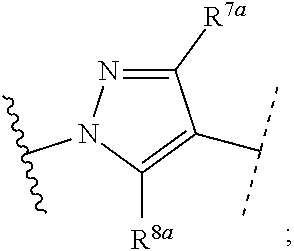
R1 is H;
R7a and R8a are independently selected from H, methyl and trifluoromethoxy;
Q is selected from 1-cyano-cyclopropyl, benzyl, cyclopropyl, 2-thienylmethyl, carbamothioylcyclopropyl, pyrid-4-yl, 2,2,2-trifluorethyl, methylsulfonyl, thietan-3-yl and 1-carbamoylcyclopropyl;
W is O;
A1 and A4 are CH;
A2 is CH or CF;
A3 is CH or CCl;
U is selected from —O—, —S—, —SO—, —SO2— and —NR100—;
R100 is selected from H, C1-C6-alkyl, C2-C6-alkenyl, C2-C6-alkynyl, C1-C6-alkoxy, C1-C6-alkylcarbonyl, C1-C6-alkoxycarbonyl and C3-C6-cycloalkyl, wherein each of C1-C6-alkyl, C2-C6-alkenyl, C2-C6-alkynyl, C1-C6-alkoxy and C3-C6-cycloalkyl is unsubstituted or substituted with 1 to 8 substituents independently selected from halogen;
Z1 is selected from —CF2H, —CF2CFHCF3, —CF2CF2CF3, —CF2CF2H, —CF2CF2OCF3, —CH2CF2CF3, —CH(CF3)CH2CF3 and —CH2CF3;
Z2 is CF3;
Z3 is selected from methyl and ethyl.

R1 is H;
R6a and R7a are independently selected from H, methyl and trifluoromethoxy;
Q is selected from 1-cyano-cyclopropyl, benzyl, cyclopropyl, 2-thienylmethyl, carbamothioylcyclopropyl, pyrid-4-yl, 2,2,2-trifluorethyl, methylsulfonyl, thietan-3-yl and 1-carbamoylcyclopropyl;
W is O;
A1 and A4 are CH;
A2 is CH or CF;
A3 is CH or CCl;
U is selected from —O—, —S—, —SO—, —SO2— and —NR100—;
R100 is selected from H, C1-C6-alkyl, C2-C6-alkenyl, C2-C6-alkynyl, C1-C6-alkoxy, C1-C6-alkylcarbonyl, C1-C6-alkoxycarbonyl and C3-C6-cycloalkyl, wherein each of C1-C6-alkyl, C2-C6-alkenyl, C2-C6-alkynyl, C1-C6-alkoxy and C3-C6-cycloalkyl is unsubstituted or substituted with 1 to 8 substituents independently selected from halogen;
Z1 is selected from —CF2H, —CF2CFHCF3, —CF2CF2CF3, —CF2CF2H, —CF2CF2OCF3, —CH2CF2CF3, —CH(CF3)CH2CF3 and —CH2CF3;
Z2 is CF3;
Z3 is selected from methyl and ethyl.

R1 is H;
R6a is selected from H, methyl and trifluoromethoxy;
Q is selected from 1-cyano-cyclopropyl, benzyl, cyclopropyl, 2-thienylmethyl, carbamothioylcyclopropyl, pyrid-4-yl, 2,2,2-trifluorethyl, methylsulfonyl, thietan-3-yl and 1-carbamoylcyclopropyl;
W is O;
A1 and A4 are CH;
A2 is CH or CF;
A3 is CH or CCl;
U is selected from —O—, —S—, —SO—, —SO2— and —NR100—;
R100 is selected from H, C1-C6-alkyl, C2-C6-alkenyl, C2-C6-alkynyl, C1-C6-alkoxy, C1-C6-alkylcarbonyl, C1-C6-alkoxycarbonyl and C3-C6-cycloalkyl, wherein each of C1-C6-alkyl, C2-C6-alkenyl, C2-C6-alkynyl, C1-C6-alkoxy and C3-C6-cycloalkyl is unsubstituted or substituted with 1 to 8 substituents independently selected from halogen;
Z1 is selected from —CF2H, —CF2CFHCF3, —CF2CF2CF3, —CF2CF2H, —CF2CF2OCF3, —CH2CF2CF3, —CH(CF3)CH2CF3 and —CH2CF3;
Z2 is CF3;
Z3 is selected from methyl and ethyl.

R1 is H;
R7a is selected from H, methyl and trifluoromethoxy;
Q is selected from 1-cyano-cyclopropyl, benzyl, cyclopropyl, 2-thienylmethyl, carbamothioylcyclopropyl, pyrid-4-yl, 2,2,2-trifluorethyl, methylsulfonyl, thietan-3-yl and 1-carbamoylcyclopropyl;
W is O;
A1 and A4 are CH;
A2 is CH or CF;
A3 is CH or CCl;
U is selected from —O—, —S—, —SO—, —SO2— and —NR100—;
R100 is selected from H, C1-C6-alkyl, C2-C6-alkenyl, C2-C6-alkynyl, C1-C6-alkoxy, C1-C6-alkylcarbonyl, C1-C6-alkoxycarbonyl and C3-C6-cycloalkyl, wherein each of C1-C6-alkyl, C2-C6-alkenyl, C2-C6-alkynyl, C1-C6-alkoxy and C3-C6-cycloalkyl is unsubstituted or substituted with 1 to 8 substituents independently selected from halogen;
Z1 is selected from —CF2H, —CF2CFHCF3, —CF2CF2CF3, —CF2CF2H, —CF2CF2OCF3, —CH2CF2CF3, —CH(CF3)CH2CF3 and —CH2CF3;
Z2 is CF3;
Z3 is selected from methyl and ethyl.

R1 is H;
Q is selected from 1-cyano-cyclopropyl, benzyl, cyclopropyl, 2-thienylmethyl, carbamothioylcyclopropyl, pyrid-4-yl, 2,2,2-trifluorethyl, methylsulfonyl, thietan-3-yl and 1-carbamoylcyclopropyl;
W is O;
A1 and A4 are CH;
A2 is CH or CF;
A3 is CH or CCl;
U is selected from —O—, —S—, —SO—, —SO2— and —NR100—;
R100 is selected from H, C1-C6-alkyl, C2-C6-alkenyl, C2-C6-alkynyl, C1-C6-alkoxy, C1-C6-alkylcarbonyl, C1-C6-alkoxycarbonyl and C3-C6-cycloalkyl, wherein each of C1-C6-alkyl, C2-C6-alkenyl, C2-C6-alkynyl, C1-C6-alkoxy and C3-C6-cycloalkyl is unsubstituted or substituted with 1 to 8 substituents independently selected from halogen;
Z1 is selected from —CF2H, —CF2CFHCF3, —CF2CF2CF3, —CF2CF2H, —CF2CF2OCF3, —CH2CF2CF3, —CH(CF3)CH2CF3 and —CH2CF3;
Z2 is CF3;
Z3 is selected from methyl and ethyl.

R1 is H;
R8a is selected from H, methyl and trifluoromethoxy;
Q is selected from 1-cyano-cyclopropyl, benzyl, cyclopropyl, 2-thienylmethyl, carbamothioylcyclopropyl, pyrid-4-yl, 2,2,2-trifluorethyl, methylsulfonyl, thietan-3-yl and 1-carbamoylcyclopropyl;
W is O;
A1 and A4 are CH;
A2 is CH or CF;
A3 is CH or CCl;
U is selected from —O—, —S—, —SO—, —SO2— and —NR100—;
R100 is selected from H, C1-C6-alkyl, C2-C6-alkenyl, C2-C6-alkynyl, C1-C6-alkoxy, C1-C6-alkylcarbonyl, C1-C6-alkoxycarbonyl and C3-C6-cycloalkyl, wherein each of C1-C6-alkyl, C2-C6-alkenyl, C2-C6-alkynyl, C1-C6-alkoxy and C3-C6-cycloalkyl is unsubstituted or substituted with 1 to 8 substituents independently selected from halogen;
Z1 is selected from —CF2H, —CF2CFHCF3, —CF2CF2CF3, —CF2CF2H, —CF2CF2OCF3, —CH2CF2CF3, —CH(CF3)CH2CF3 and —CH2CF3;
Z2 is CF3;
Z3 is selected from methyl and ethyl.
| Exam- | ||
| ple | ||
| No. | Structure | Chemical name |
| 1 |  | 2-chloro-N-(1-cyanocyclopropyl)-5-[1-[5- [(Z)-2-fluoro-1-(trifluoromethyl)vinyloxy]-2- methyl-4-(trifluoromethyl)pyrazol-3- yl]pyrazol-4-yl]benzamide (Example 1); |
| 2 |  | 2-chloro-N-cyclopropyl-5-[1-[2-methyl-5- (2,2,2-trifluoroethoxy)-4- (trifluoromethyl)pyrazol-3-yl]pyrazol-4- yl]benzamide (Example 2); |
| 3 |  | 2-chloro-N-(1-cyanocyclopropyl)-5-[1-[2- methyl-5-(2,2,2-trifluoroethoxy)-4- (trifluoromethyl)pyrazol-3-yl]pyrazol-4- yl]benzamide (Example 3); |
| 4 |  | 2-chloro-N-(1-cyanocyclopropyl)-5-[1-[5- (1,1,2,3,3,3-hexafluoropropoxy)-2-methyl- 4-(trifluoromethyl)pyrazol-3-yl]pyrazol-4- yl]benzamide (Example 4); |
| 5 |  | 2-chloro-N-(1-cyanocyclopropyl)-5-[1-[5- methoxy-2-methyl-4- (trifluoromethyl)pyrazol-3-yl]pyrazol-4- yl]benzamide (Example 5); |
| 6 |  | 2-chloro-N-cyclopropyl-5-[1-[5-(1,1,2,3,3,3- hexafluoropropoxy)-2-methyl-4- (trifluoromethyl)pyrazol-3-yl]pyrazol-4- yl]benzamide (Example 6); |
| 7 |  | 2-chloro-N-(1-cyanocyclopropyl)-5-[1-[5- (1,1,2,3,3,3-hexafluoropropoxy)-2-methyl- 4-(trifluoromethyl)pyrazol-3-yl]pyrazol-4- yl]-N-[(E)-1,2,3,3,3-pentafluoroprop-1- enyl]benzamide (Example 7); |
| 8 |  | 2-chloro-N-cyclopropyl-5-[1-[5- (difluoromethoxy)-2-methyl-4- (trifluoromethyl)pyrazol-3-yl]pyrazol-4- yl]benzamide (Example 8); |
| 9 |  | 2-chloro-N-ethyl-5-[1-[5-(1,1,2,3,3,3- hexafluoropropoxy)-2-methyl-4- (trifluoromethyl)pyrazol-3-yl]pyrazol-4- yl]benzamide (Example 9); |
| 10 |  | 2-chloro-N-(cyanomethyl)-5-[1-[5- (1,1,2,3,3,3-hexafluoropropoxy)-2-methyl- 4-(trifluoromethyl)pyrazol-3-yl]pyrazol-4- yl]benzamide (Example 10); |
| 11 |  | 2-chloro-N-(1-cyanocyclopropyl)-5-[1-[2- methyl-5-(1,1,2,2-tetrafluoroethoxy)-4- (trifluoromethyl)pyrazol-3-yl]pyrazol-4- yl]benzamide (Example 11); |
| 12 |  | 5-[1-[5-(2-bromo-1,1,2,2-tetrafluoro- ethoxy)-2-methyl-4- (trifluoromethyl)pyrazol-3-yl]pyrazol-4-yl]- 2-chloro-N-(1- cyanocyclopropyl)benzamide (Example 12); |
| 13 |  | 2-chloro-N-(1-cyanocyclopropyl)-5-[1-[5- [1,1,2,3,4,4,4-heptafluoro-3- (trifluoromethyl)butoxy]-2-methyl-4- (trifluoromethyl)pyrazol-3-yl]pyrazol-4- yl]benzamide (Example 13); |
| 14 |  | 2-chloro-N-(1-cyanocyclopropyl)-5-[1-[5- [1,1,2,4,4,4-hexafluoro-3- (trifluoromethyl)but-2-enoxy]-2-methyl-4- (trifluoromethyl)pyrazol-3-yl]pyrazol-4- yl]benzamide (Example 14); |
| 15 |  | 2-chloro-N-(1-cyanocyclopropyl)-5-[1-[2- methyl-4-(trifluoromethyl)-5-[1,1,2-trifluoro- 2-(trifluoromethoxy)ethoxy]pyrazol-3- yl]pyrazol-4-yl]benzamide (Example 15); |
| 16 |  | [5-[4-[4-chloro-3-[(1-cyanocyclopropyl) carbamoyl]phenyl]pyrazol- 1-yl]-1-methyl-4-(trifluoromethyl)pyrazol- 3-yl]trifluoromethanesulfonate (Example 16); |
| 17 |  | 2-chloro-N-(1-cyanocyclopropyl)-5-[1-[2- methyl-5-[1,1,2-trifluoro-2-(1,1,2,2,3,3,3- heptafluoropropoxy)ethoxy]-4- (trifluoromethyl)pyrazol-3-yl]pyrazol-4- yl]benzamide (Example 17); |
| 18 |  | 2-chloro-N-(1-cyanocyclopropyl)-5-[1-[5- [2,2-difluoro-2-[1,1,2,2-tetrafluoro-2- (trifluoromethoxy)ethoxy]ethoxy]-2-methyl- 4-(trifluoromethyl)pyrazol-3-yl]pyrazol-4- yl]benzamide (Example 18); |
| 19 |  | 2-chloro-N-(1-cyanocyclopropyl)-5-[1-[5- (2,2,3,3,4,4,4-heptafluorobutoxy)-2- methyl-4-(trifluoromethyl)pyrazol-3- yl]pyrazol-4-yl]benzamide (Example 19); |
| 20 |  | 2-chloro-N-(1-cyanocyclopropyl)-5-[1-[2- methyl-5-(2,2,3,3,4,4,5,5- octafluoropentoxy)-4- (trifluoromethyl)pyrazol-3-yl]pyrazol-4- yl]benzamide (Example 20); |
| 21 |  | 2-chloro-N-(1-cyanocyclopropyl)-5-[1-[2- methyl-5-(5,6,6-trifluorohex-5-enoxy)-4- (trifluoromethyl)pyrazol-3-yl]pyrazol-4- yl]benzamide (Example 21); |
| 22 |  | 2-chloro-N-(1-cyanocyclopropyl)-5-[1-[2- methyl-5-(2,2,3,3,4,4,5,5,6,6,7,7,8,8,8- pentadecafluorooctoxy)-4- (trifluoromethyl)pyrazol-3-yl]pyrazol-4- yl]benzamide (Example 22); |
| 23 |  | 2-chloro-N-(1-cyanocyclopropyl)-5-[1-[5- (2,2-difluoroethoxy)-2-methyl-4- (trifluoromethyl)pyrazol-3-yl]pyrazol-4- yl]benzamide (Example 23); |
| 24 |  | 2-chloro-N-cyclopropyl-5-[1-[5-(2,2- difluoroethoxy)-2-methyl-4- (trifluoromethyl)pyrazol-3-yl]pyrazol-4- yl]benzamide (Example 24); |
| 25 |  | 2-chloro-N-cyclopropyl-5-[1-[5-[2,2- difluoro-2-[1,1,2,2-tetrafluoro-2- (trifluoromethoxy)ethoxy]ethoxy]-2-methyl- 4-(trifluoromethyl)pyrazol-3-yl]pyrazol-4- yl]benzamide (Example 25); |
| 26 |  | 2-chloro-N-cyclopropyl-5-[1-[5- (2,2,3,3,4,4,4-heptafluorobutoxy)-2- methyl-4-(trifluoromethyl)pyrazol-3- yl]pyrazol-4-yl]benzamide (Example 26); |
| 27 |  | 2-chloro-N-cyclopropyl-5-[1-[2-methyl-5- (2,2,3,3,4,4,5,5-octafluoropentoxy)-4- (trifluoromethyl)pyrazol-3-yl]pyrazol-4- yl]benzamide (Example 27); |
| 28 |  | 2-chloro-N-(1-cyanocyclopropyl)-5-[1-[2- methyl-5-[2-(trifluoromethoxy)ethoxy]-4- (trifluoromethyl)pyrazol-3-yl]pyrazol-4- yl]benzamide (Example 28); |
| 29 |  | 2-chloro-N-cyclopropyl-5-[1-[2-methyl-5- (5,6,6-trifluorohex-5-enoxy)-4- (trifluoromethyl)pyrazol-3-yl]pyrazol-4- yl]benzamide (Example 29); |
| 30 |  | 2-chloro-N-(1-cyanocyclopropyl)-5-[1-[2- methyl-5-(2,2,3,3-tetrafluoropropoxy)-4- (trifluoromethyl)pyrazol-3-yl]pyrazol-4- yl]benzamide (Example 30); |
| 31 |  | 2-chloro-N-cyclopropyl-5-[1-[2-methyl-5- (2,2,3,3,4,4,5,5,6,6,7,7,8,8,8- pentadecafluorooctoxy)-4- (trifluoromethyl)pyrazol-3-yl]pyrazol-4- yl]benzamide (Example 31); |
| 32 |  | 2-chloro-N-cyclopropyl-5-[1-[2-methyl-5- (2,2,3,3,3-pentafluoropropoxy)-4- (trifluoromethyl)pyrazol-3-yl]pyrazol-4- yl]benzamide (Example 32); |
| 33 |  | 2-chloro-N-cyclopropyl-5-[1-[2-methyl-5- (2,2,3,3-tetrafluoropropoxy)-4- (trifluoromethyl)pyrazol-3-yl]pyrazol-4- yl]benzamide (Example 33); |
| 34 |  | 2-chloro-N-cyclopropyl-5-[1-[2-methyl-5-[2- (trifluoromethoxy)ethoxy]-4- (trifluoromethyl)pyrazol-3-yl]pyrazol-4- yl]benzamide (Example 34); |
| 35 |  | 2-chloro-N-(1-cyanocyclopropyl)-5-[1-[5- (1,1,2,2,3,3,3-heptafluoropropoxy)-2- methyl-4-(trifluoromethyl)pyrazol-3- yl]pyrazol-4-yl]benzamide (Example 35); |
| 36 |  | [5-[4-[4-chloro-3-(cyanocyclopropyl- carbamoyl)phenyl]pyrazol-1- yl]-1-methyl-4-(trifluoromethyl)pyrazol- 3-yl]1,1,2,2,3,3,4,4,4-nonafluorobutane-1- sulfonate (Example 36); |
| 37 |  | [5-[4-[4-chloro-3- (cyclopropylcarbamoyl)phenyl]pyrazol-1- yl]-1-methyl-4-(trifluoromethyl)pyrazol-3-yl] 1,1,2,2,3,3,4,4,4-nonafluorobutane-1- sulfonate (Example 37); |
| 38 |  | 2-chloro-N-(1-cyanocyclopropyl)-5-[1-[2- methyl-5-(1,1,2,2,3,3,4,4,5,5,6,6,6- tridecafluorohexoxy)-4- (trifluoromethyl)pyrazol-3-yl]pyrazol-4- yl]benzamide (Example 38); |
| 39 |  | 2-chloro-N-cyclopropyl-5-[1-[2-methyl-5- (1,1,2,2,3,3,4,4,5,5,6,6,6- tridecafluorohexoxy)-4- (trifluoromethyl)pyrazol-3-yl]pyrazol-4- yl]benzamide (Example 39); |
| 40 |  | 2-chloro-N-(1-cyanocyclopropyl)-5-[1-[5- (1,1,2,2,3,3,4,4,5,5,6,6,7,7,8,8,8- heptadecafluorooctoxy)-2-methyl-4- (trifluoromethyl)pyrazol-3-yl]pyrazol-4- yl]benzamide (Example 40); |
| 41 |  | 5-[1-[5-(2-bromo-1,1-difluoro-ethoxy)-2- methyl-4-(trifluoromethyl)pyrazol-3- yl]pyrazol-4-yl]-2-chloro-N-(1- cyanocyclopropyl)benzamide (Example 41); |
| 42 |  | 2-chloro-N-(1-cyanocyclopropyl)-5-[1-[2- methyl-5-[(E)-2,3,3,3-tetrafluoro-1- (trifluoromethyl)prop-1-enoxy]-4- (trifluoromethyl)pyrazol-3-yl]pyrazol-4- yl]benzamide (Example 42); |
| 43 |  | 5-[1-[5-(2-bromo-1,1,2-trifluoro-ethoxy)-2- methyl-4-(trifluoromethyl)pyrazol-3- yl]pyrazol-4-yl]-2-chloro-N-cyclopropyl- benzamide (Example 43); |
| 44 |  | 2-chloro-5-[1-[5-(2-chloro-1,1,2-trifluoro- ethoxy)-2-methyl-4- (trifluoromethyl)pyrazol-3-yl]pyrazol-4-yl]- N-(1-cyanocyclopropyl)benzamide (Example 44); |
| 45 |  | 2-chloro-N-(1-cyanocyclopropyl)-5-[1-[5- [(1E)-1,2-difluorobuta-1,3-dienoxy]-2- methyl-4-(trifluoromethyl)pyrazol-3- yl]pyrazol-4-yl]benzamide (Example 45); |
| 46 |  | 2-chloro-N-(1-cyanocyclopropyl)-5-[1-[2- methyl-5-(3,4,4-trifluorobut-3-enoxy)-4- (trifluoromethyl)pyrazol-3-yl]pyrazol-4- yl]benzamide (Example 46); |
| 47 |  | 5-[1-[5-(2-bromo-1,1,2-trifluoro-ethoxy)-2- methyl-4-(trifluoromethyl)pyrazol-3- yl]pyrazol-4-yl]-2-chloro-N-(1- cyanocyclopropyl)benzamide (Example 47); |
| 48 |  | 2-chloro-N-(1-cyanocyclopropyl)-5-[1-[2- methyl-5-[(Z)-1,3,3,3-tetrafluoroprop-1- enoxy]-4-(trifluoromethyl)pyrazol-3- yl]pyrazol-4-yl]benzamide (Example 48); |
| 49 |  | 2-chloro-N-(1-cyanocyclopropyl)-5-[1-[5- [(Z)-2-fluoro-1-(trifluoromethyl)vinyloxy]-2- methyl-4-(trifluoromethyl)pyrazol-3- yl]pyrazol-4-yl]benzamide (Example 49); |
| 50 |  | 2-chloro-N-(1-cyanocyclopropyl)-5-[1-[2- methyl-5-[(E or Z)-1,1,2,3,4,5,5,5- octafluoro-2-(trifluoromethyl)pent-3- enoxy]-4-(trifluoromethyl)pyrazol-3- yl]pyrazol-4-yl]benzamide (Example 50) |
| 51 |  | 2-chloro-N-cyclopropyl-5-[1-[2-methyl-5- [(E or Z)-1,1,2,3,4,5,5,5-octafluoro-2- (trrfluoromethyl)pent-3-enoxy]-4- (trifluoromethyl)pyrazol-3-yl]pyrazol-4- yl]benzamide (Example 51) |
| 52 |  | 2-chloro-N-(1-cyanocyclopropyl)-5-[1-[2- methyl-5-[(E or Z)-1,2,3,3,3- pentafluoroprop-1-enoxy]-4- (trifluoromethyl)pyrazol-3-yl]pyrazol-4- yl]benzamide |
| 53 |  | 2-chloro-N-cyclopropyl-5-[1-[2-methyl-5- [(E or Z)-1,2,3,3,3-pentafluoroprop-1- enoxy]-4-(trifluoromethyl)pyrazol-3- yl]pyrazol-4-yl]benzamide |
| 54 |  | 5-[1-[4-bromo-2-methyl-5- (3,3,4,4,5,5,6,6,7,7,8,8,8- tridecafluorooctylsulfanyl)pyrazol-3- yl]pyrazol-4-yl]-2-chloro-N-cyclopropyl- benzamide |
| 55 |  | 2-chloro-N-(1-cyanocyclopropyl)-5-[1-[5- (1,1,2,3,3,3-hexafluoropropoxy)-2-methyl- 4-(trifluoromethyl)pyrazol-3-yl]pyrazol-4- yl]-N-methyl-benzamide |
| 56 |  | 2-chloro-N-(1-cyanocyclopropyl)-5-[1-[5- methoxy-2-methyl-4- (trifluoromethyl)pyrazol-3-yl]pyrazol-4-yl]- N-methyl-benzamide |
| 57 |  | 5-[1-[4-bromo-2-methyl-5-(2,2,3,3- tetrafluoropropylsulfanyl)pyrazol-3- yl]pyrazol-4-yl]-2-chloro-N-cyclopropyl- benzamide |
| 58 |  | N-cyclopropyl-5-[1-[5-(1,1,2,3,3,3- hexafluoropropoxy)-2-methyl-4- (trifluoromethyl)pyrazol-3-yl]pyrazol-4-yl]- 2-methyl-benzamide |
| 59 |  | N-(1-cyanocyclopropyl)-2-fluoro-5-[1-[5- (1,1,2,3,3,3-hexafluoropropoxy)-2-methyl- 4-(trifluoromethyl)pyrazol-3-yl]pyrazol-4- yl]benzamide |
| 60 |  | N-cyclopropyl-2-fluoro-5-[1-[5-(1,1,2,3,3,3- hexafluoropropoxy)-2-methyl-4- (trifluoromethyl)pyrazol-3-yl]pyrazol-4- yl]benzamide |
| 61 |  | 2-chloro-N-(1-cyanocyclopropyl)-5-[1-[2- methyl-4-(trifluoromethyl)-5-[1,1,2-trifluoro- 2-(trifluoromethoxy)ethoxy]pyrazol-3- yl]pyrazol-4-yl]pyridine-3-carboxamide |
| 62 |  | 2-chloro-N-cyclopropyl-5-[1-[2-methyl-4- (trifluoromethyl)-5-[1,1,2-trifluoro-2- (trifluoromethoxy)ethoxy]pyrazol-3- yl]pyrazol-4-yl]pyridine-3-carboxamide |
| 63 |  | 5-[1-[4-bromo-2-methyl-5- (trifluoromethylsulfanyl)pyrazol-3- yl]pyrazol-4-yl]-2-chloro-N-cyclopropyl- benzamide |
| 64 |  | 5-[1-[4-bromo-5-(1,1,2,2,3,3,3- heptafluoropropylsulfanyl)-2-methyl- pyrazol-3-yl]pyrazol-4-yl]-2-chloro-N- cyclopropyl-benzamide |
| 65 |  | 2-chloro-N-(1-cyanocyclopropyl)-5-[1-[5- (1,1,2,3,3,3-hexafluoropropoxy)-2-methyl- 4-(trifluoromethyl)pyrazol-3-yl]pyrazol-4- yl]pyridine-3-carboxamide |
| 66 |  | 2-chloro-N-cyclopropyl-5-[1-[5-(1,1,2,3,3,3- hexafluoropropoxy)-2-methyl-4- (trifluoromethyl)pyrazol-3-yl]pyrazol-4- yl]pyridine-3-carboxamide |
| 67 |  | 2-chloro-N-cyclopropyl-5-[1-[2-methyl-5- (1,1,2,3,3-pentachloroallyloxy)-4- (trifluoromethyl)pyrazol-3-yl]pyrazol-4- yl]benzamide |
| 68 |  | N-cyclopropyl-2-fluoro-3-[1-[5-(1,1,2,3,3,3- hexafluoropropoxy)-2-methyl-4- (trifluoromethyl)pyrazol-3-yl]pyrazol-4- yl]benzamide |
| 69 |  | 2-chloro-N-(1-cyanocyclopropyl)-5-[1-[2- methyl-5-(1,1,2,3,3-pentachloroallyloxy)-4- (trifluoromethyl)pyrazol-3-yl]pyrazol-4- yl]benzamide |
| 70 |  | 3-[1-[2,4-dimethyl-5-(1,1,2- trifluoropropoxy)pyrazol-3-yl]pyrazol-4-yl]- 2-fluoro-N-(1-cyanocyclopropyl)benzamide |
| 71 |  | N-cyclopropyl-3-[1-[2,4-dimethyl-5-(1,1,2- trifluoropropoxy)pyrazol-3-yl]pyrazol-4-yl]- 2-fluoro-benzamide |
| 72 |  | 2-chloro-N-cyclopropyl-5-[1-[2,4-dimethyl- 5-(1,1,2-trifluoropropoxy)pyrazol-3- yl]pyrazol-4-yl]-3-fluoro-benzamide |
| 73 |  | 2-chloro-N-(1-cyanocyclopropyl)-5-[1-[2,4- dimethyl-5-(1,1,2-trifluoropropoxy)pyrazol- 3-yl]pyrazol-4-yl]-3-fluoro-benzamide |
| 74 |  | 2-chloro-5-[1-[2,4-dimethyl-5-(1,1,2- trifluoropropoxy)pyrazol-3-yl]pyrazol-4-yl]- 4-fluoro-N-(1-cyanocyclopropyl)benzamide |
| 75 |  | 2-chloro-N-cyclopropyl-5-[1-[2,4-dimethyl- 5-(1,1,2-trifluoropropoxy)pyrazol-3- yl]pyrazol-4-yl]-4-fluoro-benzamide |
| 76 |  | 2,4-dichloro-5-[1-[2,4-dimethyl-5-(1,1,2- trifluoropropoxy)pyrazol-3-yl]pyrazol-4-yl]- N-(1-cyanocyclopropyl)benzamide |
| 77 |  | 2,4-dichloro-N-cyclopropyl-5-[1-[2,4- dimethyl-5-(1,1,2-trifluoropropoxy)pyrazol- 3-yl]pyrazol-4-yl]benzamide |
| 78 |  | 2,3-dichloro-N-cyclopropyl-5-[1-[2,4- dimethyl-5-(1,1,2-trifluoropropoxy)pyrazol- 3-yl]pyrazol-4-yl]benzamide |
| 79 |  | 2,3-dichloro-5-[1-[2,4-dimethyl-5-(1,1,2- trifluoropropoxy)pyrazol-3-yl]pyrazol-4-yl]- N-(1-cyanocyclopropyl)benzamide |
| 80 |  | 5-[1-[2,4-dimethyl-5-(1,1,2- trifluoropropoxy)pyrazol-3-yl]pyrazol-4-yl]- 2-fluoro-N-(1-cyanocyclopropyl)benzamide |
| 81 |  | 5-[1-[4-bromo-2-methyl-5-(2,2,2- trifluoroethylamino)pyrazol-3-yl]pyrazol-4- yl]-2-chloro-N-cyclopropyl-benzamide |
| 82 |  | 5-[1-[5-(2-bromo-1,1,2-trifluoro-ethoxy)- 2,4-dimethyl-pyrazol-3-yl]pyrazol-4-yl]-2- chloro-N-(1-cyanocyclopropyl)benzamide |
| 83 |  | 5-[1-[5-(2-bromo-1,1,2-trifluoro-ethoxy)- 2,4-dimethyl-pyrazol-3-yl]pyrazol-4-yl]-2- chloro-N-cyclopropyl-benzamide |
| 84 |  | 2-chloro-N-cyclopropyl-5-[1-[5-(1,1,2,3,3,3- hexafluoropropoxy)-2,4-dimethyl-pyrazol- 3-yl]triazol-4-yl]benzamide |
| 85 |  | 5-[1-[5-(2-bromo-2-chloro-1,1-difluoro- ethoxy)-2,4-dimethyl-pyrazol-3-yl]pyrazol- 4-yl]-2-chloro-N-(1- cyanocyclopropyl)benzamide |
| 86 |  | 5-[1-[5-(2-bromo-2-chloro-1,1-difluoro- ethoxy)-2,4-dimethyl-pyrazol-3-yl]pyrazol- 4-yl]-2-chloro-N-cyclopropyl-benzamide |
| 87 |  | 2-chloro-N-cyclopropyl-5-[1-(5-methoxy- 2,4-dimethyl-pyrazol-3-yl)triazol-4- yl]benzamide |
or an agrochemically acceptable salt or N-oxide thereof.


wherein R1, Q, A1, A2, A3, A4, Z1, Z2, and Z3 are as defined in any one of embodiments 1 to 78, R1′ is as R1 but not H, LG represents a leaving group such as Cl, Br, I, OMs (—OSO2CH3), OTs (—OSO2—C or OTf and Rf is F or a fluorinated C1-10alkyl. Compounds of formula (1), (2), (4), (6), (10), (11), (14) or (15) are commercially available or are known from the chemistry literature. Compound of formula (3) can be prepared according to processes described in WO12/158413 p. 371.

wherein R1, Q, T, A1, A2, A3, A4, Z1, Z2, and Z3 are as defined in any one of embodiments, R1′ is as R1 but not H, LG represents a leaving group such as Cl, Br, I, OMs, OTs or OTf and Rf is F or a fluorinated C1-10alkyl, Hal is an halogen such as Cl or Br. Compounds of formula (17) and (18) are commercially available or are known from the chemistry literature.

wherein R1, Q, T, A1, A2, A3, A4, Z1, Z2, and Z3 are as defined in any one of embodiments 1 to 78, R1′ is as R1 but not H, LG represents a leaving group such as Cl, Br, I, OMs, OTs or OTf and Rf is F or a fluorinated C1-10alkyl, n is 1 or 2.

wherein R1, R100, Q, T, A1, A2, A3, A4, Z1, Z2, and Z3 are as defined in any one of embodiments 1 to 78, R1′ is as R1 but not H, LG represents a leaving group such as Cl, Br, I, OMs, OTs or OTf and Rf is F or a fluorinated C1-10alkyl, Hal is an halogen such as Cl or Br. Compounds of formula (23), (24) and (26) are commercially available or are known from the chemistry literature.


wherein R1, R6a, R7, Q, A1, A2, A3, A4, Z1, Z2, and Z3 are as defined in any one of embodiments 1 to 78, LG represents a leaving group such as Cl, Br, I, OMs, OTs or OTf and Rf is F or a fluorinated C1-10alkyl, X represents Cl, Br, I or a boronic acid/boronic acid ester group. Compounds of formula (33) and (36) are commercially available or are known from the chemistry literature.


wherein R1, Q, A1, A2, A3, A4, Z1, Z2, and Z3 are as defined in any one of embodiments, LG represents a leaving group such as Cl, Br, I, OMs, OTs or OTf and Rf is F or a fluorinated C1-10-alkyl, X represents Cl, Br, I or a boronic acid/boronic acid ester group. Compounds of formula (42) are commercially available or are known from the chemistry literature.

wherein R1, R8a, Q, A1, A2, A3, A4, Z1, Z2, and Z3 are as defined in any one of embodiments, Y represents a leaving group such as Cl, Br, I or triflate. Compounds of formula (54) and (50) are commercially available or are known from the chemistry literature.

wherein R1, R8a, Q, A1, A2, A3, A4, Z1, Z2, and Z3 are as defined in any one of embodiments, LG represents a leaving group such as Cl, Br, I, OMs, OTs or OTf and Rf is F or a fluorinated C1-10-alkyl, X represents Cl, Br, I or a boronic acid/boronic acid ester group. Compounds of formula (54) are commercially available or are known from the chemistry literature.

wherein R1, Q, A1, A2, A3, A4, Z, Z2, and Z3 are as defined in any one of embodiments 1 to 78, LG represents a leaving group such as Cl, Br, I, OMs, OTs or OTf and Rf is F or a fluorinated C1-10-alkyl.


wherein R1, Q, A1, A2, A3, A4, Z1, Z2, and Z3 are as defined in any one of embodiments 1 to 78, LG represents a leaving group such as Cl, Br, I, OMs, OTs or OTf. Compounds of formula (78) are commercially available or are known from the chemistry literature.

wherein R1, Q, A1, A2, A3, A4, Z1, Z2, and Z3 are as defined in any one of embodiments 1 to 78, LG represents a leaving group such as Cl, Br, I, OMs, OTs or OTf. Compounds of formula (82) can be prepared according to scheme 10.

wherein A1, A2, A3, A4, T, U, Z1, Z2 and Z3 are as defined in any one of embodiments 1 to 78. The preferences for A1, A2, A3, A4, T, U, Z1, Z2 and Z are the same as the preferences set out for the corresponding substituents of a compound according to any one of embodiments 1 to 78.

wherein A1, A2, A3, A4, T, U, Z1, Z2, Z3 and alkyl are as defined in any one of embodiments 1 to 78. The preferences for A1, A2, A3, A4, T, Z1, Z2, Z are the same as the preferences set out for the corresponding substituents of a compound according to any one of embodiments 1 to 78.
from the order Anoplura, for example,
Haematopinus spp., Unognathus spp., Pediculus spp., Pemphigus spp. and Phylloxera spp.;
from the order Coleoptera, for example,
Agriotes spp., Amphimalon majale, Anomala orlentalis, Anthonomus spp., Aphodius spp, Astylus atromaculatus, Ataenius spp, Atomaria Nnearis, Chaetocnema tiblalis, Cerotoma spp, Conoderus spp, Cosmopolites spp., Cotlnis nlida, Curculio spp., Cyclocephala spp, Dermestes spp., Diabrotica spp., Diloboderus abderus, Epilachna spp., Eremnus spp., Heteronychus arator, Hypothenemus hampel, Lagria vilosa, Leptinotarsa decemUneata, Lissorhoptrus spp., Liogenys spp, Maecolaspis spp, Maladera castanea, Megascells spp, Melighetes aeneus, Melolontha spp., Myochrous armatus, Orycaephlus spp., Otiorhynchus spp., Phylophaga spp, Phlyctinus spp., Popilla spp., Psylliodes spp., Rhyssomatus aubtlis, Rhizopertha spp., Scarabeidae, Sitophilus spp., Sitotroga spp., Somaticus spp, Sphenophorus spp, Stemechus subsignatus, Tenebrio spp., Tribolum spp. and Trogoderma spp.;
from the order Diptera, for example,
Aedes spp., Anopheles spp, Antherigona soccata, Bactrocea oleae, Bblo hortulanus, Bradysia spp, CalNphora erythrocephala, Ceratltis spp., Chrysomyla spp., Culex spp., Cuterebra spp., Dacus spp., Delia spp, Drosophila melanogaster, Fannia spp., Gastrophilus spp., Geomyza tripunctata, Glossina spp., Hypoderma spp., Hyppobosca spp., Lirlomyza spp., Lucilla spp., Melanagromyza spp., Musca spp., Oestrus spp., Orseolla spp., Osdnella frit, Pegomyla hyoscyami, Phorbia spp., Rhagoletis spp, Rivela quadrifasciata, Scatella spp, Sciara spp., Stomoxys spp., Tabanus spp., Tannia spp. and Tipula spp.;
from the order Hemiptera, for example,
Acanthocoris scabrator, Acrostemum spp, Adelphocoris Ilneolatus, Amblypelta nitida, Bathycoella thalassina, Blissus spp, Cimex spp., Clavigralla tomentosicollis, Creontlades spp, Distantlella theobroma, Dichelops furcatus, Dysdercus spp., Edessa spp, Euchistus spp., Eurydema pulchrum, Eurygaster spp., Halyomorpha halys, Horcias nobilelus, Leptocorisa spp., Lygus spp, Margarodes spp, Murgantla histrionic, Neomegalotomus spp, Nesidiocoris tenuis, Nezara spp., Nysius simulans, Oebalus insularis, Piesma spp., Piezodorus spp, Rhodnius spp., Sahbergela singularis, Scaptocoris castanea, Scotinophara spp., Thyanta spp, Triatoma spp., Vatiga Iludens;
Acyrthoslum pisum, Adalges spp, Agallilana ensigera, Agonoscena targioni, Aleurodicus spp, Aleurocanthus spp, Aleurolobus barodensis, Aleurothrixus floccosus, Aleyrodes brassicae, Amarasca biguttula, Amrlodus atkinsoni, Aonidlela spp., Aphididae, Aphis spp., Aspidiotus spp., Aulacorthum solani, Bactericera cockerelli, Bemisla spp, Brachycaudus spp, Brevicoryne brassicae, Cacopsylla spp, Cavarela aegopodii spp., Ceroplaster spp., Chrysomphalus aonidium, Chrysomphalus dictyospermi, Cicadela spp, Cofana spectra, Cryptomyzus spp, Cicadulina spp, Coccus hesperidum, Dalbulus maidis, Dialeurodes spp, Diaphorina citri, Diuraphis noxia, Dysaphis spp, Empoasca spp., Eriosoma larigerum, Erythroneura spp., Gascardia spp., Glycaspis brimblecombel, Hyadaphis pseudobrassicae, Hyalopterus spp, Hyperomyzus pallidus, Idioscopus clypealls, Jacoblasca lybica, Laodelphax spp., Lecanium comi, Lepidosaphes spp., Lopaphis erysimi, Lyogenys maidis, Macrosiphum spp., Mahanarva spp, Metcalfa pruinosa, Metopolophium dirhodum, Myndus crudus, Myzus spp., Neotoxoptera sp, Nephotettix spp., Nilaparvata spp., Nippolachnus piri Mats, Odonaspis ruthae, Oregma lanigera Zehnter, Parabemisla myricae, Paratrioza cockerelli, Parlatoria spp., Pemphigus spp., Peregrinus maidis, Perklinsela spp, Phorodon humul, Phylloxera spp, Planococcus spp., Pseudaulacaspis spp., Pseudococcus spp., Pseudatomoscels seriatus, Psylla spp., PuMnaria aethiopica, Quadraspidlotus spp., Quesada gigas, Recilia dorsalis, Rhopalosiphum spp., Saissetia spp., Scapholdeus spp., Schizaphis spp., Sitobion spp., Sogatela furcifera, Spissistilus festinus, Tarophagus Proserpina, Toxoptera spp, Trialeurodes spp, Tridiscus sporoboll, Trionymus spp, Trioza erytreae, Unaspis citd, Zygina flammigera, Zyginidia scutelaris;
from the order Hymenoptera, for example,
Acromyrmex, Arge spp, Atta spp., Cephus spp., Diprion spp., Diprionidae, GHpinia polytoma, Hoplocampa spp., Lasius spp., Monomorlum pharaonis, Neodiprion spp., Pogonomyrmex spp, Slenopsis invicta, Solenopsis spp. and Vespa spp.;
from the order Isoptera, for example,
Coptotermes spp, Comitemes cumulans, Inciskermes spp, Macrotermes spp, Mastotermes spp, Microtermes spp, Reticullermes spp.; Solenopsis geminate
from the order Lepidoptera, for example,
Acleris spp., Adoxophyes spp., Aegeria spp., Agrotis spp., Alabama argilaceae, Amylois spp., Anticarsia gemmatals, Archips spp., Argyresthia spp, Argyrotaenla spp., Autographa spp., Bucculatrix thurberlella, Busseola fusca, Cadra cautella, Carposina nipponensis, Chilo spp., Choristoneura spp., Chrysoteuchia toplaria, Clysia ambiguela, Cnaphalocrocis spp., Cnephasla spp., Cochylis spp., Coleophora spp., Collas lesbia, Cosmophia flava, Crambus spp, Crocidolomia binotalis, Cryptophlebla leucotreta, Cydalima perspectals, Cydla spp., Diaphanla perspectalls, Dlatraea spp., Diparopsis castanea, Earlas spp., Eldana saccharina, Ephestia spp., Epinotia spp, Estigmene acrea, Etela zinckinella, Eucosma spp., Eupoecila ambiguella, Euproctis spp., Euxoa spp., Feltia jaculiferia, Grapholla spp., Hedya nubiferana, Helothis spp., Helula undalis, Herpetogramma spp, Hyphantria cunea, Keiferia lycopersicella, Lasmopalpus lignosellus, Leucoptera scitella, Lithocollethis spp., Lobesla botrana, Loxostege bifidalis, Lymantria spp., Lyonetia spp., Malacosoma spp., Mamestra brassicae, Manduca sexta, Mythimna spp, Noctua spp, Operophtera spp., Omiodes Indica, Ostrinia nubilalis, Pammene spp., Pandemis spp., Panols flammea, Papalpema nebris, Pectinophora gossypiela, Perileucoptera coffeella, Pseudaletia unipuncta, Phthorimaea operculela, Peris rapae, Pieris spp., Plutella xylostella, Prays spp., Pseudoplusla spp, Rachiplusla nu, Richia albicosta, Scirpophaga spp., Sesamia spp., Sparganothis spp., Spodoptera spp., Sylepta derogate, Synanthedon spp., Thaumetopoea spp., Tortrix spp., Trichoplusla ni, Tuta absoluta, and Yponomeuta spp.;
from the order Mallophaga, for example,
Damalinea spp. and Trichodectes spp.;
from the order Oithoptera, for example,
Blatta spp., Blattella spp., Gryllotalpa spp., Leucophaea maderae, Locusta spp., Neocurtila hexadactyla, Periplaneta spp., Scapteriscus spp, and Schistocerca spp.;
from the order Psocoptera, for example,
Uposcells spp.;
from the order Siphonaptera, for example,
Ceratophylus spp., Ctenocephalides spp. and Xenopsylla cheopis;
from the order Thysanoptera, for example,
Caliothrips phaseoi, Franklinlella spp., Helothrips spp, Hercinothrips spp., Parthenothrips spp, Scirtothdlps aurantll, Sericothrips variabils, Taeniothrips spp., Thrips spp;
from the order Thysanura, for example, Lepisma saccharina.
| TABLE A |
| Examples of exotic woodborers of economic importance. |
| Family | Species | Host or Crop Infested |
| Buprestidae | Agrilus planipennis | Ash |
| Cerambycidae | Anoplura glabripennis | Hardwoods |
| Xylosandrus crassiusculus | Hardwoods | |
| Scolytidae | X. mutilatus | Hardwoods |
| Tomicus piniperda | Conifers | |
| TABLE B |
| Examples of native woodborers of economic importance. |
| Family | Species | Host or Crop Infested |
| Agrilus anxius | Birch | |
| Agrilus politus | Willow, Maple | |
| Agrilus sayi | Bayberry, Sweetfern | |
| Agrilus vittaticolllis | Apple, Pear, Cranberry, | |
| Serviceberry, Hawthorn | ||
| Chrysobothris femorata | Apple, Apricot, Beech, Boxelder, | |
| Cherry, Chestnut, Currant, Elm, | ||
| Buprestidae | Hawthorn, Hackberry, Hickory, | |
| Horsechestnut, Linden, Maple, | ||
| Mountain-ash, Oak, Pecan, Pear, | ||
| Peach, Persimmon, Plum, Poplar, | ||
| Quince, Redbud, Serviceberry, | ||
| Sycamore, Walnut, Willow | ||
| Texania campestris | Basswood, Beech, Maple, Oak, | |
| Sycamore, Willow, Yellow-poplar | ||
| Goes pulverulentus | Beech, Elm, Nuttall, Willow, Black | |
| oak, Cherrybark oak, Water oak, | ||
| Sycamore | ||
| Cerambycidae | Goes tigrinus | Oak |
| Neoclytus acuminatus | Ash, Hickory, Oak, Walnut, Birch, | |
| Beech, Maple, Eastern | ||
| hophornbeam, Dogwood, | ||
| Persimmon, Redbud, Holly, | ||
| Hackberry, Black locust, | ||
| Honeylocust, Yellow-poplar, | ||
| Chestnut, Osage-orange, Sassafras, | ||
| Lilac, Mountain-mahogany, Pear, | ||
| Cherry, Plum, Peach, Apple, Elm, | ||
| Basswood, Sweetgum | ||
| Neoptychodes trilineatus | Fig, Alder, Mulberry, Willow, Netleaf | |
| hackberry | ||
| Oberea ocellata | Sumac, Apple, Peach, Plum, Pear, | |
| Currant, Blackberry | ||
| Oberea tripunctata | Dogwood, Viburnum, Elm, | |
| Sourwood, Blueberry, | ||
| Rhododendron, Azalea, Laurel, | ||
| Poplar, Willow, Mulberry | ||
| Oncideres cingulata | Hickory, Pecan, Persimmon, Elm, | |
| Sourwood, Basswood, Honeylocust, | ||
| Dogwood, Eucalyptus, Oak, | ||
| Hackberry, Maple, Fruit trees | ||
| Saperda calcarata | Poplar | |
| Strophiona nitens | Chestnut, Oak, Hickory, Walnut, | |
| Beech, Maple | ||
| Corthylus columbianus | Maple, Oak, Yellow-poplar, Beech, | |
| Boxelder, Sycamore, Birch, | ||
| Basswood, Chestnut, Elm | ||
| Dendroctonus frontalis | Pine | |
| Dryocoetes betulae | Birch, Sweetgum, Wild cherry, | |
| Beech, Pear | ||
| Monarthrum fasciatum | Oak, Maple, Birch, Chestnut, | |
| Scolytidae | Sweetgum, Blackgum, Poplar, | |
| Hickory, Mimosa, Apple, Peach, Pine | ||
| Phloeotribus liminaris | Peach, Cherry, Plum, Black cherry, | |
| Elm, Mulberry, Mountain-ash | ||
| Pseudopityophthorus pruinosus | Oak, American beech, Black cherry, | |
| Chickasaw plum, Chestnut, Maple, | ||
| Hickory, Hornbeam, Hophornbeam | ||
| Paranthrene simulans | Oak, American chestnut | |
| Sannina uroceriformis | Persimmon | |
| Synanthedon exitiosa | Peach, Plum, Nectarine, Cherry, | |
| Apricot, Almond, Black cherry | ||
| Synanthedon pictipes | Peach, Plum, Cherry, Beach, Black | |
| Cherry | ||
| Sesiidae | Synanthedon rubrofascia | Tupelo |
| Synanthedon scitula | Dogwood, Pecan, Hickory, Oak, | |
| Chestnut, Beech, Birch, Black cherry, | ||
| Elm, Mountain-ash, Viburnum, | ||
| Willow, Apple, Loquat, Ninebark, | ||
| Bayberry | ||
| Vitacea polistiformis | Grape | |
| Time (minutes) | A (%) | B (%) | Flow rate (ml/min) | |
| 0 | 100 | 0 | 0.75 | |
| 2.5 | 0 | 100 | 0.75 | |
| 2.8 | 0 | 100 | 0.75 | |
| 3.0 | 100 | 0 | 0.75 | |


| TABLE 1 |
| Examples of compounds of formula (I) |
| Ex. | (NMR (400 MHz, CDCl3) δ ppm), | mp | |
| No. | Structure | LC MS (method) | (° C.) |
| 1 |
 |
1.41-1.45 (m, 2 H) 1.66-1.71 (m, 2 H) 3.23 (s, 1 H) 3.72 (s, 3 H) 7.07 (s, 1 H) 7.44 (d, J = 8.44 Hz, 1 H) 7.56 (dd, J = 8.44, 2.20 Hz, 1 H) 7.92 (d, J = 2.20 Hz, 1 H) 7.95 (s, 1 H) 8.11-8.12 (m, 1 H). LC-MS (A): tR = 1.00 min, m/z = 499 [M − 1], 500 [M + 1] | |
| 2 |
 |
0.65-0.70 (m, 2 H) 0.89-0.94 (m, 2H) 2.96 (tq, J = 7.15, 3.67 Hz, 1 H) 3.64-3.68 (m, 3 H) 4.69 (q, J = 8.07 Hz, 2 H) 6.39 (br. s., 1 H) 7.41-7.44 (m, 1 H) 7.48-7.52 (m, 1 H) 7.85 (d, J = 2.20 Hz, 1 H) 7.89 (s, 1 H) 8.08 (s, 1 H). LC-MS (A): tR = 1.05 min, m/z = 506 [M − 1], 508 [M + 1] | 167-9 |
| 3 |
 |
1.40-1.44 (m, 2 H) 1.68-1.72 (m, 2 H) 3.66 (s, 3 H) 4.69 (q, J = 8.19 Hz, 2 H) 6.92 (s, 1 H) 7.45 (d, J = 8.44 Hz, 1 H) 7.56 (dd, J = 8.25, 2.38 Hz, 1 H) 7.90-7.95 (m, 2 H) 8.10 (s, 1 H) LC-MS (A): tR = 1.04 min, m/z = 531 [M − 1], 533 [M + 1] | 190-2 |
| 4 |
 |
1.41-1.44 (m, 2 H) 1.68-1.72 (m, 2 H) 3.79 (s, 3 H) 5.08-5.27 (m, 1 H) 6.94 (s, 1 H) 7.46 (d, J = 8.07 Hz, 1 H) 7.56 (dd, J = 8.44, 2.20 Hz, 1 H) 7.92-7.97 (m, 2H) 8.13 (s, 1 H) LC-MS (A): tR = 1.17 min, m/z = 599 [M − 1], 601 [M + 1] | |
| 5 |
 |
1.43-1.44 (m, 2 H) 1.67-1.71 (m, 2 H) 3.64 (s, 3 H) 4.00 (s, 3 H) 6.91 (s, 1 H) 7.42-7.46 (m, 1 H) 7.54-7.57 (m, 1 H) 7.89-7.94 (m, 2 H) 8.08 (s, 1 H). LC-MS (A): tR = 1.00 min, m/z = 463 [M + 1], 465 [M + 1] | |
| 6 |
 |
LC-MS (A): tR = 1.10 min, m/z = 731 [M − 1], 576 [M + 1] | |
| 7 |
 |
LC-MS (A): tR = 1.26 min, m/z = 731 [M − 1], 733 [M + 1] | |
| 8 |
 |
||
| 9 |
 |
LC-MS (A): tR = 1.09 min, m/z = 564 [M + 1] | |
| 10 |
 |
LC-MS (A): tR = 1.06 min, m/z = 575 [M + 1] | |
| 11 |
 |
LC-MS (A): tR = 1.03 min, m/z = 550 [M + 1] | |
| 12 |
 |
LC-MS (A): tR = 1.13 min, m/z = 629, 631 [M + 1] | |
| 13 |
 |
LC-MS (A): tR = 1.19 min, m/z = 701 [M + 1] | |
| 14 |
 |
LC-MS (A): tR = 1.17 min, m/z = 681 [M + 1] | |
| 15 |
 |
LC-MS (A): tR = 1.10 min, m/z = 616 733 [M + 1] | |
| 16 |
 |
LC-MS (A): tR = 1.09 min, m/z = 583 [M + 1] | |
| 17 |
 |
LC-MS (A): tR = 1.18 min, m/z = 717 [M + 1] | |
| 18 |
 |
LC-MS (D): tR = 2.01 min, m/z = 715 [M + 1] | |
| 19 |
 |
LC-MS (D): tR = 1.88 min, m/z = 633 [M + 1] | |
| 20 |
 |
LC-MS (D): tR = 1.82 min, m/z = 665 [M + 1] | |
| 21 |
 |
LC-MS (D): tR = 1.86 min, m/z = 587 [M + 1] | |
| 22 |
 |
LC-MS (D): tR = 2.23 min, m/z = 833 [M + 1] | |
| 23 |
 |
LC-MS (D): tR = 1.55 min, m/z = 515 [M + 1] | |
| 24 |
 |
LC-MS (D): tR = 1.57 min, m/z = 490 [M + 1] | |
| 25 |
 |
LC-MS (D): tR = 2.04 min, m/z = 690 [M + 1] | |
| 26 |
 |
LC-MS (D): tR = 1.91 min, m/z = 608 [M + 1] | |
| 27 |
 |
LC-MS (D): tR = 1.84 min, m/z = 640 [M + 1] | |
| 28 |
 |
LC-MS (D): tR = 1.68 min, m/z = 563 [M + 1] | |
| 29 |
 |
LC-MS (D): tR = 1.89 min, m/z = 562 [M + 1] | |
| 30 |
 |
LC-MS (D): tR = 1.66 min, m/z = 565 [M + 1] | |
| 31 |
 |
LC-MS (D): tR = 2.25 min, m/z = 808 [M + 1] | |
| 32 |
 |
LC-MS (D): tR = 1.81 min, m/z = 558 [M + 1] | |
| 33 |
 |
LC-MS (D): tR = 1.68 min, m/z = 540 [M + 1] | |
| 34 |
 |
LC-MS (D): tR = 1.71 min, m/z = 538 [M + 1] | |
| 35 |
 |
LC-MS (A): tR = 1.15 min, m/z = 619 [M + 1] | |
| 36 |
 |
LC-MS (A): tR = 1.25 min, m/z = 733 [M + 1] | |
| 37 |
 |
LC-MS (A): tR = 1.26 min, m/z = 708 [M + 1] | |
| 38 |
 |
LC-MS (A): tR = 1.28 min, m/z = 769 [M + 1] | |
| 39 |
 |
LC-MS (A): tR = 1.30 min, m/z = 744 [M + 1] | |
| 40 |
 |
LC-MS (A): tR = 1.23 min, m/z = 869 [M + 1] | |
| 41 |
 |
LC-MS (A): tR = 1.04 min, m/z = 593, 595 [M + 1] | |
| 42 |
 |
LC-MS (A): tR = 1.17 min, m/z = 631 [M + 1] | |
| 43 |
 |
LC-MS (A): tR = 1.07 min, m/z = 586, 588 [M + 1] | |
| 44 |
 |
LC-MS (A): tR = 1.06 min, m/z = 567. 569 [M + 1] | |
| 45 |
 |
LC-MS (A): tR = 1.10 and 1.11 min, m/z = 539 [M + 1] (E/Z mixture) | |
| 46 |
 |
LC-MS (A): tR = 1.07 min, m/z = 559 [M + 1] | |
| 47 |
 |
LC-MS (A): tR = 1.06 min, m/z = 611, 613 [M + 1] | |
| 48 |
 |
LC-MS (A): tR = 1.08 min, m/z = 563 [M + 1] | |
| 49 |
 |
LC-MS (A): tR = 1.10 min, m/z = 563 [M + 1] | |
| 50 |
 |
LC-MS (A): tR = 1.24 min, m/z = 731 [M + 1] | |
| 51 |
 |
LC-MS (A): tR = 1.25 min, m/z = 706 [M + 1] | |
| 52 |
 |
LC-MS (A): tR = 1.15 min, m/z = 581 [M + 1] | |
| 53 |
 |
LC-MS (A): tR = 1.16 min, m/z = 556 [M + 1] | |
| 54 |
 |
0.65-0.72 (m, 2 H) 0.87-0.96 (m, 2 H) 2.51-2.69 (m, 2 H) 2.96 (tq, 1 H) 3.17-3.26 (m, 2 H) 3.88 (s, 3 H) 6.44 (br s, 1 H) 7.40- 7.46 (m, 1 H) 7.52 (dd, 1 H) 7.87 (d, 1 H) 8.04 (s, 1 H) 8.09 (s, 1 H) LC-MS (A): tR = 1.33 min, m/z = 798 [M + 1] | |
| 55 |
 |
LC-MS (A): tR = 1.02 min, m/z = 616 [M + 1] | |
| 56 |
 |
LC-MS (A): tR = 1.02 min, m/z = 479 [M + 1] | |
| 57 |
 |
0.62-0.73 (m, 2 H) 0.89-0.98 (m, 2 H) 2.96 (tq, 1 H) 3.59 (t, 2 H) 3.89 (s, 3 H) 6.04 (tt, 1 H) 6.41 (br s, 1 H) 7.43 (d, 1 H) 7.53 (dd, 1 H) 7.88 (d, 1 H) 8.04 (s, 1 H) 8.09 (s, 1 H) LC-MS (A): tR = 1.05 min, m/z = 566 [M + 1] | |
| 58 |
 |
LC-MS (A): tR = 1.09 min, m/z = 556 [M + 1] | 140-2 |
| 59 |
 |
LC-MS (A): tR = 1.08 min, m/z = 585 [M + 1] | 87-90 |
| 60 |
 |
LC-MS (A): tR = 1.09 min, m/z = 560 [M + 1] | |
| 61 |
 |
LC-MS (A): tR = 1.08 min, m/z = 618 [M + 1] | |
| 62 |
 |
LC-MS (A): tR = 1.08 min, m/z = 593 [M + 1] | |
| 63 |
 |
0.65-0.72 (m, 2 H) 0.91-0.95 (m, 2 H) 2.97 (tq, 1 H) 3.98 (s, 3 H) 6.42 (br s, 1 H) 7.44 (d, 1H) 7.54 (dd, 1 H) 7.89 (d, 1 H) 8.08 (s, 1 H) 8.12 (s, 1 H) LC-MS (A): tR = 1.09 min, m/z = 520 [M + 1] | |
| 64 |
 |
0.60-0.77 (m, 2 H) 0.93 (q, 2 H) 2.97 (tq, 1 H) 3.99 (s, 3 H) 6.41 (br s, 1 H) 7.45 (d, 1 H) 7.54 (dd, 1 H) 7.90 (d, 1 H) 8.08 (s, 1 H) 8.12 (s, 1 H) LC-MS (A): tR = 1.19 min, m/z = 620 [M + 1] | |
| 65 |
 |
LC-MS (A): tR = 1.06 min, m/z = 602 [M + 1] | |
| 66 |
 |
LC-MS (A): tR = 1.06 min, m/z = 577 [M + 1] | |
| 67 |
 |
0.65-0.71 (m, 2 H) 0.88-0.95 (m, 2 H) 2.96 (tq, 1 H) 3.80 (s, 3 H) 6.43 (br s, 1 H) 7.43 (d, 1 H) 7.51 (dd, 1 H) 7.86 (d, 1 H) 7.94 (s, 1 H) 8.09-8.14 (s, 1 H) LC-MS (A): tR = 1.25 min, m/z = 636 [M + 1] | |
| 68 |
 |
LC-MS (A): tR = 1.09 min, m/z = 560 [M + 1] | |
| 69 |
 |
1.41-1.46 (m, 2 H) 1.68-1.73 (m, 2 H) 3.81 (s, 3 H) 6.93 (s, 1 H) 7.46 (d, 1 H) 7.57 (dd, 1 H) 7.95 (d, 1 H) 7.97 (s, 1 H) 8.14 (s, 1 H) LC-MS (A): tR = 1.24 min, m/z = 661 [M + 1] | |
| 70 |
 |
1H NMR (400 MHz, CDCl3) δ 8.19 (s, 1H), 8.10-8.03 (m, 2H), 7.80-7.73 (m, 1H), 7.37 (t, J = 7.8 Hz, 1H), 7.19 (d, J = 12.7 Hz, 1H), 5.28-5.05 (m, 1H), 3.80 (s, 3H), 1.73-1.65 (m, 2H), 1.43-1.37 (m, 2H). | 59-61 |
| 71 |
 |
1H NMR (400 MHz, CDCl3) δ 8.17 (s, 1H), 8.04 (s, 1H), 7.99 (t, J = 7.5 Hz, 1H), 7.68 (t, J = 7.3 Hz, 1H), 7.31 (t, J = 7.7 Hz, 1H), 6.76 (d, J = 10.6 Hz, 1H), 5.30- 5.02 (m, 1H), 3.78 (s, 3H), 3.00- 2.91 (m, 1H), 0.92-0.84 (m, 2H), 0.68-0.61 (m, 2H). | 89-91 |
| 72 |
 |
1H NMR (400 MHz, d6-DMSO) δ 8.90 (s, 1H), 8.67 (d, J = 6.4 Hz, 1H), 8.62 (s, 1H), 7.93 (d, J = 6.4 Hz, 1H), 7.66 (s, 1H), 6.70-6.55 (m, 1H), 3.72 (s, 3H), 2.85-2.82 (m, 1H), 0.73-0.68 (m, 2H), 0.53- 0.51 (m, 2H). | 114-116 |
| 73 |
 |
1H NMR (400 MHz, d6-DMSO) δ 9.57 (s, 1H), 8.91 (s, 1H), 8.62 (s, 1H), 7.97 (d, J = 8.0 Hz, 1H), 7.73 (s, 1H), 6.70-6.54 (m, 1H), 3.72 (s, 3H), 1.62-1.58 (m, 2H), 1.29-1.22 (m, 2H). | 82-84 |
| 74 |
 |
1H NMR (400 MHz, CDCl3) δ 8.23 (s, 1H), 8.09-8.11 (m, 2H), 7.28 (s, 1H), 6.98 (s, 1H), 5.37- 5.55 (m, 1H), 3.78 (s, 3H), 1.71 (m, 2H), 1.42 (s, 2H). | Gel |
| 75 |
 |
1H NMR (400 MHz, CDCl3) δ 8.23 (s, 1H), 8.09 (s, 1H), 7.98- 8.01 (m, 1H), 7.33-7.15 (m, 1H), 6.55 (s, 1H), 5.78-5.73 (m, 1H), 3.79 (s, 3H), 2.95 (br, 1H), 0.91- 0.86 (m, 2H), 0.68 (s, 2H). | 68-70 |
| 76 |
 |
1H NMR (400 MHz, CDCl3) δ 8.17 (s, 1H), 8.14 (s, 1H), 7.98 (s, 1H), 7.579 (s, 1H), 6.98 (br, 1H), 5.22 (m, 1H), 3.81 (s, 3H), 1.71 (m, 2H), 1.42 (m, 2H). | Gel |
| 77 |
 |
1H NMR (400 MHz, CDCl3) δ 8.14 (s, 1H), 8.10 (s, 1H), 7.87 (s, 1H), 7.55 (s, 1H), 6.43 (br, 1H), 5.11 (m, 1H), 3.79 (s, 3H), 2.93 (br, 1H), 0.87 (m, 2H), 0.66 (m, 2H). | Gel |
| 78 |
 |
1H NMR (301 MHz, CDCl3) δ 8.10 (s, 1H), 7.93 (s, 1H), 7.67 (s, 1H), 7.63 (s, 1H), 6.22 (s, 1H), 5.30-5.01 (m, 1H), 3.78 (s, 3H), 3.03-2.81 (m, 1H), 1.32-1.22 (m, 2H), 0.97-0.89 (m, 2H). | 67-70 |
| 79 |
 |
1H NMR (400 MHz, CDCl3) δ 8.13 (s, 1H), 7.98 (s, 1H), 7.73 (d, J = 1.6 Hz, 1H), 7.70 (d, J = 1.6 Hz, 1H), 6.75 (s, 1H), 5.29-5.03 (m, 1H), 3.79 (s, 3H), 1.71 (dd, J = 8.2, 6.1 Hz, 2H), 1.44 (q, J = 6.0 Hz, 2H). | 162-165 |
| 80 |
 |
1H NMR (301 MHz, CDCl3) δ 8.32 (d, J = 5.7 Hz, 1H), 8.15 (s, 1H), 7.96 (s, 1H), 7.69 (s, 1H), 7.20 (s, 1H), 5.33-5.07 (m, 2H), 3.81 (s, 3H), 1.73-1.68 (m, 2H), 1.41-1.38 (m, 2H). | Gel |
| 81 |
 |
LC-MS (A): tR = 0.99 min, m/z = 517 [M + 1] | |
| 82 |
 |
||
| 83 |
 |
||
| 84 |
 |
||
| 85 |
 |
LC-MS (A): tR = 1.10 min, m/z = 627 [M + 1] | |
| 86 |
 |
LC-MS (A): tR = 1.11 min, m/z = 602 [M + 1] | |
| 87 |
 |
LC-MS (B): tR = 1.54 min, m/z = 441 [M + 1] | |

wherein Z1, U, A1, R1 and Q are as defined below:
| TABLE X | |||||
| Comp. No | Z1 | U | A1 | R1 | Q |
| X.001 | CF2H | O | C | H | cyclopropyl |
| X.002 | CF2CFHCF3 | O | C | H | cyclopropyl |
| X.003 | CF2CF2CF3 | O | C | H | cyclopropyl |
| X.004 | CF2CF2H | O | C | H | cyclopropyl |
| X.005 | CF2CF2OCF3 | O | C | H | cyclopropyl |
| X.006 | CH2CF2CF3 | O | C | H | cyclopropyl |
| X.007 | CH(CF3)CH2CF3 | O | C | H | cyclopropyl |
| X.008 | CH2CF3 | O | C | H | cyclopropyl |
| X.009 | CF2H | S | C | H | cyclopropyl |
| X.010 | CF2CFHCF3 | S | C | H | cyclopropyl |
| X.011 | CF2CF2CF3 | S | C | H | cyclopropyl |
| X.012 | CF2CF2H | S | C | H | cyclopropyl |
| X.013 | CF2CF2OCF3 | S | C | H | cyclopropyl |
| X.014 | CH2CF2CF3 | S | C | H | cyclopropyl |
| X.015 | CH(CF3)CH2CF3 | S | C | H | cyclopropyl |
| X.016 | CH2CF3 | S | C | H | cyclopropyl |
| X.017 | CF2H | SO | C | H | cyclopropyl |
| X.018 | CF2CFHCF3 | SO | C | H | cyclopropyl |
| X.019 | CF2CF2CF3 | SO | C | H | cyclopropyl |
| X.020 | CF2CF2H | SO | C | H | cyclopropyl |
| X.021 | CF2CF2OCF3 | SO | C | H | cyclopropyl |
| X.022 | CH2CF2CF3 | SO | C | H | cyclopropyl |
| X.023 | CH(CF3)CH2CF3 | SO | C | H | cyclopropyl |
| X.024 | CH2CF3 | SO | C | H | cyclopropyl |
| X.025 | CF2H | SO2 | C | H | cyclopropyl |
| X.026 | CF2CFHCF3 | SO2 | C | H | cyclopropyl |
| X.027 | CF2CF2CF3 | SO2 | C | H | cyclopropyl |
| X.028 | CF2CF2H | SO2 | C | H | cyclopropyl |
| X.029 | CF2CF2OCF3 | SO2 | C | H | cyclopropyl |
| X.030 | CH2CF2CF3 | SO2 | C | H | cyclopropyl |
| X.031 | CH(CF3)CH2CF3 | SO2 | C | H | cyclopropyl |
| X.032 | CH2CF3 | SO2 | C | H | cyclopropyl |
| X.033 | CF2H | O | N | H | cyclopropyl |
| X.034 | CF2CFHCF3 | O | N | H | cyclopropyl |
| X.035 | CF2CF2CF3 | O | N | H | cyclopropyl |
| X.036 | CF2CF2H | O | N | H | cyclopropyl |
| X.037 | CF2CF2OCF3 | O | N | H | cyclopropyl |
| X.038 | CH2CF2CF3 | O | N | H | cyclopropyl |
| X.039 | CH(CF3)CH2CF3 | O | N | H | cyclopropyl |
| X.040 | CH2CF3 | O | N | H | cyclopropyl |
| X.041 | CF2H | S | N | H | cyclopropyl |
| X.042 | CF2CFHCF3 | S | N | H | cyclopropyl |
| X.043 | CF2CF2CF3 | S | N | H | cyclopropyl |
| X.044 | CF2CF2H | S | N | H | cyclopropyl |
| X.045 | CF2CF2OCF3 | S | N | H | cyclopropyl |
| X.046 | CH2CF2CF3 | S | N | H | cyclopropyl |
| X.047 | CH(CF3)CH2CF3 | S | N | H | cyclopropyl |
| X.048 | CH2CF3 | S | N | H | cyclopropyl |
| X.049 | CF2H | SO | N | H | cyclopropyl |
| X.050 | CF2CFHCF3 | SO | N | H | cyclopropyl |
| X.051 | CF2CF2CF3 | SO | N | H | cyclopropyl |
| X.052 | CF2CF2H | SO | N | H | cyclopropyl |
| X.053 | CF2CF2OCF3 | SO | N | H | cyclopropyl |
| X.054 | CH2CF2CF3 | SO | N | H | cyclopropyl |
| X.055 | CH(CF3)CH2CF3 | SO | N | H | cyclopropyl |
| X.056 | CH2CF3 | SO | N | H | cyclopropyl |
| X.057 | CF2H | SO2 | N | H | cyclopropyl |
| X.058 | CF2CFHCF3 | SO2 | N | H | cyclopropyl |
| X.059 | CF2CF2CF3 | SO2 | N | H | cyclopropyl |
| X.060 | CF2CF2H | SO2 | N | H | cyclopropyl |
| X.061 | CF2CF2OCF3 | SO2 | N | H | cyclopropyl |
| X.062 | CH2CF2CF3 | SO2 | N | H | cyclopropyl |
| X.063 | CH(CF3)CH2CF3 | SO2 | N | H | cyclopropyl |
| X.064 | CH2CF3 | SO2 | N | H | cyclopropyl |
| X.065 | CF2H | O | C | CH3 | cyclopropyl |
| X.066 | CF2CFHCF3 | O | C | CH3 | cyclopropyl |
| X.067 | CF2CF2CF3 | O | C | CH3 | cyclopropyl |
| X.068 | CF2CF2H | O | C | CH3 | cyclopropyl |
| X.069 | CF2CF2OCF3 | O | C | CH3 | cyclopropyl |
| X.070 | CH2CF2CF3 | O | C | CH3 | cyclopropyl |
| X.071 | CH(CF3)CH2CF3 | O | C | CH3 | cyclopropyl |
| X.072 | CH2CF3 | O | C | CH3 | cyclopropyl |
| X.073 | CF2H | S | C | CH3 | cyclopropyl |
| X.074 | CF2CFHCF3 | S | C | CH3 | cyclopropyl |
| X.075 | CF2CF2CF3 | S | C | CH3 | cyclopropyl |
| X.076 | CF2CF2H | S | C | CH3 | cyclopropyl |
| X.077 | CF2CF2OCF3 | S | C | CH3 | cyclopropyl |
| X.078 | CH2CF2CF3 | S | C | CH3 | cyclopropyl |
| X.079 | CH(CF3)CH2CF3 | S | C | CH3 | cyclopropyl |
| X.080 | CH2CF3 | S | C | CH3 | cyclopropyl |
| X.081 | CF2H | SO | C | CH3 | cyclopropyl |
| X.082 | CF2CFHCF3 | SO | C | CH3 | cyclopropyl |
| X.083 | CF2CF2CF3 | SO | C | CH3 | cyclopropyl |
| X.084 | CF2CF2H | SO | C | CH3 | cyclopropyl |
| X.085 | CF2CF2OCF3 | SO | C | CH3 | cyclopropyl |
| X.086 | CH2CF2CF3 | SO | C | CH3 | cyclopropyl |
| X.087 | CH(CF3)CH2CF3 | SO | C | CH3 | cyclopropyl |
| X.088 | CH2CF3 | SO | C | CH3 | cyclopropyl |
| X.089 | CF2H | SO2 | C | CH3 | cyclopropyl |
| X.090 | CF2CFHCF3 | SO2 | C | CH3 | cyclopropyl |
| X.091 | CF2CF2CF3 | SO2 | C | CH3 | cyclopropyl |
| X.092 | CF2CF2H | SO2 | C | CH3 | cyclopropyl |
| X.093 | CF2CF2OCF3 | SO2 | C | CH3 | cyclopropyl |
| X.094 | CH2CF2CF3 | SO2 | C | CH3 | cyclopropyl |
| X.095 | CH(CF3)CH2CF3 | SO2 | C | CH3 | cyclopropyl |
| X.096 | CH2CF3 | SO2 | C | CH3 | cyclopropyl |
| X.097 | CF2CFHCF3 | O | C | CH2CH3 | cyclopropyl |
| X.098 | CF2CF2CF3 | O | C | CH2CH3 | cyclopropyl |
| X.099 | CF2CF2H | O | C | CH2CH3 | cyclopropyl |
| X.100 | CF2CF2OCF3 | O | C | CH2CH3 | cyclopropyl |
| X.101 | CH2CF2CF3 | O | C | CH2CH3 | cyclopropyl |
| X.102 | CH(CF3)CH2CF3 | O | C | CH2CH3 | cyclopropyl |
| X.103 | CH2CF3 | O | C | CH2CH3 | cyclopropyl |
| X.104 | CF2H | S | C | CH2CH3 | cyclopropyl |
| X.105 | CF2CFHCF3 | S | C | CH2CH3 | cyclopropyl |
| X.106 | CF2CF2CF3 | S | C | CH2CH3 | cyclopropyl |
| X.107 | CF2CF2H | S | C | CH2CH3 | cyclopropyl |
| X.108 | CF2CF2OCF3 | S | C | CH2CH3 | cyclopropyl |
| X.109 | CH2CF2CF3 | S | C | CH2CH3 | cyclopropyl |
| X.110 | CH(CF3)CH2CF3 | S | C | CH2CH3 | cyclopropyl |
| X.111 | CH2CF3 | S | C | CH2CH3 | cyclopropyl |
| X.112 | CF2H | SO | C | CH2CH3 | cyclopropyl |
| X.113 | CF2CFHCF3 | SO | C | CH2CH3 | cyclopropyl |
| X.114 | CF2CF2CF3 | SO | C | CH2CH3 | cyclopropyl |
| X.115 | CF2CF2H | SO | C | CH2CH3 | cyclopropyl |
| X.116 | CF2CF2OCF3 | SO | C | CH2CH3 | cyclopropyl |
| X.117 | CH2CF2CF3 | SO | C | CH2CH3 | cyclopropyl |
| X.118 | CH(CF3)CH2CF3 | SO | C | CH2CH3 | cyclopropyl |
| X.119 | CH2CF3 | SO | C | CH2CH3 | cyclopropyl |
| X.120 | CF2H | SO2 | C | CH2CH3 | cyclopropyl |
| X.121 | CF2CFHCF3 | SO2 | C | CH2CH3 | cyclopropyl |
| X.122 | CF2CF2CF3 | SO2 | C | CH2CH3 | cyclopropyl |
| X.123 | CF2CF2H | SO2 | C | CH2CH3 | cyclopropyl |
| X.124 | CF2CF2OCF3 | SO2 | C | CH2CH3 | cyclopropyl |
| X.125 | CH2CF2CF3 | SO2 | C | CH2CH3 | cyclopropyl |
| X.126 | CH(CF3)CH2CF3 | SO2 | C | CH2CH3 | cyclopropyl |
| X.127 | CH2CF3 | SO2 | C | CH2CH3 | cyclopropyl |
| X.128 | CF2H | O | C | H | C(CH2CH2)CN |
| X.129 | CF2CFHCF3 | O | C | H | C(CH2CH2)CN |
| X.130 | CF2CF2CF3 | O | C | H | C(CH2CH2)CN |
| X.131 | CF2CF2H | O | C | H | C(CH2CH2)CN |
| X.132 | CF2CF2OCF3 | O | C | H | C(CH2CH2)CN |
| X.133 | CH2CF2CF3 | O | C | H | C(CH2CH2)CN |
| X.134 | CH(CF3)CH2CF3 | O | C | H | C(CH2CH2)CN |
| X.135 | CH2CF3 | O | C | H | C(CH2CH2)CN |
| X.136 | CF2H | S | C | H | C(CH2CH2)CN |
| X.137 | CF2CFHCF3 | S | C | H | C(CH2CH2)CN |
| X.138 | CF2CF2CF3 | S | C | H | C(CH2CH2)CN |
| X.139 | CF2CF2H | S | C | H | C(CH2CH2)CN |
| X.140 | CF2CF2OCF3 | S | C | H | C(CH2CH2)CN |
| X.141 | CH2CF2CF3 | S | C | H | C(CH2CH2)CN |
| X.142 | CH(CF3)CH2CF3 | S | C | H | C(CH2CH2)CN |
| X.143 | CH2CF3 | S | C | H | C(CH2CH2)CN |
| X.144 | CF2H | SO | C | H | C(CH2CH2)CN |
| X.145 | CF2CFHCF3 | SO | C | H | C(CH2CH2)CN |
| X.146 | CF2CF2CF3 | SO | C | H | C(CH2CH2)CN |
| X.147 | CF2CF2H | SO | C | H | C(CH2CH2)CN |
| X.148 | CF2CF2OCF3 | SO | C | H | C(CH2CH2)CN |
| X.149 | CH2CF2CF3 | SO | C | H | C(CH2CH2)CN |
| X.150 | CH(CF3)CH2CF3 | SO | C | H | C(CH2CH2)CN |
| X.151 | CH2CF3 | SO | C | H | C(CH2CH2)CN |
| X.152 | CF2H | SO2 | C | H | C(CH2CH2)CN |
| X.153 | CF2CFHCF3 | SO2 | C | H | C(CH2CH2)CN |
| X.154 | CF2CF2CF3 | SO2 | C | H | C(CH2CH2)CN |
| X.155 | CF2CF2H | SO2 | C | H | C(CH2CH2)CN |
| X.156 | CF2CF2OCF3 | SO2 | C | H | C(CH2CH2)CN |
| X.157 | CH2CF2CF3 | SO2 | C | H | C(CH2CH2)CN |
| X.158 | CH(CF3)CH2CF3 | SO2 | C | H | C(CH2CH2)CN |
| X.159 | CH2CF3 | SO2 | C | H | C(CH2CH2)CN |
| X.160 | CF2H | O | N | H | C(CH2CH2)CN |
| X.161 | CF2CFHCF3 | O | N | H | C(CH2CH2)CN |
| X.162 | CF2CF2CF3 | O | N | H | C(CH2CH2)CN |
| X.163 | CF2CF2H | O | N | H | C(CH2CH2)CN |
| X.164 | CF2CF2OCF3 | O | N | H | C(CH2CH2)CN |
| X.165 | CH2CF2CF3 | O | N | H | C(CH2CH2)CN |
| X.166 | CH(CF3)CH2CF3 | O | N | H | C(CH2CH2)CN |
| X.167 | CH2CF3 | O | N | H | C(CH2CH2)CN |
| X.168 | CF2H | S | N | H | C(CH2CH2)CN |
| X.169 | CF2CFHCF3 | S | N | H | C(CH2CH2)CN |
| X.170 | CF2CF2CF3 | S | N | H | C(CH2CH2)CN |
| X.171 | CF2CF2H | S | N | H | C(CH2CH2)CN |
| X.172 | CF2CF2OCF3 | S | N | H | C(CH2CH2)CN |
| X.173 | CH2CF2CF3 | S | N | H | C(CH2CH2)CN |
| X.174 | CH(CF3)CH2CF3 | S | N | H | C(CH2CH2)CN |
| X.175 | CH2CF3 | S | N | H | C(CH2CH2)CN |
| X.176 | CF2H | SO | N | H | C(CH2CH2)CN |
| X.177 | CF2CFHCF3 | SO | N | H | C(CH2CH2)CN |
| X.178 | CF2CF2CF3 | SO | N | H | C(CH2CH2)CN |
| X.179 | CF2CF2H | SO | N | H | C(CH2CH2)CN |
| X.180 | CF2CF2OCF3 | SO | N | H | C(CH2CH2)CN |
| X.181 | CH2CF2CF3 | SO | N | H | C(CH2CH2)CN |
| X.182 | CH(CF3)CH2CF3 | SO | N | H | C(CH2CH2)CN |
| X.183 | CH2CF3 | SO | N | H | C(CH2CH2)CN |
| X.184 | CF2H | SO2 | N | H | C(CH2CH2)CN |
| X.185 | CF2CFHCF3 | SO2 | N | H | C(CH2CH2)CN |
| X.186 | CF2CF2CF3 | SO2 | N | H | C(CH2CH2)CN |
| X.187 | CF2CF2H | SO2 | N | H | C(CH2CH2)CN |
| X.188 | CF2CF2OCF3 | SO2 | N | H | C(CH2CH2)CN |
| X.189 | CH2CF2CF3 | SO2 | N | H | C(CH2CH2)CN |
| X.190 | CH(CF3)CH2CF3 | SO2 | N | H | C(CH2CH2)CN |
| X.191 | CH2CF3 | SO2 | N | H | C(CH2CH2)CN |
| X.192 | CF2H | O | C | CH3 | C(CH2CH2)CN |
| X.193 | CF2CFHCF3 | O | C | CH3 | C(CH2CH2)CN |
| X.194 | CF2CF2CF3 | O | C | CH3 | C(CH2CH2)CN |
| X.195 | CF2CF2H | O | C | CH3 | C(CH2CH2)CN |
| X.196 | CF2CF2OCF3 | O | C | CH3 | C(CH2CH2)CN |
| X.197 | CH2CF2CF3 | O | C | CH3 | C(CH2CH2)CN |
| X.198 | CH(CF3)CH2CF3 | O | C | CH3 | C(CH2CH2)CN |
| X.199 | CH2CF3 | O | C | CH3 | C(CH2CH2)CN |
| X.200 | CF2H | S | C | CH3 | C(CH2CH2)CN |
| X.201 | CF2CFHCF3 | S | C | CH3 | C(CH2CH2)CN |
| X.202 | CF2CF2CF3 | S | C | CH3 | C(CH2CH2)CN |
| X.203 | CF2CF2H | S | C | CH3 | C(CH2CH2)CN |
| X.204 | CF2CF2OCF3 | S | C | CH3 | C(CH2CH2)CN |
| X.205 | CH2CF2CF3 | S | C | CH3 | C(CH2CH2)CN |
| X.206 | CH(CF3)CH2CF3 | S | C | CH3 | C(CH2CH2)CN |
| X.207 | CH2CF3 | S | C | CH3 | C(CH2CH2)CN |
| X.208 | CF2H | SO | C | CH3 | C(CH2CH2)CN |
| X.209 | CF2CFHCF3 | SO | C | CH3 | C(CH2CH2)CN |
| X.210 | CF2CF2CF3 | SO | C | CH3 | C(CH2CH2)CN |
| X.211 | CF2CF2H | SO | C | CH3 | C(CH2CH2)CN |
| X.212 | CF2CF2OCF3 | SO | C | CH3 | C(CH2CH2)CN |
| X.213 | CH2CF2CF3 | SO | C | CH3 | C(CH2CH2)CN |
| X.214 | CH(CF3)CH2CF3 | SO | C | CH3 | C(CH2CH2)CN |
| X.215 | CH2CF3 | SO | C | CH3 | C(CH2CH2)CN |
| X.216 | CF2H | SO2 | C | CH3 | C(CH2CH2)CN |
| X.217 | CF2CFHCF3 | SO2 | C | CH3 | C(CH2CH2)CN |
| X.218 | CF2CF2CF3 | SO2 | C | CH3 | C(CH2CH2)CN |
| X.219 | CF2CF2H | SO2 | C | CH3 | C(CH2CH2)CN |
| X.220 | CF2CF2OCF3 | SO2 | C | CH3 | C(CH2CH2)CN |
| X.221 | CH2CF2CF3 | SO2 | C | CH3 | C(CH2CH2)CN |
| X.222 | CH(CF3)CH2CF3 | SO2 | C | CH3 | C(CH2CH2)CN |
| X.223 | CH2CF3 | SO2 | C | CH3 | C(CH2CH2)CN |
| X.224 | CF2CFHCF3 | O | C | CH2CH3 | C(CH2CH2)CN |
| X.225 | CF2CF2CF3 | O | C | CH2CH3 | C(CH2CH2)CN |
| X.226 | CF2CF2H | O | C | CH2CH3 | C(CH2CH2)CN |
| X.227 | CF2CF2OCF3 | O | C | CH2CH3 | C(CH2CH2)CN |
| X.228 | CH2CF2CF3 | O | C | CH2CH3 | C(CH2CH2)CN |
| X.229 | CH(CF3)CH2CF3 | O | C | CH2CH3 | C(CH2CH2)CN |
| X.230 | CH2CF3 | O | C | CH2CH3 | C(CH2CH2)CN |
| X.231 | CF2H | S | C | CH2CH3 | C(CH2CH2)CN |
| X.232 | CF2CFHCF3 | S | C | CH2CH3 | C(CH2CH2)CN |
| X.233 | CF2CF2CF3 | S | C | CH2CH3 | C(CH2CH2)CN |
| X.234 | CF2CF2H | S | C | CH2CH3 | C(CH2CH2)CN |
| X.235 | CF2CF2OCF3 | S | C | CH2CH3 | C(CH2CH2)CN |
| X.236 | CH2CF2CF3 | S | C | CH2CH3 | C(CH2CH2)CN |
| X.237 | CH(CF3)CH2CF3 | S | C | CH2CH3 | C(CH2CH2)CN |
| X.238 | CH2CF3 | S | C | CH2CH3 | C(CH2CH2)CN |
| X.239 | CF2H | SO | C | CH2CH3 | C(CH2CH2)CN |
| X.240 | CF2CFHCF3 | SO | C | CH2CH3 | C(CH2CH2)CN |
| X.241 | CF2CF2CF3 | SO | C | CH2CH3 | C(CH2CH2)CN |
| X.242 | CF2CF2H | SO | C | CH2CH3 | C(CH2CH2)CN |
| X.243 | CF2CF2OCF3 | SO | C | CH2CH3 | C(CH2CH2)CN |
| X.244 | CH2CF2CF3 | SO | C | CH2CH3 | C(CH2CH2)CN |
| X.245 | CH(CF3)CH2CF3 | SO | C | CH2CH3 | C(CH2CH2)CN |
| X.246 | CH2CF3 | SO | C | CH2CH3 | C(CH2CH2)CN |
| X.247 | CF2H | SO2 | C | CH2CH3 | C(CH2CH2)CN |
| X.248 | CF2CFHCF3 | SO2 | C | CH2CH3 | C(CH2CH2)CN |
| X.249 | CF2CF2CF3 | SO2 | C | CH2CH3 | C(CH2CH2)CN |
| X.250 | CF2CF2H | SO2 | C | CH2CH3 | C(CH2CH2)CN |
| X.251 | CF2CF2OCF3 | SO2 | C | CH2CH3 | C(CH2CH2)CN |
| X.252 | CH2CF2CF3 | SO2 | C | CH2CH3 | C(CH2CH2)CN |
| X.253 | CH(CF3)CH2CF3 | SO2 | C | CH2CH3 | C(CH2CH2)CN |
| X.254 | CH2CF3 | SO2 | C | CH2CH3 | C(CH2CH2)CN |
| X.255 | CF2H | NMe | C | CH2CH3 | cyclopropyl |
| X.256 | CF2CFHCF3 | NMe | C | CH2CH3 | cyclopropyl |
| X.257 | CF2CF2CF3 | NMe | C | CH2CH3 | cyclopropyl |
| X.258 | CF2CF2H | NMe | C | CH2CH3 | cyclopropyl |
| X.259 | CF2CF2OCF3 | NMe | C | CH2CH3 | cyclopropyl |
| X.260 | CH2CF2CF3 | NMe | C | CH2CH3 | cyclopropyl |
| X.261 | CH(CF3)CH2CF3 | NMe | C | CH2CH3 | cyclopropyl |
| X.262 | CH2CF3 | NMe | C | CH2CH3 | cyclopropyl |


| Example F1: Emulsion concentrates | a) | b) | c) | |
| Active ingredient | 25% | 40% | 50% | |
| Calcium dodecylbenzenesulfonate | 5% | 8% | 6% | |
| Castor oil polyethylene | 5% | — | — | |
| glycol ether (36 mol of EO) | ||||
| Tributylphenoxypolyethylene glycol | — | 12% | 4% | |
| ether (30 mol of EO) | ||||
| Cyclohexanone | — | 15% | 20% | |
| Xylene mixture | 65% | 25% | 20% | |
| Example F2: Solutions | a) | b) | c) | d) |
| Active ingredient | 80% | 10% | 5% | 95% |
| Ethylene glycol monomethyl | 20% | — | — | — |
| ether | ||||
| Polyethylene glycol | — | 70% | — | — |
| MW 400 | ||||
| N-Methylpyrrolid-2-one | — | 20% | — | — |
| Epoxidized coconut oil | — | — | 1% | 5% |
| Petroleum ether | — | — | 94% | — |
| (boiling range: 160-190°) | ||||
| Example F3: Granules | a) | b) | c) | d) | |
| Active ingredient | 5% | 10% | 8% | 21% | |
| Kaolin | 94% | — | 79% | 54% | |
| Highly disperse silica | 1% | — | 13% | 7% | |
| Attapulgite | — | 90% | — | 18% | |
| Example F4: Dusts | a) | b) | |
| Active ingredient | 2% | 5% | |
| Highly disperse silica | 1% | 5% | |
| Talc | 97% | — | |
| Kaolin | — | 90% | |
| Example F5: Wettable powders | a) | b) | c) | |
| Active ingredient | 25% | 50% | 75% | |
| Sodium lignosulfonate | 5% | 5% | — | |
| Sodium lauryl sulfate | 3% | — | 5% | |
| Sodium diisobutyl- | — | 6% | 10% | |
| naphthalenesulfonate | ||||
| Octylphenoxypolyethylene glycol | — | 2% | — | |
| ether (7-8 mol of EO) | ||||
| Highly disperse silica | 5% | 10% | 10% | |
| Kaolin | 62% | 27% | — | |
| Example F6: Extruder granules |
| Active ingredient | 10% | |
| Sodium lignosulfonate | 2% | |
| Carboxymethylcellulose | 1% | |
| Kaolin | 87% | |
| Example F7: Coated granules |
| Active ingredient | 3% | |
| Polyethylene glycol (MW 200) | 3% | |
| Kaolin | 94% | |
| Example F8: Suspension concentrate |
| Active ingredient | 40% | |
| Ethylene glycol | 10% | |
| Nonylphenoxypolyethylene glycol ether (15 mol of EO) | 6% | |
| Sodium lignosulfonate | 10% | |
| Carboxymethylcellulose | 1% | |
| 37% aqueous formaldehyde solution | 0.2% | |
| Silicone oil (75% aqueous emulsion) | 0.8% | |
| Water | 32% | |
| Example F9: Powders for dry seed treatment | a) | b) | c) |
| active ingredient | 25% | 50% | 75% |
| light mineral oil | 5% | 5% | 5% |
| highly dispersed silicic acid | 5% | 5% | — |
| Kaolin | 65% | 40% | — |
| Talcum | — | — | 20% |
| Example F10: Emulsifiable concentrate |
| active ingredient | 10% | |
| octylphenol polyethylene glycol ether | 3% | |
| (4-5 mol of ethylene oxide) | ||
| calcium dodecylbenzenesulfonate | 3% | |
| castor oil polyglycol ether (35 mol of ethylene oxide) | 4% | |
| Cyclohexanone | 30% | |
| xylene mixture | 50% | |
| Example F11: Flowable concentrate for seed treatment |
| active ingredients | 40% |
| propylene glycol | 5% |
| copolymer butanol PO/EO | 2% |
| Tristyrenephenole with 10-20 moles EO | 2% |
| 1,2-benzisothiazolin-3-one (in the form of a 20% | 0.5% |
| solution in water) | |
| monoazo-pigment calcium salt | 5% |
| Silicone oil (in the form of a 75% emulsion in water) | 0.2% |
| Water | 45.3% |
an algicide selected from the group of substances consisting of bethoxazin [CCN]+TX, copper dioctanoate (IUPAC name) (170)+TX, copper sulfate (172)+TX, cybutryne [CCN]+TX, dichlone (1052)+TX, dichlorophen (232)+TX, endothal (295)+TX, fentin (347)+TX, hydrated lime [CCN]+TX, nabam (566)+TX, quinoclamine (714)+TX, quinonamid (1379)+TX, simazine (730)+TX, triphenyltin acetate (IUPAC name) (347) and triphenyltin hydroxide (IUPAC name) (347)+TX, an anthelmintic selected from the group of substances consisting of abamectin (1)+TX, crufomate (1011)+TX, doramectin (alternative name) [CCN]+TX, emamectin (291)+TX, emamectin benzoate (291)+TX, eprinomectin (alternative name) [CCN]+TX, ivermectin (alternative name) [CCN]+TX, milbemycin oxime (alternative name) [CCN]+TX, moxidectin (alternative name) [CCN]+TX, piperazine [CCN]+TX, selamectin (alternative name) [CCN]+TX, spinosad (737) and thiophanate (1435)+TX,
an avicide selected from the group of substances consisting of chloralose (127)+TX, endrin (1122)+TX, fenthion (346)+TX, pyridin-4-amine (IUPAC name) (23) and strychnine (745)+TX, a bactericide selected from the group of substances consisting of 1-hydroxy-1H-pyridine-2-thione (IUPAC name) (1222)+TX, 4-(quinoxalin-2-ylamino)benzenesulfonamide (IUPAC name) (748)+TX, 8-hydroxyquinoline sulfate (446)+TX, bronopol (97)+TX, copper dioctanoate (IUPAC name) (170)+TX, copper hydroxide (IUPAC name) (169)+TX, cresol [CCN]+TX, dichlorophen (232)+TX, dipyrithione (1105)+TX, dodicin (1112)+TX, fenaminosulf (1144)+TX, formaldehyde (404)+TX, hydrargaphen (alternative name) [CCN]+TX, kasugamycin (483)+TX, kasugamycin hydrochloride hydrate (483)+TX, nickel bis(dimethyldithiocarbamate) (IUPAC name) (1308)+TX, nitrapyrin (580)+TX, octhilinone (590)+TX, oxolinic acid (606)+TX, oxytetracycline (611)+TX, potassium hydroxyquinoline sulfate (446)+TX, probenazole (658)+TX, streptomycin (744)+TX, streptomycin sesquisulfate (744)+TX, tecloftalam (766)+TX, and thiomersal (alternative name) [CCN]+TX, a biological agent selected from the group of substances consisting of Adoxophyes orana GV (alternative name) (12)+TX, Agrobacterium radiobacter (alternative name) (13)+TX, Amblyseius spp. (alternative name) (19)+TX, Anagrapha falcifera NPV (alternative name) (28)+TX, Anagrus atomus (alternative name) (29)+TX, Aphelinus abdominalis (alternative name) (33)+TX, Aphidius colemani (alternative name) (34)+TX, Aphidoletes aphidimyza (alternative name) (35)+TX, Autographa californica NPV (alternative name) (38)+TX, Bacillus firmus (alternative name) (48)+TX, Bacillus sphaericus Neide (scientific name) (49)+TX, Bacillus thuringiensis Berliner (scientific name) (51)+TX, Bacillus thuringiensis subsp. aizawai (scientific name) (51)+TX, Bacillus thuringiensis subsp. israelensis (scientific name) (51)+TX, Bacillus thuringiensis subsp. japonensis (scientific name) (51)+TX, Bacillus thuringiensis subsp. kurstaki (scientific name) (51)+TX, Bacillus thuringiensis subsp. tenebrionis (scientific name) (51)+TX, Beauveria bassiana (alternative name) (53)+TX, Beauveria brongniartii (alternative name) (54)+TX, Chrysoperla carnea (alternative name) (151)+TX, Cryptolaemus montrouzieri (alternative name) (178)+TX, Cydia pomonella GV (alternative name) (191)+TX, Dacnusa sibirica (alternative name) (212)+TX, Diglyphus isaea (alternative name) (254)+TX, Encarsia formosa (scientific name) (293)+TX, Eretmocerus eremicus (alternative name) (300)+TX, Helicoverpa zea NPV (alternative name) (431)+TX, Heterorhabditis bacteriophora and H. megidis (alternative name) (433)+TX, Hippodamia convergens (alternative name) (442)+TX, Leptomastix dactylopii (alternative name) (488)+TX, Macrolophus caliginosus (alternative name) (491)+TX, Mamestra brassicae NPV (alternative name) (494)+TX, Metaphycus helvolus (alternative name) (522)+TX, Metarhizium anisopliae var. acridum (scientific name) (523)+TX, Metarhizium anisopliae var. anisopliae (scientific name) (523)+TX, Neodiprion sertifer NPV and N. lecontei NPV (alternative name) (575)+TX, Orius spp. (alternative name) (596)+TX, Paecilomyces fumosoroseus (alternative name) (613)+TX, Phytoseiulus persimilis (alternative name) (644)+TX, Spodoptera exigua multicapsid nuclear polyhedrosis virus (scientific name) (741)+TX, Steinernema bibionis (alternative name) (742)+TX, Steinernema carpocapsae (alternative name) (742)+TX, Steinernema feltiae (alternative name) (742)+TX, Steinernema glaseri (alternative name) (742)+TX, Steinernema riobrave (alternative name) (742)+TX, Steinernema riobravis (alternative name) (742)+TX, Steinernema scapterisci (alternative name) (742)+TX, Steinernema spp. (alternative name) (742)+TX, Trichogramma spp. (alternative name) (826)+TX, Typhlodromus occidentalis (alternative name) (844) and Verticillium lecanii (alternative name) (848)+TX, a soil sterilant selected from the group of substances consisting of iodomethane (IUPAC name) (542) and methyl bromide (537)+TX,
a chemosterilant selected from the group of substances consisting of apholate [CCN]+TX, bisazir (alternative name) [CCN]+TX, busulfan (alternative name) [CCN]+TX, diflubenzuron (250)+TX, dimatif (alternative name) [CCN]+TX, hemel [CCN]+TX, hempa [CCN]+TX, metepa [CCN]+TX, methiotepa [CCN]+TX, methyl apholate [CCN]+TX, morzid [CCN]+TX, penfluron (alternative name) [CCN]+TX, tepa [CCN]+TX, thiohempa (alternative name) [CCN]+TX, thiotepa (alternative name) [CCN]+TX, tretamine (alternative name) [CCN] and uredepa (alternative name) [CCN]+TX,
an insect pheromone selected from the group of substances consisting of (E)-dec-5-en-1-yl acetate with (E)-dec-5-en-1-ol (IUPAC name) (222)+TX, (E)-tridec-4-en-1-yl acetate (IUPAC name) (829)+TX, (E)-6-methylhept-2-en-4-ol (IUPAC name) (541)+TX, (E,Z)-tetradeca-4,10-dien-1-yl acetate (IUPAC name) (779)+TX, (Z)-dodec-7-en-1-yl acetate (IUPAC name) (285)+TX, (Z)-hexadec-11-enal (IUPAC name) (436)+TX, (Z)-hexadec-11-en-1-yl acetate (IUPAC name) (437)+TX, (Z)-hexadec-13-en-11-yn-1-yl acetate (IUPAC name) (438)+TX, (Z)-icos-13-en-10-one (IUPAC name) (448)+TX, (Z)-tetradec-7-en-1-al (IUPAC name) (782)+TX, (Z)-tetradec-9-en-1-ol (IUPAC name) (783)+TX, (Z)-tetradec-9-en-1-yl acetate (IUPAC name) (784)+TX, (7E,9Z)-dodeca-7,9-dien-1-yl acetate (IUPAC name) (283)+TX, (9Z,11E)-tetradeca-9,11-dien-1-yl acetate (IUPAC name) (780)+TX, (9Z,12E)-tetradeca-9,12-dien-1-yl acetate (IUPAC name) (781)+TX, 14-methyloctadec-1-ene (IUPAC name) (545)+TX, 4-methylnonan-5-ol with 4-methylnonan-5-one (IUPAC name) (544)+TX, alpha-multistriatin (alternative name) [CCN]+TX, brevicomin (alternative name) [CCN]+TX, codlelure (alternative name) [CCN]+TX, codlemone (alternative name) (167)+TX, cuelure (alternative name) (179)+TX, disparlure (277)+TX, dodec-8-en-1-yl acetate (IUPAC name) (286)+TX, dodec-9-en-1-yl acetate (IUPAC name) (287)+TX, dodeca-8+TX, 10-dien-1-yl acetate (IUPAC name) (284)+TX, dominicalure (alternative name) [CCN]+TX, ethyl 4-methyloctanoate (IUPAC name) (317)+TX, eugenol (alternative name) [CCN]+TX, frontalin (alternative name) [CCN]+TX, gossyplure (alternative name) (420)+TX, grandlure (421)+TX, grandlure I (alternative name) (421)+TX, grandlure II (alternative name) (421)+TX, grandlure III (alternative name) (421)+TX, grandlure IV (alternative name) (421)+TX, hexalure [CCN]+TX, ipsdienol (alternative name) [CCN]+TX, ipsenol (alternative name) [CCN]+TX, japonilure (alternative name) (481)+TX, lineatin (alternative name) [CCN]+TX, litlure (alternative name) [CCN]+TX, looplure (alternative name) [CCN]+TX, medlure [CCN]+TX, megatomoic acid (alternative name) [CCN]+TX, methyl eugenol (alternative name) (540)+TX, muscalure (563)+TX, octadeca-2,13-dien-1-yl acetate (IUPAC name) (588)+TX, octadeca-3,13-dien-1-yl acetate (IUPAC name) (589)+TX, orfralure (alternative name) [CCN]+TX, oryctalure (alternative name) (317)+TX, ostramone (alternative name) [CCN]+TX, siglure [CCN]+TX, sordidin (alternative name) (736)+TX, sulcatol (alternative name) [CCN]+TX, tetradec-11-en-1-yl acetate (IUPAC name) (785)+TX, trimedlure (839)+TX, trimedlure A (alternative name) (839)+TX, trimedlure B1 (alternative name) (839)+TX, trimedlure B2 (alternative name) (839)+TX, trimedlure C (alternative name) (839) and trunc-call (alternative name) [CCN]+TX, an insect repellent selected from the group of substances consisting of 2-(octylthio)ethanol (IUPAC name) (591)+TX, butopyronoxyl (933)+TX, butoxy(polypropylene glycol) (936)+TX, dibutyl adipate (IUPAC name) (1046)+TX, dibutyl phthalate (1047)+TX, dibutyl succinate (IUPAC name) (1048)+TX, diethyltoluamide [CCN]+TX, dimethyl carbate [CCN]+TX, dimethyl phthalate [CCN]+TX, ethyl hexanediol (1137)+TX, hexamide [CCN]+TX, methoquin-butyl (1276)+TX, methylneodecanamide [CCN]+TX, oxamate [CCN] and picaridin [CCN]+TX, an insecticide selected from the group of substances consisting of 1-dichloro-1-nitroethane (IUPAC/Chemical Abstracts name) (1058)+TX, 1,1-dichloro-2,2-bis(4-ethylphenyl)ethane (IUPAC name) (1056), +TX, 1,2-dichloropropane (IUPAC/Chemical Abstracts name) (1062)+TX, 1,2-dichloropropane with 1,3-dichloropropene (IUPAC name) (1063)+TX, 1-bromo-2-chloroethane (IUPAC/Chemical Abstracts name) (916)+TX, 2,2,2-trichloro-1-(3,4-dichlorophenyl)ethyl acetate (IUPAC name) (1451)+TX, 2,2-dichlorovinyl 2-ethylsulfinylethyl methyl phosphate (IUPAC name) (1066)+TX, 2-(1,3-dithiolan-2-yl)phenyl dimethylcarbamate (IUPAC/Chemical Abstracts name) (1109)+TX, 2-(2-butoxyethoxy)ethyl thiocyanate (IUPAC/Chemical Abstracts name) (935)+TX, 2-(4,5-dimethyl-1,3-dioxolan-2-yl)phenyl methylcarbamate (IUPAC/Chemical Abstracts name) (1084)+TX, 2-(4-chloro-3,5-xylyloxy)ethanol (IUPAC name) (986)+TX, 2-chlorovinyl diethyl phosphate (IUPAC name) (984)+TX, 2-imidazolidone (IUPAC name) (1225)+TX, 2-isovalerylindan-1,3-dione (IUPAC name) (1246)+TX, 2-methyl(prop-2-ynyl)aminophenyl methylcarbamate (IUPAC name) (1284)+TX, 2-thiocyanatoethyl laurate (IUPAC name) (1433)+TX, 3-bromo-1-chloroprop-1-ene (IUPAC name) (917)+TX, 3-methyl-1-phenylpyrazol-5-yl dimethylcarbamate (IUPAC name) (1283)+TX, 4-methyl(prop-2-ynyl)amino-3,5-xylyl methylcarbamate (IUPAC name) (1285)+TX, 5,5-dimethyl-3-oxocyclohex-1-enyl dimethylcarbamate (IUPAC name) (1085)+TX, abamectin (1)+TX, acephate (2)+TX, acetamiprid (4)+TX, acethion (alternative name) [CCN]+TX, acetoprole [CCN]+TX, acrinathrin (9)+TX, acrylonitrile (IUPAC name) (861)+TX, alanycarb (15)+TX, aldicarb (16)+TX, aldoxycarb (863)+TX, aldrin (864)+TX, allethrin (17)+TX, allosamidin (alternative name) [CCN]+TX, allyxycarb (866)+TX, alpha-cypermethrin (202)+TX, alpha-ecdysone (alternative name) [CCN]+TX, aluminium phosphide (640)+TX, amidithion (870)+TX, amidothioate (872)+TX, aminocarb (873)+TX, amiton (875)+TX, amiton hydrogen oxalate (875)+TX, amitraz (24)+TX, anabasine (877)+TX, athidathion (883)+TX, AVI 382 (compound code)+TX, AZ 60541 (compound code)+TX, azadirachtin (alternative name) (41)+TX, azamethiphos (42)+TX, azinphos-ethyl (44)+TX, azinphos-methyl (45)+TX, azothoate (889)+TX, Bacillus thuringiensis delta endotoxins (alternative name) (52)+TX, barium hexafluorosilicate (alternative name) [CCN]+TX, barium polysulfide (IUPAC/Chemical Abstracts name) (892)+TX, barthrin [CCN]+TX, Bayer 22/190 (development code) (893)+TX, Bayer 22408 (development code) (894)+TX, bendiocarb (58)+TX, benfuracarb (60)+TX, bensultap (66)+TX, beta-cyfluthrin (194)+TX, beta-cypermethrin (203)+TX, bifenthrin (76)+TX, bioallethrin (78)+TX, bioallethrin S-cyclopentenyl isomer (alternative name) (79)+TX, bioethanomethrin [CCN]+TX, biopermethrin (908)+TX, bioresmethrin (80)+TX, bis(2-chloroethyl) ether (IUPAC name) (909)+TX, bistrifluron (83)+TX, borax (86)+TX, brofenvalerate (alternative name)+TX, bromfenvinfos (914)+TX, bromocyclen (918)+TX, bromo-DDT (alternative name) [CCN]+TX, bromophos (920)+TX, bromophos-ethyl (921)+TX, bufencarb (924)+TX, buprofezin (99)+TX, butacarb (926)+TX, butathiofos (927)+TX, butocarboxim (103)+TX, butonate (932)+TX, butoxycarboxim (104)+TX, butylpyridaben (alternative name)+TX, cadusafos (109)+TX, calcium arsenate [CCN]+TX, calcium cyanide (444)+TX, calcium polysulfide (IUPAC name) (111)+TX, camphechlor (941)+TX, carbanolate (943)+TX, carbaryl (115)+TX, carbofuran (118)+TX, carbon disulfide (IUPAC/Chemical Abstracts name) (945)+TX, carbon tetrachloride (IUPAC name) (946)+TX, carbophenothion (947)+TX, carbosulfan (119)+TX, cartap (123)+TX, cartap hydrochloride (123)+TX, cevadine (alternative name) (725)+TX, chlorbicyclen (960)+TX, chlordane (128)+TX, chlordecone (963)+TX, chlordimeform (964)+TX, chlordimeform hydrochloride (964)+TX, chlorethoxyfos (129)+TX, chlorfenapyr (130)+TX, chlorfenvinphos (131)+TX, chlorfluazuron (132)+TX, chlormephos (136)+TX, chloroform [CCN]+TX, chloropicrin (141)+TX, chlorphoxim (989)+TX, chlorprazophos (990)+TX, chlorpyrifos (145)+TX, chlorpyrifos-methyl (146)+TX, chlorthiophos (994)+TX, chromafenozide (150)+TX, cinerin I (696)+TX, cinerin II (696)+TX, cinerins (696)+TX, cis-resmethrin (alternative name)+TX, cismethrin (80)+TX, clocythrin (alternative name)+TX, cloethocarb (999)+TX, closantel (alternative name) [CCN]+TX, clothianidin (165)+TX, copper acetoarsenite [CCN]+TX, copper arsenate [CCN]+TX, copper oleate [CCN]+TX, coumaphos (174)+TX, coumithoate (1006)+TX, crotamiton (alternative name) [CCN]+TX, crotoxyphos (1010)+TX, crufomate (1011)+TX, cryolite (alternative name) (177)+TX, CS 708 (development code) (1012)+TX, cyanofenphos (1019)+TX, cyanophos (184)+TX, cyanthoate (1020)+TX, cyclethrin [CCN]+TX, cycloprothrin (188)+TX, cyfluthrin (193)+TX, cyhalothrin (196)+TX, cypermethrin (201)+TX, cyphenothrin (206)+TX, cyromazine (209)+TX, cythioate (alternative name) [CCN]+TX, d-limonene (alternative name) [CCN]+TX, d-tetramethrin (alternative name) (788)+TX, DAEP (1031)+TX, dazomet (216)+TX, DDT (219)+TX, decarbofuran (1034)+TX, deltamethrin (223)+TX, demephion (1037)+TX, demephion-O (1037)+TX, demephion-S (1037)+TX, demeton (1038)+TX, demeton-methyl (224)+TX, demeton-O (1038)+TX, demeton-O-methyl (224)+TX, demeton-S (1038)+TX, demeton-S-methyl (224)+TX, demeton-S-methylsulphon (1039)+TX, diafenthiuron (226)+TX, dialifos (1042)+TX, diamidafos (1044)+TX, diazinon (227)+TX, dicapthon (1050)+TX, dichlofenthion (1051)+TX, dichlorvos (236)+TX, dicliphos (alternative name)+TX, dicresyl (alternative name) [CCN]+TX, dicrotophos (243)+TX, dicyclanil (244)+TX, dieldrin (1070)+TX, diethyl 5-methylpyrazol-3-yl phosphate (IUPAC name) (1076)+TX, diflubenzuron (250)+TX, dilor (alternative name) [CCN]+TX, dimefluthrin [CCN]+TX, dimefox (1081)+TX, dimetan (1085)+TX, dimethoate (262)+TX, dimethrin (1083)+TX, dimethylvinphos (265)+TX, dimetilan (1086)+TX, dinex (1089)+TX, dinex-diclexine (1089)+TX, dinoprop (1093)+TX, dinosam (1094)+TX, dinoseb (1095)+TX, dinotefuran (271)+TX, diofenolan (1099)+TX, dioxabenzofos (1100)+TX, dioxacarb (1101)+TX, dioxathion (1102)+TX, disulfoton (278)+TX, dithicrofos (1108)+TX, DNOC (282)+TX, doramectin (alternative name) [CCN]+TX, DSP (1115)+TX, ecdysterone (alternative name) [CCN]+TX, El 1642 (development code) (1118)+TX, emamectin (291)+TX, emamectin benzoate (291)+TX, EMPC (1120)+TX, empenthrin (292)+TX, endosulfan (294)+TX, endothion (1121)+TX, endrin (1122)+TX, EPBP (1123)+TX, EPN (297)+TX, epofenonane (1124)+TX, eprinomectin (alternative name) [CCN]+TX, esfenvalerate (302)+TX, etaphos (alternative name) [CCN]+TX, ethiofencarb (308)+TX, ethion (309)+TX, ethiprole (310)+TX, ethoate-methyl (1134)+TX, ethoprophos (312)+TX, ethyl formate (IUPAC name) [CCN]+TX, ethyl-DDD (alternative name) (1056)+TX, ethylene dibromide (316)+TX, ethylene dichloride (chemical name) (1136)+TX, ethylene oxide [CCN]+TX, etofenprox (319)+TX, etrimfos (1142)+TX, EXD (1143)+TX, famphur (323)+TX, fenamiphos (326)+TX, fenazaflor (1147)+TX, fenchlorphos (1148)+TX, fenethacarb (1149)+TX, fenfluthrin (1150)+TX, fenitrothion (335)+TX, fenobucarb (336)+TX, fenoxacrim (1153)+TX, fenoxycarb (340)+TX, fenpirithrin (1155)+TX, fenpropathrin (342)+TX, fenpyrad (alternative name)+TX, fensulfothion (1158)+TX, fenthion (346)+TX, fenthion-ethyl [CCN]+TX, fenvalerate (349)+TX, fipronil (354)+TX, flonicamid (358)+TX, flubendiamide (CAS. Reg. No.: 272451-65-7)+TX, flucofuron (1168)+TX, flucycloxuron (366)+TX, flucythrinate (367)+TX, fluenetil (1169)+TX, flufenerim [CCN]+TX, flufenoxuron (370)+TX, flufenprox (1171)+TX, flumethrin (372)+TX, fluvalinate (1184)+TX, FMC 1137 (development code) (1185)+TX, fonofos (1191)+TX, formetanate (405)+TX, formetanate hydrochloride (405)+TX, formothion (1192)+TX, formparanate (1193)+TX, fosmethilan (1194)+TX, fospirate (1195)+TX, fosthiazate (408)+TX, fosthietan (1196)+TX, furathiocarb (412)+TX, furethrin (1200)+TX, gamma-cyhalothrin (197)+TX, gamma-HCH (430)+TX, guazatine (422)+TX, guazatine acetates (422)+TX, GY-81 (development code) (423)+TX, halfenprox (424)+TX, halofenozide (425)+TX, HCH (430)+TX, HEOD (1070)+TX, heptachlor (1211)+TX, heptenophos (432)+TX, heterophos [CCN]+TX, hexaflumuron (439)+TX, HHDN (864)+TX, hydramethylnon (443)+TX, hydrogen cyanide (444)+TX, hydroprene (445)+TX, hyquincarb (1223)+TX, imidacloprid (458)+TX, imiprothrin (460)+TX, indoxacarb (465)+TX, iodomethane (IUPAC name) (542)+TX, IPSP (1229)+TX, isazofos (1231)+TX, isobenzan (1232)+TX, isocarbophos (alternative name) (473)+TX, isodrin (1235)+TX, isofenphos (1236)+TX, isolane (1237)+TX, isoprocarb (472)+TX, isopropyl O-(methoxy-aminothiophosphoryl)salicylate (IUPAC name) (473)+TX, isoprothiolane (474)+TX, isothioate (1244)+TX, isoxathion (480)+TX, ivermectin (alternative name) [CCN]+TX, jasmolin I (696)+TX, jasmolin II (696)+TX, jodfenphos (1248)+TX, juvenile hormone I (alternative name) [CCN]+TX, juvenile hormone II (alternative name) [CCN]+TX, juvenile hormone III (alternative name) [CCN]+TX, kelevan (1249)+TX, kinoprene (484)+TX, lambda-cyhalothrin (198)+TX, lead arsenate [CCN]+TX, lepimectin (CCN)+TX, leptophos (1250)+TX, lindane (430)+TX, lirimfos (1251)+TX, lufenuron (490)+TX, lythidathion (1253)+TX, m-cumenyl methylcarbamate (IUPAC name) (1014)+TX, magnesium phosphide (IUPAC name) (640)+TX, malathion (492)+TX, malonoben (1254)+TX, mazidox (1255)+TX, mecarbam (502)+TX, mecarphon (1258)+TX, menazon (1260)+TX, mephosfolan (1261)+TX, mercurous chloride (513)+TX, mesulfenfos (1263)+TX, metaflumizone (CCN)+TX, metam (519)+TX, metam-potassium (alternative name) (519)+TX, metam-sodium (519)+TX, methacrifos (1266)+TX, methamidophos (527)+TX, methanesulfonyl fluoride (IUPAC/Chemical Abstracts name) (1268)+TX, methidathion (529)+TX, methiocarb (530)+TX, methocrotophos (1273)+TX, methomyl (531)+TX, methoprene (532)+TX, methoquin-butyl (1276)+TX, methothrin (alternative name) (533)+TX, methoxychlor (534)+TX, methoxyfenozide (535)+TX, methyl bromide (537)+TX, methyl isothiocyanate (543)+TX, methylchloroform (alternative name) [CCN]+TX, methylene chloride [CCN]+TX, metofluthrin [CCN]+TX, metolcarb (550)+TX, metoxadiazone (1288)+TX, mevinphos (556)+TX, mexacarbate (1290)+TX, milbemectin (557)+TX, milbemycin oxime (alternative name) [CCN]+TX, mipafox (1293)+TX, mirex (1294)+TX, monocrotophos (561)+TX, morphothion (1300)+TX, moxidectin (alternative name) [CCN]+TX, naftalofos (alternative name) [CCN]+TX, naled (567)+TX, naphthalene (IUPAC/Chemical Abstracts name) (1303)+TX, NC-170 (development code) (1306)+TX, NC-184 (compound code)+TX, nicotine (578)+TX, nicotine sulfate (578)+TX, nifluridide (1309)+TX, nitenpyram (579)+TX, nithiazine (1311)+TX, nitrilacarb (1313)+TX, nitrilacarb 1:1 zinc chloride complex (1313)+TX, NNI-0101 (compound code)+TX, NNI-0250 (compound code)+TX, nornicotine (traditional name) (1319)+TX, novaluron (585)+TX, noviflumuron (586)+TX, O-5-dichloro-4-iodophenyl O-ethyl ethylphosphonothioate (IUPAC name) (1057)+TX, O,O-diethyl O-4-methyl-2-oxo-2H-chromen-7-yl phosphorothioate (IUPAC name) (1074)+TX, O,O-diethyl O-6-methyl-2-propylpyrimidin-4-yl phosphorothioate (IUPAC name) (1075)+TX, O,O,O′,O′-tetrapropyl dithiopyrophosphate (IUPAC name) (1424)+TX, oleic acid (IUPAC name) (593)+TX, omethoate (594)+TX, oxamyl (602)+TX, oxydemeton-methyl (609)+TX, oxydeprofos (1324)+TX, oxydisulfoton (1325)+TX, pp′-DDT (219)+TX, para-dichlorobenzene [CCN]+TX, parathion (615)+TX, parathion-methyl (616)+TX, penfluron (alternative name) [CCN]+TX, pentachlorophenol (623)+TX, pentachlorophenyl laurate (IUPAC name) (623)+TX, permethrin (626)+TX, petroleum oils (alternative name) (628)+TX, PH 60-38 (development code) (1328)+TX, phenkapton (1330)+TX, phenothrin (630)+TX, phenthoate (631)+TX, phorate (636)+TX, phosalone (637)+TX, phosfolan (1338)+TX, phosmet (638)+TX, phosnichlor (1339)+TX, phosphamidon (639)+TX, phosphine (IUPAC name) (640)+TX, phoxim (642)+TX, phoxim-methyl (1340)+TX, pirimetaphos (1344)+TX, pirimicarb (651)+TX, pirimiphos-ethyl (1345)+TX, pirimiphos-methyl (652)+TX, polychlorodicyclopentadiene isomers (IUPAC name) (1346)+TX, polychloroterpenes (traditional name) (1347)+TX, potassium arsenite [CCN]+TX, potassium thiocyanate [CCN]+TX, prallethrin (655)+TX, precocene I (alternative name) [CCN]+TX, precocene II (alternative name) [CCN]+TX, precocene III (alternative name) [CCN]+TX, primidophos (1349)+TX, profenofos (662)+TX, profluthrin [CCN]+TX, promacyl (1354)+TX, promecarb (1355)+TX, propaphos (1356)+TX, propetamphos (673)+TX, propoxur (678)+TX, prothidathion (1360)+TX, prothiofos (686)+TX, prothoate (1362)+TX, protrifenbute [CCN]+TX, pymetrozine (688)+TX, pyraclofos (689)+TX, pyrazophos (693)+TX, pyresmethrin (1367)+TX, pyrethrin I (696)+TX, pyrethrin II (696)+TX, pyrethrins (696)+TX, pyridaben (699)+TX, pyridalyl (700)+TX, pyridaphenthion (701)+TX, pyrimidifen (706)+TX, pyrimitate (1370)+TX, pyriproxyfen (708)+TX, quassia (alternative name) [CCN]+TX, quinalphos (711)+TX, quinalphos-methyl (1376)+TX, quinothion (1380)+TX, quintiofos (1381)+TX, R-1492 (development code) (1382)+TX, rafoxanide (alternative name) [CCN]+TX, resmethrin (719)+TX, rotenone (722)+TX, RU 15525 (development code) (723)+TX, RU 25475 (development code) (1386)+TX, ryania (alternative name) (1387)+TX, ryanodine (traditional name) (1387)+TX, sabadilla (alternative name) (725)+TX, schradan (1389)+TX, sebufos (alternative name)+TX, selamectin (alternative name) [CCN]+TX, SI-0009 (compound code)+TX, SI-0205 (compound code)+TX, SI-0404 (compound code)+TX, SI-0405 (compound code)+TX, silafluofen (728)+TX, SN 72129 (development code) (1397)+TX, sodium arsenite [CCN]+TX, sodium cyanide (444)+TX, sodium fluoride (IUPAC/Chemical Abstracts name) (1399)+TX, sodium hexafluorosilicate (1400)+TX, sodium pentachlorophenoxide (623)+TX, sodium selenate (IUPAC name) (1401)+TX, sodium thiocyanate [CCN]+TX, sophamide (1402)+TX, spinosad (737)+TX, spiromesifen (739)+TX, spirotetrmat (CCN)+TX, sulcofuron (746)+TX, sulcofuron-sodium (746)+TX, sulfluramid (750)+TX, sulfotep (753)+TX, sulfuryl fluoride (756)+TX, sulprofos (1408)+TX, tar oils (alternative name) (758)+TX, tau-fluvalinate (398)+TX, tazimcarb (1412)+TX, TDE (1414)+TX, tebufenozide (762)+TX, tebufenpyrad (763)+TX, tebupirimfos (764)+TX, teflubenzuron (768)+TX, tefluthrin (769)+TX, temephos (770)+TX, TEPP (1417)+TX, terallethrin (1418)+TX, terbam (alternative name)+TX, terbufos (773)+TX, tetrachloroethane [CCN]+TX, tetrachlorvinphos (777)+TX, tetramethrin (787)+TX, theta-cypermethrin (204)+TX, thiacloprid (791)+TX, thiafenox (alternative name)+TX, thiamethoxam (792)+TX, thicrofos (1428)+TX, thiocarboxime (1431)+TX, thiocyclam (798)+TX, thiocyclam hydrogen oxalate (798)+TX, thiodicarb (799)+TX, thiofanox (800)+TX, thiometon (801)+TX, thionazin (1434)+TX, thiosultap (803)+TX, thiosultap-sodium (803)+TX, thuringiensin (alternative name) [CCN]+TX, tolfenpyrad (809)+TX, tralomethrin (812)+TX, transfluthrin (813)+TX, transpermethrin (1440)+TX, triamiphos (1441)+TX, triazamate (818)+TX, triazophos (820)+TX, triazuron (alternative name)+TX, trichlorfon (824)+TX, trichlormetaphos-3 (alternative name) [CCN]+TX, trichloronat (1452)+TX, trifenofos (1455)+TX, triflumuron (835)+TX, trimethacarb (840)+TX, triprene (1459)+TX, vamidothion (847)+TX, vaniliprole [CCN]+TX, veratridine (alternative name) (725)+TX, veratrine (alternative name) (725)+TX, XMC (853)+TX, xylylcarb (854)+TX, YI-5302 (compound code)+TX, zeta-cypermethrin (205)+TX, zetamethrin (alternative name)+TX, zinc phosphide (640)+TX, zolaprofos (1469) and ZXI 8901 (development code) (858)+TX, cyantraniliprole [736994-63-19+TX, chlorantraniliprole [500008-45-7]+TX, cyenopyrafen [560121-52-0]+TX, cyflumetofen [400882-07-7]+TX, pyrifluquinazon [337458-27-2]+TX, spinetoram [187166-40-1+187166-15-0]+TX, spirotetramat [203313-25-1]+TX, sulfoxaflor [946578-00-3]+TX, flufiprole [704886-18-0]+TX, meperfluthrin [915288-13-0]+TX, tetramethylfluthrin [84937-88-2]+TX, triflumezopyrim (disclosed in WO 2012/092115)+TX,
a molluscicide selected from the group of substances consisting of bis(tributyltin) oxide (IUPAC name) (913)+TX, bromoacetamide [CCN]+TX, calcium arsenate [CCN]+TX, cloethocarb (999)+TX, copper acetoarsenite [CCN]+TX, copper sulfate (172)+TX, fentin (347)+TX, ferric phosphate (IUPAC name) (352)+TX, metaldehyde (518)+TX, methiocarb (530)+TX, niclosamide (576)+TX, niclosamide-olamine (576)+TX, pentachlorophenol (623)+TX, sodium pentachlorophenoxide (623)+TX, tazimcarb (1412)+TX, thiodicarb (799)+TX, tributyltin oxide (913)+TX, trifenmorph (1454)+TX, trimethacarb (840)+TX, triphenyltin acetate (IUPAC name) (347) and triphenyltin hydroxide (IUPAC name) (347)+TX, pyriprole [394730-71-3]+TX,
a nematicide selected from the group of substances consisting of AKD-3088 (compound code)+TX, 1,2-dibromo-3-chloropropane (IUPAC/Chemical Abstracts name) (1045)+TX, 1,2-dichloropropane (IUPAC/Chemical Abstracts name) (1062)+TX, 1,2-dichloropropane with 1,3-dichloropropene (IUPAC name) (1063)+TX, 1,3-dichloropropene (233)+TX, 3,4-dichlorotetrahydrothiophene 1,1-dioxide (IUPAC/Chemical Abstracts name) (1065)+TX, 3-(4-chlorophenyl)-5-methylrhodanine (IUPAC name) (980)+TX, 5-methyl-6-thioxo-1,3,5-thiadiazinan-3-ylacetic acid (IUPAC name) (1286)+TX, 6-isopentenylaminopurine (alternative name) (210)+TX, abamectin (1)+TX, acetoprole [CCN]+TX, alanycarb (15)+TX, aldicarb (16)+TX, aldoxycarb (863)+TX, AZ 60541 (compound code)+TX, benclothiaz [CCN]+TX, benomyl (62)+TX, butylpyridaben (alternative name)+TX, cadusafos (109)+TX, carbofuran (118)+TX, carbon disulfide (945)+TX, carbosulfan (119)+TX, chloropicrin (141)+TX, chlorpyrifos (145)+TX, cloethocarb (999)+TX, cytokinins (alternative name) (210)+TX, dazomet (216)+TX, DBCP (1045)+TX, DCIP (218)+TX, diamidafos (1044)+TX, dichlofenthion (1051)+TX, dicliphos (alternative name)+TX, dimethoate (262)+TX, doramectin (alternative name) [CCN]+TX, emamectin (291)+TX, emamectin benzoate (291)+TX, eprinomectin (alternative name) [CCN]+TX, ethoprophos (312)+TX, ethylene dibromide (316)+TX, fenamiphos (326)+TX, fenpyrad (alternative name)+TX, fensulfothion (1158)+TX, fosthiazate (408)+TX, fosthietan (1196)+TX, furfural (alternative name) [CCN]+TX, GY-81 (development code) (423)+TX, heterophos [CCN]+TX, iodomethane (IUPAC name) (542)+TX, isamidofos (1230)+TX, isazofos (1231)+TX, ivermectin (alternative name) [CCN]+TX, kinetin (alternative name) (210)+TX, mecarphon (1258)+TX, metam (519)+TX, metam-potassium (alternative name) (519)+TX, metam-sodium (519)+TX, methyl bromide (537)+TX, methyl isothiocyanate (543)+TX, milbemycin oxime (alternative name) [CCN]+TX, moxidectin (alternative name) [CCN]+TX, Myrothecium verrucaria composition (alternative name) (565)+TX, NC-184 (compound code)+TX, oxamyl (602)+TX, phorate (636)+TX, phosphamidon (639)+TX, phosphocarb [CCN]+TX, sebufos (alternative name)+TX, selamectin (alternative name) [CCN]+TX, spinosad (737)+TX, terbam (alternative name)+TX, terbufos (773)+TX, tetrachlorothiophene (IUPAC/Chemical Abstracts name) (1422)+TX, thiafenox (alternative name)+TX, thionazin (1434)+TX, triazophos (820)+TX, triazuron (alternative name)+TX, xylenols [CCN]+TX, YI-5302 (compound code) and zeatin (alternative name) (210)+TX, fluensulfone [318290-98-1]+TX,
a nitrification inhibitor selected from the group of substances consisting of potassium ethylxanthate [CCN] and nitrapyrin (580)+TX,
a plant activator selected from the group of substances consisting of acibenzolar (6)+TX, acibenzolar-S-methyl (6)+TX, probenazole (658) and Reynoutria sachalinensis extract (alternative name) (720)+TX,
a rodenticide selected from the group of substances consisting of 2-isovalerylindan-1,3-dione (IUPAC name) (1246)+TX, 4-(quinoxalin-2-ylamino)benzenesulfonamide (IUPAC name) (748)+TX, alpha-chlorohydrin [CCN]+TX, aluminium phosphide (640)+TX, antu (880)+TX, arsenous oxide (882)+TX, barium carbonate (891)+TX, bisthiosemi (912)+TX, brodifacoum (89)+TX, bromadiolone (91)+TX, bromethalin (92)+TX, calcium cyanide (444)+TX, chloralose (127)+TX, chlorophacinone (140)+TX, cholecalciferol (alternative name) (850)+TX, coumachlor (1004)+TX, coumafuryl (1005)+TX, coumatetralyl (175)+TX, crimidine (1009)+TX, difenacoum (246)+TX, difethialone (249)+TX, diphacinone (273)+TX, ergocalciferol (301)+TX, flocoumafen (357)+TX, fluoroacetamide (379)+TX, flupropadine (1183)+TX, flupropadine hydrochloride (1183)+TX, gamma-HCH (430)+TX, HCH (430)+TX, hydrogen cyanide (444)+TX, iodomethane (IUPAC name) (542)+TX, lindane (430)+TX, magnesium phosphide (IUPAC name) (640)+TX, methyl bromide (537)+TX, norbormide (1318)+TX, phosacetim (1336)+TX, phosphine (IUPAC name) (640)+TX, phosphorus [CCN]+TX, pindone (1341)+TX, potassium arsenite [CCN]+TX, pyrinuron (1371)+TX, scilliroside (1390)+TX, sodium arsenite [CCN]+TX, sodium cyanide (444)+TX, sodium fluoroacetate (735)+TX, strychnine (745)+TX, thallium sulfate [CCN]+TX, warfarin (851) and zinc phosphide (640)+TX,
a synergist selected from the group of substances consisting of 2-(2-butoxyethoxy)ethyl piperonylate (IUPAC name) (934)+TX, 5-(1,3-benzodioxol-5-yl)-3-hexylcyclohex-2-enone (IUPAC name) (903)+TX, farnesol with nerolidol (alternative name) (324)+TX, MB-599 (development code) (498)+TX, MGK 264 (development code) (296)+TX, piperonyl butoxide (649)+TX, piprotal (1343)+TX, propyl isomer (1358)+TX, S421 (development code) (724)+TX, sesamex (1393)+TX, sesasmolin (1394) and sulfoxide (1406)+TX,
an animal repellent selected from the group of substances consisting of anthraquinone (32)+TX, chloralose (127)+TX, copper naphthenate [CCN]+TX, copper oxychloride (171)+TX, diazinon (227)+TX, dicyclopentadiene (chemical name) (1069)+TX, guazatine (422)+TX, guazatine acetates (422)+TX, methiocarb (530)+TX, pyridin-4-amine (IUPAC name) (23)+TX, thiram (804)+TX, trimethacarb (840)+TX, zinc naphthenate [CCN] and ziram (856)+TX,
a virucide selected from the group of substances consisting of imanin (alternative name) [CCN] and ribavirin (alternative name) [CCN]+TX,
a wound protectant selected from the group of substances consisting of mercuric oxide (512)+TX, octhilinone (590) and thiophanate-methyl (802)+TX,
and biologically active compounds selected from the group consisting of azaconazole (60207-31-0]+TX, bitertanol [70585-36-3]+TX, bromuconazole [116255-48-2]+TX, cyproconazole [94361-06-5]+TX, difenoconazole [119446-68-3]+TX, diniconazole [83657-24-3]+TX, epoxiconazole [106325-08-0]+TX, fenbuconazole [114369-43-6]+TX, fluquinconazole [136426-54-5]+TX, flusilazole [85509-19-9]+TX, flutriafol [76674-21-0]+TX, hexaconazole [79983-71-4]+TX, imazalil [35554-44-0]+TX, imibenconazole [86598-92-7]+TX, ipconazole [125225-28-7]+TX, metconazole [125116-23-6]+TX, myclobutanil [88671-89-0]+TX, pefurazoate [101903-30-4]+TX, penconazole [66246-88-6]+TX, prothioconazole [178928-70-6]+TX, pyrifenox [88283-41-4]+TX, prochloraz [67747-09-5]+TX, propiconazole [60207-90-1]+TX, simeconazole [149508-90-7]+TX, tebucon-azole [107534-96-3]+TX, tetraconazole [112281-77-3]+TX, triadimefon [43121-43-3]+TX, triadimenol [55219-65-3]+TX, triflumizole [99387-89-0]+TX, triticonazole [131983-72-7]+TX, ancymidol [12771-68-5]+TX, fenarimol [60168-88-9]+TX, nuarimol [63284-71-9]+TX, bupirimate [41483-43-6]+TX, dimethirimol [5221-53-4]+TX, ethirimol [23947-60-6]+TX, dodemorph [1593-77-7]+TX, fenpropidine [67306-00-7]+TX, fenpropimorph [67564-91-4]+TX, spiroxamine [118134-30-8]+TX, tridemorph [81412-43-3]+TX, cyprodinil [121552-61-2]+TX, mepanipyrim [110235-47-7]+TX, pyrimethanil [53112-28-0]+TX, fenpiclonil [74738-17-3]+TX, fludioxonil [131341-86-1]+TX, benalaxyl [71626-11-4]+TX, furalaxyl [57646-30-7]+TX, metalaxyl [57837-19-1]+TX, R-metalaxyl [70630-17-0]+TX, ofurace [58810-48-3]+TX, oxadixyl [77732-09-3]+TX, benomyl [17804-35-2]+TX, carbendazim [10605-21-7]+TX, debacarb [62732-91-6]+TX, fuberidazole [3878-19-1]+TX, thiabendazole [148-79-8]+TX, chlozolinate [84332-86-5]+TX, dichlozoline [24201-58-9]+TX, iprodione [36734-19-7]+TX, myclozoline [54864-61-8]+TX, procymidone [32809-16-8]+TX, vinclozoline [50471-44-8]+TX, boscalid [188425-85-6]+TX, carboxin [5234-68-4]+TX, fenfuram [24691-80-3]+TX, flutolanil [66332-96-5]+TX, mepronil [55814-41-0]+TX, oxycarboxin [5259-88-1]+TX, penthiopyrad [183675-82-3]+TX, thifluzamide [130000-40-7]+TX, guazatine [108173-90-6]+TX, dodine [2439-10-3][112-65-2] (free base)+TX, iminoctadine [13516-27-3]+TX, azoxystrobin [131860-33-8]+TX, dimoxystrobin [149961-52-4]+TX, enestroburin {Proc. BCPC, Int. Congr., Glasgow, 2003, 1, 93}+TX, fluoxastrobin [361377-29-9]+TX, kresoxim-methyl [143390-89-0]+TX, metominostrobin [133408-50-1]+TX, trifloxystrobin [141517-21-7]+TX, orysastrobin [248593-16-0]+TX, picoxystrobin [117428-22-5]+TX, pyraclostrobin [175013-18-0]+TX, ferbam [14484-64-1]+TX, mancozeb [8018-01-7]+TX, maneb [12427-38-2]+TX, metiram [9006-42-2]+TX, propineb [12071-83-9]+TX, thiram [137-26-8]+TX, zineb [12122-67-7]+TX, ziram [137-30-4]+TX, captafol [2425-06-1]+TX, captan [133-06-2]+TX, dichlofluanid [1085-98-9]+TX, fluoroimide [41205-21-4]+TX, folpet [133-07-3]+TX, tolylfluanid [731-27-1]+TX, bordeaux mixture [8011-63-0]+TX, copperhydroxid [20427-59-2]+TX, copperoxychlorid [1332-40-7]+TX, coppersulfat [7758-98-7]+TX, copperoxid [1317-39-1]+TX, mancopper [53988-93-5]+TX, oxine-copper [10380-28-6]+TX, dinocap [131-72-6]+TX, nitrothal-isopropyl [10552-74-6]+TX, edifenphos [17109-49-8]+TX, iprobenphos [26087-47-8]+TX, isoprothiolane [50512-35-1]+TX, phosdiphen [36519-00-3]+TX, pyrazophos [13457-18-6]+TX, tolclofos-methyl [57018-04-9]+TX, acibenzolar-S-methyl [135158-54-2]+TX, anilazine [101-05-3]+TX, benthiavalicarb [413615-35-7]+TX, blasticidin-S [2079-00-7]+TX, chinomethionat [2439-01-2]+TX, chloroneb [2675-77-6]+TX, chlorothalonil [1897-45-6]+TX, cyflufenamid [180409-60-3]+TX, cymoxanil [57966-95-7]+TX, dichlone [117-80-6]+TX, diclocymet [139920-32-4]+TX, diclomezine [62865-36-5]+TX, dicloran [99-30-9]+TX, diethofencarb [87130-20-9]+TX, dimetho-morph [110488-70-5]+TX, SYP-L190 (Flumorph) [211867-47-9]+TX, dithianon [3347-22-6]+TX, ethaboxam [162650-77-3]+TX, etridiazole [2593-15-9]+TX, famoxadone [131807-57-3]+TX, fenamidone [161326-34-7]+TX, fenoxanil [115852-48-7]+TX, fentin [668-34-8]+TX, ferimzone [89269-64-7]+TX, fluazinam [79622-59-6]+TX, fluopicolide [239110-15-7]+TX, flusulfamide [106917-52-6]+TX, fenhexamid [126833-17-8]+TX, fosetyl-aluminium [39148-24-8]+TX, hymexazol [10004-44-1]+TX, iprovalicarb [140923-17-7]+TX, IKF-916 (Cyazofamid) [120116-88-3]+TX, kasugamycin [6980-18-3]+TX, methasulfocarb [66952-49-6]+TX, metrafenone [220899-03-6]+TX, pencycuron [66063-05-6]+TX, phthalide [27355-22-2]+TX, polyoxins [11113-80-7]+TX, probenazole [27605-76-1]+TX, propamocarb [25606-41-1]+TX, proquinazid [189278-12-4]+TX, pyroquilon [57369-32-1]+TX, quinoxyfen [124495-18-7]+TX, quintozene [82-68-8]+TX, sulfur [7704-34-9]+TX, tiadinil [223580-51-6]+TX, triazoxide [72459-58-6]+TX, tricyclazole [41814-78-2]+TX, triforine [26644-46-2]+TX, validamycin [37248-47-8]+TX, zoxamide (RH7281) [156052-68-5]+TX, mandipropamid [374726-62-2]+TX, isopyrazam [881685-58-1]+TX, sedaxane [874967-67-6]+TX, 3-difluoromethyl-1-methyl-1H-pyrazole-4-carboxylic acid (9-dichloromethylene-1,2,3,4-tetrahydro-1,4-methano-naphthalen-5-yl)-amide (dislosed in WO 2007/048556)+TX, 3-difluoromethyl-1-methyl-1H-pyrazole-4-carboxylic acid (3′,4′,5′-trifluoro-biphenyl-2-yl)-amide (disclosed in WO 2006/087343)+TX, [(3S,4R,4aR,6S,6aS,12R,12aS,12bS)-3-[(cyclopropylcarbonyl)oxy]-1,3,4,4a,5,6,6a,12,12a,12b-decahydro-6,12-dihydroxy-4,6a,12b-trimethyl-11-oxo-9-(3-pyridinyl)-2H,11Hnaphtho[2,1-b]pyrano[3,4-e]pyran-4-yl]methyl-cyclopropanecarboxylate [915972-17-7]+TX and 1,3,5-trimethyl-N-(2-methyl-1-oxopropyl)-N-[3-(2-methylpropyI)-4-[2,2,2-trifluoro-1-methoxy-1-(trifluoromethyl)ethyl]phenyl]-1H-pyrazole-4-carboxamide [926914-55-8]+TX.
| Concentration | Mortality | ||
| Compound | Compound structure | (ppm) | (%) |
| A |  | 12.5 3.0 0.8 0.2 | 85 55 15 0 |
| Cpd 6 |  | 12.5 3.0 0.8 0.2 | 100 100 0 0 |
| B |  | 12.5 3.0 0.8 0.2 | 100 100 75 20 |
| Cpd 35 |  | 12.5 3.0 0.8 0.2 | 100 100 100 0 |
b) Insecticidal Activity Against Thrips tabaci (Onion Thrips):
| Concentration | Mortality | ||
| Compound | Compound structure | (ppm) | (%) |
| B |
 |
200 50 12.5 3.12 0.781 | 100 100 90 25 0 |
| Cpd 15 |
 |
200 50 12.5 3.12 0.781 | 100 100 90 90 0 |
| B |
 |
12.5 3 0.8 0.2 0.05 | 100 100′ 90 25 0 |
| Cpd 4 |
 |
12.5 3 0.8 0.2 0.05 | 100 100 100 90 65 |
Claims (18)


Applications Claiming Priority (7)
| Application Number | Priority Date | Filing Date | Title |
|---|---|---|---|
| EP15202160.6 | 2015-12-22 | ||
| EP15202160 | 2015-12-22 | ||
| EP15202160 | 2015-12-22 | ||
| EP16169454 | 2016-05-12 | ||
| EP16169454 | 2016-05-12 | ||
| EP16169454.2 | 2016-05-12 | ||
| PCT/EP2016/081167 WO2017108569A1 (en) | 2015-12-22 | 2016-12-15 | Pesticidally active pyrazole derivatives |
Publications (2)
| Publication Number | Publication Date |
|---|---|
| US20190014783A1 US20190014783A1 (en) | 2019-01-17 |
| US10750742B2 true US10750742B2 (en) | 2020-08-25 |
Family
ID=57530716
Family Applications (1)
| Application Number | Title | Priority Date | Filing Date |
|---|---|---|---|
| US16/064,916 Active 2037-03-08 US10750742B2 (en) | 2015-12-22 | 2016-12-15 | Pesticidally active pyrazole derivatives |
Country Status (11)
| Country | Link |
|---|---|
| US (1) | US10750742B2 (en) |
| EP (1) | EP3393245A1 (en) |
| JP (1) | JP6943857B2 (en) |
| CN (1) | CN108463109B (en) |
| BR (1) | BR112018012926B1 (en) |
| CA (1) | CA3006911C (en) |
| CL (1) | CL2018001710A1 (en) |
| CO (1) | CO2018006320A2 (en) |
| EC (1) | ECSP18047467A (en) |
| MX (1) | MX2018007527A (en) |
| WO (1) | WO2017108569A1 (en) |
Cited By (1)
| Publication number | Priority date | Publication date | Assignee | Title |
|---|---|---|---|---|
| US11071300B2 (en) * | 2017-06-19 | 2021-07-27 | Syngenta Participations Ag | Pesticidally active pyrazole derivatives |
Families Citing this family (24)
| Publication number | Priority date | Publication date | Assignee | Title |
|---|---|---|---|---|
| ES2928164T3 (en) | 2015-10-19 | 2022-11-15 | Incyte Corp | Heterocyclic compounds as immunomodulators |
| ES2928856T3 (en) | 2015-11-19 | 2022-11-23 | Incyte Corp | Heterocyclic compounds as immunomodulators |
| TW201726623A (en) | 2015-12-17 | 2017-08-01 | 英塞特公司 | Heterocyclic compound as an immunomodulator |
| EP3394033B1 (en) | 2015-12-22 | 2020-11-25 | Incyte Corporation | Heterocyclic compounds as immunomodulators |
| ES2906460T3 (en) | 2016-05-06 | 2022-04-18 | Incyte Corp | Heterocyclic compounds as immunomodulators |
| EP3464279B1 (en) | 2016-05-26 | 2021-11-24 | Incyte Corporation | Heterocyclic compounds as immunomodulators |
| CA3028685A1 (en) | 2016-06-20 | 2017-12-28 | Incyte Corporation | Heterocyclic compounds as immunomodulators |
| WO2018013789A1 (en) | 2016-07-14 | 2018-01-18 | Incyte Corporation | Heterocyclic compounds as immunomodulators |
| WO2018044783A1 (en) | 2016-08-29 | 2018-03-08 | Incyte Corporation | Heterocyclic compounds as immunomodulators |
| EP3558973B1 (en) | 2016-12-22 | 2021-09-15 | Incyte Corporation | Pyridine derivatives as immunomodulators |
| TW201835049A (en) | 2016-12-22 | 2018-10-01 | 美商英塞特公司 | Heterocyclic compounds as immunomodulators |
| MX391980B (en) | 2016-12-22 | 2025-03-21 | Incyte Corp | TETRAHYDROIMIDAZO[4,5-C]PYRIDINE DERIVATIVES AS INDUCERS OF PROGRAMMED DEATH LIGAND 1 (PD-L1) INTERNALIZATION. |
| PE20191532A1 (en) | 2016-12-22 | 2019-10-23 | Incyte Corp | HETEROCYCLIC COMPOUNDS AS IMMUNOMODULATORS |
| ES2874756T3 (en) | 2016-12-22 | 2021-11-05 | Incyte Corp | Triazolo [1,5-A] pyridine derivatives as immunomodulators |
| US11459318B2 (en) | 2017-10-06 | 2022-10-04 | Syngenta Participations Ag | Pesticidally active pyrrole derivatives |
| IL313101A (en) | 2018-03-30 | 2024-07-01 | Incyte Corp | Heterocyclic compounds as immunomodulators |
| MD3790877T2 (en) | 2018-05-11 | 2023-08-31 | Incyte Corp | Tetrahydro-imidazo[4,5-c]pyridine derivatives as pd-l1 immunomodulators |
| WO2020127345A1 (en) | 2018-12-21 | 2020-06-25 | Syngenta Participations Ag | Pesticidally active pyrazole derivatives |
| TW202115059A (en) | 2019-08-09 | 2021-04-16 | 美商英塞特公司 | Salts of a pd-1/pd-l1 inhibitor |
| JP7559059B2 (en) | 2019-09-30 | 2024-10-01 | インサイト・コーポレイション | Pyrido[3,2-D]pyrimidine compounds as immunomodulators - Patents.com |
| WO2021096849A1 (en) | 2019-11-11 | 2021-05-20 | Incyte Corporation | Salts and crystalline forms of a pd-1/pd-l1 inhibitor |
| TW202233615A (en) | 2020-11-06 | 2022-09-01 | 美商英塞特公司 | Crystalline form of a pd-1/pd-l1 inhibitor |
| US11780836B2 (en) | 2020-11-06 | 2023-10-10 | Incyte Corporation | Process of preparing a PD-1/PD-L1 inhibitor |
| JP2023548859A (en) | 2020-11-06 | 2023-11-21 | インサイト・コーポレイション | Process for making PD-1/PD-L1 inhibitors and their salts and crystalline forms |
Citations (4)
| Publication number | Priority date | Publication date | Assignee | Title |
|---|---|---|---|---|
| WO2010051926A2 (en) | 2008-11-05 | 2010-05-14 | Bayer Cropscience Aktiengesellschaft | New halogen-substituted bonds |
| WO2012107434A1 (en) * | 2011-02-09 | 2012-08-16 | Syngenta Participations Ag | Insecticidal compounds |
| WO2014122083A1 (en) | 2013-02-06 | 2014-08-14 | Bayer Cropscience Ag | Halogen-substituted pyrazol derivatives as pest-control agents |
| WO2015150442A1 (en) | 2014-04-02 | 2015-10-08 | Bayer Cropscience Ag | Novel 3-[(pyrazol-5-yl)-heteroaryl]-benzamide derivatives and use thereof as pest control agents |
Family Cites Families (50)
| Publication number | Priority date | Publication date | Assignee | Title |
|---|---|---|---|---|
| BR8600161A (en) | 1985-01-18 | 1986-09-23 | Plant Genetic Systems Nv | CHEMICAL GENE, HYBRID, INTERMEDIATE PLASMIDIO VECTORS, PROCESS TO CONTROL INSECTS IN AGRICULTURE OR HORTICULTURE, INSECTICIDE COMPOSITION, PROCESS TO TRANSFORM PLANT CELLS TO EXPRESS A PLANTINIDE TOXIN, PRODUCED BY CULTURES, UNITED BY BACILLA |
| CA1340685C (en) | 1988-07-29 | 1999-07-27 | Frederick Meins | Dna sequences encoding polypeptides having beta-1,3-glucanase activity |
| US5169629A (en) | 1988-11-01 | 1992-12-08 | Mycogen Corporation | Process of controlling lepidopteran pests, using bacillus thuringiensis isolate denoted b.t ps81gg |
| CA2005658A1 (en) | 1988-12-19 | 1990-06-19 | Eliahu Zlotkin | Insecticidal toxins, genes encoding these toxins, antibodies binding to them and transgenic plant cells and plants expressing these toxins |
| EP0392225B1 (en) | 1989-03-24 | 2003-05-28 | Syngenta Participations AG | Disease-resistant transgenic plants |
| GB8910624D0 (en) | 1989-05-09 | 1989-06-21 | Ici Plc | Bacterial strains |
| CA2015951A1 (en) | 1989-05-18 | 1990-11-18 | Mycogen Corporation | Novel bacillus thuringiensis isolates active against lepidopteran pests, and genes encoding novel lepidopteran-active toxins |
| EP0427529B1 (en) | 1989-11-07 | 1995-04-19 | Pioneer Hi-Bred International, Inc. | Larvicidal lectins and plant insect resistance based thereon |
| US5639949A (en) | 1990-08-20 | 1997-06-17 | Ciba-Geigy Corporation | Genes for the synthesis of antipathogenic substances |
| UA48104C2 (en) | 1991-10-04 | 2002-08-15 | Новартіс Аг | Dna fragment including sequence that codes an insecticide protein with optimization for corn, dna fragment providing directed preferable for the stem core expression of the structural gene of the plant related to it, dna fragment providing specific for the pollen expression of related to it structural gene in the plant, recombinant dna molecule, method for obtaining a coding sequence of the insecticide protein optimized for corn, method of corn plants protection at least against one pest insect |
| US5530195A (en) | 1994-06-10 | 1996-06-25 | Ciba-Geigy Corporation | Bacillus thuringiensis gene encoding a toxin active against insects |
| US5631072A (en) | 1995-03-10 | 1997-05-20 | Avondale Incorporated | Method and means for increasing efficacy and wash durability of insecticide treated fabric |
| BR9913745B1 (en) | 1998-09-15 | 2011-05-31 | pyridine ketones, herbicidal composition and plant growth inhibitor, its use, method for controlling unwanted plant growth, as well as method for inhibiting plant growth. | |
| WO2001056962A1 (en) | 2000-02-04 | 2001-08-09 | Nihon Nohyaku Co., Ltd. | Perfluoroisopropylbenzene derivatives |
| EP1311162B1 (en) | 2000-08-25 | 2005-06-01 | Syngenta Participations AG | Bacillus thurigiensis crystal protein hybrids |
| AU2002345250A1 (en) | 2001-06-22 | 2003-01-08 | Syngenta Participations Ag | Plant disease resistance genes |
| US7230167B2 (en) | 2001-08-31 | 2007-06-12 | Syngenta Participations Ag | Modified Cry3A toxins and nucleic acid sequences coding therefor |
| ATE302546T1 (en) | 2001-10-25 | 2005-09-15 | Siamdutch Mosquito Netting Com | TREATMENT OF TISSUES WITH AN INSECTICIDE |
| AR037856A1 (en) | 2001-12-17 | 2004-12-09 | Syngenta Participations Ag | CORN EVENT |
| ES2396565T3 (en) | 2003-05-12 | 2013-02-22 | Pah Usa 15 Llc | P2X7 receptor benzamide inhibitors |
| US20050132500A1 (en) | 2003-12-22 | 2005-06-23 | Basf Aktiengesellschaft | Composition for impregnation of fibers, fabrics and nettings imparting a protective activity against pests |
| DE102004023894A1 (en) | 2004-05-12 | 2005-12-08 | Basf Ag | Process for the treatment of flexible substrates |
| EP2301536B1 (en) | 2004-10-13 | 2014-04-09 | PTC Therapeutics, Inc. | Compounds and their use for treating nonsense-related diseases |
| DE102005007160A1 (en) | 2005-02-16 | 2006-08-24 | Basf Ag | Pyrazolecarboxylic acid anilides, process for their preparation and compositions containing them for controlling harmful fungi |
| DE102005020889A1 (en) | 2005-05-04 | 2006-11-09 | Fritz Blanke Gmbh & Co.Kg | Antimicrobial finishing of textiles, particularly fabrics, by treatment first with bath containing silver particles and then with bath containing aqueous binder |
| UA85488C2 (en) | 2005-06-03 | 2009-01-26 | Басф Акциенгезелльшафт | Insecticide composition, use thereof for application to a nonliving material, method for impregnation, impregnated material and method for coating |
| PT1940813E (en) | 2005-10-25 | 2011-01-20 | Syngenta Participations Ag | Heterocyclic amide derivatives useful as microbiocides |
| WO2007090739A1 (en) | 2006-02-03 | 2007-08-16 | Basf Se | Process for treating substrates |
| NZ599860A (en) | 2006-12-29 | 2013-09-27 | Abbott Gmbh & Co Kg | Carboxamide compounds and their use as calpain inhibitors |
| CN101678019B (en) | 2007-06-08 | 2016-03-30 | 詹森药业有限公司 | Piperidine/piperazine derivatives |
| JP5230731B2 (en) | 2007-06-12 | 2013-07-10 | ビーエーエスエフ ソシエタス・ヨーロピア | Aqueous preparation for impregnation of non-biological material to impart protection activity from pests and impregnation method |
| US8802713B2 (en) | 2007-10-18 | 2014-08-12 | Kumiai Chemical Industry Co., Ltd. | 3-alkoxy-1-phenylpyrazole derivatives and pesticides |
| JP5506788B2 (en) | 2008-06-09 | 2014-05-28 | バイエル・インテレクチュアル・プロパティ・ゲゼルシャフト・ミット・ベシュレンクテル・ハフツング | Substituted 4- (indazolyl) -1,4-dihydropyridines and methods for their use |
| DE102009003975A1 (en) | 2009-01-07 | 2010-07-08 | Merck Patent Gmbh | Benzothiazolonderivate |
| DE102009003954A1 (en) | 2009-01-07 | 2010-07-08 | Merck Patent Gmbh | pyridazinone derivatives |
| EP2253617A1 (en) | 2009-05-20 | 2010-11-24 | Bayer CropScience AG | Halogenated compounds as pesticides |
| US8080541B2 (en) | 2009-08-27 | 2011-12-20 | Hoffman-La Roche Inc. | Carbocyclic GlyT-1 receptor antagonists |
| MX341133B (en) | 2010-01-13 | 2016-08-08 | Tempero Pharmaceuticals Inc * | Compounds and methods. |
| JP5743418B2 (en) * | 2010-04-09 | 2015-07-01 | Oatアグリオ株式会社 | Novel pyrazole compound, its production method and pest control agent |
| EP2590953B1 (en) | 2010-07-09 | 2014-10-29 | Convergence Pharmaceuticals Limited | Tetrazole compounds as calcium channel blockers |
| CN103221395A (en) | 2010-11-23 | 2013-07-24 | 先正达参股股份有限公司 | Insecticidal compounds |
| TWI528899B (en) | 2010-12-29 | 2016-04-11 | 杜邦股份有限公司 | Mesoionic pesticides |
| JP2014510049A (en) * | 2011-02-09 | 2014-04-24 | シンジェンタ パーティシペーションズ アクチェンゲゼルシャフト | Insecticidal compounds |
| CN103649076B (en) | 2011-05-13 | 2015-09-09 | 阵列生物制药公司 | Pyrrolidinyl urea and pyrrolidinyl thiourea compounds as TRKA kinase inhibitors |
| EP2713722B1 (en) | 2011-05-31 | 2017-03-15 | Receptos, LLC | Novel glp-1 receptor stabilizers and modulators |
| WO2012175474A1 (en) | 2011-06-20 | 2012-12-27 | Syngenta Participations Ag | 1,2,3 triazole pesticides |
| KR20140045542A (en) | 2011-07-12 | 2014-04-16 | 다우 아그로사이언시즈 엘엘씨 | Pesticidal compositions and processes related thereto |
| JP2013256468A (en) * | 2012-06-13 | 2013-12-26 | Nissan Chem Ind Ltd | Parasite controlling agent for animal |
| AR098311A1 (en) | 2013-11-05 | 2016-05-26 | Bayer Cropscience Ag | ARROPODE CONTROL COMPOUNDS |
| CA2929393C (en) | 2013-11-05 | 2023-03-07 | Bayer Cropscience Aktiengesellschaft | Substituted benzamides for the treatment of arthropods |
-
2016
- 2016-12-15 US US16/064,916 patent/US10750742B2/en active Active
- 2016-12-15 MX MX2018007527A patent/MX2018007527A/en unknown
- 2016-12-15 EP EP16809111.4A patent/EP3393245A1/en not_active Withdrawn
- 2016-12-15 BR BR112018012926-7A patent/BR112018012926B1/en active IP Right Grant
- 2016-12-15 CA CA3006911A patent/CA3006911C/en active Active
- 2016-12-15 JP JP2018532553A patent/JP6943857B2/en active Active
- 2016-12-15 WO PCT/EP2016/081167 patent/WO2017108569A1/en not_active Ceased
- 2016-12-15 CN CN201680075075.3A patent/CN108463109B/en active Active
-
2018
- 2018-06-19 CO CONC2018/0006320A patent/CO2018006320A2/en unknown
- 2018-06-21 CL CL2018001710A patent/CL2018001710A1/en unknown
- 2018-06-22 EC ECSENADI201847467A patent/ECSP18047467A/en unknown
Patent Citations (4)
| Publication number | Priority date | Publication date | Assignee | Title |
|---|---|---|---|---|
| WO2010051926A2 (en) | 2008-11-05 | 2010-05-14 | Bayer Cropscience Aktiengesellschaft | New halogen-substituted bonds |
| WO2012107434A1 (en) * | 2011-02-09 | 2012-08-16 | Syngenta Participations Ag | Insecticidal compounds |
| WO2014122083A1 (en) | 2013-02-06 | 2014-08-14 | Bayer Cropscience Ag | Halogen-substituted pyrazol derivatives as pest-control agents |
| WO2015150442A1 (en) | 2014-04-02 | 2015-10-08 | Bayer Cropscience Ag | Novel 3-[(pyrazol-5-yl)-heteroaryl]-benzamide derivatives and use thereof as pest control agents |
Cited By (2)
| Publication number | Priority date | Publication date | Assignee | Title |
|---|---|---|---|---|
| US11071300B2 (en) * | 2017-06-19 | 2021-07-27 | Syngenta Participations Ag | Pesticidally active pyrazole derivatives |
| US11589585B2 (en) | 2017-06-19 | 2023-02-28 | Syngenta Participations Ag | Pesticidally active pyrazole derivatives |
Also Published As
| Publication number | Publication date |
|---|---|
| CN108463109B (en) | 2022-04-29 |
| US20190014783A1 (en) | 2019-01-17 |
| WO2017108569A1 (en) | 2017-06-29 |
| CA3006911C (en) | 2024-09-10 |
| JP6943857B2 (en) | 2021-10-06 |
| ECSP18047467A (en) | 2018-06-30 |
| CO2018006320A2 (en) | 2018-07-10 |
| CA3006911A1 (en) | 2017-06-29 |
| CN108463109A (en) | 2018-08-28 |
| JP2019501171A (en) | 2019-01-17 |
| MX2018007527A (en) | 2018-09-07 |
| CL2018001710A1 (en) | 2018-08-03 |
| BR112018012926A2 (en) | 2018-12-11 |
| BR112018012926B1 (en) | 2022-08-16 |
| EP3393245A1 (en) | 2018-10-31 |
Similar Documents
| Publication | Publication Date | Title |
|---|---|---|
| US10750742B2 (en) | Pesticidally active pyrazole derivatives | |
| US10548317B2 (en) | Pesticidally active pyrazole derivatives | |
| US10874104B2 (en) | Pesticidally active pryazole derivatives | |
| US11365187B2 (en) | Pesticidally active pyrazole derivatives | |
| WO2017012970A2 (en) | Pesticidally active pyrazole derivatives | |
| US11589585B2 (en) | Pesticidally active pyrazole derivatives | |
| US20230148600A1 (en) | Pesticidally active thiophene derivatives | |
| US11459318B2 (en) | Pesticidally active pyrrole derivatives | |
| US11142519B2 (en) | Pesticidally active pyrazole derivatives | |
| US11384074B2 (en) | Pesticidally active pyrrole derivatives | |
| EP3665167B1 (en) | Pesticidally active pyrazole derivatives | |
| US11472797B2 (en) | Pesticidally active pyrazole derivatives | |
| US11040962B2 (en) | Pesticidally active pyrazole derivatives |
Legal Events
| Date | Code | Title | Description |
|---|---|---|---|
| FEPP | Fee payment procedure |
Free format text: ENTITY STATUS SET TO UNDISCOUNTED (ORIGINAL EVENT CODE: BIG.); ENTITY STATUS OF PATENT OWNER: LARGE ENTITY |
|
| STPP | Information on status: patent application and granting procedure in general |
Free format text: DOCKETED NEW CASE - READY FOR EXAMINATION |
|
| AS | Assignment |
Owner name: SYNGENTA PARTICIPATIONS AG, SWITZERLAND Free format text: ASSIGNMENT OF ASSIGNORS INTEREST;ASSIGNORS:JEANGUENAT, ANDRE;EL QACEMI, MYRIEM;PITTERNA, THOMAS;AND OTHERS;SIGNING DATES FROM 20161215 TO 20170102;REEL/FRAME:048467/0085 |
|
| STPP | Information on status: patent application and granting procedure in general |
Free format text: NON FINAL ACTION MAILED |
|
| STPP | Information on status: patent application and granting procedure in general |
Free format text: RESPONSE TO NON-FINAL OFFICE ACTION ENTERED AND FORWARDED TO EXAMINER |
|
| STPP | Information on status: patent application and granting procedure in general |
Free format text: NOTICE OF ALLOWANCE MAILED -- APPLICATION RECEIVED IN OFFICE OF PUBLICATIONS |
|
| STPP | Information on status: patent application and granting procedure in general |
Free format text: PUBLICATIONS -- ISSUE FEE PAYMENT RECEIVED |
|
| STCF | Information on status: patent grant |
Free format text: PATENTED CASE |
|
| MAFP | Maintenance fee payment |
Free format text: PAYMENT OF MAINTENANCE FEE, 4TH YEAR, LARGE ENTITY (ORIGINAL EVENT CODE: M1551); ENTITY STATUS OF PATENT OWNER: LARGE ENTITY Year of fee payment: 4 |
|
| AS | Assignment |
Owner name: SYNGENTA CROP PROTECTION AG, SWITZERLAND Free format text: MERGER AND CHANGE OF NAME;ASSIGNOR:SYNGENTA PARTICIPATIONS AG;REEL/FRAME:070518/0019 Effective date: 20240613 Owner name: SYNGENTA CROP PROTECTION AG, SWITZERLAND Free format text: MERGER AND CHANGE OF NAME;ASSIGNORS:SYNGENTA PARTICIPATIONS AG;SYNGENTA PARTICIPATIONS AG;REEL/FRAME:070518/0019 Effective date: 20240613 |
|
| AS | Assignment |
Owner name: SYNGENTA CROP PROTECTION AG, SWITZERLAND Free format text: CHANGE OF NAME;ASSIGNOR:SYNGENTA PARTICIPATIONS AG;REEL/FRAME:071085/0107 Effective date: 20240613 |