US10749128B2 - Depositable ion organic function material and use thereof in organic electroluminescent device - Google Patents
Depositable ion organic function material and use thereof in organic electroluminescent device Download PDFInfo
- Publication number
- US10749128B2 US10749128B2 US15/745,060 US201615745060A US10749128B2 US 10749128 B2 US10749128 B2 US 10749128B2 US 201615745060 A US201615745060 A US 201615745060A US 10749128 B2 US10749128 B2 US 10749128B2
- Authority
- US
- United States
- Prior art keywords
- organic
- depositable
- layer
- formula
- ppy
- Prior art date
- Legal status (The legal status is an assumption and is not a legal conclusion. Google has not performed a legal analysis and makes no representation as to the accuracy of the status listed.)
- Active, expires
Links
- 0 *C.*C.*C.*C.C1=CC=C(B(C2=CC=CC=C2)(C2=CC=CC=C2)C2=CC=CC=C2)C=C1.CC1=CC2=C(C(C)=C1)C1=N(C=CC=C1)[Ir]21(N)(N)C2=C(C(C)=CC(C)=C2)C2=N1C=CC=C2 Chemical compound *C.*C.*C.*C.C1=CC=C(B(C2=CC=CC=C2)(C2=CC=CC=C2)C2=CC=CC=C2)C=C1.CC1=CC2=C(C(C)=C1)C1=N(C=CC=C1)[Ir]21(N)(N)C2=C(C(C)=CC(C)=C2)C2=N1C=CC=C2 0.000 description 2
- PGAPFWYHJNPFJA-UHFFFAOYSA-N C1=CC2=C(C=C1)[Ir]134(C5=C(C=CC=C5)C5=N1C(=CC=C5)C1=CC=CC(=N13)C1=N4C=CC=C1)N1=C2C=CC=C1.C1=CC2=C(C=C1)[Ir]134(C5=C(C=CC=C5)C5=N1C(=CC=C5)C1=N3C(=CC=C1)N1C=CC=N14)N1=C2C=CC=C1.C1=CC=C(N2C=CN3=C2C2=CC=CC4=N2[Ir]325(C3=C(C=CC=C3)C3=N2C=CC=C3)C2=C(C=CC=C2)C2=N5C4=CC=C2)C=C1.CC1=CC(C)=CC(B(C2=CC(C)=CC(C(F)(F)F)=C2)(C2=CC(C(F)(F)F)=CC(C)=C2)C2=CC(C(F)(F)F)=CC(C(F)(F)F)=C2)=C1.CC1=CC(C)=CC(B(C2=CC(C)=CC(C(F)(F)F)=C2)(C2=CC(C(F)(F)F)=CC(C)=C2)C2=CC(C(F)(F)F)=CC(C(F)(F)F)=C2)=C1.CC1=CC(C)=CC(B(C2=CC(C)=CC(C(F)(F)F)=C2)(C2=CC(C(F)(F)F)=CC(C)=C2)C2=CC(C(F)(F)F)=CC(C(F)(F)F)=C2)=C1.CC1=CC(C)=CC(B(C2=CC(C)=CC(C(F)(F)F)=C2)(C2=CC(C(F)(F)F)=CC(C)=C2)C2=CC(C(F)(F)F)=CC(C(F)(F)F)=C2)=C1.FC1=CC2=C(C(F)=C1)C1=N(C=CC=C1)[Ir]2134C2=C(C(F)=CC(F)=C2)C2=N1C(=CC=C2)C1=N3C(=CC=C1)N1C=CC=N14 Chemical compound C1=CC2=C(C=C1)[Ir]134(C5=C(C=CC=C5)C5=N1C(=CC=C5)C1=CC=CC(=N13)C1=N4C=CC=C1)N1=C2C=CC=C1.C1=CC2=C(C=C1)[Ir]134(C5=C(C=CC=C5)C5=N1C(=CC=C5)C1=N3C(=CC=C1)N1C=CC=N14)N1=C2C=CC=C1.C1=CC=C(N2C=CN3=C2C2=CC=CC4=N2[Ir]325(C3=C(C=CC=C3)C3=N2C=CC=C3)C2=C(C=CC=C2)C2=N5C4=CC=C2)C=C1.CC1=CC(C)=CC(B(C2=CC(C)=CC(C(F)(F)F)=C2)(C2=CC(C(F)(F)F)=CC(C)=C2)C2=CC(C(F)(F)F)=CC(C(F)(F)F)=C2)=C1.CC1=CC(C)=CC(B(C2=CC(C)=CC(C(F)(F)F)=C2)(C2=CC(C(F)(F)F)=CC(C)=C2)C2=CC(C(F)(F)F)=CC(C(F)(F)F)=C2)=C1.CC1=CC(C)=CC(B(C2=CC(C)=CC(C(F)(F)F)=C2)(C2=CC(C(F)(F)F)=CC(C)=C2)C2=CC(C(F)(F)F)=CC(C(F)(F)F)=C2)=C1.CC1=CC(C)=CC(B(C2=CC(C)=CC(C(F)(F)F)=C2)(C2=CC(C(F)(F)F)=CC(C)=C2)C2=CC(C(F)(F)F)=CC(C(F)(F)F)=C2)=C1.FC1=CC2=C(C(F)=C1)C1=N(C=CC=C1)[Ir]2134C2=C(C(F)=CC(F)=C2)C2=N1C(=CC=C2)C1=N3C(=CC=C1)N1C=CC=N14 PGAPFWYHJNPFJA-UHFFFAOYSA-N 0.000 description 2
- NUFDQOVXCQEVQG-UHFFFAOYSA-N C1=CC=C(C2=NC=CC=C2)N=C1.C1=CC=C(C2=NN=C(C3=CC=CC=C3)O2)C=C1.C1=CC=C(N2C=CC=N2)N=C1.C1=CC=C(N2C=CN=C2C2=NC=CC=C2)C=C1.C1=CN=C(N2C=CC=N2)C=C1.CC1=CC=C(C2=NN=C(C3=CC=CC=C3)O2)C=C1 Chemical compound C1=CC=C(C2=NC=CC=C2)N=C1.C1=CC=C(C2=NN=C(C3=CC=CC=C3)O2)C=C1.C1=CC=C(N2C=CC=N2)N=C1.C1=CC=C(N2C=CN=C2C2=NC=CC=C2)C=C1.C1=CN=C(N2C=CC=N2)C=C1.CC1=CC=C(C2=NN=C(C3=CC=CC=C3)O2)C=C1 NUFDQOVXCQEVQG-UHFFFAOYSA-N 0.000 description 2
- VZRFFMDATYFPGP-UHFFFAOYSA-N C1=CC=C(C2=NN3=C(O2)C2=CC=CC=N2[Ir]324(C3=C(C=CC=C3)C3=N2C=CC=C3)C2=C(C=CC=C2)C2=N4C=CC=C2)C=C1.CC1=CC=C(C2=NN3=C(O2)C2=CC=CC=N2[Ir]324(C3=C(C=CC=C3)C3=N2C=CC=C3)C2=C(C=CC=C2)C2=N4C=CC=C2)C=C1.FC1=C(F)C(F)=C(B(C2=C(F)C(F)=C(F)C(F)=C2F)(C2=C(F)C(F)=C(F)C(F)=C2F)C2=C(F)C(F)=C(F)C(F)=C2F)C(F)=C1F.FC1=C(F)C(F)=C(B(C2=C(F)C(F)=C(F)C(F)=C2F)(C2=C(F)C(F)=C(F)C(F)=C2F)C2=C(F)C(F)=C(F)C(F)=C2F)C(F)=C1F Chemical compound C1=CC=C(C2=NN3=C(O2)C2=CC=CC=N2[Ir]324(C3=C(C=CC=C3)C3=N2C=CC=C3)C2=C(C=CC=C2)C2=N4C=CC=C2)C=C1.CC1=CC=C(C2=NN3=C(O2)C2=CC=CC=N2[Ir]324(C3=C(C=CC=C3)C3=N2C=CC=C3)C2=C(C=CC=C2)C2=N4C=CC=C2)C=C1.FC1=C(F)C(F)=C(B(C2=C(F)C(F)=C(F)C(F)=C2F)(C2=C(F)C(F)=C(F)C(F)=C2F)C2=C(F)C(F)=C(F)C(F)=C2F)C(F)=C1F.FC1=C(F)C(F)=C(B(C2=C(F)C(F)=C(F)C(F)=C2F)(C2=C(F)C(F)=C(F)C(F)=C2F)C2=C(F)C(F)=C(F)C(F)=C2F)C(F)=C1F VZRFFMDATYFPGP-UHFFFAOYSA-N 0.000 description 2
- HSYGDNRTZNIVGE-UHFFFAOYSA-N BN=P.C1=CC=C(N(C2=CC=C(C3=CC=C(N(C4=CC=CC=C4)C4=CC=C5C=CC=CC5=C4)C=C3)C=C2)C2=CC=C3C=CC=CC3=C2)C=C1 Chemical compound BN=P.C1=CC=C(N(C2=CC=C(C3=CC=C(N(C4=CC=CC=C4)C4=CC=C5C=CC=CC5=C4)C=C3)C=C2)C2=CC=C3C=CC=CC3=C2)C=C1 HSYGDNRTZNIVGE-UHFFFAOYSA-N 0.000 description 1
- FTHWTPCKNDRXEV-UHFFFAOYSA-N BrC1=CC=CC=C1.C1=CC=C(N2C=CN=C2C2=NC=CC=C2)C=C1.C1=CN=C(C2=NC=CN2)C=C1.N.O.[H]C(=C)C([H])=O.[H]C(=O)C1=NC=CC=C1 Chemical compound BrC1=CC=CC=C1.C1=CC=C(N2C=CN=C2C2=NC=CC=C2)C=C1.C1=CN=C(C2=NC=CN2)C=C1.N.O.[H]C(=C)C([H])=O.[H]C(=O)C1=NC=CC=C1 FTHWTPCKNDRXEV-UHFFFAOYSA-N 0.000 description 1
- HQZHUNQOMUAEKU-UHFFFAOYSA-N BrC1=CC=CC=N1.C.C1=CC=C(N2C=CC=N2)N=C1.C1=CNN=C1 Chemical compound BrC1=CC=CC=N1.C.C1=CC=C(N2C=CC=N2)N=C1.C1=CNN=C1 HQZHUNQOMUAEKU-UHFFFAOYSA-N 0.000 description 1
- QIYIFBSQYVNSJF-UHFFFAOYSA-N C1=CC2=C(C=C1)[Ir]134(C5=C(C=CC=C5)C5=N1C(=CC=C5)C1=N3C(=CC=C1)C1=N4C=CC=C1)N1=C2C=CC=C1.C1=CC2=C(C=C1)[Ir]134(C5=C(C=CC=C5)C5=N1C(=CC=C5)C1=N3C(=CC=C1)N1C=CC=N14)N1=C2C=CC=C1.C1=CC=C(N2C=CN3=C2C2=CC=CC4=N2[Ir]325(C3=C(C=CC=C3)C3=N2C=CC=C3)C2=C(C=CC=C2)C2=N5C4=CC=C2)C=C1.FC1=C(F)C(F)=C(B(C2=C(F)C(F)=C(F)C(F)=C2F)(C2=C(F)C(F)=C(F)C(F)=C2F)C2=C(F)C(F)=C(F)C(F)=C2F)C(F)=C1F.FC1=C(F)C(F)=C(B(C2=C(F)C(F)=C(F)C(F)=C2F)(C2=C(F)C(F)=C(F)C(F)=C2F)C2=C(F)C(F)=C(F)C(F)=C2F)C(F)=C1F.FC1=C(F)C(F)=C(B(C2=C(F)C(F)=C(F)C(F)=C2F)(C2=C(F)C(F)=C(F)C(F)=C2F)C2=C(F)C(F)=C(F)C(F)=C2F)C(F)=C1F Chemical compound C1=CC2=C(C=C1)[Ir]134(C5=C(C=CC=C5)C5=N1C(=CC=C5)C1=N3C(=CC=C1)C1=N4C=CC=C1)N1=C2C=CC=C1.C1=CC2=C(C=C1)[Ir]134(C5=C(C=CC=C5)C5=N1C(=CC=C5)C1=N3C(=CC=C1)N1C=CC=N14)N1=C2C=CC=C1.C1=CC=C(N2C=CN3=C2C2=CC=CC4=N2[Ir]325(C3=C(C=CC=C3)C3=N2C=CC=C3)C2=C(C=CC=C2)C2=N5C4=CC=C2)C=C1.FC1=C(F)C(F)=C(B(C2=C(F)C(F)=C(F)C(F)=C2F)(C2=C(F)C(F)=C(F)C(F)=C2F)C2=C(F)C(F)=C(F)C(F)=C2F)C(F)=C1F.FC1=C(F)C(F)=C(B(C2=C(F)C(F)=C(F)C(F)=C2F)(C2=C(F)C(F)=C(F)C(F)=C2F)C2=C(F)C(F)=C(F)C(F)=C2F)C(F)=C1F.FC1=C(F)C(F)=C(B(C2=C(F)C(F)=C(F)C(F)=C2F)(C2=C(F)C(F)=C(F)C(F)=C2F)C2=C(F)C(F)=C(F)C(F)=C2F)C(F)=C1F QIYIFBSQYVNSJF-UHFFFAOYSA-N 0.000 description 1
- QKRDLXJGCHDCLR-UHFFFAOYSA-N C1=CC2=C(C=C1)[Ir]134(C5=C(C=CC=C5)C5=N1C(=CC=C5)C1=N3C(=CC=C1)C1=N4C=CC=C1)N1=C2C=CC=C1.C1=CC=C(N2C=CN3=C2C2=CC=CC4=N2[Ir]325(C3=C(C=CC=C3)C3=N2C=CC=C3)C2=C(C=CC=C2)C2=N5C4=CC=C2)C=C1.CC1=CC=C(C2=NN3=C(O2)C2=CC=CC=N2[Ir]324(C3=C(C=CC=C3)C3=N2C=CC=C3)C2=C(C=CC=C2)C2=N4C=CC=C2)C=C1.FC1=C(F)C(F)=C(B(C2=C(F)C(F)=C(F)C(F)=C2F)(C2=C(F)C(F)=C(F)C(F)=C2F)C2=C(F)C(F)=C(F)C(F)=C2F)C(F)=C1F.FC1=C(F)C(F)=C(B(C2=C(F)C(F)=C(F)C(F)=C2F)(C2=C(F)C(F)=C(F)C(F)=C2F)C2=C(F)C(F)=C(F)C(F)=C2F)C(F)=C1F.FC1=C(F)C(F)=C(B(C2=C(F)C(F)=C(F)C(F)=C2F)(C2=C(F)C(F)=C(F)C(F)=C2F)C2=C(F)C(F)=C(F)C(F)=C2F)C(F)=C1F Chemical compound C1=CC2=C(C=C1)[Ir]134(C5=C(C=CC=C5)C5=N1C(=CC=C5)C1=N3C(=CC=C1)C1=N4C=CC=C1)N1=C2C=CC=C1.C1=CC=C(N2C=CN3=C2C2=CC=CC4=N2[Ir]325(C3=C(C=CC=C3)C3=N2C=CC=C3)C2=C(C=CC=C2)C2=N5C4=CC=C2)C=C1.CC1=CC=C(C2=NN3=C(O2)C2=CC=CC=N2[Ir]324(C3=C(C=CC=C3)C3=N2C=CC=C3)C2=C(C=CC=C2)C2=N4C=CC=C2)C=C1.FC1=C(F)C(F)=C(B(C2=C(F)C(F)=C(F)C(F)=C2F)(C2=C(F)C(F)=C(F)C(F)=C2F)C2=C(F)C(F)=C(F)C(F)=C2F)C(F)=C1F.FC1=C(F)C(F)=C(B(C2=C(F)C(F)=C(F)C(F)=C2F)(C2=C(F)C(F)=C(F)C(F)=C2F)C2=C(F)C(F)=C(F)C(F)=C2F)C(F)=C1F.FC1=C(F)C(F)=C(B(C2=C(F)C(F)=C(F)C(F)=C2F)(C2=C(F)C(F)=C(F)C(F)=C2F)C2=C(F)C(F)=C(F)C(F)=C2F)C(F)=C1F QKRDLXJGCHDCLR-UHFFFAOYSA-N 0.000 description 1
- XXKCIPGODMPFHX-UHFFFAOYSA-N C1=CC2=C(C=C1)[Ir]134(C5=C(C=CC=C5)C5=N1C(=CC=C5)C1=N3C(=CC=C1)C1=N4C=CC=C1)N1=C2C=CC=C1.C1=CC=C(N2C=CN3=C2C2=CC=CC4=N2[Ir]325(C3=C(C=CC=C3)C3=N2C=CC=C3)C2=C(C=CC=C2)C2=N5C4=CC=C2)C=C1.FC1=C(F)C(F)=C(B(C2=C(F)C(F)=C(F)C(F)=C2F)(C2=C(F)C(F)=C(F)C(F)=C2F)C2=C(F)C(F)=C(F)C(F)=C2F)C(F)=C1F.FC1=C(F)C(F)=C(B(C2=C(F)C(F)=C(F)C(F)=C2F)(C2=C(F)C(F)=C(F)C(F)=C2F)C2=C(F)C(F)=C(F)C(F)=C2F)C(F)=C1F Chemical compound C1=CC2=C(C=C1)[Ir]134(C5=C(C=CC=C5)C5=N1C(=CC=C5)C1=N3C(=CC=C1)C1=N4C=CC=C1)N1=C2C=CC=C1.C1=CC=C(N2C=CN3=C2C2=CC=CC4=N2[Ir]325(C3=C(C=CC=C3)C3=N2C=CC=C3)C2=C(C=CC=C2)C2=N5C4=CC=C2)C=C1.FC1=C(F)C(F)=C(B(C2=C(F)C(F)=C(F)C(F)=C2F)(C2=C(F)C(F)=C(F)C(F)=C2F)C2=C(F)C(F)=C(F)C(F)=C2F)C(F)=C1F.FC1=C(F)C(F)=C(B(C2=C(F)C(F)=C(F)C(F)=C2F)(C2=C(F)C(F)=C(F)C(F)=C2F)C2=C(F)C(F)=C(F)C(F)=C2F)C(F)=C1F XXKCIPGODMPFHX-UHFFFAOYSA-N 0.000 description 1
- PDKDFNQPOVQCLE-UHFFFAOYSA-N C1=CC2=C(C=C1)[Ir]134(C5=C(C=CC=C5)C5=N1C(=CC=C5)C1=N3C(=CC=C1)N1C=CC=N14)N1=C2C=CC=C1.C1=CC=C(C2=NN3=C(O2)C2=CC=CC=N2[Ir]324(C3=C(C=CC=C3)C3=N2C=CC=C3)C2=C(C=CC=C2)C2=N4C=CC=C2)C=C1.CC1=CC(C)=CC(B(C2=CC(C)=CC(C(F)(F)F)=C2)(C2=CC(C(F)(F)F)=CC(C)=C2)C2=CC(C(F)(F)F)=CC(C(F)(F)F)=C2)=C1.CC1=CC(C)=CC(B(C2=CC(C)=CC(C(F)(F)F)=C2)(C2=CC(C(F)(F)F)=CC(C)=C2)C2=CC(C(F)(F)F)=CC(C(F)(F)F)=C2)=C1.CC1=CC=C(C2=NN3=C(O2)C2=CC=CC=N2[Ir]324(C3=C(C=CC=C3)C3=N2C=CC=C3)C2=C(C=CC=C2)C2=N4C=CC=C2)C=C1.FC1=C(F)C(F)=C(B(C2=C(F)C(F)=C(F)C(F)=C2F)(C2=C(F)C(F)=C(F)C(F)=C2F)C2=C(F)C(F)=C(F)C(F)=C2F)C(F)=C1F.FC1=C(F)C(F)=C(B(C2=C(F)C(F)=C(F)C(F)=C2F)(C2=C(F)C(F)=C(F)C(F)=C2F)C2=C(F)C(F)=C(F)C(F)=C2F)C(F)=C1F.FC1=CC2=C(C(F)=C1)C1=N(C=CC=C1)[Ir]2134C2=C(C(F)=CC(F)=C2)C2=N1C(=CC=C2)C1=N3C(=CC=C1)N1C=CC=N14 Chemical compound C1=CC2=C(C=C1)[Ir]134(C5=C(C=CC=C5)C5=N1C(=CC=C5)C1=N3C(=CC=C1)N1C=CC=N14)N1=C2C=CC=C1.C1=CC=C(C2=NN3=C(O2)C2=CC=CC=N2[Ir]324(C3=C(C=CC=C3)C3=N2C=CC=C3)C2=C(C=CC=C2)C2=N4C=CC=C2)C=C1.CC1=CC(C)=CC(B(C2=CC(C)=CC(C(F)(F)F)=C2)(C2=CC(C(F)(F)F)=CC(C)=C2)C2=CC(C(F)(F)F)=CC(C(F)(F)F)=C2)=C1.CC1=CC(C)=CC(B(C2=CC(C)=CC(C(F)(F)F)=C2)(C2=CC(C(F)(F)F)=CC(C)=C2)C2=CC(C(F)(F)F)=CC(C(F)(F)F)=C2)=C1.CC1=CC=C(C2=NN3=C(O2)C2=CC=CC=N2[Ir]324(C3=C(C=CC=C3)C3=N2C=CC=C3)C2=C(C=CC=C2)C2=N4C=CC=C2)C=C1.FC1=C(F)C(F)=C(B(C2=C(F)C(F)=C(F)C(F)=C2F)(C2=C(F)C(F)=C(F)C(F)=C2F)C2=C(F)C(F)=C(F)C(F)=C2F)C(F)=C1F.FC1=C(F)C(F)=C(B(C2=C(F)C(F)=C(F)C(F)=C2F)(C2=C(F)C(F)=C(F)C(F)=C2F)C2=C(F)C(F)=C(F)C(F)=C2F)C(F)=C1F.FC1=CC2=C(C(F)=C1)C1=N(C=CC=C1)[Ir]2134C2=C(C(F)=CC(F)=C2)C2=N1C(=CC=C2)C1=N3C(=CC=C1)N1C=CC=N14 PDKDFNQPOVQCLE-UHFFFAOYSA-N 0.000 description 1
- BLCCSIBSVCRXHW-UHFFFAOYSA-N C1=CC2=C(C=C1)[Ir]134(C5=C(C=CC=C5)C5=N1C(=CC=C5)C1=N3C(=CC=C1)N1C=CC=N14)N1=C2C=CC=C1.FC1=C(F)C(F)=C(B(C2=C(F)C(F)=C(F)C(F)=C2F)(C2=C(F)C(F)=C(F)C(F)=C2F)C2=C(F)C(F)=C(F)C(F)=C2F)C(F)=C1F.FC1=C(F)C(F)=C(B(C2=C(F)C(F)=C(F)C(F)=C2F)(C2=C(F)C(F)=C(F)C(F)=C2F)C2=C(F)C(F)=C(F)C(F)=C2F)C(F)=C1F.FC1=CC2=C(C(F)=C1)C1=N(C=CC=C1)[Ir]2134C2=C(C(F)=CC(F)=C2)C2=N1C(=CC=C2)C1=N3C(=CC=C1)N1C=CC=N14 Chemical compound C1=CC2=C(C=C1)[Ir]134(C5=C(C=CC=C5)C5=N1C(=CC=C5)C1=N3C(=CC=C1)N1C=CC=N14)N1=C2C=CC=C1.FC1=C(F)C(F)=C(B(C2=C(F)C(F)=C(F)C(F)=C2F)(C2=C(F)C(F)=C(F)C(F)=C2F)C2=C(F)C(F)=C(F)C(F)=C2F)C(F)=C1F.FC1=C(F)C(F)=C(B(C2=C(F)C(F)=C(F)C(F)=C2F)(C2=C(F)C(F)=C(F)C(F)=C2F)C2=C(F)C(F)=C(F)C(F)=C2F)C(F)=C1F.FC1=CC2=C(C(F)=C1)C1=N(C=CC=C1)[Ir]2134C2=C(C(F)=CC(F)=C2)C2=N1C(=CC=C2)C1=N3C(=CC=C1)N1C=CC=N14 BLCCSIBSVCRXHW-UHFFFAOYSA-N 0.000 description 1
- PISYCBBRWNWMQD-UHFFFAOYSA-N C1=CC=C(C2=CC=N3N2C2=CC=CC=N2[Ir]324(C3=C(C=CC=C3)C3=N2C=CC=C3)C2=C(C=CC=C2)C2=N4C=CC=C2)C=C1.C1=CC=C(C2=CC=NN2C2=CC=CC=N2)C=C1.C1=CC=N2C(=C1)C1=C(C=CC=C1)[Ir]21Cl[Ir]2(Cl1)C1=C(C=CC=C1)C1=N2C=CC=C1.CC1=CC(C)=CC(B(C2=CC(C)=CC(C(F)(F)F)=C2)(C2=CC(C(F)(F)F)=CC(C)=C2)C2=CC(C(F)(F)F)=CC(C(F)(F)F)=C2)=C1.OCCO Chemical compound C1=CC=C(C2=CC=N3N2C2=CC=CC=N2[Ir]324(C3=C(C=CC=C3)C3=N2C=CC=C3)C2=C(C=CC=C2)C2=N4C=CC=C2)C=C1.C1=CC=C(C2=CC=NN2C2=CC=CC=N2)C=C1.C1=CC=N2C(=C1)C1=C(C=CC=C1)[Ir]21Cl[Ir]2(Cl1)C1=C(C=CC=C1)C1=N2C=CC=C1.CC1=CC(C)=CC(B(C2=CC(C)=CC(C(F)(F)F)=C2)(C2=CC(C(F)(F)F)=CC(C)=C2)C2=CC(C(F)(F)F)=CC(C(F)(F)F)=C2)=C1.OCCO PISYCBBRWNWMQD-UHFFFAOYSA-N 0.000 description 1
- OFADJCFGYYNPDK-UHFFFAOYSA-N C1=CC=C(C2=CC=N3N2C2=CC=CC=N2[Ir]324(C3=C(C=CC=C3)C3=N2C=CC=C3)C2=C(C=CC=C2)C2=N4C=CC=C2)C=C1.C1=CC=C(C2=CC=NN2C2=CC=CC=N2)C=C1.C1=CC=N2C(=C1)C1=C(C=CC=C1)[Ir]21Cl[Ir]2(Cl1)C1=C(C=CC=C1)C1=N2C=CC=C1.FC1=C(F)C(F)=C(B(C2=C(F)C(F)=C(F)C(F)=C2F)(C2=C(F)C(F)=C(F)C(F)=C2F)C2=C(F)C(F)=C(F)C(F)=C2F)C(F)=C1F.OCCO Chemical compound C1=CC=C(C2=CC=N3N2C2=CC=CC=N2[Ir]324(C3=C(C=CC=C3)C3=N2C=CC=C3)C2=C(C=CC=C2)C2=N4C=CC=C2)C=C1.C1=CC=C(C2=CC=NN2C2=CC=CC=N2)C=C1.C1=CC=N2C(=C1)C1=C(C=CC=C1)[Ir]21Cl[Ir]2(Cl1)C1=C(C=CC=C1)C1=N2C=CC=C1.FC1=C(F)C(F)=C(B(C2=C(F)C(F)=C(F)C(F)=C2F)(C2=C(F)C(F)=C(F)C(F)=C2F)C2=C(F)C(F)=C(F)C(F)=C2F)C(F)=C1F.OCCO OFADJCFGYYNPDK-UHFFFAOYSA-N 0.000 description 1
- VBJWDGGEJNGTET-UHFFFAOYSA-N C1=CC=C(C2=NC(C3=CC=CC=C3)=NC(N3C4=C(C=CC=C4)C4=C/C=C5\C6=C(C=CC=C6)N(C6=CC=CC=C6)\C5=C\43)=N2)C=C1 Chemical compound C1=CC=C(C2=NC(C3=CC=CC=C3)=NC(N3C4=C(C=CC=C4)C4=C/C=C5\C6=C(C=CC=C6)N(C6=CC=CC=C6)\C5=C\43)=N2)C=C1 VBJWDGGEJNGTET-UHFFFAOYSA-N 0.000 description 1
- OVZDCNARRCGUJI-UHFFFAOYSA-N C1=CC=C(C2=NC=CC=C2)N=C1.C1=CC=N2C(=C1)C1=C(C=CC=C1)[Ir]21Cl[Ir]2(Cl1)C1=C(C=CC=C1)C1=N2C=CC=C1.C1=CC=N2C(=C1)C1=N(C=CC=C1)[Ir]213(C2=C(C=CC=C2)C2=N1C=CC=C2)C1=C(C=CC=C1)C1=N3C=CC=C1.CC1=CC(C)=CC(B(C2=CC(C)=CC(C(F)(F)F)=C2)(C2=CC(C(F)(F)F)=CC(C)=C2)C2=CC(C(F)(F)F)=CC(C(F)(F)F)=C2)=C1.OCCO Chemical compound C1=CC=C(C2=NC=CC=C2)N=C1.C1=CC=N2C(=C1)C1=C(C=CC=C1)[Ir]21Cl[Ir]2(Cl1)C1=C(C=CC=C1)C1=N2C=CC=C1.C1=CC=N2C(=C1)C1=N(C=CC=C1)[Ir]213(C2=C(C=CC=C2)C2=N1C=CC=C2)C1=C(C=CC=C1)C1=N3C=CC=C1.CC1=CC(C)=CC(B(C2=CC(C)=CC(C(F)(F)F)=C2)(C2=CC(C(F)(F)F)=CC(C)=C2)C2=CC(C(F)(F)F)=CC(C(F)(F)F)=C2)=C1.OCCO OVZDCNARRCGUJI-UHFFFAOYSA-N 0.000 description 1
- PVPZMZNLPOGFFB-UHFFFAOYSA-N C1=CC=C(C2=NC=CC=C2)N=C1.C1=CC=N2C(=C1)C1=C(C=CC=C1)[Ir]21Cl[Ir]2(Cl1)C1=C(C=CC=C1)C1=N2C=CC=C1.C1=CC=N2C(=C1)C1=N(C=CC=C1)[Ir]213(C2=C(C=CC=C2)C2=N1C=CC=C2)C1=C(C=CC=C1)C1=N3C=CC=C1.FC1=C(F)C(F)=C(B(C2=C(F)C(F)=C(F)C(F)=C2F)(C2=C(F)C(F)=C(F)C(F)=C2F)C2=C(F)C(F)=C(F)C(F)=C2F)C(F)=C1F.OCCO Chemical compound C1=CC=C(C2=NC=CC=C2)N=C1.C1=CC=N2C(=C1)C1=C(C=CC=C1)[Ir]21Cl[Ir]2(Cl1)C1=C(C=CC=C1)C1=N2C=CC=C1.C1=CC=N2C(=C1)C1=N(C=CC=C1)[Ir]213(C2=C(C=CC=C2)C2=N1C=CC=C2)C1=C(C=CC=C1)C1=N3C=CC=C1.FC1=C(F)C(F)=C(B(C2=C(F)C(F)=C(F)C(F)=C2F)(C2=C(F)C(F)=C(F)C(F)=C2F)C2=C(F)C(F)=C(F)C(F)=C2F)C(F)=C1F.OCCO PVPZMZNLPOGFFB-UHFFFAOYSA-N 0.000 description 1
- OUWQVUVLZDVCBG-UHFFFAOYSA-N C1=CC=C(C2=NN3=C(O2)C2=CC=CC=N2[Ir]324(C3=C(C=CC=C3)C3=N2C=CC=C3)C2=C(C=CC=C2)C2=N4C=CC=C2)C=C1.CC1=CC(C)=CC(B(C2=CC(C)=CC(C(F)(F)F)=C2)(C2=CC(C(F)(F)F)=CC(C)=C2)C2=CC(C(F)(F)F)=CC(C(F)(F)F)=C2)=C1.CC1=CC(C)=CC(B(C2=CC(C)=CC(C(F)(F)F)=C2)(C2=CC(C(F)(F)F)=CC(C)=C2)C2=CC(C(F)(F)F)=CC(C(F)(F)F)=C2)=C1.CC1=CC=C(C2=NN3=C(O2)C2=CC=CC=N2[Ir]324(C3=C(C=CC=C3)C3=N2C=CC=C3)C2=C(C=CC=C2)C2=N4C=CC=C2)C=C1.FC1=C(F)C(F)=C(B(C2=C(F)C(F)=C(F)C(F)=C2F)(C2=C(F)C(F)=C(F)C(F)=C2F)C2=C(F)C(F)=C(F)C(F)=C2F)C(F)=C1F.FC1=CC2=C(C(F)=C1)C1=N(C=CC=C1)[Ir]2134C2=C(C(F)=CC(F)=C2)C2=N1C(=CC=C2)C1=N3C(=CC=C1)N1C=CC=N14 Chemical compound C1=CC=C(C2=NN3=C(O2)C2=CC=CC=N2[Ir]324(C3=C(C=CC=C3)C3=N2C=CC=C3)C2=C(C=CC=C2)C2=N4C=CC=C2)C=C1.CC1=CC(C)=CC(B(C2=CC(C)=CC(C(F)(F)F)=C2)(C2=CC(C(F)(F)F)=CC(C)=C2)C2=CC(C(F)(F)F)=CC(C(F)(F)F)=C2)=C1.CC1=CC(C)=CC(B(C2=CC(C)=CC(C(F)(F)F)=C2)(C2=CC(C(F)(F)F)=CC(C)=C2)C2=CC(C(F)(F)F)=CC(C(F)(F)F)=C2)=C1.CC1=CC=C(C2=NN3=C(O2)C2=CC=CC=N2[Ir]324(C3=C(C=CC=C3)C3=N2C=CC=C3)C2=C(C=CC=C2)C2=N4C=CC=C2)C=C1.FC1=C(F)C(F)=C(B(C2=C(F)C(F)=C(F)C(F)=C2F)(C2=C(F)C(F)=C(F)C(F)=C2F)C2=C(F)C(F)=C(F)C(F)=C2F)C(F)=C1F.FC1=CC2=C(C(F)=C1)C1=N(C=CC=C1)[Ir]2134C2=C(C(F)=CC(F)=C2)C2=N1C(=CC=C2)C1=N3C(=CC=C1)N1C=CC=N14 OUWQVUVLZDVCBG-UHFFFAOYSA-N 0.000 description 1
- KYQLTQWAMKZXKY-UHFFFAOYSA-N C1=CC=C(C2=NN3=C(O2)C2=CC=CC=N2[Ir]324(C3=C(C=CC=C3)C3=N2C=CC=C3)C2=C(C=CC=C2)C2=N4C=CC=C2)C=C1.FC1=C(F)C(F)=C(B(C2=C(F)C(F)=C(F)C(F)=C2F)(C2=C(F)C(F)=C(F)C(F)=C2F)C2=C(F)C(F)=C(F)C(F)=C2F)C(F)=C1F Chemical compound C1=CC=C(C2=NN3=C(O2)C2=CC=CC=N2[Ir]324(C3=C(C=CC=C3)C3=N2C=CC=C3)C2=C(C=CC=C2)C2=N4C=CC=C2)C=C1.FC1=C(F)C(F)=C(B(C2=C(F)C(F)=C(F)C(F)=C2F)(C2=C(F)C(F)=C(F)C(F)=C2F)C2=C(F)C(F)=C(F)C(F)=C2F)C(F)=C1F KYQLTQWAMKZXKY-UHFFFAOYSA-N 0.000 description 1
- SVFNUKCOERJFKV-UHFFFAOYSA-N C1=CC=C(C2=NN3=C(O2)C2=N(C=CC=C2)[Ir]324(C3=C(C=CC=C3)C3=N2C=CC=C3)C2=C(C=CC=C2)C2=N4C=CC=C2)C=C1.C1=CC=C(C2=NN=C(C3=CC=CC=C3)O2)C=C1.C1=CC=N2C(=C1)C1=C(C=CC=C1)[Ir]21Cl[Ir]2(Cl1)C1=C(C=CC=C1)C1=N2C=CC=C1.CC1=CC(C)=CC(B(C2=CC(C)=CC(C(F)(F)F)=C2)(C2=CC(C(F)(F)F)=CC(C)=C2)C2=CC(C(F)(F)F)=CC(C(F)(F)F)=C2)=C1 Chemical compound C1=CC=C(C2=NN3=C(O2)C2=N(C=CC=C2)[Ir]324(C3=C(C=CC=C3)C3=N2C=CC=C3)C2=C(C=CC=C2)C2=N4C=CC=C2)C=C1.C1=CC=C(C2=NN=C(C3=CC=CC=C3)O2)C=C1.C1=CC=N2C(=C1)C1=C(C=CC=C1)[Ir]21Cl[Ir]2(Cl1)C1=C(C=CC=C1)C1=N2C=CC=C1.CC1=CC(C)=CC(B(C2=CC(C)=CC(C(F)(F)F)=C2)(C2=CC(C(F)(F)F)=CC(C)=C2)C2=CC(C(F)(F)F)=CC(C(F)(F)F)=C2)=C1 SVFNUKCOERJFKV-UHFFFAOYSA-N 0.000 description 1
- KPAAIQLHKKWVOX-UHFFFAOYSA-N C1=CC=C(C2=NN3=C(O2)C2=N(C=CC=C2)[Ir]324(C3=C(C=CC=C3)C3=N2C=CC=C3)C2=C(C=CC=C2)C2=N4C=CC=C2)C=C1.C1=CC=C(C2=NN=C(C3=NC=CC=C3)O2)C=C1.C1=CC=N2C(=C1)C1=C(C=CC=C1)[Ir]21Cl[Ir]2(Cl1)C1=C(C=CC=C1)C1=N2C=CC=C1.FC1=C(F)C(F)=C(B(C2=C(F)C(F)=C(F)C(F)=C2F)(C2=C(F)C(F)=C(F)C(F)=C2F)C2=C(F)C(F)=C(F)C(F)=C2F)C(F)=C1F Chemical compound C1=CC=C(C2=NN3=C(O2)C2=N(C=CC=C2)[Ir]324(C3=C(C=CC=C3)C3=N2C=CC=C3)C2=C(C=CC=C2)C2=N4C=CC=C2)C=C1.C1=CC=C(C2=NN=C(C3=NC=CC=C3)O2)C=C1.C1=CC=N2C(=C1)C1=C(C=CC=C1)[Ir]21Cl[Ir]2(Cl1)C1=C(C=CC=C1)C1=N2C=CC=C1.FC1=C(F)C(F)=C(B(C2=C(F)C(F)=C(F)C(F)=C2F)(C2=C(F)C(F)=C(F)C(F)=C2F)C2=C(F)C(F)=C(F)C(F)=C2F)C(F)=C1F KPAAIQLHKKWVOX-UHFFFAOYSA-N 0.000 description 1
- CRTWTCKXRAMYJN-UHFFFAOYSA-N C1=CC=C(C2=NN=C(C3=CC=CC=C3)O2)C=C1.COC(=O)C1=CC=CC=C1.NN.NNC(=O)C1=CC=CC=C1.O.O=C(O)C1=CC=CC=N1 Chemical compound C1=CC=C(C2=NN=C(C3=CC=CC=C3)O2)C=C1.COC(=O)C1=CC=CC=C1.NN.NNC(=O)C1=CC=CC=C1.O.O=C(O)C1=CC=CC=N1 CRTWTCKXRAMYJN-UHFFFAOYSA-N 0.000 description 1
- GEQBRULPNIVQPP-UHFFFAOYSA-N C1=CC=C(N2C3=CC=CC=C3N=C2C2=CC(C3=NC4=C(C=CC=C4)N3C3=CC=CC=C3)=CC(C3=NC4=C(C=CC=C4)N3C3=CC=CC=C3)=C2)C=C1 Chemical compound C1=CC=C(N2C3=CC=CC=C3N=C2C2=CC(C3=NC4=C(C=CC=C4)N3C3=CC=CC=C3)=CC(C3=NC4=C(C=CC=C4)N3C3=CC=CC=C3)=C2)C=C1 GEQBRULPNIVQPP-UHFFFAOYSA-N 0.000 description 1
- YGLRHPXBUKPOFL-UHFFFAOYSA-N C1=CC=C(N2C=CC=N2)N=C1.C1=CC=N2C(=C1)C1=C(C=CC=C1)[Ir]21Cl[Ir]2(Cl1)C1=C(C=CC=C1)C1=N2C=CC=C1.C1=CC=N2C(=C1)N1C=CC=N1[Ir]213(C2=C(C=CC=C2)C2=N1C=CC=C2)C1=C(C=CC=C1)C1=N3C=CC=C1.CC1=CC(C)=CC(B(C2=CC(C)=CC(C(F)(F)F)=C2)(C2=CC(C(F)(F)F)=CC(C)=C2)C2=CC(C(F)(F)F)=CC(C(F)(F)F)=C2)=C1.OCCO Chemical compound C1=CC=C(N2C=CC=N2)N=C1.C1=CC=N2C(=C1)C1=C(C=CC=C1)[Ir]21Cl[Ir]2(Cl1)C1=C(C=CC=C1)C1=N2C=CC=C1.C1=CC=N2C(=C1)N1C=CC=N1[Ir]213(C2=C(C=CC=C2)C2=N1C=CC=C2)C1=C(C=CC=C1)C1=N3C=CC=C1.CC1=CC(C)=CC(B(C2=CC(C)=CC(C(F)(F)F)=C2)(C2=CC(C(F)(F)F)=CC(C)=C2)C2=CC(C(F)(F)F)=CC(C(F)(F)F)=C2)=C1.OCCO YGLRHPXBUKPOFL-UHFFFAOYSA-N 0.000 description 1
- BIXMOHYHLRCJRP-UHFFFAOYSA-N C1=CC=C(N2C=CC=N2)N=C1.C1=CC=N2C(=C1)C1=C(C=CC=C1)[Ir]21Cl[Ir]2(Cl1)C1=C(C=CC=C1)C1=N2C=CC=C1.C1=CC=N2C(=C1)N1C=CC=N1[Ir]213(C2=C(C=CC=C2)C2=N1C=CC=C2)C1=C(C=CC=C1)C1=N3C=CC=C1.FC1=C(F)C(F)=C(B(C2=C(F)C(F)=C(F)C(F)=C2F)(C2=C(F)C(F)=C(F)C(F)=C2F)C2=C(F)C(F)=C(F)C(F)=C2F)C(F)=C1F.OCCO Chemical compound C1=CC=C(N2C=CC=N2)N=C1.C1=CC=N2C(=C1)C1=C(C=CC=C1)[Ir]21Cl[Ir]2(Cl1)C1=C(C=CC=C1)C1=N2C=CC=C1.C1=CC=N2C(=C1)N1C=CC=N1[Ir]213(C2=C(C=CC=C2)C2=N1C=CC=C2)C1=C(C=CC=C1)C1=N3C=CC=C1.FC1=C(F)C(F)=C(B(C2=C(F)C(F)=C(F)C(F)=C2F)(C2=C(F)C(F)=C(F)C(F)=C2F)C2=C(F)C(F)=C(F)C(F)=C2F)C(F)=C1F.OCCO BIXMOHYHLRCJRP-UHFFFAOYSA-N 0.000 description 1
- UVLLRHGTSVPIFL-UHFFFAOYSA-N C1=CC=C(N2C=CC=N2)N=C1.CC1=CC(C)=CC(B(C2=CC(C)=CC(C(F)(F)F)=C2)(C2=CC(C(F)(F)F)=CC(C)=C2)C2=CC(C(F)(F)F)=CC(C(F)(F)F)=C2)=C1.FC1=CC2=C(C(F)=C1)C1=CC=CC=N1[Ir]21Cl[Ir]2(Cl1)C1=C(C(F)=CC(F)=C1)C1=N2C=CC=C1.FC1=CC2=C(C(F)=C1)C1=N(C=CC=C1)[Ir]213(C2=C(C(F)=CC(F)=C2)C2=N1C=CC=C2)N1=CC=CC=C1N1C=CC=N13.OCCO Chemical compound C1=CC=C(N2C=CC=N2)N=C1.CC1=CC(C)=CC(B(C2=CC(C)=CC(C(F)(F)F)=C2)(C2=CC(C(F)(F)F)=CC(C)=C2)C2=CC(C(F)(F)F)=CC(C(F)(F)F)=C2)=C1.FC1=CC2=C(C(F)=C1)C1=CC=CC=N1[Ir]21Cl[Ir]2(Cl1)C1=C(C(F)=CC(F)=C1)C1=N2C=CC=C1.FC1=CC2=C(C(F)=C1)C1=N(C=CC=C1)[Ir]213(C2=C(C(F)=CC(F)=C2)C2=N1C=CC=C2)N1=CC=CC=C1N1C=CC=N13.OCCO UVLLRHGTSVPIFL-UHFFFAOYSA-N 0.000 description 1
- CNTFBSXGKODNOW-UHFFFAOYSA-N C1=CC=C(N2C=CC=N2)N=C1.FC1=C(F)C(F)=C(B(C2=C(F)C(F)=C(F)C(F)=C2F)(C2=C(F)C(F)=C(F)C(F)=C2F)C2=C(F)C(F)=C(F)C(F)=C2F)C(F)=C1F.FC1=CC2=C(C(F)=C1)C1=CC=CC=N1[Ir]21Cl[Ir]2(Cl1)C1=C(C(F)=CC(F)=C1)C1=N2C=CC=C1.FC1=CC2=C(C(F)=C1)C1=N(C=CC=C1)[Ir]213(C2=C(C(F)=CC(F)=C2)C2=N1C=CC=C2)N1=CC=CC=C1N1C=CC=N13.OCCO Chemical compound C1=CC=C(N2C=CC=N2)N=C1.FC1=C(F)C(F)=C(B(C2=C(F)C(F)=C(F)C(F)=C2F)(C2=C(F)C(F)=C(F)C(F)=C2F)C2=C(F)C(F)=C(F)C(F)=C2F)C(F)=C1F.FC1=CC2=C(C(F)=C1)C1=CC=CC=N1[Ir]21Cl[Ir]2(Cl1)C1=C(C(F)=CC(F)=C1)C1=N2C=CC=C1.FC1=CC2=C(C(F)=C1)C1=N(C=CC=C1)[Ir]213(C2=C(C(F)=CC(F)=C2)C2=N1C=CC=C2)N1=CC=CC=C1N1C=CC=N13.OCCO CNTFBSXGKODNOW-UHFFFAOYSA-N 0.000 description 1
- UFWDOFZYKRDHPB-UHFFFAOYSA-N C1=CC=C2C(=C1)C1=C(C=CC=C1)N2C1=CC=CC(C2=NC(C3=CC=CC(N4C5=CC=CC=C5C5=C4C=CC=C5)=C3)=CC=C2)=C1 Chemical compound C1=CC=C2C(=C1)C1=C(C=CC=C1)N2C1=CC=CC(C2=NC(C3=CC=CC(N4C5=CC=CC=C5C5=C4C=CC=C5)=C3)=CC=C2)=C1 UFWDOFZYKRDHPB-UHFFFAOYSA-N 0.000 description 1
- KVVRSXGJGWCJNQ-UHFFFAOYSA-N C1=CC=N2C(=C1)C1=C(C=CC=C1)[Ir]21Cl[Ir]2(Cl1)C1=C(C=CC=C1)C1=N2C=CC=C1.CC1=CC(C)=CC(B(C2=CC(C)=CC(C(F)(F)F)=C2)(C2=CC(C(F)(F)F)=CC(C)=C2)C2=CC(C(F)(F)F)=CC(C(F)(F)F)=C2)=C1.CC1=CC=C(C2=NN3=C(O2)C2=N(C=CC=C2)[Ir]324(C3=C(C=CC=C3)C3=N2C=CC=C3)C2=C(C=CC=C2)C2=N4C=CC=C2)C=C1.CC1=CC=C(C2=NN=C(C3=CC=CC=C3)O2)C=C1 Chemical compound C1=CC=N2C(=C1)C1=C(C=CC=C1)[Ir]21Cl[Ir]2(Cl1)C1=C(C=CC=C1)C1=N2C=CC=C1.CC1=CC(C)=CC(B(C2=CC(C)=CC(C(F)(F)F)=C2)(C2=CC(C(F)(F)F)=CC(C)=C2)C2=CC(C(F)(F)F)=CC(C(F)(F)F)=C2)=C1.CC1=CC=C(C2=NN3=C(O2)C2=N(C=CC=C2)[Ir]324(C3=C(C=CC=C3)C3=N2C=CC=C3)C2=C(C=CC=C2)C2=N4C=CC=C2)C=C1.CC1=CC=C(C2=NN=C(C3=CC=CC=C3)O2)C=C1 KVVRSXGJGWCJNQ-UHFFFAOYSA-N 0.000 description 1
- CPGUGXBUXAURSW-UHFFFAOYSA-N C1=CC=N2C(=C1)C1=C(C=CC=C1)[Ir]21Cl[Ir]2(Cl1)C1=C(C=CC=C1)C1=N2C=CC=C1.CC1=CC=C(C2=NN3=C(O2)C2=N(C=CC=C2)[Ir]324(C3=C(C=CC=C3)C3=N2C=CC=C3)C2=C(C=CC=C2)C2=N4C=CC=C2)C=C1.CC1=CC=C(C2=NN=C(C3=NC=CC=C3)O2)C=C1.FC1=C(F)C(F)=C(B(C2=C(F)C(F)=C(F)C(F)=C2F)(C2=C(F)C(F)=C(F)C(F)=C2F)C2=C(F)C(F)=C(F)C(F)=C2F)C(F)=C1F Chemical compound C1=CC=N2C(=C1)C1=C(C=CC=C1)[Ir]21Cl[Ir]2(Cl1)C1=C(C=CC=C1)C1=N2C=CC=C1.CC1=CC=C(C2=NN3=C(O2)C2=N(C=CC=C2)[Ir]324(C3=C(C=CC=C3)C3=N2C=CC=C3)C2=C(C=CC=C2)C2=N4C=CC=C2)C=C1.CC1=CC=C(C2=NN=C(C3=NC=CC=C3)O2)C=C1.FC1=C(F)C(F)=C(B(C2=C(F)C(F)=C(F)C(F)=C2F)(C2=C(F)C(F)=C(F)C(F)=C2F)C2=C(F)C(F)=C(F)C(F)=C2F)C(F)=C1F CPGUGXBUXAURSW-UHFFFAOYSA-N 0.000 description 1
- YROYVXWIAQQHCY-UHFFFAOYSA-N C=C.CCC1(CC)C2=CC(N(C3=CC=CC=C3)C3=CC=CC=C3)=CC=C2C2=CC3=C(C=C21)C1=N(C=CC=C1)[Ir]31N2=C3C(=C(C)C=C2)CC2=C(C)C=CN1=C23.F[P-](F)(F)(F)(F)F Chemical compound C=C.CCC1(CC)C2=CC(N(C3=CC=CC=C3)C3=CC=CC=C3)=CC=C2C2=CC3=C(C=C21)C1=N(C=CC=C1)[Ir]31N2=C3C(=C(C)C=C2)CC2=C(C)C=CN1=C23.F[P-](F)(F)(F)(F)F YROYVXWIAQQHCY-UHFFFAOYSA-N 0.000 description 1
- IZOQCFNLUXMOJM-UHFFFAOYSA-N CC1=CC=C(C(=O)NN)C=C1.CC1=CC=C(C2=NN=C(C3=CC=CC=C3)O2)C=C1.COC(=O)C1=CC=C(C)C=C1.NN.O.O=C(O)C1=CC=CC=N1 Chemical compound CC1=CC=C(C(=O)NN)C=C1.CC1=CC=C(C2=NN=C(C3=CC=CC=C3)O2)C=C1.COC(=O)C1=CC=C(C)C=C1.NN.O.O=C(O)C1=CC=CC=N1 IZOQCFNLUXMOJM-UHFFFAOYSA-N 0.000 description 1
- OUADGJWPFMCTBO-UHFFFAOYSA-N O=P(C1=CC=CC=C1)(C1=CC=CC=C1)C1=CC(C2C3=CC=CC=C3C3=C2/C=C\C=C/3)=CC(P(=O)(C2=CC=CC=C2)C2=CC=CC=C2)=C1 Chemical compound O=P(C1=CC=CC=C1)(C1=CC=CC=C1)C1=CC(C2C3=CC=CC=C3C3=C2/C=C\C=C/3)=CC(P(=O)(C2=CC=CC=C2)C2=CC=CC=C2)=C1 OUADGJWPFMCTBO-UHFFFAOYSA-N 0.000 description 1
Images


Classifications
-
- H01L51/5036—
-
- C—CHEMISTRY; METALLURGY
- C07—ORGANIC CHEMISTRY
- C07F—ACYCLIC, CARBOCYCLIC OR HETEROCYCLIC COMPOUNDS CONTAINING ELEMENTS OTHER THAN CARBON, HYDROGEN, HALOGEN, OXYGEN, NITROGEN, SULFUR, SELENIUM OR TELLURIUM
- C07F15/00—Compounds containing elements of Groups 8, 9, 10 or 18 of the Periodic Table
- C07F15/0006—Compounds containing elements of Groups 8, 9, 10 or 18 of the Periodic Table compounds of the platinum group
- C07F15/0033—Iridium compounds
-
- C—CHEMISTRY; METALLURGY
- C07—ORGANIC CHEMISTRY
- C07F—ACYCLIC, CARBOCYCLIC OR HETEROCYCLIC COMPOUNDS CONTAINING ELEMENTS OTHER THAN CARBON, HYDROGEN, HALOGEN, OXYGEN, NITROGEN, SULFUR, SELENIUM OR TELLURIUM
- C07F15/00—Compounds containing elements of Groups 8, 9, 10 or 18 of the Periodic Table
-
- C—CHEMISTRY; METALLURGY
- C07—ORGANIC CHEMISTRY
- C07F—ACYCLIC, CARBOCYCLIC OR HETEROCYCLIC COMPOUNDS CONTAINING ELEMENTS OTHER THAN CARBON, HYDROGEN, HALOGEN, OXYGEN, NITROGEN, SULFUR, SELENIUM OR TELLURIUM
- C07F5/00—Compounds containing elements of Groups 3 or 13 of the Periodic Table
- C07F5/02—Boron compounds
-
- C—CHEMISTRY; METALLURGY
- C09—DYES; PAINTS; POLISHES; NATURAL RESINS; ADHESIVES; COMPOSITIONS NOT OTHERWISE PROVIDED FOR; APPLICATIONS OF MATERIALS NOT OTHERWISE PROVIDED FOR
- C09K—MATERIALS FOR MISCELLANEOUS APPLICATIONS, NOT PROVIDED FOR ELSEWHERE
- C09K11/00—Luminescent materials, e.g. electroluminescent or chemiluminescent
- C09K11/06—Luminescent materials, e.g. electroluminescent or chemiluminescent containing organic luminescent materials
-
- H01L51/0085—
-
- H01L51/5024—
-
- H01L51/5056—
-
- H01L51/5072—
-
- H01L51/5088—
-
- H01L51/5206—
-
- H01L51/5221—
-
- H—ELECTRICITY
- H10—SEMICONDUCTOR DEVICES; ELECTRIC SOLID-STATE DEVICES NOT OTHERWISE PROVIDED FOR
- H10K—ORGANIC ELECTRIC SOLID-STATE DEVICES
- H10K50/00—Organic light-emitting devices
- H10K50/10—OLEDs or polymer light-emitting diodes [PLED]
- H10K50/11—OLEDs or polymer light-emitting diodes [PLED] characterised by the electroluminescent [EL] layers
- H10K50/12—OLEDs or polymer light-emitting diodes [PLED] characterised by the electroluminescent [EL] layers comprising dopants
-
- H—ELECTRICITY
- H10—SEMICONDUCTOR DEVICES; ELECTRIC SOLID-STATE DEVICES NOT OTHERWISE PROVIDED FOR
- H10K—ORGANIC ELECTRIC SOLID-STATE DEVICES
- H10K50/00—Organic light-emitting devices
- H10K50/10—OLEDs or polymer light-emitting diodes [PLED]
- H10K50/11—OLEDs or polymer light-emitting diodes [PLED] characterised by the electroluminescent [EL] layers
- H10K50/125—OLEDs or polymer light-emitting diodes [PLED] characterised by the electroluminescent [EL] layers specially adapted for multicolour light emission, e.g. for emitting white light
-
- H—ELECTRICITY
- H10—SEMICONDUCTOR DEVICES; ELECTRIC SOLID-STATE DEVICES NOT OTHERWISE PROVIDED FOR
- H10K—ORGANIC ELECTRIC SOLID-STATE DEVICES
- H10K50/00—Organic light-emitting devices
- H10K50/10—OLEDs or polymer light-emitting diodes [PLED]
- H10K50/14—Carrier transporting layers
- H10K50/15—Hole transporting layers
-
- H—ELECTRICITY
- H10—SEMICONDUCTOR DEVICES; ELECTRIC SOLID-STATE DEVICES NOT OTHERWISE PROVIDED FOR
- H10K—ORGANIC ELECTRIC SOLID-STATE DEVICES
- H10K50/00—Organic light-emitting devices
- H10K50/10—OLEDs or polymer light-emitting diodes [PLED]
- H10K50/14—Carrier transporting layers
- H10K50/16—Electron transporting layers
-
- H—ELECTRICITY
- H10—SEMICONDUCTOR DEVICES; ELECTRIC SOLID-STATE DEVICES NOT OTHERWISE PROVIDED FOR
- H10K—ORGANIC ELECTRIC SOLID-STATE DEVICES
- H10K50/00—Organic light-emitting devices
- H10K50/10—OLEDs or polymer light-emitting diodes [PLED]
- H10K50/17—Carrier injection layers
-
- H—ELECTRICITY
- H10—SEMICONDUCTOR DEVICES; ELECTRIC SOLID-STATE DEVICES NOT OTHERWISE PROVIDED FOR
- H10K—ORGANIC ELECTRIC SOLID-STATE DEVICES
- H10K50/00—Organic light-emitting devices
- H10K50/80—Constructional details
- H10K50/805—Electrodes
- H10K50/81—Anodes
-
- H—ELECTRICITY
- H10—SEMICONDUCTOR DEVICES; ELECTRIC SOLID-STATE DEVICES NOT OTHERWISE PROVIDED FOR
- H10K—ORGANIC ELECTRIC SOLID-STATE DEVICES
- H10K50/00—Organic light-emitting devices
- H10K50/80—Constructional details
- H10K50/805—Electrodes
- H10K50/82—Cathodes
-
- H—ELECTRICITY
- H10—SEMICONDUCTOR DEVICES; ELECTRIC SOLID-STATE DEVICES NOT OTHERWISE PROVIDED FOR
- H10K—ORGANIC ELECTRIC SOLID-STATE DEVICES
- H10K71/00—Manufacture or treatment specially adapted for the organic devices covered by this subclass
- H10K71/10—Deposition of organic active material
-
- H—ELECTRICITY
- H10—SEMICONDUCTOR DEVICES; ELECTRIC SOLID-STATE DEVICES NOT OTHERWISE PROVIDED FOR
- H10K—ORGANIC ELECTRIC SOLID-STATE DEVICES
- H10K85/00—Organic materials used in the body or electrodes of devices covered by this subclass
- H10K85/30—Coordination compounds
- H10K85/321—Metal complexes comprising a group IIIA element, e.g. Tris (8-hydroxyquinoline) gallium [Gaq3]
- H10K85/322—Metal complexes comprising a group IIIA element, e.g. Tris (8-hydroxyquinoline) gallium [Gaq3] comprising boron
-
- H—ELECTRICITY
- H10—SEMICONDUCTOR DEVICES; ELECTRIC SOLID-STATE DEVICES NOT OTHERWISE PROVIDED FOR
- H10K—ORGANIC ELECTRIC SOLID-STATE DEVICES
- H10K85/00—Organic materials used in the body or electrodes of devices covered by this subclass
- H10K85/30—Coordination compounds
- H10K85/341—Transition metal complexes, e.g. Ru(II)polypyridine complexes
- H10K85/342—Transition metal complexes, e.g. Ru(II)polypyridine complexes comprising iridium
-
- H—ELECTRICITY
- H10—SEMICONDUCTOR DEVICES; ELECTRIC SOLID-STATE DEVICES NOT OTHERWISE PROVIDED FOR
- H10K—ORGANIC ELECTRIC SOLID-STATE DEVICES
- H10K85/00—Organic materials used in the body or electrodes of devices covered by this subclass
- H10K85/60—Organic compounds having low molecular weight
- H10K85/649—Aromatic compounds comprising a hetero atom
- H10K85/654—Aromatic compounds comprising a hetero atom comprising only nitrogen as heteroatom
-
- H—ELECTRICITY
- H10—SEMICONDUCTOR DEVICES; ELECTRIC SOLID-STATE DEVICES NOT OTHERWISE PROVIDED FOR
- H10K—ORGANIC ELECTRIC SOLID-STATE DEVICES
- H10K85/00—Organic materials used in the body or electrodes of devices covered by this subclass
- H10K85/60—Organic compounds having low molecular weight
- H10K85/649—Aromatic compounds comprising a hetero atom
- H10K85/657—Polycyclic condensed heteroaromatic hydrocarbons
- H10K85/6572—Polycyclic condensed heteroaromatic hydrocarbons comprising only nitrogen in the heteroaromatic polycondensed ring system, e.g. phenanthroline or carbazole
-
- C—CHEMISTRY; METALLURGY
- C09—DYES; PAINTS; POLISHES; NATURAL RESINS; ADHESIVES; COMPOSITIONS NOT OTHERWISE PROVIDED FOR; APPLICATIONS OF MATERIALS NOT OTHERWISE PROVIDED FOR
- C09K—MATERIALS FOR MISCELLANEOUS APPLICATIONS, NOT PROVIDED FOR ELSEWHERE
- C09K2211/00—Chemical nature of organic luminescent or tenebrescent compounds
- C09K2211/18—Metal complexes
- C09K2211/185—Metal complexes of the platinum group, i.e. Os, Ir, Pt, Ru, Rh or Pd
-
- H—ELECTRICITY
- H10—SEMICONDUCTOR DEVICES; ELECTRIC SOLID-STATE DEVICES NOT OTHERWISE PROVIDED FOR
- H10K—ORGANIC ELECTRIC SOLID-STATE DEVICES
- H10K2101/00—Properties of the organic materials covered by group H10K85/00
- H10K2101/10—Triplet emission
-
- H—ELECTRICITY
- H10—SEMICONDUCTOR DEVICES; ELECTRIC SOLID-STATE DEVICES NOT OTHERWISE PROVIDED FOR
- H10K—ORGANIC ELECTRIC SOLID-STATE DEVICES
- H10K50/00—Organic light-emitting devices
- H10K50/10—OLEDs or polymer light-emitting diodes [PLED]
- H10K50/11—OLEDs or polymer light-emitting diodes [PLED] characterised by the electroluminescent [EL] layers
Definitions
- the present invention relates to the field of organic electroluminescent materials, and in particular relates to a depositable ionic organic functional material which can be used in an organic electroluminescent device, a preparation method thereof and use thereof in the field of organic electroluminescent materials.
- the organic light-emitting layer of an organic electroluminescent device OLED is prepared mainly by using a fully fluorescent material, a fully phosphorescent material, or a mixture of fluorescent material and phosphorescent material.
- the fluorescent light-emitting material in the prior art is prone to fluorescent quenching, and the device prepared by doping the light-emitting layer with the fluorescent light-emitting material in the prior art is prone to crystallization phenomenon, which leads to reduced service life. And it is difficult to use a phosphorescent light-emitting material to synthesize a stable dark-blue light material.
- cationic complex is developed to be used as light-emitting material.
- the synthesis conditions of this type of material are mild and easy to carry out, with high yield, and the product is simple to purify; secondly, this type of complex has good redox properties and can increase the stability of the device.
- ionic material has poor volatilization properties and is not suitable for preparing a device by means of evaporation-deposition, which severely limits the use of this type of material in electronic devices.
- An objective of the present invention is to provide a depositable ionic organic functional material wherein, when the functional material is used as a luminescent dye, the synthesis conditions are mild and easy to carry out, the yield is high, the product is simple to purify, and the functional material can be used in high-efficiency OLEDs emitting blue to red light.
- the present invention adopts the following technical scheme:
- a depositable ionic organic functional material is provided, which has a structure shown in the following formula (1):
- R is a hydrogen atom, a halogen atom or —CF 3 ;
- R′ is a hydrogen atom or a halogen atom;
- the N ⁇ circumflex over ( ) ⁇ N ligand is selected from Pzpy shown in the following formula (31) and its derivatives, Pyim shown in the following formula (32), Ptop shown in the following formula (33), Pop shown in the following formula (34), Bpy shown in the following formula (35), and Dfppy shown in the following formula (36):
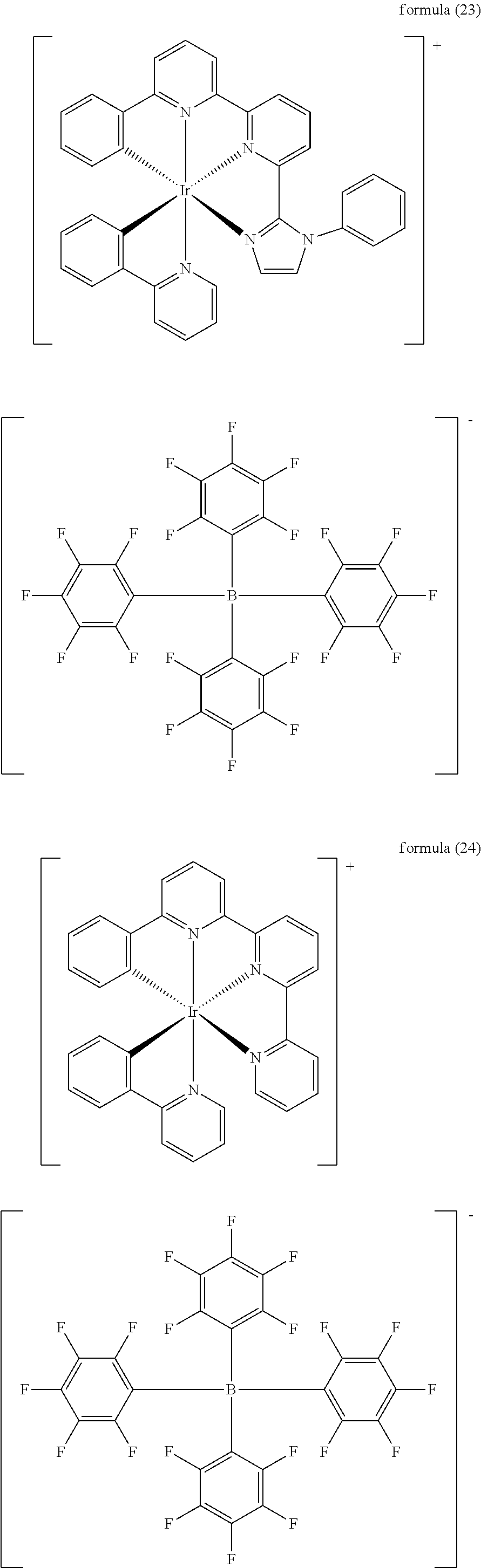
- the depositable ionic complex has a structure shown in the following formulas (11) to (16) and formulas (21) to (26):
- a use of the aforementioned depositable ionic organic functional material in an organic electroluminescent device is provided, wherein, the depositable ionic organic functional material is used as a dye in an organic light-emitting layer of the organic electroluminescent device.
- An organic electroluminescent device which comprises a substrate, and an anode layer, an organic light-emitting functional layer, a cathode layer formed in sequence upon the substrate, wherein the organic light-emitting functional layer comprises a hole transport layer, an organic light-emitting layer and an electron transport layer, and wherein a host material of the organic light-emitting layer is doped with the aforementioned depositable ionic organic functional material.
- Doping concentration of the depositable ionic organic functional material is 2 wt %-10 wt %.
- the depositable ionic organic functional material is red, yellow, green or blue light emitting material.
- the organic light-emitting layer has a thickness of 10 mm-50 mm, preferably 10 mm-30 mm.
- the depositable ionic organic functional material of the present invention has the following advantages:
- a molecular design strategy for obtaining a depositable ionic organic functional material is provided for the first time by the present invention, wherein a series of depositable ionic Iridium complexes are designed and developed.
- a tetraphenylborate derivative anion which is a counterion with large steric hindrance and good electrical charge dispersion, is introduced into a cationic Iridium complex to replace the hexafluorophosphate anion as mentioned in the background technology, thereby reducing the interactivity between anions and cations.
- the tetraphenylborate derivative anion can increase the electrical charge transport capability, reduce the drive voltage of the device, reduce the energy consumption, and thus effectively reduce the production cost.
- the present invention is simple and easy to carry out and has universality, depositable ionic Iridium complexes as dyes of various colors can be developed accordingly, so as to produce high-efficiency OLEDs emitting blue to red light.
- FIG. 1 is a thermogravimetric analysis diagram of the complexes shown by the formulas (11) to (16) in a N2 atmosphere;
- FIG. 2 is a current density-voltage spectrogram of the devices 1-6 in the application example 1;
- FIG. 3 is a luminance-voltage spectrogram of the devices 1-6 in the application example 1;
- FIG. 4 is an EL spectrogram of the devices 1-6 in the application example 1;
- FIG. 5 is a thermogravimetric analysis diagram of the complexes shown by the formulas (21) to (26) in a N2 atmosphere;
- FIG. 6 is a current density-voltage spectrogram of the devices 7-12 in the application example 2;
- FIG. 7 is a luminance-voltage spectrogram of the devices 7-12 in the application example 2;
- FIG. 8 is an EL spectrogram of the devices 7-12 in the application example 2;
- FIG. 9 is a structural schematic diagram of an organic electroluminescent device, wherein 01 is substrate, 02 is anode layer, 03 is cathode layer, 04 is hole-injection layer, 05 is hole-transport layer, 06 is organic light-emitting layer, and 07 is electron-transport layer.
- the present invention provides a depositable ionic organic functional material, wherein the depositable ionic organic functional material has a structure shown in the following formula (1):
- R is a hydrogen atom, a halogen atom or —CF 3 ;
- R′ is a hydrogen atom or a halogen atom;
- N ⁇ circumflex over ( ) ⁇ N ligand is selected from Pzpy shown in the following formula (31) and its derivatives, Pyim shown in the following formula (32), Ptop shown in the following formula (33), Pop shown in the following formula (34), Bpy shown in the following formula (35), and Dfppy shown in the following formula (36):
- the depositable ionic organic functional material is preferably:
- a use of the aforementioned depositable ionic organic functional material in an organic electroluminescent device is provided.
- the depositable ionic organic functional material is used as a dye in an organic light-emitting layer of the organic electroluminescent device.
- the organic electroluminescent device comprises a substrate 01 , and an anode layer 02 , an organic light-emitting functional layer, a cathode layer 03 formed in sequence upon the substrate, wherein the organic light-emitting functional layer comprises a hole injection layer 04 , a hole transport layer 05 , an organic light-emitting layer 06 and an electron transport layer 07 , and wherein a host material of the organic light-emitting layer 06 is doped with the aforementioned depositable ionic organic functional material.
- Doping concentration of the depositable ionic organic functional material is 2 wt %-10 wt %.
- the depositable ionic organic functional material is red, yellow, green or blue light emitting material.
- the organic light-emitting layer has a thickness of 10 mm-50 mm, preferably 10 mm-30 mm.
- the respective layers of the device in the present invention are made of the following materials:
- the anode layer may adopt inorganic material or organic conducting polymer.
- the inorganic material is usually selected from metal oxides such as indium tin oxide (ITO), zinc oxide (ZnO), indium zinc oxide (IZO), and metals having relatively high work function such as gold, copper, silver, and it is preferably ITO.
- the organic conducting polymer is preferably selected from Polythiophene/Polyvinylbenzenesulfonate sodium (hereinafter abbreviated as PEDOT:PSS), and polyaniline (hereinafter abbreviated as PANI).
- the cathode layer usually adopts metals having relatively low work function such as lithium, magnesium, calcium, strontium, aluminum, indium, or their alloys with copper, gold, silver, or the cathode layer is an electrode layer formed by alternately arranged metal and metal fluoride.
- the cathode layer is preferably a mixed electrode of Mg:Ag/Ag.
- the material of the hole transport layer may be selected from aromatic amine type, carbazole type and branched polymer type low molecular material, and is preferably selected from NPB and TCTA.
- the organic electroluminescent device of the present invention there may also be a hole injection layer between the anode layer and the hole transport layer.
- the material of the hole injection layer may adopt, for example, 2,3,6,7,10,11-hexacyanyl-1,4,5,8,9,12-hexaazatriphenylene (HAT-CN), 4,4′,4′′-tri-(3-methyl-phenyl-aniline)-tri-aniline doped with F4TCNQ, or may adopt copper phthalocyanine (CuPc), or may be a metal oxide such as molybdenum oxide, rhenium oxide.
- the light-emitting material of the organic light-emitting layer 06 may be a fluorescent dye selected from coumarins such as DMQA or C545T, bis-pyrans such as DCJTB or DCM, or may be a metal complex containing lanthanide series or actinide series metal such as Ir, Pt, Os, Ru, Rh, and Pd.
- the host material of the organic light-emitting layer 06 may be selected from materials which are commonly used as a substrate material, such as 4,4′-di-(carbazole-9-yl)-biphenyl (CBP).
- CBP 4,4′-di-(carbazole-9-yl)-biphenyl
- the material of the electron transport layer may adopt a material which is commonly used for an electron transport layer, such as aromatic fused ring compound (e.g. pentacene, perylene) or o-phenanthroline compound (e.g. Bphen, BCP).
- aromatic fused ring compound e.g. pentacene, perylene
- o-phenanthroline compound e.g. Bphen, BCP
- the organic electroluminescent device of the present invention comprises an anode layer 02 , a hole transport layer 05 , an organic light-emitting layer 06 , an electron transport layer 07 and a cathode layer 03 sequentially deposited in a stacked manner upon a substrate 01 , which are then encapsulated.
- the substrate may be a glass substrate or a flexible substrate, wherein the flexible substrate may adopt polyester, polyimide compound material, or a thin metal plate.
- the layered stacking and encapsulation may be conducted by using any suitable method known to a person skilled in the art.
- a specific preparation method of the organic electroluminescent device of the present invention is as follows:
- Evaporation coating an organic light-emitting layer upon the hole transport layer by using a double source co-evaporation method, wherein the mass percentages of the host material and the dye are controlled by using a film thickness monitor-controller to adjust the film coagulation speed, and the evaporation coated film thickness thereof is 30 nm.
- evaporation coating a Mg:Ag layer and a Ag layer in sequence as a cathode layer upon the electron transport layer wherein the Mg:Ag layer is coated by using a double source co-evaporation method, and the mass percentages of Mg and Ag are controlled by using a film thickness monitor-controller to adjust the film coagulation speed, and the evaporation coated film thickness thereof is 150 nm; the Ag layer is evaporation coated at a speed of 1.0 nm/s, to get a thickness of 50 nm.
- Di-chlorine bridged Iridium di-ligand [Ir(dfppy) 2 Cl] 2 (3.100 g, 2.55 mmol) and pzpy ligand (0.743 g, 5.12 mmol) is dissolved in 1,2-glycol (60 mL). In nitrogen atmosphere, the solution system is refluxed for 12 h at 140° C. to get a clear bright yellow solution. After cooling to room temperature, Na[BArF 24 ] (4.522 g, 5.10 mmol) is slowly added to the reaction system with stirring. The reaction product is suction filtrated, washed with CH 2 Cl 2 , and then dried over a night in a 70° C. vacuum drying oven.
- the crude product is subsequently passed through silica chromatographic column (200-300 mesh), with CH 2 Cl 2 as the mobile phase, to get the clathrate compound [Ir(dfppy) 2 (pzpy)][BArF 24 ] shown in formula (11) as pale yellow powder (5.283 g, 3.34 mmol) at a yield of 66%.
- the reactants are [Ir(ppy) 2 Cl] 2 (1.662 g, 1.55 mmol) and pzpy ligand (0.468 g, 3.22 mmol), and by going through the same synthesis method as that of Embodiment 2, the clathrate compound [Ir(ppy) 2 (pzpy)][BArF 24 ] shown in formula (12) is obtained as pale yellow powder (3.790 g, 2.51 mmol) at a yield of 81%.
- the reactants are [Ir(ppy) 2 Cl] 2 (3.064 g, 2.86 mmol) and pyim ligand (1.255 g, 5.67 mmol), and by going through the same synthesis method as that of Embodiment 2, the clathrate compound [Ir(ppy) 2 (pyim)][BArF 24 ] shown in formula (13) is obtained as yellow powder (1.024 g, 0.77 mmol) at a yield of 86%.
- the reactants are [Ir(ppy) 2 Cl] 2 (1.767 g, 1.65 mmol) and 2,2′-bipyridine (bpy) ligand (0.528 g, 3.38 mmol), and by going through the same synthesis method as that of Embodiment 2, the clathrate compound [Ir(ppy) 2 (bpy)][BArF 24 ] shown in formula (14) is obtained as yellow powder (4.290 g, 2.82 mmol) at a yield of 86%.
- the reactants are [Ir(ppy) 2 Cl] 2 (1.775 g, 1.66 mmol) and pop ligand (0.740 g, 3.32 mmol), and by going through the same synthesis method as that of Embodiment 2, the clathrate compound [Ir(ppy) 2 (pop)][BArF 24 ] shown in formula (16) is obtained as red powder (4.551 g, 2.87 mmol) at a yield of 87%.
- the clathrate compounds shown in formulas (11) to (16) prepared in Embodiments 2-7 undergo thermogravimetric analysis in N2 atmosphere, as shown in FIG. 1 , it can be seen that the series of Iridium-containing depositable materials with [BArF 24 ] ⁇ as a counterion do not have notable mass loss until above 250° C., which indicates this type of materials have a high glass transition temperature and good thermal stability.
- the reactants are [Ir(ppy) 2 Cl] 2 (0.473 g, 0.39 mmol) and dfpzpy ligand (0.187 g, 1.29 mmol), and by going through the same synthesis method as that of Embodiment 2, the clathrate compound [Ir(dfppy) 2 (pzpy)][B(5fph) 4 ] shown in formula (21) is obtained as bright yellow powder (0.770 g, 0.56 mmol) at a yield of 71%.
- the reactants are [Ir(ppy) 2 Cl] 2 (0.578 g, 0.54 mmol) and pzpy ligand (0.231 g, 1.59 mmol), and by going through the same synthesis method as that of Embodiment 2, the clathrate compound [Ir(ppy) 2 (pzpy)][B(5fph) 4 ] shown in formula (22) is obtained as yellow powder (1.024 g, 0.77 mmol) at a yield of 72%.
- the reactants are [Ir(ppy) 2 Cl] 2 (0.569 g, 0.53 mmol) and pyim ligand (0.233 g, 1.05 mmol), and by going through the same synthesis method as that of Embodiment 2, the clathrate compound [Ir(ppy) 2 (pyim)][B(5fph) 4 ] shown in formula (23) is obtained as yellow powder (1.024 g, 0.77 mmol) at a yield of 61%.
- the reactants are [Ir(ppy) 2 Cl] 2 (0.655 g, 0.61 mmol) and 2,2′-bipyridine (bpy) ligand (0.25 g, 1.60 mmol), and by going through the same synthesis method as that of Embodiment 2, the clathrate compound [Ir(ppy) 2 (bpy)][B(5fph) 4 ] shown in formula (24) is obtained as yellow powder (1.024 g, 0.77 mmol) at a yield of 65%.
- the reactants are [Ir(ppy) 2 Cl] 2 (1.775 g, 1.66 mmol) and ptop ligand (0.341 g, 1.44 mmol), and by going through the same synthesis method as that of Embodiment 2, the clathrate compound [Ir(ppy) 2 (ptop)][B(5fph) 4 ] shown in formula (25) is obtained as red powder (1.65 g, 1.16 mmol) at a yield of 81%.
- the reactants are [Ir(ppy) 2 Cl] 2 (0.576 g, 0.54 mmol) and pop ligand (0.243 g, 1.09 mmol), and by going through the same synthesis method as that of Embodiment 2, the clathrate compound [Ir(ppy) 2 (pop)][BArF 24 ] shown in formula (26) is obtained as red powder (1.024 g, 0.77 mmol) at a yield of 74%.
- the clathrate compounds shown in formulas (21) to (26) prepared in Embodiments 8-13 undergo thermogravimetric analysis in N2 atmosphere, as shown in FIG. 5 , it can be seen that the series of Iridium-containing depositable materials with [B(5fph) 4 ] ⁇ as a counterion do not have notable mass loss until above 320° C., which indicates this type of materials have a high glass transition temperature and good thermal stability.
- Devices 1-6 of this embodiment have the following structure:
- the “x %” before the dye of the devices 1-6 represents a doping concentration of the dye in the organic light-emitting layer. In this embodiment and hereinafter, the doping concentration is measured in wt %.
- the current density-voltage spectrogram of the devices 1-6 is shown in FIG. 2
- their luminance-voltage spectrogram is shown in FIG. 3
- their electroluminescence spectrogram is shown in FIG. 4 .
- the devices begin to illuminate at a drive voltage of 4V
- the maximum luminance is as high as 27.1 ⁇ 10 3 cd/m 2
- they can realize light-emitting colors from blue to red.
- the “11, 12, 13, 14, 15, 16” in FIGS. 2-4 respectively represent the devices corresponding to the compounds shown in formula (11), formula (12), formula (13), formula (14), formula (15), formula (16).
- Devices 7-12 of this embodiment have the following structure:
- the “x %” before the dye of the devices 7-12 represents a doping concentration of the dye in the organic light-emitting layer.
- the doping concentration is measured in wt %.
- CzPO 2 : 2% clathrate compound 21 of the structure of the organic light-emitting layer in the first column of the Tables above refers to that the host material CzPO 2 of the organic light-emitting layer is doped with 2 wt % of dye, and the dye is [Ir(dfppy) 2 (pzpy)][B(5fph) 4 ] shown in formula (21). And so on for the second to sixth lines.
- the current density-voltage spectrogram of devices 7-12 is shown in FIG. 6
- their luminance-voltage spectrogram is shown in FIG. 7
- their electroluminescence spectrogram is shown in FIG. 8 .
- the devices begin to illuminate at a drive voltage of 4V
- the maximum luminance is as high as 27.1 ⁇ 10 3 cd/m 2
- they can realize light-emitting colors from blue to red.
- the “21, 22, 23, 24, 25, 26” in FIGS. 6-8 respectively represent the devices corresponding to the compounds shown in formula (21), formula (22), formula (23), formula (24), formula (25), formula (26).
- a device 13 of this embodiment has the following structure:
- the host material and dye of the device 13 is the same as the device 1.
- a device 14 of this embodiment has the following structure:
- the host material and dye of the device 14 is the same as the device 1.
- a device 15 of this embodiment has the following structure:
- the host material and dye of the device 15 is the same as the device 1.
Landscapes
- Chemical & Material Sciences (AREA)
- Organic Chemistry (AREA)
- Engineering & Computer Science (AREA)
- Materials Engineering (AREA)
- Physics & Mathematics (AREA)
- Optics & Photonics (AREA)
- Inorganic Chemistry (AREA)
- Crystallography & Structural Chemistry (AREA)
- Spectroscopy & Molecular Physics (AREA)
- Manufacturing & Machinery (AREA)
- Electroluminescent Light Sources (AREA)
- Pyridine Compounds (AREA)
Abstract
Description


wherein, R is a hydrogen atom, a halogen atom or —CF3;
R′ is a hydrogen atom or a halogen atom;
the N{circumflex over ( )}N ligand is selected from Pzpy shown in the following formula (31) and its derivatives, Pyim shown in the following formula (32), Ptop shown in the following formula (33), Pop shown in the following formula (34), Bpy shown in the following formula (35), and Dfppy shown in the following formula (36):


wherein, R is a hydrogen atom, a halogen atom or —CF3;
R′ is a hydrogen atom or a halogen atom;
N{circumflex over ( )}N ligand is selected from Pzpy shown in the following formula (31) and its derivatives, Pyim shown in the following formula (32), Ptop shown in the following formula (33), Pop shown in the following formula (34), Bpy shown in the following formula (35), and Dfppy shown in the following formula (36):


(2) Synthesis Process of Pyim:
See details in He, L., et al., Adv Funct. Mater 19, 2950-2960 (2009).

(3) Synthesis Process of Ptop:
See details in Zhang, J., et al. Adv. Funct.

(4) Synthesis Process of Pop:


| TABLE 1 |
| Performance of OLED devices made with clathrate compounds 11-16 |
| PL | Current | EL | |||
| Structure of the | wavelength | efficiency | Luminance | wavelength | |
| organic light-emitting | λ | ηmax | Bmax | λ | CIE |
| layer | [nm]b | [cd A−1] | [cd m−2] | [nm]b | (x, y)d |
| CzPO2: 2% | 452, 481 | 1.3 | 6.0 × 10³ | 446 | (0.16, 0.12) |
| |
|||||
| 26DCzPPy: 8% | 473, 502 | 3.0 | 11.9 × 10³ | 476, 501 | (0.20, 0.37) |
| |
|||||
| DIC-TRZ: 4% | 527 | 16.3 | >27.1 × 10³ | 532 | (0.36, 0.57) |
| |
|||||
| DIC-TRZ: 2% | 554 | 22.6 | >27.1 × 10³ | 551 | (0.42, 0.54) |
| |
|||||
| DIC-TRZ: 10% | 597 | 7.1 | 16.3 × 10³ | 588 | (0.51, 0.46) |
| |
|||||
| DIC-TRZ: 6% | 597 | 5.1 | 11.1 × 10³ | 594 | (0.52, 0.46) |
| |
|||||
-
- The
clathrate compound 11 refers to [Ir(dfppy)2(pzpy)][BArF24] shown in formula (11), and the corresponding device serial number is 1; - The
clathrate compound 12 refers to [Ir(ppy)2(pzpy)][BArF24] shown in formula (12), and the corresponding device serial number is 2; - The
clathrate compound 13 refers to [Ir(ppy)2(pyim)][BArF24] shown in formula (13), and the corresponding device serial number is 3; - The
clathrate compound 14 refers to [Ir(ppy)2(bpy)][BArF24] shown in formula (14), and the corresponding device serial number is 4; - The
clathrate compound 15 refers to [Ir(ppy)2(ptop)][BArF24] shown in formula (15), and the corresponding device serial number is 5; - The
clathrate compound 16 refers to [Ir(ppy)2(pop)][BArF24] shown in formula (16), and the corresponding device serial number is 6.
- The
| TABLE 2 |
| Performance of OLED devices made with clathrate compounds 21-26 |
| PL | Current | EL | |||
| Structure of the | wavelength | efficiency | Luminance | wavelength | |
| organic light-emitting | λ | ηmax | Bmax | λ | CIE |
| layer | [nm]b | [cd A−1] | [cd m−2] | [nm]b | (x, y)d |
| CzPCh: 8% | 452, 480 | 1.5 | 5.7 × 10³ | 452 | (0.18, 0.19) |
| |
|||||
| 26DCzPPy: 6% | 476, 503 | 6.7 | 8.2 × 10³ | 506 | (0.25, 0.47) |
| |
|||||
| DIC-TRZ: 6% | 531 | 15.3 | >27.1 × 10³ | 532 | (0.35, 0.57) |
| |
|||||
| DIC-TRZ: 8% | 555 | 24.3 | >27.1 × 10³ | 550 | (0.42, 0.54) |
| |
|||||
| DIC-TRZ: 4% | 599 | 4.5 | 22.1 × 10³ | 588 | (0.51, 0.47) |
| |
|||||
| DIC-TRZ: 6% | 599 | 4.5 | 19.4 × 10³ | 596 | (0.52, 0.46) |
| |
|||||
-
- The
clathrate compound 21 refers to [Ir(dfppy)2(pzpy)][B(5fph)4] shown in formula (21), and the corresponding device serial number is 7; - The
clathrate compound 22 refers to [Ir(ppy)2(pzpy)][B(5fph)4] shown in formula (22), and the corresponding device serial number is 8; - The
clathrate compound 23 refers to [Ir(ppy)2(pyim)][B(5fph)4] shown in formula (23), and the corresponding device serial number is 9; - The
clathrate compound 24 refers to [Ir(ppy)2(bpy)][B(5fph)4] shown in formula (24), and the corresponding device serial number is 10; - The
clathrate compound 25 refers to [Ir(ppy)2(ptop)][B(5fph)4] shown in formula (25), and the corresponding device serial number is 11; - The
clathrate compound 26 refers to [Ir(ppy)2(pop)][BArF24] shown in formula (26), and the corresponding device serial number is 12.
- The
| Abbreviation | Full name | Structural formula |
| NPB | N,N′-di-(1-naphthyl)- N,N′-diphenyl-1,1′-biphenyl- 4,4′-diamine |
 |
| TPBi | 1,3,5-tri-(1-phenyl-1H- benzimidazole-2-yl)-benzene |
 |
| CzPO2 | 9-(3,5-di-(diphenyl-phosphoryl)- phenyl)-9H-carbazole |
 |
| |
2,6-di-(3-(9H-carbazole-9-yl)- phenyl)-pyridine |
 |
| DIC-PIZ | 2-[9-phenyl]- indolo[2,3-A]carbazole- 4,6-diphenyl-1,3,5-triazine |
 |
Claims (7)


Applications Claiming Priority (4)
| Application Number | Priority Date | Filing Date | Title |
|---|---|---|---|
| CN201510382459 | 2015-07-02 | ||
| CN201510382459.7 | 2015-07-02 | ||
| CN201510382459.7A CN106318377A (en) | 2015-07-02 | 2015-07-02 | Vapor-depositable ionic organic functional materials and their applications in organic electroluminescent devices |
| PCT/CN2016/085803 WO2017000778A1 (en) | 2015-07-02 | 2016-06-15 | Depositable ion organic function material and use thereof in organic electroluminescent device |
Publications (2)
| Publication Number | Publication Date |
|---|---|
| US20180277785A1 US20180277785A1 (en) | 2018-09-27 |
| US10749128B2 true US10749128B2 (en) | 2020-08-18 |
Family
ID=57607836
Family Applications (1)
| Application Number | Title | Priority Date | Filing Date |
|---|---|---|---|
| US15/745,060 Active 2036-11-12 US10749128B2 (en) | 2015-07-02 | 2016-06-15 | Depositable ion organic function material and use thereof in organic electroluminescent device |
Country Status (6)
| Country | Link |
|---|---|
| US (1) | US10749128B2 (en) |
| EP (1) | EP3318617B1 (en) |
| KR (1) | KR102036775B1 (en) |
| CN (2) | CN106318377A (en) |
| TW (1) | TWI617534B (en) |
| WO (1) | WO2017000778A1 (en) |
Families Citing this family (1)
| Publication number | Priority date | Publication date | Assignee | Title |
|---|---|---|---|---|
| CN107936030A (en) * | 2017-11-21 | 2018-04-20 | 西北民族大学 | Water-soluble brominated copper porphyrin and its bromine substitutive derivative, its synthetic method and application |
Citations (7)
| Publication number | Priority date | Publication date | Assignee | Title |
|---|---|---|---|---|
| US20060177695A1 (en) | 2005-02-04 | 2006-08-10 | Ragini Das R | Cyclometalated transition metal complex and organic electroluminescent device using the same |
| CN101186624A (en) | 2007-08-16 | 2008-05-28 | 清华大学 | A kind of iridium metal complex and its application |
| CN101540375A (en) | 2009-04-03 | 2009-09-23 | 清华大学 | Organic electroluminescence device |
| US20100181900A1 (en) * | 2009-01-22 | 2010-07-22 | Samsung Electronics Co., Ltd | Carbazole compounds and organo-electroluminescent devices using the same |
| WO2012057138A1 (en) | 2010-10-28 | 2012-05-03 | 独立行政法人産業技術総合研究所 | Method for producing complex of trisortho-metalated iridium, light-emitting material using said complex, and light-emitting element |
| WO2014094960A1 (en) | 2012-12-21 | 2014-06-26 | Merck Patent Gmbh | Metal complexes |
| WO2014094962A2 (en) | 2012-12-21 | 2014-06-26 | Merck Patent Gmbh | Metal complexes |
-
2015
- 2015-07-02 CN CN201510382459.7A patent/CN106318377A/en active Pending
- 2015-07-02 CN CN202110326205.9A patent/CN113072590A/en active Pending
-
2016
- 2016-06-15 US US15/745,060 patent/US10749128B2/en active Active
- 2016-06-15 EP EP16817142.9A patent/EP3318617B1/en active Active
- 2016-06-15 TW TW105118811A patent/TWI617534B/en active
- 2016-06-15 KR KR1020187003312A patent/KR102036775B1/en active Active
- 2016-06-15 WO PCT/CN2016/085803 patent/WO2017000778A1/en not_active Ceased
Patent Citations (9)
| Publication number | Priority date | Publication date | Assignee | Title |
|---|---|---|---|---|
| US20060177695A1 (en) | 2005-02-04 | 2006-08-10 | Ragini Das R | Cyclometalated transition metal complex and organic electroluminescent device using the same |
| CN101186624A (en) | 2007-08-16 | 2008-05-28 | 清华大学 | A kind of iridium metal complex and its application |
| US20100181900A1 (en) * | 2009-01-22 | 2010-07-22 | Samsung Electronics Co., Ltd | Carbazole compounds and organo-electroluminescent devices using the same |
| CN101540375A (en) | 2009-04-03 | 2009-09-23 | 清华大学 | Organic electroluminescence device |
| WO2012057138A1 (en) | 2010-10-28 | 2012-05-03 | 独立行政法人産業技術総合研究所 | Method for producing complex of trisortho-metalated iridium, light-emitting material using said complex, and light-emitting element |
| US20130203997A1 (en) | 2010-10-28 | 2013-08-08 | Furuya Metal Co., Ltd. | Method for producing complex of trisortho-metalated iridium, light-emitting material using said complex, and light-emitting element |
| WO2014094960A1 (en) | 2012-12-21 | 2014-06-26 | Merck Patent Gmbh | Metal complexes |
| WO2014094962A2 (en) | 2012-12-21 | 2014-06-26 | Merck Patent Gmbh | Metal complexes |
| US20150318498A1 (en) | 2012-12-21 | 2015-11-05 | Merck Patent Gmbh | Metal Complexes |
Non-Patent Citations (18)
| Title |
|---|
| "Trifluoromethylation of Tetraphenylborate Counterions in Cationic Iridium(III) Complexes: Enhanced Electrochemical Stabilities, Charge-Transport Abilities, and Device Performance", D. Ma et al. , Chem. Eur. J. |
| Communication pursuant to Rule 71(3) EPC of European Application No. 16817142.9. |
| Dongxin Ma et al., "Increased phosphorescent quantum yields of cationic iridium(III) complexes by wisely controlling the counter anions," Chem. Comm., vol. 50, pp. 530-532 (2014), Royal Society of Chemistry, London, England. |
| Dongxin Ma et al., "Tetraphenylborate versus tetraimidazolylborate as counterions for cationic iridium(III) complexes: enhanced electrochemical stabilities and electroluminescence," Dalton Trans., vol. 44, pp. 8521-8528 (2015), Royal Society of Chemistry, London, England. |
| Dongxin Ma et al., "Trifluoromethylation of Tetraphenylborate Counterions in Cationic Iridium(III) Complexes: Enhanced Electrochemical Stabilities, Charge-Transport Abilities, and Device Performance," Chem. Eur. J., vol. 20, pp. 15903-15912 (2014), Wiley-VCH Verlag GmbH & Co., Germany. |
| Dongxin Ma et al., Trfluoromethylation of Tetraphenylborate Counterions in Cationic Iridium (III) Complexes: Enhanced Electrochemical Stabilities, Charge-transport Abilities, and Device Performance, Chem. Eur. J. 2014, 20, 15903-15912, Wiley-VCH Verlag GmbH & Co., KGa, Weinheim, Germany. |
| EPO, European Extended Search report, dated Mar. 2, 2018. |
| He et al. (Adv. Funct. Mater. 2009, 19, p. 2950). * |
| Jing Zhang et al., Efficient Light-Emmitting Electrochemical Cells (LECs) Based on Ionic Iridium (III) Complexes 1,3,4-Oxadiazole Ligands, Adv. Funct. Mater., 2013, 23, 4667-4677, Wiley-VCH Verlag GmbH & Co., KGa, Weinheim, Germany. |
| Korean IP Office, Second Office Action of Korea Application No. 10-2018-7003312. |
| Lei He et al., Blue-Emitting Cationic Iridium Complexes with 2-(1H-Pyrazol-1-yl)pyridine as the Ancillary Ligand for Efficient Light-Emitting Electrochemical Cells, Adv. Funct. Mater., 2008, 18, 2123-2131, Wiley-VCH Verlag GmbH & Co., KGa, Weinheim, Germany. |
| Lei He et al., Toward Highly Efficient Solid-State White Light-Emitting Electrochemical Cells: Blue-Green to Red Emitting Cationic Iridium Comlexes with Imidazole-Type Ancillary Ligands, Adv. Funct. Mater., 2009, 19, 2950-2960, Wiley-VCH Verlag GmbH & Co., KGa, Weinheim, Germany. |
| Refusal Decision of Chinese Application No. 2015103824597. |
| Second Office Action of Chinese Application No. 2015103824597. |
| SIPO, First Office Action, dated Jan. 22, 2018. |
| TW IPO, First Office Action, dated Sep. 4, 2017. |
| Wai-Yeung Wong et al., Efficient Organic Light-Emitting Diodes based on Sublimable Charge Iridium Phosphorescent Emitters, Adv. Funct. Mater., 2007, 17, 315-323, Wiley-VCH Verlag GmbH & Co., KGa, Weinheim, Germany. |
| WO, PCT/CN2016/085803—Written Opinion—English translation, dated Sep. 20, 2016. |
Also Published As
| Publication number | Publication date |
|---|---|
| EP3318617A4 (en) | 2018-05-30 |
| EP3318617A1 (en) | 2018-05-09 |
| WO2017000778A1 (en) | 2017-01-05 |
| KR20180026501A (en) | 2018-03-12 |
| KR102036775B1 (en) | 2019-10-25 |
| TWI617534B (en) | 2018-03-11 |
| CN113072590A (en) | 2021-07-06 |
| TW201730141A (en) | 2017-09-01 |
| EP3318617B1 (en) | 2019-08-14 |
| US20180277785A1 (en) | 2018-09-27 |
| CN106318377A (en) | 2017-01-11 |
Similar Documents
| Publication | Publication Date | Title |
|---|---|---|
| CN102421868B (en) | Compound for organic photoelectric device and organic photoelectric device comprising same | |
| CN102362551B (en) | organic electroluminescent element | |
| CN105895810A (en) | Thermal activation sensitized phosphorescence organic electroluminescent light emitting device | |
| CN103539726A (en) | Novel compound with electron injection and/or electron transport capabilities and organic light-emitting device including the same | |
| CN103229324B (en) | Organic electroluminescent device | |
| CN106831745B (en) | Organic electroluminescent material and organic photoelectric device | |
| CN103250264A (en) | Light emitting element material and light emitting element | |
| CN104529940B (en) | A kind of phenthazine dioxide derivative, preparation method and organic luminescent device | |
| KR102450200B1 (en) | Compounds for electronic devices, electronic devices and display devices | |
| KR101297162B1 (en) | Composition for organic photoelectric device and organic photoelectric device using the same | |
| CN103539682B (en) | For the compound of organic light emitting apparatus, organic light emitting apparatus and panel display apparatus | |
| CN109503576B (en) | Organic compound, display panel and display device | |
| CN106316960A (en) | Benzimidazole n-type dopant and its application in organic electroluminescent devices | |
| CN117402130B (en) | 1,3,4-Triaryl-substituted dibenzofuran compounds and their light-emitting devices | |
| US10749128B2 (en) | Depositable ion organic function material and use thereof in organic electroluminescent device | |
| CN104762079A (en) | An indole-based luminescent compound | |
| CN110054643A (en) | A kind of compound, luminescent material, organic light emitting display panel and organic light-emitting display device | |
| CN112759571A (en) | Organic electroluminescent compound, preparation method thereof and organic electroluminescent device comprising organic electroluminescent compound | |
| CN114751832B (en) | An organic electroluminescent compound, its preparation method and application | |
| CN105153135B (en) | A kind of photoelectric material containing furan structure and its application | |
| CN115700254B (en) | A divalent platinum complex and its preparation method and use | |
| KR102630691B1 (en) | Novel organic electroluminescent compound, organic light emitting diode and electric apparatus comprising the same | |
| KR102615534B1 (en) | Novel organic electroluminescent compound, organic electroluminescent device including the same and electric apparatus | |
| CN108264504A (en) | A kind of novel organic luminescent compounds and include its organic luminescent device | |
| CN102276587B (en) | Heterocyclic compound, organic light emitting apparatus and flat display devices |
Legal Events
| Date | Code | Title | Description |
|---|---|---|---|
| FEPP | Fee payment procedure |
Free format text: ENTITY STATUS SET TO UNDISCOUNTED (ORIGINAL EVENT CODE: BIG.); ENTITY STATUS OF PATENT OWNER: LARGE ENTITY |
|
| STPP | Information on status: patent application and granting procedure in general |
Free format text: DOCKETED NEW CASE - READY FOR EXAMINATION |
|
| STPP | Information on status: patent application and granting procedure in general |
Free format text: NON FINAL ACTION MAILED |
|
| STPP | Information on status: patent application and granting procedure in general |
Free format text: RESPONSE TO NON-FINAL OFFICE ACTION ENTERED AND FORWARDED TO EXAMINER |
|
| STPP | Information on status: patent application and granting procedure in general |
Free format text: FINAL REJECTION MAILED |
|
| STPP | Information on status: patent application and granting procedure in general |
Free format text: ADVISORY ACTION MAILED |
|
| STPP | Information on status: patent application and granting procedure in general |
Free format text: DOCKETED NEW CASE - READY FOR EXAMINATION |
|
| STPP | Information on status: patent application and granting procedure in general |
Free format text: NON FINAL ACTION MAILED |
|
| STPP | Information on status: patent application and granting procedure in general |
Free format text: NOTICE OF ALLOWANCE MAILED -- APPLICATION RECEIVED IN OFFICE OF PUBLICATIONS |
|
| AS | Assignment |
Owner name: TSINGHUA UNIVERSITY, CHINA Free format text: ASSIGNMENT OF ASSIGNORS INTEREST;ASSIGNORS:DUAN, LIAN;MA, DONGXIN;LIU, SONG;AND OTHERS;REEL/FRAME:052941/0435 Effective date: 20180120 Owner name: KUNSHAN GO-VISIONOX OPTO-ELECTRONICS CO., LTD., CHINA Free format text: ASSIGNMENT OF ASSIGNORS INTEREST;ASSIGNORS:DUAN, LIAN;MA, DONGXIN;LIU, SONG;AND OTHERS;REEL/FRAME:052941/0435 Effective date: 20180120 |
|
| STPP | Information on status: patent application and granting procedure in general |
Free format text: PUBLICATIONS -- ISSUE FEE PAYMENT RECEIVED |
|
| STPP | Information on status: patent application and granting procedure in general |
Free format text: PUBLICATIONS -- ISSUE FEE PAYMENT VERIFIED |
|
| STCF | Information on status: patent grant |
Free format text: PATENTED CASE |
|
| MAFP | Maintenance fee payment |
Free format text: PAYMENT OF MAINTENANCE FEE, 4TH YEAR, LARGE ENTITY (ORIGINAL EVENT CODE: M1551); ENTITY STATUS OF PATENT OWNER: LARGE ENTITY Year of fee payment: 4 |