US10748047B2 - Methods and products for displaying encoded information and systems associated therewith - Google Patents
Methods and products for displaying encoded information and systems associated therewith Download PDFInfo
- Publication number
- US10748047B2 US10748047B2 US16/221,718 US201816221718A US10748047B2 US 10748047 B2 US10748047 B2 US 10748047B2 US 201816221718 A US201816221718 A US 201816221718A US 10748047 B2 US10748047 B2 US 10748047B2
- Authority
- US
- United States
- Prior art keywords
- symbology
- imaging
- face
- reader
- product packaging
- Prior art date
- Legal status (The legal status is an assumption and is not a legal conclusion. Google has not performed a legal analysis and makes no representation as to the accuracy of the status listed.)
- Active, expires
Links
Images




Classifications
-
- G—PHYSICS
- G06—COMPUTING OR CALCULATING; COUNTING
- G06K—GRAPHICAL DATA READING; PRESENTATION OF DATA; RECORD CARRIERS; HANDLING RECORD CARRIERS
- G06K19/00—Record carriers for use with machines and with at least a part designed to carry digital markings
- G06K19/06—Record carriers for use with machines and with at least a part designed to carry digital markings characterised by the kind of the digital marking, e.g. shape, nature, code
- G06K19/06009—Record carriers for use with machines and with at least a part designed to carry digital markings characterised by the kind of the digital marking, e.g. shape, nature, code with optically detectable marking
- G06K19/06046—Constructional details
- G06K19/06093—Constructional details the marking being constructed out of a plurality of similar markings, e.g. a plurality of barcodes randomly oriented on an object
-
- G—PHYSICS
- G06—COMPUTING OR CALCULATING; COUNTING
- G06K—GRAPHICAL DATA READING; PRESENTATION OF DATA; RECORD CARRIERS; HANDLING RECORD CARRIERS
- G06K7/00—Methods or arrangements for sensing record carriers, e.g. for reading patterns
- G06K7/10—Methods or arrangements for sensing record carriers, e.g. for reading patterns by electromagnetic radiation, e.g. optical sensing; by corpuscular radiation
- G06K7/14—Methods or arrangements for sensing record carriers, e.g. for reading patterns by electromagnetic radiation, e.g. optical sensing; by corpuscular radiation using light without selection of wavelength, e.g. sensing reflected white light
- G06K7/1404—Methods for optical code recognition
- G06K7/1439—Methods for optical code recognition including a method step for retrieval of the optical code
- G06K7/1456—Methods for optical code recognition including a method step for retrieval of the optical code determining the orientation of the optical code with respect to the reader and correcting therefore
-
- G—PHYSICS
- G06—COMPUTING OR CALCULATING; COUNTING
- G06K—GRAPHICAL DATA READING; PRESENTATION OF DATA; RECORD CARRIERS; HANDLING RECORD CARRIERS
- G06K19/00—Record carriers for use with machines and with at least a part designed to carry digital markings
- G06K19/06—Record carriers for use with machines and with at least a part designed to carry digital markings characterised by the kind of the digital marking, e.g. shape, nature, code
- G06K19/06009—Record carriers for use with machines and with at least a part designed to carry digital markings characterised by the kind of the digital marking, e.g. shape, nature, code with optically detectable marking
- G06K19/06037—Record carriers for use with machines and with at least a part designed to carry digital markings characterised by the kind of the digital marking, e.g. shape, nature, code with optically detectable marking multi-dimensional coding
-
- G—PHYSICS
- G06—COMPUTING OR CALCULATING; COUNTING
- G06K—GRAPHICAL DATA READING; PRESENTATION OF DATA; RECORD CARRIERS; HANDLING RECORD CARRIERS
- G06K19/00—Record carriers for use with machines and with at least a part designed to carry digital markings
- G06K19/06—Record carriers for use with machines and with at least a part designed to carry digital markings characterised by the kind of the digital marking, e.g. shape, nature, code
- G06K19/06009—Record carriers for use with machines and with at least a part designed to carry digital markings characterised by the kind of the digital marking, e.g. shape, nature, code with optically detectable marking
- G06K19/06046—Constructional details
- G06K19/06103—Constructional details the marking being embedded in a human recognizable image, e.g. a company logo with an embedded two-dimensional code
-
- G—PHYSICS
- G06—COMPUTING OR CALCULATING; COUNTING
- G06K—GRAPHICAL DATA READING; PRESENTATION OF DATA; RECORD CARRIERS; HANDLING RECORD CARRIERS
- G06K7/00—Methods or arrangements for sensing record carriers, e.g. for reading patterns
- G06K7/10—Methods or arrangements for sensing record carriers, e.g. for reading patterns by electromagnetic radiation, e.g. optical sensing; by corpuscular radiation
- G06K7/14—Methods or arrangements for sensing record carriers, e.g. for reading patterns by electromagnetic radiation, e.g. optical sensing; by corpuscular radiation using light without selection of wavelength, e.g. sensing reflected white light
- G06K7/1404—Methods for optical code recognition
- G06K7/1439—Methods for optical code recognition including a method step for retrieval of the optical code
- G06K7/1443—Methods for optical code recognition including a method step for retrieval of the optical code locating of the code in an image
-
- G—PHYSICS
- G06—COMPUTING OR CALCULATING; COUNTING
- G06K—GRAPHICAL DATA READING; PRESENTATION OF DATA; RECORD CARRIERS; HANDLING RECORD CARRIERS
- G06K7/00—Methods or arrangements for sensing record carriers, e.g. for reading patterns
- G06K7/10—Methods or arrangements for sensing record carriers, e.g. for reading patterns by electromagnetic radiation, e.g. optical sensing; by corpuscular radiation
- G06K7/10544—Methods or arrangements for sensing record carriers, e.g. for reading patterns by electromagnetic radiation, e.g. optical sensing; by corpuscular radiation by scanning of the records by radiation in the optical part of the electromagnetic spectrum
- G06K7/10821—Methods or arrangements for sensing record carriers, e.g. for reading patterns by electromagnetic radiation, e.g. optical sensing; by corpuscular radiation by scanning of the records by radiation in the optical part of the electromagnetic spectrum further details of bar or optical code scanning devices
- G06K7/10861—Methods or arrangements for sensing record carriers, e.g. for reading patterns by electromagnetic radiation, e.g. optical sensing; by corpuscular radiation by scanning of the records by radiation in the optical part of the electromagnetic spectrum further details of bar or optical code scanning devices sensing of data fields affixed to objects or articles, e.g. coded labels
Definitions
- At least some embodiments of the present invention relate to the field of symbologies (also referred to herein as “barcodes”), and more specifically, to symbologies provided on product packaging for identification and/or tracking thereof.
- Barcodes have been widely used in retail settings to provide product-identifying information in machine readable form.
- Conventional uses of barcodes dictate that a barcode reader is typically positioned directly in front of and some distance away from the barcode, allowing it to capture image data associated therewith and decode the information encoded in the barcode by analyzing the contends of the image data. While this approach is employed across many different functions (e.g., a cashier at a checkout station in a retail venue, a warehouse employee conducting inventory control, delivery personnel capturing package data, etc.), newly emerging functions are driving a need for novel methods to provide and capture barcode data.
- the present invention is a method of providing encoded data for product identification.
- the method includes: providing a product packaging having a first face; providing a first symbology on the first face; providing a second symbology on the first face; and providing a third symbology on the first face, wherein the second symbology is the first symbology distorted in accordance with a first distortion function, the first distortion function distorting at least one of an aspect ratio and a skew pursuant to a first parameter; and wherein the third symbology is the first symbology distorted in accordance with a second distortion function, the second distortion function distorting at least one of the aspect ratio and the skew pursuant to a second parameter, the second parameter being different from the first parameter.
- each of the first symbology, the second symbology, and the third symbology is configured to be read by an imaging symbology reader having a two-dimensional field of view (FOV) with a central FOV axis
- the first symbology is configured to be read by the imaging symbology reader when the central FOV axis is substantially orthogonal to the first face
- each of the second symbology and the third symbology is configured to be read by the imaging symbology reader when the central FOV axis is substantially angled at 5-30 degrees relative to the first face.
- the present invention is a method of providing encoded data for product identification.
- the method includes: determining a first symbology associated with the encoded data, the first symbology being configured to be read by an imaging symbology reader having a two-dimensional field of view (FOV) with a central FOV axis when the imaging symbology reader is positioned such that the central FOV axis is substantially orthogonal to a surface displaying the first symbology; determining a second symbology associated with the encoded data, the second symbology being configured to be read by the imaging symbology reader when the imaging symbology reader is positioned such that the central FOV axis is substantially angled at 5-30 degrees relative to a surface displaying the second symbology and has a first azimuth value; determining a third symbology associated with the encoded data, the third symbology being configured to be read by the imaging symbology reader when the imaging symbology reader is positioned such that the central FO
- the present invention is a product packaging comprising: a first face; a first symbology provided on the first face; a second symbology provided on the first face; and a third symbology provided on the first face, wherein the second symbology is the first symbology distorted in accordance with a first distortion function, the first distortion function distorting at least one of an aspect ratio and a skew pursuant to a first parameter; and wherein the third symbology is the first symbology distorted in accordance with a second distortion function, the second distortion function distorting at least one of the aspect ratio and the skew pursuant to a second parameter, the second parameter being different from the first parameter.
- each of the first symbology, the second symbology, and the third symbology is configured to be read by an imaging symbology reader having a two-dimensional field of view (FOV) with a central FOV axis
- the first symbology is configured to be read by the imaging symbology reader when the central FOV axis is substantially orthogonal to the first face
- each of the second symbology and the third symbology is configured to be read by the imaging symbology reader when the central FOV axis is substantially angled at 5-30 degrees relative to the first face.
- the present invention is a product display and data acquisition system for use in a venue.
- the system includes: a plurality of imaging symbology readers each having a two-dimensional field of view (FOV) with a central FOV axis, the plurality of imaging symbology readers being disposed above a merchandising area within the venue; a plurality of shelves positioned within the merchandising area and configured to display products for picking by consumers; and a product, encased in product packaging, positioned on one of the plurality of shelves, wherein the product packaging includes: a first symbology provided on a face of the product packaging and associated with an encoded data, the first symbology being configured to be read by one of the plurality of imaging symbology readers when the central FOV axis of the one of the plurality of imaging symbology readers is substantially orthogonal to the face of the product packaging; a second symbology provided on the face of the product packaging and associated with the encoded data, the second symbol
- FIG. 1 illustrates a perspective view of an exemplary merchandising area.
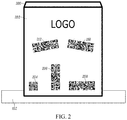
- FIG. 2 illustrates an exemplary product packaging having a plurality of exemplary symbologies provided thereon.
- FIG. 3 illustrates an exemplary partial side cross-section view of a merchandising area having products encased in product packaging and stocked on shelves.
- FIG. 4 illustrates an exemplary front-facing view of a plurality of product packages positioned on a plurality of shelves along with a plurality of symbology image readers disposed overhead.
- FIG. 5A-5E illustrate images of the product packaging, as they appear within the respective readers' FOV.
- the merchandising area 100 includes a plurality of shelves 102 arranged to support and display a variety of products 103 packaged in respective product packaging 104 . It is envisioned that consumers can traverse the open area 106 (also referred to as the “aisle”) of the merchandising area 100 and pick the products 103 that they desire for purchase.
- At least some embodiments of the present disclosure provide a strategically implemented symbology scheme that can allow a data capture system employing overhead symbology readers to capture and read (i.e., decode) the symbology provided on products.
- a data capture system employing overhead symbology readers to capture and read (i.e., decode) the symbology provided on products.
- such approach can be implemented by the use of symbology image readers 108 disposed overhead, above the merchandising area 100 .
- the symbology image readers 108 are video cameras having a two-dimensional field-of-view (FOV) with a central FOV imaging axis.
- FOV field-of-view
- Such video cameras may be configured to capture images of targets in the merchandising area 100 , such as a person moving through aisle 106 or products 103 encased in product packaging 104 sitting on shelves 102 .
- the cameras may be a high-bandwidth, video cameras, such as a moving picture expert group (MPEG) compression cameras.
- MPEG moving picture expert group
- the cameras may include wide-angle capabilities such that camera would be able to capture images over a large area to produce a video stream of the images.
- the cameras may include narrow-angle capabilities, focusing on a predefined portion of one or more shelves 102 and the products 103 positioned thereon.
- the image data captured by the symbology image readers 108 can be transmitted to a centralized server (not shown) via a wired and/or wireless network linking each of the symbology image readers 108 to the server.
- symbology image readers 108 can be used to track and/or identify products 103 , via their product packaging 104 , as they are positioned on the shelves 102 and/or as they are picked by the consumers. While in some cases this can be achieved via extensive and complex image analysis, detecting the overall features/appearance and position of each product packaging, such approach may be costly and computationally burdensome. Accordingly, a more preferable approach would be to monitor for, track, and read machine readable symbology provided on the product packaging 104 , thereby allowing for determination of a position of a specific product by virtue of the position of the symbology which encodes product-identifying data.
- FIG. 2 illustrates an exemplary product packaging 200 that can be advantageously used in the merchandising area 100 of FIG. 1 and be stacked on shelves 102 .
- Product packaging 200 includes a front face 202 that is generally adapted to face the open area of the aisle 106 and be visible to consumers passing therethrough. Consequently, this is also the face that is likely to be within the FOV of at least one of the symbology image readers 108 installed overhead, as shown in FIG. 1 .
- the respective image readers 108 may be unable to adequately capture image data associated with conventional symbology positioned on the front face 202 .
- conventional symbology like, for example, a two-dimensional barcode like a Quick Response (QR) code, is designed to be optimally read by an imaging reader having its central FOV axis be substantially normal to the surface on which the two-dimensional barcode is provided.
- QR Quick Response
- symbology image reader 108 positioned relatively close to the product packaging 200 may have its central FOV axis be positioned at a relatively large angle off the normal to the front face 202 , whereby the large angle can prevent proper operation of the symbology reader.
- FIG. 3 shows a partial side cross-section view of the merchandising area 100 , having products encased in product packaging 200 stocked on shelves 102 .
- the product packaging is arranged such that the front face 202 of the various products packages 200 face the aisle 106 .
- the symbology image reader 208 . 1 is can be seen that the line of sight between the reader 208 . 1 and the lower-most product package 200 . 1 forms about a 10 degree angle ⁇ relative to its front face 202 , the line of sight between the reader 208 . 1 and the middle product package 200 .
- the illustrated lines of sight can coincide with a central FOV axis of the reader 208 . 1 , that does not always have to be the case, and in some embodiments each line of sight may simply be within the FOV of the reader 208 . 1 .
- conventional placement of a symbology on a front face 202 of the product packaging 200 may cause the image reader 208 . 1 to not be able to capture sufficient detail to properly decode the symbology.
- FIG. 4A shown therein is a front-facing view of a plurality of product packages 200 . 1 - 200 . 3 (as shown by example in FIG. 2 ) positioned on a plurality of shelves 102 along with a plurality of symbology image readers 408 . 1 - 408 . 3 disposed overhead. It should be assumed that readers 408 . 1 - 408 . 3 are positioned in a manner that it similar to the reader 208 . 1 of FIG. 3 , and relatively close to the shelves 102 such that their line of sight to each of the product packages 200 . 1 - 200 .
- each of the product packages 200 . 1 - 200 . 3 forms a relatively small angle relative to the front face of each respective product package (or as may be said otherwise, forms a relatively large angle relative to an axis normal to the front face of each respective product package).
- Each of the product packages 200 . 1 - 200 . 3 includes an exemplary arrangement of symbologies in accordance with an embodiment of the present disclosure. As shown in greater detail in FIG. 2 , each product package 200 . 1 - 200 . 3 includes a first symbology 204 , a second symbology 206 , a third symbology 208 , a fourth symbology 210 , and a fifth symbology 212 .
- Each symbology 204 - 212 is associated with the same encoded data, typically provided to identify the product encased within the packaging.
- the first symbology 204 is provided in its non-modified form (e.g., a form that is defined by a relevant standard like the QR code standard).
- the second symbology 206 is a visually distorted version of the first symbology 204 , where the aspect ratio of the first symbology 204 has been altered such that the height of the first symbology 204 has been increased by a factor of two while the width of the first symbology 204 has remained the same.
- the third symbology 208 is a visually distorted version of the first symbology 204 , where the aspect ratio of the first symbology 204 has been altered such that the width of the first symbology 204 has been increased by a factor of two while the height of the first symbology 204 has remained the same.
- the fourth symbology 210 is a visually distorted version of the first symbology 204 , where the aspect ratio of the first symbology 204 has been altered such that the height of the first symbology 204 has been increased by a factor of two while the width of the first symbology 204 has remained the same, and the resulting symbology has been rotated approximately 80 degrees counter clockwise.
- the fifth symbology 212 is a visually distorted version of the first symbology 204 , where the aspect ratio of the first symbology 204 has been altered such that the height of the first symbology 204 has been increased by a factor of two while the width of the first symbology 204 has remained the same, and the resulting symbology has been rotated approximately 80 degrees clockwise.
- the aforementioned symbology arrangement can compensate for the visual distortion of the caused by the particular arrangement of the readers 408 . 1 - 408 . 3 and the product packages 200 . 1 - 200 . 3 .
- product package 200 . 1 can appear within the reader's 408 . 1 FOV as shown in FIG. 5A , where the line of sight from the reader 408 . 3 to the product package 200 . 1 forms approximately a 20-degree angle.
- the intentionally distorted symbology 206 will appear to the reader 408 . 1 similar to the first, non-distorted symbology such that an image thereof should be sufficient to successfully process a decode operation. It can be appreciated that while symbology 206 should be successfully decoded, the appearance of the first symbology 204 is substantially distorted whereby a successful decode thereof is not likely.
- Product packaging 200 . 2 may also appear within the FOV of the reader 408 . 1 , as illustrated in FIG. 5B .
- packaging 200 . 2 has been positioned on its side (potentially due to misplacement) thereby being rotated about 90 degrees counter clockwise. Due to this position and the lateral offset of the reader 408 . 1 from the packaging 200 . 2 , the resulting image of the product packaging 200 . 2 is distorted relative to its original width and further laterally skewed as shown. This distortion is compensated for by the intentional distortion imparted into the fifth symbology 212 which, when captured by the reader 408 . 1 , appears similar to that of first, non-distorted symbology. Consequently, upon capturing an image of the fifth symbology 212 , said image can be processed to successfully decode the data encoded therein.
- FIG. 5C illustrates an image of the product packaging 200 . 2 , as it would appear within the reader's 408 . 2 FOV. It is envisioned that the line of sight from the reader 408 . 2 forms approximately a 20-degree angle with the face of the product package 200 . 2 .
- the resulting visual distortion is compensated for by the intentional distortion imported into the third symbology 208 which, when captured by the reader 408 . 2 , appears similar to that of first, non-distorted symbology. Consequently, upon capturing an image of the third symbology 208 , said image can be processed to successfully decode the data encoded therein.
- reader 408 . 3 can also advantageously use the intestinally distorted symbologies to capture and process at least one symbology out of a plurality being captured on a face of one product packaging.
- FIG. 5D illustrates an image of the product packaging 200 . 3 , as it would appear within the reader's 408 . 3 FOV. It is envisioned that the line of sight from the reader 408 . 3 forms approximately a 30-degree angle with the face of the product package 200 . 3 .
- the resulting visual distortion is compensated for by the intentional distortion imported into the second symbology 206 which, when captured by the reader 408 . 3 , appears similar to that of first, non-distorted symbology.
- Product package 200 . 2 may also appear within the FOV of the symbology reader 408 . 3 .
- FIG. 5E illustrates an image of the product packaging 200 . 2 , as it would appear within the reader's 408 . 3 FOV. In this case, the rotation of the product package and its positioning relative to the reader 408 . 3 would cause the line of sight from the reader 408 . 3 to form approximately a 20-degree angle with the face of the product package 200 .
- the resulting visual distortion is compensated for by the intentional distortion imported into the fourth symbology 210 which, when captured by the reader 408 . 3 , appears similar to that of first, non-distorted symbology. Consequently, upon capturing an image of the fourth symbology 210 , said image can be processed to successfully decode the data encoded therein.
- the specific positioning, arrangement, distortion, and/or symbology should not be viewed as limiting. That is, the specific distortion, positioning, and/or arrangement will likely depend on the particular symbology implemented on the product packaging, the layout of the merchandising area, and/or the arrangement/layout of the symbology readers. Additionally, other distortion functions may be applied as needed to compensate for, for example, the shape of the surface that the symbology is printed on. Consequently, symbologies may be distorted by, for example, changing the aspect ratio, skew, taper, rotation, etc. As illustrated above, this approach may help symbology readers accurately read and decode symbologies which would otherwise not be decodable. Moreover, at least some embodiments of the disclosed approach can continue to properly decode symbologies on potentially misplaced product packages.
- symbologies may be used in connection with the disclosed approach. These symbologies may, but do not have to, be readily visible to a human eye.
- machine readable symbologies may be embedded in the product packaging such that their presence may be read my machine vision while at the same time being substantially or fully invisible to a human eye.
- a includes . . . a”, “contains . . . a” does not, without more constraints, preclude the existence of additional identical elements in the process, method, article, or apparatus that comprises, has, includes, contains the element.
- the terms “a” and “an” are defined as one or more unless explicitly stated otherwise herein.
- the terms “substantially”, “essentially”, “approximately”, “about” or any other version thereof, are defined as being close to as understood by one of ordinary skill in the art, and in one non-limiting embodiment the term is defined to be within 10%, in another embodiment within 5%, in another embodiment within 1% and in another embodiment within 0.5%.
- the term “coupled” as used herein is defined as connected, although not necessarily directly and not necessarily mechanically.
- a device or structure that is “configured” in a certain way is configured in at least that way, but may also be configured in ways that are not listed.
- processors such as microprocessors, digital signal processors, customized processors and field programmable gate arrays (FPGAs) and unique stored program instructions (including both software and firmware) that control the one or more processors to implement, in conjunction with certain non-processor circuits, some, most, or all of the functions of the method and/or apparatus described herein.
- processors or “processing devices” such as microprocessors, digital signal processors, customized processors and field programmable gate arrays (FPGAs) and unique stored program instructions (including both software and firmware) that control the one or more processors to implement, in conjunction with certain non-processor circuits, some, most, or all of the functions of the method and/or apparatus described herein.
- FPGAs field programmable gate arrays
- unique stored program instructions including both software and firmware
- an embodiment can be implemented as a computer-readable storage medium having computer readable code stored thereon for programming a computer (e.g., comprising a processor) to perform a method as described and claimed herein.
- Examples of such computer-readable storage mediums include, but are not limited to, a hard disk, a CD-ROM, an optical storage device, a magnetic storage device, a ROM (Read Only Memory), a PROM (Programmable Read Only Memory), an EPROM (Erasable Programmable Read Only Memory), an EEPROM (Electrically Erasable Programmable Read Only Memory) and a Flash memory.
Landscapes
- Physics & Mathematics (AREA)
- Engineering & Computer Science (AREA)
- General Physics & Mathematics (AREA)
- Theoretical Computer Science (AREA)
- Health & Medical Sciences (AREA)
- Electromagnetism (AREA)
- General Health & Medical Sciences (AREA)
- Toxicology (AREA)
- Artificial Intelligence (AREA)
- Computer Vision & Pattern Recognition (AREA)
- Image Processing (AREA)
Abstract
Description
Claims (21)
Priority Applications (1)
| Application Number | Priority Date | Filing Date | Title |
|---|---|---|---|
| US16/221,718 US10748047B2 (en) | 2018-12-17 | 2018-12-17 | Methods and products for displaying encoded information and systems associated therewith |
Applications Claiming Priority (1)
| Application Number | Priority Date | Filing Date | Title |
|---|---|---|---|
| US16/221,718 US10748047B2 (en) | 2018-12-17 | 2018-12-17 | Methods and products for displaying encoded information and systems associated therewith |
Publications (2)
| Publication Number | Publication Date |
|---|---|
| US20200193253A1 US20200193253A1 (en) | 2020-06-18 |
| US10748047B2 true US10748047B2 (en) | 2020-08-18 |
Family
ID=71071181
Family Applications (1)
| Application Number | Title | Priority Date | Filing Date |
|---|---|---|---|
| US16/221,718 Active 2039-02-07 US10748047B2 (en) | 2018-12-17 | 2018-12-17 | Methods and products for displaying encoded information and systems associated therewith |
Country Status (1)
| Country | Link |
|---|---|
| US (1) | US10748047B2 (en) |
Citations (2)
| Publication number | Priority date | Publication date | Assignee | Title |
|---|---|---|---|---|
| US20070119939A1 (en) * | 2005-11-30 | 2007-05-31 | Symbol Technologies, Inc. | Methods and apparatus for identifying candidate barcode fields |
| US20110215146A1 (en) * | 2010-03-08 | 2011-09-08 | Apple Inc. | Multi-barcode scan process |
-
2018
- 2018-12-17 US US16/221,718 patent/US10748047B2/en active Active
Patent Citations (2)
| Publication number | Priority date | Publication date | Assignee | Title |
|---|---|---|---|---|
| US20070119939A1 (en) * | 2005-11-30 | 2007-05-31 | Symbol Technologies, Inc. | Methods and apparatus for identifying candidate barcode fields |
| US20110215146A1 (en) * | 2010-03-08 | 2011-09-08 | Apple Inc. | Multi-barcode scan process |
Also Published As
| Publication number | Publication date |
|---|---|
| US20200193253A1 (en) | 2020-06-18 |
Similar Documents
| Publication | Publication Date | Title |
|---|---|---|
| US9961256B2 (en) | Apparatus and method for specifying and aiming cameras at shelves | |
| US11600073B2 (en) | Imaging systems and methods for tracking objects | |
| US11367092B2 (en) | Method and apparatus for extracting and processing price text from an image set | |
| US11960960B2 (en) | System and methods for situational adaptive image capture improvements for barcode reading | |
| US9412124B2 (en) | Multi-item scanning systems and methods of items for purchase in a retail environment | |
| US20190236530A1 (en) | Product inventorying using image differences | |
| CA2888153C (en) | Methods and arrangements for identifying objects | |
| EP3416090B1 (en) | Distributed camera modules serially coupled to common preprocessing resources facilitating the provision of a configurable optical code reader platform for application-specific scalability | |
| US11188727B1 (en) | Efficient parallel barcode subpixel alignment | |
| US20230267288A1 (en) | Re-Scan Detection at Self-Check-Out Machines | |
| US10733489B2 (en) | Optically readable tags and methods and systems for decoding an optically readable tag | |
| US8910871B1 (en) | Barcode reader that reads electronically displayed barcodes differently than physically printed barcodes | |
| US10817691B1 (en) | Systems and methods for adapting swipe speeds for barcode readers | |
| US8919649B2 (en) | Method for the detection of a marker affixed to the surface of an object and system for implementing same | |
| US10748047B2 (en) | Methods and products for displaying encoded information and systems associated therewith | |
| US11328140B2 (en) | Method for accurate object tracking with color camera in multi planar scanners | |
| US12131224B1 (en) | Deep learning based image enhancement for barcode decoding | |
| US20170061180A1 (en) | Compact mirror arrangement for and method of capturing light over multiple subfields of view through an upright window of a point-of-transaction workstation | |
| US12394338B2 (en) | Method to use a single camera for barcoding and vision | |
| US10970506B2 (en) | Bioptic data reader with wide-angle field-of-view |
Legal Events
| Date | Code | Title | Description |
|---|---|---|---|
| FEPP | Fee payment procedure |
Free format text: ENTITY STATUS SET TO UNDISCOUNTED (ORIGINAL EVENT CODE: BIG.); ENTITY STATUS OF PATENT OWNER: LARGE ENTITY |
|
| AS | Assignment |
Owner name: ZIH CORP., ILLINOIS Free format text: ASSIGNMENT OF ASSIGNORS INTEREST;ASSIGNOR:AKER, WYNN L.;REEL/FRAME:049126/0591 Effective date: 20190207 |
|
| AS | Assignment |
Owner name: JPMORGAN CHASE BANK, N.A., AS COLLATERAL AGENT, NEW YORK Free format text: SECURITY INTEREST;ASSIGNOR:ZEBRA TECHNOLOGIES CORPORATION;REEL/FRAME:049674/0916 Effective date: 20190701 |
|
| AS | Assignment |
Owner name: ZEBRA TECHNOLOGIES CORPORATION, ILLINOIS Free format text: MERGER;ASSIGNOR:ZIH CORP.;REEL/FRAME:049845/0570 Effective date: 20181220 |
|
| STPP | Information on status: patent application and granting procedure in general |
Free format text: NOTICE OF ALLOWANCE MAILED -- APPLICATION RECEIVED IN OFFICE OF PUBLICATIONS |
|
| STPP | Information on status: patent application and granting procedure in general |
Free format text: PUBLICATIONS -- ISSUE FEE PAYMENT VERIFIED |
|
| STCF | Information on status: patent grant |
Free format text: PATENTED CASE |
|
| AS | Assignment |
Owner name: JPMORGAN CHASE BANK, N.A., NEW YORK Free format text: SECURITY INTEREST;ASSIGNORS:ZEBRA TECHNOLOGIES CORPORATION;LASER BAND, LLC;TEMPTIME CORPORATION;REEL/FRAME:053841/0212 Effective date: 20200901 |
|
| AS | Assignment |
Owner name: TEMPTIME CORPORATION, NEW JERSEY Free format text: RELEASE OF SECURITY INTEREST - 364 - DAY;ASSIGNOR:JPMORGAN CHASE BANK, N.A.;REEL/FRAME:056036/0590 Effective date: 20210225 Owner name: LASER BAND, LLC, ILLINOIS Free format text: RELEASE OF SECURITY INTEREST - 364 - DAY;ASSIGNOR:JPMORGAN CHASE BANK, N.A.;REEL/FRAME:056036/0590 Effective date: 20210225 Owner name: ZEBRA TECHNOLOGIES CORPORATION, ILLINOIS Free format text: RELEASE OF SECURITY INTEREST - 364 - DAY;ASSIGNOR:JPMORGAN CHASE BANK, N.A.;REEL/FRAME:056036/0590 Effective date: 20210225 |
|
| AS | Assignment |
Owner name: JPMORGAN CHASE BANK, N.A., NEW YORK Free format text: SECURITY INTEREST;ASSIGNOR:ZEBRA TECHNOLOGIES CORPORATION;REEL/FRAME:056471/0906 Effective date: 20210331 |
|
| MAFP | Maintenance fee payment |
Free format text: PAYMENT OF MAINTENANCE FEE, 4TH YEAR, LARGE ENTITY (ORIGINAL EVENT CODE: M1551); ENTITY STATUS OF PATENT OWNER: LARGE ENTITY Year of fee payment: 4 |