US10745778B2 - Leaching aids and methods of using leaching aids - Google Patents
Leaching aids and methods of using leaching aids Download PDFInfo
- Publication number
- US10745778B2 US10745778B2 US15/349,532 US201615349532A US10745778B2 US 10745778 B2 US10745778 B2 US 10745778B2 US 201615349532 A US201615349532 A US 201615349532A US 10745778 B2 US10745778 B2 US 10745778B2
- Authority
- US
- United States
- Prior art keywords
- leaching
- solution
- ppm
- metal
- ore
- Prior art date
- Legal status (The legal status is an assumption and is not a legal conclusion. Google has not performed a legal analysis and makes no representation as to the accuracy of the status listed.)
- Active, expires
Links
- 238000002386 leaching Methods 0.000 title claims abstract description 253
- 238000000034 method Methods 0.000 title claims abstract description 79
- 229910052751 metal Inorganic materials 0.000 claims abstract description 72
- 239000002184 metal Substances 0.000 claims abstract description 72
- 150000001875 compounds Chemical class 0.000 claims abstract description 54
- 230000008569 process Effects 0.000 claims abstract description 40
- 238000000638 solvent extraction Methods 0.000 claims abstract description 24
- 238000005363 electrowinning Methods 0.000 claims abstract description 16
- 239000010949 copper Substances 0.000 claims description 75
- RYGMFSIKBFXOCR-UHFFFAOYSA-N Copper Chemical compound [Cu] RYGMFSIKBFXOCR-UHFFFAOYSA-N 0.000 claims description 72
- 229910052802 copper Inorganic materials 0.000 claims description 72
- QAOWNCQODCNURD-UHFFFAOYSA-N Sulfuric acid Chemical compound OS(O)(=O)=O QAOWNCQODCNURD-UHFFFAOYSA-N 0.000 claims description 39
- -1 1,2-propyleneoxy Chemical group 0.000 claims description 33
- PXHVJJICTQNCMI-UHFFFAOYSA-N Nickel Chemical compound [Ni] PXHVJJICTQNCMI-UHFFFAOYSA-N 0.000 claims description 16
- PCHJSUWPFVWCPO-UHFFFAOYSA-N gold Chemical compound [Au] PCHJSUWPFVWCPO-UHFFFAOYSA-N 0.000 claims description 11
- 229910052737 gold Inorganic materials 0.000 claims description 11
- 239000010931 gold Substances 0.000 claims description 11
- BQCADISMDOOEFD-UHFFFAOYSA-N Silver Chemical compound [Ag] BQCADISMDOOEFD-UHFFFAOYSA-N 0.000 claims description 10
- 229910052709 silver Inorganic materials 0.000 claims description 10
- 239000004332 silver Substances 0.000 claims description 10
- 239000011701 zinc Substances 0.000 claims description 10
- WSFSSNUMVMOOMR-UHFFFAOYSA-N Formaldehyde Chemical compound O=C WSFSSNUMVMOOMR-UHFFFAOYSA-N 0.000 claims description 9
- HCHKCACWOHOZIP-UHFFFAOYSA-N Zinc Chemical compound [Zn] HCHKCACWOHOZIP-UHFFFAOYSA-N 0.000 claims description 9
- 125000002496 methyl group Chemical group [H]C([H])([H])* 0.000 claims description 9
- 229910052725 zinc Inorganic materials 0.000 claims description 9
- IAYPIBMASNFSPL-UHFFFAOYSA-N Ethylene oxide Chemical group C1CO1 IAYPIBMASNFSPL-UHFFFAOYSA-N 0.000 claims description 8
- ZOKXTWBITQBERF-UHFFFAOYSA-N Molybdenum Chemical compound [Mo] ZOKXTWBITQBERF-UHFFFAOYSA-N 0.000 claims description 8
- 229910052770 Uranium Inorganic materials 0.000 claims description 8
- 229910052750 molybdenum Inorganic materials 0.000 claims description 8
- 239000011733 molybdenum Substances 0.000 claims description 8
- 229910052759 nickel Inorganic materials 0.000 claims description 8
- DNYWZCXLKNTFFI-UHFFFAOYSA-N uranium Chemical compound [U][U][U][U][U][U][U][U][U][U][U][U][U][U][U][U][U][U][U][U][U][U][U][U][U][U][U][U][U][U][U][U][U][U][U][U][U][U][U][U][U][U][U][U][U][U][U][U][U][U][U][U][U][U][U][U][U][U][U][U][U][U][U][U][U][U][U][U][U][U][U][U][U][U][U][U][U][U][U][U][U][U][U][U][U][U][U][U][U][U][U][U][U][U][U][U][U][U][U][U][U][U][U][U][U][U][U][U][U][U][U][U][U][U] DNYWZCXLKNTFFI-UHFFFAOYSA-N 0.000 claims description 8
- 229910052720 vanadium Inorganic materials 0.000 claims description 8
- GPPXJZIENCGNKB-UHFFFAOYSA-N vanadium Chemical compound [V]#[V] GPPXJZIENCGNKB-UHFFFAOYSA-N 0.000 claims description 8
- 125000001495 ethyl group Chemical group [H]C([H])([H])C([H])([H])* 0.000 claims description 5
- 125000004178 (C1-C4) alkyl group Chemical group 0.000 claims description 4
- 125000005529 alkyleneoxy group Chemical group 0.000 claims description 3
- 125000001436 propyl group Chemical group [H]C([*])([H])C([H])([H])C([H])([H])[H] 0.000 claims description 3
- 239000000243 solution Substances 0.000 description 121
- XEEYBQQBJWHFJM-UHFFFAOYSA-N iron Substances [Fe] XEEYBQQBJWHFJM-UHFFFAOYSA-N 0.000 description 43
- 238000012360 testing method Methods 0.000 description 35
- 125000000217 alkyl group Chemical group 0.000 description 27
- 229910052742 iron Inorganic materials 0.000 description 23
- 239000003054 catalyst Substances 0.000 description 21
- 238000000605 extraction Methods 0.000 description 21
- 238000011084 recovery Methods 0.000 description 20
- 239000000203 mixture Substances 0.000 description 19
- 239000002253 acid Substances 0.000 description 18
- 239000007800 oxidant agent Substances 0.000 description 14
- 239000012071 phase Substances 0.000 description 14
- 210000004027 cell Anatomy 0.000 description 13
- XFXPMWWXUTWYJX-UHFFFAOYSA-N Cyanide Chemical compound N#[C-] XFXPMWWXUTWYJX-UHFFFAOYSA-N 0.000 description 11
- 125000002947 alkylene group Chemical group 0.000 description 11
- XLYOFNOQVPJJNP-UHFFFAOYSA-N water Substances O XLYOFNOQVPJJNP-UHFFFAOYSA-N 0.000 description 11
- QGZKDVFQNNGYKY-UHFFFAOYSA-N Ammonia Chemical compound N QGZKDVFQNNGYKY-UHFFFAOYSA-N 0.000 description 10
- 238000009826 distribution Methods 0.000 description 10
- 229910052717 sulfur Inorganic materials 0.000 description 9
- 239000011593 sulfur Substances 0.000 description 9
- 239000003795 chemical substances by application Substances 0.000 description 8
- 230000000694 effects Effects 0.000 description 8
- 239000000194 fatty acid Substances 0.000 description 8
- 239000000463 material Substances 0.000 description 8
- 239000000126 substance Substances 0.000 description 8
- 229910001868 water Inorganic materials 0.000 description 8
- 238000005054 agglomeration Methods 0.000 description 7
- 230000002776 aggregation Effects 0.000 description 7
- 239000003153 chemical reaction reagent Substances 0.000 description 7
- 235000014113 dietary fatty acids Nutrition 0.000 description 7
- 229930195729 fatty acid Natural products 0.000 description 7
- 241000605222 Acidithiobacillus ferrooxidans Species 0.000 description 6
- 241000589921 Leptospirillum ferrooxidans Species 0.000 description 6
- 0 [3*][N+]([4*])([6*])[5*]C(=C)[O-] Chemical compound [3*][N+]([4*])([6*])[5*]C(=C)[O-] 0.000 description 6
- 150000002739 metals Chemical class 0.000 description 6
- 238000005065 mining Methods 0.000 description 6
- 239000006259 organic additive Substances 0.000 description 6
- 238000007254 oxidation reaction Methods 0.000 description 6
- 239000002245 particle Substances 0.000 description 6
- 229920000570 polyether Polymers 0.000 description 6
- 238000006467 substitution reaction Methods 0.000 description 6
- 241000588849 Acidiphilium cryptum Species 0.000 description 5
- 241001464929 Acidithiobacillus caldus Species 0.000 description 5
- 229910019142 PO4 Inorganic materials 0.000 description 5
- 239000004721 Polyphenylene oxide Substances 0.000 description 5
- NINIDFKCEFEMDL-UHFFFAOYSA-N Sulfur Chemical compound [S] NINIDFKCEFEMDL-UHFFFAOYSA-N 0.000 description 5
- 150000007513 acids Chemical class 0.000 description 5
- 125000003158 alcohol group Chemical group 0.000 description 5
- 229910021529 ammonia Inorganic materials 0.000 description 5
- 239000003792 electrolyte Substances 0.000 description 5
- 230000012010 growth Effects 0.000 description 5
- 238000002156 mixing Methods 0.000 description 5
- 229910052757 nitrogen Inorganic materials 0.000 description 5
- 238000003908 quality control method Methods 0.000 description 5
- 150000003839 salts Chemical class 0.000 description 5
- 239000004094 surface-active agent Substances 0.000 description 5
- CSCPPACGZOOCGX-UHFFFAOYSA-N Acetone Chemical compound CC(C)=O CSCPPACGZOOCGX-UHFFFAOYSA-N 0.000 description 4
- 241000321865 Acidithiobacillus ferrivorans Species 0.000 description 4
- HRPVXLWXLXDGHG-UHFFFAOYSA-N Acrylamide Chemical compound NC(=O)C=C HRPVXLWXLXDGHG-UHFFFAOYSA-N 0.000 description 4
- 241000393058 Ferroplasma acidarmanus Species 0.000 description 4
- 241000775208 Leptospirillum ferriphilum Species 0.000 description 4
- ZJCCRDAZUWHFQH-UHFFFAOYSA-N Trimethylolpropane Chemical compound CCC(CO)(CO)CO ZJCCRDAZUWHFQH-UHFFFAOYSA-N 0.000 description 4
- 230000009471 action Effects 0.000 description 4
- 150000001408 amides Chemical class 0.000 description 4
- 239000011668 ascorbic acid Substances 0.000 description 4
- 229920001577 copolymer Polymers 0.000 description 4
- 150000004665 fatty acids Chemical class 0.000 description 4
- 125000004435 hydrogen atom Chemical group [H]* 0.000 description 4
- 238000009854 hydrometallurgy Methods 0.000 description 4
- 239000000693 micelle Substances 0.000 description 4
- 239000000178 monomer Substances 0.000 description 4
- 150000002825 nitriles Chemical class 0.000 description 4
- 239000013110 organic ligand Substances 0.000 description 4
- 230000003647 oxidation Effects 0.000 description 4
- 229910052760 oxygen Inorganic materials 0.000 description 4
- 235000021317 phosphate Nutrition 0.000 description 4
- 241000894006 Bacteria Species 0.000 description 3
- DLFVBJFMPXGRIB-UHFFFAOYSA-N CC(N)=O Chemical compound CC(N)=O DLFVBJFMPXGRIB-UHFFFAOYSA-N 0.000 description 3
- RTZKZFJDLAIYFH-UHFFFAOYSA-N Diethyl ether Chemical compound CCOCC RTZKZFJDLAIYFH-UHFFFAOYSA-N 0.000 description 3
- XOBBEJZDIPHZIN-UHFFFAOYSA-N [H]OCCOCCOCC(CC)(COCCOCCO[H])COCCOCCOCCOC Chemical compound [H]OCCOCCOCC(CC)(COCCOCCO[H])COCCOCCOCCOC XOBBEJZDIPHZIN-UHFFFAOYSA-N 0.000 description 3
- 230000002378 acidificating effect Effects 0.000 description 3
- 239000000654 additive Substances 0.000 description 3
- 150000001298 alcohols Chemical class 0.000 description 3
- 239000002280 amphoteric surfactant Substances 0.000 description 3
- 239000002585 base Substances 0.000 description 3
- 125000004432 carbon atom Chemical group C* 0.000 description 3
- 150000007942 carboxylates Chemical class 0.000 description 3
- 230000015556 catabolic process Effects 0.000 description 3
- 230000005465 channeling Effects 0.000 description 3
- 239000013626 chemical specie Substances 0.000 description 3
- 239000004927 clay Substances 0.000 description 3
- 150000002009 diols Chemical class 0.000 description 3
- 239000006260 foam Substances 0.000 description 3
- 239000011521 glass Substances 0.000 description 3
- 229910052500 inorganic mineral Inorganic materials 0.000 description 3
- 239000003446 ligand Substances 0.000 description 3
- 239000011707 mineral Substances 0.000 description 3
- 238000000465 moulding Methods 0.000 description 3
- 230000001590 oxidative effect Effects 0.000 description 3
- 238000011176 pooling Methods 0.000 description 3
- 238000002360 preparation method Methods 0.000 description 3
- 238000012546 transfer Methods 0.000 description 3
- NIXOWILDQLNWCW-UHFFFAOYSA-N 2-Propenoic acid Natural products OC(=O)C=C NIXOWILDQLNWCW-UHFFFAOYSA-N 0.000 description 2
- QTBSBXVTEAMEQO-UHFFFAOYSA-M Acetate Chemical compound CC([O-])=O QTBSBXVTEAMEQO-UHFFFAOYSA-M 0.000 description 2
- 241000588853 Acidiphilium Species 0.000 description 2
- 241000605272 Acidithiobacillus thiooxidans Species 0.000 description 2
- NLXLAEXVIDQMFP-UHFFFAOYSA-N Ammonia chloride Chemical compound [NH4+].[Cl-] NLXLAEXVIDQMFP-UHFFFAOYSA-N 0.000 description 2
- QGZKDVFQNNGYKY-UHFFFAOYSA-O Ammonium Chemical compound [NH4+] QGZKDVFQNNGYKY-UHFFFAOYSA-O 0.000 description 2
- ATRRKUHOCOJYRX-UHFFFAOYSA-N Ammonium bicarbonate Chemical compound [NH4+].OC([O-])=O ATRRKUHOCOJYRX-UHFFFAOYSA-N 0.000 description 2
- XVQKSICBMPIUQL-UHFFFAOYSA-N C=C([O-])C[N+](C)(C)CCCCCCCCCC Chemical compound C=C([O-])C[N+](C)(C)CCCCCCCCCC XVQKSICBMPIUQL-UHFFFAOYSA-N 0.000 description 2
- QPLDLSVMHZLSFG-UHFFFAOYSA-N Copper oxide Chemical class [Cu]=O QPLDLSVMHZLSFG-UHFFFAOYSA-N 0.000 description 2
- 241001280344 Ferroplasma acidiphilum Species 0.000 description 2
- UFHFLCQGNIYNRP-UHFFFAOYSA-N Hydrogen Chemical compound [H][H] UFHFLCQGNIYNRP-UHFFFAOYSA-N 0.000 description 2
- 229920002367 Polyisobutene Polymers 0.000 description 2
- GOOHAUXETOMSMM-UHFFFAOYSA-N Propylene oxide Chemical compound CC1CO1 GOOHAUXETOMSMM-UHFFFAOYSA-N 0.000 description 2
- 241001134777 Sulfobacillus Species 0.000 description 2
- ULUAUXLGCMPNKK-UHFFFAOYSA-N Sulfobutanedioic acid Chemical class OC(=O)CC(C(O)=O)S(O)(=O)=O ULUAUXLGCMPNKK-UHFFFAOYSA-N 0.000 description 2
- NJSSICCENMLTKO-HRCBOCMUSA-N [(1r,2s,4r,5r)-3-hydroxy-4-(4-methylphenyl)sulfonyloxy-6,8-dioxabicyclo[3.2.1]octan-2-yl] 4-methylbenzenesulfonate Chemical compound C1=CC(C)=CC=C1S(=O)(=O)O[C@H]1C(O)[C@@H](OS(=O)(=O)C=2C=CC(C)=CC=2)[C@@H]2OC[C@H]1O2 NJSSICCENMLTKO-HRCBOCMUSA-N 0.000 description 2
- FOJUNEYCWLTWBH-UHFFFAOYSA-N [H]OCCOCCOCCOCC(CC)(COCCOCCO[H])COCCOCCO[H] Chemical compound [H]OCCOCCOCCOCC(CC)(COCCOCCO[H])COCCOCCO[H] FOJUNEYCWLTWBH-UHFFFAOYSA-N 0.000 description 2
- 125000002252 acyl group Chemical group 0.000 description 2
- 238000007259 addition reaction Methods 0.000 description 2
- 238000013019 agitation Methods 0.000 description 2
- 229920005628 alkoxylated polyol Polymers 0.000 description 2
- VSCWAEJMTAWNJL-UHFFFAOYSA-K aluminium trichloride Chemical compound Cl[Al](Cl)Cl VSCWAEJMTAWNJL-UHFFFAOYSA-K 0.000 description 2
- 239000001099 ammonium carbonate Substances 0.000 description 2
- 235000012501 ammonium carbonate Nutrition 0.000 description 2
- 150000003863 ammonium salts Chemical class 0.000 description 2
- BFNBIHQBYMNNAN-UHFFFAOYSA-N ammonium sulfate Chemical compound N.N.OS(O)(=O)=O BFNBIHQBYMNNAN-UHFFFAOYSA-N 0.000 description 2
- 229910052921 ammonium sulfate Inorganic materials 0.000 description 2
- 235000011130 ammonium sulphate Nutrition 0.000 description 2
- 239000003945 anionic surfactant Substances 0.000 description 2
- 229940053200 antiepileptics fatty acid derivative Drugs 0.000 description 2
- 239000007864 aqueous solution Substances 0.000 description 2
- 125000003178 carboxy group Chemical group [H]OC(*)=O 0.000 description 2
- 150000001735 carboxylic acids Chemical class 0.000 description 2
- 239000003093 cationic surfactant Substances 0.000 description 2
- 150000001768 cations Chemical class 0.000 description 2
- 230000008859 change Effects 0.000 description 2
- 238000006243 chemical reaction Methods 0.000 description 2
- 238000011109 contamination Methods 0.000 description 2
- 238000011143 downstream manufacturing Methods 0.000 description 2
- 239000000839 emulsion Substances 0.000 description 2
- 150000002148 esters Chemical class 0.000 description 2
- 238000002474 experimental method Methods 0.000 description 2
- 239000012527 feed solution Substances 0.000 description 2
- 238000005187 foaming Methods 0.000 description 2
- LNTHITQWFMADLM-UHFFFAOYSA-N gallic acid Chemical compound OC(=O)C1=CC(O)=C(O)C(O)=C1 LNTHITQWFMADLM-UHFFFAOYSA-N 0.000 description 2
- 229910052739 hydrogen Inorganic materials 0.000 description 2
- 239000001257 hydrogen Substances 0.000 description 2
- QAOWNCQODCNURD-UHFFFAOYSA-M hydrogensulfate Chemical compound OS([O-])(=O)=O QAOWNCQODCNURD-UHFFFAOYSA-M 0.000 description 2
- XLYOFNOQVPJJNP-UHFFFAOYSA-M hydroxide Chemical compound [OH-] XLYOFNOQVPJJNP-UHFFFAOYSA-M 0.000 description 2
- MTNDZQHUAFNZQY-UHFFFAOYSA-N imidazoline Chemical class C1CN=CN1 MTNDZQHUAFNZQY-UHFFFAOYSA-N 0.000 description 2
- 239000012535 impurity Substances 0.000 description 2
- 230000007774 longterm Effects 0.000 description 2
- 239000011976 maleic acid Substances 0.000 description 2
- 229910021645 metal ion Inorganic materials 0.000 description 2
- 229910052752 metalloid Inorganic materials 0.000 description 2
- 150000002738 metalloids Chemical class 0.000 description 2
- DYUWTXWIYMHBQS-UHFFFAOYSA-N n-prop-2-enylprop-2-en-1-amine Chemical compound C=CCNCC=C DYUWTXWIYMHBQS-UHFFFAOYSA-N 0.000 description 2
- 239000002736 nonionic surfactant Substances 0.000 description 2
- JRZJOMJEPLMPRA-UHFFFAOYSA-N olefin Natural products CCCCCCCC=C JRZJOMJEPLMPRA-UHFFFAOYSA-N 0.000 description 2
- 238000005325 percolation Methods 0.000 description 2
- 239000010452 phosphate Substances 0.000 description 2
- 229920002401 polyacrylamide Polymers 0.000 description 2
- 229920001515 polyalkylene glycol Polymers 0.000 description 2
- 229920000515 polycarbonate Polymers 0.000 description 2
- 239000004417 polycarbonate Substances 0.000 description 2
- 229920000728 polyester Polymers 0.000 description 2
- 229920000642 polymer Polymers 0.000 description 2
- 229920002451 polyvinyl alcohol Polymers 0.000 description 2
- 235000019422 polyvinyl alcohol Nutrition 0.000 description 2
- 239000000047 product Substances 0.000 description 2
- 238000001953 recrystallisation Methods 0.000 description 2
- 230000009467 reduction Effects 0.000 description 2
- 238000011160 research Methods 0.000 description 2
- 239000002904 solvent Substances 0.000 description 2
- 241000894007 species Species 0.000 description 2
- 238000003756 stirring Methods 0.000 description 2
- 239000008399 tap water Substances 0.000 description 2
- 235000020679 tap water Nutrition 0.000 description 2
- LEONUFNNVUYDNQ-UHFFFAOYSA-N vanadium atom Chemical compound [V] LEONUFNNVUYDNQ-UHFFFAOYSA-N 0.000 description 2
- 229920002554 vinyl polymer Polymers 0.000 description 2
- JNYAEWCLZODPBN-JGWLITMVSA-N (2r,3r,4s)-2-[(1r)-1,2-dihydroxyethyl]oxolane-3,4-diol Chemical class OC[C@@H](O)[C@H]1OC[C@H](O)[C@H]1O JNYAEWCLZODPBN-JGWLITMVSA-N 0.000 description 1
- DFQDHMNSUGBBCW-UHFFFAOYSA-N 1,4-diamino-1,4-dioxobutane-2-sulfonic acid Chemical class NC(=O)CC(C(N)=O)S(O)(=O)=O DFQDHMNSUGBBCW-UHFFFAOYSA-N 0.000 description 1
- PQUXFUBNSYCQAL-UHFFFAOYSA-N 1-(2,3-difluorophenyl)ethanone Chemical compound CC(=O)C1=CC=CC(F)=C1F PQUXFUBNSYCQAL-UHFFFAOYSA-N 0.000 description 1
- SMZOUWXMTYCWNB-UHFFFAOYSA-N 2-(2-methoxy-5-methylphenyl)ethanamine Chemical compound COC1=CC=C(C)C=C1CCN SMZOUWXMTYCWNB-UHFFFAOYSA-N 0.000 description 1
- IMSODMZESSGVBE-UHFFFAOYSA-N 2-Oxazoline Chemical compound C1CN=CO1 IMSODMZESSGVBE-UHFFFAOYSA-N 0.000 description 1
- RUACIFFMSHZUKZ-UHFFFAOYSA-O 3-Acrylamidopropyl trimethylammonium Chemical class C[N+](C)(C)CCCNC(=O)C=C RUACIFFMSHZUKZ-UHFFFAOYSA-O 0.000 description 1
- 241000203069 Archaea Species 0.000 description 1
- 108091005950 Azurite Proteins 0.000 description 1
- BVKZGUZCCUSVTD-UHFFFAOYSA-M Bicarbonate Chemical compound OC([O-])=O BVKZGUZCCUSVTD-UHFFFAOYSA-M 0.000 description 1
- CPELXLSAUQHCOX-UHFFFAOYSA-M Bromide Chemical compound [Br-] CPELXLSAUQHCOX-UHFFFAOYSA-M 0.000 description 1
- NDZAIJYMNAJWFJ-UHFFFAOYSA-N CC(C)CC(O)C#CC(O)CC(C)C Chemical compound CC(C)CC(O)C#CC(O)CC(C)C NDZAIJYMNAJWFJ-UHFFFAOYSA-N 0.000 description 1
- QRVBCMVVSYAKFS-UHFFFAOYSA-N CCCCC(CC)COCCOCCOCCOCCOS(C)(=O)=O Chemical compound CCCCC(CC)COCCOCCOCCOCCOS(C)(=O)=O QRVBCMVVSYAKFS-UHFFFAOYSA-N 0.000 description 1
- NPKLJZUIYWRNMV-UHFFFAOYSA-N CCCCCCCCCC[N+](C)(C)CC(=O)[O-] Chemical compound CCCCCCCCCC[N+](C)(C)CC(=O)[O-] NPKLJZUIYWRNMV-UHFFFAOYSA-N 0.000 description 1
- COKZNCPDKYEMDC-UHFFFAOYSA-N CCCCCCNC(=O)C(CC(=O)O)S(=O)(=O)O Chemical compound CCCCCCNC(=O)C(CC(=O)O)S(=O)(=O)O COKZNCPDKYEMDC-UHFFFAOYSA-N 0.000 description 1
- 239000004215 Carbon black (E152) Substances 0.000 description 1
- BVKZGUZCCUSVTD-UHFFFAOYSA-L Carbonate Chemical compound [O-]C([O-])=O BVKZGUZCCUSVTD-UHFFFAOYSA-L 0.000 description 1
- VEXZGXHMUGYJMC-UHFFFAOYSA-M Chloride anion Chemical compound [Cl-] VEXZGXHMUGYJMC-UHFFFAOYSA-M 0.000 description 1
- 239000005751 Copper oxide Substances 0.000 description 1
- 229910000881 Cu alloy Inorganic materials 0.000 description 1
- LFQSCWFLJHTTHZ-UHFFFAOYSA-N Ethanol Chemical compound CCO LFQSCWFLJHTTHZ-UHFFFAOYSA-N 0.000 description 1
- KIWBPDUYBMNFTB-UHFFFAOYSA-N Ethyl hydrogen sulfate Chemical compound CCOS(O)(=O)=O KIWBPDUYBMNFTB-UHFFFAOYSA-N 0.000 description 1
- BDAGIHXWWSANSR-UHFFFAOYSA-M Formate Chemical compound [O-]C=O BDAGIHXWWSANSR-UHFFFAOYSA-M 0.000 description 1
- 229920000663 Hydroxyethyl cellulose Polymers 0.000 description 1
- 239000004354 Hydroxyethyl cellulose Substances 0.000 description 1
- DGAQECJNVWCQMB-PUAWFVPOSA-M Ilexoside XXIX Chemical compound C[C@@H]1CC[C@@]2(CC[C@@]3(C(=CC[C@H]4[C@]3(CC[C@@H]5[C@@]4(CC[C@@H](C5(C)C)OS(=O)(=O)[O-])C)C)[C@@H]2[C@]1(C)O)C)C(=O)O[C@H]6[C@@H]([C@H]([C@@H]([C@H](O6)CO)O)O)O.[Na+] DGAQECJNVWCQMB-PUAWFVPOSA-M 0.000 description 1
- 239000002841 Lewis acid Substances 0.000 description 1
- AFVFQIVMOAPDHO-UHFFFAOYSA-N Methanesulfonic acid Chemical compound CS(O)(=O)=O AFVFQIVMOAPDHO-UHFFFAOYSA-N 0.000 description 1
- 229910002651 NO3 Inorganic materials 0.000 description 1
- NHNBFGGVMKEFGY-UHFFFAOYSA-N Nitrate Chemical compound [O-][N+]([O-])=O NHNBFGGVMKEFGY-UHFFFAOYSA-N 0.000 description 1
- MWUXSHHQAYIFBG-UHFFFAOYSA-N Nitric oxide Chemical group O=[N] MWUXSHHQAYIFBG-UHFFFAOYSA-N 0.000 description 1
- MUBZPKHOEPUJKR-UHFFFAOYSA-N Oxalic acid Chemical compound OC(=O)C(O)=O MUBZPKHOEPUJKR-UHFFFAOYSA-N 0.000 description 1
- NBIIXXVUZAFLBC-UHFFFAOYSA-L Phosphate ion(2-) Chemical compound OP([O-])([O-])=O NBIIXXVUZAFLBC-UHFFFAOYSA-L 0.000 description 1
- NBIIXXVUZAFLBC-UHFFFAOYSA-N Phosphoric acid Chemical compound OP(O)(O)=O NBIIXXVUZAFLBC-UHFFFAOYSA-N 0.000 description 1
- ABLZXFCXXLZCGV-UHFFFAOYSA-N Phosphorous acid Chemical class OP(O)=O ABLZXFCXXLZCGV-UHFFFAOYSA-N 0.000 description 1
- 239000004372 Polyvinyl alcohol Substances 0.000 description 1
- ZLMJMSJWJFRBEC-UHFFFAOYSA-N Potassium Chemical compound [K] ZLMJMSJWJFRBEC-UHFFFAOYSA-N 0.000 description 1
- OFOBLEOULBTSOW-UHFFFAOYSA-N Propanedioic acid Natural products OC(=O)CC(O)=O OFOBLEOULBTSOW-UHFFFAOYSA-N 0.000 description 1
- XBDQKXXYIPTUBI-UHFFFAOYSA-M Propionate Chemical compound CCC([O-])=O XBDQKXXYIPTUBI-UHFFFAOYSA-M 0.000 description 1
- 241000907663 Siproeta stelenes Species 0.000 description 1
- 229920002125 Sokalan® Polymers 0.000 description 1
- QAOWNCQODCNURD-UHFFFAOYSA-L Sulfate Chemical compound [O-]S([O-])(=O)=O QAOWNCQODCNURD-UHFFFAOYSA-L 0.000 description 1
- WYURNTSHIVDZCO-UHFFFAOYSA-N Tetrahydrofuran Chemical compound C1CCOC1 WYURNTSHIVDZCO-UHFFFAOYSA-N 0.000 description 1
- ZMZDMBWJUHKJPS-UHFFFAOYSA-M Thiocyanate anion Chemical compound [S-]C#N ZMZDMBWJUHKJPS-UHFFFAOYSA-M 0.000 description 1
- 238000010521 absorption reaction Methods 0.000 description 1
- 230000035508 accumulation Effects 0.000 description 1
- 238000009825 accumulation Methods 0.000 description 1
- ZOIORXHNWRGPMV-UHFFFAOYSA-N acetic acid;zinc Chemical compound [Zn].CC(O)=O.CC(O)=O ZOIORXHNWRGPMV-UHFFFAOYSA-N 0.000 description 1
- 238000007171 acid catalysis Methods 0.000 description 1
- 238000000184 acid digestion Methods 0.000 description 1
- 150000001252 acrylic acid derivatives Chemical class 0.000 description 1
- 230000000996 additive effect Effects 0.000 description 1
- 150000001299 aldehydes Chemical class 0.000 description 1
- 239000003513 alkali Substances 0.000 description 1
- 229910052783 alkali metal Inorganic materials 0.000 description 1
- 150000008044 alkali metal hydroxides Chemical class 0.000 description 1
- 150000001340 alkali metals Chemical class 0.000 description 1
- 229910001860 alkaline earth metal hydroxide Inorganic materials 0.000 description 1
- 150000001336 alkenes Chemical class 0.000 description 1
- 150000005215 alkyl ethers Chemical group 0.000 description 1
- 150000001412 amines Chemical class 0.000 description 1
- 125000003277 amino group Chemical group 0.000 description 1
- 235000019270 ammonium chloride Nutrition 0.000 description 1
- 238000004458 analytical method Methods 0.000 description 1
- 125000000129 anionic group Chemical group 0.000 description 1
- 150000001450 anions Chemical class 0.000 description 1
- 239000002518 antifoaming agent Substances 0.000 description 1
- 238000013459 approach Methods 0.000 description 1
- 239000008346 aqueous phase Substances 0.000 description 1
- DLGYNVMUCSTYDQ-UHFFFAOYSA-N azane;pyridine Chemical compound N.C1=CC=NC=C1 DLGYNVMUCSTYDQ-UHFFFAOYSA-N 0.000 description 1
- 230000008901 benefit Effects 0.000 description 1
- 239000011230 binding agent Substances 0.000 description 1
- 230000015572 biosynthetic process Effects 0.000 description 1
- 229920001400 block copolymer Polymers 0.000 description 1
- 229910052948 bornite Inorganic materials 0.000 description 1
- 235000013877 carbamide Nutrition 0.000 description 1
- 150000001732 carboxylic acid derivatives Chemical class 0.000 description 1
- 150000001733 carboxylic acid esters Chemical class 0.000 description 1
- 125000002091 cationic group Chemical group 0.000 description 1
- 238000010538 cationic polymerization reaction Methods 0.000 description 1
- 239000004568 cement Substances 0.000 description 1
- 229910052947 chalcocite Inorganic materials 0.000 description 1
- DVRDHUBQLOKMHZ-UHFFFAOYSA-N chalcopyrite Chemical compound [S-2].[S-2].[Fe+2].[Cu+2] DVRDHUBQLOKMHZ-UHFFFAOYSA-N 0.000 description 1
- 229910052951 chalcopyrite Inorganic materials 0.000 description 1
- 239000007795 chemical reaction product Substances 0.000 description 1
- 229910017052 cobalt Inorganic materials 0.000 description 1
- 239000010941 cobalt Substances 0.000 description 1
- GUTLYIVDDKVIGB-UHFFFAOYSA-N cobalt atom Chemical compound [Co] GUTLYIVDDKVIGB-UHFFFAOYSA-N 0.000 description 1
- 229910000431 copper oxide Inorganic materials 0.000 description 1
- 229910000365 copper sulfate Inorganic materials 0.000 description 1
- BERDEBHAJNAUOM-UHFFFAOYSA-N copper(I) oxide Inorganic materials [Cu]O[Cu] BERDEBHAJNAUOM-UHFFFAOYSA-N 0.000 description 1
- ARUVKPQLZAKDPS-UHFFFAOYSA-L copper(II) sulfate Chemical compound [Cu+2].[O-][S+2]([O-])([O-])[O-] ARUVKPQLZAKDPS-UHFFFAOYSA-L 0.000 description 1
- LBJNMUFDOHXDFG-UHFFFAOYSA-N copper;hydrate Chemical compound O.[Cu].[Cu] LBJNMUFDOHXDFG-UHFFFAOYSA-N 0.000 description 1
- XLJMAIOERFSOGZ-UHFFFAOYSA-M cyanate Chemical compound [O-]C#N XLJMAIOERFSOGZ-UHFFFAOYSA-M 0.000 description 1
- 230000002354 daily effect Effects 0.000 description 1
- 230000003247 decreasing effect Effects 0.000 description 1
- 238000006731 degradation reaction Methods 0.000 description 1
- 239000008367 deionised water Substances 0.000 description 1
- 229910021641 deionized water Inorganic materials 0.000 description 1
- 210000001787 dendrite Anatomy 0.000 description 1
- GDVKFRBCXAPAQJ-UHFFFAOYSA-A dialuminum;hexamagnesium;carbonate;hexadecahydroxide Chemical compound [OH-].[OH-].[OH-].[OH-].[OH-].[OH-].[OH-].[OH-].[OH-].[OH-].[OH-].[OH-].[OH-].[OH-].[OH-].[OH-].[Mg+2].[Mg+2].[Mg+2].[Mg+2].[Mg+2].[Mg+2].[Al+3].[Al+3].[O-]C([O-])=O GDVKFRBCXAPAQJ-UHFFFAOYSA-A 0.000 description 1
- 150000005690 diesters Chemical class 0.000 description 1
- GYZLOYUZLJXAJU-UHFFFAOYSA-N diglycidyl ether Chemical compound C1OC1COCC1CO1 GYZLOYUZLJXAJU-UHFFFAOYSA-N 0.000 description 1
- YIOJGTBNHQAVBO-UHFFFAOYSA-N dimethyl-bis(prop-2-enyl)azanium Chemical class C=CC[N+](C)(C)CC=C YIOJGTBNHQAVBO-UHFFFAOYSA-N 0.000 description 1
- 150000002170 ethers Chemical class 0.000 description 1
- 230000003203 everyday effect Effects 0.000 description 1
- 239000002360 explosive Substances 0.000 description 1
- 238000009852 extractive metallurgy Methods 0.000 description 1
- 239000010419 fine particle Substances 0.000 description 1
- 239000012530 fluid Substances 0.000 description 1
- 125000000524 functional group Chemical group 0.000 description 1
- 229940074391 gallic acid Drugs 0.000 description 1
- 235000004515 gallic acid Nutrition 0.000 description 1
- 229940083124 ganglion-blocking antiadrenergic secondary and tertiary amines Drugs 0.000 description 1
- 229930182470 glycoside Natural products 0.000 description 1
- 150000002338 glycosides Chemical class 0.000 description 1
- 238000009499 grossing Methods 0.000 description 1
- 230000009036 growth inhibition Effects 0.000 description 1
- 239000001963 growth medium Substances 0.000 description 1
- 150000004820 halides Chemical class 0.000 description 1
- XLYOFNOQVPJJNP-ZSJDYOACSA-N heavy water Substances [2H]O[2H] XLYOFNOQVPJJNP-ZSJDYOACSA-N 0.000 description 1
- 229930195733 hydrocarbon Natural products 0.000 description 1
- XMBWDFGMSWQBCA-UHFFFAOYSA-N hydrogen iodide Chemical compound I XMBWDFGMSWQBCA-UHFFFAOYSA-N 0.000 description 1
- ZMZDMBWJUHKJPS-UHFFFAOYSA-N hydrogen thiocyanate Natural products SC#N ZMZDMBWJUHKJPS-UHFFFAOYSA-N 0.000 description 1
- GPRLSGONYQIRFK-UHFFFAOYSA-N hydron Chemical compound [H+] GPRLSGONYQIRFK-UHFFFAOYSA-N 0.000 description 1
- 229910001701 hydrotalcite Inorganic materials 0.000 description 1
- 229960001545 hydrotalcite Drugs 0.000 description 1
- 125000002768 hydroxyalkyl group Chemical group 0.000 description 1
- 235000019447 hydroxyethyl cellulose Nutrition 0.000 description 1
- CBOIHMRHGLHBPB-UHFFFAOYSA-N hydroxymethyl Chemical compound O[CH2] CBOIHMRHGLHBPB-UHFFFAOYSA-N 0.000 description 1
- 239000011261 inert gas Substances 0.000 description 1
- 230000005764 inhibitory process Effects 0.000 description 1
- 238000011081 inoculation Methods 0.000 description 1
- DCYOBGZUOMKFPA-UHFFFAOYSA-N iron(2+);iron(3+);octadecacyanide Chemical compound [Fe+2].[Fe+2].[Fe+2].[Fe+3].[Fe+3].[Fe+3].[Fe+3].N#[C-].N#[C-].N#[C-].N#[C-].N#[C-].N#[C-].N#[C-].N#[C-].N#[C-].N#[C-].N#[C-].N#[C-].N#[C-].N#[C-].N#[C-].N#[C-].N#[C-].N#[C-] DCYOBGZUOMKFPA-UHFFFAOYSA-N 0.000 description 1
- 239000012948 isocyanate Substances 0.000 description 1
- 150000002513 isocyanates Chemical class 0.000 description 1
- 150000002576 ketones Chemical class 0.000 description 1
- 239000012633 leachable Substances 0.000 description 1
- 150000007517 lewis acids Chemical class 0.000 description 1
- 230000000670 limiting effect Effects 0.000 description 1
- 230000014759 maintenance of location Effects 0.000 description 1
- VZCYOOQTPOCHFL-UPHRSURJSA-N maleic acid Chemical compound OC(=O)\C=C/C(O)=O VZCYOOQTPOCHFL-UPHRSURJSA-N 0.000 description 1
- FPYJFEHAWHCUMM-UHFFFAOYSA-N maleic anhydride Chemical class O=C1OC(=O)C=C1 FPYJFEHAWHCUMM-UHFFFAOYSA-N 0.000 description 1
- 238000004519 manufacturing process Methods 0.000 description 1
- 230000002503 metabolic effect Effects 0.000 description 1
- 230000007102 metabolic function Effects 0.000 description 1
- 230000037323 metabolic rate Effects 0.000 description 1
- 150000002734 metacrylic acid derivatives Chemical class 0.000 description 1
- JZMJDSHXVKJFKW-UHFFFAOYSA-M methyl sulfate(1-) Chemical compound COS([O-])(=O)=O JZMJDSHXVKJFKW-UHFFFAOYSA-M 0.000 description 1
- 230000004048 modification Effects 0.000 description 1
- 238000012986 modification Methods 0.000 description 1
- WGESLFUSXZBFQF-UHFFFAOYSA-N n-methyl-n-prop-2-enylprop-2-en-1-amine Chemical compound C=CCN(C)CC=C WGESLFUSXZBFQF-UHFFFAOYSA-N 0.000 description 1
- 125000004433 nitrogen atom Chemical group N* 0.000 description 1
- 235000016709 nutrition Nutrition 0.000 description 1
- 230000035764 nutrition Effects 0.000 description 1
- 239000012074 organic phase Substances 0.000 description 1
- 229920000620 organic polymer Polymers 0.000 description 1
- 150000002923 oximes Chemical class 0.000 description 1
- 239000006072 paste Substances 0.000 description 1
- 229910000064 phosphane Inorganic materials 0.000 description 1
- 150000003002 phosphanes Chemical class 0.000 description 1
- NBIIXXVUZAFLBC-UHFFFAOYSA-K phosphate Chemical compound [O-]P([O-])([O-])=O NBIIXXVUZAFLBC-UHFFFAOYSA-K 0.000 description 1
- AQSJGOWTSHOLKH-UHFFFAOYSA-N phosphite(3-) Chemical class [O-]P([O-])[O-] AQSJGOWTSHOLKH-UHFFFAOYSA-N 0.000 description 1
- 150000003013 phosphoric acid derivatives Chemical class 0.000 description 1
- 229920003023 plastic Polymers 0.000 description 1
- 239000004033 plastic Substances 0.000 description 1
- 229920000191 poly(N-vinyl pyrrolidone) Polymers 0.000 description 1
- 229920000371 poly(diallyldimethylammonium chloride) polymer Polymers 0.000 description 1
- 229920002432 poly(vinyl methyl ether) polymer Polymers 0.000 description 1
- 239000004584 polyacrylic acid Substances 0.000 description 1
- 229920002239 polyacrylonitrile Polymers 0.000 description 1
- 229920000151 polyglycol Polymers 0.000 description 1
- 239000010695 polyglycol Substances 0.000 description 1
- 229920001522 polyglycol ester Polymers 0.000 description 1
- 238000006116 polymerization reaction Methods 0.000 description 1
- 229920002689 polyvinyl acetate Polymers 0.000 description 1
- 239000011118 polyvinyl acetate Substances 0.000 description 1
- 229910052700 potassium Inorganic materials 0.000 description 1
- 239000011591 potassium Substances 0.000 description 1
- 239000000843 powder Substances 0.000 description 1
- 238000001556 precipitation Methods 0.000 description 1
- 239000002243 precursor Substances 0.000 description 1
- 230000002265 prevention Effects 0.000 description 1
- 150000003141 primary amines Chemical class 0.000 description 1
- 229960003351 prussian blue Drugs 0.000 description 1
- 239000013225 prussian blue Substances 0.000 description 1
- 230000009663 quantitative growth Effects 0.000 description 1
- 230000002829 reductive effect Effects 0.000 description 1
- 230000029058 respiratory gaseous exchange Effects 0.000 description 1
- 230000000717 retained effect Effects 0.000 description 1
- 239000012266 salt solution Substances 0.000 description 1
- 229920006395 saturated elastomer Polymers 0.000 description 1
- 230000002000 scavenging effect Effects 0.000 description 1
- 239000011734 sodium Substances 0.000 description 1
- 229910052708 sodium Inorganic materials 0.000 description 1
- 229940047670 sodium acrylate Drugs 0.000 description 1
- 238000010186 staining Methods 0.000 description 1
- 230000003068 static effect Effects 0.000 description 1
- 239000000758 substrate Substances 0.000 description 1
- 150000005846 sugar alcohols Polymers 0.000 description 1
- BDHFUVZGWQCTTF-UHFFFAOYSA-M sulfonate Chemical compound [O-]S(=O)=O BDHFUVZGWQCTTF-UHFFFAOYSA-M 0.000 description 1
- 150000003871 sulfonates Chemical class 0.000 description 1
- 125000001273 sulfonato group Chemical group [O-]S(*)(=O)=O 0.000 description 1
- 239000000725 suspension Substances 0.000 description 1
- 150000005621 tetraalkylammonium salts Chemical class 0.000 description 1
- QEMXHQIAXOOASZ-UHFFFAOYSA-N tetramethylammonium Chemical class C[N+](C)(C)C QEMXHQIAXOOASZ-UHFFFAOYSA-N 0.000 description 1
- 125000000101 thioether group Chemical group 0.000 description 1
- 150000003568 thioethers Chemical group 0.000 description 1
- JOXIMZWYDAKGHI-UHFFFAOYSA-M toluene-4-sulfonate Chemical compound CC1=CC=C(S([O-])(=O)=O)C=C1 JOXIMZWYDAKGHI-UHFFFAOYSA-M 0.000 description 1
- VZCYOOQTPOCHFL-UHFFFAOYSA-N trans-butenedioic acid Natural products OC(=O)C=CC(O)=O VZCYOOQTPOCHFL-UHFFFAOYSA-N 0.000 description 1
- GWBUNZLLLLDXMD-UHFFFAOYSA-H tricopper;dicarbonate;dihydroxide Chemical compound [OH-].[OH-].[Cu+2].[Cu+2].[Cu+2].[O-]C([O-])=O.[O-]C([O-])=O GWBUNZLLLLDXMD-UHFFFAOYSA-H 0.000 description 1
- VZTGWJFIMGVKSN-UHFFFAOYSA-O trimethyl-[3-(2-methylprop-2-enoylamino)propyl]azanium Chemical class CC(=C)C(=O)NCCC[N+](C)(C)C VZTGWJFIMGVKSN-UHFFFAOYSA-O 0.000 description 1
- 238000009424 underpinning Methods 0.000 description 1
- 150000003672 ureas Chemical class 0.000 description 1
- 230000000007 visual effect Effects 0.000 description 1
- 238000009736 wetting Methods 0.000 description 1
- 239000004246 zinc acetate Substances 0.000 description 1
Images


Classifications
-
- C—CHEMISTRY; METALLURGY
- C22—METALLURGY; FERROUS OR NON-FERROUS ALLOYS; TREATMENT OF ALLOYS OR NON-FERROUS METALS
- C22B—PRODUCTION AND REFINING OF METALS; PRETREATMENT OF RAW MATERIALS
- C22B15/00—Obtaining copper
- C22B15/0063—Hydrometallurgy
- C22B15/0065—Leaching or slurrying
- C22B15/0067—Leaching or slurrying with acids or salts thereof
- C22B15/0071—Leaching or slurrying with acids or salts thereof containing sulfur
-
- C—CHEMISTRY; METALLURGY
- C22—METALLURGY; FERROUS OR NON-FERROUS ALLOYS; TREATMENT OF ALLOYS OR NON-FERROUS METALS
- C22B—PRODUCTION AND REFINING OF METALS; PRETREATMENT OF RAW MATERIALS
- C22B11/00—Obtaining noble metals
- C22B11/04—Obtaining noble metals by wet processes
-
- C22B3/0004—
-
- C—CHEMISTRY; METALLURGY
- C22—METALLURGY; FERROUS OR NON-FERROUS ALLOYS; TREATMENT OF ALLOYS OR NON-FERROUS METALS
- C22B—PRODUCTION AND REFINING OF METALS; PRETREATMENT OF RAW MATERIALS
- C22B3/00—Extraction of metal compounds from ores or concentrates by wet processes
- C22B3/04—Extraction of metal compounds from ores or concentrates by wet processes by leaching
- C22B3/06—Extraction of metal compounds from ores or concentrates by wet processes by leaching in inorganic acid solutions, e.g. with acids generated in situ; in inorganic salt solutions other than ammonium salt solutions
- C22B3/08—Sulfuric acid, other sulfurated acids or salts thereof
-
- C—CHEMISTRY; METALLURGY
- C22—METALLURGY; FERROUS OR NON-FERROUS ALLOYS; TREATMENT OF ALLOYS OR NON-FERROUS METALS
- C22B—PRODUCTION AND REFINING OF METALS; PRETREATMENT OF RAW MATERIALS
- C22B3/00—Extraction of metal compounds from ores or concentrates by wet processes
- C22B3/04—Extraction of metal compounds from ores or concentrates by wet processes by leaching
- C22B3/16—Extraction of metal compounds from ores or concentrates by wet processes by leaching in organic solutions
- C22B3/1608—Leaching with acyclic or carbocyclic agents
- C22B3/1616—Leaching with acyclic or carbocyclic agents of a single type
- C22B3/1641—Leaching with acyclic or carbocyclic agents of a single type with ketones or aldehydes
-
- C—CHEMISTRY; METALLURGY
- C22—METALLURGY; FERROUS OR NON-FERROUS ALLOYS; TREATMENT OF ALLOYS OR NON-FERROUS METALS
- C22B—PRODUCTION AND REFINING OF METALS; PRETREATMENT OF RAW MATERIALS
- C22B3/00—Extraction of metal compounds from ores or concentrates by wet processes
- C22B3/18—Extraction of metal compounds from ores or concentrates by wet processes with the aid of microorganisms or enzymes, e.g. bacteria or algae
-
- C—CHEMISTRY; METALLURGY
- C22—METALLURGY; FERROUS OR NON-FERROUS ALLOYS; TREATMENT OF ALLOYS OR NON-FERROUS METALS
- C22B—PRODUCTION AND REFINING OF METALS; PRETREATMENT OF RAW MATERIALS
- C22B3/00—Extraction of metal compounds from ores or concentrates by wet processes
- C22B3/20—Treatment or purification of solutions, e.g. obtained by leaching
-
- C—CHEMISTRY; METALLURGY
- C25—ELECTROLYTIC OR ELECTROPHORETIC PROCESSES; APPARATUS THEREFOR
- C25C—PROCESSES FOR THE ELECTROLYTIC PRODUCTION, RECOVERY OR REFINING OF METALS; APPARATUS THEREFOR
- C25C1/00—Electrolytic production, recovery or refining of metals by electrolysis of solutions
- C25C1/12—Electrolytic production, recovery or refining of metals by electrolysis of solutions of copper
-
- Y—GENERAL TAGGING OF NEW TECHNOLOGICAL DEVELOPMENTS; GENERAL TAGGING OF CROSS-SECTIONAL TECHNOLOGIES SPANNING OVER SEVERAL SECTIONS OF THE IPC; TECHNICAL SUBJECTS COVERED BY FORMER USPC CROSS-REFERENCE ART COLLECTIONS [XRACs] AND DIGESTS
- Y02—TECHNOLOGIES OR APPLICATIONS FOR MITIGATION OR ADAPTATION AGAINST CLIMATE CHANGE
- Y02P—CLIMATE CHANGE MITIGATION TECHNOLOGIES IN THE PRODUCTION OR PROCESSING OF GOODS
- Y02P10/00—Technologies related to metal processing
- Y02P10/20—Recycling
-
- Y02P10/234—
-
- Y02P10/236—
Definitions
- the disclosure relates generally to the field of extractive metallurgy.
- the disclosure relates to leaching aids, for example, when present in a leaching solution, and methods of using the leaching aids.
- the leaching aids can include one or a combination of components.
- the method of using the leaching aids can include a process of recovering metal from ore, for example, a process involving heap leaching, solvent extraction and electrowinning.
- Copper, copper alloys and several other valuable metals have been in use for thousands of years. Because of the importance of such metals, numerous entities have and continue to research ways to increase the efficiency and productivity of procurement methods. It is critical for mines to maximize efficiency when extracting metals from ore. Copper-containing ores are typically classified into two categories—oxidic and sulfidic ores. Oxidic ores (e.g., cuprite, malachite, and azurite) are found near the surface as they are oxidation products of the deeper secondary and primary sulfidic ores (e.g., chalcopyrite, bornite, and chalcocite).
- Oxidic ores e.g., cuprite, malachite, and azurite
- secondary and primary sulfidic ores e.g., chalcopyrite, bornite, and chalcocite
- mines Due to the chemical nature of copper oxides and secondary sulfides, mines typically treat the ore with hydrometallurgical processes—i.e., heap leaching, solvent extraction, and electrowinning. Approximately 20% of the world's annual copper production is obtained through hydrometallurgical processes.
- Leaching is typically accomplished by applying a lixiviant to a collection of ore.
- the most common lixiviant used in the mining industry is sulfuric acid (“H 2 SO 4 ”) because it provides efficient and cost effective liberation of the metal from the ore.
- the leaching process can be a heap, dump, percolation or agitation leaching process.
- the intrinsic principles of leaching are the same: “1. [The process] . . . must dissolve the ore minerals rapidly enough to make commercial extraction possible[.] . . . [The process] should show chemical inertness toward gangue minerals . . .
- Heap leaching is a common method of leaching in hydrometallurgical processes; however, this method has disadvantages.
- metal-containing material When metal-containing material is piled into a heap and sprayed with a solution of dilute acid, significant time is required for the solution to percolate down through the heap before it can be collected and supplied to subsequent operations.
- the extraction process can require several days to months.
- Further issues arise when the fine particles in the heap accumulate between larger pieces of ore and decrease the speed of downward flow of the leaching solution or block the flow altogether. This results in channeling of the leachate (i.e., where the solution follows the path of least resistance through the heap), less contact with the packed fines, and a lower than expected concentration of metal in the resulting pregnant leaching solution (“PLS”).
- PLS pregnant leaching solution
- the ore can be agglomerated before applying the leaching solution.
- agglomerating agents can be incorporated into the leaching solution and/or raffinate. Agglomerating agents function as binding agents for the smaller fines to the larger ore particles. This binding allows for more uniform percolation of the leaching solution through the heap.
- Such agglomerating agents can include strong acid and water combinations, anionic acrylamides, copolymers of acrylamide and acrylic acid, hydroxamated polymers, polyvinyl alcohols, ammonium cation and acrylamide-derived copolymers, and copolymers including combinations of poly(acrylamide), poly(acrylamide/sodium acrylate), poly(diallyldimethylammonium chloride), poly(acrylamide/diallyldimethylammonium chloride) and poly(diallyldimethylammonium chloride/vinyltrimethoxysilane) groups.
- agglomerating agents are their limited ability to withstand acidic conditions, for example, from a sulfuric acid leaching solution. Breakdown of the agglomerating agents results in subsequent breakdown of the agglomerated particles. This quickly leads to the same issues as previously described, such as channeling and pooling within the heap. Channeling and pooling long have been a problem in heap leaching, and many have attempted to address such issues by introducing, for example, an antifoam, surfactant, or acid digestion agents.
- the mining industry has not widely adopted, for example, organic polymer type agglomeration agents for heap leaching because of their incompatibility with processes (e.g., solvent extraction, electrowinning) downstream from the leaching operation and added cost.
- the leaching aids are compatible in all aspects of a process including heap leaching, solvent extraction and electrowinning.
- the leaching solution can include a lixiviant; and one or more compound having formula (I): R((AO) n B) m ((AO) n H) p (I) wherein each AO group is, independently, an alkyleneoxy group selected from ethyleneoxy (“EO”), 1,2-propyleneoxy (“PO”), 1,2-butyleneoxy, and styryleneoxy; n is an integer from 0 to 40; m is an integer from 1 to the total number of OH hydrogens in the R group prior to alkoxylation; p is an integer such that the sum of m plus p equals the number of OH hydrogens in the R group prior to alkoxylation; B is H, SO 3 Y, (CH 2 ) q SO 3 Y, CH 2 CHOHCH 2 SO 3 Y, or CH 2 CH(CH 3 )OSO 3 Y, wherein q is an integer from 2 to 4, and Y is a cation; R is a group selected from formula (I):
- the lixiviant can be sulfuric acid, ammonia, or a mixture of ammonia and an ammonium salt (e.g., ammonium carbonate or ammonium sulfate) and the lixiviant can be at a concentration of, for example, about 1 g/L to about 50 g/L, about 1 g/L to about 25 g/L, about 1 g/L to about 15 g/L, about 1 g/L to about 10 g/L, about 5 g/L to about 25 g/L.
- an ammonium salt e.g., ammonium carbonate or ammonium sulfate
- the lixiviant can be at a concentration of about 10 g/L, or about 5 g/L to about 100 g/L, or about 5 g/L to about 50 g/L, or about 5 g/L to about 15 g/L of the leaching solution.
- the compound can be at a total concentration of about 10 ppm to about 1000 ppm, or about 20 ppm to about 500 ppm or about 25 ppm to about 50 ppm, or about 5 ppm to about 50 ppm, or about 5 ppm to about 100 ppm of the leaching solution.
- Y can be a hydrogen, sodium, potassium or ammonium ion.
- the leaching solution can further include a metal selected from a group consisting of copper, gold, silver, nickel, zinc, molybdenum, vanadium, uranium, and combinations thereof.
- the lixiviant can be an alkaline cyanide solution where the ore is a gold and/or silver containing ore.
- the leaching solution can include a lixiviant; and one or more compound having formula (IX):
- R 3 is a C 1 to C 20 linear or branched alkyl group comprising zero or more substitutions with any of O, N, OH or
- R 4 and R 6 are each, independently, H, a C 1 to C 10 linear or branched alkyl group or an alcohol group, R 5 is a C 1 to C 10 linear or branched alkyl group; and wherein the compound is at a concentration of about 1 ppm to about 2000.
- R 3 can be a C 10 linear or branched alkyl group
- R 4 and R 6 can be each, independently, a C 1 to C 4 alkyl group and/or R 5 can be a C 1 to C 4 alkyl group.
- the compound can have the structure:
- R 3 can have at least one
- substitution and/or R 4 and R 6 are each, independently, H or an alcohol group.
- the compound can have the structure:
- R 7 is a C 1 to C 20 linear or branched alkyl group comprising zero or more substitutions with any of O, N, OH or
- the lixiviant in the leaching solution can be sulfuric acid or ammonia.
- the lixiviant can be sulfuric acid at a concentration of, for example, about 1 g/L to about 50 g/L, about 1 g/L to about 25 g/L, about 1 g/L to about 15 g/L, about 1 g/L to about 10 g/L, about 5 g/L to about 25 g/L.
- the lixiviant can be at a concentration of about 10 g/L, or about 5 g/L to about 100 g/L, or about 5 g/L to about 50 g/L, or about 5 g/L to about 15 g/L of the leaching solution.
- the compound can be at a total concentration of about 10 ppm to about 1000 ppm, or about 20 ppm to about 500 ppm, or about 25 ppm to about 50 ppm, or about 5 ppm to about 50 ppm, or about 5 ppm to about 100 ppm, or about 15 ppm to about 30 ppm or about 25 ppm.
- the leaching solution can further include a metal selected from a group consisting of copper, gold, silver, nickel, zinc, molybdenum, vanadium, uranium, and combinations thereof.
- the leaching solution can include a lixiviant; and one or more compound having a formula (X), (XI), (XII) or (XIII) as follows:
- s and t are each, independently, an integer from 0 to 10 and R 8 and R 9 are each, independently, a C 1 to C 20 linear or branched alkyl group,
- R 10 and R 11 are each, independently, a C 1 to C 6 linear or branched alkyl group
- R 12 is a C 1 to C 6 linear or branched alkyl group
- R 13 is a C 2 to C 20 linear or branched alkyl group; and wherein the one or more compound is at a total concentration of about 1 ppm to about 2000 ppm.
- t can be 1 to 5 and/or R 9 can be a C 1 to C 8 linear or branched alkyl group.
- the compound can have the following structure:
- R 12 can be a C 1 to C 8 linear or branched alkyl group.
- the compound can have the following structure:
- the compound can have the following structure:
- the leaching solution can include a lixiviant; and one or more of the compounds described above.
- the disclosure relates to a method of leaching a metal from an ore, the method comprising: contacting the ore comprising the metal with any of the leaching solutions described above.
- Contacting the ore can include variety of leaching techniques including heap leaching, dump leaching, vat leaching or agitation leaching.
- the metal can be selected from a group consisting of copper, gold, silver, nickel, zinc, molybdenum, vanadium, uranium, and combinations thereof.
- the metal comprises copper.
- the ore is agglomerated or not agglomerated.
- the disclosure relates to a method of recovering a metal from an ore, comprising: contacting the ore comprising the metal with any of the leaching solutions described above to form a pregnant leaching solution; and recovering the metal from the pregnant leaching solution.
- the recovering of the metal can include a solvent extraction process.
- the compound in the leaching solution can be compatible with the solvent extraction process.
- Recovering the metal can include an electrowinning process where the compound in the leaching solution is compatible with the electrowinning process.
- the metal can be selected from a group consisting of copper, gold, silver, nickel, zinc, molybdenum, vanadium, uranium, and combinations thereof.
- the metal is copper and the lixiviant is sulfuric acid or the metal is gold and/or silver and the lixiviant is an alkaline cyanide solution.
- FIG. 1 depicts a representation of a path of a leaching solution through channels and ore crevices wrought with ‘dead-ends.’
- FIG. 2 depicts a representation of a copper solvent extraction process.
- FIG. 3A is a chart showing results for a first column trial from Example 1 and compares total copper recovered (%) per day for different materials.
- FIG. 3B is a chart showing results for a first column trial from Example 1 and compares percent of control (%) per day for different materials.
- FIG. 4A is a chart showing results for a second column trial from Example 1 and compares total copper recovered (%) per day for different materials.
- FIG. 4B is a chart showing results for a second column trial from Example 1 and compares percent of control (%) per day for different materials.
- FIG. 5A is a chart showing biological compatibility results for a leaching aid comparing cells/mL per day for Acidophilium acidophilum (AA)—heterotroph.
- FIG. 5B is a chart showing biological compatibility results for a leaching aid comparing cells/mL per day for Acidiphilium cryptum (ACRP)—heterotroph.
- ACRP Acidiphilium cryptum
- FIG. 5C is a chart showing biological compatibility results for a leaching aid comparing cells/mL per day for Acidithiobacillus ferrivorans (AFER)—iron and sulfur oxidizer (tested on iron).
- AFER Acidithiobacillus ferrivorans
- FIG. 5D is a chart showing biological compatibility results for a leaching aid comparing cells/mL per day for Acidithiobacillus ferrooxidans (AFEX)—iron oxidizer.
- AFEX Acidithiobacillus ferrooxidans
- FIG. 5E is a chart showing biological compatibility results for a leaching aid comparing cells/mL per day for Acidithiobacillus thiooxidans (ATEX)—sulfur oxidizer.
- ATEX Acidithiobacillus thiooxidans
- FIG. 5F is a chart showing biological compatibility results for a leaching aid comparing cells/mL per day for Leptospirillum ferrooxidans (LFEX)—iron oxidizer.
- LFEX Leptospirillum ferrooxidans
- FIG. 5G is a chart showing biological compatibility results for a leaching aid comparing cells/mL per day for Acidithiobacillus caldus (ACALD)—sulfur oxidizer.
- ACALD Acidithiobacillus caldus
- FIG. 5H is a chart showing biological compatibility results for a leaching aid comparing cells/mL per day for Leptospirillum ferriphilum (LFER)—iron oxidizer.
- LFER Leptospirillum ferriphilum
- FIG. 5I is a chart showing biological compatibility results for a leaching aid comparing cells/mL per day for Ferroplasma acidiphilum (FACID—archea iron oxidizer.
- FIG. 5J is a chart showing biological compatibility results for a leaching aid comparing cells/mL per day for Ferroplasma acidarmanus (FARM)—archea tested on iron oxidization.
- FARM Ferroplasma acidarmanus
- FIG. 5K is a chart showing biological compatibility results for a leaching aid comparing cells/mL per day for and Sulfobacillus acidiphilum (SACID)—archea tested on iron oxidation.
- SACID Sulfobacillus acidiphilum
- FIG. 6 is a chart showing results for Example 4 that compares surface tension (dynes/cm) with concentration of a leaching aid (ppm).
- FIG. 7 is a chart showing results for Example 7 that compares the percent of total copper leached (%) per minute for a leaching aid and a control.
- FIG. 8 is a chart showing results for Example 8 that compares the percent of total copper leached (%) per minute for a leaching aid and a control.
- FIG. 9A is a chart showing results for Example 10 that compares percent of total copper recovered (%) per day for various leaching aids.
- FIG. 9B is a chart showing results for Trial 1 in Example 10 that compares percent of control (%) per day for various leaching aids.
- FIG. 9C is a chart showing results for Trial 2 in Example 10 that compares percent of control (%) per day for various leaching aids.
- Example aspects are described herein in the context of leaching aids in leaching solutions and methods of using the leaching aids. Those of ordinary skill in the art will recognize that the following description is illustrative only and is not intended to be in any way limiting. Other aspects will readily suggest themselves to those of ordinary skill in the art having the benefit of this disclosure. Reference will now be made in detail to implementations of the example aspects as illustrated in the accompanying drawings. The same reference indicators will be used to the extent possible throughout the drawings and the following description to refer to the same or like items.
- the disclosure is directed to leaching solutions including leaching aids for improving the rate of recovery and/or the total recovery of metals from non-agglomerated or agglomerated ore.
- leaching solutions are compatible with various mining processes including solvent extraction and electrowinning.
- leaching solutions can comprise leaching aids which include, but are not limited to, one or any combination of the following classes of compounds:
- the leaching solutions can include a lixiviant and one or more leaching aid having formula (I) as follows: R((AO) n B) m ((AO) n H) p (I)
- each AO group is, independently, an alkyleneoxy group selected from ethyleneoxy (“EO”), 1,2-propyleneoxy (“PO”), 1,2-butyleneoxy, and styryleneoxy;
- n is an integer from 0 to 40;
- m is an integer from 1 to the total number of OH hydrogens in the R group prior to alkoxylation;
- p is an integer such that the sum of m plus p equals the number of OH hydrogens in the R group prior to alkoxylation;
- B is H, SO 3 Y, (CH 2 ) q SO 3 Y, CH 2 CHOHCH 2 SO 3 Y, or CH 2 CH(CH 3 )OSO 3 Y, wherein q is an integer from 2 to 4 and Y is a cation;
- R is a group selected from formula (II) to (VIII) as follows: R 1 C(CH 2 O) 3 (II) where R 1 is H, methyl, ethyl, or propyl; C
- n can be 2 to 30, or 2 to 20, or 2 to 10
- B can be Hydrogen and R can have formula (II).
- the leaching solution can include a leaching aid comprising a distribution of compounds including the following structure, which leaching aid may be referred to herein as “TMP-7(EO)”:
- TMP-EO x,y,z ethylene oxide
- the resulting mixture of compounds includes one of the above TMP-7(EO) structure.
- the alkoxylation is preferably catalyzed by strong bases which are added in the form of an alkali metal alcoholate, alkali metal hydroxide or alkaline earth metal hydroxide, in an amount of about 0.1% to about 1% by weight, based on the amount of the alkanol RZiOH (cf. G. Gee et al., J. Chem. Soc. (1961), page 1345; B. Wojtech, Makromol. Chem. 66, (1966), page 180).
- Lewis acids such as, for example, AlCl 3 or BF 3 dietherate, BF 3 , BF 3 H 3 PO 4 , SbCl 4 .2H 2 O or hydrotalcite are also suitable (cf. P. H. Plesch, The Chemistry of Cationic Polymerization, Pergamon Press, New York (1963)).
- Double metal cyanide (DMC) compounds are also suitable as the catalyst.
- DMC compounds suitable as a catalyst are described, for example, in WO 99/16775 and DE-A-101 17 273.
- Particularly suitable catalysts for the alkoxylation are double metal cyanide compounds of the general formula (A): M 1 a [M 2 (CN) b (A) c ] d .h(H 2 O).eL.kP (A) where
- the organic additive P can include: polyether, polyester, polycarbonates, polyalkylene glycol sorbitan ester, polyalkylene glycol glycidyl ether, polyacrylamide, poly(acrylamide-coacrylic acid), polyacrylic acid, poly(acrylamide-co-maleic acid), polyacrylonitrile, polyalkyl acrylates, polyalkyl methacrylates, polyvinyl methyl ether, polyvinyl ethyl ether, polyvinyl acetate, polyvinyl alcohol, poly-N-vinylpyrrolidone, poly(N-vinylpyrrolidone-coacrylic acid), polyvinyl methyl ketone, poly(4-vinylphenol), poly(acrylic acid-co-styrene), oxazoline polymers, polyalkyleneimines, maleic acid and maleic anhydride copolymers, hydroxyethylcellulose, polyacetates, ionic surface-active and interface-active compounds, gallic acid or
- These catalysts may be crystalline or amorphous. Where k is zero, crystalline double metal cyanide compounds are preferred. Where k is greater than zero, crystalline, semicrystalline and substantially amorphous catalysts are preferred.
- Preferred embodiment catalysts can be of the formula (A) in which k is greater than zero.
- the preferred catalyst then comprises at least one double metal cyanide compound, at least one organic ligand and at least one organic additive P.
- k is zero, e is optionally also zero and X is exclusively a carboxylate, preferably for mate, acetate and propionate.
- Such catalysts are described in WO 99/1 6775.
- crystalline double metal cyanide catalysts are preferred.
- Double metal cyanide catalysts as described in WO 00/74845, which are crystalline or lamellar, are furthermore preferred.
- the preparation of the modified catalysts is effected by combining a metal salt solution with a cyanometallate solution which may optionally comprise both an organic ligand L and an organic additive P.
- the organic ligand and optionally the organic additive are then added.
- an inactive double metal cyanide phase is first prepared and this is then converted into an active double metal cyanide phase by recrystallization, as described in PCT/EP01/01893.
- f, e and k are not zero.
- double metal cyanide catalysts which comprise a water-miscible organic ligand (in general in amounts of from 0.5 to 30% by weight) and an organic additive (in general in amounts of from 5 to 80% by weight), as described in WO 98/06312.
- the catalysts can be prepared either with vigorous stirring (24,000 rpm using a Turrax) or with stirring, as described in U.S. Pat. No. 5,158,922.
- catalysts for the alkoxylation are double metal cyanide compounds which comprise zinc, cobalt or iron or two thereof.
- Prussian Blue is particularly suitable.
- Crystalline DMC compounds are preferably used.
- a crystalline DMC compound of the Zn 4 Co type which comprises zinc acetate as a further metal salt component, is used as the catalyst.
- Such compounds are crystallized with a monoclinic structure and have a lamellar habit.
- Such compounds are described, for example, in WO 00/74845 or PCT/EP01/01893.
- DMC compounds suitable as a catalyst can be prepared in principle by all methods known to the person skilled in the art.
- the DMC compounds can be prepared by direct precipitation, by the incipient Wetness method or by preparation of a precursor phase and subsequent recrystallization.
- the DMC compounds can be used as a powder, paste or suspension or can be shaped to give a molding, introduced into moldings, foams or the like or applied to moldings, foams or the like.
- the catalyst concentration used for the alkoxylation is typically less than 2000 ppm (i.e. mg of catalyst per kg of product), preferably less than 1000 ppm, in particular less than 500 ppm, particularly preferably less than 100 ppm, for example less than 50 ppm or 35 ppm, particularly preferably less than 25 ppm.
- the addition reaction can be carried out at temperatures of about 90° C. to about 2400° C., preferably from 120° C. to 1800° C., in a closed vessel.
- the alkylene oxide or the mixture of different alkylene oxides is added to the mixture of alkanol mixture according to the invention and alkali under the vapor pressure of the alkylene oxide mixture which prevails at the chosen reaction temperature.
- the alkylene oxide can be diluted with up to about 30% to 60% of an inert gas. This provides additional safety with regard to prevention of explosive polyaddition of the alkylene oxide.
- polyether chains in which the different alkylene oxide building blocks are virtually randomly distributed are formed. Variations in the distribution of the building blocks along the polyether chain are the result of different reaction rates of the components and can also be achieved randomly by continuous feeding of an alkylene oxide mixture of program-controlled composition. If the different alkylene oxides are reacted in succession, polyether chains having a block-like distribution of alkylene oxide building blocks are obtained.
- the length of the polyether chains varies randomly within the reaction product about a mean value of the stoichiometric value substantially resulting from the added amount.
- Alkoxylate mixtures of the general formula (B) (below) can be obtained by reacting alcohols of the general formula C 5 H 11 CH(C 3 H 7 )CH 2 OH with propylene oxide/ethylene oxide in the abovementioned sequence under alkoxylation conditions.
- R 1 is at least singly branched C 4-22 -alkyl or -alkylphenol
- R 2 is C 3-4 -alkyl
- R 5 is C 1-4 -alkyl
- R 6 is methyl or ethyl
- n has a mean value of from 1 to 50
- m has a mean value of from 0 to 20,
- r has a mean value of from 0 to 50
- s has a mean value of from 0 to 50
- m being at least 0.5 if R 5 is methyl or ethyl or has the value 0.
- Suitable alkoxylation conditions are described above and in Nikolaus Schönfeldt, Grenz inhabitassitule ⁇ thylenoxid-Addukte,ticianliche Verlagsgesellschaft mbH Stuttgart 1984.
- the alkoxylation is carried out in the presence of basic catalysts, such as KOH, in the absence of a solvent.
- the alkoxylation can, however, also be carried out with the concomitant use of a solvent.
- a polymerization of the alkylene oxide is initiated in which a random distribution of homologs inevitably occurs, the mean value of which is specified here with p, n, m and q.
- the mixture comprises the following compound:
- the leaching solution can include a leaching aid having formula (IX) as follows:
- R 3 is a C 1 to C 20 linear or branched alkyl group comprising zero or more substitutions with any of O, N, OH or
- R 4 and R 6 are each, independently, H, a C 1 to C 10 linear or branched alkyl group or an alcohol group, and R 5 is a C 1 to C 10 linear or branched alkyl group.
- the term “alcohol group” means a C 1 to C x linear or branched alkyl group having an —OH functionality where x is an integer, for example, x can be from 2 to 10 or from 2 to 20.
- R 3 can be a C 10 linear or branched alkyl group and R 4 , R 5 and R 6 can be, independently, a C 1 to C 3 alkyl group.
- the leaching solution can include a leaching aid having the following structure, which compound may be referred to herein as “MC1000”:
- R 3 can include at least one
- the leaching solution can include a leaching aid having the following structure:
- R 7 is a C 1 to C 20 linear or branched alkyl group comprising zero or more substitutions with any of O, N, OH or
- the leaching solution can include a leaching aid such as an alkyl or alkyl ether sulfate having formula (X) or (XI) as follows:
- R 8 and R 9 are each, independently, a C 1 to C 20 linear or branched alkyl group.
- the leaching solution can include a leaching aid having formula (XII) as follows: R 10 CH 2 OC(O)C(SO 3 ⁇ )CH 2 C(O)OCH 2 R 11 Na + (XII), where R 10 and R 11 are each, independently, a C 1 to C 6 linear or branched alkyl group.
- the leaching solution can include, in various example aspects, an acetylenic diol as a leaching aid having the following formula (XIII)
- R 12 is a C 1 to C 6 linear or branched alkyl group.
- the leaching solution can include, an amphoacetate as a leaching aid having the following formula (XIV):
- R 13 is a C 2 to C 20 linear or branched alkyl group.
- the one or more leaching aids can be added to any leaching solution for any type of leaching technique where an aqueous solution is used to remove metal from an ore.
- the one or more leaching aids can be added to the leaching solution at a total concentration of about 1 parts per million (“ppm”) to about 2000 ppm, or about 5 ppm to about 50 ppm, or about 5 ppm to about 100 ppm, or about 15 ppm to about 30 ppm, or about 10 ppm to about 1000 ppm, or about 20 ppm to about 500 ppm, or about 10 ppm to 100 ppm, or about 10 ppm to about 50 ppm, or about 25 ppm to about 50 ppm of the leaching solution, or about 50 ppm to less than the critical micelle concentration of the leaching aid.
- ppm parts per million
- Critical micelle values can be, for example, about 100 ppm to about 1000 ppm.
- the leaching solution can include a leaching aid of formula (I) or (IX) at a total concentration of about 5 ppm to about 50 ppm, or about 5 ppm to about 100 ppm, or about 15 ppm to about 30 ppm, or about 25 ppm, or about 10 ppm to about 100 ppm, or about 25 ppm to about 50 ppm of the leaching solution.
- the leaching solution can include the TMP-7(EO) leaching aid or the MC1000 leaching aid at a total concentration of about 5 ppm to about 50 ppm, or about 5 ppm to about 100 ppm, or about 15 ppm to about 30 ppm, or about 10 ppm to about 100 ppm, or about 25 ppm to about 50 ppm, or about 25 ppm of the leaching solution.
- TMP-7(EO) leaching aid or the MC1000 leaching aid at a total concentration of about 5 ppm to about 50 ppm, or about 5 ppm to about 100 ppm, or about 15 ppm to about 30 ppm, or about 10 ppm to about 100 ppm, or about 25 ppm to about 50 ppm, or about 25 ppm of the leaching solution.
- a leaching solution can include a lixiviant and one or more leaching aid of formulas (I) and (IX)-(XIV) described above.
- the leaching solution can include both the TMP-7(EO) leaching aid and the MC1000 leaching aid.
- the lixiviant can be any suitable acid or base for leaching metal values from an ore.
- the lixiviant can be sulfuric acid, ammonia, ammonium carbonate, ammonium sulfate, ammonium chloride or cyanide solutions.
- the lixiviant can be, for example, sulfuric acid or ammonia.
- the lixiviant can be, for example, an alkaline cyanide solution.
- the metal/metalloid values can be in ionic form and/or in elementary form.
- the metals/metalloids can be one or more of copper, gold, silver, nickel, zinc, molybdenum, vanadium, uranium, and combinations thereof.
- the metal can be copper.
- ore leaching aids described herein can reduce the surface tension of the leaching solution and provide better wetting of the ore during heap leaching whether or not the ore is agglomerated. Additionally, this reduction in surface tension can prevent or reduce capillary action in the microscopic crevices of the ore.
- the addition of surface active agents as leaching aids to the leaching solution can liberate the metal-containing solution from the crevices allowing fresh solution to penetrate into the crevices.
- the capillary action can be reduced to about 80%, or about 70% or about 60% less than that of water alone through the addition of one or more of the leaching aids. This decrease in capillary action liberates the leaching solution from the crevice, which ultimately increases the rate of recovery and/or the total recovery of metal from the ore.
- the leaching aids are compatible with several processes and process conditions, including, but not limited to, agglomeration, leaching, solvent extraction, and electrowinning.
- the one or more leaching aids can have no or a limited impact on other processes, such that they are compatible with downstream processes after the one or more leaching aids have been used to recover the metal during leaching.
- solvent extraction is a carefully orchestrated balance of various metal and acid concentrations.
- the delicate chemical balance that is inherent to all solvent extraction operations can be negatively affected by the slightest interloper.
- all of the processes are interconnected and form a symbiotic relationship as shown in FIG. 2 .
- an additive is meant to amplify one part of the process (e.g., copper leaching) it could easily disrupt another segment (e.g., copper extraction) due to incompatible chemistry.
- Issues such as these can include: the formation of emulsions, entrainment, introduction of impurities into the tankhouse, manipulation of extraction and/or strip kinetics, degradation or staining of the reagent, or nullification of a particular step of the process.
- the leaching aids are compatible with leaching, extraction, stripping and electrowinning operations and do not result in the above mentioned issues.
- the leaching aid can be added to a lixiviant solution that is passed through an ore during an extraction process.
- the ore may be subjected to an agglomeration process prior to leaching with the lixiviant solution.
- the leaching aid can be added to water and the lixiviant (e.g., sulfuric acid) used in an agglomeration process with no further addition of the leaching aid to the lixiviant solution circulated through the ore to leach the metal (e.g., copper).
- the leaching aid can be added to a portion of the lixiviant solution with or without the addition of additional acid for use as an agglomeration aid followed by passing lixiviant through the ore with or without the leaching aid.
- the one or more leaching aids used for improving the rate of recovery and/or total recovery of metals from ore, where the ore may or may not have been agglomerated, and which are compatible with numerous mining processes, can have various general characteristics.
- the leaching aids can be anionic, cationic, nonionic or amphoteric surfactants or mixtures thereof.
- the leaching aids can be low-foaming surfactants.
- Suitable cationic surfactants include tetraalkylammonium salts, imidazolinium salts, amine oxides or mixtures thereof.
- tetraalkylammonium salts include C 8 - to C 16 -dialkyldimethylannnonium salts, dialkoxydimethylammonium salts, imidazolinium salts having a long-chain alkyl radical, or mixtures thereof.
- Suitable amphoteric surfactants include carboxylic acids, for example, ethylenically unsaturated carboxylic acids, and/or at least one ethylenically unsaturated monomer unit of the general formula R 1 (R 2 )C ⁇ C(R 3 )R 4 , where R1 to R4, independently of one another, are —H, —CH 3 , a straight-chain or branched saturated alkyl radical having 2 to 12 carbon atoms, a straight-chain or branched, mono- or polyunsaturated alkenyl radical having 2 to 12 carbon atoms, alkyl or alkenyl radicals as defined above which are substituted by —NH 2 , —OH or —COOH, a heteroatomic group having at least one positively charged group, a quaternized nitrogen atom or at least one amino group having a positive charge in the pH range from 2 to 11 or are —COOH or —COOR 5 , where R 5 is a saturated or unsaturated, straight-
- Examples of the abovementioned monomer units are diallylamine, methyldiallylamine, tetramethylammonium salts, acrylamidopropyl(trimethyl)ammonium salts (R 1 , R 2 and R 3 ⁇ H, R 4 ⁇ C(O)NH(CH 2 ) 2N + (CH 3 ) 3 X ⁇ ), methacrylamidepropyl(trimethyl)ammonium salts (R 1 and R 2 ⁇ H, R 3 ⁇ CH 3 , H, R 4 ⁇ C(O)NH(CH 2 ) 2N + (CH 3 ) 3 X ⁇ ).
- amphoteric surfactants can include, as monomer units, derivatives of diallylamine, in particular, dimethyldiallylammonium salt and/or methacrylamidopropyl(trimethyl)ammonium salt, for example, in the form of the chloride, bromide, iodide, hydroxide, phosphate, sulfate, hydrogen sulfate, ethylsulfate, methylsulfate, mesylate, tosylate, formate or acetate, and/or in combination with ethyleneically unsaturated carboxylic acid monomer units.
- Suitable non-ionic surfactants can include alcohol alkoxylates (e.g., alkoxylated polyols), alkylphenol alkoxylates, alkylpolyglucosides, N-alkylpolyglucosides, N-alkylglucamides, fatty acid alkoxylates, fatty acid polyglycol esters, fatty acid amine alkoxylates, fatty acid amide alkoxylates, fatty acid alkanolamide alkoxylates, N-alkoxypolyhydroxyfatty acid amides, N-aryloxypolyhydroxy-fatty acid amides, block copolymers of ethylene oxide, propylene oxide and/or butylene oxide, polyisobutene alkoxylates, polyisobutene/maleic anhydride derivatives, fatty acid glycerides, sorbitan esters, polyhydroxy-fatty acid derivatives, polyalkoxy-fatty acid derivatives, bisglycerides, or mixtures thereof.
- Suitable anionic surfactants can include fatty alcohol sulfates, sulfated alkoxylated alcohols, alkanesulfonates, N-acyl sarcosinates, alkylbenzenesulfonates, olefin sulfonates and olefin disulfonates, alkyl ester sulfonates, sulfonated polycarboxylic acids, alkylglyceryl sulfonates, fatty acid glyceryl ester sulfonates, alkylphenol polyglycol ether sulfates, paraffinsulfonates, alkyl phosphates, acyl isothionates, acyl taurates, acylmethyl taurates, alkylsuccinic acids, alkenylsuccinic acids or the monoesters or monoamides thereof, alkylsulfosuccinic acids or the amides thereof, mono- and diesters of
- leaching aids include high water solubility in the aqueous leaching solution to avoid extraction into the organic phase during solvent extraction.
- Other characteristics of the leaching aids include high critical micelle concentrations and stability at acidic pH.
- the leaching aids can minimize foaming, and one or more surfactants can decrease the surface tension of the leaching solution.
- the leaching aids also should have no or minimal impact on any other process related to extraction of the metal (e.g. leaching, solvent extraction, stripping and electrowinning including mixing, phase disengagement, extraction and strip kinetics, copper/iron selectivity or build up in the organic over time).
- Suitable leaching aids furthermore, should be stable under the acidic conditions of the leaching solution (e.g., sulfuric acid) in an aqueous phase and should be biodegradable.
- suitable leaching aids according to various example aspects of the disclosure can increase overall metal recovery (e.g., copper recovery) by at least 3%.
- the suitable leaching aids according to the disclosure can increase overall metal recovery by about 0.5% to about 20% or about 1% to about 20%, or about 2% to about 20%, or about 5% to about 20%, or about 0.5% to about 10% or about 2% to about 10% or about 5% to about 10%.
- the ore was precisely classified by SGS in Arlington, Ariz.
- the ore was a mostly copper oxide ore that had a P80 of 1.5′′ and a smallest fraction of ⁇ 10 mesh.
- the distribution of the column charge can be found in Table 1.
- the copper concentration in the ore was 0.42% with 91.2% of the copper as acid soluble copper. Analysis of the ore was also verified by SGS in Arlington.
- the first set of column runs consisted of triplicates of Leaching Aid-A (i.e., the MC-1000 leaching aid referred to in this study as “LA-A”) at the following doses: LA-A (50 ppm dose), LA-A (25 ppm dose), and Leaching Aid-B (i.e., the TMP-7(EO) leaching aid referred to in this study as “LA-B”) at the following doses: LA-B (50 ppm dose), and LA-B (25 ppm dose).
- LA-A Leaching Aid-A
- LA-A 50 ppm dose
- LA-B the TMP-7(EO) leaching aid referred to in this study as “LA-B”
- the LA-B dose was removed as the higher dose was not as effective.
- Samples were collected daily for the first 30 days of the 60 day leaching trials. For each column, a sample was analyzed for pH, free acid, copper concentration by AA, surface tension, and oxidation potential (ORP). The lixiviant samples were also analyzed each day to ensure that there was no contamination or change in concentration of chemical species. The solution feed rates were measured every day and if any adjustments were needed, the appropriate changes were made.
- the columns ran for 60 days.
- the amount of copper leached was approximately 75% of the 92.1% of the copper in the ore that was acid soluble (from a bottle roll test).
- copper leaching began to slow enough so that the trial was terminated.
- Agglomeration was accomplished by mixing the various fractions in a cement mixer with 1.75 Kg of water and 1.52 Kg of sulfuric acid. The acid was calculated as 25% of the total acid consumption by ore. The agglomerated material was then transferred to columns for the leaching trials.
- FIGS. 3A and 3B In order to show the efficiency of the leaching aid, the data in FIGS. 3A and 3B is plotted as the percent of copper leached in excess of the control.
- the first ten days of leaching resulted in substantial increases in copper leaching for the LA-B (25 ppm) and the LA-A (50 ppm).
- the LA-A 25 ppm had resulted in an average of 3.7% increase in copper leached from the ore.
- the second set of column trials was essentially a repeat of the first set of column trials with a slight modification of the agglomeration procedure.
- the lixiviant was not recirculated, but was added in a one pass system.
- the LA-B 25 ppm
- the LA-B had a substantial increase in copper leaching, approximately 5% more copper leached than the control.
- the amount of copper leached in this trial was quite high, reaching the amount of copper leachable from the bottle test.
- FIGS. 4A and 4B details the results of the second column trial.
- Acidophilium acidophilum (AA)—heterotroph, Acidiphilium cryptum (ACRP)—heterotroph, Acidithiobacillus ferrivorans (AFER)—iron and sulfur oxidizer (tested on iron), Acidithiobacillus ferrooxidans (AFEX)—iron oxidizer, Acidithiobacillus thiooxidans (ATEX)—sulfur oxidizer, Leptospirillum ferrooxidans (LFEX)—iron oxidizer, Acidithiobacillus caldus (ACALD)—sulfur oxidizer, Leptospirillum ferriphilum (LFER)—iron oxidizer, Ferroplasma acidiphilum (FACID—archea iron oxidizer, Ferroplasma acidarmanus (FARM)—archea tested on iron oxidization, and Sulfobacillus acidiphilum (SACID)
- a quantitative growth curve study was performed to determine the effect of the chemical additives on two organism groups, mesophiles and moderate thermophiles (28 and 42 degrees Celsius). These groups contained 3 sub-groups of metabolic function (heterotroph, iron oxidizers, sulfur oxidizers), primarily consisting of bacteria from several archaea.
- the two leaching aids were labeled as “LA-A” (i.e., MC-1000) and “LA-B” (i.e., TMP-7(EO)) for the purposes of the biological testing.
- the growth curves were scheduled to be completed within 45 days or when the cultures were deemed stabilized. Growth media utilized was UBM's base salt media UX2 with appropriate substrates and optimal initial pH values for each organism.
- Each BASF chemistry was tested in triplicate and at three (3) different concentrations; 0.5 ⁇ target concentration, target concentration, and 2 ⁇ target concentration. Samples on triplicate cultures were taken every 3-5 days depending on the growth rate of the organisms, and cell counts were performed. Data was provided for LA-B exclusively.
- FIGS. 5A-5K The biological compatibility results for the LA-B leaching aid are shown in FIGS. 5A-5K .
- the two heterotrophs organisms that derive their nutrition from organic chemical species, there was no negative effect for the AA and for the ACRP there was an initial loss of population but there was a recovery which included a scavenging of organic from the death of organisms.
- the sulfur oxidizers there was little impact of the leaching aid on cell colonies.
- For the ACALD there was a slowing down of population growth at approximately 14 days; however, then the growth resumed.
- Iron oxidizing species were either not affected at all or had some level of inhibition.
- AFEX and LFEX were the two iron oxidizing bacteria that showed the most growth inhibition.
- Each surge tank was filled with 500 ml of 10% v/v LIX984N that has been contacted once with O:A 1:1 QC electrolyte (160 g/L sulfuric acid and 35 g/L copper). Flow rates were 30 mL/min of organic and 30 mL/min of aqueous. Mixer speed was kept at 1750 rpm. Circuit operation was performed at room temperature, which was approximately 21° C. The feed solution was made from tap water, 10 g/L sulfuric acid and 50 ppm of the appropriate leach aid. The lab circuits were run for 96 hours of continuous mixing. Visual observation during and at the end of the run showed no increase in emulsion or crud. The starting virgin organic and the three circuit organics after continuous circuit testing were put through a standard kinetics test.
- LA-A i.e., MC-1000
- LA-B i.e., TMP-7(EO)
- the testing regime included static kinetics testing, phase disengagement, and in some cases doping of solutions run in a dynamic circuit.
- Table 2 details the application testing data for the chemical compatibility. These tests were conducted using the standard conditions outlined in the BASF method for quality control of oxime reagents entitled Standard Quality Control Test of LIX® Reagents (Doc. No. TG—TSH—05, Rev. 4, Sep. 14, 2015), which is incorporated by reference herein in its entirety.
- the samples were run in a continuous circuit for three days with PLS spiked with the leaching aid at twice the standard dosage, 50 ppm. The samples were then tested for phase disengagement and kinetics.
- the extraction kinetics at 90 s for the LA-B are a little lower, at 92.3%, than desired; however, the equilibrium extraction is equivalent to the control.
- the strip kinetics were unaffected, suggesting that any contamination is not in the organic.
- the phase disengagement for the LA-A doping was substantially affected, while the phase disengagement for the LA-B doping was unaffected. This data would suggest that the LA-B reagent is compatible with solvent extraction.
- Copper cathode was plated using a rectifier and simple EW system.
- the effect of adding a leaching aid was similar to that of a smoothing agent. This is due to the reduction of the surface tension and the attraction of the polar functional groups of the leaching aid to the high charge density of copper cathode dendrites. In no cases was there any negative impact from the leaching aid.
- This example investigated a method for determining the impact of a leaching aid on the surface tension of a typical leaching solution.
- a synthetic pregnant leaching solution (“PLS”) of 6 g/L copper and 2 g/L iron at a pH of about 2.0 was prepared in deionized (“DI”) water to form a quality control (“QC”) feed.
- DI deionized
- QC quality control
- mixtures of synthetic PLS having varying levels of Leach aid A (i.e., MC1000) or Leach Aid B (i.e., TMP-7(EO)) were prepared and the surface tension of each solution was measured.
- the surface tension (dynes/cm) as a function of the concentration of the leaching aid (ppm) was plotted as shown in FIG. 6 . As shown, the surface tension decreased with increasing concentration of the leaching aid.
- the circuits were configured to maintain 3 min retention times, with the ratio of organic to aqueous (“O:A”) at about 2:1 (vol/vol) at room temperature with an aqueous flow rate of about 100 ml/h.
- An aqueous recycle was used to maintain the O:A with continuous mixing of the organic solutions.
- Example 5 showed that over the period of a week the results for the Leach Aid and the Blank were within experimental error. Additionally the results for the break times were also within experimental error. See Tables 3 and 4.
- Organic solution was prepared with LIX984N and LIX860N-I (manufactured and sold by BASF) at a ratio of about 50:50 (v/v) at about 10 v/v % in ShellsolTM D70 manufactured by Shell Chemical LP.
- This organic solution was twice contacted with a QC electrolyte at a ratio of about 1:1 (v/v) and about 500 ml of the resulting solution was then filtered through No. 1 PS paper to serve as an experimental control.
- the remaining about 500 ml of the organic solution was contacted with a QC electrolyte containing about 500 ppm of the MC1000 leaching aid.
- a standard reagent QC test was then conducted for the two resulting organic solutions.
- the organic solution that was contacted with the leaching aid was clay treated at a concentration of about 1 wt/v % and contacted with a synthetic QC feed (about 250 ml organic solution with about 250 ml aqueous solution) and the clay treated organic solution continuous break time was recorded.
- Examples 5 and 6 showed that in the event of a significant overdose of the leaching aid, there could be a slight increase in phase disengagement and decrease in extraction kinetics which would be easily treatable by clay treatment (“C.T.”).
- a blank leaching solution and a leaching solution containing the MC1000 leaching aid were prepared.
- a carboy was filled with DI water to about the 20 L mark and about 202 g of concentrated sulfuric acid was added and mixed thoroughly.
- a carboy was filled with DI water to about the 20 L mark and about 202 g of concentrated sulfuric acid and 2 g of leaching aid were added and mixed thoroughly.
- FIG. 7 is a graph of an average of several column trials of a blank and a leaching aid.
- This experiment explored a method for selecting one or more leaching aids as additives to a leaching solution.
- the method approximates the results of 2 m (h) ⁇ 20 cm (d) laboratory scale columns.
- TMP-7(EO) MC1000 Test Phase Pass Pass Disengagement Kinetics Pass Pass Testing Cu/Fe Pass Pass Selectivity Circuit Testing Pass Pass
- FIG. 9A shows leaching curves from the first trial. Both TMP-7(EO) and MC1000 were tested at 50 ppm (high) and 25 ppm (low) concentrations. Each was run in triplicate (control in quadruplicate).
- FIG. 9B shows a comparison of leaching results as a function of the control columns for Trial 1.
- FIG. 9C shows a comparison of total copper recovered as a function of the control columns for Trial 2.
- MC1000 was tested at 50 and 100 ppm
- TMP-7(EO) was tested at 25 ppm
- sulfated TMP-7(EO) was tested at 50 ppm.
- TMP-7(EO) 25 ppm
- MC1000 50 ppm
- results for both compounds are reproducible throughout testing to date.
Landscapes
- Chemical & Material Sciences (AREA)
- Engineering & Computer Science (AREA)
- Metallurgy (AREA)
- Materials Engineering (AREA)
- Organic Chemistry (AREA)
- Manufacturing & Machinery (AREA)
- Mechanical Engineering (AREA)
- Life Sciences & Earth Sciences (AREA)
- Environmental & Geological Engineering (AREA)
- General Life Sciences & Earth Sciences (AREA)
- Geology (AREA)
- Geochemistry & Mineralogy (AREA)
- Chemical Kinetics & Catalysis (AREA)
- Inorganic Chemistry (AREA)
- Electrochemistry (AREA)
- Biochemistry (AREA)
- Microbiology (AREA)
- Biotechnology (AREA)
- Manufacture And Refinement Of Metals (AREA)
- General Chemical & Material Sciences (AREA)
- Electrolytic Production Of Metals (AREA)
- Extraction Or Liquid Replacement (AREA)
Abstract
Description
R((AO)nB)m((AO)nH)p (I)
wherein each AO group is, independently, an alkyleneoxy group selected from ethyleneoxy (“EO”), 1,2-propyleneoxy (“PO”), 1,2-butyleneoxy, and styryleneoxy; n is an integer from 0 to 40; m is an integer from 1 to the total number of OH hydrogens in the R group prior to alkoxylation; p is an integer such that the sum of m plus p equals the number of OH hydrogens in the R group prior to alkoxylation; B is H, SO3Y, (CH2)qSO3Y, CH2CHOHCH2SO3Y, or CH2CH(CH3)OSO3Y, wherein q is an integer from 2 to 4, and Y is a cation; R is a group selected from formula (II) to (VIII):
R1C(CH2O)3 (II)
wherein R1 is H, methyl, ethyl, or propyl;
C(CH2O)4 (III);
OC(CH2O)2 (IV);
N(CH2CH2O)3 (V);
(R2)xN(CH2CH2O)y (VI)
wherein R2 is a C1-C4 alkyl, y is 1-3 and x+y=3;
O(CH2)rO (VII),
wherein r is 2 to 6; and
O(CH(CH3)CH2)O (VIII);
wherein the compound is at a total concentration of about 1 ppm to about 2000 ppm or about 5 to about 100 ppm, or about 5 ppm to about 50 ppm, or about 15 ppm to about 30 ppm, or about 25 ppm. In formula (I) n can be 2 to 30, or 2 to 20, or 2 to 10. The compound can include the following structure:

The lixiviant can be sulfuric acid, ammonia, or a mixture of ammonia and an ammonium salt (e.g., ammonium carbonate or ammonium sulfate) and the lixiviant can be at a concentration of, for example, about 1 g/L to about 50 g/L, about 1 g/L to about 25 g/L, about 1 g/L to about 15 g/L, about 1 g/L to about 10 g/L, about 5 g/L to about 25 g/L. In certain aspects, the lixiviant can be at a concentration of about 10 g/L, or about 5 g/L to about 100 g/L, or about 5 g/L to about 50 g/L, or about 5 g/L to about 15 g/L of the leaching solution. The compound can be at a total concentration of about 10 ppm to about 1000 ppm, or about 20 ppm to about 500 ppm or about 25 ppm to about 50 ppm, or about 5 ppm to about 50 ppm, or about 5 ppm to about 100 ppm of the leaching solution. Y can be a hydrogen, sodium, potassium or ammonium ion. The leaching solution can further include a metal selected from a group consisting of copper, gold, silver, nickel, zinc, molybdenum, vanadium, uranium, and combinations thereof. In certain aspects, the lixiviant can be an alkaline cyanide solution where the ore is a gold and/or silver containing ore.

wherein R3 is a C1 to C20 linear or branched alkyl group comprising zero or more substitutions with any of O, N, OH or

R4 and R6 are each, independently, H, a C1 to C10 linear or branched alkyl group or an alcohol group, R5 is a C1 to C10 linear or branched alkyl group; and wherein the compound is at a concentration of about 1 ppm to about 2000. In certain aspects, R3 can be a C10 linear or branched alkyl group, R4 and R6 can be each, independently, a C1 to C4 alkyl group and/or R5 can be a C1 to C4 alkyl group. The compound can have the structure:

In certain aspects, R3 can have at least one
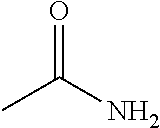
substitution and/or R4 and R6 are each, independently, H or an alcohol group. The compound can have the structure:

wherein R7 is a C1 to C20 linear or branched alkyl group comprising zero or more substitutions with any of O, N, OH or

In certain example aspects, the lixiviant in the leaching solution can be sulfuric acid or ammonia. The lixiviant can be sulfuric acid at a concentration of, for example, about 1 g/L to about 50 g/L, about 1 g/L to about 25 g/L, about 1 g/L to about 15 g/L, about 1 g/L to about 10 g/L, about 5 g/L to about 25 g/L. In certain aspects, the lixiviant can be at a concentration of about 10 g/L, or about 5 g/L to about 100 g/L, or about 5 g/L to about 50 g/L, or about 5 g/L to about 15 g/L of the leaching solution. The compound can be at a total concentration of about 10 ppm to about 1000 ppm, or about 20 ppm to about 500 ppm, or about 25 ppm to about 50 ppm, or about 5 ppm to about 50 ppm, or about 5 ppm to about 100 ppm, or about 15 ppm to about 30 ppm or about 25 ppm. The leaching solution can further include a metal selected from a group consisting of copper, gold, silver, nickel, zinc, molybdenum, vanadium, uranium, and combinations thereof.

R10CH2OC(O)C(SO3 −)CH2C(O)OCH2R11Na+ (XII),


In certain example aspects, where the compound is of formula (XIII), R12 can be a C1 to C8 linear or branched alkyl group. In other example aspects, the compound can have the following structure:

In yet further example aspects, the compound can have the following structure:

-
- Betaines
- Alkyl- and alkyl ether sulfates
- Sulfosuccinates, alkoxylates (e.g., alkoxylated polyols), sulfosuccinamides
- Acetylenic diols
- Amphoacetates/propionates
R((AO)nB)m((AO)nH)p (I)
R1C(CH2O)3 (II)
where R1 is H, methyl, ethyl, or propyl;
C(CH2O)4 (III);
OC(CH2O)2 (IV);
N(CH2CH2O)3 (V);
(R2)xN(CH2CH2O)y (VI)
where R2 is a C1-C4 alkyl, y is 1-3 and x+y=3;
O(CH2)rO (VII),
where r is 2 to 6; and
O(CH(CH3)CH2)O (VIII).

M1 a[M2(CN)b(A)c]d.h(H2O).eL.kP (A)
where
- M1 is at least one metal ion selected from the group consisting of Zn2+, Fe2+, Fe3+, Co3+, Ni2+, Mn2+, Co2+, Sn2+, Pb2+, Mo4+, Al3+, V4+, V5+, Sr2+, W4+, W6+, Cr2+, Cr3+, Cd2+, Hg2+, Pd2+, Pt2+, V2+, Mg2+, Ca2+, Ba2+, Cu2+, La3+, Ce3+, Eu3+, Ti3+, Ti4+, Ag+, Rh2+, Rh3+, Ru2+ and Ru3+,
- M2 is at least one metal ion selected from the group consisting of Fe2+, Fe3+, Co2+, Co3+, Mn2+, Mn3+, V4+, V5+, Cr2+, Cr3+, Rh3+, Ru2+ and Ir3+,
- A and X, independently of one another, are an anion selected from the group consisting of halide, hydroxide, sulfate, carbonate, cyanide, thiocyanate, isocyanate, cyanate, carboxylate, oxalate, nitrate, nitrosyl, hydrogen sulfate, phosphate, dihydrogen phosphate, hydrogen phosphate and bicarbonate,
- L is a water-miscible ligand selected from the group consisting of alcohols, aldehydes, ketones, ethers, polyethers, esters, polyesters, polycarbonate, ureas, amides, primary, secondary and tertiary amines, ligands comprising pyridine nitrogen, nitriles, sul?des, phosphides, phosphites, phosphanes, phosphonates and phosphates,
- k is a fraction or integer greater than or equal to zero and
- P is an organic additive,
- a, b, c, d, g and n are selected so that the electroneutrality of the compound (I) is ensured, it being possible for c to be 0,
- e, the number of ligand molecules, is a fraction or integer greater than 0 or is 0,
- f and h, independently of one another, are a fraction or integer greater than 0 or are 0.
R1—O—(CH2—CHR5—O—)_(CH2—CH2—O—)n(CH2—CHR6—O—)x(CH2—CHR2—O—)mH (B)
where


where R3 is a C1 to C20 linear or branched alkyl group comprising zero or more substitutions with any of O, N, OH or

R4 and R6 are each, independently, H, a C1 to C10 linear or branched alkyl group or an alcohol group, and R5 is a C1 to C10 linear or branched alkyl group. In the present disclosure, the term “alcohol group” means a C1 to Cx linear or branched alkyl group having an —OH functionality where x is an integer, for example, x can be from 2 to 10 or from 2 to 20.


substitution, and R4 and R6 can be, independently, H or an alcohol group. For example, the leaching solution can include a leaching aid having the following structure:

where R7 is a C1 to C20 linear or branched alkyl group comprising zero or more substitutions with any of O, N, OH or


where s and t are each, independently, an integer from 0 to 10 and R8 and R9 are each, independently, a C1 to C20 linear or branched alkyl group.
R10CH2OC(O)C(SO3 −)CH2C(O)OCH2R11Na+ (XII),
where R10 and R11 are each, independently, a C1 to C6 linear or branched alkyl group.

where R12 is a C1 to C6 linear or branched alkyl group.

wherein R13 is a C2 to C20 linear or branched alkyl group.
2RH+[M2+SO4 2−]=R2M+[2H+SO4 2−]
Vladimir S. Kislik, Solvent Extraction: Classical and Novel Approaches, p. 191.
| TABLE 1 |
| Distribution of particle sizes of copper ore in leach tests. |
| Particle Size Distribution |
| Crush Size P80 of 37.5 mm (1.5 inch) |
| Particle Size | Sample | Wt |
| mm | inch | (Kg) | (%) | ||
| 37.5 | 1½ | 18.0 | 20.0 | |
| 25 | 1 | 32.0 | 35.5 | |
| 19 | ¾ | 9.3 | 10.3 | |
| 12.5 | ½ | 7.7 | 8.6 | |
| 6.3 | ¼ | 7.4 | 8.2 | |
| 1.7 | 12 | 8.1 | 9.0 |
| minus | 7.6 | 8.4 | |||
| TABLE 2 |
| Application testing for organic reagents where system is spiked with |
| leaching aids. |
| Control | LA-A | LA-B | ||
| Extraction Kinetics 90s | 96.1% | 98.9% | 92.3% |
| Copper Extraction Eq. (g/L) | 4.685 | 4.674 | 4.619 |
| Strip Kinetics 90s | 99.60% | 99.30% | 99.80% |
| Copper Strip Eq (g/L) | 1.51 | 1.46 | 1.49 |
| Phase Disengagement (organic) | 54 | 202 | 61 |
| Phase Disengagement (aqueous) | 110 | 132 | 111 |
| TABLE 3 |
| Example 5 Results for the Leach Aid and Blank |
| Leach Aid | Blank | ||
| Pre QC | Organic break | 168 | 89 | ||
| | Aqueous Break | 104 | 60 | ||
| Extraction | Organic break | 60 | 69 | ||
| Aqueous Break | 176 | 133 | |||
| Strip | Organic break | 96 | 67 | ||
| Aqueous Break | 130 | 129 | |||
| Pre circuit ML | 11.644 | 11.66 | |||
| Post circuit ML | 11.74 | 11.73 | |||
| SO | 2.348 | 2.354 | |||
| E30 | 6.726 | 6.836 | |||
| E60 | 7.182 | 7.288 | |||
| E90 | 7.412 | 7.436 | |||
| E300 | 7.692 | 7.6 | |||
| S30 | 2.902 | 2.884 | |||
| S60 | 2.878 | 2.874 | |||
| S90 | 2.86 | 2.866 | |||
| S300 | 2.86 | 2.846 | |||
| E300 Fe | 0.0035 | 0.0034 | |||
| E30 kinetics | 87.4% | 89.9% | |||
| S30 kinetics | 99.1% | 99.2% | |||
| Cu/Fe | 2198 | 2235 | |||
| TABLE 4 |
| Example 5 Results for EVD 91216 (i.e., MC1000) and the Blank |
| EVD 91216 | Blank | delta (sec) | ||
| Pre QC | Organic break | 168 | 89 | 79 | |
| | Aqueous Break | 104 | 60 | 44 | |
| Extraction | Organic break | 60 | 69 | −9 | |
| Aqueous Break | 176 | 133 | 43 | ||
| Strip | Organic break | 96 | 67 | 29 | |
| Aqueous Break | 130 | 129 | 1 | ||
| TABLE 5 |
| Example 6 Results |
| Leach Aid | Blank | ||
| Organic break | 104 (C.T. 10 sec) | 52 | ||
| Aqueous Break | 117 | 120 | ||
| SO | 0.917 | 0.896 | ||
| E30 | 4.022 | 4.65 | ||
| E300 | 4.849 | 4.887 | ||
| S30 | 1.063 | 1.08 | ||
| S300 | 1.051 | 1.074 | ||
| E300 Fe | 0.0031 | 0.0024 | ||
| E30 kinetics | 82.9% | 95.2% | ||
| S30 kinetics | 98.9% | 99.4% | ||
| Cu/Fe | 1564 | 2036 | ||
| TABLE 6 |
| Results of quality control tests on MC1000 and TMP-7(EO). |
| TMP-7(EO) | MC1000 | |
| Test |
 |
 |
| Phase | Pass | Pass |
| Disengagement | ||
| Kinetics | Pass | Pass |
| Testing | ||
| Cu/Fe | Pass | Pass |
| Selectivity | ||
| Circuit Testing | Pass | Pass |
Claims (26)
R(AO)nB)m(AO)nH)p (I)
R1C(CH2O)3 (II)
wherein R1 is H, methyl, ethyl, or propyl;
C(CH2O)4 (III);
OC(CH2O)2 (IV);
N(CH2CH2O) (V)
(R2)xN(CH2CH2O)y (VI)
wherein R2 is a C1-C4 alkyl, y is 1-3 and x+y=3;
O(CH2)rO (VII),
wherein r is 2 to 6; and
O(CH(CH3)CH2)O (VIII); and

Priority Applications (1)
| Application Number | Priority Date | Filing Date | Title |
|---|---|---|---|
| US15/349,532 US10745778B2 (en) | 2015-12-07 | 2016-11-11 | Leaching aids and methods of using leaching aids |
Applications Claiming Priority (2)
| Application Number | Priority Date | Filing Date | Title |
|---|---|---|---|
| US201562264014P | 2015-12-07 | 2015-12-07 | |
| US15/349,532 US10745778B2 (en) | 2015-12-07 | 2016-11-11 | Leaching aids and methods of using leaching aids |
Publications (2)
| Publication Number | Publication Date |
|---|---|
| US20170159153A1 US20170159153A1 (en) | 2017-06-08 |
| US10745778B2 true US10745778B2 (en) | 2020-08-18 |
Family
ID=58798937
Family Applications (1)
| Application Number | Title | Priority Date | Filing Date |
|---|---|---|---|
| US15/349,532 Active 2038-03-17 US10745778B2 (en) | 2015-12-07 | 2016-11-11 | Leaching aids and methods of using leaching aids |
Country Status (15)
| Country | Link |
|---|---|
| US (1) | US10745778B2 (en) |
| EP (1) | EP3390676B1 (en) |
| CN (1) | CN108603243B (en) |
| AU (1) | AU2016369257B2 (en) |
| BR (1) | BR112018011536B1 (en) |
| CA (1) | CA3007545C (en) |
| CL (1) | CL2018001524A1 (en) |
| EA (1) | EA038541B1 (en) |
| ES (1) | ES2878201T3 (en) |
| MX (1) | MX395714B (en) |
| PE (1) | PE20241059A1 (en) |
| PL (1) | PL3390676T3 (en) |
| PT (1) | PT3390676T (en) |
| WO (1) | WO2017099941A1 (en) |
| ZA (1) | ZA201803563B (en) |
Cited By (5)
| Publication number | Priority date | Publication date | Assignee | Title |
|---|---|---|---|---|
| US11859263B2 (en) | 2016-10-19 | 2024-01-02 | Jetti Resources, Llc | Process for leaching metal sulfides with reagents having thiocarbonyl functional groups |
| US11884993B2 (en) | 2015-04-17 | 2024-01-30 | Jetti Resources, Llc | Process for leaching metal sulfides with reagents having thiocarbonyl functional groups |
| WO2024137042A1 (en) * | 2022-12-23 | 2024-06-27 | Basf Se | Compositions for leaching metal-sulfide-containing materials and methods of preparation and use thereof |
| US12247266B2 (en) | 2020-09-18 | 2025-03-11 | Jetti Resources, Llc | Extraction of base metals using carbonaceous matter and a thiocarbonyl functional group reagent |
| US12264381B2 (en) | 2020-09-18 | 2025-04-01 | Jetti Resources, Llc | Extracting base metals using a wetting agent and a thiocarbonyl functional group reagent |
Families Citing this family (11)
| Publication number | Priority date | Publication date | Assignee | Title |
|---|---|---|---|---|
| EP3864180A4 (en) * | 2018-10-12 | 2022-07-20 | Basf Se | Leaching aids and methods of using leaching aids |
| CN109022787B (en) * | 2018-11-05 | 2020-07-14 | 中南大学 | Method for extracting nickel and molybdenum from nickel-molybdenum ore acidic leaching solution |
| MX2022001113A (en) | 2019-08-28 | 2022-02-16 | Indorama Ventures Oxides Australia Pty Ltd | AGENTS FOR USE IN HYDROMETALLURGICAL PROCESS FLOWS. |
| CN110804622A (en) * | 2019-11-22 | 2020-02-18 | 山东大学 | Method for effectively improving ore leaching capacity of acidithiobacillus ferrooxidans |
| WO2024035752A2 (en) * | 2022-08-08 | 2024-02-15 | Colonial Chemical, Inc. | Environmentally-friendly surfactants for mineral beneficiation |
| CN115595438B (en) * | 2022-10-13 | 2024-08-16 | 中国科学院过程工程研究所 | A method for biological heap leaching of low-sulfur ores |
| WO2024081701A1 (en) * | 2022-10-14 | 2024-04-18 | Basf Se | Leaching aids and methods of preparation and use thereof |
| CN116043014B (en) * | 2023-02-09 | 2024-05-28 | 中国科学院过程工程研究所 | Method for combined leaching of ores |
| CN116516161A (en) * | 2023-04-06 | 2023-08-01 | 厦门稀土材料研究所 | A kind of environment-friendly non-cyanogen gold ore leaching agent and leaching method |
| CN116640925B (en) * | 2023-05-29 | 2026-02-17 | 福州大学 | A method for reducing the passivation effect on the surface of low-grade chalcocite using L-ascorbic acid |
| CN119614909B (en) * | 2024-11-22 | 2026-01-23 | 江西理工大学 | Method for promoting leaching of ionic rare earth ore |
Citations (21)
| Publication number | Priority date | Publication date | Assignee | Title |
|---|---|---|---|---|
| US3266889A (en) | 1964-04-07 | 1966-08-16 | British Columbia Res Council | Method of extracting metals from sulfide ores using bacteria and an accelerating agent |
| US4875935A (en) | 1988-11-04 | 1989-10-24 | Nalco Chemical Company | Anionic acrylamide polymers as copper ore agglomeration aids |
| US5112582A (en) | 1990-04-09 | 1992-05-12 | Betz Laboratories, Inc. | Agglomerating agents for clay containing ores |
| US5186915A (en) | 1989-03-20 | 1993-02-16 | Betz Laboratories, Inc. | Heap leaching agglomeration and detoxification |
| US5368745A (en) | 1993-09-02 | 1994-11-29 | Cytec Technology Corp. | Method of flocculating low metal oxide content solids in a liquid |
| US5472675A (en) | 1994-09-06 | 1995-12-05 | Betz Laboratories, Inc. | Polyvinyl alcohol agglomeration agents for mineral bearings ores |
| WO1997023281A1 (en) | 1995-12-21 | 1997-07-03 | Rhone-Poulenc Surfactants & Specialties, L.P. | Surfactant blend of organosilicone and surfactants useful as agricultural adjuvants |
| US5668219A (en) | 1994-09-06 | 1997-09-16 | Betzdearborn Inc. | Cationic block polymer agglomeration agents for mineral bearing ores |
| US5833937A (en) | 1997-10-17 | 1998-11-10 | Nalco Chemical Company | Polymeric combinations used as copper and precious metal heap leaching agglomeration aids |
| US6312500B1 (en) | 2000-03-30 | 2001-11-06 | Bhp Minerals International Inc. | Heap leaching of nickel containing ore |
| US6409799B1 (en) | 1998-11-19 | 2002-06-25 | Betzdearborn Inc. & Corporacion Nacional Del Cobre De Chile | Copper leach process aids |
| US20030192403A1 (en) | 2002-04-11 | 2003-10-16 | Paul Burgmayer | Drainage aid for metal heap leaching |
| US6833479B2 (en) * | 2002-08-16 | 2004-12-21 | Cognis Corporation | Antimisting agents |
| US20080025890A1 (en) | 2004-12-24 | 2008-01-31 | Hans-Peter Seelmann-Eggebert | Use of Surfactants in the Production of Metal |
| US20080264799A1 (en) | 2005-02-15 | 2008-10-30 | Basf Aktiengesellschaft | Use of Nonionic Surfactants in Extractive Metallurgy by Electrolysis |
| US20090078087A1 (en) | 2006-03-01 | 2009-03-26 | Basf Aktiengesellschaft Patents, Trademarks, And Licenses | Process for the acid digestion of metal-containing compounds |
| US8287616B2 (en) | 2004-12-24 | 2012-10-16 | Basf Aktiengesellschaft | Use of non-ionic surfactants in the production of metals |
| US8343326B2 (en) | 2006-10-06 | 2013-01-01 | Basf Corporation | Acid mist mitigation agents for electrolyte solutions |
| US8440857B2 (en) | 2006-10-06 | 2013-05-14 | Basf Corporation | Sulfonate- or sulfate-capped anti-misting agents |
| WO2014194268A1 (en) | 2013-05-30 | 2014-12-04 | The University Of Akron | Switchable antimicrobial and antifouling carboxybetaine-based hydrogels |
| US20160264792A1 (en) * | 2013-11-08 | 2016-09-15 | Sicpa Holding Sa | Salt-free composite marking based on chiral liquid crystal precursors comprising chiral acrylate dopants |
-
2016
- 2016-11-11 PE PE2023001519A patent/PE20241059A1/en unknown
- 2016-11-11 PL PL16873550T patent/PL3390676T3/en unknown
- 2016-11-11 CN CN201680081158.3A patent/CN108603243B/en active Active
- 2016-11-11 EP EP16873550.4A patent/EP3390676B1/en active Active
- 2016-11-11 CA CA3007545A patent/CA3007545C/en active Active
- 2016-11-11 AU AU2016369257A patent/AU2016369257B2/en active Active
- 2016-11-11 ES ES16873550T patent/ES2878201T3/en active Active
- 2016-11-11 WO PCT/US2016/061591 patent/WO2017099941A1/en not_active Ceased
- 2016-11-11 US US15/349,532 patent/US10745778B2/en active Active
- 2016-11-11 MX MX2018006972A patent/MX395714B/en unknown
- 2016-11-11 EA EA201891334A patent/EA038541B1/en unknown
- 2016-11-11 BR BR112018011536-3A patent/BR112018011536B1/en active IP Right Grant
- 2016-11-11 PT PT168735504T patent/PT3390676T/en unknown
-
2018
- 2018-05-29 ZA ZA2018/03563A patent/ZA201803563B/en unknown
- 2018-06-07 CL CL2018001524A patent/CL2018001524A1/en unknown
Patent Citations (25)
| Publication number | Priority date | Publication date | Assignee | Title |
|---|---|---|---|---|
| US3266889A (en) | 1964-04-07 | 1966-08-16 | British Columbia Res Council | Method of extracting metals from sulfide ores using bacteria and an accelerating agent |
| US4875935A (en) | 1988-11-04 | 1989-10-24 | Nalco Chemical Company | Anionic acrylamide polymers as copper ore agglomeration aids |
| US5186915A (en) | 1989-03-20 | 1993-02-16 | Betz Laboratories, Inc. | Heap leaching agglomeration and detoxification |
| US5112582A (en) | 1990-04-09 | 1992-05-12 | Betz Laboratories, Inc. | Agglomerating agents for clay containing ores |
| US5368745A (en) | 1993-09-02 | 1994-11-29 | Cytec Technology Corp. | Method of flocculating low metal oxide content solids in a liquid |
| US5472675A (en) | 1994-09-06 | 1995-12-05 | Betz Laboratories, Inc. | Polyvinyl alcohol agglomeration agents for mineral bearings ores |
| US5668219A (en) | 1994-09-06 | 1997-09-16 | Betzdearborn Inc. | Cationic block polymer agglomeration agents for mineral bearing ores |
| WO1997023281A1 (en) | 1995-12-21 | 1997-07-03 | Rhone-Poulenc Surfactants & Specialties, L.P. | Surfactant blend of organosilicone and surfactants useful as agricultural adjuvants |
| US5833937A (en) | 1997-10-17 | 1998-11-10 | Nalco Chemical Company | Polymeric combinations used as copper and precious metal heap leaching agglomeration aids |
| US6409799B1 (en) | 1998-11-19 | 2002-06-25 | Betzdearborn Inc. & Corporacion Nacional Del Cobre De Chile | Copper leach process aids |
| US6312500B1 (en) | 2000-03-30 | 2001-11-06 | Bhp Minerals International Inc. | Heap leaching of nickel containing ore |
| US20030192403A1 (en) | 2002-04-11 | 2003-10-16 | Paul Burgmayer | Drainage aid for metal heap leaching |
| US6833479B2 (en) * | 2002-08-16 | 2004-12-21 | Cognis Corporation | Antimisting agents |
| US20080025890A1 (en) | 2004-12-24 | 2008-01-31 | Hans-Peter Seelmann-Eggebert | Use of Surfactants in the Production of Metal |
| US7862785B2 (en) | 2004-12-24 | 2011-01-04 | Basf Aktiengesellschaft | Use of surfactants in the production of metal |
| US8287616B2 (en) | 2004-12-24 | 2012-10-16 | Basf Aktiengesellschaft | Use of non-ionic surfactants in the production of metals |
| US20080264799A1 (en) | 2005-02-15 | 2008-10-30 | Basf Aktiengesellschaft | Use of Nonionic Surfactants in Extractive Metallurgy by Electrolysis |
| US20090078087A1 (en) | 2006-03-01 | 2009-03-26 | Basf Aktiengesellschaft Patents, Trademarks, And Licenses | Process for the acid digestion of metal-containing compounds |
| US20110217222A1 (en) | 2006-03-01 | 2011-09-08 | Basf Se | Process for the acid digestion of metal-containing compounds |
| US8343326B2 (en) | 2006-10-06 | 2013-01-01 | Basf Corporation | Acid mist mitigation agents for electrolyte solutions |
| US20130056357A1 (en) | 2006-10-06 | 2013-03-07 | Cognis Ip Management Gmbh | Acid Mist Mitigation Agents for Electrolyte Solutions |
| US8440857B2 (en) | 2006-10-06 | 2013-05-14 | Basf Corporation | Sulfonate- or sulfate-capped anti-misting agents |
| US9074292B2 (en) | 2006-10-06 | 2015-07-07 | Basf Se | Acid mist mitigation agents for electrolyte solutions |
| WO2014194268A1 (en) | 2013-05-30 | 2014-12-04 | The University Of Akron | Switchable antimicrobial and antifouling carboxybetaine-based hydrogels |
| US20160264792A1 (en) * | 2013-11-08 | 2016-09-15 | Sicpa Holding Sa | Salt-free composite marking based on chiral liquid crystal precursors comprising chiral acrylate dopants |
Non-Patent Citations (7)
| Title |
|---|
| European Search Report for International Application No. 16873550.4 dated Jul. 2, 2019, 12 pgs. |
| International Search Report for PCT/US16/61591 dated Mar. 24, 2017, 10 pgs. |
| PubChem Substance Summary for CID 75844 Deposit , Dec. 4, 2001, pp. 1-14. |
| Wikipedia, "Hydroxy group" via https://en.wikipedia.org/wiki/Hydroxy_group ; pp. 1-2;; 2019. * |
| Wikipedia, "Hydroxy group," https://en.wikipedia.org/wiki/Hydroxy_group, 2019, pp. 1-2. |
| Wikipedia, "Parts-per notation" via https://en.wikipedia.org/wiki/Parts-per_notation ; pp. 1-8; 2019. * |
| Wikipedia, "Parts-per notion," via https://en.wikipedia.org/wiki/Parts-per_notion; 2019, pp. 1-8. |
Cited By (8)
| Publication number | Priority date | Publication date | Assignee | Title |
|---|---|---|---|---|
| US11884993B2 (en) | 2015-04-17 | 2024-01-30 | Jetti Resources, Llc | Process for leaching metal sulfides with reagents having thiocarbonyl functional groups |
| US12049681B2 (en) | 2015-04-17 | 2024-07-30 | Jetti Resources, Llc | Process for leaching metal sulfides with reagents having thiocarbonyl functional groups |
| US12049680B2 (en) | 2015-04-17 | 2024-07-30 | Jetti Resources, Llc | Process for leaching metal sulfides with reagents having thiocarbonyl functional groups |
| US11859263B2 (en) | 2016-10-19 | 2024-01-02 | Jetti Resources, Llc | Process for leaching metal sulfides with reagents having thiocarbonyl functional groups |
| US12416066B2 (en) | 2016-10-19 | 2025-09-16 | Jetti Resources, Llc | Process for leaching metal sulfides with reagents having thiocarbonyl functional groups |
| US12247266B2 (en) | 2020-09-18 | 2025-03-11 | Jetti Resources, Llc | Extraction of base metals using carbonaceous matter and a thiocarbonyl functional group reagent |
| US12264381B2 (en) | 2020-09-18 | 2025-04-01 | Jetti Resources, Llc | Extracting base metals using a wetting agent and a thiocarbonyl functional group reagent |
| WO2024137042A1 (en) * | 2022-12-23 | 2024-06-27 | Basf Se | Compositions for leaching metal-sulfide-containing materials and methods of preparation and use thereof |
Also Published As
| Publication number | Publication date |
|---|---|
| CL2018001524A1 (en) | 2018-09-21 |
| ES2878201T3 (en) | 2021-11-18 |
| EP3390676A4 (en) | 2019-07-31 |
| CN108603243A (en) | 2018-09-28 |
| CN108603243B (en) | 2021-03-12 |
| PE20241059A1 (en) | 2024-05-13 |
| EP3390676A1 (en) | 2018-10-24 |
| CA3007545C (en) | 2023-09-26 |
| EA201891334A1 (en) | 2019-01-31 |
| US20170159153A1 (en) | 2017-06-08 |
| PT3390676T (en) | 2021-06-22 |
| BR112018011536B1 (en) | 2022-05-03 |
| EA038541B1 (en) | 2021-09-13 |
| ZA201803563B (en) | 2021-03-31 |
| CA3007545A1 (en) | 2017-06-15 |
| MX395714B (en) | 2025-03-11 |
| WO2017099941A1 (en) | 2017-06-15 |
| BR112018011536A2 (en) | 2018-11-21 |
| AU2016369257B2 (en) | 2022-05-26 |
| PL3390676T3 (en) | 2021-10-18 |
| EP3390676B1 (en) | 2021-03-17 |
| MX2018006972A (en) | 2018-09-05 |
| AU2016369257A1 (en) | 2018-06-21 |
Similar Documents
| Publication | Publication Date | Title |
|---|---|---|
| EP3390676B1 (en) | Leaching aids and methods of using leaching aids | |
| EP4214343B1 (en) | Extracting base metals using a wetting agent and a thiocarbonyl functional group reagent | |
| AU2024220218B2 (en) | Extraction of base metals using carbonaceous matter and a thiocarbonyl functional group reagent | |
| CN107406909A (en) | Leaching agent for metal recovery | |
| US8435466B2 (en) | Methods of metal extraction from ammoniacal solutions using oximes | |
| EP1831414B1 (en) | Use of non-ionic surfactants in the production of metals | |
| US20210381079A1 (en) | Leaching aids and methods of using leaching aids | |
| WO2024137042A1 (en) | Compositions for leaching metal-sulfide-containing materials and methods of preparation and use thereof | |
| EP1834002B1 (en) | Use of surfactants in the production of metal | |
| WO2024081701A1 (en) | Leaching aids and methods of preparation and use thereof | |
| DE102004063501A1 (en) | Aqueous cyanide composition, useful in the preparation of metal, comprises a non-ionic surfactant with sodium hydroxide | |
| DE102005009574A1 (en) | Aqueous cyanide composition, useful in the preparation of metal, comprises a non-ionic surfactant with sodium hydroxide |
Legal Events
| Date | Code | Title | Description |
|---|---|---|---|
| AS | Assignment |
Owner name: BASF CORPORATION, NEW JERSEY Free format text: ASSIGNMENT OF ASSIGNORS INTEREST;ASSIGNORS:BENDER, JACK;HIGHT, LAUREN MICHELE;EMMERICH, NATHAN C.;REEL/FRAME:046509/0630 Effective date: 20180713 Owner name: BASF SE, GERMANY Free format text: ASSIGNMENT OF ASSIGNORS INTEREST;ASSIGNOR:BASF CORPORATION;REEL/FRAME:046509/0638 Effective date: 20180716 Owner name: BASF CORPORATION, NEW JERSEY Free format text: ASSIGNMENT OF ASSIGNORS INTEREST;ASSIGNOR:BREWER, RUSSELL VINCENT;REEL/FRAME:046509/0646 Effective date: 20110625 |
|
| STPP | Information on status: patent application and granting procedure in general |
Free format text: RESPONSE TO NON-FINAL OFFICE ACTION ENTERED AND FORWARDED TO EXAMINER |
|
| STPP | Information on status: patent application and granting procedure in general |
Free format text: NON FINAL ACTION MAILED |
|
| STPP | Information on status: patent application and granting procedure in general |
Free format text: RESPONSE TO NON-FINAL OFFICE ACTION ENTERED AND FORWARDED TO EXAMINER |
|
| STPP | Information on status: patent application and granting procedure in general |
Free format text: FINAL REJECTION MAILED |
|
| STPP | Information on status: patent application and granting procedure in general |
Free format text: ADVISORY ACTION MAILED |
|
| STPP | Information on status: patent application and granting procedure in general |
Free format text: DOCKETED NEW CASE - READY FOR EXAMINATION |
|
| STPP | Information on status: patent application and granting procedure in general |
Free format text: NOTICE OF ALLOWANCE MAILED -- APPLICATION RECEIVED IN OFFICE OF PUBLICATIONS |
|
| STPP | Information on status: patent application and granting procedure in general |
Free format text: PUBLICATIONS -- ISSUE FEE PAYMENT VERIFIED |
|
| STCF | Information on status: patent grant |
Free format text: PATENTED CASE |
|
| MAFP | Maintenance fee payment |
Free format text: PAYMENT OF MAINTENANCE FEE, 4TH YEAR, LARGE ENTITY (ORIGINAL EVENT CODE: M1551); ENTITY STATUS OF PATENT OWNER: LARGE ENTITY Year of fee payment: 4 |