US10744553B2 - Rolled stainless steel object and manufacturing method therefor - Google Patents
Rolled stainless steel object and manufacturing method therefor Download PDFInfo
- Publication number
- US10744553B2 US10744553B2 US15/735,535 US201515735535A US10744553B2 US 10744553 B2 US10744553 B2 US 10744553B2 US 201515735535 A US201515735535 A US 201515735535A US 10744553 B2 US10744553 B2 US 10744553B2
- Authority
- US
- United States
- Prior art keywords
- scratches
- polygons
- pattern
- stainless steel
- polygon
- Prior art date
- Legal status (The legal status is an assumption and is not a legal conclusion. Google has not performed a legal analysis and makes no representation as to the accuracy of the status listed.)
- Active, expires
Links
- 229910001220 stainless steel Inorganic materials 0.000 title claims abstract description 27
- 239000010935 stainless steel Substances 0.000 title claims abstract description 24
- 238000004519 manufacturing process Methods 0.000 title claims description 9
- 238000005096 rolling process Methods 0.000 claims abstract description 27
- 238000010183 spectrum analysis Methods 0.000 claims abstract description 14
- 239000002243 precursor Substances 0.000 claims description 8
- 238000000034 method Methods 0.000 claims description 5
- 238000005530 etching Methods 0.000 description 13
- 238000010586 diagram Methods 0.000 description 12
- 230000000694 effects Effects 0.000 description 5
- 238000000137 annealing Methods 0.000 description 4
- 238000005259 measurement Methods 0.000 description 3
- 239000000047 product Substances 0.000 description 3
- 239000011265 semifinished product Substances 0.000 description 3
- 238000007493 shaping process Methods 0.000 description 3
- 238000001228 spectrum Methods 0.000 description 3
- 239000002966 varnish Substances 0.000 description 3
- 229910000831 Steel Inorganic materials 0.000 description 2
- 238000004458 analytical method Methods 0.000 description 2
- 230000003666 anti-fingerprint Effects 0.000 description 2
- 239000011248 coating agent Substances 0.000 description 2
- 238000000576 coating method Methods 0.000 description 2
- 230000007423 decrease Effects 0.000 description 2
- 238000007373 indentation Methods 0.000 description 2
- 239000010959 steel Substances 0.000 description 2
- 208000012927 adermatoglyphia Diseases 0.000 description 1
- 238000003491 array Methods 0.000 description 1
- 238000005452 bending Methods 0.000 description 1
- 238000005253 cladding Methods 0.000 description 1
- 238000005520 cutting process Methods 0.000 description 1
- 238000009792 diffusion process Methods 0.000 description 1
- 230000002349 favourable effect Effects 0.000 description 1
- 235000019589 hardness Nutrition 0.000 description 1
- 230000001788 irregular Effects 0.000 description 1
- 238000010329 laser etching Methods 0.000 description 1
- 238000005498 polishing Methods 0.000 description 1
Images




Classifications
-
- B—PERFORMING OPERATIONS; TRANSPORTING
- B21—MECHANICAL METAL-WORKING WITHOUT ESSENTIALLY REMOVING MATERIAL; PUNCHING METAL
- B21H—MAKING PARTICULAR METAL OBJECTS BY ROLLING, e.g. SCREWS, WHEELS, RINGS, BARRELS, BALLS
- B21H8/00—Rolling metal of indefinite length in repetitive shapes specially designed for the manufacture of particular objects, e.g. checkered sheets
- B21H8/005—Embossing sheets or rolls
-
- B—PERFORMING OPERATIONS; TRANSPORTING
- B21—MECHANICAL METAL-WORKING WITHOUT ESSENTIALLY REMOVING MATERIAL; PUNCHING METAL
- B21H—MAKING PARTICULAR METAL OBJECTS BY ROLLING, e.g. SCREWS, WHEELS, RINGS, BARRELS, BALLS
- B21H8/00—Rolling metal of indefinite length in repetitive shapes specially designed for the manufacture of particular objects, e.g. checkered sheets
-
- B—PERFORMING OPERATIONS; TRANSPORTING
- B21—MECHANICAL METAL-WORKING WITHOUT ESSENTIALLY REMOVING MATERIAL; PUNCHING METAL
- B21B—ROLLING OF METAL
- B21B1/00—Metal-rolling methods or mills for making semi-finished products of solid or profiled cross-section; Sequence of operations in milling trains; Layout of rolling-mill plant, e.g. grouping of stands; Succession of passes or of sectional pass alternations
- B21B1/22—Metal-rolling methods or mills for making semi-finished products of solid or profiled cross-section; Sequence of operations in milling trains; Layout of rolling-mill plant, e.g. grouping of stands; Succession of passes or of sectional pass alternations for rolling plates, strips, bands or sheets of indefinite length
- B21B1/227—Surface roughening or texturing
-
- B—PERFORMING OPERATIONS; TRANSPORTING
- B21—MECHANICAL METAL-WORKING WITHOUT ESSENTIALLY REMOVING MATERIAL; PUNCHING METAL
- B21B—ROLLING OF METAL
- B21B3/00—Rolling materials of special alloys so far as the composition of the alloy requires or permits special rolling methods or sequences ; Rolling of aluminium, copper, zinc or other non-ferrous metals
- B21B3/02—Rolling special iron alloys, e.g. stainless steel
Definitions
- the present invention relates to the field of stainless steels in the form of rolled flat products, in particular strips, plates and sheets, or products cut and/or shaped from such strips, plates and sheets.
- Stainless steels are used in a large number of fields to form objects intended to remain visible and to have a clean surface appearance that is visually attractive through its brightness. This is in particular the case when they are used to manufacture furniture, household appliances, cutlery, building façade cladding, etc.
- the layer of varnish also must not be significantly deteriorated over the course of the use of the object, which is not guaranteed when the object may be subject to friction during use (for example, knives, kitchen work surfaces, etc.).
- the coating may be deteriorated if, after it is applied, the treated object must undergo shaping by stamping, bending or the like. Additionally, applying the coating only after shaping is not always possible or easy.
- the aim of the invention is to offer the manufacturers of stainless steel or stainless steel objects rolled products that are not sensitive to fingerprints, in a manner guaranteed to be sustainable, without overly affecting the production time and cost of the objects or semi-finished products from which they are derived.
- the invention relates to a rolled stainless steel object, characterized in that the surface thereof has a raised and indented pattern including a random juxtaposition of at least two types of polygons, each of said polygons having at least three sides, a surface area of between 1 and 9 mm 2 , and a difference between its smallest and largest dimensions of between 0.5 and 3 mm, each polygon being made up of substantially parallel rectilinear scratches, each separated by ⁇ 15° relative to the mean orientation of the scratches, having a depth of from 5 to 30 ⁇ m separated by ridge lines, and the axes of which are from 0.1 to 0.3 mm from each other, and a Fourier transform spectral analysis of which, carried out on a square of at least 100 mm 2 , shows that they have an isotropy of at least 40% between the rolling direction and the sideways direction, and two adjacent preferred angular orientations of which scratches, from among the three main preferred angular orientations thereof, are spaced apart by a minimum of 20° and
- the reference plane of each polygon is inclined relative to the reference planes of its adjacent polygons, from 1 to 10°.
- the spectral analysis of its surface has between three and eight preferred angular orientations.
- flanks of said scratches have curved surfaces and/or surfaces including unevenness.
- This may involve a sheet, plate or strip.
- the object may have been made by cutting and/or shaping a sheet, plate or strip of the preceding type, making up a precursor of said object.
- the invention also relates to a method for manufacturing an object of the preceding type, characterized in that said surface having said pattern is obtained during the rolling of the object, or a precursor of said object, by the pressure of a rolling cylinder on the surface of the object or its precursor, said cylinder in turn having, on its surface, a pattern making it possible to obtain said pattern on the surface of the object.
- the invention consists of imparting, during a rolling operation, on the surface of the object, or on the surface of a semi-finished product that will be a precursor for said object, an etched raised and indented pattern of a particular, well-defined type.
- This pattern is based on a random juxtaposition of at least two types of polygons, not necessarily regular, having at least three sides.
- the planes of the surfaces of adjacent polygons are preferably slightly inclined relative to one another.
- the polygons in turn each delimit an area where substantially parallel scratches with defined depths and widths are present.
- each polygon has a surface comprised between 1 and 9 mm 2 , a difference between their smallest dimension and their largest dimension comprised between 0.5 and 3 mm, and the reference plane of each polygon is inclined from 1 to 10° relative to that of its immediately adjacent polygons.
- Each polygon is made up of substantially parallel scratches, i.e., each separated by ⁇ 15° relative to the mean orientation of the scratches. They are from 5 to 30 ⁇ m deep and are separated by ridge lines. Their axes are separated by 0.1 to 0.3 mm.
- a Fourier transform spectral analysis of the surface of the object done on a square of at least 100 mm 2 , shows that it has an isotropy of at least 40% between the rolling direction and the crosswise direction, and among the three main preferred angular orientations determined by the spectral analysis, two adjacent orientations are spaced apart from 20 to 60°.
- the pattern printed on the surface of the object has between three and eight preferred angular orientations. Beyond eight such preferred orientations, it is no longer guaranteed that the angular deviation between two adjacent preferred orientations will still be sufficient for the desired effect of alleviating fingerprint marks to be correctly obtained.
- the depth of the scratches from 5 to 30 ⁇ m is justified by the fact that below 5 ⁇ m, the impression would be too difficult to perform and its result would in any case not be effective enough. Above 30 ⁇ m, the obtained anti-fingerprint effect is not significantly improved, and there is a risk of ending up with a sheet roughness that may be excessive for some applications. The etching of the roller cylinders with such a roughness level would also be problematic.
- the inventors have also tested other types of etching of the surface of stainless steel sheets.
- One example of another such type of etching will be described later.
- the type of etching according to the invention was the most suitable, among those tested, for giving the surface the isotropy and multidimensional reflection particularities that make it possible to best resolve the problem of fingerprint visibility.
- This impression is produced by the work cylinder of the roller, which comes into contact with the surface to be treated.
- This cylinder in turn has, on its surface, an etched pattern that is at least approximately the “negative” of the pattern that one wishes to etch on the surface of the object. It is necessary to roll without polishing; the indentations of the surface of the object are imparted by the corresponding raised portions arranged on the cylinder, and the raised portions of the surface of the object are imparted by the corresponding indentations arranged on the cylinder.
- the degree of identity between the dimensions of the patterns of the cylinder and the pattern to be imparted, in particular regarding the dimensions of the raised/indented parts of the cylinder, must be determined by experience, and may vary depending on the respective hardnesses of the surfaces of the cylinder and the surface to be treated and based on the intensity of the pressure applied to the surface by the cylinder.
- the roller can be of any known type, traditional with a pair of work cylinders and one or several pairs of support cylinders, or for example of the Sendzimir type, or a planetary-type roller.
- the cylinders in turn are etched using an industrial method such as laser etching, electro-erosion, etc.
- FIG. 1 and FIG. 2 which show the surface of an unetched stainless steel sheet of the prior art, and its spectral analysis diagram, using, as reference direction, the rolling direction ( FIG. 1 ) and the crosswise direction ( FIG. 2 );
- FIGS. 3 and 4 which show the surface of a stainless steel sheet etched in a manner not according to the invention, and its spectral analysis diagram, using the rolling direction as reference direction;
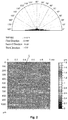
- FIGS. 5 to 7 which show examples of isolated polygons, belonging to etching done on a stainless steel sheet according to the invention, with their respective spectral analysis diagrams;
- FIG. 8 which shows a perspective view of an example surface portion of a stainless steel sheet etched according to the invention.
- FIGS. 9 to 12 which show top views of examples of stainless steel sheet surface portions etched according to the invention, with their respective spectral analysis diagrams;
- FIG. 13 which shows the surface of a reference stainless steel sheet with an unetched surface, on which a fingerprint is visible;
- FIG. 14 which shows, with the same magnification as FIG. 13 , the surface of a reference stainless steel sheet with a surface etched according to FIGS. 3 and 4 , on which a fingerprint is visible;
- FIG. 15 which shows, with the same magnification as FIG. 13 , the surface of a stainless steel sheet etched according to the invention, and on which a fingerprint is substantially not visible.
- FIGS. 1 and 2 show sample surfaces of a stainless steel sheet 1 rolled with stainless steel smooth work cylinders, as is typically the case, and which therefore did not have any particular etching.
- the surfaces of the sheet samples are themselves relatively smooth: only shallow (about 1 to 1.5 ⁇ m) and very narrow scratches can be seen, oriented cleanly along the rolling direction, and their Fourier transform spectral analysis diagrams, done using a traditional method (for example, see document “Techniques de l'In deepur, La transformée de Fourier et ses applications” [Engineering Techniques, The Fourier transform and its applications], 2007, vol. AFM3, AF1440-1443), are present.
- the analysis is done using, as reference orientation (90°), the rolling direction
- the analysis is done using, as reference orientation, the crosswise direction, i.e., the direction perpendicular to the rolling direction.
- the isotropy rate between rolling direction and crosswise direction is identical for both images, which is logical since it involves the same sheet, and is 11.6%. This is a low rate, which is normal, since no particular measures were taken in order for the effect of rolling of the sheet on the surface structure to be alleviated, this rolling being carried out in a clearly defined direction. This very low isotropy of the surface is a drawback for the visibility of fingerprints, since it favors the reflection of the light in clearly defined directions in which the fingerprint is particularly visible.
- the scratches have favored directions of 90.0°, 95.5° and 84.3° relative to the crosswise direction (the 0° and 180° angles corresponding to the two directions of the crosswise direction), which are therefore identical or very close to the rolling direction.
- FIGS. 3 and 4 show a sheet surface etched with a pattern not according to the invention. It includes raised parts according to two interleaved regular arrays.
- a first array oriented along the rolling direction, includes reliefs 2 with a height of 45 ⁇ m, and a substantially elliptical section whereof, at the base, the large axis measures 1.25 mm and the small axis measures 0.85 mm. They are positioned in staggered rows, along lines separated by 1.13 mm. The section of each raised part decreases gradually along the height of the raised part, and the apices of two adjacent raised parts 2 situated on a same line are separated by 2 mm.
- a second array oriented in the crosswise direction, includes raised parts 3 , inserted regularly between the raised parts 2 of the first array.
- the raised parts 3 have a height of 30 ⁇ m and a substantially elliptical section whereof, at the base, the large axis measures 0.88 mm and the small axis measures 0.57 mm. They are positioned in staggered rows, along lines separated by 1 mm. The section of each raised part decreases gradually according to the height of the raised part, and the apices of two adjacent raised parts 3 situated on a same line are separated by 2.26 mm.
- FIGS. 5 to 7 show the isolated polygon surfaces 4 belonging to a pattern imparted on the surface of the object, carried out according to the invention.
- these polygons 4 are, in the illustrated cases, irregular hexagons, within the limits of which rectilinear scratches 5 are arranged, which in turn are separated by ridge lines 6 .
- the axes of each scratch 5 are separated by about 0.2 mm in the illustrated example, and according to the invention, this distance may vary between 0.1 and 0.3 mm.
- the depth of the scratches 5 relative to the apices of the ridges 6 is about 20 ⁇ m in the illustrated example. According to the invention, it may be from 5 to 30 ⁇ m.
- FIGS. 5 to 7 also show the Fourier transform spectral analysis diagrams of the corresponding isolated polygon 4 .
- FIG. 5 shows a polygon 4 whereof the axis of the scratches 5 is oriented nearly parallel to the rolling direction.
- the isotropy rate between the rolling direction and the crosswise direction is 8.36%, and is therefore very low, reflecting a very pronounced orientation of the scratches as a whole.
- the main favored direction is in fact in the 99.1° direction relative to the crosswise direction, a second favored direction is in the 90° direction, and a third favored direction is in the 84.3° direction.
- FIG. 6 shows a polygon 4 identical to that of FIG. 3 , for which the axis of the scratches is oblique (about 45°) relative to the rolling direction.
- the isotropy rate is 4.92%.
- the main favored direction is in the 130° direction relative to the crosswise direction, a second favored direction is in the 136° direction, and a third favored direction is in the 123° direction.
- FIG. 7 shows a polygon 4 identical to that of FIG. 3 , for which the axis of the scratches 5 is substantially perpendicular to the rolling direction.
- the isotropy rate is 7.08%.
- the main favored direction is in the 0.0729° direction relative to the crosswise direction, a second favored direction is in the 171° direction, and a third favored direction is in the 166° direction.
- FIG. 8 shows a perspective view of a portion of the surface of a sheet 1 according to the invention, the surface of which has a random juxtaposition of polygons 4 as defined above.
- the contours and the orientations of the scratches of the different polygons 4 are quite varied, such that it must be expected that the isotropy rate of the surface as a whole will be relatively high, which is confirmed by the measurements that will be seen later.
- the polygons 4 are not all situated in the same plane, and that the reference planes of two adjacent polygons are inclined 5 by 1 to 10° relative to one another.
- FIG. 9 shows a top view of a 400 mm 2 portion of the surface of a sheet 1 according to the invention, with its Fourier transform spectral analysis diagram.
- the measurements of the isotropy rate between the rolling direction and the crosswise direction and preferred angular orientations are, like in FIGS. 1, 2 and 3 , done on the entire depicted surface, and not, as in FIGS. 5 to 7 , on isolated polygons.
- the isotropy is therefore substantially more pronounced, since the favored orientations of the scratches of the various polygons are quite varied: 40.3%.
- the scratches of the preferred orientations of the surface taken as a whole form a stack of six groups of scratches, these groups having clearly different main orientations.
- FIG. 10 shows another example surface of a sheet 1 according to the invention. Its isotropy is 53.3%, therefore even better than for the example of FIG. 7 . Seven favored orientations are visible on the spectrum, the three main ones of which are separated by 21.8° and 22.2° relative to their neighbor(s), as shown by the data from the diagram.
- FIG. 11 shows another example surface of a sheet 1 according to the invention. Its isotropy is 50.2%. Seven favored orientations are visible on the spectrum, the three main ones of which are separated by 22.8° and 30° relative to their neighbor(s), as shown by the data from the diagram.
- FIG. 12 shows another example surface of a sheet 1 according to the invention. It in particular shows a large number of polygons having four sides. Its isotropy is 60.5%, therefore even better than those of the other examples shown in FIGS. 7 to 9 . Seven favored orientations are visible on the spectrum, the three main ones of which are separated by 54° and 30° relative to their neighbor(s), as shown by the data from the diagram.
- FIG. 13 shows the smooth reference surface 7 of a sheet made from a stainless steel of type AISI 304 having undergone glossy annealing, on which a user has left a clearly visible fingerprint.
- FIG. 14 shows, with the same magnification as FIG. 13 , the surface 8 of a sheet made from a stainless steel of type AISI 304 having undergone glossy annealing, on which a user has also left a clearly visible fingerprint, although this surface 8 has etching according to that shown in FIGS. 3 and 4 . It is therefore clear that not any type of etching of the surface of the stainless steel sheet can resolve the problem of alleviating the visibility of fingerprints in a satisfactory manner.
- FIG. 15 shows, with the same magnification as FIG. 13 , the surface 9 of a stainless steel sheet of the same type as that of FIG. 13 and observed under the same lighting conditions, the surface of which is etched according to the present invention (this is the type of etching of FIG. 12 ) and on which a user has also placed a finger.
- this fingerprint is not visible as such, and is reflected only by the presence of a slightly darker zone, which is a sign of a slightly lower light reflection than on the remainder of the surface of the sheet.
- the aesthetic appearance of the surface 9 in particular its gloss, is therefore not substantially modified for a viewer looking at it from a typical distance.
- flanks of the scratches 5 are rectilinear, but to have a curved surface and/or, better still, unevenness. In this way, the diffusion of the light leaving the scratches 5 is more random, which accentuates the desired effect of alleviating the visibility of fingerprints.
- the invention may apply to all types of stainless steels, irrespective of their microstructure. It is particularly interesting to use for steels that undergo a glossy annealing, and on which fingerprints are most visible. However, steels treated by traditional annealing, and for which glossiness of the surface is also obtained, may also advantageously benefit from the invention.
Landscapes
- Engineering & Computer Science (AREA)
- Mechanical Engineering (AREA)
- Metal Rolling (AREA)
- ing And Chemical Polishing (AREA)
- Heat Treatment Of Sheet Steel (AREA)
Abstract
Description
Claims (6)
Applications Claiming Priority (1)
| Application Number | Priority Date | Filing Date | Title |
|---|---|---|---|
| PCT/IB2015/054390 WO2016198915A1 (en) | 2015-06-10 | 2015-06-10 | Rolled stainless steel object and manufacturing method therefor |
Publications (2)
| Publication Number | Publication Date |
|---|---|
| US20180169739A1 US20180169739A1 (en) | 2018-06-21 |
| US10744553B2 true US10744553B2 (en) | 2020-08-18 |
Family
ID=53525217
Family Applications (1)
| Application Number | Title | Priority Date | Filing Date |
|---|---|---|---|
| US15/735,535 Active 2036-02-08 US10744553B2 (en) | 2015-06-10 | 2015-06-10 | Rolled stainless steel object and manufacturing method therefor |
Country Status (12)
| Country | Link |
|---|---|
| US (1) | US10744553B2 (en) |
| EP (1) | EP3307452B1 (en) |
| JP (1) | JP2018516759A (en) |
| KR (1) | KR20180017030A (en) |
| CN (1) | CN107771106B (en) |
| CA (1) | CA2988850A1 (en) |
| ES (1) | ES2734802T3 (en) |
| MX (1) | MX2017015897A (en) |
| PL (1) | PL3307452T3 (en) |
| RU (1) | RU2679021C1 (en) |
| UA (1) | UA119505C2 (en) |
| WO (1) | WO2016198915A1 (en) |
Citations (14)
| Publication number | Priority date | Publication date | Assignee | Title |
|---|---|---|---|---|
| US2277725A (en) | 1939-07-04 | 1942-03-31 | Richard S Smith | Decorating metallic surfaces |
| US3956915A (en) | 1975-03-25 | 1976-05-18 | National Steel Corporation | Drawing and ironing container stock and manufacturing methods |
| JPH01118301A (en) | 1987-10-30 | 1989-05-10 | Kawasaki Steel Corp | Manufacture of dull finished austenitic stainless steel sheet having good finger mark stain resistance |
| JPH079007A (en) | 1993-06-22 | 1995-01-13 | Kawasaki Steel Corp | Dull-finished metal plate with inconspicuous fingerprints |
| JP2002361303A (en) | 2001-06-07 | 2002-12-17 | Sumitomo Metal Ind Ltd | Stainless steel plate with excellent stain resistance and corrosion resistance and its manufacturing method. |
| JP2004136344A (en) | 2002-10-18 | 2004-05-13 | Takasago Tekko Kk | Stainless steel sheet with fingerprint stain resistance |
| US20050000262A1 (en) | 2001-07-04 | 2005-01-06 | Blanco Gmbh + Co Kg | Method for producing a metal sheet, metal sheet and device for structuring the surface of a metal sheet |
| US20050066701A1 (en) | 2003-09-26 | 2005-03-31 | Halliday James W. | Method for making a metal sheet having a decorative pattern |
| JP2005131643A (en) | 2003-10-28 | 2005-05-26 | Takasago Tekko Kk | Stainless steel sheet having fine curved irregularities and method for producing the same |
| CN101509131A (en) | 2008-02-15 | 2009-08-19 | 宝山钢铁股份有限公司 | Anti-corrosion fingerprint-resistant surface treating pigment and producing method, and use method on stainless steel plate |
| JP2012130966A (en) | 2010-11-29 | 2012-07-12 | Nisshin Steel Co Ltd | Highly corrosion-resistant steel plate on which fingerprint and dirt are hardly conspicuous and method of manufacturing the same |
| CN103080385A (en) | 2010-08-30 | 2013-05-01 | Ak钢铁产权公司 | Galvanized carbon steel with stainless steel-like finish |
| JP2013244526A (en) | 2012-05-29 | 2013-12-09 | Nisshin Steel Co Ltd | Member for vehicle using steel plate having fingerprint and stain made hardly conspicuous |
| CN104626865A (en) | 2013-11-08 | 2015-05-20 | Lg电子株式会社 | Exterior decoration panel of household appliance and production device thereof |
Family Cites Families (1)
| Publication number | Priority date | Publication date | Assignee | Title |
|---|---|---|---|---|
| DE102008019768A1 (en) * | 2008-04-18 | 2009-10-22 | Hydro Aluminium Deutschland Gmbh | Method of making a tape for packaging |
-
2015
- 2015-06-10 WO PCT/IB2015/054390 patent/WO2016198915A1/en not_active Ceased
- 2015-06-10 KR KR1020177035513A patent/KR20180017030A/en not_active Withdrawn
- 2015-06-10 JP JP2017563607A patent/JP2018516759A/en active Pending
- 2015-06-10 CN CN201580080813.9A patent/CN107771106B/en not_active Expired - Fee Related
- 2015-06-10 PL PL15735737T patent/PL3307452T3/en unknown
- 2015-06-10 ES ES15735737T patent/ES2734802T3/en active Active
- 2015-06-10 EP EP15735737.7A patent/EP3307452B1/en active Active
- 2015-06-10 RU RU2017142707A patent/RU2679021C1/en active
- 2015-06-10 MX MX2017015897A patent/MX2017015897A/en unknown
- 2015-06-10 CA CA2988850A patent/CA2988850A1/en not_active Abandoned
- 2015-06-10 US US15/735,535 patent/US10744553B2/en active Active
- 2015-10-06 UA UAA201712062A patent/UA119505C2/en unknown
Patent Citations (16)
| Publication number | Priority date | Publication date | Assignee | Title |
|---|---|---|---|---|
| US2277725A (en) | 1939-07-04 | 1942-03-31 | Richard S Smith | Decorating metallic surfaces |
| US3956915A (en) | 1975-03-25 | 1976-05-18 | National Steel Corporation | Drawing and ironing container stock and manufacturing methods |
| JPH01118301A (en) | 1987-10-30 | 1989-05-10 | Kawasaki Steel Corp | Manufacture of dull finished austenitic stainless steel sheet having good finger mark stain resistance |
| JPH079007A (en) | 1993-06-22 | 1995-01-13 | Kawasaki Steel Corp | Dull-finished metal plate with inconspicuous fingerprints |
| JP2002361303A (en) | 2001-06-07 | 2002-12-17 | Sumitomo Metal Ind Ltd | Stainless steel plate with excellent stain resistance and corrosion resistance and its manufacturing method. |
| US20050000262A1 (en) | 2001-07-04 | 2005-01-06 | Blanco Gmbh + Co Kg | Method for producing a metal sheet, metal sheet and device for structuring the surface of a metal sheet |
| JP2004136344A (en) | 2002-10-18 | 2004-05-13 | Takasago Tekko Kk | Stainless steel sheet with fingerprint stain resistance |
| US20050066701A1 (en) | 2003-09-26 | 2005-03-31 | Halliday James W. | Method for making a metal sheet having a decorative pattern |
| JP2005131643A (en) | 2003-10-28 | 2005-05-26 | Takasago Tekko Kk | Stainless steel sheet having fine curved irregularities and method for producing the same |
| CN101509131A (en) | 2008-02-15 | 2009-08-19 | 宝山钢铁股份有限公司 | Anti-corrosion fingerprint-resistant surface treating pigment and producing method, and use method on stainless steel plate |
| CN103080385A (en) | 2010-08-30 | 2013-05-01 | Ak钢铁产权公司 | Galvanized carbon steel with stainless steel-like finish |
| JP2012130966A (en) | 2010-11-29 | 2012-07-12 | Nisshin Steel Co Ltd | Highly corrosion-resistant steel plate on which fingerprint and dirt are hardly conspicuous and method of manufacturing the same |
| JP5697098B2 (en) | 2010-11-29 | 2015-04-08 | 日新製鋼株式会社 | Highly corrosion-resistant steel plate with less noticeable fingerprints and dirt and method for producing the same |
| JP2013244526A (en) | 2012-05-29 | 2013-12-09 | Nisshin Steel Co Ltd | Member for vehicle using steel plate having fingerprint and stain made hardly conspicuous |
| CN104626865A (en) | 2013-11-08 | 2015-05-20 | Lg电子株式会社 | Exterior decoration panel of household appliance and production device thereof |
| EP2881194A1 (en) | 2013-11-08 | 2015-06-10 | LG Electronics Inc. | Exterior décor panel for home appliance and apparatus of manufacturing the same |
Also Published As
| Publication number | Publication date |
|---|---|
| EP3307452B1 (en) | 2019-04-10 |
| ES2734802T3 (en) | 2019-12-12 |
| KR20180017030A (en) | 2018-02-20 |
| CA2988850A1 (en) | 2016-12-15 |
| BR112017025833A2 (en) | 2018-08-14 |
| UA119505C2 (en) | 2019-06-25 |
| CN107771106A (en) | 2018-03-06 |
| EP3307452A1 (en) | 2018-04-18 |
| JP2018516759A (en) | 2018-06-28 |
| RU2679021C1 (en) | 2019-02-05 |
| US20180169739A1 (en) | 2018-06-21 |
| WO2016198915A1 (en) | 2016-12-15 |
| CN107771106B (en) | 2019-12-24 |
| MX2017015897A (en) | 2018-05-07 |
| BR112017025833A8 (en) | 2022-11-16 |
| PL3307452T3 (en) | 2019-12-31 |
Similar Documents
| Publication | Publication Date | Title |
|---|---|---|
| US5224978A (en) | Method for making hot rolled diffusing glazings | |
| KR102426299B1 (en) | High-strength anti-fingerprint glass, manufacturing method thereof, outer part of high-strength anti-fingerprint glass, and manufacturing method thereof | |
| JP2022132296A (en) | Input device cover member and input device | |
| CN102905806B (en) | Electro-optical or electromechanical structural element or sliding element | |
| EP3095882B1 (en) | Method for producing a stainless steel sheet with modified visual characteristics | |
| JP6799375B2 (en) | Manufacturing method and equipment for profile-formed metal strips | |
| CN112368247A (en) | Glass plate suitable for image display device | |
| US20050000262A1 (en) | Method for producing a metal sheet, metal sheet and device for structuring the surface of a metal sheet | |
| JPS59225829A (en) | Manufacture of sheet with no spike | |
| US20180169739A1 (en) | Rolled stainless steel object and manufacturing method therefor | |
| CN108927407B (en) | A kind of metal material with low waviness surface and its manufacturing method | |
| CN109047330A (en) | Method for processing sheet material | |
| JP2009516635A (en) | Method for marking surface of glass base material, base material thereof, and marking means thereof | |
| BR112017025833B1 (en) | LAMINATED STAINLESS STEEL OBJECT AND METHOD FOR MANUFACTURING AN OBJECT | |
| CN111266414B (en) | Method for controlling pattern depth on surface of stainless steel | |
| JP3638782B2 (en) | Embossed metal plate manufacturing method | |
| RU150088U1 (en) | DEVICE FOR STAMPING AND / OR SATINING PLANE MATERIAL AND METALIZED AND / OR REFLECTIVE PACKING FOIL | |
| JP5122741B2 (en) | System kitchen sink or counter | |
| CN109812251A (en) | A kind of rock core splitting device and its splitting method along intrinsic fracture splitting | |
| CN213506549U (en) | Calendering device of production single face fine hair AG glass | |
| CN117260006A (en) | A shell processing method, shell, and electronic equipment | |
| JPH021786B2 (en) | ||
| TW202506393A (en) | Embossed pvc tape | |
| JP2011125880A (en) | Stripe emboss steel sheet having excellent slidability | |
| KR20250098503A (en) | Continuous Forming Apparatus for Diamond Embossing Metal Coil |
Legal Events
| Date | Code | Title | Description |
|---|---|---|---|
| FEPP | Fee payment procedure |
Free format text: ENTITY STATUS SET TO UNDISCOUNTED (ORIGINAL EVENT CODE: BIG.); ENTITY STATUS OF PATENT OWNER: LARGE ENTITY |
|
| STPP | Information on status: patent application and granting procedure in general |
Free format text: DOCKETED NEW CASE - READY FOR EXAMINATION |
|
| STPP | Information on status: patent application and granting procedure in general |
Free format text: NON FINAL ACTION MAILED |
|
| STPP | Information on status: patent application and granting procedure in general |
Free format text: NOTICE OF ALLOWANCE MAILED -- APPLICATION RECEIVED IN OFFICE OF PUBLICATIONS |
|
| STPP | Information on status: patent application and granting procedure in general |
Free format text: NOTICE OF ALLOWANCE MAILED -- APPLICATION RECEIVED IN OFFICE OF PUBLICATIONS |
|
| AS | Assignment |
Owner name: APERAM, LUXEMBOURG Free format text: ASSIGNMENT OF ASSIGNORS INTEREST;ASSIGNORS:VIL, DIDIER;DAMASSE, JEAN MICHEL;HAEGELI, FRANCOISE;SIGNING DATES FROM 20171112 TO 20171121;REEL/FRAME:053163/0719 |
|
| STCF | Information on status: patent grant |
Free format text: PATENTED CASE |
|
| MAFP | Maintenance fee payment |
Free format text: PAYMENT OF MAINTENANCE FEE, 4TH YEAR, LARGE ENTITY (ORIGINAL EVENT CODE: M1551); ENTITY STATUS OF PATENT OWNER: LARGE ENTITY Year of fee payment: 4 |