US10726345B2 - Methods, processing engines, and microprocessors for classifying data according to decision trees - Google Patents
Methods, processing engines, and microprocessors for classifying data according to decision trees Download PDFInfo
- Publication number
- US10726345B2 US10726345B2 US15/878,888 US201815878888A US10726345B2 US 10726345 B2 US10726345 B2 US 10726345B2 US 201815878888 A US201815878888 A US 201815878888A US 10726345 B2 US10726345 B2 US 10726345B2
- Authority
- US
- United States
- Prior art keywords
- data
- decision tree
- processing engine
- look
- test
- Prior art date
- Legal status (The legal status is an assumption and is not a legal conclusion. Google has not performed a legal analysis and makes no representation as to the accuracy of the status listed.)
- Active, expires
Links
Images


Classifications
-
- G—PHYSICS
- G06—COMPUTING OR CALCULATING; COUNTING
- G06N—COMPUTING ARRANGEMENTS BASED ON SPECIFIC COMPUTATIONAL MODELS
- G06N20/00—Machine learning
-
- G—PHYSICS
- G05—CONTROLLING; REGULATING
- G05D—SYSTEMS FOR CONTROLLING OR REGULATING NON-ELECTRIC VARIABLES
- G05D1/00—Control of position, course, altitude or attitude of land, water, air or space vehicles, e.g. using automatic pilots
- G05D1/0088—Control of position, course, altitude or attitude of land, water, air or space vehicles, e.g. using automatic pilots characterized by the autonomous decision making process, e.g. artificial intelligence, predefined behaviours
-
- G—PHYSICS
- G06—COMPUTING OR CALCULATING; COUNTING
- G06F—ELECTRIC DIGITAL DATA PROCESSING
- G06F16/00—Information retrieval; Database structures therefor; File system structures therefor
- G06F16/20—Information retrieval; Database structures therefor; File system structures therefor of structured data, e.g. relational data
- G06F16/28—Databases characterised by their database models, e.g. relational or object models
- G06F16/284—Relational databases
- G06F16/285—Clustering or classification
-
- G—PHYSICS
- G06—COMPUTING OR CALCULATING; COUNTING
- G06F—ELECTRIC DIGITAL DATA PROCESSING
- G06F16/00—Information retrieval; Database structures therefor; File system structures therefor
- G06F16/90—Details of database functions independent of the retrieved data types
- G06F16/901—Indexing; Data structures therefor; Storage structures
- G06F16/9017—Indexing; Data structures therefor; Storage structures using directory or table look-up
-
- G—PHYSICS
- G06—COMPUTING OR CALCULATING; COUNTING
- G06F—ELECTRIC DIGITAL DATA PROCESSING
- G06F18/00—Pattern recognition
- G06F18/20—Analysing
- G06F18/24—Classification techniques
- G06F18/243—Classification techniques relating to the number of classes
- G06F18/24323—Tree-organised classifiers
-
- G06K9/00805—
-
- G06K9/00986—
-
- G06K9/6282—
-
- G—PHYSICS
- G06—COMPUTING OR CALCULATING; COUNTING
- G06N—COMPUTING ARRANGEMENTS BASED ON SPECIFIC COMPUTATIONAL MODELS
- G06N5/00—Computing arrangements using knowledge-based models
- G06N5/04—Inference or reasoning models
- G06N5/045—Explanation of inference; Explainable artificial intelligence [XAI]; Interpretable artificial intelligence
-
- G—PHYSICS
- G06—COMPUTING OR CALCULATING; COUNTING
- G06V—IMAGE OR VIDEO RECOGNITION OR UNDERSTANDING
- G06V10/00—Arrangements for image or video recognition or understanding
- G06V10/70—Arrangements for image or video recognition or understanding using pattern recognition or machine learning
- G06V10/764—Arrangements for image or video recognition or understanding using pattern recognition or machine learning using classification, e.g. of video objects
-
- G—PHYSICS
- G06—COMPUTING OR CALCULATING; COUNTING
- G06V—IMAGE OR VIDEO RECOGNITION OR UNDERSTANDING
- G06V10/00—Arrangements for image or video recognition or understanding
- G06V10/94—Hardware or software architectures specially adapted for image or video understanding
- G06V10/955—Hardware or software architectures specially adapted for image or video understanding using specific electronic processors
-
- G—PHYSICS
- G06—COMPUTING OR CALCULATING; COUNTING
- G06V—IMAGE OR VIDEO RECOGNITION OR UNDERSTANDING
- G06V20/00—Scenes; Scene-specific elements
- G06V20/50—Context or environment of the image
- G06V20/56—Context or environment of the image exterior to a vehicle by using sensors mounted on the vehicle
- G06V20/58—Recognition of moving objects or obstacles, e.g. vehicles or pedestrians; Recognition of traffic objects, e.g. traffic signs, traffic lights or roads
Definitions
- the present disclosure relates to the field of processing engines and methods for classifying data according to decision trees, and to applications thereof, including automobile driver assistance processing engines, and object recognition units.
- Decision trees are widely used in many fields of computation. In particular, they are useful for classifying data into various predefined types or classes, according to different characteristics of the data. For example and without limitation, in the field of advanced driving assistance and autonomous driving, it may be necessary or advantageous to classify different objects identified from a radar or video dataset, in order to determine the level of risk associated with each object. For instance it may be helpful to distinguish between a tree, a post-box, and a pedestrian: a tree may be assumed not to move once its location has been calculated; conversely, a pedestrian will require more detailed tracking as it is quite likely to move; moreover, a post-box may attract pedestrians towards it or may have pedestrians hidden from view behind it.
- a decision tree is in the field of in-line inspection in manufacture processes. It may be required to check part-manufactured or completed articles, for quality control. This may be done using sensors—typically including cameras for visual inspection but potentially including other sensor types—by sensing properties of the article as it moves along a conveyor belt. Various characteristics (colour, size, shape, weight, or the like) of the article are sensed, and a processing engine such as a microprocessor is used to assess the characteristics to confirm whether or not the article meets specified quality requirements. The assessment may be carried out for each article, from the various input data, using a decision tree.
- a processing engine for classifying data according to a decision tree having n-nodes, wherein each node is represented by a respective test according to which a flag may be set or unset comprising: a respective test unit having an output flag corresponding to each node and being configured to set or unset the respective output flag according to an output of the respective test; a memory configured to hold an n-bit word, each bit corresponding to a one of the respective output flag; and a data-structure configured as a look up table, each entry of the look up table representing a class of the data.
- the bits of the n-bit word may be determined in any sequence. This removes the requirement that the operations are carried out sequentially, and may provide for more flexible or distributed computation. In particular, it may result in improved or enhanced performance: conventional, typically pipelined, processing of decision trees does not cope well with changes to the processing flow, due to two issues, as will be described in more detail hereinbelow. Embodiments according to the present disclosure may not be affected by either of those issues.
- the look up table has 2 ⁇ n entries. It will be appreciated that the size of the look up table increases rapidly as the number of nodes increases—that is to say, it changes exponentially with the number of nodes. However, the number of tests which must be carried out increases only linearly with the number of nodes. Generally the throughput will be determined by the number of tests. The computational effort is thus still manageable even with a large decision tree, although the look up table may become relatively large, and determining the class of data from the lookup table becomes more onerous. Providing the lookup table with 2 ⁇ n entries results in a unique entry for each possible value of the n-bit word. The skilled person would appreciate that the look up table could have additional entries, although that would result in some level of obsolescence in the table. Fewer entries would require some additional computation prior to using the lookup table, and thus is not beneficial.
- the test units are distributed across a plurality of processing engines.
- the plurality of processing engines may be at least one of: a plurality of microprocessors, and a plurality of cores of a microprocessor. Since, according to processing engines and methods disclosed herein, the requirement that there is serial navigation through the decision tree has been relaxed or removed, the tests may be easily and conveniently distributed among multiple cores or multiple microprocessors, and in general among a plurality of processing engines.
- Such multiple cores or multiple microprocessors may include General Processing Units (GPUs) having several or many CUs Compute Units (CUs), and more generally, without limitation, include massively parallel systems.
- GPUs General Processing Units
- CUs Compute Units
- the decision tree has no sub-branches.
- the term “sub-branch” indicates that an individual node is not uniquely determinative of one class of the data: a node results in a sub-branch if, when implementing the decision tree in conventional fashion, at least one further test would be required before a specific class can be assigned to the data.
- every node will lead directly to one leaf and one other node. It will be appreciated that any improvement performance in such an architecture may be not be as significant as in an architecture which does have sub-branches. Indeed, in architectures without sub-branches, there may in some circumstance not be any performance improvement.
- the decision tree includes at least one sub-branch. From the discussion above it will be appreciated that processing engines and methods disclosed herein offer the potential for a greater performance improvement in such decision trees, and it is less likely that there would be a performance penalty, than for decision trees without any sub-branches.
- an object recognition unit including a processing engine as described above, and at least one surveillance device.
- a surveillance device may be, for instance and without limitation, an imaging device may be a camera for producing an optical image, a LIDAR (Light Detection And Ranging) device, or a RADAR (Radio Detection And Ranging) device.
- LIDAR Light Detection And Ranging
- RADAR Radio Detection And Ranging
- an automobile device for supporting at least one of advanced driver assistance and autonomous driving, comprising a surveillance unit, a processing engine as described above, and a response unit configured to, in response a classification determined by the processing engine, provide at least one of: an output indicative of a suggested driver response, and a vehicle response,
- a machine learning device comprising a processing engine as described above, and a learning unit configured to modify a part of the look up table.
- the tests are distributed across at least one of: a plurality of microprocessors, and a plurality of cores of a microprocessor.
- the decision tree has no sub-branches. In such embodiments, only one class of data appears only once in the lookup table. In other embodiments, the decision tree has one or more sub-branches, such that more than one class of data appears only once in the lookup table.
- the method is implemented in software, and the i-th test, (Ti) on the data (R) takes the form: ( F ( R,i )> ai )
- FIG. 1 illustrates a device according to one aspect of the present disclosure
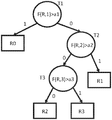
- FIG. 2 illustrates a decision tree having 3 nodes and 3 levels
- FIG. 3 shows a truth table corresponding to the decision tree of FIG. 2 ;
- FIG. 4 illustrates a decision tree having 4 nodes and 3 levels
- FIG. 5 shows a truth table corresponding to the decision tree of FIG. 3 ;
- FIG. 6 is a flow-diagram of a method according to an aspect of the present disclosure.
- FIG. 7 illustrates a device according to one or more embodiments of the present disclosure.
- FIG. 1 illustrates a device 100 according to various embodiments of the present disclosure.
- the device may be, for instance, an automobile device for supporting at least one of advanced driver assistance and autonomous driving, an object recognition unit or a machine learning device
- the processing engine 140 is configured to classify data, which classification is done using a decision tree.
- the processing engine may be hardware-based, for instance it may be implemented as a microprocessor, or may be substantially software-based.
- processing engine will be used to refer to either hardware or software implementation.
- the processing engine includes a plurality of n test units 150 , a memory 160 configured to hold an n-bit word, and a data structure configured as a look up table.
- Decision trees include multiple decision points or tests, generally referred to as nodes. Each test can result in only one of two outcomes, and so decision trees according to the present disclosure may also be referred to as binary decision trees. Depending on the specific implementation the possible outcome may be represented as, for instance, “1” or “0”, “true” or “false”, “yes” or “no”, or a flag being “set” or “unset”. Hereinunder the test outcome will be described as resulting in flag being set or unset, but it will be appreciated that the flag may be implemented in any of the above ways (logically, digital, etc.), depending on the application, and whether the implementation is software based or hardware based.
- conventional decision trees are processed serially. Since the route or path through the decision tree is not known a priori (otherwise the final result would be also pre-determined) the processor awaits the result of each test before moving on. Another characteristic of conventional decision trees is that the outcome of a specific test or node may result in processing moving to either another node, or to a final result. A final result is known as a leaf.
- Pipelined processors as used in conventional decision tree implementations operating at high frequencies, are rather bad whenever the processing flow changes: this is a direct consequence of the pipelining in combination with the high frequencies achieved. Fundamentally, there are two problems or issues which cause this:
- a sequence such as the following usually causes a “stall” (or pipeline bubble):
- a conditional branch i.e. a branch that cannot be evaluated immediately, that is to say in the first stage of the pipeline
- a conditional branch is generally a problem: consider a 6-stage pipeline, and assume that it takes until pipeline stage 5 until the conditions are known, i.e. it becomes clear only by stage 5, whether the branch should be taken. Whatever is then in stage 1-4 (i.e. the instructions coming after the branch) is potentially obsolete: if the branch is taken they are removed from the pipeline (i.e. there are now 4 empty slots in the pipeline).
- the only jump may be the look-up table process step.
- a first node T 1 , and all other nodes (T 2 ) except the final, lowest level, node T 3 are connected to one other node and to one result or leaf. That is to say, T 1 is connected to T 2 and leaf R 0 , T 2 is connected to T 3 and leaf R 1 .
- the final node T 3 is connected to two leaves, R 2 and R 3 .
- Such a tree is highly imbalanced. Evaluating data according to such a tree may require only one test to be evaluated, and intermediate number, or may require all tests to be evaluated.
- FIG. 4 A slightly more complex decision tree is illustrated in FIG. 4 .
- This tree includes one node, shown at T 1 , which cannot by itself determine a final result. Instead it is connected to two other nodes (T 2 and T 4 ).
- This decision tree is characterised by having four nodes (and 5 leaves), although it still only has three levels.
- each test may be characterised by whether a function meets a criterion.
- the decision tree may be used to classify whether the object is a post-box, for which one test may be whether an identified object has a straight edge (in which case it is more likely to be a post-box, than a pedestrian or a tree).
- Each test may thus be described as establishing whether a parameter (in this case, edge straightness), exceeds a threshold (in this case, linearity).
- the i-th node F tests whether parameter R,i exceeds a threshold ai: i.e. F ( R,i )> ai.
- each node is represented by a respective test according to which a flag may be set or unset, and for each node there is a respective test unit having an output flag.
- the test unit is configured to set or unset the respective output flag according to an output of the respective test.
- each of the flags may be considered as one of the bits of an n-bit word, where a set flag (that is to say, the test of that node yielding a positive result), corresponds to a “1” in that bit, and an unset flag corresponds to a “0” in that bit.
- the n-bit word may be held in a register, which could for instance and without limitation be a processor register.
- the n-bit word could be stored in a memory block, which could for instance be implemented as static RAM or dynamic RAM.
- each test unit may be associated with a specific bit in memory, the bits together comprising the n-bit word and forming the memory.
- the memory may be a processor register, which is particularly convenient whilst the individual tests are implemented, or may be other memory.
- a software the instruction set may be, (with T_1, T_2, T_3 being separate n-bit vectors, and Rout, the memory 160 ):
- T is the memory 160 , then that memory, or register, may be populated bit-by-bit, though a sequence of “OR” instructions (“
- ”):
- the n-bit word can take any of 2 ⁇ n values. So, for the decision tree shown in FIG. 2 , with 3 nodes, evaluating each of the tests results in a 3-bit word, which can take any of 8 values; similarly, for the decision tree shown in FIG. 3 , with 4 nodes, evaluating each of the tests results in a 4-bit word, which can take any of 16 values.
- the n-bit word encodes the results of the decision tree, as can be seen from FIGS. 3 (which illustrates a truth table according to the decision tree shown in FIG. 2 ), and 5 (which illustrates a truth table according to the decision tree shown in FIG. 4 ).
- FIG. 3 which illustrates a truth table according to the decision tree shown in FIG. 2 : the classification or result corresponding to any and all of the combinations of test results at each node are shown to the left, for each and every possible 8 value of the n-bit word.
- the skilled person will observe that there are more entries in the truth table that have a corresponding result or classification of R 0 , than have a result or classification of R 3 (and an intermediate number having classification R 1 ).
- FIG. 5 illustrates a truth table according to the decision tree shown in FIG. 4 .
- the classification or result corresponding to any and all of the 16 combinations of test results at each node are shown to the left of each and every possible value of the n-bit word.
- the table is (somewhat) more balanced that that shown in FIG. 3 , and there are is no individual test which uniquely identifies a result or specific classification.
- the truth table corresponding to the specific form (that is to say, topology) of the decision tree is stored in a data structure as a look-up table.
- FIG. 6 is a flow diagram of a method of classifying data according to a decision tree having n-nodes, according to the present disclosure, wherein each node is represented by a respective test according to which a flag may be set or unset.
- the method comprises, at 610 , setting or unsetting each flag by performing the respective test on the data.
- the individual tests 611 , 612 , . . . 614 do not require to be performed in any predetermined sequence, and the results do not require to be determined in any predetermined order.
- the method further comprises constructing an n-bit word, each bit corresponding to a one of the n flags, as shown at 620 .
- the bits do not required to be in a specific order. So, although in FIG. 6 the word is shown having a MSB (most significant bit), and LSB (least significant bit), any of the tests can be associated with any of the bits, provided there is a between one-to-one correspondence a specific node and a specific bit, which is thereafter retained.
- the method further comprises using a predetermined look up table to classify the data according to an entry in the look up table corresponding to the n-bit word.
- applications which may benefit from the present disclosure are diverse, and include assisted and automated driving, and various forms of machine vision.
- Often such applications require a training phase, during which the system is “trained” to recognise objects by presenting many thousands of instances of data for which classification is already known, determining the outputs of the decision tree, and adjusting the thresholds of the tests at the various nodes of the decision tree, such that the classification determined by the decision tree aligns with the actual known classification.
- processing engines and methods according to the present disclosure may be used during such a training phase. Indeed, embodiments may be particularly suited for such training, due to the large number of times the decision tree is used in training.
- the lookup table may require to be amended during, or as part of, the training scheme.
- a device 100 ′ comprising: a processing engine 140 ′ for classifying data according to a decision tree having n-nodes, wherein each node is represented by a respective test according to which a flag may be set or unset, and comprising a respective test unit 150 corresponding to each node, having an output flag and being configured to set or unset the respective output flag according to an output of the respective test; the device further comprising a memory 160 configured to hold an n-bit word, each bit corresponding to a one of the respective output flags; and a data-structure 170 configured as a look up table, each entry of the look up table representing a class of the data.
- the configuration of the different elements in such embodiments is the same as that shown in FIG. 1 , except that the memory 160 and the lookup table 170 are not integral to the processing engine 140 ′.
- the device may be, for instance, an object recognition unit, an automobile device, or a machine learning device.
- test units are distributed across one of: a plurality of processing elements; a plurality of microprocessors, and a plurality of cores of a microprocessor.
- the look up table has 2 ⁇ n entries.
- the decision tree includes at least one sub-branch.
- the disclosure further extends: to an object recognition unit including a device 100 ′ as described above, and at least one surveillance device; to an automobile device for supporting at least one of advanced driver assistance and autonomous driving, comprising a surveillance unit, device 100 ′ as described above, and a response unit configured to, in response a classification determined by the processing engine, provide at least one of: an output indicative of a suggested driver response, and a vehicle response; and to a machine learning device comprising a device 100 ′ as described above, and a learning unit configured to modify a part of the look up table.
Landscapes
- Engineering & Computer Science (AREA)
- Theoretical Computer Science (AREA)
- General Physics & Mathematics (AREA)
- Physics & Mathematics (AREA)
- Software Systems (AREA)
- Data Mining & Analysis (AREA)
- Evolutionary Computation (AREA)
- Artificial Intelligence (AREA)
- General Engineering & Computer Science (AREA)
- Databases & Information Systems (AREA)
- Computer Vision & Pattern Recognition (AREA)
- Medical Informatics (AREA)
- Multimedia (AREA)
- Computing Systems (AREA)
- Mathematical Physics (AREA)
- Health & Medical Sciences (AREA)
- General Health & Medical Sciences (AREA)
- Life Sciences & Earth Sciences (AREA)
- Bioinformatics & Cheminformatics (AREA)
- Bioinformatics & Computational Biology (AREA)
- Evolutionary Biology (AREA)
- Computational Linguistics (AREA)
- Traffic Control Systems (AREA)
- Radar, Positioning & Navigation (AREA)
- Game Theory and Decision Science (AREA)
- Aviation & Aerospace Engineering (AREA)
- Business, Economics & Management (AREA)
- Remote Sensing (AREA)
- Automation & Control Theory (AREA)
- Test And Diagnosis Of Digital Computers (AREA)
Abstract
Description
(F(R,i)>ai)
Ti=sign F(R,i)−ai)<<i
-
- CMP R0, R1 # compare instruction
- BEQ label0 # branch if equal.
F(R,i)>ai.
T_i=sign F(R,i)−ai)<<i
(where << is shift left in the relevant memory); to result in the relevant bit being set to “1”—if the test is positive, and “0” otherwise. The memory may be a processor register, which is particularly convenient whilst the individual tests are implemented, or may be other memory.
-
- [Compute_Value(F(R,1))]:
- T_1=sign(F(R,1)−a1)<<2
- [Compute_Value(F(R,2))]:
- T_2=sign(F(R,2)−a2)<<1
- [Compute_Value(F(R,3))]:
- T_3=sign(F(R,3)−a3)<<0
- [Combine]:
- Return Rout[T1 OR T2 OR T3]
- [Compute_Value(F(R,1))]:
-
- For i=0 to n−1:
- T|=sign(F(R,i)−ai)<<i−1
Claims (14)
(F(R,i)>ai).
T_i=sign F(R,i)−ai)<<i.
Applications Claiming Priority (3)
| Application Number | Priority Date | Filing Date | Title |
|---|---|---|---|
| EP17178311.1A EP3422245B1 (en) | 2017-06-28 | 2017-06-28 | Methods, processing engines, and microprocessors for classifying data according to decision trees |
| EP17178311.1 | 2017-06-28 | ||
| EP17178311 | 2017-06-28 |
Publications (2)
| Publication Number | Publication Date |
|---|---|
| US20190005396A1 US20190005396A1 (en) | 2019-01-03 |
| US10726345B2 true US10726345B2 (en) | 2020-07-28 |
Family
ID=59298196
Family Applications (1)
| Application Number | Title | Priority Date | Filing Date |
|---|---|---|---|
| US15/878,888 Active 2038-12-22 US10726345B2 (en) | 2017-06-28 | 2018-01-24 | Methods, processing engines, and microprocessors for classifying data according to decision trees |
Country Status (2)
| Country | Link |
|---|---|
| US (1) | US10726345B2 (en) |
| EP (1) | EP3422245B1 (en) |
Families Citing this family (5)
| Publication number | Priority date | Publication date | Assignee | Title |
|---|---|---|---|---|
| CN111126062B (en) * | 2019-12-25 | 2021-09-24 | 北京中技华软科技服务有限公司 | A kind of industry automatic classification method and system |
| US11502820B2 (en) * | 2020-05-27 | 2022-11-15 | International Business Machines Corporation | Privacy-enhanced decision tree-based inference on homomorphically-encrypted data |
| CN113126628A (en) * | 2021-04-26 | 2021-07-16 | 上海联适导航技术股份有限公司 | Method, system and equipment for automatic driving of agricultural machinery and readable storage medium |
| EP4315165A1 (en) * | 2021-05-10 | 2024-02-07 | Google LLC | Incorporation of decision trees in a neural network |
| US11886152B2 (en) | 2021-07-13 | 2024-01-30 | Rockwell Automation Technologies, Inc. | Automated monitoring and control using augmented streaming decision tree |
Citations (14)
| Publication number | Priority date | Publication date | Assignee | Title |
|---|---|---|---|---|
| US4571679A (en) * | 1983-09-06 | 1986-02-18 | The United States Of America As Represented By The Secretary Of The Navy | Fault tree data array |
| US4881230A (en) * | 1987-10-05 | 1989-11-14 | Ibm Corporation | Expert system for processing errors in a multiplex communications system |
| US5253333A (en) * | 1989-01-25 | 1993-10-12 | Hitachi, Ltd. | Attribute value predicting method and system in the learning system |
| US5497485A (en) * | 1993-05-21 | 1996-03-05 | Amalgamated Software Of North America, Inc. | Method and apparatus for implementing Q-trees |
| US5745601A (en) * | 1995-07-31 | 1998-04-28 | Neopath, Inc. | Robustness of classification measurement apparatus and method |
| US20050240924A1 (en) * | 2004-04-02 | 2005-10-27 | Emulex Design & Manufacturing Corporation | Prerequisite-based scheduler |
| US20090119392A1 (en) * | 2005-04-04 | 2009-05-07 | France Telecom | Method for managing decisions, method for constructing a decision tree, central manager, intermediate manager, terminal and corresponding computer program products |
| US20100094800A1 (en) | 2008-10-09 | 2010-04-15 | Microsoft Corporation | Evaluating Decision Trees on a GPU |
| US20130044924A1 (en) | 2011-08-17 | 2013-02-21 | Volcano Corporation | Classification Trees on GPGPU Compute Engines |
| US8856203B1 (en) | 2011-02-08 | 2014-10-07 | Pmc-Sierra Us, Inc. | System and method for algorithmic TCAM packet classification |
| US20150262064A1 (en) * | 2014-03-17 | 2015-09-17 | Microsoft Corporation | Parallel decision tree processor architecture |
| US20150262063A1 (en) * | 2014-03-17 | 2015-09-17 | Microsoft Corporation | Decision tree processors |
| US20150262062A1 (en) * | 2014-03-17 | 2015-09-17 | Microsoft Corporation | Decision tree threshold coding |
| US20160217386A1 (en) * | 2015-01-22 | 2016-07-28 | Tata Consultancy Services Limited | Computer implemented classification system and method |
-
2017
- 2017-06-28 EP EP17178311.1A patent/EP3422245B1/en active Active
-
2018
- 2018-01-24 US US15/878,888 patent/US10726345B2/en active Active
Patent Citations (14)
| Publication number | Priority date | Publication date | Assignee | Title |
|---|---|---|---|---|
| US4571679A (en) * | 1983-09-06 | 1986-02-18 | The United States Of America As Represented By The Secretary Of The Navy | Fault tree data array |
| US4881230A (en) * | 1987-10-05 | 1989-11-14 | Ibm Corporation | Expert system for processing errors in a multiplex communications system |
| US5253333A (en) * | 1989-01-25 | 1993-10-12 | Hitachi, Ltd. | Attribute value predicting method and system in the learning system |
| US5497485A (en) * | 1993-05-21 | 1996-03-05 | Amalgamated Software Of North America, Inc. | Method and apparatus for implementing Q-trees |
| US5745601A (en) * | 1995-07-31 | 1998-04-28 | Neopath, Inc. | Robustness of classification measurement apparatus and method |
| US20050240924A1 (en) * | 2004-04-02 | 2005-10-27 | Emulex Design & Manufacturing Corporation | Prerequisite-based scheduler |
| US20090119392A1 (en) * | 2005-04-04 | 2009-05-07 | France Telecom | Method for managing decisions, method for constructing a decision tree, central manager, intermediate manager, terminal and corresponding computer program products |
| US20100094800A1 (en) | 2008-10-09 | 2010-04-15 | Microsoft Corporation | Evaluating Decision Trees on a GPU |
| US8856203B1 (en) | 2011-02-08 | 2014-10-07 | Pmc-Sierra Us, Inc. | System and method for algorithmic TCAM packet classification |
| US20130044924A1 (en) | 2011-08-17 | 2013-02-21 | Volcano Corporation | Classification Trees on GPGPU Compute Engines |
| US20150262064A1 (en) * | 2014-03-17 | 2015-09-17 | Microsoft Corporation | Parallel decision tree processor architecture |
| US20150262063A1 (en) * | 2014-03-17 | 2015-09-17 | Microsoft Corporation | Decision tree processors |
| US20150262062A1 (en) * | 2014-03-17 | 2015-09-17 | Microsoft Corporation | Decision tree threshold coding |
| US20160217386A1 (en) * | 2015-01-22 | 2016-07-28 | Tata Consultancy Services Limited | Computer implemented classification system and method |
Non-Patent Citations (4)
| Title |
|---|
| Janssen, R. et al., "Hybrid Approach for Traffic Sign Recognition", Proceedings of the Intelligent Vehicles Symposium, Jan. 1, 1993, pp. 390-395, IEEE, Piscataway, NJ, USA. |
| Naji, Sinan A., "Human Face Detection From Color Images Based on Multi-Skin Models, Rule-Based Geometrical Knowledge, and Artificial Neural Networks", Thesis, University of Malaya, Kuala Lumpur, Jan. 1, 2013, pp. 1-346, retrieved from the Internet at http://studentsrepo.um.edu.my/5668/1/Thesis_Sinan_Naji_-_WHA040026_PHD_FSKTM_.pdf. |
| NXP/Freescale, "StarCore DSP, StarCore SC3900FP, Flexible vector processor," https://www.nxp.com/docs/en/brochure/BRSC3900DSPCORE.pdf, downloaded Jan. 23, 2018, 6 pages. |
| Tong et al., "High-throughput Traffic Classification on Multi-core Processors*", 2014 IEEE 15th International Conference on High Performance Switching and Routing (HPSR), 8 pages. |
Also Published As
| Publication number | Publication date |
|---|---|
| EP3422245A1 (en) | 2019-01-02 |
| EP3422245B1 (en) | 2022-02-16 |
| US20190005396A1 (en) | 2019-01-03 |
Similar Documents
| Publication | Publication Date | Title |
|---|---|---|
| US10726345B2 (en) | Methods, processing engines, and microprocessors for classifying data according to decision trees | |
| US11657267B2 (en) | Neural network apparatus, vehicle control system, decomposition device, and program | |
| CN110390248B (en) | Methods, devices, products and computer programs for operating a technical system | |
| US10977560B2 (en) | Efficient decision tree traversal in an adaptive boosting (AdaBoost) classifier | |
| CN111985458B (en) | Method for detecting multiple targets, electronic equipment and storage medium | |
| US20190012548A1 (en) | Unified deep convolutional neural net for free-space estimation, object detection and object pose estimation | |
| US20130034263A1 (en) | Adaptive Threshold for Object Detection | |
| US20230101250A1 (en) | Method for generating a graph structure for training a graph neural network | |
| EP3779799A1 (en) | Method and system for reliable classification using a neural network | |
| CN114973064B (en) | Pseudo tag frame generation method and device and electronic equipment | |
| US20200125107A1 (en) | Method And Device For Abstracting A Data Record | |
| CN110598837A (en) | Artificial neural network adjusting method and device | |
| US20070223785A1 (en) | Image processor and method | |
| CN112816959A (en) | Clustering method, device, equipment and storage medium for vehicles | |
| KR20200118351A (en) | System and method for data augmentation for trace dataset | |
| US12315225B2 (en) | Balancing multi-task learning through conditional or parallel batch mining | |
| US20240157969A1 (en) | Methods and systems for determining control decisions for a vehicle | |
| CN109901429B (en) | Delay control method, sampling control method and device and sampling system | |
| US20220222528A1 (en) | Method for Making a Neural Network More Robust in a Function-Specific Manner | |
| CN116778492A (en) | Card image recognition methods, devices, equipment and media | |
| US11912289B2 (en) | Method and device for checking an AI-based information processing system used in the partially automated or fully automated control of a vehicle | |
| CN112633352B (en) | A target detection method, device, electronic equipment and storage medium | |
| US20250284289A1 (en) | Method for Controlling a Robot Device | |
| CN117912028A (en) | Text recognition model training method, text recognition method and storage medium | |
| US20210089911A1 (en) | Method, computer system and computer program for controlling an actuator |
Legal Events
| Date | Code | Title | Description |
|---|---|---|---|
| AS | Assignment |
Owner name: NXP USA, INC., TEXAS Free format text: ASSIGNMENT OF ASSIGNORS INTEREST;ASSIGNORS:KRUTSCH, ROBERT;STAUDENMAIER, MICHAEL;HERRMANN, STEPHAN;SIGNING DATES FROM 20170809 TO 20171012;REEL/FRAME:044716/0412 |
|
| FEPP | Fee payment procedure |
Free format text: ENTITY STATUS SET TO UNDISCOUNTED (ORIGINAL EVENT CODE: BIG.); ENTITY STATUS OF PATENT OWNER: LARGE ENTITY |
|
| STPP | Information on status: patent application and granting procedure in general |
Free format text: DOCKETED NEW CASE - READY FOR EXAMINATION |
|
| STPP | Information on status: patent application and granting procedure in general |
Free format text: NON FINAL ACTION MAILED |
|
| STPP | Information on status: patent application and granting procedure in general |
Free format text: RESPONSE TO NON-FINAL OFFICE ACTION ENTERED AND FORWARDED TO EXAMINER |
|
| STPP | Information on status: patent application and granting procedure in general |
Free format text: NOTICE OF ALLOWANCE MAILED -- APPLICATION RECEIVED IN OFFICE OF PUBLICATIONS |
|
| STPP | Information on status: patent application and granting procedure in general |
Free format text: PUBLICATIONS -- ISSUE FEE PAYMENT VERIFIED |
|
| STCF | Information on status: patent grant |
Free format text: PATENTED CASE |
|
| MAFP | Maintenance fee payment |
Free format text: PAYMENT OF MAINTENANCE FEE, 4TH YEAR, LARGE ENTITY (ORIGINAL EVENT CODE: M1551); ENTITY STATUS OF PATENT OWNER: LARGE ENTITY Year of fee payment: 4 |