US10725974B2 - Systems, devices and methods for managing file system replication - Google Patents
Systems, devices and methods for managing file system replication Download PDFInfo
- Publication number
- US10725974B2 US10725974B2 US15/358,936 US201615358936A US10725974B2 US 10725974 B2 US10725974 B2 US 10725974B2 US 201615358936 A US201615358936 A US 201615358936A US 10725974 B2 US10725974 B2 US 10725974B2
- Authority
- US
- United States
- Prior art keywords
- file system
- file
- action
- actions
- execution
- Prior art date
- Legal status (The legal status is an assumption and is not a legal conclusion. Google has not performed a legal analysis and makes no representation as to the accuracy of the status listed.)
- Active, expires
Links
Images




Classifications
-
- G—PHYSICS
- G06—COMPUTING OR CALCULATING; COUNTING
- G06F—ELECTRIC DIGITAL DATA PROCESSING
- G06F16/00—Information retrieval; Database structures therefor; File system structures therefor
- G06F16/10—File systems; File servers
- G06F16/17—Details of further file system functions
- G06F16/178—Techniques for file synchronisation in file systems
-
- G—PHYSICS
- G06—COMPUTING OR CALCULATING; COUNTING
- G06F—ELECTRIC DIGITAL DATA PROCESSING
- G06F16/00—Information retrieval; Database structures therefor; File system structures therefor
- G06F16/10—File systems; File servers
- G06F16/11—File system administration, e.g. details of archiving or snapshots
- G06F16/122—File system administration, e.g. details of archiving or snapshots using management policies
Definitions
- This disclosure relates to file systems, and more particularly, to, devices, methods and computer-readable media for distributed file systems.
- Big data or geo-distributed applications can utilize distributed file systems across multiple data centers or locations. This may require the replication of files across different machines.
- a method for managing file system replication includes: collecting event data associated with file system events, each of the file system events indicative of a modification of at least one file at a first file system location; for each of the file system events, generating at least one file system action to apply the modification of the at least one file at the first file system location to at least one corresponding file at a second file system location; storing the at least one generated file system action in an action buffer; identifying dependencies between file system actions in the action buffer; and scheduling the file system actions in the action buffer for execution based on the dependencies.
- a system for managing file system replication includes: at least one processor.
- the at least one processor is configured for: receiving event data associated with file system events, each of the file system events indicative of a modification of at least one file at a first file system location; for each of the file system events, generating at least one file system action to apply the modification of the at least one file at the first file system location to at least one corresponding file at a second file system location; storing the at least one generated file system action in an action buffer; identifying dependencies between file system actions in the action buffer; and scheduling the file system actions in the action buffer for execution based on the dependencies.
- a non-transitory, computer-readable medium or media having stored thereon computer-readable instructions.
- the instructions which when executed by at least one processor, configure the at least one processor for: receiving event data associated with file system events, each of the file system events indicative of a modification of at least one file at a first file system location; for each of the file system events, generating at least one file system action to apply the modification of the at least one file at the first file system location to at least one corresponding file at a second file system location; storing the at least one generated file system action in an action buffer; identifying dependencies between file system actions in the action buffer; and scheduling the file system actions in the action buffer for execution based on the dependencies.
- FIG. 1 is a timeline of an example replication process.
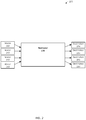
- FIG. 2 is a diagram showing aspects of an example computing system.
- FIG. 3 is a table showing examples of file system events and example corresponding actions.
- FIG. 4A shows an example difference list based on a snapshot of a source location and a destination location.
- FIG. 4B is a table showing example actions corresponding to the difference list of FIG. 4A .
- FIG. 5A is a diagram showing an example flow of file system events
- FIG. 5B is a diagram showing a flow of example corresponding file system actions.
- FIG. 6 is a flowchart showing aspects of an example method for managing file system replication.
- FIG. 7 is a flowchart showing aspects of an example control flow.
- FIGS. 8A and 8B show pseudocode of example action generator processes.
- FIGS. 9A and 9B show pseudocode of example ready filter processes.
- FIGS. 10A and 10B show pseudocode of example reorganization and batch optimization processes.
- FIGS. 11A and 11B show pseudocode of example execution scheduler report feedback processes.
- FIGS. 12 and 13 are timelines of example early start replication processes.
- FIG. 14 is a diagram showing aspects of an example system or machine.
- the management of distributed data systems can involve many different physical, logical and/or geographic machine locations. In some instances, this involves the replication of files across different machines, clusters or data centers.
- FIG. 1 shows a timeline of an example replication process.
- a file 105 is created 110 at a source location. After the file 105 has been created, it is closed at time t close .
- a distributed copy command is invoked on demand or based on a schedule. For example, after the file 105 is created and closed, the file system may be manually instructed to distribute the file 105 to a second location; or based on a regular schedule, the system may check for any closed files that have been modified and trigger a distributed copy command.
- files can be large, for example on the scale of multiple Gigabytes or Terabytes.
- the creation of such large files can result in a large delay 130 from t create to t close .
- the replication lag 140 (t close to t rep_start ), which may be dependent on network and system resources, is relatively small, the large creation time 130 can result in a large lag 150 between starting to create a file and starting its replication.
- replication of a large file can consume a lot of system and network resources. For example, memory and network capacities may be consumed by a single or a small number of large file replications. This may result in a queuing and delay of other replication tasks.
- the systems and methods described herein may manage file replications by monitoring file events. In some instances, this may allow for the separation of replication control flows and the data being replication. In some instances, some embodiments may allow for the replication of portions of a file before the file has been closed.
- FIG. 2 illustrates aspects of an example computing system 200 to which aspects of the present disclosure can be applied.
- the system includes one or more source locations 210 , and one or more destination locations 230 communicably connected to a replicator 220 .
- the source and destination locations 210 , 230 may be part of one or more distributed, clustered or other file systems involving the replication of files at different machines.
- source and destination locations may be part of different file systems.
- machines at source locations 210 generate event data associated with file system events modifying one or more files at the respective source locations 210 . These file system events are communicated to the replicator 220 . For each file system event communicated to the replicator, the replicator is configured to generate file system actions to be performed at one or more destination locations 230 to replicate the modification of the one or more files at the source location. The file system actions are scheduled and then communicated to the appropriate machines at destination locations 230 for execution.
- Source locations 210 and/or destination locations 230 can be at any machine including any device(s) and/or system(s) which can generate file system event data, and/or receive and process file system actions.
- a source machine location 210 and/or destination machine location 230 can include any device or system including or otherwise interacting with a data storage component that may be part of one or more distributed file systems.
- locations 210 , 230 in FIG. 2 are labelled as source and destination, machines at particular locations are not necessarily limited to source or destination roles.
- a machine or location which is a destination for one file replication process may be a source for another file replication process, and a machine or location which is a source for one file replication process may be a destination for another file replication process.
- source and destination locations 210 , 230 can include machines having any combination of hardware and software components.
- source/destination machines may include any individual or combinations of computing devices, processors, networks, memories, storage devices, network devices, and the like.
- source/destination machines may be or may include data centers, mainframes, racks, servers, virtual machines in the cloud, and the like.
- source/destination machines may be individual devices which are logically or physically part of data centers, mainframes, racks, servers, and the like.
- different source and/or destination machines may utilize different operating systems and/or file systems.
- the computing system 200 may include one or more processors in a single machine or split across any number of machines/devices in the computing system 200 . These processors can be configured to handle file system operations and communications in the computing system 200 .
- the computing system 200 includes a replicator 220 for managing files in a distributed file system which may be part of the computing system 200 .
- the replicator 220 is configured for receiving event data from source machine(s) 210 , and generating and scheduling file system actions for execution at destination machine(s) 230 .
- a replicator 220 is implemented as one or more processors running a replication service or other applications.
- the replicator 220 may be implemented on a separate server or other machine that is networked with the machines at the source and destination locations 210 , 230 .
- the replicator 220 may also be implemented on or within any suitable device(s) in the system 200 .
- the replicator 220 may be implemented on or within source machine(s) and/or destination machine(s).
- the replicator 220 may be distributed across a number of devices in the system.
- the functions or services provided by the replicator 220 may be distributed across processor(s) at any number of machines and locations in the system 200 .
- the machine locations 210 , 230 and replicator 220 may be connected via any suitable connections including over communication networks.
- machines and replicators 220 can be connected by one or more physical and/or logical networks and network devices, or interconnections within a data center/device/rack/etc.
- the computing system 200 may be configured to appear as a single file system interface to client devices which are accessing files at a source or destination machine.
- example embodiments described herein or otherwise may provide a solution for providing eventual file consistency between source and destination location(s).
- file system may be eventually synchronized while handling a potential continuum of events.
- FIG. 3 is a table 300 showing examples of file system events which may occur at a source machine and corresponding actions for replicating events at destination machine(s).
- “CreateEvent” represents an example file system event which creates a new file (such as “test.xml”) at a source machine.
- the corresponding “CreateAction” generated by the replicator includes an instruction to copy the file from the source machine to one or more destination machines that have been mapped or are otherwise configured to replicate files from the source machine.
- file system events include appending data to a file (“AppendEvent” which generates “AppendAction”), closing a file (“CloseEvent” which generates “CloseAction”), moving/renaming a file (“RenameEvent” which generates “RenameAction”), removing/deleting a file (“UnlinkEvent” which generates “UnlinkAction”), changing file permissions or other file metadata (“MetadataUpdateEvent” which generates “MetadataUpdateAction”), modifying a file (e.g. overwriting, random writing—not shown).
- file system events can include any event, such a file mutation or file modification event, which is indicative of the modification of data of at least one file at the source machine. In some embodiments, these events can trigger the generation of event data.
- events indicative of the modification of data of a file should be understood as including creating a new file, modifying the data of an existing file, adding to a file, truncating or shortening a file, deleting a file, copying a file, moving a file, etc.
- Modifying data of a file should also be understood as including modifying the file's contents and/or the file's metadata such as permissions, ownership, timestamps, etc.
- modifying a file should also be understood as including the modification of a directory irrespective of whether the machine's file system actually treats directories as a file.
- the modification of directories, paths, folders, etc. can, in some instances, require replication in a distributed file system, unless not applicable, references to the modification of file(s) should encompass directories and the like.
- modifying a file should be also understood as including modification of a link, device file, or any other type of file or file-like object.
- a single file system instruction can affect a single file.
- a create-file instruction may cause the creation of a single file which can be considered as a single file system event.
- batch, recursive, iterative, wildcard instructions and the like can affect multiple files.
- the system may consider these to be a number of single events each affecting a single file, or as one or more events affecting multiple files.
- the system's ability to handle multi-file events may depend on the ability of destination machines to handle corresponding actions generated by the duplicator.
- a single file system event can trigger the generation of multiple actions.
- actions can trigger the generation of subsequent actions.
- file system events can include system events which require the synchronization of two or more machines.
- system events may include a startup, reset, failure recovery, or network reconnection of a machine; a new file mapping to a machine; etc.
- the replicator upon receipt of event data indicating that one of these file system events has occurred, the replicator is configured to generate a series of actions to synchronize two or more machines.
- a synchronization action can include generating a file system snapshot of the files of the affected two (or more) mapped machines, determining a difference between the snapshots, and generating actions to replicate the changes.
- the replicator For example, if the system determines that the differences between the snapshot of the files at a source machine and a destination machine could have been caused by the example events 400 illustrated in FIG. 4A , the replicator generates the example actions 410 in FIG. 4B to synchronize the source and destination machines.
- file system events such as the startup of a machine may not actually require any synchronization if the starting up machine is up-to-date; however, because the file system may not be initially aware of the up-to-date status, such file system events are, in some embodiments, handled as being indicative of a modification of one or more files.
- file system events may occur concurrently and/or may occur in an order which may create dependencies between actions.
- FIG. 5A shows an example sequence of events 500 which occur at a source machine. Some of these events in different branches (as illustrated by the two arrow paths) may occur concurrently or otherwise independently of each other.
- the final RenameEvent 501 which renames file “conf.xml” to “test.xml” is only able to complete successfully because it occurs after RenameEvent 502 and UnlinkEvent 503 . Accordingly, the system and replicator are configured to handle dependencies between actions for replicating the events.
- FIG. 5B shows an example sequence of actions 510 which are generated by the replicator.
- actions may be rearranged and/or redundant or related actions may be pruned or condensed. In some instances, this may reduce the number of actions to be executed, which may reduce resource usage and/or replication times.
- FIG. 6 is a flowchart showing aspects of an example method 600 for managing file replication.
- one or more processors receive event data associated with one or more file system events. These events can include any file system command, operation, status change or the like which would require an action to be performed in order to maintain consistency of files between a first location and a second location.
- a file system event can be indicative of a modification of one or more files at a first location which would then have to be replicated at the second location to maintain consistency between files on the two machines.
- a file system event can include a new mapping between machines (e.g.
- a file location can include a file name, path name, network location, machine reference, link, IP or other address, and the like, or any combination thereof.
- event data can include one or more fields, flags, identifiers and the like.
- the event data can include data identifying event types/commands, filenames, file metadata and the like.
- event data can be generated at the source machine.
- the LinuxTM inotify subsystem, a file alteration monitor subsystem, Mac OS X FSEvents API, and the like may be used to monitor and/or generate event data.
- periodic or on-demand file system snapshots can be taken and compared to previous snapshots to identify changes to the file system and generate event data.
- a combination of file monitoring/notification systems and snapshot comparisons can be used.
- the processor(s) can receive, collect or otherwise obtain the event data from the source machine over a network or other connection. In embodiments where the processor(s) are at the source machine, they can receive or otherwise obtain the event data directly.
- the processor(s) generate one or more file system actions for each of the file system events associated with the received event data.
- the file system actions can include one or more file system commands, operations, or other data for instructing one or more processors in the system to perform to apply any modifications to file(s) at a source location to one or more destination location(s).
- a file system action is generated by converting event data. For example, a “CreateEvent” command which may create a new file at a source machine can be converted into a “CreateAction” command which may copy the new file at the source machine to the destination machine(s).
- a file system action is generated by mirroring event data. For example, a “RenameEvent” command which may rename a file at a source location but not change any of its contents can be mirrored with a “RenameAction” which renames the corresponding file at the destination location(s).
- a single event may trigger the generation of multiple actions.
- a file may have more than two copies at various locations in the system. This may require that a single event be replicated at multiple destination locations.
- the processor(s) generate multiple actions to replicate a particular event at each of the multiple destination locations.
- actions can include one or more operators, parameters, source(s), destination(s), fields, flags, identifiers, filenames, metadata and the like.
- actions include file location information identifying where the modified data can be accessed at the first machine.
- an action can include filenames, paths, network addresses, links, and the like.
- event data also includes file location information rather than including the actual data contents that have been modified.
- this may reduce the amount of memory required to buffer or otherwise store event and/or action data which it is being processed. In some instances, this may also reduce network utilization because the modified data is transferred directly from the source machine to the destination machine rather than from the source machine to the replicator, then from the replicator to the destination machine.
- this information when file metadata is the data being modified, this information may be included in event and/or action data.
- data for renaming a file or changing permissions may be included in event and/or action data.
- the processor(s) store the generated actions in an action buffer.
- the action buffer may be one or more memories, and may be in any suitable data structure or format.
- the action buffer may be ordered or may otherwise include timestamps, order positions, or other information for identifying the order in which actions were generated.
- the actions are ordered or otherwise stored so as to maintain dependencies or otherwise avoid the violation of dependencies between actions.
- the processor(s) schedule the actions in the action buffer for execution.
- the processor(s) schedule actions for execution based on any number of factors including resource availability, fairness algorithms between different machines/users/processes/etc., factors for increasing parallelism/throughput, and the like.
- the processors assign scheduled actions to one or more resources for executing the action. For example, actions may be assigned to processors, network resources, storage devices, and the like. In some embodiments, an action may be assigned particular ports, network bandwidth, storage device bandwidth, read/write permissions and the like.
- scheduling the actions in the action buffer includes identifying or otherwise determining which actions are ready for execution.
- an action is not available for scheduling if it has a dependency on an earlier action that has not been successfully executed. For example, an action to append data to the end of file “example.txt”, or to rename file “example.txt” would not be available for scheduling before a previous action which creates the “example.txt” file has completed.
- the processors are configured to identify dependencies when they are added to the action buffer. In other embodiments, dependencies can be identified before an action is scheduled for execution.
- the processors scan actions in the action buffer to determine whether a particular action is dependent on any actions which were added to the action buffer before the particular action. In some embodiments, this includes comparing filenames, links and/or other file identifiers included in the actions to identify actions which access or modify the same file. In some embodiments, determining dependencies also includes determining whether the action type creates a dependency or not.
- the processors are configured to store dependency information in a flag, link, parameter or the like in association with the corresponding actions. In some embodiments, as actions are completed or periodically, the processors can update the stored dependency information.
- the processor(s) are configured to schedule, for execution, actions which have no outstanding dependencies and/or are otherwise ready for execution.
- actions with no outstanding dependencies are those whose flags, links or other parameters indicate that the action has no dependencies.
- actions with no dependencies can be added, moved to, or otherwise stored in a ready-for-execution action buffer.
- the processors can select and schedule actions from this ready-for-execution action buffer.
- FIG. 7 shows a flowchart showing aspects of an example control flow 700 and an example system 701 for managing files in a distributed file system as described herein or otherwise.
- One or more processors in the system 701 are configured to implement an action generator 710 , a ready filter 720 and an execution scheduler 730 .
- the action generator 710 , ready filter 720 and/or the execution scheduler 730 may be part of a replicator 220 .
- FIG. 8A shows aspects of an example action generator process.
- the action generator 710 receives a stream of event data 751 from one or more machines in the system.
- the event data can be received at any time, for example, as events occur, periodically or with any other regular or irregular timing.
- the action generator 710 converts the event data or otherwise generates one or more actions which are added to a sequence of actions 752 (e.g. stored in an action buffer).
- the action generator updates actions already in the sequence of actions. In some embodiments, the updates are based on the type of action being generated.
- FIG. 8B shows aspects of some example processes for updating actions in an action buffer when a new action is a rename or unlink action. For example, if a rename event is received indicating that a particular file has been renamed, the action generator updates all actions which reference the particular file with its new name. In some instances, because the particular file can no longer be referenced by its previous name, this ensures that the actions in the action buffer can be executed properly. In another example, if an unlink event is received, all preceding create or append actions can be cancelled as the source file has been deleted by the source machine.
- a ready filter 720 filters or otherwise identifies which actions in the action buffer are ready for execution.
- the identified actions define a set of ready-to-run actions 753 .
- FIGS. 9A and 9B show aspects of an example ready filter process.
- the ready filter 720 parses through or otherwise determines the readiness of actions for execution.
- resolving the readiness of an action includes computing or otherwise identifying all actions in the action buffer which are related to a particular action. If the ready filter determines that the particular action has no precedence constraints from the related actions, the particular action is added to the set of ready-to-execute actions or is otherwise identified as being ready for execution.
- FIGS. 10A and 10B show aspects of action reorganization and batch optimization processes which, in some embodiments, can be applied to any of the example methods and systems described herein.
- processor(s) associated with the replicator, action generator or ready filter, or otherwise any processor(s) in the system 200 are configured to reorder, combine, eliminate or otherwise reorganize actions in the action buffer.
- the processor(s) may reorder actions based on available resources, to simplify the action buffer, or otherwise.
- the processor(s) may reorder actions to position non-data shipping actions (such as rename or unlink actions, which do not involve the transmission of file content data from the source location) before actions which involve the transmission of data from the source location to the destination location (e.g. create, append). In some instances, this may simplify/reduce the action buffer and/or reduce future readiness calculations.
- the processor(s) may combine, condense or eliminate related actions.
- related actions may include actions which involve at least one common file. For example, two sequential append actions on the same file may be combined into a single larger append action.
- a rename action from “FileA.txt” to “FileB.txt” and a subsequent rename action from “FileB.txt” to “FileC.txt” may be combined into a single rename action from “FileA.txt” to “FileC.txt”.
- an unlink action can condense, prune or otherwise eliminate previous actions because they may no longer be necessary if a file is to be ultimately deleted.
- the processor(s) may be configured to similarly reorder, combine or condense/eliminate any other series of suitable actions. In some instances, by reorganizing actions in the action buffer, the resources and/or time required to complete all of the actions may be reduced.
- reordering, combining, eliminating or otherwise reorganizing actions in the action buffer includes ensuring that the reorganization observes or otherwise avoids violating any action dependencies.
- the processor(s) can be configured to delay the scheduling of actions and/or the reorganization process until a batch optimization trigger is detected.
- the processor(s) detect a batch optimization trigger when the action buffer reaches or exceeds a defined size, after a defined time period has elapsed since the last scheduling/reorganization process has run, and/or when there are available resources to execute the actions.
- the execution scheduler 730 schedules ready-to-execute actions for execution with one or more execution resources 740 .
- the scheduled actions define a series of execution instructions 754 for execution at one or more assigned resources.
- FIG. 11A shows aspects of an example execution scheduling process.
- the processor(s) utilize one or more scheduling algorithms to schedule one or more actions which are identified by the system as ready-to-execute.
- the scheduling may attempt to maximize performance by selecting, scheduling and/or assigning actions to maintain or meet a defined maximum, average and/or otherwise targeted replication lag time.
- the scheduling may aim to maximize parallelism and/or maximize resource utilization.
- the scheduling may be based on fairness to particular machines, mappings, users and the like.
- the scheduling is based on available execution resources 740 .
- execution resource(s) communicate execution response messages 755 to the distributed file system processor(s).
- the execution response messages include data indicating whether an action was successfully executed.
- the execution response messages can include a flag or code which indicates a successful execution or one or more error codes.
- the processor(s) traverse or otherwise check the action buffer to identify or otherwise determine whether any actions in the action buffer are related to or otherwise require updating in view of an execution response message.
- the processor(s) update 756 the actions in the action buffer. In some embodiments, this can include updating both ready, and not ready-to-execute actions.
- FIG. 11B shows aspects of an example feedback/action buffer update process.
- updating the actions can include clearing or updating dependency fields, or otherwise resolving one or more dependencies for actions which were dependent on the completion of the successfully execution action.
- the processor(s) upon receipt of an unsuccessful response message, can attempt to identify a reason for the unsuccessful execution. In some embodiments, the processor(s) can add the unsuccessfully executed action back to the action buffer.
- the receipt and processing of response messages may, in some instances, allow the system to timely and/or accurately respond to execution results at destination locations.
- an event can trigger the generation of a sequence of actions.
- FIG. 12 shows a timeline 1200 including an example “early start” replication process 1202 which can begin before a source file is closed.
- a data-shipping event such as a create event or an append event can trigger a replication process which begins before the source file has been closed.
- the event data indicates that content data of a file at a source machine is being modified.
- the processor(s) upon receipt of event data identifying a data-shipping event (i.e. an event indicating that content data of one or more files at a source machine is being modified), the processor(s) generate a corresponding action (e.g. create or append) and initiate a thread or other process to monitor the current length of the file(s) being modified at the source machine.
- a copy chunk action is generated and/or is identified as ready for execution.
- file 105 is being created at a source machine.
- file 105 is shown with n chunks of uniform length.
- a thread or other process monitors the current length of the file.
- the processor(s) triggers the generation and/or readiness of a copy chunk action for copying chunk 0 to the destination machine.
- another copy chunk action is generated (e.g. to copy chunk 1 to the destination machine). In some embodiments, this process is repeated until close event data is received.
- the defined chunk size may be based on resource capabilities and/or may be a size selected to control or reduce replication lag times. In some embodiments, the defined chunk size may be selected to reduce resource blocking that may otherwise be caused by a large bulk file transfer.
- the early start process 1202 and/or chunk replication can enable a large file to be replicated much more quickly than a replication process (e.g. 120 ) which cannot start until the source file has been closed.
- the chunk replication of a file can also improve resource balancing between different file system events.
- FIG. 13 shows a timeline 1300 showing another example “early start” replication process 1302 which can begin before a source file is closed.
- chunks copied by different copy chunk actions can be different sizes.
- the processor(s) Upon receipt of event data indicating that content data of one or more files at a source location is being modified, the processor(s) generate an initial chunk copy action to copy the initially available modified data to the destination location. For example, in FIG. 13 , when the event data is processed, the file size of file 105 indicates that the chunk of modified data illustrated by chunk 0 is available for copying, and the processor(s) generate a copy chunk action to copy chunk 0 to the destination location.
- the processor(s) When an execution response message is received indicating that chunk 0 was successfully copied, the processor(s) generate a subsequent copy chunk action to copy the currently available and not yet copied portion of the modified data at the source location (e.g. chunk 1 of file 105 ). Depending on the replication lag and processing time, subsequent chunks may be different sizes. In some embodiments, this process is repeated until close event data is received. In some instances, this may require less monitoring of the length of the source file than the example process 1202 illustrated in FIG. 12 .
- FIG. 14 shows a schematic diagram of an example computing system 1400 or example machines 1401 for managing file system replication.
- the computing system 1400 or machines 1401 may include one or more processors 1401 , memory devices 1420 , input/output interfaces 1430 , input devices 1440 , storage devices 1450 and/or any other components or mechanisms suitable for or involved in performing aspects of the methods and functions described herein.
- the computing system 1400 may include one or more machines 1401 or systems which provide the mechanisms, controls, devices and/or communication links to perform aspects of the methods and functions described herein.
- the computing system 1400 may include one or more computers, servers and control devices configured for running file processes, reading or writing file data, sending communication messages, and controlling, monitoring or otherwise utilizing resources 1450 .
- an example machine 1401 or computing system 1400 may be a standalone computer, server, mobile device, mainframe, supercomputer, computing array or other computing device or devices configured for performing file system processes.
- storage devices 1450 can include any devices and/or media for storing files.
- Storage devices 1450 can include but are not limited to hard drives, solid state drives, magnetic tapes, disc drives, and/or any device suitable for the storage and retrieval of data.
- the storage devices 1450 may be accessed or monitored by client device(s) which may or may not be involved in the distributed file system replication processes.
- Each processor 1401 may be, for example, any type of microprocessor or microcontroller, a central or graphics processing unit, a digital signal processing (DSP) processor, an integrated circuit, a field programmable gate array (FPGA), a reconfigurable processor, or any combination thereof.
- DSP digital signal processing
- FPGA field programmable gate array
- Memory or storage devices 1420 may include one or a combination of any type of computer memory that is located either internally or externally (e.g., networked or peripheral), for example, hard drives, flash memory, solid state memory, network storage devices, random-access memory (RAM), cache memory, read-only memory (ROM), Blu-rayTM or compact disc read-only memory (CDROM), electro-optical memory, magneto-optical memory, erasable programmable read-only memory (EPROM), and electrically-erasable programmable read-only memory (EEPROM), Ferroelectric RAM (FRAM), non-transitory computer readable media or the like.
- RAM random-access memory
- ROM read-only memory
- CDROM compact disc read-only memory
- electro-optical memory magneto-optical memory
- EPROM erasable programmable read-only memory
- EEPROM electrically-erasable programmable read-only memory
- FRAM Ferroelectric RAM
- memory devices 1420 may include data or instruction sets for configuring one or more processors and other components of the machines 1401 or computing system 1400 to perform any of the methods and functions described herein.
- Some input/output (I/O) interfaces 1430 can enable a machine 1401 or system 1400 to interconnect with one or more input devices, such as a keyboard, mouse, camera, touch screen and a microphone, or with one or more output devices such as a display screen or a speaker.
- input devices such as a keyboard, mouse, camera, touch screen and a microphone
- output devices such as a display screen or a speaker.
- I/O interfaces 1430 can also include network interfaces which enable machines 1401 or aspects of the computing system 1400 to communicate with other components, to exchange data with other components, to access and connect to network resources, to serve applications, and to perform other computing applications by connecting to one or more wired or wireless networks capable of carrying data including the Internet, Ethernet, plain old telephone service (POTS) line, public switched telephone network (PSTN), integrated services digital network (ISDN), digital subscriber line (DSL), coaxial cable, fiber optics, satellite, mobile, wireless (e.g., Wi-Fi, WiMAX), SS7 signaling network, BluetoothTM, near field communication (NFC), fixed line, local area network, wide area network, busses and others, including any combination of these.
- POTS plain old telephone service
- PSTN public switched telephone network
- ISDN integrated services digital network
- DSL digital subscriber line
- coaxial cable fiber optics
- satellite mobile
- wireless e.g., Wi-Fi, WiMAX
- SS7 signaling network e.g., Wi-
- machines 1401 and/or computing system 1400 may include input or output devices such as keyboard, mouse, camera, touch screen, microphone, displays, etc.
- a computing device or printing device may include a keypad, touchscreen, or other integrated, peripheral or linked input or output device.
- the input devices may be configured to receive instructions to access or modify files, or to change file system parameters.
- the output devices may be configured to display or otherwise output file system information.
- Embodiments disclosed herein may be implemented using hardware, software or some combination thereof. Based on such understandings, the technical solution may be embodied in the form of a software product.
- the software product may be stored in a non-volatile or non-transitory storage medium, which can be, for example, a compact disk read-only memory (CD-ROM), USB flash disk, a removable hard disk, flash memory, hard drive, or the like.
- the software product includes a number of instructions that enable a computing device (computer, server, mainframe, or network device) to execute the methods provided herein.
- Program code may be applied to input data to perform the functions described herein and to generate output information.
- the output information is applied to one or more output devices.
- the communication interface may be a network communication interface.
- the communication interface may be a software communication interface, such as those for inter-process communication.
- there may be a combination of communication interfaces implemented as hardware, software, and/or combination thereof.
- Each computer program may be stored on a storage media or a device (e.g., ROM, magnetic disk, optical disc), readable by a general or special purpose programmable computer, for configuring and operating the computer when the storage media or device is read by the computer to perform the procedures described herein.
- a storage media or a device e.g., ROM, magnetic disk, optical disc
- Embodiments of the system may also be considered to be implemented as a non-transitory computer-readable storage medium, configured with a computer program, where the storage medium so configured causes a computer to operate in a specific and predefined manner to perform the functions described herein.
- Non-transitory computer-readable media may include all computer-readable media, with the exception being a transitory, propagating signal.
- the term non-transitory is not intended to exclude computer readable media such as primary memory, volatile memory, RAM and so on, where the data stored thereon may only be temporarily stored.
- the computer useable instructions may also be in various forms, including compiled and non-compiled code.
- the present disclosure may make numerous references to servers, services, interfaces, portals, platforms, or other systems formed from hardware devices. It should be appreciated that the use of such terms is deemed to represent one or more devices having at least one processor configured to execute software instructions stored on a computer readable tangible, non-transitory medium.
- inventive subject matter is considered to include all possible combinations of the disclosed elements.
- inventive subject matter is also considered to include other remaining combinations of A, B, C, or D, even if not explicitly disclosed.
- the embodiments described herein are implemented by physical computer hardware embodiments.
- the embodiments described herein provide useful physical machines and particularly configured computer hardware arrangements of computing devices, servers, processors, memory, networks, for example.
- the embodiments described herein, for example, are directed to computer apparatuses, and methods implemented by computers through the processing and transformation of electronic data signals.
- the embodiments described herein may involve computing devices, servers, receivers, transmitters, processors, memory(ies), displays, networks particularly configured to implement various acts.
- the embodiments described herein are directed to electronic machines adapted for processing and transforming electromagnetic signals which represent various types of information.
- the embodiments described herein pervasively and integrally relate to machines and their uses; the embodiments described herein have no meaning or practical applicability outside their use with computer hardware, machines, a various hardware components.
- Substituting the computing devices, servers, receivers, transmitters, processors, memory, display, networks particularly configured to implement various acts for non-physical hardware, using mental steps for example, may substantially affect the way the embodiments work.
Landscapes
- Engineering & Computer Science (AREA)
- Theoretical Computer Science (AREA)
- Data Mining & Analysis (AREA)
- Databases & Information Systems (AREA)
- Physics & Mathematics (AREA)
- General Engineering & Computer Science (AREA)
- General Physics & Mathematics (AREA)
- Information Retrieval, Db Structures And Fs Structures Therefor (AREA)
- Retry When Errors Occur (AREA)
Abstract
Description
Claims (21)
Priority Applications (4)
| Application Number | Priority Date | Filing Date | Title |
|---|---|---|---|
| US15/358,936 US10725974B2 (en) | 2016-11-22 | 2016-11-22 | Systems, devices and methods for managing file system replication |
| CN201780038609.XA CN109792453B (en) | 2016-11-22 | 2017-10-11 | System, apparatus and method for managing file system replication |
| PCT/CN2017/105694 WO2018095152A1 (en) | 2016-11-22 | 2017-10-11 | Systems, devices and methods for managing file system replication |
| EP17874847.1A EP3535955B1 (en) | 2016-11-22 | 2017-10-11 | Systems, devices and methods for managing file system replication |
Applications Claiming Priority (1)
| Application Number | Priority Date | Filing Date | Title |
|---|---|---|---|
| US15/358,936 US10725974B2 (en) | 2016-11-22 | 2016-11-22 | Systems, devices and methods for managing file system replication |
Publications (2)
| Publication Number | Publication Date |
|---|---|
| US20180143996A1 US20180143996A1 (en) | 2018-05-24 |
| US10725974B2 true US10725974B2 (en) | 2020-07-28 |
Family
ID=62147016
Family Applications (1)
| Application Number | Title | Priority Date | Filing Date |
|---|---|---|---|
| US15/358,936 Active 2037-03-13 US10725974B2 (en) | 2016-11-22 | 2016-11-22 | Systems, devices and methods for managing file system replication |
Country Status (4)
| Country | Link |
|---|---|
| US (1) | US10725974B2 (en) |
| EP (1) | EP3535955B1 (en) |
| CN (1) | CN109792453B (en) |
| WO (1) | WO2018095152A1 (en) |
Families Citing this family (5)
| Publication number | Priority date | Publication date | Assignee | Title |
|---|---|---|---|---|
| WO2021102715A1 (en) | 2019-11-27 | 2021-06-03 | Beiersdorf Daily Chemical (Wuhan) Co. Ltd. | A conditioning composition |
| WO2021102714A1 (en) | 2019-11-27 | 2021-06-03 | Beiersdorf Daily Chemical (Wuhan) Co., Ltd. | A conditioning composition |
| US11468017B2 (en) * | 2020-07-24 | 2022-10-11 | Capital Thought Holdings L.L.C. | Data storage system and method |
| US11636069B2 (en) * | 2020-07-24 | 2023-04-25 | Capital Thought Holdings L.L.C. | Data storage system and method |
| CN114564632A (en) * | 2022-02-18 | 2022-05-31 | 北京圣博润高新技术股份有限公司 | Document operation behavior auditing method and device, electronic equipment and storage medium |
Citations (15)
| Publication number | Priority date | Publication date | Assignee | Title |
|---|---|---|---|---|
| US5666532A (en) | 1994-07-26 | 1997-09-09 | Novell, Inc. | Computer method and apparatus for asynchronous ordered operations |
| US20030126247A1 (en) * | 2002-01-02 | 2003-07-03 | Exanet Ltd. | Apparatus and method for file backup using multiple backup devices |
| US20040064488A1 (en) * | 2002-09-30 | 2004-04-01 | Dinesh Sinha | Real time optimized backup of computer data |
| CN1852209A (en) | 2006-05-31 | 2006-10-25 | 北京和利时系统工程股份有限公司 | Remote process transfering method and system in distribution type control system |
| US20070061379A1 (en) * | 2005-09-09 | 2007-03-15 | Frankie Wong | Method and apparatus for sequencing transactions globally in a distributed database cluster |
| CN102063306A (en) | 2011-01-06 | 2011-05-18 | 夏春秋 | Technical implementation method for application development through electronic form |
| US20120023369A1 (en) * | 2010-07-21 | 2012-01-26 | International Business Machines Corporation | Batching transactions to apply to a database |
| US20120185447A1 (en) * | 2011-01-14 | 2012-07-19 | Symantec Corporation | Systems and Methods for Providing Increased Scalability in Deduplication Storage Systems |
| US20130282785A1 (en) | 2012-04-23 | 2013-10-24 | Google, Inc. | Sharing and synchronizing electronically stored files |
| EP2701083A1 (en) | 2012-08-24 | 2014-02-26 | Samsung Electronics Co., Ltd | Method, apparatus and system for auto-synchronization of compressed content files |
| US20140372376A1 (en) | 2013-06-13 | 2014-12-18 | Box, Inc. | Systems and methods for synchronization event building and/or collapsing by a synchronization component of a cloud-based platform |
| CN105045820A (en) | 2015-06-25 | 2015-11-11 | 浙江立元通信技术股份有限公司 | Method for processing video image information of mass data and database system |
| CN105306581A (en) | 2015-11-11 | 2016-02-03 | 上海斐讯数据通信技术有限公司 | Router and cloud disk based data synchronization method |
| US20170031946A1 (en) * | 2015-07-31 | 2017-02-02 | Atlantis Computing, Inc. | Method and apparatus for maintaining data consistency in an in-place-update file system with data deduplication |
| US9740413B1 (en) * | 2015-03-30 | 2017-08-22 | EMC IP Holding Company LLC | Migrating data using multiple assets |
-
2016
- 2016-11-22 US US15/358,936 patent/US10725974B2/en active Active
-
2017
- 2017-10-11 WO PCT/CN2017/105694 patent/WO2018095152A1/en not_active Ceased
- 2017-10-11 EP EP17874847.1A patent/EP3535955B1/en active Active
- 2017-10-11 CN CN201780038609.XA patent/CN109792453B/en active Active
Patent Citations (15)
| Publication number | Priority date | Publication date | Assignee | Title |
|---|---|---|---|---|
| US5666532A (en) | 1994-07-26 | 1997-09-09 | Novell, Inc. | Computer method and apparatus for asynchronous ordered operations |
| US20030126247A1 (en) * | 2002-01-02 | 2003-07-03 | Exanet Ltd. | Apparatus and method for file backup using multiple backup devices |
| US20040064488A1 (en) * | 2002-09-30 | 2004-04-01 | Dinesh Sinha | Real time optimized backup of computer data |
| US20070061379A1 (en) * | 2005-09-09 | 2007-03-15 | Frankie Wong | Method and apparatus for sequencing transactions globally in a distributed database cluster |
| CN1852209A (en) | 2006-05-31 | 2006-10-25 | 北京和利时系统工程股份有限公司 | Remote process transfering method and system in distribution type control system |
| US20120023369A1 (en) * | 2010-07-21 | 2012-01-26 | International Business Machines Corporation | Batching transactions to apply to a database |
| CN102063306A (en) | 2011-01-06 | 2011-05-18 | 夏春秋 | Technical implementation method for application development through electronic form |
| US20120185447A1 (en) * | 2011-01-14 | 2012-07-19 | Symantec Corporation | Systems and Methods for Providing Increased Scalability in Deduplication Storage Systems |
| US20130282785A1 (en) | 2012-04-23 | 2013-10-24 | Google, Inc. | Sharing and synchronizing electronically stored files |
| EP2701083A1 (en) | 2012-08-24 | 2014-02-26 | Samsung Electronics Co., Ltd | Method, apparatus and system for auto-synchronization of compressed content files |
| US20140372376A1 (en) | 2013-06-13 | 2014-12-18 | Box, Inc. | Systems and methods for synchronization event building and/or collapsing by a synchronization component of a cloud-based platform |
| US9740413B1 (en) * | 2015-03-30 | 2017-08-22 | EMC IP Holding Company LLC | Migrating data using multiple assets |
| CN105045820A (en) | 2015-06-25 | 2015-11-11 | 浙江立元通信技术股份有限公司 | Method for processing video image information of mass data and database system |
| US20170031946A1 (en) * | 2015-07-31 | 2017-02-02 | Atlantis Computing, Inc. | Method and apparatus for maintaining data consistency in an in-place-update file system with data deduplication |
| CN105306581A (en) | 2015-11-11 | 2016-02-03 | 上海斐讯数据通信技术有限公司 | Router and cloud disk based data synchronization method |
Also Published As
| Publication number | Publication date |
|---|---|
| EP3535955A4 (en) | 2019-09-25 |
| EP3535955B1 (en) | 2020-12-02 |
| EP3535955A1 (en) | 2019-09-11 |
| CN109792453B (en) | 2021-02-09 |
| WO2018095152A1 (en) | 2018-05-31 |
| US20180143996A1 (en) | 2018-05-24 |
| CN109792453A (en) | 2019-05-21 |
Similar Documents
| Publication | Publication Date | Title |
|---|---|---|
| US12578871B2 (en) | Data management system | |
| US11663085B2 (en) | Application backup and management | |
| CN103608786B (en) | Manage replicated virtual storage at the recovery site | |
| US10372547B1 (en) | Recovery-chain based retention for multi-tier data storage auto migration system | |
| EP3535955B1 (en) | Systems, devices and methods for managing file system replication | |
| US12008011B2 (en) | Computing resource migration across cloud environments | |
| US12216550B2 (en) | Automatic backup distribution for clustered databases | |
| US10628298B1 (en) | Resumable garbage collection | |
| US11755384B2 (en) | Scaling virtualization resource units of applications | |
| US20230046983A1 (en) | Snapshot shipping to multiple cloud destinations | |
| US20230289216A1 (en) | Dynamic management of version dependencies for executing parallel workloads |
Legal Events
| Date | Code | Title | Description |
|---|---|---|---|
| AS | Assignment |
Owner name: HUAWEI TECHNOLOGIES CO., LTD., CHINA Free format text: ASSIGNMENT OF ASSIGNORS INTEREST;ASSIGNORS:CHEN, CHEN;CHEN, JIN;KE, XIAODI;AND OTHERS;REEL/FRAME:040408/0315 Effective date: 20161122 |
|
| STPP | Information on status: patent application and granting procedure in general |
Free format text: RESPONSE TO NON-FINAL OFFICE ACTION ENTERED AND FORWARDED TO EXAMINER |
|
| STPP | Information on status: patent application and granting procedure in general |
Free format text: FINAL REJECTION MAILED |
|
| STPP | Information on status: patent application and granting procedure in general |
Free format text: NON FINAL ACTION MAILED |
|
| STPP | Information on status: patent application and granting procedure in general |
Free format text: RESPONSE TO NON-FINAL OFFICE ACTION ENTERED AND FORWARDED TO EXAMINER |
|
| STPP | Information on status: patent application and granting procedure in general |
Free format text: NOTICE OF ALLOWANCE MAILED -- APPLICATION RECEIVED IN OFFICE OF PUBLICATIONS |
|
| STPP | Information on status: patent application and granting procedure in general |
Free format text: PUBLICATIONS -- ISSUE FEE PAYMENT VERIFIED |
|
| STCF | Information on status: patent grant |
Free format text: PATENTED CASE |
|
| AS | Assignment |
Owner name: HUAWEI CLOUD COMPUTING TECHNOLOGIES CO., LTD., CHINA Free format text: ASSIGNMENT OF ASSIGNORS INTEREST;ASSIGNOR:HUAWEI TECHNOLOGIES CO., LTD.;REEL/FRAME:059267/0088 Effective date: 20220224 |
|
| MAFP | Maintenance fee payment |
Free format text: PAYMENT OF MAINTENANCE FEE, 4TH YEAR, LARGE ENTITY (ORIGINAL EVENT CODE: M1551); ENTITY STATUS OF PATENT OWNER: LARGE ENTITY Year of fee payment: 4 |