US10723716B2 - Alpha-helix mimetics as modulators of Abeta self-assembly - Google Patents
Alpha-helix mimetics as modulators of Abeta self-assembly Download PDFInfo
- Publication number
- US10723716B2 US10723716B2 US15/851,367 US201715851367A US10723716B2 US 10723716 B2 US10723716 B2 US 10723716B2 US 201715851367 A US201715851367 A US 201715851367A US 10723716 B2 US10723716 B2 US 10723716B2
- Authority
- US
- United States
- Prior art keywords
- adh
- hydrocarbon
- compounds
- amyloid
- iapp
- Prior art date
- Legal status (The legal status is an assumption and is not a legal conclusion. Google has not performed a legal analysis and makes no representation as to the accuracy of the status listed.)
- Active
Links
- 0 *C1=C(C)C(C)=C(C(=O)CC2=C(C)C(C)=C(C(=O)CC3=C(C)C(C)=C(B)N=C3[Y][3*])N=C2[Y][2*])N=C1[Y][1*] Chemical compound *C1=C(C)C(C)=C(C(=O)CC2=C(C)C(C)=C(C(=O)CC3=C(C)C(C)=C(B)N=C3[Y][3*])N=C2[Y][2*])N=C1[Y][1*] 0.000 description 21
- QEPQGNYMMVJUEG-UHFFFAOYSA-N CC1=CC=C(NC(=O)C2=CC=C(NC(=O)C3=CC=C([N+](=O)[O-])C(OCC4=CC=CC=C4)=N3)C(OCCCN)=N2)C(OCCCN)=N1 Chemical compound CC1=CC=C(NC(=O)C2=CC=C(NC(=O)C3=CC=C([N+](=O)[O-])C(OCC4=CC=CC=C4)=N3)C(OCCCN)=N2)C(OCCCN)=N1 QEPQGNYMMVJUEG-UHFFFAOYSA-N 0.000 description 4
- WWFZMHIPIWUCPJ-UHFFFAOYSA-N COC(=O)C1=CC=C(NC(=O)C2=CC=C(NC(=O)C3=CC=C([N+](=O)[O-])C(OC(C)C)=N3)C(OCC3=CC=CC=C3)=N2)C(OCCCN)=N1 Chemical compound COC(=O)C1=CC=C(NC(=O)C2=CC=C(NC(=O)C3=CC=C([N+](=O)[O-])C(OC(C)C)=N3)C(OCC3=CC=CC=C3)=N2)C(OCCCN)=N1 WWFZMHIPIWUCPJ-UHFFFAOYSA-N 0.000 description 4
- TUKZMELCWMCMFX-UHFFFAOYSA-N CC1=CC=C(NC(=O)C2=CC=C(NC(=O)C3=CC=C([N+](=O)[O-])C(OC(C)C)=N3)C(OCC3=CC=CC=C3)=N2)C(OCCCN)=N1 Chemical compound CC1=CC=C(NC(=O)C2=CC=C(NC(=O)C3=CC=C([N+](=O)[O-])C(OC(C)C)=N3)C(OCC3=CC=CC=C3)=N2)C(OCCCN)=N1 TUKZMELCWMCMFX-UHFFFAOYSA-N 0.000 description 3
- ZMSOBKGTZQAGAV-UHFFFAOYSA-N COC(=O)C1=CC=C(NC(=O)C2=CC=C(NC(=O)C3=CC=C([N+](=O)[O-])C(OCC4=CC=CC=C4)=N3)C(OCCCN)=N2)C(OCCCN)=N1 Chemical compound COC(=O)C1=CC=C(NC(=O)C2=CC=C(NC(=O)C3=CC=C([N+](=O)[O-])C(OCC4=CC=CC=C4)=N3)C(OCCCN)=N2)C(OCCCN)=N1 ZMSOBKGTZQAGAV-UHFFFAOYSA-N 0.000 description 3
- IZLFQIHCUUDPJZ-UHFFFAOYSA-N CC1=CC=C(NC(=O)C2=CC=C(NC(=O)C3=CC=C(NC(=O)C4=CC=C([N+](=O)[O-])C(OCC(C)C)=N4)C(OCC4=CC=CC=C4)=N3)C(OCC(=O)O)=N2)C(OCC(=O)O)=N1 Chemical compound CC1=CC=C(NC(=O)C2=CC=C(NC(=O)C3=CC=C(NC(=O)C4=CC=C([N+](=O)[O-])C(OCC(C)C)=N4)C(OCC4=CC=CC=C4)=N3)C(OCC(=O)O)=N2)C(OCC(=O)O)=N1 IZLFQIHCUUDPJZ-UHFFFAOYSA-N 0.000 description 2
- PEHHPUBYSIFYPE-UHFFFAOYSA-N COC(=O)C1=CC=C(NC(=O)C2=CC=C(NC(=O)C3=CC=C(NC(=O)C4=CC=C([N+](=O)[O-])C(OCC(C)C)=N4)C(OCC4=CC=CC=C4)=N3)C(OCC(=O)O)=N2)C(OCC(=O)O)=N1 Chemical compound COC(=O)C1=CC=C(NC(=O)C2=CC=C(NC(=O)C3=CC=C(NC(=O)C4=CC=C([N+](=O)[O-])C(OCC(C)C)=N4)C(OCC4=CC=CC=C4)=N3)C(OCC(=O)O)=N2)C(OCC(=O)O)=N1 PEHHPUBYSIFYPE-UHFFFAOYSA-N 0.000 description 2
- JDOUXTMLTFTYLK-UHFFFAOYSA-N C=CC1=CC=C([N+](=O)[O-])C(OCCCNC(=O)OC(C)(C)C)=N1 Chemical compound C=CC1=CC=C([N+](=O)[O-])C(OCCCNC(=O)OC(C)(C)C)=N1 JDOUXTMLTFTYLK-UHFFFAOYSA-N 0.000 description 1
- GSWGVPLZNALVOH-UHFFFAOYSA-N CC(C)(C)OC(=O)COC1=NC(OC=O)=CC=C1[N+](=O)[O-].CC(C)COC1=NC(OC=O)=CC=C1[N+](=O)[O-].CC1=CC=C(N)C(OCC(=O)OC(C)(C)C)=N1.COC(=O)C1=CC=C(NC(=O)C2=CC=C(NC(=O)C3=CC=C([N+](=O)[O-])C(OCC4=CC=CC=C4)=N3)C(OCC(=O)OC(C)(C)C)=N2)C(OCC(=O)OC(C)(C)C)=N1.COC(=O)C1=CC=C(NC(=O)C2=CC=C([N+](=O)[O-])C(OCC(=O)OC(C)(C)C)=N2)C(OCC(=O)OC(C)(C)C)=N1.O=C=O.O=COC1=CC=C([N+](=O)[O-])C(OCC2=CC=CC=C2)=N1.S=[KH9-10] Chemical compound CC(C)(C)OC(=O)COC1=NC(OC=O)=CC=C1[N+](=O)[O-].CC(C)COC1=NC(OC=O)=CC=C1[N+](=O)[O-].CC1=CC=C(N)C(OCC(=O)OC(C)(C)C)=N1.COC(=O)C1=CC=C(NC(=O)C2=CC=C(NC(=O)C3=CC=C([N+](=O)[O-])C(OCC4=CC=CC=C4)=N3)C(OCC(=O)OC(C)(C)C)=N2)C(OCC(=O)OC(C)(C)C)=N1.COC(=O)C1=CC=C(NC(=O)C2=CC=C([N+](=O)[O-])C(OCC(=O)OC(C)(C)C)=N2)C(OCC(=O)OC(C)(C)C)=N1.O=C=O.O=COC1=CC=C([N+](=O)[O-])C(OCC2=CC=CC=C2)=N1.S=[KH9-10] GSWGVPLZNALVOH-UHFFFAOYSA-N 0.000 description 1
- BHZCKZHAYVUASM-UHFFFAOYSA-N CC(C)(C)OC(=O)NCCCOC1=NC(Cl)=CC=C1[N+](=O)[O-] Chemical compound CC(C)(C)OC(=O)NCCCOC1=NC(Cl)=CC=C1[N+](=O)[O-] BHZCKZHAYVUASM-UHFFFAOYSA-N 0.000 description 1
- MRSPAYCEQTUOJT-UHFFFAOYSA-N CC(C)(C)OC(=O)NCCCOC1=NC(OC=O)=CC=C1[N+](=O)[O-] Chemical compound CC(C)(C)OC(=O)NCCCOC1=NC(OC=O)=CC=C1[N+](=O)[O-] MRSPAYCEQTUOJT-UHFFFAOYSA-N 0.000 description 1
- AMLLWSYXJMJYDJ-UHFFFAOYSA-N CC1=CC=C([N+](=O)[O-])C(OC(C)C)=N1.CC1=CC=C([N+](=O)[O-])C(OC2CCCCC2)=N1.CC1=CC=C([N+](=O)[O-])C(OCC(=O)O)=N1.CC1=CC=C([N+](=O)[O-])C(OCC2=CC=CC=C2)=N1.CC1=CC=C([N+](=O)[O-])C(OCCCN)=N1.CC1=CC=C([N+](=O)[O-])C(OCCCN2C(=O)C3=C(C=CC=C3)C2=O)=N1.CCCCCCOC1=NC(C)=CC=C1[N+](=O)[O-].COC(=O)C1=CC=C(NC(=O)C2=CC=C([N+](=O)[O-])C(OCC(=O)O)=N2)C(OCC(=O)O)=N1.NCCCOC1=NC(OC=O)=CC=C1[N+](=O)[O-].O=C=O.O=C=O.O=C=O.O=C=O.O=C=O.O=C=O.O=C=O.O=COC1=CC=C([N+](=O)[O-])C(OCC2=CC=CC=C2)=N1 Chemical compound CC1=CC=C([N+](=O)[O-])C(OC(C)C)=N1.CC1=CC=C([N+](=O)[O-])C(OC2CCCCC2)=N1.CC1=CC=C([N+](=O)[O-])C(OCC(=O)O)=N1.CC1=CC=C([N+](=O)[O-])C(OCC2=CC=CC=C2)=N1.CC1=CC=C([N+](=O)[O-])C(OCCCN)=N1.CC1=CC=C([N+](=O)[O-])C(OCCCN2C(=O)C3=C(C=CC=C3)C2=O)=N1.CCCCCCOC1=NC(C)=CC=C1[N+](=O)[O-].COC(=O)C1=CC=C(NC(=O)C2=CC=C([N+](=O)[O-])C(OCC(=O)O)=N2)C(OCC(=O)O)=N1.NCCCOC1=NC(OC=O)=CC=C1[N+](=O)[O-].O=C=O.O=C=O.O=C=O.O=C=O.O=C=O.O=C=O.O=C=O.O=COC1=CC=C([N+](=O)[O-])C(OCC2=CC=CC=C2)=N1 AMLLWSYXJMJYDJ-UHFFFAOYSA-N 0.000 description 1
- LNWCMIHTEZJIPM-UHFFFAOYSA-N CC1=CC=C([N+](=O)[O-])C(OCCCNC(=O)OC(C)(C)C)=N1.O=C=O Chemical compound CC1=CC=C([N+](=O)[O-])C(OCCCNC(=O)OC(C)(C)C)=N1.O=C=O LNWCMIHTEZJIPM-UHFFFAOYSA-N 0.000 description 1
- QKLPUVSMQCAIDC-UHFFFAOYSA-N CCCCCCOC1=NC(C(=O)NC2=CC=C(C(=O)NC3=CC=C(C(=O)OC)N=C3OCC(=O)O)N=C2OCC2=CC=CC=C2)=CC=C1[N+](=O)[O-].CCCCCCOC1=NC(C(=O)NC2=CC=C(C(=O)NC3=CC=C(C(=O)OC)N=C3OCCCN)N=C2OCC2=CC=CC=C2)=CC=C1[N+](=O)[O-].CCCCOC1=NC(C(=O)NC2=CC=C(C(=O)NC3=CC=C(C(=O)NC4=CC=C(C(=O)OC)N=C4OCC(=O)O)N=C3OCC(=O)O)N=C2OCC2=CC=CC=C2)=CC=C1[N+](=O)[O-].CCCCOC1=NC(C(=O)NC2=CC=C(C(=O)NC3=CC=C(C(=O)OC)N=C3OCC(=O)O)N=C2OCC2=CC=CC=C2)=CC=C1[N+](=O)[O-].COC(=O)C1=CC=C(NC(=O)C2=CC=C(N)C(OCCCN)=N2)C(OCC(C)C)=N1.COC(=O)C1=CC=C(NC(=O)C2=CC=C(NC(=O)C3=CC=C([N+](=O)[O-])C(OCC4=CC=CC=C4)=N3)C(OCC3=CC=CC=C3)=N2)C(OCC(=O)O)=N1.COC(=O)C1=CC=C(NC(=O)C2=CC=C([N+](=O)[O-])C(OC(C)C)=N2)C(OCC(C)C)=N1.COC(=O)C1=CC=C(NC(=O)C2=CC=C([N+](=O)[O-])C(OCC3=CC=CC=C3)=N2)C(OCC(C)C)=N1 Chemical compound CCCCCCOC1=NC(C(=O)NC2=CC=C(C(=O)NC3=CC=C(C(=O)OC)N=C3OCC(=O)O)N=C2OCC2=CC=CC=C2)=CC=C1[N+](=O)[O-].CCCCCCOC1=NC(C(=O)NC2=CC=C(C(=O)NC3=CC=C(C(=O)OC)N=C3OCCCN)N=C2OCC2=CC=CC=C2)=CC=C1[N+](=O)[O-].CCCCOC1=NC(C(=O)NC2=CC=C(C(=O)NC3=CC=C(C(=O)NC4=CC=C(C(=O)OC)N=C4OCC(=O)O)N=C3OCC(=O)O)N=C2OCC2=CC=CC=C2)=CC=C1[N+](=O)[O-].CCCCOC1=NC(C(=O)NC2=CC=C(C(=O)NC3=CC=C(C(=O)OC)N=C3OCC(=O)O)N=C2OCC2=CC=CC=C2)=CC=C1[N+](=O)[O-].COC(=O)C1=CC=C(NC(=O)C2=CC=C(N)C(OCCCN)=N2)C(OCC(C)C)=N1.COC(=O)C1=CC=C(NC(=O)C2=CC=C(NC(=O)C3=CC=C([N+](=O)[O-])C(OCC4=CC=CC=C4)=N3)C(OCC3=CC=CC=C3)=N2)C(OCC(=O)O)=N1.COC(=O)C1=CC=C(NC(=O)C2=CC=C([N+](=O)[O-])C(OC(C)C)=N2)C(OCC(C)C)=N1.COC(=O)C1=CC=C(NC(=O)C2=CC=C([N+](=O)[O-])C(OCC3=CC=CC=C3)=N2)C(OCC(C)C)=N1 QKLPUVSMQCAIDC-UHFFFAOYSA-N 0.000 description 1
- IVWGUCNXPBYGJK-UHFFFAOYSA-N CCCCCCOC1=NC(C(=O)NC2=CC=C(C(=O)NC3=CC=C(C(=O)OC)N=C3OCCCN)N=C2OCCCN)=CC=C1[N+](=O)[O-].CCCCOC1=NC(C(=O)NC2=CC=C(C(=O)NC3=CC=C(C(=O)OC)N=C3OCCCN)N=C2OCCCN)=CC=C1[N+](=O)[O-].CCOC1=NC(C(=O)NC2=CC=C(C(=O)NC3=CC=C(C(=O)OC)N=C3OCCCN)N=C2OCCCN)=CC=C1[N+](=O)[O-].COC(=O)C1=CC=C(NC(=O)C2=CC=C(NC(=O)C3=CC=C([N+](=O)[O-])C(OCC(C)C)=N3)C(OCCCN)=N2)C(OCCCN)=N1.COC(=O)C1=CC=C(NC(=O)C2=CC=C(NC(=O)C3=CC=C([N+](=O)[O-])C(OCC4=CC=CC=C4)=N3)C(OCCCN)=N2)C(OCCCN)=N1.COC(=O)C1=CC=C(NC(=O)C2=CC=C([N+](=O)[O-])C(OCC3=CC=CC=C3)=N2)C(OCCCN)=N1.COC(=O)C1=CC=C(NC(=O)C2=CC=C([N+](=O)[O-])C(OCCCN)=N2)C(OCC(C)C)=N1.COC(=O)C1=CC=C(NC(=O)C2=CC=C([N+](=O)[O-])C(OCCCN)=N2)C(OCCCN)=N1 Chemical compound CCCCCCOC1=NC(C(=O)NC2=CC=C(C(=O)NC3=CC=C(C(=O)OC)N=C3OCCCN)N=C2OCCCN)=CC=C1[N+](=O)[O-].CCCCOC1=NC(C(=O)NC2=CC=C(C(=O)NC3=CC=C(C(=O)OC)N=C3OCCCN)N=C2OCCCN)=CC=C1[N+](=O)[O-].CCOC1=NC(C(=O)NC2=CC=C(C(=O)NC3=CC=C(C(=O)OC)N=C3OCCCN)N=C2OCCCN)=CC=C1[N+](=O)[O-].COC(=O)C1=CC=C(NC(=O)C2=CC=C(NC(=O)C3=CC=C([N+](=O)[O-])C(OCC(C)C)=N3)C(OCCCN)=N2)C(OCCCN)=N1.COC(=O)C1=CC=C(NC(=O)C2=CC=C(NC(=O)C3=CC=C([N+](=O)[O-])C(OCC4=CC=CC=C4)=N3)C(OCCCN)=N2)C(OCCCN)=N1.COC(=O)C1=CC=C(NC(=O)C2=CC=C([N+](=O)[O-])C(OCC3=CC=CC=C3)=N2)C(OCCCN)=N1.COC(=O)C1=CC=C(NC(=O)C2=CC=C([N+](=O)[O-])C(OCCCN)=N2)C(OCC(C)C)=N1.COC(=O)C1=CC=C(NC(=O)C2=CC=C([N+](=O)[O-])C(OCCCN)=N2)C(OCCCN)=N1 IVWGUCNXPBYGJK-UHFFFAOYSA-N 0.000 description 1
- BZXVHDPYMXZDLG-UHFFFAOYSA-N CCCCCCOC1=NC(C(=O)NC2=CC=C(C(=O)OC)N=C2OCC(=O)O)=CC=C1NC(=O)C1=CC=C([N+](=O)[O-])C(OCC2=CC=CC=C2)=N1.CCCCOC1=NC(C(=O)NC2=CC=C(C(=O)NC3=CC=C(C(=O)OC)N=C3OCC(=O)O)N=C2OCC(=O)O)=CC=C1[N+](=O)[O-].CCCCOC1=NC(C(=O)NC2=CC=C(C(=O)OC)N=C2OCC(=O)O)=CC=C1NC(=O)C1=CC=C([N+](=O)[O-])C(OCC(=O)O)=N1.COC(=O)C1=CC=C(NC(=O)C2=CC=C(NC(=O)C3=CC=C([N+](=O)[O-])C(OCC(=O)O)=N3)C(OCC(=O)O)=N2)C(OCC(=O)O)=N1.COC(=O)C1=CC=C(NC(=O)C2=CC=C(NC(=O)C3=CC=C([N+](=O)[O-])C(OCC(=O)O)=N3)C(OCC3=CC=CC=C3)=N2)C(OCC(=O)O)=N1.COC(=O)C1=CC=C(NC(=O)C2=CC=C(NC(=O)C3=CC=C([N+](=O)[O-])C(OCC4=CC=CC=C4)=N3)C(OC(C)C)=N2)C(OCC(=O)O)=N1.COC(=O)C1=CC=C(NC(=O)C2=CC=C(NC(=O)C3=CC=C([N+](=O)[O-])C(OCC4=CC=CC=C4)=N3)C(OC)=N2)C(OCC(=O)O)=N1.COC(=O)C1=CC=C(NC(=O)C2=CC=C(NC(=O)C3=CC=C([N+](=O)[O-])C(OCC4=CC=CC=C4)=N3)C(OC3CCCCC3)=N2)C(OCC(=O)O)=N1.COC(=O)C1=CC=C(NC(=O)C2=CC=C(NC(=O)C3=CC=C([N+](=O)[O-])C(OCCCN)=N3)C(OC(C)C)=N2)C(OCC(=O)O)=N1.COC(=O)C1=CC=C(NC(=O)C2=CC=C(NC(=O)C3=CC=C([N+](=O)[O-])C(OCCCN)=N3)C(OCCCN)=N2)C(OCCCN)=N1 Chemical compound CCCCCCOC1=NC(C(=O)NC2=CC=C(C(=O)OC)N=C2OCC(=O)O)=CC=C1NC(=O)C1=CC=C([N+](=O)[O-])C(OCC2=CC=CC=C2)=N1.CCCCOC1=NC(C(=O)NC2=CC=C(C(=O)NC3=CC=C(C(=O)OC)N=C3OCC(=O)O)N=C2OCC(=O)O)=CC=C1[N+](=O)[O-].CCCCOC1=NC(C(=O)NC2=CC=C(C(=O)OC)N=C2OCC(=O)O)=CC=C1NC(=O)C1=CC=C([N+](=O)[O-])C(OCC(=O)O)=N1.COC(=O)C1=CC=C(NC(=O)C2=CC=C(NC(=O)C3=CC=C([N+](=O)[O-])C(OCC(=O)O)=N3)C(OCC(=O)O)=N2)C(OCC(=O)O)=N1.COC(=O)C1=CC=C(NC(=O)C2=CC=C(NC(=O)C3=CC=C([N+](=O)[O-])C(OCC(=O)O)=N3)C(OCC3=CC=CC=C3)=N2)C(OCC(=O)O)=N1.COC(=O)C1=CC=C(NC(=O)C2=CC=C(NC(=O)C3=CC=C([N+](=O)[O-])C(OCC4=CC=CC=C4)=N3)C(OC(C)C)=N2)C(OCC(=O)O)=N1.COC(=O)C1=CC=C(NC(=O)C2=CC=C(NC(=O)C3=CC=C([N+](=O)[O-])C(OCC4=CC=CC=C4)=N3)C(OC)=N2)C(OCC(=O)O)=N1.COC(=O)C1=CC=C(NC(=O)C2=CC=C(NC(=O)C3=CC=C([N+](=O)[O-])C(OCC4=CC=CC=C4)=N3)C(OC3CCCCC3)=N2)C(OCC(=O)O)=N1.COC(=O)C1=CC=C(NC(=O)C2=CC=C(NC(=O)C3=CC=C([N+](=O)[O-])C(OCCCN)=N3)C(OC(C)C)=N2)C(OCC(=O)O)=N1.COC(=O)C1=CC=C(NC(=O)C2=CC=C(NC(=O)C3=CC=C([N+](=O)[O-])C(OCCCN)=N3)C(OCCCN)=N2)C(OCCCN)=N1 BZXVHDPYMXZDLG-UHFFFAOYSA-N 0.000 description 1
- IQDPOAALKJSCNW-UHFFFAOYSA-N CCCCCCOC1=NC(C(=O)NC2=CC=C(C(=O)OC)N=C2OCC(=O)O)=CC=C1[N+](=O)[O-].COC(=O)C1=CC=C(NC(=O)C2=CC=C([N+](=O)[O-])C(OC(C)C)=N2)C(OCC(=O)O)=N1.COC(=O)C1=CC=C(NC(=O)C2=CC=C([N+](=O)[O-])C(OC)=N2)C(OCC(=O)O)=N1.COC(=O)C1=CC=C(NC(=O)C2=CC=C([N+](=O)[O-])C(OC3CCCCC3)=N2)C(OCC(=O)O)=N1.COC(=O)C1=CC=C(NC(=O)C2=CC=C([N+](=O)[O-])C(OCC(C)C)=N2)C(OCC(=O)O)=N1.COC(=O)C1=CC=C(NC(=O)C2=CC=C([N+](=O)[O-])C(OCC3=CC=CC=C3)=N2)C(OCC(=O)O)=N1.COC(=O)C1=CC=C(NC(=O)C2=CC=C([N+](=O)[O-])C(OCCCN3C(=O)C4=C(C=CC=C4)C3=O)=N2)C(OCC(=O)O)=N1.COC(=O)C1=CC=C(NC(=O)C2=CC=C([N+](=O)[O-])C(OCCCN3C(=O)C4=C(C=CC=C4)C3=O)=N2)C(OCCCN)=N1 Chemical compound CCCCCCOC1=NC(C(=O)NC2=CC=C(C(=O)OC)N=C2OCC(=O)O)=CC=C1[N+](=O)[O-].COC(=O)C1=CC=C(NC(=O)C2=CC=C([N+](=O)[O-])C(OC(C)C)=N2)C(OCC(=O)O)=N1.COC(=O)C1=CC=C(NC(=O)C2=CC=C([N+](=O)[O-])C(OC)=N2)C(OCC(=O)O)=N1.COC(=O)C1=CC=C(NC(=O)C2=CC=C([N+](=O)[O-])C(OC3CCCCC3)=N2)C(OCC(=O)O)=N1.COC(=O)C1=CC=C(NC(=O)C2=CC=C([N+](=O)[O-])C(OCC(C)C)=N2)C(OCC(=O)O)=N1.COC(=O)C1=CC=C(NC(=O)C2=CC=C([N+](=O)[O-])C(OCC3=CC=CC=C3)=N2)C(OCC(=O)O)=N1.COC(=O)C1=CC=C(NC(=O)C2=CC=C([N+](=O)[O-])C(OCCCN3C(=O)C4=C(C=CC=C4)C3=O)=N2)C(OCC(=O)O)=N1.COC(=O)C1=CC=C(NC(=O)C2=CC=C([N+](=O)[O-])C(OCCCN3C(=O)C4=C(C=CC=C4)C3=O)=N2)C(OCCCN)=N1 IQDPOAALKJSCNW-UHFFFAOYSA-N 0.000 description 1
- BAFQTHIUBQWZGV-UHFFFAOYSA-N CCCCOC1=NC(C(=O)NC2=CC=C(C(=O)NC3=CC=C(C(=O)OC)N=C3OCCCN)N=C2OCC2=CC=CC=C2)=CC=C1[N+](=O)[O-].COC(=O)C1=CC=C(NC(=O)C2=CC=C(NC(=O)C3=CC=C(N)C(OCCCN)=N3)C(OC(C)C)=N2)C(OCC(=O)O)=N1.COC(=O)C1=CC=C(NC(=O)C2=CC=C(NC(=O)C3=CC=C(N)C(OCCCN)=N3)C(OCC(C)C)=N2)C(OCC(=O)O)=N1.COC(=O)C1=CC=C(NC(=O)C2=CC=C(NC(=O)C3=CC=C(N)C(OCCCN)=N3)C(OCC3=CC=CC=C3)=N2)C(OCC(=O)O)=N1.COC(=O)C1=CC=C(NC(=O)C2=CC=C(NC(=O)C3=CC=C([N+](=O)[O-])C(OC(C)C)=N3)C(OCC3=CC=CC=C3)=N2)C(OCCCN)=N1.COC(=O)C1=CC=C(NC(=O)C2=CC=C(NC(=O)C3=CC=C([N+](=O)[O-])C(OC4CCCCC4)=N3)C(OCC(=O)O)=N2)C(OCC(=O)O)=N1.COC(=O)C1=CC=C(NC(=O)C2=CC=C(NC(=O)C3=CC=C([N+](=O)[O-])C(OCC(C)C)=N3)C(OCC(=O)O)=N2)C(OCC(=O)O)=N1.COC(=O)C1=CC=C(NC(=O)C2=CC=C(NC(=O)C3=CC=C([N+](=O)[O-])C(OCCCN)=N3)C(OCC3=CC=CC=C3)=N2)C(OCCCN)=N1 Chemical compound CCCCOC1=NC(C(=O)NC2=CC=C(C(=O)NC3=CC=C(C(=O)OC)N=C3OCCCN)N=C2OCC2=CC=CC=C2)=CC=C1[N+](=O)[O-].COC(=O)C1=CC=C(NC(=O)C2=CC=C(NC(=O)C3=CC=C(N)C(OCCCN)=N3)C(OC(C)C)=N2)C(OCC(=O)O)=N1.COC(=O)C1=CC=C(NC(=O)C2=CC=C(NC(=O)C3=CC=C(N)C(OCCCN)=N3)C(OCC(C)C)=N2)C(OCC(=O)O)=N1.COC(=O)C1=CC=C(NC(=O)C2=CC=C(NC(=O)C3=CC=C(N)C(OCCCN)=N3)C(OCC3=CC=CC=C3)=N2)C(OCC(=O)O)=N1.COC(=O)C1=CC=C(NC(=O)C2=CC=C(NC(=O)C3=CC=C([N+](=O)[O-])C(OC(C)C)=N3)C(OCC3=CC=CC=C3)=N2)C(OCCCN)=N1.COC(=O)C1=CC=C(NC(=O)C2=CC=C(NC(=O)C3=CC=C([N+](=O)[O-])C(OC4CCCCC4)=N3)C(OCC(=O)O)=N2)C(OCC(=O)O)=N1.COC(=O)C1=CC=C(NC(=O)C2=CC=C(NC(=O)C3=CC=C([N+](=O)[O-])C(OCC(C)C)=N3)C(OCC(=O)O)=N2)C(OCC(=O)O)=N1.COC(=O)C1=CC=C(NC(=O)C2=CC=C(NC(=O)C3=CC=C([N+](=O)[O-])C(OCCCN)=N3)C(OCC3=CC=CC=C3)=N2)C(OCCCN)=N1 BAFQTHIUBQWZGV-UHFFFAOYSA-N 0.000 description 1
- KDVRSKDEDDWURT-UHFFFAOYSA-N CCCCOC1=NC(C(=O)NC2=CC=C(C(=O)NC3=CC=C(C(=O)OC)N=C3OCCCN)N=C2OCCCN)=CC=C1[N+](=O)[O-] Chemical compound CCCCOC1=NC(C(=O)NC2=CC=C(C(=O)NC3=CC=C(C(=O)OC)N=C3OCCCN)N=C2OCCCN)=CC=C1[N+](=O)[O-] KDVRSKDEDDWURT-UHFFFAOYSA-N 0.000 description 1
- AGCRQFKESMZJIA-UHFFFAOYSA-N CCCCOC1=NC(C(=O)NC2=CC=C(C(=O)OC)N=C2OCCCC)=CC=C1NC(=O)C1=CC=C(CC(=S)NCC(=O)CC2=CC(C(=O)O)=C(C3=C4C=CC(=O)C=C4OC4=C3C=CC(O)=C4)C=C2)C(OCC2=CC=CC=C2)=N1 Chemical compound CCCCOC1=NC(C(=O)NC2=CC=C(C(=O)OC)N=C2OCCCC)=CC=C1NC(=O)C1=CC=C(CC(=S)NCC(=O)CC2=CC(C(=O)O)=C(C3=C4C=CC(=O)C=C4OC4=C3C=CC(O)=C4)C=C2)C(OCC2=CC=CC=C2)=N1 AGCRQFKESMZJIA-UHFFFAOYSA-N 0.000 description 1
- QKMBCMZVNDJCRW-UHFFFAOYSA-N CCCCOC1=NC(C(=O)NC2=CC=C(C(=O)OC)N=C2OCCCC)=CC=C1NC(=O)C1=CC=C(SC#N)C(OCC2=CC=CC=C2)=N1.CCCCOC1=NC(C(=O)NC2=CC=C(C(=O)OC)N=C2OCCCC)=CC=C1NC(=O)C1=CC=C([N+](=O)[O-])C(OCC2=CC=CC=C2)=N1.COC(=O)C1=CC=C(NC(=O)C2=CC=C(NC(=O)C3=CC=C(NC(=S)NCC(=O)CC4=CC(C(=O)O)=C(C5=C6C=CC(=O)C=C6OC6=C5C=CC(O)=C6)C=C4)C(OCC4=CC=CC=C4)=N3)C(OCCCN)=N2)C(OCCCN)=N1 Chemical compound CCCCOC1=NC(C(=O)NC2=CC=C(C(=O)OC)N=C2OCCCC)=CC=C1NC(=O)C1=CC=C(SC#N)C(OCC2=CC=CC=C2)=N1.CCCCOC1=NC(C(=O)NC2=CC=C(C(=O)OC)N=C2OCCCC)=CC=C1NC(=O)C1=CC=C([N+](=O)[O-])C(OCC2=CC=CC=C2)=N1.COC(=O)C1=CC=C(NC(=O)C2=CC=C(NC(=O)C3=CC=C(NC(=S)NCC(=O)CC4=CC(C(=O)O)=C(C5=C6C=CC(=O)C=C6OC6=C5C=CC(O)=C6)C=C4)C(OCC4=CC=CC=C4)=N3)C(OCCCN)=N2)C(OCCCN)=N1 QKMBCMZVNDJCRW-UHFFFAOYSA-N 0.000 description 1
- ITQYMBAJDZJAJM-UHFFFAOYSA-N CCCCOC1=NC(C(=O)NC2=CC=C(C(=O)OC)N=C2OCCCC)=CC=C1NC(=O)C1=CC=C([N+](=O)[O-])C(OCC2=CC=CC=C2)=N1 Chemical compound CCCCOC1=NC(C(=O)NC2=CC=C(C(=O)OC)N=C2OCCCC)=CC=C1NC(=O)C1=CC=C([N+](=O)[O-])C(OCC2=CC=CC=C2)=N1 ITQYMBAJDZJAJM-UHFFFAOYSA-N 0.000 description 1
- DDGPPGOSAGTMOQ-UHFFFAOYSA-N CCCCOC1=NC(C(=O)OC)=CC=C1NC(=O)C1=CC=C([N+](=O)[O-])C(OCCCC)=N1 Chemical compound CCCCOC1=NC(C(=O)OC)=CC=C1NC(=O)C1=CC=C([N+](=O)[O-])C(OCCCC)=N1 DDGPPGOSAGTMOQ-UHFFFAOYSA-N 0.000 description 1
- ZDTYCBUPGGWDGI-UHFFFAOYSA-N CCOC1=NC(C(=O)NC2=CC=C(C(=O)NC3=CC=C(C(=O)OC)N=C3OCCCN)N=C2OCCCN)=CC=C1[N+](=O)[O-] Chemical compound CCOC1=NC(C(=O)NC2=CC=C(C(=O)NC3=CC=C(C(=O)OC)N=C3OCCCN)N=C2OCCCN)=CC=C1[N+](=O)[O-] ZDTYCBUPGGWDGI-UHFFFAOYSA-N 0.000 description 1
- WHHOIXMTGODHHH-UHFFFAOYSA-N COC(=O)C1=CC=C(NC(=O)C2=CC=C(NC(=O)C3=CC=C(CC(=S)NCC(=O)CC4=CC(C(=O)O)=C(C5=C6C=CC(=O)C=C6OC6=C5C=CC(O)=C6)C=C4)C(OCC4=CC=CC=C4)=N3)C(OCCCN)=N2)C(OCCCN)=N1 Chemical compound COC(=O)C1=CC=C(NC(=O)C2=CC=C(NC(=O)C3=CC=C(CC(=S)NCC(=O)CC4=CC(C(=O)O)=C(C5=C6C=CC(=O)C=C6OC6=C5C=CC(O)=C6)C=C4)C(OCC4=CC=CC=C4)=N3)C(OCCCN)=N2)C(OCCCN)=N1 WHHOIXMTGODHHH-UHFFFAOYSA-N 0.000 description 1
- MEJWHHOSOSZVNV-UHFFFAOYSA-N COC(=O)C1=CC=C(NC(=O)C2=CC=C(NC(=O)C3=CC=C(N)C(OCC4=CC=CC=C4)=N3)C(OCCCN)=N2)C(OCCCN)=N1 Chemical compound COC(=O)C1=CC=C(NC(=O)C2=CC=C(NC(=O)C3=CC=C(N)C(OCC4=CC=CC=C4)=N3)C(OCCCN)=N2)C(OCCCN)=N1 MEJWHHOSOSZVNV-UHFFFAOYSA-N 0.000 description 1
- IAGWFOGUJYOWGH-UHFFFAOYSA-N COC(=O)C1=CC=C(NC(=O)C2=CC=C(NC(=O)C3=CC=C(NC(=O)C4=CC=C([N+](=O)[O-])C(OCC(C)C)=N4)C(OCC4=CC=CC=C4)=N3)C(OCC(=O)O)=N2)C(OCC(=O)O)=N1.COC(=O)C1=CC=C(NC(=O)C2=CC=C(NC(=O)C3=CC=C(NC(=O)C4=CC=C([N+](=O)[O-])C(OCC(C)C)=N4)C(OCC4=CC=CC=C4)=N3)C(OCC(=O)OC(C)(C)C)=N2)C(OCC(=O)OC(C)(C)C)=N1 Chemical compound COC(=O)C1=CC=C(NC(=O)C2=CC=C(NC(=O)C3=CC=C(NC(=O)C4=CC=C([N+](=O)[O-])C(OCC(C)C)=N4)C(OCC4=CC=CC=C4)=N3)C(OCC(=O)O)=N2)C(OCC(=O)O)=N1.COC(=O)C1=CC=C(NC(=O)C2=CC=C(NC(=O)C3=CC=C(NC(=O)C4=CC=C([N+](=O)[O-])C(OCC(C)C)=N4)C(OCC4=CC=CC=C4)=N3)C(OCC(=O)OC(C)(C)C)=N2)C(OCC(=O)OC(C)(C)C)=N1 IAGWFOGUJYOWGH-UHFFFAOYSA-N 0.000 description 1
- CNSHYJOWHVRZPX-UHFFFAOYSA-N COC(=O)C1=CC=C(NC(=O)C2=CC=C(NC(=O)C3=CC=C(NC(=O)C4=CC=C([N+](=O)[O-])C(OCC(C)C)=N4)C(OCC4=CC=CC=C4)=N3)C(OCC(=O)O)=N2)C(OCC(=O)O)=N1.COC(=O)C1=CC=C(NC(=O)C2=CC=C(NC(=O)C3=CC=C(NC(=O)C4=CC=C([N+](=O)[O-])C(OCCCN)=N4)C(OCC4=CC=CC=C4)=N3)C(OCC(C)C)=N2)C(OCC(=O)O)=N1.COC(=O)C1=CC=C(NC(=O)C2=CC=C(NC(=O)C3=CC=C([N+](=O)[O-])C(OCC4=CC=CC=C4)=N3)C(OCC(=O)O)=N2)C(OCC(=O)O)=N1.COC(=O)C1=CC=C(NC(=O)C2=CC=C(NC(=O)C3=CC=C([N+](=O)[O-])C(OCCCN)=N3)C(OCC(C)C)=N2)C(OCC(=O)O)=N1.COC(=O)C1=CC=C(NC(=O)C2=CC=C(NC(=O)C3=CC=C([N+](=O)[O-])C(OCCCN)=N3)C(OCC3=CC=CC=C3)=N2)C(OCC(=O)O)=N1 Chemical compound COC(=O)C1=CC=C(NC(=O)C2=CC=C(NC(=O)C3=CC=C(NC(=O)C4=CC=C([N+](=O)[O-])C(OCC(C)C)=N4)C(OCC4=CC=CC=C4)=N3)C(OCC(=O)O)=N2)C(OCC(=O)O)=N1.COC(=O)C1=CC=C(NC(=O)C2=CC=C(NC(=O)C3=CC=C(NC(=O)C4=CC=C([N+](=O)[O-])C(OCCCN)=N4)C(OCC4=CC=CC=C4)=N3)C(OCC(C)C)=N2)C(OCC(=O)O)=N1.COC(=O)C1=CC=C(NC(=O)C2=CC=C(NC(=O)C3=CC=C([N+](=O)[O-])C(OCC4=CC=CC=C4)=N3)C(OCC(=O)O)=N2)C(OCC(=O)O)=N1.COC(=O)C1=CC=C(NC(=O)C2=CC=C(NC(=O)C3=CC=C([N+](=O)[O-])C(OCCCN)=N3)C(OCC(C)C)=N2)C(OCC(=O)O)=N1.COC(=O)C1=CC=C(NC(=O)C2=CC=C(NC(=O)C3=CC=C([N+](=O)[O-])C(OCCCN)=N3)C(OCC3=CC=CC=C3)=N2)C(OCC(=O)O)=N1 CNSHYJOWHVRZPX-UHFFFAOYSA-N 0.000 description 1
- ZTHPPAITKPLJGX-UHFFFAOYSA-N COC(=O)C1=CC=C(NC(=O)C2=CC=C(NC(=O)C3=CC=C(SC#N)C(OCC4=CC=CC=C4)=N3)C(OCCCN)=N2)C(OCCCN)=N1 Chemical compound COC(=O)C1=CC=C(NC(=O)C2=CC=C(NC(=O)C3=CC=C(SC#N)C(OCC4=CC=CC=C4)=N3)C(OCCCN)=N2)C(OCCCN)=N1 ZTHPPAITKPLJGX-UHFFFAOYSA-N 0.000 description 1
- IDNLYYJKBYZTIH-UHFFFAOYSA-N COC(=O)C1=CC=C(NC(=O)C2=CC=C(NC(=O)C3=CC=C([N+](=O)[O-])C(OCC(C)C)=N3)C(OCCCN)=N2)C(OCCCN)=N1 Chemical compound COC(=O)C1=CC=C(NC(=O)C2=CC=C(NC(=O)C3=CC=C([N+](=O)[O-])C(OCC(C)C)=N3)C(OCCCN)=N2)C(OCCCN)=N1 IDNLYYJKBYZTIH-UHFFFAOYSA-N 0.000 description 1
- KLWNIJMBSKGTGH-UHFFFAOYSA-N COC(=O)C1=CC=C(NC(=O)C2=CC=C(NC(=O)C3=CC=C([N+](=O)[O-])C(OCC4=CC=CC=C4)=N3)C(OCC(=O)OC(C)(C)C)=N2)C(OCC(=O)OC(C)(C)C)=N1 Chemical compound COC(=O)C1=CC=C(NC(=O)C2=CC=C(NC(=O)C3=CC=C([N+](=O)[O-])C(OCC4=CC=CC=C4)=N3)C(OCC(=O)OC(C)(C)C)=N2)C(OCC(=O)OC(C)(C)C)=N1 KLWNIJMBSKGTGH-UHFFFAOYSA-N 0.000 description 1
- ANLUADHPNMPNDD-UHFFFAOYSA-N COC(=O)C1=CC=C(NC(=O)C2=CC=C(NC(=O)C3=CC=C([N+](=O)[O-])C(OCCCN)=N3)C(OCC3=CC=CC=C3)=N2)C(OCCCN)=N1 Chemical compound COC(=O)C1=CC=C(NC(=O)C2=CC=C(NC(=O)C3=CC=C([N+](=O)[O-])C(OCCCN)=N3)C(OCC3=CC=CC=C3)=N2)C(OCCCN)=N1 ANLUADHPNMPNDD-UHFFFAOYSA-N 0.000 description 1
- GLTNTASHGJPUBH-UHFFFAOYSA-N COC(=O)C1=CC=C(NC(=O)C2=CC=C(NC(=O)C3=CC=C([N+](=O)[O-])C(OCCCN)=N3)C(OCCCN)=N2)C(OCCCN)=N1 Chemical compound COC(=O)C1=CC=C(NC(=O)C2=CC=C(NC(=O)C3=CC=C([N+](=O)[O-])C(OCCCN)=N3)C(OCCCN)=N2)C(OCCCN)=N1 GLTNTASHGJPUBH-UHFFFAOYSA-N 0.000 description 1
- IWKYGOSVRMZSIG-UHFFFAOYSA-N COC(=O)C1=CC=C(NC(=O)C2=CC=C([N+](=O)[O-])C(OCCCN)=N2)C(OCCCN)=N1 Chemical compound COC(=O)C1=CC=C(NC(=O)C2=CC=C([N+](=O)[O-])C(OCCCN)=N2)C(OCCCN)=N1 IWKYGOSVRMZSIG-UHFFFAOYSA-N 0.000 description 1
- QKJVPXYOPKACPP-UHFFFAOYSA-N COC(c(cc1)nc(OCCCN)c1NC(c(nc1OCCCN)ccc1NC(c(nc1OCc2ccccc2)ccc1N=C=S)=O)=O)=O Chemical compound COC(c(cc1)nc(OCCCN)c1NC(c(nc1OCCCN)ccc1NC(c(nc1OCc2ccccc2)ccc1N=C=S)=O)=O)=O QKJVPXYOPKACPP-UHFFFAOYSA-N 0.000 description 1
Images




Classifications
-
- C—CHEMISTRY; METALLURGY
- C07—ORGANIC CHEMISTRY
- C07D—HETEROCYCLIC COMPOUNDS
- C07D401/00—Heterocyclic compounds containing two or more hetero rings, having nitrogen atoms as the only ring hetero atoms, at least one ring being a six-membered ring with only one nitrogen atom
- C07D401/14—Heterocyclic compounds containing two or more hetero rings, having nitrogen atoms as the only ring hetero atoms, at least one ring being a six-membered ring with only one nitrogen atom containing three or more hetero rings
-
- A—HUMAN NECESSITIES
- A61—MEDICAL OR VETERINARY SCIENCE; HYGIENE
- A61P—SPECIFIC THERAPEUTIC ACTIVITY OF CHEMICAL COMPOUNDS OR MEDICINAL PREPARATIONS
- A61P25/00—Drugs for disorders of the nervous system
- A61P25/28—Drugs for disorders of the nervous system for treating neurodegenerative disorders of the central nervous system, e.g. nootropic agents, cognition enhancers, drugs for treating Alzheimer's disease or other forms of dementia
-
- C—CHEMISTRY; METALLURGY
- C07—ORGANIC CHEMISTRY
- C07D—HETEROCYCLIC COMPOUNDS
- C07D401/00—Heterocyclic compounds containing two or more hetero rings, having nitrogen atoms as the only ring hetero atoms, at least one ring being a six-membered ring with only one nitrogen atom
- C07D401/02—Heterocyclic compounds containing two or more hetero rings, having nitrogen atoms as the only ring hetero atoms, at least one ring being a six-membered ring with only one nitrogen atom containing two hetero rings
- C07D401/12—Heterocyclic compounds containing two or more hetero rings, having nitrogen atoms as the only ring hetero atoms, at least one ring being a six-membered ring with only one nitrogen atom containing two hetero rings linked by a chain containing hetero atoms as chain links
Definitions
- the present invention relates to compounds and pharmaceutical compositions capable of treating amyloid diseases and other diseases characterized by oligomerization and/or fibrillation of amyloidogenic peptides such as amyloid beta peptide (Abeta or A ⁇ )
- Neurodegenerative diseases are a large group of pathologies caused by metabolic changes in brain cells, loss of synapses and other compartments of neurons, and finally neuronal death ( Neurodegenerative diseases: From Molecular Concepts to Therapeutic Targets . Editors: R. von Bernhardi, N. C. Inestrosa, Nova Publishers, 2008; Neurodegenerative diseases: Clinical aspects, Molecular Genetics and Biomarkers . Editors: D. Galimberti, E. Scarpini, Springer, 2014).
- MCI Mild Cognitive Impairment
- AD Alzheimer's disease
- PD Lewy Body dementia
- HD Huntington's disease
- FTD frontotemporal dementia
- PSP progressive supranuclear palsy
- vascular dementia multiple sclerosis
- MS amyotrophic lateral sclerosis
- prion diseases different ataxias, and others.
- NDs, and AD specifically are characterized by neuronal death in different disease-specific areas of the brain.
- the accumulation of proteinaceous amyloid fiber plaques in the central nervous system initiates and regulates the pathogenic cascade of AD (Hardy, J.; Selkoe, D. J. Science 2002, 297, 353-356; Hardy, J. A.; Higgins, G. A. Science 1992, 256, 184-185).
- a central event associated with the progression of AD is the oligomerization and subsequent aggregation of amyloid beta (Abeta or A ⁇ ) peptide and its subsequent conversion into ⁇ -sheet rich fibers en route to the formation of amyloid plaques (Haass, C.; Selkoe, D. J. Nat. Rev. Mol. Cell Biol. 2007, 8, 101-112).
- a ⁇ is derived from the transmembrane portion of the secreted protein, amyloid precursor protein (APP). Cleavage of APP results in several A ⁇ isoforms. The predominant species are A ⁇ 42 and A ⁇ 40 . The longer variant of A ⁇ , A ⁇ 42 is the main constituent of amyloid plaques and is far more neurotoxic than A ⁇ 40 (Iwatsubo, T.; Odaka, A.; Suzuki, N.; Mizusawa, H.; Nukina, N.; Ihara, Y. Neuron 1994, 13, 45-53).
- a ⁇ 40 and A ⁇ 42 exist predominantly as random coils in aqueous solution, and are known to sample a range of secondary structures under specific conditions (Riek, R.; Güntert, P.; Döbeli, H.; Wipf, B.; Wüthrich, K. Eur. J. Biochem. 2001, 268, 5930-5936). Under matched conditions, the aggregation of A ⁇ 42 is more aggressive than A ⁇ 40 (Yan, Y.; Wang, C. J. Mol. Biol. 2006, 364, 853-862). The secondary structures of both peptides are almost identical except that A ⁇ 42 adopts a more rigid structure at its C-terminus.
- both peptides adopt ⁇ -helical conformations from residues 15-24 and 29-35 with residues 16, 20, 22, and 23 exposed to solvent (Jarvet, J.; Danielsson, J.; Damberg, P.; Oleszczuk, M.; Gr ⁇ slund, A. J. Biomol. NMR 2007, 39, 63-72; Coles, M.; Bicknell, W.; Watson, A. A.; Fairlie, D. P.; Craik, D. J. Biochemistry 1998, 37, 11064-11077; Serpell, L. C. Biochim. Biophys. Acta 2000, 1502, 16-30).
- SDS sodium dodecyl sulfate
- HFIP 1,1,1,3,3,3-hexafluoro-2-propanol
- Some effective modulators of A ⁇ assembly include the polyphenols ( ⁇ ) epigallocatechin-3-gallate (EGCG) and resveratrol, the sugar derivative scyllo-inositol, molecular tweezers (MTs), Methylene Blue, ligand D-737 and its analogs, cucurbit[7]uril, ⁇ -cyclodextrins, cyclic D,L- ⁇ -peptides, a C-terminal A ⁇ peptide fragment, cyclic-KLVFF (D and L) and its analogues, congo red, curcumin, trimeric aminopyrazole carboxylic acid derivatives, affibody proteins, and peptoids.
- EGCG epigallocatechin-3-gallate
- MTs molecular tweezers
- Methylene Blue Methylene Blue
- ligand D-737 and its analogs
- cucurbit[7]uril cucurbit[7]uril
- Some A ⁇ modulators act as ligands to induce or stabilize a secondary structure in A ⁇ , and thus alter its function.
- a peptoid and an affibody protein were shown to trap A ⁇ into the central discordant ⁇ -helical structure and a ⁇ -hairpin conformation, reminiscent of membrane-bound A ⁇ and A ⁇ fibril structure, respectively.
- the interaction of the peptoid with A ⁇ induced an ⁇ -helical structure, which altered the aggregation kinetics of A ⁇ and rescued PC12 cells from cytotoxicity mediated by A ⁇ .
- Alph ⁇ -helical mimetics are organic scaffolds that imitate the topography of an ⁇ -helix, such as those present at protein-protein interfaces.
- the surface functionalities of ⁇ -helical mimetics are spatially oriented in a well-defined order to mimic the side chain residues of one helical surface at positions i, i+3/i+4, and i+7.
- ⁇ -helical mimetics have previously been shown to act as antagonists of numerous protein-protein interactions, including HIV gp41 oligomerization, Bak BH3/Bcl-xL, p53/HDM2, HIF1 ⁇ /p300, and membrane-bound ⁇ -helical intermediates of islet amyloid polypeptide (IAPP) (Saraogi, I.; Hebda, J.; Becerril, J.; Estroff, L.; Miranker, A.; Hamilton, A. Angew. Chem. Int. Ed. 2010, 49, 736-739; Kulikov, O. V.; Kumar, S.; Magzoub, M.; Knipe, P.
- IAPP islet amyloid polypeptide
- oligopyridylamide-based ⁇ -helical mimetics have been used to target the membrane-associated ⁇ -helical conformation of IAPP and were found to be strong antagonists of membrane-catalyzed IAPP aggregation. Structure-activity relationship studies were conducted to optimize the inhibitory activity against IAPP self-assembly via charge complementarity and hydrophobic interactions. In addition to in vitro solution biophysical assays confirming the inhibition of self assembly, these ⁇ -helical mimetics were shown to be effective in rescuing an insulin secreting cell line from IAPP-mediated cytotoxicity.
- IAPP and A ⁇ share ⁇ 50% sequence similarity, with the A ⁇ (15-21) and A ⁇ (26-32) sequences sharing particular commonality with those of IAPP(10-16) and IAPP(21-27), respectively. These regions are further thought to participate in amyloidogenesis. These similarities likely account for the observation that many A ⁇ antagonists also inhibit IAPP amyloid formation and vice versa. Yet, despite certain similarities, IAPP and A ⁇ are implicated in vastly different diseases and conditions. Accordingly, there exists a need in the art for developing compounds that would exhibit specificity and/or selectivity for A ⁇ versus IAPP,
- the present invention addresses these and other needs by providing new compounds, pharmaceutical compositions, and methods of treatment based on such compounds and pharmaceutical compositons.
- the compounds of the present invention are useful for altering the structure and/or inhibiting the self-assembly of one or more amyloidogenic peptides including, without limitation, A ⁇ , islet amyloid polypeptide (IAPP), ⁇ -synuclein, AA amyloid, PrP, ⁇ 2 -microglobulin amyloid, transthyretin, prealbumin, and procalcitonin.
- structurally related amyloidogenic peptides such as, e.g., IAPP
- the compounds of the invention e.g., the modulators of oligomerization of amyloidogenic peptides, such as A ⁇ and/or IAPP
- the compounds of the invention have the structure of formula (I):
- IV is independently selected at each occurrence from hydrogen, C 1 -C 12 hydrocarbons, —F; —Cl; —Br; —I; —OH, —OR*; —NO; —NO 2 ; —NO 3 ; —O—NO; —N 3 ; —NH 2 ; —NHR*; and —N(R*) 2 .
- R a is present at 0, 1, or 2 different positions on the ring.
- R a is hydrogen at all occurrences.
- X is independently at each occurrence selected from —O—; —S—; —NH—; —NR*—; and —C(R*) 2 .
- X is —NH— or —NR*—, such that —(C ⁇ O)—X— is an amide bond, at all occurrences. In some embodiments X is NH—.
- X is not —O—. In some embodiments X is not —S—. In some embodiments X is not C(R*) 2 .
- Y is independently at each occurrence selected from —O—; —S—; —NH—; and —NR*—.
- Y is —O— at all occurrences.
- Y is not —S—. In some embodiments Y is not —NH— or —NR*—.
- R 1 , R 2 , and/or R 3 are independently at each occurrence selected from hydrogen or a straight chained, branched or cyclic aliphatic C 1 -C 20 hydrocarbon; an aromatic C 6 -C 20 hydrocarbon; a heteroaromatic C 1 -C 20 hydrocarbon; an aryl C 6 -C 20 hydrocarbon; a heteroaryl C 1 -C 20 hydrocarbon, a C 1 -C 12 perfluorocarbon, or a combination thereof, each of which optionally contains 1-8 heteroatoms selected from halogen, O, N, and S, and each of which is optionally substituted with one or more of —F; —Cl; —Br; —I; —OH, —OR*; —NO; —NO 2 ; —NO 3 ; —O—NO; —N 3 ; —NH 2 ; —NHR*; —N(R*) 2 ; —N(R*) 3 + ; —N(R
- R 1 , R 2 , and/or R 3 are independently at each occurrence selected from a straight chained, branched or cyclic aliphatic C 1 -C 20 hydrocarbon; an aromatic C 6 -C 20 hydrocarbon; a heteroaromatic C 1 -C 20 hydrocarbon; an aryl C 6 -C 20 hydrocarbon; a heteroaryl C 1 -C 20 hydrocarbon, a C 1 -C 12 perfluorocarbon, or a combination thereof, each of which optionally contains 1-8 heteroatoms selected from halogen, O, N, and S, and each of which is optionally substituted with one or more of —NH 2 ; —NHR*; —N(R*) 2 ; —N(R*) 3 + ; —(C ⁇ O)—R*; —CHO; —CO 2 H; —CO 2 R*; —(C ⁇ O)—S—R*; —O—(C ⁇ O)—H; —O—(C—(C
- R 1 , R 2 , and/or R 3 are independently at each occurrence a straight chained, branched or cyclic aliphatic C 1 -C 20 hydrocarbon, optionally substituted with one or more of —NH 2 ; —NHR*; —N(R*) 2 ; —N(R*) 3 + ; —(C ⁇ O)—R*; —CO 2 H; or —CO 2 R*; and combinations thereof.
- R 1 , R 2 , and/or R 3 are independently at each occurrence a straight chained, branched or cyclic C 1 -C 20 hydrocarbon, optionally substituted with one or more of —NH 2 ; —NHR*; —N(R*) 2 .
- R 1 , R 2 , and/or R 3 are independently at each occurrence a straight chained, branched or cyclic aliphatic C 1 -C 20 hydrocarbon, optionally substituted with —CO 2 H. In some embodiments R 1 , R 2 , and/or R 3 may independently at each occurrence be —CH 2 CO 2 H.
- R 1 , R 2 , and/or R 3 at all occurrences do not contain —CO 2 H. In some embodiments R 1 , R 2 , and/or R 3 are not —CH 2 CO 2 H at all occurrences.
- R 1 , R 2 , and/or R 3 are independently at each occurrence selected from an aromatic C 6 -C 20 hydrocarbon; a heteroaromatic C 1 -C 20 hydrocarbon; an aryl C 6 -C 20 hydrocarbon; or a heteroaryl C 1 -C 20 hydrocarbon optionally containing 1-8 heteroatoms selected from halogen, O, N, and S, and each of which is optionally substituted with one or more of —NH 2 ; —NHR*; —N(R*) 2 ; —N(R*) 3 + ; —(C ⁇ O)—R*; —CHO; —CO 2 H; —CO 2 R*; —(C ⁇ O)—S—R*; —O—(C ⁇ O)—H; —O—(C ⁇ O)—R*.
- R 1 , R 2 , and/or R 3 are independently at each occurrence selected from a substituted or unsubstituted phenyl, benzyl, naphthyl, indolyl, pyrrolidinyl, pyrrolyl, imidazolyl, pyrazolyl, oxazolyl, isoxazolyl, thiazolyl, isothiazolyl, histidinyl (i.e., —CH 2 -imidazole), triazolyl, pyridyl, pyranyl, diazinyl, oxazinyl, thiazinyl, or triazinyl.
- a and B are independently selected from hydrogen, —F; —Cl; —Br; —I; —OH, —OR*; —NO; —NO 2 ; —NO 3 ; —O—NO; —N 3 ; —NH 2 ; —NHR*; —N(R*) 2 ; —N(R*) 3 + ; —N(R*)—OH; —O—N(R*) 2 ; —N(R*)—O—R*; —CN; —NC; —(C ⁇ O)—R*; —CHO; —CO 2 H; —CO 2 R*; —(C ⁇ O)—S—R*; —O—(C ⁇ O)—H; —O—(C ⁇ O)—R*; —S—(C ⁇ O)—R*; —(C ⁇ O)—NH 2 ; —(C ⁇ O)—N(R*) 2 ; —(C ⁇ O)
- A is selected from —NO 2 ; —NH 2 ; —NHR*; —N(R*)—(C ⁇ O)—R*, —N(R*) 2 . In some embodiments A is —NO 2 . In some embodiments A is NH 2 ; —NHR*; or —N(R*) 2 .
- A is not —N(R*)—(C ⁇ O)—R*. In some embodiments A is not NH 2 ; —NHR*; or —N(R*) 2 .
- B is selected from —(C ⁇ O)—R*; —CO 2 H; —CO 2 R*.
- B may be —CO 2 R*, where R* is a C 1 -C 12 hydrocarbon.
- B is —CO 2 R* and R* is selected from methyl, ethyl, propyl, or butyl groups.
- A is —CO 2 R* and R* is methyl.
- B is not —CO 2 H. In some embodiments B is not —(C ⁇ O)—R*.
- R* is independently selected at each occurrence from hydrogen or C 1 -C 12 hydrocarbons each of which optionally contains 1-8 heteroatoms selected from halogen, O, N, and S and combinations thereof.
- n is an integer from 0 to 2.
- n is 0, i.e., the compound of formula (I) is a dipyridyl. In other embodiments n is 1, i.e., the compound of formula (I) is a tripyridyl. In yet other embodiments, n is 2, i.e., the compound of formula (I) may be a tetrapyridyl.
- n is 0, and X is —NH—, i.e., the compound of formula (I) is a dipyridylamide. In other embodiments n is 1, and X is —NH—, i.e., the compound of formula (I) is a tripyridylamide. In yet other embodiments, n is 2, and X is —NH—, i.e., the compound of formula (I) is a tetrapyridylamide.
- R 1 and R 3 are not both —CH 2 CO 2 H.
- n when n is 1, Y is O, and R 1 and R 3 are both —CH 2 CO 2 H, R 2 is not —CH 2 CO 2 H or a straight chained, branched or cyclic aliphatic or aryl C 1 -C 12 hydrocarbon, or R 2 does not have the structure —C(CH 2 CO 2 H) 3 .
- R 1 through R 3 are not each an unsubstituted C 1 -C 8 hydrocarbon.
- R 1 through R 3 are not —CH 2 CO 2 H at all occurrences.
- a compound of the invention has the following structural formula:
- a compound of the invention has the following structural formula:
- a compound of the invention has the following structural formula:
- compositions comprising the above compounds as active agents optionally in combination with a pharmaceutically acceptable carrier, additive or excipient are provided.
- the pharmaceutical compositions may comprise an effective amount of ADH-41, and/or ADH-31.
- the pharmaceutical compositions comprising an effective amount of one or more of the compounds of the invention may be formulated as a pharmaceutical dosage form for administration to a subject.
- compounds and/or pharmaceutical compositions of the invention may be used for altering the structure of an amyloidogenic peptide.
- compounds and/or pharmaceutical compositions according to the invention may be useful for altering structures of amyloidogenic peptides including, without limitation, A ⁇ , islet amyloid polypeptide (IAPP), ⁇ -synuclein, AA amyloid, PrP, ⁇ 2 -microglobulin amyloid, transthyretin, prealbumin, and procalcitonin.
- compounds and/or pharmaceutical compositions according to the invention may be useful for altering the structure of A ⁇ , or its A ⁇ 42 alloform.
- compounds and/or pharmaceutical compositions of the invention may be used for modulating oligomerization of an amyloidogenic peptide.
- compounds and/or pharmaceutical compositions according to the invention may be useful for modulating oligomerization of amyloidogenic peptides including, without limitation, A ⁇ , islet amyloid polypeptide (IAPP), ⁇ -synuclein, AA amyloid, PrP, ⁇ 2 -microglobulin amyloid, transthyretin, prealbumin, and procalcitonin.
- compounds and/or pharmaceutical compositions according to the invention may be useful for modulating oligomerization of A ⁇ , or its A ⁇ 42 alloform.
- compounds and/or pharmaceutical compositions of the invention may be used for inhibiting oligomerization of an amyloidogenic peptide.
- compounds and/or pharmaceutical compositions according to the invention may be useful for inhibiting oligomerization of amyloidogenic peptides including, without limitation, A ⁇ , islet amyloid polypeptide (IAPP), ⁇ -synuclein, AA amyloid, PrP, ⁇ 2 -microglobulin amyloid, transthyretin, prealbumin, and procalcitonin.
- compounds and/or pharmaceutical compositions according to the invention may be useful for inhibiting oligomerization of A ⁇ , or its A ⁇ 42 alloform.
- compounds and/or pharmaceutical compositions of the invention may be used for inhibiting (i.e., reducing, diminishing, or decreasing) cytotoxicity of an amyloidogenic peptide.
- compounds and/or pharmaceutical compositions according to the invention may be useful for inhibiting cytotoxicity of amyloidogenic peptides including, without limitation, A ⁇ , islet amyloid polypeptide (TAPP), ⁇ -synuclein, AA amyloid, PrP, ⁇ 2 -microglobulin amyloid, transthyretin, prealbumin, and procalcitonin.
- compounds and/or pharmaceutical compositions according to the invention may be useful for inhibiting cytotoxicity of A ⁇ , or its A ⁇ 42 alloform.
- compounds and/or pharmaceutical compositions of the invention may be used for treating diseases and/or conditions characterized by a formation of oligomers or fibers of amyloidogenic peptides.
- compounds and/or pharmaceutical compositions according to the invention may be useful for treating diseases and/or conditions characterized by a formation of oligomers or fibers of amyloidogenic peptides including, without limitation, A ⁇ , islet amyloid polypeptide (IAPP), ⁇ -synuclein, AA amyloid, PrP, ⁇ 2 -microglobulin amyloid, transthyretin, prealbumin, and procalcitonin.
- compounds and/or pharmaceutical compositions according to the invention may be useful for treating diseases and/or conditions characterized by a formation of oligomers or fibers of A ⁇ , or its A ⁇ 42 alloform.
- compounds and/or pharmaceutical compositions according to the invention may be useful for treating diseases selected from Alzheimer's Disease (AD), type 1 diabetes, type 2 diabetes, Parkinson's disease, Mild Cognitive Impairment (MCI), inclusion body myositis, cerebral amyloid angiopathy, systemic AA amyloidosis, Lewy body diseases including Lewy body dementia, multiple system atrophy, Down's syndrome, hereditary cerebral hemorrhage with amyloidosis of the Dutch type, inclusion body myositosis, amyloidosis associated with chronic inflammation, various forms of malignancy and Familial Mediterranean Fever, inflammation-associated amyloidosis, amyloidosis associated with multiple myeloma and other B-cell dyscrasias, amyloidosis associated with the prion diseases (including, e.g., Creutzfeldt-Jakob disease, Gerstmann-Straussler syndrome, kuru and animal scrapie), amyloidosis associated with the
- methods for modulating oligomerization and/or fibrillation of amyloidogenic peptides with compounds and/or pharmaceutical compositions of the present invention are provided.
- methods of modulating oligomerization and/or fibrillation of amyloidogenic peptides are provided, including, without limitation, methods of modulating oligomerization and/or fibrillation of A ⁇ , islet amyloid polypeptide (IAPP), ⁇ -synuclein, AA amyloid, PrP, ⁇ 2 -microglobulin amyloid, transthyretin, prealbumin, and procalcitonin.
- IAPP islet amyloid polypeptide
- methods for inhibiting oligomerization and/or fibrillation of amyloidogenic peptides with compounds and/or pharmaceutical compositions of the present invention are provided.
- methods of inhibiting oligomerization and/or fibrillation of amyloidogenic peptides are provided, including, without limitation, methods of inhibiting oligomerization and/or fibrillation of A ⁇ , islet amyloid polypeptide (IAPP), ⁇ -synuclein, AA amyloid, PrP, ⁇ 2 -microglobulin amyloid, transthyretin, prealbumin, and procalcitonin.
- IAPP islet amyloid polypeptide
- methods of altering the structure of an amyloidogenic peptide with compounds and/or pharmaceutical compositions of the present invention are provided.
- methods of altering structures of amyloidogenic peptides including, without limitation, A ⁇ , islet amyloid polypeptide (IAPP), ⁇ -synuclein, AA amyloid, PrP, ⁇ 2 -microglobulin amyloid, transthyretin, prealbumin, and procalcitonin with compounds and/or pharmaceutical compositions of the present invention are provided.
- methods of altering the structure of A ⁇ , or its A ⁇ 42 alloform with compounds and/or pharmaceutical compositions of the present invention are provided.
- methods of inhibiting cytotoxicity of an amyloidogenic peptide with compounds and/or pharmaceutical compositions of the present invention are provided.
- methods of inhibiting cytotoxicity of amyloidogenic peptides including, without limitation, A ⁇ , islet amyloid polypeptide (IAPP), ⁇ -synuclein, AA amyloid, PrP, ⁇ 2 -microglobulin amyloid, transthyretin, prealbumin, and procalcitonin with compounds and/or pharmaceutical compositions of the present invention are provided.
- methods of inhibiting cytotoxicity of A ⁇ or its A ⁇ 42 alloform with compounds and/or pharmaceutical compositions of the present invention are provided.
- methods of treating diseases and/or conditions characterized by a formation of oligomers or fibers of amyloidogenic peptides with compounds and/or pharmaceutical compositions of the present invention are provided.
- methods of treating diseases and/or conditions characterized by a formation of oligomers or fibers of amyloidogenic peptides including, without limitation, A ⁇ , islet amyloid polypeptide (IAPP), ⁇ -synuclein, AA amyloid, PrP, ⁇ 2 -microglobulin amyloid, transthyretin, prealbumin, and procalcitonin with compounds and/or pharmaceutical compositions of the present invention are provided.
- methods of treating diseases and/or conditions characterized by a formation of oligomers or fibers of amyloidogenic peptides of A ⁇ or its A ⁇ 42 alloform with compounds and/or pharmaceutical compositions of the present invention are provided.
- methods of treating diseases and/or conditions characterized by a formation of oligomers or fibers of amyloidogenic peptides with compounds according to the invention which are capable of inhibiting oligomerization of an amyloidogenic peptide and/or pharmaceutical compositions comprising such compounds are provided.
- methods of treating diseases and/or conditions characterized by a formation of oligomers or fibers of amyloidogenic peptides including, without limitation, A ⁇ , islet amyloid polypeptide (IAPP), ⁇ -synuclein, AA amyloid, PrP, ⁇ 2 -microglobulin amyloid, transthyretin, prealbumin, and procalcitonin with compounds according to the invention capable of inhibiting oligomerization of an amyloidogenic peptide and/or pharmaceutical compositions comprising such compounds are provided.
- IAPP islet amyloid polypeptide
- methods of treating diseases selected from Alzheimer's Disease (AD), type 1 diabetes, type 2 diabetes, Parkinson's disease, Mild Cognitive Impairment (MCI), inclusion body myositis, cerebral amyloid angiopathy, systemic AA amyloidosis, Lewy body diseases including Lewy body dementia multiple system atrophy, Down's syndrome, hereditary cerebral hemorrhage with amyloidosis of the Dutch type, inclusion body myositosis, amyloidosis associated with chronic inflammation, various forms of malignancy and Familial Mediterranean Fever, inflammation-associated amyloidosis, amyloidosis associated with multiple myeloma and other B-cell dyscrasias, amyloidosis associated with the prion diseases (including, e.g., Creutzfeldt-Jakob disease, Gerstmann-Straussler syndrome, kuru and animal scrapie), amyloidosis associated with long-term hemodialysis or carpal tunnel syndrome,
- FIGS. 1 a -1 e illustrate structures of the protein and small molecules according to embodiments of the disclosure.
- FIG. 1 a shows a generic scheme for the synthesis of tripyridylamides according to an embodiment of the disclosure.
- FIG. 1 b shows a generic structure of ⁇ -helical mimetics according to an embodiment of the disclosure.
- FIG. 1 c shows a helical wheel presentation of the central ⁇ -helical domain of A ⁇ spanning residues 13-26.
- the acidic, basic, hydrophobic, and polar residues are represented by red, blue, green, and yellow circles.
- a presentation of the potential binding sites of the indicated oligopyridylamides on A ⁇ depicted by blue and red colors.
- FIG. 1 a shows a generic scheme for the synthesis of tripyridylamides according to an embodiment of the disclosure.
- FIG. 1 b shows a generic structure of ⁇ -helical mimetics according to an embodiment of the disclosure.
- FIG. 1 c
- FIG. 1 d shows a crystal structure of an exemplary tripyridylamide ⁇ -helical mimetic and the positively charged subdomain of A ⁇ with side chains residues. It is an exemplary presentation for the binding interaction between the negatively charged oligopyridylamide and A ⁇ .
- FIG. 1 e depicts a presentation of the potential binding sites of two oligopyridylamides ADH-31 and ADH-41 according to the disclosure on A ⁇ depicted by blue (for ADH-31) and red (for ADH-41) colors.
- FIGS. 2 a -2 e illustrate the effect of the compounds of the invention on the aggregation of A ⁇ 42 .
- FIG. 2 a shows a graph of the relative fluorescence intensity versus time for A ⁇ 42 fibrillation in the absence and presence of the indicated compounds.
- FIG. 2 b shows a bar graph of rel. t 50 values for the kinetics of A ⁇ 42 aggregation in the absence and presence of the indicated compounds.
- FIG. 2 c shows the chemical structures of the indicated compounds according to embodiments of the disclosure.
- FIG. 2 d shows a graph of the rel. fluorescence intensity versus time for A ⁇ 42 aggregation in the absence and presence of ADH-41 at indicated concentrations.
- FIG. 2 e shows a bar graph of shows the relative change in the fluorescence intensity of the aggregation of A ⁇ 42 fibrils in the presence of various concentrations of ADH-41.
- FIGS. 3 a -3 c illustrate the effect of ADH-41 on A ⁇ aggregation according to embodiments of the disclosure.
- FIG. 3 a shows the primary sequences of A ⁇ 42 and IAPP. Identical and chemically similar residues are shown blue and green, respectively. Sequences displaying high identity and similarity are underlined in orange.
- FIG. 3 b shows a graph of rel. t 50 for A ⁇ 42, A ⁇ 40, and IAPP in the absence and presence of ADH-41.
- FIG. 3 c shows a graph of rel. intensity of ThT fluorescence after completion of the fibrillation of A ⁇ 42, A ⁇ 40, and IAPP in the absence and presence of ADH-41.
- FIGS. 4 a -4 l illustrate the effect of ADH-41 on A ⁇ 42 conformation.
- FIG. 4 a shows a frequency distribution plot of diameter A ⁇ 42 in the absence and presence of ADH-41.
- FIG. 4 b shows an AFM image of A ⁇ 42 in the absence of ADH-41, and
- FIG. 4 c shows an AFM image of A ⁇ 42 in the presence of ADH-41.
- FIGS. 4 d -4 i show TEM images of A ⁇ 42 in the absence or presence of ADH-41 according to embodiments of the disclosure.
- FIG. 4 j shows an image of samples spotted on a nitrocellulose membrane that were aged with antibody 6E10 or A11 in the absence and presence of ADH-41.
- FIG. 4 k shows samples of A ⁇ 42 in the absence and presence of ADH-41 that were subjected to PICUP and SDS-PAGE-silver staining.
- FIG. 4 l shows a graph of absorbance data in the absence and presence of ADH-41.
- FIGS. 5 a -5 f illustrate a conformational change in the A ⁇ structure induced by ADH-41.
- FIG. 5 a shows far UV-CD spectra of A ⁇ 12-28 in the absence (black) and in the presence of ADH-41 (red).
- FIG. 5 b shows time-dependent CD spectra of A ⁇ 42 at 0 hours and 12 hours.
- FIG. 5 c shows time-dependent CD spectra of A ⁇ 42 in the presence of ADH-41 at 0 hours and 12 hours.
- FIG. 5 d shows an overlay of the 1H-15N HSQC NMR spectra of A ⁇ 40 in the absence (gray) and in the presence of ADH-41 (red).
- FIGS. 5 e and 5 f show the changes in the chemical shift for 1H and 15N resonances, respectively, of A ⁇ 40 induced by ADH-41.
- FIGS. 6 a -6 d illustrate seed-catalyzed aggregation of A ⁇ in the absence and presence of ADH-41.
- FIG. 6 a shows seed-catalyzed aggregation of A ⁇ 40 .
- FIG. 6( b ) shows seed-catalyzed aggregation of A ⁇ 42 .
- FIGS. 6 c and 6 d show TEM images of the seed-catalyzed fibrillation reaction of A ⁇ 42 in the absence and presence of ADH-41, respectively.
- FIGS. 7 a and 7 b illustrate the binding affinity of ADH-41 with A ⁇ 40.
- FIG. 7 a shows an ITC thermogram for the titration of a solution of A ⁇ 40 with ADH-41. The upper panel provides measurement of ⁇ cal/s. The lower panel provides measurement of KJ/mol.
- FIG. 7 b shows a binding curve of ADH-41 against N ⁇ -amino-terminal fluorescein-labeled A ⁇ 40. The inset provides fluorescence spectra of N ⁇ -amino-terminal fluorescein-labeled A ⁇ 40 in the absence (black) and presence (red) of ADH-41.
- FIGS. 8 a and 8 b illustrate aggregation data of A ⁇ 42 .
- FIG. 8 a shows normalized profiles of three readings of A ⁇ 42 aggregation in phosphate buffer.
- FIG. 8 b shows a sigmoidal fit of one of the readings depicted in FIG. 8( a ) .
- FIG. 9 is a graph of the relative intensity of ThT in the absence and presence of ADH-41.
- FIG. 10 is a graph of absorption values (351 nm) at different concentrations of ADH-41.
- FIG. 11 is a normalized kinetic profile of A ⁇ 40 self-assembly in the absence (black) and presence of ADH-41 (red) at an equimolar ratio.
- FIGS. 12 a -12 d shows the effect of ADH-41 on the kinetics of A ⁇ 40 fibrillation using TEM.
- FIGS. 12 a and 12 b depict TEM images of 30 ⁇ M A ⁇ 40 at the time intervals of 24 h (a) and 48 h (b) in the absence of ADH-41.
- FIGS. 12 c and 12 d depict TEM images of 30 ⁇ M A ⁇ 40 in the presence of ADH-41 at the time intervals of 24 h (c) and 5 days (d) at an equimolar ratio.
- FIGS. 13 a -13 b demonstrate the effect of ADH-41 on the kinetics of IAPP fibrillation.
- FIG. 13 a shows the aggregation of 20 ⁇ M IAPP in the absence (black) and presence of ADH-41 (red) at an equimolar ratio.
- FIG. 13 b shows the kinetic profile of lipid catalyzed self-assembly of 10 ⁇ M IAPP in the absence (black) and presence of ADH-41 (red) at an equimolar ratio.
- FIG. 14 depicts dynamic light scattering data for 5 ⁇ M A ⁇ 42 in the presence of ADH-41 at an equimolar ratio after 3 days. The frequency distribution is plotted against the diameter of A ⁇ 42 fibril.
- FIG. 15 shows TEM images of the seed-catalyzed fibrillation of 20 ⁇ M A ⁇ 42 in the absence and presence of ADH-41 at an equimolar ratio after 48 h.
- the arrows highlight the formation of circular aggregates in the presence of ADH-41.
- FIG. 16 represents a synthetic route for the synthesis of ADH-41, a tripyridylamide according to an embodiment of the disclosure.
- FIGS. 17 a and 17 b illustrate the effect of indicated compounds on A ⁇ 42 -mediated toxicity in Neuro-2a cells.
- FIG. 17 a shows a graph of cell proliferation in the presence of A ⁇ with or without the indicated compounds after 48 hours and after 72 hours.
- FIG. 17 b shows the chemical structures of the indicated compounds according to an embodiment of the disclosure. ADH-41 is indicated by an asterisk.
- FIG. 18 shows the effect of select compounds according to the disclosure on Neuro-2a cells at 48 hours and 72 hours.
- FIG. 19 a shows a plot of cell viability in the presence and absence of ADH-41.
- FIG. 19 b shows a plot of rel. t 50 of A ⁇ 42 amyloid formation in the presence and absence of ADH-41 at an equimolar ratio.
- FIGS. 20 a and 20 b show the dose dependent effect of ADH-41 on A ⁇ -mediated toxicity in Neuro-2a cells.
- FIG. 21 shows the effect of the derivatives of compound ADH-41 on A ⁇ -mediated toxicity in Neuro-2a cells.
- FIG. 22 shows the effect of the indicated compounds on Neuro-2a cells.
- FIG. 23 shows the position of functional groups present in various embodiments of the disclosure in relation to the effect of indicated compounds on A ⁇ -mediated toxicity in Neuro-2a cells.
- FIG. 24 a shows the kinetic curve for the aggregation of 20 ⁇ M a ⁇ 42 in the absence and presence of the indicated molecules at an equimolar ratio.
- FIGS. 24 ( b and c ) show the effect of the indicated compounds on A ⁇ -mediated toxicity in Neuro-2a cells.
- FIG. 24 b provides a plot of rel. t 50 of A ⁇ 42 amyloid formation in the presence and absence of ADH-39 or ADH-41.
- FIG. 24 c provides a plot of cell viability in the presence or absence of ADH-39 or ADH-41 at an equimolar ratio (A ⁇ 42 :ligand, 1:1, 5 ⁇ M).
- FIG. 25 a - d illustrates the target specificity of select compounds according to the disclosure.
- FIG. 25 a shows the sequence similarity between A ⁇ 42 and IAPP.
- FIG. 25 b shows the structures of the compounds used (ADH-17 and ADH-41).
- FIG. 25 c shows plots of rel. t 50 and cell viability in IAPP-treated rat INS cells in the presence and absence of ADH-17.
- FIG. 25 d shows plots of rel. t 50 and cell viability in A ⁇ 42 -treated rat neuroblastoma cells in the presence and absence of ADH-41.
- FIGS. 26 a -26 c illustrates the effect of the compounds of the disclosure on A ⁇ 42 mediated cytotoxicity in mouse neuroblastoma (N2a) cells.
- FIG. 26 a shows a comparison of the antagonist activity of ADH-41 and its various analogs (5 ⁇ M) assessed in amyloid aggregation (ThT fluorescence) and cellular assays (MTT) at a stoichiometric ratio of 1:1 (Ligand:A ⁇ 42 ).
- FIG. 26 b shows a comparison of the antagonist activity of ADH-41 and ADH-37 (5 ⁇ M) assessed using the amyloid aggregation (ThT fluorescence) and the cellular assays (MTT) at a stoichiometric ratio of 1:1 (Ligand:A ⁇ 42 ).
- FIG. 26 c shows a comparison of the antagonist activity of ADH-41 assessed for A ⁇ 42 and IAPP using the amyloid aggregation (ThT fluorescence) and the cellular assays (MTS) at a stoichiometric ratio of 1:1 (Ligand:protein).
- the concentration for A ⁇ 42 and IAPP were 5 ⁇ M and 10 ⁇ M, respectively.
- FIGS. 27 a -27 m illustrates the binding interaction between an exemplary anionic oligopyridylamide, ADH-31 and A ⁇ using biophysical and cell based assays.
- FIG. 27 a shows the chemical structure of the dianionic oligopyridylamide ADH-31.
- FIG. 27 b shows the kinetic profile of 5 ⁇ M A ⁇ 42 amyloid reaction in the absence and presence of ADH-31 at the indicated stoichiometric ratios.
- FIG. 27 c depicts the quantification of t 50 and fibril mass of 5 ⁇ M A ⁇ 42 aggregation reaction in the absence and presence of ADH-31 at an equimolar ratio.
- FIGS. 27 f -27 g depicts the analysis of the A ⁇ 42 oligomerization (2 ⁇ M) in the absence and presence of ADH-31 at an equimolar ratio at indicated time points monitored using ELISA ( FIG. 27 f ) and Dot blot assays ( FIG. 27 g ).
- FIG. 27 f depicts the analysis of the A ⁇ 42 oligomerization (2 ⁇ M) in the absence and presence of ADH-31 at an equimolar ratio at indicated time points monitored using ELISA ( FIG. 27 f ) and Dot blot assays ( FIG. 27 g ).
- FIG. 27 h shows time-dependent CD spectra of 25 ⁇ M A ⁇ 40 transitioning from a random coil (light black) to a ⁇ -sheet structure (solid black) in 48 h.
- FIG. 27 i is an overlay of the 1 H- 15 N HSQC NMR spectra of 40 ⁇ M 15 N-c alone (black) and after the addition of ADH-31 at a stoichiometric ratio of 1:2 ( 15 N-A ⁇ 42 :ADH-31, blue). The region with the highest perturbation in the chemical shifts is presented for clarity.
- FIG. 27 j shows the residues pointed with arrows representing the potential binding site of ADH-31 on A ⁇ .
- FIG. 27 k shows the cytotoxicity of 5 ⁇ M A ⁇ 42 applied to N2a cells in the absence or presence of ADH-31 at the indicated concentrations and measured by an MTS assay after incubation for 72 h.
- Cells treated with a solution containing serum-free DMEM, 200 ⁇ M NaOH, 0.1 ⁇ PBS and 0.5% (v/v) DMSO was used as control.
- the % viability was determined form the ratio of the absorbance of the treated cells to the control cells.
- FIG. 27 m shows a comparison of the antagonist activity of ADH-31 assessed for A ⁇ 42 and IAPP using the amyloid aggregation (ThT fluorescence) and the cellular assays (MTS) at a stoichiometric ratio of 1:1 (ADH-31:protein). The concentration for A ⁇ 42 and IAPP were 5 ⁇ M and 10 ⁇ M, respectively. For solution based assays, the error bars represent standard deviations from the mean of at least three independent experiments.
- FIGS. 28 a -28 h illustrates the effect of oligopyridylamides on the oligomerization and seed-catalyzed processes mediated by Aft
- FIG. 28 a depicts a representative kinetic profile of the aggregation of 5 ⁇ M A ⁇ 42 (black) in the absence and presence of indicated oligopyridylamides at an equimolar ratio.
- the oligopyridylamides were added during the growth phase of A ⁇ 42 aggregation indicated by the arrows (at 2 h).
- FIGS. 28 b -28 d show TEM images of 5 ⁇ M A ⁇ 42 aggregation reaction after 2 h in the absence ( FIG.
- FIG. 28 b shows ELISA assays to assess the effect of ADH-31 and ADH-41 on the preformed oligomers of 2 ⁇ M A ⁇ 42 at an equimolar ratio.
- FIG. 28 f shows the effect of ADH-31 and ADH-41 on the cell toxicity induced by the preformed oligomers of A ⁇ 42 at an equimolar ratio.
- FIG. 28 g shows a representative kinetic profile of seed-catalyzed aggregation of A ⁇ 42 (5 ⁇ M A ⁇ 42 +10% seeds, v,v) and in the presence of ADH-31 at an equimolar ratio.
- FIGS. 29 a -29 d illustrates the characterization of the binding interaction between ADH-41 and A ⁇ in cellular milieu by confocal microscopy.
- N2a cells were treated with 4 ⁇ M A ⁇ 42 ( FIG. 29 a ) or 4 ⁇ M ADH-41 ( FIG. 29 b ) and their fluorescent variants (25% A ⁇ TR or ADH-41 F ) for 24 h before imageanalysis. Under these conditions, the cell viability for A ⁇ 42 and ADH-41 were 69% and 98%, respectively. Both the protein and the small molecule were partially colocalized at the mitochondria, which is validated by mitochondrial markers.
- FIG. 29 a -29 d illustrates the characterization of the binding interaction between ADH-41 and A ⁇ in cellular milieu by confocal microscopy.
- N2a cells were treated with 4 ⁇ M A ⁇ 42 ( FIG. 29 a ) or 4 ⁇ M ADH-41 ( FIG. 29 b ) and their fluorescent variants (25% A ⁇ TR or
- FIG. 29 c shows cell viability measurements for both the protein and small molecule (4 ⁇ M each), when were coincubated (with 25% fluorescent analogs) and then introduced to N2a cells for 24 h before confocal image analysis. In parallel, the cell viability was measured for 5 ⁇ M A ⁇ 42 and A ⁇ 42 -ADH-41 (5 ⁇ M each) complex.
- FIG. 29 d shows a delayed addition experiment, in which 4 ⁇ M A ⁇ 42 (+1 ⁇ M A ⁇ TR ) was introduced to N2a cells followed by the addition of 4 ⁇ M ADH-41 (+1 ⁇ M ADH-41 F ) after 12 h. The cells were then analyzed using confocal microscopy after incubation for 12 h (total 24 h).
- FIG. 30 illustrates a proposed model for the binding interaction between the oligopyridylamides and A ⁇ .
- the model demonstrates the interaction of oligopyridylamides with various facets of A ⁇ conformations.
- a cationic and an anionic oligopyridylamide interacts with distinct domains and thereby inhibit specific microscopic events of A ⁇ including primary nucleation, oligomerization, and secondary nucleation.
- the model provides important insights about the required chemical fingerprints for optimal interaction with which will aid in developing potent inhibitors of A ⁇ aggregation.
- FIG. 31 demonstrates the effect of ADH-41 on A ⁇ -mediated cytotoxicity in N2a cells.
- Cells were incubated with A ⁇ 42 (5 ⁇ M) at the indicated time points in the absence and presence of ADH-41 at an equimolar ratio.
- the cell viability was measured using cell titer blue assay.
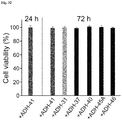
- FIG. 32 demonstrates the effect of the oligopyridylamides according to the disclosure on the cell viability of N2a cells.
- Cells were incubated with the indicated oligopyridylamides (5 ⁇ M) at the indicated time points.
- the cellular conditions were identical to the cytotoxicity assays except no A ⁇ 42 was added to the media.
- the cell viability was measured using cell titer blue assay.
- FIG. 33 depicts a representative plot for the kinetic curve of A ⁇ 42 (5 ⁇ M) aggregation.
- Kinetic curves were fit using the built-in sigmoidal fit to extract t 50 value (time required to reach 50% of the maximum ThT fluorescence intensity). Each run was fit independently to extract the t 50 .
- Kinetic profiles were processed using Origin (version 9.1). Error bars represent standard deviations from the mean of at least three independent experiments.
- FIG. 34 depicts an overlay of 2D HSQC NMR spectra of 15 N-isotopically labeled A ⁇ 42 (40 ⁇ M) in the absence (grey) and presence (light blue) of ADH-31 (80 ⁇ M). Each peak represents the correlation between the nitrogen and the amide proton of individual amino acid residues of A ⁇ 42 .
- the spectra were processed using Mnova NMR software.
- FIG. 35 depicts a representative plot for the kinetic curve of IAPP (5 ⁇ M) aggregation.
- Kinetic curves were fit using the built-in sigmoidal fit to extract tso value (time required to reach 50% of the maximum ThT fluorescence intensity). Each run was fit independently to extract the t 50 .
- Kinetic profiles were processed using Origin (version 9.1).
- FIGS. 36 a -36 b illustrates the binding characterization of the ADH-41-A ⁇ 42 complex in cellular milieu.
- FIG. 36 a shows N2a cells treated with a complex of 4 ⁇ M A ⁇ 42 (+1 ⁇ M A ⁇ TR ) and 5 ⁇ M ADH-41. The conditions are identical to the experiments performed in FIG. 29 c .
- FIG. 36 b shows N2a cells treated with a complex of 4 ⁇ M ADH-41 (+1 ⁇ M ADH-41 F ) and 5 ⁇ M ADH-41. The conditions are identical to the experiments performed in FIG. 29 c . In both the experiments, the cell viability in the presence of A ⁇ 42 and A ⁇ 42 +ADH-41 was 67% and 99%, respectively.
- FIG. 37 shows the effect of ADH-41 on the cell viability of N2a cells in delayed experiments.
- the N2a cells were treated with 5 ⁇ M A ⁇ 42 for either 12 h or 24 h.
- the cells were washed and a solution of 5 ⁇ M ADH-41 in media was added to the cells.
- the cells were then tested for viability either after 12 h (for 12 h A ⁇ 42 ) or 48 h (for 24 h A ⁇ 42 ) using CellTiterBlue assay.
- the benefit to a subject to be treated is either statistically significant or at least perceptible to the patient or to the physician.
- the subject is a human.
- the term “effective” applied to dose or amount refers to that quantity of a compound or pharmaceutical composition that is sufficient to result in a desired activity upon administration to a subject in need thereof. Note that when a combination of active ingredients is administered, the effective amount of the combination may or may not include amounts of each ingredient that would have been effective if administered individually. The exact amount required will vary from subject to subject, depending on the species, age, and general condition of the subject, the severity of the condition being treated, the particular drug or drugs employed, the mode of administration, and the like.
- compositions of the invention refers to molecular entities and other ingredients of such compositions that are physiologically tolerable and do not typically produce untoward reactions when administered to a mammal (e.g., a human).
- pharmaceutically acceptable means approved by a regulatory agency of the Federal or a state government or listed in the U.S. Pharmacopeia or other generally recognized pharmacopeia for use in mammals, and more particularly in humans.
- oligomerization refers to a chemical process that converts individual peptide molecules into a chain consisting of a finite number of the peptide molecules. These chains are referred to as “oligomers”, and they are typically soluble. As stated above, it is believed that these soluble oligomers, and not the later-stage insoluble fibrils, that are the key neurotoxic species.
- amyloidogenic peptides refers to a process of conversion of soluble peptide oligomers into non-specific insoluble material. Under certain conditions amyloidogenic peptide oligomers aggregate into fibrils, a process referred to as fibrillation.
- fibrillation refers to a process of forming fibrils.
- the soluble oligomers of amyloidogenic peptides undergo the process of fibrillation, where they combine into insoluble fibrils.
- modulating oligomerization or “modulating fibrillation” may refer to promoting, or agonizing, or, alternatively, inhibiting, or antagonizing, the formation of oligomers and/or fibers of a protein or a peptide.
- altering the structure of a protein or a peptide refers to changing, modifying, adjusting, shifting, transforming, or causing to change, modify, adjust, shift, or transform the structural conformation of a protein or a peptide, including secondary or tertiary structure of a protein or a peptide.
- dipyridylamide refers to a compound having two pyridyl rings connected via an amide (—(C ⁇ O)—NH—) bond.
- tripyridylamide refers to a compound having three pyridyl rings connected via amide bonds.
- tetrapyridylamide refers to a compound having four pyridyl rings connected via amide bonds.
- oligopyridylamide refers to any of the above compounds having from two to four pyridyl rings connected via amide bonds.
- the present invention provides compounds, pharmaceutical compositions, and methods for treating amyloid diseases and other diseases and conditions characterized by oligomerization and/or fibrillation of an amyloidogenic peptide (e.g., amyloid-beta peptide (Abeta or A ⁇ ) or its alloforms, e.g., the A ⁇ 42 alloform).
- an amyloidogenic peptide e.g., amyloid-beta peptide (Abeta or A ⁇ ) or its alloforms, e.g., the A ⁇ 42 alloform.
- the compounds of the invention are useful for altering structures of one or more amyloidogenic peptides including, without limitation, A ⁇ , islet amyloid polypeptide (IAPP), ⁇ -synuclein, AA amyloid, PrP, ⁇ 2 -microglobulin amyloid, transthyretin, prealbumin, and procalcitonin.
- amyloidogenic peptides including, without limitation, A ⁇ , islet amyloid polypeptide (IAPP), ⁇ -synuclein, AA amyloid, PrP, ⁇ 2 -microglobulin amyloid, transthyretin, prealbumin, and procalcitonin.
- some of the compounds of the invention may induce ⁇ -helical conformation of A ⁇ , which surprisingly and unexpectedly not only inhibits the formation of A ⁇ fibrils, but also suppresses A ⁇ oligomerization in solution.
- These specific interactions may play a part in the inventive compounds' surprising and unexpected specificity and/or selectivity for A ⁇ as compared to structurally related amyloidogenic peptides, such as, e.g., IAPP, decreasing the chances of undesirable side-effects upon their use in vivo.
- Oligopyridylamides are emerging as powerful tools to gain insight into the kinetic pathways of amyloidogenic proteins.
- an oligopyridylamide-based ⁇ -helical mimetic approach has been implemented to target the amyloidogenic peptide A ⁇ and alter its solution-based behavior.
- a library of oligopyridylamides functionalized with negatively charged (e.g., —CO 2 H), positively charged (e.g., —NH 2 ), and neutral (e.g., alkyl (linear, branched, and cylic), and benzyl) groups has been designed.
- the library was designed to target the ⁇ -helical surface of A ⁇ 42 which spans residues 13 to 26 ( FIG. 1 c ).
- a tripyridylamide was designed by incorporating —COOH, —COOH, and benzyl as surface functionalities in similar arrangement ( FIG. 1 d ).
- a tetrapyridylamide ligand was developed to stabilize A ⁇ in an ⁇ -helical conformation.
- Pyridyl-based systems have a particular advantage in that they form a network of intramolecular hydrogen bonds stabilizing a single conformation that projects substituents from one face.
- Over 50 oligopyridylamides have been synthesized by varying the length of the pyridyl scaffold from one to four units using an established protocol (Kumar, S.; Schlamadinger, D.; Brown, M.; Dunn, J.; Mercado, B.; Hebda, J.; Saraogi, I.; Rhoades, E.; Hamilton, A.; Miranker, A. Chem. Biol. 2015, 22, 369-378).
- the acid labile tert-butyl esters and NH-Boc groups were cleaved using a trifluoroacetic acid (TFA) cocktail (dichloromethane/TFA/triethylsilane, 80:15:5, v/v/v) in the final step to afford the series of oligopyridylamides.
- TFA trifluoroacetic acid
- Oligopyridylamide-based ⁇ -helical mimetics have been previously designed to target the membrane-associated ⁇ -helical conformation of islet amyloid polypeptide (IAPP) (Kumar, S.; Schlamadinger, D.; Brown, M.; Dunn, J.; Mercado, B.; Hebda, J.; Saraogi, I.; Rhoades, E.; Hamilton, A.; Miranker, A. Chem. Biol. 2015, 22, 369-378; Hebda, J. A.; Saraogi, I.; Magzoub, M.; Hamilton, A. D.; Miranker, A. D. Chem. Biol.
- IAPP islet amyloid polypeptide
- Certain ⁇ -helical mimetics were strong antagonists of membrane-catalyzed IAPP aggregation. SAR studies were conducted to optimize the inhibitory activity against IAPP self-assembly via charge complementarity and hydrophobic interactions. In addition to the solution biophysical assays, the ⁇ -helical mimetics were very effective in rescuing an insulin secreting cell line from IAPP-mediated cytotoxicity.
- Oligopyridylamides have been synthesized and screened to target the central ⁇ -helix subdomain of A ⁇ .
- the binding interaction of oligopyridylamides with A ⁇ is sensitive to the side chain functionalities present on their surface.
- Spectroscopic techniques CD and NMR suggest the conformational organization of A ⁇ into a strong ⁇ -helical structure.
- PICUP, DLS, and immunoassays support the inhibition of the oligomeric state of A ⁇ .
- Oligopyridylamides of the invention are useful as therapeutic agents for the treatment of diseases characterized by a formation of A ⁇ oligomers and/or fibers, e.g., Alzheimer's Disease.
- ADH-41 completely inhibits oligomerization of A ⁇ 42 at an equimolar ratio ( FIG. 2 a -2 e ) over a 24 h measurement time-period. Even at sub-stoichiometric ratios of 1:0.5 and 1:0.1 (A ⁇ 42 :ADH-41), the ThT fluorescence intensity characteristic of A ⁇ 42 oligomers was observable at only ⁇ 10% ( FIG. 2 d , 2 e ). In a control reaction (without A ⁇ 42 ) and under matched conditions, no change in ThT fluorescence intensity was observed in the presence of ADH-41 ( FIG. 9 ). Plainly, ADH-41 is a very potent inhibitor of A ⁇ 42 oligomerizaiton and/or fibrillation.
- ADH-39 (shown below) has been observed to accelerate oligomerizaiton and/or fibrillation of A ⁇ 42 .
- ADH-39 has ben shown to be effective at inhibiting cytotoxicity of A ⁇ 42 in cell-based assays.
- FIG. 2 c To assess the structure/activity importance of different chemical features of this class of molecules, a range of derivatives of ADH-41 were tested against A ⁇ 42 oligomerization ( FIG. 2 c ). No noticeable effect was observed on A ⁇ 42 oligomerization by monomeric ADH-3 and ADH-5 at an equimolar ratio ( FIG. 2 b ), whereas the dipyridylamides, ADH-43 and ADH-44 delayed the aggregation by factors of 3.3 ⁇ 0.4 and 2.4 ⁇ 0.3, respectively ( FIG. 2 b ). ADH-19, a tripyridylamide with three amine groups, delayed the aggregation by a factor of 3.2 ⁇ 0.3 ( FIG. 2 b ), but is far less effective than ADH-41, indicating the importance of the balance of hydrophobic and electrostatic interactions in inhibiting A ⁇ 42 oligomerization.
- a second set of compounds was identified as potent inhibitors of A ⁇ aggregation. In contrast to ADH-41, they are negatively charged.
- anionic oligopyridylamides ADH-31, a dianionic tetrapyridylamide, was the most effective antagonist of A ⁇ aggregation as measured by ThT-based amyloid kinetic assays ( FIG. 27 a ).
- the kinetic profile of 5 ⁇ M A ⁇ 42 showed a sigmoidal response, which yielded a t 50 (time required to reach 50% ThT fluorescence) of 2.1 ⁇ 0.2 h ( FIG. 27 b , FIG. 33 ).
- FIG. 27 b, c The aggregation of A ⁇ 42 was wholly suppressed, with very little formation of ThT positive fibers in the presence of ADH-31 at an equimolar ratio.
- Immunoassays and TEM image analysis revealed that ADH-31 inhibited the formation of the neurotoxic A ⁇ oligomers.
- TEM images showed that 5 ⁇ M A ⁇ 42 forms fibers in 12 h ( FIG. 27 d ); however, no fibers were recorded in the presence of ADH-31 after 12 h at an equimolar ratio ( FIG. 27 e ).
- An ELISA assay was employed to assess the effect of ADH-31 on the oligomerization of A ⁇ 42 ( FIG. 27 f ).
- a ⁇ 42 was incubated in the absence and presence of ADH-31 at an equimolar ratio for various durations, and the samples were applied to a nitrocellulose membrane and detected using a polyclonal antibody (A11) specific for A ⁇ oligomers ( FIG. 27 g ).
- a time-dependent increase in the amount of the A11-sensitive A ⁇ 42 oligomeric structures was reflected in the progressive enhancement in the chemiluminescence intensity of the dots, which reached a maximum intensity around 6 h ( FIG. 27 g ). The intensity decreased after 12 h, due to formation of fibers that are not sensitive to the A11 antibody.
- a ⁇ 40 adopts an ⁇ -helical conformation in the presence of ADH-31 at an equimolar ratio, characterized by two minima at 208 nm and 222 nm, which remained stable even after 48 h ( FIG. 27 h ).
- the compounds of the invention e.g., the modulators of oligomerization of amyloidogenic peptides, such as A ⁇
- the compounds of the invention have the structure of formula (I):
- R a is independently selected at each occurrence from hydrogen, C 1 -C 12 hydrocarbons, —F; —Cl; —Br; —I; —OH, —OR*; —NO; —NO 2 ; —NO 3 ; —O—NO; —N 3 ; —NH 2 ; —NHR*; and —N(R*) 2 .
- R a is present at 0, 1, or 2 different positions on the ring.
- R a is hydrogen at all occurrences.
- X is independently at each occurrence selected from —O—; —S—; —NH—; —NR*—; and —C(R*) 2 .
- X is —NH— or —NR*—, such that (C ⁇ O)—X— is an amide bond, at all occurrences. In some embodiments X is NH—.
- X is not —O—. In some embodiments X is not —S—. In some embodiments X is not C(R*) 2 .
- Y is independently at each occurrence selected from —O—; —S—; —NH—; and —NR*—.
- Y is —O—at all occurrences.
- Y is not —S—. In some embodiments Y is not —NH— or —NR*—.
- R 1 , R 2 , and/or R 3 are independently at each occurrence selected from hydrogen or a straight chained, branched or cyclic aliphatic C 1 -C 20 hydrocarbon; an aromatic C 6 -C 20 hydrocarbon; a heteroaromatic C 1 -C 20 hydrocarbon; an aryl C 6 -C 20 hydrocarbon; a heteroaryl C 1 -C 20 hydrocarbon, a C 1 -C 12 perfluorocarbon, or a combination thereof, each of which optionally contains 1-8 heteroatoms selected from halogen, O, N, and S, and each of which is optionally substituted with one or more of —F; —Cl; —Br; —I; —OH, —OR*; —NO; —NO 2 ; —NO 3 ; —O—NO; —N 3 ; —NH 2 ; —NHR*; —N(R*) 2 ; —N(R*) 3 + ; —N(R
- R 1 , R 2 , and/or R 3 are independently at each occurrence selected from a straight chained, branched or cyclic aliphatic C 1 -C 20 hydrocarbon; an aromatic C 6 -C 20 hydrocarbon; a heteroaromatic C 1 -C 20 hydrocarbon; an aryl C 6 -C 20 hydrocarbon; a heteroaryl C 1 -C 20 hydrocarbon, a C 1 -C 12 perfluorocarbon, or a combination thereof, each of which optionally contains 1-8 heteroatoms selected from halogen, O, N, and S, and each of which is optionally substituted with one or more of —NH 2 ; —NHR*; —N(R*) 2 ; —N(R*) 3 + ; —(C ⁇ O)—R*; —CHO; —CO 2 H; —CO 2 R*; —(C ⁇ O)—S—R*; —O—(C ⁇ O)—H; —O—(C—(C
- R 1 , R 2 , and/or R 3 are independently at each occurrence a straight chained, branched or cyclic aliphatic C 1 -C 20 hydrocarbon, optionally substituted with one or more of —NH 2 ; —NHR*; —N(R*) 2 ; —N(R*) 3 + ; —(C ⁇ O)—R*; —CO 2 H; or —CO 2 R*; and combinations thereof.
- R 1 , R 2 , and/or R 3 are independently at each occurrence a straight chained, branched or cyclic C 1 -C 20 hydrocarbon, optionally substituted with one or more of —NH 2 ; —NHR*; —N(R*) 2 .
- R 1 , R 2 , and/or R 3 are independently at each occurrence a straight chained, branched or cyclic aliphatic C 1 -C 20 hydrocarbon, optionally substituted with —CO 2 H. In some embodiments R 1 , R 2 , and/or R 3 may independently at each occurrence be —CH 2 CO 2 H.
- R 1 , R 2 , and/or R 3 at all occurrences do not contain —CO 2 H. In some embodiments R 1 , R 2 , and/or R 3 are not —CH 2 CO 2 H at all occurrences.
- R 1 , R 2 , and/or R 3 are independently at each occurrence selected from an aromatic C 6 -C 20 hydrocarbon; a heteroaromatic C 1 -C 20 hydrocarbon; an aryl C 6 -C 20 hydrocarbon; or a heteroaryl C 1 -C 20 hydrocarbon optionally containing 1-8 heteroatoms selected from halogen, O, N, and S, and each of which is optionally substituted with one or more of —NH 2 ; —NHR*; —N(R*) 2 ; —N(R*) 3 + ; —(C ⁇ O)—R*; —CHO; —CO 2 H; —CO 2 R*; —(C ⁇ O)—S—R*; —O—(C ⁇ O)—H; —O—(C ⁇ O)—R*.
- R 1 , R 2 , and/or R 3 are independently at each occurrence selected from a substituted or unsubstituted phenyl, benzyl, naphthyl, indolyl, pyrrolidinyl, pyrrolyl, imidazolyl, pyrazolyl, oxazolyl, isoxazolyl, thiazolyl, isothiazolyl, histidinyl (i.e., —CH 2 -imidazole), triazolyl, pyridyl, pyranyl, diazinyl, oxazinyl, thiazinyl, or triazinyl.
- a and B are independently selected from hydrogen, —F; —Cl; —Br; —I; —OH, —OR*; —NO; —NO 2 ; —NO 3 ; —O—NO; —N 3 ; —NH 2 ; —NHR*; —N(R*) 2 ; —N(R*) 3 + ; —N(R*)—OH; —O—N(R*) 2 ; —N(R*)—O—R*; —CN; —NC; —(C ⁇ O)—R*; —CHO; —CO 2 H; —CO 2 R*; —(C ⁇ O)—S—R*; —O—(C ⁇ O)—H; —O—(C ⁇ O)—R*; —S—(C ⁇ O)—R*; —(C ⁇ O)—NH 2 ; —(C ⁇ O)—N(R*) 2 ; —(C ⁇ O)
- A is selected from —NO 2 ; —NH 2 ; —NHR*; —N(R*)—(C ⁇ O)—R*, —N(R*) 2 . In some embodiments A is —NO 2 . In some embodiments A is NH 2 ; —NHR*; or —N(R*) 2 .
- A is not —N(R*)—(C ⁇ O)—R*. In some embodiments A is not NH 2 ; —NHR*; or —N(R*) 2 .
- B is selected from —(C ⁇ O)—R*; —CO 2 H; —CO 2 R*.
- B may be —CO 2 R*, where R* is a C 1 -C 12 hydrocarbon.
- B is —CO 2 R* and R* is selected from methyl, ethyl, propyl, or butyl groups.
- A is —CO 2 R* and R* is methyl.
- B is not —CO 2 H. In some embodiments B is not —(C ⁇ O)—R*.
- R* is independently selected at each occurrence from hydrogen or C 1 -C 12 hydrocarbons each of which optionally contains 1-8 heteroatoms selected from halogen, O, N, and S and combinations thereof.
- n is an integer from 0 to 2.
- n is 0, i.e., the compound of formula (I) is a dipyridyl. In other embodiments n is 1, i.e., the compound of formula (I) is a tripyridyl. In yet other embodiments, n is 2, i.e., the compound of formula (I) may be a tetrapyridyl.
- n is 0, and X is —NH—, i.e., the compound of formula (I) is a dipyridylamide. In other embodiments n is 1, and X is —NH—, i.e., the compound of formula (I) is a tripyridylamide. In yet other embodiments, n is 2, and X is —NH—, i.e., the compound of formula (I) is a tetrapyridylamide.
- R 1 and R 3 are not both —CH 2 CO 2 H.
- n when n is 1, Y is O, and R 1 and R 3 are both —CH 2 CO 2 H, R 2 is not —CH 2 CO 2 H or a straight chained, branched or cyclic aliphatic or aryl C 1 -C 12 hydrocarbon, or R 2 does not have the structure —C(CH 2 CO 2 H) 3 .
- R 1 through R 3 are not each an unsubstituted C 1 -C 8 hydrocarbon.
- R 1 through R 3 are not —CH 2 CO 2 H at all occurrences.
- the compounds of the invention have the structure of formula (II):
- R a , R 1 , R 3 , A, B, and X are as described above.
- X is —NH—, i.e. the compounds of formula (II) are dipyridylamides.
- the compounds of the invention have the structure of formula (III):
- R 1 ′ and R 3 ′ are independently selected from a straight chained, branched or cyclic aliphatic C 1 -C 20 hydrocarbon; an aromatic C 6 -C 20 hydrocarbon; a heteroaromatic C 1 -C 20 hydrocarbon; an aryl C 6 -C 20 hydrocarbon; a heteroaryl C 1 -C 20 hydrocarbon, a C 1 -C 12 perfluorocarbon, or a combination thereof, each of which optionally contains 1-8 heteroatoms selected from halogen, O, N, and S, and each of which is optionally substituted with one or more of —NH 2 ; —NHR*; —N(R*) 2 ; —N(R*) 3 + ; —(C ⁇ O)—R*; —CHO; —CO 2 H; —CO 2 R*; —(C ⁇ O)—S—R*; —O—(C ⁇ O)—H; —O—(C ⁇ O)—R*; and combinations thereof,
- R 1 and R 3 are not both —CH 2 CO 2 H.
- A′ is selected from —NO 2 ; —NH 2 ; —NHR*; —N(R*)—(C ⁇ O)—R*, —N(R*) 2 , where R* is hydrogen or an aliphatic C 1 -C 12 hydrocarbon.
- B′ is selected from —(C ⁇ O)—R*; —CO 2 H; —CO 2 R*, where R* is hydrogen or an aliphatic C 1 -C 12 hydrocarbon.
- the compounds of the invention have the structure of formula (IV):
- R a , R 1 , R 2 , R 3 , A, B, and X are as described above.
- X is —NH—, i.e. the compounds of formula (IV) are tripyridylamides.
- the compounds of the invention have the structure of formula (IV):
- R 1 ′, R 2 ′, and R 3 ′ are independently selected from a straight chained, branched or cyclic aliphatic C 1 -C 20 hydrocarbon; an aromatic C 6 -C 20 hydrocarbon; a heteroaromatic C 1 -C 20 hydrocarbon; an aryl C 6 -C 20 hydrocarbon; a heteroaryl C 1 -C 20 hydrocarbon, a C 1 -C 12 perfluorocarbon, or a combination thereof, each of which optionally contains 1-8 heteroatoms selected from halogen, O, N, and S, and each of which is optionally substituted with one or more of —NH 2 ; —NHR*; —N(R*) 2 ; —N(R*) 3 + ; —(C ⁇ O)—R*; —CHO; —CO 2 H; —CO 2 R*; —(C ⁇ O)—S—R*; —O—(C ⁇ O)—H; —O—(C ⁇ O)—R
- A′ is selected from —NO 2 ; —NH 2 ; —NHR*; —N(R*)—(C ⁇ O)—R*, —N(R*) 2 , where R* is hydrogen or an aliphatic C 1 -C 12 hydrocarbon.
- B′ is selected from —(C ⁇ O)—R*; —CO 2 H; —CO 2 R*, where R* is hydrogen or an aliphatic C 1 -C 12 hydrocarbon.
- R 1 and R 3 are both —CH 2 CO 2 H
- R 2 is not —CH 2 CO 2 H or a straight chained, branched or cyclic aliphatic C 1 -C 12 hydrocarbon.
- R 1 and R 3 are both —CH 2 CO 2 H
- R 2 does not have the structure —C[CH 2 CO 2 H] 3 .
- R 1 through R 3 are not each an unsubstituted C 1 -C 8 hydrocarbon.
- R 1 ′′ and R 2 ′′ are each independently a straight chained, branched or cyclic aliphatic C 1 -C 20 hydrocarbon; an aromatic C 6 -C 20 hydrocarbon; a heteroaromatic C 1 -C 20 hydrocarbon; an aryl C 6 -C 20 hydrocarbon; a heteroaryl C 1 -C 20 hydrocarbon, optionally substituted with —NH 2 ; —NHR*; or —N(R*) 2 .
- R 1 ′′ and R 2 ′′ are each independently selected from a straight chained, branched or cyclic aliphatic C 1 -C 20 hydrocarbon; an aromatic C 6 -C 20 hydrocarbon; a heteroaromatic C 1 -C 20 hydrocarbon; an aryl C 6 -C 20 hydrocarbon; a heteroaryl C 1 -C 20 hydrocarbon, a C 1 -C 12 perfluorocarbon, or a combination thereof, each of which optionally contains 1-8 heteroatoms selected from halogen, O, N, and S, and each of which is optionally substituted with one or more of —NH 2 ; —NHR*; —N(R*) 2 ; —N(R*) 3 + ; —(C ⁇ O)—R*; —CHO; —CO 2 H; —CO 2 R*; —(C ⁇ O)—S—R*; —O—(C ⁇ O)—H; —O—(C ⁇ O)—R*;
- R 1 ′′ is a straight chained, branched or cyclic aliphatic C 1 -C 20 hydrocarbon; an aromatic C 6 -C 20 hydrocarbon; a heteroaromatic C 1 -C 20 hydrocarbon; an aryl C 6 -C 20 hydrocarbon; a heteroaryl C 1 -C 20 hydrocarbon, optionally substituted with —NH 2 ; —NHR*; or —N(R*) 2 ; and R 2 ′′ is a straight chained, branched or cyclic aliphatic C 1 -C 20 hydrocarbon; an aromatic C 6 -C 20 hydrocarbon; a heteroaromatic C 1 -C 20 hydrocarbon; an aryl C 6 -C 20 hydrocarbon; a heteroaryl C 1 -C 20 hydrocarbon, a C 1 -C 12 perfluorocarbon, or a combination thereof, each of which optionally contains 1-8 heteroatoms selected from halogen, O, N, and S, and each of which is optionally substitute
- A′ is selected from —NO 2 ; —NH 2 ; —NHR*; —N(R*)—(C ⁇ O)—R*, —N(R*) 2 .
- B′ is selected from —(C ⁇ O)—R*; —CO 2 H; —CO 2 R*.
- R* is hydrogen or an aliphatic C 1 -C 12 hydrocarbon.
- n is an integer from 1 to 12.
- a compound of the invention has the structure of formula (VII):
- R 1 ′′ is selected from a straight chained, branched or cyclic aliphatic C 1 -C 20 hydrocarbon; an aromatic C 6 -C 20 hydrocarbon; a heteroaromatic C 1 -C 20 hydrocarbon; an aryl C 6 -C 20 hydrocarbon; a heteroaryl C 1 -C 20 hydrocarbon, optionally substituted with —NH 2 ; —NHR*; or —N(R*) 2 .
- A′ is selected from —NO 2 ; —NH 2 ; —NHR*; —N(R*)—(C ⁇ O)—R*, —N(R*) 2 .
- B′ is selected from —(C ⁇ O)—R*; —CO 2 H; —CO 2 R*.
- R* is independently at each occurrence hydrogen or an aliphatic C 1 -C 12 hydrocarbon.
- n is independently at each occurrence an integer from 1 to 12.
- the compounds of the invention have the structure of formula (VIII):
- R a , R 1 , R 2 , (independently at each occurrence), R 3 , A, B, and X are as described above.
- X is —NH—, i.e. the compounds of formula (VIII) are tetrapyridylamides.
- the compounds of the invention have the structure of formula (IX):
- R 1 ′, R 2 ′, and R 3 ′ are independently at each occurrence selected from a straight chained, branched or cyclic aliphatic C 1 -C 20 hydrocarbon; an aromatic C 6 -C 20 hydrocarbon; a heteroaromatic C 1 -C 20 hydrocarbon; an aryl C 6 -C 20 hydrocarbon; a heteroaryl C 1 -C 20 hydrocarbon, a C 1 -C 12 perfluorocarbon, or a combination thereof, each of which optionally contains 1-8 heteroatoms selected from halogen, O, N, and S, and each of which is optionally substituted with one or more of —NH 2 ; —NHR*; —N(R*) 2 ; —N(R*) 3 + ; —(C ⁇ O)—R*; —CHO; —CO 2 H; —CO 2 R*; —(C ⁇ O)—S—R*; —O—(C ⁇ O)—H; —O—(C ⁇
- A′ is selected from —NO 2 ; —NH 2 ; —NHR*; —N(R*)—(C ⁇ O)—R*, —N(R*) 2 , where R* is hydrogen or an aliphatic C 1 -C 12 hydrocarbon.
- B′ is selected from —(C ⁇ O)—R*; —CO 2 H; —CO 2 R*, where R* is hydrogen or an aliphatic C 1 -C 12 hydrocarbon.
- R 1 and R 3 are both —CH 2 CO 2 H
- R 2 is not —CH 2 CO 2 H or a straight chained, branched or cyclic aliphatic C 1 -C 12 hydrocarbon at all occurrences.
- R 1 and R 3 are both —CH 2 CO 2 H
- R 2 may be —CH 2 CO 2 H at one occurrence
- R 2 may be—a straight chained, branched or cyclic aliphatic C 1 -C 12 hydrocarbon at one occurrence
- R 2 may not be —CH 2 CO 2 H or a straight chained, branched or cyclic aliphatic C 1 -C 12 hydrocarbon at both occurrences.
- R 1 and R 3 are both —CH 2 CO 2 H
- R 2 does not have the structure —C[CH 2 CO 2 H] 3 .
- R 1 through R 3 are not each an unsubstituted C 1 -C 8 hydrocarbon.
- R 1 through R 3 are not each —CH 2 CO 2 H.
- a compound of the invention has the following structure:
- a compound of the invention has the following structure:
- a compound of the invention has the following structural formula:
- the compounds of the invention, and salts thereof are substantially isolated.
- substantially isolated is meant that the compound is at least partially or substantially separated from the environment in which it was formed or detected.
- Partial separation can include, for example, a composition enriched in the compound of the invention.
- Substantial separation can include compositions containing at least about 50%, at least about 60%, at least about 70%, at least about 80%, at least about 90%, at least about 95%, at least about 97%, or at least about 99% by weight of the compound of the invention, or salt thereof. Methods for isolating compounds and their salts are routine in the art.
- salts refers to derivatives of the disclosed compounds wherein the parent compound is modified by converting an existing acid or base moiety to its salt form.
- examples of salts include, but are not limited to, mineral acid (such as HCl, HBr, H 2 SO 4 ) or organic acid (such as acetic acid, benzoic acid, trifluoroacetic acid salts of basic residues such as amines; alkali (such as Li, Na, K, Mg, Ca) or organic (such as trialkylammonium) salts of acidic residues such as carboxylic acids; and the like.
- the salts of the present application can be synthesized from the parent compound which contains a basic or acidic moiety conventional chemical methods.
- such salts can be prepared by reacting the free acid or base forms of these compounds with a stoichiometric amount of the appropriate base or acid in water or in an organic solvent, or in a mixture of the two; generally, nonaqueous media like ether, ethyl acetate, ethanol, isopropanol, or acetonitrile (ACN) are preferred.
- the present application also includes pharmaceutically acceptable salts of the compounds described herein.
- pharmaceutically acceptable salts include a subset of the “salts” described above which are conventional non-toxic salts of the parent compound formed, for example, from non-toxic inorganic or organic acids. Lists of suitable salts are found in Remington's Pharmaceutical Sciences, 17th ed., Mack Publishing Company, Easton, Pa., 1985, p. 1418 and Journal of Pharmaceutical Science, 66, 2 (1977).
- phrases “pharmaceutically acceptable” is employed herein to refer to those compounds, materials, compositions, and/or dosage forms which are, within the scope of sound medical judgment, suitable for use in contact with the tissues of human beings and animals without excessive toxicity, irritation, allergic response, or other problem or complication, commensurate with a reasonable benefit/risk ratio.
- Preparation of compounds can involve the protection and deprotection of various chemical groups.
- the need for protection and deprotection, and the selection of appropriate protecting groups can be readily determined by one skilled in the art.
- the chemistry of protecting groups can be found, for example, in Wuts and Greene, Greene Protective Groups in Organic Synthesis, 4th Ed., John Wiley & Sons: N.Y., 2006.
- the present invention also provides pharmaceutical compositions comprising the compounds described herein.
- the compounds of the invention can be administered in the form of pharmaceutical compositions which is a combination of the compounds of the invention and a pharmaceutically acceptable carrier.
- These compositions can be prepared in a manner well known in the pharmaceutical art, and can be administered by a variety of routes.
- Such pharmaceutical compositions can be administered systemically.
- systemic as used herein includes parenteral, topical, transdermal, oral, by inhalation/pulmonary, rectal, nasal, buccal, and sublingual administration.
- parenteral as used herein includes subcutaneous, intradermal, intravenous, intramuscular, intracranial, and intraperitoneal administration.
- the compounds are administered intramuscularly, subcutaneously, orally, or intranasally in therapeutically effective amounts to treat diseases characterized by a formation of oligomers and/or fibers of amyloidogenic peptides (e.g., A ⁇ ).
- diseases characterized by a formation of oligomers and/or fibers of amyloidogenic peptides e.g., A ⁇ .
- compositions containing the compounds of the invention can be prepared in combination with one or more pharmaceutically acceptable carriers.
- the active ingredient is typically mixed with an excipient, diluted by an excipient or enclosed within such a carrier in the form of, for example, a capsule, sachet, paper, or other container.
- the excipient serves as a diluent, it can be a solid, semi-solid, or liquid material, which acts as a vehicle, carrier or medium for the active ingredient.
- compositions can be in the form of tablets, pills, powders, lozenges, sachets, cachets, elixirs, suspensions, emulsions, solutions, syrups, aerosols (as a solid or in a liquid medium), ointments containing, for example, up to 10% by weight of the active compound, soft and hard gelatin capsules, suppositories, sterile injectable solutions, and sterile packaged powders.
- the pharmaceutical composition of the invention is in liquid form.
- Liquid forms include, by way of non-limiting example, emulsions, solutions, suspensions, syrups, slurries, dispersions, colloids and the like.
- a pharmaceutical composition described herein is in liquid, semi-solid or solid (e.g., powder) form.
- a pharmaceutical composition described herein is in semi-solid form, e.g., a gel, a gel matrix, a cream, a paste, or the like.
- semi-solid forms comprise a liquid vehicle.
- the pharmaceutical composition of the invention is a solid dosage form, such a tablet, a granule, a sachet, or a powder.
- pharmaceutical compositions comprising a compound of the invention or a pharmaceutically acceptable salt thereof in the form of a dissolving tablet, a dissolving wafer, a capsule, or a gel capsule.
- solid dosage forms described herein comprise a solid vehicle (e.g., as used in a tablet), and/or a gaseous vehicle (e.g., as used in DPI).
- a composition is in a unit dose formulation for oral, intranasal, or other administration to a patient.
- unit dosage forms refers to physically discrete units suitable as unitary dosages for human subjects and other mammals, each unit containing a predetermined quantity of active material calculated to produce the desired therapeutic effect, in association with a suitable pharmaceutical excipient.
- the active compound can be effective over a wide dosage range and is generally administered in a pharmaceutically effective amount. It will be understood, however, that the amount of the compound actually administered will usually be determined by a physician, according to the relevant circumstances, including the condition to be treated, the chosen route of administration, the actual compound administered, the age, weight, and response of the individual patient, the severity of the patient's symptoms, and the like.
- nasal delivery-enhancing agents include agents which enhance the release or solubility (e.g., from a formulation delivery vehicle), diffusion rate, penetration capacity and timing, uptake, residence time, stability, effective half-life, peak or sustained concentration levels, clearance and other desired nasal delivery characteristics (e.g., as measured at the site of delivery, or at a selected target site of activity such as the brain) of the compounds or compositions of the invention.
- Enhancement of mucosal delivery can thus occur by any of a variety of mechanisms, for example by increasing the diffusion, transport, persistence or stability of the compounds or compositions of the invention, enzyme inhibition, increasing membrane fluidity, modulating the availability or action of calcium and other ions that regulate intracellular or paracellular permeation, solubilizing mucosal membrane components (e.g., lipids), changing non-protein and protein sulfhydryl levels in mucosal tissues, increasing water flux across the mucosal surface, modulating epithelial junctional physiology, reducing the viscosity of mucus overlying the mucosal epithelium, reducing mucociliary clearance rates, increasing nasal blood flow and other mechanisms.
- Suitable mucosal delivery enhancing agents will be clear to a person skilled in the art of pharmacology and are further described hereafter.
- Compositions of the invention can be simple aqueous (e.g., saline) solutions. Alternatively, they can contain various additional ingredients which enhance stability and/or nasal delivery of the compounds of the invention. Such additional ingredients are well known in the art.
- useful additional ingredients for enhancing nasal delivery include, e.g., (a) aggregation inhibitory agents (e.g., polyethylene glycol, dextran, diethylaminoethyl dextran, and carboxymethyl cellulose), (b) charge modifying agents, (c) pH control agents, (d) degradative enzyme inhibitors (e.g., amastatin and bestatin [see, e.g., O'Hagan et al., Pharm. Res.
- mucolytic or mucus clearing agents e.g., n-acetyl-cysteine, propyl gallate and cysteine methionine dimers, chaotropes [see, e.g., WO 04/093917]
- ciliostatic agents e.g., membrane penetration enhancing agents, (h) modulatory agents of epithelial junction physiology, such as nitric oxide (NO) stimulators, chitosan, and chitosan derivatives; (i) vasodilator agents, (j) selective transport-enhancing agents, and (k) stabilizing delivery vehicles, carriers, supports or complex-forming agents.
- NO nitric oxide
- vasodilator agents e.g., vasodilator agents, (j) selective transport-enhancing agents, and (k) stabilizing delivery vehicles, carriers, supports or complex-forming agents.
- Non-limiting examples of membrane penetration-enhancing agents useful in the compositions of the invention include, e.g., (i) a surfactant (e.g., Tween 80, Poloxamer 188, polysorbates; see also EP 490806, U.S. Pat. No.
- a surfactant e.g., Tween 80, Poloxamer 188, polysorbates; see also EP 490806, U.S. Pat. No.
- a bile salt or bile salt derivative e.g., unsaturated cyclic ureas and Transcutol
- a phospholipid or fatty acid additive mixed micelle, liposome, or carrier
- an alcohol e.g., an enamine
- a nitric oxide donor compound e.g., S-nitroso-N-acetyl-DL-penicillamine, NOR1, NOR4, which are preferably co-administered with an NO scavenger such as carboxy-PITO or doclofenac sodium
- a long-chain amphipathic molecule e.g., deacylmethyl sulfoxide, azone, sodium lauryl sulfate, oleic acid
- a small hydrophobic penetration enhancer e.
- monoaminocarboxlic acids such as glycine, alanine, phenylalanine, proline, hydroxyproline, etc.; hydroxyamino acids such as serine; acidic amino acids such as aspartic acid, glutamic acid, etc; and basic amino acids such as lysine etc., inclusive of their alkali metal or alkaline earth metal salts), (xv) an N-acetylamino acid or salt thereof, (xvi) an enzyme degradative to a selected membrane component, (xvii) an inhibitor of fatty acid synthesis, (xviii) an inhibitor of cholesterol synthesis, (xix) cationic polymers, or any combination thereof.
- the membrane penetration-enhancing agent can be also selected from small hydrophilic molecules, including but not limited to, dimethyl sulfoxide (DMSO), dimethylformamide, ethanol, propylene glycol, and the 2-pyrrolidones.
- DMSO dimethyl sulfoxide
- Additional membrane penetration enhancers include emulsifiers (e.g.
- Non-limiting examples of useful absorption enhancers include, e.g., surfactants, glycosides, cyclodextrin and glycols.
- useful bioadhesive agents include, e.g., carbopol, cellulose agents, starch, dextran, and chitosan.
- a compound of the invention is combined with one or more of the nasal delivery-enhancing agents recited above.
- These nasal agents may be admixed, alone or together, with the nasal carrier and with the compound of the invention, or otherwise combined therewith in a pharmaceutically acceptable formulation or delivery vehicle.
- nasal delivery-enhancing agents it is generally desired that any significant changes in permeability of the mucosa be reversible within a time frame appropriate to the desired duration of drug delivery.
- the composition of the invention may further comprise one or more additional therapeutic ingredients (or active substances).
- additional therapeutic ingredients can be any compound that elicits a desired activity or therapeutic or biological response in the subject.
- additional therapeutic ingredients is provided in the Combination Treatments section, below.
- each further component in the nasal composition of the invention may vary depending on the components used.
- the amount of nasal carrier may be in the range of from 0.1 to 99.9% by weight of the total weight or volume of the composition.
- the amount surfactant may be in the range from about 0.01 to about 10% or higher and preferably about 0.05 to about 1.0% by weight of the total volume or weight of the composition, the amount depending on the specific surfactant used.
- the amount is generally kept as low as possible since above a certain level no further enhancement of absorption can be achieved and also too high of a surfactant level may cause irritation of the nasal mucosa.
- the amount of delivery enhancing agents may be at least 0.1%, suitably in the range from about 0.5 to 10% of the total weight of the composition. Where the composition is liquid, the enhancing agent may suitably be present in an amount of from 0.1 to 5% w/v of the total composition. Preserving agents may be present in an amount of from about 0.002 to 0.02% by weight of the total weight or volume of the composition.
- the useful delivery volume of the pharmaceutical compositions of the invention is limited by the size of the nasal cavity. Suitable delivery volumes will be clear to a person skilled in the art of pharmacology.
- the total composition quantity administered at each nasal application comprises from about 0.02 to 0.5 ml, preferably about 0.07 to 0.3 ml, typically about 0.09-0.1 ml.
- the liquid compositions of the invention may be prepared by bringing into intimate admixture a compound the invention in the liquid carrier optionally together with the further ingredients, additives and/or agents.
- the solid nasal composition of the invention may be prepared in conventional manner.
- a compound of the invention may be admixed with the carrier particles, e.g. a polymer base or cellulose product in conventional manner, optionally with further ingredients, additives and/or agents as indicated above e.g. a mucosal delivery enhancing agent or surfactant such as disclosed.
- a compound of the invention may be in solution e.g. an aqueous or alcoholic solution when being mixed with the carrier particles and the solvent evaporated, e.g. under freeze-drying or spray drying. Such drying may be effected under the conventional conditions.
- the mixture may be compacted or granulated and then be pulverized and/or sieved. If desired the particles may be coated.
- the nasal composition is prepared by lyophilisation.
- a homogeneous solution preferably aqueous, containing a compound of the invention and optionally containing further ingredients, additives and/or agents as discussed above, is prepared and then submitted to lyophilisation in analogy with known lyophilisation procedures, and to subsequent drying.
- the resulting powder may then be dissolved in a liquid excipient or nasal carrier before administration, e.g. to reconstitute nasal drops, gel or spray.
- a lyophilized powder comprising a compound of the invention but free of any nasal carrier may be prepared and then admixed with the desired nasal carrier or mixture of nasal carriers.
- the present invention encompasses any delivery device that is suitable for nasal administration of the compositions of the invention. Preferably, such means administers a metered dosage of the composition.
- the composition of the present invention may be packed in any appropriate form or container as long as a means is provided to deliver the composition to the nasal mucosa.
- useful intranasal delivery devices include, e.g., instillation catheters, droppers, unit-dose containers, squeeze bottles pump sprays, airless and preservative-fee sprays, compressed air nebulizers, metered-dose inhalers, insufflators and pressurized metered dose inhalers.
- compositions of the invention can be placed in a container provided with a conventional dropper/closure device, e.g. comprising a pipette or the like, preferably delivering a substantially fixed volume of composition/drop.
- a conventional dropper/closure device e.g. comprising a pipette or the like, preferably delivering a substantially fixed volume of composition/drop.
- the aqueous solution may be dispensed in spray form by a variety of methods known to those skilled in the art.
- such compositions will be put up in an appropriate atomising device, e.g. in a pump-atomiser, or the like.
- the atomising device will be provided with appropriate means, such as a spray adaptor for delivery of the aqueous spray to the naris.
- a spray adaptor for delivery of the aqueous spray to the naris.
- it will be provided with means ensuring delivery of a substantially fixed volume of composition/actuation (i.e. per spray-unit).
- nasal sprays include nasal actuators produced by Ing. Erich Pfeiffer GmbH, Radolfzell, Germany (see U.S. Pat. Nos.
- Additional aerosol delivery forms may include, e.g., compressed air-, jet-, ultrasonic-, and piezoelectric nebulizers.
- the spray may be bottled under pressure in an aerosol device.
- the propellant may be a gas or a liquid (e.g. a fluorinated and/or chlorinated hydrocarbon).
- the spray composition may be suspended or dissolved in a liquid propellant. Stabilizing and/or suspending agents and/or co-solvents may be present.
- a dry powder may be readily dispersed in an inhalation device as described in U.S. Pat. No. 6,514,496 and Garcia-Arieta et al., Biol. Pharm. Bull. 2001; 24: 1411-1416.
- a powder or liquid may be filled into a soft or hard capsule or in a single dose device adapted for nasal administration.
- the powder may be sieved before filled into the capsules such as gelatine capsules.
- the delivery device may have means to break open the capsule.
- the powdery nasal composition can be directly used as a powder for a unit dosage form.
- the contents of the capsule or single dose device may be administered using e.g. an insufflator. Preferably it will be provided with means ensuring dosing of a substantially fixed amount of composition.
- the composition of the invention can be provided as a nasal insert having the compound of the invention dispersed therein.
- the insert may be retained in the naris, but flushed by the nasal mucus, and may be designed to release the compound of the invention at the same place in the naris.
- Suitable nasal insert types include nasal plugs, tampons and the like. Further examples of nasal inserts, their characteristics and preparation are described in EP 490806.
- a composition or unit dosage form according to the invention is formulated for sublingual administration, wherein the unit dosage form is a film including one or more disintegrants (e.g., materials that favor disintegration or fast dissolution by virtue of their solubility in water, such as hydrolyzed starches, sugars, and glycerin, which may play a dual role as a plasticizer and disintegrant) and a plasticizing agent, the film having a first portion including apomorphine hydrochloride, and a second portion including pH neutralizing agent, wherein the unit dosage form includes from 0.5 to 5 mg, from 4 to 10 mg, or from 8 to 20 mg of apomorphine hydrochloride and the pH neutralizing agent is present in an amount sufficient to produce a solution having a pH of between 3.0 and 6.0, preferably between 4.5 and 6.5, (e.g., a pH of between 2.5 and 4.5, 3.0 and 6.0, 3.5 and 6.5, 4.5 and 6.5, or 5.0 and 6.0) when the unit dosage form is
- the film can include from 1 to 50% (w/w) (e.g., 1 ⁇ 0.75%, 2 ⁇ 1.5%, 3 ⁇ 0.5%, 5 ⁇ 2%, 7.5 ⁇ 2.5%, 10 ⁇ 2%, 14 ⁇ 3%, 18 ⁇ 4%, 22 ⁇ 5%, 25 ⁇ 5%, 30 ⁇ 5%, 35 ⁇ 5%, 40 ⁇ 5%, 45 ⁇ 5%, or 50 ⁇ 5% (w/w)) of the one or more disintegrants.
- the unit dosage form further includes a high molecular weight polymer having a weight average molecular weight of greater than 60 KDa selected from hydroxypropyl cellulose, hydroxypropyl methyl cellulose, hydroxyethyl cellulose, carboxymethyl cellulose, and methyl cellulose.
- the unit dosage form further includes a low molecular weight polymer having a weight average molecular weight of from 5 KDa to 50 KDa selected from hydroxypropyl cellulose, hydroxypropyl methyl cellulose, hydroxyethyl cellulose, carboxymethyl cellulose, and methyl cellulose.
- the pH neutralizing agent can be an organic base (e.g., pyridoxine, meglumine, or any organic base described herein) or an inorganic base (e.g., magnesium hydroxide, sodium bicarbonate, or an inorganic base described herein).
- the unit dosage form includes 35 ⁇ 5% (w/w) disintegrant, from 0.5 to 5 mg, from 4 to 10 mg, or from 8 to 20 mg of apomorphine hydrochloride and pyridoxine present in an amount sufficient to produce a solution having a pH of between 4.5 and 6.5 when the unit dosage form is placed in unbuffered water at pH 7.
- Suitable film for oral administration of the compositions according to the invention is disclosed in, e.g., U.S. Pat. No. 8,846,074.
- a composition or unit dosage form described herein is administered as an emulsion, a solution, a suspension, a syrup, a slurry, a dispersion, a colloid, a dissolving tablet, a dissolving wafer, a capsule, a gel capsule, a semi-solid, a solid forma gel, a gel matrix, a cream, a paste, a tablet, a granule, a sachet, a powder, or the like.
- the compound of the invention is present in a composition or a unit dose of a composition described herein in an amount of from about 0.01 mg to about 10 mg (e.g., about 0.1-10 mg, about 0.25-5 mg, about 0.25-2.5 mg, about 1-2 mg or about 2-3 mg, about 0.5 mg to about 2 mg, about 1 to about 2 mg, about 1 mg, or about 2 mg).
- the amount of corticosteroid administered daily or in a unit dose is between about 0.5 mg and about 3 mg, between about 0.5 mg and about 4 mg, or between about 0.35 mg and about 4 mg.
- the amount of the compound present in a unit dose or administered daily is between about 1 and about 3 mg, or between about 1 and about 2 mg, or between about 2 and about 3 mg.
- about 0.25 mg to about 20 mg, about 0.25 mg to about 15 mg, about 0.25 mg to about 10 mg, or about 0.25 mg to about 5 mg e.g., about 0.1 to about 5 mg, about 0.25 to about 2.5 mg, about 0.3 mg to about 2 mg, about 0.5 mg to about 1 mg, about 0.7 mg to about 1.5 mg, about 0.375 mg, about 0.75 mg, about 1 mg, about 1.25 mg, about 1.5 mg or about 2 mg
- the compound is present in a unit dose in an amount of between about 5 mg and about 500 mg. In some embodiments, the amount of the compound administered daily or in a unit dose is between about 5 mg and about 300 mg. In other embodiments, the amount of the compound present in a unit dose or administered daily is between about 5 and about 250 mg, or between about 5 and about 200 mg, between about 5 mg and about 150 mg, between about 5 mg and about 100 mg, or between about 5 and about 50 mg.
- the active compound can be milled to provide the appropriate particle size prior to combining with the other ingredients. If the active compound is substantially insoluble, it can be milled to a particle size of less than 200 mesh. If the active compound is substantially water soluble, the particle size can be adjusted by milling to provide a substantially uniform distribution in the formulation, e.g. about 40 mesh.
- suitable excipients include lactose, dextrose, sucrose, sorbitol, mannitol, starches, gum acacia, calcium phosphate, alginates, tragacanth, gelatin, calcium silicate, microcrystalline cellulose, polyvinylpyrrolidone, cellulose, water, syrup, and methyl cellulose.
- the formulations can additionally include: lubricating agents such as talc, magnesium stearate, and mineral oil; wetting agents; emulsifying and suspending agents; preserving agents such as methyl- and propylhydroxy-benzoates; sweetening agents; and flavoring agents.
- lubricating agents such as talc, magnesium stearate, and mineral oil
- wetting agents such as talc, magnesium stearate, and mineral oil
- emulsifying and suspending agents such as methyl- and propylhydroxy-benzoates
- sweetening agents and flavoring agents.
- the compositions of the invention can be formulated so as to provide quick, sustained or delayed release of the active ingredient after administration to the patient by employing procedures known in the art.
- the principal active ingredient is mixed with a pharmaceutical excipient to form a solid pre-formulation composition containing a homogeneous mixture of the compound of Formula I.
- a pharmaceutical excipient When referring to these pre-formulation compositions as homogeneous, the active ingredient is typically dispersed evenly throughout the composition so that the composition can be readily subdivided into equally effective unit dosage forms such as tablets, pills and capsules.
- This solid pre-formulation is then subdivided into unit dosage forms of the type described above containing from, for example, 0.000001 to about 2000 mg of the active ingredient of the present application.
- the tablets or pills containing the compound of Formula I can be coated or otherwise compounded to provide a dosage form affording the advantage of prolonged action.
- the tablet or pill can comprise an inner dosage and an outer dosage component, the latter being in the form of an envelope over the former.
- the two components can be separated by an enteric layer which serves to resist disintegration in the stomach and permit the inner component to pass intact into the duodenum or to be delayed in release.
- enteric layers or coatings such materials including a number of polymeric acids and mixtures of polymeric acids with such materials as shellac, cetyl alcohol, and cellulose acetate.
- liquid forms in which the compounds and compositions of the present application can be incorporated for administration orally or by injection include aqueous solutions, suitably flavored syrups, aqueous or oil suspensions, and flavored emulsions with edible oils such as cottonseed oil, sesame oil, coconut oil, or peanut oil, as well as elixirs and similar pharmaceutical vehicles.
- compositions for inhalation or insufflation include solutions and suspensions in pharmaceutically acceptable, aqueous or organic solvents, or mixtures thereof, and powders.
- the liquid or solid compositions may contain suitable pharmaceutically acceptable excipients as described supra.
- the compositions are administered by the oral or nasal respiratory route for local or systemic effect.
- Compositions in can be nebulized by use of inert gases. Nebulized solutions may be breathed directly from the nebulizing device or the nebulizing device can be attached to a face masks tent, or intermittent positive pressure breathing machine. Solution, suspension, or powder compositions can be administered orally or nasally from devices which deliver the formulation in an appropriate manner.
- compositions administered to a patient can be in the form of pharmaceutical compositions described above. These compositions can be sterilized by conventional sterilization techniques, or may be sterile filtered. Aqueous solutions can be packaged for use as is, or lyophilized, the lyophilized preparation being combined with a sterile aqueous carrier prior to administration.
- the pH of the compound preparations typically will be between 3 and 11, more preferably from 5 to 9. It will be understood that use of certain of the foregoing excipients, carriers, or stabilizers will result in the formation of pharmaceutical salts.
- the therapeutic dosage of the compounds of the invention can vary according to, for example, the particular use for which the treatment is made, the manner of administration of the compound, the health and condition of the patient, and the judgment of the prescribing physician.
- the proportion or concentration of the compounds of the invention in a pharmaceutical composition can vary depending upon a number of factors including dosage, chemical characteristics (e.g., hydrophobicity), and the route of administration.
- the dosage is likely to depend on such variables as the type and extent of progression of the disease or disorder, the overall health status of the particular patient, the relative biological efficacy of the compound selected, formulation of the excipient, and its route of administration. Effective doses can be extrapolated from dose-response curves derived from in vitro or animal model test systems.
- kits useful for example, in the treatment or prevention of diseases characterized by a formation of oligomers and/or fibers of amyloidogenic peptides, such as A ⁇ , which include one or more containers containing a pharmaceutical composition comprising a therapeutically effective amount of the compounds of the invention.
- kits can further include, if desired, one or more of various conventional pharmaceutical kit components, such as, for example, containers with one or more pharmaceutically acceptable carriers, additional containers, etc., as will be readily apparent to those skilled in the art.
- Instructions, either as inserts or as labels, indicating quantities of the components to be administered, guidelines for administration, and/or guidelines for mixing the components, can also be included in the kit.
- Delivery devices are important not only for delivering the compounds of the invention, but also for providing an appropriate environment for storage. This would include protection from microbial contamination and chemical degradation.
- the device and formulation should be compatible so as to avoid potential leaching or adsorption.
- the delivery device (or its packaging) can be optionally provided with a label and/or with instructions for use indicating that the composition should be used intranasally.
- compounds and/or pharmaceutical compositions of the invention may be used for altering the structure of an amyloidogenic peptide.
- compounds and/or pharmaceutical compositions according to the invention may be useful for altering the conformation and/or structures of amyloidogenic peptides including, without limitation, A ⁇ , islet amyloid polypeptide (IAPP), ⁇ -synuclein, AA amyloid, PrP, ⁇ 2 -microglobulin amyloid, transthyretin, prealbumin, and procalcitonin.
- compounds and/or pharmaceutical compositions according to the invention may be useful for altering the structure of A ⁇ , or its A ⁇ 42 alloform.
- compounds and/or pharmaceutical compositions of the invention may be used to induce an ⁇ -helical conformation in all or a part of an amyloidogenic peptide.
- compounds and/or pharmaceutical compositions according to the invention may be used to promote or induce an ⁇ -helical conformation in all or a part of amyloidogenic peptides including, without limitation, A ⁇ , islet amyloid polypeptide (IAPP), ⁇ -synuclein, AA amyloid, PrP, ⁇ 2 -microglobulin amyloid, transthyretin, prealbumin, and procalcitonin.
- IAPP islet amyloid polypeptide
- compounds and/or pharmaceutical compositions according to the invention may be used to promote or induce an ⁇ -helical conformation in all or a part of A ⁇ , or its A ⁇ 42 alloform. In some embodiments compounds and/or pharmaceutical compositions according to the invention may be used to promote or induce an ⁇ -helical conformation in all or a part of IAPP. In some embodiments compounds and/or pharmaceutical compositions according to the invention may be used to promote or induce an ⁇ -helical conformation in all or a part of ⁇ -synuclein.
- compounds and/or pharmaceutical compositions of the invention may be used to inhibit, hinder or prevent an ⁇ -helical conformation in all or a part of an amyloidogenic peptide.
- compounds and/or pharmaceutical compositions according to the invention may be used to inhibit, hinder or prevent an ⁇ -helical conformation in all or a part of amyloidogenic peptides including, without limitation, A ⁇ , islet amyloid polypeptide (IAPP), ⁇ -synuclein, AA amyloid, PrP, ⁇ 2 -microglobulin amyloid, transthyretin, prealbumin, and procalcitonin.
- IAPP islet amyloid polypeptide
- compounds and/or pharmaceutical compositions according to the invention may be used to inhibit, hinder or prevent an ⁇ -helical conformation in all or a part of A ⁇ , or its A ⁇ 42 alloform. In some embodiments compounds and/or pharmaceutical compositions according to the invention may be used to inhibit, hinder or prevent an ⁇ -helical conformation in all or a part of IAPP. In some embodiments compounds and/or pharmaceutical compositions according to the invention may be used to inhibit, hinder or prevent an ⁇ -helical conformation in all or a part of ⁇ -synuclein.
- compounds of the invention may exhibit selectivity and/or specificity for one or more particular amyloidogenic peptides, i.e. the compounds of the invention may selectively and/or specifically bind one or more particular amyloidogenic peptides. In one aspect, compounds of the invention may exhibit selectivity and/or specificity for one or more particular amyloidogenic peptides, i.e.
- the compounds of the invention may selectively and/or specifically bind one or more particular amyloidogenic peptides including, without limitation, A ⁇ , islet amyloid polypeptide (IAPP), ⁇ -synuclein, AA amyloid, PrP, ⁇ 2 -microglobulin amyloid, transthyretin, prealbumin, and procalcitonin.
- compounds of the invention may exhibit selectivity and/or specificity for A ⁇ , or its A ⁇ 42 alloform.
- compounds of the invention may exhibit selectivity and/or specificity for IAPP.
- compounds of the invention may exhibit selectivity and/or specificity for ⁇ -synuclein.
- compounds and/or pharmaceutical compositions of the invention may be used for inhibiting oligomerization of an amyloidogenic peptide.
- compounds and/or pharmaceutical compositions according to the invention may be useful for inhibiting oligomerization of amyloidogenic peptides including, without limitation, A ⁇ , islet amyloid polypeptide (IAPP), ⁇ -synuclein, AA amyloid, PrP, ⁇ 2 -microglobulin amyloid, transthyretin, prealbumin, and procalcitonin.
- compounds and/or pharmaceutical compositions according to the invention may be useful for inhibiting oligomerization of A ⁇ , or its A ⁇ 42 alloform.
- compounds and/or pharmaceutical compositions of the invention may be used for inhibiting oligomerization of an amyloidogenic peptide.
- compounds and/or pharmaceutical compositions according to the invention may be useful for inhibiting oligomerization of amyloidogenic peptides including, without limitation, A ⁇ , islet amyloid polypeptide (IAPP), ⁇ -synuclein, AA amyloid, PrP, ⁇ 2 -microglobulin amyloid, transthyretin, prealbumin, and procalcitonin.
- compounds and/or pharmaceutical compositions according to the invention may be useful for inhibiting oligomerization of A ⁇ , or its A ⁇ 42 alloform.
- compounds and/or pharmaceutical compositions of the invention may be used for inhibiting (i.e., reducing, diminishing, decreasing, or antagonizing) cytotoxicity of an amyloidogenic peptide.
- compounds and/or pharmaceutical compositions according to the invention may be useful for inhibiting cytotoxicity of amyloidogenic peptides including, without limitation, A ⁇ , islet amyloid polypeptide (IAPP), ⁇ -synuclein, AA amyloid, PrP, ⁇ 2 -microglobulin amyloid, transthyretin, prealbumin, and procalcitonin.
- compounds and/or pharmaceutical compositions according to the invention may be useful for inhibiting cytotoxicity of A ⁇ , or its A ⁇ 42 alloform.
- compounds and/or pharmaceutical compositions of the invention may be used for treating diseases and/or conditions characterized by a formation of oligomers or fibers of amyloidogenic peptides.
- compounds and/or pharmaceutical compositions according to the invention may be useful for treating diseases and/or conditions characterized by a formation of oligomers or fibers of amyloidogenic peptides including, without limitation, A ⁇ , islet amyloid polypeptide (IAPP), ⁇ -synuclein, AA amyloid, PrP, ⁇ 2 -microglobulin amyloid, transthyretin, prealbumin, and procalcitonin.
- compounds and/or pharmaceutical compositions according to the invention may be useful for treating diseases and/or conditions characterized by a formation of oligomers or fibers of A ⁇ , or its A ⁇ 42 alloform.
- compounds and/or pharmaceutical compositions according to the invention may be useful for treating diseases selected from Alzheimer's Disease (AD), type 1 diabetes, type 2 diabetes, Parkinson's disease, Mild Cognitive Impairment (MCI), inclusion body myositis, cerebral amyloid angiopathy, systemic AA amyloidosis, Lewy body diseases including Lewy body dementia, multiple system atrophy, Down's syndrome, hereditary cerebral hemorrhage with amyloidosis of the Dutch type, inclusion body myositosis, amyloidosis associated with chronic inflammation, various forms of malignancy and Familial Mediterranean Fever, inflammation-associated amyloidosis, amyloidosis associated with multiple myeloma and other B-cell dyscrasias, amyloidosis associated with the prion diseases (including, e.g., Creutzfeldt-Jakob disease, Gerstmann-Straussler syndrome, kuru and animal scrapie), amyloidosis associated with the
- methods for modulating oligomerization and/or fibrillation of amyloidogenic peptides with compounds and/or pharmaceutical compositions of the present invention are provided.
- methods of inhibiting oligomerization and/or fibrillation of amyloidogenic peptides are provided, including, without limitation, methods of inhibiting oligomerization and/or fibrillation of A ⁇ , or its A ⁇ 42 alloform, islet amyloid polypeptide (IAPP), ⁇ -synuclein, AA amyloid, PrP, ⁇ 2 -microglobulin amyloid, transthyretin, prealbumin, and procalcitonin.
- IAPP islet amyloid polypeptide
- methods of altering the structure of an amyloidogenic peptide with compounds and/or pharmaceutical compositions of the present invention are provided.
- methods of altering structures of amyloidogenic peptides including, without limitation, A ⁇ , or its A ⁇ 42 alloform, islet amyloid polypeptide (IAPP), ⁇ -synuclein, AA amyloid, PrP, ⁇ 2 -microglobulin amyloid, transthyretin, prealbumin, and procalcitonin with compounds and/or pharmaceutical compositions of the present invention are provided.
- IAPP islet amyloid polypeptide
- ⁇ -synuclein AA amyloid
- PrP ⁇ 2 -microglobulin amyloid
- transthyretin ⁇ 2 -microglobulin amyloid
- prealbumin procalcitonin
- methods of inhibiting cytotoxicity of an amyloidogenic peptide with compounds and/or pharmaceutical compositions of the present invention are provided.
- methods of inhibiting cytotoxicity of amyloidogenic peptides including, without limitation, A ⁇ , or its A ⁇ 42 alloform, islet amyloid polypeptide (IAPP), ⁇ -synuclein, AA amyloid, PrP, ⁇ 2 -microglobulin amyloid, transthyretin, prealbumin, and procalcitonin with compounds and/or pharmaceutical compositions of the present invention are provided.
- methods of inhibiting cytotoxicity of A ⁇ or its A ⁇ 42 alloform with compounds and/or pharmaceutical compositions of the present invention are provided.
- methods of treating diseases and/or conditions characterized by a formation of oligomers or fibers of amyloidogenic peptides with compounds and/or pharmaceutical compositions of the present invention are provided.
- methods of treating diseases and/or conditions characterized by a formation of oligomers or fibers of amyloidogenic peptides including, without limitation, A ⁇ , islet amyloid polypeptide (IAPP), ⁇ -synuclein, AA amyloid, PrP, ⁇ 2 -microglobulin amyloid, transthyretin, prealbumin, and procalcitonin with compounds and/or pharmaceutical compositions of the present invention are provided.
- methods of treating diseases and/or conditions characterized by a formation of oligomers or fibers of amyloidogenic peptides of A ⁇ or its A ⁇ 42 alloform with compounds and/or pharmaceutical compositions of the present invention are provided.
- methods of treating diseases selected from Alzheimer's Disease (AD), type 1 diabetes, type 2 diabetes, Parkinson's disease, Mild Cognitive Impairment (MCI), inclusion body myositis, cerebral amyloid angiopathy, systemic AA amyloidosis, Lewy body diseases including Lewy body dementia multiple system atrophy, Down's syndrome, hereditary cerebral hemorrhage with amyloidosis of the Dutch type, inclusion body myositosis, amyloidosis associated with chronic inflammation, various forms of malignancy and Familial Mediterranean Fever, inflammation-associated amyloidosis, amyloidosis associated with multiple myeloma and other B-cell dyscrasias, amyloidosis associated with the prion diseases (including, e.g., Creutzfeldt-Jakob disease, Gerstmann-Straussler syndrome, kuru and animal scrapie), amyloidosis associated with long-term hemodialysis or carpal tunnel syndrome,
- the methods of the invention may be used in a mammal, for example a human, of any age, in certain examples, the individual is an adult, for example an elderly person, for example a person over the age of 50, 55, 60, 65, or 70 years.
- the method further comprises administering a therapeutic or preventive treatment to the subject.
- useful drug treatments include, for example, administration of dopamine-replenishing or dopamine mimicking drugs such as, e.g., levodopa or levodopa combination treatments, which may include administration with dopa decarboxylase inhibitors (e.g., carbidopa, benserazide); dopamine enhancers, such as catechol o-methyltransferase (COMT) inhibitors (e.g., entacapone, tolcapone); dopamine receptor agonists (e.g., ropinirole, pramipexole, rotigotine, apomorphine, pergolide, bromocriptine); monoamine oxidase (MAOIs) inhibitors, which can be used alone or with levodopa (e.g., selegiline, rasagiline, zydis
- dopa decarboxylase inhibitors
- Non-limiting examples of useful surgical therapies include, for example, deep brain stimulation (DBS), involving implantation of a battery-powered electrode in the brain; operations directly on neural tissue (e.g., thalamotomy, pallidotomy, subthalmatomy); and dopamergic cell transplant. Diet, exercise, physical, occupational and/or speech-language therapies, nutritional support as well as symptomatic treatments for controlling seizures, muscle stiffness, spasticity, constipation, depression, anxiety, fatigue etc. and may also be used (separately or in combination with other treatments) to alleviate disease symptoms.
- useful food supplements include, for example, antioxidants such as vitamins C and E, calcium, ginger root, green tea and green tea extracts, St.
- Effective treatment can mean patient improvement (decrease of a biomarker miRNA ratio) or prevention/inhibition of further disease development (biomarker miRNA ratio stays the same or increases slower).
- the method further comprises administering one or more of the following therapeutic or preventive treatments to the subject to treat AD: apomorphine, donepezil, galantamine, raviastigmine, memantine, anti-psychotics (e.g., olanzepine, quetiapine, risperidone, ziprasidone, aripiprazole, paliperidone), anti-Abeta antibodies, vitamin C, vitamin E, ginger root, green tea and green tea extracts, Ginkgo biloba, milk thistile, vitamin B12, and folic acid.
- anti-psychotics e.g., olanzepine, quetiapine, risperidone, ziprasidone, aripiprazole, paliperidone
- anti-Abeta antibodies e.g., olanzepine, quetiapine, risperidone, ziprasidone, aripiprazole, paliperidone
- the method further comprises administering one or more of the following therapeutic or preventive treatments to the subject to treat PD: administration of dopamine-replenishing or dopamine mimicking drugs such as, e.g., levodopa or levodopa combination treatments, which may include administration with dopa decarboxylase inhibitors (e.g., carbidopa, benserazide); dopamine enhancers, such as catechol o-methyltransferase (COMT) inhibitors (e.g., entacapone, tolcapone); dopamine receptor agonists (e.g., ropinirole, pramipexole, rotigotine, apomorphine, pergolide, bromocriptine); monoamine oxidase (MAOIs) inhibitors, which can be used alone or with levodopa (e.g., selegiline, rasagiline, zydis selegiline HC
- the method further comprises administering one or more of the following therapeutic or preventive treatments to the subject to treat mild cognitive impairment (MCI): vitamin C, vitamin E, ginger root, green tea and green tea extracts, Ginkgo biloba, milk thistile, vitamin B12, and folic acid.
- MCI mild cognitive impairment
- R a is independently selected at each occurrence from hydrogen, C 1 -C 12 hydrocarbons, —F; —Cl; —Br; —I; —OH, —OR*; —NO; —NO 2 ; —NO 3 ; —O—NO; —N 3 ; —NH 2 ; —NHR*; and —N(R*) 2 ;
- X is independently at each occurrence selected from —O—; —S—; —NH—; —NR*—; and C(R*) 2 ;
- Y is independently at each occurrence selected from —O—; —S—; —NH—; and —NR*—;
- R 1 is selected from hydrogen or a straight chained, branched or cyclic aliphatic C 1 -C 20 hydrocarbon; an aromatic C 6 -C 20 hydrocarbon; a heteroaromatic C 1 -C 20 hydrocarbon; an aryl C 6 -C 20 hydrocarbon; a heteroaryl C 1 -C 20 hydrocarbon, a C 1 -C 12 perfluorocarbon, or a combination thereof, each of which optionally contains 1-8 heteroatoms selected from halogen, O, N, and S, and each of which is optionally substituted with one or more of —F; —Cl; —Br; —I; —OH, —OR*; —NO; —NO 2 ; —NO 3 ; —O—NO; —N 3 ; —NH 2 ; —NHR*; —N(R*) 2 ; —N(R*) 3 + ; —N(R*)—OH; —O—N(R*) 2
- R 2 is independently at each occurrence selected from hydrogen or a straight chained, branched or cyclic aliphatic C 1 -C 20 hydrocarbon; an aromatic C 6 -C 20 hydrocarbon; a heteroaromatic C 1 -C 20 hydrocarbon; an aryl C 6 -C 20 hydrocarbon; a heteroaryl C 1 -C 20 hydrocarbon, a C 1 -C 12 perfluorocarbon, or a combination thereof, each of which optionally contains 1-8 heteroatoms selected from halogen, O, N, and S, and each of which is optionally substituted with one or more of —F; —Cl; —Br; —I; —OH, —OR*; —NO; —NO 2 ; —NO 3 ; —O—NO; —N 3 ; —NH 2 ; —NHR*; —N(R*) 2 ; —N(R*) 3 + ; —N(R*)—OH; —O—N(
- R 3 is selected from hydrogen or a straight chained, branched or cyclic aliphatic C 1 -C 20 hydrocarbon; an aromatic C 6 -C 20 hydrocarbon; a heteroaromatic C 1 -C 20 hydrocarbon; an aryl C 6 -C 20 hydrocarbon; a heteroaryl C 1 -C 20 hydrocarbon, a C 1 -C 12 perfluorocarbon, or a combination thereof, each of which optionally contains 1-8 heteroatoms selected from halogen, O, N, and S, and each of which is optionally substituted with one or more of —F; —Cl; —Br; —I; —OH, —OR*; —NO; —NO 2 ; —NO 3 ; —O—NO; —N 3 ; —NH 2 ; —NHR*; —N(R*) 2 ; —N(R*) 3 + ; —N(R*)—OH; —O—N(R*) 2
- A is selected from hydrogen, —F; —Cl; —Br; —I; —OH, —OR*; —NO; —NO 2 ; —NO 3 ; —O—NO; —N 3 ; —NH 2 ; —NHR*; —N(R*) 2 ; —N(R*) 3 + ; —N(R*)—OH; —O—N(R*) 2 ; —N(R*)—O—R*; —CN; —NC; —(C ⁇ O)—R*; —CHO; —CO 2 H; —CO 2 R*; —(C ⁇ O)—S—R*; —O—(C ⁇ O)—H; —O—(C ⁇ O)—R*; —S—(C ⁇ O)—R*; —(C ⁇ O)—NH 2 ; —(C ⁇ O)—N(R*) 2 ; —(C ⁇ O)—NHNH
- B is selected from hydrogen, —F; —Cl; —Br; —I; —OH, —OR*; —NO; —NO 2 ; —NO 3 ; —O—NO; —N 3 ; —NH 2 ; —NHR*; —N(R*) 2 ; —N(R*) 3 + ; —N(R*)—OH; —O—N(R*) 2 ; —N(R*)—O—R*; —CN; —NC; —(C ⁇ O)—R*; —CHO; —CO 2 H; —CO 2 R*; —(C ⁇ O)—S—R*; —O—(C ⁇ O)—H; —O—(C ⁇ O)—R*; —S—(C ⁇ O)—R*; —(C ⁇ O)—NH 2 ; —(C ⁇ O)—N(R*) 2 ; —(C ⁇ O)—NHNH
- R* is independently selected at each occurrence from hydrogen or C 1 -C 12 hydrocarbons each of which optionally contains 1-8 heteroatoms selected from halogen, O, N, and S and combinations thereof;
- n is an integer from 0 to 2;
- R 1 ′ is selected from a straight chained, branched or cyclic aliphatic C 1 -C 20 hydrocarbon; an aromatic C 6 -C 20 hydrocarbon; a heteroaromatic C 1 -C 20 hydrocarbon; an aryl C 6 -C 20 hydrocarbon; a heteroaryl C 1 -C 20 hydrocarbon, a C 1 -C perfluorocarbon, or a combination thereof, each of which optionally contains 1-8 heteroatoms selected from halogen, O, N, and S, and each of which is optionally substituted with one or more of —NH 2 ; —NHR*; —N(R*) 2 ; —N(R*) 3 + ; —(C ⁇ O)—R*; —CHO; —CO 2 H; —CO 2 R*; —(C ⁇ O)—S—R*; —O—(C ⁇ O)—H; —O—(C ⁇ O)—R*; and combinations thereof;
- R 3 ′ is selected from a straight chained, branched or cyclic aliphatic C 1 -C 20 hydrocarbon; an aromatic C 6 -C 20 hydrocarbon; a heteroaromatic C 1 -C 20 hydrocarbon; an aryl C 6 -C 20 hydrocarbon; a heteroaryl C 1 -C 20 hydrocarbon, a C 1 -C 12 perfluorocarbon, or a combination thereof, each of which optionally contains 1-8 heteroatoms selected from halogen, O, N, and S, and each of which is optionally substituted with one or more of —NH 2 ; —NHR*; —N(R*) 2 ; —N(R*) 3 + ; —(C ⁇ O)—R*; —CHO; —CO 2 H; —CO 2 R*; —(C ⁇ O)—S—R*; —O—(C ⁇ O)—H; —O—(C ⁇ O)—R*; and combinations thereof;
- R 1 and R 3 are not both —CH 2 CO 2 H;
- A′ is selected from —NO 2 ; —NH 2 ; —NHR*; —N(R*)—(C ⁇ O)—R*, —N(R*) 2 , where R* is hydrogen or an aliphatic C 1 -C 12 hydrocarbon;
- B′ is selected from —(C ⁇ O)—R*; —CO 2 H; —CO 2 R*, where R* is hydrogen or an aliphatic C 1 -C 12 hydrocarbon,
- R 1 ′ is selected from a straight chained, branched or cyclic aliphatic C 1 -C 20 hydrocarbon; an aromatic C 6 -C 20 hydrocarbon; a heteroaromatic C 1 -C 20 hydrocarbon; an aryl C 6 -C 20 hydrocarbon; a heteroaryl C 1 -C 20 hydrocarbon, a C 1 -C 12 perfluorocarbon, or a combination thereof, each of which optionally contains 1-8 heteroatoms selected from halogen, O, N, and S, and each of which is optionally substituted with one or more of —NH 2 ; —NHR*; —N(R*) 2 ; —N(R*) 3 + ; —(C ⁇ O)—R*; —CHO; —CO 2 H; —CO 2 R*; —(C ⁇ O)—S—R*; —O—(C ⁇ O)—H; —O—(C ⁇ O)—R*; and combinations thereof,
- R 2 ′ is selected from a straight chained, branched or cyclic aliphatic C 1 -C 20 hydrocarbon; an aromatic C 6 -C 20 hydrocarbon; a heteroaromatic C 1 -C 20 hydrocarbon; an aryl C 6 -C 20 hydrocarbon; a heteroaryl C 1 -C 20 hydrocarbon, a C 1 -C 12 perfluorocarbon, or a combination thereof, each of which optionally contains 1-8 heteroatoms selected from halogen, O, N, and S, and each of which is optionally substituted with one or more of —NH 2 ; —NHR*; —N(R*) 2 ; —N(R*) 3 + ; —(C ⁇ O)—R*; —CHO; —CO 2 H; —CO 2 R*; —(C ⁇ O)—S—R*; —O—(C ⁇ O)—H; —O—(C ⁇ O)—R*; and combinations thereof;
- R 3 ′ is selected from a straight chained, branched or cyclic aliphatic C 1 -C 20 hydrocarbon; an aromatic C 6 -C 20 hydrocarbon; a heteroaromatic C 1 -C 20 hydrocarbon; an aryl C 6 -C 20 hydrocarbon; a heteroaryl C 1 -C 20 hydrocarbon, a C 1 -C 12 perfluorocarbon, or a combination thereof, each of which optionally contains 1-8 heteroatoms selected from halogen, O, N, and S, and each of which is optionally substituted with one or more of —NH 2 ; —NHR*; —N(R*) 2 ; —N(R*) 3 + ; —(C ⁇ O)—R*; —CHO; —CO 2 H; —CO 2 R*; —(C ⁇ O)—S—R*; —O—(C ⁇ O)—H; —O—(C ⁇ O)—R*; and combinations thereof;
- A′ is selected from —NO 2 ; —NH 2 ; —NHR*; —N(R*)—(C ⁇ O)—R*, —N(R*) 2 , where R* is hydrogen or an aliphatic C 1 -C 12 hydrocarbon; and
- B′ is selected from —(C ⁇ O)—R*; —CO 2 H; —CO 2 R*, where R* is hydrogen or an aliphatic C 1 -C 12 hydrocarbon;
- R 1 and R 3 are both —CH 2 CO 2 H, R 2 is not —CH 2 CO 2 H or a straight chained, branched or cyclic aliphatic C 1 -C 12 hydrocarbon, or R 2 does not have the structure —C[CH 2 CO 2 H] 3 ; and (ii)R 1 through R 3 are not each an unsubstituted C 1 -C 8 hydrocarbon,
- R 1 ′′ is selected from a straight chained, branched or cyclic aliphatic C 1 -C 20 hydrocarbon; an aromatic C 6 -C 20 hydrocarbon; a heteroaromatic C 1 -C 20 hydrocarbon; an aryl C 6 -C 20 hydrocarbon; a heteroaryl C 1 -C 20 hydrocarbon, optionally substituted with —NH 2 ; —NHR*; or —N(R*) 2 ;
- R 2 ′′ is selected from a straight chained, branched or cyclic aliphatic C 1 -C 20 hydrocarbon; an aromatic C 6 -C 20 hydrocarbon; a heteroaromatic C 1 -C 20 hydrocarbon; an aryl C 6 -C 20 hydrocarbon; a heteroaryl C 1 -C 20 hydrocarbon, a C 1 -C 12 perfluorocarbon, or a combination thereof, each of which optionally contains 1-8 heteroatoms selected from halogen, O, N, and S, and each of which is optionally substituted with one or more of —NH 2 ; —NHR*; —N(R*) 2 ; —N(R*) 3 + ; —(C ⁇ O)—R*; —CHO; —CO 2 H; —CO 2 R*; —(C ⁇ O)—S—R*; —O—(C ⁇ O)—H; —O—(C ⁇ O)—R*; and combinations thereof;
- A′ is selected from —NO 2 ; —NH 2 ; —NHR*; —N(R*)—(C ⁇ O)—R*, —N(R*) 2 ;
- B′ is selected from —(C ⁇ O)—R*; —CO 2 H; —CO 2 R*;
- R* is hydrogen or an aliphatic C 1 -C 12 hydrocarbon
- n 1 to 12
- R 1 ′′ and R 2 ′′ are each independently a straight chained, branched or cyclic aliphatic C 1 -C 20 hydrocarbon; an aromatic C 6 -C 20 hydrocarbon; a heteroaromatic C 1 -C 20 hydrocarbon; an aryl C 6 -C 20 hydrocarbon; a heteroaryl C 1 -C 20 hydrocarbon, optionally substituted with —NH 2 ; —NHR*; or —N(R*) 2 ;
- A′ is selected from —NO 2 ; —NH 2 ; —NHR*; —N(R*)—(C ⁇ O)—R*, —N(R*) 2 ;
- B′ is selected from —(C ⁇ O)—R*; —CO 2 H; —CO 2 R*;
- R* is hydrogen or an aliphatic C 1 -C 12 hydrocarbon
- n 1 to 12
- R 1 ′′ is selected from a straight chained, branched or cyclic aliphatic C 1 -C 20 hydrocarbon; an aromatic C 6 -C 20 hydrocarbon; a heteroaromatic C 1 -C 20 hydrocarbon; an aryl C 6 -C 20 hydrocarbon; a heteroaryl C 1 -C 20 hydrocarbon, optionally substituted with —NH 2 ; —NHR*; or —N(R*) 2 ;
- A′ is selected from —NO 2 ; —NH 2 ; —NHR*; —N(R*)—(C ⁇ O)—R*, —N(R*) 2 ;
- B′ is selected from —(C ⁇ O)—R*; —CO 2 H; —CO 2 R*;
- R* is independently at each occurrence hydrogen or an aliphatic C 1 -C 12 hydrocarbon
- n is independently at each occurrence an integer from 1 to 12,
- R 1 ′ is selected from a straight chained, branched or cyclic aliphatic C 1 -C 20 hydrocarbon; an aromatic C 6 -C 20 hydrocarbon; a heteroaromatic C 1 -C 20 hydrocarbon; an aryl C 6 -C 20 hydrocarbon; a heteroaryl C 1 -C 20 hydrocarbon, a C 1 -C 12 perfluorocarbon, or a combination thereof, each of which optionally contains 1-8 heteroatoms selected from halogen, O, N, and S, and each of which is optionally substituted with one or more of —NH 2 ; —NHR*; —N(R*) 2 ; —N(R*) 3 + ; —(C ⁇ O)—R*; —CHO; —CO 2 H; —CO 2 R*; —(C ⁇ O)—S—R*; —O—(C ⁇ O)—H; —O—(C ⁇ O)—R*; and combinations thereof;
- R 2 ′ is independently at each occurrence selected from a straight chained, branched or cyclic aliphatic C 1 -C 20 hydrocarbon; an aromatic C 6 -C 20 hydrocarbon; a heteroaromatic C 1 -C 20 hydrocarbon; an aryl C 6 -C 20 hydrocarbon; a heteroaryl C 1 -C 20 hydrocarbon, a C 1 -C 12 perfluorocarbon, or a combination thereof, each of which optionally contains 1-8 heteroatoms selected from halogen, O, N, and S, and each of which is optionally substituted with one or more of —NH 2 ; —NHR*; —N(R*) 2 ; —N(R*) 3 + ; —(C ⁇ O)—R*; —CHO; —CO 2 H; —CO 2 R*; —(C ⁇ O)—S—R*; —O—(C ⁇ O)—H; —O—(C ⁇ O)—R*; and combinations thereof;
- R 3 ′ is selected from a straight chained, branched or cyclic aliphatic C 1 -C 20 hydrocarbon; an aromatic C 6 -C 20 hydrocarbon; a heteroaromatic C 1 -C 20 hydrocarbon; an aryl C 6 -C 20 hydrocarbon; a heteroaryl C 1 -C 20 hydrocarbon, a C 1 -C 12 perfluorocarbon, or a combination thereof, each of which optionally contains 1-8 heteroatoms selected from halogen, O, N, and S, and each of which is optionally substituted with one or more of —NH 2 ; —NHR*; —N(R*) 2 ; —N(R*) 3 + ; —(C ⁇ O)—R*; —CHO; —CO 2 H; —CO 2 R*; —(C ⁇ O)—S—R*; —O—(C ⁇ O)—H; —O—(C ⁇ O)—R*; and combinations thereof;
- A′ is selected from —NO 2 ; —NH 2 ; —NHR*; —N(R*)—(C ⁇ O)—R*, —N(R*) 2 , where R* is hydrogen or an aliphatic C 1 -C 12 hydrocarbon; and
- B′ is selected from —(C ⁇ O)—R*; —CO 2 H; —CO 2 R*, where R* is hydrogen or an aliphatic C 1 -C 12 hydrocarbon;
- R 1 and R 3 are both —CH 2 CO 2 H, R 2 is not —CH 2 CO 2 H or a straight chained, branched or cyclic aliphatic C 1 -C 12 hydrocarbon at all occurrences, or R 2 does not have the structure —C[CH 2 CO 2 H] 3 ; and (ii)R 1 through R 3 are not each an unsubstituted C 1 -C 8 hydrocarbon,
- a pharmaceutical composition comprising the compound of any one of embodiments 1-13 and a pharmaceutically acceptable carrier or excipient.
- a pharmaceutical composition comprising the compounds of embodiment 11 and embodiment 13 and a pharmaceutically acceptable carrier or excipient.
- a pharmaceutical dosage form comprising the compound of any one of embodiments 1-13.
- a method of altering the structure of an amyloidogenic peptide comprising contacting said peptide with an effective amount of the compound of any one of embodiments 1-13.
- amyloidogenic peptide is A ⁇ , islet amyloid polypeptide (IAPP), or ⁇ -synuclein.
- a method of altering the structure of an A ⁇ peptide comprising contacting said A ⁇ peptide with an effective amount of the compound of any one of embodiments 1-13.
- a method of modulating oligomerization of an amyloidogenic peptide comprising contacting said peptide with an effective amount of the compound of any one of embodiments 1-13.
- amyloidogenic peptide is selected from A ⁇ , islet amyloid polypeptide (IAPP), or ⁇ -synuclein.
- a method of modulating oligomerization of an A ⁇ peptide comprising contacting said A ⁇ with an effective amount of the compound of any one of embodiments 1-13.
- a method of inhibiting cytotoxicity of an amyloidogenic peptide in a subject in need thereof comprising administering to said subject an effective amount of the compound of any one of embodiments 1-13 or the pharmaceutical composition of embodiment 14 or embodiment 15 or the dosage form of embodiment 16.
- amyloidogenic peptide is A ⁇ , islet amyloid polypeptide (IAPP), ⁇ -synuclein, AA amyloid, PrP, ⁇ 2 -microglobulin amyloid, transthyretin, prealbumin, or procalcitonin.
- IAPP islet amyloid polypeptide
- ⁇ -synuclein AA amyloid
- PrP ⁇ 2 -microglobulin amyloid
- transthyretin prealbumin, or procalcitonin.
- a method of inhibiting cytotoxicity of A ⁇ in a subject in need thereof comprising administering to said subject an effective amount of the compound of any one of embodiments 1-13 or the pharmaceutical composition of embodiment 14 or embodiment 15 or the dosage form of embodiment 16.
- a method of treating a disease in a subject in need of such treatment, wherein the disease is characterized by a formation of A ⁇ oligomers and/or fibers comprising administering to said subject an effective amount of the compound of any one of embodiments 1-13 or the pharmaceutical composition of embodiment 12 or embodiment 13 or the dosage form of embodiment 16.
- a method of treating a disease in a subject in need of such treatment, wherein the disease is characterized by the formation of amyloidogenic peptide oligomers and/or fibers comprising administering to said subject an effective amount of the compound of any one of embodiments 1-13, or the pharmaceutical composition of embodiment 14 or embodiment 15, or the dosage form of embodiment 16.
- amyloidogenic peptide is A ⁇ , islet amyloid polypeptide (IAPP), or ⁇ -synuclein.
- a method of treating Alzheimer's disease in a subject in need of such treatment comprising administering to said subject an effective amount of the compound of any one of embodiments 1-13, wherein said compound inhibits oligomerization of an A ⁇ peptide.
- a method of treating Alzheimer's disease in a subject in need of such treatment comprising administering to said subject an effective amount of a compound according to the following structural formula:
- a method of treating Alzheimer's disease in a subject in need of such treatment comprising administering to said subject an effective amount of a compound according to the following structural formula:
- a method of treating Alzheimer's disease in a subject in need of such treatment comprising administering to said subject an effective amount of a compound according to the following structural formula:
- All peptides used in the study were purchased at >98% purity from Anaspec (Fremont, Calif., USA) and used without further purification.
- 15 N-labeled wild-type human Aß 40 was purchased from rPeptide (Bogart, Ga., USA) and used without further purification.
- ThT was purchased from Acros Organics (N.J., USA).
- the 96-well plates (black, flat bottom) were purchased from Corning Coster (Corning, N.Y., USA). All chemicals were purchased from commercial suppliers and used without further purification.
- a ⁇ 40 , A ⁇ 42 , and IAPP were dissolved in 1,1,1,3,3,3-hexafluoroisopropanol (HFIP) (1 mg/mL) and kept at room temperature for 1 h with occasional vortexing to maintain them in monomeric state. Peptides were then aliquoted into small fractions, lyophilized overnight and stored at ⁇ 80° C. until use. Peptide concentration was checked by dissolving one of the aliquots in water and measuring absorbance at 280 nm. For solution-based assays, lyophilized samples were allowed to equilibrate at room temperature for 20 min. and then dissolved in pure DMSO (Amresco, Solon, Ohio, USA). The concentration of the stock solution for all the biophysical assays was 0.5-1.0 mM.
- HFIP 1,1,1,3,3,3-hexafluoroisopropanol
- a representative synthetic route for the synthesis of ADH-41 is provided in FIG. 16 .
- ADH-41 a tripyridylamide of the invention, is synthesized from pyridyl precursors via a series of amide coupling reactions alternating with arylamide reduction reactions.
- the synthetic steps outlined in FIG. 16 are as follows: (a) tert-butyl (3-hydroxypropyl)carbamate, NaH (60% dispersion in mineral oil), toluene (anhydrous), 30 min. at 0° C. and then 4 h at r.t. (b) Tri-n-butyl(vinyl)tin, Pd(PPh3)4, toluene (anhydrous), 110° C., 12 h.
- a representative synthetic route for the synthesis of ADH-41 F is provided in Scheme 1, below.
- the synthetic steps outlined in Scheme 2 are as follows: (a) Pd/C, H 2 (g), EtOAc, r.t., 10 h. (b) 1,1′-thiocarbonyldi-2 (1H)-pyridone, dichloromethane, r.t., 6 h. (c) 5-(aminoacetamido) fluorescein, pyridine, DIEA, overnight in dark. (d) dichloromethane/trifluoroacetic acid/triethylsilane, r.t., 4 h.
- a solution of ADH-41-NH 2 (30 mg, 0.036 mmol) was dissolved in dicholoromethane (anhydrous, 10 mL), followed by the addition of 1,1′-Thiocarbonyldi-2(1H)-pyridone (16.5 mg, 2 equiv). The reaction solution was stirred for 6 h at room temperature under inert atmosphere. The progress of the reaction was monitored by TLC. Flash chromatography (0 to 60% Ethyl acetate in hexane) yielded the desired product as a yellow solid (28.3 mg, 90%).
- the compound (tert-butyl ADH-41 F ) was characterized via MALDI-TOF and used in the next step without 1 H NMR.
- the 1 H NMR peaks were very broad potentially because of the stacking of the molecule.
- ThT Thioflavin T
- the oligomerization reaction of A ⁇ 42 was initiated by diluting a 1 mM stock solution of A ⁇ 42 (in DMSO) to a concentration of 20 ⁇ M in phosphate buffer (150 mM KCl, 50 mM NaPi, pH 7.4).
- a ⁇ 42 fibrillation is a nucleation-dependent polymerization process and is characterized by a sigmoidal curve consisting of a lag phase, an elongation phase, and a plateau phase ( FIG. 2 a ).
- the kinetic reaction was quantified by extracting t 50 , which is the time required to reach 50% of the maximum fluorescence that results from fibrillation. Under standard conditions the tso for A ⁇ 42 fibrillation was 2.1 ⁇ 0.2 h ( FIG. 2 a and FIG. 8 ).
- Kinetic assays were conducted on a FlexStation 3 Multi-Mode Microplate reader from Molecular Devices (Sunnyvale, Calif., USA). Experiments were conducted in triplicate in a 96-well plate with a final volume of 200 ⁇ L per well. Every measurement was an average of 50 readings.
- the aggregation of an amyloidogenic peptide (A ⁇ 40 , A ⁇ 42 , or IAPP) was initiated by the addition of the peptide from a stock solution (in DMSO, 0.5-1 mM) to phosphate buffer. The final concentration of each peptide was different based on their aggregation. The stoichiometry of ThT dye for each peptide was 0.5:1 (ThT:peptide).
- the blank sample contained all the components of the peptide samples except the peptide.
- the sample data were processed by subtracting the fluorescence of the blank sample.
- the fluorescence intensity data was then normalized by setting the maximum value to 1.
- Kinetic profiles were processed using Origin (version 9.1). Kinetic curves were fit using the built-in sigmoidal fit. Each run was fit independently to extract the t 50 (time required to reach 50% of the maximum fluorescence intensity). Error bars represent standard deviations from the mean of at least three independent experiments.
- FIG. 2 shows the effect of the compounds of the invention on the aggregation of A ⁇ 42 .
- FIG. 2 a shows a graph of the relative fluorescence intensity versus time for the kinetics of A ⁇ 42 fibrillation in the absence and presence of the indicated compounds at an equimolar ratio.
- FIG. 2 b shows the rel. t 50 values (time required to reach 50% ThT fluorescence) for the kinetics of 20 ⁇ M A ⁇ 42 fibrillation in the absence and presence of the indicated compounds at an equimolar ratio.
- FIG. 2 c shows the chemical structures of the indicated compounds used in this ThT kinetic assay.
- FIG. 2 d depicts representative kinetic profiles of 20 ⁇ M A ⁇ 42 fibrillation in the absence and presence of ADH-41 at indicated concentrations.
- FIG. 2 e shows the relative change in the fluorescence intensity of the aggregation of A ⁇ 42 fibrils in the presence of various concentrations of ADH-41.
- FIG. 8 a shows the normalized profiles of three independent readings of the aggregation of 20 ⁇ M A ⁇ 42 in phosphate buffer depicted in FIG. 2 .
- FIG. 8 b shows a sigmoidal fit to extract the t 50 of one of the traces presented in FIG. 8 a.
- ADH-41 effectively blocks aggregation and/or fibrillation of A ⁇ 42 even at substoichiometric concentrations.
- Other compounds according to the invention e.g., ADH-19 and ADH-43 were also found effective in blocking oligomerization and/or fibrillation of A ⁇ 42 at equimolar concentrations.
- Seeds of A ⁇ 40 /A ⁇ 42 were prepared by incubating 200 ⁇ M of A ⁇ 40 /A ⁇ 42 in phosphate buffer at room temperature. The samples were aged for 48 h and the formation of fibers was confirmed by TEM and ThT before storage at ⁇ 20° C. until use.
- For the aggregation of A ⁇ 40 10% (based on the monomeric A ⁇ 40 , v/v) seeds were added along with ThT in phosphate buffer to the 96-well plate. The aggregation was initiated by the addition of monomeric A ⁇ 40 followed by gentle mixing. The process was similar in the case of A ⁇ 42 except that the seed concentration was 5% (based on the monomeric A ⁇ 42 , v/v).
- FIG. 6 The results of the seed-catalyzed aggregation of A ⁇ in the absence and presence of ADH-41 study are shown in FIG. 6 .
- FIGS. 6 c and 6 d show TEM images of the seed-catalyzed fibrillation reaction of 20 ⁇ M A ⁇ 42 in the absence (FIG. c) and presence (FIG. d) of ADH-41 at an equimolar ratio after 24 h.
- the seeds were generated by aging 200 ⁇ M A ⁇ peptides for 48 h in phosphate buffer with occasional vortexing. The concentration of seeds was calculated based on the monomeric concentration of A ⁇ .
- Fibers of A ⁇ can promote fibrillation by serving as seeds of elongation and secondary nucleation (Harper, J. D.; Lansbury, P. T. Annu. Rev. Biochem. 1997, 66, 385-407; Harper, J. D.; Lieber, C. M.; Lansbury, P. T. Chem. Biol. 1997, 4, 951-959).
- preformed fibers of A ⁇ 40 (10%, v/v)
- the aggregation of 20 ⁇ M A ⁇ 40 was dominated by the elongation process which eliminated the lag phase. ( FIG. 6 a ).
- the TEM image of seed-catalyzed A ⁇ 42 aggregation displayed an abundance of fibers after 24 h that are a mixture of preexisting fibers (seeds) which are comparatively smaller in size ( FIG. 15 ), and elongated fibers generated from freshly added A ⁇ 42 ( FIG. 6 c ). In contrast, no elongated fibers were observed in the presence of ADH-41 at an equimolar ratio even after 24 h ( FIG. 6 d ).
- ADH-41 completely inhibits the seed-catalyzed aggregation of A ⁇ . It is postulated that ADH-41 binds to the monomeric A ⁇ and generates alternative, off-pathway structures.
- LUVs were prepared using an equimolar ratio of dioleoylphosphatidylglycerol (DOPG) and dioleoylphosphatidylcholine (DOPC).
- DOPG dioleoylphosphatidylglycerol
- DOPC dioleoylphosphatidylcholine
- the concentration of the phospholipid content in the extruded material was confirmed by calculating total phosphorus using total phosphate assay as described in Chen, P. S.; Toribara, T. Y.; Warner, H. Anal. Chem. 1956, 28, 1756-1758.
- a ⁇ 42 (5 ⁇ M) was incubated in phosphate buffer in the absence and presence of the compounds of the invention at various time intervals and stoichiometric ratios. Aliquots of these samples were then applied to glow-discharged carbon-coated 300-mesh copper grids for 2 min and dried. Grids were negatively stained with uranyl acetate (2%, w/v) and dried. Micrographs of grids were examined on a Phillips CM12 Cryoelectron Microscope equipped with Gatan 4k ⁇ 2.7k CCD camera at 120-kV accelerating voltage.
- ADH-41 The anti-amyloidogenic activity of ADH-41 was validated using transmission electron microscopy (TEM). Samples of 5 ⁇ M A ⁇ 42 were aged at different time intervals (4 h and 24 h) in the absence and presence of ADH-41 at various molar ratios (0.1-1.0, ADH-41:A ⁇ 42 ) ( FIG. 4 d -4 i ). Formation of spherical aggregates of A ⁇ 42 was visible after 4 h of incubation ( FIG. 4 d ). The spherical aggregates eventually converted into extensive fibers after 24 h ( FIG. 4 e ). In marked contrast, no formation of oligomers/fibers was observed for A ⁇ 42 in the presence of ADH-41 even after 2 days ( FIG.
- TEM transmission electron microscopy
- TEM images of A ⁇ 40 incubated with ADH-41 show scant evidence of fiber formation even after 5 days ( FIG. 12 ). No aggregates were visible in the presence of ADH-41 at an equimolar ratio, though short protofibrils of A ⁇ 40 were present at substoichiometric ratios (1:0.1, A ⁇ 40 : ADH-41). The fluorescence intensity of the kinetic reaction of A ⁇ (A ⁇ 40 and A ⁇ 42 ) was decreased significantly in the presence of ADH-41 ( FIG. 3 b ). Taken together these results suggest that ADH-41 not only manipulates the kinetic pathways of A ⁇ but also alters the morphology of amyloid fibers which are not ThT sensitive.
- a freshly prepared stock solution of A ⁇ 42 (500 ⁇ M) was diluted to 15 ⁇ M in phosphate buffer for CD measurements.
- the spectra of A ⁇ 42 in the absence and presence of the compounds of the invention were recorded at 0.5 nm intervals from 190 to 260 nm with an averaging time of 10 sec. and an average of three repeats on a Aviv Stopped Flow CD Spectropolarimeter (Model 202SF).
- a ⁇ 42 was diluted in the solution of ADH-41 in phosphate buffer at an equimolar ratio.
- the CD spectra of 15 ⁇ M A ⁇ 12-28 were recorded in the absence and presence of ADH-41 at an equimolar ratio in 20% TFE, v/v in 150 mM KCl, 50 mM NaPi, pH 7.4.
- a ⁇ 12-28 a well-characterized subdomain of A ⁇ 42 that contains the ⁇ -helical region, was used for CD spectroscopy (Nerelius, C.; Sandegren, A.; Sargsyan, H.; Raunak, R.; Leijonmarck, H.; Chatterjee, U.; Fisahn, A.; Imarisio, S.; Lomas, D. A.; Crowther, D. C.; Stromberg, R.; Johansson, J. Proc.. Natl. Acad. Sci. U.S.A. 2009, 106, 9191-9196).
- the far UV-CD spectrum of 25 ⁇ M A ⁇ 12-28 suggests a weak ⁇ -helical character for the peptide in the presence of 20% TFE (v/v) characterized by two minima at ⁇ 208 and ⁇ 222 nm ( FIG. 5 a , black dot).
- a strong ⁇ -helical conformation emerged in the presence of ADH-41 at an equimolar ratio ( FIG. 5 a , red dot).
- the far UV-CD spectrum of a freshly incubated sample of 15 ⁇ M A ⁇ 42 showed a random coil state, which transitioned to a ⁇ -sheet-rich structure in 12 h ( FIG. 5 b ). No formation of ⁇ -sheet structure was observed in the presence of ADH-41 even after 24 h at an equimolar ratio ( FIG. 5 c ). Instead a stable ⁇ -helical structure appears to be present.
- CD data suggest a conformation transition in A ⁇ 40 from a random coil to an ⁇ -helical in the presence of ADH-31.
- a ⁇ 40 has the tendency to undergo a transition from a weakly folded state to an ⁇ -helix conformation from residues 13-24 and 28-36 in the presence of a cationic oligopyridylamide ADH-41.
- the binding site of the cationic oligopyridylamide ADH-41 is different than that is for the anionic oligopyridylamide ADH-31. This is unprecedented that two molecules with similar scaffold interact with different domains of A ⁇ and inhibit aggregation and oligomerization.
- UV-Vis Ultraviolet-Visible
- Dynamic light scattering was employed to assess the effect of ADH-41 on the size distribution of various A ⁇ 42 species ( FIG. 4 a ).
- the particle size distribution of 5 ⁇ M A ⁇ 42 increased from a range of hydrodynamic radii of 40-80 nm to 100-500 nm after incubation for 24 h ( FIG. 4 a ).
- the hydrodynamic radii of A ⁇ 42 particles were 50-100 nm in the presence of ADH-41 at an equimolar ratio ( FIG. 4 a ). No change was seen in the particle size of the A ⁇ 42 -ADH-41 complex even after 3 days ( FIG. 14 ).
- ADH-41 mixture decreased significantly in comparison to the control reaction (A ⁇ 42 only) suggesting the formation of alternate structures that are insensitive to ThT dye. Without wishing to be bound by theory, it is postulated that ADH-41 alters the structure of A ⁇ 42 which results in the bypass of the intermediate oligomeric structures.
- a ⁇ 42 fibrillation is stemmed from colloidal aggregates of ADH-41 due to the positively charged conjugated aromatic scaffold of ADH-41.
- Dynamic light scattering (DLS) and ultraviolet-visible (UV-Vis) spectroscopy was employed to probe the micelle forming capacity of ADH-41.
- the diameter (from volume) of ADH-41 particles was below 10 nm under phosphate buffer (150 mM KCl, 50 mM NaPi, pH 7.4, temp 20° C.) measured by DLS.
- the absorbance of ADH-41 was linear over a concentration range from 10-100 ⁇ M. The absorbance of ADH-41 starts deviating from linearity above 100 ⁇ M ( FIG.
- a stock solution of A ⁇ 42 (0.5 mM) in water was diluted to a final concentration of 5 ⁇ M in phosphate buffer and incubated with the cross-linking agent, ammonium persulphate (20 mM, 1 ⁇ L) and tris (2,2′-bipyridyl) dichlororuthenium (II) hexahydrate (1 mM, 1 ⁇ L) for time intervals of 2 h, 6 h, 12 h, and 36 h.
- the cross-linking reaction was then quenched immediately with dithiothreitol (1 M, 1 ⁇ L, Sigma Aldrich, St. Louis, Mo., USA).
- the samples were incubated on ice for 15 min. followed by the addition of SDS buffer.
- the samples were heated at 90° C. for 5 min. and then centrifuged. A similar process was repeated in the presence of ADH-41 at an equimolar ratio.
- the samples were applied to Nu-PAGE electrophoresis in 12% Bis-Tris gels with SDS-PAGE buffer.
- the protein samples were stained with a silver stain kit from Sigma Aldrich (St. Louis, Mo., USA).
- PICUP photo-induced cross-coupling of unmodified proteins
- a similar intensity of A ⁇ 42 oligomeric bands was observed for samples incubated for 12 h ( FIG. 4 k , lane 2, 3).
- no higher order oligomers of A ⁇ 42 were observed in the presence of ADH-41 up to 12 h ( FIG. 4 k , lane 6, 7) and only sparse populations were observed at 24 h and 36 h ( FIG. 4 k , lane 4, 5).
- PICUP and dot blot assays suggest that ADH-41 inhibits the formation of A ⁇ 42 oligomers.
- Samples of A ⁇ 42 at concentrations from 2 ⁇ M to 5 ⁇ M were incubated at various time intervals in the absence and presence of the compounds of the invention at an equimolar ratio (see FIG. 4 j ).
- the samples were then applied to a nitrocellulose membrane and dried at room temperature for 1 h or overnight at 4° C.
- the membranes were then blocked with 5% nonfat milk in Tris buffer (20 mM Tris, pH 7.4) for 1 h at room temperature.
- nitrocellulose membranes were then washed ( ⁇ 3) with 20 mM Tris, pH 7.4 supplemented with 0.01% Tween-20 (TBST) and incubated with polyclonal A11 antibody (1/1000 dilution in 5% nonfat milk in TBST, Life Technologies Corp., Grand Island, N.Y., USA) overnight at 4° C. Samples were then washed ( ⁇ 3) with TBST buffer and incubated with horseradish peroxidase (HRP) conjugated anti-rabbit IgG (1/500 dilution in 5% nonfat free milk in TBST) at r.t. for 1 h.
- HRP horseradish peroxidase
- the dot blots were then washed with TBST buffer ( ⁇ 3), developed using the ECL reagent kit (Amersham, Piscataway, N.J., USA), and imaged using a Typhoon FLA 9000 instrument (GE Healthcare Life Sciences, Pittsburgh, Pa., USA) using chemiluminescence settings.
- TBST buffer ⁇ 3
- ECL reagent kit Amersham, Piscataway, N.J., USA
- Typhoon FLA 9000 instrument GE Healthcare Life Sciences, Pittsburgh, Pa., USA
- a dot blot assay was utilized to examine the effect of ADH-41 on A ⁇ oligomer formation (see Kayed, R.; Head, E.; Thompson, J. L.; McIntire, T. M.; Milton, S. C.; Cotman, C. W.; Glabe, C. G. Science 2003, 300, 486-489). Briefly, 5 ⁇ M A ⁇ 42 was incubated in the absence and presence of ADH-41 at an equimolar ratio at various time intervals ( FIG. 4 j ). The samples were applied to a nitrocellulose membrane and detected using polyclonal antibody A11, an antibody specific for oligomeric structures of A ⁇ ( FIG. 4 j ).
- Equal amounts of samples were loaded and tested with a sequence-specific antibody (6E10) to verify loading quality and reproducibility.
- 6E10 sequence-specific antibody
- a time-dependent increase in the amount of A11-sensitive conformations was observed, which reached a maximum intensity around 24 h.
- the intensity decreased gradually after 24 h, presumably because of the formation of fibers that are not detected by the A11 antibody.
- the A11 signal intensity was significantly weaker during the whole time course ( FIG. 4 j ). No change in the signal intensity was observed for A ⁇ 42 in the absence and presence of ADH-41 when stained with 6E10.
- the ELISA was performed according to a previously published method (see Lindhagen-Persson, M.; Brännström, K.; Vestling, M.; Steinitz, M.; Olofsson, A. PLoS ONE 2010, 5, e13928).
- a Nunc-Immuno MaxiSorp plate (Sigma Aldrich, St. Louis, Mo., USA) was incubated with 2 ⁇ g mL ⁇ 1 A ⁇ oligomer-specific antibody (OMAB, Agrisera, Sweden) in PBS buffer overnight at 4° C. (200 ⁇ l/well). Wells were blocked with 5% fat-free milk in PBS buffer with 0.1% Tween 20 (PBST) for 1 h at 4° C.
- PBST buffer ⁇ 3
- Wells were then treated with A ⁇ 42 samples overnight at 4° C.
- a ⁇ 42 samples were prepared by incubating 30 ⁇ M A ⁇ 42 in the absence and presence of ADH-41 at an equimolar ratio at various time intervals at room temperature. Samples were diluted by 1:30 in PBS buffer before adding to a 96-well plate. After adding A ⁇ 42 samples, the wells were washed ( ⁇ 3) with PBST buffer followed by the addition of 6E10 antibody (1/1000 dilution in 5% nonfat free milk in PBST buffer) for 1 h at r.t.
- NMR spectra were recorded using fresh sample of 60 ⁇ M 15 N-A ⁇ 40 in 20 mM NaPi, pD 7.4 in the absence and presence of the oligopyridylamide compound of the invention at a stoichiometric ratio of 1:2 (A ⁇ 40 : oligopyridylamide compound) at 7° C. on 600 MHz Bruker equipped with a triple resonance HCN cryoprobe.
- the maximum dilution of 15 N-A ⁇ 40 sample with the titration of the oligopyridylamide compound was ⁇ 1.5%.
- the dilution was corrected when calculating the change in the chemical shifts of 1 H and 15 N resonances.
- ADH-41 induces secondary structure in A ⁇ 40 (which was used for the NMR study instead of A ⁇ 42 because of its slower aggregation rate and higher solubility).
- HSQC heteronuclear single quantum coherence
- a ⁇ 40 adopts a secondary structure based on the solution environment (Jarvet, J.; Danielsson, J.; Damberg, P.; Oleszczuk, M.; Gr ⁇ slund, A. J. Biomol.
- ADH-41 complex resembles those of the A ⁇ 40 : SDS micelle complex albeit with a lesser change in the chemical shifts ( FIG. 5 e , 5 f ).
- ADH-41 induces an ⁇ -helical conformation in A ⁇ 40 specifically in regions A ⁇ 15-24 and A ⁇ 28-35 ( FIG. 5 e , 5 f ) with the benzyl side chain of ADH-41 likely interacting with Phe19 and/or Phe20 residues as reflected by their large chemical shift changes.
- ADH-41 Part of the anti-amyloidogenic activity of ADH-41 may be due to the disruption of ⁇ - ⁇ aromatic interactions from Phe19/Phe20 residues which are known to play a role in A ⁇ fibrillation (Gazit, E. FASEB J. 2002, 16, 77-83). Taken together with the CD data, it is postulated that ADH-41 interacts with the monomeric state of A ⁇ and alters its structure by inducing an ⁇ -helical conformation, which subsequently alters the kinetic pathways of A ⁇ fibrillation.
- ADH-31 potentially interact and form salt bridges with the positively charged domain of A ⁇ 42 (His 13 -Lys 16 ), and the hydrophobic side chains of ADH-31 stabilize the hydrophobic domain of A ⁇ 42 (Ile17 to Phe20).
- ITC was employed to characterize the binding interaction between A ⁇ and ADH-41. Briefly, a 10 ⁇ M solution of A ⁇ 40 was titrated with a constant amount of 100 ⁇ M ADH-41, resulting in an endothermic binding profile ( FIG. 7 a ) that was fitted using an independent binding model and yielded a binding stoichiometry of approximately 1:1 (ADH-41: A ⁇ 40 ) and a K d of 0.7 ⁇ 0.1 ⁇ M ( FIG. 7 a ).
- N ⁇ -amino-terminal fluorescein-labeled A ⁇ 40 was purchased from Anaspec (Fremont, Calif., USA) and used without further purification. To ensure the monomeric state of N ⁇ -amino-terminal fluorescein-labeled A ⁇ 40 , the peptide was treated similar to other peptides and stored at ⁇ 80° C. in the dark until use. Fluorescence measurements were performed on a FlexStation 3 Multi-Mode Microplate reader from Molecular Devices (Sunnyvale, Calif., USA). Fluorescence titrations were conducted in triplicate in a 96-well plate with a final well volume of 200 ⁇ L.
- the fluorescein dye was excited at 492 nm and the spectra were recorded from 500 nm to 600 nm.
- a 10 nM N ⁇ -amino-terminal fluorescein-labeled A ⁇ 40 solution in fluorescence assay buffer (20 mM NaPi, 1% TFE, pH 7.4) was titrated with incremental amounts of ADH-41 (in DMSO) and the spectra were recorded from 500 nm to 600 nm.
- a number of high concentration stock solutions of ADH-41 were prepared to minimize the amount of DMSO in the fluorescence titrations ( ⁇ 3%). The addition of ADH-41 was continued until no further change in the fluorescence was observed.
- Fluorescence titration was employed to quantify the binding interaction using an established protocol (Andreetto, E.; Yan, L.; Tatarek—Nossol, M.; Velkova, A.; Frank, R.; Kapurniotu, A. Angew. Chem. Int. Ed. 2010, 49, 3081-3085).
- N ⁇ -amino-terminal fluorescein-labeled A ⁇ 40 (10 nm) was titrated with ADH-41 ( FIG. 7 b , inset) in 20 mM NaPi, 1% TFE, pH 7.4.
- the antagonist activity of ADH-41 was tested against the aggregation of A ⁇ 40 and IAPP mediated cytotoxicity and aggregation processes.
- FIG. 11 which depicts the normalized kinetic profile of the self-assembly of 20 ⁇ M A ⁇ 40 in the absence (black) and presence of ADH-41 (red) at an equimolar ratio.
- ADH-41 completely arrested A ⁇ 40 aggregation at an equimolar ratio (see FIGS. 3 b and 3 c ).
- IAPP and A ⁇ share ⁇ 50% sequence similarity with the A ⁇ (15-21) and A ⁇ (26-32) sequences sharing particular commonality with those of IAPP(10-16) and IAPP(21-27), respectively ( FIG. 3 a , see also Yan, L.; Velkova, A.; Tatarek-Nossol, M.; Andreetto, E.; Kapurniotu, A. Angew. Chem. Int. Ed. 2007, 46, 1246-1252; and Andreetto, E.; Yan, L.; Tatarek-Nossol, M.; Velkova, A.; Frank, R.; Kapurniotu, A. Angew. Chem. Int. Ed. 2010, 49, 3081-3085).
- a study of the effects of ⁇ -helix mimetics on A ⁇ mediated toxicity in mouse neuroblastoma (N2a) cells is presented herein.
- the study illuminates the role of A ⁇ oligomerization in inducing toxicity and demonstrates the targeting of A ⁇ by two oligopyridyalmides (ADH-31 and ADH-41) equipped with contrasting functional groups.
- the oligopyridylamides are very effective in inhibiting fibrillation and ameliorating A ⁇ mediated cytotoxicity in N2a cells.
- NMR and the chemical nature of the oligopyridylamides suggests that they are potentially binding to two different subdomains of A ⁇ . This is useful from mechanistic and therapeutic points of view as it provides important insights into the role of different domains in A ⁇ self-assembly processes and desired chemical nature for efficient antagonists of A ⁇ toxic functions. More importantly, the study underscores a strategy for a dual recognition as an approach towards more potent inhibitors of A ⁇ aggregation and cytotoxicity.
- FIG. 17 a shows a graph of cell proliferation in the presence of A ⁇ with or without the indicated compounds after 48 hours and after 72 hours.
- FIG. 17 b shows the chemical structures of the indicated compounds of the invention. ADH-41 is indicated by an asterisk.
- FIG. 18 shows the effect of the inventive compounds on Neuro-2a cells.
- MTS Cell viability was determined using a CellTiter 96® AQueous One Solution Cell Proliferation Assay (MTS) kit (Promega), which measures the reduction of the tetrazolium compound MTS (3-(4,5-dimethylthiazol-2-yl)-5-(3-carboxymethoxyphenyl)-2-(4-sulfophenyl)-2H-tetrazolium, inner salt) to soluble formazan by mitochondrial dehydrogenase enzyme in living cells. Formazan can be measured at 490 nm according to the manufacturer's instructions.
- Neuro-2a cells (ATCC® CCL-11) were maintained in serum-containing media [Dulbecco's Modified Eagle's Medium—high glucose (DMEM, Sigma) supplemented with 10% foetal bovine serum (FBS), 4 mM L-Glutamine (Sigma), and 1% penicillin/streptomycin (Sigma)] in 5% CO 2 at 37° C. Once the cells reached ⁇ 95% confluence, they were split (using 0.25% trypsin-EDTA, Sigma, St. Louis, USA), seeded at a density of 5 ⁇ 10 3 cells/well in 100 ⁇ L complete medium in 96-well plates and cultured for 48 h.
- serum-containing media Dulbecco's Modified Eagle's Medium—high glucose (DMEM, Sigma) supplemented with 10% foetal bovine serum (FBS), 4 mM L-Glutamine (Sigma), and 1% penicillin/streptomycin (Sigma)
- FBS foetal bovine serum
- FBS fo
- a solution (A) containing 50 ⁇ M A ⁇ 42 in NaOH (pH 10.5) was prepared and kept on ice, and a solution (B) containing 50 ⁇ M of the oligopyridylamide compound, H 2 O (2.33 ⁇ L/well) and 1 ⁇ and 10 ⁇ PBS was prepared and kept at room temperature.
- the solutions were combined, vortexed and 10 ⁇ L of this solution immeadiatly added to each well.
- the final concentrations in the wells were: 5 ⁇ M A ⁇ 42 , 5 ⁇ M oligopyridylamide, 200 ⁇ M NaOH, 0.1 ⁇ PBS and 0.5% (v/v) DMSO.
- solution (B) without the oligopyridylamide compound was mixed with solution (A), while the effect of the oligopyridylamide compound alone was determined by adding solution (A) without peptide to solution (B).
- the effect of oligopyridylamides on seed-catalyzed A ⁇ 42 aggregation was probed by preparing an additional solution (C) containing 0.5 ⁇ M seeds. The volume contributed by solution (C) was taken into account in preparing solution (B). Solution (C) was mixed with solution (B), and the resulting mixture was then added to solution (A) shortly before addition to the wells.
- solution (A) was mixed with solution (B) without inhibitor and incubated at room temperature for 1, 2 or 3 h. Subsequently, 50 ⁇ M oligopyridylamides was added to the mixture, which was then immediately added to the cells. After culturing for 72 h in 5% CO 2 at 37° C., 20 ⁇ L of MTS reagent was added to each well.
- Wells treated with a solution containing serum-free DMEM, 200 ⁇ M NaOH, 0.1 ⁇ PBS and 0.5% (v/v) DMSO served as control.
- MTS reduction was determined from the ratio of the absorbance of the treated wells to the control wells. Each data point represents an average of four independent quadruplet-well trials.
- inventive compounds e.g., ADH-31, ADH-39, ADH-41, ADH-46, and ADH-52 are effective at rescuing cells from cytotoxicity mediated by A ⁇ 42 .
- the oligopyridylamides (ADH-17, 27, 31, 39, 40, 41, 45A, and ADH-52) were not toxic to rat neuroblastoma cells (Neuro-2a cells, ATCC® CCL-11) ( FIG. 18 ).
- Compound ADH-41 rescued the cell toxicity in a dose dependent manner ( FIG. 22 ).
- the IC 50 concentration required to inhibit 50% cell toxicity induced by 5 ⁇ M A ⁇ 42
- ADH-41 against 5 ⁇ M A ⁇ 42 mediated toxicity was 1.45 ⁇ 15 ⁇ M ( FIG. 20 ).
- the antagonist activity of ADH-41 towards A ⁇ 42 mediated cytotoxicity and aggregation is dependent on the side chain functionalities projected from the surface of the oligopyridylamide.
- a structure activity relationship study was employed where analogs of ADH-41 were designed by varying the hydrophobicity of the side chains ( FIG. 21 , FIG. 26 ).
- the rank order for the antagonist activity of the oligopyridylamides is ADH41>ADH46>ADM-40 ⁇ ADM-45A for A ⁇ 42 mediated cytotoxicity and aggregation ( FIG. 26 a ) following the order of their hydrophobicity.
- a decrease in hydrophobicity is detrimental to the antagonist activity of the oligopyridylamides against A ⁇ 42 mediated cytotoxicity.
- the spatial arrangement of the surface functionalities of oligopyridylamides is also essential for their antagonist activity.
- Compounds ADH-41 and ADH-37 are similar in chemical composition, but differ in the spatial arrangement of their surface functionalities ( FIG. 23 ). In marked contrast to ADH-41, ADH-37 did not have a noticeable effect on the cytotoxicity incurred in N2a cells by A ⁇ 42 ( FIG. 26 b ).
- ADH-37 was also a weak inhibitor of A ⁇ 42 aggregation as it only decreases the ThT fluorescence intensity of the amyloid reaction from 100% to 74% ( FIG. 26 b ).
- the functionalities and their spatial location projected on the surface of the oligopyridylamides are essential in exerting antagonist activities.
- ADH-39 and ADH-41 Two oligopyridylamides, ADH-39 and ADH-41 with different surface functionalities, were equally effective in inhibiting cytotoxicity in Neuro-2a cells.
- ADH-41 completely inhibited A ⁇ 42 amyloid formation; however, ADH-39 accelerated the amyloid formation.
- the observation suggests (1) that the binding sites of both the molecules are different on A ⁇ 42 and (2) the possibility of two distinct pathways to rescue cytotoxicity.
- ADH-41 The effects of ADH-41 on A ⁇ mediated toxicity were further investigated.
- the cell-based experiments were conducted using mouse neuroblastoma cells (N2a), and cell viability was quantified using the CellTiter 96 Aqueous One Solution (MTS) assay.
- Treatment with 5 ⁇ M A ⁇ 42 reduced the viability of N2a cells to 73 ⁇ 3% and 48 ⁇ 2% after 24 and 72 h, respectively ( FIG. 20 a and FIG. 31 ).
- the cell viability increased to 99 ⁇ 2% and 98 ⁇ 2% at 24 h and 72 h, respectively ( FIG. 20 a , FIG. 31 ).
- ADH-41 was equally effective in rescuing cells from A ⁇ 42 toxicity at substoichiometric ratios and rescuing cytotoxicity in a dose dependent manner with an IC 50 of 1.4 ⁇ 0.1 ⁇ M ( FIG. 2 a, b ).
- ADH-41 alone was not toxic to N2a cells under the conditions used for the cell viability assays ( FIG. 32 ).
- ADH-31 rescues A ⁇ 42 induced cytotoxicity in N2a cells.
- the viability of N2a cells decreases to 44 ⁇ 1% upon exposure to 5 ⁇ M A ⁇ 42 , but was rescued to 97% ⁇ 1% when ADH-31 was added at an equimolar ratio ( FIG. 27 i ), with a dose dependent profile and an IC 50 of 2.5 ⁇ 0.1 ⁇ M ( FIG. 3 i, j ).
- ADH-31 is very effective in inhibiting IAPP mediated fibrillation and cytotoxicity.
- ThT-based amyloid assay for the aggregation of IAPP yielded a t 50 of 3.5 ⁇ 0.3 h ( FIG. 34 ).
- ThT amyloid and cytotoxicity assays it has been postulated that the binding site of ADH-31 is in the vicinity of this common domain of A ⁇ and IAPP as it contains dominant positively charged (His13, His14, and Lys16) and hydrophobic (Leu17, Val18, Phe19, and Phe20) regions that complement the surface functionalities of ADH-31.
- ADH-41 and ADH-17 Two compounds of the invention, ADH-41 and ADH-17, were tested against two peptides A ⁇ 42 and IAPP.
- IAPP and A ⁇ share ⁇ 50% sequence similarity ( FIG. 25 a ), with A ⁇ (15-21) and A ⁇ (26-32) sequences sharing particular commonality with those of IAPP(10-16) and IAPP(21-27), respectively. These regions are further thought to participate in amyloidogenesis. These similarities likely account for the observation that many A ⁇ antagonists also inhibit IAPP amyloid formation and vice versa.
- ADH-41 completely inhibited A ⁇ 42 fibrillation at an equimolar ratio ( FIG. 25 d ).
- ADH-41 completely rescues cell toxicity mediated by A ⁇ 42 in neuro-2a cells at an equimolar ratio ( FIG. 25 d ).
- ADH-41 showed no effect on the IAPP amyloid formation or IAPP mediated toxicity in rat INS-1 cells.
- ADH-17 a dianionic tripyridylamide, completely inhibits IAPP amyloidogenesis and IAPP mediated toxicity in rat INS-1 cells at an equimolar ratio ( FIG. 25 c ).
- compound ADH-17 showed no effect on A ⁇ 42 fibrillation or cell toxicity mediated by A ⁇ 42 in neuro-2a cells at an equimolar ratio ( FIG. 25 c ). Both comparisons indicate the specificity with which ADH-41 and ADH-17 target A ⁇ 42 and IAPP, respectively.
- ADH-41 was N-terminally labeled with fluorescein (ADH-41 F ) and A ⁇ 42 was N-terminally labeled with Texas Red (A ⁇ TR , Anaspec, Fremont, Calif., USA).
- N2a cells were seeded at a density of 5 ⁇ 10 4 cells/well in 500 ⁇ L complete medium in 4-chambered 35 mm glass bottom Cellview cell culture dishes (Greiner Bio-One, Monroe, N.C., USA).
- Imaging was done on an Olympus Fluoview FV1000MPE Confocal/2—Photon microscope, using a 63 ⁇ Plan-Apo/1.3 NA oil immersion objective with DIC capability.
- Image processing was done using the Fiji image processing software according to known methodology (Schindelin, J.; Arganda-Carreras, I.; Frise, E.; Kaynig, V.; Longair, M.; Pietzsch, T.; Preibisch, S.; Rueden, C.; Saalfeld, S.; Schmid, B.; Tinevez, J. Y.; White, D. J.; Hartenstein, V.; Eliceiri, K.; Tomancak, P.; Cardona, A. Nat. Methods 2012, 9, 676-682).
- Confocal imaging has been employed to monitor the interactions between A ⁇ 42 and ADH-41 in cellular milieu.
- ADH-41 and A ⁇ 42 were labeled with fluorescein (ADH-41 F ) and Texas-Red (A ⁇ TR ), respectively.
- Confocal fluorescence imaging confirmed the cellular uptake of both A ⁇ 42 peptide (4 ⁇ M A ⁇ 42 +1 ⁇ M A ⁇ TR ) and ADH-41 (4 ⁇ M ADH-41+1 ⁇ M ADH-41 F ) by N2a cells within 24 h of incubation ( FIG. 29 a ).
- the observation that A ⁇ 42 is readily taken by the cells is consistent with reports that suggest A ⁇ partially exerts its neurotoxic effects via disruption of mitochondrial function.
- the cell viability decreased from 100% to 65% when N2a cells were incubated with 4 ⁇ M A ⁇ 42 (+1 ⁇ M A ⁇ TR ) for 24 h ( FIG. 29 a ).
- a ⁇ 42 4 ⁇ M A ⁇ 42 +1 ⁇ M A ⁇ TR
- ADH-41 4 ⁇ M ADH-41+1 ⁇ M ADH-41 F
- the cell viability was completely restored in the presence of ADH-41 at an equimolar ratio (A ⁇ 42 : ADH-41 1:1, 5 ⁇ M each).
- the A ⁇ 42 -ADH-41 complex was readily taken up by N2a cells, suggesting that ADH-41 did not affect the cell permeability of A ⁇ 42 ( FIG. 29 c ).
- the observation that the A ⁇ 42 -ADH-41 complex permeates through the cell membrane and localizes intracellularly indicates a tight binding event which is not weakened by the extra- and intra-cellular milieu ( FIG. 29 c ).
- a solution of A ⁇ 42 (4 ⁇ M A ⁇ 42 +1 ⁇ M A ⁇ TR ) was premixed with 5 ⁇ M unlabeled ADH-41 and introduced to the cells ( FIG. 35 a ).
- the labeled A ⁇ 42 -unlabled ADH-41 complex was partially localized at the mitochondria.
- the complex of 5 ⁇ M unlabeled A ⁇ 42 with ADH-41 (4 ⁇ M ADH-41+1 ⁇ M ADH-41 F ) partially colocalized with mitochondria ( FIG. 35 b ).
- ADH-41 rescues toxicity by modulating the toxic structures of A ⁇ 42 into non-toxic off-pathway structures without compromising the peptide's cell-permeability.
- N2a cells were treated with a toxic dose of 5 ⁇ M A ⁇ 42 for 24 h which decreased the cell viability from 100 ⁇ 2% to 64 ⁇ 1% ( FIG. 29 d ).
- a solution of 5 ⁇ M ADH-41 was added to N2a cells pretreated with with 5 ⁇ M A ⁇ 42 for 12 h, and the cytotoxicity was measured after 12 h (total 24 h). The cell viability was increased from 64 ⁇ 1% to 93 ⁇ 2% when ADH-41 was added 12 h after the addition of A ⁇ 42 to N2a cells ( FIG. 29 d ).
- ADH-41 was very effective even at higher toxic insult induced by A ⁇ 42 .
- the cell viability is attenuated to 48 ⁇ 2% for N2a cells when incubated with 5 ⁇ M A ⁇ 42 for 72 h.
- the delayed addition of ADH-41 after 24 and 48 h of exposure to A ⁇ 42 led to the restoration of the cell viability to 79 ⁇ 2 and 102 ⁇ 2, respectively ( FIG. 36 ).
- the rescue of toxicity is associated with the colocalization of ADH-41 with A ⁇ 42 ( FIG. 29 d ).
- ADH-41 rescues N2a cells from A ⁇ 42 mediated cytotoxicity in both scenarios, either coincubated with A ⁇ 42 or added after a delay of 12-48 h.
- ADH-41 may disaggregate the intracellular neurotoxic oligomers of A ⁇ and rescue cytotoxicity, a result that corroborated by the immunoassays and ThT amyloid assays. Overall, ADH-41 binds and modulates the toxic structures of A ⁇ 42 into non-toxic conformations with a remarkable selectivity.
- ADH-31 and ADH-41 were added during the growth phase of an A ⁇ 42 (5 ⁇ M) amyloid reaction ( FIG. 28 a ). Both oligopyridylamides were effective in inhibiting A ⁇ 42 when added during the lag period (black arrow, 2 h, FIG. 28 a ). Interestingly, ADH-31 was more effective in inhibiting the growth phase of A ⁇ 42 amyloidogenesis than ADH-41. Image analysis of A ⁇ 42 fibrillation supports the ThT amyloid assay results.
- TEM images of A ⁇ 42 after 2 h revealed a nearly homogenous distribution of round particles confirming the formation of A ⁇ 42 oligomers ( FIG. 28 b , and zoom in region), as has been previously reported. No formation of A ⁇ 42 oligomers was observed when ADH-31 or ADH-41 were added to the preformed A ⁇ 42 oligomers at an equimolar ratio ( FIG. 28 c, d ).
- ELISA assay confirms the formation of A ⁇ 42 (2 ⁇ M) oligomers after 3 h and 6 h reflected by a gradual increase in the absorbance of the solution ( FIG. 28 e ).
- the oligopyridylamides were also tested for their effect on the cytotoxicity induced by the preformed oligomers in N2a cells.
- a ⁇ 42 (5 ⁇ M) was incubated in buffer for 0, 1, 2, and 3 h and then introduced to the cells, which reduced the cell viability to 48%, 46%, 57%, and 62%, respectively ( FIG. 29 f ).
- Both oligopyridylamides were effective at rescuing A ⁇ 42 mediated toxicity when incubated with the preformed A ⁇ 42 oligomers.
- ADH-41 was able to increase cell viability from 46% to 72%, 57% to 68%, and 62% to 67% when added to A ⁇ 42 after 1, 2, and 3 h from the start of the amyloid reaction, respectively.
- ADH-31 rescued cell viability from 46% to 90%, 57% to 89%, and 62% to 95% when added to A ⁇ 42 after 1, 2, and 3 h from the start of the amyloid reaction, respectively ( FIG. 28 f ).
- oligopyridylamides ADH-31 and ADH-41 were compared.
- Preformed fibers (seeds) catalyze A ⁇ aggregation via secondary nucleation processes and generate the key neurotoxic oligomers of A ⁇ 42 .
- the aggregation of 5 ⁇ M A ⁇ 42 bypasses the lag phase in the presence of preformed fibers (10% v/v) and decreases the tso from 2.7 ⁇ 0.2 h to 0.3 ⁇ 0.1 h ( FIG. 28 g ).
- ADH-41 is a better antagonist than ADH-31 of A ⁇ 42 primary nucleation processes, including aggregation and cytotoxicity.
- ADH-31 is a better antagonist than ADH-41 of A ⁇ oligomerization and secondary nucleation processes.
- the N-terminal (3-strand extends from Glu11 to Glu22 and Ile31 to Ala41 with a turn stabilized by a salt bridge between Asp23 and Lys28.
- the dianionic ADH-31 interacts with the positively charged (His13 to Lys16) and hydrophobic (Leu17 to Phe20) domains of A ⁇ and blocks the secondary nucleation processes, whereas ADH-41 only interacts with the hydrophobic domain (Leu17 to Phe20) of A ⁇ and, therefore, partially affects these processes.
- oligopyridylamides Based on the biophysical and cellular data, a model of the binding interaction of the oligopyridylamides with various facets of A ⁇ conformation has been proposed ( FIG. 30 ).
- the model is not intended to bind any disclosure to a particular theory, and is solely presented as a hypothesis that may aid in developing a better understanding for the future generation of potent inhibitors of toxic functions of the A ⁇ peptide.
- Both oligopyridylamides, cationic (ADH-41) and anionic (ADH-31) inhibit the primary nucleation by inducing an ⁇ -helix conformation that is potentially incompetent to the oligomerization and fibrillation processes.
- ADH-31 is effective in disrupting the preformed toxic oligomers and inhibiting the seed catalyzed secondary nucleation. NMR suggests that ADH-31 interacts with residues span from His13 to Phe20. The conformation of A ⁇ monomer in A ⁇ oligomers demonstrate that residues from His13 to Phe20 are partially structured into ⁇ -strands and these residues are partially exposed to the solvent ( FIG. 30 ). Therefore, ADH-31 may potentially cap these residues using salt bridge and hydrophobic interactions and may inhibit the further growth of the oligomerization of AP.
- ADH-41 may interact with residues from Leu17 to Asp23 which are structured into a ⁇ -strand; therefore, ADH-41 may not have the access of its binding domain when it is buried into a ⁇ -sheet structure. ADH-41 is able to inhibit A ⁇ oligomerization by interacting with the population of unstructured A ⁇ present in the solution.
Landscapes
- Chemical & Material Sciences (AREA)
- Organic Chemistry (AREA)
- Health & Medical Sciences (AREA)
- Engineering & Computer Science (AREA)
- Bioinformatics & Cheminformatics (AREA)
- Biomedical Technology (AREA)
- Neurology (AREA)
- Neurosurgery (AREA)
- General Chemical & Material Sciences (AREA)
- Life Sciences & Earth Sciences (AREA)
- Psychiatry (AREA)
- Medicinal Chemistry (AREA)
- Nuclear Medicine, Radiotherapy & Molecular Imaging (AREA)
- Hospice & Palliative Care (AREA)
- Pharmacology & Pharmacy (AREA)
- Chemical Kinetics & Catalysis (AREA)
- Animal Behavior & Ethology (AREA)
- General Health & Medical Sciences (AREA)
- Public Health (AREA)
- Veterinary Medicine (AREA)
- Peptides Or Proteins (AREA)
- Medicines That Contain Protein Lipid Enzymes And Other Medicines (AREA)
- Pharmaceuticals Containing Other Organic And Inorganic Compounds (AREA)
Abstract
Description


| TABLE 1 |
| % yield of exemplary compounds according to the invention |
| Compound | % yield | ||
| Helical-5 | 88 | ||
| Helical-6 | 81 | ||
| ADH-41 | 80 | ||
| NHBoc ADH-43 | 89 | ||
| ADH-43 | 85 | ||
| ADH-44 | 92 | ||
| ADH-19 | 84 | ||
| SK-10 | 89 | ||
| ADH-31 (for coupling and deprotection) | 78 | ||
| ADH-37 (for coupling and deprotection) | 81 | ||
| ADH-40 (for coupling and deprotection) | 83 | ||
| ADH-45A (for coupling and deprotection) | 80 | ||
| ADH-46 (for coupling and deprotection) | 77 | ||
| ADH-41_NCS | 93 | ||
| ADH-41F (for coupling and deprotection) | 68 | ||


Δppm=[(5*Δ1H)2+(Δ15N)2]1/2
- 1. Chiti, F.; Dobson, C. M. Annu. Rev. Biochem. 2006, 75, 333-366.
- 2. Selkoe, D. J. Nature 2003, 426, 900-904.
- 3. Jakob-Roetne, R.; Jacobsen, H. Angew. Chem. Int. Ed. 2009, 48, 3030-3059.
- 4. World Alzheimer Report World Alzheimer Report. 2010, http.//www.alz.co.uk/research/worldreport/.
- 5. Hardy, J.; Selkoe, D. J. Science 2002, 297, 353-356.
- 6. Hardy, J. A.; Higgins, G. A. Science 1992, 256, 184-185.
- 7. Haass, C.; Selkoe, D. J. Nat. Rev. Mol. Cell Biol. 2007, 8, 101-112.
- 8. Iwatsubo, T.; Odaka, A.; Suzuki, N.; Mizusawa, H.; Nukina, N.; Ihara, Y.
Neuron 1994, 13, 45-53. - 9. Riek, R.; Güntert, P.; Döbeli, H.; Wipf, B.; Wüthrich, K. Eur. J Biochem. 2001, 268, 5930-5936.
- 10. Yan, Y.; Wang, C. J. Mol. Biol. 2006, 364, 853-862.
- 11. Jarvet, J.; Danielsson, J.; Damberg, P.; Oleszczuk, M.; GrÃslund, A. J. Biomol.
NMR 2007, 39, 63-72. - 12. Coles, M.; Bicknell, W.; Watson, A. A.; Fairlie, D. P.; Craik, D. J.
Biochemistry 1998, 37, 11064-11077. - 13. Serpell, L. C. Biochim. Biophys.
Acta 2000, 1502, 16-30. - 14. Ehrnhoefer, D. E.; Bieschke, J.; Boeddrich, A.; Herbst, M.; Masino, L.; Lurz, R.; Engemann, S.; Pastore, A.; Wanker, E. E. Nat
Struct Mot Blot 2008, 15, 558-566. - 15. Palhano, F. L.; Lee, J.; Grimster, N. P.; Kelly, J. W. J. Am. Chem. Soc. 2013, 135, 7503-7510.
- 16. Ladiwala, A. R. A.; Lin, J. C.; Bale, S. S.; Marcelino-Cruz, A. M.; Bhattacharya, M.; Dordick, J. S.; Tessier, P. M. J. Biol. Chem. 2010, 285, 24228-24237.
- 17. McLaurin, J.; Golomb, R.; Jurewicz, A.; Antel, J. P.; Fraser, P. E. J. Biol. Chem. 2000, 275, 18495-18502.
- 18. Sinha, S.; Lopes, D. H. J.; Du, Z.; Pang, E. S.; Shanmugam, A.; Lomakin, A.; Talbiersky, P.; Tennstaedt, A.; McDaniel, K.; Bakshi, R.; Kuo, P.; Ehrmann, M.; Benedek, G. B.; Loo, J. A.; KlÃrner, F.; Schrader, T.; Wang, C.; Bitan, G. J. Am. Chem. Soc. 2011, 133, 16958-16969.
- 19. Necula, M.; Breydo, L.; Milton, S.; Kayed, R.; van, d. V.; Tone, P.; Glabe, C. G.
Biochemistry 2007, 46, 8850-8860. - 20. McKoy, A. F.; Chen, J.; Schupbach, T.; Hecht, M. H. Chem. Biol. Drug Des. 2014, 84, 505-512.
- 21. McKoy, A. F.; Chen, J.; Schupbach, T.; Hecht, M. H. J. Biol. Chem. 2012, 287, 38992-39000.
- 22. Lee, H. H.; Choi, T. S.; Lee, S. J. C.; Lee, J. W.; Park, J.; Ko, Y. H.; Kim, W. J.; Kim, K.; Kim, H. I. Angew. Chem. Int. Ed. 2014, 53, 7461-7465.
- 23. WahlstrÃm, A.; Cukalevski, R.; Danielsson, J.; Jarvet, J.; Onagi, H.; Rebek, J.; Linse, S.; GrÃslund, A. Biochemistry 2012, 51, 4280-4289.
- 24. Richman, M.; Wilk, S.; Chemerovski, M.; WÃοvrmlÃοnder, Sebastian K. T. S.; WahlstrÃm, A.; GrÃslund, A.; Rahimipour, S. J. Am. Chem. Soc. 2013, 135, 3474-3484.
- 25. Fradinger, E. A.; Monien, B. H.; Urbane, B.; Lomakin, A.; Tan, M.; Li, H.; Spring, S. M.; Condron, M. M.; Cruz, L.; Xie, C.; Benedek, G. B.; Bitan, G. Proc.. Natl. Acad. Sci. U.S.A. 2008, 105, 14175-14180.
- 26. Arai, T.; Araya, T.; Sasaki, D.; Taniguchi, A.; Sato, T.; Sohma, Y.; Kanai, M. Angew. Chem. Int. Ed. 2014, 53, 8236-8239.
- 27. Arai, T.; Sasaki, D.; Araya, T.; Sato, T.; Sohma, Y.; Kanai,
M. ChemBioChem 2014, 15, 2577-2583. - 28. Yang, F.; Lim, G. P.; Begum, A. N.; Ubeda, O. J.; Simmons, M. R.; Ambegaokar, S. S.; Chen, P. P.; Kayed, R.; Glabe, C. G.; Frautschy, S. A.; Cole, G. M. J. Biol. Chem. 2005, 280, 5892-5901.
- 29. HochdÃrffer, K.; MÃrz-Berberich, J.; Nagel-Steger, L.; Epple, M.; Meyer-Zaika, W.; Horn, A. H. C.; Sticht, H.; Sinha, S.; Bitan, G.; Schrader, T. J. Am. Chem. Soc. 2011, 133, 4348-4358.
- 30. Hoyer, W.; Gronwall, C.; Jonsson, A.; Ståhl, S.; Härd, T. Proc. Natl. Acad. Sci. U.S.A. 2008, 105, 5099-5104.
- 31. Nerelius, C.; Sandegren, A.; Sargsyan, H.; Raunak, R.; Leijonmarck, H.; Chatterjee, U.; Fisahn, A.; Imarisio, S.; Lomas, D. A.; Crowther, D. C.; Strömberg, R.; Johansson, J. Proc.. Natl. Acad. Sci. U.S.A. 2009, 106, 9191-9196.
- 32. Cummings, C. G.; Hamilton, A. D. Curr. Opin. Chem. Biol. 2010, 14, 341-346.
- 33. Azzarito, V.; Long, K.; Murphy, N. S.; Wilson, A. J.
Nat Chem 2013, 5, 161-173. - 34. Ernst, J. T.; Kutzki, 0.; Debnath, A. K.; Jiang, S.; Lu, H.; Hamilton, A. D. Angew. Chem. Int. Ed. 2002, 41, 278-281.
- 35. Barnard, A.; Long, K.; Martin, H. L.; Miles, J. A.; Edwards, T. A.; Tomlinson, D. C.; Macdonald, A.; Wilson, A. J. Angew. Chem. Int. Ed. 2015, 54, 2960-2965.
- 36. Yin, H.; Hamilton, A. D. Bioorg. Med. Chem. Lett. 2004, 14, 1375-1379.
- 37. Ernst, J. T.; Becerril, J.; Park, H. S.; Yin, H.; Hamilton, A. D. Angew. Chem. Int. Ed. 2003, 42, 535-539.
- 38. Yin, H.; Lee, G.; Park, H. S.; Payne, G. A.; Rodriguez, J. M.; Sebti, S. M.; Hamilton, A. D. Angew. Chem. Int. Ed. 2005, 117, 2764-2767.
- 39. Prabhakaran, P.; Barnard, A.; Murphy, N. S.; Kilner, C. A.; Edwards, T. A.; Wilson, A. J. A Eur. J. Org. Chem. 2013, 2013, 3504-3512.
- 40. Lao, B. B.; Drew, K.; Guarracino, D. A.; Brewer, T. F.; Heindel, D. W.; Bonneau, R.; Arora, P. S. J. Am. Chem. Soc. 2014, 136, 7877-7888.
- 41. Lao, B. B.; Grishagin, I.; Mesallati, H.; Brewer, T. F.; Olenyuk, B. Z.; Arora, P. S. Proc. Natl. Acad. Sci. U.S.A. 2014, 111, 7531-7536.
- 42. Kumar, S.; Schlamadinger, D.; Brown, M.; Dunn, J.; Mercado, B.; Hebda, J.; Saraogi, I.; Rhoades, E.; Hamilton, A.; Miranker, A. Chem. Biol. 2015, 22, 369-378.
- 43. Hebda, J. A.; Saraogi, I.; Magzoub, M.; Hamilton, A. D.; Miranker, A. D. Chem. Biol. 2009, 16, 943-950.
- 44. Saraogi, I.; Hebda, J.; Becerril, J.; Estroff, L.; Miranker, A.; Hamilton, A. Angew. Chem. Int. Ed. 2010, 49, 736-739.
- 45. Kulikov, O. V.; Kumar, S.; Magzoub, M.; Knipe, P. C.; Saraogi, I.; Thompson, S.; Miranker, A. D.; Hamilton, A. D. Tet. Lett. 2015, 56, 3670-3673.
- 46. Kumar, S.; Birol, M.; Miranker, A. D. Chem. Comm. 2016, 52, 6391-6394.
- 47. Orner, B. P.; Ernst. J. T.; Hamilton, A. D. J. Am. Chem. Soc. 2001, 123, 5382-5383.
- 48. Yin, H.; Hamilton, A. D. Angew. Chem. Int. Ed. 2005, 44, 4130-4163.
- 49. Wolfe, L. S.; Calabrese, M. F.; Nath, A.; Blaho, D. V.; Miranker, A. D.; Xiong, Y. Proc. Natl. Acad. Sci. U.S.A. 2010, 107, 16863-16868.
- 50. Levine, H. Protein Sci. 1993, 2, 404-410.
- 51. Yan, L.; Velkova, A.; Tatarek—Nossol, M.; Andreetto, E.; Kapurniotu, A. Angew. Chem. Int. Ed. 2007, 46, 1246-1252.
- 52. Andreetto, E.; Yan, L.; Tatarek-Nossol, M.; Velkova, A.; Frank, R.; Kapurniotu, A. Angew. Chem. Int. Ed. 2010, 49, 3081-3085.
- 53. Andreetto, E.; Yan, L.; Caporale, A.; Kapurniotu,
A. ChemBioChem 2011, 12, 1313-1322. - 54. Seeliger, J.; Evers, F.; Jeworrek, C.; Kapoor, S.; Weise, K.; Andreetto, E.; Tolan, M.;
- 55. Andreetto, E.; Malideli, E.; Yan, L.; Kracklauer, M.; Farbiarz, K.; Tatarek-Nossol, M.; Rammes, G.; Prade, E.; Neumüller, T.; Caporale, A.; Spanopoulou, A.; Bakou, M.; Reif, B.; Kapurniotu, A. Angew. Chem. Int. Ed. 2015, 54, 13095-13100.
- 56. Kayed, R.; Head, E.; Thompson, J. L.; McIntire, T. M.; Milton, S. C.; Cotman, C. W.; Glabe, C. G. Science 2003, 300, 486-489.
- 57. Bitan, G. Methods Enzymol 2006, 413, 217-236.
- 58. Lindhagen-Persson, M.; Brännström, K.; Vestling, M.; Steinitz, M.; Olofsson, A. PLoS ONE 2010, 5, e13928.
- 59. Danielsson, J.; Jarvet, J.; Damberg, P.; Gräslund, A. FEBS J. 2005, 272, 3938-3949.
- 60. Gazit, E. FASEB J. 2002, 16, 77-83.
- 61. Harper, J. D.; Lansbury, P. T. Annu. Rev. Biochem. 1997, 66, 385-407.
- 62. Harper, J. D.; Lieber, C. M.; Lansbury, P. T. Chem. Biol. 1997, 4, 951-959.
- 63. Ono, K.; Condron, M. M.; Teplow, D. B. Proc. Natl. Acad. Sci. U.S.A. 2009, 106, 14745-14750.
- 64. Chen, P. S.; Toribara, T. Y.; Warner, H. Anal. Chem. 1956, 28, 1756-1758.
- 65. Wahlstrom, A.; Hugonin, L.; Peralvarez-Marin, A.; Jarvet, J.; Graslund, A. FEBS J. 2008, 275, 5117-5128.
- 66. Dobson, C. M. Nature 2003, 426, 884-890.
- 67. Wong, Y. C. & Krainc, D. Nat. Med. 2017, 23, 1-13.
- 68. Hoffner, G. & Djian, P. Mol. Neurobiol. 2015, 52, 1297-1314.
- 69. Mukherjee, A., Morales-Scheihing, D., Butler, P. C. & Soto, C. Trends in Molecular Medicine 2015, 21, 439-449.
- 70. Coelho, T. et al. Neurology and
Therapy 2016, 5, 1-25. - 71. Münch, J. et al. Cell 131, 1059-1071.
- 72. Xu, J. et al.
Nat Chem Biol 2011, 7, 285-295. - 73. Walsh, D. M. & Selkoe, D. J. Nat. Rev. Neurosci. 2016, 17, 251-260.
- 74. Glabe, C. G. Structural Journal of Biological Chemistry 2008, 283, 29639-29643.
- 75. Young, L. M., Ashcroft, A. E. & Radford, S. E. Current Opinion in
Chemical Biology 2017, 39, 90-99 (2017). - 76. Young, L. M. et al. Methods 2016, 95, 62-69.
- 77. Saunders, J. C. et al.
Nature Chemical Biology 2015, 12, 94. - 78. Kumar, S. & Hamilton, A. D. J. Am. Chem. Soc. 2017, 139, 5744-5755.
- 79. Kumar, S., Henning-Knechtel, A., Chehade, I., Magzoub, M. & Hamilton, A. D. J. Am. Chem. Soc. (2017).
- 80. Westermark, P., Andersson, A. & Westermark, G. T. Physiol. Rev. 2011, 91, 795.
- 81. Chimon, S. et al. Nat Struct Mol Biol 2007, 14, 1157.
- 82. Ahmed, M. et al. Nat
Struct Mot Blot 2010, 17, 561-567. - 83. Cohen, S. I. A. et al. Proc
Nat Acad Sci 2013, 110, 9758-9763. - 84. Lim, Y. et al.
Proteomics 2010, 10, 1621-1633. - 85. Lustbader, J. W W. et al. Science 2004, 304, 448.
- 86. Zhang, Y., McLaughlin, R., Goodyer, C. & LeBlanc, A. J. Cell Biol. 2002, 156, 519.
- 87. Bayer, T. & Wirths, O. Frontiers in
Aging Neuroscience - 88. Demuro, A. & Parker, I. J. Neurosci. 2013, 33, 3824.
- 89. Schindelin, J.; Arganda-Carreras, I.; Frise, E.; Kaynig, V.; Longair, M.; Pietzsch, T.; Preibisch, S.; Rueden, C.; Saalfeld, S.; Schmid, B.; Tinevez, J. Y.; White, D. J.; Hartenstein, V.; Eliceiri, K.; Tomancak, P.; Cardona, A. Nat.
Methods 2012, 9, 676-682.
Claims (2)


Priority Applications (1)
| Application Number | Priority Date | Filing Date | Title |
|---|---|---|---|
| US15/851,367 US10723716B2 (en) | 2016-12-21 | 2017-12-21 | Alpha-helix mimetics as modulators of Abeta self-assembly |
Applications Claiming Priority (3)
| Application Number | Priority Date | Filing Date | Title |
|---|---|---|---|
| US201662437354P | 2016-12-21 | 2016-12-21 | |
| US201762481485P | 2017-04-04 | 2017-04-04 | |
| US15/851,367 US10723716B2 (en) | 2016-12-21 | 2017-12-21 | Alpha-helix mimetics as modulators of Abeta self-assembly |
Publications (2)
| Publication Number | Publication Date |
|---|---|
| US20180170910A1 US20180170910A1 (en) | 2018-06-21 |
| US10723716B2 true US10723716B2 (en) | 2020-07-28 |
Family
ID=62556753
Family Applications (1)
| Application Number | Title | Priority Date | Filing Date |
|---|---|---|---|
| US15/851,367 Active US10723716B2 (en) | 2016-12-21 | 2017-12-21 | Alpha-helix mimetics as modulators of Abeta self-assembly |
Country Status (1)
| Country | Link |
|---|---|
| US (1) | US10723716B2 (en) |
Families Citing this family (4)
| Publication number | Priority date | Publication date | Assignee | Title |
|---|---|---|---|---|
| US10723716B2 (en) | 2016-12-21 | 2020-07-28 | New York University | Alpha-helix mimetics as modulators of Abeta self-assembly |
| US10500197B2 (en) * | 2017-07-18 | 2019-12-10 | New York University | Use of oligopyridylamides to inhibit mutant p53 amyloid formation and restore its tumor suppressor function |
| IL280384B (en) * | 2021-01-25 | 2022-09-01 | Ag Plenus Ltd | Herbicidal compounds and methods of their use |
| CN115925987B (en) * | 2022-02-28 | 2026-05-05 | 安域生物科技(杭州)有限公司 | Antigenic peptides modified with β-amyloid protein and their applications |
Citations (35)
| Publication number | Priority date | Publication date | Assignee | Title |
|---|---|---|---|---|
| EP0037943A2 (en) | 1980-03-31 | 1981-10-21 | Teijin Limited | Pharmaceutical composition for intrarectal administration, and suppository prepared therefrom |
| EP0094157A1 (en) | 1982-04-30 | 1983-11-16 | Takeda Chemical Industries, Ltd. | Pharmaceutical composition and its use |
| US4476116A (en) | 1982-12-10 | 1984-10-09 | Syntex (U.S.A.) Inc. | Polypeptides/chelating agent nasal compositions having enhanced peptide absorption |
| US4511069A (en) | 1981-06-04 | 1985-04-16 | The Pharmasol Corporation | Dispensing system |
| EP0173990A2 (en) | 1984-09-03 | 1986-03-12 | Teijin Limited | External pharmaceutical composition |
| EP0214898A2 (en) | 1985-08-16 | 1987-03-18 | Merck & Co. Inc. | Choline esters as absorption-enhancing agents for drug delivery through mucous membranes of the nasal, buccal, sublingual and vaginal cavities |
| EP0215697A2 (en) | 1985-08-16 | 1987-03-25 | Merck & Co. Inc. | Acylcarnitines as absorption-enhancing agents for drug delivery through mucous membranes of the nasal, buccal, sublingual and vaginal compartments |
| US4778810A (en) | 1987-01-08 | 1988-10-18 | Nastech Pharmaceutical Co., Inc. | Nasal delivery of caffeine |
| EP0327756A2 (en) | 1987-11-13 | 1989-08-16 | Smithkline Beecham Farmaceutici S.p.A. | Pharmaceutical compositions comprising a calcitonin and a glycyrrhizinate as absorption enhancer |
| EP0490806A2 (en) | 1990-09-20 | 1992-06-17 | Sandoz Ltd. | Nasal pharmaceutical compositions |
| US5203840A (en) | 1990-02-22 | 1993-04-20 | Ing. Erich Pfeiffer Gmbh & Co. Kg | Fluid dispensing apparatus |
| US5759565A (en) | 1982-10-05 | 1998-06-02 | Novartis Corporation | Galenic compositions comprising calcitonin and their use |
| US5860567A (en) | 1996-06-08 | 1999-01-19 | Ing. Erich Pfeiffer Gmbh | Dispenser for media including a valved outlet |
| US5893484A (en) | 1995-07-14 | 1999-04-13 | Ing. Erich Pfeiffer Gmbh | Discharge device for fluid media, particularly for single-stroke only discharge |
| US5998140A (en) | 1996-07-31 | 1999-12-07 | The Scripps Research Institute | Complex formation between dsDNA and oligomer of cyclic heterocycles |
| WO2000015773A2 (en) | 1998-09-11 | 2000-03-23 | California Institute Of Technology | Inhibition of oncogene transcription by synthetic polyamides |
| WO2000015242A1 (en) | 1998-09-11 | 2000-03-23 | California Institute Of Technology | REGULATION OF HER2/neu ONCOGENE EXPRESSION BY SYNTHETIC POLYAMIDES |
| US6143901A (en) | 1996-07-31 | 2000-11-07 | Genesoft, Inc. | Complex formation between dsDNA and pyrrole imidazole polyamides |
| US6227415B1 (en) | 1997-06-27 | 2001-05-08 | Ing. Erich Pfeiffer Gmbh | Thrust piston pump with double valve assembly |
| US6364166B1 (en) | 1997-11-29 | 2002-04-02 | Ing. Erich Pfeiffer Gmbh | Dispenser with manually operable discharge device |
| US6514496B1 (en) | 1995-04-14 | 2003-02-04 | Inhale Therapeutic Systems, Inc. | Dispersible antibody compositions and methods for their preparation and use |
| US6559125B1 (en) | 2000-01-28 | 2003-05-06 | California Institute Of Technology | Polyamide-alkylator conjugates and related products and method |
| US6673940B1 (en) | 1999-01-08 | 2004-01-06 | California Institute Of Technology | Compositions and methods relating to cyclic compounds that undergo nucleotide base pair-specific interactions with double-stranded nucleic acids |
| WO2004093917A2 (en) | 2003-04-22 | 2004-11-04 | Nastech Pharmaceutical Company Inc. | Intranasal administration of triptans |
| WO2005112924A2 (en) | 2004-04-27 | 2005-12-01 | California Institute Of Technology | Methods of treating cancer by inhibiting histone gene expression |
| WO2005120582A2 (en) | 2004-06-07 | 2005-12-22 | California Institute Of Technology | Compositions and methods for inhibiting expression of hypoxia-inducible genes |
| WO2005120551A1 (en) | 2004-06-07 | 2005-12-22 | Nastech Pharmaceutical Company Inc. | Intranasal formulations of interferon beta free of stabilizers that are proteins or polypeptides |
| US7087378B1 (en) | 1996-02-26 | 2006-08-08 | California Institute Of Technology | Design, synthesis and use of specific polyamide DNA-binding ligands |
| US20060270727A1 (en) | 2005-05-03 | 2006-11-30 | Christian Melander | Small molecule therapeutics and uses therefor |
| US7312246B2 (en) | 2001-05-08 | 2007-12-25 | Yale University | Proteomimetic compounds and methods |
| US20090220586A1 (en) | 2006-09-05 | 2009-09-03 | Yale University | Proteomimetic compounds as inhibitors of the interaction of nuclear receptor with coactivator peptides |
| US7799782B2 (en) | 2003-03-03 | 2010-09-21 | Array Biopharma Inc. | P38 inhibitors and methods of use thereof |
| US8846074B2 (en) | 2010-12-16 | 2014-09-30 | Cynapsus Therapeutics, Inc. | Sublingual films |
| US9453049B2 (en) | 2006-12-07 | 2016-09-27 | University Of South Florida | Substrate-mimetic Akt inhibitor |
| US20180170910A1 (en) | 2016-12-21 | 2018-06-21 | New York University | Alpha-helix mimetics as modulators of abeta self-assembly |
-
2017
- 2017-12-21 US US15/851,367 patent/US10723716B2/en active Active
Patent Citations (35)
| Publication number | Priority date | Publication date | Assignee | Title |
|---|---|---|---|---|
| EP0037943A2 (en) | 1980-03-31 | 1981-10-21 | Teijin Limited | Pharmaceutical composition for intrarectal administration, and suppository prepared therefrom |
| US4511069A (en) | 1981-06-04 | 1985-04-16 | The Pharmasol Corporation | Dispensing system |
| EP0094157A1 (en) | 1982-04-30 | 1983-11-16 | Takeda Chemical Industries, Ltd. | Pharmaceutical composition and its use |
| US5759565A (en) | 1982-10-05 | 1998-06-02 | Novartis Corporation | Galenic compositions comprising calcitonin and their use |
| US4476116A (en) | 1982-12-10 | 1984-10-09 | Syntex (U.S.A.) Inc. | Polypeptides/chelating agent nasal compositions having enhanced peptide absorption |
| EP0173990A2 (en) | 1984-09-03 | 1986-03-12 | Teijin Limited | External pharmaceutical composition |
| EP0214898A2 (en) | 1985-08-16 | 1987-03-18 | Merck & Co. Inc. | Choline esters as absorption-enhancing agents for drug delivery through mucous membranes of the nasal, buccal, sublingual and vaginal cavities |
| EP0215697A2 (en) | 1985-08-16 | 1987-03-25 | Merck & Co. Inc. | Acylcarnitines as absorption-enhancing agents for drug delivery through mucous membranes of the nasal, buccal, sublingual and vaginal compartments |
| US4778810A (en) | 1987-01-08 | 1988-10-18 | Nastech Pharmaceutical Co., Inc. | Nasal delivery of caffeine |
| EP0327756A2 (en) | 1987-11-13 | 1989-08-16 | Smithkline Beecham Farmaceutici S.p.A. | Pharmaceutical compositions comprising a calcitonin and a glycyrrhizinate as absorption enhancer |
| US5203840A (en) | 1990-02-22 | 1993-04-20 | Ing. Erich Pfeiffer Gmbh & Co. Kg | Fluid dispensing apparatus |
| EP0490806A2 (en) | 1990-09-20 | 1992-06-17 | Sandoz Ltd. | Nasal pharmaceutical compositions |
| US6514496B1 (en) | 1995-04-14 | 2003-02-04 | Inhale Therapeutic Systems, Inc. | Dispersible antibody compositions and methods for their preparation and use |
| US5893484A (en) | 1995-07-14 | 1999-04-13 | Ing. Erich Pfeiffer Gmbh | Discharge device for fluid media, particularly for single-stroke only discharge |
| US7087378B1 (en) | 1996-02-26 | 2006-08-08 | California Institute Of Technology | Design, synthesis and use of specific polyamide DNA-binding ligands |
| US5860567A (en) | 1996-06-08 | 1999-01-19 | Ing. Erich Pfeiffer Gmbh | Dispenser for media including a valved outlet |
| US5998140A (en) | 1996-07-31 | 1999-12-07 | The Scripps Research Institute | Complex formation between dsDNA and oligomer of cyclic heterocycles |
| US6143901A (en) | 1996-07-31 | 2000-11-07 | Genesoft, Inc. | Complex formation between dsDNA and pyrrole imidazole polyamides |
| US6227415B1 (en) | 1997-06-27 | 2001-05-08 | Ing. Erich Pfeiffer Gmbh | Thrust piston pump with double valve assembly |
| US6364166B1 (en) | 1997-11-29 | 2002-04-02 | Ing. Erich Pfeiffer Gmbh | Dispenser with manually operable discharge device |
| WO2000015242A1 (en) | 1998-09-11 | 2000-03-23 | California Institute Of Technology | REGULATION OF HER2/neu ONCOGENE EXPRESSION BY SYNTHETIC POLYAMIDES |
| WO2000015773A2 (en) | 1998-09-11 | 2000-03-23 | California Institute Of Technology | Inhibition of oncogene transcription by synthetic polyamides |
| US6673940B1 (en) | 1999-01-08 | 2004-01-06 | California Institute Of Technology | Compositions and methods relating to cyclic compounds that undergo nucleotide base pair-specific interactions with double-stranded nucleic acids |
| US6559125B1 (en) | 2000-01-28 | 2003-05-06 | California Institute Of Technology | Polyamide-alkylator conjugates and related products and method |
| US7312246B2 (en) | 2001-05-08 | 2007-12-25 | Yale University | Proteomimetic compounds and methods |
| US7799782B2 (en) | 2003-03-03 | 2010-09-21 | Array Biopharma Inc. | P38 inhibitors and methods of use thereof |
| WO2004093917A2 (en) | 2003-04-22 | 2004-11-04 | Nastech Pharmaceutical Company Inc. | Intranasal administration of triptans |
| WO2005112924A2 (en) | 2004-04-27 | 2005-12-01 | California Institute Of Technology | Methods of treating cancer by inhibiting histone gene expression |
| WO2005120551A1 (en) | 2004-06-07 | 2005-12-22 | Nastech Pharmaceutical Company Inc. | Intranasal formulations of interferon beta free of stabilizers that are proteins or polypeptides |
| WO2005120582A2 (en) | 2004-06-07 | 2005-12-22 | California Institute Of Technology | Compositions and methods for inhibiting expression of hypoxia-inducible genes |
| US20060270727A1 (en) | 2005-05-03 | 2006-11-30 | Christian Melander | Small molecule therapeutics and uses therefor |
| US20090220586A1 (en) | 2006-09-05 | 2009-09-03 | Yale University | Proteomimetic compounds as inhibitors of the interaction of nuclear receptor with coactivator peptides |
| US9453049B2 (en) | 2006-12-07 | 2016-09-27 | University Of South Florida | Substrate-mimetic Akt inhibitor |
| US8846074B2 (en) | 2010-12-16 | 2014-09-30 | Cynapsus Therapeutics, Inc. | Sublingual films |
| US20180170910A1 (en) | 2016-12-21 | 2018-06-21 | New York University | Alpha-helix mimetics as modulators of abeta self-assembly |
Non-Patent Citations (46)
Also Published As
| Publication number | Publication date |
|---|---|
| US20180170910A1 (en) | 2018-06-21 |
Similar Documents
| Publication | Publication Date | Title |
|---|---|---|
| US11679095B2 (en) | Macrophages/microglia in neuro-inflammation associated with neurodegenerative diseases | |
| US10934244B2 (en) | Compounds for use in treating neuromuscular disorders | |
| US20180170910A1 (en) | Alpha-helix mimetics as modulators of abeta self-assembly | |
| Kumar et al. | α-helix mimetics as modulators of Aβ self-assembly | |
| RU2712452C2 (en) | New therapeutic use of benzylideneguanidine derivatives for treating proteopathies | |
| TWI830875B (en) | Use of a compound in manufacturing a composition for inhibiting a kinase | |
| JP2003500350A (en) | Methods and compounds for inhibiting amyloid deposits | |
| WO2012027548A1 (en) | Compounds and methods for prevention and treatment of alzheimer's and other diseases | |
| KR20070094996A (en) | Compositions and Methods for Treating Amyloidosis | |
| JP6521995B2 (en) | Selective matrix metalloproteinase inhibitors | |
| US8791092B2 (en) | Molecular tweezers for the treatment of amyloid-related diseases | |
| JP5363636B2 (en) | New salts and medical uses | |
| JP2005532321A (en) | Method of treating respiratory diseases and conditions with selective iNOS inhibitors and PDE inhibitors, and compositions therefor | |
| CN113365614A (en) | SPAK kinase inhibitors as neuroprotective agents | |
| US20250312332A1 (en) | Treatment of muscle fibrosis | |
| JP2021512925A (en) | Dopamine precursor | |
| US20220024869A1 (en) | Grp94 selective inhibitors and uses thereof | |
| US11124479B2 (en) | Oligopyrroles as antagonists of islet amyloid polypeptide oligomerization | |
| US20210179543A1 (en) | Calpain-2 selective inhibitor compounds for treatment of glaucoma | |
| CN111072652B (en) | Compounds for the treatment of diabetes and/or related disorders | |
| US20260048063A1 (en) | Fused amino pyrimidine compounds for treatment of neurodegenerative disorders | |
| US11479579B2 (en) | Therapeutic compounds and methods | |
| US20200270216A1 (en) | Compositions and methods for inhibiting n-smase2 | |
| US20190022075A1 (en) | Use of oligopyridylamides to inhibit mutant p53 amyloid formation and restore its tumor suppressor function | |
| HK1209335A1 (en) | Baclofen and acamprosate based therapy of macular degeneration disorders |
Legal Events
| Date | Code | Title | Description |
|---|---|---|---|
| FEPP | Fee payment procedure |
Free format text: ENTITY STATUS SET TO UNDISCOUNTED (ORIGINAL EVENT CODE: BIG.); ENTITY STATUS OF PATENT OWNER: SMALL ENTITY |
|
| FEPP | Fee payment procedure |
Free format text: ENTITY STATUS SET TO SMALL (ORIGINAL EVENT CODE: SMAL); ENTITY STATUS OF PATENT OWNER: SMALL ENTITY |
|
| AS | Assignment |
Owner name: NEW YORK UNIVERSITY, NEW YORK Free format text: ASSIGNMENT OF ASSIGNORS INTEREST;ASSIGNORS:KUMAR, SUNIL;HAMILTON, ANDREW D.;SIGNING DATES FROM 20180124 TO 20180129;REEL/FRAME:045157/0202 |
|
| FEPP | Fee payment procedure |
Free format text: PETITION RELATED TO MAINTENANCE FEES GRANTED (ORIGINAL EVENT CODE: PTGR); ENTITY STATUS OF PATENT OWNER: SMALL ENTITY |
|
| STPP | Information on status: patent application and granting procedure in general |
Free format text: NON FINAL ACTION MAILED |
|
| STPP | Information on status: patent application and granting procedure in general |
Free format text: RESPONSE TO NON-FINAL OFFICE ACTION ENTERED AND FORWARDED TO EXAMINER |
|
| STPP | Information on status: patent application and granting procedure in general |
Free format text: NON FINAL ACTION MAILED |
|
| STPP | Information on status: patent application and granting procedure in general |
Free format text: RESPONSE TO NON-FINAL OFFICE ACTION ENTERED AND FORWARDED TO EXAMINER |
|
| STPP | Information on status: patent application and granting procedure in general |
Free format text: FINAL REJECTION MAILED |
|
| STPP | Information on status: patent application and granting procedure in general |
Free format text: RESPONSE AFTER FINAL ACTION FORWARDED TO EXAMINER |
|
| STPP | Information on status: patent application and granting procedure in general |
Free format text: PUBLICATIONS -- ISSUE FEE PAYMENT RECEIVED |
|
| STPP | Information on status: patent application and granting procedure in general |
Free format text: PUBLICATIONS -- ISSUE FEE PAYMENT VERIFIED |
|
| STCF | Information on status: patent grant |
Free format text: PATENTED CASE |
|
| MAFP | Maintenance fee payment |
Free format text: PAYMENT OF MAINTENANCE FEE, 4TH YR, SMALL ENTITY (ORIGINAL EVENT CODE: M2551); ENTITY STATUS OF PATENT OWNER: SMALL ENTITY Year of fee payment: 4 |