US10721926B2 - Scrape vines - Google Patents

Scrape vines Download PDF

Info

Publication number
US10721926B2
US10721926B2 US15/703,250 US201715703250A US10721926B2 US 10721926 B2 US10721926 B2 US 10721926B2 US 201715703250 A US201715703250 A US 201715703250A US 10721926 B2 US10721926 B2 US 10721926B2
Authority
US
United States
Prior art keywords
scent
deer
natural
branch
vines
Prior art date
Legal status (The legal status is an assumption and is not a legal conclusion. Google has not performed a legal analysis and makes no representation as to the accuracy of the status listed.)
Active, expires
Application number
US15/703,250
Other versions
US20180192632A1 (en
Inventor
David Robert HEALY
Current Assignee (The listed assignees may be inaccurate. Google has not performed a legal analysis and makes no representation or warranty as to the accuracy of the list.)
WINDAGE LLC
Original Assignee
WINDAGE LLC
Priority date (The priority date is an assumption and is not a legal conclusion. Google has not performed a legal analysis and makes no representation as to the accuracy of the date listed.)
Filing date
Publication date
Application filed by WINDAGE LLC filed Critical WINDAGE LLC
Priority to US15/703,250 priority Critical patent/US10721926B2/en
Priority to CA2991187A priority patent/CA2991187A1/en
Publication of US20180192632A1 publication Critical patent/US20180192632A1/en
Priority to US16/939,552 priority patent/US11712037B2/en
Application granted granted Critical
Publication of US10721926B2 publication Critical patent/US10721926B2/en
Assigned to WINDAGE, LLC reassignment WINDAGE, LLC ASSIGNMENT OF ASSIGNORS INTEREST (SEE DOCUMENT FOR DETAILS). Assignors: HEALY, DAVID ROBERT
Active legal-status Critical Current
Adjusted expiration legal-status Critical

Links

Images

Classifications

    • AHUMAN NECESSITIES
    • A01AGRICULTURE; FORESTRY; ANIMAL HUSBANDRY; HUNTING; TRAPPING; FISHING
    • A01MCATCHING, TRAPPING OR SCARING OF ANIMALS; APPARATUS FOR THE DESTRUCTION OF NOXIOUS ANIMALS OR NOXIOUS PLANTS
    • A01M31/00Hunting appliances
    • AHUMAN NECESSITIES
    • A01AGRICULTURE; FORESTRY; ANIMAL HUSBANDRY; HUNTING; TRAPPING; FISHING
    • A01MCATCHING, TRAPPING OR SCARING OF ANIMALS; APPARATUS FOR THE DESTRUCTION OF NOXIOUS ANIMALS OR NOXIOUS PLANTS
    • A01M31/00Hunting appliances
    • A01M31/008Lure dispensing devices

Definitions

  • Scents are widely used in the outdoors industry, especially for hunting large game.
  • natural overhanging tree limbs are used as a communication mechanism by wild game such as, for example, white-tailed deer.
  • White-tailed deer leave their scent on the natural overhanging tree limbs for other white-tailed deer to smell.
  • exemplary scent products include liquids made from natural doe urine and glandular secretions harvested from living deer.
  • Suppliers of these liquid scent products include companies such as Tinks and Hunter Specialties. These liquids are applied to natural overhanging tree limbs to attract white-tailed deer.
  • these natural overhanging tree limbs tend to get broken over time by white-tailed deer rubbing their antlers, head, and neck against the natural overhanding tree limbs. When this occurs, these hotspots become dormant, and white-tailed deer choose another location at which to leave their scent. This is unfortunate for the hunter that has staked out a particular location or put resources into building a stationary hideout (e.g., a tree stand, a field blind, etc.).
  • a stationary hideout e.g., a tree stand, a field blind, etc.
  • Systems, apparatuses, and methods provide wildlife scent communication substantially as illustrated by and/or described in connection with at least one of the figures, as set forth more completely in the claims.
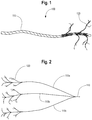
  • FIG. 1 shows an embodiment of an artificial branch according to an embodiment of the present disclosure.
  • FIG. 2 shows an embodiment of an artificial branch according to an embodiment of the present disclosure.
  • “and/or” means any one or more of the items in the list joined by “and/or”.
  • “x and/or y” means any element of the three-element set ⁇ (x), (y), (x, y) ⁇ .
  • “x, y, and/or z” means any element of the seven-element set ⁇ (x), (y), (z), (x, y), (x, z), (y, z), (x, y, z) ⁇ .
  • the term “exemplary” means serving as a non-limiting example, instance, or illustration.
  • the terms “e.g.” and “for example” set off lists of one or more non-limiting examples, instances, or illustrations.
  • Some embodiments according to the present disclosure relate to systems, apparatuses, and methods for providing wildlife scent communications.
  • Some embodiments according to the present disclosure provide for scent dispersal on tree branches.
  • Some embodiments according to the present disclosure provide a synthetic tree branch that has adhesive properties.
  • the adhesive properties are configured to receive scent compounds (e.g., synthetic and/or natural scent compounds) onto desired surfaces (e.g., surfaces of an overhanging tree limb) to attract wildlife.
  • Some embodiments according to the present disclosure using synthetic tree limbs to attract wildlife such as deer (e.g., white-tailed deer). Overhanging natural tree limbs of trees in the outdoors, particularly over scrapes, tend to get broken, thereby rendering the scrape site dormant. Some embodiments provide that by hanging synthetic limbs in place of broken natural tree limbs or installing the synthetic limbs over the scrape site, an otherwise dormant scrape site can become active again by providing the mechanism by which to attract deer for hunting seasons to come.
  • deer e.g., white-tailed deer
  • FIG. 1 shows an embodiment of an artificial branch 100 of a tree or a bush according to the present disclosure.
  • the artificial branch 100 includes a main limb 110 . Protruding from end portions of the main limb 110 are vines 120 . In some embodiments, some or all of the vines 120 are replaced with twigs or secondary branches. For simplicity of discussion, vines 120 will encompass vines, twigs, and/or secondary branches.
  • the vines 120 are formed in the approximately 2.5-foot end portion of the approximately 5-foot artificial branch 100 . In some embodiments, the approximately 2.5-foot end portion is the lower portion of the branch.
  • the main limb 110 is shown as diverging into three limbs 110 a - c .
  • the vines 120 are formed in the approximately 2.5-foot end portions of the limbs 110 a - c of the approximately 5-foot artificial branch 100 .
  • one or more adjustable wires run through the main limb 110 , the limbs 110 a - c , and/or the vines 120 .
  • the wires are flexible such that the shape of the vines 120 can adjusted and then hold its new shape.
  • the artificial branch 110 can be folded, rolled, or shaped for shipping, and then shaped again into a natural-looking branch in the field.
  • the wire core provides the artificial branch 100 with the structural integrity to withstand the physical strain applied by deer antlers.
  • the vines 120 can be formed by wrapping the vines 120 , which include one or more wires in its core, around the main limb 110 or other limbs 110 a - c in the approximately 2.5-foot end portion of the approximately 5-foot artificial branch 100 . Vines 120 can also be wrapped around other vines 120 to form secondary vines or twigs. In some embodiments, a non-toxic glue is applied to fix the wrapped vines 120 to the main limb 110 , other limbs 110 a - c , and/or other vines 120 .
  • the artificial branch 100 includes one or more of the following: a metal material, a synthetic poly-viscose (PV) cotton material, a paper material, a non-toxic glue, a non-toxic paint, and a rattan material that surround the one or more wires. Other materials might include a poly cotton material and a polyester cotton material. Some embodiments provide that the artificial branch 100 is waterproof. In some embodiments, by using one or more of a wire, a PV cotton material, a paper material, and/or a rattan material, for example, the artificial branch 100 can be made waterproof and last for years.
  • PV synthetic poly-viscose
  • the artificial branch 100 , the main limb 110 , the limbs 110 a - c , and/or the vines 120 have a composition of at least the following: approximately 15% metal; 35% paper; and 35% non-toxic glue.
  • Some embodiments provide cotton fibers to simulate moss protruding from the main limb 110 , the limbs 110 a - c , and/or the vines 120 .
  • the artificial branch 100 can be attached to an existing tree or bush (e.g., a trunk, a limb, a branch, a vine, etc.) or an artificial stand (e.g., a pole, structure, etc.).
  • the artificial branch 100 has one of its ends attached to a trunk or branch of a tree via a nail, a screw, a wire, a clip, glue, a fastener (e.g., fabric hook-and-loop fasteners, a velcro fastener, etc.), or other attachment mechanisms.
  • the artificial branch 100 can be a replacement for an existing natural branch that has broken or has been removed.
  • the artificial branch 100 can be hung vertically via a wire, a string, a rope, a fastener, a hanger, or other attachment mechanisms that are attached to the tree (e.g., a branch of the tree).
  • the artificial branch 100 is configured with a loop, a hole, an connecting extension, etc. that can be looped or attached to the tree (e.g., slide an existing branch through the loop or hole to hold the artificial branch 100 up) or some attachment mechanism that is attached to the tree, for example.
  • the artificial branch 100 is positioned at a height designed to facilitate and encourage scent communication among deer, for example.
  • the artificial branch 100 is placed above a deer scrape or in a rub line or a scrape line.
  • a scent compound be applied to the artificial branch 100 .
  • Natural and/or synthetic materials can be used to represent overhanging tree limbs as a way to repeatedly attract deer.
  • a powdered synthetic scent compound or other type of scent compound can be dispensed via a spray bottle.
  • An exemplary spray bottle design is shown in U.S. Design Application No. 29/255,577, which is hereby incorporated by reference herein in its entirety, whereby the sprayed powdered scent compound can become airborne and applied directly to the artificial branch 100 , the tree, the soil, and/or surrounding vegetation.
  • the scent compound is a powder or a liquid. Some embodiments provide that the scent compound is based on synthetic and natural compounds. Some embodiments provide that the scent compound is based on a natural deer urine compound. Some embodiments provide that the scent compound is based on secretions from one or more glands of a deer such as, for example, forehead glands, nasal glands, pre-orbital glands, vomeronasal glands, preputial glands, tarsal glands, interdigital glands, and/or meta tarsal glands.
  • a deer such as, for example, forehead glands, nasal glands, pre-orbital glands, vomeronasal glands, preputial glands, tarsal glands, interdigital glands, and/or meta tarsal glands.
  • scent compounds applied to the artificial branch 100 are not limited to synthetic (and/or natural) scent compounds that are applied to the artificial branch 100 by the hunter, for example. Some embodiments provide that scent compounds can also come directly from the deer as the deer interacts with the artificial branch 100 . For example, the deer can rub its forehead against the artificial branch 100 , or can bite or lick the artificial branch 100 , thereby leaving its scent behind on the artificial branch 100 .
  • the scent compound comprise a formulation that includes synthetic and natural compounds that include a porous carrier or a binder powder, an adhesive, and a scent.
  • the porous carrier or the binder powder can include talc powder or talcum powder, for example.
  • the adhesive operates to adhere the scent compound to the artificial branch 100 , for example.
  • the scent compound adheres to the artificial branch 100 , in part, due to adhesive properties of the surface of the artificial branch 100 .
  • Some embodiments provide a synthetic and natural artificial tree branch with an adjustable metal wire that is attached to and/or hung from a natural tree.
  • the artificial tree branch can be made of a PV cotton material, a paper material, and a rattan material.
  • the artificial tree branch and/or the scent compound applied to the tree limb can include a porous carrier or compound and an adhesive compound.
  • the scent compound which can be include natural and/or synthetic compounds, is shelf-stable and convenient to apply, carry, and store.
  • the artificial branch and/or scent compound can be configured so that the scent compound adheres to the surface of the artificial branch, thereby ensuring that some of the scent compound remains where it is applied, even in locations where the potential exists for some of the scent compound to drip or be blown away.

Landscapes

  • Life Sciences & Earth Sciences (AREA)
  • Engineering & Computer Science (AREA)
  • Insects & Arthropods (AREA)
  • Pest Control & Pesticides (AREA)
  • Wood Science & Technology (AREA)
  • Zoology (AREA)
  • Environmental Sciences (AREA)
  • Catching Or Destruction (AREA)

Abstract

Systems, apparatuses, and methods are described which provide an artificial branch that is coupled to a natural tree. The artificial branch includes one or more adjustable wires that can be used to change the shape of the artificial branch. The artificial branch is structured to receive natural and/or synthetic scent compounds that are sprayed at the artificial branch. In addition, the artificial branch is structured to receive scent compounds from wildlife to facilitate wildlife scent communication.

Description

RELATED APPLICATIONS
The present application claims priority to and benefit from U.S. Application No. 62/498,852, filed Jan. 10, 2017. The above-identified application is hereby incorporated by reference herein in its entirety.
BACKGROUND
Scents are widely used in the outdoors industry, especially for hunting large game. In an outdoor setting, natural overhanging tree limbs are used as a communication mechanism by wild game such as, for example, white-tailed deer. White-tailed deer leave their scent on the natural overhanging tree limbs for other white-tailed deer to smell.
In the outdoors industry, exemplary scent products include liquids made from natural doe urine and glandular secretions harvested from living deer. Suppliers of these liquid scent products include companies such as Tinks and Hunter Specialties. These liquids are applied to natural overhanging tree limbs to attract white-tailed deer. However, these natural overhanging tree limbs tend to get broken over time by white-tailed deer rubbing their antlers, head, and neck against the natural overhanding tree limbs. When this occurs, these hotspots become dormant, and white-tailed deer choose another location at which to leave their scent. This is unfortunate for the hunter that has staked out a particular location or put resources into building a stationary hideout (e.g., a tree stand, a field blind, etc.).
Further limitations and disadvantages of conventional and traditional approaches will become apparent to one of skill in the art, through comparison of such systems with the present disclosure as set forth in the remainder of the present application with reference to the drawings.
BRIEF SUMMARY
Systems, apparatuses, and methods provide wildlife scent communication substantially as illustrated by and/or described in connection with at least one of the figures, as set forth more completely in the claims.
Various advantages, aspects and novel features of the present disclosure, as well as details of an illustrated embodiment thereof, will be more fully understood from the following description and drawings.
BRIEF DESCRIPTION OF THE DRAWINGS
FIG. 1 shows an embodiment of an artificial branch according to an embodiment of the present disclosure.
FIG. 2 shows an embodiment of an artificial branch according to an embodiment of the present disclosure.
DETAILED DESCRIPTION
As utilized herein, “and/or” means any one or more of the items in the list joined by “and/or”. As an example, “x and/or y” means any element of the three-element set {(x), (y), (x, y)}. As another example, “x, y, and/or z” means any element of the seven-element set {(x), (y), (z), (x, y), (x, z), (y, z), (x, y, z)}. As utilized herein, the term “exemplary” means serving as a non-limiting example, instance, or illustration. As utilized herein, the terms “e.g.” and “for example” set off lists of one or more non-limiting examples, instances, or illustrations.
The drawings are of illustrative embodiments. They do not illustrate all embodiments. Other embodiments may be used in addition or instead. Details that may be apparent or unnecessary may be omitted to save space or for more effective illustration. Some embodiments may be practiced with additional components or steps and/or without all of the components or steps that are illustrated.
Some embodiments according to the present disclosure relate to systems, apparatuses, and methods for providing wildlife scent communications.
Some embodiments according to the present disclosure provide for scent dispersal on tree branches.
Some embodiments according to the present disclosure provide a synthetic tree branch that has adhesive properties. In some embodiments, the adhesive properties are configured to receive scent compounds (e.g., synthetic and/or natural scent compounds) onto desired surfaces (e.g., surfaces of an overhanging tree limb) to attract wildlife.
Some embodiments according to the present disclosure using synthetic tree limbs to attract wildlife such as deer (e.g., white-tailed deer). Overhanging natural tree limbs of trees in the outdoors, particularly over scrapes, tend to get broken, thereby rendering the scrape site dormant. Some embodiments provide that by hanging synthetic limbs in place of broken natural tree limbs or installing the synthetic limbs over the scrape site, an otherwise dormant scrape site can become active again by providing the mechanism by which to attract deer for hunting seasons to come.
FIG. 1 shows an embodiment of an artificial branch 100 of a tree or a bush according to the present disclosure. Referring to FIG. 1, the artificial branch 100 includes a main limb 110. Protruding from end portions of the main limb 110 are vines 120. In some embodiments, some or all of the vines 120 are replaced with twigs or secondary branches. For simplicity of discussion, vines 120 will encompass vines, twigs, and/or secondary branches. In the illustrated embodiment, the vines 120 are formed in the approximately 2.5-foot end portion of the approximately 5-foot artificial branch 100. In some embodiments, the approximately 2.5-foot end portion is the lower portion of the branch.
Referring to FIG. 2, the main limb 110 is shown as diverging into three limbs 110 a-c. As illustrated, the vines 120 are formed in the approximately 2.5-foot end portions of the limbs 110 a-c of the approximately 5-foot artificial branch 100.
Some embodiments provide that one or more adjustable wires run through the main limb 110, the limbs 110 a-c, and/or the vines 120. The wires are flexible such that the shape of the vines 120 can adjusted and then hold its new shape. Thus, for example, the artificial branch 110 can be folded, rolled, or shaped for shipping, and then shaped again into a natural-looking branch in the field. Further, the wire core provides the artificial branch 100 with the structural integrity to withstand the physical strain applied by deer antlers.
Some embodiments provide that the vines 120 can be formed by wrapping the vines 120, which include one or more wires in its core, around the main limb 110 or other limbs 110 a-c in the approximately 2.5-foot end portion of the approximately 5-foot artificial branch 100. Vines 120 can also be wrapped around other vines 120 to form secondary vines or twigs. In some embodiments, a non-toxic glue is applied to fix the wrapped vines 120 to the main limb 110, other limbs 110 a-c, and/or other vines 120.
Some embodiments provide that the artificial branch 100 includes one or more of the following: a metal material, a synthetic poly-viscose (PV) cotton material, a paper material, a non-toxic glue, a non-toxic paint, and a rattan material that surround the one or more wires. Other materials might include a poly cotton material and a polyester cotton material. Some embodiments provide that the artificial branch 100 is waterproof. In some embodiments, by using one or more of a wire, a PV cotton material, a paper material, and/or a rattan material, for example, the artificial branch 100 can be made waterproof and last for years.
Some embodiments provide that the artificial branch 100, the main limb 110, the limbs 110 a-c, and/or the vines 120 have a composition of at least the following: approximately 15% metal; 35% paper; and 35% non-toxic glue.
Some embodiments provide cotton fibers to simulate moss protruding from the main limb 110, the limbs 110 a-c, and/or the vines 120.
In operation according to some embodiments, the artificial branch 100 can be attached to an existing tree or bush (e.g., a trunk, a limb, a branch, a vine, etc.) or an artificial stand (e.g., a pole, structure, etc.). In some embodiments, the artificial branch 100 has one of its ends attached to a trunk or branch of a tree via a nail, a screw, a wire, a clip, glue, a fastener (e.g., fabric hook-and-loop fasteners, a velcro fastener, etc.), or other attachment mechanisms. The artificial branch 100 can be a replacement for an existing natural branch that has broken or has been removed. In some embodiments, the artificial branch 100 can be hung vertically via a wire, a string, a rope, a fastener, a hanger, or other attachment mechanisms that are attached to the tree (e.g., a branch of the tree). In some embodiments, the artificial branch 100 is configured with a loop, a hole, an connecting extension, etc. that can be looped or attached to the tree (e.g., slide an existing branch through the loop or hole to hold the artificial branch 100 up) or some attachment mechanism that is attached to the tree, for example. In some embodiments, the artificial branch 100 is positioned at a height designed to facilitate and encourage scent communication among deer, for example. In some embodiments, the artificial branch 100 is placed above a deer scrape or in a rub line or a scrape line.
Some embodiments provide that a scent compound be applied to the artificial branch 100. Natural and/or synthetic materials can be used to represent overhanging tree limbs as a way to repeatedly attract deer. In some embodiments, a powdered synthetic scent compound or other type of scent compound can be dispensed via a spray bottle. An exemplary spray bottle design is shown in U.S. Design Application No. 29/255,577, which is hereby incorporated by reference herein in its entirety, whereby the sprayed powdered scent compound can become airborne and applied directly to the artificial branch 100, the tree, the soil, and/or surrounding vegetation.
Some embodiments provide that the scent compound is a powder or a liquid. Some embodiments provide that the scent compound is based on synthetic and natural compounds. Some embodiments provide that the scent compound is based on a natural deer urine compound. Some embodiments provide that the scent compound is based on secretions from one or more glands of a deer such as, for example, forehead glands, nasal glands, pre-orbital glands, vomeronasal glands, preputial glands, tarsal glands, interdigital glands, and/or meta tarsal glands.
Some embodiments provide that scent compounds applied to the artificial branch 100 are not limited to synthetic (and/or natural) scent compounds that are applied to the artificial branch 100 by the hunter, for example. Some embodiments provide that scent compounds can also come directly from the deer as the deer interacts with the artificial branch 100. For example, the deer can rub its forehead against the artificial branch 100, or can bite or lick the artificial branch 100, thereby leaving its scent behind on the artificial branch 100.
Some embodiments provide that the scent compound comprise a formulation that includes synthetic and natural compounds that include a porous carrier or a binder powder, an adhesive, and a scent. The porous carrier or the binder powder can include talc powder or talcum powder, for example. In some embodiments, the adhesive operates to adhere the scent compound to the artificial branch 100, for example. In some embodiments, the scent compound adheres to the artificial branch 100, in part, due to adhesive properties of the surface of the artificial branch 100.
Some embodiments provide a synthetic and natural artificial tree branch with an adjustable metal wire that is attached to and/or hung from a natural tree. The artificial tree branch can be made of a PV cotton material, a paper material, and a rattan material. The artificial tree branch and/or the scent compound applied to the tree limb can include a porous carrier or compound and an adhesive compound. The scent compound, which can be include natural and/or synthetic compounds, is shelf-stable and convenient to apply, carry, and store. The artificial branch and/or scent compound can be configured so that the scent compound adheres to the surface of the artificial branch, thereby ensuring that some of the scent compound remains where it is applied, even in locations where the potential exists for some of the scent compound to drip or be blown away.
While the present disclosure has been described with reference to certain embodiments, it will be understood by those skilled in the art that various changes may be made and equivalents may be substituted without departing from the scope of the present disclosure. In addition, many modifications may be made to adapt a particular situation or material to the teachings of the present disclosure without departing from its scope. Therefore, it is intended that the present disclosure not be limited to the particular embodiment disclosed, but that the present disclosure will include all embodiments falling within the scope of the appended claims.

Claims (15)

The invention claimed is:
1. An apparatus, comprising:
a member configured as an artificial tree branch,
wherein the member includes one or more adjustable wires that can be used to change the shape of the artificial tree branch,
wherein the one or more adjustable wires are covered by a metal material, a poly-viscose cotton material, a paper material, a non-toxic glue material, a non-toxic paint material, and a rattan material, and
wherein the member includes a surface configured to receive one or more scent compounds used to facilitate deer scent communication.
2. The apparatus according to claim 1, wherein the member is configured to be attached to a natural tree.
3. The apparatus according to claim 1, wherein the member includes one or more of a synthetic poly-viscose cotton material, a synthetic polyester cotton material, and a synthetic poly cotton material.
4. The apparatus according to claim 1, wherein the member includes a paper material and a metal material.
5. The apparatus according to claim 1, wherein the member includes a non-toxic glue and a non-toxic paint.
6. The apparatus according to claim 1, wherein the member is configured as a rattan artificial tree branch.
7. The apparatus according to claim 1, wherein the member is configured to replace an existing limb of a tree.
8. The apparatus according to claim 1, wherein the member is configured to be attached to a tree at a height such that deer can use the member for scent communication.
9. The apparatus according to claim 1, wherein the member is waterproof.
10. The apparatus according to claim 1, wherein the member is structured to function as a deer scent communicator for one or more years.
11. The apparatus according to claim 1, comprising one or more vines protruding from or wrapped around the artificial tree branch.
12. The apparatus according to claim 11, wherein the one or more vines includes an adhesive surface configured to retain the one or more scent compounds.
13. The apparatus according to claim 1, wherein the member includes cotton fibers configured to simulate moss protruding or covering one or more vines.
14. The apparatus according to claim 1, wherein the member is configured to attract deer.
15. The apparatus according to claim 1, wherein the member is configured to receive a synthetic and natural scent compound that adheres to a surface of the member due to at least an adhesive property of the synthetic and natural scent compound, and wherein the member is configured to retain a natural scent compound from contact with a deer.
US15/703,250 2017-01-10 2017-09-13 Scrape vines Active 2038-07-24 US10721926B2 (en)

Priority Applications (3)

Application Number Priority Date Filing Date Title
US15/703,250 US10721926B2 (en) 2017-01-10 2017-09-13 Scrape vines
CA2991187A CA2991187A1 (en) 2017-01-10 2018-01-08 Scrape vines
US16/939,552 US11712037B2 (en) 2017-01-10 2020-07-27 Scrape vines

Applications Claiming Priority (2)

Application Number Priority Date Filing Date Title
US201762498852P 2017-01-10 2017-01-10
US15/703,250 US10721926B2 (en) 2017-01-10 2017-09-13 Scrape vines

Related Child Applications (1)

Application Number Title Priority Date Filing Date
US16/939,552 Continuation US11712037B2 (en) 2017-01-10 2020-07-27 Scrape vines

Publications (2)

Publication Number Publication Date
US20180192632A1 US20180192632A1 (en) 2018-07-12
US10721926B2 true US10721926B2 (en) 2020-07-28

Family

ID=62781875

Family Applications (2)

Application Number Title Priority Date Filing Date
US15/703,250 Active 2038-07-24 US10721926B2 (en) 2017-01-10 2017-09-13 Scrape vines
US16/939,552 Active 2037-10-22 US11712037B2 (en) 2017-01-10 2020-07-27 Scrape vines

Family Applications After (1)

Application Number Title Priority Date Filing Date
US16/939,552 Active 2037-10-22 US11712037B2 (en) 2017-01-10 2020-07-27 Scrape vines

Country Status (2)

Country Link
US (2) US10721926B2 (en)
CA (1) CA2991187A1 (en)

Families Citing this family (2)

* Cited by examiner, † Cited by third party
Publication number Priority date Publication date Assignee Title
US12225898B2 (en) * 2019-06-12 2025-02-18 Brooke Balsei Interactive deer scent display apparatus and related method
US11259519B2 (en) * 2020-04-10 2022-03-01 Hightower Products LLC Artificial licking branch

Citations (17)

* Cited by examiner, † Cited by third party
Publication number Priority date Publication date Assignee Title
US2857506A (en) * 1954-04-28 1958-10-21 Dorothy C Minteer Artificial illuminated tree
US3244577A (en) * 1962-04-26 1966-04-05 Raymond Gerald Lyle Artificial christmas tree and method of making the same
US3331727A (en) * 1963-02-15 1967-07-18 John P Lieval Artificial tree branch
US4364102A (en) * 1980-08-01 1982-12-14 Huppert Vaughn P Internally lighted decorative display
US4673599A (en) * 1986-01-24 1987-06-16 David Vanderslice Synthetic fur garland and method of making same
US4773177A (en) * 1986-10-29 1988-09-27 Hanburn, Inc. Method of preparing an animal luring site
US4859510A (en) * 1986-11-28 1989-08-22 Albert Rademacher Artificial vegatation or plants or parts for the same
US4950509A (en) * 1989-07-17 1990-08-21 Demott Donald T Miniature tree sculpture
US5104608A (en) * 1991-08-12 1992-04-14 Pickering Harold J Programmable Christmas tree
US5264258A (en) * 1992-09-10 1993-11-23 Cheng Chin S Fire-proof buri filament material and process for making the same
US5555664A (en) * 1995-01-26 1996-09-17 Shockley; Robert S. Device for attracting animals
US6363649B1 (en) * 2000-04-21 2002-04-02 Gary W. Lambert Method and apparatus for shed antler removal and collection
US20070048464A1 (en) * 2004-07-16 2007-03-01 Haupt Maureen D Artificial floral assembly with illumination
US20100189752A1 (en) * 2008-01-29 2010-07-29 Kassouni Haig H Pelleted mineral supplement for land animals
US20110318448A1 (en) * 2010-06-25 2011-12-29 Roger Rudd Deer attractant and nutrient
US20120090557A1 (en) * 2010-10-14 2012-04-19 Slade Jr Gaines B Method of use of dicalcium phosphate as an antler scent
US20120276307A1 (en) * 2008-12-10 2012-11-01 Schooley Bruce A Collapsible artificial tree

Family Cites Families (12)

* Cited by examiner, † Cited by third party
Publication number Priority date Publication date Assignee Title
US3278364A (en) * 1963-06-10 1966-10-11 Dieffenbach Percy Artificial christmas tree
US3458893A (en) * 1966-08-03 1969-08-05 Percy Dieffenbach Artificial tree limb tapering machine
US3525659A (en) * 1966-10-24 1970-08-25 Shinzo Ebihara Artificial dwarf tree and method of making same
US4054696A (en) * 1977-02-22 1977-10-18 Frederick Scott Crownover Artificial and mechanical tree
JPH10331016A (en) * 1997-05-29 1998-12-15 Kanai Hiroaki Imitation plant and its production
US6306471B1 (en) * 1999-09-24 2001-10-23 Port Midwest International, Inc. Arborescent concealment artifice
US20090246241A1 (en) * 2008-03-26 2009-10-01 Kathleen Pitt Animal pest repellant device
US8938905B1 (en) * 2009-10-16 2015-01-27 Moore Outdoors Productions and Products Device to attract deer
US20140123538A1 (en) * 2012-11-02 2014-05-08 Scott Matheson Deer communication site
WO2016134187A1 (en) * 2015-02-18 2016-08-25 Falk Ira A Decorative tree with insertable, interchangeable branches system and method
EP3170860B1 (en) * 2015-11-19 2020-07-29 3M Innovative Properties Company Structural adhesive with improved corrosion resistance
US11064693B2 (en) * 2017-07-21 2021-07-20 Pick Outdoors LLC Deer attraction device

Patent Citations (17)

* Cited by examiner, † Cited by third party
Publication number Priority date Publication date Assignee Title
US2857506A (en) * 1954-04-28 1958-10-21 Dorothy C Minteer Artificial illuminated tree
US3244577A (en) * 1962-04-26 1966-04-05 Raymond Gerald Lyle Artificial christmas tree and method of making the same
US3331727A (en) * 1963-02-15 1967-07-18 John P Lieval Artificial tree branch
US4364102A (en) * 1980-08-01 1982-12-14 Huppert Vaughn P Internally lighted decorative display
US4673599A (en) * 1986-01-24 1987-06-16 David Vanderslice Synthetic fur garland and method of making same
US4773177A (en) * 1986-10-29 1988-09-27 Hanburn, Inc. Method of preparing an animal luring site
US4859510A (en) * 1986-11-28 1989-08-22 Albert Rademacher Artificial vegatation or plants or parts for the same
US4950509A (en) * 1989-07-17 1990-08-21 Demott Donald T Miniature tree sculpture
US5104608A (en) * 1991-08-12 1992-04-14 Pickering Harold J Programmable Christmas tree
US5264258A (en) * 1992-09-10 1993-11-23 Cheng Chin S Fire-proof buri filament material and process for making the same
US5555664A (en) * 1995-01-26 1996-09-17 Shockley; Robert S. Device for attracting animals
US6363649B1 (en) * 2000-04-21 2002-04-02 Gary W. Lambert Method and apparatus for shed antler removal and collection
US20070048464A1 (en) * 2004-07-16 2007-03-01 Haupt Maureen D Artificial floral assembly with illumination
US20100189752A1 (en) * 2008-01-29 2010-07-29 Kassouni Haig H Pelleted mineral supplement for land animals
US20120276307A1 (en) * 2008-12-10 2012-11-01 Schooley Bruce A Collapsible artificial tree
US20110318448A1 (en) * 2010-06-25 2011-12-29 Roger Rudd Deer attractant and nutrient
US20120090557A1 (en) * 2010-10-14 2012-04-19 Slade Jr Gaines B Method of use of dicalcium phosphate as an antler scent

Non-Patent Citations (2)

* Cited by examiner, † Cited by third party
Title
Brock, Brent L. Making Artificial Trees and Vines for Naturalistic Vivaria, https://www.dendrobatidae.org/Portals/0/activeforums_Attach/1424223459371.pdf, published Dec. 13, 2005, accessed Dec. 6, 2019. *
House by Hoff: DIY Flocked Christmas Tree, https://www.housebyhoff.com/2016/12/diy-flocked-christmas-tree/, published Dec. 22, 2016, accessed Dec. 9, 2019. *

Also Published As

Publication number Publication date
US20180192632A1 (en) 2018-07-12
CA2991187A1 (en) 2018-07-10
US20210015091A1 (en) 2021-01-21
US11712037B2 (en) 2023-08-01

Similar Documents

Publication Publication Date Title
US11712037B2 (en) Scrape vines
US20140123538A1 (en) Deer communication site
HRP20231679T1 (en) Methods for assessing repellant quality of organic materials and methods and compositions for repelling arthropods
US20130055619A1 (en) Scent-dispersing system and method for attracting wild animals
US20090246241A1 (en) Animal pest repellant device
KR20210112965A (en) Sticky insects capture and wildlife displace trap with shower shield and multilayared structure of solar light led lamp
JP2005142106A (en) Pest-bird preventing polymer insulator
CN106942194A (en) A kind of scarer
Somasundaram et al. Foraging ecology of the globally threatened Nilgiri Wood Pigeon (Columba elphinstonii) in the Western Ghats, India
US6383508B1 (en) Animal repellent and method
US20040194423A1 (en) Pigeon control method
US6923977B1 (en) Squirrel repellant system
US20210016308A1 (en) Powdered scent compound
CA2003217A1 (en) Insect catcher
CN207145397U (en) A kind of gardening takes the connector that framework is used for pillar connection
US12408648B2 (en) Method of trapping ticks
WO2010004556A2 (en) A device and a method for pollen application for enhancing biological control
US6641830B1 (en) Deer repellent
US20190380328A1 (en) Interactive deer scent display apparatus and related method
US20140110496A1 (en) Scent delivery device
US12225898B2 (en) Interactive deer scent display apparatus and related method
Hansbauer et al. A comparison of five techniques for attaching radio-transmitters to tropical passerine birds
CN105594697A (en) Rainproof preparation for affecting insect behaviors
US20020134001A1 (en) Scent dispenser
US20100304968A1 (en) process of manufacture for deer repellant, pest and rodent control, weed-killer, fungicide and insecticide, and combinations thereof in powder and liquid spray formulations

Legal Events

Date Code Title Description
FEPP Fee payment procedure

Free format text: ENTITY STATUS SET TO UNDISCOUNTED (ORIGINAL EVENT CODE: BIG.); ENTITY STATUS OF PATENT OWNER: SMALL ENTITY

FEPP Fee payment procedure

Free format text: ENTITY STATUS SET TO SMALL (ORIGINAL EVENT CODE: SMAL); ENTITY STATUS OF PATENT OWNER: SMALL ENTITY

STPP Information on status: patent application and granting procedure in general

Free format text: DOCKETED NEW CASE - READY FOR EXAMINATION

STPP Information on status: patent application and granting procedure in general

Free format text: NON FINAL ACTION MAILED

STPP Information on status: patent application and granting procedure in general

Free format text: RESPONSE TO NON-FINAL OFFICE ACTION ENTERED AND FORWARDED TO EXAMINER

STPP Information on status: patent application and granting procedure in general

Free format text: NON FINAL ACTION MAILED

STPP Information on status: patent application and granting procedure in general

Free format text: NOTICE OF ALLOWANCE MAILED -- APPLICATION RECEIVED IN OFFICE OF PUBLICATIONS

STPP Information on status: patent application and granting procedure in general

Free format text: PUBLICATIONS -- ISSUE FEE PAYMENT VERIFIED

STCF Information on status: patent grant

Free format text: PATENTED CASE

AS Assignment

Owner name: WINDAGE, LLC, MINNESOTA

Free format text: ASSIGNMENT OF ASSIGNORS INTEREST;ASSIGNOR:HEALY, DAVID ROBERT;REEL/FRAME:063297/0046

Effective date: 20170811

MAFP Maintenance fee payment

Free format text: PAYMENT OF MAINTENANCE FEE, 4TH YR, SMALL ENTITY (ORIGINAL EVENT CODE: M2551); ENTITY STATUS OF PATENT OWNER: SMALL ENTITY

Year of fee payment: 4