US10718942B2 - Eye tracking systems and methods for near-eye-display (NED) devices - Google Patents
Eye tracking systems and methods for near-eye-display (NED) devices Download PDFInfo
- Publication number
- US10718942B2 US10718942B2 US16/168,319 US201816168319A US10718942B2 US 10718942 B2 US10718942 B2 US 10718942B2 US 201816168319 A US201816168319 A US 201816168319A US 10718942 B2 US10718942 B2 US 10718942B2
- Authority
- US
- United States
- Prior art keywords
- eye
- user
- sensor
- pupil
- eye tracking
- Prior art date
- Legal status (The legal status is an assumption and is not a legal conclusion. Google has not performed a legal analysis and makes no representation as to the accuracy of the status listed.)
- Active
Links
Images




Classifications
-
- G—PHYSICS
- G06—COMPUTING OR CALCULATING; COUNTING
- G06F—ELECTRIC DIGITAL DATA PROCESSING
- G06F3/00—Input arrangements for transferring data to be processed into a form capable of being handled by the computer; Output arrangements for transferring data from processing unit to output unit, e.g. interface arrangements
- G06F3/01—Input arrangements or combined input and output arrangements for interaction between user and computer
- G06F3/011—Arrangements for interaction with the human body, e.g. for user immersion in virtual reality
- G06F3/013—Eye tracking input arrangements
-
- G—PHYSICS
- G02—OPTICS
- G02B—OPTICAL ELEMENTS, SYSTEMS OR APPARATUS
- G02B27/00—Optical systems or apparatus not provided for by any of the groups G02B1/00 - G02B26/00, G02B30/00
- G02B27/01—Head-up displays
- G02B27/017—Head mounted
- G02B27/0172—Head mounted characterised by optical features
-
- G—PHYSICS
- G02—OPTICS
- G02B—OPTICAL ELEMENTS, SYSTEMS OR APPARATUS
- G02B27/00—Optical systems or apparatus not provided for by any of the groups G02B1/00 - G02B26/00, G02B30/00
- G02B27/01—Head-up displays
- G02B27/0179—Display position adjusting means not related to the information to be displayed
-
- G—PHYSICS
- G06—COMPUTING OR CALCULATING; COUNTING
- G06T—IMAGE DATA PROCESSING OR GENERATION, IN GENERAL
- G06T7/00—Image analysis
- G06T7/20—Analysis of motion
- G06T7/246—Analysis of motion using feature-based methods, e.g. the tracking of corners or segments
-
- G—PHYSICS
- G06—COMPUTING OR CALCULATING; COUNTING
- G06V—IMAGE OR VIDEO RECOGNITION OR UNDERSTANDING
- G06V40/00—Recognition of biometric, human-related or animal-related patterns in image or video data
- G06V40/10—Human or animal bodies, e.g. vehicle occupants or pedestrians; Body parts, e.g. hands
- G06V40/18—Eye characteristics, e.g. of the iris
-
- G—PHYSICS
- G02—OPTICS
- G02B—OPTICAL ELEMENTS, SYSTEMS OR APPARATUS
- G02B27/00—Optical systems or apparatus not provided for by any of the groups G02B1/00 - G02B26/00, G02B30/00
- G02B27/01—Head-up displays
- G02B27/0101—Head-up displays characterised by optical features
- G02B2027/0138—Head-up displays characterised by optical features comprising image capture systems, e.g. camera
-
- G—PHYSICS
- G02—OPTICS
- G02B—OPTICAL ELEMENTS, SYSTEMS OR APPARATUS
- G02B27/00—Optical systems or apparatus not provided for by any of the groups G02B1/00 - G02B26/00, G02B30/00
- G02B27/01—Head-up displays
- G02B27/0101—Head-up displays characterised by optical features
- G02B2027/014—Head-up displays characterised by optical features comprising information/image processing systems
-
- G—PHYSICS
- G02—OPTICS
- G02B—OPTICAL ELEMENTS, SYSTEMS OR APPARATUS
- G02B27/00—Optical systems or apparatus not provided for by any of the groups G02B1/00 - G02B26/00, G02B30/00
- G02B27/01—Head-up displays
- G02B27/017—Head mounted
- G02B2027/0178—Eyeglass type
-
- G—PHYSICS
- G02—OPTICS
- G02B—OPTICAL ELEMENTS, SYSTEMS OR APPARATUS
- G02B27/00—Optical systems or apparatus not provided for by any of the groups G02B1/00 - G02B26/00, G02B30/00
- G02B27/01—Head-up displays
- G02B27/0179—Display position adjusting means not related to the information to be displayed
- G02B2027/0187—Display position adjusting means not related to the information to be displayed slaved to motion of at least a part of the body of the user, e.g. head, eye
-
- G—PHYSICS
- G02—OPTICS
- G02B—OPTICAL ELEMENTS, SYSTEMS OR APPARATUS
- G02B27/00—Optical systems or apparatus not provided for by any of the groups G02B1/00 - G02B26/00, G02B30/00
- G02B27/0093—Optical systems or apparatus not provided for by any of the groups G02B1/00 - G02B26/00, G02B30/00 with means for monitoring data relating to the user, e.g. head-tracking, eye-tracking
-
- G—PHYSICS
- G02—OPTICS
- G02B—OPTICAL ELEMENTS, SYSTEMS OR APPARATUS
- G02B27/00—Optical systems or apparatus not provided for by any of the groups G02B1/00 - G02B26/00, G02B30/00
- G02B27/01—Head-up displays
-
- G—PHYSICS
- G06—COMPUTING OR CALCULATING; COUNTING
- G06T—IMAGE DATA PROCESSING OR GENERATION, IN GENERAL
- G06T2207/00—Indexing scheme for image analysis or image enhancement
- G06T2207/10—Image acquisition modality
- G06T2207/10016—Video; Image sequence
- G06T2207/10021—Stereoscopic video; Stereoscopic image sequence
-
- G—PHYSICS
- G06—COMPUTING OR CALCULATING; COUNTING
- G06T—IMAGE DATA PROCESSING OR GENERATION, IN GENERAL
- G06T2207/00—Indexing scheme for image analysis or image enhancement
- G06T2207/30—Subject of image; Context of image processing
- G06T2207/30004—Biomedical image processing
- G06T2207/30041—Eye; Retina; Ophthalmic
Definitions
- NED Near-Eye-Display
- CG images computer-generated images
- a NED system may generate composite views to enable a user to visually perceive a CG image superimposed over a physical object that exists within the real-world environment.
- a user's experience is highly dependent on the NED system accurately tracking the user's eye movements.
- the NED system may track an interpupillary distance (IPD) of the user.
- IPD interpupillary distance
- One reason for tracking IPD is so that CG images can be rendered at a suitable separation within the user's field of view.
- the NED system may track a depth at which the user is focusing within the real-world environment.
- One reason for tracking the user's focal depth is because the user may experience motion sickness or vertigo if CG images are rendered at a depth that is different (i.e., closer to/farther from the user) than that which the user is focusing.
- Some conventional eye tracking systems illuminate the user's eyes with near infrared light and then track the user's eye movements by observing reflective patterns that are formed from the near infrared light. For example, upon being illuminated with near infrared light, the eyes may form one or more first Purkinje reflections (e.g., “glints”) that are distributed around the iris.
- Conventional eye tracking systems track eye movements (e.g., the user's gaze direction) by analyzing the location(s) of these Purkinje reflections with respect to the center of the pupil.
- convention eye tracking systems estimate the user's line of sight by observing the Purkinje reflections with the addition of head tracking information.
- an accurate estimation of the user's line of sight may be insufficient to accurately determine the depth at which the user is focusing within the real-world environment. This is because the user's line of sight and the user's visual axis (which actually propagates to the user's fovea) only converge at a single depth plane.
- an exemplary eye tracking system for a NED device includes sensors (e.g., CMOS sensors) that are directed toward a user's eyes.
- the sensors are angularly offset from the user's eyes in a manner that causes circular features (e.g., irises and/or pupils) of the user's eyes to appear elliptical within sensor planes that correspond to the individual sensors.
- circular features e.g., irises and/or pupils
- both an iris and a pupil of an eye will appear circular when the eye is looked at straight on (i.e., perpendicular to an optical axis of the eye's lens).
- a circular object will appear to be elliptical when observed from an angle that is angularly offset from (e.g., not normal to) a plane on which the circular object resides.
- the eye tracking systems and methods disclosed herein exploit these principles to track movements of the user's eyes with a higher degree of accuracy than conventional eye tracking systems.
- Various embodiments disclosed herein track the user's interpupillary distance (IPD) in real time while the NED device is operating—rather than merely determining the user's IPD at predetermined intervals as conventional eye tracking systems do. Additionally, or alternatively, various embodiments disclosed herein track the user's visual axes—rather than merely tracking the user's optical axis and/or line of sight as conventional eye tracking systems do. Then, by determining a vergence in space between the visual axes for each of the user's two eyes, such embodiments calculate the depth in space at which the user is focused with a significantly higher degree of accuracy than conventional eye tracking systems. Accordingly, the disclosed eye tracking systems and methods represents a substantial advance toward preventing a user of a NED device from experiencing motion sickness or vertigo due to CG images being generated in front of or behind the user's accommodation plane (e.g., focal plane).
- IPD interpupillary distance
- an eye tracking system includes one or more sensors that generate eye tracking data associated with one or more substantially circular features of one or both of a user's eyes.
- substantially circular features include pupils and irises which are generally very close to circular and, therefore, may be modeled as perfect circles for purposes of the calculations described herein.
- the individual sensors have corresponding sensor planes that are angularly skewed with respect to the planes on which the circular features reside (e.g., an Iris-Pupil Plane). Based on the eye tracking data, the eye tracking system determines ellipse parameters for ellipses that result from these sensor planes being angularly skewed from the Iris-Pupil Planes.
- the eye tracking system may track only one of the user's eyes. In other embodiments, the eye tracking system may track both of the user's eyes. In embodiments that track both eyes, the eye tracking system may determine ellipse parameters that define: (i) first ellipses that correspond to projections of an iris and/or pupil of a right eye onto a first sensor plane; and (ii) second ellipses that correspond to projections of an iris and/or pupil of a left eye onto a second sensor plane.
- the projections of each of the iris(es) and/or pupil(s) onto the corresponding sensor plane(s) may in some embodiments pass through a predetermined point such as, for example, an entrance pupil of each corresponding sensor.
- the eye tracking system may then generate propagation data that defines three-dimensional (3D) propagations of the ellipses.
- the 3D propagation data may define a series of lines (e.g., rays) that extend from individual ellipses that are detected on the sensor plane.
- individual lines of the series of lines may begin on the sensor plane at individual points along a perimeter of a detected ellipse.
- the individual lines may all commonly propagate from the sensor plane through a predetermined point toward the user's eyes.
- the predetermined point through which all lines of a particular 3D propagation pass is an entrance pupil of a corresponding sensor. Since all of the lines of these 3D propagations extend from the ellipse through the predetermined point, the 3D propagations may be graphically represented as an elliptic cone that extends from the predetermined point toward the eye.
- the eye tracking system may utilize the propagation data to determine pupil orientation parameters that define various characteristics of the user's eye(s).
- Exemplary pupil orientation parameters may define optical axes for one or both of the user's eyes (e.g., an axis of an eye lens), visual axes for one or both of the user's eyes (e.g. axes that extend from the fovea through the lens and into the real-world environment), rotational angles of the user's eyes (e.g. an angle of rotation between a semi-axis of an ellipse and a horizontal axes of the sensor), Iris-Pupil Planes of the user's eyes (e.g.
- the pupil orientation parameters may define various other characteristics of the user's eyes.
- the eye tracking system may utilize the pupil orientation parameters to continually determine of a current (e.g., real time) IPD for a user, i.e. while the NED device is operating. For example, the eye tracking system may dynamically track the center points for each of the user's two eyes and continually calculate and re-calculate the user's interpupillary distance in near real time. Additionally, or alternatively, the eye tracking system may utilize the pupil orientation parameters to determine a vergence of two visual axes (which are different than the optical axis) of the user. For example, the eye tracking system may dynamically track the visual axis of each of the user's two eyes and continually calculate a location in space at which the distance between these two visual axes is the smallest.
- a current e.g., real time
- the eye tracking system may dynamically track the center points for each of the user's two eyes and continually calculate and re-calculate the user's interpupillary distance in near real time.
- the eye tracking system may utilize the pupil orientation
- the visual axes are determined based on visual axis offset data that indicates at least an angular relationship between the optical axis and the visual axis.
- this visual axis offset data may be specifically custom to a particular user and may be determined through a user-specific calibration process. It can be appreciated that although vergence is generally understood as the “point” at which the user's two visual axis intersect, in a practical sense these axes rarely mathematically intersect but rather simply become the closest at the user's accommodation plane. Thus, as described herein the vergence of the visual axes may be determined by calculating a point in space at which the separation between the two visual axes is the least (i.e., wherever the two axes become closest together).
- the pupil orientation parameters may be determined by analyzing the propagation data with respect to an ocular rotation model to calculate an orientation of the Iris-pupil plane for an eye, a distance from a predetermined point of the sensor to a center of an entrance pupil of the eye, and/or a radius of the pupil of the eye.
- the ocular rotation model may be usable to model rotation of a circular feature of an eye around that eye's center of rotation.
- the ocular rotation model may be (or be based on) an equation that defines coordinates for a circle of a particular radius as that circle is rotated around the center of an eye.
- any reference to “first,” “second,” etc. items and/or abstract concepts within the Summary and/or Detailed Description is not intended to and should not be construed to necessarily correspond to any reference of “first,” “second,” etc. elements of the claims.
- items and/or abstract concepts such as, for example, three-dimensional (3D) propagations and/or circular features of eyes and/or sensor entrance pupils may be distinguished by numerical designations without such designations corresponding to the claims or even other paragraphs of the Summary and/or Detailed Description.
- any designation of a “first 3D propagation” and “second 3D propagation” of the eye tracking system within any specific paragraph of this the Summary and/or Detailed Description is used solely to distinguish two different 3D propagations of the eye tracking system within that specific paragraph—not any other paragraph and particularly not the claims.
- FIG. 1 illustrates an exemplary hardware layout for a Near-Eye-Display (NED) device that is configured to implement the methods described herein.
- NED Near-Eye-Display
- FIG. 2 illustrates a pair of three-dimensional (3D) propagations that extend from ellipses that result from circular features of user's eyes being projected into the sensors.
- FIG. 3 illustrates in an exemplary ellipse that is being projected onto a sensor plane within a sensor that is angularly skewed with respect to the Iris-Pupil plane (not shown in FIG. 3 ) so that circular features on the Iris-Pupil plane appear elliptical on the sensor plane.
- FIG. 4 illustrates a side view of a 3D propagation of the ellipse of FIG. 3 from the sensor plane through a predetermined point and toward the Iris-Pupil plane.
- FIG. 5A illustrates exemplary eye tracking data in the form of pixel data that is generated by the sensors and that is usable to implement the techniques described herein.
- FIG. 5B illustrates exemplary eye tracking data in the form of pixel data that has changed in relation to FIG. 5A due to the user's focus shifting to the left.
- FIG. 6 illustrates exemplary positions of a user's fovea in relation to the optical axes of the user's left and right eyes.
- FIG. 7 illustrates exemplary positions of a user's right fovea and left fovea in relation to the optical axes of the user's right eye and left eye, respectively.
- FIG. 8 illustrates a side view of a user's eye showing how the offset position of the user's fovea in relation to the optical axis results in the visual axis diverging from the optical axis.
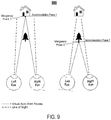
- FIG. 9 illustrates an exemplary environment in which a user may perform vergence movements of the eyes to shift a vergence of the two visual axes (e.g., a focal point) from a first accommodation plane to a second accommodation plane.
- a vergence of the two visual axes e.g., a focal point
- FIG. 10 illustrates an exemplary anatomical eye model that defines geometrical relationships between various portions of an eye.
- FIG. 11 illustrates a pair of visual axes that are determinable based on visual axis offset data defining a spatial relationship between the individual visual axes and corresponding optical axes.
- FIG. 12 illustrates an exemplary environment in which a plurality of virtual stimuli can be sequentially generated at a predetermined accommodation plane for performance of a user-specific calibration process.
- FIG. 13 is a flow diagram of a process 1300 to generate propagation data that defines three-dimensional (3D) propagations from ellipses detected at a sensor plane to determine pupil orientation parameters.
- an exemplary eye tracking system for a NED device includes sensors that are directed toward and angularly offset from a user's eyes in a manner that causes circular features (e.g., irises and/or pupils) of the user's eyes to appear elliptical within sensor planes of the individual sensors.
- circular features e.g., irises and/or pupils
- an iris and/or pupil of an eye will appear circular when the eye is looked at straight on (i.e., perpendicular to an optical axis of the eye's lens) but elliptical when observed from an angular offset.
- the eye tracking systems and methods disclosed herein exploit these principles to track movements of the user's eyes with a higher degree of accuracy than conventional eye tracking systems.
- various embodiments track the user's visual axes—rather than merely tracking the user's optical axis and/or line of sight as conventional eye tracking systems do. It will be appreciated from the following discussion that determining a vergence in space between the visual axes for each of the user's two eyes provides substantially more actual calculations of the depth in space at which the user is focused than is currently achievable by conventional eye tracking systems.
- the disclosed eye tracking systems and methods therefore represent a substantial advance toward preventing a user of a NED device from experiencing motion sickness or vertigo due to CG images being generated in front of or behind the user's current (e.g., real time) accommodation plane (e.g., focal plane).
- the sensors being cameras that contain one or more lenses that define an entrance pupil that is disposed in front of an image-sensor (e.g., a CMOS sensor).
- the image sensor may generate eye tracking data in the form of pixel data that defines images of the user's eyes. While the disclosed techniques are not necessarily limited to using cameras, an appreciation of various aspects of the invention is best gained through a discussion of example in such a context. However, any type of sensor that is suitable for observing a shape and/or orientation of the iris and/or pupil of the user's eye shall be considered variations of the techniques described herein. For example, it will be appreciated that various forms of lenses sensors may also be suitable for implementing the techniques described herein.
- the NED device 100 includes a pair of sensors 102 that are each directed toward a corresponding eye 104 of a user. More specifically, the illustrated NED device 100 includes a first sensor 102 ( 1 ) that is angularly offset from and directed toward a right eye 104 (R) and also a second sensor 102 ( 1 ) that is angularly offset from and directed toward a left eye 104 (L).
- the right eye 104 (R) includes a corresponding pupil 106 (R) and a corresponding iris 108 (R).
- the left eye 104 (L) includes a corresponding pupil 106 (L) and a corresponding iris 108 (L).
- the sensors 102 can be in any suitable form such as, for example, a non-contact sensor configured to use optical-based tracking (e.g. video camera based and/or some other specially designed optical-sensor-based eye tracking technique) to monitor the one or more physical characteristics of the user's eyes.
- optical-based tracking e.g. video camera based and/or some other specially designed optical-sensor-based eye tracking technique
- Exemplary physical characteristics include, but are not limited to, pupil size, a rate of change of pupil size, gaze direction, and/or a rate of change to a gaze direction.
- FIG. 1 is illustrated from a perspective that is directly in front of the optical axes of the eyes 104 so that the pupils 106 and irises 108 appear perfectly circular. It will be appreciated by one skilled in the art that in humans (and many other vertebrates for that matter) the pupils 106 and irises 108 of the eyes 104 are almost perfect circles. Therefore, in various calculations described below, the pupils 106 and/or irises 108 are mathematically modeled as and/or presumed to be perfectly circular in shape. From the perspective of the individual sensors 102 , however, the pupils 106 and irises 108 of the eyes 104 appear to be elliptical as described herein.
- the sensors 102 are angularly offset from the eyes 104 in the sense that the optical axis of each individual sensor 102 is not parallel to the optical axis of the eye 104 it is tracking.
- the position of the sensors 102 shown in FIG. 1 is for illustrative purposes only. It will be appreciated that the techniques described herein can be performed with the sensors 102 being located in a variety of positions with respect to the eyes. As a specific but nonlimiting example, the sensors could be embedded within a lens or other substrate directly in front of the eyes.
- the NED device 100 further includes a controller 110 that is configured to implement the various operations of the methods described herein.
- the controller 110 may be communicatively coupled to the sensors 102 to receive eye tracking data that is generated by the sensors 102 in association with the circular features of the eyes.
- the controller 110 may further be communicatively coupled to other componentry of the NED display device 100 .
- the controller 110 includes one or more logic devices and one or more computer memory devices storing instructions executable by the logic device(s) to deploy functionalities described herein with relation to the NED device 100 .
- the controller 116 can comprise one or more processing units 112 , one or more computer-readable media 114 for storing an operating system 116 and data such as, for example, eye tracking data, visual axis offset data, application data, etc.
- the computer-readable media 114 may further include an eye tracking engine 116 configured to receive the eye tracking data from the sensor 102 and, based thereon, determine one or more physical characteristics of the user's eyes using the methods and techniques described herein.
- the components of the NED device 100 are operatively connected, for example, via a bus 120 , which can include one or more of a system bus, a data bus, an address bus, a PCI bus, a Mini-PCI bus, and any variety of local, peripheral, and/or independent buses.
- the processing unit(s) 112 can represent, for example, a CPU-type processing unit, a GPU-type processing unit, a field-programmable gate array (FPGA), another class of digital signal processor (DSP), or other hardware logic components that may, in some instances, be driven by a CPU.
- FPGA field-programmable gate array
- DSP digital signal processor
- illustrative types of hardware logic components that can be used include Application-Specific Integrated Circuits (ASICs), Application-Specific Standard Products (ASSPs), System-on-a-Chip Systems (SOCs), Complex Programmable Logic Devices (CPLDs), etc.
- computer-readable media such as computer-readable media 114
- Computer-readable media can also store instructions executable by external processing units such as by an external CPU, an external GPU, and/or executable by an external accelerator, such as an FPGA type accelerator, a DSP type accelerator, or any other internal or external accelerator.
- external processing units such as by an external CPU, an external GPU, and/or executable by an external accelerator, such as an FPGA type accelerator, a DSP type accelerator, or any other internal or external accelerator.
- an FPGA type accelerator such as an Intel Knights Landing type accelerator
- DSP type accelerator such as an Intel Knights Landing type accelerator
- any other internal or external accelerator such as an Intel® 845555B Intel® 845555B Intel® 845555B Intel® 845555B Intel® 845555B Intel® 845555B Intel® 845555B Intel® 845555B Intel® 845555B Intel® 845555B Intel® 845555B Intel® 845555B Intel® 845
- Computer-readable media can include computer storage media and/or communication media.
- Computer storage media can include one or more of volatile memory, nonvolatile memory, and/or other persistent and/or auxiliary computer storage media, removable and non-removable computer storage media implemented in any method or technology for storage of information such as computer-readable instructions, data structures, program modules, or other data.
- computer storage media includes tangible and/or physical forms of media included in a device and/or hardware component that is part of a device or external to a device, including but not limited to random access memory (RAM), static random-access memory (SRAM), dynamic random-access memory (DRAM), phase change memory (PCM), read-only memory (ROM), erasable programmable read-only memory (EPROM), electrically erasable programmable read-only memory (EEPROM), flash memory, rotating media, optical cards or other optical storage media, magnetic storage, magnetic cards or other magnetic storage devices or media, solid-state memory devices, storage arrays, network attached storage, storage area networks, hosted computer storage or any other storage memory, storage device, and/or storage medium that can be used to store and maintain information for access by a computing device.
- RAM random access memory
- SRAM static random-access memory
- DRAM dynamic random-access memory
- PCM phase change memory
- ROM read-only memory
- EPROM erasable programmable read-only memory
- EEPROM electrically eras
- communication media can embody computer-readable instructions, data structures, program modules, or other data in a modulated data signal, such as a carrier wave, or other transmission mechanism.
- a modulated data signal such as a carrier wave, or other transmission mechanism.
- computer storage media does not include communication media. That is, computer storage media does not include communications media consisting solely of a modulated data signal, a carrier wave, or a propagated signal, per se.
- the NED device 100 may further include various other components, for example speakers, microphones, accelerometers, gyroscopes, magnetometers, temperature sensors, touch sensors, biometric sensors, other image sensors, energy-storage components (e.g. battery), a communication facility, a GPS receiver, etc.
- various other components for example speakers, microphones, accelerometers, gyroscopes, magnetometers, temperature sensors, touch sensors, biometric sensors, other image sensors, energy-storage components (e.g. battery), a communication facility, a GPS receiver, etc.
- FIG. 2 illustrated is a pair of three-dimensional (3D) propagations 202 that extend from ellipses 204 that result from circular features (e.g., pupils 106 and/or irises 108 ) of user's eyes 104 being projected into the sensors 102 .
- a first 3D propagation 202 ( 1 ) extends from a first ellipse 204 ( 1 ), which is detected at the first sensor 102 ( 1 ), through a first point P 1 .
- a second 3D propagation 202 ( 2 ) extends from a second ellipse 204 ( 2 ), which is detected at the second sensor 102 ( 2 ), through a second point P 2 .
- Each of the 3D propagations 202 extend toward a corresponding Iris-Pupil plane 206 that is angularly offset with respect to the sensors 102 .
- the angularly offset nature of the Iris-Pupil planes 206 results in the pupils 106 and irises 108 appearing elliptical from the perspectives of the sensors 102 .
- each of the individual 3D propagations 202 may include a series of lines that extend from a perimeter of a corresponding individual ellipse 204 through a corresponding predetermined point and, ultimately, to the perimeter of a circular feature (e.g., pupil 106 or iris 108 ) that resides within a corresponding Iris-Pupil plane 206 .
- the predetermined points (e.g., P 1 and P 2 ) may correspond to specific points in space that are measurable in relation to corresponding sensors 102 .
- the first predetermined point P 1 may correspond to a center of an entrance pupil of the first sensor 102 ( 1 )
- the second predetermined point P 2 may correspond to a center of an entrance pupil of the second sensor 102 ( 2 ).
- P 1 may correspond to a point in space at which light rays cross prior to forming an image within the first sensor 102 ( 1 ) and that P 2 may correspond to a point in space at which light rays cross prior to forming an image within the second sensor 102 ( 2 ).
- these 3D propagations 202 may be used to determine pupil orientation parameters that define various characteristics of the user's pupil(s) 106 .
- the 3D propagations 202 can be mathematically modeled as elliptical cones. This is because individual ones of the 3D propagations 202 originate at a corresponding ellipse 204 and pass through a singular point. It can further be appreciated that a cross-section of an elliptical cone will be circular in shape if that cross-section is taken at a specific orientation.
- the 3D propagations 202 may enable a determination of the specific orientation of the Iris-Pupil planes 206 . Additionally, as described in more detail below, performing various error minimization techniques of the 3D propagations with respect to an ocular rotation model may further enable a determination of the center points of the pupils 106 . It can be appreciated that once the location in space of the center point of a pupil 106 and an orientation of an Iris-Pupil plane 206 is known for a particular eye, the optical axis (illustrated as dashed lines for each eye) for that particular eye is also known.
- FIG. 3 illustrated in an exemplary ellipse 204 that is projected from a circular feature of an eye 104 (e.g., an Iris 108 ) onto a sensor plane 302 of a sensor 102 .
- the sensor plane 302 may correspond to a substantially planar surface within the sensor 102 that is angularly skewed with respect to a corresponding Iris-Pupil plane 206 (not shown in FIG. 3 ) so that circular features on the Iris-Pupil plane appear elliptical on the sensor plane 302 .
- the sensors 102 may be image sensors such as, for example, complementary metal oxide semiconductor (CMOS) sensors and/or charge-coupled device (CCD) sensors.
- CMOS complementary metal oxide semiconductor
- CCD charge-coupled device
- the sensors 102 may generate eye tracking data in the form of pixel data that defines images of the eyes. These images may be formed based on ambient light surrounding the user.
- the techniques disclosed herein do not require active emission of near infrared light toward the user's eyes.
- the numerous benefits of the techniques disclosed herein include providing a system that can track the user's eyes using ambient light rather than having to expend battery resources to generate near infrared light.
- the disclosed techniques provide a system that is highly sensitive and accurate in the detection of eye movements (e.g., the systems are sensitive enough to even accurately track saccadic eye movements).
- Semi-axes for the “elliptically shaped” iris 108 and/or pupil 106 are uniquely oriented within the sensor plane 302 for any particular subtended angle of the sensor 102 and rotation of the eye being tracked.
- the size of the semi axes of the elliptically shaped iris 108 and pupil 106 depend on the original size of each and any magnification caused by optical components (e.g., lenses, etc.) of the sensor 102 .
- the semi-major axis of the elliptically shaped iris 108 is labelled p ip M and the semi-minor axis of the elliptically shaped iris 108 is labelled p ip m .
- the sensor plane 302 is illustrated with a sensor coordinate system centered thereon.
- the sensor coordinate system includes a vertical y-Axis and a horizontal x-Axis. Additionally, as illustrated, the elliptically shaped iris 108 is rotated an angle ⁇ with respect to the horizontal x-Axis.
- Equation 1 E ip ( i,j ) ⁇ x ip d +p ip M cos[ ⁇ ( i,j )] cos( ⁇ ) ⁇ p ip m sin[ ⁇ ( i,j )]sin( ⁇ ), y ip d +p ip M cos[ ⁇ ( i,j )]sin( ⁇ ) ⁇ p ip m sin[ ⁇ ( i,j )] cos( ⁇ ) ⁇ (1)
- FIG. 4 illustrated is a side view of a 3D propagation 202 of the ellipse 204 of FIG. 3 from the sensor plane 302 through a predetermined point.
- the predetermined point is labeled ⁇ right arrow over (r) ⁇ o and is defined as the center of the entrance pupil for the sensor 102 .
- r right arrow over (r) ⁇ o
- Each individual ray extends from a point on the sensor plane 302 that falls along the perimeter of the ellipse 204 through the point ⁇ right arrow over (r) ⁇ o and, ultimately, to a point on the Iris-Pupil plane 206 that falls along the perimeter of the pupil 106 or iris 108 .
- the 3D propagation 202 represents the reverse of the projections of the pupil 106 or iris 108 through the point ⁇ right arrow over (r) ⁇ o and to the sensor plane 302 .
- D cip is the radial distance between the center of the sensor 102 and the ellipse points E ip
- f is the focal length of the sensor 102
- ⁇ circumflex over (T) ⁇ oip (i,j) is the vector going from the points in the ellipse 204 to the point ⁇ right arrow over (r) ⁇ o .
- the systems described herein may determine one or more of an orientation Rot( ⁇ , ⁇ ) of the Iris-Pupil plane 206 , a radius p ip of the pupil 106 or iris 108 (e.g., whichever circular feature is being observed to perform eye tracking), and the distance d ipo from the point ⁇ circumflex over (r) ⁇ o to the center ⁇ circumflex over (r) ⁇ p O of the iris/pupil by analyzing the 3D propagations 202 with respect to an ocular rotation model.
- the ocular rotation model may be usable to model rotation of a circular feature of an eye around that eye's center of rotation ⁇ circumflex over (r) ⁇ c .
- the center of the iris/pupil circle and the center of rotation of the eye ⁇ right arrow over (r) ⁇ c are defined from one or more anatomical eye models such as, for example, the Gullstrand model, the Arizona model, the Liou-Brennan model, and/or the Navarro model.
- a user-specific calibration may be performed to complete global minimization of the various parameters used in Equation 3 to customize the ocular rotation model to a specific user.
- the orientation Rot( ⁇ , ⁇ ) of the Iris-Pupil plane 206 , the radius p ip of the pupil 106 or iris 108 , and the distance d ipo from the point ⁇ right arrow over (r) ⁇ 0 to the center ⁇ right arrow over (r) ⁇ ip O of the iris/pupil are determined by minimizing the error between the 3D propagations 202 of the points detected (e.g in the sensor plane 302 ) ⁇ right arrow over (r) ⁇ ip d through the vector ⁇ circumflex over (T) ⁇ cip (i,j), and a circle of radius p ip rotated around the eye center ⁇ right arrow over (r) ⁇ c .
- Equation 4 An exemplary such error minimization technique is given by Equation 4 shown below:
- the systems disclosed herein can dynamically determine an interpupillary distance (IPD) for the user (as shown in FIG. 2 ).
- IPD interpupillary distance
- a NED device 100 includes a first sensor 102 ( 1 ) that is angularly offset from and directed toward a user's right eye 104 (R) and a second sensor 102 ( 2 ) that is angularly offset from and directed toward a user's left eye 104 (L).
- the sensors 102 continually capture images of the pupils 106 and/or irises 108 of the user's eyes.
- FIG. 5A is illustrated from a particular perspective that is directly in front of the user's while the user's is looking straight forward.
- the optical axis of each of the eyes 104 is normal to the page and the pupils 106 and irises 108 are illustrated to be perfect circles.
- the pixel data 502 corresponding to each eye defines the pupils 106 and irises 108 as ellipses. As described above, these ellipses correspond to projections of the pupils 106 and irises 108 onto the corresponding sensor planes 302 .
- these projections may be defined by a series of rays that all pass through a common point such as the center of the entrance pupil of the sensor 102 .
- each of the right eye pixel data 502 ( 1 ) and the left eye pixel data 502 ( 2 ) define an image of a corresponding elliptically shaped iris 108 .
- Each elliptically shaped iris 108 has a semi-major axis that is labelled p ip M and a semi-minor axis that is labelled p ip m .
- the sensor planes 302 are each illustrated with a corresponding sensor coordinate system centered thereon.
- Each sensor coordinate system includes a vertical y-Axis and a horizontal x-Axis.
- each elliptically shaped iris 108 is aligned with (e.g., centered on and not rotated with respect to) a corresponding sensor coordinate system.
- the perimeters of the right elliptically shaped iris 108 (R) and the left elliptically shaped iris 108 (L) define a first ellipse 204 ( 1 ) and a second ellipse 204 ( 2 ), respectively.
- Each of the ellipses 204 are centered at ( x ip d , y ip d ) with semi-major axis p ip M and semi-minor axis p ip m and is not rotated respect to the horizontal x-Axis of their corresponding sensor plane 302 .
- FIG. 5B exemplary eye tracking data is shown in the form of pixel data 502 that has changed in relation to FIG. 5A due to the user's focus shifting to the left.
- the first ellipse 204 ( 1 ) that corresponds to the projection of the user's right eye 104 (R) has shifted and rotated in relation to the first sensor plane 302 ( 1 ).
- the semi-minor axis p ip m of the first ellipse 204 ( 1 ) has lengthened since the right eye's optical axis is directed more towards the sensor 102 ( 1 ) in FIG. 5B (e.g., after the user looks left) that it was in FIG. 5A .
- the second ellipse 204 ( 2 ) that corresponds to the projection of the user's left eye 104 (L) has shifted and rotated in relation to the second sensor plane 302 ( 2 ). Additionally, the semi-minor axis p ip m of the second ellipse 204 ( 2 ) has shortened since the left eye's optical axis is directed more away from the second sensor 102 ( 2 ) in FIG. 5B (e.g., after the user looks left) that it was in FIG. 5A .
- the eye tracking data for the user's two eyes may be used to continually and dynamically determine the current (e.g., real time) interpupillary distance (IPD) of the user.
- the eye tracking data may be analyzed to determine ellipse parameters that define the ellipses 204 for each eye within the corresponding sensor plane 302 . Then, using the techniques described above with respect to equations 1 through 4, the center points ⁇ right arrow over (r) ⁇ ip O for each eye may be determined with respect to the corresponding sensor 102 .
- an IPD can be initially determined in association with pixel data that is captured at a first time T 1 .
- an updated IPD can be determined can be determined in association with other pixel data that is captured at a second time T 2 .
- Equation 2 as described above can be modified to specifically place the center of the pupil ⁇ right arrow over (r) ⁇ ip d (center) in space for both the left and right eyes.
- FIG. 7 illustrated are exemplary positions of a user's right fovea 702 (R) and left fovea 702 (L) in relation to the optical axes of the user's right eye 104 (R) and left eye 104 (L), respectively.
- the position of the fovea for each eye is eccentric (e.g., not centrally placed) regarding the optical axis of the corresponding eye.
- the right fovea 702 (R) tends to be positioned in the second quadrant for the right eye 104 (R) whereas the left fovea 702 (L) tends to be positioned in the first quadrant for the left eye 104 (L).
- the fovea 702 is the specific region of the retina at which visual acuity is highest due to the user's retinal cones being particularly concentrated in this area. For this reason, the center of the user's field of vision for each eye is focused at the fovea for that eye. The result is that the user's visual axis passes through the center of the fovea 702 so that light from whatever object the user is currently focused on passes through the pupil and lens of the eye before ultimately striking the fovea 702 .
- FIG. 8 illustrated is a side view of a user's eye 104 showing how the offset position of the user's fovea in relation to the optical axis results in the visual axis diverging from the optical axis.
- the fovea position being above the optical axis at the back of the user's eye results in the visual axis pointing down slightly.
- the visual axes of the user's eyes will also tent to be pointed inward slightly.
- a line of sight of the user extends from the center of the entrance pupil ⁇ right arrow over (r) ⁇ ip O and intersects the visual axis at a singular intersection point. Accordingly, when the user is focused on an object at a particular accommodation plane, determining the user's line of sight may be adequate to determine where the user is focused. However, since the visual axis will be most closely directed at whatever object the user is focused on regardless of the depth at which the user is focused, conventional eye tracking methods that merely track the user's line of sight are inadequate for determining where the user is focused for all accommodation planes. By dynamically tracking the user's visual axis, the eye tracking systems disclosed herein are able to determine a vergence in space at which the user is currently focused independent of what accommodation plane that vergence falls on.
- convention eye tracking systems estimate the user's line of sight by observing the Purkinje reflections with the addition of head tracking information.
- an accurate estimation of the user's line of sight may be insufficient to accurately determine the depth at which the user is focusing within the real-world environment. This is because the user's line of sight and the user's visual axis (which actually propagates to the user's fovea) only converge at a single depth plane.
- the visual axis is illustrated as a straight and continuous line in FIG.
- the actual optical path of the visual axis is more aptly described as a line connecting the fixation point (at which the user is focused) to the first and second nodal points (not shown in FIG. 8 ) and the user's Fovea.
- a vergence movement comprises the simultaneous movement of a binocular system (e.g., the user's two eyes) in opposite directions to perform a depth operation.
- the eyes rotate toward each other (i.e., the eyes perform a convergence movement).
- the eyes rotate toward away from each other (i.e., the eyes perform a divergence movement).
- the left side of FIG. 9 shows the focus of the user on a house at “Accommodation Plane 1” that is relatively farther from the user than “Accommodation Plane 2.”
- the visual axes each reach a common vergence point that resides on the house whereas a vergence of the lines of sight (which conventional systems track) does not actually represent where the user is focused.
- the left side of FIG. 9 shows the focus of the user on a tree that is at an Accommodation Plane 2 that is relatively closer to the user.
- the visual axes each reach a common vergence point that resides on the tree whereas a vergence of the lines of sight again does not actually represent where the user is focused.
- visual axis offset data is used to continuously track the visual axis of the user's eyes 104 .
- the eye tracking systems described herein may continually determine the optical axis and the orientation Rot( ⁇ , ⁇ ) of the Iris-Pupil plane 206 .
- Exemplary visual axis offset data defines a spatial relationship between the optical axis of the eye and/or the orientation Rot( ⁇ , ⁇ ) of the Iris-Pupil plane 206 of the eye 104 .
- the eye tracking systems described herein may utilize the visual axis offset data to calculate the visual axis.
- the anatomical eye model 1000 defines: a horizontal dimension D 1 from the center of the eye 104 (i.e., the point labeled “C”) to the fovea (i.e., the point labeled “O”); a horizontal dimension D 2 from the center of the eye 104 (i.e., the point labeled “C”) to the front surface of the cornea; a horizontal dimension D 3 from the front surface of the cornea to a rear surface of the lens of the eye 104 (i.e., the point labeled “N′”); a horizontal dimension D 4 from the front surface of the cornea to a front surface of the lens of the eye 104 (i.e., the point labeled “P′”); and a vertical dimension D 5 from the center of the eye 104 (i.e., the point labeled “C”) to the fovea
- these or other dimensions may be used to define the visual axis offset data.
- the values for the relevant dimensions may be taken from any variety of suitable models that include, but are not limited to, the Gullstrand model, the Arizona model, the Liou-Brennan model, and/or the Navarro model.
- the visual angle N′ line may be represented as a vector that extends from the fovea at point “O” to the point labeled “N′” that represents the rear surface of the lens of the eye 104 .
- the visual angle N′ line subtends an angle k from the optical axis and can be defined based on Equation 6 below:
- ⁇ right arrow over (r) ⁇ N′ is the image nodal position
- ⁇ right arrow over (r) ⁇ O is the central position of the fovea 702 .
- the angle k ranges between 4 and 8 degrees.
- ⁇ right arrow over (r) ⁇ N is the object nodal point
- D SN is the distance between object nodal point “N” and the stimulus (e.g., object) upon which the user is focused.
- the various nodal points that are illustrated in FIG. 10 and described throughout this document will change in relative position as the user focuses on object at different accommodation planes.
- the lenses of the eyes are of course caused to change shape.
- the rear surface of the lens may shift between the nodal point labeled “N” and the nodal point labeled “N′” whereas the front surface of the lens may shift between the nodal point labeled “P” and the nodal point labeled “P′.”
- these changes in the shape of the lens and positions of the nodal points that are triggered by accommodation changes have an insignificant impact on the orientation and placement of the visual axis within the eye.
- the visual axis offset data may define relationships between the optical axis of the eye in a manner that is independent of the current accommodation plane upon which the user is focused.
- FIG. 11 illustrates a pair of visual axes that are determinable based on visual axis offset data defining a spatial relationship between the individual visual axes and corresponding optical axes.
- the eye tracking systems described herein can then calculate the visual axes for each eye. These calculations may be done continuously based on visual axis offset data that defines a spatial relationship between the optical axis of the eye and/or the orientation Rot( ⁇ , ⁇ ) of the Iris-Pupil plane 206 of the eye 104 .
- the eye tracking system may then determine the vergence of the visual axes in space.
- the two visual axes will rarely actually converge in space perfectly. This is because although generally modeled as such, the human body does not behave perfectly symmetrically. Rather, there are slight variations in where the two eyes will actually be pointed in a real-life scenario.
- the vergence is calculated by performing minimization techniques with respect to both of the two visual axes.
- the techniques described herein may determine the vergence point to be the point in space at which the visual axes are closest together.
- FIG. 12 illustrated is an exemplary environment 1200 in which a plurality of virtual stimuli 1202 can be sequentially generated at a predetermined accommodation plane for performance of a user-specific calibration process.
- the plurality of virtual stimuli 1202 may be uniformly spaced in a predetermined grid shaped pattern at a predetermined accommodation plane.
- the predetermined accommodation plane may be spaced a predetermined distance in front of the NED device 100 (not shown in FIG. 12 ).
- the predetermined accommodation plane may be spaced a distance of two meters in front of the user.
- the virtual stimuli may be generated at the accommodation plane of two meters by a display element (e.g.
- a waveguide display that is located at a much closer distance to the user's eyes than two meters.
- modern NED devices are capable of rendering images at a plurality of accommodation depths all from a transparent display that is positioned between fifteen and thirty-five millimeters from the user's eyes.
- individual ones of the virtual stimuli 1202 are sequentially rendered (e.g., one at a time) to cause the eyes of the subject to rotate so that the visual axes converge at the currently rendered virtual stimuli. Then, the discrepancy between the orientations Rot( ⁇ , ⁇ ) of the Iris-Pupil plane 206 as the user's focus changes between the individual stimuli can be exploited to determine the optimum visual axis for that specific user. Stated plainly, the visual axis offset data can be customized for the specific user.
- Equation 9 As a specific example of such an error minimization technique is given by Equation 9 as shown below:
- the values of the center of rotation of the eye ⁇ right arrow over (r) ⁇ C , and the object nodal point ⁇ right arrow over (r) ⁇ N can be either introduced following anatomical models like Gullstrand, Ariz., Liou-Brennan or Navarro among others, or otherwise, a global minimization can be performed for custom values.
- FIG. 13 a flow diagram is illustrated of a process 1300 to generate propagation data that defines three-dimensional (3D) propagations from ellipses detected at a sensor plane to determine pupil orientation parameters.
- the process 1300 is illustrated as a collection of blocks in a logical flow graph, which represent a sequence of operations that can be implemented in hardware, software, or a combination thereof.
- the blocks represent computer-executable instructions that, when executed by one or more processors, perform the recited operations.
- computer-executable instructions include routines, programs, objects, components, data structures, and the like that perform or implement particular functions.
- the order in which operations are described is not intended to be construed as a limitation, and any number of the described blocks can be combined in any order and/or in parallel to implement the process. Other processes described throughout this disclosure shall be interpreted accordingly.
- an eye tracking system receives eye tracking data from at least one sensor that is directed toward at least one eye.
- the at least one sensor can be a camera that includes at least one lens through which light passes prior to striking an image sensor (e.g., a CMOS sensor or any other suitable type of image sensor).
- the eye tracking data may be in the form of pixel data that defines an image of circular feature(s) of the at least one eye.
- the eye tracking data includes images of both a right eye and a left eye of a user of a NED device.
- the images may include elliptical representations of the circular features of the eyes due to a sensor plane in each of the sensors being angularly offset from an Iris-Pupil plane of the respective eye that each sensor is tracking.
- the eye tracking system may select between tracking the pupil vs the iris depending on physical characteristics of the user. For example, if the user has very dark irises, there may be very little contrast between the user's pupils and the user's irises. The result of this lack of contrast may be that tracking the user's pupil is impractical.
- the eye tracking system may use the user's iris to perform the eye tracking since there will be greater contrast between the user's iris and the sclera (commonly referred to as the “white of the eye”) of the user's eyes than between the user's “dark” iris and the user's dark pupil.
- the eye tracking system may determine ellipse parameters for first ellipses that correspond to projections of a circular feature of a first eye (e.g., a right eye) onto a first sensor plane and also for second ellipses that correspond to projections of a circular feature of a second eye (e.g., a left eye) onto a second sensor plane.
- the system may determine, for each of the first ellipse and the second ellipse, a center-point for the ellipse, a semi-major axis of the ellipse, a semi-minor axis of the ellipse, and an angular rotation of the ellipse with respect to a sensor plane.
- the eye tracking system may generate propagation data that defines first 3D propagations of the first ellipse back toward the first eye and second 3D propagations of the second ellipse back toward the second eye.
- each of the 3D propagations may comprise a series of lines that all begin at a point along the perimeter of an ellipse that is detected on a sensor plane and then propagation through a predetermined point back toward the eye of a user.
- the 3D propagations described herein may be generally understood as mathematical representations of rays of light rather than actual projections of light that are emitted from the eye tracking system toward the user.
- a major benefit of the eye tracking systems and techniques disclosed herein is that light need not be emitted for implementations—rather the eye tracking data can be generated based exclusively on ambient light.
- the eye tracking system may utilize the propagation data to determine pupil orientation parameters that define various characteristics of the user's eye(s).
- Exemplary pupil orientation parameters may define optical axes for one or both of the user's eyes (e.g., an axis of an eye lens), visual axes for one or both of the user's eyes (e.g. axes that extend from the fovea through the lens and into the real-world environment), rotational angles of the user's eyes (e.g. an angle of rotation between a semi-axis of an ellipse and a horizontal axes of the sensor), Iris-Pupil Planes of the user's eyes (e.g.
- the pupil orientation parameters may define various other characteristics of the user's eyes.
- the eye tracking system may utilize the pupil orientation parameters and visual axis offset data to determine visual axes that correspond to each of the eyes of the user. Then, the eye tracking system may perform various minimization techniques to determine a vergence between the two visual axes. The determined vergence then represents a focal point within the real-world environment at which the user is currently focused. The vergence may be determined by calculating the point in space at which the two visual axes come the closest to actually converging in pure mathematical terms since in a practical sense the calculated visual axes for a user will rarely (if ever) actually converge.
- an eye tracking system for a Near-Eye-Display (NED) device comprising: at least one sensor configured to generate eye tracking data associated with a first circular feature of a first eye of a user and a second circular feature of a second eye of the user; one or more processors; and at least one computer storage medium having computer executable instructions stored thereon which are executable by the one or more processors to: receive the eye tracking data from the at least one sensor; determine, based at least on the eye tracking data, ellipse parameters that define: first ellipses that correspond to projections of the first circular feature of the first eye onto a first sensor plane, and second ellipses that correspond to projections of the second circular feature of the second eye onto a second sensor plane; generate, based at least on the ellipse parameters, propagation data that defines: first three-dimensional (3D) propagations of the first ellipses through a first predetermined point, and second 3D propagations of the second ellipses through a second predetermined point
- 3D three
- Example Clause B the eye tracking system of Example Clause A, wherein the computer executable instructions are further executable by the one or more processors to determine, based at least on the propagation data, a first axis of the first eye and a second axis of the second eye.
- Example Clause C the eye tracking system of any of Example Clauses A through B, wherein the first axis is a first visual axis of the first eye that is angularly offset from a first optical axis of the first eye, and wherein the second axis is a second visual axis of the second eye that is angularly offset from a second optical axis of the second eye.
- Example Clause D the eye tracking system of any of Example Clauses A through C, wherein the computer executable instructions are further executable by the one or more processors to determine a vergence by calculating a point along a first visual axis that corresponds to a minimum distance from a second visual axis.
- Example Clause E the eye tracking system of any of Example Clauses A through D, wherein the computer executable instructions are further executable by the one or more processors to: determine an interpupillary distance of the user based at least on the pupil orientation parameters that define the first center point of the first circular feature and the second center point of the second circular feature.
- Example Clause F the eye tracking system of any of Example Clauses A through E, wherein determining the pupil orientation parameters includes performing error minimization of the first 3D propagations and the second 3D propagations with respect to at least one ocular rotation model to determine orientations of a first iris-pupil plane of the first eye and a second iris-pupil plane of the second eye.
- Example Clause G the eye tracking system of any of Example Clauses A through F, wherein the first circular feature is at least one of a first pupil of the first eye or a first iris of the first eye, and wherein the second circular feature is at least one of a second pupil of the second eye or a second iris of the second eye.
- Example Clause H the eye tracking system of any of Example Clauses A through G, wherein the at least one sensor includes at least a first image sensor that is directed toward the first eye and a second image sensor that is directed toward the second eye.
- Example Clause I the eye tracking system of any of Example Clauses A through H, wherein the first predetermined point corresponds to a first entrance pupil of a first sensor, and wherein the second predetermined point corresponds to a second entrance pupil of a second sensor.
- Example Clause J a computer-implemented method, comprising: receiving, from at least one sensor, eye tracking data associated with a first circular feature of a first eye of a user and a second circular feature of a second eye of the user; determining, based at least on the eye tracking data, ellipse parameters that define first ellipses that correspond to projections of the first circular feature onto a first sensor plane and second ellipses that correspond to projections of the second circular feature onto a second sensor plane; generating, based at least on the ellipse parameters, propagation data that defines first three-dimensional (3D) propagations of the first ellipses through a first predetermined point and second 3D propagations of the second ellipses through a second predetermined point; and determining, based at least on the propagation data, pupil orientation parameters that define at least: a first center point of the first circular feature, and a second center point of the second circular feature.
- 3D three-dimensional
- Example Clause K the computer-implemented method of Example Clause J, wherein the determining the pupil orientation parameters includes determine, based at least on the propagation data, a first axis of the first eye and a second axis of the second eye.
- Example Clause L the computer-implemented method of any one of Example Clauses J through K, further comprising: performing minimization of the propagation data with respect to an ocular rotation model to determine: a first orientation of a first Iris-Pupil plane of the first eye, and a second orientation of a second Iris-Pupil plane of the second eye.
- Example Clause M the computer-implemented method of any one of Example Clauses J through L, further comprising: determining, based at least on the propagation data, a first visual axis of the first eye and a second visual axis of the second eye; and determining a vergence of the first visual axis and the second visual axis, wherein the vergence corresponds to a minimum distance between the first visual axis and the second visual axis.
- Example Clause N the computer-implemented method of any one of Example Clauses J through M, further comprising: causing a display to sequentially render a plurality of virtual stimuli objects within a field of view of the user; determining, based at least on the eye tracking data, a plurality of sets of ellipse parameters that correspond to the plurality of virtual stimuli objects, wherein individual sets of ellipse parameters correspond to individual virtual stimuli objects; and determining visual axis offset data that indicates at least one of based at least on the plurality of sets of ellipse parameters.
- Example Clause O the computer-implemented method of any one of Example Clauses J through N, wherein the at least one sensor includes at least a first image sensor that is directed toward the first eye and a second image sensor that is directed toward the second eye.
- a Near-Eye-Display (NED) system comprising: a sensor configured to generate eye tracking data associated with at least one substantially circular feature of an eye of a user, wherein the at least one substantially circular feature includes at least one of an iris or a pupil; a controller that is communicatively coupled to the sensor, wherein the controller is configured to perform operations that include: receiving the eye tracking data from the sensor; determining, based at least on the eye tracking data, ellipse parameters defining ellipses that correspond to projections of the at least one substantially circular feature of the eye onto a sensor plane that corresponds to the sensor; generating, based at least on the ellipse parameters, propagation data defining three-dimensional (3D) propagations of the ellipses from the sensor plane through a predetermined point; and determining an ocular rotation model to model rotation of the at least one substantially circular feature about a center of rotation of the eye of the user; and analyzing the propagation data with respect to the ocular rotation model to
- Example Clause Q the NED system of Example Clause P, wherein the analyzing the propagation data with respect to the ocular rotation model to determine the optical axis includes minimizing an error between the 3D propagations and the ocular rotation model to determine at least: an orientation of a pupil plane of the eye, and a distance to the pupil plane from at least one of the sensor plane or the predetermined point.
- Example Clause R the NED system of any one of Example Clauses P through Q, wherein the operations that the controller is configured to perform further include determining a visual axis of the eye based at least on visual axis offset data that indicates at least an angular relationship between the optical axis and the visual axis.
- Example Clause S the NED system of any one of Example Clauses P through R, wherein the pupil orientation parameters define at least one of an optical axis of the eye, or a visual axis of the eye.
- Example Clause T the NED system of any one of Example Clauses P through S, wherein the predetermined point is an entrance pupil that corresponds to the sensor.
Landscapes
- Physics & Mathematics (AREA)
- Engineering & Computer Science (AREA)
- General Physics & Mathematics (AREA)
- Optics & Photonics (AREA)
- Theoretical Computer Science (AREA)
- Human Computer Interaction (AREA)
- General Engineering & Computer Science (AREA)
- Multimedia (AREA)
- Computer Vision & Pattern Recognition (AREA)
- Health & Medical Sciences (AREA)
- General Health & Medical Sciences (AREA)
- Ophthalmology & Optometry (AREA)
- Eye Examination Apparatus (AREA)
- Measurement Of The Respiration, Hearing Ability, Form, And Blood Characteristics Of Living Organisms (AREA)
Abstract
Description
E ip(i,j)≡{
{right arrow over (r)} ip d(i,j)={right arrow over (r)} o+[√{square root over (p ip 2 +d ipo)}+√{square root over (|D cip(i,j)|2 +f 2)}]{circumflex over (T)} oip(i,j) (2)
where, {right arrow over (r)}o is a point at which all of the rays of a particular image cross prior to forming an image on the
{right arrow over (r)} ip r=Rot(ϕ,Θ)·({right arrow over (r)} ip O +{right arrow over (r)} ip c(i,j)−{right arrow over (r)} c)+{right arrow over (r)} c (3)
where the position of the center of the circle is given by {circumflex over (r)}ip O={{circumflex over (x)}ip O,ŷip O,{circumflex over (z)}ip O}, and the parametrized coordinates of the circle are defined as {circumflex over (r)}ip c(i,j)={pip cos φ,pip sin φ,0}. In various embodiments, the center of the iris/pupil circle and the center of rotation of the eye {right arrow over (r)}c are defined from one or more anatomical eye models such as, for example, the Gullstrand model, the Arizona model, the Liou-Brennan model, and/or the Navarro model. Moreover, as described in more detail below, a user-specific calibration may be performed to complete global minimization of the various parameters used in Equation 3 to customize the ocular rotation model to a specific user.
It will be appreciated that upon determining the orientation Rot(ϕ,Θ) of the Iris-
{right arrow over (r)} ip d(center)={right arrow over (r)} o+[d ipo+√{square root over (D cip(center)2 +f 2)}]{circumflex over (T)} oip(center) (2.1)
Then, once the center of the pupil for each of the right eye 104(R) and the left eye 104(L) have been placed in space, the IPD can be obtained as the norm of the subtraction of the projected pupillary axis for the left eye and the right eye—as given by
Interpupilary Distance(IPD)=∥{right arrow over (r)} ip d(left,center)−{right arrow over (r)} ip d(right,center)∥ (5)

where {right arrow over (r)}N′ is the image nodal position and {right arrow over (r)}O is the central position of the
{right arrow over (VA)} N ={right arrow over (r)} N +D SN
where {right arrow over (r)}N is the object nodal point and DSN is the distance between object nodal point “N” and the stimulus (e.g., object) upon which the user is focused.
Rot(ϕ,Θ)({right arrow over (R)} SC +∥{right arrow over (R)} SN∥
This type of minimization technique has the advantage that it is convex and that the visual axis can be calculated analytically. Furthermore, while the coordinates of the stimulus are known {right arrow over (r)}S, the values of the center of rotation of the eye {right arrow over (r)}C, and the object nodal point {right arrow over (r)}N can be either introduced following anatomical models like Gullstrand, Ariz., Liou-Brennan or Navarro among others, or otherwise, a global minimization can be performed for custom values.
Claims (20)
Priority Applications (17)
| Application Number | Priority Date | Filing Date | Title |
|---|---|---|---|
| US16/168,319 US10718942B2 (en) | 2018-10-23 | 2018-10-23 | Eye tracking systems and methods for near-eye-display (NED) devices |
| US16/383,474 US10838490B2 (en) | 2018-10-23 | 2019-04-12 | Translating combinations of user gaze direction and predetermined facial gestures into user input instructions for near-eye-display (NED) devices |
| US16/383,498 US10855979B2 (en) | 2018-10-23 | 2019-04-12 | Interpreting eye gaze direction as user input to near-eye-display (NED) devices for enabling hands free positioning of virtual items |
| US16/414,637 US10996746B2 (en) | 2018-10-23 | 2019-05-16 | Real-time computational solutions to a three-dimensional eye tracking framework |
| US16/414,654 US10852823B2 (en) | 2018-10-23 | 2019-05-16 | User-specific eye tracking calibration for near-eye-display (NED) devices |
| PCT/US2019/054911 WO2020086243A1 (en) | 2018-10-23 | 2019-10-07 | Eye tracking systems and methods for near-eye-display (ned) devices |
| EP19791418.7A EP3871067B1 (en) | 2018-10-23 | 2019-10-07 | Eye tracking systems and methods for near-eye-display (ned) devices |
| PCT/US2019/054912 WO2020086244A1 (en) | 2018-10-23 | 2019-10-07 | Interpreting eye gaze direction as user input to near-eye-display (ned) devices for enabling hands free positioning of virtual items |
| EP19797413.2A EP3853697B1 (en) | 2018-10-23 | 2019-10-07 | Interpreting eye gaze direction as user input to near-eye-display (ned) devices for enabling hands free positioning of virtual items |
| EP19794376.4A EP3853693B1 (en) | 2018-10-23 | 2019-10-09 | User-specific eye tracking calibration for near-eye-display (ned) devices |
| PCT/US2019/055280 WO2020086267A1 (en) | 2018-10-23 | 2019-10-09 | User-specific eye tracking calibration for near-eye-display (ned) devices |
| EP25215966.0A EP4672183A2 (en) | 2018-10-23 | 2019-10-09 | TRANSLATION OF COMBINATIONS OF USER VIEW DIRECTION AND PREDEFINED FACIAL GESTURES INTO USER INPUT INSTRUCTIONS FOR NEAR-EYE DISPLAY DEVICES (NED) |
| PCT/US2019/055279 WO2020086266A1 (en) | 2018-10-23 | 2019-10-09 | Translating combinations of user gaze direction and predetermined facial gestures into user input instructions for near-eye-display (ned) devices |
| EP19795388.8A EP3853695B1 (en) | 2018-10-23 | 2019-10-09 | Translating combinations of user gaze direction and predetermined facial gestures into user input instructions for near-eye-display (ned) devices |
| EP19795404.3A EP3853696B1 (en) | 2018-10-23 | 2019-10-11 | Real-time computational solutions to a three-dimensional eye tracking framework |
| PCT/US2019/055749 WO2020086295A1 (en) | 2018-10-23 | 2019-10-11 | Real-time computational solutions to a three-dimensional eye tracking framework |
| US17/027,443 US11287882B2 (en) | 2018-10-23 | 2020-09-21 | Translating combinations of user gaze direction and predetermined facial gestures into user input instructions for near-eye-display (NED) devices |
Applications Claiming Priority (1)
| Application Number | Priority Date | Filing Date | Title |
|---|---|---|---|
| US16/168,319 US10718942B2 (en) | 2018-10-23 | 2018-10-23 | Eye tracking systems and methods for near-eye-display (NED) devices |
Related Child Applications (4)
| Application Number | Title | Priority Date | Filing Date |
|---|---|---|---|
| US16/383,474 Continuation-In-Part US10838490B2 (en) | 2018-10-23 | 2019-04-12 | Translating combinations of user gaze direction and predetermined facial gestures into user input instructions for near-eye-display (NED) devices |
| US16/383,498 Continuation-In-Part US10855979B2 (en) | 2018-10-23 | 2019-04-12 | Interpreting eye gaze direction as user input to near-eye-display (NED) devices for enabling hands free positioning of virtual items |
| US16/414,637 Continuation-In-Part US10996746B2 (en) | 2018-10-23 | 2019-05-16 | Real-time computational solutions to a three-dimensional eye tracking framework |
| US16/414,654 Continuation-In-Part US10852823B2 (en) | 2018-10-23 | 2019-05-16 | User-specific eye tracking calibration for near-eye-display (NED) devices |
Publications (2)
| Publication Number | Publication Date |
|---|---|
| US20200124844A1 US20200124844A1 (en) | 2020-04-23 |
| US10718942B2 true US10718942B2 (en) | 2020-07-21 |
Family
ID=68318964
Family Applications (1)
| Application Number | Title | Priority Date | Filing Date |
|---|---|---|---|
| US16/168,319 Active US10718942B2 (en) | 2018-10-23 | 2018-10-23 | Eye tracking systems and methods for near-eye-display (NED) devices |
Country Status (3)
| Country | Link |
|---|---|
| US (1) | US10718942B2 (en) |
| EP (1) | EP3871067B1 (en) |
| WO (1) | WO2020086243A1 (en) |
Cited By (4)
| Publication number | Priority date | Publication date | Assignee | Title |
|---|---|---|---|---|
| US20220146819A1 (en) * | 2020-11-10 | 2022-05-12 | Zinn Labs, Inc. | Determining gaze depth using eye tracking functions |
| US12329514B2 (en) | 2020-01-09 | 2025-06-17 | Wavefront Dynamics, Inc. | Methods for dynamic position measurement of ocular structures using purkinje reflection spots |
| US12343081B2 (en) | 2021-05-19 | 2025-07-01 | Wavefront Dynamics, Inc. | Optical aberrometer systems for customizing intraocular lens |
| US12458536B2 (en) | 2021-05-19 | 2025-11-04 | Wavefront Dynamics, Inc. | Methods for customizing intraocular lens using an optical aberrometer |
Families Citing this family (5)
| Publication number | Priority date | Publication date | Assignee | Title |
|---|---|---|---|---|
| SE1851597A1 (en) * | 2018-12-17 | 2020-06-02 | Tobii Ab | Gaze tracking via tracing of light paths |
| KR20220128726A (en) * | 2021-03-15 | 2022-09-22 | 삼성전자주식회사 | Head mounted display apparatus, method for operating the same, and computer readable recording medium |
| US11880504B2 (en) * | 2021-09-28 | 2024-01-23 | Ramot At Tel-Aviv University Ltd. | Automatic preference quantification of displayed objects based on eye tracker data |
| US12045387B2 (en) | 2022-09-16 | 2024-07-23 | Meta Platforms Technologies, Llc | Eye tracking system with in-plane illumination |
| SE2251380A1 (en) | 2022-11-28 | 2024-05-29 | Tobii Ab | Method and system for improving perfomance of an eye tracking system |
Citations (34)
| Publication number | Priority date | Publication date | Assignee | Title |
|---|---|---|---|---|
| US7091928B2 (en) | 2001-03-02 | 2006-08-15 | Rajasingham Arjuna Indraeswara | Intelligent eye |
| US20060250322A1 (en) | 2005-05-09 | 2006-11-09 | Optics 1, Inc. | Dynamic vergence and focus control for head-mounted displays |
| US20130050833A1 (en) | 2011-08-30 | 2013-02-28 | John R. Lewis | Adjustment of a mixed reality display for inter-pupillary distance alignment |
| US20130050432A1 (en) | 2011-08-30 | 2013-02-28 | Kathryn Stone Perez | Enhancing an object of interest in a see-through, mixed reality display device |
| US20130083003A1 (en) * | 2011-09-30 | 2013-04-04 | Kathryn Stone Perez | Personal audio/visual system |
| US20130241805A1 (en) | 2012-03-15 | 2013-09-19 | Google Inc. | Using Convergence Angle to Select Among Different UI Elements |
| WO2013168171A1 (en) | 2012-05-10 | 2013-11-14 | Umoove Services Ltd. | Method for gesture-based operation control |
| US20140285404A1 (en) | 2013-03-25 | 2014-09-25 | Seiko Epson Corporation | Head-mounted display device and method of controlling head-mounted display device |
| WO2014205422A2 (en) | 2013-06-20 | 2014-12-24 | Parshionikar Uday | Systems, methods, apparatuses, computer readable medium for controlling electronic devices |
| WO2015013022A1 (en) | 2013-07-23 | 2015-01-29 | Qualcomm Incorporated | Method and computations for calculating an optical axis vector of an imaged eye |
| US20150097772A1 (en) | 2012-01-06 | 2015-04-09 | Thad Eugene Starner | Gaze Signal Based on Physical Characteristics of the Eye |
| US9075453B2 (en) | 2011-12-29 | 2015-07-07 | Khalifa University of Science, Technology & Research (KUSTAR) | Human eye controlled computer mouse interface |
| EP2893388A1 (en) | 2012-09-03 | 2015-07-15 | SensoMotoric Instruments Gesellschaft für innovative Sensorik mbH | Head mounted system and method to compute and render a stream of digital images using a head mounted system |
| US20150262424A1 (en) | 2013-01-31 | 2015-09-17 | Google Inc. | Depth and Focus Discrimination for a Head-mountable device using a Light-Field Display System |
| US20150301599A1 (en) | 2014-04-18 | 2015-10-22 | Magic Leap, Inc. | Eye tracking systems and method for augmented or virtual reality |
| US20150309568A1 (en) | 2012-11-27 | 2015-10-29 | Kyocera Corporation | Electronic apparatus and eye-gaze input method |
| US20160025971A1 (en) | 2014-07-25 | 2016-01-28 | William M. Crow | Eyelid movement as user input |
| US9299183B2 (en) | 2010-07-02 | 2016-03-29 | Zspace, Inc. | Detection of partially obscured objects in three dimensional stereoscopic scenes |
| US20160203359A1 (en) | 2015-01-12 | 2016-07-14 | BMT Business Meets Technology Holding AG | Wink Gesture Based Control System |
| US20160225153A1 (en) | 2015-01-30 | 2016-08-04 | Electronics And Telecommunications Research Institute | Apparatus and method for tracking eye-gaze |
| US9507426B2 (en) | 2013-03-27 | 2016-11-29 | Google Inc. | Using the Z-axis in user interfaces for head mountable displays |
| US9514538B2 (en) | 2012-05-25 | 2016-12-06 | National University Corporation Shizuoka University | Pupil detection method, corneal reflex detection method, facial posture detection method, and pupil tracking method |
| US20170069135A1 (en) | 2015-09-03 | 2017-03-09 | Kabushiki Kaisha Toshiba | Eyeglass-type wearable device and picking method using the device |
| US20170108697A1 (en) | 2015-10-16 | 2017-04-20 | Ostendo Technologies, Inc. | Dual-Mode Augmented/Virtual Reality (AR/VR) Near-Eye Wearable Displays |
| US20170123492A1 (en) | 2014-05-09 | 2017-05-04 | Eyefluence, Inc. | Systems and methods for biomechanically-based eye signals for interacting with real and virtual objects |
| US9766463B2 (en) | 2014-01-21 | 2017-09-19 | Osterhout Group, Inc. | See-through computer display systems |
| US9952665B2 (en) | 2014-01-03 | 2018-04-24 | Harman International Industries, Incorporated | Eye vergence detection on a display |
| US10067561B2 (en) | 2014-09-22 | 2018-09-04 | Facebook, Inc. | Display visibility based on eye convergence |
| US20180300952A1 (en) | 2017-04-17 | 2018-10-18 | Microsoft Technology Licensing, Llc | Multi-Step Placement of Virtual Objects |
| US20180350145A1 (en) | 2017-05-30 | 2018-12-06 | Reston Restoration | Augmented Reality Devices and Methods Thereof for Rendering Virtual Objects |
| US20200125165A1 (en) | 2018-10-23 | 2020-04-23 | Microsoft Technology Licensing, Llc | Translating combinations of user gaze direction and predetermined facial gestures into user input instructions for near-eye-display (ned) devices |
| US20200128231A1 (en) | 2018-10-23 | 2020-04-23 | Microsoft Technology Licensing, Llc | Interpreting eye gaze direction as user input to near-eye-display (ned) devices for enabling hands free positioning of virtual items |
| US20200125166A1 (en) | 2018-10-23 | 2020-04-23 | Microsoft Technology Licensing, Llc | User-specific eye tracking calibration for near-eye-display (ned) devices |
| US20200121183A1 (en) | 2018-10-23 | 2020-04-23 | Microsoft Technology Licensing, Llc | Real-time computational solutions to a three-dimensional eye tracking framework |
-
2018
- 2018-10-23 US US16/168,319 patent/US10718942B2/en active Active
-
2019
- 2019-10-07 WO PCT/US2019/054911 patent/WO2020086243A1/en not_active Ceased
- 2019-10-07 EP EP19791418.7A patent/EP3871067B1/en active Active
Patent Citations (35)
| Publication number | Priority date | Publication date | Assignee | Title |
|---|---|---|---|---|
| US7091928B2 (en) | 2001-03-02 | 2006-08-15 | Rajasingham Arjuna Indraeswara | Intelligent eye |
| US20060250322A1 (en) | 2005-05-09 | 2006-11-09 | Optics 1, Inc. | Dynamic vergence and focus control for head-mounted displays |
| US9299183B2 (en) | 2010-07-02 | 2016-03-29 | Zspace, Inc. | Detection of partially obscured objects in three dimensional stereoscopic scenes |
| US20130050833A1 (en) | 2011-08-30 | 2013-02-28 | John R. Lewis | Adjustment of a mixed reality display for inter-pupillary distance alignment |
| US20130050432A1 (en) | 2011-08-30 | 2013-02-28 | Kathryn Stone Perez | Enhancing an object of interest in a see-through, mixed reality display device |
| US20130083003A1 (en) * | 2011-09-30 | 2013-04-04 | Kathryn Stone Perez | Personal audio/visual system |
| US9075453B2 (en) | 2011-12-29 | 2015-07-07 | Khalifa University of Science, Technology & Research (KUSTAR) | Human eye controlled computer mouse interface |
| US20150097772A1 (en) | 2012-01-06 | 2015-04-09 | Thad Eugene Starner | Gaze Signal Based on Physical Characteristics of the Eye |
| US20130241805A1 (en) | 2012-03-15 | 2013-09-19 | Google Inc. | Using Convergence Angle to Select Among Different UI Elements |
| WO2013168171A1 (en) | 2012-05-10 | 2013-11-14 | Umoove Services Ltd. | Method for gesture-based operation control |
| US9514538B2 (en) | 2012-05-25 | 2016-12-06 | National University Corporation Shizuoka University | Pupil detection method, corneal reflex detection method, facial posture detection method, and pupil tracking method |
| EP2893388A1 (en) | 2012-09-03 | 2015-07-15 | SensoMotoric Instruments Gesellschaft für innovative Sensorik mbH | Head mounted system and method to compute and render a stream of digital images using a head mounted system |
| US20150309568A1 (en) | 2012-11-27 | 2015-10-29 | Kyocera Corporation | Electronic apparatus and eye-gaze input method |
| US20150262424A1 (en) | 2013-01-31 | 2015-09-17 | Google Inc. | Depth and Focus Discrimination for a Head-mountable device using a Light-Field Display System |
| US20140285404A1 (en) | 2013-03-25 | 2014-09-25 | Seiko Epson Corporation | Head-mounted display device and method of controlling head-mounted display device |
| US9335547B2 (en) | 2013-03-25 | 2016-05-10 | Seiko Epson Corporation | Head-mounted display device and method of controlling head-mounted display device |
| US9507426B2 (en) | 2013-03-27 | 2016-11-29 | Google Inc. | Using the Z-axis in user interfaces for head mountable displays |
| WO2014205422A2 (en) | 2013-06-20 | 2014-12-24 | Parshionikar Uday | Systems, methods, apparatuses, computer readable medium for controlling electronic devices |
| WO2015013022A1 (en) | 2013-07-23 | 2015-01-29 | Qualcomm Incorporated | Method and computations for calculating an optical axis vector of an imaged eye |
| US9952665B2 (en) | 2014-01-03 | 2018-04-24 | Harman International Industries, Incorporated | Eye vergence detection on a display |
| US9766463B2 (en) | 2014-01-21 | 2017-09-19 | Osterhout Group, Inc. | See-through computer display systems |
| US20150301599A1 (en) | 2014-04-18 | 2015-10-22 | Magic Leap, Inc. | Eye tracking systems and method for augmented or virtual reality |
| US20170123492A1 (en) | 2014-05-09 | 2017-05-04 | Eyefluence, Inc. | Systems and methods for biomechanically-based eye signals for interacting with real and virtual objects |
| US20160025971A1 (en) | 2014-07-25 | 2016-01-28 | William M. Crow | Eyelid movement as user input |
| US10067561B2 (en) | 2014-09-22 | 2018-09-04 | Facebook, Inc. | Display visibility based on eye convergence |
| US20160203359A1 (en) | 2015-01-12 | 2016-07-14 | BMT Business Meets Technology Holding AG | Wink Gesture Based Control System |
| US20160225153A1 (en) | 2015-01-30 | 2016-08-04 | Electronics And Telecommunications Research Institute | Apparatus and method for tracking eye-gaze |
| US20170069135A1 (en) | 2015-09-03 | 2017-03-09 | Kabushiki Kaisha Toshiba | Eyeglass-type wearable device and picking method using the device |
| US20170108697A1 (en) | 2015-10-16 | 2017-04-20 | Ostendo Technologies, Inc. | Dual-Mode Augmented/Virtual Reality (AR/VR) Near-Eye Wearable Displays |
| US20180300952A1 (en) | 2017-04-17 | 2018-10-18 | Microsoft Technology Licensing, Llc | Multi-Step Placement of Virtual Objects |
| US20180350145A1 (en) | 2017-05-30 | 2018-12-06 | Reston Restoration | Augmented Reality Devices and Methods Thereof for Rendering Virtual Objects |
| US20200125165A1 (en) | 2018-10-23 | 2020-04-23 | Microsoft Technology Licensing, Llc | Translating combinations of user gaze direction and predetermined facial gestures into user input instructions for near-eye-display (ned) devices |
| US20200128231A1 (en) | 2018-10-23 | 2020-04-23 | Microsoft Technology Licensing, Llc | Interpreting eye gaze direction as user input to near-eye-display (ned) devices for enabling hands free positioning of virtual items |
| US20200125166A1 (en) | 2018-10-23 | 2020-04-23 | Microsoft Technology Licensing, Llc | User-specific eye tracking calibration for near-eye-display (ned) devices |
| US20200121183A1 (en) | 2018-10-23 | 2020-04-23 | Microsoft Technology Licensing, Llc | Real-time computational solutions to a three-dimensional eye tracking framework |
Non-Patent Citations (8)
| Title |
|---|
| "International Search Report and Written Opinion Issued in PCT Application No. PCT/US19/054911", dated Jan. 31, 2020, 10 Pages. |
| "International Search Report and Written Opinion Issued in PCT Application No. PCT/US19/054912", dated Feb. 6, 2020, 11 Pages. |
| "International Search Report and Written Opinion Issued in PCT Application No. PCT/US19/055279", dated Jan. 28, 2020, 12 Pages. |
| "International Search Report and Written Opinion Issued in PCT Application No. PCT/US19/055749", dated Feb. 4, 2020, 12 Pages. |
| "International Search Report and Written Opinion Issued in PCT Application No. PCT/US2019/055280", dated Feb. 27, 2020, 10 Pages. |
| "Non Final Office Action Issued in U.S. Appl. No. 16/383,474", dated Apr. 9, 2020, 15 Pages. |
| "Non Final Office Action Issued in U.S. Appl. No. 16/383,498", dated Apr. 15, 2020, 20 Pages. |
| "Non Final Office Action Issued in U.S. Appl. No. 16/414,654", dated Apr. 27, 2020, 34 Pages. |
Cited By (5)
| Publication number | Priority date | Publication date | Assignee | Title |
|---|---|---|---|---|
| US12329514B2 (en) | 2020-01-09 | 2025-06-17 | Wavefront Dynamics, Inc. | Methods for dynamic position measurement of ocular structures using purkinje reflection spots |
| US20220146819A1 (en) * | 2020-11-10 | 2022-05-12 | Zinn Labs, Inc. | Determining gaze depth using eye tracking functions |
| US11662574B2 (en) * | 2020-11-10 | 2023-05-30 | Zinn Labs, Inc. | Determining gaze depth using eye tracking functions |
| US12343081B2 (en) | 2021-05-19 | 2025-07-01 | Wavefront Dynamics, Inc. | Optical aberrometer systems for customizing intraocular lens |
| US12458536B2 (en) | 2021-05-19 | 2025-11-04 | Wavefront Dynamics, Inc. | Methods for customizing intraocular lens using an optical aberrometer |
Also Published As
| Publication number | Publication date |
|---|---|
| EP3871067A1 (en) | 2021-09-01 |
| EP3871067B1 (en) | 2024-09-18 |
| WO2020086243A1 (en) | 2020-04-30 |
| US20200124844A1 (en) | 2020-04-23 |
Similar Documents
| Publication | Publication Date | Title |
|---|---|---|
| US10718942B2 (en) | Eye tracking systems and methods for near-eye-display (NED) devices | |
| EP3853693B1 (en) | User-specific eye tracking calibration for near-eye-display (ned) devices | |
| US11287882B2 (en) | Translating combinations of user gaze direction and predetermined facial gestures into user input instructions for near-eye-display (NED) devices | |
| EP3853696B1 (en) | Real-time computational solutions to a three-dimensional eye tracking framework | |
| US10855979B2 (en) | Interpreting eye gaze direction as user input to near-eye-display (NED) devices for enabling hands free positioning of virtual items | |
| US11762462B2 (en) | Eye-tracking using images having different exposure times | |
| US11829523B2 (en) | Systems and methods for anatomy-constrained gaze estimation | |
| US12474775B2 (en) | Systems and techniques for estimating eye pose | |
| KR102817675B1 (en) | Eye tracking using aspherical cornea models | |
| CN109661194A (en) | Iris Boundary Estimation Using Corneal Curvature | |
| US20170123488A1 (en) | Tracking of wearer's eyes relative to wearable device | |
| JP2018101211A (en) | On-vehicle device |
Legal Events
| Date | Code | Title | Description |
|---|---|---|---|
| AS | Assignment |
Owner name: MICROSOFT TECHNOLOGY LICENSING, LLC, WASHINGTON Free format text: ASSIGNMENT OF ASSIGNORS INTEREST;ASSIGNORS:ORTIZ EGEA, SERGIO;BULUSU, VENKATA SATYA RAGHAVENDRA;KRESS, BERNARD C.;AND OTHERS;SIGNING DATES FROM 20181019 TO 20181023;REEL/FRAME:047281/0267 |
|
| FEPP | Fee payment procedure |
Free format text: ENTITY STATUS SET TO UNDISCOUNTED (ORIGINAL EVENT CODE: BIG.); ENTITY STATUS OF PATENT OWNER: LARGE ENTITY |
|
| STPP | Information on status: patent application and granting procedure in general |
Free format text: NOTICE OF ALLOWANCE MAILED -- APPLICATION RECEIVED IN OFFICE OF PUBLICATIONS |
|
| STPP | Information on status: patent application and granting procedure in general |
Free format text: PUBLICATIONS -- ISSUE FEE PAYMENT VERIFIED |
|
| STPP | Information on status: patent application and granting procedure in general |
Free format text: AWAITING TC RESP., ISSUE FEE NOT PAID |
|
| STCF | Information on status: patent grant |
Free format text: PATENTED CASE |
|
| MAFP | Maintenance fee payment |
Free format text: PAYMENT OF MAINTENANCE FEE, 4TH YEAR, LARGE ENTITY (ORIGINAL EVENT CODE: M1551); ENTITY STATUS OF PATENT OWNER: LARGE ENTITY Year of fee payment: 4 |