US10717835B2 - Block copolymer, ion-exchange membrane and method of preparing block copolymer - Google Patents
Block copolymer, ion-exchange membrane and method of preparing block copolymer Download PDFInfo
- Publication number
- US10717835B2 US10717835B2 US15/490,159 US201715490159A US10717835B2 US 10717835 B2 US10717835 B2 US 10717835B2 US 201715490159 A US201715490159 A US 201715490159A US 10717835 B2 US10717835 B2 US 10717835B2
- Authority
- US
- United States
- Prior art keywords
- integer
- block copolymer
- formula
- benzene
- independently
- Prior art date
- Legal status (The legal status is an assumption and is not a legal conclusion. Google has not performed a legal analysis and makes no representation as to the accuracy of the status listed.)
- Active, expires
Links
- 229920001400 block copolymer Polymers 0.000 title claims abstract description 98
- 238000000034 method Methods 0.000 title claims abstract description 19
- 239000003014 ion exchange membrane Substances 0.000 title abstract description 17
- 230000002209 hydrophobic effect Effects 0.000 claims abstract description 29
- 125000001997 phenyl group Chemical group [H]C1=C([H])C([H])=C(*)C([H])=C1[H] 0.000 claims description 53
- 229920000642 polymer Polymers 0.000 claims description 33
- 125000003118 aryl group Chemical group 0.000 claims description 22
- UHOVQNZJYSORNB-UHFFFAOYSA-N Benzene Chemical compound C1=CC=CC=C1 UHOVQNZJYSORNB-UHFFFAOYSA-N 0.000 claims description 18
- 239000000460 chlorine Substances 0.000 claims description 15
- RAXXELZNTBOGNW-UHFFFAOYSA-N imidazole Natural products C1=CNC=N1 RAXXELZNTBOGNW-UHFFFAOYSA-N 0.000 claims description 15
- 229910052731 fluorine Inorganic materials 0.000 claims description 14
- 239000004970 Chain extender Substances 0.000 claims description 10
- XYFCBTPGUUZFHI-UHFFFAOYSA-N Phosphine Chemical compound P XYFCBTPGUUZFHI-UHFFFAOYSA-N 0.000 claims description 10
- 229910052801 chlorine Inorganic materials 0.000 claims description 10
- 125000000217 alkyl group Chemical group 0.000 claims description 9
- 239000011737 fluorine Substances 0.000 claims description 9
- 229910052739 hydrogen Inorganic materials 0.000 claims description 8
- 239000001257 hydrogen Substances 0.000 claims description 8
- RTZKZFJDLAIYFH-UHFFFAOYSA-N ether Substances CCOCC RTZKZFJDLAIYFH-UHFFFAOYSA-N 0.000 claims description 7
- QFXZANXYUCUTQH-UHFFFAOYSA-N ethynol Chemical group OC#C QFXZANXYUCUTQH-UHFFFAOYSA-N 0.000 claims description 7
- 150000001555 benzenes Chemical group 0.000 claims description 6
- 150000002431 hydrogen Chemical class 0.000 claims description 6
- ZAMOUSCENKQFHK-UHFFFAOYSA-N Chlorine atom Chemical compound [Cl] ZAMOUSCENKQFHK-UHFFFAOYSA-N 0.000 claims description 5
- 229910052736 halogen Inorganic materials 0.000 claims description 5
- 229910000073 phosphorus hydride Inorganic materials 0.000 claims description 5
- 238000006116 polymerization reaction Methods 0.000 claims description 5
- 229910052794 bromium Inorganic materials 0.000 claims description 4
- HSFWRNGVRCDJHI-UHFFFAOYSA-N alpha-acetylene Natural products C#C HSFWRNGVRCDJHI-UHFFFAOYSA-N 0.000 claims description 3
- 150000001875 compounds Chemical class 0.000 claims description 3
- 125000002534 ethynyl group Chemical group [H]C#C* 0.000 claims description 3
- 125000002887 hydroxy group Chemical group [H]O* 0.000 claims description 3
- 229910052740 iodine Inorganic materials 0.000 claims description 3
- ZCYVEMRRCGMTRW-UHFFFAOYSA-N 7553-56-2 Chemical compound [I] ZCYVEMRRCGMTRW-UHFFFAOYSA-N 0.000 claims description 2
- WKBOTKDWSSQWDR-UHFFFAOYSA-N Bromine atom Chemical compound [Br] WKBOTKDWSSQWDR-UHFFFAOYSA-N 0.000 claims description 2
- GDTBXPJZTBHREO-UHFFFAOYSA-N bromine Substances BrBr GDTBXPJZTBHREO-UHFFFAOYSA-N 0.000 claims description 2
- 125000001153 fluoro group Chemical group F* 0.000 claims description 2
- 239000011630 iodine Substances 0.000 claims description 2
- 125000005647 linker group Chemical group 0.000 claims 4
- PXGOKWXKJXAPGV-UHFFFAOYSA-N Fluorine Chemical compound FF PXGOKWXKJXAPGV-UHFFFAOYSA-N 0.000 claims 1
- 0 C*C[Ar]C*CC.C[Ar]*[Ar][Ar][Ar]C.[Ar].[Ar].[Ar].[Ar].[Ar].[Ar].[Ar].[Ar].[Ar] Chemical compound C*C[Ar]C*CC.C[Ar]*[Ar][Ar][Ar]C.[Ar].[Ar].[Ar].[Ar].[Ar].[Ar].[Ar].[Ar].[Ar] 0.000 description 33
- 150000002500 ions Chemical class 0.000 description 31
- 239000005518 polymer electrolyte Substances 0.000 description 22
- 125000000524 functional group Chemical group 0.000 description 18
- 239000011230 binding agent Substances 0.000 description 15
- -1 hydrogen ions Chemical class 0.000 description 15
- 229920000554 ionomer Polymers 0.000 description 14
- 239000000243 solution Substances 0.000 description 11
- 239000000446 fuel Substances 0.000 description 10
- 229910052751 metal Inorganic materials 0.000 description 10
- 239000002184 metal Substances 0.000 description 10
- 239000000126 substance Substances 0.000 description 10
- OKKJLVBELUTLKV-UHFFFAOYSA-N Methanol Chemical compound OC OKKJLVBELUTLKV-UHFFFAOYSA-N 0.000 description 9
- 239000003054 catalyst Substances 0.000 description 9
- 238000005342 ion exchange Methods 0.000 description 9
- OKTJSMMVPCPJKN-UHFFFAOYSA-N Carbon Chemical compound [C] OKTJSMMVPCPJKN-UHFFFAOYSA-N 0.000 description 7
- 229920000265 Polyparaphenylene Polymers 0.000 description 7
- 239000012528 membrane Substances 0.000 description 7
- IJGRMHOSHXDMSA-UHFFFAOYSA-N Atomic nitrogen Chemical compound N#N IJGRMHOSHXDMSA-UHFFFAOYSA-N 0.000 description 6
- 239000004215 Carbon black (E152) Substances 0.000 description 6
- YCKRFDGAMUMZLT-UHFFFAOYSA-N Fluorine atom Chemical compound [F] YCKRFDGAMUMZLT-UHFFFAOYSA-N 0.000 description 6
- SECXISVLQFMRJM-UHFFFAOYSA-N N-Methylpyrrolidone Chemical compound CN1CCCC1=O SECXISVLQFMRJM-UHFFFAOYSA-N 0.000 description 6
- QVGXLLKOCUKJST-UHFFFAOYSA-N atomic oxygen Chemical compound [O] QVGXLLKOCUKJST-UHFFFAOYSA-N 0.000 description 6
- 239000003575 carbonaceous material Substances 0.000 description 6
- 229930195733 hydrocarbon Natural products 0.000 description 6
- 150000002430 hydrocarbons Chemical class 0.000 description 6
- 229910052760 oxygen Inorganic materials 0.000 description 6
- 239000001301 oxygen Substances 0.000 description 6
- 239000002904 solvent Substances 0.000 description 6
- XLYOFNOQVPJJNP-UHFFFAOYSA-N water Substances O XLYOFNOQVPJJNP-UHFFFAOYSA-N 0.000 description 6
- GHNOOEZHZBJPPB-UHFFFAOYSA-N C.CC1=C(C)C(C)=C(C)C1=O.CC1=CC=C(C(=O)C2=CC=C(C)C=C2)C=C1.CC1=CC=C(C)C=C1.CC1=CC=C(S(=O)(=O)C2=CC=C(C)C=C2)C=C1 Chemical compound C.CC1=C(C)C(C)=C(C)C1=O.CC1=CC=C(C(=O)C2=CC=C(C)C=C2)C=C1.CC1=CC=C(C)C=C1.CC1=CC=C(S(=O)(=O)C2=CC=C(C)C=C2)C=C1 GHNOOEZHZBJPPB-UHFFFAOYSA-N 0.000 description 5
- 230000003197 catalytic effect Effects 0.000 description 5
- 239000002131 composite material Substances 0.000 description 5
- 238000005191 phase separation Methods 0.000 description 5
- 238000006467 substitution reaction Methods 0.000 description 5
- VEXZGXHMUGYJMC-UHFFFAOYSA-N Hydrochloric acid Chemical compound Cl VEXZGXHMUGYJMC-UHFFFAOYSA-N 0.000 description 4
- 230000008569 process Effects 0.000 description 4
- WEVYAHXRMPXWCK-UHFFFAOYSA-N Acetonitrile Chemical compound CC#N WEVYAHXRMPXWCK-UHFFFAOYSA-N 0.000 description 3
- ROFVEXUMMXZLPA-UHFFFAOYSA-N Bipyridyl Chemical compound N1=CC=CC=C1C1=CC=CC=N1 ROFVEXUMMXZLPA-UHFFFAOYSA-N 0.000 description 3
- HNWUPXWYUDZEKN-UHFFFAOYSA-N C1=CC2=C3C(=C1)/C=C\C1=C3C(=CC2)C=CC1.C1=CC=C(C2=C(C3=CC=CC=C3)C(C3=CC=CC=C3)=C(C3=CC=CC=C3)C(C3=CC=CC=C3)=C2C2=CC=CC=C2)C=C1.C1=CC=C(C2=C(C3=CC=CC=C3)C=CC=C2)C=C1.C1=CC=C(C2=C3C=CC=CC3=C(C3=CC=CC=C3)C3=CC=CC=C32)C=C1.C1=CC=C(C2=CC(C3=CC=CC=C3)=CC(C3=CC=CC=C3)=C2)C=C1.C1=CC=C(C2=CC=C(C3=CC=C(C4=CC=CC=C4)C=C3)C=C2)C=C1.C1=CC=C(C2=CC=C(C3=CC=CC=C3)C=C2)C=C1.C1=CC=C(C2=CC=CC(C3=CC=CC=C3)=C2)C=C1.C1=CC=C(C2=CC=CC=C2)C=C1.C1=CC=CC=C1.O=C(C1=CC=CC=C1)C1=CC=C(C2=CC=CC=C2)C=C1.O=C1C2=CC=CC=C2C2=C3C1=CC=C1C4=C5/C(=C\C=C6\C(=O)C7=C(C=CC=C7)C(C=C4)C56)C(=C13)/C=C\2 Chemical compound C1=CC2=C3C(=C1)/C=C\C1=C3C(=CC2)C=CC1.C1=CC=C(C2=C(C3=CC=CC=C3)C(C3=CC=CC=C3)=C(C3=CC=CC=C3)C(C3=CC=CC=C3)=C2C2=CC=CC=C2)C=C1.C1=CC=C(C2=C(C3=CC=CC=C3)C=CC=C2)C=C1.C1=CC=C(C2=C3C=CC=CC3=C(C3=CC=CC=C3)C3=CC=CC=C32)C=C1.C1=CC=C(C2=CC(C3=CC=CC=C3)=CC(C3=CC=CC=C3)=C2)C=C1.C1=CC=C(C2=CC=C(C3=CC=C(C4=CC=CC=C4)C=C3)C=C2)C=C1.C1=CC=C(C2=CC=C(C3=CC=CC=C3)C=C2)C=C1.C1=CC=C(C2=CC=CC(C3=CC=CC=C3)=C2)C=C1.C1=CC=C(C2=CC=CC=C2)C=C1.C1=CC=CC=C1.O=C(C1=CC=CC=C1)C1=CC=C(C2=CC=CC=C2)C=C1.O=C1C2=CC=CC=C2C2=C3C1=CC=C1C4=C5/C(=C\C=C6\C(=O)C7=C(C=CC=C7)C(C=C4)C56)C(=C13)/C=C\2 HNWUPXWYUDZEKN-UHFFFAOYSA-N 0.000 description 3
- VUYXWVLWIXIHPI-UHFFFAOYSA-N C1=CC2=C3C(=C1)/C=C\C1=C3C(=CC2)C=CC1.C1=CC=C2/C=C3/C=CC=C/C3=C/C2=C1.C1=CC=C2C(=C1)C=CC1=C2CC=CC1.C1=CC=C2C=C3C(=CC2=C1)C=CC1=C3C=CC=C1.O=C(C1=CC=CC=C1)C1=CC=C(C2=CC=CC=C2)C=C1.O=C1C2=CC=CC=C2C2=C3C1=CC=C1C4=C5C6=C(C=C4)C4=C(C=CC=C4)C(=O)/C6=C/C=C\5C(=C13)/C=C\2 Chemical compound C1=CC2=C3C(=C1)/C=C\C1=C3C(=CC2)C=CC1.C1=CC=C2/C=C3/C=CC=C/C3=C/C2=C1.C1=CC=C2C(=C1)C=CC1=C2CC=CC1.C1=CC=C2C=C3C(=CC2=C1)C=CC1=C3C=CC=C1.O=C(C1=CC=CC=C1)C1=CC=C(C2=CC=CC=C2)C=C1.O=C1C2=CC=CC=C2C2=C3C1=CC=C1C4=C5C6=C(C=C4)C4=C(C=CC=C4)C(=O)/C6=C/C=C\5C(=C13)/C=C\2 VUYXWVLWIXIHPI-UHFFFAOYSA-N 0.000 description 3
- KRYRVBQWTFMRIL-UHFFFAOYSA-N C1=CC=C(C2=C(C3=CC=CC=C3)C(C3=CC=CC=C3)=C(C3=CC=CC=C3)C(C3=CC=CC=C3)=C2C2=CC=CC=C2)C=C1.C1=CC=C(C2=C(C3=CC=CC=C3)C=CC=C2)C=C1.C1=CC=C(C2=C3C=CC=CC3=C(C3=CC=CC=C3)C3=CC=CC=C32)C=C1.C1=CC=C(C2=CC(C3=CC=CC=C3)=CC(C3=CC=CC=C3)=C2)C=C1.C1=CC=C(C2=CC=C(C3=CC=C(C4=CC=CC=C4)C=C3)C=C2)C=C1.C1=CC=C(C2=CC=C(C3=CC=CC=C3)C=C2)C=C1.C1=CC=C(C2=CC=CC(C3=CC=CC=C3)=C2)C=C1.C1=CC=C(C2=CC=CC=C2)C=C1.C1=CC=CC=C1.CC1=C(C)C=CC=C1.CC1=CC=C(C2=CC(C)=CC=C2)C=C1.CC1=CC=C(C2=CC=CC=C2)C=C1.CC1=CC=CC(C)=C1.CC1=CC=CC(C)=C1C.CC1=CC=CC=C1 Chemical compound C1=CC=C(C2=C(C3=CC=CC=C3)C(C3=CC=CC=C3)=C(C3=CC=CC=C3)C(C3=CC=CC=C3)=C2C2=CC=CC=C2)C=C1.C1=CC=C(C2=C(C3=CC=CC=C3)C=CC=C2)C=C1.C1=CC=C(C2=C3C=CC=CC3=C(C3=CC=CC=C3)C3=CC=CC=C32)C=C1.C1=CC=C(C2=CC(C3=CC=CC=C3)=CC(C3=CC=CC=C3)=C2)C=C1.C1=CC=C(C2=CC=C(C3=CC=C(C4=CC=CC=C4)C=C3)C=C2)C=C1.C1=CC=C(C2=CC=C(C3=CC=CC=C3)C=C2)C=C1.C1=CC=C(C2=CC=CC(C3=CC=CC=C3)=C2)C=C1.C1=CC=C(C2=CC=CC=C2)C=C1.C1=CC=CC=C1.CC1=C(C)C=CC=C1.CC1=CC=C(C2=CC(C)=CC=C2)C=C1.CC1=CC=C(C2=CC=CC=C2)C=C1.CC1=CC=CC(C)=C1.CC1=CC=CC(C)=C1C.CC1=CC=CC=C1 KRYRVBQWTFMRIL-UHFFFAOYSA-N 0.000 description 3
- BGMVOQYIBGXBPR-UHFFFAOYSA-N C1=CC=C(C2=CC=CC=C2)C=C1.C1=CC=C2/C=C\C=C/C2=C1.C1=CC=CC=C1.C1=CC=CC=C1.C1=CC=CC=C1.C1=CC=CC=C1.CC.CC.CC.CC.CC.CC.CC.CC.C[W]C.C[W]C Chemical compound C1=CC=C(C2=CC=CC=C2)C=C1.C1=CC=C2/C=C\C=C/C2=C1.C1=CC=CC=C1.C1=CC=CC=C1.C1=CC=CC=C1.C1=CC=CC=C1.CC.CC.CC.CC.CC.CC.CC.CC.C[W]C.C[W]C BGMVOQYIBGXBPR-UHFFFAOYSA-N 0.000 description 3
- TZEMOJORKGTULA-UHFFFAOYSA-N C1=CC=C(N(C2=CC=CC=C2)C2=CC(N(C3=CC=CC=C3)C3=CC=CC=C3)=CC(N(C3=CC=CC=C3)C3=CC=CC=C3)=C2)C=C1.C1=CC=C(N(C2=CC=CC=C2)C2=CC=C(N(C3=CC=CC=C3)C3=CC=CC=C3)C=C2)C=C1.C1=CC=C2/C=C3/C=CC=C/C3=C/C2=C1.C1=CC=C2C(=C1)C=CC1=C2CC=CC1.C1=CC=C2C=C3C(=CC2=C1)C=CC1=C3C=CC=C1 Chemical compound C1=CC=C(N(C2=CC=CC=C2)C2=CC(N(C3=CC=CC=C3)C3=CC=CC=C3)=CC(N(C3=CC=CC=C3)C3=CC=CC=C3)=C2)C=C1.C1=CC=C(N(C2=CC=CC=C2)C2=CC=C(N(C3=CC=CC=C3)C3=CC=CC=C3)C=C2)C=C1.C1=CC=C2/C=C3/C=CC=C/C3=C/C2=C1.C1=CC=C2C(=C1)C=CC1=C2CC=CC1.C1=CC=C2C=C3C(=CC2=C1)C=CC1=C3C=CC=C1 TZEMOJORKGTULA-UHFFFAOYSA-N 0.000 description 3
- IIPOBLJZWVLBRF-UHFFFAOYSA-N C1=CC=C2/C=C\C=C/C2=C1.C1=CC=CC=C1.CC.CC.CC.CC.CC.CC.CC.CC.CC.CC.CC.CC1=CC=C(C2=CC=C(C)C=C2)C=C1.CC1=CC=CC=C1.CC1=CC=CC=C1.CC1=CC=CC=C1.C[W]C.C[W]C Chemical compound C1=CC=C2/C=C\C=C/C2=C1.C1=CC=CC=C1.CC.CC.CC.CC.CC.CC.CC.CC.CC.CC.CC.CC1=CC=C(C2=CC=C(C)C=C2)C=C1.CC1=CC=CC=C1.CC1=CC=CC=C1.CC1=CC=CC=C1.C[W]C.C[W]C IIPOBLJZWVLBRF-UHFFFAOYSA-N 0.000 description 3
- FXHOOIRPVKKKFG-UHFFFAOYSA-N N,N-Dimethylacetamide Chemical compound CN(C)C(C)=O FXHOOIRPVKKKFG-UHFFFAOYSA-N 0.000 description 3
- 229920000557 Nafion® Polymers 0.000 description 3
- 230000015572 biosynthetic process Effects 0.000 description 3
- 229910052799 carbon Inorganic materials 0.000 description 3
- XQTIWNLDFPPCIU-UHFFFAOYSA-N cerium(3+) Chemical class [Ce+3] XQTIWNLDFPPCIU-UHFFFAOYSA-N 0.000 description 3
- 229910002804 graphite Inorganic materials 0.000 description 3
- 239000010439 graphite Substances 0.000 description 3
- 239000000203 mixture Substances 0.000 description 3
- 239000000178 monomer Substances 0.000 description 3
- 229910052757 nitrogen Inorganic materials 0.000 description 3
- 125000000843 phenylene group Chemical group C1(=C(C=CC=C1)*)* 0.000 description 3
- 229920001721 polyimide Polymers 0.000 description 3
- 238000003786 synthesis reaction Methods 0.000 description 3
- JRTIUDXYIUKIIE-KZUMESAESA-N (1z,5z)-cycloocta-1,5-diene;nickel Chemical compound [Ni].C\1C\C=C/CC\C=C/1.C\1C\C=C/CC\C=C/1 JRTIUDXYIUKIIE-KZUMESAESA-N 0.000 description 2
- WXNZTHHGJRFXKQ-UHFFFAOYSA-N 4-chlorophenol Chemical compound OC1=CC=C(Cl)C=C1 WXNZTHHGJRFXKQ-UHFFFAOYSA-N 0.000 description 2
- UKQVTAOVYXWPSK-UHFFFAOYSA-N CC1=C(C)C(C)=C(C)C1=O Chemical compound CC1=C(C)C(C)=C(C)C1=O UKQVTAOVYXWPSK-UHFFFAOYSA-N 0.000 description 2
- XDTMQSROBMDMFD-UHFFFAOYSA-N Cyclohexane Chemical compound C1CCCCC1 XDTMQSROBMDMFD-UHFFFAOYSA-N 0.000 description 2
- OAKJQQAXSVQMHS-UHFFFAOYSA-N Hydrazine Chemical compound NN OAKJQQAXSVQMHS-UHFFFAOYSA-N 0.000 description 2
- QIGBRXMKCJKVMJ-UHFFFAOYSA-N Hydroquinone Chemical compound OC1=CC=C(O)C=C1 QIGBRXMKCJKVMJ-UHFFFAOYSA-N 0.000 description 2
- 239000002033 PVDF binder Substances 0.000 description 2
- 239000004698 Polyethylene Substances 0.000 description 2
- 239000004642 Polyimide Substances 0.000 description 2
- 239000004743 Polypropylene Substances 0.000 description 2
- NINIDFKCEFEMDL-UHFFFAOYSA-N Sulfur Chemical compound [S] NINIDFKCEFEMDL-UHFFFAOYSA-N 0.000 description 2
- 239000000654 additive Substances 0.000 description 2
- 230000000996 additive effect Effects 0.000 description 2
- 229910052783 alkali metal Inorganic materials 0.000 description 2
- 150000001340 alkali metals Chemical group 0.000 description 2
- 230000008901 benefit Effects 0.000 description 2
- 125000001797 benzyl group Chemical group [H]C1=C([H])C([H])=C(C([H])=C1[H])C([H])([H])* 0.000 description 2
- 230000031709 bromination Effects 0.000 description 2
- 238000005893 bromination reaction Methods 0.000 description 2
- 238000006243 chemical reaction Methods 0.000 description 2
- 230000000052 comparative effect Effects 0.000 description 2
- 238000009792 diffusion process Methods 0.000 description 2
- 239000003792 electrolyte Substances 0.000 description 2
- 238000005227 gel permeation chromatography Methods 0.000 description 2
- 125000004051 hexyl group Chemical group [H]C([H])([H])C([H])([H])C([H])([H])C([H])([H])C([H])([H])C([H])([H])* 0.000 description 2
- 230000007774 longterm Effects 0.000 description 2
- 239000003960 organic solvent Substances 0.000 description 2
- 229910052763 palladium Inorganic materials 0.000 description 2
- 229910052697 platinum Inorganic materials 0.000 description 2
- 229920000573 polyethylene Polymers 0.000 description 2
- 229920001155 polypropylene Polymers 0.000 description 2
- 229920001343 polytetrafluoroethylene Polymers 0.000 description 2
- 239000004810 polytetrafluoroethylene Substances 0.000 description 2
- 229920002981 polyvinylidene fluoride Polymers 0.000 description 2
- BWHMMNNQKKPAPP-UHFFFAOYSA-L potassium carbonate Chemical compound [K+].[K+].[O-]C([O-])=O BWHMMNNQKKPAPP-UHFFFAOYSA-L 0.000 description 2
- 239000002243 precursor Substances 0.000 description 2
- 238000011160 research Methods 0.000 description 2
- 229910052707 ruthenium Inorganic materials 0.000 description 2
- 239000002002 slurry Substances 0.000 description 2
- 229910052717 sulfur Inorganic materials 0.000 description 2
- 239000011593 sulfur Substances 0.000 description 2
- 230000002194 synthesizing effect Effects 0.000 description 2
- FAVKIHMGRWRACA-UHFFFAOYSA-N (2,5-dichlorophenyl)-phenylmethanone Chemical compound ClC1=CC=C(Cl)C(C(=O)C=2C=CC=CC=2)=C1 FAVKIHMGRWRACA-UHFFFAOYSA-N 0.000 description 1
- UTGSRNVBAFCOEU-UHFFFAOYSA-N 1,4-dichloro-2,5-dimethylbenzene Chemical group CC1=CC(Cl)=C(C)C=C1Cl UTGSRNVBAFCOEU-UHFFFAOYSA-N 0.000 description 1
- HYZJCKYKOHLVJF-UHFFFAOYSA-N 1H-benzimidazole Chemical compound C1=CC=C2NC=NC2=C1 HYZJCKYKOHLVJF-UHFFFAOYSA-N 0.000 description 1
- FUNUTBJJKQIVSY-UHFFFAOYSA-N 2,4-Dichlorotoluene Chemical compound CC1=CC=C(Cl)C=C1Cl FUNUTBJJKQIVSY-UHFFFAOYSA-N 0.000 description 1
- OGNCVVRIKNGJHQ-UHFFFAOYSA-N 4-(3-pyridin-4-ylpropyl)pyridine Chemical compound C=1C=NC=CC=1CCCC1=CC=NC=C1 OGNCVVRIKNGJHQ-UHFFFAOYSA-N 0.000 description 1
- 229920003937 Aquivion® Polymers 0.000 description 1
- OFWOFDNGEOQACU-UHFFFAOYSA-M Br.C.CC1=CC(C2=CC(C3=CC=C(O)C=C3)=C(C)C=C2)=C(C)C=C1C1=CC=C(O)C=C1.CC1=CC=C(C2=CC=C(C3=CC=C(OC4=C(F)C(F)=C(C5=C(F)C(F)=C(OC6=CC=C(C7=CC(Br)=C(C8=CC(C9=CC=C(OC%10=C(F)C(F)=C(C%11=C(F)C(F)=C(C)C(F)=C%11F)C(F)=C%10F)C=C9)=C(Br)C=C8)C=C7Br)C=C6)C(F)=C5F)C(F)=C4F)C=C3)C(C(=O)C3=CC=CC=C3)=C2)C=C1.CC1=CC=C(C2=CC=C(C3=CC=C(OC4=C(F)C(F)=C(C5=C(F)C(F)=C(OC6=CC=C(C7=CC(C)=C(C8=CC(C9=CC=C(OC%10=C(F)C(F)=C(C%11=C(F)C(F)=C(C)C(F)=C%11F)C(F)=C%10F)C=C9)=C(C)C=C8)C=C7C)C=C6)C(F)=C5F)C(F)=C4F)C=C3)C(C(=O)C3=CC=CC=C3)=C2)C=C1.CC1=CC=C(C2=CC=C(C3=CC=C(OC4=C(F)C(F)=C(C5=C(F)C(F)=C(OC6=CC=C(C7=CC(C)=C(C8=CC(C9=CC=C(OC%10=C(F)C(F)=C(C%11=C(F)C(F)=C(C)C(F)=C%11F)C(F)=C%10F)C=C9)=C(C)C=C8)C=C7C)C=C6)C(F)=C5F)C(F)=C4F)C=C3)C(C(=O)C3=CC=CC=C3)=C2)C=C1.FC1=C(F)C(F)=C(C2=C(F)C(F)=C(F)C(F)=C2F)C(F)=C1F.O=C(C1=CC=CC=C1)C1=CC(C2=CC=C(O)C=C2)=CC=C1C1=CC=C(O)C=C1.O=COO[K].[KH].[Li]C[AsH2] Chemical compound Br.C.CC1=CC(C2=CC(C3=CC=C(O)C=C3)=C(C)C=C2)=C(C)C=C1C1=CC=C(O)C=C1.CC1=CC=C(C2=CC=C(C3=CC=C(OC4=C(F)C(F)=C(C5=C(F)C(F)=C(OC6=CC=C(C7=CC(Br)=C(C8=CC(C9=CC=C(OC%10=C(F)C(F)=C(C%11=C(F)C(F)=C(C)C(F)=C%11F)C(F)=C%10F)C=C9)=C(Br)C=C8)C=C7Br)C=C6)C(F)=C5F)C(F)=C4F)C=C3)C(C(=O)C3=CC=CC=C3)=C2)C=C1.CC1=CC=C(C2=CC=C(C3=CC=C(OC4=C(F)C(F)=C(C5=C(F)C(F)=C(OC6=CC=C(C7=CC(C)=C(C8=CC(C9=CC=C(OC%10=C(F)C(F)=C(C%11=C(F)C(F)=C(C)C(F)=C%11F)C(F)=C%10F)C=C9)=C(C)C=C8)C=C7C)C=C6)C(F)=C5F)C(F)=C4F)C=C3)C(C(=O)C3=CC=CC=C3)=C2)C=C1.CC1=CC=C(C2=CC=C(C3=CC=C(OC4=C(F)C(F)=C(C5=C(F)C(F)=C(OC6=CC=C(C7=CC(C)=C(C8=CC(C9=CC=C(OC%10=C(F)C(F)=C(C%11=C(F)C(F)=C(C)C(F)=C%11F)C(F)=C%10F)C=C9)=C(C)C=C8)C=C7C)C=C6)C(F)=C5F)C(F)=C4F)C=C3)C(C(=O)C3=CC=CC=C3)=C2)C=C1.FC1=C(F)C(F)=C(C2=C(F)C(F)=C(F)C(F)=C2F)C(F)=C1F.O=C(C1=CC=CC=C1)C1=CC(C2=CC=C(O)C=C2)=CC=C1C1=CC=C(O)C=C1.O=COO[K].[KH].[Li]C[AsH2] OFWOFDNGEOQACU-UHFFFAOYSA-M 0.000 description 1
- RRVDXEKYEMKGHK-UHFFFAOYSA-N CC(=O)C1=C(C)C=CC(C)=C1.CC1=C(C)C(C)=C(C)C(C)=C1C.CC1=CC(C)=C(C)C=C1.CC1=CC(C)=C(C)C=C1C.CC1=CC=C(C)C(C)=C1.CC1=CC=CC(C)=C1C Chemical compound CC(=O)C1=C(C)C=CC(C)=C1.CC1=C(C)C(C)=C(C)C(C)=C1C.CC1=CC(C)=C(C)C=C1.CC1=CC(C)=C(C)C=C1C.CC1=CC=C(C)C(C)=C1.CC1=CC=CC(C)=C1C RRVDXEKYEMKGHK-UHFFFAOYSA-N 0.000 description 1
- GMVLTEBXABBIIQ-UHFFFAOYSA-N CC1=C(Cl)C=C(Cl)C=C1.CC1=CC(C2=CC(C3=CC=C(O)C=C3)=C(C)C=C2)=C(C)C=C1C1=CC=C(O)C=C1.CC1=CC(Cl)=C(C)C=C1Cl.OC1=CC=C(Cl)C=C1 Chemical compound CC1=C(Cl)C=C(Cl)C=C1.CC1=CC(C2=CC(C3=CC=C(O)C=C3)=C(C)C=C2)=C(C)C=C1C1=CC=C(O)C=C1.CC1=CC(Cl)=C(C)C=C1Cl.OC1=CC=C(Cl)C=C1 GMVLTEBXABBIIQ-UHFFFAOYSA-N 0.000 description 1
- 229920003935 Flemion® Polymers 0.000 description 1
- 239000004677 Nylon Substances 0.000 description 1
- OFPPCEVLWUWSGN-UHFFFAOYSA-N O=C(C1=CC=CC=C1)C1=C(Cl)C=CC(Cl)=C1.O=C(C1=CC=CC=C1)C1=CC(C2=CC=C(O)C=C2)=CC=C1C1=CC=C(O)C=C1.OC1=CC=C(Cl)C=C1 Chemical compound O=C(C1=CC=CC=C1)C1=C(Cl)C=CC(Cl)=C1.O=C(C1=CC=CC=C1)C1=CC(C2=CC=C(O)C=C2)=CC=C1C1=CC=C(O)C=C1.OC1=CC=C(Cl)C=C1 OFPPCEVLWUWSGN-UHFFFAOYSA-N 0.000 description 1
- OAICVXFJPJFONN-UHFFFAOYSA-N Phosphorus Chemical compound [P] OAICVXFJPJFONN-UHFFFAOYSA-N 0.000 description 1
- 239000004696 Poly ether ether ketone Substances 0.000 description 1
- 239000004697 Polyetherimide Substances 0.000 description 1
- 229910006069 SO3H Inorganic materials 0.000 description 1
- 229910006913 SnSb Inorganic materials 0.000 description 1
- 239000007983 Tris buffer Substances 0.000 description 1
- 239000000956 alloy Substances 0.000 description 1
- 229910045601 alloy Inorganic materials 0.000 description 1
- 229910052782 aluminium Inorganic materials 0.000 description 1
- 150000004945 aromatic hydrocarbons Chemical class 0.000 description 1
- 229910021383 artificial graphite Inorganic materials 0.000 description 1
- 229910052797 bismuth Inorganic materials 0.000 description 1
- 229910052793 cadmium Inorganic materials 0.000 description 1
- 239000006229 carbon black Substances 0.000 description 1
- 239000002134 carbon nanofiber Substances 0.000 description 1
- 239000002041 carbon nanotube Substances 0.000 description 1
- 229910021393 carbon nanotube Inorganic materials 0.000 description 1
- 239000001913 cellulose Substances 0.000 description 1
- 229920002678 cellulose Polymers 0.000 description 1
- 239000000919 ceramic Substances 0.000 description 1
- PHSMPGGNMIPKTH-UHFFFAOYSA-K cerium(3+);trifluoromethanesulfonate Chemical compound [Ce+3].[O-]S(=O)(=O)C(F)(F)F.[O-]S(=O)(=O)C(F)(F)F.[O-]S(=O)(=O)C(F)(F)F PHSMPGGNMIPKTH-UHFFFAOYSA-K 0.000 description 1
- 239000007795 chemical reaction product Substances 0.000 description 1
- 229910052804 chromium Inorganic materials 0.000 description 1
- 238000005345 coagulation Methods 0.000 description 1
- 230000015271 coagulation Effects 0.000 description 1
- 239000000498 cooling water Substances 0.000 description 1
- 229920001577 copolymer Polymers 0.000 description 1
- 229910052802 copper Inorganic materials 0.000 description 1
- 230000009849 deactivation Effects 0.000 description 1
- 238000011161 development Methods 0.000 description 1
- 238000004090 dissolution Methods 0.000 description 1
- 230000005611 electricity Effects 0.000 description 1
- 238000004334 fluoridation Methods 0.000 description 1
- UQSQSQZYBQSBJZ-UHFFFAOYSA-N fluorosulfonic acid Chemical compound OS(F)(=O)=O UQSQSQZYBQSBJZ-UHFFFAOYSA-N 0.000 description 1
- 229910052733 gallium Inorganic materials 0.000 description 1
- 239000011521 glass Substances 0.000 description 1
- 230000009477 glass transition Effects 0.000 description 1
- 229910052737 gold Inorganic materials 0.000 description 1
- 230000026030 halogenation Effects 0.000 description 1
- 238000005658 halogenation reaction Methods 0.000 description 1
- 150000003949 imides Chemical class 0.000 description 1
- 229910052738 indium Inorganic materials 0.000 description 1
- 229910010272 inorganic material Inorganic materials 0.000 description 1
- 239000011147 inorganic material Substances 0.000 description 1
- 229910052741 iridium Inorganic materials 0.000 description 1
- 229910052745 lead Inorganic materials 0.000 description 1
- 229910052744 lithium Inorganic materials 0.000 description 1
- 229910052748 manganese Inorganic materials 0.000 description 1
- 229910052753 mercury Inorganic materials 0.000 description 1
- 229910052976 metal sulfide Inorganic materials 0.000 description 1
- 150000002739 metals Chemical class 0.000 description 1
- VNWKTOKETHGBQD-UHFFFAOYSA-N methane Chemical compound C VNWKTOKETHGBQD-UHFFFAOYSA-N 0.000 description 1
- 125000002496 methyl group Chemical group [H]C([H])([H])* 0.000 description 1
- 230000004048 modification Effects 0.000 description 1
- 238000012986 modification Methods 0.000 description 1
- 238000012544 monitoring process Methods 0.000 description 1
- 239000002073 nanorod Substances 0.000 description 1
- 229910021382 natural graphite Inorganic materials 0.000 description 1
- 229910052759 nickel Inorganic materials 0.000 description 1
- 229920001778 nylon Polymers 0.000 description 1
- 150000002894 organic compounds Chemical class 0.000 description 1
- 239000011368 organic material Substances 0.000 description 1
- 229910052762 osmium Inorganic materials 0.000 description 1
- 229910052698 phosphorus Inorganic materials 0.000 description 1
- 239000011574 phosphorus Substances 0.000 description 1
- 238000002047 photoemission electron microscopy Methods 0.000 description 1
- 229920001643 poly(ether ketone) Polymers 0.000 description 1
- 229920001483 poly(ethyl methacrylate) polymer Polymers 0.000 description 1
- 229920002530 polyetherether ketone Polymers 0.000 description 1
- 229920001601 polyetherimide Polymers 0.000 description 1
- 239000011148 porous material Substances 0.000 description 1
- 229910052700 potassium Inorganic materials 0.000 description 1
- 229910000027 potassium carbonate Inorganic materials 0.000 description 1
- ZUCRGHABDDWQPY-UHFFFAOYSA-N pyrazine-2,3-dicarboxylic acid Chemical compound OC(=O)C1=NC=CN=C1C(O)=O ZUCRGHABDDWQPY-UHFFFAOYSA-N 0.000 description 1
- 150000003254 radicals Chemical class 0.000 description 1
- 239000000376 reactant Substances 0.000 description 1
- 238000006722 reduction reaction Methods 0.000 description 1
- 229910052703 rhodium Inorganic materials 0.000 description 1
- 229910052711 selenium Inorganic materials 0.000 description 1
- 229910052710 silicon Inorganic materials 0.000 description 1
- 229910052709 silver Inorganic materials 0.000 description 1
- 229910052708 sodium Inorganic materials 0.000 description 1
- 229910021384 soft carbon Inorganic materials 0.000 description 1
- 239000007787 solid Substances 0.000 description 1
- 125000000020 sulfo group Chemical group O=S(=O)([*])O[H] 0.000 description 1
- 239000000725 suspension Substances 0.000 description 1
- 229910052718 tin Inorganic materials 0.000 description 1
- 229910052719 titanium Inorganic materials 0.000 description 1
- 238000012546 transfer Methods 0.000 description 1
- 229910052723 transition metal Inorganic materials 0.000 description 1
- 229910052721 tungsten Inorganic materials 0.000 description 1
- 229910052720 vanadium Inorganic materials 0.000 description 1
- 229910052725 zinc Inorganic materials 0.000 description 1
Classifications
-
- C—CHEMISTRY; METALLURGY
- C08—ORGANIC MACROMOLECULAR COMPOUNDS; THEIR PREPARATION OR CHEMICAL WORKING-UP; COMPOSITIONS BASED THEREON
- C08G—MACROMOLECULAR COMPOUNDS OBTAINED OTHERWISE THAN BY REACTIONS ONLY INVOLVING UNSATURATED CARBON-TO-CARBON BONDS
- C08G61/00—Macromolecular compounds obtained by reactions forming a carbon-to-carbon link in the main chain of the macromolecule
- C08G61/02—Macromolecular compounds containing only carbon atoms in the main chain of the macromolecule, e.g. polyxylylenes
-
- C—CHEMISTRY; METALLURGY
- C08—ORGANIC MACROMOLECULAR COMPOUNDS; THEIR PREPARATION OR CHEMICAL WORKING-UP; COMPOSITIONS BASED THEREON
- C08J—WORKING-UP; GENERAL PROCESSES OF COMPOUNDING; AFTER-TREATMENT NOT COVERED BY SUBCLASSES C08B, C08C, C08F, C08G or C08H
- C08J5/00—Manufacture of articles or shaped materials containing macromolecular substances
- C08J5/20—Manufacture of shaped structures of ion-exchange resins
- C08J5/22—Films, membranes or diaphragms
- C08J5/2206—Films, membranes or diaphragms based on organic and/or inorganic macromolecular compounds
- C08J5/2218—Synthetic macromolecular compounds
- C08J5/2256—Synthetic macromolecular compounds based on macromolecular compounds obtained by reactions other than those involving carbon-to-carbon bonds, e.g. obtained by polycondensation
- C08J5/2262—Synthetic macromolecular compounds based on macromolecular compounds obtained by reactions other than those involving carbon-to-carbon bonds, e.g. obtained by polycondensation containing fluorine
-
- B—PERFORMING OPERATIONS; TRANSPORTING
- B01—PHYSICAL OR CHEMICAL PROCESSES OR APPARATUS IN GENERAL
- B01J—CHEMICAL OR PHYSICAL PROCESSES, e.g. CATALYSIS OR COLLOID CHEMISTRY; THEIR RELEVANT APPARATUS
- B01J47/00—Ion-exchange processes in general; Apparatus therefor
- B01J47/12—Ion-exchange processes in general; Apparatus therefor characterised by the use of ion-exchange material in the form of ribbons, filaments, fibres or sheets, e.g. membranes
-
- C—CHEMISTRY; METALLURGY
- C08—ORGANIC MACROMOLECULAR COMPOUNDS; THEIR PREPARATION OR CHEMICAL WORKING-UP; COMPOSITIONS BASED THEREON
- C08G—MACROMOLECULAR COMPOUNDS OBTAINED OTHERWISE THAN BY REACTIONS ONLY INVOLVING UNSATURATED CARBON-TO-CARBON BONDS
- C08G65/00—Macromolecular compounds obtained by reactions forming an ether link in the main chain of the macromolecule
- C08G65/34—Macromolecular compounds obtained by reactions forming an ether link in the main chain of the macromolecule from hydroxy compounds or their metallic derivatives
- C08G65/38—Macromolecular compounds obtained by reactions forming an ether link in the main chain of the macromolecule from hydroxy compounds or their metallic derivatives derived from phenols
- C08G65/40—Macromolecular compounds obtained by reactions forming an ether link in the main chain of the macromolecule from hydroxy compounds or their metallic derivatives derived from phenols from phenols (I) and other compounds (II), e.g. OH-Ar-OH + X-Ar-X, where X is halogen atom, i.e. leaving group
- C08G65/4012—Other compound (II) containing a ketone group, e.g. X-Ar-C(=O)-Ar-X for polyetherketones
- C08G65/4018—(I) or (II) containing halogens other than as leaving group (X)
- C08G65/4025—(I) or (II) containing fluorine other than as leaving group (X)
-
- C—CHEMISTRY; METALLURGY
- C08—ORGANIC MACROMOLECULAR COMPOUNDS; THEIR PREPARATION OR CHEMICAL WORKING-UP; COMPOSITIONS BASED THEREON
- C08G—MACROMOLECULAR COMPOUNDS OBTAINED OTHERWISE THAN BY REACTIONS ONLY INVOLVING UNSATURATED CARBON-TO-CARBON BONDS
- C08G65/00—Macromolecular compounds obtained by reactions forming an ether link in the main chain of the macromolecule
- C08G65/34—Macromolecular compounds obtained by reactions forming an ether link in the main chain of the macromolecule from hydroxy compounds or their metallic derivatives
- C08G65/38—Macromolecular compounds obtained by reactions forming an ether link in the main chain of the macromolecule from hydroxy compounds or their metallic derivatives derived from phenols
- C08G65/40—Macromolecular compounds obtained by reactions forming an ether link in the main chain of the macromolecule from hydroxy compounds or their metallic derivatives derived from phenols from phenols (I) and other compounds (II), e.g. OH-Ar-OH + X-Ar-X, where X is halogen atom, i.e. leaving group
- C08G65/4087—Macromolecular compounds obtained by reactions forming an ether link in the main chain of the macromolecule from hydroxy compounds or their metallic derivatives derived from phenols from phenols (I) and other compounds (II), e.g. OH-Ar-OH + X-Ar-X, where X is halogen atom, i.e. leaving group characterised by the catalyst used
-
- C—CHEMISTRY; METALLURGY
- C08—ORGANIC MACROMOLECULAR COMPOUNDS; THEIR PREPARATION OR CHEMICAL WORKING-UP; COMPOSITIONS BASED THEREON
- C08G—MACROMOLECULAR COMPOUNDS OBTAINED OTHERWISE THAN BY REACTIONS ONLY INVOLVING UNSATURATED CARBON-TO-CARBON BONDS
- C08G65/00—Macromolecular compounds obtained by reactions forming an ether link in the main chain of the macromolecule
- C08G65/34—Macromolecular compounds obtained by reactions forming an ether link in the main chain of the macromolecule from hydroxy compounds or their metallic derivatives
- C08G65/48—Polymers modified by chemical after-treatment
- C08G65/485—Polyphenylene oxides
-
- C—CHEMISTRY; METALLURGY
- C08—ORGANIC MACROMOLECULAR COMPOUNDS; THEIR PREPARATION OR CHEMICAL WORKING-UP; COMPOSITIONS BASED THEREON
- C08G—MACROMOLECULAR COMPOUNDS OBTAINED OTHERWISE THAN BY REACTIONS ONLY INVOLVING UNSATURATED CARBON-TO-CARBON BONDS
- C08G75/00—Macromolecular compounds obtained by reactions forming a linkage containing sulfur with or without nitrogen, oxygen, or carbon in the main chain of the macromolecule
- C08G75/02—Polythioethers
- C08G75/0204—Polyarylenethioethers
-
- C—CHEMISTRY; METALLURGY
- C08—ORGANIC MACROMOLECULAR COMPOUNDS; THEIR PREPARATION OR CHEMICAL WORKING-UP; COMPOSITIONS BASED THEREON
- C08J—WORKING-UP; GENERAL PROCESSES OF COMPOUNDING; AFTER-TREATMENT NOT COVERED BY SUBCLASSES C08B, C08C, C08F, C08G or C08H
- C08J5/00—Manufacture of articles or shaped materials containing macromolecular substances
- C08J5/20—Manufacture of shaped structures of ion-exchange resins
- C08J5/22—Films, membranes or diaphragms
- C08J5/2206—Films, membranes or diaphragms based on organic and/or inorganic macromolecular compounds
- C08J5/2218—Synthetic macromolecular compounds
- C08J5/2225—Synthetic macromolecular compounds containing fluorine
-
- H—ELECTRICITY
- H01—ELECTRIC ELEMENTS
- H01M—PROCESSES OR MEANS, e.g. BATTERIES, FOR THE DIRECT CONVERSION OF CHEMICAL ENERGY INTO ELECTRICAL ENERGY
- H01M8/00—Fuel cells; Manufacture thereof
- H01M8/10—Fuel cells with solid electrolytes
- H01M8/1004—Fuel cells with solid electrolytes characterised by membrane-electrode assemblies [MEA]
-
- H—ELECTRICITY
- H01—ELECTRIC ELEMENTS
- H01M—PROCESSES OR MEANS, e.g. BATTERIES, FOR THE DIRECT CONVERSION OF CHEMICAL ENERGY INTO ELECTRICAL ENERGY
- H01M8/00—Fuel cells; Manufacture thereof
- H01M8/10—Fuel cells with solid electrolytes
- H01M8/1016—Fuel cells with solid electrolytes characterised by the electrolyte material
-
- H—ELECTRICITY
- H01—ELECTRIC ELEMENTS
- H01M—PROCESSES OR MEANS, e.g. BATTERIES, FOR THE DIRECT CONVERSION OF CHEMICAL ENERGY INTO ELECTRICAL ENERGY
- H01M8/00—Fuel cells; Manufacture thereof
- H01M8/10—Fuel cells with solid electrolytes
- H01M8/1016—Fuel cells with solid electrolytes characterised by the electrolyte material
- H01M8/1018—Polymeric electrolyte materials
- H01M8/102—Polymeric electrolyte materials characterised by the chemical structure of the main chain of the ion-conducting polymer
- H01M8/1025—Polymeric electrolyte materials characterised by the chemical structure of the main chain of the ion-conducting polymer having only carbon and oxygen, e.g. polyethers, sulfonated polyetheretherketones [S-PEEK], sulfonated polysaccharides, sulfonated celluloses or sulfonated polyesters
-
- C—CHEMISTRY; METALLURGY
- C08—ORGANIC MACROMOLECULAR COMPOUNDS; THEIR PREPARATION OR CHEMICAL WORKING-UP; COMPOSITIONS BASED THEREON
- C08J—WORKING-UP; GENERAL PROCESSES OF COMPOUNDING; AFTER-TREATMENT NOT COVERED BY SUBCLASSES C08B, C08C, C08F, C08G or C08H
- C08J2371/00—Characterised by the use of polyethers obtained by reactions forming an ether link in the main chain; Derivatives of such polymers
- C08J2371/08—Polyethers derived from hydroxy compounds or from their metallic derivatives
- C08J2371/10—Polyethers derived from hydroxy compounds or from their metallic derivatives from phenols
-
- C—CHEMISTRY; METALLURGY
- C08—ORGANIC MACROMOLECULAR COMPOUNDS; THEIR PREPARATION OR CHEMICAL WORKING-UP; COMPOSITIONS BASED THEREON
- C08J—WORKING-UP; GENERAL PROCESSES OF COMPOUNDING; AFTER-TREATMENT NOT COVERED BY SUBCLASSES C08B, C08C, C08F, C08G or C08H
- C08J2371/00—Characterised by the use of polyethers obtained by reactions forming an ether link in the main chain; Derivatives of such polymers
- C08J2371/08—Polyethers derived from hydroxy compounds or from their metallic derivatives
- C08J2371/10—Polyethers derived from hydroxy compounds or from their metallic derivatives from phenols
- C08J2371/12—Polyphenylene oxides
-
- Y—GENERAL TAGGING OF NEW TECHNOLOGICAL DEVELOPMENTS; GENERAL TAGGING OF CROSS-SECTIONAL TECHNOLOGIES SPANNING OVER SEVERAL SECTIONS OF THE IPC; TECHNICAL SUBJECTS COVERED BY FORMER USPC CROSS-REFERENCE ART COLLECTIONS [XRACs] AND DIGESTS
- Y02—TECHNOLOGIES OR APPLICATIONS FOR MITIGATION OR ADAPTATION AGAINST CLIMATE CHANGE
- Y02E—REDUCTION OF GREENHOUSE GAS [GHG] EMISSIONS, RELATED TO ENERGY GENERATION, TRANSMISSION OR DISTRIBUTION
- Y02E60/00—Enabling technologies; Technologies with a potential or indirect contribution to GHG emissions mitigation
- Y02E60/30—Hydrogen technology
- Y02E60/50—Fuel cells
Definitions
- At least one example embodiment relates to a block copolymer, an ion-exchange membrane and a method of preparing the block copolymer.
- a polymer electrolyte membrane (PEM) that is one of key parts of a fuel cell may actually conduct hydrogen ions in the fuel cell and may be used as a critical part to determine an economic feasibility as well as a performance of the fuel cell.
- PEM polymer electrolyte membrane
- PEMs may be classified into a fluorine-based PEM, a partially fluorine-based PEM, a hydrocarbon-based PEM, and the like.
- Nafion that is commercialized recently as a fluorine-based polymer has disadvantages of a low glass transition temperature due to a fluoridation structure and a high price due to a complex preparing process.
- a hydrocarbon-based PEM that uses the hydrocarbon-based polymer has an advantage of a low cost in comparison to the fluorine-based PEM.
- the hydrocarbon-based polymer in the form of the block copolymer may have a structure in which hydrophilic blocks and hydrophobic blocks are alternately connected, and accordingly may be excellent in a performance in a low humidity condition.
- An ionicity and a chemical structure of a hydrophilic block in which an ion-exchange functional group is introduced may have a decisive influence on an increase in an ionic conductivity, and it is advantageous to have as high ion exchange capacity (IEC) as possible.
- IEC ion exchange capacity
- a polyphenylene polymer may be excellent in a chemical stability, because the polyphenylene polymer does not include an aryl-ether bond that is known to be the most chemically vulnerable in an existing aromatic hydrocarbon-based polymer.
- the polyphenylene polymer may have a low processability due to a poor solubility, and have low mechanical properties due to a low molecular weight.
- the present disclosure is to solve the foregoing problems, and an aspect provides a block copolymer that may have enhanced mechanical properties and enhanced solubility to be excellent in a processability, due to an introduction of a polymer chain extension ring.
- Another aspect provides an ion conductive block copolymer that may have a high ionic conductivity.
- Still another aspect provides a polymer electrolyte including the ion conductive block copolymer.
- Yet another aspect provides an ion-exchange membrane including the polymer electrolyte.
- a further aspect provides an ionomer binder including the block copolymer.
- a further aspect provides a fuel cell including the ion-exchange membrane and/or the ionomer binder.
- a further aspect provides a method of preparing the block copolymer.
- a further aspect provides a method of preparing the ion conductive block copolymer that may secure a chemical stability based on a phenylene structure and that may enhance mechanical properties and long term stability by increasing a molecular weight.
- a block copolymer including a hydrophobic repeating unit represented by Formula 1 below, and a hydrophilic repeating unit represented by Formula 2 below:
- Ar 1 is an aromatic group including a single benzene ring or at least two benzene rings, the at least two benzene rings are directly connected to each other or are connected to ⁇ 0-, —S—, —S(O 2 )—, —(C(O))—, —(CF 2 ) n —, —C(CH 3 ) 2 —, —C(CF 3 ) 2 —, an imide bond, an ether imide bond, phosphine, imidazole, or —(CH 2 ) n — in which n is an integer of 1 to 10, each of the benzene rings is unsubstituted or substituted with —COR 1 or —CN, and R 1 is an aromatic group including at least one benzene ring;
- Ar 2 is a benzene ring substituted with —COR 2 or —(CH 2 ) n CH 3 in which n is an integer of 0 to 6, and R 2 is an aromatic group including at least one benzene ring that is unsubstituted or substituted with —(CH 2 ) n CH 3 in which n is an integer of 0 to 6;
- Ar 3 and Ar′ 3 are each independently an aromatic group including a single benzene ring or at least two benzene rings, the at least two benzene rings are directly connected to each other or are connected to —O—, —S—, —S(O 2 )—, —(C(O))—, —C(CH 3 ) 2 —, —(CH 2 ) n —, —C(CF 3 ) 2 —, or —(CF 2 ) n — in which n is an integer of 1 to 10, and each of the benzene rings is unsubstituted or substituted with a halogen ion, hydroxy, acetylene, or —(CH 2 ) n CH 3 in which n is an integer of 0 to 6;
- Ar 4 and Ar′ 4 are the same as or different from Ar 1 and Ar 2 , and are
- n is an integer of 1 or 2
- at least one of R a through R d is connected to a main chain of a polymer, and the rest are the same as or different from each other and are hydrogen, benzene or alkyl;
- A is —O—, —S—, or —S(O 2 )—;
- z is an integer of 0 or 1;
- x and y are each independently an integer of 1 to 100.
- Ar 1 may be selected from the following formulae:
- Ar 1 may be selected from the following formulae:
- a and b are each independently an integer of 1 to 100.
- R 1 may be selected from the following formulae:
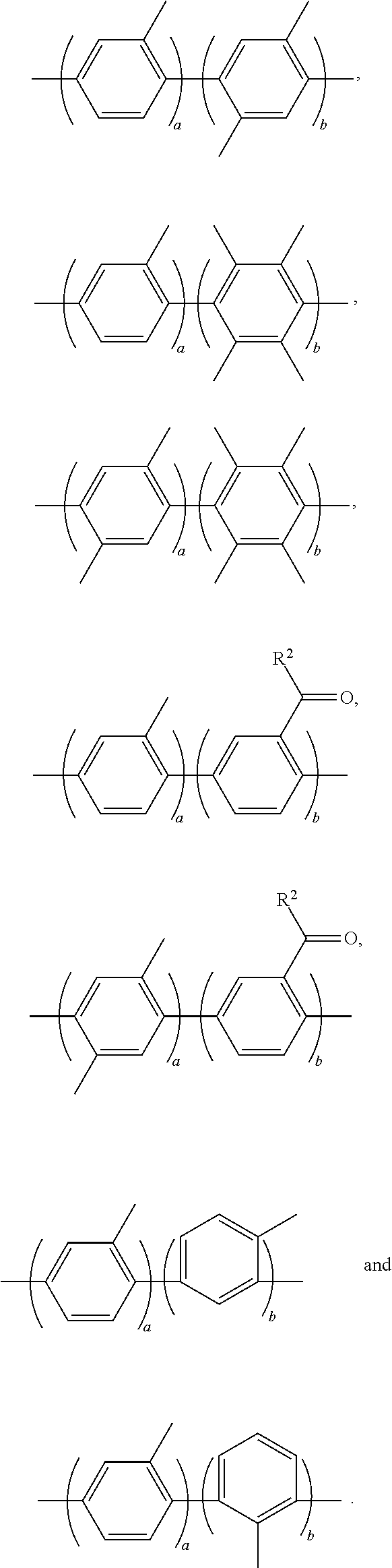
- Ar 2 may be selected from the following formulae:
- Ar 2 may be selected from the following formulae:
- a and b are each independently an integer of 1 to 100.
- R 2 may be selected from the following formulae:
- Ar 3 and Ar′ 3 may be selected from Formulae 3a through 3d below:
- R 3 is fluorine (F), chlorine (Cl), hydroxy, acetylene, —(CH 2 ) n or —(CH 2 ) n CH 3 in which n is an integer of 0 to 6, W is —O—, —S—, —S(O 2 )—, —(C(O))—, —C(CH 3 ) 2 —, —(CH 2 ) n —, —C(CF 3 ) 2 —, or —(CF 2 ) n — in which n is an integer of 1 to 10, c is an integer of 0 to 4, and d is an integer of 0 to 100.
- Ar 3 and Ar′ 3 may be selected from the following formulae:
- n is an integer of 1 or 2.
- a repeating unit represented by Formula 1 may be present in an amount of 50% by moles (mol %) to 95 mol %, and a repeating unit represented by Formula 2 may be present in an amount of 5 mol % to 50 mol %, based on a total mole number of repeating units included in a polymer chain of the block copolymer.
- an ion conductive block copolymer including a hydrophobic repeating unit represented by Formula 1 below, and a hydrophilic repeating unit represented by Formula 3 below:
- Ar 1 is an aromatic group including a single benzene ring or at least two benzene rings, the at least two benzene rings are directly connected to each other or are connected to —O—, —S—, —S(O 2 )—, —(C(O))—, imide, ether imide, imidazole, phosphine or —(CH 2 ) n — in which n is an integer of 1 to 10, each of the benzene rings is unsubstituted or substituted with —COR 1 or —CN, and R 1 is an aromatic group including at least one benzene ring;
- Ar′ 2 is an aromatic group including a single benzene ring or at least two benzene rings substituted with —COR 4 , R 4 or both, and R 4 is selected from high-density functional groups FG represented by:
- M is alkali metal
- X is a negative ion of OH ⁇
- n is a rational number of 1 to 20
- R 5 through R 7 are the same as or different from each other and are C 1 to C 6 alkyl, cyclohexane or benzyl
- Ar 3 and Ar′ 3 are the same as or different from each other and are each independently an aromatic group including a single benzene ring or at least two benzene rings, the at least two benzene rings are directly connected to each other or are connected to —O—, —S—, —S(O 2 )—, —(C(O))—, —C(CH 3 ) 2 —, —(CH 2 ) n —, —C(CF 3 ) 2 —, or —(CF 2 ) n — in which n is an integer of 1 to 10, and each of the benzene rings is unsubstituted or substituted with a halogen ion
- Ar 4 and Ar′ 4 are the same as or different from each other, and are
- n is an integer of 1 or 2, and at least one of R a through R d is connected to a main chain of a polymer and the rest are the same as or different from each other and are hydrogen, benzene or alkyl;
- A is -0-, —S—, or —S(O 2 )—; z is an integer of 0 or 1; and x and y are each independently an integer of 1 to 100.
- a polymer electrolyte including the ion conductive block copolymer as an active component.
- an ion-exchange membrane including the polymer electrolyte.
- an ionomer binder including the block copolymer.
- a fuel cell including a cathode layer, an anode layer, and the ion-exchange membrane of claim disposed between the cathode layer and the anode layer.
- Either the cathode layer or the anode layer or both may further include the ionomer binder
- a method of preparing a block copolymer including performing polymerization by adding a hydrophobic oligomer represented by Formula 4 below, a hydrophilic oligomer represented by Formula 5 below, and a chain extender, to prepare a block copolymer represented by Formula 7 below.
- R and R′ are each independently a hydroxyl group (OH), fluorine (F), chlorine (Cl), bromine (Br), or iodine (I), and each abbreviation in Formula 7 is the same as defined above.
- the chain extender may include at least one compound represented by Formulae 6a through 6d below.
- R 3 is F, Cl, OH, acetylene, —(CH 2 ) n or —(CH 2 ) n CH 3 in which n is an integer of 0 to 10, W is -0-, —S—, —S(O 2 )—, —(C(O))—, —C(CH 3 ) 2 —, —(CH 2 ) n —, —C(CF 3 ) 2 —, or —(CF 2 ) n — in which n is an integer of 1 to 10, c is an integer of 0 to 4, and d is an integer of 0 to 100.
- the hydrophobic oligomer represented by Formula 4 and the hydrophilic oligomer represented by Formula 5 may have a polydispersity (PD) less than or equal to 3.
- a method of preparing the ion conductive block copolymer including performing polymerization by adding a hydrophobic oligomer represented by Formula 4 below, a hydrophilic oligomer represented by Formula 5 below, and a chain extender, to prepare a block copolymer represented by Formula 7 below, and substituting a benzene ring of Ar 2 in the block copolymer represented by Formula 7 with a high-density functional group FG, to prepare an ion conductive copolymer represented by Formula 8 below:
- R and R′ are each independently OH, F, Cl, Br, I, or
- each abbreviation in Formula 7 is the same as defined above and each abbreviation in Formula 8 is the same as defined above.
- a block copolymer may be provided.
- the block copolymer may include, for example, a polyphenylene block copolymer having a high molecular weight and an enhanced solubility and enhanced mechanical properties due to an introduction of a polymer chain extension ring.
- the block copolymer may have a structure in which hydrophobic block units and hydrophilic block units are alternately connected, and may enhance a performance due to a hydrophilic-hydrophobic phase separation and enhance a chemical stability by excluding ether linkages.
- a hydrophobic block unit may include a hydrophobic repeating unit represented by Formula 1 below, and a hydrophilic block unit may include a hydrophilic repeating unit represented by Formula 2 below.
- Ar 1 may be an aromatic group including a single benzene ring or at least two benzene rings.
- the at least two benzene rings may be directly connected to each other, or may be connected to -0-, —S—, —S(O 2 )—, —(C(O))—, —(CF 2 ) n —, —C(CH 3 ) 2 —, —C(CF 3 ) 2 —, an imide bond, an ether imide bond, phosphine, imidazole, or —(CH 2 ) n — in which n is an integer of 1 to 10.
- Each of the benzene rings may be unsubstituted or substituted with —COR 1 or —CN, and R 1 may be an aromatic group including at least one benzene ring.
- Ar 1 may include at least one selected from the following formulae:
- Ar 1 may be selected from the following formulae:
- R 1 may be selected from the following formulae:
- Ar 2 may be a benzene ring substituted with —COR 2 or —(CH 2 ) n CH 3 in which n is an integer of 0 to 6, and R 2 may be an aromatic group including at least one benzene ring that is unsubstituted or substituted with —(CH 2 ) n CH 3 in which n is an integer of 0 to 6.
- Ar 2 may include at least one selected from the following formulae:
- Ar 2 may be selected from the following formulae:
- a and b may each independently be an integer of 1 to 100.
- R 2 may be selected from the following formulae:
- Ar 3 and Ar′ 3 may represent polymer chain extension rings, and may each independently be an aromatic group including a single benzene ring or at least two benzene rings.
- the at least two benzene rings may be directly connected to each other, or may be connected to -0-, —S—, —S(O 2 )—, —(C(O))—, —C(CH 3 ) 2 —, —(CH 2 ) n —, —C(CF 3 ) 2 —, or —(CF 2 ) n — in which n is an integer of 1 to 10.
- Each of the benzene rings may be unsubstituted or substituted with a halogen ion, hydroxy or —(CH 2 ) n CH 3 in which n is an integer of 0 to 6.
- Ar 3 and Ar′ 3 may be selected from Formulae 3a through 3d shown below.
- R 3 may be fluorine (F), chlorine (Cl), hydroxy, acetylene, —(CH 2 ) n or —(CH 2 ) n CH 3 in which n is an integer of 1 to 10, and W may be -0-, —S—, —S(O 2 )—, —(C(O))—, —C(CH 3 ) 2 —, —(CH 2 ) n —, —C(CF 3 ) 2 —, or —(CF 2 ) n — in which n is an integer of 1 to 10.
- c may be an integer of 0 to 4 and d may be an integer of 0 to 100.
- Ar 3 and Ar′ 3 may be selected from the following formulae:
- n may be an integer of 1 or 2.
- Ar 4 and Ar′ 4 may be the same as or different from each other, and may be the same as or different from Ar 1 and Ar 2 . Also, Ar 4 and Ar′ 4 may be
- n may be an integer of 1 or 2
- at least one of R a through R d may be connected to a main chain of a polymer and the rest may be the same as or different from each other and may be hydrogen, benzene or alkyl.
- the alkyl may be C 1 to C 5 alkyl.
- A may be -0-, —S—, or —S(O 2 )—, and desirably be -0- or S—.
- z may be an integer of 0 or 1
- x and y may each independently be an integer of 1 to 100.
- n and n may be the same as or different from each other, and may each independently be an integer of 1 to 1,000.
- a repeating unit represented by Formula 1 may be present in an amount of 50% by moles (mol %) to 95 mol %, and a repeating unit represented by Formula 2 may be present in an amount of 5 mol % to 50 mol %, based on a total mole number of repeating units included in a polymer chain of the block copolymer.
- an electrochemical characteristic may be excellent due to an excellent hydrophilic-hydrophobic phase separation based on a characteristic of the block copolymer.
- an ion conductive block copolymer may be provided.
- the block copolymer may include, for example, an ion conductive polyphenylene block copolymer.
- the ion conductive polyphenylene block copolymer may have a high ionic conductivity due to an increase in a density of an ion-exchange functional group in a hydrophilic block, and may have an enhanced solubility and enhanced mechanical properties due to an introduction of a polymer chain extension ring.
- the ion conductive block copolymer may have a structure in which a hydrophobic block unit and a hydrophilic block unit in which an ion-exchange functional group is introduced are alternately connected, and may be excellent in a performance in a low humidity condition and excellent in a chemical due to a hydrophilic-hydrophobic phase separation.
- the hydrophobic block unit may include a hydrophobic repeating unit represented by Formula 1 below, and the hydrophilic block unit may include a hydrophilic repeating unit represented by Formula 3 below.
- Ar 1 may be the same as that described above.
- Ar′ 2 may be an aromatic group including a single benzene ring or at least two benzene rings substituted with —COR 4 , R 4 or both, and R 4 may be selected from high-density functional groups FG that function as ion transfer functional groups and that are represented by the following formulae:
- M may be alkali metal
- X may be a negative ion of OH ⁇ , desirably Li, Na, K or OH, and the like
- n may be a rational number of 1 to 20.
- R 5 through R 7 may be the same as or different from each other, and may be C 1 to C 6 alkyl, cyclohexane or benzyl.
- Ar′ 2 may include at least one selected from the following formulae:
- Ar′ 2 may include at least one selected from the following formulae:
- a and b may each independently be an integer of 1 to 100.
- Ar 3 , Ar′ 3 , Ar 4 and Ar′ 4 may be the same as those described above, and A may be oxygen or sulfur. Also, z may be an integer of 0 or 1, and x and y may each independently be an integer of 1 to 100.
- a repeating unit represented by Formula 1 may be present in an amount of 50 mol % to 95 mol %, and a repeating unit represented by Formula 2 may be present in an amount of 5 mol % to 50 mol %, based on a total mole number of repeating units included in a polymer chain of the ion conductive block copolymer.
- a chemical stability may be excellent due to a hydrophilic-hydrophobic phase separation based on a characteristic of a block copolymer.
- a polymer electrolyte including the ion conductive block copolymer may be provided.
- the polymer electrolyte may include the ion conductive block copolymer as an active component, and may be excellent in an electrochemical characteristic by applying a polyphenylene block copolymer in which a density of an ion exchange functional group increases.
- the ion conductive block copolymer may be present in an amount less than or equal to 100% by weight (wt %), an amount that exceeds 0 wt % and that is less than or equal to 100 wt %, an amount of 90 wt % to 95 wt %, or an amount of 50 wt % to 80 wt %, based on a total weight of the polymer electrolyte.
- the polymer electrolyte may have a weight-average molecular weight of 3,000 grams per mole (g/mol) to 1,000,000 g/mol. When the weight-average molecular weight of the polymer electrolyte is within the above range, excellent mechanical properties and long term stability may be secured.
- the polymer electrolyte may have an ion exchange capacity (IEC) of 0.5 millimoles per gram (mmol/g) to 3.0 mmol/g.
- IEC ion exchange capacity
- the polymer electrolyte may further include an electrolyte applicable to the polymer electrolyte in addition to the ion conductive block copolymer, at an appropriate ratio, without departing from aspects of the present disclosure.
- the polymer electrolyte may include, but are not limited to, at least one of a sulfonated hydrocarbon-based polymer; a perfluorosulfonic acid polymer such as Nafion manufactured by Du Pont Corp., Flemion manufactured by Asahi Glass Co., Ltd., Asiplex manufactured by Asahi Chemical Industry Co., Ltd., Dow XUS manufactured by Dow Chemical Co., and Aquivion manufactured by Solvay Specialty Polymers; a benzimidazole-based polymer, a polyimide-based polymer; a polyetherimide-based polymer; a polyetherketone-based polymer, a polyether-etherketone-based polymer and a polyphenylquinoxaline-based polymer.
- an ion-exchange membrane including the polymer electrolyte may be provided.
- the polymer electrolyte including the ion conductive block copolymer may be applied, and thus it is possible to easily prepare an ion-exchange membrane, possible to provide a membrane with stable mechanical properties, and possible to provide a membrane that has an excellent performance with a high ionic conductivity in a low humidity due to an increase in a density of an ion-exchange functional group.
- the ion-exchange membrane may include a supporter, and the polymer electrolyte.
- the polymer electrolyte may be impregnated in the supporter or may be formed in one side or both sides of the supporter.
- the supporter may be, for example, a porous supporter or a solid supporter including a glass plate, a metal or ceramic.
- the polymer electrolyte may be impregnated in the porous supporter.
- the porous supporter may be used without a limitation.
- the porous supporter may include, but are not limited to, at least one of polytetrafluoroethylene (PTFE), polyethylene (PE), polyvinylidene fluoride (PVDF), polyimide (PI), polypropylene (PP), cellulose and nylon.
- the ion-exchange membrane may further include an additive that includes an organic material, (for example, a radical quencher), an inorganic material or an organic-inorganic composite.
- the additive may include, but are not limited to, at least one of a transition metal salt such as a cerium(III) salt; an organic compound such as 2,2′-bipyridine, hydroquinone, pyrazine-2,3-carboxylic acid, pyrazine-2,3-dicarboxylic acid, 2(-naphthalene-2-yl)-1-(naphthalene-7-yl)hydrazine, and 4-(3-(pyridine-4-yl)propyl)pyridine; cerium(III) trifluoromethanesulfonate; cerium(III) trifluoroacetylacetonate; and cerium (III), tris(5-oxo-L-prolinato-N1,O
- the polymer electrolyte may be dissolved in an organic solvent to be in the form of a solution, a gel or a suspension.
- the polymer electrolyte may be applied to the supporter or may be impregnated in the supporter, to form the ion-exchange membrane.
- the ion-exchange membrane may be, for example, a flat membrane, a composite membrane or a tube membrane.
- an ionomer binder including the block copolymer may be provided.
- the ionomer binder may induce a stable connection of a membrane-electrode assembly and may enhance an electrochemical performance.
- the ionomer binder may include a solvent and the block copolymer, and may further include a binder that is applicable in the present disclosure.
- the block copolymer may be present in an amount of 1% by weight (wt %) to 40 wt % in the ionomer binder.
- the solvent may be an organic solvent, for example, acetonitrile, and the like.
- a fuel cell including the block copolymer, the ion conductive block copolymer or both may be provided.
- the fuel cell may have an enhanced performance and enhanced mechanical and electrochemical stability.
- the fuel cell may include a cathode layer, an anode layer, and/or the ion-exchange membrane disposed between the cathode layer and the anode layer.
- the cathode layer and/or the anode layer may include the ionomer binder.
- the cathode layer (for example, an oxygen electrode layer) may correspond to an electrode to reduce oxygen, and may include a catalyst layer including a supporter on which a catalytic metal is supported.
- the catalytic metal may include, for example, at least one of Al, Si, Ti, V, Cr, Mn, Co, Ni, Cu, Zn, Ga, Se, Rh, Pd, Ag, Cd, In, Sn, W, Os, Ir, Pt, Au, Hg, Pb, Ru and Bi.
- the catalytic metal may have a diameter of 1 nanometers (nm) to 10 nm.
- nm nanometers
- an oxygen reduction reaction in which hydrogen cations, oxygen and electrons react to generate water may be activated, and deactivation due to dissolution and coagulation of active metals may be mitigated.
- a reactant and reaction product for electricity generation for example, oxygen diffusion and water flooding in a cathode layer may be mitigated, so that water may be smoothly managed.
- the supporter may include a carbon material.
- the carbon material may include, for example, at least one of graphite, a carbon black, carbon power, a carbon nanotube, a carbon nanofiber and a carbon nanorod.
- the carbon material may have a diameter of 5 nm to 100 nm or a length of 0.1 micrometers ( ⁇ m) to 10 ⁇ m.
- a durability may be enhanced due to a high physical strength, and a participation of a catalyst in a reaction may increase by increasing a porosity and/or a size of a pore of the cathode layer.
- the cathode layer may further include an ionomer binder.
- the ionomer binder may be the same as that described above.
- a catalyst slurry may be prepared by mixing a catalytic metal, a solvent and the ionomer binder, and a supporter may be coated with the catalyst slurry.
- the anode layer may be applicable in a technical field of the present disclosure, without departing from the scope of the present disclosure.
- the anode layer may include, but are not limited to, at least one of a metal catalyst such as Pt, Ru and Pd and an alloy thereof; a carbon material on which the metal catalyst is supported; a metal sulfide of a sulfur/graphite mixture; a metal phosphide of a phosphorus/graphite mixture; a carbon-based material such as graphite, natural graphite, artificial graphite, soft carbon and hard; and a metal-carbon composite of a Sb/C composite and SnSb/C composite.
- the anode layer may further include an ionomer binder.
- the ionomer binder may be the same as that described above.
- a method of preparing the block copolymer may be provided.
- a multi-block copolymer may be synthesized by introducing a monomer and/or an oligomer in which a chain extension ring is introduced.
- a chain extension ring is introduced.
- the method may include preparing a hydrophobic oligomer and a hydrophilic oligomer and preparing a block copolymer.
- a hydrophobic oligomer represented by Formula 4 and a hydrophilic oligomer represented by Formula 5 may be prepared.
- Each of the hydrophobic oligomer and the hydrophilic oligomer may have a polydispersity less than or equal to 3, less than or equal to 2, or less than or equal to 1.5.
- the polydispersity is within the above range, an arrangement regularity of the block copolymer may be enhanced so that properties of the block copolymer may be uniformly adjusted.
- a preparing process used in the technical field of the present disclosure may be applicable, and accordingly further description thereof is omitted herein.
- R and R′ may each independently be OH, F, Cl, Br, or I, and Ar 1 , Ar 2 and Ar 4 may be the same as those described above.
- polymerization may be performed by adding the hydrophobic oligomer represented by Formula 4, the hydrophilic oligomer represented by Formula 5 and a chain extender, to prepare a block copolymer represented by Formula 7 below.
- R, R′, m, n, z, x, y, A, Ar 1 , Ar 2 and Ar 4 may be the same as those described above.
- Ar a may be a functional group based on an introduction of the chain extender and may be the same as that described above in the block copolymer.
- the chain extender may include at least one compound represented by Formulae 6a through 6d below.
- R 3 may be F, Cl, OH, acetylene, —(CH 2 ) n or —(CH 2 ) n CH 3 in which n is an integer of 0 to 10, and W may be -0-, —S—, —S(O 2 )—, —(C(O))—, —C(CH 3 ) 2 —, —(CH 2 ) n —, —C(CF 3 ) 2 —, or —(CF 2 ) n — in which n is an integer of 1 to 10.
- c may be an integer of 0 to 4.
- a method of preparing the ion conductive block copolymer may be provided.
- a multi-block copolymer may be synthesized by introducing a monomer and/or an oligomer in which a chain extension ring is introduced.
- it is possible to enhance mechanical properties and solubility by synthesizing a block copolymer with a high molecular weight, and possible to provide a high ion conductive block copolymer due to a high partial IEC of a hydrophilic block.
- the method may include preparing a hydrophobic oligomer and a hydrophilic oligomer, preparing a block copolymer, and performing substitution with a high-density functional group FG.
- a hydrophobic oligomer represented by Formula 4 and a hydrophilic oligomer represented by Formula 5 may be prepared.
- the hydrophilic oligomer represented by Formula 5 may have a structure in which a concentration (for example, an IEC) of an ion-exchange functional group increases, and accordingly may have an extremely high hydrophilicity.
- a high ion conductive block copolymer may be provided due to a high partial IEC of a hydrophilic block.
- Each of the hydrophobic oligomer and the hydrophilic oligomer may have a polydispersity (PD) less than or equal to 3, less than or equal to 2, or less than or equal to 1.5.
- PD polydispersity
- an arrangement regularity of the block copolymer may be enhanced so that properties of the block copolymer may be uniformly adjusted.
- a preparing process used in the technical field of the present disclosure may be applicable, and accordingly further description thereof is omitted herein.
- polymerization may be performed by adding the hydrophobic oligomer represented by Formula 4, the hydrophilic oligomer represented by Formula 5 and a chain extender, to prepare a block copolymer represented by Formula 7 below.
- R, R′, m, n, z, x, y, A, Ar 1 through Ar 4 may be the same as those described above.
- the chain extender may be the same as that described above.
- At least one benzene ring of Ar 2 in the block copolymer represented by Formula 7 may be substituted with the high-density functional group FG, to prepare an ion conductive block copolymer represented by Formula 8 below.
- m, n, z, x, y, and Ar 1 through Ar 4 may be the same as those described above.
- a preparing process used in the technical field of the present disclosure may be applicable.
- a selective halogenation for example, a selective bromination of alkyl
- the substitution with the high-density functional group FG may be performed, however, there is no limitation thereto.
- a three-neck flask was connected to a cold mechanical stirrer and purged with nitrogen. 2,5-Dichlorobenzophenone (1.40 mmol, 0.3511 g), 4-chlorophenol (0.11 mmol, 0.0138 g), and bipyridine (3.64 mmol, 0.5678 g) were added and N-methylpyrrolidinone (NMP) was used as a solvent. After a reacting solution was stirred at 80° C. for two hours, Ni(COD) 2 (3.64 mmol, 1.0000 g) was added as a catalyst thereto, and the reacting solution was stirred for three hours.
- NMP N-methylpyrrolidinone
- a temperature was lowered to a room temperature, the reacting solution was precipitated in an aqueous hydrochloric acid solution, and a precipitated oligomer was washed several times with water and methanol. The washed oligomer was dried under vacuum at 80° C., to obtain a final oligomer.
- Ni(COD) 2 (3.64 mmol, 1.0000 g) was added as a catalyst thereto, and the reacting solution was stirred for three hours. A temperature was lowered to a room temperature, and the reacting solution was precipitated in an aqueous hydrochloric acid solution. A precipitated oligomer was washed several times with water and methanol. The washed oligomer was dried under vacuum at 80° C., to obtain a final oligomer.
- a three-neck flask was connected to a mechanical stirrer and a condenser with cooling water and purged with nitrogen.
- a hydrophilic precursor oligomer and a hydrophobic precursor oligomer obtained in Synthesis Examples 1 and 2, a polymer chain extension ring, and potassium carbonate as a catalyst were added, and dimethylacetamide (DMAc) was used as a solvent.
- DMAc dimethylacetamide
- a mixture was stirred at 120° C., the same state was maintained until a desired molecular weight is reached while performing monitoring using a gel permeation chromatography (GPC) every hour, and a reaction was terminated.
- a temperature of a polymer solution was lowered to a room temperature, and viscosity was reduced using DMAc.
- the polymer solution was precipitated in methanol to obtain a polymer, and the polymer was washed several times with water.
- the polymer was dried under vacuum at 100° C. and collected, and an ion-exchange functional group FG (for example, (CF 2 )SO 3 H) was introduced in the collected polymer by a selective bromination of a methyl group, to prepare a block copolymer.
- FG for example, (CF 2 )SO 3 H
- a molecular weight and a polydispersity index (PDI) of the prepared block copolymer were measured as shown in Table 1.
- An ion conductive block copolymer was prepared in the same manner as in Example except that a polymer chain extension ring is not introduced. A molecular weight and a PDI of the prepared ion conductive block copolymer were measured as shown in Table 1.
- the ion conductive block copolymer prepared according to Example has a high molecular weight and has an excellent polydispersity.
- a multi-block copolymer may be synthesized by introducing a chain extension ring in a monomer and/or an oligomer, and thus it is possible to increase a molecular weight and to enhance mechanical properties and solubility. Also, it is possible to provide a block copolymer that is excellent in a chemical stability due to a hydrophilic-hydrophobic phase separation based on properties of the block copolymer in addition to phenylene properties. Furthermore, using the block copolymer, it is possible to provide an ion-exchange membrane that may enhance a performance of a fuel cell.
- a block copolymer with a high molecular weight may be synthesized by introducing a polymer chain extension ring, and thus it is possible to enhance mechanical properties and solubility, to provide an excellent processability.
- an ion conductive block copolymer that has a high ionic conductivity and that is excellent in mechanical properties and solubility. Also, it is possible to provide an ion-exchange membrane that has an excellent performance and an enhanced chemical stability due to an introduction of a phenylene structure by using the ion conductive block copolymer.
Landscapes
- Chemical & Material Sciences (AREA)
- Chemical Kinetics & Catalysis (AREA)
- Organic Chemistry (AREA)
- Medicinal Chemistry (AREA)
- Polymers & Plastics (AREA)
- Health & Medical Sciences (AREA)
- Engineering & Computer Science (AREA)
- Manufacturing & Machinery (AREA)
- General Chemical & Material Sciences (AREA)
- Materials Engineering (AREA)
- Inorganic Chemistry (AREA)
- Sustainable Energy (AREA)
- Electrochemistry (AREA)
- Sustainable Development (AREA)
- Life Sciences & Earth Sciences (AREA)
- Crystallography & Structural Chemistry (AREA)
- Polyethers (AREA)
- Conductive Materials (AREA)
- Polyoxymethylene Polymers And Polymers With Carbon-To-Carbon Bonds (AREA)
- Inert Electrodes (AREA)
- Fuel Cell (AREA)
- Manufacture Of Macromolecular Shaped Articles (AREA)
- Other Resins Obtained By Reactions Not Involving Carbon-To-Carbon Unsaturated Bonds (AREA)
Abstract
Description


each abbreviation in Formula 7 is the same as defined above and each abbreviation in Formula 8 is the same as defined above.




in which n may be an integer of 1 or 2, and at least one of Ra through Rd may be connected to a main chain of a polymer and the rest may be the same as or different from each other and may be hydrogen, benzene or alkyl. The alkyl may be C1 to C5 alkyl.





| TABLE 1 | ||||
| Mn (kDa) | Mw (kDa) | PDI | ||
| Example | 55 | 151 | 2.73 | ||
| Comparative Example | 15 | 127 | 8.62 | ||
Claims (13)


Priority Applications (1)
| Application Number | Priority Date | Filing Date | Title |
|---|---|---|---|
| US16/897,818 US11220583B2 (en) | 2016-11-16 | 2020-06-10 | Block copolymer, ion-exchange membrane and method of preparing block copolymer |
Applications Claiming Priority (2)
| Application Number | Priority Date | Filing Date | Title |
|---|---|---|---|
| KR1020160152668A KR101839390B1 (en) | 2016-11-16 | 2016-11-16 | Block copolymer, ion-exchange membrane and manufacturing method thereof |
| KR10-2016-0152668 | 2016-11-16 |
Related Child Applications (1)
| Application Number | Title | Priority Date | Filing Date |
|---|---|---|---|
| US16/897,818 Division US11220583B2 (en) | 2016-11-16 | 2020-06-10 | Block copolymer, ion-exchange membrane and method of preparing block copolymer |
Publications (2)
| Publication Number | Publication Date |
|---|---|
| US20180134844A1 US20180134844A1 (en) | 2018-05-17 |
| US10717835B2 true US10717835B2 (en) | 2020-07-21 |
Family
ID=61910359
Family Applications (2)
| Application Number | Title | Priority Date | Filing Date |
|---|---|---|---|
| US15/490,159 Active 2038-03-18 US10717835B2 (en) | 2016-11-16 | 2017-04-18 | Block copolymer, ion-exchange membrane and method of preparing block copolymer |
| US16/897,818 Active US11220583B2 (en) | 2016-11-16 | 2020-06-10 | Block copolymer, ion-exchange membrane and method of preparing block copolymer |
Family Applications After (1)
| Application Number | Title | Priority Date | Filing Date |
|---|---|---|---|
| US16/897,818 Active US11220583B2 (en) | 2016-11-16 | 2020-06-10 | Block copolymer, ion-exchange membrane and method of preparing block copolymer |
Country Status (5)
| Country | Link |
|---|---|
| US (2) | US10717835B2 (en) |
| JP (1) | JP6484281B2 (en) |
| KR (1) | KR101839390B1 (en) |
| CN (1) | CN108070097B (en) |
| DE (1) | DE102017113976B4 (en) |
Cited By (1)
| Publication number | Priority date | Publication date | Assignee | Title |
|---|---|---|---|---|
| US11220583B2 (en) | 2016-11-16 | 2022-01-11 | Korea Institute Of Energy Research | Block copolymer, ion-exchange membrane and method of preparing block copolymer |
Families Citing this family (1)
| Publication number | Priority date | Publication date | Assignee | Title |
|---|---|---|---|---|
| KR101900772B1 (en) * | 2017-04-27 | 2018-09-20 | 코오롱인더스트리 주식회사 | Ion exchanging membrane, method for manufacturing the same and energy storage system comprising the same |
Citations (8)
| Publication number | Priority date | Publication date | Assignee | Title |
|---|---|---|---|---|
| WO2007052954A1 (en) | 2005-11-01 | 2007-05-10 | Lg Chem, Ltd. | Block copolymers containing perfluorocyclobutane rings and electrolyte membranes using the same |
| US20070292730A1 (en) | 2003-11-20 | 2007-12-20 | Mcgrath James E | Multiblock Copolymers Containing Hydrophilic Hydrophobic Segments for Proton Exchange Membrane |
| US20100174042A1 (en) | 2006-04-25 | 2010-07-08 | Jsr Corporation | Aromatic compound and sulfonated polyarylene polymer |
| US7893303B2 (en) | 2005-02-04 | 2011-02-22 | Jsr Corporation | Polyarylene, process for producing the same, solid polyelectrolyte, and proton-conductive film |
| US20110065021A1 (en) | 2008-05-08 | 2011-03-17 | Toyo Boseki Kabushiki Kaisha | Novel Sulfonic-Acid-Group-Containing Segmented Block Copolymer, Application Thereof, and Method of Manufacturing Novel Block Copolymer |
| US20120129076A1 (en) | 2009-08-03 | 2012-05-24 | Toyo Boseki Kabushiki Kaisha | Novel Sulfonic Acid Group-Containing Segmented Block Copolymer and Use Thereof |
| US20130108944A1 (en) | 2011-10-28 | 2013-05-02 | Ford Motor Company | Sulfonated poly(phenylene) copolymer electrolyte for fuel cells |
| US20150314245A1 (en) * | 2012-12-11 | 2015-11-05 | Toyobo Co., Ltd. | Composite separation membrane |
Family Cites Families (8)
| Publication number | Priority date | Publication date | Assignee | Title |
|---|---|---|---|---|
| JP4375170B2 (en) * | 2003-09-30 | 2009-12-02 | 住友化学株式会社 | Block copolymer and use thereof |
| JP2006344481A (en) * | 2005-06-08 | 2006-12-21 | Jsr Corp | Electrode electrolyte for polymer electrolyte fuel cell, electrode paste, electrode and membrane-electrode assembly |
| JP4864107B2 (en) * | 2009-02-17 | 2012-02-01 | 株式会社日立製作所 | Block copolymer and solid polymer electrolyte for fuel cell using the same, solid polymer electrolyte membrane for fuel cell, membrane electrode assembly and fuel cell |
| JP5614210B2 (en) * | 2010-09-30 | 2014-10-29 | 東洋紡株式会社 | Polymer electrolyte membrane, membrane / electrode assembly and fuel cell using the same |
| CN102532507B (en) | 2010-12-20 | 2015-08-19 | 新奥科技发展有限公司 | A kind of segmented copolymer and preparation method thereof |
| JP6069972B2 (en) * | 2011-09-13 | 2017-02-01 | 東レ株式会社 | Aromatic sulfonimide derivative, sulfonimide group-containing polymer, polymer electrolyte material using the same, polymer electrolyte molded article, and solid polymer fuel cell |
| JP2016033199A (en) * | 2014-07-31 | 2016-03-10 | ダイハツ工業株式会社 | Anion-exchange resin, electrolyte layer for fuel cell, fuel cell and production method of anion-exchange resin |
| KR101839390B1 (en) | 2016-11-16 | 2018-03-16 | 한국에너지기술연구원 | Block copolymer, ion-exchange membrane and manufacturing method thereof |
-
2016
- 2016-11-16 KR KR1020160152668A patent/KR101839390B1/en active Active
-
2017
- 2017-04-18 US US15/490,159 patent/US10717835B2/en active Active
- 2017-04-19 JP JP2017083107A patent/JP6484281B2/en active Active
- 2017-06-23 DE DE102017113976.1A patent/DE102017113976B4/en active Active
- 2017-09-04 CN CN201710789035.1A patent/CN108070097B/en active Active
-
2020
- 2020-06-10 US US16/897,818 patent/US11220583B2/en active Active
Patent Citations (8)
| Publication number | Priority date | Publication date | Assignee | Title |
|---|---|---|---|---|
| US20070292730A1 (en) | 2003-11-20 | 2007-12-20 | Mcgrath James E | Multiblock Copolymers Containing Hydrophilic Hydrophobic Segments for Proton Exchange Membrane |
| US7893303B2 (en) | 2005-02-04 | 2011-02-22 | Jsr Corporation | Polyarylene, process for producing the same, solid polyelectrolyte, and proton-conductive film |
| WO2007052954A1 (en) | 2005-11-01 | 2007-05-10 | Lg Chem, Ltd. | Block copolymers containing perfluorocyclobutane rings and electrolyte membranes using the same |
| US20100174042A1 (en) | 2006-04-25 | 2010-07-08 | Jsr Corporation | Aromatic compound and sulfonated polyarylene polymer |
| US20110065021A1 (en) | 2008-05-08 | 2011-03-17 | Toyo Boseki Kabushiki Kaisha | Novel Sulfonic-Acid-Group-Containing Segmented Block Copolymer, Application Thereof, and Method of Manufacturing Novel Block Copolymer |
| US20120129076A1 (en) | 2009-08-03 | 2012-05-24 | Toyo Boseki Kabushiki Kaisha | Novel Sulfonic Acid Group-Containing Segmented Block Copolymer and Use Thereof |
| US20130108944A1 (en) | 2011-10-28 | 2013-05-02 | Ford Motor Company | Sulfonated poly(phenylene) copolymer electrolyte for fuel cells |
| US20150314245A1 (en) * | 2012-12-11 | 2015-11-05 | Toyobo Co., Ltd. | Composite separation membrane |
Non-Patent Citations (6)
| Title |
|---|
| Chen, S. et al. Polymer vol. 54 pp. 236-245 (Sep. 2012). * |
| Miyahara, T. et al. ACS Applied Materials & Interfaces vol. 4 pp. 2881-2884 (Jun. 2012). * |
| Nakabayashi et al., Synthesis and Properties of Sulfonated Multiblock Copoly (ether sulfone)s by a Chain Extender. Journal of Polymer Science: Part A: Polymer Chemistry, vol. 46, pp. 3947-3957, (2008). |
| Nanwen Li et al. "Ion Transport by Nanochannels in Ion-Containing Aromatic Copolymers"; pubs.acs.org/Macromolecules 2014, 47, pp. 2175-2198. |
| Roy, A. et al. Polymer vol. 49 pp. 5037-5044 (Sep. 2008). * |
| Umezawa et al. ACS Macro Letters vol. 1 pp. 969-972 (Jul. 2012). * |
Cited By (1)
| Publication number | Priority date | Publication date | Assignee | Title |
|---|---|---|---|---|
| US11220583B2 (en) | 2016-11-16 | 2022-01-11 | Korea Institute Of Energy Research | Block copolymer, ion-exchange membrane and method of preparing block copolymer |
Also Published As
| Publication number | Publication date |
|---|---|
| KR101839390B1 (en) | 2018-03-16 |
| DE102017113976A1 (en) | 2018-05-17 |
| JP2018080318A (en) | 2018-05-24 |
| DE102017113976B4 (en) | 2023-06-07 |
| CN108070097A (en) | 2018-05-25 |
| JP6484281B2 (en) | 2019-03-13 |
| US20180134844A1 (en) | 2018-05-17 |
| US11220583B2 (en) | 2022-01-11 |
| CN108070097B (en) | 2021-11-30 |
| US20200299475A1 (en) | 2020-09-24 |
Similar Documents
| Publication | Publication Date | Title |
|---|---|---|
| Wang et al. | Synthesis and sulfonation of poly (aryl ethers) containing triphenyl methane and tetraphenyl methane moieties from isocynate-masked bisphenols | |
| US8722280B2 (en) | Hyper-branched polymer, electrode for fuel cell including the hyper-branched polymer, electrolyte membrane for fuel cell including the hyper-branched polymer, and fuel cell including at least one of the electrode and the electrolyte membrane | |
| US7868124B2 (en) | Polyphenylene-type polymers, preparation method thereof, membranes and fuel cell device comprising said membranes | |
| US7842775B2 (en) | Development and characterization of novel proton conducting aromatic polyether type copolymers bearing main and side chain pyridine groups | |
| US7879971B2 (en) | Multiblock copolymer, method of preparing the same, polymer electrolyte membrane prepared from the multiblock copolymer, method of preparing the polymer electrolyte membrane, and fuel cell employing the polymer electrolyte membrane | |
| US7842734B2 (en) | Poly(arylene ether) copolymers containing pyridine units as proton exchange membranes | |
| US20160149250A1 (en) | Electrolyte membrane, membrane-electrode assembly, and solid polymer fuel cell | |
| US9102789B2 (en) | Sulfonated poly(phenylene) copolymer electrolyte for fuel cells | |
| KR20150060159A (en) | Electrolyte membranes of partially fluorinated and tetrasulfonated block coploymers for fuel cells and manufacturing method thereof | |
| US11220583B2 (en) | Block copolymer, ion-exchange membrane and method of preparing block copolymer | |
| US20080113227A1 (en) | Development and characterization of novel proton conducting aromatic polyether type copolymers bearing main and side chain pyridine groups | |
| JP2007280946A (en) | Membrane / electrode assembly and fuel cell | |
| KR101202331B1 (en) | A multiblock copolymer, a method for preparing the multiblock copolymer, a polymer electrolyte membrane prepared from the multiblock copolymer, a method for preparing the polymer electrolyte membrane and a fuel cell employing the polymer electrolyte membrane | |
| US9048479B2 (en) | Tri-block copolymer and electrolyte membrane made from the same | |
| US20070020500A1 (en) | Membrane-electrode structure for solid polymer fuel cell and solid polymer fuel cell | |
| JP2007287675A (en) | Membrane electrode assembly and fuel cell | |
| US8440365B2 (en) | Electrolyte, production process therefor, electrolyte membrane, production process therefor, catalyst layer and fuel cell | |
| KR102066033B1 (en) | Ion conductor, method for preparing the same, and ion-exchange membrane, membrane-electrode assembly and fuel cell comprising the same | |
| US7887969B2 (en) | Membrane-electrode assembly for solid polymer electrolyte fuel cell | |
| CN103665407B (en) | Polyolefin-perfluorocyclobutanearyl (PFCB) ionomer | |
| US10461351B2 (en) | Polymer electrolyte membrane for fuel cell, membrane-electrode assembly for fuel cell including same, and fuel cell including same | |
| US9178218B2 (en) | Hyper-branched polymer, electrode and electrolyte membrane including the hyper-branched polymer, and fuel cell including at least one of the electrode and the electrolyte membrane | |
| JP2004346305A (en) | Aromatic polyether-based ion-conductive ultrapolymer, intermediates thereof, and methods for producing them | |
| JP2007149653A (en) | Electrolyte for direct methanol fuel cell and direct methanol fuel cell using the same | |
| KR20110027993A (en) | Polyarylene ether-based copolymer, polymer electrolyte membrane comprising the same, membrane-electrode assembly comprising the same, fuel cell employing the same and method for producing the polymer |
Legal Events
| Date | Code | Title | Description |
|---|---|---|---|
| AS | Assignment |
Owner name: KOREA INSTITUTE OF ENERGY RESEARCH, KOREA, REPUBLIC OF Free format text: ASSIGNMENT OF ASSIGNORS INTEREST;ASSIGNORS:BAE, BYUNGCHAN;YIM, SUNG-DAE;KIM, CHANG-SOO;AND OTHERS;REEL/FRAME:042092/0001 Effective date: 20170405 Owner name: KOREA INSTITUTE OF ENERGY RESEARCH, KOREA, REPUBLI Free format text: ASSIGNMENT OF ASSIGNORS INTEREST;ASSIGNORS:BAE, BYUNGCHAN;YIM, SUNG-DAE;KIM, CHANG-SOO;AND OTHERS;REEL/FRAME:042092/0001 Effective date: 20170405 |
|
| STPP | Information on status: patent application and granting procedure in general |
Free format text: NON FINAL ACTION MAILED |
|
| STPP | Information on status: patent application and granting procedure in general |
Free format text: RESPONSE TO NON-FINAL OFFICE ACTION ENTERED AND FORWARDED TO EXAMINER |
|
| STPP | Information on status: patent application and granting procedure in general |
Free format text: NON FINAL ACTION MAILED |
|
| STPP | Information on status: patent application and granting procedure in general |
Free format text: RESPONSE TO NON-FINAL OFFICE ACTION ENTERED AND FORWARDED TO EXAMINER |
|
| STPP | Information on status: patent application and granting procedure in general |
Free format text: FINAL REJECTION MAILED |
|
| STPP | Information on status: patent application and granting procedure in general |
Free format text: RESPONSE AFTER FINAL ACTION FORWARDED TO EXAMINER |
|
| STPP | Information on status: patent application and granting procedure in general |
Free format text: AWAITING TC RESP., ISSUE FEE NOT PAID |
|
| STPP | Information on status: patent application and granting procedure in general |
Free format text: PUBLICATIONS -- ISSUE FEE PAYMENT VERIFIED |
|
| STCF | Information on status: patent grant |
Free format text: PATENTED CASE |
|
| MAFP | Maintenance fee payment |
Free format text: PAYMENT OF MAINTENANCE FEE, 4TH YR, SMALL ENTITY (ORIGINAL EVENT CODE: M2551); ENTITY STATUS OF PATENT OWNER: SMALL ENTITY Year of fee payment: 4 |