US10717819B2 - Polyimide-based block copolymer film - Google Patents
Polyimide-based block copolymer film Download PDFInfo
- Publication number
- US10717819B2 US10717819B2 US16/091,269 US201716091269A US10717819B2 US 10717819 B2 US10717819 B2 US 10717819B2 US 201716091269 A US201716091269 A US 201716091269A US 10717819 B2 US10717819 B2 US 10717819B2
- Authority
- US
- United States
- Prior art keywords
- repeating unit
- independently
- group
- organic group
- chemical formula
- Prior art date
- Legal status (The legal status is an assumption and is not a legal conclusion. Google has not performed a legal analysis and makes no representation as to the accuracy of the status listed.)
- Active
Links
- 0 *CC(C*)CCN1C(=O)C2=C(C=CC=C2)C1=O.*N1C(=O)C2=C(C=CC=C2)C1=O.CC.CC.C[1*]C Chemical compound *CC(C*)CCN1C(=O)C2=C(C=CC=C2)C1=O.*N1C(=O)C2=C(C=CC=C2)C1=O.CC.CC.C[1*]C 0.000 description 17
- UHOVQNZJYSORNB-UHFFFAOYSA-N c1ccccc1 Chemical compound c1ccccc1 UHOVQNZJYSORNB-UHFFFAOYSA-N 0.000 description 2
- YUKCPWULXWYNHZ-UHFFFAOYSA-N C1=CC=CC=C1.C1=CC=CC=C1.C1=CC=CC=C1.C1=CC=CC=C1.CC.CC.CC.CC.CC.CC.CC.CC.CCCCC(=O)C1=CC(C(C)=O)=CC(C(C)=O)=C1.CN1C(=O)C2=C(C=C(C(C)(C3=CC4=C(C=C3)C(=O)N(C)C4=O)C(F)(F)F)C=C2)C1=O.CN1C(=O)C2=C(C=C(C3=CC4=C(C=C3)C(=O)N(C)C4=O)C=C2)C1=O Chemical compound C1=CC=CC=C1.C1=CC=CC=C1.C1=CC=CC=C1.C1=CC=CC=C1.CC.CC.CC.CC.CC.CC.CC.CC.CCCCC(=O)C1=CC(C(C)=O)=CC(C(C)=O)=C1.CN1C(=O)C2=C(C=C(C(C)(C3=CC4=C(C=C3)C(=O)N(C)C4=O)C(F)(F)F)C=C2)C1=O.CN1C(=O)C2=C(C=C(C3=CC4=C(C=C3)C(=O)N(C)C4=O)C=C2)C1=O YUKCPWULXWYNHZ-UHFFFAOYSA-N 0.000 description 1
Images

Classifications
-
- C—CHEMISTRY; METALLURGY
- C08—ORGANIC MACROMOLECULAR COMPOUNDS; THEIR PREPARATION OR CHEMICAL WORKING-UP; COMPOSITIONS BASED THEREON
- C08G—MACROMOLECULAR COMPOUNDS OBTAINED OTHERWISE THAN BY REACTIONS ONLY INVOLVING UNSATURATED CARBON-TO-CARBON BONDS
- C08G73/00—Macromolecular compounds obtained by reactions forming a linkage containing nitrogen with or without oxygen or carbon in the main chain of the macromolecule, not provided for in groups C08G12/00 - C08G71/00
- C08G73/06—Polycondensates having nitrogen-containing heterocyclic rings in the main chain of the macromolecule
- C08G73/10—Polyimides; Polyester-imides; Polyamide-imides; Polyamide acids or similar polyimide precursors
- C08G73/1067—Wholly aromatic polyimides, i.e. having both tetracarboxylic and diamino moieties aromatically bound
-
- C—CHEMISTRY; METALLURGY
- C08—ORGANIC MACROMOLECULAR COMPOUNDS; THEIR PREPARATION OR CHEMICAL WORKING-UP; COMPOSITIONS BASED THEREON
- C08L—COMPOSITIONS OF MACROMOLECULAR COMPOUNDS
- C08L79/00—Compositions of macromolecular compounds obtained by reactions forming in the main chain of the macromolecule a linkage containing nitrogen with or without oxygen or carbon only, not provided for in groups C08L61/00 - C08L77/00
- C08L79/04—Polycondensates having nitrogen-containing heterocyclic rings in the main chain; Polyhydrazides; Polyamide acids or similar polyimide precursors
- C08L79/08—Polyimides; Polyester-imides; Polyamide-imides; Polyamide acids or similar polyimide precursors
-
- C—CHEMISTRY; METALLURGY
- C08—ORGANIC MACROMOLECULAR COMPOUNDS; THEIR PREPARATION OR CHEMICAL WORKING-UP; COMPOSITIONS BASED THEREON
- C08G—MACROMOLECULAR COMPOUNDS OBTAINED OTHERWISE THAN BY REACTIONS ONLY INVOLVING UNSATURATED CARBON-TO-CARBON BONDS
- C08G73/00—Macromolecular compounds obtained by reactions forming a linkage containing nitrogen with or without oxygen or carbon in the main chain of the macromolecule, not provided for in groups C08G12/00 - C08G71/00
- C08G73/06—Polycondensates having nitrogen-containing heterocyclic rings in the main chain of the macromolecule
- C08G73/10—Polyimides; Polyester-imides; Polyamide-imides; Polyamide acids or similar polyimide precursors
-
- C—CHEMISTRY; METALLURGY
- C08—ORGANIC MACROMOLECULAR COMPOUNDS; THEIR PREPARATION OR CHEMICAL WORKING-UP; COMPOSITIONS BASED THEREON
- C08G—MACROMOLECULAR COMPOUNDS OBTAINED OTHERWISE THAN BY REACTIONS ONLY INVOLVING UNSATURATED CARBON-TO-CARBON BONDS
- C08G73/00—Macromolecular compounds obtained by reactions forming a linkage containing nitrogen with or without oxygen or carbon in the main chain of the macromolecule, not provided for in groups C08G12/00 - C08G71/00
- C08G73/06—Polycondensates having nitrogen-containing heterocyclic rings in the main chain of the macromolecule
- C08G73/10—Polyimides; Polyester-imides; Polyamide-imides; Polyamide acids or similar polyimide precursors
- C08G73/1003—Preparatory processes
- C08G73/1007—Preparatory processes from tetracarboxylic acids or derivatives and diamines
- C08G73/1028—Preparatory processes from tetracarboxylic acids or derivatives and diamines characterised by the process itself, e.g. steps, continuous
-
- C—CHEMISTRY; METALLURGY
- C08—ORGANIC MACROMOLECULAR COMPOUNDS; THEIR PREPARATION OR CHEMICAL WORKING-UP; COMPOSITIONS BASED THEREON
- C08G—MACROMOLECULAR COMPOUNDS OBTAINED OTHERWISE THAN BY REACTIONS ONLY INVOLVING UNSATURATED CARBON-TO-CARBON BONDS
- C08G73/00—Macromolecular compounds obtained by reactions forming a linkage containing nitrogen with or without oxygen or carbon in the main chain of the macromolecule, not provided for in groups C08G12/00 - C08G71/00
- C08G73/06—Polycondensates having nitrogen-containing heterocyclic rings in the main chain of the macromolecule
- C08G73/10—Polyimides; Polyester-imides; Polyamide-imides; Polyamide acids or similar polyimide precursors
- C08G73/1039—Polyimides; Polyester-imides; Polyamide-imides; Polyamide acids or similar polyimide precursors comprising halogen-containing substituents
-
- C—CHEMISTRY; METALLURGY
- C08—ORGANIC MACROMOLECULAR COMPOUNDS; THEIR PREPARATION OR CHEMICAL WORKING-UP; COMPOSITIONS BASED THEREON
- C08G—MACROMOLECULAR COMPOUNDS OBTAINED OTHERWISE THAN BY REACTIONS ONLY INVOLVING UNSATURATED CARBON-TO-CARBON BONDS
- C08G73/00—Macromolecular compounds obtained by reactions forming a linkage containing nitrogen with or without oxygen or carbon in the main chain of the macromolecule, not provided for in groups C08G12/00 - C08G71/00
- C08G73/06—Polycondensates having nitrogen-containing heterocyclic rings in the main chain of the macromolecule
- C08G73/10—Polyimides; Polyester-imides; Polyamide-imides; Polyamide acids or similar polyimide precursors
- C08G73/1042—Copolyimides derived from at least two different tetracarboxylic compounds or two different diamino compounds
-
- C—CHEMISTRY; METALLURGY
- C08—ORGANIC MACROMOLECULAR COMPOUNDS; THEIR PREPARATION OR CHEMICAL WORKING-UP; COMPOSITIONS BASED THEREON
- C08G—MACROMOLECULAR COMPOUNDS OBTAINED OTHERWISE THAN BY REACTIONS ONLY INVOLVING UNSATURATED CARBON-TO-CARBON BONDS
- C08G73/00—Macromolecular compounds obtained by reactions forming a linkage containing nitrogen with or without oxygen or carbon in the main chain of the macromolecule, not provided for in groups C08G12/00 - C08G71/00
- C08G73/06—Polycondensates having nitrogen-containing heterocyclic rings in the main chain of the macromolecule
- C08G73/10—Polyimides; Polyester-imides; Polyamide-imides; Polyamide acids or similar polyimide precursors
- C08G73/14—Polyamide-imides
-
- C—CHEMISTRY; METALLURGY
- C08—ORGANIC MACROMOLECULAR COMPOUNDS; THEIR PREPARATION OR CHEMICAL WORKING-UP; COMPOSITIONS BASED THEREON
- C08J—WORKING-UP; GENERAL PROCESSES OF COMPOUNDING; AFTER-TREATMENT NOT COVERED BY SUBCLASSES C08B, C08C, C08F, C08G or C08H
- C08J5/00—Manufacture of articles or shaped materials containing macromolecular substances
- C08J5/18—Manufacture of films or sheets
-
- C—CHEMISTRY; METALLURGY
- C09—DYES; PAINTS; POLISHES; NATURAL RESINS; ADHESIVES; COMPOSITIONS NOT OTHERWISE PROVIDED FOR; APPLICATIONS OF MATERIALS NOT OTHERWISE PROVIDED FOR
- C09D—COATING COMPOSITIONS, e.g. PAINTS, VARNISHES OR LACQUERS; FILLING PASTES; CHEMICAL PAINT OR INK REMOVERS; INKS; CORRECTING FLUIDS; WOODSTAINS; PASTES OR SOLIDS FOR COLOURING OR PRINTING; USE OF MATERIALS THEREFOR
- C09D179/00—Coating compositions based on macromolecular compounds obtained by reactions forming in the main chain of the macromolecule a linkage containing nitrogen, with or without oxygen, or carbon only, not provided for in groups C09D161/00 - C09D177/00
- C09D179/04—Polycondensates having nitrogen-containing heterocyclic rings in the main chain; Polyhydrazides; Polyamide acids or similar polyimide precursors
- C09D179/08—Polyimides; Polyester-imides; Polyamide-imides; Polyamide acids or similar polyimide precursors
-
- C—CHEMISTRY; METALLURGY
- C08—ORGANIC MACROMOLECULAR COMPOUNDS; THEIR PREPARATION OR CHEMICAL WORKING-UP; COMPOSITIONS BASED THEREON
- C08J—WORKING-UP; GENERAL PROCESSES OF COMPOUNDING; AFTER-TREATMENT NOT COVERED BY SUBCLASSES C08B, C08C, C08F, C08G or C08H
- C08J2379/00—Characterised by the use of macromolecular compounds obtained by reactions forming in the main chain of the macromolecule a linkage containing nitrogen with or without oxygen, or carbon only, not provided for in groups C08J2361/00 - C08J2377/00
- C08J2379/04—Polycondensates having nitrogen-containing heterocyclic rings in the main chain; Polyhydrazides; Polyamide acids or similar polyimide precursors
- C08J2379/08—Polyimides; Polyester-imides; Polyamide-imides; Polyamide acids or similar polyimide precursors
Definitions
- the present disclosure relates to a polyimide-based block copolymer film.
- An aromatic polyimide resin is a polymer mostly having an amorphous structure, and exhibits excellent heat resistance, chemical resistance, electrical properties, and dimensional stability due to its rigid chain structure.
- the polyimide resin is widely used as an electric/electronic material.
- the polyimide resin has many limitations in use, because it is dark brown due to the formation of a CTC (charge transfer complex) of ⁇ electrons present in the imide chain.
- CTC charge transfer complex
- a strong electron attracting group such as a trifluoromethyl (—CF 3 ) group
- a method of reducing the formation of the CTC by introducing a sulfone (—SO 2 —) group, an ether (—O—) group, or the like into the main chain to make a bent structure
- a method of inhibiting the formation of the resonance structure of the ⁇ electrons by introducing an aliphatic cyclic compound has been proposed.
- the present disclosure is to provide a polyimide-based block copolymer film exhibiting excellent mechanical properties while being colorless and transparent.
- the present disclosure provides a polyimide-based block copolymer film including
- transmittance is 13% or less with respect to ultraviolet light having a wavelength of 388 nm at a thickness of 50 ⁇ 5 ⁇ m:
- each R 1 is the same as or different from each other in each repeating unit, and each is independently a single bond, —O—, —S—, —C( ⁇ O)—, —CH(OH)—, —S( ⁇ O) 2 —, —Si(CH 3 ) 2 —, —(CH 2 ) p — (wherein 1 ⁇ p ⁇ 10), —(CF 2 ) q — (wherein 1 ⁇ q ⁇ 10), —C(CH 3 ) 2 —, —C(CF 3 ) 2 —, —C( ⁇ O)NH—, or a C6 to C30 aromatic organic group;
- each R 2 is independently —H, —F, —Cl, —Br, —I, —CF 3 , —CCl 3 , —CBr 3 , —Cl 3 , —NO 2 , —CN, —COCH 3 , —CO 2 C 2 H 5 , a silyl group containing three C1 to C10 aliphatic organic groups, a C1 to C10 aliphatic organic group, or a C6 to C20 aromatic organic group;
- n1 and m1 are independently 0 to 3;
- each Y 1 is the same as or different from each other in each repeating unit, and each independently includes a C6 to C30 aromatic organic group, and the aromatic organic group exists alone, or two or more aromatic organic groups are bonded to each other to form a condensed ring, or two or more aromatic organic groups are linked by a single bond, a fluorenyl group, —O—, —S—, —C( ⁇ O)—, —CH(OH)—, —S( ⁇ O) 2 —, —Si(CH 3 ) 2 —, —(CH 2 ) p — (wherein 1 ⁇ p ⁇ 10), —(CF 2 ) q — (wherein 1 ⁇ q ⁇ 10), —C(CH 3 ) 2 —, —C(CF 3 ) 2 —, or —C( ⁇ O)NH—;
- x is an integer of 2 or more, and each repeating unit which is repeated two or more times by x may be the same as or different from each other;
- E 1 , E 2 , and E 3 are independently a single bond, —NH—, or —C( ⁇ O)—;
- each Z 1 is the same as or different from each other in each repeating unit, and each is independently a trivalent linking group derived from at least one compound selected from the group consisting of triacyl halide, tricarboxylic acid, and tricarboxylate; * E 4 -Y 2 -E 5 -Z 2 -E 6 * [Chemical Formula 2]
- each Y 2 is the same as or different from each other in each repeating unit, and each independently includes a C6 to C30 aromatic organic group, and the aromatic organic group exists alone, or two or more aromatic organic groups are bonded to each other to form a condensed ring, or two or more aromatic organic groups are linked by a single bond, a fluorenyl group, —O—, —S—, —C( ⁇ O)—, —CH(OH)—, —S( ⁇ O) 2 —, —Si(CH 3 ) 2 —, —(CH 2 ) p — (wherein 1 ⁇ p ⁇ 10), —(CF 2 ) q — (wherein 1 ⁇ q ⁇ 10), —C(CH 3 ) 2 —, —C(CF 3 ) 2 —, or —C( ⁇ O)NH—;
- E 4 , E 5 , and E 6 are independently a single bond, —NH—, or —C( ⁇ O)—;
- each Z 2 is the same as or different from each other in each repeating unit, and each is independently a divalent linking group derived from at least one compound selected from the group consisting of diacyl halide, dicarboxylic acid, and dicarboxylate.
- Singular expressions of the present disclosure may include plural expressions unless it is differently expressed contextually.
- first and second are used to distinguish one component from another, and the components are not limited by the ordinal number.
- first component may also be referred to as a second component, and similarly, the second component may be referred to as a first component.
- the polyimide-based block copolymer in which a brancher having three reactive substituents is introduced into a linear polyimide chain and two or more tetracarboxylic acid anhydrides are applied to be block copolymerized has an excellent ultraviolet shielding property while being colorless and transparent.
- the brancher may impart a network structure to the copolymer.
- a network having a rigid and stable structure may be formed in the copolymer.
- the polyimide-based block copolymer including the first repeating unit formed by applying two or more tetracarboxylic acid anhydrides together with a brancher may have a long polymer chain and a stable network compared with the linear type of polyimide-based copolymer, thereby exhibiting a significantly improved ultraviolet shielding property.
- the polyimide-based block copolymer film can be suitably used as a base material for devices and apparatuses which require colorless transparency as well as an excellent ultraviolet shielding property.
- a polyimide-based block copolymer film can be suitably used for substrates for displays, protective films for displays, touch panels, and the like, and especially for various foldable devices and apparatuses.
- a polyimide-based block copolymer film including
- transmittance is 13% or less with respect to ultraviolet light having a wavelength of 388 nm at a thickness of 50 ⁇ 5 ⁇ m, is provided:
- each R 1 is the same as or different from each other in each repeating unit, and each is independently a single bond, —O—, —S—, —C( ⁇ O)—, —CH(OH)—, —S( ⁇ O) 2 —, —Si(CH 3 ) 2 —, —(CH 2 ) p — (wherein 1 ⁇ p ⁇ 10), —(CF 2 ) q — (wherein 1 ⁇ q ⁇ 10), —C(CH 3 ) 2 —, —C(CF 3 ) 2 —, —C( ⁇ O)NH—, or a C6 to C30 aromatic organic group;
- each R 2 is independently —H, —F, —Cl, —Br, —I, —CF 3 , —CCl 3 , —CBr 3 , —Cl 3 , —NO 2 , —CN, —COCH 3 , —CO 2 C 2 H 5 , a silyl group containing three C1 to C10 aliphatic organic groups, a C1 to C10 aliphatic organic group, or a C6 to C20 aromatic organic group;
- n1 and m1 are independently 0 to 3;
- each Y 1 is the same as or different from each other in each repeating unit, and each independently includes a C6 to C30 aromatic organic group, and the aromatic organic group exists alone, or two or more aromatic organic groups are bonded to each other to form a condensed ring, or two or more aromatic organic groups are linked by a single bond, a fluorenyl group, —O—, —S—, —C( ⁇ O)—, —CH(OH)—, —S( ⁇ O) 2 —, —Si(CH 3 ) 2 —, —(CH 2 ) p — (wherein 1 ⁇ p ⁇ 10), —(CF 2 ) q — (wherein 1 ⁇ q ⁇ 10), —C(CH 3 ) 2 —, —C(CF 3 ) 2 —, or —C( ⁇ O)NH—;
- x is an integer of 2 or more, and each repeating unit which is repeated two or more times by x may be the same as or different from each other;
- E 1 , E 2 , and E 3 are independently a single bond, —NH—, or —C( ⁇ O)—;
- each Z 1 is the same as or different from each other in each repeating unit, and each is independently a trivalent linking group derived from at least one compound selected from the group consisting of triacyl halide, tricarboxylic acid, and tricarboxylate; * E 4 -Y 2 -E 5 -Z 2 -E 6 * [Chemical Formula 2]
- each Y 2 is the same as or different from each other in each repeating unit, and each independently includes a C6 to C30 aromatic organic group, and the aromatic organic group exists alone, or two or more aromatic organic groups are bonded to each other to form a condensed ring, or two or more aromatic organic groups are linked by a single bond, a fluorenyl group, —O—, —S—, —C( ⁇ O)—, —CH(OH)—, —S( ⁇ O) 2 —, —Si(CH 3 ) 2 —, —(CH 2 ) p — (wherein 1 ⁇ p ⁇ 10), —(CF 2 ) q — (wherein 1 ⁇ q ⁇ 10), —C(CH 3 ) 2 —, —C(CF 3 ) 2 —, or —C( ⁇ O)NH—;
- E 4 , E 5 , and E 6 are independently a single bond, —NH—, or —C( ⁇ O)—;
- each Z 2 is the same as or different from each other in each repeating unit, and each is independently a divalent linking group derived from at least one compound selected from the group consisting of diacyl halide, dicarboxylic acid, and dicarboxylate.
- the polyimide-based block copolymer film of the present disclosure includes a first repeating unit represented by Chemical Formula 1 and a second repeating unit represented by Chemical Formula 2.
- each R 1 is the same as or different from each other in each repeating unit, and each is independently a single bond, —O—, —S—, —C( ⁇ O)—, —CH(OH)—, —S( ⁇ O) 2 —, —Si(CH 3 ) 2 —, —(CH 2 ) p — (wherein 1 ⁇ p ⁇ 10), —(CF 2 ) q — (wherein 1 ⁇ q ⁇ 10), —C(CH 3 ) 2 —, —C(CF 3 ) 2 —, —C( ⁇ O)NH—, or a C6 to C30 aromatic organic group.
- the single bond means a case that R 1 in Chemical Formula 1 is a chemical bond which simply links the groups on both sides.
- the C6 to C30 aromatic organic group may exist alone; two or more aromatic organic groups may be bonded to each other to form a condensed ring; or two or more aromatic organic groups may be linked by a single bond, —O—, —S—, —C( ⁇ O)—, —CH(OH)—, —S( ⁇ O) 2 —, —Si(CH 3 ) 2 —, —(CH 2 ) p — (wherein 1 ⁇ p ⁇ 10), —(CF 2 ) q — (wherein 1 ⁇ q ⁇ 10), —C(CH 3 ) 2 —, —C(CF 3 ) 2 —, or —C( ⁇ O)NH—.
- each R 2 is independently —H, —F, —Cl, —Br, —I, —CF 3 , —CCl 3 , —CBr 3 , —Cl 3 , —NO 2 , —CN, —COCH 3 , —CO 2 C 2 H 5 , a silyl group containing three C1 to C10 aliphatic organic groups, a C1 to C10 aliphatic organic group, or a C6 to C20 aromatic organic group.
- n1 and m1 are independently an integer of 0 to 3.
- each Y 1 is the same as or different from each other in each repeating unit, and each independently includes a C6 to C30 aromatic organic group, and the aromatic organic group exists alone, or two or more aromatic organic groups are bonded to each other to form a condensed ring, or two or more aromatic organic groups are linked by a single bond, a fluorenyl group, —O—, —S—, —C( ⁇ O)—, —CH(OH)—, —S( ⁇ O) 2 —, —Si(CH 3 ) 2 —, —(CH 2 ) p — (wherein 1 ⁇ p ⁇ 10), —(CF 2 ) q — (wherein 1 ⁇ q ⁇ 10), —C(CH 3 ) 2 —, —C(CF 3 ) 2 —, or —C( ⁇ O)NH—.
- Y 1 may be the divalent organic group represented by the following structural formula:
- each R a is the same as or different from each other in each repeating unit, and each is independently a single bond, —O—, —S—, —S( ⁇ O) 2 —, —Si(CH 3 ) 2 —, a C1 to C30 aliphatic organic group, a C3 to C30 alicyclic organic group, a C6 to C30 aromatic organic group, a C2 to C30 heterocyclic group, or a C13 to C20 fluorenyl group;
- each R b is independently —H, —F, —Cl, —Br, —I, —CF 3 , —CCl 3 , —CBr 3 , —Cl 3 , —NO 2 , —CN, —COCH 3 , —CO 2 C 2 H 5 , a silyl group containing three C1 to C10 aliphatic organic groups, a C1 to C10 aliphatic organic group, or a C6 to C20 aromatic organic group; and
- p and q are independently 1 to 4.
- x is an integer of 2 or more, and each repeating unit which is repeated two or more times by x may be the same as or different from each other.
- the R 1 , R 2 , n1, m1, and Y 1 may be the same as or different from each other in each repeating unit which is repeated x times.
- x is 2 to 4, 2 to 3, or 2.
- E 1 , E 2 , and E 3 are independently a single bond, —NH—, or —C( ⁇ O)—.
- the single bond means a case that E 1 , E 2 , and E 3 are each a chemical bond which simply links the groups on both sides.
- each Z 1 is a brancher having three reactive substituents, each is the same as or different from each other in each repeating unit, and each is independently a trivalent linking group derived from at least one compound selected from the group consisting of triacyl halide, tricarboxylic acid, and tricarboxylate.
- Z 1 may be the trivalent linking group derived from at least one compound selected from the group consisting of a C6 to C20 aromatic triacyl halide, a C6 to C20 aromatic tricarboxylic acid, a C6 to C20 aromatic tricarboxylate, a C4 to C20 heteroaromatic triacyl halide containing N, a C4 to C20 heteroaromatic tricarboxylic acid containing N, a C4 to C20 heteroaromatic tricarboxylate containing N, a C6 to C20 alicyclic triacyl halide, a C6 to C20 alicyclic tricarboxylic acid, and a C6 to C20 alicyclic tricarboxylate.
- Z 1 may be selected from the group represented by the following structural formulae.
- Z 1 may be a trivalent linking group derived from at least one compound selected from the group consisting of 1,3,5-benzenetricarbonyl trichloride, 1,2,4-benzenetricarbonyl trichloride, 1,3,5-benzenetricarboxylic acid, 1,2,4-benzenetricarboxylic acid, trimethyl 1,3,5-benzenetricarboxylate, and trimethyl 1,2,4-benzenetricarboxylate.
- the first repeating unit may include a repeating unit represented by Chemical Formula 3:
- each R 1 is the same as or different from each other in each repeating unit, and each is independently a single bond, —O—, —S—, —C( ⁇ O)—, —CH(OH)—, —S( ⁇ O) 2 —, —Si(CH 3 ) 2 —, —(CH 2 ) p — (wherein 1 ⁇ p ⁇ 10), —(CF 2 ) q — (wherein 1 ⁇ q ⁇ 10), —C(CH 3 ) 2 —, —C(CF 3 ) 2 —, —C( ⁇ O)NH—, or a C6 to C30 aromatic organic group;
- R 2 and R 4 are is independently —H, —F, —Cl, —Br, —I, —CF 3 , —CCl 3 , —CBr 3 , —CI 3 , —NO 2 , —CN, —COCH 3 , —CO 2 C 2 H 5 , a silyl group containing three C1 to C10 aliphatic organic groups, a C1 to C10 aliphatic organic group, or a C6 to C20 aromatic organic group;
- each R 3 is the same as or different from each other in each repeating unit, and each is independently a single bond, —O—, —S—, —S( ⁇ O) 2 —, —Si(CH 3 ) 2 —, a C1 to C30 aliphatic organic group, a C3 to C30 alicyclic organic group, a C6 to C30 aromatic organic group, a C2 to C30 heterocyclic group, or a C13 to C20 fluorenyl group;
- each R 4 is independently —CF 3 , —CCl 3 , —CBr 3 , —Cl 3 , —F, —Cl, —Br, —I, —NO 2 , —CN, —COCH 3 , or —CO 2 C 2 H 5 ;
- n1 and m1 are independently 0 to 3;
- n2 and m2 are independently 1 to 4;
- x is an integer of 2 or more, and each repeating unit which is repeated two or more times by x may be the same as or different from each other;
- E 1 , E 2 , and E 3 are independently a single bond, —NH—, or —C( ⁇ O)—;
- each Z 1 is the same as or different from each other in each repeating unit, and each is independently a trivalent linking group derived from at least one compound selected from the group consisting of triacyl halide, tricarboxylic acid, and tricarboxylate.
- the first repeating unit includes a repeating unit represented by Chemical Formula 5a; and X 1 of Chemical Formula 5a is a repeating unit represented by Chemical Formula 5b and X 2 is a repeating unit represented by Chemical Formula 5c:
- each R 4 is independently —F, —Cl, —Br, —I, —CF 3 , —CCl 3 , —CBr 3 , —CI 3 , —NO 2 , —CN, —COCH 3 , —CO 2 C 2 H 5 ;
- n1 and m1 are independently 0 to 3;
- n2 and m2 are independently 1 to 4.
- xb and xc are independently an integer of 1 or more.
- the repeating unit represented by Chemical Formula 5b and the repeating unit represented by Chemical Formula 5c are preferably contained in an equivalent ratio of 1:1.1 to 1:2.0.
- the repeating unit represented by Chemical Formula 5c is contained in a higher equivalent content than the repeating unit represented by Chemical Formula 5b in the first repeating unit in order to exhibit a sufficient ultraviolet shielding effect required in the present disclosure.
- the repeating unit represented by Chemical Formula 5b and the repeating unit represented by Chemical Formula 5c are preferably contained in the first repeating unit in an equivalent ratio of 1:1.10 or more, or 1:1.15 or more, 1:1.20 or more, or 1:1.25 or more, and 1:2.00 or less, 1:1.75 or less, 1:1.50 or less, 1:1.45 or less, 1:1.40 or less, 1:1.35 or less, or 1:1.30 or less.
- At least one repeating unit represented by Chemical Formula 2 may be included.
- each Y 2 is the same as or different from each other in each repeating unit, and each independently includes a C6 to C30 aromatic organic group.
- the aromatic organic group exists alone, or two or more aromatic organic groups are bonded to each other to form a condensed ring, or two or more aromatic organic groups are linked by a single bond, a fluorenyl group, —O—, —S—, —C( ⁇ O)—, —CH(OH)—, —S( ⁇ O) 2 —, —Si(CH 3 ) 2 —, —(CH 2 ) p — (wherein 1 ⁇ p ⁇ 10), —(CF 2 ) q — (wherein 1 ⁇ q ⁇ 10), —C(CH 3 ) 2 —, —C(CF 3 ) 2 —, or —C( ⁇ O)NH—.
- Y 2 may be the divalent organic group represented by the following wherein, formula:
- each R a′ is the same as or different from each other in each repeating unit, and each is independently a single bond, —O—, —S—, —S( ⁇ O) 2 —, —Si(CH 3 ) 2 —, a C1 to C30 aliphatic organic group, a C3 to C30 alicyclic organic group, a C6 to C30 aromatic organic group, a C2 to C30 heterocyclic group, or a C13 to C20 fluorenyl group;
- R b′ is independently —H, —F, —Cl, —Br, —I, —CF 3 , —CCl 3 , —CBr 3 , —Cl 3 , —NO 2 , —CN, —COCH 3 , —CO 2 C 2 H 5 , a silyl group containing three C1 to C10 aliphatic organic groups, a C1 to C10 aliphatic organic group, or a C6 to C20 aromatic organic group; and
- p′ and q′ are independently 1 to 4.
- E 4 , E 5 , and E 6 are independently a single bond, —NH—, or —C( ⁇ O)—.
- the single bond means a case that E 4 , E 5 , and E 6 are each a chemical bond which simply links the groups on both sides.
- each Z 2 is the same as or different from each other in each repeating unit, and each is independently a divalent linking group derived from at least one compound selected from the group consisting of diacyl halide, dicarboxylic acid, and dicarboxylate.
- the Z 2 is a divalent linking group of a —C( ⁇ O)-A-C( ⁇ O)— form.
- the A is a C6 to C20 divalent aromatic organic group, a C4 to C20 divalent heteroaromatic organic group, a C6 to C20 divalent alicyclic organic group or a divalent organic group in which two or more of the organic groups are linked by a single bond, a fluorenyl group, —O—, —S—, —C( ⁇ O)—, —CH(OH)—, —S( ⁇ O) 2 —, —Si(CH 3 ) 2 —, —(CH 2 ) p — (wherein 1 ⁇ p ⁇ 10), —(CF 2 ) q — (wherein 1 ⁇ q ⁇ 10), —C(CH 3 ) 2 —, —C(CF 3 ) 2 —, or —C( ⁇ O)NH—.
- the Z 2 may be selected from the group represented by the following structural formulae.
- the Z 2 may be a divalent linking group derived from at least one compound selected from the group consisting of isophthaloyl dichloride (IPC), isophthalic acid, cyclohexane-1,3-dicarbonyl chloride, cyclohexane-1,3-dicarboxylic acid, pyridine-3,5-dicarbonyl chloride, pyridine-3,5-dicarboxylic acid, pyrimidine-2,6-dicarbonyl chloride, pyrimidine-2,6-dicarboxylic acid, terephthaloyl chloride (TPC), terephthalic acid, cyclohexane-1,4-dicarbonyl chloride, cyclohexane-1,4-dicarboxylic acid, pyridine-2,5-dicarbonyl chloride, pyridine-2,5-dicarboxylic acid, pyrimidine-2,5-dicarbonyl chloride, pyrimidine-2,5-dicarbox
- the second repeating unit includes a repeating unit containing Z 2 having a structure in which two carbonyl groups are bonded at the meta position with respect to the central ring in the above examples, together with a repeating unit containing Z 2 having a structure in which two carbonyl groups are bonded at the para position with respect to the central ring to achieve not only processability but also mechanical properties.
- the polyimide-based block copolymer may exhibit not only excellent processability due to the meta position bonding of the carbonyl groups, but also excellent mechanical properties (hardness, modulus, and the like) due to the para bonding of the carbonyl groups.
- the second repeating unit includes a repeating unit represented by Chemical Formula 4:
- each R 5 is the same as or different from each other in each repeating unit, and each is independently a single bond, —O—, —S—, —S( ⁇ O) 2 —, —Si(CH 3 ) 2 —, a C1 to C30 aliphatic organic group, a C3 to C30 alicyclic organic group, a C6 to C30 aromatic organic group, a C2 to C30 heterocyclic group, or a C13 to C20 fluorenyl group;
- each R 6 is independently —H, —F, —Cl, —Br, —I, —CF 3 , —CCl 3 , —CBr 3 , —Cl 3 , —NO 2 , —CN, —COCH 3 , —CO 2 C 2 H 5 , a silyl group containing three C1 to C10 aliphatic organic groups, a C1 to C10 aliphatic organic group, or a C6 to C20 aromatic organic group;
- n3 and m3 are independently 1 to 4;
- E 5 , E 6 , and E 7 are independently a single bond, —NH—, or —C( ⁇ O)—;
- each Z 2 is the same as or different from each other in each repeating unit, and each is independently a divalent linking group derived from at least one compound selected from the group consisting of diacyl halide, dicarboxylic acid, and dicarboxylate.
- the second repeating unit includes a repeating unit represented by Chemical Formula 6:
- each R 6 is independently —H, —F, —Cl, —Br, —I, —CF 3 , —CCl 3 , —CBr 3 , —Cl 3 , —NO 2 , —CN, —COCH 3 , —CO 2 C 2 H 5 , a silyl group containing three C1 to C10 aliphatic organic groups, a C1 to C10 aliphatic organic group, or a C6 to C20 aromatic organic group;
- n3 and m3 are independently 1 to 4.
- A is a C6 to C20 divalent aromatic organic group, a C4 to C20 divalent heteroaromatic organic group, a C6 to C20 divalent alicyclic organic group, or a divalent organic group in which two or more of the organic groups are linked by a single bond, a fluorenyl group, —O—, —S—, —C( ⁇ O)—, —CH(OH)—, —S( ⁇ O) 2 —, —Si(CH 3 ) 2 —, —(CH 2 ) p — (wherein 1 ⁇ p ⁇ 10), —(CF 2 ) q — (wherein 1 ⁇ q ⁇ 10), —C(CH 3 ) 2 —, —C(CF 3 ) 2 —, or —C( ⁇ O)NH—.
- a weight ratio of the first repeating unit to the second repeating unit is preferably 1:0.25 to 1:4 in order to exhibit the above-described effect.
- the weight ratio of the first repeating unit:the second repeating unit may be 1:0.25 or more, 1:0.30 or more, 1:0.35 or more, 1:0.40 or more, 1:0.45 or more, 1:0.50 or more, 1:0.55 or more, 1:0.60 or more, or 1:0.65 or more, and 1:4.0 or less, 1:3.5 or less, 1:3.0 or less, 1:2.5 or less, 1:2.0 or less, or 1:1.5 or less. More preferably, the weight ratio may be 1:0.25 to 1:2, 1:0.25 to 1:1.5, or 1:0.65 to 1:1.5.
- the Z 1 introduced into the first repeating unit is a brancher that imparts a network structure to the copolymer.
- a network having a rigid and stable structure may be formed in the copolymer. Therefore, when the weight ratio of the first repeating unit is too low, the network structure is not sufficiently formed in the copolymer, thereby the effect of improving the physical properties may be insignificant. However, if the weight ratio of the first repeating unit is too high, gelation may occur during the polymerization.
- the polyimide-based block copolymer may have a higher molecular weight than a polyimide resin having a general linear structure, due to a strong and stable network structure.
- the polyimide-based block copolymer may have a weight average molecular weight of 100,000 to 5,000,000 g/mol, preferably 200,000 to 1,000,000 g/mol, more preferably 300,000 to 750,000 g/mol, and still more preferably 500,000 to 650,000 g/mol.
- the polyimide-based block copolymer may be prepared by a method including the steps of: mixing a compound forming the first repeating unit in an appropriate solvent to initiate a reaction; adding a compound forming the second repeating unit to the reaction mixture and reacting; and adding a compound such as acetic anhydride or pyridine to the reaction mixture to induce a chemical imidization reaction.
- the polyimide-based block copolymer may be prepared by low-temperature solution polymerization, interfacial polymerization, melt polymerization, solid phase polymerization, or the like.
- the polyimide-based block copolymer film may be prepared by a conventional method such as a dry method or a wet method using the polyimide-based block copolymer.
- the polyimide-based block copolymer film may be obtained by coating a solution containing the copolymer on an arbitrary support to form a film, and drying the film by evaporating the solvent from the film. If necessary, stretching and heat treatment for the polyimide-based film may be carried out.
- the polyimide-based block copolymer film may exhibit an excellent ultraviolet shielding property while being colorless and transparent, because it is prepared using the polyimide-based block copolymer.
- the polyimide-based block copolymer including the first repeating unit formed by applying two or more tetracarboxylic acid anhydrides together with a brancher may have a long polymer chain and a stable network compared with the linear type polyimide-based copolymer, thereby exhibiting a significantly improved ultraviolet shielding property.
- the polyimide-based block copolymer film may exhibit transmittance of 13% or less, 10 to 13%, 10 to 12.5%, or 12 to 13% with respect to ultraviolet light having a wavelength of 388 nm at a thickness of 50 ⁇ 5 ⁇ m.
- the polyimide-based block copolymer film can be suitably used as a base material for devices and apparatuses which require colorless transparency as well as an excellent ultraviolet shielding property.
- a polyimide-based block copolymer film can be suitably used for substrates for displays, protective films for displays, touch panels, and the like, and especially various foldable devices and apparatuses.
- polyimide-based block copolymer film according to the present disclosure exhibits an excellent ultraviolet shielding property, it can be suitably used for substrates for displays, protective films for displays, touch panels, and the like.
- FIG. 1 is an NMR spectrum of the polyimide-based copolymer obtained in Example 1.
- FIG. 2 is a graph showing the measurement results of the total light transmittance of the polyimide-based films according to Example 4 and Comparative Example 2.
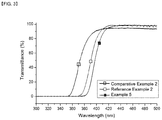
- FIG. 3 is a graph showing the measurement results of the total light transmittance of the polyimide-based films according to Example 5, Comparative Example 2, and Reference Example 2.
- reaction product was taken out and allowed to return to room temperature, 0.99 eq. of 2,2′-bis(trifluoromethyl)benzidine, 1.01 eq. of terephthaloyl chloride (TPC), and 120 ml of dimethylacetamide were added thereto, and the reaction was initiated under a nitrogen atmosphere at room temperature.
- TPC terephthaloyl chloride
- the mixture was precipitated with water and ethanol to obtain a polyimide-based block copolymer having the following repeating units (with a weight average molecular weight of 490,000 g/mol, and a ratio of the first repeating unit to the second repeating unit of 1:1).
- reaction product was taken out and allowed to return to room temperature, 0.99 eq. of 2,2′-bis(trifluoromethyl)benzidine, 1.01 eq. of terephthaloyl chloride (TPC), and 120 ml of dimethylacetamide were added thereto, and the reaction was initiated under a nitrogen atmosphere at room temperature.
- TPC terephthaloyl chloride
- reaction product was taken out and allowed to return to room temperature, 0.99 eq. of 2,2′-bis(trifluoromethyl)benzidine, 0.5 eq. of isophthaloyl dichloride (IPC), 0.5 eq. of 4,4′-biphenyldicarbonyl chloride (BPC), and 120 ml of dimethylacetamide were added thereto, and the reaction was initiated under a nitrogen atmosphere at room temperature.
- IPC isophthaloyl dichloride
- BPC 4,4′-biphenyldicarbonyl chloride
- the mixture was precipitated with water and ethanol to obtain a polyimide-based block copolymer having the following repeating units (with a weight average molecular weight of 490,000 g/mol, and a ratio of the first repeating unit to the second repeating unit of 1:1).
- a polyimide-based copolymer (with a weight average molecular weight of 160,000 g/mol, and a ratio of the first repeating unit to the second repeating unit of 1:1) was obtained in the same manner as in Example 1, except that the 4,4′-biphthalic anhydride (BPDA) was not used.
- BPDA 4,4′-biphthalic anhydride
- reaction product was taken out and allowed to return to room temperature, 0.99 eq. of 2,2′-bis(trifluoromethyl)benzidine, 1.01 eq. of terephthaloyl chloride, and 120 ml of dimethylacetamide were added thereto, and the reaction was initiated under a nitrogen atmosphere at room temperature.
- a film was prepared using the polyimide-based copolymer obtained in Example 1. Specifically, the polyimide-based copolymer was dissolved in dimethylacetamide to prepare a polymer solution of about 25% (w/V). The polymer solution was poured on a glass plate, the thickness of the polymer solution was uniformly adjusted using a film applicator, and was dried in a vacuum oven at 100° C. for 12 hours or more to obtain a polyimide-based film.
- a polyimide-based film having a thickness of 50 ⁇ m was obtained in the same manner as in Example 4, except that the polyimide-based copolymer obtained in Example 2 was used in place of the copolymer obtained in Example 1.
- a polyimide-based film having a thickness of 50 ⁇ m was obtained in the same manner as in Example 4, except that the polyimide-based copolymer obtained in Example 3 was used in place of the copolymer obtained in Example 1.
- a polyimide-based film having a thickness of 50 ⁇ m was obtained in the same manner as in Example 4, except that the polyimide-based copolymer obtained in Comparative Example 1 was used in place of the copolymer obtained in Example 1.
- a polyimide-based film having a thickness of 50 ⁇ m was obtained in the same manner as in Example 4, except that the polyimide-based copolymer obtained in Reference Example 1 was used in place of the copolymer obtained in Example 1.
- the total light transmittance of the films according to the examples and comparative examples was measured using a UV-VIS-NIR spectrophotometer (SolidSpec-3700, SHIMADZU).
- Example 2 Transmittance 12.10 11.09 82.58 (%, @ 388 nm)
- the film according to Reference Example 2 had a transmittance value of 38.92% with respect to ultraviolet light having a wavelength of 388 nm. Thus, it was confirmed that its ultraviolet shielding property was worse than that of the films of the above examples.
Landscapes
- Chemical & Material Sciences (AREA)
- Chemical Kinetics & Catalysis (AREA)
- Organic Chemistry (AREA)
- Health & Medical Sciences (AREA)
- Medicinal Chemistry (AREA)
- Polymers & Plastics (AREA)
- Engineering & Computer Science (AREA)
- Manufacturing & Machinery (AREA)
- Materials Engineering (AREA)
- Life Sciences & Earth Sciences (AREA)
- Wood Science & Technology (AREA)
- Macromolecular Compounds Obtained By Forming Nitrogen-Containing Linkages In General (AREA)
- Manufacture Of Macromolecular Shaped Articles (AREA)
Abstract
Description

*


*


*


| TABLE 1 | ||||
| Comparative | ||||
| Example 4 | Example 5 | Example 2 | ||
| Transmittance | 12.10 | 11.09 | 82.58 | ||
| (%, @ 388 nm) | |||||
Claims (9)

*


Applications Claiming Priority (5)
| Application Number | Priority Date | Filing Date | Title |
|---|---|---|---|
| KR10-2016-0153523 | 2016-11-17 | ||
| KR20160153523 | 2016-11-17 | ||
| KR1020170150902A KR101959046B1 (en) | 2016-11-17 | 2017-11-13 | Polyimide-based block copolymer film |
| KR10-2017-0150902 | 2017-11-13 | ||
| PCT/KR2017/012888 WO2018093118A1 (en) | 2016-11-17 | 2017-11-14 | Polyimide-based block copolymer film |
Publications (2)
| Publication Number | Publication Date |
|---|---|
| US20190153159A1 US20190153159A1 (en) | 2019-05-23 |
| US10717819B2 true US10717819B2 (en) | 2020-07-21 |
Family
ID=62299904
Family Applications (1)
| Application Number | Title | Priority Date | Filing Date |
|---|---|---|---|
| US16/091,269 Active US10717819B2 (en) | 2016-11-17 | 2017-11-14 | Polyimide-based block copolymer film |
Country Status (6)
| Country | Link |
|---|---|
| US (1) | US10717819B2 (en) |
| EP (1) | EP3412732B1 (en) |
| JP (1) | JP6638174B2 (en) |
| KR (1) | KR101959046B1 (en) |
| CN (1) | CN109071944B (en) |
| TW (1) | TWI649352B (en) |
Families Citing this family (4)
| Publication number | Priority date | Publication date | Assignee | Title |
|---|---|---|---|---|
| KR102067225B1 (en) | 2016-12-15 | 2020-01-16 | 주식회사 엘지화학 | Polyimide-based block copolymers and polyimide-based film comprising the same |
| KR102645705B1 (en) * | 2018-11-06 | 2024-03-07 | 주식회사 엘지화학 | Polyamide-imide film and prepatartion methode thereof |
| KR20200119124A (en) * | 2019-04-09 | 2020-10-19 | 주식회사 엘지화학 | Polyamide-imide block copolymers, preparation method thereof and polyamide-imide film comprising the same |
| US20240052104A1 (en) * | 2022-08-05 | 2024-02-15 | Dupont Electronics, Inc. | Dicarbonyl halides, polymer compositions and films made therefrom |
Citations (23)
| Publication number | Priority date | Publication date | Assignee | Title |
|---|---|---|---|---|
| US4861855A (en) | 1987-03-31 | 1989-08-29 | Amoco Corporation | Polyamide-imide compositions from bisphenoxyphenyl diamine tricarboxylic anhydride and tetracarboxylic dianhydride |
| CA2008859A1 (en) | 1989-02-01 | 1990-08-01 | Rudolf Pfaendner | Novel polymers |
| EP0385303A1 (en) | 1989-02-27 | 1990-09-05 | Hoechst Celanese Corporation | Shaped articles from polyamide-imide polymers having fluorine-containing linking groups |
| EP0725302A2 (en) | 1995-01-31 | 1996-08-07 | Japan Synthetic Rubber Co., Ltd. | A process of producing a polyimide block copolymer |
| US20050281729A1 (en) * | 2003-06-11 | 2005-12-22 | Matsushita Electric Industrial Co., Ltd. | Method for manufacturing oxygen reduction electrode, oxygen reduction electrode and electrochemical element using same |
| WO2006075203A1 (en) | 2005-01-14 | 2006-07-20 | L'air Liquide, Societe Anonyme Pour L'etude Et L'exploitation Des Procedes Georges Claude | Novel separation membrane made from blends of polyimide with polyamide or polyimide-amide polymers |
| KR100688912B1 (en) | 2005-09-20 | 2007-03-02 | 한국화학연구원 | Hyperbranched polyimide compound and preparation method thereof |
| JP2008239683A (en) | 2007-03-26 | 2008-10-09 | Dic Corp | Thermosetting polyimide resin composition |
| US20120296050A1 (en) | 2011-05-18 | 2012-11-22 | Samsung Electronics Co., Ltd. | Poly(amide-imide) block copolymer, article including same, and display device including the article |
| KR20130124213A (en) | 2012-05-03 | 2013-11-13 | 주식회사 엘지화학 | New poly-amic acid, photo-sensitive resin composition, dry film, and circuit board |
| CN103502314A (en) | 2011-04-20 | 2014-01-08 | 株式会社钟化 | Polyamide-imide solution and polyamide-imide film |
| US20140031499A1 (en) | 2012-07-27 | 2014-01-30 | Samsung Electronics Co., Ltd. | Composition including polyimide block copolymer and inorganic particles, method of preparing same, article including same, and display device including the article |
| US20140243482A1 (en) | 2011-09-30 | 2014-08-28 | Kolon Industries, Inc. | Polyamide-imide copolymer film and method of preparing polyamide-imide copolymer |
| US20150057427A1 (en) | 2013-08-26 | 2015-02-26 | Samsung Electronics Co., Ltd. | Poly(imide-amide) copolymer, a method of preparing a poly(imide-amide) copolymer, and an article including a poly(imide-amide) copolymer |
| KR20150113472A (en) | 2014-03-31 | 2015-10-08 | 코오롱인더스트리 주식회사 | Polyimide Resin and Film Thereof |
| US20150299392A1 (en) | 2012-06-25 | 2015-10-22 | Kolon Industries, Inc | Polyamide-imide copolymer film and method of preparing polyamide-imide copolymer |
| CN105017533A (en) | 2015-07-03 | 2015-11-04 | 东华大学 | Preparation method for polyamide imide coating |
| CN105017534A (en) | 2015-08-13 | 2015-11-04 | 中国科学院光电技术研究所 | Preparation method of soluble colorless transparent low-thermal expansion coefficient polyamide-imide film |
| KR20160059097A (en) | 2014-11-17 | 2016-05-26 | 에스케이이노베이션 주식회사 | Polyamic acid solution, polyimde film, and method for manufacturing the same |
| KR20160082639A (en) | 2014-12-26 | 2016-07-08 | 엘지디스플레이 주식회사 | Polyimide film, cover window and display device comprsing the same |
| KR20180003436A (en) | 2016-06-30 | 2018-01-09 | 주식회사 엘지화학 | Polyimide-based block copolymers and polyimide-based film comprising the same |
| KR20180055564A (en) | 2016-11-17 | 2018-05-25 | 주식회사 엘지화학 | Polyimide-based block copolymer film |
| CN108473687A (en) | 2015-12-11 | 2018-08-31 | Sabic环球技术有限责任公司 | Method for the melt strength for enhancing the polymer composition based on propylene |
-
2017
- 2017-11-13 KR KR1020170150902A patent/KR101959046B1/en active Active
- 2017-11-14 EP EP17871699.9A patent/EP3412732B1/en active Active
- 2017-11-14 JP JP2018548091A patent/JP6638174B2/en active Active
- 2017-11-14 CN CN201780022643.8A patent/CN109071944B/en active Active
- 2017-11-14 US US16/091,269 patent/US10717819B2/en active Active
- 2017-11-15 TW TW106139446A patent/TWI649352B/en active
Patent Citations (35)
| Publication number | Priority date | Publication date | Assignee | Title |
|---|---|---|---|---|
| US4861855A (en) | 1987-03-31 | 1989-08-29 | Amoco Corporation | Polyamide-imide compositions from bisphenoxyphenyl diamine tricarboxylic anhydride and tetracarboxylic dianhydride |
| CA2008859A1 (en) | 1989-02-01 | 1990-08-01 | Rudolf Pfaendner | Novel polymers |
| EP0381621A2 (en) | 1989-02-01 | 1990-08-08 | Ciba-Geigy Ag | New polymeric products |
| EP0385303A1 (en) | 1989-02-27 | 1990-09-05 | Hoechst Celanese Corporation | Shaped articles from polyamide-imide polymers having fluorine-containing linking groups |
| EP0725302A2 (en) | 1995-01-31 | 1996-08-07 | Japan Synthetic Rubber Co., Ltd. | A process of producing a polyimide block copolymer |
| EP0725302A3 (en) | 1995-01-31 | 1997-06-18 | Japan Synthetic Rubber Co Ltd | A process of producing a polyimide block copolymer |
| US20050281729A1 (en) * | 2003-06-11 | 2005-12-22 | Matsushita Electric Industrial Co., Ltd. | Method for manufacturing oxygen reduction electrode, oxygen reduction electrode and electrochemical element using same |
| WO2006075203A1 (en) | 2005-01-14 | 2006-07-20 | L'air Liquide, Societe Anonyme Pour L'etude Et L'exploitation Des Procedes Georges Claude | Novel separation membrane made from blends of polyimide with polyamide or polyimide-amide polymers |
| KR100688912B1 (en) | 2005-09-20 | 2007-03-02 | 한국화학연구원 | Hyperbranched polyimide compound and preparation method thereof |
| JP2008239683A (en) | 2007-03-26 | 2008-10-09 | Dic Corp | Thermosetting polyimide resin composition |
| US20140072813A1 (en) | 2011-04-20 | 2014-03-13 | Mari Fujii | Polyamide-imide solution and polyamide-imide film |
| CN103502314A (en) | 2011-04-20 | 2014-01-08 | 株式会社钟化 | Polyamide-imide solution and polyamide-imide film |
| KR101523730B1 (en) | 2011-05-18 | 2015-05-29 | 삼성전자 주식회사 | Poly(amide-imide) block copolymer, article including same, and display device including the article |
| US20120296050A1 (en) | 2011-05-18 | 2012-11-22 | Samsung Electronics Co., Ltd. | Poly(amide-imide) block copolymer, article including same, and display device including the article |
| KR20130029129A (en) | 2011-05-18 | 2013-03-22 | 삼성전자주식회사 | Poly(amide-imide) block copolymer, article including same, and display device including the article |
| US20140243482A1 (en) | 2011-09-30 | 2014-08-28 | Kolon Industries, Inc. | Polyamide-imide copolymer film and method of preparing polyamide-imide copolymer |
| KR101459178B1 (en) | 2011-09-30 | 2014-11-07 | 코오롱인더스트리 주식회사 | Co-polymerized polyamide-imide film and method of producing the co-polmerized polyamide-imide |
| KR20130124213A (en) | 2012-05-03 | 2013-11-13 | 주식회사 엘지화학 | New poly-amic acid, photo-sensitive resin composition, dry film, and circuit board |
| US20140296362A1 (en) | 2012-05-03 | 2014-10-02 | Lg Chem, Ltd. | New poly-amic acid, photo-sensitive resin composition, dry film, and circuit board |
| JP5908657B2 (en) | 2012-06-25 | 2016-04-26 | コーロン インダストリーズ インク | Method for producing copolymerized polyamideimide |
| US20150299392A1 (en) | 2012-06-25 | 2015-10-22 | Kolon Industries, Inc | Polyamide-imide copolymer film and method of preparing polyamide-imide copolymer |
| US20140031499A1 (en) | 2012-07-27 | 2014-01-30 | Samsung Electronics Co., Ltd. | Composition including polyimide block copolymer and inorganic particles, method of preparing same, article including same, and display device including the article |
| KR20140016199A (en) | 2012-07-27 | 2014-02-07 | 삼성전자주식회사 | Composition comprising polyimide copolymer and inorganic particles, method of preparing same, article including same, and display device including the article |
| KR20150025517A (en) | 2013-08-26 | 2015-03-11 | 삼성전자주식회사 | Poly(amide-imide) copolymer, method of preparing poly(amide-imede) copolymer, and article including poly(amide-imide)copolymer |
| US20150057427A1 (en) | 2013-08-26 | 2015-02-26 | Samsung Electronics Co., Ltd. | Poly(imide-amide) copolymer, a method of preparing a poly(imide-amide) copolymer, and an article including a poly(imide-amide) copolymer |
| KR20150113472A (en) | 2014-03-31 | 2015-10-08 | 코오롱인더스트리 주식회사 | Polyimide Resin and Film Thereof |
| KR20160059097A (en) | 2014-11-17 | 2016-05-26 | 에스케이이노베이션 주식회사 | Polyamic acid solution, polyimde film, and method for manufacturing the same |
| KR20160082639A (en) | 2014-12-26 | 2016-07-08 | 엘지디스플레이 주식회사 | Polyimide film, cover window and display device comprsing the same |
| CN105017533A (en) | 2015-07-03 | 2015-11-04 | 东华大学 | Preparation method for polyamide imide coating |
| CN105017534A (en) | 2015-08-13 | 2015-11-04 | 中国科学院光电技术研究所 | Preparation method of soluble colorless transparent low-thermal expansion coefficient polyamide-imide film |
| CN108473687A (en) | 2015-12-11 | 2018-08-31 | Sabic环球技术有限责任公司 | Method for the melt strength for enhancing the polymer composition based on propylene |
| US20180371224A1 (en) | 2015-12-11 | 2018-12-27 | Sabic Global Technologies B.V. | Process for enhancing the melt strength of propylene-based polymer compositions |
| KR20180003436A (en) | 2016-06-30 | 2018-01-09 | 주식회사 엘지화학 | Polyimide-based block copolymers and polyimide-based film comprising the same |
| EP3375806A1 (en) | 2016-06-30 | 2018-09-19 | LG Chem, Ltd. | Polyimide-based block copolymer and polyimide-based film comprising same |
| KR20180055564A (en) | 2016-11-17 | 2018-05-25 | 주식회사 엘지화학 | Polyimide-based block copolymer film |
Non-Patent Citations (4)
| Title |
|---|
| C. Liu et al., "Synthesis of soluble and autophotosensitive hyperbranched polyimides with good optical properties and thermal properties," Polymer Journal (2013), 45, 318-325. |
| D. J. Skrovanek, et al., "Hydrogen bonding in polymers: infrared temperature studies of an amorphous polyamide," Macromolecules 1985, 18 (9), 1676-1683. |
| European Search Report issued for European Patent Application No. 17871699.9 dated Mar. 20, 2019, 6 pages. |
| Search Report & Written Opinion issued for PCT Application No. PCT/KR2017/012888 dated Mar. 14, 2018, 13 pages. |
Also Published As
| Publication number | Publication date |
|---|---|
| KR20180055715A (en) | 2018-05-25 |
| TW201825556A (en) | 2018-07-16 |
| EP3412732B1 (en) | 2025-02-19 |
| CN109071944A (en) | 2018-12-21 |
| JP6638174B2 (en) | 2020-01-29 |
| US20190153159A1 (en) | 2019-05-23 |
| JP2019510855A (en) | 2019-04-18 |
| CN109071944B (en) | 2020-12-22 |
| TWI649352B (en) | 2019-02-01 |
| EP3412732A1 (en) | 2018-12-12 |
| KR101959046B1 (en) | 2019-03-18 |
| EP3412732A4 (en) | 2019-04-17 |
Similar Documents
| Publication | Publication Date | Title |
|---|---|---|
| US10689489B2 (en) | Polyimide-based block copolymer and polyimide-based film comprising the same | |
| US10800882B2 (en) | Polyimide-based block copolymers and polyimide-based film comprising the same | |
| US10717819B2 (en) | Polyimide-based block copolymer film | |
| US20190315925A1 (en) | Polyimide-based copolymer and polyimide-based film comprising the same | |
| US12522729B2 (en) | Polyamide-imide block copolymers, preparation method thereof and polyamide-imide film comprising the same | |
| US11377556B2 (en) | Polyimide-based block copolymer and polyimide-based film comprising the same | |
| US11407858B2 (en) | Polyamide-imide resin film | |
| US11098160B2 (en) | Polyimide-based block copolymers and polyimide-based film comprising the same | |
| WO2018004195A1 (en) | Polyimide-based block copolymer and polyimide-based film comprising same | |
| KR20180080524A (en) | Polyimide-based block copolymer film | |
| KR20180055564A (en) | Polyimide-based block copolymer film | |
| WO2018093118A1 (en) | Polyimide-based block copolymer film |
Legal Events
| Date | Code | Title | Description |
|---|---|---|---|
| AS | Assignment |
Owner name: LG CHEM, LTD., KOREA, REPUBLIC OF Free format text: ASSIGNMENT OF ASSIGNORS INTEREST;ASSIGNORS:JANG, DUK HUN;KIM, BYUNG GUK;EOM, YOUNG SIK;AND OTHERS;SIGNING DATES FROM 20180704 TO 20180705;REEL/FRAME:047068/0427 |
|
| FEPP | Fee payment procedure |
Free format text: ENTITY STATUS SET TO UNDISCOUNTED (ORIGINAL EVENT CODE: BIG.); ENTITY STATUS OF PATENT OWNER: LARGE ENTITY |
|
| STPP | Information on status: patent application and granting procedure in general |
Free format text: DOCKETED NEW CASE - READY FOR EXAMINATION |
|
| STPP | Information on status: patent application and granting procedure in general |
Free format text: NON FINAL ACTION MAILED |
|
| STPP | Information on status: patent application and granting procedure in general |
Free format text: NOTICE OF ALLOWANCE MAILED -- APPLICATION RECEIVED IN OFFICE OF PUBLICATIONS |
|
| STPP | Information on status: patent application and granting procedure in general |
Free format text: PUBLICATIONS -- ISSUE FEE PAYMENT VERIFIED |
|
| STPP | Information on status: patent application and granting procedure in general |
Free format text: AWAITING TC RESP., ISSUE FEE NOT PAID |
|
| STCF | Information on status: patent grant |
Free format text: PATENTED CASE |
|
| MAFP | Maintenance fee payment |
Free format text: PAYMENT OF MAINTENANCE FEE, 4TH YEAR, LARGE ENTITY (ORIGINAL EVENT CODE: M1551); ENTITY STATUS OF PATENT OWNER: LARGE ENTITY Year of fee payment: 4 |