US10715326B2 - Systems and methods for managing networked commitments of secure entities - Google Patents
Systems and methods for managing networked commitments of secure entities Download PDFInfo
- Publication number
- US10715326B2 US10715326B2 US15/662,855 US201715662855A US10715326B2 US 10715326 B2 US10715326 B2 US 10715326B2 US 201715662855 A US201715662855 A US 201715662855A US 10715326 B2 US10715326 B2 US 10715326B2
- Authority
- US
- United States
- Prior art keywords
- soc
- entity
- commitment
- hash
- entities
- Prior art date
- Legal status (The legal status is an assumption and is not a legal conclusion. Google has not performed a legal analysis and makes no representation as to the accuracy of the status listed.)
- Active, expires
Links
Images



Classifications
-
- H—ELECTRICITY
- H04—ELECTRIC COMMUNICATION TECHNIQUE
- H04L—TRANSMISSION OF DIGITAL INFORMATION, e.g. TELEGRAPHIC COMMUNICATION
- H04L9/00—Cryptographic mechanisms or cryptographic arrangements for secret or secure communications; Network security protocols
- H04L9/32—Cryptographic mechanisms or cryptographic arrangements for secret or secure communications; Network security protocols including means for verifying the identity or authority of a user of the system or for message authentication, e.g. authorization, entity authentication, data integrity or data verification, non-repudiation, key authentication or verification of credentials
-
- G—PHYSICS
- G06—COMPUTING OR CALCULATING; COUNTING
- G06F—ELECTRIC DIGITAL DATA PROCESSING
- G06F21/00—Security arrangements for protecting computers, components thereof, programs or data against unauthorised activity
- G06F21/30—Authentication, i.e. establishing the identity or authorisation of security principals
- G06F21/31—User authentication
-
- G—PHYSICS
- G06—COMPUTING OR CALCULATING; COUNTING
- G06F—ELECTRIC DIGITAL DATA PROCESSING
- G06F21/00—Security arrangements for protecting computers, components thereof, programs or data against unauthorised activity
- G06F21/50—Monitoring users, programs or devices to maintain the integrity of platforms, e.g. of processors, firmware or operating systems
- G06F21/51—Monitoring users, programs or devices to maintain the integrity of platforms, e.g. of processors, firmware or operating systems at application loading time, e.g. accepting, rejecting, starting or inhibiting executable software based on integrity or source reliability
-
- G—PHYSICS
- G06—COMPUTING OR CALCULATING; COUNTING
- G06F—ELECTRIC DIGITAL DATA PROCESSING
- G06F21/00—Security arrangements for protecting computers, components thereof, programs or data against unauthorised activity
- G06F21/50—Monitoring users, programs or devices to maintain the integrity of platforms, e.g. of processors, firmware or operating systems
- G06F21/57—Certifying or maintaining trusted computer platforms, e.g. secure boots or power-downs, version controls, system software checks, secure updates or assessing vulnerabilities
-
- G—PHYSICS
- G06—COMPUTING OR CALCULATING; COUNTING
- G06F—ELECTRIC DIGITAL DATA PROCESSING
- G06F21/00—Security arrangements for protecting computers, components thereof, programs or data against unauthorised activity
- G06F21/60—Protecting data
- G06F21/62—Protecting access to data via a platform, e.g. using keys or access control rules
- G06F21/6218—Protecting access to data via a platform, e.g. using keys or access control rules to a system of files or objects, e.g. local or distributed file system or database
- G06F21/6245—Protecting personal data, e.g. for financial or medical purposes
- G06F21/6254—Protecting personal data, e.g. for financial or medical purposes by anonymising data, e.g. decorrelating personal data from the owner's identification
-
- G—PHYSICS
- G06—COMPUTING OR CALCULATING; COUNTING
- G06Q—INFORMATION AND COMMUNICATION TECHNOLOGY [ICT] SPECIALLY ADAPTED FOR ADMINISTRATIVE, COMMERCIAL, FINANCIAL, MANAGERIAL OR SUPERVISORY PURPOSES; SYSTEMS OR METHODS SPECIALLY ADAPTED FOR ADMINISTRATIVE, COMMERCIAL, FINANCIAL, MANAGERIAL OR SUPERVISORY PURPOSES, NOT OTHERWISE PROVIDED FOR
- G06Q20/00—Payment architectures, schemes or protocols
- G06Q20/04—Payment circuits
- G06Q20/06—Private payment circuits, e.g. involving electronic currency used among participants of a common payment scheme
- G06Q20/065—Private payment circuits, e.g. involving electronic currency used among participants of a common payment scheme using e-cash
-
- H—ELECTRICITY
- H04—ELECTRIC COMMUNICATION TECHNIQUE
- H04L—TRANSMISSION OF DIGITAL INFORMATION, e.g. TELEGRAPHIC COMMUNICATION
- H04L9/00—Cryptographic mechanisms or cryptographic arrangements for secret or secure communications; Network security protocols
- H04L9/06—Cryptographic mechanisms or cryptographic arrangements for secret or secure communications; Network security protocols the encryption apparatus using shift registers or memories for block-wise or stream coding, e.g. DES systems or RC4; Hash functions; Pseudorandom sequence generators
- H04L9/0643—Hash functions, e.g. MD5, SHA, HMAC or f9 MAC
-
- G—PHYSICS
- G06—COMPUTING OR CALCULATING; COUNTING
- G06F—ELECTRIC DIGITAL DATA PROCESSING
- G06F21/00—Security arrangements for protecting computers, components thereof, programs or data against unauthorised activity
- G06F21/30—Authentication, i.e. establishing the identity or authorisation of security principals
- G06F21/31—User authentication
- G06F21/34—User authentication involving the use of external additional devices, e.g. dongles or smart cards
-
- G—PHYSICS
- G06—COMPUTING OR CALCULATING; COUNTING
- G06Q—INFORMATION AND COMMUNICATION TECHNOLOGY [ICT] SPECIALLY ADAPTED FOR ADMINISTRATIVE, COMMERCIAL, FINANCIAL, MANAGERIAL OR SUPERVISORY PURPOSES; SYSTEMS OR METHODS SPECIALLY ADAPTED FOR ADMINISTRATIVE, COMMERCIAL, FINANCIAL, MANAGERIAL OR SUPERVISORY PURPOSES, NOT OTHERWISE PROVIDED FOR
- G06Q20/00—Payment architectures, schemes or protocols
- G06Q20/22—Payment schemes or models
- G06Q20/223—Payment schemes or models based on the use of peer-to-peer networks
-
- H—ELECTRICITY
- H04—ELECTRIC COMMUNICATION TECHNIQUE
- H04L—TRANSMISSION OF DIGITAL INFORMATION, e.g. TELEGRAPHIC COMMUNICATION
- H04L9/00—Cryptographic mechanisms or cryptographic arrangements for secret or secure communications; Network security protocols
- H04L9/32—Cryptographic mechanisms or cryptographic arrangements for secret or secure communications; Network security protocols including means for verifying the identity or authority of a user of the system or for message authentication, e.g. authorization, entity authentication, data integrity or data verification, non-repudiation, key authentication or verification of credentials
- H04L9/3218—Cryptographic mechanisms or cryptographic arrangements for secret or secure communications; Network security protocols including means for verifying the identity or authority of a user of the system or for message authentication, e.g. authorization, entity authentication, data integrity or data verification, non-repudiation, key authentication or verification of credentials using proof of knowledge, e.g. Fiat-Shamir, GQ, Schnorr, ornon-interactive zero-knowledge proofs
Definitions
- This invention generally relates to identification and transaction methods and systems based on an architecture of peer-to-peer (P2P in the following) networked entities having digital processing capability. It particularly relates to systems and methods implementing entities identified by cryptographic keys and secure commitments and transactions of units of account transfer between such entities.
- P2P peer-to-peer
- keys i.e. cryptographic public/private keys
- identities public key for identifying an individual or a respective hardware device
- signing commitments on behalf of these identities private key
- the keys are controlled by computer entities forming the nodes of a network, and (as far as the public keys are concerned), are communicated therein in peer-to-peer with attributes associated thereto.
- an identity can be materialized by a key if features (or attributes) are associated thereto and can be interpreted by humans, so that the identity represents a particular entity that can be recognized by its features.
- a key can be associated for instance a photo, a name, an email address, a phone number, an organization or a department to which someone belongs, the role and management level in such organization, a distinctive sign, biometric data, a bank account identifier, a social security number, data of an electronic passport signed by a government, etc., or else a set of such features.
- the present invention aims at providing different systems and methods capable, in a secure manner, of implementing executable programs or commitments at a set of nodes of a network, for different applications.
- the invention seeks to provide a transactional architecture base on a set of entities constituting the nodes of a network called “Wallet Nodes” (WN), capable of executing executable codes called “Wallet Programs” (WP) of any kind and interacting with each other via “Wallet Messages” (WM), and aiming at the users being able to trust each other as to the results of execution of their respective WN.
- WN wallet Nodes
- WP Executable Code
- Another aim of the invention is to provide the implementation of this architecture, at will:
- the invention that can be implemented within various devices, phones, USB memory units, within objects of the IoT, etc., allows avoiding in certain applications the use of a unique and shared security chain of the “Blockchain”-type. For instance, for a WP transferring units of account between two WNs that maintain respective unit of account balances, the risk of a “double spend” (which has motivated the invention of the BitCoin blockchain) does not exist since the WM of the transfer at staked is not altered and since the WP is executed in a secure manner in both WNs (for respectively decrementing the balance of transferring WN and incrementing the balance of the WN to which the units are transferred).
- WNs have synced clocks (by using a protocol such as NTP) and that the WM are time-stamped in a secure manner by the WNs that transmit them and are recorded in a register (that can be central or partially decentralized or implemented in a Distributed Hash Table (DHT), for instance using a P2P protocol of the “Kademlia” type).
- DHT Distributed Hash Table
- this invention aims at allowing the implementation of transactional protocols equivalent to BitCoin or its successors (such as Ethereum), with the above-mentioned register rather than with a blockchain, and thus without the need to wait for transaction confirmations (which, depending on the adopted approach, each require from around ten seconds to around ten minutes—order of magnitude) and with transactions volumes that are virtually unlimited (while Bitcoin is nowadays limited to about 7 transactions per second and while, by comparison, the Visa network is designed for operating with volume peaks of 10,000 transactions per second).
- the invention aims at an approach based on P2P-recognized attributes for obtaining a usability which is superior to the one of the state of the art and for addressing the problem of lack of trust in relation with the current centralized and hierarchical public key infrastructures (in particular the users cannot evaluate the credibility of each of the numerous root certification authorities in their browsers).
- a commitment signed with a key is valuable only as long as this signature is not denied. Indeed, its owner can deny the commitment by alleging that the key is not his own key or was not under his control when the signing has been performed (key usurpation).
- the invention thus aims, in a particular aspect, at making the commitments more reliable:
- This method comprises in a preferred but optional manner the following additional features, taken individually or in any technically compatible combinations:
- This method comprises in a preferred but optional manner the following additional features, taken individually or in any technically compatible combinations:
- a system for certifying goods in a logistic or transformation chain wherein a tag capable of containing certifications performed at different stages of the chain is associated to each good, characterized in that the system comprises a set of pieces of equipment distributed on the chain and each provided with a wallet node (WN), and in that the wallet nodes each comprises a wallet program (WP) so as to securely perform:
- WN wallet node
- WP wallet program
- a tag capable of containing certifications performed at different stages of the chain is associated to each good, and the system comprises an equipment including means for storing in a tag data that are uniquely representative of physical, chemical or optical properties of the good on the basis of a corresponding analysis at said equipment of a region of the good where the tag is affixed, these data being subsequently accessible in order to check whether the tag has remained associated with the same good on the basis of identical or equivalent analyses.
- the analysis is performed with a portable device, and further comprising means for positioning the portable device in a reference position relative to the good when the analysis is made with the device.
- a system for managing commitments between entities having a digital processing capability and forming the nodes of a network the nodes being connected by non-conditional commitments between commitment issuers and commitment acquirers, all commitment having values in common units of account, each node comprising a memory containing:
- each node comprising a memory containing:
- SoC System-on-Chip
- This system comprises in a preferred but optional manner a permanent memory for a set of state variables, only an executable code (Wallet Program) owning a state variable being capable of modifying it.
- Wallet Program an executable code
- SoC System-on-Chip
- this use also involves at least one witness SoC associated to an identification or value transfer SoC and capable of replicating at least part of the operations executed in the latter.
- a data processing device comprising processing and storage means and means for communications with other data processing devices, characterized in that it comprises a SoC as defined above and a wired or wireless bidirectional communications channel between the processing means and the SoC, the latter being capable of exchanging messages with other SoCs via said communications means of the device.
- the SoC is hosted in a unit which is distinct from the processing device.
- the SoC is integrated to the processing device.
- a system for the secure execution of programs in an architecture comprising a series of network-connected pieces of equipment, characterized in that it comprises, it at least one piece of equipment, a secure system-on-chip (SoC) in which a SoC private key is stored in a manner accessible only by the SoC,
- SoC system-on-chip
- SoC can communicate with another piece of equipment only via messages and being capable of executing programs only in response to the reception of messages
- SoC is capable of communicating to other pieces of equipment a SoC public key corresponding to said SoC private key and certified by the SoC manufacturer,
- SoC is capable of storing at least one program for execution and of generating a hash of the or each program
- the piece of equipment is further capable of transmitting to the SoC a message containing input data (input) for a program to be executed that are encrypted with said SoC public key, as well as the hash of said program, and another public key intended for encrypting the result of execution of said program on said input data, for decryption by another corresponding private key,
- the SoC is capable, in response to such a message containing input data, in a secure manner, of (i) checking that the hash of the program for execution on the input data once decrypted matches the hash received with said encrypted input data, (ii) decrypting the input data received from the piece of equipment, and (iii) only in case of a match between the hashes, executing the program, with the exclusion of any other instructions, on the input data once decrypted, with the exclusion of any other data, then encrypting the result of the execution with said other public key and transmitting the result thus encrypted, with the exclusion of any other result except possibly those provided by construction in the SoC, to the piece of equipment,
- This system preferably but optionally comprises the following additional features, taken individually or in any technically compatible combinations:
- a method for the secure execution of programs in an architecture comprising a series of network-connected pieces of equipment, comprising in at least one piece of equipment a secure system-on-chip (SoC) in which a SoC private key is stored in a manner accessible only by the SoC, wherein a SoC can communicate with another piece of equipment only via messages and being capable of executing programs only in response to the reception of messages, a SoC being capable of communicating to other pieces of equipment a SoC public key corresponding to said SoC private key and certified by the SoC manufacturer, and wherein a SoC is capable of storing at least one program for execution and of generating a hash of the or each program, the method comprising the following steps:
- a method for trusted execution of any executable codes (WP) by nodes (WN) of a network that mutually interact via messages (WM), comprising the following steps:
- FIGS. 1A-D illustrate a process consisting in freezing the commitments of which a defective entity is beneficiary
- FIGS. 2A-F illustrate a method for executing Care Capacity Commitments
- FIG. 3 illustrates the management of a multi-supplier commitment
- FIGS. 4A-F is a simplified example of a Care Capacity Commitments chain implemented according to the invention.
- FIG. 5 schematically illustrates the constituents of a chip implementing a Wallet Node according to the invention
- FIG. 6 schematically illustrates an anonymous identification process from a passport according to the invention
- FIG. 7 schematically illustrates a method for transferring units of account involving two Wallet Nodes according to the invention
- FIG. 8 schematically illustrates a method of blocking units of account involving a “helper” Wallet Node and a “helped” Wallet Node.
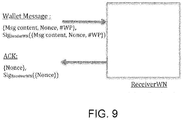
- FIG. 9 illustrates the usage of a cryptographic nonce in relation to a Wallet Node
- FIG. 10 illustrates a method of transferring units of account between Wallet Nodes which also involves “control” Wallet Nodes.
- the term “entity”, “Wallet Node” or WN is used interchangeably to designate a Wallet Node.
- the term “user”, except when explicitly speaking about a human user, will generally designate a device or a program that is associated with it. For example, an indication of the type “user A sends user B such data” will mean that “the device or program associated with user A sends such data to the device or program associated with user B”. Finally, with respect to a given device or program, the term “user” may in some cases designate another device or program.)
- a first user and his terminal, for example a mobile phone
- his terminal for example a mobile phone
- shows him a Nonce a random number serving only once
- a QR code generated in his Terminal from this Nonce.
- the other user (who is nearby, using his terminal) photographs this QR code, interprets it to reconstitute that Nonce, calculates its hash (hash means the result of the application of a predetermined cryptographic hashing function) and returns to the first user its own public key in clear and its signature of said hash+its own key.
- a secret passphrase can be communicated by oral, this can be done by telephone if the other user is not nearby, and the other user calculates in his Terminal the hash of this passphrase instead of the hash of the Nonce, then returns it with its key and its signature.
- the first user's terminal checks the signature against the received key and the Nonce (or passphrase) and records the (public) key of the other user. 4. Insofar as their terminals are reliable (see “Wallet Node” below), both users can now communicate encrypted information (optionally by generating/using a common Symmetric key by Diffie-Hellman)—starting of course by the communication by the first user of his (public) key encrypted by means of the (public) key of the other user. These exchanges include other keys that each user could previously exchange using the same method.
- Such a certificate is stored at the terminal receiving it as a meta-attribute meaning “this key belongs to the one that has the attribute XXX recognized by the entity YYY”, an entity representing an individual (and able to confirm one or more attributes at a time).
- attribute recognition(s) can be performed in the presence of other users and generate a certificate (meta-attribute) meaning “this key belongs to the person who has the attribute XXX recognized by YYY in the presence of ZZZ . . . ”.
- each attribute can be associated meta-attributes indicating their recognitions by other entities.
- such a certificate can be obtained, in a secure manner, according to a method of “transaction of cross confirmations of attributes”, atomic transaction in which participants in the transaction can confirm key/attribute associations to each other, each participant being able to selectively (and optionally) confirm attributes of different types.
- the users each start the transaction (each on their terminal) by declaring the desired set of their respective public keys (these keys representing all participants in the transaction, Occurrence A, B and C), and this triggers the mutual sending of these keys between the participants who can validate them—this first step itself forming an atomic sub-transaction that ends (commit) when a set of users agree on the question of knowing who are the participants to the transaction;
- Automatic sending of automatically generated meta-attributes certificates meaning:
- users can also be recognized indirectly (transitively) according to rules set in common: when two users B and C which have been recognized by a user A (with “my-key: BBB” confirmed by A′ and “my-key: CCC” confirmed by A′), in turn recognize a user D (with a “my-key: DDD” confirmed by B in the presence of C′ and “my-key: DDD” confirmed by C in the presence of B′), D is also considered recognized (more precisely “implicitly recognized”) by A.
- the entities such as B, C and D thus form the set of entities that the user A “knows” (later called the set “S”).
- the recognition of D by B and C can be notified to A which can then itself recognize it.
- the strong reciprocal identification procedure does not prevent, for example, associating same attributes with two distinct keys, associations which are confirmed by other entities in the network, and then to deny signed commitments with one of the keys without risking to invalidate the commitments signed with the other key (a user can hold two keys while being able to afford to lose one).
- An aspect of the invention is to discourage a user to use different keys, by assigning each attribute association to a key a reliability rating such that a multiplication of the keys for a same user leads to a decrease of reliability rating.
- these ratings are not absolute: they relate to the third entity that calculates them. They are calculated according to the attribute recognition (see certificate above) carried out in the environment of the third party entity (the user's neighborhood in the network, typically—but not exclusively—its connections of degree 1 or more). In the neighborhood of a user, the more entities (these are in fact the individuals that these entities represent) that recognize attributes characterizing a given entity, the more this user can rely on that entity—that is, the more the user has reasons to believe that the key of that particular entity is legitimately associated with the distinct individual (or device) it represents. Moreover, in this collective validation approach, entities that generally recognize attributes with higher reliability ratings and are not associated with denied commitments are given a higher weight (called authority rating) as to their ability to validate key/attribute associations.
- authority rating a higher weight
- the method here comprises counts of attribute/key associations recognitions by the entities of the user's neighborhood, but avoiding taking into account entities that could be specifically introduced (sybil attack) to artificially increase ratings (of entities that would be used to deny signatures).
- An entity known as a commitment provider issues a commitment to an entity known as commitment beneficiary, each recognizing certain attributes of the other by specifying them as a prerequisite, that is, as a condition of the commitment.
- the interactions between the commitment provider and beneficiary entities may include the following steps:
- the identification of an entity can be its (public) key, an “address” that can be formed from (the hash of) its key or can be obtained by yet another method.
- an “address” that can be formed from (the hash of) its key or can be obtained by yet another method.
- identity and ‘address’ are used interchangeably and with the same meaning.
- the entity represents either an individual who is the user of the entity and has attributes such as a name or a telephone number, or a device—having attributes such as a trademark, a model and a serial number—these attributes being characteristics of the individual or device in question. (Note that said devices may be in hardware or software.)
- each entity In order for entities representing devices (“device entity”) to be under the responsibility of individuals, each entity is associated with an entity (and only one) representing an individual (human) who is responsible for it, called the “responsible human entity”, so as to link the responsibilities of entities implemented with the invention and the responsibilities in their legal consequences at the level of society and avoid the drifts of such systems.
- Each entity (representing an individual or a device) is embodied by a mechanism (hardware and/or software device) called “Wallet Node”, described below, having exclusive control of its key, capable of performing computer processes and of generating their proofs, and is also able to generate detection of absence of treatment expected from others, which the entity in question is supposed to benefit.
- Wallet Nodes can store certificates, such as meta-attributes, and a Wallet Node can be created in the system in representation of a key generated by an “external entity” such as a governmental authority for example.
- an “individual” property is assigned to it. Note that only individual entities can recognize attributes of other entities (since they are actually the individuals that these entities represent that recognize these attributes). Similarly, only individual entities may have authority ratings.
- a “device” property is assigned to it and the address of an “individual” entity that is responsible for it (“responsible human entity”) is also assigned to it upon receipt of the signature of the “individual” entity in question.
- each entity may be assigned another entity as a “responsible entity” (upon receipt of its signature), which can be of the “individual” type or not.
- the responsible entities can thus form a transitive chain of responsibility and in the other direction, the same entity may be responsible for several other entities, with a specific management of the chain whereby a downstream entity can not be responsible for an upstream entity which is directly or indirectly responsible for it, the relationships of responsibility thus forming a tree structure.
- a responsibility relationship is implemented in the form of a specific type of commitment, by which the commitment provider (i.e. the responsible entity) brings an “exposure weight” (described below) in the commitments of the commitment beneficiary, and this transitively by following the responsibility relationship of the entity providing the commitment.
- the commitment provider i.e. the responsible entity
- an “exposure weight” described below
- said automatic propagation to commitment beneficiary entities downstream are also carried out via the transitive responsibility chains.
- An example of a commitment is an access authorization, the access being for example the unlocking of a room door using NFC technology performed by a lock (“device” entity, commitment provider) when establishing a near field communication with the smartphone (“individual” entity, commitment beneficiary) of the person who rented the room.
- Such communication may include the sending of information signed by the commitment beneficiary entity to the commitment providing entity in order to fulfill the commitment (door opening command, hereinafter referred to as the “execution request”) and, in the other direction, the submission of information signed by the commitment providing entity to the commitment beneficiary entity (called “proof of performance”), proving that the commitment was fulfilled (for example triggered by the reading of a secured contactor whose opening reliably indicates the effective opening of the door).
- This signed information to avoid fraud, may contain the result of the application of a determined function to a single challenge (nonce) sent by the beneficiary at the time of the execution request.
- the entity providing the commitment (“lock entity”) has a responsible entity (“door entity”, beneficiary for example of commitments for water and electricity for this room by other entities) and these two entities have the same “responsible human entity” (representing the owner of the room).
- the entity receiving the commitment (advantageously without being disclosed to the users, as described below), this in the context of the automatic propagation to downstream beneficiary entities described above to deal with situations of denial of commitments and their consequences.
- an amount of units of account is associated with each commitment (this amount representing the value of the execution (or of the total execution) corresponding to the commitment in question, here it is the price paid for the rental), in the event of failure to deliver (i.e. proof of performance not sent in time in response to execution request—here the proof of the unlocking of the lock is not sent in time in response to an opening command), a certain time limit is granted in the commitment to the entity providing the commitment (here it was granted in order to let the renting provider to solve any technical malfunction which would prevent the opening) and when it has passed, if the proof of performance in question or of compensation as provided for in the contract for the commitment is not sent by the providing entity (which in the present case may be, for example, evidence of a reimbursement transaction or proof of the provision of another room while waiting), the latter as well as the chain of its responsible entities, where appropriate, go to the state “denial of commitment” for the commitment beneficiary entity.
- the associations between the key and the attributes recognized in the commitment are invalidated with respect to the “incoming” commitments contracted by other entities to the same entity this time as the beneficiary of commitments.
- the incoming commitments specifying these attributes are frozen during a so-called “arbitration” phase also provided for in the commitment. This penalty of freezing the incoming commitments is also applied to the entities in the responsible entities chain upstream, up to the amount of the commitment in question (see the example below).
- a time-limit is provided for the receipt of the execution proof by the beneficiary entity
- the contract of that commitment executable contract, or smart contract, as will be described below
- the contract of that commitment is a computer program running within that beneficiary entity, is awaiting receipt of the execution proof within that time-limit.
- timeframes that a commitment provides for include preferably:
- a third period typically for a judicial or arbitration decision by a signatory provided for in the commitment (the “arbitrator”), decision whether or not to associate the commitment default to an identified individual deemed to be represented by the responsible human entity and to decide the consequence of that association, if any.
- the message is signed and the system of the invention (see Wallet Node) provides for an acknowledgment of receipt within a certain period, failing which (or in all cases) the message in question is recorded in an immutable data structure (such as a blockchain shared by the parties or by trusted third parties) deemed to be consulted (by contract), which makes it possible to prove the sending or to verify the non-sending (and thus to generate the proof of the absence of an expected message).
- an immutable data structure such as a blockchain shared by the parties or by trusted third parties
- the steps of executing a commitment are (potentially) the following:
- a request for execution is sent by the beneficiary entity to the provider entity.
- the latter has a ‘first deadline’ to execute the commitment (give access).
- This step may typically include additional substeps, such as generating and sending by the provider entity of a first nonce to the beneficiary entity, who must generate a new nonce and return it to him with the hash of the first nonce, these two nonces in combination being then used in the generation of the execution proof by a secure device at the level of the entity providing the commitment.
- Case of non-execution on the basis of a detection of non-delivery of proof of execution, the beneficiary entity generates and sends to the providing entity proof of non-fulfillment.
- Case of denial of commitment after the expiry of a period laid down in the commitment (second deadline), if the proof of execution (for compensation) as provided for in the commitment is not sent to him, the commitment beneficiary entity
- denial of commitment referred to in point 3 is in fact only a presumption of a denial of commitment which is confirmed or set aside in point 4.
- an entity E j has a commitment EN j1 as a provider to an entity El as a beneficiary, for an amount M z , this commitment being an access commitment.
- the detail at the level of the entity E j shows that, with respect to the EN j1 commitment, E l recognizes the attributes A j1 , A j2 of E j and that for the incoming commitments, namely:
- E l then notifies the arbitrator provided for in the contract of the commitment, of the denial of the commitment EN j1 and compares the attributes of E j recognized in the inward commitments with those recognized in the defaulting commitment EN j1 . It follows that only EN kj has an intersection of attributes and this intersection includes only the attribute A j2 . As a strong attribute, E l notifies E k to freeze its commitment EN kj of which the entity E j is beneficiary (see FIG. 1C ).
- This step is propagated to the entities responsible of E j upstream (by the substeps below) until the total of the amounts of all frozen commitments reaches (or exceeds) M z :
- E l had been notified of the responsible E n of E j .
- the latter recognizes (on the commitment of responsibility EN nj ) enough recognized attributes on the defaulting commitment EN j1 (In this case, it is A j2 , which is sufficient in itself since it is a strong attribute) and whose other recognized attributes (in this case A j5 ) do not show any inconsistency with the latter.
- E n is beneficiary of a commitment EN mn (of E m , for an amount M v ) recognizing a sufficient portion of its attributes that are recognized by E j on EN nj , and without inconsistency.
- EN mn is also frozen ( FIG. 1D ) and since M y +M v is reached (or is greater than) M z , this step ends.
- the receipt by a given entity of a notification of denial of commitment in relation to given attributes entails the notification by that particular entity of the information of that denial to the entities providing commitments (on compatible attributes) to the entity accused of the denial, whose authority ratings are then reduced in response to receipt of that notification.
- the method of the invention establishes an commitment weight called “Exposure Weight” for each entity according to the amounts of the commitments for which this entity and its responsible entities (compatible with its attributes, as described above) are beneficiaries of commitments.
- Exposure Weight presented by E j vis-à-vis E l is equal to M y +M v .
- the method of calculating the ratings described below takes into account the Exposure Weights described above and exploits the fact that at the level of each given entity, if any, are recorded:
- the process starts with the entity representing the user herself as well as a set of entities that the user “knows” (for example by the strong reciprocal identification procedure described above) and confirmed attributes. This set is called “S” here.
- Compatible means compatible with the attributes recognized in the previous step, the term “compatible” having the meaning given above. For example, if for a given entity of S certain attributes have been recognized by (the entity representing) the user, an entity of S is an entity, a provider of commitment to that particular entity, having recognized compatible attributes with those recognized by the user. Then, from the constructed set S _ , is constructed the set “S _+ ” of the entities towards which at least one entity of S _ , as commitment provider, has a commitment having compatible attributes. Thus the sign “ + ” indicates that, starting from S _ , a set of “downstream” entities is built.
- S _+_ is the set of entities that, as a commitment provider, have a commitment with attributes that are compatible with (at least) an entity of S _+ .
- the sign _ was reused to construct a set of downstream entities including S _ . And so on, we can build bigger and bigger sets, like Russian dolls.
- S _+ includes S
- S _+_ includes S _
- S +_+ includes S +
- Reliability ratings are calculated (as described below) for the attributes of the entities of S _+ (or S _+_+ , etc.) as well as for the attributes of the S + (or S +_+ , etc.).
- “Authority ratings” are calculated (as described below) for the entities of S _ (or S _+_ , etc.) as well as for the entities of S +_ (or S +_+_ , etc.).
- the method of calculating the ratings is iterative and at each iteration, the ratings are normalized. Beforehand, the size of the extent of the neighborhood is fixed and the sets in question are determined. Then, the steps are as follows:
- the authority rating is (re)calculated by summing the reliability ratings of the attributes recognized by the commitments (for the elements of S _+ , resp. S _+_+ , etc.) which this given item is a commitment provider. Authority ratings are normalized (divided by their total so that their total is equal to 1).
- this authority rating is weighted by the value of the commitment in question and by the weight of the commitments towards itself (Exposure Weight). It is also normalized.
- the reliability rating is (re)calculated by taking the ratio between:
- the meta-attributes of said attributes of S _+ are likely to increase their reliability ratings according to the authority ratings of the entities that appear in these meta-attributes. More precisely, if a meta-attribute of an attribute XXX recognized in a given entering current commitment meaning “this key belongs to the one that has the attribute XXX recognized by YYY in the presence of ZZZ . . . ” refers to:
- Steps 2 and 3 are iterated as long as the ratings have not converged (in other words, the iterations stop when the new reliability ratings obtained are sufficiently close to the previous ones with a given deviation. In general less than 10 iterations are sufficient).
- Optimizations can be made, notably taking into account the minimum and maximum of the authority scores.
- the reliability rating is (re)calculated by taking the ratio between:
- the meta-attributes of the attributes of S + are likely to increase their reliability ratings based on the authority ratings of the entities that appear in these meta-attributes, as described previously (replace S _ (resp. S _+_ , etc.) with S (resp. S +_ , etc.)).
- the authority rating is (re)calculated by summing the reliability ratings of the attributes recognized by the commitments (for the elements of S + , resp S +_+ , etc.) which this particular item is a commitment provider.
- Authority ratings are normalized (divided by their total so that their total is equal to 1).
- the authority rating is weighted by the value of the commitment in question and by the weight of the commitments towards itself (Exposure Weight). It is also normalized.
- Steps 5 and 6 are iterated as long as the ratings have not converged. (Generally less than 10 iterations are sufficient).
- Both directions can be alternated so that the direction towards S _ takes advantage of sets such as S +_ _ , S _++_ _ , etc. and that the direction towards S + takes advantage of sets such as S _++ , S +_ _++ , etc.
- the method of determining reliability and authority scores can take into account
- a “consistency coefficient” of the attributes is applied to increase the reliability ratings of so-called “consistent” attributes. This coefficient depends on the ratio between:
- An entity can generate product identifiers in the form of a “tag” (defined below), which can be used in decentralized Supply Chain Management applications.
- the same method can also be used to generate identifiers of documents (file or group of files, programs, etc.) or as proof of first creation of a trademark, a domain name, etc.
- Tag Unique identification file containing one or more “certificate of origin” of a physical product or a non-physical resource (to a tag is only one physical product or non-material resource)—whereby an existing certificate of provenance can not be modified or deleted, but other certificates of provenance can be added to the tag.
- Certificate of provenance of a product or (digital) document signature, by an entity capable of certifying the product or the document, of a set of attributes characterizing it; for example, a certificate of provenance can certify an origin, a certain transformation in a chain of transformations, etc.
- product instance means an instance of a physical product or a non-material resource.
- the (digital) tag of a product instance is generated (preferably when it is created) by an entity called its “Owner Wallet Node” (OWN) whose address is included in the content of the tag, and can then be transferred from one OWN to another.
- OWN Olener Wallet Node
- the OWN that generated the tag controls it automatically (it is a property associated with an entity). Then another entity can ask to control it. This transfer of control takes place on a “first applicant—first served” basis.
- the entity that controls a given tag at a given time is referred to as the “Viewer Wallet Node” (VWN) of that tag (initially, the OWN is at the same time its VWN entity). Then another entity can make a request to take control in turn and become the new VWN of this given tag, and so on, so that there is always only one VWN that controls a given tag.
- VWN Viewer Wallet Node
- the execution integrity of the entities ensures that, with the exception of the initial OWN that generated the tag, each entity that controls a tag received it from an entity (the previous VWN) that no longer controls it.
- the tag seen by an entity can not be a duplicate of a tag seen previously: it is rather the same tag that typically moved in its transport and/or transformation chain, from a VWN to another.
- the address of the current VWN of the tag is stored and maintained by the current OWN of the tag whose own address can be retrieved by navigation from the OWN which generated the tag (and whose own address is included in the tag's content).
- the execution integrity of the OWN entities ensures that the current VWN of a given tag can be retrieved.
- the validity of a product instance associated with a given tag is obtained by making a query to the current VWN of that tag, which responds with a message whose plaintext can be “that given tag is under my control; it was generated by the entity XXX; I have myself received control of it from the YYY entity and since then no entity has yet asked me for it”, thus indicating that it has this tag under its exclusive control until a request from a subsequent VWN is accepted, and as already said, the system guarantees that no other entity (running the same VWN “Wallet Program”) will, while it has this tag under its control, validate a product instance for the same tag.
- This process finds applications especially in Supply Chain Management, where a product must be audited in various relays of its supply chain using certifier equipment including a VWN, its tag including new certificates resulting from these audits, its traceability being guaranteed, this product can be composite and result from assemblies or compositions of several such instances of product—or to verify that a single instance of a software is being used at a given time or that a document is valid—without any central device being used: following the creation of the instance in question, the entities performing such audits or verifications do not necessarily share a common structure or require the use of a single, shared security chain of the type “Blockchain”.
- this certifying equipment may be entitled to substitute the corresponding physical tags (according to the rules laid down in the executed Wallet Program).
- each product instance contains or comprises its own OWN physical entity (implemented as a Wallet Node according to the system of the invention) and the transfer of OWN becomes unnecessary when transferring ownership.
- the instance in question may be audited to verify the illegal replacement of the certified attributes in the tag (such as a photo), and the entity that provided it may be automatically defaulted as described in the “Commitments” section.
- the third use mentioned above indicates that the secured data of the tags, in particular their respective priorities, can be retrieved from a register where they are stored.
- the method does not require the use of a single, shared security chain of the “Blockchain” type to guarantee them.
- the said register can be implemented in a centralized, partially decentralized or distributed manner (in a DHT, “Distributed Hash Table”).
- a VWN having the role of affixing such a physical tag and having a certification capability may be part of an equipment capable of automating taking a photograph of a region of the product comprising the physical tag and to encode this photograph (hash-code, algorithm for generating a single character string associated with the photo, thumbnail of the photo or photo such as) in the tag itself.
- the equipment used to take this picture is provided with positioning means enabling it to take the photograph in the same position as that at which the photograph which gave rise to the encoding in question was taken (with a deviation depending on the implementation in question).
- the equipment performs a molecular scan of the product, for example with a near infrared spectroscopy technology (of the molecular scanner type manufactured by Consumer Physics, Inc., Israel), and writes in the tag information representative of the molecular composition of the product.
- a near infrared spectroscopy technology of the molecular scanner type manufactured by Consumer Physics, Inc., Israel
- a new molecular scan is performed, for example by the purchaser of the product in question, and the molecular composition information is compared with the content of the tag, to certify that the tag is on its original product.
- this certifying equipment can be configured to modify or complete the corresponding data in the physical tag, or to replace the physical tag.
- Issuing entity An entity that generates a given commitment.
- Acquirer For a commitment made by an entity providing the commitment to an entity beneficiary of the commitment, the “acquirer” is that beneficiary entity. The latter is said to “acquire” the commitment in question.
- the first beneficiary of a commitment generated is its first acquirer.
- the commitment being generated in an initial Wallet Message by the entity providing the commitment, a transfer transaction (see below) of this commitment to the next acquirer is implemented in another Wallet Message sent to the latter, including the original Wallet Message in its content.
- a conditional commitment “CCC” may be provided to the acquirer, a triggering event of which is the failure of the exchange of said commitments of a given transmitting entity via the exchange network (see below).
- Commitment transfers are, where appropriate, “accepted” by means of reverse Wallet Messages returned by the next acquirer.
- bearer commitments these are commitments in which the first acquirer is the provider entity itself (issuing entity) and can then be transmitted from that acquirer to another and so on.
- the term “commitment” means “bearer commitment” and generally refers to commitments exchangeable against any other commitments of the same supplier that have the same value at the current time).
- Balance (of a particular entity, for commitments of a specific issuing entity): Total value (in UA) of the commitments of a specific issuing entity to the particular entity. For each entity, for each set of commitments of a different issuing entity, such balance is associated (explicitly or implicitly), and the non-zero balances are stored there (the unrecorded balances implicitly have a zero balance).
- Amounts + and Amounts ⁇ With each entity is associated the information of the commitments to be exchanged (via the “exchange network”, see below), namely:
- This network consists of nodes which are the entities to which are associated ‘Amounts +’ and ‘Amounts ⁇ ’, and the edges between nodes represent matchings of opposite sign amounts. At each edge is associated the issuing entity and the quantity of UA (capacity in the sense of the flow networks) of commitments exchangeable by matching of amounts + and ⁇ (this is the minimum amount of different signs indicated on both sides for that issuing entity). For a good understanding, it is considered here that between two nodes there are as many edges as there are issuing entities for which there exist ‘Amount +’ and the ‘Amount ⁇ ’ on both sides.
- the exchange network thus makes it possible, for example, to exchange commitments of different issuing entities between a node (entity) A and a node (entity) B, into an “exchange transaction”, considering the exchange network as a flow network, and, to take a purely illustrative example:
- the flow networks comprise balancing means which are known and the person skilled in the art can draw inspiration from them.
- Exgange transaction Transaction consisting in exchanging on the exchange network commitments of the same value, of different issuing entities, to the extent of the capacities on this network seen as a network of flow.
- Commitment(s) transfer transaction Transaction for transferring at least one commitment issued by a given entity and for a given value (in UA) from one entity to another.
- UA transfer Transaction (as opposed to Commitment transfer transaction): Transferring a given value (in UA) to a destination entity amounts to:
- CCC type (or type of care capacity commitment): “Care capacity commitment” (see below) specifying the same trigger conditions (such as the signature of a predetermined arbitrator).
- a same CCC type identifier is associated with the “care capacity commitments” of the same CCC type.
- Each CCC type specifies the procedure for checking the signature(s) if any provided for in said triggering condition.
- Transfer trigger event A “care capacity commitment” (CCC, see below) is triggered by receipt of the notification of a transfer trigger event, such as:
- CCC Care capacity commitment
- CCC balances each of which being dedicated to all such CCCs generated by this entity, and each CCC to a given beneficiary entity specifies
- FIG. 2F shows the example of a triggering event undergone by an entity Ell (instead of the entity E 1 of the above example, in correspondence with the step A presented in FIG. 2A ) for a damage of 20 UA to be settled to E 41 (instead of E 4 ).
- step ‘B’ Ell transfers 10 UA to E 41 (10 UA of its ‘Amounts +’ from its CCC balances, which it has been able to exchange to obtain commitments of E 41 of the same value).
- step ‘C’ transfer from upstream
- E 21 transfers 1 UA to E 41 .
- step D transfer from downstream, in this example (for simplicity), from each entity downstream of E 21 , namely E 1 , E 31 , E 32 , E 33 , E 34 , E 35 , 1 UA is transferred to E 41 on each path.
- E 34 (which is currently beholden for 6 UA) still transfers 1 UA.
- limitations can be implemented in the CCC executable contracts (according to their respective types), in particular for the case of from downstream transfers by triangulation, an example of which is given above, enforcing for example that: the total of the quantities received, by execution of CCC of a given type, from downstream but by triangulation via an upstream entity (such as E 21 ) does not exceed a threshold which is a function of the total of the effective transfers by this upstream node (E 21 ) by executing CCCs of the same type (this limitation can be implemented by maintaining a ‘right to triangulation’ amount, similar to the implementation of ‘beholden’ described above).
- the execution of a CCC from an entity “A” to an entity “B” generates in some way an implicit reverse commitment both from B to A and from triangulation: from B (as well as entities downstream in the CCC network) to any entity beneficiary of a CCC provided by A (and of the same type) already generated or generated in the future.
- the implementation of the CCCs enforces that the execution of these implicit commitments—by B and by the entities downstream of B on edges of the CCC network—is a condition for all CCCs of the same type and on the same edges.
- the edges in question are penalized for it with respect to a potential contribution by A or by other entities, existing or generated in the future, on these same edges.
- Balance of CCC (of a given entity, for a given type of CCC and for commitments of a specific issuing entity): Total value (in UA) of the commitments of a specific issuing entity to the particular entity, which are reserved for transactions of UA transfers by executing CCC of the given type.
- this balance is associated (explicitly or implicitly), and the non-zero balances are stored there (non-memorized balances implicitly have a zero balance). These balances may fluctuate, but any change in a CCC balance must comply with a given notice provided for in the CCC.
- Capacity commitment A capacity commitment makes it possible to compensate for a transfer of UA to be performed, by a UC (“Used Capacity”) consumed capacity update, the current available capacity being then reduced by the quantity of the consumed units in question.
- the capacity commitments form a flow network, the nodes of which are the provider and/or beneficiary entities of CC and whose edges represent the CCs to which capacities and UCs are associated (and form paths in the network of flows), through which UCs can be updated to compensate for transfers to be performed.
- Takeover Commitment The commitments described so far can be used in a process for managing commitments to take over supply commitments, forming a sort of clearing house in P2P, where
- tribe chains form a network that is designed to scale. It's a pure p2p network, that is, without intermediaries, where caregivers see their aid extended, forming chains, and amplified all along.
- This signaling can be carried out, for example, by pushing information representative of this difficulty to the friends of a social network, or when the friends connect to such a social network on which an indication of the difficulty is signaled.
- This signaling can be carried out, for example, by pushing information representative of this difficulty to the friends of a social network, or when the friends connect to such a social network on which an indication of the difficulty is signaled.
- Gino has a problem (this is represented in part c) by an exclamation point on the node G), Since Celia cares about Gino, a contribution from her is triggered. Gino feels indebted, so he puts aside some money and he declares that he cares about one other node in the network (also shown in part d). Meanwhile, other members are offering valuable moral support and helpful suggestions to each other. Thus, in various ways, a broader, more robust community is continually forming. Support from Gino to Dan is triggered as well since, in a way, Gino also has been helped by Ben, indirectly through Celia. So Ben is happy. He's particularly happy that Celia and Gino contributed, since his node didn't have enough money to help Dan.
- Gino was assisted by Ben indirectly via Celia.
- aid for example from Ben to Celia, can be a “gift” (without interest) or a “loan” (with interest).
- the algorithm proceeds from the upstream to the downstream and, in the case where there is not enough funds at one of the nodes, it resumes at the beginning from the current node and for the amount remaining necessary.
- the user may be asked to confirm his intention to contribute.
- the executable commitment in question may also provide for the confirmation of a third party called “arbitrator” in the following (confirmation directly issued by the Wallet Node of the arbitrator, described below, or by the delivery by the beneficiary node—D or G respectively—of an electronic signature of the arbitrator) and the help is triggered automatically as soon as this confirmation.
- an expert endorses the payment to be executed.
- a system and a method by which the deductible that an insured node proposes (for the insurance policy) to an insurance can be determined dynamically according to the amount of units of account that this node is willing to pay in the event of a disaster and current reserves of nodes that have links to it for this purpose, the premium which he then has to pay to the insurance being determined by integrating the premiums due at each moment according to the deductible which results from his own situation and from the situation of the said nodes which have a commitment to him.
- Tribeschain network support app can be used to form a “common pot” with friends, to cover themselves with certain risks. And for the highest levels of risk, which are not covered with such a common pot, users of the tribechain app can find traditional insurers, but according to the method of the invention, the premiums to be paid by each user to the insurer will be flexible insofar as the common pot available to each node is variable.
- P2P insurance is the most basic form of risk sharing. It's likely how insurance first began. For example, what if I, you, and several others who know each other, came together and decided that we would help each other when one of life's difficulties arises, say a house fire. The same Tribe-Chain app you learned about in our first story can also be used by each user to form a “pot” with friends, to prepare for such events. And, for those higher levels of risk that are not covered within the tribe, the users of Tribe-Chain will rely on insurers as needed. Because Alice and Ben are willing to take responsibility for a deductible of 3,000 Euros per claim, by using the Tribe-Chain app they can find a way to pay a lower premium. 3,000 Euros per claim?
- the Tribe-Chain app would help them get a loan to find the missing 1,500 Euros for each of them . . . .
- each of them may choose an insurance policy using the Tribe-Chain app that will cover them with a deductible of 7,500 Euros per claim.
- the insurance policies proposed by the Tribe-Chain app are able to dynamically adapt their premiums according to the support each node receives in the network. Alice and Ben each have a house and decide to set aside 1500 each to have a common pot of 3000 for the case where the house of one of them would burn.
- Tribe-chain is also the p2p risk cover app (Wallet Nodes) that allows it to be done in a secure way, as well as to call on an insurance company to cover the amounts beyond the common pot put in Place, this common pot being seen as a deductible.
- Wallet Nodes the p2p risk cover app
- Alice and Ben find an insurance company offering a lower premium given the deductible of 3000 per claim, that represents their common pot. Alice and Ben think it is unlikely that their two houses will burn the same year, and they are willing to take that risk. Indeed, in case this happens, everyone could borrow the 1,500 missing, the common pot covering the deductible for only one claim, and the app tribechain would help them.
- each of them can choose an insurance policy that will cover them with a deductible of 7,500 euros per claim, and thus with a much more advantageous bonus.
- the premium due can then be determined by integrating in time the actual deductibles recorded at each moment.
- the insurance policies offered by the app tribe-chain are able to dynamically adjust their premiums, using the method, according to the reserves available on each node at the current time in the network.
- Ken's nephew Lila has been trying to launch a small grocery store on the island, which is much-needed in her neighborhood. She works two jobs and has twice saved up money for her dream store. Ken contributed to Lila's grocery seed money as well. But both times the funds have been severely depleted by medical emergencies. First Lila had a seriously infected spider bite that sent her to the hospital, and then her grandfather required cataract surgery. 2. Lila Asks Healthcare Professionals to Join When talking with some friends in London, Ken hears about the Tribe-Chain Bootstrap app for Android. It seems perfectly designed to solve Lila's and the family's problems, problems that are common to people in disadvantaged regions.
- Ken is happy to learn that with the Tribe-Chain app he can purchase healthcare credits, also known as vouchers, that can be used by his extended family in an emergency. Ken calls Lila to explain that he would like to do this, but first she must approach her local healthcare providers and have them agree to join Tribe-Chain. A number of the island's pharmacies, doctors, surgeons and various clinics welcome the idea of being paid up front for credits for their services. So they each sign on to Tribe-Chain. Ken specifies the voucher amounts his family is likely to require in total. Lila divides this amount to different local healthcare providers as seems appropriate to her family's needs. The providers receive notification of the voucher requests, which they validate. This means that they are issuing vouchers that they pledge to honor.
- Lila begins by going to the wholesalers she wants to work with one by one. She explains that if they agree to issue vouchers they will be paid in advance for the purchases she needs for her store.
- Tribe-Chain app that they can download on their smart phones. She explains the process of the issuing of vouchers, which will be identical to the one used with healthcare providers. Naturally, the vendors see the benefit of being paid in advance in this way, and they agree to join Tribe-Chain. 5.
- a Tribe for Island Businesses Lila is formed by her uncle's psychology. After a time however, she realizes that she is not that accurate at figuring out how much she needs from a particular vendor. Sometimes she hasn't enough vouchers from her soft drink suppliers, but she's left with more than she needs from her snacks suppliers. Ken quietly tells Lila that he has learned of a way to address this issue.
- Tribe-Chain Bootstrap app they can now create a tribe, an association made up of island businesses. If Lila's suppliers join the tribe and issue tribe credit vouchers, Lila will be free to allocate her resources where and when she needs them. Lila likes the idea of naming her tribe Sphinx Colibri after an amazing hummingbird-like moth that lives on the island of Fare-Thee-Well.
- the Sphinx Colibri Tribe Lila approaches her ideal grocery suppliers and invites them to join the Colibri Sphinx tribe. Lila explains to them that this tribe will contain all kinds of island businesses. As a tribe they will attract new customers who want to take advantage of discounts for group buying.
- Lila explains that ad templates have been set up by Ken that they can use for their products. A 1% discount is the default discount configured by Ken to encourage discount thinking. But Lila suggests that they change it to something higher, at least as a start. In addition to prepayment, the potential for increasing their customer base plus the ability to buy goods and services on credit, convinces a number of reputable vendors to join the Colibri Sphinx Tribe and issue credit vouchers for sale. 6. Rebalancing The great advantage of buying within a tribe is that generally tribe vouchers are fungible within the tribe. They act as a common currency. They are tribe-wide credits, in contrast to the kind of vendor-specific credits Ken bought from individual vendors before they joined Sphinx Colibri.
- Tribe-wide credits may be purchased from one vendor in the tribe and then used interchangeably with any other tribe vendor. This way, if Lila buys vouchers worth 100 euros (known as Sphinx Euros) from her soda supplier and vouchers worth 100 Sphinx Euros from her snack vendor, Mr. Snax, if the snacks she already has aren't selling as quickly as the soda, she could choose to just restock her soda supply with the entire 200 Sphinx Euros. This gives her flexibility to spend where and when she likes within the tribe. Since tribe buyers may buy vouchers from one vendor and to use them for products or services of another tribe vendor, some vendors, like in Lila's case the snack vendor Mr. Snax, may sell more vouchers than are redeemed for products. In other cases vendors like her soda man, Mr. Glub, may have more demand for their products than credits paid for. So potential vendors are informed that there may likely be a need, from time to time, to rebalance funds for vouchers within the tribe.
- Snax is, in effect, rebalancing with loans that he is obligated to pay back. If one of Mr. Snax's sponsors does not provide his loan, then that obligation propagates to his sponsors, and so on.
- the vouchers of Mr. Snax's defaulting sponsors also become compromised in their fungibility as a penalty, but for much less, since at each level, only up to 20% of the previous risk is taken.
- the penalty of the reduced fungibility of 20% is a powerful disincentive for any vendor, as it will certainly alienate his or her customer. Note that while a first level sponsor would lend 20% of the amount of the default, if a first level sponsor defaults, a second level sponsor would only be required to lend 4%, and so on.
- Tribe members are creating T-shirts and banners advertising the tribe, so more islanders will download the app and shop with them. Whether they are wholesalers, retailers, fishermen, farmers, plumbers or handymen, anyone with a smart phone is looking into joining the Sphinx Colibri tribe. The small hamlet of Wilton on the island has many tribe members. But there are not very many members over the hill in neighboring Modena. So the vendors from Wilton sponsor a booth at the Modena samba festival, with banners and brochures to lure the local buyers. But the Modena vendors immediately sense the danger of losing local customers to Wilton competitors. So they are the first to respond, quickly joining the tribe and issuing their own vouchers.
- Lila can help her family and friends as well in the Urgent Care tribe. But because Lisa is using vouchers that apply only to unexpected events, her helping potential won't be limited to the amount in her node. As her care chain expands, Lila's helping potential can be amplified down the line. Here's how it works:
- So vouchers worth 300 euros (200 from Lila and 100 from Phillip) flow to Lila's mother Ruby. Unlike the circumstance in Video 1, in this tribe the exchange is in vouchers for urgent care only. Although ‘some’ protections are in place for the users of these tribe vouchers, there is no need for the same kind of safeguards to protect the system from cheaters as there might be in a cash-based system. So vouchers for the full 300 euros worth of vouchers will automatically flow to Ruby's care, even though this amount well exceeds the total of all the funds spent by Lila (or Ken) for her vouchers. Thus Lila's help potential has been amplified. And, in time there will be ever more chains growing downstream which will continue to expand her help potential further.
- each message exchanged contains a hash of a program (executable code) to be executed by the WN receiving this message.
- the WN thus offers the functionality of the “executable commitments” described so far: each WN is an entity that has to fulfill commitments such as CCCs, transfers of commitments, etc.
- a WN is implemented in the form of a system-on-chip (SoC)
- SoC system-on-chip
- trusted apps running in a secured zone of the main processor, in a smart phone or any other connected device, able to ensure that WN data is stored, processed and protected in an isolated and trusted environment (eg Trusted Execution Environment, ARM® TrustZone®).
- the domain of homomorphic encryption is known, the purpose of which is essentially to enable encrypted data to be processed without being decrypted, in particular on the Cloud, the aim being to make cloud computers “blind”.
- a WN implemented in a system-on-chip (SoC) can serve as a “blind proxy”, in the sense that it decrypts incoming data to process them and provide encrypted output results without revealing neither the data received as input, nor the output data, nor even the program used to produce it (neither the source code, nor the steps taken, nor the working data, nor any other sensitive data).
- a client computer can run its program (WP) on a blind proxy (WN proxy) by the following steps:
- this aspect of the invention is implemented in a system for the secure execution of programs in an architecture comprising a set of equipments connected in a network, characterized in that it comprises, in at least one equipment, a System-on-chip (SoC) in which there is stored inaccessibly otherwise than by the SoC a private key of SoC,
- SoC System-on-chip
- SoC being able to communicate with another equipment only by messages and being able to execute programs only in response to the reception of messages
- SoC being able to communicate to other equipments a public key of SoC corresponding to said SoC private key and certified by the SoC manufacturer
- a SoC being able to store the encrypted program and a hash of the program before encryption, the equipment being able furthermore to send to the SoC a message containing input data for a program, also encrypted with said public key of SoC, as well as the hash of said program, and another public key for encrypting the result of execution of said program on said input data, for decryption by the equipment using its corresponding private key, the SoC being able to decrypt the encrypted program and, in response to such a message containing input data, (i) checking that the hash of the decrypted program to be executed on the decrypted input data matches the hash received with said encrypted input data, (ii) decrypting the input data received from the equipment, and (iii) only if there is a match between the hashes, to execute the program after decryption, to the exclusion of any other instructions, on the input data after decryption, to the exclusion of all other data, then encrypting the result of the execution with said other public
- the WNs thus serve as a “blind proxy” since they only exchange encrypted data that they decrypt but do not reveal, and since they perform the requested processings without revealing them either.
- each message exchanged contains a hash of a program as a specification of an executable commitment, such as a CCC (described above), that the WN receiving this message should execute.
- an executable commitment such as a CCC (described above)
- the WNs can also exchange messages (WM) including different hashes (of different programs (WPs) to be executed), but whose match is guaranteed by means of a common specification of the WPs to be executed.
- WM messages
- this guarantee is obtained by including in the WM, in addition to the hash of the WP, the hash of this common specification (in a very simple implementation mode, said WP hashes can be part of a WP hash list, and the hash of that list is also included in the WM exchanged).
- WN of a WM (containing the hash of the executable code that generated this message) triggers in this WN instructions (known as “Root of Trust”) which are secure and non-modifiable and which load the executable code whose hash matches said hash included in the received message.
- the execution which follows of this executable code in said WN is thus predetermined with respect to this received message and is capable of updating and generating yet other messages which themselves propagate this same hash to other WNs.
- the invention thus makes it possible to guarantee the executable commitments (described above) represented by the WPs: on the one hand the WN receiving a WM reacts according to the executable commitment specified in the received WM, on the other hand, this WM itself was generated under the same WP (since produced by the same WP executable code).
- a SoC implementing a WN includes at least the following subsystems:
- Each WN is coupled to a device such as a smart phone or a computer with which it is able to communicate via the I/O subsystem.
- the WNs are able to interact with each other in a network and, via the I/O subsystem,
- the Sign subsystem For each WM to be issued when executing a WP, before signing its contents (and including that signature in the WM), the Sign subsystem generates the hash of the currently running WP and inserts it into the WM (or checks the hash if the WM already includes it), thus ensuring that the same hash is repropagated from message to message.
- said WM includes the signature (certificate) by the manufacturer of the public key of the WN (corresponding to the private key of the WN by means of which said signature by the Sign subsystem has been generated).
- the manufacturer's signature of these keys may be public and available, but may also be included in the WM in question).
- the network in question also comprises, in addition to (secure) WNs, non-secure WNs.
- non-secure WN corresponds at least one “control WN” WN able to validate its state variables modifications. Having at least one control WN that validates updates of state variables, makes it possible not to require that the non-secure WN of which it is a witness be implemented in a secure manner according to the SoC of the present invention, and offers yet other advantages, as described below.
- a non-secure WN can be implemented directly in a conventional computer or smartphone, or by leveraging generic security technologies such as ARM® TrustZone®.
- Said signature (of said hash and WM payload) is performed by the Sign subsystem which generates said hash from the content of the WP being executed.
- the architecture of the system thus ensures that the hash in the WM is indeed the hash of the WP that generated it.
- WNs come from the same manufacturer or a set of mutually agreed manufacturers.
- the latter verifies that the public key used to decrypt said signature (deemed to be produced by the WN who transmitted this WM) is certified by an approved manufacturer (and ignores this WM if not).
- the system and method of the invention ensure that, when a WN communicates a WM to a recipient WN (via the respective devices, such as smart phone or computer, to which they are coupled),
- the WN receiving the WM checks it and reacts to it by executing the same WP necessarily (this is described below when presenting the Check/Load subsystem).
- the WMs are encrypted (with the public key of the recipient WN) and not disclosed before they are decrypted by the recipient WN, a filtering whose purpose is to prevent their reception is discouraged (and from the moment these WMs are decrypted by the recipient WN, the Check/Load executable code is responsible for executing the same WP imposed by this decrypted WM, this is done automatically).
- Each WN is paired with a device such as a smartphone under an Android® operating system or with a computer via appropriate input channels.
- a device such as a smartphone under an Android® operating system or with a computer via appropriate input channels.
- the WN is implemented here in the form of a chip having the following parts (subsystems) which are schematically represented in FIG. 5 :
- the WN is implemented as a “System on Chip” guaranteeing the non-alteration of the access restrictions (set out below) between its different parts, system to which inputs/outputs (I/O) are provided by a device (Computer or Smartphone) such as a smartphone or a computer.
- a device Computer or Smartphone
- a microcontroller comprising a general-purpose processor (such as a processor implementing the ARM v7-M architecture) equipped with an internal memory. Only this processor can access the “Sign” part providing cryptographic functions, providing in particular the functionality of signature by the chip, the “Sign” part being in turn the only one able to access the part containing the secret key of the chip (Secret Key).
- the PUF technology (already mentioned above) makes it possible to avoid storing the secret key and generate it only on request (within the Sign part).
- manufacturers such as Microsemi provide yet other means (obfuscation means) to never see the secret key in extenso.
- the Wallet Programs part memorizes WPs and their respective hashes.
- the Microcontroller loads one of these WPs into its memory in a secure manner, depending on the hash of the incoming WM (or I/O input) as described below.
- the WPs are able to manipulate persistent state variables in a non-volatile memory (Pers. State Variables) which are only accessible by the Microcontroller.
- the subsystem Pers. State Variables makes these Persistent State Variables accessible only for the execution of the respective specific WPs to which they belong. These state variables can thus be accessed/manipulated only (exclusively) by their respective WPs.
- the executable code stored in the “Check/Load” part is the first to be loaded and executed in the Microcontroller, and then hashes are associated with the WPs available in the “Wallet Programs” part.
- this Check/Load part verifies its integrity and authenticity (the public key of the WN which is the sender of this WM is used to (i) decrypt the signature by this WN (ii) verify the integrity of the message and (iii) obtain the hash of the WP; the key of the manufacturer's certification signature is verified and the public key it certifies as a WN key is used to confirm the authenticity of the WM), the WP corresponding to said hash is selected, if available, in the “Wallet programs” part and loaded for execution.
- WM if any, by the said Wallet program
- a “Manifest” declaring the inputs (via the “I/O” part) for a WP is associated with that WP; to each I/O input a WP hash is associated; and during an I/O input, its conformity (to the Manifest) is checked by the executable code “Check/Load” before the WP corresponding to said hash is selected, if available, in the “Wallet programs” part and loaded for execution.
- the executable code that is loaded into the Microcontroller is not the entire WP whose hash is provided in the WM, but only a part (one module) of this WP, and to enable it the information provided in the WM may advantageously include, in addition to the hash of all such modules, the specification of the module(s) that are likely to react to the WM. (In this text, for simplicity and without this being limiting, it is assumed that the WP is loaded in its entirety.)
- WPs can be organized in versions; the hash of previous versions then accompany the WP's hash provided in the WM and, for each state variable (Persistent State Variables) stored in the chip, the hash of the version of the WP that has manipulated it last is associated with it.
- state variable Persistent State Variables
- this chip can be implemented in a smart card, or in a (“customizable SoC FPGA”) conventional SoC of the market such as SmartFusion®2, from Microsemi, offering a securable Field Programmable Gate Array (FPGA) in which can advantageously be generated a secret key SRAM PUF (“Physically unclonable function (PUF) key enrollment and regeneration capability from Intrinsic ID”) and which includes within the chip, in ASIC technology, a microcontroller (ARM® CortexTM-M3 processor implementing ARM v7-M architecture) with its internal memory.
- PUF Physical unclonable function
- the architecture of the invention can also be implemented entirely in ASIC or in other chip manufacturing technologies.
- a WP is triggered by the arrival of an I/O input from a smartphone with which a WN is coupled, this input I/O comprising the hash of the WP to be executed and input parameters, for example an amount or the address (or public key) of a recipient WN of a WM that is to be transmitted as well as the means of transmitting it (it is possible for example to send it by email).
- the “Check/Load” code checks the conformity of such an I/O input to the “Manifest” associated with the WP targeted by this I/O input before it is selected (in the Wallet Programs part) and loaded for execution. However, this selection and loading is made only if the WP in question is already stored. Thus, to simplify the description, it is considered that the WP targeted by the input in question is already stored.
- an electronic passport includes a chip allowing the passport data to be transferred by RFID wireless technology.
- the characteristics of the chip are documented in document 9303 of the International Civil Aviation Organization (ICAO).
- the chip contains a file (SOD) that stores the hashes of all the files stored in the chip (photo, fingerprints, etc.) and a digital signature of these hashes.
- the digital signature is performed using a document signature key which is itself signed by a country signature key.
- RFID readers must have a list of all the country public keys used to check if the digital signature is generated by a country.
- an electronic passport includes an RFID chip (which can be read by an RFID reader), and that this chip presents the content of the passport signed by a government of which the public key is known, as well as this public key.
- the WP is executed and performs the following steps:
- the WM includes the hash of the WP, as well as the signature by the WN of that content itself and that WP's hash.
- the holder of the passport is identified with only the hash of the contents of this passport (and therefore anonymously).
- the WP instead of communicating (in the WM) the hash of the passport content, the WP communicates the hash of the ⁇ passport content+another given string ⁇ , the latter may for example be the current month and year (in which case, the generated ID will only be used during the current month), thus offering a higher degree of anonymity. It should be noted that in this case, if this identifier is used several times in the same month, the user can not hide that it is the identification of the same person, which corresponds to the expected function of an identification.
- Said recipient WN (receiver of said WM) will find this anonymous identifier within said received WM after having decrypted it (if the WM encryption option is adopted).
- the Check/Load code selects the WP corresponding to the received (WP) hash and loads it into the Microcontroller.
- the WP is executed to communicate the anonymous identifier to the smartphone via the I/O.
- this same anonymous identification application from a passport can be done with only one WN for the holder of the passport (without needing a second WN for the receiver of the anonymous identifier), the WP communicating to the smartphone via the I/O the anonymous identifier of the passport holder, as well as the WP used, duly signed by the WN (whose key is certified by the manufacturer).
- the user of the smartphone to which the WN is coupled can then make use of this anonymous identifier by communicating it to a recipient by a means of his choice (for example by email) and this recipient can verify that the anonymous identifier was indeed generated by the good WP (not altered with respect to its hash) since generated in a WN that signed that is the case, that WN being itself trustworthy since certified by a trustworthy manufacturer whose key is itself verifiable. (But obviously, it's easier to go through a WN 2 that performs all these checks automatically.)
- FIG. 5 schematically shows this process. It shows that the content of the passport read by RFID on the smartphone is provided to WN 1 via its I/O, with the hash-code “# Wallet Pgm”. Upon receipt of this I/O input, the WN 1 executes the WP “Wallet Pgm” (whose hash is the one communicated in the same I/O input), for (i) verifying the signature of the government “Govt Signature” in the contents of the passport, (ii) generating the anonymous identifier “Anonymous ID” and finally (iii) issuing a WM “Wallet Msg” including “Anonymous ID” and the same hash “# Wallet Pgm” for WN 2 .
- the identification can of course be based on a signature supplied by a biometric identification device.
- FIG. 6 shows schematically the case of a WP “Wallet Pgm” which in “WN 1 ” takes as a I/O input a transfer of 10 units of value in favor of “WN 2 ” and subtracts 10 units accordingly from a “Balance” state variable (representing the balance of units of value available in this WN).
- the figure does not show that in the “Wallet Msg” WM generated, the payload of the message “+10” and the hash “# Wallet Pgm” are signed by WN 1 , whose signature key is certified by the manufacturer.
- the receiver (WN 2 ) of Wallet Msg responds by selecting (by Check/Load) the same WP “Wallet Pgm” which adds 10 units to its own “Balance” state variable and provides (to the smartphone to which it coupled) via the I/O the new value of the Balance variable as well as the source (WN 1 ) of its update.
- a “helper” WN blocks a certain amount of units of value in favor of a “helped” WN and transmits to the “helped” WN a WM indicating that blocking
- FIG. 7 schematically shows these two steps: the blocking step and the step of payment on presentation of the Claim.
- WN 1 blocks 10 units of value as a potential help for WN 2 .
- the WP “p2pInsurance” increases the state variable Refill[WN2] by 10 units of values (WN2 meaning WN 2 ) and generates the WM “Wallet Msg 1 ” informing WN 2 of this potential help of +10.
- WN 2 receives it, decrypts it and the WP “p2pInsurance” updates on the one hand a state variable storing that WN 1 potentially helps it (for +10 and on the other hand a “Help” state variable (i.e. the total potential help) in order to increase it by 10.
- Step 2 The step of payment on presentation of “Claim” (Step 2) is initiated by the “helped” Wallet Node WN 2 which beforehand collects the signature of the arbitrator, for a Claim of 5 units of value to be paid to WN 3 , and notifies the helpers, in this case WN 1 only (by the WM “Wallet Msg 2 ”) which includes the said arbiter signature and the amount of the Claim in question.
- WN 1 As soon as Wallet Msg 2 is received and decrypted, and the hash “# p2pInsurance” is found in it, WN 1 's Check/Load code selects the WP “p2pInsurance” (having this hash # p2pInsurance), which after having verified the said signature of the arbitrator, transfers 5 units of value to WN 3 .
- the helper WN (WN 1 ) can not shirk his commitments (to pay in case of a “Claim” justified by signature of the arbitrator). Indeed, on the one hand the WM “Wallet message 2” received is encrypted, so there is no way of knowing if this is a payment request message (it could also be a payment in favor of WN 1 , for example), and on the other hand the WMs are regularly re-sent as long as the receiver has not confirmed reception (by a Receipt Ack, as described below). The user who receives these WMs can not know which message they convey nor can she know that it is the same WM that is re-sent (or if it is a brand new WM), since all WMs are encrypted.
- FIG. 8 shows schematically the reception by a “ReceiverWN” WN of a WM. That WN is encrypted with the ReceiverWN's public key (which is not shown in the figure) and includes a cryptographic nonce (a random number used only once). The Receipt Ack “ACK” that the ReceiverWN returns reproduces this nonce and thus demonstrates that ReceiverWN has received the specific WM in question. ACK can also be encrypted (with the public key of SenderWN, the transmitter of the WM in question).
- FIG. 8 also shows that an issued WM includes the signature of the WN that sends it. What this figure does not show is that the WMs also normally (preferably) include the signature by the manufacturer of the public key of the sender WN (ie the manufacturer's certificate).
- the WMs are (preferably) re-transmitted regularly as long as the acknowledgments (ACK) are not received in return.
- control WNs or “witness WNs” whose role is to testify to the correct execution of the WPs in “base WNs”, whether they are secure or not.
- At least one control WN i′ is associated with each base WN i (secured or not) issuing WM.
- a base WN receives an I/O input, it notifies the control WN(s) assigned to it.
- the control WN(s) then executes the same WP, which if necessary manipulates state variables and issues WMs. Updates of sate variables in the base WNs are also notified to the control WNs. The matching between the results of the execution and the said notifications is checked. A mismatch, if any, invalidates the operation of the corresponding base WN.
- the control WN can be randomly selected in a DHT [https://en.wikipedia.org/wiki/Distributed_hash_table] and one or more control WN can be assigned randomly (and blindly) to each WN.
- the control WN may be specifically generated or selected by the manufacturer(s).
- FIG. 9 shows the payment example shown in FIG. 6 , but with the respective control WNs, WN 1 ‘and WN 2 ’.
- the I/O input triggering the execution of Wallet Pgm, as well as each operation on the state variables of WN 1 and 2 are communicated to the corresponding control WNs (this is represented by the “Notification” arrow).
- the control WNs execute the same Wallet Programs, update the same state variables (but not necessarily on the same values, as described below) and send the same WM as their corresponding WN.
- the results of the treatments are compared with the said notifications for validation. This scheme can be applied to basic WNs that are secure or not.
- homomorphic encryption techniques can be implemented so as not to reveal to the witnesses (i.e. to the control WNs) the values in the state variables.
- a set of WN forming a community can use a set of “WN sequencers” to order their operations when it is necessary to memorize their results in an ordered manner in a shared (and possibly distributed) database, such as a hash-chained list or a blockchain.
- Said community elects an odd number of WN sequencers to jointly provide the desired sequencing service.
- a request for a sequence number can be submitted by a WN to any WN sequencer.
- the WN requests a sequence number from the next WN sequencer available in the list of WN sequencers. They decide how to assign sequence numbers to each other, as follows:
- the algorithm of this method can be as shown in appendix A.
Landscapes
- Engineering & Computer Science (AREA)
- Computer Security & Cryptography (AREA)
- Theoretical Computer Science (AREA)
- Software Systems (AREA)
- General Physics & Mathematics (AREA)
- Physics & Mathematics (AREA)
- Computer Hardware Design (AREA)
- General Engineering & Computer Science (AREA)
- Business, Economics & Management (AREA)
- Accounting & Taxation (AREA)
- Health & Medical Sciences (AREA)
- Bioethics (AREA)
- General Health & Medical Sciences (AREA)
- Computer Networks & Wireless Communication (AREA)
- Signal Processing (AREA)
- Strategic Management (AREA)
- General Business, Economics & Management (AREA)
- Finance (AREA)
- Databases & Information Systems (AREA)
- Medical Informatics (AREA)
- Power Engineering (AREA)
- Storage Device Security (AREA)
- Management, Administration, Business Operations System, And Electronic Commerce (AREA)
- Peptides Or Proteins (AREA)
Abstract
Description
-
- they execute for their interactions the same executable codes;
- these executable codes can play the role of executable contracts formed of mutual commitments between the WNs, where
- the association between a WM and the WP which has generated and the fact that the message has not been altered are guaranteed,
- a WN executing a given WP accepts only WMs generated by the same given WP in another WN.
-
- in one or several centralized servers, with a guarantee of good execution at the server(s);
- by relying on contrats of the “Smart Contract”-type (as implemented e.g. on Ethereum), with a guarantee of good execution by the “Miners”;
- in “systems-on-chip” (SoCs) for each of the WNs, with a signature of the WMs by the SoCs themselves;
- in the secure part of a processor, such as the “Trusted Execution Environment” (TEE).
-
- by generating, in case of a commitment failure, the proof of this failure and possibly the evidence of this commitment denial;
- by then blocking the commitments for which the failing entity (and its responsible bodies, cf. in the following) are themselves the beneficiaries (after a grace period), as long as the connection between the liabilities of entities implemented in the invention and their legal consequences at the society level are not established.
-
- establishing commitments between commitment provider entities and commitment beneficiary entities, where a same entity can be both a commitment provider vis-a-vis one or several other commitment beneficiary entities and a commitment beneficiary vis-a-vis other commitment provider entities,
- upon a commitment failure from a failing commitment provider entity, detected from an entity which is beneficiary of the same commitment, communicating from said beneficiary entity to the provider entity and to at least another entity (upstream entity) whose failing provider entity is the beneficiary, a commitment failure indication, and
- in response to this communication, altering at least one commitment whose failing provider entity is the beneficiary.
-
- the commitments are established on the basis (i) of a recognition by the commitment beneficiary entity of an association between at least one attribute specific to the commitment provider entity and a encryption key which is univocally associated to said commitment provider entity, and (ii) of a recognition by the commitment provider entity of an association between at least one attribute specific to the commitment beneficiary entity and an encryption key which is univocally associated to said commitment beneficiary entity.
- the alterations are executed selectively by comparing the attributes specific to the commitment provider entity that are recognized by the beneficiary entity and attributes of said provider entity that are specific to the latter in connection with the recognition of the association with its encryption key by commitment provider entities vis-a-vis itself (upstream entities) whose commitments are to be altered, in order to determine possible key usurpations.
- wherein said comparison comprises the detection of inconsistent information for a same attribute type, in which case a commitment towards the failing commitment provider entity is not altered.
- the attributes comprise strong attribute types designating entities in a unique manner and weak attribute types designating entities in a potentially non unique manner.
- the detection of inconsistent information comprises the detection of strong attributes that are different.
- the detection of inconsistent information comprises the determination of a consistency degree for a set of weak attributes.
- the alterations are executed as a function of unit of account values of the failing commitment and of commitments whose failing provider entity is the beneficiary.
- the method further comprises the determination, for each entity, of an exposure weight on the basis of an accretion of unit of account values for commitments whose entity is the beneficiary, said exposure weight being representative of a commitment failure risk.
-
- determining a group of first entities that have implemented a strong mutual identification process,
- determining second entities each connected to at least one of the first entities by mutual identification processes,
- determining third entities connected to the second entities by processes of identification of the third entities by the second entities,
- on the basis of a count of the number of identifications performed by the second entities on the third entities, determining a reliability rating of the third entities for commitments by said third entities.
-
- the final step involves several counts performed separately for each of the attributes whose association is recognized.
- the method further comprises repeating the above method on the basis of a new group of first entities comprising the original first entities and the third entities, etc.
- the method further comprises the determination of authority ratings of the second entities based on a count of identifications performed by the latter.
- the count performed for determining the reliability ratings is weighed with the authority ratings.
-
- a transfer of tag ownership from a wallet node to another (OWN), where only one wallet node can own a tag at a given time,
- a transfer of tag control from a wallet node to another (VWN), wherein only one wallet node can control a tag a given time, so as to certify both the authenticity of a good and its location in the chain.
-
- non-conditional commitment balances, issuer by issuer,
- non conditional commitment amounts available for other nodes (Montants+) or sought from nodes (Montants−), issuer by issuer,
wherein units od account corresponding to commitments can be transferred between nodes, and the valances and amounts at the different nodes being recomputed accordingly,
wherein the nodes are also connected by conditional commitments of different types, where a conditional commitment is triggered in favor of a given beneficiary node when a certain triggering event occurs and requires a transfer of units of account to a certain node determined by the type of conditional commitment, and wherein different types of conditional commitment correspond to different types of triggering events,
wherein the memory of each node further contains: - balances of conditional commitments (CCC) for each conditional commitment type and for each issuer,
- conditional commitment capabilities for each conditional commitment type and for each beneficiary node (E1),
the system further comprising means capable, when a triggering event occurs, for transferring units of account between nodes according to the balance, amount and capability data currently stored in the nodes so as to perform all or part of the required transfer and for updating said data in the different nodes involved.
-
- the required transfer is at least partially implemented by consuming in one or several conditional commitment balances available for that purpose in the beneficiary node.
- a required transfer not entirely met by balance consumption is performed or completed by transferring units of account from one or several nodes that are conditional commitment providers vis-à-vis the beneficiary node (E1), depending on the conditional commitment balances at these provider nodes, said means being capable of updating said conditional commitment balances.
- a required transfer not entirely met by balance consumption and possibly by transfer of units of account from conditional commitment provider nodes is performed or completed by transferring units of account from other nodes (downstream nodes) that benefit from conditional commitments from the beneficiary node.
- a required transfer not entirely met by balance consumption and possibly by transfer of units of account from conditional commitment provider nodes, and possibly by transfer of units of account from downstream nodes, is performed or completed by transferring units of account from other nodes that also benefit from conditional commitments from the commitment provider nodes.
- the network of nodes is browsed toward other conditional commitment provider nodes at the upstream side and/or towards other conditional commitment beneficiary nodes at the downstream side until the required transfer has been performed entirely.
- a triggering event type is made of a commitment transfer from a first commitment provider to a second commitment provider, the required transfer of units of account being the one, from the first commitment provider to the second commitment provider, that should result from this commitment transfer for the value in units of account of this commitment.
-
- commitment balances, issuer by issuer,
- commitment amounts available for other nodes (Montants+) or sought from other nodes (Montants−), issuer by issuer,
wherein units of account corresponding to commitments can be transferred between nodes, and the balances and amounts at the different nodes are recomputed accordingly, and wherein the network of nodes constitutes a flow network where the flow capacities of segments between nodes are determined according to the available commitments and the sought commitments for a given issuer entity,
and wherein a transfer of units of account from a first entity to a second entity is implemented by the following steps: - if a commitment balance at the first entity for an issuer entity corresponding to the second entity is sufficient, performing the required transfer or units of account,
- if this balance is insufficient, increasing the amount of sought commitments (Montant−) for this same issuer entity at least for the missing units of account,
- executing a load balancing process of the flow network so as to meet all or part of this quest, and
- performing or completing the transfer of units of account commensurately with the sought commitments which have been met by this balancing.
-
- a processor (Microcontroller),
- a subsystem of any executable codes (Wallet Programs) capable of being executed by the SoC and by other SoCs,
- an executable code management subsystem (Check/Load) comprising a specific executable code for selecting/loading said any executable codes,
- an input/output subsystem (I/O) allowing the SoC to communicate with other SoCs to exchange messages (Wallet Messages) with other SoCs, at least certain of these messages containing the hash of the content of an executable code,
- a signature subsystem (Sign) for the exchanged messages, capable of generating a hash of an executable code currently loaded in the SoC,
the SoC being capable: - in response to the reception of a message (Wallet Message) containing a hash, causing said specific selection/loading executable code to select and load for execution, from said any executable code subsystem (Wallet Programs), the any executable code whose content hash corresponds to said hash included in said message (Wallet Message);
- before signing a message (Wallet Message) to be issued, causing the signature subsystem (Sign) to generate or check the hash of the any executable code currently loaded for inclusion into said message, thus guaranteeing that the same hash is re-propagated from a received message to an issued message.
-
- a processor (Microcontroller),
- a subsystem of any executable codes (Wallet Programs) capable of being executed by the SoC and by other SoCs,
- an executable code management subsystem (Check/Load) comprising a specific executable code for selecting/loading said any executable codes,
- an input/output subsystem (I/O) allowing the SoC to communicate with other SoCs to exchange messages (Wallet Messages) with other SoCs, at least certain of these messages containing an encrypted body and the hash of the content of an executable code,
- a signature subsystem (Sign) for the exchanged messages, capable of generating a hash of an executable code currently loaded in the SoC,
the SoC being capable: - in response to the reception of a message (Wallet Message) containing a hash while a certain executable code (Wallet Program) is under execution by the processor or is about to be executed, decrypting the encrypted body of the received message only if the hash contained in the received message of the executable code under execution or to be executed; and
- before signing a message (Wallet Message) to be issued, causing the signature subsystem (Sign) to generate or check the hash of the any executable code currently loaded for inclusion into said message, thus guaranteeing that the same hash is re-propagated from a received message to an issued message.
-
- an encryption of the transmitted messages performed by the signature subsystem.
- a use of at least one SoC as defined above for performing an anonymous identification from identity documents from which official signatures can be read.
- a use of two SoCs as defined above to perform a transfer or units of value by debiting a balance (Balance) constituted by a state variable in one of the SoCs and crediting a balance constituted by a state variable in the other SoC.
-
- the decryption of the encrypted input data is also performed only in case of match between the hashes
- a message containing a program for execution by the SoC also contains a hash of said program.
- the SoC is capable of erasing a program after execution.
- the hash received with the input data is used for designating a given program for execution among a set of programs stored in the SoC.
- the operations (i), (ii) et (iii) are implemented by the SoC with the exclusion of any other operation.
- the system comprises a plurality of SoCs capable of exchanging messages with each other, wherein each message contains a hash of a program to be executed by the SoC receiving this message.
- two SoCs are capable of executing two identical programs, this identity being guaranteed by the identity of hashes, wherein said programs are representative of mutual commitments between two entities associated to the SoCs.
- two SoCs are capable of executing two programs only if a match therebetween is established at the SoCs, this match being guaranteed by a match between hashes, wherein said corresponding programs being representative of mutual commitments between two entities associated to the SoCs.
- the match between hashes is guaranteed by a common specification stored in each SoC and by a hash of this specification which is contained in each message to and from the SoCs.
-
- transmission by a piece of equipment to a SoC of a message containing input data (input) for a program to be executed, that are encrypted with said SoC public key, as well as the hash of the program, and another public key intended for encryption of the result of execution of said program on said input data, for decryption by means of another corresponding private key,
- in response to the reception of this message, implementation at the SoC, in a secure manner, of the following sub-steps:
- (i) checking that the hash of the program for execution on the input data once decrypted corresponds to the hash received with said encrypted input data,
- (ii) decrypting the input data received from the piece of equipment, and
- (iii) only in case of a match between the hashes, executing the program, with the exclusion of any other instructions, on the input data once decrypted, with the exclusion of any other data, then encrypting the result of execution with said other public key and transmitting the result thus encrypted, with the exclusion of any other result except possibly those provided by construction in the SoC, to the piece of equipment,
so as to ensure the continuous inaccessibility of the input data, of their processing and of the processing result. It is further provided a system for executing any “Wallet Program” executable codes (WP) by so-called “Wallet Nodes” (WN) of a network interacting with each other via “Wallet Messages” (WM), and aiming at the users being able to trust each other as to the results of execution of their respective WNs, each node comprising for that purpose a processor and a memory, characterized in that:
- two nodes can interact with each other only by executing at each node the same executable code,
- an executable code (WP) executed at a pair of nodes implements mutual commitments passed between said nodes,
- means are provided for guaranteeing that a given Wallet Message has been generated by a given executable code (WP),
- means are provided for guaranteeing the integrity of each wallet message, and
- a Wallet Node executing an executable code (WP) is capable of receiving as input only a Wallet Message generated by the same executable code (WP) in another node.
-
- the nodes executes the same executable code for their interactions;
- these executable codes play the role of executable contracts formed of mutual commitments between these nodes, where
- the association between a message and the executable code which has generated, and the fact that the message has not been altered, are guaranteed,
- a node executing a given executable code only accepts the messages generated by the same given executable code in another node.
-
- how entities embodied by WNs can represent individuals or devices belonging to them, the keys of these WNs being used to identify them, and how to reinforce their reliability of non-repudiation, without recourse to a certification authority;
- how entities embodied by WNs can ensure the traceability of products in a supply chain;
- how entities embodied by WNs may issue co-operation or mutual assistance commitments (engagements), particularly in the case of unexpected events;
- how commitments of entities can be used as commitments for the supply of goods or services, a commitment by a particular supplier being able to be used to be supplied by others.
3. The first user's terminal checks the signature against the received key and the Nonce (or passphrase) and records the (public) key of the other user.
4. Insofar as their terminals are reliable (see “Wallet Node” below), both users can now communicate encrypted information (optionally by generating/using a common Symmetric key by Diffie-Hellman)—starting of course by the communication by the first user of his (public) key encrypted by means of the (public) key of the other user. These exchanges include other keys that each user could previously exchange using the same method.
Other methods also using an “out of band channel” approach (and also requiring the use of a reliable terminal) can be implemented to carry out this exchange of public keys avoiding the MitM, In particular the known SafeSlinger method, which is however more complex since it is designed to optimize the case where each of the users of a group (such as in a “key signing party”) performs a key exchange with all other. The following link https://sparrow.ece.cmu.edu/group/pub/farb_safeslinger_mobicom2013.pdf is to the article describing the SafeSlinger process.
Key-Attribute Association
2. Automatic sending of automatically generated meta-attributes certificates, meaning:
-
- for A: ‘attribute “my-key: AAA” confirmed by B in the presence of C’ and ‘attribute “my-key: AAA” confirmed by C in the presence of B’, AAA being the key to A,
- for B et C: same as for A but with the appropriate permutations;
3. Attribute confirmations: in parallel with the first two steps above (and after), users generate attribute confirmations of each other;
4. Generating Meta Attribute Certificates: After the first step, the following meta-attribute certificates are generated for the additions of attribute confirmations made instep 3, by inserting the addresses of users “in the presence” automatically, as following: - for attributes of A which would be confirmed by B, these confirmations are generated by B in the form “attribute XXX confirmed by B in the presence of C”, signed by B, transmitted to C for signature (automatic signature, since it is only a matter of confirming the confirmation of the attribute, not by C itself, but by B in its presence) and the certificate or the certificates thus generated are returned to A to serve as meta-attributes associated with its key;
- for attributes of A which would be confirmed by C, as above but by inverting B and C;
- and so on for attributes of B confirmed by A or C, and C by A or B, with the appropriate permutations.
5. Transaction commit when all participants have declared the end (or after a certain delay has elapsed since the last confirmation was generated instep 3 or, if not, from step 2) and that all the certificates produced have been communicated to each other.
-
- the commitment beneficiary entity recognizes the attributes of the entity providing the commitment (as part of its acquisition of this commitment, as will be discussed below) in order to oblige it to fulfill its commitment and
- The commitment provider entity can in turn recognize attributes of the commitment beneficiary entity so that only entities with these attributes can benefit from it.
2. Case of non-execution: on the basis of a detection of non-delivery of proof of execution, the beneficiary entity generates and sends to the providing entity proof of non-fulfillment.
3. Case of denial of commitment: after the expiry of a period laid down in the commitment (second deadline), if the proof of execution (for compensation) as provided for in the commitment is not sent to him, the commitment beneficiary entity
-
- generates the statement of denial of commitment (i.e. the finding of the absence of proof of execution/compensation);
- initiates the arbitration procedure defined in the contract of the commitment (typically the arbitration procedure, initiated by the executable contract of the commitment, includes the notification of an “arbitrator” entity accepted by the parties and waiting for receipt of the decision to close the procedure and proceed to the next step—
step 4 below); - determines the incoming commitments to be frozen—these are, where applicable, the commitments for which the provider entity is a beneficiary and whose recognized attributes are compatible with the attributes recognized for that entity in the defaulting commitment;
- “Compatible” means “intersecting and not inconsistent”. The attributes include “strong attributes” uniquely designating entities and/or “weak attributes” designating potentially non-unique entities, and the detection of inconsistency comprises the detection of a strong attribute which is contradictory with the attributes recognized in the defaulting commitment or a set of different attributes for given attribute types.
- sends to the entities supplying the said inward commitments to be frozen, the statement of denial of commitment and the notification to freeze these commitments;
- this step is renewed, up to the amount of the commitment in question, going back to the responsible entity and then, where applicable, from one responsible entity to the other (always to the extent that the attributes recognized in the following commitment are consistent with the attributes of the current commitment being processed);
- advantageously, the method may provide for notifying the beneficiary entities (of the defective entity) of the change in state of the latter.
4. Upon receipt by an “arbitrator” provided for in the commitment, of a positive decision (meaning in substance that the consequences of the failure to fulfill have been carried over to a human and that blocking incoming commitments must be removed), the said freezing are discontinued and, on the contrary, if a negative decision is received, the commitments in question are definitively invalidated.
-
- ENij (of an amount Mx) of Ei and
- ENkj (of an amount My) of Ek,
the recognized attributes of Ej are respectively Aj3, Aj4, and Aj2, Aj3, Aj4.
3. En is beneficiary of a commitment ENmn (of Em, for an amount Mv) recognizing a sufficient portion of its attributes that are recognized by Ej on ENnj, and without inconsistency.
4. Consequently, ENmn is also frozen (
-
- the addresses of the entities which have with that given entity a commitment (a current recognition link of an attribute at a given time) as a commitment provider or beneficiary (or as a commitment transfer recipient, see below), as well as
- the addresses of the entities having simply confirmed the attributes of this given entity (whose attributes are recognized by this given entity).
Then, from the constructed set S_, is constructed the set “S_+” of the entities towards which at least one entity of S_, as commitment provider, has a commitment having compatible attributes. Thus the sign “+” indicates that, starting from S_, a set of “downstream” entities is built.
In addition, S_+_ is the set of entities that, as a commitment provider, have a commitment with attributes that are compatible with (at least) an entity of S_+. The sign _ was reused to construct a set of downstream entities including S_.
And so on, we can build bigger and bigger sets, like Russian dolls.
-
- S_ (or S_+_, S+_ _, S_+_+_, S_++_ _, S+_ _+_, S_++_ _, etc.): It is the set of entities that, as a commitment provider, have a commitment with attributes compatible with (at least) one entity of S (resp. S_+, S+_, S_+_+_, S_++_, S+_ _+ (see below) and so on, depending on the extent of the desired neighborhood);
- S_+ (or S_+_+, S+_ _+, S_+_+_+, S_++_ _+, S+_ _+_+, etc.): entities to which at least one entity S_ (resp. S_+_, S+_ _, S_+_+_, S_++_ _, S+_ _+_, etc. — see below) has, as a commitment provider, a commitment with compatible attributes;
- (S_+_ is the set of entities that, as a commitment provider, have a commitment with attributes that are compatible with (at least) one entity of S_+)
- S+ (or S+_+, S_++, S+_+_+, S+_ _++, S_++_+, etc.): Entities to which at least one entity of S (resp. S+_, S_+, S+_+_, S+_ _+, S_++_—see below— and so on according to the extent of the desired neighborhood) has a commitment with compatible attributes;
- S+_ (or S+_+_, S_++_, S+_+_+_, S+_ _++_, S_++_+_, etc.): entities that have a commitment with attributes that are compatible with (at least) an entity of S+ (resp. S+_+, S_++, S+_+_+, S+_ _++, S_++_+, etc.)
-
- The sum of the authority ratings of the entities of S_ (resp. S_+_, etc.) which provide a commitment recognizing that given attribute while being an commitment provider for at least one element of S and
- The sum of the authority ratings of the entities of S_ (resp. S_+_, etc.) who are providing a commitment recognizing that given attribute or are providing commitment for at least one element of S.
-
- a YYY entity belonging to the set of entities considered S_ (resp. S_+_, etc.) but does not provide a commitment to the current entity of S_+ (or S_+_+, etc.),
- then it is as if, in this set, there was an incoming commitment that recognized XXX and therefore in the counts one adds its authority rating;
- an entity (as “in the presence of”) ZZZ,
- then the authority rating of the entity YYY taken into account has more weight (for example +10%).
- a YYY entity belonging to the set of entities considered S_ (resp. S_+_, etc.) but does not provide a commitment to the current entity of S_+ (or S_+_+, etc.),
-
- the sum of the authority ratings of the entities of S (resp. S+_, etc.) which provide a commitment recognizing that given attribute while being a commitment provider for at least one element of S and
- the sum of the authority ratings of the entities of S (resp. S_+, etc.) who are providing a commitment recognizing that given attribute or are providing a commitment for at least one element of S.
-
- for S_ (or S_+_, S+_, etc.) entities whose attributes are recognized by at least one entity of S (resp. S_+, S+, etc.) and reciprocally (requiring bidirectional recognitions, to avoid unwanted entities/sybil attack), and
- In the other direction, for S_+, S_+_+, S+, etc., entities whose attributes are recognized (resp. by an entity of S_, S_+_, S, etc.) but without requiring bidirectional recognition.
-
- the number of incoming commitments that recognize the attribute in question and also recognize other attributes of the entity in question (weighted by the number of these) and
- the total number of incoming commitments that recognize attributes of the entity in question.
Certification of Products in Supply Chain
-
- The tag is in a label associated with a material product, allowing it to identify and detect illicit reproductions (considered as imitation, counterfeit, etc.). Typically, a label (physical tag) is attached to the product and is provided with machine-readable code such as QR-Code, RFID, etc. derived from tag content.
- The tag is a metadata associated with a created non-material resource such as a document, file, group of files, etc., to identify it, to detect illicit reproductions or uses, etc. Typically, the tag can be a “manifest file” (known in the software domain).
- The tag is associated with a non-physical resource such as a cadastral certificate, a trademark or a domain name, includes a timestamp giving it priority, and is included in a publicly accessible register, preferably implemented in a distributed hash table (DHT).
-
- the authorization to reproduce a tag a limited number of times: a current VWN having control of a given tag agrees to pass its control, not to only one, but to several subsequent VWNs, as long as the total number of tags circulating does not exceed a given threshold,
- link to tags automatically generated properties such as geolocation, the VWN in question validating the tag according to rules associated with it.
-
- ‘Amounts +’: Of which issuing entities this entity declares willingness to transfer commitments, and for what maximum amount given in UA (of course, the Amounts + must be less than or equal to the corresponding balances);
- ‘Amounts −’: Of which issuing entities this entity declares to seek (be prepared to acquire) the commitments, and for what maximum amount given in UA.
Note that each entity has as one of its ‘Amounts +’ its own commitments as an issuing entity (for an amount which by default is infinite).
Thus, ‘Amounts +’ and ‘Amounts −’ are pairs {issuing entity, quantity in UA}.
-
- by determining the paths for transfer of commitments maximizing the transferred UAs in the direction A to B,
- as well as in the opposite direction (B to A), and
- by transferring commitments for the minimum in UA between these two ways (A to B and B to A), these transfers resulting in the maximum exchange possible with respect to the ‘Amounts +’ and ‘Amounts −’ declared by A and B.
-
- acquire through an exchange transaction commitments (or already having enough commitments) of the said destination entity for that given value, then
- carry out a transfer of these acquired commitments to the said destination entity.
By way of illustration, a transfer of 100 UA by the entity ‘A’ to the entity ‘B’ is for example carried out according to the following steps:
1. in ‘A’ is added (by a user input) 100 UA of commitments of ‘B’ in the ‘Amounts −’ and an exchange transaction is initiated, in order to exchange for 100 UA, if possible (see next paragraph), commitments indicated in ‘Amounts +’ of ‘A’ against commitments of ‘B’ (which at least ‘B’ has in its ‘Amounts +’, as already mentioned), on the exchange network, then
2. a ‘B’ commitment transfer transaction for 100 AU is executed from ‘A’ to ‘B’.
In the case where the exchange network does not allow the acquisition of all of these 100 UAs of the issuing entity ‘B’, ‘B’ has the option of generating a ‘capacity commitment’ (CC, see below) for an amount of UA greater than or equal to the UAs not acquired by the exchange transaction.
In other words, the system is composed of entities forming nodes of a network linked by non-conditional commitments between commitment issuers and acquirers, having values in units of account common to all commitments, each node comprising a memory containing: - balances of commitments, issuer by issuer,
- amounts of commitments available for other nodes (Amounts+) or searched from other nodes (Amounts−), issuer by issuer,
units of account corresponding to commitments being transferable between the nodes and the balances and amounts at the different nodes being recalculated accordingly, and the network of nodes constituting a flow network whose capacities of the edges between nodes are determined according to the commitments available and the commitments sought for a given sending entity,
and wherein a transfer of units of account from a first entity to a second entity is implemented by the following steps: - if a commitment balance at the first entity for an issuing entity corresponding to the second entity is sufficient, effecting the transfer of required units of account,
- if this balance is insufficient, increase the amount of commitments sought (Amounts−) for that same issuing entity for at least the missing units of account,
- performing a load balancing process of the flow network in order to satisfy all or part of that search, and
- carry out or complete the transfer of units of account to the extent of the commitments sought which have been met by this balancing.
-
- a takeover by execution of “takeover commitments” (TOC, see below),
- a signature of a predetermined arbitrator (or several), typically confirming the occurrence of an unexpected event (accident, sickness, fire, natural disaster, breakdown, etc.)
- a decision made by the CCC commitment provider,
the content of said notification comprising the signatures in accordance with said trigger conditions.
-
- a commitment based on
- reserved balances (reserved for the CCC type of the commitment in question, globally for all CCC beneficiary entities of this CCC type) and
- a transfer capacity (potential transfer) of UA to the entity who is the beneficiary of the commitment in question,
- whose purpose is
- to transfer UAs
- by CCC's commitment provider entity to the entity receiving the commitment (including, if applicable, several CCC commitment beneficiaries of the same type) when the latter notifies a transfer trigger event corresponding to the transfer conditions of the CCC type of the commitment in question,
- and reciprocally, to have UAs transferred by the entity who is the beneficiary of the commitment in question (and, as appropriate, other CCC beneficiaries of the same type downstream), and, where appropriate, by CCC beneficiary entities further downstream, to the providing entity of the commitment in question, whenever that providing entity notifies a transfer triggering event corresponding to the transfer conditions of the CCC type of the commitment in question,
these transfers being generally carried out within an “atomic transaction” (subject to rollback) and according to cascading steps described below. Thus, by design, CCC providers are motivated because they are likely to benefit from downstream UA transfers (in the event of triggering events of the type of such CCCs).
- a commitment based on
-
- its type of CCC (which will make it possible to verify the signatures if necessary required by this type of CCC) and
- a capacity restricting the transferable UA (per unit of time) to that particular beneficiary entity (the actual transferred UAs, of course, not exceeding the CCC current balances).
-
- the entity which undergoes said triggering event (E1),
- its entities upstream (E2 . . . ),
- its entities downstream (E3 . . . ) and
- the entity (E4) to which the UAs corresponding to the “damage” caused by the event in question are to be transferred in fine (at the commit of said atomic transaction) to remedy it (see
FIG. 2 ). All commitment transfer transactions made by the CCC are thus for the transfer of commitments from the issuing entity E4 specifically. (Note thatFIG. 2 do not detail the CCC balances distinctly by issuing entity but have abstractly an overall CCC balance in UA at each node.)
The method for performing a CCC comprises the steps of:
A—As shown inFIG. 2A by way of example, first a triggering event of a given type (event undergone by the entity E1) causes the need for a transfer (of 100 UA) by E1 to an entity (E4) provided for this type of event (this is shown with the dotted arrow).
B— In response, E1 performs UA transfer transactions to E4 for the most part of the resulting damage (100 UA), depending on its current CCC balances as well as the current state of the exchange network (to trigger these transfers, E1 added ‘Amounts−’ for the issuing entity E4 and thequantity 100 UA).FIG. 2B shows that in this example only 10 UAs could be transferred to E4 and that there remains in E1 a CCC balance of 2 UAs of various issuing entities which could not be exchanged on the exchange network.
In the case where the damage is not fully settled (as shown inFIG. 2B , this is the case in the example under consideration since 90 UA is missing), E1 sends to the provider entities of the CCCs of which she is the beneficiary (E21, E22 and E23 entities) the notification of the occurrence of that event and the type of the CCC in question.
C— These CCCs, of which E1 is the beneficiary, allow it to benefit from upstream transfers, according to the respective capacities of these CCCs and their current balances of CCC.
(In a preferred embodiment, the quantities transferred from the upstream CCC providing entities are uniformly distributed among these entities for a first tranche corresponding to the lowest capacity between these entities and then for the remainder uniformly between the remaining entities, and so on until the damage is covered or all capacities are reached.)
Thus,FIG. 2C shows that in this example E21, E22 and E23 respectively transfer 15, 9 and 10 units according to their respective CCC balances for different issuing entities and the capacity of their respective CCCs (i.e. the quantities of UAs transferred can not exceed the capacities of the respective CCCs to which they correspond and the values of the commitments of the given issuing entities that are transferred are less than or equal to the current CCC balances for these issuing entities).
In case the upstream transfers are sufficient, the atomic transaction of CCC in question is commit.
D—In the event that upstream transfers are not sufficient (which is the case in the example since there is a lack of 56 UA to be transferred, as shown inFIG. 2C ) the CCCs of which E1 is this time supplier enable it to benefit from downstream transfers, following the CCCs of the same type (downstream, ie in the opposite direction), depending on, at each stage of the journey, the balance to be transferred, CCC balances (for specific issuing entities, see below) at the level of each new entity involved on a downstream path, also according to the limitations specified for the type of the CCC (see below) and finally capacities not to be exceeded (the capacities of the weakest links on the roads crossed). The amount of UAs transferred (if there are no cases of “beholden”—see below—of any transfers previously made by E1 downstream, as described below and illustrated inFIG. 2E ) is equal to or less than the result of a predetermined function (and specified for the type of CCC in question, in CCC's executable contract) applied to the respective capacities of these CCCs: For example, a 20% coefficient is applied to the capacities of first-level CCCs and typically this coefficient decreases slightly at each subsequent level.FIG. 2D indicates that for this example 2 UAs are transferred (indication (2)) from E31, 3 UAs are transferred (indication (3)) from E32, UA is transferred (indication (1)) from E33 via E31, 3 UA are transferred (indication (3)) from E33 via E32, 2 UA are transferred (indication (2)) from E34 via E33 and E31 and 3 UA are transferred (indication (3)) from E35 via E32.
Thus, a total of 14 UAs are transferred from downstream, bringing the total transferred to E4 to 58 UA and thus the shortage to transfer to 42 UA.
E—The concept of “beholden” and the corresponding step will now be described. When a downstream CCC beneficiary had itself received a transfer in the past from which it is still “beholden”, its contribution to a “transfer from downstream” is greater. For example,FIG. 2E shows (by a double arrow) the case of a transfer made in the past of 10 UA. The idea of this aspect of the invention is that these UAs represent, in some ways, an accountability of E35 (with its meaning of “beholden”) towards E33 first, but also towards the entities upstream of E33 for the same CCC type, in each case in relation to the capacities of each of the CCCs traversed in question (acting as a filter). The existence of this accountability of 10 UAs results in this example in an additional downstream transfer of 4 UAs (as indicated in the figure on the double arrow), these 4 UAs resulting from the application, to said quantity of 10 UA, of a coefficient whose effect is to decrease the quantity to be transferred as a function of the number of levels crossed downstream (in this case two levels have been crossed in each of the two paths of the example presented at 2E: the path E1-E32-E33-E34 and the path E1-E31-E33-E34—note that when several paths exist, they accumulate, so as to favor the entity upstream, since each path is likely to increase the overall capacity of the ‘transfer from downstream’). Thus, as shown inFigure E32 , the total transferred is now 62, leaving a shortage to transfer to E4 of 38 UA. As a result of this ‘transfer from downstream’ of 4 UAs, this accountability of 10 UA on this CCC is reduced by the same amount and is thus updated to 6 UA.
As already mentioned, all transfers from the downstream are filtered by the capacities of the CCCs located on the crossed road. If, for example, the capacity of the CCC from E1 to E32 was not 17 UA, but 2 UA, only 2 UA could have been transferred downstream via E32, E34, E33 and E35.
In the event that downstream transfers are sufficient, the atomic transaction of CCC in question is commit.
F— In case downstream transfers are insufficient (in the example, there is now 38 UA), E1 notifies the entities (E2) provider of CCC upstream and the CCCs of which they are beneficiaries which allow E1 to benefit from indirect transfers from the upstream, that is to say transfers by entities upstream of the entities E2 (according to the respective capacities of their own CCCs towards them, as well as their own balances of CCCs, for the same type of CCC), recursively. E1 thus benefits from increasingly indirect transfers by increasingly upstream CCC provider entities, until the damage is entirely settled (by transfers of AUs from E4) or a max level of recursion provided in the CCCs is reached.
G—Finally, in the event that indirect upstream transfers are not sufficient to settle the damage, E1 informs E4, which can then provide E1 with a “capacity commitment” (“CC”, see below) and makes the CCC atomic transaction in question commit or otherwise deny the transfer transaction in response to the transfer trigger event, which then results in the rollback of the CCC atomic transaction in question.
The implementation of commit/rollback transactions in the invention is described below (see “Wallet Node”).
-
- Commitments for the supply of goods or services acquired from original providers are carried out by other entities (to which the acquirer transfers those commitments), such other entities supplying those goods or services in place of the original suppliers, and
- these other entities are then automatically compensated by the original providers.
Thus the commitments that can be taken over become (partially) “fungible”.
Each supply commitment has a value in UA (default value of zero), for example for renting a room mentioned above, the commitment to provide access on demand has a certain value (for example a monthly rental has the value of 100 UA). According to this aspect of the invention, a plurality of entities providing a commitment (providing goods or services)—for example, several landlords (room owners), but these entities may also represent suppliers of goods or services of different kinds—interconnect by means of TOC commitments meaning “I agree to take over your commitment against compensation for its value from you” thereby forming a TOC network, in the sense that an acquired commitment (against, for example, 100 units of account representing its value) is equally valid with respect to all the other entities of the plurality which have provided a TOC
(e.g. for acquirers to have access to any vacant room of such owners), the entities in question then automatically compensating each other according to the method of the invention.
The compensations in question are carried out either individually by each one or by execution of CCC (described above), with respect to triggering events such as these compensations.
Thus, when in a takeover network, a commitment (V1) of a given value (for example 100 UA, as in the example ofFIG. 2 , which are complementary toFIG. 3 explained hereinafter) is generated and transferred to an acquirer (Ea), by an entity representing a first supplier (E1), against a commitment (V5, from another entity), and Ea tries to make V1 to be executed by an entity (E4) representing another supplier (for example to access a room of another room owner represented by, or whose lock is controlled by, said entity E4), the latter (E4) being a commitment provider entity for a takeover commitment to the original supplier E1.
More specifically,FIG. 3 makes it possible to understand the steps of the method which are the following:
1. A supplier entity E4 generates (as commitment provider) a TOC, the TO commitment, for V1 commitments, to an entity E1 (as a TOC beneficiary).
2. E1 (this time as a commitment provider) generates a supply commitment (V1).
3. An entity Ea acquires V1 in exchange for V5.
(Note that V5 could also be a certain exchangeable commodity or totally fungible currency—classical money such as euro —, in which case, in step 6 (see below), the execution of the TOC will consist in transferring this received currency to the effective supplier E4.)
4. The user (represented by) Ea wishes to execute V1 not by E1 but by E4 (this is represented in the figure by a curved arrow to the right) and for this purpose Ea transmits the commitment V1 (generated by E1 in step 2) to E4 in the context of an atomic transaction that will end instep 6.
5. E4 returns V1 to E1 in the execution of TO.
6. On receipt, E1 executes TO (transferring the UAs of the value of the received commitment V5)—the execution of TO implements CCCs for which E1 is the beneficiary—and following this execution, as described in the previous section, E1 notifies E4 of the result that E4 agrees, if applicable, to validate the transaction and execute, in place of E1, said commitment V1 of which Ea is beneficiary. Thus, operating CCCs (of the TOC type) for takeovers of takeover commitments allows to implement an automatic compensation network in P2P, wherein said compensations are fully supported by execution of said CCCs.
With reference toFIG. 4 , an illustrative example of a possible implementation of the invention is a very simple history of such a chain in a network with nodes A to G, respectively representing Wallet Nodes (each implementing a node of the network) belonging to Alice, Ben, Celia, Dan, Emma, Fanny and Gino.
Even though Celia is not a tribe chain user, when Celia signals (this is represented in part a) of
With the funds from her friends, Celia happily replaces her iphone. She is really grateful and she also feels indebted. So Celia decides to join tribe chain. She puts aside some money the next month (via an appropriate man/machine interface, she feeds the account of her node—this is represented in the figure by a solid node) and declares that, not only does she “care” about Alice and Ben (this is automatic in the app), but she also cares about her pals Fanny and Gino (represented in part b) of the figure by the arrows from C to F and G).
Now Gino has a problem (this is represented in part c) by an exclamation point on the node G), Since Celia cares about Gino, a contribution from her is triggered.
Gino feels indebted, so he puts aside some money and he declares that he cares about one other node in the network (also shown in part d). Meanwhile, other members are offering valuable moral support and helpful suggestions to each other. Thus, in various ways, a broader, more robust community is continually forming.
Support from Gino to Dan is triggered as well since, in a way, Gino also has been helped by Ben, indirectly through Celia.
So Ben is happy. He's particularly happy that Celia and Gino contributed, since his node didn't have enough money to help Dan. And for Celia and Gino, this is a good opportunity to meet Dan!
This kind of “triangulation” is quite justified. After all, Ben has used up his money helping Celia.
Now, when Ben would like to help Dan, Ben's money is, in a sense, with Celia. So it's natural that the money should flow from Celia to Dan.
And thus it does, automatically, even though Celia does not know Dan.
Celia, in effect is repaying Ben by helping Dan.
This mechanism of contributions triggered by indirect relationships of indebtedness is unique to the tribe-chain app.
-
- if the aid in question is for an unforeseen event (disaster) or an aid responding to any wish (which is not a disaster)
- and if the units of account are ordinary money or in the form of vouchers,
and for an aid—for example Ben wants to help Dan—the algorithm determines the contributions of a downstream chain in relation to these criteria, as follows:
IF unforseen and vouchers THEN distribute contributions downstream in the chain, for the amount necessary to handle the claim in question (whatever it is),
ELSE IF unforseen (and not vouchers) THEN distribute the contributions downstream in the chain, for the amount necessary to process the claim in question but up to the amount of the initial aid (here from Ben to Celia),
OTHERWISE only the node assisted by the initial help contributes and no more than the amount of initial help (here from Ben to Celia).
The same Tribe-Chain app you learned about in our first story can also be used by each user to form a “pot” with friends, to prepare for such events.
And, for those higher levels of risk that are not covered within the tribe, the users of Tribe-Chain will rely on insurers as needed.
Because Alice and Ben are willing to take responsibility for a deductible of 3,000 Euros per claim, by using the Tribe-Chain app they can find a way to pay a lower premium.
3,000 Euros per claim? Yes, because Alice and Ben think—with good reason!—that it is unlikely that their two houses will both catch on fire this year, and they are willing to take that risk. Indeed, if that should happen, the Tribe-Chain app would help them get a loan to find the missing 1,500 Euros for each of them . . . .
Now each of them may choose an insurance policy using the Tribe-Chain app that will cover them with a deductible of 7,500 Euros per claim.
The insurance policies proposed by the Tribe-Chain app are able to dynamically adapt their premiums according to the support each node receives in the network.
Alice and Ben each have a house and decide to set aside 1500

Tribe-chain is also the p2p risk cover app (Wallet Nodes) that allows it to be done in a secure way, as well as to call on an insurance company to cover the amounts beyond the common pot put in Place, this common pot being seen as a deductible.
By using tribe-chain, Alice and Ben find an insurance company offering a lower premium given the deductible of 3000
Alice and Ben think it is unlikely that their two houses will burn the same year, and they are willing to take that risk. Indeed, in case this happens, everyone could borrow the
-
- It is not necessary for each node to have a commitment to each other node and the reserves on each node may vary, all the more so if they commit to cover a plurality of risks of a plurality of nodes and variably in time;
- potentially, contributions downstream in the chains are available in addition (as described above).
2. Lila Asks Healthcare Professionals to Join
When talking with some friends in London, Ken hears about the Tribe-Chain Bootstrap app for Android. It seems perfectly designed to solve Lila's and the family's problems, problems that are common to people in disadvantaged regions.
Ken is happy to learn that with the Tribe-Chain app he can purchase healthcare credits, also known as vouchers, that can be used by his extended family in an emergency. Ken calls Lila to explain that he would like to do this, but first she must approach her local healthcare providers and have them agree to join Tribe-Chain.
A number of the island's pharmacies, doctors, surgeons and various clinics welcome the idea of being paid up front for credits for their services. So they each sign on to Tribe-Chain. Ken specifies the voucher amounts his family is likely to require in total. Lila divides this amount to different local healthcare providers as seems appropriate to her family's needs. The providers receive notification of the voucher requests, which they validate. This means that they are issuing vouchers that they pledge to honor. Ken pays for the validated vouchers.
3. Ken Invests in Vouchers for Lila's Grocery
Now that Lila's extended family has urgent needs for medical care assured, and Lila can concentrate without distraction on her new endeavor, Ken feels he can invest in Lila's dream grocery without risk.
Ken decides to invest in Lila's grocery also using Tribe-Chain, because the app allows him to specify the kinds of goods and services he will pay for and modify the level of contributions as the grocery grows. The app also allows Ken to automatically monitor all of Lisa's purchases as they are made, so he can analyze their profitability and provide direction to his niece as needed.
Then Ken learns more about the Tribe-Chain Bootstrap app, which would allow him to bootstrap a tribe and customize it with rules he chooses. He becomes quite excited about the potential of Tribe-Chain tribes on the island of his birth. He learns that the potential benefits extend far beyond those available to business owners like Lila. Ken is amazed to learn that the spread of Tribe-Chain on the island could actually lead to the elimination of poverty in much of the community through what is known as a Mutual Credit system. But that is down the line. First he must address the needs of his family on the island.
4. Lila Asks Wholesalers to Join
So Ken moves forward. He explains to Lila that if she approaches her potential vendors for her store and convinces them to join Tribe-Chain, he will purchase vouchers that she can use to stock her grocery. That sounds great to Lila!
Lila has agreed that, for the family's basic needs, she will take money only from the store profits, not any seed money. And in Ken's Bootstrap design, as Lila restocks by purchasing more vouchers, additional small contributions are triggered from Ken as an additional incentive. Thus Ken's investment will continue to be used to restock and expand Lila's store.
Lila begins by going to the wholesalers she wants to work with one by one. She explains that if they agree to issue vouchers they will be paid in advance for the purchases she needs for her store. This will be done via the Tribe-Chain app that they can download on their smart phones. She explains the process of the issuing of vouchers, which will be identical to the one used with healthcare providers. Naturally, the vendors see the benefit of being paid in advance in this way, and they agree to join Tribe-Chain.
5. A Tribe for Island Businesses
Lila is thrilled by her uncle's generosity. After a time however, she realizes that she is not that accurate at figuring out how much she needs from a particular vendor. Sometimes she hasn't enough vouchers from her soft drink suppliers, but she's left with more than she needs from her snacks suppliers.
Ken happily tells Lila that he has learned of a way to address this issue. Using the Tribe-Chain Bootstrap app, they can now create a tribe, an association made up of island businesses. If Lila's suppliers join the tribe and issue tribe credit vouchers, Lila will be free to allocate her resources where and when she needs them. Lila likes the idea of naming her tribe Sphinx Colibri after an amazing hummingbird-like moth that lives on the island of Fare-Thee-Well.
The Sphinx Colibri Tribe
Lila approaches her ideal grocery suppliers and invites them to join the Colibri Sphinx tribe. Lila explains to them that this tribe will contain all kinds of island businesses. As a tribe they will attract new customers who want to take advantage of discounts for group buying. And should they join the tribe, the suppliers will automatically be allowed to trade with other members of their tribe using a line of credit which has been calculated according to their projected sales. This way of trading within the tribe is called Mutual Credit.
Lila assures these suppliers that she will be very motivated to sell their services, to get other island businesses to purchase from them using the app. She plans to advertise their products on social networks, starting with one on the Tribe-Chain app itself because the more people click on her ads, the more she will earn in discounts. Initially, her discounts will be subsidized for by Ken as an incentive, for a period of three months, and then it will be subject to reevaluation.
This is called networked buying, whereby the advertised links make a discount available to Lila and those who click on her links.
Lila explains that ad templates have been set up by Ken that they can use for their products. A 1% discount is the default discount configured by Ken to encourage discount thinking. But Lila suggests that they change it to something higher, at least as a start.
In addition to prepayment, the potential for increasing their customer base plus the ability to buy goods and services on credit, convinces a number of reputable vendors to join the Colibri Sphinx Tribe and issue credit vouchers for sale.
6. Rebalancing
The great advantage of buying within a tribe is that generally tribe vouchers are fungible within the tribe. They act as a common currency. They are tribe-wide credits, in contrast to the kind of vendor-specific credits Ken bought from individual vendors before they joined Sphinx Colibri. Tribe-wide credits may be purchased from one vendor in the tribe and then used interchangeably with any other tribe vendor.
This way, if Lila buys vouchers worth 100 euros (known as Sphinx Euros) from her soda supplier and vouchers worth 100 Sphinx Euros from her snack vendor, Mr. Snax, if the snacks she already has aren't selling as quickly as the soda, she could choose to just restock her soda supply with the entire 200 Sphinx Euros. This gives her flexibility to spend where and when she likes within the tribe.
Since tribe buyers may buy vouchers from one vendor and to use them for products or services of another tribe vendor, some vendors, like in Lila's case the snack vendor Mr. Snax, may sell more vouchers than are redeemed for products. In other cases vendors like her soda man, Mr. Glub, may have more demand for their products than credits paid for. So potential vendors are informed that there may likely be a need, from time to time, to rebalance funds for vouchers within the tribe.
With four vendors covering 80% of the risk, the remaining 20% is covered by the buyer in an interesting way. Let's say Lila's vendor Mr. Snax is unable to promptly rebalance the extra income he received for unredeemed vouchers. Then Mr. Snax's vouchers would enter a temporary state of compromised fungibility. What that means is that, during this time, Lila's credits that had been bought from Mr. Snax would temporarily lose a percentage of their value when used to redeem products from other vendors. According to the rules set for this Sphinx Colibri tribe they would lose up to 20% of their original value if used elsewhere. (Rules set in a different tribe could set that penalty at less, say 5%.) In this tribe, Mr. Snax would be purposely penalized when he does not rebalance in a timely fashion. His vouchers would no longer be redeemable with other vendors at full value, earning him Lila's ire.
Lila would still be free to redeem vouchers bought from Mr. Snax at full value if used to purchase his products. But should she choose to use them with another tribe vendor, they could be worth as little as 80% of their original value.
However, as soon as the vendor is in a position to pay back the discrepancy, to rebalance in full, Lila will be free to use those vouchers at their original value throughout the tribe. Note that, in this small community, she might well know and trust Mr. Snax enough to wait a few weeks if he confidently assures her that this is just a temporary cash flow issue.
In a case where Lila pays another vendor with the compromised vouchers of Mr. Snax, accepting a 20% loss of value, Mr. Snax's sponsors are actually each subsidizing their value with a loan. Mr. Snax is, in effect, rebalancing with loans that he is obligated to pay back. If one of Mr. Snax's sponsors does not provide his loan, then that obligation propagates to his sponsors, and so on.
The vouchers of Mr. Snax's defaulting sponsors also become compromised in their fungibility as a penalty, but for much less, since at each level, only up to 20% of the previous risk is taken. The penalty of the reduced fungibility of 20% is a powerful disincentive for any vendor, as it will certainly alienate his or her customer.
Note that while a first level sponsor would lend 20% of the amount of the default, if a first level sponsor defaults, a second level sponsor would only be required to lend 4%, and so on. While the risk does propagate around a defaulting vendor, the amount decreases quickly, by five times less at each successive level. So the burden soon becomes negligible.
7. Networked Buying
Naturally, it's in everyone's interest on Fare-Thee-Well, both buyers and vendors, to make the tribe as large and as varied a marketplace as possible. It is important that people feel confident they can redeem the vouchers they purchase for all, or as many as possible, of the goods and services they need and want on a regular basis. The unique Networked Buying feature of the tribe-chain system described in
The effect of Networked Buying is that new buyers see the advertised deals and begin to buy vouchers for those deals. Thus the population of buyers increases and more vendors join the tribe as well.
Now a very broad variety of products and services are offered in the tribe.
Ted, the leather-worker, wants to sell the new handbag he designed to the tribe. So he creates an ad for the handbag and places it in the tribe's Marketplace. Ted is happy to change the tribe's default discount on the ad form to 10%.
Lila loves the bag and puts Ted's ad on her facebook page. Mona clicks Lila's ad link and they both earn discounts. Now Mona's friend Uma clicks on Mona's ad link. This earns Uma a discount and Mona and Lila further discounts. So this has gone to three levels, each level earning discounts for both the clicker, and those with ads up the network chain. Lila can purchase her handbag either before or after buyers click on her link and will, in either case, earn back the discount in Sphinx Euros.
Word spreads of the great deals. More and more islanders are checking out the app, buying vouchers and purchasing, and discounts continue to accrue. The buzz spreads like wild fire within the community. Terms like Sphinx Colibri, tribe vouchers, and network buying soon become part of the local culture.
Businesses on the island are all abuzz about the benefits of network buying made possible by the Tribe-Chain app. Tribe members are creating T-shirts and banners advertising the tribe, so more islanders will download the app and shop with them. Whether they are wholesalers, retailers, fishermen, farmers, plumbers or handymen, anyone with a smart phone is looking into joining the Sphinx Colibri tribe.
The small hamlet of Wilton on the island has many tribe members. But there are not very many members over the hill in neighboring Modena. So the vendors from Wilton sponsor a booth at the Modena samba festival, with banners and brochures to lure the local buyers. But the Modena vendors immediately sense the danger of losing local customers to Wilton competitors. So they are the first to respond, quickly joining the tribe and issuing their own vouchers.
All the Sphinx Colibri buyers on the island are happy with the deals they can earn on their purchases and the potential for future discounts.
8. Mutual Credit: Providing for all
One of the most important features of this Tribe-Chain app, both for individuals and the economy of the community as a whole, is The Mutual Credit System. This allows vendors who are tribe members to purchase goods and services from each other using a line of credit commensurate with their production capacity.
Oliver is a fisherman who would like to sell his fish more widely to wholesalers. He had found two sponsors easily and has been selling vouchers successfully for several months. 1,000 Sphinx euros have been redeemed in the past month for his fish. The app figures his production capacity currently at 1,000 Sphinx Euros.
Oliver's net has been torn and needs replacing. When he goes to the net-maker he discovers that it will take two weeks to replace his net. He doesn't have any savings to seem him and his family through until then. However, even though Oliver has reached the limit of his credit (as determined by his capacity) when ordering his new net, the tribe still allows him to purchase what the algorithm has determined to be an average amount of the most popular goods and services redeemed every week among the wide variety offered. Built into the design of the Tribe-Chain app is the assumption that the most widely-ordered goods and services in a broad and varied tribe are those most essential for survival. So Oliver and his family can continue to eat.
Sam lost his family in a tragic fire when he was young. The fire left him blind and he's never been quite right mentally since. But the locals have all cared for him, considering him one of their own. A number of tribe members decide to sponsor Sam. So even though Sam can not actually produce anything, he also will receive the same basic goods and services, on an ongoing basis, that Oliver and his family are now receiving.
Within the Sphinx Colibri Tribe there is and always will be this safety net, providing the means of survival for even the poorest of tribe members. Without any need for government intervention, poverty among tribe members has been eliminated. No one among them will ever go hungry.
9. Fare-Thee-Well Urgent Care
Come winter, several months later, Ken's mother, who is Lila's grandmother, Ruby has a fall and requires care valued at 300 euros in surgery and rehabilitation. At this point, there are no vouchers left in Lila's node to help with her Mom's care. But because of the mechanism of triangulation that we learned about in Video One, since Mona has been helped by Lila (with 200 CUCE's) and Phillip in turn (with 200 CUCE's too), CUCE's from Mona's and Philip's nodes will automatically flow to the nodes of the people Lila “cares” for. So vouchers worth 300 euros (200 from Lila and 100 from Phillip) flow to Lila's mother Ruby. Unlike the circumstance in
And, in time there will be ever more chains growing downstream which will continue to expand her help potential further.
As we finish our story, tribes are growing, the discounts are helping islanders to run profitable businesses and live well for less. Less affluent tribe members are assured a basic living, and many more people are getting the healthcare they need. Within the tribe people are extending credit to each other, allowing people to acquire what they need and businesses to grow. With the help of Tribe-Chain, Fare-Thee-Well is faring very well indeed!
Wallet Nodes (WN)
-
- 1. Client first gets the public key of the manufacturer of WN proxy (by any means);
- 2. WN proxy sends to Client the public key of WN proxy, signed by the manufacturer (certificate), and Client checks this signature against the manufacturer's public key (to ensure that it is indeed a certified WN by said manufacturer);
- 3. Client determines the hash of the WP (# WP);
- 4. Client encrypts the WP (§ WP) with the public key of WN proxy and sends it to WN proxy (and optionally also sends # WP);
- 5. Provide for WN proxy to then store the WP (and optionally also store # WP in association with § WP);
- 6. Client encrypts the input data of the desired execution (§ input);
- 7. Client sends to WN proxy: § input, # WP as well as Client's public key;
- 8. WN proxy decrypts § WP (corresponding to # WP) as well as § input;
- 9. WN proxy executes WP with said decrypted input, encrypts the results (§ output) with the client's public key, and sends § output to client.
At no time does anyone (not even the owner of WN proxy) access the WP, the inputs or the unencrypted results of the processing.
-
- a processor (“Microcontroller”),
- a “Wallet Programs” subsystem comprising WPs, any executable code, managing “Persistent State Variables” that are exclusive to them,
- a “Check/Load” subsystem comprising a specific executable code for selecting and loading WP,
- a signature subsystem “Sign” providing cryptographic functions, in particular the signature of WM in output and the decryption of WM in input,
- an “I/O” input/output subsystem suitable for receiving an input WM—metadata “Manifest” is associated with each WP, to specify the nature and structure of its inputs via the I/O subsystem.
-
- the WNs are able to exchange WMs including the WP's hash, and
- in response to receiving a WM, said Check/Load executable code selects and loads, from said Wallet Programs subsystem, the specific WP whose hash matches said hash included in said WM.
-
- the private key is secret (ie hidden in the chip and not known outside the chip—it is either engraved in the chip as in TPM or smart cards, or stored in a secure manner, or automatically generated in the chip according to the “PUF” (Physically Unclonable Function) technology introduced in [P. S. Ravikanth, “Physical one-way functions”, PhD Thesis, MIT, 2001] and [Pappu et al., “Physical one-way functions, Science, 297 (5589): 2026-2030, 2002] and implemented in particular in SoC FPGA Smartfusion2 and other Microsemi chips, or according to an analogous technique;
- the public key is signed by the manufacturer (to certify that the chip is indeed a WN).
Each WM transmitted by a WN comprises, in addition to a message payload, - the hash of the WP which generated this WM;
- the signature by this WN of said hash, as well as of the WM payload, to mean: “this message was generated by this WP running in this WN”—the public key corresponding to the private key used for this signature is also attached;
- (and the public key, corresponding to the private key of the WN which has been used for this signature, is itself certified by the manufacturer as already mentioned—the WM may include this signature as well as the manufacturer's key).
-
- said WM has been generated by a WP whose hash is included in said WM itself;
- the WM has not been tampered with—the integrity of the WM is guaranteed by the fact that the WM was signed by the WN which produced it and that this signature is certified by an approved manufacturer;
- the authenticity of the WM is also guaranteed (because the signature key of the WN is certified by an approved manufacturer, that is to say, signed by that manufacturer)—this authenticity means not only that the WN is thus identified but also that this WN which is identified has correctly executed said WP to generate this WM.
-
- the WN can be coupled to the smartphone via Wifi, Bluetooth, Bluetooth LE, NFC, etc. and any existing or future wireless communications technology,
- the WN can be a component such as a part of Project ARA proposed by Google,
- the WN can be implemented in a portable device according to the wired USB protocol or any existing or future wired communication technique.
-
- I/O
- Microcontroller
- Check/Load
- Wallet Programs
- Pers. State Variables
- Sign
- (Secret Key)
-
- the contents of the passport,
- the government's signature of the passport content,
- the government public key corresponding to this signature,
- the address (the public key) of the recipient WN of the WM to be transmitted (to communicate the result of the anonymous identification to be carried out) and the communication mode of this WM to this recipient, in this case let's assume it's the TeleHash protocol (or analogous) and the WM is encrypted with the public key of the recipient WN,
- the hash of the targeted WP (the anonymous identification application).
-
- When a sequence request is received by a WN sequencer, the WN sequencer proposes to the other WN sequencers the sequence number following the last known sequence number used,
- If this proposal comes before another sequence number request, then it is approved, otherwise it is rejected,
- When the number of approvals is greater than half the number of WN sequencers accessible, the proposed sequence number is assigned.
| APPENDIX A | ||
| SequencerNode { | ||
| List<SequencerNode> otherSequencerNodes; | ||
| int nextSequenceNumber = 0; | ||
| synchronized int getSequenceNumber( ) { | ||
| int votes = 0; | ||
| while ( votes < (otherSequencerNodes.size( ) + 1)/2) { | ||
| nextSequenceNumber++; | ||
| vote = 1; | ||
| for ( SequencerNode sn : otherSequencerNodes) { | ||
| int v = sn.getApproval(nextSequenceNumber); | ||
| votes += v; | ||
| } | ||
| } | ||
| return nextSequenceNumber; | ||
| } | ||
| synchronized int getApproval( int nextN ) { | ||
| int result = 0; | ||
| if (nextN > this.nextSequenceNumber) { | ||
| result = 1; | ||
| this.nextSequenceNumber = nextN ; | ||
| } | ||
| return result; | ||
| } | ||
| } | ||
Claims (13)
Priority Applications (2)
| Application Number | Priority Date | Filing Date | Title |
|---|---|---|---|
| US15/662,855 US10715326B2 (en) | 2015-01-30 | 2017-07-28 | Systems and methods for managing networked commitments of secure entities |
| US16/894,961 US11444768B2 (en) | 2015-01-30 | 2020-06-08 | Systems and methods for managing networked commitments of secure entities |
Applications Claiming Priority (15)
| Application Number | Priority Date | Filing Date | Title |
|---|---|---|---|
| US201562109772P | 2015-01-30 | 2015-01-30 | |
| FR15/53328 | 2015-04-15 | ||
| FR1553328 | 2015-04-15 | ||
| FR1553328A FR3035248A1 (en) | 2015-04-15 | 2015-04-15 | SECURE-OPERATING-ON-CHIP SYSTEM AND USES THEREOF |
| FR1558244 | 2015-09-04 | ||
| FR15/58244 | 2015-09-04 | ||
| FR1558244 | 2015-09-04 | ||
| FR1563289 | 2015-12-24 | ||
| FR1563289 | 2015-12-24 | ||
| FR15/63289 | 2015-12-24 | ||
| FR1650352 | 2016-01-15 | ||
| FR16/50352 | 2016-01-15 | ||
| FR1650352 | 2016-01-15 | ||
| PCT/IB2016/050440 WO2016120826A2 (en) | 2015-01-30 | 2016-01-28 | Systems and methods for managing networked commitments of secure entities |
| US15/662,855 US10715326B2 (en) | 2015-01-30 | 2017-07-28 | Systems and methods for managing networked commitments of secure entities |
Related Parent Applications (1)
| Application Number | Title | Priority Date | Filing Date |
|---|---|---|---|
| PCT/IB2016/050440 Continuation WO2016120826A2 (en) | 2015-01-30 | 2016-01-28 | Systems and methods for managing networked commitments of secure entities |
Related Child Applications (1)
| Application Number | Title | Priority Date | Filing Date |
|---|---|---|---|
| US16/894,961 Division US11444768B2 (en) | 2015-01-30 | 2020-06-08 | Systems and methods for managing networked commitments of secure entities |
Publications (2)
| Publication Number | Publication Date |
|---|---|
| US20180041345A1 US20180041345A1 (en) | 2018-02-08 |
| US10715326B2 true US10715326B2 (en) | 2020-07-14 |
Family
ID=56544493
Family Applications (2)
| Application Number | Title | Priority Date | Filing Date |
|---|---|---|---|
| US15/662,855 Active 2036-08-10 US10715326B2 (en) | 2015-01-30 | 2017-07-28 | Systems and methods for managing networked commitments of secure entities |
| US16/894,961 Active 2036-05-11 US11444768B2 (en) | 2015-01-30 | 2020-06-08 | Systems and methods for managing networked commitments of secure entities |
Family Applications After (1)
| Application Number | Title | Priority Date | Filing Date |
|---|---|---|---|
| US16/894,961 Active 2036-05-11 US11444768B2 (en) | 2015-01-30 | 2020-06-08 | Systems and methods for managing networked commitments of secure entities |
Country Status (5)
| Country | Link |
|---|---|
| US (2) | US10715326B2 (en) |
| EP (2) | EP3251046B1 (en) |
| CN (2) | CN107408174B (en) |
| HK (1) | HK1248005A1 (en) |
| WO (1) | WO2016120826A2 (en) |
Cited By (4)
| Publication number | Priority date | Publication date | Assignee | Title |
|---|---|---|---|---|
| US20200090208A1 (en) * | 2018-09-14 | 2020-03-19 | Hewlett Packard Enterprise Development Lp | Rewards for custom data transmissions |
| US12050962B1 (en) | 2023-07-13 | 2024-07-30 | Bank Of America Corporation | System and method for implementing dynamic operation identifier |
| US12099997B1 (en) | 2020-01-31 | 2024-09-24 | Steven Mark Hoffberg | Tokenized fungible liabilities |
| US12328394B2 (en) | 2022-06-07 | 2025-06-10 | Bank Of America Corporation | System for augmented hash-based portioning of non-fungible electronic resources for detection of unauthorized duplicates |
Families Citing this family (95)
| Publication number | Priority date | Publication date | Assignee | Title |
|---|---|---|---|---|
| US10852069B2 (en) | 2010-05-04 | 2020-12-01 | Fractal Heatsink Technologies, LLC | System and method for maintaining efficiency of a fractal heat sink |
| US11159318B2 (en) | 2015-01-30 | 2021-10-26 | Enrico Maim | Methods and systems implemented in a network architecture with nodes capable of performing message-based transactions |
| US10262164B2 (en) * | 2016-01-15 | 2019-04-16 | Blockchain Asics Llc | Cryptographic ASIC including circuitry-encoded transformation function |
| US11734678B2 (en) * | 2016-01-25 | 2023-08-22 | Apple Inc. | Document importation into secure element |
| CN109792386B (en) * | 2016-09-29 | 2022-08-02 | 诺基亚技术有限公司 | Method and apparatus for trusted computing |
| US11843693B2 (en) | 2016-12-06 | 2023-12-12 | Enrico Maim | Methods and entities, in particular of a transactional nature, using secure devices |
| US10715526B2 (en) | 2016-12-14 | 2020-07-14 | Microsoft Technology Licensing, Llc | Multiple cores with hierarchy of trust |
| US10416991B2 (en) * | 2016-12-14 | 2019-09-17 | Microsoft Technology Licensing, Llc | Secure IoT device update |
| US10402273B2 (en) | 2016-12-14 | 2019-09-03 | Microsoft Technology Licensing, Llc | IoT device update failure recovery |
| FR3060788B1 (en) * | 2016-12-16 | 2019-07-05 | Bull Sas | TRACEABILITY OF A CHAIN OF BLOCKS OF MULTI-ACTORS PROCESSES, ALLOWING AT LEAST TWO LEVELS OF CONFIDENCE TO STOCKEY INFORMATION |
| US11468439B2 (en) | 2017-01-12 | 2022-10-11 | American Express Travel Related Services Company, Inc. | Systems and methods for blockchain based proof of payment |
| WO2018131004A2 (en) | 2017-01-16 | 2018-07-19 | Enrico Maim | Methods and systems for executing programs in secure environments |
| US20180225661A1 (en) | 2017-02-07 | 2018-08-09 | Microsoft Technology Licensing, Llc | Consortium blockchain network with verified blockchain and consensus protocols |
| EP3583562A1 (en) * | 2017-02-17 | 2019-12-25 | Nokia Technologies Oy | Changing smart contracts recorded in block chains |
| US20180285600A1 (en) * | 2017-03-30 | 2018-10-04 | Microsoft Technology Licensing, Llc | Connected secure iot processor |
| CN108124502B (en) * | 2017-03-31 | 2021-01-05 | 北京大学深圳研究生院 | Top-level domain name management method and system based on alliance chain |
| US10102526B1 (en) * | 2017-03-31 | 2018-10-16 | Vijay K. Madisetti | Method and system for blockchain-based combined identity, ownership, integrity and custody management |
| DE102017111482A1 (en) * | 2017-05-24 | 2018-11-29 | Bundesdruckerei Gmbh | DEVICE AND METHOD FOR VERIFYING AN IDENTITY OF A PERSON |
| JP2020522796A (en) * | 2017-06-01 | 2020-07-30 | シュヴェイ, インク. ディー/ビー/エー アクソーニSCHVEY, INC. d/b/a AXONI | A distributed, privately subspaced blockchain data structure that manages secure access restrictions |
| GB201709760D0 (en) | 2017-06-19 | 2017-08-02 | Nchain Holdings Ltd | Computer-Implemented system and method |
| US11397943B2 (en) * | 2017-06-20 | 2022-07-26 | Nchain Holdings Ltd. | System and method of multi-round token distribution using a blockchain network |
| US11233644B2 (en) | 2017-08-09 | 2022-01-25 | Gridplus Inc. | System for secure storage of cryptographic keys |
| CN111149324B (en) * | 2017-09-21 | 2023-12-29 | Lg电子株式会社 | Cryptographic methods and systems for managing digital certificates with linked values |
| WO2019068893A1 (en) * | 2017-10-05 | 2019-04-11 | Im8 Data Limited | A system and method for authenticating a product |
| TWI639968B (en) * | 2017-10-16 | 2018-11-01 | 現代財富控股有限公司 | Trading system for smart contract of blockchain and method thereof |
| US12111917B2 (en) | 2017-11-15 | 2024-10-08 | Enrico Maim | Terminals and methods for secure transactions |
| US10630769B2 (en) * | 2017-12-26 | 2020-04-21 | Akamai Technologies, Inc. | Distributed system of record transaction receipt handling in an overlay network |
| US10902425B2 (en) | 2017-12-29 | 2021-01-26 | Walmart Apollo, Llc | System and method for biometric credit based on blockchain |
| US10817852B2 (en) * | 2018-01-12 | 2020-10-27 | Bank Of America Corporation | System for executing, securing, and non-repudiation of pooled conditional smart contracts over distributed blockchain network |
| EP3740918A1 (en) | 2018-01-15 | 2020-11-25 | Enrico Maim | Token-based transactional systems and methods |
| US10701054B2 (en) | 2018-01-31 | 2020-06-30 | Salesforce.Com, Inc. | Systems, methods, and apparatuses for implementing super community and community sidechains with consent management for distributed ledger technologies in a cloud based computing environment |
| US11257073B2 (en) | 2018-01-31 | 2022-02-22 | Salesforce.Com, Inc. | Systems, methods, and apparatuses for implementing machine learning models for smart contracts using distributed ledger technologies in a cloud based computing environment |
| US20190236559A1 (en) | 2018-01-31 | 2019-08-01 | Salesforce.Com, Inc. | Systems, methods, and apparatuses for implementing smart flow contracts using distributed ledger technologies in a cloud based computing environment |
| US11195178B2 (en) * | 2018-03-14 | 2021-12-07 | Coupa Software Incorporated | Integrating tracked transaction data into approval chains for digital transactions |
| US10372943B1 (en) | 2018-03-20 | 2019-08-06 | Blockchain Asics Llc | Cryptographic ASIC with combined transformation and one-way functions |
| JP2021105750A (en) * | 2018-04-02 | 2021-07-26 | ソニーグループ株式会社 | Information processing device, information processing method, and program |
| GB201806112D0 (en) * | 2018-04-13 | 2018-05-30 | Nchain Holdings Ltd | Computer-implemented system and method |
| US12217255B2 (en) * | 2018-04-13 | 2025-02-04 | Dubset Media Holdings, Inc. | Media licensing method and system using blockchain |
| US10404454B1 (en) | 2018-04-25 | 2019-09-03 | Blockchain Asics Llc | Cryptographic ASIC for derivative key hierarchy |
| AU2019273039B2 (en) * | 2018-05-25 | 2025-01-23 | Finco Services, Inc. | Cryptographic technology platform and methods for providers to enable users to monetize their data |
| CN108875327A (en) | 2018-05-28 | 2018-11-23 | 阿里巴巴集团控股有限公司 | One seed nucleus body method and apparatus |
| EP3803745B1 (en) * | 2018-06-06 | 2022-11-16 | Enrico Maim | Secure transactional system in a p2p architecture |
| CN108694669A (en) * | 2018-07-18 | 2018-10-23 | 矩阵元技术(深圳)有限公司 | A kind of block chain intelligence contract implementation method and device |
| SG11202100266SA (en) * | 2018-07-29 | 2021-02-25 | Praveen Baratam | A computer-implemented method, a computer system and a cryptocurrency depository for enabling secure escrow and safekeeping of a cryptocurrency |
| CN111783114B (en) * | 2018-08-06 | 2024-04-02 | 创新先进技术有限公司 | Block chain transaction method and device and electronic equipment |
| US10931438B2 (en) * | 2018-08-13 | 2021-02-23 | International Business Machines Corporation | Generating a representative article |
| CN109359974B (en) * | 2018-08-30 | 2020-10-30 | 创新先进技术有限公司 | Block chain transaction method and device and electronic equipment |
| CN111833186B (en) | 2018-09-20 | 2024-11-01 | 蚂蚁链技术有限公司 | Transaction method, device and node equipment based on blockchain |
| US12125054B2 (en) | 2018-09-25 | 2024-10-22 | Valideck International Corporation | System, devices, and methods for acquiring and verifying online information |
| CN109583886B (en) | 2018-09-30 | 2020-07-03 | 阿里巴巴集团控股有限公司 | Transaction method and device based on block chain and remittance side equipment |
| CN109377224A (en) | 2018-10-25 | 2019-02-22 | 阿里巴巴集团控股有限公司 | Block chain method of commerce and device, electronic equipment |
| CN109544129B (en) | 2018-10-26 | 2021-04-27 | 创新先进技术有限公司 | Blockchain transaction method and device, electronic device |
| US11288280B2 (en) | 2018-10-31 | 2022-03-29 | Salesforce.Com, Inc. | Systems, methods, and apparatuses for implementing consumer data validation, matching, and merging across tenants with optional verification prompts utilizing blockchain |
| US11568437B2 (en) | 2018-10-31 | 2023-01-31 | Salesforce.Com, Inc. | Systems, methods, and apparatuses for implementing commerce rewards across tenants for commerce cloud customers utilizing blockchain |
| CN109598506B (en) * | 2018-11-02 | 2023-06-09 | 克洛斯比尔有限公司 | Method, system, computing device and computer readable storage medium for precisely delaying encryption of blockchain |
| WO2019072264A2 (en) * | 2018-11-07 | 2019-04-18 | Alibaba Group Holding Limited | Blockchain data protection using homomorphic encryption |
| EP3549082B1 (en) * | 2018-11-27 | 2020-08-26 | Alibaba Group Holding Limited | System and method for information protection |
| CN118313829A (en) | 2018-12-14 | 2024-07-09 | 创新先进技术有限公司 | Blockchain-based event processing method, device, and electronic device |
| CN109903027A (en) * | 2018-12-14 | 2019-06-18 | 阿里巴巴集团控股有限公司 | Event-handling method and device, electronic equipment based on block chain |
| KR101977159B1 (en) * | 2018-12-28 | 2019-06-21 | (주)그린아이티코리아 | Security service providing apparatus and method supporting lightweight security |
| RU2721008C1 (en) * | 2018-12-29 | 2020-05-15 | Алибаба Груп Холдинг Лимитед | System and method for protecting information |
| US11886421B2 (en) | 2019-01-31 | 2024-01-30 | Salesforce, Inc. | Systems, methods, and apparatuses for distributing a metadata driven application to customers and non-customers of a host organization using distributed ledger technology (DLT) |
| US11488176B2 (en) | 2019-01-31 | 2022-11-01 | Salesforce.Com, Inc. | Systems, methods, and apparatuses for implementing certificates of authenticity of digital twins transacted onto a blockchain using distributed ledger technology (DLT) |
| US11971874B2 (en) | 2019-01-31 | 2024-04-30 | Salesforce, Inc. | Systems, methods, and apparatuses for implementing efficient storage and validation of data and metadata within a blockchain using distributed ledger technology (DLT) |
| US11875400B2 (en) | 2019-01-31 | 2024-01-16 | Salesforce, Inc. | Systems, methods, and apparatuses for dynamically assigning nodes to a group within blockchains based on transaction type and node intelligence using distributed ledger technology (DLT) |
| US11244313B2 (en) * | 2019-01-31 | 2022-02-08 | Salesforce.Com, Inc. | Systems, methods, and apparatuses for implementing declarative smart actions for coins and assets transacted onto a blockchain using distributed ledger technology (DLT) |
| US11811769B2 (en) | 2019-01-31 | 2023-11-07 | Salesforce, Inc. | Systems, methods, and apparatuses for implementing a declarative, metadata driven, cryptographically verifiable multi-network (multi-tenant) shared ledger |
| US11803537B2 (en) | 2019-01-31 | 2023-10-31 | Salesforce, Inc. | Systems, methods, and apparatuses for implementing an SQL query and filter mechanism for blockchain stored data using distributed ledger technology (DLT) |
| US11783024B2 (en) | 2019-01-31 | 2023-10-10 | Salesforce, Inc. | Systems, methods, and apparatuses for protecting consumer data privacy using solid, blockchain and IPFS integration |
| US11876910B2 (en) | 2019-01-31 | 2024-01-16 | Salesforce, Inc. | Systems, methods, and apparatuses for implementing a multi tenant blockchain platform for managing Einstein platform decisions using distributed ledger technology (DLT) |
| US11899817B2 (en) | 2019-01-31 | 2024-02-13 | Salesforce, Inc. | Systems, methods, and apparatuses for storing PII information via a metadata driven blockchain using distributed and decentralized storage for sensitive user information |
| US11824864B2 (en) | 2019-01-31 | 2023-11-21 | Salesforce, Inc. | Systems, methods, and apparatuses for implementing a declarative and metadata driven blockchain platform using distributed ledger technology (DLT) |
| CN109889382B (en) * | 2019-02-20 | 2020-07-21 | 中国互联网络信息中心 | A Domain Name Information Maintenance System Based on Blockchain Hybrid Consensus |
| JP6914353B2 (en) * | 2019-03-04 | 2021-08-04 | アドバンスド ニュー テクノロジーズ カンパニー リミテッド | Real estate property management system using blockchain network |
| FI20195264A1 (en) * | 2019-04-02 | 2020-10-03 | Telia Co Ab | Method and a node for storage of data in a network |
| KR102151907B1 (en) * | 2019-04-03 | 2020-09-03 | 알리바바 그룹 홀딩 리미티드 | Blockchain data processing and storage in a trusted execution environment |
| US11038771B2 (en) | 2019-04-26 | 2021-06-15 | Salesforce.Com, Inc. | Systems, methods, and apparatuses for implementing a metadata driven rules engine on blockchain using distributed ledger technology (DLT) |
| US20220078026A1 (en) * | 2019-04-30 | 2022-03-10 | Hewlett-Packard Development Company, L.P. | Verifications of workload signatures |
| US11880349B2 (en) | 2019-04-30 | 2024-01-23 | Salesforce, Inc. | System or method to query or search a metadata driven distributed ledger or blockchain |
| US11995647B2 (en) | 2019-04-30 | 2024-05-28 | Salesforce, Inc. | System and method of providing interoperable distributed and decentralized ledgers using consensus on consensus and delegated consensus |
| US11501269B1 (en) | 2019-05-28 | 2022-11-15 | Hiro Systems Pbc | Decentralized fair mining pools |
| US11290280B1 (en) * | 2019-05-28 | 2022-03-29 | Hiro Systems Pbc | Cryptocurrency mining using a single-leader election algorithm |
| US20210110384A1 (en) * | 2019-07-04 | 2021-04-15 | Vikatron, Inc. | Ad Hoc Neural Network for Proof of Wallet |
| WO2021034784A1 (en) | 2019-08-16 | 2021-02-25 | Poltorak Technologies, LLC | Device and method for medical diagnostics |
| US11133935B2 (en) | 2019-09-30 | 2021-09-28 | Bank Of America Corporation | System for integrity validation of authorization data using cryptographic hashes |
| CA3160594A1 (en) | 2019-12-02 | 2021-06-10 | Jeffrey SCHVEY | Cross-partition calls in partitioned, tamper-evident data stores |
| US11824970B2 (en) | 2020-01-20 | 2023-11-21 | Salesforce, Inc. | Systems, methods, and apparatuses for implementing user access controls in a metadata driven blockchain operating via distributed ledger technology (DLT) using granular access objects and ALFA/XACML visibility rules |
| US11611560B2 (en) | 2020-01-31 | 2023-03-21 | Salesforce.Com, Inc. | Systems, methods, and apparatuses for implementing consensus on read via a consensus on write smart contract trigger for a distributed ledger technology (DLT) platform |
| US12513153B2 (en) * | 2020-09-25 | 2025-12-30 | Intel Corporation | Decentralized data supply chain provenance |
| US12236002B2 (en) | 2021-11-11 | 2025-02-25 | Gridplus, Inc. | System for secure multi-protocol processing of cryptographic data |
| US11991294B2 (en) | 2021-11-12 | 2024-05-21 | Gridplus, Inc. | Peer-to-peer secure conditional transfer of cryptographic data |
| US12155748B2 (en) | 2022-04-07 | 2024-11-26 | Bank Of America Corporation | System and method for generating a block in a blockchain network using a voice-based hash value generated by a voice signature |
| US12022016B2 (en) | 2022-04-07 | 2024-06-25 | Bank Of America Corporation | System and method for managing exception request blocks in a blockchain network |
| US12526155B2 (en) | 2022-06-06 | 2026-01-13 | Salesforce, Inc. | Multi-signature wallets in public trust ledger actions via a database system |
| CN118101198B (en) * | 2024-04-23 | 2024-08-09 | 成都飞机工业(集团)有限责任公司 | Block chain-based supply chain data secure sharing method |
Citations (8)
| Publication number | Priority date | Publication date | Assignee | Title |
|---|---|---|---|---|
| US6311214B1 (en) * | 1995-07-27 | 2001-10-30 | Digimarc Corporation | Linking of computers based on optical sensing of digital data |
| US20050177624A1 (en) * | 2004-02-11 | 2005-08-11 | Alio, Inc. | Distributed System and Methodology for Delivery of Media Content to Clients having Peer-to-peer Connectivity |
| US20050177745A1 (en) * | 2004-02-11 | 2005-08-11 | Alio, Inc. | Distributed System and Methodology for Delivery of Media Content |
| US20050177853A1 (en) * | 2004-02-11 | 2005-08-11 | Alio, Inc. | System and Methodology for Distributed Delivery of Online Content in Response to Client Selections from an Online Catalog |
| US7188282B2 (en) * | 2002-12-02 | 2007-03-06 | Silverbrook Research Pty Ltd | Tamper resistant shadow memory |
| US20160028728A1 (en) * | 2014-01-27 | 2016-01-28 | Cryptography Research, Inc. | Implementing access control by system-on-chip |
| US20180095941A1 (en) * | 2016-09-30 | 2018-04-05 | Quantum Metric, LLC | Techniques for view capture and storage for mobile applications |
| US20190123911A1 (en) * | 2017-10-23 | 2019-04-25 | Legitipix, LLC | Anonymous image/video digital signature insertion and authentication |
Family Cites Families (23)
| Publication number | Priority date | Publication date | Assignee | Title |
|---|---|---|---|---|
| US6836765B1 (en) * | 2000-08-30 | 2004-12-28 | Lester Sussman | System and method for secure and address verifiable electronic commerce transactions |
| AUPR369501A0 (en) * | 2001-03-14 | 2001-04-12 | Dna Enabled Pty Ltd | A method and apparatus for electronic contract and identity verification applications using electronic networks |
| US8229859B2 (en) * | 2007-04-19 | 2012-07-24 | Gideon Samid | Bit currency: transactional trust tools |
| JP5038807B2 (en) * | 2007-08-01 | 2012-10-03 | 株式会社東芝 | Verification apparatus and program |
| EP2043016A1 (en) * | 2007-09-27 | 2009-04-01 | Nxp B.V. | Method, system, trusted service manager, service provider and memory element for managing access rights for trusted applications |
| US20090198541A1 (en) * | 2008-01-18 | 2009-08-06 | Aginfolink Holdings Inc., A Bvi Corporation | Enhanced Brand Label Validation |
| CN101908115B (en) * | 2010-07-30 | 2013-09-11 | 中国船舶重工集团公司第七0九研究所 | Method for realizing software trusted execution based on trusted platform module |
| US8910247B2 (en) * | 2010-10-06 | 2014-12-09 | Microsoft Corporation | Cross-site scripting prevention in dynamic content |
| WO2012122994A1 (en) * | 2011-03-11 | 2012-09-20 | Kreft Heinz | Off-line transfer of electronic tokens between peer-devices |
| US8595510B2 (en) * | 2011-06-22 | 2013-11-26 | Media Patents, S.L. | Methods, apparatus and systems to improve security in computer systems |
| CN103595530B (en) * | 2012-08-17 | 2017-04-26 | 华为技术有限公司 | Software secret key updating method and device |
| WO2014138626A1 (en) * | 2013-03-08 | 2014-09-12 | Robert Bosch Gmbh | Systems and methods for maintaining integrity and secrecy in untrusted computing platforms |
| US9231975B2 (en) * | 2013-06-27 | 2016-01-05 | Sap Se | Safe script templating to provide reliable protection against attacks |
| US9858569B2 (en) * | 2014-03-21 | 2018-01-02 | Ramanan Navaratnam | Systems and methods in support of authentication of an item |
| US20170331896A1 (en) * | 2016-05-13 | 2017-11-16 | De La Rue International Limited | Methods and systems for processing assets |
| US10523443B1 (en) * | 2016-08-24 | 2019-12-31 | Bruce Kleinman | Devices, methods, and systems for cryptographic authentication and provenance of physical assets |
| US11720888B2 (en) * | 2018-03-08 | 2023-08-08 | Borsetta Labs, Llc | Decentralized title transfer and validation of assets |
| EP3959679A4 (en) * | 2019-04-25 | 2023-01-11 | Inxeption | Systems and methods for processing, securing, and communicating industrial commerce transactions |
| US11876890B2 (en) * | 2019-12-10 | 2024-01-16 | International Business Machines Corporation | Anonymization of partners |
| US12099963B2 (en) * | 2019-12-10 | 2024-09-24 | International Business Machines Corporation | Anonymization of partners |
| IT202000000091A1 (en) * | 2020-01-07 | 2021-07-07 | Genuino Blockchain Tech S R L | System and procedure for the authentication and certification of a physical item, and corresponding certified physical item |
| WO2021159097A1 (en) * | 2020-02-07 | 2021-08-12 | Citizens Reserve, Inc. | Authentication of products |
| US11424911B2 (en) * | 2020-03-03 | 2022-08-23 | International Business Machines Corporation | Storage and communication environment for cryptographic tags |
-
2016
- 2016-01-28 WO PCT/IB2016/050440 patent/WO2016120826A2/en not_active Ceased
- 2016-01-28 CN CN201680011866.XA patent/CN107408174B/en active Active
- 2016-01-28 EP EP16712463.5A patent/EP3251046B1/en active Active
- 2016-01-28 HK HK18105367.4A patent/HK1248005A1/en unknown
- 2016-01-28 CN CN202111067292.7A patent/CN113946817A/en active Pending
- 2016-01-28 EP EP21164203.8A patent/EP3872666A1/en active Pending
-
2017
- 2017-07-28 US US15/662,855 patent/US10715326B2/en active Active
-
2020
- 2020-06-08 US US16/894,961 patent/US11444768B2/en active Active
Patent Citations (8)
| Publication number | Priority date | Publication date | Assignee | Title |
|---|---|---|---|---|
| US6311214B1 (en) * | 1995-07-27 | 2001-10-30 | Digimarc Corporation | Linking of computers based on optical sensing of digital data |
| US7188282B2 (en) * | 2002-12-02 | 2007-03-06 | Silverbrook Research Pty Ltd | Tamper resistant shadow memory |
| US20050177624A1 (en) * | 2004-02-11 | 2005-08-11 | Alio, Inc. | Distributed System and Methodology for Delivery of Media Content to Clients having Peer-to-peer Connectivity |
| US20050177745A1 (en) * | 2004-02-11 | 2005-08-11 | Alio, Inc. | Distributed System and Methodology for Delivery of Media Content |
| US20050177853A1 (en) * | 2004-02-11 | 2005-08-11 | Alio, Inc. | System and Methodology for Distributed Delivery of Online Content in Response to Client Selections from an Online Catalog |
| US20160028728A1 (en) * | 2014-01-27 | 2016-01-28 | Cryptography Research, Inc. | Implementing access control by system-on-chip |
| US20180095941A1 (en) * | 2016-09-30 | 2018-04-05 | Quantum Metric, LLC | Techniques for view capture and storage for mobile applications |
| US20190123911A1 (en) * | 2017-10-23 | 2019-04-25 | Legitipix, LLC | Anonymous image/video digital signature insertion and authentication |
Cited By (7)
| Publication number | Priority date | Publication date | Assignee | Title |
|---|---|---|---|---|
| US20200090208A1 (en) * | 2018-09-14 | 2020-03-19 | Hewlett Packard Enterprise Development Lp | Rewards for custom data transmissions |
| US20200090207A1 (en) * | 2018-09-14 | 2020-03-19 | Hewlett Packard Enterprise Development Lp | Rewards for custom data transmissions |
| US11864072B2 (en) * | 2018-09-14 | 2024-01-02 | Hewlett Packard Enterprise Development Lp | Rewards for custom data transmissions |
| US12490065B2 (en) * | 2018-09-14 | 2025-12-02 | Hewlett Packard Enterprise Development Lp | Rewards for custom data transmissions |
| US12099997B1 (en) | 2020-01-31 | 2024-09-24 | Steven Mark Hoffberg | Tokenized fungible liabilities |
| US12328394B2 (en) | 2022-06-07 | 2025-06-10 | Bank Of America Corporation | System for augmented hash-based portioning of non-fungible electronic resources for detection of unauthorized duplicates |
| US12050962B1 (en) | 2023-07-13 | 2024-07-30 | Bank Of America Corporation | System and method for implementing dynamic operation identifier |
Also Published As
| Publication number | Publication date |
|---|---|
| HK1248005A1 (en) | 2018-10-05 |
| US20200374118A1 (en) | 2020-11-26 |
| US11444768B2 (en) | 2022-09-13 |
| EP3872666A1 (en) | 2021-09-01 |
| CN107408174A (en) | 2017-11-28 |
| WO2016120826A3 (en) | 2016-10-13 |
| CN107408174B (en) | 2021-10-01 |
| US20180041345A1 (en) | 2018-02-08 |
| EP3251046A2 (en) | 2017-12-06 |
| WO2016120826A2 (en) | 2016-08-04 |
| CN113946817A (en) | 2022-01-18 |
| EP3251046B1 (en) | 2021-03-24 |
Similar Documents
| Publication | Publication Date | Title |
|---|---|---|
| US11444768B2 (en) | Systems and methods for managing networked commitments of secure entities | |
| US12375259B2 (en) | Advanced non-fungible token blockchain architecture | |
| US20230298001A1 (en) | Non-fungible token (nft) purchase and transfer system | |
| US12406254B2 (en) | Multi-party computation in a computer sharding environment | |
| US20230004970A1 (en) | Distributed Ledgers with Ledger Entries Containing Redactable Payloads | |
| US11888991B2 (en) | Universally trusted bridges for heterogenous blockchain networks | |
| US20230298008A1 (en) | Omniverse platform for predictive digital asset identification and recommendation in different metaverses | |
| US11893598B1 (en) | On-chain loyalty program management | |
| AU2022409187B2 (en) | Software architecture for efficient blockchain transactions | |
| US20230298005A1 (en) | Multi-layer cryptocurrency conversions using available blockchain outputs | |
| US20260025286A1 (en) | Machine learning using private and public blockchain data |
Legal Events
| Date | Code | Title | Description |
|---|---|---|---|
| STPP | Information on status: patent application and granting procedure in general |
Free format text: DOCKETED NEW CASE - READY FOR EXAMINATION |
|
| STPP | Information on status: patent application and granting procedure in general |
Free format text: NON FINAL ACTION MAILED |
|
| STPP | Information on status: patent application and granting procedure in general |
Free format text: RESPONSE TO NON-FINAL OFFICE ACTION ENTERED AND FORWARDED TO EXAMINER |
|
| STPP | Information on status: patent application and granting procedure in general |
Free format text: NON FINAL ACTION MAILED |
|
| STPP | Information on status: patent application and granting procedure in general |
Free format text: RESPONSE TO NON-FINAL OFFICE ACTION ENTERED AND FORWARDED TO EXAMINER |
|
| STPP | Information on status: patent application and granting procedure in general |
Free format text: NOTICE OF ALLOWANCE MAILED -- APPLICATION RECEIVED IN OFFICE OF PUBLICATIONS |
|
| STPP | Information on status: patent application and granting procedure in general |
Free format text: PUBLICATIONS -- ISSUE FEE PAYMENT VERIFIED |
|
| STCF | Information on status: patent grant |
Free format text: PATENTED CASE |
|
| MAFP | Maintenance fee payment |
Free format text: PAYMENT OF MAINTENANCE FEE, 4TH YR, SMALL ENTITY (ORIGINAL EVENT CODE: M2551); ENTITY STATUS OF PATENT OWNER: SMALL ENTITY Year of fee payment: 4 |