US10709390B2 - Deep learning algorithms for heartbeats detection - Google Patents
Deep learning algorithms for heartbeats detection Download PDFInfo
- Publication number
- US10709390B2 US10709390B2 US15/819,763 US201715819763A US10709390B2 US 10709390 B2 US10709390 B2 US 10709390B2 US 201715819763 A US201715819763 A US 201715819763A US 10709390 B2 US10709390 B2 US 10709390B2
- Authority
- US
- United States
- Prior art keywords
- heartbeat
- subject
- heart rate
- model
- scenario
- Prior art date
- Legal status (The legal status is an assumption and is not a legal conclusion. Google has not performed a legal analysis and makes no representation as to the accuracy of the status listed.)
- Expired - Fee Related, expires
Links
Images



Classifications
-
- A—HUMAN NECESSITIES
- A61—MEDICAL OR VETERINARY SCIENCE; HYGIENE
- A61B—DIAGNOSIS; SURGERY; IDENTIFICATION
- A61B5/00—Measuring for diagnostic purposes; Identification of persons
- A61B5/72—Signal processing specially adapted for physiological signals or for diagnostic purposes
- A61B5/7235—Details of waveform analysis
- A61B5/7264—Classification of physiological signals or data, e.g. using neural networks, statistical classifiers, expert systems or fuzzy systems
- A61B5/7267—Classification of physiological signals or data, e.g. using neural networks, statistical classifiers, expert systems or fuzzy systems involving training the classification device
-
- A—HUMAN NECESSITIES
- A61—MEDICAL OR VETERINARY SCIENCE; HYGIENE
- A61B—DIAGNOSIS; SURGERY; IDENTIFICATION
- A61B5/00—Measuring for diagnostic purposes; Identification of persons
- A61B5/02—Detecting, measuring or recording for evaluating the cardiovascular system, e.g. pulse, heart rate, blood pressure or blood flow
- A61B5/024—Measuring pulse rate or heart rate
- A61B5/02416—Measuring pulse rate or heart rate using photoplethysmograph signals, e.g. generated by infrared radiation
-
- A—HUMAN NECESSITIES
- A61—MEDICAL OR VETERINARY SCIENCE; HYGIENE
- A61B—DIAGNOSIS; SURGERY; IDENTIFICATION
- A61B5/00—Measuring for diagnostic purposes; Identification of persons
- A61B5/02—Detecting, measuring or recording for evaluating the cardiovascular system, e.g. pulse, heart rate, blood pressure or blood flow
- A61B5/024—Measuring pulse rate or heart rate
- A61B5/02438—Measuring pulse rate or heart rate with portable devices, e.g. worn by the patient
-
- A—HUMAN NECESSITIES
- A61—MEDICAL OR VETERINARY SCIENCE; HYGIENE
- A61B—DIAGNOSIS; SURGERY; IDENTIFICATION
- A61B5/00—Measuring for diagnostic purposes; Identification of persons
- A61B5/02—Detecting, measuring or recording for evaluating the cardiovascular system, e.g. pulse, heart rate, blood pressure or blood flow
- A61B5/024—Measuring pulse rate or heart rate
- A61B5/02444—Details of sensor
-
- A—HUMAN NECESSITIES
- A61—MEDICAL OR VETERINARY SCIENCE; HYGIENE
- A61B—DIAGNOSIS; SURGERY; IDENTIFICATION
- A61B5/00—Measuring for diagnostic purposes; Identification of persons
- A61B5/02—Detecting, measuring or recording for evaluating the cardiovascular system, e.g. pulse, heart rate, blood pressure or blood flow
- A61B5/024—Measuring pulse rate or heart rate
- A61B5/0245—Measuring pulse rate or heart rate by using sensing means generating electric signals, i.e. ECG signals
-
- A—HUMAN NECESSITIES
- A61—MEDICAL OR VETERINARY SCIENCE; HYGIENE
- A61B—DIAGNOSIS; SURGERY; IDENTIFICATION
- A61B5/00—Measuring for diagnostic purposes; Identification of persons
- A61B5/02—Detecting, measuring or recording for evaluating the cardiovascular system, e.g. pulse, heart rate, blood pressure or blood flow
- A61B5/024—Measuring pulse rate or heart rate
- A61B5/0255—Recording instruments specially adapted therefor
-
- A61B5/04011—
-
- A61B5/0404—
-
- A—HUMAN NECESSITIES
- A61—MEDICAL OR VETERINARY SCIENCE; HYGIENE
- A61B—DIAGNOSIS; SURGERY; IDENTIFICATION
- A61B5/00—Measuring for diagnostic purposes; Identification of persons
- A61B5/24—Detecting, measuring or recording bioelectric or biomagnetic signals of the body or parts thereof
- A61B5/316—Modalities, i.e. specific diagnostic methods
- A61B5/318—Heart-related electrical modalities, e.g. electrocardiography [ECG]
- A61B5/332—Portable devices specially adapted therefor
-
- A—HUMAN NECESSITIES
- A61—MEDICAL OR VETERINARY SCIENCE; HYGIENE
- A61B—DIAGNOSIS; SURGERY; IDENTIFICATION
- A61B5/00—Measuring for diagnostic purposes; Identification of persons
- A61B5/24—Detecting, measuring or recording bioelectric or biomagnetic signals of the body or parts thereof
- A61B5/316—Modalities, i.e. specific diagnostic methods
- A61B5/318—Heart-related electrical modalities, e.g. electrocardiography [ECG]
- A61B5/339—Displays specially adapted therefor
- A61B5/341—Vectorcardiography [VCG]
-
- A—HUMAN NECESSITIES
- A61—MEDICAL OR VETERINARY SCIENCE; HYGIENE
- A61B—DIAGNOSIS; SURGERY; IDENTIFICATION
- A61B5/00—Measuring for diagnostic purposes; Identification of persons
- A61B5/72—Signal processing specially adapted for physiological signals or for diagnostic purposes
- A61B5/7203—Signal processing specially adapted for physiological signals or for diagnostic purposes for noise prevention, reduction or removal
- A61B5/7207—Signal processing specially adapted for physiological signals or for diagnostic purposes for noise prevention, reduction or removal of noise induced by motion artifacts
-
- A—HUMAN NECESSITIES
- A61—MEDICAL OR VETERINARY SCIENCE; HYGIENE
- A61B—DIAGNOSIS; SURGERY; IDENTIFICATION
- A61B5/00—Measuring for diagnostic purposes; Identification of persons
- A61B5/72—Signal processing specially adapted for physiological signals or for diagnostic purposes
- A61B5/7235—Details of waveform analysis
-
- A—HUMAN NECESSITIES
- A61—MEDICAL OR VETERINARY SCIENCE; HYGIENE
- A61B—DIAGNOSIS; SURGERY; IDENTIFICATION
- A61B5/00—Measuring for diagnostic purposes; Identification of persons
- A61B5/72—Signal processing specially adapted for physiological signals or for diagnostic purposes
- A61B5/7271—Specific aspects of physiological measurement analysis
- A61B5/7278—Artificial waveform generation or derivation, e.g. synthesizing signals from measured signals
-
- A—HUMAN NECESSITIES
- A61—MEDICAL OR VETERINARY SCIENCE; HYGIENE
- A61B—DIAGNOSIS; SURGERY; IDENTIFICATION
- A61B8/00—Diagnosis using ultrasonic, sonic or infrasonic waves
- A61B8/02—Measuring pulse or heart rate
-
- A—HUMAN NECESSITIES
- A61—MEDICAL OR VETERINARY SCIENCE; HYGIENE
- A61B—DIAGNOSIS; SURGERY; IDENTIFICATION
- A61B8/00—Diagnosis using ultrasonic, sonic or infrasonic waves
- A61B8/06—Measuring blood flow
-
- A—HUMAN NECESSITIES
- A61—MEDICAL OR VETERINARY SCIENCE; HYGIENE
- A61B—DIAGNOSIS; SURGERY; IDENTIFICATION
- A61B8/00—Diagnosis using ultrasonic, sonic or infrasonic waves
- A61B8/48—Diagnostic techniques
- A61B8/488—Diagnostic techniques involving Doppler signals
-
- G—PHYSICS
- G06—COMPUTING OR CALCULATING; COUNTING
- G06N—COMPUTING ARRANGEMENTS BASED ON SPECIFIC COMPUTATIONAL MODELS
- G06N3/00—Computing arrangements based on biological models
- G06N3/02—Neural networks
- G06N3/04—Architecture, e.g. interconnection topology
- G06N3/044—Recurrent networks, e.g. Hopfield networks
- G06N3/0442—Recurrent networks, e.g. Hopfield networks characterised by memory or gating, e.g. long short-term memory [LSTM] or gated recurrent units [GRU]
-
- A—HUMAN NECESSITIES
- A61—MEDICAL OR VETERINARY SCIENCE; HYGIENE
- A61B—DIAGNOSIS; SURGERY; IDENTIFICATION
- A61B2503/00—Evaluating a particular growth phase or type of persons or animals
- A61B2503/10—Athletes
-
- A—HUMAN NECESSITIES
- A61—MEDICAL OR VETERINARY SCIENCE; HYGIENE
- A61B—DIAGNOSIS; SURGERY; IDENTIFICATION
- A61B5/00—Measuring for diagnostic purposes; Identification of persons
- A61B5/02—Detecting, measuring or recording for evaluating the cardiovascular system, e.g. pulse, heart rate, blood pressure or blood flow
- A61B5/024—Measuring pulse rate or heart rate
- A61B5/02405—Determining heart rate variability
-
- A—HUMAN NECESSITIES
- A61—MEDICAL OR VETERINARY SCIENCE; HYGIENE
- A61B—DIAGNOSIS; SURGERY; IDENTIFICATION
- A61B5/00—Measuring for diagnostic purposes; Identification of persons
- A61B5/68—Arrangements of detecting, measuring or recording means, e.g. sensors, in relation to patient
- A61B5/6801—Arrangements of detecting, measuring or recording means, e.g. sensors, in relation to patient specially adapted to be attached to or worn on the body surface
- A61B5/6813—Specially adapted to be attached to a specific body part
- A61B5/6823—Trunk, e.g., chest, back, abdomen, hip
-
- A—HUMAN NECESSITIES
- A61—MEDICAL OR VETERINARY SCIENCE; HYGIENE
- A61B—DIAGNOSIS; SURGERY; IDENTIFICATION
- A61B5/00—Measuring for diagnostic purposes; Identification of persons
- A61B5/68—Arrangements of detecting, measuring or recording means, e.g. sensors, in relation to patient
- A61B5/6801—Arrangements of detecting, measuring or recording means, e.g. sensors, in relation to patient specially adapted to be attached to or worn on the body surface
- A61B5/683—Means for maintaining contact with the body
- A61B5/6831—Straps, bands or harnesses
-
- A—HUMAN NECESSITIES
- A61—MEDICAL OR VETERINARY SCIENCE; HYGIENE
- A61B—DIAGNOSIS; SURGERY; IDENTIFICATION
- A61B5/00—Measuring for diagnostic purposes; Identification of persons
- A61B5/72—Signal processing specially adapted for physiological signals or for diagnostic purposes
- A61B5/7235—Details of waveform analysis
- A61B5/7253—Details of waveform analysis characterised by using transforms
- A61B5/7257—Details of waveform analysis characterised by using transforms using Fourier transforms
-
- G—PHYSICS
- G16—INFORMATION AND COMMUNICATION TECHNOLOGY [ICT] SPECIALLY ADAPTED FOR SPECIFIC APPLICATION FIELDS
- G16H—HEALTHCARE INFORMATICS, i.e. INFORMATION AND COMMUNICATION TECHNOLOGY [ICT] SPECIALLY ADAPTED FOR THE HANDLING OR PROCESSING OF MEDICAL OR HEALTHCARE DATA
- G16H50/00—ICT specially adapted for medical diagnosis, medical simulation or medical data mining; ICT specially adapted for detecting, monitoring or modelling epidemics or pandemics
- G16H50/70—ICT specially adapted for medical diagnosis, medical simulation or medical data mining; ICT specially adapted for detecting, monitoring or modelling epidemics or pandemics for mining of medical data, e.g. analysing previous cases of other patients
Definitions
- This disclosure generally relates to a sensor system for detecting heartbeats and to signal processing to identify heartbeats from noisy sensor data.
- Heart rate tracking has become a function in many of today's mobile health monitoring devices.
- existing technologies are unable to accurately measure heart rate when subjects are jogging or running.
- the muscle artifacts compromise the signal-to-noise-ratio (SNR) that makes heartbeat detection difficult.
- SNR signal-to-noise-ratio
- swimming, rowing, and weight lifting present even tougher challenges, for example, also due to low corresponding SNR.
- DSP digital signal processing
- a method for determining a heart rate of a subject includes obtaining temporal sensor data generated by a sensor worn by the subject (also referred to herein as a user), where the temporal sensor data represented by frames of data samples.
- the method further includes generating, for each of the frames, a feature vector based on a frequency domain representation of the corresponding data samples of the frame.
- the method further includes inputting the feature vectors to a model to generate a series of heartbeat determinations of the subject for each of the frames.
- the model includes a first set of parameters and associated weights that represent likelihoods of heartbeats of the subject as a function of time.
- the method further includes providing the heart rate of the subject determined based on the series of heartbeat determinations.
- the method further includes inputting the feature vectors to a scenario classifier to determine one of multiple scenarios for the temporal sensor data.
- the scenario classifier includes a second set of parameters and associated weights that represent likelihoods of the temporal sensor data corresponding to each of scenarios.
- the method further includes identifying the model from a set of trained models based on the determined scenario.
- the method further includes identifying from the series of heartbeat determinations, one or more transitions between the stages of the plurality of heartbeat stages. Additionally, the method includes determining the heart rate of the subject based at least in part on a duration in time of the one or more transitions.
- a non-transitory computer-readable storage medium stores instructions that when executed by a processor causes the processor to execute the above-described method.
- a computer system includes a sensor, processor, and a non-transitory computer-readable storage medium that stores instructions for executing the above-described method.
- the sensor may be configured to be worn by a subject and generated temporal sensor data represented by frames of data samples.
- FIG. 1 is a flowchart of a method for determining heart rate according to one embodiment.
- FIG. 2 is a diagram of features for determining heart rate according to one embodiment.
- FIG. 3 is a diagram illustrating label extraction from a sensor signal according to one embodiment.
- FIG. 4 is another diagram illustrating label extraction from a sensor signal according to one embodiment.
- FIG. 5 is a diagram of a classifier according to one embodiment.
- FIG. 6 is a diagram of a process for heartbeat detection using switching according to one embodiment.
- FIG. 7 is a diagram of a process for determining heart rate using a score signal according to one embodiment.
- FIG. 8A illustrates signals for heart rate computations using ultrasound sensor data according to one embodiment
- FIG. 8B illustrates signals for heart rate computations using optical sensor data according to one embodiment.
- FIG. 9 is a data flow diagram for heart rate computation using score signals of multiple stages according to one embodiment.
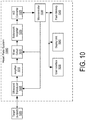
- FIG. 10 is a block diagram of a heart rate system using ultrasound sensors according to one embodiment.
- FIG. 11 is a block diagram of a heart rate system including optical sensors according to one embodiment.
- a wristband detects blood flow signals by either ultrasound or PPG to compute heart rate, without requiring a separate chest strap.
- the techniques described herein can detect heartbeats and calculate heart rate accurately in low SNR situations.
- Other applications of continuous heart rate monitoring include Atrial Fibrillation (AF) detection and Heart Rate Variability (HRV) monitoring.
- AF Atrial Fibrillation
- HRV Heart Rate Variability
- Deep learning techniques may be employed for accuracy and reliability regardless of using EKG, PPG, or ultrasound.
- FIG. 1 is a flowchart of a method 100 for determining heart rate according to one embodiment.
- a heart rate system (also referred to herein as a “system”) performs steps of the method 100 , for example, including algorithms or steps for data collection, label and feature extraction, heartbeat detection, and heart rate computation.
- the heart rate system collects a sensor signal and reference signal using ultrasonic sensors, acoustic sensors, optical/PPG sensors, electrodes/EKG or pressure/force sensors and transducers, or other suitable types of sensors.
- the heart rate system may collect a reference signal from a known reliable source, e.g., an EKG chest strap heart rate monitor, to guide the training of a classifier (also referred to herein as a model).
- a classifier also referred to herein as a model.
- the heart rate system preprocesses the sensor signal and the reference signal to output a spectrogram feature and label signals.
- the heart rate system detects the timestamps of heartbeats from the sensor signal.
- the heart rate computation step 140 the heart rate system calculates heart rate based on the timestamps.
- the heart rate detection algorithms disclosed herein may be applied to any of the above-mentioned sensing technologies.
- the method 100 may include different or additional steps than those described in conjunction with FIG. 1 in some embodiments or perform steps in different orders than the order described in conjunction with FIG. 1 . Steps of the method 100 are further described below, with reference to the other figures as well.
- the heart rate system may acquire sensor signals (or sensor data) from an ultrasound transducer coupled to an amplifier and a mixer circuit (e.g., as shown in FIG. 10 ), in one embodiment.
- the ultrasound generator can output signals at frequencies between 1 to 10 megahertz (MHz).
- the output Doppler signal in audio range is sampled at 100 Hz to 10 KHz.
- the output signals are at 5 MHz and the sampling rate is 4000 Hz.
- the sensor data is acquired by an optical module (e.g., as shown in FIG. 11 ) including a light-emitting diode and a photo sensor followed by an amplifier.
- the output signal may be sampled at 100 Hz to 1 KHz.
- the sampling rate is 500 Hz.
- the heart rate system may collect data for various scenarios, for example, no exercise (standing still), moderate exercise (slow and fast walking) and hard exercise (jogging and running), which may represent data with high SNR, moderate SNR, and low SNR, respectively.
- the heart rate system trains a classifier with a known reliable reference signal to identify the onset of each heartbeat in addition to the heartbeat signals itself.
- This reference signal is used in the training of the classifier.
- the reference signal may be provided by a chest strap including electrodes that detect the QRS wave of the subject's EKG.
- the chest strap may generate a narrow pulse signal for each heartbeat. The rising edge of the pulse can be used to mark the onset of a heartbeat.
- the heart rate system may determine features using collected or processed sensor signals and/or other inputs to the heart rate system, e.g., a classifier.
- the heart rate system derives label signals from the reference signals, and uses the label signals to guide the training of the classifier.
- the heart rate system processes and obtains features from the sensor signal.
- the sensor signal is framed with frame length L F (samples per frame) and frame rate R F (frames per second).
- L F may be any positive integer less than F S , where F S is the sampling rate of the sensor signal.
- F S is the sampling rate of the sensor signal.
- An example value of L F may be 256.
- R F may be any positive number greater than F S /L F .
- An example value of R F may be 10.
- the heart rate system transforms each frame into a frequency representation using short-time Fourier transform (STFT), or other signal processing techniques.
- the frequency representation for each frame is a vector of length L F .
- STFT short-time Fourier transform
- the heart rate system may truncate the frequency representation vectors, and retain a portion of the vectors with dimension 1 to dimension L F /2+1.
- the heart rate system may remove or not process data in the other dimensions of the vector, e.g., including redundant information.
- the vector with retained dimensions is referred to as the feature vector for that frame.
- FIG. 2 is a diagram of features for determining heart rate according to one embodiment.
- the heart rate system facilitates training by grouping feature vectors for frames into training tokens on a sliding window basis.
- a training token is a sequence of feature vectors of L T consecutive frames.
- L T may be any positive integer, and an example value may be 150.
- the frame range of the proceeding training token shifts from that of the current token by a predetermined value, e.g., one.
- FIG. 2 illustrates how feature vectors may be grouped into training tokens, which may help prevent the vanishing gradient problem or exploding gradient problem when training classifiers.
- FIG. 3 is a diagram illustrating label extraction from a sensor signal according to one embodiment.
- the heart rate system may derive the label signals using a reference signal.
- a system performs a label extraction process in steps as described below.
- a reference signal includes, e.g., samples of 0's and 1's over time, where a 0 and 1 indicate no presence or presence of a heartbeat at a given timestamp, respectively.
- the heart rate system constructs the rising edge signal, which equals 1 at samples where the reference signal transitions from 0 to 1 (e.g., indicted by the dotted lines in FIG. 3 ), and equals 0 otherwise. These rising edges mark the determined onset of the heartbeats.
- FIG. 3 shows an example rising edge signal, as well as the amplitude (e.g., in millivolts) for an example sensor signal over time.
- the heart rate system divides each individual heartbeat cycle into N stages.
- N may be any positive integer, and an example value of N may be 3.
- Each stage is of length Ls (in number of samples), and an example value of Ls may be 250.
- the first stage starts at the rising edge and marks the start of a heartbeat cycle.
- Subsequent stages represent the later stages of the heartbeat cycle.
- the heart rate system constructs raw label signals (also referred to as assigning labels to the training data). For each of the N stages, there is a corresponding raw label signal. Thus, there are a total of N raw label signals.
- Each raw label signal may include consecutive l's within the corresponding stage and 0's otherwise.
- FIG. 3 shows examples of raw label signals for three stages.
- FIG. 4 is another diagram illustrating label extraction from a sensor signal according to one embodiment.
- the heart rate system downsamples the raw label signals to the frame rate to match the temporal resolution of the features.
- the resulting downsampled signals are referred to herein as label signals.
- An example downsampling process is as follows. Each raw label signal is framed with the matching frame length and the frame rate of the feature, i.e., L F and R F , respectively. For each frame, the label signal equals 1 if more than half of the raw label signal within that frame is 1, and 0 otherwise.
- FIG. 4 illustrates an example downsampling process.
- the horizontally-oriented “raw label signal for stage 1” shown at the bottom of FIG. 4 shows one particular raw label signal.
- the vertically-oriented “label signal for stage 1” is the resultant label signal.
- the rectangular frames illustrate how the raw label signal is framed.
- the heart rate system takes the features extracted as input and outputs one or N score signals, which each correspond to a particular heartbeat stage detected, in one embodiment.
- N heartbeat stages per heartbeat cycle, and hence the number of score signals.
- each score signal is a series of real numbers between 0 and 1, indicating the probability that each frame belongs to the corresponding heartbeat stage.
- the nth score signal detects the nth stage of the heartbeat, and thus the heart rate system uses the nth label signal to guide the training. This is an example multi-class classification problem where the number of classes is N.
- LTM and RNN may be used as classifiers because they can capture and utilize useful temporal structures to achieve frame classification and temporal smoothing at the same time, in some embodiments.
- a LSTM and RNN are example types of classifiers known to one skilled in the art, which are used to determine which class a sample belongs to by taking a feature vector of the sample as input.
- Other example types of techniques that may be used include attention mechanisms, pooling, and batch normalization in neural networks.
- a label signal is the ground truth, which is useful for training.
- FIG. 5 is a diagram of a classifier according to one embodiment.
- the LSTM classifier includes a stack of LSTM layers, where the input is fed into the first layer, and the output is the output of the last layer.
- Each layer is a concatenation LSTM units through time.
- Each unit takes charge of a single time stamp.
- Each LSTM unit accepts the information from the past LSTM unit as well as the current input, determines what information to remember from the past and current inputs, and passes the information to its future LSTM unit.
- a LSTM unit may be parameterized by number of hidden nodes and type of nonlinearity. The LSTM classifier is trained before use.
- a purpose of training is to find the parameters of the various nodes/edges within and between each LSTM unit using the reference labels and corresponding data by minimizing the loss function, where the loss function measures the distance between the output of the classifier and the reference labels.
- the parameters may include (or are associated with) weights or biases for the various nodes/edges.
- the heart rate system uses a LSTM or RNN configuration that takes the features described above as input, and outputs an N-dimensional vector (e.g., each output dimension corresponds to a score signal aforementioned) with softmax as output activation function.
- Softmax is an example function used for neural network modeling discrete distributions.
- the number of hidden layers and hidden nodes within each layer can be any positive integers. An example value for the number of hidden layers may be 2; an example value for the number hidden nodes in each basic LSTM unit may be 64.
- An example hidden node activation function applied may be hyperbolic tangent.
- the output is an N-dimensional vector at each frame, whose dimension n is the nth score signal aforementioned.
- An example error criterion may be cross entropy.
- the heart rate system may use other types classifiers including, e.g., Vanilla RNN, GRU (Gated Recurrent Unit) RNN, Skip RNN, DilatedRNN, CNN (Convolutional Neural Network), Dialted CNN, Residual Net, as well as their variants by adding or deleting weights and modules.
- classifiers including, e.g., Vanilla RNN, GRU (Gated Recurrent Unit) RNN, Skip RNN, DilatedRNN, CNN (Convolutional Neural Network), Dialted CNN, Residual Net, as well as their variants by adding or deleting weights and modules.
- the possible modules that can be added or removed from the aforementioned classifiers include, e.g., dropout, pooling, input normalization, batch normalization, and weight regularization.
- the heart rate system may record sensor signals for a number of different scenarios, for example, silence (minimal or no motion), walking, jogging/running etc. Each of these scenarios may correspond to different signal characteristics. To account for these different scenarios, the heart rate system may use a combining or a switching method as described below.
- the number of scenarios is denoted as K, which may be any positive integer. An example value for K may be 3.
- the heart rate system combines and shuffles training features and labels from all different K scenarios.
- the heart rate system trains a single RNN or LSTM using the combined data.
- FIG. 6 is a diagram of a process for heartbeat detection using switching according to one embodiment.
- the heart rate system trains a different detection RNN or LSTM.
- K detection RNNs or LSTMs there are a total of K detection RNNs or LSTMs. Training data for each scenario may also be manually labeled.
- Each scenario detection neural network may be of the same architecture as described above.
- the heart rate system selects which detection RNN or LSTM to use based on a scenario classifier.
- the scenario classifier may be of a similar architecture to each of the detection RNN or LSTM, and take the same input features.
- the output of the scenario classifier may have a dimension K for each frame, instead of N.
- the kth output represents the probability that the frame is recorded under the kth scenario, where k may be a value from 1 to K.
- the heart rate system may output a weighted combination of the outputs of the K detection neural networks (e.g., by generating a weighted score); the weights may be based on the K-dimensional output of the scenario classifier.
- the heart rate system takes in the N score signals as input to generate real-time heart rate estimations, in one embodiment.
- the heart rate system may use any one of a variety of different methods, for example, using one score signal or using N score signals, which are further described below.
- FIG. 7 is a diagram of a process for determining heart rate using a score signal according to one embodiment.
- the heart rate system selects one score signal. An example choice may be the 1st score signal, though any other score signal may also be selected.
- the heart rate system may apply a threshold to the selected score signal. The threshold may be pre-determined or adjustable based on other information.
- the heart rate system determines a heartbeat responsive to determining that the score signal exceeds the threshold.
- the heart rate system determines a heartbeat period by determining an interval (e.g., of time) between two adjacent heartbeats.
- the heart rate system may apply a smoothing algorithm to mitigate sudden changes in heartbeat period, e.g., due to missed detection of heartbeats.
- the heart rate system may also apply an adaptive threshold algorithm to prevent or account for missed heartbeats.
- FIG. 8A illustrates signals for heart rate computations using ultrasound sensor data according to one embodiment.
- FIG. 8B illustrates signals for heart rate computations using optical sensor data according to one embodiment.
- the example results shown in FIGS. 8A-B may be determined by the heart rate system using the process shown in FIG. 7 .
- the ultrasound sensor data may be obtained using the heart rate system 1000 shown in FIG. 10 , which is further described below.
- the optical sensor data may be obtained using the heart rate system 1100 shown in FIG. 11 , which is also further described below.
- the y-axis may represent the amplitude (e.g., in millivolts) of the corresponding signals.
- the sensor signal shown is a section of real-time heartbeat data sampled from the output of an ultrasound amplifier with the subject performing a running exercise.
- the score signal represents the output of the classifier.
- the heart rate system When thumping occurs in running exercise, the heart rate system still detects the heartbeats but occasionally with a lower score.
- the heart rate system uses a constant threshold (e.g., indicated by the horizontal line at 0.5) to demonstrate an example approach to identify heartbeats.
- the heart rate system may generate a heart rate determination based on the identified heartbeats, which may be consistent with the true heartbeat data.
- FIG. 9 is a data flow diagram for heart rate computation using score signals of multiple stages according to one embodiment.
- the heart rate system determines an optimized stage chain using the score signals.
- a stage chain is defined as a prediction of which of the N heartbeat stages each frame is in.
- a heartbeat cycle is completed when the stage chain finishes a one-time sequential traversal from stage 1 to stage N. Therefore, heart rate can be computed by measuring each traverse duration.
- the heart rate system detects a repeating sequence of heartbeat stage 1, heartbeat stage 2, and heartbeat stage 3, as indicated by the dotted rectangles.
- the heart rate system may determine the optimized stage chain using standard dynamic programming algorithms using state chains (e.g., where each state corresponds to a stage of the heartbeat stage chain). For example, the heart rate system uses a dynamic programming algorithm to determine the optimized stage chain (e.g., one stage for each timestamp) that minimizes a target function.
- the target function may include two parts. One part is state cost, which measures the appropriateness of each stage for each specific timestamp. The other part is transition cost, which penalizes frequent state jump between adjacent timestamps, and can prohibit certain types of state jump.
- each timestamp corresponds to a frame.
- Each state of the algorithm corresponds to a heartbeat stage.
- the heart rate system determines the state cost using the negative of the N score signals.
- the transition cost may permit self-transitions, transitions from stage n ⁇ 1 to stage n, and transitions from stage N to stage 1.
- the actual values of the transition costs can be determined heuristically or by some estimation schemes.
- FIG. 10 is a block diagram of a heart rate system 1000 using ultrasound sensors according to one embodiment.
- FIG. 11 is a block diagram of a heart rate system 1100 including optical sensors according to one embodiment.
- a target location for contact between the heart rate system 1100 and a subject 1050 is the inner side of the wrist of the subject 1050 , e.g., either at the Radial artery position or the Ulnar artery position.
- the ultrasound transducer 1005 may include two piezoelectric (e.g., Lead Zirconate Titanate or PZT) slabs; one PZT slab transmits ultrasound energy to the target and another receives the reflected RF signal that carries the pulsating blood flow information.
- An ultrasound frequency is provided by the microcontroller 1030 as the Carrier Frequency, which may drive both the ultrasound transducer 1005 and the mixer circuit 1015 .
- the Doppler signal in audio range that contains the blood flow information, which may be passed through a Butterworth amplifier 1020 .
- the mixer circuit 1015 removes the carrier frequency from the receiver PZT slab.
- the A/D converter 1025 is a high resolution (e.g., up to 24-bit) and high sampling rate (e.g., up to 10 KHz) unit of either Sigma-Delta or Successive Approximation type.
- the microcontroller 1030 may be a high performance 16-bit or 32-bit chip.
- External flash memory 1045 may store heart rate determinations.
- One or more display units 1040 or user interfaces 1035 may vary between different types of devices worn on a wrist of the subject 1050 , e.g., watch, sleeve, or wristband.
- a target location for contact between the heart rate system 1100 and a subject 1050 is the center of an outer side of the wrist of the subject 1050 .
- there are two sets of optical sensor modules e.g., optical module A 1055 and optical module B 1065 ), each containing a light-emitting diode (LED) and a photodetector.
- the wavelength of the light for each module is different; one wavelength is chosen to optimize efficiency in absorption by the red blood cells and the other is chosen for ambient light calibration and compensation purposes.
- two input channels in the A/D converter 125 may be required.
- the outputs of optical module A 1055 and optical module B 1065 may pass through amplifier A 1060 and amplifier B 1070 , respectively, before being input to the A/D converter 1025 .
- a software module is implemented with a computer program product including a computer-readable non-transitory medium containing computer program code, which can be executed by a computer processor for performing any or all of the steps, operations, or processes described.
- Embodiments of the invention may also relate to a product that is produced by a computing process described herein.
- a product may include information resulting from a computing process, where the information is stored on a non-transitory, tangible computer readable storage medium and may include any embodiment of a computer program product or other data combination described herein.
Landscapes
- Health & Medical Sciences (AREA)
- Life Sciences & Earth Sciences (AREA)
- Engineering & Computer Science (AREA)
- Physics & Mathematics (AREA)
- Biophysics (AREA)
- General Health & Medical Sciences (AREA)
- Molecular Biology (AREA)
- Biomedical Technology (AREA)
- Public Health (AREA)
- Animal Behavior & Ethology (AREA)
- Veterinary Medicine (AREA)
- Surgery (AREA)
- Medical Informatics (AREA)
- Pathology (AREA)
- Heart & Thoracic Surgery (AREA)
- Cardiology (AREA)
- Physiology (AREA)
- Artificial Intelligence (AREA)
- Signal Processing (AREA)
- Psychiatry (AREA)
- Computer Vision & Pattern Recognition (AREA)
- Radiology & Medical Imaging (AREA)
- Nuclear Medicine, Radiotherapy & Molecular Imaging (AREA)
- Mathematical Physics (AREA)
- Evolutionary Computation (AREA)
- Fuzzy Systems (AREA)
- Hematology (AREA)
- Theoretical Computer Science (AREA)
- Computational Linguistics (AREA)
- Data Mining & Analysis (AREA)
- Computing Systems (AREA)
- General Engineering & Computer Science (AREA)
- General Physics & Mathematics (AREA)
- Software Systems (AREA)
- Measuring Pulse, Heart Rate, Blood Pressure Or Blood Flow (AREA)
Abstract
Description
Claims (25)
Priority Applications (3)
| Application Number | Priority Date | Filing Date | Title |
|---|---|---|---|
| US15/819,763 US10709390B2 (en) | 2017-03-02 | 2017-11-21 | Deep learning algorithms for heartbeats detection |
| PCT/US2017/065467 WO2018160248A1 (en) | 2017-03-02 | 2017-12-08 | Deep learning algorithms for heartbeats detection |
| EP17898936.4A EP3589199B1 (en) | 2017-03-02 | 2017-12-08 | Deep learning algorithms for heartbeats detection |
Applications Claiming Priority (2)
| Application Number | Priority Date | Filing Date | Title |
|---|---|---|---|
| US201762466288P | 2017-03-02 | 2017-03-02 | |
| US15/819,763 US10709390B2 (en) | 2017-03-02 | 2017-11-21 | Deep learning algorithms for heartbeats detection |
Publications (2)
| Publication Number | Publication Date |
|---|---|
| US20180249964A1 US20180249964A1 (en) | 2018-09-06 |
| US10709390B2 true US10709390B2 (en) | 2020-07-14 |
Family
ID=63357083
Family Applications (1)
| Application Number | Title | Priority Date | Filing Date |
|---|---|---|---|
| US15/819,763 Expired - Fee Related US10709390B2 (en) | 2017-03-02 | 2017-11-21 | Deep learning algorithms for heartbeats detection |
Country Status (3)
| Country | Link |
|---|---|
| US (1) | US10709390B2 (en) |
| EP (1) | EP3589199B1 (en) |
| WO (1) | WO2018160248A1 (en) |
Families Citing this family (22)
| Publication number | Priority date | Publication date | Assignee | Title |
|---|---|---|---|---|
| KR101872870B1 (en) * | 2017-10-12 | 2018-06-29 | 이광재 | Pulse diagnosis apparatus and pulse diagnosis method thereof |
| CN110881966A (en) * | 2018-09-10 | 2020-03-17 | 深圳市游弋科技有限公司 | Algorithm for processing electrocardiogram data by using LSTM network |
| EP3626167B1 (en) * | 2018-09-21 | 2024-07-17 | IMEC vzw | A method of generating a model for heart rate estimation from a photoplethysmography signal and a method and a device for heart rate estimation |
| CN109124610B (en) * | 2018-09-26 | 2021-07-30 | 深圳星脉医疗仪器有限公司 | Anti-interference method and device for non-invasive blood pressure measurement |
| WO2020112739A2 (en) * | 2018-11-30 | 2020-06-04 | Preventice Technologies, Inc. | Multi-channel and with rhythm transfer learning |
| CN109620210B (en) * | 2019-01-28 | 2019-10-25 | 山东科技大学 | An ECG signal classification method based on the combination of CNN and GRU based on self-encoding mode |
| CN110037682B (en) * | 2019-04-01 | 2020-07-21 | 上海数创医疗科技有限公司 | Method for recognizing heart rhythm type based on improved convolutional neural network |
| CN110890155B (en) * | 2019-11-25 | 2022-10-28 | 中国科学技术大学 | Multi-class arrhythmia detection method based on lead attention mechanism |
| CN111184512B (en) * | 2019-12-30 | 2021-06-01 | 电子科技大学 | Method for recognizing rehabilitation training actions of upper limbs and hands of stroke patient |
| US20230081751A1 (en) | 2020-02-11 | 2023-03-16 | Hoffmann-La Roche Inc. | Method for determining accuracy of heart rate variability |
| EP3918980A1 (en) * | 2020-06-02 | 2021-12-08 | CSEM Centre Suisse d'Electronique et de Microtechnique SA - Recherche et Développement | Method for classifying photoplethysmography pulses and monitoring of cardiac arrhythmias |
| US20240252107A1 (en) * | 2020-08-04 | 2024-08-01 | Asleep | Computing device for predicting sleep state on basis of data measured in sleep environment of user |
| CN112788200B (en) * | 2020-12-04 | 2022-11-01 | 光大科技有限公司 | Method and device for determining frequency spectrum information, storage medium and electronic device |
| WO2022169682A1 (en) * | 2021-02-05 | 2022-08-11 | The Children's Medical Center Corporation | Video-based automated detection of generalized tonic-clonic seizures using deep learning |
| US12527481B1 (en) | 2021-02-09 | 2026-01-20 | Meta Platforms Technologies, Llc | Determining blood pressure using photoplethysmography (PPG) |
| WO2022195327A1 (en) * | 2021-03-18 | 2022-09-22 | Ortho Biomed Inc. | Health monitoring system and method |
| CN113349791B (en) * | 2021-05-31 | 2024-07-16 | 平安科技(深圳)有限公司 | Abnormal electrocardiosignal detection method, device, equipment and medium |
| CN115688023A (en) * | 2021-07-23 | 2023-02-03 | 爱科维申科技(天津)有限公司 | Detection method of hatching egg viability based on SE-ResNet and GRU |
| CN115702782B (en) * | 2021-08-11 | 2025-11-14 | 北京荣耀终端有限公司 | Deep learning-based heart rate detection methods and wearable devices |
| US12369803B2 (en) | 2021-11-01 | 2025-07-29 | Beijing Honor Device Co., Ltd. | Heart rate detection method and electronic device |
| CN116058814B (en) * | 2021-11-01 | 2024-12-13 | 北京荣耀终端有限公司 | Heart rate detection method and electronic device |
| CN119014878B (en) * | 2024-08-15 | 2026-03-13 | 大连理工大学 | An ECG signal classification method based on attention mechanism CNN-GRU |
Citations (35)
| Publication number | Priority date | Publication date | Assignee | Title |
|---|---|---|---|---|
| US5749366A (en) | 1995-03-23 | 1998-05-12 | Seiko Instruments Inc. | Motion compensating pulse rate monitor with motion sensor and level discriminator |
| US5957855A (en) | 1994-09-21 | 1999-09-28 | Beth Israel Deaconess Medical Center | Fetal data processing system and method employing a time-frequency representation of fetal heart rate |
| US20050143668A1 (en) | 2003-12-26 | 2005-06-30 | Yamazaki Mazak Corporation | Automatic diagnosing method for autonomic nervous system and device thereof |
| US20060200036A1 (en) * | 2005-03-07 | 2006-09-07 | Kurzweil Raymond C | Atrial fibrillation detection |
| US20090043216A1 (en) * | 2007-08-10 | 2009-02-12 | Szming Lin | Heart beat signal recognition |
| US20090227853A1 (en) | 2008-03-03 | 2009-09-10 | Ravindra Wijesiriwardana | Wearable optical pulse plethysmography sensors or pulse oximetry sensors based wearable heart rate monitoring systems |
| US20110022199A1 (en) * | 2008-02-26 | 2011-01-27 | Finsor Oy | Method, apparatus and computer program product for detecting heart rate |
| US7890443B2 (en) | 2007-07-13 | 2011-02-15 | Microsoft Corporation | Learning classifiers using combined boosting and weight trimming |
| US20110077484A1 (en) | 2009-09-30 | 2011-03-31 | Nellcor Puritan Bennett Ireland | Systems And Methods For Identifying Non-Corrupted Signal Segments For Use In Determining Physiological Parameters |
| US20120016443A1 (en) * | 2010-07-13 | 2012-01-19 | Paul Holmberg | Rate matching for a stimulating medical device |
| US8234228B2 (en) | 2008-02-07 | 2012-07-31 | Nec Laboratories America, Inc. | Method for training a learning machine having a deep multi-layered network with labeled and unlabeled training data |
| US8323188B2 (en) | 2006-05-16 | 2012-12-04 | Bao Tran | Health monitoring appliance |
| US8727991B2 (en) | 2011-08-29 | 2014-05-20 | Salutron, Inc. | Probabilistic segmental model for doppler ultrasound heart rate monitoring |
| US20140142929A1 (en) | 2012-11-20 | 2014-05-22 | Microsoft Corporation | Deep neural networks training for speech and pattern recognition |
| US20140288390A1 (en) * | 2012-06-22 | 2014-09-25 | Fitbit, Inc. | Wearable heart rate monitor |
| US8888701B2 (en) | 2011-01-27 | 2014-11-18 | Valencell, Inc. | Apparatus and methods for monitoring physiological data during environmental interference |
| US20150031965A1 (en) | 2013-07-26 | 2015-01-29 | Tata Consultancy Services Limited | Monitoring physiological parameters |
| US8945017B2 (en) | 2012-06-22 | 2015-02-03 | Fitbit, Inc. | Wearable heart rate monitor |
| US8990126B1 (en) | 2006-08-03 | 2015-03-24 | At&T Intellectual Property Ii, L.P. | Copying human interactions through learning and discovery |
| US9031844B2 (en) | 2010-09-21 | 2015-05-12 | Microsoft Technology Licensing, Llc | Full-sequence training of deep structures for speech recognition |
| US20150139536A1 (en) | 2013-11-15 | 2015-05-21 | Adobe Systems Incorporated | Image Classification Using Images with Separate Grayscale and Color Channels |
| US9039614B2 (en) | 2013-01-15 | 2015-05-26 | Fitbit, Inc. | Methods, systems and devices for measuring fingertip heart rate |
| WO2015131065A1 (en) | 2014-02-28 | 2015-09-03 | Valencell, Inc. | Method and apparatus for generating assessments using physical activity and biometric parameters |
| US20150324690A1 (en) | 2014-05-08 | 2015-11-12 | Microsoft Corporation | Deep Learning Training System |
| US9189742B2 (en) | 2013-11-20 | 2015-11-17 | Justin London | Adaptive virtual intelligent agent |
| US9314181B2 (en) | 2009-11-03 | 2016-04-19 | Vivaquant Llc | Method and apparatus for detection of heartbeat characteristics |
| US20160106326A1 (en) | 2014-10-21 | 2016-04-21 | Google Inc. | Pressure Wave Measurement of Blood Flow |
| US9323747B2 (en) | 2006-10-10 | 2016-04-26 | Abbyy Infopoisk Llc | Deep model statistics method for machine translation |
| WO2016063795A1 (en) | 2014-10-21 | 2016-04-28 | Mitsubishi Electric Corporation | Method for transforming a noisy speech signal to an enhanced speech signal |
| US20160140438A1 (en) | 2014-11-13 | 2016-05-19 | Nec Laboratories America, Inc. | Hyper-class Augmented and Regularized Deep Learning for Fine-grained Image Classification |
| US20160151023A1 (en) | 2014-12-01 | 2016-06-02 | Imec Vzw | System and Method for Heart Rate Detection |
| WO2016145379A1 (en) | 2015-03-12 | 2016-09-15 | William Marsh Rice University | Automated Compilation of Probabilistic Task Description into Executable Neural Network Specification |
| US20160284346A1 (en) | 2015-03-27 | 2016-09-29 | Qualcomm Incorporated | Deep neural net based filter prediction for audio event classification and extraction |
| US9456742B2 (en) | 2011-10-27 | 2016-10-04 | Canon Kabushiki Kaisha | Ophthalmologic apparatus |
| US9468386B2 (en) | 2014-03-11 | 2016-10-18 | Ecole polytechnique fédérale de Lausanne (EPFL) | Method for detecting abnormalities in an electrocardiogram |
Family Cites Families (1)
| Publication number | Priority date | Publication date | Assignee | Title |
|---|---|---|---|---|
| EP1954184B1 (en) * | 2005-11-29 | 2017-10-11 | PhysIQ Inc. | Residual-based monitoring of human health |
-
2017
- 2017-11-21 US US15/819,763 patent/US10709390B2/en not_active Expired - Fee Related
- 2017-12-08 WO PCT/US2017/065467 patent/WO2018160248A1/en not_active Ceased
- 2017-12-08 EP EP17898936.4A patent/EP3589199B1/en not_active Not-in-force
Patent Citations (41)
| Publication number | Priority date | Publication date | Assignee | Title |
|---|---|---|---|---|
| US5957855A (en) | 1994-09-21 | 1999-09-28 | Beth Israel Deaconess Medical Center | Fetal data processing system and method employing a time-frequency representation of fetal heart rate |
| US5749366A (en) | 1995-03-23 | 1998-05-12 | Seiko Instruments Inc. | Motion compensating pulse rate monitor with motion sensor and level discriminator |
| US20050143668A1 (en) | 2003-12-26 | 2005-06-30 | Yamazaki Mazak Corporation | Automatic diagnosing method for autonomic nervous system and device thereof |
| US20060200036A1 (en) * | 2005-03-07 | 2006-09-07 | Kurzweil Raymond C | Atrial fibrillation detection |
| US8323188B2 (en) | 2006-05-16 | 2012-12-04 | Bao Tran | Health monitoring appliance |
| US8990126B1 (en) | 2006-08-03 | 2015-03-24 | At&T Intellectual Property Ii, L.P. | Copying human interactions through learning and discovery |
| US9323747B2 (en) | 2006-10-10 | 2016-04-26 | Abbyy Infopoisk Llc | Deep model statistics method for machine translation |
| US7890443B2 (en) | 2007-07-13 | 2011-02-15 | Microsoft Corporation | Learning classifiers using combined boosting and weight trimming |
| US8046058B2 (en) | 2007-08-10 | 2011-10-25 | Salutron, Inc. | Heart beat signal recognition |
| US20090043216A1 (en) * | 2007-08-10 | 2009-02-12 | Szming Lin | Heart beat signal recognition |
| US8234228B2 (en) | 2008-02-07 | 2012-07-31 | Nec Laboratories America, Inc. | Method for training a learning machine having a deep multi-layered network with labeled and unlabeled training data |
| US20110022199A1 (en) * | 2008-02-26 | 2011-01-27 | Finsor Oy | Method, apparatus and computer program product for detecting heart rate |
| US20090227853A1 (en) | 2008-03-03 | 2009-09-10 | Ravindra Wijesiriwardana | Wearable optical pulse plethysmography sensors or pulse oximetry sensors based wearable heart rate monitoring systems |
| US20110077484A1 (en) | 2009-09-30 | 2011-03-31 | Nellcor Puritan Bennett Ireland | Systems And Methods For Identifying Non-Corrupted Signal Segments For Use In Determining Physiological Parameters |
| US9314181B2 (en) | 2009-11-03 | 2016-04-19 | Vivaquant Llc | Method and apparatus for detection of heartbeat characteristics |
| US20120016443A1 (en) * | 2010-07-13 | 2012-01-19 | Paul Holmberg | Rate matching for a stimulating medical device |
| US9031844B2 (en) | 2010-09-21 | 2015-05-12 | Microsoft Technology Licensing, Llc | Full-sequence training of deep structures for speech recognition |
| US8888701B2 (en) | 2011-01-27 | 2014-11-18 | Valencell, Inc. | Apparatus and methods for monitoring physiological data during environmental interference |
| US8727991B2 (en) | 2011-08-29 | 2014-05-20 | Salutron, Inc. | Probabilistic segmental model for doppler ultrasound heart rate monitoring |
| US9456742B2 (en) | 2011-10-27 | 2016-10-04 | Canon Kabushiki Kaisha | Ophthalmologic apparatus |
| US8956303B2 (en) | 2012-06-22 | 2015-02-17 | Fitbit, Inc. | Wearable heart rate monitor |
| US8998815B2 (en) | 2012-06-22 | 2015-04-07 | Fitbit, Inc. | Wearable heart rate monitor |
| US20140288390A1 (en) * | 2012-06-22 | 2014-09-25 | Fitbit, Inc. | Wearable heart rate monitor |
| US9113795B2 (en) | 2012-06-22 | 2015-08-25 | Fitbit, Inc. | Wearable heart rate monitor |
| US9456787B2 (en) | 2012-06-22 | 2016-10-04 | Fitbit, Inc. | Wearable heart rate monitor |
| US8945017B2 (en) | 2012-06-22 | 2015-02-03 | Fitbit, Inc. | Wearable heart rate monitor |
| US20140142929A1 (en) | 2012-11-20 | 2014-05-22 | Microsoft Corporation | Deep neural networks training for speech and pattern recognition |
| US9039614B2 (en) | 2013-01-15 | 2015-05-26 | Fitbit, Inc. | Methods, systems and devices for measuring fingertip heart rate |
| US20150031965A1 (en) | 2013-07-26 | 2015-01-29 | Tata Consultancy Services Limited | Monitoring physiological parameters |
| US20150139536A1 (en) | 2013-11-15 | 2015-05-21 | Adobe Systems Incorporated | Image Classification Using Images with Separate Grayscale and Color Channels |
| US9189742B2 (en) | 2013-11-20 | 2015-11-17 | Justin London | Adaptive virtual intelligent agent |
| WO2015131065A1 (en) | 2014-02-28 | 2015-09-03 | Valencell, Inc. | Method and apparatus for generating assessments using physical activity and biometric parameters |
| US9468386B2 (en) | 2014-03-11 | 2016-10-18 | Ecole polytechnique fédérale de Lausanne (EPFL) | Method for detecting abnormalities in an electrocardiogram |
| US20150324690A1 (en) | 2014-05-08 | 2015-11-12 | Microsoft Corporation | Deep Learning Training System |
| US20160106326A1 (en) | 2014-10-21 | 2016-04-21 | Google Inc. | Pressure Wave Measurement of Blood Flow |
| WO2016063795A1 (en) | 2014-10-21 | 2016-04-28 | Mitsubishi Electric Corporation | Method for transforming a noisy speech signal to an enhanced speech signal |
| US20160140438A1 (en) | 2014-11-13 | 2016-05-19 | Nec Laboratories America, Inc. | Hyper-class Augmented and Regularized Deep Learning for Fine-grained Image Classification |
| US20160151023A1 (en) | 2014-12-01 | 2016-06-02 | Imec Vzw | System and Method for Heart Rate Detection |
| WO2016145379A1 (en) | 2015-03-12 | 2016-09-15 | William Marsh Rice University | Automated Compilation of Probabilistic Task Description into Executable Neural Network Specification |
| US20180082172A1 (en) * | 2015-03-12 | 2018-03-22 | William Marsh Rice University | Automated Compilation of Probabilistic Task Description into Executable Neural Network Specification |
| US20160284346A1 (en) | 2015-03-27 | 2016-09-29 | Qualcomm Incorporated | Deep neural net based filter prediction for audio event classification and extraction |
Non-Patent Citations (8)
| Title |
|---|
| Alqaraawi, A. et al., "Heart Rate Variability Estimation in Photophlethysmography Signals Using Bayesian Learning Approach", Healthcare Technology Letters, 2016, pp. 136-142, vol. 3, Iss. 2. |
| Begley, R.J. et al., "Adding Intelligence to Medical Devices", MDDI Medical Device and Diagnostic Industry News Products and Suppliers, Mar. 1, 2000, 6 pages, [Online] [Retrieved on Mar. 6, 2018] Retrieved from the Internet<URL:http://www.mddionline.com/article/adding-intelligence-medical-devices>. |
| Dong, C., et al. "Learning a Deep Convolutional Network for Image Super-Resolution," European Conference on Computer Vision. Springer International Publishing, 2014, 16 pages. |
| European Patent Office, Extended European Search Report and Opinion, EP Patent Application No. 17898936.4, dated Feb. 24, 2020, eight pages. |
| PCT International Preliminary Report on Patentability Chapter II, PCT Application No. PCT/US2017/065467, dated Sep. 24, 2019, 11 pages. |
| PCT International Search Report and Written Opinion, PCT Application No. PCT/US17/65467, dated Mar. 7, 2018, 17 pages. |
| Shashikumar, S. P. et al., "A deep learning approach to monitoring and detecting atrial fibrillation using wearable technology," 2017 IEEE EMBS International Conference on Biomedical & Health Informatics (BHI), Feb. 2017, pp. 141-144. |
| Xu, K., et al. "Show, Attend and Tell: Neural Image Caption Generation with Visual Attention," arXiv preprint arXiv:1502.03044 2.3, Cornell University Library, 2015, 1 page, vol. 5, [Online] [Retrieved on Mar. 6, 2018] Retrieved from the Internet<URL:https://arxiv.org/abs/1502.03044>. |
Also Published As
| Publication number | Publication date |
|---|---|
| EP3589199A1 (en) | 2020-01-08 |
| EP3589199A4 (en) | 2020-03-25 |
| EP3589199B1 (en) | 2022-02-02 |
| WO2018160248A1 (en) | 2018-09-07 |
| US20180249964A1 (en) | 2018-09-06 |
Similar Documents
| Publication | Publication Date | Title |
|---|---|---|
| EP3589199B1 (en) | Deep learning algorithms for heartbeats detection | |
| US11311201B2 (en) | Feature selection for cardiac arrhythmia classification and screening | |
| Dey et al. | InstaBP: cuff-less blood pressure monitoring on smartphone using single PPG sensor | |
| Schäck et al. | Computationally efficient heart rate estimation during physical exercise using photoplethysmographic signals | |
| US8046058B2 (en) | Heart beat signal recognition | |
| Schäck et al. | A new method for heart rate monitoring during physical exercise using photoplethysmographic signals | |
| KR102830100B1 (en) | Apparatus and method for estimating blood pressure | |
| US20170188868A1 (en) | System and method of identification of the heart valve signals | |
| CN107979986B (en) | Method and apparatus for generating information indicative of cardiac dysfunction | |
| Pedrosa et al. | Automatic heart sound segmentation and murmur detection in pediatric phonocardiograms | |
| CN115003215A (en) | System and method for pulse transit time measurement from optical data | |
| Satija et al. | A simple method for detection and classification of ECG noises for wearable ECG monitoring devices | |
| Zhu et al. | MICROST: A mixed approach for heart rate monitoring during intensive physical exercise using wrist-type PPG signals | |
| Kumar et al. | STSR: Spectro-temporal super-resolution analysis of a reference signal less photoplethysmogram for heart rate estimation during physical activity | |
| KR20200004667A (en) | Method for estimating continuous blood pressure using recurrent neural network and apparatus thereof | |
| US12533040B2 (en) | Non-contact image-based blood pressure measurement method and system based on advanced visual intelligence | |
| Liu et al. | Motion artifact detection in ppg signals based on gramian angular field and 2-d-cnn | |
| Zhang et al. | PPG-based heart rate estimation with efficient sensor sampling and learning models | |
| Aydemir et al. | A new method for activity monitoring using photoplethysmography signals recorded by wireless sensor | |
| De Lima et al. | Neural architecture search for tiny detectors of inter-beat intervals | |
| Banerjee et al. | Non-invasive detection of coronary artery disease based on clinical information and cardiovascular signals: A two-stage classification approach | |
| CN117122308B (en) | An electrocardiogram measurement method and system based on mobile phone built-in acceleration sensor | |
| Mansourinezhad et al. | Blood pressure estimation using a PPG signal recorded from the fingertip of a hand moving in the sagittal plane | |
| Kumar et al. | Long short term memory (lstm)-based cuffless continuous blood pressure monitoring | |
| Chen et al. | Automatic Onsets and Systolic Peaks Detection and Segmentation of Arterial Blood Pressure Waveforms using Fully Convolutional Neural Networks |
Legal Events
| Date | Code | Title | Description |
|---|---|---|---|
| FEPP | Fee payment procedure |
Free format text: ENTITY STATUS SET TO UNDISCOUNTED (ORIGINAL EVENT CODE: BIG.); ENTITY STATUS OF PATENT OWNER: MICROENTITY Free format text: ENTITY STATUS SET TO UNDISCOUNTED (ORIGINAL EVENT CODE: BIG.); ENTITY STATUS OF PATENT OWNER: SMALL ENTITY |
|
| FEPP | Fee payment procedure |
Free format text: ENTITY STATUS SET TO SMALL (ORIGINAL EVENT CODE: SMAL); ENTITY STATUS OF PATENT OWNER: MICROENTITY Free format text: ENTITY STATUS SET TO SMALL (ORIGINAL EVENT CODE: SMAL); ENTITY STATUS OF PATENT OWNER: SMALL ENTITY |
|
| STPP | Information on status: patent application and granting procedure in general |
Free format text: DOCKETED NEW CASE - READY FOR EXAMINATION |
|
| AS | Assignment |
Owner name: LOGOS CARE, INC., CALIFORNIA Free format text: ASSIGNMENT OF ASSIGNORS INTEREST;ASSIGNORS:QIAN, KAIZHI;ZHANG, YANG;LO, THOMAS Y.;SIGNING DATES FROM 20171117 TO 20171120;REEL/FRAME:045111/0388 |
|
| STPP | Information on status: patent application and granting procedure in general |
Free format text: NON FINAL ACTION MAILED |
|
| STPP | Information on status: patent application and granting procedure in general |
Free format text: RESPONSE TO NON-FINAL OFFICE ACTION ENTERED AND FORWARDED TO EXAMINER |
|
| STPP | Information on status: patent application and granting procedure in general |
Free format text: NOTICE OF ALLOWANCE MAILED -- APPLICATION RECEIVED IN OFFICE OF PUBLICATIONS |
|
| STPP | Information on status: patent application and granting procedure in general |
Free format text: PUBLICATIONS -- ISSUE FEE PAYMENT VERIFIED |
|
| STCF | Information on status: patent grant |
Free format text: PATENTED CASE |
|
| FEPP | Fee payment procedure |
Free format text: ENTITY STATUS SET TO MICRO (ORIGINAL EVENT CODE: MICR); ENTITY STATUS OF PATENT OWNER: MICROENTITY |
|
| CC | Certificate of correction | ||
| FEPP | Fee payment procedure |
Free format text: MAINTENANCE FEE REMINDER MAILED (ORIGINAL EVENT CODE: REM.); ENTITY STATUS OF PATENT OWNER: MICROENTITY |
|
| LAPS | Lapse for failure to pay maintenance fees |
Free format text: PATENT EXPIRED FOR FAILURE TO PAY MAINTENANCE FEES (ORIGINAL EVENT CODE: EXP.); ENTITY STATUS OF PATENT OWNER: MICROENTITY |
|
| STCH | Information on status: patent discontinuation |
Free format text: PATENT EXPIRED DUE TO NONPAYMENT OF MAINTENANCE FEES UNDER 37 CFR 1.362 |
|
| FP | Lapsed due to failure to pay maintenance fee |
Effective date: 20240714 |