US10699587B2 - Aircraft taxiway routing - Google Patents
Aircraft taxiway routing Download PDFInfo
- Publication number
- US10699587B2 US10699587B2 US15/633,393 US201715633393A US10699587B2 US 10699587 B2 US10699587 B2 US 10699587B2 US 201715633393 A US201715633393 A US 201715633393A US 10699587 B2 US10699587 B2 US 10699587B2
- Authority
- US
- United States
- Prior art keywords
- taxiway
- route
- routes
- group
- routing
- Prior art date
- Legal status (The legal status is an assumption and is not a legal conclusion. Google has not performed a legal analysis and makes no representation as to the accuracy of the status listed.)
- Active, expires
Links
- 238000000034 method Methods 0.000 claims abstract description 20
- 230000004044 response Effects 0.000 claims abstract description 11
- 239000013598 vector Substances 0.000 claims description 26
- 239000011159 matrix material Substances 0.000 claims description 18
- 238000012706 support-vector machine Methods 0.000 claims description 4
- 238000013135 deep learning Methods 0.000 claims description 3
- 230000001934 delay Effects 0.000 description 2
- 241001672694 Citrus reticulata Species 0.000 description 1
- 230000006978 adaptation Effects 0.000 description 1
- 238000004590 computer program Methods 0.000 description 1
- 239000000446 fuel Substances 0.000 description 1
- 238000012423 maintenance Methods 0.000 description 1
- 238000007726 management method Methods 0.000 description 1
- 238000013507 mapping Methods 0.000 description 1
- 230000004048 modification Effects 0.000 description 1
- 238000012986 modification Methods 0.000 description 1
- 230000003287 optical effect Effects 0.000 description 1
- 239000004984 smart glass Substances 0.000 description 1
Images


Classifications
-
- G08G5/065—
-
- G—PHYSICS
- G08—SIGNALLING
- G08G—TRAFFIC CONTROL SYSTEMS
- G08G5/00—Traffic control systems for aircraft
- G08G5/50—Navigation or guidance aids
- G08G5/51—Navigation or guidance aids for control when on the ground, e.g. taxiing or rolling
-
- G08G5/0013—
-
- G08G5/0043—
-
- G08G5/0082—
-
- G08G5/06—
-
- G—PHYSICS
- G08—SIGNALLING
- G08G—TRAFFIC CONTROL SYSTEMS
- G08G5/00—Traffic control systems for aircraft
- G08G5/20—Arrangements for acquiring, generating, sharing or displaying traffic information
- G08G5/26—Transmission of traffic-related information between aircraft and ground stations
-
- G—PHYSICS
- G08—SIGNALLING
- G08G—TRAFFIC CONTROL SYSTEMS
- G08G5/00—Traffic control systems for aircraft
- G08G5/50—Navigation or guidance aids
- G08G5/56—Navigation or guidance aids for two or more aircraft
-
- G—PHYSICS
- G08—SIGNALLING
- G08G—TRAFFIC CONTROL SYSTEMS
- G08G5/00—Traffic control systems for aircraft
- G08G5/70—Arrangements for monitoring traffic-related situations or conditions
- G08G5/72—Arrangements for monitoring traffic-related situations or conditions for monitoring traffic
- G08G5/727—Arrangements for monitoring traffic-related situations or conditions for monitoring traffic from a ground station
Definitions
- the present disclosure relates to methods, devices, and systems for aircraft taxiway routing.
- Air traffic control (ATC) at an airport can direct aircraft on an airfield of the airport and aircraft in airspace near the airport, as well as provide advisory services to other aircraft in airspace not controlled by ATC at the airport. Directing aircraft on the airfield and in the air can prevent collisions between aircraft, organize and expedite aircraft traffic, and provide information and/or support for aircraft pilots.
- Pilots of aircraft at an airfield can receive instructions from ATC while at the airport.
- an inbound aircraft can receive instructions from ATC on where to land, where to park the aircraft, a routing plan to taxi from the runway to a parking stand, etc.
- Pilots of taxiing aircraft can be subject to the instructions from ATC while at the airport.
- ATC may instruct a pilot of an aircraft to hold the aircraft at a hold point on the airfield in order for other aircraft or other traffic to pass.
- ATC may instruct aircraft to take longer taxiway routes to accommodate the airport traffic.
- FIG. 1 is an illustration of a display provided on a user interface showing an airfield, generated in accordance with one or more embodiments of the present disclosure.
- FIG. 2 is an illustration of a display provided on a user interface showing an airfield, generated in accordance with one or more embodiments of the present disclosure.
- FIG. 3 is an illustration of a display provided on a user interface showing an airfield, generated in accordance with one or more embodiments of the present disclosure.
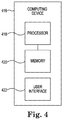
- FIG. 4 is a computing device for aircraft taxiway routing, in accordance with one or more embodiments of the present disclosure.
- one or more embodiments include a memory, and a processor to execute executable instructions stored in the memory to receive routing data associated with an airfield of an airport, determine a group of taxiway routes associated with the airfield of the airport using the routing data where each respective taxiway route includes a number of taxiway segments, receive a routing plan request, generate a routing plan for an aircraft at the airfield using the group of taxiway routes in response to receiving the routing plan request, and a user interface to display the routing plan in a single integrated display.
- Aircraft taxiway routing in accordance with the present disclosure, can provide a routing plan for an aircraft at an airfield.
- the routing plan can be a route from one location on an airfield to a different location on the airfield.
- a routing plan can be utilized by an aircraft to navigate from a runway to a parking stand.
- the routing plan can be generated utilizing data capturing past taxiway routing plans and global routing conditions associated with past taxiway routing plans.
- Aircraft taxiway routing can be adaptable to different airport systems and layouts, and can provide for safe and efficient taxiway route planning, which may reduce delays for passengers and/or airlines.
- Aircraft taxiway routing can be displayed on a single integrated display. Presenting the aircraft taxiway routing in a single integrated display can allow a user or others to quickly assess generated taxiway routing plans, modify the taxiway routing plans if necessary, and communicate taxi instructions to a pilot to execute the taxiway routing plan.
- a user may include an ATC controller, an ATC controller supervisor, a system engineer administrator, a system engineer, and/or a duty engineer, among other users.
- FIG. 1 is an illustration of a display provided on a user interface showing an airfield 100 , generated in accordance with one or more embodiments of the present disclosure.
- the airfield 102 can include a routing plan 102 , a start point 104 , and an end point 106 .
- a routing plan can, for example, refer to a taxiway route of a vehicle from a first location to a second location on an airfield.
- routing plan 102 can indicate a taxiway route for a vehicle on airfield 100 to allow the vehicle to travel from the start point 104 to the end point 106 .
- a vehicle can refer to an aircraft, an aircraft support vehicle (e.g., a tug, stair car, food truck, etc.), and/or a maintenance vehicle, among other vehicles located on an airfield.
- Start point 104 can be a starting point of routing plan 102 .
- start point 104 can be a runway. That is, an aircraft that has landed at airfield 100 can have a routing plan for a taxiway route from the runway the aircraft has landed on.
- End point 106 can be an ending point of routing plan 102 .
- the routing plan for the taxiway route can have a start point 104 at the runway the aircraft has landed on, and end point 106 can be a parking stand.
- routing plan 102 for an inbound aircraft can have a start point 104 as the runway, and an end point 106 as a parking stand.
- start point 104 and end point 106 are described above as being a runway and a parking stand, respectively, embodiments of the present disclosure are not so limited.
- start point 104 may be a parking stand and end point 106 may be a runway, among other start and end points of an airfield.
- Routing plan 102 can be generated by a computing device (e.g., computing device 416 , described in connection with FIG. 4 ).
- the computing device can receive routing data associated with airfield 100 of an airport.
- Routing data can include historical routing plans for aircraft at airfield 100 .
- a historical routing plan can include a start point, an end point, and a sequence of taxiway segments the aircraft utilized to move from the start point to the end point.
- Each historical routing plan can include routing data corresponding to each historical routing plan, as is further described herein.
- Routing data can include positions of vehicles and/or positions of different aircraft on airfield 100 of the airport.
- routing data can include locations of other vehicles and/or aircraft relative to the aircraft the routing plan 102 is generated for.
- Routing data can include an occupancy of taxiway segments of each respective taxiway route included in a group of taxiway routes.
- a group of taxiway routes can include possible taxiway routes an aircraft could take to travel from start point 104 to end point 106 .
- Each taxiway route can include a number of taxiway segments, as is further described in connection with FIG. 2 .
- Taxiway segments can be occupied by other vehicles or aircraft on airfield 100 .
- Routing data can include an occupancy status (e.g., whether the taxiway segment is occupied or unoccupied) of each taxiway segment making up each taxiway route included in the group of taxiway routes. For example, a taxiway segment may have a different aircraft taxiing on the taxiway segment; the occupancy status of that taxiway segment may accordingly be deemed as occupied.
- Routing data can include global routing conditions.
- Global routing conditions can include global conditions of airfield 100 of the airport.
- global routing conditions can include weather conditions at the airport, time of day, aircraft movement type (e.g., inbound or outbound, etc.), and/or aircraft class (e.g., super heavy aircraft, heavy aircraft, medium aircraft, and/or small aircraft, etc.), among other global routing conditions.
- aircraft movement type e.g., inbound or outbound, etc.
- aircraft class e.g., super heavy aircraft, heavy aircraft, medium aircraft, and/or small aircraft, etc.
- FIG. 2 is an illustration of a display provided on a user interface showing airfield 200 , generated in accordance with one or more embodiments of the present disclosure.
- airfield 200 can include start point 204 , end point 206 , taxiway route 208 - 1 , 208 - 2 , and taxiway segment junction 212 .
- Taxiway route 208 - 2 can include taxiway segment 210 - 1 , 210 - 2 , 210 - 3 , 210 - 4 , 210 - 5 .
- a computing device can determine a group of taxiway routes 208 - 1 , 208 - 2 associated with airfield 200 of the airport using routing data.
- the group of taxiway routes 208 - 1 , 208 - 2 can be determined for a start point 204 on the airfield 200 and an end point 206 on the airfield 200 .
- the computing device can generate two taxiway routes (e.g., 208 - 1 and 208 - 2 ). That is, an aircraft located at start point 204 can take two possible taxiway routes: taxiway route 208 - 1 , or taxiway route 208 - 2 .
- the computing device can generate more than two taxiway routes that make up the group of taxiway routes or less than two taxiway routes that make up the group of taxiway routes.
- Each taxiway route 208 - 1 , 208 - 2 can include a number of taxiway segments.
- the number of taxiway segments in each taxiway route can be a sequence of taxiway segments.
- taxiway route 208 - 2 can include a sequence of taxiway segments 210 - 1 , 210 - 2 , 210 - 3 , 210 - 4 , and 210 - 5 . That is, an aircraft at start point 204 can utilize the sequence of taxiway segments 210 - 1 , 210 - 2 , 210 - 3 , 210 - 4 , and 210 - 5 to travel from start point 204 to end point 206 via taxiway route 208 - 2 .
- taxiway route 208 - 2 is illustrated in FIG. 2 and described above as including five taxiway segments, embodiments of the present disclosure are not so limited.
- a different taxiway route may include more than five taxiway segments or less than five taxiway segments.
- the computing device can determine the group of taxiway routes 208 - 1 , 208 - 2 using routing data by representing each taxiway segment of a sequence of taxiway segments included in each respective taxiway route of the group of taxiway routes as a single vector representation. That is, the computing device can determine the group of taxiway routes 208 - 1 , 208 - 2 using a single vector representation of the taxiway segments of each respective taxiway route included in the group of taxiway routes 208 - 1 , 208 - 2 .
- the single vector representation can be utilized to determine all possible paths of each taxiway route from start point 204 to end point 206 .
- the computing device can determine the group of taxiway routes 208 - 1 , 208 - 2 using a matrix representation of occupancy of the taxiway segments of each respective taxiway route included in the group of taxiway routes 208 - 1 , 208 - 2 and discretized time intervals.
- the matrix representation can represent current and/or expected or predicted traffic on taxiway segments included in taxiway routes of the group of taxiway routes 208 - 1 , 208 - 2 .
- the matrix representation can represent occupancy of a sequence of taxiway segments included in each respective taxiway route of the group of taxiway routes 208 - 1 , 208 - 2 .
- a taxiway segment of a taxiway route included in the group of taxiway routes 208 - 1 , 208 - 2 can be represented as occupied in the matrix representation in response to a different aircraft or other vehicle being present on the taxiway segment.
- taxiway segment 210 - 2 can be represented as occupied in response to a different aircraft from the aircraft at start point 204 being present on taxiway segment 210 - 2 .
- the path can be given as a sequence of consecutive edges from E.
- airfield occupancy can be defined as information when edges or vertices are occupied by an aircraft or other vehicle.
- b(r) indicates time intervals when a resource (e.g., a taxiway segment) is occupied. The time may be assumed to be relative to the current time instant. That is, the time is assumed to start at zero.
- taxiway routes can be determined.
- Global routing conditions e.g., weather conditions, time of day, aircraft movement type, aircraft class, etc.
- start point 204 can be represented by a variable “s”
- end point 206 can be represented by a variable “e”.
- Criteria such as shortest taxiway route (in terms of distance or in terms of total taxi time), or similarity with previous taxiway routing plans can be considered.
- the historical routing plans can comprise input-output pairs.
- the input of the historical routing plans can be a combination of airfield occupancy, historical global routing conditions, and start and end point of the taxiway route to be calculated.
- the output of the historical routing plans can be a routing plan.
- the computing device can determine taxiway routes of the group of taxiway routes using the matrix representation by classification of the single vector representation at each taxiway segment junction of the taxiway segments between a start point and an end point of that taxiway route. For example, the computing device can determine a taxiway route by classification of the single vector representation at, for example, taxiway segment junction 212 .
- the computing device can determine a taxiway route by classification of the single vector representation as a sequence of decisions made at specific vertices (e.g., at specific taxiway segment junctions, such as taxiway segment junction 212 ).
- taxiway route 208 - 2 can be determined by a sequence of four decisions made at various taxiway segment junctions.
- the end vertex e can be a binary vector of dimension
- the start vertex s is not encoded as it may be assumed that planning the taxiway route begins at the vertex that corresponds to a specific classification/decision making task.
- the variable c e.g., global routing variables
- Occupancy can be represented by the matrix representation.
- the matrix representation can include an index of a resource represented by variable “k”, where a resource can be a location at which occupancy may be considered.
- a resource in the matrix representation can include a taxiway segment, a gate, a runway, a taxiway segment junction, etc.
- the matrix representation can include an index of a time interval represented by variable “t”.
- the time interval can be discretized from the current time onwards so that m intervals exist.
- the time interval can be one second, more than one second, or less than one second, and can be configurable.
- the computing device can determine a respective taxiway route of the group of taxiway routes using the matrix by classification of the single vector representation at each taxiway segment junction of the taxiway segments between a start point and an end point of that taxiway route. That is, the taxiway route can be considered as a sequence of decisions at taxiway segment junctions. Binary vectors can be used to encode those decisions. For each vertex, classification methods may be used such as deep-learning networks, support vector machine (SVM) classification, and/or other methods of classification may be utilized.
- SVM support vector machine
- the computing device can determine, at taxiway segment junction 212 , the next taxiway segment for the taxiway route by classification.
- the next taxiway segment can be taxiway segment 210 - 2 , or can be a taxiway segment continuing in the same direction relative to the start point 204 (e.g., as shown by arrows at taxiway segment junction 212 ).
- the computing device can determine the taxiway route by generating a most likely path from start point 204 to end point 206 using the classification of the single vector representation at each taxiway segment junction of the taxiway segments of that taxiway route. For example, the computing device can generate the most likely path at taxiway segment junction 212 , and each taxiway segment junction thereafter, as is described herein.
- the likelihood of the path Given a local classifier at each vertex (e.g., at each taxiway segment junction), the likelihood of the path can be determined.
- the likelihood of the path can be represented as P(p
- Equation 2 can be transformed to a shortest path problem as follows: ⁇ v ⁇ p log( P ( v next
- Equation 3 can be solved by a Dijkstra algorithm. That is, Equation 3 can be solved by finding the shortest paths between nodes in a graph.
- the computing device can determine a probability of each taxiway segment of the sequence of taxiway segments of each respective taxiway route of the group of taxiway routes. For example, using the methods described above, the computing device can determine a probability of taxiway segment 210 - 2 , or a probability of a taxiway segment continuing in the same direction relative to the start point 204 (e.g., as shown by arrows at taxiway segment junction 212 ). For example, the computing device can determine an 80% probability to take taxiway segment 210 - 2 , and a 20% probability to continue in the same direction relative to start point 204 . That is, with respect to the orientation of FIG. 2 , at taxiway segment junction 210 - 2 , the computing device can determine an 80% probability to go left (e.g., taxiway segment 210 - 2 ) and a 20% probability to go down.
- the computing device can determine an 80% probability to go left (e.g., taxiway segment 210 - 2 ) and a 20% probability to go down.
- the computing device can determine the respective taxiway route of the group of taxiway routes by selecting the taxiway segment at the taxiway segment junction having a higher probability than other taxiway segments at the taxiway segment junction for each taxiway segment junction of that taxiway route.
- the computing device can select taxiway segment 210 - 2 as the next taxiway segment at taxiway segment junction 212 over the taxiway segment continuing down relative to start point 204 , as taxiway segment 210 - 2 has an 80% probability and the taxiway segment continuing down relative to start point 204 has a 20% probability.
- the computing device is described above as selecting a taxiway segment at a taxiway segment junction having two taxiway segments, embodiments of the present disclosure are not so limited.
- the computing device can select a taxiway segment having the highest probability of a taxiway segment junction with more than two taxiway segments.
- the computing device can select a taxiway segment at the taxiway segment junction having a lower likelihood cost than other taxiway segments at the taxiway segment junction in response to the probability for each taxiway segment at the taxiway segment junction being equal.
- taxiway segment 210 - 2 can have a 50% probability and the taxiway segment continuing down relative to start point 204 can have a 50% probability.
- the computing device can choose the taxiway segment based on a probability beyond the taxiway segment junction. For example, taxiway segments beyond taxiway segment 210 - 2 can have a higher probability than taxiway segments beyond the taxiway segment continuing down relative to start point 204 , and the computing device can choose taxiway segment 210 - 2 .
- taxiway segment 210 - 2 can have a 40% probability and the taxiway segment continuing down relative to start point 204 can have a 60% probability, but taxiway segments beyond taxiway segment 210 - 2 can have a higher probability than taxiway segments beyond the taxiway segment continuing down relative to start point 204 , and the computing device can choose taxiway segment 210 - 2 .
- the computing device may choose taxiway segments based on probability and/or other factors.
- Likelihood cost can be determined with probability.
- the likelihood cost can be based on taxiway route length, taxiway route time, minimum fuel expended to travel the taxiway route, and/or other factors.
- the computing device can repeat the process at each taxiway segment junction for each taxiway segment of a taxiway route. Additionally, this process can be repeated to create a group of taxiway routes.
- Aircraft taxiway routing can allow for safe and efficient route planning for ATC controllers and pilots of aircraft at an airfield of an airport. Aircraft taxiway routing can incorporate past routes, past conditions, and ATC controller preferences to provide taxiway routes to pilots to guide their aircraft safely from a start point to an end point, which can reduce delays for passengers and/or airlines.
- FIG. 3 is an illustration of a display provided on a user interface showing an airfield 300 , generated in accordance with one or more embodiments of the present disclosure.
- airfield 300 can include routing plan 302 , start point 304 , end point 306 , and modified routing plan 314 .
- the computing device can receive a routing plan request.
- the routing plan request can be a request in response to an aircraft requesting to move from start point 304 to end point 306 .
- an aircraft may land at airfield 300 , and request a taxiway route from the runway to a parking stand.
- the routing plan request can include start point 304 and end point 306 .
- the computing device can generate, in response to receiving the routing plan request, a routing plan for an aircraft at airfield 300 using the group of taxiway routes.
- the group of taxiway routes can be possible taxiway routes from start point 304 to end point 306 , previously described with respect to FIG. 2 .
- the computing device can generate routing plan 302 for the aircraft using the most likely path between start point 304 and end point 306 on airfield 300 .
- the most likely route of the group of taxiway routes can be chosen to be the routing plan 302 .
- the most likely route can be based on the probabilities of each taxiway segment of the sequence of taxiway segments included in each respective taxiway route of the group of taxiway routes.
- selecting a taxiway route from the group of taxiway routes that is the most likely path can be based on the probabilities for the taxiway segments at each taxiway junction of each respective taxiway route.
- Generating routing plan 302 can include selecting the taxiway route from the group of taxiway routes that is a shortest path based on the probabilities for the taxiway segments at each taxiway junction of each respective taxiway route.
- the routing plan 302 can be the shortest path between start point 304 and end point 306 based on the global routing conditions and the occupancy of airfield 300 .
- routing plan 302 can be displayed to a user via a user interface in a single integrated display.
- routing plan 302 can be displayed to an ATC controller.
- the ATC controller can relay routing plan 302 to a pilot of an aircraft at start point 304 such that the pilot can navigate the aircraft from start point 304 to end point 306 .
- routing plan 302 may be generated and displayed to an ATC controller, but the ATC controller may prefer to modify routing plan 302 .
- the ATC controller may prefer the aircraft travel a different taxiway route from start point 304 to end point 306 than is generated by routing plan 302 .
- the ATC controller may modify the generated routing plan 302 via a user input to the user interface. For example, the ATC controller can select a portion of routing plan 302 and “drag and drop” the routing plan to a different taxiway segment to create a modified routing plan 314 .
- the computing device can update the routing data with modified routing plan 314 .
- modified routing plan 314 can be included in routing data, and can be utilized as a historical routing plan for future use in generating a group of taxiway routes.
- FIG. 4 is a computing device 416 for aircraft taxiway routing, in accordance with one or more embodiments of the present disclosure.
- computing device 416 can include a user interface 422 , memory 420 and a processor 418 for aircraft taxiway routing in accordance with the present disclosure.
- Computing device 416 can be, for example, a laptop computer, a desktop computer, and/or a mobile device (e.g., a smart phone, tablet, personal digital assistant, smart glasses, a wrist-worn device, etc.), and/or redundant combinations thereof, among other types of computing devices.
- a mobile device e.g., a smart phone, tablet, personal digital assistant, smart glasses, a wrist-worn device, etc.
- the memory 420 can be any type of storage medium that can be accessed by the processor 418 to perform various examples of the present disclosure.
- the memory 420 can be a non-transitory computer readable medium having computer readable instructions (e.g., computer program instructions) stored thereon that are executable by the processor 418 for aircraft taxiway routing in accordance with the present disclosure.
- the computer readable instructions can be executable by the processor 418 to redundantly generate the aircraft taxiway routing.
- the memory 420 can be volatile or nonvolatile memory.
- the memory 420 can also be removable (e.g., portable) memory, or non-removable (e.g., internal) memory.
- the memory 420 can be random access memory (RAM) (e.g., dynamic random access memory (DRAM) and/or phase change random access memory (PCRAM)), read-only memory (ROM) (e.g., electrically erasable programmable read-only memory (EEPROM) and/or compact-disc read-only memory (CD-ROM)), flash memory, a laser disc, a digital versatile disc (DVD) or other optical storage, and/or a magnetic medium such as magnetic cassettes, tapes, or disks, among other types of memory.
- RAM random access memory
- DRAM dynamic random access memory
- PCRAM phase change random access memory
- ROM read-only memory
- EEPROM electrically erasable programmable read-only memory
- CD-ROM compact-disc read-only memory
- flash memory a laser disc
- memory 420 is illustrated as being located within computing device 416 , embodiments of the present disclosure are not so limited.
- memory 420 can also be located internal to another computing resource (e.g., enabling computer readable instructions to be downloaded over the Internet or another wired or wireless connection).
- computing device 416 includes a user interface 422 .
- the user interface 422 can display aircraft taxiway routing (e.g., as previously described in connection with FIGS. 1-3 ) in a single integrated display, such as a routing plan, a taxiway route, a taxiway segment, and/or a taxiway segment junction, among other aircraft taxiway routing items as previously described in connection with FIGS. 1-3 .
- a user (e.g., operator) of computing device 416 can interact with computing device 416 via user interface 422 .
- user interface 422 can provide (e.g., display and/or present) information to the user of computing device 416 , and/or receive information from (e.g., input by) the user of computing device 416 .
- user interface 422 can be a graphical user interface (GUI) that can provide and/or receive information to and/or from the user of computing device 416 .
- GUI graphical user interface
- the display can be, for instance, a touch-screen (e.g., the GUI can include touch-screen capabilities).
- a display can include a television, computer monitor, mobile device screen, other type of display device, or any combination thereof, connected to computing device 416 and configured to receive a video signal output from the computing device 416 .
- user interface 422 can include a keyboard and/or mouse the user can use to input information into computing device 416 .
- Embodiments of the present disclosure are not limited to a particular type(s) of user interface.
- User interface 422 can be localized to any language.
- user interface 422 can display the airfield workflow management in any language, such as English, Spanish, German, French, Mandarin, Arabic, Japanese, Hindi, etc.
Landscapes
- Engineering & Computer Science (AREA)
- Aviation & Aerospace Engineering (AREA)
- Physics & Mathematics (AREA)
- General Physics & Mathematics (AREA)
- Radar, Positioning & Navigation (AREA)
- Remote Sensing (AREA)
- Traffic Control Systems (AREA)
Abstract
Description
b:V∪E→


where
Πv∈p P(v next |v,conditions for v)→max (Eq. 2)
−Σv∈p log(P(v next |v,conditions for v))→min (Eq. 3)
Claims (18)
Priority Applications (1)
| Application Number | Priority Date | Filing Date | Title |
|---|---|---|---|
| US15/633,393 US10699587B2 (en) | 2017-06-26 | 2017-06-26 | Aircraft taxiway routing |
Applications Claiming Priority (1)
| Application Number | Priority Date | Filing Date | Title |
|---|---|---|---|
| US15/633,393 US10699587B2 (en) | 2017-06-26 | 2017-06-26 | Aircraft taxiway routing |
Publications (2)
| Publication Number | Publication Date |
|---|---|
| US20180374370A1 US20180374370A1 (en) | 2018-12-27 |
| US10699587B2 true US10699587B2 (en) | 2020-06-30 |
Family
ID=64692713
Family Applications (1)
| Application Number | Title | Priority Date | Filing Date |
|---|---|---|---|
| US15/633,393 Active 2037-12-26 US10699587B2 (en) | 2017-06-26 | 2017-06-26 | Aircraft taxiway routing |
Country Status (1)
| Country | Link |
|---|---|
| US (1) | US10699587B2 (en) |
Cited By (2)
| Publication number | Priority date | Publication date | Assignee | Title |
|---|---|---|---|---|
| US20200380877A1 (en) * | 2019-05-28 | 2020-12-03 | Noblis, Inc. | Optimizing aircraft path planning |
| US12475801B2 (en) | 2021-08-27 | 2025-11-18 | Honeywell International Inc. | Aircraft taxi route generation |
Families Citing this family (7)
| Publication number | Priority date | Publication date | Assignee | Title |
|---|---|---|---|---|
| US10699587B2 (en) * | 2017-06-26 | 2020-06-30 | Honeywell International Inc. | Aircraft taxiway routing |
| US10699588B2 (en) * | 2017-12-18 | 2020-06-30 | Honeywell International Inc. | Aircraft taxi routing |
| CN111477035B (en) * | 2020-04-03 | 2021-05-28 | 飞牛智能科技(南京)有限公司 | A low-altitude airway network geometry generation method oriented to safety distance constraints |
| US11688291B2 (en) | 2020-07-02 | 2023-06-27 | Honeywell International Inc. | Cockpit display systems and methods for displaying taxiing route on airport moving map |
| CN112270847B (en) * | 2020-09-30 | 2022-11-29 | 民航数据通信有限责任公司 | Aircrew and aircraft routing sharing system and method based on high-path data link |
| EP4145422B1 (en) * | 2021-09-01 | 2025-10-15 | Honeywell International Inc. | Adjusting aircraft ground movement routes |
| US20250078670A1 (en) * | 2023-08-31 | 2025-03-06 | Airbus Sas | Method for managing taxiing paths |
Citations (10)
| Publication number | Priority date | Publication date | Assignee | Title |
|---|---|---|---|---|
| US20040006412A1 (en) * | 2002-02-19 | 2004-01-08 | Reagan Doose | Airport taxiway navigation system |
| US20090150013A1 (en) * | 2007-12-07 | 2009-06-11 | International Business Machines Corporation | Method, system, and program product for airport traffic management |
| US20100092045A1 (en) * | 2008-10-15 | 2010-04-15 | The Boeing Company | System and method for airport mapping database automatic change detection |
| US20110231096A1 (en) * | 2008-08-04 | 2011-09-22 | Ridenour Ii Richard D | Systems and methods for conflict detection using dynamic thresholds |
| US20130103297A1 (en) * | 2011-10-20 | 2013-04-25 | Honeywell International Inc. | Methods and systems for displaying a taxi clearance |
| US20140303815A1 (en) * | 2013-04-03 | 2014-10-09 | Thales | Method for determining a taxiing path of an aircraft over an airport area |
| US20160140849A1 (en) * | 2014-11-18 | 2016-05-19 | Honeywell International Inc. | System and method for confirming received taxi instructions |
| US20160189551A1 (en) * | 2014-12-24 | 2016-06-30 | Ge Aviation Systems Llc | Method for providing an airport model |
| US20160260335A1 (en) * | 2015-03-03 | 2016-09-08 | Honeywell International Inc. | Augmented aircraft autobrake systems for preventing runway incursions, related program products, and related processes |
| US20180374370A1 (en) * | 2017-06-26 | 2018-12-27 | Honeywell International Inc. | Aircraft taxiway routing |
-
2017
- 2017-06-26 US US15/633,393 patent/US10699587B2/en active Active
Patent Citations (10)
| Publication number | Priority date | Publication date | Assignee | Title |
|---|---|---|---|---|
| US20040006412A1 (en) * | 2002-02-19 | 2004-01-08 | Reagan Doose | Airport taxiway navigation system |
| US20090150013A1 (en) * | 2007-12-07 | 2009-06-11 | International Business Machines Corporation | Method, system, and program product for airport traffic management |
| US20110231096A1 (en) * | 2008-08-04 | 2011-09-22 | Ridenour Ii Richard D | Systems and methods for conflict detection using dynamic thresholds |
| US20100092045A1 (en) * | 2008-10-15 | 2010-04-15 | The Boeing Company | System and method for airport mapping database automatic change detection |
| US20130103297A1 (en) * | 2011-10-20 | 2013-04-25 | Honeywell International Inc. | Methods and systems for displaying a taxi clearance |
| US20140303815A1 (en) * | 2013-04-03 | 2014-10-09 | Thales | Method for determining a taxiing path of an aircraft over an airport area |
| US20160140849A1 (en) * | 2014-11-18 | 2016-05-19 | Honeywell International Inc. | System and method for confirming received taxi instructions |
| US20160189551A1 (en) * | 2014-12-24 | 2016-06-30 | Ge Aviation Systems Llc | Method for providing an airport model |
| US20160260335A1 (en) * | 2015-03-03 | 2016-09-08 | Honeywell International Inc. | Augmented aircraft autobrake systems for preventing runway incursions, related program products, and related processes |
| US20180374370A1 (en) * | 2017-06-26 | 2018-12-27 | Honeywell International Inc. | Aircraft taxiway routing |
Cited By (3)
| Publication number | Priority date | Publication date | Assignee | Title |
|---|---|---|---|---|
| US20200380877A1 (en) * | 2019-05-28 | 2020-12-03 | Noblis, Inc. | Optimizing aircraft path planning |
| US12051335B2 (en) * | 2019-05-28 | 2024-07-30 | Noblis, Inc. | Optimizing aircraft path planning |
| US12475801B2 (en) | 2021-08-27 | 2025-11-18 | Honeywell International Inc. | Aircraft taxi route generation |
Also Published As
| Publication number | Publication date |
|---|---|
| US20180374370A1 (en) | 2018-12-27 |
Similar Documents
| Publication | Publication Date | Title |
|---|---|---|
| US20180374370A1 (en) | Aircraft taxiway routing | |
| US20240212515A1 (en) | Routing aircraft ground movements at an airport | |
| US9513134B1 (en) | Management of evacuation with mobile objects | |
| US10755588B2 (en) | Aircraft stand management | |
| CN109155104B (en) | Recommended systems and methods for estimating time of arrival | |
| Yedavalli et al. | Planning land use constrained networks of urban air mobility infrastructure in the San Francisco bay area | |
| US20160371976A1 (en) | Management of moving objects | |
| US12475801B2 (en) | Aircraft taxi route generation | |
| US12333955B2 (en) | Ground traffic aircraft management | |
| Alvarez et al. | Demand and capacity modeling for advanced air mobility | |
| CN115033009A (en) | Aircraft mission resolution conflict | |
| US10699588B2 (en) | Aircraft taxi routing | |
| US20240273440A1 (en) | Information output method, recording medium, and information output system | |
| Kotwicz Herniczek et al. | Impact of airspace restrictions on urban air mobility airport shuttle service route feasibility | |
| EP4639516A1 (en) | Route determining system, device and method therefor | |
| US9046377B2 (en) | Method and system for generating fixed transit routes | |
| EP4478333A1 (en) | Systems and methods for terminal procedure prediction for flight planning | |
| Xie et al. | [Retracted] Intelligent Recognition Technology for the Segmentation of Traffic Indication Images Concerning Different Pavement Materials | |
| EP4145422B1 (en) | Adjusting aircraft ground movement routes | |
| Kariya et al. | Modeling and designing aircraft taxiing patterns for a large airport | |
| Jain et al. | Shortest pathfinder for air traffic network: A graph-based analysis | |
| US20250218149A1 (en) | Image segmentation label expansion for selected classes | |
| Ghafar | Big Data Analytics in the Southeast Asian Aviation, Tourism, and Hospitality Industries: Current and Future Developments | |
| Arnold et al. | Digitalizing aviation infrastructure: the role of technology in overcoming fragmentation | |
| US20240190469A1 (en) | External data collection based on predicted data insufficiency |
Legal Events
| Date | Code | Title | Description |
|---|---|---|---|
| AS | Assignment |
Owner name: HONEYWELL INTERNATIONAL INC., NEW JERSEY Free format text: ASSIGNMENT OF ASSIGNORS INTEREST;ASSIGNORS:HVEZDA, JAKUB;MACEK, KAREL;MARIK, KAREL;SIGNING DATES FROM 20170618 TO 20170626;REEL/FRAME:042819/0191 |
|
| STPP | Information on status: patent application and granting procedure in general |
Free format text: NON FINAL ACTION MAILED |
|
| STPP | Information on status: patent application and granting procedure in general |
Free format text: RESPONSE TO NON-FINAL OFFICE ACTION ENTERED AND FORWARDED TO EXAMINER |
|
| STPP | Information on status: patent application and granting procedure in general |
Free format text: FINAL REJECTION MAILED |
|
| STPP | Information on status: patent application and granting procedure in general |
Free format text: NON FINAL ACTION MAILED |
|
| STPP | Information on status: patent application and granting procedure in general |
Free format text: RESPONSE TO NON-FINAL OFFICE ACTION ENTERED AND FORWARDED TO EXAMINER |
|
| STPP | Information on status: patent application and granting procedure in general |
Free format text: NOTICE OF ALLOWANCE MAILED -- APPLICATION RECEIVED IN OFFICE OF PUBLICATIONS |
|
| STCF | Information on status: patent grant |
Free format text: PATENTED CASE |
|
| MAFP | Maintenance fee payment |
Free format text: PAYMENT OF MAINTENANCE FEE, 4TH YEAR, LARGE ENTITY (ORIGINAL EVENT CODE: M1551); ENTITY STATUS OF PATENT OWNER: LARGE ENTITY Year of fee payment: 4 |