US10696426B2 - Menu-type design method for GEO satellite control system based on optimized information integration - Google Patents
Menu-type design method for GEO satellite control system based on optimized information integration Download PDFInfo
- Publication number
- US10696426B2 US10696426B2 US15/765,654 US201615765654A US10696426B2 US 10696426 B2 US10696426 B2 US 10696426B2 US 201615765654 A US201615765654 A US 201615765654A US 10696426 B2 US10696426 B2 US 10696426B2
- Authority
- US
- United States
- Prior art keywords
- attitude
- control system
- sensor
- gyroscopes
- life
- Prior art date
- Legal status (The legal status is an assumption and is not a legal conclusion. Google has not performed a legal analysis and makes no representation as to the accuracy of the status listed.)
- Active, expires
Links
- 238000013461 design Methods 0.000 title claims abstract description 24
- 238000000034 method Methods 0.000 title claims abstract description 21
- 230000010354 integration Effects 0.000 title description 3
- 230000004927 fusion Effects 0.000 claims abstract description 23
- 238000001914 filtration Methods 0.000 claims abstract description 11
- 230000008521 reorganization Effects 0.000 claims abstract description 9
- 238000005259 measurement Methods 0.000 claims description 15
- 230000003287 optical effect Effects 0.000 claims description 11
- PEDCQBHIVMGVHV-UHFFFAOYSA-N Glycerine Chemical compound OCC(O)CO PEDCQBHIVMGVHV-UHFFFAOYSA-N 0.000 claims description 3
- 238000001514 detection method Methods 0.000 claims description 3
- 238000002955 isolation Methods 0.000 claims description 3
- 230000003471 anti-radiation Effects 0.000 description 2
- 230000009286 beneficial effect Effects 0.000 description 1
- 230000002860 competitive effect Effects 0.000 description 1
- 238000011161 development Methods 0.000 description 1
- 238000010586 diagram Methods 0.000 description 1
- 238000012545 processing Methods 0.000 description 1
- 238000011160 research Methods 0.000 description 1
- 238000005070 sampling Methods 0.000 description 1
- 238000004904 shortening Methods 0.000 description 1
- 230000001360 synchronised effect Effects 0.000 description 1
Images


Classifications
-
- B—PERFORMING OPERATIONS; TRANSPORTING
- B64—AIRCRAFT; AVIATION; COSMONAUTICS
- B64G—COSMONAUTICS; VEHICLES OR EQUIPMENT THEREFOR
- B64G1/00—Cosmonautic vehicles
- B64G1/22—Parts of, or equipment specially adapted for fitting in or to, cosmonautic vehicles
- B64G1/24—Guiding or controlling apparatus, e.g. for attitude control
- B64G1/36—Guiding or controlling apparatus, e.g. for attitude control using sensors, e.g. sun-sensors, horizon sensors
- B64G1/369—Guiding or controlling apparatus, e.g. for attitude control using sensors, e.g. sun-sensors, horizon sensors using gyroscopes as attitude sensors
-
- B64G1/288—
-
- B—PERFORMING OPERATIONS; TRANSPORTING
- B64—AIRCRAFT; AVIATION; COSMONAUTICS
- B64G—COSMONAUTICS; VEHICLES OR EQUIPMENT THEREFOR
- B64G1/00—Cosmonautic vehicles
- B64G1/22—Parts of, or equipment specially adapted for fitting in or to, cosmonautic vehicles
- B64G1/24—Guiding or controlling apparatus, e.g. for attitude control
- B64G1/244—Spacecraft control systems
-
- B—PERFORMING OPERATIONS; TRANSPORTING
- B64—AIRCRAFT; AVIATION; COSMONAUTICS
- B64G—COSMONAUTICS; VEHICLES OR EQUIPMENT THEREFOR
- B64G1/00—Cosmonautic vehicles
- B64G1/22—Parts of, or equipment specially adapted for fitting in or to, cosmonautic vehicles
- B64G1/24—Guiding or controlling apparatus, e.g. for attitude control
- B64G1/244—Spacecraft control systems
- B64G1/245—Attitude control algorithms for spacecraft attitude control
-
- B—PERFORMING OPERATIONS; TRANSPORTING
- B64—AIRCRAFT; AVIATION; COSMONAUTICS
- B64G—COSMONAUTICS; VEHICLES OR EQUIPMENT THEREFOR
- B64G1/00—Cosmonautic vehicles
- B64G1/22—Parts of, or equipment specially adapted for fitting in or to, cosmonautic vehicles
- B64G1/24—Guiding or controlling apparatus, e.g. for attitude control
- B64G1/36—Guiding or controlling apparatus, e.g. for attitude control using sensors, e.g. sun-sensors, horizon sensors
-
- B—PERFORMING OPERATIONS; TRANSPORTING
- B64—AIRCRAFT; AVIATION; COSMONAUTICS
- B64G—COSMONAUTICS; VEHICLES OR EQUIPMENT THEREFOR
- B64G1/00—Cosmonautic vehicles
- B64G1/22—Parts of, or equipment specially adapted for fitting in or to, cosmonautic vehicles
- B64G1/24—Guiding or controlling apparatus, e.g. for attitude control
- B64G1/36—Guiding or controlling apparatus, e.g. for attitude control using sensors, e.g. sun-sensors, horizon sensors
- B64G1/361—Guiding or controlling apparatus, e.g. for attitude control using sensors, e.g. sun-sensors, horizon sensors using star sensors
-
- B—PERFORMING OPERATIONS; TRANSPORTING
- B64—AIRCRAFT; AVIATION; COSMONAUTICS
- B64G—COSMONAUTICS; VEHICLES OR EQUIPMENT THEREFOR
- B64G1/00—Cosmonautic vehicles
- B64G1/22—Parts of, or equipment specially adapted for fitting in or to, cosmonautic vehicles
- B64G1/24—Guiding or controlling apparatus, e.g. for attitude control
- B64G1/36—Guiding or controlling apparatus, e.g. for attitude control using sensors, e.g. sun-sensors, horizon sensors
- B64G1/363—Guiding or controlling apparatus, e.g. for attitude control using sensors, e.g. sun-sensors, horizon sensors using sun sensors
-
- B—PERFORMING OPERATIONS; TRANSPORTING
- B64—AIRCRAFT; AVIATION; COSMONAUTICS
- B64G—COSMONAUTICS; VEHICLES OR EQUIPMENT THEREFOR
- B64G1/00—Cosmonautic vehicles
- B64G1/22—Parts of, or equipment specially adapted for fitting in or to, cosmonautic vehicles
- B64G1/24—Guiding or controlling apparatus, e.g. for attitude control
- B64G1/36—Guiding or controlling apparatus, e.g. for attitude control using sensors, e.g. sun-sensors, horizon sensors
- B64G1/365—Guiding or controlling apparatus, e.g. for attitude control using sensors, e.g. sun-sensors, horizon sensors using horizon or Earth sensors
-
- G—PHYSICS
- G01—MEASURING; TESTING
- G01C—MEASURING DISTANCES, LEVELS OR BEARINGS; SURVEYING; NAVIGATION; GYROSCOPIC INSTRUMENTS; PHOTOGRAMMETRY OR VIDEOGRAMMETRY
- G01C21/00—Navigation; Navigational instruments not provided for in groups G01C1/00 - G01C19/00
- G01C21/10—Navigation; Navigational instruments not provided for in groups G01C1/00 - G01C19/00 by using measurements of speed or acceleration
- G01C21/12—Navigation; Navigational instruments not provided for in groups G01C1/00 - G01C19/00 by using measurements of speed or acceleration executed aboard the object being navigated; Dead reckoning
- G01C21/16—Navigation; Navigational instruments not provided for in groups G01C1/00 - G01C19/00 by using measurements of speed or acceleration executed aboard the object being navigated; Dead reckoning by integrating acceleration or speed, i.e. inertial navigation
- G01C21/18—Stabilised platforms, e.g. by gyroscope
-
- G—PHYSICS
- G01—MEASURING; TESTING
- G01C—MEASURING DISTANCES, LEVELS OR BEARINGS; SURVEYING; NAVIGATION; GYROSCOPIC INSTRUMENTS; PHOTOGRAMMETRY OR VIDEOGRAMMETRY
- G01C21/00—Navigation; Navigational instruments not provided for in groups G01C1/00 - G01C19/00
- G01C21/24—Navigation; Navigational instruments not provided for in groups G01C1/00 - G01C19/00 specially adapted for cosmonautical navigation
-
- B64G2001/245—
Definitions
- the present disclosure relates to the technical field of spacecraft control, and in particular to a menu-type design method based on optimized information fusion applied to a GEO satellite control system.
- a geostationary earth orbit (GEO) satellite Since a geostationary earth orbit (GEO) satellite is launched and positioned at a much higher cost than a middle and low orbit satellite, it is required to prolong the service life of the GEO satellite.
- the GEO satellite generally has a service life longer than 15 years, which places a high demand on the anti-radiation performance of a satellite-borne computer.
- the satellite-borne computer generally operates at a frequency lower than the rated value in order to ensure reliability.
- the computational capability of the satellite-borne computer is also reduced.
- a long-life GEO satellite computer operates with a higher load than the middle and low orbit satellite-borne computer. Therefore, a costly anti-radiation high-performance chip becomes a critical component of the long-life GEO satellite computer.
- Information fusion is a process for processing measurement data from multiple sensors or transducers in a multi-level and multifaceted manner.
- An information fusion scheme based on federal Kalman filtering where multiple sub-filters are used in combination with a main is proposed in some papers relating to information fusion.
- the information fusion scheme is suitable for only the computer in the middle and low orbit spacecraft which has a service life of 3 to 5 years. If the information fusion scheme is applied to the long-life GEO satellite, the long-life GEO satellite may be overloaded.
- backup is increased if all redundant attitude sensors operate simultaneously, resulting in a reduced cost-to-performance ratio and a reduced load-to-dry weight ratio (a ratio of load weight to dry weight of the satellite).
- a failure rate is increased and reliability is reduced if all redundant attitude sensors operate in parallel.
- a technical issue to be solved by the present disclosure is to propose a menu-type design method based on optimized information fusion applied to a GEO satellite control system, with which disadvantages in the conventional technology can be overcome.
- information fusion with moderate redundancy where long-life inertial attitude sensor gyroscopes are fully utilized is combined with satellite-borne autonomous FDIR (fault detection, isolation, and reorganization) software to implement a software control system with a menu-type design, with which a high cost-to-performance ratio, a high load-to-dry weight ratio and high reliability are ensured, and a developing cycle can be significantly shortened.
- FDIR fault detection, isolation, and reorganization
- a menu-type design method based on optimized information fusion applied to a GEO satellite control system which include:
- step (1) configuring four long-life inertial attitude sensor gyroscopes for a long-life GEO satellite control system, where the four long-life inertial attitude sensor gyroscopes are configured in a pyramid type layout, three of the four gyroscopes are configured for Kalman filtering, the other one of the four gyroscopes is configured for cold backup, and measurement values outputted by each of the gyroscopes during normal operation includes attitude angle components and attitude angular velocity components along three axes;
- step (2) configuring sensors required by a user according to a menu-type design requirement on hardware, where an optical attitude sensor, a star sensor, an earth sensor, a sun sensor and other types of sensor capable of measuring three-axis attitude with required attitude measurement accuracy are configured for the long-life GEO satellite control system, the long-life inertial attitude sensor gyroscopes and the optical attitude sensor; the star sensor; the earth sensor, the sun sensor and other types of sensor capable of measuring three-axis attitude are combined by satellite-borne computer application software to form three types of Kalman filters, each of which is capable of independently determining attitude, acquiring attitude measurement redundancy information, autonomously performing calibration, and autonomously performing compensation of angular velocity constant drift of the gyroscope;
- step (3) filling a two out of three hardware configuration table, a main operation state table, a backup operation state table and a health word in the satellite-borne computer application software based on the configured sensors, and autonomously sorting, by the satellite-borne computer application software on initialization; the three types of Kalman filters acquired in step (2) in the following order: the three inertial attitude sensor gyroscopes in combination with the optical attitude star sensor, the three inertial attitude sensor gyroscopes in combination with the earth sensor and the sun sensor, and the three inertial attitude sensor gyroscopes in combination with other types of sensor capable of measuring three-axis attitude; and
- an FDIR module in the satellite-borne computer application software detects a fault, which includes the optical attitude sensor being interfered by sun light or moon light, being shadowed or being subject to other failures within a short period of time, or one of the long-life inertial attitude sensor gyroscopes being failed, autonomously generating; by the FDIR module, an alarm corresponding to the fault, and autonomously performing, by a currently selected Kalman filter, reduced-order filtering, and in a case where the fault is not eliminated within a set time period, issuing, by the FDIR module, a macro instruction sequence, to implement autonomous reorganization (which includes autonomously starting a health sensor configured for cold backup or starting a next layer of filter), to ensure attitude determination performance of the control system.
- autonomous reorganization which includes autonomously starting a health sensor configured for cold backup or starting a next layer of filter
- the present disclosure has the following beneficial effects as compared with the conventional technology.
- the long-life inertial attitude sensor gyroscopes are arranged in a pyramid type layout. Measurement values of each of the gyroscopes include attitude angle components and attitude angular velocity components along three axes. Therefore, the ability of the three types of Kalman filters to autonomously perform reduced-order filtering is improved, thereby improving the cost-to-performance ratio, the load-to-dry weight ratio and the reliability of the GEO satellite platform and significantly shortening the developing cycle. In addition, the load on the GEO satellite computer is reduced, thus the requirement on a chip in the GEO satellite computer is reduced.
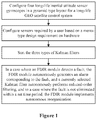
- FIG. 1 is a flowchart of a method according to the present disclosure.
- FIG. 2 is a schematic diagram of a pyramid type layout according to the present disclosure.
- a menu-type design method based on optimized information fusion applied to a GEO satellite control system includes the following steps (1) to (4).
- step (1) four long-life inertial attitude sensor gyroscopes are configured for a long-life GEO satellite control system.
- the four long-life inertial attitude sensor gyroscopes are configured in a pyramid type layout, three of the four gyroscopes are configured for Kalman filtering, the other one of the four gyroscopes is configured for cold backup, and measurement values outputted by each of the gyroscopes during normal operation includes attitude angle components and attitude angular velocity components along three axes.
- gyroscopes (A1, A2, A3 and A4) are arranged in a symmetrical pyramid type layout, in which any one of the three axes of a satellite body coordinate system is taken as the symmetry axis, a measurement axis of each of the gyroscopes is at an angle ⁇ (which can be any value) with respect to the symmetry axis, and angles of a projection of the measurement axis of each gyroscope in a plane formed by two axes of the three axes of the satellite body coordinate system other than the symmetry axis with respect to the two axes are 45°.
- sensors required by a user are configured according to a menu-type design requirement on hardware.
- An optical attitude sensor, a star sensor, an earth sensor, a sun sensor and other types of sensor capable of measuring three-axis attitude (such as a radio-frequency sensor, a navigation satellite system-based receiver which has four antennas and determines an orbit and attitude autonomously) with required attitude measurement accuracy are configured for the long-life GEO satellite control system.
- the long-life inertial attitude sensor gyroscopes and the optical attitude sensor, the star sensor, the earth sensor, the sun sensor and other types of sensor capable of measuring three-axis attitude are combined by satellite-borne computer application software to form three types of Kalman filters, each of which is capable of independently determining attitude, acquiring attitude measurement redundancy information, autonomously performing calibration, and autonomously performing compensation of angular velocity constant drift of the gyroscope.
- step (3) a two out of three hardware configuration table, a main operation state table, a backup operation state table and a health word in the satellite-borne computer application software are filled based on the configured sensors.
- the satellite-borne computer application software autonomously sorts the three types of Kalman filters acquired in step (2) in the following order on initialization: the three inertial attitude sensor gyroscopes in combination with the optical attitude star sensor, the three inertial attitude sensor gyroscopes in combination with the earth sensor and the sun sensor, and the three inertial attitude sensor gyroscopes in combination with other types of sensor capable of measuring three-axis attitude (The sensors to be sorted are selected based on user requirements).
- step (4) in a case where an FDIR module in the satellite-borne computer application software detects a fault, which includes the optical attitude sensor being interfered by sun light or moon light, being shadowed or being subject to other failures within a short to period of time, or one of the long-life inertial attitude sensor gyroscopes being failed, the FDIR module autonomously generates an alarm corresponding to the fault, and a currently selected Kalman filter autonomously performs reduced-order filtering.
- the FDIR module issues a macro instruction sequence to implement autonomous reorganization (which includes autonomously starting a health sensor configured for cold backup or starting a next layer of filter), to ensure attitude determination performance of the control system.
- a small random drift of the gyroscope corresponds to a small pulse equivalency and a long time interval allowed for reorganization.
- Starting of the next layer of filter causes small influence on attitude determination and attitude control performance since error in initial attitude determination is small, and filtering converges rapidly.
- a GEO satellite with high precision requirements on attitude determination and attitude control is configured with a star sensor. Therefore, a single Kalman filter including a gyroscope and a star sensor is a first choice.
- Attitude sensors can be configured for the GEO satellite control system with the menu-type design method based on different requirements on performance from different users.
- the hardware configuration may not include the star sensor, and the single Kalman filter including the gyroscope, the earth sensor and the sun sensor may be autonomously set as a first choice, where precision in attitude determination and attitude control can be no less than or better than that in the case where the attitude is determined by the star sensor individually.
- the two out of three hardware configuration table, the main operation state stable, the backup operation state stable and the health word in the satellite-borne computer application software are filled based on the actual configuration.
- the single Kalman filters, which are selectable, are sorted autonomously after the satellite-borne computer is started and initialized.
- ground remote control has the priority to modify the order in which the Kalman filers are sorted and determine which Kalman filter is the Kalman filter of the first layer.
Landscapes
- Engineering & Computer Science (AREA)
- Remote Sensing (AREA)
- Radar, Positioning & Navigation (AREA)
- Combustion & Propulsion (AREA)
- Aviation & Aerospace Engineering (AREA)
- Chemical & Material Sciences (AREA)
- Automation & Control Theory (AREA)
- Physics & Mathematics (AREA)
- General Physics & Mathematics (AREA)
- General Life Sciences & Earth Sciences (AREA)
- Geology (AREA)
- Geochemistry & Mineralogy (AREA)
- Astronomy & Astrophysics (AREA)
- Environmental & Geological Engineering (AREA)
- Life Sciences & Earth Sciences (AREA)
- Navigation (AREA)
- Control Of Position, Course, Altitude, Or Attitude Of Moving Bodies (AREA)
Abstract
Description
Claims (8)
Applications Claiming Priority (4)
| Application Number | Priority Date | Filing Date | Title |
|---|---|---|---|
| CN201510729488 | 2015-10-30 | ||
| CN201510729488.6 | 2015-10-30 | ||
| CN201510729488.6A CN105253330B (en) | 2015-10-30 | 2015-10-30 | A kind of information fusion GEO satellite control system menu-type design method based on optimization |
| PCT/CN2016/073359 WO2017071140A1 (en) | 2015-10-30 | 2016-02-03 | Menu-type design method for geo satellite control system based on optimized information integration |
Publications (2)
| Publication Number | Publication Date |
|---|---|
| US20180281991A1 US20180281991A1 (en) | 2018-10-04 |
| US10696426B2 true US10696426B2 (en) | 2020-06-30 |
Family
ID=55093358
Family Applications (1)
| Application Number | Title | Priority Date | Filing Date |
|---|---|---|---|
| US15/765,654 Active 2036-11-17 US10696426B2 (en) | 2015-10-30 | 2016-02-03 | Menu-type design method for GEO satellite control system based on optimized information integration |
Country Status (5)
| Country | Link |
|---|---|
| US (1) | US10696426B2 (en) |
| EP (1) | EP3369662B1 (en) |
| JP (1) | JP6542991B2 (en) |
| CN (1) | CN105253330B (en) |
| WO (1) | WO2017071140A1 (en) |
Families Citing this family (23)
| Publication number | Priority date | Publication date | Assignee | Title |
|---|---|---|---|---|
| CN105253330B (en) | 2015-10-30 | 2017-04-05 | 中国空间技术研究院 | A kind of information fusion GEO satellite control system menu-type design method based on optimization |
| CN106218922B (en) * | 2016-07-27 | 2018-06-15 | 中国科学院长春光学精密机械与物理研究所 | The joint actuating mechanism controls method of flexible agility satellite |
| CN110672128B (en) * | 2019-11-05 | 2021-07-02 | 中国人民解放军国防科技大学 | A Starlight/Inertial Integrated Navigation and Error Online Calibration Method |
| CN111189441B (en) * | 2020-01-10 | 2023-05-12 | 山东大学 | A multi-source adaptive fault-tolerant federated filtering integrated navigation system and navigation method |
| CN111273637B (en) * | 2020-01-20 | 2021-06-29 | 北京航空航天大学 | An FDIR Layered Software Architecture Supporting Online Fault Diagnosis |
| CN111473799B (en) * | 2020-03-24 | 2022-04-08 | 中国空间技术研究院 | A test method and device for fault diagnosis and recovery function of a satellite celestial body sensor |
| CN111854728B (en) * | 2020-05-20 | 2022-12-13 | 哈尔滨工程大学 | A fault-tolerant filtering method based on generalized relative entropy |
| CN111623800B (en) * | 2020-06-10 | 2022-05-24 | 北京空间飞行器总体设计部 | Low-orbit remote sensing satellite navigation positioning system multistage health state acquisition method |
| CN112749741B (en) * | 2020-12-30 | 2021-10-01 | 哈尔滨市科佳通用机电股份有限公司 | Hand brake fastening fault identification method based on deep learning |
| CN112733409B (en) * | 2021-04-02 | 2021-11-30 | 中国电子科技集团公司信息科学研究院 | Multi-source sensing comprehensive integrated composite navigation micro-system collaborative design platform |
| CN113485391B (en) * | 2021-06-08 | 2024-02-23 | 北京控制工程研究所 | Sensor autonomous management method based on priority sequence |
| CN113607155B (en) * | 2021-07-12 | 2023-10-10 | 上海卫星工程研究所 | Intelligent multiplexing method and system for sensors under multi-star combination |
| CN113672365B (en) * | 2021-08-04 | 2024-02-09 | 北京控制工程研究所 | Method and system for scheduling backup of conditional triggering type spaceborne computer |
| CN113859588B (en) * | 2021-09-30 | 2023-07-25 | 西北工业大学 | A Spacecraft Coordinated Observation and Fault Tolerance Anti-interference Control Method |
| CN113932802B (en) * | 2021-10-12 | 2024-05-14 | 中国科学院微小卫星创新研究院 | Priority changing method and system for multiple star sensors |
| CN114413883B (en) * | 2021-12-23 | 2023-09-05 | 上海航天控制技术研究所 | Satellite attitude determination precision improving method, storage medium and electronic equipment |
| CN114933027B (en) * | 2022-06-27 | 2026-03-17 | 眼点(上海)智能科技有限公司 | A three-dimensional attitude control system and its control method consisting of multiple reaction wheels |
| CN116056329B (en) * | 2023-01-19 | 2023-12-19 | 中国科学院微小卫星创新研究院 | Single-board integrated integrated electronic unit and integrated electronic system for micro satellites |
| CN116192809B (en) * | 2023-03-02 | 2024-06-04 | 苏州泰富晶宇科技有限公司 | Dual-machine cold-standby highly-reliable star service and attitude control interaction architecture system |
| CN116331521A (en) * | 2023-04-11 | 2023-06-27 | 中国科学院软件研究所 | A software-defined satellite-oriented attitude control method and system |
| CN117163323B (en) * | 2023-08-24 | 2025-11-18 | 上海卫星工程研究所 | Methods, systems, media, and equipment for autonomous initialization of orbit determination filters during satellite orbit adjustment |
| CN119309577B (en) * | 2024-12-16 | 2025-03-04 | 北京控制工程研究所 | Multi-information fusion attitude determination method and device for high dynamic load |
| CN119872927B (en) * | 2025-01-15 | 2025-11-07 | 星瀚时空(深圳)航天智能科技有限公司 | Satellite attitude control method and device based on mode conversion and satellite |
Citations (74)
| Publication number | Priority date | Publication date | Assignee | Title |
|---|---|---|---|---|
| US3340531A (en) * | 1964-10-05 | 1967-09-05 | Martin Marietta Corp | Satellite communication system |
| US3359407A (en) * | 1959-10-28 | 1967-12-19 | Gen Electric | Satellite orbit changing system |
| US3490719A (en) * | 1968-01-24 | 1970-01-20 | Nasa | Attitude control system |
| US3643897A (en) * | 1968-10-18 | 1972-02-22 | Communications Satellite Corp | Nutation correction system for spin-stabilized satellite |
| US4174819A (en) * | 1977-07-16 | 1979-11-20 | Messerschmitt-Bolkow-Blohm Gesellschaft Mit Beschrankter Haftung | Controller for the attitude stabilization of a satellite |
| US4730798A (en) * | 1985-03-08 | 1988-03-15 | Wertz James R | Autonomous spacecraft controller and related method |
| US4807835A (en) * | 1987-04-10 | 1989-02-28 | Ithaco, Inc. | Spacecraft attitude stabilization system |
| US5204818A (en) * | 1990-05-22 | 1993-04-20 | The United States Of America As Represented By The Secretary Of The Air Force | Surveying satellite apparatus |
| US5439190A (en) * | 1991-04-22 | 1995-08-08 | Trw Inc. | Medium-earth-altitude satellite-based cellular telecommunications |
| US5452077A (en) * | 1993-12-09 | 1995-09-19 | Hughes Aircraft Company | Transient-free method of determining satellite attitude |
| US5528502A (en) * | 1990-08-22 | 1996-06-18 | Microcosm, Inc. | Satellite orbit maintenance system |
| US5562266A (en) * | 1992-10-29 | 1996-10-08 | Aerospatiale Societe Nationale Industrielle | Rate gyro calibration method and apparatus for a three-axis stabilized satellite |
| US5642122A (en) * | 1991-11-08 | 1997-06-24 | Teledesic Corporation | Spacecraft antennas and beam steering methods for satellite communciation system |
| US5687084A (en) * | 1992-05-26 | 1997-11-11 | Microcosm, Inc. | Satellite orbit maintenance system |
| US5697050A (en) * | 1995-08-23 | 1997-12-09 | Globalstar L.P. | Satellite beam steering reference using terrestrial beam steering terminals |
| US5794891A (en) * | 1995-01-06 | 1998-08-18 | Matra Marconi Space France | Method of controlling the attitude control for satellites on an orbit inclined relative to the equator |
| US5931421A (en) * | 1995-08-11 | 1999-08-03 | Daimler-Benz Aerospace Ag | Arrangement for attitude control and stabilization of a three axes stabilized spacecraft |
| US5951609A (en) * | 1997-05-29 | 1999-09-14 | Trw Inc. | Method and system for autonomous spacecraft control |
| US5984236A (en) * | 1995-12-22 | 1999-11-16 | Keitel; Keith F. | Momentum unloading using gimbaled thrusters |
| US6082677A (en) * | 1997-11-14 | 2000-07-04 | National Space Development Agency Of Japan | Satellite orbiting toward west in the equatorial plane and meteorological satellite system using the satellite |
| US6102335A (en) * | 1992-06-02 | 2000-08-15 | Mobile Communications Holdings, Inc. | Elliptical orbit satellite, system, and deployment with controllable coverage characteristics |
| US6128555A (en) * | 1997-05-29 | 2000-10-03 | Trw Inc. | In situ method and system for autonomous fault detection, isolation and recovery |
| US6211817B1 (en) * | 1999-07-27 | 2001-04-03 | Trimble Navigation Limited | Differential global positioning system using almanac data for a fast time to first fix |
| US6240367B1 (en) * | 1998-11-27 | 2001-05-29 | Ching-Fang Lin | Full fusion positioning method for vehicle |
| US6272432B1 (en) * | 1999-05-10 | 2001-08-07 | Hughes Electronics Corporation | System and method for correcting star tracker low spatial frequency error in stellar-inertial attitude determination systems |
| US6285927B1 (en) * | 1999-05-26 | 2001-09-04 | Hughes Electronics Corporation | Spacecraft attitude determination system and method |
| US6328264B1 (en) * | 1997-05-21 | 2001-12-11 | Hitachi, Ltd. | Artificial satellite with an orbit having a long staying time in a zenith direction, an orbit control method and a communication system therewith |
| US6356815B1 (en) * | 2000-08-25 | 2002-03-12 | Hughes Electronics Corporation | Stellar attitude-control systems and methods with weighted measurement-noise covariance matrices |
| US6408245B1 (en) * | 2000-08-03 | 2002-06-18 | American Gnc Corporation | Filtering mechanization method of integrating global positioning system receiver with inertial measurement unit |
| US20020186165A1 (en) * | 1999-07-27 | 2002-12-12 | Eschenbach Ralph F. | Global positioning system using almanac data for a fast time to first fix |
| US20030034422A1 (en) * | 2000-01-07 | 2003-02-20 | The Boeing Company | Method for limiting interference between satellite communications systems |
| US6559793B1 (en) * | 1999-07-27 | 2003-05-06 | Trimble Navigation Limited | Differential global positioning system using coarse GPS data for a fast time to a precise first fix |
| US6577929B2 (en) * | 2001-01-26 | 2003-06-10 | The Charles Stark Draper Laboratory, Inc. | Miniature attitude sensing suite |
| US20030149529A1 (en) * | 2002-02-01 | 2003-08-07 | The Aerospace Corporation | Fault detection pseudo gyro |
| US6681159B2 (en) * | 2001-10-28 | 2004-01-20 | The Boeing Company | Spacecraft methods and structures with enhanced attitude control that facilitates gyroscope substitutions |
| US6685142B1 (en) * | 1999-05-31 | 2004-02-03 | Astrium Gmbh | Three-axis position control for low-orbiting satellites |
| US6691033B1 (en) * | 2000-07-26 | 2004-02-10 | Hughes Electronics Corporation | System and method for calibrating inter-star-tracker misalignments in a stellar inertial attitude determination system |
| US6757858B1 (en) * | 2000-07-31 | 2004-06-29 | Hughes Electronics Corp. | System signaling for payload fault detection and isolation |
| US20050021378A1 (en) * | 2000-10-20 | 2005-01-27 | Weinstock Timothy Robert | Extended web enabled multi-featured business to business computer system for rental vehicle services |
| US6859727B2 (en) * | 2003-01-08 | 2005-02-22 | Honeywell International, Inc. | Attitude change kalman filter measurement apparatus and method |
| US20050103941A1 (en) * | 2003-10-21 | 2005-05-19 | Eads Astrium Gmbh | Dynamic yaw steering method for spacecrafts |
| US6945500B2 (en) * | 2003-08-15 | 2005-09-20 | Skycorp, Inc. | Apparatus for a geosynchronous life extension spacecraft |
| US20060118677A1 (en) * | 2004-12-07 | 2006-06-08 | Lockheed Martin Corporation | Optimized land mobile satellite configuration and steering method |
| US7248948B2 (en) * | 2001-04-25 | 2007-07-24 | Nihon University | Apparatus and method for estimating attitude using inertial measurement equipment |
| US20080046138A1 (en) * | 2004-12-15 | 2008-02-21 | The Boeing Company | Method for compensating star motion induced error in a stellar inertial attitude determination system |
| US20080059474A1 (en) * | 2005-12-29 | 2008-03-06 | Blue Jungle | Detecting Behavioral Patterns and Anomalies Using Activity Profiles |
| US7357356B1 (en) * | 2005-02-28 | 2008-04-15 | Lockheed Martin Corporation | Attitude and antenna steering system for geosynchronous earth orbit (GEO) spacecraft |
| US20080087769A1 (en) * | 2006-06-20 | 2008-04-17 | Kara Johnson | Method of determining and controlling the inertial attitude of a spinning, artificial satellite and systems therefor |
| US20080091738A1 (en) * | 2006-06-29 | 2008-04-17 | Stratavia Corporation | Standard operating procedure automation in database administration |
| US7370566B2 (en) * | 2003-09-04 | 2008-05-13 | Harris Corporation | Complimentary retrograde/prograde satellite constellation |
| US20080155499A1 (en) * | 2006-12-21 | 2008-06-26 | International Business Machines Corporation | Specifying user defined or translator definitions to use to interpret mnemonics in a computer program |
| US20080243756A1 (en) * | 2007-03-30 | 2008-10-02 | Verizon Laboratories Inc. | Method and system for presenting non-linear content based on linear content metadata |
| US7460063B2 (en) * | 2006-06-16 | 2008-12-02 | Agence Spatiale Europeenne | Interferometric radiometer |
| US20080313488A1 (en) * | 2005-09-29 | 2008-12-18 | Seong-Kyun Jeong | Apparatus and Method for Diagnosing Fault and Managing Data in Satellite Ground System |
| US7676305B2 (en) * | 2003-03-20 | 2010-03-09 | Centre National D'etudes Spatiales | Method and apparatus for assigning weighting coefficients for performing attitude calculations with a star sensor |
| US20110297794A1 (en) * | 2006-06-20 | 2011-12-08 | Johnson William M | Method of navigating a spinning, artificial satellite and controlling the global, terrestrial surveillance coverage thereof |
| US20120053780A1 (en) * | 2010-08-31 | 2012-03-01 | Seoul National University R&Db Foundation | Fault Detector and Fault Detection Method for Attitude Control System of Spacecraft |
| CN102494687A (en) | 2011-10-19 | 2012-06-13 | 清华大学 | High-precision posture/track integrated measurement device |
| CN102661751A (en) | 2012-06-07 | 2012-09-12 | 哈尔滨工业大学 | Satellite gyroscope group fault detection, separation and estimation method based on equivalence relation and wavelet transform numerical differentiation |
| CN103134491A (en) | 2011-11-30 | 2013-06-05 | 上海宇航系统工程研究所 | Integrated navigation system of strapdown inertial navigation system (SINS)/central nervous system (CNS)/global navigation satellite system (GNSS) of geostationary earth orbit (GEO) transfer vehicle |
| CN103264776A (en) | 2013-05-30 | 2013-08-28 | 中国空间技术研究院 | Control system working mode setting and switching method based on information fusion |
| US20140199051A1 (en) * | 2011-06-30 | 2014-07-17 | Thomson Licensing | Method and apparatus for automatic recording according to user preferences |
| US20140316615A1 (en) * | 2008-10-03 | 2014-10-23 | Bell Helicopter Textron Inc. | Method and apparatus for aircraft sensor and actuator failure protection using reconfigurable flight control laws |
| CN105253330A (en) | 2015-10-30 | 2016-01-20 | 中国空间技术研究院 | Menu-type design method based on optimized information integrated GEO satellite control system |
| US20160065006A1 (en) * | 2014-09-01 | 2016-03-03 | James Joshua Woods | Solar Energy Conversion and Transmission System and Method |
| US20160239068A1 (en) * | 2015-02-17 | 2016-08-18 | Ankush Varma | Performing dynamic power control of platform devices |
| US20160353022A1 (en) * | 2012-02-27 | 2016-12-01 | oVio Technologies, LLC | Rotatable imaging system |
| US20170065232A1 (en) * | 2015-09-04 | 2017-03-09 | Welch Allyn, Inc. | Method and apparatus for adapting a function of a biological sensor |
| US20170160749A1 (en) * | 2015-12-08 | 2017-06-08 | Airbus Helicopters | Method and a device for piloting an aircraft |
| US9696408B2 (en) * | 2014-02-04 | 2017-07-04 | University Of Florida Research Foundation, Inc. | Robust integrated precision high-speed satellite attitude determination and control system (ADCS) |
| US9745083B2 (en) * | 2015-04-01 | 2017-08-29 | Worldvu Satellites Limited | Method for thermal stabilization of a communications satellite |
| US9791278B2 (en) * | 2015-03-24 | 2017-10-17 | Honeywell International Inc. | Navigating with star tracking sensors |
| US9973266B1 (en) * | 2017-06-12 | 2018-05-15 | Ast & Science, Llc | System and method for high throughput fractionated satellites (HTFS) for direct connectivity to and from end user devices and terminals using flight formations of small or very small satellites |
| US10557980B2 (en) * | 2017-06-22 | 2020-02-11 | Honeywell International Inc. | Apparatus and method for a holographic optical field flattener |
Family Cites Families (14)
| Publication number | Priority date | Publication date | Assignee | Title |
|---|---|---|---|---|
| US3489004A (en) * | 1966-07-21 | 1970-01-13 | Honeywell Inc | Navigational reference device |
| US5582368A (en) * | 1995-01-23 | 1996-12-10 | Martin Marietta Corp. | Reaction wheel speed observer system |
| US6053455A (en) * | 1997-01-27 | 2000-04-25 | Space Systems/Loral, Inc. | Spacecraft attitude control system using low thrust thrusters |
| WO1998032657A1 (en) * | 1997-01-27 | 1998-07-30 | Space Systems/Loral, Inc. | Spacecraft attitude control system using low thrust thrusters |
| US5944761A (en) * | 1997-06-06 | 1999-08-31 | Honeywell Inc. | Variable periodic disturbance rejection filter |
| US6145790A (en) * | 1998-09-22 | 2000-11-14 | Hughes Electronics Corporation | Attitude determination system and method |
| JP2001080597A (en) * | 1999-09-13 | 2001-03-27 | Mitsubishi Electric Corp | Attitude control device for a three-axis stable satellite |
| JP2002131078A (en) * | 2000-10-26 | 2002-05-09 | Mitsubishi Electric Corp | Star sensor system |
| JP4946459B2 (en) * | 2007-01-26 | 2012-06-06 | 三菱電機株式会社 | Satellite-mounted control device |
| US7877173B2 (en) * | 2007-07-05 | 2011-01-25 | The Boeing Company | Method and apparatus for determining a satellite attitude using crosslink reference signals |
| US8825399B2 (en) * | 2008-07-24 | 2014-09-02 | Raytheon Company | System and method of passive and autonomous navigation of space vehicles using an extended Kalman filter |
| US7912664B2 (en) * | 2008-09-11 | 2011-03-22 | Northrop Grumman Guidance And Electronics Company, Inc. | Self calibrating gyroscope system |
| CN104118578B (en) * | 2014-06-24 | 2016-02-03 | 上海微小卫星工程中心 | A system and method for dynamic data fusion of multiple sensors on a micro-satellite platform |
| CN104085539B (en) * | 2014-06-26 | 2015-12-30 | 北京控制工程研究所 | The attitude control method of imaging calibration |
-
2015
- 2015-10-30 CN CN201510729488.6A patent/CN105253330B/en active Active
-
2016
- 2016-02-03 US US15/765,654 patent/US10696426B2/en active Active
- 2016-02-03 WO PCT/CN2016/073359 patent/WO2017071140A1/en not_active Ceased
- 2016-02-03 JP JP2018521544A patent/JP6542991B2/en active Active
- 2016-02-03 EP EP16858589.1A patent/EP3369662B1/en active Active
Patent Citations (75)
| Publication number | Priority date | Publication date | Assignee | Title |
|---|---|---|---|---|
| US3359407A (en) * | 1959-10-28 | 1967-12-19 | Gen Electric | Satellite orbit changing system |
| US3340531A (en) * | 1964-10-05 | 1967-09-05 | Martin Marietta Corp | Satellite communication system |
| US3490719A (en) * | 1968-01-24 | 1970-01-20 | Nasa | Attitude control system |
| US3643897A (en) * | 1968-10-18 | 1972-02-22 | Communications Satellite Corp | Nutation correction system for spin-stabilized satellite |
| US4174819A (en) * | 1977-07-16 | 1979-11-20 | Messerschmitt-Bolkow-Blohm Gesellschaft Mit Beschrankter Haftung | Controller for the attitude stabilization of a satellite |
| US4730798A (en) * | 1985-03-08 | 1988-03-15 | Wertz James R | Autonomous spacecraft controller and related method |
| US4807835A (en) * | 1987-04-10 | 1989-02-28 | Ithaco, Inc. | Spacecraft attitude stabilization system |
| US5204818A (en) * | 1990-05-22 | 1993-04-20 | The United States Of America As Represented By The Secretary Of The Air Force | Surveying satellite apparatus |
| US5528502A (en) * | 1990-08-22 | 1996-06-18 | Microcosm, Inc. | Satellite orbit maintenance system |
| US5439190A (en) * | 1991-04-22 | 1995-08-08 | Trw Inc. | Medium-earth-altitude satellite-based cellular telecommunications |
| US5642122A (en) * | 1991-11-08 | 1997-06-24 | Teledesic Corporation | Spacecraft antennas and beam steering methods for satellite communciation system |
| US5687084A (en) * | 1992-05-26 | 1997-11-11 | Microcosm, Inc. | Satellite orbit maintenance system |
| US6102335A (en) * | 1992-06-02 | 2000-08-15 | Mobile Communications Holdings, Inc. | Elliptical orbit satellite, system, and deployment with controllable coverage characteristics |
| US5562266A (en) * | 1992-10-29 | 1996-10-08 | Aerospatiale Societe Nationale Industrielle | Rate gyro calibration method and apparatus for a three-axis stabilized satellite |
| US5452077A (en) * | 1993-12-09 | 1995-09-19 | Hughes Aircraft Company | Transient-free method of determining satellite attitude |
| US5794891A (en) * | 1995-01-06 | 1998-08-18 | Matra Marconi Space France | Method of controlling the attitude control for satellites on an orbit inclined relative to the equator |
| US5931421A (en) * | 1995-08-11 | 1999-08-03 | Daimler-Benz Aerospace Ag | Arrangement for attitude control and stabilization of a three axes stabilized spacecraft |
| US5697050A (en) * | 1995-08-23 | 1997-12-09 | Globalstar L.P. | Satellite beam steering reference using terrestrial beam steering terminals |
| US5984236A (en) * | 1995-12-22 | 1999-11-16 | Keitel; Keith F. | Momentum unloading using gimbaled thrusters |
| US6328264B1 (en) * | 1997-05-21 | 2001-12-11 | Hitachi, Ltd. | Artificial satellite with an orbit having a long staying time in a zenith direction, an orbit control method and a communication system therewith |
| US6764049B1 (en) * | 1997-05-21 | 2004-07-20 | Hitachi, Ltd. | Artificial satellite with an orbit having a long staying time in a zenith direction, an orbit control method and a communication system therewith |
| US6128555A (en) * | 1997-05-29 | 2000-10-03 | Trw Inc. | In situ method and system for autonomous fault detection, isolation and recovery |
| US5951609A (en) * | 1997-05-29 | 1999-09-14 | Trw Inc. | Method and system for autonomous spacecraft control |
| US6082677A (en) * | 1997-11-14 | 2000-07-04 | National Space Development Agency Of Japan | Satellite orbiting toward west in the equatorial plane and meteorological satellite system using the satellite |
| US6240367B1 (en) * | 1998-11-27 | 2001-05-29 | Ching-Fang Lin | Full fusion positioning method for vehicle |
| US6272432B1 (en) * | 1999-05-10 | 2001-08-07 | Hughes Electronics Corporation | System and method for correcting star tracker low spatial frequency error in stellar-inertial attitude determination systems |
| US6285927B1 (en) * | 1999-05-26 | 2001-09-04 | Hughes Electronics Corporation | Spacecraft attitude determination system and method |
| US6685142B1 (en) * | 1999-05-31 | 2004-02-03 | Astrium Gmbh | Three-axis position control for low-orbiting satellites |
| US6211817B1 (en) * | 1999-07-27 | 2001-04-03 | Trimble Navigation Limited | Differential global positioning system using almanac data for a fast time to first fix |
| US20020186165A1 (en) * | 1999-07-27 | 2002-12-12 | Eschenbach Ralph F. | Global positioning system using almanac data for a fast time to first fix |
| US6559793B1 (en) * | 1999-07-27 | 2003-05-06 | Trimble Navigation Limited | Differential global positioning system using coarse GPS data for a fast time to a precise first fix |
| US20030034422A1 (en) * | 2000-01-07 | 2003-02-20 | The Boeing Company | Method for limiting interference between satellite communications systems |
| US6691033B1 (en) * | 2000-07-26 | 2004-02-10 | Hughes Electronics Corporation | System and method for calibrating inter-star-tracker misalignments in a stellar inertial attitude determination system |
| US6757858B1 (en) * | 2000-07-31 | 2004-06-29 | Hughes Electronics Corp. | System signaling for payload fault detection and isolation |
| US6408245B1 (en) * | 2000-08-03 | 2002-06-18 | American Gnc Corporation | Filtering mechanization method of integrating global positioning system receiver with inertial measurement unit |
| US6356815B1 (en) * | 2000-08-25 | 2002-03-12 | Hughes Electronics Corporation | Stellar attitude-control systems and methods with weighted measurement-noise covariance matrices |
| US20050021378A1 (en) * | 2000-10-20 | 2005-01-27 | Weinstock Timothy Robert | Extended web enabled multi-featured business to business computer system for rental vehicle services |
| US6577929B2 (en) * | 2001-01-26 | 2003-06-10 | The Charles Stark Draper Laboratory, Inc. | Miniature attitude sensing suite |
| US7248948B2 (en) * | 2001-04-25 | 2007-07-24 | Nihon University | Apparatus and method for estimating attitude using inertial measurement equipment |
| US6681159B2 (en) * | 2001-10-28 | 2004-01-20 | The Boeing Company | Spacecraft methods and structures with enhanced attitude control that facilitates gyroscope substitutions |
| US20030149529A1 (en) * | 2002-02-01 | 2003-08-07 | The Aerospace Corporation | Fault detection pseudo gyro |
| US6859727B2 (en) * | 2003-01-08 | 2005-02-22 | Honeywell International, Inc. | Attitude change kalman filter measurement apparatus and method |
| US7676305B2 (en) * | 2003-03-20 | 2010-03-09 | Centre National D'etudes Spatiales | Method and apparatus for assigning weighting coefficients for performing attitude calculations with a star sensor |
| US6945500B2 (en) * | 2003-08-15 | 2005-09-20 | Skycorp, Inc. | Apparatus for a geosynchronous life extension spacecraft |
| US7370566B2 (en) * | 2003-09-04 | 2008-05-13 | Harris Corporation | Complimentary retrograde/prograde satellite constellation |
| US20050103941A1 (en) * | 2003-10-21 | 2005-05-19 | Eads Astrium Gmbh | Dynamic yaw steering method for spacecrafts |
| US20060118677A1 (en) * | 2004-12-07 | 2006-06-08 | Lockheed Martin Corporation | Optimized land mobile satellite configuration and steering method |
| US20080046138A1 (en) * | 2004-12-15 | 2008-02-21 | The Boeing Company | Method for compensating star motion induced error in a stellar inertial attitude determination system |
| US7357356B1 (en) * | 2005-02-28 | 2008-04-15 | Lockheed Martin Corporation | Attitude and antenna steering system for geosynchronous earth orbit (GEO) spacecraft |
| US20080313488A1 (en) * | 2005-09-29 | 2008-12-18 | Seong-Kyun Jeong | Apparatus and Method for Diagnosing Fault and Managing Data in Satellite Ground System |
| US20080059474A1 (en) * | 2005-12-29 | 2008-03-06 | Blue Jungle | Detecting Behavioral Patterns and Anomalies Using Activity Profiles |
| US7460063B2 (en) * | 2006-06-16 | 2008-12-02 | Agence Spatiale Europeenne | Interferometric radiometer |
| US20080087769A1 (en) * | 2006-06-20 | 2008-04-17 | Kara Johnson | Method of determining and controlling the inertial attitude of a spinning, artificial satellite and systems therefor |
| US20110297794A1 (en) * | 2006-06-20 | 2011-12-08 | Johnson William M | Method of navigating a spinning, artificial satellite and controlling the global, terrestrial surveillance coverage thereof |
| US20080091738A1 (en) * | 2006-06-29 | 2008-04-17 | Stratavia Corporation | Standard operating procedure automation in database administration |
| US20080155499A1 (en) * | 2006-12-21 | 2008-06-26 | International Business Machines Corporation | Specifying user defined or translator definitions to use to interpret mnemonics in a computer program |
| US20080243756A1 (en) * | 2007-03-30 | 2008-10-02 | Verizon Laboratories Inc. | Method and system for presenting non-linear content based on linear content metadata |
| US20140316615A1 (en) * | 2008-10-03 | 2014-10-23 | Bell Helicopter Textron Inc. | Method and apparatus for aircraft sensor and actuator failure protection using reconfigurable flight control laws |
| US20120053780A1 (en) * | 2010-08-31 | 2012-03-01 | Seoul National University R&Db Foundation | Fault Detector and Fault Detection Method for Attitude Control System of Spacecraft |
| US20140199051A1 (en) * | 2011-06-30 | 2014-07-17 | Thomson Licensing | Method and apparatus for automatic recording according to user preferences |
| CN102494687A (en) | 2011-10-19 | 2012-06-13 | 清华大学 | High-precision posture/track integrated measurement device |
| CN103134491A (en) | 2011-11-30 | 2013-06-05 | 上海宇航系统工程研究所 | Integrated navigation system of strapdown inertial navigation system (SINS)/central nervous system (CNS)/global navigation satellite system (GNSS) of geostationary earth orbit (GEO) transfer vehicle |
| US20160353022A1 (en) * | 2012-02-27 | 2016-12-01 | oVio Technologies, LLC | Rotatable imaging system |
| CN102661751A (en) | 2012-06-07 | 2012-09-12 | 哈尔滨工业大学 | Satellite gyroscope group fault detection, separation and estimation method based on equivalence relation and wavelet transform numerical differentiation |
| CN103264776A (en) | 2013-05-30 | 2013-08-28 | 中国空间技术研究院 | Control system working mode setting and switching method based on information fusion |
| US9696408B2 (en) * | 2014-02-04 | 2017-07-04 | University Of Florida Research Foundation, Inc. | Robust integrated precision high-speed satellite attitude determination and control system (ADCS) |
| US20160065006A1 (en) * | 2014-09-01 | 2016-03-03 | James Joshua Woods | Solar Energy Conversion and Transmission System and Method |
| US20160239068A1 (en) * | 2015-02-17 | 2016-08-18 | Ankush Varma | Performing dynamic power control of platform devices |
| US9791278B2 (en) * | 2015-03-24 | 2017-10-17 | Honeywell International Inc. | Navigating with star tracking sensors |
| US9745083B2 (en) * | 2015-04-01 | 2017-08-29 | Worldvu Satellites Limited | Method for thermal stabilization of a communications satellite |
| US20170065232A1 (en) * | 2015-09-04 | 2017-03-09 | Welch Allyn, Inc. | Method and apparatus for adapting a function of a biological sensor |
| CN105253330A (en) | 2015-10-30 | 2016-01-20 | 中国空间技术研究院 | Menu-type design method based on optimized information integrated GEO satellite control system |
| US20170160749A1 (en) * | 2015-12-08 | 2017-06-08 | Airbus Helicopters | Method and a device for piloting an aircraft |
| US9973266B1 (en) * | 2017-06-12 | 2018-05-15 | Ast & Science, Llc | System and method for high throughput fractionated satellites (HTFS) for direct connectivity to and from end user devices and terminals using flight formations of small or very small satellites |
| US10557980B2 (en) * | 2017-06-22 | 2020-02-11 | Honeywell International Inc. | Apparatus and method for a holographic optical field flattener |
Non-Patent Citations (6)
| Title |
|---|
| Cao, et al., "Application of Multi-Sensors Data Fusion Based on Improved Federal Filtering in Micro-Satellite Attitude Determination," 2011 International Workshop on Multi-Platform/Multi-Sensor Remote Sensing and Mapping; Xiamen, China; Jan. 10-12, 2011. |
| Chen et al., "Application of Multi-sensor Information Fusion in Satellite Attitude Determination System", Aerospace Control, vol. 23, No. 3, Jun. 30, 2005 (Jun. 30, 2005), ISSN: 1006-324, pp. 35-38. |
| European Search Report regarding PCT/CN2016/073359 dated May 24, 2019. |
| International Search Report for PCT/CN2016/073359, ISA/CN, Haidian District, Beijing, dated Jul. 28, 2016, with English translation. |
| Wang et al., "Research on Information Fusion Method for Satellite Attitude Determination Based on Multi-Sensor Measurement", Aerospace Shanghai, No. 6, Jun. 2009 (Jun. 30, 2009), ISSN: 1006-163. pp. 1-7. |
| Written Opinion of the ISA for PCT/CN2016/073359, ISA/CN, Haidian District, Beijing, dated Jul. 28, 2016 (in Chinese). |
Also Published As
| Publication number | Publication date |
|---|---|
| US20180281991A1 (en) | 2018-10-04 |
| EP3369662A1 (en) | 2018-09-05 |
| CN105253330A (en) | 2016-01-20 |
| WO2017071140A1 (en) | 2017-05-04 |
| EP3369662B1 (en) | 2020-07-01 |
| JP2018535139A (en) | 2018-11-29 |
| JP6542991B2 (en) | 2019-07-10 |
| CN105253330B (en) | 2017-04-05 |
| EP3369662A4 (en) | 2019-06-26 |
Similar Documents
| Publication | Publication Date | Title |
|---|---|---|
| US10696426B2 (en) | Menu-type design method for GEO satellite control system based on optimized information integration | |
| Patton et al. | Robust FDI applied to thruster faults of a satellite system | |
| CN105021188B (en) | A kind of bionic polarization/combined geomagnetism aided navigation system | |
| CN111688952A (en) | Satellite attitude control system | |
| CN104118578B (en) | A system and method for dynamic data fusion of multiple sensors on a micro-satellite platform | |
| CN113891836B (en) | Method for attitude control of satellites in inclined low orbits in survival mode | |
| CN108490470B (en) | UAV positioning method and system | |
| CN106494648B (en) | The in-orbit voting system and method for two star sensors | |
| CN115727844B (en) | Navigation positioning method for mining vehicle | |
| CN101275842A (en) | Near-infrared imaging autonomous navigation sensor system for medium and high orbit spacecraft | |
| CN115361086B (en) | Time synchronization method, device and medium for inter-satellite link | |
| US7606665B2 (en) | System and method for employing an aided-alignment mode to align an inertial reference system | |
| CN113091731A (en) | Spacecraft autonomous navigation method based on star sight relativistic effect | |
| US12103711B2 (en) | Satellite constellation forming system, satellite constellation forming method, computer readable medium, and ground device | |
| CN101275843A (en) | Visible light imaging autonomous navigation sensor system for medium and high orbit spacecraft | |
| Hosken et al. | Microcosm autonomous navigation system on-orbit operation | |
| CN101275845A (en) | Ultraviolet Imaging Autonomous Navigation Sensor System for Medium and High Orbit Spacecraft | |
| US6685142B1 (en) | Three-axis position control for low-orbiting satellites | |
| CN107544791A (en) | A kind of information fusion GEO satellite control system menu-type design method based on optimization | |
| WO2006025825A1 (en) | System and method for employing an aided-alignment mode to align an inertial reference system | |
| Um et al. | GPS attitude determination for the SOAR experiment | |
| CN115465475B (en) | Inverse orbit intersection detection method and device for large-scale constellation and storage medium | |
| Greenbaum et al. | Finding the gaps in space GNC hardware | |
| Tahmasebipour | Software for embedded and formation flying systems to support growing operational complexities of constellation missions | |
| Zhang et al. | Design of Two-Level Cooperative Interaction Timing for the Control Subsystem of Three Super Satellites |
Legal Events
| Date | Code | Title | Description |
|---|---|---|---|
| AS | Assignment |
Owner name: CHINA ACADEMY OF SPACE TECHNOLOGY, CHINA Free format text: ASSIGNMENT OF ASSIGNORS INTEREST;ASSIGNORS:ZHOU, ZHICHENG;SUN, BAOXIANG;WEI, QIANG;AND OTHERS;REEL/FRAME:045427/0254 Effective date: 20180323 |
|
| FEPP | Fee payment procedure |
Free format text: ENTITY STATUS SET TO UNDISCOUNTED (ORIGINAL EVENT CODE: BIG.); ENTITY STATUS OF PATENT OWNER: LARGE ENTITY |
|
| STPP | Information on status: patent application and granting procedure in general |
Free format text: APPLICATION DISPATCHED FROM PREEXAM, NOT YET DOCKETED |
|
| STPP | Information on status: patent application and granting procedure in general |
Free format text: DOCKETED NEW CASE - READY FOR EXAMINATION |
|
| STPP | Information on status: patent application and granting procedure in general |
Free format text: NOTICE OF ALLOWANCE MAILED -- APPLICATION RECEIVED IN OFFICE OF PUBLICATIONS |
|
| STCF | Information on status: patent grant |
Free format text: PATENTED CASE |
|
| MAFP | Maintenance fee payment |
Free format text: PAYMENT OF MAINTENANCE FEE, 4TH YEAR, LARGE ENTITY (ORIGINAL EVENT CODE: M1551); ENTITY STATUS OF PATENT OWNER: LARGE ENTITY Year of fee payment: 4 |