US10695095B2 - Orthopedic strut with multiple attachment clamps - Google Patents

Orthopedic strut with multiple attachment clamps Download PDF

Info

Publication number
US10695095B2
US10695095B2 US16/573,194 US201916573194A US10695095B2 US 10695095 B2 US10695095 B2 US 10695095B2 US 201916573194 A US201916573194 A US 201916573194A US 10695095 B2 US10695095 B2 US 10695095B2
Authority
US
United States
Prior art keywords
strut
ebf
jaw
sleeve
fixation
Prior art date
Legal status (The legal status is an assumption and is not a legal conclusion. Google has not performed a legal analysis and makes no representation as to the accuracy of the status listed.)
Active
Application number
US16/573,194
Other versions
US20200054360A1 (en
Inventor
C. Douglas Klein, JR.
Robert E. Wigginton
Bryant T. Phamvu
Current Assignee (The listed assignees may be inaccurate. Google has not performed a legal analysis and makes no representation or warranty as to the accuracy of the list.)
New Standard Device LLC
Original Assignee
New Standard Device LLC
Priority date (The priority date is an assumption and is not a legal conclusion. Google has not performed a legal analysis and makes no representation as to the accuracy of the date listed.)
Filing date
Publication date
Priority claimed from US16/106,435 external-priority patent/US10751089B2/en
Application filed by New Standard Device LLC filed Critical New Standard Device LLC
Priority to US16/573,194 priority Critical patent/US10695095B2/en
Assigned to New Standard Device, LLC reassignment New Standard Device, LLC ASSIGNMENT OF ASSIGNORS INTEREST (SEE DOCUMENT FOR DETAILS). Assignors: KLEIN, C. DOUGLAS, JR., Phamvu, Bryant T., WIGGINTON, ROBERT E.
Publication of US20200054360A1 publication Critical patent/US20200054360A1/en
Application granted granted Critical
Publication of US10695095B2 publication Critical patent/US10695095B2/en
Active legal-status Critical Current
Anticipated expiration legal-status Critical

Links

Images

Classifications

    • AHUMAN NECESSITIES
    • A61MEDICAL OR VETERINARY SCIENCE; HYGIENE
    • A61BDIAGNOSIS; SURGERY; IDENTIFICATION
    • A61B17/00Surgical instruments, devices or methods
    • A61B17/56Surgical instruments or methods for treatment of bones or joints; Devices specially adapted therefor
    • A61B17/58Surgical instruments or methods for treatment of bones or joints; Devices specially adapted therefor for osteosynthesis, e.g. bone plates, screws or setting implements
    • A61B17/60Surgical instruments or methods for treatment of bones or joints; Devices specially adapted therefor for osteosynthesis, e.g. bone plates, screws or setting implements for external osteosynthesis, e.g. distractors, contractors
    • A61B17/64Devices extending alongside the bones to be positioned
    • A61B17/6416Devices extending alongside the bones to be positioned with non-continuous, e.g. hinged, pin-clamp connecting element
    • AHUMAN NECESSITIES
    • A61MEDICAL OR VETERINARY SCIENCE; HYGIENE
    • A61BDIAGNOSIS; SURGERY; IDENTIFICATION
    • A61B17/00Surgical instruments, devices or methods
    • A61B17/56Surgical instruments or methods for treatment of bones or joints; Devices specially adapted therefor
    • A61B17/58Surgical instruments or methods for treatment of bones or joints; Devices specially adapted therefor for osteosynthesis, e.g. bone plates, screws or setting implements
    • A61B17/60Surgical instruments or methods for treatment of bones or joints; Devices specially adapted therefor for osteosynthesis, e.g. bone plates, screws or setting implements for external osteosynthesis, e.g. distractors, contractors
    • A61B17/64Devices extending alongside the bones to be positioned
    • A61B17/6425Devices extending alongside the bones to be positioned specially adapted to be fitted across a bone joint
    • AHUMAN NECESSITIES
    • A61MEDICAL OR VETERINARY SCIENCE; HYGIENE
    • A61BDIAGNOSIS; SURGERY; IDENTIFICATION
    • A61B17/00Surgical instruments, devices or methods
    • A61B17/56Surgical instruments or methods for treatment of bones or joints; Devices specially adapted therefor
    • A61B17/58Surgical instruments or methods for treatment of bones or joints; Devices specially adapted therefor for osteosynthesis, e.g. bone plates, screws or setting implements
    • A61B17/60Surgical instruments or methods for treatment of bones or joints; Devices specially adapted therefor for osteosynthesis, e.g. bone plates, screws or setting implements for external osteosynthesis, e.g. distractors, contractors
    • A61B17/64Devices extending alongside the bones to be positioned
    • A61B17/6466Devices extending alongside the bones to be positioned with pin-clamps movable along a solid connecting rod
    • A61B17/6475Devices extending alongside the bones to be positioned with pin-clamps movable along a solid connecting rod the connecting rod being threaded
    • AHUMAN NECESSITIES
    • A61MEDICAL OR VETERINARY SCIENCE; HYGIENE
    • A61BDIAGNOSIS; SURGERY; IDENTIFICATION
    • A61B17/00Surgical instruments, devices or methods
    • A61B17/56Surgical instruments or methods for treatment of bones or joints; Devices specially adapted therefor
    • A61B17/58Surgical instruments or methods for treatment of bones or joints; Devices specially adapted therefor for osteosynthesis, e.g. bone plates, screws or setting implements
    • A61B17/60Surgical instruments or methods for treatment of bones or joints; Devices specially adapted therefor for osteosynthesis, e.g. bone plates, screws or setting implements for external osteosynthesis, e.g. distractors, contractors
    • A61B17/66Alignment, compression or distraction mechanisms
    • AHUMAN NECESSITIES
    • A61MEDICAL OR VETERINARY SCIENCE; HYGIENE
    • A61BDIAGNOSIS; SURGERY; IDENTIFICATION
    • A61B17/00Surgical instruments, devices or methods
    • A61B17/56Surgical instruments or methods for treatment of bones or joints; Devices specially adapted therefor
    • A61B17/58Surgical instruments or methods for treatment of bones or joints; Devices specially adapted therefor for osteosynthesis, e.g. bone plates, screws or setting implements
    • A61B17/60Surgical instruments or methods for treatment of bones or joints; Devices specially adapted therefor for osteosynthesis, e.g. bone plates, screws or setting implements for external osteosynthesis, e.g. distractors, contractors
    • A61B17/62Ring frames, i.e. devices extending around the bones to be positioned
    • AHUMAN NECESSITIES
    • A61MEDICAL OR VETERINARY SCIENCE; HYGIENE
    • A61BDIAGNOSIS; SURGERY; IDENTIFICATION
    • A61B17/00Surgical instruments, devices or methods
    • A61B2017/00982General structural features
    • A61B2017/00991Telescopic means
    • AHUMAN NECESSITIES
    • A61MEDICAL OR VETERINARY SCIENCE; HYGIENE
    • A61FFILTERS IMPLANTABLE INTO BLOOD VESSELS; PROSTHESES; DEVICES PROVIDING PATENCY TO, OR PREVENTING COLLAPSING OF, TUBULAR STRUCTURES OF THE BODY, e.g. STENTS; ORTHOPAEDIC, NURSING OR CONTRACEPTIVE DEVICES; FOMENTATION; TREATMENT OR PROTECTION OF EYES OR EARS; BANDAGES, DRESSINGS OR ABSORBENT PADS; FIRST-AID KITS
    • A61F5/00Orthopaedic methods or devices for non-surgical treatment of bones or joints; Nursing devices ; Anti-rape devices
    • A61F5/01Orthopaedic devices, e.g. long-term immobilising or pressure directing devices for treating broken or deformed bones such as splints, casts or braces
    • A61F5/0102Orthopaedic devices, e.g. long-term immobilising or pressure directing devices for treating broken or deformed bones such as splints, casts or braces specially adapted for correcting deformities of the limbs or for supporting them; Ortheses, e.g. with articulations
    • A61F2005/0132Additional features of the articulation
    • A61F2005/0158Additional features of the articulation with locking means
    • AHUMAN NECESSITIES
    • A61MEDICAL OR VETERINARY SCIENCE; HYGIENE
    • A61FFILTERS IMPLANTABLE INTO BLOOD VESSELS; PROSTHESES; DEVICES PROVIDING PATENCY TO, OR PREVENTING COLLAPSING OF, TUBULAR STRUCTURES OF THE BODY, e.g. STENTS; ORTHOPAEDIC, NURSING OR CONTRACEPTIVE DEVICES; FOMENTATION; TREATMENT OR PROTECTION OF EYES OR EARS; BANDAGES, DRESSINGS OR ABSORBENT PADS; FIRST-AID KITS
    • A61F5/00Orthopaedic methods or devices for non-surgical treatment of bones or joints; Nursing devices ; Anti-rape devices
    • A61F5/01Orthopaedic devices, e.g. long-term immobilising or pressure directing devices for treating broken or deformed bones such as splints, casts or braces
    • A61F5/0102Orthopaedic devices, e.g. long-term immobilising or pressure directing devices for treating broken or deformed bones such as splints, casts or braces specially adapted for correcting deformities of the limbs or for supporting them; Ortheses, e.g. with articulations
    • A61F2005/0132Additional features of the articulation
    • A61F2005/0165Additional features of the articulation with limits of movement
    • A61F2005/0167Additional features of the articulation with limits of movement adjustable

Definitions

  • the claimed subject matter relates generally to an orthopedic strut with multiple attachment clamps and, more specifically, a telescoping adjustable strut with versatile multiple attachment clamps for use with plates, wires and pins of an external bone fixation device.
  • EBF External Bone Fixation
  • Typical EBF devices use circular rings that surround a patient's limb.
  • Adjustable connection rods and struts are employed to connect the circular rings together.
  • Current connection rods have only a conical range of seven degrees (7°) and struts have only an average of forty-seven degrees (47 ⁇ 10°), which reduces the functionality of the rods and struts, limiting the ability to connect circular rings together.
  • Half pins and wires are employed to attach the circular rings to a patient's bone to stabilize the bone while the bone or bones are being corrected or healing. The half pins and wires attach to the EBF device at one or two points and are either drilled into or through a bone.
  • Ilizarov frame One well-known reconstructive EBF system is the Ilizarov frame, as shown in U.S. Pat. Nos. 4,365,624; 4,615,338; 4,978,348; 5,702,389 and 5,971,984.
  • the Ilizarov frame uses a combination of circular frames, pins and wires for deformity correction.
  • telescoping, adjustable struts with multiple attachment clamps for connecting plates, pins and wires employed in orthopedic external bone fixation (EBF) devices.
  • One embodiment of the telescoping, adjustable strut incorporates lockable swivel hinges.
  • the swivel hinges provide one hundred eighty degrees (180°) of movement in one direction and three hundred sixty degrees (360°) of rotation in another direction.
  • a lockable swivel hinge is typically positioned on each end of a telescoping, adjustable strut.
  • EBF devices which employ the telescoping, adjustable struts, are used to fix broken bones and to stabilize bones that are being corrected or healing.
  • a telescoping, adjustable orthopedic strut for use in conjunction with an external bone fixation (EBF) device and an EBF device, including plates, wires and pins, that employs the strut.
  • One embodiment of the strut includes a plurality of swivel hinges, wherein each swivel hinge is lockable in any position within a one hundred eighty degree (180°) plane and a three hundred degree (360°) angle of rotation with respect to an orthopedic plate of the EBF device; an outer sleeve; an inner sleeve configured to slide within the outer sleeve; wherein the inner sleeve and outer sleeve may be positioned with respect to each other and, when a fixation bolt is tightened, the inner sleeve and outer sleeve are secured with respect to each other to provide an acute adjustment; a leadscrew threaded into the inner sleeve; a jam nut threaded onto the leadscrew such that, when a jam
  • FIG. 1 is an illustration of two configurations of a telescoping, adjustable strut with lockable swivel hinges manufactured in accordance with the claimed subject matter.
  • FIG. 2 is an illustration of the telescoping, adjustable strut, introduced in FIG. 1 , from a perspective that shows additional details.
  • FIG. 3 is an illustration of the telescoping, adjustable strut, shown in FIGS. 1 and 2 , disassembled to show individual components more clearly.
  • FIG. 4 is an illustration of the telescoping, adjustable strut, described in conjunction with FIGS. 1-3 , connecting two orthopedic plates.
  • FIG. 5 is an illustration of a lockable swivel hinge, first introduced in FIG. 1 , in greater detail.
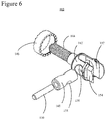
  • FIG. 6 is an illustration of the lockable swivel hinge of FIGS. 1-5 disassembled to more clearly show the component parts.
  • FIG. 7 is an illustration of an illustration of an illustration of an External Bone Fixation (EBF) device, attached to a patient's foot and leg bones, that employs the telescoping, adjustable strut shown in FIGS. 1-4 and the lockable swivel hinge shown in FIGS. 1-6 .
  • EBF External Bone Fixation
  • FIG. 8 is an illustration of a lockable clamp configured to attach to the strut of FIGS. 1-4 and the lockable swivel hinge of FIGS. 1-7 .
  • FIG. 9 is an illustration of the lockable clamp of FIG. 8 that shows internal mechanisms that are typically hidden from view.
  • FIG. 10 is an illustration of the lockable clamp of FIGS. 8 and 9 , disassembled and including a portion of the swivel hinge of FIGS. 1-7 to which it attaches.
  • FIG. 1 is an illustration of two configurations of a telescoping, adjustable strut 100 with lockable swivel hinges manufactured in accordance with the claimed subject matter.
  • a first configuration 102 shows strut 100 in a collapsed, or shortened position.
  • a second configuration 104 shows strut 100 is an extended position. It should be understood that strut 100 may be configured, in addition to configurations 102 and 104 , in any position in between shortened and extended positions 102 and 104 .
  • An inner sleeve, or tube, 106 which is not visible in configuration 102 , fits into an outer sleeve, or tube, 108 .
  • a fixation bolt 110 which is explained in more detail below in conjunction with FIG. 2 , prevents inner sleeve 106 from moving with respect to outer sleeve 108 when bolt 110 is tightened. In this manner, the length of strut 100 may be easily be adjusted anywhere between the collapsed and extended positions 102 and 104 . This adjustment of the length of strut 100 is called “acute” adjustment.
  • a lockable swivel hinge 112 that is lockable in a one hundred eighty degrees (180°) and rotatable in three hundred sixty degrees (360°) when inserted into an orthopedic plate (see 136 , FIGS. 3 and 4 and 212 and 216 , FIG. 7 ). Lockable swivel hinge 112 is described in more detail below in conjunction with FIGS. 5 and 6 .
  • the end of strut 100 on outer sleeve 108 side is labeled as a “stationary” end 114 and the end on inner sleeve 106 side as “moving” end 116 .
  • the terms “stationary” and “moving” are used because stationary end 114 doesn't rotate relative to outer sleeve or move in or out relative to outer sleeve 108 during adjustment of the length of strut 100 .
  • Moving end 116 is able to rotate three hundred sixty degrees (360°) by virtue of the fact that a leadscrew 118 may be rotated.
  • threaded rod, or “leadscrew,” 118 threads into a jam nut 120 and a compression/distraction (C/D) nut 122 .
  • C/D nut 122 is pressed into and thereby attached to inner sleeve 106 such that C/D nut 122 is free rotate three hundred and sixty degrees (360°) with respect to inner sleeve 106 .
  • a care provider may accurately control the length of strut 100 by loosening jam nut 120 , turning C/D 122 either clockwise or counterclockwise with respect to inner sleeve 106 , thereby screwing leadscrew 118 either further into or out of inner sleeve 106 , and tightening jam nut 120 against C/D nut 122 to both prevent leadscrew 118 from rotating and to lock the overall length of strut 100 .
  • This adjustment of the length of strut 100 is called “micro” or “fine” adjustment.
  • Leadscrew 118 , nut 120 and C/D nut 122 provide a finer adjustment of the length of strut 100 than that provided by the acute adjustment of the relative positions of inner sleeve 106 and outer sleeve 108 as described above.
  • FIG. 2 is an illustration of strut 100 , introduced in FIG. 1 , from a perspective that shows additional details.
  • FIG. 2 shows outer sleeve 108 , fixation bolt 110 , swivel hinges 112 , stationary end 114 and moving end 116 .
  • FIG. 2 shows strut 100 from an angle that shows an opening, or groove, 130 in outer sleeve 108 ( FIG. 1 ) through which fixation bolt 110 is positioned.
  • Fixation bolt 110 passes through opening 130 , a clamping washer 132 and is treaded into inner sleeve 106 ( FIG. 1 ), only a portion 134 of which is visible in FIG. 2 .
  • Washer 132 is configured to be flat on one side and conform to the curvature of outer sleeve 108 on a second side.
  • fixation bolt 110 When fixation bolt 110 is loosened, inner sleeve 106 and outer sleeve 108 may be easily moved with respect to each other.
  • fixation bolt 110 When fixation bolt 110 is tightened, outer sleeve 108 is compressed between washer 132 and inner sleeve 106 , thereby preventing inner sleeve 106 and outer sleeve 108 from moving with respect to each other thereby providing an acute adjustment of strut 100 .
  • leadscrew 118 ( FIG. 1 ) which is threaded into C/D nut 122 , which is pressed fitted into inner tube 106 , and jam nut 120 .
  • Leadscrew 118 is coupled to swivel hinge 112 that terminates at moving end 116 ( FIG. 1 ).
  • a care provider may make a micro adjustment of strut 100 by loosening jam nut 120 , turning C/D nut 122 and then tightening jam nut 120 against C/D nut 122 .
  • FIG. 3 is an illustration of strut 100 , shown in FIGS. 1 and 2 , disassembled to show individual components more clearly. Also illustrated are two (2) orthopedic plates 136 that might be connected with strut 100 as part of a part of an External Bone Fixation (EBF) device (see 200 , FIG. 7 ). Like FIG. 2 , FIG. 3 shows inner sleeve 106 , outer sleeve 108 , fixation bolt 110 , clamping washer 132 , leadscrew 118 and swivel hinges 112 , which in this view are also disassembled (see FIG. 5 ). Also shown are two (2) speed nuts 138 that are employed to attach swivel hinges 112 to orthopedic plates 136 .
  • EPF External Bone Fixation
  • FIG. 4 is an illustration of strut 100 , described in conjunction with FIGS. 1-3 , connecting orthopedic plates 136 ( FIG. 3 ).
  • strut 100 is configured in shortened configuration, or position, 102 ( FIG. 1 ).
  • Strut 100 is secured to orthopedic plates 136 ( FIG. 3 ) with speed nuts 138 ( FIG. 3 ) screwed onto compression threads 144 ( FIGS. 5 and 6 ), which are obscured in FIG. 4 .
  • FIG. 4 is an illustration of strut 100 , described in conjunction with FIGS. 1-3 , connecting orthopedic plates 136 ( FIG. 3 ).
  • strut 100 is configured in shortened configuration, or position, 102 ( FIG. 1 ).
  • Strut 100 is secured to orthopedic plates 136 ( FIG. 3 ) with speed nuts 138 ( FIG. 3 ) screwed onto compression threads 144 ( FIGS. 5 and 6 ), which are obscured in FIG. 4 .
  • FIGS. 1-3 Like FIGS. 1-3 , FIG.
  • FIG. 4 shows fixation bolt 110 , outer sleeve 108 (inner sleeve 106 is obscured in shortened position 102 ), swivel hinges 112 , stationary end 114 , moving end 116 , jam nut 120 and C/D nut 122 .
  • FIG. 5 is an illustration of lockable swivel hinge 112 , first introduced in FIG. 1 , in greater detail.
  • Hinge 112 includes a body 142 with a threaded portion, or compression threads, 144 .
  • Compression threads 144 is used to attach hinge 112 to an orthopedic plate (see 136 , FIGS. 3 and 4 and 212, 216 , FIG. 7 ).
  • Compression threads 144 pass through a hole (not shown) in an orthopedic plate, which is then secured with a speed nut ( 138 , FIGS. 3 and 4 ).
  • speed nut 138 presses a locking collar 146 against a swivel pin 148 , thereby locking swivel pin 148 and body 142 within a one hundred eighty-degree (180°) arc with respect to compression either leadscrew 118 ( FIGS. 1-3 ) or outer sleeve 108 ( FIGS. 1-4 ).
  • body 142 may be rotated with respect to orthopedic plates 136 and locked in any position, i.e., body 142 is rotatable orthogonally three hundred sixty degrees (360°) with respect to orthopedic plates 136 by virtue of the fact that, on stationary end 114 ( FIGS. 1-3 ), outer sleeve 108 may be rotated and, on moving end 116 ( FIGS. 1-3 ), leadscrew 118 may be rotated.
  • a locking, or dowel, pin 150 is inserted through swivel pin 148 so that either leadscrew 118 ( FIG. 1-3 ) or outer sleeve 108 ( FIGS. 1-3 ) is securely attached to a respective lockable swivel hinge 112 .
  • a channel 152 in body 142 provides space for either leadscrew 118 or outer sleeve 108 to be inserted into moving end 116 ( FIGS. 1-3 ) or fixed end 114 ( FIGS. 1-3 ), respectively, to be mounted and enables swivel hinge 112 be positioned within a one hundred eighty-degree (180°) arc.
  • a parallel pair of surfaces 154 one of which is obscured by the orientation of lockable swivel pin 112 , provide a means to place a wrench (not shown) while tightening locking collar 146 against swivel pin 148 with speed nut 138 .
  • FIG. 6 is an illustration of the lockable swivel hinge 112 of FIGS. 1-5 disassembled to more clearly show component parts. Included are body 142 , compression threads 144 , locking collar 146 , swivel pin 148 , lock pin 150 , channel 152 and parallel surfaces 154 , all of which were introduced in FIG. 5 . At stationary end 114 ( FIGS. 1-4 ) of strut 100 ( FIGS. 1-4 ), a portion (not shown) of outer sleeve 108 ( FIGS. 1 & 2 ) extends into channel 152 .
  • Swivel pin 148 extends through a hole 156 of body 142 and the extended portion of outer sleeve 108 passes through a hole 158 in swivel pin 148 .
  • the extended portion of outer sleeve 108 is then locked into place by press fitting pin 150 through the center of swivel pin 148 and through a hole (not shown) in the extended portion of outer sleeve 108 .
  • swivel hinge 112 is attached to leadscrew 118 ( FIGS. 1-4 ) at moving end 116 ( FIGS. 1-4 ).
  • Leadscrew 118 extends into channel 152 .
  • Swivel pin 148 is inserted into hole 156 of body 142 and leadscrew 118 passes through hole 158 in swivel pin 148 .
  • Leadscrew 118 is then locked into place by press fitting pin 150 through the center of swivel pin 148 and through a hole (not shown) in leadscrew 118 .
  • FIG. 7 is an illustration of an illustration of an illustration of an External Bone Fixation (EBF) device 200 , attached to a patient's leg bone 202 , heal bone 204 and foot bone 206 , that employs telescoping, adjustable strut 100 shown in FIGS. 1 and 2 and the lockable swivel hinge 112 shown in FIGS. 1-4 .
  • EBF device 200 includes a number of frame elements, such as a frame elements 210 , 212 , 214 and 216 .
  • FIG. 7 shows three of four telescoping, adjustable struts 100 with the fourth being obscured by bones 202 , 204 and 206 .
  • struts 100 attach to frame elements 212 and 216 although that may also be employed to attach to other frame elements, both those illustrated, and ones not illustrated but familiar to persons skilled in the relevant arts as well.
  • EBF device 200 is attached to leg bone 202 with two (2) pins, a pin 220 and a pin 222 .
  • Pins 220 and 222 are attached to EBF device 200 with fixation bolts 224 and 226 on frame elements 210 and 214 , respectively.
  • EBF device 200 is also attached to leg bone 202 with an orthopedic wire 228 , attached by means of a fixation bolt 230 on frame element 212 .
  • wire 228 passes through leg bone 202 and is also attached to EBF device 200 at a second point with a fixation bolt (not shown) on the opposite of side of leg bone 202 than fixation bolt 230 .
  • orthopedic wires 232 and 234 attach frame element 216 of EBF device 200 to ankle bone 204 and foot bone 206 , respectively.
  • the positions of orthopedic plates such as plates 212 and 216 can be customized for a specific patient and treatment.
  • FIG. 8 is an illustration of a lockable clamp 300 configured to attach to strut 100 of FIGS. 1-4 and lockable swivel hinge 112 of FIGS. 1-7 .
  • a portion of lockable swivel hinge 112 is also illustrated in FIG. 8 to show how clamp 300 attaches to hinge 112 and strut 100 .
  • a clamp 300 may be attached to either one or both ends of a strut 100 .
  • the illustrated portions of hinge 112 include body 142 ( FIGS. 5 and 6 ) and locking collar 146 ( FIGS. 5 and 6 ).
  • Lockable clamp 300 includes clamps 302 , which include an inner jaw 304 and an outer jaw 306 .
  • Inner jaw 304 and outer jaw 306 have opposing indentations 307 that form a channel 308 .
  • Channel 308 is configured to temporarily hold a pin, such as pin 220 ( FIG. 7 ), or bar when a nut 310 is screwed onto compression threads 144 (obscured in FIG. 8 , see FIGS. 5, 6, 9 and 10 ).
  • Channel 308 may be configured in different sizes, depending upon the size of the component, e.g. wire, pin or bar, that is being held. Tightening nut 310 forces inner jaw 304 and outer jaw 306 together to pinch and thereby secure a wire, pin or bar in channel 308 .
  • FIG. 9 is an illustration of the lockable clamp 300 of FIG. 8 and a portion of swivel hinge 112 ( FIGS. 1-7 ) that show internal mechanisms of lockable clamp 300 that are typically hidden from view. Like in FIG. 8 , body 142 and locking collar 146 are shown. Also shown is compression threads 144 ( FIGS. 5 and 6 ). Elements of lockable clamp 300 illustrated include clamps 302 , including inner jaw 304 , outer jaw 306 and channel 308 , and nut 310 , all of which were introduced above in conjunction with FIG. 8 . Also shown in FIG.
  • a pair of springs 402 which are configured to push inner jaw 304 against outer jaw 306 and also enable jaws 304 and 306 be pushed apart to enable an element of EBF device 200 ( FIG. 7 ), or “fixation element,” that enables EBF device 200 to be attached to a patient's bone, such as pin 220 ( FIG. 7 ), or a bar (not shown), to easily be inserted between jaw 304 and 306 .
  • a pin would typically be between four and six millimeters (4-6 mm.) in diameter and a bar would be between seven to eight millimeters (7-8 mm.).
  • FIG. 10 is an illustration of the lockable clamp 300 of FIGS. 8 and 9 , disassembled, including a portion of lockable swivel hinge 112 ( FIGS. 1-7 ) to which it attaches.
  • FIG. 10 includes body 142 , locking collar 146 of FIGS. 5, 6 and 8-9 . Also shown is compression threads 144 ( FIGS. 5, 6, 8 and 9 ).
  • Elements of lockable clamp 300 illustrated include clamp 302 , including inner jaw 304 , outer jaw 306 and channel 310 , and nut 310 , all of which were introduced above in conjunction with FIGS. 8 and 9 .

Landscapes

  • Health & Medical Sciences (AREA)
  • Orthopedic Medicine & Surgery (AREA)
  • Life Sciences & Earth Sciences (AREA)
  • Surgery (AREA)
  • Biomedical Technology (AREA)
  • Engineering & Computer Science (AREA)
  • Nuclear Medicine, Radiotherapy & Molecular Imaging (AREA)
  • Heart & Thoracic Surgery (AREA)
  • Medical Informatics (AREA)
  • Molecular Biology (AREA)
  • Animal Behavior & Ethology (AREA)
  • General Health & Medical Sciences (AREA)
  • Public Health (AREA)
  • Veterinary Medicine (AREA)
  • Surgical Instruments (AREA)

Abstract

Provided are a telescoping, adjustable orthopedic strut for use in conjunction with an external bone fixation (EBF) device and an EBF device that employs the strut. The strut includes swivel hinges at each end, wherein each swivel hinge is lockable in any position within a one hundred eighty degree (180°) plane and has a three hundred sixty degree (360°) angle of rotation with respect to an orthopedic plate of the EBF device; an outer sleeve; an inner sleeve configured to slide within the outer sleeve; wherein the inner sleeve and outer sleeve may be positioned and fixed with respect to each other to provide an acute adjustment of the length of the strut; a leadscrew threaded into the inner sleeve, wherein the lead screw can be either rotated or fixed in position; and one or more clamping mechanisms for attaching a EBF element to the strut.

Description

CROSS-REFERENCES TO RELATED APPLICATIONS
The present application is a Continuation-in-part and claims the benefit of the filing date of an application entitled, “Orthopedic Strut With Lockable Swivel Hinges” Ser. No. 16/106,435, filed Aug. 21, 2018, assigned to the assignee of the present application, and herein incorporated by reference.
FIELD OF THE DISCLOSURE
The claimed subject matter relates generally to an orthopedic strut with multiple attachment clamps and, more specifically, a telescoping adjustable strut with versatile multiple attachment clamps for use with plates, wires and pins of an external bone fixation device.
BACKGROUND
External Bone Fixation (EBF) devices are employed in the treatment of bone deformity and acute trauma. Typical EBF devices use circular rings that surround a patient's limb. Adjustable connection rods and struts are employed to connect the circular rings together. Current connection rods have only a conical range of seven degrees (7°) and struts have only an average of forty-seven degrees (47±10°), which reduces the functionality of the rods and struts, limiting the ability to connect circular rings together. Half pins and wires are employed to attach the circular rings to a patient's bone to stabilize the bone while the bone or bones are being corrected or healing. The half pins and wires attach to the EBF device at one or two points and are either drilled into or through a bone.
One well-known reconstructive EBF system is the Ilizarov frame, as shown in U.S. Pat. Nos. 4,365,624; 4,615,338; 4,978,348; 5,702,389 and 5,971,984. The Ilizarov frame uses a combination of circular frames, pins and wires for deformity correction.
SUMMARY
Provided are telescoping, adjustable struts with multiple attachment clamps for connecting plates, pins and wires employed in orthopedic external bone fixation (EBF) devices. One embodiment of the telescoping, adjustable strut incorporates lockable swivel hinges. The swivel hinges provide one hundred eighty degrees (180°) of movement in one direction and three hundred sixty degrees (360°) of rotation in another direction. A lockable swivel hinge is typically positioned on each end of a telescoping, adjustable strut. EBF devices, which employ the telescoping, adjustable struts, are used to fix broken bones and to stabilize bones that are being corrected or healing.
Provided are a telescoping, adjustable orthopedic strut for use in conjunction with an external bone fixation (EBF) device and an EBF device, including plates, wires and pins, that employs the strut. One embodiment of the strut includes a plurality of swivel hinges, wherein each swivel hinge is lockable in any position within a one hundred eighty degree (180°) plane and a three hundred degree (360°) angle of rotation with respect to an orthopedic plate of the EBF device; an outer sleeve; an inner sleeve configured to slide within the outer sleeve; wherein the inner sleeve and outer sleeve may be positioned with respect to each other and, when a fixation bolt is tightened, the inner sleeve and outer sleeve are secured with respect to each other to provide an acute adjustment; a leadscrew threaded into the inner sleeve; a jam nut threaded onto the leadscrew such that, when a jam nut is not tighten against a compression/distraction (C/D) nut, the leadscrew is free to rotate with respect to the C/D nut and inner sleeve and, when the jam nut is tightened against the C/D nut, the leadscrew is fixed, thereby providing a fine adjustment to an overall length of the strut; and a second swivel hinge of the plurality of swivel hinges coupled to an end of the leadscrew.
This summary is not intended as a comprehensive description of the claimed subject matter but, rather, is intended to provide a brief overview of some of the functionality associated therewith. Other systems, methods, functionality, features and advantages of the claimed subject matter will be or will become apparent to one with skill in the art upon examination of the following figures and detailed description.
BRIEF DESCRIPTION OF THE DRAWINGS
A better understanding of the claimed subject matter can be obtained when the following detailed description of the disclosed embodiments is considered in conjunction with the following figures.
FIG. 1 is an illustration of two configurations of a telescoping, adjustable strut with lockable swivel hinges manufactured in accordance with the claimed subject matter.
FIG. 2 is an illustration of the telescoping, adjustable strut, introduced in FIG. 1, from a perspective that shows additional details.
FIG. 3 is an illustration of the telescoping, adjustable strut, shown in FIGS. 1 and 2, disassembled to show individual components more clearly.
FIG. 4 is an illustration of the telescoping, adjustable strut, described in conjunction with FIGS. 1-3, connecting two orthopedic plates.
FIG. 5 is an illustration of a lockable swivel hinge, first introduced in FIG. 1, in greater detail.
FIG. 6 is an illustration of the lockable swivel hinge of FIGS. 1-5 disassembled to more clearly show the component parts.
FIG. 7 is an illustration of an illustration of an External Bone Fixation (EBF) device, attached to a patient's foot and leg bones, that employs the telescoping, adjustable strut shown in FIGS. 1-4 and the lockable swivel hinge shown in FIGS. 1-6.
FIG. 8 is an illustration of a lockable clamp configured to attach to the strut of FIGS. 1-4 and the lockable swivel hinge of FIGS. 1-7.
FIG. 9 is an illustration of the lockable clamp of FIG. 8 that shows internal mechanisms that are typically hidden from view.
FIG. 10 is an illustration of the lockable clamp of FIGS. 8 and 9, disassembled and including a portion of the swivel hinge of FIGS. 1-7 to which it attaches.
DETAILED DESCRIPTION OF THE FIGURES
The illustrations and diagrams in the Figures illustrate the architecture, functionality, and operation of possible implementations of systems according to various embodiments of the present invention.
Turning now to the figures, FIG. 1 is an illustration of two configurations of a telescoping, adjustable strut 100 with lockable swivel hinges manufactured in accordance with the claimed subject matter. A first configuration 102 shows strut 100 in a collapsed, or shortened position. A second configuration 104 shows strut 100 is an extended position. It should be understood that strut 100 may be configured, in addition to configurations 102 and 104, in any position in between shortened and extended positions 102 and 104.
An inner sleeve, or tube, 106, which is not visible in configuration 102, fits into an outer sleeve, or tube, 108. A fixation bolt 110, which is explained in more detail below in conjunction with FIG. 2, prevents inner sleeve 106 from moving with respect to outer sleeve 108 when bolt 110 is tightened. In this manner, the length of strut 100 may be easily be adjusted anywhere between the collapsed and extended positions 102 and 104. This adjustment of the length of strut 100 is called “acute” adjustment. At each end of strut 100 is a lockable swivel hinge 112 that is lockable in a one hundred eighty degrees (180°) and rotatable in three hundred sixty degrees (360°) when inserted into an orthopedic plate (see 136, FIGS. 3 and 4 and 212 and 216, FIG. 7). Lockable swivel hinge 112 is described in more detail below in conjunction with FIGS. 5 and 6.
For the sake of reference, the end of strut 100 on outer sleeve 108 side is labeled as a “stationary” end 114 and the end on inner sleeve 106 side as “moving” end 116. The terms “stationary” and “moving” are used because stationary end 114 doesn't rotate relative to outer sleeve or move in or out relative to outer sleeve 108 during adjustment of the length of strut 100. Moving end 116 is able to rotate three hundred sixty degrees (360°) by virtue of the fact that a leadscrew 118 may be rotated.
Visible in configuration 104, threaded rod, or “leadscrew,” 118 threads into a jam nut 120 and a compression/distraction (C/D) nut 122. C/D nut 122 is pressed into and thereby attached to inner sleeve 106 such that C/D nut 122 is free rotate three hundred and sixty degrees (360°) with respect to inner sleeve 106. A care provider may accurately control the length of strut 100 by loosening jam nut 120, turning C/D 122 either clockwise or counterclockwise with respect to inner sleeve 106, thereby screwing leadscrew 118 either further into or out of inner sleeve 106, and tightening jam nut 120 against C/D nut 122 to both prevent leadscrew 118 from rotating and to lock the overall length of strut 100. This adjustment of the length of strut 100 is called “micro” or “fine” adjustment. Leadscrew 118, nut 120 and C/D nut 122 provide a finer adjustment of the length of strut 100 than that provided by the acute adjustment of the relative positions of inner sleeve 106 and outer sleeve 108 as described above.
FIG. 2 is an illustration of strut 100, introduced in FIG. 1, from a perspective that shows additional details. Like FIG. 1, FIG. 2 shows outer sleeve 108, fixation bolt 110, swivel hinges 112, stationary end 114 and moving end 116. FIG. 2 shows strut 100 from an angle that shows an opening, or groove, 130 in outer sleeve 108 (FIG. 1) through which fixation bolt 110 is positioned. Fixation bolt 110 passes through opening 130, a clamping washer 132 and is treaded into inner sleeve 106 (FIG. 1), only a portion 134 of which is visible in FIG. 2. Washer 132 is configured to be flat on one side and conform to the curvature of outer sleeve 108 on a second side. When fixation bolt 110 is loosened, inner sleeve 106 and outer sleeve 108 may be easily moved with respect to each other. When fixation bolt 110 is tightened, outer sleeve 108 is compressed between washer 132 and inner sleeve 106, thereby preventing inner sleeve 106 and outer sleeve 108 from moving with respect to each other thereby providing an acute adjustment of strut 100.
Also illustrated in FIG. 2 is leadscrew 118 (FIG. 1) which is threaded into C/D nut 122, which is pressed fitted into inner tube 106, and jam nut 120. Leadscrew 118 is coupled to swivel hinge 112 that terminates at moving end 116 (FIG. 1). As explained above in conjunction with FIG. 1, a care provider may make a micro adjustment of strut 100 by loosening jam nut 120, turning C/D nut 122 and then tightening jam nut 120 against C/D nut 122.
FIG. 3 is an illustration of strut 100, shown in FIGS. 1 and 2, disassembled to show individual components more clearly. Also illustrated are two (2) orthopedic plates 136 that might be connected with strut 100 as part of a part of an External Bone Fixation (EBF) device (see 200, FIG. 7). Like FIG. 2, FIG. 3 shows inner sleeve 106, outer sleeve 108, fixation bolt 110, clamping washer 132, leadscrew 118 and swivel hinges 112, which in this view are also disassembled (see FIG. 5). Also shown are two (2) speed nuts 138 that are employed to attach swivel hinges 112 to orthopedic plates 136.
FIG. 4 is an illustration of strut 100, described in conjunction with FIGS. 1-3, connecting orthopedic plates 136 (FIG. 3). In this figure, strut 100 is configured in shortened configuration, or position, 102 (FIG. 1). Strut 100 is secured to orthopedic plates 136 (FIG. 3) with speed nuts 138 (FIG. 3) screwed onto compression threads 144 (FIGS. 5 and 6), which are obscured in FIG. 4. Like FIGS. 1-3, FIG. 4 shows fixation bolt 110, outer sleeve 108 (inner sleeve 106 is obscured in shortened position 102), swivel hinges 112, stationary end 114, moving end 116, jam nut 120 and C/D nut 122.
FIG. 5 is an illustration of lockable swivel hinge 112, first introduced in FIG. 1, in greater detail. Hinge 112 includes a body 142 with a threaded portion, or compression threads, 144. Compression threads 144 is used to attach hinge 112 to an orthopedic plate (see 136, FIGS. 3 and 4 and 212, 216, FIG. 7). Compression threads 144 pass through a hole (not shown) in an orthopedic plate, which is then secured with a speed nut (138, FIGS. 3 and 4). In addition to securing strut 100 to the orthopedic plate, speed nut 138 presses a locking collar 146 against a swivel pin 148, thereby locking swivel pin 148 and body 142 within a one hundred eighty-degree (180°) arc with respect to compression either leadscrew 118 (FIGS. 1-3) or outer sleeve 108 (FIGS. 1-4). In addition, body 142 may be rotated with respect to orthopedic plates 136 and locked in any position, i.e., body 142 is rotatable orthogonally three hundred sixty degrees (360°) with respect to orthopedic plates 136 by virtue of the fact that, on stationary end 114 (FIGS. 1-3), outer sleeve 108 may be rotated and, on moving end 116 (FIGS. 1-3), leadscrew 118 may be rotated.
A locking, or dowel, pin 150 is inserted through swivel pin 148 so that either leadscrew 118 (FIG. 1-3) or outer sleeve 108 (FIGS. 1-3) is securely attached to a respective lockable swivel hinge 112. A channel 152 in body 142 provides space for either leadscrew 118 or outer sleeve 108 to be inserted into moving end 116 (FIGS. 1-3) or fixed end 114 (FIGS. 1-3), respectively, to be mounted and enables swivel hinge 112 be positioned within a one hundred eighty-degree (180°) arc. A parallel pair of surfaces 154, one of which is obscured by the orientation of lockable swivel pin 112, provide a means to place a wrench (not shown) while tightening locking collar 146 against swivel pin 148 with speed nut 138.
FIG. 6 is an illustration of the lockable swivel hinge 112 of FIGS. 1-5 disassembled to more clearly show component parts. Included are body 142, compression threads 144, locking collar 146, swivel pin 148, lock pin 150, channel 152 and parallel surfaces 154, all of which were introduced in FIG. 5. At stationary end 114 (FIGS. 1-4) of strut 100 (FIGS. 1-4), a portion (not shown) of outer sleeve 108 (FIGS. 1 & 2) extends into channel 152. Swivel pin 148 extends through a hole 156 of body 142 and the extended portion of outer sleeve 108 passes through a hole 158 in swivel pin 148. The extended portion of outer sleeve 108 is then locked into place by press fitting pin 150 through the center of swivel pin 148 and through a hole (not shown) in the extended portion of outer sleeve 108.
In a similar fashion, swivel hinge 112 is attached to leadscrew 118 (FIGS. 1-4) at moving end 116 (FIGS. 1-4). Leadscrew 118 extends into channel 152. Swivel pin 148 is inserted into hole 156 of body 142 and leadscrew 118 passes through hole 158 in swivel pin 148. Leadscrew 118 is then locked into place by press fitting pin 150 through the center of swivel pin 148 and through a hole (not shown) in leadscrew 118.
FIG. 7 is an illustration of an illustration of an External Bone Fixation (EBF) device 200, attached to a patient's leg bone 202, heal bone 204 and foot bone 206, that employs telescoping, adjustable strut 100 shown in FIGS. 1 and 2 and the lockable swivel hinge 112 shown in FIGS. 1-4. EBF device 200 includes a number of frame elements, such as a frame elements 210, 212, 214 and 216.
FIG. 7 shows three of four telescoping, adjustable struts 100 with the fourth being obscured by bones 202, 204 and 206. In this example, struts 100 attach to frame elements 212 and 216 although that may also be employed to attach to other frame elements, both those illustrated, and ones not illustrated but familiar to persons skilled in the relevant arts as well.
EBF device 200 is attached to leg bone 202 with two (2) pins, a pin 220 and a pin 222. Pins 220 and 222 are attached to EBF device 200 with fixation bolts 224 and 226 on frame elements 210 and 214, respectively. EBF device 200 is also attached to leg bone 202 with an orthopedic wire 228, attached by means of a fixation bolt 230 on frame element 212. Although not clearly visible in FIG. 4, in this example, wire 228 passes through leg bone 202 and is also attached to EBF device 200 at a second point with a fixation bolt (not shown) on the opposite of side of leg bone 202 than fixation bolt 230. In a similar fashion, orthopedic wires 232 and 234 attach frame element 216 of EBF device 200 to ankle bone 204 and foot bone 206, respectively. By adjusting the length of struts 100, as described above in conjunction with FIGS. 1-4, and the orientation of swivel hinges 112, the positions of orthopedic plates such as plates 212 and 216 can be customized for a specific patient and treatment.
FIG. 8 is an illustration of a lockable clamp 300 configured to attach to strut 100 of FIGS. 1-4 and lockable swivel hinge 112 of FIGS. 1-7. A portion of lockable swivel hinge 112 is also illustrated in FIG. 8 to show how clamp 300 attaches to hinge 112 and strut 100. It should be understood that a clamp 300 may be attached to either one or both ends of a strut 100. The illustrated portions of hinge 112 include body 142 (FIGS. 5 and 6) and locking collar 146 (FIGS. 5 and 6). Lockable clamp 300 includes clamps 302, which include an inner jaw 304 and an outer jaw 306. Inner jaw 304 and outer jaw 306 have opposing indentations 307 that form a channel 308. Channel 308 is configured to temporarily hold a pin, such as pin 220 (FIG. 7), or bar when a nut 310 is screwed onto compression threads 144 (obscured in FIG. 8, see FIGS. 5, 6, 9 and 10). Channel 308 may be configured in different sizes, depending upon the size of the component, e.g. wire, pin or bar, that is being held. Tightening nut 310 forces inner jaw 304 and outer jaw 306 together to pinch and thereby secure a wire, pin or bar in channel 308.
FIG. 9 is an illustration of the lockable clamp 300 of FIG. 8 and a portion of swivel hinge 112 (FIGS. 1-7) that show internal mechanisms of lockable clamp 300 that are typically hidden from view. Like in FIG. 8, body 142 and locking collar 146 are shown. Also shown is compression threads 144 (FIGS. 5 and 6). Elements of lockable clamp 300 illustrated include clamps 302, including inner jaw 304, outer jaw 306 and channel 308, and nut 310, all of which were introduced above in conjunction with FIG. 8. Also shown in FIG. 9 is a pair of springs 402, which are configured to push inner jaw 304 against outer jaw 306 and also enable jaws 304 and 306 be pushed apart to enable an element of EBF device 200 (FIG. 7), or “fixation element,” that enables EBF device 200 to be attached to a patient's bone, such as pin 220 (FIG. 7), or a bar (not shown), to easily be inserted between jaw 304 and 306. Although similar, a pin would typically be between four and six millimeters (4-6 mm.) in diameter and a bar would be between seven to eight millimeters (7-8 mm.). For example, when pin 220 is inserted into channel 308, inner jaw 304 is forced away from outer jaw 306, springs 402 are compressed and jaws 304 and 306 are sufficiently far apart to enable pin 220 to be easily inserted into channel 308. As soon as pin 220 is within channel 308, springs 402 push inner jaw 304 toward outer jaw 306, thereby lightly securing pin 220 in channel 308. Nut 310 may then be tightened to firmly secure pin 220 into channel 308. In other words, jaws 304 and 306 and springs 402 enable a pin or wire to be easily “snapped” into place and temporarily secured prior to being firmly secured by a tightening of nut 310.
FIG. 10 is an illustration of the lockable clamp 300 of FIGS. 8 and 9, disassembled, including a portion of lockable swivel hinge 112 (FIGS. 1-7) to which it attaches. FIG. 10 includes body 142, locking collar 146 of FIGS. 5, 6 and 8-9. Also shown is compression threads 144 (FIGS. 5, 6, 8 and 9). Elements of lockable clamp 300 illustrated include clamp 302, including inner jaw 304, outer jaw 306 and channel 310, and nut 310, all of which were introduced above in conjunction with FIGS. 8 and 9.
While the claimed subject matter has been shown and described with reference to particular embodiments thereof, it will be understood by those skilled in the art that the foregoing and other changes in form and detail may be made therein without departing from the spirit and scope of the claimed subject matter, including but not limited to additional, less or modified elements.

Claims (11)

We claim:
1. A telescoping, adjustable orthopedic strut for use in conjunction with an external bone fixation (EBF) device, comprising:
an outer sleeve;
an inner sleeve configured to slide within the outer sleeve, wherein the inner sleeve and outer sleeve may be positioned and fixed with respect to each other to provide an acute adjustment of the length of the strut;
a first lockable swivel hinge coupled to the outer sleeve;
a second lockable swivel hinge coupled to the inner sleeve;
a lockable clamp coupled to one of the first or second lockable swivel hinges, comprising;
a fixation nut;
an inner jaw, comprising a first indentation;
an outer jaw, comprising a second indentation, wherein the first and second indentations are orthogonal to the strut and oppose each other to form a channel between the inner and outer jaw; and
a plurality of springs, configured to press the inner jaw against the outer jaw to temporarily secure an fixation element of the EBF device while enabling the inner and outer jaws to be separated so that the fixation element of the EBF device may be inserted into the channel;
wherein the inner jaw and outer jaw are fixed and the one of the one of the first or second lockable swivel hinge is locked when the fixation nut is tightened.
2. The telescoping, adjustable orthopedic strut of claim 1, wherein the fixation element of the EBF device is a pin.
3. The telescoping, adjustable orthopedic strut of claim 1, wherein the fixation element of the EBF device is a bar.
4. The telescoping, adjustable orthopedic strut of claim 1, wherein the first and second swivel hinges are lockable in any position within a one hundred eighty degree (180°) plane with respect to the corresponding sleeve and a three hundred sixty degree (360°) angle of rotation with respect to an orthopedic plate of the EBF device.
5. An external bone fixation (EBF) device, comprising
a plurality of at least two orthopedic plates; and
a plurality of at least two telescoping, adjustable orthopedic struts coupling two of the plurality of orthopedic plates, each strut, comprising:
an outer sleeve;
an inner sleeve configured to slide within the outer sleeve, wherein the inner sleeve and outer sleeve may be positioned and fixed with respect to each other to provide an acute adjustment of the length of the strut;
a first lockable swivel hinge coupled to the outer sleeve;
a second lockable swivel hinge coupled to the inner sleeve;
a lockable clamp coupled to one of the first or second lockable swivel hinges, comprising;
fixation nut;
an inner jaw, comprising, a first indentation;
an outer jaw, comprising a second indentation, wherein the first and second indentations are orthogonal to the strut and oppose each other to form a channel between the inner and outer jaw; and
a plurality of springs, configured to press the inner jaw against the outer jaw to temporarily secure an fixation element of the EBF device while enabling the inner and outer jaws to be separated so that the fixation element of the EBF device may be inserted into the channel
wherein the inner jaw and outer jaw are fixed and the one of the one of the first or second lockable swivel hinge is locked when the fixation nut is tightened.
6. The external bone fixation (EBF) device of claim 5, wherein the fixation element of the EBF device is a pin.
7. The external bone fixation (EBF) device of claim 5, wherein the fixation element of the EBF device is a bar.
8. The external hone fixation of (EBF) device of claim 5, wherein the first and second swivel hinges are lockable in any position within a one hundred eighty degree (180°) plane with respect to the corresponding sleeve and a three hundred sixty degree (360°) angle of rotation with respect to an orthopedic plate of the EBF device.
9. A telescoping, adjustable orthopedic strut for use in conjunction with an external bone fixation (EBF) device, comprising:
a plurality of swivel hinges, each swivel hinge comprising:
a body;
a channel within the body;
a threaded portion coupled to the body;
a locking collar; and
a speed nut;
wherein each swivel hinge is lockable in any position within a one hundred eighty degree (180°) plane within the channel and a three hundred sixty degree (360°) angle of rotation with respect to an orthopedic plate of the EBF device;
an outer sleeve; comprising:
a groove extending through the outer sleeve; and
a compression/distraction (C/D) nut attached to a first end of the outer sleeve and configured to rotate three hundred sixty degrees (360°) with respect to the outer sleeve;
wherein a first swivel hinge of the plurality of swivel lunges is coupled to a second end of the outer sleeve, the second end opposite the first end;
an inner sleeve configured to slide within the outer sleeve;
a fixation bolt that passes through the groove and threads into the inner sleeve such that, when the fixation bolt is loosened, the inner sleeve and outer sleeve may be positioned with respect to each other and, when the fixation bolt is tightened, the inner sleeve and outer sleeve are secured with respect to each other thereby providing an acute adjustment to an overall length of the strut;
a leadscrew threaded through the C/D nut such that a first portion of the leadscrew extends into the inner sleeve and a second portion of the leadscrew is positioned outside the inner sleeve;
a jam nut threaded onto the leadscrew such that the leadscrew is fixed into position with respect to the C/D nut when the jam nut is tighten against the C/D nut and the leadscrew is free to rotate with respect to the C/D nut when the jam nut is not tightened against the C/D nut, thereby providing a fine adjustment to an overall length of the strut;
a second swivel hinge of the plurality of swivel hinges coupled to an end of the lead screw corresponding to the second portion; and
a lockable clamp coupled to one of the lockable swivel hinges, comprising;
a fixation nut;
an inner jaw, comprising a first indentation;
an outer jaw, comprising: a second indentation, wherein the first and second indentations are orthogonal to the strut and oppose each other to form a channel between the inner and outer jaw; and
a plurality of springs, configured to press the inner jaw against the outer jaw to temporarily secure an fixation element of the EBF device while enabling the inner and outer jaws to be separated so that the fixation element of the EBF device may be inserted into the channel;
wherein the inner jaw and outer jaw are fixed and the one of the one of the first or second lockable swivel hinge is locked when the fixation nut is tightened.
10. The telescoping, adjustable orthopedic strut of claim 9, wherein the fixation element the EBF device is a pin.
11. The telescoping, adjustable orthopedic strut of claim 9, wherein the fixation element of the EBF device is a bar.
US16/573,194 2018-08-21 2019-09-17 Orthopedic strut with multiple attachment clamps Active US10695095B2 (en)

Priority Applications (1)

Application Number Priority Date Filing Date Title
US16/573,194 US10695095B2 (en) 2018-08-21 2019-09-17 Orthopedic strut with multiple attachment clamps

Applications Claiming Priority (2)

Application Number Priority Date Filing Date Title
US16/106,435 US10751089B2 (en) 2018-08-21 2018-08-21 Orthopedic strut with lockable swivel hinges
US16/573,194 US10695095B2 (en) 2018-08-21 2019-09-17 Orthopedic strut with multiple attachment clamps

Related Parent Applications (1)

Application Number Title Priority Date Filing Date
US16/106,435 Continuation-In-Part US10751089B2 (en) 2018-08-21 2018-08-21 Orthopedic strut with lockable swivel hinges

Publications (2)

Publication Number Publication Date
US20200054360A1 US20200054360A1 (en) 2020-02-20
US10695095B2 true US10695095B2 (en) 2020-06-30

Family

ID=69523184

Family Applications (1)

Application Number Title Priority Date Filing Date
US16/573,194 Active US10695095B2 (en) 2018-08-21 2019-09-17 Orthopedic strut with multiple attachment clamps

Country Status (1)

Country Link
US (1) US10695095B2 (en)

Families Citing this family (2)

* Cited by examiner, † Cited by third party
Publication number Priority date Publication date Assignee Title
US12364510B2 (en) * 2021-12-20 2025-07-22 Stryker European Operations Limited Quick release mechanism for strut
CN119157616A (en) * 2024-08-26 2024-12-20 中国人民解放军总医院第四医学中心 A fracture reduction and fixation device based on augmented reality

Citations (4)

* Cited by examiner, † Cited by third party
Publication number Priority date Publication date Assignee Title
US4308863A (en) * 1979-10-18 1982-01-05 Ace Orthopedic Manufacturing, Inc. External fixation device
US20060235383A1 (en) * 2005-03-07 2006-10-19 Shane Hollawell External fixator
US20070038217A1 (en) * 2005-08-09 2007-02-15 Brown Daniel G Orthopaedic fixation clamp and method
US8827998B2 (en) * 2010-12-14 2014-09-09 Stryker Trauma Sa Fixation clamp

Patent Citations (4)

* Cited by examiner, † Cited by third party
Publication number Priority date Publication date Assignee Title
US4308863A (en) * 1979-10-18 1982-01-05 Ace Orthopedic Manufacturing, Inc. External fixation device
US20060235383A1 (en) * 2005-03-07 2006-10-19 Shane Hollawell External fixator
US20070038217A1 (en) * 2005-08-09 2007-02-15 Brown Daniel G Orthopaedic fixation clamp and method
US8827998B2 (en) * 2010-12-14 2014-09-09 Stryker Trauma Sa Fixation clamp

Also Published As

Publication number Publication date
US20200054360A1 (en) 2020-02-20

Similar Documents

Publication Publication Date Title
US10751089B2 (en) Orthopedic strut with lockable swivel hinges
US7699848B2 (en) Multipin clamp and rod attachment
US5443464A (en) External fixator apparatus
US10433874B2 (en) External fixator assembly
AU2011358377B2 (en) Clamp for temporary or definitive external orthopaedic fixation, and external fixation system comprising said clamp
US5997537A (en) Ring system for external fixation of bone and related method
US20030187432A1 (en) External fixation system
US7261713B2 (en) Adjustable fixator
US9545266B2 (en) Adjustable fixation clamp and method
US5961515A (en) External skeletal fixation system
US8808289B2 (en) Coupling element for an external fixator
US11464547B2 (en) Adjustable height pedicle screw
US20070049930A1 (en) External fixation system and method of use
US10695095B2 (en) Orthopedic strut with multiple attachment clamps
CN110742681A (en) External fixation unit and its hand-foot external fixator
US20250204958A1 (en) Bone fixation device
US20180243007A1 (en) Bone fixator apparatus
US11413070B2 (en) Locking clamp and external fixation horns
CN211534740U (en) External fixation unit and its hand-foot external fixator
CN111970983A (en) Quick attachment clamp for external fixation system
US20250064483A1 (en) Multi-clamp apparatus for external bone fixator

Legal Events

Date Code Title Description
AS Assignment

Owner name: NEW STANDARD DEVICE, LLC, TEXAS

Free format text: ASSIGNMENT OF ASSIGNORS INTEREST;ASSIGNORS:WIGGINTON, ROBERT E.;PHAMVU, BRYANT T.;KLEIN, C. DOUGLAS, JR.;SIGNING DATES FROM 20190906 TO 20190914;REEL/FRAME:050401/0640

FEPP Fee payment procedure

Free format text: ENTITY STATUS SET TO UNDISCOUNTED (ORIGINAL EVENT CODE: BIG.); ENTITY STATUS OF PATENT OWNER: SMALL ENTITY

FEPP Fee payment procedure

Free format text: ENTITY STATUS SET TO SMALL (ORIGINAL EVENT CODE: SMAL); ENTITY STATUS OF PATENT OWNER: SMALL ENTITY

STPP Information on status: patent application and granting procedure in general

Free format text: NON FINAL ACTION MAILED

STPP Information on status: patent application and granting procedure in general

Free format text: NOTICE OF ALLOWANCE MAILED -- APPLICATION RECEIVED IN OFFICE OF PUBLICATIONS

STCF Information on status: patent grant

Free format text: PATENTED CASE

FEPP Fee payment procedure

Free format text: MAINTENANCE FEE REMINDER MAILED (ORIGINAL EVENT CODE: REM.); ENTITY STATUS OF PATENT OWNER: SMALL ENTITY

FEPP Fee payment procedure

Free format text: SURCHARGE FOR LATE PAYMENT, SMALL ENTITY (ORIGINAL EVENT CODE: M2554); ENTITY STATUS OF PATENT OWNER: SMALL ENTITY

MAFP Maintenance fee payment

Free format text: PAYMENT OF MAINTENANCE FEE, 4TH YR, SMALL ENTITY (ORIGINAL EVENT CODE: M2551); ENTITY STATUS OF PATENT OWNER: SMALL ENTITY

Year of fee payment: 4