US10692493B2 - Intelligent assistance using voice services - Google Patents
Intelligent assistance using voice services Download PDFInfo
- Publication number
- US10692493B2 US10692493B2 US15/967,642 US201815967642A US10692493B2 US 10692493 B2 US10692493 B2 US 10692493B2 US 201815967642 A US201815967642 A US 201815967642A US 10692493 B2 US10692493 B2 US 10692493B2
- Authority
- US
- United States
- Prior art keywords
- ihs
- command
- context information
- instruction
- provider
- Prior art date
- Legal status (The legal status is an assumption and is not a legal conclusion. Google has not performed a legal analysis and makes no representation as to the accuracy of the status listed.)
- Active, expires
Links
Images


Classifications
-
- G—PHYSICS
- G10—MUSICAL INSTRUMENTS; ACOUSTICS
- G10L—SPEECH ANALYSIS TECHNIQUES OR SPEECH SYNTHESIS; SPEECH RECOGNITION; SPEECH OR VOICE PROCESSING TECHNIQUES; SPEECH OR AUDIO CODING OR DECODING
- G10L15/00—Speech recognition
- G10L15/22—Procedures used during a speech recognition process, e.g. man-machine dialogue
-
- G—PHYSICS
- G06—COMPUTING OR CALCULATING; COUNTING
- G06F—ELECTRIC DIGITAL DATA PROCESSING
- G06F3/00—Input arrangements for transferring data to be processed into a form capable of being handled by the computer; Output arrangements for transferring data from processing unit to output unit, e.g. interface arrangements
- G06F3/16—Sound input; Sound output
- G06F3/167—Audio in a user interface, e.g. using voice commands for navigating, audio feedback
-
- G—PHYSICS
- G06—COMPUTING OR CALCULATING; COUNTING
- G06N—COMPUTING ARRANGEMENTS BASED ON SPECIFIC COMPUTATIONAL MODELS
- G06N3/00—Computing arrangements based on biological models
- G06N3/02—Neural networks
- G06N3/04—Architecture, e.g. interconnection topology
- G06N3/044—Recurrent networks, e.g. Hopfield networks
-
- G—PHYSICS
- G06—COMPUTING OR CALCULATING; COUNTING
- G06N—COMPUTING ARRANGEMENTS BASED ON SPECIFIC COMPUTATIONAL MODELS
- G06N3/00—Computing arrangements based on biological models
- G06N3/02—Neural networks
- G06N3/04—Architecture, e.g. interconnection topology
- G06N3/044—Recurrent networks, e.g. Hopfield networks
- G06N3/0442—Recurrent networks, e.g. Hopfield networks characterised by memory or gating, e.g. long short-term memory [LSTM] or gated recurrent units [GRU]
-
- G—PHYSICS
- G06—COMPUTING OR CALCULATING; COUNTING
- G06N—COMPUTING ARRANGEMENTS BASED ON SPECIFIC COMPUTATIONAL MODELS
- G06N3/00—Computing arrangements based on biological models
- G06N3/02—Neural networks
- G06N3/08—Learning methods
-
- G—PHYSICS
- G06—COMPUTING OR CALCULATING; COUNTING
- G06N—COMPUTING ARRANGEMENTS BASED ON SPECIFIC COMPUTATIONAL MODELS
- G06N5/00—Computing arrangements using knowledge-based models
- G06N5/02—Knowledge representation; Symbolic representation
- G06N5/022—Knowledge engineering; Knowledge acquisition
- G06N5/025—Extracting rules from data
-
- G—PHYSICS
- G10—MUSICAL INSTRUMENTS; ACOUSTICS
- G10L—SPEECH ANALYSIS TECHNIQUES OR SPEECH SYNTHESIS; SPEECH RECOGNITION; SPEECH OR VOICE PROCESSING TECHNIQUES; SPEECH OR AUDIO CODING OR DECODING
- G10L15/00—Speech recognition
- G10L15/28—Constructional details of speech recognition systems
- G10L15/30—Distributed recognition, e.g. in client-server systems, for mobile phones or network applications
-
- G—PHYSICS
- G10—MUSICAL INSTRUMENTS; ACOUSTICS
- G10L—SPEECH ANALYSIS TECHNIQUES OR SPEECH SYNTHESIS; SPEECH RECOGNITION; SPEECH OR VOICE PROCESSING TECHNIQUES; SPEECH OR AUDIO CODING OR DECODING
- G10L15/00—Speech recognition
- G10L15/08—Speech classification or search
- G10L15/18—Speech classification or search using natural language modelling
- G10L15/183—Speech classification or search using natural language modelling using context dependencies, e.g. language models
-
- G—PHYSICS
- G10—MUSICAL INSTRUMENTS; ACOUSTICS
- G10L—SPEECH ANALYSIS TECHNIQUES OR SPEECH SYNTHESIS; SPEECH RECOGNITION; SPEECH OR VOICE PROCESSING TECHNIQUES; SPEECH OR AUDIO CODING OR DECODING
- G10L15/00—Speech recognition
- G10L15/22—Procedures used during a speech recognition process, e.g. man-machine dialogue
- G10L2015/223—Execution procedure of a spoken command
-
- G—PHYSICS
- G10—MUSICAL INSTRUMENTS; ACOUSTICS
- G10L—SPEECH ANALYSIS TECHNIQUES OR SPEECH SYNTHESIS; SPEECH RECOGNITION; SPEECH OR VOICE PROCESSING TECHNIQUES; SPEECH OR AUDIO CODING OR DECODING
- G10L15/00—Speech recognition
- G10L15/22—Procedures used during a speech recognition process, e.g. man-machine dialogue
- G10L2015/226—Procedures used during a speech recognition process, e.g. man-machine dialogue using non-speech characteristics
-
- G—PHYSICS
- G10—MUSICAL INSTRUMENTS; ACOUSTICS
- G10L—SPEECH ANALYSIS TECHNIQUES OR SPEECH SYNTHESIS; SPEECH RECOGNITION; SPEECH OR VOICE PROCESSING TECHNIQUES; SPEECH OR AUDIO CODING OR DECODING
- G10L15/00—Speech recognition
- G10L15/22—Procedures used during a speech recognition process, e.g. man-machine dialogue
- G10L2015/226—Procedures used during a speech recognition process, e.g. man-machine dialogue using non-speech characteristics
- G10L2015/228—Procedures used during a speech recognition process, e.g. man-machine dialogue using non-speech characteristics of application context
Definitions
- the present disclosure generally relates to Information Handling Systems (IHSs), and, more particularly, to systems and methods for providing intelligent assistance using voice services.
- IHSs Information Handling Systems
- a virtual assistant is a software agent that performs computing tasks or services on behalf of a user, such as weather forecasting, setting alarms, making to-do lists, listening to music, playing videos, online shopping, etc.
- virtual assistants may be operated using smartphones, personal computers, and smart speakers.
- an Information Handling System may include: a processor; and a memory coupled to the processor, the memory having program instructions stored thereon that, upon execution, cause the IHS to: transmit an audio instruction to a voice service provider, where the voice service provider is configured to: (i) convert the audio instruction into a text instruction, and (ii) transmit the text instruction to an intelligent assistance provider; receive a command from the intelligent assistance provider, where the intelligent assistance provider is configured to generate the command based upon the text instruction; and execute the command.
- a voice service provider is configured to: (i) convert the audio instruction into a text instruction, and (ii) transmit the text instruction to an intelligent assistance provider; receive a command from the intelligent assistance provider, where the intelligent assistance provider is configured to generate the command based upon the text instruction; and execute the command.
- the audio instruction may include a verbal registration request as part of an Out-of-Box-Experience (OOBE).
- the verbal registration request may include an IHS service tag.
- the text instruction may include the IHS service tag.
- the intelligent assistance provider may be configured to generate the command using technical support information associated with the IHS service tag.
- the program instructions upon execution, may cause the IHS to provide context information to the intelligent assistant provider, where the intelligent assistance provider is configured to generate the command based upon the context information.
- the context information may include a current physical location of the IHS.
- the context information may include identification of an application executable by the IHS, and the command may enable the IHS to apply the command to the application.
- the context information may include an identification of a hardware part coupled to the IHS, and where the command enables the IHS to apply the command to the hardware part.
- the context information may include an identification of a peripheral device in communication with the IHS, and the command may enable the IHS to apply the command to the peripheral device.
- the text instruction may be generated, at least in part, by brokering the use of different language models, where at least one of the different language models is selected based upon the context information.
- the selected language model may include a term relevant to the IHS depending upon a configuration of the IHS, where the configuration is stored by the intelligent assistance provider.
- the term may include a brand, a service, or a product that is not recognized by the voice service provider.
- the program instructions upon execution, may further cause the IHS to receive an audio response from the voice service provider.
- the program instructions upon execution, may also cause the IHS to synchronize playback of the audio response with execution of the command in response to receiving the audio response prior to the command.
- a hardware memory device may have program instructions stored thereon that, upon execution by a processor of a voice service provider, cause the voice service provider to: receive an audio instruction from a client device; convert the audio instruction into a text instruction; and transmit the text instruction to an intelligent assistance provider distinct from the voice service provider, where the intelligent assistance provider is configured to: (i) generate a command based upon the text instruction, and (ii) transmit the command to the client device.
- a method may include receiving, at an intelligent assistance provider, a text instruction from a voice service provider, where the voice service provider is configured to receive an audio instruction from a client device and to convert the audio instruction into a text instruction; receiving context information from the client device; generating a command based upon the text instruction and the context information; and transmitting the command to the client device.
- the command may be generated, at least in part, by brokering the use of different language models, where at least one of the different language models is selected based upon the context information.
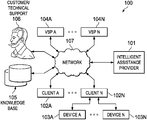
- FIG. 1 illustrates examples of components of an intelligent assistance environment according to some embodiments.
- FIG. 2 illustrates examples of components of an Information Handling System (IHS) according to some embodiments.
- IHS Information Handling System
- FIG. 3 illustrates examples of components of a voice service according to some embodiments.
- FIG. 4 illustrates examples of components of an intelligent assistance service according to some embodiments.
- FIG. 5 illustrates an example of a method for providing intelligent assistance using voice services according to some embodiments.
- FIG. 6 illustrates an example of a method for providing context-based intelligent assistance according to some embodiments.
- FIG. 1 illustrates components of intelligent assistance environment 100 .
- environment 100 includes client computing devices 102 A-N operated by human users.
- client computing devices 102 A-N may be implemented as instances of Information Handling System (IHS) 200 shown in FIG. 2 .
- IHS Information Handling System
- Network 107 may include any combination of public switched telephone network (PSTN), packet-based communication network (e.g., the Internet), local area network (LAN), metropolitan area network (MAN), wide area network (WAN), or any other communications network, including a wireless network, a cable transmission system, a satellite transmission system, or the like.
- PSTN public switched telephone network
- packet-based communication network e.g., the Internet
- LAN local area network
- MAN metropolitan area network
- WAN wide area network
- Voice service providers (VSPs) 104 A-N may also be coupled to network 107 .
- Each of VSPs 104 A-N may include one or more servers and/or cloud-compute resources configured to provide voice or speech-based assistance to the users of client computing devices 102 A-N.
- VSPs 104 A-N may include APPLE's SIRI, GOOGLE ASSISTANT, AMAZON ALEXA, MICROSOFT CORTANA, IBM WATSON, and/or certain components thereof, which may be available as a service to third-parties and/or developers.
- software executed by client device 102 A may detect an utterance or verbal command issued by the user.
- Client device 102 A collects and packetizes the audio signal, and transmits the audio signal to at least one of VSPs 104 A-N.
- the receiving VSP 104 A-N decodes and/or interpret the contents of the packetized audio signal, and then performs some responsive action based upon the decoding and/or interpretation.
- Voice commands interpreted by VSPs 104 A-N can span a wide range of applications.
- VSP 104 A may return an audio file with an audio response, which client device 102 A may play back to the user through a speaker.
- commands can be more complex: if a user asks client device 102 A to play a song by a particular artist, VSP 104 A may identify the name of artist in the user's utterance, and it may then search a third-party music service (e.g., over network 107 ) set up for that artist. Once the music service is found, VSP 104 A may send a command to client device 102 A to play the requested song.
- a third-party music service e.g., over network 107
- any number of peripheral devices 103 A-N may be coupled to any one of client devices 102 A-N (e.g., via Bluetooth, WiFi, etc.).
- Peripheral devices 103 A-N may include various items such as: cameras, microphones, speakers, user interface devices (e.g., mouse, tablet, totem, etc.), or entire IHSs.
- Intelligent assistance provider 101 knowledgebase provider 105 , and customer/technical support provider 106 are all coupled to network 107 .
- Customer/technical support 106 may enable any services by which an enterprise (e.g., a manufacturer) can provide hardware, software, or other assistance to users of client computing devices 102 A-N.
- support services 106 may be delivered remotely via a website or live by a human being, using chat, messaging, phone calls, remote desktop connections, etc.
- an IHS may include any instrumentality or aggregate of instrumentalities operable to compute, calculate, determine, classify, process, transmit, receive, retrieve, originate, switch, store, display, communicate, manifest, detect, record, reproduce, handle, or utilize any form of information, intelligence, or data for business, scientific, control, or other purposes.
- an IHS may be a personal computer (e.g., desktop or laptop), tablet computer, mobile device (e.g., Personal Digital Assistant (PDA) or smart phone), server (e.g., blade server or rack server), a network storage device, or any other suitable device and may vary in size, shape, performance, functionality, and price.
- An IHS may include Random Access Memory (RAM), one or more processing resources such as a Central Processing Unit (CPU) or hardware or software control logic, Read-Only Memory (ROM), and/or other types of nonvolatile memory.
- RAM Random Access Memory
- CPU Central Processing Unit
- ROM Read-Only Memory
- Additional components of an IHS may include one or more disk drives, one or more network ports for communicating with external devices as well as various I/O devices, such as a keyboard, a mouse, touchscreen, and/or a video display.
- An IHS may also include one or more buses operable to transmit communications between the various hardware components. An example of an IHS is described in more detail below.
- FIG. 2 illustrates an example of components of IHS 200 .
- IHS 200 may be used to implement clients 102 A-N and/or devices 103 A-N.
- the hardware components of IHS 200 may also be used to implement certain computing entities of knowledge base 105 , customer/technical support provider 106 , intelligent assistance provider 101 , voice service providers 104 A-N, and/or network 107 .
- IHS 200 includes processor 201 .
- IHS 200 may be a single-processor system, or a multi-processor system including two or more processors.
- Processor 201 may include any processor capable of executing program instructions, such as a PENTIUM, CORE, XEON, ATOM, or CELERON series processor, or any general-purpose or embedded processors implementing any of a variety of Instruction Set Architectures (ISAs), such as an x86 or x86-64 (AMD64) ISA, or a Reduced Instruction Set Computer (RISC) ISA (e.g., POWERPC, ARM, SPARC, MIPS, etc.).
- ISAs Instruction Set Architectures
- AMD64 x86 or x86-64
- RISC Reduced Instruction Set Computer
- IHS 200 includes chipset 202 , which may comprise one or more integrated circuits (ICs) coupled to processor 201 .
- chipset 202 may utilize a QuickPath Interconnect (QPI) bus to communicate with processor 201 .
- Chipset 202 provides processor 201 with access to a variety of resources. For instance, chipset 202 provides access to memory 203 .
- Memory 203 may be configured to store program instructions and/or data accessible by processor 201 .
- memory 203 may be implemented using any suitable memory technology, such as static RAM (SRAM), dynamic RAM (DRAM) or magnetic disks, or any nonvolatile/Flash-type memory, such as a solid-state drive (SSD) or the like.
- SRAM static RAM
- DRAM dynamic RAM
- SSD solid-state drive
- Chipset 202 may also provide access to graphics processor 204 .
- graphics processor 204 may be part of one or more video or graphics cards installed as components of IHS 200 .
- Graphics processor 204 may be coupled to chipset 202 via a graphics bus such as provided by an AGP (Accelerated Graphics Port) bus or a PCIe (Peripheral Component Interconnect Express) bus.
- graphics processor 204 may be integrated into CPU or processor 201 . In operation, graphics processor 204 generates display signals and provides them to a monitor, panel, or other display device.
- Embedded Controller (EC) 206 may be coupled to processor 201 via chipset 202 using SPI, eSPI, System Management Bus (SMBus), or shared interface techniques.
- EC 206 may be implemented as a microcontroller that handles tasks that the OS does not handle, such as receiving and processing signals from a keyboard, turning the IHS on and off, thermal measurement and response, controlling visual indicators, managing a battery, allowing remote diagnostics, service, and remediation, etc.
- OS-to-EC Application Programming Interfaces APIs may be provided by EC 206 to the OS which allows the OS to make requests to EC 206 regarding various components of IHS 200 .
- audio controller 208 may include an audio front-end (AFE) configured to clean up input speech from near- and far-field sources, and a wake word engine (WWE) configured to recognize commands that trigger the launching or operation of a voice service.
- AFE audio front-end
- WWE wake word engine
- audio controller 208 may include circuitry and/or program instructions configured to perform beamforming, echo cancellation, noise suppression, integrated audio decoding and post-processing, and/or multi-room networking and audio output.
- Memory 203 may store program instructions that, upon execution by processor 201 , provide intelligent assistant agent 211 configured to send utterances to VSPs 104 A-N and/or to receive directives from intelligent assistant provider 101 .
- intelligent assistant agent 211 may be configured to perform operations usable to implement techniques described in more detail below.
- intelligent assistant agent 211 may provide APIs to route commands to local applications that can handle those commands (e.g., retrieve support topics for a local technical support application, send and receive questions to customer/technical support provider 106 , enable gaming capabilities in certain IHSs, specific platform functions, etc.).
- intelligent assistant agent 211 or any portion thereof may be executed by audio controller 208 .
- NLU module 304 may use a lexicon, a parser, and/or grammar rules to break sentences into internal representations.
- the language interpretation capabilities of NLU module 304 may depend on the internal semantic theory or algorithm it employs, which can use stochastic and/or pragmatic semantic analysis to derive meaning from context.
- NLU module 304 may enable voice service engine 301 to implement word filters, sentiment detection, topic classification, etc.
- Intelligent assistance engine 401 is coupled to client devices 102 A-N via client connectivity manager 402 , and it is coupled to VSPs 104 A-N via VSP gateway 403 .
- Intelligent assistance engine 401 may provide APIs that interface from the voice skills side (e.g., AMAZON's “AWS Lambda” or MICROSOFT's “Bot Framework”) of VSP 104 A-N (e.g., voice services engine 301 ) to one or more target client devices 102 A-N.
- the voice skills side e.g., AMAZON's “AWS Lambda” or MICROSOFT's “Bot Framework”
- VSP 104 A-N e.g., voice services engine 301
- Intelligent assistance engine 401 may also be configured to route messages to a voice endpoint, which allows VSP 104 A-N to reach a target client device or multiple devices, and/or to serve as a connection broker to client devices 102 A-N (e.g., open low traffic connectivity for closed loop device control/access).
- a voice endpoint which allows VSP 104 A-N to reach a target client device or multiple devices, and/or to serve as a connection broker to client devices 102 A-N (e.g., open low traffic connectivity for closed loop device control/access).
- client connectivity manager 402 may be configured to receive requests, instructions, information and/or output signals from client devices 102 A-N, which may include, but are not limited to: a user's identification, preferences, and/or credentials (e.g., username, account name); the device's hardware and software identification and/or configuration (e.g., a manufacturer's service tag or serial number); use and/or deployment context (e.g., mode of operation, maximized/minimized or open/closed software applications); physical and/or geographical location (e.g., latitude and longitude, geographic market or region); identification, type and/or quality of network connectivity (e.g., IP address, MAC address, bandwidth); etc.
- client devices 102 A-N may include, but are not limited to: a user's identification, preferences, and/or credentials (e.g., username, account name); the device's hardware and software identification and/or configuration (e.g., a manufacturer's service tag or serial number); use and/or deployment context (e.g.
- client connectivity manager 402 may also receive an indication that a service provided by VSPs 104 A-N has been accessed by client devices 102 A-N, as well as any information associated with the service (or session), such as the VSPs 104 A-N′s response to request(s) issued by client devices 102 A-N.
- VSP gateway 403 may be configured to receive requests, instructions, information and/or output signals from any of VSPs 104 A-N, which may include, but are not limited to: a VSP's identification, status, and/or configuration; input signal 305 and/or output signal 306 ; data from voice services engine 301 , STT module 302 , NLP module 303 , and/or NLU module 304 ; etc. In some cases, VSP gateway 403 may also receive information associated with voice service requests request(s) issued by client devices 102 A-N targeting VSPs 104 A-N.
- Intelligent assistant engine 401 also controls and maintains rules database 404 and context and/or state database 405 , and each database is configured to store entries related to each of VSPs 104 A-N and client devices 102 A-N.
- rules database 404 may include logic rules that determine aspects of the operation of engine 401 , described in more detail below.
- Context and/or state database 405 may include, for each client device 102 A-N and/or user, a current physical location, a list of open applications (minimized or maximized), available hardware resources, information about nearby devices, information about preceding voice-based interactions in the same or a different session, etc.
- databases 404 and 405 may be consolidated and/or physically distributed across different sites.
- Each of databases 404 and/or 405 may include any suitable type of application and/or data structure that may be configured as a persistent data repository.
- databases 404 and 405 may be configured as relational databases that include one or more tables of columns and rows and that may be searched or queried according to a query language, such as a version of Structured Query Language (SQL).
- SQL Structured Query Language
- databases 404 and/or 405 may be configured as a structured data stores that include data records formatted according to a markup language, such as eXtensible Markup Language (XML).
- XML eXtensible Markup Language
- databases 404 and/or 405 may be implemented using one or more arbitrarily or minimally structured data files managed and accessible through any suitable type of application, and/or may include a database management system (DBMS) configured to manage the creation, maintenance, and use of databases 404 and/or 405 .
- DBMS database management system
- intelligent assistance engine 401 may be configured to provide voice-based functionality to client devices 102 A-N that would otherwise not be available directly from VSPs 104 A-N. Additionally, or alternatively, intelligent assistance engine 401 may be configured to complement, create, add, and/or modify certain voice-based functionality provided by VSPs 104 A-N.
- intelligent assistance engine 401 may enable session-, context-, user-, and/or device-aware voice-based interactions, providing voice-based functionality in the area of device control.
- engine 401 may interpret and/or modify input 305 and/or output 306 depending upon specific hardware and/or software features of a given client device, in order to control components of that client device.
- engine 401 may be configured to interpret and/or modify input 305 and/or output 306 depending upon user preferences, use, context, and/or mode (e.g., software application being executed, peripheral coupled to the client device, etc.). These interactions may take place, for example, during a technical support session with a live agent 106 , or any other operation involving knowledgebase 105 .
- mode e.g., software application being executed, peripheral coupled to the client device, etc.
- engine 401 may enable operations that are specific to a client device's out-of-box experience (OOBE), backup or maintenance processes, etc.
- OOBE out-of-box experience
- OS Operating System
- a voice serve may introduce itself (e.g., via an audio prompt), and the service may walk a user through a manufacturer's (or other) registration process.
- engine 401 may be configured to control multiple client devices, so support commands such as: “update all of my computers” and “lock all of my computers” may be executed.
- engine 401 may enable operations beyond support software exoneration (e.g., maxed CPU, disk usage, optimizations), and may present a pathway to offer upgrades/accessories to make a customer's IHS faster, for example (e.g., HDD to SSD upgrade, addition of memory, and check system capabilities vs. updates available).
- engine 401 Other examples of capabilities enabled by engine 401 include platform device control (e.g., volume and display, as well as extended functions, such “locking or updating all of my computers.”), level 1 technical support (e.g., information lookups, warranty info, optimizations, and level 1 support commands such as “why is my computer slow?”), and backup (e.g., proactive experiences and procedures for helping users to broker and setup backups using cloud storage or backup solutions).
- platform device control e.g., volume and display, as well as extended functions, such “locking or updating all of my computers.”
- level 1 technical support e.g., information lookups, warranty info, optimizations, and level 1 support commands such as “why is my computer slow?”
- backup e.g., proactive experiences and procedures for helping users to broker and setup backups using cloud storage or backup solutions.
- FIG. 5 illustrates an example of method 500 for providing intelligent assistance using voice services.
- method 500 may involve the participation of client 102 (e.g., one of clients 102 A-N), VSP 104 (e.g., one of VSPs 104 A-N), and/or intelligent assistance provider 101 .
- client 102 e.g., one of clients 102 A-N
- VSP 104 e.g., one of VSPs 104 A-N
- intelligent assistance provider 101 e.g., one of VSPs 104 A-N
- client 102 uses intelligent assistant agent 211 (in FIG. 2 ) to transmit identification, state, configuration, operation, and/or context information 501 to intelligent assistance provider 101 . Then, client 102 captures and transmits audio instruction 502 to VSP 104 . In response, VSP 104 converts audio instruction 502 into text instruction 504 , and transmits text instruction(s) 504 to intelligent assistance provider 101 . Then, client 102 receives command 505 from intelligent assistance provider 101 , which is generated by provider 101 using text instruction(s) 504 , and executes command 505 .
- intelligent assistant agent 211 in FIG. 2
- client 102 captures and transmits audio instruction 502 to VSP 104 .
- VSP 104 converts audio instruction 502 into text instruction 504 , and transmits text instruction(s) 504 to intelligent assistance provider 101 .
- client 102 receives command 505 from intelligent assistance provider 101 , which is generated by provider 101 using text instruction(s) 504 , and executes command 505 .
- client 102 receives audio response 503 from VSP 104 .
- intelligent assistant agent 211 may be configured to synchronize playback of audio response 503 with execution of command 505 , for example, when audio response 503 is received at a time different than (e.g., prior to) command 505 .
- playback of audio response 503 may be buffered pending execution of command 505 .
- execution of command 505 may be buffered pending playback of audio response 503 .
- Identification and/or context information 501 , audio instruction 502 , and/or text instruction(s) 504 may include a service tag of client device 102 .
- the term “service tag” refers to a unique number (or alphanumeric string) assigned to client 102 (often found on the bottom, side, or back of the product), as part of the manufacturing of client 102 .
- use of a service tag enables intelligent assistance provider 101 to generate command 505 , for example, using technical support information associated with client 102 , which many be stored by customer/technical support provider 106 and retrievable by intelligent assistance provider 101 over network 107 .
- intelligent assistance provider 101 may be configured to generate command 505 by applying rules, stored in rule database 404 , to context information 501 stored in context database 405 , as context information 501 is provided to intelligent assistance provider 101 via client connectivity manager 405 .
- command 505 may be generated based upon an interpretation of audio instruction 502 made in light of context information 501 that is not available to VSP 104 .
- context information 501 may include a network connection state or physical location of client 102 , and/or a time of audio instruction 502 .
- intelligent assistance provider 101 may be capable of determine, for instance, whether client 102 is at a known work site at the time of instruction 502 . If so, command 505 may enable operations in client 102 that cannot be made available off-site, such as: accessing out-of-band resources, handling selected documents, etc.—without VSP 104 having the location, network, and/or time information.
- context information 501 may include identification and status of a software application executable by client 102 .
- intelligent assistance provider 101 may be capable of determine, for instance, whether client 102 has the application installed and/or in execution, as well as whether the application is maximized, minimized, or closed, at the time of instruction 502 .
- command 505 may enable operations in client 102 that are specific to a particular application, such as: playing a media file, editing a document, performing a backup operation, etc.—without VSP 104 having the software application information.
- context information 501 may include an identification of hardware parts (e.g., components 201 - 210 ) or peripheral devices (e.g., devices 103 A-N) coupled to client 102 , such as name, type, model, status, etc. And, in these cases, command 505 may enable client 102 to apply command 505 to the hardware part or peripheral device—without VSP 104 having the hardware part or peripheral device information.
- hardware parts e.g., components 201 - 210
- peripheral devices e.g., devices 103 A-N
- command 505 may enable client 102 to apply command 505 to the hardware part or peripheral device—without VSP 104 having the hardware part or peripheral device information.
- text instruction(s) 504 may be generated, at least in part, by brokering the use of different language models during a speech recognition operation performed by VSP 104 .
- at least one of the different language models may be selected based upon context information 501 .
- the selected language model may include a term, such as a brand, a service, a product, an operation, etc., that is relevant to client 102 having its current configuration as of the time of audio instruction 502 —even if the term is not otherwise recognized by VSP 104 based upon audio instruction 502 alone, for example, using a generic language model.
- speech-to-text conversion may be accomplished using sets of data to train two components: (a) a recurrent neural network (RNN), which handles audio-to-character or phoneme conversion, and (b) a language model, which converts raw character/phoneme input into grammatically correct sentences and thoughts using n-gram beam search methods.
- RNN recurrent neural network
- language model which converts raw character/phoneme input into grammatically correct sentences and thoughts using n-gram beam search methods.
- Additional context information can enable context-based intelligent assistance systems and methods described herein to dynamically load a domain-specific language model in parallel to the primary general language model for accuracy refinement.
- Multiple hits on a particular domain model may be used to improve prediction biases to the domain model.
- deploying with domain-specific language models enables the retraining of a specific domain lexicon for lexical updates, rather than requiring retraining of the general language model.
- Domain-specific language models also facilitate multi-language domains to be isolated from their native language model supersets.
- systems and methods described herein may be said to be “speech engine agnostic,” meaning that the intelligence assistance engine is capable of using any or all of voice services 104 A-N to implement the same or different skills.
- the architecture described herein scales up to supporting millions of devices.
- the industry's focus has been toward command/control or query/answer; not user experiences that interact with a user to solve problems and enable future use cases that require more than a simple cloud response/action.
- client device skills may be written that work whether using ALEXA, CORTANA, GOOGLE ASSISTANT, or any other suitable voice service.
- method 600 for providing context-based intelligent assistance is depicted.
- method 600 may be performed exclusively by VSP 104 , and each of components 602 - 606 may be implemented by voice services engine 301 .
- method 600 may be performed exclusively by intelligence assistant provider 101 , and each of components 602 - 606 may be implemented by intelligence assistance engine 401 .
- method 600 may be performed through cooperation between VSP 104 and intelligence assistant provider 101 , facilitated by an exchange of text message(s) 504 , such that one or more of components 602 - 606 are implemented by intelligence assistance engine 401 , and one or more other components 602 - 606 are implemented by voice services engine 301 .
- method 600 may use dynamic contextual knowledge from speech and non-speech sources to control loading and bias towards domain-specific language models.
- the output of the generic language model provides the following text: “Cindy I was the alien we're nvidia Titan X. P. demo for cigarettes coming along.”
- a first domain-specific language model 605 A may be selected based upon context information 501 indicating that client 102 is from a given manufacturer, and therefore may include terms particular to products from that manufacturer.
- the output of first domain-specific language model 605 A may include the term “Alienware” (which may also be provided to second domain-specific model 605 B).
- second domain-specific language model 605 B may be selected based upon context information 501 indicating that client 102 is configured with a particular graphics hardware part or peripheral component, and therefore may include terms particular to products from that hardware part or peripheral.
- the output of second domain-specific language model 605 B may include the terms “NVidia Titan Xp” and “Siggraph”).
- the output of beam searcher 606 may provide “Cindy how is the Alienware NVidia Titan Xp demo for Siggraph coming along?” after using the corrected words and grammar structures to fix “I was” and to add the question mark to complete the sentence.
- intelligent assistant agent 211 may include a conversational bot or chatbot software with a neural network-based speech to text engine at its core.
- the software may have knowledge of running user applications, service entitlements, geography, IT-managed internal company language models (e.g., including internal product and service names, etc.), calendar meetings, and organization directory data.
- Domain-specific language models that may be used by the bot may include: (a) application-specific language models managed by application developers (e.g., cells, sheets, formulas, rows, columns, etc. for a spreadsheet application lexicon), (b) third-party user-added language models for personalization (e.g., putter, chip, pin, trap, drive, etc.
- application developers e.g., cells, sheets, formulas, rows, columns, etc. for a spreadsheet application lexicon
- third-party user-added language models for personalization e.g., putter, chip, pin, trap, drive, etc.
- language models may be loaded into the speech-to-text engine permanently or dynamically based on contextual event data.
- language models may be weighted more heavily when domain models are being heavily used, and may be updated and managed independently of the rest of the solution, streamlining and enriching speech-to-text experiences.
- audio instruction 502 may include a verbal registration request as part of an Out-of-Box-Experience (OOBE) of client device 102 .
- intelligent assistant provider 101 may check a registration record, and it may cause VSP 104 to return audio response 503 that allows the user to interactively proceed though one or more steps of a registration process to make the user aware of voice skills or commands available to client device 102 .
- audio response 503 may describe functions available specifically to client device 102 , such as: information and help functions; platform operation for device 102 (e.g., display control, volume control, locking, etc.) and/or other devices registered to the same user or in the physical vicinity of device 102 ; support, update, security, and backup operations; information about devices belonging to the same user account; etc.
- the systems and methods described herein may provide a pathway to offer the user upgrades and/or accessories to client device 102 (e.g., audio instruction 502 may check system capabilities against updates available).
Landscapes
- Engineering & Computer Science (AREA)
- Physics & Mathematics (AREA)
- Health & Medical Sciences (AREA)
- Computational Linguistics (AREA)
- Theoretical Computer Science (AREA)
- Human Computer Interaction (AREA)
- Audiology, Speech & Language Pathology (AREA)
- Multimedia (AREA)
- General Engineering & Computer Science (AREA)
- Artificial Intelligence (AREA)
- Acoustics & Sound (AREA)
- General Physics & Mathematics (AREA)
- Software Systems (AREA)
- General Health & Medical Sciences (AREA)
- Mathematical Physics (AREA)
- Computing Systems (AREA)
- Evolutionary Computation (AREA)
- Data Mining & Analysis (AREA)
- Life Sciences & Earth Sciences (AREA)
- Biomedical Technology (AREA)
- Biophysics (AREA)
- Molecular Biology (AREA)
- User Interface Of Digital Computer (AREA)
Abstract
Description
Claims (20)
Priority Applications (1)
| Application Number | Priority Date | Filing Date | Title |
|---|---|---|---|
| US15/967,642 US10692493B2 (en) | 2018-05-01 | 2018-05-01 | Intelligent assistance using voice services |
Applications Claiming Priority (1)
| Application Number | Priority Date | Filing Date | Title |
|---|---|---|---|
| US15/967,642 US10692493B2 (en) | 2018-05-01 | 2018-05-01 | Intelligent assistance using voice services |
Publications (2)
| Publication Number | Publication Date |
|---|---|
| US20190341029A1 US20190341029A1 (en) | 2019-11-07 |
| US10692493B2 true US10692493B2 (en) | 2020-06-23 |
Family
ID=68385424
Family Applications (1)
| Application Number | Title | Priority Date | Filing Date |
|---|---|---|---|
| US15/967,642 Active 2038-08-11 US10692493B2 (en) | 2018-05-01 | 2018-05-01 | Intelligent assistance using voice services |
Country Status (1)
| Country | Link |
|---|---|
| US (1) | US10692493B2 (en) |
Cited By (2)
| Publication number | Priority date | Publication date | Assignee | Title |
|---|---|---|---|---|
| CN111933129A (en) * | 2020-09-11 | 2020-11-13 | 腾讯科技(深圳)有限公司 | Audio processing method, language model training method and device and computer equipment |
| US20230046055A1 (en) * | 2021-08-16 | 2023-02-16 | Google Llc | Appending assistant server requests, from a client assistant,with proactively-aggregated peripheral device data |
Families Citing this family (4)
| Publication number | Priority date | Publication date | Assignee | Title |
|---|---|---|---|---|
| US11211064B2 (en) * | 2019-01-23 | 2021-12-28 | Soundhound, Inc. | Using a virtual assistant to store a personal voice memo and to obtain a response based on a stored personal voice memo that is retrieved according to a received query |
| CN113593543B (en) * | 2020-04-30 | 2024-06-11 | 浙江未来精灵人工智能科技有限公司 | Intelligent loudspeaker voice service system, method, device and equipment |
| CN111738013A (en) * | 2020-06-16 | 2020-10-02 | 中国建设银行股份有限公司 | Voice interaction method, device, self-service device, server and medium |
| CN112904747A (en) * | 2021-01-29 | 2021-06-04 | 成都视海芯图微电子有限公司 | Control system and control method based on intelligent sensing |
Citations (4)
| Publication number | Priority date | Publication date | Assignee | Title |
|---|---|---|---|---|
| US8032383B1 (en) * | 2007-05-04 | 2011-10-04 | Foneweb, Inc. | Speech controlled services and devices using internet |
| US20150194152A1 (en) * | 2014-01-09 | 2015-07-09 | Honeywell International Inc. | Far-field speech recognition systems and methods |
| US9390716B2 (en) * | 2013-04-19 | 2016-07-12 | Panasonic Intellectual Property Corporation Of America | Control method for household electrical appliance, household electrical appliance control system, and gateway |
| US20180108357A1 (en) * | 2016-10-14 | 2018-04-19 | Beijing Baidu Netcom Science And Technology Co., L Td. | Virtual reality speech control method and apparatus |
-
2018
- 2018-05-01 US US15/967,642 patent/US10692493B2/en active Active
Patent Citations (4)
| Publication number | Priority date | Publication date | Assignee | Title |
|---|---|---|---|---|
| US8032383B1 (en) * | 2007-05-04 | 2011-10-04 | Foneweb, Inc. | Speech controlled services and devices using internet |
| US9390716B2 (en) * | 2013-04-19 | 2016-07-12 | Panasonic Intellectual Property Corporation Of America | Control method for household electrical appliance, household electrical appliance control system, and gateway |
| US20150194152A1 (en) * | 2014-01-09 | 2015-07-09 | Honeywell International Inc. | Far-field speech recognition systems and methods |
| US20180108357A1 (en) * | 2016-10-14 | 2018-04-19 | Beijing Baidu Netcom Science And Technology Co., L Td. | Virtual reality speech control method and apparatus |
Cited By (4)
| Publication number | Priority date | Publication date | Assignee | Title |
|---|---|---|---|---|
| CN111933129A (en) * | 2020-09-11 | 2020-11-13 | 腾讯科技(深圳)有限公司 | Audio processing method, language model training method and device and computer equipment |
| US20230046055A1 (en) * | 2021-08-16 | 2023-02-16 | Google Llc | Appending assistant server requests, from a client assistant,with proactively-aggregated peripheral device data |
| US11978450B2 (en) * | 2021-08-16 | 2024-05-07 | Google Llc | Appending assistant server requests, from a client assistant, with proactively-aggregated peripheral device data |
| US12505841B2 (en) | 2021-08-16 | 2025-12-23 | Google Llc | Appending assistant server requests, from a client assistant, with proactively-aggregated peripheral device data |
Also Published As
| Publication number | Publication date |
|---|---|
| US20190341029A1 (en) | 2019-11-07 |
Similar Documents
| Publication | Publication Date | Title |
|---|---|---|
| US10922738B2 (en) | Intelligent assistance for support agents | |
| US11087377B2 (en) | Agent coaching using voice services | |
| US11157075B2 (en) | Gaze-activated voice services for interactive workspaces | |
| US11158310B2 (en) | Intelligent assistance for handling usage modes | |
| US11164572B2 (en) | Intelligent assistance across voice services | |
| US11276396B2 (en) | Handling responses from voice services | |
| US10692493B2 (en) | Intelligent assistance using voice services | |
| US12135748B2 (en) | Providing command bundle suggestions for an automated assistant | |
| CN107112013B (en) | Platform for creating customizable dialog system engines | |
| US9922648B2 (en) | Developer voice actions system | |
| US9026431B1 (en) | Semantic parsing with multiple parsers | |
| US11423905B2 (en) | Handling away messages with intelligent assistance using voice services | |
| CN113228606A (en) | Semantic CRM copies from mobile communication sessions | |
| CN113039537A (en) | Semantic artificial intelligence agent | |
| US20250094464A1 (en) | Knowledge re-ranking techniques | |
| US11769013B2 (en) | Machine learning based tenant-specific chatbots for performing actions in a multi-tenant system | |
| CN113168639A (en) | Semantic CRM mobile communication session | |
| Ni et al. | Recurrent neural network based language model adaptation for accent mandarin speech | |
| US20250238614A1 (en) | Dynamic vocabularies for conditioning a language model for transforming natural language to a logical form | |
| JP2026027289A (en) | Techniques for building knowledge graphs within limited knowledge domains |
Legal Events
| Date | Code | Title | Description |
|---|---|---|---|
| AS | Assignment |
Owner name: DELL PRODUCTS, LP., TEXAS Free format text: ASSIGNMENT OF ASSIGNORS INTEREST;ASSIGNORS:SWIERK, TODD ERICK;COX, TYLER RYAN;HAMMONS, MARC RANDALL;REEL/FRAME:045677/0156 Effective date: 20180427 |
|
| FEPP | Fee payment procedure |
Free format text: ENTITY STATUS SET TO UNDISCOUNTED (ORIGINAL EVENT CODE: BIG.); ENTITY STATUS OF PATENT OWNER: LARGE ENTITY |
|
| AS | Assignment |
Owner name: CREDIT SUISSE AG, CAYMAN ISLANDS BRANCH, AS COLLAT Free format text: PATENT SECURITY AGREEMENT (CREDIT);ASSIGNORS:DELL PRODUCTS L.P.;EMC CORPORATION;EMC IP HOLDING COMPANY LLC;REEL/FRAME:046286/0653 Effective date: 20180529 Owner name: THE BANK OF NEW YORK MELLON TRUST COMPANY, N.A., A Free format text: PATENT SECURITY AGREEMENT (NOTES);ASSIGNORS:DELL PRODUCTS L.P.;EMC CORPORATION;EMC IP HOLDING COMPANY LLC;REEL/FRAME:046366/0014 Effective date: 20180529 Owner name: CREDIT SUISSE AG, CAYMAN ISLANDS BRANCH, AS COLLATERAL AGENT, NORTH CAROLINA Free format text: PATENT SECURITY AGREEMENT (CREDIT);ASSIGNORS:DELL PRODUCTS L.P.;EMC CORPORATION;EMC IP HOLDING COMPANY LLC;REEL/FRAME:046286/0653 Effective date: 20180529 Owner name: THE BANK OF NEW YORK MELLON TRUST COMPANY, N.A., AS COLLATERAL AGENT, TEXAS Free format text: PATENT SECURITY AGREEMENT (NOTES);ASSIGNORS:DELL PRODUCTS L.P.;EMC CORPORATION;EMC IP HOLDING COMPANY LLC;REEL/FRAME:046366/0014 Effective date: 20180529 |
|
| AS | Assignment |
Owner name: THE BANK OF NEW YORK MELLON TRUST COMPANY, N.A., T Free format text: SECURITY AGREEMENT;ASSIGNORS:CREDANT TECHNOLOGIES, INC.;DELL INTERNATIONAL L.L.C.;DELL MARKETING L.P.;AND OTHERS;REEL/FRAME:049452/0223 Effective date: 20190320 Owner name: THE BANK OF NEW YORK MELLON TRUST COMPANY, N.A., TEXAS Free format text: SECURITY AGREEMENT;ASSIGNORS:CREDANT TECHNOLOGIES, INC.;DELL INTERNATIONAL L.L.C.;DELL MARKETING L.P.;AND OTHERS;REEL/FRAME:049452/0223 Effective date: 20190320 |
|
| STPP | Information on status: patent application and granting procedure in general |
Free format text: NON FINAL ACTION MAILED |
|
| STPP | Information on status: patent application and granting procedure in general |
Free format text: RESPONSE TO NON-FINAL OFFICE ACTION ENTERED AND FORWARDED TO EXAMINER |
|
| STPP | Information on status: patent application and granting procedure in general |
Free format text: NOTICE OF ALLOWANCE MAILED -- APPLICATION RECEIVED IN OFFICE OF PUBLICATIONS |
|
| AS | Assignment |
Owner name: THE BANK OF NEW YORK MELLON TRUST COMPANY, N.A., TEXAS Free format text: SECURITY AGREEMENT;ASSIGNORS:CREDANT TECHNOLOGIES INC.;DELL INTERNATIONAL L.L.C.;DELL MARKETING L.P.;AND OTHERS;REEL/FRAME:053546/0001 Effective date: 20200409 |
|
| STPP | Information on status: patent application and granting procedure in general |
Free format text: PUBLICATIONS -- ISSUE FEE PAYMENT RECEIVED |
|
| STCF | Information on status: patent grant |
Free format text: PATENTED CASE |
|
| AS | Assignment |
Owner name: EMC IP HOLDING COMPANY LLC, TEXAS Free format text: RELEASE OF SECURITY INTEREST AT REEL 046286 FRAME 0653;ASSIGNOR:CREDIT SUISSE AG, CAYMAN ISLANDS BRANCH;REEL/FRAME:058298/0093 Effective date: 20211101 Owner name: EMC CORPORATION, MASSACHUSETTS Free format text: RELEASE OF SECURITY INTEREST AT REEL 046286 FRAME 0653;ASSIGNOR:CREDIT SUISSE AG, CAYMAN ISLANDS BRANCH;REEL/FRAME:058298/0093 Effective date: 20211101 Owner name: DELL PRODUCTS L.P., TEXAS Free format text: RELEASE OF SECURITY INTEREST AT REEL 046286 FRAME 0653;ASSIGNOR:CREDIT SUISSE AG, CAYMAN ISLANDS BRANCH;REEL/FRAME:058298/0093 Effective date: 20211101 |
|
| AS | Assignment |
Owner name: EMC IP HOLDING COMPANY LLC, TEXAS Free format text: RELEASE OF SECURITY INTEREST IN PATENTS PREVIOUSLY RECORDED AT REEL/FRAME (046366/0014);ASSIGNOR:THE BANK OF NEW YORK MELLON TRUST COMPANY, N.A., AS NOTES COLLATERAL AGENT;REEL/FRAME:060450/0306 Effective date: 20220329 Owner name: EMC CORPORATION, MASSACHUSETTS Free format text: RELEASE OF SECURITY INTEREST IN PATENTS PREVIOUSLY RECORDED AT REEL/FRAME (046366/0014);ASSIGNOR:THE BANK OF NEW YORK MELLON TRUST COMPANY, N.A., AS NOTES COLLATERAL AGENT;REEL/FRAME:060450/0306 Effective date: 20220329 Owner name: DELL PRODUCTS L.P., TEXAS Free format text: RELEASE OF SECURITY INTEREST IN PATENTS PREVIOUSLY RECORDED AT REEL/FRAME (046366/0014);ASSIGNOR:THE BANK OF NEW YORK MELLON TRUST COMPANY, N.A., AS NOTES COLLATERAL AGENT;REEL/FRAME:060450/0306 Effective date: 20220329 |
|
| AS | Assignment |
Owner name: DELL MARKETING L.P. (ON BEHALF OF ITSELF AND AS SUCCESSOR-IN-INTEREST TO CREDANT TECHNOLOGIES, INC.), TEXAS Free format text: RELEASE OF SECURITY INTEREST IN PATENTS PREVIOUSLY RECORDED AT REEL/FRAME (053546/0001);ASSIGNOR:THE BANK OF NEW YORK MELLON TRUST COMPANY, N.A., AS NOTES COLLATERAL AGENT;REEL/FRAME:071642/0001 Effective date: 20220329 Owner name: DELL INTERNATIONAL L.L.C., TEXAS Free format text: RELEASE OF SECURITY INTEREST IN PATENTS PREVIOUSLY RECORDED AT REEL/FRAME (053546/0001);ASSIGNOR:THE BANK OF NEW YORK MELLON TRUST COMPANY, N.A., AS NOTES COLLATERAL AGENT;REEL/FRAME:071642/0001 Effective date: 20220329 Owner name: DELL PRODUCTS L.P., TEXAS Free format text: RELEASE OF SECURITY INTEREST IN PATENTS PREVIOUSLY RECORDED AT REEL/FRAME (053546/0001);ASSIGNOR:THE BANK OF NEW YORK MELLON TRUST COMPANY, N.A., AS NOTES COLLATERAL AGENT;REEL/FRAME:071642/0001 Effective date: 20220329 Owner name: DELL USA L.P., TEXAS Free format text: RELEASE OF SECURITY INTEREST IN PATENTS PREVIOUSLY RECORDED AT REEL/FRAME (053546/0001);ASSIGNOR:THE BANK OF NEW YORK MELLON TRUST COMPANY, N.A., AS NOTES COLLATERAL AGENT;REEL/FRAME:071642/0001 Effective date: 20220329 Owner name: EMC CORPORATION, MASSACHUSETTS Free format text: RELEASE OF SECURITY INTEREST IN PATENTS PREVIOUSLY RECORDED AT REEL/FRAME (053546/0001);ASSIGNOR:THE BANK OF NEW YORK MELLON TRUST COMPANY, N.A., AS NOTES COLLATERAL AGENT;REEL/FRAME:071642/0001 Effective date: 20220329 Owner name: DELL MARKETING CORPORATION (SUCCESSOR-IN-INTEREST TO FORCE10 NETWORKS, INC. AND WYSE TECHNOLOGY L.L.C.), TEXAS Free format text: RELEASE OF SECURITY INTEREST IN PATENTS PREVIOUSLY RECORDED AT REEL/FRAME (053546/0001);ASSIGNOR:THE BANK OF NEW YORK MELLON TRUST COMPANY, N.A., AS NOTES COLLATERAL AGENT;REEL/FRAME:071642/0001 Effective date: 20220329 Owner name: EMC IP HOLDING COMPANY LLC, TEXAS Free format text: RELEASE OF SECURITY INTEREST IN PATENTS PREVIOUSLY RECORDED AT REEL/FRAME (053546/0001);ASSIGNOR:THE BANK OF NEW YORK MELLON TRUST COMPANY, N.A., AS NOTES COLLATERAL AGENT;REEL/FRAME:071642/0001 Effective date: 20220329 |
|
| MAFP | Maintenance fee payment |
Free format text: PAYMENT OF MAINTENANCE FEE, 4TH YEAR, LARGE ENTITY (ORIGINAL EVENT CODE: M1551); ENTITY STATUS OF PATENT OWNER: LARGE ENTITY Year of fee payment: 4 |