US10691892B2 - Online contextual advertisement intellectualization apparatus and method based on language analysis for automatically recognizing coined word - Google Patents

Online contextual advertisement intellectualization apparatus and method based on language analysis for automatically recognizing coined word Download PDF

Info

Publication number
US10691892B2
US10691892B2 US15/704,254 US201715704254A US10691892B2 US 10691892 B2 US10691892 B2 US 10691892B2 US 201715704254 A US201715704254 A US 201715704254A US 10691892 B2 US10691892 B2 US 10691892B2
Authority
US
United States
Prior art keywords
coined
coined word
word
dictionary
morpheme
Prior art date
Legal status (The legal status is an assumption and is not a legal conclusion. Google has not performed a legal analysis and makes no representation as to the accuracy of the status listed.)
Expired - Fee Related, expires
Application number
US15/704,254
Other versions
US20180267957A1 (en
Inventor
Chung Hee Lee
Hyun Ki Kim
Sang Kyu Park
Kyung Man Bae
Yong Jin BAE
Ji Hyun Wang
Hyung Jik Lee
Soo Jong LIM
Joon Ho Lim
Myung Gil Jang
Mi Ran Choi
Jeong Heo
Current Assignee (The listed assignees may be inaccurate. Google has not performed a legal analysis and makes no representation or warranty as to the accuracy of the list.)
Electronics and Telecommunications Research Institute ETRI
Original Assignee
Electronics and Telecommunications Research Institute ETRI
Priority date (The priority date is an assumption and is not a legal conclusion. Google has not performed a legal analysis and makes no representation as to the accuracy of the date listed.)
Filing date
Publication date
Application filed by Electronics and Telecommunications Research Institute ETRI filed Critical Electronics and Telecommunications Research Institute ETRI
Assigned to ELECTRONICS AND TELECOMMUNICATIONS RESEARCH INSTITUTE reassignment ELECTRONICS AND TELECOMMUNICATIONS RESEARCH INSTITUTE ASSIGNMENT OF ASSIGNORS INTEREST (SEE DOCUMENT FOR DETAILS). Assignors: BAE, KYUNG MAN, BAE, Yong Jin, JANG, MYUNG GIL, KIM, HYUN KI, LIM, JOON HO, LIM, SOO JONG, PARK, SANG KYU, CHOI, MI RAN, HEO, JEONG, LEE, HYUNG JIK, WANG, JI HYUN, LEE, CHUNG HEE
Publication of US20180267957A1 publication Critical patent/US20180267957A1/en
Application granted granted Critical
Publication of US10691892B2 publication Critical patent/US10691892B2/en
Expired - Fee Related legal-status Critical Current
Adjusted expiration legal-status Critical

Links

Images

Classifications

    • GPHYSICS
    • G06COMPUTING OR CALCULATING; COUNTING
    • G06FELECTRIC DIGITAL DATA PROCESSING
    • G06F40/00Handling natural language data
    • G06F40/20Natural language analysis
    • G06F40/279Recognition of textual entities
    • G06F40/289Phrasal analysis, e.g. finite state techniques or chunking
    • GPHYSICS
    • G06COMPUTING OR CALCULATING; COUNTING
    • G06FELECTRIC DIGITAL DATA PROCESSING
    • G06F40/00Handling natural language data
    • G06F40/20Natural language analysis
    • G06F40/237Lexical tools
    • G06F40/242Dictionaries
    • GPHYSICS
    • G06COMPUTING OR CALCULATING; COUNTING
    • G06FELECTRIC DIGITAL DATA PROCESSING
    • G06F40/00Handling natural language data
    • G06F40/20Natural language analysis
    • G06F40/237Lexical tools
    • GPHYSICS
    • G06COMPUTING OR CALCULATING; COUNTING
    • G06FELECTRIC DIGITAL DATA PROCESSING
    • G06F40/00Handling natural language data
    • G06F40/20Natural language analysis
    • G06F40/268Morphological analysis
    • GPHYSICS
    • G06COMPUTING OR CALCULATING; COUNTING
    • G06FELECTRIC DIGITAL DATA PROCESSING
    • G06F40/00Handling natural language data
    • G06F40/20Natural language analysis
    • G06F40/279Recognition of textual entities
    • G06F40/284Lexical analysis, e.g. tokenisation or collocates
    • GPHYSICS
    • G06COMPUTING OR CALCULATING; COUNTING
    • G06FELECTRIC DIGITAL DATA PROCESSING
    • G06F40/00Handling natural language data
    • G06F40/30Semantic analysis
    • GPHYSICS
    • G06COMPUTING OR CALCULATING; COUNTING
    • G06QINFORMATION AND COMMUNICATION TECHNOLOGY [ICT] SPECIALLY ADAPTED FOR ADMINISTRATIVE, COMMERCIAL, FINANCIAL, MANAGERIAL OR SUPERVISORY PURPOSES; SYSTEMS OR METHODS SPECIALLY ADAPTED FOR ADMINISTRATIVE, COMMERCIAL, FINANCIAL, MANAGERIAL OR SUPERVISORY PURPOSES, NOT OTHERWISE PROVIDED FOR
    • G06Q30/00Commerce
    • G06Q30/02Marketing; Price estimation or determination; Fundraising
    • G06Q30/0241Advertisements
    • G06Q30/0251Targeted advertisements

Definitions

  • the present invention relates to an apparatus and method of processing an online contextual customized advertisement based on a morpheme analysis result.
  • a morpheme denotes a minimum unit having a meaning in linguistics
  • a morphological analyzer performs a function of analyzing a text by a morpheme unit the most suitable for a context.
  • the morphological analyzer may be divided into a method based on a rule and a dictionary and a method based on machine learning.
  • “probabilistic segmentation and tagging of unknown words has proposed a method of segmenting and tagging coined words in the 3-step probabilistic morphological analysis.
  • a segmentation and tagging method for unknown Korean words has been proposed for the 3-step probabilistic morphological analysis.
  • the inventors have proposed a method to learn the suffix patterns from a morpheme tagged corpus, and calculate their probabilities for unknown open word segmentation and tagging in the probabilistic morphological analysis model.
  • a coined word pattern is learned and is combined with a conventional morpheme tagging model to increase a tagging performance for coined words, but an adverse effect occurs in general documents, causing the reduction in performance.
  • U.S. Pat. No. 8,275,607 (Title of the Invention: semi-supervised part-of-speech tagging) has proposed a method that allocates a part of speech to each word based on dictionaries, calculates a Baysian probability value of words unlisted in dictionaries by using surrounding context information as attributes, and allocates the most suitable part of speech.
  • the method needs a dictionary and a learning set established through a manual process, and for this reason, if the field is changed, performance is reduced.
  • the present invention provides an apparatus and a method, which automatically extract a coined word having a high probability that abnormal analysis is performed when analyzing a morpheme, improve a morpheme analysis performance based on the extracted coined word, and improve online context customized advertisement technology by using an improved morphological analyzer.
  • the present invention also provides an apparatus and a method, which perform a morpheme analysis-based automatic verification for extracting only coined words, which cause an actual morpheme analysis error, from among extracted coined words, perform a manual verification on a coined word which has passed the automatic verification, and improve context customized advertisement technology of the advertisement field, where coined words appear frequently, by using a morphological analyzer which is obtained by improving a performance of each of a coined word extractor and a morphological analyzer based on a result of the manual verification.
  • a language analysis apparatus for processing coined word recognition includes: a document collector collecting an online document; a coined word extractor performing coined word filtering on the collected document based on a predetermined coined word extraction pattern and a dictionary to extract a coined word candidate which corresponds to the coined word extraction pattern and is not registered in a coined stop word dictionary; a coined word verifier performing morpheme analysis on the extracted coined word candidate to verify a coined word candidate which does not correspond to a predetermined part of speech and is not registered in a pre-stored morpheme dictionary; a coined word extraction improver refining the coined word extraction pattern, based on a verification result of the coined word verifier and updating the verified coined word candidate in the coined stop word dictionary; and a morpheme analysis improver updating the verified coined word candidate in the morpheme dictionary, based on the verification result of the coined word verifier.
  • a contextual advertisement intellectualization apparatus including the language analysis apparatus includes: a document collector collecting an online document which is to be advertised; a language analyzer performing morpheme analysis on the collected online document by using the language analysis apparatus; a keyword extractor extracting at least one keyword, based on a result of the morpheme analysis; an advertisement matcher extracting advertisement targets matching the extracted at least one keyword from among registered advertisement targets; and an advertisement recommender recommending an advertisement corresponding to an advertisement target, having a highest correlation with the extracted at least one keyword, from among the extracted advertisement targets.
  • a language analysis method based on a language analysis apparatus for processing coined word recognition includes: collecting an online document; performing coined word filtering on the collected document based on a predetermined coined word extraction pattern and a dictionary to extract a coined word candidate which corresponds to the coined word extraction pattern and is not registered in a coined stop word dictionary; performing morpheme analysis on the extracted coined word candidate to verify a coined word candidate which does not correspond to a predetermined part of speech and is not registered in a pre-stored morpheme dictionary; refining the coined word extraction pattern, based on a result of the verification and updating the verified coined word candidate in the coined stop word dictionary; and updating the verified coined word candidate in the morpheme dictionary, based on the result of the verification.
  • a contextual advertisement intellectualization method based on a language analysis method of processing coined word recognition includes: collecting an online document which is to be advertised; performing morpheme analysis on the collected online document, based on the processing of the coined word recognition; extracting at least one keyword, based on a result of the morpheme analysis; extracting advertisement targets matching the extracted at least one keyword from among registered advertisement targets; and recommending an advertisement corresponding to an advertisement target, having a highest correlation with the extracted at least one keyword, from among the extracted advertisement targets, wherein the language analysis method includes: collecting an online document; performing coined word filtering on the collected document based on a predetermined coined word extraction pattern and a dictionary to extract a coined word candidate which corresponds to the coined word extraction pattern and is not registered in a coined stop word dictionary; performing morpheme analysis on the extracted coined word candidate to verify a coined word candidate which does not correspond to a predetermined part of speech and is not registered in a pre-stored
  • FIG. 1 is a block diagram of a language analysis apparatus for automatically recognizing coined words, according to an embodiment of the present invention.
  • FIG. 2 is a block diagram for describing a coined word extractor illustrated in FIG. 1 .
  • FIG. 3 is a block diagram for describing a coined word verifier illustrated in FIG. 1 .
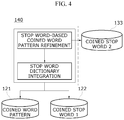
  • FIG. 4 is a block diagram for describing a coined word extraction improver illustrated in FIG. 1 .
  • FIG. 5 is a block diagram for describing a morpheme analysis improver illustrated in FIG. 1 .
  • FIG. 6 is a diagram for describing an example of misanalysis based on a general context customized advertising method.
  • FIG. 7 is a block diagram of a contextual advertisement intellectualization apparatus according to an embodiment of the present invention.
  • FIG. 8 is a block diagram for describing a method of applying the language analysis apparatus of FIG. 1 to a contextual advertisement intellectualization apparatus according to an embodiment of the present invention.
  • FIG. 9 is a flowchart for describing a contextual advertisement intellectualization service method according to an embodiment of the present invention.
  • FIG. 10A and FIG. 10B are a block diagram of a language analysis apparatus and a contextual advertisement intellectualization apparatus according to an exemplary embodiment of the present invention.
  • each of terms such as “ . . . unit”, “ . . . apparatus” and “module” described in specification denotes an element for performing at least one function or operation, and may be implemented in hardware, software or the combination of hardware and software.
  • FIGS. 1 to 5 a language analysis apparatus which improved morpheme analysis performance based on automatic coined word extraction according to an embodiment of the present invention will be described in detail with reference to FIGS. 1 to 5 .
  • the language analysis apparatus which will be described below with reference to FIGS. 1 to 5 may be included in an online contextual advertisement intellectualization apparatus according to an embodiment of the present invention.
  • FIG. 1 is a block diagram of a language analysis apparatus 100 for automatically recognizing coined words, according to an embodiment of the present invention.
  • FIG. 2 is a block diagram for describing a coined word extractor illustrated in FIG. 1 .
  • FIG. 3 is a block diagram for describing a coined word verifier illustrated in FIG. 1 .
  • FIG. 4 is a block diagram for describing a coined word extraction improver illustrated in FIG. 1 .
  • FIG. 5 is a block diagram for describing a morpheme analysis improver illustrated in FIG. 1 .
  • the language analysis apparatus 100 may include a document collector 110 , a coined word extractor 120 , a coined word verifier 130 , a coined word extraction improver 140 , and a morpheme analysis improver 150 .
  • the document collector 110 may collect a target document which coined words are to be extracted from.
  • a document collection target, a collection method, and collection technology of the document collector 110 are not limited to a specific target, method, and technology.
  • the document collector 110 may randomly collect sentences from online text documents, and moreover, may collect sentences which are input as queries by an arbitrary user.
  • the coined word extractor 120 may extract a coined word appearing in sentences which are results of the document collection.
  • the coined word extractor 120 may perform a pattern-based coined word extraction operation as a first step and may perform a dictionary-based filtering operation as a second step.
  • a pattern for extracting coined words may be configured based on “surrounding words” such as a postposition and an ending which are used along with the coined words.
  • Such a coined word extraction pattern may be configured in various methods, and is not limited to one method.
  • a noun coined word is extracted based on “postposition”. Since most of nouns are used along with postpositions, the other parts except a part capable of becoming a postposition from an end in each syntactic word may be used as nouns and may be assumed as coined word candidates.
  • a list of “postpositions” may include “ , ”.
  • a result obtained by extracting syntactic word-based coined words based on the list is shown in the following Table 1.
  • ‘ ’, ‘ ’, ‘ ’, and ‘ ’ may be extracted as the coined word candidates.
  • a coined word pattern database (DB) 121 applied to the pattern-based coined word extraction operation may be included in the coined word extractor 120 , but may be provided in a separate storage space of the language analysis apparatus 100 without being limited thereto.
  • the coined word candidates extracted in the pattern-based coined word extraction operation may be filtered based on a coined stop word dictionary.
  • a stop word dictionary may be a list which is extracted as a noun although not a noun. For example, when it is assumed that ‘ ’ is not included in stop words included in the stop word dictionary, any one of the coined word candidates is not filtered in the dictionary-based filtering operation. Therefore, ‘ ’, ‘ ’, ‘ ’, and ‘ ’ may be selected as final coined word candidates.
  • a coined stop word database 122 (illustrated as “coined stop word 1 database” in FIG. 2 ) applied to the dictionary-based filtering operation may be included in the coined word extractor 120 , but may be provided in a separate storage space of the language analysis apparatus 100 without being limited thereto.
  • the coined word verifier 130 may perform a function of automatically and manually verifying words extracted as coined words by the coined word extractor 120 .
  • the coined word verifier 130 may perform a dictionary-based automatic verification operation as a first step, a morpheme analysis-based automatic verification operation as a second step, and a manual verification operation as a third step.
  • coined words extracted by the coined word extractor 120 may be filtered based on a morpheme dictionary 131 (illustrated as “morpheme dictionary 1 database” in FIG. 3 ).
  • the morpheme dictionary may be a dictionary applied to a morphological analyzer, and in this case, words previously registered in the morpheme dictionary may be excluded from coined word candidates. For example, when it is assumed that ‘ ’ is registered in the morpheme dictionary, ‘ ’ may be excluded from the coined word candidates, and only ‘ ’, ‘ ’ and ‘ ’ may be left.
  • verification may be automatically performed based on a morphological analyzer 132 (illustrated as “morpheme model database” in FIG. 3 ).
  • a morpheme analysis may be performed on an original sentence from which a coined word is extracted.
  • the verification may be determined as pass, but when the morpheme analysis result is analyzed as a part of speech instead of a noun, the verification may be determined as fail.
  • a morpheme analysis result for an exercise sentence from which a coined word candidate is extracted is as follows. That is, when the exercise sentence is “ ”, a morpheme analysis result for the exercise sentence is shown in the following Table 2.
  • noun In defining a part of speech, noun, vcp (predicative postposition), etn (noun changing ending), jks (nominative postposition), xsv (deverbative suffix), etm (prenoun changing ending), jkg (genitive postposition), jkb (adverbial postposition), ep (prefinal ending), ef (final ending), and s (symbol) may be listed in Table 2.
  • ‘ ’ and ‘ ’ of the coined word candidates are not analyzed as a noun, and thus, are determined as verification fail.
  • ‘ ’ is analyzed as a noun, and thus, is determined as verification pass.
  • coined word candidates which are determined as fail in the automatic verification operations may be manually verified.
  • a coined word candidate is analyzed as a noun as a result of morpheme analysis and thus is determined as verification pass, morpheme analysis and coined word extraction may not secondarily be performed, and the coined word candidate may be excluded from manual verification.
  • coined word candidates are determined as fail in automatic verification, this may be classified into two cases as shown in the following Table 4, and the two cases may be manually verified according to different processing methods.
  • ‘ ’ of coined word candidates may correspond to the case 1 and thus may be stored in a coined word dictionary database 134
  • ‘ ’ may correspond to the case 2 and thus may be stored in a coined stop word dictionary 133 (illustrated as “coined stop word 2 database” in FIG. 3 ).
  • the coined word extraction improver 140 may refine a coined word extraction pattern and may extend the coined stop word dictionary.
  • the coined word extraction improver 140 may first perform a coined stop word-based coined word pattern refining operation as an operation of improving the coined word extractor 120 and may second perform a coined stop word integration operation.
  • the coined stop word-based coined word pattern refining operation may process a case corresponding to the case 2 in the manual verification operation. That is, when the coined word extractor 120 extracts a noun coined word but the noun coined word is not a noun, the extracted noun coined word may be stored in the coined stop word dictionary 133 (i.e., the “coined stop word 2 database”). Therefore, based on the ‘ ’ stored in the coined stop word dictionary 133 , the coined stop word-based coined word pattern refining operation may refine a relevant pattern so as not to extract a word having a similar type as a coined word candidate. At this time, the coined word extraction improver 140 may correct the coined word pattern database 121 , which is a previous coined word extraction pattern dictionary, of the coined word extractor 120 to effect an update.
  • the coined word extraction improver 140 may correct the coined word pattern database 121 , which is
  • the coined stop word dictionary integration operation may be an operation of integrating a coined stop word dictionary for excluding coined words, which are not a noun coined word, from the coined word extractor 120 .
  • content of a new coined stop word dictionary 133 i.e., the coined stop word 2 database
  • the coined word pattern database 121 which is a previous coined word extraction pattern dictionary, of the coined word extractor 120 .
  • the ‘ ’ since the ‘ ’ is extracted as a new coined stop word, the ‘ ’ may be added to the coined stop word 1 database which is a previous dictionary.
  • the morpheme analysis improver 150 may generate a morpheme dictionary by using the coined word dictionary 134 generated by the coined word verifier 130 , thereby performing a function of improving a performance of a morphological analyzer.
  • the morpheme analysis improver 150 may perform a morpheme dictionary generation operation as a first step and may perform a morpheme dictionary integration operation as a second step.
  • a processing target may be a case corresponding to the case 1 in a manual operation performed by the coined word verifier 130 . That is, the case may be a case where a coined word candidate is a noun actually but is not analyzed as a noun by the morphological analyzer, the coined word candidate may be stored in a coined word dictionary in the manual operation.
  • ‘ ’ which is stored in the coined word dictionary 134 in the manual operation may be generated as a morpheme dictionary 131 (i.e., the morpheme dictionary 1 database).
  • the morpheme dictionary 131 may be a dictionary applied to the morphological analyzer, and registered words may be used for analyzing morphemes.
  • a format of the morpheme dictionary 1 131 may be diversified depending on the morphological analyzer, and is not limited to one type.
  • a target corresponding to the case 1 may be stored in the morpheme dictionary 1 131 in order for a word to match a correspond part of speech as in the following Table 5.
  • a newly generated morpheme dictionary 151 (illustrated as “morpheme dictionary 2 database in FIG. 5 ) may be additionally integrated into content of the morpheme dictionary 1 131 which is previously used in the morphological analyzer. For example, this may be shown in the following Table 6.
  • the morpheme dictionary 2 151 generated through the above-described operation may be used in the morphological analyzer, and thus, a previously misanalysed sentence may be accurately analyzed as follows. That is, a syntactic word “ ” may be analyzed as “ /noun+ /jks” in a collected sentence.
  • the language analysis apparatus 100 solves a problem where a morpheme of a coined word which is not included in a dictionary or learning data is not accurately analyzed, and thus, may be applied to the advertisement field where a number of coined words appear.
  • Contextual customized advertisement technology which is significant technology in the advertisement field may be technology for recommending an advertisement suitable for context of a body text such as news articles, and in the contextual customized advertisement technology, morpheme analysis technology may perform an essential function. Therefore, the language analysis apparatus 100 according to an embodiment of the present invention improves a customized advertisement recommending function by using the contextual customized advertisement technology.
  • FIG. 6 is a diagram for describing an example of misanalysis based on a general context customized advertising method.
  • FIG. 6 a conventionally overall flow of the contextual customized advertisement technology and a misanalysed example where morpheme analysis is not normally performed based on coined words are illustrated.
  • a document may be collected in step S 610 .
  • the collected document may be a part of a news article associated with vehicles, and a sentence “ ” may be a processing target.
  • step S 620 language analysis may be performed in step S 620 .
  • a processing result obtained in step S 620 a result obtained by performing morpheme analysis on content of the collected document may be shown in the following Table 7.
  • “ ” in “ ” may be analyzed as a pronoun.
  • Table 7 only an example of each of a general noun (NNG) and a pronoun (NP) is shown, and a morpheme analysis result is not limited thereto. In other embodiments, classifications applied to general morpheme analysis may all be used.
  • keyword extraction may be performed based on a result of the language analysis in step S 630 .
  • an essential keyword for recommending an advertisement suitable for content of the document may be extracted, and a noun may be extracted as the essential keyword.
  • a result of the keyword extraction may be shown in the following Table 8.
  • keywords associate with an advertisement target which is to be advertised by an advertisement provider may be previously stored in an advertisement database, and in step S 640 , advertisement matching suitable for the document content among advertisement targets registered in the advertisement database may be performed based on the keyword extraction result.
  • advertisement targets registered by vehicle-related advertisement providers may be stored in the advertisement database.
  • FIG. 6 an example where advertisement targets such as “ ” are stored in association with “ ” is illustrated.
  • advertisement recommendation may be performed based on a result of the advertisement matching in step S 650 .
  • the advertisement recommendation operation may calculate a suitable level matching the document content, based on keyword-based priorities of advertisements selected through the advertisement matching and may finally recommend an advertisement the most suitable for the document content.
  • a significant advertisement target keyword may not be included in keywords extracted based on an analysis result which is obtained in step S 620 . That is, in a collected sentence content, ‘ ’ which is a vehicle model may be a significant keyword, but a pronoun ‘ ’ may be analyzed through morpheme analysis in the language analysis processing operation, whereby the morpheme analysis may be a case where the advertisement matching fails.
  • the contextual advertisement intellectualization apparatus may include a language analyzer corresponding to the language analysis apparatus 100 described above with reference to FIGS. 1 to 5 .
  • FIG. 7 is a block diagram of a contextual advertisement intellectualization apparatus 700 according to an embodiment of the present invention.
  • FIG. 8 is a block diagram for describing a method of applying the language analysis apparatus of FIG. 1 to the contextual advertisement intellectualization apparatus 700 according to an embodiment of the present invention.
  • the contextual advertisement intellectualization apparatus 700 may include a document collector 710 , a language analyzer 720 , a keyword extractor 730 , an advertisement matcher 740 , an advertisement database 750 , and an advertisement recommender 760 .
  • the document collector 710 , the language analyzer 720 , the keyword extractor 730 , the advertisement matcher 740 , and the advertisement recommender 760 of the contextual advertisement intellectualization apparatus 700 may perform processing including operations corresponding to the contextual customized advertisement recommendation operation (S 810 to S 650 ) described above with reference to FIG. 6 .
  • the language analyzer 720 may perform processing differentiated from the contextual customized advertisement recommendation operation (S 620 ).
  • the language analyzer 720 may include a document collector 721 , a coined word extractor 722 , a coined word verifier 723 , a coined word extraction improver 724 , and a morpheme analysis improver 725 .
  • the language analyzer 720 of FIG. 7 may correspond to the language analysis apparatus 100 illustrated in FIG. 1 , and thus, the document collector 721 , the coined word extractor 722 , the coined word verifier 723 , the coined word extraction improver 724 , and the morpheme analysis improver 725 illustrated in FIG. 8 may respectively correspond to the document collector 110 , the coined word extractor 120 , the coined word verifier 130 , the coined word extraction improver 140 , and the morpheme analysis improver 150 of FIG. 1 .
  • FIGS. 7 and 8 an example where “ ” which is not processed by conventional contextual customized advertisement technology is stored as a coined word in a morpheme dictionary in the sentence “ ” collected in FIG. 6 is illustrated.
  • the document collector 710 may collect various documents. To describe an operation of performing improved language analysis on ‘ ’, an example of collecting a document where ‘ ’ appears will be described below.
  • the document collector 721 of the language analyzer 720 may previously collect various documents and may provide the collected documents to the coined word extractor 722 .
  • the document collector 721 may collect a sentence “ ” and a sentence “ ” and may provide the collected documents to the coined word extractor 722 .
  • the coined word extractor 721 may extract ‘ ’, and ‘ ’ as coined words, based on postpositions ‘ ’.
  • the coined word verifier 723 may perform automatic verification and manual verification through dictionary and morpheme analysis to remove ‘ ’ from a coined word candidate and may maintain only ‘ ’ and ‘ ’ as coined words.
  • the coined word extraction improver 724 may register ‘ ’, removed by the coined word verifier 723 , in a stop word dictionary to improve a performance of the coined word extractor 722 .
  • the morpheme analysis improver 725 may register ‘ ’ and ‘ ’, which have passed verification by the coined word verifier 723 , as nouns in a morpheme dictionary.
  • the language analyzer 720 of the contextual advertisement intellectualization apparatus 700 of FIG. 7 may output a morpheme analysis result, shown in the following Table 9, of ‘ ’ in the collected sentence by using a performance-improved morpheme analyzer.
  • the keyword extractor 730 may extract keywords as shown in the following Table 10.
  • the advertisement matcher 740 may extract ‘ ’ including ‘ ’ as an advertisement candidate from among various advertisement targets registered in the advertisement database 750 , based on the extracted keywords.
  • the advertisement recommender 760 may finally recommend ‘ ’ as an advertisement suitable for the document from among the recommended advertisement candidates.
  • FIG. 9 is a flowchart for describing a contextual advertisement intellectualization service method according to an embodiment of the present invention.
  • an online document which a relevant advertisement is to be inserted in may be collected in step S 910 .
  • step S 920 language analysis based on automatic coined word recognition may be performed on content of the collected online document to perform morpheme analysis.
  • a language analysis processing method based on automatic coined word recognition may first collect various online documents in step S 921 , extract new appearing coned word candidates from the collected documents in step S 922 , perform coined word verification on the extracted coined word candidates in step S 923 , refine a coined word extraction pattern and extend a stop word dictionary to improve performance according to whether the coined word candidates are nouns or not as a result of the coined word verification in step S 924 , and add a coined word, generated through the coined word verification result, to the morpheme dictionary to improve morpheme analysis performance in step S 925 .
  • the language analysis processing method based on automatic coined word recognition may correspond to the details described above with reference to FIGS. 1 to 5, 7 , and 8 .
  • step S 930 keyword extraction may be performed based on a morpheme analysis processing result based on automatic coined word recognition.
  • a word corresponding to a noun (a general noun, a proper noun, or the like) in the morpheme analysis processing result may be extracted as a keyword.
  • a candidate may be detected from among advertisement targets registered in a dictionary, based on the extracted keyword.
  • step S 950 a suitable level and a correlation which match the document content may be calculated by grading a keyword-based priority of the detected candidate advertisement target, and a final advertisement target may be set and recommended.
  • FIG. 10A and FIG. 10B are a block diagram of a language analysis apparatus and a contextual advertisement intellectualization apparatus according to an exemplary embodiment of the present invention.
  • a computer system 100 , 700 may include one or more of a processor 1001 , 7001 , a memory 1003 , 7003 , a user input device 1006 , 7006 , a user output device 1007 , 7007 , and a storage 1008 , 7008 , each of which communicates through a bus 1002 , 7002 .
  • the computer system 100 , 700 may also include a network interface 1009 , 7009 that is coupled to a network A.
  • the processor 1001 , 7001 may be a central processing unit (CPU) or a semiconductor device that executes processing instructions stored in the memory 1003 , 7003 and/or the storage 1008 , 7008 .
  • the memory 1003 , 7003 and the storage 1008 , 7008 may include various forms of volatile or non-volatile storage media.
  • the memory may include a read-only memory (ROM) 1004 , 7004 and a random access memory (RAM) 1005 , 7005 .
  • an embodiment of the invention may be implemented as a computer implemented method or as a non-transitory computer readable medium with computer executable instructions stored thereon.
  • the computer readable instructions when executed by the processor, may perform a method according to at least one aspect of the invention.
  • the language analysis apparatus for automatic coined word recognition and the online contextual advertisement intellectualization apparatus and method based on the same may be implemented in the form of a storage medium that includes computer executable instructions, such as program modules, being executed by a computer.
  • Computer-readable media may be any available media that may be accessed by the computer and includes both volatile and nonvolatile media, removable and non-removable media.
  • the computer-readable media may include computer storage media and communication media.
  • Computer storage media includes both the volatile and non-volatile, removable and non-removable media implemented as any method or technology for storage of information such as computer readable instructions, data structures, program modules, or other data.
  • the medium of communication is a typically computer-readable instruction, and other data in a modulated data signal such as data structures, or program modules, or other transport mechanism and includes any information delivery media.
  • a coined word may be extracted based on a coined word extraction pattern, the extracted coined word may be primarily and automatically verified by using a morphological analyzer, and a morphological dictionary and a coined stop word dictionary may be secondarily and automatically established based on a result of the automatic verification. Accordingly, a morphological dictionary which enables a previously misanalysisd morpheme to be accurately analyzed may be provided, and thus, a coined stop word dictionary for decreasing a coined word extraction error may be provided, thereby improving a performance of a coined word extractor.
  • a morphological analyzer for accurately analyzing coined words included in a dictionary and learning data may be provided to automatically extract coined words, the extracted coined words may be automatically and manually verified, and a performance of each of a coined word extractor and a morphological analyzer is improved by using a result of the verification.
  • a performance of morpheme analysis technology which is an essential function for recommending an advertisement suitable for content of a document is improved in the advertisement field, and thus, customized advertisements are effectively recommended in the advertisement field where a number of coined words associated with new products appear.

Landscapes

  • Engineering & Computer Science (AREA)
  • Theoretical Computer Science (AREA)
  • Physics & Mathematics (AREA)
  • General Physics & Mathematics (AREA)
  • Artificial Intelligence (AREA)
  • Health & Medical Sciences (AREA)
  • General Engineering & Computer Science (AREA)
  • General Health & Medical Sciences (AREA)
  • Computational Linguistics (AREA)
  • Audiology, Speech & Language Pathology (AREA)
  • Business, Economics & Management (AREA)
  • Accounting & Taxation (AREA)
  • Development Economics (AREA)
  • Finance (AREA)
  • Strategic Management (AREA)
  • General Business, Economics & Management (AREA)
  • Entrepreneurship & Innovation (AREA)
  • Marketing (AREA)
  • Economics (AREA)
  • Game Theory and Decision Science (AREA)
  • Information Retrieval, Db Structures And Fs Structures Therefor (AREA)
  • Machine Translation (AREA)

Abstract

The language analysis method includes collecting an online document, performing coined word filtering on the collected document based on a predetermined coined word extraction pattern and a dictionary to extract a coined word candidate which corresponds to the coined word extraction pattern and is not registered in a coined stop word dictionary, performing morpheme analysis on the extracted coined word candidate to verify a coined word candidate which does not correspond to a predetermined part of speech and is not registered in a pre-stored morpheme dictionary, refining the coined word extraction pattern, based on a result of the verification and updating the verified coined word candidate in the coined stop word dictionary, and updating the verified coined word candidate in the morpheme dictionary, based on the result of the verification.

Description

CROSS-REFERENCE TO RELATED APPLICATIONS
This application claims priority under 35 U.S.C. § 119 to Korean Patent Application No. 10-2017-0031766, filed on Mar. 14, 2017, the disclosure of which is incorporated herein by reference in its entirety.
TECHNICAL FIELD
The present invention relates to an apparatus and method of processing an online contextual customized advertisement based on a morpheme analysis result.
BACKGROUND
A morpheme denotes a minimum unit having a meaning in linguistics, and a morphological analyzer performs a function of analyzing a text by a morpheme unit the most suitable for a context. Generally, the morphological analyzer may be divided into a method based on a rule and a dictionary and a method based on machine learning.
In relevant technology, “probabilistic segmentation and tagging of unknown words (Bogyum Kim, Jae Sung Lee, 2016)” has proposed a method of segmenting and tagging coined words in the 3-step probabilistic morphological analysis. In detail, a segmentation and tagging method for unknown Korean words has been proposed for the 3-step probabilistic morphological analysis. For guessing unknown word, it uses rich suffixes that are attached to open class words, such as general nouns and proper nouns. The inventors have proposed a method to learn the suffix patterns from a morpheme tagged corpus, and calculate their probabilities for unknown open word segmentation and tagging in the probabilistic morphological analysis model. In such a method, a coined word pattern is learned and is combined with a conventional morpheme tagging model to increase a tagging performance for coined words, but an adverse effect occurs in general documents, causing the reduction in performance.
In another relevant technology, U.S. Pat. No. 8,275,607 (Title of the Invention: semi-supervised part-of-speech tagging) has proposed a method that allocates a part of speech to each word based on dictionaries, calculates a Baysian probability value of words unlisted in dictionaries by using surrounding context information as attributes, and allocates the most suitable part of speech. However, the method needs a dictionary and a learning set established through a manual process, and for this reason, if the field is changed, performance is reduced.
SUMMARY
Accordingly, the present invention provides an apparatus and a method, which automatically extract a coined word having a high probability that abnormal analysis is performed when analyzing a morpheme, improve a morpheme analysis performance based on the extracted coined word, and improve online context customized advertisement technology by using an improved morphological analyzer.
The present invention also provides an apparatus and a method, which perform a morpheme analysis-based automatic verification for extracting only coined words, which cause an actual morpheme analysis error, from among extracted coined words, perform a manual verification on a coined word which has passed the automatic verification, and improve context customized advertisement technology of the advertisement field, where coined words appear frequently, by using a morphological analyzer which is obtained by improving a performance of each of a coined word extractor and a morphological analyzer based on a result of the manual verification.
The objects of the present invention are not limited to the aforesaid, but other objects not described herein will be clearly understood by those skilled in the art from descriptions below.
In one general aspect, a language analysis apparatus for processing coined word recognition includes: a document collector collecting an online document; a coined word extractor performing coined word filtering on the collected document based on a predetermined coined word extraction pattern and a dictionary to extract a coined word candidate which corresponds to the coined word extraction pattern and is not registered in a coined stop word dictionary; a coined word verifier performing morpheme analysis on the extracted coined word candidate to verify a coined word candidate which does not correspond to a predetermined part of speech and is not registered in a pre-stored morpheme dictionary; a coined word extraction improver refining the coined word extraction pattern, based on a verification result of the coined word verifier and updating the verified coined word candidate in the coined stop word dictionary; and a morpheme analysis improver updating the verified coined word candidate in the morpheme dictionary, based on the verification result of the coined word verifier.
In another general aspect, a contextual advertisement intellectualization apparatus including the language analysis apparatus includes: a document collector collecting an online document which is to be advertised; a language analyzer performing morpheme analysis on the collected online document by using the language analysis apparatus; a keyword extractor extracting at least one keyword, based on a result of the morpheme analysis; an advertisement matcher extracting advertisement targets matching the extracted at least one keyword from among registered advertisement targets; and an advertisement recommender recommending an advertisement corresponding to an advertisement target, having a highest correlation with the extracted at least one keyword, from among the extracted advertisement targets.
In another general aspect, a language analysis method based on a language analysis apparatus for processing coined word recognition includes: collecting an online document; performing coined word filtering on the collected document based on a predetermined coined word extraction pattern and a dictionary to extract a coined word candidate which corresponds to the coined word extraction pattern and is not registered in a coined stop word dictionary; performing morpheme analysis on the extracted coined word candidate to verify a coined word candidate which does not correspond to a predetermined part of speech and is not registered in a pre-stored morpheme dictionary; refining the coined word extraction pattern, based on a result of the verification and updating the verified coined word candidate in the coined stop word dictionary; and updating the verified coined word candidate in the morpheme dictionary, based on the result of the verification.
In another general aspect, a contextual advertisement intellectualization method based on a language analysis method of processing coined word recognition includes: collecting an online document which is to be advertised; performing morpheme analysis on the collected online document, based on the processing of the coined word recognition; extracting at least one keyword, based on a result of the morpheme analysis; extracting advertisement targets matching the extracted at least one keyword from among registered advertisement targets; and recommending an advertisement corresponding to an advertisement target, having a highest correlation with the extracted at least one keyword, from among the extracted advertisement targets, wherein the language analysis method includes: collecting an online document; performing coined word filtering on the collected document based on a predetermined coined word extraction pattern and a dictionary to extract a coined word candidate which corresponds to the coined word extraction pattern and is not registered in a coined stop word dictionary; performing morpheme analysis on the extracted coined word candidate to verify a coined word candidate which does not correspond to a predetermined part of speech and is not registered in a pre-stored morpheme dictionary; refining the coined word extraction pattern, based on a result of the verification and updating the verified coined word candidate in the coined stop word dictionary; and updating the verified coined word candidate in the morpheme dictionary, based on the result of the verification.
Other features and aspects will be apparent from the following detailed description, the drawings, and the claims.
BRIEF DESCRIPTION OF THE DRAWINGS
FIG. 1 is a block diagram of a language analysis apparatus for automatically recognizing coined words, according to an embodiment of the present invention.
FIG. 2 is a block diagram for describing a coined word extractor illustrated in FIG. 1.
FIG. 3 is a block diagram for describing a coined word verifier illustrated in FIG. 1.
FIG. 4 is a block diagram for describing a coined word extraction improver illustrated in FIG. 1.
FIG. 5 is a block diagram for describing a morpheme analysis improver illustrated in FIG. 1.
FIG. 6 is a diagram for describing an example of misanalysis based on a general context customized advertising method.
FIG. 7 is a block diagram of a contextual advertisement intellectualization apparatus according to an embodiment of the present invention.
FIG. 8 is a block diagram for describing a method of applying the language analysis apparatus of FIG. 1 to a contextual advertisement intellectualization apparatus according to an embodiment of the present invention.
FIG. 9 is a flowchart for describing a contextual advertisement intellectualization service method according to an embodiment of the present invention.
FIG. 10A and FIG. 10B are a block diagram of a language analysis apparatus and a contextual advertisement intellectualization apparatus according to an exemplary embodiment of the present invention.
DETAILED DESCRIPTION OF EMBODIMENTS
Hereinafter, embodiments of the present invention will be described in detail to be easily embodied by those skilled in the art with reference to the accompanying drawings. The present invention may, however, be embodied in many different forms and should not be construed as being limited to the embodiments set forth herein. The present invention may, however, be embodied in many different forms and should not be construed as being limited to the embodiments set forth herein. In the accompanying drawings, a portion irrelevant to a description of the present invention will be omitted for clarity. Like reference numerals refer to like elements throughout. Also, in providing description with reference to the drawings, although elements are represented by the same name, reference numeral referring to the elements may be changed, and reference numerals are merely described for convenience of description. It should not be construed that concepts, features, functions, or effects of elements are limited by reference numerals.
In this disclosure below, when it is described that one comprises (or includes or has) some elements, it should be understood that it may comprise (or include or has) only those elements, or it may comprise (or include or have) other elements as well as those elements if there is no specific limitation. The present invention may, however, be embodied in many different forms and should not be construed as being limited to the embodiments set forth herein. The meaning of ‘comprise’, ‘include’, or ‘have’ specifies a property, a region, a fixed number, a step, a process, an element and/or a component but does not exclude other properties, regions, fixed numbers, steps, processes, elements and/or components.
In the present specification, each of terms such as “ . . . unit”, “ . . . apparatus” and “module” described in specification denotes an element for performing at least one function or operation, and may be implemented in hardware, software or the combination of hardware and software.
Hereinafter, a language analysis apparatus which improved morpheme analysis performance based on automatic coined word extraction according to an embodiment of the present invention will be described in detail with reference to FIGS. 1 to 5. The language analysis apparatus which will be described below with reference to FIGS. 1 to 5 may be included in an online contextual advertisement intellectualization apparatus according to an embodiment of the present invention.
FIG. 1 is a block diagram of a language analysis apparatus 100 for automatically recognizing coined words, according to an embodiment of the present invention.
FIG. 2 is a block diagram for describing a coined word extractor illustrated in FIG. 1. FIG. 3 is a block diagram for describing a coined word verifier illustrated in FIG. 1. FIG. 4 is a block diagram for describing a coined word extraction improver illustrated in FIG. 1. FIG. 5 is a block diagram for describing a morpheme analysis improver illustrated in FIG. 1.
First, as illustrated in FIG. 1, the language analysis apparatus 100 may include a document collector 110, a coined word extractor 120, a coined word verifier 130, a coined word extraction improver 140, and a morpheme analysis improver 150.
The document collector 110 may collect a target document which coined words are to be extracted from.
A document collection target, a collection method, and collection technology of the document collector 110 are not limited to a specific target, method, and technology. For example, the document collector 110 may randomly collect sentences from online text documents, and moreover, may collect sentences which are input as queries by an arbitrary user.
The coined word extractor 120 may extract a coined word appearing in sentences which are results of the document collection.
Referring to FIG. 2, the coined word extractor 120 may perform a pattern-based coined word extraction operation as a first step and may perform a dictionary-based filtering operation as a second step.
An operation and a process which are performed in the pattern-based coined word extraction operation are as follows.
A pattern for extracting coined words may be configured based on “surrounding words” such as a postposition and an ending which are used along with the coined words. Such a coined word extraction pattern may be configured in various methods, and is not limited to one method.
In an embodiment of the present invention, it is assumed that a noun coined word is extracted based on “postposition”. Since most of nouns are used along with postpositions, the other parts except a part capable of becoming a postposition from an end in each syntactic word may be used as nouns and may be assumed as coined word candidates.
For example, when a sentence “
Figure US10691892-20200623-P00001
Figure US10691892-20200623-P00002
Figure US10691892-20200623-P00003
Figure US10691892-20200623-P00004
Figure US10691892-20200623-P00005
Figure US10691892-20200623-P00006
” is collected, a list of “postpositions” may include “
Figure US10691892-20200623-P00007
,
Figure US10691892-20200623-P00008
”. A result obtained by extracting syntactic word-based coined words based on the list is shown in the following Table 1.
TABLE 1
Coined Word
Syntatic Word Postposition Candidates
Figure US10691892-20200623-P00009
Figure US10691892-20200623-P00010
Figure US10691892-20200623-P00011
Figure US10691892-20200623-P00012
X X
Figure US10691892-20200623-P00013
Figure US10691892-20200623-P00014
Figure US10691892-20200623-P00015
Figure US10691892-20200623-P00016
X X
Figure US10691892-20200623-P00017
Figure US10691892-20200623-P00018
Figure US10691892-20200623-P00019
Figure US10691892-20200623-P00020
Figure US10691892-20200623-P00021
Figure US10691892-20200623-P00022
Figure US10691892-20200623-P00023
X X
In the sentence, ‘
Figure US10691892-20200623-P00024
’, ‘
Figure US10691892-20200623-P00025
’, ‘
Figure US10691892-20200623-P00026
’, and ‘
Figure US10691892-20200623-P00027
’ may be extracted as the coined word candidates.
A coined word pattern database (DB) 121 applied to the pattern-based coined word extraction operation may be included in the coined word extractor 120, but may be provided in a separate storage space of the language analysis apparatus 100 without being limited thereto.
An operation and a process which are performed in the dictionary-based filtering operation will be described below.
In a dictionary-based coined word extraction operation, the coined word candidates extracted in the pattern-based coined word extraction operation may be filtered based on a coined stop word dictionary. In this case, a stop word dictionary may be a list which is extracted as a noun although not a noun. For example, when it is assumed that ‘
Figure US10691892-20200623-P00028
’ is not included in stop words included in the stop word dictionary, any one of the coined word candidates is not filtered in the dictionary-based filtering operation. Therefore, ‘
Figure US10691892-20200623-P00029
’, ‘
Figure US10691892-20200623-P00030
’, ‘
Figure US10691892-20200623-P00031
’, and ‘
Figure US10691892-20200623-P00032
’ may be selected as final coined word candidates.
A coined stop word database 122 (illustrated as “coined stop word 1 database” in FIG. 2) applied to the dictionary-based filtering operation may be included in the coined word extractor 120, but may be provided in a separate storage space of the language analysis apparatus 100 without being limited thereto.
Returning again to FIG. 1, the coined word verifier 130 may perform a function of automatically and manually verifying words extracted as coined words by the coined word extractor 120. Referring again to FIG. 3, the coined word verifier 130 may perform a dictionary-based automatic verification operation as a first step, a morpheme analysis-based automatic verification operation as a second step, and a manual verification operation as a third step.
First, in the dictionary-based automatic verification operation, coined words extracted by the coined word extractor 120 may be filtered based on a morpheme dictionary 131 (illustrated as “morpheme dictionary 1 database” in FIG. 3). The morpheme dictionary may be a dictionary applied to a morphological analyzer, and in this case, words previously registered in the morpheme dictionary may be excluded from coined word candidates. For example, when it is assumed that ‘
Figure US10691892-20200623-P00033
’ is registered in the morpheme dictionary, ‘
Figure US10691892-20200623-P00034
’ may be excluded from the coined word candidates, and only ‘
Figure US10691892-20200623-P00035
’, ‘
Figure US10691892-20200623-P00036
’ and ‘
Figure US10691892-20200623-P00037
’ may be left.
Subsequently, in the morpheme analysis-based automatic verification operation, verification may be automatically performed based on a morphological analyzer 132 (illustrated as “morpheme model database” in FIG. 3). In this case, a morpheme analysis may be performed on an original sentence from which a coined word is extracted. When a morpheme analysis result for coined word candidates is analyzed as a noun, the verification may be determined as pass, but when the morpheme analysis result is analyzed as a part of speech instead of a noun, the verification may be determined as fail.
For example, it is assumed that a morpheme analysis result for an exercise sentence from which a coined word candidate is extracted is as follows. That is, when the exercise sentence is “
Figure US10691892-20200623-P00038
Figure US10691892-20200623-P00039
Figure US10691892-20200623-P00040
Figure US10691892-20200623-P00041
Figure US10691892-20200623-P00042
”, a morpheme analysis result for the exercise sentence is shown in the following Table 2.
TABLE 2
Syntactic Word Morpheme Analysis Result
Figure US10691892-20200623-P00043
Figure US10691892-20200623-P00044
 /noun +  
Figure US10691892-20200623-P00045
 /noun +  
Figure US10691892-20200623-P00046
 /vcp +  
Figure US10691892-20200623-P00047
 /etn +  
Figure US10691892-20200623-P00048
 /jks
Figure US10691892-20200623-P00049
Figure US10691892-20200623-P00050
 /noun +  
Figure US10691892-20200623-P00051
 /xsv +  
Figure US10691892-20200623-P00052
 /etm
Figure US10691892-20200623-P00053
Figure US10691892-20200623-P00054
 /noun +  
Figure US10691892-20200623-P00055
 /jkg
Figure US10691892-20200623-P00056
Figure US10691892-20200623-P00057
 /noun
Figure US10691892-20200623-P00058
Figure US10691892-20200623-P00059
 /noun +  
Figure US10691892-20200623-P00060
 /noun
Figure US10691892-20200623-P00061
Figure US10691892-20200623-P00062
 /noun +  
Figure US10691892-20200623-P00063
 /jkb
Figure US10691892-20200623-P00064
Figure US10691892-20200623-P00065
 /noun +  
Figure US10691892-20200623-P00066
 /xsv +  
Figure US10691892-20200623-P00067
 /ep +  
Figure US10691892-20200623-P00068
 /ef + ./s
In defining a part of speech, noun, vcp (predicative postposition), etn (noun changing ending), jks (nominative postposition), xsv (deverbative suffix), etm (prenoun changing ending), jkg (genitive postposition), jkb (adverbial postposition), ep (prefinal ending), ef (final ending), and s (symbol) may be listed in Table 2.
Moreover, an automatic verification result for each of coined word candidates is shown in the following Table 3.
TABLE 3
Verifi-
cation
Syntactic Word Morpheme Analysis Result Result
Figure US10691892-20200623-P00069
Figure US10691892-20200623-P00070
 /noun +  
Figure US10691892-20200623-P00071
 /noun +  
Figure US10691892-20200623-P00072
 /vcp +  
Figure US10691892-20200623-P00073
 /etn +  
Figure US10691892-20200623-P00074
 /jks
Fail
Figure US10691892-20200623-P00075
Figure US10691892-20200623-P00076
 /noun +  
Figure US10691892-20200623-P00077
 /noun
Fail
Figure US10691892-20200623-P00078
Figure US10691892-20200623-P00079
 /noun +  
Figure US10691892-20200623-P00080
 /jkb
Pass
As shown in Table 3, ‘
Figure US10691892-20200623-P00081
’ and ‘
Figure US10691892-20200623-P00082
’ of the coined word candidates are not analyzed as a noun, and thus, are determined as verification fail. In the coined word candidates, ‘
Figure US10691892-20200623-P00083
’ is analyzed as a noun, and thus, is determined as verification pass.
Finally, in the manual verification operation, coined word candidates which are determined as fail in the automatic verification operations may be manually verified. In detail, when a coined word candidate is analyzed as a noun as a result of morpheme analysis and thus is determined as verification pass, morpheme analysis and coined word extraction may not secondarily be performed, and the coined word candidate may be excluded from manual verification. On the other hand, when coined word candidates are determined as fail in automatic verification, this may be classified into two cases as shown in the following Table 4, and the two cases may be manually verified according to different processing methods.
TABLE 4
Division Explanation Processing Method
Case
1 Case where a coined word Case where improvement
noun candidate is a noun of morpheme analysis
performance is necessary,
and a coined word
dictionary is generated so
as to be used as a
morpheme dictionary for
improvement of
morpheme analysis
performance
Case
2 Case where a coined word Error of a coined word
noun candidate is not a extractor extracting nouns,
noun and a coined stop word
dictionary is generated for
improvement of
morpheme analysis
performance
For example, ‘
Figure US10691892-20200623-P00084
’ of coined word candidates may correspond to the case 1 and thus may be stored in a coined word dictionary database 134, and ‘
Figure US10691892-20200623-P00085
’ may correspond to the case 2 and thus may be stored in a coined stop word dictionary 133 (illustrated as “coined stop word 2 database” in FIG. 3).
Returning again to FIG. 1, by using the coined stop word dictionary 133 (i.e., the “coined stop word 2 database” of FIG. 3) generated by the coined word verifier 130, the coined word extraction improver 140 may refine a coined word extraction pattern and may extend the coined stop word dictionary.
In detail, referring to FIG. 4, the coined word extraction improver 140 may first perform a coined stop word-based coined word pattern refining operation as an operation of improving the coined word extractor 120 and may second perform a coined stop word integration operation.
First, the coined stop word-based coined word pattern refining operation may process a case corresponding to the case 2 in the manual verification operation. That is, when the coined word extractor 120 extracts a noun coined word but the noun coined word is not a noun, the extracted noun coined word may be stored in the coined stop word dictionary 133 (i.e., the “coined stop word 2 database”). Therefore, based on the ‘
Figure US10691892-20200623-P00086
’ stored in the coined stop word dictionary 133, the coined stop word-based coined word pattern refining operation may refine a relevant pattern so as not to extract a word having a similar type as a coined word candidate. At this time, the coined word extraction improver 140 may correct the coined word pattern database 121, which is a previous coined word extraction pattern dictionary, of the coined word extractor 120 to effect an update.
Subsequently, the coined stop word dictionary integration operation may be an operation of integrating a coined stop word dictionary for excluding coined words, which are not a noun coined word, from the coined word extractor 120. In the coined stop word dictionary integration operation, content of a new coined stop word dictionary 133 (i.e., the coined stop word 2 database) may be added to the coined word pattern database 121, which is a previous coined word extraction pattern dictionary, of the coined word extractor 120. For example, since the ‘
Figure US10691892-20200623-P00087
’ is extracted as a new coined stop word, the ‘
Figure US10691892-20200623-P00088
’ may be added to the coined stop word 1 database which is a previous dictionary.
Returning again to FIG. 1, the morpheme analysis improver 150 may generate a morpheme dictionary by using the coined word dictionary 134 generated by the coined word verifier 130, thereby performing a function of improving a performance of a morphological analyzer.
Referring to FIG. 5, the morpheme analysis improver 150 may perform a morpheme dictionary generation operation as a first step and may perform a morpheme dictionary integration operation as a second step.
First, in the morpheme dictionary generation operation, a processing target may be a case corresponding to the case 1 in a manual operation performed by the coined word verifier 130. That is, the case may be a case where a coined word candidate is a noun actually but is not analyzed as a noun by the morphological analyzer, the coined word candidate may be stored in a coined word dictionary in the manual operation. In the morpheme dictionary generation operation, ‘
Figure US10691892-20200623-P00089
’ which is stored in the coined word dictionary 134 in the manual operation may be generated as a morpheme dictionary 131 (i.e., the morpheme dictionary 1 database). In this case, the morpheme dictionary 131 may be a dictionary applied to the morphological analyzer, and registered words may be used for analyzing morphemes. A format of the morpheme dictionary 1 131 may be diversified depending on the morphological analyzer, and is not limited to one type.
For example, in the manual operation performed by the coined word verifier 130, a target corresponding to the case 1 may be stored in the morpheme dictionary 1 131 in order for a word to match a correspond part of speech as in the following Table 5.
TABLE 5
Figure US10691892-20200623-P00090
Subsequently, in the morpheme dictionary integration operation, a newly generated morpheme dictionary 151 (illustrated as “morpheme dictionary 2 database in FIG. 5) may be additionally integrated into content of the morpheme dictionary 1 131 which is previously used in the morphological analyzer. For example, this may be shown in the following Table 6.
TABLE 6
Figure US10691892-20200623-P00091
 NOUN
Figure US10691892-20200623-P00092
 NOUN
Figure US10691892-20200623-P00093
 NOUN
The morpheme dictionary 2 151 generated through the above-described operation may be used in the morphological analyzer, and thus, a previously misanalysed sentence may be accurately analyzed as follows. That is, a syntactic word “
Figure US10691892-20200623-P00094
” may be analyzed as “
Figure US10691892-20200623-P00095
/noun+
Figure US10691892-20200623-P00096
/jks” in a collected sentence.
The language analysis apparatus 100 according to an embodiment of the present invention solves a problem where a morpheme of a coined word which is not included in a dictionary or learning data is not accurately analyzed, and thus, may be applied to the advertisement field where a number of coined words appear. Contextual customized advertisement technology which is significant technology in the advertisement field may be technology for recommending an advertisement suitable for context of a body text such as news articles, and in the contextual customized advertisement technology, morpheme analysis technology may perform an essential function. Therefore, the language analysis apparatus 100 according to an embodiment of the present invention improves a customized advertisement recommending function by using the contextual customized advertisement technology.
Hereinafter, a contextual advertisement intellectualization apparatus and an intellectualization service method thereof according to an embodiment of the present invention will be described in detail with reference to FIGS. 6 to 9.
FIG. 6 is a diagram for describing an example of misanalysis based on a general context customized advertising method.
In FIG. 6, a conventionally overall flow of the contextual customized advertisement technology and a misanalysed example where morpheme analysis is not normally performed based on coined words are illustrated.
First, a document may be collected in step S610.
For example, the collected document may be a part of a news article associated with vehicles, and a sentence “
Figure US10691892-20200623-P00097
Figure US10691892-20200623-P00098
Figure US10691892-20200623-P00099
Figure US10691892-20200623-P00100
Figure US10691892-20200623-P00101
Figure US10691892-20200623-P00102
” may be a processing target.
Subsequently, language analysis may be performed in step S620.
In this case, as a processing result obtained in step S620, a result obtained by performing morpheme analysis on content of the collected document may be shown in the following Table 7.
TABLE 7
< 
Figure US10691892-20200623-P00103
 :NP> 
Figure US10691892-20200623-P00104
  < 
Figure US10691892-20200623-P00105
 | 
Figure US10691892-20200623-P00106
 :NNG> 
Figure US10691892-20200623-P00107
 :NNG> < 
Figure US10691892-20200623-P00108
 :NNG> 
Figure US10691892-20200623-P00109
< 
Figure US10691892-20200623-P00110
 :NNG> < 
Figure US10691892-20200623-P00111
 :NNG> 
Figure US10691892-20200623-P00112
 < 
Figure US10691892-20200623-P00113
 :NNG> 
Figure US10691892-20200623-P00114
 .
That is, “
Figure US10691892-20200623-P00115
” in “
Figure US10691892-20200623-P00116
” may be analyzed as a pronoun. For reference, in Table 7, only an example of each of a general noun (NNG) and a pronoun (NP) is shown, and a morpheme analysis result is not limited thereto. In other embodiments, classifications applied to general morpheme analysis may all be used.
Subsequently, keyword extraction may be performed based on a result of the language analysis in step S630.
In a keyword extraction operation, an essential keyword for recommending an advertisement suitable for content of the document may be extracted, and a noun may be extracted as the essential keyword.
As a processing result obtained in step S630, a result of the keyword extraction may be shown in the following Table 8.
TABLE 8
Figure US10691892-20200623-P00117
Figure US10691892-20200623-P00118
Figure US10691892-20200623-P00119
Moreover, keywords associate with an advertisement target which is to be advertised by an advertisement provider may be previously stored in an advertisement database, and in step S640, advertisement matching suitable for the document content among advertisement targets registered in the advertisement database may be performed based on the keyword extraction result.
For example, various advertisement targets registered by vehicle-related advertisement providers may be stored in the advertisement database. In FIG. 6, an example where advertisement targets such as “
Figure US10691892-20200623-P00120
Figure US10691892-20200623-P00121
” are stored in association with “
Figure US10691892-20200623-P00122
” is illustrated.
Subsequently, advertisement recommendation may be performed based on a result of the advertisement matching in step S650.
The advertisement recommendation operation may calculate a suitable level matching the document content, based on keyword-based priorities of advertisements selected through the advertisement matching and may finally recommend an advertisement the most suitable for the document content. However, a significant advertisement target keyword may not be included in keywords extracted based on an analysis result which is obtained in step S620. That is, in a collected sentence content, ‘
Figure US10691892-20200623-P00123
’ which is a vehicle model may be a significant keyword, but a pronoun ‘
Figure US10691892-20200623-P00124
’ may be analyzed through morpheme analysis in the language analysis processing operation, whereby the morpheme analysis may be a case where the advertisement matching fails.
In order to solve such a problem, the contextual advertisement intellectualization apparatus according to an embodiment of the present invention may include a language analyzer corresponding to the language analysis apparatus 100 described above with reference to FIGS. 1 to 5.
FIG. 7 is a block diagram of a contextual advertisement intellectualization apparatus 700 according to an embodiment of the present invention. FIG. 8 is a block diagram for describing a method of applying the language analysis apparatus of FIG. 1 to the contextual advertisement intellectualization apparatus 700 according to an embodiment of the present invention.
As illustrated in FIG. 7, the contextual advertisement intellectualization apparatus 700 may include a document collector 710, a language analyzer 720, a keyword extractor 730, an advertisement matcher 740, an advertisement database 750, and an advertisement recommender 760. In this case, the document collector 710, the language analyzer 720, the keyword extractor 730, the advertisement matcher 740, and the advertisement recommender 760 of the contextual advertisement intellectualization apparatus 700 may perform processing including operations corresponding to the contextual customized advertisement recommendation operation (S810 to S650) described above with reference to FIG. 6. The language analyzer 720 may perform processing differentiated from the contextual customized advertisement recommendation operation (S620).
That is, as illustrated in FIG. 8, the language analyzer 720 may include a document collector 721, a coined word extractor 722, a coined word verifier 723, a coined word extraction improver 724, and a morpheme analysis improver 725. In this case, the language analyzer 720 of FIG. 7 may correspond to the language analysis apparatus 100 illustrated in FIG. 1, and thus, the document collector 721, the coined word extractor 722, the coined word verifier 723, the coined word extraction improver 724, and the morpheme analysis improver 725 illustrated in FIG. 8 may respectively correspond to the document collector 110, the coined word extractor 120, the coined word verifier 130, the coined word extraction improver 140, and the morpheme analysis improver 150 of FIG. 1.
In FIGS. 7 and 8, an example where “
Figure US10691892-20200623-P00125
” which is not processed by conventional contextual customized advertisement technology is stored as a coined word in a morpheme dictionary in the sentence “
Figure US10691892-20200623-P00126
Figure US10691892-20200623-P00127
Figure US10691892-20200623-P00128
Figure US10691892-20200623-P00129
Figure US10691892-20200623-P00130
” collected in FIG. 6 is illustrated.
The document collector 710 may collect various documents. To describe an operation of performing improved language analysis on ‘
Figure US10691892-20200623-P00131
’, an example of collecting a document where ‘
Figure US10691892-20200623-P00132
’ appears will be described below.
The document collector 721 of the language analyzer 720 may previously collect various documents and may provide the collected documents to the coined word extractor 722. For example, the document collector 721 may collect a sentence “
Figure US10691892-20200623-P00133
Figure US10691892-20200623-P00134
Figure US10691892-20200623-P00135
” and a sentence “
Figure US10691892-20200623-P00136
Figure US10691892-20200623-P00137
Figure US10691892-20200623-P00138
Figure US10691892-20200623-P00139
” and may provide the collected documents to the coined word extractor 722.
Therefore, the coined word extractor 721 may extract ‘
Figure US10691892-20200623-P00140
’, and ‘
Figure US10691892-20200623-P00141
’ as coined words, based on postpositions ‘
Figure US10691892-20200623-P00142
’.
Moreover, the coined word verifier 723 may perform automatic verification and manual verification through dictionary and morpheme analysis to remove ‘
Figure US10691892-20200623-P00143
’ from a coined word candidate and may maintain only ‘
Figure US10691892-20200623-P00144
’ and ‘
Figure US10691892-20200623-P00145
’ as coined words.
Subsequently, the coined word extraction improver 724 may register ‘
Figure US10691892-20200623-P00146
’, removed by the coined word verifier 723, in a stop word dictionary to improve a performance of the coined word extractor 722. Also, the morpheme analysis improver 725 may register ‘
Figure US10691892-20200623-P00147
’ and ‘
Figure US10691892-20200623-P00148
’, which have passed verification by the coined word verifier 723, as nouns in a morpheme dictionary.
Therefore, the language analyzer 720 of the contextual advertisement intellectualization apparatus 700 of FIG. 7 may output a morpheme analysis result, shown in the following Table 9, of ‘
Figure US10691892-20200623-P00149
’ in the collected sentence by using a performance-improved morpheme analyzer.
TABLE 9
< 
Figure US10691892-20200623-P00150
 :NNG> 
Figure US10691892-20200623-P00151
 :NNG> 
Figure US10691892-20200623-P00107
 :NNG> < 
Figure US10691892-20200623-P00152
 :NNG> 
Figure US10691892-20200623-P00021
Figure US10691892-20200623-P00153
< 
Figure US10691892-20200623-P00154
 :NNG> < 
Figure US10691892-20200623-P00155
 :NNG> 
Figure US10691892-20200623-P00156
 :NNG> 
Figure US10691892-20200623-P00157
 .
Furthermore, the keyword extractor 730 may extract keywords as shown in the following Table 10.
TABLE 10
Figure US10691892-20200623-P00158
Figure US10691892-20200623-P00159
Figure US10691892-20200623-P00160
Subsequently, the advertisement matcher 740 may extract ‘
Figure US10691892-20200623-P00161
’ including ‘
Figure US10691892-20200623-P00162
’ as an advertisement candidate from among various advertisement targets registered in the advertisement database 750, based on the extracted keywords.
Then, the advertisement recommender 760 may finally recommend ‘
Figure US10691892-20200623-P00163
’ as an advertisement suitable for the document from among the recommended advertisement candidates.
FIG. 9 is a flowchart for describing a contextual advertisement intellectualization service method according to an embodiment of the present invention.
First, an online document which a relevant advertisement is to be inserted in may be collected in step S910.
Subsequently, in step S920, language analysis based on automatic coined word recognition may be performed on content of the collected online document to perform morpheme analysis.
In this case, a language analysis processing method based on automatic coined word recognition may first collect various online documents in step S921, extract new appearing coned word candidates from the collected documents in step S922, perform coined word verification on the extracted coined word candidates in step S923, refine a coined word extraction pattern and extend a stop word dictionary to improve performance according to whether the coined word candidates are nouns or not as a result of the coined word verification in step S924, and add a coined word, generated through the coined word verification result, to the morpheme dictionary to improve morpheme analysis performance in step S925.
The language analysis processing method based on automatic coined word recognition may correspond to the details described above with reference to FIGS. 1 to 5, 7, and 8.
Subsequently, in step S930, keyword extraction may be performed based on a morpheme analysis processing result based on automatic coined word recognition.
In this case, a word corresponding to a noun (a general noun, a proper noun, or the like) in the morpheme analysis processing result may be extracted as a keyword.
Subsequently, in step S940, a candidate may be detected from among advertisement targets registered in a dictionary, based on the extracted keyword.
Subsequently, in step S950, a suitable level and a correlation which match the document content may be calculated by grading a keyword-based priority of the detected candidate advertisement target, and a final advertisement target may be set and recommended.
FIG. 10A and FIG. 10B are a block diagram of a language analysis apparatus and a contextual advertisement intellectualization apparatus according to an exemplary embodiment of the present invention.
An embodiment of the present invention may be implemented in a computer system, e.g., as a computer readable medium. As shown in in FIG. 10A and FIG. 10B, a computer system 100, 700 may include one or more of a processor 1001, 7001, a memory 1003, 7003, a user input device 1006, 7006, a user output device 1007, 7007, and a storage 1008, 7008, each of which communicates through a bus 1002, 7002. The computer system 100, 700 may also include a network interface 1009, 7009 that is coupled to a network A. The processor 1001, 7001 may be a central processing unit (CPU) or a semiconductor device that executes processing instructions stored in the memory 1003, 7003 and/or the storage 1008, 7008. The memory 1003, 7003 and the storage 1008, 7008 may include various forms of volatile or non-volatile storage media. For example, the memory may include a read-only memory (ROM) 1004, 7004 and a random access memory (RAM) 1005, 7005.
Accordingly, an embodiment of the invention may be implemented as a computer implemented method or as a non-transitory computer readable medium with computer executable instructions stored thereon. In an embodiment, when executed by the processor, the computer readable instructions may perform a method according to at least one aspect of the invention.
The language analysis apparatus for automatic coined word recognition and the online contextual advertisement intellectualization apparatus and method based on the same according to the embodiments of the present invention may be implemented in the form of a storage medium that includes computer executable instructions, such as program modules, being executed by a computer. Computer-readable media may be any available media that may be accessed by the computer and includes both volatile and nonvolatile media, removable and non-removable media. In addition, the computer-readable media may include computer storage media and communication media. Computer storage media includes both the volatile and non-volatile, removable and non-removable media implemented as any method or technology for storage of information such as computer readable instructions, data structures, program modules, or other data. The medium of communication is a typically computer-readable instruction, and other data in a modulated data signal such as data structures, or program modules, or other transport mechanism and includes any information delivery media.
The method and system according to the embodiment of the present invention have been described in association with a specific embodiment, but their elements, some operations, or all operations may be implemented by using a computer system having general-use hardware architecture.
As described above, according to the embodiments of the present invention, a coined word may be extracted based on a coined word extraction pattern, the extracted coined word may be primarily and automatically verified by using a morphological analyzer, and a morphological dictionary and a coined stop word dictionary may be secondarily and automatically established based on a result of the automatic verification. Accordingly, a morphological dictionary which enables a previously misanalysed morpheme to be accurately analyzed may be provided, and thus, a coined stop word dictionary for decreasing a coined word extraction error may be provided, thereby improving a performance of a coined word extractor.
Moreover, according to the embodiments of the present invention, a morphological analyzer for accurately analyzing coined words included in a dictionary and learning data may be provided to automatically extract coined words, the extracted coined words may be automatically and manually verified, and a performance of each of a coined word extractor and a morphological analyzer is improved by using a result of the verification.
Moreover, according to the embodiments of the present invention, a performance of morpheme analysis technology which is an essential function for recommending an advertisement suitable for content of a document is improved in the advertisement field, and thus, customized advertisements are effectively recommended in the advertisement field where a number of coined words associated with new products appear.
A number of exemplary embodiments have been described above. Nevertheless, it will be understood that various modifications may be made. For example, suitable results may be achieved if the described techniques are performed in a different order and/or if components in a described system, architecture, device, or circuit are combined in a different manner and/or replaced or supplemented by other components or their equivalents. Accordingly, other implementations are within the scope of the following claims.

Claims (10)

What is claimed is:
1. A language analysis apparatus for processing coined word recognition, the language analysis apparatus comprising at least one processor and at least one memory comprising a set of computer instructions that when executed by the processor implement the following:
a document collector collecting an online document;
a coined word extractor performing coined word filtering on the collected document based on a predetermined coined word extraction pattern and a dictionary to extract a coined word candidate which corresponds to the coined word extraction pattern and is not registered in a coined stop word dictionary;
a coined word verifier performing morpheme analysis on the extracted coined word candidate to verify a coined word candidate which does not correspond to a predetermined part of speech and is not registered in a pre-stored morpheme dictionary;
a coined word extraction improver refining the coined word extraction pattern, based on a verification result of the coined word verifier and updating the verified coined word candidate in the coined stop word dictionary; and
a morpheme analysis improver updating the verified coined word candidate in the morpheme dictionary, based on the verification result of the coined word verifier,
wherein the coined word verifier is configured to:
extract a coined word candidate, which is not registered in the pre-stored morpheme dictionary, from among the coined word candidates extracted by the coined word extractor,
verify a part of speech of the coined word candidate, which is extracted as being unregistered in the morpheme dictionary, by using a morpheme analyzer, and
determine whether to perform improvement of morpheme analysis performance and improvement of coined word extractor performance on the coined word candidate, if said word candidate is not registered in the morpheme dictionary and is not a predetermined part of speech.
2. The language analysis apparatus of claim 1, wherein the coined word extractor performs pattern-based filtering to extract coined word candidates which are not registered in a coined word pattern database pre-stored for each syntactic word in a sentence of the collected document, and performs dictionary-based filtering to extract a coined word candidate, which is not registered in a pre-stored stop word dictionary, from among the coined word candidates extracted as a result of the pattern-based filtering.
3. The language analysis apparatus of claim 1, wherein when it is verified as a result of the morpheme analysis that the coined word candidate is a part of speech different from a part of speech classified by the coined word extractor, the coined word extraction improver updates the coined word candidate in the coined stop word dictionary and refines a coined word extraction pattern associated with the coined word candidate.
4. The language analysis apparatus of claim 1, wherein when it is verified as a result of the morpheme analysis that the coined word candidate is the same part of speech as a part of speech classified by the coined word extractor, the morpheme analysis improver updates the coined word candidate in the morpheme dictionary.
5. A contextual advertisement intellectualization apparatus including the language analysis apparatus of claim 1, the contextual advertisement intellectualization apparatus comprising:
a document collector collecting an online document which is to be advertised;
a language analyzer performing morpheme analysis on the collected online document by using the language analysis apparatus;
a keyword extractor extracting at least one keyword, based on a result of the morpheme analysis;
an advertisement matcher extracting advertisement targets matching the extracted at least one keyword from among registered advertisement targets; and
an advertisement recommender recommending an advertisement corresponding to an advertisement target, having a highest correlation with the extracted at least one keyword, from among the extracted advertisement targets.
6. A language analysis method based on a language analysis apparatus for processing coined word recognition, the language analysis method comprising:
collecting an online document;
performing coined word filtering on the collected document based on a predetermined coined word extraction pattern and a dictionary to extract a coined word candidate which corresponds to the coined word extraction pattern and is not registered in a coined stop word dictionary;
performing morpheme analysis on the extracted coined word candidate to verify a coined word candidate which does not correspond to a predetermined part of speech and is not registered in a pre-stored morpheme dictionary;
refining the coined word extraction pattern, based on a result of the verification and updating the verified coined word candidate in the coined stop word dictionary; and
updating the verified coined word candidate in the morpheme dictionary, based on the result of the verification,
wherein the performing of the morpheme analysis on the extracted coined word candidate to verify the coined word candidate comprises:
extracting a coined word candidate, which is not registered in the pre-stored morpheme dictionary, from among the extracted coined word candidates;
performing morpheme analysis to verify a part of speech of the coined word candidate which is extracted as being unregistered in the morpheme dictionary; and
determining whether to perform improvement of morpheme analysis performance and improvement of coined word extractor performance on the coined word candidate, if said word candidate is not registered in the morpheme dictionary and is not a predetermined part of speech.
7. The language analysis method of claim 6, wherein the extracting of the coined word candidate comprises:
performing pattern-based filtering to extract coined word candidates which are not registered in a coined word pattern database pre-stored for each syntactic word in a sentence of the collected document; and
performing dictionary-based filtering to extract a coined word candidate, which is not registered in a pre-stored stop word dictionary, from among the coined word candidates extracted as a result of the pattern-based filtering.
8. The language analysis method of claim 6, wherein the improving of the coined word extraction comprises, when it is verified as a result of the morpheme analysis that the coined word candidate is a part of speech different from a part of speech classified through the extracting of the coined word candidate, updating the coined word candidate in the coined stop word dictionary and refining a coined word extraction pattern associated with the coined word candidate.
9. The language analysis method of claim 6, wherein the improving of the morpheme analysis comprises, when it is verified as a result of the morpheme analysis that the coined word candidate is the same part of speech as a part of speech classified through the extracting of the coined word candidate, updating the coined word candidate in the morpheme dictionary.
10. A contextual advertisement intellectualization method based on a language analysis method of processing coined word recognition, the contextual advertisement intellectualization method comprising:
collecting an online document which is to be advertised;
performing morpheme analysis on the collected online document, based on the processing of the coined word recognition;
extracting at least one keyword, based on a result of the morpheme analysis;
extracting advertisement targets matching the extracted at least one keyword from among registered advertisement targets; and
recommending an advertisement corresponding to an advertisement target, having a highest correlation with the extracted at least one keyword, from among the extracted advertisement targets,
wherein the language analysis method comprises:
collecting an online document;
performing coined word filtering on the collected document based on a predetermined coined word extraction pattern and a dictionary to extract a coined word candidate which corresponds to the coined word extraction pattern and is not registered in a coined stop word dictionary;
performing morpheme analysis on the extracted coined word candidate to verify a coined word candidate which does not correspond to a predetermined part of speech and is not registered in a pre-stored morpheme dictionary;
refining the coined word extraction pattern, based on a result of the verification and updating the verified coined word candidate in the coined stop word dictionary; and
updating the verified coined word candidate in the morpheme dictionary, based on the result of the verification,
wherein the performing of the morpheme analysis on the extracted coined word candidate to verify the coined word candidate comprises:
extracting a coined word candidate, which is not registered in the pre-stored morpheme dictionary, from among the extracted coined word candidates;
performing morpheme analysis to verify a part of speech of the coined word candidate which is extracted as being unregistered in the morpheme dictionary; and
determining whether to perform improvement of morpheme analysis performance and improvement of coined word extractor performance on the coined word candidate, if said word candidate is not registered in the morpheme dictionary and is not a predetermined part of speech.
US15/704,254 2017-03-14 2017-09-14 Online contextual advertisement intellectualization apparatus and method based on language analysis for automatically recognizing coined word Expired - Fee Related US10691892B2 (en)

Applications Claiming Priority (2)

Application Number Priority Date Filing Date Title
KR1020170031766A KR102019756B1 (en) 2017-03-14 2017-03-14 On-line contextual advertisement intelligence apparatus and method based on language analysis for automatically recognizes about coined word
KR10-2017-0031766 2017-03-14

Publications (2)

Publication Number Publication Date
US20180267957A1 US20180267957A1 (en) 2018-09-20
US10691892B2 true US10691892B2 (en) 2020-06-23

Family

ID=63520126

Family Applications (1)

Application Number Title Priority Date Filing Date
US15/704,254 Expired - Fee Related US10691892B2 (en) 2017-03-14 2017-09-14 Online contextual advertisement intellectualization apparatus and method based on language analysis for automatically recognizing coined word

Country Status (2)

Country Link
US (1) US10691892B2 (en)
KR (1) KR102019756B1 (en)

Families Citing this family (8)

* Cited by examiner, † Cited by third party
Publication number Priority date Publication date Assignee Title
CN110020422B (en) 2018-11-26 2020-08-04 阿里巴巴集团控股有限公司 Feature word determining method and device and server
KR20210052958A (en) * 2019-11-01 2021-05-11 엘지전자 주식회사 An artificial intelligence server
CN110928992B (en) * 2019-11-21 2022-06-10 邝俊伟 Text searching method, device, server and storage medium
US12056437B2 (en) * 2020-06-23 2024-08-06 Samsung Electronics Co., Ltd. Electronic device and method for converting sentence based on a newly coined word
CN111931020B (en) * 2020-10-12 2021-01-29 北京世纪好未来教育科技有限公司 Method, device, equipment and storage medium for marking formula
KR102422923B1 (en) 2020-11-13 2022-07-20 한국방송통신대학교 산학협력단 Sentiment analysis apparatus and controlling method thereof, and newly-coined word and emotion extraction apparatus
KR102479955B1 (en) 2021-02-02 2022-12-21 한국방송통신대학교 산학협력단 Apparatus and method for establishing newly-coined word and emotion dictionary
KR102625347B1 (en) 2021-11-10 2024-01-15 동의대학교 산학협력단 A method for extracting food menu nouns using parts of speech such as verbs and adjectives, a method for updating a food dictionary using the same, and a system for the same

Citations (16)

* Cited by examiner, † Cited by third party
Publication number Priority date Publication date Assignee Title
US5794177A (en) * 1995-07-19 1998-08-11 Inso Corporation Method and apparatus for morphological analysis and generation of natural language text
KR20020054254A (en) 2000-12-27 2002-07-06 오길록 Analysis Method for Korean Morphology using AVL+Trie Structure
US20060100856A1 (en) * 2004-11-09 2006-05-11 Samsung Electronics Co., Ltd. Method and apparatus for updating dictionary
US20070150260A1 (en) * 2005-12-05 2007-06-28 Lee Ki Y Apparatus and method for automatic translation customized for documents in restrictive domain
US20070233462A1 (en) * 2006-03-31 2007-10-04 Nhn Corporation Method for analyzing morpheme using additional information and morpheme analyzer for executing the method
KR20080029567A (en) 2006-09-29 2008-04-03 한국전자통신연구원 Method and device for automatic selection of bandwords using parallel corpus
US20090157384A1 (en) * 2007-12-12 2009-06-18 Microsoft Corporation Semi-supervised part-of-speech tagging
US20100094845A1 (en) 2008-10-14 2010-04-15 Jin Young Moon Contents search apparatus and method
KR20100073182A (en) 2008-12-22 2010-07-01 한국전자통신연구원 Neologism selection apparatus and its method
US20100324991A1 (en) * 2003-08-21 2010-12-23 Idilia Inc. System and method for associating queries and documents with contextual advertisements
US20140058984A1 (en) * 2012-03-12 2014-02-27 Rakuten, Inc. Information processing device, information processing method, program for information processing device, and recording medium
KR101526872B1 (en) 2014-10-31 2015-06-17 주식회사 와이젬 Advertising providing method including literary style changing step
US20160104478A1 (en) * 2014-10-14 2016-04-14 Sogang University Research Foundation Voice recognition method using machine learning
US20160132485A1 (en) 2014-11-12 2016-05-12 Electronics And Telecommunications Research Institute System and method for constructing morpheme dictionary based on automatic extraction of non-registered word
US20160203147A1 (en) * 2013-09-24 2016-07-14 Kddi Corporation Page/site server, program and method for immediately displaying noteworthy place in page content
US20170161369A1 (en) * 2015-12-04 2017-06-08 Fujitsu Limited Computer-readable recording medium, learning method, and mail server

Patent Citations (17)

* Cited by examiner, † Cited by third party
Publication number Priority date Publication date Assignee Title
US5794177A (en) * 1995-07-19 1998-08-11 Inso Corporation Method and apparatus for morphological analysis and generation of natural language text
KR20020054254A (en) 2000-12-27 2002-07-06 오길록 Analysis Method for Korean Morphology using AVL+Trie Structure
US20100324991A1 (en) * 2003-08-21 2010-12-23 Idilia Inc. System and method for associating queries and documents with contextual advertisements
US20060100856A1 (en) * 2004-11-09 2006-05-11 Samsung Electronics Co., Ltd. Method and apparatus for updating dictionary
US20070150260A1 (en) * 2005-12-05 2007-06-28 Lee Ki Y Apparatus and method for automatic translation customized for documents in restrictive domain
US20070233462A1 (en) * 2006-03-31 2007-10-04 Nhn Corporation Method for analyzing morpheme using additional information and morpheme analyzer for executing the method
KR20080029567A (en) 2006-09-29 2008-04-03 한국전자통신연구원 Method and device for automatic selection of bandwords using parallel corpus
US20090157384A1 (en) * 2007-12-12 2009-06-18 Microsoft Corporation Semi-supervised part-of-speech tagging
US20100094845A1 (en) 2008-10-14 2010-04-15 Jin Young Moon Contents search apparatus and method
KR20100073182A (en) 2008-12-22 2010-07-01 한국전자통신연구원 Neologism selection apparatus and its method
US20140058984A1 (en) * 2012-03-12 2014-02-27 Rakuten, Inc. Information processing device, information processing method, program for information processing device, and recording medium
US20160203147A1 (en) * 2013-09-24 2016-07-14 Kddi Corporation Page/site server, program and method for immediately displaying noteworthy place in page content
US20160104478A1 (en) * 2014-10-14 2016-04-14 Sogang University Research Foundation Voice recognition method using machine learning
KR101526872B1 (en) 2014-10-31 2015-06-17 주식회사 와이젬 Advertising providing method including literary style changing step
US20160132485A1 (en) 2014-11-12 2016-05-12 Electronics And Telecommunications Research Institute System and method for constructing morpheme dictionary based on automatic extraction of non-registered word
KR20160056983A (en) 2014-11-12 2016-05-23 한국전자통신연구원 System and method for generating morpheme dictionary based on automatic extraction of unknown words
US20170161369A1 (en) * 2015-12-04 2017-06-08 Fujitsu Limited Computer-readable recording medium, learning method, and mail server

Non-Patent Citations (1)

* Cited by examiner, † Cited by third party
Title
Bogyum Kim, et. al., "Probabilistic Segmentation and Tagging of Unknown Words"; Journal of Korean Information Science Society, vol. 43, No. 4, Apr. 2016, pp. 430-436.

Also Published As

Publication number Publication date
KR102019756B1 (en) 2019-09-10
KR20180104899A (en) 2018-09-27
US20180267957A1 (en) 2018-09-20

Similar Documents

Publication Publication Date Title
US10691892B2 (en) Online contextual advertisement intellectualization apparatus and method based on language analysis for automatically recognizing coined word
CN100587686C (en) System and method for recognizing words and their parts of speech in one or more natural languages
CN108287858B (en) Semantic extraction method and device for natural language
CN114880496B (en) Multimedia information topic analysis method, device, equipment and storage medium
US9720901B2 (en) Automated text-evaluation of user generated text
CN110688526A (en) Short video recommendation method and system based on key frame identification and audio textualization
CN110298029B (en) Friend recommendation method, device, equipment and medium based on user corpus
Ravi et al. Minimized models for unsupervised part-of-speech tagging
US20160203498A1 (en) System and method for identifying and scoring leads from social media
CN107341143B (en) Sentence continuity judgment method and device and electronic equipment
US11537795B2 (en) Document processing device, document processing method, and document processing program
CN113886527B (en) Natural language semantic extraction method and system
US20140289238A1 (en) Document creation support apparatus, method and program
Bollmann POS tagging for historical texts with sparse training data
CN111178064B (en) Information pushing method and device based on field word segmentation processing and computer equipment
CN110543637A (en) Chinese word segmentation method and device
Alegria et al. TweetNorm: a benchmark for lexical normalization of Spanish tweets
US20170061957A1 (en) Method and apparatus for improving a language model, and speech recognition method and apparatus
Antony et al. Kernel based part of speech tagger for kannada
CN113139116B (en) BERT-based media information opinion extraction method, device, equipment and storage medium
KR101356417B1 (en) Apparatus and method for contructing verbal phrase translation pattern using bilingual paraelle corpus
CN108804412A (en) Multi-layer sentiment analysis method based on Social Media
Hovy et al. Increasing in-class similarity by retrofitting embeddings with demographic information
CN115086182A (en) Optimization method, device, electronic device and storage medium for mail recognition model
CN109446321B (en) Text classification method, text classification device, terminal and computer readable storage medium

Legal Events

Date Code Title Description
AS Assignment

Owner name: ELECTRONICS AND TELECOMMUNICATIONS RESEARCH INSTITUTE, KOREA, REPUBLIC OF

Free format text: ASSIGNMENT OF ASSIGNORS INTEREST;ASSIGNORS:LEE, CHUNG HEE;KIM, HYUN KI;PARK, SANG KYU;AND OTHERS;SIGNING DATES FROM 20170728 TO 20170808;REEL/FRAME:043863/0025

Owner name: ELECTRONICS AND TELECOMMUNICATIONS RESEARCH INSTIT

Free format text: ASSIGNMENT OF ASSIGNORS INTEREST;ASSIGNORS:LEE, CHUNG HEE;KIM, HYUN KI;PARK, SANG KYU;AND OTHERS;SIGNING DATES FROM 20170728 TO 20170808;REEL/FRAME:043863/0025

FEPP Fee payment procedure

Free format text: ENTITY STATUS SET TO UNDISCOUNTED (ORIGINAL EVENT CODE: BIG.); ENTITY STATUS OF PATENT OWNER: SMALL ENTITY

FEPP Fee payment procedure

Free format text: ENTITY STATUS SET TO SMALL (ORIGINAL EVENT CODE: SMAL); ENTITY STATUS OF PATENT OWNER: SMALL ENTITY

STPP Information on status: patent application and granting procedure in general

Free format text: NON FINAL ACTION MAILED

STPP Information on status: patent application and granting procedure in general

Free format text: RESPONSE TO NON-FINAL OFFICE ACTION ENTERED AND FORWARDED TO EXAMINER

STPP Information on status: patent application and granting procedure in general

Free format text: FINAL REJECTION MAILED

STPP Information on status: patent application and granting procedure in general

Free format text: ADVISORY ACTION MAILED

STPP Information on status: patent application and granting procedure in general

Free format text: DOCKETED NEW CASE - READY FOR EXAMINATION

STPP Information on status: patent application and granting procedure in general

Free format text: NOTICE OF ALLOWANCE MAILED -- APPLICATION RECEIVED IN OFFICE OF PUBLICATIONS

STPP Information on status: patent application and granting procedure in general

Free format text: PUBLICATIONS -- ISSUE FEE PAYMENT VERIFIED

STCF Information on status: patent grant

Free format text: PATENTED CASE

FEPP Fee payment procedure

Free format text: MAINTENANCE FEE REMINDER MAILED (ORIGINAL EVENT CODE: REM.); ENTITY STATUS OF PATENT OWNER: SMALL ENTITY

LAPS Lapse for failure to pay maintenance fees

Free format text: PATENT EXPIRED FOR FAILURE TO PAY MAINTENANCE FEES (ORIGINAL EVENT CODE: EXP.); ENTITY STATUS OF PATENT OWNER: SMALL ENTITY

STCH Information on status: patent discontinuation

Free format text: PATENT EXPIRED DUE TO NONPAYMENT OF MAINTENANCE FEES UNDER 37 CFR 1.362

FP Lapsed due to failure to pay maintenance fee

Effective date: 20240623