US10691425B2 - Method and mechanism for optimal scope evaluation in scope based hierarchical configuration using evaluated scope propagation technique - Google Patents
Method and mechanism for optimal scope evaluation in scope based hierarchical configuration using evaluated scope propagation technique Download PDFInfo
- Publication number
- US10691425B2 US10691425B2 US16/040,903 US201816040903A US10691425B2 US 10691425 B2 US10691425 B2 US 10691425B2 US 201816040903 A US201816040903 A US 201816040903A US 10691425 B2 US10691425 B2 US 10691425B2
- Authority
- US
- United States
- Prior art keywords
- local scope
- node
- application
- scope definition
- definition
- Prior art date
- Legal status (The legal status is an assumption and is not a legal conclusion. Google has not performed a legal analysis and makes no representation as to the accuracy of the status listed.)
- Active, expires
Links
Images



Classifications
-
- G—PHYSICS
- G06—COMPUTING OR CALCULATING; COUNTING
- G06F—ELECTRIC DIGITAL DATA PROCESSING
- G06F8/00—Arrangements for software engineering
- G06F8/30—Creation or generation of source code
- G06F8/35—Creation or generation of source code model driven
-
- G—PHYSICS
- G06—COMPUTING OR CALCULATING; COUNTING
- G06F—ELECTRIC DIGITAL DATA PROCESSING
- G06F16/00—Information retrieval; Database structures therefor; File system structures therefor
- G06F16/20—Information retrieval; Database structures therefor; File system structures therefor of structured data, e.g. relational data
- G06F16/22—Indexing; Data structures therefor; Storage structures
- G06F16/2228—Indexing structures
- G06F16/2246—Trees, e.g. B+trees
-
- G—PHYSICS
- G06—COMPUTING OR CALCULATING; COUNTING
- G06F—ELECTRIC DIGITAL DATA PROCESSING
- G06F8/00—Arrangements for software engineering
- G06F8/70—Software maintenance or management
- G06F8/71—Version control; Configuration management
-
- G—PHYSICS
- G06—COMPUTING OR CALCULATING; COUNTING
- G06F—ELECTRIC DIGITAL DATA PROCESSING
- G06F9/00—Arrangements for program control, e.g. control units
- G06F9/06—Arrangements for program control, e.g. control units using stored programs, i.e. using an internal store of processing equipment to receive or retain programs
- G06F9/44—Arrangements for executing specific programs
- G06F9/445—Program loading or initiating
- G06F9/44536—Selecting among different versions
Definitions
- Some applications such as business or enterprise applications which follow or otherwise enforce a set of rules or processes that are specific to a particular business, have a variety of configurations. For example, depending upon the role an end user has (e.g., an employee of the business versus an external partner, a manager versus a lower-level employee, etc.), the configuration of the application may be different. For example, different sets of operations or process may be exposed for one role compare to another role. Or, one configuration of the application may be for mobile-based access versus desktop-based access.
- techniques exist for setting scopes and applying them to an application new techniques would be desirable. For example, it would be desirable if such new scope-related techniques permitted faster and/or less memory-intensive scope evaluation and subsequent generation of a qualified application based on the evaluated scope.
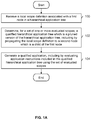
- FIG. 1A is flowchart illustrating an embodiment of a process to generate a qualified application using scope propagation.
- FIG. 1B is flowchart illustrating an embodiment of a process to generate a qualified application for a specific access context.
- FIG. 2 is a diagram illustrating an embodiment of access rules for business processes based on the role of an end user.
- FIG. 3 is a diagram illustrating an embodiment of access rules for business processes based on subscription plan.
- FIG. 4 is a diagram illustrating an embodiment of accessible business processes for an author with a basic subscription plan.
- FIG. 5 is a diagram illustrating an embodiment of accessible business processes for an approver with a gold subscription plan.
- FIG. 6 is a diagram illustrating an embodiment of a partial hierarchical application tree.
- FIG. 7A is a diagram illustrating an embodiment of a partial hierarchical application tree with local scope definitions used to create a cloned hierarchical application tree for an author with a silver or gold subscription plan.
- FIG. 7B is a diagram illustrating an embodiment of an original qualified hierarchical application tree associated with an evaluated scope of a role of author.
- FIG. 7C is a diagram illustrating an embodiment of a cloned hierarchical application tree associated with an evaluated scope of a role of author and a subscription plan of silver or gold.
- FIG. 8A is a diagram illustrating an embodiment of a partial hierarchical application tree with local scope definitions used to create a cloned hierarchical application tree for a reviewer or approver with a silver or gold subscription plan.
- FIG. 8B is a diagram illustrating an embodiment of an original qualified hierarchical application tree associated with an evaluated scope of a role of reviewer or approver.
- FIG. 8C is a diagram illustrating an embodiment of a cloned hierarchical application tree associated with an evaluated scope of a role of reviewer or approver and a subscription plan of silver or gold.
- FIG. 9 is a flowchart illustrating an embodiment of a process to decide whether to include a node in a qualified hierarchical application tree.
- FIG. 10 is a flowchart illustrating an embodiment of a process to decide whether to create a cloned hierarchical application tree.
- the invention can be implemented in numerous ways, including as a process; an apparatus; a system; a composition of matter; a computer program product embodied on a computer readable storage medium; and/or a processor, such as a processor configured to execute instructions stored on and/or provided by a memory coupled to the processor.
- these implementations, or any other form that the invention may take, may be referred to as techniques.
- the order of the steps of disclosed processes may be altered within the scope of the invention.
- a component such as a processor or a memory described as being configured to perform a task may be implemented as a general component that is temporarily configured to perform the task at a given time or a specific component that is manufactured to perform the task.
- the term ‘processor’ refers to one or more devices, circuits, and/or processing cores configured to process data, such as computer program instructions.
- FIG. 1A is flowchart illustrating an embodiment of a process to generate a qualified application using scope propagation.
- the process is performed by an application composer.
- the application composer is a cloud-based, Software as a Service (SaaS) platform which provides content management centric applications and/or business services. Such a platform may enable a customer to subscribe to one or more applications and/or one or more business services and use those subscriptions to fulfill business objectives.
- the application composer is EMC Horizon.
- an application composer is a tool for generating applications, such as a cloud-based application where the data which is accessed and manipulated by the cloud-based application is stored in cloud storage and the cloud-based application is accessed via a web browser.
- a hierarchical application tree is a tree which includes nodes arranged hierarchically with a single root node at the top of the hierarchy.
- a node in a hierarchical application tree may be either a file or a directory (e.g., where a directory contains any number of files and/or any number of (other) directories).
- local scope definitions are associated with or otherwise included in various nodes of the hierarchical application tree. Not every node is required to have a local scope definition. That is, there may be a node without a local scope definition. Similarly, not every node needs to include application instructions.
- local scope definition refers to any scope(s) that are included in or otherwise associated with a particular node (e.g., a file or a directory) in a hierarchical application tree.
- a local scope definition is local in the sense that it does not take into account or otherwise reflect other (e.g., higher or lower level) local scope definitions in the hierarchy (e.g., up the hierarchical application tree from a given node to the root node). It is merely the scope(s) that are defined at or otherwise included in a particular node.
- a qualified hierarchical application tree which is a pruned version of the hierarchical application tree, is determined for a set of one or more evaluated scopes, including by propagating the local scope definition to a second node which is a child of the first node. For example, if a child node has no local scope definition, then the local scope definition from the parent is applied or otherwise propagated.
- scopes are propagated down a hierarchical application tree (e.g., unless a particular type of scope is narrowed by some lower-level local scope definition as will be described in more detail later).
- the term “evaluated scope” is associated with the scope(s) corresponding to a particular qualified hierarchical application tree (e.g., after all decision making about what nodes/branches to include has completed).
- a qualified hierarchical application tree includes all of the nodes (and thus, all of the corresponding application instructions) which have all of the scope definitions included in a particular set of evaluated scopes.
- step 102 there are multiple types of scope which are independent of each other.
- the local scope definition associated with the first/parent node is associated with a first type of scope (e.g., X, where X is A or B) and the local scope definition associated with the second/child node is associated with a second, orthogonal type of scope (e.g., Y, where Y is 0 or 1). Since the two types of scope are orthogonal to each other, the scope of the second/child node would inherit both scopes (e.g., X is A or B and Y is 0 or 1).
- step 102 suppose the scope associated with the first/parent node defines a certain scope (e.g., X is A or B) and the local scope definition associated with the second/child node narrows that scope further (e.g., X is A). In that example, the scope associated with the second node would be narrowed by the local scope definition and would therefore be X is A.
- a certain scope e.g., X is A or B
- the local scope definition associated with the second/child node narrows that scope further (e.g., X is A).
- the scope associated with the second node would be narrowed by the local scope definition and would therefore be X is A.
- the scope cannot be broadened, it can only remain the same or be narrowed (e.g., going down that branch, away from the root node). For example, suppose the scope at some node is that X has a value of A or B. The scope as one goes further down that branch can only remain the same (e.g., X is A or B) or narrow (e.g., X is A) but cannot be broadened (e.g., X is A, B, or C).
- multiple qualified hierarchical application tree are generated at step 102 (e.g., for all possible combinations of evaluated scopes). For example, this may be done ahead of time (e.g., before an end user logs in to a web-based application).
- a single qualified hierarchical application tree is generated at step 102 (e.g., on-the-fly and/or in response to an end user logging in to a web-based application).
- a qualified application is generated, including by evaluating application instructions included in the qualified hierarchical application tree using the set of evaluated scopes.
- a qualified application is qualified in the sense that it is applicable to and/or relevant to one or more particular scopes. For example, if the scope is a device scope, then one qualified application may be a mobile version of an application and another qualified application may be a version of an application which is accessed from a desktop computer.
- the process of FIG. 1A reduces some code base (e.g., for all versions, variations, or scopes), first by pruning nodes or branches which are not relevant for a particular set of evaluated scopes at step 102 in order to obtain a pruned or reduced version of the hierarchical application tree. Then, at step 104 , the application instructions in the qualified hierarchical application tree may be further reduced by evaluating any if/then/else statements, switch statements, or case statements with the set of evaluated scopes (e.g., associated with that particular qualified hierarchical application tree).
- an evaluated scope includes a device scope which describes a device from which the application is accessed from.
- the qualified application which results from FIG. 1A might correspond to a mobile version of the application.
- the device scope is set to desktop, then qualified application which results might correspond to a desktop version of the application.
- a desktop or laptop computer has additional or greater resources beyond that offered by a mobile device (e.g., a larger screen, more processing power, more storage, more power (i.e., no battery), etc.).
- processor-intensive graphics may be turned off and/or less processor-intensive graphics may be used.
- the layout or arrangement of elements may be different to accommodate smaller screens and/or some application tools or tasks which are unlikely and/or unwieldy to access from a mobile device may be disabled or otherwise made inaccessible.
- different application instructions are included or used depending on whether the device scope is set to desktop versus mobile.
- the evaluated scope includes a role associated with a particular (end) user.
- the application may be used in an enterprise or business context where different (end) users have different responsibilities and/or privileges (e.g., creating, sharing, editing, reviewing, approving, and/or commenting on a variety of documents or other data).
- responsibilities and/or privileges e.g., creating, sharing, editing, reviewing, approving, and/or commenting on a variety of documents or other data.
- different versions of the application are presented, for example with different responsibilities, privileges, and/or tasks.
- Two example roles are creator and reviewer.
- the scope is set to creator, the ability to create and delete documents is made accessible to that end user.
- the ability to create and delete documents in the application is not may be made accessible to that end user because reviewers are not permitted to create or delete documents (e.g., they are only permitted to read the document and add comments and/or markups to the document).
- the role scope may be platform_admin (e.g., a developer or programmer associated with the application composition tool) or tenant_admin (e.g., a developer or programmer associated with the business which built an application specific to its business flow or practices using the application composition tool).
- platform_admin e.g., a developer or programmer associated with the application composition tool
- tenant_admin e.g., a developer or programmer associated with the business which built an application specific to its business flow or practices using the application composition tool.
- the evaluated scope includes an object scope which defines the scope of features or properties associated with a data object (e.g., which can be created, modified, or deleted by an end user of the application).
- a data object e.g., which can be created, modified, or deleted by an end user of the application.
- SKUs stock keeping units
- SKUs are implemented in a variety of ways and the application may support a variety of SKUs, each with a different set of features, properties, or fields.
- Some example SKU scope values includes basic and expanded.
- the SKU scope will affect how certain tasks or operations in the application are performed.
- a create SKU operation will create either a basic SKU data object or an expanded SKU data object depending upon the SKU scope value.
- generating a qualified application at step 104 includes stripping out or otherwise discarding application instructions which are not relevant (e.g., to the evaluated scope for that node). For example, if the qualified application is passed to some web browser which runs the qualified application (e.g., because the application is a web-based or web-accessible application), then irrelevant application instructions are not passed to the web browser and/or loaded into memory. This may be desirable from a performance point of view because network resources and/or memory are conserved.
- the qualified application is a web-based application.
- step 104 may include generating an application executable which is then served to a web browser (e.g., on the user's device). The web browser loads the executable and initiates the user interaction per the instructions received along with the executables. On every user interaction, the application executable running in the web browser performs further rule qualifications and changes the application behavior per the outcome of the rule qualification.
- the qualified application is generated at step 104 ahead of time (e.g., before an end user logs in).
- the qualified application may be generated on-the-fly and/or in response to a user logging in to the application.
- FIG. 1A illustrates an example of FIG. 1A where a qualified application is generated in response to and/or for a specific user.
- an end user may login to the application with some user account such that some role scope (e.g., author, reviewer, tenant_admin, or platform_admin) is known for that particular user account. It is therefore known that the qualified application should be generated for a particular role scope.
- the application detects that the application is being accessed from a mobile device (e.g., as opposed to a desktop device).
- a qualified application should be generated for mobile access (i.e., the access context is that the device scope is mobile).
- FIG. 1B is flowchart illustrating an embodiment of a process to generate a qualified application for a specific access context. For convenience, steps that are the same or similar to those in FIG. 1A use the same or similar numbering.
- access context is received in response to a user initiating access.
- access context includes a role (e.g., determined based on the login information), a subscription plan (e.g., determined based on the login information), and/or an access device (e.g., whether the user is accessing the application through a mobile device or a desktop device).
- a role e.g., determined based on the login information
- a subscription plan e.g., determined based on the login information
- an access device e.g., whether the user is accessing the application through a mobile device or a desktop device.
- the qualified application which is generated according to this process is appropriate for the access context.
- a local scope definition associated with a first node in a hierarchical application tree is received. For example, the process traverses the hierarchical application tree and some scope definition is included in or otherwise associated with the exemplary first node.
- a qualified hierarchical application tree which is a pruned version of the hierarchical application tree, is determined for a set of one or more evaluated scopes, including by propagating the local scope definition to a second node which is a child of the first node, wherein the set of evaluated scopes matches the access context.
- the qualified hierarchical application tree is pruned in a manner that is appropriate for the access context. For example, nodes or branches which contain application instructions for business processes which that particular user is not permitted to access may be pruned from the qualified hierarchical application tree.
- a qualified application is generated, including by evaluating application instructions included in the qualified hierarchical application tree using the set of evaluated scopes. For example, if based on the access context, the access device is a mobile device, the qualified application would correspond to a mobile version of the application. Or, if the access context indicates the end user has a particular role, then the qualified application generated at step 104 only permits that end user to access business processes appropriate for that role.
- FIG. 2 is a diagram illustrating an embodiment of access rules for business processes based on the role of an end user.
- diagram 200 shows processes or operations associated with a document task management business application.
- user group 202 shows user-related processes including authentication related processes, processes associated with user preferences (e.g., viewing, editing, and resetting a use preference), and processes associated with user profiles (e.g., creating, viewing, editing, and deleting a user profile).
- user preferences e.g., viewing, editing, and resetting a use preference
- user profiles e.g., creating, viewing, editing, and deleting a user profile
- task group 204 e.g., associated with creating and assigning tasks or action items amongst end users
- document group 206 e.g., associated with documents related processes such as creating, editing, deleting, downloading, commenting, etc.
- audit trail group 208 e.g., associated with following or tracking a document and/or a user, either after the fact or while the action is occurring
- search group 210 e.g., associated with search related processes.
- an end user logs in to the document task management application (e.g., at some URL since this example application is a web-based application) and from the login information a role associated with the end user is known.
- a role associated with the end user is known.
- the application can have more than one author associated with a particular reviewer and similarly an approver can approve documents from multiple teams/authors.
- the user is permitted to access and perform various business processes in the application.
- Legend 212 shows the color codes and superscript numbering associated with each role.
- the document versions delete process is associated only with the reviewer and approver role. As such, an end user with a role of author or admin would not be able to perform the document versions delete process (e.g., because it is not exposed or otherwise made accessible to the end user).
- the document task management application makes certain processes available to an end user depending upon a subscription plan (in this example at least).
- a subscription plan in this example at least.
- end users with a basic subscription have access to some processes
- end users with a silver subscription have access to even more processes
- end users with a gold subscription have access to all processes (at least in this example).
- the following figure shows the same processes shown in FIG. 2 , but with access based on subscription plan.
- FIG. 3 is a diagram illustrating an embodiment of access rules for business processes based on subscription plan. For example, a small business with only a few employees may have a basic subscription plan, a mid-sized business may have a silver subscription plan, and a large business may have a gold subscription plan.
- some business processes are only accessible to end users with at least a silver plan such as being able to reset user preferences, a detailed task list, task comments, document download, document comments, document version-related processes (listing and deleting document versions), performing an audit trail on a document, and performing an audit trail on a task.
- performing an audit trail on a user, searching based on user, and saving a search are processes that are only accessible to end users with a gold subscription.
- FIG. 4 is a diagram illustrating an embodiment of accessible business processes for an author with a basic subscription plan.
- diagram 400 shows which business processes would be made accessible to an end user having a role of author and with a basic subscription plan based on the access rules shown in FIG. 2 and FIG. 3 .
- FIG. 5 is a diagram illustrating an embodiment of accessible business processes for an approver with a gold subscription plan.
- diagram 500 shows which business processes would be made accessible to an end user having a role of approver and with a gold subscription plan based on the access rules shown in FIG. 2 and FIG. 3 .
- the end user is accessing the application from a mobile device (e.g., as opposed to a desktop PC, as was the case in FIG. 4 ).
- a mobile device e.g., as opposed to a desktop PC, as was the case in FIG. 4 .
- the exemplary application can either be accessed from a mobile device or a desktop device, the user interface which is presented to the user is adjusted. Although this is not explicitly shown in FIG. 4 or FIG.
- page layout is varied (e.g., based on the user device, the page layout and content displayed on the page are changed in order to accommodate smaller screens and devices with less processing, storage, and/or power resources), page navigation is varied (e.g., based on the user device, the user navigation is adjusted), and/or available functionalities are varied (e.g., on smaller-screen devices with fewer resources such as mobile devices, some of the application functionalities are not made available for the end user either because the display is too large or the functionality would consume too many resources).
- application instructions within the qualified hierarchical application tree may be evaluated using the evaluated scopes and some code may be unselected or unused as the result of some if/then/else statement, some switch statement, or some case statement.
- the following figures show a partial hierarchical application tree (including local scope definitions) in more detail and which is used to enforce the access rules shown in FIG. 2 and FIG. 3 .
- FIG. 6 is a diagram illustrating an embodiment of a partial hierarchical application tree.
- the structure of the complete hierarchical application tree (not shown) is similar to the grouping/hierarchy shown in FIG. 2 and FIG. 3 .
- modules directory ( 602 ) may also include directories called user, tasks, audit, and search for code or instructions relating to (respectively) user-related processes, task-related processes, audit-related processes, and search related processes. See, for example, the groups other than the document group shown in FIG. 2 and FIG. 3 . To preserve readability, this example focuses on the document directory/branch and other branches/nodes are not shown or described.
- the contents of the document.json file ( 606 ) are:
- the node which is associated with this local scope definition is document node 604 (see the id definition).
- the scope cannot be broadened, it can only remain the same or be narrowed down a branch that includes that particular node.
- document.json file 606 defines the role scope as author, reviewer, or approver at document node 604 .
- none of the document-related processes which are located below document node 604 i.e., create, import, view, edit, download, comments, or the two versions process: listing and delete
- the contents of the features.json file ( 608 ) are:
- the contents of the create.json file ( 610 ) are:
- the contents of the import.json file ( 612 ) are:
- the contents of the view.json file ( 614 ) are:
- the contents of the edit.json file ( 616 ) are:
- the contents of the download.json file ( 618 ) are:
- ⁇ ′′id′′ ′′colombo.modules.document.features.download′′
- ′′Description′′ ′′This is the document download feature′′, ′′$scope′′: ⁇ ′′subscriptionTier′′: [′′silver′′, ′′gold′′] ⁇ ⁇
- the local scope definition here introduces a scope type of subscriptionTier, which was not previously defined or otherwise encountered (i.e., above the download node in the hierarchy).
- the subscription tier is set to silver or gold; note that in FIG. 3 , the document download process is only accessible to end users with a gold or silver subscription.
- the contents of the versions.json file ( 622 ) are:
- listing.json file ( 624 ) are listed below. Due to space limitations, the entire path of the listing.json file is not shown. The portion of the path which is not shown (beginning from the versions directory) is versions/operations/listing/listing.json.
- the following shows the contents of the delete.json file ( 626 ). Due to space limitations, the entire path of the delete.json file is not shown. The portion of the path which is not shown (beginning from the versions directory) is versions/operations/delete/delete.json.
- multiple qualified hierarchical application tree are simultaneously generated. For example, this may be an efficient way to generate all qualified hierarchical application tree for all possible combinations of scope (e.g., without re-tracing or re-traversing upper-level portions of the full hierarchical application tree).
- scope e.g., without re-tracing or re-traversing upper-level portions of the full hierarchical application tree.
- the following figures show some examples of this for document-related processes and the corresponding document branch of an exemplary hierarchical application tree.
- FIG. 7A is a diagram illustrating an embodiment of a partial hierarchical application tree with local scope definitions used to create a cloned hierarchical application tree for an author with a silver or gold subscription plan.
- FIG. 7A is similar to FIG. 6 , except the .json files (which include local scope definitions for those nodes which have a local scope definition) are not shown. Rather, the local scope definitions (if any) are shown with their respective nodes. Also, for simplicity and readability, the nodes below the versions node (e.g., the listing and delete directories and corresponding son files) are not shown in diagram 700 .
- the steps shown in this figure illustrate an example of step 102 in FIG. 1A .
- the process begins by searching for nodes with a scope type of roles and a scope value of author.
- the process begins at create node 706 .
- local scope definition 708 narrows roles to just author.
- local scope definition 718 narrows the roles scope to just reviewer or approver. Since the values do not include the value of author (which is the value being searched for), edit node 716 is excluded from the qualified hierarchical application tree being built.
- download node 720 includes a new type of scope which has not been encountered before (i.e., subscriptionTier)
- a cloned hierarchical application tree is created.
- comments node 724 is included in both the original qualified hierarchical application tree and the cloned hierarchical application tree.
- versions node 728 is evaluated and for the same reasons described above would be included in both trees. Although not shown in this figure, the process would go to the next level in the hierarchy into the versions directory and use similar decision making on the versions listing node and versions delete node (not shown or described here). Naturally, if the versions directory were not included in one or both of the trees, then the subsequent processing would skip those nodes (since once a parent node is excluded from a tree being built, child nodes of that excluded node are likewise ignored or skipped).
- one benefit to the technique described herein is that duplicate work can be avoided.
- the creation of the cloned tree at download node 720 eliminates the need to duplicate all of the decision making associated with create node 706 -edit node 716 , as well as any decision making associated with higher hierarchy levels. To put it another way, all of the decision making does not need to be performed again in order to get the cloned hierarchical application tree.
- nodes in a directory are presorted before processing at step 102 in FIG. 1A or step 102 ′ in FIG. 1B .
- all nodes in a directory being processed are sorted first so that nodes which only contain old scope types are processed first. Any nodes associated with new scope types (i.e., which have not been observed before) then follow. Further refinement may also be performed. For example, if there are multiple new scope types, then the nodes may be sorted so that all nodes with a first new scope type are processed first, then all nodes with a second new scope type are processed subsequently.
- a local scope definition precludes any of that scope from being associated with sibling nodes and children of such sibling nodes.
- local scope definition 704 associated with features node 704
- includes a scope of roles author, reviewer, or approver
- any siblings of features 702 (not shown) and its children cannot have a scope of author, reviewer, or approver.
- a sibling node could have a local scope definition which includes the same scope type but with some other value.
- FIG. 7B is a diagram illustrating an embodiment of an original qualified hierarchical application tree associated with an evaluated scope of a role of author.
- nodes which include application instructions for processes which require a silver or gold subscription are excluded from original qualified hierarchical application tree 750 .
- the resulting application will not have any instructions for processes which require a silver or gold subscription. This prevents an unauthorized end user from having access to those restricted processes.
- original qualified hierarchical application tree 750 is an example of a qualified hierarchical application tree which is generated at step 102 in FIG. 1A or step 102 ′ in FIG. 1B .
- Original qualified hierarchical application tree 750 may be used to generate a qualified application at step 104 in FIG. 1A or 1B for an end user with a role scope of author (i.e., which matches the evaluated scope shown here).
- FIG. 7C is a diagram illustrating an embodiment of a cloned hierarchical application tree associated with an evaluated scope of a role of author and a subscription plan of silver or gold.
- cloned hierarchical application tree 760 includes comments node 724 , download node 720 , and versions node 728 .
- the evaluated scope for this figure includes a subscriptionTier scope of silver or gold and the comments, download, and versions processes are only accessible to end users with a silver or gold subscription.
- the inclusion of comments node 724 , download node 720 , and versions node 728 in hierarchical application tree 760 is indicated by the highlighting of those directories.
- cloned hierarchical application tree 760 (which as described above is a qualified hierarchical application tree in its own right), a qualified application may be generated for an end user with a role of author and a silver or a gold subscription. Since comments node 724 , download node 720 , and versions node 728 are included in cloned hierarchical application tree 760 , the associated application instructions which implement those processes would be included in the resulting qualified application and made available to an end user (with a role of author and a silver or a gold subscription).
- FIG. 8A is a diagram illustrating an embodiment of a partial hierarchical application tree with local scope definitions used to create a cloned hierarchical application tree for a reviewer or approver with a silver or gold subscription plan.
- the example process begins at create node 806 .
- Local scope definition 808 narrows the roles scope to author and the process is looking for a roles value of reviewer or approver. Since the values do not match those being searched for, create node 806 is excluded from the qualified hierarchical application tree being built (not shown).
- import node 810 is evaluated. It also has a local scope definition ( 812 ) which also narrows the roles scope to author. Since import node 810 does not have a scope value of reviewer or approver, import node 810 is excluded from the qualified hierarchical application tree being built.
- View node 814 does not have a local scope definition associated with it and thus inherits the scopes from local scope definition 804 , which is associated with its parent, features node 802 . View node 814 therefore does have a value of reviewer or author for the roles scope type and is included in the qualified hierarchical application tree being built.
- Edit node 816 has local scope definition 818 associated with it which narrows the roles to reviewer or approver. Since those are the scope values being searched for, edit node 816 is included in the qualified hierarchical application tree being built.
- Download node 820 therefore includes the scope values of reviewer or approver which the process is looking for and download node 820 is included in the qualified hierarchical application tree being built.
- This new scope type causes the process to create a cloned hierarchical application tree.
- the cloned hierarchical application tree will include download node 820 , but not any of the other nodes which were previously included in the qualified hierarchical application tree being built (i.e., view node 814 and edit node 816 ). This is because those previously encountered nodes were not associated with the scope of subscriptionTier (otherwise that scope type would not be new).
- versions node 828 is evaluated.
- the decision making for that node is the same as that for comments node 824 and therefore versions node 828 is included both in the original qualified hierarchical application tree and the cloned hierarchical application tree being built.
- the process may then go down to the next level in the hierarchy and evaluate the versions listing and versions delete nodes in versions directory 828 (not shown or described here).
- FIG. 8B is a diagram illustrating an embodiment of an original qualified hierarchical application tree associated with an evaluated scope of a role of reviewer or approver.
- original qualified hierarchical application tree 850 includes edit node 816 and view node 814 .
- a corresponding end user is not permitted to access the download, comments, and versions process (see, e.g., FIG. 3 ).
- FIG. 8C is a diagram illustrating an embodiment of a cloned hierarchical application tree associated with an evaluated scope of a role of reviewer or approver and a subscription plan of silver or gold.
- cloned hierarchical application tree 860 includes commends node 824 , edit node 816 , download node 820 , versions node 828 , and view node 814 .
- FIG. 9 is a flowchart illustrating an embodiment of a process to decide whether to include a node in a qualified hierarchical application tree. In some embodiments, FIG. 9 is used at step 102 in FIG. 1A or at step 102 ′ in FIG. 1B .
- a third node is encountered in the hierarchical application tree, wherein the set of evaluated scopes includes a first scope type at a first value.
- the set of evaluated scopes is/are the scope(s) corresponding to or for which a particular qualified hierarchical application tree is being generated.
- the third node is associated with the first scope type at the first value. If so, the third node is included in the qualified hierarchical application tree at 904 . See, for example, create node 706 in FIG. 7A and FIG. 7B and view node 814 in FIG. 8A and FIG. 8B .
- the third node is excluded from the qualified hierarchical application tree at 906 . See, for example, edit node 716 in FIG. 7A and FIG. 7B and create node 806 in FIG. 8A and FIG. 8B .
- FIG. 10 is a flowchart illustrating an embodiment of a process to decide whether to create a cloned hierarchical application tree.
- FIG. 10 is used at step 102 in FIG. 1A or at step 102 ′ in FIG. 1B .
- a third node in the qualified hierarchical application tree is encountered, wherein: (1) the set of evaluated scopes includes a first scope type at a first value and (2) the third node is associated with a new scope type at a second value.
- the third node is associated with the first scope type at the first value. If so, at 1004 , a cloned hierarchical application tree is created for a second set of evaluated scopes which includes the first scope type at the first value and the new scope type at the second value. The third node is then included in the cloned hierarchical application tree at 1006 . See, for example, download node 720 ( 820 ) which caused a cloned hierarchical application tree to be created in FIGS. 7A ( 8 A) and which is included in cloned hierarchical application tree 760 ( 860 ) in FIGS. 7C ( 8 C).
- the third node is then excluded from the qualified hierarchical application tree at 1008 .
- download node 720 ( 820 ) is not included in (original) hierarchical application tree 750 ( 850 ) in FIG. 7B ( 8 B).
- the third node has stricter access rules (e.g., required per the new scope type) which are not reflected in the evaluated scopes of the original hierarchical application tree.
- the evaluated scopes of the original hierarchical application tree 750 and 850 do not include a silver or gold subscription and a corresponding end user should not be able to access processes which require a silver or gold subscription (e.g., the download process).
- the third node is not associated with the first scope type at the first value at step 1002 then the third node is excluded from the qualified hierarchical application tree at 1010 . This example is not shown in FIGS. 7A-8C .
Landscapes
- Engineering & Computer Science (AREA)
- Theoretical Computer Science (AREA)
- Software Systems (AREA)
- General Engineering & Computer Science (AREA)
- Physics & Mathematics (AREA)
- General Physics & Mathematics (AREA)
- Data Mining & Analysis (AREA)
- Databases & Information Systems (AREA)
- Stored Programmes (AREA)
- Computer Security & Cryptography (AREA)
- Information Transfer Between Computers (AREA)
Abstract
Description
| { | |
| ″id″: ″colombo.modules.document″, | |
| ″Description″: ″This is the document module for colombo″, | |
| ″$scope″ : { | |
| ″roles″: [″author″, ″reviewer″, ″approver″] | |
| } | |
| } | |
In this example, the local scope definition defines the scope to be role=author, reviewer, or approver. The node which is associated with this local scope definition is document node 604 (see the id definition). In this example, once a scope is defined (e.g., for a particular type of scope, in this case role), the scope cannot be broadened, it can only remain the same or be narrowed down a branch that includes that particular node. To put it another way, since document.json
| { |
| ″id″: ″colombo.modules.document.features″, |
| ″Description″: ″This is the document module features configuration″ |
| } |
It is noted that there is no local scope definition here associated with the features node. Therefore, the scope from
| { | |||
| ″id″: ″colombo.modules.document.features.create″, | |||
| ″Description″: ″This is the document create feature″, | |||
| ″$scope″: { | |||
| ″roles″: [″author″] | |||
| } | |||
| } | |||
It is noted that the local scope definition here (i.e., at the create node) narrows the role scope to just author. Note that in
| { | |||
| ″id″: ″colombo.modules.document.features.import″, | |||
| ″Description″: ″This is the document import feature″, | |||
| ″$scope″ : { | |||
| ″roles″: [″author″] | |||
| } | |||
| } | |||
It is noted that the local scope definition here narrows the role scope to just author at the import node. Note that in
| { | |||
| ″id″: ″colombo.modules.document.features.view″, | |||
| ″Description″: ″This is the document view feature″ | |||
| } | |||
Note that in
| { | |||
| ″id″: ″colombo.modules.document.features.edit″, | |||
| ″Description″: ″This is the document edit properties feature″, | |||
| ″$scope″ : { | |||
| ″roles″: [″reviewer″, ″approver″] | |||
| } | |||
| } | |||
The local scope definition here narrows the role scope to (just) reviewers and approvers. Note that in
| { | |||
| ″id″: ″colombo.modules.document.features.download″, | |||
| ″Description″: ″This is the document download feature″, | |||
| ″$scope″: { | |||
| ″subscriptionTier″: [″silver″, ″gold″] | |||
| } | |||
| } | |||
The local scope definition here introduces a scope type of subscriptionTier, which was not previously defined or otherwise encountered (i.e., above the download node in the hierarchy). The subscription tier is set to silver or gold; note that in
| { | |||
| ″id″: ″colombo.modules.document.features.comments″, | |||
| ″Description″: ″This is the document comments feature″, | |||
| ″$scope″: { | |||
| ″subscriptionTier″: [″sliver″, ″gold″] | |||
| } | |||
| } | |||
| { | |||
| ″id″: ″colombo.modules.document.features.versions″, | |||
| ″Description″: ″This is the document versions feature″, | |||
| ″$scope″: { | |||
| ″subscriptionTier″: [″silver″, ″gold″] | |||
| } | |||
| } | |||
As above, in
| { |
| ″id″: ″colombo.modules.document.features.versions.operations.list″, |
| ″Description″: ″This is the document versions listing operation″ |
| } |
It is noted that there is no local scope definition here, so the scope for the document features versions node is inherited from above (e.g., from features.json file 608 and versions.json file 622).
| { |
| ″id″: ″colombo.modules.document.features.versions.operations.delete″, |
| ″Description″: ″This is the document versions delete operation″, |
| ″$scope″ : { |
| ″roles″: [″reviewer″, ″approver″] |
| } |
| } |
In this case, the role scope is defined to be reviewer or approver, narrowing the scope from all but admin (i.e., author, reviewer, or approver). Note that in
Claims (15)
Priority Applications (2)
| Application Number | Priority Date | Filing Date | Title |
|---|---|---|---|
| US16/040,903 US10691425B2 (en) | 2016-03-22 | 2018-07-20 | Method and mechanism for optimal scope evaluation in scope based hierarchical configuration using evaluated scope propagation technique |
| US16/875,209 US10884716B2 (en) | 2016-03-22 | 2020-05-15 | Method and mechanism for optimal scope evaluation in scope based hierarchical configuration using evaluated scope propagation technique |
Applications Claiming Priority (2)
| Application Number | Priority Date | Filing Date | Title |
|---|---|---|---|
| US15/077,179 US10073682B1 (en) | 2016-03-22 | 2016-03-22 | Method and mechanism for optimal scope evaluation in scope based hierarchical configuration using evaluated scope propagation technique |
| US16/040,903 US10691425B2 (en) | 2016-03-22 | 2018-07-20 | Method and mechanism for optimal scope evaluation in scope based hierarchical configuration using evaluated scope propagation technique |
Related Parent Applications (1)
| Application Number | Title | Priority Date | Filing Date |
|---|---|---|---|
| US15/077,179 Continuation US10073682B1 (en) | 2016-03-22 | 2016-03-22 | Method and mechanism for optimal scope evaluation in scope based hierarchical configuration using evaluated scope propagation technique |
Related Child Applications (1)
| Application Number | Title | Priority Date | Filing Date |
|---|---|---|---|
| US16/875,209 Continuation US10884716B2 (en) | 2016-03-22 | 2020-05-15 | Method and mechanism for optimal scope evaluation in scope based hierarchical configuration using evaluated scope propagation technique |
Publications (2)
| Publication Number | Publication Date |
|---|---|
| US20180329691A1 US20180329691A1 (en) | 2018-11-15 |
| US10691425B2 true US10691425B2 (en) | 2020-06-23 |
Family
ID=63406406
Family Applications (3)
| Application Number | Title | Priority Date | Filing Date |
|---|---|---|---|
| US15/077,179 Active 2036-12-12 US10073682B1 (en) | 2016-03-22 | 2016-03-22 | Method and mechanism for optimal scope evaluation in scope based hierarchical configuration using evaluated scope propagation technique |
| US16/040,903 Active 2036-09-06 US10691425B2 (en) | 2016-03-22 | 2018-07-20 | Method and mechanism for optimal scope evaluation in scope based hierarchical configuration using evaluated scope propagation technique |
| US16/875,209 Active US10884716B2 (en) | 2016-03-22 | 2020-05-15 | Method and mechanism for optimal scope evaluation in scope based hierarchical configuration using evaluated scope propagation technique |
Family Applications Before (1)
| Application Number | Title | Priority Date | Filing Date |
|---|---|---|---|
| US15/077,179 Active 2036-12-12 US10073682B1 (en) | 2016-03-22 | 2016-03-22 | Method and mechanism for optimal scope evaluation in scope based hierarchical configuration using evaluated scope propagation technique |
Family Applications After (1)
| Application Number | Title | Priority Date | Filing Date |
|---|---|---|---|
| US16/875,209 Active US10884716B2 (en) | 2016-03-22 | 2020-05-15 | Method and mechanism for optimal scope evaluation in scope based hierarchical configuration using evaluated scope propagation technique |
Country Status (1)
| Country | Link |
|---|---|
| US (3) | US10073682B1 (en) |
Cited By (1)
| Publication number | Priority date | Publication date | Assignee | Title |
|---|---|---|---|---|
| US10860590B2 (en) | 2017-04-17 | 2020-12-08 | EMC IP Holding Corporation LLC | Method and apparatus of information processing |
Families Citing this family (2)
| Publication number | Priority date | Publication date | Assignee | Title |
|---|---|---|---|---|
| US10379830B2 (en) * | 2016-09-07 | 2019-08-13 | Oracle International Corporation | Context-based analytical engine for extending application functionality |
| CN109947897B (en) * | 2019-03-15 | 2020-12-15 | 南京邮电大学 | Construction method of judicial case event tree |
Citations (3)
| Publication number | Priority date | Publication date | Assignee | Title |
|---|---|---|---|---|
| US20130317990A1 (en) * | 2012-05-04 | 2013-11-28 | Institutional Cash Distributors Technology, Llc | Secure transaction object creation, propagation and invocation |
| US20150019576A1 (en) * | 2013-07-12 | 2015-01-15 | Ab Initio Technology Llc | Parser generation |
| US20170075665A1 (en) * | 2015-09-10 | 2017-03-16 | Kabushiki Kaisha Toshiba | Program information generation system, method, and computer program |
Family Cites Families (1)
| Publication number | Priority date | Publication date | Assignee | Title |
|---|---|---|---|---|
| US20080141230A1 (en) * | 2006-12-06 | 2008-06-12 | Microsoft Corporation | Scope-Constrained Specification Of Features In A Programming Language |
-
2016
- 2016-03-22 US US15/077,179 patent/US10073682B1/en active Active
-
2018
- 2018-07-20 US US16/040,903 patent/US10691425B2/en active Active
-
2020
- 2020-05-15 US US16/875,209 patent/US10884716B2/en active Active
Patent Citations (3)
| Publication number | Priority date | Publication date | Assignee | Title |
|---|---|---|---|---|
| US20130317990A1 (en) * | 2012-05-04 | 2013-11-28 | Institutional Cash Distributors Technology, Llc | Secure transaction object creation, propagation and invocation |
| US20150019576A1 (en) * | 2013-07-12 | 2015-01-15 | Ab Initio Technology Llc | Parser generation |
| US20170075665A1 (en) * | 2015-09-10 | 2017-03-16 | Kabushiki Kaisha Toshiba | Program information generation system, method, and computer program |
Cited By (1)
| Publication number | Priority date | Publication date | Assignee | Title |
|---|---|---|---|---|
| US10860590B2 (en) | 2017-04-17 | 2020-12-08 | EMC IP Holding Corporation LLC | Method and apparatus of information processing |
Also Published As
| Publication number | Publication date |
|---|---|
| US10073682B1 (en) | 2018-09-11 |
| US20180329691A1 (en) | 2018-11-15 |
| US10884716B2 (en) | 2021-01-05 |
| US20200278841A1 (en) | 2020-09-03 |
Similar Documents
| Publication | Publication Date | Title |
|---|---|---|
| US10977011B2 (en) | Structured development for web application frameworks | |
| Montandon et al. | Documenting apis with examples: Lessons learned with the apiminer platform | |
| US11748243B2 (en) | Intelligent generation of page objects for user interface testing | |
| Bhamidi et al. | Continuum limit of critical inhomogeneous random graphs | |
| US10884716B2 (en) | Method and mechanism for optimal scope evaluation in scope based hierarchical configuration using evaluated scope propagation technique | |
| US8108360B2 (en) | Database object update order determination | |
| CN112765102B (en) | File system management method and device | |
| US10372812B2 (en) | Combining aspects of a template into multiple web pages | |
| US11636025B2 (en) | Intelligent generation of automated user interface testing methods | |
| TW202125255A (en) | Applet code scanning method and device | |
| US20200042330A1 (en) | Systems, methods, and apparatuses for dynamic creation of an external code segment within a cloud based computing environment | |
| Nandaa | Beginning API Development with Node. js: Build highly scalable, developer-friendly APIs for the modern web with JavaScript and Node. js | |
| CN109313662B (en) | Deconstruction and presentation of web pages into a native application experience | |
| Abbasi | Learning apache spark 2 | |
| Foster | CodeIgniter 2 Cookbook | |
| US7730477B2 (en) | System and method for propagation in a web portal system | |
| US12277417B2 (en) | Source code-based determination of differences between web elements of different versions of a web application | |
| US11971866B2 (en) | Determining differences between web elements of different versions of a web application | |
| US10235395B2 (en) | Keyword identification for an enterprise resource planning manager | |
| US20050120299A1 (en) | System and method for creation of a network server application page | |
| Haque et al. | Chroot hardening through system calls modification | |
| Hillar | Hands-on RESTful Python Web Services: Develop RESTful Web Services Or APIs with Modern Python 3.7 | |
| Bhowmick et al. | RAGuru: A Tool to Create and Automatically Deploy Workload Optimized RAG | |
| Portwood II | Mastering Yii | |
| KR102932102B1 (en) | Method for analyzing document based on neural network |
Legal Events
| Date | Code | Title | Description |
|---|---|---|---|
| AS | Assignment |
Owner name: EMC CORPORATION, MASSACHUSETTS Free format text: ASSIGNMENT OF ASSIGNORS INTEREST;ASSIGNOR:TOTALE, SACHIN G.;REEL/FRAME:046418/0429 Effective date: 20160515 Owner name: EMC IP HOLDING COMPANY LLC, MASSACHUSETTS Free format text: ASSIGNMENT OF ASSIGNORS INTEREST;ASSIGNOR:EMC CORPORATION;REEL/FRAME:046418/0442 Effective date: 20160906 |
|
| FEPP | Fee payment procedure |
Free format text: ENTITY STATUS SET TO UNDISCOUNTED (ORIGINAL EVENT CODE: BIG.); ENTITY STATUS OF PATENT OWNER: LARGE ENTITY |
|
| STPP | Information on status: patent application and granting procedure in general |
Free format text: DOCKETED NEW CASE - READY FOR EXAMINATION |
|
| AS | Assignment |
Owner name: THE BANK OF NEW YORK MELLON TRUST COMPANY, N.A., AS COLLATERAL AGENT, TEXAS Free format text: PATENT SECURITY AGREEMENT (NOTES);ASSIGNORS:DELL PRODUCTS L.P.;EMC CORPORATION;EMC IP HOLDING COMPANY LLC;REEL/FRAME:047648/0422 Effective date: 20180906 Owner name: CREDIT SUISSE AG, CAYMAN ISLANDS BRANCH, AS COLLATERAL AGENT, NORTH CAROLINA Free format text: PATENT SECURITY AGREEMENT (CREDIT);ASSIGNORS:DELL PRODUCTS L.P.;EMC CORPORATION;EMC IP HOLDING COMPANY LLC;REEL/FRAME:047648/0346 Effective date: 20180906 Owner name: THE BANK OF NEW YORK MELLON TRUST COMPANY, N.A., A Free format text: PATENT SECURITY AGREEMENT (NOTES);ASSIGNORS:DELL PRODUCTS L.P.;EMC CORPORATION;EMC IP HOLDING COMPANY LLC;REEL/FRAME:047648/0422 Effective date: 20180906 Owner name: CREDIT SUISSE AG, CAYMAN ISLANDS BRANCH, AS COLLAT Free format text: PATENT SECURITY AGREEMENT (CREDIT);ASSIGNORS:DELL PRODUCTS L.P.;EMC CORPORATION;EMC IP HOLDING COMPANY LLC;REEL/FRAME:047648/0346 Effective date: 20180906 |
|
| AS | Assignment |
Owner name: THE BANK OF NEW YORK MELLON TRUST COMPANY, N.A., T Free format text: SECURITY AGREEMENT;ASSIGNORS:CREDANT TECHNOLOGIES, INC.;DELL INTERNATIONAL L.L.C.;DELL MARKETING L.P.;AND OTHERS;REEL/FRAME:049452/0223 Effective date: 20190320 Owner name: THE BANK OF NEW YORK MELLON TRUST COMPANY, N.A., TEXAS Free format text: SECURITY AGREEMENT;ASSIGNORS:CREDANT TECHNOLOGIES, INC.;DELL INTERNATIONAL L.L.C.;DELL MARKETING L.P.;AND OTHERS;REEL/FRAME:049452/0223 Effective date: 20190320 |
|
| AS | Assignment |
Owner name: THE BANK OF NEW YORK MELLON TRUST COMPANY, N.A., TEXAS Free format text: SECURITY AGREEMENT;ASSIGNORS:CREDANT TECHNOLOGIES INC.;DELL INTERNATIONAL L.L.C.;DELL MARKETING L.P.;AND OTHERS;REEL/FRAME:053546/0001 Effective date: 20200409 |
|
| STPP | Information on status: patent application and granting procedure in general |
Free format text: PUBLICATIONS -- ISSUE FEE PAYMENT RECEIVED |
|
| STCF | Information on status: patent grant |
Free format text: PATENTED CASE |
|
| AS | Assignment |
Owner name: EMC IP HOLDING COMPANY LLC, TEXAS Free format text: RELEASE OF SECURITY INTEREST AT REEL 047648 FRAME 0346;ASSIGNOR:CREDIT SUISSE AG, CAYMAN ISLANDS BRANCH;REEL/FRAME:058298/0510 Effective date: 20211101 Owner name: EMC CORPORATION, MASSACHUSETTS Free format text: RELEASE OF SECURITY INTEREST AT REEL 047648 FRAME 0346;ASSIGNOR:CREDIT SUISSE AG, CAYMAN ISLANDS BRANCH;REEL/FRAME:058298/0510 Effective date: 20211101 Owner name: DELL PRODUCTS L.P., TEXAS Free format text: RELEASE OF SECURITY INTEREST AT REEL 047648 FRAME 0346;ASSIGNOR:CREDIT SUISSE AG, CAYMAN ISLANDS BRANCH;REEL/FRAME:058298/0510 Effective date: 20211101 |
|
| AS | Assignment |
Owner name: EMC IP HOLDING COMPANY LLC, TEXAS Free format text: RELEASE OF SECURITY INTEREST IN PATENTS PREVIOUSLY RECORDED AT REEL/FRAME (047648/0422);ASSIGNOR:THE BANK OF NEW YORK MELLON TRUST COMPANY, N.A., AS NOTES COLLATERAL AGENT;REEL/FRAME:060160/0862 Effective date: 20220329 Owner name: EMC CORPORATION, MASSACHUSETTS Free format text: RELEASE OF SECURITY INTEREST IN PATENTS PREVIOUSLY RECORDED AT REEL/FRAME (047648/0422);ASSIGNOR:THE BANK OF NEW YORK MELLON TRUST COMPANY, N.A., AS NOTES COLLATERAL AGENT;REEL/FRAME:060160/0862 Effective date: 20220329 Owner name: DELL PRODUCTS L.P., TEXAS Free format text: RELEASE OF SECURITY INTEREST IN PATENTS PREVIOUSLY RECORDED AT REEL/FRAME (047648/0422);ASSIGNOR:THE BANK OF NEW YORK MELLON TRUST COMPANY, N.A., AS NOTES COLLATERAL AGENT;REEL/FRAME:060160/0862 Effective date: 20220329 |
|
| AS | Assignment |
Owner name: DELL MARKETING L.P. (ON BEHALF OF ITSELF AND AS SUCCESSOR-IN-INTEREST TO CREDANT TECHNOLOGIES, INC.), TEXAS Free format text: RELEASE OF SECURITY INTEREST IN PATENTS PREVIOUSLY RECORDED AT REEL/FRAME (053546/0001);ASSIGNOR:THE BANK OF NEW YORK MELLON TRUST COMPANY, N.A., AS NOTES COLLATERAL AGENT;REEL/FRAME:071642/0001 Effective date: 20220329 Owner name: DELL INTERNATIONAL L.L.C., TEXAS Free format text: RELEASE OF SECURITY INTEREST IN PATENTS PREVIOUSLY RECORDED AT REEL/FRAME (053546/0001);ASSIGNOR:THE BANK OF NEW YORK MELLON TRUST COMPANY, N.A., AS NOTES COLLATERAL AGENT;REEL/FRAME:071642/0001 Effective date: 20220329 Owner name: DELL PRODUCTS L.P., TEXAS Free format text: RELEASE OF SECURITY INTEREST IN PATENTS PREVIOUSLY RECORDED AT REEL/FRAME (053546/0001);ASSIGNOR:THE BANK OF NEW YORK MELLON TRUST COMPANY, N.A., AS NOTES COLLATERAL AGENT;REEL/FRAME:071642/0001 Effective date: 20220329 Owner name: DELL USA L.P., TEXAS Free format text: RELEASE OF SECURITY INTEREST IN PATENTS PREVIOUSLY RECORDED AT REEL/FRAME (053546/0001);ASSIGNOR:THE BANK OF NEW YORK MELLON TRUST COMPANY, N.A., AS NOTES COLLATERAL AGENT;REEL/FRAME:071642/0001 Effective date: 20220329 Owner name: EMC CORPORATION, MASSACHUSETTS Free format text: RELEASE OF SECURITY INTEREST IN PATENTS PREVIOUSLY RECORDED AT REEL/FRAME (053546/0001);ASSIGNOR:THE BANK OF NEW YORK MELLON TRUST COMPANY, N.A., AS NOTES COLLATERAL AGENT;REEL/FRAME:071642/0001 Effective date: 20220329 Owner name: DELL MARKETING CORPORATION (SUCCESSOR-IN-INTEREST TO FORCE10 NETWORKS, INC. AND WYSE TECHNOLOGY L.L.C.), TEXAS Free format text: RELEASE OF SECURITY INTEREST IN PATENTS PREVIOUSLY RECORDED AT REEL/FRAME (053546/0001);ASSIGNOR:THE BANK OF NEW YORK MELLON TRUST COMPANY, N.A., AS NOTES COLLATERAL AGENT;REEL/FRAME:071642/0001 Effective date: 20220329 Owner name: EMC IP HOLDING COMPANY LLC, TEXAS Free format text: RELEASE OF SECURITY INTEREST IN PATENTS PREVIOUSLY RECORDED AT REEL/FRAME (053546/0001);ASSIGNOR:THE BANK OF NEW YORK MELLON TRUST COMPANY, N.A., AS NOTES COLLATERAL AGENT;REEL/FRAME:071642/0001 Effective date: 20220329 |
|
| MAFP | Maintenance fee payment |
Free format text: PAYMENT OF MAINTENANCE FEE, 4TH YEAR, LARGE ENTITY (ORIGINAL EVENT CODE: M1551); ENTITY STATUS OF PATENT OWNER: LARGE ENTITY Year of fee payment: 4 |