US10689727B2 - Methods for liquid extraction of rare earth metals using ionic liquids - Google Patents
Methods for liquid extraction of rare earth metals using ionic liquids Download PDFInfo
- Publication number
- US10689727B2 US10689727B2 US15/135,753 US201615135753A US10689727B2 US 10689727 B2 US10689727 B2 US 10689727B2 US 201615135753 A US201615135753 A US 201615135753A US 10689727 B2 US10689727 B2 US 10689727B2
- Authority
- US
- United States
- Prior art keywords
- rare earth
- ionic liquid
- formula
- earth element
- group
- Prior art date
- Legal status (The legal status is an assumption and is not a legal conclusion. Google has not performed a legal analysis and makes no representation as to the accuracy of the status listed.)
- Active, expires
Links
- 0 [1*]/C(O)=[N+](/[2*])[3*].[CH3-] Chemical compound [1*]/C(O)=[N+](/[2*])[3*].[CH3-] 0.000 description 32
- HCMYJDJADREYFV-UHFFFAOYSA-N CCS(=O)(=O)NS(=O)(=O)CC(F)(F)F Chemical compound CCS(=O)(=O)NS(=O)(=O)CC(F)(F)F HCMYJDJADREYFV-UHFFFAOYSA-N 0.000 description 2
- MZKQFCPWJFXHSC-UHFFFAOYSA-N C.CCS(=O)(=O)NS(=O)(=O)CC Chemical compound C.CCS(=O)(=O)NS(=O)(=O)CC MZKQFCPWJFXHSC-UHFFFAOYSA-N 0.000 description 1
- CCIVGXIOQKPBKL-UHFFFAOYSA-M CCS(=O)(=O)[O-] Chemical compound CCS(=O)(=O)[O-] CCIVGXIOQKPBKL-UHFFFAOYSA-M 0.000 description 1
Images




Classifications
-
- C22B3/0014—
-
- C—CHEMISTRY; METALLURGY
- C22—METALLURGY; FERROUS OR NON-FERROUS ALLOYS; TREATMENT OF ALLOYS OR NON-FERROUS METALS
- C22B—PRODUCTION AND REFINING OF METALS; PRETREATMENT OF RAW MATERIALS
- C22B3/00—Extraction of metal compounds from ores or concentrates by wet processes
- C22B3/20—Treatment or purification of solutions, e.g. obtained by leaching
- C22B3/26—Treatment or purification of solutions, e.g. obtained by leaching by liquid-liquid extraction using organic compounds
- C22B3/28—Amines
- C22B3/286—Amino-alcohols
-
- C—CHEMISTRY; METALLURGY
- C22—METALLURGY; FERROUS OR NON-FERROUS ALLOYS; TREATMENT OF ALLOYS OR NON-FERROUS METALS
- C22B—PRODUCTION AND REFINING OF METALS; PRETREATMENT OF RAW MATERIALS
- C22B59/00—Obtaining rare earth metals
-
- Y—GENERAL TAGGING OF NEW TECHNOLOGICAL DEVELOPMENTS; GENERAL TAGGING OF CROSS-SECTIONAL TECHNOLOGIES SPANNING OVER SEVERAL SECTIONS OF THE IPC; TECHNICAL SUBJECTS COVERED BY FORMER USPC CROSS-REFERENCE ART COLLECTIONS [XRACs] AND DIGESTS
- Y02—TECHNOLOGIES OR APPLICATIONS FOR MITIGATION OR ADAPTATION AGAINST CLIMATE CHANGE
- Y02P—CLIMATE CHANGE MITIGATION TECHNOLOGIES IN THE PRODUCTION OR PROCESSING OF GOODS
- Y02P10/00—Technologies related to metal processing
- Y02P10/20—Recycling
-
- Y02P10/234—
Definitions
- the present invention relates generally to methods for extracting rare earth elements from a rare earth-containing substance, and more particularly, to methods in which such rare earth elements are extracted into one or more ionic liquids.
- Rare-earth elements play an important role in modern technologies including, but not limited to, high-strength magnets and energy-efficient fluorescent lighting.
- the lanthanides and yttrium are all thermodynamically stable trivalent ions in solution and the solid state. In addition, a phenomenon known as the lanthanide contraction is observed.
- This phenomenon displays an incremental decrease in the radius of the RE 3+ ion from La 3+ to Lu 3+ .
- the stable 3+ oxidation state and the small changes in ionic radii between adjacent lanthanides and actinides separating rare earths is challenging.
- the rare earths also require their ores to be processed, which has a number of industrial challenges.
- bastnaesite has undergone a series of physicochemical processes to produce a commercial product.
- Molycorp F. F. Aplan, The processing of rare-earth minerals. The Minerals, Metals and Materials Society, Warrendale, Pa., USA, 1988
- the following generalized process may be written:
- this process employs the following steps: 3RECO 3 F+9HCl ⁇ REF 3 +2RECl 3 +3HCl+3H 2 O+3CO 2 REF 3 +3NaOH ⁇ RE(OH) 3 +3NaF RE(OH) 3 +3HCl ⁇ RECl 3 +3H 2 O
- the invention is directed to methods for extracting one or more rare earth elements from a rare earth-containing substance by mixing the rare earth-containing substance with one or more protic ionic liquids that form a complex with one or more of the rare earth elements, wherein the complex is at least partially soluble in the protic ionic liquid and/or a solvent (e.g., a non-aqueous solvent) in which the protic ionic liquid is dissolved.
- the invention is also directed to methods for at least partially separating one rare earth element from another rare earth element, particularly among lanthanide elements, from a rare earth-containing substance containing a mixture of such elements. The invention accomplishes this separation by virtue of an ability of the protic ionic liquid to better dissolve one or more rare earth elements compared to one or more other rare earth elements.
- the protic ionic liquid includes a protonated (i.e., positively-charged) carboxamide-containing species.
- the protic ionic liquid can be conveniently expressed by the following formula:
- R 1 is selected from hydrogen atom and hydrocarbon groups containing at least 1 and up to 12 carbon atoms
- R 2 and R 3 are independently selected from hydrocarbon groups containing at least 1 and up to 12 carbon atoms
- X ⁇ is an anionic species.
- the mixing process results in a solution containing a rare earth composition of the formula (RE)(amide) y X z at least partially dissolved in the protic ionic liquid and/or a solvent in which the protic ionic liquid is dissolved, wherein RE is at least one rare earth element having an atomic number selected from 39, 57-71, and 90-103 and having a positive oxidation state; y is generally 2-6; z is a number that serves to charge balance the total positive charge of the at least one rare earth metals (RE); X is equivalent to X ⁇ in the ionic liquid of Formula (1); and the amide is the conjugate base of the cationic portion of the protic ionic liquid of Formula (1) and has the following formula:
- the protic ionic liquid is a protonated (i.e., positively-charged) phosphine oxide-containing species.
- the protic ionic liquid can be conveniently expressed by the following formula:
- R 4 , R 5 , and R 6 are independently selected from hydrocarbon groups (R) containing at least 1 and up to 12 carbon atoms and alkoxide groups —OR; and X ⁇ is an anionic species.
- the mixing process results in a solution containing a rare earth composition of the formula (RE)(phos) y X z at least partially dissolved in the protic ionic liquid or a solvent in which the protic ionic liquid is dissolved, wherein RE is at least one rare earth element having an atomic number selected from 39, 57-71, and 90-103 and having a positive oxidation state; y is generally 2-6; z is a number that serves to charge balance the total positive charge of the at least one rare earth metals (RE); X is equivalent to X ⁇ in the ionic liquid of Formula (4); and the phos group is the conjugate base of the cationic portion of the protic ionic liquid of Formula (4) and has the following formula:
- the above-described methods represent a significant advance in the extraction of rare earth metals at least in view of their simplification of the process and the associated lower energy demand and diminished cost.
- the ability of the described methodology to also selectively extract one or more rare earth elements from one or more other rare earth elements represents a further significant advance.
- FIG. 1 Structures of the cationic and anionic components of the ionic liquids used in the instant application for extraction of rare earth metals.
- FIG. 2 Graph showing dissolution of rare earth (RE) minerals by 2 mol/kg DMAH + NTf 2 ⁇ in BMIM + NTf 2 ⁇ at 120° C. and 1000 rpm. Concentration of RE 3+ , i.e., [RE 3 ], shown at 1 hour ( ⁇ ) and 24 hour ( ⁇ ) contact times. The symbol ⁇ represents the % RE dissolved at 24 hours. Error bars are twice the standard deviation at 95% confidence.
- RE rare earth
- FIG. 3 Powder X-ray diffraction (PXRD) patterns labeled as 3a-3e as follows: synthesized (3a) NdCO 3 F, (3b) CeCO 3 F, (3c) PrCO 3 F, (3d) LaCO 3 F, and (3e) natural bastnaesite (La).
- PXRD Powder X-ray diffraction
- FIGS. 4A, 4B show FTIR-ATR spectra of synthetic bastnaesite and RECO 3 F solids, while FIG. 4B compares the FTIR-ATR spectra of RECO 3 F with RE 2 (CO 3 ) 3 solids.
- Designations are as follows: (4a.1) Bastnaesite-Mtn Pass Blend, (4a.2) Bastnaesite-10% Heavies Blend, (4a.3) LaCO 3 F, (4a.4) CeCO 3 F, (4a.5) PrCO 3 F, (4a.6) NdCO 3 F, (4a.7) TbCO 3 F, (4a.8) DyCO 3 F, (4a.9) HoCO 3 F, (4a.10) YCO 3 F, (4b.1) TbCO 3 F, (4b.2) YCO 3 F, (4b.3) Tb 2 (CO 3 ) 3 -xH 2 O, and (4b.4) Y 2 (CO 3 ) 3 -xH 2 O.
- FIG. 5 PXRD patterns of HoCO 3 F post-dissolution, designated as (5a) HoF 3 with literature comparison (5b) and NdCO 3 F post-dissolution as (5c) NdF 3 and the literature comparison (5d) after 5 hours.
- FIG. 6 Dissolution of NdCO 3 F ( ⁇ ), DyCO 3 F ( ⁇ ), and HoCO 3 F ( ⁇ ) for varying total amounts of RECO 3 F in a system in contact with 2 mol/kg DMAH + NTf 2 ⁇ in BMIM + NTf 2 ⁇ at 120° C. and 1000 rpm for 5 hours. A dashed line with a slope of 2 ⁇ 3 is provided for comparison.
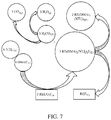
- FIG. 7 Proposed reaction scheme for the dissolution process in the IL system.
- Lower left circles indicate initial reactive solution species, rectangles indicate solid phases, upper left circles indicate species that exist in the system as gases, and the two rightmost circles indicate RE solution species.
- FIGS. 8A, 8B show initial (bottom) and final (top) absorbance spectra and FIG. 8B shows speciation of Nd 3+ in BMIM + NTf 2 ⁇ at 120° C.
- the following species are present: 0: Nd 3+ ; 1: Nd(DMA) 3+ ; 2: Nd(DMA) 2 3+ ; 3: Nd(DMA) 3 3+ ; 4: Nd(DMA) 4 3+ ; 5: Nd(DMA) 5 3+ .
- Experimental Nd 3+ /DMA ratios range from 1:0 to 1:7.25. Note: the Nd spectra are shifted in order to display the features of each.
- FIG. 9 Graph showing enrichment factor [quotient ( ⁇ ) of the heavy to light ratio in 2 mol/kg DMAH + NTf 2 ⁇ in BMIM + NTf 2 ⁇ divided by the ratio of heavy to light REs in natural bastnaesite] as a function of time. Conditions: 45° C. and 700 rpm.
- FIG. 10 Graph plotting ratio of heavy/light rare earths in 2 mol/kg DMAH + NTf 2 ⁇ in BMIM + NTf 2 ⁇ diluent as natural bastnaesite is dissolved as a function of time. Bastnaesite (3 g) was dissolved in 62.3 g of IL. Conditions: 45° C. and 700 rpm.
- the extraction method can be applied on any rare earth-containing substance, particularly a solid substance containing one or more rare earth elements, typically in salt form, such as a carbonate, oxide, and/or halide of the at least one rare earth element.
- the rare earth element is selected from a lanthanide (i.e., an element having an atomic number of 57-71) and/or an actinide (i.e., an element having an atomic number of 89-103) or a subset of elements therein.
- lanthanide elements include yttrium (Y), lanthanum (La), cerium (Ce), praseodymium (Pr), neodymium (Nd), samarium (Sm), europium (Eu), gadolinium (Gd), terbium (Tb), dysprosium (Dy), holmium (Ho), erbium (Er), thulium (Tm), ytterbium (Yb), and lutetium (Lu).
- actinide elements include actinium (Ac), thorium (Th), protactinium (Pa), and uranium (U).
- the rare earth elements may or may not also include yttrium (atomic number of 39).
- the rare earth-containing substance is a rare earth-containing mineral, such as bastnaesite, which, at least in one of its forms, has the approximate composition (Ce, La)CO 3 F.
- bastnaesite may include other rare earth elements, typically the lanthanides with atomic numbers selected from 39 and 57-71, and may also have a percentage of hydroxy (OH) groups replacing F atoms.
- the rare earth-containing substance is waste or effluent emanating from, for example, a recycling process, mining process, or nuclear energy process.
- the rare earth-containing substance may or may not also include one or more alkaline earth species (e.g., Mg 2+ , Ca 2+ , Sr 2+ , or Ba 2+ ) and/or one or more alkali species (e.g., Li + , Na + , K + , Rb + , or Cs + ). In some embodiments, any one or more of the foregoing rare earth or other elements are not present in the rare earth-containing substance.
- alkaline earth species e.g., Mg 2+ , Ca 2+ , Sr 2+ , or Ba 2+
- alkali species e.g., Li + , Na + , K + , Rb + , or Cs + .
- any one or more of the foregoing rare earth or other elements are not present in the rare earth-containing substance.
- the rare earth-containing substance is mixed with one or more protic ionic liquids according to Formula (1) or Formula (4) that form a complex with one or more of the rare earth elements, wherein the complex is at least partially soluble in the protic ionic liquid and/or a solvent (e.g., a non-aqueous solvent) in which the protic ionic liquid is dissolved.
- the mixing process should be sufficiently intimate and rigorous so as to maximize the extraction potential of the protic ionic liquid being used under the conditions (e.g., temperature and pressure) used.
- the intimate mixing can be achieved by any of the methods known in the art, such as by manual or mechanical stirring, vibrating, shaking, or tumbling.
- high-speed stirring by use of a high-speed mixer is used.
- the high-speed mixer may provide a stirring speed of at least, for example, 100, 200, 500, 1000, 1500, or 2000 revolutions per minute (rpm).
- the mixing process may also include grinding of the rare earth-containing substance either before or during contact with the protic ionic liquid.
- the mixing process may also employ any suitable temperature below the temperature at which the protic ionic liquid decomposes.
- a temperature of about, at least, above, up to, or less than, for example, 20, 30, 40, 50, 60, 70, 80, 90, 100, 120, 150, 180, or 200° C. may be employed, wherein the term “about” generally indicates within ⁇ 0.5%, 1%, 2%, 5%, or up to ⁇ 10% of the indicated value.
- the mixing step is conducted at standard pressure (approximately 1 atm); however, in some embodiments, an elevated pressure may be used, such as a pressure of about or at least, for example, 1.5, 2, 2.5, 3, 4, 5, or 10 atm, or a reduced pressure may be used, such as up to or below, 1, 0.8, 0.5, or 0.1 atm, or even up to or below 1000, 500, 200, 100, 50, 20, or 10 mTorr.
- a lower pressure in particular, could help evacuate the gaseous phases, such as water and carbon dioxide, and leave the ionic liquid behind as well as the RE products.
- the protic ionic liquid functions to dissolve at least a portion of one or more rare earth elements from the rare earth-containing substance into the protic ionic liquid or into a solvent in which the protic ionic liquid is dissolved.
- the extent of extraction can be quantified as the amount of rare earth metal extracted into solution vs. the total amount of rare earth metal originally present in the rare earth-containing substance. The foregoing proportion may also be termed the “extraction efficiency”.
- the extraction efficiency of the process is typically at least 10%, and may be, for example, at least 15, 20, 25, 30, 35, 40, 45, 50, 60, 70, 80, 90, 95, or 98%.
- the protic ionic liquid extracts one or more rare earth elements to a greater degree (i.e., at a higher extraction efficiency) than one or more other rare earth elements, thereby enriching the protic ionic liquid or the solvent in which it may be dissolved to a greater degree with one or more of the rare earth elements as compared to one or more of the other rare earth elements.
- the rare earth-containing substance includes at least one of a first rare earth element selected from lanthanum, cerium, praseodymium, and neodymium and at least one of a second rare earth element selected from europium, terbium, dysprosium, holmium, and yttrium, and the protic ionic liquid dissolves at least one of the second rare earth element to a greater degree than at least one of the first rare earth element, thereby enriching the protic ionic liquid or a solvent in which it may be dissolved to a greater degree with at least one of the second rare earth element than at least one of the first rare earth element.
- a first rare earth element selected from lanthanum, cerium, praseodymium, and neodymium
- a second rare earth element selected from europium, terbium, dysprosium, holmium, and yttrium
- the term “ionic liquid” refers to an ionic compound that is a liquid without being dissolved in a solvent.
- the ionic liquids considered herein are typically liquid at room temperature (e.g., 15, 18, 20, 22, 25, or 30° C.) or lower.
- the ionic liquid may become a liquid at a higher temperature than 30° C. if the process is conducted at an elevated temperature that melts the ionic liquid.
- the ionic liquid may have a melting point of up to or less than 100, 90, 80, 70, 60, 50, 40, or 30° C.
- the ionic liquid is a liquid at or below 10, 5, 0, ⁇ 10, ⁇ 20, ⁇ 30, or ⁇ 40° C.
- protic refers to the presence of an acidic proton in the ionic liquid, as exemplified in the protic ionic liquids in Formulas (1) and (4)
- the protic ionic liquid contains a protonated amide (i.e., amidium) species.
- amide i.e., amidium
- protic ionic liquids can be expressed by the following formula:
- R 1 is selected from hydrogen atom (H) and hydrocarbon groups (R) containing at least 1 and up to 12 carbon atoms;
- R 2 and R 3 are independently selected from hydrocarbon groups containing at least 1 and up to 12 carbon atoms; and
- X ⁇ is an anionic species.
- the hydrocarbon groups may independently contain 1, 2, 3, 4, 5, 6, 7, 8, 9, 10, 11, or 12 carbon atoms, or independently, a number of carbon atoms within a range bounded by any two of the foregoing number of carbon atoms (e.g., a number of carbon atoms of 1-8, 1-6, 1-4, or 1-3).
- R 1 , R 2 , and R 3 are all hydrogen atoms.
- at least R 1 is a hydrocarbon group, or at least one or two of R 1 , R 2 , and R 3 or at least one or both of R 2 and R 3 are hydrocarbon groups independently containing 1, 2, 3, 4, 5, 6, 7, 8, 9, 10, 11, or 12 carbon atoms.
- all of R 1 , R 2 , and R 3 are hydrocarbon groups independently containing 1, 2, 3, 4, 5, 6, 7, 8, 9, 10, 11, or 12 carbon atoms.
- one or more of the hydrocarbon groups (R) are selected from saturated groups composed solely of carbon and hydrogen and containing at least one carbon-hydrogen bond.
- the hydrocarbon groups (R) can be selected from, for example, straight-chained alkyl groups, branched alkyl groups, and cycloalkyl groups.
- straight-chained alkyl groups include methyl, ethyl, n-propyl, n-butyl, n-pentyl, n-hexyl, n-heptyl, n-octyl, n-nonyl, n-decyl, n-undecyl, and n-dodecyl groups.
- branched alkyl groups include isopropyl (2-propyl), isobutyl (2-methylprop-1-yl), sec-butyl (2-butyl), t-butyl, 2-pentyl, 3-pentyl, 2-methylbut-1-yl, isopentyl (3-methylbut-1-yl), 1,2-dimethylprop-1-yl, 1,1-dimethylprop-1-yl, neopentyl (2,2-dimethylprop-1-yl), 2-hexyl, 3-hexyl, 2-methylpent-1-yl, 3-methylpent-1-yl, and isohexyl (4-methylpent-1-yl) groups, wherein the “1-yl” suffix represents the point of attachment of the group.
- cycloalkyl groups include cyclopropyl, cyclobutyl, cyclopentyl, cyclohexyl, cycloheptyl, and cyclooctyl groups.
- the cycloalkyl group can also be a polycyclic (e.g., bicyclic) group by either possessing a bond between two ring groups (e.g., dicyclohexyl) or a shared (i.e., fused) side (e.g., decalin and norbornane).
- one or more of the hydrocarbon groups (R) are selected from unsaturated groups composed solely of carbon, or carbon and hydrogen.
- the unsaturated hydrocarbon groups (R) can be selected from, for example, straight-chained alkenyl (olefinic) or alkynyl groups, branched alkenyl or alkynyl groups, aliphatic carbocyclic groups, and aromatic carbocyclic groups.
- straight-chained alkenyl groups include vinyl, propen-1-yl (allyl), 3-buten-1-yl(CH 2 ⁇ CH—CH 2 —CH 2 —), 2-buten-1-yl (CH 2 —CH ⁇ CH—CH 2 —), butadienyl, and 4-penten-1-yl groups.
- branched alkenyl groups include propen-2-yl, 3-buten-2-yl (CH 2 ⁇ CH—CH.—CH 3 ), 3-buten-3-yl (CH 2 ⁇ C.—CH 2 —CH 3 ), 4-penten-2-yl, 4-penten-3-yl, 3-penten-2-yl, 3-penten-3-yl, and 2,4-pentadien-3-yl groups, wherein the dot in the foregoing exemplary formulas represents a radical or the point of attachment of the group.
- aliphatic carbocyclic groups include cyclopropenyl, cyclobutenyl, cyclopentenyl, cyclopentadienyl, cyclohexenyl, and cyclohexadienyl groups.
- aromatic carbocyclic groups include phenyl and benzyl groups.
- the unsaturated cyclic hydrocarbon group can also be a polycyclic group (such as a bicyclic or tricyclic polyaromatic group) by either possessing a bond between two of the ring groups (e.g., biphenyl) or a shared (i.e., fused) side, as in naphthalene, anthracene, phenanthrene, phenalene, or indene.
- a polycyclic group such as a bicyclic or tricyclic polyaromatic group
- the hydrocarbon group (R) group may include one or more heteroatoms (i.e., non-carbon and non-hydrogen atoms), such as one or more heteroatoms selected from oxygen, nitrogen, sulfur, silicon, phosphorus, boron, and halide atoms, as well as groups containing one or more of these heteroatoms (i.e., heteroatom-containing groups).
- heteroatoms i.e., non-carbon and non-hydrogen atoms
- heteroatoms selected from oxygen, nitrogen, sulfur, silicon, phosphorus, boron, and halide atoms
- oxygen-containing groups include hydroxy (OH), alkoxy (OR), carbonyl-containing (e.g., carboxylic acid, ketone, aldehyde, carboxylic ester, amide, and urea functionalities), nitro (NO 2 ), carbon-oxygen-carbon (ether), sulfonyl, and sulfinyl (i.e., sulfoxide) groups.
- OH hydroxy
- OR alkoxy
- carbonyl-containing e.g., carboxylic acid, ketone, aldehyde, carboxylic ester, amide, and urea functionalities
- NO 2 carbon-oxygen-carbon
- ether sulfonyl
- sulfinyl i.e., sulfoxide
- alkoxy groups —OR include methoxy, ethoxy, n-propoxy, isopropoxy, n-butoxy, isobutoxy, t-butoxy, phenoxy, benzyloxy, 2-hydroxyethoxy, 2-methoxyethoxy, 2-ethoxyethoxy, vinyloxy, and allyloxy groups.
- the ether group can also be a polyalkyleneoxide (polyalkyleneglycol) group, such as a polyethyleneoxide group.
- nitrogen-containing groups include primary amine, secondary amine, tertiary amine (i.e., —NR 2 or —NR 3 + , wherein R is independently selected from H and hydrocarbon groups set forth above), nitrile, amide (i.e., —C(O)NR 2 or —NRC(O)R, wherein R is independently selected from hydrogen atom and hydrocarbon groups set forth above), imine (e.g., —CR ⁇ NR, wherein R is independently H or a hydrocarbon group), oxime (—CR ⁇ N—OH), amidoxime (—C(NH 2 ) ⁇ N—OH), nitro, urea (—NR—C(O)—NR 2 , wherein R is independently H or a hydrocarbon group), and carbamate groups (—NR—C(O)—OR, wherein R is independently H or a hydrocarbon group).
- phosphorus-containing groups include —PR 2 , —PR 3 + , —P( ⁇ O)R 2 , —P(OR) 2 , —O—P(OR) 2 , —R—P(OR) 2 , —P( ⁇ O)(OR) 2 , —O—P( ⁇ O)(OR) 2 , —O—P( ⁇ O)(OR)(R), —O—P( ⁇ O)R 2 , —R—P( ⁇ O)(OR) 2 , —R—P( ⁇ O)(OR)(R), and —R—P( ⁇ O)R 2 groups, wherein R is independently selected from hydrogen atom and hydrocarbon groups set forth above.
- sulfur-containing groups include mercapto (i.e., —SH), thioether (i.e., sulfide, e.g., —SR), disulfide (—R—S—S—R), sulfoxide (—S(O)R), sulfone (—SO 2 R), sulfonate (—S( ⁇ O) 2 OR, wherein R is H, a hydrocarbon group, or a cationic group), and sulfate groups (—OS( ⁇ O) 2 OR, wherein R is H, a hydrocarbon group, or a cationic group).
- halide atoms include fluorine, chlorine, bromine, and iodine.
- heteroatoms described above e.g., oxygen, nitrogen, and/or sulfur atoms
- carbon atoms e.g., as —O—, —NR—, or —S—
- one or more of the heteroatom-containing groups can replace one or more hydrogen atoms on the hydrocarbon group.
- any one or more of the above heteroatoms or heteroatom groups may be excluded from the hydrocarbon (R).
- the anion (X ⁇ ) of the protic ionic liquid is any anion which, when associated with the protonated cationic component, permits the resulting ionic compound to behave as an ionic liquid.
- the composition and structure of the anion strongly affects the properties (e.g., melting point, volatility, stability, viscosity, hydrophobicity, and so on) of the ionic liquid.
- the anion is structurally symmetrical, while in other embodiments, the anion is structurally asymmetrical.
- the anion (X ⁇ ) in the ionic liquid is typically monovalent (i.e., charge of ⁇ 1), as depicted in Formulas (1) and (4), the anion may have a higher valency (e.g., charge of ⁇ 2 or ⁇ 3), in which case the stoichiometric ratio between the protonated cation species and anion would be other than 1:1 in order for charge neutrality to be preserved in the ionic liquid molecule.
- the anion (X ⁇ ) is intended to encompass anions having any valency, unless otherwise stated.
- the anion (X ⁇ ) of the ionic liquid is non-carbon-containing (i.e., inorganic).
- the inorganic anion may, in one embodiment, lack fluorine atoms.
- Some examples of such anions include chloride, bromide, iodide, hexachlorophosphate (PCl 6 ⁇ ), perchlorate, chlorate, chlorite, cyanate, isocyanate, thiocyanate, isothiocyanate, perbromate, bromate, bromite, periodate, iodate, dicyanamide (i.e., N(CN) 2 ⁇ ), tricyanamide (i.e., N(CN) 3 ⁇ ), aluminum chlorides (e.g., Al 2 Cl 7 ⁇ and AlCl 4 ⁇ ), aluminum bromides (e.g., AlBr 4 ⁇ ), nitrate, nitrite, sulfate, sulfite, hydrogensulfate, hydrogensulfit
- the inorganic anion may, in another embodiment, include fluorine atoms.
- fluorine atoms include fluoride, bifluoride (HF 2 ⁇ ), hexafluorophosphate (PF 6 ⁇ ), fluorophosphate (PO 3 F 2 ⁇ ), tetrafluoroborate (BF 4 —), aluminum fluorides (e.g., AlF 4 ⁇ ), hexafluoroarsenate (AsF 6 ⁇ ), and hexafluoroantimonate (SbF 6 ⁇ ).
- the anion (X ⁇ ) of the ionic liquid is carbon-containing (i.e., organic).
- the organic anion may, in one embodiment, lack fluorine atoms.
- Some examples of such anions include carbonate, bicarbonate, the carboxylates (e.g., formate, acetate, propionate, butyrate, valerate, lactate, pyruvate, oxalate, malonate, glutarate, adipate, decanoate, salicylate, ibuprofenate, and the like), the sulfonates (e.g., CH 3 SO 3 ⁇ , CH 3 CH 2 SO 3 ⁇ , CH 3 (CH 2 ) 2 SO 3 ⁇ , benzenesulfonate, toluenesulfonate, dodecylbenzenesulfonate, docusate, and the like), the alkoxides (e.g., methoxide, ethoxide,
- the organic anion may, in another embodiment, include fluorine atoms.
- fluorosulfonates e.g., CF 3 SO 3 ⁇ , CF 3 CF 2 SO 3 ⁇ , CF 3 (CF 2 ) 2 SO 3 ⁇ , CHF 2 CF 2 SO 3 ⁇ , and the like
- the fluoroalkoxides e.g., CF 3 O ⁇ , CF 3 CH 2 O ⁇ , CF 3 CF 2 O ⁇
- pentafluorophenolate e.g., CF 3 O ⁇ , CF 3 CH 2 O ⁇ , CF 3 CF 2 O ⁇
- fluorocarboxylates e.g., trifluoroacetate and pentafluoropropionate
- fluorosulfonylimides e.g., (CF 3 SO 2 ) 2 N ⁇ ).
- the anion (X ⁇ ) of the ionic liquid has a structure according to the following general formula:
- subscripts m and n are independently 0 or an integer of 1 or above.
- Subscript p is 0 or 1, provided that when p is 0, the group —N—SO 2 —(CF 2 ) n CF 3 subtended by p is replaced with an oxide atom connected to the sulfur atom (S).
- subscript p is 1, so that Formula (3) reduces to the chemical formula:
- m and n are the same number, thereby resulting in a symmetrical anion. In another embodiment of formula (3a), m and n are not the same number, thereby resulting in an asymmetrical anion.
- m and n are independently at least 0 and up to 1, 2, 3, 4, 5, 6, 7, 8, 9, 10, or 11.
- the resulting anion has the formula F 3 CSO 2 NSO 2 CF 3 , i.e., bis-(trifluoromethylsulfonyl)imide, or Tf 2 N ⁇ .
- m and n are not both 0.
- m is 0 while n is a value of 1 or above (e.g., 1, 2, 3, 4, 5, 6, 7, 8, 9, 10, or 11).
- Some examples of such anions include F 3 CSO 2 NSO 2 CF 2 CF 3 , F 3 CSO 2 NSO 2 (CF 2 ) 2 CF 3 , F 3 CSO 2 NSO 2 (CF 2 ) 3 CF 3 , F 3 CSO 2 NSO 2 (CF 2 ) 4 CF 3 , F 3 CSO 2 NSO 2 (CF 2 ) 5 CF 3 , and so on, wherein it is understood that, in the foregoing examples, the negative sign indicative of a negative charge (i.e., “ ⁇ ”) in the anion has been omitted for the sake of clarity.
- m and n are independently at least 1 and up to 2, 3, 4, 5, 6, 7, 8, 9, 10, or 11.
- m is 1 while n is a value of 1 or above (e.g., 1, 2, 3, 4, 5, 6, 7, 8, 9, 10, or 11).
- Some examples of such anions include N[SO 2 CF 2 CF 3 ] 2 (i.e., “BETI ⁇ ”), F 3 CF 2 CSO 2 NSO 2 (CF 2 ) 2 CF 3 , F 3 CF 2 CSO 2 NSO 2 (CF 2 ) 3 CF 3 , F 3 CF 2 CSO 2 NSO 2 (CF 2 ) 4 CF 3 , F 3 CF 2 CSO 2 NSO 2 (CF 2 ) 5 CF 3 , and so on.
- m and n are independently at least 2 and up to 3, 4, 5, 6, 7, 8, 9, 10, or 11.
- m is 2 while n is a value of 2 or above (e.g., 2, 3, 4, 5, 6, 7, 8, 9, 10, or 11).
- Some examples of such anions include N[SO 2 (CF 2 ) 2 CF 3 ] 2 , F 3 C(F 2 C) 2 SO 2 NSO 2 (CF 2 ) 3 CF 3 , F 3 C(F 2 C) 2 SO 2 NSO 2 (CF 2 ) 4 CF 3 , F 3 C(F 2 C) 2 SO 2 NSO 2 (CF 2 ) 5 CF 3 , and so on.
- m and n are independently at least 3 and up to 4, 5, 6, 7, 8, 9, 10, or 11.
- m is 3 while n is a value of 3 or above (e.g., 3, 4, 5, 6, 7, 8, 9, 10, or 11).
- Some examples of such anions include N[SO 2 (CF 2 ) 3 CF 3 ] 2 , F 3 C(F 2 C) 3 SO 2 NSO 2 (CF 2 ) 4 CF 3 , F 3 C(F 2 C) 3 SO 2 NSO 2 (CF 2 ) 5 CF 3 , F 3 C(F 2 C) 3 SO 2 NSO 2 (CF 2 ) 6 CF 3 , F 3 C(F 2 C) 3 SO 2 NSO 2 (CF 2 ) 7 CF 3 , and so on.
- m can be 0 or above (e.g., up to 1, 2, 3, 4, 5, 6, 7, 8, 9, 10, or 11), 1 or above (e.g., up to 2, 3, 4, 5, 6, 7, 8, 9, 10, or 11), 2 or above (e.g., up to 3, 4, 5, 6, 7, 8, 9, 10, or 11), 3 or above (e.g., up to 4, 5, 6, 7, 8, 9, 10, or 11), 4 or above (e.g., up to 5, 6, 7, 8, 9, 10, or 11), 5 or above (e.g., up to 6, 7, 8, 9, 10, or 11), 6 or above (e.g., up to 7, 8, 9, 10, or 11), 7 or above (e.g., up to 8, 9, 10, 11, or 12), 8 or above (e.g., up to 9, 10, 11, or 12), or 9 or above (e.g., up to 10, 11, 12, 13, 14, 15, or 16).
- 1 or above e.g., up to 2, 3, 4, 5, 6, 7, 8, 9, 10, or 11
- 2 or above e.g., up to 3, 4, 5, 6, 7, 8, 9, 10, or
- Some examples of such anions include F 3 CSO 3 ⁇ (i.e., “triflate” or “TfO ⁇ ”), F 3 CF 2 CSO 3 ⁇ , F 3 C(F 2 C) 2 SO 3 ⁇ , F 3 C(F 2 C) 3 SO 3 ⁇ (i.e., “nonaflate” or “NfO ⁇ ”), F 3 C(F 2 C) 4 SO 3 ⁇ , F 3 C(F 2 C) 5 SO 3 ⁇ , F 3 C(F 2 C) 6 SO 3 ⁇ , F 3 C(F 2 C) 7 SO 3 ⁇ , F 3 C(F 2 C) 8 SO 3 ⁇ , F 3 C(F 2 C) 9 SO 3 ⁇ , F 3 C(F 2 C) 10 SO 3 ⁇ , F 3 C(F 2 C) 11 SO 3 ⁇ , and so on.
- F 3 CSO 3 ⁇ i.e., “triflate” or “TfO ⁇ ”
- protic ionic liquids according to Formula (1) can be synthesized by methods well known in the art, as evidenced by, for example, H. Luo et al., Separation Science and Technology, 45: 1679-1688, 2010, the contents of which are herein incorporated by reference in their entirety.
- an organic amide (such as in accordance with Formula 2) can be reacted with a mineral acid, such as hydrochloric acid, to protonate the amide, followed by anion exchange of the protonated amide salt with an anion of interest, such as NTf 2 ⁇ or BETI ⁇ , by reaction of the protonated amide salt with an anion salt (e.g., LiNTf 2 or LiBETI), along with removal of salt byproduct (e.g., LiCl).
- a mineral acid such as hydrochloric acid
- the conjugate base of the amidium species is the amide compound resulting from deprotonation of the amidium species.
- the conjugate base of the amidium species in Formula (1) has the following formula:
- the rare earth composition containing at least the one or more rare earth elements (RE), the anion (X ⁇ ), and amide species of Formula (2) can be conveniently expressed by the formula (RE)(amide) y X z , wherein the foregoing composition becomes at least partially dissolved in the protic ionic liquid (or solvent in which the protic ionic liquid is dissolved) during the mixing process.
- X is equivalent to X ⁇ shown in Formula (1).
- the subscript y is generally 2-6 (or, e.g., 2-5, 3-5, or 3-6), depending on the rare earth element.
- the subscript z is a number that serves to charge balance the total positive charge of the at least one rare earth metal (RE).
- z is an integer equivalent to the oxidation state of the at least one rare earth element RE, as in the sub-formula (RE)(amide) y X 3 , in the case where RE represents a rare earth element having a +3 oxidation state and X is a monovalent anion.
- the rare earth composition may be expressed as (RE) 2 (amide) y X 3 , in which case the subscript y may also require adjustment in order to reflect the number of amide groups for two or more rare earth elements.
- the subscript z may also be a fractional number in the event that RE represents at least two rare earth elements differing in oxidation state.
- RE represents two rare earth elements having oxidation states of +3 (e.g., La) and +4 (e.g., Ce) at 1:1 molar ratio
- X is a monovalent anion
- the composition may be expressed by the sub-formula (RE)(amide) y X 3.5 .
- the rare earth composition may or may not include additional metallic species (e.g., one or more alkali or alkaline earth species), one or more neutral molecules, or one or more anionic species.
- the protic ionic liquid contains a protonated phosphine oxide species.
- R 4 , R 5 , and R 6 are independently selected from hydrocarbon groups (R), as described above, containing at least 1 and up to 12 carbon atoms and/or selected from alkoxide groups —OR. In some embodiments, R 4 , R 5 , and R 6 are all the same or different hydrocarbon groups (R). In other embodiments, R 4 , R 5 , and R 6 are all the same or different alkoxide groups (—OR). In yet other embodiments, R 4 , R 5 , and R 6 are a mix of hydrocarbon groups and alkoxide groups.
- X ⁇ is an anionic species, as described above.
- the protic ionic liquids according to Formula (4) may be synthesized analogously to protic ionic liquids of Formula (1) by, for example, protonating a phosphine oxide-containing compound, such as according to Formula (5), with a mineral acid (e.g., hydrochloric acid), followed by anion exchange of the protonated phosphine oxide-containing salt with an anion of interest, such as NTf 2 ⁇ or BETI ⁇ , by reaction of the protonated phosphine oxide-containing salt with an anion salt (e.g., LiNTf 2 or LiBETI), along with removal of salt byproduct (e.g., LiCl).
- a mineral acid e.g., hydrochloric acid
- anion of interest such as NTf 2 ⁇ or BETI ⁇
- anion salt e.g., LiNTf 2 or LiBETI
- the protic ionic liquid according to Formula (4) is mixed with the rare earth-containing substance in accordance with the mixing process described above for the protic ionic liquid according to Formula (1).
- the mixing process using the protic ionic liquid of Formula (4) results in a solution containing a rare earth complex that contains at least one or more rare earth elements derived from the rare earth-containing substance along with anions (X ⁇ ) and the deprotonated form (i.e., conjugate base) of the cationic species in Formula (4).
- the deprotonated form (i.e., conjugate base) of the cationic species in Formula (4) is herein referred to as a “phos” group, which has the following formula:
- the composition resulting from reaction between the protic ionic liquid of Formula (4) and one or more rare earth elements can be conveniently expressed by the formula (RE)(phos) y X z , wherein the foregoing composition becomes at least partially dissolved in the protic ionic liquid during the mixing process.
- X is equivalent to X ⁇ shown in Formula (4).
- the subscript y is generally 2-6 (or, e.g., 2-5, 3-5, or 3-6), depending on the rare earth element.
- the subscript z is a number that serves to charge balance the total positive charge of the at least one rare earth metal (RE).
- compositions containing the neutral amide according to Formula (2) apply herein analogously to compositions containing the neutral phosphine oxide according to Formula (5).
- the composition containing phosphine oxide according to Formula (5) may be expressed as, for example, (RE)(phos) y X 3 , (RE) 2 (phos) y X 3 , or (RE)(phos) y X 3.5 .
- the protic ionic liquid according to Formula (1) or (4) is dissolved in a solvent (e.g., an aqueous or non-aqueous solvent different from the protic ionic liquid) at the time the protic ionic liquid is contacted with and mixed with the rare earth-containing substance.
- a solvent e.g., an aqueous or non-aqueous solvent different from the protic ionic liquid
- the protic ionic liquid may be dissolved in the solvent before or during the mixing process with the rare earth-containing substance.
- the solvent should not be reactive with the protic ionic liquid, such as by not being capable of deprotonating the protonated cation of the protic ionic liquid.
- the protic ionic liquid serves to facilitate dissolution of one or more of the rare earth elements derived from the rare earth-containing substance into the solvent.
- the protic ionic liquid does this by forming a complex with the one or more rare earth elements, as discussed above, wherein the rare earth-containing complex
- the solvent in which the protic ionic liquid is dissolved is aqueous-based.
- the aqueous-based solvent may be water or a solution of water and one or more organic or inorganic solvents soluble in water.
- the aqueous solution may be, for example, an aqueous alcohol solution.
- the solvent in which the protic ionic liquid is dissolved is non-aqueous, i.e., an organic solvent.
- the organic solvent may be, for example, protic or aprotic, and/or polar or non-polar.
- polar protic organic solvents include the alcohols (e.g., methanol, ethanol, isopropanol, n-butanol, t-butanol, the pentanols, hexanols, octanols, or the like) and diols (e.g., ethylene glycol, diethylene glycol, triethylene glycol).
- polar aprotic organic solvents include the nitriles (e.g., acetonitrile, propionitrile), sulfoxides (e.g., dimethylsulfoxide), amides (e.g., dimethylformamide, N,N-dimethylacetamide), organochlorides (e.g., methylene chloride, chloroform, 1,1,1-trichloroethane), ketones (e.g., acetone, 2-butanone), dialkylcarbonates (e.g., ethylene carbonate, dimethylcarbonate, diethylcarbonate), organoethers (e.g., diethyl ether, tetrahydrofuran, and dioxane), hexamethylphosphoramide acid (HMPA), N-methylpyrrolidone (NMP), 1,3-dimethyl-3,4,5,6-tetrahydro-2(1H)-pyrimidinone (DMPU), propylene glycol methyl ether,
- non-polar organic solvents include the liquid hydrocarbons, such as a pentane, hexane, heptane, octane, pentene, hexene, heptene, octene, benzene, toluene, and xylene.
- a combination of any of the foregoing organic solvents is used as the solvent.
- one or more of any of the foregoing classes or specific types of organic solvents is excluded, or an organic solvent is excluded altogether in the mixing process or entire extraction process.
- the solvent in which the protic ionic liquid is dissolved is an ionic liquid, hereinafter referred to as a “secondary ionic liquid,” which is different from and non-reactive with the protic ionic liquid of Formula (1) or (4).
- the secondary ionic liquid is protic, while in other embodiments the secondary ionic liquid is non-protic.
- the secondary ionic liquid should have the ability to at least partially dissolve the rare earth-containing complex resulting from reaction of the protic ionic liquid of Formula (1) or (4) with the one or more rare earth elements (RE).
- the secondary ionic liquid can belong to any of the numerous classes of ionic liquids known in the art, provided it is non-reactive with the protic ionic liquid of Formula (1) or (4) and has the ability to at least partially dissolve the rare earth-containing complex resulting from reaction of the protic ionic liquid of Formula (1) or (4) with the one or more rare earth elements (RE).
- the secondary ionic liquid can be conveniently described by the formula (Y + )(X ⁇ ), wherein Y + is a cationic component of the ionic liquid and X ⁇ is an anionic component of the ionic liquid.
- the formula (Y + )(X ⁇ ) is meant to encompass a cationic component (Y + ) having any valency of positive charge, and an anionic component (X ⁇ ) having any valency of negative charge, provided that the charge contributions from the cationic portion and anionic portion are counterbalanced in order for charge neutrality to be preserved in the ionic liquid molecule.
- the cationic group Y + of the secondary ionic liquid has the generic formula:
- Z is either N or P
- R 1a , R 2a , R 3a , and R 4a are each independently selected from hydrogen atom and hydrocarbon groups (R) having at least one and up to twenty carbon atoms and optionally substituted with one or more heteroatoms selected from fluorine, nitrogen, oxygen, and sulfur, as described above for hydrocarbon groups R, provided that at least one of R 1a , R 2a , R 3a , and R 4a is a hydrocarbon group R when Z is N, and provided that R 1a , R 2a , R 3a , and R 4a are all hydrocarbon groups when Z is P.
- R 1 , R 2 , R 3 , and R 4 are selected from straight-chained or branched alkyl and/or alkenyl groups having at least 1, 2, 3, or 4 and up to 5, 6, 7, 8, 9, 10, 11, 12, 13, 14, 15, 16, 17, 18, 19, or 20 carbon atoms.
- one, two, three, or all of R 1a , R 2a , R 3a , and R 4a are selected from saturated or unsaturated cyclic hydrocarbon groups, which may be carbocyclic (e.g., cycloalkyl or aryl) or heterocyclic (e.g., heterocycloalkyl or heteroaryl).
- Z is N, which corresponds to ammonium species having the following formula:
- R 1a , R 2a , R 3a , and R 4a are each independently selected from hydrogen atom and hydrocarbon groups (R) having at least one and up to twenty carbon atoms and optionally substituted with one or more heteroatoms selected from fluorine, nitrogen, oxygen, and sulfur, as described above for hydrocarbon groups R, provided that at least one of R 1a , R 2a , R 3a , and R 4a is a hydrocarbon group R.
- R 1a , R 2a , R 3a , and R 4a of Formula (6a) are selected from straight-chained or branched alkyl and/or alkenyl groups having at least 1, 2, 3, or 4 and up to 5, 6, 7, 8, 9, 10, 11, 12, 13, 14, 15, 16, 17, 18, 19, or 20 carbon atoms, or at least 5, 6, 7, or 8 and up to 9, 10, 11, 12, 13, 14, 15, 16, 17, 18, 19, or 20 carbon atoms.
- ammonium species include methylammonium, ethylammonium, vinylammonium, n-propylammonium, isopropylammonium, allylammonium, n-butylammonium, isobutylammonium, n-pentylammonium, n-hexylammonium, n-heptylammonium, n-octylammonium, 2-ethylhexylammonium, n-nonylammonium, n-decylammonium, n-undecylammonium, n-dodecylammonium, dimethylammonium, diethylammonium, divinylammonium, ethylmethylammonium, dipropylammonium, methylpropylammonium, diisopropylammonium, diallylammonium, dibutylammonium, methylbutylam
- R 1a , R 2a , R 3a and R 4a of Formula (6a) are selected from saturated or unsaturated cyclic hydrocarbon groups, which may be carbocyclic (e.g., cycloalkyl or aryl) or heterocyclic (e.g., heterocycloalkyl or heteroaryl) and may or may not include a hydrocarbon linker and/or one more hydrocarbon substituents.
- saturated or unsaturated cyclic hydrocarbon groups which may be carbocyclic (e.g., cycloalkyl or aryl) or heterocyclic (e.g., heterocycloalkyl or heteroaryl) and may or may not include a hydrocarbon linker and/or one more hydrocarbon substituents.
- ammonium species include trimethylcyclopentylammonium, trimethylcyclohexylammonium, trimethylphenylammonium, trimethylbenzylammonium, trimethylnaphthylammonium, triethylcyclopentylammonium, triethylcyclohexylammonium, triethylphenylammonium, triethylbenzylammonium, triisopropylcyclopentylammonium, triisopropylcyclohexylammonium, triisopropylphenylammonium, triisopropylbenzylammonium, dimethylcyclopentylammonium, dimethylcyclohexylammonium, dimethylphenylammonium, dimethylbenzylammonium, diethylcyclopentylammonium, diethylcyclohexylammonium, diethylphenylammonium, diethylcyclopen
- Z is P, which corresponds to phosphonium species having the following formula:
- R 1a , R 2a , R 3a , and R 4a are each independently selected from hydrocarbon groups (R) having at least one and up to twenty carbon atoms and optionally substituted with one or more heteroatoms selected from fluorine, nitrogen, oxygen, and sulfur, as described above for hydrocarbon groups R.
- R 1a , R 2a , R 3a , and R 4a are selected from straight-chained or branched alkyl and/or alkenyl groups having at least 1, 2, 3, or 4 and up to 5, 6, 7, 8, 9, 10, 11, 12, 13, 14, 15, 16, 17, 18, 19, or 20 carbon atoms, or at least 5, 6, 7, or 8 and up to 9, 10, 11, 12, 13, 14, 15, 16, 17, 18, 19, or 20 carbon atoms.
- R 1a , R 2a , R 3a , and R 4a are selected from saturated or unsaturated cyclic hydrocarbon groups, which may be carbocyclic (e.g., cycloalkyl or aryl) or heterocyclic (e.g., heterocycloalkyl or heteroaryl).
- R 1a , R 2a , R 3a , and R 4a of Formula (6b) are selected from straight-chained or branched alkyl and/or alkenyl groups having at least 1, 2, 3, or 4 and up to 5, 6, 7, 8, 9, 10, 11, 12, 13, 14, 15, 16, 17, 18, 19, or 20 carbon atoms, or at least 5, 6, 7, or 8 and up to 9, 10, 11, 12, 13, 14, 15, 16, 17, 18, 19, or 20 carbon atoms.
- phosphonium species include tetramethylphosphonium, tetraethylphosphonium, tetravinylphosphonium, tetrapropylphosphonium, tetraisopropylphosphonium, dimethyldiisopropylphosphonium, tetraallylphosphonium, tetrabutylphosphonium, tetraisobutylphosphonium, dimethyldiisobutylphosphonium, diethyldiisobutylphosphonium, methyltriisobutylphosphonium, ethyltriisobutylphosphonium, tetrapentylphosphonium, tetrahexylphosphonium, tetrakis(isohexyl)phosphonium, ethyltrioctylphosphonium, tetraoctylphosphonium, tetrakis(isooctyl)phosphonium, e
- R 1a , R 2a , R 3a and R 4a of Formula (6b) are selected from saturated or unsaturated cyclic hydrocarbon groups, which may be carbocyclic (e.g., cycloalkyl or aryl) or heterocyclic (e.g., heterocycloalkyl or heteroaryl) and may or may not include a hydrocarbon linker and/or one more hydrocarbon substituents.
- saturated or unsaturated cyclic hydrocarbon groups which may be carbocyclic (e.g., cycloalkyl or aryl) or heterocyclic (e.g., heterocycloalkyl or heteroaryl) and may or may not include a hydrocarbon linker and/or one more hydrocarbon substituents.
- phosphonium species include trimethylcyclopentylphosphonium, trimethylcyclohexylphosphonium, trimethylphenylphosphonium, trimethylbenzylphosphonium, trimethylnaphthylphosphonium, triethylcyclopentylphosphonium, triethylcyclohexylphosphonium, triethylphenylphosphonium, triethylbenzylphosphonium, triisopropylcyclopentylphosphonium, triisopropylcyclohexylphosphonium, triisopropylphenylphosphonium, triisopropylbenzylphosphonium, dimethyldicyclopentylphosphonium, dimethyldicyclohexylphosphonium, dimethyldiphenylphosphonium, dimethyldibenzylphosphonium, diethyldicyclopentylphosphonium, diethyldicyclohexylphosphonium, diethyl
- two or more of R 1a , R 2a , R 3a , and R 4a may (i.e., optionally) be combined to form one or more cyclic groups that includes Z as a ring heteroatom.
- two or more of R 1a , R 2a , R 3a , and R 4a of Formula (6a), or two or more of R 1a , R 2a , R 3a , and R 4a of Formula (6b) may (i.e., optionally) be combined to form one or more cyclic groups that includes Z as a ring heteroatom.
- R 1a and R 2a may interconnect to form a five-membered ring that includes Z.
- the interconnected moiety may also contain one or more heteroatoms as a ring heteroatom, in addition to Z.
- two of R 1a , R 2a , R 3a , and R 4a may (i.e., optionally) be combined to form a group linked to Z by a double bond.
- R 1a and R 2a in Formula (6a) or in Formula (6b) can be interconnected to result in cationic species having any of the following formulas:
- R 7 , R 8 , R 9 , R 10 , R 11 , R 12 , R 13 , and R 14 are each independently selected from hydrogen atom and hydrocarbon groups (R) having at least one and up to twenty carbon atoms and optionally substituted with one or more heteroatoms selected from fluorine, nitrogen, oxygen, and sulfur, as described above for hydrocarbon groups R, provided that R 9 , R 10 , R 13 , and R 14 of the cyclic phosphonium species are all hydrocarbon groups R.
- any of the groups, above, that are not shown as interconnected may either interconnect with each other to make a second ring that includes N or P, or may interconnect with the existing ring to form a bicyclic structure.
- R 1a and R 2a in Formula (6a) or in Formula (6b) can also include one or more heteroatoms.
- Some examples of such cationic species include:
- R 7 , R 8 , R 11 , and R 12 are as defined above.
- the group R′ bound to the additional one or more hydrogen atoms is independently selected from hydrogen atom and any of the hydrocarbon groups (R) described above, particularly straight-chained or branched alkyl and/or alkenyl groups having 1, 2, 3, 4, 5, or 6 carbon atoms.
- the above structures show the presence of one or more ring nitrogen atoms, the cyclic cation may also include a ring oxygen atom, such as in a morpholinium-based ionic liquid.
- R 1a and R 2a in Formula (6a) or Formula (6b) can also be accompanied by one or more double bonds in the ring containing N or P. If one of the double bonds is connected to N or P in the ring, then one of R 3a and R 4a in Formula (6a) or in Formula (6b) participates to make a double bond in the ring.
- R 3a and R 4a in Formula (6a) or R 3b and R 4b in Formula (6b) are not required to participate in making a double bond in the ring, i.e., the double bond originated in this case from one of R 1a and R 2a in Formula (6a) or one of R 1b and R 2b in Formula (6b).
- the interconnection may or may not also include one or more heteroatoms.
- the secondary ionic liquid possesses an imidazolium species as the cationic Y + species.
- the imidazolium-based ionic liquid may have a structure of the general formula:
- R 1b , R 2b and R 3b are each independently a saturated or unsaturated, straight-chained, branched, or cyclic hydrocarbon group (R), as described above, particularly those hydrocarbon groups containing at least 1, 2, or 3 and up to 4, 5, 6, 7, 8, 9, 10, 11, or 12 carbon atoms, except that R 3b is often a hydrogen atom instead of a hydrocarbon.
- R 1b , R 2b and R 3b are each independently a saturated or unsaturated, straight-chained, branched, or cyclic hydrocarbon group (R), as described above, particularly those hydrocarbon groups containing at least 1, 2, or 3 and up to 4, 5, 6, 7, 8, 9, 10, 11, or 12 carbon atoms, except that R 3b is often a hydrogen atom instead of a hydrocarbon.
- X ⁇ is an anion, as also described above.
- R 1b and R 2b , or R 1b and R 3b , or R 2b and R 3b are different in structure or number of carbon atoms, whereas in other embodiments, R 1b and R 2b , or R 1b and R 3b , or R 2b and R 3b are the same either in structure or number of carbon atoms. In different embodiments, R 1b , R 2b and R 3b each independently have a minimum of at least one, two, three, four, five, six, seven, or eight carbon atoms.
- R 1b , R 2b and R 3b each independently have a maximum of two, three, four, five, six, seven, eight, nine, ten, eleven, twelve, thirteen, fourteen, fifteen, sixteen, seventeen, or eighteen carbon atoms.
- R 1b , R 2b and R 3b independently have a number of carbon atoms within a range of carbon atoms bounded by any of the exemplary minimum and maximum carbon numbers provided above.
- the double bonds shown in Formula (7) are generally delocalized, other structurally equivalent depictions may be possible for the imidazolium ring.
- secondary ionic liquids according to Formula (7) include 1,3-dimethylimidazolium + X ⁇ , 1,2,3-trimethylimidazolium + X ⁇ , 2-ethyl-1,3-dimethylimidazolium + X ⁇ , 2-n-propyl-1,3-dimethylimidazolium + X ⁇ , 2-n-butyl-1,3-dimethylimidazolium + X ⁇ , 1-ethyl-2,3-dimethylimidazolium + X ⁇ , 1-n-propyl-2,3-dimethylimidazolium + X ⁇ , 1-n-butyl-2,3-dimethylimidazolium + X ⁇ , 1-methyl-3-ethylimidazolium + X ⁇ , 1-methyl-3-n-propylimidazolium + X ⁇ , 1-methyl-3-isopropylimidazolium
- one or both of the hydrogen atoms at the 4- and 5-positions may also be substituted with a group, such as a hydrocarbon group, such as any of the hydrocarbon groups described above, an alkoxide group (—OR), hydroxy group (OH), amino group (—NH 2 , —NHR, or —NR 2 ), carboxamide group (—C(O)NR 2 wherein one or both R groups can be replaced with H), and/or halogen atom (e.g., F, Cl, Br, or I atom), wherein the R groups may be the same or different and may or may not be interconnected to form a ring.
- a group such as a hydrocarbon group, such as any of the hydrocarbon groups described above, an alkoxide group (—OR), hydroxy group (OH), amino group (—NH 2 , —NHR, or —NR 2 ), carboxamide group (—C(O)NR 2 wherein one or both R groups can be replaced with H), and/or halogen atom (e.g
- one or both of the 4- and 5-positions of the imidazole ring may be substituted with a methyl, ethyl, n-propyl, isopropyl, n-butyl, isobutyl, sec-butyl, or t-butyl group.
- R 3 at the 2-position may also be selected from any of the foregoing groups provided for the 4- and 5-positions.
- any one or more of R 1 , R 2 and R 3 may or may not also include an imidazole or imidazolium ring, which therefore may result in a bi-imidazolium, tri-imidazolium, or tetra-imidazolium cationic portion.
- R 1 and R 3 , or R 2 and R 3 are interconnected, thereby forming an imidazolyl-containing bicyclic ring system.
- the interconnection can be saturated or unsaturated, and may or may not include substituting groups, as described above for the hydrocarbon groups R provided above.
- ionic liquids containing such imidazolyl-containing bicyclic ring systems include those according to the following formulas:
- R 9 and R 10 independently represent a hydrocarbon group, with or without heteroatom substitution, such as any of the hydrocarbon groups (R) described above for R 1b , R 2b and R 3b of Formula (7).
- R 9 and R 10 are independently selected from methyl, ethyl, n-propyl, isopropyl, n-butyl, isobutyl, sec-butyl, t-butyl, n-pentyl, isopentyl, neopentyl, n-hexyl, isohexyl, vinyl, and allyl groups.
- any of the hydrogen atoms at available carbon atoms in Formulas (7a) and (7b) may be substituted with a group, such as a hydrocarbon group, such as any of the hydrocarbon groups (R) described above, an alkoxide group (—OR), hydroxy group (OH), amino group (—NH 2 , —NHR, or —NR 2 ), carboxamide group (—C(O)NR 2 wherein one or both R groups can be replaced with H), and/or halogen atom (e.g., F, Cl, Br, or I atom), wherein the R groups may be the same or different and may or may not be interconnected to form a ring.
- a hydrocarbon group such as any of the hydrocarbon groups (R) described above, an alkoxide group (—OR), hydroxy group (OH), amino group (—NH 2 , —NHR, or —NR 2 ), carboxamide group (—C(O)NR 2 wherein one or both R groups can be replaced with H), and/or halogen
- the secondary ionic liquid is an N-hydrocarbylpyridinium-based ionic liquid having a structure of the general formula:
- R 11 represents a hydrocarbon group, with or without heteroatom substitution, such as any of the hydrocarbon groups (R) described above under Formula (7), and the anion X ⁇ can be any of the anions described above.
- Some general examples of N-alkylpyridinium-based ionic liquids include N-methylpyridinium + X ⁇ , N-ethylpyridinium + X ⁇ , N-n-propylpyridinium + X ⁇ , N-isopropylpyridinium + X ⁇ , N-n-butylpyridinium + X ⁇ , N-isobutylpyridinium + X ⁇ , N-sec-butylpyridinium + X ⁇ , N-t-butylpyridinium + X ⁇ , N-n-pentylpyridinium + X ⁇ , N-isopentylpyridinium + X ⁇ , N-is
- any one or more of the hydrogen atoms on the ring carbon atoms can be substituted with one or more other groups, such as a hydrocarbon group (R), alkoxide group (—OR), hydroxy group (OH), amino group (—NH 2 , —NHR, or —NR 2 ), carboxamide group (—C(O)NR 2 wherein one or both R groups can be replaced with H), and/or halogen atom (e.g., F, Cl, Br, or I atom), wherein the R groups may be the same or different and may or may not be interconnected to form a ring.
- R groups such as a hydrocarbon group (R), alkoxide group (—OR), hydroxy group (OH), amino group (—NH 2 , —NHR, or —NR 2 ), carboxamide group (—C(O)NR 2 wherein one or both R groups can be replaced with H), and/or halogen atom (e.g., F, Cl, Br, or I atom), wherein the R groups
- Such ionic liquids include N-methyl-4-methylpyridinium X ⁇ , N-ethyl-4-methylpyridinium X ⁇ , N-methyl-4-ethylpyridinium X ⁇ , N-methyl-4-isopropylpyridinium X ⁇ , N-isopropyl-4-methylpyridinium X ⁇ , and N-octyl-4-methylpyridinium X ⁇ .
- any one or two of the ring carbon atoms ortho, meta, or para to the shown ring nitrogen atom in the pyridinium ring may be replaced with a respective number of ring nitrogen atoms, which may be neutral or positively charged ring nitrogen atoms.
- the secondary ionic liquid is a cyclic guanidinium-based ionic liquid.
- the cyclic guanidinium-based ionic liquid can have any of the structures known in the art, including those described in U.S. Pat. No. 8,129,543 and M. G. Bogdanov, et al., Z. Naturforsch, 65b, pp. 37-48, 2010, the contents of which are herein incorporated by reference in their entirety.
- the cyclic guanidinium-based ionic liquid can be described by the following general formula:
- R 11 , R 12 , R 13 , R 14 , R 15 , and/or R 16 groups independently represent a hydrocarbon group, with or without heteroatom substitution, such as any of the hydrocarbon groups (R) described above, or a hydrogen atom, provided that at least two of R 11 , R 12 , R 13 , R 14 , R 15 , and R 16 are interconnected to form a ring or a bicyclic, tricylic, or higher cyclic ring system.
- R 11 , R 12 , R 13 , R 14 , R 15 , and/or R 16 groups are independently selected from methyl, ethyl, n-propyl, isopropyl, n-butyl, isobutyl, sec-butyl, t-butyl, n-pentyl, isopentyl, neopentyl, n-hexyl, isohexyl, vinyl, and allyl groups, provided that at least two of R 11 , R 12 , R 13 , R 14 , R 15 , and R 16 are interconnected to form a ring or a bicyclic, tricyclic, or higher cyclic ring system.
- R 11 and R 12 are interconnected.
- R 13 and R 14 , or R 15 and R 16 are interconnected.
- R 11 and R 13 , or R 12 and R 15 are interconnected.
- R 14 and R 16 are interconnected. In other embodiments, any two or three of the foregoing types of interconnections are combined.
- the foregoing embodiments also include the possibility that all of R 11 , R 12 , R 13 , R 14 , R 15 , and R 16 groups are engaged in an interconnection.
- the anion X ⁇ can be any anion, such as those described above.
- the secondary ionic liquid is a piperidinium-based ionic liquid having a structure of the following general formula:
- R 17 and R 18 independently represent a hydrocarbon group, with or without heteroatom substitution, such as any of the hydrocarbon groups (R) described above, and X ⁇ can be any of the anions described above.
- Some examples of piperidinium-based ionic liquids include 1,1-dimethylpiperidinium + X ⁇ , 1-methyl-1-ethylpiperidinium + X ⁇ , 1-methyl-1-propylpiperidinium + X ⁇ , 1-methyl-1-butylpiperidinium + X ⁇ , 1-methyl-1-isobutylpiperidinium + X ⁇ , 1-methyl-1-pentylpiperidinium + X ⁇ , 1-methyl-1-hexylpiperidinium + X ⁇ , 1-methyl-1-heptylpiperidinium + X ⁇ , 1-methyl-1-octylpiperidinium + X ⁇ , 1-methyl-1-decylpiperidinium + X ⁇ ,
- the piperidinium ring shown in Formula (10) may have a ring carbon atom replaced with a heteroatom selected from oxygen (O), sulfur (S), and/or nitrogen (—NR—).
- any of the hydrogen atoms residing on ring carbon atoms may be substituted with one or more other groups, such as a hydrocarbon group (R), alkoxide group (—OR), hydroxy group (OH), amino group (—NH 2 , —NHR, or —NR 2 ), carboxamide group (—C(O)NR 2 wherein one or both R groups can be replaced with H), and/or halogen atom (e.g., F, Cl, Br, or I atom), wherein the R groups may be the same or different and may or may not be interconnected to form a ring.
- R hydrocarbon group
- —OR alkoxide group
- OH hydroxy group
- amino group —NH 2 , —NHR, or —NR 2
- carboxamide group —C(O)NR 2 where
- the secondary ionic liquid is a pyrrolidinium-based ionic liquid having a structure of the following general formula:
- R 19 and R 20 independently represent a hydrocarbon group, with or without heteroatom substitution, such as any of the hydrocarbon groups (R) described above, and the anion X ⁇ can be any of the anions described above.
- pyrrolidinium-based ionic liquids include 1,1-dimethylpyrrolidinium + X ⁇ , 1-methyl-1-ethylpyrrolidinium + X ⁇ , 1-methyl-1-propylpyrrolidinium + X ⁇ , 1-methyl-1-butylpyrrolidinium + X ⁇ , 1-methyl-1-isobutylpyrrolidinium + X ⁇ , 1-methyl-1-pentylpyrrolidinium + X ⁇ , 1-methyl-1-hexylpyrrolidinium + X ⁇ , 1-methyl-1-heptylpyrrolidinium + X ⁇ , 1-methyl-1-octylpyrrolidinium + X ⁇ , 1-methyl-1methyl-1-methyl-1
- the pyrrolidinium ring shown in Formula (11) may have a ring carbon atom replaced with a heteroatom selected from oxygen (O), sulfur (S), and/or nitrogen (—NR—).
- any of the hydrogen atoms residing on ring carbon atoms may be substituted with one or more other groups, such as a hydrocarbon group (R), alkoxide group (—OR), hydroxy group (OH), amino group (—NH 2 , —NHR, or —NR 2 ), carboxamide group (—C(O)NR 2 wherein one or both R groups can be replaced with H), and/or halogen atom (e.g., F, Cl, Br, or I atom), wherein the R groups may be the same or different and may or may not be interconnected to form a ring.
- R groups such as a hydrocarbon group (R), alkoxide group (—OR), hydroxy group (OH), amino group (—NH 2 , —NHR, or —NR 2 ), carboxamide group (—C
- the secondary ionic liquid is a sulfonium-based ionic liquid having a structure of the following general formula:
- R 25 , R 26 , and R 27 independently represent a hydrocarbon group, with or without heteroatom substitution, such as any of the hydrocarbon groups (R) described above, and the anion X ⁇ can be any of the anions described above.
- sulfonium-based ionic liquids include trimethylsulfonium + X ⁇ , dimethylethylsulfonium + X ⁇ , diethylmethylsulfonium + X ⁇ , triethylsulfonium + X ⁇ , dimethylpropylsulfonium + X ⁇ , dipropylmethylsulfonium + X ⁇ , tripropylsulfonium + X ⁇ , dimethylbutylsulfonium + X ⁇ , dibutylmethylsulfonium + X ⁇ , tributylsulfonium + X ⁇ , dimethylhexylsul
- any of the above general classes or specific types of secondary ionic liquids, or general classes or specific types of cationic portions of the above secondary ionic liquids are excluded from the mixing process or from the method altogether.
- a mixture of two or more of the foregoing secondary ionic liquids is used.
- the resulting rare earth-containing complex can be separated from the solution by any of the known techniques for separating a metal-containing composition from a solution.
- the solution may be cooled down to a sufficiently low temperature to facilitate or effect precipitation or crystallization of the metal complex from the solution.
- the solution may be cooled down to a temperature of, for example, 20, 15, 10, 0, ⁇ 10, ⁇ 20, ⁇ 30° C.
- a phase-separation facilitator may be added to the solution to effect precipitation or crystallization of the metal complex from solution.
- the phase-separation facilitator may be, for example, a sufficiently hydrophobic molecule, or alternatively, a highly polar molecule, such as a salt, or alternatively, a complexant or chelator (e.g., EDTA or a crown ether).
- a sufficiently hydrophobic molecule or alternatively, a highly polar molecule, such as a salt, or alternatively, a complexant or chelator (e.g., EDTA or a crown ether).
- the pH of the rare earth-containing solution is adjusted in such a manner as to facilitate separation of the one or more rare earth elements from the solution.
- the solution may be adjusted to have a pH of about, at least, above, up to, or less than, for example, 1, 2, 3, 4, 5, 6, 7, 8, 9, or 10.
- the resulting precipitated rare earth-containing complex may be the same or different from the originally produced complex containing the neutral amide or phosphine oxide of Formulas (2) or (5).
- the pH of the metal-containing solution may be lowered by addition of an acid (e.g., a mineral acid, such as HCl, HNO 3 , or H 2 SO 4 ) to convert the amide or phosphine oxide in the metal complex to its cationic form, thereby changing the metal complex into a less soluble form, which may precipitate from the solution.
- an acid e.g., a mineral acid, such as HCl, HNO 3 , or H 2 SO 4
- the foregoing method for separating the rare earth-containing complex from solution also serves to regenerate the protic ionic liquid.
- a complexant or chelator such as EDTA or a crown ether is excluded from the method.
- the solution may also be centrifuged to facilitate or effect separation.
- the centrifugation can be conducted at any suitable angular velocity, such as an angular velocity of about, at least, above, up to, or below 1000, 2000, 5000, 10,000, 15,000, 20,000, 25,000, or 30,000, or any angular velocity within a range bounded by any two of these values.
- the protic ionic liquid may or may not be admixed with one or more surfactants.
- the surfactants can be included to, for example, enhance the efficiency of extraction of the rare earth elements.
- the one or more surfactants include an ionic surfactant, which can be either an anionic, cationic, or zwitterionic surfactant.
- anionic surfactants include the fluorinated and non-fluorinated carboxylates (e.g., perfluorooctanoates, perfluorodecanoates, perfluorotetradecanoates, octanoates, decanoates, tetradecanoates, fatty acid salts), the fluorinated and non-fluorinated sulfonates (e.g., perfluorooctanesulfonates, perfluorodecanesulfonates, octanesulfonates, decanesulfonates, alkyl benzene sulfonate), and the fluorinated and non-fluorinated sulfate salts (e.g., dodecyl sulfates, lauryl sulfates, sodium lauryl ether sulfate, perfluorododecyl sulfate, and other alkyl and perfluoro
- cationic surfactants contain a positively charged nitrogen atom, such as found in the quaternary ammonium surfactants, e.g., the alkyltrimethylammonium salts wherein the alkyl group typically possesses at least four carbon atoms and up to 14, 16, 18, 20, 22, 24, or 26 carbon atoms.
- cationic surfactants include the quaternary ammonium surfactants (e.g., cetyl trimethylammonium bromide, benzalkonium chloride, and benzethonium chloride), the pyridinium surfactants (e.g., cetylpyridinium chloride), and the polyethoxylated amine surfactants (e.g., polyethoxylated tallow amine).
- quaternary ammonium surfactants e.g., cetyl trimethylammonium bromide, benzalkonium chloride, and benzethonium chloride
- the pyridinium surfactants e.g., cetylpyridinium chloride
- the polyethoxylated amine surfactants e.g., polyethoxylated tallow amine
- zwitterionic surfactants include the betaines (e.g., dodecyl betaine, cocamidopropyl betaine) and
- non-ionic surfactants include the alkyl polyethyleneoxides, alkylphenol polyethyleneoxides, copolymers of polyethyleneoxide and polypropyleneoxide (e.g., poloxamers and poloxamines), alkyl polyglucosides (e.g., octyl glucoside, decyl maltoside), fatty alcohols, (e.g., cetyl alcohol, oleyl alcohol), fatty amides (e.g., cocamide MEA, cocamide DEA), and polysorbates (e.g., polysorbate 20, polysorbate 40, polysorbate 60, polysorbate 80).
- alkyl polyethyleneoxides alkylphenol polyethyleneoxides, copolymers of polyethyleneoxide and polypropyleneoxide (e.g., poloxamers and poloxamines)
- alkyl polyglucosides e.g., octyl glucoside, decyl maltoside
- the protic ionic liquid may or may not be admixed with one or more extractant molecules to further enhance the extraction efficiency.
- the extractant molecule is generally a neutral (i.e., non-ionic) or negatively-charged molecule, typically non-polymeric and not an ionic liquid, typically having a molecular weight of up to or less than, for example, 5000, 2000, 1000, 500, 200, 100, or 50 g/mole. Any one or more classes or specific types of extractant molecules set forth below may be excluded from the mixing process or from the rare earth extraction or recovery process altogether.
- the extractant molecule has a structure according to the following general formula:
- R 28 and R 29 are independently any of the unsubstituted or substituted hydrocarbon groups (R) described above, and subscript r can be 0 (resulting in a vicinal diketone) or precisely, at least, above, or up to, for example, 1, 2, 3, 4, 5, 6, 7, 8, 9, 10, 11, or 12, thereby resulting in a linker having an equivalent number of linking atoms.
- the linker subtended by r is composed of only carbon atoms, as found in acetylacetate (wherein R 28 and R 29 are both methyl groups and r is 1).
- the linker subtended by r includes one or more linking heteroatoms, such as —O—, —NH—, —NR—, or —S—, either by replacing a linking carbon atom or by inserting between linking carbon atoms.
- R 28 and R 29 are an amino group, such as —NR 2 , —NHR, or —NH 2 , wherein the R groups are the same or different.
- both of R 28 and R 29 are amino groups according to the following formula:
- R 30 , R 31 , R 32 , and R 33 are independently H or any of the unsubstituted or substituted hydrocarbon groups (R) described above.
- one, two, three, or all of R 30 , R 31 , R 32 , and R 33 are independently selected from straight-chained or branched alkyl groups having at least two, three, four, five, six, seven, eight, nine, ten, eleven, or twelve carbon atoms, or a number of carbon atoms within a range of these numbers.
- the extractant molecule is a diglycolamide having a structure according to the following general formula:
- R 30 , R 31 , R 32 , and R 33 are independently selected from methyl, ethyl, n-propyl, isopropyl, n-butyl, isobutyl, sec-butyl, t-butyl, n-pentyl, isopentyl, neopentyl, n-hexyl, isohexyl, n-heptyl, isoheptyl, n-octyl, isooctyl, n-nonyl, isononyl, n-decyl, isodecyl, n-undecyl, n-dodecyl, cyclopropyl, cyclobutyl, cyclopentyl, cyclohexyl, cycloheptyl, cyclooctyl, vinyl, allyl, phenyl, benzyl
- R 30 , R 31 , R 32 , and R 33 all have the same carbon number, or are all the same group.
- R 30 and R 31 , and/or R 32 and R 33 are interconnected to form a diglycolamide having one or two nitrogen-containing heterocyclic rings.
- a particular example of an extractant molecule according to Formula (13b) is N,N,N′,N′-tetraoctyldiglycolamide (TODGA), i.e., wherein R 30 , R 31 , R 32 , and R 33 are each octyl (C 8 H 17 ) groups.
- the linker subtended by r in Formula (13) may alternatively include or be replaced with a linking carbocyclic or heterocyclic ring.
- the carbocyclic ring may be, for example, a cyclohexyl, cyclohexenyl, phenyl, or naphthyl ring.
- the heterocyclic ring may be, for example, a pyridyl, pyrrolyl, piperidinyl, pyranyl, or furyl ring.
- the two carbonyl groups are bound in ortho positions of the heterocyclic ring.
- the extractant molecule when the heterocyclic ring is a pyridine ring, the extractant molecule can have a structure of the following formula:
- the extractant molecule has a phosphoric acid or phosphate structure according to the following general formula:
- R 34 , R 35 , and R 36 are independently H or any of the unsubstituted or substituted hydrocarbon groups (R) described above, provided that at least one of R 34 , R 35 , and R 36 is a hydrocarbon group (R).
- one, two, or all of R 34 , R 35 , and R 36 are independently selected from straight-chained or branched alkyl groups having at least two, three, four, five, six, seven, eight, nine, ten, eleven, or twelve carbon atoms, or a number of carbon atoms within a range of these numbers.
- one of R 34 , R 35 , and R 36 is a hydrocarbon group (R) while two of R 34 , R 35 , and R 36 are hydrogen atoms.
- R hydrocarbon group
- R 34 , R 35 , and R 36 are hydrogen atoms.
- Some examples of such compounds include monoethylphosphoric acid, monoisopropylphosphoric acid, mono(n-butyl)phosphoric acid, monoisobutylphosphoric acid, monoisopentylphosphoric acid, mononeopentylphosphoric acid, and mono(2-ethylhexyl)phosphoric acid (H2MEHP).
- two of R 34 , R 35 , and R 36 are independently selected from hydrocarbon groups (R) while one of R 34 , R 35 , and R 36 is a hydrogen atom.
- Some examples of such compounds include diethylphosphoric acid, diisopropylphosphoric acid, di(n-butyl)phosphoric acid, diisobutylphosphoric acid, diisopentylphosphoric acid, di(neopentyl)phosphoric acid, dioctylphosphoric acid, and di(2-ethylhexyl)phosphoric acid (HDEHP).
- R 34 , R 35 , and R 36 are independently selected from hydrocarbon groups (R).
- R hydrocarbon groups
- Some examples of such compounds include triethylphosphate, triisopropylphosphate, tri(n-butyl)phosphate, triisobutylphosphate, triisopentylphosphate, tri(neopentyl)phosphate, trioctylphosphate, tricresylphosphate, dicresylphenylphosphate, and tris(2-ethylhexyl)phosphate (TEHP).
- the extractant molecule has an amide structure according to the following general formula:
- R 37 , R 38 , and R 39 are independently H or any of the unsubstituted or substituted hydrocarbon groups (R) described above, provided that at least one of R 37 , R 38 , and R 39 is a hydrocarbon group (R). Typically, at least R 39 is a hydrocarbon group (R), and more typically, at least R 39 and at least one or both of R 37 and R 38 are hydrocarbon groups (R).
- R 37 , R 38 , and R 39 are independently selected from straight-chained or branched alkyl groups having at least two, three, four, five, six, seven, eight, nine, ten, eleven, or twelve carbon atoms, or a number of carbon atoms within a range of these numbers.
- one of R 37 , R 38 , and R 39 is a hydrocarbon group (R) while two of R 37 , R 38 , and R 39 are hydrogen atoms.
- R 37 , R 38 , and R 39 are independently selected from hydrocarbon groups (R) while one of R 37 , R 38 , and R 39 is a hydrogen atom.
- R 37 , R 38 , and R 39 are independently selected from hydrocarbon groups (R).
- compounds of Formula (15) include N,N-di-(2-ethylhexyl)-3-methylbutanamide, N,N-di-(2-ethylhexyl)-2-methylpropanamide, N,N-di-(2-ethylhexyl)-2,2-dimethylpropanamide, and N,N-di-(2-ethylhexyl)-2-ethylhexanamide.
- the solution containing the rare earth-containing complex dissolved in the protic ionic liquid (and optionally, solvent) is subjected to an electroplating process that results in electrodeposition of the one or more rare earth elements from the solution.
- an electroplating process that results in electrodeposition of the one or more rare earth elements from the solution.
- the general methodology and conditions for such an electrodeposition process are well known in the art, such as described in detail in E. Bourbos et al., ERES2014: 1 st European Rare Earth Resources Conference (Milos) 4-7, Sep. 2014, pp. 156-162 and U.S. Pat. No. 6,306,276.
- the methodology and conditions known in the art for electrodeposition of rare earth metals may require adjustment (e.g., in pH) to prevent degradation of the particular ionic liquids used in the above-described extraction method, and also to prevent degradation of the rare earth complex dissolved in solution so that the rare earth complex remains dissolved and does not precipitate from solution.
- the ionic liquid BMIM + NTf 2 ⁇ was synthesized according to a modified procedure reported in the literature (P. Bonhote, et al., Inorg. Chem. 1996, 35, 1168-1178). Methylimidazole (20.0 g, 243.0 mmol) was allowed to react with 1-bromobutane (34.0 g, 312.0 mmol) in dry THF under nitrogen. The mixture was stirred vigorously at room temperature for 24 hours and the resulting white precipitate was isolated and washed repeatedly with ethyl acetate (3 ⁇ 100 mL) to remove any unreacted starting materials. The resulting BMIM + Br ⁇ salt was dried under vacuum (yield: 90%).
- Bastnaesite analogues containing a single lanthanide or yttrium were synthesized according to literature procedure (O. Janka, T. Schleid, Eur. J. Inorg. Chem. 2009, 357-362).
- (Y,Ln)(NO 3 ) 3 .xH 2 O solid (15 mmol) was dissolved in H 2 O (250 mL) and the mixture was continuously stirred.
- a solution containing NaF (13 mmol) and NaHCO 3 (13 mmol) in H 2 O (500 mL) was added slowly to this Ln(NO 3 ) 3 solution over 6 hours.
- the resulting solid and supernatant were then stirred for 30 minutes, filtered through 0.2 ⁇ m MilliporeTM filters and washed with 18 M H 2 O (3 ⁇ 100 mL) to remove remaining NaNO 3 and unreacted Ln(NO 3 ) 3 , NaF, and NaHCO 3 .
- the resulting powder was collected and dried in an oven at 120° C.
- Nd(NTf 2 ) 3 solid was prepared according to the reaction Nd 2 O 3 +6HNTf 2 ⁇ 2Nd(NTf 2 ) 3 +3H 2 O.
- Nd 2 O 3 (5.2 mmol, 1.74 g) was suspended by stirring in deionized water (5 mL) at 20° C. as 80% HNTf 2 (10.9 g) was added to the solution.
- the solution was heated to 120° C. under a blanket of argon (Ar) to drive off excess HNTf 2 and water.
- the resulting slightly-purple solid was titrated to determine the Nd 3+ content and identified to be Nd(NTf 2 ) 3 .2H 2 O. This solid was stored under Ar for later use.
- FTIR-ATR spectra were collected with a PerkinElmer® Frontier FTIR spectrometer equipped with a diamond ATR. Scans were performed in the range 4000-650 cm ⁇ 1 at a resolution of 4 cm ⁇ 1 . The crystal was cleaned in between runs with 2-propanol.
- FIG. 1 shows the structures of the cationic and anionic components of the ionic liquids studied in the following experiments.
- bastnaesite (3 g) was dissolved in a 10-fold excess of 2 mol/kg DMAH + NTf 2 ⁇ in BMIM + NTf 2 ⁇ solution (62.3 g) at a temperature of 45° C. with stirring at 1000 rpm. Aliquots of 100 ⁇ L were taken and quenched in DCE and stripped by using 2% HNO 3 . The stripped solutions were diluted appropriately and investigated by inductively coupled plasma mass spectrometry.
- the resulting IL phases were titrated according to previous literature on spectrophotometric RE determinations in aqueous media (e.g., M. A. E. Hafez, et al., Analyst, 1990, 115, 221-224).
- Small aliquots (10-20 ⁇ L) of the RE-containing IL phase were dissolved in 0.1 mol/L sodium acetate buffer (5 mL; pH 5). These solutions were spiked with Xylenol Orange in distilled water.
- a 0.01 mol/L Na 2 EDTA solution was used to titrate the RE acetate solution. The solutions changed from red to yellow to indicate that all the RE 3+ in solution had been complexed by EDTA.
- Ion chromatography was used to analyze several lanthanides simultaneously by using the following eluent mixture: 63% 160 mM oxalic acid/100 mM potassium hydroxide/200 mM tetramethylammonium hydroxide, 4% 160 mM diglycolic acid/190 mM potassium hydroxide, and 33% degassed deionized water.
- the flow rate was set to 1.2 mL/min with a back pressure of 1750 psi.
- the post column reagent used was 0.5 mm 4-(2-pyridylazo)resorcinol (PAR, P/N 39672 in Met Pac PAR) post-column reagent diluent (P/N 046094).
- Nd(NTf 2 ) 3 solution in BMIM + NTf 2 ⁇ was titrated with 6 mol/kg N,N-dimethylacetamide in BMIM + NTf 2 ⁇ at 120° C.
- the stability constants for the Nd 3+ /N,N-dimethylacetamide complexes were calculated by nonlinear least-square regression in HypSpec software (P. Gans, et al., Talanta 1996, 43, 1739-1753).
- FIG. 2 shows no selectivity during the dissolution process for the synthesized bastnaesite at 24 hours.
- the percentage of RE dissolved in the IL phase is defined by the following equation:
- % ⁇ ⁇ RE ⁇ ⁇ dissolved [ RE 3 + ] IL [ RE 3 + ] total ⁇ 100 in which [RE 3+ ] IL is the concentration of the RE 3+ metal in the IL phase, as determined through EDTA titration, and [RE 3 ] total is the concentration of the RE 3+ metal if all of the RECO 3 F solid could be dissolved and exist in solution.
- the RECO 3 F solids gave an average % RE Dissolved value of 60 ⁇ 6%, which is lower than anticipated.
- the Nd 2 (CO 3 ) 3 and Nd 2 O 3 solids were quantitatively dissolved at 24 hours.
- the synthesized bastnaesite analogues were characterized by using powder X-ray diffraction (PXRD).
- the PXRD patterns are shown in FIG. 3 , labeled as 3a-3e as follows: synthesized (3a) NdCO 3 F, (3b) CeCO 3 F, (3c) PrCO 3 F, (3d) LaCO 3 F, and (3e) natural bastnaesite (La).
- the PXRD patterns are in agreement with the patterns in the literature for LaCO 3 F and CeCO 3 F (O. Janka, T. Schleid, Eur. J. Inorg. Chem. 2009, 357-362; I. Oftedal, Z. Kristallogr. Kristallgeom. Kristallphys.
- FIG. 4A displays the IR spectra of a series of synthesized bastnaesite analogues containing single rare earths and blends of rare earths
- FIG. 4B compares the spectra of the heavier TbCO 3 F and YCO 3 F with those of Tb 2 (CO 3 ) 3 and Y 2 (CO 3 ) 3 .
- 4A and 4B are as follows: (4a.1) Bastnaesite-Mtn Pass Blend, (4a.2) Bastnaesite-10% Heavies Blend, (4a.3) LaCO 3 F, (4a.4) CeCO 3 F, (4a.5) PrCO 3 F, (4a.6) NdCO 3 F, (4a.7) TbCO 3 F, (4a.8) DyCO 3 F, (4a.9) HoCO 3 F, (4a.10) YCO 3 F, (4b.1) TbCO 3 F, (4b.2) YCO 3 F, (4b.3) Tb 2 (CO 3 ) 3 -xH 2 O, and (4b.4) Y 2 (CO 3 ) 3 -xH 2 O.
- heavy-RECO 3 F solids do not appear to be explicitly “bastnaesite-like”, it can be stated that they are not RE carbonates either.
- a clear change in the light- and heavy-RECO 3 F synthetic minerals occurs between Nd and Tb.
- the amorphous nature of the heavy-RE minerals coupled with the change in CO stretching at around 1500 cm ⁇ 1 between NdCO 3 F and TbCO 3 F indicates a change in the overall structure of the bastnaesite analogues.
- the first test was to run the same experiment under the same conditions, but instead cap the vial and create a closed system.
- the second test was to flush a stream of CO 2 (g) over the IL solution as the reaction proceeded. In both cases, the dissolution reaction was suppressed and only 8.2 ⁇ 4% of the HoCO 3 F dissolved within 1 hour instead of the 53 ⁇ 5% ( FIG. 2 ) that dissolved in the open system. This appears to be in agreement with the observation of gas evolution through the IL; chemical intuition hints that this is most likely CO 2 (g).
- Nd 2 O 3 is dissolved by the DMAH + NTf 2 ⁇ according to the following reaction: Nd 2 O 3 +6DMAH + NT f 2 ⁇ ⁇ 2Nd(DMA) 3 (NT f 2 ) 3 +3H 2 O whereas, most likely, Nd 2 (CO 3 ) 3 is dissolved in two reactions: Nd 2 (CO 3 ) 3 +6DMAH + NT f 2 ⁇ ⁇ 2Nd(DMA) 3 (NT f 2 ) 3 +3H 2 CO 3 3H 2 CO 3 ⁇ 3CO 2(g) +3H 2 O
- the RE 3+ in the IL phase was also analyzed for varying total amounts of RECO 3 F.
- the number of mmol of RE 3+ in the IL phase was plotted versus the total number of mmol of RECO 3 F(s) in the system and yielded slopes of 0.6 ⁇ 0.06, 0.5 ⁇ 0.04, and 0.5 ⁇ 0.07 for Nd, Dy, and Ho, respectively, which shows that roughly 2 ⁇ 3 of the RE exists in the IL phase after dissolution.
- the observation of REF 3 (s) coupled with the slope analysis for one light (Nd) and two heavy (Dy, Ho) REs suggests that the chemistry of dissolution of RECO 3 F is similar across the rare-earth series.
- the reaction likely proceeds according to the scheme shown in FIG. 7 .
- the surface of the RECO 3 F reacts with the H + of DMAH + to form soluble RE(DMA) 2 (NTf 2 ) 2 F and carbonic acid (H 2 CO 3 ).
- RE(DMA) 2 (NTf 2 ) 2 F reacts with another RE(DMA) 2 (NTf 2 ) 2 F to form soluble RE(DMA) 2 (NTf 2 ) 3 and insoluble REF 3
- H 2 CO 3 produces carbon dioxide gas and water, both of which leave the IL at 120° C.
- FIG. 8A shows absorbance spectra and FIG. 8B shows speciation of Nd 3+ in BMIM + NTf 2 ⁇ at 120° C.
- the following species are present: 0: Nd 3+ ; 1: Nd(DMA) 3+ ; 2: Nd(DMA) 2 3+ ; 3: Nd(DMA) 3 3+ ; 4: Nd(DMA) 4 3+ ; 5: Nd(DMA) 5 3+ .
- Experimental Nd 3+ /DMA ratios range from 1:0 to 1:7.25. Note: the Nd spectra are shifted in order to display the features of each.
- FIG. 8A shows the hypersensitive 4F 5/2 , 2H 9/2 ⁇ 4I 9/2 transition of the Nd 3+ ion (D. G. Karraker, Inorg. Chem. 1968, 7, 473) as it is complexed at increasing concentration of N,N-dimethylacetamide, the conjugate base of the acidic ionic liquid DMAH + NTf 2 ⁇ .
- FIG. 8A shows the hypersensitive 4F 5/2 , 2H 9/2 ⁇ 4I 9/2 transition of the Nd 3+ ion (D. G. Karraker, Inorg. Chem. 1968, 7, 473) as it is complexed at increasing concentration of N,N-dimethylacetamide, the conjugate base of the acidic ionic liquid DMAH + NTf 2 ⁇ .
- DMAH + NTf 2 ⁇ and HNTf 2 were also used as titrants.
- HNTf 2 showed no interaction with Nd 3+
- DMAH + NTf 2 ⁇ showed some interaction with Nd 3+ through minor changes in the spectral features of Nd 3+ , but no fit could be made of the data.
- the DMAH + ion interacts with Nd 3+ to form the Nd(DMAH) 4+ complex or the acid dissociates to a reasonable extent allowing for Nd 3+ and DMA to interact. If any mode of interaction occurs, it is most likely the latter.
- FIG. 9 shows the enrichment as a function of time. Although enrichment of the heavy REs may occur near the beginning of the dissolution process, over the course of time it appears that a combination of events may occur such that the enrichment then decreases again. These events are 1) the kinetically limited dissolution of the light REs finally catching up the dissolution of the heavy REs and 2) the formation of REF 3 as a result of F ⁇ being liberated into the IL.
- FIG. 9 shows the enrichment of the heavy REs in the stripped samples as time progresses. Over the course of 4 hours there was no substantial increase in the concentration of the rare earths in the samples; after 4 hours there was a 23% increase in the concentration of the light rare earths and virtually no increase in the concentration of the heavy rare earths.
- the heavy REs dissolve faster than the light REs (La—Nd) in this IL system, regardless of whether the materials are single-RECO 3 F or natural bastnaesite, and the process allows heavy-RE enrichment in the IL for a period of time.
- an IL system has densely concentrated ions and shows potential solvation capability and ionic interactions with the RE 3+ ions, the precipitation of REF 3 was not suppressed.
- the liberation of CO 2 from the dissolution process is necessary to push the reaction forward.
- protic ionic liquids containing TOPOH + which is a protonated version of Cyanex®921, were competitive with the DMAH + NTf 2 ⁇ /BMIM + NTF 2 ⁇ system, even at lower temperatures and contact times.
Landscapes
- Chemical & Material Sciences (AREA)
- Engineering & Computer Science (AREA)
- Organic Chemistry (AREA)
- Metallurgy (AREA)
- Materials Engineering (AREA)
- Mechanical Engineering (AREA)
- Manufacturing & Machinery (AREA)
- Geology (AREA)
- Life Sciences & Earth Sciences (AREA)
- General Life Sciences & Earth Sciences (AREA)
- Environmental & Geological Engineering (AREA)
- Geochemistry & Mineralogy (AREA)
- Manufacture And Refinement Of Metals (AREA)
- Chemical Kinetics & Catalysis (AREA)
- Electrochemistry (AREA)
Abstract

wherein R1 is selected from hydrogen atom and hydrocarbon groups containing 1 to 6 carbon atoms; R2 and R3 are independently selected from hydrocarbon groups containing 1 to 12 carbon atoms; and X− is an anionic species; to produce a composition of the formula (RE)(amide)yXz at least partially dissolved in the protic ionic liquid, wherein RE is at least one rare earth element having an atomic number selected from 39, 57-71, and 90-103; y is 2-6; z is a number that charge balances the total positive charge of RE; and the amide is the conjugate base of the cationic portion of the protic ionic liquid of Formula (1) and has the following formula:
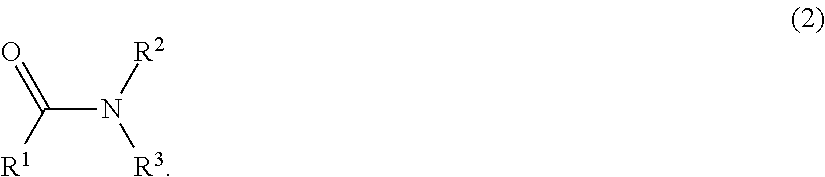
Description
3RECO3F+9HCl→REF3+2RECl3+3HCl+3H2O+3CO2
REF3+3NaOH→RE(OH)3+3NaF
RE(OH)3+3HCl→RECl3+3H2O
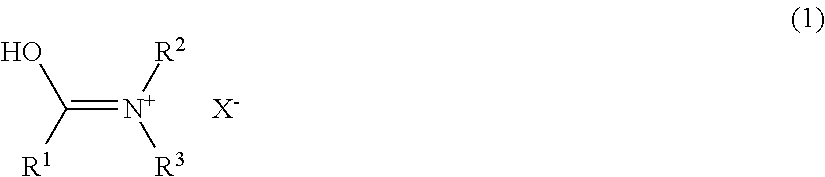
wherein R1 is selected from hydrogen atom and hydrocarbon groups containing at least 1 and up to 12 carbon atoms; R2 and R3 are independently selected from hydrocarbon groups containing at least 1 and up to 12 carbon atoms; and X− is an anionic species.


wherein R4, R5, and R6 are independently selected from hydrocarbon groups (R) containing at least 1 and up to 12 carbon atoms and alkoxide groups —OR; and X− is an anionic species.


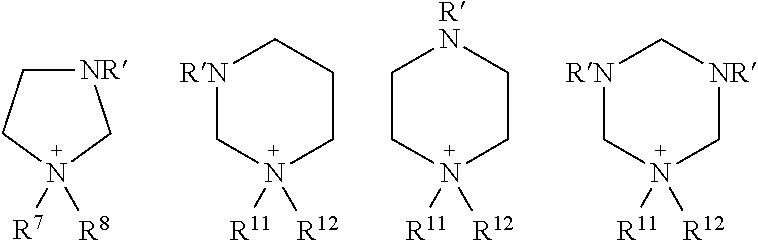


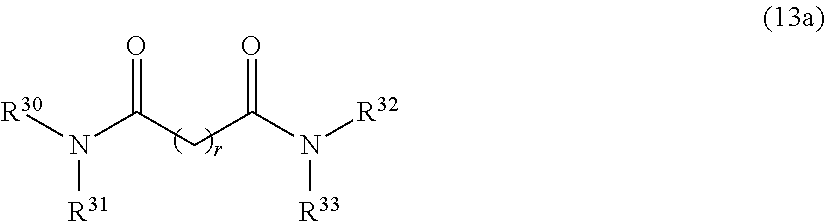


| TABLE 1 |
| Composition of synthetic bastnaesite analogues |
| Rare Earth | Bastnaesite - Mountain | Bastnaesite - 10% Heavies |
| Element | Pass Blend (%) | Blend Enriched (%) |
| La | 33.8 | 17.2 |
| Ce | 49.6 | 34.4 |
| Pr | 4.1 | 5.2 |
| Nd | 11.2 | 17.2 |
| Sm | 0.9 | 4.3 |
| Eu | 0.1 | 4.3 |
| Gd | 0.2 | 3.0 |
| |
0 | 0.5 |
| |
0 | 3.0 |
| |
0 | 0.7 |
| |
0 | 2.2 |
| |
0 | 0.3 |
| |
0 | 1.5 |
| Lu | Trace | 0.3 |
| Y | 0.1 | 5.7 |
in which [RE3+]IL is the concentration of the RE3+ metal in the IL phase, as determined through EDTA titration, and [RE3]total is the concentration of the RE3+ metal if all of the RECO3F solid could be dissolved and exist in solution. The RECO3F solids gave an average % RE Dissolved value of 60±6%, which is lower than anticipated. As expected, the Nd2(CO3)3 and Nd2O3 solids were quantitatively dissolved at 24 hours. An unexpected result was the slow dissolution of LaCO3F, CeCO3F, PrCO3F, and NdCO3F compared with the heavy-RE-containing RECO3F when the media was analyzed at 1 hour. This led to an investigation of the structural identity of these materials.
Nd2O3+6DMAH+NTf 2 −→2Nd(DMA)3(NTf 2)3+3H2O
whereas, most likely, Nd2(CO3)3 is dissolved in two reactions:
Nd2(CO3)3+6DMAH+NTf 2 −→2Nd(DMA)3(NTf 2)3+3H2CO3
3H2CO3→3CO2(g)+3H2O
3RECO3F(s)+6DMAH+NTf 2 −→3RE(DMA)2(NTf 2)2F+3H2CO3
3RE(DMA)2(NTf 2)2F→REF3(s)+2RE(DMA)3(NTf 2)3
3H2CO3→3CO2(g)+3H2O
3RECO3F(s)+6DMAH+NTf 2 −→2RE(DMA)3(NTf 2)3+REF3(s)+3CO2(g)+3H2O
Nd3+ +nDMA⇄Nd(DMA)n 3+(n=1-5)
in which [RE3+]Sm-Lu is the summation to the total heavy-rare-earth concentration in the IL phase for RE=Sm, Eu, Gd, Tb, Dy, Ho, Er, Tm, Yb, Lu, and Y, and [RE3+]La-Nd is the summation to the total light-rare-earth concentration in the IL phase for RE=La, Ce, Pr, and Nd.
3RECO3F(s)+6DMAH+NTf 2 −→2RE(DMA)3(NTf 2)3+REF3(s)+3CO2(g)+3H2O
| TABLE 2 |
| Comparison of acidic amide and phosphorous-based protic ionic liquids |
| Contact | |||||
| TSIL | Solvent | RECO3F | Temp (° C.) | Time (h) | [RE3+] (mol/kg) |
| DMAH+NTf2 − | BMIM+NTf2 − | Nd2O3 | 100 | 1 | 0.345 ± 0.012 |
| DMAH+NTf2 − | BMIM+NTf2 − | NdCO3F | 120 | 1 | 0.12 ± 0.01 |
| TBPH+NTf2 − | BMIM+NTf2 − | NdCO3F | 95 | 1.5 | 0.086 ± 0.003 |
| TBPH+NTf2 − | BMIM+NTf2 − | DyCO3F | 95 | 1.5 | 0.152 ± 0.009 |
| TOPOH+NTf2 − | OMIM+NTf2 − | NdCO3F | 95 | 1 | 0.0975 ± 0.013 |
| Cyanex921- | OMIM+NTf2 − | NdCO3F | 80 | 1 | 0.10 ± 0.02 |
| HNTf2 | |||||
| Cyanex921- | BMIM+Cl− | NdCO3F | 80 | 1 | 0.11 ± 0.02 |
| HCl | |||||
Claims (14)


Priority Applications (2)
| Application Number | Priority Date | Filing Date | Title |
|---|---|---|---|
| US15/135,753 US10689727B2 (en) | 2015-04-23 | 2016-04-22 | Methods for liquid extraction of rare earth metals using ionic liquids |
| US16/881,532 US11186893B2 (en) | 2015-04-23 | 2020-05-22 | Rare earth amide compositions |
Applications Claiming Priority (2)
| Application Number | Priority Date | Filing Date | Title |
|---|---|---|---|
| US201562151567P | 2015-04-23 | 2015-04-23 | |
| US15/135,753 US10689727B2 (en) | 2015-04-23 | 2016-04-22 | Methods for liquid extraction of rare earth metals using ionic liquids |
Related Child Applications (1)
| Application Number | Title | Priority Date | Filing Date |
|---|---|---|---|
| US16/881,532 Division US11186893B2 (en) | 2015-04-23 | 2020-05-22 | Rare earth amide compositions |
Publications (2)
| Publication Number | Publication Date |
|---|---|
| US20170306439A1 US20170306439A1 (en) | 2017-10-26 |
| US10689727B2 true US10689727B2 (en) | 2020-06-23 |
Family
ID=60088542
Family Applications (2)
| Application Number | Title | Priority Date | Filing Date |
|---|---|---|---|
| US15/135,753 Active 2038-06-19 US10689727B2 (en) | 2015-04-23 | 2016-04-22 | Methods for liquid extraction of rare earth metals using ionic liquids |
| US16/881,532 Active US11186893B2 (en) | 2015-04-23 | 2020-05-22 | Rare earth amide compositions |
Family Applications After (1)
| Application Number | Title | Priority Date | Filing Date |
|---|---|---|---|
| US16/881,532 Active US11186893B2 (en) | 2015-04-23 | 2020-05-22 | Rare earth amide compositions |
Country Status (1)
| Country | Link |
|---|---|
| US (2) | US10689727B2 (en) |
Cited By (1)
| Publication number | Priority date | Publication date | Assignee | Title |
|---|---|---|---|---|
| US20230356105A1 (en) * | 2020-11-13 | 2023-11-09 | Ustav Organicke Chemie A Biochemie AV CR v.v.i. | Tetraazadodecane based chelating agents for separation of rare earth elements and method therefor |
Families Citing this family (19)
| Publication number | Priority date | Publication date | Assignee | Title |
|---|---|---|---|---|
| GB2607851B (en) * | 2018-06-15 | 2026-02-04 | Seren Tech Limited | Rare earth metal oxide preparation |
| CN111392760A (en) * | 2018-12-29 | 2020-07-10 | 有研稀土新材料股份有限公司 | Preparation method of rare earth fluoride |
| CN109735718B (en) * | 2019-03-14 | 2020-05-19 | 北京科技大学 | Method for separating praseodymium and neodymium by liquid-liquid three-phase external push-pull system |
| US10954582B2 (en) | 2019-07-17 | 2021-03-23 | West Virginia University | Systems and processes for recovery of high-grade rare earth concentrate from acid mine drainage |
| CN110643835B (en) * | 2019-11-08 | 2021-04-20 | 湘潭大学 | Extraction system, extraction method and application for separating magnesium and extracting lithium from magnesium-containing brine with secondary amide type solvent |
| CN110643833B (en) * | 2019-11-08 | 2021-04-20 | 湘潭大学 | Extraction system, extraction method and application for separating magnesium and extracting lithium from magnesium-containing brine using secondary amide/tertiary amide composite solvent |
| CN110669947B (en) * | 2019-11-08 | 2021-05-25 | 湘潭大学 | Extraction system, extraction method and application for separating calcium and extracting lithium and boron from calcium-containing brine with secondary amide/alkyl alcohol composite solvent |
| CN110656249B (en) * | 2019-11-08 | 2021-03-23 | 湘潭大学 | Extraction system, extraction method and application for separating magnesium and extracting lithium from magnesium-containing brine with secondary amide/alkane composite solvent |
| CN110656248B (en) * | 2019-11-08 | 2021-03-23 | 湘潭大学 | Extraction system for separating magnesium from magnesium-containing brine by using secondary amide/alkyl alcohol composite solvent to extract lithium and boron, extraction method and application thereof |
| CN110777266B (en) * | 2019-11-08 | 2021-05-25 | 湘潭大学 | Extraction system for separating calcium from calcium-containing brine by using secondary amide/alkane composite solvent to extract lithium, extraction method and application thereof |
| CN111057883B (en) * | 2019-12-04 | 2022-05-24 | 厦门稀土材料研究所 | Method for separating and recovering rare earth ions and application thereof |
| JP7505211B2 (en) * | 2020-03-11 | 2024-06-25 | 株式会社豊田中央研究所 | Ionic liquid and method for producing the same |
| CN113493870B (en) * | 2020-04-08 | 2023-04-07 | 福建省长汀金龙稀土有限公司 | Composite flocculant for ion type rare earth enrichment and enrichment method |
| US10988386B1 (en) * | 2020-05-27 | 2021-04-27 | Winston-Salem State University | Separation and purification of rare-earth elements by chemical reduction in aqueous solutions |
| CN113106271B (en) * | 2021-04-06 | 2022-01-14 | 中国科学院过程工程研究所 | Method for purifying rare earth element gadolinium with high purity by using carboxylic acid functionalized ionic liquid |
| CN114539550B (en) * | 2022-03-16 | 2023-04-28 | 江苏大学 | A third kind of porous ionic liquid based on UiO-66 and its preparation method and application |
| US20260015748A1 (en) * | 2022-05-13 | 2026-01-15 | Battelle Energy Alliance. LLC | Chemically facilitated electrochemical methods for recovery of rare earth elements |
| CN116623020A (en) * | 2023-05-22 | 2023-08-22 | 贵州红星电子材料有限公司 | A method for extracting and separating rare earth lanthanum and yttrium by using hydrophobic guanidine-based ionic liquid |
| WO2025038347A2 (en) * | 2023-08-11 | 2025-02-20 | West Virginia Board Of Governors On Behalf Of West Virginia University | Methods for recovery of critical minerals and rare earth elements from critical mineral or rare-earth-doped crystal materials |
Citations (8)
| Publication number | Priority date | Publication date | Assignee | Title |
|---|---|---|---|---|
| US3468622A (en) | 1967-06-14 | 1969-09-23 | American Can Co | Process for recovering rare earth metal values |
| US4721606A (en) | 1982-08-20 | 1988-01-26 | Union Oil Company Of California | Recovery of metal values from spent catalysts |
| US6086769A (en) | 1996-09-16 | 2000-07-11 | Commodore Separation Technologies, Inc. | Supported liquid membrane separation |
| US6306276B1 (en) | 1997-10-08 | 2001-10-23 | Univ California | Aqueous electrodeposition of rare earth and transition metals |
| US7138643B2 (en) | 2001-12-18 | 2006-11-21 | Bristol-Myers Squibb Pharma Company | Method and apparatus for separating ions of metallic elements in aqueous solution |
| US20140072485A1 (en) | 2012-09-13 | 2014-03-13 | Ut-Battelle, Llc | Methods for separating medical isotopes using ionic liquids |
| WO2014047195A1 (en) | 2012-09-18 | 2014-03-27 | Chemtor, Lp | Use of a fiber conduit contactor for metal and/or metalloid extraction |
| US20140246370A1 (en) * | 2011-08-01 | 2014-09-04 | Helmholtz-Zentrum Dresden - Rossendorf E.V. | Extraction of noble metal (ions) by means of ionic liquids |
Family Cites Families (3)
| Publication number | Priority date | Publication date | Assignee | Title |
|---|---|---|---|---|
| US4770807A (en) * | 1985-07-31 | 1988-09-13 | Commissariat A L'energie Atomique | Novel extraction agents and novel propane diamides |
| JP5279938B1 (en) * | 2011-11-09 | 2013-09-04 | 国立大学法人九州大学 | Valuable metal extractant and method for extracting valuable metal using the extractant |
| US9376735B2 (en) * | 2013-03-15 | 2016-06-28 | University Of Houston System | Methods and systems for recovering rare earth elements |
-
2016
- 2016-04-22 US US15/135,753 patent/US10689727B2/en active Active
-
2020
- 2020-05-22 US US16/881,532 patent/US11186893B2/en active Active
Patent Citations (8)
| Publication number | Priority date | Publication date | Assignee | Title |
|---|---|---|---|---|
| US3468622A (en) | 1967-06-14 | 1969-09-23 | American Can Co | Process for recovering rare earth metal values |
| US4721606A (en) | 1982-08-20 | 1988-01-26 | Union Oil Company Of California | Recovery of metal values from spent catalysts |
| US6086769A (en) | 1996-09-16 | 2000-07-11 | Commodore Separation Technologies, Inc. | Supported liquid membrane separation |
| US6306276B1 (en) | 1997-10-08 | 2001-10-23 | Univ California | Aqueous electrodeposition of rare earth and transition metals |
| US7138643B2 (en) | 2001-12-18 | 2006-11-21 | Bristol-Myers Squibb Pharma Company | Method and apparatus for separating ions of metallic elements in aqueous solution |
| US20140246370A1 (en) * | 2011-08-01 | 2014-09-04 | Helmholtz-Zentrum Dresden - Rossendorf E.V. | Extraction of noble metal (ions) by means of ionic liquids |
| US20140072485A1 (en) | 2012-09-13 | 2014-03-13 | Ut-Battelle, Llc | Methods for separating medical isotopes using ionic liquids |
| WO2014047195A1 (en) | 2012-09-18 | 2014-03-27 | Chemtor, Lp | Use of a fiber conduit contactor for metal and/or metalloid extraction |
Non-Patent Citations (6)
Cited By (1)
| Publication number | Priority date | Publication date | Assignee | Title |
|---|---|---|---|---|
| US20230356105A1 (en) * | 2020-11-13 | 2023-11-09 | Ustav Organicke Chemie A Biochemie AV CR v.v.i. | Tetraazadodecane based chelating agents for separation of rare earth elements and method therefor |
Also Published As
| Publication number | Publication date |
|---|---|
| US20200370144A1 (en) | 2020-11-26 |
| US20170306439A1 (en) | 2017-10-26 |
| US11186893B2 (en) | 2021-11-30 |
Similar Documents
| Publication | Publication Date | Title |
|---|---|---|
| US11186893B2 (en) | Rare earth amide compositions | |
| Matsumiya et al. | Extraction of rare earth ions by tri-n-butylphosphate/phosphonium ionic liquids and the feasibility of recovery by direct electrodeposition | |
| Hu et al. | A novel synergistic extraction system for the recovery of scandium (III) by Cyanex272 and Cyanex923 in sulfuric acid medium | |
| US20230059863A1 (en) | Separation of rare earth metals | |
| US11198921B2 (en) | Ionic liquid solvents of perhalide type for metals and metal compounds | |
| JP7394473B2 (en) | Method for preparing rare earth metal oxides | |
| Freiderich et al. | Dissolution of the rare‐earth mineral bastnaesite by acidic amide ionic liquid for recovery of critical materials | |
| JP7357949B2 (en) | Countercurrent rare earth separation method | |
| WO2019239150A1 (en) | Enhanced separation of rare earth metals | |
| TWI826466B (en) | Ionic liquid preparation | |
| US8865094B2 (en) | Methods for separating medical isotopes using ionic liquids | |
| EP1817437B1 (en) | Method of extracting europium(iii) and yttrium(iii) from concentrate of luminophore dust or sludge | |
| Zhou et al. | Selective lithium extraction from high-alkali lepidolite leachate using LIX54-TRPO | |
| CN102712578B (en) | Dialkyldiaza-tetraalkyloctanediamide derivatives for separating trivalent actinides from lanthanides and preparation method thereof | |
| US8501138B2 (en) | Production method of high purity silver tetrafluoroborate | |
| Ghaemi et al. | Uranium extraction from solid waste as nitrate complex with D2EHPA, TOPO and their synergistic mixture | |
| OA19426A (en) | Separation of rare earth metals. | |
| EA040373B1 (en) | SEPARATION OF RARE EARTH METALS |
Legal Events
| Date | Code | Title | Description |
|---|---|---|---|
| AS | Assignment |
Owner name: U.S. DEPARTMENT OF ENERGY, DISTRICT OF COLUMBIA Free format text: CONFIRMATORY LICENSE;ASSIGNOR:UT-BATTELLE, LLC;REEL/FRAME:039522/0938 Effective date: 20160725 |
|
| AS | Assignment |
Owner name: OAK RIDGE ASSOCIATED UNIVERSITIES, TENNESSEE Free format text: ASSIGNMENT OF ASSIGNORS INTEREST;ASSIGNOR:FREIDERICH, JOHN W.;REEL/FRAME:039657/0637 Effective date: 20160723 Owner name: UT-BATTELLE, LLC, TENNESSEE Free format text: ASSIGNMENT OF ASSIGNORS INTEREST;ASSIGNOR:OAK RIDGE ASSOCIATED UNIVERSITIES;REEL/FRAME:039657/0670 Effective date: 20160824 Owner name: UT-BATTELLE, LLC, TENNESSEE Free format text: ASSIGNMENT OF ASSIGNORS INTEREST;ASSIGNORS:LUO, HUIMIN;MOYER, BRUCE A.;DAI, SHENG;REEL/FRAME:039657/0714 Effective date: 20160802 |
|
| FEPP | Fee payment procedure |
Free format text: PETITION RELATED TO MAINTENANCE FEES GRANTED (ORIGINAL EVENT CODE: PTGR); ENTITY STATUS OF PATENT OWNER: SMALL ENTITY |
|
| STPP | Information on status: patent application and granting procedure in general |
Free format text: RESPONSE TO NON-FINAL OFFICE ACTION ENTERED AND FORWARDED TO EXAMINER |
|
| STPP | Information on status: patent application and granting procedure in general |
Free format text: NON FINAL ACTION MAILED |
|
| STPP | Information on status: patent application and granting procedure in general |
Free format text: RESPONSE TO NON-FINAL OFFICE ACTION ENTERED AND FORWARDED TO EXAMINER |
|
| STPP | Information on status: patent application and granting procedure in general |
Free format text: FINAL REJECTION MAILED |
|
| STPP | Information on status: patent application and granting procedure in general |
Free format text: RESPONSE AFTER FINAL ACTION FORWARDED TO EXAMINER |
|
| STPP | Information on status: patent application and granting procedure in general |
Free format text: NOTICE OF ALLOWANCE MAILED -- APPLICATION RECEIVED IN OFFICE OF PUBLICATIONS |
|
| STPP | Information on status: patent application and granting procedure in general |
Free format text: PUBLICATIONS -- ISSUE FEE PAYMENT VERIFIED |
|
| STCF | Information on status: patent grant |
Free format text: PATENTED CASE |
|
| MAFP | Maintenance fee payment |
Free format text: PAYMENT OF MAINTENANCE FEE, 4TH YR, SMALL ENTITY (ORIGINAL EVENT CODE: M2551); ENTITY STATUS OF PATENT OWNER: SMALL ENTITY Year of fee payment: 4 |