US10685017B1 - Methods and systems for efficient query rewriting - Google Patents
Methods and systems for efficient query rewriting Download PDFInfo
- Publication number
- US10685017B1 US10685017B1 US14/885,641 US201514885641A US10685017B1 US 10685017 B1 US10685017 B1 US 10685017B1 US 201514885641 A US201514885641 A US 201514885641A US 10685017 B1 US10685017 B1 US 10685017B1
- Authority
- US
- United States
- Prior art keywords
- query
- search engine
- queries
- rewritten
- records
- Prior art date
- Legal status (The legal status is an assumption and is not a legal conclusion. Google has not performed a legal analysis and makes no representation as to the accuracy of the status listed.)
- Expired - Fee Related, expires
Links
Images




Classifications
-
- G—PHYSICS
- G06—COMPUTING OR CALCULATING; COUNTING
- G06F—ELECTRIC DIGITAL DATA PROCESSING
- G06F16/00—Information retrieval; Database structures therefor; File system structures therefor
- G06F16/20—Information retrieval; Database structures therefor; File system structures therefor of structured data, e.g. relational data
- G06F16/24—Querying
- G06F16/245—Query processing
- G06F16/2453—Query optimisation
- G06F16/24534—Query rewriting; Transformation
-
- G—PHYSICS
- G06—COMPUTING OR CALCULATING; COUNTING
- G06F—ELECTRIC DIGITAL DATA PROCESSING
- G06F16/00—Information retrieval; Database structures therefor; File system structures therefor
- G06F16/20—Information retrieval; Database structures therefor; File system structures therefor of structured data, e.g. relational data
- G06F16/24—Querying
- G06F16/245—Query processing
- G06F16/2453—Query optimisation
- G06F16/24534—Query rewriting; Transformation
- G06F16/24539—Query rewriting; Transformation using cached or materialised query results
-
- G—PHYSICS
- G06—COMPUTING OR CALCULATING; COUNTING
- G06F—ELECTRIC DIGITAL DATA PROCESSING
- G06F16/00—Information retrieval; Database structures therefor; File system structures therefor
- G06F16/20—Information retrieval; Database structures therefor; File system structures therefor of structured data, e.g. relational data
- G06F16/24—Querying
- G06F16/242—Query formulation
- G06F16/2425—Iterative querying; Query formulation based on the results of a preceding query
-
- G—PHYSICS
- G06—COMPUTING OR CALCULATING; COUNTING
- G06F—ELECTRIC DIGITAL DATA PROCESSING
- G06F16/00—Information retrieval; Database structures therefor; File system structures therefor
- G06F16/20—Information retrieval; Database structures therefor; File system structures therefor of structured data, e.g. relational data
- G06F16/24—Querying
- G06F16/248—Presentation of query results
-
- G—PHYSICS
- G06—COMPUTING OR CALCULATING; COUNTING
- G06F—ELECTRIC DIGITAL DATA PROCESSING
- G06F16/00—Information retrieval; Database structures therefor; File system structures therefor
- G06F16/90—Details of database functions independent of the retrieved data types
- G06F16/95—Retrieval from the web
- G06F16/953—Querying, e.g. by the use of web search engines
- G06F16/9535—Search customisation based on user profiles and personalisation
Definitions
- the present invention relates generally to information retrieval. More specifically, embodiments of the present invention relate to methods and systems for efficient query rewriting.
- search sites such as GoogleTM and Yahoo!TM employ search engines to provide their users with information search and retrieval capabilities on the Internet.
- a search site would receive a search query from a user (hereinafter, “user query”) and use its search engine to access its backend database or server system, which includes one or more index and document servers or databases, to conduct a search of the user query,
- Each document database/server maintains summarized text of documents the search site has located on the Internet.
- Each index database/server as the name implies, maintains indices of the located documents and their summarized text in the document database/server.
- a search site Users of a search site often find it hard to enter or phrase a query that would be effective in finding relevant information on the Internet. Further, users often do not like to spend too much time and effort to formulate an effective query. Hence, a user query is typically ambiguous, and the hard work is left to the search site and its search engine to determine and retrieve the appropriate information requested by the user query.
- some search engines use query expansion systems known in the field of information retrieval (IR) to modify user queries prior to conducting searches for the queries.
- IR information retrieval
- a query expansion system of a search site performs a search of the site's backend data system for each user query twice: once to find documents that are potentially useful for the query from which it learns a more effective query (e.g., by adding new words in the query); and then again for the rewritten query to find the final set of documents to be presented to the user.
- exemplary embodiments of the present invention include a method and a computer-readable medium having encoded program code for: receiving a first search query having a first content; rewriting the first search query into a modified search query; mapping the first search query to the modified search query in a cache memory; receiving a second search query having a second content; determining whether a portion of the second content is substantially identical to the first content; responsive to the portion of the second content being substantially identical to the first content, substituting the modified search query for the portion of the second content to form a modified second search query; and issuing a search of the modified second search query having the substituted modified search query to a backend data system to return one or more search results as responsive to the received second search query.
- FIG. 1 depicts a high-level process flow of a method for efficient query rewriting in accordance with an exemplary embodiment of the present invention
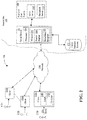
- FIG. 2 depicts an exemplary environment in which an embodiment of the present invention may operate
- FIG. 3 depicts a cache memory system shown in FIG. 1 in accordance with an embodiment of the present invention
- FIG. 4 depicts an exemplary environment in which another embodiment of the present invention may operate.
- FIGS. 5A-B depict a process flow diagram for efficient query rewriting in accordance with an embodiment of the present invention.
- Embodiments of the present invention include methods and systems for efficiency query rewriting of search queries.
- FIG. 1 depicts a high-level process flow of a method for efficient query rewriting in accordance with an exemplary embodiment of the present invention.
- past search queries that were submitted to a search engine are mapped to rewritten queries, wherein each of the rewritten queries is based on a past search query, a component (e.g., a segment) of a past search query, or multiple components of a past search query in accordance to predetermined conditions.
- the mapping is cached in a cache memory maintained by the search engine.
- the search engine receives a new search query.
- a look-up of the mapping in the cache memory is performed to obtain a corresponding rewritten query for the new search query.
- the search engine issues a search of the rewritten query in place of the new search query to obtain search results for the later.
- FIG. 2 is a high-level diagram illustrating an exemplary environment for implementation of one embodiment of the present invention.
- the environment 100 shown in FIG. 2 includes multiple client devices 102 a - n in communication with a search site 150 over a network 106 .
- the network 106 can be a wired or wireless network. Further, it can be a public network, e.g., the Internet, or a private data network, e.g., a local area network (LAN) or a wide area network (WAN).
- LAN local area network
- WAN wide area network
- the client devices 102 a - n can be in communication directly with the search site 150 without the use of the network 106 .
- Each of the client devices 102 a - n includes a memory 108 , which can be a computer-readable medium (CRM), such as a random access memory (RAM), coupled to a processor 110 .
- the processor 110 executes computer-executable program instructions stored in the client device, such as memory 108 , as program code.
- processors may include a microprocessor, an ASIC, acid state machines.
- processors include, or may be in communication with, media, for example computer-readable media, which stores instructions that, when executed by the processor, cause the processor to perform the methods described herein.
- Client devices 102 a - n can also include a number of external or internal devices such as a mouse, a CD-ROM drive, a DVD drive, a keyboard, a display, or other input or output devices, Examples of client devices 102 a - n are personal computers, digital assistants, personal digital assistants (PDAs), cellular phones, mobile phones, smart phones, pagers, digital tablets, laptop computers, Internet appliances, and other processor-based devices. In general, the client devices 102 a - n can be any type of processor-based platform that operates on any operating system capable of supporting one or more client application programs.
- PDAs personal digital assistants
- the client devices 102 a - n can be any type of processor-based platform that operates on any operating system capable of supporting one or more client application programs.
- the search site 150 includes a server device 152 executing a search engine application program 158 (hereinafter, “search engine”), such as the GoogleTM search engine, Similar to the client devices 102 a - n , the server device 152 includes a processor 154 coupled to a memory 156 , which can be a CRM. Examples of a server device 150 are servers, mainframe computers, networked computers, a processor-based device, and similar types of systems and devices.
- the server processor 154 can be any of a number of computer processors, such as processors from Intel Corporation of Santa Clara, Calif. and Motorola Corporation of Schaumburg, Ill., In general, the server device 152 can be any type of processor-based platform that operates on any operating system capable of supporting one or more server application programs.
- Embodiments of CRM for memories 108 and 156 include, but are not limited to, an electronic, optical, magnetic, or other storage or transmission device capable of providing a processor, such as the processor 110 of client 102 a , with computer-readable instructions.
- suitable media include, but are not limited to, a floppy disk, CD-ROM, DVD, magnetic disk, memory chip, ROM, RAM, an ASIC, a configured processor, all optical media, all magnetic tape or other magnetic media, or any other medium from which a computer processor can read instructions.
- various other forms of computer-readable media may transmit or carry instructions to a computer, including a router, switch, private or public network, or other transmission device or channel, both wired and wireless.
- the instructions may include code from any computer-programming language, including, for example, C, C++, C #, Visual Basic, Java, Python, Perl, and JavaScript.
- the memory 156 contains the search engine 158 , which searches for information from a backend data system 160 of the search site 150 in response to a search query from a user (i.e., user query) entered at, for example, a client device 102 a and received by the search engine 158 through the network 106 .
- the backend data system 160 includes one or more index and document servers or databases ( 162 and 164 ).
- FIG. 1 shows that the backend data system 160 includes only one index server 162 and one document server 164 , it should be understood that such system can include multiple of either or both servers, depending on the amount of data the search site 150 wishes to store and access for user queries.
- the server device 152 has previously performed a crawl of a user-desired data network, such as network 106 , to locate articles, such as web pages or documents, stored at other devices or systems connected to the network 106 , or other desired network(s), and indexed and summarized the articles in the index server(s) 162 and document server(s) 164 , respectively.
- the search site 150 further includes a cache memory system 170 which, in turn, includes a cache database or server with a memory such as a CRM for storing data.
- the cache memory system 70 includes an online cache database/server that employs an offline caching scheme to create look-up tables mapping user queries to rewritten queries, as further detailed later, wherein the tables can be searched quickly online (hence, the cache memory system is an online cache server).
- an “online” system or method refers to a system or method that, for example, performs functions for a requesting user during the user's access to such system or method; whereas, an “offline” system or method refers to a system or method that performs functions for a requesting user before or after the user has terminated access to such system or method.
- the online-cache database or server of cache memory system 170 is similar to the server device 152 .
- the cache memory system 170 includes a processor 172 and a memory 174 .
- the processor 172 can be any of a number of computer processors, such as processors from Intel Corporation of Santa Clara, Calif. and Motorola Corporation of Schaumburg, Ill.
- the memory 174 can be a CRM like the memory 156 in the server device 152 , wherein files of rewritten frequent queries 178 can be stored.
- the cache memory system 170 can be any type of processor-based platform that operates on any operating system capable of supporting one or more server application programs.
- the cache memory system 170 executes a caching application program 176 to: 1) maintain a database 180 of rewriting information, based on input from the files of rewritten queries 178 ; and 2) generate look-up tables mapping user queries to rewritten queries based on the rewriting information.
- the rewriting database 180 contains a list of candidate user queries, each having a corresponding record that includes a rewritten query and other related information, such as the frequency of past appearances of the user query at the search site 150 , a time stamp of database input of the rewritten query from the files of rewritten queries 178 , and whether the rewritten query has been incorporated into a look-up table generated by the caching program 176 for online caching by the cache memory system 170 .
- FIG. 2 shows the rewriting program 159 being stored in the memory 156 of the server device 152
- the rewriting program 159 can also be stored in the memory 174 of the cache memory system 170 , or in any other memory area of the server device 152 , cache memory system 170 , or the search site 150 (e.g., an independent server maintained by the search site 150 ).
- the caching program 176 can also be stored in memory 156 of the server device 152 or any other area of the server device 152 or cache memory system 170 .
- the aforementioned rewriting program 159 and caching program 176 can be different programs or a single program that includes instructions for both the rewriting and caching functionalities.
- the instructions for the rewriting and caching programs may include code from any computer programming language, including, for example, C, C++, C #, Visual Basic, Java, Python, Perl, and JavaScript, as mentioned earlier.
- FIG. 4 shows a high-level diagram illustrating an exemplary environment for implementation of another embodiment of the present invention, wherein a cache memory system is incorporated into the server device 152 .
- a rewrite cache memory system is incorporated into the server device 152 ; particularly, the caching program 176 , the files of rewritten queries 178 , and the rewriting database 180 are incorporated into the memory 156 of the server device 152 (a separate processor for the rewrite cache scheme is not needed because the processor 154 can be used to process such scheme).
- the caching program 176 , the files of rewritten queries 178 , and the rewriting database 180 can be incorporated into another memory area of the server device 152 other than the memory 156 .
- various methods for the cache memory system 170 may be implemented in the environment shown in FIG. 2 (and likewise in FIG. 4 ), as described next with reference to the process flow diagram shown in FIGS. 5A-B .
- the mapped user queries are taken from the most frequent user queries and/or the most frequent sub-queries (i.e., components) of the most frequent user queries the search site 150 had seen in the past.
- the search site 150 can perform this task manually or automatically.
- the search site 150 executes an application program that reviews records of past search queries it received from users and identifies the most frequent user queries and/or the most frequent components therein based on desired criteria.
- how frequent a user query must be repeatedly entered at the search site 150 before being chosen for mapping and the time frame for such frequency can be criteria.
- the offline query investigation can be further directed to identify and map the most popular query components in the most popular queries, and their rewrite results are stored in a way that can be used to rewrite longer queries that contain one or more identified popular components, as described later.
- query modification or rewriting there are many kinds of query modification or rewriting that can be performed offline to generate rewritten queries for storage in the online cache server.
- a more common phrase substitution is performed.
- an original user query for “bat man movie” is converted or modified to a more common or popular phrase “batman movie” as a rewritten query.
- an original user query “City of New York” is rewritten as a more common or popular phrase “New York City”.
- phrase augmentation is also performed, wherein related terms are added to a search query to expand the semantic scope of the search results (i.e., the set of documents potentially returned as search results).
- an original user query for “batman movie” is converted or modified to “batman movie or robin movie” as a rewritten query.
- the frequency and context with which terms occur in a set of resulting documents are used to rewrite frequent user queries.
- a user query frequently entered at the search site is first submitted to the site's backend data system to find a set of documents relating to the user query.
- the resulting document set is then semantically related through mapping of art ordered semantic list of pairs of ⁇ term, weight ⁇ , where weight indicates the degree to which a term is over-represented in the document set.
- the weight is based on recorded information about the particular contexts (e.g., parts of documents, neighboring terms, capitalization) in Which each over-represented term appears and its frequency of appearance in the document set.
- the effect is to identify terms which are correlated with the common topics.
- the original user query is then modified by adding high-weight terms from the above semantic list as expansion terms.
- the degree at which a term is considered high-weight is set as desired by the search site.
- the terms to be considered for expansion may be further restricted by grammatical or other considerations.
- the expansion terms can be restricted to those related by stems to existing terms in the original user query.
- the expansion terms can be broader, in which case they can include synonyms and/or other concepts for query expansion that are known in the art.
- the server device 152 next executes a rewriting application program 159 to perform one, all, or any combination of the aforementioned different query modifications for the identified user queries.
- the rewriting program 159 determines whether each of the identified user query, and/or one or more sub-queries thereof, and their corresponding rewritten queries and/or sub-queries should be cached in the cache memory system 170 .
- a user query (or sub-query therein) is a candidate for caching if there are reasons to believe that a modified query (or sub-query) can produce better search results.
- the rewritten/modified query (or sub-query) provides identical search results as the original (typically the case for single-term queries because they are not modified), it will not be cached at 404 .
- a rewritten query (or sub-query) differs from the corresponding original query (or sub-query therein), it will be cached along with the original user query (or sub-query therein).
- an additional discriminating process involving machine learning can be used to compare the rewritten query to the original query and determine whether the rewritten version is preferred over the original for a search in the backend data system 160 .
- the search results for the original user query can be returned to one set of users, and the search results for the rewritten query can be returned to a second set of users and their responses (e.g., following links incorporated in the two search result sets) recorded. If the recorded responses to the two search results are comparable in behavior, then any difference in the responses can be taken to indicate difference in preference for one set over the other. Consequently, statistical support for this conjecture can be determined and used to improve the type of query rewrites presented through standard techniques known in the art.
- the candidate user query and its rewritten query are saved in a file of rewritten queries located in the cache memory system 170 during updates as described later.
- the search site 150 periodically performs analyses of past user queries that it received and information contained in the cache memory system 170 so as to update the system 170 as needed.
- the rewriting program 159 is executed to rewrite the new candidate user queries in batch mode (i.e., for every new batch of frequent user queries) and store them in the files for rewritten queries 178 as shown in 405 .
- the caching program 176 then inputs and organizes those files along with other aforementioned related information to update the rewritten database 180 and generate new look-up tables to map the new candidate user queries to rewritten queries as needed (i.e., whenever each candidate user query has not been mapped previously) for online caching by the cache memory system 170 .
- the periodic update of the cache memory system 170 can be performed manually or automatically (with a predetermined or random period of time in between updates) to efficiently utilize the machine resources of the search site 150 . For instance, the periodic update can be done in off-peak hours when user access to the search site 150 is at its lowest.
- the search site 150 receives a search query from a user at one of the client devices 112 a - n via the network 106 .
- the search engine 158 then sends the search query to the cache memory system 170 to determine whether a rewritten query is available for the particular search query.
- the caching program 176 reads and writes to the database 180 and generates online cache maps for the user queries. Further, to extend the usefulness of the cache memory system 170 , which may be limited in memory size, the caching program 176 can map not only user queries that are present in the rewriting database 180 as exact matches, but also user queries containing only components present in the rewriting database 180 .
- the caching program 176 will respond to a request from the search engine 158 for a query rewrite by first looking for an exact match of a modified query to such user query. If an exact match is found in the look-up tables in the cache memory system 170 , the modified query is returned to the search engine 158 , which then issues a search to the backend data system 160 for the modified query. If an exact match is not found, the caching program 176 will then search for increasingly small fragments of the user query (e.g., “A B C”, “A B”, then “A”; or “A C D”, “A D”, then “D”).
- the query modification will be a resolution of the rewritten data found for all fragments (i.e., the mapped-out rewritten terms for all fragments).
- the cache memory system 170 will then return to the search engine 158 a corresponding rewritten query (or a resolution of rewritten sub-queries) from its look-up tables when available, or a message indicating that none is available.
- a rewritten query is available, at 410 the search engine 158 will substitute it for the original user query that it sends to the backend data system 160 (i.e., online caching is performed to provide a rewritten query without making any requests to the backend data system 160 ); otherwise, at 409 the search engine 158 will submit the input user query to the backend data system 160 for a search.
- FIG. 2 An example of efficient query rewrite in accordance with an embodiment of the present invention is now provided with reference to FIG. 2 .
- the search site 150 has gathered past popular (i.e., most frequent) search queries and/or past popular sub-queries seen in past search queries, mapped them with their respective rewritten queries anti sub-queries, stored the mapping in the cache memory system 170 as described earlier.
- a user such as user 112 a
- accesses the search site 150 and submits a search query to the search engine 158 such search query is sent to the cache memory 170 to determine whether a rewritten query is available for the search query.
- the caching program does map a sub-query, “football coach” to “football (coach OR coaches)” and a sub-query, “coach training” to “(coach OR coaching) (training OR trained)”.
- the sub-queries “football coach” and “coach training” were mapped because such phrases appear frequently in past search queries to the search site 150 . It should be noted that such past search queries do not need to be the most popular search queries, so long as the aforementioned sub-queries are frequently found in such search queries.
- mapping and storing of the sub-queries are based on a query modification or a combination of query modifications as described earlier.
- the query modification is a resolution of the rewritten data found for all fragments.
- the rewritten or modified query to be submitted to the backend data system 160 for a search can be “football (coach OR coaches OR coaching) (training OR trained)” or “football coach (training or trained)”, depending upon which resolution is preferred,
Landscapes
- Engineering & Computer Science (AREA)
- Theoretical Computer Science (AREA)
- Databases & Information Systems (AREA)
- Physics & Mathematics (AREA)
- Data Mining & Analysis (AREA)
- General Engineering & Computer Science (AREA)
- General Physics & Mathematics (AREA)
- Computational Linguistics (AREA)
- Mathematical Physics (AREA)
- Information Retrieval, Db Structures And Fs Structures Therefor (AREA)
Abstract
Methods and systems for efficient query rewriting and the like are described here. One such described method comprises: offline mapping frequently-seen search queries to rewritten queries that may be better for searching; offline caching the mapping in a cache memory; and upon receiving a search query from a user similar to one of the mapped search queries, obtaining a corresponding rewritten query from the mapping in the cache memory based on predetermined conditions, and issuing a search of the rewritten query to the backend data system in order to avoid having to issue a search query to the backend data system twice while the user is online.
Description
This application is a continuation application of and claims priority to U.S. application Ser. No. 14/154,024, filed on Jan. 13, 2014, which claims priority to U.S. application Ser. No. 12/951,770, filed on Nov. 22, 2010, which claims priority to U.S. application Ser. No. 10/812,901, filed on Mar. 31, 2004, the entire contents of each are hereby incorporated by reference in their entireties.
The present invention relates generally to information retrieval. More specifically, embodiments of the present invention relate to methods and systems for efficient query rewriting.
As known in the art, search sites such as Google™ and Yahoo!™ employ search engines to provide their users with information search and retrieval capabilities on the Internet. Typically, a search site would receive a search query from a user (hereinafter, “user query”) and use its search engine to access its backend database or server system, which includes one or more index and document servers or databases, to conduct a search of the user query, Each document database/server maintains summarized text of documents the search site has located on the Internet. Each index database/server, as the name implies, maintains indices of the located documents and their summarized text in the document database/server.
Users of a search site often find it hard to enter or phrase a query that would be effective in finding relevant information on the Internet. Further, users often do not like to spend too much time and effort to formulate an effective query. Hence, a user query is typically ambiguous, and the hard work is left to the search site and its search engine to determine and retrieve the appropriate information requested by the user query. To improve the search process, some search engines use query expansion systems known in the field of information retrieval (IR) to modify user queries prior to conducting searches for the queries. In one typical implementation, a query expansion system of a search site performs a search of the site's backend data system for each user query twice: once to find documents that are potentially useful for the query from which it learns a more effective query (e.g., by adding new words in the query); and then again for the rewritten query to find the final set of documents to be presented to the user.
The aforementioned double searches for each user query can be time consuming and taxing to the machine resources of a search site. This is because for each user query, two queries are serially sent to the index and document server backends of the search site, potentially doubling the search latency and the total amount of work required by the backends. Thus, there exists a need for a method and system that can efficiently rewrite or modify a user query entered at a search site and effectively provide good search results.
Accordingly, exemplary embodiments of the present invention include a method and a computer-readable medium having encoded program code for: receiving a first search query having a first content; rewriting the first search query into a modified search query; mapping the first search query to the modified search query in a cache memory; receiving a second search query having a second content; determining whether a portion of the second content is substantially identical to the first content; responsive to the portion of the second content being substantially identical to the first content, substituting the modified search query for the portion of the second content to form a modified second search query; and issuing a search of the modified second search query having the substituted modified search query to a backend data system to return one or more search results as responsive to the received second search query.
The aforementioned embodiments are mentioned not to limit or define the invention, but to provide an example of embodiments of the invention to aid understanding thereof. Exemplary embodiments are discussed in the Detailed Description, and further description of the invention is provided there. Advantages offered by the various embodiments of the present invention may be further understood by examining this specification.
The embodiments of the present invention are illustrated by way of example in, and not limited to, the following figures:
Overview
Embodiments of the present invention include methods and systems for efficiency query rewriting of search queries. FIG. 1 depicts a high-level process flow of a method for efficient query rewriting in accordance with an exemplary embodiment of the present invention. At 10, as shown in FIG. 1 , past search queries that were submitted to a search engine are mapped to rewritten queries, wherein each of the rewritten queries is based on a past search query, a component (e.g., a segment) of a past search query, or multiple components of a past search query in accordance to predetermined conditions. At 20, the mapping is cached in a cache memory maintained by the search engine. At 30, the search engine receives a new search query. At 40, a look-up of the mapping in the cache memory is performed to obtain a corresponding rewritten query for the new search query. At 50, the search engine issues a search of the rewritten query in place of the new search query to obtain search results for the later.
System Architecture
Reference is now made in detail to embodiments of the present invention, some examples of which are illustrated in the accompanying drawings, in which like numerals indicate like elements, showing a method and system for efficient query rewriting. FIG. 2 is a high-level diagram illustrating an exemplary environment for implementation of one embodiment of the present invention. The environment 100 shown in FIG. 2 includes multiple client devices 102 a-n in communication with a search site 150 over a network 106. The network 106 can be a wired or wireless network. Further, it can be a public network, e.g., the Internet, or a private data network, e.g., a local area network (LAN) or a wide area network (WAN). Moreover, the client devices 102 a-n can be in communication directly with the search site 150 without the use of the network 106.
Each of the client devices 102 a-n includes a memory 108, which can be a computer-readable medium (CRM), such as a random access memory (RAM), coupled to a processor 110. The processor 110 executes computer-executable program instructions stored in the client device, such as memory 108, as program code. Such processors may include a microprocessor, an ASIC, acid state machines. Such processors include, or may be in communication with, media, for example computer-readable media, which stores instructions that, when executed by the processor, cause the processor to perform the methods described herein. Client devices 102 a-n can also include a number of external or internal devices such as a mouse, a CD-ROM drive, a DVD drive, a keyboard, a display, or other input or output devices, Examples of client devices 102 a-n are personal computers, digital assistants, personal digital assistants (PDAs), cellular phones, mobile phones, smart phones, pagers, digital tablets, laptop computers, Internet appliances, and other processor-based devices. In general, the client devices 102 a-n can be any type of processor-based platform that operates on any operating system capable of supporting one or more client application programs.
The search site 150 includes a server device 152 executing a search engine application program 158 (hereinafter, “search engine”), such as the Google™ search engine, Similar to the client devices 102 a-n, the server device 152 includes a processor 154 coupled to a memory 156, which can be a CRM. Examples of a server device 150 are servers, mainframe computers, networked computers, a processor-based device, and similar types of systems and devices. The server processor 154 can be any of a number of computer processors, such as processors from Intel Corporation of Santa Clara, Calif. and Motorola Corporation of Schaumburg, Ill., In general, the server device 152 can be any type of processor-based platform that operates on any operating system capable of supporting one or more server application programs.
Embodiments of CRM for memories 108 and 156 include, but are not limited to, an electronic, optical, magnetic, or other storage or transmission device capable of providing a processor, such as the processor 110 of client 102 a, with computer-readable instructions. Other examples of suitable media include, but are not limited to, a floppy disk, CD-ROM, DVD, magnetic disk, memory chip, ROM, RAM, an ASIC, a configured processor, all optical media, all magnetic tape or other magnetic media, or any other medium from which a computer processor can read instructions. Also, various other forms of computer-readable media may transmit or carry instructions to a computer, including a router, switch, private or public network, or other transmission device or channel, both wired and wireless. The instructions may include code from any computer-programming language, including, for example, C, C++, C #, Visual Basic, Java, Python, Perl, and JavaScript.
The memory 156 contains the search engine 158, which searches for information from a backend data system 160 of the search site 150 in response to a search query from a user (i.e., user query) entered at, for example, a client device 102 a and received by the search engine 158 through the network 106. In the embodiment shown, the backend data system 160 includes one or more index and document servers or databases (162 and 164). Although FIG. 1 shows that the backend data system 160 includes only one index server 162 and one document server 164, it should be understood that such system can include multiple of either or both servers, depending on the amount of data the search site 150 wishes to store and access for user queries.
In the embodiment shown, the server device 152, or a related device of the search site 150, has previously performed a crawl of a user-desired data network, such as network 106, to locate articles, such as web pages or documents, stored at other devices or systems connected to the network 106, or other desired network(s), and indexed and summarized the articles in the index server(s) 162 and document server(s) 164, respectively. The search site 150 further includes a cache memory system 170 which, in turn, includes a cache database or server with a memory such as a CRM for storing data.
As shown, the cache memory system 70 includes an online cache database/server that employs an offline caching scheme to create look-up tables mapping user queries to rewritten queries, as further detailed later, wherein the tables can be searched quickly online (hence, the cache memory system is an online cache server). As understood in the art and referred herein, an “online” system or method refers to a system or method that, for example, performs functions for a requesting user during the user's access to such system or method; whereas, an “offline” system or method refers to a system or method that performs functions for a requesting user before or after the user has terminated access to such system or method.
Also in the embodiment shown, the online-cache database or server of cache memory system 170 is similar to the server device 152. In other words, as shown in FIG. 3 , the cache memory system 170 includes a processor 172 and a memory 174. As with the server processor 154 in the server device 152, the processor 172 can be any of a number of computer processors, such as processors from Intel Corporation of Santa Clara, Calif. and Motorola Corporation of Schaumburg, Ill., Similarly, the memory 174 can be a CRM like the memory 156 in the server device 152, wherein files of rewritten frequent queries 178 can be stored. In general, the cache memory system 170 can be any type of processor-based platform that operates on any operating system capable of supporting one or more server application programs. In the embodiment shown, the cache memory system 170 executes a caching application program 176 to: 1) maintain a database 180 of rewriting information, based on input from the files of rewritten queries 178; and 2) generate look-up tables mapping user queries to rewritten queries based on the rewriting information. The rewriting database 180 contains a list of candidate user queries, each having a corresponding record that includes a rewritten query and other related information, such as the frequency of past appearances of the user query at the search site 150, a time stamp of database input of the rewritten query from the files of rewritten queries 178, and whether the rewritten query has been incorporated into a look-up table generated by the caching program 176 for online caching by the cache memory system 170.
Although FIG. 2 shows the rewriting program 159 being stored in the memory 156 of the server device 152, it should be understood that the rewriting program 159 can also be stored in the memory 174 of the cache memory system 170, or in any other memory area of the server device 152, cache memory system 170, or the search site 150 (e.g., an independent server maintained by the search site 150). Likewise, the caching program 176 can also be stored in memory 156 of the server device 152 or any other area of the server device 152 or cache memory system 170. Further, the aforementioned rewriting program 159 and caching program 176 can be different programs or a single program that includes instructions for both the rewriting and caching functionalities. The instructions for the rewriting and caching programs may include code from any computer programming language, including, for example, C, C++, C #, Visual Basic, Java, Python, Perl, and JavaScript, as mentioned earlier.
Although FIG. 2 shows that the cache memory system 170 is separate from the server device 152, such cache memory system can be incorporated into the server device 152 while retaining the same functionality as described above. Accordingly, FIG. 4 shows a high-level diagram illustrating an exemplary environment for implementation of another embodiment of the present invention, wherein a cache memory system is incorporated into the server device 152. In the embodiment shown in FIG. 4 , a rewrite cache memory system is incorporated into the server device 152; particularly, the caching program 176, the files of rewritten queries 178, and the rewriting database 180 are incorporated into the memory 156 of the server device 152 (a separate processor for the rewrite cache scheme is not needed because the processor 154 can be used to process such scheme). Alternatively, the caching program 176, the files of rewritten queries 178, and the rewriting database 180 can be incorporated into another memory area of the server device 152 other than the memory 156.
Process
According to the present invention, various methods for the cache memory system 170 may be implemented in the environment shown in FIG. 2 (and likewise in FIG. 4 ), as described next with reference to the process flow diagram shown in FIGS. 5A-B . Referring to FIG. 5A , at 401 the mapped user queries are taken from the most frequent user queries and/or the most frequent sub-queries (i.e., components) of the most frequent user queries the search site 150 had seen in the past. The search site 150 can perform this task manually or automatically. According to one embodiment of the present invention, the search site 150 executes an application program that reviews records of past search queries it received from users and identifies the most frequent user queries and/or the most frequent components therein based on desired criteria. For instance, how frequent a user query must be repeatedly entered at the search site 150 before being chosen for mapping and the time frame for such frequency can be criteria. In another instance, if the look-up process in the cache memory system 170 deals with query components, as described later, the offline query investigation can be further directed to identify and map the most popular query components in the most popular queries, and their rewrite results are stored in a way that can be used to rewrite longer queries that contain one or more identified popular components, as described later.
According to embodiments of the present invention, there are many kinds of query modification or rewriting that can be performed offline to generate rewritten queries for storage in the online cache server. In one kind of query modification, a more common phrase substitution is performed. For example, an original user query for “bat man movie” is converted or modified to a more common or popular phrase “batman movie” as a rewritten query. In another example, an original user query “City of New York” is rewritten as a more common or popular phrase “New York City”. In another kind of query modification, phrase augmentation is also performed, wherein related terms are added to a search query to expand the semantic scope of the search results (i.e., the set of documents potentially returned as search results). For example, an original user query for “batman movie” is converted or modified to “batman movie or robin movie” as a rewritten query.
In still another kind of query modification, the frequency and context with which terms occur in a set of resulting documents are used to rewrite frequent user queries. For this query modification, a user query frequently entered at the search site is first submitted to the site's backend data system to find a set of documents relating to the user query. The resulting document set is then semantically related through mapping of art ordered semantic list of pairs of {term, weight}, where weight indicates the degree to which a term is over-represented in the document set. The weight is based on recorded information about the particular contexts (e.g., parts of documents, neighboring terms, capitalization) in Which each over-represented term appears and its frequency of appearance in the document set. Thus, when the document set is semantically coherent (i.e., related to a small set of common topics, and not a mixture of documents on many unrelated topics), the effect is to identify terms which are correlated with the common topics. The original user query is then modified by adding high-weight terms from the above semantic list as expansion terms. The degree at which a term is considered high-weight is set as desired by the search site. Also, the terms to be considered for expansion may be further restricted by grammatical or other considerations. Thus, the expansion terms can be restricted to those related by stems to existing terms in the original user query.
In still another kind of query modification, the expansion terms can be broader, in which case they can include synonyms and/or other concepts for query expansion that are known in the art.
It should be noted that the aforementioned query modifications are not meant to describe all possible query modifications, and other query modifications can be contemplated based on a reading of the present invention. Further, the different query modifications c be used separately or in any combination without deviating from the scope of the present invention.
Referring still to FIG. 5A , with reference to FIG. 1 , at 402 the server device 152 next executes a rewriting application program 159 to perform one, all, or any combination of the aforementioned different query modifications for the identified user queries. At 403 the rewriting program 159 then determines whether each of the identified user query, and/or one or more sub-queries thereof, and their corresponding rewritten queries and/or sub-queries should be cached in the cache memory system 170. A user query (or sub-query therein) is a candidate for caching if there are reasons to believe that a modified query (or sub-query) can produce better search results. For instance, if the rewritten/modified query (or sub-query) provides identical search results as the original (typically the case for single-term queries because they are not modified), it will not be cached at 404. In the embodiment shown, when a rewritten query (or sub-query) differs from the corresponding original query (or sub-query therein), it will be cached along with the original user query (or sub-query therein). In another embodiment, an additional discriminating process involving machine learning can be used to compare the rewritten query to the original query and determine whether the rewritten version is preferred over the original for a search in the backend data system 160. For instance, on an experimental basis the search results for the original user query can be returned to one set of users, and the search results for the rewritten query can be returned to a second set of users and their responses (e.g., following links incorporated in the two search result sets) recorded. If the recorded responses to the two search results are comparable in behavior, then any difference in the responses can be taken to indicate difference in preference for one set over the other. Consequently, statistical support for this conjecture can be determined and used to improve the type of query rewrites presented through standard techniques known in the art.
At 405 the candidate user query and its rewritten query are saved in a file of rewritten queries located in the cache memory system 170 during updates as described later.
The search site 150 periodically performs analyses of past user queries that it received and information contained in the cache memory system 170 so as to update the system 170 as needed. Referring back to FIG. 5A , to update the system 170 with new candidate user queries, the rewriting program 159 is executed to rewrite the new candidate user queries in batch mode (i.e., for every new batch of frequent user queries) and store them in the files for rewritten queries 178 as shown in 405. At 406 the caching program 176 then inputs and organizes those files along with other aforementioned related information to update the rewritten database 180 and generate new look-up tables to map the new candidate user queries to rewritten queries as needed (i.e., whenever each candidate user query has not been mapped previously) for online caching by the cache memory system 170. The periodic update of the cache memory system 170 can be performed manually or automatically (with a predetermined or random period of time in between updates) to efficiently utilize the machine resources of the search site 150. For instance, the periodic update can be done in off-peak hours when user access to the search site 150 is at its lowest.
Referring now to FIG. 5B , in searching operations, at 407 the search site 150 receives a search query from a user at one of the client devices 112 a-n via the network 106. At 408 the search engine 158 then sends the search query to the cache memory system 170 to determine whether a rewritten query is available for the particular search query. According to an embodiment of the present invention, the caching program 176 reads and writes to the database 180 and generates online cache maps for the user queries. Further, to extend the usefulness of the cache memory system 170, which may be limited in memory size, the caching program 176 can map not only user queries that are present in the rewriting database 180 as exact matches, but also user queries containing only components present in the rewriting database 180. For instance, when a user query of the form “A B C D” is entered at the search site 150, the caching program 176 will respond to a request from the search engine 158 for a query rewrite by first looking for an exact match of a modified query to such user query. If an exact match is found in the look-up tables in the cache memory system 170, the modified query is returned to the search engine 158, which then issues a search to the backend data system 160 for the modified query. If an exact match is not found, the caching program 176 will then search for increasingly small fragments of the user query (e.g., “A B C”, “A B”, then “A”; or “A C D”, “A D”, then “D”). If a fragment is found, such fragment in the user query will be modified according to the mapped-out rewritten term(s) for the fragment, and the modified user query will then be submitted to the backend data system 160. If multiple fragments are found, the query modification will be a resolution of the rewritten data found for all fragments (i.e., the mapped-out rewritten terms for all fragments).
Referring still to FIG. 5B , the cache memory system 170 will then return to the search engine 158 a corresponding rewritten query (or a resolution of rewritten sub-queries) from its look-up tables when available, or a message indicating that none is available. Where a rewritten query is available, at 410 the search engine 158 will substitute it for the original user query that it sends to the backend data system 160 (i.e., online caching is performed to provide a rewritten query without making any requests to the backend data system 160); otherwise, at 409 the search engine 158 will submit the input user query to the backend data system 160 for a search.
An example of efficient query rewrite in accordance with an embodiment of the present invention is now provided with reference to FIG. 2 . In this example, it is assumed that the search site 150 has gathered past popular (i.e., most frequent) search queries and/or past popular sub-queries seen in past search queries, mapped them with their respective rewritten queries anti sub-queries, stored the mapping in the cache memory system 170 as described earlier. When a user, such as user 112 a, accesses the search site 150 and submits a search query to the search engine 158, such search query is sent to the cache memory 170 to determine whether a rewritten query is available for the search query. In this example, suppose the user 112 a submits a search query, “football coach training,” and it is not found in the cache memory system 170. However, the caching program does map a sub-query, “football coach” to “football (coach OR coaches)” and a sub-query, “coach training” to “(coach OR coaching) (training OR trained)”. As described earlier, the sub-queries “football coach” and “coach training” were mapped because such phrases appear frequently in past search queries to the search site 150. It should be noted that such past search queries do not need to be the most popular search queries, so long as the aforementioned sub-queries are frequently found in such search queries. The mapping and storing of the sub-queries are based on a query modification or a combination of query modifications as described earlier. As also described earlier, because multiple mapped sub-queries or fragments are found, the query modification is a resolution of the rewritten data found for all fragments. Thus, the rewritten or modified query to be submitted to the backend data system 160 for a search can be “football (coach OR coaches OR coaching) (training OR trained)” or “football coach (training or trained)”, depending upon which resolution is preferred,
General
Although the invention has been described with reference to these embodiments, other embodiments could be made by those in the art to achieve the same or similar results. Variations and modifications of the present invention will be apparent to one skilled in the art based on this disclosure, and the present invention encompasses all such modifications and equivalents.
Claims (16)
1. A computer-implemented method, comprising:
accessing records of queries that were submitted to a search engine over a period of time;
determining frequencies at which queries indicated by the records were submitted to the search engine over the period of time;
selecting, based on the frequencies, a first query from the records of queries that were submitted to the search engine over the period of time;
generating a first rewritten query for the first query;
caching the first rewritten query at the search engine, including mapping the first query to the first rewritten query in a cache for the search engine;
receiving a second query at the search engine;
determining whether the second query or a sub string of the second query matches any cached query in the cache for the search engine;
in response to determining that the second query or the substring of the second query matches the first query in the cache, obtaining search results using the first rewritten query rather than the second query; and
providing the search results obtained using the first rewritten query in a response to the second query.
2. The computer-implemented method of claim 1 , wherein selecting, based on the frequencies, the first query from the records of queries comprises determining that a frequency at which the first query was submitted to the search engine over the period of time satisfies a threshold frequency.
3. The computer-implemented method of claim 1 , wherein generating the first rewritten query comprises replacing one or more original terms in the first query with one or more other terms, the one or more other terms determined to be more popular than the one or more original terms.
4. The computer-implemented method of claim 1 , wherein generating the first rewritten query comprises supplementing the first query with one or more additional terms that are determined to be related to the first query.
5. The computer-implemented method of claim 1 , further comprising:
accessing second records of queries that were submitted to the search engine over a second period of time that is different than the period of time;
determining frequencies at which queries indicated by the second records were submitted to the search engine over the second period of time;
determining, based on the frequencies, that a third query indicated by the second records was submitted to the search engine more frequently over the second period of time than other queries indicated by the second records;
in response to determining that the third query indicated by the second records was submitted to the search engine more frequently over the second period of time than the other queries, rewriting the third query to generate a rewritten third query; and
performing a search using the rewritten third query.
6. The computer-implemented method of claim 1 , further comprising identifying a subset of the records of queries that were submitted to the search engine over a portion of the period of time, wherein the subset excludes records of queries that were submitted to the search engine over a different, second portion of the period of time;
wherein the subset of the records of queries includes the first query; and
wherein selecting, based on the frequencies, the first query from the records of queries that were submitted to the search engine over the period of time comprises determining that the first query indicated by the records was submitted to the search engine more frequently over the portion of the period of time than other queries indicated by the records were submitted to the search engine over the portion of the period of time.
7. The computer-implemented method of claim 1 , wherein caching the first rewritten query at the search engine includes recording an association between the first query and the first rewritten query in a lookup table in the cache for the search engine, and
wherein determining whether the second query or the substring of the second query matches any cached query in the cache comprises using the second query to perform a lookup in the lookup table.
8. The computer-implemented method of claim 1 , further comprising determining whether to cache the first rewritten query so as to cause the search engine to search on the first rewritten query when the search engine receives a subsequent query that matches the first query.
9. The computer-implemented method of claim 8 , wherein determining whether to cache the first rewritten query comprises performing an experiment, wherein the experiment includes, for a period of time:
responding to a first subset of queries that match the first query with a first subset of responses, the first subset of responses generated by performing searches on the first subset of queries without rewriting them to the first rewritten query;
monitoring user interactions with the first subset of responses;
responding to a second subset of queries that match the first query with a second subset of responses, the second subset of responses generated by performing searches on the first rewritten query rather than the second subset of queries;
monitoring user interactions with the second subset of responses; and
determining to cache or not cache the first rewritten query based on a comparison of the user interactions with the first subset of responses to the user interactions with the second subset of responses.
10. The computer-implemented method of claim 1 , wherein determining whether the second query or the substring of the second query matches any cached query in the cache for the search engine comprises determining that the second query does not match any cached query in the cache for the search engine and, in response, checking for matches of increasingly smaller fragments of the second query in the cache.
11. The computer-implemented method of claim 10 , further comprising, for each fragment of the second query for which a matching cached query was identified in the cache for the search engine, modifying the fragment of the second query according to the corresponding matching cached query for the fragment.
12. The computer-implemented method of claim 1 , wherein the first query is selected to be rewritten independent of any relationship between the first query and the first rewritten query in the records of queries that were submitted to the search engine.
13. A system, comprising:
one or more computers; and
a computer-readable medium having instructions stored thereon that, when executed by the one or more computers, cause performance of operations comprising:
accessing records of queries that were submitted to a search engine over a period of time;
determining frequencies at which queries indicated by the records were submitted to the search engine over the period of time;
selecting, based on the frequencies, a first query from the records of queries that were submitted to the search engine over the period of time;
generating a first rewritten query for the first query;
caching the first rewritten query at the search engine, including mapping the first query to the first rewritten query in a cache for the search engine;
receiving a second query at the search engine;
determining whether the second query or a sub string of the second query matches any cached query in the cache for the search engine;
in response to determining that the second query or the substring of the second query matches the first query in the cache for the search engine, obtaining search results using the first rewritten query rather than the second query; and
providing the search results obtained using the first rewritten query in a response to the second query.
14. The system of claim 13 , wherein selecting, based on the frequencies, the first query from the records of queries comprises determining that a frequency at which the first query was submitted to the search engine over the period of time satisfies a threshold frequency.
15. The system of claim 13 , wherein the operations further comprise identifying a subset of the records of queries that were submitted to the search engine over a portion of the period of time, wherein the subset excludes records of queries that were submitted to the search engine over a different, second portion of the period of time;
wherein the subset of the records of queries includes the first query; and
wherein selecting, based on the frequencies, the first query from the records of queries that were submitted to the search engine over the period of time comprises determining that the first query indicated by the records was submitted to the search engine more frequently over the portion of the period of time than other queries indicated by the records were submitted to the search engine over the portion of the period of time.
16. A computer-implemented method, comprising:
selecting a first query from records of queries that were submitted to a search engine over a period of time;
generating a first rewritten query for the first query;
caching the first rewritten query at the search engine, including mapping the first query to the first rewritten query in a cache for the search engine;
receiving a second query at the search engine;
determining whether the second query or a sub string of the second query matches any cached query in the cache for the search engine;
in response to determining that the second query or the substring of the second query matches the first query in the cache, obtaining search results using the first rewritten query rather than the second query; and
providing the search results obtained using the first rewritten query in a response to the second query.
Priority Applications (1)
| Application Number | Priority Date | Filing Date | Title |
|---|---|---|---|
| US14/885,641 US10685017B1 (en) | 2004-03-31 | 2015-10-16 | Methods and systems for efficient query rewriting |
Applications Claiming Priority (4)
| Application Number | Priority Date | Filing Date | Title |
|---|---|---|---|
| US10/812,901 US7840547B1 (en) | 2004-03-31 | 2004-03-31 | Methods and systems for efficient query rewriting |
| US12/951,770 US8631026B1 (en) | 2004-03-31 | 2010-11-22 | Methods and systems for efficient query rewriting |
| US14/154,024 US9165033B1 (en) | 2004-03-31 | 2014-01-13 | Efficient query rewriting |
| US14/885,641 US10685017B1 (en) | 2004-03-31 | 2015-10-16 | Methods and systems for efficient query rewriting |
Related Parent Applications (1)
| Application Number | Title | Priority Date | Filing Date |
|---|---|---|---|
| US14/154,024 Continuation US9165033B1 (en) | 2004-03-31 | 2014-01-13 | Efficient query rewriting |
Publications (1)
| Publication Number | Publication Date |
|---|---|
| US10685017B1 true US10685017B1 (en) | 2020-06-16 |
Family
ID=43087363
Family Applications (4)
| Application Number | Title | Priority Date | Filing Date |
|---|---|---|---|
| US10/812,901 Expired - Lifetime US7840547B1 (en) | 2004-03-31 | 2004-03-31 | Methods and systems for efficient query rewriting |
| US12/951,770 Expired - Fee Related US8631026B1 (en) | 2004-03-31 | 2010-11-22 | Methods and systems for efficient query rewriting |
| US14/154,024 Expired - Lifetime US9165033B1 (en) | 2004-03-31 | 2014-01-13 | Efficient query rewriting |
| US14/885,641 Expired - Fee Related US10685017B1 (en) | 2004-03-31 | 2015-10-16 | Methods and systems for efficient query rewriting |
Family Applications Before (3)
| Application Number | Title | Priority Date | Filing Date |
|---|---|---|---|
| US10/812,901 Expired - Lifetime US7840547B1 (en) | 2004-03-31 | 2004-03-31 | Methods and systems for efficient query rewriting |
| US12/951,770 Expired - Fee Related US8631026B1 (en) | 2004-03-31 | 2010-11-22 | Methods and systems for efficient query rewriting |
| US14/154,024 Expired - Lifetime US9165033B1 (en) | 2004-03-31 | 2014-01-13 | Efficient query rewriting |
Country Status (1)
| Country | Link |
|---|---|
| US (4) | US7840547B1 (en) |
Cited By (1)
| Publication number | Priority date | Publication date | Assignee | Title |
|---|---|---|---|---|
| US20210073224A1 (en) * | 2019-09-05 | 2021-03-11 | Home Depot Product Authority, Llc | Query rewrite for low performing queries based on customer behavior |
Families Citing this family (30)
| Publication number | Priority date | Publication date | Assignee | Title |
|---|---|---|---|---|
| US7536382B2 (en) * | 2004-03-31 | 2009-05-19 | Google Inc. | Query rewriting with entity detection |
| US7840547B1 (en) * | 2004-03-31 | 2010-11-23 | Google Inc. | Methods and systems for efficient query rewriting |
| US8131736B1 (en) * | 2005-03-01 | 2012-03-06 | Google Inc. | System and method for navigating documents |
| US7962502B2 (en) * | 2008-11-18 | 2011-06-14 | Yahoo! Inc. | Efficient caching for dynamic webservice queries using cachable fragments |
| US8239373B2 (en) * | 2009-05-18 | 2012-08-07 | Oracle International Corporation | Efficient way to evaluate uncorrelated path-based row sources with XML storage |
| US8301620B2 (en) * | 2009-05-28 | 2012-10-30 | Oracle International Corporation | Efficient way to evaluate aggregations on XML data using path-based row sources |
| US8745031B2 (en) * | 2009-05-28 | 2014-06-03 | Oracle International Corporation | Cache-based predicate handling for queries on XML data using uncorrelated path-based row sources |
| US8161035B2 (en) * | 2009-06-04 | 2012-04-17 | Oracle International Corporation | Query optimization by specifying path-based predicate evaluation in a path-based query operator |
| US8392403B2 (en) * | 2009-09-18 | 2013-03-05 | Microsoft Corporation | Management of data and computation in data centers |
| US20110087482A1 (en) * | 2009-10-14 | 2011-04-14 | Frank John Williams | Method for identifying and manipulating language information |
| US8769073B2 (en) * | 2011-06-29 | 2014-07-01 | International Business Machines Corporation | Intelligent offline caching of non-navigated content based on usage metrics |
| CN105956137B (en) * | 2011-11-15 | 2019-10-01 | 阿里巴巴集团控股有限公司 | A kind of searching method, searcher and a kind of search engine system |
| US8650204B2 (en) | 2011-12-19 | 2014-02-11 | Oracle International Corporation | Techniques for efficiently supporting XQuery update facility in SQL/XML |
| US8843495B2 (en) | 2012-07-12 | 2014-09-23 | International Business Machines Corporation | High-efficiency selection of runtime rules for programmable search |
| US10180979B2 (en) * | 2013-01-07 | 2019-01-15 | Pixured, Inc. | System and method for generating suggestions by a search engine in response to search queries |
| US9274863B1 (en) | 2013-03-20 | 2016-03-01 | Google Inc. | Latency reduction in distributed computing systems |
| US9092338B1 (en) * | 2013-03-20 | 2015-07-28 | Google Inc. | Multi-level caching event lookup |
| EP2979200A4 (en) * | 2013-03-29 | 2016-11-16 | Hewlett Packard Development Co | Query features and questions |
| US9116952B1 (en) * | 2013-05-31 | 2015-08-25 | Google Inc. | Query refinements using search data |
| CN104850554B (en) * | 2014-02-14 | 2020-05-19 | 北京搜狗科技发展有限公司 | Searching method and system |
| CN105447021A (en) * | 2014-08-22 | 2016-03-30 | 国际商业机器公司 | Method and system for database query |
| US10545920B2 (en) | 2015-08-04 | 2020-01-28 | International Business Machines Corporation | Deduplication by phrase substitution within chunks of substantially similar content |
| US11868354B2 (en) * | 2015-09-23 | 2024-01-09 | Motorola Solutions, Inc. | Apparatus, system, and method for responding to a user-initiated query with a context-based response |
| US9876873B1 (en) * | 2015-10-21 | 2018-01-23 | Perfect Sense, Inc. | Caching techniques |
| US10853347B2 (en) * | 2017-03-31 | 2020-12-01 | Microsoft Technology Licensing, Llc | Dependency-based metadata retrieval and update |
| US11514498B2 (en) * | 2019-03-07 | 2022-11-29 | Beijing Jingdong Shangke Information Technology Co., Ltd. | System and method for intelligent guided shopping |
| US10503792B1 (en) | 2019-05-10 | 2019-12-10 | Georgetown University | Cache optimization via topics in web search engines |
| US11151167B2 (en) * | 2019-05-10 | 2021-10-19 | Georgetown University | Cache optimization via topics in web search engines |
| CN112541362B (en) * | 2020-12-08 | 2022-08-23 | 北京百度网讯科技有限公司 | Generalization processing method, device, equipment and computer storage medium |
| US12332878B1 (en) * | 2025-03-11 | 2025-06-17 | Mill Pond Research LLC | Secure cross-platform orchestration and knowledge management of machine-learning models |
Citations (45)
| Publication number | Priority date | Publication date | Assignee | Title |
|---|---|---|---|---|
| US6006222A (en) | 1997-04-25 | 1999-12-21 | Culliss; Gary | Method for organizing information |
| US6006225A (en) | 1998-06-15 | 1999-12-21 | Amazon.Com | Refining search queries by the suggestion of correlated terms from prior searches |
| US6014665A (en) | 1997-08-01 | 2000-01-11 | Culliss; Gary | Method for organizing information |
| US6078916A (en) | 1997-08-01 | 2000-06-20 | Culliss; Gary | Method for organizing information |
| US6144958A (en) | 1998-07-15 | 2000-11-07 | Amazon.Com, Inc. | System and method for correcting spelling errors in search queries |
| US6182068B1 (en) | 1997-08-01 | 2001-01-30 | Ask Jeeves, Inc. | Personalized search methods |
| US6185559B1 (en) | 1997-05-09 | 2001-02-06 | Hitachi America, Ltd. | Method and apparatus for dynamically counting large itemsets |
| US6285999B1 (en) | 1997-01-10 | 2001-09-04 | The Board Of Trustees Of The Leland Stanford Junior University | Method for node ranking in a linked database |
| US20020042791A1 (en) | 2000-07-06 | 2002-04-11 | Google, Inc. | Methods and apparatus for using a modified index to provide search results in response to an ambiguous search query |
| US6397217B1 (en) | 1999-03-04 | 2002-05-28 | Futuretense, Inc. | Hierarchical caching techniques for efficient dynamic page generation |
| US20020111945A1 (en) | 2000-12-15 | 2002-08-15 | Young William J. | System for interfacing an application program with diverse databases |
| US20020123988A1 (en) | 2001-03-02 | 2002-09-05 | Google, Inc. | Methods and apparatus for employing usage statistics in document retrieval |
| US20020133726A1 (en) | 2001-01-18 | 2002-09-19 | Noriaki Kawamae | Information retrieval support method and information retrieval support system |
| US20020133481A1 (en) | 2000-07-06 | 2002-09-19 | Google, Inc. | Methods and apparatus for providing search results in response to an ambiguous search query |
| US20020147724A1 (en) | 1998-12-23 | 2002-10-10 | Fries Karen E. | System for enhancing a query interface |
| US20020161752A1 (en) | 1999-09-24 | 2002-10-31 | Hutchison William J. | Apparatus for and method of searching |
| US6480836B1 (en) | 1998-03-27 | 2002-11-12 | International Business Machines Corporation | System and method for determining and generating candidate views for a database |
| US20020169595A1 (en) | 2001-03-30 | 2002-11-14 | Yevgeny Agichtein | Method for retrieving answers from an information retrieval system |
| US20030033324A1 (en) | 2001-08-09 | 2003-02-13 | Golding Andrew R. | Returning databases as search results |
| US20030033279A1 (en) | 2001-05-04 | 2003-02-13 | Gibson Michael A. | Methods and apparatus for high-speed approximate sub-string searches |
| US6523028B1 (en) | 1998-12-03 | 2003-02-18 | Lockhead Martin Corporation | Method and system for universal querying of distributed databases |
| US6526440B1 (en) | 2001-01-30 | 2003-02-25 | Google, Inc. | Ranking search results by reranking the results based on local inter-connectivity |
| US20030050977A1 (en) | 2001-09-10 | 2003-03-13 | Puthenkulam Jose P. | Peer discovery and connection management based on context sensitive social networks |
| US6564213B1 (en) | 2000-04-18 | 2003-05-13 | Amazon.Com, Inc. | Search query autocompletion |
| US6571239B1 (en) | 2000-01-31 | 2003-05-27 | International Business Machines Corporation | Modifying a key-word listing based on user response |
| US6615209B1 (en) | 2000-02-22 | 2003-09-02 | Google, Inc. | Detecting query-specific duplicate documents |
| US6651054B1 (en) | 1999-10-30 | 2003-11-18 | International Business Machines Corporation | Method, system, and program for merging query search results |
| US6658423B1 (en) | 2001-01-24 | 2003-12-02 | Google, Inc. | Detecting duplicate and near-duplicate files |
| US6678681B1 (en) | 1999-03-10 | 2004-01-13 | Google Inc. | Information extraction from a database |
| US6701309B1 (en) | 2000-04-21 | 2004-03-02 | Lycos, Inc. | Method and system for collecting related queries |
| US20040059708A1 (en) | 2002-09-24 | 2004-03-25 | Google, Inc. | Methods and apparatus for serving relevant advertisements |
| US6751611B2 (en) | 2002-03-01 | 2004-06-15 | Paul Jeffrey Krupin | Method and system for creating improved search queries |
| US6754873B1 (en) | 1999-09-20 | 2004-06-22 | Google Inc. | Techniques for finding related hyperlinked documents using link-based analysis |
| US20040119740A1 (en) | 2002-12-24 | 2004-06-24 | Google, Inc., A Corporation Of The State Of California | Methods and apparatus for displaying and replying to electronic messages |
| US20040122811A1 (en) | 1997-01-10 | 2004-06-24 | Google, Inc. | Method for searching media |
| US6772150B1 (en) | 1999-12-10 | 2004-08-03 | Amazon.Com, Inc. | Search query refinement using related search phrases |
| US6895406B2 (en) | 2000-08-25 | 2005-05-17 | Seaseer R&D, Llc | Dynamic personalization method of creating personalized user profiles for searching a database of information |
| US20050198068A1 (en) | 2004-03-04 | 2005-09-08 | Shouvick Mukherjee | Keyword recommendation for internet search engines |
| US20050222975A1 (en) | 2004-03-30 | 2005-10-06 | Nayak Tapas K | Integrated full text search system and method |
| US7146416B1 (en) | 2000-09-01 | 2006-12-05 | Yahoo! Inc. | Web site activity monitoring system with tracking by categories and terms |
| US20070060099A1 (en) | 2005-09-14 | 2007-03-15 | Jorey Ramer | Managing sponsored content based on usage history |
| US7287025B2 (en) | 2003-02-12 | 2007-10-23 | Microsoft Corporation | Systems and methods for query expansion |
| US20080126327A1 (en) | 2003-08-21 | 2008-05-29 | International Business Machines Corporation | Annotation of query components |
| US7840547B1 (en) * | 2004-03-31 | 2010-11-23 | Google Inc. | Methods and systems for efficient query rewriting |
| US7844589B2 (en) | 2003-11-18 | 2010-11-30 | Yahoo! Inc. | Method and apparatus for performing a search |
-
2004
- 2004-03-31 US US10/812,901 patent/US7840547B1/en not_active Expired - Lifetime
-
2010
- 2010-11-22 US US12/951,770 patent/US8631026B1/en not_active Expired - Fee Related
-
2014
- 2014-01-13 US US14/154,024 patent/US9165033B1/en not_active Expired - Lifetime
-
2015
- 2015-10-16 US US14/885,641 patent/US10685017B1/en not_active Expired - Fee Related
Patent Citations (52)
| Publication number | Priority date | Publication date | Assignee | Title |
|---|---|---|---|---|
| US20040122811A1 (en) | 1997-01-10 | 2004-06-24 | Google, Inc. | Method for searching media |
| US6285999B1 (en) | 1997-01-10 | 2001-09-04 | The Board Of Trustees Of The Leland Stanford Junior University | Method for node ranking in a linked database |
| US6006222A (en) | 1997-04-25 | 1999-12-21 | Culliss; Gary | Method for organizing information |
| US6185559B1 (en) | 1997-05-09 | 2001-02-06 | Hitachi America, Ltd. | Method and apparatus for dynamically counting large itemsets |
| US6014665A (en) | 1997-08-01 | 2000-01-11 | Culliss; Gary | Method for organizing information |
| US6078916A (en) | 1997-08-01 | 2000-06-20 | Culliss; Gary | Method for organizing information |
| US6182068B1 (en) | 1997-08-01 | 2001-01-30 | Ask Jeeves, Inc. | Personalized search methods |
| US6480836B1 (en) | 1998-03-27 | 2002-11-12 | International Business Machines Corporation | System and method for determining and generating candidate views for a database |
| US6006225A (en) | 1998-06-15 | 1999-12-21 | Amazon.Com | Refining search queries by the suggestion of correlated terms from prior searches |
| US6169986B1 (en) | 1998-06-15 | 2001-01-02 | Amazon.Com, Inc. | System and method for refining search queries |
| US6144958A (en) | 1998-07-15 | 2000-11-07 | Amazon.Com, Inc. | System and method for correcting spelling errors in search queries |
| US6523028B1 (en) | 1998-12-03 | 2003-02-18 | Lockhead Martin Corporation | Method and system for universal querying of distributed databases |
| US20020147724A1 (en) | 1998-12-23 | 2002-10-10 | Fries Karen E. | System for enhancing a query interface |
| US6397217B1 (en) | 1999-03-04 | 2002-05-28 | Futuretense, Inc. | Hierarchical caching techniques for efficient dynamic page generation |
| US6678681B1 (en) | 1999-03-10 | 2004-01-13 | Google Inc. | Information extraction from a database |
| US6754873B1 (en) | 1999-09-20 | 2004-06-22 | Google Inc. | Techniques for finding related hyperlinked documents using link-based analysis |
| US20020161752A1 (en) | 1999-09-24 | 2002-10-31 | Hutchison William J. | Apparatus for and method of searching |
| US6651054B1 (en) | 1999-10-30 | 2003-11-18 | International Business Machines Corporation | Method, system, and program for merging query search results |
| US6772150B1 (en) | 1999-12-10 | 2004-08-03 | Amazon.Com, Inc. | Search query refinement using related search phrases |
| US20040236736A1 (en) | 1999-12-10 | 2004-11-25 | Whitman Ronald M. | Selection of search phrases to suggest to users in view of actions performed by prior users |
| US6571239B1 (en) | 2000-01-31 | 2003-05-27 | International Business Machines Corporation | Modifying a key-word listing based on user response |
| US6615209B1 (en) | 2000-02-22 | 2003-09-02 | Google, Inc. | Detecting query-specific duplicate documents |
| US6564213B1 (en) | 2000-04-18 | 2003-05-13 | Amazon.Com, Inc. | Search query autocompletion |
| US6701309B1 (en) | 2000-04-21 | 2004-03-02 | Lycos, Inc. | Method and system for collecting related queries |
| US20020042791A1 (en) | 2000-07-06 | 2002-04-11 | Google, Inc. | Methods and apparatus for using a modified index to provide search results in response to an ambiguous search query |
| US20020133481A1 (en) | 2000-07-06 | 2002-09-19 | Google, Inc. | Methods and apparatus for providing search results in response to an ambiguous search query |
| US6529903B2 (en) | 2000-07-06 | 2003-03-04 | Google, Inc. | Methods and apparatus for using a modified index to provide search results in response to an ambiguous search query |
| US6895406B2 (en) | 2000-08-25 | 2005-05-17 | Seaseer R&D, Llc | Dynamic personalization method of creating personalized user profiles for searching a database of information |
| US7146416B1 (en) | 2000-09-01 | 2006-12-05 | Yahoo! Inc. | Web site activity monitoring system with tracking by categories and terms |
| US20020111945A1 (en) | 2000-12-15 | 2002-08-15 | Young William J. | System for interfacing an application program with diverse databases |
| US20020133726A1 (en) | 2001-01-18 | 2002-09-19 | Noriaki Kawamae | Information retrieval support method and information retrieval support system |
| US6658423B1 (en) | 2001-01-24 | 2003-12-02 | Google, Inc. | Detecting duplicate and near-duplicate files |
| US6725259B1 (en) | 2001-01-30 | 2004-04-20 | Google Inc. | Ranking search results by reranking the results based on local inter-connectivity |
| US6526440B1 (en) | 2001-01-30 | 2003-02-25 | Google, Inc. | Ranking search results by reranking the results based on local inter-connectivity |
| US20020123988A1 (en) | 2001-03-02 | 2002-09-05 | Google, Inc. | Methods and apparatus for employing usage statistics in document retrieval |
| US20020169595A1 (en) | 2001-03-30 | 2002-11-14 | Yevgeny Agichtein | Method for retrieving answers from an information retrieval system |
| US20030033279A1 (en) | 2001-05-04 | 2003-02-13 | Gibson Michael A. | Methods and apparatus for high-speed approximate sub-string searches |
| US6931401B2 (en) | 2001-05-04 | 2005-08-16 | Paracel, Inc. | Methods and apparatus for high-speed approximate sub-string searches |
| US20030033324A1 (en) | 2001-08-09 | 2003-02-13 | Golding Andrew R. | Returning databases as search results |
| US20030050977A1 (en) | 2001-09-10 | 2003-03-13 | Puthenkulam Jose P. | Peer discovery and connection management based on context sensitive social networks |
| US6751611B2 (en) | 2002-03-01 | 2004-06-15 | Paul Jeffrey Krupin | Method and system for creating improved search queries |
| US20040059708A1 (en) | 2002-09-24 | 2004-03-25 | Google, Inc. | Methods and apparatus for serving relevant advertisements |
| US20040119740A1 (en) | 2002-12-24 | 2004-06-24 | Google, Inc., A Corporation Of The State Of California | Methods and apparatus for displaying and replying to electronic messages |
| US7287025B2 (en) | 2003-02-12 | 2007-10-23 | Microsoft Corporation | Systems and methods for query expansion |
| US20080126327A1 (en) | 2003-08-21 | 2008-05-29 | International Business Machines Corporation | Annotation of query components |
| US7844589B2 (en) | 2003-11-18 | 2010-11-30 | Yahoo! Inc. | Method and apparatus for performing a search |
| US20050198068A1 (en) | 2004-03-04 | 2005-09-08 | Shouvick Mukherjee | Keyword recommendation for internet search engines |
| US20050222975A1 (en) | 2004-03-30 | 2005-10-06 | Nayak Tapas K | Integrated full text search system and method |
| US7840547B1 (en) * | 2004-03-31 | 2010-11-23 | Google Inc. | Methods and systems for efficient query rewriting |
| US8631026B1 (en) * | 2004-03-31 | 2014-01-14 | Google Inc. | Methods and systems for efficient query rewriting |
| US9165033B1 (en) * | 2004-03-31 | 2015-10-20 | Google Inc. | Efficient query rewriting |
| US20070060099A1 (en) | 2005-09-14 | 2007-03-15 | Jorey Ramer | Managing sponsored content based on usage history |
Non-Patent Citations (1)
| Title |
|---|
| Brin, et al. "The Anatomy of a Large-Scale Hypertextual Web Search Engine", Computer Science Department, Stanford University, 20 pp. |
Cited By (2)
| Publication number | Priority date | Publication date | Assignee | Title |
|---|---|---|---|---|
| US20210073224A1 (en) * | 2019-09-05 | 2021-03-11 | Home Depot Product Authority, Llc | Query rewrite for low performing queries based on customer behavior |
| US11698904B2 (en) * | 2019-09-05 | 2023-07-11 | Home Depot Product Authority, Llc | Query rewrite for low performing queries based on customer behavior |
Also Published As
| Publication number | Publication date |
|---|---|
| US7840547B1 (en) | 2010-11-23 |
| US8631026B1 (en) | 2014-01-14 |
| US9165033B1 (en) | 2015-10-20 |
Similar Documents
| Publication | Publication Date | Title |
|---|---|---|
| US9165033B1 (en) | Efficient query rewriting | |
| US8521717B2 (en) | Propagating information among web pages | |
| CN101641697B (en) | Related search queries for a webpage and their applications | |
| US7461155B2 (en) | Method and apparatus for utilizing the social usage learned from multi-user feedback to improve resource identity signifier mapping | |
| RU2398272C2 (en) | Method and system for indexing and searching in databases | |
| US7627568B2 (en) | Method and system for updating a search engine database based on popularity of links | |
| US8209325B2 (en) | Search engine cache control | |
| US8886621B2 (en) | Search engine and method with improved relevancy, scope, and timeliness | |
| US20120059838A1 (en) | Providing entity-specific content in response to a search query | |
| US7240052B2 (en) | Refinement of a search query based on information stored on a local storage medium | |
| US8548995B1 (en) | Ranking of documents based on analysis of related documents | |
| US20080313142A1 (en) | Categorization of queries | |
| US7310633B1 (en) | Methods and systems for generating textual information | |
| US11347815B2 (en) | Method and system for generating an offline search engine result page | |
| US11361036B2 (en) | Using historical information to improve search across heterogeneous indices | |
| US8959093B1 (en) | Ranking search results based on anchors | |
| US10078702B1 (en) | Personalizing aggregated news content | |
| CN101416186A (en) | Enhanced search results | |
| CN101128822A (en) | Authoritative Document Identification | |
| US20120271813A1 (en) | Multi-layer search-engine index | |
| KR100269114B1 (en) | Cache managing method | |
| Liu et al. | Data cleansing for web information retrieval using query independent features | |
| US8595225B1 (en) | Systems and methods for correlating document topicality and popularity | |
| US20110238686A1 (en) | Caching data obtained via data service interfaces | |
| US20130091166A1 (en) | Method and apparatus for indexing information using an extended lexicon |
Legal Events
| Date | Code | Title | Description |
|---|---|---|---|
| STCF | Information on status: patent grant |
Free format text: PATENTED CASE |
|
| FEPP | Fee payment procedure |
Free format text: MAINTENANCE FEE REMINDER MAILED (ORIGINAL EVENT CODE: REM.); ENTITY STATUS OF PATENT OWNER: LARGE ENTITY |
|
| LAPS | Lapse for failure to pay maintenance fees |
Free format text: PATENT EXPIRED FOR FAILURE TO PAY MAINTENANCE FEES (ORIGINAL EVENT CODE: EXP.); ENTITY STATUS OF PATENT OWNER: LARGE ENTITY |
|
| STCH | Information on status: patent discontinuation |
Free format text: PATENT EXPIRED DUE TO NONPAYMENT OF MAINTENANCE FEES UNDER 37 CFR 1.362 |
|
| FP | Lapsed due to failure to pay maintenance fee |
Effective date: 20240616 |