US10683277B2 - Triazole derivatives as P2Y14 receptor antagonists - Google Patents
Triazole derivatives as P2Y14 receptor antagonists Download PDFInfo
- Publication number
- US10683277B2 US10683277B2 US15/762,852 US201615762852A US10683277B2 US 10683277 B2 US10683277 B2 US 10683277B2 US 201615762852 A US201615762852 A US 201615762852A US 10683277 B2 US10683277 B2 US 10683277B2
- Authority
- US
- United States
- Prior art keywords
- alkyl
- compound
- formula
- aryl
- heteroaryl
- Prior art date
- Legal status (The legal status is an assumption and is not a legal conclusion. Google has not performed a legal analysis and makes no representation as to the accuracy of the status listed.)
- Active
Links
- 0 CCINC*C*C*CNC(CCC(CCC(NC*C*C*(C)CNICC)=O)(CCC(NC*C*CC(C)(C)CNCC(*(C)CC*C(N(CC1)CCC1c(cc1)ccc1-c1cc(-[n]2nnc(-c3ccccc3)c2)cc(*(*)=O)c1)=O)=*)=O)NC(CCC(CCC(*)=*)(CCC(*)=*)NC(CCC1)(CCC2)C12C1=*C1(C)C*(C)C1SSCC1)=O)O Chemical compound CCINC*C*C*CNC(CCC(CCC(NC*C*C*(C)CNICC)=O)(CCC(NC*C*CC(C)(C)CNCC(*(C)CC*C(N(CC1)CCC1c(cc1)ccc1-c1cc(-[n]2nnc(-c3ccccc3)c2)cc(*(*)=O)c1)=O)=*)=O)NC(CCC(CCC(*)=*)(CCC(*)=*)NC(CCC1)(CCC2)C12C1=*C1(C)C*(C)C1SSCC1)=O)O 0.000 description 43
- OGKWZZSACUUISE-UHFFFAOYSA-N CC(C)(C)C1=CN(C(C)(C)C)N=N1 Chemical compound CC(C)(C)C1=CN(C(C)(C)C)N=N1 OGKWZZSACUUISE-UHFFFAOYSA-N 0.000 description 8
- UQUUVKDCMHFAET-UHFFFAOYSA-N *.CC.CC(C)(C)C Chemical compound *.CC.CC(C)(C)C UQUUVKDCMHFAET-UHFFFAOYSA-N 0.000 description 3
- KOCLLDYZZGGWOL-UHFFFAOYSA-N CC(=O)C1=CC=C(C(C)(C)C)C=C1.CC(C)(C)C1=CC(C(=O)O)=CC=C1.CC(C)(C)C1=CC(F)=CC(F)=C1.CC(C)(C)C1=CC(N)=CC=C1.CC(C)(C)C1=CC2=C(C=CC=C2)O1.CC(C)(C)C1=CC=C(Br)S1.CC(C)(C)C1=CC=C(C#N)C=C1.CC(C)(C)C1=CC=C(C(=O)O)C=C1.CC(C)(C)C1=CC=C(Cl)S1.CC(C)(C)C1=CC=C(N)C=C1.CC(C)(C)C1=CC=CO1.CC(C)(C)C1=CC=CS1.CC(C)(C)C1=CC=NC=C1.CC(C)(C)C1=CCC=C1.CC(C)(C)C1=CN=CC=C1.CC(C)(C)C1=CN=CC=N1.CC(C)(C)C1=NC=CS1.CC(C)(C)C1=NCC=C1.CC(C)(C)C1CC1.CC(C)(C)C1CCCCC1 Chemical compound CC(=O)C1=CC=C(C(C)(C)C)C=C1.CC(C)(C)C1=CC(C(=O)O)=CC=C1.CC(C)(C)C1=CC(F)=CC(F)=C1.CC(C)(C)C1=CC(N)=CC=C1.CC(C)(C)C1=CC2=C(C=CC=C2)O1.CC(C)(C)C1=CC=C(Br)S1.CC(C)(C)C1=CC=C(C#N)C=C1.CC(C)(C)C1=CC=C(C(=O)O)C=C1.CC(C)(C)C1=CC=C(Cl)S1.CC(C)(C)C1=CC=C(N)C=C1.CC(C)(C)C1=CC=CO1.CC(C)(C)C1=CC=CS1.CC(C)(C)C1=CC=NC=C1.CC(C)(C)C1=CCC=C1.CC(C)(C)C1=CN=CC=C1.CC(C)(C)C1=CN=CC=N1.CC(C)(C)C1=NC=CS1.CC(C)(C)C1=NCC=C1.CC(C)(C)C1CC1.CC(C)(C)C1CCCCC1 KOCLLDYZZGGWOL-UHFFFAOYSA-N 0.000 description 2
- OVAQTUIGFLWRSS-UHFFFAOYSA-N CC(C)(C)C1=C(F)C=CC=C1.CC(C)(C)C1=CC(Cl)=CC=C1.CC(C)(C)C1=CC(F)=C(F)C=C1.CC(C)(C)C1=CC(F)=CC=C1.CC(C)(C)C1=CC(OC(F)(F)F)=CC=C1.CC(C)(C)C1=CC=C(Br)C=C1.CC(C)(C)C1=CC=C(C(C)(C)C)C=C1.CC(C)(C)C1=CC=C(C(F)(F)F)C=C1.CC(C)(C)C1=CC=C(CO)C=C1.CC(C)(C)C1=CC=C(Cl)C=C1.CC(C)(C)C1=CC=C(F)C=C1.CC(C)(C)C1=CC=C(OC(F)(F)F)C=C1.CC(C)(C)C1=CC=CC=C1.CC(C)C1=CC=C(C(C)(C)C)C=C1.CC1=CC=C(C(C)(C)C)C=C1.CC1=CC=C(C(C)(C)C)C=C1.CC1=CC=CC(C(C)(C)C)=C1.CC1=CC=CC(C(C)(C)C)=C1.CCC1=CC=C(C(C)(C)C)C=C1.CCCC1=CC=C(C(C)(C)C)C=C1.COC1=C(C(C)(C)C)C=CC=C1.COC1=C(OC)C=C(C(C)(C)C)C=C1.COC1=CC=C(C(C)(C)C)C=C1.COC1=CC=CC(C(C)(C)C)=C1 Chemical compound CC(C)(C)C1=C(F)C=CC=C1.CC(C)(C)C1=CC(Cl)=CC=C1.CC(C)(C)C1=CC(F)=C(F)C=C1.CC(C)(C)C1=CC(F)=CC=C1.CC(C)(C)C1=CC(OC(F)(F)F)=CC=C1.CC(C)(C)C1=CC=C(Br)C=C1.CC(C)(C)C1=CC=C(C(C)(C)C)C=C1.CC(C)(C)C1=CC=C(C(F)(F)F)C=C1.CC(C)(C)C1=CC=C(CO)C=C1.CC(C)(C)C1=CC=C(Cl)C=C1.CC(C)(C)C1=CC=C(F)C=C1.CC(C)(C)C1=CC=C(OC(F)(F)F)C=C1.CC(C)(C)C1=CC=CC=C1.CC(C)C1=CC=C(C(C)(C)C)C=C1.CC1=CC=C(C(C)(C)C)C=C1.CC1=CC=C(C(C)(C)C)C=C1.CC1=CC=CC(C(C)(C)C)=C1.CC1=CC=CC(C(C)(C)C)=C1.CCC1=CC=C(C(C)(C)C)C=C1.CCCC1=CC=C(C(C)(C)C)C=C1.COC1=C(C(C)(C)C)C=CC=C1.COC1=C(OC)C=C(C(C)(C)C)C=C1.COC1=CC=C(C(C)(C)C)C=C1.COC1=CC=CC(C(C)(C)C)=C1 OVAQTUIGFLWRSS-UHFFFAOYSA-N 0.000 description 2
- BZFIPFGRXRRZSP-UHFFFAOYSA-N CC(C)C1=NC=CS1 Chemical compound CC(C)C1=NC=CS1 BZFIPFGRXRRZSP-UHFFFAOYSA-N 0.000 description 2
- XWURMUXCAISIJX-UHFFFAOYSA-N *.C.CC.CC.CC(C)(C)C.CC(C)(C)C Chemical compound *.C.CC.CC.CC(C)(C)C.CC(C)(C)C XWURMUXCAISIJX-UHFFFAOYSA-N 0.000 description 1
- JGEDNUIIKJGUKW-UHFFFAOYSA-N CC(=O)C1=CC=C(C(C)(C)C)C=C1.CC(C)(C)C1=CC(C(=O)O)=CC=C1.CC(C)(C)C1=CC(F)=CC(F)=C1.CC(C)(C)C1=CC(N)=CC=C1.CC(C)(C)C1=CC2=C(C=CC=C2)O1.CC(C)(C)C1=CC=C(Br)S1.CC(C)(C)C1=CC=C(C#N)C=C1.CC(C)(C)C1=CC=C(Cl)S1.CC(C)(C)C1=CC=C(N)C=C1.CC(C)(C)C1=CC=CC=C1.CC(C)(C)C1=CC=CO1.CC(C)(C)C1=CC=CS1.CC(C)(C)C1=CC=NC=C1.CC(C)(C)C1=CCC=C1.CC(C)(C)C1=CN=CC=C1.CC(C)(C)C1=NC=CS1.CC(C)(C)C1=NCC=C1.CC(C)(C)C1CC1.CC(C)(C)C1CCCCC1 Chemical compound CC(=O)C1=CC=C(C(C)(C)C)C=C1.CC(C)(C)C1=CC(C(=O)O)=CC=C1.CC(C)(C)C1=CC(F)=CC(F)=C1.CC(C)(C)C1=CC(N)=CC=C1.CC(C)(C)C1=CC2=C(C=CC=C2)O1.CC(C)(C)C1=CC=C(Br)S1.CC(C)(C)C1=CC=C(C#N)C=C1.CC(C)(C)C1=CC=C(Cl)S1.CC(C)(C)C1=CC=C(N)C=C1.CC(C)(C)C1=CC=CC=C1.CC(C)(C)C1=CC=CO1.CC(C)(C)C1=CC=CS1.CC(C)(C)C1=CC=NC=C1.CC(C)(C)C1=CCC=C1.CC(C)(C)C1=CN=CC=C1.CC(C)(C)C1=NC=CS1.CC(C)(C)C1=NCC=C1.CC(C)(C)C1CC1.CC(C)(C)C1CCCCC1 JGEDNUIIKJGUKW-UHFFFAOYSA-N 0.000 description 1
- JGBMTLUAYRWFHC-UHFFFAOYSA-N CC(=O)C1=CC=C(C(C)(C)C)C=C1.CC(C)(C)C1=CC(C(=O)O)=CC=C1.CC(C)(C)C1=CC2=C(C=CC=C2)O1.CC(C)(C)C1=CC=C(C#N)C=C1.CC(C)(C)C1=CC=C(C(=O)O)C=C1.CC(C)(C)C1=CC=CO1.CC(C)(C)C1=CC=CS1.CC(C)(C)C1=CC=NC=C1.CC(C)(C)C1=CN=CC=N1.CC(C)(C)C1=CSC=C1.CC(C)(C)C1=NC=CS1.CC(C)(C)C1=NN=CC=C1.CC(C)(C)C1=NNC=C1.CC(C)(C)C1CC1.CC(C)(C)C1CCCCC1.CC1=CC=C(C(C)(C)C)S1.CC1=CC=C(C(C)(C)C)S1 Chemical compound CC(=O)C1=CC=C(C(C)(C)C)C=C1.CC(C)(C)C1=CC(C(=O)O)=CC=C1.CC(C)(C)C1=CC2=C(C=CC=C2)O1.CC(C)(C)C1=CC=C(C#N)C=C1.CC(C)(C)C1=CC=C(C(=O)O)C=C1.CC(C)(C)C1=CC=CO1.CC(C)(C)C1=CC=CS1.CC(C)(C)C1=CC=NC=C1.CC(C)(C)C1=CN=CC=N1.CC(C)(C)C1=CSC=C1.CC(C)(C)C1=NC=CS1.CC(C)(C)C1=NN=CC=C1.CC(C)(C)C1=NNC=C1.CC(C)(C)C1CC1.CC(C)(C)C1CCCCC1.CC1=CC=C(C(C)(C)C)S1.CC1=CC=C(C(C)(C)C)S1 JGBMTLUAYRWFHC-UHFFFAOYSA-N 0.000 description 1
- PDLCCNYKIIUWHA-UHFFFAOYSA-N CC(=O)C1=CC=C(C(C)C)C=C1 Chemical compound CC(=O)C1=CC=C(C(C)C)C=C1 PDLCCNYKIIUWHA-UHFFFAOYSA-N 0.000 description 1
- XOUZPTXZVLXIEY-UHFFFAOYSA-N CC(C)(C)C1=C(F)C=CC=C1.CC(C)(C)C1=CC(C(F)(F)F)=CC=C1.CC(C)(C)C1=CC(Cl)=CC=C1.CC(C)(C)C1=CC(F)=C(F)C=C1.CC(C)(C)C1=CC(F)=CC(F)=C1.CC(C)(C)C1=CC(F)=CC=C1.CC(C)(C)C1=CC(N)=CC=C1.CC(C)(C)C1=CC(O)=CC=C1.CC(C)(C)C1=CC(OC(F)(F)F)=CC=C1.CC(C)(C)C1=CC=C(Br)C=C1.CC(C)(C)C1=CC=C(C(C)(C)C)C=C1.CC(C)(C)C1=CC=C(C(F)(F)F)C=C1.CC(C)(C)C1=CC=C(CO)C=C1.CC(C)(C)C1=CC=C(Cl)C=C1.CC(C)(C)C1=CC=C(F)C=C1.CC(C)(C)C1=CC=C(N)C=C1.CC(C)(C)C1=CC=C(OC(F)(F)F)C=C1.CC(C)(C)C1=CC=CC=C1.CC(C)C1=CC=C(C(C)(C)C)C=C1.CC1=CC=C(C(C)(C)C)C=C1.CC1=CC=C(C(C)(C)C)C=C1.CCC1=CC=C(C(C)(C)C)C=C1.CCCC1=CC=C(C(C)(C)C)C=C1.COC1=C(C(C)(C)C)C=CC=C1.COC1=C(OC)C=C(C(C)(C)C)C=C1.COC1=CC=C(C(C)(C)C)C=C1.COC1=CC=CC(C(C)(C)C)=C1 Chemical compound CC(C)(C)C1=C(F)C=CC=C1.CC(C)(C)C1=CC(C(F)(F)F)=CC=C1.CC(C)(C)C1=CC(Cl)=CC=C1.CC(C)(C)C1=CC(F)=C(F)C=C1.CC(C)(C)C1=CC(F)=CC(F)=C1.CC(C)(C)C1=CC(F)=CC=C1.CC(C)(C)C1=CC(N)=CC=C1.CC(C)(C)C1=CC(O)=CC=C1.CC(C)(C)C1=CC(OC(F)(F)F)=CC=C1.CC(C)(C)C1=CC=C(Br)C=C1.CC(C)(C)C1=CC=C(C(C)(C)C)C=C1.CC(C)(C)C1=CC=C(C(F)(F)F)C=C1.CC(C)(C)C1=CC=C(CO)C=C1.CC(C)(C)C1=CC=C(Cl)C=C1.CC(C)(C)C1=CC=C(F)C=C1.CC(C)(C)C1=CC=C(N)C=C1.CC(C)(C)C1=CC=C(OC(F)(F)F)C=C1.CC(C)(C)C1=CC=CC=C1.CC(C)C1=CC=C(C(C)(C)C)C=C1.CC1=CC=C(C(C)(C)C)C=C1.CC1=CC=C(C(C)(C)C)C=C1.CCC1=CC=C(C(C)(C)C)C=C1.CCCC1=CC=C(C(C)(C)C)C=C1.COC1=C(C(C)(C)C)C=CC=C1.COC1=C(OC)C=C(C(C)(C)C)C=C1.COC1=CC=C(C(C)(C)C)C=C1.COC1=CC=CC(C(C)(C)C)=C1 XOUZPTXZVLXIEY-UHFFFAOYSA-N 0.000 description 1
- RGKWTVPXYWDIBS-UHFFFAOYSA-N CC(C)(C)C1=C(F)C=CC=C1.CC(C)(C)C1=CC(Cl)=CC=C1.CC(C)(C)C1=CC(F)=C(F)C=C1.CC(C)(C)C1=CC(F)=CC=C1.CC(C)(C)C1=CC(O)=CC=C1.CC(C)(C)C1=CC(OC(F)(F)F)=CC=C1.CC(C)(C)C1=CC=C(Br)C=C1.CC(C)(C)C1=CC=C(C(C)(C)C)C=C1.CC(C)(C)C1=CC=C(C(F)(F)F)C=C1.CC(C)(C)C1=CC=C(CO)C=C1.CC(C)(C)C1=CC=C(Cl)C=C1.CC(C)(C)C1=CC=C(F)C=C1.CC(C)(C)C1=CC=C(OC(F)(F)F)C=C1.CC(C)(C)C1=CC=CC=C1.CC(C)C1=CC=C(C(C)(C)C)C=C1.CC1=CC=C(C(C)(C)C)C=C1.CC1=CC=C(C(C)(C)C)C=C1.CC1=CC=CC(C(C)(C)C)=C1.CCC1=CC=C(C(C)(C)C)C=C1.CCCC1=CC=C(C(C)(C)C)C=C1.COC1=C(C(C)(C)C)C=CC=C1.COC1=C(OC)C=C(C(C)(C)C)C=C1.COC1=CC=CC(C(C)(C)C)=C1 Chemical compound CC(C)(C)C1=C(F)C=CC=C1.CC(C)(C)C1=CC(Cl)=CC=C1.CC(C)(C)C1=CC(F)=C(F)C=C1.CC(C)(C)C1=CC(F)=CC=C1.CC(C)(C)C1=CC(O)=CC=C1.CC(C)(C)C1=CC(OC(F)(F)F)=CC=C1.CC(C)(C)C1=CC=C(Br)C=C1.CC(C)(C)C1=CC=C(C(C)(C)C)C=C1.CC(C)(C)C1=CC=C(C(F)(F)F)C=C1.CC(C)(C)C1=CC=C(CO)C=C1.CC(C)(C)C1=CC=C(Cl)C=C1.CC(C)(C)C1=CC=C(F)C=C1.CC(C)(C)C1=CC=C(OC(F)(F)F)C=C1.CC(C)(C)C1=CC=CC=C1.CC(C)C1=CC=C(C(C)(C)C)C=C1.CC1=CC=C(C(C)(C)C)C=C1.CC1=CC=C(C(C)(C)C)C=C1.CC1=CC=CC(C(C)(C)C)=C1.CCC1=CC=C(C(C)(C)C)C=C1.CCCC1=CC=C(C(C)(C)C)C=C1.COC1=C(C(C)(C)C)C=CC=C1.COC1=C(OC)C=C(C(C)(C)C)C=C1.COC1=CC=CC(C(C)(C)C)=C1 RGKWTVPXYWDIBS-UHFFFAOYSA-N 0.000 description 1
- KRLXKNDFVCYUQJ-UHFFFAOYSA-N CC(C)(CC[O](C)CCC(N)=O)C(N(CC1)CCC1c(cc1)ccc1-c1cc(-[n]2nnc(-c3ccc(C)[s]3)c2)cc(C(C)=O)c1)=O Chemical compound CC(C)(CC[O](C)CCC(N)=O)C(N(CC1)CCC1c(cc1)ccc1-c1cc(-[n]2nnc(-c3ccc(C)[s]3)c2)cc(C(C)=O)c1)=O KRLXKNDFVCYUQJ-UHFFFAOYSA-N 0.000 description 1
- BYPOENRTPJTXAT-UHFFFAOYSA-N CC(C)C1=CC(C(F)(F)F)=CC=C1 Chemical compound CC(C)C1=CC(C(F)(F)F)=CC=C1 BYPOENRTPJTXAT-UHFFFAOYSA-N 0.000 description 1
- DBJPSXMQULNSML-UHFFFAOYSA-N CC(C)C1=CC(F)=CC(F)=C1 Chemical compound CC(C)C1=CC(F)=CC(F)=C1 DBJPSXMQULNSML-UHFFFAOYSA-N 0.000 description 1
- WZBZLXHSUKNNEF-UHFFFAOYSA-N CC(C)C1=CC2=C(C=CC=C2)O1 Chemical compound CC(C)C1=CC2=C(C=CC=C2)O1 WZBZLXHSUKNNEF-UHFFFAOYSA-N 0.000 description 1
- MOZHUOIQYVYEPN-UHFFFAOYSA-N CC(C)C1=CC=C(Br)C=C1 Chemical compound CC(C)C1=CC=C(Br)C=C1 MOZHUOIQYVYEPN-UHFFFAOYSA-N 0.000 description 1
- GXPIJGRYTRTFGK-UHFFFAOYSA-N CC(C)C1=CC=C(Br)S1 Chemical compound CC(C)C1=CC=C(Br)S1 GXPIJGRYTRTFGK-UHFFFAOYSA-N 0.000 description 1
- CKMXAIVXVKGGFM-UHFFFAOYSA-N CC(C)C1=CC=C(C(=O)O)C=C1 Chemical compound CC(C)C1=CC=C(C(=O)O)C=C1 CKMXAIVXVKGGFM-UHFFFAOYSA-N 0.000 description 1
- QLPNXSSDHYYKBS-UHFFFAOYSA-N CC(C)C1=CC=C(C(C)(C)C)C=C1 Chemical compound CC(C)C1=CC=C(C(C)(C)C)C=C1 QLPNXSSDHYYKBS-UHFFFAOYSA-N 0.000 description 1
- SPPWGCYEYAMHDT-UHFFFAOYSA-N CC(C)C1=CC=C(C(C)C)C=C1 Chemical compound CC(C)C1=CC=C(C(C)C)C=C1 SPPWGCYEYAMHDT-UHFFFAOYSA-N 0.000 description 1
- RPQZZDWFWOIRAN-UHFFFAOYSA-N CC(C)C1=CC=C(C(F)(F)F)C=C1 Chemical compound CC(C)C1=CC=C(C(F)(F)F)C=C1 RPQZZDWFWOIRAN-UHFFFAOYSA-N 0.000 description 1
- OIGWAXDAPKFNCQ-UHFFFAOYSA-N CC(C)C1=CC=C(CO)C=C1 Chemical compound CC(C)C1=CC=C(CO)C=C1 OIGWAXDAPKFNCQ-UHFFFAOYSA-N 0.000 description 1
- FHBSIIZALGOVLM-UHFFFAOYSA-N CC(C)C1=CC=C(Cl)C=C1 Chemical compound CC(C)C1=CC=C(Cl)C=C1 FHBSIIZALGOVLM-UHFFFAOYSA-N 0.000 description 1
- YCBAEQQAMQIXNO-UHFFFAOYSA-N CC(C)C1=CC=C(Cl)S1 Chemical compound CC(C)C1=CC=C(Cl)S1 YCBAEQQAMQIXNO-UHFFFAOYSA-N 0.000 description 1
- FGCURPSLFUFTIF-UHFFFAOYSA-N CC(C)C1=CC=C(F)C(F)=C1 Chemical compound CC(C)C1=CC=C(F)C(F)=C1 FGCURPSLFUFTIF-UHFFFAOYSA-N 0.000 description 1
- XZISOEPNTDOUEA-UHFFFAOYSA-N CC(C)C1=CC=C(F)C=C1 Chemical compound CC(C)C1=CC=C(F)C=C1 XZISOEPNTDOUEA-UHFFFAOYSA-N 0.000 description 1
- LRTFPLFDLJYEKT-UHFFFAOYSA-N CC(C)C1=CC=C(N)C=C1 Chemical compound CC(C)C1=CC=C(N)C=C1 LRTFPLFDLJYEKT-UHFFFAOYSA-N 0.000 description 1
- GTADDTOGTOQQMD-UHFFFAOYSA-N CC(C)C1=CC=C(OC(F)(F)F)C=C1 Chemical compound CC(C)C1=CC=C(OC(F)(F)F)C=C1 GTADDTOGTOQQMD-UHFFFAOYSA-N 0.000 description 1
- DLYVSJDCQZVKMD-UHFFFAOYSA-N CC(C)C1=CC=CC(C(=O)O)=C1 Chemical compound CC(C)C1=CC=CC(C(=O)O)=C1 DLYVSJDCQZVKMD-UHFFFAOYSA-N 0.000 description 1
- MCGSDKVOKTWDRB-UHFFFAOYSA-N CC(C)C1=CC=CC(Cl)=C1 Chemical compound CC(C)C1=CC=CC(Cl)=C1 MCGSDKVOKTWDRB-UHFFFAOYSA-N 0.000 description 1
- NAYXHKRRAWPEKG-UHFFFAOYSA-N CC(C)C1=CC=CC(F)=C1 Chemical compound CC(C)C1=CC=CC(F)=C1 NAYXHKRRAWPEKG-UHFFFAOYSA-N 0.000 description 1
- XCCNRBCNYGWTQX-UHFFFAOYSA-N CC(C)C1=CC=CC(N)=C1 Chemical compound CC(C)C1=CC=CC(N)=C1 XCCNRBCNYGWTQX-UHFFFAOYSA-N 0.000 description 1
- VLJSLTNSFSOYQR-UHFFFAOYSA-N CC(C)C1=CC=CC(O)=C1 Chemical compound CC(C)C1=CC=CC(O)=C1 VLJSLTNSFSOYQR-UHFFFAOYSA-N 0.000 description 1
- SYSZWQKASZWAPX-UHFFFAOYSA-N CC(C)C1=CC=CC(OC(F)(F)F)=C1 Chemical compound CC(C)C1=CC=CC(OC(F)(F)F)=C1 SYSZWQKASZWAPX-UHFFFAOYSA-N 0.000 description 1
- RWGFKTVRMDUZSP-UHFFFAOYSA-N CC(C)C1=CC=CC=C1 Chemical compound CC(C)C1=CC=CC=C1 RWGFKTVRMDUZSP-UHFFFAOYSA-N 0.000 description 1
- UTKXDSMWHKPGNZ-UHFFFAOYSA-N CC(C)C1=CC=CC=C1CO Chemical compound CC(C)C1=CC=CC=C1CO UTKXDSMWHKPGNZ-UHFFFAOYSA-N 0.000 description 1
- ICTCCOUARBGHFR-UHFFFAOYSA-N CC(C)C1=CC=CC=C1F Chemical compound CC(C)C1=CC=CC=C1F ICTCCOUARBGHFR-UHFFFAOYSA-N 0.000 description 1
- OYWYZDGLSPHVTH-UHFFFAOYSA-N CC(C)C1=CC=CN=N1 Chemical compound CC(C)C1=CC=CN=N1 OYWYZDGLSPHVTH-UHFFFAOYSA-N 0.000 description 1
- AFOPCURQYRRFRQ-UHFFFAOYSA-N CC(C)C1=CC=CO1 Chemical compound CC(C)C1=CC=CO1 AFOPCURQYRRFRQ-UHFFFAOYSA-N 0.000 description 1
- LOXBELRNKUFSRD-UHFFFAOYSA-N CC(C)C1=CC=CS1 Chemical compound CC(C)C1=CC=CS1 LOXBELRNKUFSRD-UHFFFAOYSA-N 0.000 description 1
- FRGXNJWEDDQLFH-UHFFFAOYSA-N CC(C)C1=CC=NC=C1 Chemical compound CC(C)C1=CC=NC=C1 FRGXNJWEDDQLFH-UHFFFAOYSA-N 0.000 description 1
- LJPDBPCGTFTUDE-UHFFFAOYSA-N CC(C)C1=CSC=C1 Chemical compound CC(C)C1=CSC=C1 LJPDBPCGTFTUDE-UHFFFAOYSA-N 0.000 description 1
- GIMBKDZNMKTZMG-UHFFFAOYSA-N CC(C)C1=NC=CN=C1 Chemical compound CC(C)C1=NC=CN=C1 GIMBKDZNMKTZMG-UHFFFAOYSA-N 0.000 description 1
- ZICRALLMHKILDG-UHFFFAOYSA-N CC(C)C1=NNC=C1 Chemical compound CC(C)C1=NNC=C1 ZICRALLMHKILDG-UHFFFAOYSA-N 0.000 description 1
- HPBROFGYTXOJIO-UHFFFAOYSA-N CC(C)C1CC1 Chemical compound CC(C)C1CC1 HPBROFGYTXOJIO-UHFFFAOYSA-N 0.000 description 1
- GWESVXSMPKAFAS-UHFFFAOYSA-N CC(C)C1CCCCC1 Chemical compound CC(C)C1CCCCC1 GWESVXSMPKAFAS-UHFFFAOYSA-N 0.000 description 1
- GVGWLUHJOLASST-UHFFFAOYSA-N CC1=CC2=C(C=C1)CC(C)=C2.CC1=CC2=C(C=C1)OC(C)=C2 Chemical compound CC1=CC2=C(C=C1)CC(C)=C2.CC1=CC2=C(C=C1)OC(C)=C2 GVGWLUHJOLASST-UHFFFAOYSA-N 0.000 description 1
- HFPZCAJZSCWRBC-UHFFFAOYSA-N CC1=CC=C(C(C)C)C=C1 Chemical compound CC1=CC=C(C(C)C)C=C1 HFPZCAJZSCWRBC-UHFFFAOYSA-N 0.000 description 1
- GUUDUUDWUWUTPD-UHFFFAOYSA-N CCC1=CC=C(C(C)C)C=C1 Chemical compound CCC1=CC=C(C(C)C)C=C1 GUUDUUDWUWUTPD-UHFFFAOYSA-N 0.000 description 1
- FRGDRCOOSXPXDK-UHFFFAOYSA-N CCCC1=CC=C(C(C)C)C=C1 Chemical compound CCCC1=CC=C(C(C)C)C=C1 FRGDRCOOSXPXDK-UHFFFAOYSA-N 0.000 description 1
- FPXHUSBFYWFQNO-UHFFFAOYSA-N CCCCCOC1=CC=C(C(C)C)C=C1 Chemical compound CCCCCOC1=CC=C(C(C)C)C=C1 FPXHUSBFYWFQNO-UHFFFAOYSA-N 0.000 description 1
- NEBQMYHKOREVAL-UHFFFAOYSA-N CCc(cc1)cc(OC)c1OC Chemical compound CCc(cc1)cc(OC)c1OC NEBQMYHKOREVAL-UHFFFAOYSA-N 0.000 description 1
- JULZQKLZSNOEEJ-UHFFFAOYSA-N COC1=CC=C(C(C)C)C=C1 Chemical compound COC1=CC=C(C(C)C)C=C1 JULZQKLZSNOEEJ-UHFFFAOYSA-N 0.000 description 1
- KRLRXJANBUGNSF-UHFFFAOYSA-N COC1=CC=C(C(C)C)C=C1OC Chemical compound COC1=CC=C(C(C)C)C=C1OC KRLRXJANBUGNSF-UHFFFAOYSA-N 0.000 description 1
- HWINBBUYLKWIBO-UHFFFAOYSA-N COC1=CC=CC(C(C)C)=C1 Chemical compound COC1=CC=CC(C(C)C)=C1 HWINBBUYLKWIBO-UHFFFAOYSA-N 0.000 description 1
- VJPCFCURSVRLBQ-UHFFFAOYSA-N O=C(O)C1=CC(N2C=C([Ar])N=N2)=CC(C2=CC=C(C3CCCCC3)C=C2)=C1 Chemical compound O=C(O)C1=CC(N2C=C([Ar])N=N2)=CC(C2=CC=C(C3CCCCC3)C=C2)=C1 VJPCFCURSVRLBQ-UHFFFAOYSA-N 0.000 description 1
Images


Classifications
-
- C—CHEMISTRY; METALLURGY
- C07—ORGANIC CHEMISTRY
- C07D—HETEROCYCLIC COMPOUNDS
- C07D401/00—Heterocyclic compounds containing two or more hetero rings, having nitrogen atoms as the only ring hetero atoms, at least one ring being a six-membered ring with only one nitrogen atom
- C07D401/02—Heterocyclic compounds containing two or more hetero rings, having nitrogen atoms as the only ring hetero atoms, at least one ring being a six-membered ring with only one nitrogen atom containing two hetero rings
- C07D401/10—Heterocyclic compounds containing two or more hetero rings, having nitrogen atoms as the only ring hetero atoms, at least one ring being a six-membered ring with only one nitrogen atom containing two hetero rings linked by a carbon chain containing aromatic rings
-
- A—HUMAN NECESSITIES
- A61—MEDICAL OR VETERINARY SCIENCE; HYGIENE
- A61P—SPECIFIC THERAPEUTIC ACTIVITY OF CHEMICAL COMPOUNDS OR MEDICINAL PREPARATIONS
- A61P3/00—Drugs for disorders of the metabolism
-
- C—CHEMISTRY; METALLURGY
- C07—ORGANIC CHEMISTRY
- C07D—HETEROCYCLIC COMPOUNDS
- C07D211/00—Heterocyclic compounds containing hydrogenated pyridine rings, not condensed with other rings
- C07D211/04—Heterocyclic compounds containing hydrogenated pyridine rings, not condensed with other rings with only hydrogen or carbon atoms directly attached to the ring nitrogen atom
- C07D211/06—Heterocyclic compounds containing hydrogenated pyridine rings, not condensed with other rings with only hydrogen or carbon atoms directly attached to the ring nitrogen atom having no double bonds between ring members or between ring members and non-ring members
- C07D211/08—Heterocyclic compounds containing hydrogenated pyridine rings, not condensed with other rings with only hydrogen or carbon atoms directly attached to the ring nitrogen atom having no double bonds between ring members or between ring members and non-ring members with hydrocarbon or substituted hydrocarbon radicals directly attached to ring carbon atoms
- C07D211/18—Heterocyclic compounds containing hydrogenated pyridine rings, not condensed with other rings with only hydrogen or carbon atoms directly attached to the ring nitrogen atom having no double bonds between ring members or between ring members and non-ring members with hydrocarbon or substituted hydrocarbon radicals directly attached to ring carbon atoms with substituted hydrocarbon radicals attached to ring carbon atoms
-
- C—CHEMISTRY; METALLURGY
- C07—ORGANIC CHEMISTRY
- C07D—HETEROCYCLIC COMPOUNDS
- C07D401/00—Heterocyclic compounds containing two or more hetero rings, having nitrogen atoms as the only ring hetero atoms, at least one ring being a six-membered ring with only one nitrogen atom
- C07D401/02—Heterocyclic compounds containing two or more hetero rings, having nitrogen atoms as the only ring hetero atoms, at least one ring being a six-membered ring with only one nitrogen atom containing two hetero rings
- C07D401/06—Heterocyclic compounds containing two or more hetero rings, having nitrogen atoms as the only ring hetero atoms, at least one ring being a six-membered ring with only one nitrogen atom containing two hetero rings linked by a carbon chain containing only aliphatic carbon atoms
-
- C—CHEMISTRY; METALLURGY
- C07—ORGANIC CHEMISTRY
- C07D—HETEROCYCLIC COMPOUNDS
- C07D401/00—Heterocyclic compounds containing two or more hetero rings, having nitrogen atoms as the only ring hetero atoms, at least one ring being a six-membered ring with only one nitrogen atom
- C07D401/14—Heterocyclic compounds containing two or more hetero rings, having nitrogen atoms as the only ring hetero atoms, at least one ring being a six-membered ring with only one nitrogen atom containing three or more hetero rings
-
- C—CHEMISTRY; METALLURGY
- C07—ORGANIC CHEMISTRY
- C07D—HETEROCYCLIC COMPOUNDS
- C07D405/00—Heterocyclic compounds containing both one or more hetero rings having oxygen atoms as the only ring hetero atoms, and one or more rings having nitrogen as the only ring hetero atom
- C07D405/14—Heterocyclic compounds containing both one or more hetero rings having oxygen atoms as the only ring hetero atoms, and one or more rings having nitrogen as the only ring hetero atom containing three or more hetero rings
-
- C—CHEMISTRY; METALLURGY
- C07—ORGANIC CHEMISTRY
- C07D—HETEROCYCLIC COMPOUNDS
- C07D409/00—Heterocyclic compounds containing two or more hetero rings, at least one ring having sulfur atoms as the only ring hetero atoms
- C07D409/14—Heterocyclic compounds containing two or more hetero rings, at least one ring having sulfur atoms as the only ring hetero atoms containing three or more hetero rings
-
- C—CHEMISTRY; METALLURGY
- C07—ORGANIC CHEMISTRY
- C07D—HETEROCYCLIC COMPOUNDS
- C07D417/00—Heterocyclic compounds containing two or more hetero rings, at least one ring having nitrogen and sulfur atoms as the only ring hetero atoms, not provided for by group C07D415/00
- C07D417/14—Heterocyclic compounds containing two or more hetero rings, at least one ring having nitrogen and sulfur atoms as the only ring hetero atoms, not provided for by group C07D415/00 containing three or more hetero rings
Definitions
- Extracellular uridine-5′-diphosphate 1 and uridine-5′-diphosphoglucose 2 activate the P2Y 14 receptor (P2Y 14 R), a G protein-coupled receptor (GPCR) of the ⁇ -branch of Family A, to modulate function in models of inflammation, diabetes, asthma and other diseases (Lazarowski et al., Mol. Pharmacol. 2015, 88(1), 151-160; and Abbracchio et al., Pharmacol. Rev. 2006, 58, 281-341).
- This receptor subtype is a member of the P2Y 12 R-like subfamily of nucleotide receptors, which inhibits the production of cyclic AMP through Gi protein.
- the P2Y 14 R promotes hypersensitivity in microglial cells (Kobayashi et al., Glia 2012, 60, 1529-1539), the mobility of neutrophils (Sesma et al., Am. J. Physiol.—Cell Physiol. 2012, 303, C490-C498), the release of mediators from mast cells (Gao et al., Biochem. Pharmacol. 2010, 79, 873-879), inflammation in renal intercalated cells (Azroyan et al., PLoS ONE 2015, 10(3), e0121419. doi:10.1371/joumal.pone.0121419) and mixed effects in insulin function (Xu et al., J. Immunol.
- the present invention provides a compound of formula (I):
- ring A′, R 1′ , R 2′ , R 3′ , and n′ are as described herein. It has been discovered that a compound defined herein is effective in antagonizing P2Y 14 R activity. It is envisioned that a compound of formula (I) or (II) is desirable for therapeutic applications because the compound inhibits P2Y 14 R to modulate function in models of inflammation, diabetes, insulin resistance, hyperglycemia, a lipid disorder, obesity, a condition associated with metabolic syndrome, and asthma.
- the invention also provides a dendron conjugate that comprises a compound of formula (I) or (II), which can have a structure of formula (III) or (IV), respectively:
- ring A, R 1 , R 3 , X 1 , X 2 , X 3 , X 4 , X 5 , n ring A′, R 1′ , R 3′ , X 1′ , X 2′ , X 3′ , X 4′ , X 5′ , and n′ are as described herein.
- the compounds of formula (I) and (II) simultaneously reduce the molecular weight and avoid the high lipophilicity of the naphthoic acid and pyrido[4,3-d]pyrimidine derivative 3 ( FIG. 1 ) that contributes to its low solubility and difficulty of purification (Robichaud et al., Bioorg. Med. Chem. Lett. 2011, 21(14), 4366-4368).
- the invention further provides a method for treating inflammation, diabetes, insulin resistance, hyperglycemia, a lipid disorder, obesity, a condition associated with metabolic syndrome, or asthma in a mammal in need thereof, which comprises administering a therapeutically effective amount of a compound of formula (I) or (II) or a pharmaceutically acceptable salt thereof to the mammal.
- Also provided is a method of antagonizing P2Y 14 R activity in a cell comprising administering a compound of formula (I) or (II), a conjugate thereof, or a pharmaceutically acceptable salt thereof to a cell, whereby activity of P2Y 14 R is antagonized.
- FIG. 1 shows prior art agonist and antagonist ligand probes of the P2Y 14 R.
- FIG. 2 is a chemical scheme of the synthesis of triazolyl derivatives of formula (I) (24a-n) as P2Y 14 R antagonists in accordance with an embodiment of the invention.
- Reagents and conditions a. CH 3 OH, SOCl 2 , 0 to 23° C. (98%); b. 1) Boc 2 O, (C 2 H 5 ) 3 N, DMAP, DCM; 2) K 2 CO 3 , MeOH, reflux (70%); c. PdCl 2 (DPPF) (DPPF: 1,1′-bis(diphenylphosphino)ferrocene), AcOK, DMF, 95° C. (74%); d. TFA, 90° C. (97%); e.
- DPPF 1,1′-bis(diphenylphosphino)ferrocene
- FIG. 3 is a chemical scheme of the synthesis of alkynyl derivative 44 as a P2Y 14 R antagonist. Reagents and conditions: a. CH 3 OH, SOCl 2 , 0 to 23° C. (33%); b. 1-ethynyl-4-(trifluoromethyl)benzene, CuI, PdCl 2 (PPh 3 ) 2 , DMF, (C 2 H 5 ) 3 N, 0 to 23° C. (81%); c. (CF 3 SO 2 ) 2 O, (C 2 H 5 ) 3 N, CH 2 Cl 2 (98%); d.
- FIG. 4A is a chemical scheme of the synthesis of ethyl 4-(4-(1-(4-(1-(6-aminohexyl)-1H-1,2,3-triazol-4-yl)butyl)piperidin-4-yl)phenyl)-7-(4-(trifluoromethyl)phenyl)-2-naphthoate (34) and 4-(4-(1-(4-(1-(6-aminohexyl)-1H-1,2,3-triazol-4-yl)butyl)piperidin-4-yl)phenyl)-7-(4-(trifluoromethyl)phenyl)-2-naphthoic acid (35) in accordance with an embodiment of the invention.
- Reagents and conditions a. TsCl, NEt 3 , DMAP, CH 2 Cl 2 , r.t. 15 h (88%); b. LiBr, DMF, r.t., 12 h (82%); c. HBr 48% sol., 80° C., 20 h (61%); d. NaN 3 , H 2 O, reflux, 12 h (80%); e. SOCl 2 , EtOH, 0° C. to r.t. (78%); f. K 2 CO 3 , DMF (92%); g. CuSO 4 (15 mol %), sodium ascorbate (45 mol %), t-BuOH: H 2 O: CH 2 Cl 2 (51%); h. LiOH (aqueous 0.5M), CH 3 OH reflux, then HCl (aqueous 1M), pH 1 (21%).
- FIG. 4B is an improved chemical scheme of the synthesis of prior art compound 6-amino-9-(2-carboxy-4-((6-(4-(4-(4-(4-(4-(4-(3-carboxy-6-(4-(trifluoromethyl)phenyl)-naphthalen-1-yl)phenyl)piperidin-1-yl)butyl)-1H-1,2,3-triazol-1-yl)hexyl)carbamoyl)-phenyl)-3-iminio-5-sulfo-3H-xanthene-4-sulfonate (4).
- Reagents and conditions a.
- TSTU N,N,N′,N′-tetramethyl-O—(N-succinimidyl)-uronium tetrafluoroborate
- DIPEA N,N-diisopropylethylamine
- DMF dimethylformamide
- FIG. 5 is a chemical scheme of the proposed synthesis of dendron precursor 103d.
- X is O, NH, or CH 2 , and n ranges from 0-36.
- FIG. 6 is a chemical scheme of the proposed synthesis of dendron precursors 107b and 107q.
- X is O, NH, or CH 2 , and n ranges from 0-36.
- FIG. 7 is a chemical scheme of the proposed synthesis of dendron precursor 109.
- FIG. 8 is a chemical scheme of the proposed synthesis of dendron precursor 111.
- FIGS. 9A-9C represent a single chemical scheme of proposed Strategy 1 for preparing a dendron conjugate of formula (II).
- FIGS. 10A-10C represent a single chemical scheme of proposed Strategy 2 for preparing a dendron conjugate of formula (II).
- FIG. 11 illustrates a dendron conjugate of formula (II) covalently linked to a quantum dot.
- FIG. 12 illustrates a dendron conjugate of formula (II) covalently linked to a gold particle.
- the present invention provides a compound of formula (I):
- ring A is aryl, heteroaryl, or cycloalkyl
- R 1 is —CO 2 H, —CO 2 (C 1 -C 8 alkyl), or a bioisostere of carboxylate;
- R 2 is H, C 1 -C 8 alkyl, C 2 -C 8 alkenyl, C 2 -C 8 alkynyl, C 3 -C 6 cycloalkyl, C 3 -C 6 cycloalkylalkyl, hydroxyalkyl, C 1 -C 8 haloalkyl, cyanoalkyl, aryl, heteroaryl, heterocycloalkyl, —(CH 2 ) m aryl, —(CH 2 ) m heteroaryl, or —(CH 2 ) m heterocycloalkyl;
- each R 3 is the same or different and each is C 1 -C 8 alkyl, C 2 -C 8 alkenyl, C 3 -C 6 cycloalkyl, hydroxy, hydroxyalkyl, C 1 -C 8 alkoxy, C 3 -C 6 cycloalkyloxy, aryloxy, halo, C 1 -C 8 haloalkyl, C 1 -C 8 haloalkoxy, —CN, —NO 2 , —NR 5 R 6 , —C(O)R 4 , —CO 2 R 4 , —C(O)NR 5 R 6 , —NR 5 C(O)R 4 , —(CH 2 ) m aryl, —(CH 2 ) m heteroaryl, or —(CH 2 ) m heterocycloalkyl;
- R 4 , R 5 , and R 6 are the same or different and each is H or C 1 -C 8 alkyl
- n and n are the same or different and each is 0 or an integer from 1-5;
- ring A is phenyl, furanyl, thiazolyl, thienyl, pyrazolyl, pyridazinyl, pyridinyl, pyrazinyl, benzofuranyl, cyclopropyl, or cyclohexyl.
- ring A is phenyl.
- R 1 is —CO 2 H.
- R 1 is any suitable bioisostere of carboxylate, particularly a bioisostere that improves at least one property of the compound of formula (I), such as improves bioavailability and/or increases the binding affinity of a compound of formula (I) to P2Y 14 R.
- a suitable bioisostere of carboxylate include
- R 2 is H or C 2 -C 8 alkynyl.
- R 3 is C 1 -C 8 alkyl, hydroxy, hydroxyalkyl, C 1 -C 8 alkoxy, halo, C 1 -C 8 haloalkyl, C 1 -C 8 haloalkoxy, —CN, —NH 2 , or —CO 2 R 4 .
- n is 0 or 1 or 2.
- ring A′ is aryl, heteroaryl, or cycloalkyl
- R 1′ is —CO 2 H, —CO 2 (C 1 -C 8 alkyl), or a bioisostere of carboxylate;
- R 2′ is H, C 1 -C 8 alkyl, C 2 -C 8 alkenyl, C 2 -C 8 alkynyl, C 3 -C 6 cycloalkyl, C 3 -C 6 cycloalkylalkyl, hydroxyalkyl, C 1 -C 8 haloalkyl, cyanoalkyl, aryl, heteroaryl, heterocycloalkyl, —(CH 2 ) m′ aryl, —(CH 2 ) m′ heteroaryl, or —(CH 2 ) m′ heterocycloalkyl;
- each R 3′ is the same or different and each is C 1 -C 8 alkyl, C 2 -C 8 alkenyl, C 3 -C 6 cycloalkyl, hydroxy, hydroxyalkyl, C 1 -C 8 alkoxy, C 3 -C 6 cycloalkyloxy, aryloxy, halo, C 1 -C 8 haloalkyl, C 1 -C 8 haloalkoxy, —CN, —NO 2 , —NR 5′ R 6′ , —C(O)R 4′ , —CO 2 R 4′ , —C(O)NR 5′ R 6′ , —NR 5′ C(O)R 4 , —(CH 2 ) m′ aryl, —(CH 2 ) m′ heteroaryl, or —(CH 2 ) m′ heterocycloalkyl;
- R 4′ , R 5′ , and R 6′ are the same or different and each is H or C 1 -C 8 alkyl
- n′ and n′ are the same or different and each is 0 or an integer from 1-5;
- ring A′ is phenyl, furanyl, thiazolyl, thienyl, pyrazolyl, pyridazinyl, pyridinyl, pyrazinyl, benzofuranyl, cyclopropyl, or cyclohexyl.
- ring A′ is phenyl.
- R 1′ is —CO 2 H.
- R 1′ is any suitable bioisostere of carboxylate, particularly a bioisostere that improves at least one property of the compound of formula (II), such as improves bioavailability and/or increases the binding affinity of a compound of formula (II) to P2Y 14 R.
- a suitable bioisostere of carboxylate include
- R 2′ is H.
- R 3′ is C 1 -C 8 alkyl, hydroxy, hydroxyalkyl, C 1 -C 8 alkoxy, halo, C 1 -C 8 haloalkyl, C 1 -C 8 haloalkoxy, —CN, —NH 2 , or —CO 2 R 4′ .
- n′ is 0 or 1 or 2.
- alkyl implies a straight-chain or branched alkyl substituent containing from, for example, from about 1 to about 8 carbon atoms, e.g., from about 1 to about 6 carbon atoms.
- alkyl group include methyl, ethyl, n-propyl, isopropyl, n-butyl, sec-butyl, isobutyl, tert-butyl, n-pentyl, isopentyl, n-hexyl, and the like.
- alkyl also applies wherever “alkyl” occurs as part of a group, such as, e.g., in C 3 -C 6 cycloalkylalkyl, hydroxyalkyl, haloalkyl (e.g., monohaloalkyl, dihaloalkyl, and trihaloalkyl), cyanoalkyl, aminoalkyl, alkylamino, dialkylamino, arylalkyl, etc.
- the alkyl can be substituted or unsubstituted, as described herein. Even in instances in which the alkyl is an alkylene chain (e.g., —(CH 2 ) n —), the alkyl group can be substituted or unsubstituted.
- alkenyl means a linear alkenyl substituent containing from, for example, about 2 to about 8 carbon atoms (branched alkenyls are about 3 to about 8 carbons atoms), e.g., from about 3 to about 6 carbon atoms (branched alkenyls are about 3 to about 6 carbons atoms).
- the alkenyl group is a C 2 -C 4 alkenyl.
- alkenyl group examples include ethenyl, allyl, 2-propenyl, 1-butenyl, 2-butenyl, 1-pentenyl, 2-pentenyl, 3-pentenyl, 1-hexenyl, and the like.
- the alkenyl can be substituted or unsubstituted, as described herein.
- alkynyl means a linear alkynyl substituent containing at least one carbon-carbon triple bond and from, for example, about 2 to about 8 carbon atoms (branched alkynyls are about 4 to about 12 carbons atoms), e.g., from about 2 to about 6 carbon atoms (branched alkynyls can be from about 4 to about 8 carbon atoms), e.g., from about 2 to about 4 carbon atoms.
- substituents include propynyl, propargyl, n-butynyl, pentynyl, isopentynyl, hexynyl, octynyl, and the like.
- the alkynyl can be substituted or unsubstituted, as described herein.
- cycloalkyl means a cyclic alkyl moiety containing from, for example, 3 to 6 carbon atoms or from 5 to 6 carbon atoms. Examples of such moieties include cyclopropyl, cyclobutyl, cyclopentyl, cyclohexyl, and the like.
- the cycloalkyl can be substituted or unsubstituted, as described herein.
- hydroxy refers to the group —OH.
- alkoxy and cycloalkyloxy embrace linear or branched alkyl and cycloalkyl groups, respectively, that are attached to a divalent oxygen.
- the alkyl and cycloalkyl groups are the same as described herein.
- aryloxy refers to substituents that have an aryl group attached to divalent oxygen.
- the aryl group is the same as described herein.
- halo refers to a halogen selected from fluorine, chlorine, bromine, and iodine.
- aryl refers to a mono-, bi-, or tricyclic carbocyclic ring system having one, two, or three aromatic rings, for example, phenyl, naphthyl, anthracenyl, or biphenyl.
- aryl refers to an unsubstituted or substituted aromatic carbocyclic moiety, as commonly understood in the art, and includes monocyclic and polycyclic aromatics such as, for example, phenyl, biphenyl, naphthyl, anthracenyl, pyrenyl, and the like.
- heteroaryl refers to aromatic 5 or 6 membered monocyclic groups, 9 or 10 membered bicyclic groups, and 11 to 14 membered tricyclic groups which have at least one heteroatom (O, S, or N) in at least one of the rings.
- Each ring of the heteroaryl group containing a heteroatom can contain one or two oxygen or sulfur atoms and/or from one to four nitrogen atoms provided that the total number of heteroatoms in each ring is four or less and each ring has at least one carbon atom.
- the fused rings completing the bicyclic and tricyclic groups may contain only carbon atoms and may be saturated, partially saturated, or unsaturated.
- the nitrogen and sulfur atoms can optionally be oxidized, and the nitrogen atoms can optionally be quaternized.
- Heteroaryl groups which are bicyclic or tricyclic must include at least one fully aromatic ring but the other fused ring or rings may be aromatic or non-aromatic.
- the heteroaryl group can be attached at any available nitrogen or carbon atom of any ring.
- heteroaryl groups are pyridinyl, pyridazinyl, pyrimidyl, pyrazinyl, benzimidazolyl, triazinyl, imidazolyl, (1,2,3)- and (1,2,4)-triazolyl, pyrazinyl, tetrazolyl, furanyl, benzofuranyl, pyrrolyl, thienyl, isothiazolyl, thiazolyl, isoxazolyl, and oxadiazolyl.
- the heteroaryl can be substituted or unsubstituted, as described herein.
- heterocycloalkyl means a stable, saturated, or partially unsaturated monocyclic, bicyclic, and spiro ring system containing 3 to 7 ring members of carbon atoms and other atoms selected from nitrogen, sulfur, and/or oxygen.
- a heterocycloalkyl is a 5, 6, or 7-membered monocyclic ring and contains one, two, or three heteroatoms selected from nitrogen, oxygen, and sulfur.
- the heterocycloalkyl can be attached to the parent structure through a carbon atom or through any heteroatom of the heterocycloalkyl that results in a stable structure.
- heterocycloalkyl rings examples include isoxazolyl, thiazolinyl, imidazolidinyl, piperazinyl, homopiperazinyl, pyrrolyl, pyrrolinyl, pyrazolyl, pyranyl, piperidyl, oxazolyl, and morpholinyl.
- the heterocycloalkyl can be substituted or unsubstituted, as described herein.
- any substituent that is not hydrogen e.g., C 1 -C 8 alkyl, C 2 -C 8 alkenyl, C 2 -C 8 alkynyl, C 3 -C 6 cycloalkyl, C 3 -C 6 cycloalkylalkyl, aryl, arylalkyl, heteroaryl, heteroarylalkyl, heterocycloalkyl, or heterocycloalkylalkyl
- the substituted moiety typically comprises at least one substituent (e.g., 1, 2, 3, 4, 5, 6, etc.) in any suitable position (e.g., 1-, 2-, 3-, 4-, 5-, or 6-position, etc.).
- aryl group When an aryl group is substituted with a substituent, e.g., halo, amino, alkyl, OH, alkoxy, and others, the aromatic ring hydrogen is replaced with the substituent and this can take place in any of the available hydrogens, e.g., 2, 3, 4, 5, and/or 6-position wherein the 1-position is the point of attachment of the aryl group in the compound of the present invention.
- a substituent e.g., halo, amino, alkyl, OH, alkoxy, and others
- Suitable substituents include, e.g., halo, alkyl, alkenyl, alkynyl, hydroxy, nitro, cyano, amino, alkylamino, alkoxy, aryloxy, aralkoxy, carboxyl, carboxyalkyl, carboxyalkyloxy, amido, alkylamido, haloalkylamido, aryl, heteroaryl, and heterocycloalkyl, as described herein.
- a range of the number of atoms in a structure is indicated (e.g., a C 1-8 , C 1-6 , or C 1-4 alkyl, cycloalkyl, etc.), it is specifically contemplated that any sub-range or individual number of carbon atoms falling within the indicated range also can be used.
- any chemical group e.g., alkyl, cycloalkyl, etc.
- any chemical group e.g., alkyl, cycloalkyl, etc.
- any sub-range thereof e.g., 1-2 carbon atoms, 1-3 carbon atoms, 1-4 carbon atoms, 1-5 carbon atoms, 1-6 carbon atoms, 1-7 carbon atoms, 1-8 carbon atoms, 2-3 carbon atoms, 2-4 carbon atoms, 2-5 carbon atoms,
- the subscript “n” represents the number of substituents, e.g., R 3 , in which each substituent, e.g., R 3 , can be the same or different.
- the subscripts “m,” “o,” and “q” represent the number of methylene repeat units.
- the subscript “p” represents the number of repeat units of a linker unit.
- the subscripts m, n, and q can be the same or different and each is either 0 or an integer from 1-5 (i.e., 1, 2, 3, 4, or 5).
- the subscript o is an integer from 1-5 (i.e., 1, 2, 3, 4, or 5).
- the subscript p is either 0 or an integer from 1-36 (i.e., 1, 2, 3, 4, 5, 6, 7, 8, 9, 10, 11, 12, 13, 14, 15, 16, 17, 18, 19, 20, 21, 22, 23, 24, 25, 26, 27, 28, 29, 30, 31, 32, 33, 34, 35, or 36).
- m, n, p, or q is 0, then the corresponding moiety, i.e., methylene group, repeat unit, or R 3 , is not present in the compound of formula (I) or (II).
- salts or “pharmaceutically acceptable salt” is intended to include nontoxic salts synthesized from the parent compound which contains a basic or acidic moiety by conventional chemical methods. Generally, such salts can be prepared by reacting the free acid or base forms of these compounds with a stoichiometric amount of the appropriate base or acid in water or in an organic solvent, or in a mixture of the two.
- an inorganic acid e.g., hydrochloric acid, sulfuric acid, phosphoric acid, or hydrobromic acid
- an organic acid e.g., oxalic acid, malonic acid, citric acid, fumaric acid, lactic acid, malic acid, succinic acid, tartaric acid, acetic acid, trifluoroacetic acid, gluconic acid, ascorbic acid, methylsulfonic acid, or benzylsulfonic acid
- an inorganic base e.g., sodium hydroxide, potassium hydroxide, calcium hydroxide, magnesium hydroxide, or ammonium hydroxide
- an organic base e.g., methylamine, diethylamine, triethylamine, triethanolamine, ethylenediamine, tris(hydroxymethyl)methylamine, guanidine, choline, or cinchonine
- an amino acid e.g., lysine, arginine, or alanine
- nonaqueous media such as ether, ethyl acetate, ethanol, isopropanol, or acetonitrile are typical.
- suitable salts are found in Remington's Pharmaceutical Sciences, 18th ed., Mack Publishing Company, Easton, Pa., 1990, p. 1445, and Journal of Pharmaceutical Science, 66, 2-19 (1977).
- they can be a salt of an alkali metal (e.g., sodium or potassium), alkaline earth metal (e.g., calcium), or ammonium of salt.
- a compound of formula (I) or (II) can be prepared by any suitable method, including the methods described herein.
- a compound of formula (I) can be prepared by coupling a dioxaborolane derivative of 3-amino-5-bromobenzoic acid with 4-(4-bromophenyl)piperidine.
- FIG. 2 A specific example of this method is set forth in FIG. 2 , in which triazolyl derivatives 24a-n were synthesized starting from 3-amino-5-bromobenzoic acid 12 and 4-(4-bromophenyl)piperidin-4-ol 16. The carboxylic group of 12 was first converted to the methyl ester 13, and then the amine function was protected to give Boc-derivative 14a.
- a di-Boc side product 14b accompanied the product that was initially isolated, and this impurity reverted to the desired mono-Boc product 14a upon heating the mixture in refluxing MeOH in the presence of dilute K 2 CO 3 .
- the acid-catalyzed dehydration of 16 yielded derivative 17, which was reduced to provide compound 18.
- Derivative 19 was obtained by coupling 18 with compound 15 under Suzuki conditions (Suzuki et al., Angew. Chem. Int. Ed. 2011, 50 (30), 6722-6737).
- the conversion of the amino group of 19 to a trifluoroacetamide derivative 20 was accomplished by using trifluoroacetic anhydride in the presence of base.
- aryl azide 22 was formed from an arenediazonium tosylate that was generated in situ and subsequent addition of sodium azide (Kutonova et al., Synthesis 2013, 45 (19), 2706-2710).
- the 1,2,3-triazolyl derivative 23b was synthesized via a click reaction involving aryl azide 22, 4-(trifluoromethyl)phenylacetylene 6b, Cu(II) salt and sodium ascorbate (Himo et al., J. Am. Chem. Soc. 2005, 127 (1), 210-216), followed by the one-pot hydrolysis of the trifluoroacetamide and the ester in the presence of potassium hydroxide to yield 24b.
- the present invention further provides a dendron conjugate, in which at least one compound of formula (I) or (II) is linked to a dendron through the nitrogen atom on the piperidinyl group instead of R 2 or R 2′ .
- the dendron is attached to one compound of formula (I) or (II), whereas in other instances, the dendron is attached to more than one compound of formula (I) or (II).
- the dendron conjugate can optionally be attached to a particle as described herein.
- the dendron conjugate has a structure of formula (III)
- ring A is aryl, heteroaryl, or cycloalkyl
- R 1 is —CO 2 H, —CO 2 (C 1 -C 8 alkyl), or an isostere of carboxylate;
- each R 3 is the same or different and each is C 1 -C 8 alkyl, C 2 -C 8 alkenyl, C 3 -C 6 cycloalkyl, hydroxy, hydroxyalkyl, C 1 -C 8 alkoxy, C 3 -C 6 cycloalkyloxy, aryloxy, halo, C 1 -C 8 haloalkyl, C 1 -C 8 haloalkoxy, —CN, —NO 2 , —NR 5 R 6 , —C(O)R 4 , —CO 2 R 4 , —C(O)NR 5 R 6 , —NR 5 C(O)R 4 , —(CH 2 ) m aryl, —(CH 2 ) m heteroaryl, or —(CH 2 ) m heterocycloalkyl;
- R 4 , R 5 , and R 6 are the same or different and each is H or C 1 -C 8 alkyl;
- X 1 is selected from the group consisting of —(CH 2 ) o —, —C(O)—, —C(O)NH—, —OC(O)NH—, —OC(O)—, —C(O)O—, —C(S)NH—, and —SO 2 —;
- X 2 is selected from the group consisting of
- R 7 is CH 2 , NH, or O
- X 3 is a dendron
- X 4 is selected from the group consisting of —(CH 2 ) o —, —C(O)—, —C(O)NH—, —OC(O)NH—, —OC(O)—, —C(O)O—, —C(S)NH—, —SO 2 —, —NHC(O)—, and
- X 5 is a reactive sulfur-containing moiety
- n, and q are the same or different and each is 0 or an integer from 1-5;
- o is an integer from 1-5;
- p is 0 or an integer from 1-36;
- X 5 is optionally linked to a particle.
- the dendron conjugate has a structure of formula (IV)
- ring A′ is aryl, heteroaryl, or cycloalkyl
- R 1′ is —CO 2 H, —CO 2 (C 1 -C 8 alkyl), or a bioisostere of carboxylate;
- R 2′ is H, C 1 -C 8 alkyl, C 2 -C 8 alkenyl, C 2 -C 8 alkynyl, C 3 -C 6 cycloalkyl, C 3 -C 6 cycloalkylalkyl, hydroxyalkyl, C 1 -C 8 haloalkyl, cyanoalkyl, aryl, heteroaryl, heterocycloalkyl, —(CH 2 ) m′ aryl, —(CH 2 ) m′ heteroaryl, or —(CH 2 ) m′ heterocycloalkyl;
- each R 3′ is the same or different and each is C 1 -C 8 alkyl, C 2 -C 8 alkenyl, C 3 -C 6 cycloalkyl, hydroxy, hydroxyalkyl, C 1 -C 8 alkoxy, C 3 -C 6 cycloalkyloxy, aryloxy, halo, C 1 -C 8 haloalkyl, C 1 -C 8 haloalkoxy, —CN, —NO 2 , —NR 5 R 6′ , —C(O)R 4′ , —CO 2 R 4′ , —C(O)NR 5′ R 6′ , —NR 5′ C(O)R 4′ , —(CH 2 ) m aryl, —(CH 2 ) m′ heteroaryl, or —(CH 2 ) m′ heterocycloalkyl;
- R 4′ , R 5′ , and R 6′ are the same or different and each is H or C 1 -C 8 alkyl;
- X 1′ is selected from the group consisting of —(CH 2 ) o′ —, —C(O)—, —C(O)NH—, —OC(O)NH—, —OC(O)—, —C(O)O—, —C(S)NH—, and —SO 2 —;
- X 2′ is selected from the group consisting of
- R 7 is CH 2 , NH, or O
- X 3′ is a dendron
- X 4′ is selected from the group consisting of —(CH 2 ) o′ —, —C(O)—, —C(O)NH—, —OC(O)NH—, —OC(O)—, —C(O)O—, —C(S)NH—, —SO 2 —, —NHC(O)—, and;
- X 5′ is a reactive sulfur-containing moiety
- n′, and q′ are the same or different and each is 0 or an integer from 1-5;
- o′ is an integer from 1-5;
- p′ is 0 or an integer from 1-36;
- X 5′ is optionally linked to a particle.
- ring A or ring A′ is phenyl, furanyl, thiazolyl, thienyl, pyrazolyl, pyridazinyl, pyridinyl, pyrazinyl, benzofuranyl, cyclopropyl, or cyclohexyl.
- ring A or ring A′ is phenyl.
- R 1 or R 1′ is —CO 2 H.
- R 1 or R 1′ is any suitable bioisostere of carboxylate, particularly a bioisostere that improves at least one property of conjugate, such as improves bioavailability and/or increases the binding affinity of the conjugate to P2Y 14 R.
- a suitable bioisostere of carboxylate include
- R 3 or R 3′ is C 1 -C 8 alkyl, hydroxy, hydroxyalkyl, C 1 -C 8 alkoxy, halo, C 1 -C 8 haloalkyl, C 1 -C 8 haloalkoxy, —CN, —NH 2 , or —CO 2 R 4 .
- n or n′ is 0 or 1 or 2.
- R 1 or R 1′ is —CO 2 H
- Dendrimers are classified as polymers; however, they are made from branched monomers through the iterative organic synthesis by adding one layer (i.e., generation) at each step to provide a symmetrical structure.
- the solution conformation of higher generation dendrimers can closely mimic the size and shape of a protein.
- dendrimers generally possess favorable characteristics: structural integrity, control of component functional groups—and their physical properties—by chemical synthesis, feasibility to conjugate multiple functional units at the peripheries and interiors, and a low enzymatic degradation rate.
- a dendron is similar to a dendrimer but without the symmetrical structure due to a reactive functional group close to the core of the dendron.
- the reactive functional group can be, for example, amino, hydroxyl, thiol, sulfone (e.g., —RSO 2 R′), sulfinic acid (e.g., —RSO(OH)), sulfonic acid (e.g., —RSO 2 (OH)), thiocyanato, allyl, acetylenyl, carboxyl, halocarboxy (e.g., —OC(O)X), halo, formyl, haloformyl (e.g., —RC(O)X), carbonato, ester, alkoxy, amido (e.g., —C(O)NRR′ or —NRC(O)R′), azido, azo, cyano, nitro, nitroso, or a combination thereof.
- the reactive functional group on the dendron available for conjugation to the compound of formula (I) or (II) is an amino group
- the dendron can be of any suitable generation, e.g., from G2 to G10 or more, including fractional generations, particularly G2 to G8, e.g., G2, G2.5, G3, G3.5, G4, G4.5, G5, G5.5, G6, G6.5, G7, or G7.5.
- the half generations are carboxyl terminated and full generations are amine terminated.
- the dendron is of G1, G2, or G3.
- the conjugate of the invention can include any suitable dendron that can form a bond to the nitrogen on the piperidine ring of the compound of formula (I) or (II).
- the dendron can be a poly(amidoamine) (PAMAM) dendron, carboxyethylpolyamido (CEPAM) dendron, 2,2-bis(hydroxyl-methyl)propionic acid (bis-MPA) dendron, poly(propyleneimine) (PPI) dendron, poly-L-lysine dendron, poly(etherhydroxylamine) (PEHAM) dendron, poly(esteramine) (PEA) dendron, polyglycerol dendron, and combinations thereof (e.g., PEHAM/PEA dendron).
- PAMAM poly(amidoamine)
- CEPAM carboxyethylpolyamido
- bis-MPA 2,2-bis(hydroxyl-methyl)propionic acid
- PPI poly(propyleneimine) dendron
- PEHAM poly(etherhydroxylamine
- the dendron can be further functionalized to improve at least one physicochemical property such as, e.g., water solubility.
- a biologically inactive pendant PEGylated chain can be added to at least one suitable position of the dendron.
- the pendant PEGylated chain can have the formula
- R 8 is CH 2 , NH, or O; R 9 is —NH 2 or —CO 2 H; and p is 0 or an integer from 1-36.
- the dendron is a CEPAM dendron that is optionally functionalized in at least one position to include the moiety
- the CEPAM dendrons can be formed by units of 4-amino-4-(2-carboxyethyl)heptanedioic acid, with the following structures:
- the conjugate is optionally linked to a particle through a sulfur atom of X 5 or X 5′ .
- the particle is any nanoparticle or microparticle that has a surface suitable for bonding to an organic moiety.
- the particle can be a quantum dot, a non-metallic particle, or a metallic particle.
- the quantum dot can comprise, for example, a core of the formula MX, in which M is cadmium, zinc, mercury, aluminum, lead, tin, gallium, indium, thallium, magnesium, calcium, strontium, barium, copper, and mixtures or alloys thereof; and X is sulfur, selenium, tellurium, nitrogen, phosphorus, arsenic, antimony or mixtures thereof.
- Suitable examples of the quantum dot include lead sulfide, lead selenide, lead telluride, zinc cadmium, zinc selenide, zinc sulfide, zinc telluride, cadmium selenide, cadmium sulfide, indium arsenide, indium phosphide, thallium arsenide, thallium nitride, thallium phosphide, thallium antimonide, and alloys of the foregoing.
- the non-metallic particle can comprise, for example, silica, titania, alumina, germania, calcium carbonate, barium sulfate, or a combination thereof.
- the metallic particle can comprise, for example, gold, silver, platinum, palladium, ruthenium, copper, iron oxide, gallium selenide, indium selenide, lead selenide, cadmium sulfide, lead sulfide, or a combination thereof.
- the size of the particle is not particularly important but can range from 1 nm to 1,000 ⁇ m (e.g., 1 nm to 10 nm, 10 nm to 100 nm, 50 nm to 100 nm, 100 nm to 1 ⁇ m, 1 ⁇ m to 50 ⁇ m, 50 ⁇ m to 250 ⁇ m, 250 ⁇ m to 500 ⁇ m, 500 ⁇ m to 750 ⁇ m, 500 ⁇ m to 1,000 ⁇ m). Any two of the foregoing endpoints can be used in combination to define a close-ended range.
- X 5 or X 5′ is an organic group that includes a reactive sulfur-containing moiety.
- X 5 or X 5′ can be, for example, a bifunctional linker.
- Bifunctional linkers are known in the art (e.g., Sigma-Aldrich, St. Louis, Mo.).
- the bifunctional linker comprises any moiety that can form a chemical bond between the particle and X 4 or X 4′ .
- the linker can be of any suitable charge, length and/or rigidity, but preferably the bifunctional linker is derived from a compound comprising a sulfur-containing moiety (e.g., thio) and a second reactive group, such as an amino group, hydroxyl, thio, a halo group, a carboxyl group, aryl, heteroaryl, or heterocyclyl group, prior to reaction with the particle, X 4 or X 4′ , and/or the dendron.
- a sulfur-containing moiety e.g., thio
- a second reactive group such as an amino group, hydroxyl, thio, a halo group, a carboxyl group, aryl, heteroaryl, or heterocyclyl group, prior to reaction with the particle, X 4 or X 4′ , and/or the dendron.
- a suitable heteroaryl include
- these groups are at the terminal ends of the bifunctional linker.
- the linker include, e.g., 2-(boc-amino)ethanethiol, biphenyl-4,4′-dicarbodithioic acid, 4-mercapto-1-butanol, 6-mercapto-1-hexanol, [1,1′-biphenyl]-4,4′-dithiol, cysteine, and lipoic acid.
- X 5 or X 5′ is a residue of lipoic acid.
- a pharmaceutical composition will comprise (i) at least one compound of formula (I) or (II) or a conjugate thereof, or a pharmaceutically acceptable salt thereof and (ii) a pharmaceutically acceptable carrier.
- a pharmaceutically acceptable carrier is one that is chemically inert to the active compounds and one that has no detrimental side effects or toxicity under the conditions of use.
- compositions can be administered as oral, sublingual, transdermal, subcutaneous, topical, absorption through epithelial or mucocutaneous linings, intravenous, intranasal, intraarterial, intramuscular, intratumoral, peritumoral, interperitoneal, intrathecal, rectal, vaginal, or aerosol formulations.
- the pharmaceutical composition is administered orally or intravenously.
- Formulations suitable for oral administration can include (a) liquid solutions, such as an effective amount of the compound dissolved in diluents, such as water, saline, or orange juice and include an additive, such as cyclodextrin (e.g., ⁇ -, ⁇ -, or ⁇ -cyclodextrin, hydroxypropyl cyclodextrin) or polyethylene glycol (e.g., PEG400); (b) capsules, sachets, tablets, lozenges, and troches, each containing a predetermined amount of the active ingredient, as solids or granules; (c) powders; (d) suspensions in an appropriate liquid; and (e) suitable emulsions and gels.
- liquid solutions such as an effective amount of the compound dissolved in diluents, such as water, saline, or orange juice and include an additive, such as cyclodextrin (e.g., ⁇ -, ⁇ -, or ⁇ -cyclo
- Liquid formulations may include diluents, such as water and alcohols, for example, ethanol, benzyl alcohol, and the polyethylene alcohols, either with or without the addition of a pharmaceutically acceptable surfactant, suspending agent, or emulsifying agent.
- diluents such as water and alcohols, for example, ethanol, benzyl alcohol, and the polyethylene alcohols, either with or without the addition of a pharmaceutically acceptable surfactant, suspending agent, or emulsifying agent.
- Capsule forms can be of the ordinary hard- or soft-shelled gelatin type containing, for example, surfactants, lubricants, and inert fillers, such as lactose, sucrose, calcium phosphate, and cornstarch.
- Tablet forms can include one or more of lactose, sucrose, mannitol, corn starch, potato starch, alginic acid, microcrystalline cellulose, acacia, gelatin, guar gum, colloidal silicon dioxide, croscarmellose sodium, talc, magnesium stearate, calcium stearate, zinc stearate, stearic acid, and other excipients, colorants, diluents, buffering agents, disintegrating agents, moistening agents, preservatives, flavoring agents, and pharmacologically compatible carriers.
- Lozenge forms can comprise the active ingredient in a flavor, usually sucrose and acacia or tragacanth, as well as pastilles comprising the active ingredient in an inert base, such as gelatin and glycerin, or sucrose and acacia, emulsions, gels, and the like containing, in addition to the active ingredient, such carriers as are known in the art.
- a flavor usually sucrose and acacia or tragacanth
- pastilles comprising the active ingredient in an inert base, such as gelatin and glycerin, or sucrose and acacia, emulsions, gels, and the like containing, in addition to the active ingredient, such carriers as are known in the art.
- Formulations suitable for parenteral administration include aqueous and non-aqueous, isotonic sterile injection solutions, which can contain anti-oxidants, buffers, bacteriostats, and solutes that render the formulation isotonic with the blood of the intended recipient, and aqueous and non-aqueous sterile suspensions that can include suspending agents, solubilizers, thickening agents, stabilizers, and preservatives.
- the compound of formula (I) or (II) or a salt thereof can be administered in a physiologically acceptable diluent in a pharmaceutical carrier, such as a sterile liquid or mixture of liquids, including water, saline, aqueous dextrose and related sugar solutions, an alcohol, such as ethanol, isopropanol, or hexadecyl alcohol, glycols, such as propylene glycol or polyethylene glycol, glycerol ketals, such as 2,2-dimethyl-1,3-dioxolane-4-methanol, ethers, such as poly(ethyleneglycol) 400, an oil, a fatty acid, a fatty acid ester or glyceride, or an acetylated fatty acid glyceride with or without the addition of a pharmaceutically acceptable surfactant, such as a soap or a detergent, suspending agent, such as pectin, carbomers, methylcellulose, hydroxypropylmethylcellulose, or carb
- Oils which can be used in parenteral formulations include petroleum, animal, vegetable, or synthetic oils. Specific examples of oils include peanut, soybean, sesame, cottonseed, corn, olive, petrolatum, and mineral. Suitable fatty acids for use in parenteral formulations include oleic acid, stearic acid, and isostearic acid. Ethyl oleate and isopropyl myristate are examples of suitable fatty acid esters.
- Suitable soaps for use in parenteral formulations include fatty alkali metal, ammonium, and triethanolamine salts
- suitable detergents include (a) cationic detergents such as, for example, dimethyl dialkyl ammonium halides, and alkyl pyridinium halides, (b) anionic detergents such as, for example, alkyl, aryl, and olefin sulfonates, alkyl, olefin, ether, and monoglyceride sulfates, and sulfosuccinates, (c) nonionic detergents such as, for example, fatty amine oxides, fatty acid alkanolamides, and polyoxyethylene-polypropylene copolymers, (d) amphoteric detergents such as, for example, alkyl-beta-aminopropionates, and 2-alkyl-imidazoline quaternary ammonium salts, and (3) mixtures thereof.
- the parenteral formulations will typically contain from about 0.5 to about 25% by weight of the inhibitors in solution. Suitable preservatives and buffers can be used in such formulations. In order to minimize or eliminate irritation at the site of injection, such compositions may contain one or more nonionic surfactants having a hydrophile-lipophile balance (HLB) of from about 12 to about 17. The quantity of surfactant in such formulations ranges from about 5 to about 15% by weight. Suitable surfactants include polyethylene sorbitan fatty acid esters, such as sorbitan monooleate and the high molecular weight adducts of ethylene oxide with a hydrophobic base, formed by the condensation of propylene oxide with propylene glycol.
- HLB hydrophile-lipophile balance
- parenteral formulations can be presented in unit-dose or multi-dose sealed containers, such as ampoules and vials, and can be stored in a freeze-dried (lyophilized) condition requiring only the addition of the sterile liquid carrier, for example, water, for injections, immediately prior to use.
- sterile liquid carrier for example, water
- Extemporaneous injection solutions and suspensions can be prepared from sterile powders, granules, and tablets of the kind previously described.
- the inhibitors may be made into injectable formulations.
- the requirements for effective pharmaceutical carriers for injectable compositions are well known to those of ordinary skill in the art. See Pharmaceutics and Pharmacy Practice , J. B. Lippincott Co., Philadelphia, Pa., Banker and Chalmers, eds., pages 238-250 (1982), and ASHP Handbook on Injectable Drugs , Toissel, 4th ed., pages 622-630 (1986).
- Topically applied compositions are generally in the form of liquids (e.g., mouthwash), creams, pastes, lotions and gels.
- Topical administration includes application to the oral mucosa, which includes the oral cavity, oral epithelium, palate, gingival, and the nasal mucosa.
- the composition contains at least one active component and a suitable vehicle or carrier. It may also contain other components, such as an anti-irritant.
- the carrier can be a liquid, solid or semi-solid.
- the composition is an aqueous solution, such as a mouthwash.
- the composition can be a dispersion, emulsion, gel, lotion or cream vehicle for the various components.
- the primary vehicle is water or a biocompatible solvent that is substantially neutral or that has been rendered substantially neutral.
- the liquid vehicle can include other materials, such as buffers, alcohols, glycerin, and mineral oils with various emulsifiers or dispersing agents as known in the art to obtain the desired pH, consistency and viscosity. It is possible that the compositions can be produced as solids, such as powders or granules. The solids can be applied directly or dissolved in water or a biocompatible solvent prior to use to form a solution that is substantially neutral or that has been rendered substantially neutral and that can then be applied to the target site.
- the vehicle for topical application to the skin can include water, buffered solutions, various alcohols, glycols such as glycerin, lipid materials such as fatty acids, mineral oils, phosphoglycerides, collagen, gelatin and silicone based materials.
- the compound of formula (I) or (II) or a pharmaceutically acceptable salt thereof, alone or in combination with other suitable components, can be made into aerosol formulations to be administered via inhalation.
- aerosol formulations can be placed into pressurized acceptable propellants, such as dichlorodifluoromethane, propane, nitrogen, and the like. They also may be formulated as pharmaceuticals for non-pressured preparations, such as in a nebulizer or an atomizer.
- the dose administered to the mammal, particularly a human and other mammals, in accordance with the present invention should be sufficient to affect the desired response.
- dosage will depend upon a variety of factors, including the age, condition or disease state, predisposition to disease, genetic defect or defects, and body weight of the mammal.
- the size of the dose will also be determined by the route, timing and frequency of administration as well as the existence, nature, and extent of any adverse side-effects that might accompany the administration of a particular inhibitor and the desired effect. It will be appreciated by a person of skill in the art that various conditions or disease states may require prolonged treatment involving multiple administrations.
- the inventive methods comprise administering an effective amount of a compound of formula (I) or (II) or a pharmaceutically acceptable salt thereof.
- An “effective amount” means an amount sufficient to show a meaningful benefit in an individual, e.g., reducing inflammation, reducing the risk of developing a particular condition described herein, delaying the onset of a particular condition described herein.
- the meaningful benefit observed in the mammal can be to any suitable degree (10, 20, 30, 40, 50, 60, 70, 80, 90% or more).
- one or more symptoms of the disease to be treated are prevented, reduced, halted, or eliminated subsequent to administration of a compound of formula (I) or (II) or a pharmaceutically acceptable salt thereof, thereby effectively treating the disease to at least some degree.
- Effective amounts may vary depending upon the biological effect desired in the individual, condition to be treated, and/or the specific characteristics of the compound of formula (I) or (II) or a pharmaceutically acceptable salt thereof and the individual.
- any suitable dose of the compound of formula (I) or (II) or a pharmaceutically acceptable salt thereof can be administered to the mammal (e.g., human), according to the type of disorder to be treated.
- the dose of the compound of formula (I) or (II) or a pharmaceutically acceptable salt thereof desirably comprises about 0.1 mg per kilogram (kg) of the body weight of the mammal (mg/kg) to about 400 mg/kg (e.g., about 0.75 mg/kg, about 5 mg/kg, about 30 mg/kg, about 75 mg/kg, about 100 mg/kg, about 200 mg/kg, or about 300 mg/kg).
- the dose of the compound of formula (I) or (II) or salt thereof comprises about 0.5 mg/kg to about 300 mg/kg (e.g., about 0.75 mg/kg, about 5 mg/kg, about 50 mg/kg, about 100 mg/kg, or about 200 mg/kg), about 10 mg/kg to about 200 mg/kg (e.g., about 25 mg/kg, about 75 mg/kg, or about 150 mg/kg), or about 50 mg/kg to about 100 mg/kg (e.g., about 60 mg/kg, about 70 mg/kg, or about 90 mg/kg). Any two of the foregoing endpoints can be used in combination to define a close-ended range.
- a compound formula (I) or (II) antagonizes P2Y 14 R activity in a cell.
- the method comprises administering a compound of formula (I) or (II) or a conjugate or a pharmaceutically acceptable salt thereof to a cell.
- the cell expresses P2Y 14 R and can be from any suitable tissue (e.g., muscle tissue, nervous tissue, connective tissue, or epithelial tissue).
- the tissue can be from any organ, including the head, neck, eye, skin, mouth, throat, esophagus, chest, bone, lung, colon, sigmoid, rectum, stomach, prostate, breast, ovaries, kidney, liver, pancreas, brain, intestine (e.g., gastrointestinal), heart, or adrenals.
- the antagonism of P2Y 14 R can be measured by any method, including the assay described herein.
- P2Y 14 R has been implicated in immune and inflammatory responses (Barrett et al., Mol Pharmacol, 2013, 84, 41-49). Moreover, P2Y 14 R has been found to play a role in the initiation of inflammation and insulin resistance in obesity (Xu et al., J. Immunol. 2012, 189(4), 1992-1999). Accordingly, without wishing to be bound by any theory, it is believed that antagonizing P2Y 14 R can be a viable pathway to treating disorders associated with inflammation.
- the present invention provides a method for treating a disorder responsive to antagonism of P2Y 14 R, such as inflammation, diabetes (e.g., type 2 diabetes), insulin resistance, hyperglycemia, a lipid disorder, obesity, a condition associated with metabolic syndrome, or asthma, in a mammal in need thereof which comprises administering a therapeutically effective amount of a compound of formula (I) or (II) or a pharmaceutically acceptable salt thereof to the mammal.
- a condition associated with metabolic syndrome includes, e.g., obesity, dyslipidemia, hyperglycermia, decreased high density lipoprotein (HDL), elevated triglycerides, and elevated blood pressure.
- HDL high density lipoprotein
- the term “mammal” typically includes, but is not limited to, the order Rodentia, such as mice, and the order Logomorpha, such as rabbits.
- the mammals are from the order Camivora, including Felines (cats) and Canines (dogs), Artiodactyla, including Bovines (cows) and Swines (pigs) or of the order Perssodactyla, including Equines (horses).
- the mammals are of the order Primates, Ceboids, or Simioids (monkeys) or of the order Anthropoids (humans and apes).
- the mammal is a human.
- ring A is aryl, heteroaryl, or cycloalkyl
- R 1 is —CO 2 H, —CO 2 (C 1 -C 8 alkyl), or an isostere of carboxylate;
- R 2 is H, C 1 -C 8 alkyl, C 2 -C 8 alkenyl, C 2 -C 8 alkynyl, C 3 -C 6 cycloalkyl, C 3 -C 6 cycloalkylalkyl, hydroxyalkyl, C 1 -C 8 haloalkyl, cyanoalkyl, aryl, heteroaryl, heterocycloalkyl, —(CH 2 ) m aryl, —(CH 2 ) m heteroaryl, or —(CH 2 ) m heterocycloalkyl; each R 3 is the same or different and each is C 1 -C 8 alkyl, C 2 -C 8 alkenyl, C 3 -C 6 cycloalkyl, hydroxy, hydroxyalkyl, C 1 -C 8 alkoxy, C 3 -C 6 cycloalkyloxy, aryloxy, halo, C 1 -C 8 haloalkyl, C 1
- R 4 , R 5 , and R 6 are the same or different and each is H or C 1 -C 8 alkyl;
- n and n are the same or different and each is 0 or an integer from 1-5;
- R 3 is C 1 -C 8 alkyl, hydroxy, hydroxyalkyl, C 1 -C 8 alkoxy, halo, C 1 -C 8 haloalkyl, C 1 -C 8 haloalkoxy, —CN, —NH 2 , or —CO 2 R 4 , or a pharmaceutically acceptable salt thereof.
- ring A′ is aryl, heteroaryl, or cycloalkyl
- R 1′ is —CO 2 H, —CO 2 (C 1 -C 8 alkyl), or a bioisostere of carboxylate;
- R 2′ is H, C 1 -C 8 alkyl, C 2 -C 8 alkenyl, C 2 -C 8 alkynyl, C 3 -C 6 cycloalkyl, C 3 -C 6 cycloalkylalkyl, hydroxyalkyl, C 1 -C 8 haloalkyl, cyanoalkyl, aryl, heteroaryl, heterocycloalkyl, —(CH 2 ) m′ aryl, —(CH 2 ) m′ heteroaryl, or —(CH 2 ) m′ heterocycloalkyl;
- each R 3′ is the same or different and each is C 1 -C 8 alkyl, C 2 -C 8 alkenyl, C 3 -C 6 cycloalkyl, hydroxy, hydroxyalkyl, C 1 -C 8 alkoxy, C 3 -C 6 cycloalkyloxy, aryloxy, halo, C 1 -C 8 haloalkyl, C 1 -C 8 haloalkoxy, —CN, —NO 2 , —NR 5′ R 6′ , —C(O)R 4′ , —CO 2 R 4′ , —C(O)NR 5′ R 6′ , —NR 5′ C(O)R 4′ , —(CH 2 ) m′ aryl, —(CH 2 ) m′ heteroaryl, or —(CH 2 ) m′ heterocycloalkyl;
- R 4′ , R 5′ , and R 6′ are the same or different and each is H or C 1 -C 8 alkyl
- n′ and n′ are the same or different and each is 0 or an integer from 1-5;
- a dendron conjugate comprising a compound of any one of embodiments (1)-(11), wherein the compound is linked to a dendron through the nitrogen atom on the piperidinyl group instead of R 2 or R 2′ .
- ring A is aryl, heteroaryl, or cycloalkyl
- R 1 is —CO 2 H, —CO 2 (C 1 -C 8 alkyl), or a bioisostere of carboxylate;
- each R 3 is the same or different and each is C 1 -C 8 alkyl, C 2 -C 8 alkenyl, C 3 -C 6 cycloalkyl, hydroxy, hydroxyalkyl, C 1 -C 8 alkoxy, C 3 -C 6 cycloalkyloxy, aryloxy, halo, C 1 -C 8 haloalkyl, C 1 -C 8 haloalkoxy, —CN, —NO 2 , —NR 5 R 6 , —C(O)R 4 , —CO 2 R 4 , —C(O)NR 5 R 6 , —NR 5 C(O)R 4 , —(CH 2 ) m aryl, —(CH 2 ) m heteroaryl, or —(CH 2 ) m heterocycloalkyl;
- R 4 , R 5 , and R 6 are the same or different and each is H or C 1 -C 8 alkyl;
- X 1 is selected from the group consisting of —(CH 2 ) o —, —C(O)—, —C(O)NH—, —OC(O)NH—, —OC(O)—, —C(O)O—, —C(S)NH—, and —SO 2 —;
- X 2 is selected from the group consisting of
- R 7 is CH 2 , NH, or O
- X 3 is a dendron
- X 4 is selected from the group consisting of —(CH 2 ) o —, —C(O)—, —C(O)NH—, —OC(O)NH—, —OC(O)—, —C(O)O—, —C(S)NH—, —SO 2 —, —NHC(O)—, and
- X 5 is a reactive sulfur-containing moiety
- n, and q are the same or different and each is 0 or an integer from 1-5;
- o is an integer from 1-5;
- p is 0 or an integer from 1-36;
- X 5 is optionally linked to a particle.
- R 8 is CH 2 , NH, or O, and R 9 is —NH 2 or —CO 2 H.
- ring A′ is aryl, heteroaryl, or cycloalkyl
- R 1′ is —CO 2 H, —CO 2 (C 1 -C 8 alkyl), or a bioisostere of carboxylate;
- R 2′ is H, C 1 -C 8 alkyl, C 2 -C 8 alkenyl, C 2 -C 8 alkynyl, C 3 -C 6 cycloalkyl, C 3 -C 6 cycloalkylalkyl, hydroxyalkyl, C 1 -C 8 haloalkyl, cyanoalkyl, aryl, heteroaryl, heterocycloalkyl, —(CH 2 ) m′ aryl, —(CH 2 ) m′ heteroaryl, or —(CH 2 ) m′ heterocycloalkyl;
- each R 3′ is the same or different and each is C 1 -C 8 alkyl, C 2 -C 8 alkenyl, C 3 -C 6 cycloalkyl, hydroxy, hydroxyalkyl, C 1 -C 8 alkoxy, C 3 -C 6 cycloalkyloxy, aryloxy, halo, C 1 -C 8 haloalkyl, C 1 -C 8 haloalkoxy, —CN, —NO 2 , —NR 5′ R 6′ , —C(O)R 4′ , —CO 2 R 4′ , —C(O)NR 5′ R 6′ , —NR 5′ C(O)R 4′ , —(CH 2 ) m′ aryl, —(CH 2 ) m′ heteroaryl, or —(CH 2 ) m′ heterocycloalkyl;
- R 4′ , R 5′ , and R 6′ are the same or different and each is H or C 1 -C 8 alkyl;
- X 1′ is selected from the group consisting of —(CH 2 ) o′ —, —C(O)—, —C(O)NH—, —OC(O)NH—, —OC(O)—, —C(O)O—, —C(S)NH—, and —SO 2 —;
- X 2′ is selected from the group consisting of
- R 7′ is CH 2 , NH, or O
- X 3′ is a dendron
- X 4′ is selected from the group consisting of —(CH 2 ) o′ —, —C(O)—, —C(O)NH—, —OC(O)NH—, —OC(O)—, —C(O)O—, —C(S)NH—, —SO 2 —, —NHC(O)—, and
- X 5′ is a reactive sulfur-containing moiety
- n′, and q′ are the same or different and each is 0 or an integer from 1-5;
- o′ is an integer from 1-5;
- p′ is 0 or an integer from 1-36;
- X 5′ is optionally linked to a particle.
- a pharmaceutical composition comprising (i) at least one compound of any one of embodiments (1)-(11), a conjugate of any one of embodiments (12)-(21), or a pharmaceutically acceptable salt thereof and (ii) a pharmaceutically acceptable carrier.
- a method of antagonizing P2Y 14 receptor (P2Y 14 R) activity in a cell comprising administering a compound of any one of embodiments (1)-(11), a conjugate of any one of embodiments (12)-(21), or a pharmaceutically acceptable salt thereof to a cell, whereby activity of P2Y 14 R is antagonized.
- a method for treating inflammation, diabetes, insulin resistance, hyperglycemia, a lipid disorder, obesity, a condition associated with metabolic syndrome, or asthma in a mammal in need thereof which comprises administering a therapeutically effective amount of a compound of any one of embodiments (1)-(11) or a pharmaceutically acceptable salt thereof to the mammal.
- Method B Eluant: 10 mM triethylammonium acetate (TEAA) buffer —CH 3 CN from 80:20 to 20:80 in 40 min, then 10 mM TEAA buffer —CH 3 CN from 20:80 to 0:100 in 10 min with a flow rate of 5 mL/min. Purities of all tested compounds were ⁇ 95%, as estimated by analytical HPLC (Column: ZORBAXTM Eclipse 5 ⁇ m XDB-C18 analytical column, 150 ⁇ 4.6 mm; Agilent Technologies, Inc., Santa Clara, Calif.). Peaks were detected by UV absorption (254 nm) using a diode array detector. All derivatives tested for biological activity showed >95% purity in the HPLC systems.
- TEAA triethylammonium acetate
- This example demonstrates the synthesis of the intermediate methyl 3-amino-5-bromobenzoate (13) in an embodiment of the invention ( FIG. 2 ).
- 3-Bromo-5-aminobenzoic acid 12 (1.0 g, 4.62 mmol) was stirred in methanol (15 mL) with ice cooling, and the yellow solution was treated with thionyl chloride (4.00 mL, 55.0 mmol) dropwise over 20 min. The resulting mixture was allowed to warm up to room temperature and left stirring overnight. The reaction mixture was quenched with aqueous saturated NaHCO 3 solution at 0° C. The solvent was then removed under vacuum, and the residue was suspended in ethyl acetate (200 mL). The organic phase was washed with brine (100 mL), dried (Na 2 SO 4 ) and concentrated to afford the title compound as a yellow solid (1.08 g, 98%).
- This example demonstrates the synthesis of the intermediate methyl 3-bromo-5-((tert-butoxycarbonyl)amino)benzoate (14) in an embodiment of the invention ( FIG. 2 ).
- This example demonstrates the synthesis of the intermediate 4-(4-bromophenyl)-1,2,3,6-tetrahydropyridine (17) in an embodiment of the invention ( FIG. 2 ).
- This example demonstrates the synthesis of the intermediate 4-(4-bromophenyl)piperidine (18) in an embodiment of the invention ( FIG. 2 ).
- This example demonstrates the synthesis of the intermediate methyl 5-amino-4′-(1-(2,2,2-trifluoroacetyl)piperidin-4-yl)-[1,1′-biphenyl]-3-carboxylate (21) in an embodiment of the invention ( FIG. 2 ).
- This example demonstrates the synthesis of the intermediate methyl 5-azido-4′-(1-(2,2,2-trifluoroacetyl)piperidin-4-yl)-[1,1′-biphenyl]-3-carboxylate (22) in an embodiment of the invention ( FIG. 2 ).
- This example demonstrates a general procedure for the click cycloaddition reaction for the synthesis of compounds or intermediates in an embodiment of the invention ( FIG. 2 ).
- 3-Hydroxy-5-iodobenzoic acid (38a, 264 mg, 1 mmol) was suspended in methanol (3 mL), and the solution was cooled to 0° C. in an ice bath.
- Thionyl chloride (0.5 mL, 7 mmol) was added to the mixture over the course of 30 min at 0° C. The mixture was allowed to warm to room temperature and stirred for 16 h. The solvent was removed from the resulting light yellow solution under vacuum and the residue was redissolved in dichloromethane (3 mL). The solution was washed with saturated aqueous sodium bicarbonate solution (1 mL) and water (1 mL).
- reaction mixture was quenched with water (25 mL) and the organic products were extracted with ethyl acetate (3 ⁇ 5 mL). The combined extracts were washed with water (2 ⁇ 5 mL), brine (5 mL), dried with sodium sulfate and evaporated to dryness. The residue of evaporation was subjected to column chromatography (silica gel), eluting with chloroform/methanol 90/10 (v/v) mixture, to provide 40 (103 mg, 81%).
- Trifluoromethanesulfonic anhydride 54 ⁇ L, 0.32 mmol was added to a solution of 40 (93 mg, 0.29 mmol) and triethylamine (61 ⁇ L, 0.43 mmol) in anhydrous dichloromethane (2 mL) at ⁇ 20° C. under inert atmosphere.
- the reaction mixture was removed from cooling bath and left to stir at 23° C. for 2.5 h.
- the solution was diluted with dichloromethane (3 mL), washed with water (1 mL), saturated aqueous sodium bicarbonate solution (1 mL), dried with sodium sulfate and evaporated to dryness under vacuum.
- Lithium hydroxide (aqueous 0.5M, 70 ⁇ L, 25 ⁇ mol) was added to a solution of 43 (13 mg, 23 ⁇ mol) in methanol (0.2 mL), and the mixture was heated at reflux for 1.5 h. During this time 43 was completely consumed. The mixture was allowed to cool to 23° C. and acidified with hydrochloric acid (1M) until pH 1. The acidified mixture was stirred for additional 2 h before solvents were removed under vacuum. The residue was subjected to column chromatography (silica gel), eluting with chloroform/methanol/acetic acid 100/10/1 (v/v) mixture.
- This example demonstrates the synthesis of the intermediate hex-5-yn-1-yl 4-methylbenzenesulfonate (26) in an embodiment of the invention ( FIG. 4A ).
- This example demonstrates the synthesis of the intermediate 6-bromohex-1-yne (27) in an embodiment of the invention ( FIG. 4A ).
- This example demonstrates the synthesis of the intermediate 6-bromohexan-1-amine hydrochloride (29) in an embodiment of the invention ( FIG. 4A ).
- 6-Aminohexanol 28 (0.5 g, 4.27 mmol) was slowly added to a stirring 48% hydrogen bromide solution (5.1 mL) at 0° C., and the resulting mixture was stirred at 80° C. for 20 h.
- the mixture was neutralized by adding NaOH 2N (20 mL) and extracted with EtOAc (3 ⁇ 20 mL). The combined organic fraction was washed with water (50 mL) followed by brine (50 mL) and then dried over Na 2 SO 4 , filtered, and concentrated in vacuo.
- This example demonstrates the synthesis of the intermediate 6-azidohexan-1-amine (30) in an embodiment of the invention ( FIG. 4A ).
- This example demonstrates the synthesis of ethyl 4-(4-(piperidin-4-yl)phenyl)-7-(4-(trifluoromethyl)phenyl)-2-naphthoate (32) in an embodiment of the invention ( FIG. 4A ).
- This example demonstrates the synthesis of 4-(4-(1-(4-(1-(6-aminohexyl)-1H-1,2,3-triazol-4-yl)butyl)piperidin-4-yl)phenyl)-7-(4-(trifluoromethyl)phenyl)-2-naphthoic acid (35) in an embodiment of the invention ( FIG. 4A ).
- the coupling of the AlexaFluor488 fluorophore and pharmacophore of formula (I) was attempted by two methods, either: 1) condensation of the fluorophore as a carboxylic acid 36 to the ethyl ester of 34 followed by ester saponification; or 2) by reaction of the fluorophore in situ activated as N-succinimidyl ester 37 with the carboxylic acid derivative 35.
- AlexaFluor 488 35 (4.44 mg, 7.08 ⁇ mol) and N,N-diisopropylethylamine (DIPEA) (1.34 ⁇ L, 7.72 ⁇ mol) in dry N,N-dimethylformamide (DMF) (400 ⁇ L), and N,N,N′,N′-tetramethyl-O—(N-succinimidyl)-uronium tetrafluoroborate (TSTU) (2.42 mg, 7.72 ⁇ mol) was added at 0° C. The resulting mixture was allowed to warm up at room temperature and stirred for 2-3 h.
- DIPEA N,N-diisopropylethylamine
- TSTU N,N,N′,N′-tetramethyl-O—(N-succinimidyl)-uronium tetrafluoroborate
- the second synthetic route provided compound 4 with an improved the reaction yield compared to the previous synthetic method (Kiselev et al., ACS Chem. Biol. 2014, 9, 2833-2842).
- This example demonstrates compounds of formula (I) assayed in a competition assay by flow cytometry using Chinese hamster ovary (CHO) cells expressing P2Y 14 R and fluorescent antagonist ligand 4 as a tracer.
- P2Y 14 R models were uploaded to the “Orientations of Proteins in Membranes (OPM)” database and a suggested orientation for each structure was provided based on the 2MeSADP-bound P2Y 12 R orientation (PDB: 4PXZ) (Zhang et al., Nature 2014, 509, 119-122).
- OPM Orientations of Proteins in Membranes
- Each receptor model was then positioned in a 1-palmitoyl-2-oleoyl-sn-glycero-3-phosphocholine (POPC) lipid bilayer (70 A ⁇ 70 A) generated by a grid-based method using the VMD Membrane Plugin tool, and overlapping lipids within 0.6 A were removed upon combining the protein membrane system (Lomize et al., Bioinformatics 2006, 22, 623-5; and Sommer et al., Comput. Struct. Biotechnol. J. 2013, 5, e201302014). Each protein-membrane system was then solvated with TIP3P water using the Solvate 1.0 VMD Plugin tool and neutralized by 0.154 M Na+/Cl ⁇ counterions.
- POPC 1-palmitoyl-2-oleoyl-sn-glycero-3-phosphocholine
- the ligands were parameterized by analogy using the ParamChem service (1.0.0) and implementing the CHARMM General Force Field for organic molecules (3.0.1) (Best et al., Journal of Chemical Theory and Computation 2012, 8, 3257-3273; Vanommeslaeghe et al., J Comput. Chem. 2010, 31, 671-90; Vanommeslaeghe et al., J. Chem. Inf. Model. 2012, 52, 3144-3154; and Vanommeslaeghe et al., J Chem. Inf. Model. 2012, 52, 3155-3168) 10,000-step conjugate gradient minimization was initially performed to minimize steric clashes.
- the protein and ligand atoms were kept fixed during an initial 8 ns equilibration of the lipid and water molecules. Atom constraints were then removed and the entire system was allowed to equilibrate.
- the temperature was maintained at 300 K using a Langevin thermostat with a damping constant of 3 ps ⁇ 1 .
- the pressure was maintained at 1 atm using a Berendsen barostat.
- An integration time step of 1 fs was used, while hydrogen-oxygen bond lengths and hydrogen-hydrogen angles in water molecules were constrained using the SHAKE algorithm (Ryckaert et al., J Comput. Phys. 1977, 23, 327-341).
- VMD 1.9 was used for trajectory analysis and movie making.
- RMSD Root-mean-square deviation
- the affinities of the various analogues were determined by the foregoing method, which provided sigmoidal concentration response curves displaying a smooth concentration dependence of the inhibition.
- the 5-chlorothienyl analogue 24k displayed an IC 50 value of 0.73 ⁇ M.
- the rank order of potency was: 24k>24a ⁇ 24b.
- Dendrons 109 and 111 comprising a lipoic acid residue as the reactive sulfur-containing moiety (X 5 ) is shown in FIGS. 7 and 8 .
- Synthesis of dendrons 108 and 109 was previously described in WO 2005/075453; Cho et al., Chem. Mater. 2011, 23, 2665-2676; Cho et al., Langmuir 2014, 30, 3883-3893; and Tsai et al., Nanoscale 2013, 5, 5390-5395.
- FIGS. 11 and 12 illustrate the conjugation of a dendron conjugate of the invention to a particle, such as a quantum dot ( FIG. 11 ) or a gold particle ( FIG. 12 ), through a reactive sulfur atom that is part of R 5 .
Landscapes
- Chemical & Material Sciences (AREA)
- Organic Chemistry (AREA)
- Health & Medical Sciences (AREA)
- Engineering & Computer Science (AREA)
- Bioinformatics & Cheminformatics (AREA)
- Diabetes (AREA)
- Hematology (AREA)
- Obesity (AREA)
- Chemical Kinetics & Catalysis (AREA)
- General Chemical & Material Sciences (AREA)
- Medicinal Chemistry (AREA)
- Nuclear Medicine, Radiotherapy & Molecular Imaging (AREA)
- Pharmacology & Pharmacy (AREA)
- Life Sciences & Earth Sciences (AREA)
- Animal Behavior & Ethology (AREA)
- General Health & Medical Sciences (AREA)
- Public Health (AREA)
- Veterinary Medicine (AREA)
- Pharmaceuticals Containing Other Organic And Inorganic Compounds (AREA)
Abstract

Description

in which ring A, R1, R2, R3, and n are as described herein. Also provided is a compound of formula (II),

in which ring A′, R1′, R2′, R3′, and n′ are as described herein. It has been discovered that a compound defined herein is effective in antagonizing P2Y14R activity. It is envisioned that a compound of formula (I) or (II) is desirable for therapeutic applications because the compound inhibits P2Y14R to modulate function in models of inflammation, diabetes, insulin resistance, hyperglycemia, a lipid disorder, obesity, a condition associated with metabolic syndrome, and asthma.

in which ring A, R1, R3, X1, X2, X3, X4, X5, n, ring A′, R1′, R3′, X1′, X2′, X3′, X4′, X5′, and n′ are as described herein.

wherein

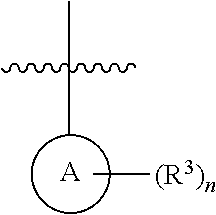
is selected from the group consisting of (optionally in combination with R1 being —CO2H and R2 being H):


wherein


or a pharmaceutically acceptable salt thereof, wherein


or a pharmaceutically acceptable salt thereof, wherein


is selected from the group consisting of


in which R8 is CH2, NH, or O; R9 is —NH2 or —CO2H; and p is 0 or an integer from 1-36.

in which R8 is CH2, NH, or O; R9 is —NH2 or —CO2H; and p is 0 or an integer from 1-36. For example, the CEPAM dendrons can be formed by units of 4-amino-4-(2-carboxyethyl)heptanedioic acid, with the following structures:


wherein

or a pharmaceutically acceptable salt thereof.

is selected from the group consisting of


or a pharmaceutically acceptable salt thereof.

wherein

or a pharmaceutically acceptable salt thereof, wherein


wherein R8 is CH2, NH, or O, and R9 is —NH2 or —CO2H.

or a pharmaceutically acceptable salt thereof, wherein


in which Ar is defined in Table 1 below, were subjected to docking and molecular dynamics simulation (10 ns) in a P2Y14R homology model with 3 bound, which was refined using molecular dynamics (standard protocol), as detailed below.
| TABLE 1 | ||
| P2Y14R affinitya | ||
| (μM) or | ||
| Compound | % inhibition at | |
| Identifier | Ar | 3 μM |
| 3 | n/a | 92.6 ± 1.2 |
| PPTN | ||
| 24a MRS4218 |
 |
30.1 ± 2.1% |
| 24b MRS4217 |
 |
92.3 ± 0.5% |
| 24c MRS4228 |
 |
67.2 ± 2.2% |
| 24d MRS4235 |
 |
14.5 ± 2.1% |
| 24e MRS4226 |
 |
21.2 ± 2.9% |
| 24f AJ139 MRS4244 |
 |
26.5 ± 5.2% |
| 24g AJ137D MRS4242 |
 |
82.7 ± 1.5% |
| 24h AJ136D MRS4241 |
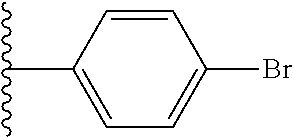 |
88.8 ± 0.8% |
| 24i |
 |
67.3 ± 2.5% |
| 24j MRS4225 |
 |
44.2 ± 1.9% |
| 24k MRS4219 |
 |
66.2 ± 2.0% |
| 24-l AJ144 MRS4261 |
 |
93.1 ± 0.8% |
| 24m |
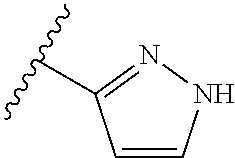 |
NS |
| 24n |
 |
NS |
| 24o MRS4227 |
 |
75.1 ± 2.8% |
| 24p |
 |
91.5 ± 0.3% |
| 24q |
 |
87.1 ± 0.5% |
| 24r MRS4236 |
 |
88.9 ± 4.6% |
| 24t MRS4229 |
 |
79.0 ± 2.2% |
| 24u MRS4232 |
 |
39.6 ± 7.4% |
| 24v |
 |
85.2 ± 0.8% |
| 24w MRS4233 |
 |
13.7 ± 3.1% |
| 24x MRS4230 |
 |
86.7 ± 1.0% |
| 24y |
 |
65.3 ± 4.5% |
| 24z AJ138D MRS4243 |
 |
49.9 ± 2.2% |
| 24aa AJ122D MRS4237 |
 |
65.2 ± 1.2% |
| 24bb AJ134D MRS4238 |
 |
37.3 ± 4.6% |
| 24cc MRS4239 |
 |
42.2 ± 4.3% |
| 24dd |
 |
85.0 ± 0.6% |
| 24ee AJ135D MRS4240 |
 |
76.2 ± 1.7% |
| 24ff AJ142 MRS4259 |
 |
33.4 ± 1.3% |
| 24gg AJ143 MRS4260 |
 |
35.7 ± 0.7% |
| 24hh |
 |
69.3 ± 3.8% |
| 24ii |
 |
33.6 ± 3.5% |
| 24jj AJ141 MRS4258 |
 |
11.6 ± 1.2% |
| 24kk AJ140 MRS4245 |
 |
14.0 ± 5.1% |
| 24-ll |
 |
13.1 ± 2.6% |
| 24mm MRS4231 |
 |
18.1 ± 5.8% |
| 24nn AJ145 MRS4262 |
 |
32.4 ± 2.7% |
| 24oo |
 |
73.4 ± 3.1% |
| 24pp MRS4234 |
 |
6.0 ± 1.3% |
| 24qq AJ146 MRS4263 |
 |
53.1 ± 2.0% |
| 24rr |
 |
50.1 ± 1.9% |
| a% inhibition at 3 μM of binding of fluorescent antagonist 4 (20 nM) in P2Y14R—CHO cells | ||
| NS: not synthesized | ||
| TABLE 2 | |||
| | n | ||
| 102a |
| 0 | ||
| 103a | ||
| 106a | ||
| 107a | ||
| |
2 | |
| |
||
| 106b | ||
| 107b | ||
| 102c | 3 | |
| | ||
| | ||
| 107c | ||
| 102d | ||
| 4 | ||
| 103d | ||
| 106d | ||
| 107d | ||
| 102e | 5 | |
| 103e | ||
| 106e | ||
| 107e | ||
| |
6 | |
| 103f | ||
| 106f | ||
| 107f | ||
| 102g | 8 | |
| 103g | ||
| 106g | ||
| 107g | ||
| 102h | 10 | |
| 103h | ||
| 106h | ||
| 107h | ||
| |
12 | |
| 103i | ||
| 106i | ||
| 107i | ||
| 102j | 11 | |
| 103j | ||
| 106j | ||
| | ||
| 102k | ||
| 14 | ||
| 103k | ||
| | ||
| 107k | ||
| 102l | ||
| 15 | ||
| 103l | ||
| 106l | ||
| 107l | ||
| |
16 | |
| 103m | ||
| | ||
| 107m | ||
| 102n | ||
| 18 | ||
| 103n | ||
| 106n | ||
| | ||
| 102o | ||
| 20 | ||
| 103o | ||
| 106o | ||
| | ||
| 102p | ||
| 22 | ||
| 103p | ||
| | ||
| 107p | ||
| 102q | ||
| 23 | ||
| | ||
| 106q | ||
| 107q | ||
| 102r | 24 | |
| 103r | ||
| | ||
| 107r | ||
| 102s | ||
| 26 | ||
| 103s | ||
| 106s | ||
| 107s | ||
| 102t | 28 | |
| 103t | ||
| 106t | ||
| 107t | ||
| 102u | 30 | |
| 103u | ||
| 106u | ||
| 107u | ||
| 102v | 32 | |
| 103v | ||
| 106v | ||
| | ||
| 102w | ||
| 34 | ||
| 103w | ||
| 106w | ||
| 107w | ||
| 102x | 36 | |
| 103x | ||
| 106x | ||
| 107x | ||
Claims (23)


Priority Applications (1)
| Application Number | Priority Date | Filing Date | Title |
|---|---|---|---|
| US15/762,852 US10683277B2 (en) | 2015-09-25 | 2016-09-23 | Triazole derivatives as P2Y14 receptor antagonists |
Applications Claiming Priority (3)
| Application Number | Priority Date | Filing Date | Title |
|---|---|---|---|
| US201562233162P | 2015-09-25 | 2015-09-25 | |
| US15/762,852 US10683277B2 (en) | 2015-09-25 | 2016-09-23 | Triazole derivatives as P2Y14 receptor antagonists |
| PCT/US2016/053397 WO2017053769A1 (en) | 2015-09-25 | 2016-09-23 | Triazole derivatives as p2y14 receptor antagonists |
Publications (2)
| Publication Number | Publication Date |
|---|---|
| US20180297981A1 US20180297981A1 (en) | 2018-10-18 |
| US10683277B2 true US10683277B2 (en) | 2020-06-16 |
Family
ID=57043059
Family Applications (1)
| Application Number | Title | Priority Date | Filing Date |
|---|---|---|---|
| US15/762,852 Active US10683277B2 (en) | 2015-09-25 | 2016-09-23 | Triazole derivatives as P2Y14 receptor antagonists |
Country Status (4)
| Country | Link |
|---|---|
| US (1) | US10683277B2 (en) |
| EP (1) | EP3353161B1 (en) |
| CN (1) | CN108271370B (en) |
| WO (1) | WO2017053769A1 (en) |
Cited By (1)
| Publication number | Priority date | Publication date | Assignee | Title |
|---|---|---|---|---|
| US11708346B2 (en) | 2019-07-23 | 2023-07-25 | Saint Louis University | Treatment and prevention of neuropathic pain with P2Y14 antagonists |
Families Citing this family (6)
| Publication number | Priority date | Publication date | Assignee | Title |
|---|---|---|---|---|
| JP2021512898A (en) * | 2018-02-09 | 2021-05-20 | アメリカ合衆国 | Heterocyclic P2Y14 receptor antagonist |
| CN109096177A (en) * | 2018-08-31 | 2018-12-28 | 中国药科大学 | 3- amido benzoic acid derivative, preparation method and medical usage |
| WO2021016256A2 (en) * | 2019-07-22 | 2021-01-28 | Angion Biomedica Corp. | Ethynylheterocycles as rho-associated coiled-coil kinase (rock) inhibitors |
| CN111423377B (en) * | 2020-05-12 | 2021-06-01 | 中国药科大学 | 5-amino-1H-pyrazole derivative, preparation method and medical application |
| US12150974B2 (en) | 2021-01-27 | 2024-11-26 | University Of Kansas | Conjugates with inhibitory receptor ligands to induce anergy in insulin-binding B cells |
| CN116444482B (en) * | 2023-06-14 | 2023-09-22 | 中国药科大学 | Thiophene-2-carboxylic acid derivatives, their preparation methods and medicinal uses |
Citations (5)
| Publication number | Priority date | Publication date | Assignee | Title |
|---|---|---|---|---|
| US4507466A (en) | 1983-01-07 | 1985-03-26 | The Dow Chemical Corporation | Dense star polymers having core, core branches, terminal groups |
| WO1993021144A1 (en) | 1992-04-21 | 1993-10-28 | University Of South Florida | T-butyl cascade polymers |
| US5530092A (en) | 1992-01-13 | 1996-06-25 | Dsm N.V. | Dendritic macromolecule and the preparation thereof |
| WO2005075453A1 (en) | 2004-02-05 | 2005-08-18 | Japan Science And Technology Agency | Linker compound, ligand complex and process for producing them |
| WO2009070873A1 (en) | 2007-12-04 | 2009-06-11 | Merck Frosst Canada Ltd. | Substituted 2-naphthoic acids as antagonists of gpr105 activity |
Family Cites Families (4)
| Publication number | Priority date | Publication date | Assignee | Title |
|---|---|---|---|---|
| KR100890676B1 (en) * | 2001-07-24 | 2009-03-26 | 리히데 게데온 베기에스제티 기아르 알티 | Novel Carboxylic Acid Amide Compounds |
| US20110319416A1 (en) * | 2009-01-28 | 2011-12-29 | Emory University | Subunit Selective NMDA Receptor Antagonists For The Treatment Of Neurological Conditions |
| MY168937A (en) * | 2012-10-18 | 2019-01-10 | Hoffmann La Roche | Ethynyl derivatives as modulators of mglur5 receptor activity |
| AU2015223049B2 (en) * | 2014-02-27 | 2019-03-21 | Merck Patent Gmbh | Heterocyclic compounds as NaV channel inhibitors and uses thereof |
-
2016
- 2016-09-23 EP EP16774825.0A patent/EP3353161B1/en active Active
- 2016-09-23 US US15/762,852 patent/US10683277B2/en active Active
- 2016-09-23 WO PCT/US2016/053397 patent/WO2017053769A1/en not_active Ceased
- 2016-09-23 CN CN201680064441.5A patent/CN108271370B/en active Active
Patent Citations (5)
| Publication number | Priority date | Publication date | Assignee | Title |
|---|---|---|---|---|
| US4507466A (en) | 1983-01-07 | 1985-03-26 | The Dow Chemical Corporation | Dense star polymers having core, core branches, terminal groups |
| US5530092A (en) | 1992-01-13 | 1996-06-25 | Dsm N.V. | Dendritic macromolecule and the preparation thereof |
| WO1993021144A1 (en) | 1992-04-21 | 1993-10-28 | University Of South Florida | T-butyl cascade polymers |
| WO2005075453A1 (en) | 2004-02-05 | 2005-08-18 | Japan Science And Technology Agency | Linker compound, ligand complex and process for producing them |
| WO2009070873A1 (en) | 2007-12-04 | 2009-06-11 | Merck Frosst Canada Ltd. | Substituted 2-naphthoic acids as antagonists of gpr105 activity |
Non-Patent Citations (27)
| Title |
|---|
| Azroyan et al., "Renal Intercalated Cells Sense and Mediate Inflammation via the P2Y14 Receptor," PLoS One, 10(3): e0121419 (2015). |
| Barrett et al., "A Selective High-Affinity Antagonist of the P2Y14 Receptor Inhibits UDP-Glucose-Stimulated Chemotaxis of Human Neutrophils," Mol. Pharmacol., 84(1), 41-49 (2013). |
| Cho et al., "Highly Stable Positively Charged Dendron-Encapsulated Gold Nanoparticles," Langmuir, 30(13), 3883-3893 (2014). |
| Cho et al., "Newkome-type dendron stabilized gold nanoparticles: Synthesis, reactivity, and stability," Chem Mater., 23(10), 2665-2676 (2011) Author Manuscript. |
| European Patent Office, Office Action, Application No. 16774825.0, dated Nov. 28, 2019, 5 pages. |
| Gao et al., "The role of P2Y14 and other P2Y receptors in degranulation of human LAD2 mast cells," Purinergic Signalling, 9(1): 31-40 (2013). |
| Gauthier et al., "The identification of 4,7-disubstituted naphthoic acid derivatives as UDP-competitive antagonists of P2Y14," Bioorganic and Medicinal Chemistry Letters, 21(10), 2836-2839 (2011). |
| Guay et al., "Synthesis and SAR of pyrimidine-based, non-nucleotide P2Y14 receptor antagonists," Bioorganic and Medicinal Chemistry Letters, 21(10), 2832-2835 (2011). |
| Holister et al., "Dendrimers Technology White Papers Nr. 6," Cientifica pp. 3-15 (Oct. 2003). |
| International Preliminary Report on Patentability, Application No. PCTUS2016/053397, dated Mar. 27, 2018. |
| International Search Report, Application No. PCT/US2016/053397, dated Nov. 14, 2016. |
| Jacobson et al., "P2Y14 Receptor," Encyclopedia of Signaling Molecules, Ed. S. Choi (2016). |
| Junker et al., "Structure-Based Design of 3-(4-Aryl-1H-1,2,3-triazol-1-yl)-Biphenyl Derivatives as P2Y14 Receptor Antagonists," J. Med. Chem., 59(13), 6149-6168 (2016). |
| Kiselev et al., "Exploring a 2-Naphthoic Acid Template for the Structure-Based Design of P2Y14 Receptor Antagonist Molecular Probes," ACS Chem. Biol., 9(12), 2833-2842 (2014). |
| Kita et al., 2003, caplus 2003:773843. * |
| Lazarowski et al., "UDP-sugars as extracellular signaling molecules: cellular and physiological consequences of P2Y14 receptor activation," Molecular Pharmacology, 88, 151-160 (Jul. 2015). |
| LipidDisorder, 2019, https://www.healthline.com/health/high-cholesterol/lipid-disorder. * |
| Newkome et al., "Cascade Polymers: Syntheses and characterization of One-Directional Arborols Based on Adamantane," J. Org. Chem., 56(25), 7162-7167 (1991). |
| Newkome et al., "Cascade Polymers: Synthesis and Characterization of Four-Directional Spherical Dendritic Macromolecules Based on Adamantane," J. Org. Chem., 57(1), 358-362 (1992). |
| Robichaud et al., "Applying the pro-drug approach to afford highly bioavailable antagonists of P2Y14," Bioorg. Med. Chem. Lett., 21(14): 4366-4368 (2011). |
| Robichaud et al., "Applying the pro-drug approach to afford highly bioavailable antagonists of P2Y14," Bioorganic and Medicinal Chemistry Letters, 21(14), 4366-4368 (2011). |
| Sesma et al., "Udp-glucose promotes neutrophil recruitment in the lung," Purinergic Signalling, 12(4): 627-635 (2016). |
| Tsai et al., "Quantitative analysis of dendron-conjugated cisplatin-complexed gold nanoparticles using scanning particle mobility mass spectrometry," Nanoscale, 5(12), 5390-5395 (2013). |
| Written Opinion of the International Searching Authority, Application No. PCT/US2016/053397, dated Nov. 14,2016. |
| Xu et al., "GPR105 Ablation Prevents Inflammation and Improves Insulin Sensitivity in Mice with Diet-Induced Obesity," J. Immunol., 189(4), 1992-1999 (2012). |
| Yu et al., 2018, J. Med. Chem., 61, 4860-4882. * |
| Zhang et al., "Agonist-bound structure of the human P2Y12 receptor," Nature, 509(7498), 119-122 (2014) Author Manuscript. |
Cited By (1)
| Publication number | Priority date | Publication date | Assignee | Title |
|---|---|---|---|---|
| US11708346B2 (en) | 2019-07-23 | 2023-07-25 | Saint Louis University | Treatment and prevention of neuropathic pain with P2Y14 antagonists |
Also Published As
| Publication number | Publication date |
|---|---|
| CN108271370A (en) | 2018-07-10 |
| CN108271370B (en) | 2021-03-19 |
| EP3353161B1 (en) | 2021-07-21 |
| EP3353161A1 (en) | 2018-08-01 |
| US20180297981A1 (en) | 2018-10-18 |
| WO2017053769A1 (en) | 2017-03-30 |
Similar Documents
| Publication | Publication Date | Title |
|---|---|---|
| US20180297981A1 (en) | Triazole derivativesas p2y14 receptor antagonists | |
| US8598355B2 (en) | Amide compound | |
| EP3081553B1 (en) | Sulfonamide derivative or pharmaceutically acceptable acid addition salt thereof | |
| CN108779096B (en) | Fluorine-substituted cyclopropylamine compounds, and preparation method, pharmaceutical composition and application thereof | |
| JP2022058976A (en) | RET inhibitor | |
| RU2668550C2 (en) | Novel amine derivative or salt thereof | |
| EP3725780B1 (en) | Sulfonamide derivative or pharmaceutically acceptable acid-addition salt | |
| US10351522B2 (en) | Sulfonamide derivative and pharmaceutically acceptable acid addition salt thereof | |
| CA2957046C (en) | Optionally fused heterocyclyl-substituted derivatives of pyrimidine useful for the treatment of inflammatory, metabolic, oncologic and autoimmune diseases | |
| JPWO2009005076A1 (en) | Amide compounds | |
| US20100292320A1 (en) | Benzofuran anilide histone deacetylase inhibitors | |
| KR20120083292A (en) | Glycine compound | |
| WO2021065893A1 (en) | Tetralin derivative or pharmaceutically acceptable acid addition salt thereof | |
| CN102015682A (en) | 3,4-Substituted piperidine derivatives as renin inhibitors | |
| JP7833486B2 (en) | Substituting carbamate macrocyclic compounds and related therapeutic methods | |
| US20060235024A1 (en) | Acetylinic piperazine compounds and their use as metabotropic glutamate receptor antagonists | |
| US9487488B2 (en) | Sulfonamide compound | |
| ZA200604681B (en) | 5-fluoro-,chloro-and cyano-pyridin-2-yl-tetrazoles as ligands of the metabotropic glutamate receptor-5 | |
| KR20070036183A (en) | Compounds and Compositions Useful as Cathepsin S Inhibitors | |
| Zhang et al. | synthesis of 1, 3, 4-oxadiazoles as selective t-type calcium channel inhibitors |
Legal Events
| Date | Code | Title | Description |
|---|---|---|---|
| FEPP | Fee payment procedure |
Free format text: ENTITY STATUS SET TO UNDISCOUNTED (ORIGINAL EVENT CODE: BIG.); ENTITY STATUS OF PATENT OWNER: LARGE ENTITY |
|
| AS | Assignment |
Owner name: THE UNITED STATES OF AMERICA, AS REPRESENTED BY THE SECRETARY, DEPARTMENT OF HEALTH AND HUMAN SERVICES, MARYLAND Free format text: ASSIGNMENT OF ASSIGNORS INTEREST;ASSIGNORS:JACOBSON, KENNETH A.;JUNKER, ANNA;ULIASSI, ELISA;AND OTHERS;SIGNING DATES FROM 20180622 TO 20180711;REEL/FRAME:046374/0425 Owner name: THE UNITED STATES OF AMERICA, AS REPRESENTED BY TH Free format text: ASSIGNMENT OF ASSIGNORS INTEREST;ASSIGNORS:JACOBSON, KENNETH A.;JUNKER, ANNA;ULIASSI, ELISA;AND OTHERS;SIGNING DATES FROM 20180622 TO 20180711;REEL/FRAME:046374/0425 |
|
| STPP | Information on status: patent application and granting procedure in general |
Free format text: NON FINAL ACTION MAILED |
|
| STPP | Information on status: patent application and granting procedure in general |
Free format text: RESPONSE TO NON-FINAL OFFICE ACTION ENTERED AND FORWARDED TO EXAMINER |
|
| STPP | Information on status: patent application and granting procedure in general |
Free format text: FINAL REJECTION MAILED |
|
| STPP | Information on status: patent application and granting procedure in general |
Free format text: RESPONSE AFTER FINAL ACTION FORWARDED TO EXAMINER |
|
| STPP | Information on status: patent application and granting procedure in general |
Free format text: ADVISORY ACTION MAILED |
|
| STPP | Information on status: patent application and granting procedure in general |
Free format text: DOCKETED NEW CASE - READY FOR EXAMINATION |
|
| STPP | Information on status: patent application and granting procedure in general |
Free format text: NOTICE OF ALLOWANCE MAILED -- APPLICATION RECEIVED IN OFFICE OF PUBLICATIONS |
|
| STPP | Information on status: patent application and granting procedure in general |
Free format text: PUBLICATIONS -- ISSUE FEE PAYMENT VERIFIED |
|
| STCF | Information on status: patent grant |
Free format text: PATENTED CASE |
|
| MAFP | Maintenance fee payment |
Free format text: PAYMENT OF MAINTENANCE FEE, 4TH YEAR, LARGE ENTITY (ORIGINAL EVENT CODE: M1551); ENTITY STATUS OF PATENT OWNER: LARGE ENTITY Year of fee payment: 4 |