US10682333B2 - Composition for inhibiting formation of SNARE complex, containing myricetin derivatives - Google Patents
Composition for inhibiting formation of SNARE complex, containing myricetin derivatives Download PDFInfo
- Publication number
- US10682333B2 US10682333B2 US15/748,500 US201615748500A US10682333B2 US 10682333 B2 US10682333 B2 US 10682333B2 US 201615748500 A US201615748500 A US 201615748500A US 10682333 B2 US10682333 B2 US 10682333B2
- Authority
- US
- United States
- Prior art keywords
- myricetin
- snare
- group
- formation
- inhibiting
- Prior art date
- Legal status (The legal status is an assumption and is not a legal conclusion. Google has not performed a legal analysis and makes no representation as to the accuracy of the status listed.)
- Active
Links
- 0 [1*]OC1=C(O[2*])C(O[3*])=CC(C2=C(O[4*])C(=O)C3=C(O[6*])C=C([5*]O)C=C3O2)=C1 Chemical compound [1*]OC1=C(O[2*])C(O[3*])=CC(C2=C(O[4*])C(=O)C3=C(O[6*])C=C([5*]O)C=C3O2)=C1 0.000 description 7
- GEGSVPFKGKMRJZ-UHFFFAOYSA-N CC1=C(C)C(O)=CC(C2=C(O)C(=O)C3=C(O)C=C(O)C=C3O2)=C1 Chemical compound CC1=C(C)C(O)=CC(C2=C(O)C(=O)C3=C(O)C=C(O)C=C3O2)=C1 GEGSVPFKGKMRJZ-UHFFFAOYSA-N 0.000 description 2
- RZTYTDPYFJUTFD-UHFFFAOYSA-N CC1=C(O)C(O)=CC(C2=C(O)C(=O)C3=C(O)C=C(O)C=C3O2)=C1 Chemical compound CC1=C(O)C(O)=CC(C2=C(O)C(=O)C3=C(O)C=C(O)C=C3O2)=C1 RZTYTDPYFJUTFD-UHFFFAOYSA-N 0.000 description 2
- KPTUZDAFSNPFAM-UHFFFAOYSA-N CC1=C(O)C=C(C2=C(O)C(=O)C3=C(O)C=C(O)C=C3O2)C=C1O Chemical compound CC1=C(O)C=C(C2=C(O)C(=O)C3=C(O)C=C(O)C=C3O2)C=C1O KPTUZDAFSNPFAM-UHFFFAOYSA-N 0.000 description 2
- HRSGAXONMQRSMF-UHFFFAOYSA-N CC1=CC(C2=C(O)C(=O)C3=C(O)C=C(O)C=C3O2)=CC(C)=C1C Chemical compound CC1=CC(C2=C(O)C(=O)C3=C(O)C=C(O)C=C3O2)=CC(C)=C1C HRSGAXONMQRSMF-UHFFFAOYSA-N 0.000 description 1
- QOPDDBMKYLBCHZ-UHFFFAOYSA-N COC1=C(O)C(O)=CC(C2=C(O)C(=O)C3=C(O)C=C(O)C=C3O2)=C1.COC1=C(O)C(O)=CC(C2=C(O)C(=O)C3=C(O)C=C(O)C=C3O2)=C1.COC1=C(O)C=C(C2=C(O)C(=O)C3=C(O)C=C(O)C=C3O2)C=C1O.COC1=CC(C2=C(O)C(=O)C3=C(O)C=C(O)C=C3O2)=CC(O)=C1O.COC1=CC(C2=C(O)C(=O)C3=C(O)C=C(O)C=C3O2)=CC(OC)=C1O.COC1=CC(O)=C2C(=O)C(OC)=C(C3=CC(OC)=C(OC)C(OC)=C3)OC2=C1 Chemical compound COC1=C(O)C(O)=CC(C2=C(O)C(=O)C3=C(O)C=C(O)C=C3O2)=C1.COC1=C(O)C(O)=CC(C2=C(O)C(=O)C3=C(O)C=C(O)C=C3O2)=C1.COC1=C(O)C=C(C2=C(O)C(=O)C3=C(O)C=C(O)C=C3O2)C=C1O.COC1=CC(C2=C(O)C(=O)C3=C(O)C=C(O)C=C3O2)=CC(O)=C1O.COC1=CC(C2=C(O)C(=O)C3=C(O)C=C(O)C=C3O2)=CC(OC)=C1O.COC1=CC(O)=C2C(=O)C(OC)=C(C3=CC(OC)=C(OC)C(OC)=C3)OC2=C1 QOPDDBMKYLBCHZ-UHFFFAOYSA-N 0.000 description 1
- SDZXSJTXWCECDJ-UHFFFAOYSA-N COC1=C(O)C(O)=CC(C2=C(O)C(=O)C3=C(O)C=C(O)C=C3O2)=C1.COC1=CC(C2=C(O)C(=O)C3=C(O)C=C(O)C=C3O2)=CC(OC)=C1O.COC1=CC(O)=C2C(=O)C(OC)=C(C3=CC(OC)=C(OC)C(OC)=C3)OC2=C1 Chemical compound COC1=C(O)C(O)=CC(C2=C(O)C(=O)C3=C(O)C=C(O)C=C3O2)=C1.COC1=CC(C2=C(O)C(=O)C3=C(O)C=C(O)C=C3O2)=CC(OC)=C1O.COC1=CC(O)=C2C(=O)C(OC)=C(C3=CC(OC)=C(OC)C(OC)=C3)OC2=C1 SDZXSJTXWCECDJ-UHFFFAOYSA-N 0.000 description 1
- CMRBCUQYNLDSKE-UHFFFAOYSA-N COC1=CC(OC)=C2C(=O)C(OC)=C(C3=CC(OC)=C(OC)C(OC)=C3)OC2=C1 Chemical compound COC1=CC(OC)=C2C(=O)C(OC)=C(C3=CC(OC)=C(OC)C(OC)=C3)OC2=C1 CMRBCUQYNLDSKE-UHFFFAOYSA-N 0.000 description 1
- DIFBTYNDLDXUDF-UHFFFAOYSA-N COC1=CC(OC)=C2C(=O)C(OC)=C(C3=CC(OC)=C(OC)C(OC)=C3)OC2=C1.O=C1C(O)=C(C2=CC(O)=C(O)C(O)=C2)OC2=CC(O)=CC(O)=C12 Chemical compound COC1=CC(OC)=C2C(=O)C(OC)=C(C3=CC(OC)=C(OC)C(OC)=C3)OC2=C1.O=C1C(O)=C(C2=CC(O)=C(O)C(O)=C2)OC2=CC(O)=CC(O)=C12 DIFBTYNDLDXUDF-UHFFFAOYSA-N 0.000 description 1
- IKMDFBPHZNJCSN-UHFFFAOYSA-N Oc(cc1O)cc(OC(c(cc2O)cc(O)c2O)=C2O)c1C2=O Chemical compound Oc(cc1O)cc(OC(c(cc2O)cc(O)c2O)=C2O)c1C2=O IKMDFBPHZNJCSN-UHFFFAOYSA-N 0.000 description 1
Images


Classifications
-
- C—CHEMISTRY; METALLURGY
- C07—ORGANIC CHEMISTRY
- C07D—HETEROCYCLIC COMPOUNDS
- C07D311/00—Heterocyclic compounds containing six-membered rings having one oxygen atom as the only hetero atom, condensed with other rings
- C07D311/02—Heterocyclic compounds containing six-membered rings having one oxygen atom as the only hetero atom, condensed with other rings ortho- or peri-condensed with carbocyclic rings or ring systems
- C07D311/04—Benzo[b]pyrans, not hydrogenated in the carbocyclic ring
- C07D311/22—Benzo[b]pyrans, not hydrogenated in the carbocyclic ring with oxygen or sulfur atoms directly attached in position 4
- C07D311/26—Benzo[b]pyrans, not hydrogenated in the carbocyclic ring with oxygen or sulfur atoms directly attached in position 4 with aromatic rings attached in position 2 or 3
- C07D311/28—Benzo[b]pyrans, not hydrogenated in the carbocyclic ring with oxygen or sulfur atoms directly attached in position 4 with aromatic rings attached in position 2 or 3 with aromatic rings attached in position 2 only
- C07D311/30—Benzo[b]pyrans, not hydrogenated in the carbocyclic ring with oxygen or sulfur atoms directly attached in position 4 with aromatic rings attached in position 2 or 3 with aromatic rings attached in position 2 only not hydrogenated in the hetero ring, e.g. flavones
-
- A—HUMAN NECESSITIES
- A61—MEDICAL OR VETERINARY SCIENCE; HYGIENE
- A61K—PREPARATIONS FOR MEDICAL, DENTAL OR TOILETRY PURPOSES
- A61K31/00—Medicinal preparations containing organic active ingredients
- A61K31/33—Heterocyclic compounds
- A61K31/335—Heterocyclic compounds having oxygen as the only ring hetero atom, e.g. fungichromin
- A61K31/35—Heterocyclic compounds having oxygen as the only ring hetero atom, e.g. fungichromin having six-membered rings with one oxygen as the only ring hetero atom
- A61K31/352—Heterocyclic compounds having oxygen as the only ring hetero atom, e.g. fungichromin having six-membered rings with one oxygen as the only ring hetero atom condensed with carbocyclic rings, e.g. methantheline
-
- A—HUMAN NECESSITIES
- A61—MEDICAL OR VETERINARY SCIENCE; HYGIENE
- A61K—PREPARATIONS FOR MEDICAL, DENTAL OR TOILETRY PURPOSES
- A61K31/00—Medicinal preparations containing organic active ingredients
- A61K31/33—Heterocyclic compounds
- A61K31/335—Heterocyclic compounds having oxygen as the only ring hetero atom, e.g. fungichromin
- A61K31/35—Heterocyclic compounds having oxygen as the only ring hetero atom, e.g. fungichromin having six-membered rings with one oxygen as the only ring hetero atom
- A61K31/352—Heterocyclic compounds having oxygen as the only ring hetero atom, e.g. fungichromin having six-membered rings with one oxygen as the only ring hetero atom condensed with carbocyclic rings, e.g. methantheline
- A61K31/353—3,4-Dihydrobenzopyrans, e.g. chroman, catechin
-
- A—HUMAN NECESSITIES
- A61—MEDICAL OR VETERINARY SCIENCE; HYGIENE
- A61K—PREPARATIONS FOR MEDICAL, DENTAL OR TOILETRY PURPOSES
- A61K8/00—Cosmetics or similar toiletry preparations
- A61K8/18—Cosmetics or similar toiletry preparations characterised by the composition
- A61K8/30—Cosmetics or similar toiletry preparations characterised by the composition containing organic compounds
- A61K8/49—Cosmetics or similar toiletry preparations characterised by the composition containing organic compounds containing heterocyclic compounds
- A61K8/4973—Cosmetics or similar toiletry preparations characterised by the composition containing organic compounds containing heterocyclic compounds with oxygen as the only hetero atom
- A61K8/498—Cosmetics or similar toiletry preparations characterised by the composition containing organic compounds containing heterocyclic compounds with oxygen as the only hetero atom having 6-membered rings or their condensed derivatives, e.g. coumarin
-
- A—HUMAN NECESSITIES
- A61—MEDICAL OR VETERINARY SCIENCE; HYGIENE
- A61P—SPECIFIC THERAPEUTIC ACTIVITY OF CHEMICAL COMPOUNDS OR MEDICINAL PREPARATIONS
- A61P17/00—Drugs for dermatological disorders
-
- A—HUMAN NECESSITIES
- A61—MEDICAL OR VETERINARY SCIENCE; HYGIENE
- A61Q—SPECIFIC USE OF COSMETICS OR SIMILAR TOILETRY PREPARATIONS
- A61Q19/00—Preparations for care of the skin
-
- A—HUMAN NECESSITIES
- A61—MEDICAL OR VETERINARY SCIENCE; HYGIENE
- A61Q—SPECIFIC USE OF COSMETICS OR SIMILAR TOILETRY PREPARATIONS
- A61Q19/00—Preparations for care of the skin
- A61Q19/08—Anti-ageing preparations
-
- C—CHEMISTRY; METALLURGY
- C07—ORGANIC CHEMISTRY
- C07D—HETEROCYCLIC COMPOUNDS
- C07D311/00—Heterocyclic compounds containing six-membered rings having one oxygen atom as the only hetero atom, condensed with other rings
- C07D311/02—Heterocyclic compounds containing six-membered rings having one oxygen atom as the only hetero atom, condensed with other rings ortho- or peri-condensed with carbocyclic rings or ring systems
- C07D311/04—Benzo[b]pyrans, not hydrogenated in the carbocyclic ring
- C07D311/22—Benzo[b]pyrans, not hydrogenated in the carbocyclic ring with oxygen or sulfur atoms directly attached in position 4
- C07D311/26—Benzo[b]pyrans, not hydrogenated in the carbocyclic ring with oxygen or sulfur atoms directly attached in position 4 with aromatic rings attached in position 2 or 3
- C07D311/28—Benzo[b]pyrans, not hydrogenated in the carbocyclic ring with oxygen or sulfur atoms directly attached in position 4 with aromatic rings attached in position 2 or 3 with aromatic rings attached in position 2 only
Definitions
- the present invention was undertaken with the support of 1) Development of neuromoulatory SNARE-wedging materials No. 1465017087 grant funded by the Korea Health Industry Development Institute, 2) Center for Human Interface Nano Technology No. 1711010677 grant funded by the National Research Foundation of Korea.
- the present invention relates to a composition for inhibiting the formation of a soluble N-ethylmaleimide-sensitive factor attachment protein receptor (SNARE) complex, which includes a myricetin derivative.
- SNARE soluble N-ethylmaleimide-sensitive factor attachment protein receptor
- SNARE soluble N-ethylmaleimide-sensitive factor attachment protein receptor
- SNAP receptor soluble N-ethylmaleimide-sensitive factor attachment protein receptor
- SNARE proteins are a large protein superfamily consisting of 60 or more members in yeasts and mammalian cells, and the primary role of SNARE proteins is to mediate vesicle fusion. That is, SNARE proteins mediate the fusion of vesicles with their target membrane bound to compartments such as a lysosome. As a specific example, SNAREs mediate docking of synaptic vesicles with the presynaptic membrane in neurons.
- Muscles contract by receiving a message of a neurotransmitter transmitted from the inside of synaptic vesicles, and for the release of such a neurotransmitter, SNARE proteins form a complex, and this enables neurotransmitters to be docking with muscles.
- a synaptic vesicle containing the neurotransmitter is required to be fused with a presynaptic membrane so that a passage between two boundaries can be formed, and at this time, a fundamental force for such membrane fusion is provided by SNARE complexes comprising three kinds of proteins.
- a release passage of a neurotransmitter is opened by membrane fusion between a synaptic vesicle and a presynaptic membrane, and a t-SNARE complex, which is a complex of a syntaxin-1a protein and a SNAP-25 protein that are attached to a target membrane, and v-SNARE attached to a vesicle are involved in this pathway, and such SNARE proteins are twisted in a spiral shape.
- pores of the skin are generally distributed in the facial skin but can be visually recognized particularly in nasal and buccal sites, and the appearance of pores varies from person to person according to intrinsic and extrinsic factors such as gender, genetic factors, aging, acnes, chronic UV exposure, and the like.
- the reason for the widening of the pores is that as sebum is excessively secreted or skin aging begins, collagen fibers and elastic fibers, which support pore walls, are denatured and decreased, resulting in loss of skin elasticity and skin laxity. Since the contraction or relaxation of muscles (arrector pili muscles) attached to hairs is under the control of the sympathetic and parasympathetic nerves, the pores may be reduced or enlarged by neural control.
- the sympathetic nerve is slightly distant from muscles and narrows pores, whereas the parasympathetic nerve is located near muscles and enlarges pores.
- a compensating action of the sympathetic nerve contracts muscles attached to hairs, thereby reducing pores.
- myricetin derivatives in which one or more hydroxyl groups of myricetin are alkylated or acylated, exhibited an effect of inhibiting the formation of SNARE complexes and was not discolored and/or colored even when exposed to UV due to significantly improved stability, and, accordingly, could be effectively used in a cosmetic composition, and the like, and thus completed the present invention.
- An object of the present invention is to provide a substance suitable for use as a prodrug targeting soluble N-ethylmaleimide-sensitive factor attachment protein receptor (SNARE) that has no issue related to color, reactivity, strong oxidizing action against sunlight, and the like, and a composition for inhibiting the formation of a SNARE complex, which includes the substance.
- the present invention also provides a substance suitable for use as a SNARE-targeting prodrug having a more improved activity of inhibiting the formation of SNARE complexes than that of conventional myricetin, and a composition for inhibiting the formation of a SNARE complex, which includes the substance.
- the present invention provides a pharmaceutical composition for the prevention or treatment of skin wrinkles, pain, hyperhidrosis, pore enlargement, or allergy, which includes the above-described composition, and a cosmetic composition for alleviating skin wrinkles, allergic symptoms, or pores.
- the present invention is effective in that novel myricetin derivatives obtained by acylating myricetin, as well as laricitrin, combretol, and syringetin, which are myricetin derivatives, have an activity of inhibiting the formation of SNARE complexes in vivo, but do not have an activity of inhibiting the formation of SNARE complexes in vitro, and thus can be applied as a SNARE-targeting prodrug.
- FIG. 2 illustrates verification results of SNARE-mediated membrane fusion inhibitory activities of laricitrin, combretol, and syringetin.
- FIG. 4 illustrates 1 H NMR analysis results of the structure and composition of a mixture containing a myricetin derivative, in which all hydroxyl groups of myricetin were acylated, produced by acylation using palmitic acid as a fatty acid, according to another embodiment of the present invention.
- FIG. 5 illustrates 1 H NMR analysis results of the structure and composition of a mixture containing a myricetin derivative, in which all hydroxyl groups of myricetin were acylated, produced by acylation using acetic acid as a fatty acid, according to an embodiment of the present invention.
- FIG. 6 illustrates 1 H NMR analysis results of the structure and composition of a mixture containing a myricetin derivative, in which all hydroxyl groups of myricetin were acylated, produced by acylation using stearic acid as a fatty acid, according to another embodiment of the present invention.
- FIG. 7 illustrates 1 H NMR analysis results of the structure and composition of a mixture containing a myricetin derivative, in which all hydroxyl groups of myricetin were acylated, produced by acylation using lauric acid as a fatty acid, according to still another embodiment of the present invention.
- FIG. 8 illustrates examination results of the release rate of a neurotransmitter in response to syringetin and laricitrin.
- FIG. 9 illustrates examination results of the release rate of a neurotransmitter against a myricetin derivative obtained according to an embodiment of the present invention.
- FIG. 10 illustrates examination results of the release rate of a neurotransmitter against a myricetin derivative obtained according to an embodiment of the present invention.
- FIG. 11 illustrates examination results of the light stability of syringetin and laricitrin compared to myricetin.
- FIG. 12 illustrates solubility observation results of a case in which a myricetin derivative was dissolved in canola oil and mineral oil at a ratio of 1 mg/l ml.
- FIG. 14 illustrates examination results of the light stability of a myricetin derivative obtained according to an embodiment of the present invention.
- FIG. 15 illustrates examination results of an intracellular bio-conversion rate of a myricetin derivative obtained according to an embodiment of the present invention.
- FIG. 16 illustrates results of examining whether a myricetin derivative obtained according to an embodiment of the present invention actually had an activity of inhibiting hyperhidrosis in vivo.
- FIG. 17 illustrates examination results of the cell viability of myricetin, laricitrin, and a myricetin derivative obtained according to an embodiment of the present invention.
- An embodiment of the present invention provides a composition for inhibiting the formation of a soluble NSF attachment protein receptor (SNARE) complex, which includes a compound represented by Formula 1 below or a pharmaceutically acceptable salt thereof as an active ingredient.
- SNARE soluble NSF attachment protein receptor
- each of R 1 , R 2 , R 3 , R 4 , R 5 , and R 6 is independently hydrogen, linear or branched C 1-4 alkyl, or linear or branched, saturated or unsaturated C 1-20 acyl, the alkyls or the acyls may be identical to or different from each other, and not all of R 1 , R 2 , R 3 , R 4 , R 5 , and R 6 are hydrogen.
- various candidate materials were screened to develop a prodrug having an activity similar to that of commercially widely known Botox, and previous studies have confirmed that, among these candidate materials, derivatives of polyphenols (myricetin, delphinidin, and cyanidin), which are known to act as a SNARE inhibitor, are possibly used as the prodrug.
- myricetin is known to interrupt the formation of a SNARE complex through insertion of myricetin thereinto to stop SNARE-mediated membrane fusion, leaving the complex in a hemifusion state.
- Botox which is used mainly for cosmetic purposes, with myricetin.
- the issues are related mostly to chemical structures, such as the issues of color, reactivity, and the like.
- the compound represented by Formula 1 which is a myricetin derivative, has the ability to inhibit the formation of a SNARE complex in vivo and thus can be used as a SNARE-targeting prodrug.
- the present invention is based on this finding.
- laricitrin, combretol, and syringetin which are methylated forms of myricetin, had the ability to inhibit the formation of a SNARE complex in vivo, and thus could be used as a SNARE-targeting prodrug (see Example 2).
- Laricitrin, combretol, and syringetin which are natural derivatives of myricetin, may be represented by Formulae 2, 3, and 4, respectively.
- a novel myricetin derivative corresponding to the compound represented by Formula 1 was prepared by acylation of myricetin using an acyl donor in the presence of a lipase catalyst, and it was confirmed that the prepared myricetin derivative had the ability to inhibit the formation of a SNARE complex in vivo and thus could be used as a SNARE-targeting prodrug (see Example 3).
- a myricetin derivative in which all R 1 , R 2 , R 3 , R 4 , R 5 , and R 6 are acylated by a fatty acid-derived acyl group was prepared as a novel myricetin derivative corresponding to the compound of Formula 1 by acylating myricetin by reacting the same with a fatty acid as an acyl donor and oxalyl chloride in the presence of a base, and it was confirmed that the prepared myricetin derivative had the ability to inhibit the formation of a SNARE complex in vivo and thus could be used as a SNARE-targeting prodrug (see Example 4).
- each of R 1 , R 2 , R 3 , R 4 , R 5 , and R 6 is independently hydrogen, linear or branched C 1-4 alkyl, or linear or branched, saturated or unsaturated C 1-20 acyl, the alkyls or the acyls may be identical to or different from each other, and not all of R 1 , R 2 , R 3 , R 4 , R 5 , and R 6 are hydrogen.
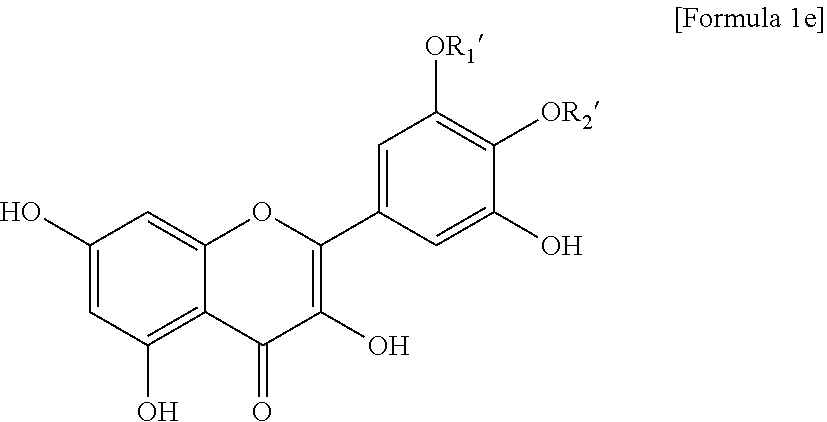
- the compound represented by Formula 1 may be selected from compounds represented by Formulae 1a to 1d:
- each of R 1 ′, R 2 ′, R 3 ′, R 4 ′, R 5 ′, and R 6 ′ is independently linear or branched, saturated or unsaturated C 1-20 acyl, and the acyls may be identical to or different from each other.
- the acyl group may be selected from the group consisting of an acetyl group, a butyryl group, an octanoyl group, a lauroyl group, a palmitoyl group, a stearoyl group, and an eicosanoyl group.
- the compound represented by Formula 1 suitable for use in the composition for inhibiting the formation of a SNARE complex may be selected from the group consisting of the following compounds:
- composition for inhibiting the formation of a SNARE complex may include all of the compound represented by Formula 1a, the compound represented by Formula 1b, and the compound represented by Formula 1c.
- the composition for inhibiting the formation of a SNARE complex may be a pharmaceutical composition or a cosmetic composition.
- a disease or symptom that is treated, alleviated, or prevented by inhibiting the formation of a SNARE complex may be skin wrinkles, pain, hyperhidrosis, pore enlargement, an allergic disease, or an autoimmune disease, but the present invention is not limited thereto.
- the compound of the present invention may effectively inhibit the formation of a SNARE complex like Botox does, and thus may be used in diseases that can be alleviated or treated using Botox without limitation.
- laricitrin, combretol, and syringetin exhibited an effect of inhibiting the formation of a SNARE complex (see Example 2), and myricetin derivatives were seen to inhibit acetylcholine release in a concentration-dependent manner (see Example 4 and FIG. 4 ).
- the myricetin derivatives exhibited an excellent activity of inhibiting acetylcholine release compared to myricetin.
- the myricetin derivative of the present invention may be effectively used in treating, alleviating, or preventing skin wrinkles, pain, hyperhidrosis, pore enlargement, or an allergic disease by inhibiting the formation of a SNARE complex and suppressing acetylcholine release.
- composition for inhibiting the formation of a SNARE complex is a pharmaceutical composition
- the composition may further include a pharmaceutically acceptable carrier.
- pharmaceutically acceptable refers to describe compositions and molecules that are physiologically acceptable and typically do not cause an unexpected reaction when administered to humans.
- pharmaceutically acceptable is meant to be approved by other generally known pharmacopoeia for use in mammals, in particular humans.
- the pharmaceutically acceptable carrier may include various ingredients such as lactose, dextrose, sucrose, sorbitol, mannitol, xylitol, erythritol, maltitol, starch, acacia rubber, alginate, gelatin, calcium phosphate, calcium silicate, cellulose, methyl cellulose, microcrystalline cellulose, polyvinylpyrrolidone, water, methylhydroxybenzoate, propylhydroxybenzoate, talc, magnesium stearate, mineral oil, or the like.
- the pharmaceutical composition of the present invention may be administered by nonoral routes, may be administered in the form of a general pharmaceutical preparation, e.g., one of various nonoral preparations for clinical administration, and may be formulated using generally used diluents or excipients such as fillers, extenders, binders, wetting agents, disintegrating agents, surfactants, and the like.
- Preparations for nonoral administration include a sterile aqueous solution, a non-aqueous solvent, a suspension, an emulsion, or a freeze-dried preparation.
- the non-aqueous solvent and the suspension include propylene glycol, polyethylene glycol, a vegetable oil such as olive oil, an injectable ester such as ethyl oleate, and the like.
- a pharmaceutical composition for inhibiting the formation of a SNARE complex may exhibit an effect of inhibiting the formation of a SNARE complex when including an effective amount of the compound represented by Formula 1.
- the term “effective amount” refers to the amount of a compound sufficient to exhibit an effect of inhibiting the formation of a SNARE complex.
- the effective amount of the compound represented by Formula 1 included in the composition of the present invention may vary according to commercialized forms of the composition, application methods of the compound on the skin, residence time of the compound on the skin, or the like.
- the composition when the composition is to be produced as a drug, the composition may include the compound represented by Formula 1 at a higher concentration than in a case in which the composition is to be produced as a product such as a shampoo, a hair conditioner, a hair pack, or the like that is commonly applied to the skin.
- a daily dose of the composition may be determined such that 0.01 mg/kg to 10 mg/kg, preferably 0.1 mg/kg to 1 mg/kg, of the compound represented by Formula 1 is administered, and the composition may be administered once to six times a day.
- the dose may be increased or decreased according to age, gender, body weight, the severity of a disease, administration route, or the like.
- the dose does not limit the scope of the present invention in any way.
- the pharmaceutical composition of the present invention may be used alone or in combination with methods using surgery, radiotherapy, hormone therapy, chemotherapy, and a biological response modifier.
- the present invention may also provide an external preparation for the skin for inhibiting the formation of a SNARE complex, which includes the compound represented by Formula 1 as an active ingredient.
- the external preparation for the skin may further include an adjuvant commonly used in dermatology, such as a fatty substance, an organic solvent, a solubilizer, a thickener, a gelling agent, a softener, an antioxidant, a suspending agent, a stabilizer, a foaming agent, a flavoring agent, a surfactant, water, an ionic or nonionic emulsifier, a filler, a sequestrant, a chelating agent, a preservative, vitamins, a blocking agent, a wetting agent, essential oil, a dye, a pigment, a hydrophilic or hydrophobic activator, lipid vesicles, or other ingredients commonly used in an external preparation for the skin.
- the above ingredients may be included in an amount generally used in dermatology.
- the formulation may be applicable to hair, such as a gel, a cream, a patch, or an aerosol, but the present invention is not limited thereto.
- the present invention may also provide a cosmetic composition for inhibiting the formation of a SNARE complex, which includes the compound represented by Formula 1 as an active ingredient.
- cosmetics prepared by including the compound represented by Formula 1 as an active ingredient may be in general emulsified and solubilized formulation.
- the examples of such formulation include sprays, hair gels, hair packs, shampoos, hair conditioners, hair lotions, hair essences, patches, and aerosols.
- the cosmetic may further include, in addition to the compound represented by Formula 1, an adjuvant commonly used in cosmetology, such as a fatty substance, an organic solvent, a solubilizer, a thickener, a gelling agent, a softener, an antioxidant, a suspending agent, a stabilizer, a foaming agent, a flavoring agent, a surfactant, water, an ionic or nonionic emulsifier, a filler, a sequestrant, a chelating agent, a preservative, vitamins, a blocking agent, a wetting agent, essential oil, a dye, a pigment, a hydrophilic or hydrophobic activator, lipid vesicles, or other ingredients commonly used in a cosmetic.
- an adjuvant commonly used in cosmetology such as a fatty substance, an organic solvent, a solubilizer, a thickener, a gelling agent, a softener, an antioxidant, a suspending agent, a stabilizer,
- the composition of the present invention may be prepared in any formulation applicable to scalp, such as a liquid, cream, paste, solid, or the like, and may be prepared as a composition such as a shampoo, a hair conditioner, a hair lotion, a liquid-type hair growth lotion, or the like for inhibiting the formation of a SNARE complex by including additional general additives.
- the formulation also includes aerosols.
- the amount of the compound represented by Formula 1 in the composition of the present invention may range from 0.001 wt % to 10 wt %, preferably 0.005 wt % to 5 wt %, and most preferably 0.01 wt % to 3 wt %, with respect to a total weight of the entire composition.
- Another embodiment of the present invention also provides a compound represented by Formula 1 below, a mixture including the same, or a pharmaceutically acceptable salt of the compound.
- each of R 1 , R 2 , R 3 , R 4 , R 5 , and R 6 is independently hydrogen, linear or branched C 1-4 alkyl, or linear or branched, saturated or unsaturated C 1-20 acyl, the alkyls or the acyls may be identical to or different from each other, and
- R 1 , R 2 , R 3 , R 4 , R 5 , and R 6 are hydrogen.
- each of R 1 ′, R 2 ′, R 3 ′, R 4 ′, R 5 ′, and R 6 ′ is independently linear or branched, saturated or unsaturated C 1-20 acyl, and
- the acyls may be identical to or different from each other.
- Another embodiment of the present invention also provides a method of preparing a compound represented by Formula 1 below, including acylating myricetin using an acyl donor in the presence of a lipase catalyst:
- each of R 1 , R 2 , R 3 , R 4 , R 5 , and R 6 is independently hydrogen, or linear or branched, saturated or unsaturated C 1-20 acyl, the acyls may be identical to or different from each other, and
- R 1 , R 2 , R 3 , R 4 , R 5 , and R 6 are hydrogen.
- the lipase catalyst may be derived from a bacterial strain belonging to Alcaligenes sp.
- the acyl donor may be vinyl acetate, vinyl butyrate, vinyl octanoate, vinyl laurate, vinyl palmitate, vinyl stearate, or vinyl eicosanoate, but the present invention is not limited thereto.
- the acyl donor may be used in an amount of 0.5 equivalent to 5 equivalents with respect to a reaction substrate.
- acylation may be performed at a temperature of 40° C. to 65° C. for 20 hours to 60 hours by using water as a culture medium.
- Another embodiment of the present invention also provides a method of preparing a compound represented by Formula 1 below, including acylating myricetin by reacting the same with a fatty acid as an acyl donor and oxalyl chloride in the presence of a base:
- each of R 1 , R 2 , R 3 , R 4 , R 5 , and R 6 is independently hydrogen, or linear or branched, saturated or unsaturated C 1-20 acyl, the acyls may be identical to or different from each other, and
- R 1 , R 2 , R 3 , R 4 , R 5 , and R 6 are hydrogen.
- the base may be, but is not limited to, pyridine.
- the fatty acid as an acyl donor may be, but is not limited to, acetic acid, butyric acid, octanoic acid, lauric acid, palmitic acid, stearic acid, or archidic acid or eicosanoic acid.
- the fatty acid as an acyl donor may be used in an amount of 5 equivalents to 50 equivalents with respect to a reaction substrate.
- acylation may be performed at a temperature of 30° C. to 80° C. for 10 hours to 30 hours.
- a system capable of conveniently identifying and rapidly screening the function of a prodrug having a function similar to that of a known botulinum neurotoxin (Botox) by using a fluorescence phenomenon was devised (see FIG. 1 ).
- a two-step experiment was carried out to examine characteristics of a prodrug functioning in vivo, but not in vitro.
- CFP and YFP which are fluorescent proteins, were subjected to binding to C-terminals of syntaxin 1A (STX1A) and VAMP2, which are neuronal SNARE proteins, respectively, thereby constructing a PCl2 stable cell line expressing the two proteins (see FIG. 1B ).
- Example 1 The functions of laricitrin, combretol, and syringetin were verified using the method of Example 1 (see FIG. 1 ) as a screening method capable of measuring the SNARE-mediated membrane fusion process (see FIG. 2 ).
- the binding of SNARE proteins was verified through a FRET change (FRET C) of the C-terminal of SNARE in PCl2 cells, which are mammalian neurons, and, at the same time, content release was also verified by measuring the release of Y-RFP (NPY release), which is a neuropeptide.
- FRET C FRET change
- NPY release Y-RFP
- in vivo functions were distinguished from in vitro functions by observing in vitro membrane fusion changes (see FIG. 2A ).
- a control not treated with any substance (control), a myricetin-treated group (M) treated with myricetin known as a conventional SNARE complex formation inhibitor, a laricitrin-treated group (L), a combretol-treated group (C), and a syringetin-treated group (S) were compared with one another.
- Myricetin has disadvantages in terms of chemical reactivity, skin permeability, and the like. In the present example, it was confirmed that these disadvantages could be addressed by reacting myricetin with an organic compound. The reaction is lipase-catalyzed acylation in which hydrogen bonded to a carbon atom of an aromatic hydrocarbon is substituted with an acyl group (RCO—). As in Reaction Scheme below, the aforementioned disadvantages may be addressed through the lipase-catalyzed acylation of myricetin.
- ester compound used in the reaction of myricetin i.e., an acyl donor substrate, vinyl butyrate, vinyl octanoate, vinyl laurate, vinyl palmitate, or vinyl eicosanoate was used.
- the ester compounds used as substrates were compounds having an alkyl chain with 4, 8, 12, 16, or 20 carbon atoms.
- reaction solution was developed in thin layer chromatography to identify a spot corresponding to the compound. Thereafter, column chromatography (Product Name: “M.S.GEL”, AGC Si-Tech CO., INC.) was performed to remove an unreacted acyl donor.
- myricetin derivatives were prepared by subjecting myricetin to acylation using a fatty acid by using a base and oxalyl chloride.
- fatty acid used as an acyl donor acetic acid, butyric acid, octanoic acid, lauric acid, palmitic acid, stearic acid, or archidic acid or eicosanoic acid was used.
- the fatty acids used as acyl donors were fatty acids having an alkyl chain with 2, 4, 8, 12, 16, 18, or 20 carbon atoms.
- each of a plurality of types of acyl donors (2844.8 mg of stearic acid, 2564.2 mg of palmitic acid, and 2003.1 mg of lauric acid) was first allowed to react with oxalyl chloride to prepare a highly reactive fatty acid.
- 318.24 mg of myricetin was mixed with a reaction product obtained from the reaction and 50 ml of pyridine base.
- the resulting mixed solution was slowly heated to a temperature equal to room temperature or higher (40° C.) to allow a reaction to occur and last for 16 hours.
- reaction solution was developed in thin layer chromatography to identify a spot corresponding to the compound. Thereafter, column chromatography (Product Name: “M.S.GEL”, AGC Si-Tech CO., INC.) was performed to remove unreacted myricetin. Thereafter, the corresponding compound was dissolved in water and then extracted with chloroform, and this process was repeated several times to obtain a compound with high purity.
- column chromatography Product Name: “M.S.GEL”, AGC Si-Tech CO., INC.
- organic compounds i.e., myricetin derivatives, prepared by acylation using a fatty acid and oxalyl chloride in the presence of a base catalyst were obtained.
- 1 H NMR analysis results of a myricetin derivative obtained using palmitic acid as a fatty acid are illustrated in FIG. 4 .
- 1 H NMR analysis results of myricetin derivatives obtained using acetic acid, stearic acid, and lauric acid as fatty acids instead of palmitic acid are illustrated in FIGS. 5, 6, and 7 , respectively.
- the release rate of a neurotransmitter in response to the modified myricetin derivatives obtained in Example 3 was examined using the following two methods. Specific experimental methods are as described below.
- the first method is as follows.
- PCl2 cells were cultured to obtain 70% to 80% confluency in a culture dish.
- the PCl2 cells were treated with a Krebs' buffer with high K + (56 mM NaCl, 1.2 mM MgSO 4 , 2.5 mM CaCl 2 , 68 mM KCl, 24 mM NaHCO 3 , 2 mM KH 2 PO 4 , and 11 mM dextrose, pH 7.4), and incubated in a 5% CO 2 incubator at 37° C. for 5 minutes.
- K + 56 mM NaCl, 1.2 mM MgSO 4 , 2.5 mM CaCl 2 , 68 mM KCl, 24 mM NaHCO 3 , 2 mM KH 2 PO 4 , and 11 mM dextrose, pH 7.4
- the PCl2 cells were washed twice with a Krebs' buffer (118 mM NaCl, 1.2 mM MgSO 4 , 2.5 mM CaCl 2 , 5 mM KCl, 24 mM NaHCO 3 , 2 mM KH 2 PO 4 , and 11 mM dextrose, pH 7.4) for 1 minute each, and then each of the myricetin derivatives (laricitrin: L, combretol: C, syringetin: S, 20 ⁇ M each) and [ 3 H] norepinephrine (1 ⁇ Ci/ml) were mixed into the culture medium, and then the medium was replaced.
- a Krebs' buffer 118 mM NaCl, 1.2 mM MgSO 4 , 2.5 mM CaCl 2 , 5 mM KCl, 24 mM NaHCO 3 , 2 mM KH 2 PO 4 , and 11 mM dextrose, pH 7.4
- the PCl2 cells were incubated in a 5% CO 2 incubator at 37° C. for 2 hours and then washed twice with a Krebs' buffer for 1 minute each. After thorough washing, the PCl2 cells were washed four times with the culture medium for 15 minutes each. After the remaining medium was removed, the PCl2 cells were washed twice with a Krebs' buffer for 1 minute each to collect basal level samples. The medium was replaced with Krebs' buffer with high K + , followed by culturing for 10 minutes, to collect samples. The collected samples were subjected to radiation measurement using a liquid scintillation counter.
- FIGS. 8 and 9 The results thereof are illustrated in FIGS. 8 and 9 .
- the second method is as follows.
- PCl2 cells were cultured to obtain 70% to 80% confluency in a culture dish. Subsequently, the PCl2 cells were treated with a Krebs' buffer with high K + and incubated in a 5% CO 2 incubator at 37° C. for 15 minutes. The PCl2 cells were washed twice with a Krebs' buffer for 1 minute each and each myricetin derivative was mixed in the culture medium, and then the medium was replaced. The PCl2 cells were incubated in a 5% CO 2 incubator at 37° C. for 2 hours, and then washed with a Krebs' buffer for 1 minutes. After thorough washing, the PCl2 cells were allowed to secrete a neurotransmitter into a Krebs' buffer with high K + . The buffer containing the secreted neurotransmitter was quantified using a noradrenalin ELISA kit (IBL international), and results thereof are illustrated in FIG. 10 .
- IBL international noradrenalin ELISA kit
- the myricetin derivatives (laricitrin and syringetin) prepared using acetic acid as a fatty acid according to Example 4 were observed to show changes in various properties compared to myricetin, and whether the compound was denatured particularly when exposed to UV was examined.
- the myricetin derivative was dissolved in canola oil and mineral oil at a ratio of 1 mg/l ml. The results thereof are illustrated in FIG. 13 .
- myricetin was seen to be insoluble in canola oil and mineral oil.
- FIG. 13 it was confirmed that the myricetin derivative according to the present invention, in which hydroxyl groups of myricetin were substituted by palmitic acid having a longer chain length, was liposoluble in canola oil (see FIG. 13A ) and mineral oil (see FIG. 13B ).
- Such a liposoluble property enables the myricetin derivative to be easily dissolved in other cosmetic-based materials and is an important change for myricetin to be used as a cosmetic substance.
- a rate of bioconversion of the myricetin derivative prepared by acylation with acetic acid into myricetin in vivo was determined.
- PCl2 cells were cultured to obtain 70% to 80% confluency in a culture dish. Subsequently, the PCl2 cells were treated with a Krebs' buffer with high K + and incubated in a 5% CO 2 incubator at 37° C. for 15 minutes. The PCl2 cells were washed twice with a Krebs' buffer for 1 minute each and the myricetin derivative prepared by acylation with acetic acid was mixed into the culture medium, and then the medium was replaced. The PCl2 cells were incubated in a 5% CO 2 incubator at 37° C. for 2 hours, and then washed with a Krebs' buffer for 1 minutes.
- the cells were treated with trypsin to collect trypsin-attached cells, and trypsin was removed therefrom to obtain only pure cells.
- the cells were suspended in 100 ⁇ l of tetrahydrofuran, followed by disruption through sonication, and then only tetrahydrofuran in which materials in the cells were lysed was collected. Subsequently, only myricetin in the recovered purified liquid was analyzed by high-performance liquid chromatography (HPLC) to examine whether the myricetin derivative prepared by acylation using acetic acid was converted into myricetin, and the results thereof are illustrated in FIG. 15 .
- HPLC high-performance liquid chromatography
Landscapes
- Health & Medical Sciences (AREA)
- Life Sciences & Earth Sciences (AREA)
- Chemical & Material Sciences (AREA)
- Veterinary Medicine (AREA)
- Animal Behavior & Ethology (AREA)
- General Health & Medical Sciences (AREA)
- Public Health (AREA)
- Organic Chemistry (AREA)
- Epidemiology (AREA)
- Pharmacology & Pharmacy (AREA)
- Medicinal Chemistry (AREA)
- Dermatology (AREA)
- Birds (AREA)
- Gerontology & Geriatric Medicine (AREA)
- Engineering & Computer Science (AREA)
- Bioinformatics & Cheminformatics (AREA)
- Chemical Kinetics & Catalysis (AREA)
- General Chemical & Material Sciences (AREA)
- Nuclear Medicine, Radiotherapy & Molecular Imaging (AREA)
- Pharmaceuticals Containing Other Organic And Inorganic Compounds (AREA)
Abstract
Description

wherein, in Formula 1 above,
each of R1, R2, R3, R4, R5, and R6 is independently hydrogen, linear or branched C1-4 alkyl, or linear or branched, saturated or unsaturated C1-20 acyl,
the alkyls or the acyls may be identical to or different from each other, and not all of R1, R2, R3, R4, R5, and R6 are hydrogen.


wherein, in
each of R1, R2, R3, R4, R5, and R6 is independently hydrogen, linear or branched C1-4 alkyl, or linear or branched, saturated or unsaturated C1-20 acyl,
the alkyls or the acyls may be identical to or different from each other, and
not all of R1, R2, R3, R4, R5, and R6 are hydrogen.

wherein, in Formulae 1a to 1d above,
each of R1′, R2′, R3′, R4′, R5′, and R6′ is independently linear or branched, saturated or unsaturated C1-20 acyl, and
the acyls may be identical to or different from each other.


wherein, in
each of R1, R2, R3, R4, R5, and R6 is independently hydrogen, linear or branched C1-4 alkyl, or linear or branched, saturated or unsaturated C1-20 acyl,
the alkyls or the acyls may be identical to or different from each other, and

wherein, in formulae 1a to 1d above,
each of R1′, R2′, R3′, R4′, R5′, and R6′ is independently linear or branched, saturated or unsaturated C1-20 acyl, and

wherein, in
each of R1, R2, R3, R4, R5, and R6 is independently hydrogen, or linear or branched, saturated or unsaturated C1-20 acyl,
the acyls may be identical to or different from each other, and

wherein, in
each of R1, R2, R3, R4, R5, and R6 is independently hydrogen, or linear or branched, saturated or unsaturated C1-20 acyl,
the acyls may be identical to or different from each other, and
 |
| 3a: R2═R3═H, R1═CO(CH2)2CH3 | 5a: R2═R3═H, R1═CO(CH2)10CH3 | 7a: R2═R3═H, R1═CO(CH2)18CH3 |
| 3b: R1═R3═H, R2═CO(CH2)2CH3 | 5b: R1═R3═H, R2═CO(CH2)10CH3 | 7b: R1═R3═H, R2═CO(CH2)18CH3 |
| 3c: R1═R4═H, R3═CO(CH2)2CH3 | 5c: R1═R4═H, R3═CO(CH2)10CH3 | 7c: R1═R4═H, R3═CO(CH2)18CH3 |
| 4a: R2═R3═H, R1═CO(CH2)6CH3 | 6a: R2═R3═H, R1═CO(CH2)14CH3 | |
| 4b: R1═R3═H, R2═CO(CH2)6CH3 | 6b: R1═R3═H, R2═CO(CH2)14CH3 | |
| 4c: R1═R2═H, R3═CO(CH2)6CH3 | 6c: R1═R2═H, R3═CO(CH2)14CH3 | |
| TABLE 1 | ||||
| Compounds | Regioisomer ratio | |||
| Myricetin-C4 | 3a:3b:3c | 32:47:21 | ||
| Myricetin-C8 | 4a:4b:4c | 35:40:25 | ||
| Myricetin-C12 | 5a:5b:5c | 29:35:36 | ||
| Myricetin-C16 | 6a:6b:6c | 39:37:24 | ||
| Myricetin-C20 | 7a:7b:7c | 38:36:26 | ||

Claims (4)




Applications Claiming Priority (5)
| Application Number | Priority Date | Filing Date | Title |
|---|---|---|---|
| KR20150108322 | 2015-07-30 | ||
| KR10-2015-0108322 | 2015-07-30 | ||
| KR10-2016-0090116 | 2016-07-15 | ||
| KR1020160090116A KR101803201B1 (en) | 2015-07-30 | 2016-07-15 | SNARE complex formation inhibiting composition comprising myricetin derivatives |
| PCT/KR2016/008333 WO2017018847A1 (en) | 2015-07-30 | 2016-07-29 | Composition for inhibiting formation of snare complex, containing myricetin derivatives |
Publications (2)
| Publication Number | Publication Date |
|---|---|
| US20180222878A1 US20180222878A1 (en) | 2018-08-09 |
| US10682333B2 true US10682333B2 (en) | 2020-06-16 |
Family
ID=58154706
Family Applications (1)
| Application Number | Title | Priority Date | Filing Date |
|---|---|---|---|
| US15/748,500 Active US10682333B2 (en) | 2015-07-30 | 2016-07-29 | Composition for inhibiting formation of SNARE complex, containing myricetin derivatives |
Country Status (3)
| Country | Link |
|---|---|
| US (1) | US10682333B2 (en) |
| EP (1) | EP3329913B1 (en) |
| KR (2) | KR101803201B1 (en) |
Families Citing this family (8)
| Publication number | Priority date | Publication date | Assignee | Title |
|---|---|---|---|---|
| KR102088104B1 (en) | 2018-06-29 | 2020-03-11 | 호서대학교 산학협력단 | Composition for preventing and treating of neuro muscular diseases comprising essential oil from Erigeron annuus |
| KR102017240B1 (en) * | 2018-08-23 | 2019-09-02 | 주식회사 하울바이오 | Anti-VAMP2 antibodies inhibiting SNARE complex and use thereof |
| KR102169116B1 (en) * | 2019-02-22 | 2020-10-22 | 주식회사 엘지생활건강 | Composition for inhibiting neurotransmitter secretion |
| JP7558607B2 (en) | 2019-02-22 | 2024-10-01 | エルジー・エイチアンドエイチ・カンパニー・リミテッド | Neurotransmitter secretion suppressing composition |
| KR102297991B1 (en) | 2019-10-11 | 2021-09-07 | 주식회사 하울바이오 | Anti-Syntaxin 1A antibodies inhibiting SNARE complex and use thereof |
| KR102274841B1 (en) | 2019-10-16 | 2021-07-12 | 주식회사 하울바이오 | Anti-SNAP 25 antibodies inhibiting SNARE complex and use thereof |
| KR102713600B1 (en) * | 2021-09-17 | 2024-10-07 | 주식회사 인트론바이오테크놀로지 | Alternative novel material to botulinum neurotoxin and preparing method thereof |
| CN116535375B (en) * | 2023-05-12 | 2025-03-07 | 山西大学 | Water-soluble myricetin derivative and preparation method and application thereof |
Citations (4)
| Publication number | Priority date | Publication date | Assignee | Title |
|---|---|---|---|---|
| KR20080083438A (en) | 2007-03-12 | 2008-09-18 | 성균관대학교산학협력단 | Polyphenolic Compounds to Regulate Neurotransmitter Release |
| KR20110017599A (en) * | 2009-08-14 | 2011-02-22 | (주)아모레퍼시픽 | Pore Reducing Composition Containing Polyphenol Compound |
| CN102875620A (en) | 2012-10-16 | 2013-01-16 | 昆明龙津药业股份有限公司 | New derivatives of myricetin and application of derivatives to medicine preparation |
| WO2014012075A2 (en) | 2012-07-13 | 2014-01-16 | Phyto Tech Corp. | Compositions and methods for treating hair loss and delaying aging of skin |
Family Cites Families (1)
| Publication number | Priority date | Publication date | Assignee | Title |
|---|---|---|---|---|
| JP3502415B2 (en) * | 1993-05-28 | 2004-03-02 | 株式会社コーセー | Maillard reaction inhibitor |
-
2016
- 2016-07-15 KR KR1020160090116A patent/KR101803201B1/en active Active
- 2016-07-29 EP EP16830880.7A patent/EP3329913B1/en active Active
- 2016-07-29 US US15/748,500 patent/US10682333B2/en active Active
-
2017
- 2017-07-28 KR KR1020170096224A patent/KR20170091554A/en not_active Ceased
Patent Citations (5)
| Publication number | Priority date | Publication date | Assignee | Title |
|---|---|---|---|---|
| KR20080083438A (en) | 2007-03-12 | 2008-09-18 | 성균관대학교산학협력단 | Polyphenolic Compounds to Regulate Neurotransmitter Release |
| US8263643B2 (en) * | 2007-03-12 | 2012-09-11 | Sungkyunkwan University Foundation For Corporate Collaboration | Polyphenol compounds with modulating neurotransmitter release |
| KR20110017599A (en) * | 2009-08-14 | 2011-02-22 | (주)아모레퍼시픽 | Pore Reducing Composition Containing Polyphenol Compound |
| WO2014012075A2 (en) | 2012-07-13 | 2014-01-16 | Phyto Tech Corp. | Compositions and methods for treating hair loss and delaying aging of skin |
| CN102875620A (en) | 2012-10-16 | 2013-01-16 | 昆明龙津药业股份有限公司 | New derivatives of myricetin and application of derivatives to medicine preparation |
Non-Patent Citations (16)
| Title |
|---|
| Cho et al, "Characterization of Regiospecific Flavonoid 3′/5′-O-Methyltransferase from Tomato and its Application in Flavonoid Biotransformation", J Korean Soc Appl Biol Chem, 2012, vol. 55, No. 6, pp. 749-755. |
| Clarins document-year 2011. * |
| Clarins document—year 2011. * |
| Demetzos et al., "Structure Elucidation, Conformational Analysis and Thermal Effects on Membrane Bilayers of an Antimicrobial Myricetin Ether Derivative", J. Heterocyclic Chem., 2001, vol. 38, No. 3, pp. 703-710. |
| Duthie et al. (Mutation Research 393 (1997) 223-231). * |
| Funayama et al. (Natural Medicines 49(3), 322-328 (1995)). * |
| International Search Report for International Application No. PCT/KR2016/008333 (3 Pages) ( dated Nov. 1, 2016). |
| Kaihatsu et al., "Potential Anti-Influenza Virus Agents Based on Coffee Ingredients and Natural Flavonols", Nat Prod Chem Res, 2014, vol. 2, No. 2, pp. 1-7. |
| Kawano et al., "The Partial Demethylation of Flavones. III, Preparation of Rhamnetin and 7-O-Methylmyricetinn", Chem. Pharm, Brill., 1967, vol. 15, No. 5, pp. 711-712. |
| Mainini (J. Am. Oil. Chem. Soc. (2013) 90:1751-1759). * |
| Mainini et al., "Synthesis, Molecular Characterization and Preliminary Antioxidant Activity Evaluation of Quercetin Fatty Esters", J Am Oil Chem Soc, 2013, vol. 90, No. 11, pp. 1751-1759. |
| Mani et al. (Journal of the Tennessee of Science 68 (3):83-86 (1993)). * |
| Mastuda et al. (Bioorg. Med. Chem. 10 (2002) p. 3123-3128). * |
| Venditti et al. (Fitoterapia 95 (2014) 182-185). * |
| Weber et al., "SNAREpins: Minimal Machinery for Membrane Fusion", CELL, 1998, vol. 92, pp. 759-772. |
| Woska et al., "SNARE complex-mediated degranulation in mast cells", J. Cell. Mol. Med., 2012, vol. 16, No. 4, pp. 649-656. |
Also Published As
| Publication number | Publication date |
|---|---|
| US20180222878A1 (en) | 2018-08-09 |
| KR20170091554A (en) | 2017-08-09 |
| EP3329913A4 (en) | 2018-12-19 |
| EP3329913B1 (en) | 2021-11-10 |
| KR101803201B1 (en) | 2017-11-30 |
| KR20170015845A (en) | 2017-02-09 |
| EP3329913A1 (en) | 2018-06-06 |
Similar Documents
| Publication | Publication Date | Title |
|---|---|---|
| US20180222878A1 (en) | Composition for inhibiting formation of snare complex, containing myricetin derivatives | |
| CN106459155B (en) | Novel cell penetrating peptides, their conjugates with botulinum toxin and uses thereof | |
| DE69902396T3 (en) | STABILIZED LIQUID MEDICINE PREPARATIONS CONTAINING BOTULINUM TOXIN | |
| JP6175488B2 (en) | Exopolysaccharides for the treatment and / or care of skin, mucous membranes and / or nails | |
| BR112020012641A2 (en) | botulinum toxin cell binding domain polypeptides and methods of use for skin rejuvenation | |
| EP3815674B1 (en) | Composition for muscle relaxation | |
| CN102149398B (en) | Leucojum bulb extracts and use thereof | |
| JP7834129B2 (en) | Composition containing pentapeptide as an active ingredient | |
| CN105451710A (en) | Exogenous polysaccharides for the treatment and/or care of the skin, mucous membranes and/or nails | |
| US20240285780A1 (en) | Peptide exhibiting botulinum toxin-like activity, and use thereof | |
| EP4588520A2 (en) | Composition modulating botulinum neurotoxin effect | |
| DE60026500T2 (en) | POLYPEPTIDE FROM STRATUM CORNEUM AND ITS USE | |
| CN108174598B (en) | Composition containing myricetin derivative for inhibiting SNARE complex formation | |
| US7737119B2 (en) | Cosmetic or pharmaceutical composition comprising peptides, uses and treatment processes | |
| KR102713602B1 (en) | Alternative novel material to botulinum neurotoxin and preparing method thereof | |
| OA19893A (en) | Composition for muscle relaxation. | |
| BR112020026825B1 (en) | COMPOSITION FOR MUSCLE RELAXATION | |
| HK1238140A1 (en) | Peptidyl arginine deiminase 1 and/or 3 activator compounds in the epidermis and uses thereof | |
| HK1193039A (en) | Peptidyl arginine deiminase 1 and/or 3 activator compounds in the epidermis and uses thereof |
Legal Events
| Date | Code | Title | Description |
|---|---|---|---|
| FEPP | Fee payment procedure |
Free format text: ENTITY STATUS SET TO UNDISCOUNTED (ORIGINAL EVENT CODE: BIG.); ENTITY STATUS OF PATENT OWNER: SMALL ENTITY |
|
| AS | Assignment |
Owner name: RESEARCH & BUSINESS FOUNDATION SUNGKYUNKWAN UNIVERSITY, KOREA, REPUBLIC OF Free format text: ASSIGNMENT OF ASSIGNORS INTEREST;ASSIGNORS:KWEON, DAE HYUK;PARK, JOON BUM;JUNG, YOUNG HUN;AND OTHERS;REEL/FRAME:044761/0633 Effective date: 20180123 Owner name: RESEARCH & BUSINESS FOUNDATION SUNGKYUNKWAN UNIVER Free format text: ASSIGNMENT OF ASSIGNORS INTEREST;ASSIGNORS:KWEON, DAE HYUK;PARK, JOON BUM;JUNG, YOUNG HUN;AND OTHERS;REEL/FRAME:044761/0633 Effective date: 20180123 |
|
| FEPP | Fee payment procedure |
Free format text: ENTITY STATUS SET TO SMALL (ORIGINAL EVENT CODE: SMAL); ENTITY STATUS OF PATENT OWNER: SMALL ENTITY |
|
| AS | Assignment |
Owner name: INTRON BIOTECHNOLOGY CO., LTD., KOREA, REPUBLIC OF Free format text: LICENSE;ASSIGNOR:RESEARCH & BUSINESS FOUNDATION SUNGKYUNKWAN UNIVERSITY;REEL/FRAME:046944/0006 Effective date: 20180425 |
|
| STPP | Information on status: patent application and granting procedure in general |
Free format text: NON FINAL ACTION MAILED |
|
| STPP | Information on status: patent application and granting procedure in general |
Free format text: RESPONSE TO NON-FINAL OFFICE ACTION ENTERED AND FORWARDED TO EXAMINER |
|
| STPP | Information on status: patent application and granting procedure in general |
Free format text: FINAL REJECTION MAILED |
|
| STPP | Information on status: patent application and granting procedure in general |
Free format text: ADVISORY ACTION MAILED |
|
| STPP | Information on status: patent application and granting procedure in general |
Free format text: DOCKETED NEW CASE - READY FOR EXAMINATION |
|
| STPP | Information on status: patent application and granting procedure in general |
Free format text: NON FINAL ACTION MAILED |
|
| STPP | Information on status: patent application and granting procedure in general |
Free format text: PUBLICATIONS -- ISSUE FEE PAYMENT RECEIVED |
|
| STCF | Information on status: patent grant |
Free format text: PATENTED CASE |
|
| AS | Assignment |
Owner name: INTRON BIOTECHNOLOGY, INC., KOREA, REPUBLIC OF Free format text: ASSIGNMENT OF ASSIGNORS INTEREST;ASSIGNOR:RESEARCH & BUSINESS FOUNDATION SUNGKYUNKWAN UNIVERSITY;REEL/FRAME:056113/0563 Effective date: 20210428 Owner name: RESEARCH & BUSINESS FOUNDATION SUNGKYUNKWAN UNIVERSITY, KOREA, REPUBLIC OF Free format text: RELEASE OF LICENSE;ASSIGNOR:INTRON BIOTECHNOLOGY CO., LTD.;REEL/FRAME:056128/0107 Effective date: 20210429 |
|
| MAFP | Maintenance fee payment |
Free format text: PAYMENT OF MAINTENANCE FEE, 4TH YR, SMALL ENTITY (ORIGINAL EVENT CODE: M2551); ENTITY STATUS OF PATENT OWNER: SMALL ENTITY Year of fee payment: 4 |
|
| AS | Assignment |
Owner name: ACTIVON CO., LTD., KOREA, REPUBLIC OF Free format text: ASSIGNMENT OF ASSIGNORS INTEREST;ASSIGNOR:INTRON BIOTECHNOLOGY, INC.;REEL/FRAME:073290/0530 Effective date: 20251216 |