US10679949B2 - Semiconductor package assembly with redistribution layer (RDL) trace - Google Patents

Semiconductor package assembly with redistribution layer (RDL) trace Download PDF

Info

Publication number
US10679949B2
US10679949B2 US15/411,077 US201715411077A US10679949B2 US 10679949 B2 US10679949 B2 US 10679949B2 US 201715411077 A US201715411077 A US 201715411077A US 10679949 B2 US10679949 B2 US 10679949B2
Authority
US
United States
Prior art keywords
pad
rdl
trace
die
ground
Prior art date
Legal status (The legal status is an assumption and is not a legal conclusion. Google has not performed a legal analysis and makes no representation as to the accuracy of the status listed.)
Active
Application number
US15/411,077
Other versions
US20170263570A1 (en
Inventor
Sheng-Mou LIN
Duen-Yi Ho
Current Assignee (The listed assignees may be inaccurate. Google has not performed a legal analysis and makes no representation or warranty as to the accuracy of the list.)
MediaTek Inc
Original Assignee
MediaTek Inc
Priority date (The priority date is an assumption and is not a legal conclusion. Google has not performed a legal analysis and makes no representation as to the accuracy of the date listed.)
Filing date
Publication date
Application filed by MediaTek Inc filed Critical MediaTek Inc
Priority to US15/411,077 priority Critical patent/US10679949B2/en
Assigned to MEDIATEK INC. reassignment MEDIATEK INC. ASSIGNMENT OF ASSIGNORS INTEREST (SEE DOCUMENT FOR DETAILS). Assignors: HO, DUEN-YI, LIN, SHENG-MOU
Priority to EP17154808.4A priority patent/EP3217429B1/en
Priority to CN201710067544.3A priority patent/CN107180826B/en
Priority to TW106106100A priority patent/TWI702703B/en
Publication of US20170263570A1 publication Critical patent/US20170263570A1/en
Application granted granted Critical
Publication of US10679949B2 publication Critical patent/US10679949B2/en
Active legal-status Critical Current
Anticipated expiration legal-status Critical

Links

Images

Classifications

    • HELECTRICITY
    • H01ELECTRIC ELEMENTS
    • H01LSEMICONDUCTOR DEVICES NOT COVERED BY CLASS H10
    • H01L23/00Details of semiconductor or other solid state devices
    • H01L23/552Protection against radiation, e.g. light or electromagnetic waves
    • H10W42/20
    • HELECTRICITY
    • H01ELECTRIC ELEMENTS
    • H01LSEMICONDUCTOR DEVICES NOT COVERED BY CLASS H10
    • H01L23/00Details of semiconductor or other solid state devices
    • H01L23/48Arrangements for conducting electric current to or from the solid state body in operation, e.g. leads, terminal arrangements ; Selection of materials therefor
    • H01L23/488Arrangements for conducting electric current to or from the solid state body in operation, e.g. leads, terminal arrangements ; Selection of materials therefor consisting of soldered or bonded constructions
    • H01L23/498Leads, i.e. metallisations or lead-frames on insulating substrates, e.g. chip carriers
    • H01L23/49838Geometry or layout
    • HELECTRICITY
    • H01ELECTRIC ELEMENTS
    • H01LSEMICONDUCTOR DEVICES NOT COVERED BY CLASS H10
    • H01L23/00Details of semiconductor or other solid state devices
    • H01L23/52Arrangements for conducting electric current within the device in operation from one component to another, i.e. interconnections, e.g. wires, lead frames
    • H01L23/522Arrangements for conducting electric current within the device in operation from one component to another, i.e. interconnections, e.g. wires, lead frames including external interconnections consisting of a multilayer structure of conductive and insulating layers inseparably formed on the semiconductor body
    • H01L23/528Layout of the interconnection structure
    • H01L23/5286Arrangements of power or ground buses
    • HELECTRICITY
    • H01ELECTRIC ELEMENTS
    • H01LSEMICONDUCTOR DEVICES NOT COVERED BY CLASS H10
    • H01L24/00Arrangements for connecting or disconnecting semiconductor or solid-state bodies; Methods or apparatus related thereto
    • H01L24/01Means for bonding being attached to, or being formed on, the surface to be connected, e.g. chip-to-package, die-attach, "first-level" interconnects; Manufacturing methods related thereto
    • H01L24/10Bump connectors ; Manufacturing methods related thereto
    • H01L24/15Structure, shape, material or disposition of the bump connectors after the connecting process
    • H01L24/16Structure, shape, material or disposition of the bump connectors after the connecting process of an individual bump connector
    • HELECTRICITY
    • H01ELECTRIC ELEMENTS
    • H01LSEMICONDUCTOR DEVICES NOT COVERED BY CLASS H10
    • H01L25/00Assemblies consisting of a plurality of semiconductor or other solid state devices
    • H01L25/03Assemblies consisting of a plurality of semiconductor or other solid state devices all the devices being of a type provided for in a single subclass of subclasses H10B, H10D, H10F, H10H, H10K or H10N, e.g. assemblies of rectifier diodes
    • H01L25/04Assemblies consisting of a plurality of semiconductor or other solid state devices all the devices being of a type provided for in a single subclass of subclasses H10B, H10D, H10F, H10H, H10K or H10N, e.g. assemblies of rectifier diodes the devices not having separate containers
    • H01L25/065Assemblies consisting of a plurality of semiconductor or other solid state devices all the devices being of a type provided for in a single subclass of subclasses H10B, H10D, H10F, H10H, H10K or H10N, e.g. assemblies of rectifier diodes the devices not having separate containers the devices being of a type provided for in group H10D89/00
    • H01L25/0655Assemblies consisting of a plurality of semiconductor or other solid state devices all the devices being of a type provided for in a single subclass of subclasses H10B, H10D, H10F, H10H, H10K or H10N, e.g. assemblies of rectifier diodes the devices not having separate containers the devices being of a type provided for in group H10D89/00 the devices being arranged next to each other
    • HELECTRICITY
    • H01ELECTRIC ELEMENTS
    • H01LSEMICONDUCTOR DEVICES NOT COVERED BY CLASS H10
    • H01L25/00Assemblies consisting of a plurality of semiconductor or other solid state devices
    • H01L25/03Assemblies consisting of a plurality of semiconductor or other solid state devices all the devices being of a type provided for in a single subclass of subclasses H10B, H10D, H10F, H10H, H10K or H10N, e.g. assemblies of rectifier diodes
    • H01L25/04Assemblies consisting of a plurality of semiconductor or other solid state devices all the devices being of a type provided for in a single subclass of subclasses H10B, H10D, H10F, H10H, H10K or H10N, e.g. assemblies of rectifier diodes the devices not having separate containers
    • H01L25/065Assemblies consisting of a plurality of semiconductor or other solid state devices all the devices being of a type provided for in a single subclass of subclasses H10B, H10D, H10F, H10H, H10K or H10N, e.g. assemblies of rectifier diodes the devices not having separate containers the devices being of a type provided for in group H10D89/00
    • H01L25/0657Stacked arrangements of devices
    • HELECTRICITY
    • H01ELECTRIC ELEMENTS
    • H01LSEMICONDUCTOR DEVICES NOT COVERED BY CLASS H10
    • H01L25/00Assemblies consisting of a plurality of semiconductor or other solid state devices
    • H01L25/18Assemblies consisting of a plurality of semiconductor or other solid state devices the devices being of the types provided for in two or more different main groups of the same subclass of H10B, H10D, H10F, H10H, H10K or H10N
    • H10W20/427
    • H10W70/65
    • H10W90/00
    • HELECTRICITY
    • H01ELECTRIC ELEMENTS
    • H01LSEMICONDUCTOR DEVICES NOT COVERED BY CLASS H10
    • H01L2224/00Indexing scheme for arrangements for connecting or disconnecting semiconductor or solid-state bodies and methods related thereto as covered by H01L24/00
    • H01L2224/01Means for bonding being attached to, or being formed on, the surface to be connected, e.g. chip-to-package, die-attach, "first-level" interconnects; Manufacturing methods related thereto
    • H01L2224/02Bonding areas; Manufacturing methods related thereto
    • H01L2224/04Structure, shape, material or disposition of the bonding areas prior to the connecting process
    • H01L2224/0401Bonding areas specifically adapted for bump connectors, e.g. under bump metallisation [UBM]
    • HELECTRICITY
    • H01ELECTRIC ELEMENTS
    • H01LSEMICONDUCTOR DEVICES NOT COVERED BY CLASS H10
    • H01L2224/00Indexing scheme for arrangements for connecting or disconnecting semiconductor or solid-state bodies and methods related thereto as covered by H01L24/00
    • H01L2224/01Means for bonding being attached to, or being formed on, the surface to be connected, e.g. chip-to-package, die-attach, "first-level" interconnects; Manufacturing methods related thereto
    • H01L2224/02Bonding areas; Manufacturing methods related thereto
    • H01L2224/04Structure, shape, material or disposition of the bonding areas prior to the connecting process
    • H01L2224/04042Bonding areas specifically adapted for wire connectors, e.g. wirebond pads
    • HELECTRICITY
    • H01ELECTRIC ELEMENTS
    • H01LSEMICONDUCTOR DEVICES NOT COVERED BY CLASS H10
    • H01L2224/00Indexing scheme for arrangements for connecting or disconnecting semiconductor or solid-state bodies and methods related thereto as covered by H01L24/00
    • H01L2224/01Means for bonding being attached to, or being formed on, the surface to be connected, e.g. chip-to-package, die-attach, "first-level" interconnects; Manufacturing methods related thereto
    • H01L2224/02Bonding areas; Manufacturing methods related thereto
    • H01L2224/04Structure, shape, material or disposition of the bonding areas prior to the connecting process
    • H01L2224/05Structure, shape, material or disposition of the bonding areas prior to the connecting process of an individual bonding area
    • H01L2224/0554External layer
    • H01L2224/0555Shape
    • H01L2224/05552Shape in top view
    • H01L2224/05554Shape in top view being square
    • HELECTRICITY
    • H01ELECTRIC ELEMENTS
    • H01LSEMICONDUCTOR DEVICES NOT COVERED BY CLASS H10
    • H01L2224/00Indexing scheme for arrangements for connecting or disconnecting semiconductor or solid-state bodies and methods related thereto as covered by H01L24/00
    • H01L2224/01Means for bonding being attached to, or being formed on, the surface to be connected, e.g. chip-to-package, die-attach, "first-level" interconnects; Manufacturing methods related thereto
    • H01L2224/10Bump connectors; Manufacturing methods related thereto
    • H01L2224/12Structure, shape, material or disposition of the bump connectors prior to the connecting process
    • H01L2224/13Structure, shape, material or disposition of the bump connectors prior to the connecting process of an individual bump connector
    • H01L2224/13001Core members of the bump connector
    • H01L2224/13099Material
    • H01L2224/131Material with a principal constituent of the material being a metal or a metalloid, e.g. boron [B], silicon [Si], germanium [Ge], arsenic [As], antimony [Sb], tellurium [Te] and polonium [Po], and alloys thereof
    • HELECTRICITY
    • H01ELECTRIC ELEMENTS
    • H01LSEMICONDUCTOR DEVICES NOT COVERED BY CLASS H10
    • H01L2224/00Indexing scheme for arrangements for connecting or disconnecting semiconductor or solid-state bodies and methods related thereto as covered by H01L24/00
    • H01L2224/01Means for bonding being attached to, or being formed on, the surface to be connected, e.g. chip-to-package, die-attach, "first-level" interconnects; Manufacturing methods related thereto
    • H01L2224/10Bump connectors; Manufacturing methods related thereto
    • H01L2224/12Structure, shape, material or disposition of the bump connectors prior to the connecting process
    • H01L2224/13Structure, shape, material or disposition of the bump connectors prior to the connecting process of an individual bump connector
    • H01L2224/13001Core members of the bump connector
    • H01L2224/13099Material
    • H01L2224/131Material with a principal constituent of the material being a metal or a metalloid, e.g. boron [B], silicon [Si], germanium [Ge], arsenic [As], antimony [Sb], tellurium [Te] and polonium [Po], and alloys thereof
    • H01L2224/13138Material with a principal constituent of the material being a metal or a metalloid, e.g. boron [B], silicon [Si], germanium [Ge], arsenic [As], antimony [Sb], tellurium [Te] and polonium [Po], and alloys thereof the principal constituent melting at a temperature of greater than or equal to 950°C and less than 1550°C
    • H01L2224/13147Copper [Cu] as principal constituent
    • HELECTRICITY
    • H01ELECTRIC ELEMENTS
    • H01LSEMICONDUCTOR DEVICES NOT COVERED BY CLASS H10
    • H01L2224/00Indexing scheme for arrangements for connecting or disconnecting semiconductor or solid-state bodies and methods related thereto as covered by H01L24/00
    • H01L2224/01Means for bonding being attached to, or being formed on, the surface to be connected, e.g. chip-to-package, die-attach, "first-level" interconnects; Manufacturing methods related thereto
    • H01L2224/10Bump connectors; Manufacturing methods related thereto
    • H01L2224/15Structure, shape, material or disposition of the bump connectors after the connecting process
    • H01L2224/16Structure, shape, material or disposition of the bump connectors after the connecting process of an individual bump connector
    • H01L2224/161Disposition
    • H01L2224/16151Disposition the bump connector connecting between a semiconductor or solid-state body and an item not being a semiconductor or solid-state body, e.g. chip-to-substrate, chip-to-passive
    • H01L2224/16221Disposition the bump connector connecting between a semiconductor or solid-state body and an item not being a semiconductor or solid-state body, e.g. chip-to-substrate, chip-to-passive the body and the item being stacked
    • H01L2224/16225Disposition the bump connector connecting between a semiconductor or solid-state body and an item not being a semiconductor or solid-state body, e.g. chip-to-substrate, chip-to-passive the body and the item being stacked the item being non-metallic, e.g. insulating substrate with or without metallisation
    • H01L2224/16227Disposition the bump connector connecting between a semiconductor or solid-state body and an item not being a semiconductor or solid-state body, e.g. chip-to-substrate, chip-to-passive the body and the item being stacked the item being non-metallic, e.g. insulating substrate with or without metallisation the bump connector connecting to a bond pad of the item
    • HELECTRICITY
    • H01ELECTRIC ELEMENTS
    • H01LSEMICONDUCTOR DEVICES NOT COVERED BY CLASS H10
    • H01L2224/00Indexing scheme for arrangements for connecting or disconnecting semiconductor or solid-state bodies and methods related thereto as covered by H01L24/00
    • H01L2224/01Means for bonding being attached to, or being formed on, the surface to be connected, e.g. chip-to-package, die-attach, "first-level" interconnects; Manufacturing methods related thereto
    • H01L2224/26Layer connectors, e.g. plate connectors, solder or adhesive layers; Manufacturing methods related thereto
    • H01L2224/31Structure, shape, material or disposition of the layer connectors after the connecting process
    • H01L2224/32Structure, shape, material or disposition of the layer connectors after the connecting process of an individual layer connector
    • H01L2224/321Disposition
    • H01L2224/32135Disposition the layer connector connecting between different semiconductor or solid-state bodies, i.e. chip-to-chip
    • H01L2224/32145Disposition the layer connector connecting between different semiconductor or solid-state bodies, i.e. chip-to-chip the bodies being stacked
    • HELECTRICITY
    • H01ELECTRIC ELEMENTS
    • H01LSEMICONDUCTOR DEVICES NOT COVERED BY CLASS H10
    • H01L2224/00Indexing scheme for arrangements for connecting or disconnecting semiconductor or solid-state bodies and methods related thereto as covered by H01L24/00
    • H01L2224/01Means for bonding being attached to, or being formed on, the surface to be connected, e.g. chip-to-package, die-attach, "first-level" interconnects; Manufacturing methods related thereto
    • H01L2224/26Layer connectors, e.g. plate connectors, solder or adhesive layers; Manufacturing methods related thereto
    • H01L2224/31Structure, shape, material or disposition of the layer connectors after the connecting process
    • H01L2224/32Structure, shape, material or disposition of the layer connectors after the connecting process of an individual layer connector
    • H01L2224/321Disposition
    • H01L2224/32151Disposition the layer connector connecting between a semiconductor or solid-state body and an item not being a semiconductor or solid-state body, e.g. chip-to-substrate, chip-to-passive
    • H01L2224/32221Disposition the layer connector connecting between a semiconductor or solid-state body and an item not being a semiconductor or solid-state body, e.g. chip-to-substrate, chip-to-passive the body and the item being stacked
    • H01L2224/32225Disposition the layer connector connecting between a semiconductor or solid-state body and an item not being a semiconductor or solid-state body, e.g. chip-to-substrate, chip-to-passive the body and the item being stacked the item being non-metallic, e.g. insulating substrate with or without metallisation
    • HELECTRICITY
    • H01ELECTRIC ELEMENTS
    • H01LSEMICONDUCTOR DEVICES NOT COVERED BY CLASS H10
    • H01L2224/00Indexing scheme for arrangements for connecting or disconnecting semiconductor or solid-state bodies and methods related thereto as covered by H01L24/00
    • H01L2224/01Means for bonding being attached to, or being formed on, the surface to be connected, e.g. chip-to-package, die-attach, "first-level" interconnects; Manufacturing methods related thereto
    • H01L2224/42Wire connectors; Manufacturing methods related thereto
    • H01L2224/47Structure, shape, material or disposition of the wire connectors after the connecting process
    • H01L2224/48Structure, shape, material or disposition of the wire connectors after the connecting process of an individual wire connector
    • H01L2224/4805Shape
    • H01L2224/4809Loop shape
    • H01L2224/48091Arched
    • HELECTRICITY
    • H01ELECTRIC ELEMENTS
    • H01LSEMICONDUCTOR DEVICES NOT COVERED BY CLASS H10
    • H01L2224/00Indexing scheme for arrangements for connecting or disconnecting semiconductor or solid-state bodies and methods related thereto as covered by H01L24/00
    • H01L2224/01Means for bonding being attached to, or being formed on, the surface to be connected, e.g. chip-to-package, die-attach, "first-level" interconnects; Manufacturing methods related thereto
    • H01L2224/42Wire connectors; Manufacturing methods related thereto
    • H01L2224/47Structure, shape, material or disposition of the wire connectors after the connecting process
    • H01L2224/48Structure, shape, material or disposition of the wire connectors after the connecting process of an individual wire connector
    • H01L2224/481Disposition
    • H01L2224/48151Connecting between a semiconductor or solid-state body and an item not being a semiconductor or solid-state body, e.g. chip-to-substrate, chip-to-passive
    • H01L2224/48221Connecting between a semiconductor or solid-state body and an item not being a semiconductor or solid-state body, e.g. chip-to-substrate, chip-to-passive the body and the item being stacked
    • H01L2224/48225Connecting between a semiconductor or solid-state body and an item not being a semiconductor or solid-state body, e.g. chip-to-substrate, chip-to-passive the body and the item being stacked the item being non-metallic, e.g. insulating substrate with or without metallisation
    • H01L2224/48227Connecting between a semiconductor or solid-state body and an item not being a semiconductor or solid-state body, e.g. chip-to-substrate, chip-to-passive the body and the item being stacked the item being non-metallic, e.g. insulating substrate with or without metallisation connecting the wire to a bond pad of the item
    • HELECTRICITY
    • H01ELECTRIC ELEMENTS
    • H01LSEMICONDUCTOR DEVICES NOT COVERED BY CLASS H10
    • H01L2224/00Indexing scheme for arrangements for connecting or disconnecting semiconductor or solid-state bodies and methods related thereto as covered by H01L24/00
    • H01L2224/73Means for bonding being of different types provided for in two or more of groups H01L2224/10, H01L2224/18, H01L2224/26, H01L2224/34, H01L2224/42, H01L2224/50, H01L2224/63, H01L2224/71
    • H01L2224/732Location after the connecting process
    • H01L2224/73251Location after the connecting process on different surfaces
    • H01L2224/73253Bump and layer connectors
    • HELECTRICITY
    • H01ELECTRIC ELEMENTS
    • H01LSEMICONDUCTOR DEVICES NOT COVERED BY CLASS H10
    • H01L2224/00Indexing scheme for arrangements for connecting or disconnecting semiconductor or solid-state bodies and methods related thereto as covered by H01L24/00
    • H01L2224/73Means for bonding being of different types provided for in two or more of groups H01L2224/10, H01L2224/18, H01L2224/26, H01L2224/34, H01L2224/42, H01L2224/50, H01L2224/63, H01L2224/71
    • H01L2224/732Location after the connecting process
    • H01L2224/73251Location after the connecting process on different surfaces
    • H01L2224/73265Layer and wire connectors
    • HELECTRICITY
    • H01ELECTRIC ELEMENTS
    • H01LSEMICONDUCTOR DEVICES NOT COVERED BY CLASS H10
    • H01L2225/00Details relating to assemblies covered by the group H01L25/00 but not provided for in its subgroups
    • H01L2225/03All the devices being of a type provided for in the same main group of the same subclass of class H10, e.g. assemblies of rectifier diodes
    • H01L2225/04All the devices being of a type provided for in the same main group of the same subclass of class H10, e.g. assemblies of rectifier diodes the devices not having separate containers
    • H01L2225/065All the devices being of a type provided for in the same main group of the same subclass of class H10
    • H01L2225/06503Stacked arrangements of devices
    • H01L2225/0651Wire or wire-like electrical connections from device to substrate
    • HELECTRICITY
    • H01ELECTRIC ELEMENTS
    • H01LSEMICONDUCTOR DEVICES NOT COVERED BY CLASS H10
    • H01L2225/00Details relating to assemblies covered by the group H01L25/00 but not provided for in its subgroups
    • H01L2225/03All the devices being of a type provided for in the same main group of the same subclass of class H10, e.g. assemblies of rectifier diodes
    • H01L2225/04All the devices being of a type provided for in the same main group of the same subclass of class H10, e.g. assemblies of rectifier diodes the devices not having separate containers
    • H01L2225/065All the devices being of a type provided for in the same main group of the same subclass of class H10
    • H01L2225/06503Stacked arrangements of devices
    • H01L2225/06517Bump or bump-like direct electrical connections from device to substrate
    • HELECTRICITY
    • H01ELECTRIC ELEMENTS
    • H01LSEMICONDUCTOR DEVICES NOT COVERED BY CLASS H10
    • H01L2225/00Details relating to assemblies covered by the group H01L25/00 but not provided for in its subgroups
    • H01L2225/03All the devices being of a type provided for in the same main group of the same subclass of class H10, e.g. assemblies of rectifier diodes
    • H01L2225/04All the devices being of a type provided for in the same main group of the same subclass of class H10, e.g. assemblies of rectifier diodes the devices not having separate containers
    • H01L2225/065All the devices being of a type provided for in the same main group of the same subclass of class H10
    • H01L2225/06503Stacked arrangements of devices
    • H01L2225/06527Special adaptation of electrical connections, e.g. rewiring, engineering changes, pressure contacts, layout
    • HELECTRICITY
    • H01ELECTRIC ELEMENTS
    • H01LSEMICONDUCTOR DEVICES NOT COVERED BY CLASS H10
    • H01L2225/00Details relating to assemblies covered by the group H01L25/00 but not provided for in its subgroups
    • H01L2225/03All the devices being of a type provided for in the same main group of the same subclass of class H10, e.g. assemblies of rectifier diodes
    • H01L2225/04All the devices being of a type provided for in the same main group of the same subclass of class H10, e.g. assemblies of rectifier diodes the devices not having separate containers
    • H01L2225/065All the devices being of a type provided for in the same main group of the same subclass of class H10
    • H01L2225/06503Stacked arrangements of devices
    • H01L2225/06555Geometry of the stack, e.g. form of the devices, geometry to facilitate stacking
    • H01L2225/06558Geometry of the stack, e.g. form of the devices, geometry to facilitate stacking the devices having passive surfaces facing each other, i.e. in a back-to-back arrangement
    • HELECTRICITY
    • H01ELECTRIC ELEMENTS
    • H01LSEMICONDUCTOR DEVICES NOT COVERED BY CLASS H10
    • H01L2225/00Details relating to assemblies covered by the group H01L25/00 but not provided for in its subgroups
    • H01L2225/03All the devices being of a type provided for in the same main group of the same subclass of class H10, e.g. assemblies of rectifier diodes
    • H01L2225/04All the devices being of a type provided for in the same main group of the same subclass of class H10, e.g. assemblies of rectifier diodes the devices not having separate containers
    • H01L2225/065All the devices being of a type provided for in the same main group of the same subclass of class H10
    • H01L2225/06503Stacked arrangements of devices
    • H01L2225/06555Geometry of the stack, e.g. form of the devices, geometry to facilitate stacking
    • H01L2225/06568Geometry of the stack, e.g. form of the devices, geometry to facilitate stacking the devices decreasing in size, e.g. pyramidical stack
    • HELECTRICITY
    • H01ELECTRIC ELEMENTS
    • H01LSEMICONDUCTOR DEVICES NOT COVERED BY CLASS H10
    • H01L2924/00Indexing scheme for arrangements or methods for connecting or disconnecting semiconductor or solid-state bodies as covered by H01L24/00
    • HELECTRICITY
    • H01ELECTRIC ELEMENTS
    • H01LSEMICONDUCTOR DEVICES NOT COVERED BY CLASS H10
    • H01L2924/00Indexing scheme for arrangements or methods for connecting or disconnecting semiconductor or solid-state bodies as covered by H01L24/00
    • H01L2924/0001Technical content checked by a classifier
    • H01L2924/00012Relevant to the scope of the group, the symbol of which is combined with the symbol of this group
    • HELECTRICITY
    • H01ELECTRIC ELEMENTS
    • H01LSEMICONDUCTOR DEVICES NOT COVERED BY CLASS H10
    • H01L2924/00Indexing scheme for arrangements or methods for connecting or disconnecting semiconductor or solid-state bodies as covered by H01L24/00
    • H01L2924/0001Technical content checked by a classifier
    • H01L2924/00014Technical content checked by a classifier the subject-matter covered by the group, the symbol of which is combined with the symbol of this group, being disclosed without further technical details
    • HELECTRICITY
    • H01ELECTRIC ELEMENTS
    • H01LSEMICONDUCTOR DEVICES NOT COVERED BY CLASS H10
    • H01L2924/00Indexing scheme for arrangements or methods for connecting or disconnecting semiconductor or solid-state bodies as covered by H01L24/00
    • H01L2924/10Details of semiconductor or other solid state devices to be connected
    • H01L2924/11Device type
    • H01L2924/14Integrated circuits
    • H01L2924/143Digital devices
    • H01L2924/1431Logic devices
    • HELECTRICITY
    • H01ELECTRIC ELEMENTS
    • H01LSEMICONDUCTOR DEVICES NOT COVERED BY CLASS H10
    • H01L2924/00Indexing scheme for arrangements or methods for connecting or disconnecting semiconductor or solid-state bodies as covered by H01L24/00
    • H01L2924/10Details of semiconductor or other solid state devices to be connected
    • H01L2924/11Device type
    • H01L2924/14Integrated circuits
    • H01L2924/143Digital devices
    • H01L2924/1432Central processing unit [CPU]
    • HELECTRICITY
    • H01ELECTRIC ELEMENTS
    • H01LSEMICONDUCTOR DEVICES NOT COVERED BY CLASS H10
    • H01L2924/00Indexing scheme for arrangements or methods for connecting or disconnecting semiconductor or solid-state bodies as covered by H01L24/00
    • H01L2924/10Details of semiconductor or other solid state devices to be connected
    • H01L2924/11Device type
    • H01L2924/14Integrated circuits
    • H01L2924/143Digital devices
    • H01L2924/1434Memory
    • HELECTRICITY
    • H01ELECTRIC ELEMENTS
    • H01LSEMICONDUCTOR DEVICES NOT COVERED BY CLASS H10
    • H01L2924/00Indexing scheme for arrangements or methods for connecting or disconnecting semiconductor or solid-state bodies as covered by H01L24/00
    • H01L2924/10Details of semiconductor or other solid state devices to be connected
    • H01L2924/11Device type
    • H01L2924/14Integrated circuits
    • H01L2924/143Digital devices
    • H01L2924/1434Memory
    • H01L2924/1435Random access memory [RAM]
    • H01L2924/1436Dynamic random-access memory [DRAM]
    • HELECTRICITY
    • H01ELECTRIC ELEMENTS
    • H01LSEMICONDUCTOR DEVICES NOT COVERED BY CLASS H10
    • H01L2924/00Indexing scheme for arrangements or methods for connecting or disconnecting semiconductor or solid-state bodies as covered by H01L24/00
    • H01L2924/15Details of package parts other than the semiconductor or other solid state devices to be connected
    • H01L2924/151Die mounting substrate
    • H01L2924/1517Multilayer substrate
    • H01L2924/15192Resurf arrangement of the internal vias
    • HELECTRICITY
    • H01ELECTRIC ELEMENTS
    • H01LSEMICONDUCTOR DEVICES NOT COVERED BY CLASS H10
    • H01L2924/00Indexing scheme for arrangements or methods for connecting or disconnecting semiconductor or solid-state bodies as covered by H01L24/00
    • H01L2924/15Details of package parts other than the semiconductor or other solid state devices to be connected
    • H01L2924/151Die mounting substrate
    • H01L2924/153Connection portion
    • H01L2924/1531Connection portion the connection portion being formed only on the surface of the substrate opposite to the die mounting surface
    • H01L2924/15311Connection portion the connection portion being formed only on the surface of the substrate opposite to the die mounting surface being a ball array, e.g. BGA
    • HELECTRICITY
    • H01ELECTRIC ELEMENTS
    • H01LSEMICONDUCTOR DEVICES NOT COVERED BY CLASS H10
    • H01L2924/00Indexing scheme for arrangements or methods for connecting or disconnecting semiconductor or solid-state bodies as covered by H01L24/00
    • H01L2924/15Details of package parts other than the semiconductor or other solid state devices to be connected
    • H01L2924/181Encapsulation
    • HELECTRICITY
    • H01ELECTRIC ELEMENTS
    • H01LSEMICONDUCTOR DEVICES NOT COVERED BY CLASS H10
    • H01L2924/00Indexing scheme for arrangements or methods for connecting or disconnecting semiconductor or solid-state bodies as covered by H01L24/00
    • H01L2924/30Technical effects
    • H01L2924/301Electrical effects
    • H01L2924/3025Electromagnetic shielding
    • H10W70/63
    • H10W70/654
    • H10W72/01
    • H10W72/07554
    • H10W72/252
    • H10W72/29
    • H10W72/547
    • H10W72/59
    • H10W72/877
    • H10W72/884
    • H10W72/922
    • H10W72/9223
    • H10W72/923
    • H10W72/926
    • H10W72/932
    • H10W72/936
    • H10W72/942
    • H10W72/944
    • H10W74/00
    • H10W74/15
    • H10W90/271
    • H10W90/28
    • H10W90/724
    • H10W90/732
    • H10W90/734
    • H10W90/754

Definitions

  • the present invention relates to a semiconductor package assembly, and in particular to a memory die integrated into a system-in-package (SIP) package assembly.
  • SIP system-in-package
  • the multi-functional system-in-package (SIP) package usually requires integrating discrete logic dies and memory dies.
  • the memory die usually uses a redistribution layer (RDL) ground trace with a long length for the connection between the memory die and the logic die.
  • RDL redistribution layer
  • the long redistribution layer (RDL) ground trace causes the undesired signal integrity problem and noise coupling problem.
  • the semiconductor package assembly includes a substrate having a first pad and a second pad thereon.
  • a logic die is mounted on the substrate.
  • the logic die includes a first logic die pad coupled to the second pad.
  • a memory die is mounted on the substrate.
  • the memory die includes a first memory die pad.
  • a first redistribution layer (RDL) trace has a first terminal and a second terminal. The first terminal is coupled to the first pad through the first memory die pad. The second terminal is coupled to the second pad rather than the first pad.
  • RDL redistribution layer
  • a semiconductor package assembly includes a substrate having a first pad and a second pad thereon.
  • a memory die having a first side and a second side is mounted on the substrate.
  • the memory die includes a memory die pad close to the first side and coupled to the first pad.
  • a redistribution layer (RDL) trace has a first terminal close to the first side and a second terminal close to the second side.
  • the first terminal is coupled to the first pad through the memory die pad.
  • the second terminal is coupled to the second pad close to the second side through a first single conductive routing.
  • a logic die is mounted on the substrate.
  • the logic die includes a logic die pad close to the second side and coupled to the second pad.
  • Yet another exemplary embodiment of a semiconductor package assembly includes a substrate having a first ground pad and a second ground pad thereon.
  • a memory die is mounted on the substrate.
  • the memory die includes a memory ground pad coupled to the first ground pad.
  • a redistribution layer (RDL) ground trace has a first terminal and a second terminal.
  • the first terminal is coupled to the first ground pad through a first conductive path including the memory ground pad.
  • the second terminal is coupled to the second ground pad through a second conductive path that is not coupled to the memory ground pad.
  • a logic die is mounted on the substrate.
  • the logic die includes a logic ground pad coupled to the second terminal through the second ground pad.
  • FIG. 1 is a plan view of a semiconductor package assembly in accordance with some embodiments of the disclosure.
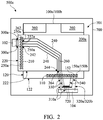
  • FIG. 2 is a plan view of a semiconductor package assembly in accordance with some embodiments of the disclosure.
  • FIGS. 3-4 are cross-sectional views of FIG. 1 , showing the arrangements of the substrate, the logic die, the memory die and the redistribution layer (RDL) ground trace of the memory die of the semiconductor package assembly shown in FIG. 1 ;
  • RDL redistribution layer
  • FIG. 5 is a plan view of a semiconductor package assembly in accordance with some embodiments of the disclosure.
  • FIGS. 6-7 are cross-sectional views of FIG. 5 , showing the arrangements of the substrate, the logic die, the memory die and the redistribution layer (RDL) ground trace of the memory die of the semiconductor package assembly shown in FIG. 5 .
  • RDL redistribution layer
  • Embodiments provide a semiconductor package assembly.
  • the semiconductor package assembly is a system-in-package (SIP).
  • the semiconductor package assembly includes at least a logic die and at least a memory die.
  • the memory die includes a redistribution layer (RDL) ground trace with two terminals opposite to each other. One of the two terminals is designed to be close to and to be coupled to the ground pad of the memory die. The other of the two terminals of the redistribution layer (RDL) ground trace is used as a ground pad of the logic die.
  • the semiconductor package assembly is designed to add grounding points at the two terminals of the redistribution layer (RDL) ground trace to avoid the potential different between the two terminals of the RDL ground trace with a long length. Also, the additional grounding points for the RDL ground trace can reduce radio frequency (RF) interference due to the long RDL ground trace.
  • RF radio frequency
  • FIG. 1 is a plan view of semiconductor package assemblies 500 a and 500 b in accordance with some embodiments of the disclosure.
  • FIGS. 3-4 are cross-sectional views of FIG. 1 , showing the arrangements of the substrate, the logic die, the memory die and the redistribution layer (RDL) ground trace of the memory die of the semiconductor package assembly shown in FIG. 1 .
  • RDL redistribution layer
  • the semiconductor package assembly 500 a is mounted on a base 800 through a plurality of conductive structures 710 .
  • the semiconductor package assembly 500 a serves as a system-in-package (SIP).
  • the base 800 may include a printed circuit board (PCB).
  • the conductive structures 710 may include conductive bump structures such as copper bumps, solder ball structures, solder bump structures, conductive pillar structures, conductive wire structures, or conductive paste structures.
  • the semiconductor package assembly 500 a includes a substrate 700 , a semiconductor die (logic die) 100 a , a semiconductor die (memory die) 200 a and a redistribution layer (RDL) ground trace 240 of the memory die 200 a . It should be noted that the substrate 700 , the logic die 100 a and the memory die 200 a are discrete, individual elements of the semiconductor package assembly 500 a.
  • a substrate 700 is provided.
  • the substrate 700 includes a die-attached surface 701 for the logic die 100 a and the memory die 200 a mounted thereon.
  • the substrate 700 includes several discrete ground pads 102 and 104 disposed close to the die-attached surface 701 .
  • the ground pads 102 and 104 are used for input/output (I/O) connections to ground. Therefore, the ground pads 102 and 104 also serve as ground pads of the substrate 700 .
  • the substrate 700 may also include an interconnection (not shown) formed therein to be coupled to the ground pads 102 and 104 .
  • the substrate 700 may comprise a semiconductor substrate, such as a silicon substrate.
  • the substrate 700 may comprise a dielectric material such as an organic material.
  • the organic material includes polypropylene (PP) with glass fiber, epoxy resin, polyimide, cyanate ester, other suitable materials, or a combination thereof.
  • the semiconductor die 100 a is disposed on the substrate 700 .
  • the semiconductor die 100 a may be mounted on the die-attached surface 701 of the substrate 700 through an adhesive 112 (for example, paste) between the semiconductor die 100 a and the substrate 700 .
  • the semiconductor die 100 a is coupled to the substrate 700 through wire bonding technology.
  • the semiconductor die 100 a is coupled to the substrate 700 through conductive structures comprising conductive wires, for example, a conductive wire 320 a .
  • the semiconductor die 100 a may serve as a logic die 100 a including a central processing unit (CPU), a graphics processing unit (GPU), a dynamic random access memory (DRAM) controller, or any combination thereof.
  • CPU central processing unit
  • GPU graphics processing unit
  • DRAM dynamic random access memory
  • the semiconductor die 200 a is stacked and mounted directly on the semiconductor die 100 a through an adhesive 212 (for example, paste) between the semiconductor dies 100 a and 200 a .
  • the semiconductor die 200 a may serve as a memory die 200 a , for example, a dynamic random access memory (DRAM) die.
  • the semiconductor die 200 a is coupled to the substrate 700 through the wire bonding technology.
  • the semiconductor die 200 a is coupled to the substrate 700 through conductive structures comprising conductive wires, for example, conductive wires 300 a and 310 a.
  • the memory die 200 a may comprise a memory I/O die pad 202 and a redistribution layer (RDL) structure 270 a on the memory I/O die pad 202 of the memory die 200 a .
  • the memory die 220 a may be a DRAM die or multiple DRAM dies.
  • the RDL structure 270 a may comprise at least a redistribution layer (RDL) trace 240 and at least a pad 250 a .
  • the RDL trace 240 and the pad 250 a are used for input/output (I/O) connections to ground.
  • the RDL trace 240 serves as a RDL ground trace 240 .
  • the RDL trace 240 is designed to be positioned at a single layered-level of the RDL structure 270 a .
  • the pad 250 a is disposed within an input/output (I/O) pad region 210 and on the top of the RDL structure 270 a .
  • the pad 250 a serves as a ground pad of the memory die 200 a.
  • the RDL trace 240 is used to fan out or re-route the ground path of the memory I/O die pad 202 from the position of the pad 250 a to a specific position (for example, the specific position is close to an input/output (I/O) pad region 110 of the logic die 100 a ).
  • the RDL ground trace 240 of the memory die 200 a may have a long length. As shown in FIGS. 1 and 3 , the RDL ground trace 240 of the memory die 200 a is designed to be extended from a first side 220 to a second side 222 of the memory die 200 a for the connection between the memory die 200 a and the logic die 100 a .
  • the RDL ground trace 240 has a first terminal 242 and a second terminal 244 away from the first terminal 242 .
  • the first terminal 242 is coupled to the pad 250 a close thereto.
  • the pad 250 a of the memory die 200 a is coupled to the ground pad 102 of the substrate 700 close thereto.
  • the first terminal 242 of the RDL ground trace 240 and the pad 250 a of the memory die 200 a are both arranged to be close to the first side 220 of the memory die 200 a .
  • the ground pad 102 of the substrate 700 is arranged close to the first side 220 of the memory die 200 a .
  • the ground pad 102 of the substrate 700 is arranged close to the pad 250 a of the memory die 200 a to reduce the ground path from the memory die 200 a to the substrate 700 .
  • the pad 250 a of the memory die 200 a is coupled to the ground pad 102 through a conductive routing 300 a , for example, a bonding wire.
  • a conductive routing 300 a is a single bonding wire which has two terminals in contact with the pad 250 a and the ground pad 102 , respectively.
  • the conductive routing 300 a is not in contact with the ground pad 104 .
  • the second terminal 244 of the RDL ground trace 240 is coupled to a ground pad of the substrate 700 , for example, the ground pad 104 , rather than the ground pad 102 .
  • the second terminal 244 of the RDL ground trace 240 is coupled to the ground pad 104 without using the pad 250 a and the ground pad 102 .
  • the second terminal 244 of the RDL ground trace 240 and the ground pad 104 are both arranged close to the second side 222 of the memory die 200 a .
  • the first side 220 and the second side 222 are different sides of the memory die 200 a .
  • the second terminal 244 of the RDL ground trace 240 is coupled to the ground pad 104 through a conductive routing 310 a , for example, a bonding wire.
  • a conductive routing 310 a is a single bonding wire which has two terminals in contact with the second terminal 244 and the ground pad 104 , respectively.
  • the single conductive routing 310 a is not in contact with the ground pad 102 and the conductive routing 300 a.
  • the logic die 100 a may comprise a logic device (not shown) and a redistribution layer (RDL) structure (not shown) on the logic device.
  • the redistribution layer (RDL) structure of the logic die 100 a may comprise at least a redistribution layer (RDL) trace and at least a pad 150 a , which is used to transmit a ground signal from the logic device.
  • the pad 150 a is disposed on the top of the RDL structure.
  • the pad 150 a is disposed within an input/output (I/O) pad region 110 of the logic die 100 a .
  • the pad 150 a serves as a ground pad of the logic die 100 a.
  • the pad 150 a of the logic die 100 a is coupled to the ground pad 104 of the substrate 700 only through a conductive routing 320 a , for example, a bonding wire.
  • the pad 150 a of the logic die 100 a is not coupled to the ground pad 102 of the substrate 700 .
  • the conductive routings 300 a , 310 a and 320 a are different conductive routings. That is to say, the conductive routing 320 a is not in contact with the conductive routings 300 a and 310 a.
  • the RDL structure 270 a of the semiconductor die 200 a as shown in FIG. 3 may comprise a second redistribution layer (RDL) trace 260 and at least a pad 252 a coupled to the second RDL trace 260 , as shown in FIG. 1 .
  • the second RDL trace 260 is arranged close to and parallel to the RDL ground trace 240 . Similar to the RDL ground trace 240 , the second RDL trace 260 of the memory die 200 a may have a long length.
  • the second RDL trace 260 of the memory die 200 a is designed to be extended from the first side 220 to the second side 222 of the memory die 200 a.
  • the second RDL trace 260 and the pad 252 a are used for input/output (I/O) connections to signals of the memory I/O die pad 202 .
  • the second RDL trace 260 may serve as a RDL signal trace.
  • the second RDL trace 260 is not coupled to the ground pads 102 and 104 of the substrate 700 .
  • the pad 252 a is also disposed on the top of the RDL structure (for example, the RDL structure 270 a as shown in FIG. 3 ).
  • the pad 252 a serves as a signal pad of the memory die 200 a .
  • the pad 252 a is located within the input/output (I/O) pad region 210 . Also, the pad 252 a is close to the pad 250 a and isolated from the pad 250 a.
  • the second RDL signal trace 260 has a third terminal 262 and a fourth terminal 264 away from the third terminal 262 .
  • the third terminal 262 of the second RDL signal trace 260 is located close to the first terminal 242 of the RDL ground trace 240 .
  • the fourth terminal 264 of the second RDL signal trace 260 is located close to the second terminal 244 of the RDL ground trace 240 .
  • the third terminal 262 is coupled to the pad 252 a close thereto.
  • the pad 252 a of the memory die 200 a is coupled to the corresponding signal pad (not shown) of the substrate 700 .
  • the fourth terminal of the second RDL signal trace 260 is coupled to a pad 152 of the logic die 100 a through conductive routings 330 , 340 and a conductive structure 720 of the substrate 700 .
  • the conductive routings 330 and 340 may comprise bonding wires.
  • the conductive structure 720 of the substrate 700 may comprise circuitries and pads.
  • the pad 152 of the logic die 100 a is located close to the pad 150 a and is electrically isolated from the pad 150 a .
  • the pad 152 may serve as a signal pad of the logic die 100 a.
  • the semiconductor package assembly 500 a further includes a molding compound 750 surrounding the logic die 100 a , the memory die 200 a and the conductive routings, which include the conductive routings 300 a , 310 a and 320 a .
  • the molding compound 750 is in contact with the logic die 100 a , the memory die 200 a and the conductive routings 300 a , 310 a and 320 a .
  • the molded compound 750 also covers the die-attached surface 701 of the substrate 700 .
  • the molded compound 750 may be formed of a nonconductive material, such as an epoxy, a resin, a moldable polymer, or the like.
  • the molding compound 750 may be applied while substantially liquid, and then may be cured through a chemical reaction, such as in an epoxy or resin.
  • the molding compound 750 may be an ultraviolet (UV) or thermally cured polymer applied as a gel or malleable solid capable of being disposed around the logic die 100 a and the memory die 200 a , and then may be cured through a UV or thermally curing process.
  • the molding compound 750 may be cured with a mold.
  • FIG. 4 is a cross-sectional view of FIG. 1 , showing the arrangements of the substrate, the logic die, the memory die and the redistribution layer (RDL) ground trace of the memory die of a semiconductor package assembly 500 b .
  • RDL redistribution layer
  • the logic die 100 b may comprise at least a pad 150 b , which is used for input/output (I/O) connections to ground.
  • the pad 150 b serves as a ground pad of the logic die 100 b .
  • the pad 150 b is disposed within an input/output (I/O) pad region 110 of the logic die 100 b , as shown in FIG. 1 .
  • the logic die 100 b is flipped upside-down and is coupled to the substrate 700 through a conductive structure 160 .
  • the conductive structure 160 is disposed on the pad 150 b .
  • the conductive structure 160 b may include at least a conductive bump structure coupled to the corresponding pad 150 b .
  • the conductive bump structure may comprise copper bumps or solder bump structures, conductive pillar structures, conductive wire structures, or conductive paste structures.
  • the pad 150 b of the logic die 100 b is coupled to the to the ground pad 104 of the substrate 700 through an interconnect 320 b , for example, circuits, embedded in the substrate 700 .
  • FIG. 2 is a plan view of a semiconductor package assembly 500 c in accordance with some embodiments of the disclosure. Elements of the embodiments hereinafter, that are the same or similar as those previously described with reference to FIGS. 1, 3 and 4 , are not repeated for brevity.
  • the differences between the semiconductor package assembly 500 a / 500 b and the semiconductor package assembly 500 c is that the semiconductor die (logic die) 100 a / 100 b of the semiconductor package assembly 500 c further includes at least a radio frequency (RF) circuit 360 integrated in the semiconductor die (logic die) 100 a / 100 b for RF applications.
  • RF radio frequency
  • FIG. 5 is a plan view of semiconductor package assemblies 500 d and 500 e in accordance with some embodiments of the disclosure.
  • FIGS. 6-7 are cross-sectional views of FIG. 5 , showing the arrangements of the substrate, the logic die, the memory die and the redistribution layer (RDL) ground trace of the memory die of the semiconductor package assembly shown in FIG. 5 .
  • RDL redistribution layer
  • the differences between the semiconductor package assembly 500 a / 500 b (shown in FIGS. 1-3 ) and the semiconductor package assembly 500 d is that the memory die 200 a is disposed beside the logic die 100 a . Therefore, the memory die 200 a and the logic die 100 a are mounted on the die-attach surface 701 of the substrate 700 by paste 212 and 112 b , respectively.
  • the logic die 100 a is coupled to the substrate 700 through the wire bonding technology.
  • the semiconductor die 100 a may be mounted on the die-attached surface 701 of the substrate 700 through an adhesive 112 (for example, paste) between the semiconductor die 100 a and the substrate 700 .
  • the first terminal 242 of the RDL ground trace 240 , the pad 250 a of the memory die 200 a and the ground pad 102 of the substrate 700 are arranged close to the first side 220 of the memory die 200 a .
  • the second terminal 244 of the RDL ground trace 240 , the ground pad 104 and the pad 150 a of the logic die 100 a are both arranged close to the second side 222 of the memory die 200 a .
  • the ground pad 104 is disposed between the logic die 100 a and the memory die 200 a as shown in FIG. 6 .
  • FIG. 7 is a cross-sectional view of FIG. 5 , showing the arrangements of the substrate, the logic die, the memory die and the redistribution layer (RDL) ground trace of the memory die of a semiconductor package assembly 500 e .
  • RDL redistribution layer
  • the logic die 100 b may comprise at least a pad 150 b , which is used for input/output (I/O) connections to ground.
  • the pad 150 b serves as a ground pad of the logic die 100 b.
  • the memory die 200 b may comprise may comprise a memory I/O die pad 202 and a redistribution layer (RDL) structure 270 b on the memory I/O die pad 202 .
  • the RDL structure 270 b may comprise at least a redistribution layer (RDL) trace 240 and at least two pads 250 b and 250 c .
  • the RDL trace 240 and the pad 250 b and 250 c are used for input/output (I/O) connections to ground.
  • the RDL trace 240 serves as a RDL ground trace 240 .
  • the RDL trace 240 is designed to be positioned at a single layered-level of the RDL structure 270 b .
  • the two terminals 242 and 244 of the RDL trace 240 are respectively coupled to the pads 250 b and 250 c .
  • the pads 250 b and 250 c serve as ground pads of the memory die 200 a .
  • the pad 250 b is disposed within the input/output (I/O) pad region 210 as shown in FIG. 5 .
  • the pad 250 c is disposed outside of the input/output (I/O) pad region 210 .
  • the pad 250 c is disposed close to the terminal 244 of the RDL trace 240 .
  • the pad 250 b is designed to be free from being in contact with the pad 250 c.
  • the memory die 200 b is flipped upside-down and is coupled to the substrate 700 through conductive structures 266 and 268 .
  • the conductive structures 266 and 268 are disposed on the pads 250 b and 250 c , respectively.
  • the conductive structures 266 and 268 may include conductive bump structures coupled to the corresponding pads 250 b and 250 c .
  • the conductive structure 266 is designed to be free from being in contact with the conductive structure 268 .
  • the ground pad 250 b of the memory die 200 b is coupled to the ground pad 102 of the substrate 700 through the conductive structure 266 and an interconnect 300 b .
  • the pad 250 c of the memory die 200 b is coupled to the to the ground pad 104 of the substrate 700 through the conductive structure 268 and an interconnect 320 b embedded in the substrate 700 .
  • the interconnect 300 b and 320 b are disposed embedded in the substrate 700 .
  • the interconnect 300 b and 320 b may comprise circuits.
  • the logic die 100 b is flipped upside-down and is coupled to the substrate 700 through a conductive structure 160 .
  • the conductive structure 160 is disposed on the pad 150 b .
  • the conductive structure 160 may include at least a conductive bump structure coupled to the corresponding pad 150 b .
  • the pad 150 b of the logic die 100 b is coupled to the to the ground pad 104 of the substrate 700 through the conductive structure 160 and the interconnect 320 b of the substrate 700 . That is to say, the interconnect 320 b electrically connects to the pad 250 c of the memory die 200 b , the pad 150 b of the logic die 100 b and the ground pad 104 of the substrate 700 .
  • the interconnect 300 b and the interconnect 320 b are discrete circuits.
  • the interconnect 300 b is designed to be free from being in contact with the interconnect 320 b.
  • Embodiments provide a semiconductor package assembly.
  • the semiconductor package assembly includes a substrate, a memory die and a logic die mounted on the substrate.
  • the memory die includes a redistribution layer (RDL) ground trace having a first terminal and a second terminal far away from the first terminal. The first and second terminals are located close to different sides of the memory die.
  • the first terminal of the RDL ground trace is coupled to the first ground pad of the substrate through a first conductive path comprising a pad of the memory die, which is positioned within an input/output (I/O) pad region.
  • the second terminal of the RDL ground trace is coupled to the second ground pad of the substrate through a second conductive path different from the first conductive path.
  • the second conductive path is free from being coupled to the pad of the memory die.
  • the logic die includes a pad coupled to the second terminal of the RDL ground trace through the second ground pad of the substrate.
  • the semiconductor package assembly is designed to have grounding paths at the two terminals of the redistribution layer (RDL) ground trace of the memory die.
  • RDL redistribution layer
  • the design of the RDL ground trace can improve signal integrity by reducing the crosstalk problem.
  • the semiconductor package assembly includes integrated radio frequency (RF) circuits in the logic die for RF applications, the RDL ground trace of the memory die also can improve the RF desense problem by reducing the coupled noise from the circuit of the memory die to the RF circuit of the logic die.
  • RF radio frequency

Landscapes

  • Engineering & Computer Science (AREA)
  • Microelectronics & Electronic Packaging (AREA)
  • Power Engineering (AREA)
  • Physics & Mathematics (AREA)
  • Computer Hardware Design (AREA)
  • Condensed Matter Physics & Semiconductors (AREA)
  • General Physics & Mathematics (AREA)
  • Semiconductor Memories (AREA)
  • Geometry (AREA)
  • Semiconductor Integrated Circuits (AREA)
  • Toxicology (AREA)
  • Electromagnetism (AREA)
  • Health & Medical Sciences (AREA)

Abstract

The invention provides a semiconductor package assembly. The semiconductor package assembly includes a substrate having a first pad and a second pad thereon. A logic die is mounted on the substrate. The logic die includes a first logic die pad coupled to the first pad. A memory die is mounted on the substrate. The memory die includes a first memory die pad. A first redistribution layer (RDL) trace has a first terminal and a second terminal. The first terminal is coupled to the first pad through the first memory die pad. The second terminal is coupled to the second pad rather than the first pad.

Description

CROSS REFERENCE TO RELATED APPLICATIONS
This application claims the benefit of U.S. Provisional Application No. 62/306,659 filed Mar. 11, 2016, the entirety of which is incorporated by reference herein.
BACKGROUND OF THE INVENTION Field of the Invention
The present invention relates to a semiconductor package assembly, and in particular to a memory die integrated into a system-in-package (SIP) package assembly.
Description of the Related Art
In order to ensure miniaturization and multi-functionality of electronic products and communication devices, it is desired that semiconductor packages be small in size, to support multi-pin connection, high speeds, and high functionality. The multi-functional system-in-package (SIP) package usually requires integrating discrete logic dies and memory dies. The memory die usually uses a redistribution layer (RDL) ground trace with a long length for the connection between the memory die and the logic die. In the design of a system-in-package (SIP) package for radio frequency (RF) applications, however, the long redistribution layer (RDL) ground trace causes the undesired signal integrity problem and noise coupling problem.
Thus, a novel semiconductor package assembly is desirable.
BRIEF SUMMARY OF THE INVENTION
An exemplary embodiment of a semiconductor package assembly is provided. The semiconductor package assembly includes a substrate having a first pad and a second pad thereon. A logic die is mounted on the substrate. The logic die includes a first logic die pad coupled to the second pad. A memory die is mounted on the substrate. The memory die includes a first memory die pad. A first redistribution layer (RDL) trace has a first terminal and a second terminal. The first terminal is coupled to the first pad through the first memory die pad. The second terminal is coupled to the second pad rather than the first pad.
Another exemplary embodiment of a semiconductor package assembly includes a substrate having a first pad and a second pad thereon. A memory die having a first side and a second side is mounted on the substrate. The memory die includes a memory die pad close to the first side and coupled to the first pad. A redistribution layer (RDL) trace has a first terminal close to the first side and a second terminal close to the second side. The first terminal is coupled to the first pad through the memory die pad. The second terminal is coupled to the second pad close to the second side through a first single conductive routing. A logic die is mounted on the substrate. The logic die includes a logic die pad close to the second side and coupled to the second pad.
Yet another exemplary embodiment of a semiconductor package assembly includes a substrate having a first ground pad and a second ground pad thereon. A memory die is mounted on the substrate. The memory die includes a memory ground pad coupled to the first ground pad. A redistribution layer (RDL) ground trace has a first terminal and a second terminal. The first terminal is coupled to the first ground pad through a first conductive path including the memory ground pad. The second terminal is coupled to the second ground pad through a second conductive path that is not coupled to the memory ground pad. A logic die is mounted on the substrate. The logic die includes a logic ground pad coupled to the second terminal through the second ground pad.
A detailed description is given in the following embodiments with reference to the accompanying drawings.
BRIEF DESCRIPTION OF THE DRAWINGS
The present invention can be more fully understood by reading the subsequent detailed description and examples with references made to the accompanying drawings, wherein:
FIG. 1 is a plan view of a semiconductor package assembly in accordance with some embodiments of the disclosure;
FIG. 2 is a plan view of a semiconductor package assembly in accordance with some embodiments of the disclosure;
FIGS. 3-4 are cross-sectional views of FIG. 1, showing the arrangements of the substrate, the logic die, the memory die and the redistribution layer (RDL) ground trace of the memory die of the semiconductor package assembly shown in FIG. 1;
FIG. 5 is a plan view of a semiconductor package assembly in accordance with some embodiments of the disclosure; and
FIGS. 6-7 are cross-sectional views of FIG. 5, showing the arrangements of the substrate, the logic die, the memory die and the redistribution layer (RDL) ground trace of the memory die of the semiconductor package assembly shown in FIG. 5.
DETAILED DESCRIPTION OF THE INVENTION
The following description is of the best-contemplated mode of carrying out the invention. This description is made for the purpose of illustrating the general principles of the invention and should not be taken in a limiting sense. The scope of the invention is determined by reference to the appended claims.
The present invention will be described with respect to particular embodiments and with reference to certain drawings, but the invention is not limited thereto and is only limited by the claims. The drawings described are only schematic and are non-limiting. In the drawings, the size of some of the elements may be exaggerated for illustrative purposes and not drawn to scale. The dimensions and the relative dimensions do not correspond to actual dimensions in the practice of the invention.
Embodiments provide a semiconductor package assembly. The semiconductor package assembly is a system-in-package (SIP). The semiconductor package assembly includes at least a logic die and at least a memory die. The memory die includes a redistribution layer (RDL) ground trace with two terminals opposite to each other. One of the two terminals is designed to be close to and to be coupled to the ground pad of the memory die. The other of the two terminals of the redistribution layer (RDL) ground trace is used as a ground pad of the logic die. The semiconductor package assembly is designed to add grounding points at the two terminals of the redistribution layer (RDL) ground trace to avoid the potential different between the two terminals of the RDL ground trace with a long length. Also, the additional grounding points for the RDL ground trace can reduce radio frequency (RF) interference due to the long RDL ground trace.
FIG. 1 is a plan view of semiconductor package assemblies 500 a and 500 b in accordance with some embodiments of the disclosure. FIGS. 3-4 are cross-sectional views of FIG. 1, showing the arrangements of the substrate, the logic die, the memory die and the redistribution layer (RDL) ground trace of the memory die of the semiconductor package assembly shown in FIG. 1. For clearly showing the arrangement of the substrate, the logic die, the memory die and the redistribution layer (RDL) ground trace of the memory die of the semiconductor package assemblies 500 a and 500 b, a molding compound is not shown in FIG. 1.
As shown in FIGS. 1 and 3, the semiconductor package assembly 500 a is mounted on a base 800 through a plurality of conductive structures 710. In some embodiments, the semiconductor package assembly 500 a serves as a system-in-package (SIP). In some embodiments, the base 800 may include a printed circuit board (PCB). The conductive structures 710 may include conductive bump structures such as copper bumps, solder ball structures, solder bump structures, conductive pillar structures, conductive wire structures, or conductive paste structures. The semiconductor package assembly 500 a includes a substrate 700, a semiconductor die (logic die) 100 a, a semiconductor die (memory die) 200 a and a redistribution layer (RDL) ground trace 240 of the memory die 200 a. It should be noted that the substrate 700, the logic die 100 a and the memory die 200 a are discrete, individual elements of the semiconductor package assembly 500 a.
As shown in FIGS. 1 and 3, a substrate 700 is provided. The substrate 700 includes a die-attached surface 701 for the logic die 100 a and the memory die 200 a mounted thereon. The substrate 700 includes several discrete ground pads 102 and 104 disposed close to the die-attached surface 701. In some embodiments, the ground pads 102 and 104 are used for input/output (I/O) connections to ground. Therefore, the ground pads 102 and 104 also serve as ground pads of the substrate 700. The substrate 700 may also include an interconnection (not shown) formed therein to be coupled to the ground pads 102 and 104. In some embodiments, the substrate 700 may comprise a semiconductor substrate, such as a silicon substrate. In some other embodiments, the substrate 700 may comprise a dielectric material such as an organic material. In some embodiments, the organic material includes polypropylene (PP) with glass fiber, epoxy resin, polyimide, cyanate ester, other suitable materials, or a combination thereof.
As shown in FIGS. 1 and 3, the semiconductor die 100 a is disposed on the substrate 700. The semiconductor die 100 a may be mounted on the die-attached surface 701 of the substrate 700 through an adhesive 112 (for example, paste) between the semiconductor die 100 a and the substrate 700. In some embodiments, the semiconductor die 100 a is coupled to the substrate 700 through wire bonding technology. In some embodiments, and as shown in FIG. 3, the semiconductor die 100 a is coupled to the substrate 700 through conductive structures comprising conductive wires, for example, a conductive wire 320 a. In some embodiments, the semiconductor die 100 a may serve as a logic die 100 a including a central processing unit (CPU), a graphics processing unit (GPU), a dynamic random access memory (DRAM) controller, or any combination thereof.
As shown in FIGS. 1 and 3, the semiconductor die 200 a is stacked and mounted directly on the semiconductor die 100 a through an adhesive 212 (for example, paste) between the semiconductor dies 100 a and 200 a. In some embodiments, the semiconductor die 200 a may serve as a memory die 200 a, for example, a dynamic random access memory (DRAM) die. In some embodiments, the semiconductor die 200 a is coupled to the substrate 700 through the wire bonding technology. As shown in FIG. 3, the semiconductor die 200 a is coupled to the substrate 700 through conductive structures comprising conductive wires, for example, conductive wires 300 a and 310 a.
As shown in FIGS. 1 and 3, the memory die 200 a may comprise a memory I/O die pad 202 and a redistribution layer (RDL) structure 270 a on the memory I/O die pad 202 of the memory die 200 a. In some embodiments, the memory die 220 a may be a DRAM die or multiple DRAM dies. The RDL structure 270 a may comprise at least a redistribution layer (RDL) trace 240 and at least a pad 250 a. The RDL trace 240 and the pad 250 a are used for input/output (I/O) connections to ground. In some embodiments as shown in FIG. 3, the RDL trace 240 serves as a RDL ground trace 240. The RDL trace 240 is designed to be positioned at a single layered-level of the RDL structure 270 a. In some embodiments as shown in FIG. 3, the pad 250 a is disposed within an input/output (I/O) pad region 210 and on the top of the RDL structure 270 a. The pad 250 a serves as a ground pad of the memory die 200 a.
The RDL trace 240 is used to fan out or re-route the ground path of the memory I/O die pad 202 from the position of the pad 250 a to a specific position (for example, the specific position is close to an input/output (I/O) pad region 110 of the logic die 100 a). The RDL ground trace 240 of the memory die 200 a may have a long length. As shown in FIGS. 1 and 3, the RDL ground trace 240 of the memory die 200 a is designed to be extended from a first side 220 to a second side 222 of the memory die 200 a for the connection between the memory die 200 a and the logic die 100 a. The RDL ground trace 240 has a first terminal 242 and a second terminal 244 away from the first terminal 242. The first terminal 242 is coupled to the pad 250 a close thereto. The pad 250 a of the memory die 200 a is coupled to the ground pad 102 of the substrate 700 close thereto. In some embodiments, the first terminal 242 of the RDL ground trace 240 and the pad 250 a of the memory die 200 a are both arranged to be close to the first side 220 of the memory die 200 a. The ground pad 102 of the substrate 700 is arranged close to the first side 220 of the memory die 200 a. Also, the ground pad 102 of the substrate 700 is arranged close to the pad 250 a of the memory die 200 a to reduce the ground path from the memory die 200 a to the substrate 700.
As shown in FIGS. 1 and 3, the pad 250 a of the memory die 200 a is coupled to the ground pad 102 through a conductive routing 300 a, for example, a bonding wire. It should be noted that the conductive routing 300 a is a single bonding wire which has two terminals in contact with the pad 250 a and the ground pad 102, respectively. The conductive routing 300 a is not in contact with the ground pad 104.
As shown in FIGS. 1 and 3, the second terminal 244 of the RDL ground trace 240 is coupled to a ground pad of the substrate 700, for example, the ground pad 104, rather than the ground pad 102. The second terminal 244 of the RDL ground trace 240 is coupled to the ground pad 104 without using the pad 250 a and the ground pad 102. In some embodiments, the second terminal 244 of the RDL ground trace 240 and the ground pad 104 are both arranged close to the second side 222 of the memory die 200 a. The first side 220 and the second side 222 are different sides of the memory die 200 a. The second terminal 244 of the RDL ground trace 240 is coupled to the ground pad 104 through a conductive routing 310 a, for example, a bonding wire. It should be noted that the conductive routing 310 a is a single bonding wire which has two terminals in contact with the second terminal 244 and the ground pad 104, respectively. The single conductive routing 310 a is not in contact with the ground pad 102 and the conductive routing 300 a.
As shown in FIGS. 1 and 3, the logic die 100 a may comprise a logic device (not shown) and a redistribution layer (RDL) structure (not shown) on the logic device. The redistribution layer (RDL) structure of the logic die 100 a may comprise at least a redistribution layer (RDL) trace and at least a pad 150 a, which is used to transmit a ground signal from the logic device. In some embodiments as shown in FIG. 3, the pad 150 a is disposed on the top of the RDL structure. The pad 150 a is disposed within an input/output (I/O) pad region 110 of the logic die 100 a. The pad 150 a serves as a ground pad of the logic die 100 a.
As shown in FIGS. 1 and 3, the pad 150 a of the logic die 100 a is coupled to the ground pad 104 of the substrate 700 only through a conductive routing 320 a, for example, a bonding wire. In some embodiments, the pad 150 a of the logic die 100 a is not coupled to the ground pad 102 of the substrate 700. The conductive routings 300 a, 310 a and 320 a are different conductive routings. That is to say, the conductive routing 320 a is not in contact with the conductive routings 300 a and 310 a.
The RDL structure 270 a of the semiconductor die 200 a as shown in FIG. 3 may comprise a second redistribution layer (RDL) trace 260 and at least a pad 252 a coupled to the second RDL trace 260, as shown in FIG. 1. In some embodiments, as shown in FIG. 1, the second RDL trace 260 is arranged close to and parallel to the RDL ground trace 240. Similar to the RDL ground trace 240, the second RDL trace 260 of the memory die 200 a may have a long length. The second RDL trace 260 of the memory die 200 a is designed to be extended from the first side 220 to the second side 222 of the memory die 200 a.
The second RDL trace 260 and the pad 252 a are used for input/output (I/O) connections to signals of the memory I/O die pad 202. The second RDL trace 260 may serve as a RDL signal trace. The second RDL trace 260 is not coupled to the ground pads 102 and 104 of the substrate 700. In some embodiments, the pad 252 a is also disposed on the top of the RDL structure (for example, the RDL structure 270 a as shown in FIG. 3). The pad 252 a serves as a signal pad of the memory die 200 a. The pad 252 a is located within the input/output (I/O) pad region 210. Also, the pad 252 a is close to the pad 250 a and isolated from the pad 250 a.
As shown in FIG. 1, the second RDL signal trace 260 has a third terminal 262 and a fourth terminal 264 away from the third terminal 262. The third terminal 262 of the second RDL signal trace 260 is located close to the first terminal 242 of the RDL ground trace 240. Also, the fourth terminal 264 of the second RDL signal trace 260 is located close to the second terminal 244 of the RDL ground trace 240. The third terminal 262 is coupled to the pad 252 a close thereto. The pad 252 a of the memory die 200 a is coupled to the corresponding signal pad (not shown) of the substrate 700. The fourth terminal of the second RDL signal trace 260 is coupled to a pad 152 of the logic die 100 a through conductive routings 330, 340 and a conductive structure 720 of the substrate 700. In some embodiments, the conductive routings 330 and 340 may comprise bonding wires. The conductive structure 720 of the substrate 700 may comprise circuitries and pads.
In some embodiments as shown in FIG. 1, the pad 152 of the logic die 100 a is located close to the pad 150 a and is electrically isolated from the pad 150 a. The pad 152 may serve as a signal pad of the logic die 100 a.
As shown in FIG. 3, the semiconductor package assembly 500 a further includes a molding compound 750 surrounding the logic die 100 a, the memory die 200 a and the conductive routings, which include the conductive routings 300 a, 310 a and 320 a. The molding compound 750 is in contact with the logic die 100 a, the memory die 200 a and the conductive routings 300 a, 310 a and 320 a. The molded compound 750 also covers the die-attached surface 701 of the substrate 700. In some embodiments, the molded compound 750 may be formed of a nonconductive material, such as an epoxy, a resin, a moldable polymer, or the like. The molding compound 750 may be applied while substantially liquid, and then may be cured through a chemical reaction, such as in an epoxy or resin. In some other embodiments, the molding compound 750 may be an ultraviolet (UV) or thermally cured polymer applied as a gel or malleable solid capable of being disposed around the logic die 100 a and the memory die 200 a, and then may be cured through a UV or thermally curing process. The molding compound 750 may be cured with a mold.
FIG. 4 is a cross-sectional view of FIG. 1, showing the arrangements of the substrate, the logic die, the memory die and the redistribution layer (RDL) ground trace of the memory die of a semiconductor package assembly 500 b. Elements of the embodiments hereinafter, that are the same or similar as those previously described with reference to FIGS. 1 and 3, are not repeated for brevity. The difference between the semiconductor package assembly 500 a and the semiconductor package assembly 500 b is that the semiconductor package assembly 500 b includes a semiconductor die (logic die) 100 b disposed on the substrate 700 through the flip-chip technology. In some embodiments, the semiconductor die 100 b may serve as a logic die 100 b. The logic die 100 b may comprise at least a pad 150 b, which is used for input/output (I/O) connections to ground. The pad 150 b serves as a ground pad of the logic die 100 b. The pad 150 b is disposed within an input/output (I/O) pad region 110 of the logic die 100 b, as shown in FIG. 1.
As shown in FIG. 4, the logic die 100 b is flipped upside-down and is coupled to the substrate 700 through a conductive structure 160. The conductive structure 160 is disposed on the pad 150 b. The conductive structure 160 b may include at least a conductive bump structure coupled to the corresponding pad 150 b. The conductive bump structure may comprise copper bumps or solder bump structures, conductive pillar structures, conductive wire structures, or conductive paste structures. The pad 150 b of the logic die 100 b is coupled to the to the ground pad 104 of the substrate 700 through an interconnect 320 b, for example, circuits, embedded in the substrate 700.
FIG. 2 is a plan view of a semiconductor package assembly 500 c in accordance with some embodiments of the disclosure. Elements of the embodiments hereinafter, that are the same or similar as those previously described with reference to FIGS. 1, 3 and 4, are not repeated for brevity. The differences between the semiconductor package assembly 500 a/500 b and the semiconductor package assembly 500 c is that the semiconductor die (logic die) 100 a/100 b of the semiconductor package assembly 500 c further includes at least a radio frequency (RF) circuit 360 integrated in the semiconductor die (logic die) 100 a/100 b for RF applications.
FIG. 5 is a plan view of semiconductor package assemblies 500 d and 500 e in accordance with some embodiments of the disclosure. FIGS. 6-7 are cross-sectional views of FIG. 5, showing the arrangements of the substrate, the logic die, the memory die and the redistribution layer (RDL) ground trace of the memory die of the semiconductor package assembly shown in FIG. 5. For clearly showing the arrangement of the substrate, the logic die, the memory die and the redistribution layer (RDL) ground trace of the memory die of the semiconductor package assemblies 500 d and 500 e, a molding compound is not shown in FIG. 5. Elements of the embodiments hereinafter, that are the same or similar as those previously described with reference to FIGS. 1-4, are not repeated for brevity.
As shown in FIGS. 5 and 6, the differences between the semiconductor package assembly 500 a/500 b (shown in FIGS. 1-3) and the semiconductor package assembly 500 d is that the memory die 200 a is disposed beside the logic die 100 a. Therefore, the memory die 200 a and the logic die 100 a are mounted on the die-attach surface 701 of the substrate 700 by paste 212 and 112 b, respectively.
In some embodiments as shown in FIG. 6, the logic die 100 a is coupled to the substrate 700 through the wire bonding technology. The semiconductor die 100 a may be mounted on the die-attached surface 701 of the substrate 700 through an adhesive 112 (for example, paste) between the semiconductor die 100 a and the substrate 700.
In some embodiments as shown in FIGS. 5 and 6, the first terminal 242 of the RDL ground trace 240, the pad 250 a of the memory die 200 a and the ground pad 102 of the substrate 700 are arranged close to the first side 220 of the memory die 200 a. The second terminal 244 of the RDL ground trace 240, the ground pad 104 and the pad 150 a of the logic die 100 a are both arranged close to the second side 222 of the memory die 200 a. Also, the ground pad 104 is disposed between the logic die 100 a and the memory die 200 a as shown in FIG. 6.
FIG. 7 is a cross-sectional view of FIG. 5, showing the arrangements of the substrate, the logic die, the memory die and the redistribution layer (RDL) ground trace of the memory die of a semiconductor package assembly 500 e. Elements of the embodiments hereinafter, that are the same or similar as those previously described with reference to FIGS. 5-6, are not repeated for brevity. The differences between the semiconductor package assembly 500 d and the semiconductor package assembly 500 e is that the semiconductor package assembly 500 e includes a semiconductor die 100 b and a semiconductor die 200 b disposed on the substrate 700 through the flip-chip technology. In some embodiments, the semiconductor die 100 b serves as a logic die 100 b, and the semiconductor die 200 b may serve as a memory die 200 b.
As shown in FIG. 7, the logic die 100 b may comprise at least a pad 150 b, which is used for input/output (I/O) connections to ground. The pad 150 b serves as a ground pad of the logic die 100 b.
The memory die 200 b may comprise may comprise a memory I/O die pad 202 and a redistribution layer (RDL) structure 270 b on the memory I/O die pad 202. The RDL structure 270 b may comprise at least a redistribution layer (RDL) trace 240 and at least two pads 250 b and 250 c. The RDL trace 240 and the pad 250 b and 250 c are used for input/output (I/O) connections to ground. In some embodiments as shown in FIG. 7, the RDL trace 240 serves as a RDL ground trace 240. The RDL trace 240 is designed to be positioned at a single layered-level of the RDL structure 270 b. The two terminals 242 and 244 of the RDL trace 240 are respectively coupled to the pads 250 b and 250 c. The pads 250 b and 250 c serve as ground pads of the memory die 200 a. The pad 250 b is disposed within the input/output (I/O) pad region 210 as shown in FIG. 5. The pad 250 c is disposed outside of the input/output (I/O) pad region 210. For example, the pad 250 c is disposed close to the terminal 244 of the RDL trace 240. Also, the pad 250 b is designed to be free from being in contact with the pad 250 c.
As shown in FIG. 7, the memory die 200 b is flipped upside-down and is coupled to the substrate 700 through conductive structures 266 and 268. The conductive structures 266 and 268 are disposed on the pads 250 b and 250 c, respectively. The conductive structures 266 and 268 may include conductive bump structures coupled to the corresponding pads 250 b and 250 c. Also, the conductive structure 266 is designed to be free from being in contact with the conductive structure 268. The ground pad 250 b of the memory die 200 b is coupled to the ground pad 102 of the substrate 700 through the conductive structure 266 and an interconnect 300 b. The pad 250 c of the memory die 200 b is coupled to the to the ground pad 104 of the substrate 700 through the conductive structure 268 and an interconnect 320 b embedded in the substrate 700. In some embodiments, the interconnect 300 b and 320 b are disposed embedded in the substrate 700. The interconnect 300 b and 320 b may comprise circuits.
As shown in FIG. 7, the logic die 100 b is flipped upside-down and is coupled to the substrate 700 through a conductive structure 160. The conductive structure 160 is disposed on the pad 150 b. The conductive structure 160 may include at least a conductive bump structure coupled to the corresponding pad 150 b. The pad 150 b of the logic die 100 b is coupled to the to the ground pad 104 of the substrate 700 through the conductive structure 160 and the interconnect 320 b of the substrate 700. That is to say, the interconnect 320 b electrically connects to the pad 250 c of the memory die 200 b, the pad 150 b of the logic die 100 b and the ground pad 104 of the substrate 700. Also, the interconnect 300 b and the interconnect 320 b are discrete circuits. The interconnect 300 b is designed to be free from being in contact with the interconnect 320 b.
Embodiments provide a semiconductor package assembly. The semiconductor package assembly includes a substrate, a memory die and a logic die mounted on the substrate. The memory die includes a redistribution layer (RDL) ground trace having a first terminal and a second terminal far away from the first terminal. The first and second terminals are located close to different sides of the memory die. The first terminal of the RDL ground trace is coupled to the first ground pad of the substrate through a first conductive path comprising a pad of the memory die, which is positioned within an input/output (I/O) pad region. The second terminal of the RDL ground trace is coupled to the second ground pad of the substrate through a second conductive path different from the first conductive path. The second conductive path is free from being coupled to the pad of the memory die. The logic die includes a pad coupled to the second terminal of the RDL ground trace through the second ground pad of the substrate.
The semiconductor package assembly is designed to have grounding paths at the two terminals of the redistribution layer (RDL) ground trace of the memory die. When the RDL ground trace of the memory die has a long length, the design of the RDL ground trace can improve signal integrity by reducing the crosstalk problem. When the semiconductor package assembly includes integrated radio frequency (RF) circuits in the logic die for RF applications, the RDL ground trace of the memory die also can improve the RF desense problem by reducing the coupled noise from the circuit of the memory die to the RF circuit of the logic die.
While the invention has been described by way of example and in terms of the preferred embodiments, it is to be understood that the invention is not limited to the disclosed embodiments. On the contrary, it is intended to cover various modifications and similar arrangements (as would be apparent to those skilled in the art). Therefore, the scope of the appended claims should be accorded the broadest interpretation so as to encompass all such modifications and similar arrangements.

Claims (21)

What is claimed is:
1. A semiconductor package assembly, comprising:
a substrate having a first pad and a second pad thereon; a logic die mounted on the substrate,
wherein the logic die comprises:
a first logic die pad coupled to the second pad; and a memory die mounted on the logic die, wherein the memory die comprises a first memory die pad; and
a first redistribution layer (RDL) structure mounted on the memory die, wherein the first RDL structure comprises a first RDL trace, having a first terminal and a second terminal, wherein the first pad is coupled to the first terminal through a first wire bond contacting the first memory die pad, and wherein the second terminal is coupled to the second pad through a direct connection of a second wire bond to the second terminal without an intervening memory die pad,
wherein the first pad is positioned along a first lateral side of the memory die, and the second pad is positioned along a second lateral side of the memory die,
wherein the first lateral side is adjacent to the second lateral side,
wherein the first RDL trace is a ground trace and the first RDL structure further comprises a second RDL trace that is a ground trace, and
wherein the first RDL structure further comprises at least one third RDL trace between the first RDL trace and the second RDL trace, the at least one third RDL trace being an I/O trace.
2. The semiconductor package assembly as claimed in claim 1, wherein the first logic die pad is coupled to the second pad through a third wire bond.
3. The semiconductor package assembly as claimed in claim 1, wherein the first pad and the second pad are discrete ground pads.
4. The semiconductor package assembly as claimed in claim 1, wherein the first RDL trace is disposed at a single layered-level.
5. The semiconductor package assembly as claimed in claim 1, wherein the memory die is located directly on the logic die.
6. The semiconductor package assembly as claimed in claim 1, wherein the at least one third RDL trace has a third terminal and a fourth terminal, wherein the third terminal is coupled to a second memory die pad of the memory die, and the fourth terminal is coupled to a second logic die pad of the logic die.
7. The semiconductor package assembly as claimed in claim 6, wherein the at least one third RDL trace is not coupled to the first pad or the second pad.
8. The semiconductor package assembly as claimed in claim 6, wherein the fourth terminal is coupled to the second logic die pad through a conductive structure of the substrate.
9. A semiconductor package assembly, comprising:
a substrate having a first pad and a second pad thereon;
a memory die having a first lateral side and a second lateral side and mounted on the substrate, wherein the memory die comprises a memory die pad positioned along the first lateral side and coupled to the first pad and wherein the first pad is positioned along the first lateral side, the second pad is positioned along the second lateral side, and the first lateral side is adjacent to the second lateral side; and
a first redistribution layer (RDL) structure mounted on the memory die, wherein the first RDL structure comprises:
a first RDL trace, having a first terminal adjacent to the first lateral side and a second terminal adjacent to the second lateral side, wherein the first terminal is coupled to the first pad through a first wire bond contacting the memory die pad, and
wherein the second terminal is coupled to the second pad through a direct connection of a second wire bond to the second terminal without an intervening memory die pad as a first conductive routing; and
a logic die mounted on the substrate, wherein the logic die comprises a logic die pad adjacent to the second lateral side and coupled to the second pad,
wherein the first RDL trace is a ground trace and the first RDL structure further comprises a second RDL trace that is a ground trace, and
wherein the first RDL structure further comprises at least one third RDL trace between the first RDL trace and the second RDL trace, the at least one third RDL trace being an I/O trace.
10. The semiconductor package assembly as claimed in claim 9, wherein the first conductive routing is not in contact with the first pad.
11. The semiconductor package assembly as claimed in claim 10, wherein the memory die pad is coupled to the first pad through a second conductive routing that is not in contact with the first conductive routing.
12. The semiconductor package assembly as claimed in claim 9, wherein the logic die pad is coupled to the second pad through a third conductive routing that is not in contact with the first and second conductive routings.
13. The semiconductor package assembly as claimed in claim 9, wherein the first pad and the second pad are discrete ground pads.
14. The semiconductor package assembly as claimed in claim 9, wherein the first RDL trace is disposed at a single layered-level.
15. The semiconductor package assembly as claimed in claim 9, wherein the memory die is disposed beside the logic die.
16. A semiconductor package assembly, comprising:
a substrate having a first ground pad and a second ground pad thereon;
a memory die mounted on the substrate, wherein the memory die comprises a memory ground pad coupled to the first ground pad; a redistribution layer (RDL) structure mounted on the memory die, wherein the RDL structure
comprises:
a first RDL ground trace having a first terminal and a second terminal, wherein the first terminal is coupled to the first ground pad through a first conductive path comprising the memory ground pad, the second terminal is coupled to the second ground pad through a second conductive path that is not coupled to the does not include a memory ground pad; and
a logic die mounted on the substrate, wherein the logic die comprises a logic ground pad coupled to the second terminal through the second ground pad, wherein the first ground pad is positioned along first lateral side of the memory die, and the second ground pad is positioned along a second lateral side of the memory die, and wherein the first lateral side is adjacent to the second lateral side,
wherein the RDL structure further comprises a second RDL ground trace, and
wherein the RDL structure further comprises at least one third RDL I/O trace between the first RDL ground trace and the second RDL ground trace.
17. The semiconductor package assembly as claimed in claim 16, wherein the first ground pad and the second ground pad are discrete ground pads, wherein the first conductive path is different from the second conductive path.
18. The semiconductor package assembly as claimed in claim 16, wherein the first terminal is located adjacent to the first ground pad and the memory ground pad.
19. The semiconductor package assembly as claimed in claim 16, wherein the second terminal is spaced from the first ground pad and the memory ground pad, wherein the second terminal is adjacent to the second ground pad.
20. The semiconductor package assembly as claimed in claim 16, wherein the memory die is located directly on the logic die.
21. The semiconductor package assembly as claimed in claim 16, wherein the memory die is disposed beside the logic die.
US15/411,077 2016-03-11 2017-01-20 Semiconductor package assembly with redistribution layer (RDL) trace Active US10679949B2 (en)

Priority Applications (4)

Application Number Priority Date Filing Date Title
US15/411,077 US10679949B2 (en) 2016-03-11 2017-01-20 Semiconductor package assembly with redistribution layer (RDL) trace
EP17154808.4A EP3217429B1 (en) 2016-03-11 2017-02-06 Semiconductor package assembly
CN201710067544.3A CN107180826B (en) 2016-03-11 2017-02-07 Semiconductor package assembly
TW106106100A TWI702703B (en) 2016-03-11 2017-02-23 Semiconductor package assembly

Applications Claiming Priority (2)

Application Number Priority Date Filing Date Title
US201662306659P 2016-03-11 2016-03-11
US15/411,077 US10679949B2 (en) 2016-03-11 2017-01-20 Semiconductor package assembly with redistribution layer (RDL) trace

Publications (2)

Publication Number Publication Date
US20170263570A1 US20170263570A1 (en) 2017-09-14
US10679949B2 true US10679949B2 (en) 2020-06-09

Family

ID=57965834

Family Applications (1)

Application Number Title Priority Date Filing Date
US15/411,077 Active US10679949B2 (en) 2016-03-11 2017-01-20 Semiconductor package assembly with redistribution layer (RDL) trace

Country Status (4)

Country Link
US (1) US10679949B2 (en)
EP (1) EP3217429B1 (en)
CN (1) CN107180826B (en)
TW (1) TWI702703B (en)

Cited By (1)

* Cited by examiner, † Cited by third party
Publication number Priority date Publication date Assignee Title
US20240079318A1 (en) * 2022-09-06 2024-03-07 Western Digital Technologies, Inc. Nand die with rdl for altered bond wire bandwidth in memory devices

Families Citing this family (15)

* Cited by examiner, † Cited by third party
Publication number Priority date Publication date Assignee Title
US9899238B2 (en) 2014-12-18 2018-02-20 Intel Corporation Low cost package warpage solution
JP2016192447A (en) * 2015-03-30 2016-11-10 株式会社東芝 Semiconductor device
CN109712943B (en) * 2017-10-26 2020-11-20 联发科技股份有限公司 Semiconductor Package Components
CN108962301B (en) * 2018-05-24 2022-04-12 济南德欧雅安全技术有限公司 a storage device
US10573602B2 (en) * 2018-06-22 2020-02-25 Nanya Technology Corporation Semiconductor device and method of forming the same
US11404388B2 (en) 2019-04-29 2022-08-02 Qualcomm Incorporated Surface mount passive component shorted together and a die
US11202375B2 (en) * 2019-04-29 2021-12-14 Qualcomm Incorporated Surface mount passive component shorted together
KR102654681B1 (en) * 2019-10-17 2024-04-05 양쯔 메모리 테크놀로지스 씨오., 엘티디. Method for testing a memory device using a limited number of test pins and a memory device using the same
US11710702B2 (en) * 2020-06-08 2023-07-25 Micron Technology, Inc. Substrate-free semiconductor device assemblies with multiple semiconductor devices and methods for making the same
CN112382624B (en) * 2020-11-30 2026-01-27 海光信息技术股份有限公司 Chip and mainboard
CN112908945A (en) * 2021-01-12 2021-06-04 江苏晶凯半导体技术有限公司 Packaging assembly, electronic equipment and packaging method
EP4080677B1 (en) * 2021-04-22 2025-03-12 Nxp B.V. Integrated millimeter-wave dual-mode matching network
CN113675103B (en) * 2021-07-01 2025-10-28 日月光半导体制造股份有限公司 semiconductor packages
CN114188312B (en) * 2022-02-17 2022-07-08 甬矽电子(宁波)股份有限公司 Package shielding structure and manufacturing method thereof
TWI845267B (en) * 2023-04-20 2024-06-11 宜鼎國際股份有限公司 High capacitance module

Citations (11)

* Cited by examiner, † Cited by third party
Publication number Priority date Publication date Assignee Title
US5994766A (en) * 1998-09-21 1999-11-30 Vlsi Technology, Inc. Flip chip circuit arrangement with redistribution layer that minimizes crosstalk
US20050253278A1 (en) 2004-04-30 2005-11-17 Lam Ken M Universal interconnect die
US20070187814A1 (en) 2006-02-10 2007-08-16 Cusack Michael D System and method for routing supply voltages or other signals between side-by-side die and a lead frame for system in a package (SIP) devices
US20090004781A1 (en) * 2007-06-28 2009-01-01 Chien-Ko Liao Method of fabricating a semiconductor die having a redistribution layer
US20110254145A1 (en) * 2007-11-13 2011-10-20 Hynix Semiconductor Inc. Stacked semiconductor package
CN102484101A (en) 2009-08-13 2012-05-30 SKLink株式会社 Circuit board and method for producing same
US20140185264A1 (en) * 2012-12-28 2014-07-03 Taiwan Semiconductor Manufacturing Company, Ltd. Methods and apparatus for forming package-on-packages
US20140191376A1 (en) 2013-01-08 2014-07-10 Siliconware Precision Industries Co., Ltd. Semiconductor package and fabrication method thereof
US20140247634A1 (en) 2011-10-06 2014-09-04 Fuji Electric Co., Ltd. Three-level power conversion circuit system
US20150206855A1 (en) * 2014-01-22 2015-07-23 Mediatek Inc. Semiconductor package
US20150318264A1 (en) 2014-04-30 2015-11-05 Taiwan Semiconductor Manufacturing Company, Ltd. Stacked Dies With Wire Bonds and Method

Family Cites Families (1)

* Cited by examiner, † Cited by third party
Publication number Priority date Publication date Assignee Title
KR101924388B1 (en) * 2011-12-30 2018-12-04 삼성전자주식회사 Semiconductor Package having a redistribution structure

Patent Citations (13)

* Cited by examiner, † Cited by third party
Publication number Priority date Publication date Assignee Title
US5994766A (en) * 1998-09-21 1999-11-30 Vlsi Technology, Inc. Flip chip circuit arrangement with redistribution layer that minimizes crosstalk
US20050253278A1 (en) 2004-04-30 2005-11-17 Lam Ken M Universal interconnect die
US20070187814A1 (en) 2006-02-10 2007-08-16 Cusack Michael D System and method for routing supply voltages or other signals between side-by-side die and a lead frame for system in a package (SIP) devices
US20090004781A1 (en) * 2007-06-28 2009-01-01 Chien-Ko Liao Method of fabricating a semiconductor die having a redistribution layer
US20110254145A1 (en) * 2007-11-13 2011-10-20 Hynix Semiconductor Inc. Stacked semiconductor package
US20120193799A1 (en) * 2009-08-13 2012-08-02 SKLink Co., Ltd. Circuit substrate and method of manufacturing same
CN102484101A (en) 2009-08-13 2012-05-30 SKLink株式会社 Circuit board and method for producing same
US8508046B2 (en) 2009-08-13 2013-08-13 Disco Corporation Circuit substrate and method of manufacturing same
US20140247634A1 (en) 2011-10-06 2014-09-04 Fuji Electric Co., Ltd. Three-level power conversion circuit system
US20140185264A1 (en) * 2012-12-28 2014-07-03 Taiwan Semiconductor Manufacturing Company, Ltd. Methods and apparatus for forming package-on-packages
US20140191376A1 (en) 2013-01-08 2014-07-10 Siliconware Precision Industries Co., Ltd. Semiconductor package and fabrication method thereof
US20150206855A1 (en) * 2014-01-22 2015-07-23 Mediatek Inc. Semiconductor package
US20150318264A1 (en) 2014-04-30 2015-11-05 Taiwan Semiconductor Manufacturing Company, Ltd. Stacked Dies With Wire Bonds and Method

Cited By (1)

* Cited by examiner, † Cited by third party
Publication number Priority date Publication date Assignee Title
US20240079318A1 (en) * 2022-09-06 2024-03-07 Western Digital Technologies, Inc. Nand die with rdl for altered bond wire bandwidth in memory devices

Also Published As

Publication number Publication date
TW201806111A (en) 2018-02-16
CN107180826B (en) 2020-06-19
US20170263570A1 (en) 2017-09-14
CN107180826A (en) 2017-09-19
TWI702703B (en) 2020-08-21
EP3217429B1 (en) 2021-11-17
EP3217429A1 (en) 2017-09-13

Similar Documents

Publication Publication Date Title
US10679949B2 (en) Semiconductor package assembly with redistribution layer (RDL) trace
US9978729B2 (en) Semiconductor package assembly
US10361173B2 (en) Semiconductor package assemblies with system-on-chip (SOC) packages
US10332830B2 (en) Semiconductor package assembly
US10217724B2 (en) Semiconductor package assembly with embedded IPD
US11837552B2 (en) Semiconductor package with layer structures, antenna layer and electronic component
US10177125B2 (en) Semiconductor package assembly
US20150206855A1 (en) Semiconductor package
US9997498B2 (en) Semiconductor package assembly
US9331054B2 (en) Semiconductor package assembly with decoupling capacitor
US10147674B2 (en) Semiconductor package assembly
US20210193540A1 (en) Semiconductor device
US10497678B2 (en) Semiconductor package assembly with passive device
US20170294407A1 (en) Passive element package and semiconductor module comprising the same
CN112447690B (en) Semiconductor packaging structure with antenna arranged on top

Legal Events

Date Code Title Description
AS Assignment

Owner name: MEDIATEK INC., TAIWAN

Free format text: ASSIGNMENT OF ASSIGNORS INTEREST;ASSIGNORS:LIN, SHENG-MOU;HO, DUEN-YI;REEL/FRAME:041025/0473

Effective date: 20170118

STPP Information on status: patent application and granting procedure in general

Free format text: RESPONSE TO NON-FINAL OFFICE ACTION ENTERED AND FORWARDED TO EXAMINER

STPP Information on status: patent application and granting procedure in general

Free format text: FINAL REJECTION MAILED

STPP Information on status: patent application and granting procedure in general

Free format text: DOCKETED NEW CASE - READY FOR EXAMINATION

STPP Information on status: patent application and granting procedure in general

Free format text: NOTICE OF ALLOWANCE MAILED -- APPLICATION RECEIVED IN OFFICE OF PUBLICATIONS

STPP Information on status: patent application and granting procedure in general

Free format text: AWAITING TC RESP, ISSUE FEE PAYMENT VERIFIED

STPP Information on status: patent application and granting procedure in general

Free format text: PUBLICATIONS -- ISSUE FEE PAYMENT VERIFIED

STCF Information on status: patent grant

Free format text: PATENTED CASE

CC Certificate of correction
MAFP Maintenance fee payment

Free format text: PAYMENT OF MAINTENANCE FEE, 4TH YEAR, LARGE ENTITY (ORIGINAL EVENT CODE: M1551); ENTITY STATUS OF PATENT OWNER: LARGE ENTITY

Year of fee payment: 4