US10676462B2 - Quinoline derivative - Google Patents
Quinoline derivative Download PDFInfo
- Publication number
- US10676462B2 US10676462B2 US16/540,306 US201916540306A US10676462B2 US 10676462 B2 US10676462 B2 US 10676462B2 US 201916540306 A US201916540306 A US 201916540306A US 10676462 B2 US10676462 B2 US 10676462B2
- Authority
- US
- United States
- Prior art keywords
- group
- oxy
- ethyl acetate
- dioxo
- hexahydro
- Prior art date
- Legal status (The legal status is an assumption and is not a legal conclusion. Google has not performed a legal analysis and makes no representation as to the accuracy of the status listed.)
- Active
Links
- 0 C.C*C1=C2C=CC=CC2=NC=*1.CC.CC.CC.[1*]N1C(=O)C(C(=O)CC)=C([5*])C2=C1CccC2 Chemical compound C.C*C1=C2C=CC=CC2=NC=*1.CC.CC.CC.[1*]N1C(=O)C(C(=O)CC)=C([5*])C2=C1CccC2 0.000 description 23
- OVURJYHEFFSJFO-UUWRZZSWSA-N CC(C)(O)[C@H](O)COC1=CC2=NC=CC(OC3=CC=C(CC(=O)C4=CC5=C(CCCC5=O)N(C5=CC=CC=C5)C4=O)N=C3)=C2C=C1 Chemical compound CC(C)(O)[C@H](O)COC1=CC2=NC=CC(OC3=CC=C(CC(=O)C4=CC5=C(CCCC5=O)N(C5=CC=CC=C5)C4=O)N=C3)=C2C=C1 OVURJYHEFFSJFO-UUWRZZSWSA-N 0.000 description 1
- QUPAZWFVSRYQGK-UHFFFAOYSA-N CCO/C(/[Re])=C(/C(OI)=O)\C#N Chemical compound CCO/C(/[Re])=C(/C(OI)=O)\C#N QUPAZWFVSRYQGK-UHFFFAOYSA-N 0.000 description 1
- KVAFQJFHHQHRLC-UHFFFAOYSA-N CN(C)CCCOC1=CC2=NC=CC(OC3=CC=C(CC(=O)C4=CC5=C(CCCC5=O)N(C5=CC=CC=C5)C4=O)N=C3)=C2C=C1 Chemical compound CN(C)CCCOC1=CC2=NC=CC(OC3=CC=C(CC(=O)C4=CC5=C(CCCC5=O)N(C5=CC=CC=C5)C4=O)N=C3)=C2C=C1 KVAFQJFHHQHRLC-UHFFFAOYSA-N 0.000 description 1
- KCRPFMUGBKWLKF-UHFFFAOYSA-N COC1=CC2=C(OC3=CC=C(CC(=O)C4=CC5=C(CCCC5)N(C5=CC=CC=C5)C4=O)N=C3)C=CN=C2C=C1O Chemical compound COC1=CC2=C(OC3=CC=C(CC(=O)C4=CC5=C(CCCC5)N(C5=CC=CC=C5)C4=O)N=C3)C=CN=C2C=C1O KCRPFMUGBKWLKF-UHFFFAOYSA-N 0.000 description 1
- OBKDVJGLBVJNIM-UHFFFAOYSA-N COC1=CC2=C(OC3=CC=C(CC(=O)C4=CC5=C(CCCC5=O)N(C5=CC=CC=C5)C4=O)C=C3F)C=CN=C2C=C1OCCCN1CCOCC1 Chemical compound COC1=CC2=C(OC3=CC=C(CC(=O)C4=CC5=C(CCCC5=O)N(C5=CC=CC=C5)C4=O)C=C3F)C=CN=C2C=C1OCCCN1CCOCC1 OBKDVJGLBVJNIM-UHFFFAOYSA-N 0.000 description 1
- DMFVDJCIHSQPEU-UHFFFAOYSA-N COC1=CC2=C(OC3=CC=C(CC(=O)C4=CC5=C(CCCC5=O)N(C5=CC=CC=C5)C4=O)N=C3)C=CN=C2C=C1OCCC(C)(C)O Chemical compound COC1=CC2=C(OC3=CC=C(CC(=O)C4=CC5=C(CCCC5=O)N(C5=CC=CC=C5)C4=O)N=C3)C=CN=C2C=C1OCCC(C)(C)O DMFVDJCIHSQPEU-UHFFFAOYSA-N 0.000 description 1
- BBOYUKOGLDTZNV-UHFFFAOYSA-N COC1=CC2=C(OC3=CC=C(CC(=O)C4=CC5=C(CCCC5=O)N(C5=CC=CC=C5)C4=O)N=C3)C=CN=C2C=C1OCCCN1CCCC1 Chemical compound COC1=CC2=C(OC3=CC=C(CC(=O)C4=CC5=C(CCCC5=O)N(C5=CC=CC=C5)C4=O)N=C3)C=CN=C2C=C1OCCCN1CCCC1 BBOYUKOGLDTZNV-UHFFFAOYSA-N 0.000 description 1
- CDXSNRZMVJXIHB-UHFFFAOYSA-N COC1=CC2=C(OC3=CC=C(CC(=O)C4=CC5=C(CCCC5=O)N(C5=CC=CC=C5)C4=O)N=C3)C=CN=C2C=C1OCCCN1CCOCC1 Chemical compound COC1=CC2=C(OC3=CC=C(CC(=O)C4=CC5=C(CCCC5=O)N(C5=CC=CC=C5)C4=O)N=C3)C=CN=C2C=C1OCCCN1CCOCC1 CDXSNRZMVJXIHB-UHFFFAOYSA-N 0.000 description 1
- SCUJKCRNIDFNFT-DIPNUNPCSA-N COC1=CC2=C(OC3=CC=C(CC(=O)C4=CC5=C(CCCC5=O)N(C5=CC=CC=C5)C4=O)N=C3)C=CN=C2C=C1OCC[C@@](C)(O)CO Chemical compound COC1=CC2=C(OC3=CC=C(CC(=O)C4=CC5=C(CCCC5=O)N(C5=CC=CC=C5)C4=O)N=C3)C=CN=C2C=C1OCC[C@@](C)(O)CO SCUJKCRNIDFNFT-DIPNUNPCSA-N 0.000 description 1
- WPHSLGPMKKAPLK-HSZRJFAPSA-N COC1=CC2=C(OC3=CC=C(CC(=O)C4=CC5=C(CCCC5=O)N(C5=CC=CC=C5)C4=O)N=C3)C=CN=C2C=C1OC[C@H](O)CO Chemical compound COC1=CC2=C(OC3=CC=C(CC(=O)C4=CC5=C(CCCC5=O)N(C5=CC=CC=C5)C4=O)N=C3)C=CN=C2C=C1OC[C@H](O)CO WPHSLGPMKKAPLK-HSZRJFAPSA-N 0.000 description 1
- QHHNTHSNUMHGOF-UHFFFAOYSA-N COC1=CC2=C(OC3=CC=C(CC(=O)C4=CC=CC5=CC=CN=C54)C=C3F)C=CN=C2C=C1OCCCN1CCOCC1.COC1=CC2=C(OC3=NC=C(CC(=O)C4=CC=NN(C5=CC=C(F)C=C5)C4=O)C=C3)C=CN=C2C=C1OCCCN1CCOCC1 Chemical compound COC1=CC2=C(OC3=CC=C(CC(=O)C4=CC=CC5=CC=CN=C54)C=C3F)C=CN=C2C=C1OCCCN1CCOCC1.COC1=CC2=C(OC3=NC=C(CC(=O)C4=CC=NN(C5=CC=C(F)C=C5)C4=O)C=C3)C=CN=C2C=C1OCCCN1CCOCC1 QHHNTHSNUMHGOF-UHFFFAOYSA-N 0.000 description 1
- QWPUBWSCPGFISA-UHFFFAOYSA-N COC1=CC2=NC=CC(OC3=C(F)C=C(CC(=O)C4=NN(C)C5=C4C=CC=C5)C=C3)=C2C=C1OC.COC1=CC2=NC=CC(OC3=CC=C(CC(=O)C4=CC5=C(C=CC=C5)CC4=O)C=C3)=C2C=C1OC Chemical compound COC1=CC2=NC=CC(OC3=C(F)C=C(CC(=O)C4=NN(C)C5=C4C=CC=C5)C=C3)=C2C=C1OC.COC1=CC2=NC=CC(OC3=CC=C(CC(=O)C4=CC5=C(C=CC=C5)CC4=O)C=C3)=C2C=C1OC QWPUBWSCPGFISA-UHFFFAOYSA-N 0.000 description 1
- GXQKNHQJJDXBAK-UHFFFAOYSA-N COC1=CC2=NC=CC(OC3=CC=C(CC(=O)C4=C(C)C5=C(CCCC5=O)N(C5=CC=CC=C5)C4=O)N=C3)=C2C=C1OC Chemical compound COC1=CC2=NC=CC(OC3=CC=C(CC(=O)C4=C(C)C5=C(CCCC5=O)N(C5=CC=CC=C5)C4=O)N=C3)=C2C=C1OC GXQKNHQJJDXBAK-UHFFFAOYSA-N 0.000 description 1
- NOCVMXZGIBIUHF-UHFFFAOYSA-N COC1=CC2=NC=CC(OC3=CC=C(CC(=O)C4=CC5=C(CC(C)(C)CC5=O)N(C5=CC=CC=C5)C4=O)N=C3)=C2C=C1OC Chemical compound COC1=CC2=NC=CC(OC3=CC=C(CC(=O)C4=CC5=C(CC(C)(C)CC5=O)N(C5=CC=CC=C5)C4=O)N=C3)=C2C=C1OC NOCVMXZGIBIUHF-UHFFFAOYSA-N 0.000 description 1
- SZCBPGQZOFPBOT-UHFFFAOYSA-N COC1=CC2=NC=CC(OC3=CC=C(CC(=O)C4=CC5=C(CCC(C)(C)C5=O)N(C5=CC=CC=C5)C4=O)N=C3)=C2C=C1OC Chemical compound COC1=CC2=NC=CC(OC3=CC=C(CC(=O)C4=CC5=C(CCC(C)(C)C5=O)N(C5=CC=CC=C5)C4=O)N=C3)=C2C=C1OC SZCBPGQZOFPBOT-UHFFFAOYSA-N 0.000 description 1
- IPYQLWMNPONVTQ-LZBRRTOVSA-N COC1=CC2=NC=CC(OC3=CC=C(CC(=O)C4=CC5=C(CCC/C5=N\O)N(C5=CC=CC=C5)C4=O)N=C3)=C2C=C1OC Chemical compound COC1=CC2=NC=CC(OC3=CC=C(CC(=O)C4=CC5=C(CCC/C5=N\O)N(C5=CC=CC=C5)C4=O)N=C3)=C2C=C1OC IPYQLWMNPONVTQ-LZBRRTOVSA-N 0.000 description 1
- JPKXFWOEFOBMTL-UHFFFAOYSA-N COC1=CC2=NC=CC(OC3=CC=C(CC(=O)C4=CC5=C(CCC5)N(C5=CC=CC=C5)C4=O)N=C3)=C2C=C1OC Chemical compound COC1=CC2=NC=CC(OC3=CC=C(CC(=O)C4=CC5=C(CCC5)N(C5=CC=CC=C5)C4=O)N=C3)=C2C=C1OC JPKXFWOEFOBMTL-UHFFFAOYSA-N 0.000 description 1
- SKPFXAIAVBIPSU-UHFFFAOYSA-N COC1=CC2=NC=CC(OC3=CC=C(CC(=O)C4=CC5=C(CCCC5=O)N(C5=CC=C(F)C=C5)C4=O)N=C3)=C2C=C1 Chemical compound COC1=CC2=NC=CC(OC3=CC=C(CC(=O)C4=CC5=C(CCCC5=O)N(C5=CC=C(F)C=C5)C4=O)N=C3)=C2C=C1 SKPFXAIAVBIPSU-UHFFFAOYSA-N 0.000 description 1
- FJBVCADUHYWVIK-UHFFFAOYSA-N COC1=CC2=NC=CC(OC3=CC=C(CC(=O)C4=CC5=C(CCCC5=O)N(C5=CC=C(F)C=C5)C4=O)N=C3)=C2C=C1OC Chemical compound COC1=CC2=NC=CC(OC3=CC=C(CC(=O)C4=CC5=C(CCCC5=O)N(C5=CC=C(F)C=C5)C4=O)N=C3)=C2C=C1OC FJBVCADUHYWVIK-UHFFFAOYSA-N 0.000 description 1
- WGMXJZTXUSHXRL-UHFFFAOYSA-N COC1=CC2=NC=CC(OC3=CC=C(CC(=O)C4=CC5=C(CCCC5=O)N(C5=CC=CC(F)=C5)C4=O)C=C3F)=C2C=C1OC Chemical compound COC1=CC2=NC=CC(OC3=CC=C(CC(=O)C4=CC5=C(CCCC5=O)N(C5=CC=CC(F)=C5)C4=O)C=C3F)=C2C=C1OC WGMXJZTXUSHXRL-UHFFFAOYSA-N 0.000 description 1
- SGIIFRNLXJCQLK-UHFFFAOYSA-N COC1=CC2=NC=CC(OC3=CC=C(CC(=O)C4=CC5=C(CCCC5=O)N(C5=CC=CC(F)=C5)C4=O)N=C3)=C2C=C1OC Chemical compound COC1=CC2=NC=CC(OC3=CC=C(CC(=O)C4=CC5=C(CCCC5=O)N(C5=CC=CC(F)=C5)C4=O)N=C3)=C2C=C1OC SGIIFRNLXJCQLK-UHFFFAOYSA-N 0.000 description 1
- AHXHWDNPXYJYBN-UHFFFAOYSA-N COC1=CC2=NC=CC(OC3=CC=C(CC(=O)C4=CC5=C(CCCC5=O)N(C5=CC=CC=C5)C4=O)C=C3)=C2C=C1OC Chemical compound COC1=CC2=NC=CC(OC3=CC=C(CC(=O)C4=CC5=C(CCCC5=O)N(C5=CC=CC=C5)C4=O)C=C3)=C2C=C1OC AHXHWDNPXYJYBN-UHFFFAOYSA-N 0.000 description 1
- VZNPCAQUMHDAGV-UHFFFAOYSA-N COC1=CC2=NC=CC(OC3=CC=C(CC(=O)C4=CC5=C(CCCC5=O)N(C5=CC=CC=C5)C4=O)C=C3F)=C2C=C1OC Chemical compound COC1=CC2=NC=CC(OC3=CC=C(CC(=O)C4=CC5=C(CCCC5=O)N(C5=CC=CC=C5)C4=O)C=C3F)=C2C=C1OC VZNPCAQUMHDAGV-UHFFFAOYSA-N 0.000 description 1
- KCGHVEHEIKBFDS-UHFFFAOYSA-N COC1=CC2=NC=CC(OC3=CC=C(CC(=O)C4=CC5=C(CCCC5=O)N(C5=CC=CC=C5)C4=O)N=C3)=C2C=C1OC Chemical compound COC1=CC2=NC=CC(OC3=CC=C(CC(=O)C4=CC5=C(CCCC5=O)N(C5=CC=CC=C5)C4=O)N=C3)=C2C=C1OC KCGHVEHEIKBFDS-UHFFFAOYSA-N 0.000 description 1
- VPXRDKHSBKROQC-UHFFFAOYSA-N COC1=CC2=NC=CC(OC3=CC=C(CC(=O)C4=CC5=C(CCCC5=O)N(C5=CC=CC=C5F)C4=O)N=C3)=C2C=C1OC Chemical compound COC1=CC2=NC=CC(OC3=CC=C(CC(=O)C4=CC5=C(CCCC5=O)N(C5=CC=CC=C5F)C4=O)N=C3)=C2C=C1OC VPXRDKHSBKROQC-UHFFFAOYSA-N 0.000 description 1
- JLAKSCIIMOQDIU-UHFFFAOYSA-N COC1=CC2=NC=CC(OC3=CC=C(CC(=O)C4=CC5=C(CCCC5=O)N(CC(C)(C)C)C4=O)N=C3)=C2C=C1OC Chemical compound COC1=CC2=NC=CC(OC3=CC=C(CC(=O)C4=CC5=C(CCCC5=O)N(CC(C)(C)C)C4=O)N=C3)=C2C=C1OC JLAKSCIIMOQDIU-UHFFFAOYSA-N 0.000 description 1
- HRHDPRMLUDZHAD-AREMUKBSSA-N COC1=CC2=NC=CC(OC3=CC=C(CC(=O)C4=CC5=C(CCCC5=O)N([C@H](CO)C(C)C)C4=O)N=C3)=C2C=C1OC Chemical compound COC1=CC2=NC=CC(OC3=CC=C(CC(=O)C4=CC5=C(CCCC5=O)N([C@H](CO)C(C)C)C4=O)N=C3)=C2C=C1OC HRHDPRMLUDZHAD-AREMUKBSSA-N 0.000 description 1
- YTTMGGQTMTVSED-UHFFFAOYSA-N COC1=CC2=NC=NC(C(=O)C3=CC=C(CC(=O)C4=CC5=C(CCCC5=O)N(C5=CC=CC=C5)C4=O)N=C3)=C2C=C1OC Chemical compound COC1=CC2=NC=NC(C(=O)C3=CC=C(CC(=O)C4=CC5=C(CCCC5=O)N(C5=CC=CC=C5)C4=O)N=C3)=C2C=C1OC YTTMGGQTMTVSED-UHFFFAOYSA-N 0.000 description 1
- RUDXOSPVHAQSDE-UHFFFAOYSA-N COC1=CC2=NC=NC(NC3=CC=C(CC(=O)C4=CC5=C(CCCC5=O)N(C5=CC=CC=C5)C4=O)N=C3)=C2C=C1OC Chemical compound COC1=CC2=NC=NC(NC3=CC=C(CC(=O)C4=CC5=C(CCCC5=O)N(C5=CC=CC=C5)C4=O)N=C3)=C2C=C1OC RUDXOSPVHAQSDE-UHFFFAOYSA-N 0.000 description 1
- BWERUKGCRVCRMZ-UHFFFAOYSA-N COC1=CC2=NC=NC(OC3=CC=C(CC(=O)C4=CC5=C(CCCC5=O)N(C5=CC=C(F)C=C5)C4=O)N=C3)=C2C=C1OC Chemical compound COC1=CC2=NC=NC(OC3=CC=C(CC(=O)C4=CC5=C(CCCC5=O)N(C5=CC=C(F)C=C5)C4=O)N=C3)=C2C=C1OC BWERUKGCRVCRMZ-UHFFFAOYSA-N 0.000 description 1
- OSBLUMKDOWFECK-UHFFFAOYSA-N COC1=CC2=NC=NC(OC3=CC=C(CC(=O)C4=CC5=C(CCCC5=O)N(C5=CC=CC=C5)C4=O)C=C3F)=C2C=C1 Chemical compound COC1=CC2=NC=NC(OC3=CC=C(CC(=O)C4=CC5=C(CCCC5=O)N(C5=CC=CC=C5)C4=O)C=C3F)=C2C=C1 OSBLUMKDOWFECK-UHFFFAOYSA-N 0.000 description 1
- KRSRPKQCYHGABE-UHFFFAOYSA-N COC1=CC2=NC=NC(OC3=CC=C(CC(=O)C4=CC5=C(CCCC5=O)N(C5=CC=CC=C5)C4=O)N=C3)=C2C=C1OC Chemical compound COC1=CC2=NC=NC(OC3=CC=C(CC(=O)C4=CC5=C(CCCC5=O)N(C5=CC=CC=C5)C4=O)N=C3)=C2C=C1OC KRSRPKQCYHGABE-UHFFFAOYSA-N 0.000 description 1
- PXUSGVMSUUMOMP-UHFFFAOYSA-N O=C(CC1=CC=C(OC2=C3C=CC(O)=CC3=NC=C2)C=N1)C1=CC2=C(CCCC2=O)N(C2=CC=CC=C2)C1=O Chemical compound O=C(CC1=CC=C(OC2=C3C=CC(O)=CC3=NC=C2)C=N1)C1=CC2=C(CCCC2=O)N(C2=CC=CC=C2)C1=O PXUSGVMSUUMOMP-UHFFFAOYSA-N 0.000 description 1
- POGNIKGNFOCHQN-UHFFFAOYSA-N O=C(CC1=CC=C(OC2=C3C=CC(OCC4=CC=CC=C4)=CC3=NC=C2)C=N1)C1=CC2=C(CCCC2=O)N(C2=CC=CC=C2)C1=O Chemical compound O=C(CC1=CC=C(OC2=C3C=CC(OCC4=CC=CC=C4)=CC3=NC=C2)C=N1)C1=CC2=C(CCCC2=O)N(C2=CC=CC=C2)C1=O POGNIKGNFOCHQN-UHFFFAOYSA-N 0.000 description 1
- BHBJPXSYOSWWLQ-UHFFFAOYSA-N O=C(CC1=CC=C(OC2=C3C=CC=CC3=NC=N2)C=C1)C1=CC2=C(CCCC2=O)N(C2=CC=CC=C2)C1=O Chemical compound O=C(CC1=CC=C(OC2=C3C=CC=CC3=NC=N2)C=C1)C1=CC2=C(CCCC2=O)N(C2=CC=CC=C2)C1=O BHBJPXSYOSWWLQ-UHFFFAOYSA-N 0.000 description 1
- RXEWYZDKMDIZPZ-UHFFFAOYSA-N O=C(CC1=CC=C(OC2=CC=NC3=CC(CO)=C(CO)C=C32)C=C1)C1=CC2=C(C=CC=C2)CC1=O Chemical compound O=C(CC1=CC=C(OC2=CC=NC3=CC(CO)=C(CO)C=C32)C=C1)C1=CC2=C(C=CC=C2)CC1=O RXEWYZDKMDIZPZ-UHFFFAOYSA-N 0.000 description 1
- HJSLFCCWAKVHIW-UHFFFAOYSA-N O=C1CCCC(=O)C1 Chemical compound O=C1CCCC(=O)C1 HJSLFCCWAKVHIW-UHFFFAOYSA-N 0.000 description 1
- DENUMSYZHFSWNM-GOIHSFRWSA-N [2H]C1CC(C)C(=O)N1C.[2H]c1c(C)N(C)N(C)C1=O Chemical compound [2H]C1CC(C)C(=O)N1C.[2H]c1c(C)N(C)N(C)C1=O DENUMSYZHFSWNM-GOIHSFRWSA-N 0.000 description 1
Classifications
-
- C—CHEMISTRY; METALLURGY
- C07—ORGANIC CHEMISTRY
- C07D—HETEROCYCLIC COMPOUNDS
- C07D401/00—Heterocyclic compounds containing two or more hetero rings, having nitrogen atoms as the only ring hetero atoms, at least one ring being a six-membered ring with only one nitrogen atom
- C07D401/14—Heterocyclic compounds containing two or more hetero rings, having nitrogen atoms as the only ring hetero atoms, at least one ring being a six-membered ring with only one nitrogen atom containing three or more hetero rings
-
- A—HUMAN NECESSITIES
- A61—MEDICAL OR VETERINARY SCIENCE; HYGIENE
- A61K—PREPARATIONS FOR MEDICAL, DENTAL OR TOILETRY PURPOSES
- A61K31/00—Medicinal preparations containing organic active ingredients
- A61K31/33—Heterocyclic compounds
- A61K31/395—Heterocyclic compounds having nitrogen as a ring hetero atom, e.g. guanethidine or rifamycins
- A61K31/435—Heterocyclic compounds having nitrogen as a ring hetero atom, e.g. guanethidine or rifamycins having six-membered rings with one nitrogen as the only ring hetero atom
- A61K31/47—Quinolines; Isoquinolines
- A61K31/4709—Non-condensed quinolines and containing further heterocyclic rings
-
- A—HUMAN NECESSITIES
- A61—MEDICAL OR VETERINARY SCIENCE; HYGIENE
- A61K—PREPARATIONS FOR MEDICAL, DENTAL OR TOILETRY PURPOSES
- A61K31/00—Medicinal preparations containing organic active ingredients
- A61K31/33—Heterocyclic compounds
- A61K31/395—Heterocyclic compounds having nitrogen as a ring hetero atom, e.g. guanethidine or rifamycins
- A61K31/535—Heterocyclic compounds having nitrogen as a ring hetero atom, e.g. guanethidine or rifamycins having six-membered rings with at least one nitrogen and one oxygen as the ring hetero atoms, e.g. 1,2-oxazines
- A61K31/5375—1,4-Oxazines, e.g. morpholine
- A61K31/5377—1,4-Oxazines, e.g. morpholine not condensed and containing further heterocyclic rings, e.g. timolol
-
- A—HUMAN NECESSITIES
- A61—MEDICAL OR VETERINARY SCIENCE; HYGIENE
- A61P—SPECIFIC THERAPEUTIC ACTIVITY OF CHEMICAL COMPOUNDS OR MEDICINAL PREPARATIONS
- A61P13/00—Drugs for disorders of the urinary system
- A61P13/12—Drugs for disorders of the urinary system of the kidneys
-
- A—HUMAN NECESSITIES
- A61—MEDICAL OR VETERINARY SCIENCE; HYGIENE
- A61P—SPECIFIC THERAPEUTIC ACTIVITY OF CHEMICAL COMPOUNDS OR MEDICINAL PREPARATIONS
- A61P17/00—Drugs for dermatological disorders
- A61P17/16—Emollients or protectives, e.g. against radiation
-
- A—HUMAN NECESSITIES
- A61—MEDICAL OR VETERINARY SCIENCE; HYGIENE
- A61P—SPECIFIC THERAPEUTIC ACTIVITY OF CHEMICAL COMPOUNDS OR MEDICINAL PREPARATIONS
- A61P19/00—Drugs for skeletal disorders
- A61P19/02—Drugs for skeletal disorders for joint disorders, e.g. arthritis, arthrosis
-
- A—HUMAN NECESSITIES
- A61—MEDICAL OR VETERINARY SCIENCE; HYGIENE
- A61P—SPECIFIC THERAPEUTIC ACTIVITY OF CHEMICAL COMPOUNDS OR MEDICINAL PREPARATIONS
- A61P25/00—Drugs for disorders of the nervous system
- A61P25/02—Drugs for disorders of the nervous system for peripheral neuropathies
-
- A—HUMAN NECESSITIES
- A61—MEDICAL OR VETERINARY SCIENCE; HYGIENE
- A61P—SPECIFIC THERAPEUTIC ACTIVITY OF CHEMICAL COMPOUNDS OR MEDICINAL PREPARATIONS
- A61P35/00—Antineoplastic agents
-
- A—HUMAN NECESSITIES
- A61—MEDICAL OR VETERINARY SCIENCE; HYGIENE
- A61P—SPECIFIC THERAPEUTIC ACTIVITY OF CHEMICAL COMPOUNDS OR MEDICINAL PREPARATIONS
- A61P35/00—Antineoplastic agents
- A61P35/02—Antineoplastic agents specific for leukemia
-
- A—HUMAN NECESSITIES
- A61—MEDICAL OR VETERINARY SCIENCE; HYGIENE
- A61P—SPECIFIC THERAPEUTIC ACTIVITY OF CHEMICAL COMPOUNDS OR MEDICINAL PREPARATIONS
- A61P35/00—Antineoplastic agents
- A61P35/04—Antineoplastic agents specific for metastasis
-
- A—HUMAN NECESSITIES
- A61—MEDICAL OR VETERINARY SCIENCE; HYGIENE
- A61P—SPECIFIC THERAPEUTIC ACTIVITY OF CHEMICAL COMPOUNDS OR MEDICINAL PREPARATIONS
- A61P37/00—Drugs for immunological or allergic disorders
- A61P37/02—Immunomodulators
-
- A—HUMAN NECESSITIES
- A61—MEDICAL OR VETERINARY SCIENCE; HYGIENE
- A61P—SPECIFIC THERAPEUTIC ACTIVITY OF CHEMICAL COMPOUNDS OR MEDICINAL PREPARATIONS
- A61P43/00—Drugs for specific purposes, not provided for in groups A61P1/00-A61P41/00
-
- A—HUMAN NECESSITIES
- A61—MEDICAL OR VETERINARY SCIENCE; HYGIENE
- A61P—SPECIFIC THERAPEUTIC ACTIVITY OF CHEMICAL COMPOUNDS OR MEDICINAL PREPARATIONS
- A61P7/00—Drugs for disorders of the blood or the extracellular fluid
-
- A—HUMAN NECESSITIES
- A61—MEDICAL OR VETERINARY SCIENCE; HYGIENE
- A61P—SPECIFIC THERAPEUTIC ACTIVITY OF CHEMICAL COMPOUNDS OR MEDICINAL PREPARATIONS
- A61P9/00—Drugs for disorders of the cardiovascular system
-
- A—HUMAN NECESSITIES
- A61—MEDICAL OR VETERINARY SCIENCE; HYGIENE
- A61P—SPECIFIC THERAPEUTIC ACTIVITY OF CHEMICAL COMPOUNDS OR MEDICINAL PREPARATIONS
- A61P9/00—Drugs for disorders of the cardiovascular system
- A61P9/10—Drugs for disorders of the cardiovascular system for treating ischaemic or atherosclerotic diseases, e.g. antianginal drugs, coronary vasodilators, drugs for myocardial infarction, retinopathy, cerebrovascula insufficiency, renal arteriosclerosis
-
- C—CHEMISTRY; METALLURGY
- C07—ORGANIC CHEMISTRY
- C07D—HETEROCYCLIC COMPOUNDS
- C07D215/00—Heterocyclic compounds containing quinoline or hydrogenated quinoline ring systems
- C07D215/02—Heterocyclic compounds containing quinoline or hydrogenated quinoline ring systems having no bond between the ring nitrogen atom and a non-ring member or having only hydrogen atoms or carbon atoms directly attached to the ring nitrogen atom
- C07D215/16—Heterocyclic compounds containing quinoline or hydrogenated quinoline ring systems having no bond between the ring nitrogen atom and a non-ring member or having only hydrogen atoms or carbon atoms directly attached to the ring nitrogen atom with hetero atoms or with carbon atoms having three bonds to hetero atoms with at the most one bond to halogen, e.g. ester or nitrile radicals, directly attached to ring carbon atoms
- C07D215/48—Carbon atoms having three bonds to hetero atoms with at the most one bond to halogen
- C07D215/54—Carbon atoms having three bonds to hetero atoms with at the most one bond to halogen attached in position 3
-
- C—CHEMISTRY; METALLURGY
- C07—ORGANIC CHEMISTRY
- C07D—HETEROCYCLIC COMPOUNDS
- C07D401/00—Heterocyclic compounds containing two or more hetero rings, having nitrogen atoms as the only ring hetero atoms, at least one ring being a six-membered ring with only one nitrogen atom
- C07D401/02—Heterocyclic compounds containing two or more hetero rings, having nitrogen atoms as the only ring hetero atoms, at least one ring being a six-membered ring with only one nitrogen atom containing two hetero rings
- C07D401/12—Heterocyclic compounds containing two or more hetero rings, having nitrogen atoms as the only ring hetero atoms, at least one ring being a six-membered ring with only one nitrogen atom containing two hetero rings linked by a chain containing hetero atoms as chain links
Definitions
- the present invention relates to a compound represented by general formula (I):
- Axl (also known as: UFO, ARK, Tyrol) is a receptor tyrosine kinase belonging to a TAM family (Axl, Mer and Tyro3) cloned from tumor cells.
- Gas6 growth-arrest-specific protein 6
- Axl activated by binding of Gas6 transfers a signal via phosphorylation. Since the signal activates an Erk1/2 pathway or a PI3K/Akt pathway, the activation of Axl is known to be involved in pathologic conditions of cancers, immune system diseases, circulatory system diseases, and the like (see, Non-Patent Literature 1).
- Axl the relation between Axl and various types of cancers is well known.
- the expression of Axl is involved in metastasis and prognosis of breast cancer (see, Non-Patent Literature 2), and that Axl is involved in the pathologic conditions of acute myeloid leukemia (AML) (see Non-Patent Literature 3). Therefore, it is considered that compounds which inhibit the activation of Axl are useful for treatment of various type of cancers, immune system diseases, and circulatory system diseases.
- R 1A , R 4A and R 88A are independently —H, —F, —Cl, —Br, —I, —OH, —NH 2 , —OCH 3 , —OC 2 H 5 , or the like;
- R 2A and R 3A are independently —R 88A or the like;
- R 5A and R 6A may be the same as each other or different from each other, and represent —H, —F, —Cl, —Br, —I, —CN, —NO 2 , —CH 3 , or the like;
- R 8A , R 10A , and R 11A may be the same as each other or different from each other, and represent —H, —F, —Cl, —Br, —I, —CN, —NO 2 , —CH 3 , or the like;
- R 9A represents —H or the like;
- R 12A represents —CN
- E B and G B are independently a hydrogen atom, a C1-6 alkyl group optionally substituted with one to six R 19B , a C6-11 aryl group optionally substituted with one to six R 19B or the like;
- X B represents N or C—R 4B ;
- Y B represents N or C—R 1dB ;
- D B represents —O—, —S—, —NH— or the like;
- W B represents CH or N;
- R aB , R bB , R cB , R dB , R 1aB , R 1cB , R 1dB and R 4B independently represent a hydrogen atom, —OR 110B or the like;
- R 19B represents a halogen atom, —CN, or the like;
- R 110B represents a hydrogen atom, a C1-6 alkyl group optionally substituted with one to six R 129B (where the definitions of the groups are excerpted)
- T D represents phenyl or the like
- Z D represents N or CR 7D
- W D represents a substituted or unsubstituted phenyl, substituted or unsubstituted 6-membered nitrogen-containing heteroaryl or the like
- X D represents O, S, S( ⁇ O), or the like
- Y D represents —NR aD C( ⁇ O)—(CR 3D R 4D ) p — or the like
- R aD represents, a hydrogen atom, an alkyl group, or the like
- R 1D represents
- J 2D represents O or CR 4aD R 4aD
- Q D represents 1- to 5-membered saturated or partially unsaturated alkyl chain or the like
- R 1D represents optionally substituted phenyl or may be fused to optionally substituted 5- to 6-membered heterocycle
- R 3D and R 4D each independently represents a hydrogen atom, an alkyl group, an aryl group, or the like
- R 4aD is absent or represents a hydrogen atom, a halogen atom, or the like (where the definitions of the groups are excerpted)) is known to be a c-Met inhibitor (see Patent Literature 4).
- R 1E , R 2E and R 4E independently represent H, F, Cl, Br, I, CN, OR 10E , C1-C12 alkyl, or the like;
- L E represents a C3-C12 carbon ring, C6-C20 aryl, or the like;
- R 5E represents —C( ⁇ Y E )R 13E , —C( ⁇ Y E )R 10E R 13E , —NR 10E C( ⁇ Y E )R 13E , or the like;
- R 10E represents H, C1-C12 alkyl, a C3-C12 carbon ring, a C2-C20 heterocycle, or the like;
- R 13E represents H, C1-C6 alkyl, or the like; and
- Y E represents O or S (where the definitions of the groups are excerpted)) is known to be a c-Met inhibitor (see Patent Literature 5).
- any of the prior art literatures neither mention nor suggest that a quinoline derivative as a compound of the present invention, having a bicyclic structure in which a saturated carbon ring is fused to a pyridone ring, represented by the following structural formula.
- a problem to be solved by the present invention is to find a compound having an Axl inhibitory activity, which is useful for treatment of cancer such as AML, and to provide the compound as pharmaceuticals whose side effects are reduced.
- the present invention relates to:
- R 1 represents (1) a C1-8 alkyl group optionally substituted with one to five R 11 , (2) a C3-7 carbon ring optionally substituted with one to five R 12 , or (3) a 4- to 7-membered heterocycle optionally substituted with one to five R 13 , wherein when the C1-8 alkyl group represented by R 1 is a branched alkyl group, the C1-3 alkyl group branched from the same carbon atom, together with the carbon atom bound thereto, optionally forms a saturated C3-7 carbon ring, R 2 represents (1) a C1-4 alkyl group, (2) a halogen atom, (3) a C1-4 haloalkyl group, (4) an oxo group, (5) an —OR 21 group, or (6) an ⁇ NR 22 group, R 3 represents (1) a C1-4 alkyl group, (2) a halogen atom, or (3) a C1-4 haloalkyl group, R 4 represents (1) a C1-4 alkoxy group, (2) a
- a C1-8 alkyl group substituted with one to two substituents selected from the group consisting of (a) 5- to 7-membered cyclic group optionally substituted with one to two substituents selected from the group consisting of (i) a C1-4 alkyl group, (ii) a C1-4 haloalkyl group, and (iii) a halogen atom, (b) NR 401 R 402 , (c) a hydroxyl group, and (d) an SO 2 R 403 group;
- a C2-8 alkynyl group substituted with one to two substituents selected from the group consisting of (a) 5- to 7-membered cyclic group optionally substituted with one to two substituents selected from the group consisting of (i) a C1-4 alkyl group, (ii) a C1-4 haloalkyl group, and (iii) a halogen atom, (b) NR 401 R 402 , (c) a hydroxyl group, and (d) an SO 2 R 403 group,
- R 101 represents (1) a hydrogen atom, or (2) a C1-4 alkyl group,
- R 102 represents (1) a hydrogen atom, or (2) a C1-4 alkyl group,
- R 103 and R 104 each independently represents (1) a hydrogen atom, or (2) a C1-4 alkyl group,
- R 401 and R 402 each independently represents (1) a hydrogen atom, or (2) a C1-4 alkyl group,
- R 403 represents (1) a hydrogen atom, or (2) a C1-4 alkyl group,
- A represents (1) CH, or (2) a nitrogen atom
- L represents (1) —O—, (2) —NH—, (3) —C(O)—, (4) —CR 6 R 7 —, (5) —S—, (6) —S(O)—, or (7) —S(O) 2 —
- R 6 and R 7 each independently represents (1) a hydrogen atom, (2) a halogen atom, (3) a C1-4 alkyl group, (4) a hydroxyl group, or (5) NH 2 ,
- ring1 represents a 5- to 7-membered cyclic group
- n is an integer from 0 to 5
- n is an integer from 0 to 5
- p is an integer from 0 to 2
- q is an integer from 0 to 4,
- a plurality of R 2 when m is two or more, a plurality of R 2 may be the same as or different from each other, and when two of R 2 represent a C1-3 alkyl group and are on the same carbon atom, the R 2 , together with a carbon atom bound thereto, may form a saturated C3-7 carbon ring, when n is two or more, a plurality of R 3 may be the same as or different from each other, and when q is two or more, a plurality of R 4 may be the same as or different from each other], a salt thereof, a solvate thereof, an N-oxide thereof, or a prodrug thereof, [2] the compound according to the above-mentioned [1], wherein m is one or more, and one of two R 2 is necessarily an oxo group, [3] the compound according to the above-mentioned [1] or [2], wherein the ring1 is benzene or pyridine, [4] the compound according to any one of the
- R 2-1 represents (1) a C1-4 alkyl group, (2) a halogen atom, (3) a C1-4 haloalkyl group, (4) an —OR 21 group, or (5) an ⁇ NR 22 group
- m-1 is an integer from 0 to 4
- L 1 is (1) —O—, (2) —NH—, or (3) —C(O)—
- ring1-1 represents benzene or pyridine
- m-1 is two or more
- a plurality of R 2-1 may be the same as or different from each other, and when two of R 2-1 represent a C1-3 alkyl group and are on the same carbon atom, the R 2-1 , together with a carbon atom bound thereto, may form a saturated C3-7 carbon ring, and other symbols have the same meanings as defined in the above-mentioned
- a compound of the present invention has a strong Axl inhibitory activity, has an Axl-selective inhibitory activity to a specific kinase, and has reduced CYP inhibitory effect, and therefore is useful as a therapeutic drug for acute myeloid leukemia or the like, has less side effect and has little concern about drug interaction.
- a halogen atom denotes a fluorine atom, a chlorine atom, a bromine atom, and an iodine atom.
- the C1-8 alkyl group includes a straight or branched C1-8 alkyl group.
- Examples thereof include methyl, ethyl, propyl, butyl, pentyl, hexyl, heptyl, octyl, isopropyl, isobutyl, sec-butyl, tert-butyl, and an isomer thereof.
- the C1-4 alkyl group includes a straight or branched C1-4 alkyl group. Examples thereof include methyl, ethyl, propyl, butyl, isopropyl, isobutyl, sec-butyl, and tert-butyl.
- the C1-3 alkyl group includes a straight or branched C1-3 alkyl group. Examples thereof include a methyl group, an ethyl group, a propyl group, and an isopropyl.
- the C1-4 haloalkyl group denotes, for example, a fluoromethyl group, a chloromethyl group, a bromomethyl group, an iodomethyl group, a difluoromethyl group, a trifluoromethyl group, a 1-fluoroethyl group, a 2-fluoroethyl group, a 2-chloroethyl group, a pentafluoroethyl group, a 1-fluoropropyl group, a 2-chloropropyl group, a 3-fluoropropyl group, a 3-chloropropyl group, a 4,4,4-trifluorobutyl group, and a 4-bromobutyl group.
- the C2-8 alkenyl group denotes, for example, a vinyl group, a propenyl group, a butenyl group, a pentenyl group, a hexenyl group, a heptenyl group, and a octenyl group, and an isomer thereof, and the like.
- the C2-8 alkynyl group denotes, for example, an ethynyl group, a propynyl group, a butynyl group, a pentynyl group, a hexynyl group, a heptynyl group, an octynyl group, and an isomer thereof.
- examples of the C1-4 alkoxy group include a methoxy group, an ethoxy group, a propoxy group, an isopropoxy group, a butoxy group, an isobutoxy group, a sec-butoxy group, or a tert-butoxy group.
- the C2-4 alkenyloxy group denotes, for example, vinyloxy, propenyloxy, butenyloxy, and an isomer thereof.
- the C2-4 alkynyloxy group denotes, for example, ethynyloxy, propynyloxy, butynyloxy, and an isomer thereof.
- the C3-7 carbon ring denotes a C3-7 monocyclic carbon ring, and a carbon ring which may be partially or completely saturated, and examples thereof include cyclopropane, cyclobutane, cyclopentane, cyclohexane, cycloheptane, cyclobutene, cyclopentene, cyclohexene, cycloheptene, cyclobutadiene, cyclopentadiene, cyclohexadiene, cycloheptadiene, or benzene ring.
- the C5-7 carbon ring denotes a C5-7 monocyclic carbon ring, and a carbon ring which may be partially or completely saturated, and examples thereof include cyclopentane, cyclohexane, cycloheptane, cyclopentene, cyclohexene, cycloheptene, cyclopentadiene, cyclohexadiene, cycloheptadiene, or benzene ring.
- examples of the saturated C3-7 carbon ring include cyclopropane, cyclobutane, cyclopentane, cyclohexane, and cycloheptane.
- the 4- to 7-membered heterocycle denotes 4- to 7-membered monocyclic heterocycle, which includes one to five heteroatoms selected from an oxygen atom, a nitrogen atom and a sulfur atom, and a part or all of which is saturated.
- Example thereof include azetidine, pyrroline, pyrrolidine, imidazoline, imidazolidine, triazoline, triazolidine, tetrazoline, tetrazolidine, pyrazoline, pyrazolidine, dihydropyridine, tetrahydropyridine, piperidine, dihydropyrazine, tetrahydropyrazine, piperazine, dihydropyrimidine, tetrahydropyrimidine, perhydropyrimidine, dihydropyridazine, tetrahydropyridazine, perhydropyridazine, dihydroazepine, tetrahydroazepine, perhydroazepine, dihydrodiazepine, tetrahydrodiazepine, perhydrodiazepine, oxetan, dihydrofuran, tetrahydrofuran, dihydropyran, tetrahydropyran, dihydro
- the 5- to 7-membered cyclic group denotes C5-7 carbon ring and 5- to 7-membered heterocycle.
- the C5-7 carbon ring has the same meaning as defined above
- the 5- to 7-membered heterocycle includes 5- to 7-membered unsaturated heterocycle and 5- to 7-membered saturated heterocycle.
- Examples of 5- to 7-membered heterocycle include pyrroline, pyrrolidine, imidazoline, imidazolidine, triazoline, triazolidine, tetrazoline, tetrazolidine, pyrazoline, pyrazolidine, dihydropyridine, tetrahydropyridine, piperidine, dihydropyrazine, tetrahydropyrazine, piperazine, dihydropyrimidine, tetrahydropyrimidine, perhydropyrimidine, dihydropyridazine, tetrahydropyridazine, perhydropyridazine, dihydroazepine, tetrahydroazepine, perhydroazepine, dihydrodiazepine, tetrahydrodiazepine, perhydrodiazepine, dihydrofuran, tetrahydrofuran, dihydropyran, tetrahydropyran, dihydrooxepin
- the 6-membered cyclic group denotes C6 carbon ring and 6-membered heterocycle.
- examples thereof include cyclohexane, cyclohexene, cyclohexadiene, benzene, pyridine, pyrazine, pyrimidine, pyridazine, pyran, thiopyran, oxazine, oxadiazine, thiazine, thiadiazine, dihydropyridine, tetrahydropyridine, piperidine, dihydropyrazine, tetrahydropyrazine, piperazine, dihydropyrimidine, tetrahydropyrimidine, perhydropyrimidine, dihydropyridazine, tetrahydropyridazine, perhydropyridazine, dihydropyran, tetrahydropyran, dihydrothiopyran, tetrahydrothiopyran,
- R 1 is a branched alkyl chain as represented in the above-mentioned general formula
- R 2 when two of R 2 represent a C1-3 alkyl group and are on the same carbon atom, the R 2 , together with a carbon atom bound thereto, may form a saturated C3-7 carbon ring” denotes that
- R 2 is an alkyl group as represented in the above-mentioned general formula and are on the same carbon atom
- the R 2 together with a carbon atom bound thereto, forms a saturated carbon ring, as shown in the following general formula:
- R 2-1 when two of R 2-1 represent a C1-3 alkyl group and are on the same carbon atom, the R 2-1 , together with a carbon atom bound thereto, may form a saturated C3-7 carbon ring” has the same definition as that for R 2 in the phrase: “when two of R 2 represent a C1-3 alkyl group and are on the same carbon atom, the R 2 , together with a carbon atom bound thereto, may form a saturated C3-7 carbon ring.”
- n is one or more, and one of R 2 is necessarily an oxo group.
- A is CH.
- R 4 is a C1-4 alkoxy group or an —OR 41 group.
- L is —O—, —NH—, or —C(O)—.
- ring1 is preferably a 6-membered cyclic group, and more preferably benzene or pyridine.
- the compound represented by general formula (I) is a compound represented by general formula (I-1):
- two binding arms in the ring1 and ring1-1 are bound to a para position.
- A is preferably CH, and R 4 is preferably a C1-4 alkoxy group or an —OR 41 group.
- preferable compounds preferably include the compounds described in Examples, and the following (1) to (17) are more preferable: (1) N- ⁇ 5-[(6,7-dimethoxy-4-quinolinyl)oxy]-2-pyridinyl ⁇ -2,5-dioxo-1-phenyl-1,2,5,6,7,8-hexahydro-3-quinolinecarboxamide, (2) N- ⁇ 5-[(6,7-dimethoxy-4-quinolinyl)oxy]-2-pyridinyl ⁇ -7,7-dimethyl-2,5-dioxo-1-phenyl-1,2,5,6,7,8-hexahydro-3-quinolinecarboxamide, (3) N- ⁇ 5-[(6,7-dimethoxy-4-quinolinyl)oxy]-2-pyridinyl ⁇ -1-(2,2-dimethylpropyl)-2,5-dioxo-1,2,5,6,7,8-hexahydro-3-quinolinecarboxamide, (4) N-[
- an alkyl group includes straight chain and branched chain groups.
- all of geometrical isomers of double bonds, rings, and fused rings (E-, Z-, cis-, trans-isomers), optical isomers by the presence of an asymmetric carbon atom (R-, S-isomer, ⁇ -, ⁇ -configurations, enantiomers, diastereomers), optical active isomers having optical rotation property (D, L, d, l-isomers), polar isomers according to chromatographic separation (more polar isomer, less polar isomer), equilibrium compound, rotamers, mixtures thereof at any rate, and racemic mixtures are included in the present invention.
- the present invention also encompasses all isomers by tautomers.
- optical isomer of the present invention is not only limited to an optical isomer having purity of 100%, but also may include other optical isomers having purity of less than 50%.
- a salt is preferably a water-soluble salt.
- suitable salt include salts of an alkali metal (potassium, sodium, and the like), salts of an alkaline earth metal (calcium, magnesium, and the like), ammonium salts, or salts of a pharmaceutically acceptable organic amine (tetramethylammonium, triethylamine, methylamine, dimethylamine, cyclopentylamine, benzylamine, phenethylamine, piperidine, monoethanolamine, diethanolamine, tris(hydroxymethyl)aminomethane, lysine, arginine, N-methyl-D-glucamine, and the like), acid addition salts (inorganic acid salts (hydrochloride, hydrobromide, hydroiodide, sulfate, phosphate, nitrate, and the like), organic acid salts (acetate, trifluoro acetate
- the compound represented by general formula (I) and a salt thereof can be also converted into a solvate. It is preferable that the solvate is low-toxic and water-soluble.
- a suitable solvate include solvates with water, or an alcoholic solvent (for example, ethanol).
- the N-oxide of the compound represented by general formula (I) denotes compounds represented by general formula (I) in which a nitrogen atom is oxidized. Furthermore, the N-oxide of the compound represented by general formula (I) may be salts of alkali (earth) metal salt, ammonium salt, organic amine salt, and acid addition salt mentioned above.
- the prodrug of the compound represented by general formula (I) denotes a compound which is converted to a compound represented by general formula (I) by a reaction with an enzyme, stomach acid, and the like, in a living body.
- Prodrugs of the compound represented by general formula (I) include: compounds in which the hydroxyl group is acylated, alkylated, phosphorylated, or borated, when the compounds represented by general formula (I) have a hydroxyl group (for example, the compounds represented by general formula (I) in which the hydroxyl group is acetylated, palmitoylated, propanoylated, pivaloylated, succinylated, fumarylated, alanylated, or dimethylaminomethylcarbonylated); and compounds in which the carboxyl group is esterified or amidated (for example, compounds represented by general formula (I) in which the carboxyl group is made into ethyl ester, isopropyl ester, phenyl ester
- the prodrug of the compound represented by general formula (I) may be hydrate or non-hydrate.
- the prodrug of the compound represented by general formula (I) may be a compound which is changed into the compound represented by general formula (I) under the physiological condition, as described in “Development of Medicaments”, vol. 7 “Molecular Design”, p. 163-198, published by Hirokawa Shoten in 1990.
- the compound represented by general formula (I) may be labeled with an isotope thereof (for example, 2 H, 3 H, 11 C, 13 C, 14 C, 13 N, 15 N, 15 O, 17 O, 18 O, 35 S, 18 F, 36 Cl, 123 I, 125 I, and the like).
- an isotope thereof for example, 2 H, 3 H, 11 C, 13 C, 14 C, 13 N, 15 N, 15 O, 17 O, 18 O, 35 S, 18 F, 36 Cl, 123 I, 125 I, and the like).
- the compound of the present invention can be produced by the well-known methods, for example, the method described in Comprehensive Organic Transformations: A Guide to Functional Group Preparations, 2nd Edition (Richard C. Larock, John Wiley & Sons Inc, 1999), or methods described in Examples, or the like, with appropriate modification and in combination thereof.
- the reaction 1 can be carried out by subjecting a compound represented by general formula (a) and a compound represented by general formula (II) to the aromatic nucleophilic substitution reaction.
- the aromatic nucleophilic substitution reaction is well known, and is carried out, for example, in an organic solvent (chlorobenzene, N,N-dimethyl sulfoxide, N,N-dimethyl acetamide, N,N-dimethylformamide, chloroform, dichloromethane, diethyl ether, tetrahydrofuran, methyl t-butyl ether, and the like), in the presence or absence of a catalyst (4-dimethylaminopyridine (DMAP) and the like), and in the presence or absence of a base (sodium hydride, triethylamine, cesium carbonate, and the like), at 0 to 200° C.
- a catalyst 4-dimethylaminopyridine (DMAP) and the like
- a base sodium hydride, trie
- the reaction 2 is carried out by reacting a compound represented by general formula (b) in an organic solvent (tetrahydrofuran, and the like), in the presence of a palladium catalyst (tris(dibenzylideneacetone)dipalladium(0) chloroform complex, and the like), in the presence of a base (lithium bis(trimethylsilyl)amide (LHMDS), potassium bis(trimethylsilyl)amide (KHMDS), sodium bis(trimethylsilyl)amide (NaHMDS), and the like), a phosphine compound (2-dicyclohexylphosphino-2′,6′-dimethoxybiphenyl (S-Phos), tri-tert-butylphosphine (P(t-Bu) 3 ), and the like) at 0 to 100° C., and then reacting by adding inorganic acid (hydrochloric acid, hydrobromic acid, hydroiodic acid, sulfuric acid, phosphoric acid, n
- R d represents a C1-4 alkyl group, and the other symbols have the same meanings as defined above).
- the reaction 3 is carried out by a reaction of a compound represented by general formula (d) and a compound represented by general formula (III).
- the reaction is well known, and, for example, can be carried out at 0 to 100° C. in an organic solvent (N,N-dimethyl formamide and the like), in the presence of a base (tert-butoxy potassium and the like).
- the reaction 4 can be carried out by subjecting a compound represented by general formula (e) and a compound represented by general formula (IV) to addition reaction.
- the reaction is well known, and, for example, can be carried out by reacting at 0 to 100° C. in an alcohol solvent (methanol, ethanol, and the like).
- the reaction 5 can be carried out by using and subjecting the compound represented by general formula (c) and the compound represented by general formula (f) to an amidation reaction.
- the amidation reaction is well known, and examples thereof include:
- the method using an acid halide is carried out, for example, by reacting a carboxylic acid with an acid halogenating agent (oxalyl chloride, thionyl chloride, and the like) in an organic solvent (chloroform, dichloromethane, diethyl ether, tetrahydrofuran, and the like) at ⁇ 20° C.
- an acid halogenating agent oxalyl chloride, thionyl chloride, and the like
- organic solvent chloroform, dichloromethane, diethyl ether, tetrahydrofuran, and the like
- the method can be also carried out by reacting the obtained acid halide with an amine at 0 to 40° C. by using an alkaline aqueous solution (sodium bicarbonate water or sodium hydroxide solution, and the like) in an organic solvent (dioxane, tetrahydrofuran, and the like).
- a base pyridine, triethylamine, dimethylaniline, dimethylaminopyridine, diisopropylethylamine, and the like
- an organic solvent chloroform, dichloromethane, diethyl ether, tetrahydrofuran, and the like
- the method can be also carried out by reacting the obtained acid halide with an amine at 0 to 40° C. by using an alkaline aqueous solution (sodium bicarbonate water or sodium hydroxide solution, and the like) in an organic solvent (dioxane, tetrahydrofuran, and the like).
- the method using a mixed acid anhydride is carried out, for example, by reacting carboxylic acid with an acid halide (pivaloyl chloride, tosyl chloride, mesyl chloride, and the like) or an acid derivative (ethyl chloroformate, isobutyl chloroformate, and the like) in the presence of a base (pyridine, triethylamine, dimethylaniline, dimethylaminopyridine, diisopropylethylamine, and the like) in an organic solvent (chloroform, dichloromethane, diethyl ether, tetrahydrofuran, and the like) or in the absence of any solvent at 0 to 40° C., and then reacting the obtained mixed acid anhydride with amine in an organic solvent (chloroform, dichloromethane, diethyl ether, tetrahydrofuran, and the like) at 0 to 40° C.
- an acid halide pivaloyl
- the method using a condensing agent is carried out, for example, by reacting a carboxylic acid with an amine in an organic solvent (chloroform, dichloromethane, dimethyl formamide, diethyl ether, tetrahydrofuran, and the like) or in the absence of any solvent at 0 to 40° C.
- an organic solvent chloroform, dichloromethane, dimethyl formamide, diethyl ether, tetrahydrofuran, and the like
- a base diisopropylethylamine (DIPEA), pyridine, triethylamine, dimethylaniline, dimethylaminopyridine, and the like
- DIPEA diisopropylethylamine
- pyridine triethylamine
- dimethylaniline dimethylaminopyridine
- a condensing agent O-(7-Aza-1-benzotriazolyl)-N,N,N′,N′-tetramethyluronium hexafluorophosphate (HATU), (1,3-dicyclohexylcarbodiimide (DCC), 1-ethyl-3-[3-(dimethylamino)propyl]carbodiimide (EDC), 1,1′-carbonyldiimidazole (CDI), 2-chloro-1-methylpyridiniumiodine, 1-propylphosphonic acid cyclic anhydride (PPA), and the like) and using, or not using, 1-
- a compound represented by general formula (b)′ can be produced by the same method as in the above-mentioned reaction 1 using a compound represented by general formula (a)′ and the compound represented by general formula (V).
- the reaction 6 can be carried out by subjecting the compound represented by general formula (b)′ to a reduction reaction of the nitro group.
- the reduction reaction of a nitro group is well known, and can be carried out by, for example, the following method.
- the reduction reaction is carried out in, for example, a solvent [ethers (tetrahydrofuran, dioxane, dimethoxyethane, diethyl ether, etc.), alcohols (methanol, ethanol, and the like), benzenes (benzene, toluene, and the like), ketones (acetone, methyl ethyl ketone, and the like), nitriles (acetonitrile, and the like), amides (dimethylformamide, and the like), water, ethyl acetate, acetic acid or a mixture solvent of two or more thereof] in the presence of a hydrogeneration catalyst (palladium-carbon, palladium black, palladium, palladium hydroxide, platinum dioxide, platinum-carbon, nickel, Raney-nickel, ruthenium chloride, etc.), in the presence or absence of acids (hydrochloric acid, sulfuric acid, hypochlorous acid, boric acid, tetrafluoroboric acid
- reaction is carried out, for example, in a water-miscible solvent (ethanol, methanol, tetrahydrofuran, etc.) in the presence or absence of an acid (hydrochloric acid, hydrobromic acid, ammonium chloride, acetic acid, ammonium formate, etc.) using a metal reagent (zinc, iron, tin, tin chloride, iron chloride, samarium, indium, sodium borohydride-Nickel chloride, etc.) at 0 to 150° C.
- a water-miscible solvent ethanol, methanol, tetrahydrofuran, etc.
- an acid hydrobromic acid, ammonium chloride, acetic acid, ammonium formate, etc.
- metal reagent zinc, iron, tin, tin chloride, iron chloride, samarium, indium, sodium borohydride-Nickel chloride, etc.
- a deprotection reaction when a compound represented by each general formula includes a protective group, a deprotection reaction can be carried out if necessary.
- the deprotection reaction of the protective group is known, and can be carried out by the methods mentioned below. Examples thereof include: (1) deprotection reactions by alkaline hydrolysis, (2) deprotection reaction in acidic conditions, (3) deprotection reaction by hydrogenolysis, (4) deprotection reaction of a silyl group, (5) deprotection reaction using metal, (6) deprotection reaction using a metal complex, and the like.
- the deprotection reaction by alkaline hydrolysis condition is carried out, for example, in an organic solvent (for example, methanol, tetrahydrofuran, dioxane, etc.) with hydroxide of alkaline metal (for example, sodium hydroxide, potassium hydroxide, lithium hydroxide, etc.), hydroxide of alkaline earth metal (for example, barium hydroxide, calcium hydroxide, and the like), or carbonate (for example, sodium carbonate or potassium carbonate, and the like), or an aqueous solution thereof or a mixture thereof at 0 to 40° C.
- an organic solvent for example, methanol, tetrahydrofuran, dioxane, etc.
- hydroxide of alkaline metal for example, sodium hydroxide, potassium hydroxide, lithium hydroxide, etc.
- hydroxide of alkaline earth metal for example, barium hydroxide, calcium hydroxide, and the like
- carbonate for example, sodium carbonate or potassium carbonate, and the like
- the deprotection reaction in acidic conditions is carried out, for example, in an organic solvent (for example, dichloromethane, chloroform, dioxane, ethyl acetate, methanol, isopropyl alcohol, tetrahydrofuran, anisole, etc.), organic acid (for example, acetic acid, trifluoroacetic acid, methanesulfonic acid, p-tosyl acid, etc.), or inorganic acid (for example, hydrochloric acid, sulfuric acid, etc.), or a mixture thereof (for example, hydrogen bromide/acetic acid, etc.) in the presence or absence of 2,2,2-trifluoroethanol at 0 to 100° C.
- organic solvent for example, dichloromethane, chloroform, dioxane, ethyl acetate, methanol, isopropyl alcohol, tetrahydrofuran, anisole, etc.
- organic acid for example, acetic acid, trifluoro
- the deprotection reaction by hydrogenolysis is carried out, for example, in a solvent (for example, ethers (tetrahydrofuran, dioxane, dimethoxyethane, diethyl ether, etc.), alcohols (for example, methanol, ethanol, and the like), benzenes (for example, benzene, toluene, etc.), ketones (for example, acetone, methyl ethyl ketone, and the like), nitriles (for example, acetonitrile, and the like), amides (for example, N,N-dimethylformamide, and the like), water, ethyl acetate, acetic acid, or a mixture of two or more thereof, etc.) in the presence of a catalyst (for example, palladium-carbon, palladium black, palladium hydroxide-carbon, platinum oxide, Raney nickel, etc.) under hydrogen atmosphere at normal pressure or elevated pressure, or in the presence of ammoni
- the deprotection reaction of a silyl group is carried out, for example, in a water-miscible organic solvent (for example, tetrahydrofuran, acetonitrile, and the like), by using tetrabutylammonium fluoride at 0 to 40° C.
- the reaction is also carried out, for example, in organic acid (for example, acetic acid, trifluoroacetic acid, methanesulfonic acid, p-tosyl acid, etc.), or in inorganic acid (for example, hydrochloric acid, sulfuric acid, and the like) or a mixture thereof (for example, hydrogen bromide/acetic acid, and the like) at ⁇ 10 to 100° C.
- the deprotection reaction using a metal is carried out, for example, in an acidic solvent (for example, acetic acid, a buffer of pH 4.2 to 7.2, a mixed solution of the solution and an organic solvent such as tetrahydrofuran, etc.) in the presence of powder zinc, if necessary, with an ultrasonic wave applied at 0 to 40° C.
- an acidic solvent for example, acetic acid, a buffer of pH 4.2 to 7.2, a mixed solution of the solution and an organic solvent such as tetrahydrofuran, etc.
- the deprotection reaction using a metal complex is carried out, for example, in an organic solvent (for example, dichloromethane, N,N-dimethylformamide, tetrahydrofuran, ethyl acetate, acetonitrile, dioxane, ethanol, etc.), water or a mixed solvent thereof in the presence of a trap reagent (for example, tributyltin hydride, triethylsilane, dimedone, morpholine, diethylamine, pyrrolidine, etc.), an organic acid (for example, acetic acid, formic acid, 2-ethylhexanic acid, etc.) and/or in the presence of an organic acid salt (for example, sodium 2-ethylhexanate, potassium 2-ethylhexanate, and the like) in the presence or absence of a phosphine reagent (for example, triphenylphosphine, and the like) using a metal complex (
- the deprotection reaction can be carried out by the method described in for example, T. W. Greene, Protective Groups in Organic Synthesis, Wiley, New York, 1999.
- Examples of a protective group for a hydroxyl group include a methyl group, a trityl group, a methoxymethyl (MOM) group, a 1-ethoxyethyl (EE) group, a methoxyethoxymethyl (MEM) group, a 2-tetrahydropyranyl (THP) group, a trimethylsilyl (TMS) group, a triethylsilyl (TES) group, a t-butyldimethylsilyl (TBDMS) group, a t-butyldiphenylsilyl (TBDPS) group, an acetyl (Ac) group, a pivaloyl group, a benzoyl group, a benzyl (Bn) group, a p-methoxybenzyl group, an allyloxycarbonyl (Alloc) group, a 2,2,2-trichloroethoxycarbonyl (Troc) group, and the like.
- Examples of a protective group for an amino group include a benzyloxycarbonyl group, a t-butoxycarbonyl group, an allyloxycarbonyl (Alloc) group, a 1-methyl-1-(4-biphenyl)ethoxycarbonyl (Bpoc) group, a trifluoroacetyl group, a 9-fluororenylmethoxycarbonyl group, a benzyl (Bn) group, a p-methoxybenzyl group, a benzyloxymethyl (BOM) group, a 2-(trimethylsilyl)ethoxymethyl (SEM) group, and the like.
- the protective groups for a hydroxyl group and an amino group are not particularly limited to the above-described groups, and groups are included, in addition to the above-mentioned groups, as long as the groups can be detached easily and selectively.
- groups are included, in addition to the above-mentioned groups, as long as the groups can be detached easily and selectively.
- those described in Protective Groups in Organic Synthesis T. W. Greene, John Wiley & Sons Inc., 1999 may be used.
- a solid-supported reagent which is supported on a high molecular polymer e.g., polystyrene, polyacrylamide, polypropylene, polyethylene glycol, etc.
- a high molecular polymer e.g., polystyrene, polyacrylamide, polypropylene, polyethylene glycol, etc.
- the reaction products can be purified by conventional purification methods, for example, by distillation at normal or reduced pressure, by high performance liquid chromatography using silica gel or magnesium silicate, thin layer chromatography, ion-exchange resin, scavenger resin, or column chromatography, washing, recrystallization, or the like.
- the purification may be done after each reaction or after several reactions.
- the toxicity of the compound of the present invention is sufficiently low, and the compound can be safely used as pharmaceuticals.
- the compound of the present invention has an Axl inhibitory activity, it can be used as an agent for preventing and/or treating an Axl-related disease in mammals, especially in human.
- examples of the Axl-related diseases include cancer, kidney diseases, immune system disease, and circulatory system disease.
- the cancer includes acute myeloid leukemia, chronic myeloid leukemia, acute lymphatic leukemia, melanoma, breast cancer, pancreatic cancer, glioma, esophageal adenocarcinoma, large intestine cancer, renal cell carcinoma, thyroid cancer, non-small cell lung cancer, prostate cancer, stomach cancer, liver cancer, uveal malignant melanoma, ovarian cancer, endometrial cancer, lymphoma, head and neck cancer, and sarcoma.
- kidney diseases include glomerular nephritis, chronic nephritis, IgA nephritis, sequential (secondary) nephritis, nephrosis nephritis, acute renal failure, chronic renal failure, diabetic nephropathy, gouty nephropathy, interstitial nephritis, and nephropyelitis.
- examples of the immune system disease include psoriasis, and rheumatoid arthritis.
- examples of the circulatory system disease include atherosclerosis and thrombosis.
- the compound of the present invention since the compound of the present invention has an Axl inhibitory activity, it can be used as a metastasis suppressing agent to cancer cell.
- the compound of the present invention may be administered as a combination drug in combination with other drugs in order to accomplish the following purposes:
- a combination drug of the compound of the present invention and other drugs may be administered in the form of a compounding agent including these components mixed into one formulation, or may be administered in separate formulations.
- Administration as separate formulations includes simultaneous administration and administration at different times. In the administration at different times, the compound of the present invention may be administered before the other drug. Alternatively, the other drug may be administered before the compound of the present invention.
- the method for the administration of these drugs may be the same as each other or different from each other.
- the other drugs for supplementing and/or enhancing the preventive and/or therapeutic effect of the compound of the present invention against cancer include, for example, alkylating agents, antimetabolites, anticancer antibiotics, plant alkaloids, hormones, platinum compounds, anti-CD20 antibodies, anti-CD52 antibodies, anti-PD-1 antibodies, G-CSF formulations, acute promyelocytic leukemia differentiation-inducing agents, kinase inhibitors, topoisomerase inhibitors, aromatase inhibitors, and other anticancer drugs.
- the other drug for supplementing and/or enhancing the preventive and/or therapeutic effect of the compound of the present invention against kidney diseases include, for example, steroids, immunosuppressants, angiotensin II antagonistic drugs, angiotensin-converting enzyme inhibitors, antiplatelet drugs, and anticoagulant drugs.
- the other drugs for supplementing and/or enhancing the preventive and/or therapeutic effect of the compound of the present invention against immune system diseases include, for example, immunosuppressants, steroid, disease-modifying anti-rheumatic drugs, prostaglandins, prostaglandin synthase inhibitors, phosphodiesterase inhibitors, metalloprotease inhibitors, anti-cytokine protein formulations such as anti-TNF- ⁇ formulations, anti-IL-1 formulations, and anti-IL-6 formulation, cytokine inhibitors, and nonsteroidal anti-inflammatory agents.
- the other drugs for supplementing and/or enhancing the preventive and/or therapeutic effect of the compound of the present invention against circulatory system diseases include antiplatelet drugs, angiotensin II antagonistic drugs, angiotensin-converting enzyme inhibitors, HMG-CoA reductase inhibitors, and thiazolidine derivatives.
- alkylating agents examples include nitrogen mustard N-oxide hydrochloride, cyclophosphamide, ifosfamide, melphalan, thiotepa, carboquone, busulfan, nimustine hydrochloride, dacarbazine, ranimustine, carmustine, chlorambucil, bendamustine, and mechlorethamine.
- antimetabolites examples include methotrexate, mercaptopurine, 6-mercaptopurine riboside, fluorouracil, tegafur, tegafur uracil, carmofur, doxifluridine, cytarabine, enocitabine, tegafur gimestat otastat potassium, gemcitabine hydrochloride, cytarabine ocfosfate, procarbazine hydrochloride, and hydroxycarbamide.
- anticancer antibiotics examples include actinomycin D, mitomycin C, daunorubicin hydrochloride, doxorubicin hydrochloride, aclarubicin hydrochloride, neocarzinostatin, pirarubicin hydrochloride, epirubicin (hydrochloride), idarubicin hydrochloride, chromomycin A3, bleomycin (hydrochloride), peplomycin sulfate, therarubicin, zinostatin stimalamer, gemtuzumab ozogamicin, and the like.
- Examples of the plant formulations include vinblastine sulfate, vincristine sulfate, vindesine sulfate, irinotecan hydrochloride, etoposide, flutamide, vinorelbine tartrate, docetaxel hydrate, paclitaxel, and the like.
- hormones examples include estramustine phosphate sodium, mepitiostane, epitiostanol, goserelin acetate, fosfestrol (diethylstilbestrol phosphate), tamoxifen citrate, toremifene citrate, fadrozole hydrochloride hydrate, medroxyprogesterone acetate, bicalutamide, leuprorelin acetate, anastrozole, aminoglutethimide, androgen bicalutamide, fulvestrant, and the like.
- platinum compounds examples include carboplatin, cisplatin, nedaplatin, and oxaliplatin, and the like.
- anti-CD20 antibodies examples include rituximab, ibritumomab, ibritumomab tiuxetan, and ocrelizumab.
- anti-CD52 antibodies examples include alemtuzumab.
- anti-PD-1 antibodies examples include nivolumab, and pembrolizumab.
- G-CSF formulation examples include pegfilgrastim, filgrastim, lenograstim, and nartograstim.
- Examples of the differentiation-inducing agent for acute promyelocytic leukemia include tamibarotene, tretinoin, and arsenic trioxide formulations.
- kinase inhibitors examples include EGFR inhibitors including erlotinib hydrochloride, gefitinib, cetuximab, and panitumumab; HER 2 inhibitors including lapatinib and trastuzumab; BCR-ABL inhibitors including imatinib, dasatinib, and nilotinib; multikinase inhibitors including sunitinib, vandetanib, crizotinib, and sorafenib.
- EGFR inhibitors including erlotinib hydrochloride, gefitinib, cetuximab, and panitumumab
- HER 2 inhibitors including lapatinib and trastuzumab
- BCR-ABL inhibitors including imatinib, dasatinib, and nilotinib
- multikinase inhibitors including sunitinib, vandetanib, crizotinib, and sorafeni
- topoisomerase inhibitor examples include topotecan, teniposide, irinotecan, and sobuzoxane.
- aromatase inhibitor examples include exemestane.
- Examples of the other anticancer agents include L-asparaginase, octreotide acetate, porfimer sodium, mitoxantrone acetate, aceglatone, ubenimex, eribulin mesilate, cladribine, krestin, bexarotene, denileukin diftitox, temozolomide, nelarabine, fludarabine, bevacizumab, pemetrexed, pentostatin, bortezomib, lenalidomide, and calcium folinate.
- immunosuppressant examples include azathioprine, ascomycin, everolimus, salazosulfapyridine, cyclosporine, cyclophosphamide, sirolimus, tacrolimus, bucillamine, methotrexate, and leflunomide.
- Examples of the steroid include amcinonide, hydrocortisone sodium succinate, prednisolone sodium succinate, methylprednisolone sodium succinate, ciclesonide, difluprednate, betamethasone propionate, dexamethasone, deflazacort, triamcinolone, triamcinolone acetonide, halcinonide, dexamethasone palmitate, hydrocortisone, flumetasone pivalate, prednisolone butylacetate, budesonide, prasterone sulfate, mometasone furoate, fluocinonide, fluocinolone acetonide, fludroxycortide, flunisolide, prednisolone, alclometasone propionate, clobetasol propionate, dexamethasone propionate, deprodone propionate, fluticasone propionate, beclometasone propionate
- angiotensin II antagonistic drug examples include losartan, candesartan, valsartan, irbesartan, olmesartan, telmisartan, and the like.
- angiotensin-converting enzyme inhibitor examples include alacepril, imidapril hydrochloride, quinapril hydrochloride, temocapril hydrochloride, delapril hydrochloride, benazepril hydrochloride, captopril, trandolapril, perindopril erbumine, enalapril maleate, lisinopril, and the like.
- antiplatelet drugs examples include dipyridamole, and dilazep hydrochloride hydrate.
- anticoagulant drugs examples include warfarin and heparin.
- Examples of the disease-modifying anti-rheumatic drugs include D-penicillamine, actarit, auranofin, salazosulfapyridine, hydroxychloroquine, bucillamine, methotrexate, leflunomide, lobenzarit sodium, aurothioglucose, and sodium aurothiomalate.
- Examples of the prostaglandins include PGE1 formulations (examples: alprostadil alfadex, alprostadil, and the like), PGI2 formulations (example: beraprost sodium, and the like), PG receptor agonists, and PG receptor antagonists.
- Examples of the PG receptor include PGE receptors (EP1, EP2, EP3, and EP4), PGD receptors (DP, and CRTH2), PGF receptors (FP), PGI2 receptors (IP), and TX receptors (TP).
- prostaglandin synthase inhibitor examples include salazosulfapyridine, mesalazine, olsalazine, 4-aminosalicylic acid, JTE-522, auranofin, carprofen, diphenpyramide, flunoxaprofen, flurbiprofen, indometacin, ketoprofen, lornoxicam, loxoprofen, meloxicam, oxaprozin, parsalmide, naproxen, piroxicam, piroxicam cinnamate, zaltoprofen, and pranoprofen.
- Examples of the phosphodiesterase inhibitor include rolipram, cilomilast, Bay19-8004, NIK-616, roflumilast (BY-217), cipamfylline (BRL-61063), atizoram (CP-80633), ONO-6126, SCH-351591, YM-976, V-11294A, PD-168787, D-4396, and IC-485.
- anti-TNF- ⁇ formulation examples include anti-TNF- ⁇ antibodies, soluble TNF- ⁇ receptor, anti-TNF- ⁇ receptor antibodies, and soluble TNF- ⁇ binding protein, and particularly infliximab and etanercept.
- anti-IL-1 formulation examples include anti-IL-1 antibodies, soluble IL-1 receptor, anti-IL-1Ra antibodies and/or anti-IL-1 receptor antibodies and particularly anakinra.
- anti-IL-6 formulation examples include anti-IL-1 antibodies, soluble IL-6 receptor, and anti-IL-6 receptor antibodies, and particularly tocilizumab.
- cytokine inhibitor examples include suplatast tosylate, T-614, SR-31747, and sonatimod.
- HMG-CoA reductase inhibitor examples include atorvastatin, fluvastatin, lovastatin, pitavastatin, pravastatin, rosuvastatin, and simvastatin.
- Examples of the thiazolidine derivative include pioglitazone, ciglitazone, rosiglitazone, and troglitazone.
- combination drugs to be combined with a compound of the present invention includes not only ones discovered to date, but also ones that may be discovered in the future.
- the compound of the present invention is usually administered systemically or locally, by oral or parenteral administration.
- oral agents include liquid medicines for internal use (for example, elixirs, syrups, pharmaceutically acceptable water-based agents, suspensions, and emulsions), and solid medicine for internal use (for example, tablets (including sublingual tablets and orally disintegrating tablets), pills, capsules (including hard capsules, soft capsules, gelatin capsules, and microcapsules), powders, granules, and lozenges).
- parenteral agents examples include liquid medicines (for example, injection agents (subcutaneous injection agents, intravenous injection agents, intramuscular injection agents, intraperitoneal injection agents, and drip agents, and the like), eye drops (for example, aqueous eye drops (aqueous eye drops, aqueous eye drop suspensions, viscous eye drops, and solubilized eye drops, etc.), and nonaqueous eye drops (for example, nonaqueous eye drops and nonaqueous eye drop suspensions), and the like), agents for external use (for example, ointments (ophthalmic ointments, and the like)), and ear drops, and the like.
- These formulations may be controlled release agents such as rapid release formulations, sustained release formulations, and the like.
- These formulations can be produced by well-known methods, for example, by the methods described in The Japanese Pharmacopoeia.
- Liquid medicines for internal use as the oral agent can be produced by, for example, dissolving or suspending an active ingredient in a generally used diluent (for example, purified water, ethanol, or mixture liquid thereof, or the like).
- the liquid medicine may include a wetting agent, a suspension agent, a sweetening agent, a flavoring material, an aromatic substance, a preservative, a buffer agent, and the like.
- Solid medicines for internal use as the oral agent are formulated by, for example, mixing the active ingredient with, for example, a vehicle (for example, lactose, mannitol, glucose, microcrystalline cellulose, starch, and the like), a binder (for example, hydroxypropyl cellulose, polyvinylpyrrolidone, magnesium metasilicate aluminate, and the like), a disintegrant (for example, sodium carboxymethylcellulose, and the like), a lubricant (for example, magnesium stearate, and the like), a stabilizer, a dissolution adjuvant (for example, glutamic acid, aspartic acid, and the like), and the like, and formulating according to standard methods.
- a coating agent for example, sugar, gelatin, hydroxypropyl cellulose, hydroxypropyl methyl cellulose phthalate, and the like
- coating of two or more layers may be employed.
- Agents for external use as parenteral agents are produced by well-known methods or generally used prescriptions.
- an ointment may be produced by incorporation or melting of an active ingredient into base material.
- the ointment base material is selected from well-known material or generally used material.
- a single material or a mixture of two or more of materials are selected from higher fatty acids and higher fatty acid esters (for example, adipic acid, myristic acid, palmitic acid, stearic acid, oleic acid, adipate esters, myristate esters, palmitate esters, stearate esters, oleate esters, and the like), waxes (for example, beeswax, spermaceti, ceresin, and the like), surfactants (for example, polyoxyethylene alkyl ether phosphate esters, and the like), higher alcohols (for example, cetanol, stearyl alcohol, etostearyl alcohol, and the like), silicone oils (for example, dimethylpolysiloxane, and the like), hydrocarbons (for example, hydrophilic petrolatum, white petrolatum, purified lanolin, liquid paraffin, and the like), glycols (for example, ethylene glycol, diethylene glycol, propylene
- the injection agents as parenteral agents include solutions, suspensions, emulsions and solid injection agents to be dissolved or suspended in a solvent before use.
- the injection agent is used by, for example, dissolving, suspending or emulsifying an active ingredient in a solvent.
- the solvent include distilled water for injection, physiological saline, vegetable oils, alcohols such as propylene glycol, polyethylene glycol, ethanol, and mixtures thereof.
- the injection agent may contain a stabilizer, a dissolution aid (glutamic acid, aspartic acid, and Polysorbate 80 (registered trademark), etc.), a suspending agent, an emulsifying agent, a soothing agent, a buffer, a preservative, and the like.
- Such an injection agent is produced by sterilizing at the final step or employing an aseptic process. Furthermore, it is also possible to employ an aseptic solid product such as a freeze-dried product produced and sterilized or dissolved in aseptic distilled water for injection or other solvent before use.
- the compound of the present invention or combination agents of the compound of the present invention and other agents are used for the above-mentioned purposes, they are usually administered systemically or locally, usually by oral or parenteral administration.
- the doses to be administered are different depending upon ages, body weights, symptoms, therapeutic effects, administration method, treatment time, and the like.
- the doses per adult person are generally from 1 ng to 1000 mg per dose, once or several times per day, by oral administration, from 0.1 ng to 100 mg per dose, once or several times per day, by parenteral administration, or continuous administration 1 to 24 hours per day intravenously.
- the doses to be used vary dependent upon various conditions. Therefore, doses lower than the ranges specified above may be sufficient in some cases, and doses higher than the ranges specified above are needed in some cases.
- Solvents given in parentheses shown in chromatographic separation and TLC each indicate the eluting solvent or the developing solvent used, and the ratio is expressed in ratio by volume.
- the description “NH silica” denotes that CHROMATOREX NH TLC PLATE (catalog No.; 3800003) manufactured by FUJI SILYSIA CHEMICAL LTD. is used; and “DNH silica” denotes that CHROMATOREX NH TLC PLATE (catalog No.; 3800403) manufactured by FUJI SILYSIA CHEMICAL LTD. is used;
- Name of the compounds used in this specification are named by using ACD/Name (registered trademark) manufactured by Advanced Chemistry Development Inc., which is a computer program for naming compounds according to the regulation of IUPAC, or named according to the naming method of IUPAC.
- 1,3-cyclohexanedione (CAS registration No.: 504-02-9) (13.25 g) was dissolved in N,N-dimethyl formamide (DMF) (200 mL) at room temperature, and tert-butoxy potassium (13.26 g) and ethyl (E)-2-cyano-3-ethoxy-2-propenoate (CAS registration No.: 94-05-3) (20.00 g) were added thereto. The mixture was stirred for 21 hours. The reaction solution was diluted with ethyl acetate, 2 mol/L hydrochloric acid aqueous solution was added thereto, and the mixture was stirred. Ethyl acetate and water were further added, and the organic layer was extracted. The extract was washed with a saturated saline solution, then dried over anhydrous sodium sulfate, and the solvent was distilled off under reduced pressure to obtain the title compound (23.62 g) having the following physical property values.
- Example 3 The compound (10.00 g) produced in Example 3 was dissolved in ethanol (200 mL) at room temperature, aniline (3.94 g) was added thereto, and the mixture was stirred for six hours. Solids precipitated from the reaction solution were collected by filtration through Kiriyama funnel, and washed with ethanol. The obtained residue was dried under reduced pressure at 60° C. The title compound (4.01 g) having the following physical property values was obtained.
- HATU O-(7-aza-1-benzotriazolyl)-N,N,N′,N′-tetramethyl uronium hexafluorophosphate
- Example compounds were obtained by the procedure having the same purpose as in Example 5 using the compound produced in Example 2 and corresponding carboxylic acid derivatives in place of the compound produced in Example 4.
- Example compounds were obtained by the procedure having the same purpose as in Example 6, using 4-chloro-7-methoxy quinoline or a corresponding quinoline derivative in place of it and the compound produced in Example 4 or a corresponding carboxylic acid derivative in place of it.
- 4-chloro-6,7-dimethoxyquinazoline (CAS registration No.: 13790-39-1) 450 mg
- tert-butyl (5-aminopyridin-2-yl)carbamate 420 mg
- DMA N,N-dimethyl acetamide
- Example 7 The compound (800 mg) produced in Example 7 was dissolved in dichloromethane (10 mL) at room temperature, trifluoroacetic acid (0.3 mL) was added thereto, and the mixture was stirred at room temperature for six hours.
- the reaction solution was diluted with ethyl acetate, and saturated sodium bicarbonate water was added to the reaction solution and stirred. Ethyl acetate and water were further added, and the organic layer was extracted. THF and water were added to the water layer, and the organic layer was extracted. The organic layer was collected, washed with a saturated saline solution, dried over anhydrous sodium sulfate, and the solvent was distilled off under reduced pressure.
- Example 4 The compound produced in Example 4 (76 mg) and HATU (154 mg) were dissolved in DMF (1 mL) at room temperature. To the resulting solution, DIPEA (0.14 mL) and the compound produced in Example 8 (80 mg) were added, and the mixture was stirred for 18 hours. The reaction solution was diluted with ethyl acetate, and saturated sodium bicarbonate water was added and stirred. Ethyl acetate and water were further added, and the organic layer was extracted. The organic layer was washed with a saturated saline solution, dried over anhydrous sodium sulfate, and the solvent was distilled off under reduced pressure.
- Example compounds were obtained by the procedure having the same purpose as in Example 7 ⁇ Example 8 ⁇ Example 9, using 4-chloro-6,7-dimethoxyquinazoline or a corresponding quinoline derivative in place of it, tert-butyl (5-aminopyridin-2-yl)carbamate or a corresponding amine derivative in place of it, and the compound produced in Example 4.
- Example 10 The compound produced in Example 10 (42 g) and 1,2-dichlorobenzene (420 mL) were placed in a 1 L-eggplant flask. The mixture was heated and refluxed for 5.5 hours, and left to cool to room temperature. Then, the precipitated powder was collected by filtration. The powder was washed with methanol (84 mL) and dried to obtain the title compound (18 g) having the following physical property values.
- Example 11 Under argon atmosphere, the compound produced in Example 11 (17 g), toluene (34 mL) and phosphorus oxychloride (10 g) were placed in a 300-mL eggplant flask. The mixture was heated and refluxed for 2.5 hours, left to cool to 70° C., and diluted with ethyl acetate (135 mL). Thereafter, the mixture was left to cool to room temperature, and was neutralized by 2 mol/L sodium hydroxide aqueous solution. The resulting solution was extracted with ethyl acetate, washed with a saturated saline solution and dried over anhydrous sodium sulfate. Thereby, the solvent was distilled off under reduced pressure to obtain the title compound (18 g) having the following physical property values.
- the resulting product was left to cool to room temperature, then water and ethyl acetate were added, and the solution was separated. After extraction with ethyl acetate, the solution was washed with a saturated saline solution, dried over anhydrous sodium sulfate, and the solvent was distilled off under reduced pressure. The resulting residue was suspended in acetonitrile (100 mL), and 2.0 mol/L hydrochloric acid (10 mL) was added to the suspension, and the mixture was stirred at room temperature for 2.5 hours.
- Example 14 The compound produced in Example 14 (800 mg), the compound produced in Example 4 (660 mg), DIPEA (1.2 mL), and DMF (16 mL) were placed in a 30-mL eggplant flask, and finally HATU (1.1 g) was added thereto, followed by stirring at room temperature overnight. After disappearance of the raw material was confirmed, water and ethyl acetate were added, and the resulting solution was separated. The resulting solution was extracted with ethyl acetate, and then washed with water and a saturated saline solution sequentially in this order, and dried over anhydrous sodium sulfate. The solvent was distilled off under reduced pressure. The resulting residue was dissolved in a small amount of ethyl acetate, and crystallized by adding methanol. The precipitate was filtered to obtain the title compound (1.2 g) having the following physical property values.
- Example 15 The compound produced in Example 15 (500 mg), 20% palladium hydroxide-carbon (250 mg), ethyl acetate (18 mL), and methanol (2 mL) were placed in a 200-mL eggplant flask. Under hydrogen atmosphere, the mixture was stirred at room temperature for four hours, followed by filtration through Celite. The filtrate was distilled off under reduced pressure to obtain the title compound (360 mg) having the following physical property values.
- Example compounds were obtained by the procedure having the same purpose as in Example 16 ⁇ Example 17, using the compound produced in Example 16 and corresponding alcohol derivatives in place of 3-(dimethylamino)-1-propanol.
- Example 18 Under argon atmosphere, the compound produced in Example 18 (149 mg), tert-butyl carbamate (51 mg), tris(dibenzylideneacetone)dipalladium-chloroform adduct (21 mg), 4,5-bis(diphenylphosphino)-9,9-dimethylxanthene (35 mg), and cesium carbonate (182 mg) were suspended in 1,4-dioxane (4 mL) in a 50-mL eggplant flask. Thereafter, the suspension was heated to 100° C., stirred for 12 hours, and then left to cool to room temperature. Water was added thereto, followed by extraction with ethyl acetate.
- Example 23(1) to 23(3) The following Example compounds were obtained by the procedure having the same purpose as in Example 22 ⁇ Example 23, using 4-chloro-6,7-dimethoxy quinoline or a corresponding quinoline derivative in place of it, 4-aminophenol or a corresponding phenol derivative in place of it.
- Example compounds were obtained by the procedure having the same purpose as in Example 26, using a carboxylic acid derivative was used in place of the compound produced in Example 4.
- Example compounds were obtained by the procedure having the same purpose as in Example 27 ⁇ Example 28 ⁇ Example 29, using corresponding quinoline derivatives in place of 4-chloro-6,7-dimethoxyquinazoline, 6-chloropyridine-3-ol, and the compound produced in Example 4 or corresponding carboxylic acid derivatives in place of it.
- Example 36 Under argon atmosphere, the compound produced in Example 36 (12.0 g) was dissolved in DMA (80 mL) at 50° C. The temperature was returned to room temperature. Then, potassium carbonate (7.35 g) and benzyl bromide (8.75 g) were added thereto. The resulting solution was heated and stirred at 60° C. for two hours. The mixture was left to cool to room temperature, and the solvent was concentrated, followed by adding ethyl acetate and water and shaking thereof. Since deposits were precipitated, the deposits were collected by filtration, washed with water and ethyl acetate, and dried under reduced pressure to obtain the title compound (8.0 g) having the following physical property values.
- Example 11 The title compound having the following physical property values was obtained by the procedure having the same purpose as in Example 11 ⁇ Example 12 ⁇ Example 13 ⁇ Example 14 ⁇ Example 15 ⁇ Example 16 ⁇ Example 17, using the compound produced in Example 37.
- Example compounds were obtained by the procedure having the same purpose as in Example 38, using a corresponding compound in place of the compound produced in Example 37.
- Example compounds were obtained by the procedure having the same purpose as in Example 39 ⁇ Example 40, using a corresponding compound in place of the compound produced in Example 16, 1-bromo-3-methyl-2-butene, and AD-mix-3 or AD-mix- ⁇ .
- Example compounds were obtained by the procedure having the same purpose as in Example 46, using the compound produced in Example 45, or a compound produced by subjecting the compound produced in Example 43 to the procedure having the same purpose as in Example 44 ⁇ Example 45 using AD-mix- ⁇ in place of AD-mix-3, and the compound produced in Example 4 or a corresponding carboxylic acid derivative in place of it.
Landscapes
- Health & Medical Sciences (AREA)
- Chemical & Material Sciences (AREA)
- Organic Chemistry (AREA)
- Life Sciences & Earth Sciences (AREA)
- General Health & Medical Sciences (AREA)
- Veterinary Medicine (AREA)
- Public Health (AREA)
- Pharmacology & Pharmacy (AREA)
- Medicinal Chemistry (AREA)
- Animal Behavior & Ethology (AREA)
- General Chemical & Material Sciences (AREA)
- Nuclear Medicine, Radiotherapy & Molecular Imaging (AREA)
- Chemical Kinetics & Catalysis (AREA)
- Engineering & Computer Science (AREA)
- Bioinformatics & Cheminformatics (AREA)
- Immunology (AREA)
- Epidemiology (AREA)
- Hematology (AREA)
- Cardiology (AREA)
- Oncology (AREA)
- Urology & Nephrology (AREA)
- Heart & Thoracic Surgery (AREA)
- Toxicology (AREA)
- Biomedical Technology (AREA)
- Neurology (AREA)
- Neurosurgery (AREA)
- Vascular Medicine (AREA)
- Dermatology (AREA)
- Orthopedic Medicine & Surgery (AREA)
- Rheumatology (AREA)
- Physical Education & Sports Medicine (AREA)
- Diabetes (AREA)
- Pharmaceuticals Containing Other Organic And Inorganic Compounds (AREA)
- Plural Heterocyclic Compounds (AREA)
- Quinoline Compounds (AREA)
Abstract

Description

(wherein all of the symbols have the same meanings as given below), a salt thereof, a solvate thereof, an N-oxide thereof, or a prodrug thereof (hereinafter, also abbreviated as the compound of the present invention).

(wherein AA represents C—R10A and N; BA represents C—R11A and N; DA represents heterocycles of the following general formulae, and the like.

(wherein R1A, R4A and R88A are independently —H, —F, —Cl, —Br, —I, —OH, —NH2, —OCH3, —OC2H5, or the like; R2A and R3A are independently —R88A or the like; R5A and R6A may be the same as each other or different from each other, and represent —H, —F, —Cl, —Br, —I, —CN, —NO2, —CH3, or the like; R7A; R8A, R10A, and R11A may be the same as each other or different from each other, and represent —H, —F, —Cl, —Br, —I, —CN, —NO2, —CH3, or the like; R9A represents —H or the like; R12A represents —CN, phenyl, or the like; R13A represents —H, —F, —Cl, —Br, —I, —CN, —NO2, —CH3, or the like; R14A represents —H, —F, —Cl, —Br, —I, —NO2, —CN, or the like (where the definitions of the groups are excerpted)) is known to be an Axl inhibitor (see, Non-Patent Literature 1).

(wherein EB and GB are independently a hydrogen atom, a C1-6 alkyl group optionally substituted with one to six R19B, a C6-11 aryl group optionally substituted with one to six R19B or the like; XB represents N or C—R4B; YB represents N or C—R1dB; DB represents —O—, —S—, —NH— or the like; WB represents CH or N; RaB, RbB, RcB, RdB, R1aB, R1cB, R1dB and R4B independently represent a hydrogen atom, —OR110B or the like; R19B represents a halogen atom, —CN, or the like; and R110B represents a hydrogen atom, a C1-6 alkyl group optionally substituted with one to six R129B (where the definitions of the groups are excerpted)) is known to be an Axl inhibitor (see Patent Literature 2).

is known to have an ASK1 inhibitory activity, and be an agent for preventing and/or treating amyotrophic lateral sclerosis (ALS) (see Patent Literature 3).
RD—XD—WD—YD—R1D (D)
(wherein RD represents
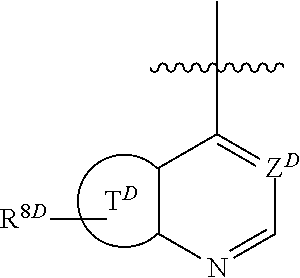
or the like; TD represents phenyl or the like; ZD represents N or CR7D; WD represents a substituted or unsubstituted phenyl, substituted or unsubstituted 6-membered nitrogen-containing heteroaryl or the like; XD represents O, S, S(═O), or the like; YD represents —NRaDC(═O)—(CR3DR4D)p— or the like; RaD represents, a hydrogen atom, an alkyl group, or the like; and R1D represents

or the like; J2D represents O or CR4aDR4aD; QD represents 1- to 5-membered saturated or partially unsaturated alkyl chain or the like; R1D represents optionally substituted phenyl or may be fused to optionally substituted 5- to 6-membered heterocycle; R3D and R4D each independently represents a hydrogen atom, an alkyl group, an aryl group, or the like; R4aD is absent or represents a hydrogen atom, a halogen atom, or the like (where the definitions of the groups are excerpted)) is known to be a c-Met inhibitor (see Patent Literature 4).

(wherein R1E, R2E and R4E independently represent H, F, Cl, Br, I, CN, OR10E, C1-C12 alkyl, or the like; LE represents a C3-C12 carbon ring, C6-C20 aryl, or the like; R5E represents —C(═YE)R13E, —C(═YE)R10ER13E, —NR10EC(═YE)R13E, or the like; R10E represents H, C1-C12 alkyl, a C3-C12 carbon ring, a C2-C20 heterocycle, or the like; R13E represents H, C1-C6 alkyl, or the like; and YE represents O or S (where the definitions of the groups are excerpted)) is known to be a c-Met inhibitor (see Patent Literature 5).

has a significant Axl inhibitory activity.
- [Patent Literature 1] WO2012/028332
- [Patent Literature 2] WO2013/074633
- [Patent Literature 3] WO2012/011548
- [Patent Literature 4] WO2006/116713
- [Patent Literature 5] WO2007/146824
- [Non-Patent Literature 1] Clinical Science, Vol. 122, p. 361-368, 2012
- [Non-Patent Literature 2] Proceedings of the national academy of sciences of the United States of America, Vol. 107, No. 3, p. 1124-1129, 2010
- [Non-Patent Literature 3] Blood, Vol. 121, p. 2064-2073, 2013

improves the Axl inhibitory activity, and have completed the present invention.

[wherein R1 represents (1) a C1-8 alkyl group optionally substituted with one to five R11, (2) a C3-7 carbon ring optionally substituted with one to five R12, or (3) a 4- to 7-membered heterocycle optionally substituted with one to five R13, wherein when the C1-8 alkyl group represented by R1 is a branched alkyl group, the C1-3 alkyl group branched from the same carbon atom, together with the carbon atom bound thereto, optionally forms a saturated C3-7 carbon ring,
R2 represents (1) a C1-4 alkyl group, (2) a halogen atom, (3) a C1-4 haloalkyl group, (4) an oxo group, (5) an —OR21 group, or (6) an ═NR22 group,
R3 represents (1) a C1-4 alkyl group, (2) a halogen atom, or (3) a C1-4 haloalkyl group,
R4 represents (1) a C1-4 alkoxy group, (2) a C1-4 haloalkyl group, (3) an —OR41 group, (4) a C1-4 alkyl group, (5) a C2-4 alkenyloxy group, or (6) a C2-4 alkynyloxy group,
R5 represents (1) a hydrogen atom, (2) a C1-4 alkyl group, (3) a halogen atom, (4) a C1-4 haloalkyl group, or (5) an —OR21 group,
R1 represents (1) an —OR101 group, (2) an SO2R102 group, (3) an NR103R104 group, or (4) a C3-7 carbon ring optionally substituted with one to three halogen atoms,
R12 represents (1) a C1-8 alkyl group optionally substituted with a hydroxyl group, or (2) a halogen atom,
R13 represents (1) a C1-8 alkyl group optionally substituted with a hydroxyl group, or (2) a halogen atom,
R21 represents (1) a hydrogen atom, or (2) a C1-4 alkyl group,
R22 represents (1) a hydroxyl group, or (2) C1-4 alkoxy group,
R41 represents

when q is two or more, a plurality of R4 may be the same as or different from each other], a salt thereof, a solvate thereof, an N-oxide thereof, or a prodrug thereof,
[2] the compound according to the above-mentioned [1], wherein m is one or more, and one of two R2 is necessarily an oxo group,
[3] the compound according to the above-mentioned [1] or [2], wherein the ring1 is benzene or pyridine,
[4] the compound according to any one of the above-mentioned [1] to [3], wherein L is (1) —O—, (2) —NH—, or (3) —C(O)—, [5] the compound according the above-mentioned [1], which is represented by general formula (I-1)

[wherein R2-1 represents (1) a C1-4 alkyl group, (2) a halogen atom, (3) a C1-4 haloalkyl group, (4) an —OR21 group, or (5) an ═NR22 group,
m-1 is an integer from 0 to 4,
L1 is (1) —O—, (2) —NH—, or (3) —C(O)—,
ring1-1 represents benzene or pyridine,
when m-1 is two or more, a plurality of R2-1 may be the same as or different from each other, and when two of R2-1 represent a C1-3 alkyl group and are on the same carbon atom, the R2-1, together with a carbon atom bound thereto, may form a saturated C3-7 carbon ring,
and other symbols have the same meanings as defined in the above-mentioned,
[6] the compound according to any one of the above-mentioned [1] to [5], which is: (1) N-{5-[(6,7-dimethoxy-4-quinolinyl)oxy]-2-pyridinyl}-2,5-dioxo-1-phenyl-1,2,5,6,7,8-hexahydro-3-quinolinecarboxamide, (2) N-{5-[(6,7-dimethoxy-4-quinolinyl)oxy]-2-pyridinyl}-7,7-dimethyl-2,5-dioxo-1-phenyl-1,2,5,6,7,8-hexahydro-3-quinolinecarboxamide, (3) N-{5-[(6,7-dimethoxy-4-quinolinyl)oxy]-2-pyridinyl}-1-(2,2-dimethylpropyl)-2,5-dioxo-1,2,5,6,7,8-hexahydro-3-quinolinecarboxamide, (4) N-[5-({7-[3-(4-morpholinyl)propoxy]-4-quinolinyl}oxy)-2-pyridinyl]-2,5-dioxo-1-phenyl-1,2,5,6,7,8-hexahydro-3-quinolinecarboxamide, (5) N-{4-[(6,7-dimethoxy-4-quinolinyl)oxy]-3-fluorophenyl}-2,5-dioxo-1-phenyl-1,2,5,6,7,8-hexahydro-3-quinolinecarboxamide, (6) N-{4-[(6,7-dimethoxy-4-quinolinyl)oxy]phenyl}-2,5-dioxo-1-phenyl-1,2,5,6,7,8-hexahydro-3-quinolinecarboxamide, (7) N-{5-[(6,7-dimethoxy-4-quinolinyl)oxy]-2-pyridinyl}-1-(4-fluorophenyl)-2,5-dioxo-1,2,5,6,7,8-hexahydro-3-quinolinecarboxamide, (8) N-{5-[(6,7-dimethoxy-4-quinolinyl)oxy]-2-pyridinyl}-1-(3-fluorophenyl)-2,5-dioxo-1,2,5,6,7,8-hexahydro-3-quinolinecarboxamide, (9) N-{5-[(6,7-dimethoxy-4-quinolinyl)oxy]-2-pyridinyl}-1-(2-fluorophenyl)-2,5-dioxo-1,2,5,6,7,8-hexahydro-3-quinolinecarboxamide, (10) N-{5-[(6,7-dimethoxy-4-quinazolinyl)oxy]-2-pyridinyl}-2,5-dioxo-1-phenyl-1,2,5,6,7,8-hexahydro-3-quinolinecarboxamide, (11) N-{5-[(6,7-dimethoxy-4-quinazolinyl)oxy]-2-pyridinyl}-1-(4-fluorophenyl)-2,5-dioxo-1,2,5,6,7,8-hexahydro-3-quinolinecarboxamide, (12) N-{5-[(6,7-dimethoxy-4-quinolinyl)oxy]-2-pyridinyl}-1-[(2S)-1-hydroxy-3-methyl-2-butanyl]-2,5-dioxo-1,2,5,6,7,8-hexahydro-3-quinolinecarboxamide, (13) N-{4-[(6,7-dimethoxy-4-quinolinyl)oxy]-3-fluorophenyl}-1-(3-fluorophenyl)-2,5-dioxo-1,2,5,6,7,8-hexahydro-3-quinolinecarboxamide, (14) N-{5-[(6,7-dimethoxy-4-quinolinyl)oxy]-2-pyridinyl}-6,6-dimethyl-2,5-dioxo-1-phenyl-1,2,5,6,7,8-hexahydro-3-quinolinecarboxamide, (15) N-[5-({6-methoxy-7-[3-(4-morpholinyl)propoxy]-4-quinolinyl}oxy)-2-pyridinyl]-2,5-dioxo-1-phenyl-1,2,5,6,7,8-hexahydro-3-quinolinecarboxamide, (16) N-(5-{[7-(3-hydroxy-3-methylbutoxy)-6-methoxy-4-quinolinyl]oxy}-2-pyridinyl)-2,5-dioxo-1-phenyl-1,2,5,6,7,8-hexahydro-3-quinolinecarboxamide, or (17) N-[5-({6-methoxy-7-[3-(1-pyrrolidinyl)propoxy]-4-quinolinyl}oxy)-2-pyridinyl]-2,5-dioxo-1-phenyl-1,2,5,6,7,8-hexahydro-3-quinolinecarboxamide,
[7] a pharmaceutical composition containing a compound represented by general formula (I) as defined in the above-mentioned [1], a salt thereof, a solvate thereof, an N-oxide thereof, or a prodrug thereof,
[8] the pharmaceutical composition according to the above-mentioned [7], which is an Axl inhibitor,
[9] the pharmaceutical composition according to the above-mentioned [7], which is an agent for preventing and/or treating an Axl-related disease,
[10] the pharmaceutical composition according to the above-mentioned [9], wherein the Axl-related diseases includes cancer, kidney diseases, immune system diseases, or circulatory system diseases,
[11] the pharmaceutical composition according to the above-mentioned [10], wherein the cancer is acute myeloid leukemia, chronic myeloid leukemia, acute lymphatic leukemia, melanoma, breast cancer, pancreatic cancer, glioma, esophageal adenocarcinoma, large intestine cancer, renal cell carcinoma, thyroid cancer, non-small cell lung cancer, prostate cancer, stomach cancer, liver cancer, uveal malignant melanoma, ovarian cancer, endometrial cancer, lymphoma, head and neck cancer, or sarcoma,
[12] the pharmaceutical composition according to the above-mentioned [7], which is a metastasis suppressing agent for cancer cells,
[13] a method for preventing and/or treating an Axl-related disease, the method including administering an effective amount of a compound represented by general formula (I) as defined in the above-mentioned [1], a salt thereof, a solvate thereof, an N-oxide thereof, or a prodrug thereof, to a mammal,
[14] a compound represented by general formula (I) according to the above-mentioned [1], a salt thereof, a solvate thereof, an N-oxide thereof, or a prodrug, for preventing and/or treating an Axl-related disease, and
[15] use of a compound represented by general formula (I), a salt thereof, a solvate thereof, an N-oxide thereof, or a prodrug, as defined in the above-mentioned [1], to manufacture an agent for preventing and/or treating an Axl-related disease.

(wherein all of the symbols have the same meanings as defined above), for example, when R1 is a branched alkyl chain as represented in the above-mentioned general formula, the alkyl chain branched from the same carbon atom, together with the carbon atom bound thereto, forms a saturated carbon ring, as shown in the following general formula:

(wherein all of the symbols have the same meanings as defined above).

(wherein all of the symbols have the same meanings as defined above), for example, when R2 is an alkyl group as represented in the above-mentioned general formula and are on the same carbon atom, the R2, together with a carbon atom bound thereto, forms a saturated carbon ring, as shown in the following general formula:

(wherein all of the symbols have the same meanings as defined above).

(wherein all of the symbols have the same meanings as defined above).


(wherein all of the symbols have the same meanings as defined above) can be produced by the process represented by the following reaction process schemes 1 and 2:

(wherein each of X1 and X2 independently represents a halogen atom, X1 and X2 may be the same as or different from each other, and the other symbols have the same meanings as defined above).

(wherein Rd represents a C1-4 alkyl group, and the other symbols have the same meanings as defined above).

(wherein all of the symbols have the same meanings as defined above).


Inhibition rate (%)=[1−(TR-FRET ratio of test compound group−A)/(B−A)×100 [Math. 1]
A: average value of TR-FRET ratios of Blank group
B: average value of TR-FRET ratios of medium group

Proliferation suppression rate (%)={1−(RLU of test compound group−A)/(B−A)}×100 [Math. 2]
A: average value of RLU of Blank group
B: average value of RLU of medium group

| TABLE 1 | ||
| KDR [IC50]/Axl [IC50] | ||
| Example 5 | about 900 times | ||
| Example 5(1) | about 1800 times | ||
| Example 17(2) | about 650 times | ||
| Example 23(2) | about 520 times | ||
| Comparative compound C | about 0.2 times | ||
| Comparative compound D | about 28 times | ||
Inhibition rate (%)=100−{(luminescence intensity of test compound−background luminescence intensity)/(luminescence intensity of control−background luminescence intensity)×100} [Math. 3]
IC50=(50−b)/a [Math.4]
wherein a and b are the slope and intercept of the linear regression line: y=ax+b that passes through the two points: the concentration and the inhibition rate at 1 μmol/L and the concentration and the inhibition rate at 10 μmol/L.
| N-{5-[(6,7-dimethoxy-4-quinolinyl)oxy]-2-pyridinyl}-2,5-dioxo-1- | 100 g |
| phenyl-1,2,5,6,7,8-hexahydro-3-quinolinecarboxamide | |
| calcium carboxymethyl cellulose (disintegrant) | 20 g |
| magnesium stearate (lubricant) | 10 g |
| microcrystalline cellulose | 870 g |
| N-{5-[(6,7-dimethoxy-4-quinolinyl)oxy]-2-pyridinyl}-7,7- | 200 g |
| dimethyl-2,5-dioxo-1-phenyl-1,2,5,6,7,8-hexahydro-3- | |
| quinolinecarboxamide | |
| mannitol | 20 g |
| distilled water | 50 L |
Claims (3)


H2N—R1 (IV)


Priority Applications (2)
| Application Number | Priority Date | Filing Date | Title |
|---|---|---|---|
| US16/540,306 US10676462B2 (en) | 2013-07-24 | 2019-08-14 | Quinoline derivative |
| US16/858,244 US20200392110A1 (en) | 2013-07-24 | 2020-04-24 | Quinoline derivative |
Applications Claiming Priority (8)
| Application Number | Priority Date | Filing Date | Title |
|---|---|---|---|
| JP2013-153350 | 2013-07-24 | ||
| JP2013153350 | 2013-07-24 | ||
| PCT/JP2014/069419 WO2015012298A1 (en) | 2013-07-24 | 2014-07-23 | Quinoline derivative |
| US201614906993A | 2016-01-22 | 2016-01-22 | |
| US15/373,091 US9994549B2 (en) | 2013-07-24 | 2016-12-08 | Quinoline derivative |
| US15/975,999 US10208022B2 (en) | 2013-07-24 | 2018-05-10 | Quinoline derivative |
| US16/237,275 US10501442B2 (en) | 2013-07-24 | 2018-12-31 | Quinoline derivative |
| US16/540,306 US10676462B2 (en) | 2013-07-24 | 2019-08-14 | Quinoline derivative |
Related Parent Applications (1)
| Application Number | Title | Priority Date | Filing Date |
|---|---|---|---|
| US16/237,275 Continuation US10501442B2 (en) | 2013-07-24 | 2018-12-31 | Quinoline derivative |
Related Child Applications (1)
| Application Number | Title | Priority Date | Filing Date |
|---|---|---|---|
| US16/858,244 Continuation US20200392110A1 (en) | 2013-07-24 | 2020-04-24 | Quinoline derivative |
Publications (2)
| Publication Number | Publication Date |
|---|---|
| US20200002313A1 US20200002313A1 (en) | 2020-01-02 |
| US10676462B2 true US10676462B2 (en) | 2020-06-09 |
Family
ID=52393331
Family Applications (6)
| Application Number | Title | Priority Date | Filing Date |
|---|---|---|---|
| US14/906,993 Active US9573935B2 (en) | 2013-07-24 | 2014-07-23 | Quinoline derivative |
| US15/373,091 Active US9994549B2 (en) | 2013-07-24 | 2016-12-08 | Quinoline derivative |
| US15/975,999 Active US10208022B2 (en) | 2013-07-24 | 2018-05-10 | Quinoline derivative |
| US16/237,275 Active US10501442B2 (en) | 2013-07-24 | 2018-12-31 | Quinoline derivative |
| US16/540,306 Active US10676462B2 (en) | 2013-07-24 | 2019-08-14 | Quinoline derivative |
| US16/858,244 Pending US20200392110A1 (en) | 2013-07-24 | 2020-04-24 | Quinoline derivative |
Family Applications Before (4)
| Application Number | Title | Priority Date | Filing Date |
|---|---|---|---|
| US14/906,993 Active US9573935B2 (en) | 2013-07-24 | 2014-07-23 | Quinoline derivative |
| US15/373,091 Active US9994549B2 (en) | 2013-07-24 | 2016-12-08 | Quinoline derivative |
| US15/975,999 Active US10208022B2 (en) | 2013-07-24 | 2018-05-10 | Quinoline derivative |
| US16/237,275 Active US10501442B2 (en) | 2013-07-24 | 2018-12-31 | Quinoline derivative |
Family Applications After (1)
| Application Number | Title | Priority Date | Filing Date |
|---|---|---|---|
| US16/858,244 Pending US20200392110A1 (en) | 2013-07-24 | 2020-04-24 | Quinoline derivative |
Country Status (22)
| Country | Link |
|---|---|
| US (6) | US9573935B2 (en) |
| EP (2) | EP3026045B1 (en) |
| JP (2) | JP6213564B2 (en) |
| KR (1) | KR102251609B1 (en) |
| CN (1) | CN105408312B (en) |
| AU (1) | AU2014294109B2 (en) |
| BR (1) | BR112016001515B1 (en) |
| CA (1) | CA2918888C (en) |
| DK (1) | DK3026045T3 (en) |
| ES (2) | ES2694513T3 (en) |
| HU (1) | HUE040238T2 (en) |
| IL (1) | IL243743B (en) |
| MX (1) | MX365377B (en) |
| MY (1) | MY191433A (en) |
| PH (1) | PH12016500150B1 (en) |
| PL (1) | PL3026045T3 (en) |
| PT (1) | PT3026045T (en) |
| RU (1) | RU2666895C2 (en) |
| SG (1) | SG11201600533XA (en) |
| TW (1) | TWI649308B (en) |
| WO (1) | WO2015012298A1 (en) |
| ZA (1) | ZA201600514B (en) |
Families Citing this family (56)
| Publication number | Priority date | Publication date | Assignee | Title |
|---|---|---|---|---|
| UA117466C2 (en) | 2012-12-13 | 2018-08-10 | Мерк Шарп Енд Доме Корп. | STABLE COMPOSITION IN THE VIEW OF AN ANTIBODY ANTIBODY TO IL-23p19 |
| TWI649308B (en) | 2013-07-24 | 2019-02-01 | 小野藥品工業股份有限公司 | Quinoline derivative |
| JP6500037B2 (en) | 2014-04-22 | 2019-04-10 | キャリター・サイエンシーズ・リミテッド・ライアビリティ・カンパニーCalitor Sciences, Llc | Bicyclic pyrazolone compounds and methods of use |
| JP6708130B2 (en) * | 2014-12-25 | 2020-06-10 | 小野薬品工業株式会社 | Quinoline derivative |
| AR103726A1 (en) | 2015-02-27 | 2017-05-31 | Merck Sharp & Dohme | HUMAN ANTI-PD-1 MONOCLONAL ANTIBODY CRYSTALS |
| WO2016183071A1 (en) | 2015-05-11 | 2016-11-17 | Incyte Corporation | Hetero-tricyclic compounds and their use for the treatment of cancer |
| GB201509338D0 (en) * | 2015-05-29 | 2015-07-15 | Bergenbio As | Combination therapy |
| WO2017027717A1 (en) | 2015-08-12 | 2017-02-16 | Incyte Corporation | Bicyclic fused pyrimidine compounds as tam inhibitors |
| CN106467541B (en) * | 2015-08-18 | 2019-04-05 | 暨南大学 | Substituted quinolone analog derivative or its pharmaceutically acceptable salt or stereoisomer and its Pharmaceutical composition and application |
| WO2017035366A1 (en) | 2015-08-26 | 2017-03-02 | Incyte Corporation | Pyrrolopyrimidine derivatives as tam inhibitors |
| JP6859954B2 (en) | 2015-11-04 | 2021-04-14 | アステラス製薬株式会社 | A pharmaceutical composition for cancer immunotherapy and / or immune activation containing a diaminoheterocyclic carboxamide compound as an active ingredient. |
| WO2017146236A1 (en) | 2016-02-26 | 2017-08-31 | 小野薬品工業株式会社 | Drug for cancer therapy characterized by administering combination between axl inhibitor and immune checkpoint inhibitor |
| AU2017241524B2 (en) | 2016-03-28 | 2021-07-08 | Incyte Corporation | Pyrrolotriazine compounds as TAM inhibitors |
| US10550135B2 (en) | 2016-03-30 | 2020-02-04 | Council Of Scientific & Industrial Research | Silicon incorporated quinolines with anti-malarial and anti-toxoplasmosis activity |
| CN108250200A (en) * | 2016-12-28 | 2018-07-06 | 中国科学院上海药物研究所 | A kind of compound and its preparation and application with Axl inhibitory activity |
| CN119707932A (en) | 2017-01-26 | 2025-03-28 | 小野药品工业株式会社 | Ethanesulfonic acid salts of quinoline derivatives |
| AU2018263868A1 (en) | 2017-05-02 | 2019-12-12 | Merck Sharp & Dohme Llc | Formulations of anti-LAG3 antibodies and co-formulations of anti-LAG3 antibodies and anti-PD-1 antibodies |
| JOP20190260A1 (en) | 2017-05-02 | 2019-10-31 | Merck Sharp & Dohme | Stable formulations of programmed death receptor 1 (pd-1) antibodies and methods of use thereof |
| WO2019039525A1 (en) | 2017-08-23 | 2019-02-28 | 小野薬品工業株式会社 | Pharmaceutical for cancer treatment including ax1 inhibitor as an effective component |
| TWI821200B (en) | 2017-09-27 | 2023-11-11 | 美商英塞特公司 | Salts of tam inhibitors |
| JP7223998B2 (en) * | 2017-10-13 | 2023-02-17 | 小野薬品工業株式会社 | Solid cancer therapeutic agent containing an Axl inhibitor as an active ingredient |
| EP3810596B1 (en) * | 2018-06-01 | 2022-11-30 | Rigel Pharmaceuticals, Inc. | Quinoline derivatives useful as tyrosine kinase inhibitors |
| US11241438B2 (en) | 2018-06-29 | 2022-02-08 | Incyte Corporation | Formulations of an AXL/MER inhibitor |
| JP7467438B2 (en) | 2018-10-18 | 2024-04-15 | メルク・シャープ・アンド・ドーム・エルエルシー | Anti-RSV antibody formulations and methods of use thereof |
| CN109232416B (en) * | 2018-10-24 | 2021-09-24 | 福州大学 | A kind of method of synthesizing 4-trifluoromethyl-2-pyrone/pyridone compound |
| CN113015748B (en) | 2018-10-31 | 2025-12-12 | 默沙东有限责任公司 | Anti-human PD-1 antibody crystals and their usage |
| CN113316458B (en) | 2018-11-07 | 2024-08-02 | 默沙东有限责任公司 | Co-formulations of anti-LAG 3 antibodies and anti-PD-1 antibodies |
| BR112021018168B1 (en) | 2019-03-21 | 2023-11-28 | Onxeo | PHARMACEUTICAL COMPOSITION, COMBINATION AND KIT COMPRISING A DBAIT MOLECULE AND A KINASE INHIBITOR FOR THE TREATMENT OF CANCER |
| CN110078675B (en) * | 2019-04-25 | 2022-09-23 | 郑州大学 | 4-aryl quinazoline compound and preparation method thereof |
| US12371428B2 (en) | 2019-09-26 | 2025-07-29 | Exelixis, Inc. | Pyridone compounds and methods of use |
| CA3159348A1 (en) | 2019-11-08 | 2021-05-14 | Inserm (Institut National De La Sante Et De La Recherche Medicale) | Methods for the treatment of cancers that have acquired resistance to kinase inhibitors |
| WO2021148581A1 (en) | 2020-01-22 | 2021-07-29 | Onxeo | Novel dbait molecule and its use |
| AU2021226747A1 (en) * | 2020-02-24 | 2022-09-01 | Exelixis, Inc. | Compounds and methods of use |
| EP4114401A1 (en) | 2020-03-06 | 2023-01-11 | Incyte Corporation | Combination therapy comprising axl/mer and pd-1/pd-l1 inhibitors |
| KR20210142555A (en) * | 2020-05-18 | 2021-11-25 | 웰마커바이오 주식회사 | Pharmaceutical composition for preventing or treating pancreatic cancer associated with ron mutation and method using the same |
| JP2023526443A (en) * | 2020-05-18 | 2023-06-21 | ウェルマーカー バイオ カンパニー リミテッド | Pharmaceutical composition for prevention or treatment of non-small cell lung cancer associated with RON mutation and method of use thereof |
| CN115916210A (en) * | 2020-05-18 | 2023-04-04 | 伟迈可生物有限公司 | Pharmaceutical composition for preventing or treating small cell lung cancer associated with RON mutation and method of use thereof |
| EP4294804A1 (en) * | 2021-02-19 | 2023-12-27 | Exelixis, Inc. | Pyridone compounds and methods of use |
| WO2022220227A1 (en) * | 2021-04-14 | 2022-10-20 | エーザイ・アール・アンド・ディー・マネジメント株式会社 | Tetrahydropyridopyrimidine compound |
| US20240239806A1 (en) * | 2021-04-30 | 2024-07-18 | Chengdu Anticancer Bioscience, Ltd. | Compounds, compositions and methods of treating disorders |
| WO2022237843A1 (en) * | 2021-05-12 | 2022-11-17 | 微境生物医药科技(上海)有限公司 | Axl inhibitor |
| AR126963A1 (en) * | 2021-09-13 | 2023-12-06 | Lilly Co Eli | AHR AGONISTS |
| AU2024241633A1 (en) | 2023-03-30 | 2025-11-06 | Revolution Medicines, Inc. | Compositions for inducing ras gtp hydrolysis and uses thereof |
| WO2024229406A1 (en) | 2023-05-04 | 2024-11-07 | Revolution Medicines, Inc. | Combination therapy for a ras related disease or disorder |
| US20250049810A1 (en) | 2023-08-07 | 2025-02-13 | Revolution Medicines, Inc. | Methods of treating a ras protein-related disease or disorder |
| TW202530228A (en) | 2023-10-12 | 2025-08-01 | 美商銳新醫藥公司 | Ras inhibitors |
| WO2025171296A1 (en) | 2024-02-09 | 2025-08-14 | Revolution Medicines, Inc. | Ras inhibitors |
| TW202547461A (en) | 2024-05-17 | 2025-12-16 | 美商銳新醫藥公司 | Ras inhibitors |
| WO2025255438A1 (en) | 2024-06-07 | 2025-12-11 | Revolution Medicines, Inc. | Methods of treating a ras protein-related disease or disorder |
| WO2025265060A1 (en) | 2024-06-21 | 2025-12-26 | Revolution Medicines, Inc. | Therapeutic compositions and methods for managing treatment-related effects |
| WO2026006747A1 (en) | 2024-06-28 | 2026-01-02 | Revolution Medicines, Inc. | Ras inhibitors |
| WO2026015790A1 (en) | 2024-07-12 | 2026-01-15 | Revolution Medicines, Inc. | Methods of treating a ras related disease or disorder |
| WO2026015796A1 (en) | 2024-07-12 | 2026-01-15 | Revolution Medicines, Inc. | Methods of treating a ras related disease or disorder |
| WO2026015801A1 (en) | 2024-07-12 | 2026-01-15 | Revolution Medicines, Inc. | Methods of treating a ras related disease or disorder |
| WO2026015825A1 (en) | 2024-07-12 | 2026-01-15 | Revolution Medicines, Inc. | Use of ras inhibitor for treating pancreatic cancer |
| WO2026050446A1 (en) | 2024-08-29 | 2026-03-05 | Revolution Medicines, Inc. | Ras inhibitors |
Citations (16)
| Publication number | Priority date | Publication date | Assignee | Title |
|---|---|---|---|---|
| US20020048610A1 (en) | 2000-01-07 | 2002-04-25 | Cima Michael J. | High-throughput formation, identification, and analysis of diverse solid-forms |
| WO2006116713A1 (en) | 2005-04-27 | 2006-11-02 | Amgen Inc. | Substituted amide derivatives as protein kinase inhibitors |
| US20070060613A1 (en) | 2005-09-14 | 2007-03-15 | Bristol-Myers Squibb Company | Met kinase inhibitors |
| WO2007146824A2 (en) | 2006-06-08 | 2007-12-21 | Array Biopharma Inc. | Quinoline compounds and methods of use |
| WO2008048375A1 (en) | 2006-05-19 | 2008-04-24 | Bayer Healthcare Ag | Pyridonecarboxamide derivatives useful in treating hyper-proliferative and angiogenesis disorders |
| US20090274693A1 (en) | 2008-05-05 | 2009-11-05 | Gilmer Tona M | Method of Treating Cancer using a cMet and AXL Inhibitor and an ErbB Inhibitor |
| WO2009140549A1 (en) | 2008-05-14 | 2009-11-19 | Amgen Inc. | Combinations vegf(r) inhibitors and hepatocyte growth factor (c-met) inhibitors for the treatment of cancer |
| WO2010039248A1 (en) | 2008-10-01 | 2010-04-08 | Ludwig Institute For Cancer Research | Methods for the treatment of cancer |
| JP2010178651A (en) | 2009-02-04 | 2010-08-19 | Eisai R & D Management Co Ltd | Method for detecting action of hgfr inhibitor |
| US20110092503A1 (en) | 2008-04-16 | 2011-04-21 | Axel Ullrich | Quinoline derivatives as axl kinase inhibitors |
| WO2012011548A1 (en) | 2010-07-23 | 2012-01-26 | 国立大学法人 東京大学 | Nitrogen-containing heterocyclic derivative |
| WO2012028332A1 (en) | 2010-08-28 | 2012-03-08 | Lead Discovery Center Gmbh | Pharmaceutically active compounds as axl inhibitors |
| WO2012080729A2 (en) | 2010-12-14 | 2012-06-21 | Electrophoretics Limited | CASEIN KINASE 1δ (CK1δ) INHIBITORS |
| WO2013074633A1 (en) | 2011-11-14 | 2013-05-23 | Cephalon, Inc. | Uracil derivatives as axl and c-met kinase inhibitors |
| US20140206679A1 (en) | 2011-06-09 | 2014-07-24 | Shanghai Huilun Life Science & Technology Co., Ltd | Heterocyclic pyridone compound, and intermediate, preparation method and use thereof |
| WO2015012298A1 (en) | 2013-07-24 | 2015-01-29 | 小野薬品工業株式会社 | Quinoline derivative |
Family Cites Families (2)
| Publication number | Priority date | Publication date | Assignee | Title |
|---|---|---|---|---|
| US4656174A (en) * | 1982-07-24 | 1987-04-07 | Pfizer Inc. | Quinoline therapeutic agents |
| RU2240313C2 (en) * | 1999-10-25 | 2004-11-20 | Эктив Байотек Аб | Medicinal agents for treatment of malignant tumors |
-
2014
- 2014-07-22 TW TW103125057A patent/TWI649308B/en active
- 2014-07-23 WO PCT/JP2014/069419 patent/WO2015012298A1/en not_active Ceased
- 2014-07-23 EP EP14828976.2A patent/EP3026045B1/en active Active
- 2014-07-23 EP EP18185739.2A patent/EP3415501B9/en active Active
- 2014-07-23 ES ES14828976.2T patent/ES2694513T3/en active Active
- 2014-07-23 US US14/906,993 patent/US9573935B2/en active Active
- 2014-07-23 SG SG11201600533XA patent/SG11201600533XA/en unknown
- 2014-07-23 MY MYPI2016700235A patent/MY191433A/en unknown
- 2014-07-23 JP JP2015528303A patent/JP6213564B2/en active Active
- 2014-07-23 KR KR1020167002008A patent/KR102251609B1/en active Active
- 2014-07-23 HU HUE14828976A patent/HUE040238T2/en unknown
- 2014-07-23 MX MX2016000989A patent/MX365377B/en active IP Right Grant
- 2014-07-23 BR BR112016001515-0A patent/BR112016001515B1/en active IP Right Grant
- 2014-07-23 CN CN201480041780.2A patent/CN105408312B/en active Active
- 2014-07-23 PT PT14828976T patent/PT3026045T/en unknown
- 2014-07-23 AU AU2014294109A patent/AU2014294109B2/en active Active
- 2014-07-23 RU RU2016102036A patent/RU2666895C2/en active
- 2014-07-23 ES ES18185739T patent/ES2798150T3/en active Active
- 2014-07-23 DK DK14828976.2T patent/DK3026045T3/en active
- 2014-07-23 PL PL14828976T patent/PL3026045T3/en unknown
- 2014-07-23 CA CA2918888A patent/CA2918888C/en active Active
-
2016
- 2016-01-21 PH PH12016500150A patent/PH12016500150B1/en unknown
- 2016-01-21 IL IL243743A patent/IL243743B/en active IP Right Grant
- 2016-01-22 ZA ZA2016/00514A patent/ZA201600514B/en unknown
- 2016-12-08 US US15/373,091 patent/US9994549B2/en active Active
-
2017
- 2017-09-15 JP JP2017177943A patent/JP6436205B2/en active Active
-
2018
- 2018-05-10 US US15/975,999 patent/US10208022B2/en active Active
- 2018-12-31 US US16/237,275 patent/US10501442B2/en active Active
-
2019
- 2019-08-14 US US16/540,306 patent/US10676462B2/en active Active
-
2020
- 2020-04-24 US US16/858,244 patent/US20200392110A1/en active Pending
Patent Citations (41)
| Publication number | Priority date | Publication date | Assignee | Title |
|---|---|---|---|---|
| US20020048610A1 (en) | 2000-01-07 | 2002-04-25 | Cima Michael J. | High-throughput formation, identification, and analysis of diverse solid-forms |
| JP2003519698A (en) | 2000-01-07 | 2003-06-24 | トランスフォーム ファーマスーティカルズ,インコーポレイテッド | High-throughput formation, identification and analysis of various solid forms |
| WO2006116713A1 (en) | 2005-04-27 | 2006-11-02 | Amgen Inc. | Substituted amide derivatives as protein kinase inhibitors |
| US20120070413A1 (en) | 2005-04-27 | 2012-03-22 | Tae-Seong Kim | Method of treating cancer with substituted amide derivatives |
| US20110118252A1 (en) | 2005-04-27 | 2011-05-19 | Amgen Inc. | Substituted amide derivatives and methods of use |
| JP2008539275A (en) | 2005-04-27 | 2008-11-13 | アムジエン・インコーポレーテツド | Substituted amide derivatives as protein kinase inhibitors |
| US20080312232A1 (en) | 2005-04-27 | 2008-12-18 | Amgen Inc. | Substituted amide derivatives and methods of use |
| US20070060613A1 (en) | 2005-09-14 | 2007-03-15 | Bristol-Myers Squibb Company | Met kinase inhibitors |
| WO2007033196A1 (en) | 2005-09-14 | 2007-03-22 | Bristol-Myers Squibb Company | Met kinase inhibitors |
| JP2009537632A (en) | 2006-05-19 | 2009-10-29 | バイエル・ヘルスケア・アクチェンゲゼルシャフト | Pyridonecarboxamide derivatives useful for the treatment of hyperproliferative and angiogenic disorders |
| WO2008048375A1 (en) | 2006-05-19 | 2008-04-24 | Bayer Healthcare Ag | Pyridonecarboxamide derivatives useful in treating hyper-proliferative and angiogenesis disorders |
| US20090306103A1 (en) | 2006-05-19 | 2009-12-10 | Stephen Boyer | Pyridonecarboxamide derivatives useful in treating hyper-proliferative and angiogenesis disorders |
| US20110053931A1 (en) | 2006-06-08 | 2011-03-03 | John Gaudino | Quinoline compounds and methods of use |
| WO2007146824A2 (en) | 2006-06-08 | 2007-12-21 | Array Biopharma Inc. | Quinoline compounds and methods of use |
| CN101528702A (en) | 2006-06-08 | 2009-09-09 | 阿雷生物药品公司 | Quinoline compounds and methods of use |
| JP2009539878A (en) | 2006-06-08 | 2009-11-19 | アレイ バイオファーマ、インコーポレイテッド | Quinoline compounds and methods of use |
| JP2011517689A (en) | 2008-04-16 | 2011-06-16 | マックス プランク ゲゼルシャフト ツゥアー フェデルゥン デル ヴィッセンシャフテン エー フォー | Quinoline derivatives as AXL kinase inhibitors |
| US20110092503A1 (en) | 2008-04-16 | 2011-04-21 | Axel Ullrich | Quinoline derivatives as axl kinase inhibitors |
| CN102083824A (en) | 2008-05-05 | 2011-06-01 | 葛兰素史密斯克莱有限责任公司 | Method of treating cancer using a cMET and AXL inhibitor and an ErbB inhibitor |
| US20130142790A1 (en) | 2008-05-05 | 2013-06-06 | Glaxosmithkline | Method of Treating Cancer Using a cMET and AXL Inhibitor and an ErbB Inhibitor |
| WO2009137429A1 (en) | 2008-05-05 | 2009-11-12 | Smithkline Beecham Corporation | Method of treating cancer using a cmet and axl inhibitor and an erbb inhibitor |
| US20090274693A1 (en) | 2008-05-05 | 2009-11-05 | Gilmer Tona M | Method of Treating Cancer using a cMet and AXL Inhibitor and an ErbB Inhibitor |
| US20130150363A1 (en) | 2008-05-05 | 2013-06-13 | Glaxosmithkline | Method of Treating Cancer Using a cMET and AXL Inhibitor and an ErbB Inhibitor |
| WO2009140549A1 (en) | 2008-05-14 | 2009-11-19 | Amgen Inc. | Combinations vegf(r) inhibitors and hepatocyte growth factor (c-met) inhibitors for the treatment of cancer |
| WO2010039248A1 (en) | 2008-10-01 | 2010-04-08 | Ludwig Institute For Cancer Research | Methods for the treatment of cancer |
| JP2010178651A (en) | 2009-02-04 | 2010-08-19 | Eisai R & D Management Co Ltd | Method for detecting action of hgfr inhibitor |
| WO2012011548A1 (en) | 2010-07-23 | 2012-01-26 | 国立大学法人 東京大学 | Nitrogen-containing heterocyclic derivative |
| WO2012028332A1 (en) | 2010-08-28 | 2012-03-08 | Lead Discovery Center Gmbh | Pharmaceutically active compounds as axl inhibitors |
| US20140018365A1 (en) | 2010-08-28 | 2014-01-16 | Max-Planck-Gesellschaft Zur Förderung Der Wissenscchaften E.V. | Pharmaceutically active compounds as axl inhibitors |
| CN103124729A (en) | 2010-08-28 | 2013-05-29 | 利德探索中心有限公司 | Pharmaceutically active compounds as Axl inhibitors |
| WO2012080729A2 (en) | 2010-12-14 | 2012-06-21 | Electrophoretics Limited | CASEIN KINASE 1δ (CK1δ) INHIBITORS |
| US9562060B2 (en) | 2011-06-09 | 2017-02-07 | Shanghai Huilun Life Science & Technology Co., Ltd | Heterocyclic pyridone compound, and intermediate, preparation method and use thereof |
| US20140206679A1 (en) | 2011-06-09 | 2014-07-24 | Shanghai Huilun Life Science & Technology Co., Ltd | Heterocyclic pyridone compound, and intermediate, preparation method and use thereof |
| US20140275077A1 (en) | 2011-11-14 | 2014-09-18 | Cephalon, Inc. | Uracil derivatives as axl and c-met kinase inhibitors |
| JP2014533287A (en) | 2011-11-14 | 2014-12-11 | セファロン、インク. | Uracil derivatives as AXL and c-MET kinase inhibitors |
| WO2013074633A1 (en) | 2011-11-14 | 2013-05-23 | Cephalon, Inc. | Uracil derivatives as axl and c-met kinase inhibitors |
| WO2015012298A1 (en) | 2013-07-24 | 2015-01-29 | 小野薬品工業株式会社 | Quinoline derivative |
| US20160168121A1 (en) | 2013-07-24 | 2016-06-16 | Ono Pharmaceutical Co., Ltd. | Quinoline derivative |
| US9573935B2 (en) | 2013-07-24 | 2017-02-21 | Ono Pharmaceutical Co., Ltd. | Quinoline derivative |
| US20170088542A1 (en) | 2013-07-24 | 2017-03-30 | Ono Pharmaceutical Co., Ltd. | Quinoline derivative |
| US9994549B2 (en) | 2013-07-24 | 2018-06-12 | Ono Pharmaceutical Co., Ltd. | Quinoline derivative |
Non-Patent Citations (39)
| Title |
|---|
| "9601633 Flexible AC transmission system", INTERNATIONAL ATOMIC ENERGY AGENCY. TECHNICAL REPORT SERIES, INTERNATIONAL ATOMIC ENERGY AGENCY, VIENNA, AT, vol. 37, no. 2, 1 March 1996 (1996-03-01), AT, pages 109, XP005509390, ISSN: 0074-1914 |
| "BG8324 Enhances Immune Checkpoint Inhibitor Efficacy in Preclinica.l Cancer Models" BerGenBio AS, Sep. 21, 2015 (url: https://www.bergenbio.com/bgb324-enhances-immune-checkpoint-inhibitor-efficacy-in-preclinical-cancer-models/ [retrieved Feb. 12, 2020] (Year: 2015) (1 page). |
| "Specifications and Test Methods of New Pharmaceuticals", PFSB / ELD Notification, No. 568, 2001, 25 pages total. |
| Allen G et al: "Identification of small molecule inhibitors of proline-rich tyrosine kinase 2 (Pyk2) with osteogenic activity in osteoblast cells", Bioorganic & Medicinal Chemistry Letters, vol. 19, No. 17, Sep. 1, 2009, XP026458526, pp. 4924-4928, (5 pages total). |
| ALLEN, J.G. ; LEE, M.R. ; HAN, C.Y.E. ; SCHERRER, J. ; FLYNN, S. ; BOUCHER, C. ; ZHAO, H. ; O'CONNOR, A.B. ; ROVETO, P. ; BAU: "Identification of small molecule inhibitors of proline-rich tyrosine kinase 2 (Pyk2) with osteogenic activity in osteoblast cells", BIOORGANIC & MEDICINAL CHEMISTRY LETTERS, PERGAMON, AMSTERDAM, NL, vol. 19, no. 17, 1 September 2009 (2009-09-01), AMSTERDAM, NL, pages 4924 - 4928, XP026458526, ISSN: 0960-894X |
| Anette Fiebeler et al. "Growth Arrest Specific Protein 6/Axl Signaling in Human Inflammatory Renal Diseases" American Journal of Kidney Disease, vol. 43, No. 2, Feb. 2004, (pp. 286-295). |
| Anna Zagórska et al. Diversification of TAM receptor tyrosine kinase function Nature Immunology vol. 15, No. 10, Oct. 2014, (pp. 920-930). |
| Berge et al., "Pharmaceutical Salts", Journal of Pharmaceutical Sciences, vol. 66, No. 1, Jan. 1977, pp. 1-19, 19 pages total. |
| Brooke M. VandenBrink et al. "Evaluation of CYP2C8 Inhibition in Vitro: Utility of Montelukast as a Selective CYP2C8 Probe Substrate" The American Society for Pharmacology and Experimental Therapeutics, vol. 31, No. 9, 2011, (p. 1546-1554). |
| Byrn et al., "Pharmaceutical Solids: A Strategic Approach to Regulatory Considerations", Pharmaceutical Research, vol. 12, No. 7, 1995, pp. 945-954, 10 pages total. |
| C. Gjerdrum et al., "Axl is an essential epithelial-to-mesenchymal transition-induced regulator of breast cancer metastasis and patient survival", Proceedings of the National Academy of Sciences of the United States of America, Jan. 19, 2010, vol. 107, No. 3, pp. 1124-1129. |
| Carla V Rothlin et al. "TAM receptor signaling and autoimmune disease", Current Opinion in Immunology, vol. 22 2010, (pp. 740-746). |
| Carla V. Rothlin et al. "TAM Receptor Signaling in Immune Homeostasis" American review of Immunology, vol. 33, Jan. 14, 2015, (pp. 355-391). |
| Communication dated Feb. 27, 2018, issued by the USPTO in co-pending U.S. Appl. No. 15/539,530. |
| European Intellectual Property Office, Communication dated Dec. 6, 2016 issued in European Application No. 14828976.2. |
| Extended European Search Report dated Nov. 15, 2017, issued by the European Patent Office in European Application No. 15873185.1. |
| Gro Gausdal et al. "Abstract B014: BGB324, a selective small molecule inhibitor of the receptor tyrosine kinase AXL, enhances immune checkpoint inhibitor efficacy" Cancer Immunology Research, CRI-CIMT-EATI-AACR Inaugural International Cancer Immunotherapy Conference: Translating Science into Survival, Sep. 16-19, 2015, (pp. 1-4). |
| Il-Kyoo Park et al., "Inhibition of the receptor tyrosine kinase Axl impedes activation of the FLT3 internal tandem duplication in human acute myeloid leukemia: implications for Axl as a potential therapeutic target", Blood Journal, Mar. 14, 2013, vol. 121, No. 11, Total 11 pages. |
| International Search Report dated Mar. 20, 2018 issued by the International Searching Authority in International Application No. PCT/JP2018/002250 (PCT/ISA/210). |
| International Searching Authority, Search Report dated Aug. 19, 2014, issued in International Application No. PCT/JP2014/069419. |
| International Searching Authority, Written Opinion dated Aug. 19, 2014, issued in International Application No. PCT/JP2014/069419. |
| Kawaguchi et al., "Drug and crystal polymorphism", Journal of Human Environmental Engineering, vol. 4, No. 2, 2002, pp. 310-317, 10 pages total. |
| Lovering, et al.; "Identification of Type-II Inhibitors Using Kinase Structures", Chemical Biology and Drug Design, vol. 80, No. 5, Jun. 2012, 8 pages total. |
| Ooshima, "Crystallization of Polymorphs and Pseudo-polymorphs and Its Control", Pharm Stage, vol. 6, No. 10, 2007, pp. 48-53, 9 pages total. |
| Rachel M.A. Linger et al. "TAM Receptor Tyrosine Kinases: Biologic Functions, Signaling, and Potential Therapeutic Targeting in Human Cancer", Advances in Cancer Research, 2008, (pp. 35-83). |
| Registry (STN) [online], Jan. 16, 2001, RN 314026-41-0, [retrieval date Aug. 6, 2014], Total 1 page. |
| Samit K Bhattacharya et al: "Identification of novel series of pyrazole and indole-urea based DFG-out PYK2 inhibitors" , Bioorganic & Medicinal Chemistry Letters, vol. 22, No. 24, Dec. 1, 2012, XP05509390, pp. 7523-7529, (7 pages total). |
| Search Report dated Feb. 9, 2016, issued by the International Searching Authority in International Application No. PCT/JP2015/086050 (PCT/ISA/210). |
| State Intellectual Property Office of the People's Republic of China, Communication dated Nov. 2, 2016 issued in Chinese Patent Application No. 201480041780.2. |
| T. Fujimori et al. "The Axl receptor tyrosine kinase is a discriminator of macrophage function in the inflamed lung" Mucosal Immunology, vol. 8, No. 5, Sep. 2015, (pp. 1021-1030). |
| Takata, "API form screening and selection in drug discovery stage", Pharm Stage, vol. 6, No. 10, 2007, pp. 20-25, 10 pages total. |
| U.S. Appl. No. 15/539,530, filed Jun. 23, 2017. |
| Udaya Kiran Marelli et al. "Tumor targeting via integrin ligands" Frontiers in Oncology, vol. 3, Article 222, Aug. 30, 2013, (pp. 1-12). |
| V. A. Korshunov; "Axl-dependent signalling: a clinical update", 2012 Biochemical Society, Clinical Science (2012) vol. 122, pp. 361-368. |
| Written Opinion dated Feb. 9, 2016, issued by the International Searching Authority in International Application No. PCT/JP2015/086050 (PCT/ISA/237). |
| Xiaoliang Wu et al. "AXL kinase as a novel target for cancer therapy" Oncotarget, vol. 5, No. 20, Oct. 16, 2014, (pp. 9546-9563). |
| Yamano, "Approach to Crystal Polymorph in Process Research of New Drug", Synthetic Organic Chemistry , vol. 65, No. 9, 2007, pp. 907-913, 11 pages total. |
| Zhang, et al.; "Discovery of novel type II c-Met inhibitors based on BMS-777607", European Journal of Medicinal Chemistry, vol. 80, Apr. 2014, 13 pages total. |
| Zhihui Wang et al. "Mathematical modeling in cancer drug discovery" Drug Discovery Today, vol. 19, No. 2, Feb. 2014, (pp. 145-150). |
Also Published As
Similar Documents
| Publication | Publication Date | Title |
|---|---|---|
| US10676462B2 (en) | Quinoline derivative | |
| US10208034B2 (en) | Quinoline derivative | |
| US9586967B2 (en) | Pyrrolo pyrimidine derivative | |
| HK40001093A (en) | Quinoline derivative | |
| HK40001093B (en) | Quinoline derivative | |
| NZ716244B2 (en) | Quinoline derivative |
Legal Events
| Date | Code | Title | Description |
|---|---|---|---|
| FEPP | Fee payment procedure |
Free format text: ENTITY STATUS SET TO UNDISCOUNTED (ORIGINAL EVENT CODE: BIG.); ENTITY STATUS OF PATENT OWNER: LARGE ENTITY |
|
| STPP | Information on status: patent application and granting procedure in general |
Free format text: NON FINAL ACTION MAILED |
|
| STPP | Information on status: patent application and granting procedure in general |
Free format text: NOTICE OF ALLOWANCE MAILED -- APPLICATION RECEIVED IN OFFICE OF PUBLICATIONS |
|
| STPP | Information on status: patent application and granting procedure in general |
Free format text: PUBLICATIONS -- ISSUE FEE PAYMENT RECEIVED |
|
| STCF | Information on status: patent grant |
Free format text: PATENTED CASE |
|
| CC | Certificate of correction | ||
| MAFP | Maintenance fee payment |
Free format text: PAYMENT OF MAINTENANCE FEE, 4TH YEAR, LARGE ENTITY (ORIGINAL EVENT CODE: M1551); ENTITY STATUS OF PATENT OWNER: LARGE ENTITY Year of fee payment: 4 |