US10673766B2 - Variable-size sampling method for supporting uniformity confidence under data-streaming environment - Google Patents
Variable-size sampling method for supporting uniformity confidence under data-streaming environment Download PDFInfo
- Publication number
- US10673766B2 US10673766B2 US15/955,400 US201815955400A US10673766B2 US 10673766 B2 US10673766 B2 US 10673766B2 US 201815955400 A US201815955400 A US 201815955400A US 10673766 B2 US10673766 B2 US 10673766B2
- Authority
- US
- United States
- Prior art keywords
- size
- sampling
- sample
- data stream
- slot
- Prior art date
- Legal status (The legal status is an assumption and is not a legal conclusion. Google has not performed a legal analysis and makes no representation as to the accuracy of the status listed.)
- Active, expires
Links
Images




Classifications
-
- G—PHYSICS
- G06—COMPUTING OR CALCULATING; COUNTING
- G06F—ELECTRIC DIGITAL DATA PROCESSING
- G06F16/00—Information retrieval; Database structures therefor; File system structures therefor
-
- H—ELECTRICITY
- H04—ELECTRIC COMMUNICATION TECHNIQUE
- H04L—TRANSMISSION OF DIGITAL INFORMATION, e.g. TELEGRAPHIC COMMUNICATION
- H04L47/00—Traffic control in data switching networks
- H04L47/10—Flow control; Congestion control
- H04L47/27—Evaluation or update of window size, e.g. using information derived from acknowledged [ACK] packets
-
- G—PHYSICS
- G06—COMPUTING OR CALCULATING; COUNTING
- G06F—ELECTRIC DIGITAL DATA PROCESSING
- G06F16/00—Information retrieval; Database structures therefor; File system structures therefor
- G06F16/20—Information retrieval; Database structures therefor; File system structures therefor of structured data, e.g. relational data
- G06F16/24—Querying
- G06F16/245—Query processing
- G06F16/2455—Query execution
- G06F16/24568—Data stream processing; Continuous queries
-
- G—PHYSICS
- G06—COMPUTING OR CALCULATING; COUNTING
- G06F—ELECTRIC DIGITAL DATA PROCESSING
- G06F17/00—Digital computing or data processing equipment or methods, specially adapted for specific functions
- G06F17/10—Complex mathematical operations
-
- G—PHYSICS
- G06—COMPUTING OR CALCULATING; COUNTING
- G06F—ELECTRIC DIGITAL DATA PROCESSING
- G06F17/00—Digital computing or data processing equipment or methods, specially adapted for specific functions
- G06F17/10—Complex mathematical operations
- G06F17/18—Complex mathematical operations for evaluating statistical data, e.g. average values, frequency distributions, probability functions, regression analysis
-
- G—PHYSICS
- G06—COMPUTING OR CALCULATING; COUNTING
- G06F—ELECTRIC DIGITAL DATA PROCESSING
- G06F7/00—Methods or arrangements for processing data by operating upon the order or content of the data handled
- G06F7/58—Random or pseudo-random number generators
-
- H—ELECTRICITY
- H04—ELECTRIC COMMUNICATION TECHNIQUE
- H04L—TRANSMISSION OF DIGITAL INFORMATION, e.g. TELEGRAPHIC COMMUNICATION
- H04L43/00—Arrangements for monitoring or testing data switching networks
-
- H—ELECTRICITY
- H04—ELECTRIC COMMUNICATION TECHNIQUE
- H04L—TRANSMISSION OF DIGITAL INFORMATION, e.g. TELEGRAPHIC COMMUNICATION
- H04L43/00—Arrangements for monitoring or testing data switching networks
- H04L43/02—Capturing of monitoring data
- H04L43/022—Capturing of monitoring data by sampling
- H04L43/024—Capturing of monitoring data by sampling by adaptive sampling
-
- H—ELECTRICITY
- H04—ELECTRIC COMMUNICATION TECHNIQUE
- H04L—TRANSMISSION OF DIGITAL INFORMATION, e.g. TELEGRAPHIC COMMUNICATION
- H04L49/00—Packet switching elements
- H04L49/90—Buffering arrangements
- H04L49/901—Buffering arrangements using storage descriptor, e.g. read or write pointers
Definitions
- the present invention relates to a sampling method under a data-streaming environment, and more particularly, to a variable-size sampling method for supporting uniformity confidence under a data-streaming environment.
- a “streaming environment” refers to an environment in which a large number of data streams are generated in real time.
- processing such a large number of data streams is very difficult and necessitates a lot of processing cost. Therefore, in order to efficiently process the data streams, sampling is usually employed by appropriately reflecting data characteristics and patterns.
- sampling under the streaming environment is roughly classified into a fixed-size scheme and a fixed-fraction scheme.
- sampling is performed by fixing the sample size (the number of samples).
- the sampling is performed by fixing the sampling fraction instead of the sample size.
- a K-sample method is a representative fixed-fraction sampling method in which a single sample element is selected on a slot basis.
- the K-sample method is a random sampling method for constantly maintaining the sampling fraction for input streams by dynamically increasing the sample size under a streaming environment.
- FIG. 1 is a diagram illustrating an operation process of the K-sample method.
- a data stream to be sampled is input ( 1 ).
- the current sample size is set to be equal to or larger than “P %” of the data stream.
- a slot is generated ( 3 ), a sampling is performed ( 4 ), and the previous slot is stored in a secondary storage ( 5 ).
- the slot generation process ( 3 ) is a course of generating a single slot which is a single element memory space added to the sample.
- sampling process ( 4 ) is a course of performing sampling for the current slot.
- a probability that a data stream element is selected as the slot is compared with an arbitrarily created random number. If the probability that the data stream element is selected as the slot is equal to or higher than the random number, the corresponding element is inserted into the slot.
- the secondary storage storing process ( 5 ) is a course of storing a sample element stored in a previous slot prior to the current slot in the secondary storage. This process is to overcome a memory constraint.
- FIG. 2 illustrates an algorithm of the K-sample method.
- a sampling fraction p and a data stream are received as an input, and sampling starts using an empty sample list reservoir.
- the data stream element is inserted into the current slot (lines 11 to 12 )
- Uniformity confidence is a performance index representing how many possible numbers are considered in a particular sampling algorithm to generate a sample. That is, in a sampling algorithm having high uniformity confidence, the sampling is performed by considering data serving as a sampling target in the sampling course as many as possible.
- the uniformity confidence is calculated as a ratio between “the number of different samples of the same size possible statistically” and “the number of different samples of the same size possible with the algorithm” as expressed in the following Formula 1.
- UC the ⁇ ⁇ number ⁇ ⁇ of ⁇ ⁇ different ⁇ ⁇ samples ⁇ ⁇ of the ⁇ ⁇ same ⁇ ⁇ size ⁇ ⁇ possible ⁇ ⁇ with ⁇ ⁇ the ⁇ ⁇ algorithm ⁇ the ⁇ ⁇ number ⁇ ⁇ of ⁇ ⁇ different ⁇ ⁇ samples ⁇ ⁇ of the ⁇ ⁇ same ⁇ ⁇ size ⁇ ⁇ possible ⁇ ⁇ statistically ⁇ 100 [ Formula ⁇ ⁇ 1 ]
- 3)) ⁇ 100)”. Meanwhile, if the three data of the front part are not considered among the ten data, that is, if only seven data are included in the sample extraction range, the uniformity confidence of this sampling becomes “29.17% ( ((7
- the uniformity confidence can be used as a criterion for determining the sampling performance. Therefore, it is very important to improve the uniformity confidence.
- the sampling fraction for the data stream is maintained by dynamically increasing the sample size. Therefore, the K-sample method is very useful in the streaming environment.
- the K-sample method does not consider all of the data streams during the sampling, a memory loss problem occurs. Due to such a memory loss problem, the uniformity confidence is very poor and is continuously reduced.
- FIG. 3 is a graph for comparing the uniformity confidence between the reservoir sampling and the K-sample sampling.
- FIG. 3 specifically illustrates a uniformity confidence reduction problem in the K-sample method.
- the uniformity confidence of the K-sample method continuously decreases from the start of sampling. Specifically, referring to FIG. 3 , it is recognized that the uniformity confidence abruptly decreases in the section ⁇ circle around (a) ⁇ and then steadily decreases in the section ⁇ circle around (b) ⁇ .
- an initial uniformity confidence reduction problem a phenomenon that the uniformity confidence abruptly decreases at the initial stage of the K-sample method
- a phenomenon that the uniformity confidence steadily decreases is called a steady uniformity confidence reduction problem.
- Patent Literature 1 Korean Patent No. 10-0815866
- a variable-size sampling method under a data-streaming environment, including: calculating a maximum window size that satisfies a lower limitation ( ⁇ ) of a predetermined uniformity confidence level at all times; inputting a data stream to be sampled if the maximum window size is calculated; comparing a data stream length of the data stream input until a current time point with the maximum window size; inspecting a sample size and a sampling fraction if the maximum window size is larger than the data stream length; performing sampling by generating a slot to increase the sample size if the current sample size is smaller than a predetermined percentage (P %) of the data stream as a result of the inspection of the sample size and the sampling fraction; and directly performing sampling without generating a slot if the current sample size is equal to or larger than the predetermined percentage (P %) of the data stream as a result of the inspection of the sample size and the sampling fraction.
- P predetermined percentage
- variable-size sampling method described above may further include: storing the sample generated from the current window in a storage if the maximum window size is smaller than the data stream length; and inspecting the sample size and the sampling fraction by generating a new window.
- variable-size sampling method if a probability that a data stream element is selected for a slot is higher than a random value generated arbitrarily in performing the sampling, the data stream may be inserted into the slot and be replaced with an element stored in the existing slot.
- the percentage P % may be expressed as “p ⁇ 100” where “p( ⁇ [0, 1])” denotes a sampling fraction.
- the maximum window size satisfying the lower limitation ( ⁇ ) of the uniformity confidence and the sampling fraction (p) may be calculated on the basis of the following formula:
- ⁇ ⁇ ⁇ x max [ 0 , ( ⁇ kp ⁇ + 1 ) - m ) ⁇ kp ⁇ ⁇ ( k x ) ⁇ ( m ⁇ kp ⁇ + 1 - x ) ( k + m ⁇ kp ⁇ + 1 ) ⁇ 100 ,
- ⁇ denotes the lower limitation of the uniformity confidence
- p denotes the sampling fraction
- k denotes a size of the stream incoming until the current time point
- m denotes the maximum input stream size that can input by incrementing the sample size by one.
- the present invention it is possible to prevent degradation of uniformity confidence during variable-size sampling under a streaming environment in which data are created in real time and to improve sampling performance.
- FIG. 1 is a schematic diagram illustrating an operation process of a K-sample method
- FIG. 2 illustrates an algorithm of a K-sample method
- FIG. 3 is a graph for comparing uniformity confidence between the reservoir sampling method and the K-sample sampling method
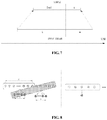
- FIG. 7 is a diagram illustrating an operation process of the UC K-sample method when the sample size is incremented by one;
- FIG. 9 is a diagram illustrating an operation process of the UC K-sample method according to an embodiment of the invention.
- FIG. 10 is a flowchart illustrating a variable-size sampling method under a streaming environment according to an embodiment of the invention.
- FIG. 11 illustrates a UC K-sample algorithm according to an embodiment of the invention.
- the present invention relates to a variable-size sampling method for supporting high uniformity confidence (UC) under a data-streaming environment.
- variable-size sampling method under a data-streaming environment is performed by a terminal device such as a computer, or a control unit or processor that comprehensively controls the terminal device such as a computer. That is, the variable-size sampling method under a data-streaming environment according to the invention refers to an algorithm as a sort of software, and the software algorithm may be executed by a control unit or a processor of a terminal device such as a computer.
- variable-size sampling method under a data-streaming environment may be implemented by a control unit that comprehensively controls a computer or a central processing unit (CPU) that processes or control command signals and a series of programs. That is, the variable-size sampling method under a data-streaming environment according to the invention may be implemented as an algorithm or logics as a sort of software, and the software algorithm may be executed by a control unit or a central processing unit of a computer.
- p ( ⁇ [0, 1]) denotes a sampling fraction
- P % denotes the sampling fraction expressed as a percentage of “p ⁇ 100”.
- the K-sample method has two problems relating to the uniformity confidence reduction.
- the initial uniformity confidence reduction problem in which the uniformity confidence remarkably decreases at the initial stage of the K-sample method is caused by the following two reasons.
- the initial uniformity confidence reduction problem occurs because a range of the data stream selectable for a particular slot is restrictive.
- the sample size is dynamically incremented by one in order to maintain the sampling fraction for the data stream while the sample size is smaller than P % of the data stream.
- a range of the data stream that can be stored in each slot is restricted.
- sample extraction ranges of each slot are set as follows. Specifically, the sample extraction range of the first slot includes data ⁇ circle around (1) ⁇ to ⁇ circle around (3) ⁇ , the sample extraction range of the second slot includes data ⁇ circle around (4) ⁇ to ⁇ circle around (6) ⁇ , and the sample extraction range of the third slot includes data ⁇ circle around (7) ⁇ to ⁇ circle around (9) ⁇ . That is, the sample extraction ranges are restricted.
- the sampling schema can be expressed as illustrated in FIG. 4B .
- This data range is significantly shorter than the “number of different samples of the same size possible statistically”. Therefore, the uniformity confidence is maintained at 100% when the sample size is set to “1”. However, if the sample size increases to “2” or larger, the uniformity confidence remarkably decreases at the initial stage of the sampling due to the sample range restriction.
- a second reason of the initial uniformity confidence reduction is that the data selected as a sample are transferred to the secondary storage and do not change.
- the stream data included in the extraction range of the sample slot compete with each other for selection as a sample of the corresponding slot. However, if the range of the data stream selectable as a particular slot is finished, and a new slot is generated, the data selected as a sample in the corresponding slot are transferred to the secondary storage, and it is difficult to change the data.
- Sample range restriction since the range of the stream data selectable for a particular sample slot is restricted, the uniformity confidence decreases.
- Unchangeable past sample if the range of the stream data selectable for a particular sample slot is finished, the data selected as the sample do not change, so that uniformity confidence decreases.
- the steady uniformity confidence reduction occurs because an increase of the number of possible samples generable in the K-sample method is smaller than an increase of “the number of different samples of the same size possible statistically”.
- a population size also increases.
- it is difficult to include all of the input streams in the sample extraction range because of a memory loss and a sample range restriction. Therefore, a ratio between “the number of different samples of the same size possible statistically” and the number of possible samples generable in the K-sample method steadily decreases.
- the reason of the steady uniformity confidence reduction problem may be described specifically as follows.
- Increase of sample extraction range since an increase of the number of possible samples generable in the K-sample method is smaller than an increase of “the number of different samples of the same size possible statistically”, a ratio between the former and latter numbers of possible samples gradually decreases.
- sample range expansion means that a range of the stream data extractable for a particular sample slot during the sampling is expanded to the elements of the sample already selected. If the population size considered during the sampling increases, the number of generable possible samples also increases. Therefore, the uniformity confidence increases.
- the first sample of the K-sample method includes data ⁇ circle around (1) ⁇ to ⁇ circle around (3) ⁇ , and the second sample includes data ⁇ circle around (4) ⁇ to ⁇ circle around (6) ⁇ , so that the sample extraction range is restricted.
- the element ⁇ circle around (1) ⁇ selected as the first sample is also included in the second sample extraction range, so that two samples are extracted from a new expanded sample extraction range including ⁇ circle around (1) ⁇ , ⁇ circle around (4) ⁇ , ⁇ circle around (5) ⁇ , and ⁇ circle around (6) ⁇ .
- a requirement for addressing the unchangeable past sample problem is called a “past sample change” scheme.
- the data already selected as a sample is changeable even after a data stream range that can be extracted as a particular element of the sample is finished. If the data not changeable as it has been already selected as a sample can be changed with another data, this means that the number of extractable possible samples increases. Therefore, the uniformity confidence can be improved by introducing the “past sample change” scheme.
- the element ⁇ circle around (1) ⁇ already selected in the first slot is transferred to the secondary storage and does not change.
- the element ⁇ circle around (1) ⁇ selected in the first slot is not transferred to the secondary storage and remains in the main memory until a certain requirement is satisfied, so that it can be changed with another stream element.
- a requirement for addressing an increase of the sample extraction range that generates a steady uniformity confidence reduction problem includes use of a UC-based window.
- a window size by which the uniformity confidence of the sample can be maintained to be equal to or larger than a lower limitation ⁇ at all times is calculated. Then, the sampling is performed by dividing the input streams in the unit of this window size.
- the following Formula 2 shows a method of calculating such a window size.
- the method of calculating the maximum window size that satisfies the sampling fraction p and the uniformity confidence satisfying the lower limitation ⁇ can be expressed as the following Formula 2.
- ⁇ ⁇ ⁇ x max [ 0 , ( ⁇ kp ⁇ + 1 ) - m ) ⁇ kp ⁇ ⁇ ( k x ) ⁇ ( m ⁇ kp ⁇ + 1 - x ) ( k + m ⁇ kp ⁇ + 1 ) ⁇ 100 , [ Formula ⁇ ⁇ 2 ]
- ⁇ denotes a lower limitation of the uniformity confidence
- p denotes a sampling fraction
- k denotes an input stream size until the current time point
- m denotes a maximum input stream size allowable when the sample size is incremented by one.
- the Formula 2 can be proved as follows.
- FIG. 7 is a diagram illustrating an operation process of the UC K-sample method when the sample size is incremented by one. Specifically, in the UC K-sample method, the operation is made as illustrated in FIG. 7 when the sample size is incremented by one.
- the “number of different samples of the same size possible statistically” becomes “(k+m)
- the number of possible samples generable through the UC K-sample method can be expressed as follows.
- ⁇ x max [ 0 , ( ⁇ kp ⁇ + 1 ) - m ) ⁇ kp ⁇ ⁇ ( k x ) ⁇ ( m ⁇ kp ⁇ + 1 - x )
- the uniformity confidence of the UC K-sample method can be calculated on the basis of Formula 2. Since the uniformity confidence is required to be larger than the lower limitation at all times when the sample size increases, a sum of the maximum numbers “k” and “m” satisfying Formula 2 is set as the window size.
- FIG. 9 is a diagram illustrating an operation process of the UC K-sample method according to an embodiment of the invention.
- FIG. 10 is a flowchart illustrating a variable-size sampling method under a streaming environment according to an embodiment of the invention.
- variable-size sampling method under a streaming environment is performed as follows.
- a maximum window size satisfying the lower limitation ⁇ of the uniformity confidence defined by a user at all times is calculated (S 101 ).
- the sample size and the sampling fraction are inspected (S 111 ).
- the sample generated using the current window is stored in the secondary storage in order to maintain the uniformity confidence at the lower limitation or higher (S 107 ).
- a new window is generated (S 109 ).
- the new window is created in step S 109 in order to maintain the uniformity confidence at the lower limitation or higher.
- the sample size and the sampling fraction are inspected (S 111 ). That is, in order to maintain the sampling fraction for the data stream, it is checked whether the current sample size is equal to or larger than P % of the data stream whenever a data stream is input (S 111 ).
- a slot for increasing the sample size is additionally generated (S 113 ), and the sampling is performed (S 115 ).
- the sampling is directly performed without generating the slot (S 115 ).
- step S 113 is performed to increase the sample size by generating a single slot as a single element memory space added to the sample.
- Step S 115 is a course of sampling for the current slot. If a probability that the data stream element is selected for the slot is higher than a random value arbitrarily generated, this data stream is inserted into the slot and is replaced with the element stored in the existing slot.
- FIG. 11 illustrates an algorithm of the UC K-sample method according to an embodiment of the invention.
- a sampling fraction p, a stream, and a lower limitation ⁇ are input, and sampling starts using an empty sample reservoir.
- the maximum window size w satisfying the lower limitation of the uniformity confidence is calculated on the basis of Formula 2 (line 3 ).
- the sample generated until the current time point is stored in the secondary storage. Then, sampling starts again by generating a new window (lines 7 to 9 ).
- the sample size is incremented by one, and the currently incoming data is added to the sample along with the random number in order to maintain the sampling fraction for the data stream size (lines 11 to 13 ).
- the element having the smallest random number is removed, and the current data is inserted into the sample (lines 16 and 17 ). This process is repeated until the stream input operation is completed, or a user interrupts the sampling (lines 4 to 19 ).
- the uniformity confidence can serve as a criterion for determining sampling performance, and the UC K-sample can be used to remarkably improve the sampling performance under a streaming environment.
Landscapes
- Engineering & Computer Science (AREA)
- Physics & Mathematics (AREA)
- Theoretical Computer Science (AREA)
- General Physics & Mathematics (AREA)
- Data Mining & Analysis (AREA)
- General Engineering & Computer Science (AREA)
- Databases & Information Systems (AREA)
- Mathematical Optimization (AREA)
- Pure & Applied Mathematics (AREA)
- Mathematical Analysis (AREA)
- Mathematical Physics (AREA)
- Computational Mathematics (AREA)
- Computer Networks & Wireless Communication (AREA)
- Signal Processing (AREA)
- Algebra (AREA)
- Software Systems (AREA)
- Computational Linguistics (AREA)
- Probability & Statistics with Applications (AREA)
- Operations Research (AREA)
- Bioinformatics & Cheminformatics (AREA)
- Life Sciences & Earth Sciences (AREA)
- Bioinformatics & Computational Biology (AREA)
- Evolutionary Biology (AREA)
- Compression, Expansion, Code Conversion, And Decoders (AREA)
- Compression Or Coding Systems Of Tv Signals (AREA)
- Complex Calculations (AREA)
Abstract
Description
Claims (5)
Applications Claiming Priority (2)
| Application Number | Priority Date | Filing Date | Title |
|---|---|---|---|
| KR10-2017-0138480 | 2017-10-24 | ||
| KR1020170138480A KR101987687B1 (en) | 2017-10-24 | 2017-10-24 | Variable size sampling method for supporting uniformity confidence in data stream environment |
Publications (2)
| Publication Number | Publication Date |
|---|---|
| US20190124014A1 US20190124014A1 (en) | 2019-04-25 |
| US10673766B2 true US10673766B2 (en) | 2020-06-02 |
Family
ID=66171318
Family Applications (1)
| Application Number | Title | Priority Date | Filing Date |
|---|---|---|---|
| US15/955,400 Active 2038-08-23 US10673766B2 (en) | 2017-10-24 | 2018-04-17 | Variable-size sampling method for supporting uniformity confidence under data-streaming environment |
Country Status (2)
| Country | Link |
|---|---|
| US (1) | US10673766B2 (en) |
| KR (1) | KR101987687B1 (en) |
Citations (3)
| Publication number | Priority date | Publication date | Assignee | Title |
|---|---|---|---|---|
| US6542886B1 (en) * | 1999-03-15 | 2003-04-01 | Microsoft Corporation | Sampling over joins for database systems |
| KR100815866B1 (en) | 2007-01-25 | 2008-03-24 | 인하대학교 산학협력단 | Timestamp-Based Sampling Method of Data Streams |
| US8392381B2 (en) * | 2007-05-08 | 2013-03-05 | The University Of Vermont And State Agricultural College | Systems and methods for reservoir sampling of streaming data and stream joins |
Family Cites Families (3)
| Publication number | Priority date | Publication date | Assignee | Title |
|---|---|---|---|---|
| WO2003021477A2 (en) * | 2001-09-04 | 2003-03-13 | International Business Machines Corporation | A sampling approach for data mining of association rules |
| US7555399B1 (en) | 2007-04-23 | 2009-06-30 | Mitsubishi Electric Research Laboratories, Inc. | Method and system for detecting changes in sensor sample streams |
| KR101477649B1 (en) | 2013-10-08 | 2014-12-30 | 재단법인대구경북과학기술원 | Object detection device of using sampling and posterior probability, and the method thereof |
-
2017
- 2017-10-24 KR KR1020170138480A patent/KR101987687B1/en not_active Expired - Fee Related
-
2018
- 2018-04-17 US US15/955,400 patent/US10673766B2/en active Active
Patent Citations (3)
| Publication number | Priority date | Publication date | Assignee | Title |
|---|---|---|---|---|
| US6542886B1 (en) * | 1999-03-15 | 2003-04-01 | Microsoft Corporation | Sampling over joins for database systems |
| KR100815866B1 (en) | 2007-01-25 | 2008-03-24 | 인하대학교 산학협력단 | Timestamp-Based Sampling Method of Data Streams |
| US8392381B2 (en) * | 2007-05-08 | 2013-03-05 | The University Of Vermont And State Agricultural College | Systems and methods for reservoir sampling of streaming data and stream joins |
Also Published As
| Publication number | Publication date |
|---|---|
| KR20190045651A (en) | 2019-05-03 |
| KR101987687B1 (en) | 2019-06-11 |
| US20190124014A1 (en) | 2019-04-25 |
Similar Documents
| Publication | Publication Date | Title |
|---|---|---|
| US11928601B2 (en) | Neural network compression | |
| KR101613626B1 (en) | Segmenting words using scaled probabilities | |
| KR101699720B1 (en) | Apparatus for voice command recognition and method thereof | |
| US9361307B2 (en) | Rejecting rows when scanning a collision chain that is associated with a page filter | |
| CN109657137B (en) | Public opinion news classification model construction method, device, computer equipment and storage medium | |
| US11232786B2 (en) | System and method to improve performance of a speech recognition system by measuring amount of confusion between words | |
| US6847976B1 (en) | Method and apparatus for significance testing and confidence interval construction based on user-specified distribution | |
| US20250299052A1 (en) | Large model-based text generation method, electronic device and storage medium | |
| CN108959237B (en) | Text classification method, device, medium and equipment | |
| CN107391363B (en) | Test resource scheduling method and device and electronic equipment | |
| CN111339166A (en) | Thesaurus-based matching recommendation method, electronic device and storage medium | |
| US8990069B1 (en) | Techniques for pruning phrase tables for statistical machine translation | |
| CN112183072A (en) | Text error correction method and device, electronic equipment and readable storage medium | |
| US20170140752A1 (en) | Voice recognition apparatus and voice recognition method | |
| US20190124014A1 (en) | Variable-size sampling method for supporting uniformity confidence under data-streaming environment | |
| US11411714B2 (en) | Apparatus and method for performing operation using approximation function | |
| CN111582456B (en) | Method, apparatus, device and medium for generating network model information | |
| US12626053B2 (en) | System, method, and computer program for user input fields auto-completion using machine learning model selection with dynamic threshold mechanism | |
| CN114428837B (en) | Content quality evaluation method, device, medium and electronic equipment | |
| US20150154175A1 (en) | Client/server-based statistical phrase distribution display and associated text entry technique | |
| CN111639096B (en) | SQL sentence execution method and device, electronic equipment and storage medium | |
| CN109190115B (en) | A text matching method, device, server and storage medium | |
| US20220335364A1 (en) | Personnel arrangement apparatus, and arrangement method, and program | |
| US20200334010A1 (en) | Method and apparatus for data alignment and computing device for executing data alignment | |
| US20250209268A1 (en) | Computer-implemented method for obtaining at least one number |
Legal Events
| Date | Code | Title | Description |
|---|---|---|---|
| AS | Assignment |
Owner name: KANGWON NATIONAL UNIVERSITY UNIVERSITY-INDUSTRY CO Free format text: ASSIGNMENT OF ASSIGNORS INTEREST;ASSIGNORS:KIM, HA JIN;GIL, MYEONG SEON;MOON, YANG SAE;REEL/FRAME:045971/0261 Effective date: 20180416 Owner name: KANGWON NATIONAL UNIVERSITY UNIVERSITY-INDUSTRY COOPERATION, KOREA, REPUBLIC OF Free format text: ASSIGNMENT OF ASSIGNORS INTEREST;ASSIGNORS:KIM, HA JIN;GIL, MYEONG SEON;MOON, YANG SAE;REEL/FRAME:045971/0261 Effective date: 20180416 |
|
| FEPP | Fee payment procedure |
Free format text: ENTITY STATUS SET TO UNDISCOUNTED (ORIGINAL EVENT CODE: BIG.); ENTITY STATUS OF PATENT OWNER: SMALL ENTITY |
|
| FEPP | Fee payment procedure |
Free format text: ENTITY STATUS SET TO SMALL (ORIGINAL EVENT CODE: SMAL); ENTITY STATUS OF PATENT OWNER: SMALL ENTITY |
|
| STPP | Information on status: patent application and granting procedure in general |
Free format text: DOCKETED NEW CASE - READY FOR EXAMINATION |
|
| STPP | Information on status: patent application and granting procedure in general |
Free format text: EX PARTE QUAYLE ACTION MAILED |
|
| STPP | Information on status: patent application and granting procedure in general |
Free format text: NOTICE OF ALLOWANCE MAILED -- APPLICATION RECEIVED IN OFFICE OF PUBLICATIONS |
|
| STPP | Information on status: patent application and granting procedure in general |
Free format text: PUBLICATIONS -- ISSUE FEE PAYMENT RECEIVED |
|
| STCF | Information on status: patent grant |
Free format text: PATENTED CASE |
|
| MAFP | Maintenance fee payment |
Free format text: PAYMENT OF MAINTENANCE FEE, 4TH YR, SMALL ENTITY (ORIGINAL EVENT CODE: M2551); ENTITY STATUS OF PATENT OWNER: SMALL ENTITY Year of fee payment: 4 |