US10668575B2 - Weld filler additive and method of welding - Google Patents
Weld filler additive and method of welding Download PDFInfo
- Publication number
- US10668575B2 US10668575B2 US15/449,298 US201715449298A US10668575B2 US 10668575 B2 US10668575 B2 US 10668575B2 US 201715449298 A US201715449298 A US 201715449298A US 10668575 B2 US10668575 B2 US 10668575B2
- Authority
- US
- United States
- Prior art keywords
- weld
- alloy
- weight
- filler additive
- hard
- Prior art date
- Legal status (The legal status is an assumption and is not a legal conclusion. Google has not performed a legal analysis and makes no representation as to the accuracy of the status listed.)
- Active, expires
Links
Images


Classifications
-
- B—PERFORMING OPERATIONS; TRANSPORTING
- B23—MACHINE TOOLS; METAL-WORKING NOT OTHERWISE PROVIDED FOR
- B23K—SOLDERING OR UNSOLDERING; WELDING; CLADDING OR PLATING BY SOLDERING OR WELDING; CUTTING BY APPLYING HEAT LOCALLY, e.g. FLAME CUTTING; WORKING BY LASER BEAM
- B23K35/00—Rods, electrodes, materials, or media, for use in soldering, welding, or cutting
- B23K35/22—Rods, electrodes, materials, or media, for use in soldering, welding, or cutting characterised by the composition or nature of the material
- B23K35/24—Selection of soldering or welding materials proper
- B23K35/30—Selection of soldering or welding materials proper with the principal constituent melting at less than 1550°C
- B23K35/3033—Ni as the principal constituent
- B23K35/304—Ni as the principal constituent with Cr as the next major constituent
-
- B—PERFORMING OPERATIONS; TRANSPORTING
- B23—MACHINE TOOLS; METAL-WORKING NOT OTHERWISE PROVIDED FOR
- B23K—SOLDERING OR UNSOLDERING; WELDING; CLADDING OR PLATING BY SOLDERING OR WELDING; CUTTING BY APPLYING HEAT LOCALLY, e.g. FLAME CUTTING; WORKING BY LASER BEAM
- B23K26/00—Working by laser beam, e.g. welding, cutting or boring
- B23K26/0006—Working by laser beam, e.g. welding, cutting or boring taking account of the properties of the material involved
-
- B—PERFORMING OPERATIONS; TRANSPORTING
- B23—MACHINE TOOLS; METAL-WORKING NOT OTHERWISE PROVIDED FOR
- B23K—SOLDERING OR UNSOLDERING; WELDING; CLADDING OR PLATING BY SOLDERING OR WELDING; CUTTING BY APPLYING HEAT LOCALLY, e.g. FLAME CUTTING; WORKING BY LASER BEAM
- B23K26/00—Working by laser beam, e.g. welding, cutting or boring
- B23K26/14—Working by laser beam, e.g. welding, cutting or boring using a fluid stream, e.g. a jet of gas, in conjunction with the laser beam; Nozzles therefor
- B23K26/144—Working by laser beam, e.g. welding, cutting or boring using a fluid stream, e.g. a jet of gas, in conjunction with the laser beam; Nozzles therefor the fluid stream containing particles, e.g. powder
-
- B—PERFORMING OPERATIONS; TRANSPORTING
- B23—MACHINE TOOLS; METAL-WORKING NOT OTHERWISE PROVIDED FOR
- B23K—SOLDERING OR UNSOLDERING; WELDING; CLADDING OR PLATING BY SOLDERING OR WELDING; CUTTING BY APPLYING HEAT LOCALLY, e.g. FLAME CUTTING; WORKING BY LASER BEAM
- B23K26/00—Working by laser beam, e.g. welding, cutting or boring
- B23K26/20—Bonding
- B23K26/21—Bonding by welding
- B23K26/211—Bonding by welding with interposition of special material to facilitate connection of the parts
-
- B—PERFORMING OPERATIONS; TRANSPORTING
- B23—MACHINE TOOLS; METAL-WORKING NOT OTHERWISE PROVIDED FOR
- B23K—SOLDERING OR UNSOLDERING; WELDING; CLADDING OR PLATING BY SOLDERING OR WELDING; CUTTING BY APPLYING HEAT LOCALLY, e.g. FLAME CUTTING; WORKING BY LASER BEAM
- B23K26/00—Working by laser beam, e.g. welding, cutting or boring
- B23K26/20—Bonding
- B23K26/21—Bonding by welding
- B23K26/24—Seam welding
- B23K26/242—Fillet welding, i.e. involving a weld of substantially triangular cross section joining two parts
-
- B—PERFORMING OPERATIONS; TRANSPORTING
- B23—MACHINE TOOLS; METAL-WORKING NOT OTHERWISE PROVIDED FOR
- B23K—SOLDERING OR UNSOLDERING; WELDING; CLADDING OR PLATING BY SOLDERING OR WELDING; CUTTING BY APPLYING HEAT LOCALLY, e.g. FLAME CUTTING; WORKING BY LASER BEAM
- B23K26/00—Working by laser beam, e.g. welding, cutting or boring
- B23K26/20—Bonding
- B23K26/21—Bonding by welding
- B23K26/24—Seam welding
- B23K26/26—Seam welding of rectilinear seams
-
- B—PERFORMING OPERATIONS; TRANSPORTING
- B23—MACHINE TOOLS; METAL-WORKING NOT OTHERWISE PROVIDED FOR
- B23K—SOLDERING OR UNSOLDERING; WELDING; CLADDING OR PLATING BY SOLDERING OR WELDING; CUTTING BY APPLYING HEAT LOCALLY, e.g. FLAME CUTTING; WORKING BY LASER BEAM
- B23K26/00—Working by laser beam, e.g. welding, cutting or boring
- B23K26/20—Bonding
- B23K26/32—Bonding taking account of the properties of the material involved
-
- B—PERFORMING OPERATIONS; TRANSPORTING
- B23—MACHINE TOOLS; METAL-WORKING NOT OTHERWISE PROVIDED FOR
- B23K—SOLDERING OR UNSOLDERING; WELDING; CLADDING OR PLATING BY SOLDERING OR WELDING; CUTTING BY APPLYING HEAT LOCALLY, e.g. FLAME CUTTING; WORKING BY LASER BEAM
- B23K26/00—Working by laser beam, e.g. welding, cutting or boring
- B23K26/34—Laser welding for purposes other than joining
-
- B—PERFORMING OPERATIONS; TRANSPORTING
- B23—MACHINE TOOLS; METAL-WORKING NOT OTHERWISE PROVIDED FOR
- B23K—SOLDERING OR UNSOLDERING; WELDING; CLADDING OR PLATING BY SOLDERING OR WELDING; CUTTING BY APPLYING HEAT LOCALLY, e.g. FLAME CUTTING; WORKING BY LASER BEAM
- B23K9/00—Arc welding or cutting
- B23K9/04—Welding for other purposes than joining, e.g. built-up welding
- B23K9/044—Built-up welding on three-dimensional surfaces
-
- B—PERFORMING OPERATIONS; TRANSPORTING
- B23—MACHINE TOOLS; METAL-WORKING NOT OTHERWISE PROVIDED FOR
- B23K—SOLDERING OR UNSOLDERING; WELDING; CLADDING OR PLATING BY SOLDERING OR WELDING; CUTTING BY APPLYING HEAT LOCALLY, e.g. FLAME CUTTING; WORKING BY LASER BEAM
- B23K9/00—Arc welding or cutting
- B23K9/16—Arc welding or cutting making use of shielding gas
- B23K9/167—Arc welding or cutting making use of shielding gas and of a non-consumable electrode
-
- B—PERFORMING OPERATIONS; TRANSPORTING
- B23—MACHINE TOOLS; METAL-WORKING NOT OTHERWISE PROVIDED FOR
- B23K—SOLDERING OR UNSOLDERING; WELDING; CLADDING OR PLATING BY SOLDERING OR WELDING; CUTTING BY APPLYING HEAT LOCALLY, e.g. FLAME CUTTING; WORKING BY LASER BEAM
- B23K9/00—Arc welding or cutting
- B23K9/16—Arc welding or cutting making use of shielding gas
- B23K9/173—Arc welding or cutting making use of shielding gas and of a consumable electrode
-
- B—PERFORMING OPERATIONS; TRANSPORTING
- B23—MACHINE TOOLS; METAL-WORKING NOT OTHERWISE PROVIDED FOR
- B23K—SOLDERING OR UNSOLDERING; WELDING; CLADDING OR PLATING BY SOLDERING OR WELDING; CUTTING BY APPLYING HEAT LOCALLY, e.g. FLAME CUTTING; WORKING BY LASER BEAM
- B23K9/00—Arc welding or cutting
- B23K9/23—Arc welding or cutting taking account of the properties of the materials to be welded
-
- C—CHEMISTRY; METALLURGY
- C22—METALLURGY; FERROUS OR NON-FERROUS ALLOYS; TREATMENT OF ALLOYS OR NON-FERROUS METALS
- C22C—ALLOYS
- C22C19/00—Alloys based on nickel or cobalt
- C22C19/03—Alloys based on nickel or cobalt based on nickel
- C22C19/05—Alloys based on nickel or cobalt based on nickel with chromium
- C22C19/051—Alloys based on nickel or cobalt based on nickel with chromium and Mo or W
- C22C19/055—Alloys based on nickel or cobalt based on nickel with chromium and Mo or W with the maximum Cr content being at least 20% but less than 30%
-
- B—PERFORMING OPERATIONS; TRANSPORTING
- B23—MACHINE TOOLS; METAL-WORKING NOT OTHERWISE PROVIDED FOR
- B23K—SOLDERING OR UNSOLDERING; WELDING; CLADDING OR PLATING BY SOLDERING OR WELDING; CUTTING BY APPLYING HEAT LOCALLY, e.g. FLAME CUTTING; WORKING BY LASER BEAM
- B23K2101/00—Articles made by soldering, welding or cutting
- B23K2101/001—Turbines
-
- B—PERFORMING OPERATIONS; TRANSPORTING
- B23—MACHINE TOOLS; METAL-WORKING NOT OTHERWISE PROVIDED FOR
- B23K—SOLDERING OR UNSOLDERING; WELDING; CLADDING OR PLATING BY SOLDERING OR WELDING; CUTTING BY APPLYING HEAT LOCALLY, e.g. FLAME CUTTING; WORKING BY LASER BEAM
- B23K2103/00—Materials to be soldered, welded or cut
- B23K2103/08—Non-ferrous metals or alloys
-
- B—PERFORMING OPERATIONS; TRANSPORTING
- B23—MACHINE TOOLS; METAL-WORKING NOT OTHERWISE PROVIDED FOR
- B23K—SOLDERING OR UNSOLDERING; WELDING; CLADDING OR PLATING BY SOLDERING OR WELDING; CUTTING BY APPLYING HEAT LOCALLY, e.g. FLAME CUTTING; WORKING BY LASER BEAM
- B23K2103/00—Materials to be soldered, welded or cut
- B23K2103/18—Dissimilar materials
- B23K2103/26—Alloys of Nickel and Cobalt and Chromium
-
- B23K2201/001—
-
- B23K2203/08—
Definitions
- the present invention is generally directed to a weld filler and a method of welding using a weld filler. More specifically, the present invention is directed to a nickel-based weld filler and a method of welding hard-to-weld alloy using a nickel-based weld filler.
- Gas turbines for power generation systems must satisfy the highest demands with respect to reliability, power, efficiency, economy, and operating service life.
- Modern high-efficiency combustion turbines have firing temperatures that exceed about 2,300° F. (1,260° C.), and firing temperatures continue to increase as demand for more efficient engines continues.
- Many components that form the combustor and “hot gas path” turbine sections are directly exposed to aggressive hot combustion gases.
- the use of coatings on turbine components such as combustors, combustion liners, combustion transition pieces, combustion hardware, blades (buckets), vanes (nozzles) and shrouds is important in commercial gas turbine engines.
- Rene 108 have been largely used in gas turbine industry due to their excellent mechanical properties, oxidization resistance and corrosion resistance. They, however, have poor weldability due to a tendency for liquation cracking and strain age cracking (SAC). Due to the poor weldability of Rene 108, weld filler materials have been usually selected to sacrifice mechanical properties to meet weldability requirements.
- a weld filler additive includes a sufficient amount of each of Co, Cr, Al, Ti, Mo, Fe, B, C, Nb, and Ni that forms an easy-to-weld target alloy when welded with a hard-to-weld base alloy having Ti less than or equal to 2% by weight and gamma prime is more than 60% in volume fraction.
- a method of welding a component includes the step of welding the component with a filler additive comprising a sufficient amount of each of Co, Cr, Al, Ti, Mo, Fe, B, C, Nb, and Ni, the component including a hard-to-weld base alloy having Ti less than or equal to 2% by weight and gamma prime is more than 60% in volume fraction.
- the method further includes the step of forming an easy-to-weld target alloy on a surface of the component from the welding.
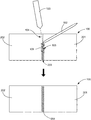
- FIG. 1 illustrates a method, according to an exemplary embodiment of the present disclosure.
- FIG. 2 illustrates a method, according to an alternate embodiment of the present disclosure.
- hard-to-weld alloy (and its variations)”, as used herein, means an alloy, having Al %> ⁇ 1 ⁇ 2 Ti %+3, where Al % is weight percent of aluminum and Ti % is weight percent of titanium.
- buttering means a process of applying a weld filler additive to a hard-to-weld alloy to be transformed into an easy-to-weld alloy so that additional easy-to-weld or hard-to-weld alloy can be deposited onto the easy-to-weld alloy.
- Rene 108 refers to an alloy including a composition, by weight, of about 9.3-9.7% tungsten, about 9-10% cobalt, about 8.0-8.7% chromium, about 5.25-5.75% aluminum, about 2.80-3.30% of tantalum, about 0.6-0.9% titanium, about 0.4-0.6% molybdenum, about 0-0.2% of iron, about 0.01-0.02% of boron, about 0.07-0.10% of carbon and a balance of nickel.
- the present invention enables a fusion weld without a crack.
- a component 100 is provided.
- the component 100 includes a hard-to-weld base alloy 101 including a surface 107 and a treatment area 108 .
- the treatment area 108 may include a crack, defect, or area removed, machined, or otherwise prepared for treatment.
- the hard-to-weld base alloy 101 may have a plurality of treatment area 108 .
- An energy source 103 is placed to provide energy to melt a portion of filler additive 102 and a portion of the hard-to-weld base alloy 101 .
- a melted portion 105 of the filler additive 102 and the hard-to-weld base alloy 101 combines in a molten mix zone 109 , which solidifies to form a layer of easy-to-weld target alloy 106 to fill in the treatment area 108 .
- the treated component 100 is crack-free weld metal and has a mechanical property of the easy-to-weld target alloy 106 .
- the filler additive 102 may include a sufficient amount of each of Co, Cr, Al, Ti, Mo, Fe, B, C, Nb, and Ni that forms an easy-to-weld target alloy 106 , when welded with a hard-to-weld base alloy 101 having Ti less than or equal to 2% by weight and gamma prime is more than 60% in volume fraction.
- the hard-to-weld alloy 101 may include a composition, by weight, of about 9.3-9.7% tungsten, about 9-10% cobalt, about 8.0-8.7% chromium, about 5.25-5.75% aluminum, about 2.80-3.30% of tantalum, about 0.6-0.9% titanium, about 0.4-0.6% molybdenum, about 0-0.2% of iron, about 0.01-0.02% of boron, about 0.07-0.10% of carbon and a balance of nickel.
- the easy-to-weld alloy 106 may include, by weight, of about 1.3-2.2% tungsten, about 18.5-19.5% cobalt, about 20.5-22.8% chromium, about 1.6-2.65% aluminum, about 0.95-2.4% titanium, about 0.9-1.5% molybdenum, about 0.35% of iron, about 0.002-0.01% of boron, about 0.9-0.15% carbon, about 1.25-4.75% niobium and a balance of nickel.
- the filler additive 102 may include cobalt, by weight, about 20-26%, about 21-25%, about 22-24%, or about 23%, including increments, intervals, and sub-range therein.
- the filler additive 102 may include chromium, by weight, about 20-30%, about 22-28%, about 24-26%, or about 25%, including increments, intervals, and sub-range therein.
- the filler additive 102 may include aluminum, by weight, about 0-1.6%, about 0.2-1.4%, about 0.4-1.2%, about 0.6-1.0%, or about 0.8%, including increments, intervals, and sub-range therein.
- the filler additive 102 may include titanium, by weight, about 0.5-3.5%, about 1.0-3.0%, about 1.5-2.5%, or about 2%, including increments, intervals, and sub-range therein.
- the filler additive 102 may include molybdenum, by weight, about 0-2.0%, about 0.5-1.5%, or about 1%, including increments, intervals, and sub-range therein.
- the filler additive 102 may include iron, by weight, about 0.1-1.5%, about 0.25-1.25%, about 0.5-1.0%, or about 0.75%, including increments, intervals, and sub-range therein.
- the filler additive 102 may include boron, by weight, about 0-0.01%, or about 0.005%, including increments, intervals, and sub-range therein.
- the filler additive 102 may include carbon, by weight, about 0.01-0.15%, or about 0.005-0.01%, or about 0.01%, including increments, intervals, and sub-range therein.
- the filler additive 102 may include niobium, by weight, about 1.0-8.0%, about 2.0-7.0%, about 3.0-6.0%, or about 4.0-5.0%, including increments, intervals, and sub-range therein.
- the filler additive 102 may include a balance of nickel.
- the filler additive 102 may include a sufficient amount of each of Co, Cr, Al, Ti, Mo, Fe, B, C, Nb, and Ni that forms an easy-to-weld target alloy 106 comprising, by weight, about 20-26% of cobalt, about 20-30% of chromium, 0-1.6% of aluminum, about 0.5-3.5% of titanium, about 0-2.0% of molybdenum, about 0.1-1.5% of iron, about 0-0.01% of boron, about 0.01-0.15% of carbon, about 1.0-4.0% of niobium, and a balance of nickel.
- the filler additive 102 may include a sufficient amount of each of Co, Cr, Al, Ti, Mo, Fe, B,C, Nb, and Ni that forms an easy-to-weld target alloy 106 comprising, by weight, about 20-26% of cobalt, about 20-30% of chromium, 0-1.6% of aluminum, about 0.5-3.5% of titanium, about 0-2.0% of molybdenum, about 0.1-1.5% of iron, about 0-0.01% of boron, about 0.01-0.15% of carbon, about 4.0-8.0% of niobium, and a balance of nickel.
- the filler additive 102 may include a composition, by weight, about 20-26% of cobalt, about 20-30% of chromium, 0-1.6% of aluminum, about 0.5-3.5% of titanium, about 0-2.0% of molybdenum, about 0.1-1.5% of iron, about 0-0.01% of boron, about 0.01-0.15% of carbon, about 1.0-4.0% of niobium, and a balance of nickel.
- the filler additive 102 may include a composition, by weight, about 20-26% of cobalt, about 20-30% of chromium, 0-1.6% of aluminum, about 0.5-3.5% of titanium, about 0-2.0% of molybdenum, about 0.1-1.5% of iron, about 0-0.01% of boron, about 0.01-0.15% of carbon, about 4.0-8.0% of niobium, and a balance of nickel.
- the filler additive 102 may include a composition, by weight, of about 22.57-23.57% of cobalt, about 28.29-28.84% of chromium, 0.04-0.11% of aluminum, about 2.89-3.04% of titanium, about 0.04% of molybdenum, about 0.41-0.50% of iron, about 0.08-0.13% of carbon, about 1.79-2.07% of niobium, and a balance of nickel.
- the filler additive 102 may include a composition, by weight, of about 22.57-23.57% of cobalt, about 25.86-26.41% of chromium, 1.32-1.39% of aluminum, about 1.10-1.11% of titanium, about 1.11-1.31% of molybdenum, about 0.41-0.50% of iron, about 0-0.01% boron, about 0.05-0.10% of carbon, about 6.64-6.79% of niobium, and a balance of nickel.
- the filler additive 102 is a nickel-based alloy.
- the filler additive 102 may be fabricated into a powder, stick, wire, rod or combinations thereof.
- the hard-to-weld base alloy 101 may include a composition, by weight, of about 9.3-9.7% tungsten, about 9-10% cobalt, about 8.0-8.7% chromium, about 5.25-5.75% aluminum, about 2.80-3.30% of tantalum, about 0.6-0.9% titanium, about 0.4-0.6% molybdenum, about 0-0.2% of iron, about 0.01-0.02% of boron, about 0.07-0.10% of carbon and a balance of nickel.
- the hard-to-weld base alloy 101 may be Rene 108.
- the easy-to-weld target alloy 106 may include, by weight, about 1.8-2.2% tungsten, about 18.5-19.5% cobalt, about 22.2-22.8% chromium, about 1.6-1.8% aluminum, about 2.2-2.4% titanium, about 0.15% molybdenum, about 0.35% of iron, about 0.002-0.008% of boron, about 0.08-0.12% carbon, about 1.25-1.45% niobium and a balance of nickel.
- the easy-to-weld target alloy 106 may include, by weight, about 1.3-1.6% tungsten, about 18.5-19.5% cobalt, about 20.5-21.1% chromium, about 2.55-2.65% aluminum, about 0.95-1.05% titanium, about 0.9-1.1% of molybdenum, about 0.35% of iron, about 0-0.01% of boron, about 0.12-0.15% carbon, about 4.65-4.75% niobium and a balance of nickel.
- the component 100 includes a first hard-to-weld base alloy 201 and second hard-to-weld base alloy 202 .
- An energy source 103 is arranged to provide energy to melt a portion of filler additive 102 and a portion of the first hard-to-weld base alloy 201 and the second hard-to-weld base alloy 202 .
- a melted portion 105 from the molten mix zone 109 of the filler additive 102 and the hard-to-weld base alloys 201 and 202 forms a layer of target alloy 204 to form a fusion line 203 between the hard-to-weld base alloys 201 and 202 .
- the treated component 100 is crack-free weld metal.
- the first hard-to-weld base alloy 201 may include a material that is the same as a material of the second hard-to-weld base alloy 202 .
- the base alloy includes a material that is dissimilar from a material of the second hard-to-weld base alloy 202 .
- the hard-to-weld base alloys 201 and 202 may be Rene 108.
- a method includes the step of welding the component with a filler additive comprising a sufficient amount of each of Co, Cr, Al, Ti, Mo, Fe, B, C, Nb, and Ni, the component including a hard-to-weld base alloy.
- the method further includes the step of forming an easy-to-weld target alloy on a surface of the component from the welding.
- the filler additive may be fusion welded with the hard-to-weld base alloy to form the easy-to-weld target alloy.
- the easy-to-weld target alloy may be welded with the hard-to-weld base alloy and the filler additive using a gas tungsten arc welding process or a laser welding process plus additive powder or filler.
- the method further includes the step of applying an alloy to the surface to fill the weld groove and finish welding process, wherein the alloy is selected from the group consisting of an additional target alloy, another filler additive, and combinations thereof.
- a weld filler additive is buttered to a base hard-to-weld alloy to create a layer of an easy-to-weld alloy so that additional hard-to-weld alloy can be welded onto the layer formed from the buttering with the filler additive to fill in a treatment area.
Landscapes
- Engineering & Computer Science (AREA)
- Physics & Mathematics (AREA)
- Mechanical Engineering (AREA)
- Optics & Photonics (AREA)
- Plasma & Fusion (AREA)
- Chemical & Material Sciences (AREA)
- Materials Engineering (AREA)
- Metallurgy (AREA)
- Organic Chemistry (AREA)
- Arc Welding In General (AREA)
- Nonmetallic Welding Materials (AREA)
Abstract
Description
Claims (19)
Priority Applications (1)
| Application Number | Priority Date | Filing Date | Title |
|---|---|---|---|
| US15/449,298 US10668575B2 (en) | 2017-03-03 | 2017-03-03 | Weld filler additive and method of welding |
Applications Claiming Priority (1)
| Application Number | Priority Date | Filing Date | Title |
|---|---|---|---|
| US15/449,298 US10668575B2 (en) | 2017-03-03 | 2017-03-03 | Weld filler additive and method of welding |
Publications (2)
| Publication Number | Publication Date |
|---|---|
| US20180250777A1 US20180250777A1 (en) | 2018-09-06 |
| US10668575B2 true US10668575B2 (en) | 2020-06-02 |
Family
ID=63357067
Family Applications (1)
| Application Number | Title | Priority Date | Filing Date |
|---|---|---|---|
| US15/449,298 Active 2038-04-09 US10668575B2 (en) | 2017-03-03 | 2017-03-03 | Weld filler additive and method of welding |
Country Status (1)
| Country | Link |
|---|---|
| US (1) | US10668575B2 (en) |
Families Citing this family (2)
| Publication number | Priority date | Publication date | Assignee | Title |
|---|---|---|---|---|
| US10625361B2 (en) * | 2017-06-14 | 2020-04-21 | General Electric Company | Method of welding superalloys |
| CN110052710A (en) * | 2019-03-27 | 2019-07-26 | 江苏集萃先进金属材料研究所有限公司 | A kind of aluminium alloy laser welding method |
Citations (5)
| Publication number | Priority date | Publication date | Assignee | Title |
|---|---|---|---|---|
| US6084196A (en) * | 1998-02-25 | 2000-07-04 | General Electric Company | Elevated-temperature, plasma-transferred arc welding of nickel-base superalloy articles |
| US20110142712A1 (en) * | 2008-03-03 | 2011-06-16 | Magnus Hasselqvist | Nickel base gamma prime strengthened superalloy |
| US20150344994A1 (en) * | 2014-05-28 | 2015-12-03 | Alstom Technology Ltd | Gamma prime precipitation strengthened nickel-base superalloy for use in powder based additive manufacturing process |
| US20160326613A1 (en) * | 2015-05-07 | 2016-11-10 | General Electric Company | Article and method for forming an article |
| US20170314114A1 (en) * | 2016-04-28 | 2017-11-02 | Siemens Energy, Inc. | Process and product for forming gamma prime precipitation strengthened superalloys |
-
2017
- 2017-03-03 US US15/449,298 patent/US10668575B2/en active Active
Patent Citations (5)
| Publication number | Priority date | Publication date | Assignee | Title |
|---|---|---|---|---|
| US6084196A (en) * | 1998-02-25 | 2000-07-04 | General Electric Company | Elevated-temperature, plasma-transferred arc welding of nickel-base superalloy articles |
| US20110142712A1 (en) * | 2008-03-03 | 2011-06-16 | Magnus Hasselqvist | Nickel base gamma prime strengthened superalloy |
| US20150344994A1 (en) * | 2014-05-28 | 2015-12-03 | Alstom Technology Ltd | Gamma prime precipitation strengthened nickel-base superalloy for use in powder based additive manufacturing process |
| US20160326613A1 (en) * | 2015-05-07 | 2016-11-10 | General Electric Company | Article and method for forming an article |
| US20170314114A1 (en) * | 2016-04-28 | 2017-11-02 | Siemens Energy, Inc. | Process and product for forming gamma prime precipitation strengthened superalloys |
Also Published As
| Publication number | Publication date |
|---|---|
| US20180250777A1 (en) | 2018-09-06 |
Similar Documents
| Publication | Publication Date | Title |
|---|---|---|
| EP3369521B1 (en) | Weld filler additive and method of welding | |
| JP5742447B2 (en) | High hardness overlaying alloy powder | |
| Ojo et al. | Effect of gap size and process parameters on diffusion brazing of Inconel 738 | |
| US6702906B2 (en) | Ni-base heat resistant alloy and welded joint thereof | |
| US6811379B2 (en) | Tip material for a turbine blade and method of manufacturing or repairing a tip of a turbine blade | |
| US9604432B2 (en) | Coating structure material | |
| WO1997038144A1 (en) | Improved superalloys with improved oxidation resistance and weldability | |
| KR20010039978A (en) | Superalloy weld composition and repaired turbine engine component | |
| US11384414B2 (en) | Nickel-based superalloys | |
| JP5537587B2 (en) | Ni-base alloy welding material and welding wire, welding rod and welding powder using the same | |
| US12428705B2 (en) | Nickel-based alloy, powder, method and component | |
| US9802278B2 (en) | Low melting point braze alloy for high temperature applications | |
| US8524149B2 (en) | Nickel base wrought alloy | |
| US10668575B2 (en) | Weld filler additive and method of welding | |
| WO2022251781A2 (en) | A nickel based superalloy weld filler | |
| US10828732B2 (en) | Treated turbine diaphragm and method for treating a turbine diaphragm | |
| US20130270325A1 (en) | Nickel-based solder alloy | |
| US20140099516A1 (en) | Brazed articles and methods of making the same | |
| US10786878B2 (en) | Method of welding with buttering | |
| JP2010084167A (en) | Nickel-based alloy and high-temperature member for turbine using the same | |
| US10675686B2 (en) | Hybrid component with multiple cores and method for treating a component | |
| EP4275814B1 (en) | Cobalt-based alloy for additive manufacturing | |
| US20050031482A1 (en) | Alloys for high temperature applications, articles made therefrom, and method for repair of articles | |
| Stephenson | Paper 10: Cast High Temperature Materials |
Legal Events
| Date | Code | Title | Description |
|---|---|---|---|
| AS | Assignment |
Owner name: GENERAL ELECTRIC COMPANY, NEW YORK Free format text: ASSIGNMENT OF ASSIGNORS INTEREST;ASSIGNORS:CUI, YAN;EMINOGLU, CEM;VAN TASSEL, BRAD;AND OTHERS;REEL/FRAME:041462/0686 Effective date: 20170227 |
|
| STPP | Information on status: patent application and granting procedure in general |
Free format text: NON FINAL ACTION MAILED |
|
| STPP | Information on status: patent application and granting procedure in general |
Free format text: RESPONSE TO NON-FINAL OFFICE ACTION ENTERED AND FORWARDED TO EXAMINER |
|
| STPP | Information on status: patent application and granting procedure in general |
Free format text: NON FINAL ACTION MAILED |
|
| STPP | Information on status: patent application and granting procedure in general |
Free format text: RESPONSE TO NON-FINAL OFFICE ACTION ENTERED AND FORWARDED TO EXAMINER |
|
| STPP | Information on status: patent application and granting procedure in general |
Free format text: FINAL REJECTION MAILED |
|
| STPP | Information on status: patent application and granting procedure in general |
Free format text: NOTICE OF ALLOWANCE MAILED -- APPLICATION RECEIVED IN OFFICE OF PUBLICATIONS |
|
| STPP | Information on status: patent application and granting procedure in general |
Free format text: PUBLICATIONS -- ISSUE FEE PAYMENT VERIFIED |
|
| STCF | Information on status: patent grant |
Free format text: PATENTED CASE |
|
| AS | Assignment |
Owner name: GE INFRASTRUCTURE TECHNOLOGY LLC, SOUTH CAROLINA Free format text: ASSIGNMENT OF ASSIGNORS INTEREST;ASSIGNOR:GENERAL ELECTRIC COMPANY;REEL/FRAME:065727/0001 Effective date: 20231110 |
|
| MAFP | Maintenance fee payment |
Free format text: PAYMENT OF MAINTENANCE FEE, 4TH YEAR, LARGE ENTITY (ORIGINAL EVENT CODE: M1551); ENTITY STATUS OF PATENT OWNER: LARGE ENTITY Year of fee payment: 4 |