US10660969B2 - Eight-arm polyethylene glycol derivative, production method therefor, and modified bio-related substance thereof - Google Patents
Eight-arm polyethylene glycol derivative, production method therefor, and modified bio-related substance thereof Download PDFInfo
- Publication number
- US10660969B2 US10660969B2 US16/527,368 US201916527368A US10660969B2 US 10660969 B2 US10660969 B2 US 10660969B2 US 201916527368 A US201916527368 A US 201916527368A US 10660969 B2 US10660969 B2 US 10660969B2
- Authority
- US
- United States
- Prior art keywords
- group
- linkage
- bond
- groups
- bio
- Prior art date
- Legal status (The legal status is an assumption and is not a legal conclusion. Google has not performed a legal analysis and makes no representation as to the accuracy of the status listed.)
- Active
Links
- 0 CCC(C)*(C(C)C*1*)[U]11*(C(C)CC*)C(C)C(C)*1C Chemical compound CCC(C)*(C(C)C*1*)[U]11*(C(C)CC*)C(C)C(C)*1C 0.000 description 44
- BIBHNAJLMRUJLS-UHFFFAOYSA-N CC(C)CC(CC(C)C)C(C)C Chemical compound CC(C)CC(CC(C)C)C(C)C BIBHNAJLMRUJLS-UHFFFAOYSA-N 0.000 description 13
- MXBMNDJBQIIHOL-UHFFFAOYSA-N CC(C)CC(CC(C)C)OC(C)C Chemical compound CC(C)CC(CC(C)C)OC(C)C MXBMNDJBQIIHOL-UHFFFAOYSA-N 0.000 description 8
- MHEYOIHQRVRISL-UHFFFAOYSA-N CC(C)CC(COC(C)C)OC(C)C Chemical compound CC(C)CC(COC(C)C)OC(C)C MHEYOIHQRVRISL-UHFFFAOYSA-N 0.000 description 6
- RPMLQZSPQXSYKB-UHFFFAOYSA-N CC(C)C(C(C)C)[U](C(C(C)C)C(C)C)(C(C(C)C)C(C)C)C(C(C)C)C(C)C Chemical compound CC(C)C(C(C)C)[U](C(C(C)C)C(C)C)(C(C(C)C)C(C)C)C(C(C)C)C(C)C RPMLQZSPQXSYKB-UHFFFAOYSA-N 0.000 description 5
- FAEHRZXERPYSAY-UHFFFAOYSA-N C.C.C.C.C.C.C.C.C.C.C.C.C.C.C.C.C.C.C.CC(C)OCCOCC(COCCOC(C)C)[U](C(COCCOC(C)C)COCCOC(C)C)(C(COCCOC(C)C)COCCOC(C)C)C(COCCOC(C)C)COCCOC(C)C.CCCC Chemical compound C.C.C.C.C.C.C.C.C.C.C.C.C.C.C.C.C.C.C.CC(C)OCCOCC(COCCOC(C)C)[U](C(COCCOC(C)C)COCCOC(C)C)(C(COCCOC(C)C)COCCOC(C)C)C(COCCOC(C)C)COCCOC(C)C.CCCC FAEHRZXERPYSAY-UHFFFAOYSA-N 0.000 description 4
- VGOKKUOGGCCGQX-UHFFFAOYSA-N CC(C)C(C)CN(CC(C)C(C)C)C(C)C.CC(C)CC(C)(CC(C)C)OC(C)C.CC(C)CC(C)(CC(C)C)OC(C)C.CC(C)CC(C)(COC(C)C)C(C)C.CC(C)CC(CC(C)C)OC(C)C.CC(C)CC(CC(C)C)SC(C)C.CC(C)CC(COC(C)C)C(C)C.CC(C)CC(CSC(C)C)C(C)C.CC(C)CCN(CCC(C)C)C(C)C.CC(C)CCSCC(COC(C)C)SCCC(C)C.CC(C)CN(CC(C)C)C(C)C.CCC(COC(C)C)(CC(C)C)C(C)C.CCC(COC(C)C)(CC(C)C)CC(C)C Chemical compound CC(C)C(C)CN(CC(C)C(C)C)C(C)C.CC(C)CC(C)(CC(C)C)OC(C)C.CC(C)CC(C)(CC(C)C)OC(C)C.CC(C)CC(C)(COC(C)C)C(C)C.CC(C)CC(CC(C)C)OC(C)C.CC(C)CC(CC(C)C)SC(C)C.CC(C)CC(COC(C)C)C(C)C.CC(C)CC(CSC(C)C)C(C)C.CC(C)CCN(CCC(C)C)C(C)C.CC(C)CCSCC(COC(C)C)SCCC(C)C.CC(C)CN(CC(C)C)C(C)C.CCC(COC(C)C)(CC(C)C)C(C)C.CCC(COC(C)C)(CC(C)C)CC(C)C VGOKKUOGGCCGQX-UHFFFAOYSA-N 0.000 description 4
- SYVDJRFFSYWOPC-UHFFFAOYSA-N CC(C)CC(CC(C)C)OC(CC(C)C)CC(C)C Chemical compound CC(C)CC(CC(C)C)OC(CC(C)C)CC(C)C SYVDJRFFSYWOPC-UHFFFAOYSA-N 0.000 description 4
- STVSDXQWBRGPMG-UHFFFAOYSA-N CC(C)C.CC(C)CC(CC(C)C)[U](C(CC(C)C)CC(C)C)(C(CC(C)C)CC(C)C)C(CC(C)C)CC(C)C.CC(C)OCCOCC(COCCO)[U](C(COCCOC(C)C)COCCOC(C)C)(C(COCCOC(C)C)COCCOC(C)C)C(COCCOC(C)C)COCCOC(C)C.CCCC(CCC)(CCC)(CCC)(CCC)(CCC)(CCC)CCC Chemical compound CC(C)C.CC(C)CC(CC(C)C)[U](C(CC(C)C)CC(C)C)(C(CC(C)C)CC(C)C)C(CC(C)C)CC(C)C.CC(C)OCCOCC(COCCO)[U](C(COCCOC(C)C)COCCOC(C)C)(C(COCCOC(C)C)COCCOC(C)C)C(COCCOC(C)C)COCCOC(C)C.CCCC(CCC)(CCC)(CCC)(CCC)(CCC)(CCC)CCC STVSDXQWBRGPMG-UHFFFAOYSA-N 0.000 description 3
- FOBSULQICVMZBJ-UHFFFAOYSA-N CC(C)OCC(COC(C)C)OC(COC(C)C)COC(C)C Chemical compound CC(C)OCC(COC(C)C)OC(COC(C)C)COC(C)C FOBSULQICVMZBJ-UHFFFAOYSA-N 0.000 description 3
- MXBBMCQRVHLPMH-UHFFFAOYSA-N CC(C)OCC(OC(C)C)C(COC(C)C)OC(C)C Chemical compound CC(C)OCC(OC(C)C)C(COC(C)C)OC(C)C MXBBMCQRVHLPMH-UHFFFAOYSA-N 0.000 description 3
- XKRFYHLGVUSROY-UHFFFAOYSA-N [Ar] Chemical compound [Ar] XKRFYHLGVUSROY-UHFFFAOYSA-N 0.000 description 3
- SXIMNZWXOYRYOQ-UHFFFAOYSA-N *.CC(C)C(=O)CC(CC(=O)C(C)C)C(C)C.CC(C)CC(C)(CC(C)C)C(=O)C(C)C.CC(C)CC(CC(C)C)C(C1=CC=CC=C1)C(C)C.CC(C)CC(COC(C)C)C(OC(C)C)C1=CC=CC=C1.CC(C)CC(CSC(C)C)C(C)C.CC(C)CC(CSC(C)C)SC(C)C.CC(C)CCC(CC(C)C)NC(C)C.CC(C)CCN(CCC(C)C)C(=O)C(C)C.CC(C)CCN(CCC(C)C)CC(=O)C(C)C.CC(C)NCC(COC(C)C)OC(C)C.CC(C)OC(CC(=O)C(C)C)C(=O)C(C)C.CC(C)OCC(C)(C)C(OC(C)C)C(=O)C(C)C.CC(C)OCC(CSC(C)C)OC(C)C.CC(C)OCC(CSC(C)C)SC(C)C.CC(C)SC(CC(=O)C(C)C)C(=O)C(C)C Chemical compound *.CC(C)C(=O)CC(CC(=O)C(C)C)C(C)C.CC(C)CC(C)(CC(C)C)C(=O)C(C)C.CC(C)CC(CC(C)C)C(C1=CC=CC=C1)C(C)C.CC(C)CC(COC(C)C)C(OC(C)C)C1=CC=CC=C1.CC(C)CC(CSC(C)C)C(C)C.CC(C)CC(CSC(C)C)SC(C)C.CC(C)CCC(CC(C)C)NC(C)C.CC(C)CCN(CCC(C)C)C(=O)C(C)C.CC(C)CCN(CCC(C)C)CC(=O)C(C)C.CC(C)NCC(COC(C)C)OC(C)C.CC(C)OC(CC(=O)C(C)C)C(=O)C(C)C.CC(C)OCC(C)(C)C(OC(C)C)C(=O)C(C)C.CC(C)OCC(CSC(C)C)OC(C)C.CC(C)OCC(CSC(C)C)SC(C)C.CC(C)SC(CC(=O)C(C)C)C(=O)C(C)C SXIMNZWXOYRYOQ-UHFFFAOYSA-N 0.000 description 2
- VNWKTOKETHGBQD-UHFFFAOYSA-N C Chemical compound C VNWKTOKETHGBQD-UHFFFAOYSA-N 0.000 description 2
- WUTBAUNBVDKTSB-UHFFFAOYSA-N C.C.C.C.C.C.C.C.C.C.C.C.C.C.C.C.CC(C)CC(C)(CC(C)C)OCCOOC(C)(CC(C)C)CC(C)C.CC(C)CC(C)(COCCOCC(C)(CC(C)C)C(C)C)C(C)C.CC(C)CC(CC(C)C)OCCOOC(CC(C)C)CC(C)C.CC(C)CC(COCCOCC(CC(C)C)C(C)C)C(C)C.CCC(CC(C)C)(CC(C)C)OCCOOC(CC)(CC(C)C)CC(C)C.CCC(COCCOCC(CC)(CC(C)C)C(C)C)(CC(C)C)C(C)C.CCC(COCCOOCC(CC)(CC(C)C)CC(C)C)(CC(C)C)CC(C)C.CCC(COCOCC(CC)(CC(C)C)CC(C)C)(CC(C)C)CC(C)C Chemical compound C.C.C.C.C.C.C.C.C.C.C.C.C.C.C.C.CC(C)CC(C)(CC(C)C)OCCOOC(C)(CC(C)C)CC(C)C.CC(C)CC(C)(COCCOCC(C)(CC(C)C)C(C)C)C(C)C.CC(C)CC(CC(C)C)OCCOOC(CC(C)C)CC(C)C.CC(C)CC(COCCOCC(CC(C)C)C(C)C)C(C)C.CCC(CC(C)C)(CC(C)C)OCCOOC(CC)(CC(C)C)CC(C)C.CCC(COCCOCC(CC)(CC(C)C)C(C)C)(CC(C)C)C(C)C.CCC(COCCOOCC(CC)(CC(C)C)CC(C)C)(CC(C)C)CC(C)C.CCC(COCOCC(CC)(CC(C)C)CC(C)C)(CC(C)C)CC(C)C WUTBAUNBVDKTSB-UHFFFAOYSA-N 0.000 description 2
- JYJIZYHAKMBJCU-UHFFFAOYSA-N C.C.C.C.CCCC Chemical compound C.C.C.C.CCCC JYJIZYHAKMBJCU-UHFFFAOYSA-N 0.000 description 2
- BBQPMGMYESZZPF-AXFPHJBVSA-N C.C.CC(C)C(C)C.[2HH].[2HH] Chemical compound C.C.CC(C)C(C)C.[2HH].[2HH] BBQPMGMYESZZPF-AXFPHJBVSA-N 0.000 description 2
- DEPFCNJJOZAWQM-UHFFFAOYSA-N C.C.CC(C)CCN(CCC(C)C)CN(CCC(C)C)CCC(C)C Chemical compound C.C.CC(C)CCN(CCC(C)C)CN(CCC(C)C)CCC(C)C DEPFCNJJOZAWQM-UHFFFAOYSA-N 0.000 description 2
- ZKBCAENOEIAEIP-UHFFFAOYSA-N C.C.OCC(O)CN(CC(O)CO)CN(CC(O)CO)CC(O)CO Chemical compound C.C.OCC(O)CN(CC(O)CO)CN(CC(O)CO)CC(O)CO ZKBCAENOEIAEIP-UHFFFAOYSA-N 0.000 description 2
- LKFZGWWWEZWIRY-UHFFFAOYSA-N CC(C)C(=O)CCC(=O)OCC(COC(=O)CCC(=O)C(C)C)C(C)C.CC(C)CC(CC(C)C)C(=O)C(C)C.CC(C)CC1=CC(C(C)C)=CC(C(C)C)=C1.CC(C)CCC(=O)N(CCOC(=O)COCC(=O)OCCCNC(=O)C(C)C)CCOC(=O)COCC(=O)OCCCNC(=O)C(C)C.CC(C)CCN(CCC(=O)C(C)C)CCC(=O)C(C)C.CC(C)CCNC(=O)CCN(CCC(=O)NCCC(C)C)CCC(C)C.CC(C)CCNCC(CNCCC(C)C)C(=O)C(C)C.CC(C)CCSCC(CSCCC(C)C)C(=O)C(C)C Chemical compound CC(C)C(=O)CCC(=O)OCC(COC(=O)CCC(=O)C(C)C)C(C)C.CC(C)CC(CC(C)C)C(=O)C(C)C.CC(C)CC1=CC(C(C)C)=CC(C(C)C)=C1.CC(C)CCC(=O)N(CCOC(=O)COCC(=O)OCCCNC(=O)C(C)C)CCOC(=O)COCC(=O)OCCCNC(=O)C(C)C.CC(C)CCN(CCC(=O)C(C)C)CCC(=O)C(C)C.CC(C)CCNC(=O)CCN(CCC(=O)NCCC(C)C)CCC(C)C.CC(C)CCNCC(CNCCC(C)C)C(=O)C(C)C.CC(C)CCSCC(CSCCC(C)C)C(=O)C(C)C LKFZGWWWEZWIRY-UHFFFAOYSA-N 0.000 description 2
- JCSFDNGRVQJLEL-UHFFFAOYSA-N CC(C)C(C)CN(CC(C)C(C)C)C(C)C.CC(C)CC(C)(CC(C)C)OC(C)C.CC(C)CC(C)(COC(C)C)C(C)C.CC(C)CC(CC(C)C)OC(C)C.CC(C)CC(CC(C)C)SC(C)C.CC(C)CC(COC(C)C)C(C)C.CC(C)CC(CSC(C)C)C(C)C.CC(C)CCN(CCC(C)C)C(C)C.CC(C)CCSCC(COC(C)C)SCCC(C)C.CC(C)CN(CC(C)C)C(C)C.CCC(CC(C)C)(CC(C)C)OC(C)C.CCC(COC(C)C)(CC(C)C)C(C)C.CCC(COC(C)C)(CC(C)C)CC(C)C Chemical compound CC(C)C(C)CN(CC(C)C(C)C)C(C)C.CC(C)CC(C)(CC(C)C)OC(C)C.CC(C)CC(C)(COC(C)C)C(C)C.CC(C)CC(CC(C)C)OC(C)C.CC(C)CC(CC(C)C)SC(C)C.CC(C)CC(COC(C)C)C(C)C.CC(C)CC(CSC(C)C)C(C)C.CC(C)CCN(CCC(C)C)C(C)C.CC(C)CCSCC(COC(C)C)SCCC(C)C.CC(C)CN(CC(C)C)C(C)C.CCC(CC(C)C)(CC(C)C)OC(C)C.CCC(COC(C)C)(CC(C)C)C(C)C.CCC(COC(C)C)(CC(C)C)CC(C)C JCSFDNGRVQJLEL-UHFFFAOYSA-N 0.000 description 2
- CYLFEAYBOAIULF-UHFFFAOYSA-N CC(C)CC(C(C)C)C(CC(C)C)C(C)C Chemical compound CC(C)CC(C(C)C)C(CC(C)C)C(C)C CYLFEAYBOAIULF-UHFFFAOYSA-N 0.000 description 2
- ZNYODQSMZLAUBH-UHFFFAOYSA-N CC(C)CC(C)(CC(C)C)C(C)C.CC(C)CC(C)(CC(C)C)C(C)C.CC(C)CC(C)(CC(C)C)C(C)C.CC(C)CC(CC(C)C)C(C)C.CC(C)CC(CC(C)C)C(C)C.CCC(CC(C)C)(CC(C)C)C(C)C.CCC(CC(C)C)(CC(C)C)CC(C)C Chemical compound CC(C)CC(C)(CC(C)C)C(C)C.CC(C)CC(C)(CC(C)C)C(C)C.CC(C)CC(C)(CC(C)C)C(C)C.CC(C)CC(CC(C)C)C(C)C.CC(C)CC(CC(C)C)C(C)C.CCC(CC(C)C)(CC(C)C)C(C)C.CCC(CC(C)C)(CC(C)C)CC(C)C ZNYODQSMZLAUBH-UHFFFAOYSA-N 0.000 description 2
- RYRQEJTXJPPMDY-UHFFFAOYSA-N CC(C)CC(C)(CC(C)C)C(C)C.CC(C)CC(C)(CC(C)C)C(C)C.CC(C)CC(CC(C)C)C(C)C.CC(C)CC(CC(C)C)C(C)C.CCC(CC(C)C)(CC(C)C)C(C)C.CCC(CC(C)C)(CC(C)C)C(C)C.CCC(CC(C)C)(CC(C)C)CC(C)C Chemical compound CC(C)CC(C)(CC(C)C)C(C)C.CC(C)CC(C)(CC(C)C)C(C)C.CC(C)CC(CC(C)C)C(C)C.CC(C)CC(CC(C)C)C(C)C.CCC(CC(C)C)(CC(C)C)C(C)C.CCC(CC(C)C)(CC(C)C)C(C)C.CCC(CC(C)C)(CC(C)C)CC(C)C RYRQEJTXJPPMDY-UHFFFAOYSA-N 0.000 description 2
- XKLLLRIRIWIXAC-UHFFFAOYSA-N CC(C)CC(CC(C)C)C(C)C.CC(C)CC(CC(C)C)C(C)C.CC(C)CCN(CCC(C)C)CCC(C)C Chemical compound CC(C)CC(CC(C)C)C(C)C.CC(C)CC(CC(C)C)C(C)C.CC(C)CCN(CCC(C)C)CCC(C)C XKLLLRIRIWIXAC-UHFFFAOYSA-N 0.000 description 2
- GSIVAXXRVNHCAX-UHFFFAOYSA-N CC(C)CC(CC(C)C)N1C=C(CCCCC2=CN(C(CC(C)C)CC(C)C)N=N2)N=N1 Chemical compound CC(C)CC(CC(C)C)N1C=C(CCCCC2=CN(C(CC(C)C)CC(C)C)N=N2)N=N1 GSIVAXXRVNHCAX-UHFFFAOYSA-N 0.000 description 2
- KZSNGVOZKQNVTI-UHFFFAOYSA-N CC(C)CC(CC(C)C)[U](C(CC(C)C)CC(C)C)(C(CC(C)C)CC(C)C)C(CC(C)C)CC(C)C Chemical compound CC(C)CC(CC(C)C)[U](C(CC(C)C)CC(C)C)(C(CC(C)C)CC(C)C)C(CC(C)C)CC(C)C KZSNGVOZKQNVTI-UHFFFAOYSA-N 0.000 description 2
- XLMXCMHZTAXEIL-UHFFFAOYSA-N CC(C)CC(COCC(CC(C)C)C(C)C)C(C)C Chemical compound CC(C)CC(COCC(CC(C)C)C(C)C)C(C)C XLMXCMHZTAXEIL-UHFFFAOYSA-N 0.000 description 2
- SSBPSICBPQGTKX-UHFFFAOYSA-N CC(C)CCN(CCC(C)C)C(C)C Chemical compound CC(C)CCN(CCC(C)C)C(C)C SSBPSICBPQGTKX-UHFFFAOYSA-N 0.000 description 2
- DYMBTPLKYDXSHG-UHFFFAOYSA-N CC(C)CCN(CCOCCN(CCC(C)C)CCC(C)C)CCC(C)C.CC(C)CCN1CCN(CCC(C)C)CCN(CCC(C)C)CCN(CCC(C)C)CC1.CC(C)CN1CCN(CC(C)C)CCN(CC(C)C)CCN(CC(C)C)CC1 Chemical compound CC(C)CCN(CCOCCN(CCC(C)C)CCC(C)C)CCC(C)C.CC(C)CCN1CCN(CCC(C)C)CCN(CCC(C)C)CCN(CCC(C)C)CC1.CC(C)CN1CCN(CC(C)C)CCN(CC(C)C)CCN(CC(C)C)CC1 DYMBTPLKYDXSHG-UHFFFAOYSA-N 0.000 description 2
- GKWTWIVDYGMTBR-UHFFFAOYSA-N CC(C)CCN1C(=O)C=CC1=O Chemical compound CC(C)CCN1C(=O)C=CC1=O GKWTWIVDYGMTBR-UHFFFAOYSA-N 0.000 description 2
- SPHYCDPWTQICJC-UHFFFAOYSA-N CC(C)CCN1C=C(CC(C)C)N=N1 Chemical compound CC(C)CCN1C=C(CC(C)C)N=N1 SPHYCDPWTQICJC-UHFFFAOYSA-N 0.000 description 2
- TVJJMOKZKXIDNY-UHFFFAOYSA-N CC(C)OCC(COCC(COC(C)C)OC(C)C)OC(C)C Chemical compound CC(C)OCC(COCC(COC(C)C)OC(C)C)OC(C)C TVJJMOKZKXIDNY-UHFFFAOYSA-N 0.000 description 2
- PNBAPEANGQXEMY-UHFFFAOYSA-N CC.CC.CC.CC.CC(C)C1=CC2=C(C=C1)C1=C(/C=C(C(C)C)\C=C/1)N2C(C)C.CC(C)OCC1C2=C(C=CC(C(C)C)=C2)C2=C1/C=C(C(C)C)\C=C/2.CC(C)OCCCOCCCCC(COCCCOC(C)C)OCCCOC(C)C.CC(C)SCCC(CCCCC(=O)C(C)C)SC(C)C Chemical compound CC.CC.CC.CC.CC(C)C1=CC2=C(C=C1)C1=C(/C=C(C(C)C)\C=C/1)N2C(C)C.CC(C)OCC1C2=C(C=CC(C(C)C)=C2)C2=C1/C=C(C(C)C)\C=C/2.CC(C)OCCCOCCCCC(COCCCOC(C)C)OCCCOC(C)C.CC(C)SCCC(CCCCC(=O)C(C)C)SC(C)C PNBAPEANGQXEMY-UHFFFAOYSA-N 0.000 description 2
- NSUFSIZSEMWGSS-UHFFFAOYSA-N CCC(C)CO[Si](C)(C)C(C)(C)C Chemical compound CCC(C)CO[Si](C)(C)C(C)(C)C NSUFSIZSEMWGSS-UHFFFAOYSA-N 0.000 description 2
- PCVHOFUIKLBSHW-UHFFFAOYSA-N CCC(COC(C)C)(COC(C)C)COC(C)C Chemical compound CCC(COC(C)C)(COC(C)C)COC(C)C PCVHOFUIKLBSHW-UHFFFAOYSA-N 0.000 description 2
- IIZXKNCMXSMENC-UHFFFAOYSA-N CCC(COCC(CC)(COC(C)C)COC(C)C)(COC(C)C)COC(C)C Chemical compound CCC(COCC(CC)(COC(C)C)COC(C)C)(COC(C)C)COC(C)C IIZXKNCMXSMENC-UHFFFAOYSA-N 0.000 description 2
- OIFAHDAXIUURLN-UHFFFAOYSA-N FCC1CO1 Chemical compound FCC1CO1 OIFAHDAXIUURLN-UHFFFAOYSA-N 0.000 description 2
- BWTZHJLPRXQXLH-UHFFFAOYSA-N *.*.*.*.*.*.*.*.*.*.*.*.*.*.*.*.*.*.*.*.C.C.C.C.C.CC(C)C(C)CN(CC(C)C(C)C)C(C)C.CC(C)CC(C(C)C)C(C)C.CC(C)CC(C(C)C)C(C1=CC=CC=C1)C(C)C.CC(C)CC(C)(CC(C)C)C(C)C.CC(C)CC(C)(CC(C)C)C(C)C.CC(C)CC(CC(C)C)C(C)C.CC(C)CC(CC(C)C)C(C)C.CC(C)CCC(CC(C)C)C(C)C.CC(C)CCC(CC(C)C)CC(C)C.CC(C)CCCC(CC(C)C)C(C)C.CC(C)CCCCC(CC(C)C)C(C)C.CC(C)CCN(CCC(C)C)C(C)C.CC(C)CCN(CCC(C)C)CC(C)C.CC(C)CCN(CCC(C)C)CCC(C)C.CC(C)CN(CC(C)C)C(C)C.CCC(CC(C)C)(CC(C)C)C(C)C.CCC(CC(C)C)(CC(C)C)C(C)C.CCC(CC(C)C)(CC(C)C)CC(C)C Chemical compound *.*.*.*.*.*.*.*.*.*.*.*.*.*.*.*.*.*.*.*.C.C.C.C.C.CC(C)C(C)CN(CC(C)C(C)C)C(C)C.CC(C)CC(C(C)C)C(C)C.CC(C)CC(C(C)C)C(C1=CC=CC=C1)C(C)C.CC(C)CC(C)(CC(C)C)C(C)C.CC(C)CC(C)(CC(C)C)C(C)C.CC(C)CC(CC(C)C)C(C)C.CC(C)CC(CC(C)C)C(C)C.CC(C)CCC(CC(C)C)C(C)C.CC(C)CCC(CC(C)C)CC(C)C.CC(C)CCCC(CC(C)C)C(C)C.CC(C)CCCCC(CC(C)C)C(C)C.CC(C)CCN(CCC(C)C)C(C)C.CC(C)CCN(CCC(C)C)CC(C)C.CC(C)CCN(CCC(C)C)CCC(C)C.CC(C)CN(CC(C)C)C(C)C.CCC(CC(C)C)(CC(C)C)C(C)C.CCC(CC(C)C)(CC(C)C)C(C)C.CCC(CC(C)C)(CC(C)C)CC(C)C BWTZHJLPRXQXLH-UHFFFAOYSA-N 0.000 description 1
- DGJLSLOJXSNZLQ-UHFFFAOYSA-N *.*.*.*.*.*.*.*.CC.CC.CC.CC.CC(C)C1=CC2=C(C=C1)C1=C(/C=C(C(C)C)\C=C/1)N2C(C)C.CC(C)CC(C)(C)C(C(C)C)C(C)C.CC(C)CC1C2=C(C=CC(C(C)C)=C2)C2=C1/C=C(C(C)C)\C=C/2.CC(C)CCCCC(CCC(C)C)C(C)C.CC(C)CCCCCCOC(=O)C(C)(CC(C)C)CC(C)C.CC(C)CCCCN(CCCC(C)C)C(C)C.CC(C)CCCN(CCC(C)C)C(C)C.CC(C)CCCOCCCCC(COCCCC(C)C)OCCCC(C)C.CC(C)CCC[Si](C)(CCCC(C)C)CCCC(C)C.CC(C)CCN(C(=O)CC(C)C)C(C)C.CC(C)CC[Si](C)(CCC(C)C)CCC(C)(C)C Chemical compound *.*.*.*.*.*.*.*.CC.CC.CC.CC.CC(C)C1=CC2=C(C=C1)C1=C(/C=C(C(C)C)\C=C/1)N2C(C)C.CC(C)CC(C)(C)C(C(C)C)C(C)C.CC(C)CC1C2=C(C=CC(C(C)C)=C2)C2=C1/C=C(C(C)C)\C=C/2.CC(C)CCCCC(CCC(C)C)C(C)C.CC(C)CCCCCCOC(=O)C(C)(CC(C)C)CC(C)C.CC(C)CCCCN(CCCC(C)C)C(C)C.CC(C)CCCN(CCC(C)C)C(C)C.CC(C)CCCOCCCCC(COCCCC(C)C)OCCCC(C)C.CC(C)CCC[Si](C)(CCCC(C)C)CCCC(C)C.CC(C)CCN(C(=O)CC(C)C)C(C)C.CC(C)CC[Si](C)(CCC(C)C)CCC(C)(C)C DGJLSLOJXSNZLQ-UHFFFAOYSA-N 0.000 description 1
- ZTAJCOVSMKSFGD-UHFFFAOYSA-N *.*.*.CC(C)CC(C)(CC(C)C)CC(C)C.CC(C)CC(CC(C)C)CC(C)C.CC(C)CC(CC(C)C)OC(C)C.CC(C)CCC(CC(C)C)OC(C)C.CC(C)CCC(COC(C)C)COC(C)C.CC(C)CCC(COC(C)C)OC(C)C.CC(C)CCCCC(CC(C)C)NC(C)C.CC(C)CCCCC(CC(C)C)OC(C)C.CC(C)CCCCC(COC(C)C)OC(C)C.CC(C)OCC(C)(COC(C)C)OC(C)C.CC(C)OCC(COC(C)C)C(C)C.CC(C)OCC(COC(C)C)OC(C)C.CCC(CC(C)C)(CC(C)C)CC(C)C.CCC(COC(C)C)(COC(C)C)COC(C)C.CCC(COC(C)C)(COC(C)C)OC(C)C Chemical compound *.*.*.CC(C)CC(C)(CC(C)C)CC(C)C.CC(C)CC(CC(C)C)CC(C)C.CC(C)CC(CC(C)C)OC(C)C.CC(C)CCC(CC(C)C)OC(C)C.CC(C)CCC(COC(C)C)COC(C)C.CC(C)CCC(COC(C)C)OC(C)C.CC(C)CCCCC(CC(C)C)NC(C)C.CC(C)CCCCC(CC(C)C)OC(C)C.CC(C)CCCCC(COC(C)C)OC(C)C.CC(C)OCC(C)(COC(C)C)OC(C)C.CC(C)OCC(COC(C)C)C(C)C.CC(C)OCC(COC(C)C)OC(C)C.CCC(CC(C)C)(CC(C)C)CC(C)C.CCC(COC(C)C)(COC(C)C)COC(C)C.CCC(COC(C)C)(COC(C)C)OC(C)C ZTAJCOVSMKSFGD-UHFFFAOYSA-N 0.000 description 1
- WXOLYHWOHSKCLQ-UHFFFAOYSA-N *.*.C.C.CC(C)C(C)CN(CC(C)C(C)C)C(C)C.CC(C)CC(C)(CC(C)C)OC(C)C.CC(C)CC(C)(COC(C)C)C(C)C.CC(C)CC(CC(C)C)OC(C)C.CC(C)CC(CC(C)C)SC(C)C.CC(C)CC(COC(C)C)C(C)C.CC(C)CC(CSC(C)C)C(C)C.CC(C)CCN(CCC(C)C)C(C)C.CC(C)CCSCC(COC(C)C)SCCC(C)C.CC(C)CN(CC(C)C)C(C)C.CCC(CC(C)C)(CC(C)C)OC(C)C.CCC(COC(C)C)(CC(C)C)C(C)C.CCC(COC(C)C)(CC(C)C)CC(C)C Chemical compound *.*.C.C.CC(C)C(C)CN(CC(C)C(C)C)C(C)C.CC(C)CC(C)(CC(C)C)OC(C)C.CC(C)CC(C)(COC(C)C)C(C)C.CC(C)CC(CC(C)C)OC(C)C.CC(C)CC(CC(C)C)SC(C)C.CC(C)CC(COC(C)C)C(C)C.CC(C)CC(CSC(C)C)C(C)C.CC(C)CCN(CCC(C)C)C(C)C.CC(C)CCSCC(COC(C)C)SCCC(C)C.CC(C)CN(CC(C)C)C(C)C.CCC(CC(C)C)(CC(C)C)OC(C)C.CCC(COC(C)C)(CC(C)C)C(C)C.CCC(COC(C)C)(CC(C)C)CC(C)C WXOLYHWOHSKCLQ-UHFFFAOYSA-N 0.000 description 1
- DHTHBILVUWGSGA-XROQHCMTSA-N BC(C)[V].BC([V])OC(=O)NCNC(=O)OCC(CCOC(OCCCOC)(OCCCOC)(OCCCOC)(OCCCOC)(OCCCOC)(OCCCOC)OCCCOC)OC.BC([V])[2H]O.C.C.C.C.C.C.S=S=S=S=S=S=S=S=S=S=S=S=S=S=S=S=S=S=S=S=S=S=S=S=S=S=S=S=S=S=S=S=S=S=S=S=S=S=S=S=S=S=S=S=S=S=S=S=[SH-].S=S=S=S=S=S=S=S=S=S=S=S=S=S=S=S=S=S=S=S=S=S=S=S=S=S=S=S=S=S=S=S=S=S=S=S=S=S=S=S=S=S=S=S=S=S=S=[SH-]=[SH-].S=S=S=S=S=S=S=S=S=S=S=S=S=S=S=S=S=S=S=S=S=S=S=S=S=S=S=S=S=S=S=S=S=S=S=S=S=S=S=S=S=S=S=S=S=S=[S-](=[SH-])=[SH-].[2H]C.[2H]C(B)([V])OC(=O)NCNC(=O)OCC(CCOC(OCCCOC)(OCCCOC)(OCCCOC)(OCCCOC)(OCCCOC)(OCCCOC)OCCCOC)OC.[2H]O.[H][C@@]12CC[C@@]3([H])C(C)(C)[C@@H](N(C)C(=O)OC(C)(C)C)CC[C@@]34C[C@@]14CC[C@]1(C)[C@@]([H])([C@H](C)N(C)C(=O)OC(C)(C)C)[C@H](O)C[C@@]21C.[H][C@@]12CC[C@@]3([H])C(C)(C)[C@@H](N(C)C(=O)OC(C)(C)C)CC[C@@]34C[C@@]14CC[C@]1(C)[C@@]([H])([C@H](C)N(C)C(=O)OC(C)(C)C)[C@H](OC(C)C)C[C@@]21C.[H][C@@]12CC[C@@]3([H])C(C)(C)[C@@H](NC)CC[C@@]34C[C@@]14CC[C@@]1(C)[C@@]2(C)C[C@@H](O)[C@]1([H])[C@H](C)CC.[H][C@@]12CC[C@@]3([H])C(C)(C)[C@@H](NC)CC[C@@]34C[C@@]14CC[C@]1(C)[C@@]([H])([C@H](C)NC)[C@H](OC(C)C)C[C@@]21C.[PH-6] Chemical compound BC(C)[V].BC([V])OC(=O)NCNC(=O)OCC(CCOC(OCCCOC)(OCCCOC)(OCCCOC)(OCCCOC)(OCCCOC)(OCCCOC)OCCCOC)OC.BC([V])[2H]O.C.C.C.C.C.C.S=S=S=S=S=S=S=S=S=S=S=S=S=S=S=S=S=S=S=S=S=S=S=S=S=S=S=S=S=S=S=S=S=S=S=S=S=S=S=S=S=S=S=S=S=S=S=S=[SH-].S=S=S=S=S=S=S=S=S=S=S=S=S=S=S=S=S=S=S=S=S=S=S=S=S=S=S=S=S=S=S=S=S=S=S=S=S=S=S=S=S=S=S=S=S=S=S=[SH-]=[SH-].S=S=S=S=S=S=S=S=S=S=S=S=S=S=S=S=S=S=S=S=S=S=S=S=S=S=S=S=S=S=S=S=S=S=S=S=S=S=S=S=S=S=S=S=S=S=[S-](=[SH-])=[SH-].[2H]C.[2H]C(B)([V])OC(=O)NCNC(=O)OCC(CCOC(OCCCOC)(OCCCOC)(OCCCOC)(OCCCOC)(OCCCOC)(OCCCOC)OCCCOC)OC.[2H]O.[H][C@@]12CC[C@@]3([H])C(C)(C)[C@@H](N(C)C(=O)OC(C)(C)C)CC[C@@]34C[C@@]14CC[C@]1(C)[C@@]([H])([C@H](C)N(C)C(=O)OC(C)(C)C)[C@H](O)C[C@@]21C.[H][C@@]12CC[C@@]3([H])C(C)(C)[C@@H](N(C)C(=O)OC(C)(C)C)CC[C@@]34C[C@@]14CC[C@]1(C)[C@@]([H])([C@H](C)N(C)C(=O)OC(C)(C)C)[C@H](OC(C)C)C[C@@]21C.[H][C@@]12CC[C@@]3([H])C(C)(C)[C@@H](NC)CC[C@@]34C[C@@]14CC[C@@]1(C)[C@@]2(C)C[C@@H](O)[C@]1([H])[C@H](C)CC.[H][C@@]12CC[C@@]3([H])C(C)(C)[C@@H](NC)CC[C@@]34C[C@@]14CC[C@]1(C)[C@@]([H])([C@H](C)NC)[C@H](OC(C)C)C[C@@]21C.[PH-6] DHTHBILVUWGSGA-XROQHCMTSA-N 0.000 description 1
- OSLUFQNBGBLGEH-UHFFFAOYSA-N C#C.C=C.C=CC=C.C=N.CC(C)N.CS.N.O=CCNCC=O.O=CCOCC=O Chemical compound C#C.C=C.C=CC=C.C=N.CC(C)N.CS.N.O=CCNCC=O.O=CCOCC=O OSLUFQNBGBLGEH-UHFFFAOYSA-N 0.000 description 1
- DAEQXCTVMRNVCE-IMFSSDOGSA-N C#CC(C)C.C1#CCCCCCC1.C=C.C=CC(C)C.C=N.CC.CC.CC.CC#CC(C)C.CC(C)C.CC(C)C.CC(C)C.CC(C)C.CC(C)C1(C)OC1C.CC(C)C1CC2=C(C#CC3=C1C=CC=C3)C=CC=C2.CC(C)N1C(=O)C=NC1=O.CC(C)NC(=O)/C=C\C(=O)O.CC1=C(C(C)C)C2C=CC1C2.CC1=C(C(C)C)C2C=CC1O2.CC1=C([W][W][W])C(=O)N(C(C)C)C1=O.CC1=CC2CC1CC2C.CC1=CC2OC1CC2(C)C(C)C Chemical compound C#CC(C)C.C1#CCCCCCC1.C=C.C=CC(C)C.C=N.CC.CC.CC.CC#CC(C)C.CC(C)C.CC(C)C.CC(C)C.CC(C)C.CC(C)C1(C)OC1C.CC(C)C1CC2=C(C#CC3=C1C=CC=C3)C=CC=C2.CC(C)N1C(=O)C=NC1=O.CC(C)NC(=O)/C=C\C(=O)O.CC1=C(C(C)C)C2C=CC1C2.CC1=C(C(C)C)C2C=CC1O2.CC1=C([W][W][W])C(=O)N(C(C)C)C1=O.CC1=CC2CC1CC2C.CC1=CC2OC1CC2(C)C(C)C DAEQXCTVMRNVCE-IMFSSDOGSA-N 0.000 description 1
- SZWQNXYLKUNZEQ-UHFFFAOYSA-N C#CCNC(=O)OC1CC2=C(C#CC3=C1C=CC=C3)C=CC=C2.C=C1CCC(=O)C1OC(=O)OCC1C2CCC#CCCC21.CCC1C2CCC#CCCC12.CCC1C2CCC#CCCC12.O=C(O)C1=CC2=C(C=C1)CCC#CCC2.OCC1C2CCC#CCCC12 Chemical compound C#CCNC(=O)OC1CC2=C(C#CC3=C1C=CC=C3)C=CC=C2.C=C1CCC(=O)C1OC(=O)OCC1C2CCC#CCCC21.CCC1C2CCC#CCCC12.CCC1C2CCC#CCCC12.O=C(O)C1=CC2=C(C=C1)CCC#CCC2.OCC1C2CCC#CCCC12 SZWQNXYLKUNZEQ-UHFFFAOYSA-N 0.000 description 1
- WXEHIPFHLNBDPB-UHFFFAOYSA-N C#CCOC(=O)NCCCCC(NC(=O)OCC#C)C(=O)O.C#CCOC(=O)NCCCCC(NC(=O)OCC#C)C(=O)OC(C)CN(CCN(CC(C)OC(=O)C(CCCCNC(=O)OCC#C)NC(=O)OCC#C)CC(C)OC(=O)C(CCCCNC(=O)OCC#C)NC(=O)OCC#C)CC(C)OC(=O)C(CCCCNC(=O)OCC#C)NC(=O)OCC#C Chemical compound C#CCOC(=O)NCCCCC(NC(=O)OCC#C)C(=O)O.C#CCOC(=O)NCCCCC(NC(=O)OCC#C)C(=O)OC(C)CN(CCN(CC(C)OC(=O)C(CCCCNC(=O)OCC#C)NC(=O)OCC#C)CC(C)OC(=O)C(CCCCNC(=O)OCC#C)NC(=O)OCC#C)CC(C)OC(=O)C(CCCCNC(=O)OCC#C)NC(=O)OCC#C WXEHIPFHLNBDPB-UHFFFAOYSA-N 0.000 description 1
- YQJLAPARVCYEGN-UHFFFAOYSA-N C(OCC(COCC1CO1)(COCC1CO1)COCC1CO1)C1CO1.OCC(O)COCC(COCC(O)CO)(COCC(O)CO)COCC(O)CO Chemical compound C(OCC(COCC1CO1)(COCC1CO1)COCC1CO1)C1CO1.OCC(O)COCC(COCC(O)CO)(COCC(O)CO)COCC(O)CO YQJLAPARVCYEGN-UHFFFAOYSA-N 0.000 description 1
- JXJSFMBDYCLSHV-UHFFFAOYSA-N C.C#C.C1=CNN=N1.C=CC=C.CC.CC(=O)CC(C)=O.CC(=O)NC(C)=O.N#N.SS.[Ar] Chemical compound C.C#C.C1=CNN=N1.C=CC=C.CC.CC(=O)CC(C)=O.CC(=O)NC(C)=O.N#N.SS.[Ar] JXJSFMBDYCLSHV-UHFFFAOYSA-N 0.000 description 1
- AMKYVMRFQRJYLQ-UHFFFAOYSA-N C.C#CCOC(=O)CCSCC(=O)OCC(CC)(COCCCC)COCCCS.C=CS(=O)(=O)OCC(COC(=O)C(=C)C)OC(=O)C(=C)C.CCOC(=O)C(NC(=O)CCC(C)=O)C(=O)OCC Chemical compound C.C#CCOC(=O)CCSCC(=O)OCC(CC)(COCCCC)COCCCS.C=CS(=O)(=O)OCC(COC(=O)C(=C)C)OC(=O)C(=C)C.CCOC(=O)C(NC(=O)CCC(C)=O)C(=O)OCC AMKYVMRFQRJYLQ-UHFFFAOYSA-N 0.000 description 1
- USVZUUYVFNATSL-UHFFFAOYSA-N C.C.C.C.C#CCOCC(COCOCC(COCC#C)OCC#C)OCC#C.C=C.C=C.C=C.C=C.OCCSCC(COCC(COCOCC(COCC(CSO)SO)OCC(CSO)SO)OCC(CSCCO)SCCO)SCCO Chemical compound C.C.C.C.C#CCOCC(COCOCC(COCC#C)OCC#C)OCC#C.C=C.C=C.C=C.C=C.OCCSCC(COCC(COCOCC(COCC(CSO)SO)OCC(CSO)SO)OCC(CSCCO)SCCO)SCCO USVZUUYVFNATSL-UHFFFAOYSA-N 0.000 description 1
- STLYQXBDMLWWBS-UHFFFAOYSA-N C.C.C.C.C.C.C.C.C.C.C.C.C#CCC(=O)CCC.C#CCC(=O)NCCCC.C#CCCC(=O)NCCCC.C#CCCC(=O)NCCOCC Chemical compound C.C.C.C.C.C.C.C.C.C.C.C.C#CCC(=O)CCC.C#CCC(=O)NCCCC.C#CCCC(=O)NCCCC.C#CCCC(=O)NCCOCC STLYQXBDMLWWBS-UHFFFAOYSA-N 0.000 description 1
- JWPDQEYJPAUOCE-UHFFFAOYSA-N C.C.C.C.C.C.C.C.C.C.C.C.C.C.C.C.C#CCOCCOC(=O)CCCCCCCNC(=O)OCCN(CCOC(=O)CCCCCCCNC(=O)OCCOCC#C)CC(=O)SCCC(=O)OCC(COC(=O)CCSC(=O)CN(CCOC(=O)CCCCCCCNC(=O)OCCOCC#C)CCOC(=O)NCCCCCCCC(=O)OCCOCC#C)(COC(=O)CCSC(=O)CN(CCOC(=O)CCCCCCCNC(=O)OCCOCC#C)CCOC(=O)NCCCCCCCC(=O)OCCOCC#C)COC(=O)CCSC(=O)CN(CCOC(=O)CCCCCCCNC(=O)OCCOCC#C)CCOC(=O)NCCCCCCCC(=O)OCCOCC#C Chemical compound C.C.C.C.C.C.C.C.C.C.C.C.C.C.C.C.C#CCOCCOC(=O)CCCCCCCNC(=O)OCCN(CCOC(=O)CCCCCCCNC(=O)OCCOCC#C)CC(=O)SCCC(=O)OCC(COC(=O)CCSC(=O)CN(CCOC(=O)CCCCCCCNC(=O)OCCOCC#C)CCOC(=O)NCCCCCCCC(=O)OCCOCC#C)(COC(=O)CCSC(=O)CN(CCOC(=O)CCCCCCCNC(=O)OCCOCC#C)CCOC(=O)NCCCCCCCC(=O)OCCOCC#C)COC(=O)CCSC(=O)CN(CCOC(=O)CCCCCCCNC(=O)OCCOCC#C)CCOC(=O)NCCCCCCCC(=O)OCCOCC#C JWPDQEYJPAUOCE-UHFFFAOYSA-N 0.000 description 1
- YUGDTDJLZLLRJF-UHFFFAOYSA-N C.C.C.C.C.C.C.C.C.C.C.C.C.C.C.C.C#CCOCCOCC(COCCOCC#C)OCC(COC(COCCOCC#C)COCCOCC#C)N1C=C(CCC)N=N1.C#CCOOCC(COOCC#C)OCC(COC(COOCC#C)COOCC#C)N1C=C(CCC)N=N1.C=C.C=C.C=C.C=C Chemical compound C.C.C.C.C.C.C.C.C.C.C.C.C.C.C.C.C#CCOCCOCC(COCCOCC#C)OCC(COC(COCCOCC#C)COCCOCC#C)N1C=C(CCC)N=N1.C#CCOOCC(COOCC#C)OCC(COC(COOCC#C)COOCC#C)N1C=C(CCC)N=N1.C=C.C=C.C=C.C=C YUGDTDJLZLLRJF-UHFFFAOYSA-N 0.000 description 1
- TYRQDAULZOILGU-UHFFFAOYSA-N C.C.C.C.C.C.C.C.C.C.C.C.C.C.C.C.C.C.C#CCN(CCC(=O)NCCN(CCC(=O)NCCN)CCC(=O)NCCN)CCC(=O)NCN(CCC(=O)CCCN)CCC(=O)NCCN.C=C.C=C.C=C.C=C.[N-]=[N+]=NCCCCOOCC(CN(CC(COCCOCCN=[N+]=[N-])OOCCCCN=[N+]=[N-])CN(CC(COCCON=[N+]=[N-])OCCON=[N+]=[N-])CC(COCCON=[N+]=[N-])OCCON=[N+]=[N-])OOCCCCN=[N+]=[N-] Chemical compound C.C.C.C.C.C.C.C.C.C.C.C.C.C.C.C.C.C.C#CCN(CCC(=O)NCCN(CCC(=O)NCCN)CCC(=O)NCCN)CCC(=O)NCN(CCC(=O)CCCN)CCC(=O)NCCN.C=C.C=C.C=C.C=C.[N-]=[N+]=NCCCCOOCC(CN(CC(COCCOCCN=[N+]=[N-])OOCCCCN=[N+]=[N-])CN(CC(COCCON=[N+]=[N-])OCCON=[N+]=[N-])CC(COCCON=[N+]=[N-])OCCON=[N+]=[N-])OOCCCCN=[N+]=[N-] TYRQDAULZOILGU-UHFFFAOYSA-N 0.000 description 1
- NAYGQDXMILTMOQ-UHFFFAOYSA-N C.C.C.C.C.C.C.C.C.C.C.C.C.C.C.C.C.C.C.C.C.C.C.C.C.C.C.C.C.C.C.C.C.C.C.C.C.C.C.C.C.C.C.C.C.C.C.C.C.C.C.C.C.C.C.C.C.C.C.C.C.C.C.C.C.C.C.C.C.C.C.C.C.C.C.C.CCC(COCC(CC)(COC(COCCOF)COCCOF)COC(COCCOF)COCCOF)(COC(COCCOF)COCCOF)COC(COCCOF)COCCOF.CCCOCCOCC(COCCOCCC)OCC(CC)(COCC(CC)(COC(COCCOCCC)COCCOCCC)COC(COCCOCCC)COCCOCCC)COC(COCCOCCC)COCCOCCC Chemical compound C.C.C.C.C.C.C.C.C.C.C.C.C.C.C.C.C.C.C.C.C.C.C.C.C.C.C.C.C.C.C.C.C.C.C.C.C.C.C.C.C.C.C.C.C.C.C.C.C.C.C.C.C.C.C.C.C.C.C.C.C.C.C.C.C.C.C.C.C.C.C.C.C.C.C.C.CCC(COCC(CC)(COC(COCCOF)COCCOF)COC(COCCOF)COCCOF)(COC(COCCOF)COCCOF)COC(COCCOF)COCCOF.CCCOCCOCC(COCCOCCC)OCC(CC)(COCC(CC)(COC(COCCOCCC)COCCOCCC)COC(COCCOCCC)COCCOCCC)COC(COCCOCCC)COCCOCCC NAYGQDXMILTMOQ-UHFFFAOYSA-N 0.000 description 1
- BRQARBKJZNJNEI-UHFFFAOYSA-N C.C.C.C.C.C.C.C.C.C.C.C.C.C.C.C.C.C.C.C.C.C.C.C.C.C.C.C.C.C.C.C.C.C.C.C.C.C.C.C.C.C.C.C.C.C.C.C.C.C.C.C.C.C.C.C.C.C.C.C.C.C.C.C.C.C.C.C.C.C.C.C.C.C.C.C.CCC(COCC(COCCOF)OCCOF)(COCC(COCCOF)OCCOF)COCC(CC)(COCC(COCCOF)OCCOF)COCC(COCCOF)OCCOF.CCCOCCOCC(COCC(CC)(COCC(COCCOCCC)OCCOCCC)COCC(CC)(COCC(COCCOCCC)OCCOCCC)COCC(COCCOCCC)OCCOCCC)OCCOCCC Chemical compound C.C.C.C.C.C.C.C.C.C.C.C.C.C.C.C.C.C.C.C.C.C.C.C.C.C.C.C.C.C.C.C.C.C.C.C.C.C.C.C.C.C.C.C.C.C.C.C.C.C.C.C.C.C.C.C.C.C.C.C.C.C.C.C.C.C.C.C.C.C.C.C.C.C.C.C.CCC(COCC(COCCOF)OCCOF)(COCC(COCCOF)OCCOF)COCC(CC)(COCC(COCCOF)OCCOF)COCC(COCCOF)OCCOF.CCCOCCOCC(COCC(CC)(COCC(COCCOCCC)OCCOCCC)COCC(CC)(COCC(COCCOCCC)OCCOCCC)COCC(COCCOCCC)OCCOCCC)OCCOCCC BRQARBKJZNJNEI-UHFFFAOYSA-N 0.000 description 1
- BBJIOHRRTRMSDA-UHFFFAOYSA-N C.C.C.C.C.C.C.C.C.C.C.C.C.C.C.C.C.C.C.C.C.C.C.C.C.C.C.C.C.C.C.C.C.C.C.C.C.C.C.C.C.C.C.C.C.C.C.C.C.C.C.C.C.C.C.C.C.C.C.C.C.C.C.C.C.C.C.C.C.C.C.C.C.C.C.C.CCCOCCOCC(COCC(COCC(COCC(COCCOCCC)OCCOCCC)OCC(COCCOCCC)OCCOCCC)OCC(COCCOCCC)OCCOCCC)OCCOCCC.FOCCOCC(COCC(COCC(COCC(COCCOF)OCCOF)OCC(COCCOF)OCCOF)OCC(COCCOF)OCCOF)OCCOF Chemical compound C.C.C.C.C.C.C.C.C.C.C.C.C.C.C.C.C.C.C.C.C.C.C.C.C.C.C.C.C.C.C.C.C.C.C.C.C.C.C.C.C.C.C.C.C.C.C.C.C.C.C.C.C.C.C.C.C.C.C.C.C.C.C.C.C.C.C.C.C.C.C.C.C.C.C.C.CCCOCCOCC(COCC(COCC(COCC(COCCOCCC)OCCOCCC)OCC(COCCOCCC)OCCOCCC)OCC(COCCOCCC)OCCOCCC)OCCOCCC.FOCCOCC(COCC(COCC(COCC(COCCOF)OCCOF)OCC(COCCOF)OCCOF)OCC(COCCOF)OCCOF)OCCOF BBJIOHRRTRMSDA-UHFFFAOYSA-N 0.000 description 1
- HISDGDLPGFFENW-UHFFFAOYSA-N C.C.C.C.C.C.C.C.C.C.C.C.C.C.C.C.C.C.C.C.C.C.C.C.C.C.C.C.C.C.C.C.C.C.C.C.C.C.C.C.C.C.C.C.C.C.C.C.C.C.C.C.C.C.C.C.C.C.C.C.C.C.C.C.C.C.C.C.C.C.C.C.C.C.C.C.CCCOCCOCC(COCC(OCC(COCCOCCC)OCCOCCC)C(COCC(COCCOCCC)OCCOCCC)OCC(COCCOCCC)OCCOCCC)OCCOCCC.FOCCOCC(COCC(OCC(COCCOF)OCCOF)C(COCC(COCCOF)OCCOF)OCC(COCCOF)OCCOF)OCCOF Chemical compound C.C.C.C.C.C.C.C.C.C.C.C.C.C.C.C.C.C.C.C.C.C.C.C.C.C.C.C.C.C.C.C.C.C.C.C.C.C.C.C.C.C.C.C.C.C.C.C.C.C.C.C.C.C.C.C.C.C.C.C.C.C.C.C.C.C.C.C.C.C.C.C.C.C.C.C.CCCOCCOCC(COCC(OCC(COCCOCCC)OCCOCCC)C(COCC(COCCOCCC)OCCOCCC)OCC(COCCOCCC)OCCOCCC)OCCOCCC.FOCCOCC(COCC(OCC(COCCOF)OCCOF)C(COCC(COCCOF)OCCOF)OCC(COCCOF)OCCOF)OCCOF HISDGDLPGFFENW-UHFFFAOYSA-N 0.000 description 1
- TWIOEMYBSZYWPJ-UHFFFAOYSA-N C.C.C.C.C.C.C.C.C.C.C.C.C.C.C.C.C.C.C.C.C.C.C.C.C.C.C.C.C.C.C.C.C.C.C.C.C.C.C.C.C.C.C.C.C.C.C.C.C.C.C.C.C.C.C.C.C.C.C.C.C.C.C.C.C.C.C.C.C.C.C.C.C.C.C.C.CCCOCCOCC(COCCOCCC)OCC(COCC(COC(COCCOCCC)COCCOCCC)OC(COCCOCCC)COCCOCCC)OC(COCCOCCC)COCCOCCC.FOCCOCC(COCCOF)OCC(COCC(COC(COCCOF)COCCOF)OC(COCCOF)COCCOF)OC(COCCOF)COCCOF Chemical compound C.C.C.C.C.C.C.C.C.C.C.C.C.C.C.C.C.C.C.C.C.C.C.C.C.C.C.C.C.C.C.C.C.C.C.C.C.C.C.C.C.C.C.C.C.C.C.C.C.C.C.C.C.C.C.C.C.C.C.C.C.C.C.C.C.C.C.C.C.C.C.C.C.C.C.C.CCCOCCOCC(COCCOCCC)OCC(COCC(COC(COCCOCCC)COCCOCCC)OC(COCCOCCC)COCCOCCC)OC(COCCOCCC)COCCOCCC.FOCCOCC(COCCOF)OCC(COCC(COC(COCCOF)COCCOF)OC(COCCOF)COCCOF)OC(COCCOF)COCCOF TWIOEMYBSZYWPJ-UHFFFAOYSA-N 0.000 description 1
- MELMYKZRBLTMFT-UHFFFAOYSA-N C.C.C.C.C.C.C.C.C.C.C.C.C.C.C.C.C.C.C.C.C.C.C.C.C.C.C.C.C.C.C.C.C.C.C.C.C.C.C.C.C.C.C.C.C.C.C.C.C.C.C.C.C.C.C.C.C=C.C=C.C=C.C=C.C=C.C=C.C=C.C=C.CC(COC(CO)CO)(COC(CO)CO)C(=O)CCCCCCCN1C=C(CCC2=CN(CCCCCCCC(=O)C(C)(COC(CO)CO)COC(CO)CO)N=N2)N=N1.CC(COC(COC(=O)OCCO[Si](C)(C)C(C)(C)C)COC(=O)OCCO[Si](C)(C)C(C)(C)C)(COC(COC(=O)OCCO[Si](C)(C)C(C)(C)C)COC(=O)OCCO[Si](C)(C)C(C)(C)C)C(=O)CCCCCCCN1C=C(CCC2=CN(CCCCCCCC(=O)C(C)(COC(COC(=O)OO[Si](C)(C)C(C)(C)C)COC(=O)OO[Si](C)(C)C(C)(C)C)COC(COC(=O)OO[Si](C)(C)C(C)(C)C)COC(=O)OO[Si](C)(C)C(C)(C)C)N=N2)N=N1.CCC(C)(C)CC.[H]OCCOC(=O)OCC(COC(=O)OCCO[H])OCC(C)(COC(COC(=O)OCCO[H])COC(=O)OCCO[H])C(=O)CCCCCCCN1C=C(CCC2=CN(CCCCCCCC(=O)C(C)(COC(COC(=O)OO[H])COC(=O)OO[H])COC(COC(=O)OO[H])COC(=O)OO[H])N=N2)N=N1.[H]OCCO[Si](C)(C)C(C)(C)C Chemical compound C.C.C.C.C.C.C.C.C.C.C.C.C.C.C.C.C.C.C.C.C.C.C.C.C.C.C.C.C.C.C.C.C.C.C.C.C.C.C.C.C.C.C.C.C.C.C.C.C.C.C.C.C.C.C.C.C=C.C=C.C=C.C=C.C=C.C=C.C=C.C=C.CC(COC(CO)CO)(COC(CO)CO)C(=O)CCCCCCCN1C=C(CCC2=CN(CCCCCCCC(=O)C(C)(COC(CO)CO)COC(CO)CO)N=N2)N=N1.CC(COC(COC(=O)OCCO[Si](C)(C)C(C)(C)C)COC(=O)OCCO[Si](C)(C)C(C)(C)C)(COC(COC(=O)OCCO[Si](C)(C)C(C)(C)C)COC(=O)OCCO[Si](C)(C)C(C)(C)C)C(=O)CCCCCCCN1C=C(CCC2=CN(CCCCCCCC(=O)C(C)(COC(COC(=O)OO[Si](C)(C)C(C)(C)C)COC(=O)OO[Si](C)(C)C(C)(C)C)COC(COC(=O)OO[Si](C)(C)C(C)(C)C)COC(=O)OO[Si](C)(C)C(C)(C)C)N=N2)N=N1.CCC(C)(C)CC.[H]OCCOC(=O)OCC(COC(=O)OCCO[H])OCC(C)(COC(COC(=O)OCCO[H])COC(=O)OCCO[H])C(=O)CCCCCCCN1C=C(CCC2=CN(CCCCCCCC(=O)C(C)(COC(COC(=O)OO[H])COC(=O)OO[H])COC(COC(=O)OO[H])COC(=O)OO[H])N=N2)N=N1.[H]OCCO[Si](C)(C)C(C)(C)C MELMYKZRBLTMFT-UHFFFAOYSA-N 0.000 description 1
- LSZBVJWPSLTFOD-UHFFFAOYSA-N C.C.C.C.C.C.C.C.C.C.C.C.C.C.C.C.C.C.C.C.C.C.C.C.C.C.C.C.C.C.C.C.C.C.C.C.C.C.C.C.C.C.C.C.C.C.C.C.CCCCOOCC(COCC(COCC(COOCCCC)OOCCCC)OC(COCC(COCCOCC)OCCOCC)COCC(COCCOCC)OCCOCC)OCCOCC.CCCCOOCC(COCC(COCC(COOCCCC)OOCCCC)OC(COCC(COCCOCC)OCCOCC)COCC(COCCOCC)OCCOCC)OCCOCC.COC(CC(C)C)CC(C)C.COC(CC(C)C)CC(C)C Chemical compound C.C.C.C.C.C.C.C.C.C.C.C.C.C.C.C.C.C.C.C.C.C.C.C.C.C.C.C.C.C.C.C.C.C.C.C.C.C.C.C.C.C.C.C.C.C.C.C.CCCCOOCC(COCC(COCC(COOCCCC)OOCCCC)OC(COCC(COCCOCC)OCCOCC)COCC(COCCOCC)OCCOCC)OCCOCC.CCCCOOCC(COCC(COCC(COOCCCC)OOCCCC)OC(COCC(COCCOCC)OCCOCC)COCC(COCCOCC)OCCOCC)OCCOCC.COC(CC(C)C)CC(C)C.COC(CC(C)C)CC(C)C LSZBVJWPSLTFOD-UHFFFAOYSA-N 0.000 description 1
- ZWFBJAFXOSPOKJ-UHFFFAOYSA-N C.C.C.C.C.C.C.C.C.C.C.C.C.C.C.C.C.C.C.C.C.C.C.C.C.C.C.C.C.C.C.C.C.C.C.C.C.C.C.C.C.C.C.C.C.C=C(C)CCC.C=C(C)CCC.C=C(CC)CCC.C=C(CCC)CCC.CC(=O)CC(C)=O.CCC.CCC1CC(=O)CC1=O.CCNC.CCNC(C)(C)C.CCNC(C)C.CCNC1=CC=C(C)C=C1.CCNC1=CC=CC=C1.CCNCC.CCOC(=O)OC.CCOC(=O)SC.CCOC(=S)OC.CCOC(=S)SC.CCOC(C)=O.CCOC(C)=S.CCSC(=O)OC.CCSC(=O)SC.CCSC(=S)OC.CCSC(=S)SC.CCSC(C)=S Chemical compound C.C.C.C.C.C.C.C.C.C.C.C.C.C.C.C.C.C.C.C.C.C.C.C.C.C.C.C.C.C.C.C.C.C.C.C.C.C.C.C.C.C.C.C.C.C=C(C)CCC.C=C(C)CCC.C=C(CC)CCC.C=C(CCC)CCC.CC(=O)CC(C)=O.CCC.CCC1CC(=O)CC1=O.CCNC.CCNC(C)(C)C.CCNC(C)C.CCNC1=CC=C(C)C=C1.CCNC1=CC=CC=C1.CCNCC.CCOC(=O)OC.CCOC(=O)SC.CCOC(=S)OC.CCOC(=S)SC.CCOC(C)=O.CCOC(C)=S.CCSC(=O)OC.CCSC(=O)SC.CCSC(=S)OC.CCSC(=S)SC.CCSC(C)=S ZWFBJAFXOSPOKJ-UHFFFAOYSA-N 0.000 description 1
- WFEHHZRWVTYSGE-UHFFFAOYSA-N C.C.C.C.C.C.C.C.C.C.C.C.C.C.C.C.C.C.C.C.C.C.C.C.C.C.C.C.C.C.C.C.C.C.C.C.C.C.C.C.C.C.C.C.C=C.C=C.C=C.C=C.C=C.C=C.C=C.C=C.CCCOCCOCC(CN(CC(COCCOCCC)OCCOCCC)CN(CC(COOCCC)OOCCC)CC(COOCCC)OOCCC)OCCOCCC.FOCCOCC(CN(CC(COCCOF)OCCOF)CN(CC(COOF)OOF)CC(COOF)OOF)OCCOF Chemical compound C.C.C.C.C.C.C.C.C.C.C.C.C.C.C.C.C.C.C.C.C.C.C.C.C.C.C.C.C.C.C.C.C.C.C.C.C.C.C.C.C.C.C.C.C=C.C=C.C=C.C=C.C=C.C=C.C=C.C=C.CCCOCCOCC(CN(CC(COCCOCCC)OCCOCCC)CN(CC(COOCCC)OOCCC)CC(COOCCC)OOCCC)OCCOCCC.FOCCOCC(CN(CC(COCCOF)OCCOF)CN(CC(COOF)OOF)CC(COOF)OOF)OCCOF WFEHHZRWVTYSGE-UHFFFAOYSA-N 0.000 description 1
- NHXSRXHBYAVSGV-UHFFFAOYSA-N C.C.C.C.C.C.C.C.C.C.C.C.C.C.C.C.C.C.C.C.C.C.C.C.C.C.C.C.C.C.C.C.C.C.C.C.C.C.C.C.C.C.C.C.C=C.C=C.C=C.C=C.C=C.C=C.CCCOCCOCC(COCCOCCC)OCCN(CCOC(COCCOCCC)COCCOCCC)CN(CCOC(COCCOCCC)COOCCC)CCOC(COOCCC)COOCCC.FOCCOCC(COCCOF)OCCN(CCOC(COCCOF)COCCOF)CN(CCOC(COCCOF)COOF)CCOC(COOF)COOF Chemical compound C.C.C.C.C.C.C.C.C.C.C.C.C.C.C.C.C.C.C.C.C.C.C.C.C.C.C.C.C.C.C.C.C.C.C.C.C.C.C.C.C.C.C.C.C=C.C=C.C=C.C=C.C=C.C=C.CCCOCCOCC(COCCOCCC)OCCN(CCOC(COCCOCCC)COCCOCCC)CN(CCOC(COCCOCCC)COOCCC)CCOC(COOCCC)COOCCC.FOCCOCC(COCCOF)OCCN(CCOC(COCCOF)COCCOF)CN(CCOC(COCCOF)COOF)CCOC(COOF)COOF NHXSRXHBYAVSGV-UHFFFAOYSA-N 0.000 description 1
- VJFWYIWNHGQUOV-UHFFFAOYSA-N C.C.C.C.C.C.C.C.C.C.C.C.C.C.C.C.C.C.C.C.C.C.C.C.C.C.C.C.C.C.C.C.C.C.C.C.C.C.C.C.C=C.C=C.C=C.C=C.C=C.C=C.C=C.C=C.C=O.C=O.C=O.C=O.C=O.C=O.C=O.C=O.CCCCOCC(COCC(COCC(COCCCC)OCCCC)(COCC(COOCCC)OOCCC)COCC(COOCCC)OOCCC)OCCCC.FCOCC(COCC(COCC(COCF)OCF)(COCC(COOF)OOF)COCC(COOF)OOF)OCF Chemical compound C.C.C.C.C.C.C.C.C.C.C.C.C.C.C.C.C.C.C.C.C.C.C.C.C.C.C.C.C.C.C.C.C.C.C.C.C.C.C.C.C=C.C=C.C=C.C=C.C=C.C=C.C=C.C=C.C=O.C=O.C=O.C=O.C=O.C=O.C=O.C=O.CCCCOCC(COCC(COCC(COCCCC)OCCCC)(COCC(COOCCC)OOCCC)COCC(COOCCC)OOCCC)OCCCC.FCOCC(COCC(COCC(COCF)OCF)(COCC(COOF)OOF)COCC(COOF)OOF)OCF VJFWYIWNHGQUOV-UHFFFAOYSA-N 0.000 description 1
- UDJIOICJCHHTTB-UHFFFAOYSA-N C.C.C.C.C.C.C.C.C.C.C.C.C.C.C.C.C.C.C.C.C.C.C.C.C.C.C.C.C.C.C.C.C.C.C.C.C.C.C.C.C=C.C=C.C=C.C=C.C=C.C=C.C=C.C=C.C=O.C=O.C=O.C=O.C=O.C=O.C=O.C=O.CCCCOCC(COCCCC)OCC(COC(COCCCC)COCCCC)OC(COC(COOCCC)COOCCC)COC(COOCCC)COOCCC.FCOCC(COCF)OCC(COC(COCF)COCF)OC(COC(COOF)COOF)COC(COOF)COOF Chemical compound C.C.C.C.C.C.C.C.C.C.C.C.C.C.C.C.C.C.C.C.C.C.C.C.C.C.C.C.C.C.C.C.C.C.C.C.C.C.C.C.C=C.C=C.C=C.C=C.C=C.C=C.C=C.C=C.C=O.C=O.C=O.C=O.C=O.C=O.C=O.C=O.CCCCOCC(COCCCC)OCC(COC(COCCCC)COCCCC)OC(COC(COOCCC)COOCCC)COC(COOCCC)COOCCC.FCOCC(COCF)OCC(COC(COCF)COCF)OC(COC(COOF)COOF)COC(COOF)COOF UDJIOICJCHHTTB-UHFFFAOYSA-N 0.000 description 1
- STARONJBAPOQSK-UHFFFAOYSA-N C.C.C.C.C.C.C.C.C.C.C.C.C.C.C.C.C.C.C.C.C.C.C.C.C.C.C.C.C.C.C.C.C.C.C.C.C.C.C.C.C=C.C=C.C=C.C=C.C=C.C=C.C=C.C=C.CC.CCC(COCCOF)(COCCOF)COCC(COCCOCCOCC(COCC(CC)(COOF)COOF)OCC(CC)(COOF)COOF)OCC(CC)(COCCOF)COCCOF.CCCOCCOCC(CC)(COCCOCC)COCC(COCCOCCOCC(COCC(CC)(COOCCC)COOCCC)OCC(CC)(COOCCC)COOCCC)OCC(CC)(COCCOCCC)COCCOCCC Chemical compound C.C.C.C.C.C.C.C.C.C.C.C.C.C.C.C.C.C.C.C.C.C.C.C.C.C.C.C.C.C.C.C.C.C.C.C.C.C.C.C.C=C.C=C.C=C.C=C.C=C.C=C.C=C.C=C.CC.CCC(COCCOF)(COCCOF)COCC(COCCOCCOCC(COCC(CC)(COOF)COOF)OCC(CC)(COOF)COOF)OCC(CC)(COCCOF)COCCOF.CCCOCCOCC(CC)(COCCOCC)COCC(COCCOCCOCC(COCC(CC)(COOCCC)COOCCC)OCC(CC)(COOCCC)COOCCC)OCC(CC)(COCCOCCC)COCCOCCC STARONJBAPOQSK-UHFFFAOYSA-N 0.000 description 1
- MTTANOLLVLVSRN-UHFFFAOYSA-N C.C.C.C.C.C.C.C.C.C.C.C.C.C.C.C.C.C.C.C.C.C.C.C.C.C.C.C.C.C.C.C.C.C.C.C.C.C.C.C.C=C.C=C.C=C.C=C.C=C.C=C.CCC(COCCOF)(COCCOF)COCC(COCC(CC)(COCCOF)COCCOF)OC(COCC(CC)(COCCOF)COOF)COCC(CC)(COOF)COOF.CCCOCCOCC(CC)(COCCOCCC)COCC(COCC(CC)(COCCOCCC)COCCOCCC)OC(COCC(CC)(COCCOCCC)COOCCC)COCC(CC)(COOCCC)COOCCC Chemical compound C.C.C.C.C.C.C.C.C.C.C.C.C.C.C.C.C.C.C.C.C.C.C.C.C.C.C.C.C.C.C.C.C.C.C.C.C.C.C.C.C=C.C=C.C=C.C=C.C=C.C=C.CCC(COCCOF)(COCCOF)COCC(COCC(CC)(COCCOF)COCCOF)OC(COCC(CC)(COCCOF)COOF)COCC(CC)(COOF)COOF.CCCOCCOCC(CC)(COCCOCCC)COCC(COCC(CC)(COCCOCCC)COCCOCCC)OC(COCC(CC)(COCCOCCC)COOCCC)COCC(CC)(COOCCC)COOCCC MTTANOLLVLVSRN-UHFFFAOYSA-N 0.000 description 1
- OJMNKAFAVLTLRF-UHFFFAOYSA-N C.C.C.C.C.C.C.C.C.C.C.C.C.C.C.C.C.C.C.C.C.C.C.C.C.C.C.C.C.C.C.C.C.C.C.C.C.C.C.C.C=C.C=C.C=C.C=C.C=C.C=C.CCC(COCCOF)(COCCOF)COCC(COCC(CC)(COCCOF)COCCOF)OCCOC(COCC(CC)(COCCOF)COOF)COCC(CC)(COOF)COOF.CCCOCCOCC(CC)(COCCOCCC)COCC(COCC(CC)(COCCOCCC)COCCOCCC)OCCOC(COCC(CC)(COCCOCCC)COOCCC)COCC(CC)(COOCCC)COOCCC Chemical compound C.C.C.C.C.C.C.C.C.C.C.C.C.C.C.C.C.C.C.C.C.C.C.C.C.C.C.C.C.C.C.C.C.C.C.C.C.C.C.C.C=C.C=C.C=C.C=C.C=C.C=C.CCC(COCCOF)(COCCOF)COCC(COCC(CC)(COCCOF)COCCOF)OCCOC(COCC(CC)(COCCOF)COOF)COCC(CC)(COOF)COOF.CCCOCCOCC(CC)(COCCOCCC)COCC(COCC(CC)(COCCOCCC)COCCOCCC)OCCOC(COCC(CC)(COCCOCCC)COOCCC)COCC(CC)(COOCCC)COOCCC OJMNKAFAVLTLRF-UHFFFAOYSA-N 0.000 description 1
- WDADZAHBHGKQRU-UHFFFAOYSA-N C.C.C.C.C.C.C.C.C.C.C.C.C.C.C.C.C.C.C.C.C.C.C.C.C.C.C.C.C.C.C.C.C.C.C.C.C.C.C.C.C=C.C=C.C=C.C=C.C=C.C=C.CCC(COCCOF)(COCCOF)COCC(COCC(COCC(CC)(COOF)COOF)OCC(CC)(COCCOF)COOF)OCC(CC)(COCCOF)COCCOF.CCCOCCOCC(CC)(COCCOCCC)COCC(COCC(COCC(CC)(COOCCC)COOCCC)OCC(CC)(COCCOCCC)COOCCC)OCC(CC)(COCCOCCC)COCCOCCC Chemical compound C.C.C.C.C.C.C.C.C.C.C.C.C.C.C.C.C.C.C.C.C.C.C.C.C.C.C.C.C.C.C.C.C.C.C.C.C.C.C.C.C=C.C=C.C=C.C=C.C=C.C=C.CCC(COCCOF)(COCCOF)COCC(COCC(COCC(CC)(COOF)COOF)OCC(CC)(COCCOF)COOF)OCC(CC)(COCCOF)COCCOF.CCCOCCOCC(CC)(COCCOCCC)COCC(COCC(COCC(CC)(COOCCC)COOCCC)OCC(CC)(COCCOCCC)COOCCC)OCC(CC)(COCCOCCC)COCCOCCC WDADZAHBHGKQRU-UHFFFAOYSA-N 0.000 description 1
- GKHDVVKHWCFAJL-UHFFFAOYSA-N C.C.C.C.C.C.C.C.C.C.C.C.C.C.C.C.C.C.C.C.C.C.C.C.C.C.C.C.C.C.C.C.C.C.C.C.C.C.C.C.C=C.C=C.C=C.C=C.C=C.C=C.CCCOCCOCC(COCC(COCC(COCCOCCC)OCCOCCC)OC(COCC(COCCOCCC)OOCCC)COCC(COOCCC)OOCCC)OCCOCCC.FOCCOCC(COCC(COCC(COCCOF)OCCOF)OC(COCC(COCCOF)OOF)COCC(COOF)OOF)OCCOF Chemical compound C.C.C.C.C.C.C.C.C.C.C.C.C.C.C.C.C.C.C.C.C.C.C.C.C.C.C.C.C.C.C.C.C.C.C.C.C.C.C.C.C=C.C=C.C=C.C=C.C=C.C=C.CCCOCCOCC(COCC(COCC(COCCOCCC)OCCOCCC)OC(COCC(COCCOCCC)OOCCC)COCC(COOCCC)OOCCC)OCCOCCC.FOCCOCC(COCC(COCC(COCCOF)OCCOF)OC(COCC(COCCOF)OOF)COCC(COOF)OOF)OCCOF GKHDVVKHWCFAJL-UHFFFAOYSA-N 0.000 description 1
- STRJYJZEDHWNEI-UHFFFAOYSA-N C.C.C.C.C.C.C.C.C.C.C.C.C.C.C.C.C.C.C.C.C.C.C.C.C.C.C.C.C.C.C.C.C.C.C.C.C.C.C.C.C=C.C=C.C=C.C=C.C=O.C=O.C=O.C=O.C=O.C=O.C=O.C=O.CCCCOCC(COCCCC)OCC(COC(COCCCC)COCCCC)(COC(COCCOCCC)COOCCC)COC(COCCOCCC)COOCCC.FCOCC(COCF)OCC(COC(COCF)COCF)(COC(COCCOF)COOF)COC(COCCOF)COOF Chemical compound C.C.C.C.C.C.C.C.C.C.C.C.C.C.C.C.C.C.C.C.C.C.C.C.C.C.C.C.C.C.C.C.C.C.C.C.C.C.C.C.C=C.C=C.C=C.C=C.C=O.C=O.C=O.C=O.C=O.C=O.C=O.C=O.CCCCOCC(COCCCC)OCC(COC(COCCCC)COCCCC)(COC(COCCOCCC)COOCCC)COC(COCCOCCC)COOCCC.FCOCC(COCF)OCC(COC(COCF)COCF)(COC(COCCOF)COOF)COC(COCCOF)COOF STRJYJZEDHWNEI-UHFFFAOYSA-N 0.000 description 1
- OSCUMMKGBGBFSY-UHFFFAOYSA-N C.C.C.C.C.C.C.C.C.C.C.C.C.C.C.C.C.C.C.C.C.C.C.C.C.C.C.C.C.C.C.C.C.C.C.C.C.C.C.C.C=C.C=C.C=C.C=C.C=O.C=O.C=O.C=O.C=O.C=O.C=O.C=O.CCCCOCC(COCCCC)OCC(OC(COCCCC)COCCCC)C(COC(COCCOCCC)COOCCC)OC(COCCOCCC)COOCCC.FCOCC(COCF)OCC(OC(COCF)COCF)C(COC(COCCOF)COOF)OC(COCCOF)COOF Chemical compound C.C.C.C.C.C.C.C.C.C.C.C.C.C.C.C.C.C.C.C.C.C.C.C.C.C.C.C.C.C.C.C.C.C.C.C.C.C.C.C.C=C.C=C.C=C.C=C.C=O.C=O.C=O.C=O.C=O.C=O.C=O.C=O.CCCCOCC(COCCCC)OCC(OC(COCCCC)COCCCC)C(COC(COCCOCCC)COOCCC)OC(COCCOCCC)COOCCC.FCOCC(COCF)OCC(OC(COCF)COCF)C(COC(COCCOF)COOF)OC(COCCOF)COOF OSCUMMKGBGBFSY-UHFFFAOYSA-N 0.000 description 1
- OQBVVQJMRJYKHO-UHFFFAOYSA-N C.C.C.C.C.C.C.C.C.C.C.C.C.C.C.C.C.C.C.C.C.C.C.C.C.C.C.C.C.C.C.C.C.C.C.C.C.C.C.C.CCC(=O)C1(C)OC1C.CCC(=O)C1CO1.CCC(=O)C1OC1C1=CC=C(OC)C=C1.CCC(=O)C1OC1C1=CC=CC=C1.CCC1(C)OC1C.CCC1CO1.CCCC1(C)CO1.CCCC1(C)OC1C.CCCC1(C)OC1C.CCCC1CO1.CCCC1CO1.CCCC1OC1C.CCCC1OC1C1=CC=C(OC)C=C1.CCCC1OC1C1=CC=CC=C1.CCCCC1(C)OC1C.CCCCC1CO1.CCOCC1(C)OC1C.CCOCC1CO1 Chemical compound C.C.C.C.C.C.C.C.C.C.C.C.C.C.C.C.C.C.C.C.C.C.C.C.C.C.C.C.C.C.C.C.C.C.C.C.C.C.C.C.CCC(=O)C1(C)OC1C.CCC(=O)C1CO1.CCC(=O)C1OC1C1=CC=C(OC)C=C1.CCC(=O)C1OC1C1=CC=CC=C1.CCC1(C)OC1C.CCC1CO1.CCCC1(C)CO1.CCCC1(C)OC1C.CCCC1(C)OC1C.CCCC1CO1.CCCC1CO1.CCCC1OC1C.CCCC1OC1C1=CC=C(OC)C=C1.CCCC1OC1C1=CC=CC=C1.CCCCC1(C)OC1C.CCCCC1CO1.CCOCC1(C)OC1C.CCOCC1CO1 OQBVVQJMRJYKHO-UHFFFAOYSA-N 0.000 description 1
- HLLDLKZZRYWILY-UHFFFAOYSA-N C.C.C.C.C.C.C.C.C.C.C.C.C.C.C.C.C.C.C.C.C.C.C.C.C.C.C.C.C.C.C.C.C=C.C=C.CCC1=CN(C(COC(COCCOC(=O)C(CNC(=O)OCC2C3=C(C=CC=C3)C3=C2C=CC=C3)NC(=O)OCC2C3=C(C=CC=C3)C3=C2C=CC=C3)COCCOC(=O)C(CNC(=O)OCC2C3=C(C=CC=C3)C3=C2C=CC=C3)NC(=O)OCC2C3=C(C=CC=C3)C3=C2C=CC=C3)COC(COCCOC(=O)C(CNC(=O)OCC2C3=C(C=CC=C3)C3=C2C=CC=C3)NC(=O)OCC2C3=C(C=CC=C3)C3=C2C=CC=C3)COCCOC(=O)C(CNC(=O)OCC2C3=C(C=CC=C3)C3=C2C=CC=C3)NC(=O)OCC2C3=C(C=CC=C3)C3=C2C=CC=C3)N=N1.CCCCC1=CN(C(COC(COCCOC(=O)C(C)CC)COOC(=O)C(C)CC)COC(COCCOC(=O)C(C)CC)COOC(=O)C(C)CC)N=N1 Chemical compound C.C.C.C.C.C.C.C.C.C.C.C.C.C.C.C.C.C.C.C.C.C.C.C.C.C.C.C.C.C.C.C.C=C.C=C.CCC1=CN(C(COC(COCCOC(=O)C(CNC(=O)OCC2C3=C(C=CC=C3)C3=C2C=CC=C3)NC(=O)OCC2C3=C(C=CC=C3)C3=C2C=CC=C3)COCCOC(=O)C(CNC(=O)OCC2C3=C(C=CC=C3)C3=C2C=CC=C3)NC(=O)OCC2C3=C(C=CC=C3)C3=C2C=CC=C3)COC(COCCOC(=O)C(CNC(=O)OCC2C3=C(C=CC=C3)C3=C2C=CC=C3)NC(=O)OCC2C3=C(C=CC=C3)C3=C2C=CC=C3)COCCOC(=O)C(CNC(=O)OCC2C3=C(C=CC=C3)C3=C2C=CC=C3)NC(=O)OCC2C3=C(C=CC=C3)C3=C2C=CC=C3)N=N1.CCCCC1=CN(C(COC(COCCOC(=O)C(C)CC)COOC(=O)C(C)CC)COC(COCCOC(=O)C(C)CC)COOC(=O)C(C)CC)N=N1 HLLDLKZZRYWILY-UHFFFAOYSA-N 0.000 description 1
- RCERMJUNOXUQKL-UHFFFAOYSA-N C.C.C.C.C.C.C.C.C.C.C.C.C.C.C.C.C.C.C.C.C.C.C.C.C.C.C.C.C.C.C.C.CC(OCCN(CCN(CCN(CCOC(C)OCC1OCCO1)C(=O)COC(C)OCC1OCCO1)C(=O)C(C)SSCCC(=O)N(CCN(CCOCCOCC1OCCO1)C(=O)COCCOCC1OCCO1)CCN(CCOCCOCC1OCCO1)C(=O)COCCOCC1OCCO1)C(=O)COC(C)OCC1OCCO1)OCC1OCCO1 Chemical compound C.C.C.C.C.C.C.C.C.C.C.C.C.C.C.C.C.C.C.C.C.C.C.C.C.C.C.C.C.C.C.C.CC(OCCN(CCN(CCN(CCOC(C)OCC1OCCO1)C(=O)COC(C)OCC1OCCO1)C(=O)C(C)SSCCC(=O)N(CCN(CCOCCOCC1OCCO1)C(=O)COCCOCC1OCCO1)CCN(CCOCCOCC1OCCO1)C(=O)COCCOCC1OCCO1)C(=O)COC(C)OCC1OCCO1)OCC1OCCO1 RCERMJUNOXUQKL-UHFFFAOYSA-N 0.000 description 1
- ICQXTWMDSLCCEK-UHFFFAOYSA-M C.C.C.C.C.C.C.C.C.C.C.C.C.C.C.C.C.C.C.C.C.C.C.C.C.C.C.C.C.C.CCC(=O)C1=CN(C)C=N1.CCC(C)CN1C=CN=C1.CCC1=CC2=C(C=C1)CC=C2.CCC1=CC2=C(C=CC2)C=C1.CCC1=CC2=C(C=CC=C2)C1.CCC1=CC=CC2=C1C=CN2.CCC1=CC=CC2=C1NC=C2.CCC1=CCC2=C1C=CC=C2.CCC1=CN=CN1C.CCC1=NC=CN1.CCC1=NC=CN1C.CCCC1=C(C)N=C(CC)N1.CCCC1=C(C)N=C(CC)N1.CCCC1=C(C)N=CN1CC1=CC=CC=C1.CCCC1=CC=C(N2C=CN=C2)C=C1.CCCC1=CN=C(CC)N1.CCCC1=NC=CC1.CCCC1=NC=CC1.CCCC1=NC=CN1C.CCCCC1=CC2=C(C=CC=C2)C1.CCCCC1=CCC2=C1C=CC=C2.CCCCCC1=CC2=C(C=CC=C2)C1.CCCCCN1C=CN=C1.CCCCN1C=CN(C)=C1.CCCCN1C=CN=C1.CCCCN1C=CN=C1C.CCCN1C=CC=C1.CCN(C)CCC1=CCC2=C1C=CC=C2.CCNCCC1=CCC2=C1C=CC(OC)=C2.CCNCCC1=CCC2=C1C=CC=C2.[Cl-] Chemical compound C.C.C.C.C.C.C.C.C.C.C.C.C.C.C.C.C.C.C.C.C.C.C.C.C.C.C.C.C.C.CCC(=O)C1=CN(C)C=N1.CCC(C)CN1C=CN=C1.CCC1=CC2=C(C=C1)CC=C2.CCC1=CC2=C(C=CC2)C=C1.CCC1=CC2=C(C=CC=C2)C1.CCC1=CC=CC2=C1C=CN2.CCC1=CC=CC2=C1NC=C2.CCC1=CCC2=C1C=CC=C2.CCC1=CN=CN1C.CCC1=NC=CN1.CCC1=NC=CN1C.CCCC1=C(C)N=C(CC)N1.CCCC1=C(C)N=C(CC)N1.CCCC1=C(C)N=CN1CC1=CC=CC=C1.CCCC1=CC=C(N2C=CN=C2)C=C1.CCCC1=CN=C(CC)N1.CCCC1=NC=CC1.CCCC1=NC=CC1.CCCC1=NC=CN1C.CCCCC1=CC2=C(C=CC=C2)C1.CCCCC1=CCC2=C1C=CC=C2.CCCCCC1=CC2=C(C=CC=C2)C1.CCCCCN1C=CN=C1.CCCCN1C=CN(C)=C1.CCCCN1C=CN=C1.CCCCN1C=CN=C1C.CCCN1C=CC=C1.CCN(C)CCC1=CCC2=C1C=CC=C2.CCNCCC1=CCC2=C1C=CC(OC)=C2.CCNCCC1=CCC2=C1C=CC=C2.[Cl-] ICQXTWMDSLCCEK-UHFFFAOYSA-M 0.000 description 1
- ZMNOOGXHHZRQQH-UHFFFAOYSA-N C.C.C.C.C.C.C.C.C.C.C.C.C.C.C.C.C.C.C.C.C.C.C.C.C.C.C.C.C.CC.CC.CCC.CCC1(C)COC(C)(C)O1.CCC1CC(C)(C)N(C)C(C)(C)C1.CCC1COC(C)(C)O1.CCCC1COC(C)(C)O1.CCCCCC1=CC2=C(C=C1)OC(C)(C)O2.CCN1COCOC1.CCOC1=C(C)C=C(C(=O)C2=CC=CC=C2)C(C)=C1.CCOC1=C(C)C=C(C(=O)C2=CC=CC=C2)C(C)=C1.CCOC1=CC=CC(C)=C1C=O.CCOC1=CC=CC(C)=C1C=O.CCOC1CC(C)(C)N(C)C(C)(C)C1.CC[Si](C)(O)O.CC[Si]12OC(O1)O2.CC[Si]12OCC(C)(CO1)CO2.OCO.[H]C1(C2=CC=CC=C2)OCC(C)(C(=O)CC)CO1 Chemical compound C.C.C.C.C.C.C.C.C.C.C.C.C.C.C.C.C.C.C.C.C.C.C.C.C.C.C.C.C.CC.CC.CCC.CCC1(C)COC(C)(C)O1.CCC1CC(C)(C)N(C)C(C)(C)C1.CCC1COC(C)(C)O1.CCCC1COC(C)(C)O1.CCCCCC1=CC2=C(C=C1)OC(C)(C)O2.CCN1COCOC1.CCOC1=C(C)C=C(C(=O)C2=CC=CC=C2)C(C)=C1.CCOC1=C(C)C=C(C(=O)C2=CC=CC=C2)C(C)=C1.CCOC1=CC=CC(C)=C1C=O.CCOC1=CC=CC(C)=C1C=O.CCOC1CC(C)(C)N(C)C(C)(C)C1.CC[Si](C)(O)O.CC[Si]12OC(O1)O2.CC[Si]12OCC(C)(CO1)CO2.OCO.[H]C1(C2=CC=CC=C2)OCC(C)(C(=O)CC)CO1 ZMNOOGXHHZRQQH-UHFFFAOYSA-N 0.000 description 1
- OPTCLTYUEHUGCD-UHFFFAOYSA-N C.C.C.C.C.C.C.C.C.C.C.C.C.C.C.C.C.C.C.C.C.C.C.C.C.C.C.C.C=O.C=O.C=O.C=O.CC(C)C(C(C)C)[U](C(C(C)C)C(C)C)(C(C(C)C)C(C)C)C(C(C)C)C(C)C.CC(C)COCC(COCC(C)C)[U](C(COCCOC(C)C)COCCOC(C)C)(C(COCCOC(C)C)COCCOC(C)C)C(COCC(C)C)COCC(C)C.CCCC(CCC)(CCC)(CCC)(CCC)(CCC)(CCC)CCC Chemical compound C.C.C.C.C.C.C.C.C.C.C.C.C.C.C.C.C.C.C.C.C.C.C.C.C.C.C.C.C=O.C=O.C=O.C=O.CC(C)C(C(C)C)[U](C(C(C)C)C(C)C)(C(C(C)C)C(C)C)C(C(C)C)C(C)C.CC(C)COCC(COCC(C)C)[U](C(COCCOC(C)C)COCCOC(C)C)(C(COCCOC(C)C)COCCOC(C)C)C(COCC(C)C)COCC(C)C.CCCC(CCC)(CCC)(CCC)(CCC)(CCC)(CCC)CCC OPTCLTYUEHUGCD-UHFFFAOYSA-N 0.000 description 1
- GEAUBQMDEIDMGU-UHFFFAOYSA-N C.C.C.C.C.C.C.C.C.C.C.C.C.C.C.C.C.C.C.C.C.C.C.C.C.C.C.C.C=O.C=O.C=O.C=O.CC(C)CC(CC(C)C)[U](C(CC(C)C)CC(C)C)(C(CC(C)C)CC(C)C)C(CC(C)C)CC(C)C.CC(C)COCC(COCC(C)C)[U](C(COCCOC(C)C)COCCOC(C)C)(C(COCCOC(C)C)COCCOC(C)C)C(COCC(C)C)COCC(C)C.CCCC(CCC)(CCC)(CCC)(CCC)(CCC)(CCC)CCC Chemical compound C.C.C.C.C.C.C.C.C.C.C.C.C.C.C.C.C.C.C.C.C.C.C.C.C.C.C.C.C=O.C=O.C=O.C=O.CC(C)CC(CC(C)C)[U](C(CC(C)C)CC(C)C)(C(CC(C)C)CC(C)C)C(CC(C)C)CC(C)C.CC(C)COCC(COCC(C)C)[U](C(COCCOC(C)C)COCCOC(C)C)(C(COCCOC(C)C)COCCOC(C)C)C(COCC(C)C)COCC(C)C.CCCC(CCC)(CCC)(CCC)(CCC)(CCC)(CCC)CCC GEAUBQMDEIDMGU-UHFFFAOYSA-N 0.000 description 1
- QEVFIRTVLQHRGW-UHFFFAOYSA-N C.C.C.C.C.C.C.C.C.C.C.C.C.C.C.C.C.C.C.C.C.C.C.C.C.C.C.C.C=O.C=O.C=O.C=O.CC(C)COCC(COCC(C)C)[U](C(COCCOC(C)C)COCCOC(C)C)(C(COCCOC(C)C)COCCOC(C)C)C(COCC(C)C)COCC(C)C.CCCC(CCC)(CCC)(CCC)(CCC)(CCC)(CCC)CCC Chemical compound C.C.C.C.C.C.C.C.C.C.C.C.C.C.C.C.C.C.C.C.C.C.C.C.C.C.C.C.C=O.C=O.C=O.C=O.CC(C)COCC(COCC(C)C)[U](C(COCCOC(C)C)COCCOC(C)C)(C(COCCOC(C)C)COCCOC(C)C)C(COCC(C)C)COCC(C)C.CCCC(CCC)(CCC)(CCC)(CCC)(CCC)(CCC)CCC QEVFIRTVLQHRGW-UHFFFAOYSA-N 0.000 description 1
- IRIXQYBKCPTZNF-UHFFFAOYSA-N C.C.C.C.C.C.C.C.C.C.C.C.C.C.C.C.C.C.C.C.C.C.C.C.C.C.C.C=C.C=C.C=C.C=C.CC.CCOCCCOCC(COCC(COCC(COCCCOCC)OCCCOCC)OC(COCC(COOCC)OOCC)COCC(COOCC)OOCC)OCCCOCC.COC(COC(=O)NCN=C=O)CC(C)C Chemical compound C.C.C.C.C.C.C.C.C.C.C.C.C.C.C.C.C.C.C.C.C.C.C.C.C.C.C.C=C.C=C.C=C.C=C.CC.CCOCCCOCC(COCC(COCC(COCCCOCC)OCCCOCC)OC(COCC(COOCC)OOCC)COCC(COOCC)OOCC)OCCCOCC.COC(COC(=O)NCN=C=O)CC(C)C IRIXQYBKCPTZNF-UHFFFAOYSA-N 0.000 description 1
- CPIRLXJLHQMODZ-UHFFFAOYSA-N C.C.C.C.C.C.C.C.C.C.C.C.C.C.C.C.C.C.C.C.C.C.C.C.C.C.C=C.C=C.C=C.C=C.C=C.C=C.C=C.C=C.CC(C)CC(CC(C)C)(CC(C)C)CC(C)C.CCNC(=O)COCCOCCSCC(COCC(COCOCC(COCC(CSOOCC(=O)NCC)SOOCC(=O)NCC)OCC(CSOOCC(=O)NCC)SOOCC(=O)NCC)OCC(CSCCOCCOCC(=O)NCC)SCCOCCOCC(=O)NCC)SCCOCCOCC(=O)NCC Chemical compound C.C.C.C.C.C.C.C.C.C.C.C.C.C.C.C.C.C.C.C.C.C.C.C.C.C.C=C.C=C.C=C.C=C.C=C.C=C.C=C.C=C.CC(C)CC(CC(C)C)(CC(C)C)CC(C)C.CCNC(=O)COCCOCCSCC(COCC(COCOCC(COCC(CSOOCC(=O)NCC)SOOCC(=O)NCC)OCC(CSOOCC(=O)NCC)SOOCC(=O)NCC)OCC(CSCCOCCOCC(=O)NCC)SCCOCCOCC(=O)NCC)SCCOCCOCC(=O)NCC CPIRLXJLHQMODZ-UHFFFAOYSA-N 0.000 description 1
- WVCNSOYNQCTWBX-UHFFFAOYSA-N C.C.C.C.C.C.C.C.C.C.C.C.C.C.C.C.C.C.C.C.C.C.C.C.C.C.C=C.C=C.C=C.C=C.CC.CC(C)CC(CC(C)C)C(=O)NCCC(CCNC(=O)C(CC(C)C)CC(C)C)C(=O)NCCC(CCNC(=O)C(CCNC(=O)C(CC(C)C)CC(C)C)CCNC(=O)C(CC(C)C)CC(C)C)C(=O)NCC(=O)C(C)C.CCCOCCOCC(COCCOCCC)OCC(COC(COCCOCCC)COCCOCCC)OC(COC(COOCCC)COOCCC)COC(COOCCC)COOCCC Chemical compound C.C.C.C.C.C.C.C.C.C.C.C.C.C.C.C.C.C.C.C.C.C.C.C.C.C.C=C.C=C.C=C.C=C.CC.CC(C)CC(CC(C)C)C(=O)NCCC(CCNC(=O)C(CC(C)C)CC(C)C)C(=O)NCCC(CCNC(=O)C(CCNC(=O)C(CC(C)C)CC(C)C)CCNC(=O)C(CC(C)C)CC(C)C)C(=O)NCC(=O)C(C)C.CCCOCCOCC(COCCOCCC)OCC(COC(COCCOCCC)COCCOCCC)OC(COC(COOCCC)COOCCC)COC(COOCCC)COOCCC WVCNSOYNQCTWBX-UHFFFAOYSA-N 0.000 description 1
- IAAWFRBDIXHJCE-UHFFFAOYSA-N C.C.C.C.C.C.C.C.C.C.C.C.C.C.C.C.C.C.C.C.C.C.C.C.C.C.CC.CC.CC.CC.CC.CC.CC.CC.CC.CC.CC.CC.CC.CC.CC.CC.CCC(=O)CN1C2=C(C=CC=C2)C2=C1C=CC=C2.CCC1/C=C\C2=C3/C1=CC=C1/C=C\C=C(/C=C\2)C13.CCC1=C(C)N(C)C(C)=N1.CCC1=C(C)N=C(C)N1C.CCC1=C2C/C=C\C3=C/2C2C(=C1)/C=C\C=C2/C=C\3.CCC1=CC2=C3C(=CC=C4C=CC=C(/C=C\2)C43)C1.CCC1=CC2=CC3=C(C=CC=C3)C=C2C=C1.CCC1=CNC=N1.CCC1=NC=CN1C.CCCC1=C(C)NC(C2=CC=CC=C2)=N1.CCCC1=C(C)NC=N1.CCCC1=CC=C(N2C3=C(C=CC=C3)C3=C2C=CC=C3)C=C1.CCCC1=CNC(CC)=N1.CCCC1=CNC=N1.CCCC1=CNC=N1.CCCCC1=CN(C)C=N1.CCCCC1=CNC=N1.CCCCC1=NC(CCC)=CN1.CCCCN1C2=C(C=CC=C2)C2=C1C=CC=C2.CCN1C2=C(C=CC=C2)C2=C1C=CC=C2.CCN1C2=C(C=CC=C2)C2=C1C=CC=C2.CCN1C=CN=C1C.CCNC1=CC2=CC3=C(C=CC=C3)C=C2C=C1.CCNN1C2=C(C=CC=C2)C2=C1C=CC=C2.CCOCCN1C2=C(C=CC=C2)C2=C1C=CC=C2 Chemical compound C.C.C.C.C.C.C.C.C.C.C.C.C.C.C.C.C.C.C.C.C.C.C.C.C.C.CC.CC.CC.CC.CC.CC.CC.CC.CC.CC.CC.CC.CC.CC.CC.CC.CCC(=O)CN1C2=C(C=CC=C2)C2=C1C=CC=C2.CCC1/C=C\C2=C3/C1=CC=C1/C=C\C=C(/C=C\2)C13.CCC1=C(C)N(C)C(C)=N1.CCC1=C(C)N=C(C)N1C.CCC1=C2C/C=C\C3=C/2C2C(=C1)/C=C\C=C2/C=C\3.CCC1=CC2=C3C(=CC=C4C=CC=C(/C=C\2)C43)C1.CCC1=CC2=CC3=C(C=CC=C3)C=C2C=C1.CCC1=CNC=N1.CCC1=NC=CN1C.CCCC1=C(C)NC(C2=CC=CC=C2)=N1.CCCC1=C(C)NC=N1.CCCC1=CC=C(N2C3=C(C=CC=C3)C3=C2C=CC=C3)C=C1.CCCC1=CNC(CC)=N1.CCCC1=CNC=N1.CCCC1=CNC=N1.CCCCC1=CN(C)C=N1.CCCCC1=CNC=N1.CCCCC1=NC(CCC)=CN1.CCCCN1C2=C(C=CC=C2)C2=C1C=CC=C2.CCN1C2=C(C=CC=C2)C2=C1C=CC=C2.CCN1C2=C(C=CC=C2)C2=C1C=CC=C2.CCN1C=CN=C1C.CCNC1=CC2=CC3=C(C=CC=C3)C=C2C=C1.CCNN1C2=C(C=CC=C2)C2=C1C=CC=C2.CCOCCN1C2=C(C=CC=C2)C2=C1C=CC=C2 IAAWFRBDIXHJCE-UHFFFAOYSA-N 0.000 description 1
- BAGOTHYZYVQNPL-UHFFFAOYSA-N C.C.C.C.C.C.C.C.C.C.C.C.C.C.C.C.C.C.C.C.C.C.C.C.C.C=C.C=C.C=C.C=C.C=C.C=C.CC(C)CCC(=O)NC(COCC(O)COCC(CO)OCC(CO)OCC(CO)OCC(COC(C)OCCOCC(O)CO)OCC(O)CO)(COCC(CO)OCC(CO)OCC(COC(C)OCCO)OCC(COC(C)OCCOCC(O)CO)OCC(O)CO)COCC(CO)OC(CO)COCC(O)CO.CCC.CCNC(=O)CCOCCOCC(COCCOCCC(=O)NCC)OCC(COC(COCCOCCC(=O)NCC)COCCOCCC(=O)NCC)(COC(COOC(=O)NCC)COOC(C)C(=O)NCC)COC(COOC(=O)NCC)COOC(C)C(=O)NCC Chemical compound C.C.C.C.C.C.C.C.C.C.C.C.C.C.C.C.C.C.C.C.C.C.C.C.C.C=C.C=C.C=C.C=C.C=C.C=C.CC(C)CCC(=O)NC(COCC(O)COCC(CO)OCC(CO)OCC(CO)OCC(COC(C)OCCOCC(O)CO)OCC(O)CO)(COCC(CO)OCC(CO)OCC(COC(C)OCCO)OCC(COC(C)OCCOCC(O)CO)OCC(O)CO)COCC(CO)OC(CO)COCC(O)CO.CCC.CCNC(=O)CCOCCOCC(COCCOCCC(=O)NCC)OCC(COC(COCCOCCC(=O)NCC)COCCOCCC(=O)NCC)(COC(COOC(=O)NCC)COOC(C)C(=O)NCC)COC(COOC(=O)NCC)COOC(C)C(=O)NCC BAGOTHYZYVQNPL-UHFFFAOYSA-N 0.000 description 1
- VJTPNKZRTOXWRG-UHFFFAOYSA-N C.C.C.C.C.C.C.C.C.C.C.C.C.C.C.C.C.C.C.C.C.C.C.C.C=C.C=C.C=C.C=C.CC(C)CCC(C(C)C)C(C)C.CCNC(=O)OCCOCC(CSCC(CSCC(COCCOC(=O)NCC)OCCOC(=O)NCC)(CSCC(COOC(=O)NCC)OOC(=O)NCC)CSCC(COOC(=O)NCC)OOC(=O)NCC)OCCOC(=O)NCC Chemical compound C.C.C.C.C.C.C.C.C.C.C.C.C.C.C.C.C.C.C.C.C.C.C.C.C=C.C=C.C=C.C=C.CC(C)CCC(C(C)C)C(C)C.CCNC(=O)OCCOCC(CSCC(CSCC(COCCOC(=O)NCC)OCCOC(=O)NCC)(CSCC(COOC(=O)NCC)OOC(=O)NCC)CSCC(COOC(=O)NCC)OOC(=O)NCC)OCCOC(=O)NCC VJTPNKZRTOXWRG-UHFFFAOYSA-N 0.000 description 1
- PZBWPHPLKMKODL-UHFFFAOYSA-N C.C.C.C.C.C.C.C.C.C.C.C.C.C.C.C.C.C.C.C.C.C.C.C.C=C.C=C.C=C.C=C.CC.CC(C)C1=CN(CCOC2OC(C(C)C)C(C(C)C)C(C(C)C)C2C(C)C)N=N1.CCCOCCOCC(COCCOCCC)OCC(COC(COCCOCCC)COCCOCCC)N1C=C(CCCCC2=CN(C(COC(COOCCC)COOCCC)COC(COOCCC)COOCCC)N=N2)N=N1 Chemical compound C.C.C.C.C.C.C.C.C.C.C.C.C.C.C.C.C.C.C.C.C.C.C.C.C=C.C=C.C=C.C=C.CC.CC(C)C1=CN(CCOC2OC(C(C)C)C(C(C)C)C(C(C)C)C2C(C)C)N=N1.CCCOCCOCC(COCCOCCC)OCC(COC(COCCOCCC)COCCOCCC)N1C=C(CCCCC2=CN(C(COC(COOCCC)COOCCC)COC(COOCCC)COOCCC)N=N2)N=N1 PZBWPHPLKMKODL-UHFFFAOYSA-N 0.000 description 1
- YUHGLOCMZQQLJN-UHFFFAOYSA-N C.C.C.C.C.C.C.C.C.C.C.C.C.C.C.C.C.C.C.C.C.C.C.C.CC(C)C(=O)C1=CC2=C(C=C1)CCC#CCC2.CC(SC(=O)O(C)CO(C)F)C(CC(=O)OC(COCC(C)(C)COCC(COC(=O)CC(CCSC(=O)COCCOF)SC(=O)COCCOF)OC(=O)CC(CCSC(=O)COCCOF)SC(=O)COCCOF)COC(=O)CC(SC(=O)O(C)CO(C)F)C(C)SC(=O)O(C)CO(C)F)SC(=O)C(=O)CO(C)F Chemical compound C.C.C.C.C.C.C.C.C.C.C.C.C.C.C.C.C.C.C.C.C.C.C.C.CC(C)C(=O)C1=CC2=C(C=C1)CCC#CCC2.CC(SC(=O)O(C)CO(C)F)C(CC(=O)OC(COCC(C)(C)COCC(COC(=O)CC(CCSC(=O)COCCOF)SC(=O)COCCOF)OC(=O)CC(CCSC(=O)COCCOF)SC(=O)COCCOF)COC(=O)CC(SC(=O)O(C)CO(C)F)C(C)SC(=O)O(C)CO(C)F)SC(=O)C(=O)CO(C)F YUHGLOCMZQQLJN-UHFFFAOYSA-N 0.000 description 1
- JTNDOHAHIAMXIN-GBICOOIOSA-N C.C.C.C.C.C.C.C.C.C.C.C.C.C.C.C.C.C.C.C.C.C.C.C.CC(C)C(=O)C1CC/C=C\CCC1.CC(SC(=O)O(C)CO(C)F)C(CC(=O)OC(COCC(C)(C)COCC(COC(=O)CC(CCSC(=O)COCCOF)SC(=O)COCCOF)OC(=O)CC(CCSC(=O)COCCOF)SC(=O)COCCOF)COC(=O)CC(SC(=O)O(C)CO(C)F)C(C)SC(=O)O(C)CO(C)F)SC(=O)C(=O)CO(C)F Chemical compound C.C.C.C.C.C.C.C.C.C.C.C.C.C.C.C.C.C.C.C.C.C.C.C.CC(C)C(=O)C1CC/C=C\CCC1.CC(SC(=O)O(C)CO(C)F)C(CC(=O)OC(COCC(C)(C)COCC(COC(=O)CC(CCSC(=O)COCCOF)SC(=O)COCCOF)OC(=O)CC(CCSC(=O)COCCOF)SC(=O)COCCOF)COC(=O)CC(SC(=O)O(C)CO(C)F)C(C)SC(=O)O(C)CO(C)F)SC(=O)C(=O)CO(C)F JTNDOHAHIAMXIN-GBICOOIOSA-N 0.000 description 1
- HTUBLZNBLIAZSV-UHFFFAOYSA-N C.C.C.C.C.C.C.C.C.C.C.C.C.C.C.C.C.C.C.C.C.C.C.C.CC(C)C(C)CN(CCN(CC(C)C(C)C)CC(C)C(C)C)CC(C)C(C)C.CC(C)CC(C)(CC(C)C)OCOC(C)(CC(C)C)CC(C)C.CC(C)CC(C)(COCOCC(C)(CC(C)C)C(C)C)C(C)C.CC(C)CC(CC(C)C)OCOC(CC(C)C)CC(C)C.CC(C)CC(COCOCC(CC(C)C)C(C)C)C(C)C.CC(C)CCN(CCOCCN(CCC(C)C)CCC(C)C)CCC(C)C.CCC(CC(C)C)(CC(C)C)OCOC(CC)(CC(C)C)CC(C)C.CCC(COCOCC(CC)(CC(C)C)C(C)C)(CC(C)C)C(C)C Chemical compound C.C.C.C.C.C.C.C.C.C.C.C.C.C.C.C.C.C.C.C.C.C.C.C.CC(C)C(C)CN(CCN(CC(C)C(C)C)CC(C)C(C)C)CC(C)C(C)C.CC(C)CC(C)(CC(C)C)OCOC(C)(CC(C)C)CC(C)C.CC(C)CC(C)(COCOCC(C)(CC(C)C)C(C)C)C(C)C.CC(C)CC(CC(C)C)OCOC(CC(C)C)CC(C)C.CC(C)CC(COCOCC(CC(C)C)C(C)C)C(C)C.CC(C)CCN(CCOCCN(CCC(C)C)CCC(C)C)CCC(C)C.CCC(CC(C)C)(CC(C)C)OCOC(CC)(CC(C)C)CC(C)C.CCC(COCOCC(CC)(CC(C)C)C(C)C)(CC(C)C)C(C)C HTUBLZNBLIAZSV-UHFFFAOYSA-N 0.000 description 1
- NYHCPSCFTJHOHC-UHFFFAOYSA-N C.C.C.C.C.C.C.C.C.C.C.C.C.C.C.C.C.C.C.C.C.C.C.C.CC(C)C1OC2OC(C(C)C)C(C(C)C)OC2OC1C(C)C.CC(C)CC(C)(CC(C)C)OCOC(C)(CC(C)C)CC(C)C.CC(C)CC(C)(COCOCC(C)(CC(C)C)C(C)C)C(C)C.CC(C)CC(CC(C)C)OCOC(CC(C)C)CC(C)C.CC(C)CC(COCOCC(CC(C)C)C(C)C)C(C)C.CC(C)CCN1CCN(CCC(C)C)CCN(CCC(C)C)CCN(CCC(C)C)CC1.CC(C)CN1CCN(CC(C)C)CCN(CC(C)C)CCN(CC(C)C)CC1.CCC(CC(C)C)(CC(C)C)OCOC(CC)(CC(C)C)CC(C)C.CCC(COCOCC(CC)(CC(C)C)C(C)C)(CC(C)C)C(C)C Chemical compound C.C.C.C.C.C.C.C.C.C.C.C.C.C.C.C.C.C.C.C.C.C.C.C.CC(C)C1OC2OC(C(C)C)C(C(C)C)OC2OC1C(C)C.CC(C)CC(C)(CC(C)C)OCOC(C)(CC(C)C)CC(C)C.CC(C)CC(C)(COCOCC(C)(CC(C)C)C(C)C)C(C)C.CC(C)CC(CC(C)C)OCOC(CC(C)C)CC(C)C.CC(C)CC(COCOCC(CC(C)C)C(C)C)C(C)C.CC(C)CCN1CCN(CCC(C)C)CCN(CCC(C)C)CCN(CCC(C)C)CC1.CC(C)CN1CCN(CC(C)C)CCN(CC(C)C)CCN(CC(C)C)CC1.CCC(CC(C)C)(CC(C)C)OCOC(CC)(CC(C)C)CC(C)C.CCC(COCOCC(CC)(CC(C)C)C(C)C)(CC(C)C)C(C)C NYHCPSCFTJHOHC-UHFFFAOYSA-N 0.000 description 1
- GSXXAQPBOQZXND-UHFFFAOYSA-N C.C.C.C.C.C.C.C.C.C.C.C.C.C.C.C.C.C.C.C.C.C.C.C.[H]OCCOCC(=O)SCCC(CC(=O)OCC(COCC(C)(C)COCC(COC(=O)CC(SC(=O)O(C)CO([H])C)C(C)SC(=O)O(C)CO([H])C)OC(=O)CC(SC(=O)C(=O)CO([H])C)C(C)SC(=O)O(C)CO([H])C)OC(=O)CC(CCSC(=O)COCCO[H])SC(=O)COCCO[H])SC(=O)COCCO[H] Chemical compound C.C.C.C.C.C.C.C.C.C.C.C.C.C.C.C.C.C.C.C.C.C.C.C.[H]OCCOCC(=O)SCCC(CC(=O)OCC(COCC(C)(C)COCC(COC(=O)CC(SC(=O)O(C)CO([H])C)C(C)SC(=O)O(C)CO([H])C)OC(=O)CC(SC(=O)C(=O)CO([H])C)C(C)SC(=O)O(C)CO([H])C)OC(=O)CC(CCSC(=O)COCCO[H])SC(=O)COCCO[H])SC(=O)COCCO[H] GSXXAQPBOQZXND-UHFFFAOYSA-N 0.000 description 1
- RNVBFNXGKGUVPB-UHFFFAOYSA-N C.C.C.C.C.C.C.C.C.C.C.C.C.C.C.C.C.C.C.C.C.C.C=C.C=C(C)C(=O)OCC.C=CC(=O)OCC.CCC.CCC.CCC(=O)CCN1C(=O)C=CC1=O.CCCCN1C(=O)C=CC1=O.CCCCNC(=O)CCN1C(=O)C=CC1=O.CCN1C(=O)C([W])=C([W])C1=O.CCOC(=O)CCN1C(=O)C=CC1=O.CCOCCN1C(=O)C=CC1=O.CCOCCNC(=O)CCN1C(=O)C=CC1=O.N=N Chemical compound C.C.C.C.C.C.C.C.C.C.C.C.C.C.C.C.C.C.C.C.C.C.C=C.C=C(C)C(=O)OCC.C=CC(=O)OCC.CCC.CCC.CCC(=O)CCN1C(=O)C=CC1=O.CCCCN1C(=O)C=CC1=O.CCCCNC(=O)CCN1C(=O)C=CC1=O.CCN1C(=O)C([W])=C([W])C1=O.CCOC(=O)CCN1C(=O)C=CC1=O.CCOCCN1C(=O)C=CC1=O.CCOCCNC(=O)CCN1C(=O)C=CC1=O.N=N RNVBFNXGKGUVPB-UHFFFAOYSA-N 0.000 description 1
- UKKMZPBZCOZETA-UHFFFAOYSA-N C.C.C.C.C.C.C.C.C.C.C.C.C.C.C.C.C.C.C.C.C.C.CC(C)CCN1C=C(CC(C)C)N=N1.CC(C)CCNC(=O)CCN(CCC(=O)NCCC(C)C)C(C)C.CCCCCOOCC(CN(CC(COCCOCCC)OOCCCCC)CN(CC(COCCOCCC)OCCOCCC)CC(COCCOCCC)OCCOCCC)OOCCCCC Chemical compound C.C.C.C.C.C.C.C.C.C.C.C.C.C.C.C.C.C.C.C.C.C.CC(C)CCN1C=C(CC(C)C)N=N1.CC(C)CCNC(=O)CCN(CCC(=O)NCCC(C)C)C(C)C.CCCCCOOCC(CN(CC(COCCOCCC)OOCCCCC)CN(CC(COCCOCCC)OCCOCCC)CC(COCCOCCC)OCCOCCC)OOCCCCC UKKMZPBZCOZETA-UHFFFAOYSA-N 0.000 description 1
- XHWJYCMBZGNLDS-UHFFFAOYSA-N C.C.C.C.C.C.C.C.C.C.C.C.C.C.C.C.C.C.C.C.C.C.CC.CC.CC.CC.CCC(=O)C1(F)C#CCCCCC1.CCC(=O)C1=CC=C(CC2(F)C#CCCCCC2)C=C1.CCC(=O)C1=CC=C(COC2C#CCCCCC2)C=C1.CCC(=O)C1C#CCCCCC1.CCC(=O)COC1CCC#CC(C)(F)CC1.CCC1(F)C#CCCCCC1.CCC1C#CCCCCC1.CCN1C#CCCCCC1.CCNCNC(=O)C1(F)C#CCCCCC1.CCOC1C#CCCCCC1 Chemical compound C.C.C.C.C.C.C.C.C.C.C.C.C.C.C.C.C.C.C.C.C.C.CC.CC.CC.CC.CCC(=O)C1(F)C#CCCCCC1.CCC(=O)C1=CC=C(CC2(F)C#CCCCCC2)C=C1.CCC(=O)C1=CC=C(COC2C#CCCCCC2)C=C1.CCC(=O)C1C#CCCCCC1.CCC(=O)COC1CCC#CC(C)(F)CC1.CCC1(F)C#CCCCCC1.CCC1C#CCCCCC1.CCN1C#CCCCCC1.CCNCNC(=O)C1(F)C#CCCCCC1.CCOC1C#CCCCCC1 XHWJYCMBZGNLDS-UHFFFAOYSA-N 0.000 description 1
- LJWXVAREEGCFHL-UHFFFAOYSA-N C.C.C.C.C.C.C.C.C.C.C.C.C.C.C.C.C.C.C.C.C.C1#CCCC2=C(C=CC=C2)CC1.C1#CCCCCCC1.CC.CC.CC.CC.CC.CC.CC.CC.CC.CC.CC.CC.CC.CC.CC.CCC.CCC.CCC(=O)C1=CC2=C(C=C1)CCC#CCC2.CCC1=CC2=C(C=C1)CCC#CCC2.CCC1C2(C)CCC#CCCC12C.CCC1CC2CCC#CCCC12.CCC1CC2CCC#CCCC2C1.CCC1CCC2CCC#CCCC2C1.CCC1CCC2CCC#CCCC2CC1.CCC1CCCC2CCC#CCCC2CC1 Chemical compound C.C.C.C.C.C.C.C.C.C.C.C.C.C.C.C.C.C.C.C.C.C1#CCCC2=C(C=CC=C2)CC1.C1#CCCCCCC1.CC.CC.CC.CC.CC.CC.CC.CC.CC.CC.CC.CC.CC.CC.CC.CCC.CCC.CCC(=O)C1=CC2=C(C=C1)CCC#CCC2.CCC1=CC2=C(C=C1)CCC#CCC2.CCC1C2(C)CCC#CCCC12C.CCC1CC2CCC#CCCC12.CCC1CC2CCC#CCCC2C1.CCC1CCC2CCC#CCCC2C1.CCC1CCC2CCC#CCCC2CC1.CCC1CCCC2CCC#CCCC2CC1 LJWXVAREEGCFHL-UHFFFAOYSA-N 0.000 description 1
- KGUJMCNFVJOWAX-UHFFFAOYSA-N C.C.C.C.C.C.C.C.C.C.C.C.C.C.C.C.C.C.C.C.CC(C)CC(C)(CSCSCC(C)(CC(C)C)C(C)C)C(C)C.CC(C)CC(CSCSCC(CC(C)C)C(C)C)C(C)C.CCC(CC(C)C)(CC(C)C)SCSC(CC)(CC(C)C)CC(C)C.CCC(CSCSCC(CC)(CC(C)C)C(C)C)(CC(C)C)C(C)C.CCC(CSCSCC(CC)(CC(C)C)CC(C)C)(CC(C)C)CC(C)C Chemical compound C.C.C.C.C.C.C.C.C.C.C.C.C.C.C.C.C.C.C.C.CC(C)CC(C)(CSCSCC(C)(CC(C)C)C(C)C)C(C)C.CC(C)CC(CSCSCC(CC(C)C)C(C)C)C(C)C.CCC(CC(C)C)(CC(C)C)SCSC(CC)(CC(C)C)CC(C)C.CCC(CSCSCC(CC)(CC(C)C)C(C)C)(CC(C)C)C(C)C.CCC(CSCSCC(CC)(CC(C)C)CC(C)C)(CC(C)C)CC(C)C KGUJMCNFVJOWAX-UHFFFAOYSA-N 0.000 description 1
- YSHHLMNKYAOUGL-UHFFFAOYSA-N C.C.C.C.C.C.C.C.C.C.C.C.C.C.C.C.C.C.C.C.CC/C1=C/C2CC1C1(C)C(=O)CC(=O)C21.CC/C1=C/C2CC1C1(C)C(=O)CC(=O)C21C.CC/C1=C/C2CC1C1C(=O)CC(=O)C21.CC/C1=C/C2OC1C1C(=O)CC(=O)C21.CCC.CCC.CCC(C)=O.CCC(C)=O.CCC(C)=O.CCC1=CC(=O)CC1=O.CCC1=CC2=C(C=C1)C(=O)NC2=O.CCCCNC(=O)CC.CCNC(=O)CC.CCOCCNC(=O)CC.CCS(=O)(=O)NN Chemical compound C.C.C.C.C.C.C.C.C.C.C.C.C.C.C.C.C.C.C.C.CC/C1=C/C2CC1C1(C)C(=O)CC(=O)C21.CC/C1=C/C2CC1C1(C)C(=O)CC(=O)C21C.CC/C1=C/C2CC1C1C(=O)CC(=O)C21.CC/C1=C/C2OC1C1C(=O)CC(=O)C21.CCC.CCC.CCC(C)=O.CCC(C)=O.CCC(C)=O.CCC1=CC(=O)CC1=O.CCC1=CC2=C(C=C1)C(=O)NC2=O.CCCCNC(=O)CC.CCNC(=O)CC.CCOCCNC(=O)CC.CCS(=O)(=O)NN YSHHLMNKYAOUGL-UHFFFAOYSA-N 0.000 description 1
- DVSYAZYPLRYUNG-UHFFFAOYSA-N C.C.C.C.C.C.C.C.C.C.C.C.C.C.C.C.C.C.C.C.CC1=CC2=C(C=C1)C1(OC(=O)C3=C1C=CC=C3)C1=C(C=C(O)C=C1)O2.CCC.CCC(=O)C1=CC2=C(C=C1)C(=O)OC21C2=C(C=C(O)C=C2)OC2=C1C=CC(O)=C2.CCC(=O)C1=CC2=C(C=C1)C1(OC2=O)C2=C(C=C(C)C=C2)OC2=C1C=CC(O)=C2.CCC1=CC2=C(C=C1)C(=O)OC21C2=C(C=C(O)C=C2)OC2=C1C=CC(O)=C2.CCC1=CC2=C(C=C1)C1(OC2=O)C2=C(C=C(C)C=C2)OC2=C1C=CC(O)=C2.CCC1=CC=CC2=C1C(=O)OC21C2=C(C=C(C)C=C2)OC2=C1C=CC(O)=C2.CCCC1=CC2=C(C=C1)C(=O)OC21C2=C(C=C(O)C=C2)OC2=C1C=CC(O)=C2.CCCC1=CC2=C(C=C1)C(=O)OC21C2=C(C=C(OC(=O)C(C)(C)C)C=C2)OC2=C1C=CC(OC(=O)C(C)(C)C)=C2.CCCC1=CC2=C(C=C1)C1(OC2=O)C2=C(C=C(C)C=C2)OC2=C1C=CC(O)=C2.CCCCC1=CC2=C(C=C1)C1(OC2=O)C2=C(C=C(C)C=C2)OC2=C1C=CC(O)=C2.CCNC1=CC=CC2=C1C(=O)OC21C2=C(C=C(C)C=C2)OC2=C1C=CC(O)=C2 Chemical compound C.C.C.C.C.C.C.C.C.C.C.C.C.C.C.C.C.C.C.C.CC1=CC2=C(C=C1)C1(OC(=O)C3=C1C=CC=C3)C1=C(C=C(O)C=C1)O2.CCC.CCC(=O)C1=CC2=C(C=C1)C(=O)OC21C2=C(C=C(O)C=C2)OC2=C1C=CC(O)=C2.CCC(=O)C1=CC2=C(C=C1)C1(OC2=O)C2=C(C=C(C)C=C2)OC2=C1C=CC(O)=C2.CCC1=CC2=C(C=C1)C(=O)OC21C2=C(C=C(O)C=C2)OC2=C1C=CC(O)=C2.CCC1=CC2=C(C=C1)C1(OC2=O)C2=C(C=C(C)C=C2)OC2=C1C=CC(O)=C2.CCC1=CC=CC2=C1C(=O)OC21C2=C(C=C(C)C=C2)OC2=C1C=CC(O)=C2.CCCC1=CC2=C(C=C1)C(=O)OC21C2=C(C=C(O)C=C2)OC2=C1C=CC(O)=C2.CCCC1=CC2=C(C=C1)C(=O)OC21C2=C(C=C(OC(=O)C(C)(C)C)C=C2)OC2=C1C=CC(OC(=O)C(C)(C)C)=C2.CCCC1=CC2=C(C=C1)C1(OC2=O)C2=C(C=C(C)C=C2)OC2=C1C=CC(O)=C2.CCCCC1=CC2=C(C=C1)C1(OC2=O)C2=C(C=C(C)C=C2)OC2=C1C=CC(O)=C2.CCNC1=CC=CC2=C1C(=O)OC21C2=C(C=C(C)C=C2)OC2=C1C=CC(O)=C2 DVSYAZYPLRYUNG-UHFFFAOYSA-N 0.000 description 1
- VZSTYIZVUQGLBS-UHFFFAOYSA-N C.C.C.C.C.C.C.C.C.C.C.C.C.C.C.C.C.C.C.C.CCC1=CN=C(C2=NN=C(C)N=N2)C=C1.CCC1=NN=C(C)N=N1.CCC1=NN=C(C)N=N1.CCC1=NN=C(C2=CC=CC=C2)N=N1.CCC1=NN=C(C2=NC=CC=C2)N=N1.CCC1=NN=C(C2=NC=CC=C2)N=N1.CCC1=NN=C(C2=NC=CC=N2)N=N1.CCC1=NN=C(C2=NC=CN=C2)N=N1.CCC1=NN=CN=N1.CCCC1=CC=C(C2=NN=C(C)N=N2)C=C1 Chemical compound C.C.C.C.C.C.C.C.C.C.C.C.C.C.C.C.C.C.C.C.CCC1=CN=C(C2=NN=C(C)N=N2)C=C1.CCC1=NN=C(C)N=N1.CCC1=NN=C(C)N=N1.CCC1=NN=C(C2=CC=CC=C2)N=N1.CCC1=NN=C(C2=NC=CC=C2)N=N1.CCC1=NN=C(C2=NC=CC=C2)N=N1.CCC1=NN=C(C2=NC=CC=N2)N=N1.CCC1=NN=C(C2=NC=CN=C2)N=N1.CCC1=NN=CN=N1.CCCC1=CC=C(C2=NN=C(C)N=N2)C=C1 VZSTYIZVUQGLBS-UHFFFAOYSA-N 0.000 description 1
- UWWKRXJCHAVNDV-UHFFFAOYSA-N C.C.C.C.C.C.C.C.C.C.C.C.C.C.C.C.C.C.C.C=C.C=C.C=C.C=C.CC(C)OCCOCC(COCCOC(C)C)[U](C(COCCOC(C)C)COCCOC(C)C)(C(COOC(C)C)COOC(C)C)C(COOC(C)C)COOC(C)C.CCCC(CCC)(CCC)(CCC)(CCC)(CCC)(CCC)CCC Chemical compound C.C.C.C.C.C.C.C.C.C.C.C.C.C.C.C.C.C.C.C=C.C=C.C=C.C=C.CC(C)OCCOCC(COCCOC(C)C)[U](C(COCCOC(C)C)COCCOC(C)C)(C(COOC(C)C)COOC(C)C)C(COOC(C)C)COOC(C)C.CCCC(CCC)(CCC)(CCC)(CCC)(CCC)(CCC)CCC UWWKRXJCHAVNDV-UHFFFAOYSA-N 0.000 description 1
- VZHWMSHTAKAEJI-UHFFFAOYSA-N C.C.C.C.C.C.C.C.C.C.C.C.C.C.C.C.C.C.C=C.C=C.C=C.C=C.OCCCCOOCC(CN(CC(COCCOCCO)OOCCCCO)CN(CC(COCCOO)OCCOO)CC(COCCOO)OCCOO)OOCCCCO Chemical compound C.C.C.C.C.C.C.C.C.C.C.C.C.C.C.C.C.C.C=C.C=C.C=C.C=C.OCCCCOOCC(CN(CC(COCCOCCO)OOCCCCO)CN(CC(COCCOO)OCCOO)CC(COCCOO)OCCOO)OOCCCCO VZHWMSHTAKAEJI-UHFFFAOYSA-N 0.000 description 1
- XFKHUIMOMPXYQB-UHFFFAOYSA-N C.C.C.C.C.C.C.C.C.C.C.C.C.C.C.C.C.C.C=COCCCCCN(CCNCCOC=C)C(=O)CCSSCCC(=O)N(CCCCCOC(C)OCC1OCCO1)CCNCCOC(C)OCC1OCCO1.O=C(O)CCOCCOCC1OCCO1.OCC1OCCO1.OCC1OCCO1 Chemical compound C.C.C.C.C.C.C.C.C.C.C.C.C.C.C.C.C.C.C=COCCCCCN(CCNCCOC=C)C(=O)CCSSCCC(=O)N(CCCCCOC(C)OCC1OCCO1)CCNCCOC(C)OCC1OCCO1.O=C(O)CCOCCOCC1OCCO1.OCC1OCCO1.OCC1OCCO1 XFKHUIMOMPXYQB-UHFFFAOYSA-N 0.000 description 1
- IBVBSUZGWOQIOJ-UHFFFAOYSA-N C.C.C.C.C.C.C.C.C.C.C.C.C.C.C.C.C.C.C=COOOCCOCCSCC(COCC(COCOCC(COCC(CSCCCOCC(=O)O)SCCCOCC(=O)O)OCC(CSCCCOCC(=O)O)SCCCOCC(=O)O)OCC(CSCCOCCOOOC=C)SCCOCCOOOC=C)SCCOCCOOOC=C.C=O.C=O.C=O.C=O Chemical compound C.C.C.C.C.C.C.C.C.C.C.C.C.C.C.C.C.C.C=COOOCCOCCSCC(COCC(COCOCC(COCC(CSCCCOCC(=O)O)SCCCOCC(=O)O)OCC(CSCCCOCC(=O)O)SCCCOCC(=O)O)OCC(CSCCOCCOOOC=C)SCCOCCOOOC=C)SCCOCCOOOC=C.C=O.C=O.C=O.C=O IBVBSUZGWOQIOJ-UHFFFAOYSA-N 0.000 description 1
- JCZJFDQRIBZHCB-UHFFFAOYSA-N C.C.C.C.C.C.C.C.C.C.C.C.C.C.C.C.C.C.C=O.C=O.C=O.C=O.CC(C)CC(=O)NCC1CC2C=CC1C2.FOCCCSCC(COCC(COCOCC(COCC(CSCCOCCOF)SCCOCCOF)OCC(CSCCOCCOF)SCCOCCOF)OCC(CSCCCOF)SCCCOF)SCCCOF Chemical compound C.C.C.C.C.C.C.C.C.C.C.C.C.C.C.C.C.C.C=O.C=O.C=O.C=O.CC(C)CC(=O)NCC1CC2C=CC1C2.FOCCCSCC(COCC(COCOCC(COCC(CSCCOCCOF)SCCOCCOF)OCC(CSCCOCCOF)SCCOCCOF)OCC(CSCCCOF)SCCCOF)SCCCOF JCZJFDQRIBZHCB-UHFFFAOYSA-N 0.000 description 1
- APAPNJSZZBPBHL-UHFFFAOYSA-N C.C.C.C.C.C.C.C.C.C.C.C.C.C.C.C.C.C.C=O.C=O.C=O.C=O.CC(C)CC(=O)OC1C#CCCCCC1.FOCCCSCC(COCC(COCOCC(COCC(CSCCOCCOF)SCCOCCOF)OCC(CSCCOCCOF)SCCOCCOF)OCC(CSCCCOF)SCCCOF)SCCCOF Chemical compound C.C.C.C.C.C.C.C.C.C.C.C.C.C.C.C.C.C.C=O.C=O.C=O.C=O.CC(C)CC(=O)OC1C#CCCCCC1.FOCCCSCC(COCC(COCOCC(COCC(CSCCOCCOF)SCCOCCOF)OCC(CSCCOCCOF)SCCOCCOF)OCC(CSCCCOF)SCCCOF)SCCCOF APAPNJSZZBPBHL-UHFFFAOYSA-N 0.000 description 1
- LATKFBFXYVSORG-UHFFFAOYSA-N C.C.C.C.C.C.C.C.C.C.C.C.C.C.C.C.C.C.C=O.C=O.C=O.C=O.FOCCCSCC(COCC(COCOCC(COCC(CSCCOCCOF)SCCOCCOF)OCC(CSCCOCCOF)SCCOCCOF)OCC(CSCCCOF)SCCCOF)SCCCOF.[H]C12CCC#CCCC1([H])C2CCC(=O)CC(C)C Chemical compound C.C.C.C.C.C.C.C.C.C.C.C.C.C.C.C.C.C.C=O.C=O.C=O.C=O.FOCCCSCC(COCC(COCOCC(COCC(CSCCOCCOF)SCCOCCOF)OCC(CSCCOCCOF)SCCOCCOF)OCC(CSCCCOF)SCCCOF)SCCCOF.[H]C12CCC#CCCC1([H])C2CCC(=O)CC(C)C LATKFBFXYVSORG-UHFFFAOYSA-N 0.000 description 1
- PIZADYYVTDYGMB-UHFFFAOYSA-N C.C.C.C.C.C.C.C.C.C.C.C.C.C.C.C.C.C.C=O.C=O.C=O.C=O.[H]OCCCSCC(COCC(COCOCC(COCC(CSCCOCCO[H])SCCOCCO[H])OCC(CSCCOCCO[H])SCCOCCO[H])OCC(CSCCCO[H])SCCCO[H])SCCCO[H] Chemical compound C.C.C.C.C.C.C.C.C.C.C.C.C.C.C.C.C.C.C=O.C=O.C=O.C=O.[H]OCCCSCC(COCC(COCOCC(COCC(CSCCOCCO[H])SCCOCCO[H])OCC(CSCCOCCO[H])SCCOCCO[H])OCC(CSCCCO[H])SCCCO[H])SCCCO[H] PIZADYYVTDYGMB-UHFFFAOYSA-N 0.000 description 1
- LQJGIMJMFWIAHL-MLBWFADESA-N C.C.C.C.C.C.C.C.C.C.C.C.C.C.C.C.C.C.CC.CC.CC.CC.CC.CC.CCC(=O)C1=C2C=CC=CC2=CC2=C1C=CC=C2.CCC(=O)C1=CC=CC2=C1C(=O)OC21C2=C(C=C(C)C=C2)OC2=C1C=CC(O)=C2.CCC1=C2C=CC=CC2=C(C)C2=C1C=CC=C2.CCC1=CC2=CC3=C(C=CC=C3)C(C)=C2C=C1.CCC1=CC=CC2=C(C)C3=C(C=CC=C3)C=C12.CCC1=CC=CC2=CC3=C(C=CC=C3)C=C21.CCC1CC(=O)N(C2=CC3=C(C=C2)C2(OC3=O)C3=C(C=C(O)C=C3)OC3=C2C=CC(O)=C3)C1=O.CCCC1=C2C=CC=CC2=C(C)C2=C1C=CC=C2.CCCC1=C2C=CC=CC2=CC2=C1C=CC=C2.CCCC1=CC=CC2=CC3=C(C=CC=C3)C=C21.CCN1C(=O)C=C(C2=CC3=C(C=C2)C(=O)OC32C3=C(C=C(C)C=C3)CC3=C2C=CC(O)=C3)C1=O.CCNCC1=C2C=CC=CC2=CC2=C1C=CC=C2.CCO/N=C/C1=C2C=CC=CC2=CC2=C1C=CC=C2.CCOCC1=C2C=CC=CC2=CC2=C1C=CC=C2 Chemical compound C.C.C.C.C.C.C.C.C.C.C.C.C.C.C.C.C.C.CC.CC.CC.CC.CC.CC.CCC(=O)C1=C2C=CC=CC2=CC2=C1C=CC=C2.CCC(=O)C1=CC=CC2=C1C(=O)OC21C2=C(C=C(C)C=C2)OC2=C1C=CC(O)=C2.CCC1=C2C=CC=CC2=C(C)C2=C1C=CC=C2.CCC1=CC2=CC3=C(C=CC=C3)C(C)=C2C=C1.CCC1=CC=CC2=C(C)C3=C(C=CC=C3)C=C12.CCC1=CC=CC2=CC3=C(C=CC=C3)C=C21.CCC1CC(=O)N(C2=CC3=C(C=C2)C2(OC3=O)C3=C(C=C(O)C=C3)OC3=C2C=CC(O)=C3)C1=O.CCCC1=C2C=CC=CC2=C(C)C2=C1C=CC=C2.CCCC1=C2C=CC=CC2=CC2=C1C=CC=C2.CCCC1=CC=CC2=CC3=C(C=CC=C3)C=C21.CCN1C(=O)C=C(C2=CC3=C(C=C2)C(=O)OC32C3=C(C=C(C)C=C3)CC3=C2C=CC(O)=C3)C1=O.CCNCC1=C2C=CC=CC2=CC2=C1C=CC=C2.CCO/N=C/C1=C2C=CC=CC2=CC2=C1C=CC=C2.CCOCC1=C2C=CC=CC2=CC2=C1C=CC=C2 LQJGIMJMFWIAHL-MLBWFADESA-N 0.000 description 1
- XPVYZSYLHDKHMA-UHFFFAOYSA-N C.C.C.C.C.C.C.C.C.C.C.C.C.C.C.C.C.C.COCCOCC(CN(CC(COCCOC)OCCOC)CN(CC(COCCOCCOS(=O)(=O)C1=CC=C(C)C=C1)OOCCCCOS(=O)(=O)C1=CC=C(C)C=C1)CC(COOCCCCOS(=O)(=O)C1=CC=C(C)C=C1)OOCCCCOS(=O)(=O)C1=CC=C(C)C=C1)OCCOC Chemical compound C.C.C.C.C.C.C.C.C.C.C.C.C.C.C.C.C.C.COCCOCC(CN(CC(COCCOC)OCCOC)CN(CC(COCCOCCOS(=O)(=O)C1=CC=C(C)C=C1)OOCCCCOS(=O)(=O)C1=CC=C(C)C=C1)CC(COOCCCCOS(=O)(=O)C1=CC=C(C)C=C1)OOCCCCOS(=O)(=O)C1=CC=C(C)C=C1)OCCOC XPVYZSYLHDKHMA-UHFFFAOYSA-N 0.000 description 1
- VWTNIBORXMMJDQ-UHFFFAOYSA-N C.C.C.C.C.C.C.C.C.C.C.C.C.C.C.C.C.C=C.C=C.C=C.C=C.C=C.C=C.C=C.C=C.[N-]=[N+]=NCCCOCCN(CCOCCOCCN=[N+]=[N-])CCN(CCN(CCOCCOCCN=[N+]=[N-])CCOCCOCCN=[N+]=[N-])CN(CCN(CCOON=[N+]=[N-])CCOON=[N+]=[N-])CCN(CCOON=[N+]=[N-])C(CO)ON=[N+]=[N-] Chemical compound C.C.C.C.C.C.C.C.C.C.C.C.C.C.C.C.C.C=C.C=C.C=C.C=C.C=C.C=C.C=C.C=C.[N-]=[N+]=NCCCOCCN(CCOCCOCCN=[N+]=[N-])CCN(CCN(CCOCCOCCN=[N+]=[N-])CCOCCOCCN=[N+]=[N-])CN(CCN(CCOON=[N+]=[N-])CCOON=[N+]=[N-])CCN(CCOON=[N+]=[N-])C(CO)ON=[N+]=[N-] VWTNIBORXMMJDQ-UHFFFAOYSA-N 0.000 description 1
- AIBKTMYPMDKCPY-PCLJQBEVSA-N C.C.C.C.C.C.C.C.C.C.C.C.C.C.C.C.C.C=C.C=C.C=C.C=C.C=C.C=C.CC(C)(C)O[3H]P.CC(C)[C@]12O[C@H]1[C@@H]1O[C@@]13[C@@]1(C)CCC4=C(COC4=O)C1C[C@@H]1O[C@@]13[C@@H]2OC(C)(C)C.CC(OC(COCCN(CCOCCOCCOC(=O)O[3H]P)CCOOOC(=O)O[3H]P)C(COCCN(CCOCCOCCOC(=O)O[3H]#P)CCOCCOCCOC(=O)O[3H]#P)OCCN(CCOCCOCCOC(=O)O[3H]#P)CCOCCOCCOC(=O)O[3H]#P)N(CCOOOC(=O)O[3H]P)CCOOOC(=O)O[3H]P Chemical compound C.C.C.C.C.C.C.C.C.C.C.C.C.C.C.C.C.C=C.C=C.C=C.C=C.C=C.C=C.CC(C)(C)O[3H]P.CC(C)[C@]12O[C@H]1[C@@H]1O[C@@]13[C@@]1(C)CCC4=C(COC4=O)C1C[C@@H]1O[C@@]13[C@@H]2OC(C)(C)C.CC(OC(COCCN(CCOCCOCCOC(=O)O[3H]P)CCOOOC(=O)O[3H]P)C(COCCN(CCOCCOCCOC(=O)O[3H]#P)CCOCCOCCOC(=O)O[3H]#P)OCCN(CCOCCOCCOC(=O)O[3H]#P)CCOCCOCCOC(=O)O[3H]#P)N(CCOOOC(=O)O[3H]P)CCOOOC(=O)O[3H]P AIBKTMYPMDKCPY-PCLJQBEVSA-N 0.000 description 1
- QAVPVJKESSZPLG-UHFFFAOYSA-N C.C.C.C.C.C.C.C.C.C.C.C.C.C.C.C.C.C=C.C=C.C=C.C=C.C=O.C=O.C=O.C=O.CC(C)COCC(COCC(C)C)[U](C(COCC(C)C)COCC(C)C)(C(COOC(C)C)COOC(C)C)C(COOC(C)C)COOC(C)C.CCCC(CCC)(CCC)(CCC)(CCC)(CCC)(CCC)CCC Chemical compound C.C.C.C.C.C.C.C.C.C.C.C.C.C.C.C.C.C=C.C=C.C=C.C=C.C=O.C=O.C=O.C=O.CC(C)COCC(COCC(C)C)[U](C(COCC(C)C)COCC(C)C)(C(COOC(C)C)COOC(C)C)C(COOC(C)C)COOC(C)C.CCCC(CCC)(CCC)(CCC)(CCC)(CCC)(CCC)CCC QAVPVJKESSZPLG-UHFFFAOYSA-N 0.000 description 1
- XERQISOPFATZJL-NJJYHYMVSA-N C.C.C.C.C.C.C.C.C.C.C.C.C.C.C.C.C.C=C.C=C.C=C.C=C.CC/C=N/OOCCN(CCOO/N=C/CC)CCN(CCN(CCOO/N=C/CC)C(CO)O/N=C/CC)CN(CCN(CCOCCCC#N)CCOCCOCCC#N)CCN(CCOCCOCCC#N)CCOCCOCCC#N Chemical compound C.C.C.C.C.C.C.C.C.C.C.C.C.C.C.C.C.C=C.C=C.C=C.C=C.CC/C=N/OOCCN(CCOO/N=C/CC)CCN(CCN(CCOO/N=C/CC)C(CO)O/N=C/CC)CN(CCN(CCOCCCC#N)CCOCCOCCC#N)CCN(CCOCCOCCC#N)CCOCCOCCC#N XERQISOPFATZJL-NJJYHYMVSA-N 0.000 description 1
- VTNSNBYJTBKXSX-UHFFFAOYSA-N C.C.C.C.C.C.C.C.C.C.C.C.C.C.C.C.C.C=C.C=C.C=C.C=C.CCBrOOCCN(CCOOBrCC)CCN(CCN(CCOOBrCC)C(CO)OBrCC)CN(CCN(CCOCCCBr)CCOCCOCCBr)CCN(CCOCCOCCBr)CCOCCOCCBr Chemical compound C.C.C.C.C.C.C.C.C.C.C.C.C.C.C.C.C.C=C.C=C.C=C.C=C.CCBrOOCCN(CCOOBrCC)CCN(CCN(CCOOBrCC)C(CO)OBrCC)CN(CCN(CCOCCCBr)CCOCCOCCBr)CCN(CCOCCOCCBr)CCOCCOCCBr VTNSNBYJTBKXSX-UHFFFAOYSA-N 0.000 description 1
- SUPUTLCWDFYBPR-UHFFFAOYSA-N C.C.C.C.C.C.C.C.C.C.C.C.C.C.C.C.C.C=O.C=O.C=O.CC1=CN(CCCCCCCC(=O)C(C)(COC(COC(=O)OCCCNC(=O)OCC2C3=C(C=CC=C3)C3=C2C=CC=C3)COC(=O)OCCCNC(=O)OCC2C3=C(C=CC=C3)C3=C2C=CC=C3)COC(COC(=O)OCCCNC(=O)OCC2C3=C(C=CC=C3)C3=C2C=CC=C3)COC(=O)OOCCCCNC(=O)OCC2C3=C(C=CC=C3)C3=C2C=CC=C3)N=N1.CCCC1=CN(CCCCCCCC(=O)C(C)(COC(COC(=O)OCCOC)COC(=O)OCCOC)COC(COC(=O)OCCOC)COC(=O)OCCOC)N=N1 Chemical compound C.C.C.C.C.C.C.C.C.C.C.C.C.C.C.C.C.C=O.C=O.C=O.CC1=CN(CCCCCCCC(=O)C(C)(COC(COC(=O)OCCCNC(=O)OCC2C3=C(C=CC=C3)C3=C2C=CC=C3)COC(=O)OCCCNC(=O)OCC2C3=C(C=CC=C3)C3=C2C=CC=C3)COC(COC(=O)OCCCNC(=O)OCC2C3=C(C=CC=C3)C3=C2C=CC=C3)COC(=O)OOCCCCNC(=O)OCC2C3=C(C=CC=C3)C3=C2C=CC=C3)N=N1.CCCC1=CN(CCCCCCCC(=O)C(C)(COC(COC(=O)OCCOC)COC(=O)OCCOC)COC(COC(=O)OCCOC)COC(=O)OCCOC)N=N1 SUPUTLCWDFYBPR-UHFFFAOYSA-N 0.000 description 1
- XCUQCAPVDIFGGH-UHFFFAOYSA-N C.C.C.C.C.C.C.C.C.C.C.C.C.C.C.C.C=C(OCCOC(COCCOCCC(=O)ON1C(=O)CCC1=O)COCC(COCC(COCCOCCC(=O)ON1C(=O)CCC1=O)OCCOCCC(=O)ON1C(=O)CCC1=O)(COCC(COCCOCCC(=O)ON1C(=O)CCC1=O)OCCOCCC(=O)ON1C(=O)CCC1=O)COCC(COCCOCCC(=O)ON1C(=O)CCC1=O)OCCOCCC(=O)ON1C(=O)CCC1=O)C(=O)ON1C(=O)CCC1=O Chemical compound C.C.C.C.C.C.C.C.C.C.C.C.C.C.C.C.C=C(OCCOC(COCCOCCC(=O)ON1C(=O)CCC1=O)COCC(COCC(COCCOCCC(=O)ON1C(=O)CCC1=O)OCCOCCC(=O)ON1C(=O)CCC1=O)(COCC(COCCOCCC(=O)ON1C(=O)CCC1=O)OCCOCCC(=O)ON1C(=O)CCC1=O)COCC(COCCOCCC(=O)ON1C(=O)CCC1=O)OCCOCCC(=O)ON1C(=O)CCC1=O)C(=O)ON1C(=O)CCC1=O XCUQCAPVDIFGGH-UHFFFAOYSA-N 0.000 description 1
- QUBCYALDGNSMGW-UHFFFAOYSA-N C.C.C.C.C.C.C.C.C.C.C.C.C.C.C.C.C=C.C=C.C=C.C=C.C=C.C=C.CC(OC(COCCN(CCOCCOCCOC(=O)Cl)CCOOOC(=O)Cl)C(COCCN(CCOCCOCCOC(=O)Cl)CCOCCOCCOC(=O)Cl)OCCN(CCOCCOCCOC(=O)Cl)CCOCCOCCOC(=O)Cl)N(CCOOOC(=O)Cl)CCOOOC(=O)Cl Chemical compound C.C.C.C.C.C.C.C.C.C.C.C.C.C.C.C.C=C.C=C.C=C.C=C.C=C.C=C.CC(OC(COCCN(CCOCCOCCOC(=O)Cl)CCOOOC(=O)Cl)C(COCCN(CCOCCOCCOC(=O)Cl)CCOCCOCCOC(=O)Cl)OCCN(CCOCCOCCOC(=O)Cl)CCOCCOCCOC(=O)Cl)N(CCOOOC(=O)Cl)CCOOOC(=O)Cl QUBCYALDGNSMGW-UHFFFAOYSA-N 0.000 description 1
- BEIMBTZWVMDDPL-UHFFFAOYSA-N C.C.C.C.C.C.C.C.C.C.C.C.C.C.C.C.C=C.C=C.C=C.C=C.C=C.C=C.O=C(O)CCOCCOCC(COCCOCCC(=O)O)OCC(COC(COCCOCCC(=O)O)COCCOCCC(=O)O)(COC(COCCOCCC(=O)O)COOC(=O)O)COC(COOC(=O)O)COOC(=O)O Chemical compound C.C.C.C.C.C.C.C.C.C.C.C.C.C.C.C.C=C.C=C.C=C.C=C.C=C.C=C.O=C(O)CCOCCOCC(COCCOCCC(=O)O)OCC(COC(COCCOCCC(=O)O)COCCOCCC(=O)O)(COC(COCCOCCC(=O)O)COOC(=O)O)COC(COOC(=O)O)COOC(=O)O BEIMBTZWVMDDPL-UHFFFAOYSA-N 0.000 description 1
- LTWDVCKBPIEARR-UHFFFAOYSA-N C.C.C.C.C.C.C.C.C.C.C.C.C.C.C.C.C=C.C=C.C=C.C=C.C=CC(=O)COCN(COCC(=O)C=C)C(C)CN(CCOCCN(CC(C)N(COOC(=O)C=C)COOC(=O)C=C)CC(C)N(COOC(=O)C=C)COOC(=O)C=C)CC(C)N(COCC(=O)C=C)COCC(=O)C=C.C=O.C=O.C=O.C=O Chemical compound C.C.C.C.C.C.C.C.C.C.C.C.C.C.C.C.C=C.C=C.C=C.C=C.C=CC(=O)COCN(COCC(=O)C=C)C(C)CN(CCOCCN(CC(C)N(COOC(=O)C=C)COOC(=O)C=C)CC(C)N(COOC(=O)C=C)COOC(=O)C=C)CC(C)N(COCC(=O)C=C)COCC(=O)C=C.C=O.C=O.C=O.C=O LTWDVCKBPIEARR-UHFFFAOYSA-N 0.000 description 1
- GWKBWMYJFQRLKT-UHFFFAOYSA-N C.C.C.C.C.C.C.C.C.C.C.C.C.C.C.C.C=C.C=C.C=C.C=C.C=O.C=O.C=O.C=O.CC(C)CCN1C(=O)C=CC1=O.O=C(NCCN(CCNC(=O)OCF)C(=O)CN1CCN(CC(=O)N(CCNC(=O)OCF)CCNC(=O)OCF)CCN(CC(=O)N(CCNC(=O)OOF)CCNC(=O)OOF)CCN(CC(=O)N(CCNC(=O)OOF)CCNC(=O)OOF)CC1)OCF Chemical compound C.C.C.C.C.C.C.C.C.C.C.C.C.C.C.C.C=C.C=C.C=C.C=C.C=O.C=O.C=O.C=O.CC(C)CCN1C(=O)C=CC1=O.O=C(NCCN(CCNC(=O)OCF)C(=O)CN1CCN(CC(=O)N(CCNC(=O)OCF)CCNC(=O)OCF)CCN(CC(=O)N(CCNC(=O)OOF)CCNC(=O)OOF)CCN(CC(=O)N(CCNC(=O)OOF)CCNC(=O)OOF)CC1)OCF GWKBWMYJFQRLKT-UHFFFAOYSA-N 0.000 description 1
- VZYSLTHUSREFGT-UHFFFAOYSA-N C.C.C.C.C.C.C.C.C.C.C.C.C.C.C.C.C=C.C=C.C=C.C=C.C=O.C=O.C=O.C=O.CCCOOC(=O)NCCN(CCNC(=O)OOCCC)C(=O)CN1CCN(CC(=O)N(CCNC(=O)OCCCNC(=O)OC(C)(C)C)CCNC(=O)OCCCNC(=O)OC(C)(C)C)CCN(CC(=O)N(CCNC(=O)OCCCNC(=O)OC(C)(C)C)CCNC(=O)OCCCNC(=O)OC(C)(C)C)CCN(CC(=O)N(CCNC(=O)OOCCC)CCNC(=O)OOCCC)CC1 Chemical compound C.C.C.C.C.C.C.C.C.C.C.C.C.C.C.C.C=C.C=C.C=C.C=C.C=O.C=O.C=O.C=O.CCCOOC(=O)NCCN(CCNC(=O)OOCCC)C(=O)CN1CCN(CC(=O)N(CCNC(=O)OCCCNC(=O)OC(C)(C)C)CCNC(=O)OCCCNC(=O)OC(C)(C)C)CCN(CC(=O)N(CCNC(=O)OCCCNC(=O)OC(C)(C)C)CCNC(=O)OCCCNC(=O)OC(C)(C)C)CCN(CC(=O)N(CCNC(=O)OOCCC)CCNC(=O)OOCCC)CC1 VZYSLTHUSREFGT-UHFFFAOYSA-N 0.000 description 1
- JKXLSHLCGKWGEZ-UHFFFAOYSA-N C.C.C.C.C.C.C.C.C.C.C.C.C.C.C.C.C=C.C=C.C=C.C=C.C=O.C=O.C=O.C=O.FCOCC(COCF)[U](C(COCF)COCF)(C(COOF)COOF)C(COOF)COOF Chemical compound C.C.C.C.C.C.C.C.C.C.C.C.C.C.C.C.C=C.C=C.C=C.C=C.C=O.C=O.C=O.C=O.FCOCC(COCF)[U](C(COCF)COCF)(C(COOF)COOF)C(COOF)COOF JKXLSHLCGKWGEZ-UHFFFAOYSA-N 0.000 description 1
- ACMWWVRLYVGXCI-UHFFFAOYSA-N C.C.C.C.C.C.C.C.C.C.C.C.C.C.C.C.C=C.C=C.C=C.C=C.C=O.C=O.C=O.C=O.[H]COCN(COC[H])C(C)CN(CCOCCN(CC(C)N(COO[H])COO[H])CC(C)N(COO[H])COO[H])CC(C)N(COC[H])COC[H] Chemical compound C.C.C.C.C.C.C.C.C.C.C.C.C.C.C.C.C=C.C=C.C=C.C=C.C=O.C=O.C=O.C=O.[H]COCN(COC[H])C(C)CN(CCOCCN(CC(C)N(COO[H])COO[H])CC(C)N(COO[H])COO[H])CC(C)N(COC[H])COC[H] ACMWWVRLYVGXCI-UHFFFAOYSA-N 0.000 description 1
- RTVUERQCHXBQKJ-UHFFFAOYSA-N C.C.C.C.C.C.C.C.C.C.C.C.C.C.C.C.C=C.C=C.C=C.C=C.CC#CCOOCC(COOCC#CC)OCC(COC(COOCC#CC)COOCC#CC)N1C=C(CCC)N=N1.CCCC1=CN(C(COC(COCCOCC#C[Si](C)(C)C)COCCOCC#C[Si](C)(C)C)COC(COCCOCC#C[Si](C)(C)C)COCCOCC#C[Si](C)(C)C)N=N1 Chemical compound C.C.C.C.C.C.C.C.C.C.C.C.C.C.C.C.C=C.C=C.C=C.C=C.CC#CCOOCC(COOCC#CC)OCC(COC(COOCC#CC)COOCC#CC)N1C=C(CCC)N=N1.CCCC1=CN(C(COC(COCCOCC#C[Si](C)(C)C)COCCOCC#C[Si](C)(C)C)COC(COCCOCC#C[Si](C)(C)C)COCCOCC#C[Si](C)(C)C)N=N1 RTVUERQCHXBQKJ-UHFFFAOYSA-N 0.000 description 1
- RKYFGIPYAQYKAB-UHFFFAOYSA-N C.C.C.C.C.C.C.C.C.C.C.C.C.C.C.C.C=C.C=C.C=C.C=C.CCC(=O)OOOCC(COOOC(=O)CC)OCC(COC(COOOC(=O)CC)COOOC(=O)CC)OC(COC(COCCOCCC(=O)O)COCCOCCC(=O)O)COC(COCCOCCC(=O)O)COCCOCCC(=O)O Chemical compound C.C.C.C.C.C.C.C.C.C.C.C.C.C.C.C.C=C.C=C.C=C.C=C.CCC(=O)OOOCC(COOOC(=O)CC)OCC(COC(COOOC(=O)CC)COOOC(=O)CC)OC(COC(COCCOCCC(=O)O)COCCOCCC(=O)O)COC(COCCOCCC(=O)O)COCCOCCC(=O)O RKYFGIPYAQYKAB-UHFFFAOYSA-N 0.000 description 1
- JLZWTYGYBKQJGK-UHFFFAOYSA-N C.C.C.C.C.C.C.C.C.C.C.C.C.C.C.C.C=C.C=C.C=C.C=C.COC(=O)C(CCCNC(=N)N)CC(=O)CCC(C)C.FOCCOCC(COCCOF)OCC(COC(COCCOF)COCCOF)OC(COC(COOF)COOF)COC(COOF)COOF Chemical compound C.C.C.C.C.C.C.C.C.C.C.C.C.C.C.C.C=C.C=C.C=C.C=C.COC(=O)C(CCCNC(=N)N)CC(=O)CCC(C)C.FOCCOCC(COCCOF)OCC(COC(COCCOF)COCCOF)OC(COC(COOF)COOF)COC(COOF)COOF JLZWTYGYBKQJGK-UHFFFAOYSA-N 0.000 description 1
- YDIKAFZBJTYNFR-UHFFFAOYSA-N C.C.C.C.C.C.C.C.C.C.C.C.C.C.C.C.C=C.C=C.C=C.C=C.O=C(OCCOCC(CSCC(CSCC(COCCOC(=O)ON1C(=O)CCC1=O)OCCOC(=O)ON1C(=O)CCC1=O)(CSCC(COOC(=O)ON1C(=O)CCC1=O)OOC(=O)ON1C(=O)CCC1=O)CSCC(COOC(=O)ON1C(=O)CCC1=O)OOC(=O)ON1C(=O)CCC1=O)OCCOC(=O)ON1C(=O)CCC1=O)ON1C(=O)CCC1=O Chemical compound C.C.C.C.C.C.C.C.C.C.C.C.C.C.C.C.C=C.C=C.C=C.C=C.O=C(OCCOCC(CSCC(CSCC(COCCOC(=O)ON1C(=O)CCC1=O)OCCOC(=O)ON1C(=O)CCC1=O)(CSCC(COOC(=O)ON1C(=O)CCC1=O)OOC(=O)ON1C(=O)CCC1=O)CSCC(COOC(=O)ON1C(=O)CCC1=O)OOC(=O)ON1C(=O)CCC1=O)OCCOC(=O)ON1C(=O)CCC1=O)ON1C(=O)CCC1=O YDIKAFZBJTYNFR-UHFFFAOYSA-N 0.000 description 1
- TUJYCAYUSDTVED-UHFFFAOYSA-N C.C.C.C.C.C.C.C.C.C.C.C.C.C.C.C.C=C.C=C.C=C.C=C.OCC(CO)OCC(COC(CO)CO)(COC(CO)CO)COC(CO)CO.[H]OCCOCC(COCCO[H])OCC(COC(COCCO[H])COCCO[H])(COC(COO[H])COO[H])COC(COO[H])COO[H] Chemical compound C.C.C.C.C.C.C.C.C.C.C.C.C.C.C.C.C=C.C=C.C=C.C=C.OCC(CO)OCC(COC(CO)CO)(COC(CO)CO)COC(CO)CO.[H]OCCOCC(COCCO[H])OCC(COC(COCCO[H])COCCO[H])(COC(COO[H])COO[H])COC(COO[H])COO[H] TUJYCAYUSDTVED-UHFFFAOYSA-N 0.000 description 1
- MHRMZSMLLDMDLB-UHFFFAOYSA-N C.C.C.C.C.C.C.C.C.C.C.C.C.C.C.C.C=C.C=C.C=C.C=C.[H]OCCCOCC(COCC(COCC(COCCCO[H])OCCCO[H])OC(COCC(COO[H])OO[H])COCC(COO[H])OO[H])OCCCO[H] Chemical compound C.C.C.C.C.C.C.C.C.C.C.C.C.C.C.C.C=C.C=C.C=C.C=C.[H]OCCCOCC(COCC(COCC(COCCCO[H])OCCCO[H])OC(COCC(COO[H])OO[H])COCC(COO[H])OO[H])OCCCO[H] MHRMZSMLLDMDLB-UHFFFAOYSA-N 0.000 description 1
- URBKTCGWVSXUFE-UHFFFAOYSA-N C.C.C.C.C.C.C.C.C.C.C.C.C.C.C.C.C=C.C=C.C=C.C=C.[H]OCCOCC(COCCO[H])OCC(COC(COCCO[H])COCCO[H])N1C=C(CCCCC2=CN(C(COC(COO[H])COO[H])COC(COO[H])COO[H])N=N2)N=N1 Chemical compound C.C.C.C.C.C.C.C.C.C.C.C.C.C.C.C.C=C.C=C.C=C.C=C.[H]OCCOCC(COCCO[H])OCC(COC(COCCO[H])COCCO[H])N1C=C(CCCCC2=CN(C(COC(COO[H])COO[H])COC(COO[H])COO[H])N=N2)N=N1 URBKTCGWVSXUFE-UHFFFAOYSA-N 0.000 description 1
- RJCXRLAILZBNJU-UHFFFAOYSA-N C.C.C.C.C.C.C.C.C.C.C.C.C.C.C.C.C=C.C=C.C=C.C=C.[H]OCCOCC(CSCC(CSCC(COCCO[H])OCCO[H])(CSCC(COO[H])OO[H])CSCC(COO[H])OO[H])OCCO[H] Chemical compound C.C.C.C.C.C.C.C.C.C.C.C.C.C.C.C.C=C.C=C.C=C.C=C.[H]OCCOCC(CSCC(CSCC(COCCO[H])OCCO[H])(CSCC(COO[H])OO[H])CSCC(COO[H])OO[H])OCCO[H] RJCXRLAILZBNJU-UHFFFAOYSA-N 0.000 description 1
- PYIYKPDTVSPOLJ-UHFFFAOYSA-N C.C.C.C.C.C.C.C.C.C.C.C.C.C.C.C.C=C.C=C.C=C.CC(=O)(O)OCCOC(COCCOC(=O)O)COCC(COCC(COCCOCCC(=O)O)OCCOCCC(=O)O)(COCC(COCCOCCC(=O)O)OCCOCCC(=O)O)COCC(COCCOC(=O)O)OCCOC(=O)O Chemical compound C.C.C.C.C.C.C.C.C.C.C.C.C.C.C.C.C=C.C=C.C=C.CC(=O)(O)OCCOC(COCCOC(=O)O)COCC(COCC(COCCOCCC(=O)O)OCCOCCC(=O)O)(COCC(COCCOCCC(=O)O)OCCOCCC(=O)O)COCC(COCCOC(=O)O)OCCOC(=O)O PYIYKPDTVSPOLJ-UHFFFAOYSA-N 0.000 description 1
- KWPDGMPRAKNERB-UHFFFAOYSA-N C.C.C.C.C.C.C.C.C.C.C.C.C.C.C.C.C=C.C=C.C=C.O=C(CCC(=O)ON1C(=O)CCC1=O)OCCOCC(COCCOC(=O)CCC(=O)ON1C(=O)CCC1=O)OCC(COC(COCCOC(=O)CCC(=O)ON1C(=O)CCC1=O)COCCOC(=O)CCC(=O)ON1C(=O)CCC1=O)(COC(COCCOC(=O)CCC(=O)ON1C(=O)CCC1=O)COOC(=O)CCC(=O)ON1C(=O)CCC1=O)COC(COOC(=O)CCC(=O)ON1C(=O)CCC1=O)COOC(=O)CCC(=O)ON1C(=O)CCC1=O Chemical compound C.C.C.C.C.C.C.C.C.C.C.C.C.C.C.C.C=C.C=C.C=C.O=C(CCC(=O)ON1C(=O)CCC1=O)OCCOCC(COCCOC(=O)CCC(=O)ON1C(=O)CCC1=O)OCC(COC(COCCOC(=O)CCC(=O)ON1C(=O)CCC1=O)COCCOC(=O)CCC(=O)ON1C(=O)CCC1=O)(COC(COCCOC(=O)CCC(=O)ON1C(=O)CCC1=O)COOC(=O)CCC(=O)ON1C(=O)CCC1=O)COC(COOC(=O)CCC(=O)ON1C(=O)CCC1=O)COOC(=O)CCC(=O)ON1C(=O)CCC1=O KWPDGMPRAKNERB-UHFFFAOYSA-N 0.000 description 1
- VBINPTFNDWSIAH-UHFFFAOYSA-N C.C.C.C.C.C.C.C.C.C.C.C.C.C.C.C.C=C.C=C.C=C.O=C(O)CCC(=O)OCCOCC(COCCOC(=O)CCC(=O)O)OCC(COC(COCCOC(=O)CCC(=O)O)COCCOC(=O)CCC(=O)O)(COC(COCCOC(=O)CCC(=O)O)COOC(=O)CCC(=O)O)COC(COOC(=O)CCC(=O)O)COOC(=O)CCC(=O)O Chemical compound C.C.C.C.C.C.C.C.C.C.C.C.C.C.C.C.C=C.C=C.C=C.O=C(O)CCC(=O)OCCOCC(COCCOC(=O)CCC(=O)O)OCC(COC(COCCOC(=O)CCC(=O)O)COCCOC(=O)CCC(=O)O)(COC(COCCOC(=O)CCC(=O)O)COOC(=O)CCC(=O)O)COC(COOC(=O)CCC(=O)O)COOC(=O)CCC(=O)O VBINPTFNDWSIAH-UHFFFAOYSA-N 0.000 description 1
- FHEQURVXLRDSLP-UHFFFAOYSA-N C.C.C.C.C.C.C.C.C.C.C.C.C.C.C.C.C=C.C=C.CC(COCCOF)OCC(COC(COCCOF)O(C)OF)OC(COC(COCCOF)OCCCOF)COC(OCCCOF)OCCCOF.CC1=CC=C(S(=O)(=O)CC(CS(=O)(=O)C2=CC=C(C)C=C2)C(=O)C2=CC=C(C(=O)NCCCC(C)C)C=C2)C=C1.COOF Chemical compound C.C.C.C.C.C.C.C.C.C.C.C.C.C.C.C.C=C.C=C.CC(COCCOF)OCC(COC(COCCOF)O(C)OF)OC(COC(COCCOF)OCCCOF)COC(OCCCOF)OCCCOF.CC1=CC=C(S(=O)(=O)CC(CS(=O)(=O)C2=CC=C(C)C=C2)C(=O)C2=CC=C(C(=O)NCCCC(C)C)C=C2)C=C1.COOF FHEQURVXLRDSLP-UHFFFAOYSA-N 0.000 description 1
- KOOLPCOVFXKURL-UHFFFAOYSA-N C.C.C.C.C.C.C.C.C.C.C.C.C.C.C.C.C=O.C=O.C=O.CC(C)C(=O)CCCCC1CCSS1.CC(COC(COC(=O)OCCOF)COC(=O)OCCOF)(COC(COC(=O)OCCOF)COC(=O)OCCOF)C(=O)CCCCCCCN1C=C(CCC2=CN(CCCCCCCC(=O)C(COC(COC(=O)OCF)COC(=O)OCF)COC(COC(=O)OCF)COC(=O)OOCCF)N=N2)N=N1 Chemical compound C.C.C.C.C.C.C.C.C.C.C.C.C.C.C.C.C=O.C=O.C=O.CC(C)C(=O)CCCCC1CCSS1.CC(COC(COC(=O)OCCOF)COC(=O)OCCOF)(COC(COC(=O)OCCOF)COC(=O)OCCOF)C(=O)CCCCCCCN1C=C(CCC2=CN(CCCCCCCC(=O)C(COC(COC(=O)OCF)COC(=O)OCF)COC(COC(=O)OCF)COC(=O)OOCCF)N=N2)N=N1 KOOLPCOVFXKURL-UHFFFAOYSA-N 0.000 description 1
- CBEVSIVJVQEFRS-UHFFFAOYSA-N C.C.C.C.C.C.C.C.C.C.C.C.C.C.C.C.C=O.C=O.CC(C)CCNC(=O)CCSC(=O)OCC1C2=C(C=CC=C2)C2=C1C=CC=C2.CC(COC(=S)NCCOCCOF)(COC(=S)NCCOCCOF)C(=O)OCC(COCC(COC(=O)C(C)(COC(=S)NCCCF)COC(=S)NCCCF)OC(=O)C(C)(COC(=S)NCCC(O)CF)COC(=S)NCCC(O)CF)OC(=O)C(C)(COC(=S)NCCOCCOF)COC(=S)NCCOCCOF Chemical compound C.C.C.C.C.C.C.C.C.C.C.C.C.C.C.C.C=O.C=O.CC(C)CCNC(=O)CCSC(=O)OCC1C2=C(C=CC=C2)C2=C1C=CC=C2.CC(COC(=S)NCCOCCOF)(COC(=S)NCCOCCOF)C(=O)OCC(COCC(COC(=O)C(C)(COC(=S)NCCCF)COC(=S)NCCCF)OC(=O)C(C)(COC(=S)NCCC(O)CF)COC(=S)NCCC(O)CF)OC(=O)C(C)(COC(=S)NCCOCCOF)COC(=S)NCCOCCOF CBEVSIVJVQEFRS-UHFFFAOYSA-N 0.000 description 1
- KKPLEPHJPOQSOC-UHFFFAOYSA-N C.C.C.C.C.C.C.C.C.C.C.C.C.C.C.C.CC(=O)SCCC(=O)NCCC(C)C.CC(COC(=S)NCCOCCOF)(COC(=S)NCCOCCOF)C(=O)OCC(COCC(COC(=O)C(C)(COC(=S)NCCOCCOF)COC(=S)NCCOCCOF)OC(=O)C(C)(COC(=S)NCCOCCOF)COC(=S)NCCOCCOF)OC(=O)C(C)(COC(=S)NCCOCCOF)COC(=S)NCCOCCOF Chemical compound C.C.C.C.C.C.C.C.C.C.C.C.C.C.C.C.CC(=O)SCCC(=O)NCCC(C)C.CC(COC(=S)NCCOCCOF)(COC(=S)NCCOCCOF)C(=O)OCC(COCC(COC(=O)C(C)(COC(=S)NCCOCCOF)COC(=S)NCCOCCOF)OC(=O)C(C)(COC(=S)NCCOCCOF)COC(=S)NCCOCCOF)OC(=O)C(C)(COC(=S)NCCOCCOF)COC(=S)NCCOCCOF KKPLEPHJPOQSOC-UHFFFAOYSA-N 0.000 description 1
- KQKPMKKJGUMQAQ-UHFFFAOYSA-N C.C.C.C.C.C.C.C.C.C.C.C.C.C.C.C.CC(C)CCC#[N+][O-].O=C(CCOCC(COCCC(=O)NC(COC(=O)NCCOCCOF)COC(=O)NCCOCCOF)(COCCC(=O)NC(COC(=O)NCCOCCOF)COC(=O)NCCOCCOF)COCCC(=O)NC(COC(=O)NCCOCCOF)COC(=O)NCCOCCOF)NC(COC(=O)NCCOCCOF)COC(=O)NCCOCCOF Chemical compound C.C.C.C.C.C.C.C.C.C.C.C.C.C.C.C.CC(C)CCC#[N+][O-].O=C(CCOCC(COCCC(=O)NC(COC(=O)NCCOCCOF)COC(=O)NCCOCCOF)(COCCC(=O)NC(COC(=O)NCCOCCOF)COC(=O)NCCOCCOF)COCCC(=O)NC(COC(=O)NCCOCCOF)COC(=O)NCCOCCOF)NC(COC(=O)NCCOCCOF)COC(=O)NCCOCCOF KQKPMKKJGUMQAQ-UHFFFAOYSA-N 0.000 description 1
- OTKHDUUXVLTBET-UHFFFAOYSA-N C.C.C.C.C.C.C.C.C.C.C.C.C.C.C.C.CC(C)CCC=NO.O=C(CCOCC(COCCC(=O)NC(COC(=O)NCCOCCOF)COC(=O)NCCOCCOF)(COCCC(=O)NC(COC(=O)NCCOCCOF)COC(=O)NCCOCCOF)COCCC(=O)NC(COC(=O)NCCOCCOF)COC(=O)NCCOCCOF)NC(COC(=O)NCCOCCOF)COC(=O)NCCOCCOF Chemical compound C.C.C.C.C.C.C.C.C.C.C.C.C.C.C.C.CC(C)CCC=NO.O=C(CCOCC(COCCC(=O)NC(COC(=O)NCCOCCOF)COC(=O)NCCOCCOF)(COCCC(=O)NC(COC(=O)NCCOCCOF)COC(=O)NCCOCCOF)COCCC(=O)NC(COC(=O)NCCOCCOF)COC(=O)NCCOCCOF)NC(COC(=O)NCCOCCOF)COC(=O)NCCOCCOF OTKHDUUXVLTBET-UHFFFAOYSA-N 0.000 description 1
- ULFTZGWXGJRRNZ-UHFFFAOYSA-N C.C.C.C.C.C.C.C.C.C.C.C.C.C.C.C.CC(OCCOCC(COCC(COCC(COCCOCCC(=O)N1CCSC1=S)OCCOCCC(=O)N1CCSC1=S)(COCC(COCCOCCC(=O)N1CCSC1=S)OCCOCCC(=O)N1CCSC1=S)COCC(COCCOC(C)C(=O)N1CCSC1=S)OCCOC(C)C(=O)N1CCSC1=S)OCCOC(C)C(=O)N1CCSC1=S)C(=O)N1CCSC1=S Chemical compound C.C.C.C.C.C.C.C.C.C.C.C.C.C.C.C.CC(OCCOCC(COCC(COCC(COCCOCCC(=O)N1CCSC1=S)OCCOCCC(=O)N1CCSC1=S)(COCC(COCCOCCC(=O)N1CCSC1=S)OCCOCCC(=O)N1CCSC1=S)COCC(COCCOC(C)C(=O)N1CCSC1=S)OCCOC(C)C(=O)N1CCSC1=S)OCCOC(C)C(=O)N1CCSC1=S)C(=O)N1CCSC1=S ULFTZGWXGJRRNZ-UHFFFAOYSA-N 0.000 description 1
- SCKKRPLBWQVESQ-DAWSWPPLSA-N C.C.C.C.C.C.C.C.C.C.C.C.C.C.C.C.CC/C=N/OCCOCC(COCCO/N=C/CC)OCC(COC(COCCO/N=C/CC)COCCO/N=C/CC)OC(COC(COCCOCCC#N)COCCOCCC#N)COC(COCCOCCC#N)COCCOCCC#N Chemical compound C.C.C.C.C.C.C.C.C.C.C.C.C.C.C.C.CC/C=N/OCCOCC(COCCO/N=C/CC)OCC(COC(COCCO/N=C/CC)COCCO/N=C/CC)OC(COC(COCCOCCC#N)COCCOCCC#N)COC(COCCOCCC#N)COCCOCCC#N SCKKRPLBWQVESQ-DAWSWPPLSA-N 0.000 description 1
- KMVVDENRBOYWMZ-UHFFFAOYSA-N C.C.C.C.C.C.C.C.C.C.C.C.C.C.C.C.CCCNOCCOCC(COCCONCCC)OCC(COC(COCCONCCC)COCCONCCC)OC(COC(COCCOCCCN)COCCOCCCN)COC(COCCOCCCN)COCCOCCCN Chemical compound C.C.C.C.C.C.C.C.C.C.C.C.C.C.C.C.CCCNOCCOCC(COCCONCCC)OCC(COC(COCCONCCC)COCCONCCC)OC(COC(COCCOCCCN)COCCOCCCN)COC(COCCOCCCN)COCCOCCCN KMVVDENRBOYWMZ-UHFFFAOYSA-N 0.000 description 1
- UYBJFPWLDXNQLI-UHFFFAOYSA-N C.C.C.C.C.C.C.C.C.C.C.C.C.C.C.C.COCCOCCC[Si](C)(CCCOCCOC)CCCOCC(COCCOCCOCC(COCCC[Si](C)(CCCOCCOCCOS(=O)(=O)C1=CC=C(C)C=C1)OCCCCCOCCOS(=O)(=O)C1=CC=C(C)C=C1)OCCC[Si](C)(CCCOCCOCCOS(=O)(=O)C1=CC=C(C)C=C1)OCCCCCOCCOS(=O)(=O)C1=CC=C(C)C=C1)OCCC[Si](C)(CCCOCCOC)CCCOCCOC Chemical compound C.C.C.C.C.C.C.C.C.C.C.C.C.C.C.C.COCCOCCC[Si](C)(CCCOCCOC)CCCOCC(COCCOCCOCC(COCCC[Si](C)(CCCOCCOCCOS(=O)(=O)C1=CC=C(C)C=C1)OCCCCCOCCOS(=O)(=O)C1=CC=C(C)C=C1)OCCC[Si](C)(CCCOCCOCCOS(=O)(=O)C1=CC=C(C)C=C1)OCCCCCOCCOS(=O)(=O)C1=CC=C(C)C=C1)OCCC[Si](C)(CCCOCCOC)CCCOCCOC UYBJFPWLDXNQLI-UHFFFAOYSA-N 0.000 description 1
- PFWCBJFQXMVQML-UHFFFAOYSA-N C.C.C.C.C.C.C.C.C.C.C.C.C.C.C.C.[H]OCCCCCO[Si](C)(CCCOCCO[H])CCCOCC(COCCOCCOCC(COCCC[Si](C)(CCCOCCO[H])CCCOCCO[H])OCCC[Si](C)(CCCOCCO[H])CCCOCCO[H])OCCC[Si](C)(CCCOCCO[H])OCCCCCO[H] Chemical compound C.C.C.C.C.C.C.C.C.C.C.C.C.C.C.C.[H]OCCCCCO[Si](C)(CCCOCCO[H])CCCOCC(COCCOCCOCC(COCCC[Si](C)(CCCOCCO[H])CCCOCCO[H])OCCC[Si](C)(CCCOCCO[H])CCCOCCO[H])OCCC[Si](C)(CCCOCCO[H])OCCCCCO[H] PFWCBJFQXMVQML-UHFFFAOYSA-N 0.000 description 1
- RUWHTUMKKDKHML-UHFFFAOYSA-N C.C.C.C.C.C.C.C.C.C.C.C.C.C.C.C.[H]OCCOCC(COCC(COCC(COCCO[H])OCCO[H])(COCC(COCCO[H])OCCO[H])COCC(COCCO[H])OCCO[H])OCCO[H] Chemical compound C.C.C.C.C.C.C.C.C.C.C.C.C.C.C.C.[H]OCCOCC(COCC(COCC(COCCO[H])OCCO[H])(COCC(COCCO[H])OCCO[H])COCC(COCCO[H])OCCO[H])OCCO[H] RUWHTUMKKDKHML-UHFFFAOYSA-N 0.000 description 1
- ZNGZHCUKDSSGSW-UHFFFAOYSA-N C.C.C.C.C.C.C.C.C.C.C.C.C.C.C.C.[H]OCCOCC(COCCO[H])OCC(COC(COCCO[H])COCCO[H])OC(COC(COCCO[H])COCCO[H])COC(COCCO[H])COCCO[H] Chemical compound C.C.C.C.C.C.C.C.C.C.C.C.C.C.C.C.[H]OCCOCC(COCCO[H])OCC(COC(COCCO[H])COCCO[H])OC(COC(COCCO[H])COCCO[H])COC(COCCO[H])COCCO[H] ZNGZHCUKDSSGSW-UHFFFAOYSA-N 0.000 description 1
- ADWRVCMCXSJDPR-UHFFFAOYSA-N C.C.C.C.C.C.C.C.C.C.C.C.C.C.C.C=C.C=C.C=C.C=C.C=C.C=C.C=C.C=C.OCCCOCCN(CCOCCCO)CCN(CCN(CCOCCCO)CCOCCOCCO)CN(CCN(CCOOO)CCOOO)CCN(CCOOO)C(CO)OO Chemical compound C.C.C.C.C.C.C.C.C.C.C.C.C.C.C.C=C.C=C.C=C.C=C.C=C.C=C.C=C.C=C.OCCCOCCN(CCOCCCO)CCN(CCN(CCOCCCO)CCOCCOCCO)CN(CCN(CCOOO)CCOOO)CCN(CCOOO)C(CO)OO ADWRVCMCXSJDPR-UHFFFAOYSA-N 0.000 description 1
- WADWPICACGWFSD-UHFFFAOYSA-N C.C.C.C.C.C.C.C.C.C.C.C.C.C.CC.CC1=CC2CC1CC2C.CCC.CCC(=O)C1(C)CC2C=CC1C2.CCC(=O)C1(C)CC2CC1C=C2C.CCC1(C)CC2C=CC1C2.CCC1(C)CC2CC1C=C2C.CCC1(C)CC2OC1C=C2C.CCC1=C(C)C2C=CC1C2.CCC1=C(C)C2C=CC1O2.CCC1=CC2CCC1C2.CCC1CC2C=CC1C2.CCC1CC2CC1C=C2C.CCCC1(C)CC2CC1C=C2C.CCCCC1(C)CC2CC1C=C2C.CCN(C)CC1(C)CC2CC1C=C2C.CCNCC1(C)CC2CC1C=C2C.CCOC(C)(C)C1(C)CC2CC1C=C2C.CCOC(C)C1(C)CC2CC1C=C2C.CCOCC1(C)CC2CC1C=C2C Chemical compound C.C.C.C.C.C.C.C.C.C.C.C.C.C.CC.CC1=CC2CC1CC2C.CCC.CCC(=O)C1(C)CC2C=CC1C2.CCC(=O)C1(C)CC2CC1C=C2C.CCC1(C)CC2C=CC1C2.CCC1(C)CC2CC1C=C2C.CCC1(C)CC2OC1C=C2C.CCC1=C(C)C2C=CC1C2.CCC1=C(C)C2C=CC1O2.CCC1=CC2CCC1C2.CCC1CC2C=CC1C2.CCC1CC2CC1C=C2C.CCCC1(C)CC2CC1C=C2C.CCCCC1(C)CC2CC1C=C2C.CCN(C)CC1(C)CC2CC1C=C2C.CCNCC1(C)CC2CC1C=C2C.CCOC(C)(C)C1(C)CC2CC1C=C2C.CCOC(C)C1(C)CC2CC1C=C2C.CCOCC1(C)CC2CC1C=C2C WADWPICACGWFSD-UHFFFAOYSA-N 0.000 description 1
- FHSUKRXCCFHIAB-UHFFFAOYSA-N C.C.C.C.C.C.C.C.C.C.C.C.C.C.CCCCNC(=O)CCC(=O)ON1C(=O)CCC1=O.CCCCNC(=O)CCCC(=O)ON1C(=O)CCC1=O.CCNC(=O)CCC(=O)ON1C(=O)CCC1=O.CCNC(=O)CCCC(=O)ON1C(=O)CCC1=O.CCNC(=O)CCCCC(=O)ON1C(=O)CCC1=O.CCOC(=O)CCCC(=O)ON1C(=O)CCC1=O.CCOC(=O)OC1=CC=C(C)C=C1 Chemical compound C.C.C.C.C.C.C.C.C.C.C.C.C.C.CCCCNC(=O)CCC(=O)ON1C(=O)CCC1=O.CCCCNC(=O)CCCC(=O)ON1C(=O)CCC1=O.CCNC(=O)CCC(=O)ON1C(=O)CCC1=O.CCNC(=O)CCCC(=O)ON1C(=O)CCC1=O.CCNC(=O)CCCCC(=O)ON1C(=O)CCC1=O.CCOC(=O)CCCC(=O)ON1C(=O)CCC1=O.CCOC(=O)OC1=CC=C(C)C=C1 FHSUKRXCCFHIAB-UHFFFAOYSA-N 0.000 description 1
- PXKODCVYDWLZMF-UHFFFAOYSA-N C.C.C.C.C.C.C.C.C.C.C.C.C=C(CS(=O)(=O)C1=CC=C(C)C=C1)C(=O)C1=CC=C(C(=O)CC)C=C1.C=C(CS(=O)(=O)C1=CC=C(C)C=C1)C(=O)C1=CC=C(CC)C=C1.C=C(CS(C)(=O)=O)C(=O)C1=CC=C(CC)C=C1.C=C(CS(C)(=O)=O)C(C)=O.CCC(=O)C1=CC=C(C(=O)C(CS(=O)(=O)C2=CC=C(C)C=C2)CS(=O)(=O)C2=CC=C(C)C=C2)C=C1.CCC1=CC=C(C(=O)C(CS(=O)(=O)C2=CC=C(C)C=C2)CS(=O)(=O)C2=CC=C(C)C=C2)C=C1.CCC1=CC=CC=C1 Chemical compound C.C.C.C.C.C.C.C.C.C.C.C.C=C(CS(=O)(=O)C1=CC=C(C)C=C1)C(=O)C1=CC=C(C(=O)CC)C=C1.C=C(CS(=O)(=O)C1=CC=C(C)C=C1)C(=O)C1=CC=C(CC)C=C1.C=C(CS(C)(=O)=O)C(=O)C1=CC=C(CC)C=C1.C=C(CS(C)(=O)=O)C(C)=O.CCC(=O)C1=CC=C(C(=O)C(CS(=O)(=O)C2=CC=C(C)C=C2)CS(=O)(=O)C2=CC=C(C)C=C2)C=C1.CCC1=CC=C(C(=O)C(CS(=O)(=O)C2=CC=C(C)C=C2)CS(=O)(=O)C2=CC=C(C)C=C2)C=C1.CCC1=CC=CC=C1 PXKODCVYDWLZMF-UHFFFAOYSA-N 0.000 description 1
- VVVQWPPUSDQZOT-UHFFFAOYSA-N C.C.C.C.C.C.C.C.C.C.C.C.C=C(CS(C)(=O)=O)C(=O)CC.C=CS(=O)(=O)CCCC.C=CS(=O)(=O)CCOCC.CC(=O)C(CS(C)(=O)=O)CS(=O)(=O)[Y].CCC(=O)C(CS(C)(=O)=O)CS(=O)(=O)[Y].CCC1=CC=C(C(=O)C(CS(C)(=O)=O)CS(=O)(=O)[Y])C=C1.CCC1=CC=CC=C1 Chemical compound C.C.C.C.C.C.C.C.C.C.C.C.C=C(CS(C)(=O)=O)C(=O)CC.C=CS(=O)(=O)CCCC.C=CS(=O)(=O)CCOCC.CC(=O)C(CS(C)(=O)=O)CS(=O)(=O)[Y].CCC(=O)C(CS(C)(=O)=O)CS(=O)(=O)[Y].CCC1=CC=C(C(=O)C(CS(C)(=O)=O)CS(=O)(=O)[Y])C=C1.CCC1=CC=CC=C1 VVVQWPPUSDQZOT-UHFFFAOYSA-N 0.000 description 1
- JNOPYUPWWLFANO-UHFFFAOYSA-N C.C.C.C.C.C.C.C.C.C.C.C.CCCC(=O)ON1C(=O)CCC1=O.CCCCC(=O)ON1C(=O)CCC1=O.CCCCCC(=O)ON1C(=O)CCC1=O.CCCCCCC(=O)ON1C(=O)CCC1=O.CCCCCCCC(=O)ON1C(=O)CCC1=O.CCOC(=O)ON1C(=O)CCC1=O Chemical compound C.C.C.C.C.C.C.C.C.C.C.C.CCCC(=O)ON1C(=O)CCC1=O.CCCCC(=O)ON1C(=O)CCC1=O.CCCCCC(=O)ON1C(=O)CCC1=O.CCCCCCC(=O)ON1C(=O)CCC1=O.CCCCCCCC(=O)ON1C(=O)CCC1=O.CCOC(=O)ON1C(=O)CCC1=O JNOPYUPWWLFANO-UHFFFAOYSA-N 0.000 description 1
- GADXDTDDIRRMDE-UHFFFAOYSA-N C.C.C.C.C.C.C.C.C.C.CC(C)(C)[Si](C)(C)OCCOCC(=O)Cl.CCSC(S)CC(=O)OCC(COCC(C)(C)COCC(COC(=O)CC(S)CCS)OC(=O)CC(S)CCS)OC(=O)CC(S)SCC.O=C(O)C1=CC2=C(C=C1)CCC#CCC2 Chemical compound C.C.C.C.C.C.C.C.C.C.CC(C)(C)[Si](C)(C)OCCOCC(=O)Cl.CCSC(S)CC(=O)OCC(COCC(C)(C)COCC(COC(=O)CC(S)CCS)OC(=O)CC(S)CCS)OC(=O)CC(S)SCC.O=C(O)C1=CC2=C(C=C1)CCC#CCC2 GADXDTDDIRRMDE-UHFFFAOYSA-N 0.000 description 1
- NEXSGEVOAUSZJY-UHFFFAOYSA-N C.C.C.C.C.C.C.C.C.CC(C)CC(C(C)C)C(CC(C)C)C(C)C.CC(C)CC(C)(CC(C)C)OC(C)(CC(C)C)CC(C)C.CC(C)CC(C)(COCC(C)(CC(C)C)C(C)C)C(C)C.CC(C)CC(CC(C)C)(CC(C)C)CC(C)C.CC(C)CC(CC(C)C)OC(CC(C)C)CC(C)C.CC(C)CC(COCC(CC(C)C)C(C)C)C(C)C.CC(C)CCCN(CCCC(C)C)CN(CCCC(C)C)CCCC(C)C.CC(C)CCN(CCC(C)C)CN(CCC(C)C)CCC(C)C.CC(C)CN(CC(C)C)CN(CC(C)C)CC(C)C.CCC(CC(C)C)(CC(C)C)OC(CC)(CC(C)C)CC(C)C.CCC(COCC(CC)(CC(C)C)C(C)C)(CC(C)C)C(C)C.CCC(COCC(CC)(CC(C)C)CC(C)C)(CC(C)C)CC(C)C Chemical compound C.C.C.C.C.C.C.C.C.CC(C)CC(C(C)C)C(CC(C)C)C(C)C.CC(C)CC(C)(CC(C)C)OC(C)(CC(C)C)CC(C)C.CC(C)CC(C)(COCC(C)(CC(C)C)C(C)C)C(C)C.CC(C)CC(CC(C)C)(CC(C)C)CC(C)C.CC(C)CC(CC(C)C)OC(CC(C)C)CC(C)C.CC(C)CC(COCC(CC(C)C)C(C)C)C(C)C.CC(C)CCCN(CCCC(C)C)CN(CCCC(C)C)CCCC(C)C.CC(C)CCN(CCC(C)C)CN(CCC(C)C)CCC(C)C.CC(C)CN(CC(C)C)CN(CC(C)C)CC(C)C.CCC(CC(C)C)(CC(C)C)OC(CC)(CC(C)C)CC(C)C.CCC(COCC(CC)(CC(C)C)C(C)C)(CC(C)C)C(C)C.CCC(COCC(CC)(CC(C)C)CC(C)C)(CC(C)C)CC(C)C NEXSGEVOAUSZJY-UHFFFAOYSA-N 0.000 description 1
- QMWGHYUFVLNLJO-UHFFFAOYSA-N C.C.C.C.C.C.C.C.C.CC(C)CC(C)(CC(C)C)CN(C(C)C)C(C)C.CC(C)CC(C)(CC(C)C)NC(=O)CC(=O)NC(C)(CC(C)C)CC(C)C.CC(C)CC(CC(C)C)NC(=O)CC(=O)NC(CC(C)C)CC(C)C.CC(C)CC(CN(CC(C)C)CC(C)C)C(C)C.CC(C)CC(CNC(=O)CC(=O)NCC(CC(C)C)C(C)C)C(C)C.CC(C)CC(COC(=O)CSSCC(=O)OCC(CC(C)C)C(C)C)C(C)C.CC(C)CC(CSSCC(CC(C)C)C(C)C)C(C)C.CC(C)N(CC(C)(C)C(C)(C)N(C(C)C)C(C)C)C(C)C.CC(C)N(CCCCN(C(C)C)C(C)C)C(C)C.CC(C)N(CCSSCCN(C(C)C)C(C)C)C(C)C.CCC(CC(C)C)(CC(C)C)N(C(C)C)C(C)C Chemical compound C.C.C.C.C.C.C.C.C.CC(C)CC(C)(CC(C)C)CN(C(C)C)C(C)C.CC(C)CC(C)(CC(C)C)NC(=O)CC(=O)NC(C)(CC(C)C)CC(C)C.CC(C)CC(CC(C)C)NC(=O)CC(=O)NC(CC(C)C)CC(C)C.CC(C)CC(CN(CC(C)C)CC(C)C)C(C)C.CC(C)CC(CNC(=O)CC(=O)NCC(CC(C)C)C(C)C)C(C)C.CC(C)CC(COC(=O)CSSCC(=O)OCC(CC(C)C)C(C)C)C(C)C.CC(C)CC(CSSCC(CC(C)C)C(C)C)C(C)C.CC(C)N(CC(C)(C)C(C)(C)N(C(C)C)C(C)C)C(C)C.CC(C)N(CCCCN(C(C)C)C(C)C)C(C)C.CC(C)N(CCSSCCN(C(C)C)C(C)C)C(C)C.CCC(CC(C)C)(CC(C)C)N(C(C)C)C(C)C QMWGHYUFVLNLJO-UHFFFAOYSA-N 0.000 description 1
- ORNXFCHOFREMAG-UHFFFAOYSA-N C.C.C.C.C.C.C.C.C.CC(C)CC(C)(CC(C)C)NCNC(C)(CC(C)C)CC(C)C.CC(C)CC(CC(C)C)NCNC(CC(C)C)CC(C)C.CC(C)CC(CCC(C)(C)C(C)(C)CNCC(CC(C)C)C(C)C)C(C)C.CC(C)CC(CCC1CCC(NCC(CC(C)C)C(C)C)CC1)C(C)C.CC(C)CC(CCCC(C)NCC(CC(C)C)C(C)C)C(C)C.CC(C)CC(CCCCSSCCNCC(CC(C)C)C(C)C)C(C)C.CC(C)CC(CNCNCC(CC(C)C)C(C)C)C(C)C.CC(C)CC(COCC(C)(C)COCC(CC(C)C)C(C)C)C(C)C Chemical compound C.C.C.C.C.C.C.C.C.CC(C)CC(C)(CC(C)C)NCNC(C)(CC(C)C)CC(C)C.CC(C)CC(CC(C)C)NCNC(CC(C)C)CC(C)C.CC(C)CC(CCC(C)(C)C(C)(C)CNCC(CC(C)C)C(C)C)C(C)C.CC(C)CC(CCC1CCC(NCC(CC(C)C)C(C)C)CC1)C(C)C.CC(C)CC(CCCC(C)NCC(CC(C)C)C(C)C)C(C)C.CC(C)CC(CCCCSSCCNCC(CC(C)C)C(C)C)C(C)C.CC(C)CC(CNCNCC(CC(C)C)C(C)C)C(C)C.CC(C)CC(COCC(C)(C)COCC(CC(C)C)C(C)C)C(C)C ORNXFCHOFREMAG-UHFFFAOYSA-N 0.000 description 1
- FQYLHBXWAAKJRL-UHFFFAOYSA-N C.C.C.C.C.C.C.C.C.CC(C)CC(CC(C)C)N(C(C)C)C(C)C.CC(C)CC(CCC1=CC=C(C2=CC=C(NCC(CC(C)C)C(C)C)C=C2)C=C1)C(C)C.CC(C)CC(CCC1=CC=C(NCC(CC(C)C)C(C)C)C=C1)C(C)C.CC(C)CC(CN(C(C)C)C(C)C)C(C)C.CC(C)CCCN(CCCC(C)C)CN(CCCC(C)C)CCCC(C)C.CC(C)CCN(CCC(C)C)CN(CCC(C)C)CCC(C)C.CC(C)CCN(CCN(C(C)C)C(C)C)C(C)C.CC(C)CCN(CCN(CC(C)C(C)C)CC(C)C(C)C)CC(C)C(C)C.CC(C)N(CC(C)N(C(C)C)C(C)C)C(C)C.CC(C)N(CCOCCN(C(C)C)C(C)C)C(C)C.CC(C)N(CN(C(C)C)C(C)C)C(C)C Chemical compound C.C.C.C.C.C.C.C.C.CC(C)CC(CC(C)C)N(C(C)C)C(C)C.CC(C)CC(CCC1=CC=C(C2=CC=C(NCC(CC(C)C)C(C)C)C=C2)C=C1)C(C)C.CC(C)CC(CCC1=CC=C(NCC(CC(C)C)C(C)C)C=C1)C(C)C.CC(C)CC(CN(C(C)C)C(C)C)C(C)C.CC(C)CCCN(CCCC(C)C)CN(CCCC(C)C)CCCC(C)C.CC(C)CCN(CCC(C)C)CN(CCC(C)C)CCC(C)C.CC(C)CCN(CCN(C(C)C)C(C)C)C(C)C.CC(C)CCN(CCN(CC(C)C(C)C)CC(C)C(C)C)CC(C)C(C)C.CC(C)N(CC(C)N(C(C)C)C(C)C)C(C)C.CC(C)N(CCOCCN(C(C)C)C(C)C)C(C)C.CC(C)N(CN(C(C)C)C(C)C)C(C)C FQYLHBXWAAKJRL-UHFFFAOYSA-N 0.000 description 1
- WQHDCVKDKKMTMR-UHFFFAOYSA-N C.C.C.C.C.C.C.C.C.CC(C)OCC(C)(COC(C)C)OC(C)(COC(C)C)COC(C)C.CC(C)OCC(CCC1=CC=C(NCC(COC(C)C)OC(C)C)C=C1)OC(C)C.CC(C)OCC(CNCNCC(COC(C)C)OC(C)C)OC(C)C.CC(C)OCCN(CCOC(C)C)CN(CCOC(C)C)CCOC(C)C.CC(C)OCCN(CCOC(C)C)CN(CCOC(C)C)CCOC(C)C.CC(CCCC(COC(C)C)OC(C)C)NCC(COC(C)C)OC(C)C.CCC(COC(C)C)(COC(C)C)OC(CC)(COC(C)C)COC(C)C Chemical compound C.C.C.C.C.C.C.C.C.CC(C)OCC(C)(COC(C)C)OC(C)(COC(C)C)COC(C)C.CC(C)OCC(CCC1=CC=C(NCC(COC(C)C)OC(C)C)C=C1)OC(C)C.CC(C)OCC(CNCNCC(COC(C)C)OC(C)C)OC(C)C.CC(C)OCCN(CCOC(C)C)CN(CCOC(C)C)CCOC(C)C.CC(C)OCCN(CCOC(C)C)CN(CCOC(C)C)CCOC(C)C.CC(CCCC(COC(C)C)OC(C)C)NCC(COC(C)C)OC(C)C.CCC(COC(C)C)(COC(C)C)OC(CC)(COC(C)C)COC(C)C WQHDCVKDKKMTMR-UHFFFAOYSA-N 0.000 description 1
- QJFMWIOPRPFVAR-UHFFFAOYSA-N C.C.C.C.C.C.C.C.CC[SH](SC1=NC=CC=C1)C(CC(=O)OCC(COCC(C)(C)COCC(COC(=O)CC(CCSSC1=CC=CC=N1)SSC1=CC=CC=N1)OC(=O)CC(CCSSC1=CC=CC=N1)SSC1=CC=CC=N1)OC(=O)CC(SCCSC1=NC=CC=C1)SSC1=NC=CC=C1)SSC1=NC=CC=C1.O=C(O)CCCCC(CCSSC1=NC=CC=C1)SSC1=CC=CC=N1 Chemical compound C.C.C.C.C.C.C.C.CC[SH](SC1=NC=CC=C1)C(CC(=O)OCC(COCC(C)(C)COCC(COC(=O)CC(CCSSC1=CC=CC=N1)SSC1=CC=CC=N1)OC(=O)CC(CCSSC1=CC=CC=N1)SSC1=CC=CC=N1)OC(=O)CC(SCCSC1=NC=CC=C1)SSC1=NC=CC=C1)SSC1=NC=CC=C1.O=C(O)CCCCC(CCSSC1=NC=CC=C1)SSC1=CC=CC=N1 QJFMWIOPRPFVAR-UHFFFAOYSA-N 0.000 description 1
- CSZHTFRQOMEGKI-UHFFFAOYSA-N C.C.C.C.C.C.CC(C)C(=O)CN(CC(=O)C(C)C)C1CCCCC1N(CC(=O)C(C)C)CC(=O)C(C)C.CC(C)C(=O)CN(CCOCCOCCN(CC(=O)C(C)C)CC(=O)C(C)C)CC(=O)C(C)C.CC(C)OCC(C)(COC(C)C)NC(=O)CC(=O)NC(C)(COC(C)C)COC(C)C.CC(C)OCC(CNC(=O)CC(=O)NCC(COC(C)(C)C)OC(C)C)OC(C)C.CC(C)OCC(COC(C)C)NC(=O)CC(=O)NC(COC(C)C)COC(C)C Chemical compound C.C.C.C.C.C.CC(C)C(=O)CN(CC(=O)C(C)C)C1CCCCC1N(CC(=O)C(C)C)CC(=O)C(C)C.CC(C)C(=O)CN(CCOCCOCCN(CC(=O)C(C)C)CC(=O)C(C)C)CC(=O)C(C)C.CC(C)OCC(C)(COC(C)C)NC(=O)CC(=O)NC(C)(COC(C)C)COC(C)C.CC(C)OCC(CNC(=O)CC(=O)NCC(COC(C)(C)C)OC(C)C)OC(C)C.CC(C)OCC(COC(C)C)NC(=O)CC(=O)NC(COC(C)C)COC(C)C CSZHTFRQOMEGKI-UHFFFAOYSA-N 0.000 description 1
- WNOYILVNWQZISL-UHFFFAOYSA-N C.C.C.C.C.C.CC(C)C(C)CN(CCN(CC(C)C(C)(C)C)CC(C)C(C)(C)C)CC(C)C(C)(C)C.CC(C)CCCN(CCCC(C)C)CN(CCCC(C)C)CCCC(C)C.CC(C)CCN(CCC(C)C)CN(CCC(C)C)CCC(C)C.CC(C)CCN(CCOCCN(CCC(C)C)CCC(C)C)CCC(C)C.CC(C)CN(CC(C)C)CN(CC(C)C)CC(C)C Chemical compound C.C.C.C.C.C.CC(C)C(C)CN(CCN(CC(C)C(C)(C)C)CC(C)C(C)(C)C)CC(C)C(C)(C)C.CC(C)CCCN(CCCC(C)C)CN(CCCC(C)C)CCCC(C)C.CC(C)CCN(CCC(C)C)CN(CCC(C)C)CCC(C)C.CC(C)CCN(CCOCCN(CCC(C)C)CCC(C)C)CCC(C)C.CC(C)CN(CC(C)C)CN(CC(C)C)CC(C)C WNOYILVNWQZISL-UHFFFAOYSA-N 0.000 description 1
- YDBQGJXMQGAOJJ-GYIWSDBESA-N C.C.C.C.C.C.CCC(=O)O[C@]1(CC)C(=O)OCC2=C1C=C1C3=NC4=C(C=C(C)C=C4)C(CC)=C3CN1C2=O.CCC1=C2CN3C(=O)C4=C(C=C3C2=NC2=C1C=C(C)C=C2)[C@@](O)(CC)C(=O)OC4.CCC1=C2CN3C(=O)C4=C(C=C3C2=NC2=C1C=C(C)C=C2)[C@](CC)(OC(=O)CN)C(=O)OC4.CCC1=C2CN3C(=O)C4=C(C=C3C2=NC2=C1C=C(O)C=C2)[C@@](O)(CC)C(=O)OC4.COCCOCCC(C)=O.COCCOCCC(C)=O.Cl.S=S=S=S=S=S=S=S=S=S=S=S=S=S=S=S=S=S=S=S=S=S=S=S=S=S=S=S=S=S=S=S=S=S=S=S=S=S=S=S=S=S=S=S=[SH-].S=S=S=S=S=S=S=S=S=S=S=S=S=S=S=S=S=S=S=S=S=S=S=S=S=S=S=S=S=S=S=S=S=S=S=S=S=S=S=S=S=S=S=[SH-]=[SH-].S=S=S=S=S=S=S=S=S=S=S=S=S=S=S=S=S=S=S=S=S=S=S=S=S=S=S=S=S=S=S=S=S=S=S=S=S=S=S=S=S=S=[S-](=[SH-])=[SH-].S=S=S=S=S=S=S=S=S=S=S=S=S=S=S=S=S=S=S=S=S=S=S=S=S=S=S=S=S=S=S=S=S=S=S=S=S=S=S=S=S=[S-]([S-])(=[SH-])=[SH-].S=S=S=S=S=S=S=S=S=S=S=S=S=S=S=S=S=S=S=S=S=S=S=S=S=S=S=S=S=S=S=S=S=S=S=S=S=S=S=S=[S-]([S-])(=[SH-])=[SH-]=[SH-].[PH-2] Chemical compound C.C.C.C.C.C.CCC(=O)O[C@]1(CC)C(=O)OCC2=C1C=C1C3=NC4=C(C=C(C)C=C4)C(CC)=C3CN1C2=O.CCC1=C2CN3C(=O)C4=C(C=C3C2=NC2=C1C=C(C)C=C2)[C@@](O)(CC)C(=O)OC4.CCC1=C2CN3C(=O)C4=C(C=C3C2=NC2=C1C=C(C)C=C2)[C@](CC)(OC(=O)CN)C(=O)OC4.CCC1=C2CN3C(=O)C4=C(C=C3C2=NC2=C1C=C(O)C=C2)[C@@](O)(CC)C(=O)OC4.COCCOCCC(C)=O.COCCOCCC(C)=O.Cl.S=S=S=S=S=S=S=S=S=S=S=S=S=S=S=S=S=S=S=S=S=S=S=S=S=S=S=S=S=S=S=S=S=S=S=S=S=S=S=S=S=S=S=S=[SH-].S=S=S=S=S=S=S=S=S=S=S=S=S=S=S=S=S=S=S=S=S=S=S=S=S=S=S=S=S=S=S=S=S=S=S=S=S=S=S=S=S=S=S=[SH-]=[SH-].S=S=S=S=S=S=S=S=S=S=S=S=S=S=S=S=S=S=S=S=S=S=S=S=S=S=S=S=S=S=S=S=S=S=S=S=S=S=S=S=S=S=[S-](=[SH-])=[SH-].S=S=S=S=S=S=S=S=S=S=S=S=S=S=S=S=S=S=S=S=S=S=S=S=S=S=S=S=S=S=S=S=S=S=S=S=S=S=S=S=S=[S-]([S-])(=[SH-])=[SH-].S=S=S=S=S=S=S=S=S=S=S=S=S=S=S=S=S=S=S=S=S=S=S=S=S=S=S=S=S=S=S=S=S=S=S=S=S=S=S=S=[S-]([S-])(=[SH-])=[SH-]=[SH-].[PH-2] YDBQGJXMQGAOJJ-GYIWSDBESA-N 0.000 description 1
- RTRIVYOBGQDFHX-UHFFFAOYSA-N C.C.C.C.C.C.CCCC Chemical compound C.C.C.C.C.C.CCCC RTRIVYOBGQDFHX-UHFFFAOYSA-N 0.000 description 1
- LPJCIHVAXNRFLG-UHFFFAOYSA-N C.C.C.C.C.C.CCCOCCOC(C)(C)(CC(CC(C)C)[U](C(CC(C)C)CC(C)C)(C(CC(C)C)CC(C)C)C(CC(C)C)CC(C)C)(OCCOCCC)(OCCOCCC)(OCCOCCC)(OCCOCCC)(OCCOCCC)(OCCOCCC)OCCOCCC Chemical compound C.C.C.C.C.C.CCCOCCOC(C)(C)(CC(CC(C)C)[U](C(CC(C)C)CC(C)C)(C(CC(C)C)CC(C)C)C(CC(C)C)CC(C)C)(OCCOCCC)(OCCOCCC)(OCCOCCC)(OCCOCCC)(OCCOCCC)(OCCOCCC)OCCOCCC LPJCIHVAXNRFLG-UHFFFAOYSA-N 0.000 description 1
- HYWYDFDRAHRILI-UHFFFAOYSA-N C.C.C.C.C.CC(C)CC(CC(C)C)[U](C(CC(C)C)CC(C)C)(C(CC(C)C)CC(C)C)C(CC(C)C)CC(C)C.CCCOCCOC(OCCOCCC)(OCCOCCC)(OCCOCCC)(OCCOCCC)(OCCOCCC)(OCCOCCC)OCCOCCC Chemical compound C.C.C.C.C.CC(C)CC(CC(C)C)[U](C(CC(C)C)CC(C)C)(C(CC(C)C)CC(C)C)C(CC(C)C)CC(C)C.CCCOCCOC(OCCOCCC)(OCCOCCC)(OCCOCCC)(OCCOCCC)(OCCOCCC)(OCCOCCC)OCCOCCC HYWYDFDRAHRILI-UHFFFAOYSA-N 0.000 description 1
- DIGGQPMVCRGGOO-UHFFFAOYSA-N C.C.C.C.CC(C)C(=O)C(CCCCN(C(C)C)C(C)C)N(C(C)C)C(C)C.CC(C)CC(C(C)C)C(C(C)C)C(C(C)C)C(C)C(C)C.CC(C)CC(C(C)C)C(C(C)C)C(CC(C)C)C(C)C.CC(C)N(CCCCCCN(C(C)C)C(C)C)CCCCCCN(C(C)C)C(C)C.CC(C)N(CCCCN(C(C)C)C(C)C)CCCCN(C(C)C)C(C)C.CC(C)N(CCCN(C(C)C)C(C)C)CCCN(C(C)C)C(C)C.CC(C)N(CCN(C(C)C)C(C)C)CCN(C(C)C)C(C)C.CC(C)OCC(OC(C)C)C(OC(C)C)C(COC(C)C)OC(C)C.CC(C)OCC(OC(C)C)C(OC(C)C)C(OC(C)C)C(C)OC(C)C Chemical compound C.C.C.C.CC(C)C(=O)C(CCCCN(C(C)C)C(C)C)N(C(C)C)C(C)C.CC(C)CC(C(C)C)C(C(C)C)C(C(C)C)C(C)C(C)C.CC(C)CC(C(C)C)C(C(C)C)C(CC(C)C)C(C)C.CC(C)N(CCCCCCN(C(C)C)C(C)C)CCCCCCN(C(C)C)C(C)C.CC(C)N(CCCCN(C(C)C)C(C)C)CCCCN(C(C)C)C(C)C.CC(C)N(CCCN(C(C)C)C(C)C)CCCN(C(C)C)C(C)C.CC(C)N(CCN(C(C)C)C(C)C)CCN(C(C)C)C(C)C.CC(C)OCC(OC(C)C)C(OC(C)C)C(COC(C)C)OC(C)C.CC(C)OCC(OC(C)C)C(OC(C)C)C(OC(C)C)C(C)OC(C)C DIGGQPMVCRGGOO-UHFFFAOYSA-N 0.000 description 1
- GEKKDLAGSCFUNU-UHFFFAOYSA-N C.C.C.C.CC(C)CC(CC(C)C)OCC(COC(CC(C)C)CC(C)C)(COC(CC(C)C)CC(C)C)COC(CC(C)C)CC(C)C.CC(C)CC(CC(C)C)OCC(COC(CC(C)C)CC(C)C)OC(COC(CC(C)C)CC(C)C)COC(CC(C)C)CC(C)C.CC(C)CC(CC(C)C)OCC(COCC(COC(CC(C)C)CC(C)C)OC(CC(C)C)CC(C)C)OC(CC(C)C)CC(C)C.CC(C)CC(CC(C)C)OCC(OC(CC(C)C)CC(C)C)C(COC(CC(C)C)CC(C)C)OC(CC(C)C)CC(C)C.CC(C)CC(COCC(COCC(CC(C)C)C(C)C)(COCC(CC(C)C)C(C)C)COCC(CC(C)C)C(C)C)C(C)C.CC(C)CC(COCC(COCC(CC(C)C)C(C)C)OC(COCC(CC(C)C)C(C)C)COCC(CC(C)C)C(C)C)C(C)C.CC(C)CC(COCC(COCC(COCC(CC(C)C)C(C)C)OCC(CC(C)C)C(C)C)OCC(CC(C)C)C(C)C)C(C)C.CC(C)CC(COCC(OCC(CC(C)C)C(C)C)C(COCC(CC(C)C)C(C)C)OCC(CC(C)C)C(C)C)C(C)C Chemical compound C.C.C.C.CC(C)CC(CC(C)C)OCC(COC(CC(C)C)CC(C)C)(COC(CC(C)C)CC(C)C)COC(CC(C)C)CC(C)C.CC(C)CC(CC(C)C)OCC(COC(CC(C)C)CC(C)C)OC(COC(CC(C)C)CC(C)C)COC(CC(C)C)CC(C)C.CC(C)CC(CC(C)C)OCC(COCC(COC(CC(C)C)CC(C)C)OC(CC(C)C)CC(C)C)OC(CC(C)C)CC(C)C.CC(C)CC(CC(C)C)OCC(OC(CC(C)C)CC(C)C)C(COC(CC(C)C)CC(C)C)OC(CC(C)C)CC(C)C.CC(C)CC(COCC(COCC(CC(C)C)C(C)C)(COCC(CC(C)C)C(C)C)COCC(CC(C)C)C(C)C)C(C)C.CC(C)CC(COCC(COCC(CC(C)C)C(C)C)OC(COCC(CC(C)C)C(C)C)COCC(CC(C)C)C(C)C)C(C)C.CC(C)CC(COCC(COCC(COCC(CC(C)C)C(C)C)OCC(CC(C)C)C(C)C)OCC(CC(C)C)C(C)C)C(C)C.CC(C)CC(COCC(OCC(CC(C)C)C(C)C)C(COCC(CC(C)C)C(C)C)OCC(CC(C)C)C(C)C)C(C)C GEKKDLAGSCFUNU-UHFFFAOYSA-N 0.000 description 1
- YZCVUUJKVVJKOU-UHFFFAOYSA-N C.C.C.C.CC(C)CC(CC(C)C)[U](C(CC(C)C)CC(C)C)(C(CC(C)C)CC(C)C)C(CC(C)C)CC(C)C.CCCOCCOC Chemical compound C.C.C.C.CC(C)CC(CC(C)C)[U](C(CC(C)C)CC(C)C)(C(CC(C)C)CC(C)C)C(CC(C)C)CC(C)C.CCCOCCOC YZCVUUJKVVJKOU-UHFFFAOYSA-N 0.000 description 1
- ZUULRRFSKQCQKT-UHFFFAOYSA-N C.C.C.C.CC(C)CCCCN(CCCCN(CCCNC(C)C)C(C)C)C(C)C.CC(C)NCCN(CCCN(CCNC(C)C)C(C)C)C(C)C.CC(C)O.CC(C)OC(C)CN(CCN(CC(C)OC(C)C)CC(C)OC(C)C)CC(C)OC(C)C.CC(C)OC(CSC(C)C)C(CSC(C)C)OC(C)C.CC(C)OCCN(CCOC(C)C)CN(CCOC(C)C)CCOC(C)C.CCCCN(CCCOC(C)C)CN(CCCOC(C)C)CCCOC(C)C.CO[Si](CO)(CCCN(CCN(CCN(C(C)C)C(C)C)C(C)C)C(C)C)OC Chemical compound C.C.C.C.CC(C)CCCCN(CCCCN(CCCNC(C)C)C(C)C)C(C)C.CC(C)NCCN(CCCN(CCNC(C)C)C(C)C)C(C)C.CC(C)O.CC(C)OC(C)CN(CCN(CC(C)OC(C)C)CC(C)OC(C)C)CC(C)OC(C)C.CC(C)OC(CSC(C)C)C(CSC(C)C)OC(C)C.CC(C)OCCN(CCOC(C)C)CN(CCOC(C)C)CCOC(C)C.CCCCN(CCCOC(C)C)CN(CCCOC(C)C)CCCOC(C)C.CO[Si](CO)(CCCN(CCN(CCN(C(C)C)C(C)C)C(C)C)C(C)C)OC ZUULRRFSKQCQKT-UHFFFAOYSA-N 0.000 description 1
- UXFUYUATDPWVGG-UHFFFAOYSA-N C.C.C.C.CC(C)OCC(C)(COC(C)C)NCNC(C)(COC(C)C)COC(C)C.CC(C)OCC(CCC(C)(C)C(C)(C)CNCC(COC(C)C)OC(C)C)OC(C)C.CC(C)OCC(CCC1=CC=C(C2=CC=C(NCC(COC(C)C)OC(C)C)C=C2)C=C1)OC(C)C.CC(C)OCC(CCC1=CC=C(NCC(COC(C)C)OC(C)C)C=C1)OC(C)C.CC(C)OCC(CCC1CCC(NCC(COC(C)C)OC(C)C)CC1)OC(C)C.CC(C)OCC(CNCNCC(COC(C)C)OC(C)C)OC(C)C.CC(CCCC(COC(C)C)OC(C)C)NCC(COC(C)C)OC(C)C Chemical compound C.C.C.C.CC(C)OCC(C)(COC(C)C)NCNC(C)(COC(C)C)COC(C)C.CC(C)OCC(CCC(C)(C)C(C)(C)CNCC(COC(C)C)OC(C)C)OC(C)C.CC(C)OCC(CCC1=CC=C(C2=CC=C(NCC(COC(C)C)OC(C)C)C=C2)C=C1)OC(C)C.CC(C)OCC(CCC1=CC=C(NCC(COC(C)C)OC(C)C)C=C1)OC(C)C.CC(C)OCC(CCC1CCC(NCC(COC(C)C)OC(C)C)CC1)OC(C)C.CC(C)OCC(CNCNCC(COC(C)C)OC(C)C)OC(C)C.CC(CCCC(COC(C)C)OC(C)C)NCC(COC(C)C)OC(C)C UXFUYUATDPWVGG-UHFFFAOYSA-N 0.000 description 1
- YPWFAEJAPDWJNF-CCFHDORHSA-N C.C.C.C.CC1=COC2=C1C(=O)/C(=N\CCCCC(/N=C1\C(=O)C3=C(OC=C3C)C3=C1C1=C(C=C3)C(C)(C)CCC1)C(=O)OCCOC(OCCOC(=O)C(C)/N=C(\C)C1=C(C)C=CC=C1C)(OCCOC(=O)C(C)/N=C(\C)C1=C(C)C=CC=C1C)(OCCOC(=O)C(C)/N=C(\C)C1=C(C)C=CC=C1C)(OCCOC(=O)C(C)/N=C(\C)C1=C(C)C=CC=C1C)(OCCOC(=O)C(C)/N=C(\C)C1=C(C)C=CC=C1C)(OCCOC(=O)C(C)/N=C(\C)C1=C(C)C=CC=C1C)OCCOC(=O)C(C)/N=C(\C)C1=C(C)C=CC=C1C)C1=C2C=CC2=C1CCCC2(C)C.CC1=COC2=C1C(=O)C(=O)C1=C2C=CC2=C1CCCC2(C)C.CCC1=C(C)C2=C(C=CO2)C(=O)C1=NCCOCCOC(OCCOCCN=C1C(=O)C2=C(OC=C2)C(C)=C1CC)(OCCOCCN=C1C(=O)C2=C(OC=C2)C(C)=C1CC)(OCCOCCN=C1C(=O)C2=C(OC=C2)C(C)=C1CC)(OCCOCCN=C1C(=O)C2=C(OC=C2)C(C)=C1CC)(OCCOCCN=C1C(=O)C2=C(OC=C2)C(C)=C1CC)(OCCOCCN=C1C(=O)C2=C(OC=C2)C(C)=C1CC)OCCOCCN=C1C(=O)C2=C(OC=C2C)C2=C1C1=C(C=C2)C(C)(C)CCC1 Chemical compound C.C.C.C.CC1=COC2=C1C(=O)/C(=N\CCCCC(/N=C1\C(=O)C3=C(OC=C3C)C3=C1C1=C(C=C3)C(C)(C)CCC1)C(=O)OCCOC(OCCOC(=O)C(C)/N=C(\C)C1=C(C)C=CC=C1C)(OCCOC(=O)C(C)/N=C(\C)C1=C(C)C=CC=C1C)(OCCOC(=O)C(C)/N=C(\C)C1=C(C)C=CC=C1C)(OCCOC(=O)C(C)/N=C(\C)C1=C(C)C=CC=C1C)(OCCOC(=O)C(C)/N=C(\C)C1=C(C)C=CC=C1C)(OCCOC(=O)C(C)/N=C(\C)C1=C(C)C=CC=C1C)OCCOC(=O)C(C)/N=C(\C)C1=C(C)C=CC=C1C)C1=C2C=CC2=C1CCCC2(C)C.CC1=COC2=C1C(=O)C(=O)C1=C2C=CC2=C1CCCC2(C)C.CCC1=C(C)C2=C(C=CO2)C(=O)C1=NCCOCCOC(OCCOCCN=C1C(=O)C2=C(OC=C2)C(C)=C1CC)(OCCOCCN=C1C(=O)C2=C(OC=C2)C(C)=C1CC)(OCCOCCN=C1C(=O)C2=C(OC=C2)C(C)=C1CC)(OCCOCCN=C1C(=O)C2=C(OC=C2)C(C)=C1CC)(OCCOCCN=C1C(=O)C2=C(OC=C2)C(C)=C1CC)(OCCOCCN=C1C(=O)C2=C(OC=C2)C(C)=C1CC)OCCOCCN=C1C(=O)C2=C(OC=C2C)C2=C1C1=C(C=C2)C(C)(C)CCC1 YPWFAEJAPDWJNF-CCFHDORHSA-N 0.000 description 1
- YVWOMDZNYOCDFQ-IQBMDPKLSA-N C.C.C.C=O.CC(C)(C)OC(=O)NCCOCCO.CC(C)(C)OC(=O)NCCOCCOC(=O)Cl.CC/C1=C2\CN3C(=O)C4=C(C=C3\C2=N\C2=CC=C(OC(=O)N3CCC(N5CCCCC5)CC3)C=C21)[C@](CC)(OC(=O)OCCOCCNC(=O)OC(C)(C)C)C(=O)OC4.CCCCCC(=O)NCCOCCOC(=O)O[C@]1(CC)C(=O)OCC2=C1C=C1C3=N/C4=CC=C(OC(=O)N5CCC(N6CCCCC6)CC5)C=C4/C(CC)=C\3CN1C2=O.CCCOCCOC(=O)O[C@]1(CC)C(=O)OCC2=C1C=C1C3=N/C4=CC=C(OC(=O)N5CCC(N6CCCCC6)CC5)C=C4/C(CC)=C\3CN1C2=O.NCCOCCO.S=S=S=S=S=S=S=S=S=S=S=S=S=S=S=S=S=S=S=S=S=S=S=S=S=S=S=S=S=S=S=S=S=S=S=S=S=S=S=S=S=S=S=S=S=S=[SH-].S=S=S=S=S=S=S=S=S=S=S=S=S=S=S=S=S=S=S=S=S=S=S=S=S=S=S=S=S=S=S=S=S=S=S=S=S=S=S=S=S=S=S=S=S=[SH-]=[SH-].S=S=S=S=S=S=S=S=S=S=S=S=S=S=S=S=S=S=S=S=S=S=S=S=S=S=S=S=S=S=S=S=S=S=S=S=S=S=S=S=S=S=S=S=[S-](=[SH-])=[SH-].[PH-4] Chemical compound C.C.C.C=O.CC(C)(C)OC(=O)NCCOCCO.CC(C)(C)OC(=O)NCCOCCOC(=O)Cl.CC/C1=C2\CN3C(=O)C4=C(C=C3\C2=N\C2=CC=C(OC(=O)N3CCC(N5CCCCC5)CC3)C=C21)[C@](CC)(OC(=O)OCCOCCNC(=O)OC(C)(C)C)C(=O)OC4.CCCCCC(=O)NCCOCCOC(=O)O[C@]1(CC)C(=O)OCC2=C1C=C1C3=N/C4=CC=C(OC(=O)N5CCC(N6CCCCC6)CC5)C=C4/C(CC)=C\3CN1C2=O.CCCOCCOC(=O)O[C@]1(CC)C(=O)OCC2=C1C=C1C3=N/C4=CC=C(OC(=O)N5CCC(N6CCCCC6)CC5)C=C4/C(CC)=C\3CN1C2=O.NCCOCCO.S=S=S=S=S=S=S=S=S=S=S=S=S=S=S=S=S=S=S=S=S=S=S=S=S=S=S=S=S=S=S=S=S=S=S=S=S=S=S=S=S=S=S=S=S=S=[SH-].S=S=S=S=S=S=S=S=S=S=S=S=S=S=S=S=S=S=S=S=S=S=S=S=S=S=S=S=S=S=S=S=S=S=S=S=S=S=S=S=S=S=S=S=S=[SH-]=[SH-].S=S=S=S=S=S=S=S=S=S=S=S=S=S=S=S=S=S=S=S=S=S=S=S=S=S=S=S=S=S=S=S=S=S=S=S=S=S=S=S=S=S=S=S=[S-](=[SH-])=[SH-].[PH-4] YVWOMDZNYOCDFQ-IQBMDPKLSA-N 0.000 description 1
- JHUVRYVQBGUKPA-UHFFFAOYSA-N C.C.C.C=O.CC(C)CC(CC(C)C)[U](C(CC(C)C)CC(C)C)(C(CC(C)C)CC(C)C)C(CC(C)C)CC(C)C.CCCCOC Chemical compound C.C.C.C=O.CC(C)CC(CC(C)C)[U](C(CC(C)C)CC(C)C)(C(CC(C)C)CC(C)C)C(CC(C)C)CC(C)C.CCCCOC JHUVRYVQBGUKPA-UHFFFAOYSA-N 0.000 description 1
- NMENEQQDJZXZBG-UHFFFAOYSA-N C.C.C.CC(=O)CCC(=O)OC1COC(C2=CC=CC=C2)OC1.CC1(C)OCC(C)(C(=O)O)CO1.CC1(C)OCC(C)(C(=O)OCCCCCCN=[N+]=[N-])CO1.[H]C1(C2=CC=CC=C2)OCC(C)(C(=O)O)CO1 Chemical compound C.C.C.CC(=O)CCC(=O)OC1COC(C2=CC=CC=C2)OC1.CC1(C)OCC(C)(C(=O)O)CO1.CC1(C)OCC(C)(C(=O)OCCCCCCN=[N+]=[N-])CO1.[H]C1(C2=CC=CC=C2)OCC(C)(C(=O)O)CO1 NMENEQQDJZXZBG-UHFFFAOYSA-N 0.000 description 1
- SLGVBGZIKXSUHW-HLRHOKLBSA-N C.C.C.CC(C)(C)OC(=O)NCOC=O.CC/C1=C2\CN3C(=O)C4=C(C=C3\C2=N\C2=CC=C(OC(=O)N3CCC(N5CCCCC5)CC3)C=C21)[C@@](O)(CC)C(=O)OC4.CC/C1=C2\CN3C(=O)C4=C(C=C3\C2=N\C2=CC=C(OC(=O)N3CCC(N5CCCCC5)CC3)C=C21)[C@](CC)(OC(=O)CN)C(=O)OC4.CC/C1=C2\CN3C(=O)C4=C(C=C3\C2=N\C2=CC=C(OC(=O)N3CCC(N5CCCCC5)CC3)C=C21)[C@](CC)(OC(=O)CNC(=O)OC(C)(C)C)C(=O)OC4.CC/C1=C2\CN3C(=O)C4=C(C=C3\C2=N\C2=CC=C(OC(=O)N3CCC(N5CCCCC5)CC3)C=C21)[C@](CC)(OC(=O)CNC(C)C)C(=O)OC4.COCCOCCOC(C)=O.S=S=S=S=S=S=S=S=S=S=S=S=S=S=S=S=S=S=S=S=S=S=S=S=S=S=S=S=S=S=S=S=S=S=S=S=S=S=S=S=S=S=S=S=S=[SH-].S=S=S=S=S=S=S=S=S=S=S=S=S=S=S=S=S=S=S=S=S=S=S=S=S=S=S=S=S=S=S=S=S=S=S=S=S=S=S=S=S=S=S=S=[SH-]=[SH-].S=S=S=S=S=S=S=S=S=S=S=S=S=S=S=S=S=S=S=S=S=S=S=S=S=S=S=S=S=S=S=S=S=S=S=S=S=S=S=S=S=S=S=[S-](=[SH-])=[SH-].[P-3] Chemical compound C.C.C.CC(C)(C)OC(=O)NCOC=O.CC/C1=C2\CN3C(=O)C4=C(C=C3\C2=N\C2=CC=C(OC(=O)N3CCC(N5CCCCC5)CC3)C=C21)[C@@](O)(CC)C(=O)OC4.CC/C1=C2\CN3C(=O)C4=C(C=C3\C2=N\C2=CC=C(OC(=O)N3CCC(N5CCCCC5)CC3)C=C21)[C@](CC)(OC(=O)CN)C(=O)OC4.CC/C1=C2\CN3C(=O)C4=C(C=C3\C2=N\C2=CC=C(OC(=O)N3CCC(N5CCCCC5)CC3)C=C21)[C@](CC)(OC(=O)CNC(=O)OC(C)(C)C)C(=O)OC4.CC/C1=C2\CN3C(=O)C4=C(C=C3\C2=N\C2=CC=C(OC(=O)N3CCC(N5CCCCC5)CC3)C=C21)[C@](CC)(OC(=O)CNC(C)C)C(=O)OC4.COCCOCCOC(C)=O.S=S=S=S=S=S=S=S=S=S=S=S=S=S=S=S=S=S=S=S=S=S=S=S=S=S=S=S=S=S=S=S=S=S=S=S=S=S=S=S=S=S=S=S=S=[SH-].S=S=S=S=S=S=S=S=S=S=S=S=S=S=S=S=S=S=S=S=S=S=S=S=S=S=S=S=S=S=S=S=S=S=S=S=S=S=S=S=S=S=S=S=[SH-]=[SH-].S=S=S=S=S=S=S=S=S=S=S=S=S=S=S=S=S=S=S=S=S=S=S=S=S=S=S=S=S=S=S=S=S=S=S=S=S=S=S=S=S=S=S=[S-](=[SH-])=[SH-].[P-3] SLGVBGZIKXSUHW-HLRHOKLBSA-N 0.000 description 1
- DOQQNZVCIKHPHV-UHFFFAOYSA-N C.C.C.CC(C)(C)[Si](C)(C)C#CCOCCNC(=O)NCCCCCCN=C=O.CC(C)(C)[Si](C)(C)CCN(CC[Si](C)(C)C(C)(C)C)CC(=O)SCCC(=O)OCC(COC(=O)CCSC(=O)CN(CC[Si](C)(C)C(C)(C)C)CC[Si](C)(C)C(C)(C)C)(COC(=O)CCSC(=O)CN(CC[Si](C)(C)C(C)(C)C)CC[Si](C)(C)C(C)(C)C)COC(=O)CCSC(=O)CN(CC[Si](C)(C)C(C)(C)C)CC[Si](C)(C)C(C)(C)C.CC(C)(C)[Si](C)(C)OCCN(CCO[Si](C)(C)C(C)(C)C)CC(=O)O.O=C(CCSC(=O)CN(CCO)CCO)OCC(COC(=O)CCSC(=O)CN(CCO)CCO)(COC(=O)CCSC(=O)CN(CCO)CCO)COC(=O)CCSC(=O)CN(CCO)CCO Chemical compound C.C.C.CC(C)(C)[Si](C)(C)C#CCOCCNC(=O)NCCCCCCN=C=O.CC(C)(C)[Si](C)(C)CCN(CC[Si](C)(C)C(C)(C)C)CC(=O)SCCC(=O)OCC(COC(=O)CCSC(=O)CN(CC[Si](C)(C)C(C)(C)C)CC[Si](C)(C)C(C)(C)C)(COC(=O)CCSC(=O)CN(CC[Si](C)(C)C(C)(C)C)CC[Si](C)(C)C(C)(C)C)COC(=O)CCSC(=O)CN(CC[Si](C)(C)C(C)(C)C)CC[Si](C)(C)C(C)(C)C.CC(C)(C)[Si](C)(C)OCCN(CCO[Si](C)(C)C(C)(C)C)CC(=O)O.O=C(CCSC(=O)CN(CCO)CCO)OCC(COC(=O)CCSC(=O)CN(CCO)CCO)(COC(=O)CCSC(=O)CN(CCO)CCO)COC(=O)CCSC(=O)CN(CCO)CCO DOQQNZVCIKHPHV-UHFFFAOYSA-N 0.000 description 1
- SYEFZEYHIBAPQZ-UHFFFAOYSA-N C.C.C.CC(C)C(C(C)C)C(C(C)C)C(C)C.CC(C)CC(C(C)C)C(CC(C)C)C(C)C.CC(C)CC(C)(CC(C)C)OC(C)(CC(C)C)CC(C)C.CC(C)CC(C)(COCC(C)(CC(C)C)C(C)C)C(C)C.CC(C)CC(CC(C)C)(CC(C)C)CC(C)C.CC(C)CC(CC(C)C)OC(CC(C)C)CC(C)C.CC(C)CC(COCC(CC(C)C)C(C)C)C(C)C.CC(C)CC(COCC(CC(C)C)C(C)C)CC(C)C.CC(C)CC(COCOCC(CC(C)C)C(C)C)C(C)C.CC(C)C[Si](CC(C)C)(CC(C)C)CC(C)C.CCC(CC(C)C)(CC(C)C)OC(CC)(CC(C)C)CC(C)C.CCC(COCC(CC)(CC(C)C)C(C)C)(CC(C)C)C(C)C.CCC(COCC(CC)(CC(C)C)CC(C)C)(CC(C)C)CC(C)C Chemical compound C.C.C.CC(C)C(C(C)C)C(C(C)C)C(C)C.CC(C)CC(C(C)C)C(CC(C)C)C(C)C.CC(C)CC(C)(CC(C)C)OC(C)(CC(C)C)CC(C)C.CC(C)CC(C)(COCC(C)(CC(C)C)C(C)C)C(C)C.CC(C)CC(CC(C)C)(CC(C)C)CC(C)C.CC(C)CC(CC(C)C)OC(CC(C)C)CC(C)C.CC(C)CC(COCC(CC(C)C)C(C)C)C(C)C.CC(C)CC(COCC(CC(C)C)C(C)C)CC(C)C.CC(C)CC(COCOCC(CC(C)C)C(C)C)C(C)C.CC(C)C[Si](CC(C)C)(CC(C)C)CC(C)C.CCC(CC(C)C)(CC(C)C)OC(CC)(CC(C)C)CC(C)C.CCC(COCC(CC)(CC(C)C)C(C)C)(CC(C)C)C(C)C.CCC(COCC(CC)(CC(C)C)CC(C)C)(CC(C)C)CC(C)C SYEFZEYHIBAPQZ-UHFFFAOYSA-N 0.000 description 1
- ZCHATABQLOGLOB-UHFFFAOYSA-N C.C.C.CC(C)C(C(C)C)C(C(C)C)C(C)C.CC(C)CC(C(C)C)C(CC(C)C)C(C)C.CC(C)CC(C)(CC(C)C)OC(C)(CC(C)C)CC(C)C.CC(C)CC(C)(COCC(C)(CC(C)C)C(C)C)C(C)C.CC(C)CC(CC(C)C)(CC(C)C)CC(C)C.CC(C)CC(CC(C)C)OC(CC(C)C)CC(C)C.CC(C)CC(COCC(CC(C)C)C(C)C)C(C)C.CC(C)N(CN(C(C)C)C(C)C)C(C)C.CCC(CC(C)C)(CC(C)C)OC(CC)(CC(C)C)CC(C)C.CCC(COCC(CC)(CC(C)C)C(C)C)(CC(C)C)C(C)C.CCC(COCC(CC)(CC(C)C)CC(C)C)(CC(C)C)CC(C)C Chemical compound C.C.C.CC(C)C(C(C)C)C(C(C)C)C(C)C.CC(C)CC(C(C)C)C(CC(C)C)C(C)C.CC(C)CC(C)(CC(C)C)OC(C)(CC(C)C)CC(C)C.CC(C)CC(C)(COCC(C)(CC(C)C)C(C)C)C(C)C.CC(C)CC(CC(C)C)(CC(C)C)CC(C)C.CC(C)CC(CC(C)C)OC(CC(C)C)CC(C)C.CC(C)CC(COCC(CC(C)C)C(C)C)C(C)C.CC(C)N(CN(C(C)C)C(C)C)C(C)C.CCC(CC(C)C)(CC(C)C)OC(CC)(CC(C)C)CC(C)C.CCC(COCC(CC)(CC(C)C)C(C)C)(CC(C)C)C(C)C.CCC(COCC(CC)(CC(C)C)CC(C)C)(CC(C)C)CC(C)C ZCHATABQLOGLOB-UHFFFAOYSA-N 0.000 description 1
- GSXMMVUMDBITOC-UHFFFAOYSA-N C.C.C.CC(C)CC(CC(=O)OCC(COC(=O)CC(CC(C)C)C(C)C)(COC(=O)CC(CC(C)C)C(C)C)COC(=O)CC(CC(C)C)C(C)C)C(C)C.CC(C)CC(CN(CC(CC(C)C)C(C)C)CN(CC(CC(C)C)C(C)C)CC(CC(C)C)C(C)C)C(C)C Chemical compound C.C.C.CC(C)CC(CC(=O)OCC(COC(=O)CC(CC(C)C)C(C)C)(COC(=O)CC(CC(C)C)C(C)C)COC(=O)CC(CC(C)C)C(C)C)C(C)C.CC(C)CC(CN(CC(CC(C)C)C(C)C)CN(CC(CC(C)C)C(C)C)CC(CC(C)C)C(C)C)C(C)C GSXMMVUMDBITOC-UHFFFAOYSA-N 0.000 description 1
- CGSOQKZQYYGPIM-UHFFFAOYSA-N C.C.C.CC(C)OC(C)CN(CCN(CC(C)OC(C)C)CC(C)OC(C)C)CC(C)OC(C)C.CC(C)OCC(COCCOCC(COC(C)C)OC(C)C)OC(C)C.CC(C)OCC(COCOCC(COC(C)C)OC(C)C)OC(C)C Chemical compound C.C.C.CC(C)OC(C)CN(CCN(CC(C)OC(C)C)CC(C)OC(C)C)CC(C)OC(C)C.CC(C)OCC(COCCOCC(COC(C)C)OC(C)C)OC(C)C.CC(C)OCC(COCOCC(COC(C)C)OC(C)C)OC(C)C CGSOQKZQYYGPIM-UHFFFAOYSA-N 0.000 description 1
- POFJEFHAIHCXGF-UHFFFAOYSA-N C.C.C.CC.CC(C)CC(C(C)C)C(CC(C)C)C(C)C.CC(C)CC(CC(C)C)(CC(C)C)CC(C)C.CC(C)CC(CC(C)C)OC(CC(C)C)CC(C)C.CC(C)CC(COCC(CC(C)C)C(C)C)C(C)C.CCN(CN(C(C)C)C(C)C)C(C)C Chemical compound C.C.C.CC.CC(C)CC(C(C)C)C(CC(C)C)C(C)C.CC(C)CC(CC(C)C)(CC(C)C)CC(C)C.CC(C)CC(CC(C)C)OC(CC(C)C)CC(C)C.CC(C)CC(COCC(CC(C)C)C(C)C)C(C)C.CCN(CN(C(C)C)C(C)C)C(C)C POFJEFHAIHCXGF-UHFFFAOYSA-N 0.000 description 1
- QYFYUHYQTRHFDY-UHFFFAOYSA-N C.C.C=C(CC(=O)NCCOCCOC(OCCOCCNC(=O)CC(=C)C1=C2C=CC(=N(CC)CC)C=C2OC2=C1C=CC(N(CC)CC)=C2)(OCCOCCNC(=O)CC(=C)C1=C2C=CC(=N(CC)CC)C=C2OC2=C1C=CC(N(CC)CC)=C2)(OCCOCCNC(=O)CC(=C)C1=C2C=CC(=N(CC)CC)C=C2OC2=C1C=CC(N(CC)CC)=C2)(OCCOCCNC(=O)CC(=C)C1=C2C=CC(=N(CC)CC)C=C2OC2=C1C=CC(N(CC)CC)=C2)(OCCOCCNC(=O)CC(=C)C1=C2C=CC(=N(CC)CC)C=C2OC2=C1C=CC(N(CC)CC)=C2)(OCCOCCNC(=O)CC(=C)C1=C2C=CC(=N(CC)CC)C=C2OC2=C1C=CC(N(CC)CC)=C2)OCCOCCNC(=O)C1=CC=CC=C1C1=C2C=CC(=N(CC)CC)C=C2OC2=C1C=CC(N(CC)CC)=C2)C1=C2C=CC(=N(CC)CC)C=C2OC2=C1C=CC(N(CC)CC)=C2 Chemical compound C.C.C=C(CC(=O)NCCOCCOC(OCCOCCNC(=O)CC(=C)C1=C2C=CC(=N(CC)CC)C=C2OC2=C1C=CC(N(CC)CC)=C2)(OCCOCCNC(=O)CC(=C)C1=C2C=CC(=N(CC)CC)C=C2OC2=C1C=CC(N(CC)CC)=C2)(OCCOCCNC(=O)CC(=C)C1=C2C=CC(=N(CC)CC)C=C2OC2=C1C=CC(N(CC)CC)=C2)(OCCOCCNC(=O)CC(=C)C1=C2C=CC(=N(CC)CC)C=C2OC2=C1C=CC(N(CC)CC)=C2)(OCCOCCNC(=O)CC(=C)C1=C2C=CC(=N(CC)CC)C=C2OC2=C1C=CC(N(CC)CC)=C2)(OCCOCCNC(=O)CC(=C)C1=C2C=CC(=N(CC)CC)C=C2OC2=C1C=CC(N(CC)CC)=C2)OCCOCCNC(=O)C1=CC=CC=C1C1=C2C=CC(=N(CC)CC)C=C2OC2=C1C=CC(N(CC)CC)=C2)C1=C2C=CC(=N(CC)CC)C=C2OC2=C1C=CC(N(CC)CC)=C2 QYFYUHYQTRHFDY-UHFFFAOYSA-N 0.000 description 1
- NVJOULGPDADKBX-VQRUCQPASA-N C.C.C=C(OC(C)C)C(C1=CC=C(C(C)C)C=C1)(C1=CC=C(C(C)C)C=C1)C(C)C.CC.CC.CC.CC.CC(C)CNC(=O)N(CCCCCCSC1CC(=O)N(CCC(=O)CC(C)C)C1=O)CCCCCCSC1CC(=O)N(CCC(=O)CC(C)C)C1=O.CC(C)NC1=CC2=C(C=C1)C1=C(/C=C(NC(C)C)\C=C/1)N2C(C)C.CC(C)OCC1C2=C(C=CC(C(C)C)=C2)C2=C1C=C(C(C)C)C=C2.CCOC(=O)C(C1=CC=C(C(C)C)C=C1)(C1=CC=C(C(C)C)C=C1)C(C)C.[H][C@]12CC[C@]3([H])C(C(C)C)C(C(C)C)C[C@@]3([H])[C@]1([H])CCC1=CC(C(C)C)=CC=C12 Chemical compound C.C.C=C(OC(C)C)C(C1=CC=C(C(C)C)C=C1)(C1=CC=C(C(C)C)C=C1)C(C)C.CC.CC.CC.CC.CC(C)CNC(=O)N(CCCCCCSC1CC(=O)N(CCC(=O)CC(C)C)C1=O)CCCCCCSC1CC(=O)N(CCC(=O)CC(C)C)C1=O.CC(C)NC1=CC2=C(C=C1)C1=C(/C=C(NC(C)C)\C=C/1)N2C(C)C.CC(C)OCC1C2=C(C=CC(C(C)C)=C2)C2=C1C=C(C(C)C)C=C2.CCOC(=O)C(C1=CC=C(C(C)C)C=C1)(C1=CC=C(C(C)C)C=C1)C(C)C.[H][C@]12CC[C@]3([H])C(C(C)C)C(C(C)C)C[C@@]3([H])[C@]1([H])CCC1=CC(C(C)C)=CC=C12 NVJOULGPDADKBX-VQRUCQPASA-N 0.000 description 1
- DQNFZHQPPSWGGP-OTPRXEQDSA-N C.C.C=C(OC(C)C)C1=CC=C(CC)C=C1.CC.CC(C)C.CC(C)C.CC(C)C.CC(C)C.CC(C)C.CCC1=CC=C(/C=C/CCC(C)C)C=C1.CCC1=CC=CC=C1/C=C/CCC(C)C Chemical compound C.C.C=C(OC(C)C)C1=CC=C(CC)C=C1.CC.CC(C)C.CC(C)C.CC(C)C.CC(C)C.CC(C)C.CCC1=CC=C(/C=C/CCC(C)C)C=C1.CCC1=CC=CC=C1/C=C/CCC(C)C DQNFZHQPPSWGGP-OTPRXEQDSA-N 0.000 description 1
- WYHHDYZLXJWDAC-UHFFFAOYSA-N C.C.C=C.C=C.C=C.CC1=CC=C(S(=O)(=O)OCCN(CCOS(=O)(=O)C2=CC=C(C)C=C2)CCN(CCOS(=O)(=O)C2=CC=C(C)C=C2)CCOS(=O)(=O)C2=CC=C(C)C=C2)C=C1.CCCNCCO[Si](C)(C)C(C)(C)C.OCCN(O)CCN(CCN(O)O)CN(CCN(CCO)CCO)CCN(CCO)CCO Chemical compound C.C.C=C.C=C.C=C.CC1=CC=C(S(=O)(=O)OCCN(CCOS(=O)(=O)C2=CC=C(C)C=C2)CCN(CCOS(=O)(=O)C2=CC=C(C)C=C2)CCOS(=O)(=O)C2=CC=C(C)C=C2)C=C1.CCCNCCO[Si](C)(C)C(C)(C)C.OCCN(O)CCN(CCN(O)O)CN(CCN(CCO)CCO)CCN(CCO)CCO WYHHDYZLXJWDAC-UHFFFAOYSA-N 0.000 description 1
- KGJXWZIKILKYOI-RKFCWEIJSA-N C.C.C=O.C=O.C=O.C=O.C=O.C=O.C=O.C=O.S=S=S=S=S=S=S=S=S=S=S=S=S=S=S=S=S=S=S=S=S=S=S=S=S=S=S=S=S=S=S=S=S=S=S=S=S=S=S=S=S=S=S=S=S=S=S=S=S=S=S=S=S=S=S=[SH-].[HH].[HH].[HH].[HH].[HH].[HH].[HH].[HH].[HH].[HH].[HH].[HH].[HH].[HH].[H][C@@]12CC=C3C[C@@H](O)CC[C@]3(C)[C@@]1([H])CC[C@]1(C)[C@@H]([C@H](C)CCCC(C)C)CC[C@@]21[H].[H][C@@]12CC=C3C[C@@H](OC(=O)CCCOC(OCCCC(=O)OCC/C=C/C)(OCCCC(=O)OCC/C=C/C)(OCCCC(=O)OCC/C=C/C)(OCCCC(=O)OCC/C=C/C)(OCCCC(=O)OCC/C=C/C)(OCCCC(=O)OCC/C=C/C)OCCCC(=O)OCC/C=C/C)CC[C@]3(C)[C@@]1([H])CC[C@]1(C)[C@@H]([C@H](C)CCCC(C)C)CC[C@@]21[H].[P-16] Chemical compound C.C.C=O.C=O.C=O.C=O.C=O.C=O.C=O.C=O.S=S=S=S=S=S=S=S=S=S=S=S=S=S=S=S=S=S=S=S=S=S=S=S=S=S=S=S=S=S=S=S=S=S=S=S=S=S=S=S=S=S=S=S=S=S=S=S=S=S=S=S=S=S=S=[SH-].[HH].[HH].[HH].[HH].[HH].[HH].[HH].[HH].[HH].[HH].[HH].[HH].[HH].[HH].[H][C@@]12CC=C3C[C@@H](O)CC[C@]3(C)[C@@]1([H])CC[C@]1(C)[C@@H]([C@H](C)CCCC(C)C)CC[C@@]21[H].[H][C@@]12CC=C3C[C@@H](OC(=O)CCCOC(OCCCC(=O)OCC/C=C/C)(OCCCC(=O)OCC/C=C/C)(OCCCC(=O)OCC/C=C/C)(OCCCC(=O)OCC/C=C/C)(OCCCC(=O)OCC/C=C/C)(OCCCC(=O)OCC/C=C/C)OCCCC(=O)OCC/C=C/C)CC[C@]3(C)[C@@]1([H])CC[C@]1(C)[C@@H]([C@H](C)CCCC(C)C)CC[C@@]21[H].[P-16] KGJXWZIKILKYOI-RKFCWEIJSA-N 0.000 description 1
- OHNRGYABLJEYHW-ROQIDKPWSA-N C.C.C=O.C=O.C=O.C=O.C=O.C=O.C=O.C=O.[H]C(CC)C(C)(C)CNCCCCCOC(OCCCCCNCC(C)(C)C([H])CC)(OCCCCCNCC(C)(C)C([H])CC)(OCCCCCNCC(C)(C)C([H])CC)(OCCCCCNCC(C)(C)C([H])CC)(OCCCCCNCC(C)(C)C([H])CC)(OCCCCCNCC(C)(C)C([H])CC)OCC(=O)CCC(=O)N(C)C1CC[C@]23C[C@]24CC[C@]2(C)[C@@]([H])([C@H](C)N(C)C)CC[C@@]2(C)[C@]4([H])CC[C@@]3([H])C1(C)C.[H][C@@]12CC[C@@]3([H])C(C)(C)[C@@H](NC)CC[C@@]34C[C@@]14CC[C@]1(C)[C@@]([H])([C@H](C)N(C)C)CC[C@@]21C Chemical compound C.C.C=O.C=O.C=O.C=O.C=O.C=O.C=O.C=O.[H]C(CC)C(C)(C)CNCCCCCOC(OCCCCCNCC(C)(C)C([H])CC)(OCCCCCNCC(C)(C)C([H])CC)(OCCCCCNCC(C)(C)C([H])CC)(OCCCCCNCC(C)(C)C([H])CC)(OCCCCCNCC(C)(C)C([H])CC)(OCCCCCNCC(C)(C)C([H])CC)OCC(=O)CCC(=O)N(C)C1CC[C@]23C[C@]24CC[C@]2(C)[C@@]([H])([C@H](C)N(C)C)CC[C@@]2(C)[C@]4([H])CC[C@@]3([H])C1(C)C.[H][C@@]12CC[C@@]3([H])C(C)(C)[C@@H](NC)CC[C@@]34C[C@@]14CC[C@]1(C)[C@@]([H])([C@H](C)N(C)C)CC[C@@]21C OHNRGYABLJEYHW-ROQIDKPWSA-N 0.000 description 1
- SGTJEHCYBQRIGV-IVVJPCNCSA-N C.C.CC(=O)CC(CNC(=O)COCCOC(OCCOCC(=O)NCC(CC(C)=O)(CC(C)=O)CC(C)=O)(OCCOCC(=O)NCC(CC(C)=O)(CC(C)=O)CC(C)=O)(OCCOCC(=O)NCC(CC(C)=O)(CC(C)=O)CC(C)=O)(OCCOCC(=O)NCC(CC(C)=O)(CC(C)=O)CC(C)=O)(OCCOCC(=O)NCC(CC(C)=O)(CC(C)=O)CC(C)=O)(OCCOCC(=O)NCC(CC(C)=O)(CC(C)=O)CC(C)=O)OCCOCC(=O)NCC(CC(C)=O)(CC(C)=O)CC(C)=O)(CC(C)=O)CC(C)=O.CC/C1=C2\CN3C(=O)C4=C(C=C3\C2=N\C2=CC=C(OC(=O)N3CCC(N5CCCCC5)CC3)C=C21)[C@](CC)(OC(=O)CNC(=O)OC(C)(C)C)C(=O)OC4.CC/C1=C2\CN3C(=O)C4=C(C=C3\C2=N\C2=CC=C(OC(=O)N3CCC(N5CCCCC5)CC3)C=C21)[C@](CC)(OC(=O)CNCl)C(=O)OC4.S=S=S=S=S=S=S=S=S=S=S=S=S=S=S=S=S=S=S=S=S=S=S=S=S=S=S=S=S=S=S=S=S=S=S=S=S=S=S=S=S=S=S=S=[SH-]=[SH-].S=S=S=S=S=S=S=S=S=S=S=S=S=S=S=S=S=S=S=S=S=S=S=S=S=S=S=S=S=S=S=S=S=S=S=S=S=S=S=S=S=S=S=[S-](=[SH-])=[SH-].[P-5] Chemical compound C.C.CC(=O)CC(CNC(=O)COCCOC(OCCOCC(=O)NCC(CC(C)=O)(CC(C)=O)CC(C)=O)(OCCOCC(=O)NCC(CC(C)=O)(CC(C)=O)CC(C)=O)(OCCOCC(=O)NCC(CC(C)=O)(CC(C)=O)CC(C)=O)(OCCOCC(=O)NCC(CC(C)=O)(CC(C)=O)CC(C)=O)(OCCOCC(=O)NCC(CC(C)=O)(CC(C)=O)CC(C)=O)(OCCOCC(=O)NCC(CC(C)=O)(CC(C)=O)CC(C)=O)OCCOCC(=O)NCC(CC(C)=O)(CC(C)=O)CC(C)=O)(CC(C)=O)CC(C)=O.CC/C1=C2\CN3C(=O)C4=C(C=C3\C2=N\C2=CC=C(OC(=O)N3CCC(N5CCCCC5)CC3)C=C21)[C@](CC)(OC(=O)CNC(=O)OC(C)(C)C)C(=O)OC4.CC/C1=C2\CN3C(=O)C4=C(C=C3\C2=N\C2=CC=C(OC(=O)N3CCC(N5CCCCC5)CC3)C=C21)[C@](CC)(OC(=O)CNCl)C(=O)OC4.S=S=S=S=S=S=S=S=S=S=S=S=S=S=S=S=S=S=S=S=S=S=S=S=S=S=S=S=S=S=S=S=S=S=S=S=S=S=S=S=S=S=S=S=[SH-]=[SH-].S=S=S=S=S=S=S=S=S=S=S=S=S=S=S=S=S=S=S=S=S=S=S=S=S=S=S=S=S=S=S=S=S=S=S=S=S=S=S=S=S=S=S=[S-](=[SH-])=[SH-].[P-5] SGTJEHCYBQRIGV-IVVJPCNCSA-N 0.000 description 1
- DXKTUKKKUKDHEZ-UHFFFAOYSA-N C.C.CC(C)(C)CC(C(C(CC(C)(C)C)C(C)(C)C)C(C)(C)C)C(C)(C)C.CC(C)(C)CC(COCC(COCC(COC(C)(C)C)C(C)(C)C)C(C)(C)C)C(C)(C)C.CC(C)(C)NC(CC(=O)NC(CC(=O)NC(CC(=O)C(C)(C)C)C(=O)C(C)(C)C)C(=O)C(C)(C)C)C(=O)C(C)(C)C.CC(C)(C)NC(CCC(=O)NC(CCC(=O)NC(CCC(=O)C(C)(C)C)C(=O)C(C)(C)C)C(=O)C(C)(C)C)C(=O)C(C)(C)C.CC(C)(C)NCC(NC(C)(C)C)C(=O)NCC(NC(C)(C)C)C(=O)NCC(NC(C)(C)C)C(=O)C(C)(C)C.CC(C)(C)NCCCCC(NC(=O)C(CCCCNC(C)(C)C)NC(C)(C)C)C(=O)NC(CCCCNC(C)(C)C)C(=O)C(C)(C)C.CC(C)(C)OCC(COCC(COCC(COC(C)(C)C)OC(C)(C)C)OC(C)(C)C)OC(C)(C)C.CC(C)(C)OCC(OC(C)(C)C)C(OC(C)(C)C)C(COC(C)(C)C)OC(C)(C)C Chemical compound C.C.CC(C)(C)CC(C(C(CC(C)(C)C)C(C)(C)C)C(C)(C)C)C(C)(C)C.CC(C)(C)CC(COCC(COCC(COC(C)(C)C)C(C)(C)C)C(C)(C)C)C(C)(C)C.CC(C)(C)NC(CC(=O)NC(CC(=O)NC(CC(=O)C(C)(C)C)C(=O)C(C)(C)C)C(=O)C(C)(C)C)C(=O)C(C)(C)C.CC(C)(C)NC(CCC(=O)NC(CCC(=O)NC(CCC(=O)C(C)(C)C)C(=O)C(C)(C)C)C(=O)C(C)(C)C)C(=O)C(C)(C)C.CC(C)(C)NCC(NC(C)(C)C)C(=O)NCC(NC(C)(C)C)C(=O)NCC(NC(C)(C)C)C(=O)C(C)(C)C.CC(C)(C)NCCCCC(NC(=O)C(CCCCNC(C)(C)C)NC(C)(C)C)C(=O)NC(CCCCNC(C)(C)C)C(=O)C(C)(C)C.CC(C)(C)OCC(COCC(COCC(COC(C)(C)C)OC(C)(C)C)OC(C)(C)C)OC(C)(C)C.CC(C)(C)OCC(OC(C)(C)C)C(OC(C)(C)C)C(COC(C)(C)C)OC(C)(C)C DXKTUKKKUKDHEZ-UHFFFAOYSA-N 0.000 description 1
- WFWUNKLBYVPUJP-UHFFFAOYSA-N C.C.CC(C)(C)OC(=O)NCCNCCNC(=O)OC(C)(C)C.NCCN(CCN)C(=O)CCSSCCC(=O)N(CCN)CCN.O=CCCOCCOCC1OCCO1 Chemical compound C.C.CC(C)(C)OC(=O)NCCNCCNC(=O)OC(C)(C)C.NCCN(CCN)C(=O)CCSSCCC(=O)N(CCN)CCN.O=CCCOCCOCC1OCCO1 WFWUNKLBYVPUJP-UHFFFAOYSA-N 0.000 description 1
- KMHVWLCHDCNLTL-UHFFFAOYSA-N C.C.CC(C)C(=O)CN(CC(=O)C(C)C)CN(CC(=O)C(C)C)CC(=O)C(C)C Chemical compound C.C.CC(C)C(=O)CN(CC(=O)C(C)C)CN(CC(=O)C(C)C)CC(=O)C(C)C KMHVWLCHDCNLTL-UHFFFAOYSA-N 0.000 description 1
- NXIVKCDXIJEQIF-UHFFFAOYSA-N C.C.CC(C)C(=O)CN(CC(=O)C(C)C)CN(CC(=O)C(C)C)CC(=O)C(C)C.CC(C)C(=O)CN(CCCN(CC(=O)C(C)C)CC(=O)C(C)C)CC(=O)C(C)C.CC(C)C(=O)CN(CCN(CC(=O)C(C)C)CC(=O)C(C)C)CC(=O)C(C)C.CC(C)C(=O)CN1CCN(CC(=O)C(C)C)CCN(CC(=O)C(C)C)CCN(CC(=O)C(C)C)CC1.CC(C)SC(C(=O)C(C)C)C(SC(C)C)C(=O)C(C)C Chemical compound C.C.CC(C)C(=O)CN(CC(=O)C(C)C)CN(CC(=O)C(C)C)CC(=O)C(C)C.CC(C)C(=O)CN(CCCN(CC(=O)C(C)C)CC(=O)C(C)C)CC(=O)C(C)C.CC(C)C(=O)CN(CCN(CC(=O)C(C)C)CC(=O)C(C)C)CC(=O)C(C)C.CC(C)C(=O)CN1CCN(CC(=O)C(C)C)CCN(CC(=O)C(C)C)CCN(CC(=O)C(C)C)CC1.CC(C)SC(C(=O)C(C)C)C(SC(C)C)C(=O)C(C)C NXIVKCDXIJEQIF-UHFFFAOYSA-N 0.000 description 1
- XAYFMAXTTVTENF-UHFFFAOYSA-N C.C.CC(C)C(C(C)C)[U](C(C(C)C)C(C)C)(C(C(C)C)C(C)C)C(C(C)C)C(C)C Chemical compound C.C.CC(C)C(C(C)C)[U](C(C(C)C)C(C)C)(C(C(C)C)C(C)C)C(C(C)C)C(C)C XAYFMAXTTVTENF-UHFFFAOYSA-N 0.000 description 1
- AAKHIBGYNKCRQB-SGNQUONSSA-N C.C.CC(C)C(C)C.[2HH] Chemical compound C.C.CC(C)C(C)C.[2HH] AAKHIBGYNKCRQB-SGNQUONSSA-N 0.000 description 1
- FTUFQCYVXADNQD-UHFFFAOYSA-N C.C.CC(C)CC(C(=O)C(C)C)C(C)C Chemical compound C.C.CC(C)CC(C(=O)C(C)C)C(C)C FTUFQCYVXADNQD-UHFFFAOYSA-N 0.000 description 1
- SBUCYTVGEKUBHE-UHFFFAOYSA-N C.C.CC(C)CC(C(C)C)C(CC(C)C)C(C)C.CC(C)CC(CC(C)C)(CC(C)C)CC(C)C.CC(C)CC(CC(C)C)OC(CC(C)C)CC(C)C.CC(C)CC(COCC(CC(C)C)C(C)C)C(C)C.CC(C)N(CN(C(C)C)C(C)C)C(C)C Chemical compound C.C.CC(C)CC(C(C)C)C(CC(C)C)C(C)C.CC(C)CC(CC(C)C)(CC(C)C)CC(C)C.CC(C)CC(CC(C)C)OC(CC(C)C)CC(C)C.CC(C)CC(COCC(CC(C)C)C(C)C)C(C)C.CC(C)N(CN(C(C)C)C(C)C)C(C)C SBUCYTVGEKUBHE-UHFFFAOYSA-N 0.000 description 1
- HNTLHUGGBVYFMD-UHFFFAOYSA-N C.C.CC(C)CC(COCC(COCC(COC(C)C)C(C)C)C(C)C)C(C)C.CC(C)NC(CC(=O)NC(CC(=O)NC(CC(=O)C(C)C)C(=O)C(C)C)C(=O)C(C)C)C(=O)C(C)C.CC(C)NC(CCC(=O)NC(CCC(=O)NC(CCC(=O)C(C)C)C(=O)C(C)C)C(=O)C(C)C)C(=O)C(C)C.CC(C)NCC(NC(C)(C)C)C(=O)NCC(NC(C)(C)C)C(=O)NCC(NC(C)(C)C)C(=O)C(C)C.CC(C)NCCCCC(NC(=O)C(CCCCNC(C)C)NC(C)C)C(=O)NC(CCCCNC(C)C)C(=O)C(C)C.CC(C)OCC(COCC(COCC(COC(C)C)OC(C)C)OC(C)C)OC(C)C Chemical compound C.C.CC(C)CC(COCC(COCC(COC(C)C)C(C)C)C(C)C)C(C)C.CC(C)NC(CC(=O)NC(CC(=O)NC(CC(=O)C(C)C)C(=O)C(C)C)C(=O)C(C)C)C(=O)C(C)C.CC(C)NC(CCC(=O)NC(CCC(=O)NC(CCC(=O)C(C)C)C(=O)C(C)C)C(=O)C(C)C)C(=O)C(C)C.CC(C)NCC(NC(C)(C)C)C(=O)NCC(NC(C)(C)C)C(=O)NCC(NC(C)(C)C)C(=O)C(C)C.CC(C)NCCCCC(NC(=O)C(CCCCNC(C)C)NC(C)C)C(=O)NC(CCCCNC(C)C)C(=O)C(C)C.CC(C)OCC(COCC(COCC(COC(C)C)OC(C)C)OC(C)C)OC(C)C HNTLHUGGBVYFMD-UHFFFAOYSA-N 0.000 description 1
- OIHCLNXFLAALOJ-VTUDSJTQSA-N C.C.CC(C)CCO[C@@H]1O[C@H](COC(C)C)[C@H](OC(C)C)[C@H](OC(C)C)[C@@H]1OC(C)C.CC(C)NC1CC(COC(C)C)N(OC(C)C)C(OC(C)C)C1OC(C)C.CC(C)OCC1C(OC(C)C)C(OC(C)C)C(OC(C)C)CN1C(C)C.CC(C)OCC1OC(C(C)C)C(OC(C)C)C(OC(C)C)C1OC(C)C.CC(C)OCCN(C(C)C)C(COC(C)C)(COC(C)C)COC(C)C.CC(C)OC[C@@H](OC(C)C)[C@H]1O[C@H](OC(C)C)[C@@H](OC(C)C)[C@H]1OC(C)C.CC(C)OC[C@@H](OC(C)C)[C@H]1O[C@H](OC(C)C)[C@H](OC(C)C)[C@@H]1OC(C)C Chemical compound C.C.CC(C)CCO[C@@H]1O[C@H](COC(C)C)[C@H](OC(C)C)[C@H](OC(C)C)[C@@H]1OC(C)C.CC(C)NC1CC(COC(C)C)N(OC(C)C)C(OC(C)C)C1OC(C)C.CC(C)OCC1C(OC(C)C)C(OC(C)C)C(OC(C)C)CN1C(C)C.CC(C)OCC1OC(C(C)C)C(OC(C)C)C(OC(C)C)C1OC(C)C.CC(C)OCCN(C(C)C)C(COC(C)C)(COC(C)C)COC(C)C.CC(C)OC[C@@H](OC(C)C)[C@H]1O[C@H](OC(C)C)[C@@H](OC(C)C)[C@H]1OC(C)C.CC(C)OC[C@@H](OC(C)C)[C@H]1O[C@H](OC(C)C)[C@H](OC(C)C)[C@@H]1OC(C)C OIHCLNXFLAALOJ-VTUDSJTQSA-N 0.000 description 1
- BVPWGCXNNLWEFN-UHFFFAOYSA-N C.C.CC(C)N(CCSSCCN(C(C)C)C(C)C)C(C)C.CC(C)N(CN(C(C)C)C(C)C)C(C)C Chemical compound C.C.CC(C)N(CCSSCCN(C(C)C)C(C)C)C(C)C.CC(C)N(CN(C(C)C)C(C)C)C(C)C BVPWGCXNNLWEFN-UHFFFAOYSA-N 0.000 description 1
- GFEJRANCQYDZMD-UHFFFAOYSA-N C.C.CC(C)N(CN(C(C)C)C(C)C)C(C)C Chemical compound C.C.CC(C)N(CN(C(C)C)C(C)C)C(C)C GFEJRANCQYDZMD-UHFFFAOYSA-N 0.000 description 1
- PBJZBFCKBURGTO-UHFFFAOYSA-N C.C.CC(C)OCC(C)(COC(C)C)OC(C)(COC(C)C)COC(C)C.CC(C)OCC(C)(COCC(C)(COC(C)C)OC(C)C)OC(C)C.CC(C)OCC(COCC(COC(C)C)OC(C)C)COC(C)C.CC(C)OCC(COCCOCC(COC(C)C)OC(C)C)OC(C)C.CC(C)OCC(COCOCC(COC(C)C)OC(C)C)OC(C)C.CCC(COC(C)C)(COC(C)C)OC(CC)(COC(C)C)COC(C)C.CCC(COCC(CC)(COC(C)C)OC(C)C)(COC(C)C)OC(C)C Chemical compound C.C.CC(C)OCC(C)(COC(C)C)OC(C)(COC(C)C)COC(C)C.CC(C)OCC(C)(COCC(C)(COC(C)C)OC(C)C)OC(C)C.CC(C)OCC(COCC(COC(C)C)OC(C)C)COC(C)C.CC(C)OCC(COCCOCC(COC(C)C)OC(C)C)OC(C)C.CC(C)OCC(COCOCC(COC(C)C)OC(C)C)OC(C)C.CCC(COC(C)C)(COC(C)C)OC(CC)(COC(C)C)COC(C)C.CCC(COCC(CC)(COC(C)C)OC(C)C)(COC(C)C)OC(C)C PBJZBFCKBURGTO-UHFFFAOYSA-N 0.000 description 1
- NMADTVUJMBZGOK-UHFFFAOYSA-N C.C.CC(C)OCC(COC(C)C)NCNC(COC(C)C)COC(C)C.CC(C)OCC(COC1=CC=C(C(C)(C)C2=CC=C(OCC(COC(C)C)OC(C)C)C=C2)C=C1)OC(C)C.CC(C)OCC(COC1=CC=CC(OCC(COC(C)C)OC(C)C)=C1)OC(C)C.CC(C)OCC(COC1CCC(C(C)(C)C2CCC(OCC(COC(C)C)OC(C)C)CC2)CC1)OC(C)C.CC(C)OCC(COCC(C)OCC(COC(C)C)OC(C)C)OC(C)C.CC(C)OCC(COCCOCCOCC(COC(C)C)OC(C)C)OC(C)C.CC1=CC(C2=CC(C)=C(OCC(COC(C)C)OC(C)C)C(C)=C2)=CC(C)=C1OCC(COC(C)C)OC(C)C Chemical compound C.C.CC(C)OCC(COC(C)C)NCNC(COC(C)C)COC(C)C.CC(C)OCC(COC1=CC=C(C(C)(C)C2=CC=C(OCC(COC(C)C)OC(C)C)C=C2)C=C1)OC(C)C.CC(C)OCC(COC1=CC=CC(OCC(COC(C)C)OC(C)C)=C1)OC(C)C.CC(C)OCC(COC1CCC(C(C)(C)C2CCC(OCC(COC(C)C)OC(C)C)CC2)CC1)OC(C)C.CC(C)OCC(COCC(C)OCC(COC(C)C)OC(C)C)OC(C)C.CC(C)OCC(COCCOCCOCC(COC(C)C)OC(C)C)OC(C)C.CC1=CC(C2=CC(C)=C(OCC(COC(C)C)OC(C)C)C(C)=C2)=CC(C)=C1OCC(COC(C)C)OC(C)C NMADTVUJMBZGOK-UHFFFAOYSA-N 0.000 description 1
- QUYAYYKOKRLLPW-UHFFFAOYSA-N C.C.CC(C)OCC(COCOCC(COC(C)C)OC(C)C)OC(C)C Chemical compound C.C.CC(C)OCC(COCOCC(COC(C)C)OC(C)C)OC(C)C QUYAYYKOKRLLPW-UHFFFAOYSA-N 0.000 description 1
- BWKVUCXSOWRUOZ-UHFFFAOYSA-N C.C.CC(C)SCCC(CC(=O)C(C)C)SC(C)C Chemical compound C.C.CC(C)SCCC(CC(=O)C(C)C)SC(C)C BWKVUCXSOWRUOZ-UHFFFAOYSA-N 0.000 description 1
- IUEQLTQONHOYMV-UHFFFAOYSA-N C.C.CC1=CC=C(S(=O)(=O)OCCOCC#C[Si](C)(C)C)C=C1 Chemical compound C.C.CC1=CC=C(S(=O)(=O)OCCOCC#C[Si](C)(C)C)C=C1 IUEQLTQONHOYMV-UHFFFAOYSA-N 0.000 description 1
- CCEVIGMBXRCVNG-UHFFFAOYSA-N C.C.CCCOCCOC(=O)ON1C(=O)CCC1=O Chemical compound C.C.CCCOCCOC(=O)ON1C(=O)CCC1=O CCEVIGMBXRCVNG-UHFFFAOYSA-N 0.000 description 1
- KPUYTNMTAWENEW-QSMPTVCYSA-N C.C.CCN(CC)C1=CC2=C(C=C1)C(C1=CC=CC=C1C(=O)C(C)C)=C1C=CC(=N(CC)CC)C=C1O2.[2H]CCCNC(=O)CCN(CCC(=O)NCCN[2H])CC1=CN(CCOCCOC(OCCOCCN2C=C(CN(CCC(=O)NCCC[2H])CCC(=O)NCCN[2H])N=N2)(OCCOCCN2C=C(CN(CCC(=O)NCCC[2H])CCC(=O)NCCN[2H])N=N2)(OCCOCCN2C=C(CN(CCC(=O)NCCC[2H])CCC(=O)NCCN[2H])N=N2)(OCCOCCN2C=C(CN(CCC(=O)NCCC[2H])CCC(=O)NCCN[2H])N=N2)(OCCOCCN2C=C(CN(CCC(=O)NCCC[2H])CCC(=O)NCCN[2H])N=N2)(OCCOCCN2C=C(CN(CCC(=O)NCCC[2H])CCC(=O)NCCN[2H])N=N2)OCCOCCN2C=C(CN(CCC(=O)NCCC[2H])CCC(=O)NCCN[2H])N=N2)N=N1 Chemical compound C.C.CCN(CC)C1=CC2=C(C=C1)C(C1=CC=CC=C1C(=O)C(C)C)=C1C=CC(=N(CC)CC)C=C1O2.[2H]CCCNC(=O)CCN(CCC(=O)NCCN[2H])CC1=CN(CCOCCOC(OCCOCCN2C=C(CN(CCC(=O)NCCC[2H])CCC(=O)NCCN[2H])N=N2)(OCCOCCN2C=C(CN(CCC(=O)NCCC[2H])CCC(=O)NCCN[2H])N=N2)(OCCOCCN2C=C(CN(CCC(=O)NCCC[2H])CCC(=O)NCCN[2H])N=N2)(OCCOCCN2C=C(CN(CCC(=O)NCCC[2H])CCC(=O)NCCN[2H])N=N2)(OCCOCCN2C=C(CN(CCC(=O)NCCC[2H])CCC(=O)NCCN[2H])N=N2)(OCCOCCN2C=C(CN(CCC(=O)NCCC[2H])CCC(=O)NCCN[2H])N=N2)OCCOCCN2C=C(CN(CCC(=O)NCCC[2H])CCC(=O)NCCN[2H])N=N2)N=N1 KPUYTNMTAWENEW-QSMPTVCYSA-N 0.000 description 1
- SYYSNUSVQFOUAT-UHFFFAOYSA-N C.C.CCN1C(=O)C(C)=C(Br)C1=O Chemical compound C.C.CCN1C(=O)C(C)=C(Br)C1=O SYYSNUSVQFOUAT-UHFFFAOYSA-N 0.000 description 1
- YHOAFGZSIYXDSO-UHFFFAOYSA-N C.C.O=C(CN1C(=O)C2C3CCC(O3)C2C1=O)NCC(=O)OC1CC2=C(C#CC3=C1C=CC=C3)C=CC=C2.O=C(CN1C(=O)C2C3CCC(O3)C2C1=O)NCC(=O)OC1CC2=C(C=CC=C2)/C2=C(\C3=C1C=CC=C3)N(CCCOC(OCCCN1NN/C3=C\1C1=C(C=CC=C1)C(OC(=O)CNC(=O)CN1C(=O)C4C5CCC(O5)C4C1=O)CC1=C3C=CC=C1)(OCCCN1NN/C3=C\1C1=C(C=CC=C1)C(OC(=O)CNC(=O)CN1C(=O)C4C5CCC(O5)C4C1=O)CC1=C3C=CC=C1)(OCCCN1NN/C3=C\1C1=C(C=CC=C1)C(OC(=O)CNC(=O)CN1C(=O)C4C5CCC(O5)C4C1=O)CC1=C3C=CC=C1)(OCCCN1NN/C3=C\1C1=C(C=CC=C1)C(OC(=O)CNC(=O)CN1C(=O)C4C5CCC(O5)C4C1=O)CC1=C3C=CC=C1)(OCCCN1NN/C3=C\1C1=C(C=CC=C1)C(OC(=O)CNC(=O)CN1C(=O)C4C5CCC(O5)C4C1=O)CC1=C3C=CC=C1)(OCCCN1NN/C3=C\1C1=C(C=CC=C1)C(OC(=O)CNC(=O)CN1C(=O)C4C5CCC(O5)C4C1=O)CC1=C3C=CC=C1)OCCCN1NN/C3=C\1C1=C(C=CC=C1)C(OC(=O)CNC(=O)CN1C(=O)C4C5CCC(O5)C4C1=O)CC1=C3C=CC=C1)NN2.O=C(O)CNC(=O)CN1C(=O)C2C3CCC(O3)C2C1=O.OC1CC2=C(C#CC3=C1C=CC=C3)C=CC=C2.S=S=S=S=S=S=S=S=S=S=S=S=S=S=S=S=S=S=S=S=S=S=S=S=S=S=S=S=S=S=S=S=S=S=S=S=S=S=S=S=S=S=S=S=S=S=S=S=S=S=[SH-].[P-9] Chemical compound C.C.O=C(CN1C(=O)C2C3CCC(O3)C2C1=O)NCC(=O)OC1CC2=C(C#CC3=C1C=CC=C3)C=CC=C2.O=C(CN1C(=O)C2C3CCC(O3)C2C1=O)NCC(=O)OC1CC2=C(C=CC=C2)/C2=C(\C3=C1C=CC=C3)N(CCCOC(OCCCN1NN/C3=C\1C1=C(C=CC=C1)C(OC(=O)CNC(=O)CN1C(=O)C4C5CCC(O5)C4C1=O)CC1=C3C=CC=C1)(OCCCN1NN/C3=C\1C1=C(C=CC=C1)C(OC(=O)CNC(=O)CN1C(=O)C4C5CCC(O5)C4C1=O)CC1=C3C=CC=C1)(OCCCN1NN/C3=C\1C1=C(C=CC=C1)C(OC(=O)CNC(=O)CN1C(=O)C4C5CCC(O5)C4C1=O)CC1=C3C=CC=C1)(OCCCN1NN/C3=C\1C1=C(C=CC=C1)C(OC(=O)CNC(=O)CN1C(=O)C4C5CCC(O5)C4C1=O)CC1=C3C=CC=C1)(OCCCN1NN/C3=C\1C1=C(C=CC=C1)C(OC(=O)CNC(=O)CN1C(=O)C4C5CCC(O5)C4C1=O)CC1=C3C=CC=C1)(OCCCN1NN/C3=C\1C1=C(C=CC=C1)C(OC(=O)CNC(=O)CN1C(=O)C4C5CCC(O5)C4C1=O)CC1=C3C=CC=C1)OCCCN1NN/C3=C\1C1=C(C=CC=C1)C(OC(=O)CNC(=O)CN1C(=O)C4C5CCC(O5)C4C1=O)CC1=C3C=CC=C1)NN2.O=C(O)CNC(=O)CN1C(=O)C2C3CCC(O3)C2C1=O.OC1CC2=C(C#CC3=C1C=CC=C3)C=CC=C2.S=S=S=S=S=S=S=S=S=S=S=S=S=S=S=S=S=S=S=S=S=S=S=S=S=S=S=S=S=S=S=S=S=S=S=S=S=S=S=S=S=S=S=S=S=S=S=S=S=S=[SH-].[P-9] YHOAFGZSIYXDSO-UHFFFAOYSA-N 0.000 description 1
- JZKIQMJUKXYCEK-UHFFFAOYSA-N C.C.O=C(NCCOCCO)OCC1C2=C(C=CC=C2)C2=C1/C=C\C=C/2 Chemical compound C.C.O=C(NCCOCCO)OCC1C2=C(C=CC=C2)C2=C1/C=C\C=C/2 JZKIQMJUKXYCEK-UHFFFAOYSA-N 0.000 description 1
- OECDZGCYKMMJEA-UHFFFAOYSA-N C.C.O=C1C2C3CCC(O3)C2C(=O)N1CCO.O=C1C2C3CCC(O3)C2C(=O)N1CCOCCOCCOC(OCCOCCOCCN1C(=O)C2C3CCC(O3)C2C1=O)(OCCOCCOCCN1C(=O)C2C3CCC(O3)C2C1=O)(OCCOCCOCCN1C(=O)C2C3CCC(O3)C2C1=O)(OCCOCCOCCN1C(=O)C2C3CCC(O3)C2C1=O)(OCCOCCOCCN1C(=O)C2C3CCC(O3)C2C1=O)(OCCOCCOCCN1C(=O)C2C3CCC(O3)C2C1=O)OCCOCCOCCN1C(=O)C2C3CCC(O3)C2C1=O Chemical compound C.C.O=C1C2C3CCC(O3)C2C(=O)N1CCO.O=C1C2C3CCC(O3)C2C(=O)N1CCOCCOCCOC(OCCOCCOCCN1C(=O)C2C3CCC(O3)C2C1=O)(OCCOCCOCCN1C(=O)C2C3CCC(O3)C2C1=O)(OCCOCCOCCN1C(=O)C2C3CCC(O3)C2C1=O)(OCCOCCOCCN1C(=O)C2C3CCC(O3)C2C1=O)(OCCOCCOCCN1C(=O)C2C3CCC(O3)C2C1=O)(OCCOCCOCCN1C(=O)C2C3CCC(O3)C2C1=O)OCCOCCOCCN1C(=O)C2C3CCC(O3)C2C1=O OECDZGCYKMMJEA-UHFFFAOYSA-N 0.000 description 1
- AXGTXDWPVWSEOX-UHFFFAOYSA-N C.C.[Ar] Chemical compound C.C.[Ar] AXGTXDWPVWSEOX-UHFFFAOYSA-N 0.000 description 1
- LONJWQSGLBBXQA-GVSPVZGMSA-N C.C.[H][C@@]12CC=C3C[C@@H](OC(=O)CCC(=O)CC)CC[C@]3(C)[C@]1([H])CC[C@]1(C)[C@]([H])([C@@H](C)CCCC(C)C)CC[C@]21[H].[H][C@@]12CC=C3C[C@@H](OCC)CC[C@]3(C)[C@]1([H])CC[C@]1(C)[C@]([H])([C@@H](C)CCCC(C)C)CC[C@]21[H] Chemical compound C.C.[H][C@@]12CC=C3C[C@@H](OC(=O)CCC(=O)CC)CC[C@]3(C)[C@]1([H])CC[C@]1(C)[C@]([H])([C@@H](C)CCCC(C)C)CC[C@]21[H].[H][C@@]12CC=C3C[C@@H](OCC)CC[C@]3(C)[C@]1([H])CC[C@]1(C)[C@]([H])([C@@H](C)CCCC(C)C)CC[C@]21[H] LONJWQSGLBBXQA-GVSPVZGMSA-N 0.000 description 1
- GRDNUCKQFASRQU-PDZQXNSNSA-N C.C.[H][C@@]12CSC(CCCCC(=O)NCCCN3C=C(COCCOC(OCCOCC4=CN(CCCNC(=O)CCCCC5SC[C@@]6([H])CC(=O)C[C@@]56[H])N=N4)(OCCOCC4=CN(CCCNC(=O)CCCCC5SC[C@@]6([H])CC(=O)C[C@@]56[H])N=N4)(OCCOCC4=CN(CCCNC(=O)CCCCC5SC[C@@]6([H])CC(=O)C[C@@]56[H])N=N4)(OCCOCC4=CN(CCCNC(=O)CCCCC5SC[C@@]6([H])CC(=O)C[C@@]56[H])N=N4)(OCCOCC4=CN(CCCNC(=O)CCCCC5SC[C@@]6([H])CC(=O)C[C@@]56[H])N=N4)(OCCOCC4=CN(CCCNC(=O)CCCCC5SC[C@@]6([H])CC(=O)C[C@@]56[H])N=N4)OCCOCC4=CN(CCCNC(=O)CCCCC5SC[C@@]6([H])CC(=O)C[C@@]56[H])N=N4)N=N3)[C@]1([H])CC(=O)C2.[H][C@@]12CSC(CCCCC(=O)NCCCN=[N+]=[N-])[C@]1([H])CC(=O)C2 Chemical compound C.C.[H][C@@]12CSC(CCCCC(=O)NCCCN3C=C(COCCOC(OCCOCC4=CN(CCCNC(=O)CCCCC5SC[C@@]6([H])CC(=O)C[C@@]56[H])N=N4)(OCCOCC4=CN(CCCNC(=O)CCCCC5SC[C@@]6([H])CC(=O)C[C@@]56[H])N=N4)(OCCOCC4=CN(CCCNC(=O)CCCCC5SC[C@@]6([H])CC(=O)C[C@@]56[H])N=N4)(OCCOCC4=CN(CCCNC(=O)CCCCC5SC[C@@]6([H])CC(=O)C[C@@]56[H])N=N4)(OCCOCC4=CN(CCCNC(=O)CCCCC5SC[C@@]6([H])CC(=O)C[C@@]56[H])N=N4)(OCCOCC4=CN(CCCNC(=O)CCCCC5SC[C@@]6([H])CC(=O)C[C@@]56[H])N=N4)OCCOCC4=CN(CCCNC(=O)CCCCC5SC[C@@]6([H])CC(=O)C[C@@]56[H])N=N4)N=N3)[C@]1([H])CC(=O)C2.[H][C@@]12CSC(CCCCC(=O)NCCCN=[N+]=[N-])[C@]1([H])CC(=O)C2 GRDNUCKQFASRQU-PDZQXNSNSA-N 0.000 description 1
- DAJXZUVLNQHBSY-UHFFFAOYSA-N C.C1=CC2=C(C=C1)CC=C2.C1=CC2=C(C=C1)CC=C2.C1=CC2=CC=C3CC=CC4=C3C2C(=C1)/C=C\4.CC.CC.CC.CC.CC(C)C.CC(C)C.CC(C)C.CC(C)C(=O)C1=CC2=CC3=C4C(=C2OC1=O)CCCN4CCC3.CC(C)C1=C2CC=CC3=C2C2C(=C1)C=CC=C2/C=C\3.CC(C)C1=NC=CN1C.CC(C)N1C(=O)C2=C3C4=C(C=C2)C2=C(C=CC=C2)S/C4=C/C=C\3C1=O.CC(C)N1C2=C(C=CC=C2)C2=C1/C=C\C=C/2.CC1=NC(C(C)C)=C(C)N1C.CC1=NC(C)=C(C(C)C)N1C.CC1=NC=CN1C(C)C Chemical compound C.C1=CC2=C(C=C1)CC=C2.C1=CC2=C(C=C1)CC=C2.C1=CC2=CC=C3CC=CC4=C3C2C(=C1)/C=C\4.CC.CC.CC.CC.CC(C)C.CC(C)C.CC(C)C.CC(C)C(=O)C1=CC2=CC3=C4C(=C2OC1=O)CCCN4CCC3.CC(C)C1=C2CC=CC3=C2C2C(=C1)C=CC=C2/C=C\3.CC(C)C1=NC=CN1C.CC(C)N1C(=O)C2=C3C4=C(C=C2)C2=C(C=CC=C2)S/C4=C/C=C\3C1=O.CC(C)N1C2=C(C=CC=C2)C2=C1/C=C\C=C/2.CC1=NC(C(C)C)=C(C)N1C.CC1=NC(C)=C(C(C)C)N1C.CC1=NC=CN1C(C)C DAJXZUVLNQHBSY-UHFFFAOYSA-N 0.000 description 1
- NHBKSHGORIWZFK-UHFFFAOYSA-N C.C1=CC=C(CN(CC2=CC=CC=C2)CC2CO2)C=C1.C=CCN(CC=C)CC1CO1.C=COCCOCC1CO1.CC(OCCOCC1=CC=CC=C1)OCC1CO1.CC1(C)OCC(COCC2CO2)O1.CCCOC(C)OCC1CO1 Chemical compound C.C1=CC=C(CN(CC2=CC=CC=C2)CC2CO2)C=C1.C=CCN(CC=C)CC1CO1.C=COCCOCC1CO1.CC(OCCOCC1=CC=CC=C1)OCC1CO1.CC1(C)OCC(COCC2CO2)O1.CCCOC(C)OCC1CO1 NHBKSHGORIWZFK-UHFFFAOYSA-N 0.000 description 1
- HECVZJPIXBOEEM-UHFFFAOYSA-N C.C=C.C=C.C=C.C=C.CC.CC(C)(C)[Si](C)(C)OCCC(CCO[Si](C)(C)C(C)(C)C)(CCO[Si](C)(C)C(C)(C)C)NCC(=O)O.CC(C)CCCNC(=O)CNC(CCC(C)C)(CCC(C)C)CCC(C)C.CCCOCCOCCCNC(=O)OCC(CC(=O)NC1=CC(NC(=O)NC(COC(=O)NCCCOCCOCCC)C(OC(=O)NCCCOCCOCCC)C2=CC=CC=C2)=C(C)C(C(C)(C2=CC=CC=C2)C2=CC(NC(=O)CC(COC(=O)NCOC(C)OCCC)C(OC(=O)NCOC(C)OCCC)C3=CC=CC=C3)=CC(NC(=O)NC(COC(=O)NCOC(C)OCCC)C(OC(=O)NCOC(C)OCCC)C3=CC=CC=C3)=C2C)=C1)C(OC(=O)NCCCOCCOCCC)C1=CC=CC=C1.S=S=S=S=S=S=S=S=S=S=[SH-] Chemical compound C.C=C.C=C.C=C.C=C.CC.CC(C)(C)[Si](C)(C)OCCC(CCO[Si](C)(C)C(C)(C)C)(CCO[Si](C)(C)C(C)(C)C)NCC(=O)O.CC(C)CCCNC(=O)CNC(CCC(C)C)(CCC(C)C)CCC(C)C.CCCOCCOCCCNC(=O)OCC(CC(=O)NC1=CC(NC(=O)NC(COC(=O)NCCCOCCOCCC)C(OC(=O)NCCCOCCOCCC)C2=CC=CC=C2)=C(C)C(C(C)(C2=CC=CC=C2)C2=CC(NC(=O)CC(COC(=O)NCOC(C)OCCC)C(OC(=O)NCOC(C)OCCC)C3=CC=CC=C3)=CC(NC(=O)NC(COC(=O)NCOC(C)OCCC)C(OC(=O)NCOC(C)OCCC)C3=CC=CC=C3)=C2C)=C1)C(OC(=O)NCCCOCCOCCC)C1=CC=CC=C1.S=S=S=S=S=S=S=S=S=S=[SH-] HECVZJPIXBOEEM-UHFFFAOYSA-N 0.000 description 1
- FVFASFURTJHTBD-UHFFFAOYSA-N C.CC(C)C(=O)C(CCCCN(C(C)C)C(C)C)N(C(C)C)C(C)C.CC(C)CC(C(C)C)C(C(C)C)C(C(C)C)C(C)C(C)C.CC(C)CC(CC(C)C)(CC(C)C)N(C(C)C)C(C)C.CC(C)N(CCCCCCN(C(C)C)C(C)C)CCCCCCN(C(C)C)C(C)C.CC(C)N(CCCCN(C(C)C)C(C)C)CCCCN(C(C)C)C(C)C.CC(C)N(CCCN(C(C)C)C(C)C)CCCN(C(C)C)C(C)C.CC(C)N(CCN(C(C)C)C(C)C)CCN(C(C)C)C(C)C.CC(C)OCC(COC(C)C)(COC(C)C)N(C(C)C)C(C)C.CC(C)OCC(OC(C)C)C(OC(C)C)C(OC(C)C)C(C)OC(C)C.CC(C)OCCN(CCOC(C)C)C(COC(C)C)(COC(C)C)COC(C)C Chemical compound C.CC(C)C(=O)C(CCCCN(C(C)C)C(C)C)N(C(C)C)C(C)C.CC(C)CC(C(C)C)C(C(C)C)C(C(C)C)C(C)C(C)C.CC(C)CC(CC(C)C)(CC(C)C)N(C(C)C)C(C)C.CC(C)N(CCCCCCN(C(C)C)C(C)C)CCCCCCN(C(C)C)C(C)C.CC(C)N(CCCCN(C(C)C)C(C)C)CCCCN(C(C)C)C(C)C.CC(C)N(CCCN(C(C)C)C(C)C)CCCN(C(C)C)C(C)C.CC(C)N(CCN(C(C)C)C(C)C)CCN(C(C)C)C(C)C.CC(C)OCC(COC(C)C)(COC(C)C)N(C(C)C)C(C)C.CC(C)OCC(OC(C)C)C(OC(C)C)C(OC(C)C)C(C)OC(C)C.CC(C)OCCN(CCOC(C)C)C(COC(C)C)(COC(C)C)COC(C)C FVFASFURTJHTBD-UHFFFAOYSA-N 0.000 description 1
- XOWYXBXKKBIQLB-UHFFFAOYSA-N C.CC(C)N(CCSSCCN(C(C)C)C(C)C)C(C)C.CC(C)N(CN(C(C)C)C(C)C)C(C)C Chemical compound C.CC(C)N(CCSSCCN(C(C)C)C(C)C)C(C)C.CC(C)N(CN(C(C)C)C(C)C)C(C)C XOWYXBXKKBIQLB-UHFFFAOYSA-N 0.000 description 1
- AOKNVAUNWNBLTQ-UHFFFAOYSA-N C.ClCC1CO1.OCC(CO)OC(CO)CO.OCC(O)COCC(COCC(O)CO)OC(COCC(O)CO)COCC(O)CO.S=S=S=S=S=[SH-] Chemical compound C.ClCC1CO1.OCC(CO)OC(CO)CO.OCC(O)COCC(COCC(O)CO)OC(COCC(O)CO)COCC(O)CO.S=S=S=S=S=[SH-] AOKNVAUNWNBLTQ-UHFFFAOYSA-N 0.000 description 1
- GKALHNLEGIRVRQ-UHFFFAOYSA-N C1NCOCO1.CC(O)CN(CCOCCN(CC(C)O)CC(C)O)CC(C)O.CC1=CC=C(S(=O)(=O)OC(C)CN(CCOCCN(CC(C)OS(=O)(=O)C2=CC=C(C)C=C2)CC(C)OS(=O)(=O)C2=CC=C(C)C=C2)CC(C)OS(=O)(=O)C2=CC=C(C)C=C2)C=C1 Chemical compound C1NCOCO1.CC(O)CN(CCOCCN(CC(C)O)CC(C)O)CC(C)O.CC1=CC=C(S(=O)(=O)OC(C)CN(CCOCCN(CC(C)OS(=O)(=O)C2=CC=C(C)C=C2)CC(C)OS(=O)(=O)C2=CC=C(C)C=C2)CC(C)OS(=O)(=O)C2=CC=C(C)C=C2)C=C1 GKALHNLEGIRVRQ-UHFFFAOYSA-N 0.000 description 1
- FPYROCZPXWSVPR-UHFFFAOYSA-N C=C(C)C(=O)OF.C=CC(=O)OC Chemical compound C=C(C)C(=O)OF.C=CC(=O)OC FPYROCZPXWSVPR-UHFFFAOYSA-N 0.000 description 1
- LKVNSEVKKHOKPJ-UHFFFAOYSA-N C=C.C=C.C=C.C=C.C=C.C=C.C=C.C=C.C=C.C=C.C=C.C=C.CC(CN(CCN(CC(C)OC(=O)C(CCCCNC(=O)OCC1=CN(OON)N=N1)NC(=O)OCC1=CN(OON)N=N1)CC(C)OC(=O)C(CCCCNC(=O)OCC1=CN(OON)N=N1)NC(=O)OCC1=CN(OON)N=N1)CC(C)OC(=O)C(CCCCNC(=O)OCC1=CN(CCOCCOCCN)N=N1)NC(=O)OCC1=CN(CCOCCOCCN)N=N1)OC(=O)C(CCCCNC(=O)OCC1=CN(CCOCCOCCN)N=N1)NC(=O)OCC1=CN(CCOCCOCCN)N=N1.[C-]#C[C-]=[CH-] Chemical compound C=C.C=C.C=C.C=C.C=C.C=C.C=C.C=C.C=C.C=C.C=C.C=C.CC(CN(CCN(CC(C)OC(=O)C(CCCCNC(=O)OCC1=CN(OON)N=N1)NC(=O)OCC1=CN(OON)N=N1)CC(C)OC(=O)C(CCCCNC(=O)OCC1=CN(OON)N=N1)NC(=O)OCC1=CN(OON)N=N1)CC(C)OC(=O)C(CCCCNC(=O)OCC1=CN(CCOCCOCCN)N=N1)NC(=O)OCC1=CN(CCOCCOCCN)N=N1)OC(=O)C(CCCCNC(=O)OCC1=CN(CCOCCOCCN)N=N1)NC(=O)OCC1=CN(CCOCCOCCN)N=N1.[C-]#C[C-]=[CH-] LKVNSEVKKHOKPJ-UHFFFAOYSA-N 0.000 description 1
- MNWLDWJABMHKOO-UHFFFAOYSA-L C=C.C=C.C=C.C=C.C=C.C=C.C=C.C=C.CC(C)CC#C[Si](C)(C)C(C)(C)C.FF.O=C(NCCCCCCNC(=O)OCCN(CCOC(=O)NCCCCCCNC(=O)NOF)CC(=O)SCCC(=O)OCC(COC(=O)CCSC(=O)CN(CCOC(=O)NCCCCCCNC(=O)NOF)CCOC(=O)NCCCCCCNC(=O)NOF)(COC(=O)CCSC(=O)CN(CCOC(=O)NCCCCCCNC(=O)NOF)CCOC(=O)NCCCCCCNC(=O)NOF)COC(=O)CCSC(=O)CN(CCOC(=O)NCCCCCCNC(=O)NOF)CCOC(=O)NCCCCCCNC(=O)NOF)NOF.[F-].[F-] Chemical compound C=C.C=C.C=C.C=C.C=C.C=C.C=C.C=C.CC(C)CC#C[Si](C)(C)C(C)(C)C.FF.O=C(NCCCCCCNC(=O)OCCN(CCOC(=O)NCCCCCCNC(=O)NOF)CC(=O)SCCC(=O)OCC(COC(=O)CCSC(=O)CN(CCOC(=O)NCCCCCCNC(=O)NOF)CCOC(=O)NCCCCCCNC(=O)NOF)(COC(=O)CCSC(=O)CN(CCOC(=O)NCCCCCCNC(=O)NOF)CCOC(=O)NCCCCCCNC(=O)NOF)COC(=O)CCSC(=O)CN(CCOC(=O)NCCCCCCNC(=O)NOF)CCOC(=O)NCCCCCCNC(=O)NOF)NOF.[F-].[F-] MNWLDWJABMHKOO-UHFFFAOYSA-L 0.000 description 1
- PHOVRLYXSAWRDY-UHFFFAOYSA-N C=C.C=C.C=C.C=C.C=C.C=C.C=C.C=C.CC(C)CCNC(=O)CCC(=O)N1CCC#CCCC1.CC(CN(CCN(CC(C)OC(=O)C(CCCCNC(=O)OCC1=CN(OOF)N=N1)NC(=O)OCC1=CN(OOF)N=N1)CC(C)OC(=O)C(CCCCNC(=O)OCC1=CN(OOF)N=N1)NC(=O)OCC1=CN(OOF)N=N1)CC(C)OC(=O)C(CCCCNC(=O)OCC1=CN(CCOCCOF)N=N1)NC(=O)OCC1=CN(CCOCCOF)N=N1)OC(=O)C(CCCCNC(=O)OCC1=CN(CCOCCOF)N=N1)NC(=O)OCC1=CN(CCOCCOF)N=N1 Chemical compound C=C.C=C.C=C.C=C.C=C.C=C.C=C.C=C.CC(C)CCNC(=O)CCC(=O)N1CCC#CCCC1.CC(CN(CCN(CC(C)OC(=O)C(CCCCNC(=O)OCC1=CN(OOF)N=N1)NC(=O)OCC1=CN(OOF)N=N1)CC(C)OC(=O)C(CCCCNC(=O)OCC1=CN(OOF)N=N1)NC(=O)OCC1=CN(OOF)N=N1)CC(C)OC(=O)C(CCCCNC(=O)OCC1=CN(CCOCCOF)N=N1)NC(=O)OCC1=CN(CCOCCOF)N=N1)OC(=O)C(CCCCNC(=O)OCC1=CN(CCOCCOF)N=N1)NC(=O)OCC1=CN(CCOCCOF)N=N1 PHOVRLYXSAWRDY-UHFFFAOYSA-N 0.000 description 1
- KYCJRMKQWYCFGS-UHFFFAOYSA-N C=C.C=C.C=C.C=C.C=C.C=C.C=C.C=C.CC(C)CCNC(=O)CCCC(=O)N1CC2=C(C#CC3=C1C=CC=C3)C=CC=C2.CC(CN(CCN(CC(C)OC(=O)C(CCCCNC(=O)OCC1=CN(OOF)N=N1)NC(=O)OCC1=CN(OOF)N=N1)CC(C)OC(=O)C(CCCCNC(=O)OCC1=CN(OOF)N=N1)NC(=O)OCC1=CN(OOF)N=N1)CC(C)OC(=O)C(CCCCNC(=O)OCC1=CN(CCOCCOF)N=N1)NC(=O)OCC1=CN(CCOCCOF)N=N1)OC(=O)C(CCCCNC(=O)OCC1=CN(CCOCCOF)N=N1)NC(=O)OCC1=CN(CCOCCOF)N=N1 Chemical compound C=C.C=C.C=C.C=C.C=C.C=C.C=C.C=C.CC(C)CCNC(=O)CCCC(=O)N1CC2=C(C#CC3=C1C=CC=C3)C=CC=C2.CC(CN(CCN(CC(C)OC(=O)C(CCCCNC(=O)OCC1=CN(OOF)N=N1)NC(=O)OCC1=CN(OOF)N=N1)CC(C)OC(=O)C(CCCCNC(=O)OCC1=CN(OOF)N=N1)NC(=O)OCC1=CN(OOF)N=N1)CC(C)OC(=O)C(CCCCNC(=O)OCC1=CN(CCOCCOF)N=N1)NC(=O)OCC1=CN(CCOCCOF)N=N1)OC(=O)C(CCCCNC(=O)OCC1=CN(CCOCCOF)N=N1)NC(=O)OCC1=CN(CCOCCOF)N=N1 KYCJRMKQWYCFGS-UHFFFAOYSA-N 0.000 description 1
- NKGOAOYNYGZSJH-UHFFFAOYSA-N C=C.C=C.C=C.C=C.C=C.C=C.C=C.C=C.CC(CN(CCN(CC(C)OC(=O)C(CCCCNC(=O)OCC1=CN(OOF)N=N1)NC(=O)OCC1=CN(OOF)N=N1)CC(C)OC(=O)C(CCCCNC(=O)OCC1=CN(OOF)N=N1)NC(=O)OCC1=CN(OOF)N=N1)CC(C)OC(=O)C(CCCCNC(=O)OCC1=CN(CCOCCOF)N=N1)NC(=O)OCC1=CN(CCOCCOF)N=N1)OC(=O)C(CCCCNC(=O)OCC1=CN(CCOCCOF)N=N1)NC(=O)OCC1=CN(CCOCCOF)N=N1.[H]C12CCC#CCCC1([H])C2COC(=O)NCCC(C)C Chemical compound C=C.C=C.C=C.C=C.C=C.C=C.C=C.C=C.CC(CN(CCN(CC(C)OC(=O)C(CCCCNC(=O)OCC1=CN(OOF)N=N1)NC(=O)OCC1=CN(OOF)N=N1)CC(C)OC(=O)C(CCCCNC(=O)OCC1=CN(OOF)N=N1)NC(=O)OCC1=CN(OOF)N=N1)CC(C)OC(=O)C(CCCCNC(=O)OCC1=CN(CCOCCOF)N=N1)NC(=O)OCC1=CN(CCOCCOF)N=N1)OC(=O)C(CCCCNC(=O)OCC1=CN(CCOCCOF)N=N1)NC(=O)OCC1=CN(CCOCCOF)N=N1.[H]C12CCC#CCCC1([H])C2COC(=O)NCCC(C)C NKGOAOYNYGZSJH-UHFFFAOYSA-N 0.000 description 1
- JMPWYRUJDMYMEZ-UHFFFAOYSA-N C=C.C=C.C=C.C=C.C=C.C=C.C=C.C=C.COC1=CC=C(OOOCC(C)(COCC(C)(COCC(C)(COOOC2=CC=C(OC)C=C2)OOOC2=CC=C(OC)C=C2)OC(C)(COCC(C)(COCCOCCOC2=CC=C(C=O)C=C2)OCCOCCOC2=CC=C(C=O)C=C2)COCC(C)(COCCOCCOC2=CC=C(C=O)C=C2)OCCOCCOC2=CC=C(C=O)C=C2)OOOC2=CC=C(OC)C=C2)C=C1 Chemical compound C=C.C=C.C=C.C=C.C=C.C=C.C=C.C=C.COC1=CC=C(OOOCC(C)(COCC(C)(COCC(C)(COOOC2=CC=C(OC)C=C2)OOOC2=CC=C(OC)C=C2)OC(C)(COCC(C)(COCCOCCOC2=CC=C(C=O)C=C2)OCCOCCOC2=CC=C(C=O)C=C2)COCC(C)(COCCOCCOC2=CC=C(C=O)C=C2)OCCOCCOC2=CC=C(C=O)C=C2)OOOC2=CC=C(OC)C=C2)C=C1 JMPWYRUJDMYMEZ-UHFFFAOYSA-N 0.000 description 1
- KCWIKZTYAKORFS-UHFFFAOYSA-N C=C.C=C.C=C.C=C.C=O.C=O.C=O.C=O.CC(CN)NC(=S)OCC(C)(COC(=S)NC(C)CN)C(=O)OCC(COCC(COC(=O)C(C)(COC(=S)NCCOCCOCCN)COC(=S)NCCOCCOCCN)OC(=O)C(C)(COC(=S)NCCOCCOCCN)COC(=S)NCCOCCOCCN)OC(=O)C(C)(COC(=S)NC(C)CN)COC(=S)NC(C)CN Chemical compound C=C.C=C.C=C.C=C.C=O.C=O.C=O.C=O.CC(CN)NC(=S)OCC(C)(COC(=S)NC(C)CN)C(=O)OCC(COCC(COC(=O)C(C)(COC(=S)NCCOCCOCCN)COC(=S)NCCOCCOCCN)OC(=O)C(C)(COC(=S)NCCOCCOCCN)COC(=S)NCCOCCOCCN)OC(=O)C(C)(COC(=S)NC(C)CN)COC(=S)NC(C)CN KCWIKZTYAKORFS-UHFFFAOYSA-N 0.000 description 1
- HAYHWPDKMJHHEW-UHFFFAOYSA-N C=C.C=C.C=C.C=C.C=O.C=O.CC(OCC(OC(C)N(CCOOCC(=O)Cl)CCOOCC(=O)Cl)C(COCCN(CCCOCC(=O)Cl)CCOCCOCC(=O)Cl)OCCN(CCCOCC(=O)Cl)CCOCCOCC(=O)Cl)N(CCOOCC(=O)Cl)CCOOCC(=O)Cl Chemical compound C=C.C=C.C=C.C=C.C=O.C=O.CC(OCC(OC(C)N(CCOOCC(=O)Cl)CCOOCC(=O)Cl)C(COCCN(CCCOCC(=O)Cl)CCOCCOCC(=O)Cl)OCCN(CCCOCC(=O)Cl)CCOCCOCC(=O)Cl)N(CCOOCC(=O)Cl)CCOOCC(=O)Cl HAYHWPDKMJHHEW-UHFFFAOYSA-N 0.000 description 1
- ROUNBVJRGDFAGE-UHFFFAOYSA-N C=C.C=C.C=C.C=C.C=O.C=O.CC(OCC(OC(C)N(CCOOCC(=O)NN)CCOOCC(=O)NN)C(COCCN(CCCOCC(=O)NN)CCOCCOCC(=O)NN)OCCN(CCCOCC(=O)NN)CCOCCOCC(=O)NN)N(CCOOCC(=O)NN)CCOOCC(=O)NN Chemical compound C=C.C=C.C=C.C=C.C=O.C=O.CC(OCC(OC(C)N(CCOOCC(=O)NN)CCOOCC(=O)NN)C(COCCN(CCCOCC(=O)NN)CCOCCOCC(=O)NN)OCCN(CCCOCC(=O)NN)CCOCCOCC(=O)NN)N(CCOOCC(=O)NN)CCOOCC(=O)NN ROUNBVJRGDFAGE-UHFFFAOYSA-N 0.000 description 1
- JLOZDWPNJGHDNW-UHFFFAOYSA-N C=C.C=C.C=C.C=C.C=O.C=O.CC(OCC(OC(C)N(CCOOCOC=O)CCOOCOC=O)C(COCCN(CCCOCC(=O)O)CCOCCOCC(=O)O)OCCN(CCCOCC(=O)O)CCOCCOCC(=O)O)N(CCOOCOC=O)CCOOCOC=O Chemical compound C=C.C=C.C=C.C=C.C=O.C=O.CC(OCC(OC(C)N(CCOOCOC=O)CCOOCOC=O)C(COCCN(CCCOCC(=O)O)CCOCCOCC(=O)O)OCCN(CCCOCC(=O)O)CCOCCOCC(=O)O)N(CCOOCOC=O)CCOOCOC=O JLOZDWPNJGHDNW-UHFFFAOYSA-N 0.000 description 1
- VGLOIBDCBMDVED-UHFFFAOYSA-N C=C.C=C.C=C.C=C.C=O.C=O.[H]OCCCN(CCOCCO[H])CCOCC(OCCN(CCCO[H])CCOCCO[H])C(COC(C)N(CCOO[H])CCOO[H])OC(C)N(CCOO[H])CCOO[H] Chemical compound C=C.C=C.C=C.C=C.C=O.C=O.[H]OCCCN(CCOCCO[H])CCOCC(OCCN(CCCO[H])CCOCCO[H])C(COC(C)N(CCOO[H])CCOO[H])OC(C)N(CCOO[H])CCOO[H] VGLOIBDCBMDVED-UHFFFAOYSA-N 0.000 description 1
- UCWIDFLGLHPYSC-UHFFFAOYSA-N C=C.C=C.C=C.C=C.C=O.CC(C)CC(=O)ON1C(=O)CCC1=O.FCOCCN(CCOCF)CCN(CCN(CCOCF)CCOCF)CN(CCN(CCOOF)CCOOF)CCN(CCOOF)CCOOF Chemical compound C=C.C=C.C=C.C=C.C=O.CC(C)CC(=O)ON1C(=O)CCC1=O.FCOCCN(CCOCF)CCN(CCN(CCOCF)CCOCF)CN(CCN(CCOOF)CCOOF)CCN(CCOOF)CCOOF UCWIDFLGLHPYSC-UHFFFAOYSA-N 0.000 description 1
- OTLAFIBHKIUIAH-UHFFFAOYSA-N C=C.C=C.C=C.C=C.CC(C)CCC=O.CC(NC(=O)OCC(COC(=O)NC(C)OOF)NC(=O)CCOCC(COCCC(=O)NC(COC(=O)NCCOCCOF)COC(=O)NCCOCCOF)(COCCC(=O)NC(COC(=O)NCCOCCOF)COC(=O)NCCOCCOF)COCCC(=O)NC(COC(=O)NC(C)OOF)COC(=O)NC(C)OOF)OOF Chemical compound C=C.C=C.C=C.C=C.CC(C)CCC=O.CC(NC(=O)OCC(COC(=O)NC(C)OOF)NC(=O)CCOCC(COCCC(=O)NC(COC(=O)NCCOCCOF)COC(=O)NCCOCCOF)(COCCC(=O)NC(COC(=O)NCCOCCOF)COC(=O)NCCOCCOF)COCCC(=O)NC(COC(=O)NC(C)OOF)COC(=O)NC(C)OOF)OOF OTLAFIBHKIUIAH-UHFFFAOYSA-N 0.000 description 1
- HAKJJMPIZFHFML-UHFFFAOYSA-N C=C.C=C.C=C.C=C.CC(C)CCCNCC(OC(=O)CCC(=O)O)C(COC(=O)CCC(=O)O)OC(=O)CCC(=O)O.CCC.CCCOCCOCCCNC(=O)OCC(CC(=O)NC1=CC(NC(=O)NC(COC(=O)NCCCOCCOCCC)C(OC(=O)NCCCOCCOCCC)C2=CC=CC=C2)=C(C)C(C(C)(C2=CC=CC=C2)C2=CC(NC(=O)CC(COC(=O)NCOC(C)OCCC)C(OC(=O)NCOC(C)OCCC)C3=CC=CC=C3)=CC(NC(=O)NC(COC(=O)NCOC(C)OCCC)C(OC(=O)NCOC(C)OCCC)C3=CC=CC=C3)=C2C)=C1)C(OC(=O)NCCCOCCOCCC)C1=CC=CC=C1 Chemical compound C=C.C=C.C=C.C=C.CC(C)CCCNCC(OC(=O)CCC(=O)O)C(COC(=O)CCC(=O)O)OC(=O)CCC(=O)O.CCC.CCCOCCOCCCNC(=O)OCC(CC(=O)NC1=CC(NC(=O)NC(COC(=O)NCCCOCCOCCC)C(OC(=O)NCCCOCCOCCC)C2=CC=CC=C2)=C(C)C(C(C)(C2=CC=CC=C2)C2=CC(NC(=O)CC(COC(=O)NCOC(C)OCCC)C(OC(=O)NCOC(C)OCCC)C3=CC=CC=C3)=CC(NC(=O)NC(COC(=O)NCOC(C)OCCC)C(OC(=O)NCOC(C)OCCC)C3=CC=CC=C3)=C2C)=C1)C(OC(=O)NCCCOCCOCCC)C1=CC=CC=C1 HAKJJMPIZFHFML-UHFFFAOYSA-N 0.000 description 1
- CYDSGUQUBSHXNH-UHFFFAOYSA-N C=C.C=C.C=C.C=C.CC(C)CCNC(=O)CCS.CC(NC(=S)OCC(C)(COC(=S)NC(C)OOF)C(=O)OCC(COCC(COC(=O)C(C)(COC(=S)NCCOCCOF)COC(=S)NCCOCCOF)OC(=O)C(C)(COC(=S)NCCOCCOF)COC(=S)NCCOCCOF)OC(=O)C(C)(COC(=S)NC(C)OOF)COC(=S)NC(C)OOF)OOF Chemical compound C=C.C=C.C=C.C=C.CC(C)CCNC(=O)CCS.CC(NC(=S)OCC(C)(COC(=S)NC(C)OOF)C(=O)OCC(COCC(COC(=O)C(C)(COC(=S)NCCOCCOF)COC(=S)NCCOCCOF)OC(=O)C(C)(COC(=S)NCCOCCOF)COC(=S)NCCOCCOF)OC(=O)C(C)(COC(=S)NC(C)OOF)COC(=S)NC(C)OOF)OOF CYDSGUQUBSHXNH-UHFFFAOYSA-N 0.000 description 1
- DJQYFANAIPZYQM-UHFFFAOYSA-N C=C.C=C.C=C.C=C.CC(C)CCNC(=O)CCSSC1=CC=CC=N1.CC(NC(=S)OCC(C)(COC(=S)NC(C)OF)C(=O)OCC(COCC(COC(=O)C(C)(COC(=S)NCCOCCOF)COC(=S)NCCOCCOF)OC(=O)C(C)(COC(=S)NCCOCCOF)COC(=S)NCCOCCOF)OC(=O)C(C)(COC(=S)NC(C)OF)COC(=S)NC(C)OF)OF Chemical compound C=C.C=C.C=C.C=C.CC(C)CCNC(=O)CCSSC1=CC=CC=N1.CC(NC(=S)OCC(C)(COC(=S)NC(C)OF)C(=O)OCC(COCC(COC(=O)C(C)(COC(=S)NCCOCCOF)COC(=S)NCCOCCOF)OC(=O)C(C)(COC(=S)NCCOCCOF)COC(=S)NCCOCCOF)OC(=O)C(C)(COC(=S)NC(C)OF)COC(=S)NC(C)OF)OF DJQYFANAIPZYQM-UHFFFAOYSA-N 0.000 description 1
- XLONKRRPPGODEF-UHFFFAOYSA-N C=C.C=C.C=C.C=C.CC(CO)(CO)OC(C)(CO)CO.CC(O)(CO)COCC(C)(COCC(C)(O)CO)OC(C)(COCC(C)(O)CO)COCC(C)(O)CO.CCC(C)(C)CC.CCC(C)(CC)OC(C)(CC)CC.CCC(C)(O)CC.[H]OCCOCC(C)(COCC(C)(COCC(C)(COCCO[H])OCCO[H])OC(C)(COCC(C)(COO[H])OO[H])COCC(C)(COO[H])OO[H])OCCO[H] Chemical compound C=C.C=C.C=C.C=C.CC(CO)(CO)OC(C)(CO)CO.CC(O)(CO)COCC(C)(COCC(C)(O)CO)OC(C)(COCC(C)(O)CO)COCC(C)(O)CO.CCC(C)(C)CC.CCC(C)(CC)OC(C)(CC)CC.CCC(C)(O)CC.[H]OCCOCC(C)(COCC(C)(COCC(C)(COCCO[H])OCCO[H])OC(C)(COCC(C)(COO[H])OO[H])COCC(C)(COO[H])OO[H])OCCO[H] XLONKRRPPGODEF-UHFFFAOYSA-N 0.000 description 1
- ZDQWRVLWYVSTJM-UHFFFAOYSA-N C=C.C=C.C=C.C=C.CC(ON)OCCN(CCOC(C)ON)CCN(C)CC(CN(C)CCN(CCOC(C)ON)CCOC(C)ON)OC(CN(C)CCN(CCOCCOCCN)CCOCCOCCN)CN(C)CCN(CCOCCOCCN)CCOCCOCCN Chemical compound C=C.C=C.C=C.C=C.CC(ON)OCCN(CCOC(C)ON)CCN(C)CC(CN(C)CCN(CCOC(C)ON)CCOC(C)ON)OC(CN(C)CCN(CCOCCOCCN)CCOCCOCCN)CN(C)CCN(CCOCCOCCN)CCOCCOCCN ZDQWRVLWYVSTJM-UHFFFAOYSA-N 0.000 description 1
- WWDYBXWMEYHJAJ-UHFFFAOYSA-N C=C.C=C.C=C.C=C.CC.CC(C)CCCNC(=O)CNC(CCC(C)C)(CCC(C)C)CCC(C)C.CCCOCCOCCCNC(=O)OCC(CC(=O)NC1=CC(NC(=O)NC(COC(=O)NCCCOCCOCCC)C(OC(=O)NCCCOCCOCCC)C2=CC=CC=C2)=C(C)C(C(C)(C2=CC=CC=C2)C2=CC(NC(=O)CC(COC(=O)NCOC(C)OCCC)C(OC(=O)NCOC(C)OCCC)C3=CC=CC=C3)=CC(NC(=O)NC(COC(=O)NCOC(C)OCCC)C(OC(=O)NCOC(C)OCCC)C3=CC=CC=C3)=C2C)=C1)C(OC(=O)NCCCOCCOCCC)C1=CC=CC=C1 Chemical compound C=C.C=C.C=C.C=C.CC.CC(C)CCCNC(=O)CNC(CCC(C)C)(CCC(C)C)CCC(C)C.CCCOCCOCCCNC(=O)OCC(CC(=O)NC1=CC(NC(=O)NC(COC(=O)NCCCOCCOCCC)C(OC(=O)NCCCOCCOCCC)C2=CC=CC=C2)=C(C)C(C(C)(C2=CC=CC=C2)C2=CC(NC(=O)CC(COC(=O)NCOC(C)OCCC)C(OC(=O)NCOC(C)OCCC)C3=CC=CC=C3)=CC(NC(=O)NC(COC(=O)NCOC(C)OCCC)C(OC(=O)NCOC(C)OCCC)C3=CC=CC=C3)=C2C)=C1)C(OC(=O)NCCCOCCOCCC)C1=CC=CC=C1 WWDYBXWMEYHJAJ-UHFFFAOYSA-N 0.000 description 1
- ZZBKZAMCMVIPMK-UHFFFAOYSA-N C=C.C=C.C=C.C=C.CC.CC(C)CCCNCC(C(C)C)C(CC(C)C)C(C)C.CCCOCCOCCCNC(=O)OCC(CC(=O)NC1=CC(NC(=O)NC(COC(=O)NCCCOCCOCCC)C(OC(=O)NCCCOCCOCCC)C2=CC=CC=C2)=C(C)C(C(C)(C2=CC=CC=C2)C2=CC(NC(=O)CC(COC(=O)NCOC(C)OCCC)C(OC(=O)NCOC(C)OCCC)C3=CC=CC=C3)=CC(NC(=O)NC(COC(=O)NCOC(C)OCCC)C(OC(=O)NCOC(C)OCCC)C3=CC=CC=C3)=C2C)=C1)C(OC(=O)NCCCOCCOCCC)C1=CC=CC=C1 Chemical compound C=C.C=C.C=C.C=C.CC.CC(C)CCCNCC(C(C)C)C(CC(C)C)C(C)C.CCCOCCOCCCNC(=O)OCC(CC(=O)NC1=CC(NC(=O)NC(COC(=O)NCCCOCCOCCC)C(OC(=O)NCCCOCCOCCC)C2=CC=CC=C2)=C(C)C(C(C)(C2=CC=CC=C2)C2=CC(NC(=O)CC(COC(=O)NCOC(C)OCCC)C(OC(=O)NCOC(C)OCCC)C3=CC=CC=C3)=CC(NC(=O)NC(COC(=O)NCOC(C)OCCC)C(OC(=O)NCOC(C)OCCC)C3=CC=CC=C3)=C2C)=C1)C(OC(=O)NCCCOCCOCCC)C1=CC=CC=C1 ZZBKZAMCMVIPMK-UHFFFAOYSA-N 0.000 description 1
- LZTJUUHTNSXLTQ-UHFFFAOYSA-N C=C.C=C.C=C.C=C.CC1=C(NC(=O)NC(COC(=O)NCCCOCCOCCCNC(=O)OC(C)(C)C)C(OC(=O)NCCCOCCOCCCNC(=O)OC(C)(C)C)C2=CC=CC=C2)C=C(NC(=O)CC(COC(=O)NCCCOCCOCCCNC(=O)OC(C)(C)C)C(OC(=O)NCCCOCCOCCCNC(=O)OC(C)(C)C)C2=CC=CC=C2)C=C1C(C)(C1=CC=CC=C1)C1=CC(NC(=O)CC(COC(=O)NCOC(C)OC(=O)OC(C)(C)C)C(OC(=O)NCOC(C)OC(=O)OC(C)(C)C)C2=CC=CC=C2)=CC(NC(=O)NC(COC(=O)NCOC(C)OC(=O)OC(C)(C)C)C(OC(=O)NCOC(C)OC(=O)OC(C)(C)C)C2=CC=CC=C2)=C1C.CCCN.CCCN.CCCN.CCCN Chemical compound C=C.C=C.C=C.C=C.CC1=C(NC(=O)NC(COC(=O)NCCCOCCOCCCNC(=O)OC(C)(C)C)C(OC(=O)NCCCOCCOCCCNC(=O)OC(C)(C)C)C2=CC=CC=C2)C=C(NC(=O)CC(COC(=O)NCCCOCCOCCCNC(=O)OC(C)(C)C)C(OC(=O)NCCCOCCOCCCNC(=O)OC(C)(C)C)C2=CC=CC=C2)C=C1C(C)(C1=CC=CC=C1)C1=CC(NC(=O)CC(COC(=O)NCOC(C)OC(=O)OC(C)(C)C)C(OC(=O)NCOC(C)OC(=O)OC(C)(C)C)C2=CC=CC=C2)=CC(NC(=O)NC(COC(=O)NCOC(C)OC(=O)OC(C)(C)C)C(OC(=O)NCOC(C)OC(=O)OC(C)(C)C)C2=CC=CC=C2)=C1C.CCCN.CCCN.CCCN.CCCN LZTJUUHTNSXLTQ-UHFFFAOYSA-N 0.000 description 1
- OUXKCSNCYNUKJY-UHFFFAOYSA-N C=C.C=C.C=C.C=C.CC1=CC=C(S(=O)(=O)OCCOCCOCC(C)(COCC(C)(COCC(C)(COCCOCCOS(=O)(=O)C2=CC=C(C)C=C2)OCCOCCOS(=O)(=O)C2=CC=C(C)C=C2)OC(C)(COCC(C)(COOC(C)C)OOC(C)C)COCC(C)(COOC(C)C)OOC(C)C)OCCOCCOS(=O)(=O)C2=CC=C(C)C=C2)C=C1 Chemical compound C=C.C=C.C=C.C=C.CC1=CC=C(S(=O)(=O)OCCOCCOCC(C)(COCC(C)(COCC(C)(COCCOCCOS(=O)(=O)C2=CC=C(C)C=C2)OCCOCCOS(=O)(=O)C2=CC=C(C)C=C2)OC(C)(COCC(C)(COOC(C)C)OOC(C)C)COCC(C)(COOC(C)C)OOC(C)C)OCCOCCOS(=O)(=O)C2=CC=C(C)C=C2)C=C1 OUXKCSNCYNUKJY-UHFFFAOYSA-N 0.000 description 1
- ZDTQNEFCBSCSKH-UHFFFAOYSA-N C=C.C=O.CC(C)CCC1=C(OC(C)C)C=C(C2=CC=C(COC(C)C)C(OC(C)C)=C2)C=C1.CC(C)OCC(COC(=O)C1CCCCC1C(=O)OCC(COC(C)C)OC(C)C)OC(C)C Chemical compound C=C.C=O.CC(C)CCC1=C(OC(C)C)C=C(C2=CC=C(COC(C)C)C(OC(C)C)=C2)C=C1.CC(C)OCC(COC(=O)C1CCCCC1C(=O)OCC(COC(C)C)OC(C)C)OC(C)C ZDTQNEFCBSCSKH-UHFFFAOYSA-N 0.000 description 1
- XNHJYWBCPDVAFO-MPBOWEBFSA-N C=C1C=CC2=C(C3=CC=C(C(=O)C(C)C)C=C3C(=O)O)C3=CC=C(O)C=C3OC2=C1.CC.CC.CC.CC.CC(C)C.CC(C)C.CC(C)C(=O)C(CCC(=O)O)NC(=O)C1=CC=C(NCC2=NC3=C(N=C2)N=C(N)N=C3O)C=C1.CC(C)C(=O)CCC(NC(=O)C1=CC=C(NCC2=NC3=C(N=C2)N=C(N)N=C3O)C=C1)C(=O)O.CC(C)C(=O)CCCCC1SCC2NC(=O)NC21.CC1=C2C=CC=CC2=C(C(C)C)C2=C1C=CC=C2.CC1=C2C=CC=CC2=CC2=C1C=CC=C2.CC1=CC2=C(C=C1)C1(OC(=O)C3=C1C=CC=C3)C1=C(C=C(O)C=C1)O2.CCN(CC)C1=CC2=C(C=C1)C(C1=CC=CC=C1C(=O)C(C)C)=C1C=CC(=[N+](CC)CC)C=C1O2.[H][C@@]12CC=C3C[C@@H](OC(C)C)CC[C@]3(C)[C@]1([H])CC[C@]1(C)[C@]([H])([C@@H](C)CCCC(C)C)CC[C@]21[H] Chemical compound C=C1C=CC2=C(C3=CC=C(C(=O)C(C)C)C=C3C(=O)O)C3=CC=C(O)C=C3OC2=C1.CC.CC.CC.CC.CC(C)C.CC(C)C.CC(C)C(=O)C(CCC(=O)O)NC(=O)C1=CC=C(NCC2=NC3=C(N=C2)N=C(N)N=C3O)C=C1.CC(C)C(=O)CCC(NC(=O)C1=CC=C(NCC2=NC3=C(N=C2)N=C(N)N=C3O)C=C1)C(=O)O.CC(C)C(=O)CCCCC1SCC2NC(=O)NC21.CC1=C2C=CC=CC2=C(C(C)C)C2=C1C=CC=C2.CC1=C2C=CC=CC2=CC2=C1C=CC=C2.CC1=CC2=C(C=C1)C1(OC(=O)C3=C1C=CC=C3)C1=C(C=C(O)C=C1)O2.CCN(CC)C1=CC2=C(C=C1)C(C1=CC=CC=C1C(=O)C(C)C)=C1C=CC(=[N+](CC)CC)C=C1O2.[H][C@@]12CC=C3C[C@@H](OC(C)C)CC[C@]3(C)[C@]1([H])CC[C@]1(C)[C@]([H])([C@@H](C)CCCC(C)C)CC[C@]21[H] XNHJYWBCPDVAFO-MPBOWEBFSA-N 0.000 description 1
- KCABQFVZSLBDDJ-UHFFFAOYSA-N C=C1CN(CC(C)C)C(=O)CN(CC(C)C)C(=O)CN(CC(C)C)C(=O)CN1CC(C)C.CC(C)C1OC2OC(C(C)C)C(C(C)C)OC2OC1C(C)C.CC(C)CC(COC(=O)COCC(=O)OCC(CC(C)C)C(C)C)C(C)C.CC(C)CC(COC(=O)OCCOCCOC(=O)OCC(CC(C)C)C(C)C)C(C)C.CC(C)CC1OC(CC(C)C)C(C(C)C)C1C(C)C.CC(C)CCN1CCN(CCC(C)C)CCN(CCC(C)C)CCN(CCC(C)C)CC1.CC(C)CN1CCN(CC(C)C)CCN(CC(C)C)CCN(CC(C)C)CC1.CC(C)N(C(C)C)C1CCC(N(C(C)C)C(C)C)CC1.CC(C)N(C(C)C)C1CCCCC1N(C(C)C)C(C)C.COC1=CC=C(OC2OC(CC(C)C)C(C(C)C)C(C(C)C)C2C(C)C)C=C1.COC1OC(CC(C)C)C(C(C)C)C(C(C)C)C1C(C)C Chemical compound C=C1CN(CC(C)C)C(=O)CN(CC(C)C)C(=O)CN(CC(C)C)C(=O)CN1CC(C)C.CC(C)C1OC2OC(C(C)C)C(C(C)C)OC2OC1C(C)C.CC(C)CC(COC(=O)COCC(=O)OCC(CC(C)C)C(C)C)C(C)C.CC(C)CC(COC(=O)OCCOCCOC(=O)OCC(CC(C)C)C(C)C)C(C)C.CC(C)CC1OC(CC(C)C)C(C(C)C)C1C(C)C.CC(C)CCN1CCN(CCC(C)C)CCN(CCC(C)C)CCN(CCC(C)C)CC1.CC(C)CN1CCN(CC(C)C)CCN(CC(C)C)CCN(CC(C)C)CC1.CC(C)N(C(C)C)C1CCC(N(C(C)C)C(C)C)CC1.CC(C)N(C(C)C)C1CCCCC1N(C(C)C)C(C)C.COC1=CC=C(OC2OC(CC(C)C)C(C(C)C)C(C(C)C)C2C(C)C)C=C1.COC1OC(CC(C)C)C(C(C)C)C(C(C)C)C1C(C)C KCABQFVZSLBDDJ-UHFFFAOYSA-N 0.000 description 1
- LMUDEKFFFJEQSN-UHFFFAOYSA-N C=CCCC1CO1.C=CCCC1CO1 Chemical compound C=CCCC1CO1.C=CCCC1CO1 LMUDEKFFFJEQSN-UHFFFAOYSA-N 0.000 description 1
- QYEVQKHUJDIPRT-UHFFFAOYSA-N C=O.C=O.C=O.C=O.CC(C)CC(C)NC(=S)OCC(C)(COC(=S)NC(C)CC(C)C)C(=O)OCC(COCC(COC(=O)C(C)(COC(=S)NCCOCCOCCNC(=O)OC(C)(C)C)COC(=S)NCCOCCOCCNC(=O)OC(C)(C)C)OC(=O)C(C)(COC(=S)NCCOCCOCCNC(=O)OC(C)(C)C)COC(=S)NCCOCCOCCNC(=O)OC(C)(C)C)OC(=O)C(C)(COC(=S)NC(C)CC(C)C)COC(=S)NC(C)CC(C)C Chemical compound C=O.C=O.C=O.C=O.CC(C)CC(C)NC(=S)OCC(C)(COC(=S)NC(C)CC(C)C)C(=O)OCC(COCC(COC(=O)C(C)(COC(=S)NCCOCCOCCNC(=O)OC(C)(C)C)COC(=S)NCCOCCOCCNC(=O)OC(C)(C)C)OC(=O)C(C)(COC(=S)NCCOCCOCCNC(=O)OC(C)(C)C)COC(=S)NCCOCCOCCNC(=O)OC(C)(C)C)OC(=O)C(C)(COC(=S)NC(C)CC(C)C)COC(=S)NC(C)CC(C)C QYEVQKHUJDIPRT-UHFFFAOYSA-N 0.000 description 1
- SHVJBOONQQHRRJ-UYFCFLAVSA-N C=O.C=O.C=O.CC(C)CCN(CCN(CC(=O)C(C)C)CC(=O)C(C)C)CC(=O)C(C)C.CC(C)C[Si](CC(C)C)(CC(C)C)C(C)C.CC(C)NCCC[Si](C(C)C)(C(C)C)C(C)C.CC(C)OCC(COC(C)C)(COC(C)C)NCCCS(=O)(=O)C(C)C.CC(C)OCC(COC(C)C)(COC(C)C)NCCS(=O)(=O)C(C)C.CC(C)OCC1OC(COC(C)C)C(OC(C)C)C1OC(C)C.CC(C)OCCN(CCN(CC(=O)C(C)C)CC(=O)C(C)C)CC(=O)C(C)C.COC1[C@@H](OC(C)C)[C@H](OC(C)C)C(COC(C)C)O[C@H]1OC(C)C Chemical compound C=O.C=O.C=O.CC(C)CCN(CCN(CC(=O)C(C)C)CC(=O)C(C)C)CC(=O)C(C)C.CC(C)C[Si](CC(C)C)(CC(C)C)C(C)C.CC(C)NCCC[Si](C(C)C)(C(C)C)C(C)C.CC(C)OCC(COC(C)C)(COC(C)C)NCCCS(=O)(=O)C(C)C.CC(C)OCC(COC(C)C)(COC(C)C)NCCS(=O)(=O)C(C)C.CC(C)OCC1OC(COC(C)C)C(OC(C)C)C1OC(C)C.CC(C)OCCN(CCN(CC(=O)C(C)C)CC(=O)C(C)C)CC(=O)C(C)C.COC1[C@@H](OC(C)C)[C@H](OC(C)C)C(COC(C)C)O[C@H]1OC(C)C SHVJBOONQQHRRJ-UYFCFLAVSA-N 0.000 description 1
- BAQTWRIZEYLBBV-INZZSALOSA-N C=O.C=O.CC/C=N/OCC(CNCOCC)(COCCC#N)COCCC#N.CCOC(=O)CCOCC(COCCC(C)=O)(COCCC(C)=O)COCCC(=O)OCC.O=C(CCOCC(COCCC(=O)NC(CO)CO)(COCCC(=O)NC(CO)CO)COCCC(=O)NC(CO)CO)NC(CO)CO Chemical compound C=O.C=O.CC/C=N/OCC(CNCOCC)(COCCC#N)COCCC#N.CCOC(=O)CCOCC(COCCC(C)=O)(COCCC(C)=O)COCCC(=O)OCC.O=C(CCOCC(COCCC(=O)NC(CO)CO)(COCCC(=O)NC(CO)CO)COCCC(=O)NC(CO)CO)NC(CO)CO BAQTWRIZEYLBBV-INZZSALOSA-N 0.000 description 1
- LJULJPYPCLQMCC-UHFFFAOYSA-N CC(=O)C1=CC=C(CC2(F)C#CCCCCC2)C=C1.CC(=O)C1=CC=C(COC2C#CCCCCC2)C=C1.CC(=O)CCCC(=O)N1CC2=C(C#CC3=C1C=CC=C3)C=CC=C2.CC1(F)C#CCCC(OCC(=O)O)CC1.CC1C#CCCCCC1.CCCCCCC(=O)N1CC2=C(C#CC3=C1C=CC=C3)C=CC=C2.CCCCCNC(=O)C1(F)C#CCCCCC1.O=C(CCCCCNC(=O)C1(F)C#CCCCCC1)ON1C(=O)CCC1=O.O=C(O)C1(F)C#CCCCCC1.O=C(O)CCC(=O)N1CCC#CCCC1.O=C1C=CC(=O)N1C1C#CCCCCC1.O=C1NC2=C(C#CC3=C1C=CC=C3)C=CC=C2.OC1CC2=C(C#CC3=C1C=CC=C3)C=CC=C2 Chemical compound CC(=O)C1=CC=C(CC2(F)C#CCCCCC2)C=C1.CC(=O)C1=CC=C(COC2C#CCCCCC2)C=C1.CC(=O)CCCC(=O)N1CC2=C(C#CC3=C1C=CC=C3)C=CC=C2.CC1(F)C#CCCC(OCC(=O)O)CC1.CC1C#CCCCCC1.CCCCCCC(=O)N1CC2=C(C#CC3=C1C=CC=C3)C=CC=C2.CCCCCNC(=O)C1(F)C#CCCCCC1.O=C(CCCCCNC(=O)C1(F)C#CCCCCC1)ON1C(=O)CCC1=O.O=C(O)C1(F)C#CCCCCC1.O=C(O)CCC(=O)N1CCC#CCCC1.O=C1C=CC(=O)N1C1C#CCCCCC1.O=C1NC2=C(C#CC3=C1C=CC=C3)C=CC=C2.OC1CC2=C(C#CC3=C1C=CC=C3)C=CC=C2 LJULJPYPCLQMCC-UHFFFAOYSA-N 0.000 description 1
- YHRYHXXRWFPOSA-NNACQDOQSA-N CC(C)(C)C(=O)CN(CCN(CC(=O)C(C)(C)C)CC(=O)C(C)(C)C)CCN(CC(=O)C(C)(C)C)CC(=O)C(C)(C)C.CC(C)C1=CC(C(C)C)=C2CC(C(C)C)[C@@H](C3=CC(C(C)C)=C(C(C)C)C=C3)OC2=C1.CC(C)OCC1OC(OC2=CC=C(OC(C)C)C=C2)C(OC(C)(C)C)C(OC(C)C)C1OC(C)C.CC(C)OC[C@H]1O[C@@H](OC2=CC=C(OC(C)C)C=C2)[C@H](OC(C)(C)C)[C@@H](OC(C)C)[C@@H]1OC(C)C.CC(C)OC[C@H]1O[C@H](OC2=CC=C(OC(C)C)C=C2)[C@H](OC(C)(C)C)[C@@H](OC(C)C)[C@@H]1OC(C)C.CC(C)OS(=O)(=O)C1=CC(N(C(C)C)C(C)C)=CC=C1N(C(C)C)C(C)C Chemical compound CC(C)(C)C(=O)CN(CCN(CC(=O)C(C)(C)C)CC(=O)C(C)(C)C)CCN(CC(=O)C(C)(C)C)CC(=O)C(C)(C)C.CC(C)C1=CC(C(C)C)=C2CC(C(C)C)[C@@H](C3=CC(C(C)C)=C(C(C)C)C=C3)OC2=C1.CC(C)OCC1OC(OC2=CC=C(OC(C)C)C=C2)C(OC(C)(C)C)C(OC(C)C)C1OC(C)C.CC(C)OC[C@H]1O[C@@H](OC2=CC=C(OC(C)C)C=C2)[C@H](OC(C)(C)C)[C@@H](OC(C)C)[C@@H]1OC(C)C.CC(C)OC[C@H]1O[C@H](OC2=CC=C(OC(C)C)C=C2)[C@H](OC(C)(C)C)[C@@H](OC(C)C)[C@@H]1OC(C)C.CC(C)OS(=O)(=O)C1=CC(N(C(C)C)C(C)C)=CC=C1N(C(C)C)C(C)C YHRYHXXRWFPOSA-NNACQDOQSA-N 0.000 description 1
- LKKQCBUBCCCUPI-UHFFFAOYSA-N CC(C)(C)C1(C(C)(C)C)C=C1 Chemical compound CC(C)(C)C1(C(C)(C)C)C=C1 LKKQCBUBCCCUPI-UHFFFAOYSA-N 0.000 description 1
- KUUSITOHZZQFLX-UHFFFAOYSA-N CC(C)(C)C1(C(C)(C)C)CC1 Chemical compound CC(C)(C)C1(C(C)(C)C)CC1 KUUSITOHZZQFLX-UHFFFAOYSA-N 0.000 description 1
- DAQFEXJISRLRPU-UHFFFAOYSA-N CC(C)(C)OC(=O)NCCC(CCNC(=O)OC(C)(C)C)C(=O)NCC(=O)NCC(=O)O Chemical compound CC(C)(C)OC(=O)NCCC(CCNC(=O)OC(C)(C)C)C(=O)NCC(=O)NCC(=O)O DAQFEXJISRLRPU-UHFFFAOYSA-N 0.000 description 1
- NFGYAVZSHSUYAS-UHFFFAOYSA-N CC(C)(C)OC(=O)NCCOCCN=C=S.CC(CO)(CO)C(=O)OCC(COCC(COC(=O)C(C)(CO)CO)OC(=O)C(C)(CO)CO)OC(=O)C(C)(CO)CO Chemical compound CC(C)(C)OC(=O)NCCOCCN=C=S.CC(CO)(CO)C(=O)OCC(COCC(COC(=O)C(C)(CO)CO)OC(=O)C(C)(CO)CO)OC(=O)C(C)(CO)CO NFGYAVZSHSUYAS-UHFFFAOYSA-N 0.000 description 1
- BKZJCTJLYHLIQF-UHFFFAOYSA-N CC(C)(C)OC(NCCN(CCNC(OC(C)(C)C)=O)C(CN(CCCN(CC(N(CCNC(OC(C)(C)C)=O)CCNC(OC(C)(C)C)=O)=O)CC(N(CCNC(OC(C)(C)C)=O)CCNC(OC(C)(C)C)=O)=O)CC(N(CCNC(OC(C)(C)C)=O)CCNC(OC(C)(C)C)=O)=O)=O)=O Chemical compound CC(C)(C)OC(NCCN(CCNC(OC(C)(C)C)=O)C(CN(CCCN(CC(N(CCNC(OC(C)(C)C)=O)CCNC(OC(C)(C)C)=O)=O)CC(N(CCNC(OC(C)(C)C)=O)CCNC(OC(C)(C)C)=O)=O)CC(N(CCNC(OC(C)(C)C)=O)CCNC(OC(C)(C)C)=O)=O)=O)=O BKZJCTJLYHLIQF-UHFFFAOYSA-N 0.000 description 1
- XXQCAIGSCYCBSV-UHFFFAOYSA-N CC(C)(C)OCC1NC(=O)OC1=O Chemical compound CC(C)(C)OCC1NC(=O)OC1=O XXQCAIGSCYCBSV-UHFFFAOYSA-N 0.000 description 1
- CJTZZVFKLIRTOB-UHFFFAOYSA-N CC(C)(C)[Si](C)(C)OCCC[Si](C)(CCCOCC(COCCOCCOCC(COCCC[Si](C)(CCCO[Si](C)(C)C(C)(C)C)CCCO[Si](C)(C)C(C)(C)C)OCCC[Si](C)(CCCO[Si](C)(C)C(C)(C)C)CCCO[Si](C)(C)C(C)(C)C)OCCC[Si](C)(CCCO[Si](C)(C)C(C)(C)C)CCCO[Si](C)(C)C(C)(C)C)CCCO[Si](C)(C)C(C)(C)C.CC1=CC=C(S(=O)(=O)[SiH](C)(C)(CCCO[Si](C)(C)C(C)(C)C)CCCO[Si](C)(C)C(C)(C)C)C=C1.CCCO Chemical compound CC(C)(C)[Si](C)(C)OCCC[Si](C)(CCCOCC(COCCOCCOCC(COCCC[Si](C)(CCCO[Si](C)(C)C(C)(C)C)CCCO[Si](C)(C)C(C)(C)C)OCCC[Si](C)(CCCO[Si](C)(C)C(C)(C)C)CCCO[Si](C)(C)C(C)(C)C)OCCC[Si](C)(CCCO[Si](C)(C)C(C)(C)C)CCCO[Si](C)(C)C(C)(C)C)CCCO[Si](C)(C)C(C)(C)C.CC1=CC=C(S(=O)(=O)[SiH](C)(C)(CCCO[Si](C)(C)C(C)(C)C)CCCO[Si](C)(C)C(C)(C)C)C=C1.CCCO CJTZZVFKLIRTOB-UHFFFAOYSA-N 0.000 description 1
- WAUXKHRZLLWEDR-BRPFLOLTSA-N CC(C)C(=O)C(C(C)C(C)C)N(C(C)C)C(C)C.CC(C)C(=O)C(CC(C)C(C)C)N(C(C)C)C(C)C.CC(C)C(=O)C(CC1=CC=C(C(C)C)C=C1)N(C(C)C)C(C)C.CC(C)C(=O)CC(C(=O)C(C)C)N(C(C)C)C(C)C.CC(C)C(=O)CCC(C(=O)C(C)C)N(C(C)C)C(C)C.CC(C)CC(C(=O)C(C)C)N(C(C)C)C(C)C.CC(C)CCC(C(=O)NC(C)C)N(C(C)C)C(C)C.CC(C)OC1=CC=C(CC(C(=O)C(C)C)N(C(C)C)C(C)C)C=C1.CC(C)OCC(C(=O)C(C)C)N(C(C)C)C(C)C.CC(C)OC[C@@H](CO)[C@H]1O[C@H](OC(C)C)[C@@H](OC(C)C)[C@H]1OC(C)C.CC(C)SCC(C(=O)C(C)C)N(C(C)C)C(C)C.COCC1O[C@@H](OC(C)C)C(OC(C)C)[C@@H](OC(C)C)[C@@H]1OC(C)C Chemical compound CC(C)C(=O)C(C(C)C(C)C)N(C(C)C)C(C)C.CC(C)C(=O)C(CC(C)C(C)C)N(C(C)C)C(C)C.CC(C)C(=O)C(CC1=CC=C(C(C)C)C=C1)N(C(C)C)C(C)C.CC(C)C(=O)CC(C(=O)C(C)C)N(C(C)C)C(C)C.CC(C)C(=O)CCC(C(=O)C(C)C)N(C(C)C)C(C)C.CC(C)CC(C(=O)C(C)C)N(C(C)C)C(C)C.CC(C)CCC(C(=O)NC(C)C)N(C(C)C)C(C)C.CC(C)OC1=CC=C(CC(C(=O)C(C)C)N(C(C)C)C(C)C)C=C1.CC(C)OCC(C(=O)C(C)C)N(C(C)C)C(C)C.CC(C)OC[C@@H](CO)[C@H]1O[C@H](OC(C)C)[C@@H](OC(C)C)[C@H]1OC(C)C.CC(C)SCC(C(=O)C(C)C)N(C(C)C)C(C)C.COCC1O[C@@H](OC(C)C)C(OC(C)C)[C@@H](OC(C)C)[C@@H]1OC(C)C WAUXKHRZLLWEDR-BRPFLOLTSA-N 0.000 description 1
- NREBWRBPELGVJD-WFXBAKFYSA-N CC(C)C(=O)C(C(C)C)C(C(=O)C(C)(C)C)C(C)C.CC(C)C[C@H](COC(C)C)[C@H]1OC(C2=CC=CC=C2)O[C@@H](COC(C)C)[C@H]1OC(C)C.CC(C)OC(C(=O)C(C)C)C(OC(C)C)C(=O)C(C)C.CC(C)OC1OC2OC(OC(C)C)C(OC(C)C)OC2OC1OC(C)C.CC(C)OCC1OC(OC(C)C)C(COC(C)C)OC1OC(C)C.CC(C)OC[C@@H]1O[C@H](OC(C)C)[C@@H](COC(C)C)O[C@H]1OC(C)C.CC1=C(C)C=C(C2O[C@@H](COC(C)C)[C@@H](OC(C)C)[C@@H]([C@@H](COC(C)C)CC(C)C)O2)C=C1 Chemical compound CC(C)C(=O)C(C(C)C)C(C(=O)C(C)(C)C)C(C)C.CC(C)C[C@H](COC(C)C)[C@H]1OC(C2=CC=CC=C2)O[C@@H](COC(C)C)[C@H]1OC(C)C.CC(C)OC(C(=O)C(C)C)C(OC(C)C)C(=O)C(C)C.CC(C)OC1OC2OC(OC(C)C)C(OC(C)C)OC2OC1OC(C)C.CC(C)OCC1OC(OC(C)C)C(COC(C)C)OC1OC(C)C.CC(C)OC[C@@H]1O[C@H](OC(C)C)[C@@H](COC(C)C)O[C@H]1OC(C)C.CC1=C(C)C=C(C2O[C@@H](COC(C)C)[C@@H](OC(C)C)[C@@H]([C@@H](COC(C)C)CC(C)C)O2)C=C1 NREBWRBPELGVJD-WFXBAKFYSA-N 0.000 description 1
- MZDVLMZWDZFHGQ-UHFFFAOYSA-N CC(C)C(=O)C(C(C)C)N(C(C)C)C(C)C.CC(C)C(=O)C(C)N(C(C)C)C(C)C.CC(C)C(=O)C(CC1=CC=CC=C1)N(C(C)C)C(C)C.CC(C)C(=O)CCN(C(C)C)C(C)C.CC(C)C(=O)CN(C(C)C)C(C)C.CC(C)C(=O)CN(CC(=O)C(C)C)CC(=O)C(C)C.CC(C)CC(C(=O)C(C)C)N(C(C)C)C(C)C.CC(C)CC(CCC(=O)C(C)C)C(=O)C(C)C.CC(C)CC(CCCNC(=N)NC(C)C)C(=O)C(C)(C)C.CC(C)CCCCCC(CC(C)C)C(=O)C(C)C.CC(C)CCCCCCOC(=O)C(C)(CC(C)C)CC(C)C.CC(C)NC(CC(C)OC(C)C)C(=O)C(C)C.CC(C)NC(COC(C)C)C(=O)C(C)C.CC(C)OCC(COC(=O)CSC(C)C)OC(C)C.CCC(C)C(C(=O)C(C)C)N(C(C)C)C(C)C.CCCCN(C(C)C)P(=S)(NC(C)C)NC(C)C.CSCCC(C(=O)C(C)C)N(C(C)C)C(C)C Chemical compound CC(C)C(=O)C(C(C)C)N(C(C)C)C(C)C.CC(C)C(=O)C(C)N(C(C)C)C(C)C.CC(C)C(=O)C(CC1=CC=CC=C1)N(C(C)C)C(C)C.CC(C)C(=O)CCN(C(C)C)C(C)C.CC(C)C(=O)CN(C(C)C)C(C)C.CC(C)C(=O)CN(CC(=O)C(C)C)CC(=O)C(C)C.CC(C)CC(C(=O)C(C)C)N(C(C)C)C(C)C.CC(C)CC(CCC(=O)C(C)C)C(=O)C(C)C.CC(C)CC(CCCNC(=N)NC(C)C)C(=O)C(C)(C)C.CC(C)CCCCCC(CC(C)C)C(=O)C(C)C.CC(C)CCCCCCOC(=O)C(C)(CC(C)C)CC(C)C.CC(C)NC(CC(C)OC(C)C)C(=O)C(C)C.CC(C)NC(COC(C)C)C(=O)C(C)C.CC(C)OCC(COC(=O)CSC(C)C)OC(C)C.CCC(C)C(C(=O)C(C)C)N(C(C)C)C(C)C.CCCCN(C(C)C)P(=S)(NC(C)C)NC(C)C.CSCCC(C(=O)C(C)C)N(C(C)C)C(C)C MZDVLMZWDZFHGQ-UHFFFAOYSA-N 0.000 description 1
- USUKPQOTNQSLHC-UHFFFAOYSA-N CC(C)C(=O)C(CC1=CN=CN1C(C)C)N(C(C)C)C(C)C.CC(C)C(=O)C1=CC(C(C)C)=C(C(C)C)C=C1.CC(C)C(=O)C1=CC(C(C)C)=CC(C(C)C)=C1.CC(C)C(=O)C1=CC(C(C)C)=NC(C(C)C)=C1.CC(C)C(=O)CC1=CC(C(C)C)=C(C(C)C)C=C1.CC(C)CC(C)(C)C(C(=O)C(C)C)C(C)C.CC(C)CC(CC1=CC=C(C(C)C)C=C1)C(=O)C(C)C.CC(C)CC(CC1=CN(C(C)C)C2=C1C=CC=C2)C(=O)C(C)C.CC(C)CCC(CCCCC(=O)C(C)C)C(C)C.CC(C)NC1=CC=C(NC(C)C)C(S(=O)(=O)NC(C)C)=C1.CC(C)NC1=CC=C(NC(C)C)C(S(=O)(=O)OC(C)C)=C1.CC(C)OCC(C)(C)C(OC(C)C)C(=O)C(C)C.CC(C)SCCC(=O)OCCN1C(=O)N(CCOC(=O)CCSC(C)C)C(=O)N(CCOC(=O)CCSC(C)C)C1=O.CC(C)SCCC(CCCCC(=O)C(C)C)SC(C)C Chemical compound CC(C)C(=O)C(CC1=CN=CN1C(C)C)N(C(C)C)C(C)C.CC(C)C(=O)C1=CC(C(C)C)=C(C(C)C)C=C1.CC(C)C(=O)C1=CC(C(C)C)=CC(C(C)C)=C1.CC(C)C(=O)C1=CC(C(C)C)=NC(C(C)C)=C1.CC(C)C(=O)CC1=CC(C(C)C)=C(C(C)C)C=C1.CC(C)CC(C)(C)C(C(=O)C(C)C)C(C)C.CC(C)CC(CC1=CC=C(C(C)C)C=C1)C(=O)C(C)C.CC(C)CC(CC1=CN(C(C)C)C2=C1C=CC=C2)C(=O)C(C)C.CC(C)CCC(CCCCC(=O)C(C)C)C(C)C.CC(C)NC1=CC=C(NC(C)C)C(S(=O)(=O)NC(C)C)=C1.CC(C)NC1=CC=C(NC(C)C)C(S(=O)(=O)OC(C)C)=C1.CC(C)OCC(C)(C)C(OC(C)C)C(=O)C(C)C.CC(C)SCCC(=O)OCCN1C(=O)N(CCOC(=O)CCSC(C)C)C(=O)N(CCOC(=O)CCSC(C)C)C1=O.CC(C)SCCC(CCCCC(=O)C(C)C)SC(C)C USUKPQOTNQSLHC-UHFFFAOYSA-N 0.000 description 1
- ROWMGQKXPZKPAD-LRSFAHACSA-N CC(C)C(=O)C1=C(C(C)C)C=C(C(C)C)C=C1C(C)C.CC(C)C(=O)C1=CC(C(C)C)=C(C(C)C)C(C(C)C)=C1.CC(C)C(=O)C1=CC(C(C)C)C(C(C)C)C(C(C)C)C1.CC(C)CC1=C(OC(C)C)C(OC(C)C)=C(OC(C)C)C=C1.CC(C)CC1=CC(OC(C)C)=C(OC(C)C)C(OC(C)C)=C1.CC(C)NCC(OC(C)C)C1=CC(OC(C)C)=C(OC(C)C)C=C1.CC(C)OC1=C(OC(C)C)C=C(C(CN(C(C)C)C(C)C)OC(C)C)C=C1.CC(C)OC1=C(OC(C)C)C=C(C(CN(C)C(C)C)OC(C)C)C=C1.CC(C)OC[C@@H](CO)[C@H]1O[C@H](OC(C)C)[C@@H](OC(C)C)[C@H]1OC(C)C Chemical compound CC(C)C(=O)C1=C(C(C)C)C=C(C(C)C)C=C1C(C)C.CC(C)C(=O)C1=CC(C(C)C)=C(C(C)C)C(C(C)C)=C1.CC(C)C(=O)C1=CC(C(C)C)C(C(C)C)C(C(C)C)C1.CC(C)CC1=C(OC(C)C)C(OC(C)C)=C(OC(C)C)C=C1.CC(C)CC1=CC(OC(C)C)=C(OC(C)C)C(OC(C)C)=C1.CC(C)NCC(OC(C)C)C1=CC(OC(C)C)=C(OC(C)C)C=C1.CC(C)OC1=C(OC(C)C)C=C(C(CN(C(C)C)C(C)C)OC(C)C)C=C1.CC(C)OC1=C(OC(C)C)C=C(C(CN(C)C(C)C)OC(C)C)C=C1.CC(C)OC[C@@H](CO)[C@H]1O[C@H](OC(C)C)[C@@H](OC(C)C)[C@H]1OC(C)C ROWMGQKXPZKPAD-LRSFAHACSA-N 0.000 description 1
- HTWMWODDRAIKNU-UHFFFAOYSA-N CC(C)C(=O)C1=C(C(C)C)C=C(C(C)C)C=C1C(C)C.CC(C)C(=O)C1=CC(C(C)C)=C(C(C)C)C(C(C)C)=C1.CC(C)C(=O)C1=CC(C(C)C)C(C(C)C)C(C(C)C)C1.CC(C)CC1=C(OC(C)C)C(OC(C)C)=C(OC(C)C)C=C1.CC(C)CC1=CC(OC(C)C)=C(OC(C)C)C(OC(C)C)=C1.CC(C)OC1=C(OC(C)C)C=C(C(CN(C(C)C)C(C)C)OC(C)C)C=C1.CC(C)OC1=CC(C(=O)C(C)C)=CC(OC(C)C)=C1OC(C)C.CC(C)OC1C=C(C(=O)C(C)C)CC(OC(C)C)C1OC(C)C Chemical compound CC(C)C(=O)C1=C(C(C)C)C=C(C(C)C)C=C1C(C)C.CC(C)C(=O)C1=CC(C(C)C)=C(C(C)C)C(C(C)C)=C1.CC(C)C(=O)C1=CC(C(C)C)C(C(C)C)C(C(C)C)C1.CC(C)CC1=C(OC(C)C)C(OC(C)C)=C(OC(C)C)C=C1.CC(C)CC1=CC(OC(C)C)=C(OC(C)C)C(OC(C)C)=C1.CC(C)OC1=C(OC(C)C)C=C(C(CN(C(C)C)C(C)C)OC(C)C)C=C1.CC(C)OC1=CC(C(=O)C(C)C)=CC(OC(C)C)=C1OC(C)C.CC(C)OC1C=C(C(=O)C(C)C)CC(OC(C)C)C1OC(C)C HTWMWODDRAIKNU-UHFFFAOYSA-N 0.000 description 1
- XIISRDDVJHQIFA-UHFFFAOYSA-N CC(C)C(=O)C1=CC2=C(C=C1)CCC#CCC2 Chemical compound CC(C)C(=O)C1=CC2=C(C=C1)CCC#CCC2 XIISRDDVJHQIFA-UHFFFAOYSA-N 0.000 description 1
- AELSILZVPHXMMR-UHFFFAOYSA-N CC(C)C(=O)CC(C(=O)C(C)C)C(C)C.CC(C)C(=O)CC(CC(=O)C(C)C)C(C)C.CC(C)CC(=O)CC(CC(C)C)C(=O)C(C)C.CC(C)CC(C)(CC(C)C)C(=O)C(C)C.CC(C)CC(CC(=O)C(C)C)C(=O)C(C)C.CC(C)CC(CC(C)C(C)C)C(=O)C(C)C.CC(C)CC(COC(=O)CSC(C)C)C(C)C.CC(C)CC(CSC(C)C)C(=O)C(C)C.CC(C)CC(NC(C)C)C(=O)C(C)C.CC(C)CC(NC(C)C)C(C1=CC=CC=C1)C(C)C.CC(C)NCCC1=CC(OC(C)C)=C(OC(C)C)C=C1.CC(C)OC(C1=CC=C(C(C)C)C=C1)C1=CC=C(C(C)C)C=C1.CC(C)OC(CC(=O)C(C)C)C(=O)C(C)C.CC(C)OC(CC(=O)C(C)C)CC(=O)C(C)C.CC(C)OCCN(CCOC(C)C)CC(=O)C(C)C.CC(C)SC(CC(=O)C(C)C)C(=O)C(C)C Chemical compound CC(C)C(=O)CC(C(=O)C(C)C)C(C)C.CC(C)C(=O)CC(CC(=O)C(C)C)C(C)C.CC(C)CC(=O)CC(CC(C)C)C(=O)C(C)C.CC(C)CC(C)(CC(C)C)C(=O)C(C)C.CC(C)CC(CC(=O)C(C)C)C(=O)C(C)C.CC(C)CC(CC(C)C(C)C)C(=O)C(C)C.CC(C)CC(COC(=O)CSC(C)C)C(C)C.CC(C)CC(CSC(C)C)C(=O)C(C)C.CC(C)CC(NC(C)C)C(=O)C(C)C.CC(C)CC(NC(C)C)C(C1=CC=CC=C1)C(C)C.CC(C)NCCC1=CC(OC(C)C)=C(OC(C)C)C=C1.CC(C)OC(C1=CC=C(C(C)C)C=C1)C1=CC=C(C(C)C)C=C1.CC(C)OC(CC(=O)C(C)C)C(=O)C(C)C.CC(C)OC(CC(=O)C(C)C)CC(=O)C(C)C.CC(C)OCCN(CCOC(C)C)CC(=O)C(C)C.CC(C)SC(CC(=O)C(C)C)C(=O)C(C)C AELSILZVPHXMMR-UHFFFAOYSA-N 0.000 description 1
- WQPVMASTLPEFBC-UHFFFAOYSA-N CC(C)C(=O)CC(CC(=O)C(C)C)(C(=O)C(C)C)C(C)C.CC(C)CC(C(C)C)C(CC(C)C)C(C)C.CC(C)CC(CC(C)C)(CC(C)C)C(C)C.CC(C)CC(CC(C)C)(CC(C)C)NC(=O)C(C)C.CC(C)CC(CC(C)C)(CC(C)C)NC(C)C.CC(C)CCC[Si](C(C)C)(C(C)C)C(C)C.CC(C)CCNC(CC(C)C)(CC(C)C)CC(C)C.CC(C)CC[Si](CCC(C)C)(CCC(C)C)C(C)C.CC(C)NC(COC(C)C)(COC(C)C)COC(C)C.CC(C)OC(CC(=O)C(C)C)(CC(=O)C(C)C)C(=O)C(C)C.CC(C)OCC(OC(C)C)C(COC(C)C)OC(C)C Chemical compound CC(C)C(=O)CC(CC(=O)C(C)C)(C(=O)C(C)C)C(C)C.CC(C)CC(C(C)C)C(CC(C)C)C(C)C.CC(C)CC(CC(C)C)(CC(C)C)C(C)C.CC(C)CC(CC(C)C)(CC(C)C)NC(=O)C(C)C.CC(C)CC(CC(C)C)(CC(C)C)NC(C)C.CC(C)CCC[Si](C(C)C)(C(C)C)C(C)C.CC(C)CCNC(CC(C)C)(CC(C)C)CC(C)C.CC(C)CC[Si](CCC(C)C)(CCC(C)C)C(C)C.CC(C)NC(COC(C)C)(COC(C)C)COC(C)C.CC(C)OC(CC(=O)C(C)C)(CC(=O)C(C)C)C(=O)C(C)C.CC(C)OCC(OC(C)C)C(COC(C)C)OC(C)C WQPVMASTLPEFBC-UHFFFAOYSA-N 0.000 description 1
- UASMBRUEYUNICA-UHFFFAOYSA-N CC(C)C(=O)CC(CC(=O)C(C)C)(C(=O)C(C)C)C(C)C.CC(C)CC(CCC(=O)C(C)C)(CC(C)C)CC(C)(C)C.CC(C)OC(CC(=O)C(C)C)(CC(=O)C(C)C)C(=O)C(C)C.CC(C)OC1=C(OC(C)C)C(OC(C)C)=C(C(=O)C(C)C)C=C1.CC(C)OC1=CC(OC(C)C)=C(C(=O)C(C)C)C(OC(C)C)=C1.CC(C)OCC(CCC(=O)C(C)C)(COC(C)C)COC(C)C.CC(C)OCC(CCCS(=O)(=O)C(C)C)(COC(C)C)COC(C)C.CC(C)OCC(COC(C)C)(COC(C)C)CC(=O)C(C)C Chemical compound CC(C)C(=O)CC(CC(=O)C(C)C)(C(=O)C(C)C)C(C)C.CC(C)CC(CCC(=O)C(C)C)(CC(C)C)CC(C)(C)C.CC(C)OC(CC(=O)C(C)C)(CC(=O)C(C)C)C(=O)C(C)C.CC(C)OC1=C(OC(C)C)C(OC(C)C)=C(C(=O)C(C)C)C=C1.CC(C)OC1=CC(OC(C)C)=C(C(=O)C(C)C)C(OC(C)C)=C1.CC(C)OCC(CCC(=O)C(C)C)(COC(C)C)COC(C)C.CC(C)OCC(CCCS(=O)(=O)C(C)C)(COC(C)C)COC(C)C.CC(C)OCC(COC(C)C)(COC(C)C)CC(=O)C(C)C UASMBRUEYUNICA-UHFFFAOYSA-N 0.000 description 1
- WVEUTBBATGBUKV-UHFFFAOYSA-N CC(C)C(=O)CC(CC(=O)C(C)C)(C(=O)C(C)C)C(C)C.CC(C)OC(CC(=O)C(C)C)(CC(=O)C(C)C)C(=O)C(C)C.CC(C)OC1=C(OC(C)C)C(OC(C)C)=C(C(=O)C(C)C)C=C1.CC(C)OC1=CC(C(=O)C(C)C)=CC(OC(C)C)=C1OC(C)C.CC(C)OC1=CC(OC(C)C)=C(C(=O)C(C)C)C(OC(C)C)=C1.CC(C)OC1C=C(C(=O)C(C)C)CC(OC(C)C)C1OC(C)C.CC(C)OCC(CCC(=O)C(C)C)(COC(C)C)COC(C)C.CC(C)OCC(COC(C)C)(COC(C)C)CC(=O)C(C)C Chemical compound CC(C)C(=O)CC(CC(=O)C(C)C)(C(=O)C(C)C)C(C)C.CC(C)OC(CC(=O)C(C)C)(CC(=O)C(C)C)C(=O)C(C)C.CC(C)OC1=C(OC(C)C)C(OC(C)C)=C(C(=O)C(C)C)C=C1.CC(C)OC1=CC(C(=O)C(C)C)=CC(OC(C)C)=C1OC(C)C.CC(C)OC1=CC(OC(C)C)=C(C(=O)C(C)C)C(OC(C)C)=C1.CC(C)OC1C=C(C(=O)C(C)C)CC(OC(C)C)C1OC(C)C.CC(C)OCC(CCC(=O)C(C)C)(COC(C)C)COC(C)C.CC(C)OCC(COC(C)C)(COC(C)C)CC(=O)C(C)C WVEUTBBATGBUKV-UHFFFAOYSA-N 0.000 description 1
- IFVCVLZORQYMMT-UHFFFAOYSA-N CC(C)C(=O)CC(NC(=O)CN(CCN(CC(=O)NC(CC(=O)C(C)C)C(=O)C(C)C)CC(=O)NC(CC(=O)C(C)C)C(=O)C(C)C)CC(=O)NC(CC(=O)C(C)C)C(=O)C(C)C)C(=O)C(C)C.CC(C)C(=O)CC(NC(=O)CN(CCOCCOCCN(CC(=O)NC(CC(=O)C(C)C)C(=O)C(C)C)CC(=O)NC(CC(=O)C(C)C)C(=O)C(C)C)CC(=O)NC(CC(=O)C(C)C)C(=O)C(C)C)C(=O)C(C)C.CC(C)CCC(NC(C)C)C(=O)OCC(COC(=O)C(CNC(C)C)NC(C)C)(COC(=O)C(CNC(C)C)NC(C)C)COC(=O)C(CNC(C)C)NC(C)C Chemical compound CC(C)C(=O)CC(NC(=O)CN(CCN(CC(=O)NC(CC(=O)C(C)C)C(=O)C(C)C)CC(=O)NC(CC(=O)C(C)C)C(=O)C(C)C)CC(=O)NC(CC(=O)C(C)C)C(=O)C(C)C)C(=O)C(C)C.CC(C)C(=O)CC(NC(=O)CN(CCOCCOCCN(CC(=O)NC(CC(=O)C(C)C)C(=O)C(C)C)CC(=O)NC(CC(=O)C(C)C)C(=O)C(C)C)CC(=O)NC(CC(=O)C(C)C)C(=O)C(C)C)C(=O)C(C)C.CC(C)CCC(NC(C)C)C(=O)OCC(COC(=O)C(CNC(C)C)NC(C)C)(COC(=O)C(CNC(C)C)NC(C)C)COC(=O)C(CNC(C)C)NC(C)C IFVCVLZORQYMMT-UHFFFAOYSA-N 0.000 description 1
- LEORTSUOLLYCAF-UHFFFAOYSA-N CC(C)C(=O)CCC(=O)OCC(COC(=O)CCC(=O)C(C)C)C(C)C.CC(C)CC1=CC(OC(C)C)=CC(OC(C)C)=C1.CC(C)CCCC(=O)CCN(CCC(=O)NCCC(C)C)C(C)C.CC(C)CCCN(CCCC(C)C)C(C)C.CC(C)CCC[Si](C)(CCCC(C)C)C(C)C.CC(C)NC(CC(=O)C(C)C)C(=O)C(C)C.CC(C)NC(CCC(=O)C(C)C)C(=O)C(C)C.CC(C)NC(CCCC(=O)C(C)C)C(=O)C(C)C.CC(C)NCC(CNC(C)C)C(=O)C(C)C.CC(C)NCCCCC(NC(C)C)C(=O)C(C)C.CC(C)NCCCOC(=O)COCC(=O)C(O)CN(CC(O)C(=O)COCC(=O)OCCCNC(C)C)C(=O)C(C)C.CC(C)OC(CC(=O)C(C)C)(CC(=O)C(C)C)C(=O)C(C)C.CC(C)OCC(C)(COC(C)C)C(=O)C(C)C.CC(C)OCC(COC(C)C)C(=O)C(C)C.CC(C)OCC(COC(C)C)C(C)C.CC(C)OCCN(CCOC(C)C)C1=NC(C(C)C)=NC(N(CCOC(C)C)CCOC(C)C)=N1.CC(C)SCC(CSC(C)C)C(=O)C(C)C.CC(C)[SiH](C(C)C(C)(C)C)C(C)C(C)(C)C.CCC(C)C.CCC(COC(C)C)(COC(C)C)CC(C)C Chemical compound CC(C)C(=O)CCC(=O)OCC(COC(=O)CCC(=O)C(C)C)C(C)C.CC(C)CC1=CC(OC(C)C)=CC(OC(C)C)=C1.CC(C)CCCC(=O)CCN(CCC(=O)NCCC(C)C)C(C)C.CC(C)CCCN(CCCC(C)C)C(C)C.CC(C)CCC[Si](C)(CCCC(C)C)C(C)C.CC(C)NC(CC(=O)C(C)C)C(=O)C(C)C.CC(C)NC(CCC(=O)C(C)C)C(=O)C(C)C.CC(C)NC(CCCC(=O)C(C)C)C(=O)C(C)C.CC(C)NCC(CNC(C)C)C(=O)C(C)C.CC(C)NCCCCC(NC(C)C)C(=O)C(C)C.CC(C)NCCCOC(=O)COCC(=O)C(O)CN(CC(O)C(=O)COCC(=O)OCCCNC(C)C)C(=O)C(C)C.CC(C)OC(CC(=O)C(C)C)(CC(=O)C(C)C)C(=O)C(C)C.CC(C)OCC(C)(COC(C)C)C(=O)C(C)C.CC(C)OCC(COC(C)C)C(=O)C(C)C.CC(C)OCC(COC(C)C)C(C)C.CC(C)OCCN(CCOC(C)C)C1=NC(C(C)C)=NC(N(CCOC(C)C)CCOC(C)C)=N1.CC(C)SCC(CSC(C)C)C(=O)C(C)C.CC(C)[SiH](C(C)C(C)(C)C)C(C)C(C)(C)C.CCC(C)C.CCC(COC(C)C)(COC(C)C)CC(C)C LEORTSUOLLYCAF-UHFFFAOYSA-N 0.000 description 1
- DQMZOOZLJIMLOE-UHFFFAOYSA-N CC(C)C(=O)CCCCC1CCSS1 Chemical compound CC(C)C(=O)CCCCC1CCSS1 DQMZOOZLJIMLOE-UHFFFAOYSA-N 0.000 description 1
- YKUCPMCBZQJXOD-UHFFFAOYSA-N CC(C)C(=O)CN(CCN(CC(=O)C(C)C)CC(=O)C(C)C)CC(=O)C(C)C.CC(C)C(=O)CN(CCOCCOCCN(CC(=O)C(C)C)CC(=O)C(C)C)CC(=O)C(C)C Chemical compound CC(C)C(=O)CN(CCN(CC(=O)C(C)C)CC(=O)C(C)C)CC(=O)C(C)C.CC(C)C(=O)CN(CCOCCOCCN(CC(=O)C(C)C)CC(=O)C(C)C)CC(=O)C(C)C YKUCPMCBZQJXOD-UHFFFAOYSA-N 0.000 description 1
- FKPWTDHZIYFWOG-UHFFFAOYSA-N CC(C)C(=O)CN(CCN(CC(=O)C(C)C)CC(=O)C(C)C)CC(=O)C(C)C.CC(C)CC(COC(C)C)COC(C)C Chemical compound CC(C)C(=O)CN(CCN(CC(=O)C(C)C)CC(=O)C(C)C)CC(=O)C(C)C.CC(C)CC(COC(C)C)COC(C)C FKPWTDHZIYFWOG-UHFFFAOYSA-N 0.000 description 1
- FCARSPJPXWVPBR-UHFFFAOYSA-N CC(C)C(=O)CN(CCN(CC(=O)C(C)C)CC(=O)C(C)C)CCN(CC(=O)C(C)C)CC(=O)C(C)C.CC(C)C(=O)CN1CCN(CC(=O)C(C)C)CCN(C(CC2=CC=C(C(C)C)C=C2)C(=O)C(C)C)CCN(CC(=O)C(C)C)CC1.CC(C)CCN(CC(COC(C)C)OC(C)C)CC(COC(C)C)OC(C)C.CC(C)CCN(CCC(C)C)C1=NC(C(C)C)=NC(N(CCC(C)C)CCC(C)C)=N1.CC(C)N1CC(=O)N(C(C)C)CC(=O)N(C(C)C)CC(=O)N(C(C)C)CC(=O)N(C(C)C)CC1=O Chemical compound CC(C)C(=O)CN(CCN(CC(=O)C(C)C)CC(=O)C(C)C)CCN(CC(=O)C(C)C)CC(=O)C(C)C.CC(C)C(=O)CN1CCN(CC(=O)C(C)C)CCN(C(CC2=CC=C(C(C)C)C=C2)C(=O)C(C)C)CCN(CC(=O)C(C)C)CC1.CC(C)CCN(CC(COC(C)C)OC(C)C)CC(COC(C)C)OC(C)C.CC(C)CCN(CCC(C)C)C1=NC(C(C)C)=NC(N(CCC(C)C)CCC(C)C)=N1.CC(C)N1CC(=O)N(C(C)C)CC(=O)N(C(C)C)CC(=O)N(C(C)C)CC(=O)N(C(C)C)CC1=O FCARSPJPXWVPBR-UHFFFAOYSA-N 0.000 description 1
- CERUDVRCNGGAIY-UHFFFAOYSA-N CC(C)C(C)(CO)CO.CCC(C)(CO)C(C)C.CCC(C)(O)CC(C)C.CCC(CC)(CO)COC(C)C.CCC(CO)C(C)C.CCC(O)(CC)CC(C)C.CCC(O)CC(C)C Chemical compound CC(C)C(C)(CO)CO.CCC(C)(CO)C(C)C.CCC(C)(O)CC(C)C.CCC(CC)(CO)COC(C)C.CCC(CO)C(C)C.CCC(O)(CC)CC(C)C.CCC(O)CC(C)C CERUDVRCNGGAIY-UHFFFAOYSA-N 0.000 description 1
- FSKIPFYDCXDFKG-UHFFFAOYSA-N CC(C)C(C)C1OCCO1.CC(NC(=O)OCC(COC(=O)NC(C)OC(C)OF)NC(=O)CCOCC(COCCC(=O)NC(COC(=O)NCCOCCOF)COC(=O)NCCOCCOF)(COCCC(=O)NC(COC(=O)NCCOCCOF)COC(=O)NCCOCCOF)COCCC(=O)NC(COC(=O)NC(C)OC(C)OF)COC(=O)NC(C)OC(C)OF)OC(C)OF Chemical compound CC(C)C(C)C1OCCO1.CC(NC(=O)OCC(COC(=O)NC(C)OC(C)OF)NC(=O)CCOCC(COCCC(=O)NC(COC(=O)NCCOCCOF)COC(=O)NCCOCCOF)(COCCC(=O)NC(COC(=O)NCCOCCOF)COC(=O)NCCOCCOF)COCCC(=O)NC(COC(=O)NC(C)OC(C)OF)COC(=O)NC(C)OC(C)OF)OC(C)OF FSKIPFYDCXDFKG-UHFFFAOYSA-N 0.000 description 1
- OUGQBEHJNJBKOK-UHFFFAOYSA-N CC(C)C(C)CN(CC(C)C(C)C)C(C)C.CC(C)C(CC(C)(C)C)C(C1=CC=CC=C1)C(C)C.CC(C)CC(C(C)C)C(C)C.CC(C)CC(C)(CC(C)C)C(C)C.CC(C)CC(C)(CC(C)C)C(C)C.CC(C)CC(C)(CC(C)C)C(C)C.CC(C)CC(CC(C)C)C(C)C.CC(C)CC(CC(C)C)C(C)C.CC(C)CCC(CC(C)C)C(C)C.CC(C)CCC(CC(C)C)CC(C)C.CC(C)CCCC(CC(C)C)C(C)C.CC(C)CCCCC(CC(C)C)C(C)C.CC(C)CCN(CCC(C)C)C(C)C.CC(C)CCN(CCC(C)C)CC(C)C.CC(C)CCN(CCC(C)C)CCC(C)C.CC(C)CN(CC(C)C)C(C)C.CCC(CC(C)C)(CC(C)C)C(C)C.CCC(CC(C)C)(CC(C)C)CC(C)C Chemical compound CC(C)C(C)CN(CC(C)C(C)C)C(C)C.CC(C)C(CC(C)(C)C)C(C1=CC=CC=C1)C(C)C.CC(C)CC(C(C)C)C(C)C.CC(C)CC(C)(CC(C)C)C(C)C.CC(C)CC(C)(CC(C)C)C(C)C.CC(C)CC(C)(CC(C)C)C(C)C.CC(C)CC(CC(C)C)C(C)C.CC(C)CC(CC(C)C)C(C)C.CC(C)CCC(CC(C)C)C(C)C.CC(C)CCC(CC(C)C)CC(C)C.CC(C)CCCC(CC(C)C)C(C)C.CC(C)CCCCC(CC(C)C)C(C)C.CC(C)CCN(CCC(C)C)C(C)C.CC(C)CCN(CCC(C)C)CC(C)C.CC(C)CCN(CCC(C)C)CCC(C)C.CC(C)CN(CC(C)C)C(C)C.CCC(CC(C)C)(CC(C)C)C(C)C.CCC(CC(C)C)(CC(C)C)CC(C)C OUGQBEHJNJBKOK-UHFFFAOYSA-N 0.000 description 1
- KLEWCPABCOUHGZ-UHFFFAOYSA-N CC(C)C(C)CN(CC(C)C(C)C)C(C)C.CC(C)CC(C)(CC(C)C)OC(C)C.CC(C)CC(C)(COC(C)C)C(C)C.CC(C)CC(C)(CSC(C)C)C(C)C.CC(C)CC(CC(C)C)OC(C)C.CC(C)CC(CC(C)C)SC(C)C.CC(C)CC(COC(C)C)C(C)C.CC(C)CCN(CCC(C)C)C(C)C.CC(C)CCSCC(COC(C)C)SCCC(C)C.CC(C)CN(CC(C)C)C(C)C.CCC(CC(C)C)(CC(C)C)OC(C)C.CCC(COC(C)C)(CC(C)C)C(C)C.CCC(COC(C)C)(CC(C)C)CC(C)C Chemical compound CC(C)C(C)CN(CC(C)C(C)C)C(C)C.CC(C)CC(C)(CC(C)C)OC(C)C.CC(C)CC(C)(COC(C)C)C(C)C.CC(C)CC(C)(CSC(C)C)C(C)C.CC(C)CC(CC(C)C)OC(C)C.CC(C)CC(CC(C)C)SC(C)C.CC(C)CC(COC(C)C)C(C)C.CC(C)CCN(CCC(C)C)C(C)C.CC(C)CCSCC(COC(C)C)SCCC(C)C.CC(C)CN(CC(C)C)C(C)C.CCC(CC(C)C)(CC(C)C)OC(C)C.CCC(COC(C)C)(CC(C)C)C(C)C.CCC(COC(C)C)(CC(C)C)CC(C)C KLEWCPABCOUHGZ-UHFFFAOYSA-N 0.000 description 1
- AFBMIBONGOURGT-UHFFFAOYSA-N CC(C)C(C)CN(CCOCCN(CC(C)C(C)C)CC(C)C(C)C)CC(C)C(C)C Chemical compound CC(C)C(C)CN(CCOCCN(CC(C)C(C)C)CC(C)C(C)C)CC(C)C(C)C AFBMIBONGOURGT-UHFFFAOYSA-N 0.000 description 1
- MKQMGMHDADMDLH-UHFFFAOYSA-N CC(C)C(C)N(C1=NC2=C(N3CCCCC3)N=C(N(C(C)C(C)C)C(C)C(C)C)N=C2C(N2CCCCC2)=N1)C(C)C(C)C.CC(C)C1=CC2=C(C=C1C(C)C)C(C)(C)C1C3=CC(C(C)C)=C(C(C)C)C=C3C(C)(C)C21.CC(C)N(C1=CC=CC(N(C(C)C)C(C)C)=C1)C(C)C.CC1=C(C)C(N(C(C)C)C(C)C)=C(C)C(C)=C1N(C(C)C)C(C)C.CC1=C(N(C(C)C)C(C)C)C=C(N(C(C)C)C(C)C)C=C1.CCOC1=CC=C(N=NC2=C(N(C(C)C)C(C)C)C=C(N(C(C)C)C(C)C)C=C2)C=C1 Chemical compound CC(C)C(C)N(C1=NC2=C(N3CCCCC3)N=C(N(C(C)C(C)C)C(C)C(C)C)N=C2C(N2CCCCC2)=N1)C(C)C(C)C.CC(C)C1=CC2=C(C=C1C(C)C)C(C)(C)C1C3=CC(C(C)C)=C(C(C)C)C=C3C(C)(C)C21.CC(C)N(C1=CC=CC(N(C(C)C)C(C)C)=C1)C(C)C.CC1=C(C)C(N(C(C)C)C(C)C)=C(C)C(C)=C1N(C(C)C)C(C)C.CC1=C(N(C(C)C)C(C)C)C=C(N(C(C)C)C(C)C)C=C1.CCOC1=CC=C(N=NC2=C(N(C(C)C)C(C)C)C=C(N(C(C)C)C(C)C)C=C2)C=C1 MKQMGMHDADMDLH-UHFFFAOYSA-N 0.000 description 1
- JSSLNEAEZRGSKN-UHFFFAOYSA-N CC(C)C.CC(C)C Chemical compound CC(C)C.CC(C)C JSSLNEAEZRGSKN-UHFFFAOYSA-N 0.000 description 1
- CBXLJAMPNBPFBC-UHFFFAOYSA-N CC(C)C.CC(C)OCCOCC(COCCO)[U](C(COCCOC(C)C)COCCOC(C)C)(C(COCCOC(C)C)COCCOC(C)C)C(COCCOC(C)C)COCCOC(C)C.CCCC(CCC)(CCC)(CCC)(CCC)(CCC)(CCC)CCC Chemical compound CC(C)C.CC(C)OCCOCC(COCCO)[U](C(COCCOC(C)C)COCCOC(C)C)(C(COCCOC(C)C)COCCOC(C)C)C(COCCOC(C)C)COCCOC(C)C.CCCC(CCC)(CCC)(CCC)(CCC)(CCC)(CCC)CCC CBXLJAMPNBPFBC-UHFFFAOYSA-N 0.000 description 1
- URTKLIFWVCNGEI-UHFFFAOYSA-N CC(C)C12OCC(C)(CO1)CO2 Chemical compound CC(C)C12OCC(C)(CO1)CO2 URTKLIFWVCNGEI-UHFFFAOYSA-N 0.000 description 1
- FYEMXZSWAYFQBX-UHFFFAOYSA-N CC(C)C1=C(C(C)C)C=C(CCN(C(C)C)C(C)C)C=C1.CC(C)CCN(C1=CC=CC(N(CCC(C)C)C(C)C)=C1)C(C)C.CC(C)N(C1=CC(Cl)=C(Cl)C=C1N(C(C)C)C(C)C)C(C)C.CC(C)N(C1=CC=C(C2=CC=C(N(C(C)C)C(C)C)C=C2)C=C1)C(C)C.CC(C)N(C1=CC=C(CC2=CC=C(N(C(C)C)C(C)C)C=C2)C=C1)C(C)C.CC(C)N(C1=CC=C(CO)C=C1N(C(C)C)C(C)C)C(C)C.CC(C)N(C1=CC=C(F)C=C1N(C(C)C)C(C)C)C(C)C.CC(C)N(C1=CC=C(N(C(C)C)C(C)C)C=C1)C(C)C.CC(C)N(C1=CC=C([N+](=O)[O-])C=C1N(C(C)C)C(C)C)C(C)C.CC(C)N(C1=CC=CC([N+](=O)[O-])=C1N(C(C)C)C(C)C)C(C)C.CC(C)N(C1=CC=CC=C1N(C(C)C)C(C)C)C(C)C.CC1=C(N(C(C)C)C(C)C)C(N(C(C)C)C(C)C)=CC=C1 Chemical compound CC(C)C1=C(C(C)C)C=C(CCN(C(C)C)C(C)C)C=C1.CC(C)CCN(C1=CC=CC(N(CCC(C)C)C(C)C)=C1)C(C)C.CC(C)N(C1=CC(Cl)=C(Cl)C=C1N(C(C)C)C(C)C)C(C)C.CC(C)N(C1=CC=C(C2=CC=C(N(C(C)C)C(C)C)C=C2)C=C1)C(C)C.CC(C)N(C1=CC=C(CC2=CC=C(N(C(C)C)C(C)C)C=C2)C=C1)C(C)C.CC(C)N(C1=CC=C(CO)C=C1N(C(C)C)C(C)C)C(C)C.CC(C)N(C1=CC=C(F)C=C1N(C(C)C)C(C)C)C(C)C.CC(C)N(C1=CC=C(N(C(C)C)C(C)C)C=C1)C(C)C.CC(C)N(C1=CC=C([N+](=O)[O-])C=C1N(C(C)C)C(C)C)C(C)C.CC(C)N(C1=CC=CC([N+](=O)[O-])=C1N(C(C)C)C(C)C)C(C)C.CC(C)N(C1=CC=CC=C1N(C(C)C)C(C)C)C(C)C.CC1=C(N(C(C)C)C(C)C)C(N(C(C)C)C(C)C)=CC=C1 FYEMXZSWAYFQBX-UHFFFAOYSA-N 0.000 description 1
- UBTDMPBMMVOCSO-RMMVSKQFSA-N CC(C)C1=CC2=C(C=C1C(C)C)C(C)(C)C1C3=CC(C(C)C)=C(C(C)C)C=C3C(C)(C)C21.CC(C)C1C(C(C)C)C(C(C)C)[C@H]2O[C@H]2C1C(C)C.CC(C)C1C(C(C)C)N(C(C)C)C(=O)N1C(C)C.CC(C)C1OC(C(C)C)C(C(C)C)OC1C(C)C.CC(C)C1OC2OC(C(C)C)C(C(C)C)OC2OC1C(C)C.COC1OC(C(C)C)C(C(C)C)C(C(C)C)C1C(C)C.COC1OC(CC(C)C)C(C(C)C)C(C(C)C)C1C(C)C Chemical compound CC(C)C1=CC2=C(C=C1C(C)C)C(C)(C)C1C3=CC(C(C)C)=C(C(C)C)C=C3C(C)(C)C21.CC(C)C1C(C(C)C)C(C(C)C)[C@H]2O[C@H]2C1C(C)C.CC(C)C1C(C(C)C)N(C(C)C)C(=O)N1C(C)C.CC(C)C1OC(C(C)C)C(C(C)C)OC1C(C)C.CC(C)C1OC2OC(C(C)C)C(C(C)C)OC2OC1C(C)C.COC1OC(C(C)C)C(C(C)C)C(C(C)C)C1C(C)C.COC1OC(CC(C)C)C(C(C)C)C(C(C)C)C1C(C)C UBTDMPBMMVOCSO-RMMVSKQFSA-N 0.000 description 1
- GTZKYCFTLFOYRE-UHFFFAOYSA-N CC(C)C1C(C(C)C)C1(C(C)C)C(C)C Chemical compound CC(C)C1C(C(C)C)C1(C(C)C)C(C)C GTZKYCFTLFOYRE-UHFFFAOYSA-N 0.000 description 1
- RWTOURUGQIEUOE-UHFFFAOYSA-N CC(C)C1C2=C(CN(C)N1C)N(C(C)C)C1=CC=CC=C12 Chemical compound CC(C)C1C2=C(CN(C)N1C)N(C(C)C)C1=CC=CC=C12 RWTOURUGQIEUOE-UHFFFAOYSA-N 0.000 description 1
- NECPNYDJMCPTCG-UHFFFAOYSA-N CC(C)C1CC(C(C)C)C(C(C)C)C(C(C)C)C1C(C)C.CC(C)C1CN(C(C)C)C(C(C)C)C(C(C)C)C1C(C)C.CC(C)C1OC(C(C)C)C(C(C)C)C(C(C)C)C1C(C)C Chemical compound CC(C)C1CC(C(C)C)C(C(C)C)C(C(C)C)C1C(C)C.CC(C)C1CN(C(C)C)C(C(C)C)C(C(C)C)C1C(C)C.CC(C)C1OC(C(C)C)C(C(C)C)C(C(C)C)C1C(C)C NECPNYDJMCPTCG-UHFFFAOYSA-N 0.000 description 1
- TZEOSINKNKCRNW-UHFFFAOYSA-N CC(C)C1OC2OC(C(C)C)C(C(C)C)OC2OC1C(C)C.CC(C)CC(CSSCC(CC(C)C)C(C)C)C(C)C Chemical compound CC(C)C1OC2OC(C(C)C)C(C(C)C)OC2OC1C(C)C.CC(C)CC(CSSCC(CC(C)C)C(C)C)C(C)C TZEOSINKNKCRNW-UHFFFAOYSA-N 0.000 description 1
- BPAVGPKOUVBZKY-UHFFFAOYSA-N CC(C)C1OC2OC(C(C)C)C(C(C)C)OC2OC1C(C)C.CC(C)CC(CSSCC(CC(C)C)C(C)C)C(C)C.CC(C)CC1OC(CC(C)C)C(C(C)C)C1C(C)C.CC(C)CCN1CCN(CCC(C)C)CCN(CCC(C)C)CCN(CCC(C)C)CC1.CC(C)CN1CCN(CC(C)C)CCN(CC(C)C)CCN(CC(C)C)CC1.COC1OC(CC(C)C)C(C(C)C)C(C(C)C)C1C(C)C Chemical compound CC(C)C1OC2OC(C(C)C)C(C(C)C)OC2OC1C(C)C.CC(C)CC(CSSCC(CC(C)C)C(C)C)C(C)C.CC(C)CC1OC(CC(C)C)C(C(C)C)C1C(C)C.CC(C)CCN1CCN(CCC(C)C)CCN(CCC(C)C)CCN(CCC(C)C)CC1.CC(C)CN1CCN(CC(C)C)CCN(CC(C)C)CCN(CC(C)C)CC1.COC1OC(CC(C)C)C(C(C)C)C(C(C)C)C1C(C)C BPAVGPKOUVBZKY-UHFFFAOYSA-N 0.000 description 1
- BFRLMVFHFBHUJM-UHFFFAOYSA-N CC(C)CC(=O)C(C(C)C)C(CC(C)C)C(C)C.CC(C)NCCC[Si](C(C)C)(C(C)C)C(C)C.CC(C)NCCC[Si](OC(C)C)(OC(C)C)OC(C)C.CC(C)OCC(=O)C(OC(C)C)C(COC(C)C)OC(C)C.CC(C)SCC(C(C)C)C(CSC(C)C)C(C)C.CCCCCCCCCCCCCCC(C(C)C)C(C(C)C)C(CC(C)C)CC(C)C.CCCCCCCCCCCCCCC(OC(C)C)C(OC(C)C)C(COC(C)C)CC(C)C Chemical compound CC(C)CC(=O)C(C(C)C)C(CC(C)C)C(C)C.CC(C)NCCC[Si](C(C)C)(C(C)C)C(C)C.CC(C)NCCC[Si](OC(C)C)(OC(C)C)OC(C)C.CC(C)OCC(=O)C(OC(C)C)C(COC(C)C)OC(C)C.CC(C)SCC(C(C)C)C(CSC(C)C)C(C)C.CCCCCCCCCCCCCCC(C(C)C)C(C(C)C)C(CC(C)C)CC(C)C.CCCCCCCCCCCCCCC(OC(C)C)C(OC(C)C)C(COC(C)C)CC(C)C BFRLMVFHFBHUJM-UHFFFAOYSA-N 0.000 description 1
- JTFDOTLMNHVKRG-UHFFFAOYSA-N CC(C)CC(=O)NCC1CC2C=CC1C2 Chemical compound CC(C)CC(=O)NCC1CC2C=CC1C2 JTFDOTLMNHVKRG-UHFFFAOYSA-N 0.000 description 1
- LLTGMOPTLRKBGN-UHFFFAOYSA-N CC(C)CC(=O)OC1C#CCCCCC1 Chemical compound CC(C)CC(=O)OC1C#CCCCCC1 LLTGMOPTLRKBGN-UHFFFAOYSA-N 0.000 description 1
- FXKRVDKVNFSMNK-UHFFFAOYSA-N CC(C)CC(=O)OCC(COC(=O)CC(C)C)(COC(=O)CC(C)C)COC(=O)CC(C)C.CC(C)CC(=O)OCC(COC(=O)CC(C)C)(COC(=O)NC(C)C)COC(=O)NC(C)C.CC(C)CCC(=O)OCC(COC(=O)CCC(C)C)(COC(=O)CCC(C)C)COC(=O)CCC(C)C.CC(C)CSCC(=O)OCC(COC(=O)CCSC(C)C)(COC(=O)CCSC(C)C)COC(=O)CCSC(C)C.CC(C)OCC(CSSCC(COC(C)C)OC(C)C)OC(C)C.CC(C)SCC(=O)OCC(COC(=O)CSC(C)C)(COC(=O)CSC(C)C)COC(=O)CSC(C)C Chemical compound CC(C)CC(=O)OCC(COC(=O)CC(C)C)(COC(=O)CC(C)C)COC(=O)CC(C)C.CC(C)CC(=O)OCC(COC(=O)CC(C)C)(COC(=O)NC(C)C)COC(=O)NC(C)C.CC(C)CCC(=O)OCC(COC(=O)CCC(C)C)(COC(=O)CCC(C)C)COC(=O)CCC(C)C.CC(C)CSCC(=O)OCC(COC(=O)CCSC(C)C)(COC(=O)CCSC(C)C)COC(=O)CCSC(C)C.CC(C)OCC(CSSCC(COC(C)C)OC(C)C)OC(C)C.CC(C)SCC(=O)OCC(COC(=O)CSC(C)C)(COC(=O)CSC(C)C)COC(=O)CSC(C)C FXKRVDKVNFSMNK-UHFFFAOYSA-N 0.000 description 1
- GHFNJZHJMPVNFZ-UHFFFAOYSA-N CC(C)CC(C(C)C)(C(C)C(C)C)[N+](=O)[O-].CC(C)CC(C(C)C)C(C1=CC=C(N(=O)[O-])C=C1)C(C)C.CC(C)CC(CC(C)C)(CC(C)C)[N+](=O)[O-].CC(C)CC(CC1=CC=C(OC(C)C)C=C1)C(=O)C(C)C.CC(C)CC(NC(C)C)C(C1=CC=C(N(=O)[O-])C=C1)C(C)C.CC(C)CCNC(=O)N(CCCCCCSC1CC(=O)N(CCC(=O)CC(C)C)C1=O)CCCCCCSC1CC(=O)N(CCC(=O)CC(C)C)C1=O.CC(C)NC(COC(C)C)C(OC(C)C)C1=CC=C(N(C)=O)C=C1.CC(C)OC1=C(OC(C)C)C=C(C(=O)C(C)C)C=C1.CC(C)OC1=C(OC(C)C)C=C(CC(=O)C(C)C)C=C1.CC(C)OC1=CC(C(=O)C(C)C)=CC(OC(C)C)=N1.CC(C)OC1=CC(OC(C)C)=CC(C(=O)C(C)C)=C1.CC(C)OCC(COC(C)C)(COC(C)C)[N+](=O)[O-] Chemical compound CC(C)CC(C(C)C)(C(C)C(C)C)[N+](=O)[O-].CC(C)CC(C(C)C)C(C1=CC=C(N(=O)[O-])C=C1)C(C)C.CC(C)CC(CC(C)C)(CC(C)C)[N+](=O)[O-].CC(C)CC(CC1=CC=C(OC(C)C)C=C1)C(=O)C(C)C.CC(C)CC(NC(C)C)C(C1=CC=C(N(=O)[O-])C=C1)C(C)C.CC(C)CCNC(=O)N(CCCCCCSC1CC(=O)N(CCC(=O)CC(C)C)C1=O)CCCCCCSC1CC(=O)N(CCC(=O)CC(C)C)C1=O.CC(C)NC(COC(C)C)C(OC(C)C)C1=CC=C(N(C)=O)C=C1.CC(C)OC1=C(OC(C)C)C=C(C(=O)C(C)C)C=C1.CC(C)OC1=C(OC(C)C)C=C(CC(=O)C(C)C)C=C1.CC(C)OC1=CC(C(=O)C(C)C)=CC(OC(C)C)=N1.CC(C)OC1=CC(OC(C)C)=CC(C(=O)C(C)C)=C1.CC(C)OCC(COC(C)C)(COC(C)C)[N+](=O)[O-] GHFNJZHJMPVNFZ-UHFFFAOYSA-N 0.000 description 1
- AKMMARXKJQGXQR-UHFFFAOYSA-N CC(C)CC(C(C)C)C(C(C)C)C(CC(C)C)C(C)C Chemical compound CC(C)CC(C(C)C)C(C(C)C)C(CC(C)C)C(C)C AKMMARXKJQGXQR-UHFFFAOYSA-N 0.000 description 1
- AIQNYENDBWOOPP-UHFFFAOYSA-N CC(C)CC(C(C)C)C(C)C(C)C.CC(C)CC(C(C)C)C(C1=CC=CC=C1)C(C)C.CC(C)CC(C)(CC(C)C)C(C)C.CC(C)CC(C)(CC(C)C)CC(C)C.CC(C)CCC(C)(CCC(C)C)C(C)C.CC(C)CCC(CC(C)C)C(C)C.CC(C)CCC(CC(C)C)CC(C)C.CC(C)CCCC(C)CCCC(C)CCCC(C)(C(C)C)C(CC(C)C)C(C)C.CC(C)CCCC(CC(C)C)C(C)C.CC(C)CCCCC(CC(C)C)C(C)C.CC(C)CCCCCCC(CC(C)C)C(C)C.CC(C)CCCCCCCCC(CC(C)C)C(C)C.CC(C)CCCCN(CCCC(C)C)C(C)C.CC(C)CCCN(CCC(C)C)C(C)C.CC(C)CCN(CCC(C)C)C(C)C.CC(C)CN(CC(C)C)C(C)C.CCC(CCC(C)C)(CCC(C)C)C(C)C.CCCC(C(C)C)C(CC(C)C)C(C)C.CCCCC(C(C)C)C(CC(C)C)C(C)C Chemical compound CC(C)CC(C(C)C)C(C)C(C)C.CC(C)CC(C(C)C)C(C1=CC=CC=C1)C(C)C.CC(C)CC(C)(CC(C)C)C(C)C.CC(C)CC(C)(CC(C)C)CC(C)C.CC(C)CCC(C)(CCC(C)C)C(C)C.CC(C)CCC(CC(C)C)C(C)C.CC(C)CCC(CC(C)C)CC(C)C.CC(C)CCCC(C)CCCC(C)CCCC(C)(C(C)C)C(CC(C)C)C(C)C.CC(C)CCCC(CC(C)C)C(C)C.CC(C)CCCCC(CC(C)C)C(C)C.CC(C)CCCCCCC(CC(C)C)C(C)C.CC(C)CCCCCCCCC(CC(C)C)C(C)C.CC(C)CCCCN(CCCC(C)C)C(C)C.CC(C)CCCN(CCC(C)C)C(C)C.CC(C)CCN(CCC(C)C)C(C)C.CC(C)CN(CC(C)C)C(C)C.CCC(CCC(C)C)(CCC(C)C)C(C)C.CCCC(C(C)C)C(CC(C)C)C(C)C.CCCCC(C(C)C)C(CC(C)C)C(C)C AIQNYENDBWOOPP-UHFFFAOYSA-N 0.000 description 1
- AYCJXVGULASNTJ-UHFFFAOYSA-N CC(C)CC(C(C)C)C(C)C.CC(C)CC(CSC(C)C)SC(C)C.CC(C)CCC(CC(C)C)C(C)C.CC(C)CCCN(CCC(C)C)C(C)C Chemical compound CC(C)CC(C(C)C)C(C)C.CC(C)CC(CSC(C)C)SC(C)C.CC(C)CCC(CC(C)C)C(C)C.CC(C)CCCN(CCC(C)C)C(C)C AYCJXVGULASNTJ-UHFFFAOYSA-N 0.000 description 1
- MFEHXEWBRJJXFA-UHFFFAOYSA-N CC(C)CC(C(C)C)C(C1=CC=CC=C1)C(C)C.CC(C)CC(CC(C)C)C(C)C.CC(C)CCN(CCC(C)C)CCC(C)C.CCC(CC(C)C)(CC(C)C)CC(C)C Chemical compound CC(C)CC(C(C)C)C(C1=CC=CC=C1)C(C)C.CC(C)CC(CC(C)C)C(C)C.CC(C)CCN(CCC(C)C)CCC(C)C.CCC(CC(C)C)(CC(C)C)CC(C)C MFEHXEWBRJJXFA-UHFFFAOYSA-N 0.000 description 1
- SICIOCRZUBQMSV-UHFFFAOYSA-N CC(C)CC(C(C)C)C(CC(C)C)C(C)C.CC(C)CC(C)(CC(C)C)OC(C)(CC(C)C)CC(C)C.CC(C)CC(C)(COCC(C)(CC(C)C)C(C)C)C(C)C.CC(C)CC(CC(C)C)(CC(C)C)CC(C)C.CC(C)CC(CC(C)C)OC(CC(C)C)CC(C)C.CC(C)CC(COCC(CC(C)C)C(C)C)C(C)C.CC(C)CC(CSSCC(CC(C)C)C(C)C)C(C)C.CC(C)CC1OC(C)C(C(C)C)C(C(C)C)C1C(C)C.CC(C)CC1OC(CC(C)C)C(C(C)C)C1C(C)C.CCC(CC(C)C)(CC(C)C)OC(CC)(CC(C)C)CC(C)C.CCC(COCC(CC)(CC(C)C)C(C)C)(CC(C)C)C(C)C.CCC(COCC(CC)(CC(C)C)CC(C)C)(CC(C)C)CC(C)C Chemical compound CC(C)CC(C(C)C)C(CC(C)C)C(C)C.CC(C)CC(C)(CC(C)C)OC(C)(CC(C)C)CC(C)C.CC(C)CC(C)(COCC(C)(CC(C)C)C(C)C)C(C)C.CC(C)CC(CC(C)C)(CC(C)C)CC(C)C.CC(C)CC(CC(C)C)OC(CC(C)C)CC(C)C.CC(C)CC(COCC(CC(C)C)C(C)C)C(C)C.CC(C)CC(CSSCC(CC(C)C)C(C)C)C(C)C.CC(C)CC1OC(C)C(C(C)C)C(C(C)C)C1C(C)C.CC(C)CC1OC(CC(C)C)C(C(C)C)C1C(C)C.CCC(CC(C)C)(CC(C)C)OC(CC)(CC(C)C)CC(C)C.CCC(COCC(CC)(CC(C)C)C(C)C)(CC(C)C)C(C)C.CCC(COCC(CC)(CC(C)C)CC(C)C)(CC(C)C)CC(C)C SICIOCRZUBQMSV-UHFFFAOYSA-N 0.000 description 1
- NPZOIQXGSHFKAT-UHFFFAOYSA-N CC(C)CC(C(C)C)C(CC(C)C)C(C)C.CC(C)CC(CC(C)C)(CC(C)(C)C)C(C)C.CC(C)CC(CC(C)C)(CC(C)(C)C)NC(C)C.CC(C)CC(CC(C)C)(CC(C)C)CC(C)C.CC(C)CC1=C(C(C)C)C(C(C)C)=C(C(C)C)C=C1.CC(C)CC1=CC(C(C)C)=C(C(C)C)C=C1.CC(C)CCCC(CC(C)C)(CC(C)C)CC(C)(C)C.CC(C)CCCCN(CCCCN(CCCNC(C)C)C(C)C)C(C)C.CC(C)CCC[Si](C(C)C)(C(C)C)C(C)C.CC(C)CC[Si](CCC(C)C)(CCC(C)C)C(C)C.CC(C)N1CCN(C(C)C)CCN(C(C)C)CCN(C(C)C)CC1.COC1OC(CC(C)C)C(C(C)C)C(C(C)C)C1C(C)C Chemical compound CC(C)CC(C(C)C)C(CC(C)C)C(C)C.CC(C)CC(CC(C)C)(CC(C)(C)C)C(C)C.CC(C)CC(CC(C)C)(CC(C)(C)C)NC(C)C.CC(C)CC(CC(C)C)(CC(C)C)CC(C)C.CC(C)CC1=C(C(C)C)C(C(C)C)=C(C(C)C)C=C1.CC(C)CC1=CC(C(C)C)=C(C(C)C)C=C1.CC(C)CCCC(CC(C)C)(CC(C)C)CC(C)(C)C.CC(C)CCCCN(CCCCN(CCCNC(C)C)C(C)C)C(C)C.CC(C)CCC[Si](C(C)C)(C(C)C)C(C)C.CC(C)CC[Si](CCC(C)C)(CCC(C)C)C(C)C.CC(C)N1CCN(C(C)C)CCN(C(C)C)CCN(C(C)C)CC1.COC1OC(CC(C)C)C(C(C)C)C(C(C)C)C1C(C)C NPZOIQXGSHFKAT-UHFFFAOYSA-N 0.000 description 1
- WWZBYPMZKXBDJT-UHFFFAOYSA-N CC(C)CC(C(C)C)C(CC(C)C)C(C)C.CC(C)CC(CC(C)C)(CC(C)C)C(C)C.CC(C)CC(CC(C)C)(CC(C)C)CC(C)C.CC(C)CC(CC(C)C)(CC(C)C)NC(C)C.CC(C)CC1=C(C(C)C)C(C(C)C)=C(C(C)C)C=C1.CC(C)CC1=CC(C(C)C)=C(C(C)C)C(C(C)C)=C1.CC(C)CCCC(CC(C)C)(CC(C)C)CC(C)C.CC(C)CCCCN(CCCCN(CCCNC(C)C)C(C)C)C(C)C.CC(C)CCC[Si](C(C)C)(C(C)C)C(C)C.CC(C)CC[Si](CCC(C)C)(CCC(C)C)C(C)C.CC(C)N1CCN(C(C)C)CCN(C(C)C)CCN(C(C)C)CC1.COC1OC(CC(C)C)C(C(C)C)C(C(C)C)C1C(C)C Chemical compound CC(C)CC(C(C)C)C(CC(C)C)C(C)C.CC(C)CC(CC(C)C)(CC(C)C)C(C)C.CC(C)CC(CC(C)C)(CC(C)C)CC(C)C.CC(C)CC(CC(C)C)(CC(C)C)NC(C)C.CC(C)CC1=C(C(C)C)C(C(C)C)=C(C(C)C)C=C1.CC(C)CC1=CC(C(C)C)=C(C(C)C)C(C(C)C)=C1.CC(C)CCCC(CC(C)C)(CC(C)C)CC(C)C.CC(C)CCCCN(CCCCN(CCCNC(C)C)C(C)C)C(C)C.CC(C)CCC[Si](C(C)C)(C(C)C)C(C)C.CC(C)CC[Si](CCC(C)C)(CCC(C)C)C(C)C.CC(C)N1CCN(C(C)C)CCN(C(C)C)CCN(C(C)C)CC1.COC1OC(CC(C)C)C(C(C)C)C(C(C)C)C1C(C)C WWZBYPMZKXBDJT-UHFFFAOYSA-N 0.000 description 1
- SZPSGHWVSMVRAT-UHFFFAOYSA-N CC(C)CC(C)(C)C(C(C)C)C(C)C.CC(C)CCCCC(CCC(C)C)C(C)C.CC(C)CCCCN(CCCC(C)C)C(C)C.CC(C)CCCN(CCC(C)C)C(C)C.CC(C)CCC[Si](C)(CCCC(C)C)CCCC(C)C.CC(C)CCN(C(=O)CC(C)C)C(C)C.CC(C)CC[Si](C)(CCC(C)C)CCC(C)C Chemical compound CC(C)CC(C)(C)C(C(C)C)C(C)C.CC(C)CCCCC(CCC(C)C)C(C)C.CC(C)CCCCN(CCCC(C)C)C(C)C.CC(C)CCCN(CCC(C)C)C(C)C.CC(C)CCC[Si](C)(CCCC(C)C)CCCC(C)C.CC(C)CCN(C(=O)CC(C)C)C(C)C.CC(C)CC[Si](C)(CCC(C)C)CCC(C)C SZPSGHWVSMVRAT-UHFFFAOYSA-N 0.000 description 1
- DOCMAHXEVUBNOZ-UHFFFAOYSA-N CC(C)CC(C)(CC(C)C)C(=O)C(C)C Chemical compound CC(C)CC(C)(CC(C)C)C(=O)C(C)C DOCMAHXEVUBNOZ-UHFFFAOYSA-N 0.000 description 1
- KCPATCFGAPSZSC-UHFFFAOYSA-N CC(C)CC(C)(CC(C)C)C(=O)CCCCCCCN1C=C(CCC2=CN(CCCCCCCC(=O)C(C)(CC(C)C)CC(C)C)N=N2)N=N1 Chemical compound CC(C)CC(C)(CC(C)C)C(=O)CCCCCCCN1C=C(CCC2=CN(CCCCCCCC(=O)C(C)(CC(C)C)CC(C)C)N=N2)N=N1 KCPATCFGAPSZSC-UHFFFAOYSA-N 0.000 description 1
- BMHXNULHRWWECS-UHFFFAOYSA-N CC(C)CC(C)(CC(C)C)CC(C)C Chemical compound CC(C)CC(C)(CC(C)C)CC(C)C BMHXNULHRWWECS-UHFFFAOYSA-N 0.000 description 1
- PQRZVPMAJXTZJX-UHFFFAOYSA-N CC(C)CC(C)(CC(C)C)CC(C)C.CC(C)CC(C)(CC(C)C)CC(C)C.CC(C)CC(CC(C)C)CC(C)C.CC(C)CC(CC(C)C)OC(C)C.CC(C)CC(COC(C)C)COC(C)C.CC(C)CCC(CC(C)C)OC(C)C.CC(C)CCC(COC(C)C)COC(C)C.CC(C)CCC(COC(C)C)OC(C)C.CC(C)CCCCC(CC(C)C)NC(C)C.CC(C)CCCCC(CC(C)C)OC(C)C.CC(C)CCCCC(COC(C)C)OC(C)C.CC(C)NCC(CNC(C)C)C(C)C.CC(C)OCC(C)(COC(C)C)OC(C)C.CC(C)OCC(COC(C)C)C(C)C.CC(C)OCC(COC(C)C)OC(C)C.CCC(COC(C)C)(COC(C)C)COC(C)C.CCC(COC(C)C)(COC(C)C)OC(C)C Chemical compound CC(C)CC(C)(CC(C)C)CC(C)C.CC(C)CC(C)(CC(C)C)CC(C)C.CC(C)CC(CC(C)C)CC(C)C.CC(C)CC(CC(C)C)OC(C)C.CC(C)CC(COC(C)C)COC(C)C.CC(C)CCC(CC(C)C)OC(C)C.CC(C)CCC(COC(C)C)COC(C)C.CC(C)CCC(COC(C)C)OC(C)C.CC(C)CCCCC(CC(C)C)NC(C)C.CC(C)CCCCC(CC(C)C)OC(C)C.CC(C)CCCCC(COC(C)C)OC(C)C.CC(C)NCC(CNC(C)C)C(C)C.CC(C)OCC(C)(COC(C)C)OC(C)C.CC(C)OCC(COC(C)C)C(C)C.CC(C)OCC(COC(C)C)OC(C)C.CCC(COC(C)C)(COC(C)C)COC(C)C.CCC(COC(C)C)(COC(C)C)OC(C)C PQRZVPMAJXTZJX-UHFFFAOYSA-N 0.000 description 1
- ONTHGYKIAZYXLE-UHFFFAOYSA-N CC(C)CC(C)(CC(C)C)CC(C)C.CC(C)CC(C)(CNC(C)C)CC(C)C.CC(C)CC(C)(COC(C)C)COC(C)C.CC(C)CC(CC(C)C)NC(C)C.CC(C)CC(CC(C)C)OC(C)C.CC(C)CC(CN(C)C(C)C)C(C)C.CC(C)CC(CN(C)CC(C)C)C(C)C.CC(C)CC(COC(C)C)COC(C)C.CC(C)CCC(CC(C)C)C(C)C.CC(C)CCC(CC(C)C)OC(C)C.CC(C)CCC(COC(C)C)OC(C)C.CC(C)CCCCC(CC(C)C)OC(C)C.CC(C)CCCCC(COC(C)C)OC(C)C.CC(C)CN(C)CC(COC(C)C)OC(C)C.CC(C)NCC(C)(COC(C)C)COC(C)C.CC(C)NCC(COC(C)C)OC(C)C.CC(C)OCC(CN(C)C(C)C)OC(C)C.CCC(CC(C)C)(CC(C)C)CC(C)C.CCC(COC(C)C)(COC(C)C)CC(C)C Chemical compound CC(C)CC(C)(CC(C)C)CC(C)C.CC(C)CC(C)(CNC(C)C)CC(C)C.CC(C)CC(C)(COC(C)C)COC(C)C.CC(C)CC(CC(C)C)NC(C)C.CC(C)CC(CC(C)C)OC(C)C.CC(C)CC(CN(C)C(C)C)C(C)C.CC(C)CC(CN(C)CC(C)C)C(C)C.CC(C)CC(COC(C)C)COC(C)C.CC(C)CCC(CC(C)C)C(C)C.CC(C)CCC(CC(C)C)OC(C)C.CC(C)CCC(COC(C)C)OC(C)C.CC(C)CCCCC(CC(C)C)OC(C)C.CC(C)CCCCC(COC(C)C)OC(C)C.CC(C)CN(C)CC(COC(C)C)OC(C)C.CC(C)NCC(C)(COC(C)C)COC(C)C.CC(C)NCC(COC(C)C)OC(C)C.CC(C)OCC(CN(C)C(C)C)OC(C)C.CCC(CC(C)C)(CC(C)C)CC(C)C.CCC(COC(C)C)(COC(C)C)CC(C)C ONTHGYKIAZYXLE-UHFFFAOYSA-N 0.000 description 1
- VEVNYQJQBYULGB-UHFFFAOYSA-N CC(C)CC(C)(CC(C)C)OC(C)(CC(C)C)CC(C)C Chemical compound CC(C)CC(C)(CC(C)C)OC(C)(CC(C)C)CC(C)C VEVNYQJQBYULGB-UHFFFAOYSA-N 0.000 description 1
- PDYSGIIVURPDSN-UHFFFAOYSA-N CC(C)CC(C)(COC(C)C)C(C)C Chemical compound CC(C)CC(C)(COC(C)C)C(C)C PDYSGIIVURPDSN-UHFFFAOYSA-N 0.000 description 1
- UWWGQPRWQOGQKK-UHFFFAOYSA-N CC(C)CC(C)(COC(C)C)OC(C)C.CC(C)CC(CN(C(C)C)C(C)(C)C)C(C)C.CC(C)CC(COC(C)C)C(C)C.CC(C)CC(COC(C)C)COC(C)C.CC(C)CCC(CC(C)C)C(C)C.CC(C)CCC(CNC(C)C)OC(C)C.CC(C)CCCCN(CCCCNC(C)C)C(C)C.CC(C)CCCCN(CCNC(C)C)C(C)C.CC(C)CCN(CCNC(C)C)CCC(C)C.CC(C)NCC(CNC(C)C)C(C)C.CC(C)NCC(COC(C)C)OC(C)C.CC(C)NCCN(CCNC(C)C)C(C)C.CC(C)OCC(C)(COC(C)C)OC(C)C.CC(C)OCC(CN(C(C)C)C(C)(C)C)OC(C)C.CC(C)OCC(COC(C)C)OC(C)C.CC(C)OCN(COC(C)C)C(C)C.CCC(COC(C)C)(CC(C)C)OC(C)C.CCC(COC(C)C)(COC(C)C)OC(C)C Chemical compound CC(C)CC(C)(COC(C)C)OC(C)C.CC(C)CC(CN(C(C)C)C(C)(C)C)C(C)C.CC(C)CC(COC(C)C)C(C)C.CC(C)CC(COC(C)C)COC(C)C.CC(C)CCC(CC(C)C)C(C)C.CC(C)CCC(CNC(C)C)OC(C)C.CC(C)CCCCN(CCCCNC(C)C)C(C)C.CC(C)CCCCN(CCNC(C)C)C(C)C.CC(C)CCN(CCNC(C)C)CCC(C)C.CC(C)NCC(CNC(C)C)C(C)C.CC(C)NCC(COC(C)C)OC(C)C.CC(C)NCCN(CCNC(C)C)C(C)C.CC(C)OCC(C)(COC(C)C)OC(C)C.CC(C)OCC(CN(C(C)C)C(C)(C)C)OC(C)C.CC(C)OCC(COC(C)C)OC(C)C.CC(C)OCN(COC(C)C)C(C)C.CCC(COC(C)C)(CC(C)C)OC(C)C.CCC(COC(C)C)(COC(C)C)OC(C)C UWWGQPRWQOGQKK-UHFFFAOYSA-N 0.000 description 1
- FZKKXHWMYKMKSK-UHFFFAOYSA-N CC(C)CC(C)(COC(C)C)OC(C)C.CC(C)CC(CN(C(C)C)C(C)(C)C)C(C)C.CC(C)CC(COC(C)C)C(C)C.CC(C)CCC(CC(C)C)C(C)C.CC(C)CCC(CCC(C)C)OC(C)C.CC(C)CCCCN(CCCCNC(C)C)C(C)C.CC(C)CCCN(CCCC(C)C)C(C)C.CC(C)CCN(CCNC(C)C)CCC(C)C.CC(C)NCC(COC(C)C)OC(C)C.CC(C)NCCN(CCNC(C)C)C(C)C.CC(C)OCC(C)(COC(C)C)OC(C)C.CC(C)OCC(CN(C(C)C)C(C)(C)C)OC(C)C.CC(C)OCC(COC(C)C)OC(C)C.CC(C)OCN(COC(C)C)C(C)C.CCC(COC(C)C)(CC(C)C)OC(C)C.CCC(COC(C)C)(COC(C)C)OC(C)C Chemical compound CC(C)CC(C)(COC(C)C)OC(C)C.CC(C)CC(CN(C(C)C)C(C)(C)C)C(C)C.CC(C)CC(COC(C)C)C(C)C.CC(C)CCC(CC(C)C)C(C)C.CC(C)CCC(CCC(C)C)OC(C)C.CC(C)CCCCN(CCCCNC(C)C)C(C)C.CC(C)CCCN(CCCC(C)C)C(C)C.CC(C)CCN(CCNC(C)C)CCC(C)C.CC(C)NCC(COC(C)C)OC(C)C.CC(C)NCCN(CCNC(C)C)C(C)C.CC(C)OCC(C)(COC(C)C)OC(C)C.CC(C)OCC(CN(C(C)C)C(C)(C)C)OC(C)C.CC(C)OCC(COC(C)C)OC(C)C.CC(C)OCN(COC(C)C)C(C)C.CCC(COC(C)C)(CC(C)C)OC(C)C.CCC(COC(C)C)(COC(C)C)OC(C)C FZKKXHWMYKMKSK-UHFFFAOYSA-N 0.000 description 1
- WRQDYVJHURGQFL-UHFFFAOYSA-N CC(C)CC(CC(C)C)(CC(C)C)CC(C)C Chemical compound CC(C)CC(CC(C)C)(CC(C)C)CC(C)C WRQDYVJHURGQFL-UHFFFAOYSA-N 0.000 description 1
- XGCOODHHNNYLAJ-UHFFFAOYSA-N CC(C)CC(CC(C)C)C(C)C.CC(C)CCCN(CCCC(C)C)CCCC(C)C.CC(C)CCC[Si](C)(CCCC(C)C)CCCC(C)C.CC(C)CCN(CC(C)C)CC(C)C.CC(C)CCN(CCC(C)C)CCC(C)C.CC(C)COC(C)(CC(C)C)CC(C)C.CC(C)COC(CC(C)C)CC(C)C.CC(C)COCC(C)(CC(C)C)C(C)C.CC(C)COCC(CC(C)C)C(C)C.CC(C)COCC(CSCC(C)C)SCC(C)C.CC(C)CSC(CC(C)C)CC(C)C.CC(C)CSCC(CC(C)C)C(C)C.CCC(CC(C)C)(CC(C)C)OCC(C)C.CCC(COCC(C)C)(CC(C)C)C(C)C.CCC(COCC(C)C)(CC(C)C)CC(C)C Chemical compound CC(C)CC(CC(C)C)C(C)C.CC(C)CCCN(CCCC(C)C)CCCC(C)C.CC(C)CCC[Si](C)(CCCC(C)C)CCCC(C)C.CC(C)CCN(CC(C)C)CC(C)C.CC(C)CCN(CCC(C)C)CCC(C)C.CC(C)COC(C)(CC(C)C)CC(C)C.CC(C)COC(CC(C)C)CC(C)C.CC(C)COCC(C)(CC(C)C)C(C)C.CC(C)COCC(CC(C)C)C(C)C.CC(C)COCC(CSCC(C)C)SCC(C)C.CC(C)CSC(CC(C)C)CC(C)C.CC(C)CSCC(CC(C)C)C(C)C.CCC(CC(C)C)(CC(C)C)OCC(C)C.CCC(COCC(C)C)(CC(C)C)C(C)C.CCC(COCC(C)C)(CC(C)C)CC(C)C XGCOODHHNNYLAJ-UHFFFAOYSA-N 0.000 description 1
- BAYJMUGZDHLXKE-UHFFFAOYSA-N CC(C)CC(CC(C)C)C(C)C.CC(C)CCCN(CCCC(C)C)CCCC(C)C.CC(C)CCC[Si](C)(CCCC(C)C)CCCC(C)C.CC(C)CCN(CC(C)C)CC(C)C.CC(C)CCN(CCC(C)C)CCC(C)C.CC(C)COC(C)(CC(C)C)CC(C)C.CC(C)COC(CC(C)C)CC(C)C.CC(C)COCC(C)(CC(C)C)C(C)C.CC(C)COCC(CC(C)C)C(C)C.CCC(CC(C)C)(CC(C)C)OCC(C)C.CCC(COCC(C)C)(CC(C)C)C(C)C Chemical compound CC(C)CC(CC(C)C)C(C)C.CC(C)CCCN(CCCC(C)C)CCCC(C)C.CC(C)CCC[Si](C)(CCCC(C)C)CCCC(C)C.CC(C)CCN(CC(C)C)CC(C)C.CC(C)CCN(CCC(C)C)CCC(C)C.CC(C)COC(C)(CC(C)C)CC(C)C.CC(C)COC(CC(C)C)CC(C)C.CC(C)COCC(C)(CC(C)C)C(C)C.CC(C)COCC(CC(C)C)C(C)C.CCC(CC(C)C)(CC(C)C)OCC(C)C.CCC(COCC(C)C)(CC(C)C)C(C)C BAYJMUGZDHLXKE-UHFFFAOYSA-N 0.000 description 1
- WXZNEEZXZIYTKV-UHFFFAOYSA-N CC(C)CC(CC(C)C)OC(=O)CN(CCCN(CC(=O)OC(CC(C)C)CC(C)C)CC(=O)OC(CC(C)C)CC(C)C)CC(=O)OC(CC(C)C)CC(C)C.CCC(COCC(CC(C)C)C(C)C)(COCC(CC)(COCC(CC(C)C)C(C)C)OCC(CC(C)C)C(C)C)OCC(CC(C)C)C(C)C.CCC(COCC(CC)(COC(CC(C)C)CC(C)C)COC(CC(C)C)CC(C)C)(COC(CC(C)C)CC(C)C)COC(CC(C)C)CC(C)C.CCC(COCC(COCC(CC)(CC(C)C)CC(C)C)OC(COCC(CC)(CC(C)C)CC(C)C)COCC(CC)(CC(C)C)CC(C)C)(CC(C)C)CC(C)C.CCC(COCC(COCC(COCC(CC)(CC(C)C)CC(C)C)OCC(CC)(CC(C)C)CC(C)C)OCC(CC)(CC(C)C)CC(C)C)(CC(C)C)CC(C)C Chemical compound CC(C)CC(CC(C)C)OC(=O)CN(CCCN(CC(=O)OC(CC(C)C)CC(C)C)CC(=O)OC(CC(C)C)CC(C)C)CC(=O)OC(CC(C)C)CC(C)C.CCC(COCC(CC(C)C)C(C)C)(COCC(CC)(COCC(CC(C)C)C(C)C)OCC(CC(C)C)C(C)C)OCC(CC(C)C)C(C)C.CCC(COCC(CC)(COC(CC(C)C)CC(C)C)COC(CC(C)C)CC(C)C)(COC(CC(C)C)CC(C)C)COC(CC(C)C)CC(C)C.CCC(COCC(COCC(CC)(CC(C)C)CC(C)C)OC(COCC(CC)(CC(C)C)CC(C)C)COCC(CC)(CC(C)C)CC(C)C)(CC(C)C)CC(C)C.CCC(COCC(COCC(COCC(CC)(CC(C)C)CC(C)C)OCC(CC)(CC(C)C)CC(C)C)OCC(CC)(CC(C)C)CC(C)C)(CC(C)C)CC(C)C WXZNEEZXZIYTKV-UHFFFAOYSA-N 0.000 description 1
- FORKILIXDRZGEX-UHFFFAOYSA-N CC(C)CC(CC(C)C)OCC(COC(CC(C)C)CC(C)C)(COC(CC(C)C)CC(C)C)COC1CC(C)CC(C)C1.CC(C)CC(CC(C)C)OCC(OC(CC(C)C)CC(C)C)C(COC(CC(C)C)CC(C)C)OC(CC(C)C)CC(C)C.CC(C)CC(COCC(COCC(CC(C)C)C(C)C)(COCC(CC(C)C)C(C)C)COCC(CC(C)C)C(C)C)C(C)C.CC(C)CC(COCC(OCC(CC(C)C)C(C)C)C(COCC(CC(C)C)C(C)C)OCC(CC(C)C)C(C)C)C(C)C Chemical compound CC(C)CC(CC(C)C)OCC(COC(CC(C)C)CC(C)C)(COC(CC(C)C)CC(C)C)COC1CC(C)CC(C)C1.CC(C)CC(CC(C)C)OCC(OC(CC(C)C)CC(C)C)C(COC(CC(C)C)CC(C)C)OC(CC(C)C)CC(C)C.CC(C)CC(COCC(COCC(CC(C)C)C(C)C)(COCC(CC(C)C)C(C)C)COCC(CC(C)C)C(C)C)C(C)C.CC(C)CC(COCC(OCC(CC(C)C)C(C)C)C(COCC(CC(C)C)C(C)C)OCC(CC(C)C)C(C)C)C(C)C FORKILIXDRZGEX-UHFFFAOYSA-N 0.000 description 1
- QJFGFQBHNVBGCS-UHFFFAOYSA-N CC(C)CC(CC(C)C)OCC(COC(CC(C)C)CC(C)C)OC(COC(CC(C)C)CC(C)C)COC(CC(C)C)CC(C)C.CC(C)CC(COCC(COCC(CC(C)C)C(C)C)OC(COCC(CC(C)C)C(C)C)COCC(CC(C)C)C(C)C)C(C)C.CCC(COCC(COCC(CC)(CC(C)C)CC(C)C)OC(COCC(CC)(CC(C)C)CC(C)C)COCC(CC)(CC(C)C)CC(C)C)(CC(C)C)CC(C)C.CCC(COCC(COCC(COCC(CC)(CC(C)C)CC(C)C)OCC(CC)(CC(C)C)CC(C)C)OCC(CC)(CC(C)C)CC(C)C)(CC(C)C)CC(C)C Chemical compound CC(C)CC(CC(C)C)OCC(COC(CC(C)C)CC(C)C)OC(COC(CC(C)C)CC(C)C)COC(CC(C)C)CC(C)C.CC(C)CC(COCC(COCC(CC(C)C)C(C)C)OC(COCC(CC(C)C)C(C)C)COCC(CC(C)C)C(C)C)C(C)C.CCC(COCC(COCC(CC)(CC(C)C)CC(C)C)OC(COCC(CC)(CC(C)C)CC(C)C)COCC(CC)(CC(C)C)CC(C)C)(CC(C)C)CC(C)C.CCC(COCC(COCC(COCC(CC)(CC(C)C)CC(C)C)OCC(CC)(CC(C)C)CC(C)C)OCC(CC)(CC(C)C)CC(C)C)(CC(C)C)CC(C)C QJFGFQBHNVBGCS-UHFFFAOYSA-N 0.000 description 1
- YNVAPVFZHFVLHP-UHFFFAOYSA-N CC(C)CC(CC(C)C)OCC(COCC(COC(CC(C)C)CC(C)C)OC(CC(C)C)CC(C)C)OC(CC(C)C)CC(C)C.CC(C)CC(COCC(COCC(COCC(CC(C)C)C(C)C)OCC(CC(C)C)C(C)C)OCC(CC(C)C)C(C)C)C(C)C.CCC(COCC(CC(C)C)C(C)C)(COCC(CC)(COCC(CC(C)C)C(C)C)OCC(CC(C)C)C(C)C)OCC(CC(C)C)C(C)C.CCC(COCC(CC)(COC(CC(C)C)CC(C)C)COC(CC(C)C)CC(C)C)(COC(CC(C)C)CC(C)C)COC(CC(C)C)CC(C)C Chemical compound CC(C)CC(CC(C)C)OCC(COCC(COC(CC(C)C)CC(C)C)OC(CC(C)C)CC(C)C)OC(CC(C)C)CC(C)C.CC(C)CC(COCC(COCC(COCC(CC(C)C)C(C)C)OCC(CC(C)C)C(C)C)OCC(CC(C)C)C(C)C)C(C)C.CCC(COCC(CC(C)C)C(C)C)(COCC(CC)(COCC(CC(C)C)C(C)C)OCC(CC(C)C)C(C)C)OCC(CC(C)C)C(C)C.CCC(COCC(CC)(COC(CC(C)C)CC(C)C)COC(CC(C)C)CC(C)C)(COC(CC(C)C)CC(C)C)COC(CC(C)C)CC(C)C YNVAPVFZHFVLHP-UHFFFAOYSA-N 0.000 description 1
- OFLRHKVIUATADQ-UHFFFAOYSA-N CC(C)CC(CCC(=O)C(C)C)(CC(C)C)CC(C)C.CC(C)CCC(=O)OCC(COC(=O)CCC(C)C)(COC(=O)CCC(C)C)CC(C)C.CC(C)CCC(=O)OCC(COC(=O)CCC(C)C)(COC(=O)CCC(C)C)COC(C)C.CC(C)CCN(CCN(CC(=O)C(C)C)CC(=O)C(C)C)CC(=O)C(C)C.CC(C)OCC(CCCCS(=O)(=O)C(C)C)(COC(C)C)COC(C)C.CC(C)OCC(CCCS(=O)(=O)C(C)C)(COC(C)C)COC(C)C Chemical compound CC(C)CC(CCC(=O)C(C)C)(CC(C)C)CC(C)C.CC(C)CCC(=O)OCC(COC(=O)CCC(C)C)(COC(=O)CCC(C)C)CC(C)C.CC(C)CCC(=O)OCC(COC(=O)CCC(C)C)(COC(=O)CCC(C)C)COC(C)C.CC(C)CCN(CCN(CC(=O)C(C)C)CC(=O)C(C)C)CC(=O)C(C)C.CC(C)OCC(CCCCS(=O)(=O)C(C)C)(COC(C)C)COC(C)C.CC(C)OCC(CCCS(=O)(=O)C(C)C)(COC(C)C)COC(C)C OFLRHKVIUATADQ-UHFFFAOYSA-N 0.000 description 1
- JKFGFYQGIHGZJY-UHFFFAOYSA-N CC(C)CC(CN(C(C)C)C(C)(C)C)C(C)C.CC(C)CC(CSC(C)C)C(C)C.CC(C)CC(CSC(C)C)SC(C)C.CC(C)CCC(CC(C)C)NC(C)C.CC(C)CCOCCN(C(C)C)C(C)C.CC(C)CCSCCN(C(C)C)C(C)C.CC(C)NC(CCOC(C)C)COC(C)C.CC(C)NCC(CNC(C)C)C(C)C.CC(C)NCC(CNC(C)C)OC(C)C.CC(C)NCCCCCCN(CCCCCCNC(C)C)C(C)C.CC(C)NCCCCN(CCCCNC(C)C)C(C)C.CC(C)NCCN(CCNC(C)C)C(C)C.CC(C)OCC(CN(C(C)C)C(C)(C)C)OC(C)C.CC(C)OCC(CSC(C)C)OC(C)C.CC(C)OCC(CSC(C)C)SC(C)C.CC(C)OCCOCCN(C(C)C)C(C)C.CC(C)OCCSCCN(C(C)C)C(C)C.CC(C)SCCN(C(C)C)C(C)C Chemical compound CC(C)CC(CN(C(C)C)C(C)(C)C)C(C)C.CC(C)CC(CSC(C)C)C(C)C.CC(C)CC(CSC(C)C)SC(C)C.CC(C)CCC(CC(C)C)NC(C)C.CC(C)CCOCCN(C(C)C)C(C)C.CC(C)CCSCCN(C(C)C)C(C)C.CC(C)NC(CCOC(C)C)COC(C)C.CC(C)NCC(CNC(C)C)C(C)C.CC(C)NCC(CNC(C)C)OC(C)C.CC(C)NCCCCCCN(CCCCCCNC(C)C)C(C)C.CC(C)NCCCCN(CCCCNC(C)C)C(C)C.CC(C)NCCN(CCNC(C)C)C(C)C.CC(C)OCC(CN(C(C)C)C(C)(C)C)OC(C)C.CC(C)OCC(CSC(C)C)OC(C)C.CC(C)OCC(CSC(C)C)SC(C)C.CC(C)OCCOCCN(C(C)C)C(C)C.CC(C)OCCSCCN(C(C)C)C(C)C.CC(C)SCCN(C(C)C)C(C)C JKFGFYQGIHGZJY-UHFFFAOYSA-N 0.000 description 1
- QQQDQSPFPWJDSR-UHFFFAOYSA-N CC(C)CC(CO)OC(C)C.CC(C)CC(O)COC(C)C Chemical compound CC(C)CC(CO)OC(C)C.CC(C)CC(O)COC(C)C QQQDQSPFPWJDSR-UHFFFAOYSA-N 0.000 description 1
- AYUDKOXBYRQPLP-UHFFFAOYSA-N CC(C)CC(COC(=O)CN(CCN(CC(=O)OCC(CC(C)C)C(C)C)CC(=O)OCC(CC(C)C)C(C)C)CC(=O)OCC(CC(C)C)C(C)C)C(C)C Chemical compound CC(C)CC(COC(=O)CN(CCN(CC(=O)OCC(CC(C)C)C(C)C)CC(=O)OCC(CC(C)C)C(C)C)CC(=O)OCC(CC(C)C)C(C)C)C(C)C AYUDKOXBYRQPLP-UHFFFAOYSA-N 0.000 description 1
- UNTBWCSRTVHEGR-UHFFFAOYSA-N CC(C)CC(COC(=O)COCC(=O)OCC(CC(C)C)C(C)C)C(C)C.CC(C)CC(COC(=O)OCCOCCOC(=O)OCC(CC(C)C)C(C)C)C(C)C.CC(C)N(C1=CC(N(C(C)C)C(C)C)=C(N=NC2=CC=CC=C2)C=C1)C(C)C.CC(C)N(CCSSCCN(C(C)C)C(C)C)C(C)C.CC(C)OCC(CCCCSSCCNCC(COC(C)C)OC(C)C)OC(C)C.CC(C)OCC(COC(=O)C1CCCCC1C(=O)OCC(COC(C)C)OC(C)C)OC(C)C.CC(C)OCC(COC(=O)CSSCC(=O)OCC(COC(C)C)OC(C)C)OC(C)C Chemical compound CC(C)CC(COC(=O)COCC(=O)OCC(CC(C)C)C(C)C)C(C)C.CC(C)CC(COC(=O)OCCOCCOC(=O)OCC(CC(C)C)C(C)C)C(C)C.CC(C)N(C1=CC(N(C(C)C)C(C)C)=C(N=NC2=CC=CC=C2)C=C1)C(C)C.CC(C)N(CCSSCCN(C(C)C)C(C)C)C(C)C.CC(C)OCC(CCCCSSCCNCC(COC(C)C)OC(C)C)OC(C)C.CC(C)OCC(COC(=O)C1CCCCC1C(=O)OCC(COC(C)C)OC(C)C)OC(C)C.CC(C)OCC(COC(=O)CSSCC(=O)OCC(COC(C)C)OC(C)C)OC(C)C UNTBWCSRTVHEGR-UHFFFAOYSA-N 0.000 description 1
- PQDCHFOQYARSCE-UHFFFAOYSA-N CC(C)CC(COC(C)C)(COC(C)C)COC(C)C.CC(C)CCCC(COC(C)C)(COC(C)C)COC(C)C.CC(C)CC[Si](CCC(C)C)(CCC(C)C)C(C)C.CC(C)NC(COC(C)C)(COC(C)C)COC(C)C.CC(C)NCCC[Si](C(C)C)(C(C)C)C(C)C.CC(C)OCC(COC(C)C)(COC(C)C)COC(C)C.CC(C)OCC(COC(C)C)(COC(C)C)CSC(C)C.CC(C)OCC[Si](CCOC(C)C)(CCOC(C)C)C(C)C Chemical compound CC(C)CC(COC(C)C)(COC(C)C)COC(C)C.CC(C)CCCC(COC(C)C)(COC(C)C)COC(C)C.CC(C)CC[Si](CCC(C)C)(CCC(C)C)C(C)C.CC(C)NC(COC(C)C)(COC(C)C)COC(C)C.CC(C)NCCC[Si](C(C)C)(C(C)C)C(C)C.CC(C)OCC(COC(C)C)(COC(C)C)COC(C)C.CC(C)OCC(COC(C)C)(COC(C)C)CSC(C)C.CC(C)OCC[Si](CCOC(C)C)(CCOC(C)C)C(C)C PQDCHFOQYARSCE-UHFFFAOYSA-N 0.000 description 1
- MNHGAWKYOYBROS-UHFFFAOYSA-N CC(C)CC(COC(C)C)(COC(C)C)COC(C)C.CC(C)CCCC(COC(C)C)(COC(C)C)COC(C)C.CC(C)CC[Si](CCC(C)C)(CCC(C)C)C(C)C.CC(C)NC(COC(C)C)(COC(C)C)COC(C)C.CC(C)OCC(COC(C)C)(COC(C)C)COC(C)C.CC(C)OCC(COC(C)C)(COC(C)C)CSC(C)C.CC(C)OCC[Si](CCOC(C)C)(CCOC(C)C)C(C)C Chemical compound CC(C)CC(COC(C)C)(COC(C)C)COC(C)C.CC(C)CCCC(COC(C)C)(COC(C)C)COC(C)C.CC(C)CC[Si](CCC(C)C)(CCC(C)C)C(C)C.CC(C)NC(COC(C)C)(COC(C)C)COC(C)C.CC(C)OCC(COC(C)C)(COC(C)C)COC(C)C.CC(C)OCC(COC(C)C)(COC(C)C)CSC(C)C.CC(C)OCC[Si](CCOC(C)C)(CCOC(C)C)C(C)C MNHGAWKYOYBROS-UHFFFAOYSA-N 0.000 description 1
- UWRZKFVKQJAROZ-UHFFFAOYSA-N CC(C)CC(COC(C)C)C(C)C Chemical compound CC(C)CC(COC(C)C)C(C)C UWRZKFVKQJAROZ-UHFFFAOYSA-N 0.000 description 1
- TZJGEAOLXCMJCL-UHFFFAOYSA-N CC(C)CC(COC(C1=CC=CC=C1)C(C)C)C(C)C.CC(C)CC(COC(CC1=CC=CC=C1)C(C)C)C(C)C.CC(C)CC(COC1=CC=C(C(C)C)C=C1)C(C)C.CC(C)CCCOCC(CCCCOCCCOC(C)C)OCCCC(C)C.CC(C)CCCOCCCCC(COCCCC(C)C)OCCCC(C)C.CC(C)NC1=CC=C(C(C)C)C=C1NC(C)C.CC(C)NC1=CC=C(OC(C)C)C=C1NC(C)C.CC(C)NCCC1=CC(C(C)C)=C(C(C)C)C=C1.CC(C)OCC(COC(CC1=CC=CC=C1)OC(C)C)OC(C)C.CC(C)OCC(COC(OC(C)C)C1=CC=CC=C1)OC(C)C.CC(C)OCC(COC1=CC=C(OC(C)C)C=C1)OC(C)C.CO[Si](CO)(CCCN(CCN(CCNC(C)C)C(C)C)C(C)C)OC Chemical compound CC(C)CC(COC(C1=CC=CC=C1)C(C)C)C(C)C.CC(C)CC(COC(CC1=CC=CC=C1)C(C)C)C(C)C.CC(C)CC(COC1=CC=C(C(C)C)C=C1)C(C)C.CC(C)CCCOCC(CCCCOCCCOC(C)C)OCCCC(C)C.CC(C)CCCOCCCCC(COCCCC(C)C)OCCCC(C)C.CC(C)NC1=CC=C(C(C)C)C=C1NC(C)C.CC(C)NC1=CC=C(OC(C)C)C=C1NC(C)C.CC(C)NCCC1=CC(C(C)C)=C(C(C)C)C=C1.CC(C)OCC(COC(CC1=CC=CC=C1)OC(C)C)OC(C)C.CC(C)OCC(COC(OC(C)C)C1=CC=CC=C1)OC(C)C.CC(C)OCC(COC1=CC=C(OC(C)C)C=C1)OC(C)C.CO[Si](CO)(CCCN(CCN(CCNC(C)C)C(C)C)C(C)C)OC TZJGEAOLXCMJCL-UHFFFAOYSA-N 0.000 description 1
- LVZPARBTTKHJDQ-UHFFFAOYSA-N CC(C)CC(CSC(C)C)SC(C)C Chemical compound CC(C)CC(CSC(C)C)SC(C)C LVZPARBTTKHJDQ-UHFFFAOYSA-N 0.000 description 1
- DHYAOYPBOZGNHS-UHFFFAOYSA-N CC(C)CC(NC(C)C)C(C1=CC=CC=C1)C(C)C Chemical compound CC(C)CC(NC(C)C)C(C1=CC=CC=C1)C(C)C DHYAOYPBOZGNHS-UHFFFAOYSA-N 0.000 description 1
- QPUJZTMJSJEGTN-UHFFFAOYSA-N CC(C)CC(OC(C)C)C(COC(C)C)OC(C)C.CC(C)CC1OC(COC(C)C)C(OC(C)C)C1OC(C)C.CC(C)NCCC[Si](C(C)C)(C(C)C)C(C)(C)C.CC(C)OCC(OC(C)C)C(COC(C)C)OC(C)C.CC(C)OCC1OC(COC(C)C)C(OC(C)C)C1OC(C)C.CCCCCCCCCCCCCCC(OC(C)C)C(OC(C)C)C(COC(C)C)NC(C)C Chemical compound CC(C)CC(OC(C)C)C(COC(C)C)OC(C)C.CC(C)CC1OC(COC(C)C)C(OC(C)C)C1OC(C)C.CC(C)NCCC[Si](C(C)C)(C(C)C)C(C)(C)C.CC(C)OCC(OC(C)C)C(COC(C)C)OC(C)C.CC(C)OCC1OC(COC(C)C)C(OC(C)C)C1OC(C)C.CCCCCCCCCCCCCCC(OC(C)C)C(OC(C)C)C(COC(C)C)NC(C)C QPUJZTMJSJEGTN-UHFFFAOYSA-N 0.000 description 1
- HQIWUHYHPGHHDB-YUSCYMBXSA-N CC(C)CC(OC(C)C)C(COC(C)C)OC(C)C.CC(C)CC1OC(COC(C)C)C(OC(C)C)C1OC(C)C.CC(C)OCC(OC(C)C)C(COC(C)C)OC(C)C.CC(C)OCC1OC(COC(C)C)C(OC(C)C)C1OC(C)C.CCCCCCCCCCCCCCC(OC(C)C)C(OC(C)C)C(COC(C)C)NC(C)C.COC1OC(CC(C)C)C(OC(C)C)C(OC(C)C)C1OC(C)C.COC1[C@@H](OC(C)C)[C@H](OC(C)C)C(COC(C)C)O[C@H]1OC(C)C.COCC1O[C@@H](OC(C)C)C(OC(C)C)[C@@H](OC(C)C)[C@@H]1OC(C)C Chemical compound CC(C)CC(OC(C)C)C(COC(C)C)OC(C)C.CC(C)CC1OC(COC(C)C)C(OC(C)C)C1OC(C)C.CC(C)OCC(OC(C)C)C(COC(C)C)OC(C)C.CC(C)OCC1OC(COC(C)C)C(OC(C)C)C1OC(C)C.CCCCCCCCCCCCCCC(OC(C)C)C(OC(C)C)C(COC(C)C)NC(C)C.COC1OC(CC(C)C)C(OC(C)C)C(OC(C)C)C1OC(C)C.COC1[C@@H](OC(C)C)[C@H](OC(C)C)C(COC(C)C)O[C@H]1OC(C)C.COCC1O[C@@H](OC(C)C)C(OC(C)C)[C@@H](OC(C)C)[C@@H]1OC(C)C HQIWUHYHPGHHDB-YUSCYMBXSA-N 0.000 description 1
- INBGQWDWEUHXQX-UHFFFAOYSA-N CC(C)CC(OC(C)C)C(OC(C)C)C(OC(C)C)C(COC(C)C)OC(C)C Chemical compound CC(C)CC(OC(C)C)C(OC(C)C)C(OC(C)C)C(COC(C)C)OC(C)C INBGQWDWEUHXQX-UHFFFAOYSA-N 0.000 description 1
- OVUNTNPBUSBGOE-UHFFFAOYSA-N CC(C)CC(OC(C)C)C(OC(C)C)C(OC(C)C)C(COC(C)C)OC(C)C.CC(C)NCC(OC(C)C)C(OC(C)C)C(OC(C)C)C(COC(C)C)OC(C)C.CC(C)OCC(OC(C)C)C(OC(C)C)C(OC(C)C)C(CN(C)C(C)C)OC(C)C.CC(C)OCC(OC(C)C)C(OC(C)C)C(OC(C)C)C(COC(C)C)OC(C)C.CC(C)OCC(OC(C)C)C(OC(C)C)C(OC(C)C)C(CSC(C)C)OC(C)C Chemical compound CC(C)CC(OC(C)C)C(OC(C)C)C(OC(C)C)C(COC(C)C)OC(C)C.CC(C)NCC(OC(C)C)C(OC(C)C)C(OC(C)C)C(COC(C)C)OC(C)C.CC(C)OCC(OC(C)C)C(OC(C)C)C(OC(C)C)C(CN(C)C(C)C)OC(C)C.CC(C)OCC(OC(C)C)C(OC(C)C)C(OC(C)C)C(COC(C)C)OC(C)C.CC(C)OCC(OC(C)C)C(OC(C)C)C(OC(C)C)C(CSC(C)C)OC(C)C OVUNTNPBUSBGOE-UHFFFAOYSA-N 0.000 description 1
- RQSZPDUNHKKSMS-UHFFFAOYSA-N CC(C)CC1=CC=C(C2=CC(OC(C)C)=C(CC(C)C)C=C2)C=C1OC(C)C.CC(C)NC1=CC=C(C2=CC(C(C)C)=C(NC(C)C)C=C2)C=C1C(C)C Chemical compound CC(C)CC1=CC=C(C2=CC(OC(C)C)=C(CC(C)C)C=C2)C=C1OC(C)C.CC(C)NC1=CC=C(C2=CC(C(C)C)=C(NC(C)C)C=C2)C=C1C(C)C RQSZPDUNHKKSMS-UHFFFAOYSA-N 0.000 description 1
- TVMPCUSSBRRLLN-UHFFFAOYSA-N CC(C)CC1=CN(CCCNC(C)C)N=N1 Chemical compound CC(C)CC1=CN(CCCNC(C)C)N=N1 TVMPCUSSBRRLLN-UHFFFAOYSA-N 0.000 description 1
- DQPGWTPNZPUJBC-UHFFFAOYSA-N CC(C)CC1CC(C(C)C)C(C(C)C)C(C(C)C)C1C(C)C.CC(C)CC1OC(C(C)C)C(C(C)C)C(C(C)C)C1CC(C)C.CC(C)CCN1CC(C(C)C)C(C(C)C)C(C(C)C)C1CC(C)C.CC(C)OCC1CC(OC(C)C)C(OC(C)C)C(OC(C)C)C1OC(C)C.CC(C)OCC1OC(OC(C)C)C(OC(C)C)C(OC(C)C)C1OC(C)C.CC(C)OCCN1CC(OC(C)C)C(OC(C)C)C(OC(C)C)C1OC(C)C.CCCCCCCCCCCCCCC(C(C)C)C(C(C)C)C(CC(C)C)N(C(C)C)C(C)C.CCCCCCCCCCCCCCC(OC(C)C)C(OC(C)C)C(COC(C)C)N(C(C)C)C(C)C Chemical compound CC(C)CC1CC(C(C)C)C(C(C)C)C(C(C)C)C1C(C)C.CC(C)CC1OC(C(C)C)C(C(C)C)C(C(C)C)C1CC(C)C.CC(C)CCN1CC(C(C)C)C(C(C)C)C(C(C)C)C1CC(C)C.CC(C)OCC1CC(OC(C)C)C(OC(C)C)C(OC(C)C)C1OC(C)C.CC(C)OCC1OC(OC(C)C)C(OC(C)C)C(OC(C)C)C1OC(C)C.CC(C)OCCN1CC(OC(C)C)C(OC(C)C)C(OC(C)C)C1OC(C)C.CCCCCCCCCCCCCCC(C(C)C)C(C(C)C)C(CC(C)C)N(C(C)C)C(C)C.CCCCCCCCCCCCCCC(OC(C)C)C(OC(C)C)C(COC(C)C)N(C(C)C)C(C)C DQPGWTPNZPUJBC-UHFFFAOYSA-N 0.000 description 1
- MQCKNZDMLUPJBH-UHFFFAOYSA-N CC(C)CC1OC(COC(C)C)C(OC(C)C)C1OC(C)C Chemical compound CC(C)CC1OC(COC(C)C)C(OC(C)C)C1OC(C)C MQCKNZDMLUPJBH-UHFFFAOYSA-N 0.000 description 1
- NLSSIIZCHYEPNV-UHFFFAOYSA-N CC(C)CC1OCCO1 Chemical compound CC(C)CC1OCCO1 NLSSIIZCHYEPNV-UHFFFAOYSA-N 0.000 description 1
- YDTBGUXFXKXEPF-UHFFFAOYSA-N CC(C)CCC#[N+][O-] Chemical compound CC(C)CCC#[N+][O-] YDTBGUXFXKXEPF-UHFFFAOYSA-N 0.000 description 1
- JEELMDGBLAPGKG-UHFFFAOYSA-N CC(C)CCC(=O)N1CCSC1=S Chemical compound CC(C)CCC(=O)N1CCSC1=S JEELMDGBLAPGKG-UHFFFAOYSA-N 0.000 description 1
- CPNSJNRLCGTIRH-UHFFFAOYSA-N CC(C)CCC(=O)OCC(COC(=O)CCC(C)C)(COC(=O)CCC(C)C)CC(C)C.CC(C)CCC(=O)OCC(COC(=O)CCC(C)C)(COC(=O)CCC(C)C)COC(C)C.CC(C)CCN(CCN(CC(=O)C(C)C)CC(=O)C(C)C)CC(=O)C(C)C.CC(C)OCC(CCCCS(=O)(=O)C(C)C)(COC(C)C)COC(C)C.CC(C)OCCN(CCN(CC(=O)C(C)C)CC(=O)C(C)C)CC(=O)C(C)C Chemical compound CC(C)CCC(=O)OCC(COC(=O)CCC(C)C)(COC(=O)CCC(C)C)CC(C)C.CC(C)CCC(=O)OCC(COC(=O)CCC(C)C)(COC(=O)CCC(C)C)COC(C)C.CC(C)CCN(CCN(CC(=O)C(C)C)CC(=O)C(C)C)CC(=O)C(C)C.CC(C)OCC(CCCCS(=O)(=O)C(C)C)(COC(C)C)COC(C)C.CC(C)OCCN(CCN(CC(=O)C(C)C)CC(=O)C(C)C)CC(=O)C(C)C CPNSJNRLCGTIRH-UHFFFAOYSA-N 0.000 description 1
- NOAGKIODSFDOTA-UHFFFAOYSA-N CC(C)CCC(C(C)C)C(C)C Chemical compound CC(C)CCC(C(C)C)C(C)C NOAGKIODSFDOTA-UHFFFAOYSA-N 0.000 description 1
- GYTOWNAXXWFVKT-UHFFFAOYSA-N CC(C)CCC(CCC(C)C)(CCC(C)C)NCC(=O)C(C)C Chemical compound CC(C)CCC(CCC(C)C)(CCC(C)C)NCC(=O)C(C)C GYTOWNAXXWFVKT-UHFFFAOYSA-N 0.000 description 1
- BBBXADTUTOYTSR-UHFFFAOYSA-N CC(C)CCC(CCC(C)C)C(=O)NC(C)C Chemical compound CC(C)CCC(CCC(C)C)C(=O)NC(C)C BBBXADTUTOYTSR-UHFFFAOYSA-N 0.000 description 1
- OXBSESOBOWUWSJ-UHFFFAOYSA-N CC(C)CCCC(=O)CCN(CCC(=O)NCCC(C)C)C(C)C Chemical compound CC(C)CCCC(=O)CCN(CCC(=O)NCCC(C)C)C(C)C OXBSESOBOWUWSJ-UHFFFAOYSA-N 0.000 description 1
- DKNHUTOJPLPJFO-UHFFFAOYSA-N CC(C)CCCC(CC(C)C)C(C)C.CC(C)SCCC(CCCCC(=O)C(C)C)SC(C)C Chemical compound CC(C)CCCC(CC(C)C)C(C)C.CC(C)SCCC(CCCCC(=O)C(C)C)SC(C)C DKNHUTOJPLPJFO-UHFFFAOYSA-N 0.000 description 1
- IFJNKOOHJHNMCL-UHFFFAOYSA-N CC(C)CCCCC(CC(C)C)OC(C)C Chemical compound CC(C)CCCCC(CC(C)C)OC(C)C IFJNKOOHJHNMCL-UHFFFAOYSA-N 0.000 description 1
- INRVVAXLLYIZGJ-FLTIUTIMSA-N CC(C)CCCN(CCN(CCNC(C)C)C(C)C)C(C)C.CC(C)OCC1OC(COC(C)C)C(OC(C)C)C1OC(C)C.CC(C)OC[C@@H](CO)[C@H]1O[C@H](OC(C)C)[C@@H](OC(C)C)[C@H]1OC(C)C.COC1OC(COC(C)C)C(OC(C)C)C(OC(C)C)C1OC(C)C.COC1[C@@H](OC(C)C)[C@H](OC(C)C)C(COC(C)C)O[C@H]1OC(C)C.COCC1O[C@@H](OC(C)C)C(OC(C)C)[C@@H](OC(C)C)[C@@H]1OC(C)C Chemical compound CC(C)CCCN(CCN(CCNC(C)C)C(C)C)C(C)C.CC(C)OCC1OC(COC(C)C)C(OC(C)C)C1OC(C)C.CC(C)OC[C@@H](CO)[C@H]1O[C@H](OC(C)C)[C@@H](OC(C)C)[C@H]1OC(C)C.COC1OC(COC(C)C)C(OC(C)C)C(OC(C)C)C1OC(C)C.COC1[C@@H](OC(C)C)[C@H](OC(C)C)C(COC(C)C)O[C@H]1OC(C)C.COCC1O[C@@H](OC(C)C)C(OC(C)C)[C@@H](OC(C)C)[C@@H]1OC(C)C INRVVAXLLYIZGJ-FLTIUTIMSA-N 0.000 description 1
- JRXSHNRFRJMUOR-UHFFFAOYSA-N CC(C)CCC[Si](C)(CCCC(C)C)CCCC(C)C Chemical compound CC(C)CCC[Si](C)(CCCC(C)C)CCCC(C)C JRXSHNRFRJMUOR-UHFFFAOYSA-N 0.000 description 1
- NHWIMTFBTOQESH-UHFFFAOYSA-N CC(C)CCN(CCC(=O)OCC(COC(=O)CCN(CCC(C)C)CCC(C)C)(COC(=O)CCN(CCC(C)C)CCC(C)C)COC(=O)CCN(CCC(C)C)CCC(C)C)CCC(C)C.CC(C)CCN(CCC(=O)OCC(COC(=O)CCN(CCC(C)C)CCC(C)C)OC(COC(=O)CCN(CCC(C)C)CCC(C)C)COC(=O)CCN(CCC(C)C)CCC(C)C)CCC(C)C.CC(C)CCN(CCCC(=O)CC(COCC(CC(=O)NCCN(CCC(C)C)CCC(C)C)C(=O)NCCN(CCC(C)C)CCC(C)C)C(=O)CCCN(CCC(C)C)CCC(C)C)CCC(C)C.CC(C)CCN(CCNC(=O)OCC(COC(=O)NCCN(CCC(C)C)CCC(C)C)OC(COC(=O)NCCN(CCC(C)C)CCC(C)C)COC(=O)NCCN(CCC(C)C)CCC(C)C)CCC(C)C Chemical compound CC(C)CCN(CCC(=O)OCC(COC(=O)CCN(CCC(C)C)CCC(C)C)(COC(=O)CCN(CCC(C)C)CCC(C)C)COC(=O)CCN(CCC(C)C)CCC(C)C)CCC(C)C.CC(C)CCN(CCC(=O)OCC(COC(=O)CCN(CCC(C)C)CCC(C)C)OC(COC(=O)CCN(CCC(C)C)CCC(C)C)COC(=O)CCN(CCC(C)C)CCC(C)C)CCC(C)C.CC(C)CCN(CCCC(=O)CC(COCC(CC(=O)NCCN(CCC(C)C)CCC(C)C)C(=O)NCCN(CCC(C)C)CCC(C)C)C(=O)CCCN(CCC(C)C)CCC(C)C)CCC(C)C.CC(C)CCN(CCNC(=O)OCC(COC(=O)NCCN(CCC(C)C)CCC(C)C)OC(COC(=O)NCCN(CCC(C)C)CCC(C)C)COC(=O)NCCN(CCC(C)C)CCC(C)C)CCC(C)C NHWIMTFBTOQESH-UHFFFAOYSA-N 0.000 description 1
- IKWXUNVUUKYVGT-UHFFFAOYSA-N CC(C)CCN(CCC(C)C)C(=O)C(C)C Chemical compound CC(C)CCN(CCC(C)C)C(=O)C(C)C IKWXUNVUUKYVGT-UHFFFAOYSA-N 0.000 description 1
- QQXOBLVGBORGOI-UHFFFAOYSA-N CC(C)CCN(CCC(C)C)C(=O)CCSSC(C)C(=O)N(CCC(C)C)CCC(C)C Chemical compound CC(C)CCN(CCC(C)C)C(=O)CCSSC(C)C(=O)N(CCC(C)C)CCC(C)C QQXOBLVGBORGOI-UHFFFAOYSA-N 0.000 description 1
- SPKKBYYVRHFJLZ-UHFFFAOYSA-N CC(C)CCN(CCC(C)C)C(=O)SCCC(=O)OC(C)C Chemical compound CC(C)CCN(CCC(C)C)C(=O)SCCC(=O)OC(C)C SPKKBYYVRHFJLZ-UHFFFAOYSA-N 0.000 description 1
- NYOKWSZPYSUZNT-UHFFFAOYSA-N CC(C)CCN(CCC(C)C)CC(C)C Chemical compound CC(C)CCN(CCC(C)C)CC(C)C NYOKWSZPYSUZNT-UHFFFAOYSA-N 0.000 description 1
- QKVUSSUOYHTOFQ-UHFFFAOYSA-N CC(C)CCN(CCC(C)C)CCC(C)C Chemical compound CC(C)CCN(CCC(C)C)CCC(C)C QKVUSSUOYHTOFQ-UHFFFAOYSA-N 0.000 description 1
- ADVDFSLDXUMEJL-UHFFFAOYSA-N CC(C)CCN(CCCC(CNCCN(CCC(C)C)CCC(C)C)COCC(CCCN(CCC(C)C)CCC(C)C)CNCCN(CCC(C)C)CCC(C)C)CCC(C)C.CC(C)CCN(CCOCC(COCC(COCCN(CCC(C)C)CCC(C)C)OCCN(CCC(C)C)CCC(C)C)OCCN(CCC(C)C)CCC(C)C)CCC(C)C.CC(C)CCN(CCOCC(COCCN(CCC(C)C)CCC(C)C)OC(COCCN(CCC(C)C)CCC(C)C)COCCN(CCC(C)C)CCC(C)C)CCC(C)C.CC(C)CCN(CCSCC(COCC(CSCCN(CCC(C)C)CCC(C)C)SCCN(CCC(C)C)CCC(C)C)SCCN(CCC(C)C)CCC(C)C)CCC(C)C Chemical compound CC(C)CCN(CCCC(CNCCN(CCC(C)C)CCC(C)C)COCC(CCCN(CCC(C)C)CCC(C)C)CNCCN(CCC(C)C)CCC(C)C)CCC(C)C.CC(C)CCN(CCOCC(COCC(COCCN(CCC(C)C)CCC(C)C)OCCN(CCC(C)C)CCC(C)C)OCCN(CCC(C)C)CCC(C)C)CCC(C)C.CC(C)CCN(CCOCC(COCCN(CCC(C)C)CCC(C)C)OC(COCCN(CCC(C)C)CCC(C)C)COCCN(CCC(C)C)CCC(C)C)CCC(C)C.CC(C)CCN(CCSCC(COCC(CSCCN(CCC(C)C)CCC(C)C)SCCN(CCC(C)C)CCC(C)C)SCCN(CCC(C)C)CCC(C)C)CCC(C)C ADVDFSLDXUMEJL-UHFFFAOYSA-N 0.000 description 1
- KVBPEVRTXGKCKL-UHFFFAOYSA-N CC(C)CCN(CCN(CC(C)C(C)C)CC(C)C(C)C)CC(C)C(C)C Chemical compound CC(C)CCN(CCN(CC(C)C(C)C)CC(C)C(C)C)CC(C)C(C)C KVBPEVRTXGKCKL-UHFFFAOYSA-N 0.000 description 1
- OYJOYMDQZFRQSO-UHFFFAOYSA-N CC(C)CCN1C(=O)C=CC1=O.CC(OF)OC(=O)NCCN(CCNC(=O)OC(C)OF)C(=O)CN(CCCN(CC(=O)N(CCNC(=O)OCCOF)CCNC(=O)OCCOF)CC(=O)N(CCNC(=O)OCCOF)CCNC(=O)OCCOF)CC(=O)N(CCNC(=O)OC(C)OF)CCNC(=O)OC(C)OF Chemical compound CC(C)CCN1C(=O)C=CC1=O.CC(OF)OC(=O)NCCN(CCNC(=O)OC(C)OF)C(=O)CN(CCCN(CC(=O)N(CCNC(=O)OCCOF)CCNC(=O)OCCOF)CC(=O)N(CCNC(=O)OCCOF)CCNC(=O)OCCOF)CC(=O)N(CCNC(=O)OC(C)OF)CCNC(=O)OC(C)OF OYJOYMDQZFRQSO-UHFFFAOYSA-N 0.000 description 1
- ALYCSQQVRRCNES-UHFFFAOYSA-N CC(C)CCNC(=O)CCC(=O)N1CCC#CCCC1 Chemical compound CC(C)CCNC(=O)CCC(=O)N1CCC#CCCC1 ALYCSQQVRRCNES-UHFFFAOYSA-N 0.000 description 1
- LUZCMPLWRFYEDS-UHFFFAOYSA-N CC(C)CCNC(=O)CCN1C(=O)C=CC1=O Chemical compound CC(C)CCNC(=O)CCN1C(=O)C=CC1=O LUZCMPLWRFYEDS-UHFFFAOYSA-N 0.000 description 1
- OBBOPIPSLBZUGK-UHFFFAOYSA-N CC(C)CCNC(=O)CCN1C(=O)C=CC1=O.CC(OF)OCCN(CCOC(C)OF)CCN(C)CC(CN(C)CCN(CCOC(C)OF)CCOC(C)OF)OC(CN(C)CCN(CCOCCOF)CCOCCOF)CN(C)CCN(CCOCCOF)CCOCCOF Chemical compound CC(C)CCNC(=O)CCN1C(=O)C=CC1=O.CC(OF)OCCN(CCOC(C)OF)CCN(C)CC(CN(C)CCN(CCOC(C)OF)CCOC(C)OF)OC(CN(C)CCN(CCOCCOF)CCOCCOF)CN(C)CCN(CCOCCOF)CCOCCOF OBBOPIPSLBZUGK-UHFFFAOYSA-N 0.000 description 1
- YEJBYHOIOZUSRT-UHFFFAOYSA-N CC(C)CCNC(CC(C)C)(CC(C)C)CC(C)C.CC(C)OCC(COC(C)C)(COC(C)C)COC(C)C.CC(C)OCC(COC(C)C)OC(COC(C)C)COC(C)C.CC(C)OCC(COCC(COC(C)C)OC(C)C)OC(C)C.CC(C)OCC(OC(C)C)C(COC(C)C)OC(C)C.CC(C)OCCNC(COC(C)C)(COC(C)C)COC(C)C.CCC(COCC(CC)(COC(C)C)COC(C)C)(COC(C)C)COC(C)C Chemical compound CC(C)CCNC(CC(C)C)(CC(C)C)CC(C)C.CC(C)OCC(COC(C)C)(COC(C)C)COC(C)C.CC(C)OCC(COC(C)C)OC(COC(C)C)COC(C)C.CC(C)OCC(COCC(COC(C)C)OC(C)C)OC(C)C.CC(C)OCC(OC(C)C)C(COC(C)C)OC(C)C.CC(C)OCCNC(COC(C)C)(COC(C)C)COC(C)C.CCC(COCC(CC)(COC(C)C)COC(C)C)(COC(C)C)COC(C)C YEJBYHOIOZUSRT-UHFFFAOYSA-N 0.000 description 1
- UBTWXKWFMAHUKD-UHFFFAOYSA-N CC(C)CN(C(=O)C(C)C)C(C)C Chemical compound CC(C)CN(C(=O)C(C)C)C(C)C UBTWXKWFMAHUKD-UHFFFAOYSA-N 0.000 description 1
- MVACCSDGGZEFBJ-UHFFFAOYSA-N CC(C)CN(CC(C)C)C(C)C Chemical compound CC(C)CN(CC(C)C)C(C)C MVACCSDGGZEFBJ-UHFFFAOYSA-N 0.000 description 1
- LBMDYXLQHIJCCK-UHFFFAOYSA-N CC(C)CN1CCN(CC(C)C)CCN(CC(C)C)CCN(CC(C)C)CC1 Chemical compound CC(C)CN1CCN(CC(C)C)CCN(CC(C)C)CCN(CC(C)C)CC1 LBMDYXLQHIJCCK-UHFFFAOYSA-N 0.000 description 1
- QOZJTNZPUWIGSE-UHFFFAOYSA-N CC(C)COCC(CSCC(C)C)CSCC(C)C.CC(C)CSC(CC(C)C)CC(C)C.CC(C)CSCC(CC(C)C)C(C)C.CCC(COCC(C)C)(CC(C)C)CC(C)C Chemical compound CC(C)COCC(CSCC(C)C)CSCC(C)C.CC(C)CSC(CC(C)C)CC(C)C.CC(C)CSCC(CC(C)C)C(C)C.CCC(COCC(C)C)(CC(C)C)CC(C)C QOZJTNZPUWIGSE-UHFFFAOYSA-N 0.000 description 1
- GRIAUBOMHJZGSN-LEZHYQJESA-N CC(C)C[C@H](COC(C)C)[C@H]1OCO[C@@H](COC(C)C)[C@H]1OC(C)C.CC(C)OCC1OC(OCC2=CC=CC=C2)C(OC(C)C)C(OC(C)C)C1OC(C)C.CC(C)OCN1C(=O)N(COC(C)C)C(OC(C)C)C1OC(C)C.CC(C)O[C@H]1[C@@H](OC(C)C)[C@@H](OC(C)C)[C@H]2O[C@@H]2[C@@H]1OC(C)C.COC1=CC=C(OC2OC(COC(C)C)C(OC(C)C)C(OC(C)C)C2OC(C)C)C=C1 Chemical compound CC(C)C[C@H](COC(C)C)[C@H]1OCO[C@@H](COC(C)C)[C@H]1OC(C)C.CC(C)OCC1OC(OCC2=CC=CC=C2)C(OC(C)C)C(OC(C)C)C1OC(C)C.CC(C)OCN1C(=O)N(COC(C)C)C(OC(C)C)C1OC(C)C.CC(C)O[C@H]1[C@@H](OC(C)C)[C@@H](OC(C)C)[C@H]2O[C@@H]2[C@@H]1OC(C)C.COC1=CC=C(OC2OC(COC(C)C)C(OC(C)C)C(OC(C)C)C2OC(C)C)C=C1 GRIAUBOMHJZGSN-LEZHYQJESA-N 0.000 description 1
- HRXPEVLXNLKWLK-IYBVCEDKSA-N CC(C)C[SiH2]CCCC(CCC[Si](C)(C)CC(C)C)(CCC[Si](C)(C)CC(C)C)C1=CC=C(C(C)C)C=C1.[H][C@@]12CC(C)(C)CC[C@]1(C(=O)C(C)C)CC[C@]1(C)C2=CC[C@@]2([H])C1CCC1C(C)(COC(C)C)C(OC(C)C)C(OC(C)C)C[C@@]12C Chemical compound CC(C)C[SiH2]CCCC(CCC[Si](C)(C)CC(C)C)(CCC[Si](C)(C)CC(C)C)C1=CC=C(C(C)C)C=C1.[H][C@@]12CC(C)(C)CC[C@]1(C(=O)C(C)C)CC[C@]1(C)C2=CC[C@@]2([H])C1CCC1C(C)(COC(C)C)C(OC(C)C)C(OC(C)C)C[C@@]12C HRXPEVLXNLKWLK-IYBVCEDKSA-N 0.000 description 1
- HPFGWWMTAGBMET-KSYNNKDASA-N CC(C)C[Si](C)(C)CCCC(CCC[Si](C)(C)CC(C)C)(CCC[Si](C)(C)CC(C)C)C1=CC=C(C(C)C)C=C1.CC(C)OCCN(CCN(CC(=O)C(C)C)CC(=O)C(C)C)CC(=O)C(C)C.[H][C@@]12CC(C)(C)CC[C@]1(C(=O)C(C)C)CC[C@]1(C)C2=CC[C@@]2([H])[C@@]3(C)CC(OC(C)C)C(OC(C)C)C(C)(COC(C)C)C3CC[C@@]12C Chemical compound CC(C)C[Si](C)(C)CCCC(CCC[Si](C)(C)CC(C)C)(CCC[Si](C)(C)CC(C)C)C1=CC=C(C(C)C)C=C1.CC(C)OCCN(CCN(CC(=O)C(C)C)CC(=O)C(C)C)CC(=O)C(C)C.[H][C@@]12CC(C)(C)CC[C@]1(C(=O)C(C)C)CC[C@]1(C)C2=CC[C@@]2([H])[C@@]3(C)CC(OC(C)C)C(OC(C)C)C(C)(COC(C)C)C3CC[C@@]12C HPFGWWMTAGBMET-KSYNNKDASA-N 0.000 description 1
- OHPWVEOUBLPBDP-UHFFFAOYSA-N CC(C)N(C)CC(CN(C)C(C)C)OC(CN(C)C(C)C)CN(C)C(C)C Chemical compound CC(C)N(C)CC(CN(C)C(C)C)OC(CN(C)C(C)C)CN(C)C(C)C OHPWVEOUBLPBDP-UHFFFAOYSA-N 0.000 description 1
- QMRREFXUADAVKD-UHFFFAOYSA-N CC(C)N(C1=CC=CC=C1)C1=CC(N(C2=CC=CC=C2)C(C)C)=CC(N(C2=CC=CC=C2)C(C)C)=C1 Chemical compound CC(C)N(C1=CC=CC=C1)C1=CC(N(C2=CC=CC=C2)C(C)C)=CC(N(C2=CC=CC=C2)C(C)C)=C1 QMRREFXUADAVKD-UHFFFAOYSA-N 0.000 description 1
- UWANSDLNDVNXIQ-UHFFFAOYSA-N CC(C)NCC(NC(C)C)C(=O)C(C)C Chemical compound CC(C)NCC(NC(C)C)C(=O)C(C)C UWANSDLNDVNXIQ-UHFFFAOYSA-N 0.000 description 1
- RPSSCVQRISRGJN-FLTIUTIMSA-N CC(C)NCC(OC(C)C)C1=CC(OC(C)C)=C(OC(C)C)C=C1.CC(C)OC1=C(OC(C)C)C=C(C(CN(C)C(C)C)OC(C)C)C=C1.CC(C)OC[C@@H](CO)[C@H]1O[C@H](OC(C)C)[C@@H](OC(C)C)[C@H]1OC(C)C.COC1OC(CC(C)C)C(OC(C)C)C(OC(C)C)C1OC(C)C.COC1[C@@H](OC(C)C)[C@H](OC(C)C)C(COC(C)C)O[C@H]1OC(C)C.COCC1O[C@@H](OC(C)C)C(OC(C)C)[C@@H](OC(C)C)[C@@H]1OC(C)C Chemical compound CC(C)NCC(OC(C)C)C1=CC(OC(C)C)=C(OC(C)C)C=C1.CC(C)OC1=C(OC(C)C)C=C(C(CN(C)C(C)C)OC(C)C)C=C1.CC(C)OC[C@@H](CO)[C@H]1O[C@H](OC(C)C)[C@@H](OC(C)C)[C@H]1OC(C)C.COC1OC(CC(C)C)C(OC(C)C)C(OC(C)C)C1OC(C)C.COC1[C@@H](OC(C)C)[C@H](OC(C)C)C(COC(C)C)O[C@H]1OC(C)C.COCC1O[C@@H](OC(C)C)C(OC(C)C)[C@@H](OC(C)C)[C@@H]1OC(C)C RPSSCVQRISRGJN-FLTIUTIMSA-N 0.000 description 1
- JHUNDJZTWVROAW-ARJAWSKDSA-N CC(C)OC(=O)C1CC/C=C\CCC1 Chemical compound CC(C)OC(=O)C1CC/C=C\CCC1 JHUNDJZTWVROAW-ARJAWSKDSA-N 0.000 description 1
- RGCHWTZTUCGFBY-UHFFFAOYSA-N CC(C)OC1OC(C(C)C)C(C(C)C)C(C(C)C)C1C(C)C Chemical compound CC(C)OC1OC(C(C)C)C(C(C)C)C(C(C)C)C1C(C)C RGCHWTZTUCGFBY-UHFFFAOYSA-N 0.000 description 1
- OBGPDLSDMQWYNU-UHFFFAOYSA-N CC(C)OCC(C)(COC(C)C)OC(C)C Chemical compound CC(C)OCC(C)(COC(C)C)OC(C)C OBGPDLSDMQWYNU-UHFFFAOYSA-N 0.000 description 1
- ODRLDKNSOGJMGH-UHFFFAOYSA-N CC(C)OCC(C)(COCC(C)(COC(C)C)OC(C)C)OC(C)C.CC(C)OCC(COC(C)C)(COC(C)C)COC(C)C.CC(C)OCC(COC(C)C)OC(COC(C)C)COC(C)C.CC(C)OCC(COCC(COC(C)C)COC(C)C)COC(C)C.CC(C)OCC(COCC(COC(C)C)OC(C)C)OC(C)C.CC(C)OCC(OC(C)C)C(COC(C)C)OC(C)C.CCC(COCC(CC)(COC(C)C)COC(C)C)(COC(C)C)COC(C)C.CCC(COCC(CC)(COC(C)C)OC(C)C)(COC(C)C)OC(C)C Chemical compound CC(C)OCC(C)(COCC(C)(COC(C)C)OC(C)C)OC(C)C.CC(C)OCC(COC(C)C)(COC(C)C)COC(C)C.CC(C)OCC(COC(C)C)OC(COC(C)C)COC(C)C.CC(C)OCC(COCC(COC(C)C)COC(C)C)COC(C)C.CC(C)OCC(COCC(COC(C)C)OC(C)C)OC(C)C.CC(C)OCC(OC(C)C)C(COC(C)C)OC(C)C.CCC(COCC(CC)(COC(C)C)COC(C)C)(COC(C)C)COC(C)C.CCC(COCC(CC)(COC(C)C)OC(C)C)(COC(C)C)OC(C)C ODRLDKNSOGJMGH-UHFFFAOYSA-N 0.000 description 1
- SNLQXERILWOKBH-UHFFFAOYSA-N CC(C)OCC(COC(C)C)NC(=O)CNC(=O)CN(CCN(CC(=O)NCC(=O)NC(COC(C)C)COC(C)C)CC(=O)NCC(=O)NC(COC(C)C)COC(C)C)CC(=O)NCC(=O)NC(COC(C)C)COC(C)C Chemical compound CC(C)OCC(COC(C)C)NC(=O)CNC(=O)CN(CCN(CC(=O)NCC(=O)NC(COC(C)C)COC(C)C)CC(=O)NCC(=O)NC(COC(C)C)COC(C)C)CC(=O)NCC(=O)NC(COC(C)C)COC(C)C SNLQXERILWOKBH-UHFFFAOYSA-N 0.000 description 1
- BKICBCVRTYZWEG-UHFFFAOYSA-N CC(C)OCC(COC(C)C)OC(C)C Chemical compound CC(C)OCC(COC(C)C)OC(C)C BKICBCVRTYZWEG-UHFFFAOYSA-N 0.000 description 1
- UEAGEPBWLSADAB-UHFFFAOYSA-N CC(C)OCC(COCC(C)(C)COCC(COC(C)C)OC(C)C)OC(C)C Chemical compound CC(C)OCC(COCC(C)(C)COCC(COC(C)C)OC(C)C)OC(C)C UEAGEPBWLSADAB-UHFFFAOYSA-N 0.000 description 1
- LIAMRMXKAAJXKP-UHFFFAOYSA-N CC(C)OCC(COCC(COCC(COC(C)C)OC(C)C)C(C)C)OC(C)C Chemical compound CC(C)OCC(COCC(COCC(COC(C)C)OC(C)C)C(C)C)OC(C)C LIAMRMXKAAJXKP-UHFFFAOYSA-N 0.000 description 1
- GHFMQUVABGFAKX-UHFFFAOYSA-N CC(C)OCC(COCCOCCOCC(COC(C)C)OC(C)C)OC(C)C Chemical compound CC(C)OCC(COCCOCCOCC(COC(C)C)OC(C)C)OC(C)C GHFMQUVABGFAKX-UHFFFAOYSA-N 0.000 description 1
- WHKWRAPQQANEPM-UHFFFAOYSA-N CC(C)P(=O)(C(C)C)C(C)C.CC(C)P(=S)(C(C)C)C(C)C Chemical compound CC(C)P(=O)(C(C)C)C(C)C.CC(C)P(=S)(C(C)C)C(C)C WHKWRAPQQANEPM-UHFFFAOYSA-N 0.000 description 1
- ZQPQQDDTFHGNJN-UHFFFAOYSA-N CC(C)SC1CC(=O)N(C(C)C)C1=O Chemical compound CC(C)SC1CC(=O)N(C(C)C)C1=O ZQPQQDDTFHGNJN-UHFFFAOYSA-N 0.000 description 1
- PDXZANYARJVGHR-UHFFFAOYSA-N CC(C)SCC(=O)OCC(COC(=O)CSC(C)C)(COC(=O)CSC(C)C)COC(=O)CSC(C)C Chemical compound CC(C)SCC(=O)OCC(COC(=O)CSC(C)C)(COC(=O)CSC(C)C)COC(=O)CSC(C)C PDXZANYARJVGHR-UHFFFAOYSA-N 0.000 description 1
- JMZCIOHKMVHRMP-UHFFFAOYSA-N CC(C)SCC(CSC(C)C)C(=O)C(C)C Chemical compound CC(C)SCC(CSC(C)C)C(=O)C(C)C JMZCIOHKMVHRMP-UHFFFAOYSA-N 0.000 description 1
- XCYKQTYFJGDSCI-UHFFFAOYSA-N CC(CN(CCOCCN(CC(C)N(CO)CO)CC(C)N(CO)CO)CC(C)N(CO)CO)N(CO)CO Chemical compound CC(CN(CCOCCN(CC(C)N(CO)CO)CC(C)N(CO)CO)CC(C)N(CO)CO)N(CO)CO XCYKQTYFJGDSCI-UHFFFAOYSA-N 0.000 description 1
- VCRINNHAHWXDCF-UHFFFAOYSA-N CC(CO)(CO)C(=O)CCCCCCCN1C=C(CCC2=CN(CCCCCCCC(=O)C(C)(CO)CO)N=N2)N=N1.CC1(C)OCC(C)(C(=O)CCCCCCCN2C=C(CCC3=CN(CCCCCCCC(=O)C4(C)COC(C)(C)OC4)N=N3)N=N2)CO1.CC1(C)OCC(C)(C(=O)NCCCCCCN=[N+]=[N-])CO1 Chemical compound CC(CO)(CO)C(=O)CCCCCCCN1C=C(CCC2=CN(CCCCCCCC(=O)C(C)(CO)CO)N=N2)N=N1.CC1(C)OCC(C)(C(=O)CCCCCCCN2C=C(CCC3=CN(CCCCCCCC(=O)C4(C)COC(C)(C)OC4)N=N3)N=N2)CO1.CC1(C)OCC(C)(C(=O)NCCCCCCN=[N+]=[N-])CO1 VCRINNHAHWXDCF-UHFFFAOYSA-N 0.000 description 1
- DIZBXXDCGLMUAZ-UHFFFAOYSA-N CC(CO)COCC(COCC(O)CO)(COCC(O)CO)COCC(O)CO.CC(CO)COCC(OCC(O)CO)C(COCC(O)CO)OCC(O)CO.CCC(CO)OCC(CC)(COCC(CC)(COC(CO)CO)COC(CO)CO)COC(CO)CO.CCC(CO)OCC(COC(CO)CO)(COC(CO)CO)COC(CO)CO.CCC(CO)OCC(COCC(COC(CO)CO)OC(CO)CO)OC(CO)CO.CCC(CO)OCC(OC(CO)CO)C(COC(CO)CO)OC(CO)CO.CCC(O)COC(COCC(O)CO)COCC(COCC(O)CO)OCC(O)CO.CCC(O)COCC(CC)(COCC(O)CO)COCC(CC)(COCC(O)CO)OCC(O)CO Chemical compound CC(CO)COCC(COCC(O)CO)(COCC(O)CO)COCC(O)CO.CC(CO)COCC(OCC(O)CO)C(COCC(O)CO)OCC(O)CO.CCC(CO)OCC(CC)(COCC(CC)(COC(CO)CO)COC(CO)CO)COC(CO)CO.CCC(CO)OCC(COC(CO)CO)(COC(CO)CO)COC(CO)CO.CCC(CO)OCC(COCC(COC(CO)CO)OC(CO)CO)OC(CO)CO.CCC(CO)OCC(OC(CO)CO)C(COC(CO)CO)OC(CO)CO.CCC(O)COC(COCC(O)CO)COCC(COCC(O)CO)OCC(O)CO.CCC(O)COCC(CC)(COCC(O)CO)COCC(CC)(COCC(O)CO)OCC(O)CO DIZBXXDCGLMUAZ-UHFFFAOYSA-N 0.000 description 1
- GVVDDOUPNPKACF-UHFFFAOYSA-N CC(COC1CCCCO1)(COC1CCCCO1)C(=O)O.CC(COC1CCCCO1)(COC1CCCCO1)C(=O)OCC(COCC(COC(=O)C(C)(COC1CCCCO1)COC1CCCCO1)OC(=O)C(C)(COC1CCCCO1)COC1CCCCO1)OC(=O)C(C)(COC1CCCCO1)COC1CCCCO1 Chemical compound CC(COC1CCCCO1)(COC1CCCCO1)C(=O)O.CC(COC1CCCCO1)(COC1CCCCO1)C(=O)OCC(COCC(COC(=O)C(C)(COC1CCCCO1)COC1CCCCO1)OC(=O)C(C)(COC1CCCCO1)COC1CCCCO1)OC(=O)C(C)(COC1CCCCO1)COC1CCCCO1 GVVDDOUPNPKACF-UHFFFAOYSA-N 0.000 description 1
- UYTMZFYDKUSDRX-UHFFFAOYSA-N CC(OCC(OC(C)N(CCO)CCO)C(COCCN(CCO)CCO)OCCN(CCO)CCO)N(CCO)CCO Chemical compound CC(OCC(OC(C)N(CCO)CCO)C(COCCN(CCO)CCO)OCCN(CCO)CCO)N(CCO)CCO UYTMZFYDKUSDRX-UHFFFAOYSA-N 0.000 description 1
- OITFHNCMNAQHLP-UHFFFAOYSA-N CC(OCCO)OCC1CO1 Chemical compound CC(OCCO)OCC1CO1 OITFHNCMNAQHLP-UHFFFAOYSA-N 0.000 description 1
- OORJDANTBOXZHK-UHFFFAOYSA-N CC(OCCOCC(O)CO)OCC(COC(CO)COC(CO)COC(CO)COCC(O)COCC(N)(COCC(CO)OCC(CO)OCC(COC(C)OCCO)OCC(COC(C)OCCOCC(O)CO)OCC(O)CO)COCC(CO)OC(CO)COCC(O)CO)OCC(O)CO Chemical compound CC(OCCOCC(O)CO)OCC(COC(CO)COC(CO)COC(CO)COCC(O)COCC(N)(COCC(CO)OCC(CO)OCC(COC(C)OCCO)OCC(COC(C)OCCOCC(O)CO)OCC(O)CO)COCC(CO)OC(CO)COCC(O)CO)OCC(O)CO OORJDANTBOXZHK-UHFFFAOYSA-N 0.000 description 1
- QJXHTVNUKBBDIV-UHFFFAOYSA-N CC.CC.CC Chemical compound CC.CC.CC QJXHTVNUKBBDIV-UHFFFAOYSA-N 0.000 description 1
- WEBAHSFZRJMZAL-UHFFFAOYSA-N CC.CC.CC(C)C(=O)N1C(=O)C2=C(C=CC=C2)C1=S.CC(C)C(=O)N1C(=S)SC2=C1C=CC=C2.CC(C)C(=O)N1C=CC=C1.CC(C)C(=O)N1CCCC1=S.CC(C)C(=O)N1CCCC1=S.CC(C)C(=O)OC1=CC=CC=C1.CC(C)C(=O)OC1=CC=CC=C1[N+](=O)[O-].CC(C)C(=O)ON1C(=O)CCC1=O.CC(C)C(=O)ON1N=NC2=C1C=CC=C2.CC(C)OC(=O)N1C=CC=C1.CC(C)OC(=O)OC1=CC=CC=C1.CC(C)OC(=O)OC1=CC=CC=C1[N+](=O)[O-].CC(C)OC(=O)ON1C(=O)CCC1=O.CC(C)OC(=O)ON1N=NC2=C1C=CC=C2.CC1=CC(Cl)=C(OC(=O)C(C)C)C(Cl)=C1.CC1=CC(Cl)=C(OC(=O)OC(C)C)C(Cl)=C1.CC1=CC=C(OC(=O)C(C)C)C=C1.CC1=CC=C(OC(=O)OC(C)C)C=C1 Chemical compound CC.CC.CC(C)C(=O)N1C(=O)C2=C(C=CC=C2)C1=S.CC(C)C(=O)N1C(=S)SC2=C1C=CC=C2.CC(C)C(=O)N1C=CC=C1.CC(C)C(=O)N1CCCC1=S.CC(C)C(=O)N1CCCC1=S.CC(C)C(=O)OC1=CC=CC=C1.CC(C)C(=O)OC1=CC=CC=C1[N+](=O)[O-].CC(C)C(=O)ON1C(=O)CCC1=O.CC(C)C(=O)ON1N=NC2=C1C=CC=C2.CC(C)OC(=O)N1C=CC=C1.CC(C)OC(=O)OC1=CC=CC=C1.CC(C)OC(=O)OC1=CC=CC=C1[N+](=O)[O-].CC(C)OC(=O)ON1C(=O)CCC1=O.CC(C)OC(=O)ON1N=NC2=C1C=CC=C2.CC1=CC(Cl)=C(OC(=O)C(C)C)C(Cl)=C1.CC1=CC(Cl)=C(OC(=O)OC(C)C)C(Cl)=C1.CC1=CC=C(OC(=O)C(C)C)C=C1.CC1=CC=C(OC(=O)OC(C)C)C=C1 WEBAHSFZRJMZAL-UHFFFAOYSA-N 0.000 description 1
- LLPZZZONTVYDMT-UHFFFAOYSA-N CC.CC.CC(C)C.CC(C)C.CC(C)C(C)CN(C(C)C)C(C)C.CC(C)C(C)CN(CC(C)C(C)C)C(C)C.CC(C)C(C)CN(CC(C)C(C)C)CC(C)C(C)C.CC(C)C12CC3CC(C(C)C)(C1)CC(C(C)C)(C3)C2.CC(C)C1=CC(C(C)C)=CC(C(C)C)=C1.CC(C)C1=CC=C(C(C)C)C(C(C)C)=C1.CC(C)C1=CC=C(C(C2=CC=C(C(C)C)C=C2)C(C)C)C=C1.CC(C)C1=CC=C(CCN(C(C)C)C(C)C)C=C1.CC(C)C1CC(C(C)C)CC(C(C)C)C1.CC(C)CCC1=CC(C(C)C)=C(C(C)C)C=C1.CC(C)CCN(CCC(C)C)CCC(C)C.CC(C)CC[Si](C)(CCC(C)C)CCC(C)C.CC(C)N1C2=C(C=CC=C2)C2=C1/C=C\C=C/2.CC(C)N1CCN(C(C)C)CCN(C(C)C)CC1.CC(C)P(=S)(C(C)C)C(C)C.CC1=CC(CC(C)C)=C(C(C)C)C(CC(C)C)=C1.CCC[Si](C(C)C)(C(C)C)C(C)C Chemical compound CC.CC.CC(C)C.CC(C)C.CC(C)C(C)CN(C(C)C)C(C)C.CC(C)C(C)CN(CC(C)C(C)C)C(C)C.CC(C)C(C)CN(CC(C)C(C)C)CC(C)C(C)C.CC(C)C12CC3CC(C(C)C)(C1)CC(C(C)C)(C3)C2.CC(C)C1=CC(C(C)C)=CC(C(C)C)=C1.CC(C)C1=CC=C(C(C)C)C(C(C)C)=C1.CC(C)C1=CC=C(C(C2=CC=C(C(C)C)C=C2)C(C)C)C=C1.CC(C)C1=CC=C(CCN(C(C)C)C(C)C)C=C1.CC(C)C1CC(C(C)C)CC(C(C)C)C1.CC(C)CCC1=CC(C(C)C)=C(C(C)C)C=C1.CC(C)CCN(CCC(C)C)CCC(C)C.CC(C)CC[Si](C)(CCC(C)C)CCC(C)C.CC(C)N1C2=C(C=CC=C2)C2=C1/C=C\C=C/2.CC(C)N1CCN(C(C)C)CCN(C(C)C)CC1.CC(C)P(=S)(C(C)C)C(C)C.CC1=CC(CC(C)C)=C(C(C)C)C(CC(C)C)=C1.CCC[Si](C(C)C)(C(C)C)C(C)C LLPZZZONTVYDMT-UHFFFAOYSA-N 0.000 description 1
- VLJRESBYDHXADO-UHFFFAOYSA-N CC.CC.CC.CC.CC(C)C(C(C)C)(C(C)C)C(C)C.CC(C)[Si](C(C)C)(C(C)C)C(C)C Chemical compound CC.CC.CC.CC.CC(C)C(C(C)C)(C(C)C)C(C)C.CC(C)[Si](C(C)C)(C(C)C)C(C)C VLJRESBYDHXADO-UHFFFAOYSA-N 0.000 description 1
- XMIKIVMJQOYAHM-UHFFFAOYSA-N CC.CC.CC.CC.CC(C)C(C)CN(CC(C)C(C)C)C(C)C.CC(C)C(CC(C)(C)C)C(C1=CC=CC=C1)C(C)C.CC(C)C1=CC2=C(C=C1)C1=C(/C=C(C(C)C)\C=C/1)N2C(C)C.CC(C)CC(C(C)C)C(C)C.CC(C)CC(C)(C)C(C(C)C)C(C)C.CC(C)CC(C)(CC(C)C)C(C)C.CC(C)CC(C)(CC(C)C)C(C)C.CC(C)CC(C)(CC(C)C)C(C)C.CC(C)CC(CC(C)C)C(C)C.CC(C)CC(CC(C)C)C(C)C.CC(C)CC1C2=C(C=CC(C(C)C)=C2)C2=C1/C=C(C(C)C)\C=C/2.CC(C)CCC(CC(C)C)C(C)C.CC(C)CCC(CC(C)C)CC(C)C.CC(C)CCCC(CC(C)C)C(C)C.CC(C)CCCCC(CC(C)C)C(C)C.CC(C)CCCCC(CCC(C)C)C(C)C.CC(C)CCCCCCOC(=O)C(C)(CC(C)C)CC(C)C.CC(C)CCCCN(CCCC(C)C)C(C)C.CC(C)CCCN(CCC(C)C)C(C)C.CC(C)CCCOCCCCC(COCCCC(C)C)OCCCC(C)C.CC(C)CCC[Si](C)(CCCC(C)C)CCCC(C)C.CC(C)CCN(C(=O)CC(C)C)C(C)C.CC(C)CCN(CCC(C)C)C(C)C.CC(C)CCN(CCC(C)C)CC(C)C.CC(C)CCN(CCC(C)C)CCC(C)C.CC(C)CC[Si](C)(CCC(C)C)CCC(C)C.CC(C)CN(CC(C)C)C(C)C.CCC(CC(C)C)(CC(C)C)C(C)C.CCC(CC(C)C)(CC(C)C)CC(C)C Chemical compound CC.CC.CC.CC.CC(C)C(C)CN(CC(C)C(C)C)C(C)C.CC(C)C(CC(C)(C)C)C(C1=CC=CC=C1)C(C)C.CC(C)C1=CC2=C(C=C1)C1=C(/C=C(C(C)C)\C=C/1)N2C(C)C.CC(C)CC(C(C)C)C(C)C.CC(C)CC(C)(C)C(C(C)C)C(C)C.CC(C)CC(C)(CC(C)C)C(C)C.CC(C)CC(C)(CC(C)C)C(C)C.CC(C)CC(C)(CC(C)C)C(C)C.CC(C)CC(CC(C)C)C(C)C.CC(C)CC(CC(C)C)C(C)C.CC(C)CC1C2=C(C=CC(C(C)C)=C2)C2=C1/C=C(C(C)C)\C=C/2.CC(C)CCC(CC(C)C)C(C)C.CC(C)CCC(CC(C)C)CC(C)C.CC(C)CCCC(CC(C)C)C(C)C.CC(C)CCCCC(CC(C)C)C(C)C.CC(C)CCCCC(CCC(C)C)C(C)C.CC(C)CCCCCCOC(=O)C(C)(CC(C)C)CC(C)C.CC(C)CCCCN(CCCC(C)C)C(C)C.CC(C)CCCN(CCC(C)C)C(C)C.CC(C)CCCOCCCCC(COCCCC(C)C)OCCCC(C)C.CC(C)CCC[Si](C)(CCCC(C)C)CCCC(C)C.CC(C)CCN(C(=O)CC(C)C)C(C)C.CC(C)CCN(CCC(C)C)C(C)C.CC(C)CCN(CCC(C)C)CC(C)C.CC(C)CCN(CCC(C)C)CCC(C)C.CC(C)CC[Si](C)(CCC(C)C)CCC(C)C.CC(C)CN(CC(C)C)C(C)C.CCC(CC(C)C)(CC(C)C)C(C)C.CCC(CC(C)C)(CC(C)C)CC(C)C XMIKIVMJQOYAHM-UHFFFAOYSA-N 0.000 description 1
- CFJVBTDBGLSUKR-UHFFFAOYSA-N CC.CC.CC.CC.CC(C)C1=CC2=C(C=C1)C1=C(/C=C(C(C)C)\C=C/1)N2C(C)C.CC(C)CC1C2=C(C=CC(C(C)C)=C2)C2=C1/C=C(C(C)C)\C=C/2.CC(C)CCCCCCOC(=O)C(C)(CC(C)C)CC(C)C.CC(C)CCCOCCCCC(COCCCC(C)C)OCCCC(C)C Chemical compound CC.CC.CC.CC.CC(C)C1=CC2=C(C=C1)C1=C(/C=C(C(C)C)\C=C/1)N2C(C)C.CC(C)CC1C2=C(C=CC(C(C)C)=C2)C2=C1/C=C(C(C)C)\C=C/2.CC(C)CCCCCCOC(=O)C(C)(CC(C)C)CC(C)C.CC(C)CCCOCCCCC(COCCCC(C)C)OCCCC(C)C CFJVBTDBGLSUKR-UHFFFAOYSA-N 0.000 description 1
- LWSYSCQGRROTHV-UHFFFAOYSA-N CC.CCC Chemical compound CC.CCC LWSYSCQGRROTHV-UHFFFAOYSA-N 0.000 description 1
- YGIPRZRZMCPKRE-UHFFFAOYSA-N CC.CCC(CC)OC(C)C Chemical compound CC.CCC(CC)OC(C)C YGIPRZRZMCPKRE-UHFFFAOYSA-N 0.000 description 1
- XTCZLWFZASFEAM-UHFFFAOYSA-N CC1(C)OCC(CO)O1.CCC(C)CC.CCC(C)CC.CCC(CC)CC.CCC(CC)CC.CCC(CC)CC.CCCCC1=CC2=C(C=C1)OC(C)(C)O2 Chemical compound CC1(C)OCC(CO)O1.CCC(C)CC.CCC(C)CC.CCC(CC)CC.CCC(CC)CC.CCC(CC)CC.CCCCC1=CC2=C(C=C1)OC(C)(C)O2 XTCZLWFZASFEAM-UHFFFAOYSA-N 0.000 description 1
- QHFIJTCAZUKIRN-UHFFFAOYSA-N CC1(C)OCC(OCC(COC2COC(C)(C)OC2)N=[N+]=[N-])CO1.OCC(CO)OCC(COC(CO)CO)N1C=C(CCCCC2=CN(C(COC(CO)CO)COC(CO)CO)N=N2)N=N1 Chemical compound CC1(C)OCC(OCC(COC2COC(C)(C)OC2)N=[N+]=[N-])CO1.OCC(CO)OCC(COC(CO)CO)N1C=C(CCCCC2=CN(C(COC(CO)CO)COC(CO)CO)N=N2)N=N1 QHFIJTCAZUKIRN-UHFFFAOYSA-N 0.000 description 1
- QWQHAUSURTXCDD-UHFFFAOYSA-N CC12C(=O)OC(=O)C1(C)C1CCC2O1.CCC(O)C(C)(C)C(=O)NCC(CN1CCC(C)(C(O)CC)C1=O)C(=O)NCC(=O)NCC(=O)OCCOC(OCCOC(=O)CNC(=O)CNC(=O)C(CNC(=O)C(C)(C)C(O)CC)CN1CCC(C)(C(O)CC)C1=O)(OCCOC(=O)CNC(=O)CNC(=O)C(CNC(=O)C(C)(C)C(O)CC)CN1CCC(C)(C(O)CC)C1=O)(OCCOC(=O)CNC(=O)CNC(=O)C(CNC(=O)C(C)(C)C(O)CC)CN1CCC(C)(C(O)CC)C1=O)(OCCOC(=O)CNC(=O)CNC(=O)C(CNC(=O)C(C)(C)C(O)CC)CN1CCC(C)(C(O)CC)C1=O)(OCCOC(=O)CNC(=O)CNC(=O)C(CNC(=O)C(C)(C)C(O)CC)CN1CCC(C)(C(O)CC)C1=O)(OCCOC(=O)CNC(=O)CNC(=O)C(CNC(=O)C(C)(C)C(O)CC)CN1CCC(C)(C(O)CC)C1=O)OCCOC(=O)CNC(=O)CNC(=O)C(CN1C(=O)C2(C)C3CCC(O3)C2(C)C1=O)CN1C(=O)C2(C)C3CCC(O3)C2(C)C1=O Chemical compound CC12C(=O)OC(=O)C1(C)C1CCC2O1.CCC(O)C(C)(C)C(=O)NCC(CN1CCC(C)(C(O)CC)C1=O)C(=O)NCC(=O)NCC(=O)OCCOC(OCCOC(=O)CNC(=O)CNC(=O)C(CNC(=O)C(C)(C)C(O)CC)CN1CCC(C)(C(O)CC)C1=O)(OCCOC(=O)CNC(=O)CNC(=O)C(CNC(=O)C(C)(C)C(O)CC)CN1CCC(C)(C(O)CC)C1=O)(OCCOC(=O)CNC(=O)CNC(=O)C(CNC(=O)C(C)(C)C(O)CC)CN1CCC(C)(C(O)CC)C1=O)(OCCOC(=O)CNC(=O)CNC(=O)C(CNC(=O)C(C)(C)C(O)CC)CN1CCC(C)(C(O)CC)C1=O)(OCCOC(=O)CNC(=O)CNC(=O)C(CNC(=O)C(C)(C)C(O)CC)CN1CCC(C)(C(O)CC)C1=O)(OCCOC(=O)CNC(=O)CNC(=O)C(CNC(=O)C(C)(C)C(O)CC)CN1CCC(C)(C(O)CC)C1=O)OCCOC(=O)CNC(=O)CNC(=O)C(CN1C(=O)C2(C)C3CCC(O3)C2(C)C1=O)CN1C(=O)C2(C)C3CCC(O3)C2(C)C1=O QWQHAUSURTXCDD-UHFFFAOYSA-N 0.000 description 1
- JUTDYMTVXTXOGP-UHFFFAOYSA-N CC1=C(NC(=O)C(C)C)C=C(NC(=O)C(C)C)C=C1C(C)(C1=CC=CC=C1)C1=CC(NC(=O)C(C)C)=CC(NC(=O)C(C)C)=C1C Chemical compound CC1=C(NC(=O)C(C)C)C=C(NC(=O)C(C)C)C=C1C(C)(C1=CC=CC=C1)C1=CC(NC(=O)C(C)C)=CC(NC(=O)C(C)C)=C1C JUTDYMTVXTXOGP-UHFFFAOYSA-N 0.000 description 1
- BDEJKSMGOKHIMS-UHFFFAOYSA-N CC1=C(NC(=O)NC(CO)C(O)C2=CC=CC=C2)C=C(NC(=O)CC(CO)C(O)C2=CC=CC=C2)C=C1C(C)(C1=CC=CC=C1)C1=CC(NC(=O)CC(CO)C(O)C2=CC=CC=C2)=CC(NC(=O)NC(CO)C(O)C2=CC=CC=C2)=C1C Chemical compound CC1=C(NC(=O)NC(CO)C(O)C2=CC=CC=C2)C=C(NC(=O)CC(CO)C(O)C2=CC=CC=C2)C=C1C(C)(C1=CC=CC=C1)C1=CC(NC(=O)CC(CO)C(O)C2=CC=CC=C2)=CC(NC(=O)NC(CO)C(O)C2=CC=CC=C2)=C1C BDEJKSMGOKHIMS-UHFFFAOYSA-N 0.000 description 1
- ROJAJYCTFOQGFF-UHFFFAOYSA-N CC1=CC=C(C)C=C1.CC1=CC=CC(C)=C1 Chemical compound CC1=CC=C(C)C=C1.CC1=CC=CC(C)=C1 ROJAJYCTFOQGFF-UHFFFAOYSA-N 0.000 description 1
- XLDQRICCHBTLFQ-UHFFFAOYSA-N CC1=CC=C(S(=O)(=O)CC(CS(=O)(=O)C2=CC=C(C)C=C2)C(=O)C2=CC=C(C(=O)NCCCC(C)C)C=C2)C=C1 Chemical compound CC1=CC=C(S(=O)(=O)CC(CS(=O)(=O)C2=CC=C(C)C=C2)C(=O)C2=CC=C(C(=O)NCCCC(C)C)C=C2)C=C1 XLDQRICCHBTLFQ-UHFFFAOYSA-N 0.000 description 1
- JNMYGDPZUQYQQL-UHFFFAOYSA-N CC1=CC=C(S(=O)(=O)CC(CS(=O)(=O)C2=CC=C(C)C=C2)C(=O)C2=CC=C(C(=O)ON3C(=O)CCC3=O)C=C2)C=C1.OCC(CO)OCC(COC(CO)CO)OC(COC(CO)CO)COC(CO)CO Chemical compound CC1=CC=C(S(=O)(=O)CC(CS(=O)(=O)C2=CC=C(C)C=C2)C(=O)C2=CC=C(C(=O)ON3C(=O)CCC3=O)C=C2)C=C1.OCC(CO)OCC(COC(CO)CO)OC(COC(CO)CO)COC(CO)CO JNMYGDPZUQYQQL-UHFFFAOYSA-N 0.000 description 1
- COSAUKGOGKMCJV-VEGSUGGWSA-N CC1=NC=C(CC(C)C)C(CC(C)C)=C1C(C)C.[H][C@]12CC[C@]3([H])C(C(C)C)C(C(C)C)C[C@@]3([H])[C@]1([H])CCC1=CC(C(C)C)=CC=C12 Chemical compound CC1=NC=C(CC(C)C)C(CC(C)C)=C1C(C)C.[H][C@]12CC[C@]3([H])C(C(C)C)C(C(C)C)C[C@@]3([H])[C@]1([H])CCC1=CC(C(C)C)=CC=C12 COSAUKGOGKMCJV-VEGSUGGWSA-N 0.000 description 1
- BKSDNOBKTAVWNA-UHFFFAOYSA-N CCC(C)(C)CCl.CCC(C)COCC(CC)(COCC(C)(C)CC)COCC(CC)(COCC(C)(C)CC)COCC(C)(C)CC.CCC(COCC(O)CO)(COCC(C)(O)CO)COCC(CC)(COCC(C)(O)CO)COCC(C)(O)CO Chemical compound CCC(C)(C)CCl.CCC(C)COCC(CC)(COCC(C)(C)CC)COCC(CC)(COCC(C)(C)CC)COCC(C)(C)CC.CCC(COCC(O)CO)(COCC(C)(O)CO)COCC(CC)(COCC(C)(O)CO)COCC(C)(O)CO BKSDNOBKTAVWNA-UHFFFAOYSA-N 0.000 description 1
- VRMRXYSCXLLCQB-UHFFFAOYSA-N CCC(C)CC.CCC(CC)OC(CC)CC.CCC(O)CC.OCC(CO)OC(CO)CO Chemical compound CCC(C)CC.CCC(CC)OC(CC)CC.CCC(O)CC.OCC(CO)OC(CO)CO VRMRXYSCXLLCQB-UHFFFAOYSA-N 0.000 description 1
- QVHFHAULJYVGEE-UHFFFAOYSA-N CCC(C)CC.CCCC(C)(CO[Si](C)(C)C(C)(C)C)CO[Si](C)(C)C(C)(C)C Chemical compound CCC(C)CC.CCCC(C)(CO[Si](C)(C)C(C)(C)C)CO[Si](C)(C)C(C)(C)C QVHFHAULJYVGEE-UHFFFAOYSA-N 0.000 description 1
- DZKDRRQANGQXEU-UHFFFAOYSA-N CCC(CC)(CO)COCC(COCC(CC)(CO)CO)OC(COCC(CC)(CO)CO)COCC(CC)(CO)CO.CCC(CC)(CO)COCC(COCC(CC)(CO)CO)OCCCCOC(COCC(CC)(CO)CO)COCC(CC)(CO)CO.CCC(CC)(CO)COCC(COCC(COCC(CC)(CO)CO)OCC(CC)(CO)CO)OCC(CC)(CO)CO.CCC(CC)(CO)COCC(COCCOCCOCC(COCC(CC)(CO)CO)OCC(CC)(CO)CO)OCC(CC)(CO)CO.CCC(CO)OCC(COC(CO)CO)OC(COC(CO)CO)COC(CO)CO.CCC(O)COCC(COCC(O)CO)OC(CCOC(O)CO)COCC(O)CO Chemical compound CCC(CC)(CO)COCC(COCC(CC)(CO)CO)OC(COCC(CC)(CO)CO)COCC(CC)(CO)CO.CCC(CC)(CO)COCC(COCC(CC)(CO)CO)OCCCCOC(COCC(CC)(CO)CO)COCC(CC)(CO)CO.CCC(CC)(CO)COCC(COCC(COCC(CC)(CO)CO)OCC(CC)(CO)CO)OCC(CC)(CO)CO.CCC(CC)(CO)COCC(COCCOCCOCC(COCC(CC)(CO)CO)OCC(CC)(CO)CO)OCC(CC)(CO)CO.CCC(CO)OCC(COC(CO)CO)OC(COC(CO)CO)COC(CO)CO.CCC(O)COCC(COCC(O)CO)OC(CCOC(O)CO)COCC(O)CO DZKDRRQANGQXEU-UHFFFAOYSA-N 0.000 description 1
- QMRDICQFYFBDBX-UHFFFAOYSA-N CCC(CO)(CO)CSCC(CSCC(CC)(CO)CO)SCCCCSC(CSCC(CC)(CO)CO)CSCC(CC)(CO)CO.CCC(CO)SCC(CSC(CO)CO)(CSC(CO)CO)CSC(CO)CO.CCC(CO)SCC(SC(CO)CO)C(CSC(CO)CO)SC(CO)CO.CCC(O)CSCC(CSCC(O)CO)(CSCC(O)CO)CSCC(O)CO.CCC(O)CSCC(SCC(O)CO)C(CSCC(O)CO)SCC(O)CO Chemical compound CCC(CO)(CO)CSCC(CSCC(CC)(CO)CO)SCCCCSC(CSCC(CC)(CO)CO)CSCC(CC)(CO)CO.CCC(CO)SCC(CSC(CO)CO)(CSC(CO)CO)CSC(CO)CO.CCC(CO)SCC(SC(CO)CO)C(CSC(CO)CO)SC(CO)CO.CCC(O)CSCC(CSCC(O)CO)(CSCC(O)CO)CSCC(O)CO.CCC(O)CSCC(SCC(O)CO)C(CSCC(O)CO)SCC(O)CO QMRDICQFYFBDBX-UHFFFAOYSA-N 0.000 description 1
- NOEUXNJWCRJVAA-UHFFFAOYSA-N CCC(CO)N(C)CCN(C)C(CO)CO Chemical compound CCC(CO)N(C)CCN(C)C(CO)CO NOEUXNJWCRJVAA-UHFFFAOYSA-N 0.000 description 1
- XOYRARRNFFGRBR-UHFFFAOYSA-N CCC(COCC(CC)(CC(C)C)CC(C)C)(CC(C)C)CC(C)C Chemical compound CCC(COCC(CC)(CC(C)C)CC(C)C)(CC(C)C)CC(C)C XOYRARRNFFGRBR-UHFFFAOYSA-N 0.000 description 1
- INYFOYDRJQAUMH-UHFFFAOYSA-N CCC(COCC(CC)(COCC(C)(COC(=O)NCCOCCOCCOF)OC(=O)NCCOCCOCCOF)COCC(C)(COC(=O)NCCOCCOCCOF)OC(=O)NCCOCCOCCOF)(COCC(C)(COC(=O)NCCOCCOCCOF)OC(=O)NCCOCCOCCOF)COCC(C)(COC(=O)NCCOCCOCCOF)OC(=O)NCCOCCOCCOF.[H]C12CSC(CCCCC(=O)NCCC(C)C)C1([H])CC(=O)C2 Chemical compound CCC(COCC(CC)(COCC(C)(COC(=O)NCCOCCOCCOF)OC(=O)NCCOCCOCCOF)COCC(C)(COC(=O)NCCOCCOCCOF)OC(=O)NCCOCCOCCOF)(COCC(C)(COC(=O)NCCOCCOCCOF)OC(=O)NCCOCCOCCOF)COCC(C)(COC(=O)NCCOCCOCCOF)OC(=O)NCCOCCOCCOF.[H]C12CSC(CCCCC(=O)NCCC(C)C)C1([H])CC(=O)C2 INYFOYDRJQAUMH-UHFFFAOYSA-N 0.000 description 1
- WAXSCLVPKZXGBH-UHFFFAOYSA-N CCC(COCC(CC)(COCC(C)(COC(=O)ON1C(=O)CCC1=O)OC(=O)ON1C(=O)CCC1=O)COCC(C)(COC(=O)ON1C(=O)CCC1=O)OC(=O)ON1C(=O)CCC1=O)(COCC(C)(COC(=O)ON1C(=O)CCC1=O)OC(=O)ON1C(=O)CCC1=O)COCC(C)(COC(=O)ON1C(=O)CCC1=O)OC(=O)ON1C(=O)CCC1=O.[H]C12CSC(CCCCC(=O)NCCOCCOCCOCCN)C1([H])CC(=O)C2 Chemical compound CCC(COCC(CC)(COCC(C)(COC(=O)ON1C(=O)CCC1=O)OC(=O)ON1C(=O)CCC1=O)COCC(C)(COC(=O)ON1C(=O)CCC1=O)OC(=O)ON1C(=O)CCC1=O)(COCC(C)(COC(=O)ON1C(=O)CCC1=O)OC(=O)ON1C(=O)CCC1=O)COCC(C)(COC(=O)ON1C(=O)CCC1=O)OC(=O)ON1C(=O)CCC1=O.[H]C12CSC(CCCCC(=O)NCCOCCOCCOCCN)C1([H])CC(=O)C2 WAXSCLVPKZXGBH-UHFFFAOYSA-N 0.000 description 1
- LDCOHXIMNLWABJ-QYMMXIBXSA-N CCC1(CO)COC1.CCCOC(=O)C1(C)CO1.C[C@@H]1COC[C@@H]1O.C[C@H]1COC[C@@H]1O Chemical compound CCC1(CO)COC1.CCCOC(=O)C1(C)CO1.C[C@@H]1COC[C@@H]1O.C[C@H]1COC[C@@H]1O LDCOHXIMNLWABJ-QYMMXIBXSA-N 0.000 description 1
- VOUWFPQSUVKEBJ-UHFFFAOYSA-N CCC1(CO)COC1.OC(C1CC1)C(O)C1CO1 Chemical compound CCC1(CO)COC1.OC(C1CC1)C(O)C1CO1 VOUWFPQSUVKEBJ-UHFFFAOYSA-N 0.000 description 1
- LQZBCOFTUXJQPE-UHFFFAOYSA-N CCCC(CCC)(C(C)(C)C)C(C)(C)C Chemical compound CCCC(CCC)(C(C)(C)C)C(C)(C)C LQZBCOFTUXJQPE-UHFFFAOYSA-N 0.000 description 1
- QNNUWFLNWOSARB-UHFFFAOYSA-N CCCN(CCC)C(=O)CN(CCCN(CC(=O)N(CCNC(=O)OC(C)(C)C)CCNC(=O)OC(C)(C)C)CC(=O)N(CCNC(=O)OC(C)(C)C)CCNC(=O)OC(C)(C)C)CC(=O)N(CCC)CCC.NCCN(CCN)C(=O)CN(CCCN(CC(=O)N(CCN)CCN)CC(=O)N(CCN)CCN)CC(=O)N(CCN)CCN Chemical compound CCCN(CCC)C(=O)CN(CCCN(CC(=O)N(CCNC(=O)OC(C)(C)C)CCNC(=O)OC(C)(C)C)CC(=O)N(CCNC(=O)OC(C)(C)C)CCNC(=O)OC(C)(C)C)CC(=O)N(CCC)CCC.NCCN(CCN)C(=O)CN(CCCN(CC(=O)N(CCN)CCN)CC(=O)N(CCN)CCN)CC(=O)N(CCN)CCN QNNUWFLNWOSARB-UHFFFAOYSA-N 0.000 description 1
- ALRUICWQLUFBKP-UHFFFAOYSA-N CCCN(CCC)C(=O)CN1CCN(CC(=O)N(CCC)CCC)CCN(CC(=O)N(CCNC(=O)OC(C)(C)C)CCNC(=O)OC(C)(C)C)CCN(CC(=O)N(CCNC(=O)OC(C)(C)C)CCNC(=O)OC(C)(C)C)CC1.CCCNCCC.NCCN(CCN)C(=O)CN1CCN(CC(=O)N(CCN)CCN)CCN(CC(=O)N(CCN)CCN)CCN(CC(=O)N(CCN)CCN)CC1 Chemical compound CCCN(CCC)C(=O)CN1CCN(CC(=O)N(CCC)CCC)CCN(CC(=O)N(CCNC(=O)OC(C)(C)C)CCNC(=O)OC(C)(C)C)CCN(CC(=O)N(CCNC(=O)OC(C)(C)C)CCNC(=O)OC(C)(C)C)CC1.CCCNCCC.NCCN(CCN)C(=O)CN1CCN(CC(=O)N(CCN)CCN)CCN(CC(=O)N(CCN)CCN)CCN(CC(=O)N(CCN)CCN)CC1 ALRUICWQLUFBKP-UHFFFAOYSA-N 0.000 description 1
- ATGOWJMGCUMLNG-UHFFFAOYSA-N CCCN(CCC)C(C)OCC(OC(C)N(CCC)CCC)C(COCCN(CCO[Si](C)(C)C(C)(C)C)CCO[Si](C)(C)C(C)(C)C)OCCN(CCO[Si](C)(C)C(C)(C)C)CCO[Si](C)(C)C(C)(C)C.CCCN(CCC)CCOS(=O)(=O)C1=CC=C(C)C=C1 Chemical compound CCCN(CCC)C(C)OCC(OC(C)N(CCC)CCC)C(COCCN(CCO[Si](C)(C)C(C)(C)C)CCO[Si](C)(C)C(C)(C)C)OCCN(CCO[Si](C)(C)C(C)(C)C)CCO[Si](C)(C)C(C)(C)C.CCCN(CCC)CCOS(=O)(=O)C1=CC=C(C)C=C1 ATGOWJMGCUMLNG-UHFFFAOYSA-N 0.000 description 1
- OBFDSUUWBMOSMX-UHFFFAOYSA-N CCCN(CCC)CCN(C)CC(CN(C)CCN(CCC)CCC)OC(CN(C)CCN(CCO[Si](C)(C)C(C)(C)C)CCO[Si](C)(C)C(C)(C)C)CN(C)CCN(CCO[Si](C)(C)C(C)(C)C)CCO[Si](C)(C)C(C)(C)C.CCCN(CCNC)CCO[Si](C)(C)C(C)(C)C.CN(CCN(CCO)CCO)CC(CN(C)CCN(CCO)CCO)OC(CN(C)CCN(CCO)CCO)CN(C)CCN(CCO)CCO Chemical compound CCCN(CCC)CCN(C)CC(CN(C)CCN(CCC)CCC)OC(CN(C)CCN(CCO[Si](C)(C)C(C)(C)C)CCO[Si](C)(C)C(C)(C)C)CN(C)CCN(CCO[Si](C)(C)C(C)(C)C)CCO[Si](C)(C)C(C)(C)C.CCCN(CCNC)CCO[Si](C)(C)C(C)(C)C.CN(CCN(CCO)CCO)CC(CN(C)CCN(CCO)CCO)OC(CN(C)CCN(CCO)CCO)CN(C)CCN(CCO)CCO OBFDSUUWBMOSMX-UHFFFAOYSA-N 0.000 description 1
- POVUYFZELAISAZ-UHFFFAOYSA-N CCCOC(=O)C1(C)CO1 Chemical compound CCCOC(=O)C1(C)CO1 POVUYFZELAISAZ-UHFFFAOYSA-N 0.000 description 1
- BPUHTYSOPZRSHO-UHFFFAOYSA-N CCCOC(C)OC(=O)NCCN(CCNC(=O)OC(C)OCCC)C(=O)CN(CCCN(CC(=O)N(CCNC(=O)OCCOCCNC(=O)OC(C)(C)C)CCNC(=O)OCCOCCNC(=O)OC(C)(C)C)CC(=O)N(CCNC(=O)OCCOCCNC(=O)OC(C)(C)C)CCNC(=O)OCCOCCNC(=O)OC(C)(C)C)CC(=O)N(CCNC(=O)OC(C)OCCC)CCNC(=O)OC(C)OCCC.CCCOCCOC(=O)ON1C(=O)CCC1=O Chemical compound CCCOC(C)OC(=O)NCCN(CCNC(=O)OC(C)OCCC)C(=O)CN(CCCN(CC(=O)N(CCNC(=O)OCCOCCNC(=O)OC(C)(C)C)CCNC(=O)OCCOCCNC(=O)OC(C)(C)C)CC(=O)N(CCNC(=O)OCCOCCNC(=O)OC(C)(C)C)CCNC(=O)OCCOCCNC(=O)OC(C)(C)C)CC(=O)N(CCNC(=O)OC(C)OCCC)CCNC(=O)OC(C)OCCC.CCCOCCOC(=O)ON1C(=O)CCC1=O BPUHTYSOPZRSHO-UHFFFAOYSA-N 0.000 description 1
- APSRHIFYJFRNFO-UHFFFAOYSA-N CCOC(=O)CC(CN)(CC(=O)OCC)CC(=O)OCC Chemical compound CCOC(=O)CC(CN)(CC(=O)OCC)CC(=O)OCC APSRHIFYJFRNFO-UHFFFAOYSA-N 0.000 description 1
- GETQZCLCWQTVFV-UHFFFAOYSA-N CN(C)C Chemical compound CN(C)C GETQZCLCWQTVFV-UHFFFAOYSA-N 0.000 description 1
- ZOEJDJIKOVKADP-UHFFFAOYSA-N COC(=O)C(CCNC(=N)N)CC(=O)CCC(C)C Chemical compound COC(=O)C(CCNC(=N)N)CC(=O)CCC(C)C ZOEJDJIKOVKADP-UHFFFAOYSA-N 0.000 description 1
- BQBOKDMCEZGEGF-UHFFFAOYSA-N COC(CC(C)C)CC(C)C Chemical compound COC(CC(C)C)CC(C)C BQBOKDMCEZGEGF-UHFFFAOYSA-N 0.000 description 1
- WNRIOPXAMJEANL-UHFFFAOYSA-N COC1=C(OC(C)C)C=C([N+](=O)[O-])C(C(C)OC(=O)CC(C)C)=C1 Chemical compound COC1=C(OC(C)C)C=C([N+](=O)[O-])C(C(C)OC(=O)CC(C)C)=C1 WNRIOPXAMJEANL-UHFFFAOYSA-N 0.000 description 1
- RBOJVNVYGYXMPH-UHFFFAOYSA-N C[Si](C)(CCCCC1=CC=C(O)C=C1)CN=[N+]=[N-] Chemical compound C[Si](C)(CCCCC1=CC=C(O)C=C1)CN=[N+]=[N-] RBOJVNVYGYXMPH-UHFFFAOYSA-N 0.000 description 1
- VTDARQRPORBPPG-UHFFFAOYSA-N C[Si](CCCO)(CCCO)CCCOCC(COCCOCCOCC(COCCC[Si](C)(CCCO)CCCO)OCCC[Si](C)(CCCO)CCCO)OCCC[Si](C)(CCCO)CCCO Chemical compound C[Si](CCCO)(CCCO)CCCOCC(COCCOCCOCC(COCCC[Si](C)(CCCO)CCCO)OCCC[Si](C)(CCCO)CCCO)OCCC[Si](C)(CCCO)CCCO VTDARQRPORBPPG-UHFFFAOYSA-N 0.000 description 1
- RHLSRNJIRMZCHP-UHFFFAOYSA-N NCCN(CCN)C(CN(CCCN(CC(N(CCN)CCN)=O)CC(N(CCN)CCN)=O)CC(N(CCN)CCN)=O)=O Chemical compound NCCN(CCN)C(CN(CCCN(CC(N(CCN)CCN)=O)CC(N(CCN)CCN)=O)CC(N(CCN)CCN)=O)=O RHLSRNJIRMZCHP-UHFFFAOYSA-N 0.000 description 1
- GWBDQASILHDXMP-UHFFFAOYSA-N O=C(O)CCC(=O)N1CCC#CCCC1 Chemical compound O=C(O)CCC(=O)N1CCC#CCCC1 GWBDQASILHDXMP-UHFFFAOYSA-N 0.000 description 1
- KDYPHAQTQRXDCD-UHFFFAOYSA-N O=C(O)CCCC(=O)N1CC2=C(C#CC3=C1C=CC=C3)C=CC=C2 Chemical compound O=C(O)CCCC(=O)N1CC2=C(C#CC3=C1C=CC=C3)C=CC=C2 KDYPHAQTQRXDCD-UHFFFAOYSA-N 0.000 description 1
- NKOUDRYXJYYGEH-LEWNYYKSSA-N O=C(OC(=O)C1CC/C=C\CCC1)C1CC/C=C\CCC1 Chemical compound O=C(OC(=O)C1CC/C=C\CCC1)C1CC/C=C\CCC1 NKOUDRYXJYYGEH-LEWNYYKSSA-N 0.000 description 1
- XQFXQSDOSSPULO-UHFFFAOYSA-N O=C1CC(CC(=O)C2CSC(=O)C2)CS1 Chemical compound O=C1CC(CC(=O)C2CSC(=O)C2)CS1 XQFXQSDOSSPULO-UHFFFAOYSA-N 0.000 description 1
- SVZYTVDCXSBILT-UHFFFAOYSA-N O=C=NCCOCCC1OCCO1 Chemical compound O=C=NCCOCCC1OCCO1 SVZYTVDCXSBILT-UHFFFAOYSA-N 0.000 description 1
- UXPUKMYHKDMQLC-UHFFFAOYSA-N OC1C#CCCCCC1 Chemical compound OC1C#CCCCCC1 UXPUKMYHKDMQLC-UHFFFAOYSA-N 0.000 description 1
- GRQGJHQYMLWOIC-UHFFFAOYSA-N OCC(O)CSCC(CSCC(O)CO)(CSCC(O)CO)CSCC(O)CO Chemical compound OCC(O)CSCC(CSCC(O)CO)(CSCC(O)CO)CSCC(O)CO GRQGJHQYMLWOIC-UHFFFAOYSA-N 0.000 description 1
- TYDZJCAFEBMPLM-UHFFFAOYSA-N [H]C12CCC#CCCC1([H])C2CCC(=O)CC(C)C Chemical compound [H]C12CCC#CCCC1([H])C2CCC(=O)CC(C)C TYDZJCAFEBMPLM-UHFFFAOYSA-N 0.000 description 1
- NSVXZMGWYBICRW-UHFFFAOYSA-N [H]C12CCC#CCCC1([H])C2CO Chemical compound [H]C12CCC#CCCC1([H])C2CO NSVXZMGWYBICRW-UHFFFAOYSA-N 0.000 description 1
- SKTDJYHCSCYLQU-UHFFFAOYSA-N [H]C12CCC#CCCC1([H])C2COC(=O)ON1C(=O)CCC1=O Chemical compound [H]C12CCC#CCCC1([H])C2COC(=O)ON1C(=O)CCC1=O SKTDJYHCSCYLQU-UHFFFAOYSA-N 0.000 description 1
- FBRRPZJHCDAUNG-UHFFFAOYSA-N [H]OCCOCCN(CCOCCO[H])CCN(C)CC(CN(C)CCN(CCOCCO[H])CCOCCO[H])OC(CN(C)CCN(CCOC(C)O[H])CCOC(C)O[H])CN(C)CCN(CCOC(C)O[H])CCOC(C)O[H] Chemical compound [H]OCCOCCN(CCOCCO[H])CCN(C)CC(CN(C)CCN(CCOCCO[H])CCOCCO[H])OC(CN(C)CCN(CCOC(C)O[H])CCOC(C)O[H])CN(C)CCN(CCOC(C)O[H])CCOC(C)O[H] FBRRPZJHCDAUNG-UHFFFAOYSA-N 0.000 description 1
- PEYCEDQIGMYNKV-NUEKZKHPSA-N [H][C@@]12CC(=O)C[C@]1(C)CS[C@@H]2CCCCC(=O)C(C)C Chemical compound [H][C@@]12CC(=O)C[C@]1(C)CS[C@@H]2CCCCC(=O)C(C)C PEYCEDQIGMYNKV-NUEKZKHPSA-N 0.000 description 1
Classifications
-
- A—HUMAN NECESSITIES
- A61—MEDICAL OR VETERINARY SCIENCE; HYGIENE
- A61K—PREPARATIONS FOR MEDICAL, DENTAL OR TOILETRY PURPOSES
- A61K47/00—Medicinal preparations characterised by the non-active ingredients used, e.g. carriers or inert additives; Targeting or modifying agents chemically bound to the active ingredient
- A61K47/50—Medicinal preparations characterised by the non-active ingredients used, e.g. carriers or inert additives; Targeting or modifying agents chemically bound to the active ingredient the non-active ingredient being chemically bound to the active ingredient, e.g. polymer-drug conjugates
- A61K47/51—Medicinal preparations characterised by the non-active ingredients used, e.g. carriers or inert additives; Targeting or modifying agents chemically bound to the active ingredient the non-active ingredient being chemically bound to the active ingredient, e.g. polymer-drug conjugates the non-active ingredient being a modifying agent
- A61K47/56—Medicinal preparations characterised by the non-active ingredients used, e.g. carriers or inert additives; Targeting or modifying agents chemically bound to the active ingredient the non-active ingredient being chemically bound to the active ingredient, e.g. polymer-drug conjugates the non-active ingredient being a modifying agent the modifying agent being an organic macromolecular compound, e.g. an oligomeric, polymeric or dendrimeric molecule
- A61K47/59—Medicinal preparations characterised by the non-active ingredients used, e.g. carriers or inert additives; Targeting or modifying agents chemically bound to the active ingredient the non-active ingredient being chemically bound to the active ingredient, e.g. polymer-drug conjugates the non-active ingredient being a modifying agent the modifying agent being an organic macromolecular compound, e.g. an oligomeric, polymeric or dendrimeric molecule obtained otherwise than by reactions only involving carbon-to-carbon unsaturated bonds, e.g. polyureas or polyurethanes
- A61K47/60—Medicinal preparations characterised by the non-active ingredients used, e.g. carriers or inert additives; Targeting or modifying agents chemically bound to the active ingredient the non-active ingredient being chemically bound to the active ingredient, e.g. polymer-drug conjugates the non-active ingredient being a modifying agent the modifying agent being an organic macromolecular compound, e.g. an oligomeric, polymeric or dendrimeric molecule obtained otherwise than by reactions only involving carbon-to-carbon unsaturated bonds, e.g. polyureas or polyurethanes the organic macromolecular compound being a polyoxyalkylene oligomer, polymer or dendrimer, e.g. PEG, PPG, PEO or polyglycerol
-
- A—HUMAN NECESSITIES
- A61—MEDICAL OR VETERINARY SCIENCE; HYGIENE
- A61K—PREPARATIONS FOR MEDICAL, DENTAL OR TOILETRY PURPOSES
- A61K47/00—Medicinal preparations characterised by the non-active ingredients used, e.g. carriers or inert additives; Targeting or modifying agents chemically bound to the active ingredient
- A61K47/06—Organic compounds, e.g. natural or synthetic hydrocarbons, polyolefins, mineral oil, petrolatum or ozokerite
- A61K47/08—Organic compounds, e.g. natural or synthetic hydrocarbons, polyolefins, mineral oil, petrolatum or ozokerite containing oxygen, e.g. ethers, acetals, ketones, quinones, aldehydes, peroxides
- A61K47/10—Alcohols; Phenols; Salts thereof, e.g. glycerol; Polyethylene glycols [PEG]; Poloxamers; PEG/POE alkyl ethers
-
- A—HUMAN NECESSITIES
- A61—MEDICAL OR VETERINARY SCIENCE; HYGIENE
- A61K—PREPARATIONS FOR MEDICAL, DENTAL OR TOILETRY PURPOSES
- A61K47/00—Medicinal preparations characterised by the non-active ingredients used, e.g. carriers or inert additives; Targeting or modifying agents chemically bound to the active ingredient
- A61K47/50—Medicinal preparations characterised by the non-active ingredients used, e.g. carriers or inert additives; Targeting or modifying agents chemically bound to the active ingredient the non-active ingredient being chemically bound to the active ingredient, e.g. polymer-drug conjugates
-
- C—CHEMISTRY; METALLURGY
- C08—ORGANIC MACROMOLECULAR COMPOUNDS; THEIR PREPARATION OR CHEMICAL WORKING-UP; COMPOSITIONS BASED THEREON
- C08G—MACROMOLECULAR COMPOUNDS OBTAINED OTHERWISE THAN BY REACTIONS ONLY INVOLVING UNSATURATED CARBON-TO-CARBON BONDS
- C08G65/00—Macromolecular compounds obtained by reactions forming an ether link in the main chain of the macromolecule
- C08G65/02—Macromolecular compounds obtained by reactions forming an ether link in the main chain of the macromolecule from cyclic ethers by opening of the heterocyclic ring
- C08G65/32—Polymers modified by chemical after-treatment
- C08G65/329—Polymers modified by chemical after-treatment with organic compounds
- C08G65/331—Polymers modified by chemical after-treatment with organic compounds containing oxygen
- C08G65/332—Polymers modified by chemical after-treatment with organic compounds containing oxygen containing carboxyl groups, or halides, or esters thereof
-
- C—CHEMISTRY; METALLURGY
- C08—ORGANIC MACROMOLECULAR COMPOUNDS; THEIR PREPARATION OR CHEMICAL WORKING-UP; COMPOSITIONS BASED THEREON
- C08G—MACROMOLECULAR COMPOUNDS OBTAINED OTHERWISE THAN BY REACTIONS ONLY INVOLVING UNSATURATED CARBON-TO-CARBON BONDS
- C08G65/00—Macromolecular compounds obtained by reactions forming an ether link in the main chain of the macromolecule
- C08G65/02—Macromolecular compounds obtained by reactions forming an ether link in the main chain of the macromolecule from cyclic ethers by opening of the heterocyclic ring
- C08G65/32—Polymers modified by chemical after-treatment
- C08G65/329—Polymers modified by chemical after-treatment with organic compounds
- C08G65/333—Polymers modified by chemical after-treatment with organic compounds containing nitrogen
-
- C—CHEMISTRY; METALLURGY
- C08—ORGANIC MACROMOLECULAR COMPOUNDS; THEIR PREPARATION OR CHEMICAL WORKING-UP; COMPOSITIONS BASED THEREON
- C08G—MACROMOLECULAR COMPOUNDS OBTAINED OTHERWISE THAN BY REACTIONS ONLY INVOLVING UNSATURATED CARBON-TO-CARBON BONDS
- C08G65/00—Macromolecular compounds obtained by reactions forming an ether link in the main chain of the macromolecule
- C08G65/02—Macromolecular compounds obtained by reactions forming an ether link in the main chain of the macromolecule from cyclic ethers by opening of the heterocyclic ring
- C08G65/32—Polymers modified by chemical after-treatment
- C08G65/329—Polymers modified by chemical after-treatment with organic compounds
- C08G65/333—Polymers modified by chemical after-treatment with organic compounds containing nitrogen
- C08G65/33303—Polymers modified by chemical after-treatment with organic compounds containing nitrogen containing amino group
- C08G65/33306—Polymers modified by chemical after-treatment with organic compounds containing nitrogen containing amino group acyclic
-
- C—CHEMISTRY; METALLURGY
- C08—ORGANIC MACROMOLECULAR COMPOUNDS; THEIR PREPARATION OR CHEMICAL WORKING-UP; COMPOSITIONS BASED THEREON
- C08G—MACROMOLECULAR COMPOUNDS OBTAINED OTHERWISE THAN BY REACTIONS ONLY INVOLVING UNSATURATED CARBON-TO-CARBON BONDS
- C08G65/00—Macromolecular compounds obtained by reactions forming an ether link in the main chain of the macromolecule
- C08G65/02—Macromolecular compounds obtained by reactions forming an ether link in the main chain of the macromolecule from cyclic ethers by opening of the heterocyclic ring
- C08G65/32—Polymers modified by chemical after-treatment
- C08G65/329—Polymers modified by chemical after-treatment with organic compounds
- C08G65/333—Polymers modified by chemical after-treatment with organic compounds containing nitrogen
- C08G65/3332—Polymers modified by chemical after-treatment with organic compounds containing nitrogen containing carboxamide group
- C08G65/33324—Polymers modified by chemical after-treatment with organic compounds containing nitrogen containing carboxamide group acyclic
-
- C—CHEMISTRY; METALLURGY
- C08—ORGANIC MACROMOLECULAR COMPOUNDS; THEIR PREPARATION OR CHEMICAL WORKING-UP; COMPOSITIONS BASED THEREON
- C08G—MACROMOLECULAR COMPOUNDS OBTAINED OTHERWISE THAN BY REACTIONS ONLY INVOLVING UNSATURATED CARBON-TO-CARBON BONDS
- C08G65/00—Macromolecular compounds obtained by reactions forming an ether link in the main chain of the macromolecule
- C08G65/02—Macromolecular compounds obtained by reactions forming an ether link in the main chain of the macromolecule from cyclic ethers by opening of the heterocyclic ring
- C08G65/32—Polymers modified by chemical after-treatment
- C08G65/329—Polymers modified by chemical after-treatment with organic compounds
- C08G65/334—Polymers modified by chemical after-treatment with organic compounds containing sulfur
-
- C—CHEMISTRY; METALLURGY
- C08—ORGANIC MACROMOLECULAR COMPOUNDS; THEIR PREPARATION OR CHEMICAL WORKING-UP; COMPOSITIONS BASED THEREON
- C08G—MACROMOLECULAR COMPOUNDS OBTAINED OTHERWISE THAN BY REACTIONS ONLY INVOLVING UNSATURATED CARBON-TO-CARBON BONDS
- C08G83/00—Macromolecular compounds not provided for in groups C08G2/00 - C08G81/00
- C08G83/002—Dendritic macromolecules
-
- C—CHEMISTRY; METALLURGY
- C08—ORGANIC MACROMOLECULAR COMPOUNDS; THEIR PREPARATION OR CHEMICAL WORKING-UP; COMPOSITIONS BASED THEREON
- C08L—COMPOSITIONS OF MACROMOLECULAR COMPOUNDS
- C08L101/00—Compositions of unspecified macromolecular compounds
-
- C—CHEMISTRY; METALLURGY
- C08—ORGANIC MACROMOLECULAR COMPOUNDS; THEIR PREPARATION OR CHEMICAL WORKING-UP; COMPOSITIONS BASED THEREON
- C08G—MACROMOLECULAR COMPOUNDS OBTAINED OTHERWISE THAN BY REACTIONS ONLY INVOLVING UNSATURATED CARBON-TO-CARBON BONDS
- C08G2650/00—Macromolecular compounds obtained by reactions forming an ether link in the main chain of the macromolecule
- C08G2650/28—Macromolecular compounds obtained by reactions forming an ether link in the main chain of the macromolecule characterised by the polymer type
- C08G2650/30—Macromolecular compounds obtained by reactions forming an ether link in the main chain of the macromolecule characterised by the polymer type branched
- C08G2650/32—Macromolecular compounds obtained by reactions forming an ether link in the main chain of the macromolecule characterised by the polymer type branched dendritic or similar
Definitions
- the present invention relates to the field of polymer synthesis.
- the invention relates to, among other things, an eight-arm polyethylene glycol derivative, production methods therefor and modified bio-related substances thereof.
- PEGylation has been widely recognized as one of the most important approaches for drug modification.
- functional polyethylene glycols PEGs
- PEGs are capable of modifying therapeutic drugs and other bio-related substances by covalently binding to target molecules, generally small molecule organic drugs or biomolecules, including proteins, peptides, saccharides, lipids, oligonucleotides, affinity ligands, cofactors, liposomes, biomaterials and the like.
- the pegylated drugs can be endowed with many beneficial properties in the aspect of hydrophilicity, flexibility, antithrombogenicity, etc.
- pharmaceutical drugs modified with polyethylene glycol can avoid the filtration through glomeruli in the kidney and the bio-reactions such as immunoreactions, so that longer half-life in blood is achieved compared with the unmodified form.
- paclitaxel a water-insoluble drug, when coupled to polyethylene glycol, becomes water-soluble (Greenwald et al., J. Org. Chem. 1995, 331-336).
- Monfardini and coworkers synthesized a branched polyethylene glycol derivative with two arms, also denoted as “V-shaped” PEG, wherein, two linear monomethoxy polyethylene glycol chains were directly linked to the two amino groups of lysine followed by activation of the ⁇ -carboxyl group of lysine into a succinimidyl ester group, and thereafter investigated modification of proteins with the branched polyethylene glycol (Bioconjugate Chem. 1995, 6, 62-69). Since then, it has gained popularity as a tool to produce a monofunctional branched polyethylene glycol and drug derivatives thereof, and has already been applied in three commercially available pharmaceutical products.
- a branched polyethylene glycol in virtue of its particular molecular structure, can provide an “umbrella-like” protective coverage around protein surface which increases steric hindrance around the drug molecule, inhibit the attack from other macromolecules in vivo more effectively so as to decrease inactivation and enzymolysis in body and therefore extend the circulation time of pegylated drugs.
- multiarm polyethylene glycols such as three-arm, four-arm, six-arm and eight-arm polyethylene glycols, thanks to their advantages in structure and drug loading, have also occupied a place in the commercial market.
- the drawbacks including low solubility and high toxicity greatly limit their clinical applications.
- no matter monofunctional or bifunctional polyethylene glycols no matter monofunctional or bifunctional polyethylene glycols, improved solubility and reduced toxic side effect can be achieved, but because drug molecules are probably embedded by the PEG chain, the drug activity may be greatly reduced.
- multiarm branched polyethylene glycol derivatives can simultaneously achieve increasement in solubility, decreasement in toxic side effect and high maintenance of drug activity. Additionally, the multiarm structure also leads to reduced viscosity and facilitates better pharmacokinetics. So far, there are two cases of four-arm PEG-modified small molecule drugs into the clinical stage II or III.
- eight-arm polyethylene glycol derivatives provide higher drug loading, better solubility and higher drug activity.
- eight-arm polyethylene glycol derivatives two kinds of octavalent central groups including —O[CH 2 CH(O—)CH 2 O] 6 — of a tripentaerythritol type and —O[CH 2 CH(O—)CH 2 O] 6 — of a hexaglycerol type have been disclosed. To the best of our knowledge, they have not yet entered preclinical study or clinical trials
- the eight-arm polyethylene glycol molecules of the above two kinds are considered to be undegradable.
- the asymmetry of the octavalent central groups may cause a difference in the reactivity of the eight active sites when initiating polymerization of ethylene oxide, and thus result in different PEG chain lengths and undesired homogeneity of the molecular weight.
- the present invention involves an eight-arm polyethylene glycol derivative (also denoted as an eight-arm functional polyethylene glycol), production methods therefor and modified bio-related substances thereof.
- the involved eight-arm functional polyethylene glycol has a centrosymmetric or approximately centrosymmetric structure, and therefore more precise control of molecular weight and molecular distribution during synthesis process can be achieved.
- Degradable moieties are allowed to be introduced into the molecular structure, so that pegylated drugs thereof can be degraded in a specific environment to release the loaded drug molecules, be endowed with enhanced active drug targeting and can be used for producing environmentally responsive drugs.
- the invention involves the following technical solutions.
- An eight-arm polyethylene glycol derivative was disclosed.
- An eight-arm polyethylene glycol derivative has eight PEG chains and an octavalent central group CORE 8 as represented by
- each PEG chain bears at least one terminal functional group F.
- An eight-arm polyethylene glycol derivative can have a structure represented by the general formula (1):
- the eight-arm polyethylene glycol derivative has eight PEG chains and one octavalent central group CORE 8 ; the octavalent central group contains a moiety of
- CORE which consists of one tetravalent central group U and four trivalent branching groups E 1 , E 2 , E 3 and E 4 ; wherein, U is a tetravalent central group; E 1 , E 2 , E 3 and E 4 are trivalent branching groups that are connected to the tetravalent central group U, and can be each independently identical or not identical in one molecule; one of the preferred embodiments is that E 1 , E 2 , E 3 and E 4 have the same structure in one molecule, denoted by U c ;
- L 11 , L 12 , L 21 , L 22 , L 31 , L 32 , L 41 and L 42 are divalent linking groups that respectively attaches a PEG chain to one of the eight termini of CORE;
- L 11 , L 12 , L 21 , L 22 , L 31 , L 32 , L 41 and L 42 are each independently present or absent, and can be each independently identical or not identical in one molecule;
- one of the preferred embodiments is that L 11 , L 12 , L 21 , L 22 , L 31 , L 32 , L 41 and L 42 have the same structure in one molecule, denoted as L;
- n 1 , n 2 , n 3 , n 4 , n 5 , n 6 , n 7 and n 8 represent the degree of polymerization of the eight PEG chains, respectively; they are each independently a value from 2 to about 2000, and can be each independently identical or not identical in one molecule; one of the preferred embodiments is that n 1 , n 2 , n 3 , n 4 , n 5 , n 6 , n 7 and n 8 are each independently a value from 2 to about 1000;
- PEG chains corresponding to n 1 , n 2 , n 3 , n 4 , n 5 , n 6 , n 7 and n 8 are each independently polydisperse or monodisperse;
- G is an end-branching group of trivalence or higher valence which can connect one PEG chain with terminal functional groups
- L 0 is a divalent linking group which connects the PEG chain with the end-branching group G;
- terminal functional group F contains a functional end-group, and the structure of F is represented by
- q and q 1 are each independently equal to 0 or 1;
- Z 1 and Z 2 are each independently a divalent linking group;
- R 01 is a functional end-group capable of interreacting with a bio-related substance;
- the eight-arm polyethylene glycol derivative can remain stable or be degraded (stable or degradable); in one molecule, U, E 1 , E 2 , E 3 , E 4 , L 11 , L 12 , L 21 , L 22 , L 31 , L 32 , L 41 , L 42 , L 0 , G and (Z 2 ) q —(Z 1 ) q1 can be each independently either stable or degradable, and the joint linking group formed by any aforesaid group with its adjacent group can be each independently either stable or degradable.
- the invention also discloses a substance comprising the eight-arm polyethylene glycol derivative, which can be polydisperse or monodisperse.
- the invention also discloses a bio-related derivative of the eight-arm polyethylene glycol derivative.
- the eight-arm functional polyethylene glycol also binds a bio-related substance to form a covalent linkage L, and the number of the bio-related substance residue D in one molecule is at least one.
- the invention also discloses a bio-related substance modified by the eight-arm polyethylene glycol derivative, and the resulting eight-arm polyethylene glycol modified bio-related substance is represented by the general formula (2):
- g is equal to 0 or 1;
- EF is represented as ED (with a structure of
- D is different from E 01 .
- D represents the resulting residue of a bio-related substance to be modified after said bio-related substance reacting with the eight-arm polyethylene glycol derivative
- E 01 is selected from the group consisting of R 01 , protected R 01 , deprotected R 01 and end-capped R 01
- R 01 is a reactive group capable of reacting with a bio-related substance
- L is the linking group formed after the reaction between the reactive group of the eight-arm polyethylene glycol derivative and the bio-related substance.
- the number of D at one PEG chain terminal is denoted as k D , wherein, 0 ⁇ k D ⁇ k, and the k D values of different PEG chains in one molecule are each independently identical or not identical.
- the total number of D in one molecule is at least 1, and preferably at least 8.
- G-(EF) k can be represented as
- the bio-related substance modified by the eight-arm polyethylene glycol derivative can remain stable or be degraded (i.e. stable or degradable), in one molecule, U, E 1 , E 2 , E 3 , E 4 , L 11 , L 12 , L 21 , L 22 , L 31 , L 32 , L 41 , L 42 , L 0 , G, (Z 2 ) q —(Z 1 ) q1 and (Z 2 ) q -L can be each independently either stable or degradable, and the joint linking group formed by any aforesaid group with its adjacent group can be each independently either stable or degradable.
- be different used in the present invention means “be not identical” and allows the presence of two identical objects as far as that there exist at least two different objects.
- the involved eight-arm functional polyethylene glycol i.e. eight-arm polyethylene glycol derivative
- the involved eight-arm functional polyethylene glycol has a centrosymmetric structure or an approximately centrosymmetric structure.
- the reaction rate of the eight initiating sites of an octa-ol initiator (OctaIN, CORE 8 (OH) 8 ) is close or even equal, which can lead to better homogeneity in the molecular weight of different polyethylene glycol chains, narrower distribution of molecular weight, and thus improved performance of product compared with the methods using tripentaerythritol or hexaglycerol as an initiator.
- the eight-arm structure has a much smaller viscosity coefficient which beneficially improves the pharmacokinetics, increases the number of active groups and boosts the drug loading.
- a terminal end-branching group of trivalence or higher valence can be introduced between the terminal functional group and the corresponding PEG chain, which can further increase the number of active groups, greatly boost the drug loading and further enhance drug efficacy.
- positions including the octavalent central group (CORE 8 ) and the linkages between the functional group (F) and the corresponding polyethylene glycol chain can each independently allow the presence of degradable linkages, which can lead to the release of loaded drugs along with degradation in a specific environment, improvement of tissue distribution of drugs, increasement of drug accumulation at the lesion site and enhancement of drug efficacy.
- the present invention can cover those eight-arm polyethylene glycol derivatives represented by the general formula (1) in which D Emax , d DE and d E2 are not particularly limited.
- D Emax preferably D Emax ⁇ 100, more preferably D Emax ⁇ 50, more preferably D Emax ⁇ 30, more preferably D Emax ⁇ 20, and more preferably D Emax ⁇ 15.
- D Emax 14 and 12
- d DE 10 and 6, respectively.
- D Emax , d DE and d E2 of the eight-arm polyethylene glycol derivative most preferably but not limited to, satisfies at least one of the following formulas: D Emax ⁇ 15, d DE ⁇ 2 or d E2 ⁇ 1.
- the distance between the farthest two branching points, the distance between the nearest two branching points, and the difference between distances from the hydroxyl oxygen atoms to the terminal end-branching center are similar to the above-defined parameters D Emax , d DE and d E2 , respectively, and correspond to (6, 3, 0) for tripentaerythritol and (19, 16, 1) for hexaglycerol respectively.
- the eight-arm polyethylene glycol derivatives provided in the present invention can be imparted with better over-all performance.
- cited terms related to compounds and structures include but are not limited to hydrocarbons, aliphatic hydrocarbons, aromatic hydrocarbons (or aryl hydrocarbons, or arenes), arylalkanes (or aralkanes), saturated hydrocarbons, alkanes, saturated aliphatic hydrocarbons, unsaturated hydrocarbons, unsaturated aliphatic hydrocarbons, alkenes, alkynes, dienes (or alkadienes), open-chain hydrocarbons, linear structures (or straight structures) which have no pendant group, linear hydrocarbons, linear aliphatic hydrocarbons, branched hydrocarbons, branched structures which bear the pendant group), branched aliphatic hydrocarbons, cyclic hydrocarbons (or cyclohydrocarbons), cyclic structures (which contain at least one ring), dendritic structures, comb-like structures, hyperbranched structures,
- heteroatoms are not particularly limited, including but not limited to O, S, N, P, Si, F, Cl, Br, I, B, etc.
- rings deriving from hydrocarbons include but are not limited to alicyclic rings, aryl rings, monocyclic rings, polycyclic rings, spirorings, bridged rings, condensed rings, condensed aryl rings, condensed heterorings, aryl-condensed heterorings, aryloheterorings, benzoheterorings, heterocondensed heterorings, carbon rings, heterorings, aliphatic-derived heterorings, aromatic-derived heterorings, heterosubstituted monocyclic rings, heterosubstituted polycyclic rings, hetero-spirorings, hetero-bridged rings, hetero-condensed rings, hetero-aliphatic rings, hetero-aromatic rings, saturated alicyclic rings, unsaturated alicyclic rings, the like, and the combination of any two or more types of aforesaid rings, wherein, the number of rings in the combination is not particularly limited. According to whether aryl rings or heteroaromatic rings are
- hydrocarbons with the carbon atom of any position to be replaced by a heteroatom are generally referred to as heterosubstituted hydrocarbons (or heterohydrocarbons).
- terms related to groups include but are not limited to groups, residue groups, the valence of a group, monovalent groups, divalent groups, trivalent groups, tetravalent groups, . . .
- One or more hydrogen atoms of the above-described compounds including hydrocarbons, aliphatic hydrocarbons, aromatic hydrocarbons (or aryl hydrocarbons, arenes), arylalkanes (or aralkanes), saturated hydrocarbons, alkanes, unsaturated hydrocarbons, alkenes, alkynes, dienes, open-chain hydrocarbons, linear hydrocarbons (linear aliphatic hydrocarbons), branched hydrocarbons (branched aliphatic hydrocarbons), cyclohydrocarbons (or cyclic hydrocarbons), alicyclic hydrocarbons, cycloalkanes, unsaturated alicyclic hydrocarbons, cycloalkenes (or cycloolefins, or cyclic alkenes), cycloalkynes (or cyclic alkynes), cyclodienes (or cyclic dienes), monocyclohydrocarbons (or monocyclic hydrocarbons), polycyclohydrocarbons (or polycyclic hydro
- an atom substituent or “a substituting atom”
- a group used for substituting is referred to as “a group substituent” (or “a substituting group”).
- a substituent can be an atom substituent or a group substituent.
- heteroatom-containing substituents also include but are not limited to substituents selected from the group consisting of a haloalkyl group, a nitro group, a silyl group (e.g., a trimethylsilyl group, a t-butyldimethylsilyl group, a trimethoxysilyl group and the like), a group substituent formed by directly linking a hydrocarbon group or a heterohydrocarbon group to a heteroatom-containing linkage such as an oxy group (a divalent oxygen linkage), a thioxy group (a divalent sulfur linkage), an acyl linkage, an acyloxy linkage, an oxyacyl linkage, —NH—C( ⁇ O)—, —C( ⁇ O)—NH— and the like, etc.
- substituents selected from the group consisting of a haloalkyl group, a nitro group, a silyl group (e.g., a trimethylsilyl group, a t-
- the resulting substituents correspond to a hydrocarbyloxy group, a hydrocarbylthio group, an acyl group, an acyloxy group, a hydrocarbyloxy-acyl group, an aminoacyl group, an acylamino group and the like, respectively.
- the acyl group in the present invention can be a carbonyl group or a non-carbonyl acyl group.
- the acyl group can be but not limited to a carbonyl group, a sulfonyl group, a sulfinyl group, a phosphoryl group, a phosphiryl group, a phosphinyl group, a nitroxyl group, a nitrosyl group, a thiocarbonyl group, an imidoyl group, a thiophosphoryl group, a dithiophosphoryl group, a trithiophosphoryl group, a thiophosphiryl group, a dithiophosphiryl group, a thiophosphinyl group, a thiophosphono group, a dithiophosphono group, a thiophosphino group or the like, and preferably a carbonyl group, a thiocarbonyl group, a sul
- a compound With respect to a compound, a group or an atom, it can be both substituted and heterosubstituted in one molecule, e.g., a nitrophenyl substituent to replace a hydrogen atom, or a group —CH 2 —S—CH(CH 3 )— derived from —CH 2 —CH 2 —CH 2 — after being both substituted and heterosubstituted.
- heterosubstituted means a carbon atom to be replaced into a heteroatom, referred to as a skeleton-membering heteroatom, typically a ring-membering heteroatom.
- heterosubstituted include substitution of a hydrogen atom with a heteroatom-containing substituent and replacement of a carbon atom with a heteroatom, and can generally refer to structural changes with introduction of heteroatoms.
- the sources of divalent hydrocarbon groups are not particularly limited.
- they can be derived from aliphatic hydrocarbons or aromatic hydrocarbons, or be derived from saturated hydrocarbons or unsaturated hydrocarbons, or be derived from linear hydrocarbons, branched hydrocarbons or cyclic hydrocarbons, or be derived from hydrocarbons or heterohydrocarbons, etc.
- the degree of saturation e.g., they can be derived from alkanes, alkenes, alkynes, dienes, etc.
- cyclic hydrocarbons e.g., they can be derived from alicyclic hydrocarbons or aromatic hydrocarbons, or be derived from monocyclic hydrocarbons or polycyclic hydrocarbons.
- heterocyclic hydrocarbons e.g., they can be derived from aliphatic-derived heterocyclic hydrocarbons or aromatic-derived heterocyclic hydrocarbons.
- the protecting groups (protective groups) involved in the present invention are not particularly limited. All the protecting groups described in the published patent documents and references, including documents CN104530413A, CN104530415A and CN104530417A, are incorporated into the present invention by reference.
- hydroxyl groups to be protected are not particularly limited, e.g., alcoholic hydroxyl groups, phenolic hydroxyl groups and the like.
- amino groups to be protected are not particularly limited, e.g., amino groups derived from primary amines, secondary amines, hydrazines, amides and the like.
- the amino group in the present invention is not particularly limited, can be but not limited to a primary amino group, a secondary amino group, a tert-amino group or an ammonium ion.
- the value range of the carbon-atom number of a group can also be marked as a subscript of a carbon atom (“C”) to represent the available number of carbon atoms.
- C 1-10 represents “having 1 to 10 carbon atoms”
- C 3-20 indicates “having 3 to 20 carbon atoms”.
- a substituted C 3-20 hydrocarbyl group represents the resulting group derived from a C3.20 hydrocarbyl group after one or more hydrogen atoms are substituted.
- a C 3-20 substituted hydrocarbyl group means that the carbon-atom number of the resulting group formed by substituting one or more hydrogen atoms of a hydrocarbyl group varies from 3 to 20.
- a group when a group can be a C 1-10 hydrocarbyl group, it can be a hydrocarbyl group with a carbon-atom number optionally selected from the value range as denoted by the subscript, i.e. it can be a hydrocarbyl group selected from the group consisting of C 1 , C 2 , C 3 , C 4 , C 5 , C 6 , C 7 , C 8 , C 9 and C 10 hydrocarbyl groups.
- the subscript as an interval represents that the number can be any integer in the range, with the two endpoints included if without particular illustrations.
- each independently preferably related to two or more objects
- those objects not necessarily come from the same preferable set.
- one object comes from a preferable set with a larger range while another object comes from a preferable set with a smaller range
- one object comes from a preferable set with a largest range while another object can come from any one of the preferable sets, or both objects come from the same preferable set.
- the carbon-atom numbers of R 8 , R 9 , R 10 , R 11 and R 12 are each independently preferably from 1 to 20, and more preferably form 1 to 10”
- the carbon-atom numbers can be both from 1 to 20, both from 1 to 10, or some from 1 to 20 while the others from 1 to 10.
- either radical terminus of the two termini can be optionally linked to another group, if without particular limitations.
- an amide bond serves as a divalent linking group between A-CH 2 CH 2 — and —CH 2 —B
- both A-CH 2 CH 2 —C( ⁇ O)NH—CH 2 —B and A-CH 2 CH 2 —NHC( ⁇ O)—CH 2 —B can be a candidate.
- Some chemical formulas are marked with asterisks to denote an oriented terminus and to indicate the available radical terminus to be directionally connected.
- a structure When a structure has isomers, it can refer to any form of the isomers if without particular instructions. For example, when cis- and trans-isomers are present, it can refer to a cis-structure or a trans-structure.
- an alkyl group if without particular instructions, it refers to a hydrocarbyl group which is formed via removing a hydrogen atom from any position of a hydrocarbon. Specific examples include that a propyl group can refer to a 1-propyl group or an isopropyl group, and that a propylene group can refer to a 1,3-propylene group or a 1,2-propylene group (an isopropylene group).
- cyclic structures can be represented by circles (rings), and be respectively marked according to different characteristics of cyclic structures.
- circles rings
- cyclic structures can be represented by circles (rings), and be respectively marked according to different characteristics of cyclic structures.
- skeleton deriving from saccharides or derivatives thereof which contains one or more cyclic monosaccharide skeletons, and is also denoted as a sugar ring.
- ring represents a ring which contains at least one type of chemical bonds selected from the group consisting of an amide bond, an ester bond, an imide bond, an anhydride bond and the like, and is also denoted as a condensed ring.
- cyclic structures which contain a nitrogen atom, a double carbon-carbon bond, an azo group, a triple carbon-carbon bond, a disulfide bond, a conjugated dienyl bond, an anhydride moiety, an imide moiety and a triazole moiety, respectively.
- cyclic structures in the present invention include but are not limited to aliphatic rings
- Aliphatic rings include alicyclic rings (all-carbon) and aliphatic-derived heterorings (heteroatom-containing), including but not limited to cyclic structures selected from the group consisting of cyclopropane, ethylene oxide, aziridine, cyclobutane, cyclobutene, squaric acid, cyclobutanedione, semi-squaric acid, cyclopentane, cyclopentadiene, tetrahydrofuran, pyrrolidine, thiazolidine, dihydroisoxazole, oxazolidine, cyclohexane, cyclohexene, tetrahydropyran, piperidine, 1,4-dioxane, norbornane, norbornene, norbornadiene, 1,4,7-triazacyclononane, cycleanine and the like.
- rings showing weak aromaticity such as furan, thiophene, pyrrole, imidazole, oxazole, isoxazole, thiazole, isothiazole, pyrazole and the like, also belong to aliphatic rings.
- triazole can also be classified here into aliphatic-derived heterorings.
- sugar rings include but are not limited to furanose rings, pyranose rings, cyclodextrins, etc.
- Aromatic rings include aryl rings (all-carbon) and aromatic-derived heterorings, including but not limited to benzene, pyridine, pyridazine, pyrimidine, pyrazine, 1,3,5-triazine, tetrazine (1,2,3,4-, 1,2,4,5- and 1,2,3,5-isomers), indene, indane, indole, isoindole, purine, naphthalene, dihydroanthracene, xanthene, thioxanthene, dihydrophenanthrene, 10,11-dihydro-5H-dibenzo[a,d]cycloheptane, dibenzocycloheptene, 5-dibenzosuberenone, quinoline, isoquinoline, fluorene, carbazole, iminodibenzyl, acenaphthene (or 1,2-dihydroacena-phthylene), dibenzo
- a nitrogen atom of the ring skeleton can also be present in the form of a cation ion.
- pyridine, pyridazine, pyrimidine and pyrazine are aza-forms of benzene
- indole and isoindole are aza-forms of indene
- carbazole is an aza-form of fluorene
- xanthene is an oxa-form of dihydroanthracene
- thioxanthene is a thia-form of dihydroanthracene
- 9H-thioxanthene-10,10-dioxide is a sulfone derivative of dihydroanthracene.
- Pyridinium is a substituted form of pyridine, wherein, the nitrogen atom is present as a cation ion.
- aromatic rings also include those disclosed in paragraphs from [267] to [284].
- trivalent diphenyl group is not a net cyclic core structure, but is regarded as the combination of a trivalent phenyl group (which can be regarded as a net cyclic core structure) and a divalent phenyl group; a trivalent diphenylmethane group is similar to the trivalent biphenyl group.
- Condensed rings include but are not limited to lactones (e.g., ⁇ -propiolactone), cyclic diesters of hydroxycarboxylic acids (e.g., lactide of lactic acid), lactams (e.g., ⁇ -lactam), cyclic imides (e.g., maleimide, succinimide, 3H-1,2,4-triazoline-3,5-dione), cyclic anhydride, cyclic peptide and the like.
- lactones e.g., ⁇ -propiolactone
- cyclic diesters of hydroxycarboxylic acids e.g., lactide of lactic acid
- lactams e.g., ⁇ -lactam
- cyclic imides e.g., maleimide, succinimide, 3H-1,2,4-triazoline-3,5-dione
- cyclic anhydride cyclic peptide and the like.
- a “substituted hydrocarbyl group” means that any one or more hydrogen atoms at any position of the hydrocarbyl group to be substituted can be substituted by any atom or group substituent.
- the atom substituent is not particularly limited and is preferably a halogen atom.
- the group substituents are not particularly limited, including but not limited to all the above-described group substituents in the term-defining section, and can be selected from all above-described hydrocarbon substituents and heteroatom-containing substituents. In the description, we directly illustrate available combination of atom substituents and group substituents such as “the atom or group substituent can be a halogen atom, a hydrocarbyl substituent or a heteroatom-containing substituent.”
- the term “degradation”, the noun form of the term “degradable”, means the breakage of a chemical bond into at least two individual residues. If a linking group has a changed structure after undergoing chemical reactions but remains as a whole linkage, such a linking group still falls into the scope of “stable groups”.
- the condition “to be degradable” or “to degrade” or “to be degraded” is not particularly limited, and can be a physiological condition in vivo, a simulated physiological environment in vitro or other conditions, preferably a physiological condition in vivo or a simulated physiological environment in vitro.
- the physiological condition is not particularly limited, including but not limited to physiological environments of serum, heart, liver, spleen, lung, kidney, bone, muscle, fat, brain, lymph node, small intestine, gonads, etc.
- the above-described physiological conditions can be intracellular or in the extracellular matrix, or can be in normal tissues or in pathologic tissues (such as tumor, inflammation sites, etc.).
- the simulated physiological environment in vitro is not particularly limited, including but not limited to physiological saline, buffer, culture medium and the like.
- the degradation rate is not particularly limited, such as rapid degradation via enzymolysis, slow degradation via physiological hydrolysis, etc.
- the physiological conditions in vivo include physiological conditions during therapeutic treatment, such as ultraviolet irradiation, hyperthermia, etc.
- condition “to be degradable” or “to degrade” or “to be degraded” can be but not limited to a condition such as light illumination, heat, low temperature, an enzymatic condition, an oxidation-reduction condition, an acidic condition, a basic condition, a physiological condition, a simulated physiological environment in vitro or the like, preferably a condition such as light illumination, heat, an enzymatic condition, an oxidation-reduction condition, an acidic condition, a basic condition or the like.
- “be degradable” or “be degraded” means that degradation reactions can take place under the stimulation of one of the above-described conditions.
- the light illumination condition can be but not limited to visible light, ultraviolet light, infrared light, near-infrared light, mid-infrared light, etc.
- the heat condition means a temperature higher than normal physiological temperature, and, generally but not limited, means a temperature higher than 37° C. and also, generally but not limited, below 45° C., preferably below 42° C.
- One example of the low temperature condition is the low temperature during liquid nitrogen therapy.
- the enzymatic condition is not particularly limited, and all enzymes that can be physiologically generated are incorporated, e.g., peptidases, proteases, lyases, etc.
- the oxidation-reduction condition is not particularly limited, such as the condition for redox transition or hydrogenation/reduction transition between a mercapto group and a disulfide bond.
- the acidic condition and basic condition mainly refer to the pH condition of normal tissues, diseased tissues, organs or tissues under therapeutic treatment and other sites in vivo, e.g., the stomach has an acidic condition, and the tumor site is usually meta-acidic.
- “Degradation” herein mainly includes degradation via metabolic processes in vivo (e.g., physiological process, enzymolysis, redox, etc.), degradation under stimulation of microenvironment at given sites in vivo (e.g., acidic stimulation, basic stimulation), degradation under stimulation of clinical treatment (such as light illumination, heat, low temperature) and so on.
- metabolic processes in vivo e.g., physiological process, enzymolysis, redox, etc.
- degradation under stimulation of microenvironment at given sites in vivo e.g., acidic stimulation, basic stimulation
- degradation under stimulation of clinical treatment such as light illumination, heat, low temperature
- some conditions in organic chemistry which are relatively extreme for living organisms, such as strong acid, strong base, high temperature (e.g., above 100° C.) and the like, and under which breakage degradation of bond can take place, do not belong to the scope of “degradable” conditions in the present invention.
- the ether bond is always classified as a stable linking group in the
- a linking group can keep as a whole linkage (i.e. a linking group which can stay covalently connected with the adjacent groups), it is defined as “a stable group”, and herein chemical changes through which the wholeness of the linking group is still maintained are allowed.
- the chemical changes are not particularly limited, including but not limited to isomerization transition, oxidation, reduction, ionization, protonation, deprotonation, substitution reactions, etc.
- condition “to be stable” or “to remain stable” is not particularly limited, can be but not limited to light illumination, heat, low temperature, an enzymatic condition, an oxidation-reduction condition, a neutral condition, an acidic condition, a basic condition, a physiological condition, a simulated physiological environment in vitro or the like, and preferably light illumination, heat, an enzymatic condition, an oxidation-reduction condition, an acidic condition, a basic condition or the like.
- be stable or “remain stable” means that a connection can remain stably connected throughout the metabolic processes in vivo without particular stimulation (such as pH conditions at special sites, therapeutic conditions of light illumination, heat, low temperature, etc.), and no decrease of the molecular weight happens even some bonds may be broken as long as the wholeness are kept.
- “stable” linking groups in the present invention include the amide bond.
- a peptide bond (a kind of amino bond) can also be broken when suffering from specific enzymatic conditions, and therefore it can also be incorporated into “degradable” linking groups.
- a urethane group (a carbamate group), a thiourethane group (a thiocarbamate group) and the like can be either a “stable” linking group or a “degradable” linking group.
- the carbamate group and the thiocarbamate group tend to degrade slowly, whereas the amide bonds of non-peptide-bond type can be stable during in vivo circulation.
- a commonly known ester bond can be degraded under acidic or basic conditions, and ester bonds in some special structures can also be degraded under an ultraviolet light condition.
- a reference criterion for distinguish “be stable” and “be degradable” is provided in the present invention, wherein, the suggested boundary is 90% for objective chemical bonds that go through a limited time interval, generally referring to pharmacokinetics profile of the pegylated product and based on the dose meeting the clinical evaluation criteria.
- pegylated drugs for intravenous administration when the plasma concentration (in terms of effective drug ingredients, including undegraded pegylated moieties and degraded non-pegylated moieties) is less than 15% of the initial concentration (or a percentage more in line with clinical evaluation of the drug), based on the remaining 85% moieties, in terms of a specific linking group, if the proportion that remains chemically bonded exceeds 90%, said linking group is considered as a stable group in the present invention, otherwise, it is considered as a degradable group if the proportion is less than 90%.
- hydrolytically stability preferably but not limited, corresponds to a hydrolysis rate less than 1-2% per day by mass or by mole under physiological conditions.
- the hydrolysis rate of typical chemical bonds can refer to handbooks of chemistry.
- the structure type of an amino acid is not particularly limited if without particular illustrations, and can be L -type, D -type or the mixture of L -type and D -type.
- the amino acid skeleton refers to a residue group having typical characteristics of an amino acid, and specifically means a residue group formed after removal of carboxylic hydroxyl group (including all the C-terminal carboxylic hydroxyl groups as well as carboxylic hydroxyl group of the pendant group of aspartic acid and glutamic acid), hydrogen atom of hydroxyl group, hydrogen atom of phenolic hydroxyl group (e.g., tyrosine), hydrogen atom of mercapto group (e.g., cysteine), hydrogen atoms bonded to a nitrogen atom (including all the N-terminal hydrogen atoms as well as hydrogen atoms of pendant amino groups, such as hydrogen atoms of ⁇ -amino group of lysine, hydrogen atoms of amino group of pendant ring of histidine and tryptophan and the like), amino group of terminal amide group (e.g., asparagine, glutamine, etc.), or amino group or hydrogen atoms of amino group of pendant group of guani
- the skeleton of an amino acid derivative include not only corresponding amino acid skeleton but also the characteristic atoms and groups.
- the skeleton of a monosaccharide refers to the residue group formed by the removal of all hydroxyl groups of a monosaccharide, including the skeleton of an open-chain monosaccharide and the skeleton of a cyclic monosaccharide (such as a furanose ring and a pyranose ring).
- the eight-arm polyethylene glycol derivative has eight PEG chains and one octavalent central group CORE 8 ; the octavalent central group contains a moiety of
- CORE which consists of one tetravalent central group U and four trivalent branching groups E 1 , E 2 , E 3 and E 4 ; wherein, U is a tetravalent central group; E 1 , E 2 , E 3 and E 4 are trivalent branching groups that are connected to the tetravalent central group U, and can be each independently identical or not identical in one molecule; preferably, E 1 , E 2 , E 3 and E 4 have the same structure in one molecule, denoted by U c , wherein, the general formula (1) can be represented by formula (1a), and CORE can be represented by CORE 0 .
- L 11 , L 12 , L 21 , L 22 , L 31 , L 32 , L 41 and L 42 are divalent linking groups that respectively connects a PEG chain to the corresponding terminus of CORE with eight termini;
- L 11 , L 12 , L 21 , L 22 , L 31 , L 32 , L 41 and L 42 are each independently present or absent, and can be each independently identical or not identical in one molecule;
- one of the preferred embodiments is that L 11 , L 12 , L 21 , L 22 , L 31 , L 32 , L 41 and L 42 have the same structure in one molecule, denoted as L c , wherein, they are all present or all absent, and the general formula (1) can be represented by formula (1b).
- E 1 , E 2 , E 3 and E 4 are identical, and L 11 , L 12 , L 21 , L 22 , L 31 , L 32 , L 41 and L 42 are identical, wherein, the general formula (1) can be represented by formula (1c).
- n 1 , n 2 , n 3 , n 4 , n 5 , n 6 , n 7 , and n 8 represent the degree of polymerization of the eight PEG chains, respectively; they are each independently a value from 2 to about 2000, and can be each independently identical or not identical in one molecule;
- PEG chains corresponding to n 1 , n 2 , n 3 , n 4 , n 5 , n 6 , n 7 and n 8 are each independently polydisperse or monodisperse;
- G is an end-branching group of trivalence or higher valence which can connect one PEG chain with two or more terminal functional groups;
- L 0 is a divalent linking group which can connect the PEG chain with the end-branching group G;
- terminal functional group F contains a functional end-group, and the structure of F is represented by
- q and q 1 are each independently equal to 0 or 1;
- Z 1 and Z 2 are each independently a divalent linking group;
- R 01 is a functional end-group which can interreact with a bio-related substance;
- the eight-arm polyethylene glycol derivative can remain stable or be degraded (stable or degradable); in one molecule, U, E 1 , E 2 , E 3 , E 4 , L 11 , L 12 , L 21 , L 22 , L 31 , L 32 , L 41 , L 42 , L 0 , G and (Z 2 ) q —(Z 1 ) q1 can be each independently either stable or degradable, and the joint linking group formed by any aforesaid group with its adjacent group can be each independently either stable or degradable.
- n 1 , n 2 , n 3 , n 4 , n 5 , n 6 , n 7 and n 8 represent the degree of polymerization of the eight PEG chains, respectively; they are each independently a value from 2 to about 2000, and can be each independently identical or not identical in one molecule.
- the number of oxyethylene units (also referred to as EO-unit number, or oxyethylene-unit number) of the eight PEG chains can be each independently identical or not identical in one molecule, while the degree of polymerization of the eight PEG chains can also be each independently identical or not identical in the macroscopic polymeric substance.
- PEG chains corresponding to n 1 , n 2 , n 3 , n 4 , n 5 , n 6 , n 7 and n 8 are each independently polydisperse or monodisperse.
- the “molecular weight” in the present invention corresponds to “number average molecular weight” (M n ), and it can refer to that of a polydisperse block or substance, or refer to that of a monodisperse block or substance.
- M n number average molecular weight
- the molecular weight or number average molecular weight generally corresponds to polydisperse polymers. If without particular description, the unit is Dalton, abbreviated as Da.
- the number average degree of polymerization is preferably a value from 2 to about 1500, more preferably a value from 2 to about 1000, more preferably a value from 2 to about 500, more preferably a value from 5 to about 500, more preferably a value from about 11 to about 500, more preferably a value from about 22 to about 500, more preferably a value from about 30 to about 250, and more preferably a value from about 34 to about 150.
- the number average molecular weight of linear PEG chains obtained by polymerization methods is commonly from about 2 kDa to about 40 kDa.
- the corresponding number average molecular weight in units of Da is preferably about 500, 600, 700, 800, 900, 1000, 1500, 2000, 2500, 3000, 3350, 3500, 4000, 5000, 5500, 6000, 6500, 7000, 7500, 8000, 8500, 9000, 9500, 10000, 11000, 12000, 13000, 14000, 15000, 16000, 17000, 18000, 19000 or about 20000 Da, more preferably about 1000, 1500, 2000, 2500, 3000, 3350, 3500, 4000, 5000, 5500, 6000, 6500, 7000, 7500, 8000, 8500, 9000, 9500, 10000, 11000 or about 12000 Da, more preferably about 1000, 1500, 2000, 3000, 3350, 3500, 4000, 5000, 6000, 7000, 8000, 9000 or about 10000 Da, and more preferably about 1000, 1500, 2000, 3350, 3500, 4000, 5000 or about 6000 Da.
- EO-unit number the number of oxyethylene units
- EO-unit numbers of monodisperse polyethylene glycols range between 1 and about 70, including but not limited to the EO-unit numbers listed in the references “Expert Rev. Mol. Diagn. 2013, 13 (4), 315-319”, “J. Org. Chem. 2006, 71, 9884-9886”, “Angew. Chem.
- Typical EO-unit number of monodisperse PEGs can be but not limited to 1, 2, 3, 4, 5, 6, 7, 8, 9, 10, 12, 13, 16, 20, 22, 24, 27, 29, 36, 44, 48, 56, 62, 64, 67, etc.
- monodispersity herein not only can refer to a single component having only one kind of EO-unit number, but also can refer to a monodisperse mixture.
- the relative contents of different components should be a fixed value in order to generate a PDI of 1 for the mixture as a whole, and herein the corresponding number average degree of polymerization can be either an integer or a non-integer value.
- the mixture of monodisperse blocks or substances if the relative contents of the components are not fixed, the whole PDI becomes greater than 1, and the mixture corresponds to a polydisperse block or substance.
- the EO-unit number of a monodisperse PEG block is preferably from 2 to 70, more preferably from 3 to 70, more preferably from 3 to 50, and more preferably from 3 to 25. The more preferable the EO-unit number is, the more diverse production methods therefor are.
- the EO-unit number of a monodisperse PEG chain is preferably selected from the group consisting of 2, 3, 4, 5, 6, 7, 8, 9, 10, 11, 12, 13, 14, 15, 16, 18, 20, 22, 24, 26, 27, 28, 29, 30, 32, 34, 36, 38, 40, 42, 44, 45, 46, 48, 50, 52, 54, 56, 58, 60, 62, 64, 66, 67, 68 and 70.
- dispersity mainly refers to the PEG chains of the general formula (1).
- its polydispersity index can be the same as or different from an individual PEG chain.
- the PDI value of the whole compound the lower the better.
- the chain lengths of the PEG chains are equal or close, and the modified bio-related substance thereof is more likely to show a homogeneous structure, which is beneficial for improving the purity and performance of the product.
- the eight-arm polyethylene glycol derivative can be either stable or degradable.
- the number of degradable sites can be one or more.
- the degradable positions (1) the degradable sites can be contained within one degradable group selected from U, E 1 , E 2 , E 3 , E 1 , L 11 , L 12 , L 21 , L 22 , L 31 , L 32 , L 41 , L 42 , L 0 , G and (Z 2 ) q —(Z 1 ) q1 ; (2) the degradable sites can also be located at the connection between any aforesaid group and its adjacent group, but the degradability of the connection Z 1 —R 01 is not limited.
- the degradable groups should contain at least one degradable divalent linking group such as an ester group, a carbonate group or the like.
- the number and position of degradable sites of the eight-arm polyethylene glycol derivative have a great influence on the stability of polymer and drug releasability of modified drugs thereof.
- a degradable position exists between the terminal functional end-group of one PEG chain (eight chains in total) and the corresponding polyethylene glycol chain, such as the position at —(Z 2 ) q —(Z 1 ) q1 —, the pegylated drug molecule can be separated from the polyethylene glycol moiety to expose its active site to a maximum extent, and thus the drug molecule can turn towards its unmodified form to a maximum extent when undergoing degradation.
- the eight-arm polyethylene glycol derivative can involve one or one more degradation manners.
- gradient degradation can occur to more flexibly control the degradation kinetics of pegylated product; with respect to the pegylated drug, the pharmacokinetics in body can be controlled more flexibly and more finely, and the requirement for therapeutic effect of more comprehensive treatment can be met better.
- the degradation positions can be simply classified into octavalent center CORE 8 (O—) 8 and functional terminals.
- O— octavalent center CORE 8
- the eight-arm derivative has a non-branched divalent terminal —O(Z 2 ) q (Z 1 ) q1 —; when g is equal to 1, the eight-arm derivative has a branched terminal —O-L 0 -G-((Z 2 ) q (Z 1 ) q1 -) k .
- the degradation manners include but are not limited to the following embodiments:
- the eight-arm polyethylene glycol derivative has a stable octavalent center and stable terminals.
- the eight-arm polyethylene glycol derivative has a stable octavalent center and degradable terminals.
- the eight-arm polyethylene glycol derivative has a degradable octavalent center and stable terminals.
- the eight-arm polyethylene glycol derivative has a degradable octavalent center and degradable terminals.
- All the eight-arm polyethylene glycol derivatives represented by the general formulas from (6) to (37) in the present invention have a stable octavalent center, wherein, the terminals can be stable or degradable.
- One preferable embodiment is that the eight-arm polyethylene glycol derivative has a stable octavalent center, including the above case (1) and case (2).
- U can be a tetravalent group selected from the set G 4 consisting of tetravalent groups.
- E 1 , E 2 , E 3 and E 4 can be each independently a trivalent group selected from the set G consisting of trivalent groups.
- an asterisk symbol “*” is used for marking E 1 , E 2 , E 3 and E 4 , the marked terminus should be directed to the tetravalent core U.
- any one of its radical termini can be directed to the corresponding PEG chain.
- the marked radical terminus should be oriented towards the corresponding PEG moiety.
- k represents the number of functional end-groups (Rol) contained in one PEG terminal, and the k values in one molecule are each independently an integer of 1 or an integer from 2 to 250.
- k is equal to 1 and g is zero, G is absent;
- k when k is an integer from 2 to 250, g is 1 and G is present and exists as a linking group with the valence of k+1, wherein, L 0 can be present and absent.
- k can be 2, 3, 4, 5, 6, 7, 8, 9, 10, 11, 12, 13, 14, 15, 16, 17, 18, 19, 20, 21, 22, 23, 24, 25, 26, 27, 28, 29, 30, 31, 32 or an integer from 33 to 250.
- the valence of G can be selected from 3 to 251, specifically selected from 3, 4, 5, 6, 7, 8, 9, 10, 11, 12, 13, 14, 15, 16, 17, 18, 19, 20, 21, 22, 23, 24, 25, 26, 27, 28, 29, 30, 31, 32, 33 and integers from 34 to 251.
- k is preferably selected from 1 to 100; specifically, k is preferably 1, 2, 3, 4, 5, 6, 7, 8, 9, 10, 11, 12, 13, 14, 15, 16, 17, 18, 19, 20, 21, 22, 23, 24, 25, 26, 27, 28, 29, 30, 31, 32 or an integer from 33 to 100, more preferably 1, 2, 3, 4, 5, 6, 7, 8, 9, 10, 11, 12, 13, 14, 15, 16, 17, 18, 19, 20, 21, 22, 23, 24, 25, 26, 27, 28, 29, 30, 31, 32 or an integer from 33 to 64, and more preferably 1, 2, 3, 4, 5, 6, 7, 8, 9, 10, 11, 12, 13, 14, 15, 16, 17, 18, 19 or 20.
- those k values of the eight PEG chains can be each independently identical or not identical.
- the corresponding G can be a (k+1)-valent group selected from the set G k+1 consisting of groups with the valence of k+1.
- the stability of any (k+1)-valent group in the set G k+1 is not particularly limited and can be stable or be degradable.
- the conditions “to remain stable” and “to be degraded” are the same as above in the term-defining section.
- trivalent G are each independently a trivalent group selected from the set G 3 consisting of trivalent groups, and can be each independently identical or not identical in one molecule.
- U and tetravalent G are each independently a tetravalent group selected from the set G 4 consisting of tetravalent groups, and can be the same or different in one molecule.
- the corresponding (k+1)-valent groups in the set G k+1 with set G 3 and set G 4 included, and preferable embodiments thereof include but are not limited to the groups described and exemplified in the documents CN104530413A, CN104530415A and CN104530417A.
- Trivalent groups in the set G 3 contain one trivalent core.
- the trivalent core can be an atom CM 3 , an unsaturated bond CB 3 or a cyclic structure CC 3 .
- the trivalent atom core CM 3 , trivalent unsaturated-bond core CB 3 , trivalent cyclic core CC 3 and preferable embodiments of the three kinds of trivalent cores include but are not limited to the groups described and listed in the documents CN104530413A, CN104530415A and CN104530417A. Take CN104530417A for example, corresponding to paragraphs from [0211] to [0284].
- the trivalent atom core is not particularly limited as long as it can provide three covalent single bonds individually.
- Examples of CM 3 include a trivalent nitrogen-atom core, a trivalent carbon-atom core
- a trivalent phosphorus-atom core such as
- the trivalent core atom can connect with no other atoms or groups, such as a trivalent nitrogen atom core
- atom or group e.g., a trivalent carbon atom core, a trivalent silicon atom core, a trivalent phosphorous atom core, etc.
- R 37 is the substituent of a trivalent silicon-branching center, selected from hydrocarbyl groups, preferably a C 1-20 hydrocarbyl group, more preferably a C 1-20 alkyl group, and most preferably a methyl group.
- R 1 is a hydrogen atom or a substituent bound to a carbon atom.
- R 1 is not particularly limited, but preferably a group substituent that can remain stable under anionic polymerization conditions.
- the carbon-atom number of R 1 is not particularly limited, preferably from 1 to 20, and more preferably from 1 to 10.
- R 1 When as a group substituent, R 1 can contain heteroatoms or not.
- the structure of R 1 is not particularly limited, including but not limited to a linear structure, a branched structure which bearing one or more pendant groups and a ring-containing structure.
- the ring of the ring-containing structure is not particularly limited, preferably an aliphatic ring, an aromatic ring, a sugar ring or a condensed ring as above-described.
- R 1 is a hydrogen atom or a group selected from the group consisting of C 1-20 hydrocarbyl groups, substituted C 1-20 hydrocarbyl groups and the like. Wherein, the atom or group substituent of R 1 is not particularly limited. Examples of substituents of R 1 include but are not limited to all the above-described atom substituents and group substituents in the term-defining section, selected from the group consisting of halogen atoms, hydrocarbyl substituents and heteroatom-containing substituents.
- R 1 is preferably a hydrogen atom or a group selected from the group consisting of a C 1-20 alkyl group, an arylalkyl group, a C 1-20 open-chain heterohydrocarbyl group, a heteroarylhydrocarbyl group, a substituted C 1-20 alkyl group, a substituted arylhydrocarbyl group, a substituted C 1-20 open-chain heterohydrocarbyl group, a substituted heteroarylhydrocarbyl group and the like.
- R 1 can be a hydrogen atom or a group selected from, but not limited to, a methyl group, an ethyl group, a 1-propyl group (or an n-propyl group), an isopropyl group, a butyl group, a pentyl group, a hexyl group, a heptyl group, an octyl group, a nonyl group, a decyl group, an undecyl group, a dodecyl group, a tridecyl group, a tetradecyl group, a pentadecyl group, a hexadecyl group, a heptadecyl group, an octadecyl group, a nonadecyl group, an eicosyl group, a benzyl group, a substituted C 1-20 alkyl group, a substituted arylhydrocarbyl group,
- the butyl group includes but is not limited to an n-butyl group and a t-butyl group.
- the octyl group includes but is not limited to an n-octyl group and a 2-ethylhexyl group.
- the atom or group substituent can be a halogen atom, a hydrocarbyl substituent or a heteroatom-containing substituent, and preferably a fluorine atom, a chlorine atom, a bromine atom, an iodine atom, a C 1-6 alkyl group, an alkoxy group or a nitro group.
- R 1 is preferably a hydrogen atom, a methyl group, an ethyl group, an n-propyl group, an isopropyl group, a butyl group, a pentyl group, a hexyl group, a heptyl group, an octyl group, a nonyl group, a decyl group, a C 1-10 halogenated hydrocarbyl group (or a C 1-10 halohydrocarbyl group), a halogenated acetyl group or an alkoxy-substituted C 1-10 aliphatic hydrocarbyl group.
- the halogen atom is F, Cl, Br or I.
- R 1 is most preferably a hydrogen atom, a methyl group or an ethyl group.
- the trivalent unsaturated-bond core CB 3 is not particularly limited, as long as it can provide three covalent single bonds individually.
- the bond-membering atoms of the unsaturated bond can be two or two more, preferably two or three, and more preferably two.
- the bond-membering atoms of the unsaturated bond can be two or two more, preferably two or three, and more preferably two.
- the trivalent cyclic core CC 3 is not particularly limited, as long as it can protrude three covalent single bonds individually.
- the ring-membering atoms to form a covalent single bond radical are not particularly limited, including but not limited to N, C, Si, P, etc.
- the cyclic structure can be but not limited to an aliphatic ring, an aromatic ring, a sugar ring or a condensed ring.
- the cyclic structure can be a monocyclic ring, such as a trivalent ring deriving from cyclohexane, a furanose ring, a pyranose ring, a benzene ring, pyridine, triazole, triazacyclononane or the like, or be a polycyclic ring, such as a ring deriving from fluorene, carbazole, adamantane or the like.
- the cyclic structure can come from natural sources, such as from a trivalent monocyclic ring of a cyclic monosaccharide.
- the cyclic structure can also be a synthesized trivalent ring formed via chemical reactions, such as a cyclopeptide, a lactone, a lactam, a lactide (a cyclic diester of hydroxycarboxylic acids), etc.
- the covalent single bonds can protrude directly from a ring-membering atom, or via an unsaturated bond. It also allows three covalent single bonds to protrude from three ring-membering atoms respectively such as
- M 5 , M 6 , M 7 and M 23 are ring-membering atoms, i.e. constituting the ring skeleton.
- M 5 , M 6 , M 7 and M 23 are each independently a carbon atom or a heteroatom, and they can be the same or different in one molecule.
- M 5 , M 6 , M 7 and M 23 are each independently preferably a carbon atom, a nitrogen atom, a phosphorus atom or a silicon atom.
- the number of ring-membering atoms of a ring containing M 5 , M 6 , M 7 or M 23 is not particularly limited, preferably from 3 to 50, more preferably from 3 to 32, more preferably from 3 to 18, and more preferably from 5 to 18.
- M 23 is a carbon atom, a nitrogen atom, a phosphorus atom or a silicon atom of the ring skeleton which protrudes two single bonds.
- the ring-membering nitrogen atom is in the form of a quaternary ammonium cation.
- the ring containing M 5 , M 6 and M 7 , and the ring containing M 23 and M 6 are not particularly limited, including but not limited to
- the number of ring-membering atoms is not particularly limited, preferably from 3 to 50, more preferably 3 to 32, and more preferably 3 to 18.
- ring-membering atoms are each independently a carbon atom or a heteroatom; wherein, the heteroatom is not particularly limited, including but not limited to a nitrogen atom, an oxygen atom, a sulfur atom, a phosphorus atom, a silicon atom, a boron atom and the like.
- the hydrogen linked to a ring-membering atom can be substituted by any heteroatom or group substituent, or not be substituted.
- the heteroatom or group substituent is not particularly limited, including but not limited to all the heteroatom and group substituents above-described in the term-defining section, and can be selected from a halogen atom, a hydrocarbyl substituent and a heteroatom-containing substituent.
- the alicyclic ring and the aliphatic-derived heteroring include but are not limited to cyclic structures selected from the group consisting of a monocyclic ring, a polycyclic ring, a spiro-ring, a bridged ring, a condensed ring, a carbon ring, a heteroring, an aliphatic-derived heteroring, a heteromonocyclic ring, a heteropolycyclic ring, a hetero-spiroring, a hetero-bridged ring, a hetero-aliphatic ring and the combination of any two or more ring types of the foregoing.
- the ring-membering atoms are each independently a carbon atom or a heteroatom; the heteroatom is not particularly limited, and can be but not limited to a nitrogen atom, a phosphorus atom, a silicon atom, a boron atom or the like.
- the hydrogen atom linked to the arylring-membering atoms can be substituted with any heteroatom or group substituent, or not be substituted.
- the heteroatom or group substituent is not particularly limited, including but not limited to all the heteroatom and group substituents above-described in the term-defining section, and can be selected from halogen atoms, hydrocarbyl substituents and heteroatom-containing substituents.
- the heteroatom substituent is preferably a halogen atom, and the group substituent is preferably a group that can favor inductive effect, conjugation effect, or both inductive and conjugation effects of electrons of unsaturated bonds.
- the aryl ring and the aromatic-derived heteroring include but are not limited to cyclic structures selected from the group consisting of a monocyclic ring, a polycyclic ring, a condensed ring, a condensed aryl ring, a condensed heteroring, an aryl-condensed heteroring, an aryloheteroring, a benzoheteroring, a heterocondensed heteroring, a carbon ring, a heteroring, an aromatic-derived heteroring, a heteromonocyclic ring, a heteropolycyclic ring, a hetero-condensed ring, a heteroaromatic ring and the combination of any two or two more ring types of the foregoing.
- the aromatic ring is preferably derived from one cyclic structure selected from the group consisting of benzene, pyridine, pyridazine, pyrimidine, pyrazine, 1,3,5-triazine, tetrazine (three isomers of 1,2,3,4-, 1,2,4,5- and 1,2,3,5-), indene, indane, indole, isoindole, purine, naphthalene, dihydroanthracene, xanthene, thioxanthene, dihydrophenanthrene, 10,11-dihydro-5H-dibenzo[a,d]cycloheptane, dibenzocycloheptene, 5-dibenzosuberenone, quinoline, isoquinoline, fluorene, carbazole, iminodibenzyl, acenaphthene (or 1,2-dihydroacena-phthylene), dibenzocyclo
- a saccharide or a saccharide derivative which contains a cyclic monosaccharide skeleton.
- the saccharide or the saccharide derivative can be derived from natural or unnatural monosaccharides.
- the structure of the cyclic monosaccharide can be any form selected from the group consisting of isomers, enantiomers, optical isomers, conformational isomers, rotamers and the combination of any two or two more of the foregoing.
- a pyranose ring can be of boat conformation, or be of chair conformation.
- a cyclic monosaccharide or a cyclic monosaccharide derivative its carbon-atom number can be 3, 4, 5, 6 or 7, wherein, the structure can be an isomer, an enantiomer, an optical isomer, a conformational isomer, a rotamer or the combination of any two or two more of the foregoing.
- a monosaccharide or a monosaccharide derivative which contains a C 6 cyclic monosaccharide skeleton wherein, examples of the monosaccharide include but are not limited to glucose, allose, altrose, mannose, gulose, idose, galactose, talose, psicose, fructose, sorbose, tagatose and inositol.
- the cyclic structure is preferably a five-membered ring or a six-membered ring.
- the combination manners between the cyclic monosaccharide skeletons include but are not limited to linear, branched, hyperbranched, dendritic, comb-like and cyclic manners.
- the number of the monosaccharide units is from 2 to 10.
- the monosaccharide units can be combined into a cyclodextrin selected from ⁇ -cyclodextrin, ⁇ -cyclodextrin and ⁇ -cyclodextrin or a cyclodextrin derivative.
- the combination manners between the cyclic monosaccharide skeletons include but are not limited to linear, branched, hyperbranched, dendritic, comb-like and cyclic manners.
- the number of the monosaccharide units is more than 10.
- the D-glucopyranose units can be linked in sequence via ⁇ -1,4-glycosidic bonds to form a linear combination, and the linear structure can further be interconnected end-to-end to form a cyclic combination.
- the chemical bond can be selected from an amide bond, an ester bond, an imide bond, an anhydride bond and the like.
- the chemical bond can be selected from an amide bond, an ester bond, an imide bond, an anhydride bond and the like.
- Specific examples include a lactone, a lactide (a cyclic diester of hydroxycarboxylic acids), a lactam, a cycloimide, a cycloanhydride, a cyclopeptide and the like.
- the trivalent cyclic core structure CC 3 is preferably derived from but not limited to a furanose ring, a pyranose ring, benzene, tetrahydrofuran, pyrrolidine, thiazolidine, cyclohexane, cyclohexene, tetrahydropyran, piperidine, 1,4-dioxane, pyridine, pyridazine, pyrimidine, pyrazine, 1,3,5-triazine, 1,4,7-triazacyclononane, cyclotripeptides, indene, indane, indole, isoindole, purine, naphthalene, dihydroanthracene, xanthene, thioxanthene, dihydrophenanthrene, 10,11-dihydro-5H-dibenzo[a,d]cycloheptane, dibenzocycloheptene, 5-di
- the tetravalent groups in the set G 4 have two trivalent core structures or one tetravalent core structure.
- the trivalent core structure is defined as that in the above-described set G 3 , no more repeated here.
- the tetravalent core structure can be an atom CM 4 , an unsaturated bond CB 4 or a cyclic structure CC 4 .
- CM 4 , CB 4 and CC 4 and their preferable embodiments include but are not limited to those described and listed in the documents CN104530413A, CN104530415A and CN104530417A. Take CN104530417A as an example, corresponding to paragraphs from [0287] to [0291]. They also include but are not limited to
- X 1 and X 4 each independently connects to an oxy group, and are each independently a hydrogen atom, a hydroxyl protecting group or a group LG 4 .
- X 1 and X 4 are contained in CORE 8 (O—) 8 , they are preferably non-hydrogen atoms.
- X 1 and X 4 are selected from hydroxyl protecting groups as recited for PG 4 .
- a protected hydroxyl group is denoted as OPG 4 .
- the type of the hydroxyl protecting group is not particularly limited.
- the carbon-atom number of LG 4 is not particularly limited, preferably from 1 to 20, and more preferably from 1 to 10.
- the structure of LG 4 is not particularly limited, can be, but not limited to, a linear type, a branched type bearing pendant groups or a ring-containing type.
- the ring is not particularly limited, preferably an aliphatic ring, an aromatic ring, a sugar ring or a condensed ring as above-described.
- LG 4 can contain heteroatoms, or do not contain heteroatoms.
- LG 4 can be a C 1-20 hydrocarbyl group, a C 1-20 heterohydrocarbyl group, a substituted C 1-20 hydrocarbyl group or a substituted heterohydrocarbyl group.
- the heteroatom or group substituent of LG 4 is not particularly limited, including but not limited to all the above-described heteroatom and group substituents in the term-defining section, and can be a halogen atom, a hydrocarbyl substituent or a heteroatom-containing substituent.
- LG 4 is preferably selected from the group consisting of a C 1-20 alkyl group, a C 2-20 unsaturated aliphatic hydrocarbyl group, an aryl group, an arylhydrocarbyl group, a C 1-20 heterohydrocarbyl group, a C 1-20 aliphatic hydrocarbyl-acyl group, a C 1-20 aliphatic-derived heterohydrocarbyl-acyl group, an aryl-acyl group, a heteroaryl-acyl group, a C 1-20 hydrocarbyloxy-acyl group, a C 1-20 hydrocarbylthio-acyl group, a C 1-20 hydrocarbylamino-acyl group, a C 1-20 heterohydrocarbyloxy-acyl group, a C 1-20 heterohydrocarbylthio-acyl group, a C 1-20 heterohydrocarbylamino-acyl group and substituted forms of any aforesaid group.
- the acyl group of LG 4 is not particularly limited, and can be but not limited to one of all the above-described acyl groups in the term-defining section.
- the acyl group of LG 4 can be selected from the group consisting of a carbonyl group, a sulfonyl group, a sulfinyl group, a phosphoryl group, a phosphiryl group, a phosphinyl group, a nitroxyl group, a nitrosyl group, a thiocarbonyl group, an imidoyl group, a thiophosphoryl group, a dithiophosphoryl group, a trithiophosphoryl group, a thiophosphiryl group, a dithiophosphiryl group, a thiophosphinyl group, a thiophosphono group, a dithiophosphono group, a thiophosphino group and the like.
- the acyl group of LG 4 is preferably a carbonyl group, a thiocarbonyl group, a sulfonyl group, a sulfinyl group or the like, and more preferably a carbonyl group, a thiocarbonyl group or a sulfonyl group.
- LG 4 is more preferably selected from the group consisting of a C 1-20 alkyl group, a C 3-20 alkenylhydrocarbyl group, an aryl group, an arylalkyl group, a C 1-20 heteroalkyl group, a heteroaryl group, a heteroarylalkyl group, a C 1-20 alkylcarbonyl group, an arylcarbonyl group, an arylalkylcarbonyl group, a C 1-20 heteroalkylcarbonyl group, a heteroarylcarbonyl group, a heteroarylalkylcarbonyl group, a C 1-20 alkoxycarbonyl group (or an alkyloxycarbonyl group, alkyl-O—CO—), an aryloxycarbonyl group (or an aroxycarbonyl group, aryl-O—CO—), an arylalkoxycarbonyl group (or an arylalkyloxycarbonyl group, arylalkyl-O—CO—), a
- LG 4 is more preferably selected from the group consisting of a C 1-20 alkyl group, a C 3-20 alkenylhydrocarbyl group, an aryl group, an arylalkyl group, a C 1-20 heteroalkyl group, a heteroaryl group, a heteroarylalkyl group and substituted forms of any aforesaid group.
- LG 4 can be but not limited to a methyl group, an ethyl group, an n-propyl group, an isopropyl group, a butyl group, a pentyl group, a hexyl group, a heptyl group, an octyl group, a nonyl group, a decyl group, an undecyl group, a dodecyl group, a tridecyl group, a tetradecyl group, a pentadecyl group, a hexadecyl group, a heptadecyl group, an octadecyl group, a nonadecyl group, an eicosyl group, an allyl group, a trityl group, a benzyl group, a methylbenzyl group, a 1-ethoxyethyl group, a methoxyethoxymethyl group, an
- the butyl group includes but is not limited to an n-butyl group and a t-butyl group.
- the octyl group includes but is not limited to an n-octyl group and a 2-ethylhexyl group.
- the atom or group substituent can be a halogen atom, a hydrocarbyl substituent or a heteroatom-containing substituent, and preferably a fluorine atom, a chlorine atom, a bromine atom, an iodine atom, an alkoxy group, an alkenyl group or a nitro group.
- LG 4 is further preferably a methyl group, an ethyl group, an n-propyl group, an isopropyl group, a t-butyl group, a pentyl group, a hexyl group, a heptyl group, an octyl group, a nonyl group, a decyl group, an undecyl group, a dodecyl group, a tridecyl group, a tetradecyl group, a pentadecyl group, a hexadecyl group, a heptadecyl group, an octadecyl group, a nonadecyl group, an eicosyl group, an allyl group, a trityl group, a phenyl group, a benzyl group, a methylbenzyl group, a 1-ethoxyethyl group, a meth
- LG 4 is more preferably a methyl group, an ethyl group, an n-propyl group, an isopropyl group, a t-butyl group, a pentyl group, a hexyl group, an allyl group, a trityl group, a phenyl group, a benzyl group, a 1-ethoxyethyl group, a 2-ethoxyethyl group, a methoxyethoxymethyl group, a benzyloxymethyl group, a (methylthio)methyl group, a tetrahydropyranyl group, a nitrobenzyl group, a p-methoxybenzyl group, a (trifluoromethyl)benzyl group, a t-butoxycarbonyl group, a phenoxycarbonyl group, a benzyloxycarbonyl group, an acetyl group, a trifluoroacetyl group or the
- LG 4 is more preferably a methyl group, an ethyl group, an n-propyl group, an isopropyl group, a t-butyl group, a pentyl group, a hexyl group, an allyl group, a trityl group, a phenyl group, a benzyl group, a nitrobenzyl group, a p-methoxybenzyl group, a (trifluoromethyl)benzyl group or the like.
- LG 4 is most preferably a methyl group, an ethyl group, an allyl group or a benzyl group.
- the tetravalent core-atom CM 4 is not particularly limited, as long as it can provide four covalent single bonds individually, such as a tetravalent carbon-atom core, a tetravalent silicon-atom core, a tetravalent phosphorus-atom core and the like.
- the core structure CB 4 of a tetravalent unsaturated bond type is not particularly limited, as long as it can provide four covalent single bonds individually.
- the bond-membering atoms of the unsaturated bond can be two or two more, preferably two or three, and more preferably two.
- the tetravalent cyclic core structure CC 4 is not particularly limited, as long as it can protrude four covalent single bonds individually.
- the ring-membering atoms that provide covalent bond radicals are not particularly limited, including but not limited to N, C, Si, P, etc.
- the cyclic structure can be but not limited to an aliphatic ring, an aromatic ring, a sugar ring or a condensed ring.
- the cyclic structure can come from natural sources, such as a sugar ring, or be formed via chemical reactions, etc.
- the covalent single bonds can protrude directly from a ring-membering atom, or from an unsaturated bond.
- Each covalent single bond protrudes individually from a ring-membering atom, or two covalent single bonds protrude from one common ring-membering atom together.
- a typical structure of CC 4 is that four covalent single bonds protrude from four ring-membering atoms respectively.
- the tetravalent cyclic structure CC 4 is preferably derived from but not limited to a furanose ring, a pyranose ring, cycleanine, a cyclic tetrapeptide, tetrahydrofuran, pyrrolidine, thiazolidine, cyclohexane, benzene, cyclohexene, tetrahydropyran, piperidine, 1,4-dioxane, pyridine, pyridazine, pyrimidine, pyrazine, indene, indane, indole, isoindole, purine, naphthalene, dihydroanthracene, xanthene, thioxanthene, dihydrophenanthrene, 10,11-5H-dihydro-dibenzo[a,d]cycloheptane, dibenzocycloheptene, 5-dibenzosuberenone, quinoline,
- a (k+1)-valent group in the set G k+1 (k ⁇ 4) can contain one (k+1)-valent cyclic core structure CC k+1 , or contain two or two more lower-valent cyclic core structures with the valence of 3 to k, including but not limited to the groups described and listed in the documents CN104530413A, CN104530415A and CN104530417A. Take CN104530417A as an example, corresponding to paragraphs from [0292] to [0295]. For example:
- the cyclic core CC 5 is a cyclic core structure, wherein, five covalent single bonds protrude from five ring-membering atoms, respectively.
- CC 5 can be but not limited to a cyclic monosaccharide core structure, a cyclopeptide, a saturated carbon ring, an azacycloalkane or the like, such as a cyclic structure deriving from a pyranose ring, a cyclic structure deriving from a cyclopeptide or the like,
- examples of the cyclic core structure CC k+1 include but are not limited to a cyclopeptide, an azacycloalkane, a polymeric ring and the like.
- a (k+1)-valent group in the set G k+1 (k ⁇ 2), when containing a core structure with the valence of 3 to k+1, can contain or not contain non-core moieties beyond the (3 to k+1)-valent core structure.
- the non-core moieties When containing non-core moieties beyond the (3 to k+1)-valent core structure, the non-core moieties can contain carbon atom or not, also can contain heteroatoms or not.
- the non-core moieties beyond the (3 to k+1)-valent core structure can be a heteroatom-containing group or a hydrocarbylene group without heteroatoms.
- the heteroatoms include but are not limited to O, S, N, P, Si, F, Cl, Br, I, B and the like. Wherein, the heteroatom-number can be one, two or two more.
- the heteroatom can be present as an atom substituent or individually as a divalent linkage, such as —O— (an oxy group or an ether bond), —S— (a thioxy group or a thioether bond), —N(R 7 )— (a secondary amino group or a divalent t-amino group) or the like, or be present as a divalent substituent, such as —C( ⁇ O)—, —C( ⁇ S)—, —P( ⁇ O)—, —S( ⁇ O) 2 —, —S( ⁇ O)— or the like, or participate in combining into some specific covalent bonds, such as —C( ⁇ O)—N(R 7 )—, —N(R 7 )—C( ⁇ O)—, —S—S—, —C( ⁇ O)—O—, —O—C( ⁇ O)—, —C( ⁇ O)—S—, —S—C( ⁇ O)—, —C( ⁇
- the non-core moiety beyond the core structure is preferably a C 1-6 alkylene group, an ether bond, a thioether bond, a secondary amino group, a divalent t-amino group, an amide bond, a carbamate bond, a thiocarbamate bond or a divalent linking group combined by a C 1-6 alkylene group and any aforesaid divalent linkage, and more preferably a C 1-6 alkylene group or an ether bond.
- R 7 , R 18 , R 19 and R 23 each independently connects to an amino group and are each independently a hydrogen atom, an amino protecting group or an LG 5 group.
- R 7 , R 18 , R 19 and R 23 can be each independently identical or not identical.
- the carbon-atom number of LG 5 is not particularly limited, preferably from 1 to 20, and more preferably from 1 to 10.
- the structure of LG 5 is not particularly limited, including but not limited to a linear structure, a branched structure bearing pendant groups or a ring-containing structure.
- the ring is not particularly limited, preferably an aliphatic ring, an aromatic ring, a sugar ring or a condensed ring as above-described.
- LG 5 can contain heteroatoms, or do not contain heteroatoms.
- LG 5 can be a C 1-20 hydrocarbyl group, a C 1-20 heterohydrocarbyl group, a substituted C 1-20 hydrocarbyl group or a substituted heterohydrocarbyl group.
- the heteroatom or group substituent of LG 5 is not particularly limited, including but not limited to all the above-described heteroatom and group substituents in the term-defining section, and can be a halogen atom, a hydrocarbyl substituent or a heteroatom-containing substituent.
- LG 5 is more preferably a C 1-20 alkyl group, a C 2-20 unsaturated aliphatic hydrocarbyl group, an aryl group, an arylhydrocarbyl group, a C 1-20 heterohydrocarbyl group, a C 1-20 aliphatic hydrocarbyl-acyl group, a C 1-20 aliphatic-derived heterohydrocarbyl-acyl group, an aryl-acyl group, a heteroaryl-acyl group, a C 1-20 hydrocarbyloxy-acyl group, a C 1-20 hydrocarbylthio-acyl group, a C 1-20 hydrocarbylamino-acyl group, a C 1-20 heterohydrocarbyloxy-acyl group, a C 1-20 heterohydrocarbylthio-acyl group, a C 1-20 heterohydrocarbylamino-acyl group, the like or the substituted form of any aforesaid group.
- the acyl group within LG 5 is not particularly limited, including but not limited to all the above-described acyl groups in the term-defining section.
- the acyl group within LG 5 can be a carbonyl group, a sulfonyl group, a sulfinyl group, a phosphoryl group, a phosphiryl group, a phosphinyl group, a nitroxyl group, a nitrosyl group, a thiocarbonyl group, an imidoyl group, a thiophosphoryl group, a dithiophosphoryl group, a trithiophosphoryl group, a thiophosphiryl group, a dithiophosphiryl group, a thiophosphinyl group, a thiophosphono group, a dithiophosphono group, a thiophosphino group or the like, preferably a carbonyl group, a thiocarbonyl group
- LG 5 is more preferably a C 1-20 alkyl group, a C 2-20 alkenyl group, a C 3-20 alkenylhydrocarbyl group, an aryl group, an arylalkyl group, a C 1-20 heteroalkyl group, a heteroaryl group, a heteroarylalkyl group, a C 1-20 alkylcarbonyl group, an arylcarbonyl group, an arylalkylcarbonyl group, a C 1-20 heteroalkylcarbonyl group, a heteroarylcarbonyl group, a heteroarylalkylcarbonyl group, a C 1-20 alkoxycarbonyl group, an aryloxycarbonyl group, an arylalkoxycarbonyl group, a C 1-20 (alkylthio)carbonyl group, an (arylthio)carbonyl group, an (arylalkylthio)carbonyl group, a C 1-20 alkylaminocarbonyl group, an ary
- LG 5 is more preferably a C 1-20 alkyl group, a C 2-20 alkenyl group, a C 3-20 alkenyl-hydrocarbyl group, an aryl group, an arylalkyl group, a C 1-20 heteroalkyl group, a heteroaryl group, a heteroarylalkyl group or the substituted form of any aforesaid group.
- LG 5 can be, but not limited to, a methyl group, an ethyl group, an n-propyl group, an isopropyl group, a butyl group, a pentyl group, a hexyl group, a heptyl group, an octyl group, a nonyl group, a decyl group, an undecyl group, a dodecyl group, a tridecyl group, a tetradecyl group, a pentadecyl group, a hexadecyl group, a heptadecyl group, an octadecyl group, a nonadecyl group, an eicosyl group, an allyl group, a trityl group, a benzyl group, a methylbenzyl group, a 1,3,5-dioxo-azacyclohexyl group, a
- the butyl group includes but is not limited to an n-butyl group and a t-butyl group.
- the octyl group includes but is not limited to an n-octyl group and a 2-ethylhexyl group.
- the atom or group substituent can be a halogen atom, a hydrocarbyl substituent or a heteroatom-containing substituent, and preferably a fluorine atom, a chlorine atom, a bromine atom, an iodine atom, an alkoxy group, an alkenyl group or a nitro group.
- LG 5 is further preferably a methyl group, an ethyl group, an n-propyl group, an isopropyl group, a t-butyl group, a pentyl group, a hexyl group, a heptyl group, an octyl group, a nonyl group, a decyl group, an undecyl group, a dodecyl group, a tridecyl group, a tetradecyl group, a pentadecyl group, a hexadecyl group, a heptadecyl group, an octadecyl group, a nonadecyl group, an eicosyl group, an allyl group, a trityl group, a phenyl group, a benzyl group, a methylbenzyl group, a 1,3,5-dioxo-azacyclohe
- LG 5 is more preferably a methyl group, an ethyl group, an n-propyl group, an isopropyl group, a t-butyl group, a pentyl group, a hexyl group, an allyl group, a trityl group, a phenyl group, a benzyl group, a nitrobenzyl group, a p-methoxybenzyl group, a (trifluoromethyl)benzyl group, a 1,3,5-dioxo-azacyclohexyl group, a 9-fluorenylmethoxycarbonyl group, a 2-(methylsulfonyl)ethylcarbonyl group, a 2-(p-toluenesulfonyl)ethyloxycarbonyl group, a t-butoxycarbonyl group, a benzyloxycarbonyl group, a formyl group, an acety
- LG 5 is more preferably a methyl group, an ethyl group, an n-propyl group, an isopropyl group, a t-butyl group, a pentyl group, a hexyl group, an allyl group, a trityl group, a phenyl group, a benzyl group, a nitrobenzyl group, a p-methoxybenzyl group, a (trifluoromethyl)benzyl group or the like.
- LG 5 is most preferably a methyl group, an ethyl group, an allyl group or a benzyl group.
- R 7 , R 18 , R 19 and R 23 are each independently most preferably a hydrogen atom, a methyl group, an ethyl group or a benzyl group.
- R 15 is linked to the carbon atom of structures containing a C ⁇ N bond, and can be a hydrogen atom, an atom substituent or a group substituent.
- structures containing a C ⁇ N bond include but are not limited to —C ⁇ N—, —C ⁇ N + ⁇ N—, —C ⁇ N—NH—, —C ⁇ N—NH—C( ⁇ O)— and the like.
- C ⁇ N is termed as an imine bond or an imino bond in the present invention.
- R 15 can be a halogen atom, and preferably a fluorine atom.
- the carbon-atom number of R is not particularly limited, preferably from 1 to 20, and more preferably from 1 to 10.
- the structure of R 15 is not particularly limited, including but not limited to a linear structure, a branched structure bearing pendant groups or a ring-containing structure.
- the ring is not particularly limited, and preferably an aliphatic ring, an aromatic ring, a sugar ring or a condensed ring as above-described.
- R 15 can contain or do not contain heteroatoms.
- R 15 can be a hydrogen atom, a halogen atom, a C 1-20 hydrocarbyl group, a C 1-20 heterohydrocarbyl group, a substituted C 1-20 hydrocarbyl group or a substituted heterohydrocarbyl group.
- the atom or group substituent of R 15 is not particularly limited, including but not limited to all the atom and group substituents described in the term-defining section, and can be a halogen atom, a hydrocarbyl substituent or a heteroatom-containing substituent.
- R 15 is more preferably a hydrogen atom, a halogen atom, a C 1-20 alkyl group, a C 2-20 unsaturated aliphatic hydrocarbyl group, an aryl group, an arylhydrocarbyl group, a C 1-20 heterohydrocarbyl group, a C 1-20 hydrocarbyloxy-acyl group, a C 1-20 hydrocarbylthio-acyl group, a C 1-20 hydrocarbylamino-acyl group or the substituted form of any aforesaid group.
- the acyl group within R 15 is not particularly limited, including but not limited to all the above-described acyl groups in the term-defining section.
- the acyl group within R 15 can be a carbonyl group, a sulfonyl group, a sulfinyl group, a phosphoryl group, a phosphiryl group, a phosphinyl group, a nitroxyl group, a nitrosyl group, a thiocarbonyl group, an imidoyl group, a thiophosphoryl group, a dithiophosphoryl group, a trithiophosphoryl group, a thiophosphiryl group, a dithiophosphiryl group, a thiophosphinyl group, a thiophosphono group, a dithiophosphono group, a thiophosphino group or the like, preferably a carbonyl group, a thiocarbonyl group, a sulfonyl group, a sulfinyl group or the like, and more preferably a carbonyl group or
- R 15 is more preferably a hydrogen atom, a halogen atom, a C 1-20 alkyl group, a C 2-20 alkenyl group, an aryl group, an arylhydrocarbyl group, a C 1-20 aliphatic-derived heterohydrocarbyl group, a heteroaryl group, a heteroarylhydrocarbyl group, a C 1-20 alkoxy-acyl group, an aryloxy-acyl group, a C 1-20 alkylthio-acyl group, an arylthio-acyl group, a C 1-20 alkylamino-acyl group, an arylamino-acyl group or the substituted form of any aforesaid group.
- the atom or group substituent can be a halogen atom, a hydrocarbyl substituent or a heteroatom-containing substituent, and preferably a halogen atom, an alkenyl group or a nitro group.
- R 15 is more preferably a hydrogen atom, a halogen atom, a C 1-20 alkyl group, a C 2-20 alkenyl group, an aryl group, an arylhydrocarbyl group, a C 1-20 aliphatic-derived heterohydrocarbyl group, a heteroaryl group, a heteroarylhydrocarbyl group, a C 1-20 alkoxycarbonyl group, an aryloxycarbonyl group, a C 1-20 (alkylthio)carbonyl group, an (arylthio)carbonyl group, a C 1-20 alkylaminocarbonyl group, an arylaminocarbonyl group, a C 1-20 alkoxy-thiocarbonyl group, an aryloxy-thiocarbonyl group, a C 1-20 (alkylthio)thiocarbonyl group, an (arylthio)thiocarbonyl group, a C 1-20 alkylaminocarbonyl group, an (ary
- the atom or group substituent can be a halogen atom, a hydrocarbyl substituent or a heteroatom-containing substituent, and preferably a fluorine atom, a chlorine atom, a bromine atom, an iodine atom, an alkenyl group or a nitro group.
- R 15 can be but not limited to a hydrogen atom, a fluorine atom, a chlorine atom, a bromine atom, an iodine atom, a methyl group, an ethyl group, an ii-propyl group, an isopropyl group, a butyl group, a pentyl group, a hexyl group, a heptyl group, an octyl group, a nonyl group, a decyl group, an undecyl group, a dodecyl group, a tridecyl group, a tetradecyl group, a pentadecyl group, a hexadecyl group, a heptadecyl group, an octadecyl group, a nonadecyl group, an eicosyl group, an allyl group, a propenyl group, an ethoxycarbon
- the butyl group includes but is not limited to an n-butyl group and a t-butyl group.
- the octyl group includes but is not limited to an n-octyl group and a 2-ethylhexyl group.
- the atom or group substituent can be a halogen atom, a hydrocarbyl substituent or a heteroatom-containing substituent, and preferably a fluorine atom, a chlorine atom, a bromine atom, an iodine atom or a nitro group.
- R 15 is further preferably a hydrogen atom, a fluorine atom, a methyl group, an ethyl group, an n-propyl group, an isopropyl group, a butyl group, a pentyl group, a hexyl group, a heptyl group, an octyl group, a nonyl group, a decyl group, an allyl group, a propenyl group, an ethenyl group, a phenyl group, a methylphenyl group, a butylphenyl group, a benzyl group, a C 1-10 halohydrocarbyl group, a halophenyl group, a halobenzyl group, a nitrophenyl group, a methoxycarbonyl group, an ethoxycarbonyl group, a phenoxycarbonyl group, a benzyloxycarbonyl group, a
- R 15 is most preferably a hydrogen atom, a fluorine atom or a methyl group.
- Examples of trivalent groups in which the non-core moiety contains heteroatoms include but are not limited to the groups described and listed in the documents CN104530413A, CN104530415A and CN104530417A. Take CN104530417A as an example, corresponding to paragraphs from [0316] to [0320]. Examples also include but are not limited to the following structures:
- Q is not particularly limited as long as it favors inductive effect, conjugation effect, or both inductive and conjugation effects of electrons of unsaturated bonds.
- the number of Q can be one or more.
- the Q groups can have the same structure or be the combination of two or two more different structures.
- Q can be an atom or a group substituent.
- Q can be a hydrogen atom or a halogen atom, and preferably a hydrogen atom or a fluorine atom.
- examples of Q include but are not limited to all the above-described group substituents in the term-defining section.
- Q can contain carbon atom or not.
- One example of Q without carbon atom is a nitro group.
- the carbon-atom number of Q is not particularly limited, preferably from 1 to 20, and more preferably from 1 to 10.
- the structure of Q is not particularly limited, including but not limited to a linear structure, a branched structure bearing pendant groups or a ring-containing structure.
- the ring is not particularly limited, and preferably an aliphatic ring, an aromatic ring, a sugar ring or a condensed ring as above-described.
- Q can be a hydrogen atom, a halogen atom, a carbon-free substituent, a hydrocarbyl group, a heterohydrocarbyl group, a substituted hydrocarbyl group or a substituted heterohydrocarbyl group.
- Q is preferably a hydrogen atom, a halogen atom, a nitro group, a nitro-containing substituent, an acyl-containing substituent, a C 1-20 haloalkyl group, a C 1-20 alkyl group, a C 2-20 alkenyl group, a C 3-20 open-chain alkenyl-hydrocarbyl group, a C 3-20 cycloalkenyl group, an aryl group, an arylhydrocarbyl group, a C 1-20 heteroalkyl group, a heteroaryl group, a heteroarylalkyl group, a C 1-20 alkoxy group, an aryloxy group, an arylhydrocarbyloxy group, a C 1-20 heteroalkoxy group, a heteroaryloxy group, a heteroarylhydrocarbyloxy group, a C 1-20 alkylthio group, an arylthio group, an arylhydrocarbylthio group, a C 1-20
- the atom or group substituents within Q are not particularly limited, including but not limited to all the above-described heteroatom and group substituents in the term-defining section, and can be selected from halogen atoms, hydrocarbyl substituents and heteroatom-containing substituents.
- Q is more preferably a hydrogen atom, a halogen atom, a nitro group, a nitro-containing substituent, an acyl group, an ester-terminated substituent, a thioester-terminated substituent, an amide-terminated substituent, a C 1-20 haloalkyl group, a C 2-20 alkenyl group, a C 3-20 open-chain alkenyl-hydrocarbyl group, a C 3-20 cycloalkenyl group, an aryl group, an arylhydrocarbyl group, a C 1-20 heteroalkyl group, a heteroaryl group, a heteroarylalkyl group, a C 1-20 alkoxy group, an aryloxy group, an arylhydrocarbyloxy group, a C 1-20 heteroalkoxy group, a heteroaryloxy group, a heteroarylhydrocarbyloxy group, a C 1-20 alkylthio group, an arylthio group
- the acyl group is not particularly limited, including but not limited to all the above-described acyl groups in the term-defining section.
- the acyl group can be a carbonyl group, a sulfonyl group, a sulfinyl group, a phosphoryl group, a phosphiryl group, a phosphinyl group, a nitroxyl group, a nitrosyl group, a thiocarbonyl group, an imidoyl group, a thiophosphoryl group, a dithiophosphoryl group, a trithiophosphoryl group, a thiophosphiryl group, a dithiophosphiryl group, a thiophosphinyl group, a thiophosphono group, a dithiophosphono group, a thiophosphino group or the like.
- the acyl group is preferably a carbonyl group, a thiocarbonyl group, a sulfonyl group, a sulfinyl group or the like, and more preferably a carbonyl group, a thiocarbonyl group, a sulfinyl group or a sulfonyl group.
- Q is more preferably a hydrogen atom, a halogen atom, a nitro group, a nitro-containing substituent, a C 1-20 carbonyl group, a C 1-20 (alkyl)thiocarbonyl group (alkyl-CS—), a C 1-20 sulfonyl group, a C 1-20 alkoxycarbonyl group, a C 1-20 (alkylthio)carbonyl group (alkyl-S—CO—), a C 1-20 alkylaminocarbonyl group, a C 1-20 (alkoxy)thiocarbonyl group, a C 1-20 (alkylthio)thiocarbonyl group (alkyl-S—CS—), a C 1-20 (alkylamino)thiocarbonyl group, a C 1-20 alkoxysulfonyl group (a C 1-20 alkylsulfonate group), a C 1-20 alkoxysulfinyl group (a C 1-20 alkyls
- Q is more preferably a hydrogen atom, a halogen atom, a nitro group, a nitro-containing substituent, a C 1-10 carbonyl group, a C 1-10 (alkyl)thiocarbonyl group, a C 1-10 sulfonyl group, a C 1-10 alkoxycarbonyl group, a C 1-10 (alkylthio)carbonyl group, a C 1-10 alkylaminocarbonyl group, a C 1-10 alkoxy-thiocarbonyl group, a C 1-10 (alkylthio)thiocarbonyl group, a C 1-10 (alkylamino)thiocarbonyl group, a C 1-10 alkoxysulfonyl group (a C 1-10 alkylsulfonate group), a C 1-10 alkoxy-sulfinyl group (a C 1-10 alkylsulfinate group), an (aryl)thiocarbonyl group, an aryloxycarbonyl
- Q can be a hydrogen atom, a fluorine atom, a chlorine atom, a bromine atom, an iodine atom, a nitro group, a nitrophenyl group, an acetyl group, a benzoyl group, a tosyl group, a mesyl group, a methoxycarbonyl group, an ethoxycarbonyl group, a t-butoxycarbonyl group, a phenoxycarbonyl group, a benzyloxycarbonyl group, a methylthio-carbonyl group, an ethylthio-carbonyl group, a (t-butylthio)carbonyl group, a (phenylthio)carbonyl group, a (benzylthio)carbonyl group, an ethylaminocarbonyl group, a t-butylaminocarbonyl group, a phenylaminocarbonyl group,
- the butyl group includes but is not limited to an n-butyl group and a t-butyl group.
- the octyl group includes but is not limited to an n-octyl group and a 2-ethylhexyl group.
- the atom or group substituent can be a halogen atom, a hydrocarbyl substituent or a heteroatom-containing substituent, and can be preferably a halogen atom, an alkoxy group, an alkenyl group, an aryl group or a nitro group.
- Q is preferably a hydrogen atom, a fluorine atom, a chlorine atom, a bromine atom, an iodine atom, a nitro group, a nitrophenyl group, an acetyl group, a benzoyl group, a tosyl group, a mesyl group, a methoxy-carbonyl group, an ethoxy-carbonyl group, a t-butoxycarbonyl group, a phenoxycarbonyl group, a benzyloxycarbonyl group, a methylthio-carbonyl group, an ethylthio-carbonyl group, a (t-butylthio)carbonyl group, a (phenylthio)carbonyl group, a (benzylthio)carbonyl group, an ethylaminocarbonyl group, a t-butylaminocarbonyl group, a phenylaminocarbonyl group,
- Q is more preferably a hydrogen atom, a fluorine atom, a methyl group, a trifluoromethyl group, a methoxy group, a methoxycarbonyl group, a tosyl group, a mesyl group or the like.
- Q is more preferably a hydrogen atom, a fluorine atom, a methyl group, a trifluoromethyl group, a methoxy group, a methoxycarbonyl group or the like.
- tetravalent groups tetravalent G with k equal to 3 or U
- examples of tetravalent groups in which the non-core moiety beyond the tetravalent core structure contains no heteroatoms include but are not limited to the groups described and listed in the documents CN104530413A, CN104530415A and CN104530417A; take CN104530417A as an example, corresponding to paragraphs from [0321] to [0323].
- Examples of tetravalent groups in which the non-core moiety contains heteroatoms include but are not limited to the groups described and listed in the documents CN104530413A, CN104530415A and CN104530417A; take CN104530417A as an example, corresponding to paragraphs from [0324] to [0325].
- (k+1)-valent groups (groups with valence of k+1) in the set G k+1 can contain a corresponding (k+1)-valent cyclic core structure CC k+1 , or can be combined directly by lower-valent groups with the valence from 3 to k in quantities of 2 to k ⁇ 1, or can be combined indirectly via one or more divalent spacer groups denoted as L 10 .
- L 10 divalent spacer groups
- the L 10 spacer groups can be the same or different.
- L 10 is not particularly limited. L 10 can contain carbon atom or not; L 10 can contain heteroatoms or not; L 10 can be a divalent group of a single atom or a divalent group formed by two or two more atoms.
- L 10 can be a single-atom divalent group, such as —O— or —S—, or be a secondary amino group or a divalent t-amino group.
- L 10 can also be a hydrocarbylene group that contains no heteroatoms (i.e. heteroatom-free), and the carbon-atom number is preferably from 1 to 20.
- L 10 is preferably a C 1-20 alkylene group, a C 2-10 divalent alkenyl group, a C 1-20 divalent alkenyl-hydrocarbyl group, a C 1-20 divalent alkynyl group, a C 2-10 divalent alkynyl-hydrocarbyl group, a C 1-20 divalent cycloalkyl group, a C 1-20 divalent cycloalkyl-hydrocarbyl group, a phenylene group, a divalent condensed aryl group or a divalent arylhydrocarbyl group.
- L 10 can also be any one heteroatom-containing divalent linking group selected from the group consisting of —N(R 7 )—, —C( ⁇ O)—, —C( ⁇ S), —C( ⁇ NH)—, —C( ⁇ O)—N(R 7 )—, —N(R 7 )—C( ⁇ O)—, —S—S—, —C( ⁇ O)—O—, —O—C( ⁇ O)—, —C( ⁇ O)—S—, —S—C( ⁇ O)—, —C( ⁇ S)—O—, —O—C( ⁇ S)—, —C( ⁇ S)—S—, —S—C( ⁇ S)—, —O—C( ⁇ O)—, —S—C( ⁇ S)—, —O—C( ⁇ O)—O—, —S—C( ⁇ O)—O—, —S—C( ⁇ O)—O—, —O—C( ⁇ O)
- R 29 is a C 3-20 alkylene group, its structure is not particularly limited, and can be a linear-chain type, a branched-chain type or a ring-containing type; the carbon-atom number of R 29 is preferably C 3-12 ; the structure of R 29 is preferably a linear-chain type.
- L 10 is more preferably an oxy group, a thioxy group, a secondary amino group or a divalent t-amino group to form a stable connection.
- L 10 is preferably an oxy group, a thioxy group or a divalent t-amino group.
- L 10 is most preferably an oxy group such as an ether bond formed by the condensation between two alcoholic hydroxyl groups.
- L 10 can also be a monodisperse multi-form of —CH 2 CH 2 —O—, —O—CH 2 CH 2 —, —O—R 29 — or —R 29 —O—, wherein, the repeat-unit number can be from 2 to 20, and preferably from 2 to 10. However, these L 10 types do not appear in the octavalent group CORE 8 (O—) 8 .
- tetravalent groups in the set G 4 can be based on a tetravalent core structure, and can also be the combination of any two trivalent groups in the set G 3 .
- the combination can be in a direct manner, e.g., tetravalent groups derived from erythritol can be regarded as a direct combination of two trivalent groups.
- the combination can also be in an indirect manner via one or one more divalent spacer groups L 10 .
- a tetravalent group in the set G 4 contains two or two more spacer groups L 10
- the L 10 groups can be the same or different. Tetravalent groups formed by removing hydroxyl groups or hydrogen atoms of hydroxyl groups of tetraols belong to this manner, wherein, the tetraols can be formed by the condensation of two molecules of common triols.
- the tetravalent groups in the set G 4 include but are not limited to the groups described and listed in the documents CN104530413A, CN104530415A and CN104530417A; take CN104530417A as an example, corresponding to paragraphs from [0321] to [0325] and paragraphs from [0334] to [0339].
- the tetravalent G can be any one tetravalent group selected from the above-described set G 4 .
- Examples of tetravalent G also include but are not limited to the following tetravalent structures:
- examples of pentavalent groups include but are not limited to the groups described and listed in the documents CN104530413A, CN104530415A and CN104530417A; take CN104530417A as an example, corresponding to paragraph [0341].
- examples of pentavalent groups also include but are not limited to the following structures:
- Pentavalent groups include but are not limited to pentavalent carbon skeletons of D-ribose, D-arabinose, D-xylose and D-lyxose.
- Pentavalent groups also include but are not limited to pentavalent skeleton structures of six-membered cyclic monosaccharides such as glucose, allose, altrose, mannose, gulose, idose, galactose, talose, psicose, fructose, sorbose, tagatose and the like.
- hexavalent groups also include but are not limited to
- (k+1)-valent groups in the set G k+1 which can be formed via a direct combination of lower-valent (from 3- to k-valent) groups in quantities of 3 to k ⁇ 1, or can be combined indirectly via one or more divalent spacer groups L 10 , wherein, the combination manner of the lower-valent (from 3- to k-valent) groups is not particularly limited.
- G(k ⁇ 4) groups include but are not limited to the groups described and listed in the documents CN104530413A, CN104530415A and CN104530417A; take CN104530417A as an example, corresponding to paragraphs from [0348] to [0407].
- the combination manners include but are not limited to a comb-like manner, a dendritic manner, a branched manner, a hyperbranched manner, a cyclic manner and the like.
- the lower-valent groups in one molecule can be identical or not identical, and preferably that the lower-valent groups in one molecule are identical.
- the number of the lower-valent groups is from 3 to 150, preferably from 3 to 100, and more preferably from 3 to 50.
- the dendritic combinations have a generation from 2 to 6 in terms of generation number, preferably from 2 to 5, and more preferably 2, 3 or 4.
- the structure of U is not particularly limited, and can be but not limited to a branched structure or a ring-containing structure.
- the degradability of U is not particularly limited, either stable or degradable.
- the structures of E 1 , E 2 , E 3 and E 4 are not particularly limited, and are each independently but not limited to a branched structure, a ring-containing structure or the like.
- E 1 , E 2 , E 3 and E 4 are of the same structure type, each containing a trivalent atom core, or each containing a trivalent unsaturated bond core, or each containing a trivalent cyclic core.
- the structures of E 1 , E 2 , E 3 and E 4 can be the same or different.
- E 1 , E 2 , E 3 and E 4 are not particularly limited, each independently either stable or degradable; preferably, E 1 , E 2 , E 3 and E 4 have the same stability, that is E 1 , E 2 , E 3 and E 4 are all stable or are all degradable.
- U is a tetravalent group U 0 or contains a tetravalent group U 0 .
- the definition of L 10 is the same as above.
- E 0 contains a trivalent core structure selected from an atom core CM 3 , an unsaturated bond core CB 3 and a cyclic core CC 3 .
- the preferable structures of the trivalent cyclic structure CC 3 are the same as above-described.
- E 0 preferably contains a trivalent core selected from
- M 19 is an oxygen atom or a sulfur atom.
- E 0 examples include but are not limited to above-described trivalent groups and the trivalent groups listed and preferably disclosed in paragraphs from [0732] to [0736] of the document CN104530417A.
- E 0 preferably contains one of the following structures:
- E 0 further preferably contains the end-capped form of any above-said structure end-capped with one, two or three identical or different divalent linking groups, wherein, the divalent linking groups are selected from an oxy group, a thioxy group, a secondary amino group, a divalent t-amino group and a carbonyl group; when participating in constituting an initiator molecule for living anionic polymerization, E 0 is further preferably free of a carbonyl group and a secondary amino group.
- Q 5 can be a hydrogen atom, an atom substituent or a group substituent, not particularly limited, but preferably a hydrogen atom, a methyl group, an ethyl group or a propyl group.
- the number of Q 5 can be one or more.
- the Q 5 groups can have the same structure, or be the combination of two or two more different structures.
- the Q 5 -membered ring can be but not limited to a ring derived from fluorine, carbazole, norbornene or a 7-oxabicyclo[2.2.1]hept-5-en-2-yl group.
- E 0 can be any one structure selected from the following structures:
- E 0 is further preferably free of a carbonyl group and a secondary amino group.
- Q 5 is the same as above.
- E 0 can also be a trivalent amino acid or amino acid derivative skeleton structure, but does not participate in constructing the initiator molecule for living anionic polymerization; wherein, the amino acids can be of L -type or of D -type.
- U 0 contains any one tetravalent core structure selected from an atom core CM 4 , an unsaturated bond core CB 4 and a cyclic core CC 4 , or contains two trivalent core structures.
- the preferable embodiments of the tetravalent cyclic structure CC 4 are the same as above-described.
- U 0 preferably contains a tetravalent core structure selected from
- M 3 is the same as M 5 , M 6 and M 7 ; in one molecule, M 5 , M 6 , M 7 and M 3 can be each independently the same or different; two of M 5 , M 6 , M 7 and M 3 can be a common atom, such as
- U 0 can be but is not limited to one of the above-described tetravalent groups.
- U 0 also include but are not limited to the following tetravalent groups:
- U 0 can refer to any form of the isomers.
- U 0 is further preferably free of a carbonyl group, a secondary amino group and a nitro group.
- U 0 also include but are not limited to the following tetravalent groups:
- U 0 is further preferably free of a carbonyl group, a secondary amino group and a nitro group.
- j represents the repeat-unit number of the oxyalkylene unit, corresponding to a monodisperse or polydisperse structure, preferably corresponding to a monodisperse structure; the oxyalkylene is preferably oxyethylene; dj is preferably a value from 1 to 70; more preferably from 1 to 16, more preferably from 1 to 9, more preferably 1, 2, 3, 4, 5 or 6, more preferably 1 or 2, and most preferably 1.
- PG 6 is a dihydroxyl protecting group, and forms an acetal structure in a five- or six-membered ring together with two oxygen atoms.
- PG 6 can be a methylene group or a substituted methylene group.
- the group substituent of PG 6 can be a hydrocarbyl substituent or a heteroatom-containing substituent, and examples of PG 6 include but are not limited to the following groups: a methylene group, a 1-methylmethylene group, a 1,1-dimethylmethylene group, a 1,1-cyclopentylene group, a 1,1-cyclohexylene group, a 1-phenylmethylene group, a 3,4-dimethylphenylmethylene group and the like.
- U 0 is preferably one of the following structures:
- the bifunctional small molecule compound can be but not limited to a compound with two hydroxyl groups (a diol), a compound with two amino groups (a diamine), a compound with two thiol groups (a dithiol), a compound with two carboxyl groups (a dicarboxylic acid), a compound with two isocyanato groups (a diisocyanate), a compound with two sulfonate groups (a disulfonate), a compound with two halide groups (a dihalide), a compound with two azido groups (a diazide), a compound with two acylhalide groups (a diacyl halide), a compound with two hydrazide groups (a dihydrazide), a compound with two aldehyde groups (a dialdehyde), a compound with two dichlor
- the bifunctional small molecule compound is preferably a bifunctionalized derivative of an alkane or an aromatic hydrocarbon, preferably a bifunctionalized form of an alkane, benzene, biphenyl, an alkyl-substituted benzene or an alkyl-substituted biphenyl, and more preferably a bifunctionalized form of a C 2-20 alkane;
- the diamine is preferably derived from a C 2-20 hydrocarbon group, and is more preferably H 2 N(CH 2 ) j NH 2 ;
- the diol can be a diol derived from a C 2-20 hydrocarbon group or an oligomer or polymer of small molecule diols, preferably a diol monomer.
- the diol is the oligomer or polymer of a small molecule diol, it is preferably an oligomer or polymer of ethanediol (that is ethylene glycol), and can be polydisperse or monodisperse, preferably monodisperse.
- the EO-unit number j 2 can be from 2 to 70, preferably from 2 to 50, more preferably from 2 to 32, more preferably from 2 to 16, more preferably from 2 to 6, and more preferably 2, 3 or 4.
- the spacer groups used for indirect combinations are preferably above-described L 10 groups, and the number of L 10 can be one or more. When two or two more L 10 spacer groups exist, the L 10 groups can be the same or different.
- U is further preferably a structure formed by terminating any above-said U 0 structure with four identical or different divalent linking groups, wherein, the divalent linking groups are selected from an oxy group, a thioxy group, a secondary amino group, a divalent t-amino group and a carbonyl group; U is further preferably a structure formed by terminating any above-said U 0 structure with four identical or different divalent linking groups selected from an oxy group, a thioxy group and a divalent t-amino group. Examples of U formed by being terminated with oxy groups are as follows:
- j is an integer from 2 to 20, preferably from 2 to 12, more preferably 2 to 6, and most preferably 2.
- U can also be a structure formed by terminating any above-said U 0 structure with four identical divalent skeletons of amino acids or amino acid derivatives; the skeletons of amino acids or amino acid derivatives are preferably derived from neutral amino acids or ⁇ -amino acids; the neutral amino acids include but are not limited to glycine, alanine, valine, leucine, isoleucine, phenylalanine, proline, sarcosine, ⁇ -alanine and the like.
- the ⁇ -amino acid is preferably H 2 N(CH 2 ) j1 COOH, wherein, the definition of j 1 is the same as above.
- the divalent spacer groups include but are not limited to stable divalent linkages and degradable divalent linkages described and listed in the documents CN104530413A, CN104530415A and CN104530417A; take CN104530417A as an example, corresponding to paragraphs from [0613] to [0725].
- the divalent spacer groups are preferably selected from L 10 groups.
- the octaol initiator CORE 8 (OH) 8 does not contain groups that are unstable under anionic polymerization conditions.
- the branching centers within the octavalent central group CORE 8 can be selected from but not limited to the following structures: a tetravalent carbon-atom center, a tetravalent silicon-atom center, a trivalent carbon-atom center, a trivalent nitrogen-atom center, a trivalent silicon-atom center without active hydrogen atom (a trivalent active-hydrogen-free silicon-atom center), the trivalent cyclic core structure CC 3 , the tetravalent cyclic core structure CC 4 , and trivalent groups formed by substituting the hydrogen atom of the above-said branching centers with a monovalent end-group having no active hydrogen atom, wherein, the monovalent end-group can be selected from the group consisting of a hydrocarbyl group, an alkoxy group, an alkylthio group, a dialkylamino group, a trihydrocarbylsilyl group and the like.
- the octavalent central group CORE 8 preferably contains one tetravalent core structure and four trivalent core structures, or contains six trivalent core structures.
- the preferable structures of the trivalent cyclic core structure CC 3 and the tetravalent cyclic core structure CC 4 are the same as above-described.
- the branching centers within CORE 8 are further preferably selected from the group consisting of a tetravalent carbon-atom center, a trivalent carbon-atom center, a trivalent nitrogen-atom center, a trivalent silicon-atom center without active hydrogen atom, a trivalent fluorene core, a trivalent carbazole core, a trivalent saturated six-membered carbon ring, a trivalent phenyl group, a trivalent naphthyl group, a trivalent azaphenyl group (e.g., pyridine, pyrazine, pyrimidine, etc.), a trivalent five-membered oxa-ring, a trivalent quinolyl group, a tetravalent five-membered oxa-ring, a tetravalent D-furanose ring, a tetravalent D-pyranose ring, a tetravalent saturated six-membered dioxa-ring (e.g., the ring
- the species of heteroatom-containing linking groups in CORE 8 can be one or more, and the quantity of each species is not particularly limited, preferably including but not limited to suitable combinations of heteroatom-containing linking groups selected from the following structures: an oxy group, a thioxy group, a trivalent t-amino group, a divalent t-amino group, a secondary amino group, a divalent silyl group without active hydrogen atom and a trivalent silyl group without active hydrogen atom.
- CORE 8 monovalent end-groups containing heteroatom but no active hydrogen atom, such as an alkoxy group, an alkylthio group, a dialkylamino group, a trihydrocarbylsilyl group or the like, can be present, and herein CORE 8 (O—) 8 is stable.
- CORE 8 (O—) 8 can only include stable linking groups, or contain one or more degradable linking groups.
- CORE 8 contains no O(CH 2 CH 2 O) j3 segment (neither monodisperse segments nor polydisperse segments).
- j 3 is preferably greater than or equal to 10 (j 3 ⁇ 10), further preferably greater than or equal to 3 (j 3 ⁇ 3), and further preferably greater than or equal to 2 (j 3 ⁇ 2).
- the EO-unit number is less than j 3 , such a moiety is preferably monodisperse.
- the octavalent group CORE can be combined by a group selected from
- CORE formed via linking groups selected from an oxy group, a thioxy group, an amino group, an ester bond, an amide bond and a urethane bond include but are not limited to the following octavalent structures:
- the octavalent group CORE also include but are not limited to the following groups:
- the octavalent group CORE can also be combined by U and trivalent amino acid skeletons, herein, such a structure does not participate in constituting an initiator molecule for living anionic polymerization;
- examples of CORE formed by using lysine skeletons, aspartic acid skeletons or glutamic acid skeletons are as follows:
- the octavalent group CORE can also be combined by any above-said U 0 group and any above-said E 0 groups via suitable divalent amino acid skeletons.
- One example of the octavalent group is
- j, j 1 , dj and R 29 are the same as above.
- the definition of integer j 5 is the same as j 1 ; in one molecule, j 5 and j 1 are each independently and can be the same or different.
- the octaol CORE 8 (OH) 8 containing a CORE 8 group from Group A or Group B can be used as an initiator for living anionic polymerization.
- CORE 8 (O—) 8 is required to be stable, U is not
- R 01 is a functional end-group capable of interreacting with a bio-related substance.
- the interreactions between R 01 and the bio-related substance include but are not limited to formation of covalent bonds, formation of hydrogen bonding, fluorescent response and targeting effect.
- R 01 can be a functional group capable of generating a covalent bond, a dynamic covalent bond, dihydrogen-bonding, multiple hydrogen bonding, therapeutic targeting binding or photoreactive response.
- R 01 is selected from a reactive group, a variant form of a reactive group, a therapeutic targeting functional group and a fluorescent functional group.
- the reactive group is active and capable of bonding with a bio-related substance to form a chemical linkage, mainly referring to the reaction involving formation of a covalent bond; when forming a non-covalent linkage, complexion can be achieved via dihydrogen-bonding or multiple hydrogen-bonding.
- the covalent bond can be but not limited to a stable covalent bond, a degradable covalent bond and a dynamic covalent bond.
- the variant form of a reactive group can be but not limited to a precursor of a reactive group, an active form as the precursor of a reactive group, a substituted active form, a protected form, a deprotected form and the like.
- the precursor of a reactive group refers to a structure that can be converted into said reactive group after at least one process selected from oxidation, reduction, hydration, dehydration, electronic rearrangement, structural rearrangement, salt complex and decomplexation, ionization, protonation, deprotonation, etc.
- the precursor can be active or non-active.
- the variant form of a reactive group refers to an active form (still a reactive group) of a specific reactive group after said reactive group undergoing at least one process selected from oxidation, reduction, hydration, dehydration, electronic rearrangement, structural rearrangement, salt complexation and decomplexation, ionization, protonation, deprotonation, being substituted, deprotection and the like, or refers to a non-active form of the specific reactive group after said reactive group being protected.
- the dynamic covalent bonds include but are not limited to the dynamic covalent bonds disclosed in the documents “Top Curr Chem (2012) 322: 1-32”, “Top Curr Chem (2012) 322: 291-314”, “Angew. Chem. Int. Ed. 2002, 41, 898-952”, “J. Am. Chem. Soc.
- R 01 includes but is not limited to functional groups selected from Groups A to H and variant forms thereof, wherein, R 01 or the variant form of R 01 is a reactive group.
- Group A active ester groups including but not limited to a succinimidyl ester group (e.g., A1 or A6), a p-nitrophenyl ester group (e.g., A2 or A7), an o-nitrophenyl ester group (e.g., A11 or A12), a benzotriazole ester group (e.g., A5 or A10), a 1,3,5-trichlorophenyl ester group (e.g., A3 or A8), A12 and A13 (e.g., a fluorophenyl ester group, a 1,3,5-trifluorophenyl ester group and a pentafluorophenyl ester group) and an imidazole ester group (e.g., A4 or A9), and analogs of active ester groups A16 to A18 (e.g., a 2-thioxothiazolidin-3-yl-formate group, a 2-thioxothiazo
- Group B a sulfonate group, a sulfinate group, a sulfonyl group, a sulfoxide group, a 1,3-disulfonyl-2-propylcarbonylphenyl group, a (2-sulfonylmethyl)acryl group and the like;
- Group C a hydroxylamino group, a mercapto group (also termed as a thiol group), an amino group (a primary amino group such as C4, or a secondary amino group such as C5 and C15), a halogen atom, a haloacetylamino group (e.g., an iodoacetylamino group), a tetramethylpiperidinyloxy group, a dioxapiperidinyloxy group (a 3,5-dioxa-1-cyclohexylamino-N-oxy group), an ammonia salt group (an amine salt group), a hydrazino group, a disulfide group (the residue ofa dithiol, e.g., a linear pyridyldithio group, a lipoyl group as a cyclodisulfide group which is a disulfide-containing cyclic group, etc.), C17 (e.g.,
- Group D a carboxyl group, a sulfonic acid group, a sulfenic acid group, a hydroxamic acid group, a thiohydroxamic acid group, a xanthogenic acid group, an acylhalide group (a haloacyl group), a chlorosulfonyl group, an aldehyde group, a glyoxal group, an acetal group, a hemiacetal group, a hydrated aldehyde group, a ketone group, a ketal group, a hemiketal group, a hydrated ketone group, an orthoacid group, an orthoester group, a cyanate group, a thiocyanate group, an isocyanato group, an isothiocyanato group, an ester group (a carboxylate group), an oxycarbonyl halide group, a dihydrooxazole group (an oxazoline group D13,
- Group E a maleimido group, an acrylate group, an N-acrylamide group, a methacrylate group, an N-methacrylamide group, a protected maleimido group (e.g., E4), a maleamic acid group, a 1,2,4-triazoline-3,5-dione group, an azo group (e.g., a linear azo compound, E7 with a cyclic structure and the like), a cycloalkenyl group (e.g., a cyclooctenyl group, a norbornenyl group, a 7-oxabicyclo[2.2.1]hept-5-en-2-yl group, a dicycloheptadienyl group (or a 2,5-norbornadienyl group), a 7-oxa-dicycloheptadienyl group and the like), etc; wherein, W 3 in E13 is a leaving group which can be but not limited to a halogen
- Group F an epoxy group (a glycidyloxy group), an alkenyl group (including an ethenyl group, a propenyl group and the like), an alkenyl-hydrocarbyl group (e.g., an allyl group), an alkynyl group (a propynyl group), an alkynyl-hydrocarbyl group (e.g., a propargyl group) and the like;
- Group Ga a cycloalkynyl group or a heterosubstituted cycloalkynyl group (e.g., G1, G2, G3, G4, G7, G8, G9 and G10), a conjugated dienyl group (e.g., a linear butadienyl group and a cyclopentadienyl group), a heterosubstituted conjugated dienyl group with a skeleton-membering heteroatom (e.g., a furyl group with a ring-membering heteroatom), a 1,2,4,5-tetrazinyl group and the like;
- a conjugated dienyl group e.g., a linear butadienyl group and a cyclopentadienyl group
- a heterosubstituted conjugated dienyl group with a skeleton-membering heteroatom e.g., a furyl group with a ring-membering heteroatom
- Group Gb an azido group, a nitrile oxide group (a cyano oxide group, —C ⁇ N + O ⁇ ), a cyano group, an isocyano group, an aldoxime group, a diazo group, a diazonium group, an azoxy group, a nitrilimine group, an N-aldimine oxide group, a tetrazole group, a 4-acetyl-2-methoxy-5-nitrophenoxy group (e.g., G31) and its diazo form (e.g., G32) and the like; and other functional groups which can undergo 1,3-dipolar cycloaddition reactions are also incorporated into the present invention;
- Group H a hydroxyl group (including but not limited to an alcoholic hydroxyl group, a phenolic hydroxyl group, an enolic hydroxyl group, the hydroxyl group of a hemiacetal and the like), a protected hydroxyl group, a siloxy group, a protected dihydroxyl group, a trihydroxysilyl group, a protected trihydroxysilyl group and the like;
- CN is a precursor of its oxidized form C ⁇ N + O ⁇
- —NH 2 is the precursor of ammonium ion —NH 3 + and amine salt (—NH 2 HCl)
- —COOH is the precursor of its sodium salt —COONa and anionic form —COO ⁇
- G25 and G26 are precursors for each other
- G5 and G6 are precursors of G2 and G3 respectively
- G31 is the precursor of G32, etc.
- the protected forms include but are not limited to a protected hydroxyl group (e.g., H2), a protected dihydroxyl group (e.g., H3), a protected trihydroxyl group (e.g., H5), a protected orthocarbonic acid (e.g., D8), a protected mercapto group (e.g., C2), a protected amino group (e.g., C6 and C16), a protected carboxyl group (e.g., D11), a protected aldehyde group (e.g., D7), a protected maleimido group (e.g., E4), a protected alkynyl group (e.g., F4) and the like.
- a protected hydroxyl group e.g., H2
- a protected dihydroxyl group e.g., H3
- a protected trihydroxyl group e.g., H5
- a protected orthocarbonic acid e.g., D8
- Functional groups selected from A13, A14 and E9-E12 also include substituted forms thereof.
- —NH(C ⁇ NH 2 )NH 2 is the protonated form of a guanidino group.
- a functional group can belong to two subGroups simultaneously; for example, the o-pyridyl disulfide group in C13 also belongs to the protected form of mercapto group.
- C9 is not only a protected amino group but also a protected dihydroxyl group (H3).
- Esters (carboxylates), thioesters, thiocarboxylates (e.g., thioates, dithioesters) in C17, as well as carbonates and thiocarbonates in C18 can also be regarded as protected hydroxyl groups or protected mercapto groups.
- Functional groups in Group A can undergo amino-modification (reactions with an amino group) and form an amide bond or a urethane bond (a carbamate group).
- a sulfonate group and a sulfinate group in Group B can be used for alkylation, and functional groups containing a sulfonyl group or a sulfoxide group can be used for modification with a mercapto group or a disulfide bond.
- Group C Some groups also frequently occur in bio-related substances as a reactive site to be modified, such as a mercapto group, an amino group, a disulfide bond and the like.
- Group C mainly refers to functional groups that have similar reactivity (e.g., a hydroxylamino group, a hydrazino group), protected forms, salt forms and the like. Leaving groups which are liable to leave such as a halogen atom and the like are also included. What's more, an iodoacetylamino group of C10 can also undergo thio-modification (reactions with a thiol group). C13 and C14 can also both belong to protected mercapto group C3. Typical examples of C14 include lipoic acid.
- Group D Some functional groups or deprotected forms thereof can interreact with a hydroxyl group or a functional group selected from Group C.
- an unprotected functional group such as D1-D6, D9, D10, D12, D13, D14-D16, D19, D20, D21, D22, D23, D25 or D29 or a deprotected form of D7, D8, D11, D18, D24 or D26-D28, is capable of reacting with a suitable group selected from the group consisting of an amino group, a mercapto group, a hydroxyl group and a halide.
- a functional group in Group D can also react with another functional group in Group D, e.g., D25 can react with D1, and D13 can react with D1 or D4.
- a guanidino group is capable of reacting with the two carbonyl groups of tanshinone IIa to form dihydrogen-bonding.
- Functional groups in Group E contain an ⁇ , ⁇ -unsaturated bond, and thus can undergo 1,2-addition reactions, such as reactions with an amino group and a mercapto group in Group C and reactions with a hydroxyl group in Group H. E13 can also undergo a substitution reaction with two mercapto groups.
- group F several mostly common structures are similar in production method, and can be obtained via a substitution reaction with the corresponding halide.
- an epoxy group can undergo reactions including but not limited to a ring-opening reaction to obtain an unprotected dihydroxyl group, a ring-opening addition reaction with an amino group, etc.
- An alkenyl group in F2 can undergo an addition reaction.
- the alkynyl group F3 and deprotected form F4 are commonly used as a functional group for click reactions.
- Functional groups in group G can undergo click reactions, and can be classified into two types: Group Ga and Group Gb.
- a cycloalkynyl group or precursor thereof, a conjugated dienyl group and a 1,2,4,5-tetrazinyl group from Group Ga can undergo a cycloaddition reaction or a Diels-Alder addition reaction.
- Functional groups from Group Gb such as an allyl group, a propargyl group, an allenyl group and the like, can undergo a 1,3-dipolar cycloaddition reaction.
- G31 can be converted into a reactive group as represented by G32 with the treatment of hydrozine, and G32 can further react with a carboxyl group to generate an ester bond.
- Functional groups in Group H including a hydroxyl group, a dihydroxyl group, a trihydroxyl group and protected form of any aforesaid type, are important starting groups for functionalization in the present invention (e.g., a hydroxyl group at the terminal end of a PEG chain).
- a functional group that contains a hydroxyl group or a deprotonated hydroxyl group is a necessary moiety of the initiator center in order to initiate the polymerization of ethylene oxide in the present invention.
- Hydroxyl groups in Group H can also occur in bio-related substances as a reactive site to be modified.
- functional groups H6 and H7 can be converted into an enolic hydroxyl form under light irradiation and further undergo an addition reaction with a functional group such as an ⁇ , ⁇ -unsaturated bond in Group E.
- R 01 can also do not undergo bonding reaction with bio-related substances, and herein the functional group R 01 should have special functions (meaning active).
- Functional group R 01 of this type includes but is not limited to a targeting moiety, a fluorescent group and substituted forms of these special functional moieties. The substituted forms of these special functional moieties should still bear corresponding special function and can correspondingly fall into the scope of targeting groups or fluorescent groups.
- R 01 of this type (not for bonding reactions) includes but is not limited to functional groups selected from Groups I and J and derivatives thereof:
- Group I Targeting groups and pharmaceutically acceptable salts thereof, such as folic acid and derivatives thereof, cholesterol and derivatives thereof, biotins and derivatives thereof and functional derivatives of any aforesaid targeting group.
- derivatives of biotin include D-desthiobiotin, 2-iminobiotin and the like.
- Group J Fluorescent groups, such as the residue of phthalocyanine coordiation compound, a fluorescein group, a rhodamine group, an anthracenyl group, a pyrenyl group, a coumarin group, a fluorescent yellow 3G group, a carbazole group, an imidazole group, an indole group, a galleinmonohydrate group, the like, and functional derivatives of any aforesaid fluorescent group.
- fluorescent groups such as the residue of phthalocyanine coordiation compound, a fluorescein group, a rhodamine group, an anthracenyl group, a pyrenyl group, a coumarin group, a fluorescent yellow 3G group, a carbazole group, an imidazole group, an indole group, a galleinmonohydrate group, the like, and functional derivatives of any aforesaid fluorescent group.
- derivatives of rhodamine include but are not limited to tetramethylrhodamine, tetraethyl rhodamine (rhodamine B, RB200), rhodamine 3G, rhodamine 6G (rhodamine 590), 5-carboxy-X-rhodamine, 6-carboxy-X-rhodamine, sulfonylrhodamine B, sulfonylrhodamine G, sulfonylrhodamine 101, rhodamine X (R101), rhodamine 101, rhodamine 110, rhodamine 123, rhodamine 700, rhodamine 800 and the like, as well as derivatives of rhodamine disclosed in the reference “Progress in Chemistry, 2010, 22 (10): 1929-1939” and cited references therein.
- —(Z 1 ) q1 —R 01 can be regarded as a whole functional moiety.
- functional groups such as an active ester group, an amino group, an aldehyde group, a carboxyl group, a haloacyl group, an anhydride group, a cyano group, an alkynyl group, a hydroxyl group and the like include but are not limited to the groups disclosed and recited in the documents CN104530413A, CN104530415A and CN104530417A; take CN104530417A as an example, inclusively but not limited, corresponding to paragraphs from [0423] to [0432].
- CN104530413A CN104530415A
- CN104530417A take CN104530417A as an example, inclusively but not limited, corresponding to paragraphs from [0423] to [0432].
- R 01 is an active ester group
- —(Z 1 ) q1 —R 01 can be but not limited to an active ester of one type selected from the group consisting of carbonate, acetate, propionate, butyrate, pentanoate (e.g., valerate), hexanoate, heptanoate, octanoate, nonanoate (e.g., pelargonate), decanoate (e.g., caprate), oxalate, malonate, methylmalonate, ethylmalonate, butylmalonate, succinate, 2-methylsuccinate ester, 2,2-dimethylsuccinate, 2-ethyl-2-methylsuccinate, 2,3-dimethylsuccinate, glutarate, 2-methylglutarate, 3-methylglutarate, 2,2-dimethylglutarate, 2,3-dimethylglutarate, 3,3-dimethylglutarate, adipate, pimelate, sub
- R 01 is an amino group
- —(Z 1 ) q1 —R 01 can be a primary amino residue formed by removing a non-amino hydrogen atom of a primary amine, or be a secondary amino residue formed by removing a hydrogen atom of the amino group of a primary amine, or be a secondary residue formed by removing a non-amino hydrogen atom of a secondary amine
- the primary amine includes but is not limited to methylamine, ethylamine, propylamine, butylamine, pentylamine, hexylamine, heptylamine, octylamine, cyclohexylamine, aniline and the like
- the secondary amine includes but is not limited to dimethylamine, diethylamine, dipropylamine, dibutylamine, diamylamine, dihexylamine, diheptyl amine, dioctylamine, dicyclohexylamine, N-methyl
- —(Z 1 ) q1 —R 01 can also be a residue group formed by removing the hydroxyl group of the C-carboxyl group or a pendant carboxyl group from an amino acid, an amino acid derivative, an ⁇ -amino acid (e.g., ⁇ -alanine, ⁇ -piperidic acid, ⁇ -norvaline, ⁇ -norleucine and the like), a polypeptide or a polypeptide derivative, wherein, and the resulting R 01 is an N-amino group or a pendant amino group.
- an ⁇ -amino acid e.g., ⁇ -alanine, ⁇ -piperidic acid, ⁇ -norvaline, ⁇ -norleucine and the like
- R 01 is an aldehyde group
- —(Z 1 ) q1 —R 01 can be the monovalent functional residue group formed by removing a non-aldehyde hydrogen atom of an aldehyde or by removing an aldehyde hydrogen atom of formaldehyde
- the aldehyde can be but not limited to formaldehyde, acetaldehyde, propionaldehyde, butanal (also butyraldehyde), petanal (also pentanaldehyde, e.g., valeraldehyde), hexanal, heptanal, octanal (also octanaldehyde), nonanal, decanal, crotonaldehyde, acraldehyde (or acrolein, propenal), methacrolein, 2-ethylacraldehyde (or 2-ethylacrolein, 2-ethylprop
- butyraldehyde includes but is not limited to n-butyraldehyde, isobutyraldehyde, 2-methylpropanal and 2,2-dimethyl-acetaldehyde.
- R 01 is a carboxyl group
- —(Z 1 ) q1 —R 01 can be the monovalent functional residue group formed by removing a non-carboxyl hydrogen atom of a monocarboxylic acid, or by removing a hydroxyl group of a dicarboxylic acid.
- the monocarboxylic acid includes but is not limited to formic acid, acetic acid, propionic acid, butanoic acid (butyric acid), pentanoic acid (e.g., valeric acid), hexanoic acid, heptanoic acid, octanoic acid, nonanoic acid, decanoic acid, lauric acid, myristic acid, palmitic acid, stearic acid, oleic acid, eicosanoic acid, heneicosanoic acid, docosanoic acid, isobutyric acid, 3-methylbutyric acid, acrylic acid, methacrylic acid, citric acid, vinylacetic acid, tiglic acid, 6-heptenoic acid, itaconic acid, citronellic acid, monochloroacetic acid, dichloroacetic acid, monofluoroacetic acid, difluoroacetic acid, benzoic acid, methylbenzoic acid, fluorobenzoic acid,
- the dicarboxylic acid includes but is not limited to oxalic acid, malonic acid (propanedioic acid), methylmalonic acid, ethylmalonic acid, butylmalonic acid, succinic acid, 2-methylsuccinic acid, 2,2-dimethylsuccinic acid, 2-ethyl-2-methylsuccinic acid, 2,3-dimethylsuccinic acid, glutaric acid, 2-methylglutaric acid, 3-methylglutaric acid, 2,2-dimethylglutaric acid, 2,3-dimethylglutaric acid, 3,3-dimethylglutaric acid, adipic acid, pimelic acid, suberic acid, azelaic acid, sebacic acid, maleic acid, fumaric acid, oxaloacetic acid, dimethylmalonic acid, isopropylmalonic acid, benzylmalonic acid, 1,1-epoxy-dicarboxylic acid (or 1,1-cyclopropanedicarboxylic acid
- —(Z 1 ) q1 —R 01 can also be a residue group formed by removing an N-amino group or a pendant amino group from an amino acid, an amino acid derivative, a polypeptide or a polypeptide derivative, wherein, R 01 is a C-carboxyl group or a pendant carboxyl group.
- R 01 is a haloacyl group (or an acyl halide group)
- the halogen atom therein can be a fluorine atom, a chlorine atom, a bromine atom or an iodine atom, and preferably a chlorine atom or a bromine atom.
- —(Z 1 ) q1 —R 01 can be a monovalent residue group obtained by removing a hydrogen atom of an acyl halide or be the combination of a diacyl group and a halogen atom.
- the acyl halide can be but not limited to acetyl chloride, acetyl bromide, chloroacetyl chloride, dichloroacetyl chloride, propionyl chloride, propionyl bromide, butanoyl chloride (butyryl chloride), 3-cyclopentylpropionyl chloride, 2-chloropropionyl chloride, 3-chloropropionyl chloride, t-butylacetyl chloride, pentanoyl chloride (e.g., valeroyl chloride, isovaleryl chloride), hexanoyl chloride, heptanoyl chloride, octanoyl chloride, nonanoyl chloride, decanoyl chloride, lauroyl chloride, myristoyl chloride, palmitoyl chloride, stearoyl chloride, oleoyl chloride, behenoyl chloride, cyclopentanecarbon
- the diacyl group can be but not limited to an oxalyl group, a malonyl group, a methylmalonyl group, an ethylmalonyl group, a butylmalonyl group, a succinyl group, a 2-methylsuccinyl group, a 2,2-dimethylsuccinyl group, a 2-ethyl-2-methylsuccinyl group, a 2,3-dimethylsuccinyl group, a glutaryl group, a 2-methylglutaryl group, a 3-methylglutaryl group, a 2,2-dimethylglutaryl group, a 2,3-dimethylglutaryl group, a 3,3-methylglutaryl group, an adipoyl group, a pimeloyl group, an octanedioyl group, an azelaoyl group, a decanedioyl group, a maleoyl group, a fumaroy
- R 01 When R 01 is an anhydride group, it can be an open-chain anhydride or an intramolecular anhydride.
- —(Z 1 ) q1 —R 01 can be the monovalent functional residue formed by removing a hydrogen atom of an anhydride, wherein, the anhydride can be but not limited to acetic anhydride, propionic anhydride, butyric anhydride, pentanoic anhydride (e.g., valeric anhydride), hexanoic anhydride, heptanoic anhydride, octanoic anhydride, nonanoic anhydride, decanoic anhydride, lauric anhydride, myristic anhydride, palmitic anhydride, stearic anhydride, behenic anhydride, crotonic anhydride, methacrylic anhydride, oleic anhydride, linoleic anhydride, chloroacetic anhydride, iod
- the intramolecular anhydride can also include but not limited to anhydrides deriving from butanedioic anhydride, 2,2-dimethylsuccinic anhydride, cyclopentane-1,1-diacetic anhydride, 1,1-cyclohexane diacetic anhydride, 2-methylenesuccinic anhydride (or itaconic anhydride), glutaric anhydride, caronic anhydride, cyclobutane-, 2-dicarboxylic anhydride, hexahydrophthalic anhydride, methylhexahydrophthalic anhydride, 1,2,3,6-tetrahydrophthalic anhydride, 1,2,5,6-tetrahydrophthalic anhydride, 3-methyltetrahydrophthalic anhydride, methyltetrahydrophthalic anhydride, citraconic anhydride, 2,3-dimethylmaleic anhydride, 2,3-dichloromaleic anhydride, 3,4,5,6-tetra
- R 01 is an intramolecular imide group
- —(Z 1 ) q1 —R 01 can be but not limited to any corresponding imide form of the above-described intramolecular anhydrides, such as a succinimide corresponding to a succinic anhydride, a maleimide corresponding to a maleic anhydride, phthalimide corresponding to phthalic anhydride and the like, no more repeated here. Saccharin, also termed as o-sulfobenzimide, is also included.
- R 01 is a maleimido group
- —(Z 1 ) q1 —R 01 can be the residue group deriving from the following compounds or groups, including but not limited to 3,4,5,6-tetrahydrophthalimide, a maleimidoacetyl group, a 3-maleimidopropionyl group, a 4-maleimidobutanoyl group, a 5-maleimidopentanoyl group (e.g., a 5-maleimidovaleryl group), a 6-maleimidohexanoyl group, a 3-maleimidobenzoyl group, a 4-maleimidobenzoyl group, a 4-(N-maleimidomethyl)cyclohexyl-1-formyl group, a 4-(4-maleimidophenyl)butanoyl group, a 11-maleimidoundecanoyl group, N-(2-aminoethyl)maleimide, N-(4-a
- R 01 is an alkynyl group
- —(Z 1 ) q1 —R 01 can be but not limited to an ethynyl group, a propynyl group, a propargyl group, a cycloalkynyl group, the like and a hydrocarbyl-substituted form of any aforesaid group.
- —(Z 1 ) q1 —R 01 can be the monovalent functional residue group formed by removing a hydrogen atom from one of the following cyano-containing cyanides including but not limited to formonitrile, acetonitrile, butyronitrile, pentanonitrile (e.g., valeronitrile), hexanenitrile, heptanenitrile, octanenitrile, nonanenitrile (also nonanonitrile), decanenitrile, undecyl nitrile, allyl nitrile, acrylonitrile, crotononitrile, methacrylonitrile, dichloroacetonitrile, fluoroacetonitrile, benzenonitrile, benzyl nitrile, methylbenzyl nitrile, chlorobenzonitrile, methylbenzonitrile and the like.
- cyano-containing cyanides including but not limited to formonitrile, acetonitrile
- R 01 is a hydroxyl group
- —(Z 1 ) q1 —R 01 can be the monovalent functional residue group formed by removing a non-hydroxyl hydrogen atom from one of the following mono-ols, including but not limited to methanol, ethanol, propanol, butanol, pentanol, hexanol, heptanol, octanol, nonanol, decanol, undecyl alcohol, lauryl alcohol (or dodecanol), tridecanol (or tridecyl alcohol), tetradecanol (or tetradecyl alcohol), pentadecanol (pentadecyl alcohol), hexadecanol (or hexadecyl alcohol), heptadecanol (or heptadecyl alcohol), octadecanol (or octadecyl alcohol), oleyl alcohol, benz
- R 01 is a cholesterol moiety or the derivative thereof
- —(Z 1 ) q1 —R 01 includes but is not limited to the residue groups of cholesterol, cholesterol derivatives, cholesterol succinate and the like after being connected at the terminal ends of PEG chains.
- R 01 is a biotin moiety or the derivative thereof
- —(Z 1 ) q1 —R 01 can be selected from the residue groups of biotin-containing compounds after being bound to the terminal ends of PEG chains
- the biotin-containing compounds include but are not limited to biotin N-hydroxysuccinimide ester (or biotin N-succinimidyl ester, or N-succinimidyl biotinate), succinimidyl 3-[3-[2-(biotinamido)ethyl]amino-3-oxopropyl]dithio]propionate, sulfosuccinimidyl 3-[[2-(biotinamido)ethyl]dithio]propionate, N-(3-azidopropyl)biotinamide, N-biotinyl-3,6-dioxaoctane-1,8-diamine, N-biotinyl-3,
- R 01 is a fluorescein moiety or the derivative thereof
- —(Z 1 ) q1 —R 01 can be selected from the residue groups of fluorescein-containing compounds after being bound to the terminal ends of PEG chains
- the fluorescein-containing compounds include but are not limited to 5-carboxyfluorescein succinimidyl ester, 6-carboxyfluorescein succinimidyl ester, 5-aminofluorescein, 6-aminofluorescein, 5-(aminomethyl)fluorescein hydrochloride, 6-(4,6-dichlorotriazin-2-yl]amino)fluorescein hydrochloride, 5′-fluorescein phosphoramidite, fluorescein-5-maleimide, fluorescein-6-maleimide, 5-carboxyfluorescein, 6-carboxylfluorescein, 2,7-bis(2-carboxyethyl)-5-carboxyfluorescein, 2,7-bis(2-carbox
- —(Z 1 ) q1 —R 01 can be selected from the residue groups of rhodamine-containing compounds after being bound to the terminal ends of PEG chains, wherein, the rhodamine-containing compounds include but are not limited to tetramethylrhodamine, rhodamine B (RB200), rhodamine 3G, rhodamine 6G (rhodamine 590), 5-carboxy-X-rhodamine, 6-carboxy-X-rhodamine, sulfonylrhodamine B, sulfonylrhodamine G, sulfonylrhodamine 101, rhodamine X (R101), rhodamine 101, rhodamine 110, rhodamine 123, rhodamine 700, rhodamine 800, 5-carboxyt
- R 01 is an anthracene moiety or the derivative thereof
- —(Z 1 ) q1 —R 01 can be selected from the residue groups of anthryl-containing compounds after being bound to the terminal ends of PEG chains
- the anthryl-containing compounds include but are not limited to 9-anthracenemethanol, 1-aminoanthracene, 2-aminoanthracene (2-anthracenamine), 9-anthraldehyde (anthracene-9-carboxaldehyde), 10-methyl-9-anthraldehyde, 9-anthroic acid, 9-anthracenylmethyl acrylate, 9-anthracenylmethyl methacrylate, 9-anthraldehyde oxime, 9-anthraceneacrolein and the like.
- R 01 is a pyrene moiety or the derivative thereof.
- —(Z 1 ) q1 —R 01 can be selected from the residue groups of pyrenyl-containing compounds after being bound to the terminal ends of PEG chains, wherein, the pyrenyl-containing compounds include but are not limited to 1-pyrenemethanol, 7,8,9,10-tetrahydrogenbenzo[a]pyren-7-ol, 1-pyrenebutyric acid N-hydroxysuccinimide ester, 1-pyrenecarboxaldehyde, 1-pyrenebutyrate (or 1-pyrenebutyric acid, or 1-pyrenebutanoic acid), 1-pyrenecarboxylic acid, 1-pyreneacetic acid, 10-(1-pyrene)decanoic acid, 1-pyrenedodecanoic acid, Fmoc-3-(1-pyrenyl)-L-alanine, Boc-3-(1-pyrenyl)-D-alanine, Boc-3-(1-
- —(Z 1 ) q1 —R 01 can be selected from the residue groups of carbazole-containing compounds after being bound to the terminal ends of PEG chains, wherein, the carbazole-containing compounds include but are not limited to carbazole, carbazole-9-ethanol, 2-hydroxycarbazole, 2-(9H-carbazolyl)ethylboronic acid pinacol ester, 2-(9H-carbazolyl)ethylboronic acid diethanolamine ester, N-aminocarbazole, 9-(4-aminophenyl)carbazole, carbazole-9-acetic acid and the like.
- the carbazole-containing compounds include but are not limited to carbazole, carbazole-9-ethanol, 2-hydroxycarbazole, 2-(9H-carbazolyl)ethylboronic acid pinacol ester, 2-(9H-carbazolyl)ethylboronic acid diethanolamine ester, N-aminocarbazole, 9-(4-a
- —(Z 1 ) q1 —R 01 can be selected from the residue groups of imidazole-containing compounds after being bound to the terminal ends of PEG chains, wherein, the imidazole-containing compounds include but are not limited to 4-(hydroxymethyl)imidazole, 4-(hydroxyethyl)imidazole, 1-(2-hydroxyethyl)imidazole, 1-methyl-2-(hydroxymethyl)imidazole, 1-(2-hydroxypropyl)imidazole, 1-(2-hydroxyethyl)-2-methylimidazole, 4-hydroxymethyl-5-methyl-2-phenylimidazole, 1-hydroxyethyl-3-methylimidazole, 1-hydroxyethyl-3-methylimidazolium chloride, 4-hydroxymethyl-5-methylimidazole, 4-bromo-1H-imidazole, 2-bromo-1H-imidazole, 1-methyl-2-bromo-1H-imidazole (2-bromo
- —(Z 1 ) q1 —R 01 can be selected from the residue groups of indole-containing compounds after being bound to the terminal ends of PEG chains, wherein, the indole-containing compounds include but are not limited to 4-hydroxyindole, 5-hydroxyindole, 6-hydroxyindole, 7-hydroxyindole, 5-hydroxy-2-methylindole, 4-hydroxy-2-methylindole, 3-(2-methylaminoethyl)indole, 2-(2-aminoethyl)indole, 3-(2-aminoethyl)-6-methoxyindole, 4-aminoindole, 5-aminoindole, 6-aminoindole, 7-aminoindole, 4-methyl-5-aminoindole, 3-bromoindole, 4-bromoindole, 5-bromoindole, 6-bromoindole, 7-bromoindole, 5-brom
- R 01 can be selected from the group consisting of functional groups from Groups A to J, variant forms of functional groups from Groups A to H and functional derivatives of functional groups from Groups I to J.
- X 6 is a terminal group connected to the oxygen atom of an ester group, and can be a hydroxyl protecting group or a group LG 4 .
- LG 4 , Q, Q 5 , PG 6 , M 5 and M 5 -membered rings are the same as above, no more repeated here.
- Y 1 is a leaving group that connects to a sulfonyl group, a sulfinyl group, an oxysulfonyl group (a sulfonate group) or an oxysulfinyl group (a sulfinate group).
- Y 1 is not particularly limited.
- Y 1 is preferably a C 1-10 hydrocarbyl group or a fluorinated C 1-10 hydrocarbyl group.
- Y 1 is more preferably a C 1-10 alkyl group, a C 2-10 alkenyl group, a phenyl group, the like or the substituted form of any aforesaid group.
- the atom or group substituent can be a halogen atom, an alkenyl group, an alkoxy group or a nitro group.
- Y 1 can be but not limited to a methyl group, an ethyl group, an n-propyl group, an isopropyl group, a butyl group, a pentyl group, a hexyl group, a heptyl group, an octyl group, a nonyl group, a decyl group, an ethenyl group, a phenyl group, a benzyl group, a p-methylphenyl group, a 4-(trifluoromethoxy)phenyl group, a trifluoromethyl group, a 2,2,2-trifluoroethyl group or the like.
- the butyl group includes but is not limited to an n-butyl group and a t-butyl group.
- the octyl group includes but is not limited to an n-octyl group and a 2-ethylhexyl group.
- Y 1 is preferably a methyl group, a methylphenyl group, a 2,2,2-trifluoroethyl group, a trifluoromethyl group, an ethenyl group or the like.
- W is F, Cl, Br or I, and preferably Br or Cl.
- W 2 is F, Cl, Br or I, and preferably I.
- W 3 is a leaving group, and can be but not limited to F, Cl, Br, I or PhS—, and preferably Br or Cl.
- cyclic structures also denoted as ring structures, in which the ring skeleton contains a nitrogen atom, a nitrogen cation, a carbon-carbon double bond, an azo bond, a carbon-carbon triple bond, a disulfide bond, an anhydride moiety, an imide moiety and a dienylene moiety, respectively
- the cyclic structures include but are not limited to a carbon ring, a heteroring, a benzoheteroring, a substituted carbon ring, a substituted heteroring, a substituted benzoheteroring and the like.
- M is a carbon atom or a heteroatom of the ring skeleton, i.e. a ring-membering atom, including but not limited to a carbon atom, a nitrogen atom, a phosphorus atom or a silicon atom.
- M 8 is a carbon atom or a heteroatom of the ring skeleton.
- M 8 is preferably a carbon atom, a nitrogen atom, a phosphorus atom or a silicon atom.
- the number of ring-membering atoms of M 8 -membered rings is not particularly limited, preferably from 4 to 50, more preferably from 4 to 32, more preferably from 5 to 32, more preferably from 5 to 18, and most preferably from 5 to 8.
- M 8 can be a carbon atom or a heteroatom of a 4- to 50-membered ring skeleton, preferably a carbon atom, a nitrogen atom, a phosphorus atom or a silicon atom of a 4- to 32-membered ring skeleton, more preferably a carbon atom, a nitrogen atom, a phosphorus atom or a silicon atom of a 5- to 32-membered ring skeleton, more preferably a carbon atom, a nitrogen atom, a phosphorus atom or a silicon atom of a 5- to 18-membered ring skeleton, and most preferably a carbon atom, a nitrogen atom, a phosphorus atom or a silicon atom of a 5- to 8-membered ring skeleton.
- M 22 is a carbon atom or a heteroatom of an alicyclic ring or an aliphatic-derived heteroring, wherein, M 22 can be a carbon atom, a nitrogen atom, a phosphorus atom or a silicon atom; the number of ring-membering atoms of M 22 -membered rings is 4, 5, 6, 7 or 8, and preferably 4, 5 or 6.
- PG 8 is a protecting group for orthocarbonic acid and orthosilicic acid, wherein, the functional group D8 is the protected form of orthoacid, and the functional group H5 is the protected form of orthosilicic acid.
- PG 8 can be an individual trivalent end-group such as
- PG 8 can also be the combination of two or three individual end-groups, e.g., corresponding to
- R 2 is a terminal group (a monovalent group) or a divalent linking group that connects with an oxygen atom or a sulfur atom in structures such as acetal, ketal, hemiacetal, hemiketal, orthoester, thioacetal, thioketal, thiohemiacetal, thiohemiketal, thioorthoester, orthosilicate and the like, e.g., D7, D18, D8 and H5.
- R 2 is a hydrogen atom, a divalent group R 21 or a monovalent group R 3 .
- R 21 is a divalent linking group and participates in forming a ring (a ring-membering linking group).
- the carbon-atom number of R 21 is not particularly limited, preferably from 1 to 20, and more preferably from 1 to 10.
- R 21 is not particularly limited, including but not limited to a linear structure, a branched structure bearing pendant groups or a ring-containing structure.
- the ring is not particularly limited, and preferably an aliphatic ring, an aromatic ring, a sugar ring or a condensed ring.
- R 21 can contain or not contain heteroatoms.
- R 21 is a C 1-20 hydrocarbylene group, a divalent C 1-20 heterohydrocarbyl group, a substituted C 1-20 hydrocarbylene group, a substituted divalent C 1-20 heterohydrocarbyl group, or a divalent linking group combined by any two or three aforesaid groups.
- the atom or group substituent is not particularly limited, including but not limited to all the above-described atom and group substituents in the term-defining section, and can be a halogen atom, a hydrocarbyl substituent or a heteroatom-containing substituent.
- R 21 is preferably a C 1-20 open-chain alkylene group, a C 2-20 open-chain alkenylene group, a C 3-20 cycloalkylene group, a C 3-20 cycloalkenylene group, an arylene group, an arylhydrocarbylene group, a divalent C 1-20 aliphatic-derived heteroalkyl group, a divalent C 2-20 aliphatic-derived heteroalkenyl group, a divalent heteroaryl group, a divalent heteroarylhydrocarbyl group, a substituted alkylene group, a substituted C 2-20 open-chain alkenylene group, a substituted C 3-20 cycloalkylene group, a substituted C 3-20 cycloalkenylene group, a substituted arylene group, a substituted arylhydrocarbylene group, a substituted divalent C 1-20 aliphatic-derived heteroalkyl group, a substituted divalent C 2-20 aliphatic-derived hetero
- R 21 is more preferably a divalent linking group selected from the group consisting of a C 2-10 open-chain alkylene group, a C 3-10 open-chain alkenylene group, a C 3-10 cycloalkylene group, a C 3-10 cycloalkenylene group, an arylene group, an arylhydrocarbylene group, a divalent C 1-10 aliphatic-derived heteroalkyl group, a divalent C 2-10 aliphatic-derived heteroalkenyl group, a divalent heteroaryl group, a divalent heteroarylhydrocarbyl group, a substituted alkylene group, a substituted C 2-10 open-chain alkenylene group, a substituted C 3-10 cycloalkylene group, a substituted C 3-10 cycloalkenylene group, a substituted arylene group, a substituted arylalkylene group, a substituted divalent C 1-10 aliphatic-derived heteroalkyl group, a substituted
- R 21 can be a methylene group, an ethylene group, a propylene group, a butylene group, a pentylene group, a hexylene group, a heptylene group, an octylene group, a nonylene group, a decylene group, a 1,2-phenylene group, a benzylene group, a C 1-20 oxa-alkylene group, a C 1-20 thia-alkylene group, a C 1-20 aza-alkylene group, an aza-arylhydrocarbylene group, the substituted form of any aforesaid group or the combination of any two or two more identical or different aforesaid groups or/and substituted forms.
- the atom or group substituent can be a halogen atom, a hydrocarbyl substituent or a heteroatom-containing substituent, and preferably a halogen atom, an alkoxy group or a nitro group.
- R 21 is more preferably a 1,2-ethylene group or a 1,3-propylene group.
- R 3 is a terminal group connecting to an oxy group (—O—) or a thioxy group (—S—).
- the carbon-atom number of R 3 is not particularly limited, preferably from 1 to 20, and more preferably from 1 to 10.
- R 3 is not particularly limited, including but not limited to a linear structure, a branched structure bearing pendant groups or a ring-containing structure.
- the ring is not particularly limited, and preferably an aliphatic ring, an aromatic ring, a sugar ring or a condensed ring.
- R 3 can contain heteroatoms or do not contain heteroatoms.
- R 3 can be a C 1-20 hydrocarbyl group, a C 1-20 heterohydrocarbyl group, a C 1-20 substituted hydrocarbyl group or a C 1-20 substituted heterohydrocarbyl group.
- the heteroatom or group substituent within R 3 is not particularly limited, including but not limited to all the above-described heteroatoms and group substituents in the term-defining section, and can be preferably a halogen atom, a hydrocarbyl substituent or a heteroatom-containing substituent.
- R 3 is preferably a C 1-20 alkyl group, a C 3-20 alkenyl-hydrocarbyl group, an aryl group, an arylhydrocarbyl group, a C 1-20 aliphatic-derived heterohydrocarbyl group, a heteroaryl group, a heteroarylhydrocarbyl group, a substituted C 1-20 alkyl group, a substituted C 3-20 alkenyl-hydrocarbyl group, a substituted aryl group, a substituted arylhydrocarbyl group, a substituted C 1-20 aliphatic-derived heterohydrocarbyl group, a substituted heteroaryl group or a substituted heteroarylhydrocarbyl group.
- the atom or group substituent can be a halogen atom, a hydrocarbyl substituent or a heteroatom-containing substituent.
- R 3 is preferably a C 1-20 linear alkyl group, a C 1-20 branched alkyl group, a C 3-20 cycloalkyl group, an aryl group, an arylhydrocarbyl group, a C 1-20 aliphatic-derived heterohydrocarbyl group, a heteroaryl group, a heteroarylhydrocarbyl group, a substituted C 1-20 linear alkyl group, a substituted C 1-20 branched alkyl group, a substituted C 3-20 cycloalkyl group, a substituted aryl group, a substituted arylhydrocarbyl group, a substituted C 1-20 aliphatic-derived heterohydrocarbyl group, a substituted heteroaryl group or a substituted heteroarylhydrocarbyl group.
- the atom or group substituent can be a halogen atom, a hydrocarbyl substituent or a heteroatom-containing substituent, and can be preferably a halogen atom, an alkoxy group, a hydrocarbyl group, an aryl group or a nitro group.
- R 3 is more preferably a C 1-10 linear alkyl group, a C 1-10 branched alkyl group, a C 3-10 cycloalkyl group, an aryl group, an arylhydrocarbyl group, a C 1-10 aliphatic-derived heterohydrocarbyl group, a heteroaryl group, a heteroarylhydrocarbyl group, a substituted C 1-10 linear alkyl group, a substituted C 1-10 branched alkyl group, a substituted C 3-10 cycloalkyl group, a substituted aryl group, a substituted arylhydrocarbyl group, a substituted C 1-10 aliphatic-derived heterohydrocarbyl group, a substituted heteroaryl group or a substituted heteroarylhydrocarbyl group.
- the atom or group substituent can be a halogen atom, a hydrocarbyl substituent or a heteroatom-containing substituent, and can be preferably a fluorine atom, a chlorine atom, a bromine atom, an iodine atom, a hydrocarbyl group, an aryl group or a nitro group, and more preferably a halogen atom, an alkoxy group or a nitro group.
- R 3 can be a methyl group, an ethyl group, an n-propyl group, an isopropyl group, a butyl group, a pentyl group, a hexyl group, a heptyl group, an octyl group, a nonyl group, a decyl group, a benzyl group, an allyl group, the like or the substituted form of any aforesaid group.
- the butyl group includes but is not limited to an n-butyl group and a t-butyl group.
- the octyl group includes but is not limited to an n-octyl group and a 2-ethylhexyl group.
- the atom or group substituent can be a halogen atom, a hydrocarbyl substituent or a heteroatom-containing substituent, and can be preferably a fluorine atom, a chlorine atom, a bromine atom, an iodine atom, a hydrocarbyl group, an aryl group or a nitro group, and more preferably a halogen atom, an alkoxy group or a nitro group.
- R 3 is most preferably a methyl group, an ethyl group or a benzyl group.
- R 4 is a hydrogen atom, an atom substituent or a group substituent linked to the carbon atom of —(R 4 )C ⁇ N + ⁇ N ⁇ (G25) or —(R 4 )C ⁇ —N + ⁇ N (G26).
- R 4 can be a halogen atom, and preferably a fluorine atom.
- the carbon-atom number of R 4 is not particularly limited, preferably from 1 to 20, and more preferably from 1 to 10.
- the structure of R 4 is not particularly limited, including but not limited to a linear structure, a branched structure bearing pendant groups or a ring-containing structure.
- the ring is not particularly limited, and preferably an aliphatic ring, an aromatic ring, a sugar ring or a condensed ring.
- R 4 When as a group substituent, R 4 can contain heteroatoms, or not.
- R 4 can be a hydrogen atom, a halogen atom, a C 1-20 hydrocarbyl group, a C 1-20 heterohydrocarbyl group, a substituted C 1-20 hydrocarbyl group or a substituted heterohydrocarbyl group.
- the atom or group substituent of R 4 is not particularly limited, including but not limited to all the above-described atom and group substituents in the term-defining section, and can be a halogen atom, a hydrocarbyl substituent or a heteroatom-containing substituent.
- R 4 is more preferably a hydrogen atom, a halogen atom, a C 1-20 alkyl group, a C 2-20 unsaturated aliphatic hydrocarbyl group, an aryl group, an arylhydrocarbyl group, a C 1-20 heterohydrocarbyl group, a C 2-10 hydrocarbyloxy-acyl group, a C 1-20 hydrocarbylthio-acyl group, a C 1-20 hydrocarbylamino-acyl group or the substituted form of any aforesaid group.
- the acyl group within R 4 is not particularly limited, including but not limited to all the acyl types described in the term-defining section, and more preferably a carbonyl group or a thiocarbonyl group.
- R 4 is more preferably a hydrogen atom, a halogen atom, a C 1-20 alkyl group, a C 2-20 alkenyl group, an aryl group, an arylhydrocarbyl group, a C 1-20 aliphatic-derived heterohydrocarbyl group, a heteroaryl group, a heteroarylhydrocarbyl group, a C 1-20 alkoxy-acyl group, an aryloxy-acyl group, a C 1-20 (alkylthio)acyl group, an (arylthio)acyl group, a C 1-20 alkylamino-acyl group, an arylamino-acyl group or the substituted form of any aforesaid group.
- R 4 is more preferably a hydrogen atom, a halogen atom, a C 1-20 alkyl group, a C 2-20 alkenyl group, an aryl group, an arylhydrocarbyl group, a C 1-20 aliphatic-derived heterohydrocarbyl group, a heteroaryl group, a heteroarylhydrocarbyl group, a C 1-20 alkoxycarbonyl group, an aryloxycarbonyl group, a C 1-20 (alkylthio)carbonyl group, an (arylthio)carbonyl group, a C 1-20 alkylaminocarbonyl group, an arylaminocarbonyl group, a C 1-20 alkoxy-thiocarbonyl group, an aryloxy-thiocarbonyl group, a C 1-20 (alkylthio)thiocarbonyl group, an (arylthio)thiocarbonyl group, a C 1-20 alkylaminocarbonyl group, an (ary
- R 4 can be but not limited to a hydrogen atom, a fluorine atom, a chlorine atom, a bromine atom, an iodine atom, a methyl group, an ethyl group, an n-propyl group, an isopropyl group, a butyl group, a pentyl group, a hexyl group, a heptyl group, an octyl group, a nonyl group, a decyl group, an undecyl group, a dodecyl group, a tridecyl group, a tetradecyl group, a pentadecyl group, a hexadecyl group, a heptadecyl group, an octadecyl group, a nonadecyl group, an eicosyl group, an allyl group, a propenyl group, an ethen
- the butyl group includes but is not limited to an n-butyl group and a t-butyl group.
- the octyl group includes but is not limited to an n-octyl group and a 2-ethylhexyl group.
- the atom or group substituent can be a halogen atom, a hydrocarbyl substituent or a heteroatom-containing substituent, and can be preferably a fluorine atom, a chlorine atom, a bromine atom, an iodine atom, an alkenyl group or a nitro group.
- R 4 is further preferably a hydrogen atom, a methyl group, an ethyl group, an n-propyl group, an isopropyl group, a butyl group, a pentyl group, a hexyl group, a heptyl group, an octyl group, a nonyl group, a decyl group, an allyl group, a propenyl group, an ethenyl group, a phenyl group, a methylphenyl group, a butylphenyl group, a benzyl group, a methoxycarbonyl group, an ethoxycarbonyl group, a phenoxycarbonyl group, a benzyloxycarbonyl group, a (methylthio)carbonyl group, an (ethylthio)carbonyl group, a (phenylthio)carbonyl group, a (benzylthio)carbonyl group,
- R 4 is preferably a hydrogen atom, a methyl group, an ethyl group, an n-propyl group, an isopropyl group, a butyl group, a pentyl group, a hexyl group, a heptyl group, an octyl group, a nonyl group, a decyl group, an allyl group, a propenyl group, an ethenyl group, a phenyl group, a methylphenyl group, a butylphenyl group or a benzyl group.
- R 4 is most preferably a hydrogen atom, a methyl group or a benzyl group.
- R 8 , R 9 , R 10 , R 11 and R 12 are each independently a hydrogen atom, an atom substituent or a group substituent of carbon-carbon double bonds (—C ⁇ C—). In one molecule, R 8 , R 9 , R 10 , R 11 and R 12 can be identical or not identical.
- R 8 , R 9 , R 10 , R 11 and R 12 each independently can be a halogen atom selected from F, Cl, Br and I, and each independently preferably a fluorine atom.
- the carbon-atom number of R 8 , R 9 , R 10 , R 11 and R 12 are not particularly limited, each independently preferably from 1 to 20, and more preferably from 1 to 10.
- R 8 , R 9 , R 10 , R 11 and R 12 are not particularly limited, each independently can be but not limited to a linear structure, a branched structure bearing pendant groups or a ring-containing structure.
- the ring is not particularly limited, and preferably an aliphatic ring, an aromatic ring, a sugar ring or a condensed ring.
- R 8 , R 9 , R 10 , R 11 and R 12 each independently can contain heteroatoms or not.
- R 8 , R 9 , R 10 , R 11 and R 12 each independently can be a hydrogen atom, a halogen atom, a C 1-20 hydrocarbyl group, a C 1-20 heterohydrocarbyl group, a substituted C 1-20 hydrocarbyl group or a substituted heterohydrocarbyl group.
- the atom or group substituents are not particularly limited, including but not limited to all the above-described atom and group substituents in the term-defining section, and can be a halogen atom, a hydrocarbyl substituent or a heteroatom-containing substituent.
- R 8 , R 9 , R 10 , R 11 and R 12 are each independently more preferably a hydrogen atom, a halogen atom, a C 1-20 alkyl group, a C 2-20 unsaturated aliphatic hydrocarbyl group, an aryl group, an arylhydrocarbyl group, a C 1-20 heterohydrocarbyl group, a C 1-20 hydrocarbyloxy-acyl group, a C 1-20 hydrocarbylthio-acyl group, a C 1-20 hydrocarbylamino-acyl group or the substituted form of any aforesaid group.
- the acyl group is not particularly limited, including but not limited to all the above-described acyl groups in the term-defining section.
- R 8 , R 9 , R 10 , R 11 and R 12 are each independently more preferably a hydrogen atom, a halogen atom, a C 1-20 alkyl group, a C 2-20 alkenyl group, an aryl group, an arylhydrocarbyl group, a C 1-20 aliphatic-derived heterohydrocarbyl group, a heteroaryl group, a heteroarylhydrocarbyl group, a C 1-20 alkoxy-acyl group, an aryloxy-acyl group, a C 1-20 alkylthio-acyl group, an arylthio-acyl group, a C 1-20 alkylamino-acyl group, an arylamino-acyl group or the substituted form of any aforesaid group.
- the atom or group substituent can be a halogen atom, a hydrocarbyl substituent or a heteroatom-containing substituent, and can be preferably a halogen atom, an al
- R 8 , R 9 , R 10 , R 11 and R 12 are each independently more preferably a hydrogen atom, a halogen atom, a C 1-20 alkyl group, a C 2-20 alkenyl group, an aryl group, an arylhydrocarbyl group, a C 1-20 aliphatic-derived heterohydrocarbyl group, a heteroaryl group, a heteroarylhydrocarbyl group, a C 1-20 alkoxycarbonyl group, an aryloxycarbonyl group, a C 1-20 (alkylthio)carbonyl group, an (arylthio)carbonyl group, a C 1-20 alkylaminocarbonyl group, an arylaminocarbonyl group, a C 1-20 alkoxy-thiocarbonyl group, an aryloxy-thiocarbonyl group, a C 1-20 (alkylthio)thiocarbonyl group, an (arylthio)thiocarbonyl group,
- the acyl group is more preferably a carbonyl group or a thiocarbonyl group.
- the atom or group substituent can be a halogen atom, a hydrocarbyl substituent or a heteroatom-containing substituent, and can be preferably a fluorine atom, a chlorine atom, a bromine atom, an iodine atom, an alkenyl group or a nitro group.
- R 8 , R 9 , R 10 , R 11 and R 12 each independently can be but not limited to a hydrogen atom, a fluorine atom, a chlorine atom, a bromine atom, an iodine atom, a methyl group, an ethyl group, an n-propyl group, an isopropyl group, a butyl group, a pentyl group, a hexyl group, a heptyl group, an octyl group, a nonyl group, a decyl group, an undecyl group, a dodecyl group, a tridecyl group, a tetradecyl group, a pentadecyl group, a hexadecyl group, a heptadecyl group, an octadecyl group, a nonadecyl group, an eicosyl group, an an a
- the butyl group includes but is not limited to an n-butyl group and a t-butyl group.
- the octyl group includes but is not limited to an n-octyl group and a 2-ethylhexyl group.
- the atom or group substituent can be a halogen atom, a hydrocarbyl substituent or a heteroatom-containing substituent, and preferably a halogen atom, an alkenyl group or a nitro group.
- R 8 , R 9 , R 10 , R 11 and R 12 are each independently further preferably a hydrogen atom, a methyl group, an ethyl group, an n-propyl group, an isopropyl group, a butyl group, a pentyl group, a hexyl group, a heptyl group, an octyl group, a nonyl group, a decyl group, an allyl group, a propenyl group, an ethenyl group, a phenyl group, a methylphenyl group, a butylphenyl group, a benzyl group, a methoxycarbonyl group, an ethoxycarbonyl group, a phenoxycarbonyl group, a benzyloxycarbonyl group, a (methylthio)carbonyl group, an (ethylthio)carbonyl group, a (phenylthio)carbony
- the atom or group substituent can be a halogen atom, a hydrocarbyl substituent or a heteroatom-containing substituent, and can be preferably a fluorine atom, a chlorine atom, a bromine atom, an iodine atom, an alkenyl group or a nitro group.
- R 8 , R 9 , R 10 , R 11 and R 12 are each independently more preferably a hydrogen atom, a fluorine atom or a methyl group.
- R 8 is most preferably a methyl group.
- R 24 is a terminal monovalent group connecting to a disulfide bond, and preferably a C 1-20 alkyl group, an aryl group, an arylhydrocarbyl group, a heterosubstituted phenyl group with one or more ring-membering heteroatoms or the like, such as a 2-pyridyl group.
- the heterosubstituted phenyl group also allows presence or absence of heteroatom substituents.
- R 27 is a substituent connecting to an azo group, and preferably a phenyl group, a substituted phenyl group or a heterosubstituted phenyl group with one or more ring-membering heteroatoms.
- the heterosubstituted phenyl group also allows presence or absence of heteroatom substituents.
- R 30 is a hydrocarbyl group, and preferably a C 1-20 alkyl group, a benzyl group, or a substituted benzyl group in which the benzene ring is substituted with one or more C 1-20 hydrocarbyl groups.
- M 19 , M 20 and M 21 are each independently an oxygen atom or a sulfur atom, and in one molecule they can be the same or different.
- X 11 is a terminal group connecting to a carbonyl group or a thiocarbonyl group, preferably a C 1-20 alkyl group, and more preferably a methyl group, an ethyl group, an isopropyl group or a 1-butyl group.
- X 12 is a terminal group connecting to a carbonate group or a thiocarbonate group, and can be selected from hydrocarbyl groups with or without a phenyl ring, preferably a C 1-20 hydrocarbyl group, and more preferably a C 1-20 alkyl group, a phenylhydrocarbyl group or a hydrocarbyl-substituted phenyl group.
- X 13 is a terminal monovalent group connecting to a thioxy group, and can be selected from a mercapto protecting group and a group LG 2 .
- X 13 can be any of the mercapto protecting groups recited for PG 2 .
- the carbon-atom number of LG 2 is not particularly limited, preferably from 1 to 20, and more preferably from 1 to 10.
- the structure of LG 2 is not particularly limited, including but not limited to a linear structure, a branched structure bearing pendant groups or a ring-containing structure.
- the ring is not particularly limited, and preferably an aliphatic ring, an aromatic ring, a sugar ring or a condensed ring.
- LG 2 can contain heteroatoms, or do not contain heteroatoms.
- LG 2 can be a C 1-20 hydrocarbyl group, a C 1-20 heterohydrocarbyl group, a substituted C 1-20 hydrocarbyl group or a substituted heterohydrocarbyl group.
- the heteroatom or group substituent within LG 2 is not particularly limited, including but not limited to all the above-described heteroatom and group substituents in the term-defining section, and can be a halogen atom, a hydrocarbyl substituent or a heteroatom-containing substituent.
- LG 2 is more preferably a C 1-20 alkyl group, a C 2-20 unsaturated aliphatic hydrocarbyl group, an aryl group, an arylhydrocarbyl group, a C 1-20 heterohydrocarbyl group, a C 1-20 alkylthio group, a C 1-20 aliphatic-derived heterohydrocarbylthio group, an arylthio group, an arylhydrocarbylthio group, a C 1-20 aliphatic hydrocarbyl-acyl group, a C 1-20 aliphatic-derived heterohydrocarbyl-acyl group, an aryl-acyl group, a heteroaryl-acyl group, a C 1-20 hydrocarbyloxy-acyl group, a C 1-20 hydrocarbylthio-acyl group, a C 1-20 hydrocarbylamino-acyl group, a C 1-20 heterohydrocarbyloxy-acyl group, a C 1-20 heterohydrocarbylthio
- the acyl group within LG 2 is not particularly limited, including but not limited to all the above-described acyl groups in the term-defining section.
- the acyl group within LG 2 can be a carbonyl group, a sulfonyl group, a sulfinyl group, a phosphoryl group, a phosphiryl group, a phosphinyl group, a nitroxyl group, a nitrosyl group, a thiocarbonyl group, an imidoyl group, a thiophosphoryl group, a dithiophosphoryl group, a trithiophosphoryl group, a thiophosphiryl group, a dithiophosphiryl group, a thiophosphinyl group, a thiophosphono group, a dithiophosphono group, a thiophosphino group or the like, preferably a carbonyl group, a thiocarbonyl group
- LG 2 is more preferably a C 1-20 alkyl group, an aryl group, an arylalkyl group, a C 1-20 heteroalkyl group, a heteroaryl group, a heteroarylalkyl group, a C 1-20 alkylthio group, an arylthio group, an arylalkylthio group, a C 1-20 heteroalkylthio group, a heteroarylthio group, a heteroarylalkylthio group, a C 1-20 alkylcarbonyl group, an arylcarbonyl group, an arylalkylcarbonyl group, a C 1-20 heteroalkylcarbonyl group, a heteroarylcarbonyl group, a heteroarylalkylcarbonyl group, a C 1-20 alkoxycarbonyl group, an aryloxycarbonyl group, an arylalkoxycarbonyl group, a C 1-20 (alkylthio)carbonyl group, an (arylthio)
- LG 2 is more preferably a C 1-20 alkyl group, an aryl group, an arylalkyl group, a C 1-20 heteroalkyl group, a heteroaryl group and a heteroarylalkyl group, a C 1-20 alkylthio group, an arylthio group, an arylalkylthio group, a C 1-20 heteroalkylthio group, a heteroarylthio group, a heteroarylalkylthio group or the substituted form of any aforesaid group.
- LG 2 can be but not limited to a methyl group, an ethyl group, an n-propyl group, an isopropyl group, a butyl group, a pentyl group, a hexyl group, a heptyl group, an octyl group, a nonyl group, a decyl group, an undecyl group, a dodecyl group, a tridecyl group, a tetradecyl group, a pentadecyl group, a hexadecyl group, a heptadecyl group, an octadecyl group, a nonadecyl group, an eicosyl group, an allyl group, a trityl group, a phenyl group, a benzyl group, a methylbenzyl group, a nitrobenzyl group, a t-but
- the butyl group includes but is not limited to an n-butyl group and a t-butyl group.
- the octyl group includes but is not limited to an n-octyl group and a 2-ethylhexyl group.
- the atom or group substituent can be a halogen atom, a hydrocarbyl substituent or a heteroatom-containing substituent, and can be preferably a fluorine atom, a chlorine atom, a bromine atom, an iodine atom or a nitro group.
- LG 2 is further preferably a methyl group, an ethyl group, an n-propyl group, an isopropyl group, a t-butyl group, a pentyl group, a hexyl group, a heptyl group, an octyl group, a nonyl group, a decyl group, an undecyl group, a dodecyl group, a tridecyl group, a tetradecyl group, a pentadecyl group, a hexadecyl group, a heptadecyl group, an octadecyl group, a nonadecyl group, an eicosyl group, an allyl group, a trityl group, a phenyl group, a benzyl group, a methylbenzyl group, a t-butylthio group, a benz
- LG 2 is more preferably a t-butyl group, a trityl group, a phenyl group, a benzyl group, a methylbenzyl group, a t-butylthio group, a benzylthio group, a 2-pyridylthio group, a 2-pyridylcarbonyl group, a t-butoxycarbonyl group, a phenoxycarbonyl group, a benzyloxycarbonyl group, a t-butoxy-thiocarbonyl group, a phenoxy-thiocarbonyl group, a benzyloxy-thiocarbonyl group, a (t-butylthio)thiocarbonyl group, a (phenylthio)thiocarbonyl group, a (benzylthio)thiocarbonyl group, a trifluoroacetyl group or the like.
- LG 2 is more preferably a t-butyl group, a trityl group, a phenyl group, a benzyl group, a methylbenzyl group, a t-butylthio group, a benzylthio group, a 2-pyridylthio group or the like.
- LG 2 is most preferably a methyl group, an ethyl group, an allyl group or a benzyl group.
- Q 3 is a hydrogen atom or a substituent that can favor inductive effect, conjugation effect, or both inductive and conjugation effects of electrons of unsaturated bonds.
- Q 3 can be but not limited to any of all the above-described atom and group substituents in the term-defining section, as long as it can favor inductive effect or/and conjugation effect.
- Q 3 can contain carbon atom or not. When containing no carbon atom, for example, Q 3 can be a nitro group. When Q 3 contains carbon atom, the carbon-atom number is not particularly limited, preferably from 1 to 20, and more preferably from 1 to 10.
- the structure of Q 3 is not particularly limited, including but not limited to a linear structure, a branched structure bearing pendant groups or a ring-containing structure.
- the ring is not particularly limited, and preferably an aliphatic ring, an aromatic ring, a sugar ring or a condensed ring.
- Q 3 can be a hydrogen atom, a halogen atom, a carbon-free substituent, a hydrocarbyl group, a heterohydrocarbyl group, a substituted hydrocarbyl group or a substituted heterohydrocarbyl group.
- the heteroatom or group substituent within Q 3 is not particularly limited, including but not limited to all the above-described heteroatom and group substituents in the term-defining section, and can be a halogen atom, a hydrocarbyl substituent or a heteroatom-containing substituent.
- Q 3 is more preferably a hydrogen atom, a halogen atom, a C 1-20 alkyl group, a C 2-20 alkenyl group, a C 3-20 open-chain alkenyl-hydrocarbyl group, a C 3-20 cycloalkenyl group, an aryl group, an arylhydrocarbyl group, a C 1-20 heteroalkyl group, a heteroaryl group, a heteroarylalkyl group, a C 1-20 alkoxy group, an aryloxy group, an arylhydrocarbyloxy group, a C 1-20 heteroalkoxy group, a heteroaryloxy group, a heteroarylhydrocarbyloxy group, a C 1-20 heteroalkylthio group, a heteroarylthio group, a heteroarylhydrocarbylthio group, a C 1-20 haloalkyl group, the like or the substituted form of any aforesaid group.
- Q 3 is more preferably a hydrogen atom, a halogen atom, a C 1-10 haloalkyl group, a C 1-10 alkyl group, a C 2-10 alkenyl group, a C 3-10 open-chain alkenyl-hydrocarbyl group, a C 3-10 cycloalkenyl group, an aryl group, an arylhydrocarbyl group, a C 1-10 heteroalkyl group, a heteroaryl group, a heteroarylalkyl group, a C 1-10 alkoxy group, an aryloxy group, an arylhydrocarbyloxy group, a C 1-10 heteroalkoxy group, a heteroaryloxy group, a heteroarylhydrocarbyloxy group, the like or the substituted form of any aforesaid group.
- Q 3 can be a hydrogen atom, a fluorine atom, a chlorine atom, a bromine atom, an iodine atom, a methyl group, an ethyl group, an ii-propyl group, an isopropyl group, a butyl group, a pentyl group, a hexyl group, a heptyl group, an octyl group (e.g., a 2-ethylhexyl group), a nonyl group, a decyl group, an undecyl group, a dodecyl group, a tridecyl group, a tetradecyl group, a pentadecyl group, a hexadecyl group, a heptadecyl group, an octadecyl group, a nonadecyl group, an eicosyl group, an eth
- the butyl group includes but is not limited to an n-butyl group and a t-butyl group.
- the octyl group includes but is not limited to an n-octyl group and a 2-ethylhexyl group.
- the atom or group substituent can be a halogen atom, a hydrocarbyl substituent or a heteroatom-containing substituent, and can be preferably a halogen atom, an alkoxy group, an alkenyl group or a nitro group.
- Q 3 is preferably a hydrogen atom, a fluorine atom, a chlorine atom, a bromine atom, an iodine atom, a methyl group, an ethyl group, an n-propyl group, an isopropyl group, a butyl group, a pentyl group, a hexyl group, a heptyl group, an octyl group, a nonyl group, a decyl group, an ethenyl group, a propenyl group, an allyl group, a propynyl group, a propargyl group, a cyclopropyl group, a cyclopropenyl group, a phenyl group, a benzyl group, a butylphenyl group, a p-methylphenyl group, a p-nitrophenyl group, an o-nitrophenyl group, ap-meth
- the atom or group substituent is preferably a fluorine atom, an alkoxy group, an alkenyl group or a nitro group.
- the azaphenyl group is preferably a pyridyl group, a pyrimidinyl group, a pyrazinyl group, a 1,3,5-triazinyl group.
- Q 3 is more preferably a hydrogen atom, a methyl group, a trifluoromethyl group, a phenyl group, a p-nitro phenyl group, an o-nitro phenyl group, a pyridyl group or the substituted form thereof, a diazaphenyl group or the substituted form thereof, a triazaphenyl group or the substituted form thereof, or the like.
- Q 3 is more preferably a hydrogen atom, a methyl group, a phenyl group, a pyridyl group, a diazaphenyl group or a triazaphenyl group.
- Q 3 is more preferably a hydrogen atom, a methyl group, a phenyl group or a pyridyl group.
- Q 3 is most preferably a hydrogen atom, a phenyl group or a pyridyl group.
- Q 6 is a hydrogen atom or a methyl group.
- Q 7 is a hydrogen atom, a methyl group, a phenyl group or a substituted phenyl group, wherein, one example of the substituted phenyl group is ap-methoxyphenyl group.
- Q 6 and Q 7 can be identical or different from each other.
- Q 8 is an atom or a group substituent of an imidazole group, not particularly limited, and preferably a hydrogen atom, a methyl group, an ethyl group, a propyl group, a butyl group or a phenyl group.
- Q 8 can be one or more in quantities. When the number is more than one, the Q 8 groups can have the same structure, or be the combination of two or two more different structures.
- Q 11 is a group substituent of the nitrogen atom of a tetrazole group, and preferably a phenyl group, a substituted phenyl group or an azaphenyl group.
- PG 2 is a mercapto protecting group, and the protected mercapto group is represented as SPG 2 .
- PG 3 is an alkynyl protecting group, and the protected alkynyl group is represented as C ⁇ CPG 3 .
- PG 4 is a hydroxyl protecting group, and the protected hydroxyl group is represented as OPG 4 .
- PG 5 is an amino protecting group, and the protected amino group is represented as NPG 5 .
- PG 2 , SPG 2 , PG 3 , PG 4 , OPG 4 , PG 5 and NPG 5 include but are not limited to the structures described and listed in the documents CN104530413A, CN104530415A and CN104530417A; take CN104530417A as an example, corresponding to paragraphs from [0520] to [0530].
- SPG 2 as a mercapto protecting group is preferably a sulfide (or a thioether), a disulfide, a silyl thioether, a thiocarboxylate (a thioester, a thioate, or —S—CS—), etc.
- SPG 2 is preferably a t-butyl thioether, a triphenylmethyl thioether, a substituted triphenylmethyl thioether, a t-butyldimethylsilyl thioether, a triisopropylsilyl thioether, a benzyl thioether, a substituted benzyl thioether, a p-nitrobenzyl thioether, an o-nitrobenzyl thioether, an acetyl thioester, a benzoyl thioester, a trifluoroacetyl thioester, a t-butyl disulfide, a substituted phenyl disulfide, a 2-pyridyl disulfide or the like.
- PG 3 as an alkynyl protecting group is preferably a silyl group.
- Examples of PG 3 include but are not limited to the following structures: a trimethylsilyl group, a triethylsilyl group, a t-butyldimethylsilyl group, a dimethyl(1,1,2-trimethylpropyl)silyl group, a dimethyl[1,1-dimethyl-3-(tetrahydro-pyran-2H-2-yloxy)propyl]silyl group, a biphenyldimethylsilyl group, a triisopropylsilyl group, a biphenyldiisopropylsilyl group, a t-butyldiphenylsilyl group, a 2-(2-hydroxyl) propylsilyl group and the like.
- PG 4 can be a protecting group for an alcoholic hydroxyl group or a phenolic hydroxyl.
- OPG 4 is preferably an ether, a silyl ether, an ester, a carbonate, a sulfonate or the like.
- OPG 4 is preferably a methyl ether, a 1-ethoxyethyl ether, a t-butyl ether, an allyl ether, a benzyl ether, a p-methoxybenzyl ether, an o-nitrobenzyl ether, a p-nitrobenzyl ether, a 2-trifluoromethylbenzyl ether, a methoxymethyl ether, a 2-methoxyethoxymethyl ether, a benzyloxymethyl ether, a p-methoxybenzyloxymethyl ether, a (methylthio)methyl ether, a tetrahydropyranyl ether, a trimethylsilyl ether, a triethylsilyl ether, a triisopropylsilyl ether, a 1-butyldimethylsilyl ether, an acetate, a chloroacetate, a trifluoroacetate,
- PG 5 is an amino protecting group, and can protect a primary amine, a secondary amine, a hydrazine or the like.
- NPG 5 as the protected form is preferably a carbamate, an amide, an imide, an N-alkyl amine, an N-aryl amine, an imine, an enamine, an imidazole, a pyrrole, an indole or the like.
- NPG 5 is preferably a formamide, an acetamide, a trifluoroacetamide, a t-butyl carbamate, a 2-iodoethyl carbamate, a benzyl carbamate, a 9-fluorenylmethyl carbamate, a 2-trimethylsilylethyl carbamate, a 2-methylsulfonylethyl carbamate, a 2-(p-toluenesulfonyl)ethyl carbamate, a phthalimide, a diphenylmethyleneamine, a 1,3,5-dioxazine, a methylamine, a triphenylmethylamine, a t-butylamine, an allylamine, a benzylamine, a 4-methoxybenzylamine, a benzylimine or the like.
- —(Z 2 ) q —(Z 1 ) q1 —R 01 include but are not limited to the structures described and listed in the documents CN104530413A, CN104530415A and CN104530417A; take CN104530417A as an example, corresponding to paragraphs from [0531] to [0592].
- Examples of —(Z 2 ) q —(Z 1 ) q1 —R 01 also include but are not limited to structures selected from the following functional Groups A to J:
- q is 0 or 1.
- Z 2 is a divalent linking group that can be stable or degradable, and is defined in detail hereinafter.
- —(Z 2 ) q — is most preferably, but not limited to, absent or an ethylene group.
- Q 9 and Q 10 are each independently a hydrogen atom, a C 1-20 alkyl group, a C 6-20 aryl group, a C 6-20 arylhydrocarbyl group, a heterosubstituted C 6-20 aryl group with a ring-membering heteroatom or a heterosubstituted C 6-20 arylhydrocarbyl group with a ring-membering heteroatom.
- Q 9 and Q 10 can be the same or different from each other.
- Q 9 and Q 10 are each independently preferably a hydrogen atom, a C 1-6 alkyl group, a phenyl group, a heterosubstituted phenyl group with a ring-membering heteroatom or a substituted phenyl group.
- M 9 is O, S or NX 10 .
- X 10 is a hydrogen atom or a C 1-20 hydrocarbyl group.
- the structure of X 10 is not particularly limited, and can be but not limited to a linear structure, a branched structure or a ring-containing structure.
- the species of X 10 is not particularly limited, and can be but not limited to a linear alkyl group, a branched alkyl group, a cycloalkyl group, an aryl group, an arylalkyl group, a substituted cycloalkyl group, a substituted aryl group, a substituted arylalkyl group or the like.
- X 10 is preferably a hydrogen atom, a methyl group, an ethyl group, a propyl group, an isopropyl group, a butyl group, a 1-butyl group, a pentyl group, a hexyl group, a heptyl group, a 2-ethyl hexyl group, an octyl group, a nonyl group, a decyl group, an undecyl group, a dodecyl group, a tridecyl group, a tetradecyl group, a pentadecyl group, a hexadecyl group, a heptadecyl group, an octadecyl group, a nonadecyl group, an eicosyl group, a C 3-20 cycloalkyl group, an aryl group, a phenyl group, an arylhydro
- X 10 is more preferably a methyl group, an ethyl group, a propyl group, an isopropyl group, a butyl group, a t-butyl group, a pentyl group, a hexyl group, a heptyl group, an octyl group, a nonyl group, a decyl group, an undecyl group, a dodecyl group, a tridecyl group, a tetradecyl group, a pentadecyl group, a hexadecyl group, a heptadecyl group, an octadecyl group, a nonadecyl group, an eicosyl group, a benzyl group, a butylphenyl group or the like.
- X 10 is more preferably a hydrogen atom or a hydrocarbyl group containing 1 to 10 carbon atoms.
- Examples of X 10 include but are not limited to a hydrogen atom, a methyl group, an ethyl group, a propyl group, an isopropyl group, a butyl group, a t-butyl group, a pentyl group, a hexyl group, a heptyl group, an octyl group, a nonyl group, a decyl group, a benzyl group, a butylphenyl group and the like.
- X 10 is more preferably a hydrogen atom or a hydrocarbyl group containing 1 to 5 carbon atoms, and X 10 can be but not limited to a hydrogen atom, a methyl group, an ethyl group, a propyl group, an isopropyl group, a butyl group, a t-butyl group, a pentyl group or the like.
- X 10 is more preferably a hydrogen atom or a methyl group.
- R 20 is a pendant group, a protected pendant group or a substituted pendant group of an amino acid or an amino acid derivative.
- the amino acid as the source of R 20 can be itself or its derivative, and the amino acid can be of L -type or D -type.
- R 20 can be but not limited to a pendant group, a protected pendant group or a substituted pendant group of an amino acid or an amino acid derivative derived from any of the following amino acids and derivatives thereof of any Group:
- Neutral amino acids and their derivatives glycine, alanine, valine, leucine, isoleucine, phenylalanine, proline and sarcosine;
- Hydroxyl-containing or mercapto-containing amino acids and their derivatives serine, threonine, cysteine, methionine, tyrosine and hydroxyproline;
- Acidic amino acids and their derivatives aspartic acid, glutamic acid, asparagine and glutamine;
- Basic amino acids and their derivatives lysine, arginine, citrulline, histidine and tryptophan.
- R 31 , R 32 , R 33 and R 34 are each independently a hydrogen atom or a C 1-6 hydrocarbyl group. In one molecule, they can be the same or different. R 31 , R 32 , R 33 and R 34 are each independently preferably a hydrogen atom or a methyl group.
- connection between Z 2 and Z 1 is not particularly limited in the present invention.
- the terminus of Z 1 directly connecting with Z 2 can be a heteroatom (such as —O—, —S—, —NH— or the like), a substituted heteroatom (i.e. a heteroatom which is substituted, such as —N(X 10 )—, —S( ⁇ O)—, —S( ⁇ O) 2 —, —P( ⁇ O)— or the like), —CH 2 —, —CH(X 10 )—, —CR 22 —, a carbonyl group, a thiocarbonyl group, —C( ⁇ NR 7 )—, etc.
- a heteroatom such as —O—, —S—, —NH— or the like
- a substituted heteroatom i.e. a heteroatom which is substituted, such as —N(X 10 )—, —S( ⁇ O)—, —S( ⁇ O) 2 —,
- R 22 is a divalent linking group to form a ring substituent, wherein, the number of ring-membering atoms is preferably from 3 to 8, and the ring substituent is preferably a C 3-8 ring, and more preferably a C 3-8 saturated ring.
- a preferable embodiment is that L 11 , L 12 , L 21 , L 22 , L 31 , L 32 , L 41 and L 42 are exactly the same, denoted as L c .
- a preferable embodiment is that L 11 , L 12 , L 21 , L 22 , L 31 , L 32 , L 41 and L 42 are all absent.
- a preferable embodiment is that L 11 , L 12 , L 21 , L 22 , L 31 , L 32 , L 41 and L 42 are all present, and are exactly the same.
- the non-hydrogen atom is a carbon atom or a heteroatom.
- the heteroatom can be but not limited to O, S, N, P, Si, B or the like. When the non-hydrogen atom number is 1, it can be a carbon atom or a heteroatom.
- the species of the non-hydrogen atoms are not particularly limited, and can be of merely one species, or be the combination of two or two more species; when the non-hydrogen atom number is greater than 1, combinations of the non-hydrogen atoms can be the combination of carbon atoms with carbon atoms, the combination of carbon atoms with heteroatoms, or the combination of heteroatoms with heteroatoms.
- any aforesaid divalent linking group or any joint divalent linking group formed by one aforesaid group together with its adjacent heterosubstituted group can be either a stable linking group denoted as STAG (i.e. a linking group which can remain stable, or a linking group which can keep covalently linking with the adjacent groups along the backbone, not side groups or pendent groups, under a certain condition) or a degradable linking group denoted as DEGG (i.e.
- condition “to be stable” or “to remain stable” is not particularly limited, including but not limited to conditions such as light illumination, heat, low temperature, an enzymatic condition, an oxidation-reduction condition, an acidic condition, a basic condition, a physiological condition, a simulated physiological environment in vitro and the like, preferably conditions such as light illumination, heat, an enzymatic condition, an oxidation-reduction condition, an acidic condition, a basic condition, etc.
- STAG can be but not limited to an alkylene group, a divalent heteroalkyl group, a carbon-carbon double bond, a carbon-carbon triple bond, a divalent dienyl group, a divalent cycloalkyl group, a divalent cycloalkenyl group, a divalent cycloalkenylhydrocarbyl group, a divalent cycloalkynyl group, an arylene group, an aliphatic-derived heteroring linkage, a heterophenylene group (with one or more heteroatoms as ring-membering atom), an aryloheteroring linkage, a heterocondensed heteroring linkage, a substituted alkylene group, a substituted heteroalkylene group (or a substituted divalent heteroalkyl group), a substituted double bond (e.g., an amino-substituted double bond such as —(R 8 )C ⁇ C(NR 7 R 39 ), a substituted double bond (e.
- examples of STAG include but are not limited to the structures described and listed in the documents CN104530413A, CN104530415A and CN104530417A; take CN104530417A as an example, corresponding to paragraphs from [0627] to [0704].
- the combination manners of any two or two more stable divalent linking groups into STAG linkages are not particularly limited, including but not limited to the combination manners described and listed in paragraph [0704] of the document CN104530417A.
- a STAG linkage can be but not limited to any of the following structures, or the combination of any two or two more of the following structures:
- the skeleton of an ⁇ -amino acid and a divalent linking group deriving from an amino acid skeleton or an amino acid derivative skeleton.
- the preferable embodiments of the co-amino acid are the same as above-described.
- r1 and r2 are each independently 0 or 1 and typically r1 is 0.
- the definitions of R 7 , R 18 , R 19 , R 8 , R 9 , R 10 , R 11 , M 5 , M 6 , M 5 -membered rings and M 6 -membered rings are the same as above, no more repeated here.
- R 39 is a hydrogen atom or a group substituent connecting to a nitrogen atom, preferably a hydrogen atom or a C 1-20 hydrocarbyl group, and further preferably a hydrogen atom, a methyl group, an ethyl group, an n-propyl group, an isopropyl group, an n-butyl group or a benzyl group.
- R 7 and R 39 can be the same or different from each other.
- NR 7 R 39 is preferably NH 2 , NHR 39 or N(R 39 ) 2 .
- typical examples of STAG include but are not limited to: wherein, R 7 , R 18 and R 19 are each independently a hydrogen atom, a methyl group, an ethyl group, an n-propyl group, an isopropyl group, an n-butyl group, a t-butyl group, a pentyl group, a hexyl group, an allyl group, a triphenylmethyl group (a trityl group), a phenyl group, a benzyl group, a nitrophenyl group, a p-methoxyphenyl group or a (trifluoromethyl)benzyl group; R 8 , R 9 , R 10 and R 11 are each independently a hydrogen atom or a methyl group.
- L 7 is a stable hydrocarbylene group or a stable substituted hydrocarbylene group.
- the heteroatom or group substituent is not particularly limited, including but not limited to all the above-described heteroatoms and group substituents in the term-defining section, and can be a halogen atom, a hydrocarbyl substituent or a heteroatom-containing substituent.
- the structure of L 7 is not particularly limited, including but not limited to a linear structure, a branched structure or a ring-containing structure.
- the carbon-atom number of L 7 is not particularly limited, preferably from 1 to 20, and more preferably from 1 to 10.
- L 7 is preferably a stable C 1-20 hydrocarbylene group or a stable substituted C 1-20 hydrocarbylene group.
- L 7 is more preferably a C 1-20 hydrocarbylene group or a substituted C 1-20 hydrocarbylene group which can remain stable under the condition of light illumination, heat, low temperature, an enzymatic condition, an oxidation-reduction condition, an acidic condition, a basic condition or the like.
- L 7 also include but are not limited to a phenyl-substituted methylene group (—CH(Ph)-), a benzyl-substituted methylene group (—CH(Bn)-) and the like.
- Embodiments of —N(R 7 )— include but are not limited to that R 7 is a methyl group, an ethyl group, an isopropyl group, a cyclopropyl group, a cyclopropylmethyl group, a phenyl group or a benzyl group.
- R 5 and R 6 can remain stable, and are each independently a hydrocarbylene group or a substituted hydrocarbylene group. In one molecule, R 5 and R 6 can be the same or different from each other.
- the conditions “to be stable” are the same as the above-described conditions in the term-defining section.
- the structure of R 5 and R 6 are not particularly limited, each independently including but not limited to a linear structure, a branched structure or a ring-containing structure.
- the carbon-atom number of R 5 and R 6 are not particularly limited, each independently preferably from 1 to 20, and more preferably from 1 to 10.
- R 5 and R 6 are each independently a stable C 1-20 hydrocarbylene group or a stable substituted C 1-20 hydrocarbylene group.
- R 5 and R 6 are each independently more preferably a linear alkylene group, a branched alkylene group, a cycloalkylene group, a phenylene group, a condensed arylene group, an arylalkylene group, or the substituted form of any aforesaid hydrocarbylene group with a substituent selected from the group consisting of a C 1-6 alkyl group, a phenyl group, a benzyl group, a methylphenyl group or a butylphenyl group.
- R 5 and R 6 each independently preferably have 1 to 10 carbon atoms.
- R 5 and R 6 can each independently be but not limited to a methylene group, a 1,1-ethylene group, a 1,2-ethylene group, a 1,3-propylene group, a 1,2-propylene group, an isopropylene group, a butylene group, a pentylene group, a hexylene group, a heptylene group, an octylene group, a nonylene group, a decylene group, an undecylene group, a dodecylene group, a tridecylene group, a tetradecylene group, a pentadecylene group, a hexadecylene group, a heptadecylene group, an octadecylene group, a nonadecylene group, an eicosylene group, a cyclopropylene group, a cyclohexylene group, a cyclooct
- the substituent can be a C 1-6 alkyl group, a phenyl group, a benzyl group, a methylphenyl group or a butylphenyl group.
- the pentylene group includes but is not limited to a 1,5-pentylene group and a 3,3-pentylene group.
- the heptylene group includes but is not limited to a 1,7-heptylene group and a 1,1-diisopropylmethylene group.
- R 5 and R 6 are each independently more preferably a methylene group, a 1,2-ethylene group, a 1,3-propylene group, a 1,2-propylene group, an isopropylene group, a butylene group, a pentylene group, a hexylene group, a 1,7-heptylene group, a 1,1-diisopropylmethylene group, an octylene group, a cyclopropylene group, a 1,4-phenylene group, a 1,2-phenylene group, a 1,3-phenylene group, a benzylene group, a 1-benzylmethylene group, a 1-phenylmethylene group or the like.
- R 5 and R 6 are each independently most preferably a methylene group, a 1,2-ethylene group, a 1,3-propylene group, a 1,4-butylene group, a 1,5-pentylene group or a 1,6-hexylene group.
- -M 17 (R 22 )— is a divalent 1,1-cyclic linking group, and the ring-membering atom number is preferably from 3 to 8 (i.e. 3, 4, 5, 6, 7 or 8).
- M 17 is a carbon atom or heteroatom of the ring skeleton (i.e. a ring-membering atom), preferably a carbon atom, a phosphorus atom or a silicon atom of the ring.
- R 22 is a divalent linking group, and participates in forming a ring (i.e. a ring-membering divalent linking group).
- the carbon-atom number of R 22 is not particularly limited, preferably from 1 to 20, and more preferably from 1 to 10.
- R 22 is not particularly limited, including but not limited to a linear structure, a branched structure bearing pendent groups or a ring-containing structure.
- the ring is not particularly limited, and can be preferably an aliphatic ring, an aromatic ring, a sugar ring or a condensed ring.
- R 22 can contain heteroatoms, or not.
- R 22 can be a C 1-20 hydrocarbylene group, a C 1-20 divalent heterohydrocarbyl group, a substituted C 1-20 hydrocarbylene group, a substituted C 1-20 divalent heterohydrocarbyl group, or a divalent linking group combined by any two or three linking groups of the foregoing.
- the atom or group substituent is not particularly limited, including but not limited to all the above-described atom and group substituents in the term-defining section, and can be a halogen atom, a hydrocarbyl substituent or a heteroatom-containing substituent.
- R 22 is more preferably a C 1-20 open-chain alkylene group, a C 2-20 open-chain alkenylene group, a C 3-20 cycloalkylene group, a C 3-20 cycloalkenylene group, an arylhydrocarbylene group, a C 1-20 divalent aliphatic-derived heteroalkyl group, a C 2-20 divalent aliphatic-derived heteroalkenyl group, a divalent heteroarylhydrocarbyl group, a substituted alkylene group, a substituted C 2-20 open-chain alkenylene group, a substituted C 3-20 cycloalkylene group, a substituted C 3-20 cycloalkenylene group, a substituted arylalkylene group, a substituted C 1-20 divalent aliphatic-derived heteroalkyl group, a substituted C 2-20 divalent aliphatic-derived heteroalkenyl group, a substituted divalent heteroarylhydrocarbyl group, or a
- R 22 is more preferably a C 1-10 open-chain alkylene group, a C 2-10 open-chain alkenylene group, a C 3-10 cycloalkylene group, a C 3-10 cycloalkenylene group, an arylhydrocarbylene group, a C 1-10 divalent aliphatic-derived heteroalkyl group, a C 2-10 divalent aliphatic-derived heteroalkenyl group, a divalent heteroarylhydrocarbyl group, a substituted alkylene group, a substituted C 2-10 open-chain alkenylene group, a substituted C 3-10 cycloalkylene group, a substituted C 3-10 cycloalkenylene group, a substituted arylalkylene group, a substituted C 1-10 divalent aliphatic-derived heteroalkyl group, a substituted C 2-10 divalent aliphatic-derived heteroalkenyl group, a substituted divalent heteroarylhydrocarbyl group, or a
- R 22 can be a linking group selected from the group consisting of a methylene group, an ethylene group, a propylene group, a butylene group, a pentylene group, a hexylene group, a heptylene group, an octylene group, a nonylene group, a decylene group, a C 1-20 divalent oxa-alkyl group, a C 1-20 divalent thia-alkyl group, a C 1-20 divalent aza-alkyl group, a divalent aza-aryl group, the substituted form of any aforesaid linking group, and the combination of any two or more identical or different linking groups or/and substituted linking groups of the foregoing.
- the atom or group substituent can be a halogen atom, a hydrocarbyl substituent or a heteroatom-containing substituent, and preferably a halogen atom, an alkoxy group or a nitro group.
- R 22 is preferably a 1,2-ethylene group, a 1,2-vinylene group (an ethenylene group) or a 1,3-propylene group.
- R 22 is a 1,2-ethylene group
- -M 17 (R 22 )— corresponds to
- R 38 is a hydrocarbyl group, preferably a C 1-20 hydrocarbyl group, more preferably a C 1-20 alkyl group, and more preferably a methyl group, an ethyl group, a propyl group, a butyl group, a pentyl group or a hexyl group.
- L 0 can contain an oligopeptide or polypeptide segment of multiple amino acids that are linked together end-to-end via N-terminus and C-terminus, wherein, the amino acids can be the same or different, but polypeptide fragments which can be enzymatically degraded should be excluded.
- L 0 can also contain a linkage selected from -(L 7 O) nj —, —(OL 7 ) nj -, —(R 29 O) nj —, —(OR 29 ) nj —, —(CH 2 CH 2 O) nj —, —(OCH 2 CH 2 ) nj — and the like.
- L 7 and R 29 are the same as above.
- nj is an integer representing the repeat-unit number of a monodisperse structure, selected from 2 to 20, and preferably from 2 to 10.
- the heteroatom-containing repeat units other than —CH 2 CH 2 O— are not included in CORE 8 (O—) 8 .
- condition “to be degradable” or “to degrade” or “to be degraded” is not particularly limited, including but not limited to conditions such as light illumination, heat, low temperature, an enzymatic condition, an oxidation-reduction condition, an acidic condition, a basic condition, a physiological condition, a simulated physiological environment in vitro and the like, preferably conditions such as light illumination, heat, an enzymatic condition, an oxidation-reduction condition, an acidic condition, a basic condition, etc.
- the divalent linking group formed by the combination of a DEGG linkage and any one STAG linkage is still a degradable linking group.
- a degradable divalent linking group bearing an aryl ring can also be combined by an aryl ring and a degradable divalent linking group.
- DEGG linkage is not particularly limited, and DEGG should contain at least one degradable divalent linkage selected from the group including, but not limited to, a disulfide bond, a vinylether bond, an ester bond (also referred to as an ester linkage), a thioester bond (also referred to as a thioester linkage), a thiocarboxylate bond (e.g., a thioate bond or a monothioester bond), a dithioester bond, a carbonate bond, a thiocarbonate bond, a dithiocarbonate bond, a trithiocarbonate bond, a carbamate bond, a thiocarbamate bond, a dithiocarbamate bond, an acetal linkage, a cycloacetal linkage, a mercaptal linkage, an azaacetal linkage, an azacycloacetal linkage, an azathiaacetal linkage, a dithioace
- the carbamate group, the thiocarbamate group, the amide group, the phosphamide group and the like can exist as a stable linking group or as a degradable linking group, depending on the use environment.
- examples of DEGG include but are not limited to the structures described and listed in the documents CN104530413A, CN104530415A and CN104530417A; take CN104530417A as an example, corresponding to paragraphs from [0705] to [0725].
- typical structures of DEGG can be but are not limited to any of the following structures, or the divalent linking groups containing any two or two more following structures:
- R 3 , R 5 , R 6 , R 7 , R 18 , R 19 , R 23 , R 8 , R 9 , R 13 , R 15 , M 19 , M 20 , M 5 , M 6 , M 5 -membered rings and M 6 -membered rings are the same as above, no more repeated here.
- R 41 and R 42 are each independently a C 1-20 alkyl group, a phenyl group, a benzyl group, a C 1-20 alkyl-substituted phenyl group, a C 1-20 alkyl-substituted benzyl group or a C 1-20 alkoxy group, preferably a C 1-6 alkyl group, a phenyl group, a benzyl group, a C 1-6 alkyl-substituted phenyl group, a C 1-6 alkyl-substituted benzyl group or a C 1-6 alkoxy group, and more preferably a C 1-6 alkyl group, a phenyl group or a benzyl group; R 41 and R 42 attached to a common silicon atom are the same or different.
- linking groups such as
- ester bonds can be degraded under acidic or basic conditions, however, ester groups such as that in the benzyloxycarbonyl group (e.g.,
- r1 and r2 are each independently 0 or 1.
- r3 is 2, 3, 4, 5 or 6.
- M 15 is a heteroatom selected from an oxygen atom, a sulfur atom and a nitrogen atom; PG 9 is the protecting group for M 15 ; when M 15 is an oxygen atom, PG 9 corresponds to a hydroxyl protecting group denoted as PG 4 ; when M 15 is a sulfur atom, PG 9 corresponds to a mercapto protecting group denoted as PG 2 ; when M 15 is a nitrogen atom, PG 9 corresponds to an amino protecting group denoted as PG 5 .
- n 11 is the number of carbon-carbon double bonds, and can be 0 or an integer from 1 to 10.
- a lactide ring is a cyclic structure that can be degraded into at least two individual fragments.
- a lactide ring for example, a lactide ring, a cyclopeptide ring and the like.
- R 13 and R 14 are each independently a hydrogen atom, a heteroatom or a group substituent linked to a secondary or tertiary carbon atom.
- the heteroatom and group substituent of R 13 and R 14 are not particularly limited.
- the carbon-atom number of R 13 and R 14 is not particularly limited.
- the carbon-atom number is preferably from 1 to 20, and more preferably 1 to 10.
- the carbon-atom number is not particularly limited.
- R 13 and R 14 each independently can be but not limited to a hydrogen atom, a halogen atom, a C 1-20 hydrocarbyl group, a C 1-20 heterohydrocarbyl group, a substituted C 1-20 hydrocarbyl group, a substituted C 1-20 heterohydrocarbyl group or the like.
- the atom or group substituent is not particularly limited, including but not limited to all the above-described atom and group substituents in the term-defining section, and can be a halogen atom, a hydrocarbyl substituent or a heteroatom-containing substituent.
- R 13 and R 14 are each independently preferably a hydrogen atom, a halogen atom, a C 1-20 alkyl group, a C 3-20 unsaturated hydrocarbyl group, a C 1-20 linear aliphatic hydrocarbyl group, a C 2-10 branched aliphatic hydrocarbyl group, a C 3-20 alicyclic hydrocarbyl group, an aryl group, an arylhydrocarbyl group, a C 1-20 open-chain heterohydrocarbyl group, a C 3-20 aliphatic-derived heterocyclohydrocarbyl group, a heteroaryl group, a heteroarylhydrocarbyl group, a condensed heterocyclohydrocarbyl group, a C 1-20 hydrocarbyloxy group, a C 1-20 hydrocarbylthio group, a C 1-20 hydrocarbylamino group, a C 1-20 aliphatic hydrocarbyl-acyl group, an aryl-acyl group, an aryl
- the atom or group substituent is preferably a fluorine atom, a chlorine atom, a bromine atom, an iodine atom, a C 1-6 alkyl group, a C 1-6 alkenyl group, an aryl group, an alkoxy group or a nitro group.
- the acyl group is not particularly limited, including but not limited to all the above-described acyl groups in the term-defining section.
- the acyl group is preferably a carbonyl group, a sulfonyl group, a sulfinyl group, a phosphoryl group, a phosphiryl group, a phosphinyl group, a nitroxyl group, a nitrosyl group, a thiocarbonyl group, an imidoyl group, a thiophosphoryl group, a dithiophosphoryl group, a trithiophosphoryl group, a thiophosphiryl group, a dithiophosphiryl group, a thiophosphinyl group, a thiophosphono group, a dithiophosphono group, a thiophosphino group or the like, and more preferably a carbonyl group, a thiocarbonyl group, a sul
- R 13 and R 14 are each independently preferably a hydrogen atom, a halogen atom, a C 1-20 alkyl group, a C 2-20 alkenyl group, a C 2-20 alkynyl group, a C 4-20 dienyl group, a C 3-20 alkenyl-hydrocarbyl group, a C 3-20 alkynyl-hydrocarbyl group, a C 5-20 dienyl-hydrocarbyl group, a C 1-20 linear aliphatic hydrocarbyl group, a C 3-20 branched aliphatic hydrocarbyl group, a C 3-20 cycloalkyl group, a C 3-20 cycloalkenyl group, a C 3-20 cycloalkynyl group, a C 5-20 cyclodienyl-hydrocarbyl group, a phenyl group, a condensed cyclohydrocarbyl group, an arylhydrocarbyl group, a C 1
- R 13 and R 14 can be each independently a hydrogen atom, a fluorine atom, a chlorine atom, a bromine atom, an iodine atom, a methyl group, an ethyl group, an n-propyl group, an isopropyl group, a butyl group, a pentyl group, a hexyl group, a heptyl group, an octyl group, a nonyl group, a decyl group, an undecyl group, a dodecyl group, a tridecyl group, a tetradecyl group, a pentadecyl group, a hexadecyl group, a heptadecyl group, an octadecyl group, a nonadecyl group, an eicosyl group, a cyclopropyl group, a cyclohexyl group
- the butyl group includes but is not limited to an n-butyl group and a t-butyl group.
- the octyl group includes but is not limited to an n-octyl group and a 2-ethylhexyl group.
- the acyl group can be any one of the above-described acyl groups.
- the atom or group substituent can be a halogen atom, a hydrocarbyl substituent or a heteroatom-containing substituent, and can be preferably a halogen atom, a C 1-6 alkyl group, an alkoxy group, a C 1-6 alkenyl group or a nitro group.
- R 13 and R 14 are each independently more preferably a hydrogen atom, a fluorine atom, a chlorine atom, a bromine atom, an iodine atom, a methyl group, an ethyl group, an n-propyl group, an isopropyl group, a butyl group, a pentyl group, a hexyl group, a heptyl group, an octyl group, a nonyl group, a decyl group, an undecyl group, a dodecyl group, a tridecyl group, a tetradecyl group, a pentadecyl group, a hexadecyl group, a heptadecyl group, an octadecyl group, a nonadecyl group, an eicosyl group, a cyclopropyl group, a cyclohexy
- the butyl group includes but is not limited to an n-butyl group and a t-butyl group.
- the octyl group includes but is not limited to an n-octyl group and a 2-ethylhexyl group.
- R 13 and R 14 are each independently more preferably a hydrogen atom, a fluorine atom, a methyl group, an ethyl group, an n-propyl group, an isopropyl group, a butyl group, a pentyl group, a hexyl group, a heptyl group, an octyl group, a nonyl group, a decyl group, an undecyl group, a dodecyl group, a tridecyl group, a tetradecyl group, a pentadecyl group, a hexadecyl group, a heptadecyl group, an octadecyl group, a nonadecyl group, an eicosyl group, a cyclopropyl group, a cyclohexyl group, a phenyl group, a benzyl group, a but
- R 13 and R 14 are each independently more preferably a hydrogen atom, a fluorine atom, a methyl group, an ethyl group, an n-propyl group, an isopropyl group, a butyl group, a phenyl group, a benzyl group, a butylphenyl group, ap-methylphenyl group, a trifluoromethyl group, a 2,2,2-trifluoroethyl group, the like or the substituted form of any aforesaid group.
- R 13 and R 14 are each independently most preferably a hydrogen atom or a methyl group.
- Embodiments of DEGG also include the combination of any above-said degradable divalent linking group and any suitable stable divalent linking group.
- a degradable trivalent, tetravalent or higher-valent group contains at least one degradable divalent linking group DEGG.
- the degradable trivalent groups include but are not limited to the combination of a stable trivalent group containing a trivalent atom core structure together with a degradable divalent linking group, the combination of a trivalent aryl ring together with a degradable divalent linking group, the combination of a degradable trivalent cyclic structure together with a stable divalent linking group, the combination of a degradable trivalent cyclic structure together with a degradable divalent linking group, the trivalent form of any above-said degradable divalent linking groups and the like.
- the degradable trivalent cyclic structure refers to a trivalent cyclic structure that can be degraded into at least two individual fragments.
- the typical example can be a trivalent closed cyclic structure formed by two or two more degradable groups that are connected in sequence, such as a cyclopeptide, and a cyclic structure formed via two or two more ester bonds in sequence.
- degradable multivalent groups include but are not limited to the structures described and listed in the documents CN104530413A, CN104530415A and CN104530417A; take CN104530417A as an example, corresponding to paragraphs from [0726] to [0731].
- G groups are not particularly limited, each independently can be but not limited to a branched type, a ring-containing type, a comb-like type, a dendritic type, a hyperbranched type or the like. G can be degradable or stable.
- the L 0 group is a divalent linking group that connects a PEG chain with corresponding end-branching group G, and can be independently present or absent.
- L 0 can be stable or degradable, and can be any above-described STAG linkage or DEGG linkage.
- the end-branching groups G of an eight-arm polyethylene glycol derivative have the same structural type, e.g., they can all be of the same tribranched type, of the same tetrabranched type, of the same comb-like type, of the same dendritic type, of the same hyperbranched type, or of the same ring-containing type (a cyclic type).
- the chemical structures of the eight PEG-chain terminals are allowed not to be exactly the same. For instance, with respect to a comb-like branching type, different chemical structures can have different valences due to the difference in the repeat-unit number.
- the number of the branching units does not need to be strictly the same, and also the branching units are allowed to be randomly combined. Therefore, in one molecule, when the PEG chain terminals are of a comb-like type or of a hyperbranched type, the corresponding k values can be different.
- chemical structures should be exactly the same, while the corresponding k values should be exactly equal.
- the functionalization ratio is preferably equal to or close to 100%; other cases in which the functionalization ratio is greater than 0 but less than 100% are also disclosed.
- Preferable structures of G include but are not limited to the structures described and listed in the documents CN104530413A, CN104530415A and CN104530417A; take CN104530417A as an example, corresponding to paragraphs from [0824] to [0825].
- L 0 -G preferably contains any of the following structures: any one of the above-described E 0 groups, any one of the above-described preferable examples of E 0 ,
- the corresponding G is a tetravalent group, and examples of G include but are not limited to tetravalent groups in the above-said set G 4 .
- a tetravalent G preferably contains a tetravalent core structure selected from an atom CM 4 , an unsaturated bond CB 4 and a cyclic structure CC 4 , or contains two trivalent core structures.
- L 0 -G further preferably contains any one of the following structures:
- (k+1)-valent G groups include but are not limited to (k+1)-valent groups (groups with a valence of k+1) in the above-said set G k+1 .
- a (k+1)-valent G can contain one (k+1)-valent core structure, or be directly combined by lower-valent groups with a valence from 3 to k in quantities of 2 to k ⁇ 1, or be combined indirectly via one or more divalent spacer groups denoted as L 10 .
- the lower-valent groups of 3- to k-valence can be identical or not identical in structure, and can also be identical or different in valence. For example, two different trivalent groups can be combined into a structure shown as
- the (k+1)-valent core structure is preferably a cyclic structure.
- L 10 spacer groups
- the combination manners include but are not limited to a comb-like manner, a dendritic manner, a branched manner, a hyperbranched manner, a cyclic manner, etc.
- the multiple lower-valent groups can be identical or different, and are preferred to be identical.
- Dendritic structures combined in a dendritic manner can also be denoted as DENR (U denr , NONE, d) or DENR (U denr , L 10 , d).
- Udce represents the multivalent repeat unit
- NONE represents direct connection between multivalent repeat units
- L 10 serves as a divalent linking group for multivalent repeat units to be indirectly combined
- d represents the generation number of dendritic combination, preferably from 2 to 6, more preferably from 2 to 5, and most preferably 2, 3 or 4.
- the structural unit of multivalent G via a dendritic combination is preferably trivalent or tetravalent.
- dendritic combination examples include
- ng represents the generation number of dendritic combination.
- the structural unit of multivalent G via a branched or hyperbranched combination is preferably any of the above-said trivalent or tetravalent G groups.
- Preferable structural units include but are not limited to those for the above-described dendritic combination, and also include L
- the branched and hyperbranched combinations are different from the above dendritic combination in that they are a hybrid combination of the multivalent structural units and lower-valent forms thereof.
- the lower-valent forms of a multivalent structural unit for example, the lower-valent forms of
- the structural unit of multivalent G via a comb-like combination is preferably a trivalent, tetravalent or pentavalent above-said G group.
- the structural unit is preferably selected from the repeat units disclosed in paragraphs from [0824] to [0825] of the document CN104530417A and paragraphs from [1130] and [1143] of the document CN104530413A.
- the structural units of multivalent G via a comb-like combination include but are not limited to glycerol, pentaerythritol, substituted epoxypropane, the combination of substituted epoxypropane with carbon dioxide, acrylate and derivatives thereof, methacrylate and derivatives thereof, acetal-containing structural units (such as (1 ⁇ 6) ⁇ -D glucopyranoside), hydroxyl- or mercapto-containing amino acids and derivatives thereof, acidic amino acids and derivatives thereof, basic amino acids and derivatives thereof and the like.
- the repeat unit of a comb-like combination can also be a suitable triol, a suitable tetraol, an open-chain pentitol or an open-chain hexitol, and the corresponding reagents are preferably in a form in which all hydroxyl groups except for the ether-bond hydroxyl groups are protected.
- suitable triol a suitable tetraol
- the corresponding reagents are preferably in a form in which all hydroxyl groups except for the ether-bond hydroxyl groups are protected.
- examples of above alcohols include glycerol, trihydroxyethylethane and trihydroxyethylpropane.
- the multivalent G group via a cyclic combination is preferably the residue of a cyclopeptide or a cyclopeptide derivative, the residue of a monosaccharide or a monosaccharide derivative, the residue of a polysaccharides or a polysaccharide derivative (e.g., a functionalized derivative of cyclodextrin), the skeleton of 1,4,7-tri-t-butoxycarbonyl-1,4,7,10-tetraazacyclododecane, the skeleton of 2-hydroxymethylpiperidine-3,4,5-triol, the skeleton of 6-amino-4-(hydroxymethyl)-4-cyclohexyl-[4H,5H]-1,2,3-triol or the like.
- a cyclopeptide or a cyclopeptide derivative the residue of a monosaccharide or a monosaccharide derivative, the residue of a polysaccharides or a polysaccharide derivative (e.g.,
- G is a pentavalent group, including but not limited to the pentavalent groups in the above-described set G 5 ; the pentavalent G groups can contain merely one pentavalent core structure, a combination of one tetravalent together with one trivalent core structure, or a combination of three trivalent core structures.
- L 0 -G preferably contains any of the following structures:
- the comb-like structures formed by three trivalent G groups via a direct combination include but are not limited to a skeleton of trilysine, a skeleton of trimer of glutamic acid, a skeleton of trimer of aspartic acid, a skeleton of triglycerol and the like, such as
- One typical example of the comb-like structures formed by three trivalent groups via an indirect combination is the combination of three lysines by using amino acid spacers such as glycine, alanine or the like.
- G is a hexavalent group, including but not limited to the hexavalent groups in the above-described set G 6 .
- the hexavalent G groups can contain merely one hexavalent core structure, a combination of one pentavalent core structure and one trivalent core structure, a combination of two tetravalent core structures, a combination of one tetravalent core structure and two trivalent core structures or a combination of four trivalent core structures.
- L 0 -G preferably contains any of the following structures: the comb-like structures directly or indirectly combined by four trivalent G groups (e.g., tetraglycerol, tetralysine, tetramer of aspartic acid, tetramer of glutamic acid and the like),
- trivalent G groups e.g., tetraglycerol, tetralysine, tetramer of aspartic acid, tetramer of glutamic acid and the like
- the invention also discloses an eight-arm polyethylene glycol derivative, and the structure is shown by the general formula (3).
- the eight-arm polyethylene glycol derivative is either stable or degradable; in one molecule, U, E 1 , E 2 , E 3 , E 4 , L 11 , L 12 , L 21 , L 22 , L 31 , L 32 , L 41 , L 42 and (Z 2 ) q —(Z 1 ) q1 can be each independently either stable or degradable, and the joint linking group formed by any aforesaid group with its adjacent group can be each independently either stable or degradable.
- the invention also discloses an eight-arm polyethylene glycol derivative, and the structure is shown by the general formula (4).
- the eight-arm polyethylene glycol derivative is either stable or degradable; in one molecule, U, E 1 , E 2 , E 3 , E 4 , L 11 , L 12 , L 21 , L 22 , L 31 , L 32 , L 41 , L 42 , L 0 , G and (Z 2 ) q —(Z 1 ) q1 can be each independently either stable or degradable, and the joint linking group formed by any aforesaid group with its adjacent group can be each independently either stable or degradable.
- the invention also discloses an eight-arm polyethylene glycol derivative, and the structure is shown by the general formula (5).
- n is the same as n 1 , n 2 , n 3 , n 4 , n 5 , n 6 , n 7 and n 8 , corresponding to the case where the eight PEG chains are gained in the same manner.
- the eight-arm polyethylene glycol derivative is either stable or degradable; in one molecule, U, E 1 , E 2 , E 3 , E 4 , L 11 , L 12 , L 21 , L 22 , L 31 , L 32 , L 41 , L 42 and (Z 2 ) q —(Z 1 ) q1 can be each independently either stable or degradable, and the joint linking group formed by any aforesaid group with its adjacent group can be each independently either stable or degradable.
- the structure of F is represented by —(Z 2 ) q —(Z 1 ) q1 —R 01 ; the definitions of n 1 , n 2 , n 3 , n 4 , n 5 , n 6 , n 7 , n 8 , F, L 0 , G, q, q 1 , Z 1 , Z 2 and R 01 are the same as those in the general formula (1), and no more repeated here.
- the eight-arm polyethylene glycol derivative can be either stable or degradable.
- (Z 2 ) q —(Z 1 ) q1 and the joint linking group formed by (Z 2 ) q —(Z 1 ) q1 with its adjacent group can be each independently either stable or degradable.
- L 0 , G, (Z 2 ) q —(Z 1 ) q1 can be each independently either stable or degradable
- the joint linking group formed by (Z 2 ) q —(Z 1 ) q1 with its adjacent group can be each independently either stable or degradable.
- the structure of F is represented by —(Z 2 ) q —(Z 1 ) q1 —R 01 ; the definitions of n 1 , n 2 , n 3 , n 4 , n 5 , n 6 , n 7 , n 8 , F, L 0 , G, q, q 1 , Z 1 , Z 2 and R 01 are the same as those in the general formula (1), and no more repeated here.
- the eight-arm polyethylene glycol derivative can be either stable or degradable.
- (Z 2 ) q —(Z 1 ) q1 and the joint linking group formed by (Z 2 ) q —(Z 1 ) q1 with its adjacent group can be each independently either stable or degradable.
- L 0 , G, (Z 2 ) q —(Z 1 ) q1 can be each independently either stable or degradable, and the joint linking group formed by any aforesaid group with its adjacent group can be each independently either stable or degradable.
- the structure of F is represented by —(Z 2 ) q —(Z 1 ) q1 —R 01 ; the definitions of n 1 , n 2 , n 3 , n 4 , n 5 , n 6 , n 7 , n 8 , F, L 0 , G, q, q 1 , Z 1 , Z 2 and R 01 are the same as those in the general formula (1), and no more repeated here.
- the eight-arm polyethylene glycol derivative can be either stable or degradable.
- (Z 2 ) q —(Z 1 ) q1 and the joint linking group formed by (Z 2 ) q —(Z 1 ) q1 with its adjacent group can be each independently either stable or degradable.
- L 0 , G, (Z 2 ) q —(Z 1 ) q1 can be each independently either stable or degradable, and the joint linking group formed by any aforesaid group with its adjacent group can be each independently either stable or degradable.
- the structure of F is represented by —(Z 2 ) q —(Z 1 ) q1 —R 01 , the definitions of n 1 , n 2 , n 3 , n 4 , n 5 , n 6 , n 7 , n 8 , F, L 0 , G, q, q 1 , Z 1 , Z 2 and R 01 are the same as those in the general formula (1), and no more repeated here.
- the eight-arm polyethylene glycol derivative can be either stable or degradable.
- (Z 2 ) q —(Z 1 ) q1 and the joint linking group formed by (Z 2 ) q —(Z 1 ) q1 with its adjacent group can be each independently either stable or degradable.
- L 0 , G, (Z 2 ) q —(Z 1 ) q1 can be each independently either stable or degradable, and the joint linking group formed by any aforesaid group with its adjacent group can be each independently either stable or degradable.
- the structure of F is represented by —(Z 2 ) q —(Z 1 ) q1 —R 01 ; the definitions of n 1 , n 2 , n 3 , n 4 , n 5 , n 6 , n 7 , n 8 , F, L 0 , G, q, q 1 , Z 1 , Z 2 and R 01 are the same as those in the general formula (1), and no more repeated here.
- the eight-arm polyethylene glycol derivative can be either stable or degradable.
- (Z 2 ) q —(Z 1 ) q1 and the joint linking group formed by (Z 2 ) q —(Z 1 ) q1 with its adjacent group can be each independently either stable or degradable.
- L 0 , G, (Z 2 ) q —(Z 1 ) q1 can be each independently either stable or degradable, and the joint linking group formed by any aforesaid group with its adjacent group can be each independently either stable or degradable.
- the structure of F is represented by —(Z 2 ) q —(Z 1 ) q1 —R 01 ; the definitions of n 1 , n 2 , n 3 , n 4 , n 5 , n 6 , n 7 , n 8 , F, L 0 , G, q, q 1 , Z 1 , Z 2 and R 01 are the same as those in the general formula (1), and no more repeated here.
- the eight-arm polyethylene glycol derivative can be either stable or degradable.
- (Z 2 ) q —(Z 1 ) q1 and the joint linking group formed by (Z 2 ) q —(Z 1 ) q1 with its adjacent group can be each independently either stable or degradable.
- L 0 , G, (Z 2 ) q —(Z 1 ) q1 can be each independently either stable or degradable, and the joint linking group formed by any aforesaid group with its adjacent group can be each independently either stable or degradable.
- the structure of F is represented by —(Z 2 ) q —(Z 1 ) q1 —R 01 ; the definitions of n 1 , n 2 , n 3 , n 4 , n 5 , n 6 , n 7 , n 8 , F, L 0 , G, q, q 1 , Z 1 , Z 2 and R 01 are the same as those in the general formula (1), and no more repeated here.
- the eight-arm polyethylene glycol derivative can be either stable or degradable.
- (Z 2 ) q —(Z 1 ) q1 and the joint linking group formed by (Z 2 ) q —(Z 1 ) q1 with its adjacent group can be each independently either stable or degradable.
- L 0 , G, (Z 2 ) q —(Z 1 ) q1 can be each independently either stable or degradable, and the joint linking group formed by any aforesaid group with its adjacent group can be each independently either stable or degradable.
- the structure of F is represented by —(Z 2 ) q —(Z 1 ) q1 —R 01 ; the definitions of n 1 , n 2 , n 3 , n 4 , n 5 , n 6 , n 7 , n 8 , F, L 0 , G, q, q 1 , Z 1 , Z 2 and R 01 are the same as those in the general formula (1), and no more repeated here.
- the eight-arm polyethylene glycol derivative can be either stable or degradable.
- (Z 2 ) q —(Z 1 ) q1 and the joint linking group formed by (Z 2 ) q —(Z 1 ) q1 with its adjacent group can be each independently either stable or degradable.
- L 0 , G, (Z 2 ) q —(Z 1 ) q1 can be each independently either stable or degradable, and the joint linking group formed by any aforesaid group with its adjacent group can be each independently either stable or degradable.
- the structure of F is represented by —(Z 2 ) q —(Z 1 ) q1 —R 01 ; the definitions of n 1 , n 2 , n 3 , n 4 , n 5 , n 6 , n 7 , n 8 , F, L 0 , G, q, q 1 , Z 1 , Z 2 and R 01 are the same as those in the general formula (1), and no more repeated here.
- the eight-arm polyethylene glycol derivative can be either stable or degradable.
- (Z 2 ) q —(Z 1 ) q1 and the joint linking group formed by (Z 2 ) q —(Z 1 ) q1 with its adjacent group can be each independently either stable or degradable.
- L 0 , G, (Z 2 ) q —(Z 1 ) q1 can be each independently either stable or degradable, and the joint linking group formed by any aforesaid group with its adjacent group can be each independently either stable or degradable.
- the structure of F is represented by —(Z 2 ) q —(Z 1 ) q1 —R 01 ; the definitions of n 1 , n 2 , n 3 , n 4 , n 5 , n 6 , n 7 , n 8 , F, L 0 , G, q, q 1 , Z 1 , Z 2 and R 01 are the same as those in the general formula (1), and no more repeated here.
- the eight-arm polyethylene glycol derivative can be either stable or degradable.
- (Z 2 ) q —(Z 1 ) q1 and the joint linking group formed by (Z 2 ) q —(Z 1 ) q1 with its adjacent group can be each independently either stable or degradable.
- L 0 , G, (Z 2 ) q —(Z 1 ) q1 can be each independently either stable or degradable, and the joint linking group formed by any aforesaid group with its adjacent group can be each independently either stable or degradable.
- the structure of F is represented by —(Z 2 ) q —(Z 1 ) q1 —R 01 ; the definitions of n 1 , n 2 , n 3 , n 4 , n 5 , n 6 , n 7 , n 8 , F, L 0 , G, q, q 1 , Z 1 , Z 2 and R 01 are the same as those in the general formula (1), and no more repeated here.
- the eight-arm polyethylene glycol derivative can be either stable or degradable.
- (Z 2 ) q —(Z 1 ) q1 and the joint linking group formed by (Z 2 ) q —(Z 1 ) q1 with its adjacent group can be each independently either stable or degradable.
- L 0 , G, (Z 2 ) q —(Z 1 ) q1 can be each independently either stable or degradable, and the joint linking group formed by any aforesaid group with its adjacent group can be each independently either stable or degradable.
- the structure of F is represented by —(Z 2 ) q —(Z 1 ) q1 —R 01 ; the definitions of n 1 , n 2 , n 3 , n 4 , n 5 , n 6 , n 7 , n 8 , F, L 0 , G, q, q 1 , Z 1 , Z 2 and R 01 are the same as those in the general formula (1), and no more repeated here.
- the eight-arm polyethylene glycol derivative can be either stable or degradable.
- (Z 2 ) q —(Z 1 ) q1 and the joint linking group formed by (Z 2 ) q —(Z 1 ) q1 with its adjacent group can be each independently either stable or degradable.
- L 0 , G, (Z 2 ) q —(Z 1 ) q1 can be each independently either stable or degradable, and the joint linking group formed by any aforesaid group with its adjacent group can be each independently either stable or degradable.
- the invention also discloses an eight-arm polyethylene glycol derivative, corresponding to the case where U is
- L 11 , L 12 , L 21 , L 22 , L 31 , L 32 , L 41 and L 42 are all absent in the general formula (1).
- the definitions of j and R 29 are the same as above.
- n 1 , n 2 , n 3 , n 4 , n 5 , n 6 , n 7 , n 8 , F, q, q 1 , Z 1 , Z 2 and R 01 are the same as those in the general formula (1); in one molecule, (Z 2 ) q —(Z 1 ) q1 and the joint linking group formed by (Z 2 ) q —(Z 1 ) q1 with its adjacent group can be each independently either stable or degradable.
- n 1 , n 2 , n 3 , n 4 , n 5 , n 6 , n 7 , n 8 , F, L 0 , G, q, q 1 , Z 1 , Z 2 and R 01 are the same as those in the general formula (1); in one molecule, L 0 , G, (Z 2 ) q —(Z 1 ) q1 can be each independently either stable or degradable, and the joint linking group formed by any aforesaid group with its adjacent group can be each independently either stable or degradable.
- U is preferably any of the following structures:
- the invention also discloses an eight-arm polyethylene glycol derivative, corresponding to the case where U as a tetravalent central group is constituted by an alkanediol and two identical trivalent groups selected from the oup consisting of
- the alkanediol is preferably a C 2-20 alkanediol, more preferably —O(CH 2 ) j1 O— or —O(R 29 ) j1 O—, wherein, j 1 is an integer from 2 to 20, preferably from 2 to 12, more preferably from 2 to 6, and most preferably 2. Wherein, the definition of R 29 is the same as above.
- n 1 , n 2 , n 3 , n 4 , n 5 , n 6 , n 7 , n 8 , F, q, q 1 , Z 1 , Z 2 and R 01 are the same as those in the general formula (1); in one molecule, (Z 2 ) q —(Z 1 ) q1 and the joint linking group formed by (Z 2 ) q —(Z 1 ) q1 with its adjacent group can be each independently either stable or degradable.
- n 1 , n 2 , n 3 , n 4 , n 5 , n 6 , n 7 , n 8 , F, L 0 , G, q, q 1 , Z 1 , Z 2 and R 01 are the same as those in the general formula (1); in one molecule, L 0 , G, (Z 2 ) q —(Z 1 ) q1 can be each independently either stable or degradable, and the joint linking group formed by any aforesaid group with its adjacent group can be each independently either stable or degradable.
- the invention also discloses an eight-arm polyethylene glycol derivative, corresponding to the case where U as a tetravalent-center structure is constituted by —O(CH 2 CH 2 O) dj — and two identical trivalent groups selected from the group consisting of
- dj is the EO-unit number from 1 to 70, and corresponds to a monodisperse structure; dj is preferably from 1 to 16, more preferably from 1 to 9, more preferably 1, 2, 3, 4, 5 or 6, more preferably 1 or 2, and most preferably 1.
- n 1 , n 2 , n 3 , n 4 , n 5 , n 6 , n 7 , n 8 , F, q, q 1 , Z 1 , Z 2 and R 01 are the same as those in the general formula (1); in one molecule, (Z 2 ) q —(Z 1 ) q1 and the joint linking group formed by (Z 2 ) q —(Z 1 ) q1 with its adjacent group can be each independently either stable or degradable.
- n 1 , n 2 , n 3 , n 4 , n 5 , n 6 , n 7 , n 8 , F, L 0 , G, q, q 1 , Z 1 , Z 2 and R 01 are the same as those in the general formula (1); in one molecule, L 0 , G, (Z 2 ) q —(Z 1 ) q1 can be each independently either stable or degradable, and the joint linking group formed by any aforesaid group with its adjacent group can be each independently either stable or degradable.
- the definitions of j and R 29 are the same as above.
- the eight-arm polyethylene glycol derivative can be re resented by formula (36) or formula (37).
- n 1 , n 2 , n 3 , n 4 , n 5 , n 6 , n 7 , n 8 , F, q, q 1 , Z 1 , Z 2 and R 01 are the same as those in the general formula (1); in one molecule, (Z 2 ) q —(Z 1 ) q1 and the joint linking group formed by (Z 2 ) q —(Z 1 ) q1 with its adjacent group can be each independently either stable or degradable.
- n 1 , n 2 , n 3 , n 4 , n 5 , n 6 , n 7 , n 8 , F, L 0 , G, q, q 1 , Z 1 , Z 2 and R 01 are the same as those in the general formula (1); in one molecule, L 0 , G, (Z 2 ) q —(Z 1 ) q1 can be each independently either stable or degradable, and the joint linking group formed by any aforesaid group with its adjacent group can be each independently either stable or degradable.
- the invention also discloses a modified bio-related substance of an eight-arm polyethylene glycol derivative (also referred to as a derivative of an eight-arm polyethylene glycol derivative which has been modified with a bio-related substance, an eight-arm-PEG-modified bio-related substance, or a bio-related substance modified with an eight-arm polyethylene glycol, or a bio-related substance modified by an eight-arm polyethylene glycol derivative).
- the structure of the modified bio-related substance of an eight-arm polyethylene glycol derivative is represented by the general formula (2):
- D is different from E 01 .
- D represents the residue of a bio-related substance after reacting with an eight-arm polyethylene glycol derivative
- L is the linking group formed after the reaction between the functional group of the eight-arm polyethylene glycol derivative and the bio-related substance
- E 01 is selected from R 01 , protected R 01 , deprotected R 01 and end-capped R 01
- the number of D grafted at one PEG chain terminal is denoted as k D , wherein, 0 ⁇ k D ⁇ k
- the k D values of different PEG chains in one molecule are each independently equal or not equal, and the total number of D in one molecule is at least 1, and preferably at least 8.
- G-(EF) k can be represented by
- the modified bio-related substance of an eight-arm polyethylene glycol derivative can be either stable or degradable; in one molecule, U, E 1 , E 2 , E 3 , E 4 , L 11 , L 12 , L 21 , L 22 , L 31 , L 32 , L 41 , L 42 , L 0 , G, (Z 2 ) q —(Z 1 ) q1 and (Z 2 ) q -L can be each independently either stable or degradable, and the joint linking group formed by any aforesaid group with its adjacent group can be each independently either stable or degradable.
- k D values of the eight PEG chain terminals preferably satisfy 0 ⁇ k D ⁇ k, that is each PEG chain connects with at least one D.
- the D groups as residues of a bio-related substance are derived from the same bio-related substance, but can be residue groups formed from different reactive sites after reacting with the functional end-group R 01 , especially when the bio-related substance has multiple identical reactive groups.
- D content (the fraction of the number of D relative to the number of reactive sites) is not particularly limited, and can be greater than about 75% or less than about 75%.
- the D content of molecules in the eight-arm polyethylene glycol macroscopic substance can be identical or not identical, for example, it can be equal to 100%, be between 65% and 90%, or be between 75 and 94%. The higher the D content is (that is the higher drug loading is), then the easier to be increased the efficacy of the bio-related substance is, the higher the product homogeneity is and the better the product performance becomes.
- the same bio-related substance molecule can react with the same R 01 group but lead to identical or different D residues, and preferably lead to identical D residues, herein, the performance of the product becomes more uniform and more stable.
- the D content is preferably greater than about 75%, more preferably greater than about 80%, more preferably greater than about 85%, more preferably greater than about 90%, more preferably greater than about 94%, and most preferably equal to 100%.
- the average content of D (the average D content per eight-arm polyethylene glycol derivative molecule) can be greater than about 75% or less than about 75%, preferably greater than about 75%, more preferably greater than about 80%, more preferably greater than about 85%, more preferably greater than about 90%, more preferably greater than about 94%, and most preferably equal to 100%.
- k D is the number of reactive sites that actually react with the bio-related substance among the terminal functional groups of one PEG chain terminal of a single molecule; with respect to a macroscopic substance, k D corresponds to a mean value, that is the average number of reactive sites per PEG chain terminal per functional eight-arm polyethylene glycol molecule, wherein, the mean value can be an integer or a non-integer value; wherein, in a single molecule, the k D integers are each independently 0, 1 or an integer from 2 to 250.
- the present invention also includes the embodiments in which one bio-related substance molecule binds to two or more molecules of the eight-arm polyethylene glycol derivative, but preferably that one bio-related substance molecule only reacts with one terminal functional group, that is one bio-related substance molecule only connects to one eight-arm polyethylene glycol derivative molecule, wherein, the quality of product is more controllable.
- k D also represents the number of bio-related substance molecules bound to one PEG chain terminal (for a macroscopic substance, k D corresponds to a mean value, that is the average number of bio-related substance molecules attached to per PEG chain terminal per functional eight-arm polyethylene glycol molecule).
- the terminal functional groups of the eight-arm polyethylene glycol derivative can, in whole or in part, participate in the modification to the bio-related substance, and preferably that the terminal functional groups in whole participate in the modification to the bio-related substance.
- the remaining terminal functional groups not bound to a bio-related substance can retain the pre-reaction structural form, be in a protected form, be in a deprotected form, or be end-capped with a non-bio-related substance.
- L can be a covalent linkage or a non-covalent linkage, preferably a covalent linkage; L can also be a dihydrogen bond or a multiple hydrogen bond. Since allowed to react with different reactive sites from the same bio-related substance, the eight PEG chain terminals in one molecule can correspond to different L linkages, preferably that the eight PEG chain terminals in one molecule form the same L linkage. Any L group in one molecule can be each independently either stable or degradable, and the joint linking group formed by any L group with its adjacent heterosubstituted group can be each independently either stable or degradable.
- any (Z 2 ) q -L in one molecule can be each independently either stable or degradable and the joint linking group formed by any (Z 2 ) q -L group with its adjacent heterosubstituted group can be each independently either stable or degradable. It is preferably that the L groups at the eight PEG chain terminals have the same stability, i.e. L groups are all stable or all degradable, wherein, (Z 2 ) q -L groups at the eight PEG chain terminals also have the same stability.
- embodiments include but are not limited to the following Groups:
- embodiments (1), (4), (12) and (13) correspond to a stable eight-arm polyethylene glycol moiety
- embodiments (3), (5) and (7) to (11) correspond to a degradable eight-arm polyethylene glycol moiety
- any one of (Z 2 ) q — (including the connection between Z 2 and terminal O atom or G group of PEG) and L is degradable, and the structure can correspond to a stable eight-arm polyethylene glycol moiety together with degradable L groups, or correspond to a degradable eight-arm polyethylene glycol moiety together with stable L groups.
- the octavalent center CORE 8 (O—) 8 is stable, including the embodiments (1), (2), (4), (5), (6), (10), (12), (13), (14) and (15).
- the PEG moiety is undegradable, and its connection with the bio-related substance is also stable
- the bio-related substance to be modified with a polyethylene glycol moiety can be a pre-modified bio-related substance, when the bio-related substance is a drug moiety, if the connection between the drug moiety and the PEG moiety contains no additional spacer which generates a degradable linkage, the bio-related substance and the PEG moiety can be metabolized as a whole, and can bring the benefits including accelerating solubilization, increasing interaction rate between the drug moiety and the lesion site or target tissue, enhancing therapeutic efficacy, etc.
- the reaction between D and (Z 1 ) q1 —R 01 can result in a degradable L or a stable L.
- L can be degradable, such as Example S56; when D is degradable such as the modified bio-related substance in Examples S45-S48, wherein, a degradable ester group exists between the drug moiety and the spacer group, then L is preferably stable, or preferably a degradable group with higher stability (such as a urethane bond which has higher stability than an ester group).
- the general formula (2) preferably has a structure represented by formula (41).
- the eight PEG chains are generated in the same manner, so their lengths are completely identical or substantially identical (close), and the modified bio-related substance of an eight-arm polyethylene glycol derivative is more homogeneous in composition, much better in controllability, more stable in performance, and more suitable for industrial applications and large-scale production.
- the D content is 100% and the structure can be represented by formula (42).
- the D content when g is equal to 1, is preferably greater than 75% or less than 75%, preferably greater than 80%, more preferably greater than 85%, more preferably greater than 90/o, more preferably greater than 94%, and most preferably equal to 100%.
- the structure when g is equal to 1 and the D content is 100%, the structure can be represented by formula (43).
- the bio-related substance can be a bio-related substance (itself), a modified bio-related substance or a composite bio-related substance.
- the composite bio-related substance is a chemical conjugate of two or two more species of bio-related substances.
- the bio-related substance can come from natural sources or be artificially synthesized.
- the sources of the bio-related substance are not particularly limited, including but not limited to natural extracts and derivatives thereof, degraded products of natural extracts, products of recombinant DNA technology (molecularly cloned products), products via chemical synthesis (chemically synthesized products), and so on.
- the hydrophilicity-hydrophobicity property of the bio-related substance is not particularly limited.
- the bio-related substance can be hydrophilic or water-soluble, and can also be hydrophobic or liposoluble.
- the charge property of the bio-related substance is not particularly limited.
- the bio-related substance can be the bio-related substance itself, a dimer or multimer thereof, a subunit or fragment thereof, etc.
- the bio-related substance can be the bio-related substance itself, can be a related form selected from the group consisting of precursors, active forms (or activated forms), derivatives, isomers, mutants, analogs, mimetics, polymorphs, pharmaceutically acceptable salts, fusion proteins, chemically modified substances, genetic recombinant substances and the like, and can also be a corresponding related form selected from the group consisting of agonists, activating agents, activators, inhibitors, antagonists, modulators, receptors, ligands, aptamers, antibodies and antibody fragments, enzymes (e.g., kinases, hydrolases, lyases, oxidoreductases, isomerases, transferases, deaminases, deiminases, convertases, synthetases and the like), substrates for enzymes (e.g., the substrate for coagulation cascade proteases and the like) and the like.
- enzymes e.g., kinases, hydrolases,
- the derivatives include but are not limited to derivatives of glycosides, nucleosides, amino acids and peptides. Both chemically modified products with newly introduced reactive groups, and modified products with additionally introduced functional groups, reactive groups, amino acids or amino acid derivatives, polypeptides or the like, belong to the chemically modified forms of the bio-related substance.
- the bio-related substances can also bear given molecules, tags or delivery carriers prior to or after binding the eight-arm polyethylene glycol derivative, wherein, modified bio-related substances or composite bio-related substances are formed.
- the pharmaceutically acceptable salts can be either inorganic salts such as hydrochloride, or organic salts such as oxalate, malate, citrate and the like.
- the derivation source of the bio-related substance is not particularly limited, including but not limited to human, rabbit, rat or mouse, goat, bovine, porcine, etc.
- bio-related substance are not particularly limited, including but not limited to medicine, regenerative medicine, tissue engineering, stem cell engineering, biological engineering, genetic engineering, polymer engineering, surface engineering, nanoengineering, detection and diagnosis, chemical staining, fluorescent labeling, cosmetics, food, food supplements, nutrients, etc.
- Bio-related substances for the field of medicine include but are not limited to drugs, drug carriers, medical devices, and can be used for various aspects such as prevention and treatment of diseases, wound treatment, tissue repair and replacement, diagnostic imaging, etc.
- biorelated substance examples include dye molecules used for quantitative or semi-quantitative analysis, fluorocarbon molecules used for diagnostic imaging, blood substitutes and the like, antiparasitics such as primaquine and the like, and carriers such as chelating agents used for antidotes including ethylenediaminetetraacetic acid (EDTA), diethylene-triamine pentacetic acid (DTPA) and the like.
- EDTA ethylenediaminetetraacetic acid
- DTPA diethylene-triamine pentacetic acid
- the therapeutic fields of the bio-related substances are not particularly limited, and examples include but are not limited to drugs for treating cancers, tumors, liver diseases, hepatitis, diabetes, gout, rheumatism, rheumatoid, Alzheimer's disease, cardiovascular disease and other diseases; examples of the bio-related substance also include anti-allergic drugs, anti-infective agents, antibiotics, antiviral agents, antifungal agents, vaccines, central nervous system depressants, central nervous system stimulants, psychotropic drugs, respiratory drugs, peripheral nervous system drugs, drugs acting on synaptic connections or effector connections, drugs acting on smooth muscle activities, histamine agents, antihistamine agents, blood drugs and drugs on hematopoietic system, gastrointestinal drugs, steroid agents, cell growth inhibitors, anthelmintics, antimalarial agents, antiprotozoal agents, antimicrobials, anti-inflammatory drugs, immunosuppressants, drugs or compounds for Alzheimer's disease, imaging agents, antidotes
- anticancer or anti-tumor drugs include but are not limited to drugs for treating breast cancer, ovarian cancer, cervical cancer, uterine cancer, endometrial cancer, gastrointestinal cancer, intestinal cancer, metastatic colorectal cancer, rectal cancer, colon cancer, colorectal cancer, gastric cancer (stomach cancer), squamous cell cancer (squamous cell carcinoma), laryngeal cancer, esophageal cancer (esophageal carcinoma), malignant tumor, lung cancer, small cell lung cancer, non-small cell lung cancer, liver cancer, thyroid cancer, kidney cancer, bile duct cancer (cholangiocarcinoma), brain cancer, skin cancer, pancreatic cancer, prostate cancer, bladder cancer, testicular cancer, nasopharyngeal cancer, head and neck cancer, gallbladder and bile duct cancer, retinal cancer, renal cell cancer, gallbladder cancer, multidrug resistance in cancer, melanoma, lymphoma, non-Hodgkin's lymph
- Applicable “drugs” in the present invention include medicaments, compounds, compositions or mixtures which can provide a physiological or pharmacological effect in vivo or in vitro, and often achieve an advantageous effect.
- the species of drugs are not particularly limited, including but not limited to medicaments, vaccines, antibodies, vitamins, food, food supplements, nutrients, dietary supplements and other agents that can provide a beneficial effect.
- the action region of the “drugs” where to provide a physiological or pharmacological effect in vivo is not particularly limited, and it can be a systemic or local effect.
- the activity of a “drug” is not particularly limited, and the drug can mainly be an active substance capable of interacting with other substances, or be an inert substance which does not undergo interactions. However, with respect to an inert medicament, it can be converted into an active form by in vivo actions or under specific stimulation.
- the species of the bio-related substance are not particularly limited, including but not limited to the following substances: drugs, proteins, peptides, oligopeptides, protein mimetics, fragments and analogs of proteins, enzymes, antigens, antibodies and fragments thereof, receptors, small molecule drugs, nucleosides, nucleotides, oligonucleotides, antisense oligonucleotides, polynucleotides, nucleic acids, aptamers, polysaccharides, proteoglycans, glycoproteins, steroids, lipids, hormones, vitamins, vesicles, liposomes, phospholipids, glycolipids, dyes, fluorescent substances, targeting factors, cytokines, neurotransmitters, extracellular matrix substances, plant or animal extracts, viruses, vaccines, cells, micelles, etc.
- drugs drugs, proteins, peptides, oligopeptides, protein mimetics, fragments and analogs of proteins, enzymes, antigens, antibodies and
- bio-related substances can be classified into the following Groups with some examples listed to illustrate the scope.
- One bio-related substance can occur in one or more Groups.
- Examples of the bio-related substance in the general formula (2) include but are not limited to those described and listed in the documents CN104530413A, CN104530415A and CN104530417A; take CN104530413A for example, corresponding to paragraphs from [0813] to [0921] and paragraphs from [0971] to [1146].
- Examples of this Group are not particularly limited, including but not limited to hormones, serum proteins, cytokines and fragments thereof, peptides, enzymes and corresponding zymogens, immunoglobulins, monoclonal or polyclonal antibodies and fragments thereof, antigens, polyamino acids, vaccines and the like.
- the enzymes and corresponding zymogens also include but are not limited to neutral plasmin, thimet oligopeptidase, leukotriene A4 hydrolase, endothelin-converting enzymes, ste24 protease, mitochondrial intermediate peptidase, interstitial collagenase, collagenases, macrophage elastase, gelatinases, transmembrane peptidases, procollagen C-endopeptidase, procollagen N-endopeptidase, ADAM metalloproteases and ADAMT metalloproteases, myelin-associated metalloproteinases, enamelysin, tumor necrosis factor- ⁇ converting enzyme, insulin-degrading enzyme, nardilysin, mitochondrial processing peptidase, magnolysin, dactylysin-like metalloproteases, neutrophils collagenase, matrix metalloproteinases, membrane-type matrix metalloproteinases, SP2 endo
- bio-related substance in this Group also include but are not limited to neurolysin, stromelysin, fibroblast activation proteins, human fibroblast activation proteins, matrilysin, complement components and factors, coagulation factors, renin, cancer procoagulant, prostate-specific antigen, protein C, u- and t-type plasminogen activators, cyclosporin, canine leptin polypeptides, immunosuppressive peptides (avian leukemia virus subgroup J), VEGF mimetic peptides (vascular endothelial growth factor mimetic peptides) and the like.
- Examples of this Group also include but are not limited to dimers or multimers, subunits or fragments, precursors, activated forms, derivatives, isomers, mutants, analogs, mimetics, polymorphs, pharmaceutically acceptable salts, fusion proteins, chemically modified substances, genetic recombinant substances and the like of the aforesaid bio-related substances, and also include corresponding related substances such as agonists, activating agents, activators, inhibitors, antagonists, modulators, receptors, ligands, aptamers, antibodies and antibody fragments, enzymes (e.g., kinases, hydrolases, lyases, oxidoreductases, isomerases, transferases, deaminases, deiminases, convertases, synthetases and the like), substrates for enzymes and the like.
- enzymes e.g., kinases, hydrolases, lyases, oxidoreductases, isomerases, transferases, dea
- the species of small molecule drugs are not particularly limited, including but not limited to flavonoids, terpenoids, carotenoids, saponins, steroids, quinines, anthraquinones, fluoroquinones, coumarins, alkaloids, porphyrins, polyphenols, macrolides, monobactams, phenylpropanoids, anthracyclines, aminoglycosides, amino acids and derivatives thereof (natural and non-natural), etc.
- the therapeutic fields of small molecule drugs are not particularly limited.
- Small molecule drugs preferably include anticancer or antitumor drugs, antibiotics, antivirals, antifungals, other anticancer or antitumor drugs, other antibiotics, other antivirals, other antifungals and other small molecule drugs; small molecule drugs are preferably anticancer or antitumor drugs or antifungals.
- Anticancer or antitumor drugs including but not limited to taxanes, paclitaxel and derivatives thereof, docetaxel, camptothecin and derivatives thereof (including but not limited to 7-ethyl-10-hydroxycamptothecin, 9-nitrocamptothecin, 9-aminocamptothecin and the like), irinotecan, SN38, topotecan, topotecan hydrochloride, belotecan, exatecan, diflomotecan, rubitecan, karenitecin, chimmitecan, gimatecan, afeletecan, lurtotecan, cisplatin, oxaliplatin, hydroxycamptothecins (including but not limited to 10-hydroxycamptothecin and the like), vinblastine, vincristine, emetine, emetine hydrochloride, colchicine, pirarubicin, valrubicin, doxorubicin or dox
- Antibiotics, antivirals and antifungals including but not limited to macrolides, defensins, colistimethate, polymyxins (e.g., polymyxin B), capreomycin, bacitracin, gramicidin, amphotericin B, aminoglycoside antibiotics, gentamicin, paramecin, tobramycin, kanamycin, neomycin, streptomycin, nystatin, echinocandins, carbenicillin, penicillin, penicillin-sensitive agents, penicillin G, penicillin V, penicillin-resistant agents (such as methicillin, oxacillin, cloxacillin, dicloxacillin, flucloxacillin, nafcillin and the like), penem, vancomycin, daptomycin, anthracyclines, chloramphenicol, erythromycin cydocarbonate, flavomycin, oleandomycin, troleandomycin, clar
- Gram-negative microorganism active agents ampicillin, hetacillin, galampicillin, amoxicillin, cephalosporins (such as cefpodoxime, cefprozil, ceftizoxime, ceftriaxone, cephalothin, cephapirin, cephalexin, cephradine, cefoxitin, cefamandole, cefazolin, cefaloridine, cefaclor, cefadroxil, cephaloglycin, cefuroxime, ceforanide, cefotaxime, cephacetrile, cefepime, cefixime, cefonicid, cefoperazone, cefotetan, cefmetazole, ceftazidime, loracarbef, latamoxef, ceftibuten, cephalosporin, cephaloridine II, ceftriaxone sodium and the like), monobactams, aztreonam, carbapenem,
- anticancer drugs including but not limited to cytochalasin B, aminomethylbenzoic acid, p-aminohippuric acid sodium, aminoglutethimide, aminolevulinic acid, aminosalicylic acid, pamidronic acid, amsacrine, anagrelide, anastrozole, levamisole, busulfan, cabergoline, leuplin, carboplatin, cilastatin sodium, disodium clodronate, amiodarone, ondansetron, deacetylation cyproterone acetate, megestrol acetate, testosterone, estramustine, exemestane, fluoxymesterone, diethylstilbestrol, fexofenadine, fludarabine, fludrocortisone, 16-methylepihydrocortisone, fluticasone, deferoxamine, flutamide
- the amino acids can be natural aminoacids or non-natural amino acids.
- the gene-related substances are not particularly limited and can include as follows: nucleosides, nucleotides, oligonucleotides, polynucleotides, antisense oligonucleotides, nucleic acids, DNA, RNA, aptamers, related aptamers or ligands, etc.
- vitamins include but are not limited to vitamin A (including but not limited to vitamin A, vitamin A acid, isotretinoin, retinene, 3-dehydroretinol, 13-cis-retinoic acid, all-trains-retinoic acid, ⁇ -carotene, ⁇ -carotene, ⁇ -carotene, cryptoxanthin, etretinate, eretin and the like), vitamin B (such as folic acid and the like), vitamin C, vitamin D, vitamin E, vitamin K, vitamin H, vitamin M, vitamin T, vitamin U, vitamin P, vitamin PP and the like.
- vitamin A including but not limited to vitamin A, vitamin A acid, isotretinoin, retinene, 3-dehydroretinol, 13-cis-retinoic acid, all-trains-retinoic acid, ⁇ -carotene, ⁇ -carotene, ⁇ -carotene, cryptoxanthin, etretinate, eretin and the like
- Saccharides are not particularly limited, and mainly include glycolipids, glycoproteins, glycogens and the like.
- Glycolipids are widely distributed in the organism, and mainly include glycosyl-acylglycerids and glycosphingolipids. Specific examples of glycolipids include ceramides, cerebrosides, sphingosines, gangliosides, glyceroglycolipids and the like.
- Glycoproteins a kind of polyconjugates that contain oligosaccharide chains (glycans) covalently attached to polypeptide side-chains, are commonly secreted into body fluid or act as a component of membrane protein, specifically including but not limited to transferrins, serum ceruloplasmins, membrane-binding proteins, histocompatibility antigens, hormones, carriers, lectins, heptarin, antibodies and the like.
- Lipids mainly include fatty acid esters and lipoids.
- Typical fatty acid ester is fat, a kind of ester formed by fatty acid and glycerol.
- Fatty acid esters also include esters formed by non-glycerol alcohols and fatty acids, including but not limited to esters of coconut-oil fatty acid, polyglycerol esters of fatty acid, sucrose fatty acid esters, etc.
- fatty acids are not particularly limited, but preferably a fatty acid having 12 to 24 carbon atoms.
- the fatty acids can be a saturated fatty acid or an unsaturated fatty acid.
- Lipoids include glycolipids, phospholipids and cholesteryl esters.
- Glycolipids mainly include glycerol glycolipids, glycosphingolipids, sophorolipids, cerebrosides, ceramidetrihexosides, sphingosine-1-phosphate, rhamnolipids, di-rhamnolipids and the like.
- Phospholipids can be derived from natural phospholipid substances, or from semisynthetic or synthetic phospholipid compounds.
- Natural phospholipids include but are not limited to phosphatidic acids, lecithins (a kind of phosphatidylcholine, derived from egg yolk, soybean and the like, e.g., egg yolk lecithin, soybean lecithin and the like), cephalins (a kind of phosphatidylethanolamine, derived from brain, nerve, soybean and the like), lipositols (e.g., phosphatidylinositol), phosphatidylserines, sphingomyelins, lysophospholipids, lysolecithins, lysocephalins, lysophosphatidic acids, myelins, cardiolipins (diphosphatidylglycerols), heparins, low-molecular-weight heparins, other phospholipids derived from egg and soybean and the like.
- lecithins a kind of phosphatidylcholine,
- Semisynthetic or synthetic phospholipid compounds include but are not limited to phosphatidic acid (PA), plasmalogen, phosphatidylglycerol (PG), phosphatidylcholine (PC), phosphatidylethanolamine (PE), phosphatidylserine (PS), phosphatidylinositol (PI), ceramides, ceramide-containing phospholipids (including but not limited to ceramide phosphatidylcholine, ceramide phosphatidylethanolamine, ceramide phosphatidylglycerol, ceramide phosphatidylserine, ceramide phosphatidylinositol, ceramide phosphatidylglycerol phosphate and the like), lysoglycerophospholipid isomers, hydrogenated natural phospholipids, O-amino-acid esters of phosphatidylglycerol and the like.
- PA phosphatidic acid
- the number of fatty chains in synthetic phospholipids can be one or two; if two fatty chains are present, they can be identical or different.
- the fatty chains in synthetic phospholipids can be derived from saturated or unsaturated fatty acids.
- the species of fatty moieties are not particularly limited, including but not limited to butyric acid, terl-butyric acid, pentanoic acid (e.g., valeric acid), heptanoic acid, a 2-ethylhexanoic acid, octanoic acid (caprylic acid), decanoic acid (capric acid), lauric acid, myristic acid, palmitic acid, heptadecanoic acid, a stearic acid, isostearic acid, oleic acid, elaidic acid, linoleic acid, linolenic acid, arachidic acid, arachidonic acid, behenic acid, erucic acid, lignoceric acid
- phosphatidic acids include but are not limited to dilauroyl phosphatidic acid, dimyristoyl phosphatidic acid, dipalmitoyl phosphatidic acid and the like
- phosphatidylglycerols include but are not limited to dicaproylphosphatidylglycerol, dicaprylphosphatidylglycerol, didecanoylphosphatidylglycerol, dilauroylphosphatidylglycerol, dimyristoylphosphatidylglycerol, dipalmitoylphosphatidylglycerol, distearoylphosphatidylglycerol, dioleoylphosphatidylglycerol, etc.
- phosphatidylcholines include but are not limited to dicaproylphosphatidylcholine, dicaprylphosphatidylcholine, didecanoylphosphatidylcholine, dilauroylphosphatid
- Neurotransmitters can be classified into monoamines, peptides, amino acids, etc.
- the monoamines include dopamine, norepinephrine, epinephrine, 5-hydroxytryptamine (also termed as serotonin, seronine or thrombocytin) and the like;
- the peptides include neurotensin, cholecystokinin, vasoactive intestinal peptide, vasopressin, endogenous opioid peptides, somatostatin, neuropeptide y, neuromedin U, etc.; other species include nucleotides, anandamide, sigma receptors ( ⁇ -receptors) and the like.
- Related drugs include but are not limited to diphenhydramine, bromodiphenhydramine, doxylamine, carbinoxamine, clemastine, dramamine (or dimenhydrinate), tripelennamine, pyrilamine, methapyrilene, thonzylamine, pheniramine, chlorpheniramine, dexchlorpheniramine, bromopheniramine, dexbromopheniramine, pyrrobutamine, triprolidine, promethazine, alimemazine, methdilazine, cyclizine, chlorcyclizine, diphenylpyraline, phenindamine, dimetindene, meclizine, buclizine, antazo, cyproheptadine, azatadine, terfenadine, fexofenadine, astemizole, cetirizine, azelastine, azatadine, loratadine, desloratadine and
- Extracellular matrix substances include but are not limited to the biomacromolecules of collagen (such as type I collagen, type II collagen and the like), hyaluronic acid, glycoproteins, proteoglycans, laminin, fibronectin, elastin, etc.;
- Dyes include but are not limited to trypan blue, Coomassie Brilliant Blue, crystal violet, pyrogallol red, phenylamyl ketone, etc.
- Fluorescent substances can be used for chemical staining, immunofluorescent staining and the like, or be used for fluorescent labeling and tracing.
- Fluorescent substances include but are not limited to fluorescent proteins, rhodamines, phalloidin and derivatives thereof, cyanine dyes, indocyanine green, acridines, phycoerythrin, phycocyanin, methyl green, alizarin red, aniline blue, pyronin, fluoresceins, aggregation-induced emission dyes, near infrared fluorescent dyes, fluorescent carbonaceous nanodots, hematoxylin, eosin, neutral red, fuchsin, Alexa Fluor dyes, Oregon green dyes, BODIPY dyes, Cy3, Cy3.5, Cy5, Cy5.5, Cy7, Cy7.5, Hex, PerCP, DAPI, Hoechst dyes, Cascade blue, Astrazon dyes, SYTO dyes, stilbene dyes, naphthalimide dyes, coumarin dyes, pyrene dyes, phenanthridine dyes, porphyrin dyes, indole
- Targeting factors are not particularly limited. They can have a single or multiple target sites (mono-target or multi-target). They can be an individual molecule or a conjugate of multiple molecules.
- the targeting factors can be themselves, molecules modified with targeting factors, conjugates of multiple molecules, self-assembled substances, nanoparticles, liposomes, vesicles, drugs, etc.
- the target sites are not particularly limited, including but not limited to brain, lung, kidney, stomach, liver, pancreas, breast, prostate, thyroid, uterus, ovary, nasopharynx, esophagus, rectum, colon, small intestine, gall bladder, bladder, bone, glands, skin, blood vessel, lymph, joints, soft tissues and other sites.
- the target tissues are not specifically limited, including but not limited to tumor tissue, inflammatory tissue, diseased tissue, etc.
- Targeting factors include but are not limited to functional groups above-described in Group I.
- targeting factors include but are not limited to: polypeptide ligands, small molecule ligands, other ligands that can be recognized by cell surface receptors and ligand variants, ligands targeting tumor-associated angiogenesis, disease cell cycle targeting ligands, ligands targeting tumor cell apoptosis, disease receptor targeting ligands, kinase inhibitors or protease inhibitors, PI3K/Akt/mTOR inhibitors, angiogenesis inhibitors, cytoskeletal signaling inhibitors, stem cells and Wnt-inhibitors, protease inhibitors, tyrosine kinase inhibitors, apoptosis inhibitors, MAPK inhibitors, cell cycle inhibitors, TGF-beta/Smad inhibitors, nerve signal inhibiting peptides, endocrine and hormone inhibitors, metabolic inhibitors, microbial inhibitors, epigenetic inhibitors, JAK/STAT inhibitors, DNA damage inhibitors, NF- ⁇ B inhibitors, GPCR & G
- the target sites of targeting factors include but are not limited to CD3, CD11, CD20, CD22, CD25, CD30, CD33, CD41, CD44, CD52, CD6, CD3, CD11a, Her2, GpIIb/IIIa, RANKL, CTLA-4, CO17-1A, IL-1 ⁇ , IL-12/23, IL6, IL13, IL-17, Blys, RSV, IgE-25, integrin- ⁇ 4, respiratory syncytial virus F-protein, tumor necrosis factor ⁇ (TNF ⁇ ), vascular endothelial growth factors, epidermal growth factor receptors (EGFR), FGR3, EGFL-7, interferon- ⁇ and the like.
Landscapes
- Chemical & Material Sciences (AREA)
- Health & Medical Sciences (AREA)
- Medicinal Chemistry (AREA)
- Chemical Kinetics & Catalysis (AREA)
- Polymers & Plastics (AREA)
- Organic Chemistry (AREA)
- General Chemical & Material Sciences (AREA)
- Epidemiology (AREA)
- Pharmacology & Pharmacy (AREA)
- Engineering & Computer Science (AREA)
- Life Sciences & Earth Sciences (AREA)
- Animal Behavior & Ethology (AREA)
- General Health & Medical Sciences (AREA)
- Public Health (AREA)
- Veterinary Medicine (AREA)
- Bioinformatics & Cheminformatics (AREA)
- Oil, Petroleum & Natural Gas (AREA)
- Medicinal Preparation (AREA)
- Polyethers (AREA)
- Pharmaceuticals Containing Other Organic And Inorganic Compounds (AREA)
Abstract

Description

wherein, the moiety

is denoted as “CORE”; wherein, each PEG chain bears at least one terminal functional group F.


denoted as “CORE” which consists of one tetravalent central group U and four trivalent branching groups E1, E2, E3 and E4; wherein, U is a tetravalent central group; E1, E2, E3 and E4 are trivalent branching groups that are connected to the tetravalent central group U, and can be each independently identical or not identical in one molecule; one of the preferred embodiments is that E1, E2, E3 and E4 have the same structure in one molecule, denoted by Uc;

wherein, q and q1 are each independently equal to 0 or 1; Z1 and Z2 are each independently a divalent linking group; R01 is a functional end-group capable of interreacting with a bio-related substance;


or EF1 (with a structure of

wherein, D is different from E01. Wherein, D represents the resulting residue of a bio-related substance to be modified after said bio-related substance reacting with the eight-arm polyethylene glycol derivative; E01 is selected from the group consisting of R01, protected R01, deprotected R01 and end-capped R01; R01 is a reactive group capable of reacting with a bio-related substance; L is the linking group formed after the reaction between the reactive group of the eight-arm polyethylene glycol derivative and the bio-related substance. The number of D at one PEG chain terminal is denoted as kD, wherein, 0≤kD≤k, and the kD values of different PEG chains in one molecule are each independently identical or not identical. Moreover, the total number of D in one molecule is at least 1, and preferably at least 8. When g is equal to 1, G-(EF)k can be represented as


for example, provided that both two terminal oxygen atoms directly connect to a trivalent branching center, then DEmax is 14 and 12, respectively, and dDE is 10 and 6, respectively.

and the like (wherein, the asterisk symbols indicate the direction towards U). What should be noted is that, when dE2=0, it only indicates that the lengths of the two branches of one Ei center are equal, either symmetrically or asymmetrically, wherein, whether or not being symmetrical relies on whether or not the two branches have the same chemical structure. When dE2≥1, Ei(i=1, 2, 3, 4) have asymmetrical structures. Take the embodiment in which Li1 and Li2 have different lengths for example, examples with dE2=1 include

and the like, examples with dE2=2 include

and the like, examples with dE2=3 include

and the like, and examples with dE2=4 include

and the like.

we use “


represents a cyclic structure of any type;

represents a cyclic structure deriving from aliphatics which contain neither aryl rings nor heteroaromatic rings of any type, and is also denoted as an aliphatic ring;

represents a cyclic structure deriving from aromatics and containing at least one aryl ring or heteroaromatic ring, and is also denoted as an aromatic ring (either all-carbon or heteroatom-containing).

represents a skeleton deriving from saccharides or derivatives thereof which contains one or more cyclic monosaccharide skeletons, and is also denoted as a sugar ring.

represents a ring which contains at least one type of chemical bonds selected from the group consisting of an amide bond, an ester bond, an imide bond, an anhydride bond and the like, and is also denoted as a condensed ring.

represents a cyclic skeleton of watersoluble polymers, and is also denoted as a polymeric ring, wherein, the molecular weight of the watersoluble polymers is not particularly limited.

and correspond to cyclic structures which contain a nitrogen atom, a double carbon-carbon bond, an azo group, a triple carbon-carbon bond, a disulfide bond, a conjugated dienyl bond, an anhydride moiety, an imide moiety and a triazole moiety, respectively.

aromatic rings

sugar rings

condensed rings

and polymeric rings

The related embodiments and examples described in the documents CN104530413A, CN104530415A and CN104530417A are all incorporated into the present invention by reference.


denoted as CORE which consists of one tetravalent central group U and four trivalent branching groups E1, E2, E3 and E4; wherein, U is a tetravalent central group; E1, E2, E3 and E4 are trivalent branching groups that are connected to the tetravalent central group U, and can be each independently identical or not identical in one molecule; preferably, E1, E2, E3 and E4 have the same structure in one molecule, denoted by Uc, wherein, the general formula (1) can be represented by formula (1a), and CORE can be represented by CORE0.


wherein, q and q1 are each independently equal to 0 or 1; Z1 and Z2 are each independently a divalent linking group; R01 is a functional end-group which can interreact with a bio-related substance;

a trivalent silicon-atom core

a trivalent phosphorus-atom core (such as

etc. The trivalent core atom can connect with no other atoms or groups, such as a trivalent nitrogen atom core

or can also connect with another atom or group, e.g., a trivalent carbon atom core, a trivalent silicon atom core, a trivalent phosphorous atom core, etc.

and the like.

or two of the three covalent single bonds to come from a common ring-membering atom together such as


and the like. The number of ring-membering atoms is not particularly limited, preferably from 3 to 50, more preferably 3 to 32, and more preferably 3 to 18.

is an alicyclic ring or an aliphatic-derived heteroring of any type, and the ring-membering atoms are each independently a carbon atom or a heteroatom; wherein, the heteroatom is not particularly limited, including but not limited to a nitrogen atom, an oxygen atom, a sulfur atom, a phosphorus atom, a silicon atom, a boron atom and the like. The hydrogen linked to a ring-membering atom can be substituted by any heteroatom or group substituent, or not be substituted. The heteroatom or group substituent is not particularly limited, including but not limited to all the heteroatom and group substituents above-described in the term-defining section, and can be selected from a halogen atom, a hydrocarbyl substituent and a heteroatom-containing substituent. Generally speaking, the alicyclic ring and the aliphatic-derived heteroring include but are not limited to cyclic structures selected from the group consisting of a monocyclic ring, a polycyclic ring, a spiro-ring, a bridged ring, a condensed ring, a carbon ring, a heteroring, an aliphatic-derived heteroring, a heteromonocyclic ring, a heteropolycyclic ring, a hetero-spiroring, a hetero-bridged ring, a hetero-aliphatic ring and the combination of any two or more ring types of the foregoing.

is an aromatic all-carbon ring (or an aryl ring) or an aromatic-derived heteroring, and the ring-membering atoms are each independently a carbon atom or a heteroatom; the heteroatom is not particularly limited, and can be but not limited to a nitrogen atom, a phosphorus atom, a silicon atom, a boron atom or the like. The hydrogen atom linked to the arylring-membering atoms can be substituted with any heteroatom or group substituent, or not be substituted. The heteroatom or group substituent is not particularly limited, including but not limited to all the heteroatom and group substituents above-described in the term-defining section, and can be selected from halogen atoms, hydrocarbyl substituents and heteroatom-containing substituents. The heteroatom substituent is preferably a halogen atom, and the group substituent is preferably a group that can favor inductive effect, conjugation effect, or both inductive and conjugation effects of electrons of unsaturated bonds. Generally speaking, the aryl ring and the aromatic-derived heteroring include but are not limited to cyclic structures selected from the group consisting of a monocyclic ring, a polycyclic ring, a condensed ring, a condensed aryl ring, a condensed heteroring, an aryl-condensed heteroring, an aryloheteroring, a benzoheteroring, a heterocondensed heteroring, a carbon ring, a heteroring, an aromatic-derived heteroring, a heteromonocyclic ring, a heteropolycyclic ring, a hetero-condensed ring, a heteroaromatic ring and the combination of any two or two more ring types of the foregoing. The aromatic ring is preferably derived from one cyclic structure selected from the group consisting of benzene, pyridine, pyridazine, pyrimidine, pyrazine, 1,3,5-triazine, tetrazine (three isomers of 1,2,3,4-, 1,2,4,5- and 1,2,3,5-), indene, indane, indole, isoindole, purine, naphthalene, dihydroanthracene, xanthene, thioxanthene, dihydrophenanthrene, 10,11-dihydro-5H-dibenzo[a,d]cycloheptane, dibenzocycloheptene, 5-dibenzosuberenone, quinoline, isoquinoline, fluorene, carbazole, iminodibenzyl, acenaphthene (or 1,2-dihydroacena-phthylene), dibenzocyclooctyne, aza-dibenzocyclooctyne, the like, the substituted form of any aforesaid cyclic structure and the heterosubstituted form of any aforesaid cyclic structure.

is the skeleton of a saccharide or a saccharide derivative which contains a cyclic monosaccharide skeleton. The saccharide or the saccharide derivative can be derived from natural or unnatural monosaccharides. The structure of the cyclic monosaccharide can be any form selected from the group consisting of isomers, enantiomers, optical isomers, conformational isomers, rotamers and the combination of any two or two more of the foregoing. For example, a pyranose ring can be of boat conformation, or be of chair conformation.

is selected from

(the skeleton of a cyclic monosaccharide or the derivative thereof),

(the skeleton of an oligosaccharide or the derivative thereof) and

(the skeleton of a polysaccharide or the derivative thereof). Wherein,

and their preferable embodiments include but are not limited to those described and listed in the documents CN104530413A, CN104530415A and CN104530417A. Take CN104530417A as an example, corresponding to paragraphs from [0231] to [0234].

is a ring containing at least one chemical bond formed by condensation reaction, wherein, the chemical bond can be selected from an amide bond, an ester bond, an imide bond, an anhydride bond and the like. Specific examples include a lactone, a lactide (a cyclic diester of hydroxycarboxylic acids), a lactam, a cycloimide, a cycloanhydride, a cyclopeptide and the like.


and the like.


and the like. The above-listed examples are aimed to illustrate the characteristics of the trivalent groups in the set G3 much better, and are not intended to limit the scope of the set G3.


and the like. Wherein, the definition of X1 is the same as above.


and the like. Wherein, the isomeric structures of

include but are not limited to pentavalent carbon skeletons of D-ribose, D-arabinose, D-xylose and D-lyxose. Pentavalent groups also include but are not limited to pentavalent skeleton structures of six-membered cyclic monosaccharides such as glucose, allose, altrose, mannose, gulose, idose, galactose, talose, psicose, fructose, sorbose, tagatose and the like.

hexavalent skeletons derived from inositol, sorbitol, mannitol, D-glucamine, 1-mercapto-sorbitol, N-methyl-D-glucamine, tris(2,3-dichloropropyl)phosphate ester and D-sorbitol-3-phosphate ester after removing six hydrogen atoms of hydroxyl groups, amino groups or/and mercapto groups, and hexavalent skeletons derived from D-allose, D-altrose, D-glucose, D-mannose, D-gulose, D-idose, D-galactose, D-talose and D-psicose.

Wherein, the definitions of R1, R37, M5, M6, M7, M23 and rings containing M5, M6, M7 or M23 are the same as above. M19 is an oxygen atom or a sulfur atom.


and the like.


and the like. When contained in an initiator molecule for living anionic polymerization, E0 is further preferably free of a carbonyl group and a secondary amino group. The definition of Q5 is the same as above.

or contains a tetravalent structure formed by two trivalent core structures via a direct combination or an indirect combination. Wherein, the definition of M3 is the same as M5, M6 and M7; in one molecule, M5, M6, M7 and M3 can be each independently the same or different; two of M5, M6, M7 and M3 can be a common atom, such as


and the like; wherein, j is an integer from 2 to 20, preferably an even number from 2 to 12, more preferably 2, 4, 6 or 12, and most preferably 2. When a structure has isomers, U0 can refer to any form of the isomers. For example, isomers of

include but are not limited to the tetravalent carbon-skeletons of D-erythrose and D-threose. When constituting an initiator molecule for living anionic polymerization, U0 is further preferably free of a carbonyl group, a secondary amino group and a nitro group.


and the like. When constituting an initiator molecule for living anionic polymerization, U0 is further preferably free of a carbonyl group, a secondary amino group and a nitro group. Wherein, the definition of j is the same as above. Wherein, dj represents the repeat-unit number of the oxyalkylene unit, corresponding to a monodisperse or polydisperse structure, preferably corresponding to a monodisperse structure; the oxyalkylene is preferably oxyethylene; dj is preferably a value from 1 to 70; more preferably from 1 to 16, more preferably from 1 to 9, more preferably 1, 2, 3, 4, 5 or 6, more preferably 1 or 2, and most preferably 1.

and the like, or can be a tetravalent structure formed by a bifunctional small molecule compound and two identical and suitable Ei groups via a direct or indirect combination, wherein, the bifunctional small molecule compound can be but not limited to a compound with two hydroxyl groups (a diol), a compound with two amino groups (a diamine), a compound with two thiol groups (a dithiol), a compound with two carboxyl groups (a dicarboxylic acid), a compound with two isocyanato groups (a diisocyanate), a compound with two sulfonate groups (a disulfonate), a compound with two halide groups (a dihalide), a compound with two azido groups (a diazide), a compound with two acylhalide groups (a diacyl halide), a compound with two hydrazide groups (a dihydrazide), a compound with two aldehyde groups (a dialdehyde), a compound with two dichloroformate groups, a compound with two maleimido groups (a dimaleimide), a compound with two succinimidyl active ester groups (a disuccinimidyl active diester), a compound with two cyano groups (a dicyanide), a compound with two alkynyl groups (a dialkyne), a compound with two alkenyl groups (a dialkene), a compound with two aldoxime groups (a dialdoxime) and the like. Wherein, the definition of j is the same as above. The bifunctional small molecule compound is preferably a bifunctionalized derivative of an alkane or an aromatic hydrocarbon, preferably a bifunctionalized form of an alkane, benzene, biphenyl, an alkyl-substituted benzene or an alkyl-substituted biphenyl, and more preferably a bifunctionalized form of a C2-20 alkane; the diamine is preferably derived from a C2-20 hydrocarbon group, and is more preferably H2N(CH2)jNH2; the diol can be a diol derived from a C2-20 hydrocarbon group or an oligomer or polymer of small molecule diols, preferably a diol monomer. When the diol is the oligomer or polymer of a small molecule diol, it is preferably an oligomer or polymer of ethanediol (that is ethylene glycol), and can be polydisperse or monodisperse, preferably monodisperse. With respect to the oligomer or polymer of ethanediol, for a monodisperse structure, the EO-unit number j2 can be from 2 to 70, preferably from 2 to 50, more preferably from 2 to 32, more preferably from 2 to 16, more preferably from 2 to 6, and more preferably 2, 3 or 4. The spacer groups used for indirect combinations are preferably above-described L10 groups, and the number of L10 can be one or more. When two or two more L10 spacer groups exist, the L10 groups can be the same or different.


and the like; wherein, the definitions of j and dj are the same as above. Wherein, j is an integer from 2 to 20, preferably from 2 to 12, more preferably 2 to 6, and most preferably 2.

and the like.

and the like.

can be directly combined by one above-described tetravalent group U0 and four above-described trivalent groups E0, or be indirectly combined via optionally suitable stable or degradable divalent spacer groups. The divalent spacer groups include but are not limited to stable divalent linkages and degradable divalent linkages described and listed in the documents CN104530413A, CN104530415A and CN104530417A; take CN104530417A as an example, corresponding to paragraphs from [0613] to [0725]. The divalent spacer groups are preferably selected from L10 groups. When as a moiety of initiator molecules for living anionic polymerization, the octaol initiator CORE8(OH)8 does not contain groups that are unstable under anionic polymerization conditions. When as a moiety of initiator molecules for living anionic polymerization, the covalent bonds linking U and Ei(i=1, 2, 3, 4) in CORE8 are preferably an oxy group, a thioxy group or a divalent t-amino group.

and a group selected from

via stable or degradable divalent linking groups. Examples of CORE formed via linking groups selected from an oxy group, a thioxy group, an amino group, an ester bond, an amide bond and a urethane bond include but are not limited to the following octavalent structures:


and the like. For example, U and Ei(i=1, 2, 3, 4) can also be combined via some special heteroatom-containing linking groups selected from the group consisting of a urea bond, a carbonate bond, a thioester bond, an acetal linkage, a thioacetal linkage, an oxime bond, a dithioester bond, a trithioester bond and the like. Examples of the octavalent group CORE also include but are not limited to the following groups:


which is combined by

and via glycine skeletons.


and Ei(E1=E2=E3=E4) is one of the following structures:


and Ei(E1=E2=E3=E4) is one of the following structures:


Wherein, the definitions of j, j1, dj and R29 are the same as above. The definition of integer j5 is the same as j1; in one molecule, j5 and j1 are each independently and can be the same or different.


and the like.

and are cyclic structures, also denoted as ring structures, in which the ring skeleton contains a nitrogen atom, a nitrogen cation, a carbon-carbon double bond, an azo bond, a carbon-carbon triple bond, a disulfide bond, an anhydride moiety, an imide moiety and a dienylene moiety, respectively, and the cyclic structures include but are not limited to a carbon ring, a heteroring, a benzoheteroring, a substituted carbon ring, a substituted heteroring, a substituted benzoheteroring and the like.

taking D8 for example, corresponding to

PG8 can also be the combination of two or three individual end-groups, e.g., corresponding to

of D8 and

of H5.

as denoted by —(Z2)q—(Z1)q1—R01, include but are not limited to the structures described and listed in the documents CN104530413A, CN104530415A and CN104530417A; take CN104530417A as an example, corresponding to paragraphs from [0531] to [0592]. Examples of —(Z2)q—(Z1)q1—R01 also include but are not limited to structures selected from the following functional Groups A to J:


and the like.

the skeleton of an amino acid or an amino acid derivative, the like or a stable divalent linking group combined by any two or two more linkages of the foregoing (e.g., —S—CH2C(═O)N(R7)—).

the skeleton of an ω-amino acid, and a divalent linking group deriving from an amino acid skeleton or an amino acid derivative skeleton. The preferable embodiments of the co-amino acid are the same as above-described.

when R22 is an ethenylene group, -M17(R22)— corresponds to


and the like; wherein, the definitions of R3, R5, R6, R7, R18, R19, R23, R8, R9, R13, R15, M19, M20, M5, M6, M5-membered rings and M6-membered rings are the same as above, no more repeated here. Wherein, R41 and R42 are each independently a C1-20 alkyl group, a phenyl group, a benzyl group, a C1-20 alkyl-substituted phenyl group, a C1-20 alkyl-substituted benzyl group or a C1-20 alkoxy group, preferably a C1-6 alkyl group, a phenyl group, a benzyl group, a C1-6 alkyl-substituted phenyl group, a C1-6 alkyl-substituted benzyl group or a C1-6 alkoxy group, and more preferably a C1-6 alkyl group, a phenyl group or a benzyl group; R41 and R42 attached to a common silicon atom are the same or different. In addition, linking groups such as

can remain stable under some physiological conditions, and can also be degraded under a special condition of light illumination. Common ester bonds can be degraded under acidic or basic conditions, however, ester groups such as that in the benzyloxycarbonyl group (e.g.,

can also be degraded under a special condition of light illumination (“Journal of Polymer Science: Part A: Polymer Chemistry, 2008, 46, 6896-6906”).

is a cyclic structure that can be degraded into at least two individual fragments. For example, a lactide ring, a cyclopeptide ring and the like.

the functionalization ratio is preferably equal to or close to 100%; other cases in which the functionalization ratio is greater than 0 but less than 100% are also disclosed.

and the like.


and the like.

With respect to a (k+1)-valent core structure in which k is equal to or greater than 4 (k≥4), when a (k+1)-valent core is contained, the (k+1)-valent core structure is preferably a cyclic structure. When two or two more spacer groups denoted as L10 are contained, these L10 groups can be identical or not identical. The definition of L10 is the same as the above.

and the like. Wherein, ng represents the generation number of dendritic combination.

etc. The branched and hyperbranched combinations are different from the above dendritic combination in that they are a hybrid combination of the multivalent structural units and lower-valent forms thereof. Regarding the lower-valent forms of a multivalent structural unit, for example, the lower-valent forms of

include


the dendritic structures directly or indirectly combined by three trivalent G groups via a direct or indirect combination, the comb-like structures formed by three trivalent G groups via a direct or indirect combination and the like. Wherein, examples of the dendritic structures formed by three trivalent G groups via a direct or indirect combination include above-said structures in which the generation number d is equal to 2 (d=2). The comb-like structures formed by three trivalent G groups via a direct combination include but are not limited to a skeleton of trilysine, a skeleton of trimer of glutamic acid, a skeleton of trimer of aspartic acid, a skeleton of triglycerol and the like, such as


and the like.


and without L11, L12, L21, L22, L31, L32, L41 and L42 in the general formula (1), and the structure is represented by the general formula (6) or (7).


and without L11, L12, L21, L22, L31, L32, L41 and L42 in the general formula (1), and the structure is represented by the general formula (8) or (9).


Ei(i=1, 2, 3, 4)=

and without L11, L12, L21, L22, L31, L32, L41 and L42 in the general formula (1), and the structure is represented by the general formula (10) or (11).


Ei(i=1, 2, 3, 4)=

and without L11, L12, L21, L22, L31, L32, L41 and L42 in the general formula (1), and the structure is represented by the general formula (12) or (13).


Ei(i=1, 2, 3, 4)=

and without L11, L12, L21, L22, L31, L32, L41 and L42 in the general formula (1), and the structure is represented by the general formula (14) or (15).


Ei(i=1, 2, 3, 4)=

and without L11, L12, L21, L22, L31, L32, L41 and L42 in the general formula (1), and the structure is represented by the general formula (16) or (17).


Ei(i=1, 2, 3, 4)=

and without L11, L12, L21, L22, L31, L32, L41 and L42 in the general formula (1), and the structure is represented by the general formula (18) or (19).


Ei(i=1, 2, 3, 4)=

and without L11, L12, L21, L22, L31, L32, L41 and L42 in the general formula (1), and the structure is represented by the general formula (20) or (21).


Ei(i=1, 2, 3, 4)=

and without L11, L12, L21, L22, L31, L32, L41 and L42 in the general formula (1), and the structure is represented by the general formula (22) or (23).


Ei(i=1, 2, 3, 4)=

and without L11, L12, L21, L22, L31, L32, L41 and L42 in the general formula (1), and the structure is represented by the general formula (24) or (25).


Ei(i=1, 2, 3, 4)=

and without L11, L12, L21, L22, L31, L32, L41 and L42 in the general formula (1), and the structure is represented by the general formula (26) or (27).


Ei(i=1, 2, 3, 4)=

and without L11, L12, L21, L22, L31, L32, L41 and L42 in the general formula (1), and the structure is represented by the general formula (28) or (29).


Ei(i=1, 2, 3, 4)=E0=

and L11, L12, L21, L22, L31, L32, L41 and L42 are all absent in the general formula (1). The definitions of j and R29 are the same as above.


Ei(i=1, 2, 3, 4)—O— are

and L11, L12, L21, L22, L31, L32, L41 and L4 are all absent, the structures with g=0 and g=1 correspond to formula (30) and formula (31), respectively.


Ei(i=1, 2, 3, 4) are a trivalent group selected from the group consisting of

and L11, L12, L21, L22, L31, L32, L41 and L42 are all absent. The alkanediol is preferably a C2-20 alkanediol, more preferably —O(CH2)j1O— or —O(R29)j1O—, wherein, j1 is an integer from 2 to 20, preferably from 2 to 12, more preferably from 2 to 6, and most preferably 2. Wherein, the definition of R29 is the same as above.

groups, Ei(i=1, 2, 3, 4)—O— are

and L11, L12, L21, L22, L31, L32, L41 and L4 are all absent, the structures with g=0 and g=1 correspond to formula (32) and formula (33), respectively.


Ei(i=1, 2, 3, 4) are a trivalent group selected from the group consisting of

and L11, L12, L21, L22, L31, L32, L41 and L42 are all absent. Wherein, dj is the EO-unit number from 1 to 70, and corresponds to a monodisperse structure; dj is preferably from 1 to 16, more preferably from 1 to 9, more preferably 1, 2, 3, 4, 5 or 6, more preferably 1 or 2, and most preferably 1.

groups, Ei(i=1, 2, 3, 4)—O— are

and L11, L12, L21, L22, L31, L32, L41 and L4 are all absents, structures with g=0 and g=1 correspond to formula (34) and formula (35), respectively.


and L11, L12, L21, L22, L31, L32, L41 and L42 are all absent. Wherein, the definition of j is the same as above. Wherein, the primary hydrocarbondiamine is preferably an alkyl-based primary diamine (an alkane-based primary diamine, a primary alkanediamine), more preferably NH2(CH2)jNH2 or NH2(R29)jNH2, corresponding to U=

respectively. Wherein, the definitions of j and R29 are the same as above. For example, taking NH2(CH2)jNH2 for instance, the eight-arm polyethylene glycol derivative can be re resented by formula (36) or formula (37).


or EF1 (with a structure of

wherein, D is different from E01. Wherein, D represents the residue of a bio-related substance after reacting with an eight-arm polyethylene glycol derivative; L is the linking group formed after the reaction between the functional group of the eight-arm polyethylene glycol derivative and the bio-related substance; E01 is selected from R01, protected R01, deprotected R01 and end-capped R01; the number of D grafted at one PEG chain terminal is denoted as kD, wherein, 0≤kD≤k; the kD values of different PEG chains in one molecule are each independently equal or not equal, and the total number of D in one molecule is at least 1, and preferably at least 8. When g is equal to 1, G-(EF)k can be represented by


herein, the D content is 100% and the structure can be represented by formula (42).


formed via the reaction between the functional group B5 and a disulfide bond.

and then initiating the polymerization of ethylene oxide under an active anionic polymerization condition. Herein, n1≈n2≈n3≈n4≈n5≈n6≈n7≈n8.

etc. The two protected hydroxyl groups in the monovalent group can be each independently protected by one hydroxyl protecting group PG4, or be commonly protected by a dihydroxyl protecting group PG6. The definitions of PG4 and PG6 are the same as above.

and methyl 2,3-O-isopropylidene-5-O-(p-tolylsulfonyl)-β-D-ribofuranoside, wherein, Ts is a p-toluenesulfonyl group (also referred to as a tosyl group, and OTs as a p-toluenesulfonate group), EE is a 1-ethoxyethyl group (OEE is a 1-ethoxyethoxy group to form a vinyl ethyl ether), and TBS is a 1-butyldimethylsilyl group. The triol can be but is not limited to any of the above-said triols, such as 3-chloro-2-methyl-1,2-propanediol, 3-chloro-1,2-propanediol, 4-chloro-1,3-benzenediol, 3-(4-chlorophenoxy)-1,2-propanediol or the like.

(also referred to as solketal). The triol can be but is not limited to any of the above-said triols.


and the like.

Wherein, the definitions of j and R29 are the same as above. The production methods for OctaIN include but are not limited to the following manners:


corresponding to the eight-arm polyethylene glycol derivative as represented by the general formulas (36) and (37) and

Wherein, the definitions of j and R29 are the same as above.


the like, and protected forms of any above-said htriSM with the two identical functional groups being protected.


and the like.

sulfonates containing one epoxy group, halides containing one epoxy group, and compounds that contain one epoxy group and another different reactive group, and also include the combination by a primary amine and two molecules of acrylates for Michael addition reaction. Another example is that conducting termination with lipoic acid in advance, and then carrying out reduction/ring-opening reaction to the disulfide bond to obtain two terminal mercapto groups.

epichlorohydrin, lysine with two amino groups being protected, glutamic acid, aspartic acid, N,N-bis(2-hydroxyethyl)glycine and hydroxyl-protected form thereof with two hydroxyl groups being protected, dihydroxy monocarboxylic acids and hydroxyl-protected forms thereof, hydroxy dicarboxylic acids and hydroxyl-protected forms thereof, amino dicarboxylic acids and amino-protected forms thereof, mercaptodicarboxylic acids and mercapto-protected forms thereof, glyceraldehyde and hydroxyl-protected form thereof, methyl 6-O-tosyl-α-D-galactopyranoside, 3-aminopropylsilanetriol, 2,3,4-trihydroxybutanal, 2,3,4-trihydroxybutanoic acid, citric acid, N-(2-hydroxyethyl)ethylenediaminetriacetic acid,

2-azido-1,3-bis[(2,2-dimethyl-1,3-dioxan-5-yl)oxo]propane, etc. Wherein, the dihydroxy monocarboxylic acid is preferably 2,2-bis(hydroxymethyl)propionic acid. The hydroxy dicarboxylic acid is preferably malic acid or 3-hydroxypentanedioic acid.

(3-ethyl-3-oxetanemethanol),

the combination of acrylates and diamines and the like.

(the definition of F is the same as above, wherein, F is preferably a protected form, and one preferable form is a protected hydroxyl group OPG4; e.g., 1-ethoxyethyl (2,3-epoxy)propyl ether, benzyl glycidyl ether, 1-butyl glycidyl ether, allyl glycidyl ether, glycidyl propargyl ether, glycidyl methacrylate,

etc),

(e.g., azidopropyl methacrylate), the combination of carbon dioxide and

(e.g., “Macromolecules 2013, 46, 3280-3287”; e.g., the combination of carbon dioxide and

glycidyl propargyl ether or the like), the combination of a diisocyanate and a diol having one unprotected or protected reactive group),

the combination of

and a diamine (to form a comb-like structure with multiple pendent mercapto groups, referring to “Macromol. Rapid Commun. 2014, 35, 1986-1993”), D-glucopyranose (to form glycan of an acetal structure, such as (1→6)polyhexose, (2→1)polyfructosan; specific examples include glucans disclosed in the literatures including U.S. Pat. Nos. 5,811,510, 7,790,150 and 7,838,619, oxidized structures of those glucans and polyfructose), lysine, aspartic acid, glutamic acid and the like. Other triols, tri- or tetra-ols with one hydroxyl group being protected, tetraols with two hydroxyl groups being protected, multiols with only two active hydroxyl groups and other hydroxyl groups being protected can also be used as reagents for preparing comb-like end-branching structures. In addition, the comb-like structure can be a non-repeated structure, e.g., polypeptide structures formed by using some amino acids such as glycine as the spacer group and using more than two amino acids selected from lysine, aspartic acid or/and glutamic acid as branching unit. Moreover, the monomers including but not limited to 2,3,4,5-tetrahydroxy-petanal, 2,3,4,5-tetrahydroxy-pentanoic acid, 2,3,4,5,6-pentahydroxy-hexanal, 2,3,4,5,6-pentahydroxy-hexanoic acid, D-glucamine, 1-mercaptoglucitol, N-methyl-D-glucamine, D-sorbitol-3-phosphate and the like can directly be used as reagents for preparing comb-like branched terminals.

2-amino-1,3-propanediol (also serinol), 2,2-bis(hydroxymethyl)propionic acid (DMPA), etc; the asymmetrical trivalent carbon-branching center can come from epichlorohydrin, glycidol, 3-methylamino-1,2-propanediol, malic acid, 3-hydroxypentanedioic acid, lysine, glutamic acid, aspartic acid, etc; the symmetrical trivalent nitrogen-branching center can come from N,N-bis(2-hydroxyethyl)ethylenediamine, N,N-dihydroxyethylglycine, etc; the tetravalent carbon-branching center can come from pentaerythritol, citric acid, etc; the cyclic branching center can come from 3,6-diaminocarbazole, 2,5-anhydro-D-glucitol, α-methyl-D-mannopyranoside, dihydroxybenzoic acids (including various isomers at different substituted positions), dihydroxyphenylacetic acids (including various isomers at different substituted positions), aminoresorcinols (including various isomers at different substituted positions),

etc; the phosphorus-atom branching center can come from phosphoric acid, phosphate, thiophosphoric acid and thiophosphate.

(with a carbon-branching center of an asymmetrical type), L11=L12=L21=L22=L31=L32=L41=L42=CH2CH2, g=0, and F═CH2CH2CONHS (wherein, Z2 is absent, Z1 is CH2CH2, and R01 is CONHS). The designed total molecular weight is approximately 21.5 kDa, wherein, the molecular weight of the eight PEG chains is approximately 8×2500=20000 Da, corresponding to n1≈n2≈n3≈n4≈n5≈n6≈n7≈n8≈56.

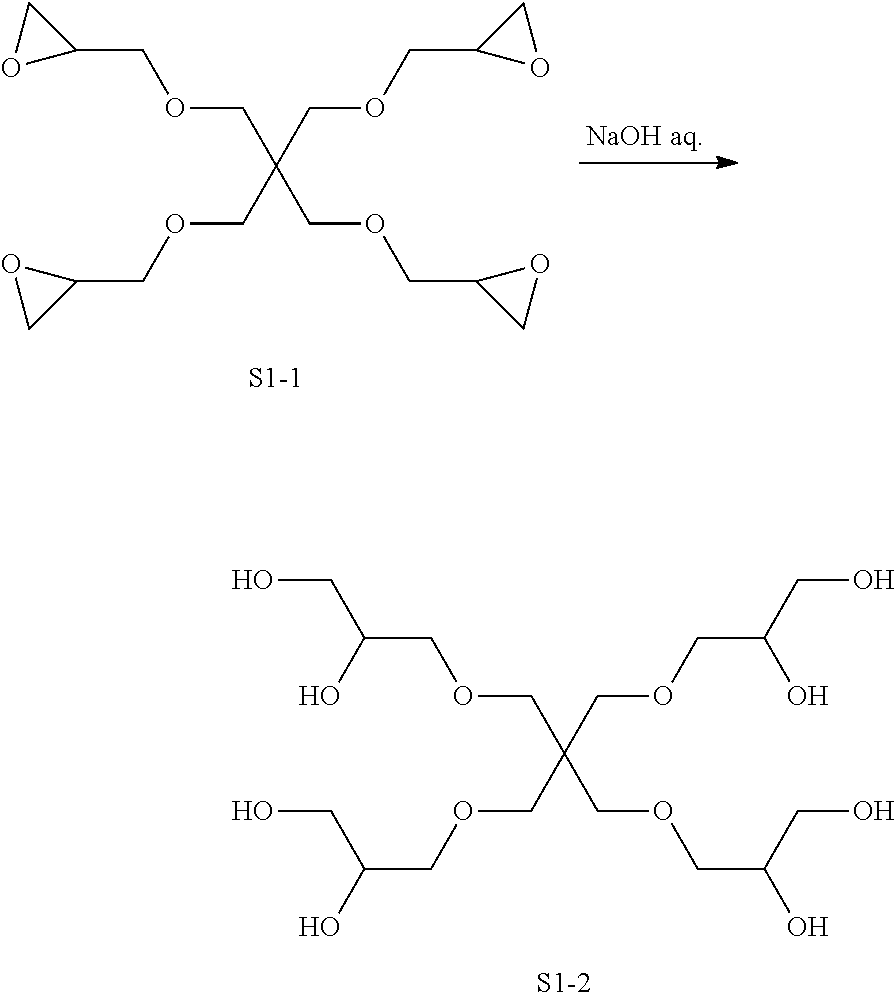


(with a carbon-branching center of an asymmetrical type), g=0, L11=L12=L21=L22=L31=L32=L41=L42=CH2CH2, and F=

(wherein, Z2 is absent, and Z1 is CH2CH2). The designed total molecular weight is approximately 21.5 kDa, wherein, the molecular weight of the eight PEG chains is approximately 8×2500=20000 Da, corresponding to n1≈n2≈n3≈n4≈n5≈n6≈n7≈n8≈56.


E1=E2=E3=E4=

(with a carbon-branching center of a symmetrical type), the divalent linking groups L11, L12, L21, L22, L3, L32, L41 and L42 are all absent, g=0, and F=

(wherein, Z2 is CH2CH2CH2NH, Z1 is COPh, and R01 is COCH(CH2S(═O)2PhCH3)2). The designed total molecular weight is approximately 68.5 kDa, wherein, the molecular weight of the eight PEG chains is approximately 8×8000=64000 Da, corresponding to n1≈n2≈n3≈n4≈n5≈n6≈n7≈n8≈181.


E1=E2=E3=E4=

(with a carbon-branching center of a symmetrical type), the divalent linking groups L11, L12, L21, L22, L31, L32, L41 and L42 are all absent, g=0, and F=

(wherein, Z2 is CH2CH2CO, Z1 is NHCH(COOCH3)CH2CH2, and R01 is NHC(═NH)NH2). The designed total molecular weight is approximately 66.1 kDa, wherein, the molecular weight of the eight PEG chains is approximately 8×8000=64000 Da, corresponding to n1≈n2≈n3≈n4≈n5≈n6≈n7≈n8≈181.


E1=E2=E3=E4=

(with a carbon-branching center of a symmetrical type), the divalent linking groups L11, L12, L21, L22, L31, L32, L41 and L42 are all absent, g=1, k=8, L0 is COCH2NHOCH2, G=

and the terminal functional groups are NHBoc (Boc is a t-butoxycarbonyl group). The designed total molecular weight is approximately 48.3 kDa, wherein, the molecular weight of the eight PEG chains is approximately 8×5000=40000 Da, corresponding to n1≈n2≈n3≈n4≈n5≈n6≈n7≈n8≈113.


E1=E2=E3=E4=

(with a carbon-branching center of an asymmetrical type), the divalent linking groups L11, L12, L21, L22, L31, L32, L41 and L42 are all absent, g=1, L0 is absent, G=

the mean value of k per PEG chain is about 16, and F is OCONH(CH2)6NCO (wherein, Z2 is OCONH, Z1 is (CH2)6, and R01 is NCO). The designed total molecular weight is approximately 75.4 kDa, wherein, the molecular weight of the eight PEG chains is approximately 8×5000=40000 Da, corresponding to n1≈n2≈n3≈n4≈n5≈n6≈n7≈n8≈113.


E1=E2=E3=E4=

(with a carbon-branching center of a symmetrical type), the divalent linking groups L11, L12, L21, L22, L31, L32, L41 and L42 are all absent, g=1, L0 is absent, G=

F=NHFmoc, and Fmoc is an N-fluorenylmethoxycarbonyl group (wherein, Z2 and Z1 are absent, and R01 is NPG5). The designed total molecular weight is approximately 45.0 kDa, wherein, the molecular weight of the eight PEG chains is approximately 8×5000=40000 Da, corresponding to n1≈n2≈n3≈n4≈n5≈n6≈n7≈n8≈113.


E1=E2=E3=E4=

(with a carbon-branching center of a symmetrical type), the divalent linking groups L11, L12, L21, L22, L31, L32, L41 and L42 are all absent, g=1, L0 contains a triazole moiety, G=

k=4 and F═OH (wherein, Z2 and Z1 are absent, and R01 is OH). The designed total molecular weight is approximately 42.5 kDa, wherein, the molecular weight of the eight PEG chains is approximately 8×5000=40000 Da, corresponding to n1≈n2≈n3≈n4≈n5≈n6≈n7≈n8≈113.


E1=E2=E3=E4=

(with a carbon-branching center of an asymmetrical type), the divalent linking groups L11, L12, L21, L22, L31, L32, L41 and L42 are all absent, g=0, k=1, F=CH2CH2OphCHO (wherein, Z2 is —CH2CH2—, Z1 is —OPh-, and R01 is CHO). The designed total molecular weight is approximately 41.5 kDa, wherein, the molecular weight of the eight PEG chains is approximately 8×5000=40000 Da, corresponding to n1≈n2≈n3≈n4≈n5≈n6≈n7≈n8≈113.


E1=E2=E3=E4=

(with a carbon-branching center of an asymmetrical type), the divalent groups L11, L12, L21, L22, L31, L32, L41 and L42 are OCONHCH2CH2CH2, g=1, k=3, L0=CH2CH2CH2NH, G=

and F is C(═O)CH2CH2COOH (wherein, Z2 is a carbonyl group, Z1 is an ethylene group, and R01 is COOH). The designed total molecular weight is approximately 44.2 kDa, wherein, the molecular weight of the eight PEG chains is approximately 8×5000=40000 Da, corresponding to n1≈n2≈n3≈n4≈n5≈n6≈n7≈n8≈113.


and F═OH. The designed total molecular weight is approximately 43.0 kDa, wherein, the molecular weight of the eight PEG chains is approximately 8×5000=40000 Da, corresponding to n1≈n2≈n3≈n4≈n5≈n6≈n7≈n8≈113.


E1=E2=E3=E4=

(with a nitrogen-atom-branching center of a symmetrical structure), the divalent linking groups L11, L12, L21, L22, L31, L32, L41 and L42 are all absent, g=0, k=1, and F═CH2CH2OCONHS (wherein, Z2 is absent, Z1 is an ethylene group, and R01 is OCONHS). The designed total molecular weight is approximately 61.9 kDa, wherein, the molecular weight of the eight PEG chains is approximately 8×7500=60000 Da, corresponding to n1≈n2≈n3≈n4≈n5≈n6≈n7≈n8≈170.


E1=E2=E3=E4=

(with a carbon-branching center of a symmetrical type), the divalent linking groups L11, L12, L21, L22, L31, L32, L41 and L42 are OC(C═O), g=0, k=1, and F=

(wherein, Z2 is absent, and Z1 is CO(CH2)6). The designed total molecular weight is approximately 42.2 kDa, wherein, the molecular weight of the eight PEG chains is approximately 8×5000=40000 Da, corresponding to n1≈n2≈n3≈n4≈n5≈n6≈n7≈n8≈113.


E1=E2=E3=E4=

(with a nitrogen-branching center of a symmetrical type), the divalent linking groups L11, L12, L21, L22, L31, L32, L41 and L42 are all absent, g=0, k=1, and F=

(wherein, Z2 is an ethylene group, Z1 is NHCOCH2CH2, and R01 is a maleimido group abbreviated as a MAL group). The designed total molecular weight is approximately 42.1 kDa, wherein, the molecular weight of the eight PEG chains is approximately 8×5000=40000 Da, corresponding to n1≈n2≈n3≈n4≈n5≈n6≈n7≈n8≈113.


E1=E2=E3=E4=

(with a carbon-branching center of a symmetrical type), the divalent linking groups L11, L12, L21, L22, L31, L32, L41 and L42 are OC(═S)NHCH2CH2, g=0, k=1, and F═CH2CH2NHCOCH2CH2SH. The designed total molecular weight is approximately 17.9 kDa, wherein, the molecular weight of the eight monodisperse PEG chains is approximately 8×2000=16000 Da, corresponding to n1=n2=n3=n4=n5=n6=n7=n8=n=46.


E1=E2=E3=E4=

(with a carbon-branching center of an asymmetrical type), the divalent linking groups L11=L12=L21=L22=L31=L32=L41=L42=CH2CH2, g=0, k=1, and F=

(wherein, Z2 is CH2, Z1 is CONHCH2, and R01 is a norbornyl group). The designed total molecular weight is approximately 37.5 kDa, wherein, the molecular weight of the eight PEG chains is approximately 8×4400=35200 Da, corresponding to n1≈n2≈n3≈n4≈n5≈n6≈n7≈n8≈100.


wherein, Z2 is CH2, Z1 is an ester bond, and R01 is a cyclooctynyl group). The designed total molecular weight is approximately 37.5 kDa, wherein, the molecular weight of the eight PEG chains is approximately 8×4400=35200 Da, corresponding to n1≈n2≈n3≈n4≈n5≈n6≈n7≈n8≈100.


(wherein, Z2 is CH2, Z1 is an ester bond, and R01 is a cycloalkynyl group). The designed total molecular weight is approximately 37.7 kDa, wherein, the molecular weight of the eight PEG chains is approximately 8×4400=35200 Da, corresponding to n1≈n2≈n3≈n4≈n5≈n6≈n7≈n8≈100.


E1=E2=E3=E4=

(with a carbon-branching center of an asymmetrical structure), the divalent linking groups L11=L12=L21=L22=L31=L32=L41=L42=COCH2, g=0, k=1, and F=

(wherein, Z2 is absent, Z1 is a carbonyl group, and R01 is a benzocyclooctynyl group). The designed total molecular weight is approximately 10.6 kDa, wherein, the molecular weight of the eight monodisperse PEG chains is approximately 8×1000=8000 Da, corresponding to the EO-unit number of n1=n2=n3=n4=n5=n6=n7=n8=n=22.


(wherein, Z2 is absent, Z1 is a carbonyl group, and R01 is a cyclooctenyl group). The designed total molecular weight is approximately 10.3 kDa, wherein, the molecular weight of the eight PEG chains is approximately 8×1000=8000 Da, corresponding to the EO-unit number of n1=n2=n3=n4=n5=n6=n7=n8=n=22.


E1=E2=E3=E4=

(with a carbon-branching center of an asymmetrical structure), the divalent linking groups L11=L12=L21=L22=L31=L32=L41=L42=CH2CH2, g=0, k=1 and F=

The designed total molecular weight is approximately 5.8 kDa, wherein, the molecular weight of the eight monodisperse PEG chains is approximately 8×500=4000 Da, corresponding to the EO-unit number of n1=n2=n3=n4=n5=n6=n7=n8=n=12.


E1=E2=E3=E4=

(with a silicon-atom-branching center of a symmetrical structure), the divalent linking groups L11, L12, L21, L22, L31, L32, L41 and L42 are all absent, g=0, k=1, and F=CH2CH2OTs. The designed total molecular weight is approximately 26.2 kDa, wherein, the molecular weight of the eight PEG chains is approximately 8×3000=24000 Da, corresponding to n1≈n2≈n3≈n4≈n5≈n6≈n7≈n8≈68.


E1=E2=E3=E4=

(with a carbon-branching center of an asymmetrical structure), the divalent linking groups L11=L12=L21=L22=L31=L32=L41=L42=CONHCH2CH2, L0 is absent, g=0, k=1, Z2 of F is CH2CH2, Z1 is NH, and R01 is a biotinyl group. The designed total molecular weight is approximately 4.5 kDa, wherein, the molecular weight of the eight monodisperse PEG chains is approximately 8×88=704 Da, corresponding to the EO-unit number of n1=n2=n3=n4=n5=n6=n7=n8=n=2.


E1=E2=E3=E4=

(with a nitrogen-atom-branching center of a symmetrical structure), the divalent linking groups L11=L12=L21=L22=L31=L32=L41=L42=OCONH(CH2)6NHCOO(CH2)2, L0 is absent, g=0, k=1, and F is CH2C≡CH (wherein, Z2 is absent, Z1 is an ethylene group, and R01 is an ethynyl group). The designed total molecular weight is approximately 26.8 kDa, wherein, the molecular weight of the eight PEG chains is approximately 8×3000=24000 Da, corresponding to n1≈n2≈n3≈n4≈n5≈n6≈n7≈n8≈68.


E1=E2=E3=E4=

(with a carbon-branching center of an asymmetrical structure), the divalent linking groups L11=L12=L21=L22=L31=L32=L41=L42=

g=0, k=1, and F═CH2CH2NH2 (wherein, Z2 is absent, Z1 is an ethylene group, and R01 is NH2). The designed total molecular weight is approximately 6.0 kDa, wherein, the molecular weight of the eight monodisperse PEG chains is approximately 8×450=3600 Da, corresponding to n1=n2=n3=n4=n5=n6=n7=n8=n=10.


(wherein, Z2 is CH2CH2NH, Z1 is COCH2CH2, and R01 is an azacyclooctynyl group). Wherein, the molecular weight of the eight monodisperse PEG chains is approximately 8×450=3600 Da, corresponding to n1=n2=n3=n4=n5=n6=n7=n8=n=10.


E1=E2=E3=E4=

(with a nitrogen-branching center of a symmetrical type), the divalent linking groups L11, L12, L21, L22, L31, L32, L41 and L42 are all absent, g=0, k=1, and F is COCH═CH2. The designed total molecular weight is approximately 25.7 kDa, wherein, the molecular weight of the eight PEG chains is approximately 8 3000×24000 Da, corresponding to n1≈n2≈n3≈n4≈n5≈n6≈n7≈n8≈68.


E1=E2=E3=E4=

(with a nitrogen-branching center of a symmetrical type), the divalent linking groups L11=L12=L21=L22=L31=L32=L41=L42=NHCO, g=0, k=1, and F is

(wherein, Z2 is absent, Z1 is an ethylene group, and R01 is a maleimido group). The designed total molecular weight is approximately 25 kDa, wherein, the molecular weight of the eight monodisperse PEG chains is approximately 8×2816=22.5 kDa, corresponding to n1=n2=n3=n4=n5=n6=n7=n8=n=65.


E1=E2=E3=E4=

(with a nitrogen-branching center of a symmetrical type), the divalent linking groups L11=L12=L21=L22=L31=L32=L41=L42=NHCO, g=0, k=1, and F is

(wherein, Z2 is an ethylene group, Z1 is absent, and R01 is a maleimido group). The designed total molecular weight is approximately 24.8 kDa, wherein, the molecular weight of the eight monodisperse PEG chains is approximately 8×2816=22.5 kDa, corresponding to n1=n2=n3=n4=n5=n6=n7=n8=n=65.


E1=E2=E3=E4=

(with a nitrogen-branching center of a symmetrical type), the divalent linking groups L11, L12, L21, L22, L31, L32, L41 and L42 are all absent, g=0, k=1, and F is CH2COOH (wherein, Z2 is absent, Z1 is an ethylene group, and R01 is COOH). The designed total molecular weight is approximately 20.8 kDa, wherein, the molecular weight of the eight PEG chains is approximately 8×2500=20000 Da, corresponding to n1≈n2≈n3≈n4≈n5≈n6≈n7≈n8≈56.


(wherein, Z2 is absent, Z1 is CH2CH2, and R01 is C≡N+O−). The designed total molecular weight is approximately 21.6 kDa, wherein, the molecular weight of the eight PEG chains is approximately 8×2500=20000 Da, corresponding to n1≈n2≈n3≈n4≈n5≈n6≈n7≈n8≈56.


E1=E2=E3=E4=

with a carbon-branching center of an asymmetrical structure), the divalent linking groups L11, L12, L21, L22, L31, L32, L41 and L42 are all absent, g=1, k=4, L0=

G=

and F═NH2 (wherein, Z2 and Z1 are absent, and R01 is NH2). The designed total molecular weight is approximately 38.0 kDa, wherein, the molecular weight of the eight PEG chains is approximately 8×3500=28000 Da, corresponding to n1≈n2≈n3≈n4≈n5≈n6≈n7≈n8≈79.


(with a carbon-branching center of a symmetrical type), the divalent linking groups L11, L12, L21, L22, L31, L32, L41 and L42 are all absent, g=1, k≈18, L0 is CH2CH2CONH, G is a hyperbranched structure combined by glycidol and ethylene oxide (wherein, the above-shown structural formula is just a schematic structure, and the ratio of epoxyethane and epoxy acetal is 5:1), and F═OH. The designed total molecular weight is approximately 54.8 kDa, wherein, the molecular weight of the eight PEG chains is approximately 8×5000=40000 Da, corresponding to n1≈n2≈n3≈n4≈n5≈n6≈n7≈n8≈113.


and glycidyl ether, the molar ratio is 1:5, and the average hydroxyl-group number k per PEG chain per molecule was about 18) were added thereinto, and the whole was stirred till dissolution, followed by reaction at room temperature for 24 hours. The resulting mixture was filtrated to remove undissolved substances, concentrated and recrystallized from isopropanol, and then a hyperbranched eight-arm polyethylene glycol H1-16 in a white solid state was obtained.


(with a carbon-branching center of an asymmetrical type), the divalent linking groups L11, L12, L21, L22, L31, L32, L41 and L42 are all absent, g=1, k=2, G=

and F═COOH. The designed total molecular weight is approximately 41.7 kDa, wherein, the molecular weight of the eight PEG chains is approximately 8×5000=40000 Da, corresponding to n1≈n2≈n3≈n4≈n5≈n6≈n7≈n8≈113.


and D=Exanatide-Cys.


and D is


| TABLE 1 | |||||||
| modified product | PEG | Production | PEG Mn | EO-unit number | |||
| No. | Mw (kDa) | structure | method | (kDa) | PDI | per PEG chain (n) | |
| T1 | P-1 | 75 | E1-1 | S18 | 42 | 1.04 | 113 |
| T2 | P-22 | 56 | E1-1 | S18 | 25 | 1.03 | 65 |
| T3 | P-23 | 122 | E1-1 | S18 | 82 | 1.09 | 227 |
| T4 | P-24 | 55 | E1-3 | S34 | 25 | 1 | 65 |
| T5 | P-25 | 61 | E1-3 | S34 | 30 | 1.03 | 80 |
| T6 | P-26 | 74 | E1-3 | S34 | 42 | 1.02 | 113 |
| C1 | P-27 | 42 | CE-1 | S18 | 24 | 1.03 | 137 |
| C2 | P-28 | 55 | CE-2 | S18 | 25 | 1.05 | 65 |
| C3 | exenatide | ||||||
| C4 | saline solution | ||||||
| TABLE 2 | ||||||||||
| modified | EO-unit | |||||||||
| product Mw | PEG | Production | PEG Mn | number per | kD mean | Irinotecan | ||||
| No. | (kDa) | structure | Method | (kDa) | PDI | PEG chain (n) | value | content (%) | ||
| T7 | P-31 | 25 | D1-1 | S1 | 21 | 1.03 | 56 | 7.2 | 17.9 |
| T8 | P-5 | 53 | D1-8 | S48 | 38 | 1.04 | 100 | 22.6 | 26.9 |
| T9 | P-32 | 50 | D1-5 | S42 | 40 | 1.05 | 113 | 15.2 | 18.9 |
| T10 | P-33 | 46 | D1-6 | S42 | 40 | 1.05 | 113 | 7.5 | 10.3 |
| T11 | P-34 | 51 | D1-7 | S43 | 42 | 1.05 | 113 | 15.2 | 18.6 |
| T12 | P-35 | 70 | D1-2 | S4 | 64 | 1.06 | 181 | 7.6 | 6.8 |
| T13 | P-3 | 66 | A6-1 | S12, S46 | 62 | 1.06 | 170 | 7.6 | 6.1 |
| C3 | P36 | 43 | CD-1 | 40 | 1.07 | 227 | 3.8 | 5.6 | |
| C4 | P37 | 45 | CD-2 | 41 | 1.06 | 113 | 7.4 | 10.2 | |
Claims (50)


Priority Applications (1)
| Application Number | Priority Date | Filing Date | Title |
|---|---|---|---|
| US16/527,368 US10660969B2 (en) | 2015-06-23 | 2019-07-31 | Eight-arm polyethylene glycol derivative, production method therefor, and modified bio-related substance thereof |
Applications Claiming Priority (6)
| Application Number | Priority Date | Filing Date | Title |
|---|---|---|---|
| CN201510349134.9A CN104877127B (en) | 2015-06-23 | 2015-06-23 | A kind of eight arms polyethyleneglycol derivative, preparation method and its bio-related substance of modification |
| CN201510349134.9 | 2015-06-23 | ||
| CN201510349134 | 2015-06-23 | ||
| PCT/CN2016/085286 WO2016206540A1 (en) | 2015-06-23 | 2016-06-08 | 8-arm polyethylene glycol derivative, manufacturing method and modified bio-related substance thereby |
| US201715738761A | 2017-12-21 | 2017-12-21 | |
| US16/527,368 US10660969B2 (en) | 2015-06-23 | 2019-07-31 | Eight-arm polyethylene glycol derivative, production method therefor, and modified bio-related substance thereof |
Related Parent Applications (2)
| Application Number | Title | Priority Date | Filing Date |
|---|---|---|---|
| US15/738,761 Continuation US10434182B2 (en) | 2015-06-23 | 2016-06-08 | Eight-arm polyethylene glycol derivative, production method therefor, and modified bio-related substance thereof |
| PCT/CN2016/085286 Continuation WO2016206540A1 (en) | 2015-06-23 | 2016-06-08 | 8-arm polyethylene glycol derivative, manufacturing method and modified bio-related substance thereby |
Publications (2)
| Publication Number | Publication Date |
|---|---|
| US20190365910A1 US20190365910A1 (en) | 2019-12-05 |
| US10660969B2 true US10660969B2 (en) | 2020-05-26 |
Family
ID=53944824
Family Applications (2)
| Application Number | Title | Priority Date | Filing Date |
|---|---|---|---|
| US15/738,761 Active 2036-09-01 US10434182B2 (en) | 2015-06-23 | 2016-06-08 | Eight-arm polyethylene glycol derivative, production method therefor, and modified bio-related substance thereof |
| US16/527,368 Active US10660969B2 (en) | 2015-06-23 | 2019-07-31 | Eight-arm polyethylene glycol derivative, production method therefor, and modified bio-related substance thereof |
Family Applications Before (1)
| Application Number | Title | Priority Date | Filing Date |
|---|---|---|---|
| US15/738,761 Active 2036-09-01 US10434182B2 (en) | 2015-06-23 | 2016-06-08 | Eight-arm polyethylene glycol derivative, production method therefor, and modified bio-related substance thereof |
Country Status (4)
| Country | Link |
|---|---|
| US (2) | US10434182B2 (en) |
| EP (1) | EP3315531B1 (en) |
| CN (1) | CN104877127B (en) |
| WO (1) | WO2016206540A1 (en) |
Cited By (1)
| Publication number | Priority date | Publication date | Assignee | Title |
|---|---|---|---|---|
| US11253603B2 (en) | 2018-09-17 | 2022-02-22 | The Children's Hospital Of Philadelphia | Polymer-based macromolecular prodrugs |
Families Citing this family (82)
| Publication number | Priority date | Publication date | Assignee | Title |
|---|---|---|---|---|
| CN104877127B (en) * | 2015-06-23 | 2017-11-10 | 厦门赛诺邦格生物科技股份有限公司 | A kind of eight arms polyethyleneglycol derivative, preparation method and its bio-related substance of modification |
| US11324827B2 (en) | 2014-10-01 | 2022-05-10 | Xiamen Sinopeg Biotech Co., Ltd. | Multifunctionalized polyethylene glycol derivative and preparation method therefor |
| EA037478B1 (en) | 2015-08-04 | 2021-04-01 | Дьюк Юниверсити | Genetically encoded intrinsically disordered stealth polymers for delivery and methods of using same |
| US11752213B2 (en) | 2015-12-21 | 2023-09-12 | Duke University | Surfaces having reduced non-specific binding and antigenicity |
| CN105646869B (en) * | 2016-01-04 | 2018-01-16 | 中国海洋大学 | A kind of water-soluble astaxanthin derivatives and preparation method thereof |
| CN107200838A (en) * | 2016-03-18 | 2017-09-26 | 北京键凯科技股份有限公司 | A kind of multi-arm polyethylene glycol and its reactive derivative |
| CN110643032B (en) * | 2016-04-21 | 2022-01-28 | 厦门赛诺邦格生物科技股份有限公司 | Eight-arm polyethylene glycol, preparation method, functionalized derivative and modified biologically-relevant substance |
| WO2017210476A1 (en) | 2016-06-01 | 2017-12-07 | Duke University | Nonfouling biosensors |
| CN106008995B (en) * | 2016-07-25 | 2018-09-11 | 桂林理工大学 | A kind of preparation method of the hyperbranched poly thioether based on lipoic acid |
| CN106008994B (en) * | 2016-07-25 | 2018-09-11 | 桂林理工大学 | A kind of preparation method of more sulfydryl dissaving polymers based on lipoic acid |
| JP2020500150A (en) | 2016-09-23 | 2020-01-09 | デューク ユニバーシティ | Non-repetitive and non-structural polypeptides with lower critical solution temperature behavior |
| WO2018066692A1 (en) | 2016-10-07 | 2018-04-12 | 国立大学法人東京工業大学 | Branched hetero type monodispersed polyethylene glycol, method for producing same and conjugate of same |
| WO2018132732A1 (en) | 2017-01-12 | 2018-07-19 | Duke University | Genetically encoded lipid-polypeptide hybrid biomaterials that exhibit temperature triggered hierarchical self-assembly |
| US11844842B2 (en) | 2017-03-31 | 2023-12-19 | Jenkem Technology Co., Ltd. (Beijing) | Composition of polyethylene glycol maleimide derivative and polymerization inhibitor |
| CN108659498A (en) * | 2017-03-31 | 2018-10-16 | 北京键凯科技股份有限公司 | A kind of composition of polyethylene glycol maleimide derivatives and polymerization inhibitor |
| CN107137720A (en) * | 2017-04-29 | 2017-09-08 | 北京林业大学 | A kind of preparation method of the new multi-arm polyethylene glycol Nano medication for containing triptolide and HCPT |
| CN107096019A (en) * | 2017-05-04 | 2017-08-29 | 中国科学院过程工程研究所 | A kind of mycobacterium tuberculosis subunit vaccine based on psma protein multimer body and preparation method thereof |
| WO2018213320A1 (en) | 2017-05-15 | 2018-11-22 | Duke University | Recombinant production of hybrid lipid-biopolymer materials that self-assemble and encapsulate agents |
| CN108623451B (en) * | 2017-06-30 | 2022-09-02 | 北京键凯科技股份有限公司 | Multi-arm single molecular weight polyethylene glycol and active derivative thereof, and preparation and application thereof |
| WO2019006374A1 (en) | 2017-06-30 | 2019-01-03 | Duke University | Order and disorder as a design principle for stimuli-responsive biopolymer networks |
| CN107722262B (en) * | 2017-09-18 | 2020-11-24 | 华南理工大学 | A kind of polycarbodiimide polymer and its preparation method and application |
| NL2019650B1 (en) * | 2017-09-29 | 2019-04-08 | Polyganics Ip B V | Improved tissue-adhesive polymers |
| CN109666163B (en) * | 2017-10-17 | 2023-05-12 | 厦门逍扬运动科技有限公司 | A kind of hybrid cross-linked dynamic polymer and its application |
| CN109666158B (en) * | 2017-10-17 | 2023-04-07 | 厦门逍扬运动科技有限公司 | Hybrid dynamic polymer and application thereof |
| WO2019147954A1 (en) | 2018-01-26 | 2019-08-01 | Duke University | Albumin binding peptide-drug (aibiped) conjugates and methods of making and using same |
| TWI641613B (en) * | 2018-02-14 | 2018-11-21 | 中原大學 | Modified porous organic skeleton, preparation method thereof, porous organic skeleton composite and preparation method thereof |
| EP3788343B1 (en) | 2018-04-30 | 2024-03-27 | Duke University | Stimuli-responsive peg-like polymer-based drug delivery platform |
| KR102076314B1 (en) * | 2018-07-16 | 2020-02-11 | (주) 에프엔지리서치 | Novel compounds isolated from Cervus nippon and pharmaceutical use thereof |
| US11649275B2 (en) | 2018-08-02 | 2023-05-16 | Duke University | Dual agonist fusion proteins |
| US12594347B2 (en) | 2018-09-07 | 2026-04-07 | Duke University | Nanoparticulate drug delivery systems |
| CN109467517B (en) * | 2018-10-19 | 2020-05-19 | 华中科技大学 | A kind of acylhydrazone molecular switch, its preparation method and application |
| CN111337460B (en) * | 2018-12-18 | 2021-09-17 | 中国科学院大连化学物理研究所 | High-stability Halo-tag probe and synthesis and biological application thereof |
| US10954346B2 (en) | 2018-12-27 | 2021-03-23 | Industrial Technology Research Institute | Resin and ink |
| CN109438180A (en) * | 2018-12-29 | 2019-03-08 | 凯瑞斯德生化(苏州)有限公司 | The preparation method of one kind (S) -1- (the chloro- 3- fluorophenyl of 2,6- bis-) ethyl alcohol |
| CN109793917B (en) * | 2019-02-11 | 2020-10-09 | 海南建科药业有限公司 | Preparation method of gel for preventing anastomotic fistula after colorectal surgery |
| CN110204678B (en) * | 2019-05-21 | 2021-08-10 | 中国船舶重工集团公司第七二五研究所 | Polydimethylsiloxane self-repairing material based on disulfide bond exchange reaction and preparation method thereof |
| CN110218331B (en) * | 2019-06-13 | 2021-03-09 | 烟台正海合泰科技股份有限公司 | Bio-based hyperbranched formaldehyde-removing agent and preparation method thereof |
| US11512314B2 (en) | 2019-07-12 | 2022-11-29 | Duke University | Amphiphilic polynucleotides |
| WO2021060441A1 (en) * | 2019-09-26 | 2021-04-01 | 日油株式会社 | Degradable multi-arm polyethylene glycol derivative |
| CN112694608B (en) * | 2019-10-23 | 2024-07-02 | 厦门赛诺邦格生物科技股份有限公司 | Six-arm polyethylene glycol derivative, preparation method and modified biological related substance |
| CN110845722B (en) * | 2019-10-28 | 2021-12-07 | 西北工业大学 | Carrier-free hyperbranched macromolecular polymer and preparation method thereof |
| CN110746602B (en) * | 2019-10-29 | 2021-04-20 | 大连理工大学 | A kind of metal cobalt porphyrin-based porous organic polymer and its preparation method and application |
| CN110790922B (en) * | 2019-11-06 | 2021-01-19 | 大连理工大学 | Preparation method and application of polyporphyrin compound |
| KR102542715B1 (en) * | 2019-11-28 | 2023-06-14 | 충칭 업그라 바이오테크놀로지 씨오., 엘티디. | Polyethylene glycol conjugate drug, manufacturing method thereof and use thereof |
| CN113429559B (en) * | 2020-03-23 | 2024-08-23 | 厦门赛诺邦格生物科技股份有限公司 | A terminal heterofunctionalized six-arm polyethylene glycol derivative and preparation method thereof |
| CN111346234B (en) * | 2020-03-23 | 2023-03-31 | 沈阳药科大学 | Deferoxamine-eight-arm star-shaped polyethylene glycol conjugate and application thereof |
| CN111564187B (en) * | 2020-05-08 | 2023-03-14 | 东北师范大学 | Method and system for predicting reaction rate constant of organic matter and singlet oxygen |
| CN111494391B (en) * | 2020-06-17 | 2023-03-17 | 西南大学 | Application of buxine in preparation of autophagy inducer |
| CN112641995B (en) * | 2020-12-21 | 2021-11-23 | 上海交通大学 | Chiral hydrogel dressing with antibacterial and repair promoting functions and preparation method and application thereof |
| CN112851842B (en) * | 2021-01-18 | 2022-11-29 | 南京邮电大学 | Small-size near-infrared two-region fluorescence imaging contrast agent and preparation method and application thereof |
| CN112618553A (en) * | 2021-01-30 | 2021-04-09 | 河南中医药大学 | Application of lipoic acid compatible triptolide in preparation of attenuated drugs |
| WO2022170012A1 (en) * | 2021-02-08 | 2022-08-11 | The Trustees Of Indiana University | Synthesis of peg-based thiol-norbornene hydrogels with tunable hydroylitic degradation properties |
| CA3210619A1 (en) | 2021-03-11 | 2022-09-15 | Dipanjan Pan | Compositions and methods for removing bio-synthetic nano-particles from bodily fluids |
| CN117510830A (en) * | 2021-04-08 | 2024-02-06 | 厦门赛诺邦格生物科技股份有限公司 | A kind of pegylated lipid and its modified liposome, pharmaceutical composition containing the liposome and its preparation and application |
| CN113105645B (en) * | 2021-04-16 | 2022-03-04 | 河南科技学院 | A kind of preparation method, product and application of nickel-based metal organic framework compound |
| CN113201132B (en) * | 2021-04-23 | 2023-12-01 | 长沙创新药物工业技术研究院有限公司 | Rhodamine B derivative fluorescent probe molecule based on monodisperse four-arm polyethylene glycol and preparation method thereof |
| CN113264854B (en) * | 2021-06-18 | 2023-01-13 | 仪征市海帆化工有限公司 | Synthesis method of tetrahydroxyethyl ethylene diamine tetra-p-toluenesulfonate |
| CN113499860A (en) * | 2021-07-08 | 2021-10-15 | 江西新金叶实业有限公司 | Efficient flotation method for smelting slag recycled by copper regeneration |
| CN115920065A (en) * | 2021-08-02 | 2023-04-07 | 南方科技大学 | Ligand capable of targeting asialoglycoprotein receptor, conjugate and application thereof |
| CN115894660B (en) * | 2021-09-30 | 2024-03-15 | 康立泰生物医药(青岛)有限公司 | Polyethylene glycol derivative modified interleukin 12 and its preparation method and application |
| CN114028580B (en) * | 2021-09-30 | 2023-08-08 | 成都理工大学 | Preparation method of podophyllotoxin twin drug nanoparticles |
| EP4458805A4 (en) | 2021-12-31 | 2026-01-28 | Xiamen Sinopeg Biotech Co Ltd | CATIONIC LIPID WITH A FUNCTIONAL GROUP ON THE SIDE CHAIN AND USE OF IT |
| EP4509544A4 (en) | 2022-04-12 | 2025-07-02 | Xiamen Sinopeg Biotech Co Ltd | Nonlinear pegylated lipid with tertiary amine and use thereof |
| CN114524943B (en) * | 2022-04-22 | 2022-09-16 | 天津凯莱英制药有限公司 | Process for preparing polyethylene glycol-glycerol derivatives and intermediates thereof |
| CN117510828A (en) | 2022-07-28 | 2024-02-06 | 厦门赛诺邦格生物科技股份有限公司 | A three-arm polyethylene glycol derivative containing amino acid residues |
| CN118284645A (en) | 2022-09-30 | 2024-07-02 | 厦门赛诺邦格生物科技股份有限公司 | A PEGylated lipid containing a lysine core |
| CN115671405B (en) * | 2022-11-08 | 2023-11-10 | 北京大清生物技术股份有限公司 | Joint cavity injection gel and preparation method thereof |
| CN116425192B (en) * | 2023-02-06 | 2023-11-14 | 北京伽瓦新材料科技有限公司 | Powder material special for PS-PVD, preparation method and application |
| CN116253905B (en) * | 2023-02-18 | 2024-03-01 | 四川大学 | A stable and intelligent anti-infectious hydrogel and its preparation method and application |
| CN116875106B (en) * | 2023-07-06 | 2024-06-04 | 建德市聚合新材料有限公司 | Preparation method of acetylenic polyether modified polysiloxane wetting agent |
| JP7784786B2 (en) * | 2023-07-26 | 2025-12-12 | トモイケ バイオ リミテッド | Branched multi-hydroxyl-protected oligomer, a linker bonded thereto, and a branched multi-hydroxyl-protected oligomer obtained by deprotecting the linker |
| CN117298274A (en) * | 2023-09-14 | 2023-12-29 | 山东大学 | A polyphenol-based nanoparticle and its preparation method and application |
| CN117304804B (en) * | 2023-11-16 | 2024-04-23 | 广州诗尼曼家居股份有限公司 | Environment-friendly waterproof agent for plates and preparation method thereof |
| TW202527994A (en) * | 2023-12-08 | 2025-07-16 | 大陸商蘇州拓界醫藥有限公司 | An antiviral conjugate |
| CN120643718A (en) * | 2024-03-15 | 2025-09-16 | 香港大学深圳研究院 | Near infrared fluorescent probe and preparation method and application thereof |
| CN121628091A (en) * | 2024-08-29 | 2026-03-10 | 北京聚肽生物科技有限公司 | Selenium-containing polyamino acid, pharmaceutical composition and application |
| CN119708508B (en) * | 2024-12-18 | 2025-12-26 | 常州大学 | Block anion exchange membranes with interstitial alkyl chains and their preparation methods |
| CN120272139B (en) * | 2025-04-21 | 2025-12-12 | 广州思瑞尔绿色包装技术有限公司 | Special aqueous adhesive for stone paper packaging box and preparation method thereof |
| CN120518875B (en) * | 2025-05-14 | 2025-11-21 | 中南大学湘雅二医院 | A nano-coordination polymer for treating liver injury and its preparation method |
| CN120504999B (en) * | 2025-07-21 | 2025-09-16 | 北京联创佳艺影像新材料技术有限公司 | UV inkjet printing ink, preparation method and application |
| CN120718436B (en) * | 2025-08-25 | 2025-11-21 | 上海皆利新材料科技有限公司 | A self-healing halogen-free flame-retardant polyurethane material for robot cables and its preparation method |
| CN121240657B (en) * | 2025-11-28 | 2026-03-20 | 南开大学 | Single-molecule spintronic devices based on pulsed femtosecond lasers and their fabrication methods |
Citations (22)
| Publication number | Priority date | Publication date | Assignee | Title |
|---|---|---|---|---|
| US5811510A (en) | 1995-04-14 | 1998-09-22 | General Hospital Corporation | Biodegradable polyacetal polymers and methods for their formation and use |
| CN1381512A (en) | 2002-01-15 | 2002-11-27 | 泛亚生物技术有限公司 | Multi-arm fork type functional polyethylene glycol preparation method and its application in medicine |
| CN1569892A (en) | 2004-04-30 | 2005-01-26 | 新峰生物科技(上海)有限公司 | Multi-branched polyethylene glycol and protein or polypeptide combined products and their preparation method |
| US20050265922A1 (en) | 2004-04-20 | 2005-12-01 | Emory University | Multimodality nanostructures, methods of fabrication thereof, and methods of use thereof |
| WO2006024953A2 (en) | 2004-08-31 | 2006-03-09 | Pharmacia & Upjohn Company Llc | Glycerol branched polyethylene glycol human growth hormone conjugates, process for their preparation, and methods of use thereof |
| US7144978B2 (en) | 2002-01-15 | 2006-12-05 | Pan Asia Bio Co., Ltd. | Multidrop tree branching functional polyethylene glycol, methods of preparing and using same |
| WO2008066787A2 (en) | 2006-11-27 | 2008-06-05 | E. I. Du Pont De Nemours And Company | Multi-functional polyalkylene oxides, hydrogels and tissue adhesives |
| CN101679849A (en) | 2006-09-06 | 2010-03-24 | 科德生物工程有限公司 | Fluorescent cell markers |
| CN101724144A (en) | 2008-11-03 | 2010-06-09 | 北京键凯科技有限公司 | Novel multi-arm polyethylene glycol, preparation method and application thereof |
| US7790150B2 (en) | 2003-09-05 | 2010-09-07 | The General Hospital Corporation | Dual phase drug release system |
| CN101831065A (en) | 2009-03-13 | 2010-09-15 | 复旦大学 | Multi-arm star-shaped polyethylene glycol containing single-activity functional groups and preparation method thereof |
| US7838619B2 (en) | 2002-01-14 | 2010-11-23 | The General Hospital Corporation | Biodegradable polyketal polymers and methods for their formation and use |
| US20110305751A1 (en) | 2009-02-20 | 2011-12-15 | To-Bbb Holding B.V. | Glutathione-based drug delivery system |
| CN102367291A (en) | 2011-04-26 | 2012-03-07 | 刘超 | Mono-functional group-containing multilevel branched polyethylene glycol and its synthesis method |
| EP2518098A1 (en) | 2009-12-25 | 2012-10-31 | Jenkem Technology Co. Ltd. Tianjin Branch | Multi-arm polyethylene glycol derivatives, conjugates and gels of drugs and the same |
| CN104530415A (en) | 2014-10-01 | 2015-04-22 | 厦门赛诺邦格生物科技有限公司 | Hetero-functionalized Y-type polyethylene glycol derivative, preparation method and biologically related substance thereof |
| CN104530417A (en) | 2014-10-01 | 2015-04-22 | 厦门赛诺邦格生物科技有限公司 | Multifunctional H-type polyethylene glycol derivative and preparation method thereof |
| CN104530413A (en) | 2014-10-01 | 2015-04-22 | 厦门赛诺邦格生物科技有限公司 | Biologically related substances modified by multifunctional H-type polyethylene glycol derivative |
| US20150119281A1 (en) | 2011-07-14 | 2015-04-30 | Pierce Biotechnology, Inc. | Phosphine derivatives of fluorescent compounds |
| CN104677127A (en) | 2013-12-03 | 2015-06-03 | 天津华利盛欣塑业有限公司 | Condenser |
| US9315445B2 (en) | 2012-09-12 | 2016-04-19 | Basf Se | Photoreactive monomers |
| US20180214561A1 (en) | 2015-06-23 | 2018-08-02 | Xiamen Sinopeg Biotech Co., Ltd. | Eight-arm polyethylene glycol derivative, production method therefor, and modifiedbio-relatedsubstancethereof |
-
2015
- 2015-06-23 CN CN201510349134.9A patent/CN104877127B/en active Active
-
2016
- 2016-06-08 WO PCT/CN2016/085286 patent/WO2016206540A1/en not_active Ceased
- 2016-06-08 EP EP16813656.2A patent/EP3315531B1/en active Active
- 2016-06-08 US US15/738,761 patent/US10434182B2/en active Active
-
2019
- 2019-07-31 US US16/527,368 patent/US10660969B2/en active Active
Patent Citations (30)
| Publication number | Priority date | Publication date | Assignee | Title |
|---|---|---|---|---|
| US5811510A (en) | 1995-04-14 | 1998-09-22 | General Hospital Corporation | Biodegradable polyacetal polymers and methods for their formation and use |
| US7838619B2 (en) | 2002-01-14 | 2010-11-23 | The General Hospital Corporation | Biodegradable polyketal polymers and methods for their formation and use |
| CN1381512A (en) | 2002-01-15 | 2002-11-27 | 泛亚生物技术有限公司 | Multi-arm fork type functional polyethylene glycol preparation method and its application in medicine |
| EP1479711A1 (en) | 2002-01-15 | 2004-11-24 | Pan Asia Bio (Shanghai) Co., Ltd | Multidrop tree branching functional polyethylene glycol, the preparation method and the use of it |
| US7144978B2 (en) | 2002-01-15 | 2006-12-05 | Pan Asia Bio Co., Ltd. | Multidrop tree branching functional polyethylene glycol, methods of preparing and using same |
| US7790150B2 (en) | 2003-09-05 | 2010-09-07 | The General Hospital Corporation | Dual phase drug release system |
| US20050265922A1 (en) | 2004-04-20 | 2005-12-01 | Emory University | Multimodality nanostructures, methods of fabrication thereof, and methods of use thereof |
| CN1969190A (en) | 2004-04-20 | 2007-05-23 | 爱默蕾大学 | Multimodality nanostructures, methods of fabrication thereof, and methods of use thereof |
| CN1569892A (en) | 2004-04-30 | 2005-01-26 | 新峰生物科技(上海)有限公司 | Multi-branched polyethylene glycol and protein or polypeptide combined products and their preparation method |
| WO2006024953A2 (en) | 2004-08-31 | 2006-03-09 | Pharmacia & Upjohn Company Llc | Glycerol branched polyethylene glycol human growth hormone conjugates, process for their preparation, and methods of use thereof |
| CN101679849A (en) | 2006-09-06 | 2010-03-24 | 科德生物工程有限公司 | Fluorescent cell markers |
| US20170082642A1 (en) | 2006-09-06 | 2017-03-23 | Kode Biotech Limited | Fluorescent cell markers |
| WO2008066787A2 (en) | 2006-11-27 | 2008-06-05 | E. I. Du Pont De Nemours And Company | Multi-functional polyalkylene oxides, hydrogels and tissue adhesives |
| EP2360203A1 (en) | 2008-11-03 | 2011-08-24 | Beijing Jenkem Technology Co., Ltd. | Novel multi-arm polyethylene glycol, preparation method and uses thereof |
| US20110286956A1 (en) | 2008-11-03 | 2011-11-24 | Beijing Jenkem Technology Co. Ltd. | Novel multi-arm polyethylene glycol, preparation method and uses thereof |
| CN101724144A (en) | 2008-11-03 | 2010-06-09 | 北京键凯科技有限公司 | Novel multi-arm polyethylene glycol, preparation method and application thereof |
| US20110305751A1 (en) | 2009-02-20 | 2011-12-15 | To-Bbb Holding B.V. | Glutathione-based drug delivery system |
| CN102316902A (en) | 2009-02-20 | 2012-01-11 | to-BBB控股股份有限公司 | Glutathione-based drug delivery system |
| CN101831065A (en) | 2009-03-13 | 2010-09-15 | 复旦大学 | Multi-arm star-shaped polyethylene glycol containing single-activity functional groups and preparation method thereof |
| EP2518098A1 (en) | 2009-12-25 | 2012-10-31 | Jenkem Technology Co. Ltd. Tianjin Branch | Multi-arm polyethylene glycol derivatives, conjugates and gels of drugs and the same |
| CN103755949A (en) | 2009-12-25 | 2014-04-30 | 天津键凯科技有限公司 | Dobby polyethylene glycol derivative and conjugate thereof with drug and gel |
| US9555123B2 (en) | 2009-12-25 | 2017-01-31 | Jenkem Technology Co., Ltd. Tianjin Branch | Multi-arm polyethylene glycol derivatives, conjugates and gels of pharmaceuticals and the same |
| CN102367291A (en) | 2011-04-26 | 2012-03-07 | 刘超 | Mono-functional group-containing multilevel branched polyethylene glycol and its synthesis method |
| US20150119281A1 (en) | 2011-07-14 | 2015-04-30 | Pierce Biotechnology, Inc. | Phosphine derivatives of fluorescent compounds |
| US9315445B2 (en) | 2012-09-12 | 2016-04-19 | Basf Se | Photoreactive monomers |
| CN104677127A (en) | 2013-12-03 | 2015-06-03 | 天津华利盛欣塑业有限公司 | Condenser |
| CN104530413A (en) | 2014-10-01 | 2015-04-22 | 厦门赛诺邦格生物科技有限公司 | Biologically related substances modified by multifunctional H-type polyethylene glycol derivative |
| CN104530417A (en) | 2014-10-01 | 2015-04-22 | 厦门赛诺邦格生物科技有限公司 | Multifunctional H-type polyethylene glycol derivative and preparation method thereof |
| CN104530415A (en) | 2014-10-01 | 2015-04-22 | 厦门赛诺邦格生物科技有限公司 | Hetero-functionalized Y-type polyethylene glycol derivative, preparation method and biologically related substance thereof |
| US20180214561A1 (en) | 2015-06-23 | 2018-08-02 | Xiamen Sinopeg Biotech Co., Ltd. | Eight-arm polyethylene glycol derivative, production method therefor, and modifiedbio-relatedsubstancethereof |
Non-Patent Citations (51)
| Title |
|---|
| Abbasi et al., Nanoscale Research Letters, 9(247):1-10 (2014). |
| Ahmed et al., J. Org. Chem., 71:9884-86 (2006). |
| Albertazzi et al., Biomacromolecules, 13:4089-97 (2012). |
| Bailon et al., Expert Opinion Drug Deliver, 6(1):1-16 (2009). |
| Bailon et al., Pharm Sci Technol Today, 1(8):352-6 (1998). |
| Brocchini et al., Advanced Drug Delivery Reviews, 60:3-12 (2008). |
| Chan et al., Macromolecules, 43:4937-42 (2010). |
| Chang et al., Macromolecules; 33:4496-500 (2000). |
| Chang-Gong, Chinese Journal of Spectroscopy Laboratory, 30(5):2539-42 (2013) with English Abstract. |
| Cheng et al., Chem. Soc. Rev., 40:2673-703 (2011). |
| Conte et al., Chem. Commun., 47:11086-88 (2011). |
| French et al., Angew. Chem.; 121:1274-78 (2009). |
| Geschwind et al., Macromolecules, 46:3280-87 (2013). |
| Greenwald et al., J. Org. Chem., 60:331-36 (1995). |
| Hoogenboom, R., Angew. Chem. Int. Ed., 49:3415-17 (2010). |
| Ihre et al., J. Am. Chem. Soc., 123(25):5908-17 (2001). |
| Im et al., Biomaterials, 34(8)2098-106 (2013). |
| International Preliminary Report on Patentability for Application No. PCT/CN2016/085286 dated Dec. 26, 2017. |
| International Search Report for International Application No. PCT/CN2016/085286 dated Aug. 29, 2016. |
| Ji et al., ACS Macro Letters, 5(1):78-82 (2016). |
| Kahveci et al., Macromol. Chem. Phys., 215:566-71 (2014). |
| Khire et al., J. Polymer Science: Part A: Polymer Chemistry, 46:6896-906 (2008). |
| Kim et al., Bioorganic & Medicinal Chemistry Letters, 25:38-42 (2015). |
| Lehn, J., Top Curr Chem, 322:1-32 (2012). |
| Li et al., Macromol, Biosci., 11:1570-78 (2011). |
| Mahou et al., Polymers, 4:561-89 (2012). |
| Mangold et al., Polym. Chem., 3:1714-21 (2012). |
| Maranski et al., Angew. Chem. Int. Ed., 53:6411-13 (2014). |
| Martin et al., Molecular Cell, 59:716-17 (2015). |
| Meguellati et al., Top Curr Chem, 322:291-314 (2012). |
| Mommer et al., Macromol. Rapid Commun., 35:1986-93 (2014). |
| Monfardini et al., Bioconjugate Chem., 6:62-69 (1995). |
| Movellan et al., Biomaterials, 35:7940-50 (2014). |
| Pasut et al., Journal of Controlled Release, 161:461-72 (2012). |
| Plas et al., Chem. Commun., 51:16338-41 (2015). |
| Povoski et al., Expert Rev. Mol. Diagn., 13(4):315-19 (2013). |
| Rajan et al., J. Controlled Release, 194:301-9 (2014). |
| Rocard et al., Angew. Chem. Int. Ed., 54:15739-43 (2015). |
| Rowan et al., Angew. Chem. Int. Ed., 41:898-952 (2002). |
| Schomer et al., J. Polymer Science: Part A: Polymer Chemistry, 51:995-1019 (2013). |
| Schomer et al., Macromolecules, 45:3039-46 (2012). |
| Vardhan et al., RSC Advances, 5:1-41 (2015). |
| Von Delius, M., Synlett, 27(02):177-80 (2016). |
| Wang et al., Macromolecular Bioscience, 11:1553-62 (2011). |
| Wilms et al., Macromolecular Rapid Communications, 31:1811-15 (2010). |
| Wojtecki et al., J. Am. Chem. Soc., 137:14248-51 (2015). |
| Xi et al., Advanced Functional Materials, 24:2572-90 (2014). |
| Yuehua et al., Progress in Chemistry, 22(10): 1929-39 (2010) with English Abstract. |
| Zhang et al., Angew. Chem. Int. Ed., 54:3763-67 (2015). |
| Zhang et al., Angew. Chem. Int. Ed., 54:8980-83 (2015). |
| Zhu et al., Langmuir, 26(11):8875-81 (2010). |
Cited By (3)
| Publication number | Priority date | Publication date | Assignee | Title |
|---|---|---|---|---|
| US11253603B2 (en) | 2018-09-17 | 2022-02-22 | The Children's Hospital Of Philadelphia | Polymer-based macromolecular prodrugs |
| US11642414B2 (en) | 2018-09-17 | 2023-05-09 | The Children's Hospital Of Philadelphia | Polymer-based macromolecular prodrugs |
| US12311028B2 (en) | 2018-09-17 | 2025-05-27 | The Children's Hospital Of Philadelphia | Polymer-based macromolecular prodrugs |
Also Published As
| Publication number | Publication date |
|---|---|
| WO2016206540A1 (en) | 2016-12-29 |
| CN104877127A (en) | 2015-09-02 |
| EP3315531B1 (en) | 2019-11-27 |
| US10434182B2 (en) | 2019-10-08 |
| CN104877127B (en) | 2017-11-10 |
| US20180214561A1 (en) | 2018-08-02 |
| EP3315531A1 (en) | 2018-05-02 |
| EP3315531A4 (en) | 2018-06-20 |
| US20190365910A1 (en) | 2019-12-05 |
Similar Documents
| Publication | Publication Date | Title |
|---|---|---|
| US10660969B2 (en) | Eight-arm polyethylene glycol derivative, production method therefor, and modified bio-related substance thereof | |
| CN110643032B (en) | Eight-arm polyethylene glycol, preparation method, functionalized derivative and modified biologically-relevant substance | |
| US11324827B2 (en) | Multifunctionalized polyethylene glycol derivative and preparation method therefor | |
| CN104725628B (en) | A kind of single functionalization branched polyethylene glycol, preparation method and its bio-related substance containing degradable group | |
| AU2022221454B2 (en) | Dendrimer delivery system and methods of use thereof | |
| CN112694608B (en) | Six-arm polyethylene glycol derivative, preparation method and modified biological related substance | |
| CN104530415B (en) | A kind of different functionalization Y types polyethyleneglycol derivative, preparation method and its bio-related substance | |
| CN104530413B (en) | A kind of bio-related substance of multiple functionalized H types polyethyleneglycol derivative modification | |
| KR101770844B1 (en) | Biodegradable polyethylene glycol based water-insoluble hydrogels | |
| US20250255977A1 (en) | Epsilon-poly-l-lysine-based drug conjugate, intermediate thereof, and application thereof | |
| US20120027680A1 (en) | Oxime conjugates and methods for their formation and use | |
| JP2015505559A (en) | Cyclodextrin-based polymers for therapeutic agent delivery | |
| WO2016050209A1 (en) | Heterofunctionalized polyethylene glycol derivative, preparation method, and bio-related substance | |
| CN113429559B (en) | A terminal heterofunctionalized six-arm polyethylene glycol derivative and preparation method thereof | |
| US9192677B2 (en) | Biodegradable, water soluble and pH responsive poly(organo)phosphazenes | |
| Legros | Engineering of poly (2-oxazoline) s for a potential use in biomedical applications | |
| CN115010915B (en) | A nitrogen-branched nine-arm polyethylene glycol derivative, preparation method and biologically related substance modified therefrom | |
| US20250161463A1 (en) | 2-deoxy-glucose (2dg)- or trehalose-terminated dendrimer composition | |
| Brunato | Biocompatible modular nanovectors for anticancer drug delivery and controlled release | |
| Clementi | Studies on polymer conjugation as versatile tool for drug delivery | |
| HK1127490B (en) | Solubilization and targeted delivery of drugs with self-assembling amphiphilic polymers | |
| HK1127490A1 (en) | Solubilization and targeted delivery of drugs with self-assembling amphiphilic polymers |
Legal Events
| Date | Code | Title | Description |
|---|---|---|---|
| FEPP | Fee payment procedure |
Free format text: ENTITY STATUS SET TO UNDISCOUNTED (ORIGINAL EVENT CODE: BIG.); ENTITY STATUS OF PATENT OWNER: SMALL ENTITY |
|
| FEPP | Fee payment procedure |
Free format text: ENTITY STATUS SET TO SMALL (ORIGINAL EVENT CODE: SMAL); ENTITY STATUS OF PATENT OWNER: SMALL ENTITY |
|
| STPP | Information on status: patent application and granting procedure in general |
Free format text: RESPONSE TO NON-FINAL OFFICE ACTION ENTERED AND FORWARDED TO EXAMINER |
|
| STPP | Information on status: patent application and granting procedure in general |
Free format text: AWAITING TC RESP, ISSUE FEE PAYMENT RECEIVED |
|
| STPP | Information on status: patent application and granting procedure in general |
Free format text: PUBLICATIONS -- ISSUE FEE PAYMENT VERIFIED |
|
| STPP | Information on status: patent application and granting procedure in general |
Free format text: PUBLICATIONS -- ISSUE FEE PAYMENT VERIFIED |
|
| STCF | Information on status: patent grant |
Free format text: PATENTED CASE |
|
| MAFP | Maintenance fee payment |
Free format text: PAYMENT OF MAINTENANCE FEE, 4TH YR, SMALL ENTITY (ORIGINAL EVENT CODE: M2551); ENTITY STATUS OF PATENT OWNER: SMALL ENTITY Year of fee payment: 4 |