US10658860B2 - Electronic device, charger within the electronic device, and detecting method for detecting abnormal status of connector of electronic device - Google Patents

Electronic device, charger within the electronic device, and detecting method for detecting abnormal status of connector of electronic device Download PDF

Info

Publication number
US10658860B2
US10658860B2 US16/214,150 US201816214150A US10658860B2 US 10658860 B2 US10658860 B2 US 10658860B2 US 201816214150 A US201816214150 A US 201816214150A US 10658860 B2 US10658860 B2 US 10658860B2
Authority
US
United States
Prior art keywords
electronic device
charger
connector
voltage
pin
Prior art date
Legal status (The legal status is an assumption and is not a legal conclusion. Google has not performed a legal analysis and makes no representation as to the accuracy of the status listed.)
Active
Application number
US16/214,150
Other versions
US20190109480A1 (en
Inventor
Chih-Yuan Hsu
Yu-Yuan Kuo
Chi-Ming Lee
Shih-Ming Chen
Current Assignee (The listed assignees may be inaccurate. Google has not performed a legal analysis and makes no representation or warranty as to the accuracy of the list.)
MediaTek Inc
Original Assignee
MediaTek Inc
Priority date (The priority date is an assumption and is not a legal conclusion. Google has not performed a legal analysis and makes no representation as to the accuracy of the date listed.)
Filing date
Publication date
Priority claimed from US15/006,129 external-priority patent/US10181742B2/en
Application filed by MediaTek Inc filed Critical MediaTek Inc
Priority to US16/214,150 priority Critical patent/US10658860B2/en
Publication of US20190109480A1 publication Critical patent/US20190109480A1/en
Assigned to MEDIATEK INC. reassignment MEDIATEK INC. ASSIGNMENT OF ASSIGNORS INTEREST (SEE DOCUMENT FOR DETAILS). Assignors: KUO, YU-YUAN, CHEN, SHIH-MING, HSU, CHIH-YUAN, LEE, CHI-MING
Application granted granted Critical
Publication of US10658860B2 publication Critical patent/US10658860B2/en
Active legal-status Critical Current
Anticipated expiration legal-status Critical

Links

Images

Classifications

    • H02J7/65
    • H02J7/0072
    • GPHYSICS
    • G05CONTROLLING; REGULATING
    • G05FSYSTEMS FOR REGULATING ELECTRIC OR MAGNETIC VARIABLES
    • G05F1/00Automatic systems in which deviations of an electric quantity from one or more predetermined values are detected at the output of the system and fed back to a device within the system to restore the detected quantity to its predetermined value or values, i.e. retroactive systems
    • G05F1/10Regulating voltage or current 
    • G05F1/46Regulating voltage or current  wherein the variable actually regulated by the final control device is DC
    • G05F1/56Regulating voltage or current  wherein the variable actually regulated by the final control device is DC using semiconductor devices in series with the load as final control devices
    • HELECTRICITY
    • H01ELECTRIC ELEMENTS
    • H01RELECTRICALLY-CONDUCTIVE CONNECTIONS; STRUCTURAL ASSOCIATIONS OF A PLURALITY OF MUTUALLY-INSULATED ELECTRICAL CONNECTING ELEMENTS; COUPLING DEVICES; CURRENT COLLECTORS
    • H01R13/00Details of coupling devices of the kinds covered by groups H01R12/70 or H01R24/00 - H01R33/00
    • H01R13/46Bases; Cases
    • H01R13/52Dustproof, splashproof, drip-proof, waterproof, or flameproof cases
    • HELECTRICITY
    • H02GENERATION; CONVERSION OR DISTRIBUTION OF ELECTRIC POWER
    • H02JCIRCUIT ARRANGEMENTS OR SYSTEMS FOR SUPPLYING OR DISTRIBUTING ELECTRIC POWER; SYSTEMS FOR STORING ELECTRIC ENERGY
    • H02J7/00Circuit arrangements for charging or depolarising batteries or for supplying loads from batteries
    • HELECTRICITY
    • H02GENERATION; CONVERSION OR DISTRIBUTION OF ELECTRIC POWER
    • H02JCIRCUIT ARRANGEMENTS OR SYSTEMS FOR SUPPLYING OR DISTRIBUTING ELECTRIC POWER; SYSTEMS FOR STORING ELECTRIC ENERGY
    • H02J7/00Circuit arrangements for charging or depolarising batteries or for supplying loads from batteries
    • H02J7/0029Circuit arrangements for charging or depolarising batteries or for supplying loads from batteries with safety or protection devices or circuits
    • HELECTRICITY
    • H02GENERATION; CONVERSION OR DISTRIBUTION OF ELECTRIC POWER
    • H02JCIRCUIT ARRANGEMENTS OR SYSTEMS FOR SUPPLYING OR DISTRIBUTING ELECTRIC POWER; SYSTEMS FOR STORING ELECTRIC ENERGY
    • H02J7/00Circuit arrangements for charging or depolarising batteries or for supplying loads from batteries
    • H02J7/0029Circuit arrangements for charging or depolarising batteries or for supplying loads from batteries with safety or protection devices or circuits
    • H02J7/0036Circuit arrangements for charging or depolarising batteries or for supplying loads from batteries with safety or protection devices or circuits using connection detecting circuits
    • H02J7/685
    • H02J7/92
    • HELECTRICITY
    • H02GENERATION; CONVERSION OR DISTRIBUTION OF ELECTRIC POWER
    • H02JCIRCUIT ARRANGEMENTS OR SYSTEMS FOR SUPPLYING OR DISTRIBUTING ELECTRIC POWER; SYSTEMS FOR STORING ELECTRIC ENERGY
    • H02J7/00Circuit arrangements for charging or depolarising batteries or for supplying loads from batteries
    • H02J7/0029Circuit arrangements for charging or depolarising batteries or for supplying loads from batteries with safety or protection devices or circuits
    • H02J7/00302Overcharge protection
    • HELECTRICITY
    • H02GENERATION; CONVERSION OR DISTRIBUTION OF ELECTRIC POWER
    • H02JCIRCUIT ARRANGEMENTS OR SYSTEMS FOR SUPPLYING OR DISTRIBUTING ELECTRIC POWER; SYSTEMS FOR STORING ELECTRIC ENERGY
    • H02J7/00Circuit arrangements for charging or depolarising batteries or for supplying loads from batteries
    • H02J7/0029Circuit arrangements for charging or depolarising batteries or for supplying loads from batteries with safety or protection devices or circuits
    • H02J7/00304Overcurrent protection
    • H02J7/61
    • H02J7/62

Definitions

  • the leakage current is generated at the charger connector, a protection circuit within a charger IC within the electronic device cannot provide adequate protection by detecting or avoiding this leakage current issue.
  • the leakage current generally occurs when the cable of the power adapter connects to the charger connector of the electronic device, and the leakage current is seldom generated when no plug connects to the charger connector, how to design circuits to detect and protect the charger connector is difficult, and is an important topic in this field.
  • an electronic device comprising: a connector, arranged for coupling to a power supply external to the electronic device, wherein the power supply is arranged to provide a supply voltage to the electronic device to charge a battery of the electronic device; and a charger, coupled to the connector and selectively operated in a normal mode or a self-test mode, wherein when the charger operates in the normal mode, the charger is arranged for receiving the supply voltage via a power pin of the connector to charge the battery of the electronic device; and when the charger operates in the self-test mode, the charger provides a specific voltage to the power pin of the connector.
  • the charger includes a detector to detect the current or voltage of at least one pin of the connector to generate a detecting result, and the supply voltage is set based on the detecting result.
  • a charger is provided, wherein the charger is arranged to be positioned in an electronic device and coupled to a connector of the electronic device, and coupled to a power supply external to the electronic device.
  • the charger is selectively operated in a normal mode or a self-test mode, wherein when the charger operates in the normal mode, the charger is arranged for receiving a supply voltage from the power supply via a power pin of the connector to charge a battery of the electronic device; and when the charger operates in the self-test mode, the charger provides a specific voltage to the power pin of the connector, wherein the charger includes a detector to detect the current or voltage of at least one pin of the connector to generate a detecting result, and the supply voltage is set based on the detecting result.
  • a detecting method of an electronic device comprising: operating in a self-test mode and detecting a voltage or a current of at least one pin of the connector to generate a detecting result; and setting the supply voltage based on the detecting result.
  • an electronic device comprising: a connector, arranged for coupling to a power supply external to the electronic device, wherein the power supply is arranged to provide a supply voltage to the electronic device to charge a battery of the electronic device; a charger, coupled to the connector and selectively operated in a normal mode or a self-test mode, for receiving the supply voltage via a power pin of the connector to charge the battery when the charger operates in the normal mode; a transistor, having a gate electrode, a first electrode and a second electrode, wherein the gate electrode is controlled by a control signal provided by the charger, the first electrode is coupled to a ground pin of the connector, and the second electrode is coupled to a ground of the electronic device; and a resistor, coupled between the ground pin of the connector and the ground of the electronic device.
  • the charger When the charger operates in the self-test mode, the charger provides a specific voltage to the power pin of the connector the charger includes a detector to detect the current or voltage of at least one pin of the connector to generate a detecting result, and the supply voltage is set based on the detecting result.
  • the supply voltage When the detecting result is within a first range, the supply voltage is set to be a first value, when the detecting result is within a second range, the supply voltage is set to be 5V, when the detecting result is within a third range, the supply voltage is set to be in a range between 0 and 5V, and when the detecting result is above a threshold, the supply voltage is set to be 0V.
  • FIG. 1 is a diagram illustrating a charging system according to one embodiment of the present invention.
  • FIG. 2 is a diagram illustrating a detailed structure of the electronic device according to one embodiment of the present invention.
  • FIG. 3 is a diagram illustrating a foreign object (i.e. resistor R 1 ) on the path between VBUS pin and GND pin.
  • FIG. 4 is a flowchart of a detecting method according to one embodiment of the present invention.
  • FIG. 5 shows the current detector shown in FIGS. 2 and 3 according to one embodiment of the present invention.
  • FIG. 6 is a diagram illustrating a foreign object (i.e. resistor R 2 ) on the path between VBUS pin and D+ pin.
  • FIG. 7 is a flowchart of a detecting method according to another embodiment of the present invention.
  • FIG. 8 shows a current path when the transistor Q 1 is turned off.
  • the charging system 100 comprises a power supply (in this embodiment, the power supply is an AC-DC adapter 110 , but this is not a limitation of the present invention, and the power source may be a Universal Serial Bus (USB) host in other embodiments) and an electronic device 120 , where the AC-DC adapter 110 is connected to the electronic device 120 via a cable 130 , and the AC-DC adapter 110 provides at least a supply voltage VBUS, aground voltage GND and data D+ and D ⁇ to the electronic device 120 .
  • the electronic device 120 may be a portable device such as a cell phone, smart phone, tablet . . . etc. or any other electronic device required to be charged by a power adapter or USB host.
  • the AC-DC adapter 110 comprises an AC-DC controller 112 , a communication unit 114 and a connector 118 , where the AC-DC controller 112 is arranged to receive external AC power to generate the stable supply voltage VBUS, the communication unit 114 is arranged to communicate with the electronic device 120 , and the connector 118 satisfies the USB standards and has four pins for providing VBUS, D+, D ⁇ and GND.
  • the electronic device 120 comprises a controller 122 , a communication unit 123 , a charger 124 , a battery 125 and a connector 128 .
  • the controller 122 is arranged to control the charger 124 and perform some operations of the electronic device 120 , and the charger 124 is arranged to charge the battery 125 according to the supply voltage VBUS provided by the AC-DC adapter 110 or provide a specific voltage to the connector 128 .
  • the communication unit 123 is arranged to communicate with the AC-DC adapter 110 , and the connector 128 satisfies the USB standards and has four pins for receiving VBUS, D+, D ⁇ and GND.
  • the AC-DC controller 112 has a USB interface; however, the AC-DC controller 112 may have another interface such as USB power delivery (USB PD), USB D+/D ⁇ or any other suitable interface in other embodiments.
  • the circuits within the AC-DC adapter 110 may have an inter-integrated circuit (I2C) interface or a one wire (1-Wire) interface or any other suitable interface.
  • the electronic device 120 has bi-directional communication with the AC-DC adapter 110 .
  • the communication unit 116 and the communication unit 123 may have any suitable wireless communication interface such as Bluetooth (BT) or Bluetooth Low Energy (BT BLE).
  • FIG. 2 is a diagram illustrating a detailed structure of the electronic device 120 according to one embodiment of the present invention.
  • the connector 128 comprises a VBUS pin 202 and a GND pin 208 (power pins) for receiving the supply voltage VBUS and the ground voltage GND, and a D+ pin 204 and a D ⁇ pin 206 (data pins) for receiving data D+ and D ⁇ from the AC/DC adapter 110 ;
  • the charger 124 comprises a voltage detector 222 and a booster 224 ;
  • the electronic device 120 further comprises a current detector 210 , a transistor Q 1 and a resistor RT, where the gate electrode of the transistor Q 1 is coupled to a general purpose input/output (GPIO) pin, a drain electrode of the transistor Q 1 is coupled to the power pin 208 , and the source electrode of the transistor Q 1 is coupled to a system ground; and the resistor RT is coupled between the power pin 208 and the GPIO pin.
  • GPIO general purpose input/output
  • the elements shown in FIG. 2 are used to detect whether the connector 128 has abnormal status, where the abnormal status is a leakage current occurred in the connector 128 , and the leakage current may be caused by foreign objects such as dust, metal scraps, lead or liquid.
  • the detecting method can be implemented no matter whether the connector 128 is coupled to the AC/DC adapter 110 or not (i.e. no matter whether the electronic device 120 is charged or not).
  • the foreign object may be on a path between the VBUS pin 202 and GND pin 208 , or on a path between the VBUS pin 202 and one of the D+ pin 204 and D ⁇ pin 206 , and the embodiments of detection methods for these two cases are provided in the following descriptions.
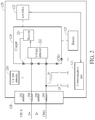
  • FIG. 3 is a diagram illustrating a foreign object (i.e. resistor R 1 ) on the path between VBUS pin 202 and GND pin 208
  • FIG. 4 is a flowchart of a detecting method according to one embodiment of the present invention.
  • the connector 128 does not couple to the AC/DC adapter 110 via the cable 130
  • the charger 124 operates in a first self-test mode
  • the booster 224 receives a battery voltage provided by the battery 125 and sends a specific voltage to the VBUS pin 202 of the connector 128 .
  • Step 404 the current detector 210 detects a current of a path within the connector 128 or a path between the VBUS pin 202 and the charger 124 to generate a detected current, where the current is generated according to the specific voltage.
  • the booster 224 turns off the specific voltage to save power.
  • Step 408 the current detector 210 determines whether the detected current is greater than a threshold (e.g. 50 mA) or not. If the detected current is greater than the threshold, the flow enters Step 422 to show a warning message, make a noise, or vibrate to notify the user that the connector 128 may suffer an overheating problem; and if the detected current is not greater than the threshold, the flow enters Step 410 .
  • a threshold e.g. 50 mA
  • Step 410 the charger 124 determines whether a power supply (e.g. cable of the power adapter or USB host) plugs into the connector 128 . If yes, the flow enters Step 412 ; and if not, the flow enters Step 402 again to periodically detect the abnormal status of the connector 128 .
  • Step 412 because the connector 128 is coupled to the AC/DC adapter 110 , and the VBUS pin 202 of the connector 128 has a supply voltage (e.g. 5V) provided by the AC/DC adapter 110 , at this time the booster 224 will receive the battery voltage provided by the battery 125 and send a specific voltage greater than the supply voltage provided by the AC/DC adapter 110 to the VBUS pin 202 .
  • a power supply e.g. cable of the power adapter or USB host
  • Step 412 the voltage detector 222 detects a voltage level of the VBUS pin 202 , and the booster 224 refers to the detected voltage level of the VBUS pin 202 to generate the specific voltage by adding an offset, for example, if the detected voltage level of the VBUS pin 202 is 5V, the specific voltage may be 5.3V or 5.5V.
  • the specific voltage recited in Step 412 may be different from the specific voltage recited in Step 402 .
  • Step 414 the current detector 210 detects a current of the path within the connector 128 or the path between the VBUS pin 202 and the charger 124 to generate a detected current, where the current is generated according to the specific voltage.
  • the booster 224 turns off the specific voltage to save power.
  • Step 418 the current detector 210 determines whether the detected current is greater than a threshold (e.g. 50 mA) or not. If the detected current is greater than the threshold, the flow enters Step 422 to show a warning message, make a noise, or vibrate to notify the user that the connector 128 may suffer an overheating problem; and if the detected current is not greater than the threshold, the flow enters Step 420 .
  • a threshold e.g. 50 mA
  • Step 420 the charger 124 switches to operate in the normal mode, where the charger 124 receives the supply voltage provided by the AC/DC adapter via the cable 130 and the connector 128 to charge the battery 125 , then the flow enters Step 412 again to periodically detect the abnormal status of the connector 128 .
  • the charger 124 may notify the controller 122 to communicate with the AC/DC adapter 110 to disable or reduce the supply voltage and/or supply current.
  • the charger 124 can refer to the current detected in Step 414 to determine whether to disable or reduce the supply voltage and/or supply current, and can further refer to a range of the detected current to determine by how much the supply voltage and/or supply current should be reduced.
  • the supply voltage and/or supply current can be set to be a first value.
  • the supply voltage and/or supply current can be set to be 5V.
  • the supply voltage and/or supply current can be set to be in a range between 0V and 5V.
  • the charger 124 notifies the controller 122 to communicate with the AC/DC adapter 110 to disable the supply voltage and/or supply current.
  • the first range may encompass at least one or both of the second range and third range.
  • FIG. 5 shows the current detector 210 shown in FIGS. 2 and 3 according to one embodiment of the present invention.
  • the current detector 210 comprises a current source IS, a resistor RN, a subtractor 510 and a comparator 520 .
  • the charger 120 when the charger 124 operates in the first self-test mode, the charger 120 generates the specific voltage VB to the current source IS, and the subtractor 510 calculates a voltage difference between two terminals of the resistor RN, where the voltage difference represents the current flowing through the resistor RN, VBUS pin 202 , the resistor R 1 and the GND pin 208 . Then, the comparator compares the voltage difference with the threshold Vth to generate a detecting result OUT.
  • the resistor RN can be placed between the VBUS pin 202 and the GND pin 208 , or placed on a current path flowing through the resistor R 1 .
  • FIG. 6 is a diagram illustrating a foreign object (i.e. resistor R 2 ) on the path between VBUS pin 202 and D+ pin 204
  • FIG. 7 is a flowchart of a detecting method according to another embodiment of the present invention.
  • the connector 128 does not couple to the AC/DC adapter 110 via the cable 130
  • the charger 124 operates in a second self-test mode
  • the transistor Q 1 is turned off (default status)
  • the booster 224 receives a battery voltage provided by the battery 125 and sends a specific voltage (e.g. 5V or 3.3V) to the VBUS pin 202 of the connector 128 .
  • a specific voltage e.g. 5V or 3.3V
  • Step 704 the voltage detector 222 detects the voltage level of the D+ pin 204 .
  • Step 706 the voltage detector 222 determines whether the detected voltage is greater than a threshold (e.g. 3.3V) or not. If the detected voltage is greater than the threshold, the flow enters Step 716 to show a warning message, make a noise, or vibrate to notify the user that the connector 128 may suffer an overheating problem; and if the detected voltage is not greater than the threshold, the flow enters Step 708 .
  • a threshold e.g. 3.3V
  • the resistor R 2 does not exist, and the voltage level of the D+ pin 204 should be small. If, however, there is no foreign object between the VBUS pin 202 and D+ pin 204 , a current path between the VBUS pin 202 and the D+ pin 204 is generated due to the resistor R 2 , causing the higher voltage level of the D+ pin 204 . Therefore, by detecting the voltage level of the D+ pin 204 , the possible overheating problem can be known and prevented.
  • Step 708 the charger 124 determines whether a power supply (e.g. cable of the power adapter or USB host) plugs into the connector 128 . If yes, the flow enters Step 710 ; and if not, the flow enters Step 702 again to periodically detect the abnormal status of the connector 128 .
  • Step 710 because the connector 128 is coupled to the AC/DC adapter 110 , and the VBUS pin 202 of the connector 128 has a supply voltage (e.g. 5V) provided by the AC/DC adapter 110 , at this time the voltage detector 222 can directly detect the abnormal status of the connector 128 by detecting the voltage level of the D+ pin 204 (i.e.
  • Step 712 the voltage detector 222 determines whether the detected voltage is greater than the threshold (e.g. 3.3V) or not. If the detected voltage is greater than the threshold, the flow enters Step 716 to show a warning message, make a noise, or vibrate to notify the user that the connector 128 may suffer an overheating problem; and if the detected voltage is not greater than the threshold, the flow enters Step 714 .
  • the threshold e.g. 3.3V
  • Step 714 the charger 124 switches to operate in the normal mode, where the charger 124 turns on the transistor Q 1 to make the GND pin 208 connect to the system ground of the electronic device 120 .
  • the charger 124 may notify the controller 122 to communicate with the AC/DC adapter 110 to disable or reduce the supply voltage and/or supply current.
  • the charger 124 can refer to the D+ pin voltage detected in Step 710 to determine whether to disable or reduce the supply voltage and/or supply current, and can further refer to a range of the detected voltage to determine by how much the supply voltage and/or supply current should be reduced.
  • the supply voltage and/or supply current can be set to be a first value.
  • the supply voltage and/or supply current can be set to be 5V.
  • the supply voltage and/or supply current can be set to be in a range between 0V and 5V.
  • the charger 124 notifies the controller 122 to communicate with the AC/DC adapter 110 to disable the supply voltage and/or supply current.
  • the first range may encompass at least one or both of the second range and third range.
  • the resistor R 4 is designed to have large resistance (e.g. several mega ohms), and the transistor Q 1 and the resistor R 4 are arranged to limit the current flowing through the D+ pin 204 and neighboring path to protect the connector 128 while the cable 130 is plugged in.
  • the transistor Q 1 is turned off, and when the cable plugs in and the VBUS pin 202 receives the supply voltage (e.g.
  • a current path 802 is from the VBUS pin 202 , resistor R 2 , D+ pin 204 , GPIO pin of the charger 124 , system ground and resistor RT to the GND pin 208 . Because the resistor R 4 is designed to have large resistance, the current on this current path can be limited to be a safe value (e.g. less than 25 mA), and the connector 128 may not suffer an overheating problem. In addition, the transistor Q 1 is turned on when the charger 124 and/or the controller 122 confirm that the connector 128 is safe.
  • the voltage detector 222 determines whether the connector 128 has an abnormal status by detecting the voltage level of the D+ pin 204 .
  • the voltage detector 222 may also detect the voltage level of the D ⁇ pin 204 to judge if a foreign object is between the VBUS pin 202 and the D ⁇ pin 206 .
  • the voltage detector 222 may also detect the voltage level of any one of the non-power pins such as TX1, CC1, SBU1, RX2-, RX1-, SBU2, CC2, TX2- to judge if a foreign object is between the power pin and non-power pin.
  • both the leakage current path (caused by the resistor R 1 ) between the VBUS pin 202 and the GND pin 208 and the leakage current path (caused by the resistor R 2 ) between the VBUS pin 202 and the D+ pin 204 can be detected. The user can then be notified if the connector 128 has any abnormal status.
  • the electronic device 120 may be designed to implement only a portion of the circuits shown in FIG. 2 to execute one of the embodiments shown in FIG. 4 and FIG. 7 only. These alternative designs shall fall within the scope of the present invention.
  • the charger 124 periodically (e.g. every minute, ten minutes or hour) enters the first self-test mode no matter whether the AC/DC adapter 110 is coupled to the connector 128 of the electronic device 120 or not. In other embodiments, however, the charger 124 may enter the first self-test mode according to an arranged schedule or by the user's input/control, or the charger 124 may enter the first self-test mode only when no cable plugs into the connector 128 , or the charger 124 may enter the first self-test mode only when the AC/DC adapter 110 is coupled to the connector 128 . Similarly, in the embodiments shown in FIGS. 6-8 , the charger 124 also periodically (e.g.
  • the charger 124 may enter the second self-test mode according to an arranged schedule or by the user's input/control, or the charger 124 may enter the second self-test mode only when no cable plugs into the connector 128 , or the charger 124 may enter the second self-test mode only when the AC/DC adapter 110 is coupled to the connector 128 .
  • These alternative designs shall fall within the scope of the present invention.
  • first self-test mode and the second self-test mode can be sequentially executed, or be executed independently according to an arranged schedule or by the user's input/control.
  • the leakage current caused by the connector can be exactly determined.
  • the user can therefore be notified to deal with this case, or the electronic device can communicate with the power adapter or USB host to disable or reduce the output voltage/current, thereby avoiding overheating of the connector.

Landscapes

  • Engineering & Computer Science (AREA)
  • Physics & Mathematics (AREA)
  • Electromagnetism (AREA)
  • General Physics & Mathematics (AREA)
  • Radar, Positioning & Navigation (AREA)
  • Automation & Control Theory (AREA)
  • Power Engineering (AREA)
  • Charge And Discharge Circuits For Batteries Or The Like (AREA)

Abstract

An electronic device includes: a connector, arranged for coupling to a power supply external to the electronic device, wherein the power supply is arranged to provide a supply voltage to the electronic device to charge a battery of the electronic device; and a charger, coupled to the connector and selectively operated in a normal mode or a self-test mode, wherein when the charger operates in the normal mode, the charger is arranged for receiving the supply voltage via a power pin of the connector to charge the battery of the electronic device; and when the charger operates in the self-test mode, the charger provides a specific voltage to the power pin of the connector. The charger includes a detector to detect the current or voltage of at least one pin of the connector to generate a detecting result, and the supply voltage is set based on the detecting result.

Description

CROSS REFERENCE TO RELATED APPLICATION
This application is a Continuation In Part of U.S. application Ser. No. 15/006,129, which was filed on Jan. 26, 2016 and claims priority of U.S. Provisional Application No. 62/161,880, filed on May 14, 2015.
BACKGROUND
When a charger connector of an electronic device is damaged, foreign objects such as dust, metal scraps or lead are present on the charger connector, or there is liquid between the charger connector pins, a leakage current generated when the electronic device is charged by a power adapter may cause a temperature of the charger connector to increase, causing danger to the user.
In particular, because the leakage current is generated at the charger connector, a protection circuit within a charger IC within the electronic device cannot provide adequate protection by detecting or avoiding this leakage current issue. In addition, because the leakage current generally occurs when the cable of the power adapter connects to the charger connector of the electronic device, and the leakage current is seldom generated when no plug connects to the charger connector, how to design circuits to detect and protect the charger connector is difficult, and is an important topic in this field.
SUMMARY
It is therefore an objective of the present invention to provide a detecting method for detecting abnormal status of the charger connector of the electronic device, to solve the above-mentioned problems.
According to one embodiment of the present invention, an electronic device is provided comprising: a connector, arranged for coupling to a power supply external to the electronic device, wherein the power supply is arranged to provide a supply voltage to the electronic device to charge a battery of the electronic device; and a charger, coupled to the connector and selectively operated in a normal mode or a self-test mode, wherein when the charger operates in the normal mode, the charger is arranged for receiving the supply voltage via a power pin of the connector to charge the battery of the electronic device; and when the charger operates in the self-test mode, the charger provides a specific voltage to the power pin of the connector. The charger includes a detector to detect the current or voltage of at least one pin of the connector to generate a detecting result, and the supply voltage is set based on the detecting result.
According to another embodiment of the present invention, a charger is provided, wherein the charger is arranged to be positioned in an electronic device and coupled to a connector of the electronic device, and coupled to a power supply external to the electronic device. The charger is selectively operated in a normal mode or a self-test mode, wherein when the charger operates in the normal mode, the charger is arranged for receiving a supply voltage from the power supply via a power pin of the connector to charge a battery of the electronic device; and when the charger operates in the self-test mode, the charger provides a specific voltage to the power pin of the connector, wherein the charger includes a detector to detect the current or voltage of at least one pin of the connector to generate a detecting result, and the supply voltage is set based on the detecting result.
According to another embodiment of the present invention, a detecting method of an electronic device is provided, wherein the electronic device comprises a connector arranged for coupling to a power supply external to the electronic device, wherein the power supply is arranged to provide a supply voltage to the electronic device via a power pin of the connector to charge a battery of the electronic device. The detecting method comprises: operating in a self-test mode and detecting a voltage or a current of at least one pin of the connector to generate a detecting result; and setting the supply voltage based on the detecting result.
According to another embodiment of the invention, an electronic device is provided, and the electronic device comprises: a connector, arranged for coupling to a power supply external to the electronic device, wherein the power supply is arranged to provide a supply voltage to the electronic device to charge a battery of the electronic device; a charger, coupled to the connector and selectively operated in a normal mode or a self-test mode, for receiving the supply voltage via a power pin of the connector to charge the battery when the charger operates in the normal mode; a transistor, having a gate electrode, a first electrode and a second electrode, wherein the gate electrode is controlled by a control signal provided by the charger, the first electrode is coupled to a ground pin of the connector, and the second electrode is coupled to a ground of the electronic device; and a resistor, coupled between the ground pin of the connector and the ground of the electronic device. When the charger operates in the self-test mode, the charger provides a specific voltage to the power pin of the connector the charger includes a detector to detect the current or voltage of at least one pin of the connector to generate a detecting result, and the supply voltage is set based on the detecting result.
When the detecting result is within a first range, the supply voltage is set to be a first value, when the detecting result is within a second range, the supply voltage is set to be 5V, when the detecting result is within a third range, the supply voltage is set to be in a range between 0 and 5V, and when the detecting result is above a threshold, the supply voltage is set to be 0V.
These and other objectives of the present invention will no doubt become obvious to those of ordinary skill in the art after reading the following detailed description of the preferred embodiment that is illustrated in the various figures and drawings.
BRIEF DESCRIPTION OF THE DRAWINGS
FIG. 1 is a diagram illustrating a charging system according to one embodiment of the present invention.
FIG. 2 is a diagram illustrating a detailed structure of the electronic device according to one embodiment of the present invention.
FIG. 3 is a diagram illustrating a foreign object (i.e. resistor R1) on the path between VBUS pin and GND pin.
FIG. 4 is a flowchart of a detecting method according to one embodiment of the present invention.
FIG. 5 shows the current detector shown in FIGS. 2 and 3 according to one embodiment of the present invention.
FIG. 6 is a diagram illustrating a foreign object (i.e. resistor R2) on the path between VBUS pin and D+ pin.
FIG. 7 is a flowchart of a detecting method according to another embodiment of the present invention.
FIG. 8 shows a current path when the transistor Q1 is turned off.
DETAILED DESCRIPTION
Certain terms are used throughout the following description and claims to refer to particular system components. As one skilled in the art will appreciate, manufacturers may refer to a component by different names. This document does not intend to distinguish between components that differ in name but not function. In the following discussion and in the claims, the terms “including” and “comprising” are used in an open-ended fashion, and thus should be interpreted to mean “including, but not limited to . . . ” The terms “couple” and “couples” are intended to mean either an indirect or a direct electrical connection. Thus, if a first device couples to a second device, that connection may be through a direct electrical connection, or through an indirect electrical connection via other devices and connections.
Please refer to FIG. 1, which is a diagram illustrating a charging system 100 according to one embodiment of the present invention. As shown in FIG. 1, the charging system 100 comprises a power supply (in this embodiment, the power supply is an AC-DC adapter 110, but this is not a limitation of the present invention, and the power source may be a Universal Serial Bus (USB) host in other embodiments) and an electronic device 120, where the AC-DC adapter 110 is connected to the electronic device 120 via a cable 130, and the AC-DC adapter 110 provides at least a supply voltage VBUS, aground voltage GND and data D+ and D− to the electronic device 120. In this embodiment, the electronic device 120 may be a portable device such as a cell phone, smart phone, tablet . . . etc. or any other electronic device required to be charged by a power adapter or USB host.
The AC-DC adapter 110 comprises an AC-DC controller 112, a communication unit 114 and a connector 118, where the AC-DC controller 112 is arranged to receive external AC power to generate the stable supply voltage VBUS, the communication unit 114 is arranged to communicate with the electronic device 120, and the connector 118 satisfies the USB standards and has four pins for providing VBUS, D+, D− and GND. In addition, the electronic device 120 comprises a controller 122, a communication unit 123, a charger 124, a battery 125 and a connector 128. The controller 122 is arranged to control the charger 124 and perform some operations of the electronic device 120, and the charger 124 is arranged to charge the battery 125 according to the supply voltage VBUS provided by the AC-DC adapter 110 or provide a specific voltage to the connector 128. The communication unit 123 is arranged to communicate with the AC-DC adapter 110, and the connector 128 satisfies the USB standards and has four pins for receiving VBUS, D+, D− and GND.
In this embodiment, the AC-DC controller 112 has a USB interface; however, the AC-DC controller 112 may have another interface such as USB power delivery (USB PD), USB D+/D− or any other suitable interface in other embodiments. The circuits within the AC-DC adapter 110 may have an inter-integrated circuit (I2C) interface or a one wire (1-Wire) interface or any other suitable interface. In addition, the electronic device 120 has bi-directional communication with the AC-DC adapter 110. In this embodiment, the communication unit 116 and the communication unit 123 may have any suitable wireless communication interface such as Bluetooth (BT) or Bluetooth Low Energy (BT BLE).
Please refer to FIG. 2, which is a diagram illustrating a detailed structure of the electronic device 120 according to one embodiment of the present invention. As shown in FIG. 2, the connector 128 comprises a VBUS pin 202 and a GND pin 208 (power pins) for receiving the supply voltage VBUS and the ground voltage GND, and a D+ pin 204 and a D− pin 206 (data pins) for receiving data D+ and D− from the AC/DC adapter 110; the charger 124 comprises a voltage detector 222 and a booster 224; and the electronic device 120 further comprises a current detector 210, a transistor Q1 and a resistor RT, where the gate electrode of the transistor Q1 is coupled to a general purpose input/output (GPIO) pin, a drain electrode of the transistor Q1 is coupled to the power pin 208, and the source electrode of the transistor Q1 is coupled to a system ground; and the resistor RT is coupled between the power pin 208 and the GPIO pin. It is noted that FIG. 2 merely shows the elements related to the present invention; a person skilled in the art should understand that the electronic device 120 and the charger 124 have other elements for the general functions.
The elements shown in FIG. 2 are used to detect whether the connector 128 has abnormal status, where the abnormal status is a leakage current occurred in the connector 128, and the leakage current may be caused by foreign objects such as dust, metal scraps, lead or liquid. Particularly, the detecting method can be implemented no matter whether the connector 128 is coupled to the AC/DC adapter 110 or not (i.e. no matter whether the electronic device 120 is charged or not). Generally, the foreign object may be on a path between the VBUS pin 202 and GND pin 208, or on a path between the VBUS pin 202 and one of the D+ pin 204 and D− pin 206, and the embodiments of detection methods for these two cases are provided in the following descriptions.
Refer to FIG. 3 and FIG. 4 together, where FIG. 3 is a diagram illustrating a foreign object (i.e. resistor R1) on the path between VBUS pin 202 and GND pin 208, and FIG. 4 is a flowchart of a detecting method according to one embodiment of the present invention. In Step 402, the connector 128 does not couple to the AC/DC adapter 110 via the cable 130, the charger 124 operates in a first self-test mode, and the booster 224 receives a battery voltage provided by the battery 125 and sends a specific voltage to the VBUS pin 202 of the connector 128. In Step 404, the current detector 210 detects a current of a path within the connector 128 or a path between the VBUS pin 202 and the charger 124 to generate a detected current, where the current is generated according to the specific voltage. In Step 406, the booster 224 turns off the specific voltage to save power. In Step 408, the current detector 210 determines whether the detected current is greater than a threshold (e.g. 50 mA) or not. If the detected current is greater than the threshold, the flow enters Step 422 to show a warning message, make a noise, or vibrate to notify the user that the connector 128 may suffer an overheating problem; and if the detected current is not greater than the threshold, the flow enters Step 410.
In Step 410, the charger 124 determines whether a power supply (e.g. cable of the power adapter or USB host) plugs into the connector 128. If yes, the flow enters Step 412; and if not, the flow enters Step 402 again to periodically detect the abnormal status of the connector 128. In addition, in Step 412, because the connector 128 is coupled to the AC/DC adapter 110, and the VBUS pin 202 of the connector 128 has a supply voltage (e.g. 5V) provided by the AC/DC adapter 110, at this time the booster 224 will receive the battery voltage provided by the battery 125 and send a specific voltage greater than the supply voltage provided by the AC/DC adapter 110 to the VBUS pin 202. In detail, in Step 412, the voltage detector 222 detects a voltage level of the VBUS pin 202, and the booster 224 refers to the detected voltage level of the VBUS pin 202 to generate the specific voltage by adding an offset, for example, if the detected voltage level of the VBUS pin 202 is 5V, the specific voltage may be 5.3V or 5.5V. In addition, it is noted that the specific voltage recited in Step 412 may be different from the specific voltage recited in Step 402.
In Step 414, the current detector 210 detects a current of the path within the connector 128 or the path between the VBUS pin 202 and the charger 124 to generate a detected current, where the current is generated according to the specific voltage. In Step 416, the booster 224 turns off the specific voltage to save power. In Step 418, the current detector 210 determines whether the detected current is greater than a threshold (e.g. 50 mA) or not. If the detected current is greater than the threshold, the flow enters Step 422 to show a warning message, make a noise, or vibrate to notify the user that the connector 128 may suffer an overheating problem; and if the detected current is not greater than the threshold, the flow enters Step 420.
In Step 420, the charger 124 switches to operate in the normal mode, where the charger 124 receives the supply voltage provided by the AC/DC adapter via the cable 130 and the connector 128 to charge the battery 125, then the flow enters Step 412 again to periodically detect the abnormal status of the connector 128. In addition, in Step 424, because the connector 128 may suffer an overheating problem, the charger 124 may notify the controller 122 to communicate with the AC/DC adapter 110 to disable or reduce the supply voltage and/or supply current.
In more detail, the charger 124 can refer to the current detected in Step 414 to determine whether to disable or reduce the supply voltage and/or supply current, and can further refer to a range of the detected current to determine by how much the supply voltage and/or supply current should be reduced. When the detected current falls within a first range, the supply voltage and/or supply current can be set to be a first value. When the detected current falls within a second range, the supply voltage and/or supply current can be set to be 5V. When the detected current falls within a third range, the supply voltage and/or supply current can be set to be in a range between 0V and 5V. Finally, when the detected current is above a threshold (which may be different from the threshold in Step 418), the charger 124 notifies the controller 122 to communicate with the AC/DC adapter 110 to disable the supply voltage and/or supply current. Please note that the first range may encompass at least one or both of the second range and third range.
FIG. 5 shows the current detector 210 shown in FIGS. 2 and 3 according to one embodiment of the present invention. As shown in FIG. 5, the current detector 210 comprises a current source IS, a resistor RN, a subtractor 510 and a comparator 520. In detail, when the charger 124 operates in the first self-test mode, the charger 120 generates the specific voltage VB to the current source IS, and the subtractor 510 calculates a voltage difference between two terminals of the resistor RN, where the voltage difference represents the current flowing through the resistor RN, VBUS pin 202, the resistor R1 and the GND pin 208. Then, the comparator compares the voltage difference with the threshold Vth to generate a detecting result OUT. It is noted that the embodiment shown in FIG. 5 is for illustrative purposes only, and not a limitation of the present invention. In other embodiments, the resistor RN can be placed between the VBUS pin 202 and the GND pin 208, or placed on a current path flowing through the resistor R1.
Refer to FIG. 6 and FIG. 7 together, where FIG. 6 is a diagram illustrating a foreign object (i.e. resistor R2) on the path between VBUS pin 202 and D+ pin 204, and FIG. 7 is a flowchart of a detecting method according to another embodiment of the present invention. In Step 702, the connector 128 does not couple to the AC/DC adapter 110 via the cable 130, the charger 124 operates in a second self-test mode, the transistor Q1 is turned off (default status), and the booster 224 receives a battery voltage provided by the battery 125 and sends a specific voltage (e.g. 5V or 3.3V) to the VBUS pin 202 of the connector 128. In Step 704, the voltage detector 222 detects the voltage level of the D+ pin 204. In Step 706, the voltage detector 222 determines whether the detected voltage is greater than a threshold (e.g. 3.3V) or not. If the detected voltage is greater than the threshold, the flow enters Step 716 to show a warning message, make a noise, or vibrate to notify the user that the connector 128 may suffer an overheating problem; and if the detected voltage is not greater than the threshold, the flow enters Step 708.
In detail, if there is no foreign object between the VBUS pin 202 and D+ pin 204, the resistor R2 does not exist, and the voltage level of the D+ pin 204 should be small. If, however, there is no foreign object between the VBUS pin 202 and D+ pin 204, a current path between the VBUS pin 202 and the D+ pin 204 is generated due to the resistor R2, causing the higher voltage level of the D+ pin 204. Therefore, by detecting the voltage level of the D+ pin 204, the possible overheating problem can be known and prevented.
In Step 708, the charger 124 determines whether a power supply (e.g. cable of the power adapter or USB host) plugs into the connector 128. If yes, the flow enters Step 710; and if not, the flow enters Step 702 again to periodically detect the abnormal status of the connector 128. In addition, in Step 710, because the connector 128 is coupled to the AC/DC adapter 110, and the VBUS pin 202 of the connector 128 has a supply voltage (e.g. 5V) provided by the AC/DC adapter 110, at this time the voltage detector 222 can directly detect the abnormal status of the connector 128 by detecting the voltage level of the D+ pin 204 (i.e. the booster 224 does not need to provide the specific voltage to the VBUS pin 202). In Step 712, the voltage detector 222 determines whether the detected voltage is greater than the threshold (e.g. 3.3V) or not. If the detected voltage is greater than the threshold, the flow enters Step 716 to show a warning message, make a noise, or vibrate to notify the user that the connector 128 may suffer an overheating problem; and if the detected voltage is not greater than the threshold, the flow enters Step 714.
In Step 714, the charger 124 switches to operate in the normal mode, where the charger 124 turns on the transistor Q1 to make the GND pin 208 connect to the system ground of the electronic device 120. In addition, in Step 718, because the connector 128 may suffer an overheating problem, the charger 124 may notify the controller 122 to communicate with the AC/DC adapter 110 to disable or reduce the supply voltage and/or supply current.
In more detail, the charger 124 can refer to the D+ pin voltage detected in Step 710 to determine whether to disable or reduce the supply voltage and/or supply current, and can further refer to a range of the detected voltage to determine by how much the supply voltage and/or supply current should be reduced. When the detected voltage falls within a first range, the supply voltage and/or supply current can be set to be a first value. When the detected voltage falls within a second range, the supply voltage and/or supply current can be set to be 5V. When the detected voltage falls within a third range, the supply voltage and/or supply current can be set to be in a range between 0V and 5V. Finally, when the detected voltage is above a threshold (which may be different from the threshold in Step 712), the charger 124 notifies the controller 122 to communicate with the AC/DC adapter 110 to disable the supply voltage and/or supply current. Please note that the first range may encompass at least one or both of the second range and third range.
In the embodiment shown in FIG. 6, the resistor R4 is designed to have large resistance (e.g. several mega ohms), and the transistor Q1 and the resistor R4 are arranged to limit the current flowing through the D+ pin 204 and neighboring path to protect the connector 128 while the cable 130 is plugged in. In detail, refer to FIG. 8. Initially, the transistor Q1 is turned off, and when the cable plugs in and the VBUS pin 202 receives the supply voltage (e.g. 5V) provided by the AC/DC adapter 110, a current path 802 is from the VBUS pin 202, resistor R2, D+ pin 204, GPIO pin of the charger 124, system ground and resistor RT to the GND pin 208. Because the resistor R4 is designed to have large resistance, the current on this current path can be limited to be a safe value (e.g. less than 25 mA), and the connector 128 may not suffer an overheating problem. In addition, the transistor Q1 is turned on when the charger 124 and/or the controller 122 confirm that the connector 128 is safe.
In addition, in the embodiment shown in FIGS. 6-8, the voltage detector 222 determines whether the connector 128 has an abnormal status by detecting the voltage level of the D+ pin 204. A person skilled in the art should understand, however, that the voltage detector 222 may also detect the voltage level of the D− pin 204 to judge if a foreign object is between the VBUS pin 202 and the D− pin 206. In addition, when the connector 128 complies with the USC type-C standard, the voltage detector 222 may also detect the voltage level of any one of the non-power pins such as TX1, CC1, SBU1, RX2-, RX1-, SBU2, CC2, TX2- to judge if a foreign object is between the power pin and non-power pin. These alternative designs shall fall within the scope of the present invention.
In the above-mentioned embodiments, both the leakage current path (caused by the resistor R1) between the VBUS pin 202 and the GND pin 208 and the leakage current path (caused by the resistor R2) between the VBUS pin 202 and the D+ pin 204 can be detected. The user can then be notified if the connector 128 has any abnormal status. In other embodiments, however, the electronic device 120 may be designed to implement only a portion of the circuits shown in FIG. 2 to execute one of the embodiments shown in FIG. 4 and FIG. 7 only. These alternative designs shall fall within the scope of the present invention.
In addition, in the embodiments shown in FIGS. 3-5, the charger 124 periodically (e.g. every minute, ten minutes or hour) enters the first self-test mode no matter whether the AC/DC adapter 110 is coupled to the connector 128 of the electronic device 120 or not. In other embodiments, however, the charger 124 may enter the first self-test mode according to an arranged schedule or by the user's input/control, or the charger 124 may enter the first self-test mode only when no cable plugs into the connector 128, or the charger 124 may enter the first self-test mode only when the AC/DC adapter 110 is coupled to the connector 128. Similarly, in the embodiments shown in FIGS. 6-8, the charger 124 also periodically (e.g. every minute, ten minutes or hour) enters the second self-test mode no matter whether the AC/DC adapter 110 is coupled to the connector 128 of the electronic device 120 or not. In other embodiments, however, the charger 124 may enter the second self-test mode according to an arranged schedule or by the user's input/control, or the charger 124 may enter the second self-test mode only when no cable plugs into the connector 128, or the charger 124 may enter the second self-test mode only when the AC/DC adapter 110 is coupled to the connector 128. These alternative designs shall fall within the scope of the present invention.
In addition, the above-mentioned first self-test mode and the second self-test mode can be sequentially executed, or be executed independently according to an arranged schedule or by the user's input/control.
Briefly summarized, in the embodiments of the present invention, the leakage current caused by the connector can be exactly determined. The user can therefore be notified to deal with this case, or the electronic device can communicate with the power adapter or USB host to disable or reduce the output voltage/current, thereby avoiding overheating of the connector.
Those skilled in the art will readily observe that numerous modifications and alterations of the device and method may be made while retaining the teachings of the invention. Accordingly, the above disclosure should be construed as limited only by the metes and bounds of the appended claims.

Claims (26)

What is claimed is:
1. An electronic device, comprising:
a connector, arranged for coupling to a power supply external to the electronic device, wherein the power supply is arranged to provide a supply voltage to the electronic device to charge a battery of the electronic device; and
a charger, coupled to the connector and selectively operated in a normal mode or a self-test mode, wherein when the charger operates in the normal mode, the charger is arranged for receiving the supply voltage via a power pin of the connector to charge the battery of the electronic device; and when the charger operates in the self-test mode, the charger provides a specific voltage to the power pin of the connector;
wherein the charger includes a detector to detect the current or voltage of at least one pin of the connector to generate a detecting result, and the supply voltage is set based on the detecting result.
2. The electronic device of claim 1, wherein when the detecting result is within a first range, the supply voltage is set to be a first value.
3. The electronic device of claim 1, wherein when the detecting result is within a second range, the supply voltage is set to be 5V.
4. The electronic device of claim 1, wherein when the detecting result is within a third range, the supply voltage is set to be in a range between 0 and 5V.
5. The electronic device of claim 1, wherein when the detecting result is above a first threshold, the supply voltage is set to be 0V.
6. The electronic device of claim 1, wherein the charger is allowed to operate in the self-test mode no matter whether the connector is coupled to the power supply or not.
7. The electronic device of claim 1, wherein the specific voltage is greater than the supply voltage provided by the power supply.
8. The electronic device of claim 1, further comprising:
a resistor, coupled between the charger and the connector; and
a current detector, wherein when the charger operates in the self-test mode and provides the specific voltage to the power pin of the connector, the current detector detects a current flowing through the resistor to generate the detecting result.
9. The electronic device of claim 8, wherein when the current flowing through the resistor is lower than a second threshold, the charger switches from the self-test mode to the normal mode; and when the current flowing through the resistor is greater than the second threshold, the current detector notifies a controller of the electronic device to show a warning message, noise, or vibration or to notify the power supply to disable the supply voltage or reduce an output current, wherein the first threshold may be different from the second threshold.
10. The electronic device of claim 1, further comprising:
a voltage detector, for detecting a voltage of a non-power pin of the connector to generate the detecting result when the specific voltage is supplied to the power pin of the connector;
wherein when the voltage of the non-power pin is greater than a second threshold, the voltage detector notifies a controller of the electronic device to show a warning message, noise, or vibration or to notify the power supply to disable or reduce the supply voltage or an output current, wherein the first threshold may be different from the second threshold.
11. The electronic device of claim 1, further comprising:
a transistor, having a gate electrode, a first electrode and a second electrode, wherein the gate electrode is controlled by a control signal provided by the charger, the first electrode is coupled to a ground pin of the connector, and the second electrode is coupled to a ground of the electronic device; and
a resistor, coupled between the ground pin of the connector and the ground of the electronic device.
12. The electronic device of claim 11, wherein a default status of the transistor is off, and the electronic device further comprises:
a voltage detector, for detecting a voltage of a non-power pin of the connector to generate a detecting result when the specific voltage is supplied to the power pin of the connector;
wherein when the voltage of the non-power pin is greater than a second threshold, the voltage detector notifies a controller of the electronic device to show a warning message, noise, or vibration or to notify the power supply to disable or reduce the supply voltage or an output current; and when the voltage of the non-power pin is less than the second threshold, the charger sends the control signal to turn on the transistor, wherein the first threshold may be different from the second threshold.
13. A charger, arranged to be positioned in an electronic device and coupled to a connector of the electronic device, wherein the connector is arranged for coupling to a power supply external to the electronic device, and the charger is selectively operated in a normal mode or a self-test mode; wherein when the charger operates in the normal mode, the charger is arranged for receiving a supply voltage from the power supply via a power pin of the connector to charge a battery of the electronic device; and when the charger operates in the self-test mode, the charger provides a specific voltage to the power pin of the connector, wherein the charger includes a detector to detect the current or voltage of at least one pin of the connector to generate a detecting result, and the supply voltage is set based on the detecting result.
14. The charger of claim 13, wherein when the detecting result is within a first range, the supply voltage is set to be a first value.
15. The charger of claim 13, wherein when the detecting result is within a second range, the supply voltage is set to be 5V.
16. The charger of claim 13, wherein when the detecting result is within a third range, the supply voltage is set to be in a range between 0 and 5V.
17. The charger of claim 13, wherein when the detecting result is above a first threshold, the supply voltage is set to be 0V.
18. The charger of claim 13, wherein the charger is allowed to operate in the self-test mode no matter whether the connector is coupled to the power supply or not.
19. The charger of claim 13, wherein the specific voltage is greater than the supply voltage provided by the power supply.
20. The charger of claim 13, further comprising:
a voltage detector, for detecting a voltage of a non-power pin of the connector to generate the detecting result when the specific voltage is provided to the power pin of the connector;
wherein when the voltage of the non-power pin is greater than a second threshold, the voltage detector notifies a controller of the electronic device to show a warning message, noise, or vibration or to notify the power supply to disable or reduce the supply voltage or an output current, wherein the first threshold may be different from the second threshold.
21. An electronic device, comprising:
a connector, arranged for coupling to a power supply external to the electronic device, wherein the power supply is arranged to provide a supply voltage to the electronic device to charge a battery of the electronic device;
a charger, coupled to the connector and selectively operated in a normal mode or a self-test mode, for receiving the supply voltage via a power pin of the connector to charge the battery when the charger operates in the normal mode;
a transistor, having a gate electrode, a first electrode and a second electrode, wherein the gate electrode is controlled by a control signal provided by the charger, the first electrode is coupled to a ground pin of the connector, and the second electrode is coupled to a ground of the electronic device; and
a resistor, coupled between the ground pin of the connector and the ground of the electronic device;
wherein when the charger operates in the self-test mode, the charger provides a specific voltage to the power pin of the connector, the charger includes a detector to detect the current or voltage of at least one pin of the connector to generate a detecting result, and the supply voltage is set based on the detecting result.
22. The electronic device of claim 21, wherein a default status of the transistor is off, and the electronic device further comprises:
a voltage detector, for detecting a voltage of a non-power pin of the connector to generate the detecting result when the specific voltage is supplied to the power pin of the connector;
wherein when the voltage of the non-power pin is greater than a second threshold, the voltage detector notifies a controller of the electronic device to show a warning message, noise, or vibration or to notify the power supply to disable the supply voltage or reduce an output current; and when the voltage of the non-power pin is less than the second threshold, the charger sends the control signal to turn on the transistor, wherein the first threshold may be different from the second threshold.
23. The electronic device of claim 21, wherein when the detecting result is within a first range, the supply voltage is set to be a first value.
24. The electronic device of claim 21, wherein when the detecting result is within a second range, the supply voltage is set to be 5V.
25. The electronic device of claim 21, wherein when the detecting result is within a third range, the supply voltage is set to be in a range between 0 and 5V.
26. The electronic device of claim 21, wherein when the detecting result is above a threshold, the supply voltage is set to be 0V.
US16/214,150 2015-05-14 2018-12-10 Electronic device, charger within the electronic device, and detecting method for detecting abnormal status of connector of electronic device Active US10658860B2 (en)

Priority Applications (1)

Application Number Priority Date Filing Date Title
US16/214,150 US10658860B2 (en) 2015-05-14 2018-12-10 Electronic device, charger within the electronic device, and detecting method for detecting abnormal status of connector of electronic device

Applications Claiming Priority (3)

Application Number Priority Date Filing Date Title
US201562161880P 2015-05-14 2015-05-14
US15/006,129 US10181742B2 (en) 2015-05-14 2016-01-26 Electronic device, charger within the electronic device, and detecting method for detecting abnormal status of connector of electronic device
US16/214,150 US10658860B2 (en) 2015-05-14 2018-12-10 Electronic device, charger within the electronic device, and detecting method for detecting abnormal status of connector of electronic device

Related Parent Applications (1)

Application Number Title Priority Date Filing Date
US15/006,129 Continuation-In-Part US10181742B2 (en) 2015-05-14 2016-01-26 Electronic device, charger within the electronic device, and detecting method for detecting abnormal status of connector of electronic device

Publications (2)

Publication Number Publication Date
US20190109480A1 US20190109480A1 (en) 2019-04-11
US10658860B2 true US10658860B2 (en) 2020-05-19

Family

ID=65993479

Family Applications (1)

Application Number Title Priority Date Filing Date
US16/214,150 Active US10658860B2 (en) 2015-05-14 2018-12-10 Electronic device, charger within the electronic device, and detecting method for detecting abnormal status of connector of electronic device

Country Status (1)

Country Link
US (1) US10658860B2 (en)

Families Citing this family (13)

* Cited by examiner, † Cited by third party
Publication number Priority date Publication date Assignee Title
US10554058B2 (en) 2015-05-14 2020-02-04 Media Tek Inc. Systems and methods for monitoring an operating status of a connector
JP6685429B2 (en) * 2016-11-15 2020-04-22 華為技術有限公司Huawei Technologies Co.,Ltd. Charging method and related devices
US10705497B2 (en) * 2017-06-21 2020-07-07 Richtek Technology Corporation Foreign object detection method and power system capable of detecting foreign object
DE102017125265B4 (en) * 2017-10-27 2025-10-02 Phoenix Contact E-Mobility Gmbh Charging plug and charging station for a motor vehicle
US10573997B1 (en) * 2019-05-24 2020-02-25 Microsoft Technology Licensing, Llc Power supply unit with connector protection circuit
US12388342B2 (en) 2019-12-27 2025-08-12 Sharp NEC Display Solutions, Ltd Electronic apparatus, display device, and voltage management method
US10958454B1 (en) * 2020-05-13 2021-03-23 Logitech Europe S.A. System and method for cable link establishment
JP6865879B1 (en) * 2020-09-07 2021-04-28 日本たばこ産業株式会社 Aerosol generation system, aspirator controller, and power supply
CN113629802B (en) * 2021-07-15 2024-04-05 深圳天德钰科技股份有限公司 Power supply device
CN115993493A (en) * 2021-10-18 2023-04-21 中山市江波龙电子有限公司 Connector detection circuit and connector test equipment
US11923675B2 (en) * 2021-12-17 2024-03-05 Qualcomm Incorporated Systems and methods for liquid presentation detection
TW202414237A (en) 2022-09-15 2024-04-01 同星科技股份有限公司 Usb electronic device having functionality of electric leakage protection
US12332303B2 (en) * 2023-09-15 2025-06-17 Semiconductor Components Industries, Llc Built-in self test with current measurement for analog circuit verification

Citations (17)

* Cited by examiner, † Cited by third party
Publication number Priority date Publication date Assignee Title
CN2877107Y (en) 2006-01-11 2007-03-07 惠州市蓝微电子有限公司 Lithium battery charging managing circuit
US20070136025A1 (en) 2005-12-09 2007-06-14 Hon Hai Precision Industry Co., Ltd. Usb port tester
US20100201308A1 (en) 2006-06-29 2010-08-12 Nokia Corporation Device and method for battery charging
US20110018522A1 (en) * 2009-07-22 2011-01-27 Chih-Hung Li Power supply device, portable electronic apparatus and related method for determining types of a power supply device
US20110025262A1 (en) 2001-03-01 2011-02-03 Research In Motion Limited Multifunctional Charger System and Method
US20110181104A1 (en) 2008-09-22 2011-07-28 Toyota Jidosha Kabushiki Kaisha Vehicle abnormality detection apparatus and vehicle
CN102231549A (en) 2011-07-04 2011-11-02 重庆长安汽车股份有限公司 Battery management chip
US20120119696A1 (en) 2010-11-17 2012-05-17 Texas Instruments Incorporated Devices And Methods For Detecting USB Devices Attached To A USB Charging Port
US20120153993A1 (en) 2010-12-15 2012-06-21 Hon Hai Precision Industry Co., Ltd. Usb port detecting circuit
US20130082644A1 (en) 2011-09-30 2013-04-04 Fairchild Semiconductor Corporation Charger detection with proprietary charger support
US20130154547A1 (en) 2011-11-17 2013-06-20 Atsushi Wada Determination circuit
CN103187769A (en) 2011-12-31 2013-07-03 比亚迪股份有限公司 Electric automobile and discharging device thereof
US20130181675A1 (en) 2010-11-25 2013-07-18 Honda Motor Co., Ltd. Charge control device for electric vehicle
US20130271107A1 (en) 2011-12-28 2013-10-17 Stmicroelectronics S.R.L. Voltage regulator with by-pass capability for test purposes
US20140015476A1 (en) 2012-07-11 2014-01-16 Semiconductor Components Industries, Llc Charging system for portable electronic equipment
US20150048804A1 (en) 2013-08-14 2015-02-19 Nokia Corporation Charging connector overheat detection and protection apparatus
US20160098688A1 (en) * 2014-10-03 2016-04-07 ecoATM, Inc. System for electrically testing mobile devices at a consumer-operated kiosk, and associated devices and methods

Patent Citations (17)

* Cited by examiner, † Cited by third party
Publication number Priority date Publication date Assignee Title
US20110025262A1 (en) 2001-03-01 2011-02-03 Research In Motion Limited Multifunctional Charger System and Method
US20070136025A1 (en) 2005-12-09 2007-06-14 Hon Hai Precision Industry Co., Ltd. Usb port tester
CN2877107Y (en) 2006-01-11 2007-03-07 惠州市蓝微电子有限公司 Lithium battery charging managing circuit
US20100201308A1 (en) 2006-06-29 2010-08-12 Nokia Corporation Device and method for battery charging
US20110181104A1 (en) 2008-09-22 2011-07-28 Toyota Jidosha Kabushiki Kaisha Vehicle abnormality detection apparatus and vehicle
US20110018522A1 (en) * 2009-07-22 2011-01-27 Chih-Hung Li Power supply device, portable electronic apparatus and related method for determining types of a power supply device
US20120119696A1 (en) 2010-11-17 2012-05-17 Texas Instruments Incorporated Devices And Methods For Detecting USB Devices Attached To A USB Charging Port
US20130181675A1 (en) 2010-11-25 2013-07-18 Honda Motor Co., Ltd. Charge control device for electric vehicle
US20120153993A1 (en) 2010-12-15 2012-06-21 Hon Hai Precision Industry Co., Ltd. Usb port detecting circuit
CN102231549A (en) 2011-07-04 2011-11-02 重庆长安汽车股份有限公司 Battery management chip
US20130082644A1 (en) 2011-09-30 2013-04-04 Fairchild Semiconductor Corporation Charger detection with proprietary charger support
US20130154547A1 (en) 2011-11-17 2013-06-20 Atsushi Wada Determination circuit
US20130271107A1 (en) 2011-12-28 2013-10-17 Stmicroelectronics S.R.L. Voltage regulator with by-pass capability for test purposes
CN103187769A (en) 2011-12-31 2013-07-03 比亚迪股份有限公司 Electric automobile and discharging device thereof
US20140015476A1 (en) 2012-07-11 2014-01-16 Semiconductor Components Industries, Llc Charging system for portable electronic equipment
US20150048804A1 (en) 2013-08-14 2015-02-19 Nokia Corporation Charging connector overheat detection and protection apparatus
US20160098688A1 (en) * 2014-10-03 2016-04-07 ecoATM, Inc. System for electrically testing mobile devices at a consumer-operated kiosk, and associated devices and methods

Also Published As

Publication number Publication date
US20190109480A1 (en) 2019-04-11

Similar Documents

Publication Publication Date Title
US10658860B2 (en) Electronic device, charger within the electronic device, and detecting method for detecting abnormal status of connector of electronic device
US10181742B2 (en) Electronic device, charger within the electronic device, and detecting method for detecting abnormal status of connector of electronic device
US10601242B2 (en) Micro short protection for charger, terminal device, and charging system
US9923390B2 (en) Method and apparatus for performing charging port detection control
TWI680626B (en) Power receiving device, control circuit, electronic device, and operation method of power supply system
US8648573B2 (en) Charger and portable device having the same
US9780601B2 (en) Battery assisted power
US10784722B2 (en) BLUETOOTH headset, charging cabin and charging system thereof
US20160336779A1 (en) Charging Method, Alternating Current Adaptor, Charging Management Device and Terminal
US9977475B2 (en) Over voltage protection for a communication line of a bus
EP3683688B1 (en) Corrosion protection circuit for serial bus connector
KR20190000690A (en) Electronic device and method for controlling a charging thereof
TW201836233A (en) Electronic device and charging method thereof
CN106647539A (en) Electronic device having waterproof circuit
CN109167420B (en) A charging control circuit, charging circuit and charging control method
KR20110043473A (en) Battery condition monitoring circuit and battery unit
US8803472B2 (en) Safety circuit for charging devices
JP2015207155A (en) Electronic equipment
CN106019170A (en) A power adapter detection device
CN118889628B (en) Charging method, circuit and electronic equipment for avoiding abnormal display
CN223334431U (en) Power supply device capable of being inserted into wake-up device and mobile power supply
TWM459600U (en) Apparatus for circuit protection
TW201421844A (en) Apparatus for circuit protection

Legal Events

Date Code Title Description
FEPP Fee payment procedure

Free format text: ENTITY STATUS SET TO UNDISCOUNTED (ORIGINAL EVENT CODE: BIG.); ENTITY STATUS OF PATENT OWNER: LARGE ENTITY

STPP Information on status: patent application and granting procedure in general

Free format text: DOCKETED NEW CASE - READY FOR EXAMINATION

AS Assignment

Owner name: MEDIATEK INC., TAIWAN

Free format text: ASSIGNMENT OF ASSIGNORS INTEREST;ASSIGNORS:HSU, CHIH-YUAN;KUO, YU-YUAN;LEE, CHI-MING;AND OTHERS;SIGNING DATES FROM 20190401 TO 20190408;REEL/FRAME:048944/0597

STPP Information on status: patent application and granting procedure in general

Free format text: NON FINAL ACTION MAILED

STPP Information on status: patent application and granting procedure in general

Free format text: RESPONSE TO NON-FINAL OFFICE ACTION ENTERED AND FORWARDED TO EXAMINER

STPP Information on status: patent application and granting procedure in general

Free format text: NOTICE OF ALLOWANCE MAILED -- APPLICATION RECEIVED IN OFFICE OF PUBLICATIONS

STPP Information on status: patent application and granting procedure in general

Free format text: PUBLICATIONS -- ISSUE FEE PAYMENT VERIFIED

STCF Information on status: patent grant

Free format text: PATENTED CASE

MAFP Maintenance fee payment

Free format text: PAYMENT OF MAINTENANCE FEE, 4TH YEAR, LARGE ENTITY (ORIGINAL EVENT CODE: M1551); ENTITY STATUS OF PATENT OWNER: LARGE ENTITY

Year of fee payment: 4