US10656143B2 - Methods and apparatuses for identifying red blood cells infected by plasmodium - Google Patents
Methods and apparatuses for identifying red blood cells infected by plasmodium Download PDFInfo
- Publication number
- US10656143B2 US10656143B2 US14/355,544 US201214355544A US10656143B2 US 10656143 B2 US10656143 B2 US 10656143B2 US 201214355544 A US201214355544 A US 201214355544A US 10656143 B2 US10656143 B2 US 10656143B2
- Authority
- US
- United States
- Prior art keywords
- plasmodium
- blood cells
- red blood
- scattered light
- cells infected
- Prior art date
- Legal status (The legal status is an assumption and is not a legal conclusion. Google has not performed a legal analysis and makes no representation as to the accuracy of the status listed.)
- Active, expires
Links
- 241000224016 Plasmodium Species 0.000 title claims abstract description 83
- 210000003743 erythrocyte Anatomy 0.000 title claims abstract description 83
- 238000000034 method Methods 0.000 title claims abstract description 48
- 210000004369 blood Anatomy 0.000 claims abstract description 72
- 239000008280 blood Substances 0.000 claims abstract description 72
- 210000004027 cell Anatomy 0.000 claims abstract description 62
- 210000000265 leukocyte Anatomy 0.000 claims description 19
- 239000003153 chemical reaction reagent Substances 0.000 claims description 18
- 102000001554 Hemoglobins Human genes 0.000 claims description 9
- 108010054147 Hemoglobins Proteins 0.000 claims description 9
- 239000003219 hemolytic agent Substances 0.000 claims description 4
- 238000005534 hematocrit Methods 0.000 claims description 3
- 210000004698 lymphocyte Anatomy 0.000 claims description 3
- 238000004820 blood count Methods 0.000 claims description 2
- 230000002934 lysing effect Effects 0.000 claims description 2
- 210000003617 erythrocyte membrane Anatomy 0.000 claims 2
- 238000005516 engineering process Methods 0.000 abstract description 2
- 201000004792 malaria Diseases 0.000 description 16
- 230000006870 function Effects 0.000 description 11
- 238000001514 detection method Methods 0.000 description 9
- 229910052736 halogen Inorganic materials 0.000 description 9
- 125000001797 benzyl group Chemical group [H]C1=C([H])C([H])=C(C([H])=C1[H])C([H])([H])* 0.000 description 8
- 150000002367 halogens Chemical class 0.000 description 7
- 238000003745 diagnosis Methods 0.000 description 6
- 238000010586 diagram Methods 0.000 description 6
- 125000001495 ethyl group Chemical group [H]C([H])([H])C([H])([H])* 0.000 description 6
- 125000002496 methyl group Chemical group [H]C([H])([H])* 0.000 description 6
- 125000001436 propyl group Chemical group [H]C([*])([H])C([H])([H])C([H])([H])[H] 0.000 description 6
- 125000000217 alkyl group Chemical group 0.000 description 5
- -1 polyoxyethylene Polymers 0.000 description 5
- 125000004178 (C1-C4) alkyl group Chemical group 0.000 description 4
- 210000000601 blood cell Anatomy 0.000 description 4
- 125000003178 carboxy group Chemical group [H]OC(*)=O 0.000 description 4
- 239000003093 cationic surfactant Substances 0.000 description 4
- 238000012545 processing Methods 0.000 description 4
- 238000012360 testing method Methods 0.000 description 4
- OKKJLVBELUTLKV-UHFFFAOYSA-N Methanol Chemical compound OC OKKJLVBELUTLKV-UHFFFAOYSA-N 0.000 description 3
- 0 [1*]C.[2*]C.[3*]C.[4*]N1C=C/C(=C\C=C\C2=[N+](CC3=CC=CC=C3)C3=CC=CC=C3C2)C2=C1C=CC=C2.[Y-] Chemical compound [1*]C.[2*]C.[3*]C.[4*]N1C=C/C(=C\C=C\C2=[N+](CC3=CC=CC=C3)C3=CC=CC=C3C2)C2=C1C=CC=C2.[Y-] 0.000 description 3
- 230000002159 abnormal effect Effects 0.000 description 3
- 125000003545 alkoxy group Chemical group 0.000 description 3
- 125000003282 alkyl amino group Chemical group 0.000 description 3
- 125000003368 amide group Chemical group 0.000 description 3
- 125000003118 aryl group Chemical group 0.000 description 3
- 125000004369 butenyl group Chemical group C(=CCC)* 0.000 description 3
- 125000000484 butyl group Chemical group [H]C([*])([H])C([H])([H])C([H])([H])C([H])([H])[H] 0.000 description 3
- 125000004093 cyano group Chemical group *C#N 0.000 description 3
- 238000002474 experimental method Methods 0.000 description 3
- 125000001188 haloalkyl group Chemical group 0.000 description 3
- 125000000623 heterocyclic group Chemical group 0.000 description 3
- 125000002887 hydroxy group Chemical group [H]O* 0.000 description 3
- 125000000449 nitro group Chemical group [O-][N+](*)=O 0.000 description 3
- 125000001997 phenyl group Chemical group [H]C1=C([H])C([H])=C(*)C([H])=C1[H] 0.000 description 3
- 125000002924 primary amino group Chemical group [H]N([H])* 0.000 description 3
- 125000001424 substituent group Chemical group 0.000 description 3
- 125000003396 thiol group Chemical group [H]S* 0.000 description 3
- 208000035473 Communicable disease Diseases 0.000 description 2
- 150000001450 anions Chemical class 0.000 description 2
- 150000001875 compounds Chemical class 0.000 description 2
- 238000004590 computer program Methods 0.000 description 2
- 238000007796 conventional method Methods 0.000 description 2
- 125000002704 decyl group Chemical group [H]C([H])([H])C([H])([H])C([H])([H])C([H])([H])C([H])([H])C([H])([H])C([H])([H])C([H])([H])C([H])([H])C([H])([H])* 0.000 description 2
- IPZJQDSFZGZEOY-UHFFFAOYSA-N dimethylmethylene Chemical group C[C]C IPZJQDSFZGZEOY-UHFFFAOYSA-N 0.000 description 2
- 125000003438 dodecyl group Chemical group [H]C([H])([H])C([H])([H])C([H])([H])C([H])([H])C([H])([H])C([H])([H])C([H])([H])C([H])([H])C([H])([H])C([H])([H])C([H])([H])C([H])([H])* 0.000 description 2
- 238000000684 flow cytometry Methods 0.000 description 2
- 208000015181 infectious disease Diseases 0.000 description 2
- 210000001616 monocyte Anatomy 0.000 description 2
- 125000001421 myristyl group Chemical group [H]C([*])([H])C([H])([H])C([H])([H])C([H])([H])C([H])([H])C([H])([H])C([H])([H])C([H])([H])C([H])([H])C([H])([H])C([H])([H])C([H])([H])C([H])([H])C([H])([H])[H] 0.000 description 2
- 125000002347 octyl group Chemical group [H]C([*])([H])C([H])([H])C([H])([H])C([H])([H])C([H])([H])C([H])([H])C([H])([H])C([H])([H])[H] 0.000 description 2
- 229910052760 oxygen Inorganic materials 0.000 description 2
- 229910052711 selenium Inorganic materials 0.000 description 2
- 229910052717 sulfur Inorganic materials 0.000 description 2
- 239000004094 surface-active agent Substances 0.000 description 2
- 208000024891 symptom Diseases 0.000 description 2
- KGTUYYFWFCKSEA-UHFFFAOYSA-N 1-decylisoquinolin-2-ium;bromide Chemical compound [Br-].C1=CC=C2C(CCCCCCCCCC)=[NH+]C=CC2=C1 KGTUYYFWFCKSEA-UHFFFAOYSA-N 0.000 description 1
- CMCBDXRRFKYBDG-UHFFFAOYSA-N 1-dodecoxydodecane Chemical compound CCCCCCCCCCCCOCCCCCCCCCCCC CMCBDXRRFKYBDG-UHFFFAOYSA-N 0.000 description 1
- 206010003399 Arthropod bite Diseases 0.000 description 1
- UZVIIBIZLJENAP-UHFFFAOYSA-N C1=CC=C(CN2C=C/C(=C\C=C\C3=[N+](CC4=CC=CC=C4)C4=CC=CC=C4S3)C3=C2C=CC=C3)C=C1.CC1=CC=C(CN2C=C/C(=C\C=C\C=C\C3=[N+](CC4=CC=CC=C4)C4=CC=CC=C4S3)C3=C2C=CC=C3)C=C1.CCN1C=C/C(=C\C=C\C2=[N+](CC3=CC=C(OC)C=C3)C3=CC=CC=C3S2)C2=C1C=CC=C2.[Br-] Chemical compound C1=CC=C(CN2C=C/C(=C\C=C\C3=[N+](CC4=CC=CC=C4)C4=CC=CC=C4S3)C3=C2C=CC=C3)C=C1.CC1=CC=C(CN2C=C/C(=C\C=C\C=C\C3=[N+](CC4=CC=CC=C4)C4=CC=CC=C4S3)C3=C2C=CC=C3)C=C1.CCN1C=C/C(=C\C=C\C2=[N+](CC3=CC=C(OC)C=C3)C3=CC=CC=C3S2)C2=C1C=CC=C2.[Br-] UZVIIBIZLJENAP-UHFFFAOYSA-N 0.000 description 1
- NWZISFWDKVLJQJ-UHFFFAOYSA-N CC1=CC=C(CN2C=C/C(=C\C=C\C=C\C3=[N+](CC4=CC=CC=C4)C4=CC=CC=C4S3)C3=C2C=CC=C3)C=C1.[Br-] Chemical compound CC1=CC=C(CN2C=C/C(=C\C=C\C=C\C3=[N+](CC4=CC=CC=C4)C4=CC=CC=C4S3)C3=C2C=CC=C3)C=C1.[Br-] NWZISFWDKVLJQJ-UHFFFAOYSA-N 0.000 description 1
- PRMTXFHZQCHLSP-UHFFFAOYSA-N CCOC(=O)CCCCC[N+]1=C(/C=C/C=C2\C=CN(CC3=CC=CC=C3)C3=C2C=CC=C3)SC2=CC=CC=C21.CCOC(=O)CCCN1C=C/C(=C\C=C\C2=[N+](CCO)C3=CC=CC=C3S2)C2=C1C=CC=C2.CCOC(=O)CCC[N+]1=C(/C=C/C=C2\C=CN(CCO)C3=C2C=CC=C3)SC2=CC=CC=C21.[Br-].[Br-].[Br-] Chemical compound CCOC(=O)CCCCC[N+]1=C(/C=C/C=C2\C=CN(CC3=CC=CC=C3)C3=C2C=CC=C3)SC2=CC=CC=C21.CCOC(=O)CCCN1C=C/C(=C\C=C\C2=[N+](CCO)C3=CC=CC=C3S2)C2=C1C=CC=C2.CCOC(=O)CCC[N+]1=C(/C=C/C=C2\C=CN(CCO)C3=C2C=CC=C3)SC2=CC=CC=C21.[Br-].[Br-].[Br-] PRMTXFHZQCHLSP-UHFFFAOYSA-N 0.000 description 1
- 229920003171 Poly (ethylene oxide) Polymers 0.000 description 1
- 206010037660 Pyrexia Diseases 0.000 description 1
- RAHZWNYVWXNFOC-UHFFFAOYSA-N Sulphur dioxide Chemical group O=S=O RAHZWNYVWXNFOC-UHFFFAOYSA-N 0.000 description 1
- 150000001449 anionic compounds Chemical class 0.000 description 1
- 238000004159 blood analysis Methods 0.000 description 1
- 230000017531 blood circulation Effects 0.000 description 1
- 238000013461 design Methods 0.000 description 1
- 229940061607 dibasic sodium phosphate Drugs 0.000 description 1
- 201000010099 disease Diseases 0.000 description 1
- 208000037265 diseases, disorders, signs and symptoms Diseases 0.000 description 1
- BNIILDVGGAEEIG-UHFFFAOYSA-L disodium hydrogen phosphate Chemical compound [Na+].[Na+].OP([O-])([O-])=O BNIILDVGGAEEIG-UHFFFAOYSA-L 0.000 description 1
- 239000000975 dye Substances 0.000 description 1
- 239000007850 fluorescent dye Substances 0.000 description 1
- 125000004051 hexyl group Chemical group [H]C([H])([H])C([H])([H])C([H])([H])C([H])([H])C([H])([H])C([H])([H])* 0.000 description 1
- SMWDFEZZVXVKRB-UHFFFAOYSA-O hydron;quinoline Chemical class [NH+]1=CC=CC2=CC=CC=C21 SMWDFEZZVXVKRB-UHFFFAOYSA-O 0.000 description 1
- 238000007689 inspection Methods 0.000 description 1
- 230000002452 interceptive effect Effects 0.000 description 1
- 238000002372 labelling Methods 0.000 description 1
- 239000012528 membrane Substances 0.000 description 1
- 238000012986 modification Methods 0.000 description 1
- 230000004048 modification Effects 0.000 description 1
- 229940045641 monobasic sodium phosphate Drugs 0.000 description 1
- 229910000403 monosodium phosphate Inorganic materials 0.000 description 1
- 235000019799 monosodium phosphate Nutrition 0.000 description 1
- 239000002736 nonionic surfactant Substances 0.000 description 1
- 230000003287 optical effect Effects 0.000 description 1
- 239000000049 pigment Substances 0.000 description 1
- 238000002360 preparation method Methods 0.000 description 1
- 125000001453 quaternary ammonium group Chemical class 0.000 description 1
- 150000003242 quaternary ammonium salts Chemical class 0.000 description 1
- 230000035945 sensitivity Effects 0.000 description 1
- WXMKPNITSTVMEF-UHFFFAOYSA-M sodium benzoate Chemical compound [Na+].[O-]C(=O)C1=CC=CC=C1 WXMKPNITSTVMEF-UHFFFAOYSA-M 0.000 description 1
- 235000010234 sodium benzoate Nutrition 0.000 description 1
- 239000004299 sodium benzoate Substances 0.000 description 1
- AJPJDKMHJJGVTQ-UHFFFAOYSA-M sodium dihydrogen phosphate Chemical compound [Na+].OP(O)([O-])=O AJPJDKMHJJGVTQ-UHFFFAOYSA-M 0.000 description 1
- 239000000126 substance Substances 0.000 description 1
Images


Classifications
-
- G—PHYSICS
- G01—MEASURING; TESTING
- G01N—INVESTIGATING OR ANALYSING MATERIALS BY DETERMINING THEIR CHEMICAL OR PHYSICAL PROPERTIES
- G01N33/00—Investigating or analysing materials by specific methods not covered by groups G01N1/00 - G01N31/00
- G01N33/48—Biological material, e.g. blood, urine; Haemocytometers
- G01N33/50—Chemical analysis of biological material, e.g. blood, urine; Testing involving biospecific ligand binding methods; Immunological testing
- G01N33/5005—Chemical analysis of biological material, e.g. blood, urine; Testing involving biospecific ligand binding methods; Immunological testing involving human or animal cells
- G01N33/5091—Chemical analysis of biological material, e.g. blood, urine; Testing involving biospecific ligand binding methods; Immunological testing involving human or animal cells for testing the pathological state of an organism
-
- G—PHYSICS
- G01—MEASURING; TESTING
- G01N—INVESTIGATING OR ANALYSING MATERIALS BY DETERMINING THEIR CHEMICAL OR PHYSICAL PROPERTIES
- G01N21/00—Investigating or analysing materials by the use of optical means, i.e. using sub-millimetre waves, infrared, visible or ultraviolet light
- G01N21/17—Systems in which incident light is modified in accordance with the properties of the material investigated
- G01N21/47—Scattering, i.e. diffuse reflection
-
- G—PHYSICS
- G01—MEASURING; TESTING
- G01N—INVESTIGATING OR ANALYSING MATERIALS BY DETERMINING THEIR CHEMICAL OR PHYSICAL PROPERTIES
- G01N21/00—Investigating or analysing materials by the use of optical means, i.e. using sub-millimetre waves, infrared, visible or ultraviolet light
- G01N21/17—Systems in which incident light is modified in accordance with the properties of the material investigated
- G01N21/47—Scattering, i.e. diffuse reflection
- G01N21/49—Scattering, i.e. diffuse reflection within a body or fluid
-
- G—PHYSICS
- G01—MEASURING; TESTING
- G01N—INVESTIGATING OR ANALYSING MATERIALS BY DETERMINING THEIR CHEMICAL OR PHYSICAL PROPERTIES
- G01N21/00—Investigating or analysing materials by the use of optical means, i.e. using sub-millimetre waves, infrared, visible or ultraviolet light
- G01N21/17—Systems in which incident light is modified in accordance with the properties of the material investigated
- G01N21/47—Scattering, i.e. diffuse reflection
- G01N21/49—Scattering, i.e. diffuse reflection within a body or fluid
- G01N21/51—Scattering, i.e. diffuse reflection within a body or fluid inside a container, e.g. in an ampoule
-
- G—PHYSICS
- G01—MEASURING; TESTING
- G01N—INVESTIGATING OR ANALYSING MATERIALS BY DETERMINING THEIR CHEMICAL OR PHYSICAL PROPERTIES
- G01N21/00—Investigating or analysing materials by the use of optical means, i.e. using sub-millimetre waves, infrared, visible or ultraviolet light
- G01N21/62—Systems in which the material investigated is excited whereby it emits light or causes a change in wavelength of the incident light
- G01N21/63—Systems in which the material investigated is excited whereby it emits light or causes a change in wavelength of the incident light optically excited
- G01N21/64—Fluorescence; Phosphorescence
-
- G—PHYSICS
- G01—MEASURING; TESTING
- G01N—INVESTIGATING OR ANALYSING MATERIALS BY DETERMINING THEIR CHEMICAL OR PHYSICAL PROPERTIES
- G01N21/00—Investigating or analysing materials by the use of optical means, i.e. using sub-millimetre waves, infrared, visible or ultraviolet light
- G01N21/62—Systems in which the material investigated is excited whereby it emits light or causes a change in wavelength of the incident light
- G01N21/63—Systems in which the material investigated is excited whereby it emits light or causes a change in wavelength of the incident light optically excited
- G01N21/64—Fluorescence; Phosphorescence
- G01N21/6486—Measuring fluorescence of biological material, e.g. DNA, RNA, cells
-
- G—PHYSICS
- G01—MEASURING; TESTING
- G01N—INVESTIGATING OR ANALYSING MATERIALS BY DETERMINING THEIR CHEMICAL OR PHYSICAL PROPERTIES
- G01N33/00—Investigating or analysing materials by specific methods not covered by groups G01N1/00 - G01N31/00
- G01N33/48—Biological material, e.g. blood, urine; Haemocytometers
- G01N33/50—Chemical analysis of biological material, e.g. blood, urine; Testing involving biospecific ligand binding methods; Immunological testing
- G01N33/5005—Chemical analysis of biological material, e.g. blood, urine; Testing involving biospecific ligand binding methods; Immunological testing involving human or animal cells
- G01N33/5094—Chemical analysis of biological material, e.g. blood, urine; Testing involving biospecific ligand binding methods; Immunological testing involving human or animal cells for blood cell populations
-
- G—PHYSICS
- G01—MEASURING; TESTING
- G01N—INVESTIGATING OR ANALYSING MATERIALS BY DETERMINING THEIR CHEMICAL OR PHYSICAL PROPERTIES
- G01N33/00—Investigating or analysing materials by specific methods not covered by groups G01N1/00 - G01N31/00
- G01N33/48—Biological material, e.g. blood, urine; Haemocytometers
- G01N33/50—Chemical analysis of biological material, e.g. blood, urine; Testing involving biospecific ligand binding methods; Immunological testing
- G01N33/53—Immunoassay; Biospecific binding assay; Materials therefor
- G01N33/569—Immunoassay; Biospecific binding assay; Materials therefor for microorganisms, e.g. protozoa, bacteria, viruses
- G01N33/56905—Protozoa
-
- G—PHYSICS
- G01—MEASURING; TESTING
- G01N—INVESTIGATING OR ANALYSING MATERIALS BY DETERMINING THEIR CHEMICAL OR PHYSICAL PROPERTIES
- G01N33/00—Investigating or analysing materials by specific methods not covered by groups G01N1/00 - G01N31/00
- G01N33/48—Biological material, e.g. blood, urine; Haemocytometers
- G01N33/50—Chemical analysis of biological material, e.g. blood, urine; Testing involving biospecific ligand binding methods; Immunological testing
- G01N33/80—Chemical analysis of biological material, e.g. blood, urine; Testing involving biospecific ligand binding methods; Immunological testing involving blood groups or blood types or red blood cells
-
- G—PHYSICS
- G01—MEASURING; TESTING
- G01N—INVESTIGATING OR ANALYSING MATERIALS BY DETERMINING THEIR CHEMICAL OR PHYSICAL PROPERTIES
- G01N15/00—Investigating characteristics of particles; Investigating permeability, pore-volume or surface-area of porous materials
- G01N15/01—Investigating characteristics of particles; Investigating permeability, pore-volume or surface-area of porous materials specially adapted for biological cells, e.g. blood cells
-
- G—PHYSICS
- G01—MEASURING; TESTING
- G01N—INVESTIGATING OR ANALYSING MATERIALS BY DETERMINING THEIR CHEMICAL OR PHYSICAL PROPERTIES
- G01N15/00—Investigating characteristics of particles; Investigating permeability, pore-volume or surface-area of porous materials
- G01N15/01—Investigating characteristics of particles; Investigating permeability, pore-volume or surface-area of porous materials specially adapted for biological cells, e.g. blood cells
- G01N2015/011—Investigating characteristics of particles; Investigating permeability, pore-volume or surface-area of porous materials specially adapted for biological cells, e.g. blood cells with lysing, e.g. of erythrocytes
-
- G—PHYSICS
- G01—MEASURING; TESTING
- G01N—INVESTIGATING OR ANALYSING MATERIALS BY DETERMINING THEIR CHEMICAL OR PHYSICAL PROPERTIES
- G01N15/00—Investigating characteristics of particles; Investigating permeability, pore-volume or surface-area of porous materials
- G01N15/01—Investigating characteristics of particles; Investigating permeability, pore-volume or surface-area of porous materials specially adapted for biological cells, e.g. blood cells
- G01N2015/012—Red blood cells
-
- G—PHYSICS
- G01—MEASURING; TESTING
- G01N—INVESTIGATING OR ANALYSING MATERIALS BY DETERMINING THEIR CHEMICAL OR PHYSICAL PROPERTIES
- G01N15/00—Investigating characteristics of particles; Investigating permeability, pore-volume or surface-area of porous materials
- G01N15/01—Investigating characteristics of particles; Investigating permeability, pore-volume or surface-area of porous materials specially adapted for biological cells, e.g. blood cells
- G01N2015/016—White blood cells
-
- G—PHYSICS
- G01—MEASURING; TESTING
- G01N—INVESTIGATING OR ANALYSING MATERIALS BY DETERMINING THEIR CHEMICAL OR PHYSICAL PROPERTIES
- G01N21/00—Investigating or analysing materials by the use of optical means, i.e. using sub-millimetre waves, infrared, visible or ultraviolet light
- G01N21/17—Systems in which incident light is modified in accordance with the properties of the material investigated
- G01N21/47—Scattering, i.e. diffuse reflection
- G01N2021/4704—Angular selective
- G01N2021/4707—Forward scatter; Low angle scatter
-
- G—PHYSICS
- G01—MEASURING; TESTING
- G01N—INVESTIGATING OR ANALYSING MATERIALS BY DETERMINING THEIR CHEMICAL OR PHYSICAL PROPERTIES
- G01N21/00—Investigating or analysing materials by the use of optical means, i.e. using sub-millimetre waves, infrared, visible or ultraviolet light
- G01N21/17—Systems in which incident light is modified in accordance with the properties of the material investigated
- G01N21/47—Scattering, i.e. diffuse reflection
- G01N2021/4704—Angular selective
- G01N2021/4711—Multiangle measurement
-
- G—PHYSICS
- G01—MEASURING; TESTING
- G01N—INVESTIGATING OR ANALYSING MATERIALS BY DETERMINING THEIR CHEMICAL OR PHYSICAL PROPERTIES
- G01N21/00—Investigating or analysing materials by the use of optical means, i.e. using sub-millimetre waves, infrared, visible or ultraviolet light
- G01N21/17—Systems in which incident light is modified in accordance with the properties of the material investigated
- G01N21/47—Scattering, i.e. diffuse reflection
- G01N2021/4704—Angular selective
- G01N2021/4726—Detecting scatter at 90°
-
- G—PHYSICS
- G01—MEASURING; TESTING
- G01N—INVESTIGATING OR ANALYSING MATERIALS BY DETERMINING THEIR CHEMICAL OR PHYSICAL PROPERTIES
- G01N21/00—Investigating or analysing materials by the use of optical means, i.e. using sub-millimetre waves, infrared, visible or ultraviolet light
- G01N21/62—Systems in which the material investigated is excited whereby it emits light or causes a change in wavelength of the incident light
- G01N21/63—Systems in which the material investigated is excited whereby it emits light or causes a change in wavelength of the incident light optically excited
- G01N21/64—Fluorescence; Phosphorescence
- G01N2021/6491—Measuring fluorescence and transmission; Correcting inner filter effect
- G01N2021/6493—Measuring fluorescence and transmission; Correcting inner filter effect by alternating fluorescence/transmission or fluorescence/reflection
-
- G—PHYSICS
- G01—MEASURING; TESTING
- G01N—INVESTIGATING OR ANALYSING MATERIALS BY DETERMINING THEIR CHEMICAL OR PHYSICAL PROPERTIES
- G01N2333/00—Assays involving biological materials from specific organisms or of a specific nature
- G01N2333/435—Assays involving biological materials from specific organisms or of a specific nature from animals; from humans
- G01N2333/44—Assays involving biological materials from specific organisms or of a specific nature from animals; from humans from protozoa
- G01N2333/445—Plasmodium
-
- Y—GENERAL TAGGING OF NEW TECHNOLOGICAL DEVELOPMENTS; GENERAL TAGGING OF CROSS-SECTIONAL TECHNOLOGIES SPANNING OVER SEVERAL SECTIONS OF THE IPC; TECHNICAL SUBJECTS COVERED BY FORMER USPC CROSS-REFERENCE ART COLLECTIONS [XRACs] AND DIGESTS
- Y02—TECHNOLOGIES OR APPLICATIONS FOR MITIGATION OR ADAPTATION AGAINST CLIMATE CHANGE
- Y02A—TECHNOLOGIES FOR ADAPTATION TO CLIMATE CHANGE
- Y02A50/00—TECHNOLOGIES FOR ADAPTATION TO CLIMATE CHANGE in human health protection, e.g. against extreme weather
- Y02A50/30—Against vector-borne diseases, e.g. mosquito-borne, fly-borne, tick-borne or waterborne diseases whose impact is exacerbated by climate change
Definitions
- the present disclosure relates to the field of medical technology, more particularly to techniques for identifying red blood cells (RBCs) infected by plasmodium.
- RBCs red blood cells
- the present disclosure relates to methods and apparatuses for blood analysis. More particularly, the present disclosure relates to method for identifying red cells infected by plasmodium and apparatuses of using the methods to analyze blood samples.
- a method for identifying red blood cells infected by plasmodium can include:
- an apparatus for identifying red blood cells infected by plasmodium can include:
- a signal acquisition unit which obtains a forward-scattered light signal, a side-scattered light signal and an optional fluorescence signal from cells in a blood sample;
- a method for identifying red blood cells infected by plasmodium can include:
- a blood treatment unit which treats a blood sample
- a data processing unit which obtains a scattergram according to the scattered light signals, and identifies cells located in a predetermined area of the scattergram as the red blood cells infected by plasmodium.
- a blood sample can be treated by a reagent, and then detected by a flow cytometer to obtain a scattergram.
- Red blood cells infected by plasmodium can be identified according to cell areas of the scattergram.
- the methods described herein may be performed using an automatic analyzer, so people's influence can be reduced and the method might have better identification accuracy. So the methods and apparatuses described herein may have faster detection speed and higher identification accuracy.
- all cells in a blood sample can be analyzed with these methods and the number of detected cells can be high, missed diagnosis caused by an insufficient number of blood cells in the inspection area would likely not occur, thereby further improving the identification accuracy.
- FIG. 1 is a scattergram formed by plotting forward-scattered light intensity against side-scattered light intensity of a normal blood sample in accordance with an embodiment of the present disclosure.
- FIG. 4 is a block diagram which shows an apparatus for identifying red blood cells infected by plasmodium in accordance with an embodiment of the present disclosure.
- FIG. 5 is a flow diagram which shows a method for identifying red blood cells infected by plasmodium in accordance with another embodiment of the present disclosure.
- FIG. 7 is schematic representation of a flow cytometer in Example 1.
- FIG. 8 is a three-dimensional scattergram for a blood sample infected by plasmodium in Example 1.
- each black dot represents one cell
- each ellipse represents one cell-type area.
- Plasmodium infection is a commonly encountered infectious disease in many areas of the world, especially in Africa. Plasmodium might enter human blood circulation system after mosquito bite, which can reproduce and proliferate in red blood cells. Malaria has such clinical symptoms as fever and cool, and might cause people to die if the disease cannot be cured in time. Malaria is an infectious disease that threatens people health.
- Malaria diagnosis needs patient's medical history, travel history, clinical symptoms and microscopic examination. Identification of red blood cells infected by plasmodium is important to malaria diagnosis. Conventional identification method is to check cell morphology under a microscope. In this cell morphology examination, a blob of blood sample was smeared on a slide. Missed diagnosis might occur if an insufficient number of cells were examined. In addition, because examiners may have different capabilities, the accuracy and efficiency of the conventional method may not be satisfied.
- the present disclosure provides methods for identifying red blood cells infected by plasmodium that can be more accurate and efficient.
- Red blood cells infected by plasmodium can have some features similar to normal white blood cells, so it may be possible to identify red blood cells infected by plasmodium if white blood cells are classified.
- red blood cells infected by plasmodium can have smaller cell size and more complex inter-cellular morphology than normal white blood cells, so it may be possible for red blood cells infected by plasmodium to appear in the lower right portion of the normal white blood cells area in a scattergram classifying white blood cells (X-axis is side-scattered light intensity, Y-axis is forward-scattered light intensity).
- X-axis is side-scattered light intensity
- Y-axis is forward-scattered light intensity
- FIG. 1 a scattergram formed by plotting forward-scattered light intensity against side-scattered light intensity for a normal blood sample is provided in FIG. 1
- FIG. 2 a scattergram formed by plotting forward-scattered light intensity against side-scattered light intensity for a blood sample infected by plasmodium is provided in FIG. 2 .
- FIG. 2 a specific area representing cells infected by plasmodium can be seen in FIG. 2 .
- red blood cells infected by plasmodium may have lower average fluorescence intensity than normal white blood cells, so there might be a cell population area under the normal white blood cells area in the three-dimensional scattergram classifying white blood cells (X-axis is side-scattered light intensity, Y-axis is forward-scattered light intensity and Z-axis is fluorescence intensity).
- X-axis is side-scattered light intensity
- Y-axis is forward-scattered light intensity
- Z-axis is fluorescence intensity
- a method for identifying red blood cells infected by plasmodium is provided that can be performed a flow cytometer.
- the method is shown in FIG. 3 , which may include:
- the blood sample may be treated and analyzed with a flow cytometry to obtain a scattergram, and then the red blood cells infected by plasmodium be identified according to cell areas of the scattergram. Since the method can be performed with an automatic analyzer, it may have less anthropic factor, better accuracy and fast test speed. Moreover, all the cells in the blood sample would be tested, so the number of the cells tested would be higher than that of the conventional method using a microscope. The accuracy of the method described herein may be further improved, because missed diagnosis, which can be caused by an insufficient number of red blood cells being checked under the microscope, would be less likely to occur.
- the reagent used in S 31 can be a hemolytic agent.
- the hemolytic agent should not be limited to any specific component.
- a reagent may be feasible so long as it can lyse normal red blood cells.
- the reagent may include a fluorescent dye for labeling cells and a surfactant for partly lysing membranes of white blood cells.
- the surfactant can be a cationic surfactant, for example, a quaternary ammonium salt.
- there is no special limit to the mixing ratio of a blood sample and a hemolytic agent for example, the ratio can be 1:50 or 1:45, so long as normal red blood cells may be lysed.
- the fluorescence intensity can be optionally detected and obtained in S 32 , based on user's need.
- a three-dimensional scattergram can be obtained according to the forward-scattered light intensity, the side-scattered light intensity and the fluorescence intensity after the blood sample is treated and analyzed by the flow cytometer.
- the three-dimensional scattergram obtained from the three light signals may provide better identification accuracy of red blood cells infected by plasmodium, as compared to the two-dimensional scattergram obtained from the forward-scattered light intensity and the side-scattered light intensity only.
- the method further comprises: counting number of red blood cells infected by plasmodium, obtaining a blood routine examination parameter of erythrocytic series which correlate with plasmodium infection in the blood sample, and giving a warning signal if the number is more than a second threshold value and the blood routine examination parameter of erythrocytic series which correlates with plasmodium is out of its normal range.
- the method can further include: counting a number of the red blood cells infected by plasmodium in the scattergram, and giving a warning signal if the number is more than a first threshold value.
- the warning signal can be given by combining with other conditions. Since plasmodium infection can cause more than one blood routine examination parameter of erythrocytic series which correlates with plasmodium to exceed its normal range, after combining with the cell counting result, the warning signal may be given when there is a lower number of red blood cells infected by plasmodium (e.g., where the second threshold value is lower than the first threshold value), thereby improving identification sensitivity.
- the blood routine examination parameter of erythrocytic series which correlates with plasmodium infection can be selected from Red Blood Cell count (RBC), Hemoglobin Concentration (HGB), Mean Corpuscular Hemoglobin (MCH), Mean Corpuscular Hemoglobin Concentration (MCHC), Mean Corpuscular Volume (MCV) and Hematocrit (HCT).
- RBC Red Blood Cell count
- HGB Hemoglobin Concentration
- MCH Mean Corpuscular Hemoglobin
- MCHC Mean Corpuscular Hemoglobin Concentration
- MCV Mean Corpuscular Volume
- HCT Hematocrit
- the threshold value may be a definite value or a ratio, for example, the ratio of the number of red blood cells to that of total blood cells.
- the method may further include counting a number of the red blood cells infected by plasmodium; obtaining a second scattergram when the number is more than a third threshold value; giving a warning signal when there is abnormal information in the second scattergram.
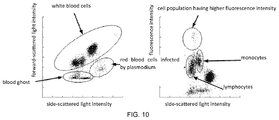
- the second scattergram may be a scattergram formed by plotting side-scattered light intensity against fluorescence intensity.
- the abnormal information can be related to red blood cells infected by plasmodium. For example, if a cell population having higher fluorescence intensity appears in the second scattergram, it may be considered that there is abnormal information in the second scattergram.
- Cell population having higher fluorescence intensity appears means that the fluorescence signals with higher intensity could be recognized as cell population after signals processing. For example, in some cases, a cell population having higher fluorescence can appear above the area of monocytes and lymphocytes in the second scattergram.
- an apparatus for identifying red blood cells infected by plasmodium can include:
- a blood treatment unit 41 which treats a blood sample to obtain a treated sample
- a detection unit 42 which detects the treated sample and obtains scattered light signals
- a data processing unit 43 which obtains a scattergram according to the scattered light signals, and identifies cells located in a predetermined area of the scattergram as the red blood cells infected by plasmodium.
- a blood sample can be treated with a reagent, and then detected to obtain a scattergram by flow cytometry.
- Red blood cells infected by plasmodium may be identified according to cell areas of the scattergram.
- the apparatus are performed with an automatic analyzer, so people's influence may be reduced and the apparatus can have faster detection speed and higher identification accuracy.
- all the cells in a blood sample may be analyzed with the apparatus and the number of the cells detected can be relatively high, missed diagnosis caused by an insufficient number of blood cells inspected would likely not occur, thereby improving identification accuracy.
- the detection unit 42 can further obtain fluorescence signals of cells in the treated sample.
- the apparatus may further include:
- a counting unit 44 which counts a number of the red blood cells infected by plasmodium.
- a first warning unit 45 which gives a warning signal if the number is more than a first threshold value.
- the data processing unit 43 can further obtain a blood routine examination parameter of erythrocytic series which correlates with plasmodium, and the apparatus can further include:
- a counting unit 44 which counts a number of the red blood cells infected by plasmodium.
- a second warning unit 46 which gives a warning signal if the number is more than a second threshold value and the parameter is out of its normal range.
- the meanings of the threshold value and the blood routine examination parameter of erythrocytic series are the same as those for the method embodiments described above.
- the apparatus may further include:
- a counting unit 44 which counts a number of the red blood cells infected by plasmodium
- a third warning unit 47 which obtains a second scattergram when the number is more than a third threshold value; and gives a warning signal when a cell population having higher fluorescence intensity appears in the second scattergram; where the second scattergram is formed by plotting side-scattered light intensity against fluorescence intensity of the blood sample.
- the blood sample can be treated with the same reagent as the method embodiments described above.
- a method for identifying red blood cells infected by plasmodium may include:
- This method can acquire a forward-scattered light signal, a side-scattered light signal and an optional fluorescence signal from cells in a blood sample so as to obtain a first two-dimensional scattergram or a three-dimensional scattergram.
- Red blood cells infected by plasmodium may be identified according to the scattergram.
- the method may be performed by an automatic analyzer, so it can have less anthropic factor, better accuracy and fast test speed.
- the method further comprises:
- the method may further include:
- the blood routine examination parameter of erythrocytic series which correlates with plasmodium infection can be the total number of red blood cells or the hemoglobin concentration.
- the method can further include:
- the meanings of the threshold value and the cell population having higher fluorescence intensity are the same as those for the method embodiments described above.
- an apparatus for identifying red blood cells infected by plasmodium may include:
- a signal acquisition unit 61 which obtains a forward-scattered light signal, a side-scattered light signal and an optional fluorescence signal from cells in a blood sample;
- a diagram generation unit 62 which obtains a first two-dimensional scattergram according to the forward-scattered light signal and the side-scattered light signal, or obtains a three-dimensional scattergram according to the forward-scattered light signal, the side-scattered light signal the fluorescence signal;
- an identification unit 63 which identifies cells located in a predetermined area of the first two-dimensional scattergram or the three-dimensional scattergram as the red blood cells infected by plasmodium.
- This apparatus can acquire a forward-scattered light signal, a side-scattered light signal and an optional fluorescence signal from cells in a blood sample so as to obtain a first two-dimensional scattergram or a three-dimensional scattergram, and then identify cells located in a predetermined area as the red blood cells infected by plasmodium.
- the apparatus could be performed by an automatic analyzer, so it may have better test accuracy and faster test speed due to less anthropic factor.
- the apparatus can further include:
- a counting and warning unit 64 which counts a number of the red blood cells infected by plasmodium; and gives a warning signal if the number is more than a first threshold value.
- the apparatus can further include:
- a counting and warning unit 64 which counts a number of the red blood cells infected by plasmodium and acquires a blood routine examination parameter of erythrocytic series which correlates with plasmodium, and gives a warning signal if the number is more than a second threshold value and the parameter is out of its normal range.
- the apparatus can further include:
- a counting and warning unit 64 which counts a number of the red blood cells infected by plasmodium and obtains a second two-dimensional scattergram according to the side-scattered light signal and the fluorescence signal of the blood sample, and gives a warning signal if a cell population having higher fluorescence intensity appears in the second two-dimensional scattergram and the number is more than a third threshold value.
- the predetermined area can be specific area in the scattergrams which can be obtained by statistically comparing the scattergrams of normal blood samples and malaria patients' blood samples.
- the parameter of the specific area may be inputted into the identification unit so as to obtain the predetermined area.
- cells in the predetermined area can be identified as the red blood cells infected by plasmodium.
- the predetermined area may be defined according to a function describing the relative location between normal white blood cells area and infected red blood cells area. This function can be obtained by statistically comparing the scattergrams of normal blood samples and malaria patients' blood samples, such as, calculating function of area location of red blood cells infected by plasmodium and that of normal white blood cells. Then the function relation can be inputted into the identification unit. In a scattergram of an unknown sample, the predetermined area may be determined according to the location of normal white blood cells area and that function.
- the first, second and third threshold values can be the number of red blood cells infected by plasmodium, or alternatively the percentage of red blood cells infected by plasmodium as compared to normal red blood cells.
- the second and the third threshold values may be the same value or different value, base on user's need.
- the threshold values may be predetermined or inputted by user through an interactive interface.
- This Example provides an example method for identifying red blood cells infected by plasmodium according to the present disclosure.
- the method was performed by a flow cytometer, such as BC series flow cytometer manufactured by Shenzhen Mindray Bio-Medical Electronics Co. Ltd (Shenzhen, People's Republic of China), whose schematic representation is shown in FIG. 7 .
- a malaria patient's blood sample was treated by a reagent, which included Reagent A having following components:
- Dye A 0.5 ppm decylisoquinolinium bromide 0.4 g/L polyoxyethylene (23) lauryl ether 1.3 g/L sodium benzoate 2.0 g/L methanol 50 g/L monobasic sodium phosphate 3 g/L dibasic sodium phosphate 4.8 g/L where the structure of dye A was 1ml of the reagent was mixed with 20 ul of the blood sample.
- a warning signal was given. Alternatively, the number was less than the first threshold value, but was more than a second threshold value, and the total number of red blood cells or hemoglobin concentration was less than the normal value, a warning signal was given. Alternatively, a warning signal was given, the number of red blood cells infected by plasmodium in a first two-dimensional scattergram, which was formed by plotting the forward scattered light intensity against the side-scattered light intensity (shown in FIG.
- cationic cyanine compounds selected from those having the following general formulae I and II:
- n 1, 2 or 3;
- X is C(CH 3 ) 2 , O, S or Se;
- R 1 and R 2 are each independently selected from H, C 1-18 alkyl, —C 1-6 alkyl-OR 5 or a halogen;
- R 3 is H, C 1-18 alkyl, OR 5 , —C 1-6 alkyl-OR 5 , COOR 5 , NO 2 , CN or a halogen;
- R 4 is C 1-18 alkyl, —C 1-6 alkyl-OR 5 , benzyl or a halogen, where the benzyl can be optionally substituted with a substituent selected from a halogen, hydroxyl, sulfhydryl, cyano, nitro, alkyl, aryl, alkyloxy, heterocyclyl, haloalkyl, amino, alkylamino, amido or carboxyl;
- Y ⁇ is an anion
- n 1, 2 or 3;
- X is C(CH 3 ) 2 , O, S or Se;
- R1′ and R2′ are each independently selected from H, OH, C1-18alkyl, C1-6alkylOR5′, C1-18alkylsulfonyl, phenyl or a halogen;
- R 3 ′ and R 4 ′ are each independently selected from C 1-18 alkylCOOR 6 ′, C 1-18 alkylOR 6 ′ or benzyl, where the benzyl can be optionally substituted with a substituent selected from a halogen, hydroxyl, sulfhydryl, cyano, nitro, alkyl, aryl, alkyloxy, heterocyclyl, haloalkyl, amino, alkylamino, amido or carboxyl, provided that R 3 ′ and R 4 ′ are not simultaneously benzyl, and R 4 ′ is not C 1-18 alkylOR 6 ′ when R 3 ′ is benzyl;
- R 6 ′ is C 1-18 alkyl, H or phenyl, where the phenyl can be optionally substituted with a substituent selected from a halogen, hydroxyl, sulfhydryl, cyano, nitro, alkyl, aryl, alkyloxy, heterocyclyl, haloalkyl, amino, alkylamino, amido or carboxyl; and
- Y— is an anion
- cationic surfactants that are quinolinium salt-type cationic surfactants having the following general formulae III and/or IV:
- R 1 and R 2 are each independently selected from C 6-18 alkyl and C 6-18 haloalkyl;
- R 3 to R 16 are each independently selected from H, OH, C 1-4 alkyl, C 1-4 alkyloxy and sulphonyl;
- Z ⁇ is a halogen ion
- R 1 is C 6-14 alkyl or C 6-14 alkenyl, and in one embodiment straight alkyls such as hexyl, octyl, decyl, lauryl or myristyl, and in another embodiment straight alkyls such as octyl, decyl, lauryl or myristyl;
- R 2 is C 1-4 alkyl or C 2-4 alkenyl, for example, in one embodiment methyl, ethyl, propyl, butyl or butenyl, and in another embodiment methyl, ethyl or propyl;
- R 3 is C 1-4 alkyl or C 2-4 alkenyl, for example, in one embodiment methyl, ethyl, propyl, butyl or butenyl, and in another embodiment methyl, ethyl or propyl;
- R 4 is C 1-4 alkyl, C 2-4 alkenyl or benzyl, for example, in one embodiment methyl, ethyl, propyl, butyl, butenyl or benzyl, and in another embodiment methyl, ethyl or propyl;
- Z ⁇ is a halogen ion
- the reagent further can include at least one anionic compound selected from those having one or more carboxyl or sulphonyl groups.
- the apparatuses and methods described in the present disclosure may be achieved by other ways.
- the apparatus examples are exemplary embodiments.
- the units can be divided based on logic functions or some other ways, such as multiple units or components may be combined or integrated into another system, or certain features may be ignored or not executed.
- Units described as separate components may or may not be physically separated.
- Components described as units may or may not be physical units, that is the components may be located in one place or distributed as multiple network units. Some or all units can be selected based on practical need so as to achieve the purpose of the present disclosure.
- function units of the present disclosure may be integrated into a single processor, or each unit may separately physically exist, or two or more units may be integrated into one unit.
- the computer program which may be stored in a memory, can include instructions that direct a computer such as personal computer, server, or network devices to execute some or all steps of the exemplary methods.
- the memory may be flash memory, mobile hard disk, read-only memory, random access memory, hard disks or optical storage devices (CD-ROMs, DVDs, Blu-Ray discs, and the like), or other medium that can store program codes.
Landscapes
- Health & Medical Sciences (AREA)
- Life Sciences & Earth Sciences (AREA)
- Immunology (AREA)
- Chemical & Material Sciences (AREA)
- Engineering & Computer Science (AREA)
- Hematology (AREA)
- General Health & Medical Sciences (AREA)
- Analytical Chemistry (AREA)
- Physics & Mathematics (AREA)
- Pathology (AREA)
- Biochemistry (AREA)
- General Physics & Mathematics (AREA)
- Molecular Biology (AREA)
- Biomedical Technology (AREA)
- Urology & Nephrology (AREA)
- Cell Biology (AREA)
- Microbiology (AREA)
- Biotechnology (AREA)
- Food Science & Technology (AREA)
- Medicinal Chemistry (AREA)
- Tropical Medicine & Parasitology (AREA)
- Nuclear Medicine, Radiotherapy & Molecular Imaging (AREA)
- Virology (AREA)
- Physiology (AREA)
- Ecology (AREA)
- Investigating, Analyzing Materials By Fluorescence Or Luminescence (AREA)
- Investigating Or Analysing Biological Materials (AREA)
Abstract
Description
| Dye A | 0.5 | ppm | ||
| decylisoquinolinium bromide | 0.4 | g/L | ||
| polyoxyethylene (23) lauryl ether | 1.3 | g/L | ||
| sodium benzoate | 2.0 | g/L | ||
| methanol | 50 | g/L | ||
| monobasic sodium phosphate | 3 | g/L | ||
| dibasic sodium phosphate | 4.8 | g/L | ||
| where the structure of dye A was | ||||
 |
||||


Claims (3)
Applications Claiming Priority (4)
| Application Number | Priority Date | Filing Date | Title |
|---|---|---|---|
| CN201110337707.8A CN103091286B (en) | 2011-10-31 | 2011-10-31 | The erythrocytic recognition methods of Infected With Plasmodium and device |
| CN201110337707.8 | 2011-10-31 | ||
| CN201110337707 | 2011-10-31 | ||
| PCT/CN2012/083864 WO2013064078A1 (en) | 2011-10-31 | 2012-10-31 | Method and device for recognizing plasmodium-infected erythrocyte |
Related Parent Applications (1)
| Application Number | Title | Priority Date | Filing Date |
|---|---|---|---|
| PCT/CN2012/083864 A-371-Of-International WO2013064078A1 (en) | 2011-10-31 | 2012-10-31 | Method and device for recognizing plasmodium-infected erythrocyte |
Related Child Applications (1)
| Application Number | Title | Priority Date | Filing Date |
|---|---|---|---|
| US16/814,846 Division US20200209224A1 (en) | 2011-10-31 | 2020-03-10 | Methods and apparatuses for identifying red blood cells infected by plasmodium |
Publications (2)
| Publication Number | Publication Date |
|---|---|
| US20140308697A1 US20140308697A1 (en) | 2014-10-16 |
| US10656143B2 true US10656143B2 (en) | 2020-05-19 |
Family
ID=48191343
Family Applications (2)
| Application Number | Title | Priority Date | Filing Date |
|---|---|---|---|
| US14/355,544 Active 2034-07-11 US10656143B2 (en) | 2011-10-31 | 2012-10-31 | Methods and apparatuses for identifying red blood cells infected by plasmodium |
| US16/814,846 Abandoned US20200209224A1 (en) | 2011-10-31 | 2020-03-10 | Methods and apparatuses for identifying red blood cells infected by plasmodium |
Family Applications After (1)
| Application Number | Title | Priority Date | Filing Date |
|---|---|---|---|
| US16/814,846 Abandoned US20200209224A1 (en) | 2011-10-31 | 2020-03-10 | Methods and apparatuses for identifying red blood cells infected by plasmodium |
Country Status (3)
| Country | Link |
|---|---|
| US (2) | US10656143B2 (en) |
| CN (1) | CN103091286B (en) |
| WO (1) | WO2013064078A1 (en) |
Families Citing this family (15)
| Publication number | Priority date | Publication date | Assignee | Title |
|---|---|---|---|---|
| CN104297135B (en) * | 2013-07-16 | 2017-02-15 | 成都深迈瑞医疗电子技术研究院有限公司 | Recognizing method and recognizing system of particles in blood sample and blood cell analytic instrument |
| JP6225085B2 (en) * | 2013-08-30 | 2017-11-01 | シスメックス株式会社 | Sample analysis method and sample analyzer |
| CN104515723B (en) * | 2013-09-30 | 2017-12-05 | 深圳迈瑞生物医疗电子股份有限公司 | Cytoanalyze and its erythrocyte agglutination alarm method and system |
| JP6383216B2 (en) | 2014-08-08 | 2018-08-29 | シスメックス株式会社 | Blood analysis method, blood analysis apparatus and program |
| EP3943912B1 (en) * | 2015-02-12 | 2025-08-20 | Shenzhen Mindray Bio-Medical Electronics Co., Ltd. | Cell analyzer and particle sorting method and device |
| JP6635720B2 (en) * | 2015-08-31 | 2020-01-29 | シスメックス株式会社 | Blood analyzer and blood analysis method |
| DE102016004051B3 (en) | 2016-04-04 | 2017-07-27 | Technische Universität Dresden | Method and device for optical in-ovo sexing of fertilized and incubated bird eggs |
| CN107655865B (en) * | 2016-07-25 | 2021-10-19 | 希森美康株式会社 | Blood analysis device and blood analysis method |
| CN108226127B (en) * | 2017-12-26 | 2021-04-06 | 深圳国际旅行卫生保健中心 | Method for determining plasmodium content and system for detecting plasmodium content |
| CN109580550A (en) * | 2018-12-03 | 2019-04-05 | 迪瑞医疗科技股份有限公司 | A kind of classification processing method and its device of leucocyte |
| WO2021134508A1 (en) * | 2019-12-31 | 2021-07-08 | 深圳迈瑞生物医疗电子股份有限公司 | Cell image analysis apparatus and sample analysis method |
| CN111781168B (en) * | 2020-06-17 | 2023-06-13 | 迈克医疗电子有限公司 | Method, device, equipment and medium for adjusting red blood cell fragment recognition area |
| CN116569041B (en) * | 2020-12-01 | 2026-01-02 | 深圳迈瑞生物医疗电子股份有限公司 | Sample analysis methods, sample analyzers and computer-readable storage media |
| CN118475824A (en) * | 2021-12-31 | 2024-08-09 | 深圳迈瑞生物医疗电子股份有限公司 | Blood cell analyzer, method for prompting infection state and use of infection mark parameter |
| CN115711866B (en) * | 2022-10-31 | 2024-07-09 | 西安电子科技大学 | Quantitative phase contrast tomography microscopy device and method based on annular scanning illumination |
Citations (7)
| Publication number | Priority date | Publication date | Assignee | Title |
|---|---|---|---|---|
| US20060223137A1 (en) | 2005-03-29 | 2006-10-05 | Sysmex Corporation | Reagent for partially lysing a cell membrane of a red blood cell, a reagent for detecting malaria infected red blood cells, and a sample analyzing method for detecting malaria infected red blood cells |
| EP1746407A2 (en) | 2005-07-21 | 2007-01-24 | Sysmex Corporation | Blood analyzing method and blood analyzer |
| CN101389947A (en) | 2005-12-29 | 2009-03-18 | 霍尼韦尔国际公司 | Assay Tools in Microfluidic Format |
| WO2009136570A1 (en) | 2008-05-09 | 2009-11-12 | シスメックス株式会社 | Blood analyzer, blood analysis method and hemolytic agent |
| US20100104169A1 (en) * | 2008-10-28 | 2010-04-29 | Sysmex Corporation | Specimen processing system and blood cell image classifying apparatus |
| CN102016573A (en) | 2008-05-09 | 2011-04-13 | 希森美康株式会社 | Blood analysis device, blood analysis method, hemolyzing agent and dyeing agent |
| CN102109430A (en) | 2009-12-25 | 2011-06-29 | 深圳迈瑞生物医疗电子股份有限公司 | Nucleated red blood cell simulation particle and blood quality control substance and preparation methods and application thereof |
-
2011
- 2011-10-31 CN CN201110337707.8A patent/CN103091286B/en active Active
-
2012
- 2012-10-31 US US14/355,544 patent/US10656143B2/en active Active
- 2012-10-31 WO PCT/CN2012/083864 patent/WO2013064078A1/en not_active Ceased
-
2020
- 2020-03-10 US US16/814,846 patent/US20200209224A1/en not_active Abandoned
Patent Citations (9)
| Publication number | Priority date | Publication date | Assignee | Title |
|---|---|---|---|---|
| US20060223137A1 (en) | 2005-03-29 | 2006-10-05 | Sysmex Corporation | Reagent for partially lysing a cell membrane of a red blood cell, a reagent for detecting malaria infected red blood cells, and a sample analyzing method for detecting malaria infected red blood cells |
| EP1746407A2 (en) | 2005-07-21 | 2007-01-24 | Sysmex Corporation | Blood analyzing method and blood analyzer |
| US20070020721A1 (en) * | 2005-07-21 | 2007-01-25 | Sysmex Corporation | Blood analyzing method and blood analyzer |
| CN101389947A (en) | 2005-12-29 | 2009-03-18 | 霍尼韦尔国际公司 | Assay Tools in Microfluidic Format |
| WO2009136570A1 (en) | 2008-05-09 | 2009-11-12 | シスメックス株式会社 | Blood analyzer, blood analysis method and hemolytic agent |
| CN102016573A (en) | 2008-05-09 | 2011-04-13 | 希森美康株式会社 | Blood analysis device, blood analysis method, hemolyzing agent and dyeing agent |
| CN102016577A (en) | 2008-05-09 | 2011-04-13 | 希森美康株式会社 | Blood analysis device, blood analysis method and hemolyzing agent |
| US20100104169A1 (en) * | 2008-10-28 | 2010-04-29 | Sysmex Corporation | Specimen processing system and blood cell image classifying apparatus |
| CN102109430A (en) | 2009-12-25 | 2011-06-29 | 深圳迈瑞生物医疗电子股份有限公司 | Nucleated red blood cell simulation particle and blood quality control substance and preparation methods and application thereof |
Non-Patent Citations (8)
| Title |
|---|
| Campuzano-Zuluaga et al., "Design of Malaria Diagnostic Criteria for the Sysmex XE-2100 Hematology Analyzer", American Journal of Tropical Medicine & Hygiene, 2010, pp. 402-411. |
| Fernando, N.T. 2011. Novel near-infrared cyanine dyes for fluorescence imaging in biological systems. Chemistry Dissertations. Dept. of Chemistry. Georgia State Univ. pp. 1-141; specif. pp. 3, 5. * |
| Kim, Y.R. et al. 2003. Automated red blood cell differential analysis on a multi-angle light scatter/fluorescence hematology analyzer. Cytometry PartB (Clinical Cytometry) 56B: 43-54. specif. pp. 43, 44. * |
| Lehner, J. et al. 2007. Automation in hematology. Transfusion Medicine and Hemotherapy 34: 328-339. specif. pp. 331, 332, 333, 334. * |
| MedlinePlus Medical Dictionary. Plasmodium. Datasheet [online]. Merriam-Webster. [retrieved on Apr. 11, 2016]. Copyright 2016. Merriam-Webster, Inc. Retrieved from the Internet: <URL: http://http://c.merriam-webster.com/medlineplus/plasmodium> p. 1. * |
| Reinders, P.P. et al. 1995. Computer software for testing drug susceptibility of malaria parasites. Cytometry 19:273-281. specif. pp. 273, 274, 275, 277. * |
| Saul, A. et al. 1982. Plasmodium falciparum: automated assay of erythrocyte invasion using flow cytofluorometry. Experimental Parasitology 54: 64-71. specif. pp. 64, 66, 67. * |
| Tilley, L. et al. 2007. Illuminating Plasmodium falciparum-infected red blood cells. Trends in Parasitology 23(6): 268-277. specif. p. 268. * |
Also Published As
| Publication number | Publication date |
|---|---|
| WO2013064078A1 (en) | 2013-05-10 |
| US20200209224A1 (en) | 2020-07-02 |
| US20140308697A1 (en) | 2014-10-16 |
| CN103091286A (en) | 2013-05-08 |
| CN103091286B (en) | 2016-08-17 |
Similar Documents
| Publication | Publication Date | Title |
|---|---|---|
| US10656143B2 (en) | Methods and apparatuses for identifying red blood cells infected by plasmodium | |
| US11105742B2 (en) | Nucleated red blood cell warning method and device, and flow cytometer using the same | |
| US10222320B2 (en) | Identifying and enumerating early granulated cells (EGCs) | |
| JP4911601B2 (en) | Method for measuring nucleated red blood cells | |
| KR101847225B1 (en) | Method and system for analyzing a blood sample | |
| JP5583629B2 (en) | White blood cell classification and counting method, white blood cell classification reagent kit, and white blood cell classification reagent | |
| US10107754B2 (en) | Blood analyzer and blood analyzing method | |
| JP5178530B2 (en) | Method for measuring nucleated red blood cells | |
| US20230296591A1 (en) | Sample analysis method, sample analyzer, and computer-readable storage medium | |
| CN101097181A (en) | Reagent for sample analysis, kit for sample analysis, and sample analysis method | |
| JP2004537727A5 (en) | ||
| US20100075369A1 (en) | Analyzing Reticulocytes |
Legal Events
| Date | Code | Title | Description |
|---|---|---|---|
| AS | Assignment |
Owner name: SHENZHEN MINDRAY BIO-MEDICAL ELECTRONICS CO., LTD., CHINA Free format text: ASSIGNMENT OF ASSIGNORS INTEREST;ASSIGNORS:YE, BO;QIAN, CHENG;QI, HUAN;REEL/FRAME:032907/0016 Effective date: 20140512 Owner name: SHENZHEN MINDRAY BIO-MEDICAL ELECTRONICS CO., LTD. Free format text: ASSIGNMENT OF ASSIGNORS INTEREST;ASSIGNORS:YE, BO;QIAN, CHENG;QI, HUAN;REEL/FRAME:032907/0016 Effective date: 20140512 |
|
| STPP | Information on status: patent application and granting procedure in general |
Free format text: RESPONSE TO NON-FINAL OFFICE ACTION ENTERED AND FORWARDED TO EXAMINER |
|
| STPP | Information on status: patent application and granting procedure in general |
Free format text: FINAL REJECTION MAILED |
|
| STPP | Information on status: patent application and granting procedure in general |
Free format text: DOCKETED NEW CASE - READY FOR EXAMINATION |
|
| STPP | Information on status: patent application and granting procedure in general |
Free format text: NOTICE OF ALLOWANCE MAILED -- APPLICATION RECEIVED IN OFFICE OF PUBLICATIONS |
|
| STPP | Information on status: patent application and granting procedure in general |
Free format text: PUBLICATIONS -- ISSUE FEE PAYMENT VERIFIED |
|
| STCF | Information on status: patent grant |
Free format text: PATENTED CASE |
|
| AS | Assignment |
Owner name: SHENZHEN MINDRAY ANIMAL MEDICAL TECHNOLOGY CO., LTD., CHINA Free format text: LICENSE;ASSIGNOR:SHENZHEN MINDRAY BIOMEDICAL ELECTRONICS CO., LTD.;REEL/FRAME:060440/0796 Effective date: 20220601 |
|
| MAFP | Maintenance fee payment |
Free format text: PAYMENT OF MAINTENANCE FEE, 4TH YEAR, LARGE ENTITY (ORIGINAL EVENT CODE: M1551); ENTITY STATUS OF PATENT OWNER: LARGE ENTITY Year of fee payment: 4 |