US10654977B2 - Underwater self-healable materials, methods of making thereof, and products comprising same - Google Patents
Underwater self-healable materials, methods of making thereof, and products comprising same Download PDFInfo
- Publication number
- US10654977B2 US10654977B2 US15/886,016 US201815886016A US10654977B2 US 10654977 B2 US10654977 B2 US 10654977B2 US 201815886016 A US201815886016 A US 201815886016A US 10654977 B2 US10654977 B2 US 10654977B2
- Authority
- US
- United States
- Prior art keywords
- healing
- self
- thdi
- upy
- updms
- Prior art date
- Legal status (The legal status is an assumption and is not a legal conclusion. Google has not performed a legal analysis and makes no representation as to the accuracy of the status listed.)
- Active, expires
Links
- 0 CC*(CC**C(*)=O)*(C(*(CC*)C(*1C(C)(C)CCC(C)(C)*C(C)=O)=O)=O)C1=O Chemical compound CC*(CC**C(*)=O)*(C(*(CC*)C(*1C(C)(C)CCC(C)(C)*C(C)=O)=O)=O)C1=O 0.000 description 5
- OHRJIFAIDIULCS-UHFFFAOYSA-N C=C1C=C(C)NC(CC(=O)CCCCCCCNC(=O)NCCC[Si](C)(C)O[Si](C)(C)CCCCCCCNC(=O)NCCN2C(=O)N(CCCCCCNC(=O)NCCC[Si](C)(C)O[Si](C)(C)CCCNC(=O)NCCCCCCCC(=O)CC3=NC(=O)C=C(C)N3)C(=O)N(CCNC(=O)NCCC[Si](C)(C)O[Si](C)(C)CCCNC(=O)NCCCCCCCC(=O)CC3=NC(=O)C=C(C)N3)C2=O)=N1 Chemical compound C=C1C=C(C)NC(CC(=O)CCCCCCCNC(=O)NCCC[Si](C)(C)O[Si](C)(C)CCCCCCCNC(=O)NCCN2C(=O)N(CCCCCCNC(=O)NCCC[Si](C)(C)O[Si](C)(C)CCCNC(=O)NCCCCCCCC(=O)CC3=NC(=O)C=C(C)N3)C(=O)N(CCNC(=O)NCCC[Si](C)(C)O[Si](C)(C)CCCNC(=O)NCCCCCCCC(=O)CC3=NC(=O)C=C(C)N3)C2=O)=N1 OHRJIFAIDIULCS-UHFFFAOYSA-N 0.000 description 2
- PWFOLWIQYPIAGA-UHFFFAOYSA-N CC(C)(C)ON(C)C Chemical compound CC(C)(C)ON(C)C PWFOLWIQYPIAGA-UHFFFAOYSA-N 0.000 description 2
- PMWIUKGOSRPFHV-UHFFFAOYSA-N CCCCCCCCC(=O)CC1=NC(=O)C=C(C)N1 Chemical compound CCCCCCCCC(=O)CC1=NC(=O)C=C(C)N1 PMWIUKGOSRPFHV-UHFFFAOYSA-N 0.000 description 2
- DJEQZVQFEPKLOY-UHFFFAOYSA-N CCCCN(C)C Chemical compound CCCCN(C)C DJEQZVQFEPKLOY-UHFFFAOYSA-N 0.000 description 2
- PLVDYLNSVBTTSG-UHFFFAOYSA-N CCCC[Si](C)(C)O[Si](C)(C)CCCN Chemical compound CCCC[Si](C)(C)O[Si](C)(C)CCCN PLVDYLNSVBTTSG-UHFFFAOYSA-N 0.000 description 2
- XYYXNJKXSWZDCH-UHFFFAOYSA-N C.C.C.C.C.C.C=C1C=C(C)NC(CC(=O)CCCCCCCNC(=O)NCCC[Si](C)(C)O[Si](C)(C)CCCNC(=O)NCCCCCCN2C(=O)N(C)C(=O)N(CCNC(=O)NCCC[Si](C)(C)O[Si](C)(C)CCCNC(=O)NCCCCCCCC(=O)CC3=NC(=O)C=C(C)N3)C2=O)=N1.CCCCCCCNC(=O)NCCC[Si](C)(C)O[Si](C)(C)CCCNC(=O)NCCCCCCCC(=O)CC1=NC(=O)C=C(C)N1 Chemical compound C.C.C.C.C.C.C=C1C=C(C)NC(CC(=O)CCCCCCCNC(=O)NCCC[Si](C)(C)O[Si](C)(C)CCCNC(=O)NCCCCCCN2C(=O)N(C)C(=O)N(CCNC(=O)NCCC[Si](C)(C)O[Si](C)(C)CCCNC(=O)NCCCCCCCC(=O)CC3=NC(=O)C=C(C)N3)C2=O)=N1.CCCCCCCNC(=O)NCCC[Si](C)(C)O[Si](C)(C)CCCNC(=O)NCCCCCCCC(=O)CC1=NC(=O)C=C(C)N1 XYYXNJKXSWZDCH-UHFFFAOYSA-N 0.000 description 1
- QOMKLAVJFJPMOD-UHFFFAOYSA-N C.C.CC1=CC(=O)N=C(CC(=O)CCCNC(=O)NCCC[Si](C)(C)O[Si](C)(C)CCCN)N1 Chemical compound C.C.CC1=CC(=O)N=C(CC(=O)CCCNC(=O)NCCC[Si](C)(C)O[Si](C)(C)CCCN)N1 QOMKLAVJFJPMOD-UHFFFAOYSA-N 0.000 description 1
- WTDNYIFPSHMIJT-UHFFFAOYSA-N C.C.CCCC[Si](C)(C)O[Si](C)(C)CCC.CCNC(=O)NCCCCCCCC(=O)CC1=NC(=O)C=C(C)N1 Chemical compound C.C.CCCC[Si](C)(C)O[Si](C)(C)CCC.CCNC(=O)NCCCCCCCC(=O)CC1=NC(=O)C=C(C)N1 WTDNYIFPSHMIJT-UHFFFAOYSA-N 0.000 description 1
- APMGKJNCOQLNCX-UHFFFAOYSA-N C.C.CCCC[Si](C)(C)O[Si](C)(C)CCCNC(=O)NCCCCCCCC(=O)CC1=NC(=O)C=C(C)N1 Chemical compound C.C.CCCC[Si](C)(C)O[Si](C)(C)CCCNC(=O)NCCCCCCCC(=O)CC1=NC(=O)C=C(C)N1 APMGKJNCOQLNCX-UHFFFAOYSA-N 0.000 description 1
- NBEKGLYNLKQFLP-NLQOEHMXSA-N CCCCCCCN1C(=O)N(CCCCCCOC#N)C(=O)N(CCN=C=O)C1=O.I.[3HH] Chemical compound CCCCCCCN1C(=O)N(CCCCCCOC#N)C(=O)N(CCN=C=O)C1=O.I.[3HH] NBEKGLYNLKQFLP-NLQOEHMXSA-N 0.000 description 1
- QCJRJEDIONXDIO-UHFFFAOYSA-N N#COCCCCCCN1C(=O)N(CCCCCCN=C=O)C(=O)N(CCN=C=O)C1=O Chemical compound N#COCCCCCCN1C(=O)N(CCCCCCN=C=O)C(=O)N(CCN=C=O)C1=O QCJRJEDIONXDIO-UHFFFAOYSA-N 0.000 description 1
Images


Classifications
-
- C—CHEMISTRY; METALLURGY
- C08—ORGANIC MACROMOLECULAR COMPOUNDS; THEIR PREPARATION OR CHEMICAL WORKING-UP; COMPOSITIONS BASED THEREON
- C08G—MACROMOLECULAR COMPOUNDS OBTAINED OTHERWISE THAN BY REACTIONS ONLY INVOLVING UNSATURATED CARBON-TO-CARBON BONDS
- C08G77/00—Macromolecular compounds obtained by reactions forming a linkage containing silicon with or without sulfur, nitrogen, oxygen or carbon in the main chain of the macromolecule
- C08G77/04—Polysiloxanes
- C08G77/38—Polysiloxanes modified by chemical after-treatment
- C08G77/382—Polysiloxanes modified by chemical after-treatment containing atoms other than carbon, hydrogen, oxygen or silicon
- C08G77/388—Polysiloxanes modified by chemical after-treatment containing atoms other than carbon, hydrogen, oxygen or silicon containing nitrogen
-
- C—CHEMISTRY; METALLURGY
- C07—ORGANIC CHEMISTRY
- C07F—ACYCLIC, CARBOCYCLIC OR HETEROCYCLIC COMPOUNDS CONTAINING ELEMENTS OTHER THAN CARBON, HYDROGEN, HALOGEN, OXYGEN, NITROGEN, SULFUR, SELENIUM OR TELLURIUM
- C07F7/00—Compounds containing elements of Groups 4 or 14 of the Periodic Table
- C07F7/02—Silicon compounds
- C07F7/08—Compounds having one or more C—Si linkages
- C07F7/0834—Compounds having one or more O-Si linkage
- C07F7/0838—Compounds with one or more Si-O-Si sequences
-
- C—CHEMISTRY; METALLURGY
- C07—ORGANIC CHEMISTRY
- C07F—ACYCLIC, CARBOCYCLIC OR HETEROCYCLIC COMPOUNDS CONTAINING ELEMENTS OTHER THAN CARBON, HYDROGEN, HALOGEN, OXYGEN, NITROGEN, SULFUR, SELENIUM OR TELLURIUM
- C07F7/00—Compounds containing elements of Groups 4 or 14 of the Periodic Table
- C07F7/02—Silicon compounds
- C07F7/08—Compounds having one or more C—Si linkages
- C07F7/0834—Compounds having one or more O-Si linkage
- C07F7/0838—Compounds with one or more Si-O-Si sequences
- C07F7/0872—Preparation and treatment thereof
- C07F7/0889—Reactions not involving the Si atom of the Si-O-Si sequence
-
- C—CHEMISTRY; METALLURGY
- C08—ORGANIC MACROMOLECULAR COMPOUNDS; THEIR PREPARATION OR CHEMICAL WORKING-UP; COMPOSITIONS BASED THEREON
- C08J—WORKING-UP; GENERAL PROCESSES OF COMPOUNDING; AFTER-TREATMENT NOT COVERED BY SUBCLASSES C08B, C08C, C08F, C08G or C08H
- C08J3/00—Processes of treating or compounding macromolecular substances
- C08J3/24—Crosslinking, e.g. vulcanising, of macromolecules
-
- C—CHEMISTRY; METALLURGY
- C08—ORGANIC MACROMOLECULAR COMPOUNDS; THEIR PREPARATION OR CHEMICAL WORKING-UP; COMPOSITIONS BASED THEREON
- C08G—MACROMOLECULAR COMPOUNDS OBTAINED OTHERWISE THAN BY REACTIONS ONLY INVOLVING UNSATURATED CARBON-TO-CARBON BONDS
- C08G77/00—Macromolecular compounds obtained by reactions forming a linkage containing silicon with or without sulfur, nitrogen, oxygen or carbon in the main chain of the macromolecule
- C08G77/70—Siloxanes defined by use of the MDTQ nomenclature
-
- C—CHEMISTRY; METALLURGY
- C08—ORGANIC MACROMOLECULAR COMPOUNDS; THEIR PREPARATION OR CHEMICAL WORKING-UP; COMPOSITIONS BASED THEREON
- C08J—WORKING-UP; GENERAL PROCESSES OF COMPOUNDING; AFTER-TREATMENT NOT COVERED BY SUBCLASSES C08B, C08C, C08F, C08G or C08H
- C08J2383/00—Characterised by the use of macromolecular compounds obtained by reactions forming in the main chain of the macromolecule a linkage containing silicon with or without sulfur, nitrogen, oxygen, or carbon only; Derivatives of such polymers
- C08J2383/04—Polysiloxanes
- C08J2383/08—Polysiloxanes containing silicon bound to organic groups containing atoms other than carbon, hydrogen, and oxygen
Definitions
- the present invention is concerned with a self-healable material configured to self-heal in the presence of moisture or in aqueous condition after physical damages, intermediate ingredients for making of such a material, methods of making such intermediate ingredients, and products comprising such a self-healable material.
- the present invention seeks to address these issues, or at least to provide an alternative to the public.
- an intermediate compound of formula I for use in manufacture of a self-healable
- n is from 4 to 24.
- the molecular weight would range from about 2000 to 300. This range is advantageous in balancing self-healing performance and healing time of the self-healable material made from the intermediate. If n is beyond 24, the self-healing property would be suppressed.
- the compound of formula I may have chemical name of 1-(2-(3-(3-(3-(3-aminopropyl)-1,1,3,3-tetramethyldisiloxanyl)propyl)ureido)ethyl)-3-(6-methyl-4-oxo-1,4-dihydropyrimidin-2-yl)urea.
- the HMDI which provides the urea-(CH 2 ) 6 -urea motif, may be replaced by other di-isocynates, including Tolylene-2,4-diisocyanate, lsophorone diisocyanate, 4,4′-Methylenebis(phenyl isocyanate), 1,4-Diisocyanatobutane, 1,8-Diisocyanatooctane.
- di-isocynates including Tolylene-2,4-diisocyanate, lsophorone diisocyanate, 4,4′-Methylenebis(phenyl isocyanate), 1,4-Diisocyanatobutane, 1,8-Diisocyanatooctane.
- the compound of formula II may have a chemical name of 3,3′-(1,1,3,3-tetramethyldisiloxane-1,3-diyl)bis(propan-1-amine).
- the compound of formula III may have a chemical name of 1-(2-isocyanatoethyl)-3-(6-methyl-4-oxo-1,4-dihydropyrimidin-2-yl)urea.
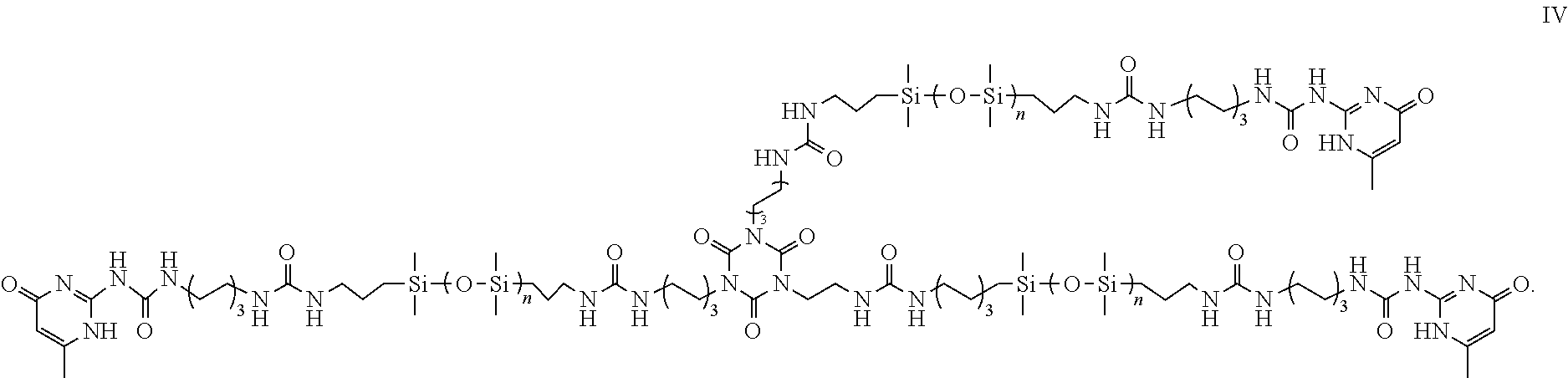
- a self-healable material configured to self-heal in the presence of moisture or in aqueous condition environment after physical damages, comprising a compound of formula IV
- a method of making of a self-healable material as described above comprising a step of reacting the compound of formula I with a compound of formula V
- the compound of formula V may have a chemical name of 1,3,5-tris(2-isocyanatoethyl)-1,3,5-triazinane-2,4,6-trione.
- an adhesive comprising a self-healable compound as described above.
- a coating comprising a self-healable compound as described above, for use in, for example, as a protective coating.
- FIG. 23 shows applications of the present invention.
- FIGS. 1 a to 1 c illustrate an embodiment of a three-step synthesis of a compound with under water self-healable property ((UPDMS) 3 THDI) according to the present invention
- FIG. 2 is a FTIR spectrum for the (UPDMS) 3 THDI
- FIGS. 3 a to 3 f are images from AFM scanning of sectioned films of the (UPDMS) 3 THDI, in which FIGS. 3 a , 3 c and 3 e are AFM topography images with increased magnification, FIGS. 3 b , 3 d and 3 f are AFM modulus images;
- FIG. 4 a is POM imaging of the as-prepared polymer film sample (i.e. sample after being heated to 175° C. for 5 min and cooled down to room temperature, sample underwater, and sample after drying
- FIG. 4 b is the corresponding powder X-ray diffraction spectra of the sample with different treatments;
- FIG. 5 is a full ATR-IR spectra corresponding to FIG. 19 e showing H/D exchange between the (UPDMS) 3 THDI film and water vapor, in which, from top to bottom of the graph, before D 2 O exposure and 0, 1, 2, 3, and 4 min after D 2 O exposure is illustrated;
- FIG. 6 is a thermal analysis of the (UPDMS) 3 THDI, in which, at a heating rate of 10° C. ⁇ min ⁇ 1 under N 2 atmosphere, a TGA curve of the (UPDMS) 3 THDI from 25 to 600° C. is indicated;
- FIG. 7 is a graph illustrating swelling ratios of (UPDMS) 3 THDI films in different solvents for 48 h at room temperature, in that the swelling ratio was measured as (mass of the swollen film—mass of the dry film)/(mass of the dry film);
- FIG. 8 a is a picture of a self-supported (UPDMS) 3 THDI film
- FIG. 8 b is a graph of the UV-Vis absorption spectra of glass and a self-supported (UPDMS) 3 THDI film;
- FIGS. 9 a to 9 b illustrate different applications of (UPDMS) 3 THDI materials as adhesive materials.
- a-d Macroscopic adhesive behavior of (UPDMS) 3 THDI materials on the surfaces of paperboard, PTFE, stainless steel and glass;
- FIG. 10 is a graph showing representative dynamic mechanical analysis (DMA) trace of (UPDMS) 3 THDI;
- FIG. 11 is a graph showing results of studies of self-healing of (UPDMS) 3 THDI in air at various healing temperatures and times;
- FIG. 12 is a graph with tensile stress-strain curves forthe (UPDMS) 3 THDI sample through five generations of molding from powder to film;
- FIGS. 13 a to 13 e is a series of schematic and photographic representation demonstrating of the penetration of water vapor through the (UPDMS) 3 THDI film;
- FIGS. 14 a to 14 d are schematic diagrams and graphs showing investigation of UPy dimer association/disassociation via spectroscopy methods, in which FIG. 14 a illustrates a structure of quadruple hydrogen bonded UPy dimer, FIG. 14 b is a structure of completely disassociated UPy dimer, FIG. 14 c is a graph showing temperature depended UV-Vis spectroscopy of the (UPDMS) 3 THDI films underwater with the spectroscopy in air at 20° C. for control, and FIG. 14 d is a graph showing ATR-IR spectra of (UPDMS) 3 THDI films in air and underwater at 20° C. and 70° C.;
- FIGS. 15 a to 15 f are images showing morphologies of a (UPDMS) 3 THDI film in conditions of 20° C. air, 40° C. air and 20° C. underwater obtained from AFM, in that the same sample was continuously scanned in the three different conditions;
- FIGS. 16 a , 16 c and 16 e are an image, a graph and a schematic diagram showing adhesion force of (UPDMS) 3 THDI obtained from the bear tip
- FIGS. 16 b , 16 d and 16 f are an image, a graph and a schematic diagram showing adhesion force of (UPDMS) 3 THDI obtained the tip modificated by UPy motifs, in that UPy motifs were modified on the AFM tip by immersing the tip in APTES solution and UPy-NCO solution, successively;
- FIGS. 17 a and 17 b are graphs showing the results from the rheological test of (UPDMS) 3 THDI, in which FIG. 17 a illustrates the relationship of loss modulus (G′′) and storage modulus (G′) versus frequency at 70° C. air, and FIG. 17 b illustrates the relationship of viscosity versus temperature at a heating rate of 10° C. ⁇ min ⁇ 1 ;
- FIG. 18 is a series of photographic images and schematic diagrams illustrating an underwater self-healable supramolecular elastomer obtained by hydrogen bonding assisted multiphase-assembly of siloxane oligomers;
- FIGS. 19 a to 19 g illustrates an embodiment of a multiphase design for underwater self-healable elastomer according to the present invention
- FIGS. 20 a to 20 i illustrate healing properties of (UPDMS) 3 THDI films, in which FIG. 20 a is an optical microscopic image of a damaged film in air, FIG. 20 b is an optical microscope image of the film after healing in air (70° C.) for 12 h, FIG. 20 c is a confocal microscope image on the healed region of the sample (stained with Nile red), FIG. 20 d is an optical microscopic image of a damaged film underwater, FIG. 20 e is an optical microscope image of the film after healing underwater (70° C.) for 5 min, FIG. 20 f is a confocal microscope image on the healed region of the sample (stained with Nile red), FIG.
- FIG. 20 a is an optical microscopic image of a damaged film in air
- FIG. 20 b is an optical microscope image of the film after healing in air (70° C.) for 12 h
- FIG. 20 c is a confocal microscope image on the healed region of the sample (
- FIG. 20 g is a graph showing tensile stress-strain curves of healed (UPDMS) 3 THDI films in different conditions
- FIG. 20 g is a graph showing films healed in air for 12 h at different temperatures
- FIG. 20 h is a graph showing films healed at 90% RH for 12 h with different temperatures
- FIG. 20 i is a graph showing films healed underwater for 12 h at various temperatures except 70° C., for which the healing time is 5 min;
- FIGS. 21 a to 21 i are schematics diagrams and graphs showing the measuring of adhesion force and modulus of (UPDMS) 3 THDI films using AFM, in which FIGS. 21 a to 21 c are schematic illustration of measuring adhesion force and modulus in different conditions. They were measured by approaching the tip to the (UPDMS) 3 THDI films and then retracting the tip, FIGS. 21 d to 21 f are graphs showing Distribution of modulus (UPDMS) 3 THDI films measured via bare AFM tip in conditions of 20° C. air, 40° C. air and 20° C. underwater, respectively. Insets: corresponding AFM modulus images (500 nm ⁇ 500 nm), and FIGS.
- 21 g to 21 i are graphs showing distribution of adhesion forces measured between the bare AFM tip and (UPDMS) 3 THDI films in conditions of 20° C. air, 40° C. air and 25° C. underwater, respectively. Insets: corresponding AFM adhesion force images (500 nm ⁇ 500 nm);
- FIGS. 22 a to 22 f are images, graphs and phots showing shape memory properties of (UPDMS) 3 THDI films
- FIG. 22 a are optical microscopic images of a (UPDMS) 3 THDI film after exposing in air (70° C.) for 0 min, 5 min and 10 min, respectively
- FIG. 22 b are optical microscopic images of a (UPDMS) 3 THDI film after immersing in water (70° C.) for 0 min, 5 min and 10 min, respectively
- FIG. 22 c are optical microscopic images of a (UPDMS) 3 THDI film after immersing in water (90° C.) for 0 min, 5 min and 10 min, respectively
- FIG. 22 a are optical microscopic images of a (UPDMS) 3 THDI film after exposing in air (70° C.) for 0 min, 5 min and 10 min, respectively
- FIG. 22 c are optical microscopic images of a (UPDMS)
- FIG. 22 d is a graph showing quantitative shape memory cycles for (UPDMS) 3 THDI films at 70° C.
- FIG. 22 e is a graph showing quantitative shape memory cycles for (UPDMS) 3 THDI films at 80° C.
- FIG. 22 f are images showing demonstrating shape memory performance of the healed (UPDMS) 3 THDI structure;
- FIG. 23 contains images illustrating proof-of-demonstration of the (UPDMS) 3 THDI for the use of oil-repellent coating, in which the (UPDMS) 3 THDI film was coated on glass, alumina foil and copper foil to form a film with ⁇ 50-micron thickness, on which a droplet of hexadecane (dyed with Nile Red) could slide down readily without staining the film, showing excellent oil repellency.
- Supramolecular polymers assembled from low-molecular-weight monomeric blocks or oligomers through dynamic and reversible interactions usually exhibit stimuli-responsiveness and interesting mechanical properties, such as malleability, processability, recyclability and self-healing.
- Hydrogen bonding assisted assembly and crosslinking are amongst the most interesting assembly unit due to its directionality, tunable binding dynamics and broad selection of building motifs.
- the recognition between hydrogen bonding motifs becomes less efficient in moisture or aqueous conditions because water is a strong competitor for hydrogen bonding, which constrains the performance of those hydrogen-bonded supramolecular polymers.
- the present invention is concerned with an underwater self-healable supramolecular elastomer through hydrogen-bond assisted multiphase assembly of three-arm siloxane oligomers.
- underwater it refers to the condition when immersed under water or in a moist environment.
- the elastomer includes oligomers bond together through multivalent hydrogen bonding, and the oligomers are assembled into a microphase-separated system.
- the elastomer is unique due to water-permeability of the hydrophobic siloxane microenvironment which allows travelling of water molecules in the elastomer to facilitate reversible dissociation and formation of intermolecular hydrogen bonding but at the same time inhibits violent hydration of the hydrogen bonding motifs, resulting in reliable underwater self-healing, shape memory and other water-regulated mechanic properties of the elastomers.
- the present invention has provided a strategy on the hydrogen bonding assisted multiphase-assembly of siloxane oligomers which takes advantages of microphase separated hard crystalline domains and surrounding water-permeable soft hydrophobic siloxane domains in regulating the water penetration and retention in each phases and modulates the molecular and structural integrity of the hydrogen-bonded building blocks to achieve high strength, underwater self-healing and shape-memory properties that are rarely achieved on hydrogen-bonded supramolecular polymers.
- water plays a key role in modulating mechanical properties of the developed materials.
- the present invention by designing the chemical environment of the hydrogen bonding motifs, has enabled water molecules to travel through the polymer network to help dissociation of the hydrogen bonding, while the violent water retention inside the whole material is strictly limited to prevent hydration of the hydrogen bonding motifs and thus secure the reversible formation of the hydrogen bonding, synergizing the mechanical stability and underwater self-healing.
- ureidopyrimidinone a multivalent hydrogen bonding motif
- PDMS short-chain poly(dimethylsiloxane)
- THDI tri-functional molecule hexamethylene diisocyanate
- the UPy motifs can form dimers via quadruple hydrogen-bonding, and the three-arm oligomers can form a three dimensional (3D) network through the connection of UPy dimers.
- the UPy dimers further assembled into larger stacks with high crystallinity 36 , and the hard UPy stacks phase-separate from the soft and hydrophobic PDMS blocks, resulting in a microphase-separated, semi-crystalline supramolecular elastomer.
- the UPy-riched crystalline domains enhance mechanical strength of the elastomer and provide dynamic bonds, similar to other UPy-functionalized polymers, while the soft PDMS domains offer elastomeric properties and facilitate the elastomer to achieve underwater self-healing.
- the PDMS domains are gas permeable, allowing water molecules to slowly penetrate the whole sample and to regulate the dissociation of UPy dimers and stacks.
- the PDMS domains confine an apolar and hydrophobic environment that would not be affected by water and thus localize the UPy-riched microphases during the water assisted dissociation process. Therefore, the elastomer could maintain the molecular and structural integrity but perform reliable self-healing in aqueous environments. Please see FIG. 19 a.
- FIGS. 19 a to 19 d Large scale continuous nanofibrous structures were observed on the polymer films, which also showed distinct modulus to the surrounding region.
- FIGS. 3 a to 3 f The nanoscale UPy aggregates were stained by osmium tetroxide vapor and visualized in the TEM images.
- FIG. 19 a illustrates the self-assembly of (UPDMS) 3 THDI units into 3D network via the dimerization of UPy (blue) motifs and the assembly of UPy stacks.
- UPy dimers dissociate and exchange with water molecules (green dots) upon water sorption to release free UPy motifs at the interface.
- UPy dimers and stacks reform via touching the two separate pieces together and finally heal by water desorption.
- FIGS. 19 b and 19 c are AFM height images of the sectioned sample film.
- FIG. 19 d is a TEM image of the sectioned sample film.
- FIG. 19 e is a graph of ATR-IR spectra showing HID exchange between the elastomer film and water vapor.
- FIG. 19 f is a graph showing DSC traces of the as-prepared material in dry nitrogen (N 2 ) and underwater.
- FIG. 19 g are images showing, cutting pieces (stained with red and yellow colors) are still separated when immersed in 70° C. silicone oil bath for 12 h contact. When contacting in 70° C. water bath for 5 min, the two pieces adhere firmly and can withstand a 1 kg counterweight. The weight of the healed sample is 1 g.
- Thermogravimetric analysis (TGA) and differential scanning calorimetry (DSC) were used to determine the thermal properties of the semi-crystalline elastomers.
- the TGA showed the weight loss onset at 210° C. Please see FIG. 6 .
- Both the first and second heating traces of DSC indicate a weak endothermic transition at 34° C., which is associated with the glass transition temperature (Tg), and an endothermic peak at 120° C., corresponding to melting of the crystalline phases.
- Tg glass transition temperature
- the Tg of PDMS is lower than ⁇ 90° C., and the increased Tg of the elastomer could be ascribed to the hydrogen bonding between oligomers which restrict the mobility of the oligomer chains.
- the measured Tg decreased to 22.2° C., indicating the plasticized and improved mobility of oligomers caused by water assisted dissociation of the UPy dimers and stacks.
- the as-prepared elastomer film could be swollen by a couple of solvents, which follows a similar trend to other siloxane based elastomers. Please see FIG. 7 . However, when it is treated with water or humid air, the film would turn softer and sticky, which is favorable for interface contact and healing. We then compared the self-healing ability of the elastomer immersed in water and silicone oil. Both water and silicone oil could merely swell the elastomer, and the silicone oil provides a water-free environment for comparison. As shown in FIG.
- the semi-crystalline elastomer can readily be melt-processed into transparent solid objects or used as powerful adhesive when attached to various surfaces, such as glass, paperboard, stainless steel and even polytetrafluoroethylene (PTFE) by heating the as-prepared grains above the melting point, indicating typical thermoplastic characteristics.
- PTFE polytetrafluoroethylene
- FIGS. 8 a to 9 d The resulting (UPDMS) 3 THDI films exhibits a high Young's modulus ⁇ 47.39 ⁇ 1.03 MPa by tensile testing, storage modulus ⁇ 151.4 ⁇ 10.7 MPa by dynamic thermomechanical analysis (DMA), respectively, at room temperature.
- DMA dynamic thermomechanical analysis
- FIG. 20 a is an optical microscopic image of a damaged film in air
- FIG. 20 b is an optical microscope image of the film after healing in air (70° C.) for 12 h.
- FIG. 20 c is a confocal microscope image on the healed region of the sample (stained with Nile red).
- FIG. 20 d is an optical microscopic image of a damaged film underwater.
- FIG. 20 e is an optical microscope image of the film after healing underwater (70° C.) for 5 min.
- FIG. 20 f is a c f, Confocal microscope image on the healed region of the sample (stained with Nile red).
- FIG. 20 g to 20 i are graphs showing tensile stress-strain curves of healed (UPDMS) 3 THDI films in different conditions, in which FIG. 20 g shows the films healed in air for 12 h at different temperatures; FIG. 20 h , shows the films healed at 90% RH for 12 h with different temperatures, and FIG. 20 i shows the films healed underwater for 12 h at various temperatures except 70° C., for which the healing time is 5 min.
- UDMS tensile stress-strain curves of healed
- FIGS. 20 g to 20 i , FIG. 11 and below Tables 2 and 3 Further quantitative study on tensile tests decoupled the effect of water, healing temperature and healing time was carried out. Please see FIGS. 20 g to 20 i , FIG. 11 and below Tables 2 and 3). Basically, the healing efficiency increases by raising atmosphere relative humidity, increasing healing temperature and prolonging the healing times. When the healing process is taken in air (room temperature and 35% RH), the separate samples cannot adhere to each other when the healing temperature is below 40° C., and the healed samples cannot fully recover the strength or strain even after healing at 70° C. for 12 h. In comparison, the samples could simply adhere to each other when they were put in humid air or underwater at room temperature.
- the healing process could kick off at 20° C., and the healed samples could recover 98% strength if the healing process was taken at 70° C. for 12 h.
- the whole healing process is significantly accelerated, and it only needed 5 min for the healed samples to reach the same quality as compared to the pristine ones.
- the healable samples could also be re-ground to powders and then reprocessed to new films by heating repeatedly. Little decrease of mechanical properties was observed from the tensile-test results of recycled polymers even after the fifth generation of reprocessing. Please see FIG. 12 and below Table 4.
- UPy-based supramolecular polymers had been known for both tunable mechanical properties by controlling the stacking of UPy dimers and the rapid self-healing ability from reversible dissociation and bonding of UPy dimers under thermal treatment to some extent.
- those UPy-based supramolecular polymers can rarely heal themselves underwater or in moisture.
- Even those polymers that UPy motifs are embedded in alkyl based hydrophobic environment still do not show competitive performance in underwater self-healing, and the water treatment does not affect the mechanical properties of the hydrophobic polymers incorporated with UPy motifs.
- the UPy-ricked domains that contain UPy dimers and stacks are among the water-permeable and hydrophobic siloxane domains.
- the hydrophobic chemical environment of siloxane domains could suppress swelling, shield the hydrogen bonds and protect the UPy dimers and stacks, but their low but sufficient water permeability could allow water molecules to travel through the sample to help disassembly of the UPy stacks and the dissociation of UPy dimers.
- FIGS. 13 a to 13 e there is shown a piece of water vapor sensitive paper embedded into a polymer film, which was then immersed into water bath at 70° C. for water vapor diffusion.
- the blue colored paper turned into pink after water adsorption in the water bath within 10 min.
- the blue paper won't perform a color change when putting in air for 30 days.
- the low water permeability and the binding of water molecules to the oligomers were demonstrated previously in FIG. 19 e and FIGS. 13 a - 13 e.
- the surface morphology, surface adhesion force and modulus mapping of (UPDMS) 3 THDI films were evaluated using AFM in the conditions of 20° C. air, 40° C. air and 20° C. underwater. Please see FIGS. 21 a to 21 i .
- For direct composition one single sample was used in all three conditions and performed the tests in situ.
- the surface adhesion force and modulus values were averaged from 65,025 test points in an area of 500 nm ⁇ 500 nm scanning region.
- the surface morphology changed very little in all three conditions, indicating the structural integrity of the (UPDMS) 3 THDI films.
- FIGS. 15 a to 15 f While the measured modulus in 40° C. air and 20° C.
- FIGS. 21 a to 21 c are schematic illustration of measuring adhesion force and modulus in different conditions. They were measured by approaching the tip to the (UPDMS) 3 THDI films and then retracting the tip.
- FIGS. 21 d to 21 f are graphs showing distribution of modulus (UPDMS) 3 THDI films measured via bare AFM tip in conditions of 20° C. air, 40° C. air and 20° C. underwater, respectively.
- FIGS. 21 g to 21 i are graphs showing distribution of adhesion forces measured between the bare AFM tip and (UPDMS) 3 THDI films in conditions of 20° C. air, 40° C. air and 25° C. underwater, respectively.
- FIG. 22 a are optical microscopic images of a (UPDMS) 3 THDI film after exposing in air (70° C.) for 0 min, 5 min and 10 min, respectively.
- FIG. 22 b are optical microscopic images of a (UPDMS) 3 THDI film after immersing in water (70° C.) for 0 min, 5 min and 10 min, respectively.
- FIG. 22 c are optical microscopic images of a (UPDMS) 3 THDI film after immersing in water (90° C.) for 0 min, 5 min and 10 min, respectively.
- FIG. 22 d is a graph showing quantitative shape memory cycles for (UPDMS) 3 THDI films at 70° C.
- FIG. 22 d is a graph showing quantitative shape memory cycles for (UPDMS) 3 THDI films at 70° C.
- FIG. 22 e is a graph showing quantitative shape memory cycles for (UPDMS) 3 THDI films at 80° C.
- FIG. 22 f are images demonstrating shape memory performance of the healed (UPDMS) 3 THDI structure.
- the healed sample exhibited underwater shape-memory behavior at 70° C., while non-recovery when shape changing at 80° C.
- five ribbon samples were stained with red and the other five ribbon samples were stained with yellow.
- the structural integrity of the elastomer could be maintained because the siloxane-riched phase would stabilize and localize the UPy-riched phases, as shown in FIG. 22 b .
- the heating temperature increased to 80° C. or above, the chain mobility of the oligomers was promoted, and the structural integrity of the oligomer assembly was broken. In this condition, the oligomer assembly was analogue to flowable polymer melts with high viscosity. Please see FIG. 17 b and FIG. 22 c.
- the healed sample exhibited underwater shape-memory behavior at 70° C., while non-recovery when shape changing at 80° C.
- five ribbon samples were stained with red and the other five ribbon samples were stained with yellow. Please see FIG. 22 f in particular.
- the DMA data indicated that (UPDMS) 3 THDI performed a full shape memory cycle with almost 0% strain residue when the sample was processed at 70° C., indicating a reversible molecular reconfiguration with little energy dissipation. Please see FIG. 22 d . However, when the cycle was performed at 80° C., there was almost no change on the applied strain after the stress relief and re-heating, indicating permanent shape change in such condition and huge energy dissipation due to the irreversible breaking of molecular/structural integrity. Please see FIG. 22 e.
- Tri-functional homopolymer of hexamethylene diisocyanate (THDI) was purchased from Bayer Material Science (Pittsburgh, Pa., USA) and used as received. The remaining chemicals and solvents were purchased from Sigma-Aldrich. All of the chemicals were used as obtained, unless otherwise specified.
- Osmium tetroxide vapor (popular for heterogeneous polymer systems) was used as a stain 1 .
- Fluorescence images were obtained using a fluorescence confocal microscope LSM 880 NLO with Airyscan (ZEISS).
- the semi-crystalline properties of the elastomers were examined under a polarizing optical microscope (POM, Carl zeiss microscope, Axioplan2 imaging) and an X-ray diffraction (XRD) analysis instrument (Brucker AXS, D2 PHASER).
- Fourier transform infrared (FT-IR) spectra were recorded using a fourier transform infrared spectrometer (PE Spectrum 100) for wavelengths ranging from 400 to 4000 cm ⁇ 1 .
- Infrared spectra were recorded on a fourier transformed-infrared spectrometer (Perkin Elmer Spectrum Two, with a Universal ATR sampling accessory and diamond crystal, Perkin Elmer Instruments, The Netherlands). Transmission spectra were recorded at room temperature in the range from 4000 to 650 cm ⁇ 1 at a resolution of 4 cm ⁇ 1 and with an accumulation of 64 scans for dissociation of UPy aggregates while just one scan for the record of hydrogen/deuterium (H/D) exchange. A sample, consisting of a film of (UPDMS) 3 THDI on a glass cover slip was placed on the crystal. To achieve good contact between the sample and the crystal, force was applied on top of the sample.
- UDMS liquid crystal
- UV-vis absorption spectra were recorded on a UV-vis scanning spectrophotometer (Shimadzu 1700). The measurements were performed by putting (UPDMS) 3 THDI films into quartz cuvettes (1 cm) in air or underwater. The rheological studies were carried out using a rheometer (Anton Paar) with parallel plate geometry (15 mm diameter rotating top plate) under dry nitrogen atmosphere.
- 2-(6-lsocyanato-hexylamino)-6-methyl-4[1H]-pyrimidinone (UPy-NCO) was prepared using a literature procedure from Meijer 2 .
- 2-Amino-4-hydroxy-6-methylpyrimidine (10 g, 79.9 mmol) was added to a 250 mL round bottomed flask.
- Hexamethylene diisocyanate (HMDI, 100 mL, 624 mmol) and pyridine (7 mL) were then added, the flask fitted with a reflux condenser, and the mixture stirred at 100° C. overnight under dry nitrogen. Pentane (30 mL) was then added and the solid product, a white powder, was collected by filtration.
- UPy-NCO-PDMS was obtained by reaction of 1 equivalent of UPy-NCO and 10 equivalent of Poly(dimethylsiloxane) bis(3-aminopropyl) terminated (H 2 N-PDMS-NH 2 ).
- H 2 N-PDMS-NH 2 a 500 mL round bottom flask equipped with a reflux cooler was charged with H 2 N-PDMS-NH 2 (17.4 g, 4 mmol) and chloroform (360 mL), then UPy-NCO (0.1168 g, 0.4 mmol) was added drop wise. After reacting at 60° C.
- (UPDMS) 3 THDI was obtained by reaction of three equivalents of UPy-NCO-PDMS and one equivalent of THDI in chloroform. Typically, a 250 mL round bottom flask equipped with a reflux cooler was charged with UPy-NCO-PDMS (2.3262 g, 2 mmol) and chloroform (100 mL), THDI (0.336 g, 0.67 mmol) was added drop wise. The mixture was allowed to react at 60° C. under the protection of nitrogen for 6 h. The solvent chloroform was removed, and the solid product was washed 3 times with 125 mL portions of acetone. (UPDMS) 3 THDI was then collected by filtration and dried overnight under high vacuum at 60° C.
- the as-prepared (UPDMS) 3 THDI powder was heated on a glass slide for 10 min at 175° C. to yield a clear viscous material and then cooled down to form a homogenous film.
- Self-standing samples were prepared by transferring the viscous material into a Teflon container, and then detached from the Teflon surface after cooling to room temperature.
- Atomic force microscopy (AFM) measurements were performed on a bioscope catalyst AFM (Broker) using Si 3 N 4 tips (ScanAsyst-Fluid, 0.7 N/m, Au reflective coating, TELTEC semiconductor pacific limited) in the PeakForce quantitative nanomechanical property mapping (PeakForce QNM) mode.
- AFM Atomic force microscopy
- the AFM tips were immersed in chloroform for 10 min, rinsed with ethanol, dried with a stream of filtered argon, cleaned for 10 min in an ultraviolet radiation and ozone (UV-O) cleaner (Jetlight), and immersed overnight in a 3-aminopropyltriethoxysilane (APTES) solution [1% (v/v) APTES solution of anhydrous toluene].
- APTES 3-aminopropyltriethoxysilane
- the cantilevers were then washed three times with toluene and three times with ethanol and dried with argon.
- the cantilevers were immersed in the chloroform solution of UPy-NCO for 30 min, subsequently, washed three times with chloroform and dried with argon.
- thermogravimetric analysis was conducted under N 2 using a thermal analysis (TA) Q600 differential thermal analyzer (DTG) in the range of 25-600° C. with a heating rate of 10° C. ⁇ min ⁇ 1 .
- DSC Differential scanning calorimeter
- the present invention has provided a novel supramolecular elastomer with underwater self-healing properties from self-assembled oligomer network with hydrogen bonding assisted crystallization and multiphase separation.
- the as-prepared material is strong and stiff due to the enhanced dimerization of UPy motifs and the crystallization of the UPy dimers and stacks among the 3D hydrophobic PDMS structures.
- the low water permeability of the PDMS phases allows water molecules travel through the polymer network to exchange with UPy motifs but restricts the water retention in the UPy-riched microphases, and the hydrophobic PDMS phases are unaffected by water and would localize the UPy-riched microphases to ensure reversible dissociation and formation of hydrogen bonding between UPy motifs.
- the dissociation of UPy dimers and the is disassembly of UPy stacks enable the material to be soft, sticky and moldable, contributing to healing underwater, water assisted shape memory property and other controlled mechanical properties.
Landscapes
- Chemical & Material Sciences (AREA)
- Organic Chemistry (AREA)
- Chemical Kinetics & Catalysis (AREA)
- Health & Medical Sciences (AREA)
- Medicinal Chemistry (AREA)
- Polymers & Plastics (AREA)
- General Chemical & Material Sciences (AREA)
- Polyurethanes Or Polyureas (AREA)
Abstract

Description

wherein n is from 4 to 24. With n in the range, the molecular weight would range from about 2000 to 300. This range is advantageous in balancing self-healing performance and healing time of the self-healable material made from the intermediate. If n is beyond 24, the self-healing property would be suppressed. The compound of formula I may have chemical name of 1-(2-(3-(3-(3-(3-aminopropyl)-1,1,3,3-tetramethyldisiloxanyl)propyl)ureido)ethyl)-3-(6-methyl-4-oxo-1,4-dihydropyrimidin-2-yl)urea. The HMDI, which provides the urea-(CH2)6-urea motif, may be replaced by other di-isocynates, including Tolylene-2,4-diisocyanate, lsophorone diisocyanate, 4,4′-Methylenebis(phenyl isocyanate), 1,4-Diisocyanatobutane, 1,8-Diisocyanatooctane.

with a compound of formula III

The compound of formula II may have a chemical name of 3,3′-(1,1,3,3-tetramethyldisiloxane-1,3-diyl)bis(propan-1-amine). The compound of formula III may have a chemical name of 1-(2-isocyanatoethyl)-3-(6-methyl-4-oxo-1,4-dihydropyrimidin-2-yl)urea.


The compound of formula V may have a chemical name of 1,3,5-tris(2-isocyanatoethyl)-1,3,5-triazinane-2,4,6-trione.
| TABLE 1 |
| IR peaks shifting due to H/D exchange. |
| Shifting peaks (H/D) | Peak assignment | ||
| 1526 cm−1/1340 cm−1 | N—H in-plane bending | ||
| 1200 cm−1/860 cm−1 | C—O—H in-plane bending | ||
| TABLE 2 |
| The effect of healing time, healing temperature and healing conditions |
| of (UPDMS)3THDI. |
| Healing | Break | Break | Young's | |
| time | stress | strain | modulus | |
| Healing conditions | (h) | (MPa) | (mm/mm) | (MPa) |
| 60° C. (air) | 12 h | 3.07 ± 0.29 | 0.15 ± 0.01 | 28.74 ± 1.72 |
| 70° C. (air) | 12 h | 5.46 ± 0.25 | 0.51 ± 0.03 | 31.77 ± 1.56 |
| 20° C. (90% RH) | 12 h | 3.22 ± 0.32 | 0.31 ± 0.01 | 16.87 ± 1.54 |
| 30° C. (90% RH) | 12 h | 4.20 ± 0.24 | 0.41 ± 0.02 | 27.43 ± 1.39 |
| 40° C. (90% RH) | 12 h | 4.71 ± 0.33 | 0.44 ± 001 | 27.51 ± 1.27 |
| 50° C. (90% RH) | 12 h | 4.73 ± 0.28 | 0.45 ± 0.03 | 29.26 ± 1.43 |
| 60° C. (90% RH) | 12 h | 4.92 ± 0.31 | 0.46 ± 002 | 37.61 ± 1.36 |
| 70° C. (90% RH) | 12 h | 5.31 ± 0.27 | 0.55 ± 0.01 | 38.88 ± 1.59 |
| 20° C. (underwater) | 12 h | 3.73 ± 0.29 | 0.36 ± 0.02 | 22.52 ± 1.17 |
| 30° C. (underwater) | 12 h | 3.91 ± 0.30 | 0.38 ± 0.03 | 26.00 ± 1.49 |
| 40° C. (underwater) | 12 h | 4.19 ± 0.28 | 0.45 ± 001 | 25.47 ± 1.32 |
| 50° C. (underwater) | 12 h | 4.57 ± 0.25 | 0.47 ± 0.02 | 29.26 ± 1.53 |
| 60° C. (underwater) | 12 h | 5.09 ± 0.19 | 0.44 ± 0.03 | 37.51 ± 1.24 |
| 70° C. (underwater) | 5 min | 5.53 ± 0.24 | 0.56 ± 0.01 | 38.90 ± 1.46 |
| Original | — | 5.40 ± 0.23 | 0.56 ± 0.01 | 47.39 ± 1.03 |
| TABLE 3 |
| The effect of healing time and healing temperature |
| of (UPDMS)3THDI. |
| Healing | Healing | Break | Break | Young's |
| temperature | time | stress | strain | modulus |
| (° C.) | (h) | (MPa) | (mm/mm) | (MPa) |
| 20 | 0.5 h | 2.09 ± 0.31 | 0.34 ± 0.01 | 11.57 ± 1.25 |
| 12 h | 3.73 ± 0.29 | 0.36 ± 0.02 | 22.52 ± 1.17 | |
| 40 | 0.5 h | 2.46 ± 0.30 | 0.37 ± 0.02 | 12.45 ± 1.09 |
| 12 h | 4.19 ± 0.28 | 0.45 ± 0.01 | 25.47 ± 1.32 | |
| Original | — | 5.40 ± 0.23 | 0.56 ± 0.01 | 47.39 ± 1.03 |
| TABLE 4 |
| Young's modulus and breaking strength of (UPDMS)3THDI |
| after different generations of molding. |
| Break | Break | Young's | |
| stress | strain | modulus | |
| Cycle number | (MPa) | (mm/mm) | (MPa) |
| 1 | 5.46 ± 0.21 | 0.48 ± 0.01 | 39.06 ± 1.13 |
| 2 | 5.41 ± 0.17 | 0.55 ± 0.03 | 49.02 ± 1.16 |
| 3 | 5.06 ± 0.32 | 0.43 ± 0.03 | 41.32 ± 1.09 |
| 4 | 5.56 ± 0.19 | 0.51 ± 0.02 | 43.71 ± 1.23 |
| 5 | 5.13 ± 0.15 | 0.49 ± 0.01 | 36.90 ± 1.07 |
- 1 Brunsveld, L., Folmer, B. J. B., Meijer, E. W. & Sijbesma, R. P. Supramolecular polymers. Chem. Rev. 101, 4071-4098 (2001).
- 2 Rowan, S. J., Cantrill, S. J., Cousins, G. R. L., Sanders, J. K. M. & Stoddart, J. F. Dynamic covalent chemistry. Angew. Chem. Int. Ed. 41, 898-952 (2002).
- 3 Aida, T., Meijer, E. W. & Stupp, S. I. Functional supramolecular polymers. Science 335, 813-817 (2012).
- 4 Yang, L., Tan, X., Wang, Z. & Zhang, X. Supramolecular polymers: historical development, preparation, characterization, and functions. Chem. Rev. 115, 7196-7239 (2015).
- 5 Burnworth, M. et al. Optically healable supramolecular polymers. Nature 472, 334-337 (2011).
- 6 Yan, X., Wang, F, Zheng, B. & Huang, F. Stimuli-responsive supramolecular polymeric materials. Chem. Soc. Rev. 41, 6042-6065 (2012).
- 7 Appel, E. A., del Barrio, J., Loh, X. J. & Scherman, O. A. Supramolecular polymeric hydrogels. Chem. Soc. Rev. 41, 6195-6214 (2012).
- 8 Balkenende, D. W., Monnier, C. A., Fiore, G. L. & Weder, C. Optically responsive supramolecular polymer glasses. Nat. Commun. 7, 10995 (2016).
- 9 Filippidi, E. et al. Toughening elastomers using mussel-inspired iron-catechol complexes. Science 358, 502-505 (2017).
- 10 Nishimura, Y., Chung, J., Muradyan, H. & Guan, Z. Silyl ether as a robust and thermally stable dynamic covalent motif for malleable polymer design. J. Am. Chem. Soc. 139, 14881-14884 (2017).
- 11 Wang, Q. et al. High-water-content mouldable hydrogels by mixing clay and a dendritic molecular binder. Nature 463, 339-343 (2010).
- 12 Heinzmann, C., Weder, C. & de Espinosa, L. M. Supramolecular polymer adhesives: advanced materials inspired by nature. Chem. Soc. Rev. 45, 342-358 (2016).
- 13 Zhang, Y. et al. Malleable and recyclable poly(urea-urethane) thermosets bearing hindered urea bonds. Adv. Mater. 28, 7646-7651 (2016).
- 14 Cordier, P., Tournilhac, F., Soulie-Ziakovic, C. & Leibler, L. Self-healing and thermoreversible rubber from supramolecular assembly. Nature 451, 977-980 (2008).
- 15 Ying, H., Zhang, Y. & Cheng, J. Dynamic urea bond for the design of reversible and self-healing polymers. Nat. Commun. 5, 3218 (2014).
- 16 Cromwell, O. R., Chung, J. & Guan, Z. Malleable and self-healing covalent polymer networks through tunable dynamic boronic ester bonds. J. Am. Chem. Soc. 137, 6492-6495 (2015).
- 17 Li, C. H. et al. A highly stretchable autonomous self-healing elastomer. Nat. Chem. 8, 618-624 (2016).
- 18 Montarnal, D., Tournilhac, F. Hidalgo, M., Couturier, J. L. & Leibler, L. Versatile one-pot synthesis of supramolecular plastics and self-healing rubbers. J. Am. Chem. Soc. 131, 7966-7967 (2009).
- 19 Chen, Y., Kushner, A. M., Williams, G. A. & Guan, Z. Multiphase design of autonomic self-healing thermoplastic elastomers. Nat. Chem. 4, 467-472 (2012).
- 20 Korolkov, V. V. et al. Supramolecular heterostructures formed by sequential epitaxial deposition of two-dimensional hydrogen-bonded arrays. Nat. Chem., doi:10.1038/nchem.2824 (2017).
- 21 Shi, Q. et al. Stimuli-controlled self-assembly of diverse tubular aggregates from one single small monomer. Nat. Commun. 8, 14943 (2017).
- 22 Krieg, E., Bastings, M. M., Besenius, P. & Rybtchinski, B. Supramolecular polymers in aqueous media. Chem. Rev. 116, 2414-2477 (2016).
- 23 Ahn, B. K., Lee, D. W., lsraelachvili, J. N. & Waite, J. H. Surface-initiated self-healing of polymers in aqueous media. Nat. Mater. 13, 867-872 (2014).
- 24 Burzio, L. A. & Waite, J. H. Cross-linking in adhesive quinoproteins: studies with model decapeptides. Biochemistry 39, 11147-11153 (2000).
- 25 Lee, H., Scherer, N. F. & Messersmith, P. B. Single-molecule mechanics of mussel adhesion. Proc. Natl. Acad. Sci. U.S.A. 103, 12999-13003 (2006).
- 26 Holten-Andersen, N. et al. pH-inducedmetal-ligand cross-links inspired by mussel yield self-healing polymer networks with near-covalent elasticmoduli. Proc. Natl. Acad. Sci. U.S.A. 108, 2651-2655 (2011).
- 27 Shafiq, Z. et al. Bioinspired underwater bonding and debonding on demand. Angew. Chem. Int. Ed. 51, 4332-4335 (2012).
- 28 Sedo, J., Saiz-Poseu, J Busque, F. & Ruiz-Molina, D. Catechol-based biomimetic functional materials. Adv. Mater. 25, 653-701 (2013).
- 29 Ky Hirschberg, J. H. K. et al. Helical self-assembled polymers from cooperative stacking of hydrogen-bonded pairs. Nature 407, 167-170 (2000).
- 30 Obert, E. et al. Both water- and organo-soluble supramolecular polymer stabilized by hydrogen-bonding and hydrophobic interactions. J. Am. Chem. Soc. 129, 15601-15605 (2007).
- 31 Kushner, A. M., Vossler, J. D., Williams, G. A. & Guan, Z. A biomimetic modular polymer with tough and adaptive properties. J. Am. Chem. Soc. 131, 8766-8768 (2009).
- 32 Phadke, A. et al. Rapid self-healing hydrogels. Proc. Natl. Acad. Sci. U.S.A. 109, 4383-4388 (2012).
- 33 Guo, M. et al. Tough stimuli-responsive supramolecular hydrogels with hydrogen-bonding network junctions. J. Am. Chem. Soc. 136, 6969-6977 (2014).
- 34 Sijbesma, R. P. et al. Reversible polymers formed from self-complementary monomers using quadruple hydrogen bonding. Science 278, 1601-1604 (1997).
- 35 Hentschel, J., Kushner, A. M., Ziller, J. & Guan, Z. B. Self-healing supramolecular block copolymers. Angew. Chem. int. Ed. 51, 10561-10565 (2012).
- 36 Zha, R. H., de Waal, B. F. M., Lutz, M., Teunissen, A. J. P. & Meijer, E. W. End groups of functionalized siloxane oligomers direct block-copolymeric or liquid-crystalline self-assembly behavior. J. Am. Chem. Soc. 138, 5693-5698 (2016).
- 37 Borland, P. & Rojkind, M. Negative staining with osmium tetroxide vapour. Nature 212, 84-85 (1966).
- 38 Genabeek, B. v. et al. Amplifying (im)perfection: the impact of crystallinity in discrete and disperse block co-oligomers. J. Am. Chem. Soc. 139, 14869-14872 (2017).
- 39 Dong, S. et al. Structural water as an essential comonomer in supramolecular polymerization. Sci. Adv. 3, eaao0900 (2017).
- 40 Ma, M., Guo, L., Anderson, D. G. & Langer, R. Bio-inspired polymer composite actuator and generator driven by water gradients. Science 339, 186-189 (2013).
- 41 Lee, J. N., Park, C. & Whitesides, G. M. Solvent compatibility of poly(dimethylsiloxane)-based microfluidic devices. Anal. Chem. 75, 6544-6554 (2003).
- 42 Brunsveld, L., Vekemans, J., Hirschberg, J., Sijbesma, R. P. & Meijer, E. W. Hierarchical formation of helical supramolecular polymers via stacking of hydrogen-bonded pairs in water. Proc. Natl. Acad. Sci. U.S.A. 99, 4977-4982 (2002).
- 43 Lortie, F., Boileau, S. & Bouteiller, L. N,N′-disubstituted ureas: influence of substituents on the formation of supramolecular polymers. Chem. Eur. J. 9, 3008-3014 (2003).
- 44 Li, J., Viveros, J. A., Wrue, M. H. & Anthamatten, M. Shape-memory effects in polymer networks containing reversibly associating side-groups. Adv. Mater. 19, 2851-2855 (2007).
- 45 Zhang, G., Zhao, Q., Zou, W., Luo, Y. & Xie, T. Unusual aspects of supramolecular networks: plasticity to elasticity, ultrasoft shape memory, and dynamic mechanical properties. Adv. Fund. Mater. 26, 931-937 (2016).
- 46 Sollich, P. Rheological constitutive equation for a model of soft glassy materials. Phys. Rev. E 58, 738-759 (1998).
- 47. Barland, P. & Rojkind, M. Negative staining with osmium tetroxide vapour. Nature 212, 84-85 (1966).
- 48. Folmer, B. J. B., Sijbesma, R. P., Versteegen, R. M., van der Rijt, J. A. J. & Meijer, E. W. Supramolecular polymer materials: chain extension of telechelic polymers using a reactive hydrogen-bonding synthon. Adv. Mater. 12, 874-878 (2000).
Claims (4)




Priority Applications (1)
| Application Number | Priority Date | Filing Date | Title |
|---|---|---|---|
| US15/886,016 US10654977B2 (en) | 2018-02-01 | 2018-02-01 | Underwater self-healable materials, methods of making thereof, and products comprising same |
Applications Claiming Priority (1)
| Application Number | Priority Date | Filing Date | Title |
|---|---|---|---|
| US15/886,016 US10654977B2 (en) | 2018-02-01 | 2018-02-01 | Underwater self-healable materials, methods of making thereof, and products comprising same |
Publications (2)
| Publication Number | Publication Date |
|---|---|
| US20190233592A1 US20190233592A1 (en) | 2019-08-01 |
| US10654977B2 true US10654977B2 (en) | 2020-05-19 |
Family
ID=67391892
Family Applications (1)
| Application Number | Title | Priority Date | Filing Date |
|---|---|---|---|
| US15/886,016 Active 2038-08-10 US10654977B2 (en) | 2018-02-01 | 2018-02-01 | Underwater self-healable materials, methods of making thereof, and products comprising same |
Country Status (1)
| Country | Link |
|---|---|
| US (1) | US10654977B2 (en) |
Families Citing this family (4)
| Publication number | Priority date | Publication date | Assignee | Title |
|---|---|---|---|---|
| CN115515784A (en) * | 2020-04-03 | 2022-12-23 | 科思创(荷兰)有限公司 | Multilayer optical device |
| CN112175399B (en) * | 2020-10-28 | 2022-02-18 | 青岛科技大学 | Flexible repairable conductive organic silicon composite material, preparation method thereof and application of strain sensor |
| US12227531B2 (en) | 2021-11-24 | 2025-02-18 | Momentive Performance Materials Inc. | Silylated organomodified compounds |
| CN118791663B (en) * | 2024-06-12 | 2025-09-30 | 南方科技大学 | An underwater self-healing light-curing 3D printing elastomer and its preparation method and application |
Citations (10)
| Publication number | Priority date | Publication date | Assignee | Title |
|---|---|---|---|---|
| US6320018B1 (en) * | 1996-10-04 | 2001-11-20 | Dsm N.V. | Supramolecular polymer |
| US20030092838A1 (en) * | 2001-10-03 | 2003-05-15 | Lionel Fomperie | Supramolecular polymer composition, a method of manufacturing it, and a cable including such a composition |
| US20040161394A1 (en) * | 2001-06-07 | 2004-08-19 | Nathalie Mougin | Cosmetic composition forming after application a supramolecular polymer |
| US20060018856A1 (en) * | 2002-12-09 | 2006-01-26 | Bosman Anton W | Siloxane polymers with quadruple hydrogen bonding units |
| US20100076147A1 (en) | 2006-11-20 | 2010-03-25 | Suprapolix B.V. | Supramolecular polymers from low-melting, easily processable building blocks |
| US7723405B2 (en) | 2006-01-05 | 2010-05-25 | The Board Of Trustees Of The University Of Illinois | Self-healing coating system |
| US8247524B2 (en) | 2003-11-04 | 2012-08-21 | Suprapolix B.V. | Preparation of supramolecular polymers containing quadruple hydrogen bonding units in the polymer backbone |
| NL2006669C2 (en) | 2011-04-27 | 2012-10-30 | Univ Delft Tech | A healable concrete structure. |
| US20130195778A1 (en) * | 2010-05-26 | 2013-08-01 | L'oreal | Cosmetic composition comprising a polysiloxane and a polymer both bearing a hydrogen-bond-generating joining group, and cosmetic treatment process |
| CN105017779A (en) | 2015-07-06 | 2015-11-04 | 浙江大学 | Steric compound crystal controlled polylactic acid/hydrogenated polybutadiene supermolecular elastomer |
-
2018
- 2018-02-01 US US15/886,016 patent/US10654977B2/en active Active
Patent Citations (10)
| Publication number | Priority date | Publication date | Assignee | Title |
|---|---|---|---|---|
| US6320018B1 (en) * | 1996-10-04 | 2001-11-20 | Dsm N.V. | Supramolecular polymer |
| US20040161394A1 (en) * | 2001-06-07 | 2004-08-19 | Nathalie Mougin | Cosmetic composition forming after application a supramolecular polymer |
| US20030092838A1 (en) * | 2001-10-03 | 2003-05-15 | Lionel Fomperie | Supramolecular polymer composition, a method of manufacturing it, and a cable including such a composition |
| US20060018856A1 (en) * | 2002-12-09 | 2006-01-26 | Bosman Anton W | Siloxane polymers with quadruple hydrogen bonding units |
| US8247524B2 (en) | 2003-11-04 | 2012-08-21 | Suprapolix B.V. | Preparation of supramolecular polymers containing quadruple hydrogen bonding units in the polymer backbone |
| US7723405B2 (en) | 2006-01-05 | 2010-05-25 | The Board Of Trustees Of The University Of Illinois | Self-healing coating system |
| US20100076147A1 (en) | 2006-11-20 | 2010-03-25 | Suprapolix B.V. | Supramolecular polymers from low-melting, easily processable building blocks |
| US20130195778A1 (en) * | 2010-05-26 | 2013-08-01 | L'oreal | Cosmetic composition comprising a polysiloxane and a polymer both bearing a hydrogen-bond-generating joining group, and cosmetic treatment process |
| NL2006669C2 (en) | 2011-04-27 | 2012-10-30 | Univ Delft Tech | A healable concrete structure. |
| CN105017779A (en) | 2015-07-06 | 2015-11-04 | 浙江大学 | Steric compound crystal controlled polylactic acid/hydrogenated polybutadiene supermolecular elastomer |
Non-Patent Citations (51)
Also Published As
| Publication number | Publication date |
|---|---|
| US20190233592A1 (en) | 2019-08-01 |
Similar Documents
| Publication | Publication Date | Title |
|---|---|---|
| US20190233592A1 (en) | Underwater self-healable materials, methods of making thereof, and products comprising same | |
| Zhai et al. | Preparation and characterization of highly transparent and colorless semi-aromatic polyimide films derived from alicyclic dianhydride and aromatic diamines | |
| Wei et al. | Organic–inorganic polyurethanes with 3, 13-dihydroxypropyloctaphenyl double-decker silsesquioxane chain extender | |
| US11377558B2 (en) | Stretchable, degradable and self-healing polymers through a combination of imine bonds and metal coordination | |
| US7067606B2 (en) | Nonionic telechelic polymers incorporating polyhedral oligosilsesquioxane (POSS) and uses thereof | |
| Lü et al. | Research on preparation, structure and properties of TiO2/polythiourethane hybrid optical films with high refractive index | |
| KR101046551B1 (en) | Block copolymers | |
| Yu et al. | Polyurethane with tris (trimethylsiloxy) silyl propyl as the side chains: Synthesis and properties | |
| US20080312397A1 (en) | Silicone-Containing Prepolymers | |
| US12606675B2 (en) | Sulfur-containing polymer, method for producing same, and sulfur-containing polymer composition | |
| US12466951B2 (en) | Polyamide resin film and resin laminate using the same | |
| WO2010039986A1 (en) | Polymers having both hard and soft segments, and process for making same | |
| US20080045661A1 (en) | Amphiphilic networks, process for producing same, and products made therefrom | |
| Zeng et al. | Enhancing the low surface energy properties of polymer films with a dangling shell of fluorinated block-copolymer | |
| Caspari et al. | Synthesis of solvent-free processable and on-demand cross-linkable dielectric elastomers for actuators | |
| Ishida et al. | Supramolecular organogel formation behaviors of beads-on-string shaped poly (azomethine) s dependent on POSS structures in the main chains | |
| JP2025537808A (en) | Closed-loop recycling concept for composites containing covalently compatible poly(urea-urethane) networks with dynamically hindered urea bonds | |
| US8592546B2 (en) | Silicon-containing alicyclic polyimide resin, polyamic acid resin, and manufacturing method for same | |
| Zuo et al. | Polysiloxane-based two-photon fluorescent elastomers with superior mechanical and self-healing properties and their application in bioimaging | |
| Lin et al. | Improved hydrophilicity from poly (ethylene glycol) in amphiphilic conetworks with poly (dimethylsiloxane) | |
| US10400070B2 (en) | Self-healing polysilsesquioxanes and hybrid film using the same | |
| WO2004011525A1 (en) | Nonionic telechelic polymers incorporating polyhedral oligosilsesquioxane (poss) and uses thereof | |
| Lin et al. | Mechanical strong, highly adhesive, recyclable and transparent supramolecular silicone coatings with easy water/oil sliding | |
| US20210214497A1 (en) | Polyamide resin, preparation method therefof, and polyamide film and resin laminate comprising the same | |
| WO2016097649A1 (en) | Low-temperature radical polymerisation of alkoxyamines |
Legal Events
| Date | Code | Title | Description |
|---|---|---|---|
| AS | Assignment |
Owner name: CITY UNIVERSITY OF HONG KONG, HONG KONG Free format text: ASSIGNMENT OF ASSIGNORS INTEREST;ASSIGNORS:ZAO, XI;LIU, MEIJIN;REEL/FRAME:044797/0377 Effective date: 20180116 |
|
| FEPP | Fee payment procedure |
Free format text: ENTITY STATUS SET TO UNDISCOUNTED (ORIGINAL EVENT CODE: BIG.); ENTITY STATUS OF PATENT OWNER: SMALL ENTITY |
|
| FEPP | Fee payment procedure |
Free format text: ENTITY STATUS SET TO SMALL (ORIGINAL EVENT CODE: SMAL); ENTITY STATUS OF PATENT OWNER: SMALL ENTITY |
|
| AS | Assignment |
Owner name: CITY UNIVERSITY OF HONG KONG, HONG KONG Free format text: ASSIGNMENT OF ASSIGNORS INTEREST;ASSIGNORS:YAO, XI;LIU, MEIJIN;REEL/FRAME:045691/0965 Effective date: 20180116 |
|
| STPP | Information on status: patent application and granting procedure in general |
Free format text: DOCKETED NEW CASE - READY FOR EXAMINATION |
|
| FEPP | Fee payment procedure |
Free format text: PETITION RELATED TO MAINTENANCE FEES GRANTED (ORIGINAL EVENT CODE: PTGR); ENTITY STATUS OF PATENT OWNER: SMALL ENTITY |
|
| STPP | Information on status: patent application and granting procedure in general |
Free format text: NON FINAL ACTION MAILED |
|
| STPP | Information on status: patent application and granting procedure in general |
Free format text: NOTICE OF ALLOWANCE MAILED -- APPLICATION RECEIVED IN OFFICE OF PUBLICATIONS |
|
| STPP | Information on status: patent application and granting procedure in general |
Free format text: PUBLICATIONS -- ISSUE FEE PAYMENT VERIFIED |
|
| STCF | Information on status: patent grant |
Free format text: PATENTED CASE |
|
| MAFP | Maintenance fee payment |
Free format text: PAYMENT OF MAINTENANCE FEE, 4TH YR, SMALL ENTITY (ORIGINAL EVENT CODE: M2551); ENTITY STATUS OF PATENT OWNER: SMALL ENTITY Year of fee payment: 4 |