US10654965B2 - Method of producing five-carbon ring-containing compound and five-carbon ring derivative-containing polyurethane, and five-carbon ring derivative-containing polyurethane - Google Patents
Method of producing five-carbon ring-containing compound and five-carbon ring derivative-containing polyurethane, and five-carbon ring derivative-containing polyurethane Download PDFInfo
- Publication number
- US10654965B2 US10654965B2 US15/828,457 US201715828457A US10654965B2 US 10654965 B2 US10654965 B2 US 10654965B2 US 201715828457 A US201715828457 A US 201715828457A US 10654965 B2 US10654965 B2 US 10654965B2
- Authority
- US
- United States
- Prior art keywords
- carbon ring
- containing polyurethane
- ring derivative
- present
- carbon
- Prior art date
- Legal status (The legal status is an assumption and is not a legal conclusion. Google has not performed a legal analysis and makes no representation as to the accuracy of the status listed.)
- Active, expires
Links
- IGLFRWDFPLPJHA-UHFFFAOYSA-N OCCOC1=CC=C(C2(C3=CC=C(OCCO)C=C3)CCCC2)C=C1 Chemical compound OCCOC1=CC=C(C2(C3=CC=C(OCCO)C=C3)CCCC2)C=C1 IGLFRWDFPLPJHA-UHFFFAOYSA-N 0.000 description 4
- BVBWTVWHEDRMHJ-UHFFFAOYSA-N CC(O)COC1=CC=C(C2(C3=CC=C(OCC(C)O)C=C3)CCCC2)C=C1 Chemical compound CC(O)COC1=CC=C(C2(C3=CC=C(OCC(C)O)C=C3)CCCC2)C=C1 BVBWTVWHEDRMHJ-UHFFFAOYSA-N 0.000 description 3
- OVVCSFQRAXVPGT-UHFFFAOYSA-N OC1=CC=C(C2(C3=CC=C(O)C=C3)CCCC2)C=C1 Chemical compound OC1=CC=C(C2(C3=CC=C(O)C=C3)CCCC2)C=C1 OVVCSFQRAXVPGT-UHFFFAOYSA-N 0.000 description 3
- 0 CNC(=O)O*OC(=O)NC1=CC=C(CC2=CC=C(NC(=O)OCCCCCC(=O)OCCCCCOC(=O)CC3=CC=C(CC4=CC=C(C)C=C4)C=C3)C=C2)C=C1 Chemical compound CNC(=O)O*OC(=O)NC1=CC=C(CC2=CC=C(NC(=O)OCCCCCC(=O)OCCCCCOC(=O)CC3=CC=C(CC4=CC=C(C)C=C4)C=C3)C=C2)C=C1 0.000 description 2
- HDTKYOAGEGDLSF-UHFFFAOYSA-O C1=CC2CC1C1/C=C\CC21.C1=CCC=C1.I.OC1=CC=C(C2(C3=CC=C(O)C=C3)CCCC2)C=C1.OC1=CC=C(C2=CCCC2)C=C1.OC1=CC=C(C2C=CCC2)C=C1.OC1=CC=CC=C1.OC1=CC=CC=C1.[H+] Chemical compound C1=CC2CC1C1/C=C\CC21.C1=CCC=C1.I.OC1=CC=C(C2(C3=CC=C(O)C=C3)CCCC2)C=C1.OC1=CC=C(C2=CCCC2)C=C1.OC1=CC=C(C2C=CCC2)C=C1.OC1=CC=CC=C1.OC1=CC=CC=C1.[H+] HDTKYOAGEGDLSF-UHFFFAOYSA-O 0.000 description 1
- IDBMNBAOWDLNBU-UHFFFAOYSA-N CC(C)COC1=CC=C(C2(C3=CC=C(OCC(C)C)C=C3)CCCC2)C=C1.CC1=CC=C(C2(C3=CC=C(C)C=C3)CCCC2)C=C1.CCCOC1=CC=C(C2(C3=CC=C(OCCC)C=C3)CCCC2)C=C1 Chemical compound CC(C)COC1=CC=C(C2(C3=CC=C(OCC(C)C)C=C3)CCCC2)C=C1.CC1=CC=C(C2(C3=CC=C(C)C=C3)CCCC2)C=C1.CCCOC1=CC=C(C2(C3=CC=C(OCCC)C=C3)CCCC2)C=C1 IDBMNBAOWDLNBU-UHFFFAOYSA-N 0.000 description 1
- GQEMBKOILUOYIO-UHFFFAOYSA-N CC(O)COC1=CC=C(C2(C3=CC=C(OCC(C)O)C=C3)CCCC2)C=C1.CC1COC(=O)O1.I.I[IH]I.OC1=CC=C(C2(C3=CC=C(O)C=C3)CCCC2)C=C1 Chemical compound CC(O)COC1=CC=C(C2(C3=CC=C(OCC(C)O)C=C3)CCCC2)C=C1.CC1COC(=O)O1.I.I[IH]I.OC1=CC=C(C2(C3=CC=C(O)C=C3)CCCC2)C=C1 GQEMBKOILUOYIO-UHFFFAOYSA-N 0.000 description 1
- RZVBEQPMNVEVPH-UHFFFAOYSA-N CC1=CC=C(C2(C3=CC=C(C)C=C3)CCCC2)C=C1.CCCOC1=CC=C(C2(C3=CC=C(OCCC)C=C3)CCCC2)C=C1 Chemical compound CC1=CC=C(C2(C3=CC=C(C)C=C3)CCCC2)C=C1.CCCOC1=CC=C(C2(C3=CC=C(OCCC)C=C3)CCCC2)C=C1 RZVBEQPMNVEVPH-UHFFFAOYSA-N 0.000 description 1
- BRXSBEVMRMZUDR-UHFFFAOYSA-N I.II.O=C1OCCO1.OC1=CC=C(C2(C3=CC=C(O)C=C3)CCCC2)C=C1.OCCOC1=CC=C(C2(C3=CC=C(OCCO)C=C3)CCCC2)C=C1 Chemical compound I.II.O=C1OCCO1.OC1=CC=C(C2(C3=CC=C(O)C=C3)CCCC2)C=C1.OCCOC1=CC=C(C2(C3=CC=C(OCCO)C=C3)CCCC2)C=C1 BRXSBEVMRMZUDR-UHFFFAOYSA-N 0.000 description 1
Images




Classifications
-
- C—CHEMISTRY; METALLURGY
- C08—ORGANIC MACROMOLECULAR COMPOUNDS; THEIR PREPARATION OR CHEMICAL WORKING-UP; COMPOSITIONS BASED THEREON
- C08G—MACROMOLECULAR COMPOUNDS OBTAINED OTHERWISE THAN BY REACTIONS ONLY INVOLVING UNSATURATED CARBON-TO-CARBON BONDS
- C08G18/00—Polymeric products of isocyanates or isothiocyanates
- C08G18/06—Polymeric products of isocyanates or isothiocyanates with compounds having active hydrogen
- C08G18/28—Polymeric products of isocyanates or isothiocyanates with compounds having active hydrogen characterised by the compounds used containing active hydrogen
- C08G18/30—Low-molecular-weight compounds
- C08G18/32—Polyhydroxy compounds; Polyamines; Hydroxyamines
- C08G18/3203—Polyhydroxy compounds
- C08G18/3215—Polyhydroxy compounds containing aromatic groups or benzoquinone groups
-
- C—CHEMISTRY; METALLURGY
- C07—ORGANIC CHEMISTRY
- C07C—ACYCLIC OR CARBOCYCLIC COMPOUNDS
- C07C13/00—Cyclic hydrocarbons containing rings other than, or in addition to, six-membered aromatic rings
- C07C13/02—Monocyclic hydrocarbons or acyclic hydrocarbon derivatives thereof
- C07C13/08—Monocyclic hydrocarbons or acyclic hydrocarbon derivatives thereof with a five-membered ring
- C07C13/15—Monocyclic hydrocarbons or acyclic hydrocarbon derivatives thereof with a five-membered ring with a cyclopentadiene ring
-
- C—CHEMISTRY; METALLURGY
- C07—ORGANIC CHEMISTRY
- C07C—ACYCLIC OR CARBOCYCLIC COMPOUNDS
- C07C13/00—Cyclic hydrocarbons containing rings other than, or in addition to, six-membered aromatic rings
- C07C13/28—Polycyclic hydrocarbons or acyclic hydrocarbon derivatives thereof
- C07C13/32—Polycyclic hydrocarbons or acyclic hydrocarbon derivatives thereof with condensed rings
- C07C13/54—Polycyclic hydrocarbons or acyclic hydrocarbon derivatives thereof with condensed rings with three condensed rings
- C07C13/605—Polycyclic hydrocarbons or acyclic hydrocarbon derivatives thereof with condensed rings with three condensed rings with a bridged ring system
- C07C13/61—Polycyclic hydrocarbons or acyclic hydrocarbon derivatives thereof with condensed rings with three condensed rings with a bridged ring system with a bridged indene ring, e.g. dicyclopentadiene
-
- C—CHEMISTRY; METALLURGY
- C07—ORGANIC CHEMISTRY
- C07C—ACYCLIC OR CARBOCYCLIC COMPOUNDS
- C07C37/00—Preparation of compounds having hydroxy or O-metal groups bound to a carbon atom of a six-membered aromatic ring
- C07C37/11—Preparation of compounds having hydroxy or O-metal groups bound to a carbon atom of a six-membered aromatic ring by reactions increasing the number of carbon atoms
- C07C37/14—Preparation of compounds having hydroxy or O-metal groups bound to a carbon atom of a six-membered aromatic ring by reactions increasing the number of carbon atoms by addition reactions, i.e. reactions involving at least one carbon-to-carbon unsaturated bond
-
- C—CHEMISTRY; METALLURGY
- C07—ORGANIC CHEMISTRY
- C07C—ACYCLIC OR CARBOCYCLIC COMPOUNDS
- C07C39/00—Compounds having at least one hydroxy or O-metal group bound to a carbon atom of a six-membered aromatic ring
- C07C39/12—Compounds having at least one hydroxy or O-metal group bound to a carbon atom of a six-membered aromatic ring polycyclic with no unsaturation outside the aromatic rings
- C07C39/17—Compounds having at least one hydroxy or O-metal group bound to a carbon atom of a six-membered aromatic ring polycyclic with no unsaturation outside the aromatic rings containing other rings in addition to the six-membered aromatic rings, e.g. cyclohexylphenol
-
- C—CHEMISTRY; METALLURGY
- C07—ORGANIC CHEMISTRY
- C07C—ACYCLIC OR CARBOCYCLIC COMPOUNDS
- C07C39/00—Compounds having at least one hydroxy or O-metal group bound to a carbon atom of a six-membered aromatic ring
- C07C39/23—Compounds having at least one hydroxy or O-metal group bound to a carbon atom of a six-membered aromatic ring polycyclic, containing six-membered aromatic rings and other rings, with unsaturation outside the aromatic rings
-
- C—CHEMISTRY; METALLURGY
- C07—ORGANIC CHEMISTRY
- C07C—ACYCLIC OR CARBOCYCLIC COMPOUNDS
- C07C4/00—Preparation of hydrocarbons from hydrocarbons containing a larger number of carbon atoms
- C07C4/22—Preparation of hydrocarbons from hydrocarbons containing a larger number of carbon atoms by depolymerisation to the original monomer, e.g. dicyclopentadiene to cyclopentadiene
-
- C—CHEMISTRY; METALLURGY
- C07—ORGANIC CHEMISTRY
- C07C—ACYCLIC OR CARBOCYCLIC COMPOUNDS
- C07C41/00—Preparation of ethers; Preparation of compounds having groups, groups or groups
- C07C41/01—Preparation of ethers
- C07C41/16—Preparation of ethers by reaction of esters of mineral or organic acids with hydroxy or O-metal groups
-
- C—CHEMISTRY; METALLURGY
- C07—ORGANIC CHEMISTRY
- C07C—ACYCLIC OR CARBOCYCLIC COMPOUNDS
- C07C43/00—Ethers; Compounds having groups, groups or groups
- C07C43/02—Ethers
- C07C43/20—Ethers having an ether-oxygen atom bound to a carbon atom of a six-membered aromatic ring
- C07C43/23—Ethers having an ether-oxygen atom bound to a carbon atom of a six-membered aromatic ring containing hydroxy or O-metal groups
-
- C—CHEMISTRY; METALLURGY
- C08—ORGANIC MACROMOLECULAR COMPOUNDS; THEIR PREPARATION OR CHEMICAL WORKING-UP; COMPOSITIONS BASED THEREON
- C08G—MACROMOLECULAR COMPOUNDS OBTAINED OTHERWISE THAN BY REACTIONS ONLY INVOLVING UNSATURATED CARBON-TO-CARBON BONDS
- C08G18/00—Polymeric products of isocyanates or isothiocyanates
- C08G18/06—Polymeric products of isocyanates or isothiocyanates with compounds having active hydrogen
- C08G18/08—Processes
- C08G18/10—Prepolymer processes involving reaction of isocyanates or isothiocyanates with compounds having active hydrogen in a first reaction step
-
- C—CHEMISTRY; METALLURGY
- C08—ORGANIC MACROMOLECULAR COMPOUNDS; THEIR PREPARATION OR CHEMICAL WORKING-UP; COMPOSITIONS BASED THEREON
- C08G—MACROMOLECULAR COMPOUNDS OBTAINED OTHERWISE THAN BY REACTIONS ONLY INVOLVING UNSATURATED CARBON-TO-CARBON BONDS
- C08G18/00—Polymeric products of isocyanates or isothiocyanates
- C08G18/06—Polymeric products of isocyanates or isothiocyanates with compounds having active hydrogen
- C08G18/28—Polymeric products of isocyanates or isothiocyanates with compounds having active hydrogen characterised by the compounds used containing active hydrogen
- C08G18/30—Low-molecular-weight compounds
- C08G18/32—Polyhydroxy compounds; Polyamines; Hydroxyamines
- C08G18/3203—Polyhydroxy compounds
- C08G18/3212—Polyhydroxy compounds containing cycloaliphatic groups
-
- C—CHEMISTRY; METALLURGY
- C08—ORGANIC MACROMOLECULAR COMPOUNDS; THEIR PREPARATION OR CHEMICAL WORKING-UP; COMPOSITIONS BASED THEREON
- C08G—MACROMOLECULAR COMPOUNDS OBTAINED OTHERWISE THAN BY REACTIONS ONLY INVOLVING UNSATURATED CARBON-TO-CARBON BONDS
- C08G18/00—Polymeric products of isocyanates or isothiocyanates
- C08G18/06—Polymeric products of isocyanates or isothiocyanates with compounds having active hydrogen
- C08G18/28—Polymeric products of isocyanates or isothiocyanates with compounds having active hydrogen characterised by the compounds used containing active hydrogen
- C08G18/40—High-molecular-weight compounds
- C08G18/42—Polycondensates having carboxylic or carbonic ester groups in the main chain
- C08G18/4266—Polycondensates having carboxylic or carbonic ester groups in the main chain prepared from hydroxycarboxylic acids and/or lactones
- C08G18/4269—Lactones
-
- C—CHEMISTRY; METALLURGY
- C08—ORGANIC MACROMOLECULAR COMPOUNDS; THEIR PREPARATION OR CHEMICAL WORKING-UP; COMPOSITIONS BASED THEREON
- C08G—MACROMOLECULAR COMPOUNDS OBTAINED OTHERWISE THAN BY REACTIONS ONLY INVOLVING UNSATURATED CARBON-TO-CARBON BONDS
- C08G18/00—Polymeric products of isocyanates or isothiocyanates
- C08G18/06—Polymeric products of isocyanates or isothiocyanates with compounds having active hydrogen
- C08G18/28—Polymeric products of isocyanates or isothiocyanates with compounds having active hydrogen characterised by the compounds used containing active hydrogen
- C08G18/40—High-molecular-weight compounds
- C08G18/42—Polycondensates having carboxylic or carbonic ester groups in the main chain
- C08G18/4266—Polycondensates having carboxylic or carbonic ester groups in the main chain prepared from hydroxycarboxylic acids and/or lactones
- C08G18/4283—Hydroxycarboxylic acid or ester
-
- C—CHEMISTRY; METALLURGY
- C08—ORGANIC MACROMOLECULAR COMPOUNDS; THEIR PREPARATION OR CHEMICAL WORKING-UP; COMPOSITIONS BASED THEREON
- C08G—MACROMOLECULAR COMPOUNDS OBTAINED OTHERWISE THAN BY REACTIONS ONLY INVOLVING UNSATURATED CARBON-TO-CARBON BONDS
- C08G18/00—Polymeric products of isocyanates or isothiocyanates
- C08G18/06—Polymeric products of isocyanates or isothiocyanates with compounds having active hydrogen
- C08G18/70—Polymeric products of isocyanates or isothiocyanates with compounds having active hydrogen characterised by the isocyanates or isothiocyanates used
- C08G18/72—Polyisocyanates or polyisothiocyanates
- C08G18/73—Polyisocyanates or polyisothiocyanates acyclic
-
- C—CHEMISTRY; METALLURGY
- C08—ORGANIC MACROMOLECULAR COMPOUNDS; THEIR PREPARATION OR CHEMICAL WORKING-UP; COMPOSITIONS BASED THEREON
- C08G—MACROMOLECULAR COMPOUNDS OBTAINED OTHERWISE THAN BY REACTIONS ONLY INVOLVING UNSATURATED CARBON-TO-CARBON BONDS
- C08G18/00—Polymeric products of isocyanates or isothiocyanates
- C08G18/06—Polymeric products of isocyanates or isothiocyanates with compounds having active hydrogen
- C08G18/70—Polymeric products of isocyanates or isothiocyanates with compounds having active hydrogen characterised by the isocyanates or isothiocyanates used
- C08G18/72—Polyisocyanates or polyisothiocyanates
- C08G18/74—Polyisocyanates or polyisothiocyanates cyclic
- C08G18/75—Polyisocyanates or polyisothiocyanates cyclic cycloaliphatic
- C08G18/751—Polyisocyanates or polyisothiocyanates cyclic cycloaliphatic containing only one cycloaliphatic ring
- C08G18/752—Polyisocyanates or polyisothiocyanates cyclic cycloaliphatic containing only one cycloaliphatic ring containing at least one isocyanate or isothiocyanate group linked to the cycloaliphatic ring by means of an aliphatic group
- C08G18/753—Polyisocyanates or polyisothiocyanates cyclic cycloaliphatic containing only one cycloaliphatic ring containing at least one isocyanate or isothiocyanate group linked to the cycloaliphatic ring by means of an aliphatic group containing one isocyanate or isothiocyanate group linked to the cycloaliphatic ring by means of an aliphatic group having a primary carbon atom next to the isocyanate or isothiocyanate group
- C08G18/755—Polyisocyanates or polyisothiocyanates cyclic cycloaliphatic containing only one cycloaliphatic ring containing at least one isocyanate or isothiocyanate group linked to the cycloaliphatic ring by means of an aliphatic group containing one isocyanate or isothiocyanate group linked to the cycloaliphatic ring by means of an aliphatic group having a primary carbon atom next to the isocyanate or isothiocyanate group and at least one isocyanate or isothiocyanate group linked to a secondary carbon atom of the cycloaliphatic ring, e.g. isophorone diisocyanate
-
- C—CHEMISTRY; METALLURGY
- C08—ORGANIC MACROMOLECULAR COMPOUNDS; THEIR PREPARATION OR CHEMICAL WORKING-UP; COMPOSITIONS BASED THEREON
- C08G—MACROMOLECULAR COMPOUNDS OBTAINED OTHERWISE THAN BY REACTIONS ONLY INVOLVING UNSATURATED CARBON-TO-CARBON BONDS
- C08G18/00—Polymeric products of isocyanates or isothiocyanates
- C08G18/06—Polymeric products of isocyanates or isothiocyanates with compounds having active hydrogen
- C08G18/70—Polymeric products of isocyanates or isothiocyanates with compounds having active hydrogen characterised by the isocyanates or isothiocyanates used
- C08G18/72—Polyisocyanates or polyisothiocyanates
- C08G18/74—Polyisocyanates or polyisothiocyanates cyclic
- C08G18/75—Polyisocyanates or polyisothiocyanates cyclic cycloaliphatic
- C08G18/758—Polyisocyanates or polyisothiocyanates cyclic cycloaliphatic containing two or more cycloaliphatic rings
-
- C—CHEMISTRY; METALLURGY
- C08—ORGANIC MACROMOLECULAR COMPOUNDS; THEIR PREPARATION OR CHEMICAL WORKING-UP; COMPOSITIONS BASED THEREON
- C08G—MACROMOLECULAR COMPOUNDS OBTAINED OTHERWISE THAN BY REACTIONS ONLY INVOLVING UNSATURATED CARBON-TO-CARBON BONDS
- C08G18/00—Polymeric products of isocyanates or isothiocyanates
- C08G18/06—Polymeric products of isocyanates or isothiocyanates with compounds having active hydrogen
- C08G18/70—Polymeric products of isocyanates or isothiocyanates with compounds having active hydrogen characterised by the isocyanates or isothiocyanates used
- C08G18/72—Polyisocyanates or polyisothiocyanates
- C08G18/74—Polyisocyanates or polyisothiocyanates cyclic
- C08G18/76—Polyisocyanates or polyisothiocyanates cyclic aromatic
- C08G18/7657—Polyisocyanates or polyisothiocyanates cyclic aromatic containing two or more aromatic rings
- C08G18/7664—Polyisocyanates or polyisothiocyanates cyclic aromatic containing two or more aromatic rings containing alkylene polyphenyl groups
- C08G18/7671—Polyisocyanates or polyisothiocyanates cyclic aromatic containing two or more aromatic rings containing alkylene polyphenyl groups containing only one alkylene bisphenyl group
-
- C—CHEMISTRY; METALLURGY
- C07—ORGANIC CHEMISTRY
- C07C—ACYCLIC OR CARBOCYCLIC COMPOUNDS
- C07C2601/00—Systems containing only non-condensed rings
- C07C2601/06—Systems containing only non-condensed rings with a five-membered ring
- C07C2601/10—Systems containing only non-condensed rings with a five-membered ring the ring being unsaturated
-
- C—CHEMISTRY; METALLURGY
- C08—ORGANIC MACROMOLECULAR COMPOUNDS; THEIR PREPARATION OR CHEMICAL WORKING-UP; COMPOSITIONS BASED THEREON
- C08G—MACROMOLECULAR COMPOUNDS OBTAINED OTHERWISE THAN BY REACTIONS ONLY INVOLVING UNSATURATED CARBON-TO-CARBON BONDS
- C08G18/00—Polymeric products of isocyanates or isothiocyanates
- C08G18/06—Polymeric products of isocyanates or isothiocyanates with compounds having active hydrogen
- C08G18/70—Polymeric products of isocyanates or isothiocyanates with compounds having active hydrogen characterised by the isocyanates or isothiocyanates used
- C08G18/72—Polyisocyanates or polyisothiocyanates
- C08G18/74—Polyisocyanates or polyisothiocyanates cyclic
- C08G18/76—Polyisocyanates or polyisothiocyanates cyclic aromatic
- C08G18/7657—Polyisocyanates or polyisothiocyanates cyclic aromatic containing two or more aromatic rings
Definitions
- the present invention relates to methods of producing a polyurethane and, more particularly, to a 5-carbon cyclic compound, five-carbon ring derivative-containing polyurethane, and a method of producing the same.
- Five-carbon alkene is a by-product of a process of degrading fossil hydrocarbons to ethylene at high temperature, and its content makes up 12% ⁇ 20% of the ethylene produced; hence, it is worth being processed.
- five-carbon alkene exists in the form of dicyclopentadiene (DCPD).
- DCPD dicyclopentadiene
- a raw material and five-carbon alkene undergo polymerization in the presence of a catalyst to produce a thermosetting polymer which hardly deforms but is wholly aliphatic. Thanks to two double bonds of DCPD, it is feasible to produce a 5-carbon cyclic functional reaction intermediate for undergoing polymerization and thereby producing various polymers.
- 4,301,306 A discloses using phenol derivative to react with DCPD and produce a series of resin materials for norbornene phenol.
- U.S. Pat. No. 4,246,367A discloses producing highly reactive polyester from DCPD.
- Both U.S. Pat. Nos. 4,764,571 A and 6,180,696 B1 disclose producing monomers of anhydrides and epoxy resins from DCPD to undergo polymerization and thus produce functional polymer materials.
- DCPD is convenient to process and thus is a promising green material.
- the industrial sector has not hitherto undertaken any research in which a DCPD-derived 5-carbon cyclic compound is used as a chain extender to produce five-carbon ring derivative-containing polyurethane.
- a 5-carbon cyclic compound and a method of producing the same, as well as a five-carbon ring derivative-containing polyurethane and a method of producing the same.
- the method involves degrading dicyclopentadiene (DCPD) to a diene precursor of 5-carbon cyclic compound-containing cyclopentadiene (CPD) and then allowing CPD to undergo a series of reactions, including translocation, alkylation and addition, and thereby produce five-carbon ring-containing glycol monomers, and treating the monomers as a polyurethane chain extender, thereby producing five-carbon ring derivative-containing polyurethane material.
- DCPD dicyclopentadiene
- CPD 5-carbon cyclic compound-containing cyclopentadiene
- the present invention provides a method of producing a five-carbon ring-containing compound expressed by formula (I), the method comprising the steps of: (1) degrading dicyclopentadiene to cyclopentadiene, followed by allowing cyclopentadiene to react with phenol by acid catalysis to produce 4-(cyclopent-2-enyl)phenol; (2) allowing 4-(cyclopent-2-enyl)phenol to react in presence of a phosphoric acid catalyst to produce 4-cyclopentenylphenol; and (3) allowing 4-cyclopentenylphenol to react with phenol by acid catalysis to produce a compound expressed by formula (I) below,
- a solvent in step (1) or step (2) is toluene.
- the catalyst in step (2) is PdCl2(PhCN)2, and the reaction temperature is 130-150° C.
- the reaction temperature in step (3) is 70-90° C.
- the acid in step (1) or step (3) is phosphoric acid (H 3 PO 4 ) or hydrochloric acid (HCl).
- the compound expressed by formula (I) reacts with ethylene carbonate, using sodium hydroxide as a catalyst, to produce a compound expressed by formula (II) below.
- the compound expressed by formula (I) reacts with propylene carbonate, using sodium hydroxide as a catalyst, to produce a compound expressed by formula (III) below.
- the present invention further provides a method of producing a five-carbon ring derivative-containing polyurethane, the method comprising the steps of: (a) allowing a diisocyanate compound to react with a polyethylene glycol compound in a solvent and thus produce a prepolymer; and (b) allowing the prepolymer to react continuously with a 5-carbon cyclic compound expressed by one of formula (I), formula (II) and formula (III) and thus produce a five-carbon ring derivative-containing polyurethane.
- the diisocyanate compound is one selected from the group consisting of methylene di-p-phenyl diisocyanate, 1,6-hexamethylene diisocyanate, isophorone diisocyanate, dicyclohexylmethane-4-4′-diisocyanate, and a combination thereof
- the polyethylene glycol compound is one selected from the group consisting of polyester glycol, polyether glycol, and a combination thereof, where the polyester glycol is polycaprolactone (PCL).
- step (b) the reaction duration is 3-6 hours.
- a solvent is acetone or tetrahydrofuran.
- the five-carbon ring derivative-containing polyurethane has a molecular weight of 55,000 ⁇ 200,000.
- the diisocyanate compound is methylene di-p-phenyl diisocyanate (MDI)
- the polyethylene glycol compound is polycaprolactone (PCL)
- the five-carbon ring derivative-containing polyurethane is a polymer expressed by formula (IV) below,
- the present invention not only uses a green environment-friendly material (dicyclopentadiene, DCPD) to produce glycol monomers of a five-carbon ring-containing compound, but also uses the monomers as a chain extender for use in polymerization to form polyurethane and thereby produce a five-carbon ring derivative-containing polyurethane material.
- a green environment-friendly material dicyclopentadiene, DCPD
- DCPD dicyclopentadiene
- the present invention provides a production method which involves carrying out polymerization in a solvent (such as tetrahydrofuran or acetone) with a low boiling point and low toxicity to form polyurethane which has a high molecular weight.
- a solvent such as tetrahydrofuran or acetone
- FIG. 1 shows structural formulas of a 5-carbon cyclic compound and five-carbon ring derivative-containing polyurethane of the present invention
- FIG. 2 is a schematic view of the process flow of a method of producing the 5-carbon cyclic compound and five-carbon ring derivative-containing polyurethane according to an embodiment of the present invention
- FIG. 3 is a 1 H-NMR spectrum of the 5-carbon cyclic compound according to embodiment 1 of the present invention.
- FIG. 4 is a 1 H-NMR spectrum of the 5-carbon cyclic compound according to embodiment 2 of the present invention.
- FIG. 5 is a 1 H-NMR spectrum of the 5-carbon cyclic compound according to embodiment 3 of the present invention.
- FIG. 6 is a schematic view of the process flow of a method of producing five-carbon ring derivative-containing polyurethane according to an embodiment of the present invention
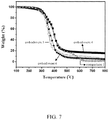
- FIG. 7 shows the findings in TGA analysis of five-carbon ring derivative-containing polyurethane according to an embodiment of the present invention.
- FIG. 8 shows the findings in DSC analysis of five-carbon ring derivative-containing polyurethane according to an embodiment of the present invention.
- FIG. 9 shows the findings in DMA analysis of five-carbon ring derivative-containing polyurethane according to an embodiment of the present invention.
- the method of producing a five-carbon ring-containing compound according to an embodiment of the present invention comprises the steps of: (1) degrading dicyclopentadiene to cyclopentadiene, followed by allowing cyclopentadiene to react with phenol by acid catalysis to produce 4-(cyclopent-2-enyl)phenol; (2) allowing 4-(cyclopent-2-enyl)phenol to react in presence of a catalyst to produce 4-cyclopentenylphenol; and (3) allowing 4-cyclopentenylphenol to react with phenol by acid catalysis to produce a compound expressed by formula (I) below.
- the method of the present invention further comprises allowing the compound expressed by formula (I) to react with ethylene carbonate, using sodium hydroxide as a catalyst, to produce a compound expressed by formula (II) below.
- the method of the present invention further comprises allowing the compound expressed by formula (I) to react with propylene carbonate, using sodium hydroxide as a catalyst, to produce a compound expressed by formula (III) below.
- the present invention further provides a method of producing a five-carbon ring derivative-containing polyurethane, the method comprising the steps of: (a) allowing a diisocyanate compound to react with a polyethylene glycol compound in a solvent and thus produce a prepolymer; and (b) allowing the prepolymer to react continuously with a 5-carbon cyclic compound expressed by one of formula (I), formula (II) and formula (III) and thus produce a five-carbon ring derivative-containing polyurethane.
- Embodiment 1 degrade dicyclopentadiene (DCPD) to cyclopentadiene (CPD), dissolve 33 g of CPD in 100 ml of toluene, allow CPD to react with phenol in the presence of phosphoric acid (H 3 PO 4 ) for 2 hours to obtain a crude product, neutralize the crude product with sodium carbonate, perform filtration and purification on the neutralized crude product to obtain a mixture of ortho- and para-phenol cyclopentenylphenol, which then undergoes separation by distillation to obtain para product 4-(cyclopent-2-enyl)phenol.
- DCPD degrade dicyclopentadiene
- CPD cyclopentadiene
- H 3 PO 4 phosphoric acid
- Embodiment 2 add 0.5 g of CPDP monomers to ethylene carbonate, and allow them to react in a nitrogen atmosphere for 24 hours in the presence of sodium hydroxide as a catalyst. Afterward, the crude product is neutralized and then purified to obtain 2,2′-(4,4′-(cyclopentane-1,1-diyl)bis(4,1-phenylene))bis(oxy)diethanol presented in the form of white powder and expressed by formula (II).
- FIG. 4 there is shown a 1 H-NMR spectrum of the 5-carbon cyclic compound according to embodiment 2 of the present invention. As shown in the diagram, hydrogen signals are absent from 6 ppm of alkene tertiary carbon, but 3.5 ppm and 3.9 ppm of primary alcohol extension signals are generated, respectively, indicating thorough reaction and complete purification.
- Embodiment 3 add 0.5 g of CPDP monomers to propylene carbonate, and allow them to react in a nitrogen atmosphere for 24 hours in the presence of sodium carbonate as a catalyst. Afterward, the crude product is baked and dried to obtain 1,1′-(4,4′-(cyclopentane-1,1-diyl)bis(4,1-phenylene))bis(oxy)dipropan-2-ol presented in the form of pale brown powder and expressed by formula (III).
- FIG. 5 there is shown a 1 H-NMR spectrum of the 5-carbon cyclic compound according to embodiment 3 of the present invention. As shown in the diagram, hydrogen signals are absent from 6 ppm of alkene tertiary carbon, but 1.1 ppm, 3.7 ppm and 3.9 ppm secondary alcohol extension signals are generated, respectively, indicating thorough reaction and complete purification.
- Embodiment 4 Embodiment 5, Embodiment 6: Referring to FIG. 6 , there is shown a schematic view of the process flow of a method of producing five-carbon ring derivative-containing polyurethane according to an embodiment of the present invention.
- methylene di-p-phenyl diisocyanate (MDI) and polycaprolactone (PCL), with a molecular weight of 3000 to undergo prepolymerization in a solvent, i.e., tetrahydrofuran (THF), at 50° C. for 1.5 hours to obtain prepolymers with a terminal group of isocyanate.
- a solvent i.e., tetrahydrofuran (THF)
- Comparison 1 comparison 1 is the same as embodiment 4, embodiment 5, and embodiment 6 except for the following: in comparison 1, the chain extender is bisphenol A (BPA), which is polyurethane without any 5-carbon cyclic derivative structure. Comparison 1, embodiment 4, embodiment 5, and embodiment 6 are compared and contrasted in Table 1 below.
- BPA bisphenol A
- the dried polyurethane films of embodiment 4, embodiment 5 and embodiment 6 are dissolved in N-methyl-2-pyrrolidone (NMP) to measure and analyze their weight-average molecular weight (Mw), number-average molecular weight (Mn), and molecular weight polydispersity index.
- NMP N-methyl-2-pyrrolidone
- FIG. 7 and FIG. 8 there are shown the findings in TGA analysis and DSC analysis of five-carbon ring derivative-containing polyurethane according to an embodiment of the present invention, respectively. As shown in the diagrams, introduction of 5-carbon cyclic derivative long carbon chains is accompanied by a reduction in the thermal degradation temperature.
- FIG. 9 there is shown the findings in DMA analysis of five-carbon ring derivative-containing polyurethane according to an embodiment of the present invention.
- the storage modulus E′ of samples each 20 mm long, 10 mm wide, and 2 mm thick and made of a cured product is assayed with a dynamic mechanical analyzer (DMA) at a temperature rising rate of 5° C./min and frequency of 1 Hz.
- DMA dynamic mechanical analyzer
- a method of producing a five-carbon ring derivative-containing polyurethane according to the present invention not only uses a green, environment-friendly material (dicyclopentadiene, DCPD) to produce glycol monomers of a five-carbon ring-containing compound, but also uses the monomers as a chain extender for use in polymerization to form polyurethane and thereby produce a five-carbon ring derivative-containing polyurethane material.
- a green, environment-friendly material dicyclopentadiene, DCPD
- DCPD dicyclopentadiene
- the present invention provides a production method which involves carrying out polymerization in a solvent (such as tetrahydrofuran or acetone) with a low boiling point and low toxicity to form polyurethane which has a high molecular weight, thereby widening the application of the production method of the present invention.
- a solvent such as tetrahydrofuran or acetone
Landscapes
- Chemical & Material Sciences (AREA)
- Organic Chemistry (AREA)
- Chemical Kinetics & Catalysis (AREA)
- Health & Medical Sciences (AREA)
- Medicinal Chemistry (AREA)
- Polymers & Plastics (AREA)
- Engineering & Computer Science (AREA)
- General Chemical & Material Sciences (AREA)
- Oil, Petroleum & Natural Gas (AREA)
- Polyurethanes Or Polyureas (AREA)
Abstract
Description


| TABLE 1 | |||||
| hard | |||||
| chain extender | segment | ||||
| embodi- | embodi- | embodi- | PCL | MDI | content | |||
| | BPA | ment | 1 | |
ment 3 | (mole) | (mole) | wt % |
| compar- | 1 | 0 | 0 | 0 | 0.17 | 1.17 | 50 |
| |
|||||||
| embodi- | 0 | 1 | 0 | 0 | 0.18 | 1.18 | 50 |
| |
|||||||
| embodi- | 0 | 0 | 1 | 0 | 0.23 | 1.23 | 50 |
| |
|||||||
| embodi- | 0 | 0 | 0 | 1 | 0.22 | 1.22 | 50 |
| |
|||||||
| TABLE 2 | |||||
| sample | Mw | | PDI | ||
| comparison |
| 1 | 25946 | 6699 | 3.873 | |
| |
161761 | 64114 | 2.523 | |
| |
164100 | 70824 | 2.317 | |
| |
162539 | 52129 | 3.118 | |
Claims (7)


Applications Claiming Priority (3)
| Application Number | Priority Date | Filing Date | Title |
|---|---|---|---|
| TW106126996A | 2017-08-10 | ||
| TW106126996 | 2017-08-10 | ||
| TW106126996A TWI643843B (en) | 2017-08-10 | 2017-08-10 | Preparation method of five-carbon ring-containing polyurethane |
Publications (2)
| Publication Number | Publication Date |
|---|---|
| US20190048123A1 US20190048123A1 (en) | 2019-02-14 |
| US10654965B2 true US10654965B2 (en) | 2020-05-19 |
Family
ID=65274844
Family Applications (1)
| Application Number | Title | Priority Date | Filing Date |
|---|---|---|---|
| US15/828,457 Active 2038-06-07 US10654965B2 (en) | 2017-08-10 | 2017-12-01 | Method of producing five-carbon ring-containing compound and five-carbon ring derivative-containing polyurethane, and five-carbon ring derivative-containing polyurethane |
Country Status (2)
| Country | Link |
|---|---|
| US (1) | US10654965B2 (en) |
| TW (1) | TWI643843B (en) |
Citations (6)
| Publication number | Priority date | Publication date | Assignee | Title |
|---|---|---|---|---|
| US4246367A (en) | 1979-09-24 | 1981-01-20 | United States Steel Corporation | Dicyclopentadiene polyester resins |
| US4301306A (en) | 1980-03-27 | 1981-11-17 | The B. F. Goodrich Company | Norbornenyl phenolic compounds |
| US4447591A (en) * | 1981-05-08 | 1984-05-08 | Daicel Chemical Industries, Ltd. | Polyurethane |
| US4764571A (en) | 1984-11-20 | 1988-08-16 | Sanyo-Kokusaku Pulp Company Limited | Epoxy resins from dicyclopentadiene-phenol adducts and a method of preparing the same |
| US6180696B1 (en) | 1997-02-19 | 2001-01-30 | Georgia Tech Research Corporation | No-flow underfill of epoxy resin, anhydride, fluxing agent and surfactant |
| US20180010024A1 (en) * | 2015-01-21 | 2018-01-11 | 3M Innovative Properties Company | Chemical resistant polyurethane adhesive |
Family Cites Families (4)
| Publication number | Priority date | Publication date | Assignee | Title |
|---|---|---|---|---|
| CN1696090A (en) * | 2005-05-08 | 2005-11-16 | 天津大学 | Method for preparing cycloalkyl-containing bisphenol compounds by solvent method |
| PL2137140T3 (en) * | 2007-03-23 | 2011-04-29 | Council Scient Ind Res | Novel diazonaphthoquinonesulfonic acid bisphenol derivative useful in photo lithographic sub micron patterning and a process for preparation thereof |
| US20120085961A1 (en) * | 2010-10-12 | 2012-04-12 | Bayer Materialscience Llc | Method for improving sound damping performance for automotive interior applications |
| TW201406836A (en) * | 2012-08-10 | 2014-02-16 | jun-hao Lu | Preparation method for yellowing-resistant polyurethane foam material and products thereof |
-
2017
- 2017-08-10 TW TW106126996A patent/TWI643843B/en active
- 2017-12-01 US US15/828,457 patent/US10654965B2/en active Active
Patent Citations (6)
| Publication number | Priority date | Publication date | Assignee | Title |
|---|---|---|---|---|
| US4246367A (en) | 1979-09-24 | 1981-01-20 | United States Steel Corporation | Dicyclopentadiene polyester resins |
| US4301306A (en) | 1980-03-27 | 1981-11-17 | The B. F. Goodrich Company | Norbornenyl phenolic compounds |
| US4447591A (en) * | 1981-05-08 | 1984-05-08 | Daicel Chemical Industries, Ltd. | Polyurethane |
| US4764571A (en) | 1984-11-20 | 1988-08-16 | Sanyo-Kokusaku Pulp Company Limited | Epoxy resins from dicyclopentadiene-phenol adducts and a method of preparing the same |
| US6180696B1 (en) | 1997-02-19 | 2001-01-30 | Georgia Tech Research Corporation | No-flow underfill of epoxy resin, anhydride, fluxing agent and surfactant |
| US20180010024A1 (en) * | 2015-01-21 | 2018-01-11 | 3M Innovative Properties Company | Chemical resistant polyurethane adhesive |
Non-Patent Citations (1)
| Title |
|---|
| "Synthesis of Diols Containing Cyclopentane Card-Type Groups and Polyurethanes on Their Basis" to Papava et al. Proceedings of the Georgian Academy of Sciences, vol. 32, Issue 1-2, pp. 98-103, 2006. * |
Also Published As
| Publication number | Publication date |
|---|---|
| TWI643843B (en) | 2018-12-11 |
| US20190048123A1 (en) | 2019-02-14 |
| TW201910301A (en) | 2019-03-16 |
Similar Documents
| Publication | Publication Date | Title |
|---|---|---|
| CN105452332B (en) | Method for producing polycarbonate diol, polycarbonate diol, method for producing polyurethane, and polyurethane | |
| US10875961B2 (en) | Polycarbonate diol and thermoplastic polyurethane made from the same | |
| CA2081039C (en) | Method for the preparation of a polyurea resin | |
| Wołosz et al. | Environmentally friendly synthesis of urea-free poly (carbonate-urethane) elastomers | |
| Gopalakrishnan et al. | Influence of polyols on properties of bio-based polyurethanes | |
| JP2020125428A (en) | Polyurethane elastomer and method for producing the same | |
| Kuhire et al. | Poly (ether urethane) s from aromatic diisocyanates based on lignin‐derived phenolic acids | |
| KR101858992B1 (en) | Method for preparing thermoplastic poly urethane having azide group | |
| JPH09509213A (en) | Process for producing poly (ether-urethane) from cyclic ether and organic isocyanate | |
| US20190048123A1 (en) | Method of producing five-carbon ring-containing compound and five-carbon ring derivative-containing polyurethane, and five-carbon ring derivative-containing polyurethane | |
| KR20100099712A (en) | Copolymers comprising a trimethylene carbonate and poly(trimethylene ether) glycols | |
| CN118652406A (en) | Preparation of Perfluoropolyether Modified Long Fluorinated Side Chain Polyurethane Acrylate | |
| CN119119407A (en) | Polycarbonate diol composition | |
| US12122911B2 (en) | Polyalkylene ether glycol composition and method for producing polyurethane using the same | |
| JP2023104903A (en) | Epoxy resin curing aid, epoxy resin composition | |
| Huang et al. | Synthesis and evaluation of alkoxylated-ether diols of hydroquinone with different chain-lengths as extenders in segmented polyurethanes | |
| US20090247723A1 (en) | Telechelic polymer composition | |
| Patil et al. | Synthesis and characterization of novel aromatic–aliphatic polyamides from bis-[(4-aminobenzyl)-4-benzamide] ether | |
| CN106046286B (en) | A kind of polyurethane and preparation method thereof containing naphthalene ring | |
| JP3278757B2 (en) | Method for producing polyurea resin | |
| KR101641109B1 (en) | Polyurethane having alicyclic diisocyanate and method for preparing the same | |
| Jayakumar et al. | Synthesis and characterization of calcium‐containing poly (urethane‐urea) s | |
| JP3291593B2 (en) | Conductive polyurea elastomer | |
| Akbulut et al. | Synthesis and physical properties of poly (urethane) s using vicinal diols derived from acrylate and styrene monomers | |
| KR20250173744A (en) | Degradable polymer polymerized from monomers comprising diol monomers and a degradable film comprising the same |
Legal Events
| Date | Code | Title | Description |
|---|---|---|---|
| AS | Assignment |
Owner name: NATIONAL CHUNG SHAN INSTITUTE OF SCIENCE AND TECHN Free format text: ASSIGNMENT OF ASSIGNORS INTEREST;ASSIGNORS:SU, WEN-CHIUNG;WU, CHIEN-HSIN;LIN, YU-RU;AND OTHERS;REEL/FRAME:044269/0422 Effective date: 20171006 Owner name: NATIONAL CHUNG SHAN INSTITUTE OF SCIENCE AND TECHNOLOGY, TAIWAN Free format text: ASSIGNMENT OF ASSIGNORS INTEREST;ASSIGNORS:SU, WEN-CHIUNG;WU, CHIEN-HSIN;LIN, YU-RU;AND OTHERS;REEL/FRAME:044269/0422 Effective date: 20171006 |
|
| FEPP | Fee payment procedure |
Free format text: ENTITY STATUS SET TO UNDISCOUNTED (ORIGINAL EVENT CODE: BIG.); ENTITY STATUS OF PATENT OWNER: LARGE ENTITY |
|
| STPP | Information on status: patent application and granting procedure in general |
Free format text: DOCKETED NEW CASE - READY FOR EXAMINATION |
|
| STPP | Information on status: patent application and granting procedure in general |
Free format text: NON FINAL ACTION MAILED |
|
| STPP | Information on status: patent application and granting procedure in general |
Free format text: RESPONSE TO NON-FINAL OFFICE ACTION ENTERED AND FORWARDED TO EXAMINER |
|
| STPP | Information on status: patent application and granting procedure in general |
Free format text: NON FINAL ACTION MAILED |
|
| STPP | Information on status: patent application and granting procedure in general |
Free format text: RESPONSE TO NON-FINAL OFFICE ACTION ENTERED AND FORWARDED TO EXAMINER |
|
| STPP | Information on status: patent application and granting procedure in general |
Free format text: NOTICE OF ALLOWANCE MAILED -- APPLICATION RECEIVED IN OFFICE OF PUBLICATIONS |
|
| STPP | Information on status: patent application and granting procedure in general |
Free format text: PUBLICATIONS -- ISSUE FEE PAYMENT VERIFIED |
|
| STCF | Information on status: patent grant |
Free format text: PATENTED CASE |
|
| MAFP | Maintenance fee payment |
Free format text: PAYMENT OF MAINTENANCE FEE, 4TH YEAR, LARGE ENTITY (ORIGINAL EVENT CODE: M1551); ENTITY STATUS OF PATENT OWNER: LARGE ENTITY Year of fee payment: 4 |