US10647702B2 - Aryl-substituted imidazoles - Google Patents
Aryl-substituted imidazoles Download PDFInfo
- Publication number
- US10647702B2 US10647702B2 US15/812,605 US201715812605A US10647702B2 US 10647702 B2 US10647702 B2 US 10647702B2 US 201715812605 A US201715812605 A US 201715812605A US 10647702 B2 US10647702 B2 US 10647702B2
- Authority
- US
- United States
- Prior art keywords
- group
- compounds
- compound
- hydrogen
- alkyl
- Prior art date
- Legal status (The legal status is an assumption and is not a legal conclusion. Google has not performed a legal analysis and makes no representation as to the accuracy of the status listed.)
- Expired - Fee Related
Links
- 0 C[C@@]1C(C2)[C@]2*C*1 Chemical compound C[C@@]1C(C2)[C@]2*C*1 0.000 description 38
- DGYBTGNGWKHNQE-URLMMPGGSA-N COC1=CC(OC(C)C)=C(C2=N[C@@H](C3=CC=C(Cl)C=C3)[C@@H](C3=CC(C)=CC=C3)N2C(=O)N2CCNC(=O)C2)C=C1 Chemical compound COC1=CC(OC(C)C)=C(C2=N[C@@H](C3=CC=C(Cl)C=C3)[C@@H](C3=CC(C)=CC=C3)N2C(=O)N2CCNC(=O)C2)C=C1 DGYBTGNGWKHNQE-URLMMPGGSA-N 0.000 description 4
- FKNUEQNLASDDQC-URLMMPGGSA-N COC1=CC(OC(C)C)=C(C2=N[C@@H](C3=CC=CC(C)=C3)[C@@H](C3=CC=C(Cl)C=C3)N2C(=O)N2CCNC(=O)C2)C=C1 Chemical compound COC1=CC(OC(C)C)=C(C2=N[C@@H](C3=CC=CC(C)=C3)[C@@H](C3=CC=C(Cl)C=C3)N2C(=O)N2CCNC(=O)C2)C=C1 FKNUEQNLASDDQC-URLMMPGGSA-N 0.000 description 4
- JVCPZGYCWMMDAT-UHFFFAOYSA-N CC1=CC(C2=NC(C3=CC=C(S(C)(=O)=O)C=C3)C(C3=CC(F)=CC=C3)N2C(=O)N2CCNC(=O)C2)=CC=C1 Chemical compound CC1=CC(C2=NC(C3=CC=C(S(C)(=O)=O)C=C3)C(C3=CC(F)=CC=C3)N2C(=O)N2CCNC(=O)C2)=CC=C1 JVCPZGYCWMMDAT-UHFFFAOYSA-N 0.000 description 3
- PVEMIXXWDPBCGW-UHFFFAOYSA-N COC1=C(C2=NC(C3=CC=C(Cl)C=C3)C(C3=CC(F)=CC=C3)N2C(=O)N2CCNC(=O)C2)C=CC=C1 Chemical compound COC1=C(C2=NC(C3=CC=C(Cl)C=C3)C(C3=CC(F)=CC=C3)N2C(=O)N2CCNC(=O)C2)C=CC=C1 PVEMIXXWDPBCGW-UHFFFAOYSA-N 0.000 description 3
- UCZYCQCJAVIGIX-UHFFFAOYSA-N COC1=CC(OC(C)C)=C(C2=NC(C)C(C)N2C(=O)N2CCNC(=O)C2)C=C1 Chemical compound COC1=CC(OC(C)C)=C(C2=NC(C)C(C)N2C(=O)N2CCNC(=O)C2)C=C1 UCZYCQCJAVIGIX-UHFFFAOYSA-N 0.000 description 3
- XRFLSVKWLKAENR-WUFINQPMSA-N COC1=CC(OC(C)C)=C(C2=N[C@@H](C3=CC=C(Cl)C=C3)[C@@H](C3=CC(F)=CC=C3)N2C(=O)N2CCNC(=O)C2)C=C1 Chemical compound COC1=CC(OC(C)C)=C(C2=N[C@@H](C3=CC=C(Cl)C=C3)[C@@H](C3=CC(F)=CC=C3)N2C(=O)N2CCNC(=O)C2)C=C1 XRFLSVKWLKAENR-WUFINQPMSA-N 0.000 description 3
- DGYBTGNGWKHNQE-WDYNHAJCSA-N COC1=CC(OC(C)C)=C(C2=N[C@H](C3=CC=C(Cl)C=C3)[C@H](C3=CC(C)=CC=C3)N2C(=O)N2CCNC(=O)C2)C=C1 Chemical compound COC1=CC(OC(C)C)=C(C2=N[C@H](C3=CC=C(Cl)C=C3)[C@H](C3=CC(C)=CC=C3)N2C(=O)N2CCNC(=O)C2)C=C1 DGYBTGNGWKHNQE-WDYNHAJCSA-N 0.000 description 3
- ITVRYYFCQHHJQK-URLMMPGGSA-N COC1=CC=C([C@@H]2N=C(C3=C(OC(C)C)C=C(OC)C=C3)N(C(=O)N3CCNC(=O)C3)[C@@H]2C2=CC=C(Cl)C=C2)C=C1 Chemical compound COC1=CC=C([C@@H]2N=C(C3=C(OC(C)C)C=C(OC)C=C3)N(C(=O)N3CCNC(=O)C3)[C@@H]2C2=CC=C(Cl)C=C2)C=C1 ITVRYYFCQHHJQK-URLMMPGGSA-N 0.000 description 3
- HKMRCUAOEWHJFH-UHFFFAOYSA-N CS(=O)(=O)C1=CC=C(C2N=C(C3=CC(Cl)=CC=C3)N(C(=O)N3CCNC(=O)C3)C2C2=CC(F)=CC=C2)C=C1 Chemical compound CS(=O)(=O)C1=CC=C(C2N=C(C3=CC(Cl)=CC=C3)N(C(=O)N3CCNC(=O)C3)C2C2=CC(F)=CC=C2)C=C1 HKMRCUAOEWHJFH-UHFFFAOYSA-N 0.000 description 3
- CQAGOIYQGBSMOH-UHFFFAOYSA-N CC1=C(C2=NC(C3=CC=C(C(F)(F)F)C=C3)C(C3=CC(F)=CC=C3)N2C(=O)N2CCNC(=O)C2)C=CC=C1 Chemical compound CC1=C(C2=NC(C3=CC=C(C(F)(F)F)C=C3)C(C3=CC(F)=CC=C3)N2C(=O)N2CCNC(=O)C2)C=CC=C1 CQAGOIYQGBSMOH-UHFFFAOYSA-N 0.000 description 2
- GZAUIIFJBFQUKA-UHFFFAOYSA-N CC1=CC(C2C(C3=CC=C(Cl)C=C3)N=C(C3=CC=CC=C3C)N2C(=O)N2CCNC(=O)C2)=CC=C1 Chemical compound CC1=CC(C2C(C3=CC=C(Cl)C=C3)N=C(C3=CC=CC=C3C)N2C(=O)N2CCNC(=O)C2)=CC=C1 GZAUIIFJBFQUKA-UHFFFAOYSA-N 0.000 description 2
- HKPZFSJFNUZXGH-UHFFFAOYSA-N CC1=CC(C2C(C3=CC=C(S(C)(=O)=O)C=C3)N=C(C3=CC=CC(Cl)=C3)N2C(=O)N2CCNC(=O)C2)=CC=C1 Chemical compound CC1=CC(C2C(C3=CC=C(S(C)(=O)=O)C=C3)N=C(C3=CC=CC(Cl)=C3)N2C(=O)N2CCNC(=O)C2)=CC=C1 HKPZFSJFNUZXGH-UHFFFAOYSA-N 0.000 description 2
- PMVJSQCWARTEIP-UHFFFAOYSA-N CC1=CC=C(C2=NC(C3=CC=C(S(C)(=O)=O)C=C3)C(C3=CC(F)=CC=C3)N2C(=O)N2CCNC(=O)C2)C=C1 Chemical compound CC1=CC=C(C2=NC(C3=CC=C(S(C)(=O)=O)C=C3)C(C3=CC(F)=CC=C3)N2C(=O)N2CCNC(=O)C2)C=C1 PMVJSQCWARTEIP-UHFFFAOYSA-N 0.000 description 2
- ZXBQULLLPSDUIT-UHFFFAOYSA-N CC1=CC=CC(C2=NC(C3=CC=C(C(F)(F)F)C=C3)C(C3=CC(Cl)=CC=C3)N2C(=O)N2CCNC(=O)C2)=C1 Chemical compound CC1=CC=CC(C2=NC(C3=CC=C(C(F)(F)F)C=C3)C(C3=CC(Cl)=CC=C3)N2C(=O)N2CCNC(=O)C2)=C1 ZXBQULLLPSDUIT-UHFFFAOYSA-N 0.000 description 2
- UXGCGFJMBSAAHR-UHFFFAOYSA-N CC1=CC=CC=C1C1=NC(C2=CC=C(S(C)(=O)=O)C=C2)C(C2=CC=C(Cl)C=C2)N1C(=O)N1CCNC(=O)C1 Chemical compound CC1=CC=CC=C1C1=NC(C2=CC=C(S(C)(=O)=O)C=C2)C(C2=CC=C(Cl)C=C2)N1C(=O)N1CCNC(=O)C1 UXGCGFJMBSAAHR-UHFFFAOYSA-N 0.000 description 2
- ZZRODNWWALHZAJ-SZAHLOSFSA-N CCOC1=CC(C(C)(C)C)=CC=C1C1=N[C@@](C)(C2=CC=C(Cl)C=C2)[C@@](C)(C2=CC=C(Cl)C=C2)N1C(=O)N1CCNC(=O)C1 Chemical compound CCOC1=CC(C(C)(C)C)=CC=C1C1=N[C@@](C)(C2=CC=C(Cl)C=C2)[C@@](C)(C2=CC=C(Cl)C=C2)N1C(=O)N1CCNC(=O)C1 ZZRODNWWALHZAJ-SZAHLOSFSA-N 0.000 description 2
- NKARKKRXNUPDOE-UHFFFAOYSA-N COC1=C(C2=NC(C3=CC=C(S(C)(=O)=O)C=C3)C(C3=CC(F)=CC=C3)N2C(=O)N2CCNC(=O)C2)C=CC=C1 Chemical compound COC1=C(C2=NC(C3=CC=C(S(C)(=O)=O)C=C3)C(C3=CC(F)=CC=C3)N2C(=O)N2CCNC(=O)C2)C=CC=C1 NKARKKRXNUPDOE-UHFFFAOYSA-N 0.000 description 2
- NMFBCPVQCYYZNI-UHFFFAOYSA-N COC1=CC(OC(C)C)=C(C2=NC(C3=CC=C(C)C=C3)C(C3=CC=C(Cl)C=C3)N2C(=O)N2CCNC(=O)C2)C=C1 Chemical compound COC1=CC(OC(C)C)=C(C2=NC(C3=CC=C(C)C=C3)C(C3=CC=C(Cl)C=C3)N2C(=O)N2CCNC(=O)C2)C=C1 NMFBCPVQCYYZNI-UHFFFAOYSA-N 0.000 description 2
- ARCDIDLGCYXZPE-UHFFFAOYSA-N COC1=CC(OC(C)C)=C(C2=NC(C3=CC=C(Cl)C=C3)C(C3=CC(Cl)=CC=C3)N2C(=O)N2CCNC(=O)C2)C=C1 Chemical compound COC1=CC(OC(C)C)=C(C2=NC(C3=CC=C(Cl)C=C3)C(C3=CC(Cl)=CC=C3)N2C(=O)N2CCNC(=O)C2)C=C1 ARCDIDLGCYXZPE-UHFFFAOYSA-N 0.000 description 2
- XRFLSVKWLKAENR-UHFFFAOYSA-N COC1=CC(OC(C)C)=C(C2=NC(C3=CC=C(Cl)C=C3)C(C3=CC(F)=CC=C3)N2C(=O)N2CCNC(=O)C2)C=C1 Chemical compound COC1=CC(OC(C)C)=C(C2=NC(C3=CC=C(Cl)C=C3)C(C3=CC(F)=CC=C3)N2C(=O)N2CCNC(=O)C2)C=C1 XRFLSVKWLKAENR-UHFFFAOYSA-N 0.000 description 2
- NMFBCPVQCYYZNI-URLMMPGGSA-N COC1=CC(OC(C)C)=C(C2=N[C@@H](C3=CC=C(C)C=C3)[C@@H](C3=CC=C(Cl)C=C3)N2C(=O)N2CCNC(=O)C2)C=C1 Chemical compound COC1=CC(OC(C)C)=C(C2=N[C@@H](C3=CC=C(C)C=C3)[C@@H](C3=CC=C(Cl)C=C3)N2C(=O)N2CCNC(=O)C2)C=C1 NMFBCPVQCYYZNI-URLMMPGGSA-N 0.000 description 2
- AEWWCIOFOHCCOK-URLMMPGGSA-N COC1=CC(OC(C)C)=C(C2=N[C@@H](C3=CC=C(Cl)C=C3)[C@@H](C3=CC=C(C)C=C3)N2C(=O)N2CCNC(=O)C2)C=C1 Chemical compound COC1=CC(OC(C)C)=C(C2=N[C@@H](C3=CC=C(Cl)C=C3)[C@@H](C3=CC=C(C)C=C3)N2C(=O)N2CCNC(=O)C2)C=C1 AEWWCIOFOHCCOK-URLMMPGGSA-N 0.000 description 2
- BDUHCSBCVGXTJM-WUFINQPMSA-N COC1=CC(OC(C)C)=C(C2=N[C@@H](C3=CC=C(Cl)C=C3)[C@@H](C3=CC=C(Cl)C=C3)N2C(=O)N2CCNC(=O)C2)C=C1 Chemical compound COC1=CC(OC(C)C)=C(C2=N[C@@H](C3=CC=C(Cl)C=C3)[C@@H](C3=CC=C(Cl)C=C3)N2C(=O)N2CCNC(=O)C2)C=C1 BDUHCSBCVGXTJM-WUFINQPMSA-N 0.000 description 2
- WCJXJRYBDXHZRN-WUFINQPMSA-N COC1=CC(OC(C)C)=C(C2=N[C@@H](C3=CC=CC(Cl)=C3)[C@@H](C3=CC=C(Cl)C=C3)N2C(=O)N2CCNC(=O)C2)C=C1 Chemical compound COC1=CC(OC(C)C)=C(C2=N[C@@H](C3=CC=CC(Cl)=C3)[C@@H](C3=CC=C(Cl)C=C3)N2C(=O)N2CCNC(=O)C2)C=C1 WCJXJRYBDXHZRN-WUFINQPMSA-N 0.000 description 2
- DJPAMLSRTRLJMG-WUFINQPMSA-N COC1=CC(OC(C)C)=C(C2=N[C@@H](C3=CC=CC=C3Cl)[C@@H](C3=CC=C(Cl)C=C3)N2C(=O)N2CCNC(=O)C2)C=C1 Chemical compound COC1=CC(OC(C)C)=C(C2=N[C@@H](C3=CC=CC=C3Cl)[C@@H](C3=CC=C(Cl)C=C3)N2C(=O)N2CCNC(=O)C2)C=C1 DJPAMLSRTRLJMG-WUFINQPMSA-N 0.000 description 2
- FKNUEQNLASDDQC-WDYNHAJCSA-N COC1=CC(OC(C)C)=C(C2=N[C@H](C3=CC=CC(C)=C3)[C@H](C3=CC=C(Cl)C=C3)N2C(=O)N2CCNC(=O)C2)C=C1 Chemical compound COC1=CC(OC(C)C)=C(C2=N[C@H](C3=CC=CC(C)=C3)[C@H](C3=CC=C(Cl)C=C3)N2C(=O)N2CCNC(=O)C2)C=C1 FKNUEQNLASDDQC-WDYNHAJCSA-N 0.000 description 2
- NPRKYYNPVSZSPX-AJQTZOPKSA-N COC1=CC=C(C2=N[C@@](C)(C3=CC=C(Cl)C=C3)[C@@](C)(C3=CC=C(Cl)C=C3)N2C(=O)N2CCNC(=O)C2)C(OC(C)C)=C1 Chemical compound COC1=CC=C(C2=N[C@@](C)(C3=CC=C(Cl)C=C3)[C@@](C)(C3=CC=C(Cl)C=C3)N2C(=O)N2CCNC(=O)C2)C(OC(C)C)=C1 NPRKYYNPVSZSPX-AJQTZOPKSA-N 0.000 description 2
- NPRKYYNPVSZSPX-ZWXJPIIXSA-N COC1=CC=C(C2=N[C@](C)(C3=CC=C(Cl)C=C3)[C@](C)(C3=CC=C(Cl)C=C3)N2C(=O)N2CCNC(=O)C2)C(OC(C)C)=C1 Chemical compound COC1=CC=C(C2=N[C@](C)(C3=CC=C(Cl)C=C3)[C@](C)(C3=CC=C(Cl)C=C3)N2C(=O)N2CCNC(=O)C2)C(OC(C)C)=C1 NPRKYYNPVSZSPX-ZWXJPIIXSA-N 0.000 description 2
- NXUAAVAZKCZIAQ-UHFFFAOYSA-N COC1=CC=CC(C2=NC(C3=CC=C(C(F)(F)F)C=C3)C(C3=CC(C)=CC=C3)N2C(=O)N2CCNC(=O)C2)=C1 Chemical compound COC1=CC=CC(C2=NC(C3=CC=C(C(F)(F)F)C=C3)C(C3=CC(C)=CC=C3)N2C(=O)N2CCNC(=O)C2)=C1 NXUAAVAZKCZIAQ-UHFFFAOYSA-N 0.000 description 2
- JYOHOUKLBKAQGN-UHFFFAOYSA-N COC1=CC=CC(C2=NC(C3=CC=C(Cl)C=C3)C(C3=CC(C)=CC=C3)N2C(=O)N2CCNC(=O)C2)=C1 Chemical compound COC1=CC=CC(C2=NC(C3=CC=C(Cl)C=C3)C(C3=CC(C)=CC=C3)N2C(=O)N2CCNC(=O)C2)=C1 JYOHOUKLBKAQGN-UHFFFAOYSA-N 0.000 description 2
- UXKIANWIWDIIEW-UHFFFAOYSA-N O=C1CN(C(=O)N2C(C3=CC=C(Cl)C=C3)=NC(C3=CC=C(C(F)(F)F)C=C3)C2C2=CC(F)=CC=C2)CCN1 Chemical compound O=C1CN(C(=O)N2C(C3=CC=C(Cl)C=C3)=NC(C3=CC=C(C(F)(F)F)C=C3)C2C2=CC(F)=CC=C2)CCN1 UXKIANWIWDIIEW-UHFFFAOYSA-N 0.000 description 2
- QPBHSECPOKTJKB-UHFFFAOYSA-N O=C1CN(C(=O)N2C(C3=CC=CC(Cl)=C3)=NC(C3=CC=C(Cl)C=C3)C2C2=CC=CC(F)=C2)CCN1 Chemical compound O=C1CN(C(=O)N2C(C3=CC=CC(Cl)=C3)=NC(C3=CC=C(Cl)C=C3)C2C2=CC=CC(F)=C2)CCN1 QPBHSECPOKTJKB-UHFFFAOYSA-N 0.000 description 2
- UXSBHDLYJTXTMC-UHFFFAOYSA-N C.C.COC1=CC(OC(C)C)=C(C2=NC(C)C(C)C2)C=C1.COC1=CC(OC(C)C)=C(C2=NC(C)C(C)C2)C=C1.COC1=CC(OC(C)C)=C(C2=NC(C)C(C)N2C(=O)N2CCNC(=O)C2)C=C1.COC1=CC(OC(C)C)=C(C2=NC(C)C(C)N2C(=O)N2CCNC(=O)C2)C=C1.O=C1CNCCN1 Chemical compound C.C.COC1=CC(OC(C)C)=C(C2=NC(C)C(C)C2)C=C1.COC1=CC(OC(C)C)=C(C2=NC(C)C(C)C2)C=C1.COC1=CC(OC(C)C)=C(C2=NC(C)C(C)N2C(=O)N2CCNC(=O)C2)C=C1.COC1=CC(OC(C)C)=C(C2=NC(C)C(C)N2C(=O)N2CCNC(=O)C2)C=C1.O=C1CNCCN1 UXSBHDLYJTXTMC-UHFFFAOYSA-N 0.000 description 1
- JHXXMVCQUSANMK-UHFFFAOYSA-N CC(C)(C)C1=NC(C2=CC=C(Cl)C=C2)C(C2=CC(C(F)(F)F)=CC=C2)N1C(=O)N1CCNC(=O)C1 Chemical compound CC(C)(C)C1=NC(C2=CC=C(Cl)C=C2)C(C2=CC(C(F)(F)F)=CC=C2)N1C(=O)N1CCNC(=O)C1 JHXXMVCQUSANMK-UHFFFAOYSA-N 0.000 description 1
- MEBLJIZUNCPBGT-UHFFFAOYSA-N CC(C)(C)C1=NC(C2=CC=C(Cl)C=C2)C(C2=CC(F)=CC=C2)N1C(=O)N1CCNC(=O)C1 Chemical compound CC(C)(C)C1=NC(C2=CC=C(Cl)C=C2)C(C2=CC(F)=CC=C2)N1C(=O)N1CCNC(=O)C1 MEBLJIZUNCPBGT-UHFFFAOYSA-N 0.000 description 1
- KGSDOHYUGHCRKL-UHFFFAOYSA-N CC(C)Oc(cc(cc1)OC)c1C(N(C1[AlH2])C(N(CCN2)CC2=O)=O)=NC1I Chemical compound CC(C)Oc(cc(cc1)OC)c1C(N(C1[AlH2])C(N(CCN2)CC2=O)=O)=NC1I KGSDOHYUGHCRKL-UHFFFAOYSA-N 0.000 description 1
- UECQIQQKOCELQV-UHFFFAOYSA-N CC(C)Oc(cc(cc1)OC)c1C(N1C(N(CCN2)CC2=O)=O)=NC(C)C1[AlH2] Chemical compound CC(C)Oc(cc(cc1)OC)c1C(N1C(N(CCN2)CC2=O)=O)=NC(C)C1[AlH2] UECQIQQKOCELQV-UHFFFAOYSA-N 0.000 description 1
- OFVHUALAYNDQRX-UHFFFAOYSA-N CC.CC(C)(C)C1=CC=CC=C1 Chemical compound CC.CC(C)(C)C1=CC=CC=C1 OFVHUALAYNDQRX-UHFFFAOYSA-N 0.000 description 1
- LCXYFAYOIVYCMH-UHFFFAOYSA-N CC.CC(C)C1=CC(C(C)C)=C(C(C)C)C=C1 Chemical compound CC.CC(C)C1=CC(C(C)C)=C(C(C)C)C=C1 LCXYFAYOIVYCMH-UHFFFAOYSA-N 0.000 description 1
- HVZXZGMOKNJIOQ-UHFFFAOYSA-N CC.CC(C)C1=CC=C(C(C)C)C=C1 Chemical compound CC.CC(C)C1=CC=C(C(C)C)C=C1 HVZXZGMOKNJIOQ-UHFFFAOYSA-N 0.000 description 1
- OEHRZWMGNXKUML-UHFFFAOYSA-N CC.CC.CC.CC(C)(C)C1=CC=CC=N1.CC(C)(C)C1=CC=CN=C1.CC(C)(C)C1=CC=NC=C1 Chemical compound CC.CC.CC.CC(C)(C)C1=CC=CC=N1.CC(C)(C)C1=CC=CN=C1.CC(C)(C)C1=CC=NC=C1 OEHRZWMGNXKUML-UHFFFAOYSA-N 0.000 description 1
- ZMYBHQXQZMUNLW-ATPOBNMBSA-N CC.CC.CC.CC.CC.CC.CC(C)(C)C1=CC=C[Y]1.CC(C)(C)C1=CC=C[Y]1.CC(C)(C)C1=CC=C[Y]1.CC(C)(C)C1=C[Y]C=C1.CC(C)(C)C1=C[Y]C=C1.CC(C)(C)C1=C[Y]C=C1.CC1C=CC(C(C)(C)C)=C1.CC1C=CC(C(C)(C)C)=C1.CC1C=CC=C1C(C)(C)C Chemical compound CC.CC.CC.CC.CC.CC.CC(C)(C)C1=CC=C[Y]1.CC(C)(C)C1=CC=C[Y]1.CC(C)(C)C1=CC=C[Y]1.CC(C)(C)C1=C[Y]C=C1.CC(C)(C)C1=C[Y]C=C1.CC(C)(C)C1=C[Y]C=C1.CC1C=CC(C(C)(C)C)=C1.CC1C=CC(C(C)(C)C)=C1.CC1C=CC=C1C(C)(C)C ZMYBHQXQZMUNLW-ATPOBNMBSA-N 0.000 description 1
- OCYLZDYSZISCEW-UHFFFAOYSA-N CC1=C(C)C(C(C)C)=C(C(C)C)C(C)=C1C(C)C Chemical compound CC1=C(C)C(C(C)C)=C(C(C)C)C(C)=C1C(C)C OCYLZDYSZISCEW-UHFFFAOYSA-N 0.000 description 1
- WGZWEEHVPCGJOR-UHFFFAOYSA-N CC1=C(C)C(C)=C(C(C)(C)C)C(C)=C1C Chemical compound CC1=C(C)C(C)=C(C(C)(C)C)C(C)=C1C WGZWEEHVPCGJOR-UHFFFAOYSA-N 0.000 description 1
- YPTPDQCDKDUSRY-UHFFFAOYSA-N CC1=C(C2=NC(C3=CC=C(C(F)(F)F)C=C3)C(C3=CC(Cl)=CC=C3)N2C(=O)N2CCNC(=O)C2)C=CC=C1 Chemical compound CC1=C(C2=NC(C3=CC=C(C(F)(F)F)C=C3)C(C3=CC(Cl)=CC=C3)N2C(=O)N2CCNC(=O)C2)C=CC=C1 YPTPDQCDKDUSRY-UHFFFAOYSA-N 0.000 description 1
- KKYFXKRSEXAVHJ-UHFFFAOYSA-N CC1=C(C2=NC(C3=CC=C(Cl)C=C3)C(C3=CC(F)=CC=C3)N2C(=O)N2CCCC(=O)C2)C=CC=C1 Chemical compound CC1=C(C2=NC(C3=CC=C(Cl)C=C3)C(C3=CC(F)=CC=C3)N2C(=O)N2CCCC(=O)C2)C=CC=C1 KKYFXKRSEXAVHJ-UHFFFAOYSA-N 0.000 description 1
- MLRTZOKVJDITQH-UHFFFAOYSA-N CC1=CC(C2=NC(C3=CC=C(S(C)(=O)=O)C=C3)C(C3=CC=C(Cl)C=C3)N2C(=O)N2CCNC(=O)C2)=CC=C1 Chemical compound CC1=CC(C2=NC(C3=CC=C(S(C)(=O)=O)C=C3)C(C3=CC=C(Cl)C=C3)N2C(=O)N2CCNC(=O)C2)=CC=C1 MLRTZOKVJDITQH-UHFFFAOYSA-N 0.000 description 1
- VJXKNJVUMVCSOW-UHFFFAOYSA-N CC1=CC(C2=NC(C3=CC=C(S(C)(=O)=O)C=C3)C(C3=CC=CC(C)=C3)N2C(=O)N2CCCC(=O)C2)=CC=C1 Chemical compound CC1=CC(C2=NC(C3=CC=C(S(C)(=O)=O)C=C3)C(C3=CC=CC(C)=C3)N2C(=O)N2CCCC(=O)C2)=CC=C1 VJXKNJVUMVCSOW-UHFFFAOYSA-N 0.000 description 1
- QYULTIDJSFKEBL-UHFFFAOYSA-N CC1=CC(C2C(C3=CC=C(C(F)(F)F)C=C3)N=C(C3=CC(Cl)=CC=C3)N2C(=O)N2CCNC(=O)C2)=CC=C1 Chemical compound CC1=CC(C2C(C3=CC=C(C(F)(F)F)C=C3)N=C(C3=CC(Cl)=CC=C3)N2C(=O)N2CCNC(=O)C2)=CC=C1 QYULTIDJSFKEBL-UHFFFAOYSA-N 0.000 description 1
- BWBNGMNJEOFQHV-UHFFFAOYSA-N CC1=CC(C2C(C3=CC=C(C(F)(F)F)C=C3)N=C(C3=CC=C(C(F)(F)F)C=C3)N2C(=O)N2CCNC(=O)C2)=CC=C1 Chemical compound CC1=CC(C2C(C3=CC=C(C(F)(F)F)C=C3)N=C(C3=CC=C(C(F)(F)F)C=C3)N2C(=O)N2CCNC(=O)C2)=CC=C1 BWBNGMNJEOFQHV-UHFFFAOYSA-N 0.000 description 1
- PGEGMSHPPKZJKN-UHFFFAOYSA-N CC1=CC(C2C(C3=CC=C(C(F)(F)F)C=C3)N=C(C3=CC=C(F)C=C3)N2C(=O)N2CCNC(=O)C2)=CC=C1 Chemical compound CC1=CC(C2C(C3=CC=C(C(F)(F)F)C=C3)N=C(C3=CC=C(F)C=C3)N2C(=O)N2CCNC(=O)C2)=CC=C1 PGEGMSHPPKZJKN-UHFFFAOYSA-N 0.000 description 1
- LOELDANQXLJTMM-UHFFFAOYSA-N CC1=CC(C2C(C3=CC=C(C(F)(F)F)C=C3)N=C(C3=CC=CC=C3Cl)N2C(=O)N2CCNC(=O)C2)=CC=C1 Chemical compound CC1=CC(C2C(C3=CC=C(C(F)(F)F)C=C3)N=C(C3=CC=CC=C3Cl)N2C(=O)N2CCNC(=O)C2)=CC=C1 LOELDANQXLJTMM-UHFFFAOYSA-N 0.000 description 1
- QYEOZTRUGOKOJI-UHFFFAOYSA-N CC1=CC(C2C(C3=CC=C(C(F)(F)F)C=C3)N=C(C3=CC=CS3)N2C(=O)N2CCNC(=O)C2)=CC=C1 Chemical compound CC1=CC(C2C(C3=CC=C(C(F)(F)F)C=C3)N=C(C3=CC=CS3)N2C(=O)N2CCNC(=O)C2)=CC=C1 QYEOZTRUGOKOJI-UHFFFAOYSA-N 0.000 description 1
- MPQZKDHNYFJAIB-UHFFFAOYSA-N CC1=CC(C2C(C3=CC=C(C(F)(F)F)C=C3)N=C(C3=CN=CC=C3)N2C(=O)N2CCNC(=O)C2)=CC=C1 Chemical compound CC1=CC(C2C(C3=CC=C(C(F)(F)F)C=C3)N=C(C3=CN=CC=C3)N2C(=O)N2CCNC(=O)C2)=CC=C1 MPQZKDHNYFJAIB-UHFFFAOYSA-N 0.000 description 1
- UCMXYKCQJDWBTA-UHFFFAOYSA-N CC1=CC(C2C(C3=CC=C(Cl)C=C3)N=C(C(C)(C)C)N2C(=O)N2CCNC(=O)C2)=CC=C1 Chemical compound CC1=CC(C2C(C3=CC=C(Cl)C=C3)N=C(C(C)(C)C)N2C(=O)N2CCNC(=O)C2)=CC=C1 UCMXYKCQJDWBTA-UHFFFAOYSA-N 0.000 description 1
- QVNFVBGEJLDXNT-UHFFFAOYSA-N CC1=CC(C2C(C3=CC=C(Cl)C=C3)N=C(C3=C(Cl)C=CC=C3)N2C(=O)N2CCC(=O)CC2)=CC=C1 Chemical compound CC1=CC(C2C(C3=CC=C(Cl)C=C3)N=C(C3=C(Cl)C=CC=C3)N2C(=O)N2CCC(=O)CC2)=CC=C1 QVNFVBGEJLDXNT-UHFFFAOYSA-N 0.000 description 1
- AAIFEMUPLAXMMQ-UHFFFAOYSA-N CC1=CC(C2C(C3=CC=C(Cl)C=C3)N=C(C3=C(Cl)C=CC=C3)N2C(=O)N2CCNC(=O)C2)=CC=C1 Chemical compound CC1=CC(C2C(C3=CC=C(Cl)C=C3)N=C(C3=C(Cl)C=CC=C3)N2C(=O)N2CCNC(=O)C2)=CC=C1 AAIFEMUPLAXMMQ-UHFFFAOYSA-N 0.000 description 1
- ODVJYVDBFBISRI-UHFFFAOYSA-N CC1=CC(C2C(C3=CC=C(Cl)C=C3)N=C(C3=CC=C(Cl)C=C3)N2C(=O)N2CCCC(=O)C2)=CC=C1 Chemical compound CC1=CC(C2C(C3=CC=C(Cl)C=C3)N=C(C3=CC=C(Cl)C=C3)N2C(=O)N2CCCC(=O)C2)=CC=C1 ODVJYVDBFBISRI-UHFFFAOYSA-N 0.000 description 1
- SOUAWRNTIPCKFM-UHFFFAOYSA-N CC1=CC(C2C(C3=CC=C(Cl)C=C3)N=C(C3=CC=C(N(=O)[O-])O3)N2C(=O)N2CCNC(=O)C2)=CC=C1 Chemical compound CC1=CC(C2C(C3=CC=C(Cl)C=C3)N=C(C3=CC=C(N(=O)[O-])O3)N2C(=O)N2CCNC(=O)C2)=CC=C1 SOUAWRNTIPCKFM-UHFFFAOYSA-N 0.000 description 1
- HRSXVJXTUQOZEK-UHFFFAOYSA-N CC1=CC(C2C(C3=CC=C(Cl)C=C3)N=C(C3=CC=CS3)N2C(=O)N2CCNC(=O)C2)=CC=C1 Chemical compound CC1=CC(C2C(C3=CC=C(Cl)C=C3)N=C(C3=CC=CS3)N2C(=O)N2CCNC(=O)C2)=CC=C1 HRSXVJXTUQOZEK-UHFFFAOYSA-N 0.000 description 1
- ICNWLPSAOYYSDC-UHFFFAOYSA-N CC1=CC(C2C(C3=CC=C(S(C)(=O)=O)C=C3)N=C(C3=CC=CC(Cl)=C3)N2C(=O)N2CCC(=O)CC2)=CC=C1 Chemical compound CC1=CC(C2C(C3=CC=C(S(C)(=O)=O)C=C3)N=C(C3=CC=CC(Cl)=C3)N2C(=O)N2CCC(=O)CC2)=CC=C1 ICNWLPSAOYYSDC-UHFFFAOYSA-N 0.000 description 1
- CDOBLGGALNNRQA-UHFFFAOYSA-N CC1=CC=C(C2=NC(C3=CC=C(C(F)(F)F)C=C3)C(C3=CC(C)=CC=C3)N2C(=O)N2CCNC(=O)C2)C=C1 Chemical compound CC1=CC=C(C2=NC(C3=CC=C(C(F)(F)F)C=C3)C(C3=CC(C)=CC=C3)N2C(=O)N2CCNC(=O)C2)C=C1 CDOBLGGALNNRQA-UHFFFAOYSA-N 0.000 description 1
- JODHSDDFNKOZJL-UHFFFAOYSA-N CC1=CC=C(C2=NC(C3=CC=C(C(F)(F)F)C=C3)C(C3=CC(F)=CC=C3)N2C(=O)N2CCNC(=O)C2)C=C1 Chemical compound CC1=CC=C(C2=NC(C3=CC=C(C(F)(F)F)C=C3)C(C3=CC(F)=CC=C3)N2C(=O)N2CCNC(=O)C2)C=C1 JODHSDDFNKOZJL-UHFFFAOYSA-N 0.000 description 1
- KHJJFVCZPZDEHE-UHFFFAOYSA-N CC1=CC=C(C2=NC(C3=CC=C(Cl)C=C3)C(C3=CC(F)=CC=C3)N2C(=O)N2CCNC(=O)C2)C=C1 Chemical compound CC1=CC=C(C2=NC(C3=CC=C(Cl)C=C3)C(C3=CC(F)=CC=C3)N2C(=O)N2CCNC(=O)C2)C=C1 KHJJFVCZPZDEHE-UHFFFAOYSA-N 0.000 description 1
- BTVYIXXOOGKUKV-UHFFFAOYSA-N CC1=CC=C(C2=NC(C3=CC=C(S(C)(=O)=O)C=C3)C(C3=CC(C)=CC=C3)N2C(=O)N2CCNC(=O)C2)C=C1 Chemical compound CC1=CC=C(C2=NC(C3=CC=C(S(C)(=O)=O)C=C3)C(C3=CC(C)=CC=C3)N2C(=O)N2CCNC(=O)C2)C=C1 BTVYIXXOOGKUKV-UHFFFAOYSA-N 0.000 description 1
- ALPPQBHZRKRZBE-UHFFFAOYSA-N CC1=CC=C(C2=NC(C3=CC=C(S(C)(=O)=O)C=C3)C(C3=CC=C(Cl)C=C3)N2C(=O)N2CCNC(=O)C2)C=C1 Chemical compound CC1=CC=C(C2=NC(C3=CC=C(S(C)(=O)=O)C=C3)C(C3=CC=C(Cl)C=C3)N2C(=O)N2CCNC(=O)C2)C=C1 ALPPQBHZRKRZBE-UHFFFAOYSA-N 0.000 description 1
- RXEKETMBJGQUCP-UHFFFAOYSA-N CC1=CC=C(C2C(C3=CC=C(Cl)C=C3)N=C(C3=CC(C)=CC=C3)N2C(=O)N2CCNC(=O)C2)C=C1 Chemical compound CC1=CC=C(C2C(C3=CC=C(Cl)C=C3)N=C(C3=CC(C)=CC=C3)N2C(=O)N2CCNC(=O)C2)C=C1 RXEKETMBJGQUCP-UHFFFAOYSA-N 0.000 description 1
- KGJGLYFRACJIBI-UHFFFAOYSA-N CC1=CC=C(S(=O)(=O)N2C=C(C3=NC(C4=CC=CC(Cl)=C4)C(C4=CC=C(Cl)C=C4)N3C(=O)N3CCNC(=O)C3)C3=CC=CC=C32)C=C1 Chemical compound CC1=CC=C(S(=O)(=O)N2C=C(C3=NC(C4=CC=CC(Cl)=C4)C(C4=CC=C(Cl)C=C4)N3C(=O)N3CCNC(=O)C3)C3=CC=CC=C32)C=C1 KGJGLYFRACJIBI-UHFFFAOYSA-N 0.000 description 1
- GSOITFDJYQPDSC-UHFFFAOYSA-N CC1=CC=CC(C(=O)C2=NC(C3=CC=C(Cl)C=C3)C(C3=CC(C)=CC=C3)N2C(=O)N2CCNC(=O)C2)=C1 Chemical compound CC1=CC=CC(C(=O)C2=NC(C3=CC=C(Cl)C=C3)C(C3=CC(C)=CC=C3)N2C(=O)N2CCNC(=O)C2)=C1 GSOITFDJYQPDSC-UHFFFAOYSA-N 0.000 description 1
- TUDIEXOBHOUGAQ-UHFFFAOYSA-N CC1=CC=CC(C2=NC(C3=CC=C(Cl)C=C3)C(C3=CC(F)=CC=C3)N2C(=O)N2CCNC(=O)C2)=C1 Chemical compound CC1=CC=CC(C2=NC(C3=CC=C(Cl)C=C3)C(C3=CC(F)=CC=C3)N2C(=O)N2CCNC(=O)C2)=C1 TUDIEXOBHOUGAQ-UHFFFAOYSA-N 0.000 description 1
- UFPLMKQOOUFJQH-UHFFFAOYSA-N CC1=CC=CC(C2C(C3=CC=C(C(F)(F)F)C=C3)N=C(C3=CC=C(Cl)C=C3)N2C(=O)N2CCNC(=O)C2)=C1 Chemical compound CC1=CC=CC(C2C(C3=CC=C(C(F)(F)F)C=C3)N=C(C3=CC=C(Cl)C=C3)N2C(=O)N2CCNC(=O)C2)=C1 UFPLMKQOOUFJQH-UHFFFAOYSA-N 0.000 description 1
- UWLAQHNRWOOZKG-UHFFFAOYSA-N CC1=CC=CC(C2C(C3=CC=C(C(F)(F)F)C=C3)N=C(C3=CC=CC=C3C(F)(F)F)N2C(=O)N2CCNC(=O)C2)=C1 Chemical compound CC1=CC=CC(C2C(C3=CC=C(C(F)(F)F)C=C3)N=C(C3=CC=CC=C3C(F)(F)F)N2C(=O)N2CCNC(=O)C2)=C1 UWLAQHNRWOOZKG-UHFFFAOYSA-N 0.000 description 1
- JZSOVSFBZAXICH-UHFFFAOYSA-N CC1=CC=CC(C2C(C3=CC=C(C(F)(F)F)C=C3)N=C(C3=CC=CC=C3C)N2C(=O)N2CCNC(=O)C2)=C1 Chemical compound CC1=CC=CC(C2C(C3=CC=C(C(F)(F)F)C=C3)N=C(C3=CC=CC=C3C)N2C(=O)N2CCNC(=O)C2)=C1 JZSOVSFBZAXICH-UHFFFAOYSA-N 0.000 description 1
- IESCWBTXZLOXGB-UHFFFAOYSA-N CC1=CC=CC(C2C(C3=CC=C(Cl)C=C3)N=C(C3=CC(C(F)(F)F)=CC=C3)N2C(=O)N2CCNC(=O)C2)=C1 Chemical compound CC1=CC=CC(C2C(C3=CC=C(Cl)C=C3)N=C(C3=CC(C(F)(F)F)=CC=C3)N2C(=O)N2CCNC(=O)C2)=C1 IESCWBTXZLOXGB-UHFFFAOYSA-N 0.000 description 1
- MUQMWEMRNLUZGD-UHFFFAOYSA-N CC1=CC=CC(C2C(C3=CC=C(Cl)C=C3)N=C(C3=CC(Cl)=CC=C3)N2C(=O)N2CCNC(=O)C2)=C1 Chemical compound CC1=CC=CC(C2C(C3=CC=C(Cl)C=C3)N=C(C3=CC(Cl)=CC=C3)N2C(=O)N2CCNC(=O)C2)=C1 MUQMWEMRNLUZGD-UHFFFAOYSA-N 0.000 description 1
- OYHAMPFMCMUEDT-UHFFFAOYSA-N CC1=CC=CC(C2C(C3=CC=C(Cl)C=C3)N=C(C3=CC=C(C(F)(F)F)C=C3)N2C(=O)N2CCNC(=O)C2)=C1 Chemical compound CC1=CC=CC(C2C(C3=CC=C(Cl)C=C3)N=C(C3=CC=C(C(F)(F)F)C=C3)N2C(=O)N2CCNC(=O)C2)=C1 OYHAMPFMCMUEDT-UHFFFAOYSA-N 0.000 description 1
- QOUIKSQHUXJYQZ-UHFFFAOYSA-N CC1=CC=CC(C2C(C3=CC=C(S(C)(=O)=O)C=C3)N=C(C3=CC(C(F)(F)F)=CC=C3)N2C(=O)N2CCNC(=O)C2)=C1 Chemical compound CC1=CC=CC(C2C(C3=CC=C(S(C)(=O)=O)C=C3)N=C(C3=CC(C(F)(F)F)=CC=C3)N2C(=O)N2CCNC(=O)C2)=C1 QOUIKSQHUXJYQZ-UHFFFAOYSA-N 0.000 description 1
- HPVRVEVSYZJENT-UHFFFAOYSA-N CC1=CC=CC(C2C(C3=CC=C(S(C)(=O)=O)C=C3)N=C(C3=CC=C(C(F)(F)F)C=C3)N2C(=O)N2CCNC(=O)C2)=C1 Chemical compound CC1=CC=CC(C2C(C3=CC=C(S(C)(=O)=O)C=C3)N=C(C3=CC=C(C(F)(F)F)C=C3)N2C(=O)N2CCNC(=O)C2)=C1 HPVRVEVSYZJENT-UHFFFAOYSA-N 0.000 description 1
- MXMJCEAMQMUHFJ-UHFFFAOYSA-N CC1=CC=CC(C2C(C3=CC=C(S(C)(=O)=O)C=C3)N=C(C3=CC=CC=C3C)N2C(=O)N2CCNC(=O)C2)=C1 Chemical compound CC1=CC=CC(C2C(C3=CC=C(S(C)(=O)=O)C=C3)N=C(C3=CC=CC=C3C)N2C(=O)N2CCNC(=O)C2)=C1 MXMJCEAMQMUHFJ-UHFFFAOYSA-N 0.000 description 1
- QBGKPEROWUKSBK-AMAPPZPBSA-N CCOC1=CC(C(C)(C)C)=CC=C1C1=N[C@](C)(C2=CC=C(Cl)C=C2)[C@](C)(C2=CC=C(Cl)C=C2)N1C(=O)N1CCN(CCCS(C)(=O)=O)CC1 Chemical compound CCOC1=CC(C(C)(C)C)=CC=C1C1=N[C@](C)(C2=CC=C(Cl)C=C2)[C@](C)(C2=CC=C(Cl)C=C2)N1C(=O)N1CCN(CCCS(C)(=O)=O)CC1 QBGKPEROWUKSBK-AMAPPZPBSA-N 0.000 description 1
- ZZRODNWWALHZAJ-NOCHOARKSA-N CCOC1=CC(C(C)(C)C)=CC=C1C1=N[C@](C)(C2=CC=C(Cl)C=C2)[C@](C)(C2=CC=C(Cl)C=C2)N1C(=O)N1CCNC(=O)C1 Chemical compound CCOC1=CC(C(C)(C)C)=CC=C1C1=N[C@](C)(C2=CC=C(Cl)C=C2)[C@](C)(C2=CC=C(Cl)C=C2)N1C(=O)N1CCNC(=O)C1 ZZRODNWWALHZAJ-NOCHOARKSA-N 0.000 description 1
- KDEDBXJETCKVAT-UHFFFAOYSA-N COC(=O)C1=CC=C(S(=O)(=O)N2C=C(C3=NC(C4=CC=CC(Cl)=C4)C(C4=CC=C(Cl)C=C4)N3C(=O)N3CCNC(=O)C3)C3=CC=CC=C32)C=C1 Chemical compound COC(=O)C1=CC=C(S(=O)(=O)N2C=C(C3=NC(C4=CC=CC(Cl)=C4)C(C4=CC=C(Cl)C=C4)N3C(=O)N3CCNC(=O)C3)C3=CC=CC=C32)C=C1 KDEDBXJETCKVAT-UHFFFAOYSA-N 0.000 description 1
- OVYBQZYTUDERPB-UHFFFAOYSA-N COC1=C(C2=NC(C3=CC=C(C(F)(F)F)C=C3)C(C3=CC(Cl)=CC=C3)N2C(=O)N2CCNC(=O)C2)C=CC=C1 Chemical compound COC1=C(C2=NC(C3=CC=C(C(F)(F)F)C=C3)C(C3=CC(Cl)=CC=C3)N2C(=O)N2CCNC(=O)C2)C=CC=C1 OVYBQZYTUDERPB-UHFFFAOYSA-N 0.000 description 1
- XYOAJXNPQJVQCT-UHFFFAOYSA-N COC1=C(C2=NC(C3=CC=C(C(F)(F)F)C=C3)C(C3=CC(F)=CC=C3)N2C(=O)N2CCNC(=O)C2)C=CC=C1 Chemical compound COC1=C(C2=NC(C3=CC=C(C(F)(F)F)C=C3)C(C3=CC(F)=CC=C3)N2C(=O)N2CCNC(=O)C2)C=CC=C1 XYOAJXNPQJVQCT-UHFFFAOYSA-N 0.000 description 1
- OOIYUJYTMXJAKZ-UHFFFAOYSA-N COC1=C(C2=NC(C3=CC=C(Cl)C=C3)C(C3=CC(C)=CC=C3)N2C(=O)N2CCCC(=O)C2)C=CC=C1 Chemical compound COC1=C(C2=NC(C3=CC=C(Cl)C=C3)C(C3=CC(C)=CC=C3)N2C(=O)N2CCCC(=O)C2)C=CC=C1 OOIYUJYTMXJAKZ-UHFFFAOYSA-N 0.000 description 1
- LGMIPNDIKLZDQM-UHFFFAOYSA-N COC1=C(C2=NC(C3=CC=C(Cl)C=C3)C(C3=CC(Cl)=CC=C3)N2C(=O)N2CCNC(=O)C2)C=CC=C1 Chemical compound COC1=C(C2=NC(C3=CC=C(Cl)C=C3)C(C3=CC(Cl)=CC=C3)N2C(=O)N2CCNC(=O)C2)C=CC=C1 LGMIPNDIKLZDQM-UHFFFAOYSA-N 0.000 description 1
- VEAYSNSCJNBBBE-UHFFFAOYSA-N COC1=C(C2=NC(C3=CC=C(Cl)C=C3)C(C3=CC=CC(C(F)(F)F)=C3)N2C(=O)N2CCNC(=O)C2)C=C(F)C=C1 Chemical compound COC1=C(C2=NC(C3=CC=C(Cl)C=C3)C(C3=CC=CC(C(F)(F)F)=C3)N2C(=O)N2CCNC(=O)C2)C=C(F)C=C1 VEAYSNSCJNBBBE-UHFFFAOYSA-N 0.000 description 1
- DTEXBNQYJCGHLX-UHFFFAOYSA-N COC1=C(C2=NC(C3=CC=C(Cl)C=C3)C(C3=CC=CC(C)=C3)N2C(=O)N2CCNC(=O)C2)C=C(F)C=C1 Chemical compound COC1=C(C2=NC(C3=CC=C(Cl)C=C3)C(C3=CC=CC(C)=C3)N2C(=O)N2CCNC(=O)C2)C=C(F)C=C1 DTEXBNQYJCGHLX-UHFFFAOYSA-N 0.000 description 1
- JAMMAZFIXDKPSR-UHFFFAOYSA-N COC1=C(C2=NC(C3=CC=C(Cl)C=C3)C(C3=CC=CC(F)=C3)N2C(=O)N2CCNC(=O)C2)C=C(F)C=C1 Chemical compound COC1=C(C2=NC(C3=CC=C(Cl)C=C3)C(C3=CC=CC(F)=C3)N2C(=O)N2CCNC(=O)C2)C=C(F)C=C1 JAMMAZFIXDKPSR-UHFFFAOYSA-N 0.000 description 1
- PLVUGLWPSQCHQI-UHFFFAOYSA-N COC1=C(C2=NC(C3=CC=C(S(C)(=O)=O)C=C3)C(C3=CC(C)=CC=C3)N2C(=O)N2CCNC(=O)C2)C=CC=C1 Chemical compound COC1=C(C2=NC(C3=CC=C(S(C)(=O)=O)C=C3)C(C3=CC(C)=CC=C3)N2C(=O)N2CCNC(=O)C2)C=CC=C1 PLVUGLWPSQCHQI-UHFFFAOYSA-N 0.000 description 1
- FIVQFTYXICEZMP-UHFFFAOYSA-N COC1=C(C2=NC(C3=CC=C(S(C)(=O)=O)C=C3)C(C3=CC=C(Cl)C=C3)N2C(=O)N2CCCC(=O)C2)C=CC=C1 Chemical compound COC1=C(C2=NC(C3=CC=C(S(C)(=O)=O)C=C3)C(C3=CC=C(Cl)C=C3)N2C(=O)N2CCCC(=O)C2)C=CC=C1 FIVQFTYXICEZMP-UHFFFAOYSA-N 0.000 description 1
- QCJZIEMWGWVOFB-UHFFFAOYSA-N COC1=CC(C2=NC(C3=CC=C(S(C)(=O)=O)C=C3)C(C3=CC=C(Cl)C=C3)N2C(=O)N2CCNC(=O)C2)=CC=C1 Chemical compound COC1=CC(C2=NC(C3=CC=C(S(C)(=O)=O)C=C3)C(C3=CC=C(Cl)C=C3)N2C(=O)N2CCNC(=O)C2)=CC=C1 QCJZIEMWGWVOFB-UHFFFAOYSA-N 0.000 description 1
- RVUCVIDTWCLQNQ-UHFFFAOYSA-N COC1=CC(C2N=C(C3=C(OC(C)C)C=C(OC)C=C3)N(C(=O)N3CCNC(=O)C3)C2C2=CC=C(Cl)C=C2)=CC=C1 Chemical compound COC1=CC(C2N=C(C3=C(OC(C)C)C=C(OC)C=C3)N(C(=O)N3CCNC(=O)C3)C2C2=CC=C(Cl)C=C2)=CC=C1 RVUCVIDTWCLQNQ-UHFFFAOYSA-N 0.000 description 1
- AEWWCIOFOHCCOK-UHFFFAOYSA-N COC1=CC(OC(C)C)=C(C2=NC(C3=CC=C(Cl)C=C3)C(C3=CC=C(C)C=C3)N2C(=O)N2CCNC(=O)C2)C=C1 Chemical compound COC1=CC(OC(C)C)=C(C2=NC(C3=CC=C(Cl)C=C3)C(C3=CC=C(C)C=C3)N2C(=O)N2CCNC(=O)C2)C=C1 AEWWCIOFOHCCOK-UHFFFAOYSA-N 0.000 description 1
- OUPSZNTWDPSDFG-UHFFFAOYSA-N COC1=CC(OC(C)C)=C(C2=NC(C3=CC=C(Cl)C=C3)C(C3=CC=CC(C)=C3)N2C(=O)N2CCC(=O)NC2)C=C1 Chemical compound COC1=CC(OC(C)C)=C(C2=NC(C3=CC=C(Cl)C=C3)C(C3=CC=CC(C)=C3)N2C(=O)N2CCC(=O)NC2)C=C1 OUPSZNTWDPSDFG-UHFFFAOYSA-N 0.000 description 1
- LKVBDZVBEYKOKW-UHFFFAOYSA-N COC1=CC(OC(C)C)=C(C2=NC(C3=CC=C(Cl)C=C3)C(C3=CC=CC=C3Cl)N2C(=O)N2CCNC(=O)C2)C=C1 Chemical compound COC1=CC(OC(C)C)=C(C2=NC(C3=CC=C(Cl)C=C3)C(C3=CC=CC=C3Cl)N2C(=O)N2CCNC(=O)C2)C=C1 LKVBDZVBEYKOKW-UHFFFAOYSA-N 0.000 description 1
- FKNUEQNLASDDQC-UHFFFAOYSA-N COC1=CC(OC(C)C)=C(C2=NC(C3=CC=CC(C)=C3)C(C3=CC=C(Cl)C=C3)N2C(=O)N2CCNC(=O)C2)C=C1 Chemical compound COC1=CC(OC(C)C)=C(C2=NC(C3=CC=CC(C)=C3)C(C3=CC=C(Cl)C=C3)N2C(=O)N2CCNC(=O)C2)C=C1 FKNUEQNLASDDQC-UHFFFAOYSA-N 0.000 description 1
- WCJXJRYBDXHZRN-UHFFFAOYSA-N COC1=CC(OC(C)C)=C(C2=NC(C3=CC=CC(Cl)=C3)C(C3=CC=C(Cl)C=C3)N2C(=O)N2CCNC(=O)C2)C=C1 Chemical compound COC1=CC(OC(C)C)=C(C2=NC(C3=CC=CC(Cl)=C3)C(C3=CC=C(Cl)C=C3)N2C(=O)N2CCNC(=O)C2)C=C1 WCJXJRYBDXHZRN-UHFFFAOYSA-N 0.000 description 1
- FKFOJYUYHSXFOJ-UHFFFAOYSA-N COC1=CC(OC(C)C)=C(C2=NC(C3=CC=CC(F)=C3)C(C3=CC=C(Cl)C=C3)N2C(=O)N2CCNC(=O)C2)C=C1 Chemical compound COC1=CC(OC(C)C)=C(C2=NC(C3=CC=CC(F)=C3)C(C3=CC=C(Cl)C=C3)N2C(=O)N2CCNC(=O)C2)C=C1 FKFOJYUYHSXFOJ-UHFFFAOYSA-N 0.000 description 1
- DJPAMLSRTRLJMG-UHFFFAOYSA-N COC1=CC(OC(C)C)=C(C2=NC(C3=CC=CC=C3Cl)C(C3=CC=C(Cl)C=C3)N2C(=O)N2CCNC(=O)C2)C=C1 Chemical compound COC1=CC(OC(C)C)=C(C2=NC(C3=CC=CC=C3Cl)C(C3=CC=C(Cl)C=C3)N2C(=O)N2CCNC(=O)C2)C=C1 DJPAMLSRTRLJMG-UHFFFAOYSA-N 0.000 description 1
- HCODAUFFXMMIAT-WNINICFXSA-N COC1=CC(OC(C)C)=C(C2=N[C@@H](C3=CC=CC(C)=C3)[C@@H](C3=CC=C(Cl)C=C3)N2C(=O)N2CCNC(=O)C2)C=C1.COC1=CC(OC(C)C)=C(C2=N[C@@H](C3=CC=CC(Cl)=C3)[C@@H](C3=CC=C(Cl)C=C3)N2C(=O)N2CCNC(=O)C2)C=C1 Chemical compound COC1=CC(OC(C)C)=C(C2=N[C@@H](C3=CC=CC(C)=C3)[C@@H](C3=CC=C(Cl)C=C3)N2C(=O)N2CCNC(=O)C2)C=C1.COC1=CC(OC(C)C)=C(C2=N[C@@H](C3=CC=CC(Cl)=C3)[C@@H](C3=CC=C(Cl)C=C3)N2C(=O)N2CCNC(=O)C2)C=C1 HCODAUFFXMMIAT-WNINICFXSA-N 0.000 description 1
- HYPWYUYQMBEAQR-UHFFFAOYSA-N COC1=CC=C(C2=NC(C3=C(F)C=CC(Br)=C3)C(C3=CC=C(Cl)C=C3)N2C(=O)N2CCNC(=O)C2)C(OC(C)C)=C1 Chemical compound COC1=CC=C(C2=NC(C3=C(F)C=CC(Br)=C3)C(C3=CC=C(Cl)C=C3)N2C(=O)N2CCNC(=O)C2)C(OC(C)C)=C1 HYPWYUYQMBEAQR-UHFFFAOYSA-N 0.000 description 1
- ACWDMVGKKMPGBD-UHFFFAOYSA-N COC1=CC=C(C2=NC(C3=CC=C(Br)C=C3)C(C3=CC=C(Cl)C=C3)N2C(=O)N2CCNC(=O)C2)C(OC(C)C)=C1 Chemical compound COC1=CC=C(C2=NC(C3=CC=C(Br)C=C3)C(C3=CC=C(Cl)C=C3)N2C(=O)N2CCNC(=O)C2)C(OC(C)C)=C1 ACWDMVGKKMPGBD-UHFFFAOYSA-N 0.000 description 1
- NVWGPMSIPCCTPE-UHFFFAOYSA-N COC1=CC=C(C2=NC(C3=CC=C(C(F)(F)F)C=C3)C(C3=CC(Cl)=CC=C3)N2C(=O)N2CCNC(=O)C2)C=C1 Chemical compound COC1=CC=C(C2=NC(C3=CC=C(C(F)(F)F)C=C3)C(C3=CC(Cl)=CC=C3)N2C(=O)N2CCNC(=O)C2)C=C1 NVWGPMSIPCCTPE-UHFFFAOYSA-N 0.000 description 1
- JDUITWZHQUFZTG-UHFFFAOYSA-N COC1=CC=C(C2=NC(C3=CC=C(C(F)(F)F)C=C3)C(C3=CC(F)=CC=C3)N2C(=O)N2CCNC(=O)C2)C=C1 Chemical compound COC1=CC=C(C2=NC(C3=CC=C(C(F)(F)F)C=C3)C(C3=CC(F)=CC=C3)N2C(=O)N2CCNC(=O)C2)C=C1 JDUITWZHQUFZTG-UHFFFAOYSA-N 0.000 description 1
- DZVDFODBKLVTEU-UHFFFAOYSA-N COC1=CC=C(C2=NC(C3=CC=C(Cl)C=C3)C(C3=CC(C(F)(F)F)=CC=C3)N2C(=O)N2CCNC(=O)C2)C(OC(C)C)=C1 Chemical compound COC1=CC=C(C2=NC(C3=CC=C(Cl)C=C3)C(C3=CC(C(F)(F)F)=CC=C3)N2C(=O)N2CCNC(=O)C2)C(OC(C)C)=C1 DZVDFODBKLVTEU-UHFFFAOYSA-N 0.000 description 1
- HPMIVQCCFKWBPQ-UHFFFAOYSA-N COC1=CC=C(C2=NC(C3=CC=C(Cl)C=C3)C(C3=CC(C)=CC=C3)N2C(=O)N2CCNC(=O)C2)C=C1 Chemical compound COC1=CC=C(C2=NC(C3=CC=C(Cl)C=C3)C(C3=CC(C)=CC=C3)N2C(=O)N2CCNC(=O)C2)C=C1 HPMIVQCCFKWBPQ-UHFFFAOYSA-N 0.000 description 1
- VQTYTYBSKNMEBM-UHFFFAOYSA-N COC1=CC=C(C2=NC(C3=CC=C(Cl)C=C3)C(C3=CC(Cl)=CC=C3)N2C(=O)N2CCNC(=O)C2)C=C1 Chemical compound COC1=CC=C(C2=NC(C3=CC=C(Cl)C=C3)C(C3=CC(Cl)=CC=C3)N2C(=O)N2CCNC(=O)C2)C=C1 VQTYTYBSKNMEBM-UHFFFAOYSA-N 0.000 description 1
- SHGFNWJCYUFLKD-UHFFFAOYSA-N COC1=CC=C(C2=NC(C3=CC=C(F)C=C3)C(C3=CC=C(Cl)C=C3)N2C(=O)N2CCNC(=O)C2)C(OC(C)C)=C1 Chemical compound COC1=CC=C(C2=NC(C3=CC=C(F)C=C3)C(C3=CC=C(Cl)C=C3)N2C(=O)N2CCNC(=O)C2)C(OC(C)C)=C1 SHGFNWJCYUFLKD-UHFFFAOYSA-N 0.000 description 1
- AQVHCFVHTNVADW-UHFFFAOYSA-N COC1=CC=C(C2=NC(C3=CC=C(S(C)(=O)=O)C=C3)C(C3=CC(Cl)=CC=C3)N2C(=O)N2CCNC(=O)C2)C=C1 Chemical compound COC1=CC=C(C2=NC(C3=CC=C(S(C)(=O)=O)C=C3)C(C3=CC(Cl)=CC=C3)N2C(=O)N2CCNC(=O)C2)C=C1 AQVHCFVHTNVADW-UHFFFAOYSA-N 0.000 description 1
- OHEYHKKZNZSRAW-UHFFFAOYSA-N COC1=CC=C(C2=NC(C3=CC=C(S(C)(=O)=O)C=C3)C(C3=CC=C(Cl)C=C3)N2C(=O)N2CCNC(=O)C2)C=C1 Chemical compound COC1=CC=C(C2=NC(C3=CC=C(S(C)(=O)=O)C=C3)C(C3=CC=C(Cl)C=C3)N2C(=O)N2CCNC(=O)C2)C=C1 OHEYHKKZNZSRAW-UHFFFAOYSA-N 0.000 description 1
- YJSXSXKOYSFNDE-UHFFFAOYSA-N COC1=CC=C(C2=NC(C3=CC=CC(OCC(F)(F)F)=C3)C(C3=CC=C(Cl)C=C3)N2C(=O)N2CCNC(=O)C2)C(OC(C)C)=C1 Chemical compound COC1=CC=C(C2=NC(C3=CC=CC(OCC(F)(F)F)=C3)C(C3=CC=C(Cl)C=C3)N2C(=O)N2CCNC(=O)C2)C(OC(C)C)=C1 YJSXSXKOYSFNDE-UHFFFAOYSA-N 0.000 description 1
- ARCDIDLGCYXZPE-WUFINQPMSA-N COC1=CC=C(C2=N[C@@H](C3=CC=C(Cl)C=C3)[C@@H](C3=CC(Cl)=CC=C3)N2C(=O)N2CCNC(=O)C2)C(OC(C)C)=C1 Chemical compound COC1=CC=C(C2=N[C@@H](C3=CC=C(Cl)C=C3)[C@@H](C3=CC(Cl)=CC=C3)N2C(=O)N2CCNC(=O)C2)C(OC(C)C)=C1 ARCDIDLGCYXZPE-WUFINQPMSA-N 0.000 description 1
- ZODAYUDGWFOCMB-URLMMPGGSA-N COC1=CC=C(C2=N[C@@H](C3=CC=C(Cl)C=C3)[C@@H](C3=CC(OC)=CC=C3)N2C(=O)N2CCNC(=O)C2)C(OC(C)C)=C1 Chemical compound COC1=CC=C(C2=N[C@@H](C3=CC=C(Cl)C=C3)[C@@H](C3=CC(OC)=CC=C3)N2C(=O)N2CCNC(=O)C2)C(OC(C)C)=C1 ZODAYUDGWFOCMB-URLMMPGGSA-N 0.000 description 1
- LKVBDZVBEYKOKW-WUFINQPMSA-N COC1=CC=C(C2=N[C@@H](C3=CC=C(Cl)C=C3)[C@@H](C3=CC=CC=C3Cl)N2C(=O)N2CCNC(=O)C2)C(OC(C)C)=C1 Chemical compound COC1=CC=C(C2=N[C@@H](C3=CC=C(Cl)C=C3)[C@@H](C3=CC=CC=C3Cl)N2C(=O)N2CCNC(=O)C2)C(OC(C)C)=C1 LKVBDZVBEYKOKW-WUFINQPMSA-N 0.000 description 1
- LYNAKOJPGXSFEJ-RRPNLBNLSA-N COC1=CC=C(C2=N[C@@H](C3=CC=C(Cl)C=C3)[C@@H](C3=NC=C(C(F)(F)F)C=C3)N2C(=O)N2CCNC(=O)C2)C(OC(C)C)=C1 Chemical compound COC1=CC=C(C2=N[C@@H](C3=CC=C(Cl)C=C3)[C@@H](C3=NC=C(C(F)(F)F)C=C3)N2C(=O)N2CCNC(=O)C2)C(OC(C)C)=C1 LYNAKOJPGXSFEJ-RRPNLBNLSA-N 0.000 description 1
- FKFOJYUYHSXFOJ-WUFINQPMSA-N COC1=CC=C(C2=N[C@@H](C3=CC=CC(F)=C3)[C@@H](C3=CC=C(Cl)C=C3)N2C(=O)N2CCNC(=O)C2)C(OC(C)C)=C1 Chemical compound COC1=CC=C(C2=N[C@@H](C3=CC=CC(F)=C3)[C@@H](C3=CC=C(Cl)C=C3)N2C(=O)N2CCNC(=O)C2)C(OC(C)C)=C1 FKFOJYUYHSXFOJ-WUFINQPMSA-N 0.000 description 1
- RVUCVIDTWCLQNQ-URLMMPGGSA-N COC1=CC=C(C2=N[C@@H](C3=CC=CC(OC)=C3)[C@@H](C3=CC=C(Cl)C=C3)N2C(=O)N2CCNC(=O)C2)C(OC(C)C)=C1 Chemical compound COC1=CC=C(C2=N[C@@H](C3=CC=CC(OC)=C3)[C@@H](C3=CC=C(Cl)C=C3)N2C(=O)N2CCNC(=O)C2)C(OC(C)C)=C1 RVUCVIDTWCLQNQ-URLMMPGGSA-N 0.000 description 1
- FNWMKDIJIHDOOR-IZZNHLLZSA-N COC1=CC=C(C2=N[C@@H](C3=CC=CC=C3)[C@@H](C3=CN(C)N=C3)N2C(=O)N2CCNC(=O)C2)C(OC(C)C)=C1 Chemical compound COC1=CC=C(C2=N[C@@H](C3=CC=CC=C3)[C@@H](C3=CN(C)N=C3)N2C(=O)N2CCNC(=O)C2)C(OC(C)C)=C1 FNWMKDIJIHDOOR-IZZNHLLZSA-N 0.000 description 1
- DJPAMLSRTRLJMG-IZLXSDGUSA-N COC1=CC=C(C2=N[C@H](C3=C(Cl)C=CC=C3)[C@H](C3=CC=C(Cl)C=C3)N2C(=O)N2CCNC(=O)C2)C(OC(C)C)=C1 Chemical compound COC1=CC=C(C2=N[C@H](C3=C(Cl)C=CC=C3)[C@H](C3=CC=C(Cl)C=C3)N2C(=O)N2CCNC(=O)C2)C(OC(C)C)=C1 DJPAMLSRTRLJMG-IZLXSDGUSA-N 0.000 description 1
- NMFBCPVQCYYZNI-WDYNHAJCSA-N COC1=CC=C(C2=N[C@H](C3=CC=C(C)C=C3)[C@H](C3=CC=C(Cl)C=C3)N2C(=O)N2CCNC(=O)C2)C(OC(C)C)=C1 Chemical compound COC1=CC=C(C2=N[C@H](C3=CC=C(C)C=C3)[C@H](C3=CC=C(Cl)C=C3)N2C(=O)N2CCNC(=O)C2)C(OC(C)C)=C1 NMFBCPVQCYYZNI-WDYNHAJCSA-N 0.000 description 1
- XRFLSVKWLKAENR-IZLXSDGUSA-N COC1=CC=C(C2=N[C@H](C3=CC=C(Cl)C=C3)[C@H](C3=CC(F)=CC=C3)N2C(=O)N2CCNC(=O)C2)C(OC(C)C)=C1 Chemical compound COC1=CC=C(C2=N[C@H](C3=CC=C(Cl)C=C3)[C@H](C3=CC(F)=CC=C3)N2C(=O)N2CCNC(=O)C2)C(OC(C)C)=C1 XRFLSVKWLKAENR-IZLXSDGUSA-N 0.000 description 1
- ZODAYUDGWFOCMB-WDYNHAJCSA-N COC1=CC=C(C2=N[C@H](C3=CC=C(Cl)C=C3)[C@H](C3=CC(OC)=CC=C3)N2C(=O)N2CCNC(=O)C2)C(OC(C)C)=C1 Chemical compound COC1=CC=C(C2=N[C@H](C3=CC=C(Cl)C=C3)[C@H](C3=CC(OC)=CC=C3)N2C(=O)N2CCNC(=O)C2)C(OC(C)C)=C1 ZODAYUDGWFOCMB-WDYNHAJCSA-N 0.000 description 1
- AEWWCIOFOHCCOK-WDYNHAJCSA-N COC1=CC=C(C2=N[C@H](C3=CC=C(Cl)C=C3)[C@H](C3=CC=C(C)C=C3)N2C(=O)N2CCNC(=O)C2)C(OC(C)C)=C1 Chemical compound COC1=CC=C(C2=N[C@H](C3=CC=C(Cl)C=C3)[C@H](C3=CC=C(C)C=C3)N2C(=O)N2CCNC(=O)C2)C(OC(C)C)=C1 AEWWCIOFOHCCOK-WDYNHAJCSA-N 0.000 description 1
- LKVBDZVBEYKOKW-IZLXSDGUSA-N COC1=CC=C(C2=N[C@H](C3=CC=C(Cl)C=C3)[C@H](C3=CC=CC=C3Cl)N2C(=O)N2CCNC(=O)C2)C(OC(C)C)=C1 Chemical compound COC1=CC=C(C2=N[C@H](C3=CC=C(Cl)C=C3)[C@H](C3=CC=CC=C3Cl)N2C(=O)N2CCNC(=O)C2)C(OC(C)C)=C1 LKVBDZVBEYKOKW-IZLXSDGUSA-N 0.000 description 1
- WCJXJRYBDXHZRN-IZLXSDGUSA-N COC1=CC=C(C2=N[C@H](C3=CC=CC(Cl)=C3)[C@H](C3=CC=C(Cl)C=C3)N2C(=O)N2CCNC(=O)C2)C(OC(C)C)=C1 Chemical compound COC1=CC=C(C2=N[C@H](C3=CC=CC(Cl)=C3)[C@H](C3=CC=C(Cl)C=C3)N2C(=O)N2CCNC(=O)C2)C(OC(C)C)=C1 WCJXJRYBDXHZRN-IZLXSDGUSA-N 0.000 description 1
- FKFOJYUYHSXFOJ-IZLXSDGUSA-N COC1=CC=C(C2=N[C@H](C3=CC=CC(F)=C3)[C@H](C3=CC=C(Cl)C=C3)N2C(=O)N2CCNC(=O)C2)C(OC(C)C)=C1 Chemical compound COC1=CC=C(C2=N[C@H](C3=CC=CC(F)=C3)[C@H](C3=CC=C(Cl)C=C3)N2C(=O)N2CCNC(=O)C2)C(OC(C)C)=C1 FKFOJYUYHSXFOJ-IZLXSDGUSA-N 0.000 description 1
- RVUCVIDTWCLQNQ-WDYNHAJCSA-N COC1=CC=C(C2=N[C@H](C3=CC=CC(OC)=C3)[C@H](C3=CC=C(Cl)C=C3)N2C(=O)N2CCNC(=O)C2)C(OC(C)C)=C1 Chemical compound COC1=CC=C(C2=N[C@H](C3=CC=CC(OC)=C3)[C@H](C3=CC=C(Cl)C=C3)N2C(=O)N2CCNC(=O)C2)C(OC(C)C)=C1 RVUCVIDTWCLQNQ-WDYNHAJCSA-N 0.000 description 1
- FNWMKDIJIHDOOR-FTJBHMTQSA-N COC1=CC=C(C2=N[C@H](C3=CC=CC=C3)[C@H](C3=CN(C)N=C3)N2C(=O)N2CCNC(=O)C2)C(OC(C)C)=C1 Chemical compound COC1=CC=C(C2=N[C@H](C3=CC=CC=C3)[C@H](C3=CN(C)N=C3)N2C(=O)N2CCNC(=O)C2)C(OC(C)C)=C1 FNWMKDIJIHDOOR-FTJBHMTQSA-N 0.000 description 1
- TWCJANHOVSJGLB-UHFFFAOYSA-N COC1=CC=C(F)C=C1C1=NC(C2=CC=C(C(F)(F)F)C=C2)C(C2=CC=CC(C)=C2)N1C(=O)N1CCNC(=O)C1 Chemical compound COC1=CC=C(F)C=C1C1=NC(C2=CC=C(C(F)(F)F)C=C2)C(C2=CC=CC(C)=C2)N1C(=O)N1CCNC(=O)C1 TWCJANHOVSJGLB-UHFFFAOYSA-N 0.000 description 1
- BQJWARBTCALCTG-UHFFFAOYSA-N COC1=CC=C(S(=O)(=O)N2C=C(C3=NC(C4=CC=CC(Cl)=C4)C(C4=CC=C(Cl)C=C4)N3C(=O)N3CCNC(=O)C3)C3=CC=CC=C32)C=C1 Chemical compound COC1=CC=C(S(=O)(=O)N2C=C(C3=NC(C4=CC=CC(Cl)=C4)C(C4=CC=C(Cl)C=C4)N3C(=O)N3CCNC(=O)C3)C3=CC=CC=C32)C=C1 BQJWARBTCALCTG-UHFFFAOYSA-N 0.000 description 1
- XNPMPAZNLWSODA-URLMMPGGSA-N COC1=CC=C([C@@H]2[C@H](C3=CC=C(Cl)C=C3)N=C(C3=C(OC(C)C)C=C(OC)C=C3)N2C(=O)N2CCNC(=O)C2)C=C1 Chemical compound COC1=CC=C([C@@H]2[C@H](C3=CC=C(Cl)C=C3)N=C(C3=C(OC(C)C)C=C(OC)C=C3)N2C(=O)N2CCNC(=O)C2)C=C1 XNPMPAZNLWSODA-URLMMPGGSA-N 0.000 description 1
- ITVRYYFCQHHJQK-WDYNHAJCSA-N COC1=CC=C([C@H]2N=C(C3=CC=C(OC)C=C3OC(C)C)N(C(=O)N3CCNC(=O)C3)[C@H]2C2=CC=C(Cl)C=C2)C=C1 Chemical compound COC1=CC=C([C@H]2N=C(C3=CC=C(OC)C=C3OC(C)C)N(C(=O)N3CCNC(=O)C3)[C@H]2C2=CC=C(Cl)C=C2)C=C1 ITVRYYFCQHHJQK-WDYNHAJCSA-N 0.000 description 1
- FTQASJYSJHPUDJ-UHFFFAOYSA-N COC1=CC=CC(C2=NC(C3=CC=C(C(F)(F)F)C=C3)C(C3=CC(Cl)=CC=C3)N2C(=O)N2CCNC(=O)C2)=C1 Chemical compound COC1=CC=CC(C2=NC(C3=CC=C(C(F)(F)F)C=C3)C(C3=CC(Cl)=CC=C3)N2C(=O)N2CCNC(=O)C2)=C1 FTQASJYSJHPUDJ-UHFFFAOYSA-N 0.000 description 1
- BFUNBPPFGOEUIG-UHFFFAOYSA-N COC1=CC=CC(C2=NC(C3=CC=C(C(F)(F)F)C=C3)C(C3=CC(F)=CC=C3)N2C(=O)N2CCNC(=O)C2)=C1 Chemical compound COC1=CC=CC(C2=NC(C3=CC=C(C(F)(F)F)C=C3)C(C3=CC(F)=CC=C3)N2C(=O)N2CCNC(=O)C2)=C1 BFUNBPPFGOEUIG-UHFFFAOYSA-N 0.000 description 1
- RKNAXCKRFBBCOI-UHFFFAOYSA-N COC1=CC=CC(C2=NC(C3=CC=C(Cl)C=C3)C(C3=CC(Cl)=CC=C3)N2C(=O)N2CCNC(=O)C2)=C1 Chemical compound COC1=CC=CC(C2=NC(C3=CC=C(Cl)C=C3)C(C3=CC(Cl)=CC=C3)N2C(=O)N2CCNC(=O)C2)=C1 RKNAXCKRFBBCOI-UHFFFAOYSA-N 0.000 description 1
- WETCDHWKLUTGRQ-UHFFFAOYSA-N COC1=CC=CC(C2=NC(C3=CC=C(Cl)C=C3)C(C3=CC=CC(C(F)(F)F)=C3)N2C(=O)N2CCNC(=O)C2)=C1 Chemical compound COC1=CC=CC(C2=NC(C3=CC=C(Cl)C=C3)C(C3=CC=CC(C(F)(F)F)=C3)N2C(=O)N2CCNC(=O)C2)=C1 WETCDHWKLUTGRQ-UHFFFAOYSA-N 0.000 description 1
- YYKXOPCVGKXRGU-UHFFFAOYSA-N COC1=CC=CC(C2=NC(C3=CC=C(S(C)(=O)=O)C=C3)C(C3=CC(C)=CC=C3)N2C(=O)N2CCNC(=O)C2)=C1 Chemical compound COC1=CC=CC(C2=NC(C3=CC=C(S(C)(=O)=O)C=C3)C(C3=CC(C)=CC=C3)N2C(=O)N2CCNC(=O)C2)=C1 YYKXOPCVGKXRGU-UHFFFAOYSA-N 0.000 description 1
- HBRZUEHNPIOBKN-UHFFFAOYSA-N COC1=CC=CC(C2=NC(C3=CC=C(S(C)(=O)=O)C=C3)C(C3=CC(F)=CC=C3)N2C(=O)N2CCNC(=O)C2)=C1 Chemical compound COC1=CC=CC(C2=NC(C3=CC=C(S(C)(=O)=O)C=C3)C(C3=CC(F)=CC=C3)N2C(=O)N2CCNC(=O)C2)=C1 HBRZUEHNPIOBKN-UHFFFAOYSA-N 0.000 description 1
- ZODAYUDGWFOCMB-UHFFFAOYSA-N COC1=CC=CC(C2C(C3=CC=C(Cl)C=C3)N=C(C3=C(OC(C)C)C=C(OC)C=C3)N2C(=O)N2CCNC(=O)C2)=C1 Chemical compound COC1=CC=CC(C2C(C3=CC=C(Cl)C=C3)N=C(C3=C(OC(C)C)C=C(OC)C=C3)N2C(=O)N2CCNC(=O)C2)=C1 ZODAYUDGWFOCMB-UHFFFAOYSA-N 0.000 description 1
- XKYMLGYLQSZYLS-UHFFFAOYSA-N COC1=CC=CC=C1C1=NC(C2=CC=C(C(F)(F)F)C=C2)C(C2=CC(C)=CC=C2)N1C(=O)N1CCNC(=O)C1 Chemical compound COC1=CC=CC=C1C1=NC(C2=CC=C(C(F)(F)F)C=C2)C(C2=CC(C)=CC=C2)N1C(=O)N1CCNC(=O)C1 XKYMLGYLQSZYLS-UHFFFAOYSA-N 0.000 description 1
- IRILBMCIGQLLPU-UHFFFAOYSA-N COC1=CC=CC=C1C1=NC(C2=CC=C(S(C)(=O)=O)C=C2)C(C2=CC(Cl)=CC=C2)N1C(=O)N1CCCC(=O)C1 Chemical compound COC1=CC=CC=C1C1=NC(C2=CC=C(S(C)(=O)=O)C=C2)C(C2=CC(Cl)=CC=C2)N1C(=O)N1CCCC(=O)C1 IRILBMCIGQLLPU-UHFFFAOYSA-N 0.000 description 1
- VFVPKCUWNABDLA-UHFFFAOYSA-N COc(cccc1)c1C(N(C1c2cc(Cl)ccc2)C(N(CCN2)CC2=O)=O)=NC1c(cc1)ccc1S(C)(=O)=O Chemical compound COc(cccc1)c1C(N(C1c2cc(Cl)ccc2)C(N(CCN2)CC2=O)=O)=NC1c(cc1)ccc1S(C)(=O)=O VFVPKCUWNABDLA-UHFFFAOYSA-N 0.000 description 1
- XWSAGTVOACRQJP-UHFFFAOYSA-N CS(=O)(=O)C1=CC=C(C2N=C(C3=CC(C(F)(F)F)=CC=C3)N(C(=O)N3CCNC(=O)C3)C2C2=CC=CC(F)=C2)C=C1 Chemical compound CS(=O)(=O)C1=CC=C(C2N=C(C3=CC(C(F)(F)F)=CC=C3)N(C(=O)N3CCNC(=O)C3)C2C2=CC=CC(F)=C2)C=C1 XWSAGTVOACRQJP-UHFFFAOYSA-N 0.000 description 1
- JFYOZXBJWUWKOP-UHFFFAOYSA-N CS(=O)(=O)C1=CC=C(C2N=C(C3=CC(Cl)=CC=C3)N(C(=O)N3CCNC(=O)C3)C2C2=CC=C(Cl)C=C2)C=C1 Chemical compound CS(=O)(=O)C1=CC=C(C2N=C(C3=CC(Cl)=CC=C3)N(C(=O)N3CCNC(=O)C3)C2C2=CC=C(Cl)C=C2)C=C1 JFYOZXBJWUWKOP-UHFFFAOYSA-N 0.000 description 1
- DQBYHTKMRBFPLE-UHFFFAOYSA-N CS(=O)(=O)C1=CC=C(C2N=C(C3=CC(Cl)=CC=C3)N(C(=O)N3CCNC(=O)C3)C2C2=CC=CC(Cl)=C2)C=C1 Chemical compound CS(=O)(=O)C1=CC=C(C2N=C(C3=CC(Cl)=CC=C3)N(C(=O)N3CCNC(=O)C3)C2C2=CC=CC(Cl)=C2)C=C1 DQBYHTKMRBFPLE-UHFFFAOYSA-N 0.000 description 1
- GAFNLUNCJUGORH-UHFFFAOYSA-N CS(=O)(=O)C1=CC=C(C2N=C(C3=CC=C(C(F)(F)F)C=C3)N(C(=O)N3CCNC(=O)C3)C2C2=CC=C(Cl)C=C2)C=C1 Chemical compound CS(=O)(=O)C1=CC=C(C2N=C(C3=CC=C(C(F)(F)F)C=C3)N(C(=O)N3CCNC(=O)C3)C2C2=CC=C(Cl)C=C2)C=C1 GAFNLUNCJUGORH-UHFFFAOYSA-N 0.000 description 1
- UDQGRQOHGLMUIO-UHFFFAOYSA-N CS(=O)(=O)C1=CC=C(C2N=C(C3=CC=C(C(F)(F)F)C=C3)N(C(=O)N3CCNC(=O)C3)C2C2=CC=CC(F)=C2)C=C1 Chemical compound CS(=O)(=O)C1=CC=C(C2N=C(C3=CC=C(C(F)(F)F)C=C3)N(C(=O)N3CCNC(=O)C3)C2C2=CC=CC(F)=C2)C=C1 UDQGRQOHGLMUIO-UHFFFAOYSA-N 0.000 description 1
- XFZGQRVPLICYNG-UHFFFAOYSA-N CS(=O)(=O)C1=CC=C(C2N=C(C3=CC=C(Cl)C=C3)N(C(=O)N3CCCC(=O)C3)C2C2=CC=C(Cl)C=C2)C=C1 Chemical compound CS(=O)(=O)C1=CC=C(C2N=C(C3=CC=C(Cl)C=C3)N(C(=O)N3CCCC(=O)C3)C2C2=CC=C(Cl)C=C2)C=C1 XFZGQRVPLICYNG-UHFFFAOYSA-N 0.000 description 1
- HZTQYDXWJCVMJB-UHFFFAOYSA-N CS(=O)(=O)C1=CC=C(C2N=C(C3=CC=C(Cl)C=C3)N(C(=O)N3CCNC(=O)C3)C2C2=CC(F)=CC=C2)C=C1 Chemical compound CS(=O)(=O)C1=CC=C(C2N=C(C3=CC=C(Cl)C=C3)N(C(=O)N3CCNC(=O)C3)C2C2=CC(F)=CC=C2)C=C1 HZTQYDXWJCVMJB-UHFFFAOYSA-N 0.000 description 1
- QCMXDOKJDLKAAA-UHFFFAOYSA-N CS(=O)(=O)C1=CC=C(C2N=C(C3=CC=C(F)C=C3)N(C(=O)N3CCNC(=O)C3)C2C2=CC(F)=CC=C2)C=C1 Chemical compound CS(=O)(=O)C1=CC=C(C2N=C(C3=CC=C(F)C=C3)N(C(=O)N3CCNC(=O)C3)C2C2=CC(F)=CC=C2)C=C1 QCMXDOKJDLKAAA-UHFFFAOYSA-N 0.000 description 1
- ZGSWMBQHSVWGES-UHFFFAOYSA-N CS(c1ccc(C(C2c(cc3)ccc3Cl)N=C(c(cc3)ccc3Cl)N2C(N(CCN2)CC2=O)=O)cc1)(=O)=O Chemical compound CS(c1ccc(C(C2c(cc3)ccc3Cl)N=C(c(cc3)ccc3Cl)N2C(N(CCN2)CC2=O)=O)cc1)(=O)=O ZGSWMBQHSVWGES-UHFFFAOYSA-N 0.000 description 1
- VKFIWAWKQZNNNE-UHFFFAOYSA-N Cc1cccc(C2N(C(N(CCN3)CC3=O)=O)C(c3ccc([N+]([O-])=O)[o]3)=NC2c(cc2)ccc2Cl)c1 Chemical compound Cc1cccc(C2N(C(N(CCN3)CC3=O)=O)C(c3ccc([N+]([O-])=O)[o]3)=NC2c(cc2)ccc2Cl)c1 VKFIWAWKQZNNNE-UHFFFAOYSA-N 0.000 description 1
- FVNUXARJTYZSGZ-UHFFFAOYSA-N O=C(N(C1c2cc(F)ccc2)C(c(cccc2)c2Cl)=NC1c(cc1)ccc1Cl)N(CC1)CNC1=O Chemical compound O=C(N(C1c2cc(F)ccc2)C(c(cccc2)c2Cl)=NC1c(cc1)ccc1Cl)N(CC1)CNC1=O FVNUXARJTYZSGZ-UHFFFAOYSA-N 0.000 description 1
- RTACKDNMFFCURO-UHFFFAOYSA-N O=C1CCCN(C(=O)N2C(C3=C(C(F)(F)F)C=CC=C3)=NC(C3=CC=C(C(F)(F)F)C=C3)C2C2=CC=CC(Cl)=C2)C1 Chemical compound O=C1CCCN(C(=O)N2C(C3=C(C(F)(F)F)C=CC=C3)=NC(C3=CC=C(C(F)(F)F)C=C3)C2C2=CC=CC(Cl)=C2)C1 RTACKDNMFFCURO-UHFFFAOYSA-N 0.000 description 1
- HDDBBGVNKWPGKQ-UHFFFAOYSA-N O=C1CCN(C(=O)N2C(C3=C(Cl)C=CC=C3)=NC(C3=CC=C(Cl)C=C3)C2C2=CC=CC(C(F)(F)F)=C2)CN1 Chemical compound O=C1CCN(C(=O)N2C(C3=C(Cl)C=CC=C3)=NC(C3=CC=C(Cl)C=C3)C2C2=CC=CC(C(F)(F)F)=C2)CN1 HDDBBGVNKWPGKQ-UHFFFAOYSA-N 0.000 description 1
- AVCLQPNGZLSFON-UHFFFAOYSA-N O=C1CCN(C(=O)N2C(C3=C(Cl)C=CC=C3)=NC(C3=CC=C(Cl)C=C3)C2C2=CC=CC(F)=C2)CC1 Chemical compound O=C1CCN(C(=O)N2C(C3=C(Cl)C=CC=C3)=NC(C3=CC=C(Cl)C=C3)C2C2=CC=CC(F)=C2)CC1 AVCLQPNGZLSFON-UHFFFAOYSA-N 0.000 description 1
- MOXPEXDEOULWHL-UHFFFAOYSA-N O=C1CCN(C(=O)N2C(C3=CC=CC(Cl)=C3)=NC(C3=CC=C(Cl)C=C3)C2C2=CC=CC(Cl)=C2)CC1 Chemical compound O=C1CCN(C(=O)N2C(C3=CC=CC(Cl)=C3)=NC(C3=CC=C(Cl)C=C3)C2C2=CC=CC(Cl)=C2)CC1 MOXPEXDEOULWHL-UHFFFAOYSA-N 0.000 description 1
- ZCCRLTKSBISIIQ-UHFFFAOYSA-N O=C1CCN(C(=O)N2C(C3=NC4=C(C=CC=C4)S3)=NC(C3=CC=C(Cl)C=C3)C2C2=CC=CC(C(F)(F)F)=C2)CN1 Chemical compound O=C1CCN(C(=O)N2C(C3=NC4=C(C=CC=C4)S3)=NC(C3=CC=C(Cl)C=C3)C2C2=CC=CC(C(F)(F)F)=C2)CN1 ZCCRLTKSBISIIQ-UHFFFAOYSA-N 0.000 description 1
- NZHPFDLVJAMVCW-UHFFFAOYSA-N O=C1CN(C(=O)N2C(C3=C(Cl)C=CC=C3)=NC(C3=CC=C(Cl)C=C3)C2C2=CC=CC(F)=C2)CCN1 Chemical compound O=C1CN(C(=O)N2C(C3=C(Cl)C=CC=C3)=NC(C3=CC=C(Cl)C=C3)C2C2=CC=CC(F)=C2)CCN1 NZHPFDLVJAMVCW-UHFFFAOYSA-N 0.000 description 1
- PWGJYRAKLOAZKJ-UHFFFAOYSA-N O=C1CN(C(=O)N2C(C3=CC(C(F)(F)F)=CC=C3)=NC(C3=CC=C(C(F)(F)F)C=C3)C2C2=CC=CC(Cl)=C2)CCN1 Chemical compound O=C1CN(C(=O)N2C(C3=CC(C(F)(F)F)=CC=C3)=NC(C3=CC=C(C(F)(F)F)C=C3)C2C2=CC=CC(Cl)=C2)CCN1 PWGJYRAKLOAZKJ-UHFFFAOYSA-N 0.000 description 1
- LLZWITVZKWRNIO-UHFFFAOYSA-N O=C1CN(C(=O)N2C(C3=CC(C(F)(F)F)=CC=C3)=NC(C3=CC=C(Cl)C=C3)C2C2=CC(F)=CC=C2)CCN1 Chemical compound O=C1CN(C(=O)N2C(C3=CC(C(F)(F)F)=CC=C3)=NC(C3=CC=C(Cl)C=C3)C2C2=CC(F)=CC=C2)CCN1 LLZWITVZKWRNIO-UHFFFAOYSA-N 0.000 description 1
- DLRRPDQSNQGWLQ-UHFFFAOYSA-N O=C1CN(C(=O)N2C(C3=CC(Cl)=CC=C3)=NC(C3=CC=C(C(F)(F)F)C=C3)C2C2=CC(Cl)=CC=C2)CCN1 Chemical compound O=C1CN(C(=O)N2C(C3=CC(Cl)=CC=C3)=NC(C3=CC=C(C(F)(F)F)C=C3)C2C2=CC(Cl)=CC=C2)CCN1 DLRRPDQSNQGWLQ-UHFFFAOYSA-N 0.000 description 1
- VCMSVPSTJAIEPU-UHFFFAOYSA-N O=C1CN(C(=O)N2C(C3=CC=C(C(F)(F)F)C=C3)=NC(C3=CC=C(C(F)(F)F)C=C3)C2C2=CC=CC(Cl)=C2)CCN1 Chemical compound O=C1CN(C(=O)N2C(C3=CC=C(C(F)(F)F)C=C3)=NC(C3=CC=C(C(F)(F)F)C=C3)C2C2=CC=CC(Cl)=C2)CCN1 VCMSVPSTJAIEPU-UHFFFAOYSA-N 0.000 description 1
- CFDJESOQRAGKRR-UHFFFAOYSA-N O=C1CN(C(=O)N2C(C3=CC=C(C(F)(F)F)C=C3)=NC(C3=CC=C(Cl)C=C3)C2C2=CC=CC(F)=C2)CCN1 Chemical compound O=C1CN(C(=O)N2C(C3=CC=C(C(F)(F)F)C=C3)=NC(C3=CC=C(Cl)C=C3)C2C2=CC=CC(F)=C2)CCN1 CFDJESOQRAGKRR-UHFFFAOYSA-N 0.000 description 1
- VYZFXSDBNKKZFL-UHFFFAOYSA-N O=C1CN(C(=O)N2C(C3=CC=C(Cl)C=C3)=NC(C3=CC=C(Cl)C=C3)C2C2=CC=CC(Cl)=C2)CCN1 Chemical compound O=C1CN(C(=O)N2C(C3=CC=C(Cl)C=C3)=NC(C3=CC=C(Cl)C=C3)C2C2=CC=CC(Cl)=C2)CCN1 VYZFXSDBNKKZFL-UHFFFAOYSA-N 0.000 description 1
- DDVZCTGOCHYWAE-UHFFFAOYSA-N O=C1CN(C(=O)N2C(C3=CC=C(Cl)C=C3)=NC(C3=CC=C(Cl)C=C3)C2C2=CC=CC(F)=C2)CCN1 Chemical compound O=C1CN(C(=O)N2C(C3=CC=C(Cl)C=C3)=NC(C3=CC=C(Cl)C=C3)C2C2=CC=CC(F)=C2)CCN1 DDVZCTGOCHYWAE-UHFFFAOYSA-N 0.000 description 1
- ZRMVAWDIEFIGGB-UHFFFAOYSA-N O=C1CN(C(=O)N2C(C3=CC=C(F)C=C3)=NC(C3=CC=C(Cl)C=C3)C2C2=CC(F)=CC=C2)CCN1 Chemical compound O=C1CN(C(=O)N2C(C3=CC=C(F)C=C3)=NC(C3=CC=C(Cl)C=C3)C2C2=CC(F)=CC=C2)CCN1 ZRMVAWDIEFIGGB-UHFFFAOYSA-N 0.000 description 1
- ZSTUGTHFMZQYCE-UHFFFAOYSA-N O=C1CN(C(=O)N2C(C3=CC=CC=C3C(F)(F)F)=NC(C3=CC=C(Cl)C=C3)C2C2=CC(F)=CC=C2)CCN1 Chemical compound O=C1CN(C(=O)N2C(C3=CC=CC=C3C(F)(F)F)=NC(C3=CC=C(Cl)C=C3)C2C2=CC(F)=CC=C2)CCN1 ZSTUGTHFMZQYCE-UHFFFAOYSA-N 0.000 description 1
- GHZISCGLJJVYSB-UHFFFAOYSA-N O=C1CN(C(=O)N2C(C3=CC=CC=C3Cl)=NC(C3=CC=C(C(F)(F)F)C=C3)C2C2=CC(Cl)=CC=C2)CCN1 Chemical compound O=C1CN(C(=O)N2C(C3=CC=CC=C3Cl)=NC(C3=CC=C(C(F)(F)F)C=C3)C2C2=CC(Cl)=CC=C2)CCN1 GHZISCGLJJVYSB-UHFFFAOYSA-N 0.000 description 1
- ARGCBOGXCMUSCB-UHFFFAOYSA-N O=C1CN(C(=O)N2C(C3=CC=CC=C3Cl)=NC(C3=CC=C(C(F)(F)F)C=C3)C2C2=CC=CC(F)=C2)CCN1 Chemical compound O=C1CN(C(=O)N2C(C3=CC=CC=C3Cl)=NC(C3=CC=C(C(F)(F)F)C=C3)C2C2=CC=CC(F)=C2)CCN1 ARGCBOGXCMUSCB-UHFFFAOYSA-N 0.000 description 1
- GNOUDXUGLNPBFU-UHFFFAOYSA-N O=C1CN(C(=O)N2C(C3=CC=CC=C3Cl)=NC(C3=CC=C(Cl)C=C3)C2C2=CC=CC(Cl)=C2)CCN1 Chemical compound O=C1CN(C(=O)N2C(C3=CC=CC=C3Cl)=NC(C3=CC=C(Cl)C=C3)C2C2=CC=CC(Cl)=C2)CCN1 GNOUDXUGLNPBFU-UHFFFAOYSA-N 0.000 description 1
- GPTJIPFZRQGLIJ-UHFFFAOYSA-N O=C1CN(C(=O)N2C(C3=CC=CS3)=NC(C3=CC=C(Cl)C=C3)C2C2=CC=CC(F)=C2)CCN1 Chemical compound O=C1CN(C(=O)N2C(C3=CC=CS3)=NC(C3=CC=C(Cl)C=C3)C2C2=CC=CC(F)=C2)CCN1 GPTJIPFZRQGLIJ-UHFFFAOYSA-N 0.000 description 1
- BABVTTPVFLTDKS-UHFFFAOYSA-N O=C1CN(C(=O)N2C(C3=CN(S(=O)(=O)C4=CC=C(Cl)C=C4)C4=CC=CC=C34)=NC(C3=CC(Cl)=CC=C3)C2C2=CC=C(Cl)C=C2)CCN1 Chemical compound O=C1CN(C(=O)N2C(C3=CN(S(=O)(=O)C4=CC=C(Cl)C=C4)C4=CC=CC=C34)=NC(C3=CC(Cl)=CC=C3)C2C2=CC=C(Cl)C=C2)CCN1 BABVTTPVFLTDKS-UHFFFAOYSA-N 0.000 description 1
- FETZBAQRUJVADX-UHFFFAOYSA-N O=C1CN(C(=O)N2C(C3=CN=CC=C3)=NC(C3=CC=C(Cl)C=C3)C2C2=CC=CC(C(F)(F)F)=C2)CCN1 Chemical compound O=C1CN(C(=O)N2C(C3=CN=CC=C3)=NC(C3=CC=C(Cl)C=C3)C2C2=CC=CC(C(F)(F)F)=C2)CCN1 FETZBAQRUJVADX-UHFFFAOYSA-N 0.000 description 1
- UEHKYJMYVKJGQG-UHFFFAOYSA-N O=C1CN(C(=O)N2C(C3=CN=CC=C3)=NC(C3=CC=C(Cl)C=C3)C2C2=CC=CC(F)=C2)CCN1 Chemical compound O=C1CN(C(=O)N2C(C3=CN=CC=C3)=NC(C3=CC=C(Cl)C=C3)C2C2=CC=CC(F)=C2)CCN1 UEHKYJMYVKJGQG-UHFFFAOYSA-N 0.000 description 1
- XUSGEONJKBRAHL-UHFFFAOYSA-N [H]C1=C(C(C)C)C(C)=C(C)C(C(C)C)=C1[H].[H]C1=C(C(C)C)C(C)=C(C)C(C(C)C)=C1[H].[H]C1=C(C)C(C(C)C)=C(C)C([H])=C1C(C)C.[H]C1=C(C)C(C(C)C)=C(C)C([H])=C1C(C)C.[H]C1=C(C)C(C(C)C)=C(C)C([H])=C1C(C)C.[H]C1=C(C)C(C(C)C)=C(C)C([H])=C1C(C)C.[H]C1=C(C)C(C(C)C)=C([H])C(C)=C1C(C)C.[H]C1=C(C)C(C(C)C)=C([H])C(C)=C1C(C)C.[H]C1=C(C)C(C(C)C)=C([H])C(C)=C1C(C)C.[H]C1=C(C)C(C(C)C)=C([H])C(C)=C1C(C)C.[H]C1=C([H])C(C(C)C)=C(C)C(C)=C1C(C)C.[H]C1=C([H])C(C(C)C)=C(C)C(C)=C1C(C)C Chemical compound [H]C1=C(C(C)C)C(C)=C(C)C(C(C)C)=C1[H].[H]C1=C(C(C)C)C(C)=C(C)C(C(C)C)=C1[H].[H]C1=C(C)C(C(C)C)=C(C)C([H])=C1C(C)C.[H]C1=C(C)C(C(C)C)=C(C)C([H])=C1C(C)C.[H]C1=C(C)C(C(C)C)=C(C)C([H])=C1C(C)C.[H]C1=C(C)C(C(C)C)=C(C)C([H])=C1C(C)C.[H]C1=C(C)C(C(C)C)=C([H])C(C)=C1C(C)C.[H]C1=C(C)C(C(C)C)=C([H])C(C)=C1C(C)C.[H]C1=C(C)C(C(C)C)=C([H])C(C)=C1C(C)C.[H]C1=C(C)C(C(C)C)=C([H])C(C)=C1C(C)C.[H]C1=C([H])C(C(C)C)=C(C)C(C)=C1C(C)C.[H]C1=C([H])C(C(C)C)=C(C)C(C)=C1C(C)C XUSGEONJKBRAHL-UHFFFAOYSA-N 0.000 description 1
- LTDZNPLVLXIDOS-UHFFFAOYSA-N [H]C1=C(C)C(C(C)C)=C([H])C([H])=C1C(C)C.[H]C1=C(C)C(C(C)C)=C([H])C([H])=C1C(C)C.[H]C1=C([H])C(C(C)C)=C(C)C([H])=C1C(C)C.[H]C1=C([H])C(C(C)C)=C(C)C([H])=C1C(C)C Chemical compound [H]C1=C(C)C(C(C)C)=C([H])C([H])=C1C(C)C.[H]C1=C(C)C(C(C)C)=C([H])C([H])=C1C(C)C.[H]C1=C([H])C(C(C)C)=C(C)C([H])=C1C(C)C.[H]C1=C([H])C(C(C)C)=C(C)C([H])=C1C(C)C LTDZNPLVLXIDOS-UHFFFAOYSA-N 0.000 description 1
- SPPWGCYEYAMHDT-UHFFFAOYSA-N [H]C1=C([H])C(C(C)C)=C([H])C([H])=C1C(C)C Chemical compound [H]C1=C([H])C(C(C)C)=C([H])C([H])=C1C(C)C SPPWGCYEYAMHDT-UHFFFAOYSA-N 0.000 description 1
Images


Classifications
-
- C—CHEMISTRY; METALLURGY
- C07—ORGANIC CHEMISTRY
- C07D—HETEROCYCLIC COMPOUNDS
- C07D403/00—Heterocyclic compounds containing two or more hetero rings, having nitrogen atoms as the only ring hetero atoms, not provided for by group C07D401/00
- C07D403/02—Heterocyclic compounds containing two or more hetero rings, having nitrogen atoms as the only ring hetero atoms, not provided for by group C07D401/00 containing two hetero rings
- C07D403/06—Heterocyclic compounds containing two or more hetero rings, having nitrogen atoms as the only ring hetero atoms, not provided for by group C07D401/00 containing two hetero rings linked by a carbon chain containing only aliphatic carbon atoms
-
- A—HUMAN NECESSITIES
- A61—MEDICAL OR VETERINARY SCIENCE; HYGIENE
- A61P—SPECIFIC THERAPEUTIC ACTIVITY OF CHEMICAL COMPOUNDS OR MEDICINAL PREPARATIONS
- A61P35/00—Antineoplastic agents
-
- C—CHEMISTRY; METALLURGY
- C07—ORGANIC CHEMISTRY
- C07D—HETEROCYCLIC COMPOUNDS
- C07D403/00—Heterocyclic compounds containing two or more hetero rings, having nitrogen atoms as the only ring hetero atoms, not provided for by group C07D401/00
- C07D403/14—Heterocyclic compounds containing two or more hetero rings, having nitrogen atoms as the only ring hetero atoms, not provided for by group C07D401/00 containing three or more hetero rings
-
- C—CHEMISTRY; METALLURGY
- C07—ORGANIC CHEMISTRY
- C07D—HETEROCYCLIC COMPOUNDS
- C07D233/00—Heterocyclic compounds containing 1,3-diazole or hydrogenated 1,3-diazole rings, not condensed with other rings
- C07D233/04—Heterocyclic compounds containing 1,3-diazole or hydrogenated 1,3-diazole rings, not condensed with other rings having one double bond between ring members or between a ring member and a non-ring member
- C07D233/20—Heterocyclic compounds containing 1,3-diazole or hydrogenated 1,3-diazole rings, not condensed with other rings having one double bond between ring members or between a ring member and a non-ring member with substituted hydrocarbon radicals, directly attached to ring carbon atoms
- C07D233/22—Radicals substituted by oxygen atoms
Definitions
- the p53 protein is required for normal embryogenesis, tumor suppression, and cellular response to DNA damage. Activity of p53 not only guards cellular integrity but also prevents propagation of permanently damaged cells by inducing growth arrest or apoptosis. p53 is the most frequently inactivated protein in human cancer. A mutation of p53 is found in almost 50% of human cancers.
- cellular regulator MDM2 controls p53 through an autoregulatory feedback loop.
- p53 activates MDM2 expression, leading to the expression of p53.
- MDM2 mediates ubiquitin-dependent degradation of p53 and is also a cofactor for E2F, which is involved in cell cycle regulation.
- the feedback control loop ensures that both MDM2 and p53 are kept at a low level in normal proliferating cells.
- MDM2 Overexpression of MDM2 has been found in many human malignancies. Accordingly, activation of the p53 pathway through inhibition of MDM2 has been proposed as a cancer therapy. Several studies have shown that p53 function can be reactivated by disrupting MDM2-p53 interaction, or by suppressing MDM2 expression. A variety of small molecules have been shown to bind p53, including Nutlin-3 and MI-219.
- MDMX which is structurally similar to MDM2
- MDMX binds MDM2 and stimulates MDM2 degradation of p53.
- MDMX inhibitors Only a few MDMX inhibitors have been identified to date.
- p53 activation by many small molecules is compromised in cells that overexpress MDMX. Small molecules that target both MDM2 and MDMX, and those that show preference for MDMX, would therefore be of great benefit in regulating p53 activity.
- the compounds of the invention are antagonists of MDM2 and MDMX, and can exhibit specificity for MDM2 and MDMX over other proteins, and can also exhibit improved binding affinity for MDMX over MDM2, relative to the ratio of binding for nutlin-3a and improved overall affinity for MDMX relative to nutlin-3a.
- the compounds can therefore regulate p53 activity through affecting function of MDMX and treat a variety of cancers.
- the invention relates to compounds having the formula:
- Ar 1 and Ar 2 are independently selected from:
- each X is independently selected from N and CH; wherein each Y is independently selected from S and O; wherein each Q is independently selected from hydrogen, halogen, nitro, and C 1 -C 4 alkyl; wherein Ar 1 and Ar 2 are different when both R 7 and R 8 are hydrogen; wherein Ar 1 and Ar 2 have a cis relationship; wherein R 1 is selected from hydrogen and C 1 -C 4 alkyl and substituted with 0-2 groups selected from halogen, alkoxy, carboxymethyl, carboxyethyl, trifluoromethyl, trifluoromethoxy, and —SO 2 Me; wherein R 2 , R 3 , and R 5 are independently selected from hydrogen, halogen, methyl, ethyl, n-propyl, i-propyl, n-butyl, i-butyl, t-butyl, trifluoromethyl, trifluoroethyl, methoxy, ethoxy, n-propoxyl, i
- compositions comprising the compounds.
- treatment methods comprising administering to a subject in need thereof a therapeutically effective amount of a disclosed compound to treat a cell proliferative disorder.
- FIGS. 1A and 1B show competitive binding curves of compounds 1A and 1B (see Examples) against hMDMX ( FIG. 1A ) and hMDM2 ( FIG. 1B ).
- EC 50 was given in ⁇ M.
- FIG. 2 shows SJ558295 Binding-Induced NMR Chemical Shift Perturbations of MDM4.
- A Difference in chemical shift perturbation of MDM4-SJ558295 complex and MDM4-P53_NTD complex versus amino acid
- B Chemical shift mapping of SJ558295 on MDM4 coded by the level of chemical shift perturbations
- FIG. 3 shows a representative formula for synthetic derivatives.
- FIGS. 4 a and 4 b show representative imidazoline library building blocks.
- FIG. 4 a shows aldehyde building block I.
- FIG. 4 b shows diamine building block II.
- Ranges can be expressed herein as from “about” one particular value, and/or to “about” another particular value. When such a range is expressed, another aspect includes from the one particular value and/or to the other particular value. Similarly, when values are expressed as approximations, by use of the antecedent “about,” it will be understood that the particular value forms another aspect. It will be further understood that the endpoints of each of the ranges are significant both in relation to the other endpoint, and independently of the other endpoint. It is also understood that there are a number of values disclosed herein, and that each value is also herein disclosed as “about” that particular value in addition to the value itself. For example, if the value “10” is disclosed, then “about 10” is also disclosed. It is also understood that each unit between two particular units are also disclosed. For example, if 10 and 15 are disclosed, then 11, 12, 13, and 14 are also disclosed.
- references in the specification and concluding claims to parts by weight of a particular element or component in a composition denotes the weight relationship between the element or component and any other elements or components in the composition or article for which a part by weight is expressed.
- X and Y are present at a weight ratio of 2:5, and are present in such ratio regardless of whether additional components are contained in the compound.
- a weight percent (wt. %) of a component is based on the total weight of the formulation or composition in which the component is included.
- the terms “optional” or “optionally” means that the subsequently described event or circumstance can or can not occur, and that the description includes instances where said event or circumstance occurs and instances where it does not.
- the term “subject” can be a vertebrate, such as a mammal, a fish, a bird, a reptile, or an amphibian.
- the subject of the herein disclosed methods can be a human, non-human primate, horse, pig, rabbit, dog, sheep, goat, cow, cat, guinea pig or rodent.
- the term does not denote a particular age or sex. Thus, adult and newborn subjects, as well as fetuses, whether male or female, are intended to be covered.
- the subject is a mammal.
- a patient refers to a subject afflicted with a disease or disorder.
- patient includes human and veterinary subjects.
- the subject has been diagnosed with a need for treatment of one or more neurological and/or psychiatric disorder associated with glutamate dysfunction prior to the administering step. In some aspects of the disclosed method, the subject has been diagnosed with a need for positive allosteric modulation of metabotropic glutamate receptor activity prior to the administering step. In some aspects of the disclosed method, the subject has been diagnosed with a need for partial agonism of metabotropic glutamate receptor activity prior to the administering step.
- treatment refers to the medical management of a patient with the intent to cure, ameliorate, stabilize, or prevent a disease, pathological condition, or disorder.
- This term includes active treatment, that is, treatment directed specifically toward the improvement of a disease, pathological condition, or disorder, and also includes causal treatment, that is, treatment directed toward removal of the cause of the associated disease, pathological condition, or disorder.
- this term includes palliative treatment, that is, treatment designed for the relief of symptoms rather than the curing of the disease, pathological condition, or disorder; preventative treatment, that is, treatment directed to minimizing or partially or completely inhibiting the development of the associated disease, pathological condition, or disorder; and supportive treatment, that is, treatment employed to supplement another specific therapy directed toward the improvement of the associated disease, pathological condition, or disorder.
- the term covers any treatment of a subject, including a mammal (e.g., a human), and includes: (i) preventing the disease from occurring in a subject that can be predisposed to the disease but has not yet been diagnosed as having it; (ii) inhibiting the disease, i.e., arresting its development; or (iii) relieving the disease, i.e., causing regression of the disease.
- the subject is a mammal such as a primate, and, in a further aspect, the subject is a human.
- subject also includes domesticated animals (e.g., cats, dogs, etc.), livestock (e.g., cattle, horses, pigs, sheep, goats, etc.), and laboratory animals (e.g., mouse, rabbit, rat, guinea pig, fruit fly, etc.).
- domesticated animals e.g., cats, dogs, etc.
- livestock e.g., cattle, horses, pigs, sheep, goats, etc.
- laboratory animals e.g., mouse, rabbit, rat, guinea pig, fruit fly, etc.
- prevent refers to precluding, averting, obviating, forestalling, stopping, or hindering something from happening, especially by advance action. It is understood that where reduce, inhibit or prevent are used herein, unless specifically indicated otherwise, the use of the other two words is also expressly disclosed.
- the term “diagnosed” means having been subjected to a physical examination by a person of skill, for example, a physician, and found to have a condition that can be diagnosed or treated by the compounds, compositions, or methods disclosed herein. In some aspects of the disclosed methods, the subject has been diagnosed with a need for treatment of a disorder of cellular proliferation prior to the administering step.
- the phrase “identified to be in need of treatment for a disorder,” or the like refers to selection of a subject based upon need for treatment of the disorder. It is contemplated that the identification can, in one aspect, be performed by a person different from the person making the diagnosis. It is also contemplated, in a further aspect, that the administration can be performed by one who subsequently performed the administration.
- administering refers to any method of providing a pharmaceutical preparation to a subject. Such methods are well known to those skilled in the art and include, but are not limited to, oral administration, transdermal administration, administration by inhalation, nasal administration, topical administration, intravaginal administration, ophthalmic administration, intraaural administration, intracerebral administration, rectal administration, and parenteral administration, including injectable such as intravenous administration, intra-arterial administration, intramuscular administration, and subcutaneous administration. Administration can be continuous or intermittent.
- a preparation can be administered therapeutically; that is, administered to treat an existing disease or condition.
- a preparation can be administered prophylactically; that is, administered for prevention of a disease or condition.
- contacting refers to bringing a disclosed compound and a cell, target histamine receptor, or other biological entity together in such a manner that the compound can affect the activity of the target (e.g., receptor, cell, etc.), either directly; i.e., by interacting with the target itself, or indirectly; i.e., by interacting with another molecule, co-factor, factor, or protein on which the activity of the target is dependent.
- the target e.g., receptor, cell, etc.
- the terms “effective amount” and “amount effective” refer to an amount that is sufficient to achieve the desired result or to have an effect on an undesired condition.
- a “therapeutically effective amount” refers to an amount that is sufficient to achieve the desired therapeutic result or to have an effect on undesired symptoms, but is generally insufficient to cause adverse side affects.
- the specific therapeutically effective dose level for any particular patient will depend upon a variety of factors including the disorder being treated and the severity of the disorder; the specific composition employed; the age, body weight, general health, sex and diet of the patient; the time of administration; the route of administration; the rate of excretion of the specific compound employed; the duration of the treatment; drugs used in combination or coincidental with the specific compound employed and like factors well known in the medical arts. For example, it is well within the skill of the art to start doses of a compound at levels lower than those required to achieve the desired therapeutic effect and to gradually increase the dosage until the desired effect is achieved. If desired, the effective daily dose can be divided into multiple doses for purposes of administration.
- compositions can contain such amounts or submultiples thereof to make up the daily dose.
- the dosage can be adjusted by the individual physician in the event of any contraindications. Dosage can vary, and can be administered in one or more dose administrations daily, for one or several days. Guidance can be found in the literature for appropriate dosages for given classes of pharmaceutical products.
- a preparation can be administered in a “prophylactically effective amount”; that is, an amount effective for prevention of a disease or condition.
- EC 50 is intended to refer to the concentration of a substance (e.g., a compound or a drug) that is required for 50% agonism of a biological process, or component of a process, including a protein, subunit, organelle, ribonucleoprotein, etc.
- a substance e.g., a compound or a drug
- an EC 50 can refer to the concentration of a substance that is required for 50% agonism in vivo, as further defined elsewhere herein.
- EC 5 O refers to the concentration of agonist that provokes a response halfway between the baseline and maximum response.
- IC 50 is intended to refer to the concentration of a substance (e.g., a compound or a drug) that is required for 50% inhibition of a biological process, or component of a process, including a protein, subunit, organelle, ribonucleoprotein, etc.
- a substance e.g., a compound or a drug
- an IC 50 can refer to the concentration of a substance that is required for 50% inhibition in vivo, as further defined elsewhere herein.
- IC 50 refers to the half maximal (50%) inhibitory concentration (IC) of a substance.
- pharmaceutically acceptable describes a material that is not biologically or otherwise undesirable, i.e., without causing an unacceptable level of undesirable biological effects or interacting in a deleterious manner.
- derivative refers to a compound having a structure derived from the structure of a parent compound (e.g., a compound disclosed herein) and whose structure is sufficiently similar to those disclosed herein and based upon that similarity, would be expected by one skilled in the art to exhibit the same or similar activities and utilities as the claimed compounds, or to induce, as a precursor, the same or similar activities and utilities as the claimed compounds.
- exemplary derivatives include salts, esters, amides, salts of esters or amides, and N-oxides of a parent compound.
- leaving group refers to an atom (or a group of atoms) with electron withdrawing ability that can be displaced as a stable species, taking with it the bonding electrons.
- suitable leaving groups include sulfonate esters, including triflate, mesylate, tosylate, brosylate, and halides.
- a residue of a chemical species refers to the moiety that is the resulting product of the chemical species in a particular reaction scheme or subsequent formulation or chemical product, regardless of whether the moiety is actually obtained from the chemical species.
- an ethylene glycol residue in a polyester refers to one or more —OCH 2 CH 2 O— units in the polyester, regardless of whether ethylene glycol was used to prepare the polyester.
- a sebacic acid residue in a polyester refers to one or more —CO(CH 2 ) 8 CO— moieties in the polyester, regardless of whether the residue is obtained by reacting sebacic acid or an ester thereof to obtain the polyester.
- the term “substituted” is contemplated to include all permissible substituents of organic compounds.
- the permissible substituents include acyclic and cyclic, branched and unbranched, carbocyclic and heterocyclic, and aromatic and nonaromatic substituents of organic compounds.
- Illustrative substituents include, for example, those described below.
- the permissible substituents can be one or more and the same or different for appropriate organic compounds.
- the heteroatoms, such as nitrogen can have hydrogen substituents and/or any permissible substituents of organic compounds described herein which satisfy the valences of the heteroatoms.
- substitution or “substituted with” include the implicit proviso that such substitution is in accordance with permitted valence of the substituted atom and the substituent, and that the substitution results in a stable compound, e.g., a compound that does not spontaneously undergo transformation such as by rearrangement, cyclization, elimination, etc. It is also contemplated that, in certain aspects, unless expressly indicated to the contrary, individual substituents can be further optionally substituted (i.e., further substituted or unsubstituted).
- a 1 ,” “A 2 ,” “A 3 ,” and “A 4 ” are used herein as generic symbols to represent various specific substituents. These symbols can be any substituent, not limited to those disclosed herein, and when they are defined to be certain substituents in one instance, they can, in another instance, be defined as some other substituents.
- alkyl as used herein is a branched or unbranched saturated hydrocarbon group of 1 to 24 carbon atoms, such as methyl, ethyl, n-propyl, isopropyl, n-butyl, isobutyl, s-butyl, t-butyl, n-pentyl, isopentyl, s-pentyl, neopentyl, hexyl, heptyl, octyl, nonyl, decyl, dodecyl, tetradecyl, hexadecyl, eicosyl, tetracosyl, and the like.
- the alkyl group can also be substituted or unsubstituted.
- the alkyl group can be substituted with one or more groups including, but not limited to, optionally substituted alkyl, cycloalkyl, alkoxy, amino, ether, halide, hydroxy, nitro, silyl, sulfo-oxo, or thiol, as described herein.
- a “lower alkyl” group is an alkyl group containing from one to six (e.g., from one to four) carbon atoms.
- alkyl is generally used to refer to both unsubstituted alkyl groups and substituted alkyl groups; however, substituted alkyl groups are also specifically referred to herein by identifying the specific substituent(s) on the alkyl group.
- halogenated alkyl specifically refers to an alkyl group that is substituted with one or more halide, e.g., fluorine, chlorine, bromine, or iodine.
- alkoxyalkyl specifically refers to an alkyl group that is substituted with one or more alkoxy groups, as described below.
- alkylamino specifically refers to an alkyl group that is substituted with one or more amino groups, as described below, and the like.
- alkyl is used in one instance and a specific term such as “alkylalcohol” is used in another, it is not meant to imply that the term “alkyl” does not also refer to specific terms such as “alkylalcohol” and the like.
- cycloalkyl refers to both unsubstituted and substituted cycloalkyl moieties
- the substituted moieties can, in addition, be specifically identified herein; for example, a particular substituted cycloalkyl can be referred to as, e.g., an “alkylcycloalkyl.”
- a substituted alkoxy can be specifically referred to as, e.g., a “halogenated alkoxy”
- a particular substituted alkenyl can be, e.g., an “alkenylalcohol,” and the like.
- the practice of using a general term, such as “cycloalkyl,” and a specific term, such as “alkylcycloalkyl,” is not meant to imply that the general term does not also include the specific term.
- cycloalkyl as used herein is a non-aromatic carbon-based ring composed of at least three carbon atoms.
- examples of cycloalkyl groups include, but are not limited to, cyclopropyl, cyclobutyl, cyclopentyl, cyclohexyl, norbornyl, and the like.
- heterocycloalkyl is a type of cycloalkyl group as defined above, and is included within the meaning of the term “cycloalkyl,” where at least one of the carbon atoms of the ring is replaced with a heteroatom such as, but not limited to, nitrogen, oxygen, sulfur, or phosphorus.
- the cycloalkyl group and heterocycloalkyl group can be substituted or unsubstituted.
- the cycloalkyl group and heterocycloalkyl group can be substituted with one or more groups including, but not limited to, optionally substituted alkyl, cycloalkyl, alkoxy, amino, ether, halide, hydroxy, nitro, silyl, sulfo-oxo, or thiol as described herein.
- polyalkylene group as used herein is a group having two or more CH 2 groups linked to one another.
- the polyalkylene group can be represented by the formula —(CH 2 ) a —, where “a” is an integer of from 2 to 500.
- Alkoxy also includes polymers of alkoxy groups as just described; that is, an alkoxy can be a polyether such as —OA 1 -OA 2 or —OA 1 -(OA 2 ) a -OA 3 , where “a” is an integer of from 1 to 200 and A 1 , A 2 , and A 3 are alkyl and/or cycloalkyl groups.
- alkenyl as used herein is a hydrocarbon group of from 2 to 24 carbon atoms with a structural formula containing at least one carbon-carbon double bond.
- Asymmetric structures such as (A 1 A 2 )C ⁇ C(A 3 A 4 ) are intended to include both the E and Z isomers. This can be presumed in structural formulae herein wherein an asymmetric alkene is present, or it can be explicitly indicated by the bond symbol C ⁇ C.
- the alkenyl group can be substituted with one or more groups including, but not limited to, optionally substituted alkyl, cycloalkyl, alkoxy, alkenyl, cycloalkenyl, alkynyl, cycloalkynyl, aryl, heteroaryl, aldehyde, amino, carboxylic acid, ester, ether, halide, hydroxy, ketone, azide, nitro, silyl, sulfo-oxo, or thiol, as described herein.
- cycloalkenyl as used herein is a non-aromatic carbon-based ring composed of at least three carbon atoms and containing at least one carbon-carbon double bound, i.e., C ⁇ C.
- Examples of cycloalkenyl groups include, but are not limited to, cyclopropenyl, cyclobutenyl, cyclopentenyl, cyclopentadienyl, cyclohexenyl, cyclohexadienyl, norbornenyl, and the like.
- heterocycloalkenyl is a type of cycloalkenyl group as defined above, and is included within the meaning of the term “cycloalkenyl,” where at least one of the carbon atoms of the ring is replaced with a heteroatom such as, but not limited to, nitrogen, oxygen, sulfur, or phosphorus.
- the cycloalkenyl group and heterocycloalkenyl group can be substituted or unsubstituted.
- the cycloalkenyl group and heterocycloalkenyl group can be substituted with one or more groups including, but not limited to, optionally substituted alkyl, cycloalkyl, alkoxy, alkenyl, cycloalkenyl, alkynyl, cycloalkynyl, aryl, heteroaryl, aldehyde, amino, carboxylic acid, ester, ether, halide, hydroxy, ketone, azide, nitro, silyl, sulfo-oxo, or thiol as described herein.
- alkynyl as used herein is a hydrocarbon group of 2 to 24 carbon atoms with a structural formula containing at least one carbon-carbon triple bond.
- the alkynyl group can be unsubstituted or substituted with one or more groups including, but not limited to, optionally substituted alkyl, cycloalkyl, alkoxy, alkenyl, cycloalkenyl, alkynyl, cycloalkynyl, aryl, heteroaryl, aldehyde, amino, carboxylic acid, ester, ether, halide, hydroxy, ketone, azide, nitro, silyl, sulfo-oxo, or thiol, as described herein.
- cycloalkynyl as used herein is a non-aromatic carbon-based ring composed of at least seven carbon atoms and containing at least one carbon-carbon triple bound.
- cycloalkynyl groups include, but are not limited to, cycloheptynyl, cyclooctynyl, cyclononynyl, and the like.
- heterocycloalkynyl is a type of cycloalkenyl group as defined above, and is included within the meaning of the term “cycloalkynyl,” where at least one of the carbon atoms of the ring is replaced with a heteroatom such as, but not limited to, nitrogen, oxygen, sulfur, or phosphorus.
- the cycloalkynyl group and heterocycloalkynyl group can be substituted or unsubstituted.
- the cycloalkynyl group and heterocycloalkynyl group can be substituted with one or more groups including, but not limited to, optionally substituted alkyl, cycloalkyl, alkoxy, alkenyl, cycloalkenyl, alkynyl, cycloalkynyl, aryl, heteroaryl, aldehyde, amino, carboxylic acid, ester, ether, halide, hydroxy, ketone, azide, nitro, silyl, sulfo-oxo, or thiol as described herein.
- aryl as used herein is a group that contains any carbon-based aromatic group including, but not limited to, benzene, naphthalene, phenyl, biphenyl, phenoxybenzene, and the like.
- aryl also includes “heteroaryl,” which is defined as a group that contains an aromatic group that has at least one heteroatom incorporated within the ring of the aromatic group. Examples of heteroatoms include, but are not limited to, nitrogen, oxygen, sulfur, and phosphorus.
- non-heteroaryl which is also included in the term “aryl,” defines a group that contains an aromatic group that does not contain a heteroatom. The aryl group can be substituted or unsubstituted.
- the aryl group can be substituted with one or more groups including, but not limited to, optionally substituted alkyl, cycloalkyl, alkoxy, alkenyl, cycloalkenyl, alkynyl, cycloalkynyl, aryl, heteroaryl, aldehyde, amino, carboxylic acid, ester, ether, halide, hydroxy, ketone, azide, nitro, silyl, sulfo-oxo, or thiol as described herein.
- biasing is a specific type of aryl group and is included in the definition of “aryl.”
- Biaryl refers to two aryl groups that are bound together via a fused ring structure, as in naphthalene, or are attached via one or more carbon-carbon bonds, as in biphenyl.
- aldehyde as used herein is represented by the formula —C(O)H. Throughout this specification “C(O)” is a short hand notation for a carbonyl group, i.e., C ⁇ O.
- amine or “amino” as used herein are represented by the formula —NA 1 A 2 , where A 1 and A 2 can be, independently, hydrogen or alkyl, cycloalkyl, alkenyl, cycloalkenyl, alkynyl, cycloalkynyl, aryl, or heteroaryl group as described herein.
- alkylamino as used herein is represented by the formula —NH(-alkyl) where alkyl is a described herein.
- Representative examples include, but are not limited to, methylamino group, ethylamino group, propylamino group, isopropylamino group, butylamino group, isobutylamino group, (sec-butyl)amino group, (tert-butyl)amino group, pentylamino group, isopentylamino group, (tert-pentyl)amino group, hexylamino group, and the like.
- dialkylamino as used herein is represented by the formula —N(-alkyl) 2 where alkyl is a described herein.
- Representative examples include, but are not limited to, dimethylamino group, diethylamino group, dipropylamino group, diisopropylamino group, dibutylamino group, diisobutylamino group, di(sec-butyl)amino group, di(tert-butyl)amino group, dipentylamino group, diisopentylamino group, di(tert-pentyl)amino group, dihexylamino group, N-ethyl-N-methylamino group, N-methyl-N-propylamino group, N-ethyl-N-propylamino group and the like.
- carboxylic acid as used herein is represented by the formula —C(O)OH.
- esters as used herein is represented by the formula —OC(O)A 1 or —C(O)OA 1 , where A 1 can be an optionally substituted alkyl, cycloalkyl, alkenyl, cycloalkenyl, alkynyl, cycloalkynyl, aryl, or heteroaryl group as described herein.
- polyester as used herein is represented by the formula -(A 1 O(O)C-A 2 -C(O)O) a — or -(A 1 O(O)C-A 2 -OC(O)) a —, where A 1 and A 2 can be, independently, an optionally substituted alkyl, cycloalkyl, alkenyl, cycloalkenyl, alkynyl, cycloalkynyl, aryl, or heteroaryl group described herein and “a” is an interger from 1 to 500. “Polyester” is as the term used to describe a group that is produced by the reaction between a compound having at least two carboxylic acid groups with a compound having at least two hydroxyl groups.
- ether as used herein is represented by the formula A 1 OA 2 , where A 1 and A 2 can be, independently, an optionally substituted alkyl, cycloalkyl, alkenyl, cycloalkenyl, alkynyl, cycloalkynyl, aryl, or heteroaryl group described herein.
- polyether as used herein is represented by the formula -(A 1 O-A 2 O) a —, where A 1 and A 2 can be, independently, an optionally substituted alkyl, cycloalkyl, alkenyl, cycloalkenyl, alkynyl, cycloalkynyl, aryl, or heteroaryl group described herein and “a” is an integer of from 1 to 500.
- Examples of polyether groups include polyethylene oxide, polypropylene oxide, and polybutylene oxide.
- halide refers to the halogens fluorine, chlorine, bromine, and iodine.
- heterocycle refers to single and multi-cyclic aromatic or non-aromatic ring systems in which at least one of the ring members is other than carbon.
- Heterocycle includes pyridinde, pyrimidine, furan, thiophene, pyrrole, isoxazole, isothiazole, pyrazole, oxazole, thiazole, imidazole, oxazole, including, 1,2,3-oxadiazole, 1,2,5-oxadiazole and 1,3,4-oxadiazole, thiadiazole, including, 1,2,3-thiadiazole, 1,2,5-thiadiazole, and 1,3,4-thiadiazole, triazole, including, 1,2,3-triazole, 1,3,4-triazole, tetrazole, including 1,2,3,4-tetrazole and 1,2,4,5-tetrazole, pyridine, pyridazine, pyrimidine, pyrazin
- hydroxyl as used herein is represented by the formula —OH.
- ketone as used herein is represented by the formula A 1 C(O)A 2 , where A 1 and A 2 can be, independently, an optionally substituted alkyl, cycloalkyl, alkenyl, cycloalkenyl, alkynyl, cycloalkynyl, aryl, or heteroaryl group as described herein.
- nitro as used herein is represented by the formula —NO 2 .
- nitrile as used herein is represented by the formula —CN.
- sil as used herein is represented by the formula —SiA 1 A 2 A 3 , where A 1 , A 2 , and A 3 can be, independently, hydrogen or an optionally substituted alkyl, cycloalkyl, alkoxy, alkenyl, cycloalkenyl, alkynyl, cycloalkynyl, aryl, or heteroaryl group as described herein.
- sulfo-oxo as used herein is represented by the formulas —S(O)A 1 , —S(O) 2 A 1 , —OS(O) 2 A 1 , or —OS(O) 2 OA 1 , where A 1 can be hydrogen or an optionally substituted alkyl, cycloalkyl, alkenyl, cycloalkenyl, alkynyl, cycloalkynyl, aryl, or heteroaryl group as described herein.
- S(O) is a short hand notation for S ⁇ O.
- sulfonyl is used herein to refer to the sulfo-oxo group represented by the formula —S(O) 2 A 1 , where A 1 can be hydrogen or an optionally substituted alkyl, cycloalkyl, alkenyl, cycloalkenyl, alkynyl, cycloalkynyl, aryl, or heteroaryl group as described herein.
- a 1 S(O) 2 A 2 is represented by the formula A 1 S(O) 2 A 2 , where A 1 and A 2 can be, independently, an optionally substituted alkyl, cycloalkyl, alkenyl, cycloalkenyl, alkynyl, cycloalkynyl, aryl, or heteroaryl group as described herein.
- sulfoxide as used herein is represented by the formula A 1 S(O)A 2 , where A 1 and A 2 can be, independently, an optionally substituted alkyl, cycloalkyl, alkenyl, cycloalkenyl, alkynyl, cycloalkynyl, aryl, or heteroaryl group as described herein.
- thiol as used herein is represented by the formula —SH.
- R 1 ,” “R 2 ,” “R 3 ,” “R n ,” where n is an integer, as used herein can, independently, possess one or more of the groups listed above.
- R 1 is a straight chain alkyl group
- one of the hydrogen atoms of the alkyl group can optionally be substituted with a hydroxyl group, an alkoxy group, an alkyl group, a halide, and the like.
- a first group can be incorporated within second group or, alternatively, the first group can be pendant (i.e., attached) to the second group.
- the amino group can be incorporated within the backbone of the alkyl group.
- the amino group can be attached to the backbone of the alkyl group.
- the nature of the group(s) that is (are) selected will determine if the first group is embedded or attached to the second group.
- compounds of the invention may contain “optionally substituted” moieties.
- substituted whether preceded by the term “optionally” or not, means that one or more hydrogens of the designated moiety are replaced with a suitable substituent.
- an “optionally substituted” group may have a suitable substituent at each substitutable position of the group, and when more than one position in any given structure may be substituted with more than one substituent selected from a specified group, the substituent may be either the same or different at every position.
- Combinations of substituents envisioned by this invention are preferably those that result in the formation of stable or chemically feasible compounds.
- individual substituents can be further optionally substituted (i.e., further substituted or unsubstituted).
- stable refers to compounds that are not substantially altered when subjected to conditions to allow for their production, detection, and, in certain aspects, their recovery, purification, and use for one or more of the purposes disclosed herein.
- Suitable monovalent substituents on a substitutable carbon atom of an “optionally substituted” group are independently halogen; —(CH 2 ) 0-4 R ⁇ ; —(CH 2 ) 0-4 OR ⁇ ; —O(CH 2 ) 0-4 R ⁇ , —O—(CH 2 ) 0-4 C(O)OR ⁇ ; —(CH 2 ) 0-4 CH(OR ⁇ ) 2 ; —(CH 2 ) 0-4 SR ⁇ ; —(CH 2 ) 0-4 Ph, which may be substituted with R ⁇ ; —(CH 2 ) 0-4 O(CH 2 ) 0-1 Ph which may be substituted with R ⁇ ; —CH ⁇ CHPh, which may be substituted with R ⁇ ; —(CH 2 ) 0-4 O(CH 2 ) 0-1 -pyridyl which may be substituted with R ⁇ ; NO 2 ; —CN; N 3
- Suitable monovalent substituents on R ⁇ are independently halogen, —(CH 2 ) 0-2 R ⁇ , -(haloR ⁇ ), —(CH 2 ) 0-2 OH, —(CH 2 ) 0-2 OR ⁇ , —(CH 2 ) 0-2 CH(OR ⁇ ) 2 ; —O(haloR ⁇ ), —CN, —N 3 , —(CH 2 ) 0-2 C(O)R ⁇ , —(CH 2 ) 0-2 C(O)OH, —(CH 2 ) 0-2 C(O)OR ⁇ , —(CH 2 ) 0-2 SR ⁇ , —(CH 2 ) 0-2 SH, —(CH 2 ) 0-2 NH 2 , —(CH 2 ) 0-2 NHR ⁇ , —(CH 2
- Suitable divalent substituents on a saturated carbon atom of an “optionally substituted” group include the following: ⁇ O, ⁇ S, ⁇ NNR* 2 , ⁇ NNHC(O)R*, ⁇ NNHC(O)OR*, ⁇ NNHS(O) 2 R*, ⁇ NR*, ⁇ NOR*, —O(C(R* 2 )) 2-3 O—, or —S(C(R* 2 )) 2-3 S—, wherein each independent occurrence of R* is selected from hydrogen, C 1-6 aliphatic which may be substituted as defined below, or an unsubstituted 5-6-membered saturated, partially unsaturated, or aryl ring having 0-4 heteroatoms independently selected from nitrogen, oxygen, or sulfur.
- Suitable divalent substituents that are bound to vicinal substitutable carbons of an “optionally substituted” group include: —O(CR* 2 ) 2-3 O—, wherein each independent occurrence of R* is selected from hydrogen, C 1-6 aliphatic which may be substituted as defined below, or an unsubstituted 5-6-membered saturated, partially unsaturated, or aryl ring having 0-4 heteroatoms independently selected from nitrogen, oxygen, or sulfur.
- Suitable substituents on the aliphatic group of R* include halogen, —R ⁇ , -(haloR ⁇ ), —OH, —OR ⁇ , —O(haloR ⁇ ), —CN, —C(O)OH, —C(O)OR ⁇ , —NH 2 , —NHR ⁇ , —NR ⁇ 2 , or —NO 2 , wherein each R ⁇ is unsubstituted or where preceded by “halo” is substituted only with one or more halogens, and is independently C 1-4 aliphatic, —CH 2 Ph, —O(CH 2 ) 0-1 Ph, or a 5-6-membered saturated, partially unsaturated, or aryl ring having 0-4 heteroatoms independently selected from nitrogen, oxygen, or sulfur.
- Suitable substituents on a substitutable nitrogen of an “optionally substituted” group include —R ⁇ , —NR ⁇ 2 , —C(O)R ⁇ , —C(O)OR ⁇ , —C(O)C(O)R ⁇ , —C(O)CH 2 C(O)R ⁇ , —S(O) 2 R ⁇ , —S(O) 2 NR ⁇ 2 , —C(S)NR ⁇ 2 , —C(NH)NR ⁇ 2 , or —N(R ⁇ )S(O) 2 R ⁇ ; wherein each R ⁇ is independently hydrogen, C 1-6 aliphatic which may be substituted as defined below, unsubstituted —OPh, or an unsubstituted 5-6-membered saturated, partially unsaturated, or aryl ring having 0-4 heteroatoms independently selected from nitrogen, oxygen, or sulfur, or, notwithstanding the definition above, two independent occurrence
- Suitable substituents on the aliphatic group of R ⁇ are independently halogen, —R ⁇ , -(haloR ⁇ ), —OH, —OR ⁇ , —O(halon, —CN, —C(O)OH, —C(O)OR ⁇ , —NH 2 , —NHR ⁇ , —NR ⁇ 2 , or —NO 2 , wherein each R ⁇ is unsubstituted or where preceded by “halo” is substituted only with one or more halogens, and is independently C 1-4 aliphatic, —CH 2 Ph, —O(CH 2 ) 0-1 Ph, or a 5-6-membered saturated, partially unsaturated, or aryl ring having 0-4 heteroatoms independently selected from nitrogen, oxygen, or sulfur.
- organic residue defines a carbon containing residue, i.e., a residue comprising at least one carbon atom, and includes but is not limited to the carbon-containing groups, residues, or radicals defined hereinabove.
- Organic residues can contain various heteroatoms, or be bonded to another molecule through a heteroatom, including oxygen, nitrogen, sulfur, phosphorus, or the like. Examples of organic residues include but are not limited alkyl or substituted alkyls, alkoxy or substituted alkoxy, mono or di-substituted amino, amide groups, etc.
- Organic residues can preferably comprise 1 to 18 carbon atoms, 1 to 15, carbon atoms, 1 to 12 carbon atoms, 1 to 8 carbon atoms, 1 to 6 carbon atoms, or 1 to 4 carbon atoms.
- an organic residue can comprise 2 to 18 carbon atoms, 2 to 15, carbon atoms, 2 to 12 carbon atoms, 2 to 8 carbon atoms, 2 to 4 carbon atoms, or 2 to 4 carbon atoms
- a very close synonym of the term “residue” is the term “radical,” which as used in the specification and concluding claims, refers to a fragment, group, or substructure of a molecule described herein, regardless of how the molecule is prepared.
- radical refers to a fragment, group, or substructure of a molecule described herein, regardless of how the molecule is prepared.
- a 2,4-thiazolidinedione radical in a particular compound has the structure
- radical for example an alkyl
- substituted alkyl can be further modified (i.e., substituted alkyl) by having bonded thereto one or more “substituent radicals.”
- the number of atoms in a given radical is not critical to the present invention unless it is indicated to the contrary elsewhere herein.
- Organic radicals contain one or more carbon atoms.
- An organic radical can have, for example, 1-26 carbon atoms, 1-18 carbon atoms, 1-12 carbon atoms, 1-8 carbon atoms, 1-6 carbon atoms, or 1-4 carbon atoms.
- an organic radical can have 2-26 carbon atoms, 2-18 carbon atoms, 2-12 carbon atoms, 2-8 carbon atoms, 2-6 carbon atoms, or 2-4 carbon atoms.
- Organic radicals often have hydrogen bound to at least some of the carbon atoms of the organic radical.
- an organic radical that comprises no inorganic atoms is a 5, 6, 7, 8-tetrahydro-2-naphthyl radical.
- an organic radical can contain 1-10 inorganic heteroatoms bound thereto or therein, including halogens, oxygen, sulfur, nitrogen, phosphorus, and the like.
- organic radicals include but are not limited to an alkyl, substituted alkyl, cycloalkyl, substituted cycloalkyl, mono-substituted amino, di-substituted amino, acyloxy, cyano, carboxy, carboalkoxy, alkylcarboxamide, substituted alkylcarboxamide, dialkylcarboxamide, substituted dialkylcarboxamide, alkylsulfonyl, alkylsulfinyl, thioalkyl, thiohaloalkyl, alkoxy, substituted alkoxy, haloalkyl, haloalkoxy, aryl, substituted aryl, heteroaryl, heterocyclic, or substituted heterocyclic radicals, wherein the terms are defined elsewhere herein.
- organic radicals that include heteroatoms include alkoxy radicals, trifluoromethoxy radicals, acetoxy radicals, dimethylamino radicals and the like.
- Inorganic radicals contain no carbon atoms and therefore comprise only atoms other than carbon.
- Inorganic radicals comprise bonded combinations of atoms selected from hydrogen, nitrogen, oxygen, silicon, phosphorus, sulfur, selenium, and halogens such as fluorine, chlorine, bromine, and iodine, which can be present individually or bonded together in their chemically stable combinations.
- Inorganic radicals have 10 or fewer, or preferably one to six or one to four inorganic atoms as listed above bonded together. Examples of inorganic radicals include, but not limited to, amino, hydroxy, halogens, nitro, thiol, sulfate, phosphate, and like commonly known inorganic radicals.
- the inorganic radicals do not have bonded therein the metallic elements of the periodic table (such as the alkali metals, alkaline earth metals, transition metals, lanthanide metals, or actinide metals), although such metal ions can sometimes serve as a pharmaceutically acceptable cation for anionic inorganic radicals such as a sulfate, phosphate, or like anionic inorganic radical.
- Inorganic radicals do not comprise metalloids elements such as boron, aluminum, gallium, germanium, arsenic, tin, lead, or tellurium, or the noble gas elements, unless otherwise specifically indicated elsewhere herein.
- a formula with chemical bonds shown only as solid lines and not as wedges or dashed lines contemplates each possible isomer, e.g., each enantiomer and diastereomer, and a mixture of isomers, such as a racemic or scalemic mixture.
- Compounds described herein can contain one or more asymmetric centers and, thus, potentially give rise to diastereomers and optical isomers.
- the present invention includes all such possible diastereomers as well as their racemic mixtures, their substantially pure resolved enantiomers, all possible geometric isomers, and pharmaceutically acceptable salts thereof. Mixtures of stereoisomers, as well as isolated specific stereoisomers, are also included.
- the products of such procedures can be a mixture of stereoisomers.
- a specific stereoisomer can also be referred to as an enantiomer, and a mixture of such isomers is often called an enantiomeric mixture.
- a 50:50 mixture of enantiomers is referred to as a racemic mixture.
- Many of the compounds described herein can have one or more chiral centers and therefore can exist in different enantiomeric forms. If desired, achiral carbon can be designated with an asterisk (*). When bonds to the chiral carbon are depicted as straight lines in the disclosed formulas, it is understood that both the (R) and (S) configurations of the chiral carbon, and hence both enantiomers and mixtures thereof, are embraced within the formula.
- one of the bonds to the chiral carbon can be depicted as a wedge (bonds to atoms above the plane) and the other can be depicted as a series or wedge of short parallel lines is (bonds to atoms below the plane).
- the Cahn-Inglod-Prelog system can be used to assign the (R) or (S) configuration to a chiral carbon.
- a disclosed compound includes both enantiomers and mixtures of enantiomers, such as the specific 50:50 mixture referred to as a racemic mixture.
- the enantiomers can be resolved by methods known to those skilled in the art, such as formation of diastereoisomeric salts which may be separated, for example, by crystallization (see, CRC Handbook of Optical Resolutions via Diastereomeric Salt Formation by David Kozma (CRC Press, 2001)); formation of diastereoisomeric derivatives or complexes which may be separated, for example, by crystallization, gas-liquid or liquid chromatography; selective reaction of one enantiomer with an enantiomer-specific reagent, for example enzymatic esterification; or gas-liquid or liquid chromatography in a chiral environment, for example on a chiral support for example silica with a bound chiral ligand or in the presence of a chiral solvent.
- a further step can liberate the desired enantiomeric form.
- specific enantiomers can be synthesized by asymmetric synthesis using optically active reagents, substrates, catalysts or solvents, or by converting one enantiomer into the other by asymmetric transformation.
- Designation of a specific absolute configuration at a chiral carbon in a disclosed compound is understood to mean that the designated enantiomeric form of the compounds can be provided in enantiomeric excess (ee).
- Enantiomeric excess is the presence of a particular enantiomer at greater than 50%, for example, greater than 60%, greater than 70%, greater than 75%, greater than 80%, greater than 85%, greater than 90%, greater than 95%, greater than 98%, or greater than 99%.
- the designated enantiomer is substantially free from the other enantiomer.
- the “R” forms of the compounds can be substantially free from the “S” forms of the compounds and are, thus, in enantiomeric excess of the “S” forms.
- “S” forms of the compounds can be substantially free of “R” forms of the compounds and are, thus, in enantiomeric excess of the “R” forms.
- a disclosed compound When a disclosed compound has two or more chiral carbons, it can have more than two optical isomers and can exist in diastereoisomeric forms. For example, when there are two chiral carbons, the compound can have up to four optical isomers and two pairs of enantiomers ((S,S)/(R,R) and (R,S)/(S,R)).
- the pairs of enantiomers e.g., (S,S)/(R,R)
- the stereoisomers that are not mirror-images e.g., (S,S) and (R,S) are diastereomers.
- diastereoisomeric pairs can be separated by methods known to those skilled in the art, for example chromatography or crystallization and the individual enantiomers within each pair may be separated as described above. Unless otherwise specifically excluded, a disclosed compound includes each diastereoisomer of such compounds and mixtures thereof.
- Compounds described herein comprise atoms in both their natural isotopic abundance and in non-natural abundance.
- the disclosed compounds can be isotopically-labeled or isotopically-substituted compounds identical to those described, but for the fact that one or more atoms are replaced by an atom having an atomic mass or mass number different from the atomic mass or mass number typically found in nature.
- isotopes that can be incorporated into compounds of the invention include isotopes of hydrogen, carbon, nitrogen, oxygen, phosphorous, fluorine and chlorine, such as 2 H, 3 H, 13 C, 14 C, 15 N, 18 O, 17 O, 35 S, 18 F and 36 Cl, respectively.
- Compounds further comprise prodrugs thereof, and pharmaceutically acceptable salts of said compounds or of said prodrugs which contain the aforementioned isotopes and/or other isotopes of other atoms are within the scope of this invention.
- Certain isotopically-labeled compounds of the present invention for example those into which radioactive isotopes such as 3 H and 14 C are incorporated, are useful in drug and/or substrate tissue distribution assays. Tritiated, i.e., 3 H, and carbon-14, i.e., 14 C, isotopes are particularly preferred for their ease of preparation and detectability.
- isotopically labeled compounds of the present invention and prodrugs thereof can generally be prepared by carrying out the procedures below, by substituting a readily available isotopically labeled reagent for a non-isotopically labeled reagent.
- the compounds described in the invention can be present as a solvate.
- the solvent used to prepare the solvate is an aqueous solution, and the solvate is then often referred to as a hydrate.
- the compounds can be present as a hydrate, which can be obtained, for example, by crystallization from a solvent or from aqueous solution.
- one, two, three or any arbitrary number of solvate or water molecules can combine with the compounds according to the invention to form solvates and hydrates.
- the invention includes all such possible solvates.
- co-crystal means a physical association of two or more molecules which owe their stability through non-covalent interaction.
- One or more components of this molecular complex provide a stable framework in the crystalline lattice.
- the guest molecules are incorporated in the crystalline lattice as anhydrates or solvates, see e.g. “Crystal Engineering of the Composition of Pharmaceutical Phases. Do Pharmaceutical Co-crystals Represent a New Path to Improved Medicines?” Almarasson, O., et. al., The Royal Society of Chemistry, 1889-1896, 2004.
- Examples of co-crystals include p-toluenesulfonic acid and benzenesulfonic acid.
- polymorphic forms It is known that chemical substances form solids which are present in different states of order which are termed polymorphic forms or modifications.
- the different modifications of a polymorphic substance can differ greatly in their physical properties.
- the compounds according to the invention can be present in different polymorphic forms, with it being possible for particular modifications to be metastable. Unless stated to the contrary, the invention includes all such possible polymorphic forms.
- a structure of a compound can be represented by a formula:
- n is typically an integer. That is, R n is understood to represent five independent substituents, R n(a) , R n(b) , R n(c) , R n(d) , R n(e) . In each such case, each of the five R n can be hydrogen or a recited substituent.
- independent substituents it is meant that each R substituent can be independently defined. For example, if in one instance R n(a) is halogen, then R n(b) is not necessarily halogen in that instance.
- a structure of a compound can be represented by a formula:
- R y represents, for example, 0-2 independent substituents selected from A 1 , A 2 , and A 3 , which is understood to be equivalent to the groups of formulae:
- each R substituent can be independently defined. For example, if in one instance R y1 is A 1 , then R y2 is not necessarily A 1 in that instance.
- a structure of a compound can be represented by a formula
- Q comprises three substituents independently selected from hydrogen and A, which is understood to be equivalent to a formula:
- Certain materials, compounds, compositions, and components disclosed herein can be obtained commercially or readily synthesized using techniques generally known to those of skill in the art.
- the starting materials and reagents used in preparing the disclosed compounds and compositions are either available from commercial suppliers such as Aldrich Chemical Co., (Milwaukee, Wis.), Acros Organics (Morris Plains, N.J.), Fisher Scientific (Pittsburgh, Pa.), or Sigma (St.
- compositions disclosed herein have certain functions. Disclosed herein are certain structural requirements for performing the disclosed functions, and it is understood that there are a variety of structures that can perform the same function that are related to the disclosed structures, and that these structures will typically achieve the same result.
- the compounds of the invention are useful in treating or controlling cell proliferative disorders, in particular oncological disorders, such as cancer.
- the compounds and pharmaceutical compositions containing the compounds can be useful in the treatment or control of solid tumors, such as breast, colon, lung and prostate tumors.
- the invention relates to compounds having the formula:
- Ar 1 and Ar 2 are independently selected from:
- each X is independently selected from N and CH; wherein each Y is independently selected from S and O; wherein each Q is independently selected from hydrogen, halogen, nitro, and C 1 -C 4 alkyl; wherein Ar 1 and Ar 2 are different when both R 7 and R 8 are hydrogen; wherein Ar 1 and Ar 2 have a cis relationship; wherein R 1 is selected from hydrogen and C 1 -C 4 alkyl and substituted with 0-2 groups selected from halogen, alkoxy, carboxymethyl, carboxyethyl, trifluoromethyl, trifluoromethoxy, and —SO 2 Me; wherein R 2 , R 3 , and R 5 are independently selected from hydrogen, halogen, methyl, ethyl, n-propyl, i-propyl, n-butyl, i-butyl, t-butyl, trifluoromethyl, trifluoroethyl, methoxy, ethoxy, n-propoxyl, i
- R 10 is Ar 3 selected from:
- R 10 is:
- R 10 is C 1 -C 4 alkyl.
- the invention relates to compounds having the formula:
- Ar 1 and Ar 2 are independently selected from:
- each X is independently selected from N and CFI; wherein each Y is independently selected from S and O; wherein each Q is independently selected from hydrogen, halogen, nitro, and C 1 -C 4 alkyl; wherein Ar 1 and Ar 2 are different when both R 7 and R 8 are hydrogen; wherein Ar 1 and Ar 2 have a cis relationship; wherein Ar 3 is selected from:
- R 1 is selected from hydrogen and C 1 -C 4 alkyl and substituted with 0-2 groups selected from halogen, alkoxy, carboxymethyl, carboxyethyl, trifluoromethyl, trifluoromethoxy, and —SO 2 Me;
- R 2 , R 3 , and R 5 are independently selected from hydrogen, halogen, methyl, ethyl, n-propyl, i-propyl, n-butyl, i-butyl, t-butyl, trifluoromethyl, trifluoroethyl, methoxy, ethoxy, n-propoxyl, i-propoxyl, n-butoxyl, i-butoxyl, and t-butoxyl;
- R 4a -R 4e are independently selected from hydrogen, halogen, alkyl, trifluoromethyl, trifluoromethoxy, alkoxy, and —SO 2 Me;
- R 6a and R 6b are independently selected from
- R 7 and R 8 are the same.
- R 6a and R 6b are both hydrogen.
- R 6a and R 6b together comprise ⁇ O.
- the absolute stereochemistry at position 4 and 5 is R and S, respectively.
- the absolute stereochemistry at position 4 and 5 is S and R, respectively.
- AP is:
- the compounds have the formula:
- Ar 1 and Ar 2 are independently selected from:
- R 4a -R 4e are independently selected from hydrogen (—H), halogen (F, Cl, Br, I), alkyl, alkoxy, trifluoromethyl, (—CF 3 ) methoxy (—OCH 3 ), and trifluoromethoxy (—OCF 3 );
- each X is independently N or CH; and wherein each Y is independently S or O;
- Q is hydrogen or C1-C4 alkyl; wherein Ar 1 and Ar 2 are different; wherein R 1 is hydrogen or C1-C4 alkyl; wherein R 2 is hydrogen, halogen, —CH 3 , —CF 3 , —OCH 3 , —OCH(CH 3 ) 2 , or —OC(CH 3 ) 3 ; wherein R 3 is hydrogen, halogen, —CH 3 , —CF 3 , —OCH 3 , —OCH(CH 3 ) 2 , or —OC(CH 3 ) 3 and wherein the absolute stereochemistry at position 4 and 5 is R and S, respectively; or S and R, respectively; or a pharmaceutically acceptable salt thereof.
- Ar 1 and Ar 2 are different substituents, and are preferably arranged in a cis, or syn configuration with respect to one another.
- the hydrogen atoms at positions 4 and 5 are also preferably cis or syn with respect to one another.
- the absolute stereochemistry at position 4 and 5 is R and S, respectively; or S and R, respectively.
- Known compounds, such as Nutlin feature identical Ar 1 and Ar 2 substituents, which may have an effect on their relative lack of MDMX binding.
- the compounds of the invention feature asymmetrical, or different, Ar 1 and Ar 2 substituents, which is believed to affect their specificity of MDMX binding over MDM2 binding. More specifically, when both R 7 and R 8 are hydrogen, Ar 1 and Ar 2 are different.
- each Ar 1 and Ar 2 is independently a substituent having the formula:
- R 4a -R 4e are independently selected from hydrogen, halogen, alkyl, trifluoromethyl, trifluoromethoxy, and alkoxy.
- R 4c is hydrogen on one, but not both Ar substituents. That is, one R 4c substituent is hydrogen, while the other R 4c substituent is selected from halogen, alkyl, trifluoromethyl, trifluoromethoxy, and alkoxy. That is, in certain aspects, Ar 1 and Ar 2 are not both para substituted.
- each Ar 1 and Ar 2 is a substituent having formula (a), R 4a and R 4e are each hydrogen; and R 4b -R 4d are independently selected from hydrogen, halogen, alkyl, trifluoromethyl, trifluoromethoxy, and alkoxy.
- R 1 can be hydrogen or a C1-C4 alkyl group, such as methyl, ethyl, propyl, butyl, or isopropyl.
- R 1 is preferably hydrogen.
- Acid additions salts can protonate this hydrogen and/or the nitrogen of the imidazole ring to form a pharmaceutically acceptable salt, as discussed below.
- the compounds have the formula:
- the compounds include, without limitation, 4-((4S,5R)-4-(4-chlorophenyl)-2-(2-isopropoxy-4-methoxyphenyl)-5-(m-tolyl)-4,5-dihydro-1H-imidazole-1-carbonyl)piperazin-2-one; 4-((4R,5S)-4-(4-chlorophenyl)-2-(2-isopropoxy-4-methoxyphenyl)-5-(m-tolyl)-4,5-dihydro-1H-imidazole-1-carbonyl)piperazin-2-one; 4-((4S,5R)-5-(4-chlorophenyl)-2-(2-isopropoxy-4-methoxyphenyl)-4-(m-tolyl)-4,5-dihydro-1H-imidazole-1-carbonyl)piperazin-2-one; and 4-((4R,5S)-5-(4-chlorophenyl)-2-(
- each of Ar 1 and Ar 2 is independently selected from:
- selection group can be further limited, if desired.
- each X is independently selected from N and CH. In one aspect, X is N. In a further aspect, X is CH. In various aspects, each Y is independently selected from S and O. In one aspect, Y is S. In a further aspect, Y is O. In various aspects, each Q is independently selected from hydrogen, halogen, nitro, and C 1 -C 4 alkyl. For example, Q can be selected from hydrogen and alkyl.
- Ar 1 and Ar 2 are different when both R 7 and R 8 are hydrogen. In various aspects, Ar 1 and Ar 2 have a cis relationship; that is, both Ar 1 and Ar 2 are substituted on the same face of the central ring.
- Ar 3 is selected from:
- Ar 3 is selected from:
- Ar 3 selected from:
- Ar 3 can be selected from:
- Ar 3 can be:
- R 1 is selected from hydrogen and C 1 -C 4 alkyl.
- R 1 can be hydrogen.
- R 1 can be methyl, ethyl, propyl, or butyl.
- R 1 is substituted with 0-2 groups (e.g., 0, 1, or 2 groups) selected from halogen, alkoxy, carboxymethyl, carboxyethyl, trifluoromethyl, trifluoromethoxy, and —SO 2 Me.
- 0-2 groups e.g., 0, 1, or 2 groups
- R 2 is selected from hydrogen, halogen, methyl, ethyl, n-propyl, i-propyl, n-butyl, i-butyl, t-butyl, trifluoromethyl, trifluoroethyl, methoxy, ethoxy, n-propoxyl, i-propoxyl, n-butoxyl, i-butoxyl, and t-butoxyl.
- R 3 is selected from hydrogen, halogen, methyl, ethyl, n-propyl, i-propyl, n-butyl, i-butyl, t-butyl, trifluoromethyl, trifluoroethyl, methoxy, ethoxy, n-propoxyl, i-propoxyl, n-butoxyl, i-butoxyl, and t-butoxyl.
- each of R 4 is independently selected from hydrogen, halogen, alkyl, trifluoromethyl, trifluoromethoxy, alkoxy, and —SO 2 Me.
- R 5 is selected from hydrogen, halogen, methyl, ethyl, n-propyl, i-propyl, n-butyl, i-butyl, t-butyl, trifluoromethyl, trifluoroethyl, methoxy, ethoxy, n-propoxyl, i-propoxyl, n-butoxyl, i-butoxyl, and t-butoxyl.
- each of R 6 is R 6a and R 6b is independently selected from hydrogen and C 1 -C 4 alkyl.
- R 6a and R 6b together comprise ⁇ O.
- R 7 is selected from hydrogen, methyl, and ethyl.
- R 7 can be hydrogen.
- R 1 is methyl or ethyl.
- R 7 is methyl.
- R 8 is selected from hydrogen, methyl, and ethyl.
- R 8 can be hydrogen.
- R 8 is methyl or ethyl.
- R 8 is methyl.
- R 9 is selected from hydrogen, halogen, methyl, ethyl, methoxy, ethoxy, carboxymethyl, and carboxyethyl.
- R 9 can be hydrogen.
- R 9 is halogen, methyl, ethyl, methoxy, ethoxy, carboxymethyl, or carboxyethyl.
- R 10 is selected from C 1 -C 4 alkyl and Ar 3 .
- R 10 can be C 1 -C 4 alkyl, for example, methyl, ethyl, n-propyl, i-propyl, n-butyl, i-butyl, s-butyl, or t-butyl.
- R 10 can be Ar 3 , wherein Ar 3 is selected from:
- R 10 is Ar 3 selected from:
- R 10 is:
- R 10 is C 1 -C 4 alkyl.
- the compounds can be prepared according to the following scheme.
- Triethylamine (excess), and then trimethylsilylacetylene (e.g. 1.1 equivalents) are added to a solution of aryl halide 1, Pd(PPh 3 ) 2 Cl 2 (catalytic amount), and CuI (catalytic amount) in a suitable solvent, such as acetonitrile.
- the reaction is preferably carried out under an inert atmosphere, with stirring at a temperature of about 60° C. until the reaction is complete.
- the reaction mixture is then cooled to room temperature, followed by the addition tetra-n-butylammonium fluoride (1 equivalent), followed by stirring at room temperature.
- the product 2 is then isolated and purified.
- Diarylacetylene 4 is prepared by coupling 2 with aryl halide 3.
- aryl halide 3 (PPh 3 ) 2 Cl 2 (catalytic amount), CuI (catalytic amount), triethylamine (excess), and then aryl halide 3 (slight excess) are added to a solution of arylacetylene 2 in a suitable solvent, such as acetonitrile.
- the reaction is preferably carried out under an inert atmosphere, with stirring at a temperature of about 60° C. until the reaction is complete.
- the product 4 is then isolated and purified.
- Diarylacetylene 4 and PdI 2 (catalytic amount) in a solvent such as DMSO are stirred at 135° C. to yield diketone 5.
- a solvent such as DMSO
- pyridine, molecular sieves, anhydrous magnesium sulfate, and hydroxylamine hydrochloride added.
- another portion of hydroxylamine hydrochloride is added to the reaction mixture.
- the resulting mixture is stirred at 90° C.
- Dioxime 6 is then isolated and purified.
- NaBH 4 is added portion-wise to a solution of dioxime 6 in a suitable solvent, such as dimethoxyethane.
- a suitable solvent such as dimethoxyethane.
- TiCl a is added dropwise, and the reaction mixture is stirred at 90° C.
- Diamine 7 is then isolated and can be used in the next step without further purification.
- Triethylamine and phosgene are added dropwise at 0° C. to the mixture of dihydro-imidazole 8 and 9 under a stream of inert gas. The resulting mixture is stirred at 0° C. for 30 mins, and then at room temperature for 30 mins. The reaction is concentrated and placed under high vacuum. The remaining residue is re-dissolved. Triethylamine is added to this solution, and then pierazin-2-one at 0° C. The reaction is quenched by adding water. Regioisomers 10 and 11 are then isolated and purified. Isomers 10 and 11 are separated by supercritical fluid chromatography (OD-H column).
- the compounds are active against MDM2 and/or MDMX, and generally have EC 50 values against hMDM2 and/or hMDMX ranging from 10 to 50 micromolar.
- EC 50 refers to the concentration of the compound that is required for 50% antagonism or inhibition of hMDM2 or hMDMX.
- EC 50 also refers to the concentration of a substance that is required for 50% antagonism or inhibition of MDM2 or MDMX in vivo.
- the activity of the compounds, including EC 50 is determined according to the procedures discussed below in the Examples section.
- the compounds can have equipotent activity against MDM2 or MDMX, or can be selective against MDMX over MDM2.
- Pharmaceutically acceptable salts of the compounds are conventional acid-addition salts or base-addition salts that retain the biological effectiveness and properties of the compounds and are formed from suitable non-toxic organic or inorganic acids or organic or inorganic bases.
- Exemplary acid-addition salts include those derived from inorganic acids such as hydrochloric acid, hydrobromic acid, hydroiodic acid, sulfuric acid, sulfamic acid, phosphoric acid and nitric acid, and those derived from organic acids such as p-toluenesulfonic acid, salicylic acid, methanesulfonic acid, oxalic acid, succinic acid, citric acid, malic acid, lactic acid, fumaric acid, and the like.
- Example base-addition salts include those derived from ammonium, potassium, sodium and, quaternary ammonium hydroxides, such as for example, tetramethylammonium hydroxide.
- Chemical modification of a pharmaceutical compound into a salt is a known technique to obtain improved physical and chemical stability, hygroscopicity, flowability and solubility of compounds. See, e.g., H. Ansel et. al., Pharmaceutical Dosage Forms and Drug Delivery Systems (6th Ed. 1995) at pp. 196 and 1456-1457.
- compositions comprise the compounds in a pharmaceutically acceptable carrier.
- a pharmaceutically acceptable carrier refers to sterile aqueous or nonaqueous solutions, dispersions, suspensions or emulsions, as well as sterile powders for reconstitution into sterile injectable solutions or dispersions just prior to use.
- suitable aqueous and nonaqueous carriers, diluents, solvents or vehicles include water, ethanol, polyols (such as glycerol, propylene glycol, polyethylene glycol and the like), carboxymethylcellulose and suitable mixtures thereof, vegetable oils (such as olive oil) and injectable organic esters such as ethyl oleate.
- the compounds can be formulated with pharmaceutically acceptable carriers or diluents as well as any other known adjuvants and excipients in accordance with conventional techniques such as those disclosed in Remington: The Science and Practice of Pharmacy, 19th Edition, Gennaro, Ed., Mack Publishing Co., Easton, Pa., 1995.
- the compounds and pharmaceutical compositions of the invention are useful in treating or controlling cell proliferative disorders, in particular oncological disorders, such as cancer.
- the compounds and pharmaceutical compositions containing the compounds can be useful in the treatment or control of solid tumors, such as breast, colon, lung and prostate tumors, by action of restoring p53 activity through the inhibition of MDM2 and/or MDMX.
- Examples of cell proliferative disorders for which the compounds and compositions can be useful in treating include, but not limited to, Leukemia, acute leukemia, acute lymphocytic leukemia, acute myelocytic leukemia, myeloblastic, promyelocytic, myelomonocytic, monocytic, erythroleukemia, chronic leukemia, chronic myelocytic (granulocytic) leukemia, chronic lymphocytic leukemia, Polycythemia vera, Lymphoma, Hodgkin's disease, non-Hodgkin's disease, Multiple myeloma, Waldenstrom's macroglobulinemia, Heavy chain disease, Solid tumors, sarcomas and carcinomas, fibrosarcoma, myxosarcoma, liposarcoma, chondrosarcoma, osteogenic sarcoma, chordoma, angiosarcoma, endotheliosarcoma, lymphangio
- the compounds and pharmaceutical compositions comprising the compounds are administered to a subject in need thereof, such as a vertebrate, e.g., a mammal, a fish, a bird, a reptile, or an amphibian.
- a subject in need thereof such as a vertebrate, e.g., a mammal, a fish, a bird, a reptile, or an amphibian.
- the subject of can be a human, non-human primate, horse, pig, rabbit, dog, sheep, goat, cow, cat, guinea pig or rodent.
- the term does not denote a particular age or sex. Thus, adult and newborn subjects, as well as fetuses, whether male or female, are intended to be covered.
- the subject is preferably a mammal, such as a human.
- the subject Prior to administering the compounds or compositions, the subject can be diagnosed with a need for treatment of a cell proliferative disorder, such as cancer.
- the compounds or compositions can be administered to the subject according to any method.
- Such methods are well known to those skilled in the art and include, but are not limited to, oral administration, transdermal administration, administration by inhalation, nasal administration, topical administration, intravaginal administration, ophthalmic administration, intraaural administration, intracerebral administration, rectal administration, sublingual administration, buccal administration and parenteral administration, including injectable such as intravenous administration, intra-arterial administration, intramuscular administration, and subcutaneous administration.
- Administration can be continuous or intermittent.
- a preparation can be administered therapeutically; that is, administered to treat an existing disease or condition.
- a preparation can also be administered prophylactically; that is, administered for prevention of a disease or condition, such as cancer.
- the therapeutically effective amount or dosage of the compound can vary within wide limits. Such a dosage is adjusted to the individual requirements in each particular case including the specific compound(s) being administered, the route of administration, the condition being treated, as well as the patient being treated. In general, in the case of oral or parenteral administration to adult humans weighing approximately 70 Kg or more, a daily dosage of about 10 mg to about 10,000 mg, preferably from about 200 mg to about 1,000 mg, should be appropriate, although the upper limit may be exceeded.
- the daily dosage can be administered as a single dose or in divided doses, or for parenteral administration, as a continuous infusion. administration. Single dose compositions can contain such amounts or submultiples thereof of the compound or composition to make up the daily dose. The dosage can be adjusted by the individual physician in the event of any contraindications. Dosage can vary, and can be administered in one or more dose administrations daily, for one or several days.
- the invention relates to methods of making compounds useful as aryl-substituted imidazoles, which can be useful in the treatment of diseases of uncontrolled cellular proliferation.
- the compounds of this invention can be prepared by employing reactions as shown in the disclosed schemes, in addition to other standard manipulations that are known in the literature, exemplified in the experimental sections or clear to one skilled in the art. Substituent numbering as shown in schemes does not necessarily correlate to that used in the claims and often, for clarity, a single substituent is shown to attach to the compound where multiple substituents are allowed under the definitions disclosed herein.
- Reactions used to generate the compounds of this invention are prepared by employing reactions as shown in the disclosed Reaction Schemes, in addition to other standard manipulations known in the literature or to one skilled in the art.
- the following examples are provided so that the invention might be more fully understood, are illustrative only, and should not be construed as limiting.
- the invention relates to a method for the manufacture of a medicament for treating a disease of uncontrolled cellular proliferation in a mammal comprising combining a therapeutically effective amount of a disclosed compound or product of a disclosed method with a pharmaceutically acceptable carrier or diluent.
- the invention relates to the use of a disclosed compound or a product of a disclosed method.
- a use relates to the manufacture of a medicament for the treatment of a disease of uncontrolled cellular proliferation in a mammal.
- a use relates to treatment of a disease of uncontrolled cellular proliferation in a mammal.
- the invention relates to a kit comprising a disclosed compound or a product of a disclosed method and one or more of at least one agent known to increase cellular proliferation or risk of cellular proliferation; at least one agent known to decrease cellular proliferation or risk of cellular proliferation; at least one agent known to treat a disease of uncontrolled cellular proliferation; or instructions for treating a disease of uncontrolled cellular proliferation.
- the at least one compound or the at least one product and the at least one agent are co-formulated. In a further aspect, the at least one compound or the at least one product and the at least one agent are co-packaged.
- the p53-binding domain of mouse and human MDMX (amino acids 1-185) and humanMDM2(amino acids 1-188) were amplified by PCR and cloned into the pGEX-4T1 plasmid.
- Recombinant GST fusion proteins were prepared in BL21 (DE3) Escherichia coli cells. The lysates were cleared by spinning at 100,000 ⁇ g, and the supernatant was loaded onto a 5-ml GSTrap Fast-Flow column (GE Healthcare). The proteins were further purified via a Mono Q column and an S200 gel filtration column. Peak fractions were combined and dialyzed against phosphate-buffered saline (pH 7.6) containing 2 mM phenylmethylsulfonyl fluoride.
- Fluorescence polarization (FP) assay was conducted in assay buffer containing 10 mM Tris (pH 8.0), 42.5 mM NaCl, and 0.0125% Tween 20.
- the wild type p53 peptide (amino acids 15-29) was GSGSSQETFSDLWKLLPEN, and the mutant AAA-p53 peptide was GSGSSQETFADLAKLAPEN.
- the FP assay was carried out 15 nM Texas Red and 1 uM GST-MDMX or GST-MDM2.
- MDM2-p53 or MDMX-p53 inhibitor assay small molecules were preincubated with the recombinant protein for 30 min. The labeled peptide was then added and incubated for 45 min.
- FP assay was conducted in 384-well black microplates (Corning Glass).
- the FP assay with Texas Red-labeled p53 peptide was analyzed using an EnVision multilabel plate reader with a 555-nm excitation filter, a 632-nm static and polarized filter, and a Texas Red FP dichroic mirror.
- the unlabeled competitor peptide and nutlin-3 were used as positive controls, and the alanine-substituted p53 peptide (AAA-p53) was used as a negative control.
- the HSQC spectra were recorded at 298 K using Bruker Avance 600 or 800 MHz NMR spectrometers, equipped with 1 H/ 13 C detect, TCI triple resonance cryogenic probes.
- the NMR samples contained 0.1 mM 15 N-labeled MDM4 in complex with the small molecule, in molar ratio of 1:1, in 10 mM NaPi, 200 mM NaCl, 2 mM DTT, 0.01% NaN3, 90% H 2 O/10% D 2 O at pH 6.5.
- the backbone chemical shift assignments of the free protein and in complex with SJ558295 were obtained using either free 13 C, 15 N-labeled MDM4 or in complex with equimolar SJ558295 in the presence of 5% deuterated DMSO.
- the backbone chemical shift assignments were obtained using a standard triple-resonance assignment strategy through the analysis of two-dimensional [ 1 H, 15 N] HSQC and the three-dimensional HNCA, FIN(CO)CA, HNCACB and 15 N resolved NOESY spectra of free MDM4.
- MDM4 in complex with either the p53 peptide or SJ558295 were assigned with the help of three-dimensional I-INCA, HN(CO)CA and 15 N resolved NOESY spectra of the complex.
- Solubility assay was carried out on Biomek FX lab automation workstation (Beckman Coulter, Inc., Fullerton, Calif.) using ⁇ SOL Evolution software (pION Inc., Woburn, Mass.). The detailed method is described as following. 10 ⁇ L of 10 mM compound stock (in DMSO) was added to 190 ⁇ L 1-propanol to make a reference stock plate. 5 ⁇ L from this reference stock plate was mixed with 70 ⁇ I, 1-propanol and 75 ⁇ L citrate phosphate buffered saline (isotonic) to make the reference plate, and the UV spectrum (250 nm-500 nm) of the reference plate was read.
- PAMPA Parallel Artificial membrane Permeability Assay
- the membrane on pre-loaded PAMPA sandwich (pION Inc., Woburn, Mass.) was painted with 4 ⁇ L GIT lipid (pION Inc., Woburn, Mass.).
- the acceptor chamber was then filled with 200 ⁇ L ASB (acceptor solution buffer, pION Inc., Woburn, Mass.), and the donor chamber was filled with 180 ⁇ L diluted test compound.
- the PAMPA sandwich was assembled, placed on the Gut-box and stirred for 30 minutes.
- Aqueous Boundary Layer was set to 40 ⁇ m for stirring.
- the UV spectrum (250-500 nm) of the donor and the acceptor were read.
- the permeability coefficient was calculated using PAMPA evolution 96 command software (pION Inc., Woburn, Mass.) based on the AUC of the reference plate, the donor plate and the acceptor plate. All compounds were tested in triplicates.
- Compound stocks were 10 mM in DMSO.
- the internal standard was 10 ⁇ M warfarin in methanol.
- 1.9 ml mouse plasma (Fisher Scientific, catalog #: NC9050370) or pooled human plasma (Innovative Research Inc., catalog # IPLA-1) was added to the columns of 1, 4, 7 and 10 of a 2 ml 96-well deep well plate (pION Inc., MA, #110023); this was the master plate.
- 1.9 ⁇ l compound stock was added to each well with plasmas and mixed well. Using a multi-channel pipette, 600 ⁇ l from the columns of 1, 4, 7 and 10 were taken and added into the rest of the columns (fluids in column 1 added to columns 2 and 3, column 4 into 5 and 6, and so on).
- Compound stocks were 10 mM in DMSO.
- the internal standard was 10 ⁇ M warfarin in methanol.
- 1.4 ml concentrate HCl (37%), 0.4 g NaCl and 0.64 g pepsin were added to 198 ml DI water to make SGF (pH 1).
- 1.9 ml SGF was added to the columns of 1, 4, 7 and 10 of a 2 ml 96-well deep well plate (pION Inc., MA, #110023); this was the master plate.
- 1.9 ⁇ l compound stock was added to each well with SGF and mixed well.
- mice liver microsome 20 mg/mL, female CD-1 mice, pooled, Fisher Scientific, # NC9567486) was mixed with 0.127 ml of 0.5M EDTA solution and 48.3 ml potassium phosphate buffer (0.1M, pH 7.4, 37° C.) to make 50 ml of mouse liver microsome solution.
- Human liver microsomal solution was made with human liver microsome (50 pooled mix gender, Fisher Scientific #50-722-516) the same way.
- 1 volume of 10 mM DMSO compound stock was mixed with 4 volume of acetonitrile to make 2 mM diluted compound stock in DMSO and acetonitrile.
- liver microsomal solution with compound is added to each well of a master storage plate (pION Inc., MA, #110323). All compounds are in triplicates. Mouse and human liver microsomes were tested side by side on the same plate. 175 ⁇ L of each well was dispensed from the master plate into 5 storage plates. For 0 hour time point, 450 pit pre-cooled (4° C.) internal standard (10 ⁇ M warfarin in methanol) was added to the first plate before the reaction starts.
- microsome assay solution A (Fisher Scientific, # NC9255727) was combined with 1.05 ml of solution B (Fisher Scientific, # NC9016235) in 14.7 ml of potassium phosphate buffer (0.1 M, pH 7.4). 45 ⁇ L of this A+B solution was added to each well of all the 96-well storage plates and mixed with pipette briefly. The plates are sealed, and all plates except 0-hr plate were incubated at 37° C., shaken at a speed of 60 rpm. 0.5 hr, 1 hr, 2 hr and 4 hr time points were taken. At each time point, 450 ⁇ L pre-cooled internal standard was added to the plate to quench the reaction.
- aryl halide 1 (30 mmol, 1 equiv.) in 50 mL acetonitrile was added Pd(PPh 3 ) 2 Cl 2 (0.6 mmol, 0.02 equiv.), CuI (0.9 mmol, 0.03 equiv.), triethylamine (90 mmol, 3 equiv.), and then trimethylsilylacetylene (33 mmol, 1.1 equiv.).
- the mixture was degassed three times. After stirring at 60° C. under nitrogen for 16 h, the reaction mixture was cooled to room temperature, followed by adding tetra-n-butylammonium fluoride (30 mmol, 1 equiv.).
- Diarylacetylene 4 was prepared by coupling of 2 and aryl halide 3.
- arylacetlene 2 (1 mmol, 1 equiv.) in 10 mL acetonitrile was added (PPh 3 ) 2 Cl 2 (0.02 mol, 0.02 equiv.), CuI (0.03 mmol, 0.03 equiv.), triethylamine (3 mmol, 3 equiv.), and then aryl halide 3 (1.1 mmol, 1.1 equiv.).
- the mixture was degassed three times, and then stirred at 60° C. under nitrogen for 16 hours. After cooled to room temperature, the precipitate was filtered off. The filtrate was concentrated. The residue was then purified by flash chromatography (Biotage SP1, silica column, eluting with ethyl acetate/hexane) to give diarylacetylene 4.
- Diarylacetylene 3 (12.8 mmol, 1 equiv.) was dissolved in 60 mL of acetone. The solution of 3 was then transferred into the aqueous solution of KMnO 4 (26.9 mmol, 2.1 equiv.), NaHCO 3 (7.68 mmol, 0.6 equiv.) and MgSO 4 (25.6 mmol, 2.0 equiv.) in 40 mL H 2 O. After stirring at 40° C. for 30-60 min, the reaction mixture was quenched by adding saturated Na 2 S 2 O 3 aqueous solution. The desired diketone was extracted by EtOAc (60 mL ⁇ 3). The organic layers were combined, dried over MgSO 4 , and concentrated under vacuum. The crude product 4 was used for the next step without further purification.
- aqueous layer was in purple. Separated aqueous layer, which was then neutralized by adding 2N NaOH until pH reached 8.0. The mixture was stirred overnight, and turned to a white suspension. Product was extracted by EtOAc 60 mL x 3. Organic layers were combined, dried over MgSO 4 , and concentrated to give diamine 6. The crude product 6 was used for the next step without further purification.
- aldehyde 7 (0.15 mmol, 1 equiv., aldehyde 11 and 14 was applied here respectively) and N-bromosuccinimide (0.15 mmol, 1 equiv.). The mixture was stirred at room temperature for 2 hours.
- LC-MS chromasolv grade methanol and formic acid were obtained from Sigma-Aldrich (St. Louis, Mo.). Milli-Q water as an ultrapure laboratory grade water was used in aqueous mobile phase.
- Chromatographic separation was performed on an Xbridge OBD C18 5 ⁇ m, 30 ⁇ 50 mm column using an waters high performance liquid chromatography system. Data were acquired using Masslynx v. 4.1. This was coupled to an waters photodiode array detector, which acquired UV data from 230-500 nm. The total flow rate was 20 mL/min. Mobile phase A was 0.1% formic acid in MilliQ H2O; while mobile phase B was 0.1% formic acid in methanol. The HPLC column was maintained at 20° C. and the gradient program were listed below:
- LC-MS chromasolv grade methanol and formic acid were obtained from Sigma-Aldrich (St. Louis, Mo.). Chromatographic separation was performed on a Chiralcel ODH 2 cm ⁇ 25 mm column (Daicel chemical Ind, LTD) using an Berger Auto Prep Supercritical Fluid Chromatography system (Mettler Toledo). This was coupled to a photodiode array detector, which acquired UV data from 240 nm. The total flow rate was 50 mL/min. Solvent mobile phase was CO 2 , while solvent modifier was methanol. The ODH column was maintained at 35° C. and the solvent modifier program were listed below:
- FIG. 1A and FIG. 1B show competitive binding curves of four isomers of 1 against hMDMX ( FIG. 1A ) and hMDM2 ( FIG. 1B ).
- EC 50 was given in ⁇ M.
- a NMR based assay was used to define binding regions via measuring level of 1 H and 15 N chemical shift perturbations on the residues of MDM4 protein.
- 2D [ 15 N, 1 H] HSQC spectra were measured.
- the chemical shift perturbations observed in these experiments identify the residues of MDM4 that are directly involved in the binding of small molecules. Coded structures of MDM4 depicting the degree of chemical shift perturbation with various nutlin analogues and the data for SJ558295 are shown in FIG. 2 .
Landscapes
- Chemical & Material Sciences (AREA)
- Organic Chemistry (AREA)
- Health & Medical Sciences (AREA)
- General Chemical & Material Sciences (AREA)
- Medicinal Chemistry (AREA)
- Nuclear Medicine, Radiotherapy & Molecular Imaging (AREA)
- Chemical Kinetics & Catalysis (AREA)
- Pharmacology & Pharmacy (AREA)
- Life Sciences & Earth Sciences (AREA)
- Animal Behavior & Ethology (AREA)
- General Health & Medical Sciences (AREA)
- Public Health (AREA)
- Veterinary Medicine (AREA)
- Pharmaceuticals Containing Other Organic And Inorganic Compounds (AREA)
Abstract
Description

wherein Ar1 and Ar2 are independently selected from:

wherein each X is independently selected from N and CH; wherein each Y is independently selected from S and O; wherein each Q is independently selected from hydrogen, halogen, nitro, and C1-C4 alkyl; wherein Ar1 and Ar2 are different when both R7 and R8 are hydrogen; wherein Ar1 and Ar2 have a cis relationship; wherein R1 is selected from hydrogen and C1-C4 alkyl and substituted with 0-2 groups selected from halogen, alkoxy, carboxymethyl, carboxyethyl, trifluoromethyl, trifluoromethoxy, and —SO2Me; wherein R2, R3, and R5 are independently selected from hydrogen, halogen, methyl, ethyl, n-propyl, i-propyl, n-butyl, i-butyl, t-butyl, trifluoromethyl, trifluoroethyl, methoxy, ethoxy, n-propoxyl, i-propoxyl, n-butoxyl, i-butoxyl, and t-butoxyl; wherein R4a-R4e are independently selected from hydrogen, halogen, alkyl, trifluoromethyl, trifluoromethoxy, alkoxy, and —SO2Me; wherein R6a and R6b are independently selected from hydrogen and C1-C4 alkyl, or wherein R6a and R6b together comprise ═O; wherein R7 and R8 are independently selected from hydrogen, methyl, and ethyl; wherein R9 is selected from hydrogen, halogen, methyl, ethyl, methoxy, ethoxy, carboxymethyl, and carboxyethyl; wherein R10 is selected from C1-C4 alkyl and Ar3; and wherein Ar3 is selected from:

or a pharmaceutically acceptable salt thereof.

regardless of whether thiazolidinedione is used to prepare the compound. In some embodiments the radical (for example an alkyl) can be further modified (i.e., substituted alkyl) by having bonded thereto one or more “substituent radicals.” The number of atoms in a given radical is not critical to the present invention unless it is indicated to the contrary elsewhere herein.


wherein n is typically an integer. That is, Rn is understood to represent five independent substituents, Rn(a), Rn(b), Rn(c), Rn(d), Rn(e). In each such case, each of the five Rn can be hydrogen or a recited substituent. By “independent substituents,” it is meant that each R substituent can be independently defined. For example, if in one instance Rn(a) is halogen, then Rn(b) is not necessarily halogen in that instance.

wherein Ry represents, for example, 0-2 independent substituents selected from A1, A2, and A3, which is understood to be equivalent to the groups of formulae:
-
- wherein Ry represents 0 independent substituents

-
- wherein Ry represents 1 independent substituent

-
- wherein Ry represents 2 independent substituents


wherein, for example, Q comprises three substituents independently selected from hydrogen and A, which is understood to be equivalent to a formula:

-
- wherein Q comprises three substituents independently selected from H and A


wherein Ar1 and Ar2 are independently selected from:

wherein each X is independently selected from N and CH; wherein each Y is independently selected from S and O; wherein each Q is independently selected from hydrogen, halogen, nitro, and C1-C4 alkyl; wherein Ar1 and Ar2 are different when both R7 and R8 are hydrogen; wherein Ar1 and Ar2 have a cis relationship; wherein R1 is selected from hydrogen and C1-C4 alkyl and substituted with 0-2 groups selected from halogen, alkoxy, carboxymethyl, carboxyethyl, trifluoromethyl, trifluoromethoxy, and —SO2Me; wherein R2, R3, and R5 are independently selected from hydrogen, halogen, methyl, ethyl, n-propyl, i-propyl, n-butyl, i-butyl, t-butyl, trifluoromethyl, trifluoroethyl, methoxy, ethoxy, n-propoxyl, i-propoxyl, n-butoxyl, i-butoxyl, and t-butoxyl; wherein R4a-R4e are independently selected from hydrogen, halogen, alkyl, trifluoromethyl, trifluoromethoxy, alkoxy, and —SO2Me; wherein R6a and R6b are independently selected from hydrogen and C1-C4 alkyl, or wherein R6a and R6b together comprise ═O; wherein R7 and R8 are independently selected from hydrogen, methyl, and ethyl; wherein R9 is selected from hydrogen, halogen, methyl, ethyl, methoxy, ethoxy, carboxymethyl, and carboxyethyl; wherein R10 is selected from C1-C4 alkyl and Ar3; and wherein Ar3 is selected from:

or a pharmaceutically acceptable salt thereof.


wherein Ar1 and Ar2 are independently selected from:

wherein each X is independently selected from N and CFI; wherein each Y is independently selected from S and O; wherein each Q is independently selected from hydrogen, halogen, nitro, and C1-C4 alkyl; wherein Ar1 and Ar2 are different when both R7 and R8 are hydrogen; wherein Ar1 and Ar2 have a cis relationship; wherein Ar3 is selected from:
-
- C1-C4 alkyl,

wherein R1 is selected from hydrogen and C1-C4 alkyl and substituted with 0-2 groups selected from halogen, alkoxy, carboxymethyl, carboxyethyl, trifluoromethyl, trifluoromethoxy, and —SO2Me; wherein R2, R3, and R5 are independently selected from hydrogen, halogen, methyl, ethyl, n-propyl, i-propyl, n-butyl, i-butyl, t-butyl, trifluoromethyl, trifluoroethyl, methoxy, ethoxy, n-propoxyl, i-propoxyl, n-butoxyl, i-butoxyl, and t-butoxyl; wherein R4a-R4e are independently selected from hydrogen, halogen, alkyl, trifluoromethyl, trifluoromethoxy, alkoxy, and —SO2Me; wherein R6a and R6b are independently selected from hydrogen and C1-C4 alkyl, or wherein R6a and R6b together comprise ═O; wherein R7 and R8 are independently selected from hydrogen, methyl, and ethyl; and wherein R9 is selected from hydrogen, halogen, methyl, ethyl, methoxy, ethoxy, carboxymethyl, and carboxyethyl; or a pharmaceutically acceptable salt thereof.


wherein Ar1 and Ar2 are independently selected from:

wherein R4a-R4e are independently selected from hydrogen (—H), halogen (F, Cl, Br, I), alkyl, alkoxy, trifluoromethyl, (—CF3) methoxy (—OCH3), and trifluoromethoxy (—OCF3);

wherein each X is independently N or CH; and wherein each Y is independently S or O;

wherein Q is hydrogen or C1-C4 alkyl; wherein Ar1 and Ar2 are different; wherein R1 is hydrogen or C1-C4 alkyl; wherein R2 is hydrogen, halogen, —CH3, —CF3, —OCH3, —OCH(CH3)2, or —OC(CH3)3; wherein R3 is hydrogen, halogen, —CH3, —CF3, —OCH3, —OCH(CH3)2, or —OC(CH3)3 and wherein the absolute stereochemistry at position 4 and 5 is R and S, respectively; or S and R, respectively; or a pharmaceutically acceptable salt thereof.

wherein R4a-R4e are independently selected from hydrogen, halogen, alkyl, trifluoromethyl, trifluoromethoxy, and alkoxy. In certain examples, R4c is hydrogen on one, but not both Ar substituents. That is, one R4c substituent is hydrogen, while the other R4c substituent is selected from halogen, alkyl, trifluoromethyl, trifluoromethoxy, and alkoxy. That is, in certain aspects, Ar1 and Ar2 are not both para substituted.


-
- C1-C4 alkyl,


| TABLE 1 |
| DATA FOR IN VITRO PK STUDY |
| SJ000558295 | SJ000558304 | ||
| uSOL pH 7.4 (uM) | 37.8 | 57.4 |
| uSOL pH 3 (uM) | 72.7 | 66.7 |
| PAMPA pH 7.4 (10−6 cm/s) | 694.1 | 867.2 |
| R % pH 7.4 | 78 | 79 |
| PAMPA pH 3 (10−6 cm/s) | 222.4 | 72.1 |
| R % pH 3 | 76 | 42 |
| mouse liver microsome t(½) | 2.17 | 0.73 |
| (hr) | ||
| mouse liver microsome CLint′ | 24.9 | 73.9 |
| (ml/min/kg) | ||
| human liver microsome t(½) | 1.72 | 1.46 |
| (hr) | ||
| Human liver microsome CLint′ | 12.1 | 14.2 |
| (ml/min/kg) | ||
| mPlasma stability t(½) (hr) | >48 | >48 |
| hPlasma stability t(½) (hr) | >48 | >48 |
| PBS pH 7.4 stability t(½) (hr) | >48 | >48 |
| SGF stability t(½) (hr) | 30.13 | >48 |
| TABLE 2 |
| ANALOGUES CONFIRMED TO BIND ON |
| MDM4 BY NMR SCREENING |
| SJ | Structure |
| Nutlin | |
| 3a |
 |
| SJ558299-1 |
 |
| SJ558295-1 |
 |
| SJ558300-1 |
 |
| SJ560615-1 |
 |
| SJ558302-1 |
 |
| SJ560616-1 |
 |
| SJ558303-1 |
 |
| SJ558304-1 |
 |
| SJ558306-1 |
 |
| SJ558305-1 |
 |


| TABLE 3 |
| IMIDAZOLINE ANALOGS TESTED AGAINST FP ASSAY WITH |
| THEIR PURIFICATION METHODS |
| FP Assay | Purification | |||
| hMDMX | SFC | HPLC | ||
| SJ_num | Structure | IC50 (uM) | Method | Method |
| SJ000558297-2 |
 |
39.4 | A | A |
| SJ000558298-1 |
 |
2.0 | A | A |
| SJ000558300-1 |
 |
>40 | B | B |
| SJ000558295-1 |
 |
9.0 | A | A |
| SJ000558296-1 |
 |
15.6 | A | |
| SJ000558301-1 |
 |
>40 | C | B |
| SJ000558302-1 |
 |
9.1 | C | B |
| SJ000558304-1 |
 |
9.0 | C | B |
| SJ000560615-1 |
 |
>40 | B | |
| SJ000560616-1 |
 |
25 | B | |
| SJ000558305-1 |
 |
19.4 | C | B |
| SJ000558306-1 |
 |
9.7 | C | B |
| TABLE 4 |
| STRUCTURES OF 160 IMIDAZOLINE |
| ANALOGS SYNTHESIZED VIA PARALLEL APPROACH |
 |
 |
 |
 |
 |
 |
 |
 |
 |
 |
 |
 |
 |
 |
 |
 |
 |
 |
 |
 |
 |
 |
 |
 |
 |
 |
 |
 |
 |
 |
 |
 |
 |
 |
 |
 |
 |
 |
 |
 |
 |
 |
 |
 |
 |
 |
 |
 |
 |
 |
 |
 |
 |
 |
 |
 |
 |
 |
 |
 |
 |
 |
 |
 |
 |
 |
 |
 |
 |
 |
 |
 |
 |
 |
 |
 |
 |
 |
 |
 |
 |
 |
 |
 |
 |
 |
 |
 |
 |
 |
 |
 |
 |
 |
 |
 |
 |
 |
 |
 |
 |
 |
 |
 |
 |
 |
 |
 |
 |
 |
 |
 |
 |
 |
 |
 |
 |
 |
 |
 |
 |
 |
 |
 |
 |
 |
 |
 |
 |
 |
 |
 |
 |
 |
 |
 |
 |
 |
 |
 |
 |
 |
 |
 |
 |
 |
 |
 |
 |
 |
 |
 |
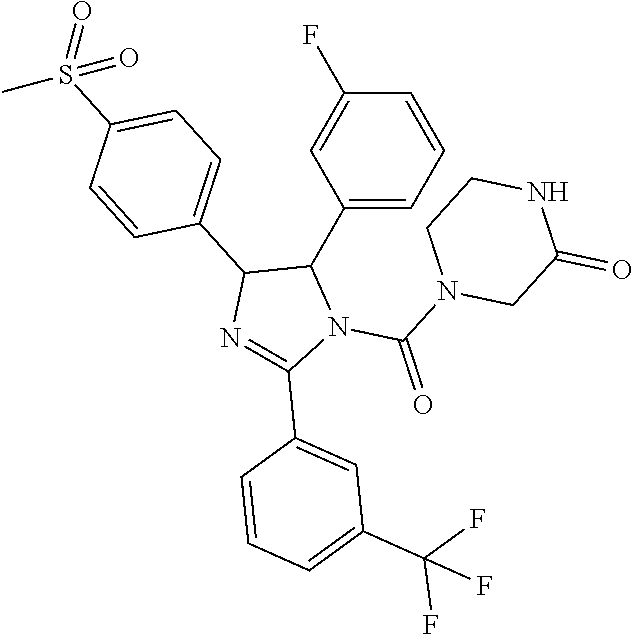 |
 |
 |
 |
 |
 |
 |
 |
||
- 1. U.S. Pat. No. 6,617,346 to Kong et al.
- 2. U.S. Pat. No. 6,734,302 to Kong et al.
- 3. U.S. Pat. No. 7,132,421 to Fotouhi et al.
- 4. U.S. Pat. No. 7,425,638 to Haley et al.
- 5. U.S. Patent Publication No. 2005/0282803 to Haley et al.
- 6. U.S. Patent Publication No. 2005/0288287 to Fotouhi et al.
- 7. U.S. Patent Publication No. 2006/0211693 to Fotouhi et al.
- 8. U.S. Patent Publication No. 2007/0129416 to Ding et al.
- 9. U.S. Patent Publication No. 2007/0167437 to Fotouhi et al.
- 10. Vassilev, Lyubomir T., et al., “In Vivo Activation of the p53 Pathway by Small-Molecule Antagonists of MDM2,” Science 303, 844 (2004).
- 11. Laurie, Nikia A., et al., “Inactivation of the p53 pathway in retinoblastoma,” Nature 444 (November, 2006).
- 12. Reed, Damon, et al., “Identification and Characterization of the First Small Molecule inhibitor of MDMX, The Journal of Biological Chemistry 285, No. 14, 10786-10796 (Apr. 2, 2010).
Claims (24)


Priority Applications (2)
| Application Number | Priority Date | Filing Date | Title |
|---|---|---|---|
| US15/812,605 US10647702B2 (en) | 2010-09-30 | 2017-11-14 | Aryl-substituted imidazoles |
| US16/520,277 US20190345141A1 (en) | 2010-09-30 | 2019-07-23 | Aryl-substituted imidazoles |
Applications Claiming Priority (5)
| Application Number | Priority Date | Filing Date | Title |
|---|---|---|---|
| US38828710P | 2010-09-30 | 2010-09-30 | |
| PCT/US2011/054368 WO2012045018A1 (en) | 2010-09-30 | 2011-09-30 | Aryl-substituted imidazoles |
| US201313876465A | 2013-08-09 | 2013-08-09 | |
| US14/991,744 US9822100B2 (en) | 2010-09-30 | 2016-01-08 | Aryl-substituted imidazoles |
| US15/812,605 US10647702B2 (en) | 2010-09-30 | 2017-11-14 | Aryl-substituted imidazoles |
Related Parent Applications (1)
| Application Number | Title | Priority Date | Filing Date |
|---|---|---|---|
| US14/991,744 Continuation US9822100B2 (en) | 2010-09-30 | 2016-01-08 | Aryl-substituted imidazoles |
Related Child Applications (1)
| Application Number | Title | Priority Date | Filing Date |
|---|---|---|---|
| US16/520,277 Continuation US20190345141A1 (en) | 2010-09-30 | 2019-07-23 | Aryl-substituted imidazoles |
Publications (2)
| Publication Number | Publication Date |
|---|---|
| US20180291004A1 US20180291004A1 (en) | 2018-10-11 |
| US10647702B2 true US10647702B2 (en) | 2020-05-12 |
Family
ID=45893547
Family Applications (4)
| Application Number | Title | Priority Date | Filing Date |
|---|---|---|---|
| US13/876,465 Active US9266860B2 (en) | 2010-09-30 | 2011-09-30 | Aryl-substituted imidazoles |
| US14/991,744 Active US9822100B2 (en) | 2010-09-30 | 2016-01-08 | Aryl-substituted imidazoles |
| US15/812,605 Expired - Fee Related US10647702B2 (en) | 2010-09-30 | 2017-11-14 | Aryl-substituted imidazoles |
| US16/520,277 Abandoned US20190345141A1 (en) | 2010-09-30 | 2019-07-23 | Aryl-substituted imidazoles |
Family Applications Before (2)
| Application Number | Title | Priority Date | Filing Date |
|---|---|---|---|
| US13/876,465 Active US9266860B2 (en) | 2010-09-30 | 2011-09-30 | Aryl-substituted imidazoles |
| US14/991,744 Active US9822100B2 (en) | 2010-09-30 | 2016-01-08 | Aryl-substituted imidazoles |
Family Applications After (1)
| Application Number | Title | Priority Date | Filing Date |
|---|---|---|---|
| US16/520,277 Abandoned US20190345141A1 (en) | 2010-09-30 | 2019-07-23 | Aryl-substituted imidazoles |
Country Status (5)
| Country | Link |
|---|---|
| US (4) | US9266860B2 (en) |
| EP (1) | EP2621275B1 (en) |
| CA (1) | CA2813256A1 (en) |
| ES (1) | ES2685175T3 (en) |
| WO (1) | WO2012045018A1 (en) |
Families Citing this family (17)
| Publication number | Priority date | Publication date | Assignee | Title |
|---|---|---|---|---|
| PL2118123T3 (en) | 2007-01-31 | 2016-06-30 | Dana Farber Cancer Inst Inc | Stabilized p53 peptides and uses thereof |
| JP5631201B2 (en) | 2007-03-28 | 2014-11-26 | プレジデント アンド フェローズ オブ ハーバード カレッジ | Stitched polypeptide |
| KR102104762B1 (en) | 2010-08-13 | 2020-04-24 | 에일러론 테라퓨틱스 인코포레이티드 | Peptidomimetic macrocycles |
| US9266860B2 (en) | 2010-09-30 | 2016-02-23 | St. Jude Children's Research Hospital | Aryl-substituted imidazoles |
| EP2768518A4 (en) | 2011-10-18 | 2015-05-27 | Aileron Therapeutics Inc | PEPTIDOMIMETIC MACROCYCLES |
| RU2642299C2 (en) | 2012-02-15 | 2018-01-24 | Эйлерон Терапьютикс, Инк. | p53 PEPTIDOMIMETIC MACROCYCLES |
| CA2864120A1 (en) | 2012-02-15 | 2013-08-22 | Aileron Therapeutics, Inc. | Triazole-crosslinked and thioether-crosslinked peptidomimetic macrocycles |
| BR112015009470A2 (en) | 2012-11-01 | 2019-12-17 | Aileron Therapeutics Inc | disubstituted amino acids and their methods of preparation and use |
| EP2935263B1 (en) | 2012-12-20 | 2018-12-05 | Merck Sharp & Dohme Corp. | Substituted imidazopyridines as hdm2 inhibitors |
| US10328058B2 (en) | 2014-01-28 | 2019-06-25 | Mayo Foundation For Medical Education And Research | Treating atherosclerosis by removing senescent foam cell macrophages from atherosclerotic plaques |
| SG11201606239UA (en) | 2014-01-28 | 2016-08-30 | Buck Inst For Res On Aging | Methods and compositions for killing senescent cells and for treating senescence-associated diseases and disorders |
| WO2015116735A1 (en) | 2014-01-28 | 2015-08-06 | Mayo Foundation For Medical Education And Research | Methods and combinations for killing senescent cells and for treating senescence-associated diseases and disorders |
| US20190269675A1 (en) | 2014-01-28 | 2019-09-05 | Buck Institute for Research and Aging | Treatment of parkinson's disease and other conditions caused or mediated by senescent astrocytes using small molecule senolytic agents |
| CN107106642B (en) | 2014-09-24 | 2021-02-26 | 艾瑞朗医疗公司 | Peptidomimetic macrocycles and formulations thereof |
| EP3197478A4 (en) | 2014-09-24 | 2018-05-30 | Aileron Therapeutics, Inc. | Peptidomimetic macrocycles and uses thereof |
| JP2018516844A (en) | 2015-03-20 | 2018-06-28 | エルロン・セラピューティクス・インコーポレイテッドAileron Therapeutics,Inc. | Peptidomimetic macrocycles and uses thereof |
| EP3347372A4 (en) | 2015-09-10 | 2019-09-04 | Aileron Therapeutics, Inc. | PEPTIDOMIMETIC MACROCYCLES AS MODULATORS OF MCL-1 |
Citations (17)
| Publication number | Priority date | Publication date | Assignee | Title |
|---|---|---|---|---|
| WO2003051359A1 (en) | 2001-12-18 | 2003-06-26 | F.Hoffmann-La Roche Ag | Cis-2,4,5- triphenyl-imidazolines and their use in the treatment of tumors |
| US6617346B1 (en) | 2001-12-18 | 2003-09-09 | Hoffmann-La Roche Inc. | Cis-imidazolines |
| US20040204410A1 (en) | 2002-06-21 | 2004-10-14 | Norman Kong | CIS-imidazolines |
| US20040259884A1 (en) | 2003-06-17 | 2004-12-23 | Haley Gregory Jay | Cis-imidazolines |
| US20040259867A1 (en) | 2003-06-17 | 2004-12-23 | Nader Fotouhi | CIS-imidazoles |
| WO2005110996A1 (en) | 2004-05-18 | 2005-11-24 | F.Hoffmann-La Roche Ag | Novel cis-imidazolines |
| US20050282803A1 (en) | 2004-06-17 | 2005-12-22 | Haley Gregory J | CIS-imidazolines |
| WO2006097261A1 (en) | 2005-03-16 | 2006-09-21 | F.Hoffmann-La Roche Ag | Cis-2,4,5-triaryl-imidazolines and their use as anti-cancer medicaments |
| WO2007063013A1 (en) | 2005-12-01 | 2007-06-07 | F. Hoffmann-La Roche Ag | 2,4,5-triphenyl imidazoline derivatives as inhibitors of the interaction between p53 and mdm2 proteins for use as anticancer agents |
| US20070167437A1 (en) | 2006-01-18 | 2007-07-19 | Nader Fotouhi | Cis-imidazolines |
| WO2008014216A1 (en) | 2006-07-28 | 2008-01-31 | St. Jude Children's Research Hospital | Method for treating ocular cancer |
| WO2008065068A2 (en) | 2006-11-27 | 2008-06-05 | Novartis Ag | Substituted dihydroimidazoles and their use in the treatment of tumors |
| WO2009047161A1 (en) | 2007-10-09 | 2009-04-16 | F. Hoffmann-La Roche Ag | Chiral cis-imidazolines |
| WO2010028858A1 (en) | 2008-09-15 | 2010-03-18 | Johann Wolfgang Goethe-Universität Frankfurt am Main | Use of cis-imidazolines, particularly nutlins, for treating chemo-resistant cancer diseases |
| CA2813256A1 (en) | 2010-09-30 | 2012-04-05 | St. Jude Children's Research Hospital | Aryl-substituted imidazoles |
| WO2013106643A2 (en) | 2012-01-12 | 2013-07-18 | Yale University | Compounds & methods for the enhanced degradation of targeted proteins & other polypeptides by an e3 ubiquitin ligase |
| WO2015184383A1 (en) | 2014-05-29 | 2015-12-03 | St. Jude Children's Research Hospital | Aryl-substituted imidazoles and methods of making and using same |
-
2011
- 2011-09-30 US US13/876,465 patent/US9266860B2/en active Active
- 2011-09-30 WO PCT/US2011/054368 patent/WO2012045018A1/en not_active Ceased
- 2011-09-30 ES ES11830023.5T patent/ES2685175T3/en active Active
- 2011-09-30 EP EP11830023.5A patent/EP2621275B1/en not_active Not-in-force
- 2011-09-30 CA CA2813256A patent/CA2813256A1/en not_active Abandoned
-
2016
- 2016-01-08 US US14/991,744 patent/US9822100B2/en active Active
-
2017
- 2017-11-14 US US15/812,605 patent/US10647702B2/en not_active Expired - Fee Related
-
2019
- 2019-07-23 US US16/520,277 patent/US20190345141A1/en not_active Abandoned
Patent Citations (29)
| Publication number | Priority date | Publication date | Assignee | Title |
|---|---|---|---|---|
| WO2003051359A1 (en) | 2001-12-18 | 2003-06-26 | F.Hoffmann-La Roche Ag | Cis-2,4,5- triphenyl-imidazolines and their use in the treatment of tumors |
| US20030153580A1 (en) | 2001-12-18 | 2003-08-14 | Norman Kong | Cis-imidazolines |
| US6617346B1 (en) | 2001-12-18 | 2003-09-09 | Hoffmann-La Roche Inc. | Cis-imidazolines |
| US6734302B2 (en) | 2001-12-18 | 2004-05-11 | Hoffmann-La Roche Inc. | Cis-imidazolines |
| US20040204410A1 (en) | 2002-06-21 | 2004-10-14 | Norman Kong | CIS-imidazolines |
| US20040259867A1 (en) | 2003-06-17 | 2004-12-23 | Nader Fotouhi | CIS-imidazoles |
| US7425638B2 (en) | 2003-06-17 | 2008-09-16 | Hoffmann-La Roche Inc. | Cis-imidazolines |
| US7132421B2 (en) | 2003-06-17 | 2006-11-07 | Hoffmann-La Roche Inc. | CIS-imidazoles |
| US20040259884A1 (en) | 2003-06-17 | 2004-12-23 | Haley Gregory Jay | Cis-imidazolines |
| WO2005110996A1 (en) | 2004-05-18 | 2005-11-24 | F.Hoffmann-La Roche Ag | Novel cis-imidazolines |
| US20050288287A1 (en) | 2004-05-18 | 2005-12-29 | Nader Fotouhi | Chiral cis-imidazolines |
| US20050282803A1 (en) | 2004-06-17 | 2005-12-22 | Haley Gregory J | CIS-imidazolines |
| WO2006097261A1 (en) | 2005-03-16 | 2006-09-21 | F.Hoffmann-La Roche Ag | Cis-2,4,5-triaryl-imidazolines and their use as anti-cancer medicaments |
| US20060211693A1 (en) | 2005-03-16 | 2006-09-21 | Nader Fotouhi | Cis-imidazolines |
| US7579368B2 (en) | 2005-03-16 | 2009-08-25 | Hoffman-La Roche Inc. | Cis-imidazolines |
| US20070129416A1 (en) | 2005-12-01 | 2007-06-07 | Qingjie Ding | 4,4,5,5, Tetrasubstituted imidazolines |
| WO2007063013A1 (en) | 2005-12-01 | 2007-06-07 | F. Hoffmann-La Roche Ag | 2,4,5-triphenyl imidazoline derivatives as inhibitors of the interaction between p53 and mdm2 proteins for use as anticancer agents |
| US20070167437A1 (en) | 2006-01-18 | 2007-07-19 | Nader Fotouhi | Cis-imidazolines |
| WO2008014216A1 (en) | 2006-07-28 | 2008-01-31 | St. Jude Children's Research Hospital | Method for treating ocular cancer |
| WO2008065068A2 (en) | 2006-11-27 | 2008-06-05 | Novartis Ag | Substituted dihydroimidazoles and their use in the treatment of tumors |
| WO2009047161A1 (en) | 2007-10-09 | 2009-04-16 | F. Hoffmann-La Roche Ag | Chiral cis-imidazolines |
| WO2010028858A1 (en) | 2008-09-15 | 2010-03-18 | Johann Wolfgang Goethe-Universität Frankfurt am Main | Use of cis-imidazolines, particularly nutlins, for treating chemo-resistant cancer diseases |
| CA2813256A1 (en) | 2010-09-30 | 2012-04-05 | St. Jude Children's Research Hospital | Aryl-substituted imidazoles |
| WO2012045018A1 (en) | 2010-09-30 | 2012-04-05 | St. Jude Children's Research Hospital | Aryl-substituted imidazoles |
| EP2621275A1 (en) | 2010-09-30 | 2013-08-07 | St. Jude Children's Research Hospital | Aryl-substituted imidazoles |
| US9266860B2 (en) | 2010-09-30 | 2016-02-23 | St. Jude Children's Research Hospital | Aryl-substituted imidazoles |
| US9822100B2 (en) | 2010-09-30 | 2017-11-21 | St. Jude Children's Research Hospital | Aryl-substituted imidazoles |
| WO2013106643A2 (en) | 2012-01-12 | 2013-07-18 | Yale University | Compounds & methods for the enhanced degradation of targeted proteins & other polypeptides by an e3 ubiquitin ligase |
| WO2015184383A1 (en) | 2014-05-29 | 2015-12-03 | St. Jude Children's Research Hospital | Aryl-substituted imidazoles and methods of making and using same |
Non-Patent Citations (70)
| Title |
|---|
| 11830023.5 (EP 2621275), Sep. 30, 2011 (Aug. 7, 2013), R.K. Guy et al. (St. Jude Children's Res. Hosp.) |
| 2813256 (2813256), Mar. 28, 2011, R.K. Guy et al. (St. Jude Children's Res. Hosp.) |
| Communication Pursuant to Article 94(3) EPC dated Apr. 2, 2015 for application EP 11830023.5, filed on Sep. 30, 2011 and published as EP 2621275 dated Aug. 7, 2013 (Applicant-St. Jude's Children's Research Hospital // Inventor-Guy, et al.) (4 pages). |
| Communication Pursuant to Article 94(3) EPC dated Apr. 2, 2015 for application EP 11830023.5, filed on Sep. 30, 2011 and published as EP 2621275 dated Aug. 7, 2013 (Applicant—St. Jude's Children's Research Hospital // Inventor—Guy, et al.) (4 pages). |
| Communication Pursuant to Article 94(3) EPC dated Jan. 15, 2016 for application EP 11830023.5, filed on Sep. 30, 2011 and published as EP 2621275 dated Aug. 7, 2013 (Applicant-St. Jude's Children's Research Hospital // Inventor-Guy, et al.) (4 pages). |
| Communication Pursuant to Article 94(3) EPC dated Jan. 15, 2016 for application EP 11830023.5, filed on Sep. 30, 2011 and published as EP 2621275 dated Aug. 7, 2013 (Applicant—St. Jude's Children's Research Hospital // Inventor—Guy, et al.) (4 pages). |
| Communication Pursuant to Article 94(3) EPC dated Nov. 14, 2016 by the European Patent Office for EP Application No. 11830023.5, which was filed on Sep. 30, 2011 and published as 2621275 dated Aug. 7, 2013 (Applicant-St. Jude Children's Research Hospital) (4 pages). |
| Communication Pursuant to Article 94(3) EPC dated Nov. 14, 2016 by the European Patent Office for EP Application No. 11830023.5, which was filed on Sep. 30, 2011 and published as 2621275 dated Aug. 7, 2013 (Applicant—St. Jude Children's Research Hospital) (4 pages). |
| Extended European Search Report dated Feb. 12, 2014 for application EP 11830023.5, filed on Sep. 30, 2011 and published as EP 2621275 dated Aug. 7, 2013 (Applicant-St. Jude's Children's Research Hospital // Inventor-Guy, et al.) (7 pages). |
| Extended European Search Report dated Feb. 12, 2014 for application EP 11830023.5, filed on Sep. 30, 2011 and published as EP 2621275 dated Aug. 7, 2013 (Applicant—St. Jude's Children's Research Hospital // Inventor—Guy, et al.) (7 pages). |
| Final Office Action dated Dec. 10, 2014 for U.S. Appl. No. 13/876,465, filed Aug. 9, 2013 now U.S. Pat. No. 9,266,860 dated Feb. 23, 2016 (Applicant-St. Jude Children's Research Hospital; Inventor-Guy et al.) (10 pages). |
| Final Office Action dated Dec. 10, 2014 for U.S. Appl. No. 13/876,465, filed Aug. 9, 2013 now U.S. Pat. No. 9,266,860 dated Feb. 23, 2016 (Applicant—St. Jude Children's Research Hospital; Inventor—Guy et al.) (10 pages). |
| Final Office Action dated May 31, 2017 by the U.S. Patent and Trademark Office for U.S. Appl. No. 14/991,744, filed Jan. 8, 2016 now U.S. Pat. No. 9,822,100 dated Nov. 21, 2017 (Inventor-Guy et al.; Applicant-St. Jude Children's Research Hospital) (11 pages). |
| Final Office Action dated May 31, 2017 by the U.S. Patent and Trademark Office for U.S. Appl. No. 14/991,744, filed Jan. 8, 2016 now U.S. Pat. No. 9,822,100 dated Nov. 21, 2017 (Inventor—Guy et al.; Applicant—St. Jude Children's Research Hospital) (11 pages). |
| Intention to Grant dated Sep. 21, 2017 by the European Patent Office for Patent Application No. 11830023.5, which was filed on Sep. 30, 2011 and published as EP 2621275 dated Aug. 7, 2013 (Inventor-Guy et al.; Applicant-St. Jude Children's Research Hospital) (6 pages). |
| Intention to Grant dated Sep. 21, 2017 by the European Patent Office for Patent Application No. 11830023.5, which was filed on Sep. 30, 2011 and published as EP 2621275 dated Aug. 7, 2013 (Inventor—Guy et al.; Applicant—St. Jude Children's Research Hospital) (6 pages). |
| International Preliminary Report on Patentability dated Nov. 29, 2016 by the International Searching Authority for Patent Application No. PCT/US2015/033370, which was filed on May 29, 2015 and published as WO 2015/184383 dated Dec. 3, 2015 (Inventor-R.K. Guy; Applicant-St. Jude Children's Research Hospital) (6 pages). |
| International Preliminary Report on Patentability dated Nov. 29, 2016 by the International Searching Authority for Patent Application No. PCT/US2015/033370, which was filed on May 29, 2015 and published as WO 2015/184383 dated Dec. 3, 2015 (Inventor—R.K. Guy; Applicant—St. Jude Children's Research Hospital) (6 pages). |
| International Preliminary Report on Patentability issued by the International Searching Authority dated Sep. 21, 2012 for PCT/US2011/054368 filed on Sep. 30, 2011 and published as WO 2012/045018 dated Apr. 5, 2012 (Applicant-St. Jude Children's Research Hospital; Inventor-Guy et al.) (3 pages). |
| International Preliminary Report on Patentability issued by the International Searching Authority dated Sep. 21, 2012 for PCT/US2011/054368 filed on Sep. 30, 2011 and published as WO 2012/045018 dated Apr. 5, 2012 (Applicant—St. Jude Children's Research Hospital; Inventor—Guy et al.) (3 pages). |
| International Search Report and Written Opinion dated Aug. 12, 2015 by the International Searching Authority for Patent Application No. PCT/US2015/033370, which was filed on May 29, 2015 and published as WO 2015/184383 dated Dec. 3, 2015 (Inventor-R.K. Guy; Applicant-St. Jude Children's Research Hospital) (7 pages). |
| International Search Report and Written Opinion dated Aug. 12, 2015 by the International Searching Authority for Patent Application No. PCT/US2015/033370, which was filed on May 29, 2015 and published as WO 2015/184383 dated Dec. 3, 2015 (Inventor—R.K. Guy; Applicant—St. Jude Children's Research Hospital) (7 pages). |
| International Search Report issued by the International Searching Authority dated Mar. 8, 2012 for PCT/US2011/054368 filed on Sep. 30, 2011 and published as WO 2012/045018 dated Apr. 5, 2012 (Applicant-St. Jude Children's Research Hospital; Inventor-Guy et al.) (2 pages). |
| International Search Report issued by the International Searching Authority dated Mar. 8, 2012 for PCT/US2011/054368 filed on Sep. 30, 2011 and published as WO 2012/045018 dated Apr. 5, 2012 (Applicant—St. Jude Children's Research Hospital; Inventor—Guy et al.) (2 pages). |
| Issue Notification dated Feb. 3, 2016 by the U.S. Patent and Trademark Office for U.S. Appl. No. 13/876,465, filed Aug. 9, 2013 now U.S. Pat. No. 9,266,860 dated Feb. 23, 2016 (Applicant-St. Jude Children's Research Hospital; Inventor-Guy et al.)(1 page). |
| Issue Notification dated Feb. 3, 2016 by the U.S. Patent and Trademark Office for U.S. Appl. No. 13/876,465, filed Aug. 9, 2013 now U.S. Pat. No. 9,266,860 dated Feb. 23, 2016 (Applicant—St. Jude Children's Research Hospital; Inventor—Guy et al.)(1 page). |
| Issue Notification dated Nov. 1, 2017 by the U.S. Patent and Trademark Office for U.S. Appl. No. 14/991,744, filed Jan. 8, 2016 now U.S. Pat. No. 9,822,100 dated Nov. 21, 2017 (Inventor-Guy et al.; Applicant-St. Jude Children's Research Hospital) (1 page). |
| Issue Notification dated Nov. 1, 2017 by the U.S. Patent and Trademark Office for U.S. Appl. No. 14/991,744, filed Jan. 8, 2016 now U.S. Pat. No. 9,822,100 dated Nov. 21, 2017 (Inventor—Guy et al.; Applicant—St. Jude Children's Research Hospital) (1 page). |
| Laurie, N.A. et al., Inactivation of the p53 pathway in retinoblastoma. Nature. 2006; 444:61-6. |
| Non-Final Office Action dated Apr. 7, 2014 for U.S. Appl. No. 13/876,465, filed Aug. 9, 2013 now U.S. Pat. No. 9,266,860 dated Feb. 23, 2016 (Applicant-St. Jude Children's Research Hospital; Inventor-Guy et al.) (13 pages). |
| Non-Final Office Action dated Apr. 7, 2014 for U.S. Appl. No. 13/876,465, filed Aug. 9, 2013 now U.S. Pat. No. 9,266,860 dated Feb. 23, 2016 (Applicant—St. Jude Children's Research Hospital; Inventor—Guy et al.) (13 pages). |
| Non-Final Office Action dated Sep. 9, 2016 by the U.S. Patent and Trademark Office for U.S. Appl. No. 14/991,744, filed Jan. 8, 2016 now U.S. Pat. No. 9,822,100 dated Nov. 21, 2017 (Inventor-Guy et al.; Applicant-St. Jude Children's Research Hospital) (14 pages). |
| Non-Final Office Action dated Sep. 9, 2016 by the U.S. Patent and Trademark Office for U.S. Appl. No. 14/991,744, filed Jan. 8, 2016 now U.S. Pat. No. 9,822,100 dated Nov. 21, 2017 (Inventor—Guy et al.; Applicant—St. Jude Children's Research Hospital) (14 pages). |
| Notice of Allowance dated Aug. 21, 2017 by the U.S. Patent and Trademark Office for U.S. Appl. No. 14/991,744, filed Jan. 8, 2016 now U.S. Pat. No. 9,822,100 dated Nov. 21, 2017 (Inventor-Guy et al.; Applicant-St. Jude Children's Research Hospital) (10 pages). |
| Notice of Allowance dated Aug. 21, 2017 by the U.S. Patent and Trademark Office for U.S. Appl. No. 14/991,744, filed Jan. 8, 2016 now U.S. Pat. No. 9,822,100 dated Nov. 21, 2017 (Inventor—Guy et al.; Applicant—St. Jude Children's Research Hospital) (10 pages). |
| Notice of Allowance dated Oct. 9, 2015 for U.S. Appl. No. 13/876,465, filed Aug. 9, 2013 now U.S. Pat. No. 9,266,860 dated Feb. 23, 2016 (Applicant-St. Jude Children's Research Hospital; Inventor-Guy et al.) (11 pages). |
| Notice of Allowance dated Oct. 9, 2015 for U.S. Appl. No. 13/876,465, filed Aug. 9, 2013 now U.S. Pat. No. 9,266,860 dated Feb. 23, 2016 (Applicant—St. Jude Children's Research Hospital; Inventor—Guy et al.) (11 pages). |
| Office Action dated Sep. 11, 2017 by the Canadian Patent Office for Patent Application No. 2813256, which was filed on Mar. 28, 2013 (Inventor-Guy et al.; Applicant-St. Jude Children's Research Hospital) (4 pages). |
| Office Action dated Sep. 11, 2017 by the Canadian Patent Office for Patent Application No. 2813256, which was filed on Mar. 28, 2013 (Inventor—Guy et al.; Applicant—St. Jude Children's Research Hospital) (4 pages). |
| PCT/US2011/054368 (WO 2012/045018), Sep. 30, 2011 (Apr. 5, 2012), R.K. Guy et al. (St. Jude Children's Res. Hosp.) |
| PCT/US2015/033370 (WO 2015/184383), May 29, 2015 (Dec. 3, 2015), R.K. Guy (St. Jude Children's Res. Hosp.) |
| Preliminary Amendment filed Jan. 8, 2016 with the U.S. Patent and Trademark Office for U.S. Appl. No. 14/991,744, filed Jan. 8, 2016 now U.S. Pat. No. 9,822,100 dated Nov. 21, 2017 (Inventor-Guy et al.; Applicant-St. Jude Children's Research Hospital) (13 pages). |
| Preliminary Amendment filed Jan. 8, 2016 with the U.S. Patent and Trademark Office for U.S. Appl. No. 14/991,744, filed Jan. 8, 2016 now U.S. Pat. No. 9,822,100 dated Nov. 21, 2017 (Inventor—Guy et al.; Applicant—St. Jude Children's Research Hospital) (13 pages). |
| PubChem-CID-70985746. Create Date: Mar. 21, 2013, p. 3 (10 pages). |
| Reed, D. et al., Identification and Characterization of the First Small Molecule Inhibitor of MDMX. J Biol Chem. 2010; 285(14):10786-96. |
| Response to Communication Pursuant to Article 94(3) EPC filed on Aug. 31, 2015 for application EP 11830023.5, filed on Sep. 30, 2011 and published as EP 2621275 dated Aug. 7, 2013 (Applicant-St. Jude's Children's Research Hospital // Inventor-Guy, et al.) (3 pages). |
| Response to Communication Pursuant to Article 94(3) EPC filed on Aug. 31, 2015 for application EP 11830023.5, filed on Sep. 30, 2011 and published as EP 2621275 dated Aug. 7, 2013 (Applicant—St. Jude's Children's Research Hospital // Inventor—Guy, et al.) (3 pages). |
| Response to Final Office Action filed Jan. 5, 2015 for U.S. Appl. No. 13/876,465, filed Aug. 9, 2013 now U.S. Pat. No. 9,266,860 dated Feb. 23, 2016 (Applicant-St. Jude Children's Research Hospital; Inventor-Guy et al.) (27 pages). |
| Response to Final Office Action filed Jan. 5, 2015 for U.S. Appl. No. 13/876,465, filed Aug. 9, 2013 now U.S. Pat. No. 9,266,860 dated Feb. 23, 2016 (Applicant—St. Jude Children's Research Hospital; Inventor—Guy et al.) (27 pages). |
| Response to Final Office Action filed Jul. 31, 2017 with the U.S. Patent and Trademark Office for U.S. Appl. No. 14/991,744, filed Jan. 8, 2016 U.S. Pat. No. 9,822,100 dated Nov. 21, 2017 (Inventor-Guy et al.; Applicant-St. Jude Children's Research Hospital) (31 pages). |
| Response to Final Office Action filed Jul. 31, 2017 with the U.S. Patent and Trademark Office for U.S. Appl. No. 14/991,744, filed Jan. 8, 2016 U.S. Pat. No. 9,822,100 dated Nov. 21, 2017 (Inventor—Guy et al.; Applicant—St. Jude Children's Research Hospital) (31 pages). |
| Response to Non-Final Office Action filed Mar. 9, 2016 with the U.S. Patent and Trademark Office for U.S. Appl. No. 14/991,744, filed Jan. 8, 2016 now U.S. Pat. No. 9,822,100 dated Nov. 21, 2017 (Inventor-Guy et al.; Applicant-St. Jude Children's Research Hospital) (21 pages). |
| Response to Non-Final Office Action filed Mar. 9, 2016 with the U.S. Patent and Trademark Office for U.S. Appl. No. 14/991,744, filed Jan. 8, 2016 now U.S. Pat. No. 9,822,100 dated Nov. 21, 2017 (Inventor—Guy et al.; Applicant—St. Jude Children's Research Hospital) (21 pages). |
| Response to Non-Final Office Action filed Oct. 7, 2014 for U.S. Appl. No. 13/876,465, filed Aug. 9, 2013 now U.S. Pat. No. 9,266,860 dated Feb. 23, 2016 (Applicant-St. Jude Children's Research Hospital; Inventor-Guy et al.) (25 pages). |
| Response to Non-Final Office Action filed Oct. 7, 2014 for U.S. Appl. No. 13/876,465, filed Aug. 9, 2013 now U.S. Pat. No. 9,266,860 dated Feb. 23, 2016 (Applicant—St. Jude Children's Research Hospital; Inventor—Guy et al.) (25 pages). |
| Response to Restriction Requirement filed Jan. 27, 2014 for U.S. Appl. No. 13/876,465, filed Aug. 9, 2013 now U.S. Pat. No. 9,266,860 dated Feb. 23, 2016 (Applicant-St. Jude Children's Research Hospital; Inventor-Guy et al.) (24 pages). |
| Response to Restriction Requirement filed Jan. 27, 2014 for U.S. Appl. No. 13/876,465, filed Aug. 9, 2013 now U.S. Pat. No. 9,266,860 dated Feb. 23, 2016 (Applicant—St. Jude Children's Research Hospital; Inventor—Guy et al.) (24 pages). |
| Response to the Communication Pursuant to Rules 70(2) and 70a(2) EPC filed on Sep. 10, 2014 for application EP 11830023.5, filed on Sep. 30, 2011 and published as EP 2621275 dated Aug. 7, 2013 (Applicant-St. Jude's Children's Research Hospital // Inventor-Guy, et al.) (3 pages). |
| Response to the Communication Pursuant to Rules 70(2) and 70a(2) EPC filed on Sep. 10, 2014 for application EP 11830023.5, filed on Sep. 30, 2011 and published as EP 2621275 dated Aug. 7, 2013 (Applicant—St. Jude's Children's Research Hospital // Inventor—Guy, et al.) (3 pages). |
| Restriction Requirement dated Nov. 25, 2013 for U.S. Appl. No. 13/876,465, filed Aug. 9, 2013 now U.S. Pat. No. 9,266,860 dated Feb. 23, 2016 (Applicant-St. Jude Children's Research Hospital; Inventor-Guy et al.) (12 pages). |
| Restriction Requirement dated Nov. 25, 2013 for U.S. Appl. No. 13/876,465, filed Aug. 9, 2013 now U.S. Pat. No. 9,266,860 dated Feb. 23, 2016 (Applicant—St. Jude Children's Research Hospital; Inventor—Guy et al.) (12 pages). |
| U.S. Appl. No. 13/388,287 (U.S. Pat. No. 9,266,860), filed Sep. 30, 2011 (Feb. 23, 2016), R.K. Guy et al. (St. Jude Children's Res. Hosp.) |
| U.S. Appl. No. 14/991,744 (U.S. Pat. No. 9,822,100), filed Jan. 8, 2016 (Nov. 21, 2017), R.K. Guy et al. (St. Jude Children's Res. Hosp.) |
| U.S. Appl. No. 61/388,287, filed Sep. 30, 2010, R.K. Guy et al. (St. Jude Children's Res. Hosp.) |
| U.S. Appl. No. 62/004,720, filed May 29, 2014 R.K. Guy (St. Jude Children's Res. Hosp.) |
| Vara, B.A. et al., Organocatalytic, Diastereo- and Enantioselective Synthesis of Nonsymmetric cis-Stilbene Diamines: A Platform for the Preparation of Single-Enantiomer cis-Imidazolines for Protein-Protein Inhibition. J Org Chem. 2014; 79(15):693-38. |
| Vassilev, L.T. et al., In Vivo Activation of the p53 Pathway by Small-Molecule Antagonists of MDM2. Science. 2004; 303:844-8. |
| Verma, R. et al., DNA Damage Response to the Mdm2 Inhibitro Nutlin-3. Biochem Pharmacol. 2010; 79:565-74. |
| Written Opinion issued by the International Searching Authority dated Mar. 8, 2012 for PCT/US2011/054368 filed on Sep. 30, 2011 and published as WO 2012/045018 dated Apr. 5, 2012 (Applicant-St. Jude Children's Research Hospital; Inventor-Guy et al.) (7 pages). |
| Written Opinion issued by the International Searching Authority dated Mar. 8, 2012 for PCT/US2011/054368 filed on Sep. 30, 2011 and published as WO 2012/045018 dated Apr. 5, 2012 (Applicant—St. Jude Children's Research Hospital; Inventor—Guy et al.) (7 pages). |
Also Published As
| Publication number | Publication date |
|---|---|
| US9822100B2 (en) | 2017-11-21 |
| EP2621275A1 (en) | 2013-08-07 |
| US20160297800A1 (en) | 2016-10-13 |
| EP2621275A4 (en) | 2014-03-12 |
| US20130345237A1 (en) | 2013-12-26 |
| ES2685175T3 (en) | 2018-10-05 |
| WO2012045018A1 (en) | 2012-04-05 |
| US20180291004A1 (en) | 2018-10-11 |
| US20190345141A1 (en) | 2019-11-14 |
| CA2813256A1 (en) | 2012-04-05 |
| US9266860B2 (en) | 2016-02-23 |
| EP2621275B1 (en) | 2018-03-28 |
Similar Documents
| Publication | Publication Date | Title |
|---|---|---|
| US9822100B2 (en) | Aryl-substituted imidazoles | |
| US10294235B2 (en) | Pyrrolopyrimidine compounds, use as inhibitors of the kinase LRRK2, and methods for preparation thereof | |
| CA2486183C (en) | Protein kinase inhibitors | |
| US8501757B2 (en) | Substituted phenylamine carboxamide analogs as mGluR5 negative allosteric modulators and methods of making and using the same | |
| JP6525162B2 (en) | Substitution (E) -N '-(1-phenylethylidene) benzohydrazide analogues as histone demethylase inhibitors | |
| US9115086B2 (en) | Therapeutic compositions and related methods of use | |
| US8569511B2 (en) | Substituted 3-(1H-benzo[d]imidazol-2-yl)-1H-indazole analogs as inhibitors of the PDK1 kinase | |
| US9914702B2 (en) | Amine derivatives as potassium channel blockers | |
| CN1890218B (en) | Tubulin inhibitors | |
| US20170210741A1 (en) | Benzimidazole Compounds, Use As Inhibitors of WNT Signaling Pathway in Cancers, and Methods for Preparation Thereof | |
| US9751847B2 (en) | Methods and compositions related to neuroactive thiazoline compounds | |
| US12590070B2 (en) | Adamantane derivatives as inhibitors of focal adhesion kinase | |
| WO2015184383A1 (en) | Aryl-substituted imidazoles and methods of making and using same | |
| US20240390350A1 (en) | Phenyl core compounds as mglu5 negative allosteric modulators and methods of making and using the same | |
| US20250026743A1 (en) | Heteroaryl-linked analogs as mglu5 negative allosteric modulators and methods of making and using the same | |
| US20200270237A1 (en) | New alkoxyamino compounds for treating pain and pain related conditions | |
| CN101848907A (en) | Has cannaboid-CB 1The compound of the combination of antagonistic action and acetylcholinesteraseinhibition inhibition | |
| EP3113768B1 (en) | Use of arylalkanolamines as sigma-1 receptor antagonists |
Legal Events
| Date | Code | Title | Description |
|---|---|---|---|
| FEPP | Fee payment procedure |
Free format text: ENTITY STATUS SET TO UNDISCOUNTED (ORIGINAL EVENT CODE: BIG.); ENTITY STATUS OF PATENT OWNER: SMALL ENTITY |
|
| FEPP | Fee payment procedure |
Free format text: ENTITY STATUS SET TO SMALL (ORIGINAL EVENT CODE: SMAL); ENTITY STATUS OF PATENT OWNER: SMALL ENTITY |
|
| STPP | Information on status: patent application and granting procedure in general |
Free format text: RESPONSE TO NON-FINAL OFFICE ACTION ENTERED AND FORWARDED TO EXAMINER |
|
| STPP | Information on status: patent application and granting procedure in general |
Free format text: NON FINAL ACTION MAILED |
|
| STPP | Information on status: patent application and granting procedure in general |
Free format text: RESPONSE TO NON-FINAL OFFICE ACTION ENTERED AND FORWARDED TO EXAMINER |
|
| STPP | Information on status: patent application and granting procedure in general |
Free format text: NOTICE OF ALLOWANCE MAILED -- APPLICATION RECEIVED IN OFFICE OF PUBLICATIONS |
|
| ZAAA | Notice of allowance and fees due |
Free format text: ORIGINAL CODE: NOA |
|
| ZAAB | Notice of allowance mailed |
Free format text: ORIGINAL CODE: MN/=. |
|
| STPP | Information on status: patent application and granting procedure in general |
Free format text: NOTICE OF ALLOWANCE MAILED -- APPLICATION RECEIVED IN OFFICE OF PUBLICATIONS |
|
| STPP | Information on status: patent application and granting procedure in general |
Free format text: PUBLICATIONS -- ISSUE FEE PAYMENT VERIFIED |
|
| STCF | Information on status: patent grant |
Free format text: PATENTED CASE |
|
| FEPP | Fee payment procedure |
Free format text: MAINTENANCE FEE REMINDER MAILED (ORIGINAL EVENT CODE: REM.); ENTITY STATUS OF PATENT OWNER: SMALL ENTITY |
|
| LAPS | Lapse for failure to pay maintenance fees |
Free format text: PATENT EXPIRED FOR FAILURE TO PAY MAINTENANCE FEES (ORIGINAL EVENT CODE: EXP.); ENTITY STATUS OF PATENT OWNER: SMALL ENTITY |
|
| STCH | Information on status: patent discontinuation |
Free format text: PATENT EXPIRED DUE TO NONPAYMENT OF MAINTENANCE FEES UNDER 37 CFR 1.362 |
|
| FP | Lapsed due to failure to pay maintenance fee |
Effective date: 20240512 |