US10646852B2 - Double-layer ZnO hollow sphere photocatalytic material and preparation method thereof - Google Patents
Double-layer ZnO hollow sphere photocatalytic material and preparation method thereof Download PDFInfo
- Publication number
- US10646852B2 US10646852B2 US16/083,754 US201616083754A US10646852B2 US 10646852 B2 US10646852 B2 US 10646852B2 US 201616083754 A US201616083754 A US 201616083754A US 10646852 B2 US10646852 B2 US 10646852B2
- Authority
- US
- United States
- Prior art keywords
- double
- hollow sphere
- preparation
- layer
- photocatalytic material
- Prior art date
- Legal status (The legal status is an assumption and is not a legal conclusion. Google has not performed a legal analysis and makes no representation as to the accuracy of the status listed.)
- Expired - Fee Related, expires
Links
Images


Classifications
-
- B—PERFORMING OPERATIONS; TRANSPORTING
- B01—PHYSICAL OR CHEMICAL PROCESSES OR APPARATUS IN GENERAL
- B01J—CHEMICAL OR PHYSICAL PROCESSES, e.g. CATALYSIS OR COLLOID CHEMISTRY; THEIR RELEVANT APPARATUS
- B01J23/00—Catalysts comprising metals or metal oxides or hydroxides, not provided for in group B01J21/00
- B01J23/06—Catalysts comprising metals or metal oxides or hydroxides, not provided for in group B01J21/00 of zinc, cadmium or mercury
-
- B01J35/002—
-
- B01J35/004—
-
- B01J35/023—
-
- B01J35/08—
-
- B—PERFORMING OPERATIONS; TRANSPORTING
- B01—PHYSICAL OR CHEMICAL PROCESSES OR APPARATUS IN GENERAL
- B01J—CHEMICAL OR PHYSICAL PROCESSES, e.g. CATALYSIS OR COLLOID CHEMISTRY; THEIR RELEVANT APPARATUS
- B01J35/00—Catalysts, in general, characterised by their form or physical properties
- B01J35/30—Catalysts, in general, characterised by their form or physical properties characterised by their physical properties
- B01J35/39—Photocatalytic properties
-
- B—PERFORMING OPERATIONS; TRANSPORTING
- B01—PHYSICAL OR CHEMICAL PROCESSES OR APPARATUS IN GENERAL
- B01J—CHEMICAL OR PHYSICAL PROCESSES, e.g. CATALYSIS OR COLLOID CHEMISTRY; THEIR RELEVANT APPARATUS
- B01J35/00—Catalysts, in general, characterised by their form or physical properties
- B01J35/40—Catalysts, in general, characterised by their form or physical properties characterised by dimensions, e.g. grain size
-
- B—PERFORMING OPERATIONS; TRANSPORTING
- B01—PHYSICAL OR CHEMICAL PROCESSES OR APPARATUS IN GENERAL
- B01J—CHEMICAL OR PHYSICAL PROCESSES, e.g. CATALYSIS OR COLLOID CHEMISTRY; THEIR RELEVANT APPARATUS
- B01J35/00—Catalysts, in general, characterised by their form or physical properties
- B01J35/50—Catalysts, in general, characterised by their form or physical properties characterised by their shape or configuration
- B01J35/51—Spheres
- B01J35/52—Hollow spheres
-
- B—PERFORMING OPERATIONS; TRANSPORTING
- B01—PHYSICAL OR CHEMICAL PROCESSES OR APPARATUS IN GENERAL
- B01J—CHEMICAL OR PHYSICAL PROCESSES, e.g. CATALYSIS OR COLLOID CHEMISTRY; THEIR RELEVANT APPARATUS
- B01J35/00—Catalysts, in general, characterised by their form or physical properties
- B01J35/70—Catalysts, in general, characterised by their form or physical properties characterised by their crystalline properties, e.g. semi-crystalline
-
- B—PERFORMING OPERATIONS; TRANSPORTING
- B01—PHYSICAL OR CHEMICAL PROCESSES OR APPARATUS IN GENERAL
- B01J—CHEMICAL OR PHYSICAL PROCESSES, e.g. CATALYSIS OR COLLOID CHEMISTRY; THEIR RELEVANT APPARATUS
- B01J37/00—Processes, in general, for preparing catalysts; Processes, in general, for activation of catalysts
- B01J37/0009—Use of binding agents; Moulding; Pressing; Powdering; Granulating; Addition of materials ameliorating the mechanical properties of the product catalyst
- B01J37/0018—Addition of a binding agent or of material, later completely removed among others as result of heat treatment, leaching or washing,(e.g. forming of pores; protective layer, desintegrating by heat)
-
- B—PERFORMING OPERATIONS; TRANSPORTING
- B01—PHYSICAL OR CHEMICAL PROCESSES OR APPARATUS IN GENERAL
- B01J—CHEMICAL OR PHYSICAL PROCESSES, e.g. CATALYSIS OR COLLOID CHEMISTRY; THEIR RELEVANT APPARATUS
- B01J37/00—Processes, in general, for preparing catalysts; Processes, in general, for activation of catalysts
- B01J37/02—Impregnation, coating or precipitation
- B01J37/03—Precipitation; Co-precipitation
- B01J37/031—Precipitation
- B01J37/033—Using Hydrolysis
-
- B—PERFORMING OPERATIONS; TRANSPORTING
- B01—PHYSICAL OR CHEMICAL PROCESSES OR APPARATUS IN GENERAL
- B01J—CHEMICAL OR PHYSICAL PROCESSES, e.g. CATALYSIS OR COLLOID CHEMISTRY; THEIR RELEVANT APPARATUS
- B01J37/00—Processes, in general, for preparing catalysts; Processes, in general, for activation of catalysts
- B01J37/08—Heat treatment
-
- B—PERFORMING OPERATIONS; TRANSPORTING
- B01—PHYSICAL OR CHEMICAL PROCESSES OR APPARATUS IN GENERAL
- B01J—CHEMICAL OR PHYSICAL PROCESSES, e.g. CATALYSIS OR COLLOID CHEMISTRY; THEIR RELEVANT APPARATUS
- B01J2235/00—Indexing scheme associated with group B01J35/00, related to the analysis techniques used to determine the catalysts form or properties
-
- B—PERFORMING OPERATIONS; TRANSPORTING
- B01—PHYSICAL OR CHEMICAL PROCESSES OR APPARATUS IN GENERAL
- B01J—CHEMICAL OR PHYSICAL PROCESSES, e.g. CATALYSIS OR COLLOID CHEMISTRY; THEIR RELEVANT APPARATUS
- B01J2235/00—Indexing scheme associated with group B01J35/00, related to the analysis techniques used to determine the catalysts form or properties
- B01J2235/15—X-ray diffraction
-
- B—PERFORMING OPERATIONS; TRANSPORTING
- B01—PHYSICAL OR CHEMICAL PROCESSES OR APPARATUS IN GENERAL
- B01J—CHEMICAL OR PHYSICAL PROCESSES, e.g. CATALYSIS OR COLLOID CHEMISTRY; THEIR RELEVANT APPARATUS
- B01J2235/00—Indexing scheme associated with group B01J35/00, related to the analysis techniques used to determine the catalysts form or properties
- B01J2235/30—Scanning electron microscopy; Transmission electron microscopy
Definitions
- the present invention belongs to the technical field of photocatalytic materials and preparation thereof, and more particularly, relates to a double-layer ZnO hollow sphere photocatalytic material and a preparation method thereof.
- Zinc oxide is a semiconductor material having a band gap of 3.2 eV. Under irradiation of ultraviolet light, ZnO may be excited to produce photo-generated electron-hole pairs, and is thereby further subjected to oxidation-reduction reaction. As compared with the common TiO 2 photocatalyst, ZnO has a higher electron transporting rate and a longer photon-generated carrier lifetime, such that it has a wide application prospect in such fields as photocatalytic degradation of organic pollutants and solar batteries. Furthermore, studies show that porous and hollow structures play an important role in improving the activity of photocatalytic materials. On one hand, these structures may offer more active sites; on the other hand, hollow structures also contribute to the repeated refraction and scattering of light, thereby improving the utilization rate of light.
- the controllable synthesis of the double-layer ZnO hollow sphere is achieved using the solvothermal process.
- the preparation process is simple, conditions are mild, and no pollution is caused to the environment.
- the obtained double-layer ZnO hollow sphere has a wide application prospect in the photocatalytic degradation of organic pollutants.
- a first aspect of the present invention relates to a double-layer ZnO hollow sphere photocatalytic material.
- the double-layer ZnO hollow sphere photocatalytic material is formed by inner and outer layers of ZnO hollow spheres, wherein the hollow spheres on the inner layer have a diameter of 1.0-2.5 ⁇ m, and the hollow spheres on the outer layer have a diameter of 1.5-4.5 ⁇ m.
- a second aspect of the present invention relates to a preparation method of a double-layer ZnO hollow sphere photocatalytic material.
- the method comprises the following steps of: dissolving dissolvable zinc salt into a mixture of monohydric alcohol and ethylene glycol to prepare a solution; then performing a solvothermal reaction on the solution under airtight conditions to prepare the double-layer ZnO hollow sphere photocatalytic material.
- solvothermal reaction is derived from the term “hydrothermal reaction”.
- the hydrothermal reaction refers to the reaction performed on the mother liquor for reaction under airtight conditions and at autogenous pressure produced when it is heated, which uses water as the solvent.
- the reaction solvent is changed from water to other solvents, the reaction performed on the mother liquor for reaction under airtight conditions and at autogenous pressure produced when it is heated is referred to as the “solvothermal reaction”.
- monohydric alcohol is used as a solvent
- ethylene glycol is used as a morphology control agent
- the mass of ethylene glycol is 5-15% of that of monohydric alcohol.
- said dissolvable zinc salt is zinc acetate, zinc nitrate or zinc sulfate, the mass of which is 0.5-2.5% of that of monohydric alcohol.
- the solvothermal reaction has a temperature range of from 150 DEG C. to 200 DEG C., and the reaction time thereof is in the range of 1-24 h.
- the preparation method comprises the following steps:
- Step 1 A morphology control agent is added into monohydric alcohol (anhydrous ethanol is selected) to prepare a solvent, and the mass ratio between the morphology control agent and the solvent is 5-15%; after stirring is conducted for a certain time, a reaction material zinc acetate (Zn(CH 3 COO) 2 .2H 2 O), zinc nitrate (Zn(NO 3 ) 2 .6H 2 O) or zinc sulfate (ZnSO 4 ) is dissolved into the above solvent to prepare a solution.
- a reaction material zinc acetate (Zn(CH 3 COO) 2 .2H 2 O), zinc nitrate (Zn(NO 3 ) 2 .6H 2 O) or zinc sulfate (ZnSO 4 ) is dissolved into the above solvent to prepare a solution.
- Step 2 The solution prepared in step 1 is transferred into a hydrothermal reactor; after sealing, it is heated in an oven at 150-200 DEG C. for 1-24 h; thereafter, it is cooled down to room temperature.
- Step 3 After step 2 is completed, the obtained product is centrifugated, and the product obtained after centrifugation is washed with anhydrous ethanol for several times; then, it is dried at 60 DEG C. for 12 h to obtain the double-layer ZnO hollow sphere.
- the double-layer ZnO hollow sphere is prepared using a one-step method for the first time.
- the double-layer hollow structure may augment the specific surface area of the ZnO photocatalytic material, thereby increasing the active sites of photocatalytic reaction. Moreover, it may also increase the number of refraction/reflection of light in the double-layer hollow sphere, thereby improving the utilization efficiency of light.
- this double-layer ZnO hollow sphere photocatalytic material has good photocatalytic performances in terms of degradation of organic pollutants, which, therefore, can be widely applied to environmental purification.
- the preparation method of the double-layer ZnO hollow sphere prepared in the present invention it is simple and easy to operate, which dispenses with the tedious step in which templating agents are added first and then subjected to aftertreatment. Moreover, the preparation cost of the product is low, and preparation conditions are mild. Therefore, this preparation method has obvious economic benefits, which is easy to industrialize, and causes no pollution to the environment.
- FIG. 1 is a schematic diagram illustrating (a) SEM image and (b) TEM image of a double-layer ZnO hollow sphere prepared in Example 1 of the present invention.
- FIG. 2 is a schematic diagram illustrating the XRD spectrum of the double-layer ZnO hollow sphere prepared in Example 1 of the present invention.
- FIG. 3 is a schematic diagram illustrating the effects of ZnO prepared in Example 1 of the present invention and the Comparative example on photocatalytic degradation of phenol.
- FIG. 4 is a schematic diagram illustrating the SEM image of ZnO prepared in the Comparative example.
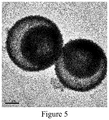
- FIG. 5 is a schematic diagram illustrating the high-resolution TEM image of a double-layer ZnO hollow sphere prepared in Example 2 of the present invention.
- an anhydrous ethanol-ethylene glycol (the volume fraction of ethylene glycol is 10%) mixed solution is taken as the solvent, and magnetic stirring is conducted at room temperature for half an hour; thereafter, 1.8 g of zinc acetate is added, and stirring is conducted for half an hour; after zinc acetate is fully dissolved, the solution is transferred into a hydrothermal reactor, and is heated in an oven at a temperature of 180 DEG C. for 12 h; thereafter, the product is centrifugated, and washed with deionized water and anhydrous ethanol for several times; then, it is dried at a temperature of 60 DEG C. for 12 h to obtain the ZnO double-layer hollow sphere.
- an anhydrous ethanol-ethylene glycol (the volume fraction of ethylene glycol is 10%) mixed solution is taken as the solvent, and magnetic stirring is conducted at room temperature for half an hour; thereafter, 1.8 g of zinc nitrate is added, and stirring is conducted for half an hour; after zinc nitrate is fully dissolved, the solution is transferred into a hydrothermal reactor, and is heated in an oven at a temperature of 180 DEG C. for 12 h; thereafter, the product is centrifugated, and washed with deionized water and anhydrous ethanol for several times; then, it is dried at a temperature of 60 DEG C. for 12 h to obtain the double-layer ZnO hollow sphere.
- an anhydrous ethanol-ethylene glycol (the volume fraction of ethylene glycol is 10%) mixed solution is taken as the solvent, and magnetic stirring is conducted at room temperature for half an hour; thereafter, 1.8 g of zinc sulfate is added, and stirring is conducted for half an hour; after zinc sulfate is fully dissolved, the solution is transferred into a hydrothermal reactor, and is heated in an oven at a temperature of 180 DEG C. for 12 h; thereafter, the product is centrifugated, and washed with deionized water and anhydrous ethanol for several times; then, it is dried at a temperature of 60 DEG C. for 12 h to obtain the double-layer ZnO hollow sphere.
- FIG. 1 is a schematic diagram illustrating the SEM image of the product obtained in the Comparative example. As can be seen from this figure, the ZnO product obtained under the condition of absolute ethanol has no regular morphology.
- FIG. 1 is a schematic diagram illustrating the SEM image and the TEM image of the product obtained in Example 1.
- the obtained ZnO is of a double-layer hollow sphere structure.
- FIG. 2 is a schematic diagram illustrating the XRD spectrum of the double-layer hollow sphere obtained in Example 1. As can be observed from this figure, there is an obvious ZnO diffraction peak.
- the testing procedure for photocatalytic performances is as follows: 100 ml of a phenol solution having a concentration of 40 ppm and 20 mg of catalysts are added into a reactor provided with a water-cooling jacket, and ultrasonication is conducted for 30 minutes; thereafter, stirring adsorption is conducted under dark conditions for 20 minutes to reach adsorption equilibrium; then, irradiation is conducted, wherein the light source is a high-pressure xenon lamp placed horizontally above the reactor, and the temperature of the reaction liquid is controlled to be 25 DEG C.; sampling is conducted at set intervals; after centrifugal separation, a supernatant liquid is taken, and the phenol concentrations (expressed in terms of C/C 0 , wherein C represents a phenol concentration at some point, and C 0 represents the initial concentration of phenol) before and after degradation are analyzed using an ultraviolet-visible spectrophotometer so as to calculate the degradation rate of phenol in the solution upon irradiation.
- FIG. 3 is a schematic diagram illustrating the effects of the ZnO double-layer hollow sphere prepared in Example 1 and ZnO prepared in the Comparative example on photocatalytic degradation of phenol.
- the C/C 0 achieved by the double-layer ZnO hollow sphere prepared in Example 1 is much lower under the condition that the reaction time is identical, indicating that this double-layer ZnO hollow sphere exhibits superior photocatalytic performances.
Landscapes
- Chemical & Material Sciences (AREA)
- Engineering & Computer Science (AREA)
- Materials Engineering (AREA)
- Organic Chemistry (AREA)
- Chemical Kinetics & Catalysis (AREA)
- Physics & Mathematics (AREA)
- Thermal Sciences (AREA)
- Catalysts (AREA)
Abstract
Description
Claims (4)
Applications Claiming Priority (4)
| Application Number | Priority Date | Filing Date | Title |
|---|---|---|---|
| CN201610454961.9A CN106040216B (en) | 2016-06-21 | 2016-06-21 | A kind of bilayer ZnO hollow ball catalysis materials and preparation method thereof |
| CN201610454961.9 | 2016-06-21 | ||
| CN201610454961 | 2016-06-21 | ||
| PCT/CN2016/087811 WO2017219382A1 (en) | 2016-06-21 | 2016-06-30 | Double-layer zno hollow sphere photocatalytic material and method for preparing same |
Publications (2)
| Publication Number | Publication Date |
|---|---|
| US20190076823A1 US20190076823A1 (en) | 2019-03-14 |
| US10646852B2 true US10646852B2 (en) | 2020-05-12 |
Family
ID=57167855
Family Applications (1)
| Application Number | Title | Priority Date | Filing Date |
|---|---|---|---|
| US16/083,754 Expired - Fee Related US10646852B2 (en) | 2016-06-21 | 2016-06-30 | Double-layer ZnO hollow sphere photocatalytic material and preparation method thereof |
Country Status (3)
| Country | Link |
|---|---|
| US (1) | US10646852B2 (en) |
| CN (1) | CN106040216B (en) |
| WO (1) | WO2017219382A1 (en) |
Families Citing this family (10)
| Publication number | Priority date | Publication date | Assignee | Title |
|---|---|---|---|---|
| CN109550494A (en) * | 2018-12-17 | 2019-04-02 | 西安理工大学 | A kind of preparation method and applications of nano porous zinc oxide micro-powder |
| CN110787814B (en) * | 2019-11-07 | 2022-11-08 | 汕头大学 | Layered hollow ZnCdS/MoS 2 Heterojunction cage and preparation and application thereof |
| CN113751009B (en) * | 2020-06-01 | 2024-08-16 | 同济大学 | Preparation method of core-sheath structure Cu/Cu2O-ZnO-Fe3O4 nanocomposite photocatalyst |
| CN111569904B (en) * | 2020-06-02 | 2023-09-22 | 辽宁石油化工大学 | Hollow sphere photocatalyst and preparation method and application thereof |
| CN112657514A (en) * | 2021-01-13 | 2021-04-16 | 三明学院 | Photocatalyst filled with porous nano ZnS @ ZnO hollow spheres and preparation method thereof |
| CN113049718B (en) * | 2021-02-19 | 2023-03-31 | 吉林化工学院 | Preparation of carbon-supported metal oxide composite microspheres and extraction of malachite green and crystal violet from aquatic products by using same |
| CN114367280B (en) * | 2022-01-20 | 2024-03-12 | 吉林化工学院 | A rose-shaped ZnO photocatalytic material and its preparation method and application |
| CN114602508B (en) * | 2022-04-02 | 2023-08-04 | 吉林化工学院 | Preparation and application of MnS@ZnS core-shell hollow sphere catalyst with photocatalytic performance |
| CN114751443B (en) * | 2022-04-28 | 2024-02-09 | 浙江工业大学 | A kind of thin layer metal single vacancy zinc oxide and its preparation method and application |
| CN116273072B (en) * | 2023-03-23 | 2024-08-30 | 哈尔滨理工大学 | Cu (copper) alloy2MoS4ZnO composite photocatalytic material and preparation method and application thereof |
Citations (4)
| Publication number | Priority date | Publication date | Assignee | Title |
|---|---|---|---|---|
| CN102464304A (en) | 2010-11-12 | 2012-05-23 | 中国科学院过程工程研究所 | Multi-shell metal oxide hollow sphere and preparation method thereof |
| CN102543456A (en) | 2011-12-23 | 2012-07-04 | 中国科学院过程工程研究所 | Zinc oxide membrane electrode material for dye sensitized solar cell and preparation method thereof |
| KR20120075874A (en) | 2010-12-29 | 2012-07-09 | 전자부품연구원 | Nano particle having multi-layer core-shell of paint for cutting off heat lay |
| CN103418317A (en) * | 2013-08-26 | 2013-12-04 | 浙江大学 | Zinc oxide hollow micro ball and preparation method thereof |
Family Cites Families (2)
| Publication number | Priority date | Publication date | Assignee | Title |
|---|---|---|---|---|
| CN104607194B (en) * | 2015-01-29 | 2017-04-05 | 陕西科技大学 | A kind of Hemicentrotus seu Strongylocentrotuss shape modified nano-ZnO photocatalyst and its preparation method and application |
| CN104891554B (en) * | 2015-06-08 | 2017-08-25 | 济南大学 | The preparation method and products obtained therefrom of a kind of ZnO honeysuckles head-like structure |
-
2016
- 2016-06-21 CN CN201610454961.9A patent/CN106040216B/en active Active
- 2016-06-30 WO PCT/CN2016/087811 patent/WO2017219382A1/en not_active Ceased
- 2016-06-30 US US16/083,754 patent/US10646852B2/en not_active Expired - Fee Related
Patent Citations (5)
| Publication number | Priority date | Publication date | Assignee | Title |
|---|---|---|---|---|
| CN102464304A (en) | 2010-11-12 | 2012-05-23 | 中国科学院过程工程研究所 | Multi-shell metal oxide hollow sphere and preparation method thereof |
| KR20120075874A (en) | 2010-12-29 | 2012-07-09 | 전자부품연구원 | Nano particle having multi-layer core-shell of paint for cutting off heat lay |
| CN102543456A (en) | 2011-12-23 | 2012-07-04 | 中国科学院过程工程研究所 | Zinc oxide membrane electrode material for dye sensitized solar cell and preparation method thereof |
| CN102543456B (en) * | 2011-12-23 | 2014-04-02 | 中国科学院过程工程研究所 | Zinc oxide membrane electrode material for dye sensitized solar cell and preparation method thereof |
| CN103418317A (en) * | 2013-08-26 | 2013-12-04 | 浙江大学 | Zinc oxide hollow micro ball and preparation method thereof |
Non-Patent Citations (3)
| Title |
|---|
| Bao, Yan et al. "Progress in Preparation and Application of ZnO Hollow Microspheres" Materials Review, vol. 29, No. 6, Jun. 30, 2015 (Jun. 30, 2015), ISSN: 1005-023X, pp. 1-8. |
| Wang, Xi et al. "ZnO Hollow Spheres with Double-Yolk Egg Structure for High-Performance Photocatalysts and Photodetectors" Advanced Materials, vol. 24, Jun. 5, 2012 (Jun. 5, 2012), ISSN: 1521-4095, pp. 3421-3425. |
| Yiamsawas et al (Preparation of ZnO Nanostructures by Solvothermal Method, J Micro Soc Thai (2009), 23(1): 75-78) (Year: 2009). * |
Also Published As
| Publication number | Publication date |
|---|---|
| CN106040216A (en) | 2016-10-26 |
| US20190076823A1 (en) | 2019-03-14 |
| WO2017219382A1 (en) | 2017-12-28 |
| CN106040216B (en) | 2018-09-28 |
Similar Documents
| Publication | Publication Date | Title |
|---|---|---|
| US10646852B2 (en) | Double-layer ZnO hollow sphere photocatalytic material and preparation method thereof | |
| Gao et al. | A mild one-step method for enhancing optical absorption of amine-functionalized metal-organic frameworks | |
| Gao et al. | Novel visible-light-responsive Ag/AgCl@ MIL-101 hybrid materials with synergistic photocatalytic activity | |
| CN106732524B (en) | Alpha/beta-bismuth oxide phase heterojunction photocatalyst and preparation method and application thereof | |
| CN110975918B (en) | A kind of indium zinc sulfide-nitrogen doped graphene foam composite photocatalytic material and its preparation method and application | |
| CN111420668B (en) | In-situ synthesis of alpha-Bi2O3/CuBi2O4Preparation method and application of heterojunction photocatalytic material | |
| CN104646039B (en) | Preparation method and application of a hierarchical structure BiOI/Bi2MoO6 composite visible light catalyst | |
| CN103611551B (en) | Preparation method of bismuth sulfide/bismuth molybdenum oxide heterojunction photocatalytic composite material | |
| CN102527423B (en) | A kind of preparation method and application of molybdenum nitrogen co-doped TiO2 particle | |
| CN103736501B (en) | A kind of sulphur indium zinc composite and Synthesis and applications thereof with isomerism knot | |
| CN114247452A (en) | A kind of bismuth-bismuth sulfide-bismuth tungstate composite photocatalyst and its preparation method and application | |
| Shekofteh-Gohari et al. | Ternary ZnO/Ag3VO4/Fe3O4 nanocomposites: Novel magnetically separable photocatalyst for efficiently degradation of dye pollutants under visible-light irradiation | |
| CN101757908A (en) | Method for preparing Bi2WO6 with high efficiency and visible light photocatalytic activity by adjusting pH | |
| CN102274739A (en) | Copper-nitrogen double-doped titanium dioxide photocatalytic material | |
| Li et al. | Triazine-cored donor–acceptor covalent organic framework promotes highly efficient photocatalytic synthesis of H 2 O 2 | |
| CN116408117B (en) | A heterojunction photocatalytic material with hierarchical structure and preparation method thereof | |
| CN104907060A (en) | A preparation method of CeO2/TiO2 heterojunction nanoflowers | |
| CN118002208A (en) | A ternary heterojunction photocatalytic material, preparation method and application thereof | |
| CN102941076A (en) | {110} surface exposed titanium dioxide photocatalysis material and preparation method thereof | |
| CN105709831A (en) | Silver phosphate and conjugated polymer visible light composite photocatalyst | |
| CN110368973A (en) | A kind of khaki (BiO)2CO3The preparation method of multilevel structure microballoon | |
| CN106984298B (en) | Preparation method and application of nano flaky bismuth oxide | |
| CN108654673B (en) | A new type of photocatalytic material and its preparation method and application | |
| KR20170003818A (en) | Manufacturing method of mesoporous anatase titanium dioxide spheres photocatalyst | |
| CN115301225A (en) | Preparation method and application of bismuth/titanium dioxide photocatalytic degradation material with hollow microsphere structure |
Legal Events
| Date | Code | Title | Description |
|---|---|---|---|
| AS | Assignment |
Owner name: CHANGZHOU VOCATIONAL INSTITUTE OF ENGINEERING, CHI Free format text: ASSIGNMENT OF ASSIGNORS INTEREST;ASSIGNORS:QI, XIUXIU;CHEN, WENHUA;LIU, QIAOYUN;AND OTHERS;REEL/FRAME:046830/0292 Effective date: 20180828 Owner name: CHANGZHOU VOCATIONAL INSTITUTE OF ENGINEERING, CHINA Free format text: ASSIGNMENT OF ASSIGNORS INTEREST;ASSIGNORS:QI, XIUXIU;CHEN, WENHUA;LIU, QIAOYUN;AND OTHERS;REEL/FRAME:046830/0292 Effective date: 20180828 |
|
| FEPP | Fee payment procedure |
Free format text: ENTITY STATUS SET TO UNDISCOUNTED (ORIGINAL EVENT CODE: BIG.); ENTITY STATUS OF PATENT OWNER: SMALL ENTITY |
|
| FEPP | Fee payment procedure |
Free format text: ENTITY STATUS SET TO SMALL (ORIGINAL EVENT CODE: SMAL); ENTITY STATUS OF PATENT OWNER: SMALL ENTITY |
|
| STPP | Information on status: patent application and granting procedure in general |
Free format text: DOCKETED NEW CASE - READY FOR EXAMINATION |
|
| STPP | Information on status: patent application and granting procedure in general |
Free format text: NON FINAL ACTION MAILED |
|
| STPP | Information on status: patent application and granting procedure in general |
Free format text: RESPONSE TO NON-FINAL OFFICE ACTION ENTERED AND FORWARDED TO EXAMINER |
|
| ZAAA | Notice of allowance and fees due |
Free format text: ORIGINAL CODE: NOA |
|
| ZAAB | Notice of allowance mailed |
Free format text: ORIGINAL CODE: MN/=. |
|
| STCF | Information on status: patent grant |
Free format text: PATENTED CASE |
|
| FEPP | Fee payment procedure |
Free format text: MAINTENANCE FEE REMINDER MAILED (ORIGINAL EVENT CODE: REM.); ENTITY STATUS OF PATENT OWNER: SMALL ENTITY |
|
| LAPS | Lapse for failure to pay maintenance fees |
Free format text: PATENT EXPIRED FOR FAILURE TO PAY MAINTENANCE FEES (ORIGINAL EVENT CODE: EXP.); ENTITY STATUS OF PATENT OWNER: SMALL ENTITY |
|
| STCH | Information on status: patent discontinuation |
Free format text: PATENT EXPIRED DUE TO NONPAYMENT OF MAINTENANCE FEES UNDER 37 CFR 1.362 |
|
| FP | Lapsed due to failure to pay maintenance fee |
Effective date: 20240512 |